Volume 92, Issue 3, 2014
April 2014
- Identifier:
- nela.2014_092_03
- Title:
- Volume 92, Issue 3, 2014
- Issue Name:
- April 2014
- Date Issued:
- 2014-04-01
- year:
- 2014
- month:
- April
- Season:
- Spring
- PDF filename:
- NL_92.03_2014_Apr_Spreads_Entire.pdf
- Publisher:
- Nebraska Game and Parks Commission
- Format:
- Periodical
- volume:
- 092
- issue:
- 03
- number:
- 092.03
- Decade:
- 2010s
- Type:
- Rights Holder:
- Copyright Nebraskaland Magazine/Nebraska Game and Parks Commission, all rights reserved.
- Extracted Text:
-
Publis hed by
y the Nebr a s k a Ga m e a nd Pa r k s C o m m is s ion si nc e 1926
NEBRASKAland
April 2014
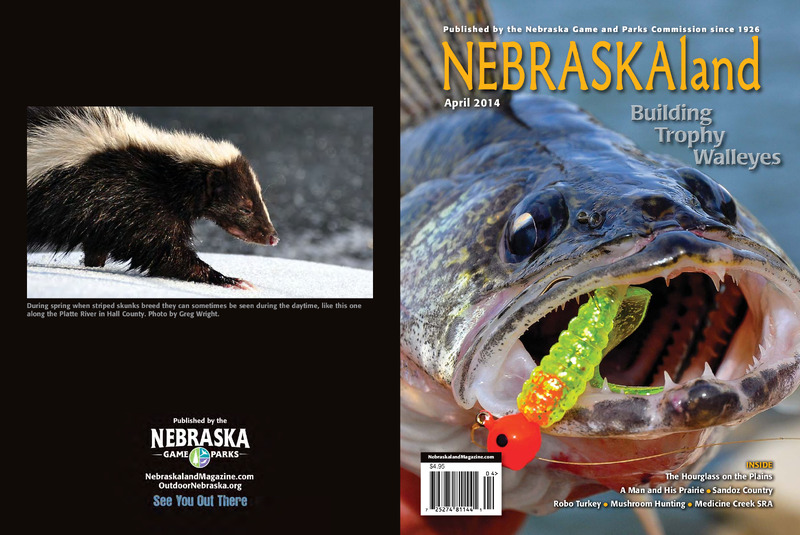
During spring when striped skunks breed they can sometimes be seen during the daytime, like this one
along the Platte River in Hall County. Photo by Greg Wright.
NebraskalandMagazine.com
$4.95
INSIDE
The Hourglass on the Plains
A Man and His Prairie ● Sandoz Country
Robo Turkey ● Mushroom Hunting ● Medicine Creek SRA
2 NEBRASKAland • APRIL 2014
APRIL 2014 • NEBRASKAland 3
NEBRASKAland Magazine
Volume 92
●
No. 3
●
April 2014
F EAT U R ES . . .
20 The Hourglass
PHOTOS AND TEXT BY MICHAEL FORSBERG
28 Robo Turkey
TEXT AND PHOTOS BY ERIC FOWLER
32 The Jessen Ranch
TEXT AND PHOTOS BY GERRY STEINAUER
38 The Life of ’Eye
TEXT AND PHOTOS BY JENNY NGUYEN
42 For Thousands of Years
Medicine Creek State Recreation Area
TEXT AND PHOTOS BY ERIC FOWLER
D EPARTM EN T S . . .
Comment .........................................................6
Mixed Bag.......................................................8
Outdoor Update.............................................48
Page 49 ..........................................................49
Classifieds .....................................................50
Portraits from the Past ..................................52
In the Kitchen ...............................................53
The Last Stop ................................................54
Junior Journal................................................55
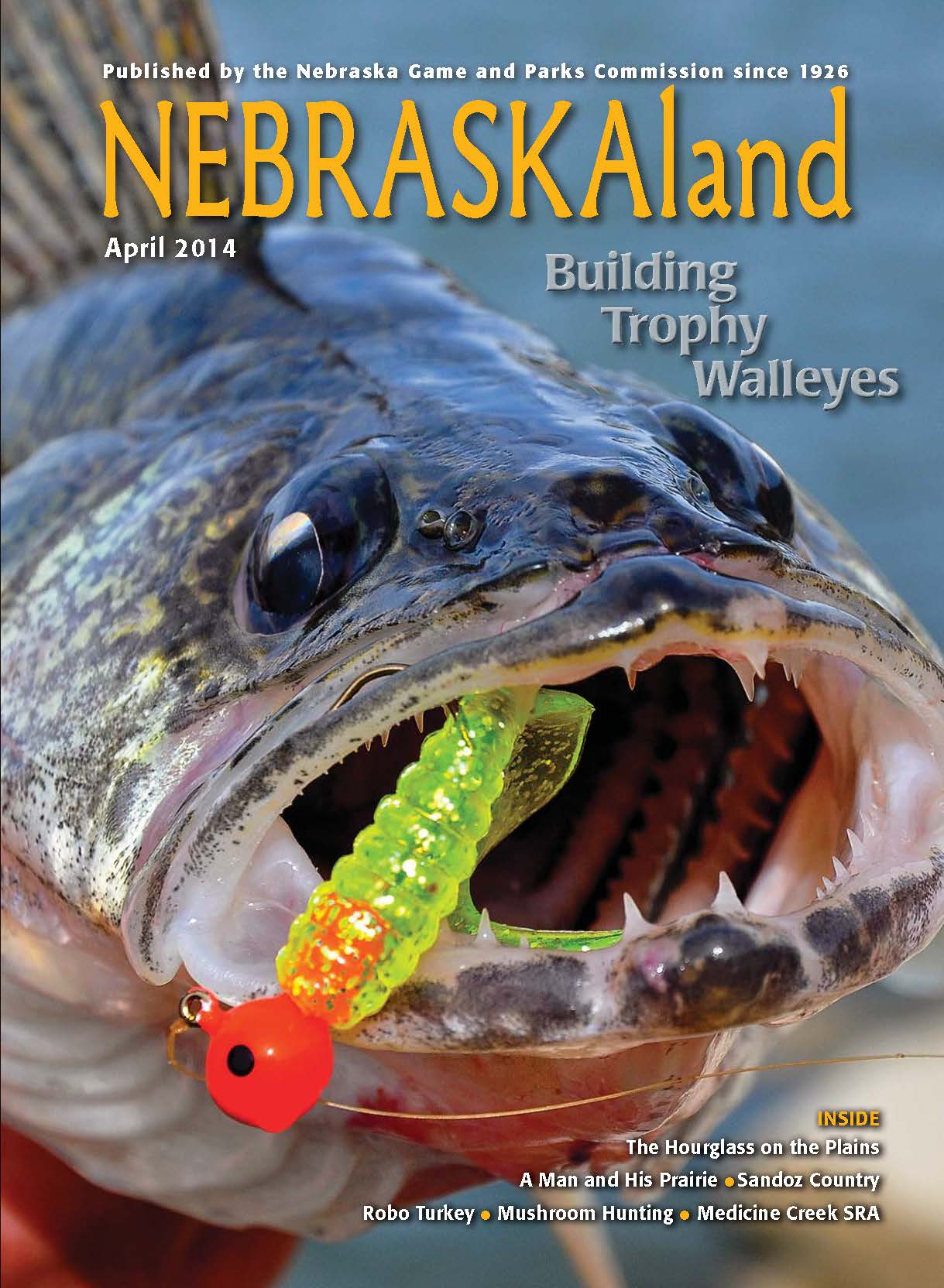
Cover: A 22-inch walleye caught in the canal system below
Jeffrey Reservoir in Lincoln County is the desired result of the
production and management of this species in Nebraska.
See story on page 38. Photo by Greg Wright.
20
●
28
●
32
●
O N T H E W EB . . .
When you see this symbol in the pages
W
oof NEBRASKAland Magazine, visit
N
NebraskalandMagazine.com and view our
iinteractive digital edition for more information.
NEBRASKAland (VOL. 92 / NO. 3, ISSN 0028-1964) is published monthly, except
for the combined Jan./Feb. and Aug./Sept. issues, by the Nebraska Game and Parks
Commission, 2200 N. 33rd St., Lincoln, NE. Periodicals postage paid at Lincoln,
Nebraska, and additional mailing offices. POSTMASTER: Send address changes to
NEBRASKAland, P.O. Box 30370, Lincoln, NE 68503-0370.
4 NEBRASKAland • APRIL 2014
42
●
APRIL 2014 • NEBRASKAland 5
Hawk at Lake
Last spring I was riding
my bike by Oak Lake.
I spotted a red-tailed
hawk perched in a tree. I
always carry my camera
on me, so I moved in a
little closer to get a photo.
It hung around for about
5 minutes then flew off
across the lake.
Steve Andel
via e-mail
A NEBRASKAland Visitor Letter
I believe that fuzzy little creature on
the upper right-hand corner of page 29
is a daring jumping spider (Phidippus
audax). I am very proud of my
daughter, Kim Schaaf of Scottsbluff,
for finding last month’s grasshopper.
Kim is a great outdoors person –
she loves fishing, hunting, boating,
camping, etc.
Enclosed is a picture of Kimberly
and myself with a 19½ pound pike I
caught in a backwater slough south of
Emmet on the Elkhorn River in 1962 or
‘63. We lived in Chambers at the time.
We think your magazine is the
greatest thing since sliced bread!
Lyle T. Clemens
Kenesaw, Nebraska
Last fall my wife and I went camping
at Ponca State Park. I had not been
there since I was 12 years old (I’m
52 now) and my wife had never been
there. May I just say “Wow!” What an
awesome state park!
I still cannot get over how clean
it was, including the roadside,
campground areas, hiking paths, around
the pond and near the river. All of the
staff were also friendly, kind, respectful
and very helpful. Our stay was one that
was a real pleasure and honor! Anyone
who has thought about going to Ponca
State Park should do so as soon as they
can.
Todd L. Bouton
Lincoln, Nebraska
6 NEBRASKAland • APRIL 2014
Lonny Holman of Omaha photographed this
turkey at Fontenelle Forest in Bellevue.
COMMISSIONERS
CONSERVATION OFFICERS
Director Jim Douglas
NORTHWEST
Officer
City
Jim Zimmerman (S) Gering
Commissioners
Chairman - Lynn Berggren, Broken Bow
Vice Chairman - Jerrod Burke, Curtis
2nd Vice Chairman - Dr. Kent Forney, Lincoln
Dr. Mark Pinkerton, Wilber
Rex Fisher, Omaha
Mark Spurgin, Paxton
Mick Jensen, Blair
Dick Bell, Omaha
Norris Marshall, Kearney
Correction: In the
March, 2014 issue
of NEBRASKAland
Magazine, the incorrect
date was listed for the
Free Fishing and Park
Entry Day. Always held
the Saturday before
Memorial Day weekend,
this year the Free Fishing
and Park Entry Day is
May 17.
-Editor
Tractors at Lake Mac
This photo was taken this past
November by our daughter, Megan
Borman, near the end of our driveway
at our home on the south shore of
beautiful Lake McConaughy.
During the chilly months, these
neighborhood tractors get to take a
rest from their summer duties, which
might include hauling boats and jet skis
in and out of the clear waters of Big
Mac, extracting a tree stump from the
shore or even rescuing each other from
a muddy sinkhole! Whether working
or vacationing, this photo captures the
image of a steadfast, but charming, cog
in the wheel of our unique community.
We count down the weeks and
days until we can spend time during
any season in this special place near
Ogallala, Nebraska, where we feel “at
home” among our neighbors (and their
tractors)!
Sincerely,
Rich and Kristin Borman
Ogallala, Nebraska
Send your comments to:
Jeff Kurrus, Editor
NEBRASKAland Magazine
P.O. Box 30370
Lincoln, NE 68503
or e-mail Jeff.Kurrus@Nebraska.gov
Please include your postal address and
telephone number.
Letters may be condensed and edited
for clarity. Photographs are welcome
and will be returned.
Jason Hertz of Lincoln snapped these flying starlings at sunrise near the state capitol.
Any program that receives federal funding from the National Park
Service, or the United States Fish and Wildlife Service prohibits unlawful
discrimination on the basis of race, color, religion, age, gender, marital
status, national origin, age, disability or political affiliation. Any person
who believes he or she has been discriminated against in any program,
activity, facility, or service, should contact the Nebraska Game and
Parks Commission, Lincoln, NE 402-471-0641, the Equal Opportunity
Commission, Lincoln, NE 402-471-2024, TTY/TDD 402-471-4693;
United States Fish Wildlife Service, Civil Rights Coordinator, 4401
N. Fairfax Drive, Arlington, VA 22203; Director, Equal Opportunity
Program, U.S. Department of Interior, National Park Service, 1849 C
Street NW, Mail Code 0008, Washington, D.C. 20240-0001.
MAGAZINE STAFF
Communications Director Christy Rasmussen
Editor Jeff Kurrus
Art Director Tim Reigert
Associate Editor Amy Kucera
Regional Editors Eric Fowler, Julie Geiser,
Justin Haag, Jenny Nguyen
Contributing Editor Michael Forsberg
Regular Contributors Bill Hager, Chris Helzer,
Lisa Knopp, Gerry Steinauer
Photo Librarian Sarah Johnson
Circulation Donna Robinson
For address changes and questions about
your subscription, e-mail Donna.Robinson@
Nebraska.gov or call 800-632-5263
Advertising Sales Manager
For advertising information contact
Shane G. Gilster, 402-742-0125
Email: shanegilster@gmail.com
NEBRASKAland Magazine Copyright 2014, all rights reserved.
NEBRASKAland is available in audio from the Nebraska Library
Commission Talking Book and Braille Service, Suite 120, 1200 N St.,
Lincoln, NE 68508. 800-742-7691. NEBRASKAland Magazine and the
Nebraska Game and Parks Commission reserve the right to reject any
advertising not in keeping with the agency mission.
Rates: $18 for one year; $33 for two years; $44 for three years. Nebraska
recipients must add appropriate sales tax. To subscribe call
1-800-NEBLAND (632-5263), or go online to: NebraskalandMagazine.
com.
COMMISSION
C
COM
OM
OMMIS
M SIO
S ON O
SI
OFFICES
F CES
FFI
ES
S
Headquarters/Southeast District Office
2200 N. 33rd Street Lincoln, NE 68503
Phone 402-471-0641
Northeast District Office
2201 N. 13th St. Norfolk, NE 68701
Phone 402-370-3374
Southwest District Office
301 E. State Farm Rd. North Platte, NE 69101
Phone 308-535-8025
Northwest District Office
East Hwy. 2, Box 725 Alliance, NE 69301
Phone 308-763-2940
Bassett Office
524 Panzer St., Box 508 Bassett, NE 68714
Phone 402-684-2921
Kearney Office
1617 First Ave. Kearney, NE 68847
Phone 308-865-5310
Omaha Office
1212 Bob Gibson Blvd. Omaha, NE 68108
Phone 402-595-2144
Ak-Sar-Ben Aquarium
21502 W. Highway 31 Gretna, NE 68028
Phone 402-332-3901
Greg Hesse
Scott Brandt
Dan Kling
Frank Miller
Sean McKeehan
Terry Brentzel
Phone (308)
(office) 763-2940
(cell) 436-7561
Rushville
760-3647
Gering
631-0663
Harrison
430-0572
Valentine
389-0444
Bridgeport
279-9133
Oshkosh
458-7650
SOUTHWEST
Officer
City
Phone (308)
Roger Thompson (S) N. Platte (office) 535-8025
(cell) 530-3097
Ray Dierking
Brkn. Bow
870-0322
Michael Thome
Cozad
529-8146
Matt Andrews
Elwood
746-2418
Dirk Greene
Imperial
882-0015
Dale Johnson
Kearney
440-3847
Brian Piernicky
McCook
340-6627
Brandon O’Neal
N. Platte
530-3157
Nicholas Fix
Ogallala
289-0427
Bryce Streger
Ogallala
289-1169
Rich Routh
Rep. City
920-0367
Tim Williams
Grand Is
380-7331
Pat George
Kenesaw
402-705-9989
Matt Brandt
Loup City
202-0819
Andrew Heyer
Lexington 402-613-2241
Alex Hasenauer
North Platte
660-4671
NORTHEAST
Officer
Tom Zimmer (Sup.)
City
Norfolk
SOUTHEAST
Officer
Levi Krause (Sup.)
William Krause
Mike Luben
Dan Zuehlke
Heath Packett
Darin Gress
Douglas Kramer
Dina Barta
Stacey Lewton
Dudley Sorensen
Robert Finke
Russell Mort
Dan Evasco
Rich Berggren
Travis Shepler
City
Louisville
Auburn
Colon
Cortland
Eagle
Hebron
Lincoln
Lincoln
Lincoln
Waverly
Milford
Nebr. City
Papillion
Waterloo
Lincoln
Phone (402)
949-0593
274-8063
443-6392
806-9084
210-0888
768-8665
890-6465
890-6463
890-7140
937-3422
947-1363
209-1506
616-5961
619-1355
613-2312
ADMINISTRATION
Officer
Craig Stover (Adm.)
Duane Arp (Ass.)
Jeff Clauson (Ass.)
City
Lincoln
Lincoln
Lincoln
Phone (402)
471-5531
471-5531
471-5531
Phone (402)
(office) 370-3374
(cell) 649-8053
Dale Davis
Bassett
760-0712
Steve Oberg
Columbus
910-3366
Daniel Roberts
Fremont
719-1108
Randy Pomplun
Fullerton
308-550-0489
Jeff Jones
Hartington
762-5022
Jon Reeves
Kennard
889-8508
Doug Pollard
Ord
308-730-7050
Alex Frohberg
Ponca
241-7615
Cory Krause
West Point
380-6410
Jonathan Andreasen O’Neill
340-3981
Mitch Johnson
Bloomfield
613-8612
Nebraska Wildlife Crimestoppers 1-800-742-7627
APRIL 2014 • NEBRASKAland 7
Hammock Camping
By Cristina Woodworth
Sprawling out on a brightly-striped hammock strung between two palm trees
is often the picturesque scenario for a summer day at the beach. In recent years,
though, outdoor gear stores have seen an increasing number of backpackers and
campers showing an interest in the age-old product, citing its lightweight material,
relatively low cost and ultra sleeping comfort as reason to purchase one for their
next camping trip.
Native Americans were documented by Spanish colonists in the early 16th
Century as using nets strung between two trees to sleep in. Cultures around the
world have embraced hammock-sleeping for centuries as well, including areas like
Mexico, Venezuela and India. Such countries often weave homemade hammocks
of traditional materials and colors, adding on features like mosquito nets to make
them more practical.
Modern popularity of the hammock can be traced to Naval ships, where limited
space prevented the installation of permanent bunk beds. Hammocks also worked
well with the constant motion of the ships, because they have more flexibility than
a traditional bed.
Modern backpackers and campers will find a wide variety of hammocks
currently on the market, usually made out of lightweight nylon materials that are
compressible and dry quickly. A variety of different features are available, and some
hammocks include a mini-tent to protect sleepers from the elements.
Sales associates at Cabela’s in La Vista, Nebraska, said customers have been
praising the comfort and versatility of hammock camping. People with back or
neck problems may find it uncomfortable to sleep on the ground, but find relief
sleeping in the naturally curved position a hammock offers.
The only caveat with hammocks? Make sure there are enough trees in the area
you are visiting to string one up. Campers should also tuck a piece of cardboard
or soft blanket around the tree first, so the hammock doesn’t damage the tree’s
bark.
Price ranges for camping hammocks can range from $30 to several hundred
dollars, depending on the quality of the material and special features of the
product. Popular brands include ENO, Hennessy and Eagles Nest Outfitters. ■
Ghost Talk
Congratulations
to NEBRASKAland
d
ret
contributor Margaret
Lukas on her debutt
novel, Farthest
House. The
novel, set on a
Nebraska hilltop
and narrated by
a ghost, weaves
together the
lives of four
enigmatic generations
ons
and has been compared to the
work of Alice Hoffman and Anita
Shreve. For more information, visit
Farthesthouse.com.
My Life as a
Turkey
By Gregory Porterr
Joe Hutto is a
wildlife artist and
naturalist from
Wyoming. He
arrives home one
day to a bucket
of wild turkey
eggs and rushes
out to buy an
incubator. What
i
begins as a simple science
experiment becomes a life-changing
journey as Hutto raises a group of wild
turkeys. He documented his experience
in a journal which became a book and
then a film, My Life as a Turkey.
“Turkeys,” Hutto says, “believe that
their needs will be met at the moment
and nothing more.” To illustrate
this, we watch the young turkeys
at different stages – serene images
that complement the narration and
create vivid images through beautiful
cinematography.
My Life as a Turkey is available for
purchase on DVD/Blu-ray. ■
See My Life as a Turkey from PBS’s
S
website.
w
In “The Discovery of America,” a 1630 engraving by Theodor Galle, Amerigo Vespucci
awakens a sleeping Native American, represented by a person on a hammock.
8 NEBRASKAland • APRIL 2014
APRIL 2014 • NEBRASKAland 9
By Justin Haag
Sandoz Country
n the early 20th Century, Mari Sandoz earned acclaim for
books
b
about the hardened characters of the High Plains of
northwestern
n
Nebraska. Those immigrants included “Old
JJules,”
Ju
ule
le her father and the namesake of her 1935 classic book.
The area of which the author wrote remains a place like
no other and a serene getaway at any time of year. Within
the pages of “Old Jules” and other classic works by Sandoz,
readers are taken to interesting locations, immortalized by
the author’s words, in Sheridan County and beyond. Many of
those locations, mostly south of Hay Springs, Rushville and
Gordon, are still accessible for travelers today.
Imagine the days when Old Jules ran traps for muskrat and beaver
along Pine Creek, which is near to Smith Lake Wildlife Management
Area and a tributary of the Niobrara River.
A number of museums, including the Mari Sandoz Room in
Gordon and the Sheridan County Museum in Rushville, can
help visitors find the right places to visit. And, no tour of Sandoz
Country would be complete without a visit to the Mari Sandoz
High Plains Heritage Center in Chadron. The modern facility has
permanent exhibits paying tribute to the author and the history
of cattle ranching. Other exhibits in 2014 are celebrating the
50th anniversary of the Wilderness Act, which protected 9.1
million acres of federal land and created a legal definition for
wilderness.
Once “outside of town,” don’t expect a lot of amenities, let
alone modern ones, while touring the region. If the weather
has made road conditions questionable, a four-wheel-drive
vehicle is advised.
Despite the challenges, be inspired by the spirit of Old Jules
and set out on an adventure in his old stomping grounds.
Mari Sandoz High Plains Heritage
Center at Chadron
Sher
in Ruidshavni County Museu
lle
m
Sheridan and
Dawes counties
Chadron
Hay Springs
Smith Lake WMA
Fis
10 NEBRASKAland • APRIL 2014
By Nebraska Outdoor U!
As the water warms up and the open water fishing
season begins, you may want to take some time to
prepare your equipment for the rigors of an intense
summer fishing season.
Check your rod eyelets for rough edges that could
abuse your line, and sand these smooth or replace them
as needed. To preserve cork handles, sand out any bumps
or dirt, then apply a cork sealing agent or varnish of
some sort to protect them from excess moisture and
dirt. To clean and maintain a healthy reel, take the reel
apart, keeping track of the order in which each part was
assembled. Thoroughly clean each component and apply
a quality lubricant of your choice to the moving parts to
guard against friction damage. If you are unsure in your
reel mechanic abilities, many fishing shops will clean
reels at a cost. It is also a good idea to replace the line
on your reel spools for the upcoming fishing season,
especially if you know the line received a lot of action
last season or if it is monofilament line. Give your tackle
Rods and reels stand ready for the Outdoor Discovery
Program’s fly fishing demonstration at Scottsbluff.
box a quick run-down as well. Clip any line knots off of
any hooks you didn’t completely clip off before. Replace
any broken or heavily rusted hooks, and sharpen your
hooks, because you don’t want a dull hook to be the
reason why you missed the big one.
Visit OutdoorU.org and start your own pathway to
exciting and memorable experiences in the outdoors. Get
outside and see what
the Nebraska Outdoors
has for you. ■
APRIL 2014 • NEBRASKAland 11
PHOTO BY JUSTIN HAAG
ake
ith L
m
S
t
a
g
hin
Gordon
Rushville
Preparing Fishing
Equipment for the
Open Water Season
A Brief History
Early Catfish Tales
By Patricia C. Gaster,
Nebraska State Historical Society
One of the early encounters of
Europeans with catfish in this area of
the country is found in the journals
of the Lewis and Clark expedition.
Just north of an Omaha tribal village
they reported catching 318 fish of
various kinds, and the next day caught
“upwards of 800 fine fish,” 490 of
which were catfish.
The value of this creature is
acknowledged by Lewis C. Edwards,
who
whose History
of R
Richardson
Cou
County,
Neb
Nebraska (1917)
pra
praised “the
gre
great value of
the catfish as
a means
m
of
assisting the
as
early
ea pioneers
in maintaining
body
b
and soul
together.”
t
He
includes
i
in
his
h book the
recollections
12 NEBRASKAlan
NEBRASKAland • APRIL 2014
of Margaret H.
Maddox, who
recalled that
Emil Bartu and Joe Kozak, Wilber, Nebraska. The larger yellow
channel catfish weighed 56 pounds.
catfish was an
integral part of her
a 175-pound specimen captured when
1855 Christmas
it went aground a short distance below
dinner in Nebraska City: “Besides a
Omaha.
wonderful roast turkey we had baked
A curious episode in Nebraska
catfish, the largest I ever saw cooked.
territorial history, the so-called “Catfish
It weighed twenty pounds and was
War,” was only indirectly associated
browned and cooked to a turn.”
with the fish. In July 1855 near
Edwards also stated that catfish oil
Fontanelle, then a recently established
was “used for a variety of purposes
such as to grease the boots of the entire village on the Elkhorn River 20 miles
west of Omaha, C. L. Demaree and
family, oiling or greasing the harness,
a Mr. and Mrs. Porter met a small
and to oil the gun locks, the oil also
group of Sioux. Accounts of the
being considered a fine specific for
hostile incident which followed vary,
rheumatism and sore throat.” Senator
but all agree that Demaree and Mr.
John J. Ingalls of Kansas bestowed
Porter were killed; Mrs. Porter was
the name “catfish aristocracy” on
not harmed and she fled to Fontanelle.
indolent settlers along the bottomlands
Afterward, Mark Izard, Nebraska
of rivers in eastern Kansas and
territorial governor, sent a detachment
Nebraska because they supposedly
of thirty men to the Fontanelle
lived by fishing and hunting instead of
area. However, the general Indian
cultivating the land intensively.
uprising which had been feared never
Stories of oversized catfish dot
materialized. The soldiers had little to
the columns of Missouri River area
do for the rest of the summer besides
newspapers. The Nebraska Advertiser
enliven the social life of Fontanelle and
of August 13, 1857, reported the
catch of a 120-pound catfish at
shoot catfish in nearby lakes and rivers –
the Brownville wharf. The Omaha
from which the episode became known
Nebraskian of May 5, 1860, reported
as the “Catfish War.” ■
RG813-314 NEBRASKA STATE HISTORICAL SOCIETY
RG813-127 NEBRASKA STATE HISTORICAL SOCIETY
By the 20th century it was easier for anglers to prove their fish
stories with snapshots. Here is a 75-pound catfish, caught
March 20, 1949, near Wilber, Nebraska.
Richard Cabela Dies at 77
Richard “Dick” Cabela, co-founder of Cabela’s, Inc., died
February 17 at his home in Sidney. He was 77.
Dick, along with his wife, Mary, and brother, Jim, founded
Cabela’s somewhat inadvertently in 1961 when he purchased
$45 worth of hand-tied fishing flies while in Chicago on a
furniture and housewares buying trip with his father for the
family’s Chappell furniture store. With the flies not moving
off the store shelf, Dick came upon the idea of selling them
through the mail. His first ad, in a Casper, Wyoming, newspaper, produced one
sale. Rethinking his situation, Dick placed an ad in Sports Afield magazine:
“FREE introductory offer!!! 5 popular Grade A hand-tied flies. Send 25c for
postage and handling …”
Orders started coming in, and Dick purchased more fishing gear to sell.
Realizing the potential for mail-order sales, they began producing a catalog.
Growth led to the opening of a retail store in downtown Sidney and today,
Cabela’s is a $3.6 billion company with a worldwide catalog and Internet business
and 50 stores in the United States and Canada.
“Dick and Jim made it possible for sportsmen and women to get quality outdoor
products no matter where they lived,” said Tommy Millner, Cabela’s Chief
Executive Officer. “They weren’t the first to offer outdoor goods through the mail,
but nobody did it better or with more care about providing customers a good
value for their money.... He pushed for research and development in every outdoor
field. Dick always looked out for the customer and if he couldn’t find a vendor to
provide what he wanted, he pushed Cabela’s to design and make it. Because of
that passion, the Cabela’s brand and its products are iconic throughout the world.”
Dick is survived by his wife, Mary, their nine children and their families, two
sisters and three brothers. ■
APRIL 2014 • NEBRASKAland 13
Toast Nebraska
By Eric Fowler
Excavation work is set to begin this spring
on a backwater project that will provide critical
shallow water habitat for endangered pallid
sturgeon and also a quiet place for visitors to fish
at Indian Cave State Park.
The 20-acre backwater will be dug on the
riverbottom below the park’s boat ramp and
measure about 3,000 feet in length. It will be 50
to 250 feet wide, with varied depths of 5 to 15
feet in the summer months.
Two angler access points will be built near the
deepest part of the backwater. Some of the trees
cleared to make room for the project will be
placed in the finished backwater to provide fish
habitat. Anglers can expect to catch flathead and
channel catfish, bluegills, crappies, largemouth
bass, carp and other fish in the backwater.
While the park boasts 4.6 miles of Missouri
River frontage, the water is swift and the banks
steep, making it uninviting to most anglers.
The backwater is being built as part of the
U.S. Army Corps of Engineers’ Missouri River
Recovery Program, which is designed to restore shallow
water habitat (SWH) that will provide feeding, spawning
and rearing habitat for the federally endangered pallid
sturgeon and other native Missouri River fish species. The
backwater will also provide habitat for native wildlife
including waterfowl, shorebirds, reptiles and amphibians,
and mammals such as muskrats and beaver.
The Indian Cave project is one of several underway or
planned for the Missouri River along Nebraska. Others
include:
• Two projects near Brownville in Nemaha County,
including converting a previously restored backwater at
Langdon Bend Wildlife Management Area into a flow-
By Jane Gustafson
Fans of Nebraska wine can raise
a glass at the first annual “Toast
Nebraska” wine festival, scheduled for
May 3-4, 2014, at Eugene T. Mahoney
State Park near Ashland.
Highlighting vintages from 17
Nebraska wineries, the weekend will
include live music, wine sampling, an
amateur wine making competition,
unique food pairings, art and jewelry
vendors and trolley tours through
the park. Pass prices for the event
range from $25 to $65, with the latter
including commemorative items,
limited edition samples and special
gourmet cuisine buffets.
The event is hosted by the
Nebraska Winery and Grape Growers
Association. Activities run from
11:00 a.m. to 8:00 p.m. daily. Vendor
and volunteer opportunities are still
available. To learn more or to purchase
tickets and reserve lodging at the park,
visit ToastNebraska.com or call
402-882-2448. ■
PHOTO BY ERIC FOWLER
Backwater Project to Create Wildlife Habitat
A 20-acre backwater will be built on this portion of Missouri River
bottomland at Indian Cave State Park, connecting to the river
at the lower right portion of this image.
through chute.
• The reopening of a connection between the river
and a backwater lake at Middle Decatur Bend Wildlife
Management Area near Decatur. About 2,500 feet of the
channel was filled with silt and sand during the 2011 flood.
• Construction of a backwater at Glovers Point Bend on
land owned by the Winnebago Tribe of Nebraska in Thurston
County to create 55 acres of SWH.
• Completion of a chute complex creating 25 acres of
SWH at Sandy Point Bend north of Blair in Washington
County that is expected to expand to 60 acres.
• Work to increase the top width of the Missouri by about
400 feet for 1.5 miles on Lower Little Sioux Bend west of
Tekamah, creating 182 acres of SWH. ■
Man Cave
By Tyler Brown
My “man cave” is also my
home office. All of the work
was done by myself with the
help of my wife and friends.
The wall that my bear rug is
hanging on was finished with
barn wood from my wife’s
grandparent’s barn north of
Boelus, Nebraska. The barn was close
to a century old before it was torn
down a few years ago.
In the back corner of the room you
will see a log. That log was found by
my dad in a blowout on our family
ranch south of Valentine that we owned
years ago. The cattle rubbed the log
14 NEBRASKAland • APRIL 2014
smooth so it has a really neat finish to
it now.
The big photomural on the wall is
of my dad and aunt moving registered
Herefords on horseback across a clover
covered meadow at the ranch.
In the room are my wild game
mounts, pictures of hunting and fishing
trips with friends and family, master
angler awards, and my John Wayne
collection. All of my game was taken
in Nebraska except for the bear.
Submit your man cave images to
jenny.nguyen@nebraska.gov, along
with your name and brief description of
your man cave. ■
APRIL 2014 • NEBRASKAland 15
Cowboy Trail Tour 2014
Trail Bridge over the Elkhorn River at
9 a.m.
Sunday, May 18 – Neligh to O’Neill
(44 miles) – Project Wild Outdoor
Education activity at Red Wing
Wildlife Management Area (WMA) at
9 a.m.
Monday, May 19 – O’Neill to Stuart
(28 miles)
Tuesday, May 20 – Stuart
to Long Pine (31 miles)
Wednesday, May 21
– No travel – Tentative
fishing clinic and Dutch oven
cobbler demo at Keller State
Recreation Area (SRA), with
camping at Long Pine SRA.
Thursday, May 22 – Long Pine to
Plum Creek Valley WMA, Johnstown
(20 miles) – Evening guided hike at
Plum Creek Valley WMA, families
welcome.
Friday, May 23 – Plum Creek Valley
WMA to Valentine (36 miles).
Follow the adventure, including
updates, photos and event schedule at
Nebraskalandmagazine.com/author/
jenny-nguyen and the Commission’s
Facebook page. ■
Send Us Your Trail Cam Photos!
By Nebraska Outdoor U!
When you condition your dog
year-round, you’re not just getting
your dog in shape; you’re also
building a stronger bond and
maintaining a healthy metabolism
and immune system for your dog.
So here are a few tips for this
spring:
Earlier in the off-season, allow
your dog time to recover from
any injuries while maintaining
proper fitness levels. If your dog
made it through the season without
injuries, you should be able to safely
maintain your dog’s fitness with a
food mix of 20-25 percent protein
and 13-17 percent fat, along with
moderate exercise.
Exercise sessions should be
fun and beneficial. A 30-minute
sustained run on a gravel road
in the morning, once or twice a
week, is a great way to build your
dog’s endurance, and the gravel
will toughen up their feet. Take
caution against doing this in the hot
afternoon as heat exhaustion and
injured feet will be highly likely.
Swimming is a prime full body
workout for your dog. It improves
cardio functions, works many
different muscles that usually don’t
get worked and is easy on your
dog’s joints. Spending about an hour
at the lake once or twice a week will
do the trick.
On afternoons, letting your dog
free run fields for 30-45 minutes
will keep them in the hunting mindset and allows them to sustain fitness
at their own pace. Use this workout
to fill days between road runs and
swimming.
As the trainer, you must show you
are a strong pack leader because, as
your subordinate, your dog will want
to obey and please the leader and
caregiver. Understand your dog’s
needs throughout the entire year, and
you’ll both have great success and
joy afield. ■
•
•
Nebraska Bird Library
Greater Prairie-chicken
Song or calls: Courting males, deep “oo-loo-woo” called
“booming.”
Description: A stocky, brown grouse, considered a large
chicken-like bird. It is heavily barred with paler stripes above
and grayish brown below and has a short tail. The male has
yellow-orange air sacs inflated during courtship display and
long feathers on sides of the neck that erect into “horns”
during courtship; females also have “horns,” but they are
shorter. Both males and females have obvious dark eye-stripe
and pale throats. When in flight, the wings are rounded and
the flight is swift with a series of rapidly beating wings.
Behavior: Multiple males display for females at a group
display site, called a lek. They perform striking courtship
dances where they strut about and stamp their feet, with
“horns” erect and yellow-orange sacs of skin inflated on
the sides of the neck, meanwhile uttering a deep cooing call
referred to as “booming” that may be heard a mile away.
They leap and whirl in the air, and threaten each other by
short runs with tail raised, head down, and horns erect.
Food: Leaves, seeds, buds, cultivated grains, fruits and
insects.
Habitat: Greater prairie-chickens require undisturbed
prairie, preferring open sweeps of permanent high grass and
minimal brush and trees. It uses vegetation 10-18 inches in
y
Sponsored by
height for roosting and nesting. Hens avoid
nesting or rearing their broods within a
quarter-mile of powerlines and within
a third-mile of improved roads. In eastern
Nebraska, the greater prairie-chicken
is heavily dependent on CRP grasslands.
Where in Nebraska: The Sandhills
are the heart of the greater prairie-chicken
range. Numerous outfitters and
nature centers now offer viewing
trips during the spring lekking
season. Once found throughout
the tallgrass region, greater
prairie-chicken populations
have been reduced by
habitat fragmentation in
eastern Nebraska.
Fun Facts: Greater prairiechickens use a lek-mating
system, where the males defend
and dance on a territory that
holds no valuable resources to
attract females. ■
To learn about more birds visit:
NebraskaBirdLibrary.org.
•
•
Austin Kober supplied this trail camera confrontation taken
near Palmer, Nebraska.
Please submit your trail camera photos by e-mail to:
nebtrailcam@gmail.com. Also include where you’re from and any
information that will help explain your photo.
16 NEBRASKAland • APRIL 2014
APRIL 2014 • NEBRASKAland 17
PHO
PHOT
HOT
HOT
O O BY ROC
CKY HOFFM
OF
FF AN
ANN
NN
N
Join Nebraska Game and Parks
Commission Wildlife Educator Jamie
Bachmann and NEBRASKAland
Regional Editor Jenny Nguyen this
May as they bike the entire Cowboy
Trail from Norfolk to Valentine. Come
ride with them for just a few miles,
the whole day or the entire way as
they travel near your town. The
duo will be stopping at
certain locations below
to hold possible Project
Wild Outdoor Education
activities for kids, a
fishing clinic, a Dutch
oven cobbler demo and an
outdoor guided hike.
All biking participants, especially
long-term, will be responsible for
their own equipment, food, lodging
and transportation. All dates and
activities are subject to change due to
unpredictable weather and unforeseen
delays.
Saturday, May 17 – Norfolk to
Neligh (37 miles) – Meet at Ta-HaZouka Park at 8 a.m. in Norfolk, with
a Project Wild Outdoor Education
activity at the newly built Cowboy
Off-Season
Conditioning for
Your Bird Dog
Emerald Ash
Borer Update
Contact the Nebraska Game
and Parks Commission
at 402-471-0641 or visit
OutdoorNebraska.org for more
information.
Visit HuntSafeNebraska.org for a
list of hunter education classes and
BoatSafeNebraska.org for a list of
boating safety classes.
April 1
Light Goose
Conservation Order closes
April 15-16
Outdoor Discovery Program
East
April 1-14
Archery Paddlefish
Platte River SP
402-471-6009
permit application period
April 19
Spring Extravaganza
April 5
Bird Banding Workshop
Ak-Sar-Ben Aquarium, Gretna
402-332-3901
April 5
Beyond Becoming an
Outdoors-Woman Beginning
Bird Watching
Ak-Sar-Ben Aquarium, Gretna
402-471-6009
April 5
Spring Youth Shotgun
Turkey
season opens
April 5-6
Platte River Art Show
Eugene T. Mahoney State Park
(SP), Ashland
402-944-2523
Ponca SP
402-755-2284
April 19
Indian Cave Outdoor
Adventure
Indian Cave SP, Shubert
402-883-2575
April 25
Arbor Day
Game and Parks offices closed
April 25-26
Arbor Day Celebration
Arbor Lodge SHP
402-873-7222
April 26
Beyond Becoming an
Outdoors-Woman Horses
and Camping Weekend
April 5-6
ATV Jamboree
Platte River SP
402-471-6009
Lake McConaughy State
Recreation Area (SRA), Ogallala
308-778-5651
April 26-May 4
Fire School Academy
April 11-12
Becoming an Outdoors
Family Camp
Two Rivers SRA
402-471-5547
April 11-13
Outdoor Cooking Camp
Weekend
Ponca SP
402-755-2284
April 12
Spring Shotgun Turkey
season opens
Fort Robinson SP
308-665-2900
April 26-May 18
Roger G. Sykes Outdoor
Heritage Education Complex
open to public on weekends,
Platte River SP, Louisville
402-471-5547
April 28
Family Fishing Event
Terry’s Pit, Scottsbluff
April 29-30
Outdoor Discovery Program
West
Scottsbluff
402-471-6009
By Jeff Kurrus
“This is an experimental piece,”
writes filmmaker Peter Stegen
about his short film production
titled Persephone, “exploring
how scavengers, insects and
seasons encourage decomposition;
it is a story of life from death.
Decomposition is a daily reality
though few see it as a thing of
beauty. My hope is to simply
Filmmaker Peter Stegen sets up a camera trap
show you the beauty in death and
as part of his short film Persephone.
the life that comes from it.”
Visit Flickr.com/peterstegen to see more of
Stegen’s hope comes through
Stegen’s photographs.
clearly in his video about a process
that repeatedly occurs in our natural world
See Stegen’s video
S
but few have witnessed – a fascinating way
Persephone.
P
to spend six minutes of your life. ■
By Julie Van Meter, State Entomologist
Emerald ash borer (EAB), an exotic, invasive beetle
that infests and kills ash (Fraxinus sps.) trees, is moving
steadily toward Nebraska. This includes infestations in
the Kansas City metro area, Creston, Iowa, and Boulder,
Colorado. Each of these infestations is roughly an hour
from Nebraska’s borders.
Due to these most recent finds, state and federal
quarantines regulating the movement of items such
as hardwood firewood and ash logs and lumber have
changed. Missouri and Iowa are now under full state
quarantines. Kansas has two counties quarantined, and
an area around the Boulder metro area is quarantined
in Colorado. The quarantines require that any regulated
item be inspected and certified prior to it leaving the
quarantine area.
EAB and other pests such as walnut and gypsy
moths can easily move in firewood. As camping season
approaches, leave your firewood at home. Get your
firewood from a local source at your destination, and
leave any unused firewood behind. No one wants to
be responsible for bringing a pest to their favorite
campground, or taking it back home with them.
You can also help to monitor for EAB infestations in
Nebraska. Look at the ash trees on your property for
signs and symptoms of an EAB infestation. Excellent
information on these can be found on the Nebraska Forest
Service web site at Nfs.unl.edu/eab. Report any possible
infestations to the Nebraska Department of Agriculture
(402) 471-2351 or USDA (402) 896-8256. ■
News From
Abroad
Matt Moorhead, The Nature Conservancy’s
Southeast Colorado Project Director
Firewood Alert – Burn Local
By Mike Groenewold, NGPC Park Horticulturist
We know that a campfire is an important part of
your recreation experience at Nebraska’s state parks
and recreation areas. However, whenever firewood
is transported any distance it can harbor the emerald
ash borer or other invasive pests that are harmful to
Nebraska’s woodlands and landscapes. To help prevent
the spread of invasive pests, the Nebraska Game and
Parks Commission will be asking visitors, for the second
consecutive season, to comply with a voluntary firewood
restriction at our parks and recreation areas. Park visitors
may see signs posted with a “Firewood Alert” requesting
that firewood brought from another state be burned
immediately and not transported to another Nebraska park
or destination.
The Commission has also initiated a voluntary firewood
exchange program at Niobrara, Ponca, Eugene T.
Mahoney and Indian Cave state parks as well as Lewis and
Clark, Branched Oak and Pawnee state recreation areas.
Therefore, if you visit those parks and bring wood from
another state, please visit the park office or campground
host to exchange it for locally acquired wood. ■
18 NEBRASKAland • APRIL 2014
PHOTO BY CHRIS PAGUE/TNC
by Jerry Kane
Decomposition Worth Watching
fter a 100-year absence, the reintroduction of
35 black-footed ferrets from captive breeding programs
(including Omaha’s Henry Doorly Zoo) to their historic home
on eastern Colorado’s prairie began last November. A predator
with a taste for prairie dogs, ferrets were an unintended victim of
widespread poisoning campaigns and introduced diseases.
A Colorado rancher near Pueblo has long wanted ferrets to help
manage prairie dog populations. A ground-breaking agreement
between the rancher and the U.S. Fish and Wildlife Service cleared
the way for the release by providing “safe harbor” for the landowner
to manage his ranch without fear of regulatory burdens on him
or his neighbors. The Colorado state legislature and livestock
associations have supported this effort as a way to give additional
prairie dog management tools to landowners who want them.
After putting young ferrets through training programs, or prairie
dog hunting “boot camps,” successful ferrets became eligible
for release. Having cleared those requirements, ferrets have
been released at sites from South Dakota to Arizona, returning
a key predator to prairie dog towns. Now, thanks to this project,
more private lands in Colorado may offer a welcome mat to this
endangered species.
NEBRASKAland
Visitor
Last issue’s winner of
the Visitor drawing was
Roger Hanneman of
Friend, Nebraska, who found the
bold jumping spider on page 29.
Readers are encouraged to contact
NEBRASKAland within 10 days
after this issue’s publication with
the correct page number and name
of this issue’s “Visitor” – a critter
found in Nebraska. We will then
gather the correct entries and draw
one to win a NEBRASKAland
Magazine mug. To enter each
month, write:
NEBRASKAland Visitor
2200 North 33rd Street,
Lincoln, NE 68503.
Or e-mail:
Tim.Reigert@Nebraska.gov
with “Visitor” in the subject line of
the message.
HINT: This issue’s visitor is not
on page 9, 11, 18, 19, or 55.
The bold jumping spider,
Phidippus audax, is native to
Nebraska and most of the U.S.
A small, stocky spider, usually
around half an inch in length, its
hairy appearance has earned it
the nickname “little tarantula.”
They have a striking color
pattern of black and white, a large
triangular patch of white hairs and
a pair of smaller white spots on their
abdomen. Their large chelicerae
(fangs) are metallic green to blue,
and sometimes purple or pink.
Their powerful legs allow them to
jump 10 to 50 times their own body
length. From grasslands to urban
areas, these spiders are found in
a variety of habitats. While they
look menacing, they are beneficial
creatures, feeding on other spiders
and insects. Bites to humans are
rare, and usually result
in nothing more serious
than soreness around
the bite location.
Special thanks to Julie Van Meter,
State Entomologist, Nebraska Department of
Agriculture. Visitor image by Chris Helzer.
Bugguide.net is a good site for identification.
APRIL 2014 • NEBRASKAland 19
The Hourglass
Photos and text by Michael Forsberg
An immense hourglass lies over the center of
North America. Its top half stretches up and
across the Arctic tundra wilderness from Hudson
Bay to eastern Siberia, as its bottom half reaches
from the humid Texas Gulf Coast west to the arid
desert lands of northern Mexico.
Ducks and geese at Hultine Waterfowl Production
Area in the Rainwater Basin, central Nebraska.
20 NEBRASKAland • APRIL 2014
APRIL 2014 • NEBRASKAland 21
MAP ILLUSTRATION BY ANDREW FAUGHN
I
n this hourglass there are millions of grains of
sand. Not uniform particles of silica, but birds
from small sandpipers to tall cranes, moving
between these two vast geographies, set in
perpetual motion by a solar-powered clock
beating out the rhythm of the seasons.
Sandhill cranes stir among sandbars before leaving their river
roost at Audubon’s Rowe Sanctuary in the Platte River Valley.
Baird’s sandpipers fly low over a Mormon Island grassland.
T
his hourglass is the Central Flyway, the largest
of five major aerial superhighways that
funnel winged travelers on migration through
the heart of the continent. Twice a year, birds
move between breeding grounds in the north
and winter quarters in the south in an ancient
rite of passage passed down from generation to
generation.
22 NEBRASKAland • APRIL 2014
APRIL 2014 • NEBRASKAland 23
Northern pintail ducks fly in courtship formation at Hultine
Waterfowl Production Area.
T
E
he proverbial pinch in this hourglass lies in the heart of the Great Plains –
the Platte River Valley of Nebraska, the flyway’s greatest stage.
ach spring this stage showcases one of the greatest bird migration
spectacles on Earth. From the first signs of receding ice in late winter
until cottonwoods burst forth with April green, roughly 20 million sets of
wings will seek refuge and sustenance in this broad valley. Waste grain in
corn fields left from fall’s harvest provide needed fat, protected wetlands
and grasslands afford critical nutrients, and carefully managed braided
river channels allow restful overnight sanctuaries. The primeval memory of
traveling this territory is shared within and among different species, from
puddle ducks to divers, snow geese to Canadas, sandhills to whooping
cranes, white pelicans to peeps.
24 NEBRASKAland • APRIL 2014
Shoreline feathers and leaves at Hultine Waterfowl Production Area.
APRIL 2014 • NEBRASKAland 25
Snow geese roosting on the Platte River at
Audubon’s Rowe Sanctuary.
B
ut this most critical migratory habitat
coexists with one of the most productive
modern day agricultural landscapes in the
world, where every drop of water is spoken for
and conservation is not free.
F
or millennia, birds moved freely across the
continent’s interior, their migratory journey
dictated only by nature’s boundaries and rules.
But since settlement, we have re-engineered
watersheds with dams and diversion. We have
de-watered wetlands and plowed prairie.
As habitat has dwindled, the hourglass has
slimmed. Now the tremendous spectacle of
migration we celebrate each spring is partly our
own invention as these creatures crowd into
smaller and smaller refuges, moving along a
series of carefully arranged stepping stones on
a path we’ve laid out for them.
T
his is the backdrop to the incredible life force winging over
the Platte each spring. But surely if this powerful experience
can renew our spirits and fill us with wonder and awe, it can also
reinforce our commitment and re-double our efforts to continue
to restore habitats and protect this annual rite of passage, one
that has marked time for as long as we can remember, and will
for generations to come. ■
Michael Forsberg is a professional nature
photographer and contributing editor to
NEBRASKAland. To see more of Mike’s
images, visit MichaelForsberg.com.
A bald eagle flies near sunset at Audubon’s Rowe Sanctuary.
26 NEBRASKAland • APRIL 2014
APRIL 2014 • NEBRASKAland 27
Robo Turkey
Motorized Turkey Decoy Changes Game
for Wahoo Hunters
Text and photos by Eric Fowler
Wayne Stang watches
as his daughter, Darian,
steers Robo Turkey through
a pasture on the way
back to the truck after
unsuccessfully trying to
use the highly-modified
decoy to bring a turkey into
bow range last spring near
Wahoo. (Right) A pair of
toms gobble after running
toward Robo Turkey on its
maiden deployment.
28 NEBRASKAland • APRIL 2014
“D
ad, can I drive the decoy home?”
That question, asked by 11-year-old Darian Stang
to her father, Wayne, after a turkey hunt last spring,
has probably never been uttered before in history.
It might not have been if not for Wayne’s invention, a
unique adaptation of a turkey decoy which I’ve dubbed
Robo Turkey. More specifically, it’s a Carry Lite Pretty Boy
decoy on a Mad Torque Rock Crawler remote-controlled
truck chassis.
The RC performs just like its full-sized namesake –
4-wheel-drive Jeeps, pickups or dune buggies with big tires,
a highly flexible suspension and low gear ratios that allow
them to drive over almost any terrain.
The mobile decoy allows Stang to take the
concept of “adding life to the decoy
spread” to an entirely different level,
and lets him do something most
turkey hunters have dreamt
of: take the decoy to
turkeys.
The idea was born
on a windy, spring
day in 2012. Wayne
and Darian had
spotted a flock
of turkeys, and
sneaked as close
as they could to
the birds without
being spotted before
setting up their blind
and then crawling
ahead to set the decoy
where the birds could see
it. But that still left them
more than 200 yards away.
“I called and called and they
looked at the decoys and there was no
response,” Stang said. “They were so far out
and windy that day they could not hear me calling.” After
45 minutes of nothing, “I told Darian, ‘We’re going to do
something drastic here.’”
Wayne crawled out of the blind, grabbed the decoy and,
holding it above him, crawled back and forth in full view
of the turkeys. “I got the tom’s attention and he came in to
100 yards,” Stang said. But by the time he got back into the
blind, the tom had hung up and soon was heading the wrong
way. So Wayne repeated his show, making wider circles
with the decoy and not crawling back to the blind until the
tom was 75 yards out. “As soon as I sat down, the bird came
in at a full run,” he said.
With a tree stopping her swing, Darian didn’t get a shot
at that gobbler, but tagged three birds by season’s end.
Those hunts gave Wayne time to think about an alternative
to adding movement to his decoy spread that didn’t involve
crawling.
Stang’s co-workers have nicknamed him MacGuyver,
after the 1980s TV secret agent who used ordinary items to
get himself out of extraordinary predicaments. “Growing up
on the farm, you learn how to make stuff out of nothing,”
the North Dakota native said.
Hours of internet research led him to the Rock Crawler.
Not only did it fit his decoy perfectly, but it was the only
one he found with an aluminum frame that would allow him
to easily attach his mounting bracket.
When youth season rolled around in 2013, the decoy
was ready. And on its first deployment in a cornfield near
Wahoo, it worked flawlessly. From their blind in the woods
at the field’s edge, Wayne occasionally moved the decoy
around the corn stubble as he called. When a flock of
turkeys rounded a bend in the field and spotted it, they ran
full steam ahead, stopping and gobbling just feet from the
decoy, which was about 30 yards from the blind.
Darian, who was 11 years old at the
time, had filled three turkey tags
with a shotgun in 2012, but
chose to start this season with
a bow instead. That move
didn’t automatically give
her the confidence to
make a quick shot,
and as she worried
about the decoy
being between her
and the birds, the
turkeys walked
back around the
corner before she
could take a shot.
“I was nervous,” she
said.
Wayne followed
with Robo Turkey, called
some more and brought the
gobblers back, but they didn’t
come as close this time and again
Darian passed. “I was afraid they were
farther than they were so I didn’t shoot,” she said.
Meanwhile, Wayne was wondering why the birds came
and left as quickly as they did. “Was it our movement in
the blind, the movement of the wheels on the decoy or
the sound of the servos that turned them, or the size of the
decoy intimidated them?” he wondered, then settled on
another theory. “I think it’s still a little early for them to be
real aggressive,” he said.
Two more attempts that day backed up that theory: when
Wayne drove the decoy into plain sight of gobblers who
were already busy displaying for hens that surrounded them,
he got zero reaction.
But that wasn’t the case on a later hunt last spring. After
spotting some toms strutting in a field, Wayne and Darian
sneaked through the woods as close as they could, and
settled in behind some natural cover 15 feet from the edge.
“I drove the decoy 10 feet out of the woods and they just
came barreling straight to it. She pulled the trigger at about
40 yards and rolled one with her 20 gauge,” the proud father
said. “They had no clue whatsoever that we were there.”
Without Robo Turkey, Wayne said they would have had
APRIL 2014 • NEBRASKAland 29
What You Need to Know About Turkey Hunting
F
or those who are wondering, there are a lot of things you can’t do when
hunting turkeys in Nebraska – like using electronic calls, bait and the biggest
taboo of all, using a live decoy. But, like Robo Duck, remote-controlled turkeys
are perfectly legal.
Here is the rest of what you need to know about Nebraska turkey hunting:
Spring Season Dates
Youth Archery: March 25-May 31
Archery: March 25-May 31
Youth Shotgun: April 5-May 31
Shotgun: April 12-May 31
(required for all but resident youths)
Fall Season Dates
Archery and Shotgun: Sept. 15-Jan. 31
Bag Limit
Spring: 1 male or bearded female per
permit
Fall: 2 turkeys per permit
Permits
Spring: 3 permit limit
Fall: 2 permits per person
Resident: $24
Nonresident: $90
Youth: $5
Resident Landowner: $11.50
Nonresident Landowner: $45
Habitat Stamp: $20 (required for all but
resident youths)
For more turkey hunting information,
visit OutdoorNebraska.org
A trio of turkeys, one in full strut, stop yards away from Robo Turkey on its maiden deployment near Wahoo last spring.
two options: belly crawl to the edge of the field and try to
set up a decoy, or just blind call with no decoy at all. Either
might have worked, but it might not have, too. Wayne thinks
the decoy is a definite advantage.
“Everybody that sees it thinks it looks so real, driving it
around out in a corn field or alfalfa field,” he said. “You get
off in the distance a little bit and if you didn’t know what it
was you’d be fooled, for a little bit anyways.”
Robo Turkey is also adaptable. When conditions warrant,
Wayne can swap the Pretty Boy decoy out for the Pretty
Girl hen version. And he’s also rigged it with an electronic
caller and a big, floppy teddy bear to call coyotes. “It would
actually drive around so when you would turn left or right
it would direct sound in a different direction,” Wayne said.
That hasn’t been successful yet, but he’s certain being able
to move a decoy around 50 yards from his shooting position
will help bring coyotes the final distance.
It also helps keep Darian and her younger sister, Deena,
who has been tagging along in recent years and will get her
own tag soon, entertained, both in the blind and on the walk
back.
Stang toyed with the idea of patenting his invention, but
the expense was too great. “If you know of any investors
…” he joked.
I’m sure they’ll be knocking soon enough. ■
See a GoPro video shot from Robo Turkey’s perspective.
S
Darian Stang readies for a shot as her father, Wayne, drives Robo Turkey around a corn field in front of their blind near Wahoo.
30 NEBRASKAland • APRIL 2014
APRIL 2014 • NEBRASKAland 31
The Story of a Man
and His Prairie
Text and photos by Gerry Steinauer, Botanist
L
ast July, I drove north from
the small town of Lindy in
Knox County on the gravel
road to Santee. For a few dusty miles
the scenery was typical of eastern
Nebraska – rolling fields of corn,
soybeans and alfalfa. Then, as I
crested a high hill, as if taken back
in time, the prairie-covered Missouri
River breaks spread out before me.
The rugged hills, cut by bur oak-lined
draws, stretched far to the east and
west. To the north, they descended
to the waters of Lewis and Clark
Lake, formed by the damming of the
Missouri River.
The Jessen Ranch occupies the Missouri River breaks of Knox County and is home to one of Nebraska’s largest remnant
tallgrass prairies. Lead plant flowers are in the foreground.
Gene Jessen holds a fossilized mammoth tooth he found in a gravel quarry on his
ranch.
32 NEBRASKAland • APRIL 2014
I turned onto a long driveway that
led through the tall grass. Wildflowers
colored the hillsides; most resplendent,
the red-violet of lead plant and the
fading pink of prairie coneflower. A
cut bank revealed a thin veil of rocky,
glacial till soil unsuitable for farming,
but fine for growing prairie.
The drive ended at a farmstead
tucked into a wide creekbottom with
scattered trees and a spring-fed stream
that carried but a trickle. There was a
corral, a few outbuildings, scattered
old machinery and the two story woodframed home of Gene Jessen.
I had come to visit Jessen and his
2,400-acre ranch. For it is no ordinary
ranch, but home to one of Nebraska’s
finest tallgrass prairies, one blessed
with both size and botanical richness.
More diverse hayed prairies exist
in eastern Nebraska, but nearly all
are less than 100 acres in size. Most
larger tallgrass pastures have suffered
from overgrazing, or have been seeded
with non-native grasses and are in
poor ecological condition. I had heard
of stories of Jessen’s early use of
prescribed fire and skilled livestock
grazing and wanted to pick his
brain to see how he has managed such
a gem of diversity and beauty.
The Plight of the
Tallgrass Prairie
In early September of 1804, the
Lewis and Clark expedition, struggling
against a “Swift current,” pulled their
keel boats up the Missouri River
through what is now Knox County.
In his journal, Sergeant Patrick Gass
described the yet untouched landscape.
“There is no timber in this part of the
country; but continued prairie on both
sides of the river. A person by going
on one of the hills may have a view as
far as the eye can reach without any
obstruction, or intervening object; and
enjoy the most delightful prospects.”
Wildlife was abundant. “Several wild
Goats [pronghorn] Seen in the Plains
they are wild & fleet Elk & Buffalow
is verry plenty,“ scribbled Second
Lieutenant William Clark.
At the time, tallgrass prairie covered
the eastern fourth of Nebraska and
ranged east to western Ohio, north
to southern Manitoba and south to
eastern Texas. To the west, it merged
with drier mixed-grass prairie. Its
namesake tall grasses – big bluestem,
Indian grass and switchgrass – often
grew head high, and below their
canopy grew plentiful wildflowers.
APRIL 2014 • NEBRASKAland 33
Spiderwort is a common wildflower in Jessen’s prairie. A mucilaginous juice found in
the plant’s stem is responsible for its other local names – snotweed and cow slobber.
Prairie coneflowers grow among boulders deposited on the landscape by a retreating Ice Age glacier. Lewis and
Clark Lake is visible in the background.
Earlier French explorers had no term
in their vocabulary to describe these
expansive grasslands and so labeled
them “prairie,” meaning meadow. Later
Euroamerican travelers often described
it as “a sea of grass.”
Settlers, who arrived in eastern
Nebraska en masse after passage of
the Homestead Act in 1862, were
awed, not by the prairie’s wide vistas
or tall grass, but by its deep, rich soils
formed over the millennia. Soils that
when plowed and sowed yielded a
bounty in crops, which, in time, led
to the prairie’s demise. By 1900,
most of Nebraska’s tallgrass sod
34 NEBRASKAland • APRIL 2014
had been plowed, and today a mere
1 to 2 percent of the original prairie
remains. A similar fate has befallen
the tallgrass prairie nearly range-wide,
earning it the title “North America’s
most endangered ecosystem.” With
recent high crop prices, farmers are
again breaking prairie sod. In 2012, for
example, more than 3,500 acres of noncropland, including prairie, was plowed
in Knox County.
Most of Nebraska’s tallgrass prairie
remnants have survived as small
hay meadows or pastures – isolated
fragments amid a sea of cropland.
There are, however, a handful of larger
tallgrass remnants in landscapes with
shallow or rocky, mostly untillable
soils. The largest are located on the
sandstone breaks of the Little Blue
River and its tributaries in southern
Jefferson County; the rocky, glacial
till hills of Pawnee County; and the
steep Missouri River breaks of Knox
County. Encompassing thousands of
acres, these landscapes consist mostly
of pastureland interspersed with
smaller tracts of native hay meadows,
abandoned cropland reseeded to grass,
and active farm fields.
The more hardy prairie grasses and
wildflowers remain abundant here,
though non-native plants can dominate
extensive areas. Cessation of the
sweeping pre-settlement prairie fires
has allowed trees and shrubs to invade
the grasslands. Though the historic
elk and bison herds are but memories,
other prairie wildlife still survives:
insects, smaller mammals, reptiles,
and birds, including remnant prairiechicken populations, the quintessential
tallgrass prairie bird.
The Jessen Ranch
In 1905, Gene Jessen’s father, John,
at the age of 14, immigrated by himself
from Germany to Knox County. For
several years, until he mastered English,
he lived with his uncle. He then began
farming on rented land, married and
raised 12 children, Gene falling in
the middle of the pack. In 1940, John
began acquiring
the cropland and
pasture north of
Lindy.
“My dad was
European and
he thought like
a European,”
said Jessen. “His
interest was
farming and he
considered pasture
as wasteland where
the cattle spent the
summer, hopefully
grazing as much
as possible.”
After his father
retired in 1950,
Jessen took over
management of the
place, and like his
father, focused on
farming. “Like all farmers, I was too
busy planting and cultivating corn to
worry about what the cattle were doing
in the pasture in summer. My prairie
was probably in pretty poor condition,”
said Jessen.
At that time, Jessen grazed his cattle
the entire growing season, May through
October, in one large pasture. Not bred
to withstand the rigors of the Plains,
cattle tend to lounge near water and
under the shade
of trees and avoid
grazing steeper
slopes, preferring
level areas. When
left in a pasture all
summer, they can
overgraze these
areas and cause
soil compaction
and erosion and
stress prairie
vegetation.
In 1980, Jessen
stopped farming
to concentrate on
cattle ranching. It
was then that he
came under the
influence of his
“conservationminded neighbor,”
Robert Harms,
and his perception of prairie changed.
“Harms was a believer in the classic
take-half, leave-half approach to
grazing. He taught me about rotational
grazing and how not to overgraze. I owe
“When I first
started burning
I got flak from
some neighbors.
They equated
prescribed
fires with the
devastating
wildfires of
pioneer days.”
– Gene Jessen
APRIL 2014 • NEBRASKAland 35
units. Eventually, his burn units
increased in size, up to 1,000 acres, and
some of his pastures have now been
burned 4 or 5 times. “I’ve controlled
my cedars and brush as much as
possible with fire. Whole hillsides
that were once cedar thickets are now
prairie. Now if I burn a pasture about
every five years I can stay ahead of the
cedars,” said Jessen.
Jessen also noticed that spring
burning of his prairie reduced smooth
brome, a non-native, cool-season
grass that displaces native plants,
while increasing native grasses, which
he considers better forage. “I also
see more wildflowers since I started
burning,” he said. “I’ve never seen
so much prairie coneflower as in the
pasture we burned two years ago.”
Well over 100 species of prairie
plants are common on Jessen’s ranch.
This diversity of natives, as well as the
low abundance of non-natives, reflects
his caring management.
York minute.”
Jessen knows his land well and
cares deeply about it, a requirement
of all good prairie managers. Years of
chasing cattle, fixing fence and hunting
down noxious weeds have taken him
into its every wooded ravine and onto
every rocky hilltop. While we walked
his prairie, his ample knowledge was
evident. For example, he knew the
name of most prairie plants and how
they responded to fire and grazing, and
he pointed out deep, grassed-over ruts
he deduced were cut long ago by years
of bison herds filing down hillsides to
drink from the Missouri River.
Jessen realizes that someday his
prairie will change hands, and he
worries about its future – will the
next owner keep ahead of the weeds,
properly rotate the cattle and burn
when necessary? “I hope to find
someone who manages the prairie
better than I have. A young, ambitious,
bright person, someone who went to
range management school, is a nature
lover and values every wildflower,”
said Jessen. Until then, Jessen will
keep a watchful eye over his cherished
prairie. ■
Qualities of a
Prairie Manager
An April 2009 prescribed fire burns across a Knox County tallgrass prairie a few miles west of the Jessen Ranch.
a lot to Harms,” said Jessen.
“I first split my pasture in half with
a cross fence and moved the cattle
from one to the other in mid-summer,
and that was a big step for me,” said
Jessen. Now his ranch is divided into
18 pastures ranging from 40 to 250
acres in size. In summer, the cattle
are moved to a new pasture every few
days to a week depending on pasture
size. Each pasture is grazed twice a
year, except the ones scheduled for
burning the following spring: those are
grazed only once to allow grass fuels to
accumulate. When carefully managed
and properly stocked, rotational
grazing, which gives plants extended
periods of rest, can reduce impacts to
soils and enhance prairie vegetation.
Like all grazing systems though, if
done improperly, rotational grazing can
degrade prairie. Jessen said that leaving
cattle in a pasture even a few days too
long can damage prairie.
Jessen cultivated his growing interest
in prairie by other means. “I started
reading,” said Jessen. “A book on
how Native Americans used prairie
36 NEBRASKAland • APRIL 2014
plants really stirred my interest in
plants. I also started reading about
poisonous range plants, especially after
I lost some cattle to prairie larkspur
one year,” added Jessen. He began
attending pasture walks and grazing
seminars sponsored by local extension
agent Terry Gompert, who he also
credits for his conversion.
Jessen also continued to experiment
with his management. “I had quite a
musk thistle [a noxious weed] problem
in my prairie in the early 1980s,” he
said. “I had heard about this guy down
in Ord using imported beetles to kill
the thistle, so I drove down there and
filled 50 feed sacks with bug-infested
thistle plants and brought them back.
The bugs took a few years to establish,
but they more or less wiped out my
musk thistles.”
In the mid-1980s, Jessen took a
leap of faith and decided to sell off
his cow herd and run other ranchers’
livestock on his ranch. The pasture rent
matched profits from his own herd, and
by grazing cattle only in summer he
increased his management flexibility,
which benefited the prairie. “For
example, areas of the prairie where
I fed cattle hay in the winter would
get pretty beat up and I no longer had
to worry about this. They call these
sacrifice areas, but I don’t like to
sacrifice anything,” said Jessen.
Around this time, Jessen and a few
neighbors began contemplating using
prescribed burning to control the
eastern red cedars and brush that had
invaded their pastures. In 1988, they had
gathered the courage to conduct their
first burn. “We hadn’t seen anybody
burn prairie and that was the scary part,”
said Jessen. “We started out burning
what we thought were safe little patches
and learned as we went. We always
burned with a south wind so if a fire
escaped it would burn to the river. Then
a fellow came up from Texas A&M and
put on a prescribed fire workshop. He
had a good booklet with drawings and
the whole ball of wax and that really
helped,” added Jessen.
Acquiring the proper burn equipment
took time, and Jessen built much of
his own, including three water pumper
Jessen credits rotational grazing
and prescribed fire for his prairie’s
exceptional quality. Scott Wessel, a
Nebraska Game and Parks Commission
wildlife biologist who has known
Jessen since the late 1990s, gives credit
to Jessen himself. “Gene has always
been willing to try new management
practices and evaluate their
effectiveness. For example, he was the
first to use prescribed burning in Knox
County, and he taught others how to
burn. He’s open to learning from others
and willing to share his knowledge
with neighbors. His education has been
a life-long process,” said Wessel.
Perhaps the most valuable lesson
Jessen has learned over his ranching
career is that managing for healthy
prairie is profitable. “In the long run,
well-managed prairie will produce
more and better forage,” he said. “One
needs to view the ranch as prairie, not
just as a place to run cattle, or it will
go downhill. If you graze short, for
example, you’ll get more runoff, more
erosion and more brome, and it is a
losing situation. One thing I’ve learned
is that restoring a prairie is a slow
process, but you can wreck it in a New
Prairie larkspur grows in prairies statewide. Jessen once lost cattle to the plant which
contains a toxic alkaloid poisonous to livestock if consumed in large quantities.
APRIL 2014 • NEBRASKAland 37
The Life
of ‘Eye
By Jenny Nguyen
I
n Nebraska, when the winter ice
has melted and the water has
begun to warm, walleye, one of
the state’s most sought after sport
fish, sense it is time to reproduce. In
early April, the fish begin to move
from deeper waters into shallow,
rocky areas to spawn. Some of the
fish will succeed in producing young
on their own. Others will get some
help from Nebraska Game and Parks
Commission’s fisheries biologists, who
collect eggs annually at Sherman and
Merritt reservoirs and, if needed, Lake
McConaughy. These eggs are then
sent to hatcheries, where they
are grown to be stocked as fry or
fingerlings in Nebraska reservoirs
to ensure that anglers will continue
to have fresh walleye fillets for their
table.
The Night Crew
The egg collection at Sherman began
early last April as three boats left the
shoreline at dusk – two equipped with
gill nets specifically sized to catch
mature female walleyes and the third
an electrofishing boat for collecting
males. Each boat was manned by three
to four biologists: one to operate the
boat and the rest to set nets or haul in
fish.
Gill nets, designed to suspend
vertically in the water with meshes that
allow the head of a fish to pass through
but entangle the gills upon withdrawal,
were set out parallel to the shoreline
in likely spawning locations, including
rip-rap covered dams and breakwaters.
After nets were set, the crew headed
back to shore for a break before
returning to check them. After about an
hour, the females were hauled in, eyes
aglow under the Sandhills stars, fat and
ready to burst with eggs. Biologists
made every effort to free them as
quickly, but carefully, as possible.
“We typically get in three rounds
each night and we run the nets every
60 to 90 minutes, so the fish aren’t
in there long,” said Phil Chvala, a
biologist in the Commission’s Norfolk
office. “If we have one that’s tangled
badly, we will cut the line to pull them
out more easily. It’s less stressful on
the fish, and if we have to sit there and
work it out for a long time, we could
end up losing a lot of eggs that wind up
on the boat floor.”
Meanwhile, male walleyes, which
are typically smaller, were collected
through electrofishing, a common
tool used in fisheries management
today. The shocking boat sends an
electric current through the water,
which momentarily stuns the fish. The
stunned fish float to the surface, where
the crew can easily collect them with
dip nets.
At the end of each round, the netting
crew loaded their catch into boat
tanks and ferried them to shore, where
they were sorted out into net cribs, a
floating, rectangular frame of PVC
pipe with a weighted net attached
that creates a crib in the water, by
the docks. There, the fish awaited the
morning crew, which would extract
eggs and sperm from the night’s catch.
By 1 a.m., the night crew’s work was
done.
The Morning Crew
Before spawning begins at Sherman, the morning crew first checks each female
walleye for ripeness. Ripe females are sorted into a separate tub to be spawned.
38 NEBRASKAland • APRIL 2014
The following morning, the
spawning crew arrived and began
sorting the female walleye. Josh
Cloeter, conservation technician for
the Commission, gently squeezed each
When hatchery ponds
are drained, sample
counting of walleye
fingerlings help biologists
estimate the total number
of fish in each pond.
APRIL 2014 • NEBRASKAland 39
The “Swimming
Fillet”
According to data from the
2002 Nebraska Licensed
Angler Survey, “walleye were
the number one sought
species by a fairly substantial
margin when participants were
asked what single species they
preferred to fish for,” Chvala
said. Although the 2012 survey
is still being completed, that
number isn’t expected to
change. So what makes these
fish so popular among anglers?
“I do think that the biggest
draw to walleye is their
reputed palatability,” said
Chvala. “They are referred to
in some circles as a ‘swimming
fillet’ because of their
reputation as great table fare
due to their mild flavor. They
don’t have the strong ‘fishy’
flavor that some other species
are known for and which some
people shy away from.”
Or perhaps it’s because
they’re “different.”
“Largemouth bass, bluegill,
crappie and catfish are readily
accessible in most areas
through rivers, farm ponds
and our smaller flood control
reservoirs. Conversely, walleye
fishing typically involves
fishing larger reservoirs,”
Chvala said.
So whatever your reasons
for fishing walleye, there are
several great opportunities
available in our state. For
trophy-sized walleyes,
Merritt Reservoir and Lake
McConaughy are your best
bets. For those wanting to
catch numbers for the table,
Davis Creek Reservoir, Lake
Maloney, Johnson Lake
and Lake Minatare are
good spots.
Post-Collection
To collect eggs, one person holds the head while a second person holds down the
tail with one hand and gently presses the abdomen with the other to transfer eggs
into a bowl.
fish’s belly to determine which were
“ripe,” or ready to release their eggs,
and those that were still “green,” which
would be put into a different net crib to
be checked later.
After the females were sorted,
biologists towel dried the ripe ones and
began stripping eggs. With one person
grasping the head of a fish, another
held the tail with one hand and gently
pressed the abdomen with the other to
transfer eggs into a bowl. Once most of
the eggs were removed, the fish were
released into the lake. Green females
still not ripe were held for the next
day’s work.
Using a similar process, biologists
added the sperm from three males to
the bowl of eggs to initiate fertilization.
This increases the likelihood that
fertilization does occur in case one or
two of the males happen to be sterile,
and to ensure genetic diversity. To
prevent eggs from clumping together, a
mixture of Diatomaceous earth – a fine
clay-like material – and lake water was
stirred in with the eggs using a goose
feather – a gentle, readily available tool
that does not damage the eggs. After
about one minute, fertilization was
complete.
Eggs were then rinsed and poured
into large coolers for transport to
the Commission’s fish hatcheries at
40 NEBRASKAland • APRIL 2014
Calamus Reservoir and North Platte.
Eggs collected at Merritt Reservoir
were transported to the Valentine Fish
Hatchery before being shipped to
Calamus and North Platte, where the
hatching process was completed.
According to Jim Gleim, fish
production manager at Calamus
Fish Hatchery, each female walleye
collected at Sherman Reservoir in
2013 produced an average of 1 quart
of eggs. A total of 493 quarts of
eggs were collected from Merritt and
Sherman reservoirs. With each quart
containing approximately 137,250
eggs, about 65 million eggs were
collected.
“To fill our egg quota, spawning
operations are usually completed
within one week,” said Brett Brunken,
also a fish production manager at
Calamus. “But this does not mean the
walleye are done spawning naturally.”
Quotas change every year and
are determined by requests from
Commission fisheries managers
and demand from outside states.
Additionally, the North Platte Hatchery
will also take some of the walleye eggs
from Sherman and fertilize them with
sauger sperm to produce the hybrid
species saugeye. In 2013, 37 quarts
of walleye eggs were used for this
purpose.
Once in the hatchery, eggs incubated
in clear, cylinder hatching jars. At an
ideal 59 degrees, it takes about 9 to
11 days for eggs to hatch. According
to Gleim, hatching eggs in a hatchery
is largely more advantageous than
gambling on the eggs surviving in wild.
“We are able to keep the water cleaner
and at a more consistent temperature,
and keep the eggs away from possible
predators,” said Gleim.
Once hatched, fry were held in hatch
tanks until they were 3 to 5 days old,
and sometimes as long as 6 days old
to make them stronger swimmers. At 7
to 8 days, the fry have consumed their
yolk sac, a membranous sac attached
to an embryo that provides early
nourishment until the fry develops
mouth parts and is able to eat on
its own, and were ready to feed on
zooplankton. The fry were stocked just
prior to this point, either in reservoirs
or in the production ponds at the
hatchery, where they would remain
until they grew into fingerlings.
“At Calamus, we stock about
125,000 fry per one-acre pond,” said
Gleim. “We typically have about 20
ponds for walleye fingerling production
each year, so that requires 2.5 million
fry. It takes about 40 days to produce
a 1.4-inch walleye fingerling.”
These fingerlings are then stocked
in Nebraska reservoirs and lakes as
requested by fisheries managers.
Walleye typically reach 15 inches
in length – the legal harvest size in
most reservoirs – in their third growing
season. For reservoirs where 18-inch
size limits are in place, some of those
fish will reach that mark in their fourth
growing season, and most in their fifth.
“I consider walleye a relatively
fast growing fish,” said Chvala. “It
varies by reservoir or lake, but they
reach legal harvest size in 3 years,”
right about the time they end up on
someone’s dinner plate – hopefully
yours. ■
In addition to those mentioned,
the author would like to thank
Doug Kapke, a recently retired fish
and wildlife program manager at
the Calamus Hatchery, for being
instrumental in the completion of this
story.
S the entire photo gallery of the
See
walleye spawning process.
w
Each night, the netting crew’s work begins at dusk and concludes around 1 a.m.
Gill nets are set out along likely spawning locations at Sherman Reservoir to catch
female walleye.
APRIL 2014 • NEBRASKAland 41
OTC Marking
One method used to
determine the survival of
stocked fish is to mark them
with oxytetracycline (OTC), a
chemical that leaves a
yellow halo, or stain, on
the bony structures of
fish.
At the hatchery, fry
are exposed to a bath
of this chemical for about
six hours, during which
some of the chemical is
absorbed by their bone tissue.
Biologists can then capture a
sample of adult fish and look
for that chemical stain on
their otolith or “ear bone.”
“This sample is cut or
sanded to reveal the growth
layers – like tree growth
rings – and looked under
a microscope fitted with a
filtered light. If one of the
earliest, smallest rings will
fluoresce, that means it is
a marked fish,” explained
Gleim.
Currently, the Commission
is conducting a multi-year
study at Calamus and Elwood
reservoirs by concurrently
stocking fry and fingerling
walleye to determine if one
stocking method is more
advantageous. “We mark
the fingerlings with OTC
so we can differentiate
between our fry stockings
and our fingerling stockings
to see which one is more
successful,” said Chvala.
“If we see a pattern, we’ll
continue with the stocking
type that has shown the best
return. Different stocking
strategies have been
analyzed in the past by
alternating the stockings
of fry and fingerlings on an
annual basis. However, in
that scenario, we risk losing
an entire year class if one of
the stocking types doesn’t
work.”
For Thousands of Years
Medicine Creek
State Recreation Area
Medicine
Creek SRA
Text and photos by Eric Fowler
Watersports, camping, fishing, hunting and
scenery make this southwestern Nebraska
reservoir a popular destination for all seasons.
Medicine Creek Reservoir, also known as Harry
Strunk Lake, is rated by many visitors as one
of Nebraska’s most scenic recreation spots.
Medicine Creek State Recreation Area and
Wildlife Management Area include nearly 9,000
acres of public land and water in southeastern
Frontier County, 2 miles west and 7 miles north of
Cambridge.
F
or thousands of years, man has
been drawn to the waters of
Medicine Creek in southwestern
Nebraska. And with the camping,
cabins, boating, fishing, hunting, bird
watching and other outdoor activities
available on 14 square miles of public
land and water that make up the state
recreation and wildlife management
areas named for the creek, not to
mention the scenic beauty of the
property, that isn’t likely to change any
time soon.
The top attraction on the area is
1,850-acre Harry Strunk Lake. Located
north of Cambridge in Frontier County,
the reservoir lies in a canyon in the
picturesque loess hills above the
Republican River. The lake is fed by
Medicine Creek, which bubbles from
the ground in springs east of Dickens
Rick Meyers of Holbrook relaxes in a shady spot overlooking the lake with his
daughter and granddaughter, Amy and Kaylea Watson, of Edison.
A boater cruises the lake at sunrise at Medicine Creek State Recreation Area north of Cambridge.
42 NEBRASKAland • APRIL 2014
in south-central Lincoln County and
flows past Wellfleet, Maywood, Curtis
and Stockville before reaching the lake
and then continuing past Cambridge
before joining the Republican.
Runoff from rains and snowfall in
the 880 square miles of farmland and
rough loess canyons that make up the
creek’s watershed provide some of its
flow, but the springs keep Medicine
Creek flowing even in the worst of
droughts. That’s good news for the
reservoir, which was built in part for
irrigation, helping ensure the annual
10-foot drawdown is erased by spring,
an attribute not shared by all irrigation
reservoirs. Only in 2012, when drought
slowed inflow, and 2013, when
additional water was released to help
meet the state’s obligation to Kansas
in a 1943 compact governing use of
Republican River water, has the lake
failed to refill.
Medicine Creek Dam was completed
in 1949, the first of four built by the
Bureau of Reclamation in Nebraska to
provide irrigation and to help prevent
a catastrophic flood like the one that
swept through the Valley in 1935
and killed more than 100 people and
caused untold damage to livestock and
property. The lake is named after Harry
Strunk, a McCook businessman who
helped lobby for the reservoir system.
The lake stretches more than 5 miles
in length from north to south, but its
shoreline spans 29 miles as it snakes
down the canyon it fills and the smaller
ones leading to it, including one that
forms a deep bay a mile long. The
lake is only a half-mile wide, which,
combined with its shape, bays and the
APRIL 2014 • NEBRASKAland 43
“I’m somewhat biased, but I think it’s one of the
best wildlife management areas in the state.”
– Chad Taylor, area wildlife biologist
hills rising more than 100 feet above
it means that there is almost always a
place for folks to escape the wind and
fish, float or even water ski.
Camping
The Shady Bay Campground on
the end of Trail 4 on the lake’s east
shore is a bustling hub of activity on
a summer weekend. It has 76 camper
pads, 68 with electricity, most of which
are in the shade and all near the swim
beach. The area is also home to the
lake’s newest amenity: four cozy twobedroom cabins with full kitchens and
baths and decks and patios overlooking
the lake. The cabins have been
extremely popular since they opened
in spring of 2012: Summer weekends
fill fast, and the deer hunters who
stayed in the cabins the first season
immediately booked them for the
second and have them reserved for this
year as well.
Visitors can also choose from 240
primitive camp sites scattered around
the lake, most at Trail 2, 3 and 12.
Trail 1 on the lake’s southwestern
corner is home to The Lodge, a marina,
bait-and-tackle shop, grocery and café,
as well as day-use picnic shelters. Boat
ramps at Trails 3 and 4 might be out of
service when drawdowns are greater
than normal, but the ramp on Trail 1 is
always wet.
Fishing
Stable water levels also benefit the
lake’s fishery, which, thanks to its
topography, holds both open-water and
shoreline-oriented species, with a mix
of habitats including rocky shorelines,
deep bays, underwater humps that
appear as islands when the lake is low,
and a good amount of arrowhead and
other aquatic vegetation growing in the
bays and on some points.
Walleye are a popular target for
anglers, and a return to fingerling
stocking after an experiment stocking
Cottonwoods rimming the lake’s high-water mark can put on a spectacular golden show during the fall.
Fish, including largemouth bass, and anglers are drawn to the long, deep bays at
the lake,
44 NEBRASKAland • APRIL 2014
fry, which works well in other area
reservoirs but just didn’t here, is
helping rebuild numbers of this favorite
table fare.
White bass fishing can also be
excellent on the reservoir, starting with
a spring bite in the creek and peaking
in late summer, when schools of fish
chase gizzard shad to the surface,
attracting gulls and giving away the
location of the schools. Wiper stocking
has resumed in the reservoir as well,
setting the table for future trophy
fishing opportunities.
The deep bays are a good place
to find the lake’s white and black
crappies. The fall bite is best,
especially around the boat docks at
Trail 1, but when it’s cold enough,
anglers can pull good numbers of
slabs through the ice. And the lake
even holds enough largemouth bass,
including some big ones, that anglers
specifically target them, another
byproduct of stable water levels most
irrigation reservoirs don’t see.
The lake ranks among the best in
the state for channel catfish, producing
both numbers of fish and big fish
that rival trophy fisheries like Merritt
Reservoir. More than half of the cats
sampled by biologists during their
annual fall netting surveys measure
24 inches or longer. Drifting cut
bait over the deep water humps is a
favorite tactic in summer. Unlike most
reservoirs, biologists never have to
stock catfish here: Constant inflows
allow the fish to swim up Medicine
Creek and spawn every year.
Fishing, access, aquatic habitat and
water quality will all improve this year
thanks to a $550,000 Aquatic Habitat
Program project. Eleven breakwaters
and other measures designed to prevent
further bank erosion and to protect bays
are being installed at nine locations
around the lake, including Trails 1, 2,
3, 4 and 12. Sediment that has washed
into the mouths of the bays will be
used to build breakwaters connected
to the shore. A wheelchair-accessible
fishing pier will be built near the boat
ramp at Trail 3. All of the work is
expected to be complete by fall.
Nature
Off the water, nature lovers will
find plenty to do at Medicine Creek
Reservoir. The 7,000 acres of public
land surrounding the reservoir and
bordering Medicine Creek for 5
miles above it includes 4,300 acres of
native mixed-grass prairie, an oasis
for wildlife in the midst of country
dominated by dryland and centerpivot irrigated cropland. The prairie is
stocked with goldenrod, sunflowers,
leadplant, milkweed, Jerusalem
artichoke and other wildflowers. Most
of it is leased to area cattlemen, who
graze their stock on it, a practice
vital to maintaining a diverse mix of
prairie plants in the absence of fire and
buffalo, which historically did the job.
Considerable effort has been put into
removing the invasive species smooth
brome grass and Siberian elm, and the
battle against Russian olive is nearly
over as most of that species has been
eliminated.
This is rough country, with a maze
of draws and canyons leading to the
lake and creek. Many of the draws
are filled with hardwoods including
green ash, hackberry and box elder,
with a sprinkling of eastern red
APRIL 2014 • NEBRASKAland 45
area where people might spot 70 or
more species in a day, from mallards
and Canada geese on the reservoir,
barn owls and swallows nesting in the
cut banks above it, wood ducks on the
creek, yellowlegs on the mud flats,
dickcissels and occasional lark buntings
in the grasslands and woodpeckers and
warblers in the woodlands. Last fall, a
dozen whooping cranes spent five days
on and around the lake.
PHOTO BY JULIE GEISER
ABOVE: Four new two-bedroom cabins, which opened in 2012, overlook the lake in
the Shady Bay Campground.
BELOW: For those who only require seclusion when selecting a campsite, there are
plenty to choose from, incluidng this one at the end of Trail 7.
cedar. Woodlands rim most of the
lower half of the reservoir while the
upper half is more open, and there
are acres of riparian forest on the
bottomlands along the lake and creek
stocked primarily with cottonwoods.
An abundance of shrubs including
chokecherry, plum and skunk-bush
sumac in the grassland benefit quail
and other grassland birds. About 900
acres of food plots containing a variety
46 NEBRASKAland • APRIL 2014
of small grains, alfalfa and other cover
crops benefit wildlife and hunters.
The habitats and the layout of the
lake make it what some believe to be
the most scenic reservoir in the region,
if not the state. In the fall, when the
sumac, ashes and cottonwoods bathe
the lakeshore, draws and hillsides in
hues of red and yellow, the view can be
spectacular.
Medicine Creek is a good birding
Hunting
The white-tailed deer hunting on
Medicine Creek WMA is excellent,
as shown by the harvest of more than
130 deer during each of the past two
November firearm seasons. That total
is second only to Harlan County Lake,
an area more than twice the size,
among public lands in the state. While
some may consider hunting pressure
on the area high during deer season,
many of the hunters from Colorado and
other states consider it low compared
to what they see at home, a factor that
keeps them coming back each year.
Outside of the rifle season, archery
and muzzleloader hunters will have
no trouble finding a corner of the lake
they can have to themselves.
Like much of the state, pheasant
numbers are down on the area
Will and Annabelle Taylor of Cambridge play in the shallows of the swim beach in the
Shady Bay Campground area at Medicine Creek.
following the drought in 2012, but
biologists hope to see the populations
rebound to previous levels, which were
considered good. Quail counts continue
to be among the best in the state,
enough to draw hunters from near and
far who specifically target these fast
little flyers. They are usually rewarded
with a covey or more on each trail.
Spring turkey hunting is excellent,
making the lake a busy place on
opening weekend. A party from North
Carolina shows up to hunt rabbits
each fall and swears it’s one of the
best spots in the country to chase
bunnies. A party from Indiana that
follows the waterfowl migration from
Canada to the Gulf of Mexico feels
the same about duck hunting on the
lake. While it doesn’t hold as many
ducks as other areas, hunting pressure
is nearly non-existent, with only two or
three blinds built on the lakeshore each
fall. Hunters might also find a blacktailed jackrabbit, mule deer or prairie
chicken. Trappers can find beaver,
bobcat and more.
History
Hunters are believed to have
frequented the area as early as 18,000
years ago. In 1987, an eroding bank of
the reservoir revealed mammoth bones
that, upon further excavation and study,
led archaeologists to believe were part
of a butcher site, providing evidence
that humans lived in the Americas
6,000 years before previously thought.
While their theories, and others predating the Clovis period, have been
dismissed by skeptics, evidence of
every Native American culture known
to be present on the Plains for the past
10,000 years has been found at the
reservoir, including some sites that
were occupied for thousands of years.
The Pawnee, Cheyenne and Arapaho
hunted here when Euroamerican
settlers arrived in about 1870. History
of the latter is found in two pioneer
cemeteries, two other marked graves, a
dugout house and a marker on Trail 12
commemorating the Fort McPherson
Trail, which carried soldiers and
settlers along the ridge east of
Medicine Creek from the Republican
River to Fort McPherson on the Platte
River near Maxwell from 1863 to
1880.
No doubt the first of those settlers
to come up the trail staked their claim
on Medicine Creek. Reliable water,
abundant game and a picturesque
setting are no doubt some of the
reasons they stayed, and reasons
people stake their claim in the lake’s
campgrounds today. ■
The author would like to thank Ken
Cobb, manager of Medicine Creek
SRA, Chad Taylor, area wildlife
biologist, and Caleb Huber, area
fisheries biologist, for the
information they provided for
this article.
See more information on this and
S
other state recreation areas.
o
APRIL 2014 • NEBRASKAland 47
Farm Bill Passed
The Search for Mr. Big
CRP and other programs will benefit wildlife and protect wetlands and grasslands.
The hunt of morels is more than a passion.
By Eric Fowler
By Bryan Mellage
O
F
rom above, sunlight is being laid down on the forest
floor as the shackles of winter have been broken.
You stroll through the timber to the joyful sound of
birds singing as they go about their duties, as do you.
Stepping around and amongst the budding flowers,
you gaze, ever watchful, for your quarry. The weight of the
heavy bundle you carry is of no burden; there may be even a
little boastful pride that you carry it with such ease.
You contemplate the trip home, maybe stopping by a
friend’s house and accidently letting him see your prize. You
visualize the agonizing look on his face as he says, “How
did you...?” Just then, Tom, looking for a spring companion,
gobbles in the distance, and you are brought back to the
reality of the task at hand.
Ever vigilant, with eyes darting back and forth, you scour
your wooded surroundings with acute concentration on the
ground below. A pink-winged dragon could be perched in
a tree, or a covey of forest-horned elves could be dancing
ahead of you, and you would not see them.
Pressing forward with no regard to personal safety, your
stride resembles that of a drunkard as you continually trip
and stumble over fallen tree limbs and stumps. As branches
slap and thorns jump at your face, armies of ticks attach
Morel Hunting at State Parks and Recreation Areas
By Amy Kucera
T
•
•
•
48 NEBRASKAland • APRIL 2014
he coveted wild morel mushroom (Morchella) has developed a notorious
reputation for eluding its captors, however, they can be relatively easy to
find if you know what to look for.
The emergence of these "hickory chickens" generally occurs from mid-April
to May in Nebraska. Growth is stimulated by soil temperature, and their
abundance by moisture, making their arrival as unpredictable as the Spring
weather. The fungi thrive in lush, loamy soil and amongst decaying vegetation
and are often found in the deep woods, near rivers and old tree groves.
Hunting morels in Nebraska state parks, recreation areas and wildlife
management areas is permitted (with no bag limit!) and only a park entry
permit is required. Found more frequently in the eastern part of the state, the
wooded bluffs along the Missouri River at Niobrara, Ponca and Indian Cave
state parks provide prime habitat for morels. The Platte River near Eugene T.
Mahoney and Platte River state parks have been known to harbor the tasty
toadstools, as does the wildlife management and state recreation areas that
comprise the Salt Valley Lakes of Lancaster County. A good time to search for
these “dryland fish” is on a warm day after a rain.
Once located, cut or twist the mushroom at the stem, leaving the base in the
ground. Keep morels fresh by placing them in a mesh bag, which may disperse
spores and encourage the next generation to sprout. If you’re a novice, be
sure you can properly identify any wild mushrooms you harvest. Best eaten
fresh, simply fry these “butter sponges” for an amazing appetizer or try them
sautéed, deep fried or paired with soups, stews and salads. They can also be
canned or dried for enjoyment in any season.
The 3rd Annual Spring Outdoor
Adventure at Indian Cave State Park
is April 19. Brady Kohler of Cheney,
Kansas, won the morel mushroom hunt
contest during the event last year.
APRIL 2014 • NEBRASKAland 49
PHOTO BY ERIC FOWLER
•
PHOTO BY ERIC FOWLER
•
PHOTO BY JON FARRAR
farm bill.
ne of the most important conservation tools in
These aspects of the new bill will help stem the loss of
America, the farm bill, was finally renewed in
grasslands, wetlands and other wildlife friendly lands, which,
February, reauthorizing the Conservation Reserve
as of late, has been accelerated due to a number of factors
Program and other wildlife-friendly programs,
including high crop prices. Nebraska led the nation in 2012
and adding new ones, like a sodsaver provision to
with nearly 55,000 acres grassland
protective native grassland.
converted to cropland.
Officially known as the
While the farm bill capped CRP
Agricultural Act of 2014, the farm
enrollment at 24 million acres by
bill had been tied up in Congress
2018, down from 32 million in the
and living on extensions since the
last bill and the 25.6 million acres
last one expired in 2012.
currently enrolled, it does make
Eric Zach, agricultural program
it possible to retain most of the 9
manager with the Nebraska Game
million acres that are set to expire
and Parks Commission, said while
in the next few years. Nebraska
conservation interests didn’t get
currently has 848,000 acres
everything they wanted in the new
enrolled in CRP, down from 1.38
farm bill, no one did, and overall,
million in 1993.
the conservation programs it
CRP has been vital to pheasants
includes will be good for wildlife
and hunters since it was created
and landowners.
in 1985, often providing the only
“These programs are the
habitat for the popular game bird
lifeblood of wildlife in Nebraska
in farm country. In other states,
because we have so much
especially the Dakotas, it also
cropland, and without these
provides vital nesting cover for
programs there wouldn’t be
ducks and other waterfowl. The
incentives for those landowners to
benefits reach far beyond those
conserve wildlife habitat,” Zach
game species, as the grasslands
said. “They would have to be
provide habitat for songbirds and
looking at more than just dollar
bees, butterflies and other insects
signs in order to do this.”
vital to the pollination of many
The sodsaver provision will
food-producing plants. And by
reduce federal crop insurance
taking highly erodible land out of
subsidies to 50 percent for four
Sam Rowley and his Labrador retriever Izzy pheasant
crop production and restoring it
years on lands converted from
hunt in a CRP field near their home in Grant.
to grasslands, CRP also improves
native grassland to cropland in
water quality in streams and the
South Dakota, North Dakota,
reservoirs they feed.
Minnesota, Iowa, Montana and Nebraska, states that include
In other conservation highlights, the new farm bill:
both the prime pheasant range and the prairie pothole region,
a vital breeding area for North America’s waterfowl. The
Includes more funding for conservation programs than
provision also eliminates yield transfer options, meaning
for commodity programs.
insurance for marginal farmland is based on the land’s true
Allows up to 2 million acres of native grassland with no
cropping potential, not the county average, which will save
cropping history to be enrolled in CRP.
taxpayers an estimated $200 million.
Consolidates 23 existing USDA programs, including the
The new farm bill also restores the link between crop
Wetlands and Grasslands reserve programs, into 13 programs
insurance eligibility and conservation compliance, meaning
under the new Agricultural Conservation Easement Program,
farmers must follow measures set forth in the conservation
which received $1 billion in funding.
plan set in place for their property with the U.S. Department
Includes $40 million for Voluntary Public Access and
of Agriculture Natural Resources Conservation Service to
Habitat Incentive Programs (VPA-HIP), which supports
qualify for subsidies, with emphasis placed on protecting
access programs like the Nebraska Game and Parks
wetlands. Previously, conservation compliance was required
Commission’s Open Fields and Waters Program.
for participation in commodity support programs, which
Changes the Conservation Stewardship Program to
have been largely replaced by crop insurance in the new
increase wildlife benefits. ■
themselves to your legs. But you pay
them all no mind. Bleeding from
multiple wounds, legs stinging with
fatigue, you plow through the brush
with elephant-herd mentality. Noise is
of no concern. You brush back the
prickly undergrowth of a gooseberry
bush and there is the one you’ve been
looking for – Head of the Mushroom Clan.
Mushroomious Gigantious. Mr. Big. He stays
perfectly still with the knowledge and belief his
camouflage makes him invisible to your keen
hunter vision. But the mighty morel is wrong.
Before you make your move, you wait, listen, and
cautiously check the perimeter to make sure no one is
spying on you. Only when you are confident you
are alone and the location will remain a secret, you
remove him from his forest lair and lay him in the
mesh bag with the others. The smile on your face tells
the whole story, one that will be retold countless times
back at the man cave with fellow “shr’room” hunters and
appropriate hunting man fluids.
As the sun begins its descent, you begin the trek back to
your recliner. As you meander, you hear Mr. Big speaking to
the others. “Be calm, we have nothing to worry about. The
way I hear it is they take us home with them, bathe us with
clean cool water, oil our bodies with butter and then take us
out to dinner.”
Your smile turns to a smirk and you begin licking your
lips. ■
BOOKS/PUBLICATIONS/VIDEOS
NEBRASKA WILDFLOWERS. It’s back. Out of print
for 21 years, the second edition of Jon Farrar’s Field
Guide to Wildflowers of Nebraska and the Great Plains
is now available. This 6-inch by 91/8-inch paperback
is a must have for anyone interested in learning more
about wildflowers in Nebraska and the Great Plains
region and makes a great gift. Richly illustrated with
color photography and ink drawings. To order this
publication or to learn about other great gift ideas, visit
NebraskalandGifts.com or call (800) 742-0056.
EXPLORE NEBRASKA art, history, culture and the
great outdoors with a subscription to Nebraska Life
Magazine. One year (six issues) for $24 or two years (12
issues) just $44.00. Phone (800) 777-6159 or write us at
206 W Norfolk Ave, Norfolk NE 68702-0819. or visit
NebraskaLife.com. Makes a great gift.
BOATS/BOATING
ATTENTION: BORN IN 1986 OR AFTER: you
are required to complete a Boating Safety Course in
order to operate a boat or jet ski. Go to: http://
www.outdoornebraska.ne.gov/boating/guides/boating/
bgeducate.asp and click on Outdoor Calendar for a list of
classes in your area.
DOGS
DUCKDAWG RETRIEVERS - Raising exceptional
yellow and black Labradors. 30 month written health
guarantee. Duckdawg.com North Platte, NE (308) 5343659.
Training, puppies and stud dogs available for
all levels of hunt tests and gun dogs. Chris
Jobman (308) 249-0707, Flatlanderkennels.com.
FISH/FISHING
FISH FOR SALE. Catfish, largemouth bass, smallmouth
bass, perch, crappie, bluegill, walleye, rainbow trout,
grass carp, minnows. Pleasant Valley Fish Farm, 72645
U.S. Highway 83, McCook, NE 69001. (308) 345-6599.
NEBRASKA LAKE MANAGEMENT. Biological lake
surveys, fish stocking, rough fish control, lake aeration,
algae control, aquatic weed control. Rob Hofpar, Aquatic
Biologist, licensed, insured and qualified. (402) 784-6005
Valparaiso - (888) 850-2460 Nelakes.net.
FOOD/GIFTS/HOME
HOMEBREWING/BEER AND WINEMAKING.
Fermenter’s Supply, 8410 K Plaza, Suite #10, Omaha,
NE 68127. Phone orders only, (888) 655-2739. Advice
line (402) 593-9171. Fermenterssupply.com.
GUIDES/OUTFITTERS
CANOE - KAYAK - TUBE RENTALS on the
beautiful Niobrara River with Dryland Aquatics
at Sparks, Nebraska. Your Niobrara River Specialist.
(800)
337-3119.
Drylandaquatics.com,
info@
drylandaquatics.com.
REAL ESTATE
PREMIER GUNDOGS TRAINING KENNEL, Inc:
Nebraska state licensed gundog training kennel specializing
in training programs for waterfowl and upland hunting
retrievers, spaniels, pointing Labradors and all gundog
pointing breeds. Dale-Kris Taylor (402) 787-2048,
Premiergundogs.com.
PRIME HUNTING LAND Stanton NE $167.7K. 37.75
acres/creek. Steve Osborn - REMAX 402-750-0717,
www.steveosbornrealtor.com
FLATLANDER KENNELS INC, Scottsbluff, Nebraska.
This region’s premier full-time retriever training facility
for the serious hunter or AKC and HRC hunt tester. Trainer
of NE, CO, KS and SD’s first and only GRHRCH’s!
THE OLDE MAIN STREET INN. A historic bed and
breakfast listed in the National Register of Historic Places.
Beautiful dining room with fireplace. Headquarters for
General Nelson Miles, Wounded Knee Incident, 1890-91.
50 NEBRASKAland • APRIL 2014
VACATIONS/RESORTS
115 Main Street, Chadron, NE 69337 (308) 432-3380.
Chadron.com/oldemain.
BIG BLUE RANCH & LODGE – Enjoy fishing,
horseback riding, hunting, hiking and birdwatching on
working cattle ranch in southeastern Nebraska. Beautiful
log lodge with fireplaces, kitchens and big covered
porches, overlooks 20 acre lake. Bigblueranch.com (402)
865-4335.
BLUE CREEK LODGE - Oshkosh, NE. 13,000-acre
farm and ranch resort. Located by Crescent Lake National
Refuge and State WMA. First-class lodging, fishing and
hunting, boat rentals, waterfowl, upland bird, coyote
and mule deer hunting, family reunions, meetings and
getaways. Visit Bluecreeklodging.com or call (308) 7729912.
STONE’S COUNTRY CABIN: Open year-round,
minutes from Harlan County Reservoir. Fully furnished
two bedroom, w/d and full kitchen. Families, hunters and
anglers are welcome. (308) 799-4475 or (308) 920-0027.
Harlancountymeatprocessors.com/html/stones_country_
cabin.html
TAKE AN IN-STATE vacation this summer! With
affordable rates and locations with a view, visit a Nebraska
state park or recreation area. Go to OutdoorNebraska.org
and click on State Parks to look at the multiple options
available to you and make reservations at state park
facilities located across Nebraska.
WANTED
WANTED – VOLUNTEER INSTRUCTORS. Interested
in making a difference? Get involved in teaching the
next generation of hunters. Call Mike Streeter at
(402) 471-6134, or e-mail mike.streeter@nebraska.gov.
Classified Rates: 85¢ per word, minimum $15.
Closing: First business day six weeks before issue
date. Classified ads are accepted on a first-come,
first-served, space-available basis. Classified
Ads, NEBRASKAland Magazine, P.O. Box 30370,
Lincoln, NE 68503-0370. Telephone (402) 471-5473.
Fax: (402) 471-1984. E-mail: ngpc.ads@nebraska.
gov.
APRIL 2014 • NEBRASKAland 51
▲
This is a photo of my great-aunt Lydia Shavlik and her cousin Rudy Krska
hunting along the Platte River near Linwood, Nebraska. The photo would've
been taken sometime between 1920 and 1923. The area was a popular duck
hunting spot.
– Anne Shavlik,
Bellevue, Nebraska
▲
This is a picture of myself
at age 10 or 11 (1950-51)
at either Dead Timber or
Fremont Lakes. Those are
the two places we almost
always went picnicking and
fishing on the weekends in
the late 1940s and 50s.
I am now 73 years old
and realized that we have
had six generations of
family – all holding stringers
of fish. From my greatgrandfather all the way to
my grandchildren.
– Linda Bunnell,
Elkhorn, Nebraska
How to Pan Sear Fish
Pan Seared Walleye with Balsamic-Glazed Roasted Cherry Tomatoes.
By Jenny Nguyen
F
irm, yet light and flaky, walleye
is universally known as one of
the best tasting freshwater fish
in North America. Its meat
is clean and white, and has a
delicate, subtle flavor that is unrivaled
by most any other fish found in
Nebraska. Of course, it is fantastic
breaded and fried, but I also like it
seasoned with just some salt and
pepper, and then pan seared in hot
butter to give it a nice caramelized
color and taste. This allows me to
enjoy the fish as is, without any batter
or breading to get in the way. And
like many other acidic sauces and
sides, tomatoes are always a great
complement to fish.
For a slightly crispier end result, you
can also dip fillets in milk and very
lightly coat with flour, shaking off any
excess flour before searing.
▲ The picture is of my dad's car in 1939. My dad, John Rishel of Plattsmouth,
along with buddies, had sometimes hitchhiked from Plattsmouth to Rocky
Mountain National Park (Estes Park) during the mid-1930's when the
Depression was in full force.
By 1939, he was able to buy a car so they could drive to the national park.
They would follow Highway 34 all the way from Plattsmouth to Estes Park. My
dad died in 1976 so I have not heard his stories about the trips for some time.
They would always camp at Glacier Basin Campground in the national park
and did extensive hiking while there. I do not know if any of the other men are
still alive. My dad would have been 22 years old when they made the 1939
trip.
The back of the picture has a commentary that dad wrote:
"50 MPH Stagecoach" (Held her at 50 most of
the way)
We drove 600 miles this way to Estes Park,
making it in 16 hours in 1939 (& back).
On top were 5 blanket rolls covered with heavy
canvas which was tied with rope running to
bumpers both "fore" and "aft."
On back was a platform that carried all of the
grub, army cots, and cooking utensils.
On the left running board – carried all the
suitcases and any additional junk.
There were five of us, Bill Rosencrans, Jim
Mauzy, Bruno Riestadht and Chuck Grosshans
& myself.
Had plenty of flats, bought 3 new tires between
Lincoln, Nebr & home on way back. Same car
made 2 more trips west – but with a trailer.
– Steve Rishel, Plattsmouth, Nebraska
Send contributions to: Portraits from the Past, NEBRASKAland Magazine, P.O. Box 30370, Lincoln, NE 68503-0370. Or e-mail to
Tim.Reigert@Nebraska.gov. Photos should show people enjoying Nebraska outdoor activities, such as camping, boating, hunting or
fishing, and must have been taken before 1980. We will give priority to unusual photos or activities. When possible, please include a story
about the photograph and identify the people, places and approximate date it was taken. Photos will be returned.
52 NEBRASKAland • APRIL 2014
Ingredients:
4 walleye fillets
salt and freshly cracked black
pepper, to taste
2-3 tablespoons of butter
1 package of cherry tomatoes,
halved
3 cloves of garlic, minced
2 tablespoons of extra-virgin olive
oil
splash of balsamic vinegar
2 tablespoons of brown sugar,
packed
pinch of dried thyme (fresh is
better)
¼ teaspoon of dried basil, or
2 teaspoons of fresh chopped
basil
red pepper flakes, to taste
(optional)
lemon wedges, for garnish
•
•
•
•
•
•
•
•
•
•
•
•
1. Preheat oven to 375 degrees
Fahrenheit. In a baking dish or rimmed
cookie sheet, combine tomatoes, garlic,
PHOTO BY JENNY NGUYEN
Servings: 4
Prep Time: 5 minutes
Cooking Time: 20-30 minutes
olive oil, balsamic vinegar, brown
sugar, thyme, basil, red pepper flakes,
and salt and pepper to taste. Then bake
in the oven for about 20 minutes, or
until tomatoes start to caramelize.
2. Meanwhile, check walleye fillets
for bones. Rinse under cold water and
pat dry with paper towels. Sprinkle
with salt and pepper. Set aside.
3. Over medium-high heat, heat a
non-stick skillet until it sizzles when
you sprinkle water in it. Next, add
butter and wait until it is melted and
just turning a hazelnut color. Swirl
the pan, then add fish in a single layer
and sear on both sides for 1-2 minutes
or until fully cooked and fish has
turned a nice, golden color. Walleye is
delicate, so take care when flipping the
fillets. It also helps not to overcrowd
the pan.
4. Spoon roasted tomatoes and their
juices over the fish. Serve immediately
with lemon wedges. ■
The author would like to thank Brett
Brunken at the Calamus Fish Hatchery
for making this recipe possible.
This recipe and photograph
originally appeared on Jenny's Food
for Hunters blog at
Foodforhunters.com.
R
Read
Jenny's
NEBRASKAland
N
blog "Midland
b
Musings" to see
M
other stories from this
NEBRASKAland Regional
Editor.
APRIL 2014 • NEBRASKAland 53
from NEBRASKAland‛s Trail Tales magazine for kids
A Portrait of Reluctance
T
he porcupine was sitting in a small oak tree, bathed in perfect light when we spotted
it. As we walked up to the tree, Jeff and David graciously allowed me to be the first
to approach the porcupine. At the time, I assumed they wanted to be sure I got some
photos in case they scared it off when they got closer. It’s equally likely that they
wanted to see if I’d survive the encounter unscathed before they joined in.
Because the tree was short and on a steep hillside, I could stand at the same elevation as
the porcupine, and was only a few feet from it. The porcupine stayed put and didn’t seem at
all stressed by my presence. Everything pointed to a great photographic opportunity – except
for one thing. The porcupine wouldn’t look at me.
When I walked to the east side of the tree, the porcupine looked west. When I walked to
the west side the porcupine looked east. This continued for several minutes while Jeff and
David chortled inappropriately at my expense. Finally, I convinced David to come over and
stand by the tree so I could stand on the opposite side and get a photo when the porcupine
looked away from David. It didn’t work. Instead, the porcupine
stared straight at David, who got some very nice photos of it.
I finally took the above photo about 10 minutes after I first walked
up to the tree, though it seemed much longer. I think the porcupine
finally tired of the game and turned to look at me – probably hoping
I’d leave if he let me get my shot. He was right.
The Nature Conservancy’s Niobrara Valley Preserve. Brown
County, Nebraska.
Chris Helzer, Porcupine Whisperer
April 23, 2013
54 NEBRASKAland • APRIL 2014
APRIL 2014 • NEBRASKAland 55
Position: 736 (15 views)