Volume 92, Issue 2, 2014
March 2014
- Identifier:
- nela.2014_092_02
- Title:
- Volume 92, Issue 2, 2014
- Issue Name:
- March 2014
- Date Issued:
- 2014-03-01
- year:
- 2014
- month:
- March
- Season:
- Winter
- PDF filename:
- NL_92.02_2014_Mar_Spreads_Entire.pdf
- Publisher:
- Nebraska Game and Parks Commission
- Format:
- Periodical
- volume:
- 092
- issue:
- 02
- number:
- 092.02
- Decade:
- 2010s
- Type:
- Rights Holder:
- Copyright Nebraskaland Magazine/Nebraska Game and Parks Commission, all rights reserved.
- Extracted Text:
-
Publis hed by the Nebr a s k a Ga m e a nd Pa r k s C o m m is s ion si nc e 1926
NEBRASKAland
March 2014
NebraskalandMagazine.com
$4.95
INSIDE
A Year at the Rodeo ● The Life of a Photographer’s Child
It’s Snow Goose Time ● Man Cave Décor
A Mule Deer for “G” ● The One-person Town
NEBRASKAland Magazine
Volume 92
●
No. 2
●
March 2014
F EAT U R ES . . .
16 It’s Snow Time!
PHOTOS AND TEXT BY ZACH CUNNINGHAM
22 Reflections: Home Décor for the
Hook and Bullet Set
TEXT BY DON GABELHOUSE, PHOTO BY ERIC FOWLER
24 Destination: Nebraska
Planning Your Next Adventure
BY NEBRASKALAND STAFF
32 A Year at the Rodeo
PHOTOS AND TEXT BY MARK HARRIS
38 A Mule Deer for “G”
TEXT AND PHOTOS BY JUSTIN HAAG
42 The Life of a Photographer’s Child
32
●
TEXT AND PHOTOS BY STAFF AND FREELANCERS
D EPARTM EN T S . . .
Comment .........................................................4
Mixed Bag.......................................................6
Outdoor Business ..........................................48
Page 49 ..........................................................49
Classifieds .....................................................50
Portraits from the Past ..................................52
In the Kitchen ...............................................53
The Last Stop ................................................54
16
●
O N T H E W EB . . .
W
When
you see this symbol in the pages
oof NEBRASKAland Magazine, visit
N
NebraskalandMagazine.com and view our
iinteractive digital edition for more information.
www.OutdoorNebraska.org
NEBRASKAland (VOL. 92 / NO. 2, ISSN 0028-1964) is published monthly, except
for the combined Jan./Feb. and Aug./Sept. issues, by the Nebraska Game and Parks
Commission, 2200 N. 33rd St., Lincoln, NE. Periodicals postage paid at Lincoln,
Nebraska, and additional mailing offices. POSTMASTER: Send address changes to
NEBRASKAland, P.O. Box 30370, Lincoln, NE 68503-0370.
2 NEBRASKAland • MARCH 2014
42
●
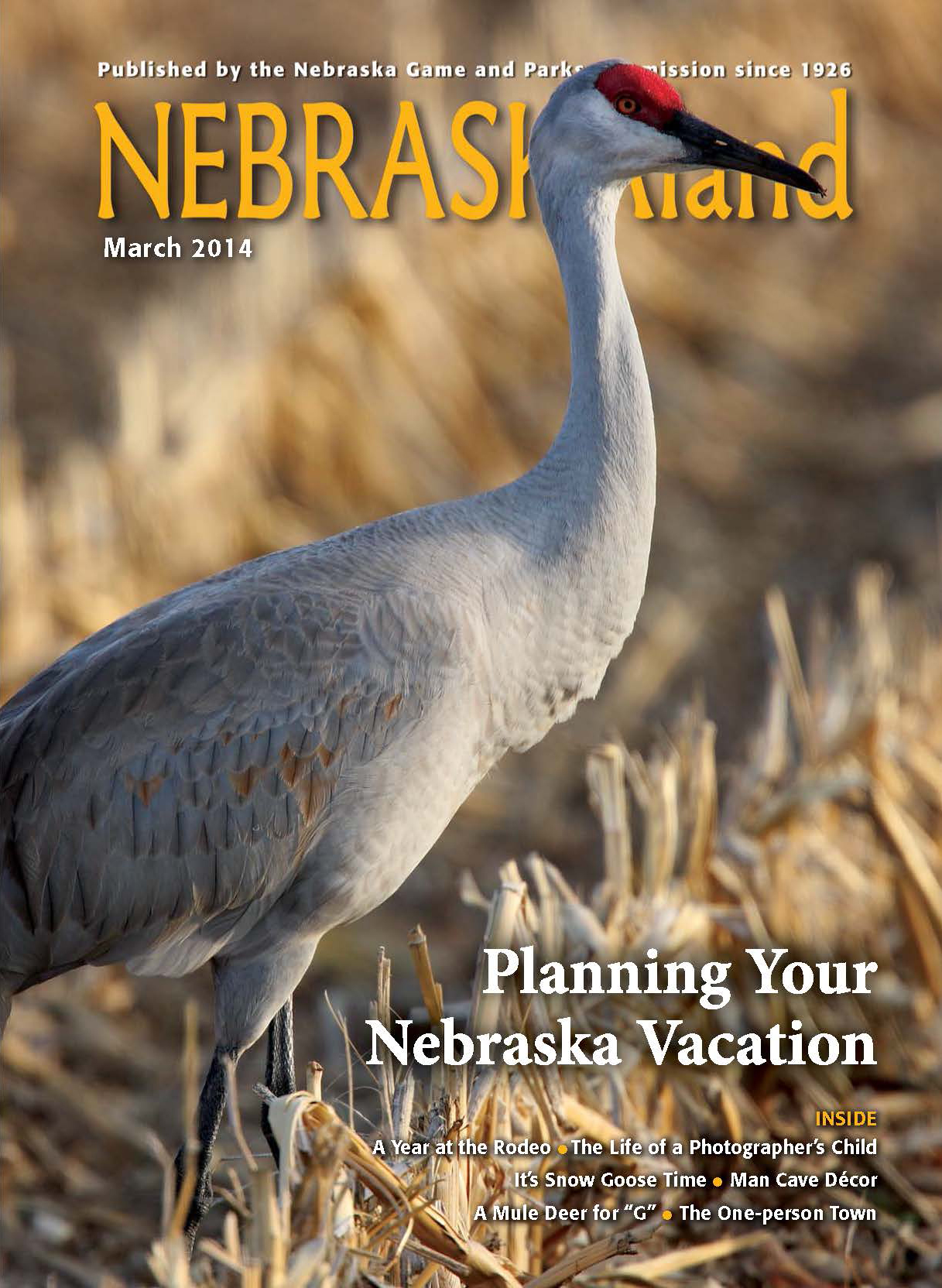
Cover: A sandhill crane moves through a corn field near Gibbon. Photo by
Luke Kathol. Wildlife viewing in the spring or summer is just one option for
vacationers in Nebraska, as is visiting the re-enactors at Fort Atkinson State
Historical Park (opposite). See story on page 24. Photo by Bobbi Anderson.
MARCH 2014 • NEBRASKAland 3
Car Hawk
One day in December, I went out
to Yankee Hill Wildlife Management
Area to take landscape shots. But what
I came across was so much better. A
handler was working his hawk in the
prairie grasses. For some reason, the
hawk took a liking to me and flew
toward me, swooped in over my head,
and landed on the roof of my car,
where he decided to stay for the next
five minutes. His name is Leonard.
Lisa Woerly
Lincoln, Nebraska
Fair Fight
About 25 years ago, my brother-inlaw Bob Cole and his son “Chip” came
upon this pair while checking cattle in
a pasture 5 miles southwest of Emmet
where they lived. One watched while
the other went back for a camera. They
took numerous photos until they got
too close and the snake let go and took
off. The hawk rested quite a while
before it gained its strength back and
flew away.
Larry Schaffer
O’Neill, Nebraska
4 NEBRASKAland • MARCH 2014
Dragons and Damsels
Reading the story
in the Jan-Feb issue
of NEBRASKAland
reminded me what
we kids back in the
1920s and 30s thought
about these insects.
We called them “ear
stingers” and it was
taken as gospel that if
you let one get near
you it would stick that
long slender body in your
ur ear with devastating
results. This was in Chicago
cago where I grew up.
up
Bob Pierson
Omaha, Nebraska
Colorado Boy’s First Deer
My son, Jacob Naibauer,
was 10 years old last season
when he shot his first deer,
a white-tailed buck on the
eastern edge of Sioux County.
He shot the deer with a
.25-06 that he thought was
my friend’s gun until it was
given to Jacob for Christmas.
He lives for hunting, having
gone on his first pheasant trip
at five years old and walking
for two days without the first
complaint. After this trip I
knew he had found his passion.
David Naibauer
Castle Rock, Colorado
From Visitor Letters
The grasshopper was very elusive.
It took three of us to find it on the
upper left hand corner of page 3!
NEBRASKAland Magazine is a family
favorite, and we continue to add new
subscriptions to family members and
friends who haven’t seen it before.
Thanks, and keep up the good work.
Kimberly Schaaf
Scottsbluff, Nebraska
Black and White Bird
I have a black and white
photo I took this summer of
a bird that I have been told
belongs in a magazine.
Dustin Geihs
via e-mail
Editor: Dustin, you’re exactly
right.
The January/February visitor, I
believe, is a grasshopper on page 3 in
the upper left of the page. The visitor
blends in quite well and was a tricky
one as it almost looks like it belongs
there.
Thanks for keeping the issues
interesting.
Dan Kaup
West Fargo, North Dakota
COMMISSIONERS
CONSERVATION OFFICERS
Director Jim Douglas
NORTHWEST
Officer
City
Jim Zimmerman (S) Gering
Commissioners
Chairman - Lynn Berggren, Broken Bow
Vice Chairman - Jerrod Burke, Curtis
2nd Vice Chairman - Dr. Kent Forney, Lincoln
Dr. Mark Pinkerton, Wilber
Rex Fisher, Omaha
Mark Spurgin, Paxton
Mick Jensen, Blair
Dick Bell, Omaha
Norris Marshall, Kearney
MAGAZINE STAFF
Petroglyph Protection?
In your October 2013 issue of
NEBRASKAland, I read about Indian
Cave State Park and the petroglyphs on
cave walls. We visited the park several
years ago and saw the Indian carvings
on the side of a hill and I wondered,
aloud, why they were not protected
from vandalism?
I remember a trip to Glacier National
Park, in Montana, when one of the
highlights was a trip outside of the park
to see a hillside covered with Indian
hieroglyphics with the ranger telling
their story. The hillside was fenced and
locked at night to prevent vandalism.
These carvings are a historic treasure
in Nebraska, and someone should
be protecting them before they all
disappear.
Juanita Simonds
Grand Island, Nebraska
Send your comments to:
Jeff Kurrus, Editor
NEBRASKAland Magazine
P.O. Box 30370
Lincoln, NE 68503
or e-mail Jeff.Kurrus@Nebraska.gov
Please include your postal address and
telephone number.
Letters may be condensed and edited
for clarity. Photographs are welcome
and will be returned.
Any program that receives federal funding from the National Park
Service, or the United States Fish and Wildlife Service prohibits unlawful
discrimination on the basis of race, color, religion, age, gender, marital
status, national origin, age, disability or political affiliation. Any person
who believes he or she has been discriminated against in any program,
activity, facility, or service, should contact the Nebraska Game and
Parks Commission, Lincoln, NE 402-471-0641, the Equal Opportunity
Commission, Lincoln, NE 402-471-2024, TTY/TDD 402-471-4693;
United States Fish Wildlife Service, Civil Rights Coordinator, 4401
N. Fairfax Drive, Arlington, VA 22203; Director, Equal Opportunity
Program, U.S. Department of Interior, National Park Service, 1849 C
Street NW, Mail Code 0008, Washington, D.C. 20240-0001.
Communications Director Christy Rasmussen
Editor Jeff Kurrus
Art Director Tim Reigert
Associate Editor Amy Kucera
Regional Editors Eric Fowler, Julie Geiser,
Justin Haag, Jenny Nguyen
Contributing Editor Michael Forsberg
Regular Contributors Bill Hager, Chris Helzer,
Lisa Knopp, Gerry Steinauer
Photo Librarian Sarah Johnson
Circulation Donna Robinson
For address changes and questions about
your subscription, e-mail Donna.Robinson@
Nebraska.gov or call 800-632-5263
Advertising Sales Manager
For advertising information contact
Shane G. Gilster, 402-742-0125
Email: shanegilster@gmail.com
NEBRASKAland Magazine Copyright 2014, all rights reserved.
NEBRASKAland is available in audio from the Nebraska Library
Commission Talking Book and Braille Service, Suite 120, 1200 N St.,
Lincoln, NE 68508. 800-742-7691. NEBRASKAland Magazine and the
Nebraska Game and Parks Commission reserve the right to reject any
advertising not in keeping with the agency mission.
Rates: $18 for one year; $33 for two years; $44 for three years. Nebraska
recipients must add appropriate sales tax. To subscribe call
1-800-NEBLAND (632-5263), or go online to: NebraskalandMagazine.
com.
COMMISSION
C
COM
CO
OM
MMIS
MIS
SSIO
S NO
SI
OFFICES
F CES
FFI
S
Headquarters/Southeast District Office
2200 N. 33rd Street Lincoln, NE 68503
Phone 402-471-0641
Northeast District Office
2201 N. 13th St. Norfolk, NE 68701
Phone 402-370-3374
Southwest District Office
301 E. State Farm Rd. North Platte, NE 69101
Phone 308-535-8025
Northwest District Office
East Hwy. 2, Box 725 Alliance, NE 69301
Phone 308-763-2940
Bassett Office
524 Panzer St., Box 508 Bassett, NE 68714
Phone 402-684-2921
Kearney Office
1617 First Ave. Kearney, NE 68847
Phone 308-865-5310
Omaha Office
1212 Bob Gibson Blvd. Omaha, NE 68108
Phone 402-595-2144
Ak-Sar-Ben Aquarium
21502 W. Highway 31 Gretna, NE 68028
Phone 402-332-3901
Greg Hesse
Scott Brandt
Dan Kling
Frank Miller
Sean McKeehan
Terry Brentzel
Phone (308)
(office) 763-2940
(cell) 436-7561
Rushville
760-3647
Gering
631-0663
Harrison
430-0572
Valentine
389-0444
Bridgeport
279-9133
Oshkosh
458-7650
SOUTHWEST
Officer
City
Phone (308)
Roger Thompson (S) N. Platte (office) 535-8025
(cell) 530-3097
Ray Dierking
Brkn. Bow
870-0322
Michael Thome
Cozad
529-8146
Matt Andrews
Elwood
746-2418
Dirk Greene
Imperial
882-0015
Dale Johnson
Kearney
440-3847
Brian Piernicky
McCook
340-6627
Brandon O’Neal
N. Platte
778-7468
Nicholas Fix
Ogallala
289-0427
Bryce Streger
Ogallala
289-1169
Rich Routh
Rep. City
920-0367
Tim Williams
Grand Is
380-7331
Pat George
Hastings
402-705-9989
Matt Brandt
Loup City
202-0819
Andrew Heyer
Lexington 402-613-2241
Alex Hasenauer
North Platte
660-4671
NORTHEAST
Officer
Tom Zimmer (Sup.)
City
Norfolk
SOUTHEAST
Officer
Levi Krause (Sup.)
William Krause
Mike Luben
Dan Zuehlke
Heath Packett
Darin Gress
Douglas Kramer
Dina Barta
Stacey Lewton
Dudley Sorensen
Robert Finke
Russell Mort
Dan Evasco
Rich Berggren
Travis Shepler
City
Louisville
Auburn
Colon
Cortland
Eagle
Hebron
Lincoln
Lincoln
Lincoln
Waverly
Milford
Nebr. City
Papillion
Waterloo
Lincoln
Phone (402)
949-0593
274-8063
443-6392
806-9084
210-0888
768-8665
890-6465
890-6463
890-7140
937-3422
947-1363
209-1506
616-5961
619-1355
613-2312
ADMINISTRATION
Officer
Craig Stover (Adm.)
Duane Arp (Ass.)
Jeff Clauson (Ass.)
City
Lincoln
Lincoln
Lincoln
Phone (402)
471-5531
471-5531
471-5531
Phone (402)
(office) 370-3374
(cell) 649-8053
Dale Davis
Bassett
760-0712
Steve Oberg
Columbus
910-3366
Daniel Roberts
Fremont
719-1108
Randy Pomplun
Fullerton
308-550-0489
Jeff Jones
Hartington
762-5022
Jon Reeves
Kennard
889-8508
Doug Pollard
Ord
308-730-7050
Alex Frohberg
Ponca
241-7615
Cory Krause
West Point
380-6410
Jonathan Andreasen O’Neill
340-3981
Mitch Johnson
Bloomfield
613-8612
Nebraska Wildlife Crimestoppers 1-800-742-7627
MARCH 2014 • NEBRASKAland 5
FISH ARTWORK BY JOSEPH TOMELLERI, DAPHNIA IMAGE THINKSTOCK
Competition Between Two
Favorite Nebraska Panfish?
By Mark A. Kaemingk and David W. Willis
Supply and timing dictate many events in nature. For example, some fish
benefit from hatching earlier than others and can take advantage of a resource
(e.g., food) that is in limited supply. We noticed this during our research in
Pelican Lake on the Valentine National Wildlife Refuge in Nebraska. We observed
that yellow perch spawn earlier (late April or early May) than bluegill (late June),
which allowed their young to arrive onto the scene earlier than the bluegill
young.
Arriving sooner allows for a first chance at the food. In this case, their
food, a type of zooplankton called Daphnia, was in short supply. Daphnia are
important for young fish because they are usually bigger than most other types
of zooplankton, and fish that eat Daphnia grow faster than fish that do not. For
people, it’s like eating three eggs (more protein) versus half of an apple (less
protein) for breakfast.
In some years there is a small amount of Daphnia
remaining when the young bluegill arrive, but usually
it is not enough to substantially benefit the bluegill.
By this time, yellow perch will have eaten most of the
available Daphnia. As a result, the bluegill young resort to
BLUEGILL
scrounging for food, do not eat as much and are not able to
grow as large as they could if
they were feeding on Daphnia.
This situation happened in 2004 and 20062010, but not in 2005 in Pelican Lake.
Although yellow perch hatched first in
2005, few young survived – possibly due to
adverse weather conditions – and even fewer reached
YELLOW PERCH
a size where they could eat Daphnia. With yellow
ellow perch
largely
absent from the scene, bluegill young were able to feast on the available
Daphnia and reached a size much larger than in any other year studied. What
does this mean for bluegill young? Because growth during the first year of life
is extremely important, it allows a fish to swim faster and outgrow the size of a
predator’s mouth. In addition, because winters can be somewhat severe with long
periods of cold weather and low food availability in northern latitudes, enhanced
growth may help that fish endure and survive the winter, hopefully making it to
your dinner plate.
Our study was the first to document negative
effects of young yellow perch on young bluegill
growth during the first year of life. We found
that bluegill may be at a disadvantage when
it comes to eating Daphnia unless yellow
perch are absent (as was the case in 2005), or
Daphnia no longer become limiting, or bluegill
are hatched before all the Daphnia are eaten
by young yellow perch. In addition, the roles
appear to be reversed later during summer.
Juvenile bluegill may outcompete juvenile
yellow perch later in the summer, extending
this competitive relationship between the two
species throughout the entire first growing
season. These results were surprising given
that both species often reside together in many
Daphnia, small planktonic
crustacean, are commonly called systems and the popularity of these species as
“water fleas.”
sportfish. ■
6 NEBRASKAland • MARCH 2014
Wildfire
Cleanup
By Justin Haag
Pine Ridge wildfires in 2012 left
an immeasurable amount of work
to be done after the smoke cleared,
and an untimely storm in early
October 2013 brought 20 inches
of snow and snapped countless
trees and branches that were still
carrying leaves.
Considering the massive
clean-up facing Game and Parks
Commission properties in the
region, a visit from an Americorps
crew in late October proved
timely, as the helping hands were
welcomed in clearing downed
timber on two wildlife management
areas and Chadron State Park.
Americorps is the U.S.
government program, and part of
the National Civilian Community
Corps, that engages adults in
intensive community service
projects. A team of eight workers
from points across the nation took
up residence at Chadron State
Park for 10 days at the end of
October. Even though the workers’
visit was delayed and shortened
by the federal government
shutdown earlier that month, their
accomplishments were plentiful.
The crew assisted Commission
personnel reseeding and raking
23 acres of erosion control and
re-vegetation at Ponderosa Wildlife
Management Area southeast of
Crawford. They also cleared
downed trees and brush from 4½
miles of service trails, roads and
fence lines on Chadron Creek
Ranch WMA.
At Chadron State Park, the crew
cleared and stacked countless
branches and logs and removed
downed timber from Chadron
Creek. Members also helped frame
a new fishing dock for the park’s
pond that is under restoration.
Commission officials are already
discussing the possibility of
another Americorps project next
year. ■
MARCH 2014 • NEBRASKAland 7
By Jenny Nguyen
Blair
oca
ocated
just north of Omaha, the city of Blair offers smalltown comforts with easy access to “big town” life. From
tow
outdoor
o
opportunities, to art, history and mom-and-pop
b
businesses,
i
Blair has much to offer a wandering traveler.
For those looking for some fresh air, outdoor opportunities
are available in town and nearby. Black Elk-Neihardt Park is
one of Blair’s more prominent parks and is the highest point in
the city. The Tower of Four Winds, designed by Dana College
Professor F.W. Thomsen, is the focal point of the park, nestled
in 80 acres of rolling hills, which are traced by hiking trails. The
park also features a 9-hole disc golf course, a picnic area, bench swings, fire pit, grill
and playground.
For wildlife viewing, DeSoto National Wildlife Refuge and Boyer Chute National
Wildlife Refuge are located nearby along the Missouri River where deer, wild turkeys,
bald eagles and other migratory birds can be seen.
Those history buffs looking to learn more about the area’s beginnings
should take a drive down to Fort Atkinson State Historical Park. Located
just 10 miles south of Blair on Highway 75 at nearby Fort Calhoun, Fort
Aktkinson offers living history events all summer long, complete with
uniformed re-enactors, musket and cannon firing, butter making and
period musicians. Check with the park for 2014 scheduling at Fort.
Atkinson@Nebraska.gov or (402) 468-5611.
The Heartland Tasting Room is Blair’s new hotspot, offering both
artwork and drinks to those looking for a more relaxed, comfortable
setting than the typical bar scene. Gather here with friends and
colleagues to view works from local Blair artists while enjoying
craft beers on tap or one of 26 different wines from around
the world. Artisan cheeses, rustic breads, oils and vinegars are
available to pair with your drinks.
Hungry? Head over to Main Street BBQ & Grill for some
seriously good eats. Here
you’ll find a friendly staff
and mouthwatering BBQ
classics like baby back
ribs, pulled pork sandwiches,
charbroiled steaks, brisket sandwiches and some of
the juiciest, crunchiest fried chicken you’ll ever eat.
For more information, visit Blairnebraska.com,
Heartlandtastingroom.com,
Fortatkinsononline.org
ne.org and
Benpark.org.
Musicians at Fort Atkinson
Blair
Warming Cold Extremities
Mai
Grill n Street BBQ &
rk
B
oom
He
ting R
s
a
T
d
n
a
artl
8 NEBRASKAland • MARCH 2014
tight to keep blood
flowing to your toes.
If you feel your hands
getting cold, warming
them in your arm pits
may help, but wind
milling your arms in
large fast circles is by
far the best way to
unconstrict your blood
vessels and allow your hands
to stay warm for a longer
amount of time. If you’ve stayed
out in the cold long past your cold
threshold and your extremities have gone numb, the best
way to warm them is to immerse them in warm water
(about 104 degrees F).
In more serious cases of frost nip or frost bite, warm
your frozen extremity, and then treat it like a sun burn
(it is, in fact, damaged skin tissue with vulnerable tissue
beneath it). Bandage it in sterile tissues and avoid any
direct abrasion to the injured skin. In extreme cases, seek
medical help.
Visit OutdoorU.org and start your own pathway to
exciting and memorable experiences in the outdoors. ■
MARCH 2014 • NEBRASKAland 9
ILLUSTRATION BY TIM REIGERT
t Pa
d
r
a
h
i
e
N
lack Elk
By Nebraska Outdoor U!
This time of year, it is hard to stay inside no matter what
the thermometer tells us. Here are some tips to stay warm
and measures to take if you’ve stayed out in the cold a
little too long.
When tent camping, get some sort of air pocket between
your body and the cold ground while you sleep. Of
course, warm clothes should always be considered, but
a big meal before bed makes a difference when it comes
to surviving a cold night. A properly sized tent for the
amount of people is also a factor. Five people can make a
four person tent much toastier than one person.
For hunting, snowshoeing and other activities that leave
you exposed to the elements, build your body fortress.
Place fleece, polyester or wool next to your skin to
insulate and wick moisture. Next, use any fleece or other
good insulator as your middle layer, and top it all off
with a waterproof or canvas-type shell layer to block out
wind or rain. There are many fleece gloves that are warm
in moderate weather but will not stand up to a cold wind.
You’ll want a solid windproof glove if you’re out in the
hardcore winter weather. Try a thin fleece finger glove,
with a heavy, loose wool mitt to wear over it.
The biggest problem with boots has the simplest solution.
Keep your boots laced up loosely instead of cinching them
By Julie Geiser
For the seventh
year, The Great
Park
Pursuit
(GPP) will be
taking people on a
scavenger hunt of
sorts, encouraging
them to explore
parks throughout
Nebraska and live a healthy active
lifestyle, and rewarding many with
prizes, including one outdoor package
valued at $1,500.
Twenty locations in Nebraska,
including state historical parks and
recreation areas, local parks, natural
resource district areas and a national
forest, are part of the free program.
Teams of friends, families, coworkers,
youth organizations or any other groups
start by registering online at
NEGPP.org. They can then
select parks to visit and
print off the page for that
park, which includes
information about the
park’s attractions and a
clue to guide them to
their ultimate goal: a post
tucked away in the woods
and topped with a nature
impression. When the post is
located, teams can use a pencil, crayon
or marker to make a rubbing of the
impression on their park page.
That rubbing is their entry they mail
to the headquarters of the contest, which
RG2455-145
RG2608-1425
Great Park
Pursuit Update
Pile of cow chips, Sheridan County.
RG2723-3-17
RG3313-10-72
Joseph Beckwith homestead, near Broken Bow, 1888.
Cow chips near post office and store, Norway, 1937.
A Brief History
Buffalo and Cow Chips
By Patricia C. Gaster,
Nebraska State Historical Society
The scarcity of wood west of the one
hundredth meridian forced a reliance
on animal-made fuel there. Buffalo
excrement, when allowed to dry a
few weeks in the hot Plains sun, was
clean to handle and usually odorless.
It burned with little blaze but formed
hot coals, which were very effective
for cooking or heating. It was almost
the only fuel used by the Forty-niners
and other travelers on the Oregon and
Mormon trails.
The first permanent settlers came not
long after the buffalo were decimated.
Fortunately for the settlers, after the
buffalo were gone, great herds of
Texas cattle were driven to or through
10 NEBRASKAland • MARCH 2014
Gathering cow chips in Cherry County in the 1890s.
Nebraska and filled the ranches that
occupied the United States grasslands.
Homesteaders were said to invite trail
bosses to bed down herds on their
property, thus gaining enough cow
chips for a winter fuel supply.
According to Everett Dick’s
Conquering the Great American
Desert, an initial aversion to using the
fuel, especially among women, soon
dissipated. “In spite of the fact that
cow chips were absolutely clean and
not messy to handle, not infrequently
a fastidious housewife from the East
turned up her nose at this effective
fuel and, taking a chip between a
dainty thumb and forefinger, gingerly
tried to get it into the firebox without
touching it any more than she could
help, as though it were poison. It
wasn’t long before she overcame her
squeamishness, however, for in this
case familiarity did not breed contempt
but rather respect and appreciation.”
The following poem from the
Trenton Register of December 28,
1894, makes much the same point.
An Idyl of the West
Over the sun-kissed prairie swells
She strayed in her youthful grace.
The wind-blown tresses of auburn hair
Half-hid her bewitching face.
Her gathered apron, one slim hand held,
As she scanned each tuft with care.
And oft and again she lithely stooped
To place her treasure there.
“O maiden fair, what seekest thou?
Pale lily, rose divine
Or the shy, sweet buds of the violet?”
She lifted her eyes to mine.
And then the answer, soft and clear
Fell ripe from her coral lips,
“Stranger, there hain’t no posies hereI’m lookin’ fer buf’lo chips!” ■
Pursuit
Participants of the Great Park
a
can win many prizes, including
.
ndar
Cale
nd
KAla
RAS
NEB
runs from May 1
to September 16,
2014. The more
parks a team visits,
the more prizes
they qualify for.
Prizes consist of
NEBRASKAland
M a g a z i n e
calendars
and
subscriptions,
state park permits
and cabin stays,
outdoor packages
valued at $250,
$500, $750, $1,000
and $1,500, a
digital
camera,
a backyard bird
package and more.
In addition to
the fun of
fi n d i n g
t h e
posts
there
are
many
educational and fun
activities
you
can
download from the site,
including how-to guides
on making binoculars or
a pinecone bird feeder, and
directions for scavenger hunts that
challenge hikers to look for different
colors or shapes rather than objects, and
even one to record things heard rather
than seen in nature.
This program is made possible by a
partnership between the Nebraska Game
and Park Commission and the Nebraska
Recreation and Park Association, a
non-profit organization comprised of
professionals and advocates dedicated
to the promotion of park resources and
recreation advancement in Nebraska.
Other sponsors include the PapioMissouri River Natural Resources
District and Scheels.
The program is looking forward
to hosting more teams, encouraging
people to have an active lifestyle and
increasing the awareness of all the
outdoor recreational opportunities of
the state. ■
MARCH 2014 • NEBRASKAland 11
Biodiversity Exhibit Has New Home
Catching Marsh
Madness
By Jenny Nguyen
If you want to witness the peak of the
spring waterfowl migration along the
Missouri River this March, sit in one of
Ponca State Park’s bird viewing blinds.
Every weekend (weather permitting),
park staff will host Avian Adventure
Blind Tours with the assistance of
PHOTO BY LINDSAY ROGERS
By Lindsay Rogers
A snapshot of Nebraska’s biodiversity that
NEBRASKAland highlighted in the November
2013 edition is currently on display at the “Explore
Nebraska’s Biodiversity” exhibit currently at the Wildcat
Hills Nature Center in Gering, Nebraska. The exhibit
includes a double-sided photographic mural featuring
nearly 100 images of Nebraska species.
In addition to the photographic mural, the exhibit
includes multiple hands-on components. Visitors can
explore insects, bones, furs and birds with magnifying
lenses. Or, visitors can compare their “wingspan” with
those of Nebraska’s bird species, or match their height
with those of Nebraska’s prairie grass species.
The exhibit was created by the Nebraska Natural
Legacy Project, with funding from the Nebraska
Environmental Trust, and can be seen at Wildcat Hills
until March 28. ■
The “Explore Nebraska’s Biodiversity” exhibit at Wildcat Hills Nature
Center in Gering is on display until March 28.
birding experts from the Loess Hills
Audubon Society Chapter. Learn how
to identify different species of ducks
and geese as they fly overhead. Then
go down to the riverfront to sit in the
bald eagle blind: you may see a nesting
pair in the trees or juveniles down on
the sandbars.
Some of the species spotted last year
were Canada geese, shovelers, pintails,
scaup, green-winged and blue-winged
teal, wigeons, mallards, buffleheads
G
Greg
M
Medlin
dlin off Omaha
O h lloves
following his “suburban”
Redbone coonhounds through
the darkness outside the city,
so much he advertises his
passion on his pickup and even
published a book, Memoirs from
the Night.
If you have a unique outdoor
message plate you would like
to share or know someone who
does, e-mail a photo (highresolution, JPEG format only,
please) of it to Eric.Fowler@
Nebraska.gov, along with your
name, hometown and a brief
description of the interests
expressed on your license plate.
www.OutdoorNebraska.org
and ring-necked ducks. Other species
included the pied-billed grebe and
yellowlegs.
In addition to scheduled birding tours
in the mornings and evenings, family
games and activities will take place
during the day at the Resource and
Education Center, including a movie
and popcorn. For those wanting to
stay at the park, getaway packages are
also available, including 30 percent off
lodging rates, free guided sunrise and
sunset waterfowl blind tours, unguided
bald eagle blind tours and special
programming and activities. Guests
staying at the park will also have first
choice for blind reservations over day
attendees.
To reserve your front-row seat for the
migration, contact Ponca State Park for
full details at ngpc.ponca@nebraska.gov
or 402-755-2284. ■
PHOTO BY JENNY NGUYEN
Ponca State Park
Olivia Zink glasses for birds during Ponca State Park’s Marsh Madness with the
guidance of Audubon Society bird specialist Bill Hueser.
12 NEBRASKAland • MARCH 2014
Ponca State Park is the eastern gateway
to the 59-mile section of the Missouri
National Recreational River, one of two
unchannelized sections of river bordering
Nebraska. It is located 2 miles north of
Ponca in northeastern Nebraska.
MARCH 2014 • NEBRASKAland 13
Man
Caves
Contact the Nebraska Game and
Parks Commission at
402-471-0641 or visit
OutdoorNebraska.org for more
information. Visit HuntSafeNebraska.
org for a list of hunter education
classes and BoatSafeNebraska.org
for a list of boating safety classes.
March 1
Bird Banding
Ak-Sar-Ben Aquarium, Gretna,
9 a.m., 402-332-3901
March 1-2, 8-9, 15-16, 22-23, 29-30
Marsh Madness
Ponca State Park (SP), 402-755-2284
March 5
Workshop
By LeRoy Poppe
This room was
once a single car
garage and was
turned into a “man
cave” in 1991.
The deer and
turkey were taken
between 1966 and
2006 on my farm.
I did the taxidermy
work on two of
the deer. The
antelope was taken LeRoy Poppe’s single car garage turned man cave.
near Harrison,
Nebraska, the elk
from Wyoming and the dall sheep, moose and caribou from Alaska in a once-ina-lifetime hunt. The game in the photo are not records but are reminders of the
hunts and provide interesting stories.
The room also has my woodcarvings and some photos. One particular photo is a
scenic view of “Rooster Lake” on my property.
Do you have a man cave photo to share? Submissions must be outdoorrelated to be considered. Please send high-resolution images to
jenny.nguyen@nebraska.gov, along with your name, a brief description of your
man cave, your city or town of residence, and best contact information. ■
PHOTO BY STEVE BUNCK
by Jerry Kane
Send Us Your Trail Cam Photos!
Marian Langan sent in this photo of a doe and her fawn drinking
at Spring Creek Prairie Audubon Center, south of Denton in
Lancaster County.
Please submit your trail camera photos by e-mail to:
nebtrailcam@gmail.com. Also include where you’re from and any
information that will help explain your photo.
Leopard
Frogs
Prescribed burn training workshop,
Sherman Reservoir WMA, Loup City,
noon-3 p.m.
March 19
Workshop
See You Out There... But Where?
Prescribed burn training workshop,
Wayne State College, Wayne,
9 a.m.-4 p.m.
March 21
Commission Meeting
Nebraska Game and Parks Board of
Commissioners Meeting, Norfolk,
8 a.m.
March 22
National Archery in the Schools
Program State Tournament, Lancaster
Events Center, Lincoln, 8 a.m.
March 25
Spring Turkey Archery Season
Archery and youth archery spring
turkey hunting season opens
March 31
Trapping
Trapping seasons close for muskrat
and beaver
Pine Ridge Unit Season 2 mountain
lion hunting closes, unless quota
or female sub-quota met causing
season to close earlier
Do you know where this Nebraska photograph was taken?
See answer at the bottom of page 15.
PHOTO BY DOUG CARROLL
March 31
Mountain Lion Season
By Jeff Kurrus
In August of 2013,
I began working
with Julie Elvers’s
kindergarten class at
Besser Street-Aldrich
in Omaha, putting to
practice how I come
up with article ideas
at NEBRASKAland
Magazine by asking
who, what, when,
where, why, how and
can anytime I see
a photograph. The
students have learned
to ask these same
questions and, with
the help of author
and NEBRASKAland
contributor Dan Fogell,
find answers. Here
are the results of their
recent leopard frog
discoveries.
Dear NEBRASKAland readers,
We found the following facts about
leopard frogs interesting. We hope you
do too.
Sincerely,
Mrs. Elvers’s Kindergarten Class
•
•
•
•
•
•
•
•
•
•
•
•
Females are bigger than males.
Females lay hundreds of eggs. Only
5 or 6 make it to adulthood.
They have sticky tongues and will
eat whatever will fit in their
mouths.
They hibernate under the ice in
winter.
Its eyes are on top of its head so
it can sit in the water and still
see what’s going on above the water.
A frog’s legs are bent, making
them ready to hop.
The bottom of their back feet have
bumps that help them dig into the
ground.
All frogs, including the leopard
frog, have poison glands.
Each night leopard frogs peel off
their mucus and eat it.
They have webbed feet and hands to
help them swim.
Male frogs have bigger tympania, or
ear drums, than female frogs.
Frogs see well in color, and at night.
NEBRASKAland
Visitor
Last issue’s winner of
the Visitor drawing was
Kimberly Schaaf of
Scottsbluff, Nebraska, who found
the short-winged grasshopper on
page 3. Readers are encouraged to
contact NEBRASKAland within 10
days after this issue’s publication
with the correct page number and
name of this issue’s “Visitor” – a
critter found in Nebraska. We will
then gather the correct entries and
draw one to win a NEBRASKAland
Magazine mug. To enter each
month, write:
NEBRASKAland Visitor
2200 North 33rd Street,
Lincoln, NE 68503.
Or e-mail:
Tim.Reigert@Nebraska.gov
with “Visitor” in the subject line of
the message.
HINT: This issue’s visitor is not
on page 4, 6, 7, 11, 12, 15, 32, 43,
46, or 54.
Last month’s visitor is an
immature grasshopper – most
likely Dichromorpha viridis, often
referred to as the short-winged
green grasshopper – a member
of the slant-faced grasshopper
sub-family. The head of the
slant-faced is pointed, and often
appears tilted forward. They
can be distinguished from other
sub-families by the lack of either
colorful wings or a spur near
the throat. They communicate
by stroking their hind leg across
their forewing, called stridulation.
The hind leg has a row of spines
on the surface that rub against
the hardened forewing, causing
sound
s und and is frequently
so
used
use by males
seeking
se
a mate, and
each
species has a
e
distinct
distin sound. Their
attempts
to attract a
a te
at
mate
ma are a familiar
noise
summer day.
noise on a warm
w
Special thanks to Julie Van Meter,
State Entomologist, Nebraska Department of
Agriculture. Visitor image by Chris Helzer.
Bugguide.net is a good site for identification.
NASP TOURNAMENT AT LANCASTER EVENTS CENTER
14 NEBRASKAland • MARCH 2014
MARCH 2014 • NEBRASKAland 15
Photos and text by Zach Cunningham
A
s winter loosens its icy grip on Nebraska’s
Rainwater Basin, so begins the journey
of millions of geese on their northern
migration, and with it, the start of what many
waterfowl hunters have spent countless nights
thinking about – snow goose season.
Each year, with the arrival of warm south
winds, thin lines begin to appear on the horizon,
the signal that lesser snow geese are starting
their long migration back to their breeding
grounds far into the Arctic.
Stirred, too, by the signs of an impending
spring, goose hunters begin their preparations for
the inevitable grind to come. With baited breath,
they listen for high-pitched barks in the night,
assemble their armada of decoys and watch for
distant white tornados to appear in the skyline.
Once it begins, there will be little rest for the
weary. Late to bed, early to rise – the motto of
the modern snow goose hunter.
The migration starts as a trickle, with small
flocks of adult birds arriving well before iceout. Within a month, birds will pour in by
the millions, and not just snows. Hundreds
of thousands of Canada’s, Ross’s, and whitefronted geese, ducks and sandhill cranes will
soon be competing for valuable food resources
to fuel their migration north. The geese come to
the Rainwater Basin to rest on its many shallow
wetlands, spending the day in search of kernels of
corn and soybeans in the fields.
16 NEBRASKAland • MARCH 2014
TOP: Kent Fricke, of Lincoln,
scans the sky for birds
during the last few minutes of
shooting light.
BOTTOM: Snow geese leave
a Rainwater Basin wetland to
feed.
MARCH 2014 • NEBRASKAland 17
TOP LEFT: Part of a snow
goose decoy spread can be
seen in the reflection of C. J.
Cowan’s sunglasses as he
watches for the next flock of
geese to appear on the horizon.
LEFT: Dustin Rose’s black Lab,
Three, retrieves a white-phase
snow goose.
TOP RIGHT: Windsock decoys –
like these being used to hide a
pit blind in Fillmore County – are
one of the many tools of the
modern snow goose hunter.
18 NEBRASKAland • MARCH 2014
F
or the snow goose hunter, the time is now – the moment
you have been waiting for all year, when man, dog and fowl
meet.
Persistent hunters can have luck on both dry land and water,
but it is a tiring task. The days are long, full of mud, sunburned
faces and, with any luck, bruised shoulders. Still, there is
something special about snow goose season, a powerful and wild
feeling that only the sight and sounds of millions of birds can
convey.
And as quickly as it started, the birds will be gone, leaving
behind only feathers, footprints and memories, leaving the snow
goose hunter longing for next year. ■
MARCH 2014 • NEBRASKAland 19
OPPOSITE: A blue-phase snow goose in a Fillmore County wetland.
BELOW: Waterfowl calls adorn the lanyard of a goose hunter like
ornaments on a Christmas tree.
Zach Cunningham is a wildlife biologist
and award-winning photographer based in
Lincoln. He has worked for University of
Nebraska-Lincoln, Ducks Unlimited, the
Nebraska Game and Parks Commission,
and is currently a wildlife biologist for the
Nebraska Department of Roads
working with threatened and
endangered species, migratory
birds and other wildlife resources.
This is his first feature article in
NEBRASKAland Magazine.
20 NEBRASKAland • MARCH 2014
MARCH 2014 • NEBRASKAland 21
Getting Started
Snow geese can
can
a be
be hunted in a variety
vari
of ways. While my preferred method is
over decoys, they can be jumped, passshot, or stalked using a cow silhouette – a
method called “cow boarding.” For those
interested in trying snow goose hunting
this spring, here are a few tips to help
you get started.
● As with most hunting, timing is
everything. The peak of snow goose
migration in Nebraska is typically around
the first week of March. Those interested
in hunting over decoys may want to
consider hunting after this time, as
juvenile birds tend to bring up the rear
of the migration and are much easier to
decoy than adults.
● Scouting is important for a successful
hunt. Fortunately, snow geese are easy
to spot. Look for birds using stock ponds
or crop fields during the day. If you can,
set your spread away from large roosts,
as competing with thousands of live birds
can be frustrating.
● When it comes to decoys, snow
goose hunting is a numbers game.
Spreads of 1,500 to 3,000 decoys are
common. I consider 300 decoys to be
a minimum, but use what your budget
allows. Snow goose season is a great
time to hunt with new people and
teaming up is a quick way to compile a
larger spread.
● Snow geese move around a lot, so
having motion in your spread is key. I
use a mix of windsock-style decoys and
floaters. A windless day with lifeless
decoys can ruin a hunt.
● With so many birds in a flock, it’s
important to hide well. Wear full camo
if hunting from layout blinds, or dress
in white Tyvek painter’s suits if sitting
amongst the decoys.
● Because of their vertical nature, long
shots at snows are common. I use a 12
gauge with 3-inch, No. 2, non-toxic shot
with a modified or full choke.
● Electronic calls are allowed during
the Light Goose Conservation Order – use
them. You can build your own e-caller
out of an inexpensive mp3 player,
motorcycle amplifier, 12-volt battery
and P.A. speaker. Veteran snow goose
hunters will run multiple e-callers, each
playing a different recording. Mouth calls
work great on singles and pairs.
● Don’t have access to decoys? Try
getting underneath a flight path and pass
shooting birds on a windy day. It can
make for some challenging but rewarding
shooting.
Reflections: Home
Décor for the Hook
and Bullet Set
By Don Gabelhouse
T
here was a time, I believe,
that most anglers and
hunters were allowed to
decorate only one small
room in the house. This
room was usually in the basement
and was out of sight and off limits
to civilized guests because of its
tasteless contents and its frequent state
of squalor. The room would often
project a force field that repelled those
generally intent on dusting.
Times have changed. Although
dead animal parts are still usually
relegated to the basement, at least
some fishing- and hunting-related
items are now considered tasteful and
appropriate to adorn upstairs rooms. I
suggest this ascent to main floor status
began after antique fishing and hunting
memorabilia began to appear on the
pages of home-decorating magazines,
written and read by people who had
never cast a line or fired a shot. Items
that reflected our nation’s rich fishing
and hunting heritage suddenly were in.
So there has been a growing market
in fishing and hunting paraphernalia
made expressly for in-home decorative
use. We now can
give an entire home the look of a lodge
or decorate any room in fishing or
hunting motifs. You might purchase a
fishing-reel toilet paper holder, a camo
stool lid-cover, antler chandeliers,
and even the stuffed heads of moose
and bear. The possibilities are almost
endless.
Fakes made in Taiwan may pass
for fashionable, but authentic fishing
and hunting collectibles provide much
more than a “good look.” My sunroom
is crammed with items that celebrate
a bygone era of fishing and hunting.
Collectively, they soothe my soul,
and individually, many of them have
stories to tell that rekindle past pleasant
memories of people, places and events.
I officially became a collector
in high school. For speech class, I
gave a presentation on duck decoys.
I “borrowed”
for my prop a
decoy my
grandparents used as a doorstop. Later,
I discovered the decoy was a Mason
Detroit Grade Canvasback hen. It
now sits in the sunroom on a shelf
constructed expressly for decoys, and
has plenty of company. Every time
I look at that decoy I see my late
grandparents sitting in their kitchen.
The best of my decoy flock has
been given to me by my wife, Diane.
The Mason Painted-eye Blue-winged
Teal hen she gave me in 1995 was the
best Christmas present I ever received
(at least until my brother-in-law gave
me a new 9.9 hp, four-stroke kicker
motor for my boat). More recently, a
Mason Premier Grade Seneca Lake
Canvasback drake proved that Diane’s
antiquing trips with her twin sister
should not just be tolerated, they
should be heartily supported.
Once duck decoy prices started
skyrocketing, my collecting
transitioned to antique fishing lures.
Several hundred now reside in my
sunroom, most in two large display
cases built by my son. The majority of
these came from my mother-in-law.
For over two decades, Marye Francis
combed the garage sales of northern
Illinois looking for lures that she would
give to me as Christmas and birthday
presents. God, I miss that woman.
After she died, my wife’s brother
assumed the tradition, and I still
occasionally get a lure from family
members. For the past several years,
I have refrained from buying lures
for myself. This is a necessary
part of my recovery.
Collectors can become
crazed and lose all sense
of when enough is enough.
For several years, on-line auctions fed
my insane desire to possess the most
beautiful fishing lures ever made. Prior
to putting rubber Hula skirts on their
lures, the Fred Arbogast Company
attached metal tails to
lures cast in lead to resemble minnows,
sunfish, northern pike, muskie and
walleye. My collection of these
intricately detailed and gorgeously
painted Tin Liz lures is displayed
in the sunroom on a shrine built by
my brother. Though my collection is
incomplete, I have come to my senses
and am no longer driven to obtain the
muskie and walleye models.
I am, however, unable to kick my
Tin Liz lure-buying habit cold turkey,
for during withdrawals I did purchase
four more lures. I decided I needed
(that addiction thing again) to have a
few of the original wooden floating
Heddon Punkinseeds with the line
tie above the lip (this, before Homer
Circle suggested that the lure’s action
would be improved by putting the line
tie in the mouth). I also decided that I
would stop buying Punkinseeds once
I had obtained the 740s in just four
colors: sunfish, bluegill, rock bass and
crappie. I haven’t purchased another
Punkinseed or any other lure since I
got the last of the four, so I may be
cured.
Diane says that three or more similar
items constitute a collection. I guess
I therefore also have fishing reel, fish
decoy, miniature outboard motor,
arrowhead and woodpecker toothpick
dispenser collections in my sunroom.
I enjoy them all, but my collections
don’t necessarily provide me more
enjoyment than items present in ones
and twos. In fact, some of the accents
in my sunroom provide as much
pleasure as the collections.
My favorite books reside in an
oak roll-side buffet that supports the
TV. A few years ago, I got copies of
two books that I used to check out
repeatedly from the neighborhood
public library 40 years ago. I was
fascinated with fish at an early age and
read Billy Bass and Bobby Bluegill
over and over again. A fishery biologist
was the hero in Bobby Bluegill
and this portrayal apparently
contributed to career decisions I had
made while already in grade school.
Close contact with fish at an early
age also had a lot to do with my
occupational choice. Most of these
contacts occurred at the family cabin
on Stalker Lake in Otter Tail County,
Minnesota. The three-gallon Red Wing
crock water cooler, used before the
cabin had running water, sits today
in the corner of my sunroom. It was
actually given to my wife (not me) by
my parents.
Diane is a special person and it
should be obvious that she condones
decorating with fishing and hunting
collectibles. She does, however, have
her limits. She reads those decorating
magazines and periodically exerts
authority as the Style Police. Two
bare-chested mermaid bobbers are not
displayed in the sunroom, but rather
sleep in a box tucked away on a corner
shelf.
My attempt to buy a lighted beer
sign with running water and a cartoon
forest-dwelling animal did not work
with Diane either. It didn’t take long
for her to find a substitute to occupy
the intended space in the sunroom
where two lighted pictures now hang,
the pictures rotated seasonally – one a
scene that reminds me of the Otter Tail
River, and the other, a frozen lake with
snow-covered banks and birch trees. I
guess they will do.
There also is no way dead animal
parts will ever hang in the sunroom.
I am fine with it, even though I know
a moose head would go nicely above
the entrance. I was
surprised, though,
at Diane’s
reaction
when a
graphite
replica of a 20½-inch smallmouth bass
showed up at our house.
The replica was given by my
brother as a Christmas present to
commemorate a fish I caught and
released on the Otter Tail River. Diane
couldn’t understand why I would want
a phony fish in the sunroom. We were
able to strike a compromise by putting
the smallmouth in the corner. I can see
it from my recliner, but it’s obscured
from view elsewhere in the room.
I never tire of spending time with my
treasures. I especially enjoy them after
a long trip away from home. They may
be old, but they never get old to me. I
occasionally flip the switch on one of
my miniature outboards, just to hear
it purr. Pushing the spigot on the Red
Wing water cooler brings back decades
of memories at the cabin. If special
guests are to visit, I have an excuse to
yet again handle my decoys and the
lures not in cases. Wiping the dust
away gives opportunity to once again
marvel at the graceful lines and patina
of a Mason decoy and the detailed
scales cast into a brilliant orange Tin
Liz sunfish.
Quality craftsmanship just never
goes out of style and, in fact, its appeal
increases as I age.
Don Gabelhouse
is the Administrator
of the Fisheries
Division at the
Commission. This
article originally
appeared in
In-Fisherman
Magazine.
PHOTO BY ERIC FOWLER
22 NEBRASKAland • MARCH 2014
MARCH 2014 • NEBRASKAland 23
Destination: Nebraska
By NEBRASKAland Staff
W
il winter ever end?” will be asked by more
ill
tthan one Nebraskan this month, as brief
gglimpses of spring are inevitably shrouded by
white snow
snow. Bu
But with spring break right around the corner
and the dog days in the not-so-far distant future, getting
a jump start on your vacation planning, as well as a little
last-minute ice fishing, is how you should be spending your
March.
We’ve taken the guesswork out of some of that planning
with our annual list of where you should be visiting and what
you should be doing once you’re there. Whether you’re solo
or with your entire family, there’s a spot in the state for all
of us, from everyday historians to weekend warriors.
Start with this list and then add to your own memories.
Opposite: Fort Falls, one of more than 200 waterfalls in the Niobrara River Valley,
is easily accessible by foot, canoe and tube for those visiting the Fort Niobrara
National Wildlife Refuge near Valentine.
WILDLIFE VIEWING
Niobrara Ranch Wildlife
• Hutton
Sanctuary, Newport
National Forest,
• Nebraska
Halsey
• Rowe Sanctuary, Gibbon
Ranch and Nature
• Switzer
Reserve, Burwell
National Wildlife
• Valentine
Refuge, Valentine
HISTORIC
Fossil Beds State
• Ashfall
Historical Park (SHP), Royal
Bill Ranch SHP, North
• Buffalo
Platte
• Fort Atkinson SHP, Fort Calhoun
• Pioneer Village, Minden
• Morrill Hall, Lincoln
of the Fur Trade,
• Museum
Chadron
Hartington
Santee
Niobrara
b
r
a
r
a
Crawford
Ponca
Newport
N
Pierce
P
e Winnebago
Royal
R
y l
Thedford
ScottsBluff Bayard
Norfolk
k
Tekamah
T
d
Gering
g
Burwell
ll David
Fort Calhoun
Halsey
sey B
Bridgeportt
City
Fullerton
F
ulle
erton
Lewellen
Omaha
h
Central
City
t
y
Ogallala
Ashland
North
rtth Platte
Plattte Raymond
Lincoln Louisville
Grand
G
rand
and
d
Kearney
nd
d
Minden
M
inden Gibbon Island
Brownville
Fairbury
y
Shubert
Parks
24 NEBRASKAland • MARCH 2014
PHOTO BY ERIC FOWLER
Valentine
Chadron
MARCH 2014• NEBRASKAland 25
POWWOWS
RIVER TRIPS
Omaha Intertribal
• Fort
• Cedar River at Fullerton
Powwow, June 13-15, Omaha
River at Elkhorn
• Elkhorn
Fort
Robinson
Intertribal
Crossing,
Omaha
• Powwow, June 13-15,
• Middle Loup River at Thedford
Crawford
National Recreational
• Missouri
Sioux Tribe Powwow,
• Santee
River at Niobrara State Park
June 20-22, Santee
(SP), Niobrara
Winnebago
Veteran’s
Powwow,
• July 23-25, Winnebago
National Scenic
• Niobrara
River at Smith Falls SP,
Tribe of Nebraska
Valentine
• Ponca
Powwow, August 8-10,
Niobrara
PHOTO BY ERIC FOWLER
RODEOS
Bill Rodeo,
• Buffalo
June 18-21, North Platte
• Days of ’56, June 27-28, Ponca
Clarke Stampede,
• Camp
July 4-5, Bridgeport
Big Rodeo,
• Nebraska’s
July 23-26, Burwell
LEFT: Dancers wear full regalia at the
annual Intertribal Gathering and Powwow
at Fort Robinson State Park near
Crawford each June.
TOP: Several outfitters offer tubing,
tanking and other paddle trips down the
Elkhorn River in the Omaha area, putting
the chance to cool off and relax on a
summer day within an hour’s drive of half
of the state’s residents.
PHOTO BY ERIC FOWLER
26 NEBRASKAland • MARCH 2014
PHOTO BY JUSTIN HAAG
RIGHT: Chimney Rock near Bayard
serves as a prominent landmark for
travelers today, just as it did for westward
pioneers of the 19th century. Operated
by the Nebraska State Historical Society,
the site’s visitor center offers travelers
a hands-on opportunity to “pack their
wagon” each summer.
MARCH 2014• NEBRASKAland 27
BEACHES
Reservoir State
• Calamus
Recreation Area (SRA),
•
•
•
•
Burwell
Lake McConaughy SRA, Ogallala
Merritt Reservior, Valentine
Mormon Island SRA, Grand
Island
Willow Creek SRA, Pierce
OUTDOOR EDUCATION
• E.T. Mahoney SP, Ashland
• Henry Doorly Zoo, Omaha
• Pioneers Park, Lincoln
• Ponca SP, Ponca
• Wildcat Hills SRA, Gering
PHOTOGRAPHY
PHOTO BY ERIC FOWLER
• Chimney Rock, Bayard
Niobrara National Wildlife
• Fort
Refuge, Valentine
• Henry Doorly Zoo, Omaha
• Indian Cave SP, Shubert
Geologic Park,
• Toadstool
Crawford
VINEYARDS
Cottonwood Vineyards,
• BigTekamah
Arthur Vineyards,
• James
Raymond
• Nissen Winery, Hartington
• Prairie Creek, Central City
Hill Vineyard and Winery,
• Sage
Parks
ABOVE: Rico Ellis of Texas
found a cool place to play his
guitar while spending the day
at the swim beach at Mormon
Island State Recreation Area
near Grand Island.
LEFT: Chris Masada and son
Daniel admire the “Fragment of
Metal” dome at Lincoln’s Sunken
Gardens.
UNIQUE LODGING
Robinson SP Officer’s
• Fort
Quarters, Chadron
• Lord’s Ranch Resort, Valentine
River SP Teepee Village,
• Platte
Louisville
of Brownville Riverboat,
• Spirit
Brownville
Rivers SRA Cabooses,
• Two
Louisville
28 NEBRASKAland • MARCH 2014
PHOTO BY JEFF KURRUS
PHOTO BY CHRIS MASADA
M
Make
a reservation at a Nebraska
State Park.
S
RIGHT: Joslyn Art Museum,
located in downtown Omaha,
features permanent and
temporary exhibits, a list of
which can be found at
Joslyn.org. The museum is open
every day except Monday and
major holidays, and admission
is free.
MARCH 2014• NEBRASKAland 29
EVENTS
Park and Fish Day,
• Free
May 17, Statewide
Creek Trail Days,
• Rock
June 7-8, Rock Creek Station
•
•
•
SHP, Fairbury
Nebraska Star Party,
July 27-August 2, Valentine
Nebraska State Fair,
August 22-September 1,
Grand Island
Ogallala Indian Summer
Rendevous, Ogallala,
September 11-13
ART
Creek Museum of
• Bone
Agrarian Art, David City
Plains Art Museum,
• Great
Lincoln
• Joslyn Art Museum, Omaha
• Norfolk Arts Center, Norfolk
Trails Art and
• Woodland
Learning Center, Winnebago
GARDENS
A. Murphy Panhandle
• D.Arboretum,
Scottsbluff
• Gilman Park Arboretum, Pierce
• Lauritzen Gardens, Omaha
Garden/Hamann Rose
• Sunken
Garden, Lincoln
Botanical Garden and
• UNL
Arboretum, Lincoln
Wine & Jazz Festival,
• Nebraska
May 9-10, Kearney
in June, Tuesdays in June,
• Jazz
Lincoln
Music Festival,
• Zoofest
July 11-12, Lincoln
Music Festival,
• MAHA
August 16, Omaha
Water Blues Festival,
• Blue
July 18-19, Lewellen
■
V
View
a complete list of Nebraska
vvacation destinations.
PHOTO BY ERIC FOWLER
MUSIC
ABOVE: A hike through the badlands of Toadstool
Geologic Park in the Oglala National Grassland north
of Crawford is a must when visiting northwestern
Nebraska.
30 NEBRASKAland • MARCH 2014
MARCH 2014• NEBRASKAland 31
A Year at
the Rodeo
Photos and text by Mark Harris
LEFT: At the Buffalo County Fair’s
“Bull Riding Chute Out,” rodeo
announcer, Randy Taylor, questions a
toad while its puzzled captor
assesses the moment.
RIGHT: A daring youngster tumbles
hard at the Cheyenne County Fair’s
“Mutton Bustin’” event, the first
“competitive” ride for future rodeo
cowboys and cowgirls.
32 NEBRASKAland
●
MARCH 2014
R
odeo atmosphere in small-town
Nebraska is electric. Population
is no gauge of greatness. Bladen,
Clearwater and Callaway,
with less than 1,000 residents
between them, come to mind. Early birds
in these towns get the best seats as lawn
chairs unfold in pickup beds backed up
to the arena. Eager crowds mingle while
those who rope, wrestle and race wait on
horseback in nervous bunches.
Fractions of seconds matter in timed
events and champions are made from
countless years, or even decades, of
practicing quick, subtle motions. Hyper
horses seem to have been shot out of
catapults as they target calves, steers or
barrels. Rider and horse anticipate each
other in fluid, beautiful motion. These
horses are finely specialized for their sport;
they are bred to sprint, and this they love
to do.
Bucking bulls show no love. They
are bred to be furious, muscular freaks
of nature. Those who ride them are
aberrations as well. Launched 10 feet into
the air by one determined bull, Jordan
McAllister of Gering proves that. Driven
by pure instinct, he staggered to the fence,
but something was wrong – his whole
body shook uncontrollably. “It took
me seven months to get back on a bull
after I broke my neck,” says McAllister.
This statement reveals the gaping abyss
between bull riders and everyone else on
the planet.
NEBRASKAland
●
MARCH 2014 33
Ten feet off the ground, a spiraling
cowboy will land hard and then
sprint from the athletic bull that
threw him. As opposed to broncs,
bulls want revenge.
TOP LEFT: Heath Zuellner, bull rider
from Cozad, mentally prepares for
the havoc his bull will bring at the
Eddyville rodeo. To Heath and all bull
riders, intense adrenaline highs warrant
extreme risks.
LEFT: Steer roper Brian Garr of Belle
Fourche, South Dakota, targets a 600pound horned animal, which he will
single-handedly rope and tie down at
Stapleton’s annual “Beauty and the
Beast” rodeo.
BOTTOM LEFT: Trevor Reiste of Panora,
Iowa, warms up for bull riding at
Geneva.
34 NEBRASKAland
●
MARCH 2014
Heath Zuellner of Cozad lost three teeth
to a bull’s rock-hard head. Unconscious for
four hours, he knew immediately where
he was when he awoke – he recognized
the X-ray machine from the previous
year’s wreck. The evidence doesn’t vary
in conversations with young men like
Zuellner. “It’s an adrenaline rush you
can’t experience anywhere else,” Zuellner
explains. “I need that fix when I haven’t
been riding for a while.”
High achievers addicted to the rush: that
sums up everyone in rodeo.
Colten Blanchard from Sulphur,
Louisiana, is a bareback rider attending
Chadron State College. He plans to join the
national circuit, but one wrong move could
end that dream. Broken ribs, a punctured
lung, a cracked skull and a shattered eye
socket haven’t stopped him yet. “It’s about
accomplishment,” says Blanchard.
As opposed to bulls, bucking horses
don’t hold grudges. Anxiety replaces
fury. Though still injury-prone, those who
ride these broncs, whether they choose
to ride bareback or saddle up, don’t face
NEBRASKAland
●
MARCH 2014 35
the threat of attack by the animal that threw them.
Madly averse to being mounted, broncs heave
desperately to purge their human parasite, huffing
and grunting with nostrils wide and untrimmed
manes flowing like tassel.
The buzzer sounds and two pickup men race in
to rescue riders. Their horses need little guidance.
Bluntly converse personalities thunder by – two
well-groomed animals calmly flank a dusty,
disorderly maniac of the same species.
Stark contrast also exists on opposing sides of the
fence: relaxed socialization and pleasant smiles on
one side, ferocity, dust and danger on the other. In
the midst of it all remains our Nebraska cowboy
heritage. ■
LEFT: Kandis Hughes of Harrison turns
her spirited horse during Fort Robinson
State Park’s rodeo warm-up period. A
lifetime of riding creates beautiful, fluid
motion between horse and rider.
TOP RIGHT: Colten Blanchard of Sulphur,
Louisiana, rides a bay mare to a second
place finish at the Eddyville rodeo. A
determined bucking horse is crucial for a
winning score.
BOTTOM RIGHT: Bull riders hold hats
over hearts for the singing of the national
anthem in Broken Bow.
36 NEBRASKAland
●
MARCH 2014
Mark Harris is the Associate
Director of the University of
Nebraska State Museum.
Mark has been photographing
since 1992. This is his
first photo essay in
NEBRASKAland Magazine.
S Mark’s favorite
See
rrodeo photos.
NEBRASKAland
●
MARCH 2014 37
A Mule Deer
for “G”
Text and photos by Justin Haag
A Wisconsin hunter overcomes great obstacles
to bag a mule deer in northwestern Nebraska.
H
unting isn’t always easy.
Countless words in print,
an immeasurable amount of
television time and billions of
dollars of products have been
sold to get a big buck deer
within the sights and shooting
distance of a hunter’s chosen
weaponry.
However, some challenges are
greater than others and can’t be
overcome with the right camouflage
or scent control. Garrett Williamson,
a 21-year-old hunter from western
Wisconsin who traveled to
northwestern Nebraska’s Pine Ridge
for a hunt in November, has overcome
a special set of obstacles that would
keep many hunters out of the field.
What makes Williamson’s
experiences in the field extraordinary
is that he pursues game while battling
Duchenne muscular dystrophy, a
malady that eats away at the muscles
and makes physical tasks progressively
difficult. Along with ever decreasing
strength, numerous broken bones have
been part of Garrett’s struggle since
he was diagnosed with the disease at
age 5.
Despite the formidable challenges,
Garrett has become an avid hunter,
strongly encouraged and assisted by
his father Dave every step of the way.
The hunting party relaxes in the Bentley cabin. Clockwise, from left, Bob Bentley, Garrett Williamson, Steve Williamson,
John Clarke and Dave Williamson.
Garrett Williamson tries out the shooting house that was made for his mule deer hunt.
38 NEBRASKAland • MARCH 2014
At age 12, Garrett became interested in
the sport, which has long been a family
pastime. On Garrett’s first hunt, he shot
a black bear and a white-tailed deer.
Since then, Garrett’s not only been
hooked, but has had incredible success
afield. He has shot a pronghorn in
Wyoming, along with numerous
whitetails and turkeys near his home.
He’s even bagged a buck deer with a
crossbow.
With those animals in the bag, he
developed an itch to expand his deer
hunting experience to the big mule
deer of the West. In order to make it
happen, though, he’d have to travel far
from Wisconsin whitetail country to
get one and would have to make some
connections.
A Mule Deer
Destination
This is where Garrett’s uncle, Steve
Williamson of Omaha, entered the
story. After Uncle Steve, also an avid
outdoorsman, learned that mule deer
had earned a place on Garrett’s bucket
list, he contacted the Nebraska Game
and Parks Commission’s Omaha office,
a stone’s throw from the Henry Doorly
Zoo, where Steve works as a security
guard. With help from Commission
staff in Omaha and Alliance, the
Williamsons were put in contact with
Bob Bentley, a Floridian who has
outstanding hunting land in northern
Sheridan County – an area known for
its mule deer population. Bentley, who
recently retired after a successful career
in the family citrus business, has hosted
youth hunts on his property and has
invited many locals to come fill their
elk tags on his land.
Bentley, who splits time between
White Clay is
located in northern
Sheridan County
near the South
Dakota border.
MARCH 2014 • NEBRASKAland 39
Garrett Williamson wheels down the ramp of the shooting house with help from his
father, Dave.
Sheridan County and Winter Haven,
Florida, and his partners have
put extensive work into wildlife
management on their properties just
south of Whiteclay near the South
Dakota border. His passion
is improving the quality of the area
deer population, and he has been at
it since he bought the land in the
1990s.
The LK Ranch has more than
4,000 acres with a variety of features
to supplement the area wildlife’s
nutritional resources. From the many
shooting blinds on the property,
Bentley and his guests let many sizable
bucks walk that most hunters would
harvest in a heartbeat. Numerous trail
cameras, some linked to the Internet,
help Bentley monitor the property
throughout.
Bentley said he didn’t hesitate when
Nordeen contacted him about the
aspirations of the young Wisconsin
hunter. He said he’s been blessed
with a great family and good health,
and considered Garrett’s hunt a great
opportunity to give something “in
return.”
So, after months of planning,
Dave and Garrett loaded up the truck
and trailer, picked up Uncle Steve
in Omaha and made the journey to
Sheridan County.
40 NEBRASKAland • MARCH 2014
The First-class Hunt
They arrived Sunday to find
Bentley’s picturesque modern log
cabin in the pines. Its beautiful log
woodwork inside and out, taxidermy
on the walls, a big deck overlooking
the pines and décor accented in deer
and elk antlers would be the envy of
any hunter. Not only did Bentley give
the Williamsons a place to hunt, but
also a place to sleep, food to eat, and
had a custom mobile shooting shack
constructed for the young hunter.
The shack, built by a local craftsman,
features a log cabin theme and an
innovative folding wheelchair ramp. A
wooden sign on the door designates
the building as “Garrett’s Hunting
Shack.”
Bentley also arranged for his friend
and fellow Floridian, John Clarke, to
join the group. Clarke volunteered to
cook, scout and do whatever else the
group needed.
Garrett and his guides rose well
before sunrise Monday morning, highly
anticipating the hunt for which the
young man had been dreaming. The
group parted ways in two trucks hoping
to find a quality buck for which Garrett
could get within shooting range.
Clarke spotted a number of fine
mule deer at sunrise in a field near a
stock dam on land owned by Roger
Donley – one of Bentley’s partners.
Later that morning, the hunters pulled
the shack to the property and left the
site for lunch. They would get rested
up for the increased deer activity of
late afternoon.
The plan changed, however, as the
hunters were driving to the lodge.
Before getting back to the main road,
something caught their attention outside
the driver’s side windows. There among
the burned ponderosa pines of Donley’s
place stood a big 4-by-3 buck with long,
dark antler tines.
The two trucks carrying the group
of six drove out of the buck’s sight,
where the group quickly devised a
plan. Unfortunately, the custom-made
rifle support that affixes to Garrett’s
wheelchair had been left in the shooting
shack, prompting the use of the special
permit Garrett had obtained from the
Commission to shoot from a vehicle.
Dave placed his son in his arms and
carried him from his truck to Bentley’s.
Father and son got situated in the back
seat of Bentley’s truck – Garrett on his
dad’s lap – and left the driving to the
Floridians.
Thankfully for the young hunter,
the buck – just a little more than 100
yards away – had lay down, easing the
process of setting up the shot. He and
his father whispered back and forth in
a special vernacular they’ve developed
over time, as Garrett worked through
his first experience shooting from a
vehicle: “Up. Down. Too high. Too
low. Safety on. Safety off.”
Once finally ready, he pulled the
trigger on his Ruger .270. But … Click.
With “safety first” in mind, the
weapon had been handed to Garrett
without a round in the chamber. The
hunters quickly loaded a round and
went through the entire process again.
The rifle was loaded and ready, but
when it came time to fire again Garrett
faced another tough bout with his old
adversary – the muscular dystrophy
had made the task of pulling the trigger
too difficult this time around.
The fight was on. With his dad
helping support the rifle out the back
window, Garrett brought his other
index finger to the fight. After getting
the rifle moved to where it needed to
be, Garrett squeezed the trigger with
both fingers, delivering the clean shot
for which he had been hoping.
Success. Garrett had fulfilled another
dream.
Shortly after the shot, Garrett was
escorted by his dad and uncle to get
a close look at his new trophy. High
fives and handshakes were shared,
pictures were taken, and tears of joy
were shed in honor of a young hunter
earning a trophy and an experience that
he, and his hunting partners, will not
soon forget.
“This is one tough dude,” Bentley
said. “What he did today took
incredible skill and courage.”
Bentley said being a part of Garrett’s
experience ranks up there with the best
hunts he’s had, in the United States
or abroad. Even though the shooting
shack didn’t get used, Bentley said it
will stay on the property and serve as a
lasting tribute to Garrett’s hunt.
The Hunt Goes On
The Williamsons left northwestern
Nebraska with another great memory
to share, and more to be made. Before
leaving for their mule deer hunt, Dave
and Garrett had set out blinds so
they would be ready to pursue those
Wisconsin whitetails upon their return.
As for the fight against muscular
dystrophy? The Williamsons take it
one day at a time.
“I get to hug my son a lot every day.
I like being able to do that,” Dave told
Bentley, reflecting the positive attitude
that has gotten them through so many
challenges.
And, Garrett quickly replied with a
smile, “I like it, too.” ■
From left, Bob Bentley, Dave Williamson, Garrett Williamson, John Clarke and Steve Williamson with Garrett’s mule deer buck.
MARCH 2014 • NEBRASKAland 41
T
HE LIFE OF
a photographer’s child
By NEBRASKAland Writers/Photographers
At NEBRASKAland, we all see each others’ children grow up through
photographs. What we don’t always witness, however, are the constant
struggles between parent and child when a camera is involved – and the
humorous tales that emerge from these moments.
M
y son Blake has appeared
on all kinds of media since
he was 4 years old – from
catalogs to product boxes, even the
cover of this magazine.
Last winter when he was 11 years
old, he came to my wife and I and
asked if he could get a laptop. We
told him he had to save his own
money to pay for it.
A few weeks later I had a
phone conversation with another
photographer who shoots for
major outdoor catalogs and other
snowboarding/climbing companies.
I complained about difficulties with
getting friends to pose for some
hunting product shots. He told me I
should just pay some models.
We discussed basic modeling fees,
and that he may include a percentage
of his earnings if they model for a
shot that lands on a cover or becomes
a big advertisement. Blake overheard
the
t conversation and brought up the
computer
c
topic again. When we gave
him
h the same answer of, “You have
to
t save your money,” he angrily
retorted,
r
“Hey, Dad! What about all
the
t back pay you owe me for my
modeling
m
fees?”
Blake now has a really nice
computer.
Doug Steinke, Freelance Writer/
Photographer
New laptop owner Blake Steinke
appeared on the cover of the
January-February 2008 issue of
NEBRASKAland Magazine.
His father Doug has used him as a
model since he was four years old.
M
y days of fishing have been
temporarily put on hold
as my 5-year old daughter
Madeline would rather catch toads than
bass while her 1-year old brother Eli
accompanies us on our afternoon
walks – with me always having a
camera in hand. Because Madeline will
have it no other way.
“Daddy, the shadows are really
long,” she now tells me. “You need
to be taking pictures.” So I do, as she
stands nearby and makes sure her
brother’s stroller doesn’t roll away
while I look for the perfect angle
near sunset. And they’re both patient,
knowing that this is just the way life is,
unless I ask to photograph them.
Because photographing them is a
hit-and-miss proposition. Sometimes
it’s all smiles, while other times the
last direction they’re going to look is
toward my camera.
I have demanded, threatened and
eventually bribed on more than one
occasion, only recently learning the
best tactic at my disposal. Make sure
they’re doing something in nature that
truly makes them happy, and the photo
shoot becomes effortless.
Jeff Kurrus, Editor
Madeline Kurrus holds up a bullfrog while fishing with her dad, NEBRASKAland editor Jeff Kurrus.
42 NEBRASKAland • MARCH 2014
MARCH 2014 • NEBRASKAland 43
M
y family is accustomed to me having my camera
everywhere we go.
Our older son Dillon, of Lincoln, is 27 years
old and is a photographer’s dream. When he comes home
to hunt or fish he’s always willing to smile and pose or
put up with re-dos if I don’t get a shot right the first time.
Dillon also has a 3-year old son, Gabe, who is a
camera ham and always ready to get his picture taken
saying “cheese” while sporting a big smile, unless he’s
sticking his tongue out at the camera. We also have two
granddaughters that live in the same town as us, which
makes them my go-to girls. Lexus is six and loves the
camera like a runway model, making it sometimes
impossible to get a natural looking pose from her. But
she’s also a great helper and loves to be outside with
grandma. She holds equipment, turtles, birds or fishing
rods, helps me shine a light on an object or becomes a
subject in a photo when needed. Meanwhile, Paislee is
three and a bit camera shy, but loves going someplace
new. Running through campgrounds, playing on the beach
or in the water is her specialty. She is great to photograph
when I simply let her be a 3-year old.
Julie Geiser, Regional Editor
Granddaughter Paislee Erickson poses for a portrait at the
family fishing night event at North Platte’s Birdwood Lake
last June.
Wife Kathy Sartore tends to crying son Spencer after he skinned his knee in a bike crash.
P
oor souls all, Cole, Ellen
and Spencer. My three kids
have been photographed
being born, sleeping, breast
feeding, learning to walk,
teething, swimming, wearing
a homemade rabbit costume,
eating like pigs, fighting, being
punished, bored stiff, spinning,
laughing, crying, freezing,
sweating, dancing with a giant
dog, pouting, kissing a frog,
being sick and injured, singing
into a fan and coming out of
anesthesia. They’ve also served
as human props in a wide
variety of settings, from remote
landscapes in Africa to our family
Christmas cards.
Now and then I get the feeling
they actually hate having their
picture taken, mainly because
they tell me so.
Joel Sartore,
Freelance Writer/Photographer
44 NEBRASKAland • MARCH 2014
These red fox pups were part of a set photographed by
Haag, thanks to his son Sawyer and daughter Kiera
(shown opposite ice fishing) who spotted them.
M
y two kids join me on a variety of photo
assignments and are usually excited for an
adventure. My son Sawyer, 11, and daughter
Kiera, 7, are getting good at spotting wildlife. Thanks to
their eyes, I captured a great set of red fox pup images that
otherwise would have gone unnoticed. Thankfully, they have
yet to complain about waiting in the vehicle while Dad is out
pursuing whatever subject caught his eye.
Sawyer has adopted some of my old photography
equipment and is developing an eye for a good shot. He has
started differentiating good light from bad, and has gained
enough understanding of shutter speed to make some neat
ghost-like self-portraits using the camera’s timer.
They’ve also become helpful assistants with an extra set
of hands when I need them. While on a late summer shoot of
a fish-moving project at Chadron State Park, Sawyer served
as my caddy. He carried one camera body with a 70-200
mm lens while I shot wide angle with another. As I was
wading through the mud and muck to capture images of the
park employees and college students who were rounding up
fish with a seine, I looked to the bank to see Sawyer fully
engaged in photographing still life objects.
As we were leaving the park, Sawyer soon began lobbying
for the fruits of his labor: “Dad, you have to take a look at
that leaf photo I just shot. It would make a great cover for
the magazine.”
Looks like I have competition.
Justin Haag, Regional Editor
MARCH 2014 • NEBRASKAland 45
O
I
n days when I work
from the office, I leave
my one-year-old,
Norden, at home. But as soon
as I hit the road, my young boy
is along for the ride, shaking
hands and making friends with
everyone we meet along the
way.
Though a natural model,
with brown eyes and tufts of
wavy hair, I am still surprised
when he garners the attention of
others, no matter the scene or
situation. He’s not one to turn
down a photo opportunity, even
if it isn’t mine, compelling me
to comply when asked, “Can I
take a photo of your dog?”
Amy Kucera, Associate Editor
Norden, a Great Pyrenees/Ovtcharka mix, in the field with “mom.”
F
ellow photographers, do you ever find yourself in the
field without enough hands to deal simultaneously
with your camera, tripod, diffuser and other
accoutrements? Have you ever been in a beautiful place
but needed something in the foreground to make the photo
work? When trying to photograph an insect or other small
creature, wouldn’t it be nice to have someone there to help
keep it corralled for you?
What you need is a kid!
Kids can carry your equipment for you, block the wind
to keep a flower from moving too much or hold your
diffuser to soften the light on the bee feeding on the
flower – sometimes all at the same time! Kids can also
be incorporated into the composition of a scene that is
otherwise lacking. If you plan ahead and dress your kid
appropriately (I recommend a red shirt or sweatshirt)
they can stand, walk, or run around in the foreground
of a photograph and turn a so-so image into one that
magazine editors might actually pay you for. Kids can
also find something to photograph (turtles, frogs, snakes,
grasshoppers, spiders, etc.) and even hold it while you shoot
the photo. Or, if you prefer, you can have the kid use their
hands or a stick to keep small creatures from walking or
hopping away while you take a photo that looks like you
just happened upon the creature while hiking a remote trail.
Yep, kids are great. Sure, they sometimes complain about
the weight of your camera bag, or try to wander away in the
middle of a shot, but you can find little tricks to overcome
these minor inconveniences. I have found, for example, that
promising to buy the kid a popsicle on the way home is a
great way to hold their attention for an extra few minutes.
Sometimes I even buy them one.
Daniel Helzer holds up a moth he captured at a prairie south of
Aurora.
46 NEBRASKAland • MARCH 2014
Chris Helzer,
Freelance Writer/Photographer
am the son of a professional portrait
photographer, so I know what it’s
like to be in front of the camera.
But my childhood came before the
digital revolution, and while dad took
plenty of photos of me, both posed
and candid, film wasn’t cheap, so the
moments had to be extra special for
him to trip the shutter.
My son, Mace, on the other hand,
was born about the time the revolution
was really taking off. My first digital
point-and-shoot came a few months
after he did. Had I been smart, the cash
I spent on the 10 or 20 rolls of film I
burned through in that time would’ve
paid for the camera. He was about 6
months old when I bought my first
Digital-SLR.
I can’t tell you exactly how many
thousand photos I have of Mace, but
I think it’s safe to say, even without
digging through dad’s old photo
albums, slide trays and the shoe boxes
of images that didn’t make it into
either, that there have been days when
I took more photos of Mace than dad
took of me in an entire year.
Even in special moments, dad
probably said smile, pushed the button
once or twice, and we moved on with
our lives. Not me. I keep pushing the
button, a condition likely brought on
by my background in news and sports
photography, where you know that the
more you shoot, the better your odds
are of ending up with a keeper.
At times, it drives Mace absolutely
nuts. I rarely go anywhere without a
camera, be it my SLR or my point-andshoot. Sometimes I have to fall back
on the almost worthless 1.4 megapixel
camera in my dumbphone. And when
the light or the circumstance is right,
I can’t help myself: I start snapping.
Days in the goose blind or on the
lake, hikes, camping trips, summer
vacations, on the front porch on the
first day of school, birthdays, holidays,
ball games, missing teeth, haircuts
that followed self-haircuts, major booboos, and more trains than I can count.
Even his interests now are all etched in
pixels. If video games were something
we could visit, I’d be filling hard drives
with those images. But soon, there will
be images of the first deer, pheasant or
goose to capture.
Mostly, these photos are
documentary, and I take what I get,
as it happens. Occasionally – Mace
will probably tell you it’s much more
often than that – I’ll pose a photo. It’s
a job he is becoming more willing to
accept. In either case, there are times
when I want to get it perfect, and Mace
becomes my supermodel.
“Look over here.”
“Stand there.”
“Walk this way.”
“Do it again.”
But there are times when all I can
get is a goofy face, and others when
I get the look that says: “Dad, will
you stop!” and I just have to accept
the fact that it ain’t going to happen.
I’ve wondered if a Hollywood
photographer, working with an
uncooperative self-entitled prima donna
who was forced by an agent to do a
photo shoot, feels the way I do at times
like these.
Oh well. My job pays better than
that photographer: the memories I have
filling hard drives are priceless.
Eric Fowler, Regional Editor
Fowler has countless photos of his son, Mace, climbing or riding on or playing with an assortment of trains, his hobby for the first 7 or so
of his 10 years. This photo was taken in Lincoln’s Haymarket prior to extensive redevelopment of the area.
MARCH 2014 • NEBRASKAland 47
Monowi:
Village of One
Remembering Ron Stave
Nebraska Game and Parks Commissioner Passes.
By Jerry Kane
Town small, but still thriving.
R
By Amy Kucera
P
Smiling with a yellow perch in hand.
Elk hunting in Montana.
Ron after a turkey hunt.
Fishing with nieces Stacie and Callie Roberts.
48 NEBRASKAland • MARCH 2014
Big game hunting in Tanzania, Africa.
eople have come from all over the
world to drink coffee with Elsie Eiler in
Monowi, Nebraska.
Not only does she own and operate the
only business in the village, working six
days a week as a cook and bartender at the local
tavern, the great-grandmother also serves as
mayor, village board president, librarian and local
historian.
Why does she do it?
As the lone resident in the nation’s smallest incorporated
village, she is the only one who can.
Ponca Creek curls through the upper rim of northeastern
Nebraska, the same as it did when the Lewis and Clark
expedition first traveled through the region in 1804. They
had observed the earth lodge village of the Ponca Tribe
who had deserted the site during a seasonal hunt for
bison.
Nearly a century later, the town of Monowi was
established in 1902 and named for the Ponca Indian
word for the white wildflower known as snow-on-themountain, growing abundant in the valley. By the
1930s, the village population peaked at 123 people.
Elsie’s hometown once boasted a railroad line, grain
elevators, post-office, elementary and high schools and
churches.
However, decades later, the rail line disappeared and the
people did too. Those that remained eventually passed on,
leaving behind the shell of a once-lively town.
By 2000, the population had dwindled to 2: Elsie and
her husband, Rudy. Both born and raised in Monowi, they
married in 1955 and together they began operating the tavern
in 1971.
A vacant church now stands stoic in a field, the last funeral
held in it was that of Elsie’s father in 1960. The remaining
wooden buildings adjacent to the tavern stand crooked,
shifted through time.
Regardless of circumstance, Rudy had a dream for the
town they shared together – expanding his love for books,
and his subsequent growing collection of them with others.
He and Elsie’s son, Jack, began to build a small library with
fitted shelves but Rudy passed from cancer in 2004 before
he could see the finish. Shortly afterwards, remaining family
members helped her to move over 5,000 books onto the
shelves. A plaque reading “Rudy’s Dream Come True” now
hangs on the wall inside.
Without her companion, many feared that she would
become lonely, but Elsie couldn’t imagine living anywhere
else. “This is where I want to be,” she smiles.
PHOTO BY AMY KUCERA
on Stave, a member of the Nebraska Game and Parks
Board of Commissioners since 2007, passed away
November 28, 2013. He was 69.
Stave was an avid outdoorsman with a passion for
hunting and fishing. As a member of the nine-person
board, he represented District II, which encompasses Douglas
County.
Following his appointment by Govenor Dave Heineman,
Stave served on the board since January 16, 2007. He began
his second term in 2012, a year in which he held the position
of board chairman.
“Ron was an advocate for Nebraska’s outdoors and he
will be greatly missed by Game and Parks staff and the
other commissioners,” Director Jim Douglas said. On the
board, Stave was highly involved in, among other things, the
restructuring of the State Parks system, privatization of the
restaurant at Eugene T. Mahoney State Park and the effort
to recruit, develop and retain more hunters and anglers in
Nebraska.
Stave, an Omaha native,
was a 1962 graduate of
Westside High School,
1966 graduate of the
University of Omaha, and
1972 graduate of Creighton
Law School.
He was a private practice
attorney for 35 years. He
wrote the appellate brief on
the landmark United States
Supreme Court case, Owen
Equipment and Erection v.
Kroger (1978). ■
In Monowi, Elsie Eiler gives a whole new meaning to the phrase
“one-horse town.”
Though the village sign now says “1,” she is certainly
not alone. Regular patrons include a mix of local farmers
and families, card-players and curious travelers. She
receives the most visitors during the annual “holiday”
known as deer hunting season, when she enlists the help
of her family to keep up with the influx of hungry hunters.
Otherwise, she runs the tavern - and entire town – on her
own.
When she was diagnosed with cancer in 2008, the tavern
doors remained open, only closing the grill while she
underwent chemotherapy treatment.
After making a full recovery, she once again can be
found cooking in the kitchen, or sipping coffee and reading
local newspapers when business is slow, everyday but
Monday.
She admits to closing the bar just recently: “I put up signs,
‘going to meet my great-grandson’.” She proudly shares
photos of her family, most of which live just down the road,
in the towns of Niobrara and Ponca, both names also derived
from the tribe.
Upon my last visit to Monowi, I walked into the tavern
for a cup of coffee and a chance to chat with Elsie. A line
of beautiful flower bouquets from family and friends –
including one from the Nite Owls Motorcycle Club – filled
the corner of the bar.
The entire tavern would soon be brimming with people
from all over the land, in celebration of Elsie’s 80th birthday.
As the partygoers dwindled, she sat at the round table once
again and shared stories of Monowi Tavern – the grand
central station of north-central Boyd County.
She has been featured on NBC News, BBC, CBS Sunday
Morning, People Magazine, London Times and countless
other publications and news stories. In 2010, Nebraskan
comedian Larry “The Cable Guy” Whitney hosted a hotdog
roast as a fundraiser to benefit the town. Over a thousand
people came and raised enough money to repair the main
street and roof of Rudy’s library.
When I remind Elsie that she is a true celebrity, she
laughs.
“Not really. I’m still here, just flipping burgers and
serving beer.”
And luckily for everyone, she is. ■
MARCH 2014 • NEBRASKAland 49
BOOKS/PUBLICATIONS/VIDEOS
NEBRASKA WILDFLOWERS. It’s back. Out of print
for 21 years, the second edition of Jon Farrar’s Field
Guide to Wildflowers of Nebraska and the Great Plains
is now available. This 6-inch by 91/8-inch paperback
is a must have for anyone interested in learning more
about wildflowers in Nebraska and the Great Plains
region and makes a great gift. Richly illustrated with
color photography and ink drawings. To order this
publication or to learn about other great gift ideas, visit
NebraskalandGifts.com or call (800) 742-0056.
EXPLORE NEBRASKA art, history, culture and the
great outdoors with a subscription to Nebraska Life
Magazine. One year (six issues) for $24 or two years (12
issues) just $44.00. Phone (800) 777-6159 or write us at
206 W Norfolk Ave, Norfolk NE 68702-0819. or visit
NebraskaLife.com. Makes a great gift.
BOATS/BOATING
ATTENTION: BORN IN 1986 OR AFTER: you
are required to complete a Boating Safety Course in
order to operate a boat or jet ski. Go to: http://
www.outdoornebraska.ne.gov/boating/guides/boating/
bgeducate.asp and click on Outdoor Calendar for a list of
classes in your area.
DOGS
DUCKDAWG RETRIEVERS - Raising exceptional
yellow and black Labradors. 30 month written health
guarantee. Duckdawg.com North Platte, NE (308) 5343659.
PREMIER GUNDOGS TRAINING KENNEL, Inc:
Nebraska state licensed gundog training kennel specializing
in training programs for waterfowl and upland hunting
retrievers, spaniels, pointing Labradors and all gundog
pointing breeds. Dale-Kris Taylor (402) 787-2048,
Premiergundogs.com.
FLATLANDER KENNELS INC, Scottsbluff, Nebraska.
This region’s premier full-time retriever training facility
for the serious hunter or AKC and HRC hunt tester. Trainer
of NE, CO, KS and SD’s first and only GRHRCH’s!
50 NEBRASKAland • MARCH 2014
Training, puppies and stud dogs available for
all levels of hunt tests and gun dogs. Chris
Jobman (308) 249-0707, Flatlanderkennels.com.
FISH/FISHING
FISH FOR SALE. Catfish, largemouth bass, smallmouth
bass, perch, crappie, bluegill, walleye, rainbow trout,
grass carp, minnows. Pleasant Valley Fish Farm, 72645
U.S. Highway 83, McCook, NE 69001. (308) 345-6599.
NEBRASKA LAKE MANAGEMENT. Biological lake
surveys, fish stocking, rough fish control, lake aeration,
algae control, aquatic weed control. Rob Hofpar, Aquatic
Biologist, licensed, insured and qualified. (402) 784-6005
Valparaiso - (888) 850-2460 Nelakes.net.
CRESCENT LAKE FISHING – Blue Creek Lodge,
located seven miles south of the best panfishing in the
Sandhills of Nebraska. The lodge offers bass boat rentals
for your fishing excursions and a five-star lodge with
additional fishing and hunting on the property. Visit
Bluecreeklodging.com or call (308) 772-9912.
FOOD/GIFTS/HOME
HOMEBREWING/BEER AND WINEMAKING.
Fermenter’s Supply, 8410 K Plaza, Suite #10, Omaha,
NE 68127. Phone orders only, (888) 655-2739. Advice
line (402) 593-9171. Fermenterssupply.com.
GUIDES/OUTFITTERS
CANOE - KAYAK - TUBE RENTALS on the
beautiful Niobrara River with Dryland Aquatics
at Sparks, Nebraska. Your Niobrara River Specialist.
(800)
337-3119.
Drylandaquatics.com,
info@
drylandaquatics.com.
VACATIONS/RESORTS
THE OLDE MAIN STREET INN. A historic bed and
breakfast listed in the National Register of Historic Places.
Beautiful dining room with fireplace. Headquarters for
General Nelson Miles, Wounded Knee Incident, 1890-91.
115 Main Street, Chadron, NE 69337 (308) 432-3380.
Chadron.com/oldemain.
BIG BLUE RANCH & LODGE – Enjoy fishing,
horseback riding, hunting, hiking and birdwatching on
working cattle ranch in southeastern Nebraska. Beautiful
log lodge with fireplaces, kitchens and big covered
porches, overlooks 20 acre lake. Bigblueranch.com (402)
865-4335.
BLUE CREEK LODGE - Oshkosh, NE. 13,000-acre
farm and ranch resort. Located by Crescent Lake National
Refuge and State WMA. First-class lodging, fishing and
hunting, boat rentals, waterfowl, upland bird, coyote
and mule deer hunting, family reunions, meetings and
getaways. Visit Bluecreeklodging.com or call (308) 7729912.
STONE’S COUNTRY CABIN: Open year-round,
minutes from Harlan County Reservoir. Fully furnished
two bedroom, w/d and full kitchen. Families, hunters and
anglers are welcome. (308) 799-4475 or (308) 920-0027.
Harlancountymeatprocessors.com/html/stones_country_
cabin.html
TAKE AN IN-STATE vacation this summer! With
affordable rates and locatons with a view, visit a Nebraska
state park or recreation area. Go to OutdoorNebraska.org
and click on State Parks to look at the multiple options
available to you and make reservations at state park
facilities located across Nebraska.
WANTED
WANTED – VOLUNTEER INSTRUCTORS. Interested
in making a difference? Get involved in teaching the
next generation of hunters. Call Mike Streeter at
(402) 471-6134, or e-mail mike.streeter@nebraska.gov.
Classified Rates: 85¢ per word, minimum $15.
Closing: First business day six weeks before issue
date. Classified ads are accepted on a first-come,
first-served, space-available basis. Classified
Ads, NEBRASKAland Magazine, P.O. Box 30370,
Lincoln, NE 68503-0370. Telephone (402) 471-5473.
Fax: (402) 471-1984. E-mail: ngpc.ads@nebraska.
gov.
MARCH 2014 • NEBRASKAland 51
Eating “Sky Carp”
Pulled Berry-Chipotle Snow Goose Sandwiches.
By Jenny Nguyen
O
▲ Pictured top is farmer and rancher Steve Quigley
before 1975, and the bottom photo is of Scott Quigley.
This was when coyotes were catching and killing
cattle, and a bounty was paid for their ears. These
were hunted in southwestern Nebraska in Frontier
and Red Willow counties.
– Mitty Quigley, Indianola, Nebraska
▲
Pictured is John Delp, Doug Schmeeckle and Gary
Schroeder, just 16 years old in 1965 at Johnson Lake. All
resided in the Johnson Lake area.
Doug is deceased, but still fished there until his parting.
John is still fishing there. Always has and always will. Loves
it (me too!). Gary just golfs!
– Christine Delp, Smithfield, Nebraska
Send contributions to: Portraits from the Past, NEBRASKAland Magazine, P.O. Box 30370, Lincoln, NE 68503-0370. Or e-mail to
Tim.Reigert@Nebraska.gov. Photos should show people enjoying Nebraska outdoor activities, such as camping, boating, hunting or
fishing, and must have been taken before 1980. We will give priority to unusual photos or activities. When possible, please include a story
about the photograph and identify the people, places and approximate date it was taken. Photos will be returned.
52 NEBRASKAland • MARCH 2014
Servings: 2
Prep Time: 30 minutes
Cooking Time: 5 hours
Ingredients:
legs, thighs and breasts of 1 snow
goose
3 tablespoons of light brown sugar
2 teaspoons of Hungarian paprika
1 teaspoon of mustard powder
½ teaspoon of ground cumin
kosher salt
freshly ground black pepper
1 slice of bacon
½ cup of apple cider vinegar
3 tablespoons of tomato paste
2 tablespoons of any type of berry
jelly or preserves
1 chipotle pepper in adobo sauce,
finely chopped (or to taste)
potato buns or rolls
•
•
•
•
•
•
•
•
•
•
•
•
•
Coleslaw
3 cups of shredded cabbage
•
PHOTO BY JENNY NGUYEN
▲ Pictured is my dad and his brother, my uncle John. It was taken
in 1935. They were hunting rabbits and thought it would be clever
to pose in front of the 'No Hunting' sign. They were actually on the
family's own farm on the banks of the Missouri east of Tekamah.
Dad would have turned 100 this year but did make it to his 96th
birthday. Uncle John passed a few years ago at 88.
– Al Hansen, Quincy, California
ut of all the wild game I’ve
had the opportunity to prepare,
waterfowl tests me most.
Besides Canada geese, it takes
quite a bit of effort on my part
to make most other ducks and geese
palatable. Maybe it’s just me but they
have an “off,” bloody taste, whether
it’s a mallard, teal or snow goose. (And
yes, I know not to overcook them.)
But when waterfowl hunters offer me
their quarry, I gladly accept it; I have a
wild game blog to run. And when I’m
invited to hunt, I go with the promise
to myself that I will eat whatever that
I may kill. Because of that, I’ve had to
be very creative in the ways I choose to
cook these birds.
After I shot my first snow, I set out
on a mission to not only eat my goose,
but to enjoy it, too. I don’t use the slow
cooker very often, but in this case, it
made the snow goose not only edible,
but quite delectable. The berry-chipotle
sauce is my own twist on barbecue
sauce, which did wonders to help tame
the snow goose’s strong flavor.
•
•
•
•
•
•
½ cup of shredded carrot
½ cup of Best Foods/Hellmann’s
Olive Oil Mayo
1 teaspoon of sugar
1 teaspoon of rice vinegar
1 teaspoon of Louisiana Hot Sauce
salt and pepper, to taste
1. Run the snow goose pieces under
cold water to get rid of as much blood
as possible. Then pat all pieces dry
with paper towels and sprinkle salt
and pepper all over, to taste. In a small
bowl, combine 1 tablespoon of brown
sugar, paprika, mustard powder and
cumin. Rub this spice mixture all over
the goose pieces then set aside.
2. Next, cook the bacon over
medium-high heat in a cast iron
skillet. Remove the bacon and then
sear goose pieces in the bacon grease
until browned on both sides. Do not
overcrowd the pan and do not cook all
the way through. Transfer seared goose
to a plate.
3. Combine 2 cups of water, the
apple cider vinegar, tomato paste and
remaining 2 tablespoons of brown
sugar into the slow cooker. Then add
the bacon, goose and all its juices,
making sure all the goose pieces are
submerged. Cover and cook on low for
4 hours, or until meat is tender.
4. Meanwhile, combine all coleslaw
ingredients in a medium bowl. Adjust
seasonings, as necessary. Cover and
refrigerate to let flavors marry.
5. Once the goose is tender, remove
the pieces from the slow cooker and
shred the meat with forks, discard
bones. Then pour the cooking liquids
from the crockpot into a saucepan.
Add the jelly/preserves and chopped
chipotle pepper in adobo sauce. Bring
to a boil then reduce by half, or until
thickened into a sauce. Add salt and
pepper, to taste. Pour the sauce into
another container for serving, but
leave about 1 cup in the pan. Add the
shredded meat to the remaining sauce.
Add more sauce if it’s too dry.
6. Serve pulled snow goose on potato
buns with coleslaw and extra sauce on
the side.
For best results, refrigerate the meat,
covered, one day prior to serving. This
helps the flavors develop. ■
This recipe and photograph
originally appeared on Jenny's Food
for Hunters blog at
Foodforhunters.com.
R
Read
Jenny's
NEBRASKAland
N
blog "Midland
b
Musings" to see
M
other stories from this
NEBRASKAland Regional
Editor.
MARCH 2014 • NEBRASKAland 53
Spider Wasp
O
nce in a while you stumble across small creatures that would otherwise be
overlooked. Walking through my yard I spotted this spider wasp tugging a wolf
spider across the grass.
I didn’t want to scare the wasp away, so I slowly inched myself closer – belly
crawling through my yard to get close enough to take photos. The spider wasp
stopped pulling a couple times as I moved in, but seemed more occupied with the task at
hand. During a 20-minute span, the wasp pulled the spider about four feet.
I shot until the light disappeared, and didn't want to scare the wasp off with lights or a
flash. By that time the wasp had drug the wolf spider to a dirt area near the footings of our
home, a job well done. Then it was my turn to start learning about another little creature who
shares the same outdoor space as me.
Julie Geiser, Regional Editor, NEBRASKAland Magazine
August 13, 2013
54 NEBRASKAland • MARCH 2014
MARCH 2014 • NEBRASKAland 55
Position: 877 (8 views)