Volume 92, Issue 1, 2014
January-February 2014
- Identifier:
- nela.2014_092_01
- Title:
- Volume 92, Issue 1, 2014
- Issue Name:
- January-February 2014
- Date Issued:
- 2014-01-01
- year:
- 2014
- Season:
- Winter
- PDF filename:
- NL_92.01_2014_Jan_Feb_Spreads_Entire.pdf
- Publisher:
- Nebraska Game and Parks Commission
- Format:
- Periodical
- volume:
- 092
- issue:
- 01
- number:
- 092.01
- Decade:
- 2010s
- Type:
- Rights Holder:
- Copyright Nebraskaland Magazine/Nebraska Game and Parks Commission, all rights reserved.
- Extracted Text:
-
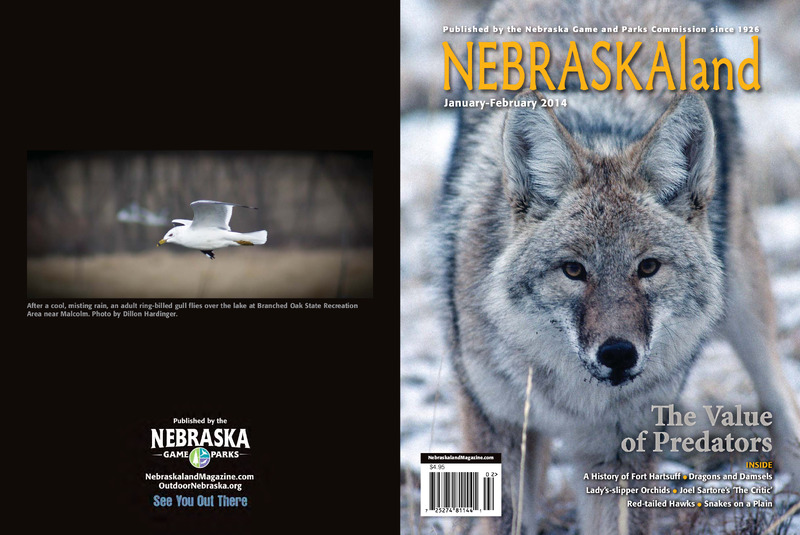
Publis hed by the Nebr a s k a Ga m e a nd Pa r k s C o m m is s ion si nc e 1926
NEBRASKAland
January-February 2014
After a cool, misting rain, an adult ring-billed gull flies over the lake at Branched Oak State Recreation
Area near Malcolm. Photo by Dillon Hardinger.
NebraskalandMagazine.com
$4.95
INSIDE
INSIDE
INS
SIDE
A History of Fort Hartsuff ● Dragons and Damsels
Lady’s-slipper Orchids ● Joel Sartore’s ‘The Critic’
Red-tailed Hawks ● Snakes on a Plain
NEBRASKAland Magazine
Volume 92
●
No. 1
●
January-February 2014
F EEAT U R ES . . .
16 Fort Hartsuff
Guardian Post of the North Loup River
BY THOMAS R. BUECKER
22 The Critic
T
P
J S
24 Summer of the Sunflower – A Photo Essay
T
G
S
,P
30 My Newest New Hobby
T
P
J K
32 The Value of Predators
T
C H
,P
M
F
38 Searching for the Elusive Yellow
EXT AND HOTO BY OEL ARTORE
EXT BY
ERRY TEINAUER
EXT AND HOTOS BY EFF
EXT BY HRIS
ELZER
HOTOS BY STAFF
URRUS
HOTOS BY
ICHAEL ORSBERG
Lady’s-slipper Orchid
40
●
BY GERRY STEINAUER
40 Dragons and Damsels
T
J V M ,P
46 An Iconic Call
EXT BY ULIE AN
ETER
HOTOS BY
DINA BARTA
TEXT AND PHOTO BY MICHAEL FORSBERG
D EPARTM EN T S . . .
Comment .........................................................4
Mixed Bag.......................................................6
Junior Journal................................................48
Page 49..........................................................49
Classifieds .....................................................50
Portraits from the Past ..................................52
In the Kitchen ...............................................53
The Last Stop ................................................54
24
●
O N T H E W EB . . .
When you see this symbol in the pages
W
oof NEBRASKAland Magazine, visit
N
NebraskalandMagazine.com and view
oour interactive digital edition for more
information.
NEBRASKAland (VOL. 92 / NO. 1, ISSN 0028-1964) is published monthly, except
for the combined Jan./Feb. and Aug./Sept. issues, by the Nebraska Game and Parks
Commission, 2200 N. 33rd St., Lincoln, NE. Periodicals postage paid at Lincoln,
Nebraska, and additional mailing offices. POSTMASTER: Send address changes to
NEBRASKAland, P.O. Box 30370, Lincoln, NE 68503-0370.
2 NEBRASKAland • JANUARY-FEBRUARY 2014
30
●
16
●
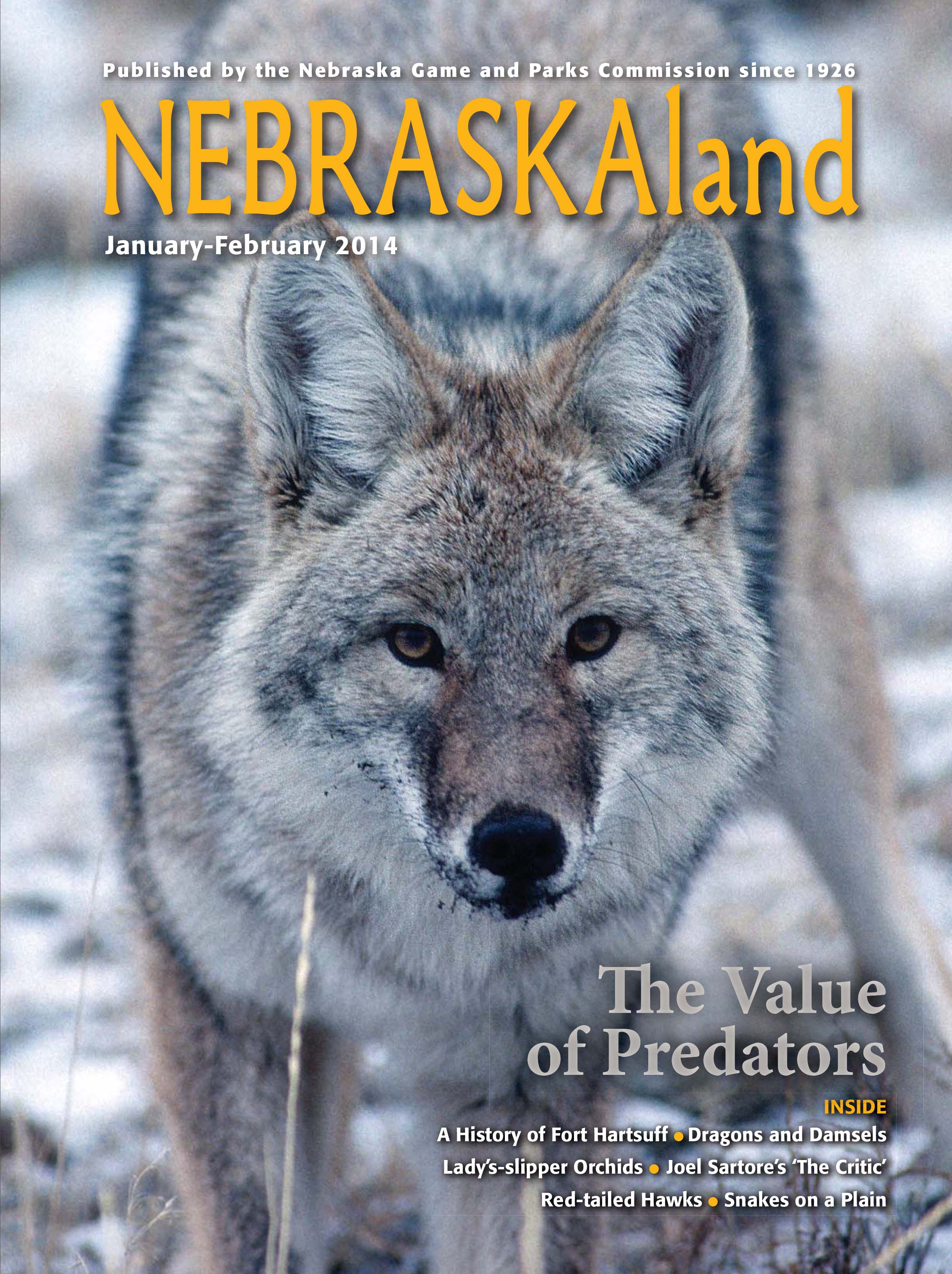
Cover: In late winter, a coyote pauses while digging for a rodent on a
grassy hillside. See the story on page 32. Photo by Michael Forsberg.
Opposite: The sun rises behind a pine snag in the canyons above the
Niobrara River near Valentine on a winter morning. Photo by Eric Fowler.
JANUARY-FEBRUARY 2014 • NEBRASKAland 3
A Sanctuary Squirrel
This photo was taken at the
Gasteyer Nature Sanctuary along
the Middle Loup River just south of
Loup City. The preserve was given
by Retta Gasteyer, a true lover of
nature. Retta passed away in 1986
but left the land as a preserve for
the wildlife she so enjoyed. The
preserve still has many black walnut
trees she planted for the animals.
Today you can see a lot of happy
squirrels gathering the bounty from
those trees.
Mike Wardyn
Grand Island, Nebraska
I am taking a wild guess that this
month’s “visitor” is a leaf worm. I’ve
been watching each month for your
special “visitor” and been improving
monthly my time in finding it, even
when I don’t know what the hell I am
looking at. This time, I found him right
as I grabbed the magazine and thumbed
through it. Oh yes, I do enjoy the great
stories found throughout the magazine.
I really enjoy the stories of the old
days in the late 1800s and early 1900s.
Keep up the good work.
Jim Schaefer
Columbus, Nebraska
The Next Generation
This photo (opposite page, bottom)
might be the most awesome pheasant
hunting picture you will ever see. My
CONSERVATION OFFICERS
NORTHWEST
Officer
City
Jim Zimmerman (S) Gering
Commissioners
Chairman - Norris Marshall, Kearney
Vice Chairman - Lynn Berggren, Broken Bow
2nd Vice Chairman - Jerrod Burke, Curtis
Dr. Mark Pinkerton, Wilber
Dr. Kent Forney, Lincoln
Rex Fisher, Omaha
Mark Spurgin, Paxton
Mick Jensen, Blair
Ron Stave, Waterloo
Shauna Groenewold shot this photograph
on November 1 at the height of Lincoln’s
fall color display.
From Visitor Letters
I enjoyed the coyote hunting article.
A rancher friend of mine from up in
the Lynch area used to hunt them with
his greyhounds that he had adopted
after their racing career. The mange hit
that area hard, too.
G. E. Dave Fuller
Lincoln, Nebraska
We have a good time reading the
magazine, and especially looking back
to previous issues. The latest magazine
had the photo of fish caught by Al
Zikmund and friend. I have spent
many hours with Mr. Zikmund while a
student at Kearney State, some of those
hours in the duck blind.
Leo Turner
Lisco, Nebraska
COMMISSIONERS
Director Jim Douglas
MAGAZINE STAFF
Editor Jeff Kurrus
Art Director Tim Reigert
Associate Editor Amy Kucera
Regional Editors Eric Fowler, Julie Geiser,
Justin Haag, Jenny Nguyen
Contributing Editor Michael Forsberg
Regular Contributors Bill Hager, Chris Helzer,
Lisa Knopp, Gerry Steinauer
Photo Librarian Sarah Johnson
Circulation Donna Robinson
For address changes and questions about
your subscription, e-mail Donna.Robinson@
Nebraska.gov or call 800-632-5263
Advertising Sales Manager
For advertising information contact
Shane G. Gilster
Phone: 402-742-0125
Email: shanegilster@gmail.com
NEBRASKAland Magazine Copyright 2013, all rights reserved.
NEBRASKAland is available in audio from the Nebraska Library
Commission Talking Book and Braille Service, Suite 120, 1200 N St.,
Lincoln, NE 68508. 800-742-7691. NEBRASKAland Magazine and the
Nebraska Game and Parks Commission reserve the right to reject any
advertising not in keeping with the agency mission.
Rates: $18 for one year; $33 for two years; $44 for three years. Nebraska
recipients must add appropriate sales tax. To subscribe call
1-800-NEBLAND (632-5263), or go online to: NebraskalandMagazine.
com.
COMMISSION
C
COM
OM
OMMIS
M SIO
S ON O
SI
OFFICES
F CES
FFI
ES
S
Three-year-old Alexander Winn holds
up a pheasant along with his toy double
barrel shotgun after a hunt with his
dad near Ashland, Nebraska. “I want to
encourage parents to get their kids in the
outdoors and put a smile on their kid’s
face like this one,” said dad Kenneth.
Greg Pollmann shot this buck in the Frenchman Mule Deer Conservation Area after
stalking within 10 yards of the trophy. “You don’t have to draw a tag in Colorado or
Utah or Arizona to hunt big mule deer,” he said. “You can hunt them right here in
Nebraska if you put in the effort.”
boy, Alexander Winn, accompanied
me on an afternoon pheasant romp near
Ashland. He was trying his best to keep
up with me while I kept one eye on the
dogs while ensuring my little guy, three
years old, was staying on the game trail
and not venturing into the thick stuff.
Alex brought along his toy double
barrel and was sporting his brand new
hunting hat and boots, which are about
two sizes too big.
Just as he got to my side I heard the
4 NEBRASKAland • JANUARY-FEBRUARY 2014
grass erupt with wings and a cackle.
After glancing down to ensure my boy
was in a safe spot for me to shoot the
bird, I shot it at about 15 yards ... all in
front of the glowing eyes of Alex. The
picture you see is the moment after my
Weimaraner delivered the bird to hand.
Alex was the proudest and happiest
little boy in the entire state at that
space and time.
Kenneth R. Winn
Ashland, Nebraska
Send your comments to:
Jeff Kurrus, Editor
NEBRASKAland Magazine
P.O. Box 30370
Lincoln, NE 68503
or e-mail Jeff.Kurrus@Nebraska.gov
Please include your postal address and
telephone number.
Letters may be condensed and edited
for clarity. Photographs are welcome
and will be returned.
Any program that receives federal funding from the National Park
Service, or the United States Fish and Wildlife Service prohibits unlawful
discrimination on the basis of race, color, religion, age, gender, marital
status, national origin, age, disability or political affiliation. Any person
who believes he or she has been discriminated against in any program,
activity, facility, or service, should contact the Nebraska Game and
Parks Commission, Lincoln, NE 402-471-0641, the Equal Opportunity
Commission, Lincoln, NE 402-471-2024, TTY/TDD 402-471-4693;
United States Fish Wildlife Service, Civil Rights Coordinator, 4401
N. Fairfax Drive, Arlington, VA 22203; Director, Equal Opportunity
Program, U.S. Department of Interior, National Park Service, 1849 C
Street NW, Mail Code 0008, Washington, D.C. 20240-0001.
Headquarters/Southeast District Office
2200 N. 33rd Street Lincoln, NE 68503
Phone 402-471-0641
Northeast District Office
2201 N. 13th St. Norfolk, NE 68701
Phone 402-370-3374
Southwest District Office
301 E. State Farm Rd. North Platte, NE 69101
Phone 308-535-8025
Northwest District Office
East Hwy. 2, Box 725 Alliance, NE 69301
Phone 308-763-2940
Bassett Office
524 Panzer St., Box 508 Bassett, NE 68714
Phone 402-684-2921
Kearney Office
1617 First Ave. Kearney, NE 68847
Phone 308-865-5310
Omaha Office
1212 Bob Gibson Blvd. Omaha, NE 68108
Phone 402-595-2144
Greg Hesse
Scott Brandt
Dan Kling
Frank Miller
Sean McKeehan
Phone (308)
(office) 763-2940
(cell) 641-6138
Rushville
760-3647
Gering
631-0663
Harrison
430-0572
Valentine 402-389-0444
Bridgeport 308-279-9133
SOUTHWEST
Officer
City
Phone (308)
Roger Thompson (S) N. Platte (office) 535-8025
(cell) 530-3097
Ray Dierking
Brkn. Bow
870-0322
Michael Thome
Cozad
529-8146
Terry Brentzel
Oshkosh
458-7650
Matt Andrews
Elwood
746-2418
Dirk Greene
Imperial
882-0015
Dale Johnson
Kearney
440-3847
Brian Piernicky
McCook
340-6627
Brandon O’Neal
N. Platte
778-7486
Nicholas Fix
Ogallala
289-0427
Bryce Streger
Ogallala
289-1169
Rich Routh
Rep. City
920-0367
NORTHEAST
Officer
City
Tom Zimmer (Sup.) Norfolk
Dale Davis
Steve Oberg
Daniel Roberts
Randy Pomplun
Jeff Jones
Jon Reeves
Tim Williams
Pat George
Doug Pollard
Alex Frohberg
Cory Krause
Phone (402)
(office) 370-3374
(cell) 649-8053
Bassett
760-0712
Columbus
910-3366
Fremont
719-1108
Fullerton
308-550-0489
Hartington
762-5022
Kennard
889-8508
Grand Is
308-380-7331
O’Neill
340-0787
Ord
308-730-7050
Ponca
241-7615
West Point
380-6410
SOUTHEAST
Officer
Levi Krause (Sup.)
William Krause
Mike Luben
Dan Zuehlke
Heath Packett
Darin Gress
Douglas Kramer
Dina Barta
Stacey Lewton
Dudley Sorensen
Robert Finke
Russell Mort
Dan Evasco
Rich Berggren
City
Louisville
Auburn
Colon
Cortland
Eagle
Hebron
Lincoln
Lincoln
Lincoln
Waverly
Milford
Nebr. City
Papillion
Waterloo
Phone (402)
949-0593
274-8063
443-6392
806-9084
210-0888
768-8665
890-6465
890-6463
890-7140
937-3422
947-1363
209-1506
616-5961
619-1355
ADMINISTRATION
Officer
Craig Stover (Adm.)
Duane Arp (Ass.)
Jeff Clauson (Ass.)
City
Lincoln
Lincoln
Lincoln
Phone (402)
471-5531
471-5531
471-5531
Nebraska Wildlife Crimestoppers 1-800-742-7627
Ak-Sar-Ben Aquarium
21502 W. Highway 31 Gretna, NE 68028
Phone 402-332-3901
JANUARY-FEBRUARY 2014 • NEBRASKAland 5
Fun Run Calendar
Trek up the Tower: Omaha, February 22
It’s a ‘fun run’ that goes straight up – 633 feet straight
up – to be precise. Sign up early for this annual event to
secure a spot in this race up the stairs of the First National
Bank in downtown Omaha. Early bird registration is $50 and
gets you a t-shirt and race medal. Trekupthetower.org
Leprechaun Chase: Ashland, March 8
Costumes are encouraged in this 10k dash around Eugene
T. Mahoney State Park (SP). The gals get a head start, with
the guys starting soon after and trying to catch up. The first
person to cross the finish line, male or female, wins a free
drink for their gender at the green beer after party. Lc10k.com
The Color Dash: North
Platte, May 18
Proceeds from this
delightfully colorful 5K run
will help the North Platte/
Lincoln County Visitors
LAST YEAR’S RUN WILD EVENT
Bureau in creating a sports
commission for the area.
Runners will start the race squeaky clean and cross the
finish line covered in a dazzling array of colored powder.
Thecolordash5k.com/north-platte-nebraska.html
PHOTO
PHOT
O BY JEF
JEFF
F KURRUS
KURRUS
By Cristina Woodworth
Whoever said running a race
couldn’t be fun? There are plenty of
5K and 10K races offered throughout
Nebraska that include everything from
getting covered in colored powder
and climbing over obstacles to
CRISTINA WOODWORTH
dressing like a leprechaun. Check out
the following list for some of the top fun run picks statewide
in 2014.
10K event at Eugene T.
Mahoney SP, runners get
the chance to truly run wild,
dressing up like animals as
they follow the winding trails
at the park. Proceeds from this
event benefit the Nebraska
Wildlife Conservation Fund.
Runwildne.org
Warrior Dash: Tekamah, June 7
Be a part of the world’s largest obstacle race series in this
3.33 mile dash around Pheasant Bonanza Hunt Club and
Kennel northwest of Tekamah. Runners will encounter 12
different obstacles, ranging from balancing on a slippery
floating log to hurdling a burning fire pit. Warriordash.com/
location/2014-warrior-dash-nebraska/
PHOTO BY JENNY NGUYEN
Dirty Bird Fun Run: Ponca, June 21
This challenging, mud-lover’s event features an adult
5k, as well as a family course, set along the banks of the
Missouri River at Ponca State Park. Over 15 challenging
obstacles test even the toughest old bird but is varied enough
so even those just recently out of the nest will have a blast.
All proceeds benefit youth programs at the Norm Waitt Sr.
YMCA. Dirtybirdfunrun.com
LAST YEAR’S LEPRECHAUN RUN
Shamrock Shuffle: Kearney, March 15
Make sure to don as much green as possible for this 5k
and 10k running event in Kearney. Proceeds are donated to
the Make a Wish Foundation to grant a local child’s wish.
More than 500 people raced in the Shamrock Shuffle in
2012, with the route snaking through Kearney’s streets and
city parks. Kearneyymca.org/y-programs/community-events/
shamrock-shuffle
Monster Dash: Roca, September
Join in the Halloween fun in this annual 5K event that
benefits the Child Advocacy Center. Runners will follow a
route around the Roca Berry Farm, with all participants age
10 and under receiving a free pumpkin from the farm.
Turkey Trot: Fremont, Thanksgiving
Before you load up on Thanksgiving slow-cooked turkey
and mashed potatoes, get a little exercise in with the annual
Turkey Trot hosted by the Fremont Family YMCA. The
event has a 2 mile and 5 mile option and leaves you plenty
of time to get ready for family get-togethers later in the day.
Mud Factor: Gretna, May 17
Get down and dirty at this obstacle-laden 5K run.
Participants will scale rope ladders, army crawl under wires,
climb over towering wooden structures and more in this test
of physical endurance. Mudfactor.com/event-nebraska-2014/
Ugly Sweater Run: Omaha, December
You might have to raid your grandma’s closet before
this fun run. Participants don ugly sweaters as they run
approximately three miles through the streets of downtown
Omaha. Pre-race activities include giant inflatables,
photo stations and festive holiday-themed music.
Theuglysweaterrun.com ■
Run Wild 10K: Ashland, May 17
At the Nebraska Game and Parks Commission’s annual
Visit Runningintheusa.com and search “Nebraska” for an
up-to-date list of event times and additional information.
6 NEBRASKAland • JANUARY-FEBRUARY 2014
JANUARY-FEBRUARY 2014 • NEBRASKAland 7
See You Out There... But Where?
By Jenny Nguyen
South Sioux City
n ethnically rich area, visitors to
South Sioux City will be surprised by the variety and
So
culture the city has to offer. From a fantastic handful of
cu
eeateries
ea
teeri
riee and family markets, to being conveniently located by
Ponca State Park, the Missouri River and Sioux City, Iowa,
South Sioux City is especially different compared to most other
locations in northeastern Nebraska.
South Sioux City’s variety of restaurants and markets is
where the city shines brightest, sure to delight the more
adventurous diner. Hankering for some Asian food? The
Thai-Laos Kitchen on Dakota Avenue and 12th is a great place
to enjoy fresh, authentic Asian dishes such as Pad Thai
noodles, curries, tom yum soups, seafood and vegetarian specialties.
Great Mexican restaurants and markets are also plentiful. For food, stop by
De Andas Restaurant for delicious carnitas (pork) tacos, beans and rice. Or try
La Michoacana, which serves authentic Mexican favorites such as
tortas, quesadillas, burritos and fresh chicharonn (fried pork rinds) as
well as featuring a market next door. Have a sweet tooth? Down the
street stands Es San Miguel Bakery that sells a variety of pan dulce
(sweet bread) and treats.
For a special night out, one can’t forget Kahill’s Steak, Fish and
Chophouse located inside the Marina Inn Hotel and Conference
Center, which offers unique dishes such as sherry spiked lobster
bisque, wagyu steaks, “duck two ways,” black garlic spring lamb
and buttermilk quail and waffles. Be sure to pick a seat by a
window, which overlooks the Mighty Mo.
Other outdoor opportunities in South Sioux City include
Crystal Cove Park and its hike and bike trails as well as a
lake that is stocked three times yearly for summer and winter
fishing. Cottonwood Cove Park is located right on the banks
of the Missouri River; services include a public boat ramp
and camping. Scenic
Park also overlooks the
Missouri River and offers
a campground with modern and
tent sites, pool, waterslide, tennis courts and
more than one good place to eat close by.
For more information, check out
VisitSouthSiouxCity.com,
Marina-inn.com and
Kahills.net.
La Michoacana’s market
PHOTO BY JENNY NGUYEN
South Sioux City
Bald Birds
By Joel Jorgensen
iguel Bake
ry
Kahill’s Restaurant
Northern cardinals are familiar birds
found throughout most of Nebraska.
But sometimes familiar species can
become unfamiliar by exhibiting
an odd plumage. Sometimes an
explanation for such an aberration
is well-known and readily available.
Other times an explanation is more
elusive.
The entirely bald head exhibited by
this northern cardinal is unusual, but
not unprecedented. Birds similar to
this have been observed throughout
the species’ range. However, why a
cardinal would lose essentially all of its
head feathers at one time is not entirely
clear. One clue is that cardinals in this
condition are often observed in late
summer or early fall.
This is the period when cardinals
undergo a molt – the process to replace
old, worn feathers with new ones.
Sometimes cardinals and blue jays are
observed in late summer with reduced
head feathers and lack crests during
their molt. Normally birds do not lose
an entire group of feathers at once.
PHOTO
ZECHMANN
PHOT
O BY STE
STEVE
VE ZECHM
Z
ECHMANN
ANN
Es San M
n the
o
s
t
i
s
”
k
Par
“Scesnoiucri River
8 NEBRASKAland
Mis • JANUARY-FEBRUARY 2014
Do you know where this Nebraska photograph was taken?
See answer at the bottom of page 15.
Feathers are typically replaced
gradually because most birds still
need to thermo-regulate and fly to
survive (an exception are waterfowl,
which become flightless during molts).
Some authorities have hypothesized
complete feather loss in northern
cardinals may be related to heavy
parasite loads, or the result of excessive
head scratching due to parasite or stress
from malnutrition.
Even though there may not be a
definitive answer at this time, the photo
provides a fascinating glimpse at the
bird’s anatomy that is usually hidden
by feathers. Notice how absurdly
massive the bird’s bill is relative to the
head and take note of the ear opening
below the eye.
Hopefully, this cardinal grows
some new head feathers before
winter. ■
JANUARY-FEBRUARY 2014 • NEBRASKAland 9
Photo taken March 11, 1924, in Tilden, Nebraska. The white crow atop the pile of crow’s feet was shot near Clearwater.
A Brief History
Madison County v.
Antelope County:
The 1924 Crow Shoot
While Nebraska still has a crow
season, enthusiasm for hunting crows
was much higher in the 1920s, when
Great Plains farmers began seeing large
year-round crow populations feeding
on cultivated fields. In 1924 the du
Pont Company offered $2,500 in prizes
during its International Crow-Shooting
Contest.
That year in northeastern Nebraska,
hunters rallied for the area’s second
annual crow shoot, pitting Madison
County against Antelope County in
a contest to rid the countryside of
“robber” crows. The competition
kicked off February 10 and closed
with a grand affair in Tilden on March
10. Team captains were selected
to represent each county. Other
teams represented several individual
communities. The team from Tilden,
which straddles the Madison-Antelope
county line, “added to the zest of the
contest” on their home turf, the Tilden
10 NEBRASKAland • JANUARY-FEBRUARY 2014
e Crow Shoo
ters’ Ban
quet included
a sing-along
.
Surveying the Outdoorsperson
S
By Cristina Woodworth
For many avid hunters and anglers, making a new gear
purchase is almost as thrilling as reeling in a trophy fish or
getting off the perfect shot on an exciting morning.
Outdoor gear brands spend millions each year trying to
persuade these outdoorsmen and women to purchase their
products, relying on celebrity endorsements, exposition rollouts and lots of advertising.
Despite those investments, though, a new survey found
that 73 percent of hunters simply rely on their
personal experience and knowledge in making
brand decisions. Among anglers, that number was
72 percent.
The survey, conducted by Southwick
Associates, a company that specializes in
conducting shooting sports, hunting, angling
and environmental surveys and compiling those
statistics, included more than 2,100 anglers and
about 4,000 hunters.
Other top reasons respondents gave for choosing
a certain outdoors product were:
Anglers
• Brand loyalty: 56 percent
• Recommendations by another experienced angler: 48
percent
• Friend’s recommendation: 40 percent
• Magazine advertisement/feature article: 19 percent
• Expo and outdoors shows: 13 percent
• Store sale people: 13 percent
• Professional endorsements: 10 percent
• Celebrity endorsements: 0.3 percent
Hunters
• Brand loyalty: 56 percent
• Recommendations by another
experienced hunter: 46 percent
• Friend’s recommendation:
45 percent
• Internet article:
22 percent
• Expo and
outdoors shows:
12 percent
• Store sales
people:
11 percent
• Professional
endorsements:
7 percent
• Celebrity
endorsements:
0.7 percent ■
JANUARY-FEBRUARY 2014 • NEBRASKAland 11
PHOTO BY JUSTIN HAAG
By L. Robert Puschendorf, Nebraska
State Historical Society
“baked crow” and “minced
Citizen reported.
pie a la crow.” A song, “Our
The feet of the crows documented
Wild, Wild Black Crow,” was
the bounty, which were displayed in
sung to the tune of “My Wild Irishh
the window of the Kahler hardware
Rose.” The lyrics of another song went:
store “as fast as they could be brought
I shot them in a rainstorm
in, after being counted and registered.”
And I shot them in snow
The heap apparently became so large it
I shot them in a blizzard
was moved to an outside location.
When zero was below.
When the contest ended, “11,500
I shot them in the sunshine
robber crows had fallen before the gun
Underneath my parasol.
of the Antelope county marksmen,
But now with all that moonshine
while Madison county could only
I couldn’t shoot them at all. ■
muster 5,500.” Clearwater won a
silver trophy for the highest
team score, 5,836 crows’ feet.
Harold Horton, of Tilden, won
another silver trophy for his
individual bag, “[H]is gun
being credited with 2,800
crows.” A white crow, which
was proudly displayed on the
heap of crows’ feet, was taken
by a Clearwater shooter. The
contest netted 4,000 more
crows than the previous year.
A banquet, toasts and
dance were held at the
Tilden Opera House,
where 200 plates were set
for the hunters and “their
ladies.” The elaborate
menu humorously included Apparently th
PHOTO BY RICK RASMUSSEN
By Jeff Kurrus
Some hunters aren’t blessed to have or know someone
who has a good upland dog, but still want to pheasant hunt.
While it will be more difficult to find birds, here are a
few tips from longtime pheasant hunter Gerry Steinauer to
increase your success.
1) Always walk with your gun in the ready position – two
hands on the gun, barrel up and trigger finger near the safety.
A main reason hunters miss pheasant shots is that they carry
their gun over the shoulder or hanging at their side. The 1
to 1½ seconds it takes to bring the gun to shooting position
is all it takes to miss. Having a dog tends to give you a
warning of when to be ready, but there is no such warning
when you’re dogless.
2) To avoid losing injured birds, use higher powered
By Cristina Woodworth
Whether it’s sultry summers, soggy springs or downright
bone-chilling winters, Nebraska has always been known for
having somewhat tenacious weather patterns. As the year’s
coldest months come upon us, here’s a look back at some of
the state’s most famous winter storms:
• It was a typical Easter Sunday afternoon on April 13,
1873, when it began to lightly rain across the plains of eastcentral Nebraska. The rain froze into a heavy, wet snow later
that evening and, by Monday morning, howling winds had
whipped the snow into a full-out blizzard. The storm raged
for three days, forming 20-foot-high snow drifts in some
areas across the state. East-central Nebraska was hit the
hardest, where as many as 20 people died and thousands of
livestock froze to death.
• The early hours of January 12, 1888, were unseasonably
warm, with schoolchildren playing outside at their afternoon
recess and farmhands working in short sleeves. A sharp
change in wind direction brought an unexpected onslaught of
snow, though, and the temperature quickly fell to 34 degrees
below zero. It’s estimated that 100 people lost their lives in
this harrowing winter storm. The most well-known aspect
of this historical blizzard is the fact that the weather trapped
many schoolchildren in one-room schoolhouses with little
food and no fuel. Some of these children had tried to get
home before the snow hit and froze to death when the storm
hit.
• The winter of 1948-49 dumped so much snow across the
state, caravans of snow-removal equipment were needed to
help clear the road and railroad tracks. Residents who were
stranded by the copious amounts of snow received basic
necessities such as food, fuel and water, via aid planes that
air-dropped supplies. ■
Five Reasons to Start
Hunting Rabbits Today
Rabbit hunter Dustin Favinger and his
beagle Beru pause during a successful
afternoon near Cozad.
12 NEBRASKAland • JANUARY-FEBRUARY 2014
Winter of ‘49. A cow freed from a drift on the Eldon Miller farm
near Belmont.
My Ice Fishing Must-have
PHOTO BY JEFF KURRUS
By Jeff Kurrus
If you need more of a reason than “it’s just fun,” spend a
few seconds to be further convinced by reading below.
1) You might be the only person hunting them. Receiving
little pressure, they are an underutilized species that can be
readily found on a long list of public and private lands.
2) You can extend your hunting season. Rabbit season
closes on February 28, a month after pheasant, quail and
squirrel seasons end.
3) Permission is easier to obtain. “Many times landowners
have even taken me to their best habitat,” said longtime
rabbit hunter Dustin Favinger.
4) They’ll improve your marksmanship. Not only is
the swift and nimble rabbit fun to shoot at, they make
you a more prepared shooter in the field.
5) They’re tasty. “Battered and fried
backstraps, just like you would do with
chicken fingers, is a simple and delicious
way to cook rabbits,” said Favinger. ■
NEBRASKA STATE HISTORICAL SOCIETY RG3139-80
No Dogging Pheasants
Famous Blizzards
shells. I use a 12 gauge with 3-inch No. 3 steel and avoid
taking longer shots. When I do knock a bird down, I mark
where it fell and walk very quickly to the spot.
3) Hunt mid-day, say 10 a.m. to 3 p.m., when the birds are
in a loafing cover and more settled. Look for birds on
the edges of thick cover next to corn fields. By walking
the edges, you remove one major escape route, the open
side of the edge, and this forces birds to flush rather than
run.
4) Walk slow, do a lot of zig-zagging and try to push
birds to an edge. The slower you move the more nervous,
and likely to flush, birds may become.
5) The best time to hunt without a dog is early in the
season when birds are inexperienced with hunters and more
likely to flush close and not run, or when there is fresh snow
and birds can be tracked. ■
By Justin Haag
I have a lot of ice fishing gear. I’ll admit it, I’m a junkie.
But if I had to name the most valuable piece of equipment
in my arsenal, it wouldn’t be the portable shanty, gas drill or
electronic fishfinder that I bought from prominent sporting
goods retailers – although they do rank high. Rather, it’s
a four-foot piece of steel that was bought at a nearby farm
and ranch supplier and is entirely useless when it comes to
actually catching fish. Yes, I have to be pretty familiar with
the ice conditions on any given body of water before I’ll
venture onto it without my spud bar. So far I’ve yet to take a
swim in icy waters and I give the spud bar a lot of credit for
keeping me dry.
My two children know the process well. They stand along
the bank as dad ventures onto the ice a few steps at a time.
Each few steps end with three or four whacks at the ice with
the spud bar. Those few strikes at the ice give me assurance
that it is plenty strong to hold me for a few more steps, and,
most importantly, to hold them. Once I give the signal, it’s
time for them to join me aboard the ice and begin the
panfish pursuit.
As I hear reports of people falling through the ice
at the arrival and departure of winter, I wonder if the
incidents could have been prevented by the plain and
simple spud bar.
Sporting goods manufacturers now market spud
bars for ice fishing. While I’m glad to see such a
valuable safety tool near tip-ups and jigging rods,
I don’t think it’s a tool that requires a fancy brand
name to do the job. A search of the Internet results
in many spud bars that have been created from
junk metal and limited welding skills. Mine is
actually marketed as a pinch-point crowbar.
Some might say it’s a little heavy for the
job, but when it comes to the safety
of my children, I’d rather err on the
side of too much heft instead of not
enough. ■
JANUARY-FEBRUARY 2014 • NEBRASKAland 13
by Jerry Kane
Contact the Nebraska Game and
Parks Commission at
402-471-0641 or visit
OutdoorNebraska.org for more
information. Visit HuntSafeNebraska.
org for a list of hunter education
classes and BoatSafeNebraska.org
for a list of boating safety classes.
November Late Doe/
Fawn antelope hunting
seasons close
January 31 Pheasant,
quail and partridge
hunting seasons closes
January 31 Fall turkey
hunting season closes
January 31 Grouse
hunting season closes
January 1 First segment of
light goose hunting season
closes
January 1 Mountain lion
hunting season opens in
Pine Ridge Unit Season 1 and
Prairie Unit
January 1 First Day Hike,
Ponca State Park (SP), Ponca,
402-755-2284
January 4 Duck and coot
January 31 Squirrel hunting
season closes
February 1-2 White-fronted
goose hunting season
February 2 Super Bowl
Sunday Mini-Lodge Package,
Ponca SP, Ponca, 402-755-2284
February 2 Super Shopping
Bowl, Eugene T. Mahoney SP,
Ashland, 402-944-2523
14 NEBRASKAland • JANUARY-FEBRUARY 2014
Gary Jagels, of Norfolk, sent this photo
of a black-billed magpie.
Please submit your trail camera photos by e-mail to:
nebtrailcam@gmail.com. Also include where you’re from and any
information that will help explain your photo.
Strange Creatures?
From jackelopes to swamp boogers
(pictured), taxidermists have always been
a wily group of creatives, ready to fashion
a bullfrog playing a harp, a deer smoking a
cigar and so forth for the entertainment of
themselves and their friends.
Now, NEBRASKAland Magazine wants you
to send pictures of yours, along with any
information we may find interesting about its
creation.
Send your images to regional editor Julie
Geiser at Julie.Geiser@nebraska.gov. ■
The shy and seldom seen swamp booger, (resembling
the hind-end of a deer) was “bagged” by Morgan
Hansen and mounted by her father Duane.
Winter Biking
PHOTO BY TIM REIGERT
hunting seasons close in Zone February 8 Binoculars and
3, Low Plains Unit
Birds, Eugene T. Mahoney SP,
Ashland, 9 a.m. - 1 p.m.,
January 4 Winterfest
402-944-2523
Olympics, Eugene T. Mahoney
SP, Ashland, 1-4 p.m., 402-944- February 9 Dark goose
2523
hunting season closes in East,
January 5-26 Duck and coot Platte River, Panhandle and
Niobrara units
hunting seasons close in Zone
2, High Plains Unit
February 9 Light goose
hunting season closes
January 9-12 Omaha Boat,
Sports and Travel Show,
February 10 Light Goose
CenturyLink Center, Omaha
Conservation Order hunting
January 13 First day of spring begins
turkey hunting permit sales
February 11-14 Valentine’s
Special and Swing Under the
January 17 Dark goose
Wings, Eugene T. Mahoney SP,
hunting season closes in North
Ashland, 402-944-2523
Central Unit
February 14 Mountain lion
January 17 Nebraska Game
hunting closes in Pine Ridge
and Parks Commission board
Unit Season 1
meeting, Lincoln
February 14-15 Valentine’s
January 18 Youth,
Dinner, Platte River SP,
Landowner, Season Choice
Louisville, 402-234-2217
and River Antlerless deer
hunting seasons close
February 14-18 Birds and
Breakfast, Ponca SP, Ponca,
January 19 Special Public
402-755-2284
Health Hazard Order crow
hunting closes
February 15 Mountain lion
hunting opens in Pine Ridge
January 20 Crow hunting
Unit Season 2
season opens statewide
January 25 Second segment February 28 Cottontail and
jackrabbit hunting season
of light goose hunting season
closes
opens
February 28 Bobcat, raccoon,
January 26 Duck and coot
Virginia opossum, long-tailed
hunting seasons close in Zone
weasel, mink, red fox, gray
3, High Plains Unit
fox and badger hunting and
trapping season close
January 31 October and
NEBRASKAland
Visitor
Send Us Your Trail Cam Photos!
By Amy Kucera
Before Plains Indian tribes developed the
complete written form of their languages, oral
tradition was used extensively to preserve tribal histories.
Pictorial accounts painted on bison hides, also
known as a “winter count,” include symbols arranged
chronologically. Each image marks a single year and
depicts a collective, memorable event of the tribe.
For the Lakota people, a year of the winter count
measured from first snowfall to first snowfall. Oglala
Lakota visionary Nicholas Black Elk referred to his
December 1863 birth as “The Winter When the Four
Crows Were Killed on the Tongue River,” as told to John
G. Neihardt in Black Elk Speaks.
Of the 14 winter counts collected at the Smithsonian, all
make reference to the Leonid meteor storm of November
1833, which became known as the “Year the Stars Fell.”
View the entire Lakota Winter Counts online exhibit at
Wintercounts.si.edu. ■
By Cristina Woodworth
Riding your bike when it’s below
freezing may not sound like an ideal
way to spend the morning, but with a
few modifications and proper winter
attire, you’ll see it’s the perfect way
to save money, decrease stress and get
some exercise.
The first thing to consider is what
type of bike you should ride. During
the winter months, your bike will have
to withstand more of the elements –
snow, sleet, grime, ice melt – so you
want it to be something inexpensive
that you don’t mind if it gets beat up a
little.
Many winter bike commuters choose
to ride single speed bikes during the
snowy months because there are less
mechanical parts to get mucked up with
winter slush. Mountain bikes are also
popular because the wider tires provide
a good amount of traction on slippery
trails and roads.
If you do decide to ride a multispeed
bike during the winter, be prepared
to frequently clean and lubricate your
bike’s chain. If you have cantilever
brakes, it’s also important to check the
brake pads throughout the cold months
to make sure they aren’t getting too
worn down by dirt and rocks. Stick
a mini bike tool in the bag you ride
with in case you need to do minor
maintenance on your daily ride.
Another winter bike commuting tip
is to invest in some top-notch bike
lights. Since it gets dark earlier in the
winter, bikers should always have
some way to light their way home.
You want to be able to see and also
be seen by other bikers and vehicles.
Many bike lights are sold in packs of
two, with a front white light and a rear
red light included.
Other biking accessories might also
be helpful to make your winter bike
commute a more pleasant experience.
Common add-ons include fenders,
to help keep the slush off your back,
racks, to help carry extra winter
layers and gear, and panniers, or bike
bags, so you can avoid wearing a
backpack.
Although some might scoff and sayy
winter bike commuting is too much
of a hassle, with just a few tweaks,
a bike ride through the snow can be
just as enjoyable as a cruise around
town on a summer afternoon. ■
Last issue’s winner of
the Visitor drawing was
Ron Decker of
Spokane Valley, Washington, who
found the inchworm on page 51.
Readers are encouraged to contact
NEBRASKAland within 10 days
after this issue’s publication with
the correct page number and name
of this issue’s “Visitor” – a critter
found in Nebraska. We will then
gather the correct entries and draw
one to win a NEBRASKAland
Magazine mug. To enter each
month, write:
NEBRASKAland Visitor
2200 North 33rd Street,
Lincoln, NE 68503.
Or e-mail:
Tim.Reigert@Nebraska.gov
with “Visitor” in the subject line of
the message.
HINT: This issue’s visitor is not
on page 15, 25,26,32, 35, 40, 41,
42, 43, 44, 45, or 48.
You may know this little green
insect as either an inchworm or
looper. This caterpillar, probably
a cabbage looper, receives its
common name from the curious
method by which it propels itself.
The caterpillar uses the prolegs
near the end of its abdomen to
draw its rear-end forward to
just behind its head, making a
distinctive ‘loop’ with its body.
Then it moves the front part of
its body forward using its true
legs, ‘inching’ along in a wobbly
manner. Loopers are plant pests,
feeding on a wide variety of plants.
The need for control measures is
highly dependent on the specific
species of looper, the host plant,
and the amount of damaged being
caused. In the home garden,
simply picking off the caterpillars,
combined with predation by
beneficial insects,
may provide
sufficient control.
Special thanks to Julie Van Meter,
Specia
State Entomolog
Entomologist, Nebraska Department of
Vi
Agriculture. Visitor
image by Chris Helzer.
Bugguide.net
gg
is a good site for identification.
VERDIGRE CREEK AT GROVE LAKE WILDLIFE MANAGEMENT AREA
Tribal Counts
JANUARY-FEBRUARY 2014 • NEBRASKAland 15
Fort Hartsuff
Guardian Post of the North
Loup Valley
NGPC LIBRARY
By Thomas R. Buecker
General E. O. C. Ord arrived in the North
Loup Valley in 1874 to select a site for
what would become Fort Hartsuff.
NEBRASKA STATE HISTORICAL SOCIETY 4467PH:3-20
D
uring the 19th century nearly 70 army posts were
built on the northern Plains, 12 in Nebraska alone.
For the most part, those posts were needed to protect
the encroaching white settlers from resisting plains warriors.
One was Fort Hartsuff, built in the North Loup Valley to
protect not only white settlement, but also more peaceful
native tribesmen from belligerent Indian enemies.
Fort Hartsuff
State Historical
Park
Ord
Fort Hartsuff State Historical Park, located in Valley County
northwest of Ord, features a visitor center and restored
buildings displaying life at the late 19th century outpost.
16 NEBRASKAland • JANUARY-FEBRUARY 2014
For some years, the North Loup Valley had been the
favorite travel route used by Lakota war parties to raid their
traditional Pawnee enemies. For bands coming out of the
northwest, the valley led directly to the Pawnee Reservation
in east-central Nebraska. Additionally, by 1871 white settlers
began to enter the valley, and likewise became targets for
northern marauders.
To abate their fears, soldiers were dispatched from
Omaha Barracks to establish a series of encampments
along the Loup in Howard County during the spring-tofall season, when depredating bands from the north were
most active. Consequently, from May to mid-November
of 1871, Company C of the Ninth Infantry occupied Camp
Ruggles near present-day Elba. The infantry company,
under command of Captain Samuel Munson, was joined by
a Second Cavalry troop, and scouted the North and Middle
Loup and Calamus valleys. The next summer Camp Vincent
was established near Cotesfield as a base for Munson’s
company and a cavalry company to provide security for
settlers.
In the early spring of 1873, a small force of settlers
attempted to pursue a Lakota raiding party, and barely
escaped with their lives. Later that spring the threat of raids
still remained, and responsibility for patrolling the area again
Earliest known photograph of Fort
Hartsuff, taken about 1879. In center is
the back wall of the guardhouse, with
commanding officers quarters to left,
duplex officer’s quarters on right and
windmill and water tank in background.
fell to Company C of the Ninth. Located above Cotesfield
on the North Loup, Camp Canby was their headquarters
from June through September. By this time Munson’s
company became synonymous with army protection for the
North Loup Valley.
A second violent encounter between local settlers and
Sioux raiders occurred in early 1874. In mid-January several
cabins were ransacked, and in a brief skirmish on Pebble
Creek one white was killed. Shortly afterward the settlers
appealed for military protection and the decision was made
to establish a permanent military presence in the valley. On
March 6, Captain Munson was ordered to take his company
and establish a protective camp about 45 miles upriver
from previous locations. The new encampment was again
designated “Camp Ruggles,” in honor of department adjutant
general George Ruggles.
The purpose of the new post was to intercept bands
of Sioux in their descent on local settlers and to protect
the Pawnee Reservation from attack. On June 16 an
appropriation bill was passed allowing $50,000 to build the
new post. During the late summer, department commander
General E. O. C. Ord arrived in the valley to select a site
for the new post. He initially favored a location near Camp
Ruggles, but changed his mind for one seven miles upstream
Major General George L. Hartsuff was
a Civil War hero who died in 1874. The
“Post on the North Fork of the Loup
River” was established that same year
and was named in honor of him.
He never visited the fort.
at the forks of the Loup, where the Calamus River joined the
North Loup. There, three sections of land were surveyed and
declared by President Grant as a military reservation.
When it was discovered that certain civilians had prior
title claims to parts of the lands at the forks, the site was
returned below, to a point on Bean Creek, two miles east of
Camp Ruggles. Here two sections were officially declared
for the reservation. The previously declared land at the forks
was retained for a wood and hay reserve. About September
6, Munson moved his company to the site of the new post
designated “Post on the North Fork of the Loup River.” With
the site located and building funds secured, construction of
the new post could begin.
With an abundance of gravel and sand close by, post
buildings were to be constructed of concrete grout,
similar to those recently built at Fort Laramie. During the
construction period, temporary shanties were thrown up
to house the officers; the enlisted men lived in tents and
married soldiers fashioned crude dugouts along the creek.
Well over 100 civilians were hired to build the fort. While
common laborers could earn a dollar a day, men with teams
made three dollars a day, hauling gravel and sand. Lime
for concrete was brought from kilns 40 miles downriver.
Large amounts of Louisville cement and other supplies
JANUARY-FEBRUARY 2014 • NEBRASKAland 17
Living History at the Park
By Jenny Nguyen
NGPC LIBRARY
Viewed from the southwest, this was Fort Hartsuff shortly after it was abandoned by the army. The post library and
reading room, one of the several frame structures at the fort, is the small building seen right of center.
18 NEBRASKAland • JANUARY-FEBRUARY 2014
their reservation south to Indian Territory, which reduced
a target for Sioux raiders who might enter the region. As
a consequence, the fort’s garrison was reduced to one
company of infantry, thought sufficient to provide protection
for the settlers.
The troop reduction brought modification to the original
layout plan. On the north side of the parade ground, the
duplex quarters for cavalry officers was changed to an
eight-bed post hospital, and the barracks on the west side
for cavalry became the quartermaster and commissary
storehouse. On the south side of the parade, a small post
headquarters building and a post guard house were situated.
They were flanked on the west by a 30-by-80-foot structure
housing the post bakery and several quarters for married
soldiers. Behind the storehouse was a stable for riding and
draft animals. In addition to the concrete buildings, several
frame structures were added later.
With the stationing of troops in the valley, settlement
increased. Adjoining the military reservation, a small town
named Calamus was platted in 1874, one-half mile southeast
of the post. During its heyday, Calamus contained three
stores, a newspaper, post office, law office, schoolhouse and
several small residences. Because of its close location to the
fort, Calamus was the principal town of Valley County.
Fort Hartsuff was one of the smallest permanent army
posts built in Nebraska. In addition to the 9th infantry,
companies of the 14th and 23rd regiments were stationed
there. Although it was an infantry station, riding horses were
assigned there, allowing mounted infantry for scouting and
pursuit. Generally two company officers were present for
duty; the company captain or senior lieutenant served as
post commanding officer. Civilian physicians were hired by
contract to serve as post surgeons.
With the main duty for Fort Hartsuff troops to provide a
sense of security to valley settlers, much of their time was
spent on scouting patrols. Small detachments were sent out,
usually to the north and northwest, to search for signs of
Indians moving through
the area. Occasionally
they were sent out in
pursuit of raiding northern
warriors. In August 1875
a detachment of 18 men
commanded by Captain
John Coppinger left post
in pursuit of Indians
reported to have raided
ponies from the Pawnees
and other depredations.
Although the soldiers
made no contact with the
raiding party, they were
successful in “charging a
watermelon patch on the
way with great success.”
Not all the soldiers’
field service was related
to conflict with plains
tribesmen. In November
1874, a detachment was
sent out to search for a
party of miners illegally
heading to the Black
Hills. On another occasion, troops from Hartsuff were part
of a large dragnet search for outlaws who robbed a Union
Pacific train at Big Springs, Nebraska. In May 1877, a small
detachment escorted a civilian wagon train from Grand
Island legally heading to Deadwood and, that same year,
soldiers from the fort were sent out to help search for the
Alderman children, two youths lost on the plains.
A year before, on the brink of the 1876 Sioux War, army
patrols in Nebraska and Wyoming were on the lookout for
northern Indians who roamed away from the reservation and
agencies. Fort Hartsuff troops scouted the territory north and
west of the post without locating any marauding bands. But
in April of 1876, they were involved in what was known as
the “Battle of the Blowout,” the only actual combat seen by
soldiers from the fort.
On April 28, a small party of Sioux raiders was reported in
the vicinity. Lieutenant Charles H. Heyl, 23rd Infantry, and
eight enlisted men were sent in pursuit, accompanied by a
small group of civilians. Twenty miles northwest, the raiders
were located entrenched atop a sand hill. Fearing they would
escape, Heyl and three soldiers charged their position. In the
unsuccessful assault, Sergeant William H. Dougherty was
JANUARY-FEBRUARY 2014 • NEBRASKAland 19
PHOTOS BY JENNY NGUYEN
were transported from Grand Island, 80 miles distant.
Additionally, logs from nearby canyons were felled and
brought to the site to be cut into dimensional lumber.
Building walls were built on foundations three feet below
the ground. Slip forms, 12 inches high and 13 inches wide,
were poured full of concrete, and then moved up after the
pour had set. When the walls reached full height, they were
plastered and scribed to resemble cut stone. By this method
nine concrete structures were eventually built.
One of the key considerations for building such a
substantial fort was to provide work for local settlers. From
1874 to 1875, grasshoppers devastated central Nebraska,
including the Loup valleys. During the construction of the
post, the work was to be “given into the hands of the settlers
as much as possible.” Had it not been for monies they earned
working on the new post, many would have been forced
to leave the region. The assistance many received in this
early form of government relief was remembered by locals
for decades. For several years afterward, large grasshopper
swarms were reported in the vicinity of the post.
As construction work wound down for the season, orders
were received in December that officially named the post
“Fort Hartsuff,” in honor of Major General George L.
Hartsuff, who retired from the army in 1871 and died in
May of 1874. Whereas a “camp” was a temporary military
post or station, the designation “fort” marked its status as a
permanent military post.
However, a major setback for the building program
occurred in January 1875 when fire destroyed the duplex
set of officers’ quarters. After fires were kept in it to dry
interior plastering, flames consumed the nearly completed
structure. Fortunately, funds were quickly advanced and
rebuilding work begun. By August all the post buildings
neared completion.
Initially the post on the North Loup was planned as a
two-company post with infantry and cavalry companies
stationed there. Late in 1874 many Pawnee had moved from
Fort Hartsuff State
Historical Park (SHP) typically
holds two living history
events per year. Although
dates for the 2014 season
are still to be determined,
park goers and history buffs
can expect a Spring Muster
and a second living history
event put on by the Fremont
Pathfinders, a Civil War
Re-enactors line up for drill call during Fort Hartsuff’s 2013
re-enactment group, during
Spring Muster.
the park season. At these
events, re-enactors live, eat and sleep like 19th century Union soldiers and civilians to
offer visitors an accurate representation of military life during the Civil War era.
Seven re-enactment units from Nebraska and neighboring states participated in last
year’s Spring Muster at Fort Hartsuff. Typically held
in April, the event commemorates the outbreak
of the Civil War on April 12, 1861. The fort comes
alive as soldiers, women and children occupy the
parade grounds, barracks and quarters to carry out
day-to-day activities such as fatigue duties, roll calls,
mess call, mail call, infantry drills, cannon firing and
civilian activities such as church services and sewing
groups for women. Cooks preparing period meals,
blacksmiths and on-site surgeons are also essential
personnel to fort life. In addition, a night shooting
of the cannon is held one evening per year, usually
coinciding with a living history event. Guests can
come out for the day and stay to watch the sparks
fly late at night.
As one of the state historical parks that falls under
the Commission’s statewide temporary park closures Megan Katz portrays the
commanding officer’s daughter
this year, Fort Hartsuff will reopen on May 1, 2014.
during the Spring Muster.
Contact Fort Hartsuff SHP after this date for up-toView additional photos of
V
date information on fort events, 308-346-4715 or
lliving history at Fort Hartsuff
ngpc.fort.hartsuff@nebraska.gov.
NEBRASKA STATE HISTORICAL SOCIETY RG4469-1-8
“The fort as a farm.” This 1940s aerial view shows the irrigation ditch and flume across Bean Creek.
killed. The Indians escaped after nightfall, and the soldiers
and civilians returned. For their gallant charge on the
entrenched Indians, Corporal Patrick Leonard and Private
Jeptha Lytton were awarded Medals of Honor. Sergeant
Dougherty was the only Fort Hartsuff soldier to lose his life
in combat.
Much of the social life of the valley was centered on
activities at the fort. Local civilians were invited there for
hops, dances and other social events. In 1874 a Christmas
dance was held to celebrate the completion of several
buildings. Invitations were sent out inviting locals to social
hops to celebrate St. Patrick’s Day, Fourth of July and
other occasions. Additionally, public orations presented by
Lieutenant W. F. Norris were popular events.
Later post improvements added excellent facilities to Fort
Hartsuff. A well with a windmill and water tank insured
a water supply piped to post buildings. Ice houses were
built to store ice for summer use. In 1876 cottonwood trees
were planted around the post while apple trees, wild plum
bushes and grape vines were set out around the hospital. A
comfortable post reading room was built on the south side of
the parade.
20 NEBRASKAland • JANUARY-FEBRUARY 2014
After completion, Fort Hartsuff was considered one of
the most comfortable and desirable duty stations in the
Department of the Platte. The post was not as isolated as
other stations, such as camps Robinson and Sheridan in
northwestern Nebraska. For the outdoorsman, the outlying
hills and valleys still abounded with wildlife. Visiting
dignitaries, including visiting British and French army
officers, came to hunt antelope, white-tailed deer and elk.
The post was the pride of settlers in the North Loup Valley.
However, after the end of the Sioux War in 1877, the
military need for Fort Hartsuff decreased. Although the
Sioux were confined to their Dakota Reservation, soldier
details were still sent out to make sure the Lakotas had
remained there. The frontier had changed: throughout 1878
and most of 1879, detachments continued to scout for an
enemy that no longer was there.
Late in 1878, Captain Munson’s company was transferred
back to Fort Hartsuff, for their fifth tour of duty in the North
Loup Valley. In July 1879, Munson and a detachment of 20
enlisted men accompanied General George Crook and staff on
a scouting trip to the Niobrara River. Crook had intended to
establish a large army post near to the Dakota reservation to
Sergeant Myers and Corporal Schreck with the lost Alderman children they found in
1877. From The Trail of the Loup.
keep the Sioux in check. With
the selection of the site for
the new post to the northwest,
it became apparent Fort Hartsuff’s days were numbered. By
1880, Calamus, Hartsuff’s neighboring town, declined. With
rumors of the post’s impending abandonment, most of its
residents and businesses moved to Ord, the county seat.
Railroad expansion also spelled the end of small army
posts. With new rail lines bringing rapid transit of men and
supplies, the army consolidated its forces at larger posts on the
railroad. Munson’s company sat through the last hard winter
at Hartsuff. In January the temperature was below zero for 27
days.
By 1881 Fort Hartsuff had served its purpose. On May 1,
Company C lowered the flag and departed for Fort Omaha.
This sentiment was written by Dr. George Towar as the last
entry in the post medical record: “So good-bye Fort Hartsuff.
You are super-numerated, you are no longer wanted . . .
and you will be remembered with pleasure for many years
by those whom you have sheltered.” But the fort had not
disappeared from the valley it once protected.
After the army left, the Union Pacific Railroad purchased
the buildings for a possible townsite if the road extended up
the north side of the river. It did not. Finally, the Department
of the Interior sold the two section military reservation to a
private purchaser for agricultural purposes in 1897. The fort
became a farm.
In the late 1920s Ord businessmen proposed to purchase
the fort site and turn it over to the state for development
into a state park. Ten years later the idea of preserving the
buildings was resurrected by the Loup Valley Old Settlers,
which hoped to restore Fort Hartsuff as a monument to
the early valley settlers. The local community always had
interest in preserving the old fort, but never enough to carry
through on any preservation project. Meanwhile, the old
buildings continued to deteriorate.
The last private owners wanted to give the fort to the
state, and even tried to get the National Park Service
interested in it as a historic site. Finally, in January of 1961
the tract containing the building area of Fort Hartsuff was
accepted by the Nebraska Game and Parks Commission
for development into a state historical park. The breakup
of an army post symbolized the passing of the frontier.
Through its preservation, Fort Hartsuff represents the role of
the frontier army in the West that provided protection and
brought stability to new regions. ■
Tom Buecker was the long-time curator
of the Fort Robinson Museum and is now
curator at the Nebraska History Museum
in Lincoln. His most recent work is a
biography of Lt. James E. H. Foster, a
cavalry officer who served in Nebraska
during the 1870s.
JANUARY-FEBRUARY 2014 • NEBRASKAland 21
The Critic
By Joel Sartore
M
y father thinks I’m a
moron.
To be fair, I have
demonstrated it to him
time and again.
Why else would I buy one ancient
dwelling after another, each melting
into the ground?
Proving that I’m also a masochist,
I decided it would be both fun and
educational to bring the elder Sartore to
the scene of my latest ‘investment,’ the
1870s Lewis-Syford house in Lincoln,
Nebraska. The plan was to write down
everything derogatory that came out of
his mouth. It didn’t take long.
First stop, the front porch.
“A fool and his money are soon
parted boy,” he shrugged. I helped him
dodge the rotten floorboards lying in
wait like an evil Welcome mat, and
we finally made it inside without him
breaking his hip.
“You just must love pouring money
down a rat hole, don’t you?”
“I’ve bought worse dad,” I shot back.
Much worse.
There was the 1890 Victorian
farmhouse out in the country by
Walton with no running water and an
outhouse strewn with pill bottles that
failed to save the last owner. After
that came the Foursquare engulfed in
weeds near Roca that did have plenty
of running water, most of it pouring
out of the kitchen ceiling for some
reason, even when it wasn’t raining.
Oh, and let’s not forget the 1920 Arts
and Crafts with termites so bad the
staircase sank a full quarter inch each
time we walked on it. We slept on the
couch downstairs for awhile.
But things were looking up today,
mainly because this little Empire
beauty was indeed in much better shape
than any historic home I’d bought
before. John Sartore wasn’t buying
a word of it though, and he began to
monolog:
“How much was this? You must not
know what hard times are. In my day,
the only game we could afford to play
was tossing pocket knives in the dirt
under a shade tree until we were old
enough to drive a beer truck for my
uncle and get the hell out of town.”
Moving inside to the parlor, it was
pretty obvious to the astute 84-yearold that the roof had been shot for
years. One clue was that the ceiling
was now partially located on the floor,
which was in turn so warped you could
bounce on it like a chunky trampoline.
Dad’s enthusiasm was now palpable.
“You’ve GOT to be kidding me. I
thought I raised you better. Did they
have a gun to your head when you
bought this?”
Next came the ‘bathroom,’ which
consisted of a toilet and sink, both
butchered into the middle of a tiny
kitchen. No tub though, oddly.
“You going to alternate between
bathing in that sink and washing
dishes, or just do it all at once?”
We made our way upstairs, to the
bedroom that was in the best shape, the
one with the mummified rabbit in the
middle of the floor.
“Well, lookee here,” he exclaimed.
“I ate plenty of those growing up, and
they’re usually good eating. Not this
22 NEBRASKAland • JANUARY-FEBRUARY 2014
PHOTO BY JOEL SARTORE
I’ve always promoted wildlife conservation.
Along those lines, restoring and conserving old
architecture and buildings has been somewhat
of a hobby and passion. Not one my dear
father shares.
one, though.”
John Sartore is thoroughly a child of
the Great Depression. Just the smell of
anything antique brings back terrible
memories, like his childhood consisting
of “laying stock still in the summer to
not sweat so much” and “bracing for
the whooping cough in the winter.”
He remembers once asking for a
simple toy, a Tommy gun made out of
rags and corncobs, perhaps, to which
his father responded by fetching a
small cloth bag of coins and dumping
them out on the floor of their shanty in
southeast Kansas. “Junior, this is all the
money we have in the world, and all
that stands between us and the county
poorhouse. Any questions?”
I decide to NOT take him down to
the collapsing basement, for that would
only depress us both. But just to get
one last rise out of him, I did outline
my grand plan for the place on the way
out.
“We figure 18 months and a truck
load of money should do it here, Padre.
Care to loan us every bit of it?”
He looked down for a moment,
slowly shaking his head. “No way.
Son, you could drop a quarter through
that hole in the floor right there and
never hear it hit the bottom.”
Disgusted yet somehow hungry by
now, Dad finally declared that our sad
little tour was over.
“You’ve met your Waterloo here
boy,” he laughed. “Now let’s go eat.
You’re buying. Anyone in town serve
rabbit?” ■
Joel Sartore is an environmental
photojournalist for National
Geographic Magazine and a Fellow
of the National
Geographic
Society. You can
see his work at
JoelSartore.com
and PhotoArk.
com. Joel has been
contributing to
NEBRASKAland
since 1992.
JANUARY-FEBRUARY 2014 • NEBRASKAland 23
Summer of the Sunflower
By Gerry Steinauer, Botanist
Last summer, the Sandhills were ablaze with the yellow blooms of
sunflowers, and everyone is asking “Why?” The simple answer is the severe
drought of 2012 followed by this summer’s ample rain.
Although the display was most spectacular in the Sandhills, the exceptional
sunflower bloom occurred in native prairies and pastures over much of
central and western Nebraska, and to a lesser extent, eastern Nebraska. Our
state’s two annual sunflowers, plains sunflower (Helianthus petiolaris) and
common sunflower (H. annuus), were the stars of the show. The late Junethrough October-flowering plains sunflower, adapted to sandy soils, grows
throughout Nebraska, except in the southeast, while the August- through
September-flowering common sunflower grows on clay and loam to somewhat
sandy soils nearly statewide.
PHOTO BY ERIC FOWLER
PHOTO BY JEFF KURRUS
24 NEBRASKAland • JANUARY-FEBRUARY 2014
ABOVE: A bumblebee visits the flower of a Jerusalem artichoke (Helianthus turberosa) on the banks of the
Niobrara River. A true sunflower, the plant is not from Jerusalem, nor an artichoke.
OPPOSITE: Plains sunflower blossoms set the Sandhills ablaze with color along Highway 12 in Keya Paha County.
JANUARY-FEBRUARY 2014 • NEBRASKAland 25
A little background in prairie ecology helps to
PHOTO BY JUSTIN HAAG
understand the sunflower explosion. The dominant
prairie grasses, such as big bluestem, little bluestem
and blue grama typically account for about 95 percent
of a prairie’s above ground plant growth (biomass),
and also have prolific root systems below ground.
Wildflowers, sedges and other native plants, while
providing a majority of a prairie’s plant diversity,
account for only a small portion of the above- and
below-ground biomass. Wildflowers, with their limited
biomass, must fiercely battle the abundant grasses for
sunlight, soil moisture and nutrients to survive.
The exceptional drought of 2012 stressed native
prairie grasses, as well as non-native grasses that now
dominate many pastures, including smooth brome.
With little forage available, many ranchers were
forced to heavily graze pastures, further stressing
grasses. And with little soil moisture and few leaves
for photosynthesis, the roots of many grasses, and even
entire plants, began to die. As a result, the grasses were
in tough shape entering
the spring of 2013.
After a dry start, latespring and early-summer rains returned to
much of the state. Suddenly, conditions were
ideal for sunflower and other wildflower seeds,
lying in wait in the soil, to germinate and grow
– as sunflower seeds can remain alive and
viable, but dormant, in soils for many years.
With reduced competition from grasses for
sunlight and nutrients and plentiful moisture,
a high percentage of the seedlings grew to maturity and flowered. In typical
years with normal grass growth, few wildflower seedlings survive.
PHOTO BY CHRIS HELZER
26 NEBRASKAland • JANUARY-FEBRUARY 2014
“Spotty rain showers came to south-central
Nebraska in July and sunflowers flourished in
areas receiving precipitation,” said John Laux, a
Nebraska Game and Parks Commission wildlife
biologist based in Alma. Laux noticed more
sunflowers in pastures heavily grazed during the
drought. “In September, I was dove hunting by a
pond in southwestern Harlan County. The bottoms
of the adjacent draw that were heavily grazed and
nearly void of life during the drought had literally
ABOVE: The flowers of annual
sunflower greet the sun as it
rises over the Pine Ridge in Sioux
County.
OPPOSITE: An ant explores a plains
sunflower unaware of the lurking
crap spider.
JANUARY-FEBRUARY 2014 • NEBRASKAland 27
PHOTO BY CHRIS HELZER
PHOTO BY ERIC FOWLER
exploded with sunflowers. The insect response to the timely summer rains and
abundant wildflowers was just incredible. The bees and other insects were so
thick I could hardly hear myself think,” said Laux.
Similar to the sunflowers, lamb’s quarter and common ragweed, both
annuals, were unusually abundant in areas of the state, while sandy soils
were flush with desert goosefoot and native spurges. In early summer,
sandhill dunes were clothed in the lavender of shell-leaf penstemon and the
rich-blue of prairie spiderwort, and in late summer, the white of sand-lily, all
perennials. Panhandle shortgrass prairies also experienced an exceptional
28 NEBRASKAland • JANUARY-FEBRUARY 2014
ABOVE: A colony of hairy sunflower
(Helianthus hirsutus) proliferates
after a prescribed fire at Indian
Cave State Park. This woodland
species is found in our eastern tier
of counties.
RIGHT: A bison calf wanders
among a patch of plains sunflower
in a Sandhills prairie on The
Nature Conservancy’s Niobrara
Valley Preserve in Brown County.
Native ungulates and livestock
will browse the young foliage and
flowers of sunflowers.
wildflower year. In northeastern tallgrass prairies,
I observed an abundance of perennial wildflower
seedlings, especially purple prairie clover, prairie
larkspur and Canada milkvetch.
Last summer’s abundance of wildflowers will
also benefit wildlife. Prairie wildflowers are
important wildlife and livestock forage, supplying
micronutrients not found in grasses. The copious
blooms provided nectar and pollen for bees,
butterflies and other pollinators and this winter,
songbirds, game birds and small mammals will
feast upon their plentiful seeds. In addition, many
ecologists believe that diverse grasslands are more
resilient to drought and less susceptible to invasion
by non-native plants and other stressors.
These observations beg the question: could
drought, while it has negative economic
consequences for humans, be vital in maintaining
the long-term ecological health of our native
prairies? For as long as the rain returns, the
wildflowers will flourish. ■
JANUARY-FEBRUARY 2014 • NEBRASKAland 29
Aar
Aaron
Dominguez from Lincoln holds a
largemouth bass caught during the 2013 ice
larg
fishing
clinic at Mahoney State Park.
fish
MY NEWEST
NEW HOBBY
An angler removes a hook from the
mouth of a rainbow trout caught last
winter.
Text
T
ext aand
nd p
photos
hotos b
byy JJeff
efff K
Kurrus
urrus
I
Anglers fish at the January 2013 ice fishing clinic sponsored by the Nebraska Game and
Parks Commission at Eugene T. Mahoney State Park’s CenturyLink Lake.
30 NEBRASKAland • JANUARY-FEBRUARY 2014
t can be embarrassing
to not know how to do
something. For some, this
embarrassment will lead to
apprehension, reluctance, and,
finally, refusal. So another
winter will go by without a
person trying an activity they
have been curious about for a
long time. For some, that is ice
fishing. Augers, flashers, tipups, wax worms – it can sound
as complicated as offshore
oil drilling – until a person
visits a Nebraska Game and
Parks Commission-sponsored
ice fishing clinic. Then a
newcomer’s mind is opened to
an entirely different world under
the ice.
At this year’s
Commissionsponsored ice
fishing clinic
on January 11
at Eugene T.
Mahoney’s
CenturyLink
Lake, more than a
dozen ice fishing
experts will be
on-hand to help
visitors learn
about another
outdoor activity
sure to get them
off the couch
this winter.
With rods and
lures provided, a beginner needs
nothing more than a fishing
license, some warm clothes and
hopefully a friend with them as
well.
It’s the perfect place to try
something new this winter, and
not feel like the new person
when you try it.
For more information on this
event and other family friendly
fishing events throughout the
year, visit OutdoorNebraska.org. ■
Showing novices ice fishing
equipment, including gas-powered
augers, was part of last year’s clinic.
These bluegill were just part of
the catch from last year’s day on
the ice.
Ethen Ross of Lincoln pauses
auses
while ice fishing at CenturyLink
ryLink
Lake.
JANUARY-FEBRUARY 2014 • NEBRASKAland 31
The Value
of Predators
By Chris Helzer
Photos by Michael Forsberg
T
he relationship between humans
and large predators has always
been an uneasy one. Admittedly,
it’s hard to feel collegial toward
animals that can kill and eat you.
However, our complicated relationship
goes beyond simply being afraid
of dangerous animals; we also see
predators as competitors for game,
threats to livestock and general pests.
Long ago, humans competed with
predators for food in a very direct way.
Our ancestors had to hunt to survive,
and any competition could spell the
difference between life and death.
Today, competition with predators
is mostly a perceived nuisance; we
hunt for recreation instead of for
survival, and we like our game to
be conveniently abundant. Predators
make an easy scapegoat when we
don’t come home with our limit;
it’s easier than blaming ourselves
for not providing adequate habitat.
Occasionally, a rancher’s calf is taken
by a coyote, especially when calving
season corresponds with the tail end
of a difficult winter. Livestock losses
to coyotes are minimal, however, and
usually not high enough to significantly
impact a rancher’s bottom line, let
alone affect our global food supply.
Although predators influence our
lives today less than they used to, we
have largely held on to our ancient
contentious relationship with them.
One of the largest predators in North America, a male mountain lion walks through a camera trap along a game
trail in the Black Hills of South Dakota.
At sunset a dragonfly comes to roost in a tallgrass prairie wetland after a day’s
hunting on the wing. Dragonflies are voracious predators both as larvae and adults.
32 NEBRASKAland • JANUARY-FEBRUARY 2014
Unfortunately,
U
seeing predators as
threats
th
or nuisances ignores their much
deeper
de
value. In reality, predators play
a vital role in Nebraska’s ecosystems.
They
Th help maintain biological diversity
by preventing any single species from
becoming
too dominant, and can have
be
strong,
though indirect, effects on
str
habitat
quality. In fact, their presence in
ha
a landscape tends to ensure, rather than
threaten, healthy wildlife populations.
Around the world, there are striking
examples of how important predators
are to the ecosystems they live in.
Classic research on the topic includes
an experiment in which the removal
of starfish from tidal pools resulted in
the crash of a diverse community of
mussels, as one mussel species quickly
dominated others in the absence of its
major predator. Studies have shown
that when sea otters are not around to
eat sea urchins, entire kelp forests are
devoured by rampant urchin herbivory,
destroying habitat for fish, sponges,
mussels, barnacles and other species.
Researchers found that grasshoppers
eat less and live shorter lives when
spiders are around, even if those
spiders aren’t actually hunting them.
In Australia, numerous small animal
species have disappeared or become
exceedingly rare because of flourishing
red fox and domestic cat predation –
except where dingo populations are still
strong. In fact, dingoes are so effective
at reducing the impact of those smaller
predators that one of the most effective
strategies for conservation of rare
Australian animals is the reintroduction
JANUARY-FEBRUARY 2014 • NEBRASKAland 33
Nearly full grown swift fox pups play outside their den while the adults are away
hunting on a mid-summer evening in Morrill County. While foxes are important
predators, their behavior (and survival) can be strongly influenced by larger predators.
of dingoes.
Closer to home, North American
coyotes play a similar role to that of the
Australian dingo, terrorizing foxes and
bobcats. While hunting or patrolling
their territories, coyotes will often
aggressively attack smaller predators
on sight. Under the influence of that
kind of bullying, smaller predators
retreat to much different habitats and
food sources than they would otherwise
use. This change of behavior ripples
across ecosystems, affecting not only
the competitive balance between
predators, but also between predators
and their prey.
It might seem counterintuitive
that the diversity and abundance of
prey species is highest when large
predators such as coyotes are abundant,
but in fact it has been documented
countless times. For example, multiple
studies have shown that when coyote
populations are low, both game and
nongame bird populations decline
because of high populations of foxes
and cats. A wide range of bird species,
including songbirds, ducks and sage
grouse, suffer from higher mortality
and lower nesting success. The increase
in predation by smaller predators in the
absence of larger ones has been coined
“mesopredator release.”
That “release” of smaller predators
from bullying by larger animals can
have striking, and often unpredictable,
results. In west Texas grasslands,
researchers used repeated aerial
gunning to halve the number of coyotes
in one part of a large study area but left
the population alone elsewhere. Within
a year of coyote control, the area with
fewer coyotes had higher populations
of skunks, bobcats, badgers and gray
foxes. Not only were there more birdkilling predators around, there were
dramatic impacts on a number of prey
types. For example, 11 out of 12 rodent
species disappeared from the coyote
control area, leaving only kangaroo
rats, which skyrocketed in abundance.
While it might not seem like a
big deal to lose a few rodent species
because coyote populations are low,
it’s important to consider the impacts
those small mammals can have on
their surroundings. Rodents are
important food sources for many other
species, from hawks to snakes, so their
disappearance leaves those predators
searching for new prey. Rodents can
also create drastic changes in plant
species composition through feeding on
both plants and seeds. Finally, rodents
can influence insect communities
both by feeding on them and by
creating important habitat through
their burrowing activity. Cumulatively,
34 NEBRASKAland • JANUARY-FEBRUARY 2014
Along a remote prairie stream
where wintering waterfowl
gather, a coyote moves across
the landscape at twilight in the
Sandhills. In much of Nebraska,
coyotes are the largest and
most influential predator in the
landscape.
the number of species and functional
processes that can be affected simply
because the abundance of a single
predator was reduced can be very
significant.
While the story of coyotes and
their effects on wildlife species is
complicated, the story of coyotes and
livestock damage is no less complex.
In the aforementioned west Texas
study, not only did controlling coyotes
decrease the diversity of rodents
and increase the population size of
bird-hunting predators, it also led to
a three-fold increase in jackrabbits,
which compete directly with livestock
for forage. That is probably not an
outcome that would make a rancher
happy.
Another factor that makes protecting
livestock from coyotes problematic
is that most coyotes are not livestock
killers. Packs of coyotes are typically
led by a dominant breeding pair (the
alpha pair). Those alpha coyotes are
usually the only pack members canny
enough to kill livestock. Unfortunately
for ranchers, the same cleverness that
helps alpha coyotes successfully steal
lambs or calves also saves them from
traps and bullets. Attempts to kill
coyotes to prevent livestock damage
almost always fail because they don’t
succeed at removing only the animals
that actually cause damage. In addition,
studies consistently report that coyote
A female prairie rattlesnake and her
young lay at the entrance of their
prairie hillside den.
JANUARY-FEBRUARY 2014 • NEBRASKAland 35
Morning dew hangs on a spider’s web where an orb weaver has captured a pond damselfly at Audubon’s Spring Creek Prairie in
eastern Nebraska.
populations rebound to where they
were before control started within
about three months – mostly due to
colonization from nearby areas.
While coyotes play a very significant
role as the top canine predator in
Nebraska, they haven’t always been in
that position. Wolves have been absent
A ferruginous hawk delivers a thirteen-lined ground squirrel to hungry chicks at a
ridge-top nest in western Nebraska.
36 NEBRASKAland • JANUARY-FEBRUARY 2014
from Nebraska’s landscapes for 100
years, but when they were around, they
had much the same impact on coyotes
as coyotes have on foxes and bobcats
today. In other parts of the country,
wo
wolves
are entering their former
ter
territories
through both reintroductions
an range expansion. As wolves return,
and
sc
scientists
are realizing how much of
an ecological impact their absence
ca
caused,
and are documenting dramatic
ch
changes
far beyond what researchers
ha predicted.
had
Before wolf reintroduction, the
lan
landscape
in and around Yellowstone
Na
National
Park was suffering. Aspen,
co
cottonwood
and willow weren’t
reproducing,
re
stream banks were barren
and
an eroding and beaver colonies were
conspicuously
co
absent. The combination
of those factors reduced habitat quality
for
fo a myriad of other species. The
impacts
im
could all be traced directly to
abundant
ab
elk populations, which were
congregating
co
and stomping around
in streams and other low-lying areas,
and
an devouring all the tender saplings
of aspen, cottonwood and willow they
wanted.
wa
Everything changed when wolves
reappeared,
re
but not because wolves
drastically
reduced the number of elk.
dr
Instead,
the mere presence of a few
In
wolves in the landscape completely
altered the behavior of their prey
through a phenomenon that has been
called “the ecology of fear.” A herd
of elk in flat, open country can give
wolves a run for their money, both
because they can spot the wolves
in time to run, and because there
is nothing to inhibit their speed in
the open. In wet, steep or shrubby
habitats, however, elk are at a distinct
disadvantage and know it. Because of
that psychological reality, elk stopped
feeding in places such as streams and
valleys where they felt unsafe, which
led to the return of aspen, cottonwood
and willow stands. As the woodlands
recovered, stream banks healed and
beavers recolonized as well, increasing
the health of the entire ecosystem.
It’s not likely that wolves will make
a comeback in Nebraska anytime
soon, but we are seeing the return of
another top predator as mountain lion
populations continue to grow. Just
like wolves, mountain lions also have
profound impacts on prey, as well as
larger ripple effects on ecosystems.
Decreases in lion populations within
western National Parks have allowed
deer populations to mushroom,
severely impacting the regeneration of
oak trees. What’s even more striking
is that places where lions are still
common have higher abundances of
wildflowers, butterflies, amphibians,
lizards, fish and aquatic plants. That’s
an impressive list of benefits from
a predator that is rarely seen yet
relatively abundant.
Our rocky relationship with
large predators is likely to persist,
and probably will become even
more complicated as more large
predators repopulate Nebraska’s
ecosystems. Unfortunately, there are
no easy answers for dealing with that
relationship. Predators will continue
to threaten both livestock and humans.
They will compete with us for some
game species, though not nearly as
much as some hunters think. In light
of those conflicts, some will continue
to see predators as pests that need to
be wiped out, while others will decry
any efforts to kill them. As with most
complex issues, the appropriate strategy
is somewhere between those extremes.
Making decisions about how to deal
with predators will be a difficult and
ongoing process, but as we proceed,
it will be important that we keep in
mind the important, wide-reaching and
often unpredictable impacts predators
have on the ecosystems in which they
live. Ignoring that reality may be more
perilous than predators themselves. ■
Recommended
Readings
•
Where The Wild Things Were:
life, death, and ecological wreckage
in a land of vanishing predators.
Written by William Stolzenburg,
2008.
Ecosystem Impacts of
Predators: to control or not to
control, that is the question. Written
by Scott Henke. Texnat.tamu.edu/
files/2010/09/006.pdf
Predator Interactions,
Mesopredator Release and
Biodiversity Conservation. Written
by Euan G. Ritchie and Christopher
N. Johnson. September, 2009.
Ecology Letters, Volume 12, Issue
9, pages 982-998. Onlinelibrary.
wiley.com/doi/10.1111/j.14610248.2009.01347.x/full
•
•
A gray wolf pauses along a two-track road where prairie meets oak woodland in northwestern Minnesota. The presence of large
predators such as wolves and mountain lions can create a cascade of impacts across ecosystems.
JANUARY-FEBRUARY 2014 • NEBRASKAland 37
Searching for the Elusive Yellow
Lady’s-slipper Orchid
By Gerry Steinauer, Botanist
O
Biologists Krista Lang (left) and Michele Fuhrer Hurt record data for a yellow lady’sslipper at Indian Cave State Park.
38 NEBRASKAland • JANUARY-FEBRUARY 2014
downed timber and other obstacles
quickly ended my illusion of the crew
walking evenly-spaced in a neat line as
we were soon strewn about. It wasn’t
long, however, before my promise of
a steak dinner to the first to discover a
lady’s-slipper was claimed – the finder
would later settle for a six-pack of his
favorite beverage.
After two days of searching,
though plenty tired and bug-bitten,
we had covered only a few hundred
acres of the park’s nearly 2,400
acres of deciduous woodlands. Other
commitments precluded us from
completing a comprehensive survey
of lady’s-slipper in the park, which
would require a few weeks. Also,
yellow lady’s-slippers can only be
surveyed when flowering in late-May
through early-June when the up to
16-inch tall plants stand above most
other woodland vegetation. At this
time, the plant’s height and yellow
flowers draws the surveyors’ eye
making it easier to find. By late-June,
other woodland vegetation overtops
the orchid, its
flowers wither and
it becomes nearly
impossible to locate.
We found 72
yellow lady’sslippers growing in
13 colonies in the
park in addition to
TURK’S CAP LILY
several populations
of the rare Turk’s cap lily (Lilium
canadense). Previously, I had seen this
lily only once in the park. For each
orchid and lily colony we recorded a
GPS point, the number of flowering
versus vegetative stems and habitat
characteristics. Certainly more lady’sslippers occur at Indian Cave and next
summer we will continue our survey.
Hopefully, in time, we will have
an estimate of the yellow lady’sslipper population at Indian Cave.
Recently, we have begun prescribed
burning and tree thinning in the
park’s woodlands and by tracking the
orchid’s abundance can determine
the impact of management on this
species. In a similarly managed Iowa
oak woodland, the orchid increased
in abundance. Commission biologists
are also monitoring Indian Cave’s
woodland bird populations, overall
floral diversity and oak regeneration
with the same purpose in mind. In the
future, if lady’s-slipper or woodland
bird populations decline, for example,
we may adjust management, and if they
increase, we will stay the course.
A Deceptive
Trap
PHOTO BY JON FARRAR
PHOTO BY GERRY STEINAUER
brother saw several lady’s-slippers in
the late 1970s while hiking in the park
and a now-retired employee believes
he saw a small colony in the mid1980s. The orchid was rediscovered,
however, in 2012 when an employee
stumbled upon a clump of unfamiliar
yellow-flowered plants in a remote oak
ravine. Luckily she photographed the
flowers, which were later identified
as the yellow lady’s-slipper orchid.
This find prompted our survey to see if
other lady’s-slippers might yet survive
at Indian Cave.
The morning of our survey, in
preparation, we synchronized our GPS
settings, reviewed data sheets and
applied plenty of bug spray in hopes of
staving off the ubiquitous mosquitoes,
ticks and chiggers. Our search of low
wooded hillsides and draws, the lady’sslipper’s preferred habitat, began
near the known plants. Steep slopes,
Though charming in appearance,
the yellow lady’s-slipper’s sac-like
pouch is in reality a deceptive trap for
unsuspecting insects, primarily bees.
The flower’s bright yellow color draws
insects and the emanating scent of
fragrant oils entices them to enter the
pouch from above in the belief that
sweet nectar lies within.
Once inside, the duped insects
are discouraged from leaving by
the opening’s incurved margin and
downward pointing hairs that line the
pouch’s interior. Desperate, some large
and forceful insects chew or claw their
way out through the pouch’s thick,
waxy wall while others eventually
perish. There is, however, another,
though less obvious, escape route for
privileged insects of a specific size, but
PHOTO BY GERRY STEINAUER
n a sunny, but muggy, morning
last June, six Game and Parks
Commission and Northern
Prairies Land Trust biologists gathered
at Indian Cave State Park. Our mission
for the next two days: trek the park’s
rugged, wooded hills in search of the
elusive yellow lady’s-slipper orchid
(Cypripedium parviflorum).
A common and widespread North
American species, the yellow lady’sslipper grows in coniferous and
deciduous forests and wetlands across
much of Canada and the U.S. Nebraska,
however, supports only a handful of
small populations in Missouri River
bluff woodlands near Omaha and
southward to the Kansas border.
Until recently, the orchid had
not been observed at Indian Cave
for several decades and was
feared extirpated. Jon Morgenson,
Commission horticulturist, and his
Also call
A
alled
ed yel
yellow
low mocca
asin
in
f wer
flo
e an
and
d whip
whip-po
-p or-will shoe
oe,,
t ye
the
yellow
w lady
lady’s’s-sli
slippe
pper orch
chid’
ch
id’s
s
modifiied low
mod
lower
er pet
petal
al for
forms
ms its
waxy, nam
wax
namesa
esake
ke pou
pouch.
ch.
there is a toll for its use – pollinate the
flower.
At the pouch’s rear, located on each
side of an elaborate column bearing the
flower’s reproductive structures are two
small exit holes. In some lady’s-slipper
species, these are advertised by two
nearby light-transmitting patches on the
pouch wall. To exit, the pollinator must
traverse one of two narrow passages
along each side of the column. Here,
the insect is first squeezed against
the pollen-receiving stigma where
rigid hairs scrape previously-collected
pollen off the insect’s back, completing
pollination. Still blocking the passage,
however, is the flower’s viscid pollen
mass attached to a stiff, protruding
arm. Pushing past this last obstacle to
freedom, the insect is coated with new
pollen. The yellow lady’s-slipper’s
complex flowers ensure crosspollination between plants. ■
Gerry Steinauer
has been with the
Commission since
1989. Before that,
he worked for The
Nature Conservancy
in various areas of
the Great Plains.
JANUARY-FEBRUARY 2014 • NEBRASKAland 39
By Julie Van Meter
Photos by Dina Barta
D
ragonflies and damselflies are insects that evoke
thoughts of warm summer days and childhood.
Who among us hasn’t spent time watching them
zoom and dart through the air, amazed at their
acrobatic movements? They are beautiful and
delicate, with their lacy wings and colorful bodies. Yet a
closer look reminds us they are also ferocious predators, with
jaws and eyes reminiscent of an alien species. This duality
may be part of the reason that many are so fascinated by
them.
Dragonflies and damselflies make up the family Odonata.
They are an ancient insect, with finds in the fossil record
going back nearly 300 million years. There are thousands of
identified species of dragonflies and damselflies worldwide,
except in Antarctica, and approximately 435 species can
be found in the U.S. Because of their relatively large size,
beautiful wings, bright coloration and amazing flying skills,
dragonflies and damselflies are easily recognizable. Much
like butterflies, and unlike many other insects, people tend to
40 NEBRASKAland • JANUARY-FEBRUARY 2014
think positively about dragonflies and damselflies.
Dragonflies and damselflies begin their life in the water.
Adult females lay their eggs in or near the water, or inserted
into aquatic plants, depending on the species. The eggs
hatch and the immatures, called naiads, begin to develop
underwater. Naiads breathe underwater using modified gills
located on their abdomen, which also help the naiad to move
through the water quickly. They have a specialized hinged
lower lip that they can quickly extend to capture prey. Naiads
feed on insects, snails, tadpoles and even small fish. This
immature life stage may last from as short as one month to up
to several years.
ABOVE: This is a female damselfly in the family Lestidae,
collectively referred to as spreadingwing damselflies.
LEFT: This female damselfly is a blue-form blue-fronted dancer
(Argia apicalis). The females in this species also have a brown
form.
Dragonflies and damselflies undergo simple metamorphosis,
meaning they have three life stages: egg, nymph (or naiad)
and adult. Naiads will molt, or shed their skin, multiple times,
growing larger and more mature with each molt. Just prior to
their final molt, when they become adults, their gills cease to
work, and they must surface. The naiad will crawl out of the
JANUARY-FEBRUARY 2014 • NEBRASKAland 41
A female meadowhawk (Sympetrum sp.) is perched in the oblique position. Her
tattered wings suggest she is an older dragonfly, as the wings become more
easily damaged with advanced age.
water and perch on a branch or rock, where they shed their skin much
like a cicada, and rest while their new outer skin hardens and their wings
fill out. This newly emerged adult is called a teneral, and does not yet
have the coloration of the mature adult. Full mature coloration will come
after the body has hardened.
Once their body has hardened, the adult is ready to take to the air.
Dragonflies are excellent fliers, able to fly forward and back, hover and
make quick turns. They may fly as fast as 30 miles per hour. One of the
reasons for this amazing flying ability is their wing structure. Dragonflies
have two pairs of wings, and are able to move each wing independent of
the other three. This gives them exceptional control. Damselflies are not
as aerobatic in their flight, tending to flutter more than zip.
Both dragonflies and damselflies are predatory as adults. Some perch
on objects, where they watch and wait for prey to come by. Others
swoop through the sky, much like swallows, hunting for and plucking
insects out of the air. Dragonflies and damselflies are also preyed on by
other creatures, especially birds, frogs and fish.
Dragonflies and damselflies are aided in their hunting by their
excellent eyesight. They have a compound eye, made up of nearly
30,000 lenses, making them exceptionally good at detecting movement.
They can view virtually all around themselves, and can see ultraviolet
and polarized light, which provides a greater sensitivity to color and may
aid in navigation.
The mating process of dragonflies and damselflies is unusual, and
much like their flying, requires one to be a bit of an acrobat. Males
produce sperm at the end of their abdomen, but transfer and hold it
in a pouch on the underside of their abdomen, roughly below their
wings. When a female is ready to mate, they form a “mating wheel.”
The male holds her with his legs and clasps her behind her head with a
pair of appendages at the end of his abdomen. She lifts her abdomen to
the pouch on his abdomen to access the sperm. They may stay in this
position for just a few seconds, or up to several hours, and even fly this
way. Once mating is complete, she may lay eggs immediately, or wait
for an extended period before ovipositing the fertilized eggs. Males may
stay with the female to prevent other males from mating with her, or he
may disappear to find another mate.
It is fairly easy to distinguish dragonflies from damselflies.
Dragonflies tend to be larger. They have large bodies and wings that
are approximately the length of the abdomen. Damselflies tend to have
a much more delicate build, narrower abdomen and wings shorter than
their abdomen. But most obvious is the way they hold their wings.
Dragonflies hold their wings straight out from their bodies, while
damselflies can fold their wings back above their abdomen.
While most species of dragonfly reside in the same location yearround, a few species are known to migrate. There is still a great deal to
learn about dragonfly migration, but it is believed that at least 16 species
of North American dragonflies migrate to some extent. Dragonfly
migration tends to be most noticeable in the fall months, when larger
groups of individuals migrate together. Adults will fly together, in a
single direction, for long periods of time. They do stop along their
migration path to feed and rest, and some species will lay eggs at these
stops. The exact destination for each species is unknown, though several
have been documented migrating from the northern U.S. down into
Florida, the Caribbean and Mexico. The spring migration tends to be less
JANUARY-FEBRUARY 2014 • NEBRASKAland 43
LEFT: This damselfly with a white spot near the tip of the dark
wings is a female ebony jewelwing (Calopteryx maculate). Her
eyes are widely spaced, which is typical of damselflies, as
compared to most dragonflies.
BOTTOM: This large dragonfly is a female widow skimmer
(Libellula luctuosa). They can be identified by the distinctive
marks on their wings. Both males and females have the dark
bands across the wings, but the female also has the dark tips.
OPPOSITE: The female pond damselflies are ovipositing their
eggs into the water while the male in each pair is “guarding”
them.
noticeable, with adults moving north in smaller groups over a
longer period of time. In both spring and fall, there is evidence
that dragonflies take advantage of prevailing winds to help
carry them towards their destination. Research continues,
including what exactly causes the migratory behavior and how
they navigate along their routes.
Dragonflies and damselflies have captured the attention
and imagination of humans for centuries. This is probably
due to some combination of our amazement of anything that
44 NEBRASKAland • JANUARY-FEBRUARY 2014
flies, the fragile beauty of these creatures and that intrinsic,
almost supernatural quality they possess. Next time you see
a dragonfly or damselfly, take a few minutes to appreciate
the architecture of their wings, the intricate coloration of the
insect and how they perch on an object. Each of these details
in combination can be used to help identify the insect, and
reminds us of the grand design and mystery of nature. Why
the variety across all these species? We will probably never
know, but that lack of knowledge should only stimulate our
interest. ■
An excellent resource for information on our state’s
dragonflies and damselflies is the University of Nebraska
State Museum’s Nebraska Dragonfly and Damselfly website
at Museum.unl.edu/research/entomology/Odonata/index.html.
Julie Van Meter is a state entomologist working for
the Nebraska Department of Agriculture. Her first
NEBRASKAland article appeared in May 2011.
Dina Barta is a Commission Conservation Officer based in
Lincoln. This is her first photo essay in NEBRASKAland.
JANUARY-FEBRUARY 2014 • NEBRASKAland 45
An Iconic Call
The Red-tailed Hawk
Text and photo by Michael Forsberg
O
n a winter’s day they are conspicuous but silent
watchmen, perching like marble statues on naked
branches or atop fenceposts, patiently scanning spent
cropfields and pastures for a morning meal. On a summer’s
day they are seldom seen before they are heard, veiled
figures guarding their nests behind a shroud of green leaves
high in the canopy. Only after they have announced their
displeasure with you for entering their territory do they make
their presence known. A shrill, raspy “kee-eeee-arrr” rings
out over the countryside as they circle high above you in
buteo-like fashion, their cinnamon-colored tail backlit by the
noonday sun.
The red-tailed hawk (Buteo jamaicensis) is the most
populous and recognizable hawk in North America. Its
telltale cry has been used as the voice-over for almost
every vulture, hawk or eagle that has appeared in nearly
every western movie ever made. “Pale Male,” a handsome
red-tailed hawk and his mates “Lola” and later “Ginger,”
developed an almost cult-like following making a life along
5th Avenue and Central Park in the heart of New York City.
If hawks were ranked by celebrity status, the redtail would
be at the top of the heap.
Standing roughly 20 inches tall with a 50-inch wingspan,
the red-tailed hawk is a stocky raptor with large rounded
wings and a shorter broad tail. A powerful predator built for
soaring, ornithologist Dr. Paul Johnsgard once described the
redtail in flight “...almost as much at home in the sky as a
helium-filled balloon.”
In the Great Plains, most redtails are freckled or dark
brown above with mostly creamy white underparts and dark
streaks across the chest, although the hawk’s plumage can
range widely from dark chocolate brown to nearly white.
Adults are distinguished from juveniles by the presence of
the rust-cinnamon “red” tail feathers they acquire after their
first year and from which they derive their common name.
The red-tailed hawk is equally at home in wilderness,
countryside and cities, and has managed to inhabit just about
every habitat zone on the continent that contains both trees
and open spaces from the tundra edge in northern Canada to
the near tropics as far south as Panama in Central America.
In Nebraska, redtails can be found in every county in the
state.
Here they are mostly local, year-round residents that
will move seasonally short distances when food is scarce.
But during winter, red-tailed hawk populations increase in
Nebraska with the arrival of migrant birds that will winter
in the Great Plains. Darker-toned hawks from northwestern
46 NEBRASKAland • JANUARY-FEBRUARY 2014
Canada and Alaska, sometimes called
“Harlan’s hawks,” are especially
conspicuous. Once thought to be
a distinct species, now they are
considered just one of many races of
the redtail throughout its broad range.
During the breeding season, redtailed hawks are highly territorial
and will protect a home range of
one square mile or more, vigorously
defend large stick nests with
commanding views built high in the
crown of a tree or along a cliff face.
The interior of the nest is infused
with shredded inner bark from trees
like cottonwoods and adorned with
fresh picked boughs of green leaves
throughout the nesting period. Nests
can be used year after year, and
sometimes more than one nest is
found in a territory. Rarely they are
shared with other species.
For the last several years at
Audubon’s Rowe Sanctuary along
the Platte River near Gibbon, a pair
of great-horned owls have taken up
residence in a red-tailed hawk’s stick
nest in the canopy of a cottonwood
in early spring. Once the owls fledge
their young and move out, the patient redtails move in and
lay eggs. It is unclear how the two species split the rent.
In Nebraska, red-tailed hawks lay one to five eggs
between late March and early May. Incubation lasts four
to five weeks. Chicks hatch a day or two apart and weigh a
mere two ounces at birth. Once the chicks are hatched, the
smaller adult male does most of the hunting while the larger
female broods and feeds the young.
A red-tailed hawk’s diet consists mostly of small
mammals. Usually they hunt from elevated perches and will
sit for hours in wait, but sometimes they will hunt on the
wing with a technique called “kiting,” using strong updrafts
to hover in place while they survey the ground below until
they spot prey.
Red-tailed hawk chicks grow quickly and will leave the
nest in about six to seven weeks. They will remain in the
area where parents can continue to offer some food and
protection well into autumn. Adult pairs maintain a strong
A red-tailed hawk sits still as a statue, perch hunting along a winter woodland edge in Wilderness Park near Lincoln, Nebraska.
Red-tailed hawks are the most common hawks seen in Nebraska during the winter season.
bond and will typically stay together until a mate dies. The
oldest recorded red-tailed hawk in the wild was 30 years old.
Today, red-tailed hawk populations are considered stable
and in some locales slightly increasing. Over the stretch of
the last century they have fared much better than raptors
such as bald eagles and peregrine falcons which were highly
susceptible to the effects of the now-banned pesticide DDT,
or Swainson’s hawks, grassland specialists that struggle
today with similar pesticide issues and increasing habitat
loss to cropland on wintering grounds in the Pampas
grasslands of Argentina. Or the ferruginous hawk, whose
habitat on the western plains continues to be fragmented
by energy development and the reduction of prairie dog
populations to both poisoning and plague.
Near our home in Lincoln our family once watched
young red-tailed chicks that had nested in the nearby golf
course use a tree-lined fairway as their private runway each
morning. They would awkwardly take off and crash land
on the green tarmac over and over again until after a couple
weeks they had finally earned their wings.
Quickly the hawk family expanded their daily sorties into
the surrounding neighborhood, picking off unsuspecting
squirrels in the park and rabbits feeding in flower gardens
at the country club nearby. Whether the neighbors were
delighted or horrified, they were certainly all intrigued. The
red-tailed hawk family had put on quite a show that summer,
and added yet another notch to their status as celebrity. ■
Michael Forsberg is a
nature photographer, author
and contributing editor to
NEBRASKAland. To see
more of Mike’s images and
learn about other projects
he is working on, visit
MichaelForsberg.com.
JANUARY-FEBRUARY 2014 • NEBRASKAland 47
from NEBRASKAland‛s Trail Tales magazine for kids
Snakes on a Plain
I know which one is my favorite.
By Roger Welsch
48 NEBRASKAland • JANUARY-FEBRUARY 2014
PHOTO BY DAN FOGELL
B
y now I recognize Linda’s siren call. Not like the
sirens of classical lore that lured sailors to their
deaths with seductive song, but the kind of siren that
goes off in town when a tornado is approaching. Is
Linda’s cry of terror really that bad, you ask? Well,
I once heard that glass-shattering scream upstairs and went
up the stairs six steps at a time (I was much younger then) to
find her standing on a chair in our bedroom. While picking
up some laundry, she had seen a mouse.
Okay, that’s not an unusual narrative: woman sees mouse,
screams, jumps on chair, brave male rescues fair maiden …
But get this: she then insisted that I look around the room
to make sure the mouse was gone, which I did. And I found
the mouse, dead as a doornail, not five feet from the chair on
which Linda was still perched. The look on the little fella’s
face told the whole story: if Linda had been terrified in this
encounter, the mouse had been scared to death. Literally – to
death. He heard that scream, gave up the ghost and died of
fright. (I am not exaggerating in this narration. If you doubt
me, ask Linda.)
If a mouse excites that kind of reaction from Linda, you
can imagine what an encounter with a snake does to her.
And we have snakes out here in our rural digs. Once I was
out of town when Linda reported during a telephone call that
she had abandoned a bag of garbage half way out the drive
because on the way to the garbage can, she and the cat had
encountered a snake the size of a nuclear submarine, and
it obviously had every intention of eating the cat. And her.
And maybe my tractor, which was parked not far away. Later
photos she showed me revealed that she had run into a bull
snake maybe four feet long. That’s a pretty good size snake,
but not exactly the alligator she had reported.
But, I will admit, a bull snake is not easy to ignore. We
used to have one that was a regular lurker in a low spot on a
path to the river. He only showed up a couple times a year,
always knowing precisely the time of the year when my
memories of him had disappeared. Every time, and I mean
every time, I walked that path and he went into his routine
(loud hissing, rapid coiling as if to strike, open jaws, flicking
tongue, threatening eyes) he inevitably caught me utterly
unprepared and I went straight up in the air like Linda’s cat
did when it saw that bull snake in the driveway.
But most of the snakes around here are little bitty guys,
more cute than threatening: ring-neck snakes, garter snakes,
an occasional racer or water snake, and once down in the
river woods I even saw a skink, a kind of lizardly critter.
But my favorite local reptile by far is the hog-nosed snake.
Other snakes startle me, like that bull snake, or strike me as
being curious, or even pretty like the tiny garter snakes. But
the hog-nose tickles my sense of humor. I never run into one
without laughing. For one thing, there’s that cute pug nose
the snake uses to dig toads out of the sand, but it’s the way
the snake acts upon being discovered that amuses me.
What could possibly be funny about a snake? Well,
the hog-nose has a series of strategies for dealing with
threats and I suppose it’s that sequence and the transparent
phoniness of it that makes me laugh. First, if a hog-nose
thinks you are too close and may be a threat, he pulls a “puff
adder” gimmick: he coils, hisses, shakes his tail, raises his
head menacingly, flicks his tongue, and, best of all, flares
his neck just like the cobras you’ve seen in Indiana Jones
movies. Never mind that this little guy is maybe 14 inches
long and is about as intimidating as a baby bunny. The hognose does what he can to advise you it would be best if you
moved along, Pilgrim, or face a horrible … I’m warning
you! … horrible death.
If you are not sent running away in terror by that ploy
and insist on moving closer to him, the hog-nose rethinks
his survival plan, flips over on his back, and goes comatose.
“See?” he says. “I’m dead. Nothing to see here. Might as
well move along before I start to stink. Dead. No. Seriously.
I’m really dead!”
If you insist on challenging this act and pick him up, he
uses his last desperate strategy, and it usually works: he
poops on you. If that doesn’t work, he pretty much says,
“Okay, go ahead and eat me if you have to.” He just gives up
and surrenders himself to his fate. Of course, I don’t eat him.
I applaud his performance and turn him loose so he can go
off to find a toad for lunch.
When it comes to snakes on a Plain, give me the hognosed snake every time. Nothing like a snake with a good
sense of humor! I like to think that in contrast with the
mouse-in-the-laundry-basket, the hog-nose puff adder thinks
his encounters with Linda are as funny as I do. ■
Roger Welsch is an author, humorist
and folklorist. For years he was
a regular guest on CBS’s Sunday
Morning with Charles Kuralt. Welsch
resides in Dannebrog, Nebraska, with
his wife, Linda. He has appeared in
NEBRASKAland Magazine since 1977.
JANUARY-FEBRUARY 2014 • NEBRASKAland 49
ATTRACTIONS/EVENTS
NEBRASKA SAFARI CLUB 2014 fundraiserAerospace Museum- Ashland, January 24 & 25, 2014.
Guides, Outfitters, Seminars and 2 nights of auctions.
Visit Scinebraska.com for more information.
for the serious hunter or AKC and HRC hunt tester. Trainer
of NE, CO, KS and SD’s first and only GRHRCH’s!
Training, puppies and stud dogs available for
all levels of hunt tests and gun dogs. Chris
Jobman (308) 249-0707, Flatlanderkennels.com.
BOOKS/PUBLICATIONS/VIDEOS
FISH/FISHING
NEBRASKA WILDFLOWERS. It’s back. Out of print
for 21 years, the second edition of Jon Farrar’s Field
Guide to Wildflowers of Nebraska and the Great Plains
is now available. This 6-inch by 91/8-inch paperback
is a must have for anyone interested in learning more
about wildflowers in Nebraska and the Great Plains
region and makes a great gift. Richly illustrated with
color photography and ink drawings. To order this
publication or to learn about other great gift ideas, visit
NebraskalandGifts.com or call (800) 742-0056.
FISH FOR SALE. Catfish, largemouth bass, smallmouth
bass, perch, crappie, bluegill, walleye, rainbow trout,
grass carp, minnows. Pleasant Valley Fish Farm, 72645
U.S. Highway 83, McCook, NE 69001. (308) 345-6599.
EXPLORE NEBRASKA art, history, culture and the
great outdoors with a subscription to Nebraska Life
Magazine. One year (six issues) for $24 or two years (12
issues) just $44.00. Phone (800) 777-6159 or write us at
206 W Norfolk Ave, Norfolk NE 68702-0819. or visit
NebraskaLife.com. Makes a great gift.
NEBRASKA SAFARI CLUB wild game cook book.
Culinary Chef Daryl put together 136 “critter recipes” of
all fields 308-324-5186 to purchase $15.00 plus shipping.
DOGS
DUCKDAWG RETRIEVERS - Raising exceptional
yellow and black Labradors. 30 month written health
guarantee. Duckdawg.com North Platte, NE (308) 5343659.
PREMIER GUNDOGS TRAINING KENNEL, Inc:
Nebraska state licensed gundog training kennel specializing
in training programs for waterfowl and upland hunting
retrievers, spaniels, pointing Labradors and all gundog
pointing breeds. Dale-Kris Taylor (402) 787-2048,
Premiergundogs.com.
FLATLANDER KENNELS INC, Scottsbluff, Nebraska.
This region’s premier full-time retriever training facility
NEBRASKA LAKE MANAGEMENT. Biological lake
surveys, fish stocking, rough fish control, lake aeration,
algae control, aquatic weed control. Rob Hofpar, Aquatic
Biologist, licensed, insured and qualified. (402) 784-6005
Valparaiso - (888) 850-2460 Nelakes.net.
CRESCENT LAKE FISHING – Blue Creek Lodge,
located seven miles south of the best panfishing in the
Sandhills of Nebraska. The lodge offers bass boat rentals
for your fishing excursions and a five-star lodge with
additional fishing and hunting on the property. Visit
Bluecreeklodging.com or call (308) 772-9912.
FOOD/GIFTS/HOME
HOMEBREWING/BEER AND WINEMAKING.
Fermenter’s Supply, 8410 K Plaza, Suite #10, Omaha,
NE 68127. Phone orders only, (888) 655-2739. Advice
line (402) 593-9171. Fermenterssupply.com.
GUIDES/OUTFITTERS
CANOE - KAYAK - TUBE RENTALS on the
beautiful Niobrara River with Dryland Aquatics
at Sparks, Nebraska. Your Niobrara River Specialist.
(800)
337-3119.
Drylandaquatics.com,
info@
drylandaquatics.com.
REAL ESTATE
LORD RANCH RESORT; 393 acres of Hunter and
Angler’s Paradise for $1.5 million. 5 bedroom house
50 NEBRASKAland • JANUARY-FEBRUARY 2014
with 5 cabins, barn, car port, utility shed and garage.
Has 2 working windmills, regular clients, room for
livestock, sub-irrigated Sandhills meadow with beautiful
panoramic views. Ideal for stargazing, birding and
hunting including deer, turkey, doves, ducks, geese,
etc. Just 3 miles from Valentine National Refuge. Visit
Lordranchresort.com or call (402) 376 5984.
VACATIONS/RESORTS
THE OLDE MAIN STREET INN. A historic bed and
breakfast listed in the National Register of Historic Places.
Beautiful dining room with fireplace. Headquarters for
General Nelson Miles, Wounded Knee Incident, 1890-91.
115 Main Street, Chadron, NE 69337 (308) 432-3380.
Chadron.com/oldemain.
BIG BLUE RANCH & LODGE – Enjoy fishing,
horseback riding, hunting, hiking and birdwatching on
working cattle ranch in southeastern Nebraska. Beautiful
log lodge with fireplaces, kitchens and big covered
porches, overlooks 20 acre lake. Bigblueranch.com (402)
865-4335.
BLUE CREEK LODGE - Oshkosh, NE. 13,000-acre
farm and ranch resort. Located by Crescent Lake National
Refuge and State WMA. First-class lodging, fishing and
hunting, boat rentals, waterfowl, upland bird, coyote
and mule deer hunting, family reunions, meetings and
getaways. Visit Bluecreeklodging.com or call (308) 7729912.
STONE’S COUNTRY CABIN: Open year-round,
minutes from Harlan County Reservoir. Fully furnished
two bedroom, w/d and full kitchen. Families, hunters and
anglers are welcome. (308) 799-4475 or (308) 920-0027.
Harlancountymeatprocessors.com/html/stones_country_
cabin.html
Classified Rates: 85¢ per word, minimum $15.
Closing: First business day six weeks before issue
date. Classified ads are accepted on a first-come,
first-served, space-available basis. Classified
Ads, NEBRASKAland Magazine, P.O. Box 30370,
Lincoln, NE 68503-0370. Telephone (402) 471-5473.
Fax: (402) 471-1984. E-mail: ngpc.ads@nebraska.
gov.
JANUARY-FEBRUARY 2014 • NEBRASKAland 51
No More Backstraps
the hamburger pile.
I save the tenderloins
for special occasions
like medallions or
Venison skewers with cilantro-garlic sauce
carpaccio, and I use
By Jenny Nguyen
the roasts for dishes
like skewers or venison
elieve it or not, I enjoy a good
carne asada. They are best if prepared
venison roast as much as I do
with acidic marinades, which will help
the tenderloins. When I say that to tenderize the meat even further. Add
I enjoy it, I don’t mean stewing a touch of lemon juice or vinegar to
it for hours until it falls apart
your marinades and after an hour or
in a crockpot. I don’t mean grinding it
more in the fridge, I promise you won’t
up into hamburger or sausage. What I
be able to tell the difference between a
mean is feasting on globs of solid, juicy piece of backstrap and leg.
leg meat, as tender as any backstrap
you’ll ever have. The trick is in the
Servings: 6 (also great as appetizers
processing. And if done right, you can
or party hors d’oeuvres)
have “backstraps” all year long.
Prep Time: 1½ hours
When boning out the shoulder
Cooking Time: 6 minutes
or hindquarters, look for groups of
muscles cradled in between the silver
Ingredients:
3 pounds of venison roast
skin and connective tissue. With a sharp
7 garlic cloves
knife – my favorite is the Havalon –
separate muscle groups at these seams
1 cup of fresh parsley leaves
to get individual roasts with little to no
1 cup of fresh cilantro leaves
silver skin running throughout. Then
3 teaspoons of kosher salt
remove any silver skin and/or fat on the
freshly ground black pepper, to
outside like you would the tenderloins.
taste
What is left are solid pieces of roast,
2 tablespoons of lemon juice
ready to be cut up into small steaks
1 cup of extra virgin olive oil
or skewered, and thrown over the fire.
skewers (soaked in water for 30
Those muscle groups that are too small
minutes if using wood)
and sinewy to be cleaned, particularly
down farther on the leg, are perfect for
1. To make the sauce, mince garlic in
B
My grandfather Henry A. Heumann was a successful businessman, and lived his entire life
(1880-1957) in Seward, Nebraska. This two-day catch was from June 17-18, 1908 at Dewey
Lake, just south of Valentine, Nebraska. He turned 28 years old the following day.
– Bob Basoco, Lincoln, Nebraska
Send contributions to: Portraits from the Past, NEBRASKAland Magazine, P.O. Box 30370, Lincoln, NE 68503-0370. Or e-mail to
Tim.Reigert@Nebraska.gov. Photos should show people enjoying Nebraska outdoor activities, such as camping, boating, hunting or
fishing, and must have been taken before 1980. We will give priority to unusual photos or activities. When possible, please include a story
about the photograph and identify the people, places and approximate date it was taken. Photos will be returned.
52 NEBRASKAland • JANUARY-FEBRUARY 2014
This recipe and photograph
originally appeared on Jenny's Food
for Hunters blog at Foodforhunters.
com.
R
Read Jenny's NEBRASKAland blog
"Midland
"
Musings" to see other
stories
s
from this NEBRASKAland
Regional
R
Editor.
PHOTO BY JENNY NGUYEN
•
•
•
•
•
•
•
•
•
a food processor, then set 1 tablespoon
of minced garlic aside. Next, add
parsley, cilantro, 1 teaspoon of salt and
a few grinds of pepper into the food
processor and pulse until chopped. Then
with the motor running, add lemon
juice and 1 cup of olive oil in a steady
stream until everything is well blended.
Pour sauce into a container, cover and
refrigerate. Tip: If using a small food
processor, pulse, stop the machine, add
part of the oil and then repeat.
2. Trim off any fat and/or silver skin
from venison and cut into 1-inch strips
across the grain. In a zip-lock bag or
container, combine venison, 2 teaspoons
of salt, the remaining garlic that was set
aside, and 3 tablespoons of the cilantrogarlic sauce from previous step. Seal
and refrigerate for 1 hour.
3. Prepare grill or broiler. Then thread
venison onto skewers and cook for
2-3 minutes on each side, basting with
cilantro-garlic sauce if desired. Do not
overcook. Serve with cilantro-garlic
sauce on the side for dipping. ■
JANUARY-FEBRUARY 2014 • NEBRASKAland 53
A Winter Bandit
T
alk to anyone who has gotten to know me here, and they will tell you that winter is not
my favorite time of year. It’s not really the cold that ultimately gets to me, it’s rather
the days of endless gloomy skies, and the sight of dead grass day in and day out,
that drives me clear up the wall. As a photographer who’s lived all her life in warmer
weather, my first Nebraska winter caught me off-guard – fumbling, unprepared and
mumbling curses under my breath. On those days, it’s hard to see the beauty in anything,
even though it’s always there.
But Bandit, the pinto trail horse with the blue, “glass” eyes mesmerized one winter
afternoon. I was at Niobrara State Park, standing in the middle of a frozen pasture. The air
was biting and snow was falling. A dark, gray storm was brewing up above. But for the first
time, I didn’t care.
For a moment, I forgot that my fingers felt like heavy lead. I forgot the snow that was
seeping through my boots. I no longer felt the sting of the wind on my raw cheeks. All I saw
was Bandit’s blue eyes, which burned 10 times brighter on that barren winter afternoon than
on any summer’s day.
Jenny Nguyen, Regional Editor, NEBRASKAland Magazine
October 22, 2013
54 NEBRASKAland • JANUARY-FEBRUARY 2014
JANUARY-FEBRUARY 2014 • NEBRASKAland 55
Position: 412 (24 views)