Volume 91, Issue 6, 2013
July 2013
- Identifier:
- nela.2013_091_06
- Title:
- Volume 91, Issue 6, 2013
- Issue Name:
- July 2013
- Date Issued:
- 2013-07-01
- year:
- 2013
- month:
- July
- Season:
- Summer
- PDF filename:
- NL_91.06_2013_Jul_Spreads_Entire.pdf
- Publisher:
- Nebraska Game and Parks Commission
- Format:
- Periodical
- volume:
- 091
- issue:
- 06
- number:
- 091.06
- Decade:
- 2010s
- Type:
- Rights Holder:
- Copyright Nebraskaland Magazine/Nebraska Game and Parks Commission, all rights reserved.
- Extracted Text:
-
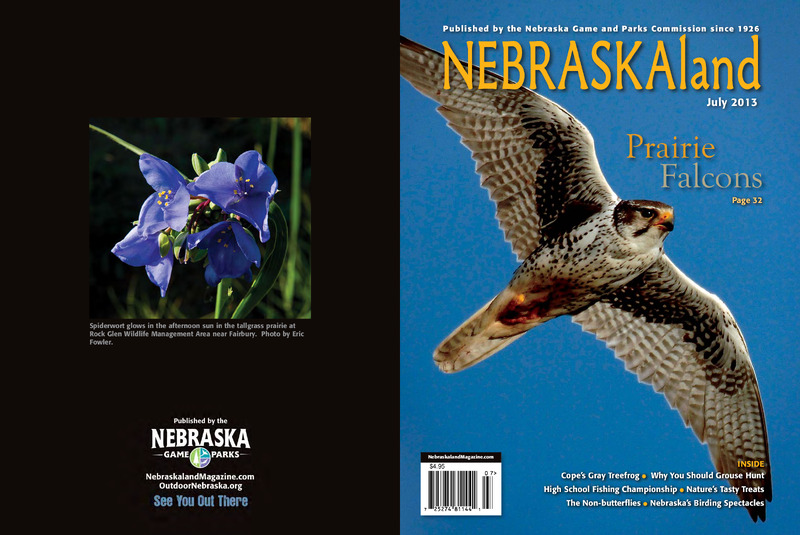
Publis hed by the Nebr a s k a Ga m e a nd Pa r k s C o m m is s ion si nc e 1926
NEBRASKAland
July 2013
Prairie
Falcons
Page 32
Spiderwort glows in the afternoon sun in the tallgrass prairie at
Rock Glen Wildlife Management Area near Fairbury. Photo by Eric
Fowler.
NebraskalandMagazine.com
$4.95
Cope’s Gray Treefrog ●
INSIDE
Why You Should Grouse Hunt
High School Fishing Championship ● Nature’s Tasty Treats
The Non-butterflies ● Nebraska’s Birding Spectacles
NEBRASKAland Magazine
Volume 91
●
No. 6
●
July 2013
F EAT U R ES . . .
14 My New Favorite Place
TEXT BY LINDSEY CHIZINSKI, PHOTOS BY DINA BARTA
18 Wild Gooseberries and Currants
BY GERRY STEINAUER
20 It’s in Their Hands Now
TEXT AND PHOTOS BY JEFF KURRUS
14
●
26 Cope’s Gray Treefrog
BY OLIVIA JOHNSON, PHOTOS BY DAN FOGELL
28 It Takes a Village to Raise a Shooter
BY JENNY NGUYEN
32 Prairie Falcons
26
●
TEXT AND PHOTO BY MICHAEL FORSBERG
34 The Non-butterflies
TEXT AND PHOTOS BY CHRIS HELZER
38 Where, How, and Why You Should Hunt Prairie Grouse
BY ERIC FOWLER AND JEFF KURRUS
40 The Birds
38
●
BY PASQUALE MINGARELLI
D EPARTM EN T S . . .
Comment .........................................................4
Mixed Bag.......................................................6
In the Field ....................................................44
Junior Journal................................................45
Classifieds .....................................................46
Portraits from the Past ..................................48
Page 49..........................................................49
The Last Stop ................................................50
O N T H E W EB . . .
Earth Home
BY JODI KEISNER
A writer remembers growing up in the most peculiar
of homes – an underground earth home. Visit
NebraskalandMagazine.com to read this essay.
2 NEBRASKALAND • JULY 2013
34
●
18
●
40
●
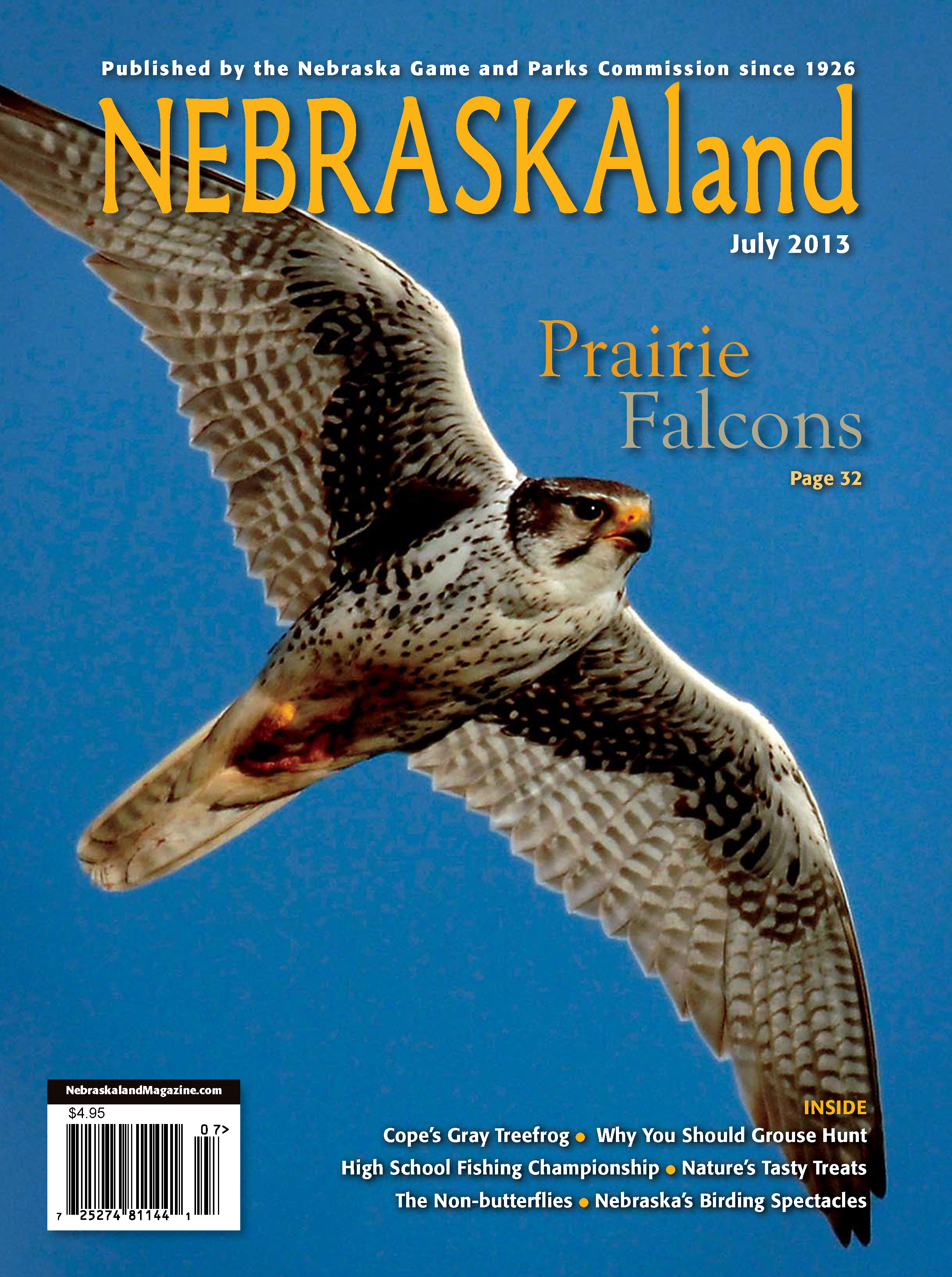
Cover: A prairie falcon (Falco mexicanus) is a medium-sized falcon of western
North America. It is about the size of a crow with a wingspan of about 16 inches.
Opposite: A lone violinist contributes musical flavor to the Saturday Farmer’s
Market in downtown Lincoln. Photo by Bill Hager.
NEBRASKAland (VOL. 91 / NO. 6, ISSN 0028-1964) is published monthly, except for the
combined Jan./Feb. and Aug./Sept. issues, by the Nebraska Game and Parks Commission, 2200
N. 33rd St., Lincoln, NE. Periodicals postage paid at Lincoln, Nebraska, and additional mailing
offices. POSTMASTER: Send address changes to NEBRASKAland, P.O. Box 30370, Lincoln, NE
68503-0370.
JULY 2013 • NEBRASKALAND 3
Thanks again for a great issue.
Ron Decker
Spokane Valley, Washington
One of your better camouflage
placements! Jaci would not even realize
she had a chinch type bug (Lygaeidae
family) on her bow! (page 38) I did not
catch it the first time through.
Ron Macomber,
via e-mail
The Best Hunt Of My Life
It has nothing to do with the size of
the head, but the reward of the hunt. I
have more than one nice deer hanging
on the wall, but nothing compares
to the joy of being with my 10-year
old grandson getting his first deer. It
started with his shock and awe after
hitting the water-filled milk jug at 60
yards with the very first shot from his
rifle. The ferociousness with which the
jug blew up built up his confidence
in the ability to hit where he aimed
and also emphasized the destructive
abilities of his gun.
Following that was the time spent
building a lifelong bond in the blind
and the climax, a yearling doe at 100
yards, when our adrenaline peaked.
I told my grandson this was a lot
further than what we practiced. Like a
seasoned veteran he said, “Grampa, I
can get him.”
With the rifle resting solidly, he
took careful aim and pulled the trigger.
The next instant, that moment of a
lifetime that can never be recreated or
duplicated now showed on the boy’s
face – a look of disbelief, surprise,
excitement, joy and pride as the deer
dropped on the spot.
We bumped knuckles, high-fived
and hugged. Never pulling the trigger
myself, it was already the most
successful deer season I have ever had,
starting with the most memorable and
best hunt of my life.
Doug Reznicek,
Rising City, Nebraska
Arrival Of Cranes
Living in Kearney my wife and
I look forward to the arrival of the
4 NEBRASKALAND • JULY 2013
cranes. We drive miles of roads
“craning” and hoping for the elusive
whooper. Haven’t seen one yet!
Took this photo by a sand pit SW
of Gibbon along I-80. Cranes, white
fronts and Canada’s visiting about the
flights ahead.
Jim Shuey
Kearney, Nebraska
Questions For God
Hello to all at NEBRASKAland,
I wanted to take a moment to write
a note of thanks to Jeff Kurrus for his
article “Questions for God.” It struck
a particularly sensitive chord with me
today. This morning we learned that a
friend of ours had lost her battle with
cancer. She was barely 37 years old
and the mother of two boys, too young
to be dealing with feelings their family
has had to face today. Later today I
had a conversation with another friend
whose pre-school age daughter is dying
of a brain tumor, similar I suppose to
Cayden’s. They are doing everything
they can to keep her comfortable and
share as much “life” as they can with
her in the days they have left together.
A day of too many questions.
I didn’t expect therapy when I
opened my mailbox tonight to find my
NEBRASKAland Magazine, but when
I got to page 49 that is what I found. I
commend Jeff for having the courage
to put such intimate feelings down and
sharing them with so many. The depth
of his thought and use of his words
made it easy to see the struggles that
his mind has had with one of life’s
most difficult situations. His empathy
was genuine. Anyway, his paragraphs
created a bit of a refuge where I could
let my emotional guard down a bit and
just feel better knowing someone else
has some of the same questions for
God. Today I thank him for sharing
that with me.
Andrew Bahl
Monett, Missouri
NEBRASKAland Visitor Letters
We want to thank all 38 readers
who sent e-mails and letters for last
issue’s visitor, a tarnished plant bug,
that was on page 38. See page 13 for
the winner, rules and this issue’s hint.
“Life on Soapsuds Row” was
different and very good. The visitor is
a beetle found on page 38 on the young
lady’s bow. Good issue.
Al Rose
Colorado Springs, Colorado
Paul Pack, of Lexington, photographed
this squirrel in Lexington.
Great concealment! I am not sure
what it is, but looks like what we kids
used to call a stink bug. Enjoyed the
life on soapsuds row article. What
a hard life that would have been. I
complain when my wife wants me
to carry the laundry down the stairs.
You may have seen this small
brownish insect hiding on the plants
in your garden or around your house;
it is the tarnished plant bug (Lygus
lineolaris) in the order Hemiptera,
identifiable by the crossed wings and
piercing-sucking mouthparts. The
bug overwinters as an adult, hiding
in leaf litter and vegetation. When
temperatures begin to warm in the
spring, they emerge to feed and mate.
Eggs are laid, hatch and nymphs
emerge. These nymphs will feed and
grow, going through several instars
before maturity. This bug goes through
incomplete metamorphosis, meaning
there is no pupal stage – nymphs
look like small adults, appearing a
bit more mature with each molting.
Adults are up to one-quarter inch in
length, brown with mottling of white,
black, yellow and red. Nymphs are
mostly green. There are roughly
three generations a year in
Nebraska.
Special thanks to Julie Van Meter, State
Entomologist, Nebraska Department of
Agriculture. Visitor image by Chris Helzer.
www.bugguide.net is a good site for identification
Send your comments to:
Jeff Kurrus, Editor
NEBRASKAland Magazine
P.O. Box 30370
Lincoln, NE 68503
or e-mail Jeff.Kurrus@Nebraska.gov
Please include your postal address and
telephone number.
Letters may be condensed and edited
for clarity. Photographs are welcome
and will be returned.
Any program that receives federal funding from the National Park
Service, or the United States Fish and Wildlife Service prohibits unlawful
discrimination on the basis of race, color, religion, age, gender, marital
status, national origin, age, disability or political affiliation. Any person
who believes he or she has been discriminated against in any program,
activity, facility, or service, should contact the Nebraska Game and
Parks Commission, Lincoln, NE 402-471-0641, the Equal Opportunity
Commission, Lincoln, NE 402-471-2024, TTY/TDD 402-471-4693;
United States Fish Wildlife Service, Civil Rights Coordinator, 4401
N. Fairfax Drive, Arlington, VA 22203; Director, Equal Opportunity
Program, U.S. Department of Interior, National Park Service, 1849 C
Street NW, Mail Code 0008, Washington, D.C. 20240-0001.
COMMISSIONERS
CONSERVATION OFFICERS
Director Jim Douglas
NORTHWEST
Officer
City
Jim Zimmerman (S) Gering
Commissioners
Chairman - Norris Marshall, Kearney
Vice Chairman - Lynn Berggren, Broken Bow
2nd Vice Chairman - Jerrod Burke, Curtis
Dr. Mark Pinkerton, Wilber
Dr. Kent Forney, Lincoln
Rex Fisher, Omaha
Mark Spurgin, Paxton
Mick Jensen, Blair
Ron Stave, Waterloo
MAGAZINE STAFF
Editor Jeff Kurrus
Art Director Tim Reigert
Regional Editors Eric Fowler, Julie Geiser,
Justin Haag, Jenny Nguyen
Contributing Editor Michael Forsberg
Regular Contributors Bill Hager, Chris Helzer,
Lisa Knopp
Photo Librarian Sarah Johnson
Circulation Donna Robinson
For address changes and questions about
your subscription, e-mail Donna.Robinson@
Nebraska.gov or call 800-632-5263
Advertising
For advertising information contact
Donna Robinson, Circulation
Phone: 402-471-5490
E-mail: ngpc.ads@nebraska.gov
NEBRASKAland Magazine Copyright 2013, all rights reserved.
NEBRASKAland is available in audio from the Nebraska Library
Commission Talking Book and Braille Service, Suite 120, 1200 N St.,
Lincoln, NE 68508. 800-742-7691. NEBRASKAland Magazine and the
Nebraska Game and Parks Commission reserve the right to reject any
advertising not in keeping with the agency mission.
Rates: $18 for one year; $33 for two years; $44 for three years. Nebraska
recipients must add appropriate sales tax. To subscribe call
1-800-NEBLAND (632-5263), or go online to: NebraskalandMagazine.
com.
COMMISSION
C
COM
OM
OMM
MIS
ISSIO
SIION O
SI
OFFICES
F CES
FFI
FF
ES
S
Headquarters/Southeast District Office
2200 N. 33rd Street Lincoln, NE 68503
Phone 402-471-0641
Northeast District Office
2201 N. 13th St. Norfolk, NE 68701
Phone 402-370-3374
Southwest District Office
301 E. State Farm Rd. North Platte, NE 69101
Phone 308-535-8025
Northwest District Office
East Hwy. 2, Box 725 Alliance, NE 69301
Phone 308-763-2940
Bassett Office
524 Panzer St., Box 508 Bassett, NE 68714
Phone 402-684-2921
Kearney Office
1617 First Ave. Kearney, NE 68847
Phone 308-865-5310
Omaha Office
1212 Bob Gibson Blvd. Omaha, NE 68108
Phone 402-595-2144
Greg Hesse
Scott Brandt
Heath Packett
Dan Kling
Frank Miller
Phone (308)
(office) 763-2940
(cell) 641-6138
Alliance
760-3647
Gering
631-0663
Gordon
360-0682
Harrison
430-0572
Valentine 402-389-0444
SOUTHWEST
Officer
City
Phone (308)
Roger Thompson (S) N. Platte (office) 535-8025
(cell) 530-3097
Ray Dierking
Brkn. Bow
870-0322
George Sund
Cambridge
655-0028
Michael Thome
Cozad
529-8146
Terry Brentzel
Doniphan 402-469-5795
Matt Andrews
Elwood
746-2418
Dirk Greene
Imperial
882-0015
Dale Johnson
Kearney
440-3847
Brian Piernicky
McCook
340-6627
Brandon O’Neal
N. Platte
778-7486
Nicholas Fix
Ogallala
289-0427
Bryce Streger
Ogallala
289-1169
Rich Routh
Rep. City
920-0367
NORTHEAST
Officer
City
Tom Zimmer (Sup.) Norfolk
Dale Davis
Steve Oberg
Daniel Roberts
Randy Pomplun
Jeff Jones
Jon Reeves
Tim Williams
Pat George
Doug Pollard
Alex Frohberg
Cory Krause
Phone (402)
(office) 370-3374
(cell) 649-8053
Bassett
760-0712
Columbus
910-3366
Fremont
719-1108
Fullerton
308-550-0489
Hartington
762-5022
Kennard
889-8508
Neligh
929-0051
O’Neill
340-0787
Ord
308-778-7101
Ponca
241-7615
West Point
380-6410
SOUTHEAST
Officer
Levi Krause (Sup.)
Sean McKeehan
William Krause
Mike Luben
Dan Zuehlke
Darin Gress
Douglas Kramer
Dina Barta
Stacey Lewton
Dudley Sorensen
Robert Finke
Russell Mort
Dan Evasco
Rich Berggren
City
Louisville
Bridgeport
Auburn
Colon
Cortland
Hebron
Lincoln
Lincoln
Lincoln
Lincoln
Milford
Nebr. City
Papillion
Waterloo
ADMINISTRATION
Officer
Craig Stover (Adm.)
Duane Arp (Ass.)
Jeff Clauson (Ass.)
City
Lincoln
Lincoln
Lincoln
Phone (402)
949-0593
308-279-9133
274-8063
443-6392
806-9084
768-8665
890-6465
890-6463
890-7140
937-3422
947-1363
209-1506
616-5961
619-1355
Phone (402)
471-5531
471-5532
471-0480
Nebraska Wildlife Crimestoppers 1-800-742-7627
Ak-Sar-Ben Aquarium
21502 W. Highway 31 Gretna, NE 68028
Phone 402-332-3901
JULY 2013 • NEBRASKALAND 5
Fourth of July Destination: Seward
Send Us Your Trail Cam Photos!
A Look Back – July 1996
By Olivia Johnson
n her article “Why Nebraska?”
(July 1996, pages 32-41),
Audrey Hulburd, an artist from
California, took us on a visual
journey across small town
Nebraska in the 1996 issue of
NEBRASKAland. After time spent
as a tour guide, she discovered
that the friendliest people she
encountered were all proud
Nebraskans.
The curious artist set out on her
journey to draw, paint and see
what Nebraska’s small towns had
to offer. Her illustrations depicted
her travels through Valentine,
Minatare, Gordon, Auburn,
Crawford and Neligh, to name a
few. Some of her artwork included
a depiction of main street in
Valentine, a feedlot near Minatare
and the Crawford Livestock
Market.
“With new technology, people
can live somewhere based on the
quality of life, not on how close
they’ll be to a big-city market,”
she states. “Maybe it is a sense
of belonging, having an identity
or being connected.” Her artwork
makes it clear that as an outsider,
the only way to really experience
small town Nebraska is to see it
firsthand.
I
PHOTO BY BOB GRIER
By Olivia Johnson
Growing up within 20 miles of Seward, I
always took for granted being able to celebrate
Independence Day in “America’s Small Town
Fourth of July City” each year. Seward was
simply where my family celebrated the holiday,
and it wasn’t until I got older that I realized
how significant this celebration, put on by the
town of just over 6,000, was.
This year Seward celebrates its 145th annual
“old fashioned, small town celebration.” The
event typically draws 40,000 visitors, with the
day’s events starting early in the morning and
not slowing down until everyone gets settled
in at their favorite viewing spot for the big
fireworks show at around 10 p.m.
Depending how early you want to begin your
day, there are plenty of events to keep both
locals and visitors occupied. Some of the most
notable include craft, art and classic car shows, a pet parade and contest, concerts,
quilt exhibits, a wild-west shootout, patriotic programs, historic exhibits, various
food choices and a large parade.
When the sun sets and the giant firework salute begins, spectators gather in and
around Plum Creek Park to see the show, and they’re never disappointed as the
assortment of pyrotechnics illuminates the sky in front of them.
So grab your family, friends, some sunglasses, a few lawn chairs and head to
Seward. It’s well worth the trip and you won’t be disappointed. Take my word for
it – I’m a local. ■
Dave Schwartz of Aurora was fortunate enough to capture this
owl photo near Elm Creek. He thought it lucky to get a fairly
decent picture that is not blurred with a trail camera.
Please submit your trail camera photos by e-mail to:
nebtrailcam@gmail.com. Also include where you’re from and
any information that will help explain your photo.
6 NEBRASKALAND • JULY 2013
JULY 2013 • NEBRASKALAND 7
In the Weeds
By the OutdoorU Staff
Some of us may find late summer a tough time to fish
shorelines for bass because of all the aquatic vegetation
snagging our lures. But this vegetation is usually chock-full
of aggressive, hungry bass. An excellent way to target these
bass is by using top-water frogs, a weedless frog-shaped
lure you can easily pull over and through any vegetation.
If you’ve never fished with them before, you’ll find the
lure works best with a fairly stiff rod (medium or medium
heavy) and braided line that doesn’t stretch. Cast into any
thick cover, including moss beds, cattails, bulrushes and
logs. Close does not cut it.
If you are fishing from a boat, cast the frog onto the bank
and “hop” it into the water. If you’re fishing from the shore,
work your frog through the weeds. A good retrieve usually
entails pulling the frog a few feet and then pausing before
the next pull, simulating the motion of a swimming frog.
The key is to pause when the frog is over an opening in the
vegetation. Often bass will follow the frog as you reel it
through the thick vegetation, waiting until the lure is in an
opening to attack, so be prepared. The strike will be Jawslike.
Once the fish strikes, give a very firm hook set to drive
the bait’s weedless hooks through the fish’s mouth. Then,
as the fish tries to head deep into the vegetation, keep your
line tight to maximize your chances of landing the fish.
Visit OutdoorU.org and start your own pathway to
exciting and memorable experiences in the outdoors. Get
outside and see what the Nebraska Outdoors has for you. ■
by Olivia Johnson
Nebraska City
PHOTO BY JEFF KURRUS
It All Stays Here
Jeff Kurrus
The first question that usually arises following an auction is the commonsense one: where
does all the money go? For the Nebraska Big Game Society (NBGS) and its April 2013
annual meeting, the question was no different – especially when the prize of the night, a
Nebraska bull elk permit, was purchased by Lincoln resident John Jacobson for $21,000.
“It all stays in Nebraska,” said NBGS administrator Jon Thomas, “as does all the
other money we raise.” The “we” are the 25 members who pay dues each year to the
NBGS as well as the annual meeting attendees, this year 150 people, who participated
in a silent and live auction for any number of outdoor-related items and trips, raising
more than $40,000 that goes directly to our state’s big game resources.
The NBGS, in collaboration with the Commission and the Nebraska Environmental
Trust, have installed watering systems for bighorn sheep, elk and white-tailed and mule
deer in needed areas in the western part of the state. In addition, the NBGS has worked
with the Nebraska Land Trust on conservation easements on private land to ensure
these tracts remain undeveloped in perpetuity, and provided scholarship opportunities to
students in the wildlife management program at Chadron State College. Along with other
conservation groups, NBGS has also supported Commission capture and research efforts
with bighorn sheep and elk this past year. And these are just the beginning.
With the goals of education and scientific research, the NBGS will continue to work
with the Commission and other organizations to ensure the future of Nebraska’s big
game herds. “The NBGS has worked closely with us on wildlife conservation projects
with excellent results,” said Commission Northwest District Manager Todd Nordeen.
It is a relationship that hunters and wildlife viewers throughout the state should hope
continues.
For more information on the NBGS, visit NeBigGame.org. ■
JULY 2013 • NEBRASKALAND 9
PH
PHO
PHOT
HO O BY
HOT
HO
BY ERI
ERIC F
FO
OWLER
WLER
WLE
LER
LE
ER
8 NEBRASKALAND • JULY 2013
SON
PHOTOS BY NATE JOHN
Bursting with history and natural
allure, Nebraska City’s unique charm is
not duplicated by any other community
in the state. Although well known for its
annual AppleJack Festival in September,
a trip to this river city offers numerous
other attractions that make it an ideal destination on a summer day.
Start by visiting Janie’s Confections for a cup of coffee and a
homemade cinnamon roll. Then head to Kimmel Orchard and
Vineyard to pick some fresh fruit, including apples, cherries, peaches,
raspberries and plums on their 90 acres.
Lodge, former
Next, check out one of the most famous and historic sites in the city – Arbor
n, cross the road
mansio
the
through
tour
your
After
home of J. Sterling Morton, founder of Arbor Day.
the
While
.
families
to visit Arbor Day Farm, a great destination for
kids check out the 50-foot high tree house, grab a glass of handcrafted wine made on the farm.
Two additional stops should be the historic Mayhew Cabin and
John Brown’s Cave, two famous parts of the
Underground Railroad that are recognized
today by the National Park Service.
As the day heats up head for
some indoor sites. Visit the Kregel
Windmill Factory Museum,
which just opened in April.
Also, don’t forget the
Nebraska City Museum
of Firefighting to learn
about the evolution of
firefighting and safety.
When you’re ready to
slow down and grab a
bite to eat, give Johnny’s
Corner Café a try, and be
sure to order one of their specialties, the
chicken noodle soup, which is a slightly
different, homemade twist on this classic.
Finish your trip with a stroll
through Steinhart Park to
enjoy one of the pillars of
Nebraska City — arboreal
beauty.
Though Joe was traveling by automobile, he deposited his postcard in a
Railway Post Office car at a train depot, either in Long Pine or somewhere along the way to Chadron. He
was mistaken about the town name—distracted, perhaps, by the many adventures of early auto travel. ■
What You Should Read
10 NEBRASKALAND • JULY 2013
Brian
B
i Kudym
K d
off Papillion
P illi
with
i h a channel
h
l catfish
fi h caught
h at T
Two Rivers
Ri
State Recreation Area Lake No. 4 near the swim beach.
The Cooler Way to
Keep Minnows
By Justin Haag
While trying to keep
minnows alive
aboard my kayak a few years ago, I
discovered that I needed something
other than the bulky trolling bucket
that had served me well aboard larger
vessels.
After a search of the Internet
message boards, I found a simple design
featuring a soft-sided cooler and a portable
aerator. I wish I could credit the designer, but
that information has since been lost in the deep
seas of cyberspace.
If you’re shopping for a cooler to create a bait tank such as mine, you will
want to find a model with a hard plastic insert that holds water and at least
one large storage pocket. The only work required on my model was drilling a
hole near the top of the insert. After slipping the aerator pump in the pocket
and running the air hose through the hole, I was ready to fish.
Complete with a shoulder strap, my cooler has proved to be a convenient
set-up, both when fishing from the kayak and hiking along the bank. It even
came with a removable plastic divider suitable for separating various baits –
minnows and leeches, for example. A couple of frozen water bottles floating
in the tank keep bait swimming right-side-up during a day’s outing.
Of course, some kayak fishermen have become much more elaborate
with their bait storage set-ups. A number of designs, both custom and mass
produced, employ a pump and plumbing to circulate water through the bait
tank from below the kayak.
While those systems certainly look attractive, I’ve found that my cooler
conveniently keeps minnows frisky on summer afternoons for a fraction of the
cost. With the large number of coolers on the market, an angler is sure to land
a model that suits his needs. ■
More Than Fishing
PHOTO BY JUSTIN HAAG
Jeff Kurrus
I want to learn something
when I read, regardless of
what I read. I also want my
author to be writing about
something they know about.
With Steven Rinella’s Meat
Eater, I get both. The subtitle,
Adventures from the Life of
an American Hunter, doesn’t tell
ell the whole story
story.
Along with his tales from the field, Rinella also
provides historical and biological information on
the species he encounters, practical how-to’s and
reflective thoughts and opinions that keep the
pages turning.
But the main reason to spend a few hours with
this book is that you’ll trust him. He’s hunted
turkeys in Montana, squirrels in Michigan, and
everything in between – and his descriptions ring
true during each outdoor venture.
Overall, this book is a welcome surprise for
any hunter who’s had more than shooting on their
mind while afield. ■
Mighty oaks from little
acorn grows, the saying
goes, but how mighty?
Oak trees can grow more
than 80 feet tall with
a trunk diameter to six
feet in a life that could span
more than 300 years. All from
an acorn
weighing
less than
a quarter
ounce. ■
PHOTO BY ERIC FOWLER
Dear sister—
Well how did you like your trip. hope you got there O.K. well we are on the
way to the Black hills the post card shows the place where we are camping its in
Pineridge Nebr. we only made about 200 miles today had two flat tires already
and also got caught in the rain but we shure are having a good time. Walter has
his accordion with him that makes it nice. will write more later Joe
NEBRASKA STATE HISTO
RICAL SOCIETY
David Bristow, Nebraska History Magazine
Long Pine, Nebraska, became a tourist
destination in 1910 with the founding of
Long Pine Amusement Park, later known as
Nebraska’s Hidden Paradise. Long Pine State
Recreation Area (SRA) is adjacent to town,
and Keller Park SRA is nine miles north.
Some travelers bought picture postcards to
commemorate their visit. The Nebraska State
Historical Society has a number of these in its
collections; others circulate through antique
shops and online merchants.
In 1907, the U.S. Postal Service began
allowing personal messages on the address side of postcards.
This was the beginning of “divided back” postcards, and their brief and
sometimes pithy messages can make the back of the card as interesting as the
picture side.
Postmarked August 16, 1927, by the Omaha & Chadron R.P.O. (Railway Post
Office), this card is addressed to Frances Froenel, Mt. Angel, Oregon:
PH
HOT
HOT
OTO BY
B JEF
JEF
FF KURRUS
KURRUS
RUS
S
The Mighty Acorn
A Brief History – Long Pine Postcard
At NEBRASKAland, we’re always
looking for new reasons to visit our
parks. It’s not very tough when
there are so many activities at
each. Here are just a few:
• Two Rivers State Recreation
Area - At Lake No. 4, the family
can play at the beach while you catch
channel catfish within feet of sand
castles. Or, you can lounge lakeside
while your little one reels in a nice
eater for dinner.
• Fort Robinson State Park - There
is no charge to borrow backpacks from
the activity center containing helpful
tools and field guides for exploring
the park’s 22,000 acres with your
children. The binoculars inside the
packs will bring the park’s bison,
longhorns, pronghorn, deer, grouse
and bighorn sheep within better view,
while a magnifying glass and insect net
are helpful for studying some of the
smaller creatures.
• Lake McConaughy - For a real
thrill, experience spectacular views
500 feet above the water with Big Mac
Parasailing at Martin Bay, then calm
down at 17 Ranch Winery in Lewellen
with walls adorned with turn-of-thecentury photos. Finish the day in front
of a campfire on the beach without a
care in the world. ■
JULY 2013 • NEBRASKALAND 11
Running in the Shade
Jeff Kurrus
In July, with Nebraska temperatures climbing in the 90’s, runners will often
seek tree-covered paths instead of pounding pavement. Therefore, here are a few
canopied routes in the Platte and Missouri River bluffs to try:
• Eugene T. Mahoney State Park - Running through 7 miles of trails, much within
view of the Platte River, can provide seclusion close to the city.
• Indian Cave State Park - There are 22 miles of trails with climbs for even the
most seasoned runners.
• Platte River State Park - While less extensive and vertical than Indian Cave,
Platte River’s trails offer a waterfall and challenging loops through 10 miles also
popular with cyclists.
• Ponca State Park - Similar to Indian Cave, runners will be challenged with
steep climbs along 20 miles of connected trails.
• Schramm State Recreation Area - Schramm’s gentle hills over 3 miles of trail
are a welcome relief to the midday sun.
Runners, we need your feedback. This list focuses on eastern Nebraska, but
we’d love to hear about your favorite wooded trail runs across the state. Email me
at Jeff.Kurrus@Nebraska.gov with your submissions. ■
by Jerry Kane
Contact the Nebraska Game and Parks Commission at 402-4710641 or visit OutdoorNebraska.org for more information. Visit
HuntSafeNebraska.org for a list of hunter education classes
and BoatSafeNebraska.org for a list of boating safety classes.
Archery fishing of game fish
is allowed statewide through
December 31
July 1
Underwater spearfishing of
game fish allowed in specific
waters through December 31
July 1-14
Paddlefish snagging permit
application period
July 2-4
Wildlife Art Show
Fort Robinson State Park
(SP), Crawford, 308-665-2900
July 4
Independence Day
All Commission district
offices and service centers
closed
July 4
Fourth of July Barbecue
Fort Robinson SP, Crawford,
12 p.m. 308-665-2900
July 7-12
Outdoor Skills
Extreme Hunting and
Fishing Camp, State 4-H
Camp, Halsey, 4h.unl.edu/
web/4hcamps/summercamp
July 8
Pistol League
Platte River SP, Louisville,
402-234-2217
July 8
Big Game Hunting Permits
Remaining permits on sale at
1 p.m. Central Time
July 13
Bighorn Sheep Hike
July 9
Family Fishing Night
Wildcat Hills Nature Center,
Gering, 308-436-3777
Johnson Lake, Fremont,
6-8 p.m.
July 13
Keep Keith County
Beautiful Beach Cleanup
July 10
Family Fishing Night
Lake McConaughy SRA,
Holmes Lake, Lincoln, 6-8 p.m. Ogallala, 308-284-8800
July 10
Beyond Becoming an
Outdoors-Woman
Rifle and muzzleloader class,
Platte River SP, Louisville, 6-9
p.m., christy.christiansen@
Fort Kearny State Historical
park (SHP), Kearney, 308-865- nebraska.gov or 402-471-5547
5305
July 11
July 4, 6
Living History
July 5
Super Tag Lottery
Final day hunters can enter
the lottery for $25. Visit
OutdoorNebraska.org to
enter.
July 6
Buffalo Cookout
Family Fishing Night
Lake Halleck, Papillion,
6-8 p.m.
July 12
National Park Service
Campground Program,
Niobrara SP, Niobrara,
7 p.m., 402-857-3373
Niobrara SP, Niobrara, 6 p.m., July 12
402-857-3373
Hobie Fleet 61 Regatta
Lake McConaughy State
July 6
Recreation Area (SRA),
National Park Service
Outdoor Event, Niobrara SP, Ogallala, 308-284-8800
Niobrara, all day,
July 12
402-857-3373
Stargazing
July 13
First Shots Workshop
July 23
Family Fishing Night
Bowling Lake, Lincoln, 6-8 p.m.
July 24
Beyond Becoming an
Outdoors-Woman
Rifle and muzzleloader class,
Platte River SP, Louisville, 6-9
p.m., christy.christiansen@
nebraska.gov or 402-471-5547
Platte River SP, Louisville, 6-9 July 24
p.m., christy.christiansen@
Family Fishing Night
nebraska.gov or 402-471-5547 Benson Park Pond, Omaha,
6-8 p.m.
July 14-20
Outdoor Skills Camp
July 26
Eastern 4-H Center,
Gretna, http://4h.unl.edu/
web/4hcamps/summercamp
Nebraska Game and Parks
Board of Commissioners
meeting, 2200 N. 33rd St.,
Lincoln, 8 a.m.
July 16
Family Fishing Night
Skyview Lake, Norfolk,
6-8 p.m.
July 17
Beyond Becoming an
Outdoors-Woman
Rifle and muzzleloader class,
Platte River SP, Louisville, 6-9
p.m., christy.christiansen@
nebraska.gov or 402-471-5547
July 17
Family Fishing Night
July 26
National Park Service
Campground Program,
Niobrara SP, Niobrara,
7 p.m., 402-857-3373
July 27
Nebraska State
High School Fishing
Tournament
Harlan County Reservoir,
Alma, 7 a.m.-1 p.m.,
402-471-5447
Pawnee Park East Pond,
Columbus, 6-8 p.m.
July 29
Kites and Castles
July 12-14
Fur Trade Days
July 19-21
Beyond Becoming an
Outdoors-Woman
Lake McConaughy SRA,
Ogallala, all day, 308-284-8800
Final Day of Promotion
Chadron SP, Chadron,
308-432-6167
Kayaking trip, Niobrara SP,
Niobrara, 402-857-3373
July 7
Sidewalk Chalk Art
July 13
Buffalo Cookout
July 20
Buffalo Cookout
July 6-7
Living History
Fort Atkinson SHP, Fort
Calhoun, 402-468-5611
July 7
Fish for Millions
Niobrara SP, Niobrara,
10 a.m., 402-857-3373
12 NEBRASKALAND • JULY 2013
Eugene T. Mahoney SP,
Ashland, dusk-11 p.m.,
402-944-2523
Niobrara SP, Niobrara,
6 p.m., 402-857-3373
July 31
Beyond Becoming an
Outdoors-Woman
Rifle and muzzleloader class,
Platte River SP, Louisville, 6-9
Niobrara SP, Niobrara, 6 p.m., p.m., christy.christiansen@
nebraska.gov or 402-471-5547
402-857-3373
NEBRASKAland Visitor
Winner and Hint
PHOTO BY JEFF KURRUS
July 1
Wildcat Weekend Series
Justin Haag
The Wildcat Hills Nature Center south of Gering is giving
nature lovers unique opportunities to experience the outdoors
during its Wildcat Weekend series.
Four events remain in the popular series of events.
Participants will have the opportunity to see bighorn sheep duringg a hike at 9
a.m. July 13. On August 10, people are encouraged to gather for an astronomy
program at 8:30 p.m., which will be highlighted by the Perseids meteor shower.
On September 14 at 9 a.m., the topic will turn to the birds, as participants will
hike to learn about the avian life of the area. The final event in the series will
be the “Howl in the Hills Night Hike” on October 26 at 7:30 p.m., in which
participants will learn about the “creatures that go bump in the night.”
The events are free and open to the public. A valid park permit is required for
vehicles entering the area. ■
Last issue’s winner of
the Visitor drawing
was Shirley Condon of
Lincoln, Nebraska, who found the
tarnished plant bug on page 38.
Readers are encouraged to contact
NEBRASKAland within 10 days
after this issue’s publication with the
correct page number and name of
this issue’s “Visitor” – a bug found
in Nebraska that just happened to
find its way onto one of the pages.
We will then gather the correct
entries and draw one to win a
NEBRASKAland Magazine mug.
To enter each month, write:
NEBRASKAland Visitor
2200 North 33rd Street,
Lincoln, NE 68503.
Or e-mail:
Tim.Reigert@Nebraska.gov
with “Visitor” in the subject line of
the message.
HINT: This issue’s visitor is not
on page 3, 5, 7, 34, 35, 36, 37 or 47.
JULY 2013 • NEBRASKALAND 13
B E C O M I N G
A N
O U T D O O R S - W O M A N
Mary Snowdon of
Niobrara paddles to join
the other kayakers who
stopped for a break
along the bluffs of the
Missouri River.
Kayaking Near Niobrara State Park
By Lindsey Chizinski, Photos by Dina Barta
D
espite being born and raised
in eastern Nebraska, I saw
little of the state until I had
opportunities to travel it as
a student researcher with
the University of Nebraska and as a
participant in the annual Bike Ride
Across Nebraska. With both experiences
I discovered areas that are now my
favorite places to be, but somehow in
my travels I missed Niobrara State Park
(SP). The park, established in 1930, is
located just outside the town of Niobrara
near the northeast edge of the Sandhills
at the confluence of the Niobrara and
Missouri rivers. Last summer I visited
for the first time on a bike and returned
for a second trip with a kayak. With
both trips, my list of Nebraska favorites
lengthened.
A bicycle tour of the Sandhills with
friends and family led our group to
Niobrara SP, where we spent the night
in the primitive campgrounds on the
bluffs overlooking both rivers. Our
secluded campsite was tranquil, and the
view was breathtaking. It was ideal for
our small group of weary travelers.
Just two weeks later I returned to
the park for the annual Becoming an
Outdoors-Woman (BOW) kayaking
trip on the Missouri River. During
this trip, 28 women tent camped in the
park’s modern campground, where
Angel Hecht of Wamego, Kansas, gets caught up in the fray as kayakers regroup in a
backwater on the Niobrara River.
14 NEBRASKALAND • JULY 2013
shade trees and cool breezes from the
river countered 100-degree heat. The
campground was an ideal spot for a
large group outing, still scenic but not
as secluded.
Participants from across the state,
Iowa and Kansas gathered to meet new
friends, enjoy the beauty of northeastern
Nebraska and challenge themselves
on the water. Though we all had very
different backgrounds and skill levels
as kayakers, we shared enthusiasm and
a sense of community as we paddled
together and told our stories. Several
ladies are avid outdoorswomen and
shared tales that varied from hunting
turkey to running long-distance on
gravel roads. A mother of four shared
her adventures of home schooling
her children. A nurse told her tale of
conquering a battle with cancer that led
to a new life of archery, motorcycles,
tattoos and, of course, kayaking. Along
with other biologists and naturalists,
I met a runway model, a journalist, a
farmer and even a belly dancer.
The annual kayak trip is coordinated
by Dina Barta, a Nebraska Game and
Parks Commission conservation officer
of 21 years and a native of Niobrara.
Barta’s love of her hometown is
evident every time she speaks of it.
When I posted photos on Facebook
of our bicycle tour to the area, Barta
excitedly commented on every photo
that contained a landmark of her youth.
She started the kayak trip five years
ago because she wanted to share her
home and heritage with other women.
JULY 2013 • NEBRASKALAND 15
W E
K E P T
O U R
But she hasn’t done it alone. Along
with Suzanne Ridder of the Parks
Division, other Commission staff and
local friends, a planning group mapped
the course on the ever-changing waters
of the rivers. Recent years of flood
and drought have required the group to
chart a different path each year.
Last year’s route on the Niobrara
started at the Mormon Canal Bridge
over Highway 12. We paddled about 6
miles to the boat ramp at Bazile Creek
Wildlife Management Area (WMA).
Because of the drought, the water
was shallow, and at times our kayaks
E Y E S
P E E L E D
F O R
B A L D
E A G L E S ,
A N D
A T E
C O W B O Y
C A S S E R O L E
beached. No one minded hopping into
the relatively cool water to get past
those stretches, and we had a friendly
competition to find the deeper channels
that allowed passage. I discovered
paddling a kayak through the reeds
at the confluence of the two rivers
was my favorite place to be in the
sweltering summer heat. With sunblock
slathered on and drinking water stowed
at my feet, the heat didn’t even register.
It has become a BOW kayak trip
tradition to eat at Ole’s after the first
day of kayaking, so after a shower that
evening we headed into Niobrara for a
Above: Commission staff and BOW participants pause for a group photo after having lunch on the banks of the Missouri River.
Below: Carly Salak of Lincoln cools off during a water fight with another kayaker.
Author Lindsey Chizinski of Lincoln takes a break from paddling to chat with a friend.
16 NEBRASKALAND • JULY 2013
sirloin steak – a perfect post-paddle
meal. After dinner, some of us wandered
next door to the laundromat, which also
houses a small thrift shop. I picked up
some gingham curtains that now hang in
my kitchen and are a cheery reminder of
my time in Niobrara.
To beat the heat, we got an early
start on day two. Shortly after sunrise
we arrived at the Sunshine Bottoms
Missouri River boat ramp, about
45 minutes northwest of the park,
and unloaded our kayaks. Although
significant improvements to the area
were recently completed through the
Commission’s Angler Access Program,
Sunshine Bottoms still showed evidence
of damage from the 2011 flood.
Watermarks several feet high were very
visible on the trees in the parking lot.
Once on the river, we alternated
between lazy floats downstream in
a chain of kayaks connected with
our paddles or feet and fast-paced
races where we tested and honed our
paddling skills. We kept our eyes
peeled for bald eagles, and hollered
greetings to folks who waved from
their docks. We even shared lunch
with a kayaking duo we encountered
in the middle of their several-day trek.
After nearly 15 miles, we took out
at a private residence near the Verdel
Landing WMA boat ramp in the early
afternoon.
Before heading back to camp, the
Blue Moon Resort welcomed us with
air conditioning and cold beverages.
Then Mark Rettig, Niobrara SP’s
superintendent, hosted a buffalo
cookout at the group lodge where we
were treated to a historical reenactment
by Cherrie Beam-Clarke with the
Nebraska Humanities Program. BeamClarke told stories in the voice of an
Irish settler about Nebraska life in
the mid-1800s. We closed the night
back at camp, sharing our own stories
around the picnic table, this time with
a second dinner of cowboy casserole
and chocolate cake prepared
in a Dutch oven by
Commission staff.
Several of us agreed
while talking during
our second dinner of
the evening, which we definitely earned
after a long day of paddling, that being
on the river allowed us to visualize what
this country must have looked like in
its native, unsettled beauty. It was
spectacular. We all understood
why Barta wants to share her
heritage, and felt lucky to be a
part of it. I occasionally hear
from native and out-of-state
acquaintances that Nebraska
doesn’t offer much. Those who
believe this must be missing
the places like Niobrara
SP and the small, thriving
communities that
neighbor them.
I challenge
anyone to
maintain
that opinion after a day or two spent
paddling the rivers, camping under pine
trees in the park and visiting the local
haunts of Niobrara. ■
To learn more about
Nebraska’s Becoming an
Outdoors-Woman Program,
visit OutdoorNebraska.org
or call 402-471-5482.
JULY 2013 • NEBRASKALAND 17
Wild Gooseberries
and Currants
Nature’s Tasty Treats
By Gerry Steinauer, botanist
W
A BUFFALO CURRANT IN FLOWER at Valentine National Wildlife Refuge in Cherry County.
require adding commercial pectin. Only
the sweet, ripe, black to purple-black
currants are eaten fresh or cooked.
As a child in the 1930s, Young picked
wild Missouri gooseberries from a prairie
remnant on her family’s acreage near
Lincoln to satisfy her father’s love of
gooseberry pie. “For Dad, all good days
started with a slice of gooseberry pie for
breakfast,” said Young. She still visits
an often fruit-laden gooseberry bush in
woods near Lincoln when she is not
using berries from transplanted bushes in
her own backyard.
Missouri gooseberry and buffalo
and American black currant plants
are also commercially available.
They are easily established, make an
attractive ornamental and wildlife
relish their fruits. Young recommends
planting them in well-drained, sunny
locations and frequently watering. She,
however, prefers to grow wild Missouri
gooseberries, which are more resistant
to the mildews that can plaque domestic
varieties. In flavor and cooking
characteristics, Young finds the fruits
of wild gooseberries and currants and
garden varieties similar. Both make
tasty treats, either fresh off the bush or
cooked. ■
Traditional Gooseberry Pie
From Kay Young’s Wild Seasons
Pastry for a
2-crust 9-inch pie
3 cups under
ripe (green)
gooseberries
1½ cups
granulated sugar
3 tbs. quickcooking tapioca
½ tsp. salt
2 tbs. butter or
margarine
Roll out the
pastry and arrange
the bottom crust in the pie pan; set aside.
In a medium pot, crush 1 cup of the gooseberries. Stir in the sugar,
tapioca, and salt, then set this aside for about 5 minutes to allow the
tapioca to soften in the gooseberry juice. Cook, stirring constantly,
until the mixture thickens.
Put the remaining gooseberries into the pie shell and pour the
thickened filling over them. Scatter pieces of margarine or butter over
the surface, then place the top crust over all and seal the edges. Make
a 2-inch slit in the top crust to allow steam to escape during baking.
Bake at 450 degrees for 10 minutes, reduce the temperature to 350
degrees and bake about 30 minutes longer or until the crust is lightly
browned. Makes 6 to 8 servings. If possible, serve slightly warm.
JULY 2013 • NEBRASKALAND 19
PHOTO BY GERRY STEINAUER
18 NEBRASKALAND • JULY 2013
PHOTO BY JON FARRAR
SHUTTERSTOCK
hen I was a kid, my uncle Bill once picked a pail of the underside of the leaves, regularly grows in low woods and
wild gooseberries from woods in Pawnee County. sloughs nearly statewide.
All our Ribes berries are edible, though some are more so
Clueless what to do with them, he gave them to
my mother. She baked them into what was probably a very than others. Kay Young, Nebraska’s foremost connoisseur
good gooseberry pie, but I did not care for it. It was too tart of wild plants and author of Wild Seasons – Gathering and
for my tastes. Of all the possible gifts our candy store-owning Cooking Wild Plants of the Great Plains favors buffalo
currant berries as our tastiest and
uncle might furnish – he brought
juiciest, ranking them just above
bitter fruit.
the American black currant berries
My next encounter with
in flavor. Whereas, gooseberries
gooseberry pie occurred about
can be a bit sour even when ripe,
20 years later when my brother
though still tasty.
brought one to Thanksgiving dinner.
For Plains Indian tribes and
Hesitantly, I tried it, and to my
early white settlers, gooseberries
surprise, found it delicious; and my
and currants, along with wild
now adult tastes have since craved
strawberries, plums, chokecherries,
this delicacy.
serviceberries and raspberries,
North American gooseberries and
were the only available fruit.
currants belong to the genus Ribes
Indians enjoyed gooseberries and
and are similar in characteristics,
currants fresh, cooked, juiced or
except gooseberry stems have spines
dried. Some tribes used currants,
and prickles, whereas currant stems
along with larger amounts of
are unarmed. Six Ribes species are
chokecherries and serviceberries,
native to Nebraska. These shrubs
in pemmican – a winter staple
grow up to six feet tall and have
of dried and pounded meat and
alternate, roundish leaves with three GOOSEBERRIES are delightful in
berries to which melted buffalo
to five palmate lobes. The fragrant preserves and pies.
fat was added. They sometimes
flowers, hanging in clusters or singly
among the leaves, bloom April through June with showy petals cooked Ribes leaves with meat and dried the leaves for tea.
white, green, yellow or pinkish in color. The fruits, a globe- Settlers ate gooseberries and currants fresh, preserved and
shaped, fleshy berry, appear July through September and ripen cooked into flavorful pies, jellies and jams. In the 1960s,
to hues of black, purple or red, with the withered flower often while gathering information for her book, Young interviewed
many direct descendants of settlers. They commonly told how
persisting at the tip.
Hairy-stem gooseberry (R. hirtellum) and northern their parents underutilized the abundant gooseberries for want
gooseberry (R. oxyacanthoides) grow only in northwestern of costly sugar to sweeten the fruits for cooking.
Young’s book includes savory recipes for ripe and under
Nebraska and are uncommon in our state. Missouri gooseberry
(R. missouriense), our most abundant and widespread ripe gooseberry jelly; buffalo currant jelly, jam and syrup;
gooseberry, is found in low, open woods and grasslands over traditional and custard gooseberry pie and buffalo currant pie
the eastern half of the state. Wax currant (R. cereum), with among others. Missouri gooseberry fruits, generally larger
leaves that emit a spicy-citrus odor when rubbed and become than currant fruits, can be used in cooking either ripe, under
waxy with age (hence the name), inhabits dry gravelly slopes ripe or in combination. When using under ripe fruits, she
and canyons in the Panhandle. Buffalo or golden currant (R. recommends choosing large, light green berries (at first, the
odoratum), with yellow cinnamon- and clove-scented flowers, berries are small and dark green, then enlarge and fade to
is common on hillsides and woodland edges, often on sandy light green before ripening to a purple-black). For jelly, the
soils, over the western two-thirds of Nebraska. American under ripe berries are often preferred because they contain
black currant (R. americanum), with golden resinous dots on sufficient pectin to jell on their own, whereas ripe berries
It’s in Their Hands Now
Text and photos by Jeff Kurrus
Corbin Baumfalk
of North Platte
concentrates while
fishing the state
championship.
The future of fishing can be seen on Nebraska’s waters
as teenagers compete in the annual high school fishing
state championship.
Zach Madsen (left) and Matt
Neiburg of Blair gear up before
winning the 2012 Nebraska
High School Fishing State
Championship at Summit Lake
State Recreation Area.
Boat captain Kent Priel
assists competitor
Dijon Roberts, both
of North Platte, with
a largemouth bass
from Summit Lake that
helped Roberts and
teammate Tel Pyzer to a
fourth-place finish.
20 NEBRASKALAND • JULY 2013
Camron Armstrong laughs with
daughter, Ashley, while taking a
break during 2012 tournament
action at Summit Lake.
JULY 2013 • NEBRASKALAND 21
Andrew Phelps (left) and Connor Pudenz
from Papillion enjoy a moment before the
start of the 2012 tournament.
T
o know a great bass angler when you see one,
you need to watch one thing – their hands. Sure,
lure selection, fishing location and technique are
paramount to catching fish, but the hands are
where the money is. Watching someone slightly
twitch a topwater lure to create just the right
amount of action, or navigate a crankbait through
a stump bed with subtle hesitations during their
retrieve, or even know the difference between the
feel of their soft plastic lure hitting a blade of
22 NEBRASKALAND • JULY 2013
may be enough to win. A nice fish finally came,
a largemouth weighing nearly three pounds and
good enough to put them in fourth place in the
tourney.
Meanwhile, Drey Urbanovsky, of Lincoln, and
Ian Malmstrom, of Roca, caught bass after bass
on the lake’s east side, but few were large enough
for the tourney’s 15-inch minimum. It was nearly
impossible not to root for them as well, for each
fish garnered an excited hook strike, a fierce grab
of the net and then a temporary sigh as another
fish under 15 inches came to the boat. They
finished in second place.
But these weren’t the only teams to watch. It was
easy to cheer for 2011 state champion Adam Diehl
and partner Ashley Armstrong from North Platte
and the list of other competitors as they navigated
Summit’s waters on a day when the lake was being
a bit stingy with its fish. Only seven of 16 teams
caught keeper bass.
grass and a fish picking it up is what separates
those who are average and those who are really
good.
But what happens when everyone on the water
seemingly has these skills? Then you have one of
Nebraska’s most intriguing outdoor competitions
and spectator events – the Nebraska High
School Fishing State Championship. Last year,
the tournament was held at Summit Lake State
Recreation Area near Tekamah, and 16 two-
person teams competed in a seven-hour, five-fish
limit format for prizes, bragging rights and a spot
in the regional tournament that summer at Lake
Dardanelle, Arkansas. The competitors did not
disappoint.
One of these teams was Dijon Roberts and Tel
Pyzer of North Platte, who spent the majority
of their time fishing underwater structure in the
lake’s south arm, flipping weedless plastics into
underwater timber knowing that one big fish
Drey Urbanovsky (left) of Lincoln, partner Ian Malmstrom of
Roca and boat captain Ryan Pashby of Lincoln release a fish
into Summit Lake on their way to a second place finish.
JULY 2013 • NEBRASKALAND 23
O
ne team did find some answers on the
water that morning using crankbaits near
underwater structure: Zach Madsen and
Matt Neiburg of Blair weighed in 9.01
pounds for their five-fish limit and won by
more than three pounds. But they weren’t
done. Following in the footsteps of 2011
state champions Adam Diehl and Drew
Bailey, Madsen and Neiburg won the
regional tournament at Lake Dardanelle
in Russellville, Arkansas. Their last effort
was a fourth-place finish in the national
championship at Beaver Lake in Rogers,
Arkansas.
Later this month at Harlan County Lake,
teams will again compete for the Nebraska
state championship and a spot in the regional
tournament at Lake Texoma in Pottsboro,
Texas on October 5, with anglers from
Arkansas, Kansas, Louisiana, Missouri, New
Mexico, Oklahoma and Texas. If history has
anything to do with it, Nebraska’s winner will
be one to contend with later this year. But
they’ll have to win here first – which will be
no small task. ■
Adam Diehl of North Platte, the 2011 state and regional champion, fell
short in his attempt to regain the Nebraska title in 2012.
All fish caught at the Nebraska High School Fishing State Championship are released by the competitors, as seen here by 2012
winners Neiburg and Madsen.
This Year’s Tourney
Where to Start?
The Third Annual Nebraska High
School Fishing State Championship
is July 27 at Harlan County Lake.
Each two-person team, with a nonfishing adult coach on board, will
fish from 7 a.m. to 1 p.m., with a
weigh-in to follow.
The Nebraska Game and Parks
Commission does not charge
to participate or attend the
tournament, but all anglers 16
years or older must have a current
Nebraska fishing permit. There is
a $25 per student fee collected by
the Bass Federation Student Angler
Federation.
For more information, including
instructions on how to register, visit
FishingNebraska.wordpress.com.
In the pages of NEBRASKAland Magazine, we talk
a lot about bobber fishing when introducing kids
to the water. While this remains a solid tactic to
getting your youngster fishing, my fishing career
began a bit differently.
My earliest memory of fishing is with a
baitcasting reel in-hand, working out my latest
backlash so I could attempt another cast to a spot
near the bank – not just any spot, but a specific
spot that my dad had told me held fish. Because
like fishing Nebraska’s farm ponds, bass fishing in
Mississippi ponds is all about hitting your spots
time and time again.
As I learned how to throw my lure exactly where
I wanted it, I was also encouraged to fish a variety
of lures. I went through my “worm man” phase, a
nickname bestowed by dad and my cousin, Mike,
another frequent weekend companion on the
water. Then I transitioned to crankbaits because
24 NEBRASKALAND • JULY 2013
I could fish water fast, then to
spinnerbaits because of how fast
I could fish water at a variety of
depths during a single cast. Then
came Carolina-rigging plastic
worms, slow-rolling spinnerbaits
and dancing a fluke across the
water’s surface.
By being able to experiment
with more experienced anglers in the boat, and
eventually fishing with my friends and even by
myself on ponds and then larger lakes, I developed
a skill from both learned and applied knowledge –
all of which was recorded in journal records I hold
to this day.
Not once is there mention of a bobber in these
journals, again showing that there’s more than
one way to introduce a kid to fishing and create a
lifetime passion at the same time.
JULY 2013 • NEBRASKALAND 25
Cope’s Gray Treefrog
By Olivia Johnson
Photos by Dan Fogell
This little herp is becoming more prevalent in
Nebraska – especially in the southeast.
W
hen one thinks of
treefrogs, the mind
usually wanders
to an exotic place such as
a rainforest. But, as many
southeastern Nebraskans have
noticed, we have a treefrog
species dwelling in our own
backyard. The Cope’s gray
treefrog (Hyla
chrysoscelis), also known as the
western gray treefrog, calls
a wide and growing area of
Nebraska its home.
Although the name says
it’s gray, this frog can also be
found in a variety of other
colors, including green, brown,
and white, according
Large toe pads help
identify this diminutive
fellow.
26 NEBRASKALAND • JULY 2013
The Cope’s gray treefrog’s range in
Nebraska is primarily in the east with
scattered occurrences in Lincoln, Knox,
and Hall counties. Westward expansion
will increase as trees continue to line
waterways.
to herpetologist Dan Fogell:
“Temperature calls for color
changes, but a recognition
of background can also
cause the change.
It’s also possible for
these frogs to have
a pattern that
changes or goes
away.”
Like any
treefrog, the
Cope’s lives only
in ecosystems
where water is
available, such as near lakes
and ponds. It can also carry
out its breeding in temporary
pools of water.
They’re found primarily in
southeastern Nebraska,
including the following
locations:
Louisville State
Recreation Area
(SRA), Schramm
Park SRA, Two
Rivers SRA,
Schilling Wildlife
Management Area, Fontenelle
Forest, and Hummel Park in
Omaha.
“We’ve also found them
along the South Dakota border
in Knox County, and also as
far west as North Platte,” said
Fogell. “Trees along the rivers
are now very dense compared
to past history, and continuous
riparian forest means
continuous treefrog habitat.”
In these areas, they can often
be found clinging to windows
and doors on homes in the
evening or early morning.
One of the most limiting
factors of the Cope’s distribution
is spring breeding habitat.
Tadpoles hatch in late-April
and early May, and they must
have a relatively constant pool
of water for about two months
while they morph into frogs.
Those hoping to spot a
Cope’s gray treefrog should
be on the lookout during the
spring and summer months.
They can be seen hopping
around late summer and early
fall. Once fall sets in, however,
the frogs will bury themselves
for the winter.
“The Cope’s is one of only
a few species that have a
natural antifreeze component
in its tissues that prevents it
from freezing solid during long
bouts of cold and freezing
temperatures,” said Fogell.
It’s just one more reason to
look for this fascinating frog
whose range continues to
expand in Nebraska. ■
The Cope’s gray treefrog
starts life as an egg laid on
the surface of a shallow pond
or other small body of water.
The tadpole (top left) is born
about five days later and
morphs (top right) into an
adult at about 45-65 days of
age, at which point it moves
to nearby trees and shrubs
to feed on various insects,
mostly at night (above).
Adults gather to breed
(below) in the springtime,
with the males grouping
together as they call (right) to
attract females. Eggs are laid
in batches of 10 to 40, and
the life cycle begins anew.
JULY 2013 • NEBRASKALAND 27
It Takes a Village to Raise a Shooter
The Eric Wiebe Memorial Shooting Compl
Complex
lex
By Jenny Nguyen
I
n late 2009, the Nebraska Game and Parks
Commission lost mentor, friend, and dedicated
Conservation Officer Eric Wiebe to cancer. In
addition to being well-known in the Ponca region
for his active role in hunter education, mentored
hunts and the shooting sports, Wiebe was one of the
founding members of Ponca
State Park’s widely popular
Missouri River Outdoor Expo.
At the Expo, Wiebe was a
key figure in developing the
event’s “Shooter’s Village.”
His legacy will live on in the
village that now carries his
name.
Wiebe’s family donated
$5,000 to improve and
expand the existing shooter’s
complex at Ponca in 2010.
Park staff then launched a fundraising campaign that raised
more than $60,000 for the project, which was dedicated
as the Eric Wiebe Shooting Complex on May 19, 2012
to honor his contributions to the park and surrounding
community. Construction of the two-year project was
completed entirely by Commission staff and community
volunteers.
“He helped develop the shooting range for the Expo,” said
Park Superintendent Jeff Fields. “So when he passed away,
we thought it would be a great thing to improve on that – he
always talked about adding permanent shooting pavilions
and storage buildings to further formalize the area.”
The Shooting Complex
The shooting complex features covered ranges, including
an eight-station archery pavilion; an archery range with
3D targets of anything from elk and bighorn sheep to frogs
and dinosaurs; two shotgun ranges including a beginner’s
Boy Scout Troop 430 from Omaha passes under the
Eric Wiebe Shooting Complex memorial sign.
PHO
PHOT
P
H
HOT
O OB
BY
Y JJE
JEN
EN
E
NNY
NY NGU
GUY
GUYE
UYE
U
YEN
YE
28 NEBRASKALAND • JULY 2013
JULY 2013 • NEBRASKALAND 29
New Developments
Aside from Lincoln Shooting Park, two other shooting
complexes are also opening in the coming months.
Wildcat Hills State Recreation Area: Slated for completion
in 2014, the new shooting facility will complement many of
the area’s existing Nature Center programs. Currently in its
design phase, the new range will allow novice shooters to
learn how to shoot .22-cal. rifles, trap sporting clays, air rifles
and archery.
Osage Wildlife Management Area: Scheduled to be
completed this summer, Osage will offer hunters a shooting
range to sight-in their rifles.
Focus on Novice
Shooters
and have them walk away having experienced all aspects of
being able to do shooting activities and being excited about
it. And with that location, they go back out there and do it
again.”
In addition to hosting visitors from all over Nebraska and
neighboring states, the complex also receives newcomers from
other countries. Superintendent Jeff Fields recalled teaching a
group of 20 from India. “They were young couples, and both
the females and the males shot. We had a language barrier,
so it was interesting to teach beginners shotgun without being
able to communicate verbally,” said Fields.
To maintain the safety of all park-goers, no outside
firearms are allowed at the Eric Wiebe Shooting Complex.
Firearms, ammunition and equipment are all provided by
the park at minimal fees. “All ranges except archery are
open to shooting during scheduled times only,” explained
Fields. “During these scheduled times, everything is done by
us. The range is open, but we are also there instructing and
maintaining range safety, too. If people have shot before, we
just help to make sure they are doing the right thing.”
The Future for
Shooting Ranges
Nebraskans can soon expect more shooting ranges like
Ponca’s to open across state. The Commission’s shooting
range plan includes the need for “more development of
educational shooting facilities as well as rifle ranges for
hunters who need a place to sight-in,” said Jeff Rawlinson.
Not only is the focus on existing state parks, there is a
strong push to develop shooting facilities in more urban
areas, like in Lincoln. The new Lincoln Shooting Park,
expected to debut in the summer of 2014, is being built
“right in the community where people live,” said Rawlinson,
“where kids and families can ride their bikes out to learn
hunting and shooting skills.”
Overseeing many of these projects is the Commission’s
East Region Parks Manager Jim Swenson. Recalling his
boundless shooting experiences as a boy, he said, “Times
have changed, making it difficult for youth to enjoy a
similar experience. At those venues we can provide kids and
The archery range lets shooters practice on targets set at a
variety of distances.
parents with access and opportunity to go and ‘plink,’ while
reinforcing safety and responsibility.”
It’s a scene Eric Wiebe would sure be proud to see. ■
Eric Wiebe Shooting
Complex Project Donors
National Rifle Association
(NRA), Friends of the NRA
(Nebraska, South Dakota
and Iowa chapters), Scheels,
Better Ponca Foundation,
MROE Expo Board,
Nebraska Game and Parks
Commission, Nebraska
Conservation Officers
Association and numerous
private donors from the
community.
PHOTO
PHOT
O BY
B TOM ZIM
ZIMMER
MER
ER
30 NEBRASKALAND • JULY 2013
Staci DaSilva of Sioux City, Iowa, delights in her success on the
shotgun range under the tutelage of Don Andersen.
PHOTO
PHOT
O BY ERI
ER C FO
OWLER
WLER
PHOTO
PHOT
O BY
Y JEN
JENNY
NY NGUYE
NG YEN
N
Ponca’s Assistant Superintendent Jennifer Wolff helps Brogan Jones at the .22 rifle
range. Park staff are always available to teach during scheduled shooting times.
About half of the shooters who
went through Ponca’s shooting
programs last year were either
novices or had never held a gun
before. Most of them were simply
park visitors who wandered in. “A
lot of it is pretty spontaneous. That’s
what we want,” said Fields.
The site also provides both firearm
and bowhunter education classes
to the community, tying in directly
with the Commission’s Recruitment,
Development and Retention (RDR)
Plan, which includes the development
of shooting programs, ranges and
hunting as part of its mission to get
more Nebraskans involved in the
outdoors. According to Commission
Hunter Education Coordinator Jeff
Rawlinson, Ponca’s shooting complex
was designed for just that.
“The families you find at Ponca
aren’t generally the ones that would
want to come out to a club range
or commercial shooting range or
something like that. It’s intimidating.
But at Ponca – a state park – there’s
nothing intimidating about it,” said
Rawlinson. “Park staff members are
continually developing programs to
entice those families, young kids and
schools to come out and go through
programs designed to involve novice
shooters safely and permanently,
PH O B
PHOT
BY
Y ERI
ERIC
C FO
FOWLER
W
WLE
range and a more advanced hunter’s
range; .22-cal. rifle and muzzleloader
shooting pavilions; and an indoor
range with paper targets for pellet
guns. While the archery ranges are
open year-round, all other ranges are
open only during scheduled times in
spring, summer and fall.
This year, plans for a new pellet
gun range are also in the works.
Sponsored by the Nebraska and Iowa
chapters of the Friends of the NRA,
the future outdoor, eight-station
range will provide more opportunities
and elbow room than the existing
structure.
Eric Wiebe
JULY 2013 • NEBRASKALAND 31
Prairie Falcons
Text and photo by Michael Forsberg
O
n the edge of a prairie dog town
in western Nebraska, a prairie
falcon flies low and fast with
its back to the rising sun, contouring
the ground like a stealth fighter until
it zeroes in on its unsuspecting prey.
The force of impact and its long, razorlike talons kill the bird instantly. The
meadowlark didn’t even see it coming.
As the falcon plucks its prize,
a tall and formidable long-billed
curlew suddenly comes on the scene.
Territorial and fierce during nesting
season, the curlew relentlessly dive
bombs and shrieks at the falcon to
drive it away. In return, the falcon
screams back at the curlew with its
shrill kreeeeee, clearly agitated but
reluctant to leave its morning meal.
A moment later the commotion
draws a coyote onto the stage, which
instantly raises a series of alarm calls
from the prairie dogs that are now
on full alert throughout the colony.
Finally, the prairie falcon has had
enough and flies off to its solitary
perch on a nearby butte where
32 NEBRASKALAND • JULY 2013
it started its morning. The only sign
left behind this circle of events are a
few yellow meadowlark feathers in a
tuft of buffalo grass. Such is a typical
summer morning for a prairie falcon on
Nebraska’s high plains.
Falcons are the sports cars of the bird
world. They are compact, acrobatic
and powerful flyers with long, pointed
angular wings, sleek round heads and
dark mustachioed stripes. Their short,
strongly-hooked beaks are specifically
engineered to kill quickly by biting prey
through the neck, and their long, curved,
razor-sharp talons are designed for
holding and knocking down prey. They
are fast and highly skilled predators.
The prairie falcon
(Falco mexicanus)
is one of four falcon
species in Nebraska.
Pale brown above
and mostly white
below, they are only
slightly smaller than
their much rarer kin the peregrine
falcon, and measure between 16 and
20 inches long with a 35- to 43-inch
wingspan. Their harsh “kree-kreekree” call can be heard far across the
grasslands and rimrock country they
call home.
The prairie falcon breeds across the
western half of North America from the
prairie provinces of Canada to northern
Mexico and east to the Great Plains.
The highest nest site was recorded in
Colorado’s Rocky Mountain National
Park near Trail Ridge Road at an
elevation of nearly 11,000 feet.
In Nebraska, the prairie falcon has
breeding populations in the western
Panhandle where lone buttes and rocky
escarpments provide cliff nest sites
in places like the Wildcat Hills, Pine
Ridge, the North Platte River Valley
and the Niobrara breaks near the
Wyoming border.
Prairie falcons also move through
Nebraska each year using the
Great Plains as a migratory pathway,
and sometimes are spotted across the
state. In one satellite telemetry study
focused on seasonal movements of
prairie falcons nesting in southwestern
Idaho, research revealed the birds
moved three times during their annual
cycle between their nesting grounds,
summer hunting grounds in the
Dakotas and western Nebraska, and
wintering grounds in the Southern
Plains. In each case their movements
were dictated by key prey species
including ground squirrels, which were
only seasonally available. In this way,
prairie falcons were relying on and
connecting food webs and landscapes
across thousands of miles throughout
the year.
Wherever they are encountered,
prairie falcons require large tracts of
grassland to hunt the birds and small
rodents that make up the majority of
their prey. These highly tuned aerial
predators can chase down birds on the
wing or come in low just above the
ground using vegetation and terrain to
their advantage to stay hidden until the
last possible moment before attack.
In summer, their diet includes both
birds and mammals. In winter, their
diet shifts mainly to birds because the
majority of rodents become inactive
and wait out much of the winter below
ground.
On nesting grounds, prairie falcons
re-establish pair bonds and often return
to the same territories year after year.
Nest sites are usually south-facing and
are simple scrapes in recessed pockets
of rock on inaccessible ledges on
cliff faces with overhangs that ideally
provide shade during the hottest parts
of the day.
In Nebraska, two to five eggs are
typically laid in April, and young are
hatched in early June. Prairie falcon
mates share nest duties, but most of
the incubation and brooding is done by
the female, which, as in other raptors,
is larger than the male. The male
does most of the hunting and protects
the nesting territory and the airspace
above from intruders. Eggs are hatched
in about 33 days and the chicks are
fledged in about five-and-one half
weeks. Both parents continue to care
for the chicks until they are strong
flyers, and they can remain in the area
with their parents until fall migration.
For the prairie falcon, success at the
nest is closely tied to the abundance of
prey and the quality of habitat where
it resides. Although the chance of a
chick surviving its first year is less than
50 percent for most raptors, those that
do make it to adulthood have a good
chance of living for years to come,
equipped with the finely-honed skills a
raptor needs to survive in the harsh yet
beautiful wide open spaces of the Great
Plains. ■
Michael Forsberg is a professional
nature photographer and contributing
editor to NEBRASKAland. To
see more of Mike’s images, visit
MichaelForsberg.com.
JULY 2013 • NEBRASKALAND 33
“…moths have serious self-esteem issues, and
skulk around – mostly at night – so they can
avoid running into other insects.”
— John Shuey, Director of Conservation Science, Indiana
Field Office, The Nature Conservancy.
Text and photos by Chris Helzer
B
utterflies get all the attention. I suppose that makes
sense. After all, butterflies are big and pretty, float
gracefully through the air and provide a service
to humanity and the world by pollinating flowers.
Right? Moths, on the other hand, are dirt-colored,
fuzzy little bugs that bang themselves into lights all night. Or
so you might think.
In reality, moths and butterflies are more similar than
they are different, and it can be difficult to tell them apart.
Generally speaking, most moths have stout, furry bodies,
drab-colored wings with zigzag or swirled patterns, hold
their wings out to their sides at rest, are active mostly in
the evening or at night and metamorphose inside of silken
cocoons. Butterflies tend to have long, slender and smooth
abdomens, brightly-colored wings that fold behind them
at rest, are active during the day and metamorphose in a
chrysalis. (In addition, moths also tend to have either a
frenulum or jugum linking their forewings and hindwings
together, and superposition eyes instead of the apposition eyes
of butterflies … but everyone knows that, right?)
However, there are plenty of fuzzy, drab-colored butterflies
in the world (most skippers, for example). Butterflies often
bask in the sun with their wings out to the side, and some
(skippers again) hold their wings at rest in ways that make
them resemble moths. Additionally, many moths are actually
very colorful and those species tend to be active during
the day. In fact, in every category listed earlier there are
exceptions. However, in Nebraska, if you see
a moth/butterfly and you want
to know which it is, the
surest clue is to look
at the antennae.
If the antennae
are fuzzy, it’s
a moth. If the
antennae are
smooth with a
small “club” at
the top, it’s a
butterfly.
General Differences Between
Moths and Butterflies
Antennae
Moths
fuzzy
Butterflies
smooth and
clubbed
Bodies
stout/fuzzy
slender and
smooth
Coloration
drab and
camouflaged
colorful
Metamorphose
in a silken
cocoon
in a
chrysalis
Active
at night
during the
day
Resting wing
position
out to the
side
folded
behind
*There are exceptions to almost every one of these.
One of the ironic things about the scant attention paid to
moths is that there are about 10 times more moth species than
butterflies. Worldwide, there are about 160,000 species of
moths compared to only 17,500 species of butterflies. In the
U.S., the difference is even more striking, with only about 750
species of butterflies but at least 11,000 species of moths. No
one knows how many species of moths are in Nebraska, and
few probably care. But they should.
LEFT: A yucca moth is the only pollinator of the yucca, or
soapweed plant.
OPPOSITE: Luna moths on a fence post at Platte River State
Park.
JULY 2013 • NEBRASKALAND 35
LEFT: A tiger moth south of Wood River.
TOP LEFT: Crocus geometer moths mating in Sarpy County.
BELOW LEFT: A sphinx moth on a cottonwood tree.
TOP MIDDLE: A bilobed looper moth on hairy puccoon at a
Platte River prairie.
BOTTOM: A moth caterpillar on pitcher sage at The Nature
Conservancy’s Deer Tract on the Central Platte River.
BOTTOM MIDDLE: A sphinx moth showing the eye spots on its
wings at Niobrara Valley Preserve.
BOTTOM: A cecropia moth in rural Sarpy County.
W
hile moths are largely dismissed by most people,
they contribute to the world in several important
ways. First among those contributions is their
role as pollinators. Flowers that rely on moth
pollination usually have white or pale colored
flowers that reflect moonlight and a strong scent to help attract
moths. These flowers often open in the late afternoon or evening
to be synchronized for nighttime pollination. Many evening
primroses, for example, attract night-flying moths as their primary
pollinators, though they are probably visited by other insects as
well. The story of the strongest relationship between a moth and
a plant, however, is that of the yucca moth. Not only is the yucca
moth the only pollinator for the yucca plant, it actually picks
up the pollen, carries it over to the ovary, and stuffs it inside to
fertilize the flower. Then the moth lays its eggs in the ovary so
the larvae can eat some of the young seeds as they develop.
While pollination is important, the most significant ecological
contributions of moths are made when they are still in their larval
stage. We tend to think of moths as adults, but most of their life
is spent as caterpillars. Those caterpillars are major herbivores
on a wide variety of plants. Some feed on garden plants and are
considered to be pests (e.g., tomato hornworm, codling moth, corn
earworm, cabbage looper). The rest are an important part of the
back and forth battles between wild plants and herbivores that help
keep populations of both in check.
Moth larvae are also a major food source for many other animals.
Because they are soft-bodied, slow moving and full of protein,
they are the perfect prey for a wide variety of creatures, ranging
from birds to ants. If you are a fan of game birds such as quail and
pheasants, you’ve probably heard about the importance of softbodied insects for those young birds. A high proportion of those
soft-bodied insects are moth caterpillars.
Of course, moth larvae don’t just sit around and wait to be eaten.
Many are very well camouflaged in terms of coloration, shape or
both. Inchworms, for example, are moth larvae that often look like
a plant stem, and can be really hard to see when they’re holding
36 NEBRASKALAND • JULY 2013
still. Other moth larvae have loads of long, stiff hairs that help
deter at least some of the smaller predators (such as ants) that
have a hard time getting through those hairs to find something
to bite. Some of those hairy caterpillars, including the whitemarked tussock moth larvae, can even detach their sharp
bristles so that they stick in the mouth of potential predators
– just like little porcupines. Many moth caterpillars also have
chemical defenses that range from merely tasting really bad
to poisons and venoms that can do serious damage to poor
critters looking for a meal.
Adult moths can be adept at avoiding predation as well,
especially in terms of camouflage. There’s a good reason most
moths are not brightly colored. However, my favorite example
of predator avoidance is by adult tiger moths, which can
detect the echolocation signals of bats and take evasive action
to avoid being caught.
Perhaps the most intriguing aspect of moths is that many
species migrate long distances each year. Many moth species
(and butterflies too) can’t survive the winters in Nebraska and
other locations to the north of us. Yet we see those species
every year because they migrate north each spring from
warm southern locations and then breed here in Nebraska.
Sometimes, those moths and butterflies produce multiple
generations here before the winter kills the last of them off.
Migratory moths ride wind currents to get here, but they
don’t just fly up into the air and let the wind carry them where
it will. Scientists have found that moths will wait until wind
conditions are just right before migrating, and that while
riding the wind they can adjust their flight trajectories to go
where they want. That’s pretty impressive for a tiny little
insect with a tiny little brain. There are numerous species of
moths and butterflies that migrate to the state each year, but
the most famous (infamous?) is the army cutworm that can be
a real pest when it shows up in large numbers.
Army cutworms can damage alfalfa, wheat, and other
crops – particularly in the early spring – but may be more
recognizable as adult miller moths that can invade houses
and other buildings in large numbers. Those adult moths are
primarily a nuisance because of their mere presence inside
houses. They don’t eat or reproduce indoors.
Millers aren’t the only moths that can be irritating to have
around. Webbing clothes moths chew holes in our clothes,
and the Indian meal moths eat food right out of our pantries.
However, for every moth species that causes us problems,
there are many more that are innocuous, if not downright
useful to have around.
As pollinators, herbivores, and food sources they play major
roles in the functioning of Nebraska’s ecosystems. You might
not think about them very often, but you’d sure miss them if
they were gone. ■
JULY 2013 • NEBRASKALAND 37
By Eric Fowler and Jeff Kurrus
Because there are so many ways to
hunt grouse, this is an all-ages activity.
You can spend your day walking in the
high dunes of the Sandhills or walk the
shorter hills in the tallgrass prairies of
southeastern Nebraska, or simply place
yourself on a flight line and pass shoot.
What
There are two types of prairie grouse
that can be hunted in Nebraska: the
greater prairie chicken and sharp-
PHOTO BY ROCKY HOFFMANN
Who
tailed grouse. Both species prefer
open, treeless grasslands. Known for
their mating displays in the spring,
neither migrates and both can handle
very harsh winter weather.
Greater prairie chickens are found
in the Sandhills, southwestern and
southeastern
Nebraska.
They prefer
undisturbed,
larger tracts
of native
tallgrass
prairie but
Greater Prairie Chicken
can also
thrive in areas with a mix of planted
grassland and cropland, which is why
conservation reserve program (CRP)
lands often hold birds. In the Sandhills
they are more likely to be in the lush
meadows or in the low hills next to
them.
Sharp-tailed grouse are found in the
Sandhills and Panhandle in Nebraska.
They prefer large unbroken expanses
of short- and
mixed-grass
prairie with
small pockets
of brushy
cover.
When
PHOTO
PHOT
O BY ROC
ROCKY
KY HOFFM
H
HOFFMANN
OFFMANN
OFFM
ANN
I
f you’re not primed for this year’s
prairie grouse season, I know why.
Of all the outdoor activities you
participate in, you’ve bypassed this
one because you don’t know the first
thing about grouse or grouse hunting.
The good thing is, after you spend a
few minutes reading this, you’ll know
enough to get started. Then the real
learning begins.
Sharp-tailed Grouse
The prairie grouse season begins
each year on September 1 and runs
through January 31. Because of the
warmer temperatures that usually
mark the start of the season, hunters
are encouraged to keep their dogs, and
themselves, hydrated as they hunt.
Where
There are two hunting zones for
prairie grouse in Nebraska. In the West
Zone, a small game hunting license
and habitat stamp are required. The
daily bag limit is three grouse and the
possession limit is 12. The majority of
public-land harvest takes places in the
How
Typical gun sizes are 20 to 12 gauge.
If shooting steel shot, use No. 4’s. With
lead, No. 4’s or 6’s will do.
There are many ways to shoot a
grouse, but the main objective is to
learn their daily habits and adjust your
hunting strategies to accommodate
these habits. Here are a few options:
Using a subtle, zig-zag approach
looking for small grass pockets and
wind-protected slopes is a very efficient
way of locating sharp-tailed grouse.
Then, once you do, remember these
spots for similar hunting conditions in
the future.
If you’re hunting in a group, lining
up and walking in a straight line, like
many parties do for pheasants, doesn’t
work well for grouse hunting.
Hunting low grasslands and
meadows for prairie chickens is an
easy walk for old, or very young, legs.
Spread out from your hunting partners
at least 40 yards away and work slowly
at your own pace.
With a lot of scouting, a hunter can
find the flight path between feeding
in cropland and hilltops where they
are roosting and pass shoot birds. This
type of hunt won’t last much more than
an hour, but can give a good start to a
very successful day.
Hunting over homemade decoys
can be successful if a regular flight
line can be found and a hunter has a
backdrop, such as a cedar tree, to place
the decoys so they can be seen. The
more grouse in the area, the increased
chance that birds will come within
shotgun range.
Grouse hunters often walk more than
pheasant hunters, but it’s not a flushing
•
•
•
•
PHOTO BY JEFF KURRUS
Where, How, and Why You
Should Hunt Prairie Grouse
Sandhills on the McKelvie National
Forest, Valentine and Crescent Lake
national wildlife refuges and the
Bessey unit of the Nebraska National
Forest.
In addition, prairie chickens can be
found on Open Fields and Waters lands
in southwestern Nebraska, particularly
in Chase and Lincoln counties, and
around the southwestern reservoirs
including Medicine Creek and Red
Willow. In the Panhandle, sharptails
can be found on Open Fields and
Waters tracts in Sheridan and Dawes
counties, and on National Forest
Service lands in the Pine Ridge and
Oglala National Grassland.
Lastly, wildlife management areas
in the central Nebraska loess hills,
including Davis Creek, Pressey,
Calamus and Sherman Reservoir, have
fair grouse hunting. Wherever you
go in these areas of the state, hunting
pressure is low.
In the West Zone, look for hills
with the best cover and plant variety.
Often the north sides of dunes serve
this purpose because they are more
protected from the summer sun and
hold moisture better. In the Sandhills,
seek high, choppy dunes with denser
grass cover for sharptails. Areas with
plenty of poison ivy, wild rose and
buckbrush are also hotspots, as grouse
relish their berries in fall and winter.
People also hunt the thick-grassed
valleys for prairie chickens in the
Sandhills.
In the East Zone, east of Highway
81, a small game hunting license and
habitat stamp are required, but an
additional, free permit is also needed
that allows the harvest of three prairie
chickens over the entire season. Much
of the harvest comes from areas in
Otoe, Johnson, and Pawnee counties,
namely denser-grassed CRP lands
with ridgetops, and hunting pressure is
minimal.
Mike McDaniel, of Flower Mound, Texas,
smiles after a retrieve of a prairie chicken
by his American water spaniel, Coco, in
Johnson County.
approach. Many of the most successful
hunters have their dogs work close and
do more stalking than walking.
However, regardless of your
approach, with a 20 or 12 gauge in
your hand and a pocket full of steel
No. 6’s or lead 4’s, you really can’t
go wrong. Unless you don’t try grouse
hunting at all. ■
Why
38 NEBRASKALAND • JULY 2013
IMAP LLUSTRATION BY TIM REIGERT
PHOTO BY ERIC FOWLER
Hunting grouse gives the chance to walk native grasslands like those on the Valentine National Wildlife Refuge in the beautiful
Sandhills (pictured), eastern Nebraska’s rare tallgrass prairies and areas of mixed-grass prairie.
Prairie grouse are an underutilized
game species in Nebraska. Compared
with pheasants, bobwhite quail and
mourning dove, grouse rank last on
both overall harvest and number of
hunters. But they can be successfully
hunted with or without a dog using a
variety of tactics.
National forests,
grasslands and
wildlife refuges
Wildlife management
areas and reservoirs
JULY 2013 • NEBRASKALAND 39
THE BIRDS
OMAHA’S VERSION OF A HITCHCOCK CLASSIC
By Pasquale Mingarelli
Thousands of purple martins fly to their
roost near the University of Nebraska
Medical Center Kiewit and Clarkson
towers in midtown Omaha at dusk.
PHOTO BY PASQUALE MINGARELLI
40 NEBRASKALAND • JULY 2013
JULY 2013 • NEBRASKALAND 41
OTHER BIRDING
SPECTACLES
ACROSS THE STATE
“The layer upon layer
of martins overhead
is reminiscent of the
World War II movie
The Memphis Belle’s
depiction of the skies
over Europe filled
with bombers. The
scene is surreal.”
Bald Eagles – In the winter, visit Lake
Ogallala State Recreation Area (SRA), the J-2
hydroelectric plant near Lexington and Gavin’s
Point Dam to view bald eagles.
S
Snow Geese – Primarily in central Nebraska,
snow geese can be seen moving north during
the spring but can be here and gone in a week
depending on weather. In the past Mormon
Island SRA has held thousands of birds.
Prairie chickens at Switzer Ranch near Burwell.
Spectators gather west of the University of Nebraska Medical Center’s Kiewit and
Clarkson towers on 44th and Farnam streets in Omaha to view the purple martin roost.
He then attracts a gray, purple and
white colored female before the two
select a nesting site. The nest will then
be made of mud, grass and twigs where
the female lays two to seven white eggs.
She then incubates the eggs for about
15 days before they hatch. Both parents
feed the chicks a wide variety of flying
insects, including Japanese beetles,
stink bugs and June bugs. Even though
martins are occasionally touted as
natural controllers of mosquitos, they
are not known to eat that insect pest.
The chicks are fledged in about
four weeks’ time. However, they will
continue to depend on their parents for
food and training for an additional two
weeks. Shortly after, the chicks are able
to feed themselves and, in Omaha’s
case, begin to stage before migration.
Unfortunately, gathering at the
Omaha Med Center does not come
without risk for some birds, as some
crash into the tower windows each
year and die. To lessen the possibility
of this the center has put up banners
and placed UV reflective decals in the
windows. Facilities manager Doug
Stringfield also educates facilities staff
about the species.
Education is a good thing. Because
for whatever reason, thousands upon
thousands of birds will be back in
Omaha this summer. So we might as
well learn about them. It will make the
spectacle that much more amazing. ■
PHOTOS
PHOT
OS BY ER
O
RIC
C FOWLE
FOWLE
OW
W R
42 NEBRASKALAND • JULY 2013
Prairie Grouse – April is the best period to
watch these birds boom, but March and May
can also be good. The key to finding them is
picking a nice spring morning with little or no
wind. Grouse can often be heard before they
are seen, so use internet sources to familiarize
yourself with their sounds. There are also several
commercial viewing operations throughout the
state.
PHOTO BY PASQUALE MINGARELLI
hortly before dusk on every
evening from mid-July to midSeptember, purple martins
fill the skies over midtown
Omaha, all converging near
the University of Nebraska
Medical Center’s Kiewit and
Clarkson towers in numbers as large
as 65,000 at their peak in August. The
layer upon layer of martins overhead is
reminiscent of the World War II movie
The Memphis Belle’s depiction of the
skies over Europe filled with bombers.
The scene is surreal.
As the martins circle above birders
and curiosity seekers below watch the
spectacle. Many spectators gather on
the grassy knoll west of the towers on
44th Street, spreading blankets and
lawn chairs with heads tilted upward
to watch North America’s largest
swallow. The birds dive bomb like
missiles just feet above the street as
they make way to their roost. It’s
Omaha’s version of central Nebraska’s
sandhill crane migration each spring,
with thousands of birds filling the air in
all directions.
Joel Jorgensen, nongame bird
program manager for the Nebraska
Game and Parks Commission, says it is
typical for martins to stage at localized
areas, often in cities, before they head
to South America for the winter. He
says it is not clear why the birds have
selected this particular spot. During
May and June they nest in much small
colonies in open areas, often near
water.
The iridescent, bluish purple male
usually arrives in the nesting area first.
Bald eagles at Lake Ogallala SRA.
Snow geese at Mormon Island SRA.
JULY 2013 • NEBRASKALAND 43
junior journal
from NEBRASKAland‛s Trail Tales magazine for kids
Sericea lespedeza
Nebraska’s newest noxious weed.
interesting notes for readers of all ages
By Karie Decker, Mitch Coffin, and Brent Meyer
by Lindsay Rogers and Donna Schimonitz
F
by Kristal Stoner, Nebraska Game and Parks Commission
D
Sericea lespedeza grows in southeastern and south-central
Nebraska, but has the potential to invade grasslands statewide.
Karie Decker is an Assistant Wildlife Division
Administrator for the Nebraska Game and Parks
Commission. Mitch Coffin is the Noxious Weed Program
Manager with the Nebraska Department of Agriculture.
Brent Meyer is the Lancaster County Weed Superintendent.
keep a journal, so they can remember
all the animals they have seen.
A good place to start watching
wildlife is your own backyard or the
park. Look in the trees, under rocks,
in the water and in the grass.
Try watching wildlife during all
seasons. In Nebraska, winter is a
great time to watch birds. You can
see bluegill guarding their nest in
the spring. On a hot summer day,
look for insects such as butterflies.
In the fall, when farmers harvest
corn, deer are much easier to find.
Watch wildlife both day and night.
On summer nights, look for bats
chasing mosquitoes in the evening.
At night, owls are calling and
raccoons are active. At sunrise,
birds start singing.
Watching wildlife is fun and
challenging and is something you can
do anytime, anywhere. Go outside…
watch and listen…what do you find?
A sentinel fox squirrel is perched in a tree to
chatter in alarm of a possible predator.
Summertime Search
Head outside to find these
nature items. When you find
them, check them off the list.
❑ flower blooming
❑ songbird looking for food
❑ squirrel climbing a tree
❑ hawk soaring in the sky
❑ seed, acorn or nut
❑ bat flying in the evening sky
❑ turtle basking in the sun
NATURE CALENDAR
❑ insect under a log
■ Woodland plants bloom: late-March
through June
❑ roly-poly “bug”
■ Fireflies light up the night sky:
June through August
❑ white-tailed deer
■ Watch for birds
carrying food to their
young: all summer long
■ Prairie plants in bloom:
June through September
❑ animal scat (poop)
❑ fish in a pond or lake
❑ anthill with lots of ants
❑ dragonfly
❑ firefly
■ Dragonflies busy laying eggs in
open water: July through August
JULY 2013 • NEBRASKALAND 45
dragonfly and ant photos by ThinkStock
action will prevent the huge cost of controlling large stands
of sericea lespedeza. Making sericea lespedeza a noxious
weed statewide will help county weed authorities educate
landowners on how to identify sericea lespedeza, making
them better prepared to spot new infestations and eliminate
small infestations before they become widespread.
In addition to sericea lespedeza, Nebraska has 11 noxious
weeds: Canada thistle, leafy spurge, musk thistle, plumeless
thistle, purple loosestrife, spotted knapweed, diffuse
knapweed, saltcedar, phragmites, Japanese knotweed, and
giant knotweed. The addition of sericea lespedeza to the
noxious weed list will aid in efforts preventing its spread
beyond southeastern Nebraska.
If you have questions about controlling sericea lespedeza
or any of Nebraska’s noxious weeds, contact a county weed
control superintendent or the Nebraska Department of
Agriculture Noxious Weed Program Manager at
(402) 471-6844. ■
o you see it? It’s right there!
Crouch down and look through
those trees…it’s moving along
the stream!
Have you ever been outside when
suddenly you saw a wild animal? It
is an amazing feeling to see a wild
animal in its natural habitat.
Watching wildlife is easy. Wildlife
lives everywhere! You can find
wildlife in town and in the country, on
land and in the water, flying through
the sky and underground. All you
have to do is slow down and start
paying attention to find wildlife.
You don’t need special equipment
to watch wildlife, just your eyes and
ears and sometimes your nose. A
pair of binoculars is often handy.
Many people like to bring their
cameras along to “capture” the
animals they see with a picture. Field
guides can also be useful when
watching wildlife. Some people like to
photo by Tom Keith
44 NEBRASKALAND • JULY 2013
Watching Wildlife
PHOTO BY ERIC FOWLER
or those unfamiliar with this invasive plant, the name
itself can be difficult. Sericea lespedeza is a perennial
that grows well in grasslands and pastures, as well as
along roadsides and drainage areas. It is mainly found
in southeastern and south-central Nebraska, though it
has the potential to invade grasslands statewide.
The herbarium record shows that sericea lespedeza was
first collected in Richardson County in 1974 but has spread
to 3,000 acres in Nebraska. This woody legume, originally
imported from eastern Asia from the late 1800s through
the mid-1900s, was introduced into the United States for
livestock forage, wildlife food and habitat, and for erosion
control.
As with many invasive species, learning to identify it is half
the battle. The plant grows generally 3 to 4 feet tall and can
be identified by its alternate leaves. Lower leaf surfaces tend
to have short hairs. Stems are straight, slender and grooved,
and can have short hairs. Flowers, which bloom in late
summer, range in color from white to cream to light
yellow.
Sericea lespedeza can be not only challenging to
pronounce, but to get rid of as well. It is an extremely
aggressive invader of open areas. Dense monocultures
of thickets are formed due to its ability to sprout from
root crowns. Established plants will reduce or eliminate
competing native vegetation, impacting native ecosystems
and reducing carrying capacity for livestock (it is not
palatable to most livestock).
A combination of two or more control methods, including
mechanical and chemical, is the best approach
when controlling sericea lespedeza.
Existing infestations spread
rapidly through seed dispersal,
which can be carried
by wildlife, livestock,
contaminated hay,
vehicles and equipment.
Continued monitoring
and follow-up are
essential for
maintaining
and reducing
infestations.
Everyone’s
cooperation
is needed in
spotting and
preventing
new
infestations.
Early
vigilance and
BOOKS/PUBLICATIONS/VIDEOS
SUBCRIBERS: To avoid missing any issues, PLEASE
send address changes to NEBRASKAland Magazine to
Outdoornebraska.ne.gov/nebland/contact/changeaddress.
asp, email donna.robinson@nebraska.gov or contact us
at 800-632-5263.
NEBRASKA WILDFLOWERS. It’s baaack ... ! Out
of print for 21 years, the second edition of Field Guide
to Wildflowers of Nebraska and the Great Plains is
now available. This 6-inch by 91/8-inch paperback is a
must have for anyone interested in learning more about
wildflowers in Nebraska and the Great Plains region and
makes a great gift. To order this publication or to learn
about other great gift ideas, visit NebraskalandGifts.com
or call (800) 742-0056.
EXPLORE NEBRASKA art, history, culture and the
great outdoors with a subscription to Nebraska Life
Magazine. One year (six issues) for $21 or two years
(12 issues) just $38. Phone (800) 777-6159, write us at
206 W Norfolk Ave, Norfolk NE 68702-0819 or visit
www.NebraskaLife.com. Makes a great gift.
“BECOMING AN OUTDOORS-WOMAN” cookbook.
150 pages containing a variety of recipes, including
traditional home cooking along with Dutch oven and wild
game. $9.75 plus $2.50 shipping. Call (402) 471-5482, or
go online to NebraskaBOW.com.
DOGS
of NE, CO, KS and SD’s first and only GRHRCH’s!
Training, puppies and stud dogs available for all levels of
hunt tests and gun dogs. Chris Jobman (308) 249-0707,
www.Flatlanderkennels.com.
FISH/FISHING
GET YOUR FISHING PERMIT online today! Don’t
wait until tomorrow to enjoy Nebraska’s great outdoors
by going fishing with the family. To purchase a permit
from the comfort of your own home, go online to
OutdoorNebraska.org and click on Purchase a Permit
under Licenses and Fees.
FISH FOR SALE. Catfish, largemouth bass, smallmouth
bass, perch, crappie, bluegill, walleye, rainbow trout,
grass carp, minnows. Pleasant Valley Fish Farm, 72645
U.S. Highway 83, McCook, NE 69001. (308) 345-6599.
NEBRASKA LAKE MANAGEMENT. Biological lake
surveys, fish stocking, rough fish control, lake aeration,
algae control, aquatic weed control. Rob Hofpar, Aquatic
Biologist, licensed, insured and qualified. (402) 784-6005
Valparaiso - (888) 850-2460 www.nelakes.net.
CRESCENT LAKE FISHING – Blue Creek Lodge,
located seven miles south of the best panfishing in the
Sandhills of Nebraska. The lodge offers bass boat rentals
for your fishing excursions and a five-star lodge with
additional fishing and hunting on the property. Visit
www.bluecreeklodging.com or call (308) 772-9912.
FOOD/GIFTS/HOME
DUCKDAWG RETRIEVERS - Raising exceptional
yellow and black Labradors. 30 month written health
guarantee. www.duckdawg.com North Platte, NE (308)
534-3659.
PREMIER GUNDOGS TRAINING KENNEL, Inc:
Nebraska state licensed gundog training kennel specializing
in training programs for waterfowl and upland hunting
retrievers, spaniels, pointing Labradors and all gundog
pointing breeds. Dale-Kris Taylor (402) 787-2048, www.
premiergundogs.com.
FLATLANDER KENNELS INC, Scottsbluff, Ne. This
region’s premier full-time retriever training facility for
the serious hunter or AKC and HRC hunt tester. Trainer
HOMEBREWING/BEER AND WINEMAKING.
Fermenter’s Supply, 8410 K Plaza, Suite #10, Omaha,
NE 68127. Phone orders only, (888) 655-2739. Advice
line (402) 593-9171. www.fermenterssupply.com.
GUIDES/OUTFITTERS
CANOE - KAYAK - TUBE RENTALS on the
beautiful Niobrara River with Dryland Aquatics
at Sparks, Nebraska. Your Niobrara River Specialist.
(800) 337-3119. www.drylandaquatics.com, info@
drylandaquatics.com.
VACATIONS/RESORTS
THE OLDE MAIN STREET INN. A historic bed and
breakfast listed in the National Register of Historic Places.
Beautiful dining room with fireplace. Headquarters for
General Nelson Miles, Wounded Knee Incident, 1890-91.
115 Main Street, Chadron, NE 69337 (308) 432-3380.
www.chadron.com/oldemain.
BIG BLUE RANCH & LODGE – Enjoy fishing,
horseback riding, hunting, hiking and birdwatching on
working cattle ranch in southeastern Nebraska. Beautiful
log lodge with fireplaces, kitchens and big covered
porches, overlooks 20 acre lake. www.bigblueranch.com
(402) 865-4335.
BLUE CREEK LODGE - Oshkosh, NE. 13,000-acre
farm and ranch resort. Located by Crescent Lake National
Refuge and State WMA. First-class lodging, fishing and
hunting, boat rentals, waterfowl, upland bird, coyote
and mule deer hunting, family reunions, meetings and
getaways. Visit: www.bluecreeklodging.com or call
(308) 772-9912.
STONE’S COUNTRY CABIN: Open year-round,
minutes from Harlan County Reservoir. Fully furnished
two bedroom, w/d and full kitchen. Families, hunters
and anglers are welcome. (308) 799-4475 or (308)
920-0027. www.harlancountymeatprocessors.com/html/
stones_country_cabin.html
MILL IRON CABINS: Near beautiful Verdigre NE.
Minutes away from the Missouri River, Lewis & Clark
SRA, and Ash Falls Fossil Beds. These fully furnished
cabins w/AC, kitchen, and bedrooms are nestled in
private woodlands. Bird-watching, fossil and arrowhead
hunting are just a hike away. Families, Anglers, Hunters
and other recreationists are welcome. Phone 402-6687488 or facebook.com/Mill.Iron.Cabins.
Classified Rates: 85¢ per word, minimum $15.
Closing: First business day six weeks before issue
date. Classified ads are accepted on a first-come,
first-served, space-available basis. Classified
Ads, NEBRASKAland Magazine, P.O. Box 30370,
Lincoln, NE 68503-0370. Telephone (402) 4715473. Fax: (402) 471-1984. E-mail: ngpc.ads@
5 MONTHS, 10 TOURS, 80 STOPS . . .
WHAT WILL YOUR ADVENTURE BE?
The 2013 Nebraska Passport is your chance to get out and explore
the state, win great prizes and come home with new stories to tell.
What are you waiting for? Create your adventure today.
Get the details at
NebraskaPassport.com.
888-444-1867, DEPT. 3NMP
Nebraska Tourism Commission
46 NEBRASKALAND • JULY 2013
JULY 2013 • NEBRASKALAND 47
Rules of the Last Cast
A good reason not to catch a fish.
By Jeff Kurrus
I
▲ Photos taken near Pilger in 1974. Good old days when pheasant hunting in Nebraska was incredibly good. Pictured from the left are Jack
Meikle from Michigan, my son-in-law Russell Zuroski from Blair, my son Andy Vinckier from Papillion, Pete Feldman from Michigan and
myself, Mick Vinckier, from Papillion. Also hunting with us were Joe Zangaro, a Michigan state patrolman, Bob Murphy from Arkansas, a local
farmer, a western rancher and three other friends.
Birds were taken before noon, not on opening day, with the help of three wonderful springer spaniels and a golden lab.
The six of us had many great days in several Nebraska areas in the mid-1970s. The second photo is of myself, Mick Vinckier, also near
Pilger.
– Mick Vinckier, Papillion, Nebraska
▲
I bought this matted photo at a flea market in
the basement of Pershing Auditorium back in the
1980s when they held them there.
I bought many old Nebraska postcards from a
gentleman who, I assume, must have been local as
he had so many.
On the back is written in pencil “Bear at the
Riverside Park in Omaha.” But these are obviously
wolves.
I seem to remember him saying this must be
from the early 1900s.
I think I see another wolf in the background lying
down just behind the standing wolf.
Here is what I found on the web about the park
back then...
“Almost from the beginning, Riverview Park has
had an association with animals. In 1896, park
officials added a collection of animals to the park.
A moose was bought for $150, a bear for $25 and
fish were moved in for $1.00 (City Planning Dept.,
p. 18). In 1964, the park was leased to the Omaha
Zoological Society as the site for Henry Doorly Zoo.
Text written by Lynn Sullivan, September 2003.”
source: omahapubliclibrary.org
– Joleen Weygint, Lincoln, Nebraska
48 NEBRASKALAND • JULY 2013
any of life’s small amount of hopes and
dreams.
Fish deserve to know when they can
go back to their regular feeding, and
the angler deserves to truly understand
that the joy of fishing isn’t in catching
a fish with every cast. It’s the ever-sobrief amount of quietness when you
first notice, right at nightfall, the beauty
around you. For the last six hours
you’ve been so concentrated on the
next cast that you’ve too often failed
to notice why you’re there in the first
place. Having a last cast allows you to
do that.
For no place is a better one to depart
at the close of a calming, orange day
than water that has turned to glass.
Until that lure is thrown, interrupting
the sheet for ever a moment, a sheet
whose perfect center begins where your
day just ended. ■
PHOTO BY JEFF KURRUS
Send contributions to: Portraits from the Past, NEBRASKAland Magazine, P.O. Box 30370, Lincoln, NE 68503-0370. Or e-mail to
Tim.Reigert@Nebraska.gov. Photos should show people enjoying Nebraska outdoor activities, such as camping, boating, hunting or
fishing, and must have been taken before 1980. We will give priority to unusual photos or activities. When possible, please include a story
about the photograph and identify the people, places and approximate date it was taken. Photos will be returned.
’m not sure when it started,
probably as a small child when Dad
told me that any true fisherman
couldn’t catch a fish on their last
cast. “Why?”
“Because what if you would have
caught one on the next cast?”
The answer seemed simple enough
for him, so it would work for me as
well as a child and now as an adult.
Therefore, I always announce my
forthcoming last cast.
This act allows each fish in the
lake to know that I will soon be
leaving, and, if interested, they should
immediately swim in the direction
of my last effort. If a fish is caught,
or hooked and lost, or even felt, then
another cast is immediately warranted.
But a last cast can also be interrupted
by a gust of wind, blowing the attempt
away from an appropriate fish-holding
spot. It can also be erred when my lure
collects aquatic vegetation on its way
back toward the reel, a fish splashing at
the surface, an improperly timed sneeze
by my boat mate, the buzz of a fly, the
buzz of a mosquito or even the buzz of
a lure zinging a bit too close to my ear.
Because of these possible
distractions, it is permissible to make
multiple “last casts” with multiple
lures, as well as multiple rods – another
good reason why boat lights are a must
for any angler’s vessel. However, if
you’re in a pinch and forced to only
make one last cast, you must do it
perfectly.
There cannot be a backlash or an
entangled set of trebles. The cast must
be the perfect trajectory, in a perfect
spot, using a perfect lure, with a perfect
retrieve. What one wishes all casts in
life could be.
Having announced this cast aloud for
many years, I have seen that this act is
also infectious. “Last one,” “My Final
Attempt,” and so forth has been voiced
by fellow anglers. And if the goal in
life is to leave something to others,
then encouraging a person not to catch
a fish to end the day is just as good as
JULY 2013 • NEBRASKALAND 49
The Renaissance Man
In a farmer’s field just north of Western, Nebraska, an abandoned Russell #2 sawmill sat defeated. It hadn’t cut a thing
since WWII. Sensing the coast was clear, a Chinese elm had grown up defiantly through the blades, and prairie grasses had
conspired to hide all three tons of frame from the world, as if waiting for the right person to come along.
To Wilfred DeVries, this was the stuff of dreams.
He was born in 1933, to a Cortland carpenter. They built houses together. They both loved wood, and spoke of owning a
sawmill someday.
In the Depression, you made do with what you had, and nobody had much. Houses and barns were recycled right down to
the nails. Machines were run to exhaustion, then saved for their pieces, each of which was studied, organized and used again.
Understanding the value of parts is crucial when you’re a Renaissance Man.
And so that rusting pile of iron became a pleasure for Wilfred to resurrect. In 1991 he pried it away from the Earth, towed
it home, and started in. He poured new Babbitt bearings out of lead and tin. He filled in missing teeth on the original 52-inch
blade. He sandblasted its cast iron frame with the heart-shaped pattern, then painted it fire engine red. It only took two years
to run his first log.
Since then, that old mill has never refused a tree, cutting nearly every species Nebraska has offer. Maple, hackberry and
linden all run through just fine with help from a salvaged Caterpillar engine brought in to help turn the belts.
There have been a few unpleasant surprises though, mainly because some trees know how to keep their secrets. A bullet
lodged in a cottonwood broke off one blade tooth. A glass insulator in a ponderosa pine took a few more. The worst was a
horse shoe concealed in the limb of a red oak. That one stopped the blade cold, but not for long. Nothing that couldn’t be
fixed, Wilfred assured. And besides, it’s all worth it.
Wife Audrey now has a room adorned with ¾-inch paneling of walnut, American elm and white ash. Son Clark milled
foot-wide pin oak beams to hold up his porch. Daughter Anne used mulberry and creek willow to
trim her new house. Son Charles made an osage orange base for a vintage school bell, and a canon.
Wilfred is 79 now, with hair the color of a late-winter snow. He’s had one knee, a hip and a
shoulder replaced with modern joints made of metal and plastic, all on the right side. He’ll do the
other side if he lives long enough.
Of course, he’s already made plans for what happens when he’s not around to run the sawmill
anymore.
He’s giving his body to medical science, of course, so they can study the parts.
“That’s really gonna be fun,” he grins. “But what will they do with all that hardware?”
Joel Sartore
December 10, 2012
50 NEBRASKALAND • JULY 2013
JULY 2013 • NEBRASKALAND 51
Position: 853 (10 views)