Volume 90, Issue 8, 2012
October 2012
- Identifier:
- nela.2012_090_08
- Title:
- Volume 90, Issue 8, 2012
- Issue Name:
- October 2012
- Date Issued:
- 2012-10-01
- year:
- 2012
- month:
- October
- Season:
- Autumn
- PDF filename:
- NL_90.08_2012_Oct_Spreads_Entire.pdf
- Publisher:
- Nebraska Game and Parks Commission
- Format:
- Periodical
- volume:
- 090
- issue:
- 08
- number:
- 090.08
- Decade:
- 2010s
- Type:
- Rights Holder:
- Copyright Nebraskaland Magazine/Nebraska Game and Parks Commission, all rights reserved.
- Extracted Text:
-
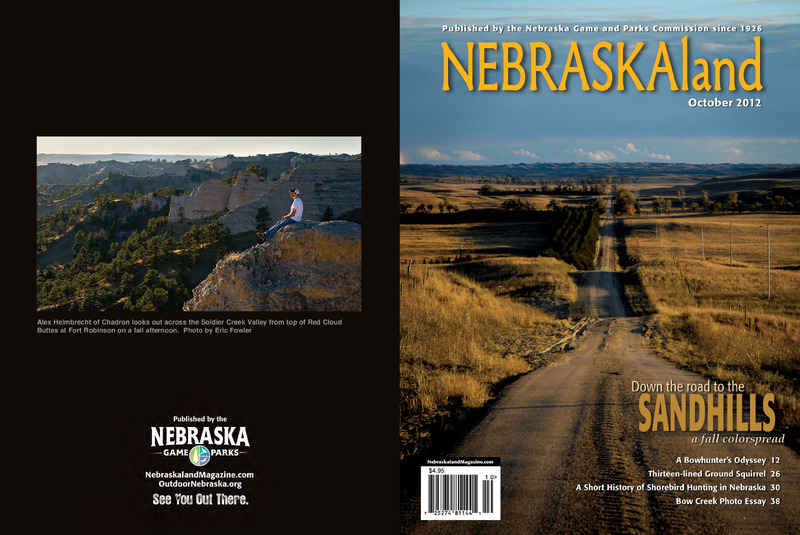
Alex Helmbrecht of Chadron looks out across the Soldier Creek Valley from top of Red Cloud
Buttes at Fort Robinson on a fall afternoon. Photo by Eric Fowler
Volume 90, Number 8, October 2012
12 The Start of the Hunt
When you see a deer with a rifle, your hunt is just about
over. When you see one while hunting with a bow, your
hunt is just beginning. TEXT AND PHOTOS BY JEFF KURRUS
from the North
18 Mallards
Since 1994, Nebraska has contributed money derived
from the sale of state waterfowl stamps to Ducks
Unlimited Canada to enhance waterfowl breeding
grounds. BY JON FARRAR
20 The Long Road Home – My Sandhills Ritual
Regular contributor Bill Hager takes us down a
photographic journey to his home in the Sandhills – a
ritual of sorts. PHOTOS AND TEXT BY BILL HAGER
26 Picket Pins of the Plains
Of the four Nebraska ground squirrels, the thirteen-lined
is the most abundant. TEXT AND PHOTOS BY JON FARRAR
30 Saucy Longbills – A Short History of Shorebird Hunting
Tracing the history of snipe hunting in Nebraska.
TEXT AND PHOTOS BY JON FARRAR
20
●
38 Bow Creek
Bow Creek Recreation Area near Wynot shows why
the 59-mile stretch of the Missouri River between
Gavins Point Dam and Ponca State Park is so special.
PHOTOS AND TEXT BY ERIC FOWLER
Comment ................................................................... 4
Mixed Bag................................................................. 6
Outdoor Update........................................................44
Junior Journal...........................................................45
Classifieds ................................................................46
Portraits from the Past .............................................48
Page 49.....................................................................49
The Last Stop ...........................................................50
30
●
26
●
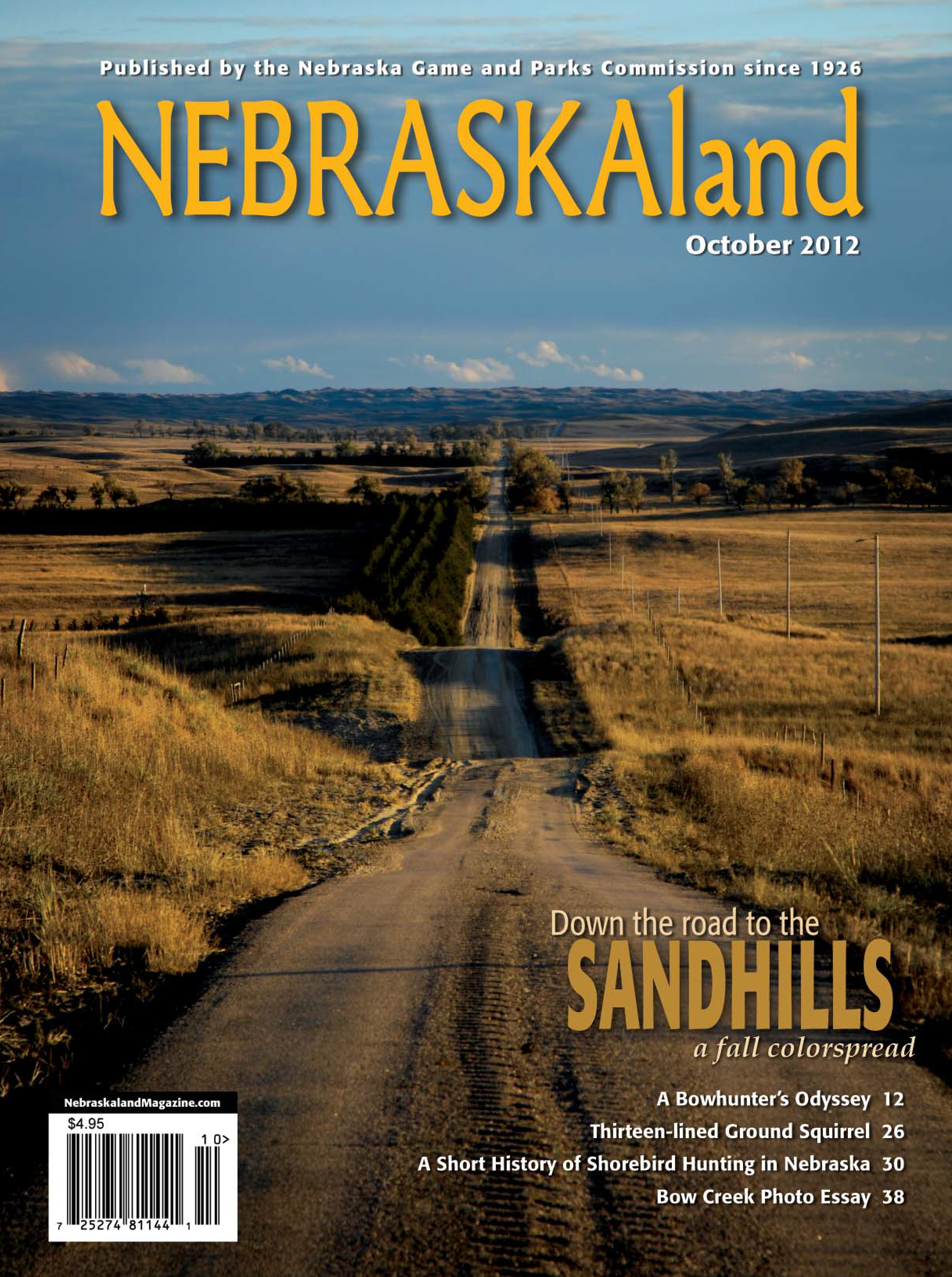
Cover: This long road home looks toward the Dismal River near Seneca
in Thomas County (see story on page 20). Photo by Bill Hager.
Opposite: A female Carolina mantis (Stagmomantis carolina). In the fall,
female praying mantises will lay their eggs on sticks and the undersides of
leaves and die approximately three weeks later. Photo by Chris Helzer.
NEBRASKAland (VOL. 90 / NO. 8, ISSN 0028-1964) is published monthly, except for the
combined Jan./Feb. and Aug./Sept. issues, by the Nebraska Game and Parks Commission,
2200 N. 33rd St., Lincoln, NE. Periodicals postage paid at Lincoln, Nebraska, and additional
mailing offices. POSTMASTER: Send address changes to NEBRASKAland, P.O. Box 30370,
Lincoln, NE 68503-0370.
2 NEBRASKALAND • OCTOBER 2012
38
●
OCTOBER 2012 • NEBRASKALAND 3
duck hunting articles. I always enjoy
the issues of NEBRASKAland. There is
usually a good history lesson in each
issue, as well.
Keith Pittenger
Sarasota, Florida
Hungry Heron
Here is a three frame series I shot of
a great blue heron at Holmes Lake in
Lincoln at the end of August. Reminds
me a little of the old “flip books” that
were popular when I was younger.
Chris Masada
Lincoln, Nebrasksa
Blair Hoary Bat
Bats are seldom seen as more than a
fluttering silhouette against a fading
evening sky – but occasionally they
expose themselves for a better look.
While back at my parents’ farm near
Blair in July, I chanced upon a hoary
bat passing the day in an apple tree;
huddled and sleepy-eyed in the early
morning, distended to dissipate the
summer heat at mid-day, and wideeyed and alert at dusk. I waited and
watched in anticipation as it groomed
itself in preparation for flight, but as
soon as I stepped away for a flashlight,
it took the opportunity to begin the
night’s foray. It did not return to the
same “perch” during the remainder of
my visit, but on a few nights thereafter
I observed what I wanted to believe
was “my” hoary bat coursing the
evening sky.
Gordon Warrick
Othello, Washington
Letter from Latvia
Dear NEBRASKAland,
I really enjoy the magazine and even
more now that live here in Latvia as
it gives me news and great articles
from Nebraska that was my home until
I moved here in 1996. The world’s
greatest friend helped me to receive it
now that through a misfortune I had to
quit subscribing to it.
I sometimes use the magazine to
introduce friends here to the greatest
state and my former home. Latvia
is my homeland and I wish I could
introduce it to Nebraska as I have been
introducing Nebraska to Latvia.
Inara Buksa
Latvia
Thanks for the Portrait
Thanks so much for putting my
pictures and story in the June 2012
magazine [Portraits from the Past]. I
am informing Dad’s grand kids about it.
I was interested in the Buffalo
Bill story [The Wild West, page 34]
especially since my dad saw the show
in York, Nebraska in 1915.
Yours truly,
Bud Johnson
Lincoln, Nebraska
NEBRASKAland Visitor Letters
We want to thank all 38 readers
that sent e-mails and letters for last
issue’s visitor, a blinded sphinx moth
that was on page 10 (see page 11
for the winner, rules and this issue’s
hint). Here are a few of the wonderful
responses we received:
The “visitor” is on page 10 on the
Mahoney Grille ad. Not sure what it is.
I enjoyed the article on the horned
lark and the pawpaws.
Ray Fansler
Fairfield, Illinois
I found your “visitor” on page 10
of the August-September 2012 issue
of NEBRASKAland Magazine. I
believe that the moth, which appears
to have a mallard drake on its back,
is a blinded sphinx moth. Thanks to
NEBRASKAland for the article on
duck hunting! As a fellow addicted
waterfowler, I always appreciate the
Statement of ownership and monthly circulation of
NEBRASKAland Magazine
Owner and publisher: Nebraska Game and Parks
Commission
Editor: Doug Carroll
Headquarters of Publisher and Publication:
2200 N. 33rd St., Lincoln, NE 68503
Stockholders, Bondholders, Mortgage and
Security Holders: None
Average number of copies
of each issue during
preceding 12 months
Lynn Kaufman of Lincoln has a passion
for turkey hunting but pursues most of the
feathered creatures that can be legally
hunted in Nebraska. He’s shown his
passion for the sport on his vehicle for more that decade.
If you have a unique outdoor message plate you would like to share or
know someone who does, e-mail a photo (high-resolution, JPEG format
only, please) of it to Eric.Fowler@Nebraska.gov, along with your name,
hometown and a brief description of the interests expressed on your license
plate.
4 NEBRASKALAND • OCTOBER 2012
Single issue
nearest to
filing date
A. Total Copies Printed
(net press run) ....................... 24,138 ........... 23,670
B. Paid Circulation
1. Single-copy sales ................. 3,287 ............. 3,297
2. Mail subscriptions .............. 19,739 ........... 18,709
C. Total Paid Circulation ............ 23,059 ........... 22,041
D. Free Distribution
by Mail ........................................ 285 ................ 285
D. Free Distribution
Outside the Mail .......................... 406 ................ 406
E. Total Free Distribution ................ 691 ................ 691
F. Total Distribution .................... 23,750 ........... 22,732
G. Copies Not Distributed ............... 388 ................ 938
H. Total ....................................... 24,138 ........... 23,670
I. Percent Paid and/or
Requested Circulation ................97% ............... 97%
This beautiful moth is the Blinded
Sphinx Moth (Paonias excaecatus),
native throughout most of the United
States. It is large, with a wingspan
of 2½ to 3¾ inches. The forewings
(top pair of wings) are mostly brown
in color, with tan to black lines
and markings. The bottom of the
underwings is pink to pinkish-orange,
and the insect’s common name comes
from the black spot, or eye, on those
underwings. The eye has a blue
center, but no pupil – a blind eye.
Adults emerge in early to midsummer,
with larvae appearing shortly after.
The larvae are a bright green, with
some white and reddish markings,
and a spine, or “horn” at the end
of their body. Larvae feed on a
variety of deciduous tree and shrub
species, including linden and willow.
Eventually they drop to the ground to
pupate shallowly in the soil, emerging
as adults the next year.
Adults are nocturnal and do not
eat; their only purpose is
reproduction. Watch
for these interesting
creatures
congregating around
outside lights at night.
Special thanks to Julie Van Meter,
State Entomologist, Nebraska Department of
Agriculture. Visitor image by Chris Helzer.
www.bugguide.net is a good site for identification
Send your comments to:
Doug Carroll, Editor
NEBRASKAland Magazine
P.O. Box 30370
Lincoln, NE 68503
or e-mail Doug.Carroll@Nebraska.gov
Please include your postal address and
telephone number.
Letters may be condensed and edited
for clarity. Photographs are welcome
and will be returned.
Any program that receives federal funding from the National Park
Service, or the United States Fish and Wildlife Service prohibits unlawful
discrimination on the basis of race, color, religion, age, gender, marital
status, national origin, age, disability or political affiliation. Any person
who believes he or she has been discriminated against in any program,
activity, facility, or service, should contact the Nebraska Game and
Parks Commission, Lincoln, NE 402-471-0641, the Equal Opportunity
Commission, Lincoln, NE 402-471-2024, TTY/TDD 402-471-4693;
United States Fish Wildlife Service, Civil Rights Coordinator, 4401
N. Fairfax Drive, Arlington, VA 22203; Director, Equal Opportunity
Program, U.S. Department of Interior, National Park Service, 1849 C
Street NW, Mail Code 0008, Washington, D.C. 20240-0001.
COMMISSION
CONSERVATION OFFICERS
Director Jim Douglas
NORTHWEST
Officer
City
Jim Zimmerman (S) Gering
Commissioners
Chairman - Ron Stave, Waterloo
Vice Chairman - Norris Marshall, Kearney
2nd Vice Chairman - Jerrod Burke, Curtis
Dr. Mark Pinkerton, Wilber
Dr. Kent Forney, Lincoln
Lynn Berggren, Broken Bow
Rex Fisher, Omaha
Mark Spurgin, Paxton
Mick Jensen, Blair
MAGAZINE STAFF
Editor Doug Carroll
Associate Editor Jeff Kurrus
Art Director Tim Reigert
Senior Editor Jon Farrar
Regional Editor Eric Fowler
Contributing Editor Michael Forsberg
Regular Contributors Bill Hager, Chris Helzer,
Lisa Knopp
Photo Librarian Sarah Johnson
Circulation Donna Robinson
For address changes and questions about
your subscription, e-mail Donna.Robinson@
Nebraska.gov or call (800) 632-5263
Advertising
For advertising information contact
Donna Robinson, Circulation
Phone: (402) 471-5490
E-mail: ngpc.advertising@nebraska.com
NEBRASKAland Magazine Copyright 2012, all rights reserved.
NEBRASKAland is available on audio cassette from the Nebraska
Library Commission Talking Book and Braille Service, Suite 120, 1200 N
St., Lincoln, NE 68508. (800) 742-7691. NEBRASKAland Magazine and
the Nebraska Game and Parks Commission reserve the right to reject any
advertising not in keeping with the agency mission.
Rates: $18 for one year; $33 for two years; $44 for three years. Nebraska
recipients must add appropriate sales tax. To subscribe call
1-800-NEBLAND (632-5263), or go online to: NebraskalandMagazine.
com.
COMMISSION OFFICES
Headquarters/Southeast District Office
2200 N. 33rd Street Lincoln, NE 68503
Phone (402) 471-0641
Northeast District Office
2201 N. 13th St. Norfolk, NE 68701
Phone (402) 370-3374
Southwest District Office
301 E. State Farm Rd. North Platte, NE 69101
Phone (308) 535-8025
Northwest District Office
East Hwy. 2, Box 725 Alliance, NE 69301
Phone (308) 763-2940
Bassett Office
524 Panzer St., Box 508 Bassett, NE 68714
Phone (402) 684-2921
Kearney Office
1617 First Ave. Kearney, NE 68847
Phone (308) 865-5310
Omaha Office
1212 Bob Gibson Blvd. Omaha, NE 68108
Phone (402) 595-2144
Greg Hesse
Scott Brandt
Heath Packett
Dan Kling
Frank Miller
Phone (308)
(office) 763-2940
(cell) 641-6138
Alliance
760-3647
Gering
631-0663
Gordon
360-0682
Harrison
430-0572
Valentine (402) 389-0444
SOUTHWEST
Officer
City
Phone (308)
Roger Thompson (S) N. Platte (office) 535-8025
(cell) 530-3097
Ray Dierking
Brkn. Bow
870-0322
George Sund
Cambridge
655-0028
Michael Thome
Cozad
529-8146
Terry Brentzel
Doniphan (402) 469-5795
Matt Andrews
Elwood
746-2418
Dirk Greene
Imperial
882-0015
Jerry Pecha (Sup.) Kearney (office) 865-5327
(cell) 293-3551
Dale Johnson
Kearney
440-3847
Brian Piernicky
McCook
340-6627
Dudley Sorensen
N. Platte
530-0016
Nicholas Fix
Ogallala
289-0427
Dennis Thompson
Ogallala
289-0755
Rich Routh
Rep. City
920-0367
NORTHEAST
Officer
City
Tom Zimmer (Sup.) Norfolk
Dale Davis
Steve Oberg
Daniel Roberts
Randy Pomplun
Jeff Jones
Jon Reeves
Tim Williams
Pat George
Doug Pollard
Cory Krause
Phone (402)
(office) 370-3374
(cell) 649-8053
Bassett
760-0712
Columbus
910-3366
Fremont
719-1108
Fullerton (308) 550-0489
Hartington
762-5022
Kennard
889-8508
Neligh
929-0051
O’Neill
340-0787
Ord
(308) 778-7101
West Point
380-6410
SOUTHEAST
Officer
Sean McKeehan
William Krause
Mike Luben
Dan Zuehlke
Darin Gress
Douglas Kramer
Dina Barta
Stacey Lewton
Levi Krause
Robert Finke
Russell Mort
Dan Evasco
City
Ashland
Auburn
Colon
Cortland
Hebron
Lincoln
Lincoln
Lincoln
Louisville
Milford
Nebr. City
Papillion
Phone (402)
521-0159
274-8063
443-6392
806-9084
768-8665
890-6465
890-6463
890-7140
949-0593
947-1363
209-1506
616-5961
ADMINISTRATION
Officer
Craig Stover (Adm.)
Duane Arp (Ass.)
Jeff Clauson (Ass.)
City
Lincoln
Lincoln
Lincoln
Phone (402)
471-5531
471-5532
471-0480
Nebraska Wildlife Crimestoppers 1-800-742-7627
Ak-Sar-Ben Aquarium
21502 W. Highway 31 Gretna, NE 68028
Phone (402) 332-3901
OCTOBER 2012 • NEBRASKALAND 5
Outdoor Classroom Opens at Norfolk Office
Eric Fowler
There’s a new playground at the Nebraska Game and Parks Commission’s
Norfolk office. There’s no bright, plastic equipment or swings, though – this
playground is old-school and gives kids
a chance to learn about the outdoors
while they’re having fun doing things as
simple as climbing a tree. It’s officially
known as the Outdoor Classroom and is
open to the public and for field trips for
school-age kids.
“It’s like a throwback to the grove of
trees you played in as a kid,” said Jamie
Bachmann, the Outdoor Education
Specialist for the Commission and the National Wild Turkey Federation who
designed the classroom. “It’s a dirty, buggy place and in an environment where
kids can be excited about learning.”
Kids can take turns running a hand pump that feeds a model river, showing how
water circulates through the landscape. They can test their balance walking along
a string of stumps, dig for fossils and bones in the sand, play in a lean-to fort
made from limbs and pine boughs, kick back in a hammock, or dance and play
music on a xylophone in the Music and Movement area.
A garden tunnel and other additions are being planned. “I don’t think it will
ever be done,” Bachmann said of the project. “We have so many ideas.”
The classroom is open to the public during office hours, which are from
8 a.m. to 5 p.m. weekdays. It can also be reserved by school groups and will, on
occasion, host public events. For more information, contact Bachmann at (402)
370-3374, e-mail jbachmann@nwtf.net, or visit the office at 2201 N. 13th St.
Send Us Your Trail Cam Photos
Here is a list of
upcoming outdoor
events across
Nebraska.
For more
information
about these
and other
events, visit the
calendar page at
www.OutdoorNebraska.org.
October 6-7
Autumn Harvest Show - E.T.
Mahoney State Park
View some of the finest art in the
country from many reputable and
nationally known artists from around
the Midwest.
For more information, call (402) 9442523
October 6-7
Ft. Atkinson State Historical Park
Living History Weekend
Watch as volunteers portray what
life was like at an 1820s military fort
from 10 a.m to 5 p.m. each day.
For more information, call (402) 4685611
October 7, 14
Living History Events
Arbor Lodge State Historical Park.
Call (402) 873-7222
October 13
Star Gazing Party – Fort Hartsuff
State Historical Park
Stargazing will commence around
7 p.m. with a presentation by Dan
Glomski. Fort Hartsuff’s open parade
ground and lack of light pollution
make it a great place to get a clear
view of the stars. Call (308) 346-4715
October 13, 20
Ponca State Park Hallowfest
Haunted hayrack rides, pumpkin
rolling and carving contest, a
campsite decorating contest and
much more. For more information,
call (402) 755-2284
Sent by Jerry Reynoldson, this photo was taken on the edge of
Valentine. Notice the unusual looking cloud in the sky.
Please submit your trail camera photos by e-mail to: nebtrailcam@gmail.com.
Also include any information that will help explain your photo.
6 NEBRASKALAND • OCTOBER 2012
October 13, 19, 20, 26, 27
Halloween Hollow at Indian Cave SP
Haunted Hollow hayrack rides on
the days listed above, concessions
available. Tickets available beginning
Oct. 3 by phone or at park office. A
Halloween decorating contest will
be held at the park’s RV campground
on Oct. 13, 20 and 27. For more
information, call (402) 883-2575
OCTOBER 2012 • NEBRASKALAND 7
by Jeff Kurrus
Culbertson, NE
On October 27, blaze orange will fill fields
throughout the state for pheasants. A time-honored
tradition for many, the opening of pheasant season is
more than over-and-unders and pointers. It’s the
time spent with friends, the
Palisade
number of birds seen,
and the food and
drink after the
hunt.
Even decent shooters should have the opportunity
to limit out in time to get to a small town cafe like
the Bear Cave in Culbertson and chow down on
their signature chicken-fried steak.
Or, take an evening or midday break in nearby
McCook. “If you’re hunting, fishing or even just
visiting the southwest,” said hunter Scott Miller,
“you have to stop at Mac’s Drive-in. There, place
your order through a phone at the table – perhaps
the pizza burgers and
onion rings.”
Culbertson
And
there’s no
better place
in the state right
now for pheasants than
the southwest, specifically in
HITCHCOCK COUNTY off Highway 6
between Palisade and Culbertson. “We
have abundant Open Fields and Waters sites, lots
of CRP, and even some milo stubble for hunters to
walk through,” said Commission biologist TJ Walker.
Starting a Safe Fire
Scott Stuhr
Despite a record drought this
summer, you may still feel inclined
to build a fire when the temperatures
begin to cool this fall. But make sure
you do it correctly – choose a safe site
to start the fire, using only designated
fire pits; make sure there are no
flammable plants or objects within 10
feet (or above) the fire pit; and have
plenty of water and a shovel nearby
to help put the fire out if it gets out of
control.
Arrange your fuel in a way that one
match will be able to start the fire.
DO NOT USE LIGHTER FLUID
OR GAS! Start with a handful of dry
tinder. Add two to three handfuls of
kindling, and three or four larger pieces
of wood. The smaller you keep your
fire, the less chance it has of getting
out of control.
8 NEBRASKALAND • OCTOBER 2012
Then start
planning
the next
weekend...
Light a match (remembering to
completely close the box first) and light
as much of the tinder as you can while
keeping your hands and face to the side
of the fire. Then watch the fire at all
times – pay attention to the direction
and speed of the wind, as it could
blow sparks and burning debris into
surrounding areas. If the fire does get
out of hand, use the water and shovel
to put it out.
When you are done with your fire,
make sure it is completely out. Use a
long stick to spread out the remaining
wood and coals. If you place your hand
over the ashes, and can still feel heat,
it means that there is a chance the fire
could start up again. Stir water and
soil into the coals until they are cool.
Just because you do not see a flame
or smoke does not mean the fire is not
burning.
By following these simple steps, you
can keep your campsite warm and safe.
Stay warm and safe by building a small,
manageable fire, making sure you have
water and a shovel nearby.
Harvesting Native Prairie Seed
Chris Helzer
The kind of drought we’ve had this
year might have gotten you thinking
about the use of native prairie plants
in gardens, wildlife plantings and
acreages. Native plants use less
water, require less maintenance and
provide more benefits to wildlife and
pollinators than non-natives do. Of
course, it’s best to use plants with
genetics that are locally-adapted to
where you plant them, but the genetic
origin can be really difficult to
discern when buying plants
commercially. Most “native” prairie
plants sold in Nebraska are native
prairie species, but their ancestors
could easily have come from as far
away as Oregon or Texas.
One easy way to ensure the local
origin of your native plants – and to
save money – is to harvest your own
seed. Seed harvesting might sound
difficult if you’ve never done it before,
but there are really only a few things
you need to know and do.
1. Decide which prairie species you
want seed from. Are you looking for
early season wildflowers? Tall native
grasses? Do you have soil that is sandy
or silty? Shady or sunny? Do some
research to figure out which species
you like and that are appropriate for
your situation.
2. Find a good place to harvest.
Depending upon what part of the
state you’re in, the first challenge
might be to find a prairie to harvest
seed from. You may want to ask
local biologists from the Nebraska
Game and Parks Commission or other
conservation organizations for help in
finding appropriate sites where you can
find the species you want. Be wary of
roadsides, especially those along state
highways and other heavily traveled
roads – the plants growing there very
likely came from the same commercial
seed sources you’re trying to bypass.
Once you find a good site, make
sure that you have permission to
harvest seed. Many public prairies
have rules against seed harvest, or at
least require you to get permission, and
you obviously need permission before
going onto private land.
3. Find out when the seed is ready to
harvest. Knowing when the seed is ripe
is very important. If you know when
your selected plants bloom, you can
find them when they’re in flower and
then keep an eye on them to see when
the seed ripens. Deciding when the
seed is ripe is tricky, but the hardest
part is often figuring out which part is
actually the seed. Often, you’ll need to
break apart pods or seed heads to find
the small kernel of seed. Once you find
it, you can squeeze it between your
thumbnails (or two other hard surfaces)
to see if it’s still juicy inside. If the
seed is juicy or milky inside, it’s not
ripe. If it’s doughy or hard, pick it.
4. Harvest your seed! Depending
upon how much seed you need, this is
the easy part. For most plants, you can
either cut the seed head off or strip the
seeds off by hand. If you need a lot
of seed, strap a bucket to your waist
and go at it with two hands. Finding
large patches of the plants you want
to harvest can help you maximize
efficiency.
5. Prepare the seed for planting. This
doesn’t have to be difficult, but it is
important. If you were able to strip
the seeds off of a plant, you may be
ready to go. If, however, you harvested
entire seed heads, you might need to
separate the seeds from pods or from
each other. With small quantities, you
can probably do this by hand, or by
some simple trick such as scraping
the seed between the soles of your
shoes and some rough concrete. If you
have larger amounts of seed, you can
try running it through a leaf mulcher
to break things apart. You may want
to screen the seeds from the excess
plant material, but if you’re just going
Jake Hart,
a technician for The Nature Conservancy,
harvests seed from Canada milkvetch
plants in a Hamilton County prairie.
to plant by hand, it’s probably not
necessary to get the seed particularly
clean.
6. Plant it. Planting seed usually
works best during the dormant season
or early spring. Most native prairie
seed grows best when planted at very
shallow depths, so just broadcasting the
seed and lightly raking a little soil over
it works best. Then sit back and enjoy
the fruits of your labor.
There are multiple resources
available to help you decide which
plant species to harvest and how to
do it. Most wildflower field guides,
including Jon Farrar’s Field Guide to
Wildflowers of Nebraska and the Great
Plains, can help you find species that
bloom when you want them and that
fit your soil type and location. Other
information about seed harvesting
can be found in A Guide to Prairie
Restoration in Eastern Nebraska
by Gerry Steinauer and others. You
can download that guide from http://
PrairieNebraska.org, and find much
more information on prairies on the
same web site. Finally, if you want
a local-ecotype prairie planting but
don’t want to harvest the seed yourself,
another good option is to contact
Prairie Plains Resource Institute
(prairieplains.org), which provides
prairie restoration as a service.
OCTOBER 2012 • NEBRASKALAND 9
No Place to Hunt
PHOTO BY JEFF KURRUS
Do you know where this Nebraska photograph was taken?
See answer at the bottom of page 11.
10 NEBRASKALAND • OCTOBER 2012
Fort Hartsuff State Historic Park
(SHP), in conjunction with the Grand
Army of the Frontier (GAF) will
present “The Timeline of American
Military Firearms 1860-1990” the
weekend of October 20-21.
GAF members in period military
dress will use a collection of original
and reproduction firearms to explain
the development of American military
firearms starting with muzzleloading
firearms of the Civil War and
culminating with the modern weapons
used in Desert Storm.
On Sunday, October 21
at 2 p.m., Jeff Barnes will
give his talk on “Custer
in Nebraska: The Royal
Buffalo Hunt of 1872.”
Fort Hartsuff SHP is
located three miles northwest of Elyria
on Fort Avenue. For more information,
contact Jerry Davenport at (308) 214-0082.
Natural Legacy Project Awarded
USFWS Grant
Nebraska’s Natural Legacy Project
has been awarded $800,000 from
the Competitive State Wildlife Grant
Program Fiscal Year 2012 for the grant
“Striding toward Sustainability.”
This grant from the United States
Fish and Wildlife Service will help
implement conservation actions to
enhance native prairies, woodlands
and wetlands for the benefit of
at-risk species, while keeping
common wildlife species common.
Habitat projects will be delivered
collaboratively with partners using
voluntary, incentive-based strategies.
This is the fourth time Nebraska
has received one of these grants to
help this program, which performs
approximately 70 percent of its habitat
work on private land.
“The Natural Legacy Project
success is due to the support of
partners that come together to deliver
habitat projects,” said Kristal Stoner,
wildlife diversity program manager
for the Nebraska Game and Parks
Commission. “The Natural Legacy
Partnership Team deserves credit for
this grant award since it worked to
collaboratively identify good projects
and partners that should be a part of the
grant proposal.”
The Natural Legacy Partnership has
representatives from 24 agencies and
organizations that represent agriculture
and conservation interests. More than
$5.7 million in funding was available
nationwide. Nebraska was one of seven
states to receive funding. ■
NEBRASKAland Visitor
Winner and Hint
Last issue’s winner of
the Visitor drawing was
Steve Ferris, of Lincoln
Nebraska, who found the
blinded sphinx moth on page 10.
Readers are encouraged to contact
NEBRASKAland within 10 days
after this issue’s publication with the
correct page number and name of
this issue’s “Visitor” – a bug found
in Nebraska that just happened to
find its way onto one of the pages.
We will then gather the correct
entries and draw one to win a
NEBRASKAland Magazine mug.
To enter each month, write:
NEBRASKAland Visitor
2200 North 33rd Street,
Lincoln, NE 68503.
Or e-mail:
Tim.Reigert@Nebraska.gov
with “Visitor” in the subject line of
the message.
HINT: This issue’s visitor is not
on page 2, 4, 5, or 9.
Desert Dome, Henry Doorly Zoo, Omaha
See You Out There... But Where?
Historic Firearm Display
PHOTO BY JEFF KURRUS
Jeff Kurrus
For a person new to the outdoors, finding a place
to hunt can be a daunting task. With more than
98 percent of Nebraska’s land privately owned, the
“just find a public spot to hunt” advice can result
in a “gee, thanks,” response, but it still remains a
viable option with the state’s more than 300 publicly
owned areas. Below is more detail on the public
land, as well as a few other options to consider.
Publicly Accessible Lands – Open Fields and
Waters, Natural Resource Districts, National Forest
Prairie chickens are another seldom-hunted species that can be hunted in
Service and other partners of the Nebraska Game
certain parts of the state.
and Parks Commission have lands throughout the
Knocking on Doors – Staying away from the opening
state open to hunting. The Open Fields and Waters program
weekend for most species helps. Also, don’t shoot for the
alone has more than 250,000 acres of private land for
moon when you do knock on a door. If you’re asking for
public walk-in hunting access. Consult the CRP-MAP atlas
deer hunting permission, ask for doe with a bow. You must
downloadable at OutdoorNebraska.org/hunting and Click
build trust with a landowner. Or if it’s upland game, see if a
on Where to Hunt.
Special Hunts – Because these hunts are not often included morning or afternoon hunt sometime during the week is an
option.
in the Big Game Guide published each summer, there
Take a Kid – Walking up to a door asking for permission
are great opportunities to get in on hunts that some of the
to hunt for yourself is tough. You’ll knock on many and
general public doesn’t know about. Visit OutdoorNebraska.
probably only have positive responses sparingly. Take
org for more information.
a child along and, leaving your own weapon at home,
Lesser-Hunted Species – Squirrel hunts are a great way
introduce a novice to hunting.
to spend some time afield. Plus, very few people will be
Knowing your hunting options is paramount. Obviously,
hunting for the same quarry. Past the opening day and
if you can hunt during the middle of the week, do so. But
weekend, dove are another species that can be hunted this
pay special attention to hunting those species later on during
month with little fanfare. Find a clean, cut grain field and
the season. One of the best dove hunts I’ve ever had was on
approach landowners. Or, locate a group of turkeys, bust up
October 28, days before the season closed.
the flock, then try to call them back to you.
OCTOBER 2012 • NEBRASKALAND 11
“When you see a deer with a rifle, your hunt is just about over. When
you see a deer when hunting with a bow, your hunt is just beginning.”
W
Text and photos by Jeff Kurrus
A clear shot of a deer
in range isn’t always
the easiest task for a
bowhunter. But waiting
for that opportunity sure
is exciting.
ith a doe already on the ground, I stood at the
base of my ladder stand on last year’s opening
day, smiling about my good fortune. The smile
faded, however, when I saw the buck emerge
from the wood edge not 80 yards north of me,
lowering his head into a field of beans while I stared above
at my bow still hanging in the tree.
I wasn’t sure what to do – I was looking at the nicest buck
I had ever seen on the hoof, with no weapon in hand. So I
made the only decision I could and starting climbing everso-slowly back up to my stand. With each step I took, the
buck’s head emerged from the beans and I would freeze in
place until he went back to feeding.
Finally I was back on my platform and, to my disbelief,
the buck was still eating. A few minutes later, the impossible
happened – he turned and started walking down the wood
edge in my direction. I nocked an arrow, turned and lined
up shot up in a gap in the brush exactly 12 yards away from
me. If the buck continued his course, I had a chip shot. If
he changed his route for any reason, things would get more
complicated – I had removed very few limbs from the tree
I was hunting, deciding it was better to stay concealed and
have deer within bow range versus risking being seen by
deer too far away to shoot.
Thirty yards … 20 yards … 15 … I drew back as the buck
paused behind a plum thicket, my top pin centered on that
small opening. I saw a brief patch of white, then brown,
enter my sight picture as I waited for the six more inches I
needed to make a perfect shot.
A squirrel behind me, however, couldn’t wait that long
and jumped from one spindly branch to the next, rattling
the entire tree behind me. The buck jumped straight up at
the sound, twisted in midair and bolted up the trail he came
from. In an instant, he was completely out of sight.
If that deer had stepped into that field while I was rifle
hunting, I would have shot, he hopefully would have hit
the ground, and my hunt (and story) would have been over.
Not with a bow – what I have learned in the two brief years
I have been bowhunting is that when you see a deer with a
rifle, your hunt is just about over. When you see one while
hunting with a bow, your hunt is just beginning.
I got the bowhunting bug a few years ago after knocking
on the doors of a couple landowners and them being
concerned about me hunting with a gun. “Some bad things
have happened,” each told me – a canned response, but
one probably carrying some weight as well. But I still
didn’t want to add bowhunting to my already consuming
list of outdoor activities until I looked at Nebraska’s big
game regulations. There, two notes jumped out at me:
1) Nebraska’s bow season lasts from September 15 until
December 31, exemplifying a long and mainly warm season
for a Southern native whose fear of cold weather has been
well chronicled; and 2) Nebraska’s bow season is statewide,
not restricting me to any particular area.
Then it clicked: Walking up to a landowner’s door was
going to become easier when I knew that I had one simple
request – doe with a bow. By starting on the ground level, I
might be able to get my foot in the door with a simple and
safe request for a landowner to consider. Not surprisingly
it worked, allowing me to fill my first season with hits,
near hits and outright misses. There was the doe at 10 yards
whose back I shot completely over; the one I never saw until
it was standing less than 15 yards away, staring at me when
we finally met eyes; and the doe that only ran 20 yards after
a well-placed shot through her vitals.
But it wasn’t until the following year that my bowhunting
career moved all-in: I got a phone call from a friend telling
Robbie Gaia from Oakland, Tennessee sits in a tree stand in
Cass County, waiting for a whitetail to walk by.
OCTOBER 2012 • NEBRASKALAND 13
Browning beans are a
sure sign of the bow
season’s most enjoyable
times - pre-winter,
pre-harvest and pre-rut.
later he fell over. My hunt that day was
over.
But even after this deer, I had
another close encounter with a nice
buck and a pile of encounters with
various animals. Plus, I got to share my
bow season with my 64-year-old father.
While not shooting a bow yet, he shot
plenty of wildlife photos from a ground
blind those September and October
mornings. “The woods are alive,” he
told me, and he was right. Raccoons,
opossums, field mice, owls, hawks and
a plethora of birds fill those moments
when deer are not being seen.
And there are so many more
possibilities. I am reminded of
Eric Fowler’s November 2005
NEBRASKAland archery story on John
Griess and the dazzling portfolio of
images from his spot-and-stalk mule
deer hunt. Or of a trip with Nebraskan
Andrew Voss last year where he hunted
the edge of a cornfield, watching a
scant, but productive, opening on land
near Eagle. Or even the hunt I made
with youngster Josh Pflasterer as he
chased his first-ever buck with a bow.
On land near Columbus, Josh led me
You’ve heard it before. “I
hunt (or fish) to spend time
in nature and see wildlife.”
While hard to understand for
nonhunters, those with weapon
in hand know this all to well.
We hunt for the challenge of
making the shot and being at
the right place at the right time,
but our principal mission is to
watch wildlife. And there’s no
better time to do this than bow
season.
From an owl swooping down
toward a squirrel to a red fox searching for field mice, there is
rarely a quiet autumn day afield. These are the mornings when
there is a brief chill in the air that gives way to a sun-filled day,
where the prospect of shooting a deer is only slightly trailed by
the prospect of seeing everything else. Give me an afternoon
with an opossum, tom turkey and two flocks of geese, and I’ll
give you a time when my regrets are absent despite never lifting
my bow.
PHOTO BY LARRY KURRUS
14 NEBRASKALAND • OCTOBER 2012
me I needed to photograph a deer shot
on private land near Springfield. The
buck, a 19-pointer shot by teenager
Luke Polenz, was a massive deer that
had been taken by the youth on family
land.
Just two days before, Luke had
hunted from daylight to dark hoping a
deer would come within bow range. No
such luck. The day this buck stepped
in range – a deer larger than any he
had ever seen – Luke’s first arrow
flew over the deer’s back. The buck
bolted, disappearing from sight. That
was when Luke, a novice deer hunter
only if considering how many years he
had hunted, made a veteran move by
picking up and blowing a grunt call.
Moments later, the deer was back in
range and the second arrow found its
mark.
The result was a once-in-a-lifetime
buck that will keep Luke hunting
for, well, a lifetime. And while he
was definitely now hooked, his story
brought another hunter to the nocks,
arrows and pin sights brotherhood. But
I can honestly say that it wasn’t the big
buck that truly hooked me – it was the
fact that Luke was 20 years younger
than me and was beginning a passion
that I had long foregone until that
point. It was one of the first times in
my hunting and fishing life that I truly
felt regrets. So I spent the rest of the
season making up for lost memories.
And what fun it was. Two weeks
after last year’s opening morning
(which also became the official
opening of squirrel season where I
was hunting), a 5-by-5 ran beneath
my tree and across the field in front
of me. “Eh, eh, eh!” I yelled, but the
buck never stopped. Still standing
on my platform, moments later I saw
movement from the corner of my right
eye. A spike walked beneath my stand
and stopped to eat grass no more than
10 yards away. I drew my bow back
and aimed at the deer’s chest. “It’s not
what you’re looking for,” said a voice
in my head, and I eased my arrow back
down. Moments later, another brown
movement caused my head to turn. It
was a high-rise 4-by-4. “That’s what
you came for,” I thought, drawing on
the buck. Seconds later I shot, feet
A ground blind in Cass
County is the site of a
few successes, and a
few more failures, in my
bowhunting career.
OCTOBER 2012 • NEBRASKALAND 15
PHOTO BY JOSH PFLASTERER
Josh Pflasterer makes
his way to his stand one
afternoon last November,
just beginning a passion
that has the chance to
consume him until he is
an old man.
When Pflasterer shot this 5-by-4, his first archery buck, he described a feeling many bowhunters have had:
“My heart was pumping so fast I thought it was going to pop out of my chest.”
over rolling hills to a spot deep within a pine draw. “They’ll
come right through here,” he told me, “I’ve seen as many
as 30 in here.” That afternoon they did not – not even a
squirrel was seen – but two weeks later he was sending me
photos of his first archery buck, and I was happy for him but
once again questioning myself: Why had I waited
so long to start bowhunting? And why was I
checking e-mails on a perfectly good day to sit
in the woods?
These are questions I often have nowadays
as I find myself unable to sleep at night. What
mysteries await me the following morning?
Will they walk by 8:30? If not, they definitely
have to walk by 10:00, right? If not then,
when? Noon? 2:00? 4:00? Dark?
While I haven’t spent my
own full day
in the
stand
This fox squirrel, my Cass
yet, I
County nemesis, greets
can
me every morning I sit in
the tree stand. If only he
knew how much I loathe
him.
16 NEBRASKALAND • OCTOBER 2012
definitely see how it happens. For each minute I stay in
the field, it’s another minute that a memory can become so
ingrained I’ll remember it forever.
For if they are anything like the memories
thus far, there will almost be too many to
count. Almost. ■
OCTOBER 2012 • NEBRASKALAND 17
Approximately 60 percent
of the mallards shot by
Nebraska hunters are
produced in south-central
Canada.
PHOTO BY JON FARRAR. BACKGROUND PHOTO BY DUCKS UNLIMITED/CANADA
By Jon Farrar
Since 1994, Nebraska has contributed money derived from the sale of state
waterfowl stamps to Ducks Unlimited Canada to enhance waterfowl breeding
grounds. In total, the state’s contribution is now approaching $1 million.
I
t took some American hunters decades to realize most
of the ducks that cupped wings over their decoys were
produced in Canada. The creation of Ducks Unlimited
in the U.S. in 1937 and its Canadian counterpart, Ducks
Unlimited Canada, a year later, was probably the first
significant step in recognizing that fact. Approximately
60 percent of the mallards shot in Nebraska come from
the Canadian prairie-pothole region of south-central
Canada; and specifically, about 30 percent of the
mallards shot by Nebraska hunters come from southern
Saskatchewan. In recognition of that, Nebraska is one of
34 states that annually contribute grant money to Ducks
Unlimited Canada to protect and improve waterfowl
nesting habitat. Nebraska has participated in the program
since 1994: Its annual contribution has ranged from
$25,000 to $140,000 and now totals more than $950,000
– an impressive milestone for a state with a population as
small as Nebraska. Money for the grants comes entirely
from the sale of state waterfowl stamps to hunters.
State grants are matched by DU, and that total is
matched
with funding through the 1989 North American Wetlands
Conservation Act, the core component of the North
American Waterfowl Management Plan. Oftentimes
there are other partners, such as Canadian provincial
and federal governments, the Saskatchewan Watershed
Authority and
The Nature Conservancy of Canada. Every dollar from
Nebraska grows a minimum of four times by way of
matching funds. Often the match is five times and
sometimes even more.
“That means, at minimum, the $65,000 Nebraska
contributed in 2012 paid for at the least $260,000 of
habitat work on the ground,” said Dave Kostersky,
manager of state grants for DU Canada.
Kostersky said the types of projects the program
funds has changed over the years, from initially being
directed at individual projects to what he called a “suite
of programs” on a particular landscape. DU Canada still
18 NEBRASKALAND • OCTOBER 2012
uses land acquisitions and conservation easements to
protect wetlands and nesting habitat, but has found it
can stretch funding by working with private landowners,
particularly by providing direct payments to develop
forage and grazing programs benefitting ducks and other
wildlife that require wetlands and grasslands near them,
as well benefitting the landowner. Canada does not have
a farm program like the United States’ Conservation
Reserve Program, which pays landowners to return
marginal agricultural land to perennial grasslands.
“There never will be enough conservation money
to buy our way to protecting enough habitat,” said
Kostersky. “We have to look at other tools.” But, he
added, all agreements with private landowners for
habitat improvement are long-term. “It’s a multiple-year
investment,” he said. “It’s not about trying to get a quick
gain or looking for that silver bullet. It’s a big task and
will take the support of the conservation community at
large to make a difference.”
Ducks Unlimited concentrates it conservation efforts
on the Prairie Pothole region of south-central Canada,
a region extending southerly into the north-central
states, but also has projects to the north, in Canada’s
Parklands and Boreal Forest regions. Much of the money
originating from Nebraska goes to the Missouri Couteau
region in Saskatchewan, a poorly drained landscape with
numerous glacial pothole wetlands. Kostersky pointed
out that these premier waterfowl breeding grounds are
also important migration waters for birds nesting in the
Arctic. Contributing states have a role in selecting the
projects they want their grant money to help fund, and
for Nebraska that is southern Saskatchewan to increase
mallard production, but all other duck species nesting
there, and nongame birds, also benefit.
“The state dollar is what gets the whole thing rolling,”
said Kostersky when asked how important state grants
were in the big picture, considering all the money from
various sources that go to Canada to improve waterfowl
habitat. “In total, all states combined contributed about
$2.8 million in 2012. That alone doesn’t look like much
considering what DU spends annually in Canada, but
leveraged – having another source match that start-up
money, and then another source match that, it grows to an
impressive number. But for all that to happen, the states
have to start the ball rolling with their grants.
“In tough economic times like we’ve gone through
the last few years, and rising land values,” said
Kostersky, “funding starts to shrink, so it becomes all
that more important that we squeeze every bit of habitat
improvement out of every dollar available. The longer
we put off doing this conservation work, the more it’s
going to cost us down the road. That means partnerships
like the state funding for Canadian projects is evermore
important. When you have less money you want to get
your best return, and partnerships are the best place for
that.”
In Canada alone, DU has completed more than 8,880
habitat projects, securing 6.2 million acres and positively
influencing more than 95 million acres of habitat that not
only benefit waterfowl, but other wetlands species.
“This is a program that potentially benefits every
Nebraska hunter,” said Mark Vrtiska, Nebraska Game
and Parks Waterfowl Specialist. “When we do a wetland
habitat improvement project in Nebraska, it’s a good
thing for those living near that project, or those willing
to drive to get to that site. Those local projects are
important, and we will continue to do them, working
with partners to multiply the funds available. But with
the grant program to DU Canada we are improving
waterfowl hunting opportunities for every hunter in the
state, east to west, north to south. That’s why I think
it’s a good program from the standpoint of everybody’s
dollar has the potential to bring a return to every
Nebraska waterfowl hunter.”
“In all these wetland habitat improvement projects,”
said Kostersky, “it’s mostly hunters who are footing
the bill. They want more waterfowl and they’ve always
stepped up to pay for it. But those investments in habitat
and breeding grounds are benefitting songbirds, raptors
and shorebirds – an enormous array of species. We need
to find a way to engage nonconsumptive users of wildlife
to get involved in protecting and improving these areas.”
“It’s one of those conservation programs difficult
for Nebraska hunters to see because it’s happening
in Canada,” said Vrtiska, “but if a Nebraska duck
hunter spent a few days in the Prairie Pothole region of
Saskatchewan in May, looking at the wetland habitat
protection and improvements being financed by this
program, seeing wetlands surrounded by good quality
nesting cover, the number of ducks nesting there, the
broods raised there, they would be even more supportive
of this program.”
If a hunter cannot be in Saskatchewan in May, the next
best thing is to go online and look at the projects DU
Canada is doing with the help of state contributions. Two
web sites to start with are: www.waterfowling.com and
http://www.ducks.ca/ ■
OCTOBER 2012 • NEBRASKALAND 19
The Long Road Home
My Sandhills Ritual
By Bill Hager
Be it an early season trip for grouse or a fall float on a river,
the transition from the hot days of summer to the cool, crisp days of
early fall is an easy one for me. Grabbing my gear and heading to my
roost in the Sandhills has become a ritual of sorts.
Amongst the ever-changing landscape and tempered by weather,
the trek down the road to the Sandhills is never boring. Between the
colorful foliage and wildlife migrations, this is the season I look
forward to most. There is always something new over the next hill
or around the next bend.
Above: Framed against a quiet sunrise, these trusty tools stand ready for another day of harvest in a northern Boyd County field.
Opposite: A young bluebird watches from the top strand of a nearby fence as its migrating flock forages in the grass.
20 NEBRASKALAND • OCTOBER 2012
OCTOBER 2012 • NEBRASKALAND 21
Above: A mixed palette of color amongst
lingering fog near Merritt Reservoir in Cherry
County.
Left: A kingfisher alertly watches the river
from a perch overlooking the Niobrara River in
Brown County.
Right: A group of bull elk blend with the grasses
as the landscape takes on the look of fall.
22 NEBRASKALAND • OCTOBER 2012
OCTOBER 2012 • NEBRASKALAND 23
Above: A whitetail doe bends an ear in
my direction as she moves to a bedding
area in a bale pile in southern Cherry
County.
Left: An ash tree in brilliant red
dominates the scene in Cherry County.
Right: The bright yellow canopy of twin
cottonwoods filter early light over camp
on the North Loup River.
24 NEBRASKALAND • OCTOBER 2012
OCTOBER 2012 • NEBRASKALAND 25
Picket Pins of the Plains
One of the thirteen-lined
ground squirrels common
names was picket pins
as when they stand erect
they reminded people of
the wooden stakes onced
to to secure a tent or
tether livestock.
Nebraska’s thirteen-lined ground squirrel
Text and photos by Jon Farrar
Of the four species of ground squirrels found in the state, the thirteen-lined is
the most abundant and is found statewide. The species’ traditional habitat was
shortgrass prairie, but today they are most common on disturbed lands.
H
ave you ever been just a little bit embarrassed to
be a “Cornhusker?” Do you find it a bit too, well,
hmmm, corny? Granted it is better than Nebraska’s
earlier nickname “The Bug Eaters” but it would be nice
to have a more appealing nickname, such as Florida –
The Sunshine State; Georgia – The Peach State; New
Jersey – the Garden State; or New Mexico – The Land of
Enchantment. On the other hand, it could be worse, like
Minnesota – The Gopher State.
Minnesota has labored valiantly to shed that nickname,
preferring to be called the “Land of 10,000 Lakes” or “The
Star of the North,” but has been unsuccessful in banishing
“gophers.” The University of Minnesota’s athletic teams
remain “The Golden Gophers.” Interestingly, Minnesota’s
widely known sobriquet, a reference to the “striped
gopher,” is taxonomically incorrect. The state animal is
not a gopher at all but a ground squirrel, the thirteen-lined
ground squirrel, and so properly Minnesota should be called
“The Thirteen-lined Ground Squirrel State.” Minnesota
mammalogists might even insist on “The Spermophilus
tridecemlineatus State,” as that is the animal’s scientific
name. Either the common or scientific name would be long
enough to wrap around at least three sides of their license
plates.
The confusion over names of small mammals that burrow
in the ground (and are usually considered pests to be
poisoned) is an old one. Three groups of small burrowing
mammals are often lumped together – ground squirrels,
pocket gophers and moles. Moles and pocket gophers are
rarely seen above ground. Both moles and pocket gophers
leave meandering trails of soft earth pushed to the surface as
they excavate their underground labyrinth of tunnels. Only
ground squirrels are commonly seen above ground.
FOUR SPECIES OF GROUND SQUIRRELS live in
Nebraska. The least common is Richardson’s ground
squirrel (Spermophilus richardsonni), a species that is rare
and reported only from the southern Panhandle. Franklin’s
ground squirrels (Spermophilus franklinii) are the largest at
about 15 inches long, of which about one-third is a bushy
tail. They are grayish in coloration, dappled with muted
white and blackish spots. The range of Franklin’s ground
squirrels closely matched that of tallgrass prairie and so
they are much diminished in numbers today. Spotted
ground squirrels (Spermophilus spilosoma), at about eight
inches in total length, are the smallest of the four ground
squirrel species found in the state. They are most abundant
in grasslands, particularly those in sandy soils, and so most
common in the Sandhills and Panhandle.
Nebraska’s most common ground squirrel, found
statewide, is the thirteen-lined ground squirrel. Audubon
called them leopard-spermophiles, and they have also been
known by such common names as striped gophers, picket
pins, Federation squirrels, leopard ground squirrels and
PHOTO BY JONAH EVANS, WILDLIFE DIVERSITY
BIOLOGIST, TEXAS PARKS AND WILDLIFE
PHOTO BY BOB LANE
THINKSTOCK
Richardson’s ground squirrel
Franklin’s ground squirrel
Spotted ground squirrel
OCTOBER 2012 • NEBRASKALAND 27
26 NEBRASKALAND • OCTOBER 2012
squinneys. The name squinney is apparently British in
origin, meaning “to peep about” or squint, and a “squinneyhole” is a peep-hole. Picket pins is probably a reference to
“pickets,” the pointed wooden stakes once used to secure a
tent, tether livestock or mark surveying points. Federation
squirrel is a reference to the animal’s stripes suggesting the
stripes of the American flag.
Of all ground squirrels found in Nebraska, the thirteenlined has the most elongated appearance, almost weasel-like,
one of their principal predators. Their bodies range in length
from six to 11 inches, with three- to four-inch tails. Body
weights vary widely with the age of the animal, abundance
of food and time of year. Most weigh five to six ounces but
a large animal may approach one-half pound just before
winter hibernation. Males are slightly larger than females. In
overall color they are buff to brown, lightest in coloration on
their undersides, and they do have 13 alternating dark and
light stripes on their backs, usually broken with spots that
perhaps aid in camouflage. When seen standing, the striping
cannot help but make one think of the reedlike feather
pattern on the breast and neck of American bitterns, a
camouflage ruse to
make them blend
in with vertical
vegetation.
Thirteen-lined
ground squirrels
are strictly diurnal
and especially
active on warm
days, although
they may remain
underground
on the hottest
days of summer.
The species’
traditional habitat
was shortgrass
prairie but they
readily adapted
to manmade
shortgrass
habitats such
as golf courses,
Thirteen-lined ground squirrels are
cemeteries, airport
striped, like the feather pattern of an
American bittern, a camouflage matching lands, parks and
mowed roadsides.
the grasslands where they live.
Roadside
residence offers them the added benefit of spilled grain and
squashed grasshoppers and crickets, all preferred thirteenline food items. Traditionally they prospered where bison
and prairie dogs cropped prairie vegetation short. The
primary food items in a thirteen-lined ground squirrel’s diet
are grass and weed seeds, but a variety of insects are eaten
and occasionally young mice and lizards.
In particularly favorable habitat there may be as many as
10 individuals per acre. They typically live solitary lives
except when females are with young, and aggressively
defend their burrowing and feeding area. The breeding
season is usually April, with young born in May after a
28 NEBRASKALAND • OCTOBER 2012
The thirteen-lined ground
squirrel is more elongated
than most ground
squirrels, a weasel-like
shape similar to one of their
principal predators.
28-day gestation period. In the southern reaches of their
range females may produce two litters per year, but in
Nebraska that would be rare. Litters range from five to 13
and average eight or nine. Young are weaned when six
weeks old, and are sexually mature when nine to 10 months.
Although thirteen-lined ground squirrels are known to
usurp pocket gopher and prairie dog burrows, they usually
excavate their own. An individual burrow usually has two
or three entrances and may be 15 to 20 feet in length, with
several side passages and chambers used for nesting and
storage of seeds and other vegetation. Rarely are they deeper
than two feet below the surface. Typically, the burrow turns
sharply once below the surface, which some mammalogists
speculate may convince digging predators such as badgers
that the burrow dead-ended. Unlike prairie dogs, thirteenlined ground squirrels spread soil from tunnels away from
burrow entrances so they are not conspicuous.
In Nebraska, thirteen-lined ground squirrels hibernate from
late-September or early-October until about mid-March.
During the late summer they work diligently laying on fat,
increasing their body weight by as much as an ounce, which
is significant considering most average five to six ounces
in total weight. They also stockpile seeds in underground
chambers. Before going underground for the winter they
plug all entrances to their burrow system. In their grasslined
nests they curl into balls with tail and head tucked against
the belly. Their respiration is reduced from a usual 150
breaths per minute to about three or four, and their heart beat
drops from 200 to 300 per minute to 15. Still, they may lose
one-third or more of their body weight before emerging to
feed in spring.
Throughout the late-1800s and early-1900s, bounties
were frequently offered for killing ground squirrels and
“gophers,” particularly at the county level. In 1894, for
example, Buffalo County offered a three-cent bounty of
ground squirrels and paid $390 for 13,000 animals killed,
the bulk of which was probably pocket money for young
boys. Animal control agents at the state and federal levels
were often available, at taxpayer expense, to eradicate the
problem animals with poisoned baits. Thirteen-lined ground
squirrels and their relatives are still the object of eradication
programs today for feeding on recently planted and corn and
other crops. The dollar value claims of losses are suspect,
and often defy common sense. For example, the Buffalo
County website from which the above information was
taken also states that: “A current (1992) estimate suggests
that they [thirteen-lined ground squirrels] cause $2M in
damage to corn crops….” A University of Nebraska-Lincoln
“NebGuide” states a similar number but with qualifications
as to the species of animals causing the damage: “In
addition, thirteen-lined ground squirrels and other rodents
cause an estimated $2 million damage each year to Nebraska
cornfields.” Frankly, one has to wonder how that figure was
derived. Certainly, any damage to row crops in Nebraska by
ground squirrels occurs only on the margins of fields, where
they abut grasslands or waste areas with ground squirrels.
That same UN-L publication continues with practical
advice about controlling ground squirrels: “Nevertheless,
eliminating these ground squirrels isn’t the right answer
either, as their predation on crop-damaging insects provides
an important benefit. Instead, land managers should manage
ground squirrel populations at levels where they can be
appreciated.”
Today, ground squirrels are mostly ignored because they
do not prosper in row-crop fields and are most abundant
where no one cares, such as along roads. They are the fodder
that feeds and sustains species higher on the food chain
and held in higher regard by our kind. Often, at city parks,
they become so tame they will take food from the hands of
picnickers. Why is it feeding chipmunks in mountain regions
is such an endearing and pleasurable experience, but out here
on the flat land, our “prairie chipmunks” that fill the same
ecological niche here as chipmunks do there, are something
to eradicate? Wisdom would suggest controlling them where
they are problem, enjoying them where they are not. ■
OCTOBER 2012 • NEBRASKALAND 29
Saucy Longbills
OUR FEATHERED GAME - A HANDBOOK OF THE NORTH AMERICAN GAME BIRDS BY DWIGHT HUNTINGON, 1903
A Short History of Shorebird Hunting
By Jon Farrar
S
30 NEBRASKALAND • OCTOBER 2012
Bee outdoor writer Sandy Griswold
wrote in the April 12, 1896 edition.
Griswold started writing for the Omaha
Bee in 1886 and moved to the Omaha
World-Herald in 1898, where each
Sunday he filled a full page with
sporting news into 1929. Those weekly
columns are the best record of the
history of outdoor sports in Nebraska.
Griswold had his hand on the pulse
of the average hunter and angler and
was a snipe-hunting addict. “There
is no game bird which excites the
Snipe have been afforded many
endearing nicknames. It was Charles
Askins who called them “saucy longbills.”
general interest in shooting circles as
this erratic and mysterious little russet
colored rover,” he continued in that
same column. “Unquestionably the
one morceau [morsel] of all feathered
game, not excepting even the lordly
canvasback, the rare woodcock or
dainty quail, the jack is king of them
all. He is a queer little fellow and it is
a difficult matter to accurately get onto
his incoming and outgoing. … They
are as mysterious and quiet in their
arrival and departure as disembodied
spirits.
Snipe hunting was considered a
gentleman’s shoot, as no more than
knee boots were required to walk
where they were found. They most
often flush as single birds, and their
wagging flushing flight presents the
sportsman with a challenging target.
“The flight of snipe is swift,
vigorous, and usually for the first few
yards erratic,” Edwyn Sandys wrote
in his book, Sporting Sketches,
published in 1905. “The bird gets
under way smartly and as a usual
thing goes boring up-wind in
a style rather suggestive of a
feathered corkscrew. A series of
elliptical zigzags get him to top
speed, whereupon his progress
steadies a bit and he darts away
in something more like a straight
line.” Charles Askins, in his
1931 book, Game Bird Shooting,
compared the accomplished
snipe shooter to that of a baseball
infielder, requiring perfect and rapid
coordination between “vision, mind,
nerves, and muscles” when he wrote:
“The snipe shot is the infielder of wing
shooting. On the ball field the infielder
takes a hot, sizzling, short-bounding
grass-cutter, and on the snipe marsh
the gunner takes a dodging, swerving,
corkscrewing atom of game-bird life.”
Charles F. Waterman, in his article
“Snipe, Just So” published in the Fall
1985 issue of Gray’s Sporting Journal,
perhaps captured the mystery that
has always accompanied the bird’s
flight when he wrote: “The fact is a
Snipe hunting was considered a gentleman’s shoot, as no more than knee boots were required to walk where they
were found. Setters and pointers were used, mostly to find downed birds, and often kept at heel until a bird was shot.
snipe seems to do a great many things
just for the hell of it – his objectives
concealed somewhere in snipe logic.”
Game Law and Shorebirds
BIRD LIFE BY FRANK M. CHAPMAN, 1899
horebird hunting in Nebraska
is little more than a historical
footnote. Before 1900, the
number of shorebirds considered
legal game numbered nearly 50,
ranging from the largest – long-billed
curlews weighing on average about
1.3 pounds – to western sandpipers
weighing under an ounce. Among the
most popular with sportsmen and men
who hunted for the market were the
larger shorebirds – curlews, upland
sandpipers, yellowlegs, woodcock,
and golden and black-bellied plovers.
But no shorebird had a larger or more
enthusiastic following, and was legal
game for so many years, as the snipe.
Tracing the history of snipe hunting
essentially traces the hunting history
of all other shorebirds in Nebraska.
The species of snipe found in
North American has been known
by assorted names over the years
– common, red-breasted, fantail,
English, crooked-billed and
winter snipe. Most commonly
it was called the jacksnipe,
and currently, officially, the
Wilson’s snipe. By whatever
name, snipe have always been
one of the most desirable of
shorebirds to hunt because they
were abundant, considered a more
difficult target than other shorebirds,
and their creamed breasts on wedges
of toast were, and are, an epicurean
delight. And, unlike some shorebird
species that only pause in Nebraska in
significant numbers or for long during
their spring migration, snipe pass
through from border to border during
both their spring and autumn migration
and linger when soggy wetlands are
available.
“The jacks have come and
the sportsmen are all agog over
prospective days in the field,” Omaha
Prior to 1901, when the Nebraska
Legislature passed the state’s first
comprehensive game law statutes,
all shorebirds in Nebraska were legal
game, regardless of size or rarity,
without limits. The first shorebird
to receive any protection was the
woodcock, when the 1859 Legislative
Assembly for the Nebraska Territory
passed a law they could only be hunted
outside of their breeding season,
from the fifteenth day of July through
February. Protecting woodcock only
during their breeding season was a
pattern that would appear in other
game laws for years. During the late1800s, game birds were seen as a crop
to be harvested, and if they were not
harvested in Nebraska they would be in
some other state. The state legislature
lavished more attention on bounties for
wolves, mountain lions and gophers.
The 1877 Nebraska Legislature
passed a statute making it “…unlawful
for any person to take, wound, or kill
any wild bird within this state at any
season of the year, or to take or destroy
any wild bird’s eggs or nest at any
time; Provided, That this act shall not
apply to waterfowls, jack snipes, sand
snipes, waders, and woodcocks.” The
use of obscure and inaccurate common
names for shorebirds such as “sand
snipes” and “waders” was only the
beginning of decades of confusion as
to which species the statutes referred.
It was as if state senators did not
know there were ornithologists at the
University of Nebraska only eight
blocks north of the capitol who could
have provided the proper names. The
best example of that was whether
“plover” included the upland sandpiper,
more commonly, but inaccurately,
called the “upland plover,” a shorebird
not of shorelines but of grasslands. Or
did it mean black-bellied and golden
plovers? Or killdeer, which are plovers.
Such careless language was not
confined to the state capitol chambers
but appeared in state and federal
regulations as well.
Not until 1897 did the Legislature
make it illegal to kill “any plover,
Wilson, or jack-snipe or woodcock,
between the first day of May, and the
first day of September of each year…”
Outside of the breeding season there
were no limits on how many could
be killed. That same year, for the first
time, it became illegal to ship game
birds for sale, but only outside of the
open season, which was eight months
of the year.
Not until 1900 did the federal
government take its first tentative
step to stem the precipitous decline of
game birds as states were disinclined
to accept that responsibility. Passage of
the Lacey Act prohibited the interstate
transportation of any wild animals or
birds killed in violation of state law.
OCTOBER 2012 • NEBRASKALAND 31
enforce the laws, but only a chief
deputy warden, a “travelling deputy”
and three other wardens employed
seasonally. The open season on snipe
and yellowlegs was September 1
through April 15. The “plover” hunting
season (that presumably included
upland sandpipers) was open April 15
through October as they were summer
migrants, most passing south through
the state from mid-July to mid-August.
The limit was 25 per day and 50 in
possession. There was no distinction
which species of “curlew” was
protected under the game statutes; and
whether there was a season on them or
not. The state senators included birds
such as ptarmigans, even though there
are no native ptarmigan species in
Nebraska. And there were omissions: If
an animal was not specifically named
in the statutes – as godwits and the
smaller sandpipers – they apparently
were fair game year-round without bag
limits.
The 1905 session did little more
than extend the snipe and yellowlegs
hunting season to May 15. The game
law booklet printed by the Commission
rounded off species even more in
referring to “Jacksnipe and the waders”
but not specifying what species were
considered waders. An approximation
of some of the shorebird species
considered game birds, but surely
not inclusive, appeared in Griswold’s
August 25, 1912 column. Some listed
species were not then (or in recent
times) anything but rare vagrants in the
state, and some common names were
as obscure as to species as “plover.”
He wrote: “The killdeer plover is still
occasionally seen. Greater and lesser
yellow legs and sandpipers are also
met with in fair quantities, but what
latter-day sportsman could identify
any of the following birds if he should
see one? Northern phalarope, avocet,
black neck stilt, Dowitcher, robin snipe
(red-breasted snipe), white-rumped
sandpiper, Baird sandpiper, Least
sandpiper, marbled godwit, yellow
legs, solitary sandpiper, long-billed
curlew, black-bellied plover, golden
plover, killdeer plover, semipalmated
plover, ringed plover, mountain
plover, turnstone, pectoral sandpiper,
red-backed sandpiper, and purple
sandpiper. The woodcock is another
bird, once very plentiful, but now
literally extinct in this state.”
Through all the statute confusion
over which shorebird species could be
legally shot, though, snipe were always
clearly identified, even if by various
colloquial names, and remained the
most abundant and sought after by
sportsmen.
Vanishing Wetlands
In the late-1800s and early-1900s, probably no shorebird had a more ardent following
of hunters than snipe. Hunting them was a frequent topic of outdoor magazines.
32 NEBRASKALAND • OCTOBER 2012
In the opening decade of the 1900s,
Griswold wrote frequently of the
dwindling numbers of gamebirds,
that some were destined to vanish
entirely unless protected, all the while
publishing accounts of big kills by
other hunters and on his own hunts.
“But it is not only the geese, brant
[snow geese] and cranes that are so
rapidly disappearing from the whilom
[past] haunts,” Griswold wrote in his
November 3, 1901 column, “but the
jacksnipe, royal little courser of the
air that he is, the curlew, goldenback
plover and associate species of
waterfowl are about as good as gone.
To be sure an occasional day of
tolerably good jack shooting may yet
be had in favored localities, but the
certainty of finding the birds in any
numbers on any grounds is decreasing
with each recurring year.” In his May
3, 1903 column, he wrote that Omaha
sportsmen shooting on the Iowa side
of the Missouri River were reporting
“to kill 100 jacks on the same grounds
every day in the week for three straight
weeks. Bags of these dimensions have
been the rule, and not the exception…”
Griswold repeatedly pinned the
decline of snipe and other wildfowl
on advancing agriculture, while
maintaining the role of sportsmen
had been insignificant, even though
“sportsmen” prior to 1900 sold birds
in excess of what they could use on
the market. In his November 29, 1908
column he claimed the sportsmen
who “gets out in the heart of nature’s
wilds and sees and hears and reasons
for himself is the man to deduct
truthful conclusions” for the decline
in shorebirds, more so than scientific
researchers.
“He knows that it is not the gun
that has been the main agent of these
birds’ vanquishment and will tell you
the farmers’ drains, the sluiceways,
irrigating ditches and filled in swails
[swales], whereby vast acres of water
feeding grounds have been made
dry, have killed countless numbers
and forever driven away the rest.
Fifty years ago the sloppy prairies
and queachy bog lands immediately
around Omaha were the haunts of
incomputable swarms of migratory
wild fowl, cranes, geese, ducks and
plover. Now but precious few are seen,
not because they have been shot off,
but because this resting and feeding
ground has been made unavailable.
Even the smaller sandpipers, killdeers,
bitterns and inferior waders, never
much shot at are just as scarce and for
the same reason. Hundreds of small
ponds and streams, once their favorite
A HISTORY OF THE GAME BIRDS, WILD-FOWL AND SHOREBIRDS OF
MASSACHUSETTS AND ADJACENT STATES BY EDWARD H. FORBUSH, 1912.
Only in matters of interstate commerce
did the federal government have any
law-making authority related to market
hunting or selling game animals. The
law applied only when game was being
shipped into or from a state prohibiting
it, but few states did, including
Nebraska except during the closed
breeding season.
Not until 1901, when the Nebraska
Legislature disbanded the Fish
Commission and created the Nebraska
Game and Fish Commission, did
the state have anything approaching
comprehensive game laws; albeit
absurdly liberal in length of hunting
seasons and bag limits. For the first
time there were game wardens to
Snipe have been called many colorful colloquial names, but most often jacksnipe,
common snipe or Wilson’s snipe. Wilson’s is the accepted common name today.
banquet places, are now as dry as a
bone and there is no reason for the
birds to ever again visit them.”
Not until writing his January 8, 1922
column did Griswold acknowledge
sportsmen had played a role in the
precipitous decline of shorebirds and
other wildfowl, but he still attributed
the principal agent of their decline to
agriculture: “In regard to the prairie
chicken, the woodcock, the plover
and the jacksnipe…. I am forced to
say, as reluctant as I am, that it is high
time for many so-called sportsmen
to dodge and wince. The man with
the gun must be prepared to bear
almost unlimited abuse, or he must
betake himself beyond the reach of it.
He is, nevertheless, guilty of sundry
depredations, sins against the law of
universal bird protection … but they
were insignificant compared to the
draining of bogs and lowlands, upon
which the woodcock and the jacksnipe
depended for perpetuation. Reclaim
all the wet lands and ditch away the
water of ponds and small lakes, and
then after it is done, go look in vain for
the dowitcher, the yellowleg, killdeer,
willet, turnstone or plover, mallard,
teal, spoonbill, butterball or widgeon.”
The Migratory Bird Act
During the opening years of the
1900s it became increasingly obvious
most states were not paring back the
length of hunting seasons and bag
limits enough to stem the decline of
migratory birds. The federal Biological
Survey (precursor of the U.S. Fish
and Wildlife Service) identified
Nebraska as one of thirteen states
with the most liberal hunting seasons
for migratory birds. It was clear only
federal regulations could bring the
excessive killing to a halt. Sportsmen’s
associations and conservationists of a
wide stripe saw federal intervention
was the only hope. And public
sentiment in general was shifting to
protection of native wildlife.
As early as 1904, bills were
introduced in Congress to assign the
federal government full authority to
promulgate laws protecting waterbirds,
but not until passage of the Migratory
Bird Act in 1913 was such a bill
passed. That law declared all migratory
game and insectivorous birds “to be
within the custody and protection of
the government of the United States,”
and prohibited their killing except
as allowed by federal regulations. It
granted a five-year “rest period” for
all shorebirds except woodcock, snipe,
black-bellied and golden plovers, and
greater and lesser yellowlegs. Sandhill
and whooping cranes, swans, curlews,
willets, upland sandpipers and other
shorebirds not specifically named
could no longer be legally hunted. As
important as any other aspect of the
act, it allowed no more than a threeand-one-half month hunting season in
a year, essentially prohibiting spring
shooting for migratory gamebirds. The
spring of 1913 was the last legal spring
hunting season for waterfowl and
shorebirds, at least under federal law.
OCTOBER 2012 • NEBRASKALAND 33
“I wish to say in regard to the federal
migratory bird law that I am sure it
will be enforced and shall advise all
sportsmen to comply strictly with the
regulations,” Nebraska Game and
Fish Commission Chief Warden Gust
Rutenbeck wrote in a letter to Griswold
published in the March 8, 1914 edition
of the Omaha World-Herald. “The
fact that the state licenses allow spring
shooting has no bearing with this law. I
understand there will be sixteen federal
wardens in the state during the flight in
the spring and the law will be enforced.
The federal law supersedes the state
law.” The Nebraska Game and Fish
Commission took the position that only
federal wardens could enforce federal
laws.
Rutenbeck wrote Griswold in lateApril 1913, at the end of the spring
migration, that reports from many
states “indicate that the general
observance of the law this spring
has had the effect of causing many
wildfowl to resume their former
flight routes, as well as to cause
them to remain in many localities
for a longer period than known for
many years…” In his August 9, 1914
column, Griswold responded that
all the reports of dramatic increases
in migratory game birds as a result
of only one year without a spring
shooting season was “…poppy-cock
incubated by the press agents of the
new federal law, who seem to know no
limit to their ridiculous exaggerations
over the marvelous benefits this law
had brought about. While the law is
good and most commendable in most
respects, it is most exasperatingly
unequal and unjust in a large number
of its provisions.”
Griswold’s commentary on state
and federal game laws vacillated
from shouting the conservation
message from mountain tops to
complaining about the paltry seasons
and limits allowed, or species no
longer considered game birds. His
thinking and words were reflected
PHOTO BY JON FARRAR
would adhere to the federal game law
came in the spring of 1914.
“It can be seen that the greatest
problem which will confront the
government in the future enforcement
of the new federal game law is the
means of educating the people what
the law really is,” Griswold wrote in
his January 4, 1914 column, “and of
what effect are the various state laws,
every one of which is in conflict with
the federal regulations, and therefore
confusing to many persons. It will
be necessary for each state to repeal
its local laws referring to migratory
birds and perhaps enact law seasons
so prosecution could occur under state
courts where convenience would justify
such a case, or where state officers
wished to prosecute offenders. … It
will doubtless take some more time
before the federal law will really be
on a sound working basis, first owing
to a scarcity of funds for paying
officers, and then through inadequate
organization.”
Snipe prefer to feed in soggy soils with short vegetation but occasionally frequent open shorelines like most shorebirds.
34 NEBRASKALAND • OCTOBER 2012
the Migratory Bird Act was ruled
unconstitutional it was the law of the
land. The other held that as the law
was yet to be upheld by the courts,
states continued to have the right to set
seasons and limits for migratory game
birds. Nebraska was a perfect example
of the standoff. In the early months of
1913, the state legislature set season
and bag regulations for two years as
they always had always done (prior to
1970, the Legislature only met in oddnumbered years), but the Migratory
Bird Act wasn’t passed until after
the Nebraska legislative session had
adjourned, and state senators would not
meet again until early in 1915.
Consequently, state and federal
regulations differed on many points,
the most significant being whether
spring hunting for migratory birds was
legal. State game law bulletins varied
with federal regulations. Furthermore,
the new federal law did not take effect
until signed by President Woodrow
Wilson in October, well into the
hunting seasons as set by the Nebraska
Legislature. Under Nebraska law,
waterfowl hunting was allowed from
September 1 through April 5; and
shorebird seasons were open
September 1 through April. Federal law
closed the seasons on December 15.
The true test of whether sportsmen
WILD FOWL SHOOTING BY WILLIAM B. LEFFINGWELL, 1890
The constitutionality of the
Migratory Bird Act of 1913 was
immediately challenged by two cases
in federal district courts. Both ruled the
federal government had overstepped its
authority. One case was appealed to the
Supreme Court, where it languished for
years and a ruling never made as to its
constitutionality, perhaps by design.
The period between passage of the
Migratory Bird Act and implementation
of the Migratory Bird Treaty in 1918
was one of the most interesting in the
history of Nebraska game law. There
were two camps as to the legality of
the Migratory Bird Act. The federal
government’s position was that until
Even in the days of muzzle-loading shotguns, it was not uncommon for one hunter to kill a hundred snipe or more in a day.
OCTOBER 2012 • NEBRASKALAND 35
THE WATER-FOWL FAMILY BY L.C. SANFORD, L.B. BISHOP, T.S. VAN DYKE, 1903.
Snipe probe wet soils with their long, sensitive bills for earthworms and other invertebrates, leaving behind telltale “boring holes.”
in letters from sportsmen published
in his question-and-answer column.
He frequently wrote of his fond
memories of the “good old days” when
birds seemed limitless and hunting
regulations were excessively liberal if
there were any at all, and mourned the
passing of those times. He wrote in
his February 27, 1916 column:
“…our jacksnipe shooting, in this
section of the country, is now but a
dream and a fable, as the fall shooting
is not to be compared with what it used
to be in the sweet vernal time. In fact,
it is so meager that we might as well
forgo the sport altogether. A fall hunt
is little more than going through the
motions.”
The Migratory Bird Treaty
36 NEBRASKALAND • OCTOBER 2012
woodcock, yellowlegs, black-bellied
and golden plover, and rails. Nebraska
allowed hunting seasons for snipe
and yellowlegs, but apparently not
for golden and black-bellied plovers.
Because woodcocks were so rare in
Nebraska, the state legislature did not
set a hunting season for them, even
though it was allowed under federal
guidelines. State statutes also listed
killdeer among shorebirds that could
be hunted, even though they were
protected under federal law. Season
lengths and bag limits were reduced:
yellowlegs September 16 through
December 15, with 15 allowed daily;
snipe September 16 through December,
25 allowed daily; soras (a small
species of rails) September 1 through
November, 50 daily; and other species
of rails September 1 through November
with 25 allowed daily.
Once the Migratory Bird Treaty was
implemented, and states brought their
statutes into compliance, the history of
shorebird hunting in Nebraska and the
United States begins winding down.
Eventually, even Griswold accepted
that many shorebird species once
considered game birds would never
be authorized.” Woodcock were
considered game birds by the U.S. Fish
and Wildlife Service, and Nebraska
could have held an open season but did
not, perhaps, because they were not
technically considered as such by state
game laws. There would not another
woodcock season until 1977. There has
been an open season on them since.
Today in Nebraska, there are hunting
seasons for four shorebirds (if rails
are considered as such) – snipes,
woodcocks, Virginia rails and soras.
Woodcocks are nowhere abundant and
so few hunters intentionally pursue
them. Most hunters are not comfortable
differentiating Virginia rails from other
rail species and so do not hunt them.
Soras are small and such weak fliers
it is a stretch to consider them game
birds at all. Of them all, only snipe are
sought by a few inveterate, perhaps
even eccentric, hunters, who search for
them when water conditions are right
to attract and hold them during the
fall migration. Once hunted, they can
become something of an obsession, as
they were for sportsmen more than a
hundred years ago.
Edwyn Sandys, in his 1905 book,
Sporting Sketches, summed up why
snipe hunting has always garnered an
avid following: “When a bit of brown
bird only about eleven inches long
can cause a six foot man to do all
sorts of crazy stunts I should say the
wee fellow at least possessed peculiar
powers. That the snipe can make a
lazy, heavy sleeper rise at gray dawn
and go toiling across weary leagues
of bog, morass, and muddy mess for
perhaps eight or ten hours at a stretch
is a well known fact. That he can make
a temperate man drink, a truthful man
lie, an accurate man miss, and a good
man curse, he has repeatedly proved,
while at the same time with a mere
wave of a wing he can cause a sinking
heart to leap with joyous pride and a
weary eye to flash with sudden fire.” ■
Recent Times
Even through federal guidelines
allowed states to set rail hunting
seasons, Nebraska’s game commission
closed the hunting season on rails
beginning in 1939. In 1941, the federal
government removed snipe from the
game bird list. Through the 1940s and
into the 1950s there were no shorebird
hunting seasons in Nebraska.
Snipe were restored as game birds
under federal regulations in 1953, and
rails returned to the Nebraska game
bird list in 1957, but the tradition of
shorebird hunting had largely lost
its following. There were woodcock
hunting seasons in Nebraska in 1957
and 1958, with four allowed daily
and eight in possession. There was no
woodcock season in 1959. Nebraska
Game and Parks Commission game
regulation records noted: “As the
woodcock is not defined by law
as a game bird, a season cannot
PHOTO BY ROCKY HOFFMANN
By most accounts, even though it
was almost universally accepted the
Migratory Bird Act would be repealed,
hunters adhered to it, although most of
those evaluations came from federal
officials inclined to frost the cake.
Supporters of the Migratory Bird
Act, seeing it was built on weak legal
foundations, went to work finding a
way to protect migratory birds that
would be able to withstand legal
challenges. Congress had only limited
control over states, but had unlimited
rights to frame treaties with other
nations, and those treaties superseded
state law. The ink was barely dry on
the Migratory Bird Act before the
State Department drafted a treaty with
Great Britain (on behalf of Canada) to
assume authority over migratory birds,
both game birds and insectivorous
birds.
The Migratory Bird Treaty with
Canada was signed August 16, 1916,
and in content was essentially the same
as the Migratory Bird Act of 1913.
Legislation to implement the treaty was
passed in 1918. As with the Migratory
Bird Act, the constitutionality of the
treaty was soon before the Supreme
Court. The court ruled in favor of the
federal government, establishing the
supremacy of federal treaties over state
rights.
By early-1917, Nebraska’s game
laws were in compliance with federal
regulations – mostly. Under the treaty,
the only shorebirds for which states
could set hunting seasons were snipe,
be again, there would never again
be another spring hunting season for
migratory birds, and hunting season
lengths would be more restrictive, as
would bag and possession limits. In
his January 8, 1922 column he wrote:
“Owing to the very general interest
that has been engendered among
almost all classes of people throughout
the country in our native song and
plumage birds during the past twenty
years, coupled with the very beneficial
and the very necessary provisions
of our national migratory game bird
law and the laudable and effective
work of numerous ornithological
societies and generous individuals, the
dangers that were beginning to gravely
menace the prolonged existence of
our little feathered friends have been
largely diminished. And yet, despite
all of these ameliorating influences,
there doesn’t seem to be anything
that can prevent, in time, the total
disappearance of such game birds
as the prairie chicken, in fact all the
grouse family, the upland plover,
jacksnipe, yellowlegs and in fact all of
their kindreds of the wading character.”
After 1922, Griswold seldom wrote
about shorebird hunting. He lived
to see the plover season closed in
1926, followed by greater and lesser
yellowlegs in 1927.
OCTOBER 2012 • NEBRASKALAND 37
Bow Creek
Recreation Area
Photos and text by Eric Fowler
There are but a handful of properties open to the public on the
98 miles of Missouri River along Nebraska’s northeastern border
that have been designated a National Recreational River. One
recent addition by the National Park Service – Bow Creek
Recreation Area near Wynot – offers a sampling of all
that makes this stretch of river special.
On a foggy October morning,
anglers ply the waters of the
Missouri River at the mouth
of Bow Creek on the opening
day of the paddlefish snagging
season.
38 NEBRASKALAND • OCTOBER 2012
OCTOBER 2012 • NEBRASKALAND 39
T
he National Park Service has been managing the 59-mile
reac
reach of the Missouri River between Gavins Point Dam and
Pon
Ponca State Park as a National Recreational River since 1978.
B
But iit wasn’t until they purchased 200 acres to create Bow Creek
Recreation Area that they actually had some land of their own to
manage for the benefit of hikers, hunters, anglers, birders, campers
and nature lovers in general.
The area, situated on one of two semi-wild reaches of the Missouri
in Nebraska, is named for Bow Creek, a prairie stream that drains
316 square miles of farm country between Crofton and Laurel. Visit
and you can explore the last three-fourths of a mile of the creek, or
cast for catfish in its mouth, which has moved from where it was in
ABOVE: The early morning sun enhances
turning leaves on a fall day near the
mouth of Bow Creek, a stark contrast to
the still-shadowed cliffs behind them.
LEFT: The Missouri River flows south
past the mouth of Bow Creek and then
heads east along the forested bluffs
toward Goat Island.
RIGHT: A beaver gnaws on a tree along
the banks of Bow Creek.
40 NEBRASKALAND • OCTOBER 2012
the 1600s when the Omaha Tribe
established a village there.
You can also explore about a mile
of the Missouri’s banks. Above
Bow Creek, a massive sandbar and
shallow backwaters built by the
flood of 2011, and slowly being
resculpted by its flows, front
the property. Below the creek,
picturesque shale and limestone
cliffs rise more than 200 feet above
the river. If you float in or wade the
creek, you can hike to the top of
those cliffs for a spectacular view of
the area.
OCTOBER 2012 • NEBRASKALAND 41
For more information on Bow Creek Recreation Area,
contact the National Park Service at 605-665-0209, or go to
www.NPS.gov and search Bow Creek.
While you’re in the neighborhood …
Camping and Cabins
● Lewis and Clark State Recreation Area, Crofton
● Ponca State Park
Dining
● Murdos Aten Resort, Highway 121 east of Gavins Point
Dam
● Argo Hotel, Crofton
● Copper Stop, Newcastle
T
o reach the creek or the river from the
par
parking area, you will either hike through a
rest
restored grassland that was once farmland,
or a botto
bottomland forest of cottonwoods that was
choked with eastern red cedars and other invasive
trees but cleared soon after the Park Service
acquired the property. Wild turkeys, white-tailed
deer, and pheasants frequent the uplands, and
waterfowl the riverfront.
Signs point the way from Highway 12 to
the area, a plus if you don’t know the winding
country roads north of Wynot. The only
improvements on the area are the interpretive signs and the parking lot in which they stand. But if
you want a little taste of the wild Missouri River, drive in for a hike or a hunt, or paddle or boat
in to play or camp on a sandbar, and you are sure to enjoy Bow Creek. ■
42 NEBRASKALAND • OCTOBER 2012
ABOVE: Massive chunks of ice
left by a late-winter ice jam line
the banks of the Missouri River.
LEFT: A cluster of gypsum
crystals found below the mouth
of Bow Creek was formed by
the weathering of pyrite in the
90-million-year-old Carlile Shale
visible in the cliffs throughout
this reach of the Missouri River.
RIGHT: A white-tailed doe and
fawn walk from the bottomland
forest toward adjacent cropland
on a September morning.
OCTOBER 2012 • NEBRASKALAND 43
from NEBRASKAland‛s Trail Tales magazine for kids
Pittman-Robertson’s Effects in Nebraska
The passage of this historic act created the foundation of today’s wildlife conservation.
By Doug Carroll
I
n last month’s “Visionaries of Conservation” story
(Aug/Sept 2012 NEBRASKAland), we discussed how
the United States – a land full of almost unimaginable
amounts of wildlife when it was first “discovered” –
began the 20th century with a wildlife crisis on its hands:
Much of the seemingly limitless numbers of wildlife had
been reduced severely (or completely, such as the passenger
pigeon) with little to no hope in sight.
Luckily, several of the country’s greatest leaders – most
of them sportsmen – stepped forward and pushed the
need for conservation and funding to protect America’s
greatest treasure, its wildlife. Although most of the states
had established fish and game agencies by early in the
20th century, these agencies were chronically underfunded,
understaffed and prone to political interference: The state’s
hunting and fishing license revenue – usually the only
funding source available in each state to protect, restore
and manage fish and wildlife resources – was often used to
support projects other than wildlife restoration.
Although the need to protect wildlife had been recognized,
the necessary funding was largely lacking until 1936, when
Key Pittman, a U.S. senator from Nevada, and A. Willis
Robertson, a U.S. congressman from Virginia, introduced
legislation to take an already existing 10 percent federal
tax on sporting guns and ammunition and use it to protect
and enhance wildlife populations in each state. When their
bill, which included language preventing the use of state
license fees by anyone other than that state’s fish and game
department, was signed into law on September 2, 1937, a
stable funding source for protecting wildlife had finally been
established.
So just what effect has the passage of the PittmanRobertson Act had? Seventy-five years after its passage,
more than $6.4 billion has been transferred to the states to
enhance and protect the nation’s wildlife, as well as to help
fund hunter education and safety programs.
Each state’s yearly apportionment of P-R funds varies –
because the money comes from a federal excise tax, the total
amount to be dispersed depends entirely on the sale of items
that fall under the excise tax’s authority: The more guns and
ammunition, etc that is sold, the more excise taxes collected
and apportioned back to the states using a formula that, in a
nutshell, is based on each state’s total land area and number
of paid hunting license holders.
Because good hunting opportunities lead to more
sporting goods sold, which leads to more money to improve
wildlife habitat to increase populations and better hunting
opportunities, the amount of excise taxes collected can be
impressive: The P-R apportionment for 2011 alone totaled
more than $384 million, of which more than $79 million
went to hunter education programs. Nebraska’s portion that
year was a little more than $6.1 million; in 2010 the state
44
4 NE
NEBR
NEBRASKALAND
BR
BRAS
RAS
SKA
KALA
LAN
LA
ND • O
ND
OCTOBER
CT
CTO
TOB
OBER
OBER
R2
2012
0 2
01
received almost $7.8 million.
This money is largely what
keeps most, if not all, state game
agencies in business – without
it, many agencies would struggle
to even keep their doors open,
much less have enough money
to do habitat improvements.
KEY D. PITTMAN 1872-1940
In Nebraska, virtually all state
habitat acquisitions, restorations
and maintenance operations are
financed in part with P-R funds.
The state must pay the full cost
of an approved project (generally
using license revenue), then apply
for federal reimbursement of up to
75 percent of the total expenses.
According to Tammy Snyder,
Federal Aid administrator with
the Nebraska Game and Parks
ABSALOM W. ROBERTSON 1887-1971
Commission, the Commission
spends the majority of its P-R dollars to increase its ability to
operate, maintain, and do restoration work on state WMA’s,
manage the state’s wildlife resources and their habitats, pay
in-lieu-of taxes on state land acquisitions and to do research
that will help better manage resources and provide greater
hunting opportunity, etc. P-R money that is used for hunter
education is used for additional classes and textbooks, etc;
shooting range development/enhancement; and programs that
work to increase participation in hunting and the shooting
sports, including archery.
Although PR funds come solely from firearm users
and archery hunters, outdoor enthusiasts who don’t hunt,
including birdwatchers, nature photographers, hikers,
campers and others, also benefit. Nongame wildlife also
benefits greatly from projects made possible by the act.
Seventy-five years after its passage, there is little doubt
that the Pittman-Robertson Act has probably been more
successful than its original supporters ever dreamed it could
be. It’s a lasting testament to the love and support that
hunters have for all wildlife, and its now a fundamental part
of wildlife conservation throughout the nation. ■
OCTOBER 2012 • NEBRASKALAND 45
BOOKS/PUBLICATIONS/VIDEOS
EXPLORE NEBRASKA art, history, culture and the
great outdoors with a subscription to Nebraska Life
Magazine. One year (six issues) for $21 or two years
(12 issues) just $38. Phone (800) 777-6159, write us at
206 W Norfolk Ave, Norfolk NE 68702-0819 or visit
www.NebraskaLife.com. Makes a great gift.
DOGS
PLUM CREEK KENNEL. German Shorthairs, stud
service, puppies and started dogs. Training for all
pointing breeds. Specialize in training the handler as well
as the dog. Wayne Clark, Percival IA 51648 (402) 304-
1074, 712-529-4309, clarks1@iowatelecom.net
DUCKDAWG RETRIEVERS - Raising exceptional
yellow and black Labradors. 30 month written health
guarantee. www.duckdawg.com North Platte, NE (308)
534-3659.
PREMIER GUNDOGS TRAINING KENNEL, Inc:
Nebraska state licensed gundog training kennel specializing
in training programs for waterfowl and upland hunting
retrievers, spaniels, pointing Labradors and all gundog
pointing breeds. Dale-Kris Taylor (402) 787-2048, www.
premiergundogs.com.
FLATLANDER KENNELS INC, Scottsbluff, Ne.
Nebraska’s premier full-time retriever training facility for
the serious hunter or AKC and HRC hunt tester. Trainer
of NE, CO, KS and SD’s first and only GRHRCH’s!
Training, puppies and stud dogs available for all levels of
hunt tests and gun dogs. Chris Jobman (308) 249-0707,
www.Flatlanderkennels.com.
GERMAN SHORTHAIRS AND BRITTANYS:
Very close-working hunters that point and retrieve
naturally. Awesome stud dog service available. Puppies
occasionally. We “HUNT” our dogs on “WILD” birds.
We can train your dog. Plum Thicket Kennels for
40 years. Elm Creek, NE. Doc & Jared Nelson:
308-987-2294
GREAT PLAINS POINTER RESCUE Nebraska: Visit
the GSPs and pointers in need of homes or volunteer to
help foster. www.greatpointers.org.
FISH/FISHING
FISH FOR SALE. Catfish, largemouth bass, smallmouth
bass, perch, crappie, bluegill, walleye, rainbow trout,
grass carp, minnows. Pleasant Valley Fish Farm, 72645
U.S. Highway 83, McCook, NE 69001. (308) 345-6599.
NEBRASKA LAKE MANAGEMENT. Biological lake
surveys, fish stocking, rough fish control, lake aeration,
algae control, aquatic weed control. Rob Hofpar, Aquatic
Biologist, licensed, insured and qualified. (402) 784-6005
Valparaiso - (888) 850-2460 www.nelakes.net.
FOOD/GIFTS/HOME
HOMEBREWING/BEER AND WINEMAKING.
Fermenter’s Supply, 8410 K Plaza, Suite #10, Omaha,
NE 68127. Phone orders only, (888) 655-2739. Advice
line (402) 593-9171. www.fermenterssupply.com.
GUIDES/OUTFITTERS
CANOE - KAYAK - TUBE RENTALS on the
beautiful Niobrara River with Dryland Aquatics
at Sparks, Nebraska. Your Niobrara River Specialist.
(800) 337-3119. www.drylandaquatics.com, info@
drylandaquatics.com.
OUTDOOR EQUIPMENT
IS PERFORMANCE IMPORTANT? For the finest
46 NEBRASKALAND • OCTOBER 2012
canoes and accessories look to Great Plains Canoe Co.,
205 Main, Springfield, NE 68059. Phone (402) 253-2000.
REAL ESTATE
LOG HOME FOR SALE on 10 acres with Metal
Building near Ainsworth. Access to hunting and fishing
on four lakes and 80 acres of land. Call: (402) 841-2167.
VACATIONS/RESORTS
THE OLDE MAIN STREET INN. A historic bed and
breakfast listed in the National Register of Historic Places.
Beautiful dining room with fireplace. Headquarters for
General Nelson Miles, Wounded Knee Incident, 189091. 115 Main Street, Chadron NE 69337 (308) 432-3380.
www.chadron.com/oldemain.
BIG BLUE RANCH & LODGE – Enjoy fishing,
horseback riding, hunting, hiking and birdwatching on
working cattle ranch in southeastern Nebraska. Beautiful
log lodge with fireplaces, kitchens and big covered
porches, overlooks 20 acre lake. www.bigblueranch.com
(402) 865-4335
HUNTER AND FISHERMAN PARADISE: Located
on Elwood Reservoir. 1,300+ acres of wildlife,
trophy-size fish – wipers, walleye, muskies, perch,
catfish and crappie. Nebraska’s best kept secret for hunting
– duck, turkey, deer and quail. Cabins, rooms, tent and
camper-spot campgrounds with full hook ups (30
amp, 50 amp). Call (308) 440-4993 or visit www.
elwoodcampground.com
VISIT NEBRASKA STATE PARKS this fall and enjoy
activities such as fishing, camping and hiking. To find out
more or to make a reservation, call (402) 471-1414 or go
online at OutdoorNebraska.org and follow the Parks link.
Classified Rates: 85¢ per word, minimum $15.
Closing: First business day six weeks before issue
date. Classified ads are accepted on a first-come,
first-served, space-available basis. Classified
Ads, NEBRASKAland Magazine, P.O. Box 30370,
Lincoln, NE 68503-0370. Telephone (402) 4715473. Fax: (402) 471-1984.
E-mail: ngpc.ads@nebraska.gov.
OCTOBER 2012 • NEBRASKALAND 47
One Great Dog
A Thousand Great Memories
By Eric Fowler
▲
These photos were taken in
Bridgeport in the early 1960s. My
father, Earl McGuire (left) and my
uncle, Charles Brandt, were goose
hunting that day. Later that same
day, uncle Charles filled his deer
permit with a great western mule
deer.
– Gary McGuire, Lisco, Nebraska
▲ This photo of my grandfather, Vincent Zach (far right), and his hunting buddies
was taken near Humphrey in the early 1920s. From left: Joe Froemel, Frank
Brockhaus, Ferd Brockhaus, Frank Huettner, and Grandpa look to have enjoyed a
good day of hunting cottontails and jackrabbits.
– Eric Zach, Lincoln, Nebraska
Send contributions to: Portraits from the Past, NEBRASKAland Magazine, P.O. Box 30370, Lincoln, NE 68503-0370. Or e-mail to
tim.reigert@nebraska.gov. Photos should show people enjoying Nebraska outdoor activities, such as camping, boating, hunting or fishing,
and must have been taken before 1980. We will give priority to unusual photos or activities. When possible, please include a story about
the photograph and identify the people, places and approximate date it was taken. Photos will be returned.
48 NEBRASKALAND • OCTOBER 2012
PHOTOS BY ERIC FOWLER
▲ Pictured is my father, Charles W. Steele of
Fairbury, circa 1950s. Dad fished, hunted and of
course trapped for many years in the Fairbury area.
This picture was reminiscent of the scene inside our
garage when growing up in the 60s ... covered with
pelts of many different critters – raccoon, skunk,
beaver, coyote, badger, mink and muskrat. One
Christmas eve Dad was skinning a civit cat in the
basement and ruptured the stink sack – needless to
say, Mom was not happy.
– Jim Steele, Omaha, Nebraska
I
’ll be dogless for the first time in 12 years when I head
to the field this fall. And I’m not happy about it.
In May, I had to make the decision pet owners dread
and had my black Lab, Nikki, put down. Cancer was
getting the best of her. It was no way to live. Anyone
who doesn’t cry over such things is missing the best part of
having a dog.
I had many dogs growing up, but this was my first bird
dog. I wish I hadn’t waited so long. I didn’t realize how
much a dog added to the enjoyment of the hunt, how having
one could make hunting alone fun. She was a good bird dog
with a great nose and endless drive. She would’ve been a
great bird dog if she’d had a better trainer (it was me). I wish
I would’ve kept track of the number birds she retrieved, from
the first dove at three months of age through countless geese
to the last of many pheasants in January.
But Nikki was more than just a bird dog. She was family.
She didn’t spend her life in a kennel, coming out only to
train or hunt. She had the run of the house, always greeting
me at the door with a wag and a kiss when I got home.
She was with me through a divorce and other tough times,
always able to, at least for a moment, help me forget about
everything. She went nearly everywhere with me, and not
in a box in the back of the truck (unless she was wet or
muddy). For the first half of her life, she sprawled across the
front seat and slept with her head in my lap. When I moved
up to an extended cab pickup both at home and at work, she
had the back seat all to herself. She was so mellow it was
easy to forgot she was there. She was what a friend called
“bar broke” – she could stay in the truck as long as you
needed her to. When I’d go for a hike in search of photos,
she’d often tag along, always on the hunt. I’d occasionally
sneak her into the office, and she’d usually sneak out
and wander the halls and look for crumbs on the floor of
everyone’s office. She decided she liked her bed more than
mine later in life, but still joined me shortly before the alarm
went off. I wonder how she knew.
I had a hunch the end was coming in December, when she
slowed and came to heel toward the end of a walk around a
quarter-section of CRP. The dog that wouldn’t quit did, and
didn’t even complain when she was left in the truck as we
headed into the next field. I wrote it off to age, but went on
a late-season pheasant hunt in Grant in January knowing it
might be her last.
The old girl kept getting slower and by April I knew it
wasn’t age. Blood work and an ultrasound told the true
story: she had a massive tumor on her liver. Her days were
numbered and, as it turned out, they were few. I had been
worried how she would handle retirement when she was no
longer able to hunt. Having to write this final chapter to her
story was worse.
I didn’t want her time to end in a cold vet’s office. A
friend had told me about their vet making a house call when
their dog’s time came. Mine didn’t, but I found one that
would. We met at the farm pond north of Lincoln where
Nikki had retrieved her first and last goose. She loved that
place: simply driving by would prompt a dance on the seat.
She didn’t dance on this day. She didn’t even run off and
chase the geese when we got there. She just slid out of the
truck and lay down. I knew I’d made the right decision: It
was time.
We sat on the shore for a while, watched the geese and
talked about all of the fun times we’d had, her head in my
lap, her brown eyes staring into mine as I rubbed her ears.
I’d already shed a gallon of tears that day, and cried a few
more after the injection caused her body to go limp. I’d had
weeks to prepare, yet it was over so quickly. When I wiped
my eyes, it was my turn to make a retrieve. I fetched a bottle
of fine whisky and made a toast with the good friends who
joined me: “To possibly the best dog I’ll ever have.” We say
that about all of our dogs, my friends and the vet said. A new
pup is on the way, but
Nikki will be hard to top.
Nikki will have two
more hunts. I’ll load some
of her ashes into shotgun
shells, and the first goose
that decoys and the first
pheasant that flushes this
fall will get a dusting of
Nikki. Not that I’d ever
forget her, but this way
a little bit of her will
always be out there, in our
favorite places, where we
did our favorite things.
RIP Nikki. You were a
great dog. ■
OCTOBER 2012 • NEBRASKALAND 49
Dead of Winter
I
f not for a 1961 Cadillac convertible, this picture wouldn’t exist.
I bought the car at an auction, from a farmer’s field. It had died long ago, yet there were
still signs of life. Flowers sprang up through the bumpers. Mice raced under the dashboard.
Raccoons had been learning how to drive in it.
Resisting resuscitation, it took three mechanics, two body shops and thousands of dollars to
save that car. Five years later, I hauled it on a trailer to an upholsterer on the Kansas state line to
finish the job.
On the drive home that day, just after sundown, I noticed a glow starting to form on the eastern
horizon. First pink, then lavender, I see this a few times each winter, especially on a cold, still
night at dusk.
But when that great light happens here on the Great Plains, I’m often caught flat-footed.
Whether it’s the sickly yellow of a hailstorm or a wall of rain the color of a bruise, just what
should a photographer choose for a foreground? Power lines? Water towers? A gravel road? Truly,
nothing does it justice.
But this night an answer appeared in my windshield just in time; a Saline County cemetery
covered in snow. I hurried across a frozen field to get to it before the light vanished. I noticed that
many headstones were very old, made from white marble and carved to depict shaking hands, the
Dearly Departed receiving a crown.
A low camera angle moved the handshake to just above the horizon, and that lovely pink glow
introduced me to John Stowers, age 84.
A few months later, I returned to the upholsterer to pick up the car. A friend had dropped me
off so I could finally take it for a spin. It was summer by then, and I slowed past the cemetery.
The trees above the headstones were full of life now, waving in the wind, birds
singing. The place was still beautiful, certainly. But I knew it would never be
as good as that five minutes I once stole from the dead of winter, so I drove on.
And the Cadillac?
Why, it caught fire on the drive home.
Joel Sartore
August 12, 2012
50 NEBRASKALAND • OCTOBER 2012
Position: 583 (19 views)