Volume 90, Issue 7, 2012
August-September 2012
- Identifier:
- nela.2012_090_07
- Title:
- Volume 90, Issue 7, 2012
- Issue Name:
- August-September 2012
- Date Issued:
- 2012-08-01
- year:
- 2012
- Season:
- Summer
- PDF filename:
- NL_90.07_2012_Aug_Sep_Spreads_Entire.pdf
- Publisher:
- Nebraska Game and Parks Commission
- Format:
- Periodical
- volume:
- 090
- issue:
- 07
- number:
- 090.07
- Decade:
- 2010s
- edition:
- Liftout
- Type:
- Rights Holder:
- Copyright Nebraskaland Magazine/Nebraska Game and Parks Commission, all rights reserved.
- Extracted Text:
-
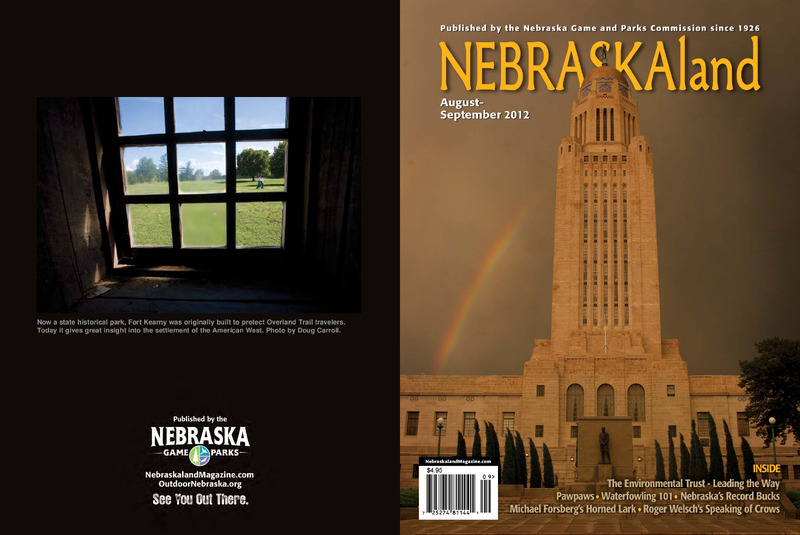
Now a state historical park, Fort Kearny was originally built to protect Overland Trail travelers.
Today it gives great insight into the settlement of the American West. Photo by Doug Carroll.
Volume 90, Number 7, August-September 2012
12 Waterfowling 101 – Start Your Duck Dynasty Today
Waterfowl hunting doesn’t have to be complicated or
expensive. TEXT AND PHOTOS BY DOUG STEINKE
20 Open Country Songbird
A look at the horned lark – an enchanting songbird of
western Nebraska plains. TEXT AND PHOTOS BY MICHAEL FORSBERG
22 Nebraska’s Environmental Trust
Celebrating its 20th anniversary this year, the Nebraska
Environment Trust continues to help conserve, enhance
and restore the state’s natural environment.
32 Pittman-Robertson – Visionaries of Conservation
Seventy-five years ago hunters began taxing themselves
to pay for wildlife management, ensuring the protection
of wildlife for all to enjoy. BY DOUG CARROLL
34 Mapping Nebraska’s Record Book Bucks
A geographic look at where many of Nebraska’s biggest
whitetails and mule deer have been harvested.
BY JOEL W. HELMER AND LEVI SHINN
22
●
38 Pawpaws – Nebraska’s Wild Bananas
Producing the largest edible fruit of any plant native to
the United States, in Nebraska pawpaw trees are found
mostly in the southeastern part of the state.
TEXT AND PHOTOS BY JON FARRAR
Comment ................................................................... 4
Mixed Bag................................................................. 6
Nature Notes ............................................................44
Outdoor Update........................................................45
Classifieds ................................................................46
Portraits from the Past .............................................48
Page 49.....................................................................49
The Last Stop ...........................................................50
32
●
20
●
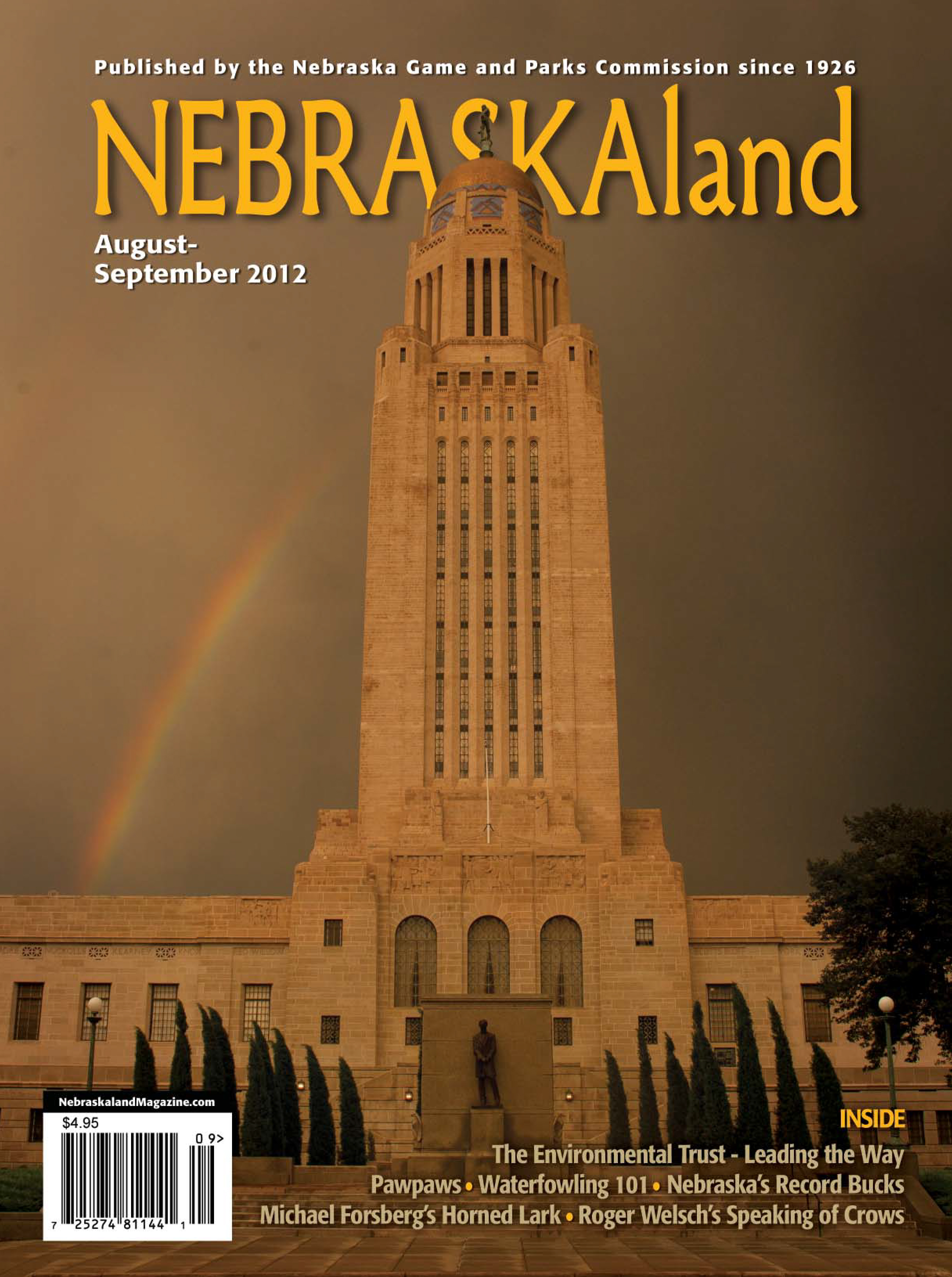
Cover: Storm clouds and a rainbow serve as a backdrop for the state
capitol building following a late-summer storm. Photo by Doug Carroll.
Opposite: The golden reflection of the setting sun on the rippled waters
of Branched Oak Lake silhouette an angler plying its waters. Photo by
Doug Carroll.
NEBRASKAland (VOL. 90 / NO. 7, ISSN 0028-1964) is published monthly, except for the
combined Jan./Feb. and Aug./Sept. issues, by the Nebraska Game and Parks Commission,
2200 N. 33rd St., Lincoln, NE. Periodicals postage paid at Lincoln, Nebraska, and additional
mailing offices. POSTMASTER: Send address changes to NEBRASKAland, P.O. Box 30370,
Lincoln, NE 68503-0370.
2 NEBRASKALAND • AUGUST-SEPTEMBER 2012
12
●
AUGUST-SEPTEMBER 2012 • NEBRASKALAND 3
planted firmly in cheek, Barta replied
that there had been a mix-up – the site
had been reserved by a Bob O’Link
instead!
Cougar Photo Op
I captured this image of a mountain
lion on July 8 of this year about 20
miles south and west of Scottsbluff in
Banner County. A friend of mine went
out behind his house early that morning
with his dog and came face to face with
the lion in a much smaller tree. The cat
came out of the tree and ran away, then
as my friend was looking for tracks to
see which way it had gone he looked
up in this tree and saw the lion much
higher up. He then called me and Scott
Brandt, the local conservation officer,
and we both got some photos before
leaving the cat alone. It left around six
that evening.
The day was a thrill for me because
it was the first wild mountain lion I had
ever seen, much less had a chance to
photograph.
Richard Teller
Teller Nature Photography
Scottsbluff, Nebraska
A Wish Come True
Maybe this story should be titled “A
Wish Come True” – my son (Jeremy
Waggoner Jr) and I were fishing on
the Nemaha River this past June and
catching gar right and left. While
waiting for the next bite, my son looks
at me and says “Dad, I wish I could
catch the biggest gar ever!” I I replied
“I’ve been wishing I could catch the
biggest bass ever my whole life, but
good luck son.”
Lo and behold, about 30 minutes
later he hooks a big fish that gave him
a run for his money, so I netted the fish
for him and it turned out to be a huge
gar. Because it was around midnight,
we waited until the next day to take
it to a local grocery store, where it
weighed 8.1 pounds on their certified
scale.
So the next day we got the gar out
of the freezer and took it to Aksarben
Aquarium near Gretna, where it was
officially certified at 7.32 pounds and
32 inches in length. It may not have
been the biggest gar ever, but it was
a new state record for shortnose gar.
Good job, Jeremy Jr.! Maybe next time
we go bass fishing he will look at me
and say “Dad, I wish you could catch
the biggest bass ever! Lol!
Jeremy Waggoner
Hiawatha, Kansas
Lambsquarters
I thoroughly enjoyed the article by
Kimberly Stuhr about lambsquarters in
the June 2012 issue of NEBRASKAland.
I grew up just northwest of Big
Springs and lambsquarters were
common, growing wild on our farm.
I have eaten them, mostly as salad
greens and a couple of times prepared
like spinach. One item of interest to me
was not mentioned by Ms. Stuhr, if she
is aware of it – how the plant got the
rather odd name. You see, if you let a
patch of lambsquarter grow to maturity,
which is over three feet tall, and then
walk through the patch on a hot, calm
summer day, you will notice a pretty
strong odor, just like a sheep pen or
“lambs quarters” – thus the name!
Monty Splitter
Kearney, Nebraska
NEBRASKAland Visitor Letters
We want to thank all 36 readers
that sent e-mails and letters for last
issue’s visitor, an Assassin Bug that
was on page 31 (see page 11 for the
winner, rules and this issue’s hint).
Here are a few of the wonderful
responses we received:
The visitor is on page 31 on the
Commisson ad. Not sure what it is.
Enjoyed the article on silencers.
Ron Decker
Spokane Valley, Washington
What About Bob?
When Conservation Officer Dina
Barta posted a photo on Facebook of
a quail calling from a picnic table at a
Lincoln-area campground, one of her
friends asked if the campsite has been
reserved for a Bob White. Tongue
4 NEBRASKALAND • AUGUST-SEPTEMBER 2012
You have an assassin type bug
attacking your logo on page 31!
Say, thanks for including the spear
(and atlatl) in your hunting weapons
this year! This will be a tough weapon
to be successful with in deer hunting,
but it will be fun trying. Now I will
have to try my hand at making the
atlatl and “darts.” Thanks again for
adding variety to the hunt. (We now
join South Carolina and Missouri.)
Ron Macomber
South Sioux City, Nebraska
Assassin bugs are a predaceous family
of true bugs in the order Hemiptera.
True bugs, which include stink bugs,
squash bugs and assassin bugs, can
be identified by their overlapping
wings. Assassin bugs hide in a variety
of habitats, waiting for prey to come
by. While they are weak fliers, they
can run relatively quickly when
hunting or fleeing. Assassin bugs
are considered beneficial insects,
because they feed on plant pests such
as aphids and caterpillars, but they
will also feed on beneficial insects,
including ladybugs and lacewings.
The assassin bug pictured here is
likely the leafhopper assassin bug
(Zelus renardii). Adults measure up
to ½-inch in length and coloration
can vary from reddish-brown to
yellowish-green. Females lay barrelshaped eggs in clusters on foliage and
immature assassin bugs lack wings
upon hatching. These nymphs
will go through
five molts before
reaching maturity,
when wings are
fully formed.
Special thanks to Julie Van Meter, State
Entomologist, Nebraska Department of
Agriculture. Visitor image by Chris Helzer.
www.bugguide.net is a good site for identification
Send your comments to:
Doug Carroll, Editor
NEBRASKAland Magazine
P.O. Box 30370
Lincoln, NE 68503
or e-mail Doug.Carroll@Nebraska.gov
Please include your postal address and
telephone number.
Letters may be condensed and edited
for clarity. Photographs are welcome
and will be returned.
Any program that receives federal funding from the National Park
Service, or the United States Fish and Wildlife Service prohibits unlawful
discrimination on the basis of race, color, religion, age, gender, marital
status, national origin, age, disability or political affiliation. Any person
who believes he or she has been discriminated against in any program,
activity, facility, or service, should contact the Nebraska Game and
Parks Commission, Lincoln, NE 402-471-0641, the Equal Opportunity
Commission, Lincoln, NE 402-471-2024, TTY/TDD 402-471-4693;
United States Fish Wildlife Service, Civil Rights Coordinator, 4401
N. Fairfax Drive, Arlington, VA 22203; Director, Equal Opportunity
Program, U.S. Department of Interior, National Park Service, 1849 C
Street NW, Mail Code 0008, Washington, D.C. 20240-0001.
COMMISSION
CONSERVATION OFFICERS
Director Jim Douglas
NORTHWEST
Officer
City
Jim Zimmerman (S) Gering
Commissioners
Chairman - Ron Stave, Waterloo
Vice Chairman - Norris Marshall, Kearney
2nd Vice Chairman - Jerrod Burke, Curtis
Dr. Mark Pinkerton, Wilber
Dr. Kent Forney, Lincoln
Lynn Berggren, Broken Bow
Rex Fisher, Omaha
Mark Spurgin, Paxton
Mick Jensen, Blair
Greg Hesse
Scott Brandt
Heath Packett
Dan Kling
Frank Miller
MAGAZINE STAFF
Editor Doug Carroll
Associate Editor Jeff Kurrus
Art Director Tim Reigert
Senior Editor Jon Farrar
Regional Editor Eric Fowler
Contributing Editor Michael Forsberg
Regular Contributors Bill Hager, Chris Helzer,
Lisa Knopp
Photo Librarian Sarah Johnson
Circulation Donna Robinson
For address changes and questions about
your subscription, e-mail Donna.Robinson@
Nebraska.gov
or call (800) 632-5263
Marketing/Advertising
For advertising information contact
Larson Enterprises
e-mail dave@larsonent.com
or call (515) 440-2810
NEBRASKAland Magazine Copyright 2012, all rights reserved.
NEBRASKAland is available on audio cassette from the Nebraska
Library Commission Talking Book and Braille Service, Suite 120, 1200 N
St., Lincoln, NE 68508. (800) 742-7691. NEBRASKAland Magazine and
the Nebraska Game and Parks Commission reserve the right to reject any
advertising not in keeping with the agency mission.
Rates: $18 for one year; $33 for two years; $44 for three years. Nebraska
recipients must add appropriate sales tax. To subscribe call
1-800-NEBLAND (632-5263), or go online to: NebraskalandMagazine.
com.
COMMISSION OFFICES
Headquarters/Southeast District Office
2200 N. 33rd Street Lincoln, NE 68503
Phone (402) 471-0641
Northeast District Office
2201 N. 13th St. Norfolk, NE 68701
Phone (402) 370-3374
Southwest District Office
301 E. State Farm Rd. North Platte, NE 69101
Phone (308) 535-8025
Northwest District Office
East Hwy. 2, Box 725 Alliance, NE 69301
Phone (308) 763-2940
Bassett Office
524 Panzer St., Box 508 Bassett, NE 68714
Phone (402) 684-2921
Kearney Office
1617 First Ave. Kearney, NE 68847
Phone (308) 865-5310
Omaha Office
1212 Bob Gibson Blvd. Omaha, NE 68108
Phone (402) 595-2144
Phone (308)
(office) 763-2940
(cell) 641-6138
Alliance
760-3647
Gering
631-0663
Gordon
360-0682
Harrison
430-0572
Valentine (402) 389-0444
SOUTHWEST
Officer
City
Phone (308)
Roger Thompson (S) N. Platte (office) 535-8025
(cell) 530-3097
Ray Dierking
Brkn. Bow
870-0322
George Sund
Cambridge
655-0028
Michael Thome
Cozad
529-8146
Terry Brentzel
Doniphan (402) 469-5795
Matt Andrews
Elwood
746-2418
Dirk Greene
Imperial
882-0015
Jerry Pecha (Sup.) Kearney (office) 865-5327
(cell) 293-3551
Dale Johnson
Kearney
440-3847
Brian Piernicky
McCook
340-6627
Dudley Sorensen
N. Platte
530-0016
Nicholas Fix
Ogallala
289-0427
Dennis Thompson
Ogallala
289-0755
Rich Routh
Rep. City
920-0367
NORTHEAST
Officer
City
Tom Zimmer (Sup.) Norfolk
Dale Davis
Steve Oberg
Daniel Roberts
Randy Pomplun
Jeff Jones
Jon Reeves
Tim Williams
Pat George
Doug Pollard
Cory Krause
Phone (402)
(office) 370-3374
(cell) 649-8053
Bassett
760-0712
Columbus
910-3366
Fremont
719-1108
Fullerton (308) 550-0489
Hartington
762-5022
Kennard
889-8508
Neligh
929-0051
O’Neill
340-0787
Ord
(308) 778-7101
West Point
380-6410
SOUTHEAST
Officer
Sean McKeehan
William Krause
Mike Luben
Dan Zuehlke
Darin Gress
Douglas Kramer
Dina Barta
Stacey Lewton
Levi Krause
Robert Finke
Russell Mort
Dan Evasco
City
Ashland
Auburn
Colon
Cortland
Hebron
Lincoln
Lincoln
Lincoln
Louisville
Milford
Nebr. City
Papillion
Phone (402)
521-0159
274-8063
443-6392
806-9084
768-8665
890-6465
890-6463
890-7140
949-0593
947-1363
209-1506
616-5961
ADMINISTRATION
Officer
Craig Stover (Adm.)
Duane Arp (Ass.)
Jeff Clauson (Ass.)
City
Lincoln
Lincoln
Lincoln
Phone (402)
471-5531
471-5532
471-0480
Nebraska Wildlife Crimestoppers 1-800-742-7627
Ak-Sar-Ben Aquarium
21502 W. Highway 31 Gretna, NE 68028
Phone (402) 332-3901
AUGUST-SEPTEMBER 2012 • NEBRASKALAND 5
The Wonderful World of Crayfish
Parks App Available for iPhones
iPhone users are now able to access
information for all of Nebraska’s state
parks by downloading a free Pocket
Ranger mobile app from iTunes.
This new, customized mobile app
provides interactive GPS and GIS Map
technology for tracking trails, marking
waypoints and locating landmarks.
Other features include an events
calendar that is updated in real time,
social networking capabilities and a
tool that allows mobile users to publish
and share photos. Visitors can search
for specific parks in a region or retrieve
information from a comprehensive list
of all park activities or events.
Future plans include a fall release
of an expanded application for hunters
and anglers, an Android version release
and a mobile website format for
Blackberry users.
For more information and to
download the mobile app, visit the
Game and Parks web page at: http://
outdoornebraska.ne.gov/mobile_apps/
pocket-ranger.asp.
6 NEBRASKALAND • AUGUST-SEPTEMBER 2012
PHOTO BY DOMINIQUE WORTHING
Dominique Worthing
If you were to turn over a few rocks
on the edge of the closest pond, lake
or stream, you might find a critter that
resembles a miniature lobster. You
are probably looking at a crayfish.
Crayfish, better known as crawdads,
are freshwater relatives of lobsters. It
is estimated that there are 500-600
different species of these crustaceans in
the world, with some species discovered
as recently as 2011. Approximately 350
of those species can be found in North
America, four of which are native to
Nebraska: the calico (or papershell), the
virile (or northern) the gapped ringed,
and the devil crayfish. While the calico and virile are quite common, the gapped
ringed and devil are harder to find.
Anglers use craydads as bait, and if you head to a Cajun restaurant you’ll
probably see them listed as a menu item, but what role do they play in the
ecosystems they live in? How do they benefit our waterways? Crawdads are
omnivores – they will eat both living and dead plant and animal material, and
their eating habits help lower the amount of waste product in waterways, creating
cleaner water in the lakes and streams they call home. Due to their sensitivity to
pollution, their presence is a good indication of a healthy habitat. They are also a
food source for many different animals, including but not limited to: trout, bass,
sunfish, catfish, ducks, geese, water snakes, bullfrogs and raccoons.
In recent years an exotic (non-native) crayfish has been introduced to Nebraska
waters and is outcompeting the native species: The rusty crayfish, identifiable
by the brown (or rust) colored patch on the sides of its abdomen, is native to the
Ohio River drainage but has made its way into parts of Nebraska and many other
midwestern states. These crayfish have much larger claws in comparison to the
native species, making it easier for them to outcompete native crayfish and take
their place in the ecosystem.
Just as we protect and manage deer, cranes, and other large animals, we must
protect and manage the smaller creatures as well. Crayfish are an important part of
our Nebraska waterways and rusty crayfish pose a serious threat to their continued
existence. If you suspect that a bait shop is selling rusty crayfish, see anyone
throwing bait into a lake or stream, or find rusty crayfish in Nebraska waters, it’s
important to report your findings to the proper authorities. Help us help native
crayfish keep our waters clean for a healthy ecosystem for everyone.
Here is a list of
upcoming outdoor
events across
Nebraska.
For more
information
about these
and other
events, visit the
calendar page at
www.OutdoorNebraska.org.
August 1
Squirrel Season Opens
Pick up a copy of 2012 Nebraska
Hunting Guide for more information.
August 4-5
Living History Weekend
Fort Atkinson State Historical Park,
402-468-5611, ngpc.fort.atkinson@
nebraska.gov.
August 4, 11
Free Fishing Clinic
11 am-4 pm, E.T. Mahoney
State Park. Contact Carl
“Catfishman” Brown, 402-681-6265.
oldcatfishman@cox.net.
August 8
Family Fishing Event
6-8 pm, Iron Horse Park Lake,
North Platte. Contact Lindsey
Chizinski, 402-332-3901,
lindsey.chizinski@nebraska.gov.
August 20
Archery Pronghorn Opens
For more information about
this and other big game hunting
seasons, pick up a 2012 Big Game
Hunting brochure.
August 31
Moonlight Hike at Wildcat Hills
8:30 pm, Wildcat Hills Nature
Center, 308-436-3777, ngpc.wildcat.
hills@nebraska.gov.
September 1
Dove, grouse and cottontail
September 1 marks the traditional
start of the fall hunting seasons with
the opening day for dove, grouse
and cottontails.
September 15-16
Missouri River Outdoor Expo
8th Annual Missouri River
Outdoor Expo at Ponca State Park.
Fun for the whole family – learn
about wildlife-related and outdoor
recreation activities, including
wildlife viewing, fishing, hunting,
shooting sports, camping. 402-7552284, ngpc.ponca@nebraska.gov.
Send Us Your Trail Cam Photos
Dominique Worthing
In September of 1959, for
35 cents you could own Outdoor
Nebraska’s “Special Hunting
Guide” issue, which focused on
grouse and duck hunting. Coming
from a large hunting family, “The
Eight-Step Method: The Easy
Way to Clean Your Ducks” by
Emma DeFord stood out among
the other articles immediately.
In her article DeFord, a longtime bird cleaner, lays out
an eight-step plan that she
guarantees will allow you to clean
five birds in less than a half hour.
Having seen the mess normally
inflicted on the kitchen by my
brothers’ bird-cleaning skills, I
was amazed at how clean Ms.
DeFord’s cleaning process was.
I found step five to be the
most interesting of the steps –
in it DeFord describes how to
singe the skin of the bird with
rubbing alcohol to remove any
remaining down missed in the
previous steps. She achieves this
by placing two tablespoons of
70-percent rubbing alcohol in a
small dish or coffee lid and setting
the liquid on fire. A must read for
anyone who cleans waterfowl,
Ms. DeFord’s article is sure to
entertain as well as inform.
To read “The Eight-step Method”
go to NebraskalandMagazine.com
and click on “A Look Back.”
Dove Hunting Locales
Jeff Kurrus
Where one should dove hunt is an
oft-asked question in Nebraska. If you’re
fortunate enough to have private land
somewhere, good for you. If not, take a
look at the following public hunting lands
throughout Nebraska and pay attention to
the Commission’s latest dove forecast at
OutdoorNebraska.org.
NORTH CENTRAL
• Borman Bridge
• Calamus Reservoir
• L.A. Koziel, Pressey
• Myrtle Hall
• Pine Glen
• Sherman Reservoir
• Thomas Creek
This photo was taken in Yuma County, Colorado near the
headwaters of the Republican River. Sent in by Alan Krueger.
Please submit your trail camera photos by e-mail to:
nebtrailcam@gmail.com. Also include any information that
will help explain your photo.
Backpacker.com
Dan Farnsworth
The phrase “Flyover country”
ignores the great beauty of Nebraska
from the Missouri River Valley to
the rolling Sandhills. Backpacker
Magazine’s online publication,
Backpacker.com, has taken note with a
page exploring the Nebraska outdoors.
The site reviews nine trips to inspire
the short weekend getaway or an
outdoor excursion. Each destination is
a starting point for more adventures in
the area, and the site allows users to
submit destination reviews to inspire
others. The review of the Norwesca
Trail at Chadron State Park provides
a great description of the valleys and
buttes surrounding Nebraska’s Pine
Ridge, and each review rates the
difficulty of trails at each site. There
is also a substantial amount of general
outdoor information from starting
a fire to treating poison ivy. Visit
Backpacker.com and tell them about
your Nebraska trip.
8 NEBRASKALAND • AUGUST-SEPTEMBER 2012
NORTHEAST
• Black Island
• Don Dworak
• Elk Point
• George Syas
• Oak Valley
• Wood Duck
SOUTHEAST
• Branched Oak
• Larkspur
• Little Salt Creek West
• Olive Creek
• Osage
• Pawnee
• Rakes Creek
• Stagecoach
• Twin Lakes
• Wildwood
• Yankee Hill
SOUTHWEST
• Box Elder Canyon
• Cedar Valley
• Clear Creek
• Enders Reservoir
• Medicine Creek Reservoir
• Ogallala Strip
• Swanson Reservoir PANHANDLE
No fields planted for doves,
• Wapiti
SOUTH CENTRAL
• Alexandria
• Flathead
• Little Blue
• Little Blue East
• Rose Creek
• Rose Creek West
but the following provide good
hunting around ponds or water
sites.
• Arnold Trupp
• Bordeaux Creek
• Buffalo Creek
• Cedar Canyon
• Facus Spring
• Kiowa
• Nine Mile Creek
• Peterson
Get HIP
Dove hunters (and almost anyone else that hunts migratory
game birds such as doves, woodcock, snipe and waterfowl,
etc) need to remember to get their HIP (Harvest Information
Program) number before taking to the field this year.
The HIP program helps biologists more accurately monitor
the number of migratory birds harvested across the country.
See the ad at left to find out how to register for the program.
AUGUST-SEPTEMBER 2012 • NEBRASKALAND 9
Turpin Time
Dick Turpin
Imagine if
you had to
run through
tar to get
somewhere.
It would be
difficult and
you’d probably
abandon the
idea. Well, here’s a similar idea for
picnic tables to deter ants.
This tip involves camping mostly, but
it could also be used in your backyard.
If you’re out there camping, it takes
about two days for the ants to find
your food. They come up that picnic
table leg and they get into your stuff.
Same thing on your deck. We have
that problem once in awhile but there
is a good way to solve that: Vaseline.
You just take some Vaseline and rub
a little of that around the leg of your
picnic table … just a little bit. Who’d
ever thunk it would prevent ants from
getting up on your picnic table? ■
NEBRASKAland Visitor
Winner and Hint
PHOTO BY JEFF KURRUS
Swim While You Can
10 NEBRASKALAND • AUGUST-SEPTEMBER 2012
The E.T. Mahoney State Park Family Aquatic Center, which includes three water
slides, wave pool, lap pool and concession stand, is open noon-5 p.m. and 6
to 8 p.m. daily, weather permitting, thru mid-August. Hours of operation will be
reduced from mid-August thru Labor Day weekend. Call 402-944-2523 ext. 7122
for more information. Admission is $8 for adults and $7 for children ages 3-12.
Last issue’s winner of
the Visitor drawing was
Jason Obermiller, of
Ravenna Nebraska, who
found the assassin bug on page 31.
Readers are encouraged to contact
NEBRASKAland within 10 days
after this issue’s publication with the
correct page number and name of
this issue’s “Visitor” – a bug found
in Nebraska that just happened to
find its way onto one of the pages.
We will then gather the correct
entries and draw one to win a
NEBRASKAland Magazine mug.
To enter each month, write:
NEBRASKAland Visitor
2200 North 33rd Street,
Lincoln, NE 68503.
Or e-mail:
Tim.Reigert@Nebraska.gov
with “Visitor” in the subject line of
the message.
HINT: This issue’s visitor is not
on page 5, 6, 7, 9, or 50.
AUGUST-SEPTEMBER 2012 • NEBRASKALAND 11
Waterfowling 101
Start Your Duck Dynasty Today
Photos and text by Doug Steinke
W
Late morning mallards
returning to the Platte
River after feeding.
12 NEBRASKALAND • AUGUST-SEPTEMBER 2012
hen I was six, Dad took me on my
first duck hunt, which took place on
the Republican River just upstream of
Superior. My father carried me out to an island
covered with willows and tall grass. The details of
that day are still with me: Sitting on the upstream
side of the island, facing southeast, he put out
his sack full of Ariduk duck decoys. We were still
settling in, me comfortable in the thick grass,
when a hen mallard came screaming in, cupped
against the steel-gray sky. We turned our heads
together to watch, and then he reached for his gun.
Before he could maneuver into position and get a
shot off, the mallard flew off upstream. He looked
at me and said, “I should have shot it. I thought
she’d come back around.” He may have been upset
about the poor hunting since that was the only
duck we saw that morning, but in my little boy
mind that day was special, my first on the river.
I’m a waterfowler first and everything else in the
hunting world is a distant second.
To the uninitiated, this is hard to explain.
Most of you who go on a first duck hunt have a
great time, enjoy the warm blind, hot breakfast
and banter among blindmates. Shooting a duck
may even complete the day. At the end of the
day, many can take it or leave it. But for a few
of you, waterfowling can become an obsession.
It begins with watching that first duck cupping,
dipping, following the duck call and settling into
the decoys. You’ll know. And once you know, you
will want to know more about how to improve as a
waterfowler.
For most of you, your first experience will be
as an invited guest out to a blind, probably from
a wise old waterfowl veteran. These veterans can
always use an extra hand putting out decoys –
they’ve burned out most of their non-diehard
friends long ago and are always looking for fresh
replacements. My father was invited to our own
hunting spot more than 30 years ago by an elder
of the camo, and so it goes.
One of the really cool things about duck hunting
is the opportunity to acquire a lot of toys. Not
that you have to buy all of these items brand new:
A waterfowl purist is the king cheapskate of all
sportsmen. He knows how to find free junk and
make it work for him. Here is an outline of what
you’ll need to get started.
Swag
First, consider yourself lucky in this day and age
of Gore-Tex jackets, neoprene waders and propane
heaters. I recall cotton coats; cracked, leaking
rubber waders; and coffee cans filled with charcoal
briquettes putting off smoky heat. Some of those
days were miserable and probably the reason for
my brother’s dislike of anything hunting. To this
day, I just have to say “duck blind” and he starts
shivering uncontrollably.
Using a prairie hay blind in front of shallow, flowing water –
the quintessential Platte River duck hunting setup.
AUGUST-SEPTEMBER 2012 • NEBRASKALAND 13
Camouflage Clothing
There are a myriad of camouflage styles on the market
these days. It is hard to go wrong with Realtree’s Max-4
or Avery’s KW-1, but even just plain khaki-colored camo
will do. The older … um wiser … I get, the more I want
just plain khaki, because it blends into every environment.
Plus it’s usually substantially cheaper. Go with Gore-tex,
never skimp on rainwear. Trust me, I’ve been there sitting
in an open blind, soaked to the bone in driving, freezing
rain in, cheap “knock off” material. That’s when you say
to yourself, “I should have paid the extra 50 bucks because
I’d pay almost any amount right now to be dry and warm.”
The most important thing to remember when hunting – no
matter the style of camo you wear – is to keep still and not to
show your face to the incoming birds. It’s basic and simple.
Use the surrounding mud or grime and smear it on your
face, which is just as good as any commercial face paint out
there – the goal is to simply dull your face signature.
Left: Kegan Steinke finds some
time to rest next to his father Cory
during a mid-morning lull in the
action.
Above: Redheads feeding on the
end of a flooded cornfield.
14 NEBRASKALAND • AUGUST-SEPTEMBER 2012
Shotguns and Ammo
There are as many schools of thought about
waterfowl shotguns as there are species of ducks.
For reliability and toughness, it is hard to beat a
12-gauge pump shooting three-inch shells. If you
are hunting out of a layout blind on the ground,
then dirt and grime are going to be your partners.
In this situation you can’t go wrong with a pump
shotgun like the Remington 870s, 877s or the
Benelli Novas. In all of my years I’ve never seen
a pump fail in the field. Semiautomatic shotguns
require more upkeep, but work well in a relatively
clean, enclosed pit blind.
When it comes to ammunition for ducks, I
like anything from size 2 to size 4 shot. More
important than pellet size is understanding the
best choke pattern for the situation at hand. When
hunting a warmwater slough or narrow river
channel, most decoying shots are going to be in
the 10- to 30-yard range. In this situation I like a
very open choke, such as a skeet choke.
If, however, you are shooting over a wider river
or rainwater basin where the shots will generally
be 20 to 50 yards, a tighter choke such as modified
or improved modified is more appropriate. If you
find yourself pass-shooting birds, then go with a
very closed choke, a full or third party full choke.
Get out to a local shooting range and actually
shoot at large sheets of paper from varying
distances to visually see how each load and choke
combination performs. Once you become more
advanced in your shooting, then fine tune your
loads to match your gun’s choking system.
Shotguns that shoot 31⁄2-shells have their place as
well, but don’t get caught up in the more is better
school of thought – if you have a duck cupped
at 30 yards and get a solid hit on it, the bird is
coming down whether struck with a 28, 20, 12 or
10 gauge.
AUGUST-SEPTEMBER 2012 • NEBRASKALAND 15
Left: Josh Carda puts the
finishing touches on his cornfield
decoy spread by adding a
spinning wing decoy.
Below: Tony Wiese’s dog Nikki
making a nice retrieve.
Bottom: The bagging of
birds aren’t the only types of
memories that hunters take
home with them. Some are
simply beautiful sunrises.
is the spinning-wing motorized decoy – no other
decoy over the past 50 years has made decoying
ducks easier. In most situations and locations, a
couple dozen decoys and a spinning wing decoy
will be more than enough for a day of hunting.
Locations
Accumulating gear is one thing, but now we get
to the point of “Where do I go?” Ducks will be
found in the obvious locations – a river, rainwater
basin, lake or a pond. No doubt ducks like water.
But as each year passes it is becoming more and
more difficult to find a place to hunt even for
veteran waterfowlers. The three most important
words in waterfowling are the same as in real
estate … location, location and location.
Some lucky hunters fall into a great hunting
spot. Access to warm water sloughs, prime river
ground or a flooded corner of a cornfield is a
gift. There is no doubt this is the quickest way
to fast forward through the learning curve of
waterfowling. On the other hand, the opportunity
to explore, innovate and struggle your way to
success in a sub-prime location is like making
something out of nothing.
Growing up in central Nebraska, I learned to
make the best out of marginal hunting areas. In
high school I discovered a hidden gem in almost
every cornfield – irrigation re-use pits. During
early duck season, a tennis court-sized re-use pit
provides ample opportunity to jump ducks. It is
essential, of course, to secure permission from the
landowner.
For the beginning waterfowl hunter, there
is no better place to start than the Rainwater
Basin area in south-central Nebraska. It can
offer up some of the most amazing waterfowling
to be found between Canada and Mexico, and
most of it is public hunting ground. Pick up a
CRP Map atlas at a local sporting goods store
or visit the Nebraska Game and Parks web site
(OutdoorNebraska.org) to see a listing of the
wildlife management and waterfowl production
areas near you. Saturday and Sunday mornings
are by far the busiest times at such locations and
they can get quite crowded, but if you’re able to
get off work during the week, you may have the
place to yourself.
When hunting these public areas there are
unwritten rules you must know: Keep your ego
Decoys
There has never been a better time in the history of waterfowling
than now for decoys. Technological advances in plastics, paints
and the molding process have allowed decoy companies to make
near stuffer replicas of ducks and geese at reasonable prices. There
are also the secondary markets of eBay, Craig’s List and garage
sales where great deals can be found if you look hard enough. Here,
however, I must advise restraint – you can soon rack up a healthy
investment in decoys if you’re not careful. Many companies have
entry level “hot buy” duck decoys that start out at $30 a dozen.
These are usually lightweight and small enough you can easily get
three dozen in a decoy bag and carry them up to a mile without
much effort. These days the most important decoy you must possess
16 NEBRASKALAND • AUGUST-SEPTEMBER 2012
AUGUST-SEPTEMBER 2012 • NEBRASKALAND 17
to the sounds ducks make. Listen for the four to five note call of content
ducks. The hail call is just a louder version of this call. There are more
advanced calling tips, but this should help get you on your way.
Share the Experience
Lexington-native and long-time waterfowler Rod Reynolds has
introduced scores of youngsters to waterfowling. He feels strongly about
giving opportunities to kids and helping them to find a passion for the
outdoors:
“Kids are the future of our sport and some of the most profound lessons
can be learned in the outdoors. When starting, instruct them about safe
and ethical hunting. Beyond that, kids must be warm and comfortable,
and plan on a short hunting trip so they do not get bored – it is better to
go for an hour and be successful so they want to do it again. Build some
excitement into the planning of the hunt ... I think getting ready for the
hunt is almost as exciting for a kid as the hunt itself.” ■
locked in your vehicle, be courteous to those
already out, and try to get out an hour before
shooting time or wait until after sunrise –
otherwise the best 30 minutes of shooting for
everyone else is ruined while you are walking
in and spooking birds. Leave at least 200 yards
between you and your neighbors’ spread, and
don’t set up downwind from another spread.
Whether or not a flock is decoying to you or your
neighbor is usually a judgment call. Finally, use
common sense and safe distance when shooting.
Field or ground hunting ducks is fast becoming
a preferred method of hunting in the basins.
Migratory ducks will sometimes fly five to 10
miles away from their wetland roosting or loafing
areas to feed in a field. Not only are these fields
a great place to hunt, but getting permission to
hunt a crop field is often easier than landing a
spot on the river. Success in this venture requires
spending an early morning or late afternoon
scouting for feeding spots. This is time consuming
initially but simple, and the beautiful thing
18 NEBRASKALAND • AUGUST-SEPTEMBER 2012
about field hunting is that once permission is
granted by the landowner, the hunter may drive
directly to the location and unload equipment
and decoys without the inconvenience of hoisting
gear overland for hundreds of yards. If you are
in a field where ducks were actively feeding the
morning or night before, then two dozen field and
one or two motorized decoys should be all that is
needed to decoy flocks numbering in the hundreds.
Above: Spot, stalk and jumping
of ducks can be quite a thrill.
Here David Hoferer and Justin
Gill jump some late-season
mallards.
Right: Anytime you can make
duck hunting a family affair it’s a
good thing.
Duck Calls
Troy Bailey, past Nebraska state calling
champion, does not recommend high end calls for
beginners: “For the beginning duck hunter getting
into calling, I would start off with a double reed
call such as a Haydels DR-85 or a Primos Wench
duck call. They are inexpensive and don’t take a
great deal of technique to use.” There are all kinds
of CDs and DVDs about duck calling, and sample
videos on YouTube that you can use to help hone
your skills. Or why not go to the source? Sit at
your local city park and spend some time listening
Doug Steinke is a freelance
writer and photographer who
grew up in central Nebraska.
He is a major contributing
photographer for Ducks
Unlimited Magazine, and lives
in Grand Island with his wife,
Becky, and three boys: Gage,
Blake and Garrett.
AUGUST-SEPTEMBER 2012 • NEBRASKALAND 19
Open Country
Songbird
Text and photos by Michael Forsberg
M
y earliest recollection of a horned lark is from a
bitterly cold February day in the Blue Creek Valley
of the western Sandhills. From a hillside I watched
a flock of these dainty yet tough birds gather on a snow bank
and feed intensely on prairie grass seed heads sticking up out
of the snow. They would hop up onto the grass stems and
ride them down to the ground where they could then strip
the seed heads bare.
Months later, while camped out on a shortgrass prairie in
early June, I fell asleep listening to what sounded like the
constant tinkling of distant sleigh bells. It wasn’t until the
next morning I realized the sound wasn’t part of a dream – it
Horned lark nests are built so that the female’s back is level
with the ground, offering protection from the hooves of grazers.
20 NEBRASKALAND • AUGUST-SEPTEMBER 2012
was a horned lark calling
under the pale light of a
full moon.
An enchanting songbird
of open country, the
horned lark (Eremophila
alpestris) can be found
in prairie, desert and
tundra grasslands from
the Arctic Circle south to
the northern reaches of
South America. It holds
claim to being the only
lark species native to
the western hemisphere
(meadowlarks, by the
way, are not true larks
– they are most closely
related to blackbirds and
orioles).
Seven inches long, the
horned lark’s wings are
long and slender and its
tail short and square – a
good design for living and
flying in places where the
wind always blows. It’s sharp yet stout bill is designed to
crack open small seeds, but is also used for digging. So are
the elongated hind claws, which grow out like long, curved
fingernails and may help the bird dig more efficiently in the
soil.
There are at least 20 recognized subspecies of horned larks
in North America, yet all are similarly marked with a black
mask and breastband, a yellow chin, white underparts and
small tufts of black feathers that stick up on both sides of its
head like horns, thus its name. The coloration on their backs,
tails and wings, however, can vary from light tan to rusty
brown, usually matching the color of the soil where they
live.
Horned larks evolved on the plains near bison herds and
prairie dog towns, where the grass was short and frequently
disturbed. Today they can be found just as readily in plowed
or fallow fields and short cropped or overgrazed pastures.
In Nebraska they are regular breeders in the western half
of the state and can be seen nearly statewide certain times
of year. In winter, horned lark populations that breed farther
north in the Dakotas and Canada migrate through and
A songbird of open grasslands, horned larks have a black mask and breastband, a yellow chin, white underparts
and small tufts of black feathers that stick up on both sides of their head, thus the name.
sometimes winter in Nebraska. Those that breed here and in
other Central Plains states usually migrate south, depending
on the harshness of winter and food availability.
During the breeding season the male arrives at potential
nesting areas first and establishes a two- to four-acre
territory. When the females arrives, the male performs
an elaborate courtship flight, sometimes gaining several
hundred feet in elevation before facing into the wind,
setting its wings in a V-shape, spreading its tail and gliding
downward while passionately serenading the female with its
buoyant song.
Once a mate is selected, the female will usually choose a
nest site next to a clump of grass, rock or cow pie, dig out
a depression and line it with fine grasses and stems. This
nest cup is about the diameter of a small toddler’s fist and
just deep enough so that when the female sits on the eggs
her back is flush with the ground. In this way, the hooves of
grazers such as bison or cattle moving across the prairie are
less likely to crush her or her eggs.
Females typically lay three eggs. The chicks, born naked
and blind and fed an all-protein diet of insects delivered by
both parents, grow quickly and fledge in about two weeks.
In Nebraska, horned larks can raise two, sometimes three,
broods a year.
By fall they begin to form loose flocks while shifting to a
more seed-based diet gleaned from maturing prairie grasses
and wildflowers. In the winter semi-nomadic flocks of
horned larks, sometimes joined by longspurs and buntings,
become primarily seed eaters, often foraging in agricultural
fields seeking out grains left over from harvest.
From my blind in a prairie dog town this past May,
I watched from just a few feet away as a horned lark
meticulously pecked, chipped and scraped away a butter
dish-shaped depression in a patch of bare soil, then settled
into the dusty bowl and bathed. It ruffled its feathers and
slid side to side, eventually covering itself from head to
tail with the tawny colored soil. When I turned away for
a moment then looked back I couldn’t see the lark until it
shook itself off, revealing again its yellow chin, black mask,
chest bib and feathered horns. Seemingly satisfied with its
bath, it paused and gazed out over the prairie, let out a single
“cheep” and flew away. ■
AUGUST-SEPTEMBER 2012 • NEBRASKALAND 21
Nebraska
Environmental
Trust
PHOTO BY JON FARRAR
Preserving Natural Nebraska for Future Generations
T
h Nebraska Environmental Trust was
he
es
established to conserve, enhance and
re
restore the natural environments of
Nebras
Nebraska. A prosperous future requires a
sound natural environment. We must act
dynamically, progressively and systematically
to ensure bountiful and thriving natural
resources.
The Trust is to complement existing activities,
stimulate private investment and emphasize
long term gain. The Trust is to lead in the
development of a vision of Nebraska’s future
environment. The Trust is to collaborate with
public and private efforts to achieve that
vision.
22 NEBRASKALAND • AUGUST-SEPTEMBER 2012
AUGUST-SEPTEMBER 2012 • NEBRASKALAND 23
How it Started
PHOTO BY JON FARRAR
The Trust was created on the belief
that a prosperous future is dependent
upon a healthy natural environment,
and that Nebraskans could solve many
environmental problems if project seed
money was available.
With that belief and the idea that it
could be funded by a state lottery, the
Nebraska Environmental Trust was
Nebraska Environmental Trust money
is being used to preserve, protect and
enhance wildlife habitat across the entire
state.
created under legislation advanced by
then-governor Ben Nelson and passed
by the Legislature in 1992 – before
the Nebraska State Lottery had even
been established. When voters created
the lottery, 25 percent of the proceeds
were earmarked for the Environmental
Trust and the rest allocated to the
Education Innovation Fund, the
Compulsive Gamblers Assistance
Fund and the Solid Waste Landfill
Closure Assistance Fund. Since that
time, the portion of the lottery proceeds
devoted to closing landfills or bringing
them up to federal standards has been
reassigned to the Trust, which now
receives 44.5 percent of the lottery
profits after the first $500,000 is paid
to the Compulsive Gamblers Fund.
In addition, the Nebraska State Fair
receives 10 percent of the lottery
proceeds.
Today
2012 marks a significant milestone
in the history of the Trust – many
organizations have received funding
from the Trust over the past two
decades to put worthwhile projects on
the ground.
Ranging from habitat, surface and
groundwater, waste management
and recycling to air quality and
soil management, all 93 counties
in Nebraska have benefitted from
the existence of the Trust. A crucial
component to these projects is that each
was encouraged to have local, state or
federal matching funds, resulting in
substantial outside funds being brought
into Nebraska, some with a ratio
greater than 1:4.
Because these annual grants are
funded through the proceeds of the
Nebraska Lottery, the people who
enjoy the fun and excitement of
participating in the lottery are helping
keep the state’s land, air and water
clean for future generations. In recent
years, the Trust has received and
granted approximately $16 million on
an annual basis.
The Trust attributes much of its
success to the citizens of Nebraska for
their on-going support in protecting the
NEBRASKALAND Magazine • THE ENVIRONMENTAL TRUST
PHOTO BY ERIC FOWLER
T
h
hanks
to caring, farsighted
ppeople, in 1992 Nebraska
ccreated a unique and
eeffective mechanism for
pproviding money to fund
the conservation, enhancement and
restoration of the state’s natural
environment. Twenty years later,
more than $187 million has been
distributed to groups and organizations
trying to make a difference in the
world around them. In many cases,
these projects never would have
happened if it weren’t for the Nebraska
Environmental Trust.
Recently built Lake Wannahoo near Wahoo was funded in part with money from the Nebraska Environmental Trust.
environment and for their commitment
in preserving Nebraska’s natural
resources.
What it Has Accomplished
A vital part of Nebraska’s
conservation activities, the Trust
makes many projects a reality that
otherwise might only be a dream. By
providing the seed money needed to
qualify for other grants, the Trust helps
bring about projects that the public
can enjoy both today and into the
future – everything from wet meadow
restoration to community recycling
projects, from small soil improvement
projects on degraded inner-city lands in
Omaha to the acquisition of more than
2,000 acres of pristine Cedar Canyon in
the Wildcat Hills for public use.
Individuals, private organizations and
public entities can all apply for Trust
money – matching funds for a project
are not required, but are encouraged
through points awarded on the ratings
scale. The Trust can fund a project
for up to three years based on one
application, after which the project
must pass through the competitive
awards process again.
In particular, the Trust seeks
opportunities that bring public and
private partners together to work on
high-quality, cost-effective projects.
It also values projects that leverage
private investment in conservation and
emphasize long-lasting results. The
following is a short list of projects that
the Trust has helped fund.
Aquatic Habitat
Rehabilitation Initiative
The goal of the Nebraska Aquatic
Habitat Rehabilitation Initiative is to
conserve, restore and enhance the water
quality of aquatic systems across the
state. Nebraska was the first state to
establish an Aquatic Habitat Stamp
Program that dedicates a portion
of each fishing license for aquatic
rehabilitation projects.
Don Gabelhouse, administrator of
the fisheries division of the Nebraska
Game and Parks Commission, said the
initial funding provided by the sale of
stamps was adequate for 17 projects,
“but when we went to the people, we
ended up with 53 lakes on the list. So
we had to find other funds.”
The Trust has now funded six grants
to the Aquatic Habitat Program totaling
$4,700,000 to rehabilitate 35 different
waters. According to Mark Porath, the
THE ENVIRONMENTAL TRUST • NEBRASKALAND Magazine
Geographic Distribution of Awards (1994-2012)
82,500 acres of land across the state.
Funding for this project comes from
the Nebraska Environmental Trust
and the Commission’s Habitat Cash
Fund, which is derived from the sale
of Nebraska Habitat Stamps to hunters
and trappers in Nebraska.
Smith Falls State Park
1994-2011
2012
Totals
$28,448,900
$15,619,444
$19,658,042
$18,586,417
$14,857,772
$12,761,212
$26,073,028
$36,022,866
$2,550,283
$2,815,445
$985,383
$2,018,266
$3,520,361
$1,831,338
$2,359,069
$3,212,251
$30,999,183
$18,434,889
$20,670,425
$20,604,683
$18,378,133
$14592550
$28,432,097
$39,235,117
programs manager, Trust funding has
“provided the state matching funds
critical to securing federal dollars for
these projects. Without Trust grants,
it is safe to assume that at least a
fourth of these would not have been
completed.”
A major objective of the initiative is
to facilitate completion of the Aquatic
Habitat Plans first approved by the
Nebraska Legislature in 1997 and then
again by the Commission in 2008.
Through 2011, a total of 58 projects
have been completed at a cost of
$45,278,268, with the Trust playing a
major supporting role.
Funding is used to design, engineer
and construct water quality projects.
NGPC matches Trust funds with
Aquatic Habitat Stamp, Sport Fish
Restoration, EPA Section 319, Bureau
of Reclamation Title 28, Game Cash,
Parks Cash, other public funds and
private monies to accomplish these
projects. Techniques proven to be
Total Amount Awarded
1994-2012 = $152,084,959
Awards with Statewide Benefits for 1994-2012
(not included in map figures) = $39,235,117*
* Some funds are returned and re-awarded to new projects.
successful include sediment/nutrient
dikes, dredging, excavation, bank
stabilization, offshore breakwaters,
aeration, water level management,
islands, basin development, riparian
buffer zones, alum treatments,
fringe wetland development and fish
renovations. The Initiative addresses
the Trust’s priorities for improving
water quality and conserving water
by rehabilitating lakes, reservoirs,
rivers and streams in order to provide
diverse, stable and productive habitats
that support a greater diversity of flora
and fauna. Associated human benefits
include high-quality recreation and
aesthetics.
Wild Nebraska Program
The WILD-Nebraska program,
in existence since 2000, provides
wildlife conservation on private lands
throughout the state. The cornerstone
of this program is the partnerships
developed to implement a variety of
NEBRASKALAND Magazine • THE ENVIRONMENTAL TRUST
the native forests at Smith
• Enhance
Falls SP by controlling invasive
management practices on grasslands,
wetlands, and woodlands. This
program has already affected 926 acres
of grassland, 404 acres of wetlands,
and 135 acres of woodlands.
Activities on the grasslands
range from invasive tree removal
and prescribed burning, to the
establishment of native grasses and
forbs. Wetlands have been restored
by managing the areas water through
water control structures and by filling
irrigation reuse pits near (or in) the
wetlands. There has also been sediment
and invasive tree removal that has
benefited the type of vegetation
growing in the wetlands.
Woodland projects have consisted
of adding native shrubs to areas and
removing invasive tree species from
forested areas. In addition to these
habitat projects, Nebraska Game and
Parks Commission staff have provided
technical assistance to more than
2,700 landowners, affecting more than
•
•
cedars and young pine through
thinning.
Conserve rare plant species in the
park.
Provide a demonstration site for
Project managers have received
174 percent of matching funds
and in-kind value toward grant
funding (including funding from
the Environmental Trust), which
illustrates the interest the Nebraska
Forest Service, National Park Service,
Nebraska Western Resource Council,
Northern Prairies Land Trust and The
Nature Conservancy have in restoring
the park’s ecosystem.
Panhandle Program Preserves
Grassland
With the potential expiration of
contracts protecting more than 260,000
acres of Conservation Reserve Program
(CRP) land in the Panhandle by
2013, Panhandle Natural Resources
Districts and the Natural Resources
Conservation Service have teamed
together to preserve regional grassland
cover.
PHOTO BY ERIC FOWLER
1
2
3
4
5
6
7
Statewide
The Nebraska Game and Parks
Commission and project partners are
working to restore a unique ecosystem
surrounding Smith Falls, the state’s
highest waterfall. Smith Falls State
Park (SP), located in north-central
Nebraska, has a diverse mix of plant
communities and is a key component
of the 76-mile stretch of the middle
Niobrara River designated as a
National Scenic River.
The following are project objectives
at Smith Falls:
•
•
sound forest management that can
be viewed by park visitors and
adjacent landowners.
Maintain recreational opportunities
for park visitors.
Prevent catastrophic park wildfires.
Nebraska Environmental Trust funds are being used for a project that seeks to restore
the unique ecosystem surrounding Smith Falls, the state’s highest waterfall. Located in
north-central Nebraska, the area is a key component of a national scenic river.
Project
Eligibility
Criteria
Environmental Acceptability:
The project must be
environmentally acceptable.
Environmental Benefits: The
project must have clear and
direct environmental benefits.
Trust Priorities: The project
must make a real contribution
to achieving the Trust Board’s
priority categories — habitat,
surface and ground water,
waste management, air quality
and soil management.
Public Benefit: The project
must provide benefits to the
general public.
Feasibility: Funds will only be
given to proposals which are
deemed technically and
financially feasible.
Regulatory Assistance: Trust
funds will not be used to
provide direct assistance to
regulatory programs or to
implement actions mandated
by regulations except
remediation.
Private Benefits: Trust money
will not be used to provide
assistance to projects whose
benefits are primarily private
in nature or to relieve private
liability for environmental
damage.
Financial Hardship: Trust
funds will only be used in
cases where the beneficiaries
of the project could not afford
the costs of the benefits without
experiencing financial hardship.
Eminent Domain: The fund
shall not pay for land or
easements acquired without
the full and express consent
of the landowner.
THE ENVIRONMENTAL TRUST • NEBRASKALAND Magazine
The Trust is governed by a 14-member board appointed by the
governor that is composed of nine private citizens – three from
each of the state’s three congressional districts – and the heads
of five state agencies. The citizen members, two of whom must
have finance experience, serve six-year terms. The agencies
represented on the board include the departments of Agriculture;
Environmental Quality; Division of Public Health Department of
Health and Human Services; Nebraska Department of Natural
Resources; and the Nebraska Game and Parks Commission.
Through the year 2015, the Trust has committed its funding to
these priority areas – habitat, surface and ground water, waste
management, air quality and soil management. To qualify for
funding, proposed projects must fall within these priority areas
and meet 12 additional standards, including environmental
acceptability and benefits, benefit to the public, and technical and
financial feasibility.
Any individual, organization or public entity can apply for grants,
and there is no maximum limit for grant amounts. The Trust does
not provide direct assistance to any regulatory program with the
exception of soil or groundwater remediation, and it does not
provide funds for the implementation of actions mandated by
regulation. Proposals designed primarily for private benefit are not
accepted, nor does the Trust assist in the acquisition of property
through eminent domain. Awards are granted once each year.
Applications are due in September and the review process lasts
until February.
Grant applications are subject to two screenings. First, a
technical and feasibility review is conducted by the Trust’s
Technical Advisory Committee, a group of nearly 140 volunteer
experts in a variety of scientific and technical fields. Then the
Grants Committee reviews the applications.
After determining which applications are eligible, the
subcommittee rates them, assigning numerical point values in
each of four categories – advancing Trust priorities, environmental
benefits, social and economic benefits, and project design.
Because the Trust recognizes seven district boundaries across
the state, additional points may be added for projects that will help
ensure an equitable statewide distribution of funds. In addition,
extra points can be added for projects that meet all established
criteria to encourage large-scale collaborative projects with
significant environmental impacts.
After the subcommittee recommends funding based on the
ratings, public comment is accepted and a public hearing is
held. Grants are awarded in April, and awards can be full or
partial project funding. To date the Trust has completed 19 grant
cycles and will announce the results of the 20th round of award
recommendations in February 2013.
NEBRASKALAND Magazine • THE ENVIRONMENTAL TRUST
PHOTO BY JON FARRAR
So How Does It Work?
The Trust has provided funds to purchase conservation easements in the biologically unique, central Niobrara River Valley.
Preserving CRP Benefits in western
Nebraska, a three-year program funded
by the NRDs and a grant from the
Nebraska Environmental Trust (NET)
seeks to ensure that highly erodible
land remains in cover yet continues
to produce income for landowners.
Originally focusing on lands at
high risk for erosion, CRP removed
them from agricultural production
and established native or alternative
vegetative cover in an effort to stop
soil erosion. Since then, the CRP
program has expanded to protect land
and water resources, wetlands, and
wildlife habitat.
With the large amount of acres
that could potentially be returned to
production due to expiring contracts,
officials have been concerned over
the possible loss of CRP’s benefits to
air, water, soil and wildlife resources.
With that in mind the panhandle
NRDs, with the South Platte NRD
as lead agency, joined the Nebraska
Game and Parks Commission and
NRCS for an Environmental Trust
grant to help landowners with CRP
contracts maintain grasslands. Funding
to build perimeter fences around CRP
ground is one of the program’s main
benefits. While NRCS programs
such as the Environmental Quality
Incentive Program (EQIP) provide for
assistance with other components to
implement a livestock grazing system,
perimeter fences are not. Cost share
is also available for producers who
want to enhance the habitat on their
existing CRP. Enhancements can
include wildlife water development and
the interseeding of grasses, legumes,
pollinators and even shrub thickets.
The program has benefited more than
4,560 acres, with nearly 25 miles of
fence installed. Total costs thus far
for the Preserving CRP Benefits
in Western Nebraska program are
$192,570, of which the Environmental
Trust has contributed $39,983.00.
For All of Nebraska
The Nebraska Environmental Trust
is truly an asset for all Nebraska, now
and far into the future. Many excellent
projects would never move from the
drawing board to the landscape without
the financing a grant can provide.
Government can do much to preserve
the precious resources nature has given
us. Now, so can individuals, businesses
and public-spirited organizations
working together with the strength and
support of the Nebraska Environmental
Trust.
Funding Categories
The Trust sets the funding
category areas for five-year
periods, in a process involving
members of the Nebraska public
and conservation organizations.
Any project or portion of a
project funded by the Trust
must achieve one or more of
the following priority areas.
These priority areas are equally
important. Until July 2015,
the Trust will consider funding
proposals in the following
priority areas: habitat; surface
and ground water; waste
management and recycling; air
quality; soil management.
THE ENVIRONMENTAL TRUST • NEBRASKALAND Magazine
PHOTO BY JON FARRAR
Facts in Brief
The Nebraska Environmental Trust…
Is funded by the Nebraska Lottery.
The Lottery has transferred more than
$187 million to the Trust in the last 19
years.
Covers the cost of operations
through interest earnings. The Trust has
•
•
operated with overhead expenditures
equaling less than 3% of income since
it was created.
Has completed 19 grant cycles and
will announce the results of the 20th
round of award recommendations in
February 2013.
•
Nebraska’s Environmental Trust was printed Aug-September 2012 by NEBRASKAland Magazine, which is published by
the Nebraska Game and Parks Commission.
For more information, go to www.environmentaltrust.org or contact the Nebraska Environmental Trust, 700 S 16th Street,
PO Box 94913, Lincoln, NE 68509-4913. Phone: (402) 471-5409. Fax: (402) 471-8233.
Additional copies of this publication can be requested by calling the Trust office or e-mailing
info@environmentaltrust.org.
Any program that receives federal funding from the National Park Service, or the United States Fish and Wildlife Service prohibits unlawful discrimination on the basis of race, color, religion, age, gender, marital status, national
origin, age, disability or political affiliation. Any person who believes he or she has been discriminated against in any program, activity, facility, or service, should contact the Nebraska Game and Parks Commission, Lincoln, NE
402-471-0641, the Equal Opportunity Commission, Lincoln, NE 402-471-2024, TTY/TDD 402-471-4693; United States Fish Wildlife Service, Civil Rights Coordinator, 4401 N. Fairfax Drive, Arlington, VA 22203; Director, Equal
Opportunity Program, U.S. Department of Interior, National Park Service, 1849 C Street NW, Mail Code 0008, Washington, D.C. 20240-0001.
Visionaries of
Conservation
Celebrating the 75th Anniversary of the
Pittman-Robertson Act
In 1937, Nevada senator Key Pittman together with another
visionary of the same time, Absalom Willis Robertson, a Virginian
congresman, created the formula for federal sharing of ammunition
tax with states to establish wildlife areas.
S
eventy-five years ago, history was made when the
Congress of the United States passed a bill known as
the Federal Aid in Wildlife Restoration Act. Known
better by its two chief sponsors, Senator Key Pittman of
Nevada, and Representative A. Willis Robertson of Virginia,
to hunters and outdoorsmen across the county, the PittmanRobertson Act may well be the most important piece of
legislation ever passed in the United States. Without it, many
of the wildlife species that we take for granted today may
well have gone the way of the passenger pigeon. Before we
take a look at all the good things this legislation has enabled,
perhaps a look back at the state of the nation in the early
1900s is in order.
Barreling Toward Disaster
When the first pilgrims stepped foot on what eventually
became the United States, the land was full of virtually
unimaginable bounty in regards to wildlife. By the time
the first Transcontinental railway system broke open the
West in 1869, vast herds of 100 million bison and 40
million pronghorn antelope that had virtually blanketed the
mid-continent had essentially vanished completely and an
estimated 60 million beavers had been reduced to 100,000.
Passenger pigeons that had once filled the sky for hours
during their migrations had disappeared completely, and
market hunting continued with no end in sight. Meanwhile
swamps were being drained at an alarming rate and other
prime habitat was being converted to agriculture. America
was headed towards a natural resources disaster and few
people seemed to care.
32 NEBRASKALAND • AUGUST-SEPTEMBER 2012
Sportsmen to the
Rescue
Despite the seemingly endless
amounts of natural resources
that this still relatively new
country had to offer, little by little
Americans woke up to the need for
conservation before it was too late.
By the late 1800s and early 1900s,
KEY D. PITTMAN 1872-1940
a handful of forward thinkers had
emerged with the political will and
commitment to save what they
recognized as America’s greatest
treasure. They were, by and large,
America’s sportsmen.
In the first half of the 20th
century, almost all of the
responsibility for the nations’s
natural resources fell directly on the
shoulders of hunters and anglers
ABSALOM W. ROBERTSON 1887-1971
– their state hunting and fishing
license revenue provided the only
stable funding source to protect, restore, and manage fish
and wildlife resources. With the creation of state fish and
game agencies in the early 20th century, fish and wildlife
had been given a legislative voice and a bank account, but
it was not enough. Underfunded, understaffed and prone to
political interference (hunting and fishing license revenue
was more often than not used to support projects other than
wildlife restoration), these agencies were usually fighting a
THINKSTOCK
By Doug Carroll
Federal excise taxes on firearms, ammunition, archery equipment and arrow components are collected and appropriated back to
Nebraska and other states for a variety of wildlife and hunting projects.
losing battle.
Outdoorsmen (and women) didn’t give up the fight,
however, and better days were soon coming.
Finding the Funding
When Teddy Roosevelt was ushered into the White
House in 1901, federal legislation got a presidential
jumpstart and large patches of land became refuges for
beleaguered wildlife. By 1913, the federal government
had claimed custody of the migratory birds of the nation,
establishing waterfowl hunting seasons in every state, and
soon established protective international treaties. Essential
funding mechanisms to fund long-term wildlife restoration
programs, however, was still lacking.
In 1936, a 10 percent federal excise tax on sporting guns
and ammunition existed that Congress wanted to abolish,
but sportsmen groups and other conservationists had a
better idea – why not divert the tax proceeds to the states
for wildlife restoration projects to be matched on a 3:1
basis with state hunting and fishing license revenue? The
ammunition companies supported the proposal, and Carl
Shoemaker, former chief of the Oregon Department of Fish
and Game, drafted the legislation. Shoemaker enlisted the
support of Senator Key Pittman of Nevada to introduce the
bill in the Senate. On the House side, Shoemaker approached
Congressman A. Willis Robertson, who had moved to
Congress from the Virginia Game Department four years
earlier. When Shoemaker sat down with Robertson and
handed him the bill, Robertson penciled in 29 words: “…
and which shall include a prohibition against the diversion
of license fees paid by hunters for any other purpose than
the administration of said State fish and game department.”
With those words, Robertson secured protection of hunting
license dollars – if a state wanted federal money to help
them restore their wildlife, they had to guarantee their fish
and game department’s right to use every dime of hunting
and fishing license revenue to support it.
The Pittman-Robertson (P-R) Federal Aid to Wildlife
Restoration Act sailed through Congress. President Franklin
D. Roosevelt signed the bill into law on September 2,
1937, turning a deaf ear to protests from his budget office
that earmarking funds from excise taxes were not in the
country’s best interest. Since 1937, more than $6.4 billion
has been invested in wildlife restoration through the P-R
program. It has turned into one of the most successful
federal-state-conservationist-sportsmen partnerships in
history. ■
Read next month’s issue to find out how this legislation
had directly affected Nebraska's fish and wildlife.
AUGUST-SEPTEMBER
AUGU
AU
GU
UST
ST-S
SEP
PTE
T MBER
MBER
MB
R 2012
201
012
2 • NE
NEBR
NEBRASKALAND
BRAS
RAS
ASKA
KALA
KA
KAL
LAND 33
3
Mapping Nebraska’s Record Book Bucks
By Joel W. Helmer and
Levi Shinn
statewide firearm season in 1961, the
deer harvest and number of trophy
entries has risen steadily, increasing
from less than 300 in the 1970s to
more than 1,000 this past decade.
Despite many great bucks and a
herd with an increasingly older ageclass structure, Nebraska is still often
overshadowed by states like Iowa,
Illinois and Kansas as trophy whitetail
destinations. Events over the last
several seasons, however, are starting
to change this: In 2009, Texan Wes
O’Brien shot a massive 284-inch
nontypical in southeastern Richardson
County. Although never officially
entered into the Nebraska records book,
it would eclipse the current state record
of 2797⁄8 taken by Del Austin with a
bow in 1962.
Even more extraordinary was the
2026⁄8 inch whitetail shot by Kevin
Petrzilka in Saunders County in
2010 – not only was that a new state
record, it was the first typical buck in
the Nebraska records book to break
the magical 200-inch mark. Stories
of bucks like these go viral on the
Internet, focusing national attention on
Nebraska deer hunting and its records
program.
“B
ig bucks are where you find’em.”
Rather profound huh? I think I
first heard this from a speaker at
the Wisconsin Deer Classic but can’t
say for sure. It probably sticks in my
mind because as a Boone and Crockett
Club (B&C) and Pope and Young Club
(P&Y) official scorer, I get to hear
“The Story” from a lot of Nebraska
deer hunters. They often include
surprisingly specific details on where
their buck was taken, with my reaction
sometimes being, “Are you serious –
this monster came from there?!” It’s
amazing the places big bucks can hide
out and it’s this well-known unknown
that makes hunting so exciting. The
point of this article is to give you a
little more information about “where”
big bucks have been taken in this state
by mapping the harvest location of
whitetail and mule deer that have been
entered into the Nebraska Game and
Parks Commission’s Big Game Trophy
Records database.
Luke Polenz’s Sarpy County non-typical whitetail scored 1654⁄8 on the P&Y scale.
Nebraska’s program added another
category for this weapon (B&C accepts
any legally taken buck, regardless of
weapon, and even accepts picked-up
trophies).
Nebraska’s records program has
been awarding certificates for big game
trophies since 1962 and is a wonderful,
historical archive of big-game hunting
in the state. White-tailed deer may
have been totally extirpated from the
state by the early 1900s and mule
34 NEBRASKALAND • AUGUST-SEPTEMBER 2012
deer were extremely rare. Following
decades of closed seasons, modern-day
deer hunting began in 1945. This first
season produced the oldest records
book entry when R.A. Wirz from
Halsey shot a 177-inch mule deer in
Thomas County. The next oldest mule
deer entry was one shot in 1948, while
the oldest trophy whitetail entries were
a pair of bucks shot in 1949 – one from
Cherry and one from Sheridan county.
Following the first modern-day,
The records book category with
the most entries, not surprisingly,
is whitetails taken by rifle, with the
map showing the distribution of 1,811
entries and every county having at least
one. The minimum score to make the
records book is 150 typical and 160
non-typical. Lincoln County leads the
state with 69 entries, followed closely
by Cherry and Custer counties with 67
each. The remaining top 10 includes
Pawnee (54), Gage (51), Cass (49),
Keya Paha (49), Richardson (49), Holt
(47), Jefferson (45), Otoe (44), Knox
(42), Saunders (42) and Lancaster (40).
The physical size difference between
eastern and western counties is
obviously a factor. For example, if you
divide land area by entries then Cherry
County has only one entry for every
90 square miles, while Pawnee has
one for every eight square miles. The
far southeastern part of the state really
stands out on the whitetail maps – its
rolling hills, riverbottoms and forest
interspersed with crop fields creates a
habitat mix that supports larger deer
densities and some great bucks.
The archery map shows 1,282 entries
that score a minimum of 125 typical
and 150 non-typical. The southeastern
cluster of counties again is well
represented while only two counties,
McPherson and Kimball, don’t have
an entry. The more urbanized Sarpy
and Lancaster counties top the list with
85 and 70 entries, respectively. This is
consistent with the national maps I’ve
produced of the B&C and P&Y records
books. Many large metropolitan areas
in the upper Midwest are some of the
best places to shoot a trophy buck
Mapping the Records Book
Being a geography professor at
Concordia University in Seward, I
like to see data shown spatially on
maps since it often reveals interesting
geographic patterns. Concordia
geography major Levi Shinn and
I contacted Randy Stutheit, the
Commission’s Big Game Records
Program Coordinator, and he agreed to
e-mail us a digital copy of the records
book. We imported it into ArcGIS,
a computer mapping program, to
produce the series of maps seen on
the following pages. As with many
larger databases we encountered a few
errors, limiting us to mapping 5,016 of
the 5,124 entries, a success rate of 98
percent.
THINKSTOCK
Nebraska’s records program
recognizes five species; white-tailed
deer, mule deer, pronghorn, elk and
bighorn sheep, divided into
32 categories by type of rack (typical
and non-typical) and method of take
(archery, crossbow, muzzleloader and
rifle). The program uses the same
scoring system developed by B&C
in 1950 and adopted a year later by
P&Y for archery-killed deer. The
main difference between those records
books and Nebraska’s is that the
minimum scores necessary to make the
Nebraska record book are generally
lower. The legalization of crossbows
for all archery hunting in Nebraska
also creates a discrepancy, as P&Y
does not accept crossbow entries, while
PHOTO BY JEFF KURRUS
Nebraska’s Records Program
White-tailed Deer
Want a Nebraska mule deer trophy? Look west.
AUGUST-SEPTEMBER 2012 • NEBRASKALAND 35
– the urban/rural fringe of housing
developments, riverbottoms, parks,
golf courses and open areas where
hunting is either not allowed or
limited to archery protects bucks until
they reach the four to seven years of
age necessary to grow trophy racks.
Lincoln (64), Cass (62), Gage (61),
Jefferson (49), Saunders (43), Douglas
(34), Otoe (30) and Buffalo (28) round
out the top 10 archery counties.
The number of whitetail
muzzleloader entries is considerably
lower than archery and rifle, with only
170 typical and 45 nontypical bucks in
the book. Although the minimum score
is lower than for rifle, at 140 typical
and 155 nontypical, the number of
hunters using traditional weapons is far
less. For example, of the 140,000 deer
permits issued in 2011, only 10,389
were muzzleloader, with these hunters
shooting 1,589 of the 37,024 adult
bucks harvested. These statistics are
why many big-buck hunters absolutely
love the late muzzleloader season,
since there is less hunting pressure
and bucks key in on food sources
as temperatures drop. Far eastern
Washington County leads the state with
25 muzzleloader entries, followed by
Lancaster (15) and Gage (10), with
the remaining counties having eight or
less. If being first excites you, there are
32 counties in Nebraska that don’t yet
have an entry in this category.
Mule Deer
Some geographers claim the West
begins at the 100th meridian of
longitude – a line roughly bisecting
Nebraska. If you’re driving I-80 from
Lincoln to North Platte you cross
it near Cozad where, appropriately
enough, you can visit the 100th
Meridian Museum. Others argue the
line dividing the Midwest from West
is more fluid, a gradual landscape
change. One minute you see a whitetail
jumping a fence into a corn field
and the next you see a mule deer
cresting a sandhill sprinkled with
yucca. Although the expansion of
whitetails westward along Nebraska’s
river corridors has blurred this divide,
the maps still show a geographic
separation between the two species.
We successfully mapped 1,459 mule
deer taken with rifle (minimum score
Whitetail Deer Trophies by County
Mule Deer Trophies by County
Archery
Archery
Firearms
Firearms
Muzzleloader
Muzzleloader
36 NEBRASKALAND • AUGUST-SEPTEMBER 2012
150-typical, 170-nontypical). Cherry
County ranks first with 176 entries,
followed by Lincoln (109), Dawes
(84), Sioux (73), Custer (67), Sheridan
(65), Red Willow (58), Frontier (56),
Hooker (55) and Dundy (50). Although
a few mule deer are still occasionally
harvested in the eastern third of the
state they are rare, with single record
book entries coming 20 years ago or
more from Saunders, Washington,
Saline and Jefferson counties.
With mule deer favoring more open
terrain, it is especially challenging
to get within bow range of a quality
buck. Combine that with declining
populations in some areas and shooting
a trophy-caliber mule deer with a
bow is a rare feat. We mapped only
143 archery entries, which require
a minimum of 140 typical and 155
non-typical points. Dundy County in
southwestern Nebraska tops the list
with 16 entries, followed by Sioux
(14), Lincoln (13), Dawes (12), Cherry
and Hayes (9).
The rarest category mapped is mule
deer with a muzzleloader, with only
106 entries (minimum 145-typical,
160-nontypical). These records are
distributed in the western half of the
state with Cherry County first with
13, followed by Red Willow (9),
Scotts Bluff (8) and Grant (6). With
only 31 counties currently having an
entry in this category, there is ample
opportunity for hunters wanting to be
the first to enter a trophy.
If you are fortunate enough to take
a nice buck and want to enter it into
a record book, you must first have it
officially scored. You can take it to a
district Game and Parks Commission
office in Alliance, Bassett, Norfolk,
North Platte, Lincoln or Kearney to
have it scored, as well as any other
certified B&C Club, P&Y Club, or
Longhunter Society measurer. These
organizations list their scorer’s contact
information on their respective web
sites and there is no cost to having your
buck measured.
Good luck this coming hunting
season and remember, they are where
you find’em! ■
To purchase a deer permit, go to
www.OutdoorNebraska.org and click
on Buy a Permit. Permits for most units
are still available, and statewide buck
permits are unlimited.
AUGUST-SEPTEMBER 2012 • NEBRASKALAND 37
Pawpaws
Nebraska’s Wild Bananas
Text and photos by Jon Farrar
N
ear the end of the Dark Ages, back when I was in
about the third or fourth grade, we used to sing a
little song titled “Way Down Yonder in the Pawpaw
Patch.” I think it involved all the boys and girls in the class
holding hands and sort of skipping around the room between
the rows of desks, looking for whomever was designated to
be lost in the pawpaw patch. Could have even been that we
were forced to alternate – boy, girl, boy, girl – in the hope
we would come to tolerate the opposite gender. And I sort
of believe I remember whenever we sang the chorus about
“picking up pawpaws” we all pretended to bend down, pick
one up and put it in our pocket. It probably qualified as
Where, Oh Where,
Oh Where is Susie?
Where, oh where, oh where is Susie?
Where, oh where, oh where is Susie?
Way down yonder in the paw-paw patch.
Chorus:
Picking up paw-paws; put ‘em in a basket.
Picking up paw-paws; put ‘em in a basket.
Picking up paw-paws; put ‘em in a basket.
Way down yonder in the paw-paw patch.
Come along, boys, and let’s go find her.
Come along, boys, and let’s go find her.
Come along, boys, and let’s go find her.
Way down yonder in the paw-paw patch.
Repeat Chorus:
She’s a queen of old Hawaii.
She’s a queen of old Hawaii.
She’s a queen of old Hawaii.
Way down yonder in the paw-paw patch.
Repeat Chorus:
She can teach you how to hula.
She can teach you how to hula.
She can teach you how to hula.
Way down yonder in the paw-paw patch.
38 NEBRASKALAND • AUGUST-SEPTEMBER 2012
both music instruction and physical education for the day. I
cannot remember if the lost person was illusive and skipping
around, too, or was just standing in the pretend pawpaw
patch somewhere in the room. My memory is hazy on that
point.
If you sniff around on the Internet you will find many
versions of the song’s words. One version is in the sidebar
on this page. I especially like it because Susie is “a queen
of old Hawaii” and “She can teach you how to hula” but I
doubt it was the version we used in grade school. And, as I
recall, we chanted “put ‘em in your pocket,” not “put ‘em in
a basket.” If you know pawpaw fruits, putting them a basket
seems the better choice; although one website noted that
“pocket” really meant a pocket formed by holding up the
front of an apron, which seems reasonable, but only if the
boys picking up pawpaws were wearing aprons as well as
the girls.
Jessie Morris was our red-haired, barrel-chested teacher
in those grades. She could have been a major league pitcher,
as she was deadly accurate hitting the back of the head of
any boy whispering to whoever was in the desk behind him,
no matter the distance, with a blackboard eraser, which has
nothing at all to do with pawpaws. The point in mentioning
her was that if she ever explained to us what a pawpaw
was, I was not paying attention. I doubt any of us had the
slightest idea what they were. It was 20 years before I saw
my first pawpaw fruit. It didn’t look like something that
should be growing on a tree in Nebraska, and that is not far
from the truth.
How They Look
Pawpaws (Asimina triloba) are small trees, usually not
taller than 20 feet in Nebraska but growing to 40 feet with a
trunk diameter of one foot in southern states. The Nebraska
champion pawpaw is 23½ feet tall. When not competing
for space with neighboring trees they often grow in a
somewhat pyramid shape. The species is native to 26 states
and provinces, ranging from northern Florida to southern
Ontario. Southeastern Nebraska is at the northwestern edge
of the pawpaw’s range, so it is found principally in Missouri
River woodlands as far north as Douglas County. University
of Nebraska-Lincoln botanist Raymond J. Pool, in his 1951
revised edition of Handbook of Nebraska Trees, reported
pawpaws pioneering up rivers feeding the Missouri River
and that it had been found in Pawnee and Saunders counties.
University of Nebraska botanist J.E. Weaver wrote in
Native Vegetation of Nebraska that pawpaws belonged to
the red oak-linden plant community on “…the best protected
slopes and ravines … on lower slopes and north exposures
Pawpaws are understory
trees, seldom more than
20 feet tall, prospering under
the canopy of taller trees,
often red oak and basswood.
AUGUST-SEPTEMBER 2012 • NEBRASKALAND 39
of the higher ones.” It prefers rich,
moist, loamy soils. Because it sends out
suckers, pawpaws are usually found in
patches or colonies. It is an understory
tree, an inhabitant of deep and shady
woods, capable of prospering under
the dense canopy of taller trees; but
does best and forms the most extensive
colonies in woodland openings.
Pawpaw leaves are large and
attractive, what botanists call obovate
or obovate-lanceolate in shape,
meaning teardrop-shaped tapering to
their narrowest where the leaf joins
the twig. The leaves are seven to 12
inches long and three to six inches
wide, droop in an appealing dog-ear
sort of way, and turn a wonderful
butter-yellow in autumn. An interesting
side note to the pawpaw’s foliage is
that the larvae of the zebra swallowtail
butterfly feeds almost exclusively on
its young leaves. It is reported that
chemicals in the leaves make the
insect, at all stages of life, unpalatable
to birds and other predators, enhancing
the swallowtail’s chances of survival.
In states east of Nebraska, the larvae
of the pawpaw sphinx moth feeds on
the foliage of several trees but prefers
those of pawpaw.
Flowers appear before the tree
leafs out, usually in early-April, and
so are conspicuous. They are unlike
the flowers of any other Nebraska
plant, more suggestive of flowers
found on tropical trees, where most
fellow members of the “custard apple”
family (Annonaceae), are found.
When they first begin to open they
are bell-shaped and, like a bell, the
open end faces down. As the flowers
mature, the six petals spread widely,
eventually arching back. Each flower
is from an inch or an inch-and-onehalf in diameter, a deep maroon color,
wrinkled and leathery looking. The
flowers are often described as having
a faint fetid or yeasty smell or, even
worse, the smell of rotting meat. More
generous writers describe their smell as
having a “remembrance of fermenting
purple grapes.” A number of insects are
drawn to the smell – blowflies, carrion
beetles, fruit flies and other beetles
– and accomplish cross-pollination.
Typically, a tree produces far more
flowers than fruits.
Wild Bananas
The pawpaw fruit is even more
exotic and bizarre than the flower.
Technically it is a berry with seeds
embedded in the fleshy ovary, and it is
also the largest edible fruit of any plant
native to the United States. The name
pawpaw is said to be derived from the
Spanish papaya, a South American
tropical plant with superficially similar
fruits. There is no shortage of common
names – wild banana, poor man’s
Pawpaw leaves are large, up to 12 inches long and six inches wide, and turn an appealing butter-yellow in October.
The larvae of the zebra swallowtail butterfly feeds exclusively on pawpaw leaves, absorbing chemicals that make them unpalatable.
Immature pawpaw fruit, as many as three to a cluster, are light green. They are the
largest edible fruit of any plant native to the United States, some weighing a pound.
40 NEBRASKALAND • AUGUST-SEPTEMBER 2012
banana, Ozark banana and banango.
The name of many states where the
pawpaw is found is often put in front
of “banana” and used as a common
name – West Virginia banana, Kansas
banana, Kentucky banana, Michigan
banana, Missouri banana and Hoosier
banana.
One to three fruits may be produced
from each flower. So strange are the
pawpaw’s fruits they have strained the
vocabulary of botanists to describe
them, ranging from – “a bit like a
mango” to “short, stubby bananas.”
In my mind, they are something like
a potato, if you could find a smoothskinned, kidney-shaped potato.
Immature fruits are light-green or
yellow-green. When mature they are
bluish in color. The fruit can range in
size from two to six inches long and
up to two inches in diameter or more.
The size is probably determined by a
variety of factors, such as maturity of
the tree, number of fruits per cluster
and moisture available during the
growing season. Large fruits can weigh
a pound. In Nebraska, mature fruits are
generally falling to the ground in lateSeptember, but small fruits may fall
earlier, perhaps “pushed overboard” by
larger fruits of the same cluster.
The ripe fruit is perfumy and its
taste difficult to describe – “sweet,
custardish flavor somewhat similar
to a very ripe banana, mango, or
cantaloupe” to “a tangy wild-wood
flavor peculiarly its own…sweet,
yet rather cloying to the taste and
a wee bit pucker” to “too luscious
for the relish of most people” to a
conservative “sweet and edible.” The
texture somewhat resembles that of
a ripe avocado. Eaten in their natural
state just off the tree, their flavor is
overwhelming after about the second
spoonful.
Within each fruit are from two to
ten or more large seeds, up to an inch
in length, flattened, polished brown
and arranged in rows. The seeds are
extremely hard and in the past were
sometimes used as good luck “pocket
pieces” like a chestnut or lucky stone.
Production of new trees from seeds
occurs at a fairly low rate – the plants
spread more efficiently by suckering.
Pawpaw Recipes
Donald Culross Peattie, in his
second edition of A Natural History
of Trees of Eastern and Central
North America, wrote that the earliest
documented mention of pawpaws is in
the 1541 report of the Spanish explorer
Hernando de Soto expedition, who
found Native Americans cultivating
it east of the Mississippi River. He
noted that wood-wise Indians of the
east “…knew there are good and bad
[pawpaw] trees, as to flavor, and have
AUGUST-SEPTEMBER 2012 • NEBRASKALAND 41
long insisted that selection would soon
result in marked improvement of the
fruit….” and that “…in general, the
orange-fleshed variety is considered
much more tasty.” Today’s plant
breeders seem to agree and have
developed cultivars for the size and
taste of their fruit.
Pawpaws once were a popular wild
fruit, often used for banana-based
recipes. In eastern and southeastern
states, the ripe flesh of pawpaw
fruits has been used to make banana
bread, jams and jellies, pies, custards,
puddings, cookies, as an ice cream
flavoring, in drinks (usually mixed with other fruits to
subdue the powerful scent and taste of the pawpaws), and
in wine making. Chilled pawpaw fruit was said to be a
favorite dessert of George Washington. A recipe for pawpaw
bread, from Kay Young’s book on edible wild plants,
Wild Seasons, is in the sidebar on the right. Her book also
provides good information on selecting trees producing the
best tasting fruit, when the fruits are best gathered, how to
gather and store them, and pulp extraction.
Wild creatures also feed on pawpaw fruits. Opossums
are said to be particularly fond of them, and raccoons, fox,
squirrels, deer and a host of insects are drawn the fruit’s
pungent scent. The seeds are said to contain a powerful
alkaloid that has a “stupefying effect” on the brains of
animals, but that may be no more than woodland mythology.
Fibers of the inner bark of pawpaw were woven into a
coarse cloth by American Indians and early pioneers; and
braided to make fish stringers, ropes and fishing nets. Its
wood is of no commercial value, but researchers are finding
promise in chemicals found in the leaves, bark and twigs,
which possess potent antitumor and pesticidal properties.
The bell-shaped pawpaw flowers appear
before the leaves do and are leathery
in appearance. The fruit contains two to
10 or more hard, dark brown seeds. The
pulp is perfumy, sweet and in taste often
compared to custard or ripe bananas.
Because of their powerful scent and
taste, they are used sparingly in cooking.
Growing Your Own
42 NEBRASKALAND • AUGUST-SEPTEMBER 2012
350-degree oven
2 cups all-purpose flour
1 teaspoon soda
½ teaspoon salt
½ cup margarine or butter
1 cup granulated sugar
2 eggs
1 cup mashed pawpaw pulp
½ cup nutmeats (hickories if you have
them)
Grease a 9x5x3 loaf pan with margarine or
butter and set it aside.
Sift the flour, soda and salt together onto a
piece of waxed paper. With an electric mixer,
cream the margarine or butter until fluffy.
Gradually add the sugar and continue beating
until thick and light. Add the eggs, one at a
time, and beat well. Add about half of the
dry ingredients and stir only until the batter
is blended (don’t beat), then add half of the
pawpaw pulp, again stirring only enough to
mix. Add the remaining dry ingredients and
the remaining pawpaw pulp in the same way.
Fold in the nutmeats. Bake for about an hour
or until the surface springs back when lightly
touched at the center.
Remove from the oven and allow to cool
for about 10 minutes, then loosen the sides
with a table knife and turn the loaf out onto
a plate. Cover with a cloth and allow to cool
completely (hot bread crumbles when cut).
Pawpaw bread freezes well – simply store it
in a tight container.
– From Wild Seasons by Kay Young, University of
Nebraska Press, 1993.
PHOTO BY BRUCE INGRAM/BRUCEINGRAMOUTDOORS.COM
Because they sucker, pawpaws are usually found in patches, and are conspicuous in early-October when the leaves turn yellow.
Because of their attractive foliage, particularly in the
fall, exotic flowers, bizarre fruit and the appeal of having a
colony of like trees in a relatively small space, pawpaws are
receiving more attention as ornamental trees; although some
homeowners may object to having such large fruits fall to
the ground. Because they sucker, pawpaws are best planted
where the area around them can be mowed. In the proper
locations, they are probably hardy into central Nebraska.
The easiest way to start pawpaws is to order seedlings
from a nursery. It is also the best way to ensure you are
planting pawpaws selected for their flavor and large fruit
size. Do-it-youselfers need to know that pawpaw seeds
require a 90 to 120 day exposure to cold temperatures,
what propagators call stratification, to germinate. This can
be done by placing seeds in moist sphagnum moss or soil
in a plastic bag and storing in a freezer; or by planting
them outside in the fall where you want them to grow.
Germination is slow, perhaps because of the seed’s hard
coat, and probably contributes to low germination success.
New plants may not emerge until late summer, by which
time the new plant will have sent down a 10-inch-long
taproot. Nicking the seed with a file may allow moisture to
penetrate faster and speed germination. The advantage of
growing trees from the seeds of Nebraska natives is that they
are probably better adapted to our climate.
One of the best places to find pawpaws in the wild is
at Indian Cave State Park along the Missouri River in
Richardson and Nemaha counties. They grow throughout
the park but are most often found midway between the top
and bottom of a slope, especially north-facing slopes, and
along drainages. A patch easily found is on the south side of
the one-way loop road, not far beyond where the road turns
easterly and before reaching the pull-out with restrooms and
picnic tables. Pawpaw fruit is usually ripe in September.
The best fall color is during the first three weeks of October,
before the first killing frost. ■
Pawpaw Bread
AUGUST-SEPTEMBER 2012 • NEBRASKALAND 43
Wild Rice Chase
Platte River Access Program
Wild rice is hit-and-miss in Nebraska.
Access Program opens 4,000 acres to public hunting in Central Platte.
By Jon Farrar
By Eric Fowler
I
H
t is getting close to the wild rice harvesting
season, so we should all be tarring fissures in
our birch-bark canoes and looking around for
our knocking sticks. Or maybe not. And for
you neophyte wild rice gatherers, lacking both
a birch-bark canoe and knocking stick to flog the
seeds out of the seedheads while they’re bent over
your canoe, a bit of natural history about wild rice
(Zizania aquatica).
Wild rice is an aquatic grass native only to North
America. The heart of its range is the Great Lakes
region. Northeastern and north-central Nebraska is
The slender black seeds of wild rice are enclosed in a thin, brown hull
the southwesternmost extent of its distribution. It
bearing a long, stiff, straight awn covered with minute hairs.
once was common in the Missouri River floodplain
in northeastern Nebraska and harvested by the
migrate at the time wild rice is ripe sweep through the beds
Santee Sioux, but alteration of the river over the last century
feeding. With everything wanting to eat it, it is a wonder any
makes it unlikely it is still found there. Lakes, marshes and
seed survives to grow future wild rice plant, but some must
streamsides in the northern Sandhills are the plant’s last
as the plant is an annual.
stand in Nebraska, but even there carp that stir lake and
Wild rice seed can lay dormant in wetland muck for years
marsh bottoms have probably contributed to a decline.
waiting for optimum conditions to germinate. After 40 years
Wild rice plants may range in height from two to seven
of hunting ducks and photographing in Cherry County, I
feet and grow in as little as four inches of water, but prefer
have seen years when wild rice seemed to be totally absent,
one to three feet of water over a mucky or silty substrate.
more years when gatherings could be found here and
The spreading, feathery seedheads bear grasslike flowers on
there, and occasionally years when wild rice seemed to be
open, spreading panicles during August and into September.
everywhere. In 1991 and 1992 it seemed to be everywhere,
Male and female flowers are borne on the same stalk, the
including places I had never seen it before. While shooting
male flowers below the female flowers, probably to increase
aerial photos in central Cherry County I saw one shallow
the chances of cross-pollination with other plants.
wetland, at least four acres in size, completely covered with
The rice seed forms and dries during September; as many
wild rice. I’ve hunted one particular pond since 1972, and
as 200 on one plant. But apparently only a small percentage
in only two of those years was there a lime-green band of
of the seeds mature – open up the seedhead of wild rice
wild rice in deeper water beyond the fringe of cattail and
while the seed is still in the milk stage and nine times out
bulrush. It was so abundant I used it to cover my pole blind
of ten you will find one or more rice worm larvae busily
both years. It was not growing there in 1993 or subsequent
munching the soft seeds. Back in the early-1990s when I
years. Unless you subscribe to the idea that seeds are moved
was doing the fieldwork for an article on wild rice (Augustfrom wetland to wetland on the muddy feet of waterfowl on
September 1995 issue), and wild rice was more abundant in
a regular basis, there is no other conclusion to draw except
Cherry County than I had ever seen it, after a day of trying
wild rice seed had been in the bottom muck of that pond for
to gather enough ripe seeds for a photograph and searching
at least 20 years before germinating. I have seen ducks and
at seven different sites, I had no more than a handful of the
geese with muddy feet returning to water after feeding in
slender black seeds enclosed in a thin brown hull bearing a
grain fields, but offhand I cannot recall ever seeing a duck or
long, stiff, straight awn covered with minute barbs.
a goose in the Sandhills with muddy feet.
But it is not just rice worms that feast on wild rice – one
So, back to birch-bark canoes, knocking sticks and the
morning I watched half a dozen wood ducks harvesting wild
thought of gathering your own wild rice in Nebraska: It is
rice, fluttering up from the shallow water, grasping a stem
probably something like fishing for walleye times a hundred
in their bill and raking the seeds from the seedheads. Nearly
– it’s cheaper to buy your walleye and your wild rice in a
all species of ducks and geese feed on wild rice when it is
store, even with “wild rice” selling for $10 to $20 a pound
available, but particularly the puddle ducks that tip up and
or more that was almost certainly grown commercially in
pluck it from mucky-bottomed shallows. Several times over
many years of hunting in the northern Sandhills I have found California. I did find a bargain price on an Internet site –
only $2.29 a pound – but only in 2,000-pound quantities.
the crops of mallards crammed full of nothing but wild rice,
When shipping costs were added the invoice would be
and it seem highly unlikely those mallards did an all-night
$5,079. ■
flight from Minnesota. Flocks of blackbirds gathering to
44 NEBRASKALAND •AUGUST-SEPTEMBER 2012
unting along the Platte River is excellent. And
because of that, demand for hunting land, private
or public, is high, making the opportunity provided
by the Platte River Recreation Access program very
unique.
The program, an offshoot of the Platte River Recovery
Implementation Program’s (PRRIP) efforts to acquire
and restore land for endangered species,
will open about 4,000 acres between
Lexington and Gibbon to
hunting this fall, its second,
with access limited by
reservation to about 35
people daily.
“River habitat …
there’s nothing like
hunting there,” said
Brian Peterson of
Kearney (pictured
at right), who hunted
deer and turkeys
through the program
in its first official year
and also hunted some of
the PRRIP lands before the
program went public. “There’s
always potential for big deer and big
numbers of deer.”
The land opened for the firearm deer season last November,
with access on 3,000 acres granted to 32 people via a lottery
that drew more than 100 applications. An online reservation
system at PlatteAccess.com was up and running and the land
opened to archery, muzzleloader and late rifle deer hunting
last December and turkey hunting this spring. This fall,
some sites will allow waterfowl and small game hunting,
including pheasants, quail, rabbits and squirrels, and access
will open with the first hunting seasons. Hunting isn’t the
only activity allowed on the land, however – it is also open to
fishing, mushroom hunting, hiking and birdwatching, also by
reservation only. The access program is administrated by the
Nebraska Game and Parks Commission through a partnership
with PRRIP.
The lands are a portion of the 9,500 acres owned or controlled
by PRRIP, which grew from a cooperative agreement signed
in 1997 by the U.S. Fish and Wildlife Service and the
governors of Nebraska, Wyoming and Colorado to find
solutions to declines in river flows caused by more than 100
years of surface and groundwater irrigation development. The
loss of those natural flows has allowed trees to encroach on
what was once an open, braided river channel. Land acquired
by PRRIP is being restored to benefit least terns, piping
plovers and whooping cranes, all federally threatened or
endangered species, and other species of fish and wildlife that
utilize the river. More land will be purchased and opened to
the recreation access program.
Access to the properties, which are each open to two to
seven hunters depending on the amount of land available, is
restricted to foot traffic-only from designated parking spots.
That can mean a long hike in and out, possibly with a
deer to drag, which is a deterrent to some
hunters. “A lot of people absolutely
loved it,” said Ryan Chramosta,
a wildlife biologist who
manages the program
from the Commission’s
Kearney
office.
“Some of the areas
are big enough that
you can walk in a
ways and basically
hunt by yourself.
If you’re willing to
work, you should
have good success.”
Count
Peterson
among that group. He
hunted one site for three
days in January and harvested a
doe. He also served as a mentor for
a friend’s son during the November firearm
season last year, and has taken his sons turkey and deer
hunting on the properties. Peterson has only been hunting for
five years, and started on some of the 1,700 acres of wildlife
management areas open to public hunting in this reach of the
Central Platte. Those areas get plenty of use, which tends
to make game wary. While Peterson can’t hunt the PRRIP
ground whenever he wants as he could a WMA, he’s happy to
trade those days for quality. “The quality of the hunt and the
quality of the experience,” he said. ■
Platte River Recreation Access Program
Approximately 4,000 acres open to hunting, fishing,
mushroom hunting, bird watching and hiking.
Applications for the November Firearm Deer Season
access lottery can be made online at PlatteAccess.com
September 1-30 or by visiting the Nebraska Game and
Parks Commission office in Kearney during that time.
Areas are closed from March 23 - May 10 and October 1 November 15 to minimize disturbance to migrating whooping
cranes. Some areas also closed May 11 - August 15 to
protect nesting least terns and piping plovers.
Go to www.PlatteAccess.com for more information or to
make a reservation.
AUGUST-SEPTEMBER 2012 • NEBRASKALAND 45
ART/PRINTS
ART WANTED: GOOSE PRINTS by Bridgeport,
Nebraska artist Charlotte Edwards, entitled “Platte River
Honkers” and “On the Rise.” These prints were at one
time possibly handled by Ducks Unlimited in Nebraska
as auction items. Call 308-284-3203.
BOOKS/PUBLICATIONS/VIDEOS
NEBRASKA WILDFLOWERS. It’s baaack ... ! Out of
print for 21 years, the second edition of NEBRASKAland
senior editor Jon Farrar’s Field Guide to Wildflowers of
Nebraska and the Great Plains is now available. This 6 by
91/8-inch paperback is a must have for anyone interested
in learning more about Nebraska’s wildflowers. To order,
visit NebraskalandGifts.com or call (800) 742-0056.
EXPLORE NEBRASKA art, history, culture and the
great outdoors with a subscription to Nebraska Life
Magazine. One year (six issues) for $21 or two years
(12 issues) just $38. Phone (800) 777-6159, write us at
206 W Norfolk Ave, Norfolk NE 68702-0819 or visit
www.NebraskaLife.com. Makes a great gift.
MAKES A WONDERFUL GIFT! – Published since
1926, NEBRASKAland Magazine is a nationally
recognized, award-winning magazine of choice.
For those loved ones here and away, give the gift that
keeps giving year-round. Order a gift subscription today –
only $18 for one year (10 issues). Call 1-800-632-5263 or
subscribe online at NebraskalandMagazine.com.
“BECOMING AN OUTDOORS-WOMAN” Cookbook.
150 pages containing a variety of recipes, including
traditional home cooking along with Dutch oven and wild
game. $9.75 plus $2.50 shipping. Call (402) 471-5482, or
go online to www.NebraskaBOW.com.
DOGS
PLUM CREEK KENNEL. German Shorthairs, stud
service, puppies and started dogs. Training for all
pointing breeds. Specialize in training the handler as well
as the dog. Wayne Clark, Percival IA 51648 (402) 3041074, 712-529-4309, clarks1@iowatelecom.net
DUCKDAWG RETRIEVERS - Raising exceptional
yellow and black Labradors. 30 month written health
guarantee. www.duckdawg.com North Platte, NE (308)
534-3659.
PREMIER GUNDOGS TRAINING KENNEL, Inc:
Nebraska state licensed gundog training kennel specializing
in training programs for waterfowl and upland hunting
retrievers, spaniels, pointing Labradors and all gundog
pointing breeds. Dale-Kris Taylor (402) 787-2048, www.
premiergundogs.com.
FLATLANDER KENNELS INC, Scottsbluff, Ne.
Nebraska’s premier full-time retriever training facility for
the serious hunter or AKC and HRC hunt tester. Trainer
of NE, CO, KS and SD’s first and only GRHRCH’s!
Training, puppies and stud dogs available for all levels of
hunt tests and gun dogs. Chris Jobman (308) 249-0707,
www.Flatlanderkennels.com.
GERMAN SHORTHAIRS AND BRITTANYS.
Very close working hunters that point and retrieve
naturally. Awesome stud dog service available. Puppies
occasionally. We “HUNT” our dogs on “WILD” birds.
Plumthicket Kennels for 40 years. Elm Creek NE. Doc &
Jared Nelson: 308-987-2294.
GREAT PLAINS POINTER RESCUE Nebraska: Visit
the GSPs and pointers in need of homes or volunteer to
help foster. www.greatpointers.org.
FISH/FISHING
FISH FOR SALE. Catfish, largemouth bass, smallmouth
bass, perch, crappie, bluegill, walleye, rainbow trout,
grass carp, minnows. Pleasant Valley Fish Farm, 72645
U.S. Highway 83, McCook, NE 69001. (308) 345-6599.
NEBRASKA LAKE MANAGEMENT. Biological lake
surveys, fish stocking, rough fish control, lake aeration,
algae control, aquatic weed control. Rob Hofpar, Aquatic
Biologist, licensed, insured and qualified. (402) 784-6005
Valparaiso - (888) 850-2460 www.nelakes.net.
GET YOUR FISHING PERMIT online today! Don’t
wait until tomorrow to enjoy Nebraska’s great outdoors
by going fishing with the family. To purchase a permit
from the comfort of your own home, go online to www.
OutdoorNebraska.org and click on Purchase a Permit
under Licenses and Fees.
46 NEBRASKALAND •AUGUST-SEPTEMBER 2012
CRESCENT LAKE FISHING - Blue Creek Lodge,
located seven miles south, now offers boat rentals. 5-star
lodge, hunting, fishing, lodging. (308) 772-9912. www.
bluecreeklodging.com.
FOOD/GIFTS/HOME
HOMEBREWING/BEER AND WINEMAKING.
Fermenter’s Supply, 8410 K Plaza, Suite #10, Omaha,
NE 68127. Phone orders only, (888) 655-2739. Advice
line (402) 593-9171. www.fermenterssupply.com.
GUIDES/OUTFITTERS
CANOE - KAYAK - TUBE RENTALS on the
beautiful Niobrara River with Dryland Aquatics
at Sparks, Nebraska. Your Niobrara River Specialist.
(800) 337-3119. www.drylandaquatics.com, info@
drylandaquatics.com.
OUTDOOR EQUIPMENT
IS PERFORMANCE IMPORTANT? For the finest
canoes and accessories look to Great Plains Canoe Co.,
205 Main, Springfield, NE 68059. Phone (402) 253-2000.
REAL ESTATE
LOG HOME FOR SALE on 10 acres with Metal
Building near Ainsworth. Access to hunting and fishing
on four lakes and 80 acres of land. Call: (402) 841-2167.
VACATIONS/RESORTS
TAKE AN IN-STATE vacation this summer! Close,
affordable rates and locatons with a view – visit a Nebraska
state park or recreation area. Go to OutdoorNebraska.org
and click on State Parks to look at the multiple options
availabe to you and make reservations at state park
facilities located across Nebraska.
THE OLDE MAIN STREET INN. A historic bed and
breakfast listed in the National Register of Historic Places.
Beautiful dining room with fireplace. Headquarters for
General Nelson Miles, Wounded Knee Incident, 1890-
91. 115 Main Street, Chadron NE 69337 (308) 432-3380.
www.chadron.com/oldemain.
BIG BLUE RANCH AND LODGE - Enjoy fishing,
unting, hiking, birdwatching and ranch adventures on
2,000+ acre cattle ranch in southeastern Nebraska.
Beautiful log cabin, with fireplaces, kitchens and
big covered porches, overlooks 20-acre lake. www.
bigblueranch.com (402) 730-3643.
HUNTER AND FISHERMAN PARADISE: Located
on Elwood Reservoir. 1,300+ acres of wildlife,
trophy-size fish – wipers, walleye, muskies, perch,
catfish and crappie. Nebraska’s best kept secret for hunting
– duck, turkey, deer and quail. Cabins, rooms, tent and
camper-spot campgrounds with full hook ups (30
amp, 50 amp). Call (308) 440-4993 or visit www.
elwoodcampground.com
BLUE CREEK LODGE – Oshkosh, NE. 13,000-acre
resort. Located by Crescent Lake National Refuge and
State WMA. Lodging, boat rentals, fishing, hunting,
reunions and getaways. (308) 772-9912. www.bluecreek
lodging.com.
VISIT NEBRASKA STATE PARKS this summer
and enjoy activities such as fishing, swimming, camping and hiking. Call (402) 471-1414 or go online at
OutdoorNebraska.org and follow the Parks link.
WANTED
WANTED – VOLUNTEER INSTRUCTORS. Interested
in making a difference? Get involved in teaching the
next generation of hunters. Call Mike Streeter at (402)
471-6134, or e-mail mike.streeter@nebraska.gov.
Classified Rates: 85¢ per word, minimum $15.
Closing: First business day six weeks before issue
date. Classified ads are accepted on a first-come,
first-served, space-available basis. Classified
Ads, NEBRASKAland Magazine, P.O. Box 30370,
Lincoln, NE 68503-0370. Telephone (402) 4715473. Fax: (402) 471-1984. E-mail: ngpc.classifieds
@nebraska.gov.
AUGUST-SEPTEMBER 2012 • NEBRASKALAND 47
Just Be Caws – Speaking of Crows
Decipher their language and you’ll learn crows are smarter than many people you know.
By Roger Welsch
I
▲ This photo was taken in Omaha in 1972 and shows three
generations (left to right): my father, Harold Freese; myself, Steve
Freese; and my grandfather, Willard Thorpe. It was after a successful
pheasant hunt near Ithaca. We hunted a favorite spot near old railroad
tracks and pasture marsh grass, and also the Mead Ordinance plant.
I remember it was opening day and now retired (and friend) game
warden Dick Wilson stopped and checked us. Not pictured was my
Brittany spaniel, Frankie. My dad, grandfather and dog have since
passed, but my passion (obsession) for hunting and fishing continues
and was greatly influenced by them. I now hunt and fish with my
daughters, grandson and Lab, Scout. The additional photo is my
grandfather’s hunting and fishing license from 1924. Note the cost –
one dollar.
– Steve Freese (retired Douglas County Deputy), Omaha, Nebraska
▲ This photo of me was taken in 1975 east of Grand Island in the
Buffalo deer hunting unit. I was hunting that day with my uncle,
Harley Bergen, and my dad, Eugene Bergen. I shot the deer with
a 7mm Remington mag. One shot was all it took. The base of
the left antler was previously shot by another hunter.
– Jim Bergen, Henderson, Nebraska
▲ This is a photo of my mother, Lila Johnson, and my brother, Curt. Mom enjoyed hunting and still takes an
interest in her sons’ hunting adventures today. This photo was taken in 1963 somewhere in the Holdrege/Wilcox
area. The rifle she is holding was a Winchester Model 88 in .308 caliber. That was mom’s gun. All three of her
sons still enjoy hunting coyotes today.
– Wade Johnson Holdrege, Nebraska
Send contributions to: Portraits from the Past, NEBRASKAland Magazine, P.O. Box 30370, Lincoln, NE 68503-0370. Or e-mail to
tim.reigert@nebraska.gov. Photos should show people enjoying Nebraska outdoor activities, such as camping, boating, hunting or fishing,
and must have been taken before 1980. We will give priority to unusual photos or activities. When possible, please include a story about
the photograph and identify the people, places and approximate date it was taken. Photos will be returned.
48 NEBRASKALAND •AUGUST-SEPTEMBER 2012
was a language major in college. In my senior year
at UN-L I had classes in German, French, Latin, Old
Norse, Icelandic, Hebrew and linguistics. Languages
have always interested me, which is why these days I am
working at learning crow. No, not the Native American
language of the Crow Nation in Montana but, well, you
know … Caw! Caw! Caw! In Nebraska.
My fascination with crows started with the PBS
documentary “A Murder of Crows” (a “murder” being a
flock of crows). I have always been interested in crows,
now that I think about it. For one thing, the first sounds
that wake me up in the morning, right after the cardinals
and thrashers (sometimes I think those birds don’t sleep at
all!) are the squawks from the domestic disturbances of my
crow family neighbors down toward the river. I carry scraps
from the house down to the river road for scavengers and
realized very early in this exercise that all I had to do was
start out from the house with an old bread sack and almost
instantly there was a loud caw-alarm (get it? “caw-alarm?”)
that I quickly learned to translate as “Here comes the fat
guy in overalls again! And it looks like he has more of that
stale bread and fatty steak scraps he palms off on us!” That
surmise was verified when I noticed that all I had to do was
empty my plastic bag, turn around, and take a couple dozen
steps back toward the house before my corvid friends were
busy sorting through whatever I had thrown out to see if
maybe there wasn’t something worth salvaging.
As time went on I figured out that our noisy neighbors
didn’t just caw, but made a lot of different vocalizations
that correlated with different circumstances. That is, they
were talking among themselves. I learned to imitate their
Caaaaaaw ... caaaaaaw ... caaaaaaw (three long, spaced
caws) that seemed to say in crow something like: “Looks
like he’s on his way with goodies!” And then I figured out
that Caaw caaw caaw (and sometimes a fourth caaw) – three
or four quicker, shorter calls – meant something like, “Yep,
it’s food. And I think he’s headed back to the house so I’m
going to go down and take a look.”
While others simply savor the melodious song of Corvus
brachyrhynchos (the fancy name crows go by when
they’re not working on a week-old, road-kill skunk along
the highway), I am working on a dictionary of crow talk.
Have you ever seen a road-kill crow? Of course not. Listen
closely. They watch both ways up the highway and when
they see a vehicle approaching, they warn the others “Caaar
caaar caaar!” The only thing I’ve found that crows won’t
scavenge (no kidding!) was some leftover lutefisk I threw
out. One crow tried it and yelled at the others, “Cod Cod
Cod!” and they passed on that particular free meal.
Having learned a lot about this genius of the avian
kingdom, I suspect that when crows swoop down and grab
something from the bits I drop on the cabin road, they
think they are getting away with something … you know,
“Caecawcawcaw!” meaning, “Look at me! I just outwitted
the fat guy in overalls again!” This morning they responded
to my efforts at the feeding call with “Haw haw haw haw
haw!” (Translation: “Hey, guys! Did you hear that? He just
said ‘At sunrise my tail feathers sometimes fluff up like a
raccoon!’ The guy is hilarious!”) Crows think they’re so
smart.
Wait a minute … they have an adult human hauling food
through the weeds and weather to feed them – now that I
think about it, they are pulling a fast one! As a biologist
once told me, “It’s true, Rog ... crows are smarter than any
other bird, as smart as dolphins, and ten times smarter than
half the drivers on Interstate 80 on any particular weekend.”
The Pawnee have great reverence for the eagle because
it soars high and sees everything, but they also honor the
crow, which flies in a straight line because it knows, among
so many other things, precisely where it is going. For that
reason, it’s believed that if you carry a crow feather you
won’t get lost. Once, after I had left some steak scraps on
the river road, I returned the next day to find a single black
feather left on the same spot. Knowing how clever my friend
the crow is, I can only presume it was left on purpose as a
gift … a fair enough trade, in my opinion. (Note, however:
Crow smarts must not transfer to humans with a feather,
because I still get lost.)
There are downsides to my consorting with crows – Linda
says she thinks I’m running in bad company and she will
draw the line when crows start coming up to the house,
knocking on the window, and saying “C-c-c-caawn Rogie
come out and play?” ■
Author’s Note: A Murder of Crows is available as a DVD
from Amazon.com (I bought one for each of my kids because
it is so amazing) or online at www.pbs.org/wnet/nature/
episodes/a-murder-of-crows/full-episodes/5977/.
If you want some real fun, look up “crow” on YouTube.
You will be amazed and amused because you may find
that crows are a lot smarter than some people you know.
Information about crow language can be found online at
www.allaboutbirds.org/guide/American_Crow/sounds.
Because crows are so interesting, a lot of books have
been written about them, and because crow people are
good people, the books are consistently good reading! My
favorite right now is Michael Westerfield’s
The Language of Crows, which has the
advantage of coming with a CD of crow
calls. Look for it at www.crows.net.
Roger Welsch is an author, humorist, folklorist
and resident of the nation of Crows – in
Dannebrog, Nebraska.
AUGUST-SEPTEMBER 2012 • NEBRASKALAND 49
T
here’s a well known photography quote – “F/8 and be there” – that is usually attributed to
New York City photographer Arthur “Weegee” Fellig, who did a lot of photojournalism and
street photography back in the 1930s and 40s. His quote can be interpreted a couple of ways,
but I take it to mean that the best way to get a great photograph is to be there when a good
scene presents itself.
Although actually shot at f/11, the photo above is a case in point – I was photographing this
dark-phase female eastern swallowtail butterfly last summer when a male suddenly swooped into
the frame and began mating with the female. I didn’t need to change my camera focus or move my
tripod to get a good shot of nature in action!
One of the most familiar butterflies in Nebraska, the eastern tiger swallowtail
(Papilio glaucus) has a wingspan that measures three to 5½ inches and can
produce two to three broods a year. The male is yellow with four black “tiger
stripes” on each forewing, while the females may be either yellow or black,
making them dimorphic.
Doug Carroll
July 6 , 2012
50 NEBRASKALAND •AUGUST-SEPTEMBER 2012
Position: 541 (20 views)