Volume 90, Issue 4, 2012
May 2012
- Identifier:
- nela.2012_090_04
- Title:
- Volume 90, Issue 4, 2012
- Issue Name:
- May 2012
- Date Issued:
- 2012-05-01
- year:
- 2012
- month:
- May
- Season:
- Spring
- PDF filename:
- NL_90.04_2012_May_Spreads_Entire.pdf
- Publisher:
- Nebraska Game and Parks Commission
- Format:
- Periodical
- volume:
- 090
- issue:
- 04
- number:
- 090.04
- Decade:
- 2010s
- Type:
- Rights Holder:
- Copyright Nebraskaland Magazine/Nebraska Game and Parks Commission, all rights reserved.
- Extracted Text:
-
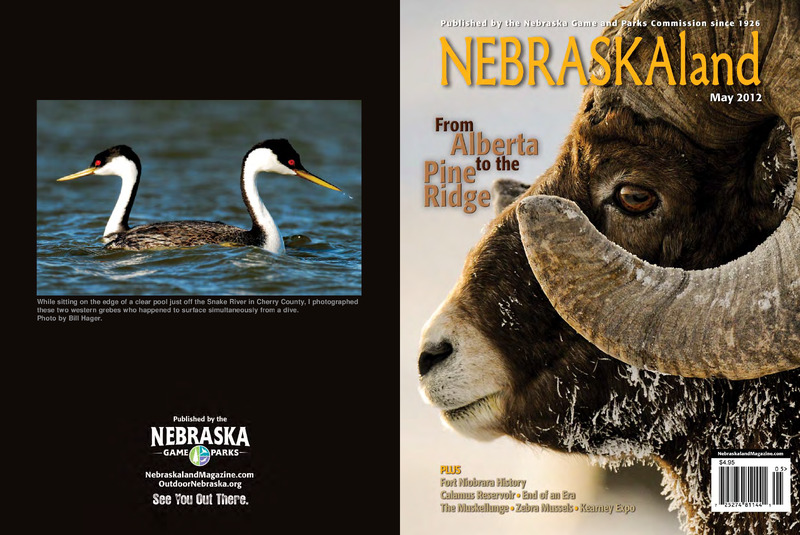
While sitting on the edge of a clear pool just off the Snake River in Cherry County, I photographed
these two western grebes who happened to surface simultaneously from a dive.
Photo by Bill Hager.
Volume 90, Number 4, Mayy 2012
12 From Alberta to the Pine Ridge
A long, involved trip to Alberta earlier this year resulted
in 40 Canadian bighorn sheep being released in western
Nebraska. TEXT AND PHOTOS BY ERIC FOWLER
20 Fort Niobrara – From Indian Wars to Wildlife Refuge
By the mid-1880s, only four military forts remaind in
service in Nebraska – and Fort Niobrara was one of them.
Today, with its population of elk, deer, bison and other
wildlife, this 19,122-acre historical destination has become
one of the state’s premier wildlife refuges. BY TOM BUECKER
26 Calamus Calling
This recreation area northwest of Burwell is a destination
hotspot for boaters, anglers and campers. It is no wonder,
considering the views both on and near Calamus Reservoir.
TEXT AND PHOTOS BY ERIC FOWLER
30 The Amack Years
After almost two and half decades, Rex Amack steps down
as director of the Nebraska Game and Parks Commission.
BY PAT ENGELHARD
20
●
38 The State of the Muskie Address
The muskellunge, one of Nebraska’s most intriguing fish,
offers a trophy unlike any other. BY JEFF KURRUS
Comment ................................................................... 4
Mixed Bag................................................................. 6
Outdoor Education ...................................................44
In the Field ...............................................................45
Classifieds ................................................................46
Portraits from the Past ............................................ 48
Page 49.....................................................................49
The Last Stop .......................................................... 50
26
●
30
●
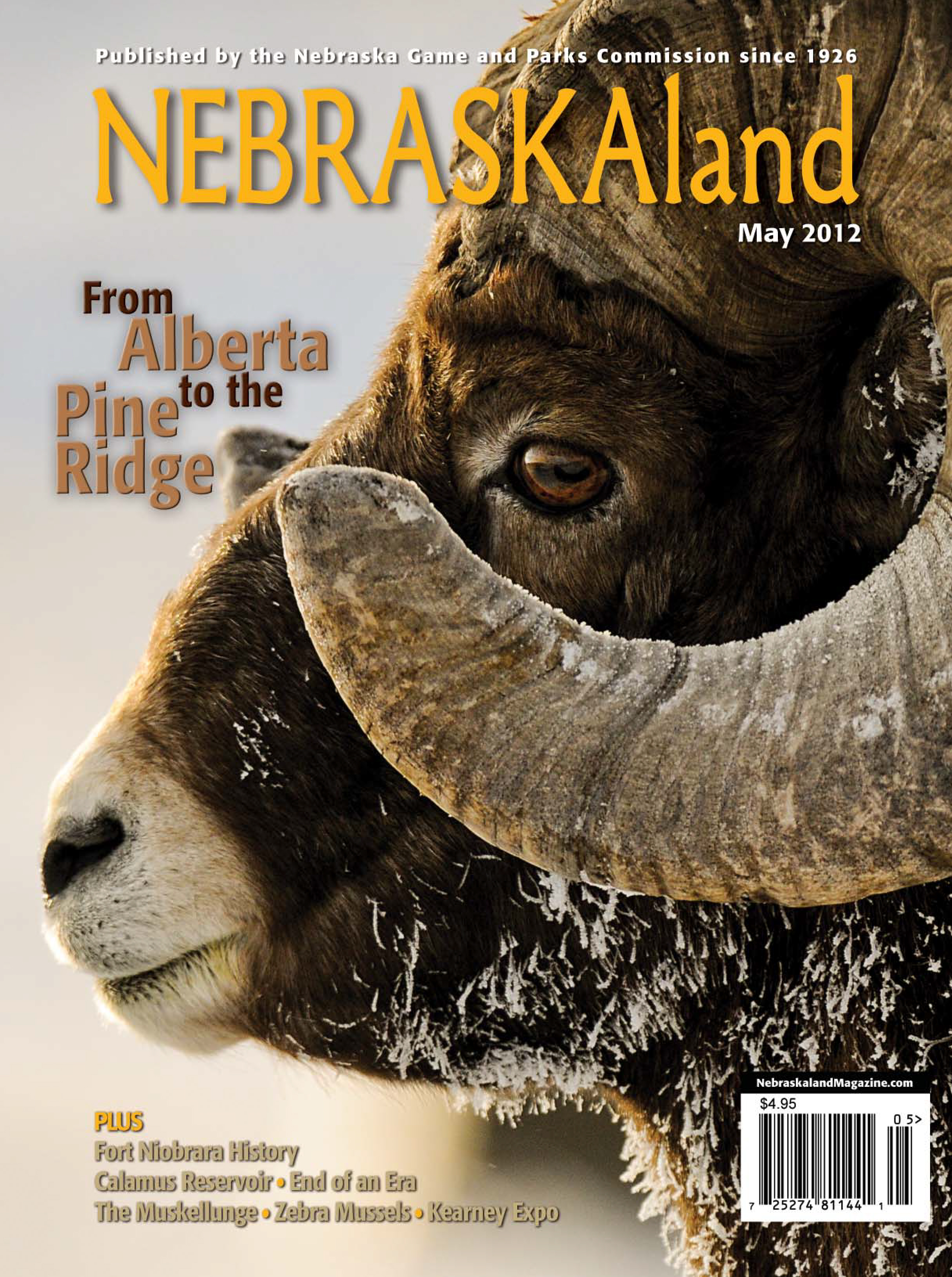
Cover: His hair and horns coated with hoarfrost, a bighorn ram roams a
reclaimed coal mine in Alberta, Canada, on a foggy morning. See story on
page 12. Photo by Eric Fowler.
Opposite: On a late-May morning in Lancaster County, a Canada goose
gosling yawns while its mother sleeps on one foot. It took the photographer
30 minutes to ease close enough to get this photo without disturbing the
family of geese. Photo by Justin Reed.
NEBRASKAland (VOL. 90 / NO. 4, ISSN 0028-1964) is published monthly, except for the
combined Jan./Feb. and Aug./Sept. issues, by the Nebraska Game and Parks Commission,
2200 N. 33rd St., Lincoln, NE. Periodicals postage paid at Lincoln, Nebraska, and additional
mailing offices. POSTMASTER: Send address changes to NEBRASKAland, P.O. Box 30370,
Lincoln, NE 68503-0370.
2 NEBRASKALAND • MAY 2012
38
●
MAY 2012 • NEBRASKALAND 3
retrieves sheds while I fish and look for
mushrooms.
John Inkret
Deer Lodge, Montana
Conservation Reminder
I enjoyed Lindsay Roger’s article
on Nebraska’s Wildlife Conservation
Fund (Jan/Feb 2012 NEBRASKAland)
and kept it in my bills folder to remind
me to make my donation. I hope that
others are so moved and that efforts
such as those spotlighted in the article
continue to receive funding.
Jeanne Miller
Bennington, Nebraska
Montana Shed Dog
I enjoy your magazine very much. I
particularly enjoyed the article in the
March 2012 issue of NEBRASKAland
entitled “Shed Hunting Dogs.” I
have attached a few photographs of
my shed hunting dog and her antler
collection. She is a three-year-old black
Chesapeake. Her name is Django and
I am very proud of her. She hunts and
Battle in Nature
Mr. Carroll,
While taking a midmorning walk
along the banks of the Platte River in
Merrick County last summer, just south
of my home in Central City, I came
across this battle in nature as a garter
snake had a hold of a young bullfrog.
After taking this shot, the foes parted
ways ... one leaving still hungry, the
other leaving very fortunate.
I enjoy photography very much
and this is my first time submitting
a photograph to NEBRASKAland
Magazine for your consideration. I
hope you enjoy it.
Jeff Carlson
Central City, Nebraska
NEBRASKAland Visitor Letters
We want to thank all 55 readers
that sent e-mails and letters for last
issue’s visitor, a tiger moth that was on
page 44 (see page 11 for the winner,
rules and this issue’s hint). Here are
some of the responses we received:
Dear NEBRASKAland Magazine,
I found our tiger moth checking out
the flowers on the “Edible Wild Plants
of the Prairie” book on page 44.
Thanks for another fine copy of
NEBASKAland Magazine, I really
enjoy reading and learning about
Nebraska and our kingdom of plants,
insects, mammals, birds, fishes and all
that nature has to offer. We are very
lucky we have so much here. You guys
do a great job of letting us readers in
on a wonderful world.
Chris Faltys
Tekamah, Nebraska
We have been getting
NEBRASKAland Magazine for many
years and thoroughly enjoy reading it
from cover to cover.
I finally found the “Visitor” on page
44 in the upper right hand corner,
perched on the “Edible Wild Plants of
the Prairie.”
Janell Anderson
Neligh, Nebraska
This month’s visitor to Nebraska in
NEBRASKAland Magazine is on page
44 in the upper right hand corner and is
a tiger moth!
I have hunted, and fished in
Nebraska for about 75 of my 82 years!
Back in the 40s, and 50s the upland
game hunting was fabulous in eastcentral, and eastern Nebraska, while the
fishing was only good in the Platte and
Elkhorn rivers. The lake impoundments
were just getting started. The habitat
for fishing has improved greatly since
then, but the habitat for upland game
has basically gone to pot in these areas,
due to the drastic change in agriculture,
mostly from irrigation.
I have enjoyed each and every hour
that I have been able to spend both
fishing and hunting in this great state,
and I have been a long-time subscriber
to NEBRASKAland!
Ronald S. Denker
Fremont, Nebraska
4 NEBRASKALAND • MAY 2012
On page 44 of the April issue of
NEBRASKAland Magazine is a virgo
tiger moth enjoying the nectar of the
flowers in the upper right corner.
Hmmm, tiger salamanders and tiger
moths in the same issue? Great reading,
as usual.
Dave Fuller
Lincoln, Nebraska
The moth in last month’s issue is a
type of tiger moth, several species
of which are found throughout
Nebraska. While moths are often
thought of as dull and dark, the tiger
moth is actually very beautiful. They
get their common name from their
bright, tiger-like black, orange and
cream coloring, a defense mechanism
which indicates to predators that the
moth is not tasty. The virgin tiger
moth, Grammia virgo, is common in
the state, with a wingspan of 2 to 23⁄4
inches in length. The front wings are
cream with black markings, and the
underwings are orange to pinkish,
with black spots. The caterpillars
are black, covered in stiff hairs and
overwinter nestled into plant debris or
under logs and rocks for protection.
In the spring, the caterpillars
resume feeding before pupating and
emerging as adults. The adults
are often found June through
September. Watch for them
around your porch
lights at night.
Special thanks to Julie Van
Meter, State Entomologist,
Nebraska Department of Agriculture.
Visitor image by Chris Helzer.
www.bugguide.net is a good site for identification
Send your comments to:
Doug Carroll, Editor
NEBRASKAland Magazine
P.O. Box 30370
Lincoln, NE 68503
or e-mail Doug.Carroll@Nebraska.gov
Please include your postal address and
telephone number.
Letters may be condensed and edited
for clarity. Photographs are welcome
and will be returned.
COMMISSION
CONSERVATION OFFICERS
Director Rex Amack
Deputy Director Jim Douglas
Commissioners
Chairman - Ron Stave, Waterloo
Vice Chairman - Norris Marshall, Kearney
2nd Vice Chairman - Jerrod Burke, Curtis
Dr. Mark Pinkerton, Wilber
Dr. Kent Forney, Lincoln
Lynn Berggren, Broken Bow
Rex Fisher, Omaha
Mark Spurgin, Paxton
Mick Jensen, Blair
NORTHWEST
Officer
City
Jim Zimmerman (S) Gering
MAGAZINE STAFF
Editor Doug Carroll
Associate Editor Jeff Kurrus
Art Director Tim Reigert
Senior Editor Jon Farrar
Regional Editor Eric Fowler
Contributing Editor Michael Forsberg
Regular Contributors Bill Hager, Chris Helzer,
Lisa Knopp
Photo Librarian Sarah Johnson
Circulation Donna Robinson
For address changes and questions about
your subscription, e-mail Donna.Robinson@
Nebraska.gov
or call (800) 632-5263
Marketing/Advertising
For advertising information contact
Larson Enterprises
e-mail dave@larsonent.com
or call (515) 440-2810
NEBRASKAland Magazine Copyright 2012, all rights reserved.
NEBRASKAland is available on audio cassette from the Nebraska
Library Commission Talking Book and Braille Service, Suite 120, 1200 N
St., Lincoln, NE 68508. (800) 742-7691. NEBRASKAland Magazine and
the Nebraska Game and Parks Commission reserve the right to reject any
advertising not in keeping with the agency mission.
Rates: $18 for one year; $33 for two years; $44 for three years. Nebraska
recipients must add appropriate sales tax. To subscribe call
1-800-NEBLAND (632-5263), or go online to: NebraskalandMagazine.
com.
COMMISSION OFFICES
Headquarters/Southeast District Office
2200 N. 33rd Street Lincoln, NE 68503
Phone (402) 471-0641
Northeast District Office
2201 N. 13th St. Norfolk, NE 68701
Phone (402) 370-3374
Southwest District Office
301 E. State Farm Rd. North Platte, NE 69101
Phone (308) 535-8025
Northwest District Office
East Hwy. 2, Box 725 Alliance, NE 69301
Phone (308) 763-2940
Bassett Office
524 Panzer St., Box 508 Bassett, NE 68714
Phone (402) 684-2921
Kearney Office
1617 First Ave. Kearney, NE 68847
Phone (308) 865-5310
Omaha Office
1212 Bob Gibson Blvd. Omaha, NE 68108
Phone (402) 595-2144
Greg Hesse
Scott Brandt
Heath Packett
Dan Kling
Frank Miller
Phone (308)
(office) 763-2940
(cell) 641-6138
Alliance
760-3647
Gering
631-0663
Gordon
360-0682
Harrison
430-0572
Valentine (402) 389-0444
SOUTHWEST
Officer
City
Phone (308)
Roger Thompson (S) N. Platte (office) 535-8025
(cell) 530-3097
Ray Dierking
Brkn. Bow
870-0322
George Sund
Cambridge
655-0028
Michael Thome
Cozad
529-8146
Terry Brentzel
Doniphan (402) 469-5795
Matt Andrews
Elwood
746-2418
Dirk Greene
Imperial
882-0015
Jerry Pecha (Sup.) Kearney (office) 865-5327
(cell) 293-3551
Dale Johnson
Kearney
440-3847
Brian Piernicky
McCook
340-6627
Dudley Sorensen
N. Platte
530-0016
Nicholas Fix
Ogallala
289-0427
Dennis Thompson
Ogallala
289-0755
Rich Routh
Rep. City
920-0367
NORTHEAST
Officer
City
Tom Zimmer (Sup.) Norfolk
Dale Davis
Steve Oberg
Daniel Roberts
Randy Pomplun
Jeff Jones
Jon Reeves
Tim Williams
Pat George
Doug Pollard
Cory Krause
Phone (402)
(office) 370-3374
(cell) 649-8053
Bassett
760-0712
Columbus
910-3366
Fremont
719-1108
Fullerton (308) 550-0489
Hartington
762-5022
Kennard
889-8508
Neligh
929-0051
O’Neill
340-0787
Ord
(308) 778-7101
West Point
380-6410
SOUTHEAST
Officer
Duane Arp (Sup.)
City
Gretna
Sean McKeehan
William Krause
Mike Luben
Dan Zuehlke
Darin Gress
Douglas Kramer
Dina Barta
Stacey Lewton
Levi Krause
Robert Finke
Russell Mort
Dan Evasco
Jeff Clauson
Phone (402)
(office) 332-2965
(cell) 521-0194
Ashland
521-0159
Auburn
274-8063
Colon
443-6392
Cortland
806-9084
Hebron
768-8665
Lincoln
890-6465
Lincoln
890-6463
Lincoln
890-7140
Louisville
949-0593
Milford
947-1363
Nebr. City
209-1506
Papillion
616-5961
Waterloo
658-7057
ADMINISTRATION
Officer
City
Craig Stover (Adm.) Lincoln
Phone (402)
471-5531
Nebraska Wildlife Crimestoppers 1-800-742-7627
Ak-Sar-Ben Aquarium
21502 W. Highway 31 Gretna, NE 68028
Phone (402) 332-3901
Under federal and/or state law, discrimination is prohibited on the basis
of race, color, religion, age, gender, marital status, national origin,
disability or political affiliation. If you think you have been discriminated
against in any program, activity or facility by the Nebraska Game and
Parks Commission or want more information, contact the Commission in
Lincoln, NE, at (402) 471-0641 or the Equal Opportunity Commission,
Lincoln, NE, (402) 471-2024, TTY/TDD (402) 471-4693).
MAY 2012 • NEBRASKALAND 5
Junior Duck Stamp Winner
Emily Tolliver’s painting of a greenwinged teal was awarded best of show
at this year’s Nebraska Federal Junior
Duck Stamp Contest, which is open to
K-12th grade students and divided into
four different age groups.
An 18-year-old student at McCook
High School, Tolliver’s artwork was
selected from more than 600 entries
received from all across the state.
Her acrylic painting was sent on
to the National Junior Duck Stamp
Competition, where the winner
received $5,000. The winning artwork
Outtdoor Skills Camps
Nebraska 4-H camps, in partnership
with the Nebraska Game and Parks
Commission, offer unique camp
experiences for youth every summer.
Each camp focuses on outdoor skill
development, with youth receiving
one-on-one instruction from trained
professionals.
The Outdoor Skills camps will build
skills in the areas of hunting, trapping,
fishing, canoeing, camping, archery
and shooting sports. Two sessions are
offered: June 11-14 at the State 4-H
Camp in Halsey; and July 8-13 at the
Eastern Nebraska 4-H Center near
Gretna.
The Shooting Skills camp that
will be held June 25-29 at the South
Central Nebraska 4-H Center on
Harlan County Reservoir is for youth
from the national competition will be
used to make the 2012-2013 Junior
Duck Stamp. Proceeds from the sale of
these stamps, which cost $5, support
conservation education.
interested in practicing, improving and
excelling in the shooting sports realm.
Campers will receive instruction in
the areas of muzzleloading, bow and
arrow, shotgun, .22 rifle, air rifle, BB
gun, hunting skills and environmental
awareness. Campers will also receive
their Hunter Safety Education
certificate.
Lastly, the Aquatic Skills camp that
will be held June 25-28 is for older
youth that are interested in getting in
the water. Campers will learn to water
ski, operate personal watercraft, ride
on wakeboards and cruise in kayaks on
Calamus Reservoir. Campers will also
earn Basic Boating Safety Certification
while camping at the reservoir.
For more information on these and
other camps, visit 4h.unl.edu/camp or
contact Lindsay Shearer at (402) 4722846.
Lynn Hooton of Omaha was born in
Minden and lived in Elm Creek, Ravenna
and Kearney growing up. He remembers
being able to walk across the Platte
River and not get wet in the 1930s. He started hunting with his dad,
who would occasionally take the afternoon off to take Lynn pheasant
hunting. Now 82 and living in Omaha, he still enjoys spring turkey
hunting.
If you have a unique outdoor message plate you would like to share,
or know someone who does, e-mail a photo (high-resolution, JPEG
format only, please) of it to Eric.Fowler@Nebraska.gov, along with your
name, hometown and a brief description of the interests expressed on
your license plate.
6 NEBRASKALAND • MAY 2012
Here is a list of
upcoming outdoor
events across
Nebraska.
For more
information
about these
and other
events,
visit the
calendar page at
www.OutdoorNebraska.org.
May 3-5
Cornhusker Trapshoot
All 6th through 12th grade
students are invited to the largest
school trapshoot in the world. For
more information or to register, visit
www.cornhusker-trap.com.
May 5
Take Pride in America Day
Volunteers can go out to Branched
Oak State Recreation Area and help
paint, repair, pick up trash and do
other work to clean up the park
from 9 a.m. to 3:30 p.m. Lunch will
be provided. Call (402) 783-3400 for
more information.
May 12
Kearney Family Outdoor
Discovery Program
This family event is geared for
all ages and will be held from 9
a.m. to 4 p.m. at Fort Kearny State
Recreation Area. The event is free,
but a park permit is required to enter
the grounds.
May 19
Free Park/Free Fish Day
Fish anywhere in the state and
visit any Nebraska state park, state
historical park or state recreation
area for FREE. No park entry or
fishing permit required! See page 51
for listing of events at certain parks.
May 19
Chadron Adventure Race
Racers typically locate
checkpoints along the route via
running/hiking, mountain biking,
kayaking and orienteering. For more
info go to www.angrycowadventures.
com or contact Donna Ritzen at (308)
432-6297 or dritzen@csc.edu.
May 19
Lake Minatare Walleye
Tournament
Call (308) 631-2103 for more
information.
The 1:00 PM Turkey
Jeff Kurrus
I’m fond of short hunting and fishing trips. Fifteen minutes,
an hour, half-a-day – success is only measured by the amount
of time you set aside to get in the field. And turkey hunting is
one of the most pleasurable activities to do during the midday
because it’s probably one of the best times to hunt.
When hens begin to separate from toms to lay eggs, insecure
toms become very brave and boisterous. Over the lunch hour is
a great time to catch a big tom alone. Actually, I’ve killed more
gobblers in the middle of the day than I have off the roost. Plus,
I don’t have to wake up early.
For more information on the spring turkey season, which ends
May 31, visit OutdoorNebraska.org.
8 NEBRASKALAND • MAY 2012
The Great Park Pursuit
The Great Park Pursuit (GPP) is celebrating its
fifth year of existence this summer and hopes to
attract more participants than ever. Last year 3,368
participants on 765 teams took part in the program.
A partnership between the Nebraska Game and
Parks Commission and the Nebraska Recreation and
Park Association, the goal of GPP is to promote active
lifestyles while increasing awareness of the naturerich outdoor recreation opportunities that are available
throughout Nebraska. This is done by encouraging
participants to visit up to 20 GPP sites located across
Nebraska between May 1 and September 17, 2012
and follow clues that will lead them to a GPP post
where they can use a pencil or similar tool to make an
impression of the post to prove they were there.
Participation in the contest is free – participants
only need to pay for postage when mailing in the
impressions they collected and for entry into some
of the park sites. Anybody can take part, and teams
can be made up of individuals, families, friends or
any other group. Prizes are awarded per household
or group. Registration is limited to one group per
household, and individuals can only be part of one
team.
Nature impressions can be mailed in at any time,
but all entries must be postmarked by September
19, 2012. Photocopies will not be accepted. Prizes
and entry into drawings are based on the number of
tracings collected – your team is entered into all of the
drawings up to the number of impressions submitted.
Three grand prize outdoor recreation packages, with
a retail value of $1,000 each, will be drawn from all
eligible entries. The grand prize winners will get their
choice of a camping, kayaking or fishing package.
For more information, to register or to see a list
of the prizes that are available, visit negpp.org. If
you have any questions or would like to request a
hardcopy registration form, e-mail info@negpp.org.
Great News for Gardeners and other Plant Geeks
Mike Groenewold, Park Horticulturist
A new plant hardiness zone map released by the U.S.
Department of Agriculture (USDA) will not only be of
interest to gardeners, but anyone planting trees, shrubs or
other ornamental plants. Since 1920, the USDA has published
a Plant Hardiness Map that divides the country into 13 plant
zones reflecting an average of minimum winter temperatures
for a given location over the last 30 years. Zone 13 on the
plant zone map reflects the warmest region, indicating a
warmer winter temperature limit of survival, while Zone
1 reflects the coldest region, indicating a colder winter
temperature limit of survival. The USDA rating system was
recently updated with data measured at weather stations
during the 30-year period, 1976-2005.
Previously, the southern half of the state was in Zone 5
and the northern half was in Zone 4. Only a few counties
in the northern Panhandle are in Zone 4 on the new map,
or put another way, 90 percent of the state is now in Zone
5. Whether you agree or not, the new hardiness zone map
does reflect a global warming trend, but more importantly
to the gardener, this information means planting marginally
hardy plants like peaches and apricots is less risky in most
of Nebraska. An ornamental tree favored by many gardeners
is the magnolia tree. Nurserymen have often considered one
magnolia species, Magnolia acuminata, worth trying on
protected sites in southeastern Nebraska. Armed with new
USDA hardiness zone ratings, residents of central Nebraska
may want to try planting this beautiful species. No doubt,
many gardeners and landscapers will have their own list of
favorite but marginally hardy plants that now may be worth
planting.
Even though the USDA rating system gives gardeners
and landscapers a predictable temperature range for plants
that might survive in each zone, don’t always accept the
information as gospel. Remember the USDA system is
based on average minimum temperatures and not on the
extreme minimum temperatures that can occur in each zone.
You may find this information along with the USDA zone
recommendation on plant labels that you purchase at your
local nursery or garden center. So don’t overlook all of this
valuable information for your locale when predicting whether
the plants you select will survive many years.
Many variables, such as extended drought prior to arrival
of winter weather, will influence how well a plant withstands
extreme winter conditions, so visiting with respected plant
experts may help you make a wise decision. And speaking of
wise decisions, please don’t overlook the possibility that your
favorite plant is potentially invasive – land managers already
have a long list of noxious and invasive plants to battle, so
please don’t plant a species that could one day overwhelm a
local ecosystem.
Visit the interactive map at www.plantmaps.com/usda_
hardiness_zone_map.php. Click on your location in the map
and load your plant hardiness zone.
MAY 2012 • NEBRASKALAND 9
Send Us Your Trail Cam Photos!
Family Fishing Events for 2012
DATE
DAY
TIME
CITY
LAKE
ACTIVITY
1
Tuesday
5-8 PM
Scottsbluff
Terry’s Pit
PF, BF, TF, CL,
FOA
12
Saturday
9 AM-4 PM
Kearney
Fort Kearny
State Park
Family Outdoor
Discovery Day
30
Wednesday
6-8 PM
Papillion
Halleck Park
PF, BF, TF, CL,
FOA
31
Thursday
6-8 PM
Lincoln
Holmes
PF, BF, CL, FOA
2
Saturday
10:30-1 PM
Kearney
Yanney Park
Heritage Day
5
Tuesday
6-8 PM
Norfolk
Skyview
PF, BF, CL,
FOA
6
Wednesday
6-8 PM
Columbus
Pawnee Park East
PF, BF, CL,
FOA
May
June
9
Saturday
4-8:30 PM
Lincoln
Holmes
Waterfest
12
Tuesday
6-8 PM
Fremont
Johnson
PF, BF, CL, FOA
13
Wednesday
6-8 PM
Omaha
Youngman
PF, BF, CF, CL
19
Tuesday
6-8 PM
Papillion
Walnut Creek
PF, BF, CF, CL
20
Wednesday
6-8 PM
Lincoln
Bowling
PF, BF, CF, CL
23
Saturday
8 AM-1 PM
Lincoln/Emerald
Pawnee
Carp-O-Rama
26
Tuesday
6-8 PM
North Platte
Iron Horse
PF, BF, CF, CL
27
Wednesday
6-8 PM
Grand Island
Mormon
Island 1
PF, BF, CF, CL,
FOA
28
Thursday
6-8 PM
Kearney
Cottonmill
PF, BF, CF, CL
July
9
Monday
6-8
Lincoln
Holmes
FF
12
Thursday
6-8 PM
Papillion
Halleck Park
PF, BF, CF, CL,
FF, FOA
14
Saturday
8 AM-1 PM
North Platte
Maloney
Carp-O-Rama
17
Tuesday
6-8 PM
Norfolk
Skyview
FF, CF, CL, FOA
18
Wednesday
6-8 PM
Columbus
Pawnee Park East
FF, CF, CL, FOA
24
Tuesday
6-8 PM
Omaha
Benson
FF
25
Wednesday
6-8 PM
Lincoln
Bowling
FF, CK, DOC
7
Tuesday
6-8 PM
Lincoln
Bowling
Added date.
Nightout.
8
Wednesday
6-8 PM
North Platte
Iron Horse
FF
9
Thursday
6-8 PM
Grand Island
Mormon Island 1
FF, CK, DOC
10-11
Friday-Sat.
Kearney
Fort Kearny State
Park
Family Fish and
Camp
August
15
Wednesday
6-8 PM
Papillion
Halleck Park
CK, DOC
16
Thursday
6-8 PM
Lincoln
Holmes
CK, DOC
20
Saturday
1-3 PM
Lincoln
Bowling
TF
21
Sunday
1-3 PM
Papillion
Halleck Park
TF
October
Key to event activities: Panfish Fishing – PF, Bass Fishing – BF, Catfish Fishing – CF, Trout Fishing – TF, Fly Fishing – FF, Fishing
Cleaning – CL, Fish Cooking – CK, Family Outdoor Activities – FOA, Dutch Oven Cooking – DOC. For more information, visit
OutdoorNebraska.org.
10 NEBRASKALAND • MAY 2012
Robert Janssen of Crookston sent us this photo of two deer
sparring near a feeder he has set up on his land. Deer of both
sexes often fight to establish dominance in a herd.
Please submit your trail camera photos by e-mail to:
nebtrailcam@gmail.com. Also include any information that
will help explain your photo.
New Restaurant Now Open at
E.T. Mahoney SP
A new wood-fire grill restaurant is
now open in the Peter Kiewit Lodge
at Eugene T. Mahoney State Park and
already has proven to be a great
success.
The Mahoney Grill and Wildlife
Lounge, operated by Jeff and Emily
Parker, is open seven days a week and
serves continental breakfast, lunch
and dinner. Diners will enjoy a lodge
feeling while taking in a view of the
Platte River and listening to light
jazz music. The menu will include
everything from sandwiches to steaks
and walleye to pork chops.
The Parkers, who own Parker’s
Smokehouse with locations in Ashland,
Nebraska City and Lincoln, are running
the restaurant as a concession and pay
the Commission a percentage of its
receipts.
A park entry permit is required for
each vehicle entering the park. Parks
Bucks will not be valid at the Mahoney
Grill.
Turtle and Frog Weekends
The Aksarben Aquarium will host
a turtle and frog display the first
weekend of each month this summer.
Beginning May 5th and 6th, educators
from the Nebraska Game and Parks
Commission will show and discuss
Nebraska’s common frogs and turtles.
The public is invited to see and touch
these animals while learning how they
survive in the wild.
These events will run from noon to
4 p.m. the first Saturday and Sunday
of May, June, July and August. The
Aquarium is located at Schramm Park
State Recreation Area south of Gretna.
For more information call (402) 3323901.
NEBRASKAland Visitor
Winner and Hint
Last issue’s winner of
the Visitor drawing was
Rich Ray of Hastings,
Nebraska, who found the
tiger moth on page 44. Readers
are encouraged to contact
NEBRASKAland within 10 days
after this issue’s publication with the
correct page number and name of
this issue’s “Visitor” – a bug found
in Nebraska that just happened to
find its way onto one of the pages.
We will then gather the correct
entries and draw one to win a
NEBRASKAland Magazine mug.
To enter each month, write:
NEBRASKAland Visitor
2200 North 33rd Street,
Lincoln, NE 68503.
Or e-mail:
Tim.Reigert@Nebraska.gov
with “Visitor” in the subject line of
the message.
HINT: This issue’s visitor is not
on page 5, 7, or 44.
MAY 2012 • NEBRASKALAND 11
Bighorn Sheep Relocation a Success
Text and photos by Eric Fowler
With the rugged Canadian Rockies behind them, bighorn sheep feed on alfalfa used to bait them into a trap site on a reclaimed
coal mine near Hinton, Alberta, in February.
im Voeller admits he’s had a fascination with
bighorn sheep for most of his life. He’s hunted
b
them in five states and two Canadian provinces,
th
but he’s just as happy simply watching them.
bu
“They’re my favorite animal,” Voeller said.
“It’s pretty cool to get up in the morning and
“I
lo
look up on the mountain and see them critters.”
He no longer has to travel to the mountains to
se
see bighorns – now he can simply go for a hike
an
and look for 39 of them roaming the rugged,
ro
rocky buttes on his Sowbelly Ranch in the Pine
12 NEBRASKALAND • MAY 2012
Ridge northeast of Harrison. By June, there will be even
more after the ewes lamb.
Voeller’s new four-legged tenants arrived from Canada in
February, the result of an effort by the Nebraska Game and
Parks Commission to return bighorns to their native range,
the fifth such effort in 30 years. The bighorns are now more
than 1,300 miles from their former home at the foot of the
Canadian Rocky Mountains, but near as anyone can tell,
they are happy with their new digs, staying, for the most
part, right where they were released. That’s no surprise, as
the area has everything they need: steep terrain, open vistas
and plenty of food. “It’s prime sheep habitat,” said Todd
Nordeen, district wildlife manager in the Commission’s
Alliance office and head of the state’s bighorn program.
Choosing the release site was a only a small part of an
effort that began two years ago and navigated about as
many miles of red tape as those traveled on highway by
the crew of 17 Commission staff and two U.S. Department
of Agriculture veterinarians that traveled to Alberta and
brought the sheep home.
Alberta has a long history of sending bighorn sheep south,
providing more than 600 sheep for restoration efforts in
nine states since 1922. However, the discovery of mad cow
disease there in 2003 “threw the brakes on cattle, sheep and
goats coming into the U.S.,” said Bruce Trindle, a wildlife
disease specialist with the Commission. While the border
had been reopened to some livestock since then, it had not
been opened to live sheep more than 12 months old, which
appeared to close the door on transporting wild bighorns to
the U.S. from Alberta.
Opening that door began with a casual conversation
between Nebraska biologists and Albertan members of the
Wild Sheep Foundation at the conservation group’s annual
convention in 2010. Nebraska was looking for another
source of sheep to continue its restoration efforts, while an
unhunted bighorn herd in Alberta had reached the carrying
capacity of the reclaimed coal mine they occupied near
Hinton. The parties left the table vowing to find a way to get
sheep to Nebraska.
Trindle and representatives from other western states
met with a USDA official in early 2011 to make the case
that bighorn sheep are different than domestic sheep. The
official agreed and granted an exemption as long as certain
conditions were met. From there, Trindle literally had to get
a permit in order to even apply for some of the 17 permits
that were required from 11 different state and federal
agencies in the U.S. and Canada.
While there was no history of brucellosis in the Alberta
bighorn herd, USDA officials still required the sheep be
tested for it. Those tests, however, take days, if not weeks,
to complete, and holding wild sheep for that long was not
possible. The solution was to fit each animal with a tracking
collar so they could be recaptured in the unlikely event a test
would come back positive. Nebraska had no qualms with
that requirement, considering a tracking study of the animals
was planned anyway. So with tentative approval, plans were
made. Luckily, the permit that officially allowed the effort
finally arrived the week the trip began.
So, on February 2, four pickups pulling stock trailers,
as well as a pickup and SUV carrying supplies, left Fort
Robinson State Park headed for Canada. Three trailers would
have been enough to hold the 42 sheep biologists hoped to
bring home, but when your intended cargo is that important,
you bring a spare in case something breaks along the way.
Canada
After two long days on the road, the trapping crew finally
got a chance to see some classic bighorn sheep habitat
and plenty of sheep on a side trip to Jasper National Park,
whose rocky peaks reach 12,500 feet, 9,000 feet above the
expansive valleys in the park. It was sheep from this park
and the government land that lay between it and the coal
mines to the east that provided the seed stock for the effort.
MAY 2012 • NEBRASKALAND 13
Since the first of three open-pit, steelmaking coal mines
began operating in the area in 1969, required reclamation
efforts have focused on creating habitat for wildlife,
including elk, deer and bighorns. “This site has been
designed for bighorn sheep,” said Beth MacCallum, a
consultant hired to assist in the operation who has spent
years studying sheep populations at the mine. “They paid
attention to leaving some of the pit walls that are an artifact
of mining to serve as escape terrain for the sheep, and we
plant quality forage for the sheep adjacent to the escape
terrain. It’s a real simple model of bighorn sheep habitat.”
Once heavily timbered and unsuitable for bighorns, the
bighorns quickly took a liking to the reclaimed mines. Not
only was there plenty of food, human activity at the mine
kept away most of the area’s native predators: mountain
lions, wolves and grizzly bears. With little to worry about
and plenty to eat, sheep on the reclaimed mine grow as big
as they do anywhere, both in body and horn size.
The latter draws hunters to the region, which is well
known for producing trophy sheep, including the current
world record, and where special permits command up to
$150,000 at auction. “There’s hunting off the mine site but
the sheep have to venture off it, and they’re quite aware of
it, that there are hunters around them, so they tend to not do
that,” said Kirby Smith, a retired wildlife biologist for the
area who now works as a private consultant and facilitated
the netting operation.
While limited ewe hunting used to be allowed on the
reclaimed mine, it currently is not. With the population,
now estimated at approximately 950 animals and pushing
the carrying capacity of the land, trapping and relocating
some of the mine’s sheep is the best means of keeping the
population in check and healthy. Since 1985, 368 of the
area’s bighorns have been relocated to help with restoration
efforts in the United States and Canada, including the latest
batch sent to Nebraska. Of those, 234 were sent to the U.S.
between 1989 and 2001. Since then, only 26 sheep had
been trapped at the mine, all of which were moved to other
locations in Alberta. With the province’s entire sheep habitat
now occupied and more sheep still needing to be removed
from the mine area, several other states eagerly watched
Nebraska’s operation.
“We’ve kind of opened the doors for other transplants to
continue,” said Nordeen. “They’ve asked for all information,
protocols, permits … everything we had to do to make this
happen. We’ll hand it all off to them. It’ll make their life a
heckuva lot easier.”
While there was a cost to the relocation effort – $90,000
in direct expenses, including travel costs, staff time and
permitting and consultant fees – the sheep came free. In
North America, where wildlife is considered a public
resource, wildlife management and restoration programs like
this are typically a matter of give and take, although the take
is optional and often no strings are attached. This operation
was no exception. Alberta had already received payment
from the U.S. in the form of bison, elk, swift fox, sage
grouse and other species needed for its restoration efforts,
and was happy to share its surplus.
Bighorns react as a 60-foot-square net is dropped on them by triggering blasting caps tied to ropes suspending it.
Hunting Bighorns
Like previous efforts, the relocation of bighorns
from Alberta to Nebraska was funded by proceeds
from the sale of lottery or auction of bighorn
hunting permits. Since 1998, 17 permits have
been issued – 11 thorough a lottery open only to
Nebraska residents and six sold at auction – raising
$910,000 for the program.
Compared to elk or other big game animals, there
are very few bighorn sheep permits available in
North America, and they are very difficult to draw.
Nebraska permits command a premium at auction
because of the trophy quality of the rams, which all
have scored, at least unofficially, 170 on the Boone
& Crocket Club’s scoring system, which measures
horn length, mass and symmetry. Several have
scored 180, earning a spot in the club’s all-time
record book. A German sportsman paid a record
$117,500 for the 2011 auction permit, $30,000
more than the previous high. He was rewarded with
a ram that scored 1822⁄8 , the second largest ever
taken in the state.
The quality of rams and uniqueness of the
opportunity is also why 1,762 Nebraskans paid $20
for the chance at the 2011 lottery permit, which
14 NEBRASKALAND • MAY 2012
comes with four nights lodging and meals at Fort
Robinson, as well as guiding. Tyson Ritz’s name was
drawn from that lot even though he didn’t apply for
the permit – his mom was responsible for throwing
his name in the hat.
But it was Ritz who had trouble sleeping the night
before his December hunt began and eating the
morning of. He didn’t arrive at Fort Robinson in
time to do some scouting the prior evening, but the
technicians who track the sheep had done plenty
for him and showed him photos of the two rams
they suggested he target. Both were aged veterans,
the type of ram biologists want hunters to harvest
because they might not make it through another
winter.
Ritz decided if he had the opportunity, he would
target the ram with heavily broomed horns. When
that ram couldn’t be found the following morning,
he wondered if he should attempt to harvest the
other, which sported a distinctive chip on the front
of his horns. “My stomach’s churning,” he said.
He decided to pass and soon spotted his original
quarry. After two rifle shots ended his hunt,
Ritz was elated, yet still shaking. “I’m going to
Disneyland,” he joked with his friend, Tanner Paap,
who made the trip west with him. “I don’t even
know what to tell you. It’s crazy. I can’t believe it.”
Ritz’s 13-year-old ram scored 1804⁄8, fourth largest
in Nebraska’s bighorn hunting history. Commission
wildlife managers aren’t sure when someone will
have a chance to harvest a sheep bigger than either
taken this year. Losses to pasturella pneumonia in
recent years have left herds in both the Pine Ridge
and Wildcat Hills short on mature rams. For that
reason, no permits were authorized for 2012.
Nordeen said another recreational aspect of the
bighorn sheep program is considered when making
those decisions: wildlife viewing. “People like to see
these big rams, too, so our management is being
steered towards having some older age rams out
there for people to both see and hunt,” Nordeen
said.
Tyson Ritz of Waverly poses with the ram he
harvested December 10 near Crawford. Ritz won the
permit in a lottery open only to Nebraska residents.
MAY 2012 • NEBRASKALAND 15
Bighorn Habitat
Study
A recent study by Chadron State College (CSG)
graduate student Rana Tucker helped Nebraska
Game and Parks Commission biologists select the
Sowbelly Canyon area to release bighorn sheep
relocated from Alberta.
Tucker’s study identified potential habitat using
a model based on one that CSC applied science
professor Teressa Zimmerman developed while
studying bighorn sheep in Badlands National Park
in South Dakota. What that Geographic Information
Systems-based process found was nearly 300 square
miles of suitable habitat in the Pine Ridge and
Wildcat Hills, all of it centered around the steep
terrain bighorns require as escape cover. It also
identified another 200 miles of potential sheep
habitat in western Nebraska, including the rough
hills on the edge of the North Platte River between
Wyoming and Lisco, and the Niobrara River Valley
and its tributaries between Rushville and Johnstown.
Tucker then gathered location data from radiocollared ewes in both the Pine Ridge and Wildcat
Hills from 2007 to 2009 to see if the sheep were
actually using habitat identified by the model. In
the Wildcat Hills, sheep were almost always found
in or near the identified habitat. In the Pine Ridge,
the radio collared bighorns strayed from what the
computer found to be suitable habitat about 28
percent of the time, often times moving from steeper
terrain to crop fields.
“There are lots of documents that show sheep
don’t like trees,” Tucker said. “They like to have
more visibility so they can see predators coming.
“There are a lot more trees and heavier canopy
closure in the Pine Ridge. That might explain why
sheep there are moving around more.”
Biologists will use the findings as a starting point
when planning future releases, but must still visit
potential sites to ensure they have little tree cover
and confirm the quality of the escape cover.
Had a 30,000-acre wildfire not burned through
the Sowbelly Canyon area in July 2006, it would not
have been selected,
said Todd Nordeen,
bighorn sheep
program manager
with the Commission.
Prior to the Thayer
fire, it was too heavily
timbered for the liking of
bighorns.
While work has yet to begin
on the next bighorn sheep relocation effort, there
likely will be one. Tucker’s model, ground surveys
and landowner participation will help determine
where it will occur. The availability of sheep,
whether they come from outside Nebraska or are
moved within the state, will likely determine when.
“It’s the same story in both countries with the 19th
century exploitation of wildlife, where we decimated
many populations and lost the buffalo off the prairie and
the passenger pigeon entirely,” said MacCallum. “It’s
a similar story of slow recovery and the emergence of
wildlife management.
“There is cooperation and the need as well, because
we’ve gotten animals from the states, too.”
Trapping
Trapping the sheep was not nearly as difficult as some
of the crew from Nebraska thought it might be. In the
dead of winter, the grasses on the mine site aren’t nearly
as palatable as the baled alfalfa that had been spread on
the trap sites for several days before the crew arrived.
“They are quite eager to come and get a free lunch, as
we all are,” said Smith.
When the crew started setting up nets on their second
day in Canada, about 90 bighorns were coming up the
road from the other direction. People there do not pose
a danger to the sheep, so they simply stood and watched
the work until it was done and a new round of alfalfa
was set out for them. “It’s easy to forget these are still
wild animals,” said MacCallum.
Mike Remund, a Commission biologist from
Tecumseh, wasn’t sure to expect when he volunteered
for the trip. “This is way cooler than I thought it was
going to be,” he said after being that close to bighorns.
Nets are set up on two sites the day before a trapping
operation is to occur, removed and then quickly reset
on the target date. If left up, they might be damaged
by high winds or scare the sheep while flapping in it.
Using two sites gives crews the option of trapping at one
or both places to get the desired number of sheep, and
also for insurance: “On one of our captures a number of
years ago, we had everything ready, we had our bait site
picked out and the capture crew radioed down and said.
‘The wolves are chasing our sheep around up here. We
can’t use this site,’” MacCallum said. “So that’s why we
always set up at least two sites. You never really know
what happens on capture day.”
Smith has been involved in trapping at the mine ever
since it began there. The method dates back further than
that. A 60-foot-square net is suspended from four corner
posts and one center post. When the desired number of
sheep are feeding under the net, blasting caps taped to
the ropes holding up the net and hard wired to a battery
are ignited simultaneously, “cutting” the rope and
dropping the net on the unsuspecting sheep.
Once again, sheep met the crew at the site on trapping
day. When the net was ready, it wasn’t long before
about 60 sheep were under it and the detonator triggered.
At that point, the Commission trapping crew,
contractors, Alberta Ministry of Sustainable Resource
Development and other Canadian officials, and a cadre
of about 40 volunteers left the cover of stock trailers
parked nearby and rushed in to untangle the sheep. It’s
not hard to find volunteers to help with these operations,
said Smith. People will drive hundreds of miles to
16 NEBRASKALAND • MAY 2012
Commission wildlife biologists Mike Remund of Tecumseh and Lance Hastings of North Platte place an ear tag on an ewe.
help, not because they are needed, but because they want
to. “We’ve even had the whole class from a college in
southern Alberta about 300 miles away come up just for the
opportunity to handle wild sheep,” Smith said. “We’ve had
to turn away people because it’s just that popular.”
The first priority of the crew was to restrain the sheep
that were caught in the “dog pile” under the net, working to
keep them from thrashing and kicking other sheep while not
getting kicked themselves.
“When they were first in the net, it looked like a rodeo,”
said Russ Mort, a Commission conservation officer from
Nebraska City. “They kicked like crazy. They wanted to get
out.”
One by one, the sheep were restrained, pulled from under
the net, hobbled and blindfolded. Once blindfolded, the
sheep remained relatively calm.
Freeing the sheep took about an hour. Lambs were
released immediately, as they could not be fitted with
radio collars. So were mature rams, which can be hard for
wranglers to handle and even harder for Albertans to let go.
Commission staff and the USDA vets then began
processing the sheep that would be heading to Nebraska.
Blood, hair, fecal and other samples were taken for disease
and DNA testing, and ear tags and tracking collars were
attached before the sheep were loaded into trailers.
Mort and Cambridge biologist Chad Taylor drew the latter
task as their one job for the day, carrying the sheep (ewes
weighed an average of 160 pounds) from the exam area to
the trailer, lifting them through the door and having it shut
behind them while they removed the hobbles and blindfolds.
Mort, who had worked cattle on his family’s southeastern
Nebraska farm while growing up, questioned his job the
first time the door was slammed behind him and he realized
“these things have horns.”
Mort, Taylor and other staff and Canadian volunteers
learned quickly to watch each other’s backs in the trailer,
insuring a sheep didn’t butt the person taking off blinders
and hobbles when they weren’t looking, which they
occasionally tried to do.
“Most of them just stood there and looked at you, but we
always had that grouchy one in every bunch … you never
knew what he or she was going to do,” Mort said.
While they got kicked a few times, Mort said it was well
worth it. “I can take a kicking if those are kicking me,” he
said.
Windows had been covered in all of the trailers to keep
them dark and the sheep calm. When the crew arrived
in Canada and saw the forecast for unseasonably warm
weather, however, they feared the sheep would be too hot
and modified the coverings and even installed fans to add
circulation if necessary. The added light in the trailers
appeared to have no effect on the sheep. The warmer than
normal weather, however, proved troublesome. The stress
of being captured, combined with the warm weather, caused
the some of the sheep’s body temperatures to rise. Staff took
temperatures of each animal regularly. Those with elevated
MAY 2012 • NEBRASKALAND 17
Spectators and Commission biologists watch as the last of 40 bighorn sheep scramble from the trailers and into their new home in
the Pine Ridge near Harrison on February 9.
readings were covered with snow or doused with rubbing
alcohol to cool them, and several were simply released when
readings became too high. Still, the stress was more than
some animals could handle.
“Unfortunately we had some casualties, but that
occasionally happens in this business,” said Todd Nordeen.
“It’s also very unfortunate that we lost them from this state
altogether almost 100 years ago. We’ve got to do what we
can to bring them back, but in doing that there are going
to be occasional losses just because of the difficulty of
handling wildlife.”
Off to Nebraska
About three hours after the net dropped, the last of the
sheep were loaded into trailers and on their way to Nebraska.
Were it not for two logistical issues, the crew would have
driven straight through to the release site. But first they had
to pass through U.S. Customs at the border and the USDA
Veterinary Services inspection office just across it. The latter
would be closed long before they could get there, requiring
an overnight stop near the border. Once across the border
the following morning, a process that took three hours,
they were still too far out to reach the release site in time
to release the sheep during daylight hours, a requirement
for the safety of the animals, so another night was spent in
Wyoming.
18 NEBRASKALAND • MAY 2012
Each night and morning, the crew used buckets, funnels
and tubing to pour water into tubs inside the trailers. It
was a tedious task, but each trailer latch was affixed with
an official seal that could not be removed until the sheep
reached their destination, so going in was not an option.
Before the trailers were sealed, they were stocked with
alfalfa for the animals to eat.
There was quite a crowd waiting when the sheep pulled
up to the first release site on Sowbelly Road. The onlookers
fanned out behind the first two trailers, watching a few
sheep run into their new home as each door was opened.
The workers and welcoming committee then moved to the
second site along Pants Butte Road, about a mile to the south
as the crow flies and three miles as a truck drives, opened
the doors to a second set of trailers, and watched it all unfold
again. The last of the 35 ewes and five rams scrambled
through a saddle in a rocky ridge and out of sight. Just like
that, the work for the Commission trapping crew was done,
except for those who still had up to a 500-mile drive ahead
of them to get back to eastern Nebraska.
Based on what was learned from the three most recent
releases, the sheep should remain in the Sowbelly Canyon
area. Transplanted ewes typically don’t move far from a
release site, but there have been exceptions: When sheep
were released at Hubbard’s Gap in the Wildcat Hills in
2007, Nordeen said a small band of ewes and lambs ended
up 28 miles away from the release before returning. The core
of that herd remains near the release site, but small
bands are also spread out across about 25 miles of
Wildcat Hills.
The sheep released on Bighorn WMA between
Crawford and Chadron in 2005, now known as the
Barrel Butte herd, scattered soon after the release,
with some heading south and others heading as far
east as Chadron State Park, where they remain. Only
a few remain near the release site. Nordeen believes
the area might have been more heavily timbered than
the sheep prefer.
Still, Nordeen expects sheep from the new
Sowbelly herd and the Fort Robinson herd to cross
paths in the near future. Only 13 miles separate the
edge of the Fort Rob herd’s core range from the new
herd. Rams from Fort Robinson have ranged that far
west in the past – Voeller photographed a full-curl
ram in front of his home 15 years ago – but haven’t
stayed. The next time they do so, they’ll find ewes
and only young rams to compete with, giving them a
much greater reason to stay.
“Especially during the rut, young to middle-age
class rams, they move out or are kicked out of
the herd by more dominant males,” Nordeen said.
“They’re moving around looking for other ewes that
they might be able to mate with.”
The movement could go the other way, too.
One Alberta ram already wandered four miles east
before returning. That movement is small potatoes
compared to a ram that has been touring a 40-milewide swath of the Pine Ridge, covering more
than 100 miles in the process, during the past five
months. Biologists were able to “watch” as the ram,
fitted with a GPS tracking collar, left his home with
the Barrel Butte herd and headed east, nearly to Hay
Springs before reversing course and heading as far
west as Fort Robinson. He appeared to be headed
back home, but spent most of March at Crow Butte
southeast of Crawford.
In the short term, the Sowbelly herd is sure to
grow. Averaging past release, about three-fourths
of the relocated ewes are expected to have lambs
this spring, which would bring the population to 65.
Some ewes may disperse to secluded locations to
have their lambs, as they do in other herds, but most
will return by summer’s end.
“I hope they stay there and really hope they lamb
out,” said Voeller. “They used to be there many,
many years ago. I’m just glad to see them back.”
Voeller said he was also pleased Commission
biologists asked area landowners their opinion of the
reintroduction before doing it. Even though he may
not ever have the chance to hunt the animal on his
ranch, “I really was pretty excited when they even
mentioned it.”
“I was telling a guy the other day there are very
few places you can go, especially in Nebraska,
where you can see mule deer, white-tailed deer, elk,
antelope, turkeys, grouse and bighorn sheep.”
Now, there is one more. ■
MAY 2012 • NEBRASKALAND 19
Disease a Threat
to Bighorns
Bighorn sheep roamed the most rugged parts of
Nebraska, including the Pine Ridge, Wildcat Hills
and Niobrara River Valley, until they were wiped out
by disease, habitat loss and sustenance hunting by
early in the 20th century. Today, disease continues to
plague them and slow restoration efforts.
The 39 bighorn sheep brought from Canada to the
Pine Ridge brings the state’s total population to
about 300 animals. It could be much higher if not for
outbreaks of pasturella pneumonia, a disease that
is the scourge of wild sheep populations throughout
North America. “It’s knocked the heck out of every
one of our herds,” said Todd Nordeen. “That’s been
our number one issue.”
Nebraska’s effort to restore bighorns to their native
range began in January 1981 when six sheep captured
in South Dakota’s Custer State Park were released
into a 500-acre enclosure at Fort Robinson State Park
near Crawford. During the next 12 months, six more
sheep were added to the enclosure – four more from
South Dakota and two from the Denver Zoo. From
there, the herd grew and in 1988, biologists let 21
sheep out of the pen. In 1993, they took it down,
setting the remaining 23 sheep free.
In 2001, 22 sheep captured in Colorado were
released at Cedar Canyon Wildlife Management Area
(WMA) southwest of Gering. Bighorns have been
brought to Nebraska from Montana twice – in 2005,
49 were released at Bighorn WMA, located east of
Crawford, and 51 were released in the Hubbard’s Gap
area south of McGrew in 2007.
Since first appearing in 2004, the disease cut
numbers in most herds to roughly half of their peak.
At Fort Robinson, where two outbreaks have occurred,
the population dipped to as few as 40 animals from
a high of 140. A second disease of concern, epizootic
hemorrhagic disease (EHD), commonly referred to as
blue tongue, has also caused mortality in some herds.
While pasteurella pneumonia is fairly common in
domestic livestock, it is also easily treated. That is not
the case with wild, free-ranging sheep. “There’s a lot
of research going on right now. They’re searching hard
for a vaccine that they may be able to deliver either at
time of capture or through possibly baiting that would
get them over the hump,” Nordeen said. The bacteria
that cause the disease can persist in the environment.
The bighorns brought in from Alberta have been far
removed from domestic livestock and the associated
diseases. Whether that will prove to be beneficial or
not if they are exposed to the disease is not known,
Nordeen said. The new genetics the Alberta sheep
bring to Nebraska, however, should help the Pine
Ridge herd. “Genetically, if your populations are
small, you get what they call a genetic bottleneck,”
Nordeen said. “That can actually lead to problems
with disease or related health issues because you’re
not getting that survival of the fittest anymore.”
Fort Niobrara
NEBRASKA STATE HISTORICAL SOCIETY RG2311PH13
From
Indian Wars
to Wildlife Refuge
By Tom Buecker
T
he United States Army built twelve posts in Nebraska
during the 19th century. While most protected
transportation routes, several were guardian posts built
near Indian agencies or reservations. Best known for serving
this role is Fort Robinson, which guarded the Red Cloud
By the mid-1880s, only four military forts remained in service in
Nebraska: Niobrara, Omaha, Robinson and Sidney, all located on
railroad lines.
20 NEBRASKALAND • MAY 2012
Agency and later the Pine Ridge Reservation. Less known,
but equally important, was Fort Niobrara, the guardian of the
Rosebud Sioux. Both Robinson and Niobrara were survivor
posts, established during the Indian War period and occupied
by troops into the 20th century.
In the years immediately following their defeat in the
1876-77 Sioux War, northern Plains tribes were largely
confined to reservations. While the Cheyenne were moved
south to Indian Territory, the Lakota Sioux were settled on
the Great Sioux Reservation – the western half of South
Dakota. Army strategy evolved to one of surrounding the
reservation with military posts. Between 1877 and 1880,
eight large posts were built in Sioux country, while existing
nearby forts were improved and enlarged. Building forts
around the reservation placed the army in a better position
for military actions against warring bands than theretofore
available. Warriors knew the soldiers would always be
around.
In 1878, the agency for Spotted Tail’s Brule Sioux was
moved west from a Missouri River site to a new location
on Rosebud Creek, 15 miles north of the Nebraska border.
The new Rosebud Agency became the home for some
4,000 Brules. Although the Brule generally had peaceful
relations with the whites, there was no guarantee that
would always be the case. The army command, headed by
department commander General George Crook and Philip
Sheridan as division commanding general, favored a post
to be established south of Rosebud to give “greater security
to settlers …” and “protect the interests of cattle ranches
in that section whose herds are already of immense size.”
Additionally, by the late-1870s the continued construction
of the Fremont, Elkhorn and Missouri Valley Railroad
(FE&MVRR) toward north-central Nebraska guaranteed
even more settlement.
In the early summer of 1879, Crook selected a site for the
post on the Niobrara River, 120 miles west of its mouth.
The new fort was to be built on a high plateau south of the
Niobrara and named for the adjoining river. With timber
and springs nearby, the site was well-watered and close to
wood for construction and fuel. After the post was sited,
Congress appropriated $50,000 for its construction. To
ensure control of the land immediately around the post, a
nine-section military reservation was declared in December
1879. Later 45 sections were added to provide a wood and
timber reserve, increasing the total reservation size to almost
35,000 acres.
With the land and funding secured, construction work
could begin. On April 22, 1880, Companies B, C and F of
Fort Niobrara around 1905: Field staff, band, and two
battalions of the 25th Infantry on parade ground.
the 5th Cavalry from Fort D.A. Russell in Wyoming, and
Company B of the 9th Infantry from Sidney Barracks, under
command of Major John J. Upham, arrived to form the first
garrison. The battalion traveled by Union Pacific Railroad
from Cheyenne to Grand Island, then marched 190 miles
north to the Niobrara River.
The site for the post was plotted and construction began.
Limestone for foundations was quarried and a steampowered sawmill was set up to cut timber into dimensional
lumber. However, similar to other army construction
projects on the northern plains, adobe was to be the primary
construction material, and the soldier workforce molded
tens of thousands of mud bricks. During that first summer,
the department quartermaster hired civilian carpenters and
laborers to aid the soldiers building the post.
The initial construction of the post did not come without
cost. While assisting in quarrying operations, two soldiers
were tamping in a charge when it exploded, “mangling both
men horribly.” And it did not take long for grievances and
quarrels associated with soldier life to surface at the new
post. In July, one soldier struck another in the head with
MAY 2012 • NEBRASKALAND 21
NEBRASKA STATE HISTORICAL SOCIETY RG2311-16
a carpenter’s mallet, causing severe injury. That same month a drunken soldier
refused to fall out for afternoon stable call and fatally shot his sergeant.
The fort’s plan called for an east-west orientated parade ground, bordered by
quarters housing four companies. On the north side, adobe barracks with 40by-120 foot dormitories and 30-by-70 foot kitchen and mess hall wings housed
the cavalry companies. Because infantry companies had fewer men, their barrack
was smaller in size. Across from the parade ground, adobe duplex quarters were
built for company officers. The east side was bound by a single quarters for the
commanding officer and a brick, L-shaped headquarters building. The west end
of the parade was left open for future expansion. To the north and west were
storehouses, the guard house, barracks and three frame cavalry stables. Water from
a spring east of the building area was pumped to a water tower that was connected
by piping to all quarters and the post hospital.
Although none of the quarters were completely finished, the troops abandoned
their tents and eagerly moved in on November 24, 1880. With construction work
done, the daily routine at Fort Niobrara was the same as that at other army posts
of the era, consisting of daily fatigue work, drill, guard mount, guard duty and
additional construction work whenever required. The soldiers rose at reveille,
performed stable duty, cleaned barracks areas, hauled refuse (and manure),
prepared for Sunday morning inspections, cut wood and harvested ice in winter
months. With both cavalry and infantry units stationed at the post, men performed
mounted and dismounted drills on a daily basis. During target season, the rifle
range south of the post was a busy place. The local settlers saw the fort and
garrison as a symbol of the power of the United States government, providing a
sense of stability and security in the region.
Field service brought a change from the monotony of the daily routine. During
the early years, troop detachments escorted supply trains from FE&MVRR
railheads advancing westward across northern Nebraska. Escorts also accompanied
shipments of supplies and beef herds to the Rosebud Agency. In general, soldiers
from the fort provided law and order and helped keep the peace in the region.
They patrolled along the reservation to prevent rustling of Indian-owned cattle and
the trespass on Indian lands by cattle owned by whites. Desertion was a constant
problem for the frontier army, and details were sent out to pursue and arrest them.
In May 1881, a detachment under the command of Lieutenant Samuel A. Cherry,
5th Cavalry, was dispatched to find road agents that shot an agency herder. While
in pursuit of the outlaws, Lt. Cherry was shot and killed by a deranged soldier from
his patrol. Two years later, newly formed Cherry County was named in his honor.
Off-duty enlisted men pose for a sham execution below Fort Falls.
NATIONAL ARCHIVES
B
Guard mount at Fort Niobrara, Troop K, First Cavalry, winter 1899.
22 NEBRASKALAND • MAY 2012
ecause of the peaceful nature of
the Rosebud Indians, sending
troops out to pursue hostiles or
troublemakers was virtually unheard of.
With a lack of field service, the soldiers
were sent out on practice marches to
prepare themselves for any eventuality.
On such “marches of instruction,”
they trained in outpost and picket
duty, skirmishing, and the making and
breaking of camp. On a May 1884
march, the men of Companies C and F,
4th Infantry, covered 154 miles during
a ten-day outing.
During the decade of the 1880s,
the expanding network of railroad
lines brought consolidation to the
army in the west. In the fall of 1882,
the FE&MVRR reached Thatcher station six miles south
of Fort Niobrara. With rapid transit of men and supplies
possible, the army began stationing its forces at larger posts
located along railroad routes. Conversely, smaller, more
isolated posts farther from railroads were abandoned. By
the mid-1880s, only four military forts remained in service
in Nebraska: Niobrara, Omaha, Robinson and Sidney, all
located on railroad lines.
The town of Valentine came into existence four miles west
of the post in 1883. Valentine became a “post town,” with
its economic well-being largely dependent on large numbers
of soldiers at the fort. The town provided goods and services
for the army, and locals benefited from contracts for dairy
produce, hay and other material goods.
The mid-1880s brought larger garrisons. By 1885, Fort
Niobrara had adequate quarters for five companies – three
of cavalry and two infantry – averaging a total strength
of 275 enlisted men and officers. That summer the three
companies of the 5th Cavalry were replaced by three of the
9th Cavalry, one of the army’s two black cavalry regiments.
The following year, five companies, the regimental
headquarters and the band of the 8th Infantry moved in.
While units of both regiments served at Fort Robinson and
Fort Niobrara, regimental headquarters for the 9th was at
Robinson and headquarters for the 8th Infantry was located
at Fort Niobrara.
With the arrival of the new regiments, total garrison
strength began to crowd 500 soldiers, plus their dependents
and civilian employees. In 1885 and 1886, major expansion
took place with the increased troop level. Three new adobe
company barracks and three sets of adobe officers’ quarters
were built, with three additional frame cavalry stables and
several other support buildings. At that point Fort Niobrara
was the largest military post in Nebraska, and one of the
three or four largest in the northern Plains states. Subsequent
construction saw three frame duplex officers’ quarters,
MAY 2012 • NEBRASKALAND 23
24 NEBRASKALAND • MAY 2012
NEBRASKA STATE HISTORICAL SOCIETY RG3314PH10-3
NATIONAL ARCHIVES
additions to the post hospital, a row of quarters for non-commissioned officers,
new quartermaster and commissary complex and, just below the post, a new, more
substantial bridge across the Niobrara.
The late-1880s brought drought, ration shortages and loss of Dakota reservation
lands, leading to destitution and hopelessness for the Lakota Sioux. In desperation,
many turned to the Ghost Dance, a new religion that predicted the end of the
whites and the return of the buffalo, deceased relatives and friends. Fears of
growing militancy and outbreak by some Brule and Oglala adherents led to the call
for army protection. In November 1890, troops were rushed to the Sioux agencies
to provide security and restore order. Among other deployments, Troops A and G
of the 9th Cavalry and three companies of the 8th Infantry left Fort Niobrara on
November 19 and marched to the Rosebud Agency, where they remained on guard.
After the tragic Wounded Knee massacre in late-December 1890, the ghost
dancers returned to their agencies and the Pine Ridge campaign wound down.
Fort Niobrara troops had participated in the largest military operation between the
Civil War and Spanish-American War. Later that winter, the 9th Cavalry units
at Niobrara were replaced by six troops of the 6th Cavalry. One of the junior
lieutenants with the 6th became one of the most prominent generals in U.S. Army
history, John J. Pershing, who went on to command the American Expeditionary
Force in World War I. Troops at Fort Niobrara settled back into the regular daily
routine, but still kept an eye on the reservation.
April 1898 brought the short war with Spain. Several days prior to the
declaration of war, the entire U.S. Army (all 25,000 men) was mobilized for
overseas service. On April 17, headquarters and eight companies of the 12th
Infantry left Niobrara for the war. After victory over Spain came the Philippine
Insurrection, and regular army regiments did not return stateside. For the next three
years Fort Niobrara was manned by a single company, numbering around 100 men.
Valentine, the same as other post towns, lamented the loss of large garrisons.
The first word of the possible abandonment of Fort Niobrara came in 1901. With
peace long secured on the northern plains, there was no need to retain a garrison
on the Niobrara River in Nebraska. Additionally, by that time most of the 70-some
buildings and structures at the post needed replacement. But in 1902, units were
returning from the Philippines and needed stateside housing. To help provide for
this need, the post was continued. In the summer of 1902 two battalions of the
25th Infantry, numbering more than 800 men, marched in.
For the first time, Fort Niobrara was manned entirely by black soldiers. This was in the time of the segregated army, when
certain regiments were composed solely of black enlisted men. The 9th Cavalry was one of two black cavalry regiments, the
25th was one of two black infantry regiments. During the garrison of the 25th, race relations between the soldiers and local
white residents were good.
After four years of “the even
tenor of garrison life,” the
end came for Fort Niobrara
– the army general staff
wanted to further consolidate
the army at large, modern
posts, lessening the need
for the older, deteriorating
stations of the Indian wars.
To the regret of the Valentine
community, the 25th
Infantry marched out on the
evening of July 23, 1906. A
small caretaker detachment
remained on until October 22
to close out the post.
As a troop station, Fort
Niobrara passed into history.
But other uses were found
for the old post. A portion
of the sprawling military
Elk graze on the empty parade ground in the early years of the game refuge.
The vastness of the Nebraska Sandhills is evident in this view of Fort Niobrara from the east, ca. 1895.
reservation was retained by the army for a remount station,
where a small number of quartermaster officers and civilian
employees purchased horses for the mounted services.
Although most of the buildings were surplused and removed
by 1907, several had been retained for quartermaster uses.
I
n 1907 it was brought to the attention of the National
Association of Audubon Societies that the 35,000-acre
reservation would make an excellent bird refuge for
prairie chicken and sharp-tailed grouse. Early in 1908,
conservation-minded President Theodore Roosevelt ordered
the halt to all shooting, trapping, or catching of any birdlife
and small game such as fox, squirrels, rabbits or any wild
animals on the Fort Niobrara Military Reservation.
In 1911, the war department abandoned the Fort Niobrara
reservation. The next year, 13,500 acres of former military
land were set aside under the jurisdiction of the Department
of Agriculture as a refuge and breeding ground for native
birds; and the refuge purpose was expanded to include bison
and elk. Early in 1912, J. W. Gilbert, owner of a private
game park in Friend, Nebraska, offered his buffalo and elk
to the federal government. After the refuge was increased
to include the main post area and a big-game fence built
to enclose a 213-acre pasture, the government accepted
Gilbert’s animals and the Fort Niobrara Game Preserve was
in operation.
Additional land was secured in subsequent years, bringing
the refuge up to its present 19,122-acre size. In 1936, six
Texas longhorn cattle arrived from the Wichita Mountains
Wildlife Refuge in Oklahoma. Although not native plains
wildlife, longhorns were closely associated with the Old
West, and at the time were rapidly dwindling in number.
During the Depression years, Civilian Conservation Corps
camps were maintained on the refuge and carried out
extensive developments and improvements for operational
and visitor convenience. Also in the early-1930s, a feeble
effort was made to preserve the last of several adobe fort
buildings still standing. The only structure remaining today
from 26 years of military occupation is half of a hay shed
built in the 1890s.
Although the longhorns were moved to Fort Robinson
in 2000, bison, elk and other wildlife flourish on the old
fort site. Today, Fort Niobrara fulfills an important part in
wildlife conservation. Its present role, however, is a far cry
from its service during the long struggle for control of the
northern plains. ■
Tom Buecker was curator at the Fort
Robinson Museum for 26 years. Prior to
that he spent eight years at the Neligh
Mill State Historical Site. He now lives in
Lincoln and works at the Nebraska History
Museum. He has written historical pieces
for NEBRASKAland Magazine since 1979.
MAY 2012 • NEBRASKALAND 25
Calamus Calls
Photos and text by Eric Fowler
Twenty-five years ago, the campgrounds opened for business at a brand
new state recreation area: Calamus Reservoir. Every summer since, the
state’s fourth largest reservoir, with 5,200 surface acres and 31 miles of
shoreline, has been a top draw for campers, boaters and anglers, who can find
solitude among the opportunities and amenities the lake offers.
This Bureau of Reclamation project holds back the crystal-clear, springfed waters of the Calamus River, which flows lazily from the Sandhills
surrounding the lake. The stored water provides a summer supply for 32,000
irrigated acres of cropland and also feeds the state’s largest fish hatchery,
located below Virginia Smith Dam and operated by the Nebraska Game
and Parks Commission.
Opposite: Windsurfers from across the midwest travel to Calamus Reservoir, including Eugene Melechson of Omaha. Above: Nestled
in the Sandhills on the reservoir’s south shore, Nunda Shoal Campground is one of two areas where visitors can park their RV.
26 NEBRASKALAND • MAY 2012
MAY 2012 • NEBRASKALAND 27
The water is also home to walleyes, the top draw
among anglers visiting the reservoir. It is also
the top wiper lake in the state, among the best
for white bass and channel catfish, and lately has
begun paying dividends for the recent additions of
yellow perch and muskellunge.
Campers have 122 surfaced pads to choose from
in two modern campgrounds and 55 tent spots in
two other sites. Visitors can find plenty of places to
grab a bite to eat, a bucket of bait or other supplies
at businesses around the lake or in nearby Burwell.
The lake and 7,000 acres of public land
surrounding it are also home to a variety
of wildlife for wildlife watchers and hunters
to enjoy. ■
Above: Megan Johnson of Burwell
photographs a flock of American
white pelicans, a common visitor to the
reservoir, from her kayak.
Right: During the April walleye spawn,
anglers drag crankbaits behind long
rods on a mile-long walk down the
face of Virginia Smith Dam, something
made possible when the surface was
reinforced by soil cement rather than
rock rip rap.
Opposite: Gary, Ginny and Payton
Stratton of Lincoln cook breakfast in
the Valley View Flat campground on
the north side of the reservoir.
28 NEBRASKALAND • MAY 2012
MAY 2012 • NEBRASKALAND 29
The Amack
Years
By Pat Engelhard
After almost two and half decades, Rex
Amack steps down as director of the
Nebraska Game and Parks Commission.
R
ex Amack walked out his office
door as director of the Nebraska
Game and Parks Commission
for the last time April 20 after steering
the agency for 24 years –twice as long
as his predecessor and longer than any
other director in the Commission’s
history.
The Red Cloud native began his
career with the Commission as a
college intern in 1967. Graduating
from the University of NebraskaLincoln with a Bachelor of Arts
degree, Amack was offered fulltime employment with the agency in
1968 by then-Commission Director
Mel Steen. That would mark the
beginning of a decades long career.
In a recent interview, Dale Johnson,
host of “Lincoln Live” on KFOR
radio, asked Amack if he recalled his
professional plans at the time of his
graduation.
“I had a pretty strong focus
on communications and I liked
newspapers,” Amack said. “I liked
using words and communicating with
people. The part that interested me
most was broadcasting.”
During his early years with
the Commission, however, most
of Amack’s work was writing –
communicating with the public,
promoting Nebraska as a state
readymade for outdoor recreation and
explaining Commission activities to its
constituents. He did, eventually, get his
crack at broadcasting. In collaboration
with Nebraska Educational Television
Network, Amack helped develop
and host the Commission’s “Outdoor
Nebraska” television program which
ran until 2002, and helped produce the
Commission’s weekly radio program.
In the mid-70s, Amack was
promoted to head of the Information
and Education Division, under thenDirector Willard Barbee, which
significantly broadened the nature
and scope of Amack’s work for
the Commission. In addition to his
previous assignments he now oversaw
production of NEBRASKAland
Magazine and an ever-increasing
number of Commission publications.
He made establishing youth education
programs a priority and developed
the “Know Nebraska Tours” that
introduced Nebraskans to outdoor
recreation opportunities across the
state. Amack had also begun doing
government relations work at the State
Legislature to promote and improve
management of the state’s wildlife
and park system. It was during this
time that he met Eugene T. Mahoney,
a state senator from Omaha who had
strong interests in outdoor recreation.
That association would eventually have
an enormous influence on Amack’s
professional future.
Taking Up the Reins
In 1975, Mahoney was tapped to
replace Barbee as director, and a year
Rex Amack poses with Becker, his German shorthair, after a hunt.
30 NEBRASKALAND • MAY 2012
MAY 2012 • NEBRASKALAND 31
later he promoted Amack to Assistant
Director for Administration. When
Mahoney retired 13 years later, a wellprepared Amack was selected by the
Commission’s board of directors to
replace him.
“Director Mahoney was a very
good administrator and mentor,” said
Amack. “He made sure that we got
a big bang for our dollar, that we
didn’t spend money unwisely, and he
32 NEBRASKALAND • MAY 2012
showed us how to always focus on
having a really effective and efficient
workforce.”
One thing that Mahoney wasn’t able
to teach Amack, however, was the
way technology would affect how the
Commission accomplished its mission.
“When I became director, we had
one memory typewriter and we really
thought we had it going on,” Amack
recalls. Under Amack’s direction,
Build it and They
Will Come
During his tenure, Mahoney’s
main focus was creating one of the
best state park systems in the nation
by upgrading existing facilities and
building new and better ones. He was
also a master at soliciting enormous,
private financial support to accomplish
his vision. In just a few short years,
he had started improving and building
parks at dozens of locations, but many
of those projects were still under
construction when he retired. The
responsibility of finishing them fell on
Amack’s shoulders.
“When Gene retired,” Amack
recalled, “I think we had four or five
buildings at (E.T. Mahoney SP), and
it was the largest capitol development
project the Commission has ever
undertaken.” The park was formally
dedicated three years into Amack’s
first term as director.
Completing E.T. Mahoney State
Park, while the largest kettle boiling
on the stove, was only one of many
parkland improvement projects Amack
was overseeing. During his early
years as director, construction was
still underway at the new Niobrara
State Park, as was development
of Ashfall State Historic Park in
cooperation with the State Historical
Society; Smith Falls State Park on the
Niobrara River was established; the
Commission assumed responsibility
for the development of the Cowboy
Trail along the abandoned Chicago &
Northwestern rail line across northern
Nebraska; recreational facilities
were built at Lewis and Clark State
Recreation Area; and a new visitor
center at Lake McConaughy was
completed, among numerous other
projects.
Ponca State Park is a good example
of the changes that occurred during
Amack’s administration. Long a sleepy
little park nestled on the Missouri
River bluffs, it has been transformed
into one of the state’s most popular
destinations while still retaining the
park’s emphasis on back-to-nature,
low-tech, outdoor experiences.
Recognizing that many people are
drawn to outdoor experiences but also
want the comforts of home, initial
improvements included modern minilodge cabins with full kitchens, two
bathrooms, air-conditioning, heat, cable
T.V., wireless internet, covered patio
decks and grills. Modern recreational
vehicle facilities are also available,
but tucked away so as not to diminish
the natural landscape. And for those
who still prefer to rough it, beautiful
primitive campsites remain at the park.
Ponca State Park is also the home
of the annual Missouri River Outdoor
Expo, which attracts thousands of
people each fall during its threeday educational event. The outdoor
education program at Ponca continues
to expand, as does the park – 1,600
acres of river-bottom land has been
acquired since 2000, creating what
park superintendent Jeff Fields calls “a
2,200-acre outdoor classroom.”
The hands-on educational
opportunities in cultural and natural
history, conservation, stewardship and
outdoor skills at the park illustrate new
PHOTO BY ERIC FOWLER
PHOTO BY JEFF KURRUS
The popular wave pool at Eugene T. Mahoney State Park is one of dozens of park
improvements that Amack helped oversee during his tenure as director.
h
however,
the Commission embraced
tthe new age of technology, taking
ffull advantage of it to better serve
tthe public and make the agency more
eefficient. A prime example of this is
tthe Commission’s web site: When
iit was launched in 1994, it was the
ffirst state government site of its kind,
aand today hunters, anglers, campers,
wildlife enthusiasts – anyone who
w
eenjoys outdoor recreation – can use
iit to find a wide array of resources
aand information. Staff blogs provide
iinformation of immediate interest, and
ssocial media applications allow the
ppublic to communicate with staff in
rreal time through Facebook, Twitter
aand a YouTube channel.
“People plan their vacations on the
web site,” Amack said. “You can go to
w
tthe state parks site and look at videos
oof the parks, and you can look up game
sspecies and wildlife. It’s a fabulous
rresource and who would have dreamed
oof that in 1988 (when he became
ddirector)?”
Amack has overseen a variety of
oother technological advancements as
well, including the introduction of the
w
Geographic Information System (GIS)
G
ttools that have proven instrumental
iin improving the management of
ffacilities, enhancing communication
aand real-time tracking and viewing of
ttrails, waterways and habitat reporting
aacross the state.
One of the biggest changes has been
iin permits sales: Back when Amack
bbecame director, hunters and anglers
hhad to mail in permit applications or
ttravel to their nearest permit vendor
oor Commission office to purchase a
ppermit – most permits can now be
ppurchased and printed off a home
ccomputer as the person walks out the
ddoor. Today the majority of permits
iissued are via the Internet, which is
not only a convenience for the permit
buyer, but a significant cost savings for
the Commission. The revenue savings
are invested into stocking fish or
improving wildlife habitat.
Once simply a sleepy little park nestled on the Missouri River bluffs in northeastern Nebraska, Ponca State Park has become a
jewel in the Nebraska State Park system while keeping its emphasis on back-to-nature, low-tech outdoor experiences.
MAY 2012 • NEBRASKALAND 33
and critical direction under Amack’s
administration – more emphasis on
reconnecting Nebraskans, particularly
young people, with outdoor recreation.
A Bigger Big-Game
State
Just as state park development
has been a priority during Amack’s
tenure, so too has been improving
opportunities for hunters, anglers and
wildlife viewers. Two of the bigger
wildlife stories to take place during
his years as director were the return
of two species native to the state but
extirpated before 1900 – bighorn sheep
and elk.
Bighorn sheep reintroduction efforts
first began in 1981 and have been
ongoing ever since (see “From Alberta
to Nebraska” starting on page 12).
After starting out with six sheep in
a 500-acre enclosure at Fort Robinson
State Park, today an estimated 300
sheep again roam free across their
ancestral ground in western Nebraska.
Unlike the bighorns, elk returned
34 NEBRASKALAND • MAY 2012
to their native haunts in Nebraska on
their own, first reappearing in the Pine
Ridge in the 1970s, and continuing
to expand in numbers and range ever
since. Today they are found not only
in the Pine Ridge, but in the Wildcat
Hills, along the Niobrara, North Platte
and Platte rivers and elsewhere in
smaller numbers. Their population in
Nebraska has increased so much, in
fact, that the first modern day Nebraska
elk season was held in 1986 and has
become a yearly event.
For most hunters, though, the
dramatic increase in deer and turkey
numbers over the past 20 years is of
more interest. The year Amack became
commission director, a total of 67,451
deer and 16,984 turkey permits were
issued. Last year, twice as many deer
permits and almost three times as many
turkey permits were sold. This was
due in large part because the time and
landscape was ripe for it to happen,
but Amack played an integral role by
working with Commission biologists
and the Board of Commissioners to
manage those dramatic increases –
to maximize hunting and wildlife
viewing opportunities while keeping
game animal populations compatible
with agriculture and other concerns.
The increase in the abundance and
distribution of Canada geese in the
state has been similarly notable.
Pheasant and quail populations, on
the other hand, have been harder to
manage as agricultural uses of the land
have become more intensive. When
the $1 Upland Game Bird Stamp
was replaced with the $7.50 Habitat
Stamp in 1977, the thinking was that
the Commission needed to buy land
and operate it as wildlife management
areas, but Amack and others soon
began to realize that their resources
could be stretched a lot further by
leasing land and partnering with others
to get shared goals accomplished.
“Public lands managed for pheasants
and other wildlife represented only
a small percentage of the total
landscape,” said Amack.
One of the many such partnerships
that Amack helped foster began in
1997, when the Commission partnered
with Pheasants Forever to start the
Conservation Reserve Program –
More Fish and
Fishing Waters
On the angling side of the ledger, it
is impossible to look back at Amack’s
time as director and not wonder if the
biggest thing that happened was the
construction of Calamus State Fish
Hatchery northwest of Burwell. That,
perhaps, is only true if quantified as
the biggest thing to happen in one
place. This state-of-the-art hatchery
was dedicated in September 1991 at a
cost of $8.6 million and produces both
cool-water species such as walleye and
trout, as well as warm-water species
like yellow perch and northern pike. Its
capacity to produce fish is astounding,
measured in tens of thousands of fish
of different species annually.
Fish raised at Calamus and other
Commission hatcheries across the state
are often used in another program of
particular interest to Amack: the Urban
Fisheries Program that started in 1999
with the goal of improving recreational
fishing in and around Nebraska cities
and providing more opportunities for
urban residents, particularly youth and
families, to go fishing. As with many
wildlife management programs that
Amack encouraged collaboration on,
this one partners with other groups
sharing the same interest, such as city
parks and recreation departments,
schools, civic groups and other
organizations, to make every dollar go
further.
PHOTO BY DOUG STEINKE
PHOTOS THIS PAGE AND OPPOSITE BOTTOM BY ERIC FOWLER
The state-of-the-art Calamus Fish Hatchery opened in 1991, doubling the capacity of hatchery production in the state.
Management Access Program (CRPMAP), which pays private landowners
to open their CRP fields to walk-in
hunting and to disk and interseed
legumes into a portion of their land to
increase food and cover for pheasants.
The Commission expanded that effort
in 2002 in a partnership with Pheasants
Forever and the Nebraska office of
the United States Department of
Agriculture by launching the Focus on
Pheasants initiative, concentrating on
regions of the state where the potential
for increasing pheasant numbers by
working with private landowners
seemed most promising. And in 2009,
the new Open Fields and Waters
Program started, paying landowners
to open private acres to public walk-in
hunting and fishing access.
The state’s fishing programs encourage anglers of all ages to pick up a rod and reel.
The Aquatic Habitat Program was
another border-to-border Commission
program launched under Amack’s
guidance. Passed by the Nebraska
Legislature in 1996, the program
requires anglers to purchase a $7.50
Aquatic Habitat Stamp, and the
funds raised by the stamp are used
to leverage federal and other funding
sources for projects that enhance
fishing opportunities; such as
renovations to remove
undesirable rough
fish, excavation or
dredging to remove
silt, and construction
of breakwaters
to protect
shorelines
from erosion
and create
fish-spawning
shoals. The
program is
now in its
second phase
and puts
increased
emphasis in providing angler
access to lakes, ponds
and streams.
Fish hatcheries
and programs to
encourage people to
pick up a rod
“Rex helped me understand the complexity of the agency. We could not have
advanced the agency goals without his political expertise and knowledge.”
PHOTO BY ERIC FOWLER
Dakota Pitts and his father, Mike, were all smiles after Dakota shot his first deer.
and reel are high profile efforts, but just
as important is maintaining the quality
and quantity of water in the state’s
streams and lakes. The Commission
made two landmark steps to do that
while Amack was director: In 1989,
the state’s first instream appropriation
was granted to the Commission to
protect trout populations in Long Pine
Creek in north-central Nebraska; and in
1992 a second instream appropriation
was granted on portions of the Platte
River. Instream appropriations do not
affect existing water rights but put
the Commission next in line to claim
enough water be left in the stream
to protect fish and other indigenous
wildlife.
Youth Are the Future
36 NEBRASKALAND • MAY 2012
have never hunted or fished, bring
back those who once did but for some
reason quit, retain existing hunters
and anglers, and maintain the public’s
support for hunting and fishing.
Two of the more high-profile RDR
efforts that Amack oversaw were the
creation of the $6 youth turkey and
deer permits, which have been lauded
for greatly increasing the number of
young hunters in the field since first
offered in 2010; and the 2011 opening
of a multipurpose shooting range at
Platte River State Park. The Roger G.
Sykes Outdoor Heritage Education
Complex includes an archery range
with a shooting tower, a 50-yard
small-bore shooting range and an
indoor 10-meter pellet gun range. The
complex will soon include a shotgun
range as well.
A Leader in Wildlife
Conservation
Amack’s influence and effect on
outdoor recreation and conservation
has not been limited to just Nebraska
– it extends far beyond the state’s
borders and will be missed both here
every year I got better at it. I think
the same is true of the Commission’s
other employees, who are resultsoriented professionals that work hard
to meet the Commission’s mission of
stewardship of the state’s fish, wildlife,
park and outdoor recreation resources.”
Amack said he was also grateful and
indebted to the members of the Board
of Commissioners he worked with over
the years that so generously gave their
trust, support and friendship during his
tenure.
Commissioner Mick Jensen recalls
many times when Amack’s expertise
was critical to the Commission’s
goals. “Rex helped me understand the
complexity of the agency. We could
not have advanced the agency goals
without Rex’s political expertise and
background knowledge. He has been
absolutely unselfish with his time and
talent. He has always remained very
approachable.”
“I am so grateful for the opportunity
afforded me by the Commission to
serve the citizens of this wonderful
state,” said Amack. “It’s hard to
imagine a more rewarding and
meaningful career. After nearly 45
years of service to the Commission, it
is time to give another their opportunity
of a lifetime.”
Recalling the blood, sweat and tears
some projects required, Amack looks
back at them with pride and looks
toward the future with anticipation
and encouragement for long-time
Commission employee Jim Douglas,
who has taken over Amack’s duties as
director.
Amack said the first thing he
planned to do after he retired was to
plant a tree at his home to stand as a
constant reminder to stay involved and
contribute when and where he could to
wildlife conservation, wild spaces and
parklands.
“Growing up on a farm on the
banks of the Republican River near
Red Cloud, my father taught me that
we have a responsibility to care for
our land, water, wildlife and all other
natural resources for future generations.
That was his legacy, and I hope it is
mine.” ■
Looking Back
As much as technology and society
has changed during his watch, Amack
has always labored to keep some things
the same. One of them has been hiring
and keeping employees who love
their jobs and do them well. “We do
not have a huge turnover of people,”
Amack said of the Commission. “I
had an opportunity to be the agency’s
director for a long time and I think
PHOTO BY JEFF KURRUS
A common thread that is evident
in looking at the many programs
and projects Amack has shepherded
during his time with the Commission
is his desire to get Nebraskans to
discover, or rediscover, the joy of
outdoor recreation, whether it be
hunting, fishing, camping or wildlife
viewing – getting people outdoors and
providing what they need for it to be
a good experience, one they will want
to do again. Not surprisingly, much of
this effort has been directed at young
people – their buy-in is paramount for
the continuation of solid conservation
practices in our state.
Over the course of his administration,
one outdoor education program after
another was born or expanded and
improved. When Amack retired, the
list of outdoor education programs
offered by the Commission was long –
Nebraska Outdoor University, Project
Wild, Master Naturalist, Outdoor
Discovery Program, the Youth fishing
Program, Aquatic Education Program,
National Archery in the Schools
Program, mentored deer hunts for
young hunters, Becoming an OutdoorsWoman, Becoming an OutdoorsFamily, Beyond BOW and the Outdoor
Skills After School Program.
The culmination of Amack’s vision,
perhaps, is the Commission’s 20-year
plan for hunter and angler Recruitment,
Development and Retention (RDR).
The program is statewide, heftily
funded and will provide workshops,
seminars and informal training for
Nebraskans across the state. Its goals
are to recruit the young and old that
and across the nation. He has served
two terms as president of the Midwest
Association of Fish and Wildlife
Agencies, one term as president of
the Western Association of Fish and
Wildlife Agencies, and one term as
president of the national Association of
Fish and Wildlife Agencies (AFWA)
organization. Ron Regan, the current
Executive Director of AFWA, recalls
interacting with Amack as both a peer
and in leadership capacities: “When
it came to reaching the goals and
objectives of AFWA during his tenure
as president of the organization, Amack
was all business. He got things done.”
Amack’s successor will have big
boots to fill according to Nebraska
State Senator Danielle Conrad, one
of Amack’s comrades in the trenches
of conservation initiatives in the
legislative chambers. “Rex’s long and
busy tenure at Game and Parks has
taken him to every corner of every
county in Nebraska,” she said. “He has
friends and contacts in each and every
one of those counties.”
Conrad observed that Amack
understands, in the midst of Nebraska’s
geographically and politically diverse
state, that shared values provide
fertile, common ground for discussions
and consensus through any issue.
“Rex always did an amazing job of
accommodating different perspectives
on diverse and difficult issues to make
sure everyone understood the impact of
all the conservation elements, so that
a consensus or compromise could be
forged.”
The Commission’s Outdoor Discovery Programs, including this one held at Platte
River State Park, began during Amack’s tenure and have been a tremendous success.
MAY 2012 • NEBRASKALAND 37
The State of the
Muskie Address
Nebraska’s 50-inch Niche
By Jeff Kurrus
T
here were four of them patrolling
an open area less than 50 yards
wide, with not another fish in
sight. All were big, 40-inches plus,
looking like dark mounds in the
crystal-clear water. Three of us were
standing on the pier, amazed at how
well we could see them and sure
that they could see us. “Go get Jeff,”
a friend said, indicating a nearby
companion whose desire to fish for
muskies far exceeded ours.
What an opportunity it seemed to be.
Despite dealing with a predator known
for its intelligence and ability to
discern between reasonable facsimile
and actual food, this seemed to be a
once-in-a-million chance, but in our
minds we all knew how it would go:
Jeff would approach, make repeated
casts in the water, and we would all
later talk about the fight that never
occurred, the fish that we could see
but couldn’t catch. It was an old story,
one we were just going to add our own
brief, boring chapter to.
Except that didn’t happen. Instead,
on Jeff’s fourth cast near one of these
fish, the musky’s head turned ever so
slightly toward his lure. “Did you see
that?” one of us asked. “Do it again,”
another commanded. The next cast, the
cast, landed behind the fish. As Jeff
twitched the nearly 10-inch jerkbait,
the fish watched it swim by – then
moved in front of it, watching it swim
by again. Then again. Then again. The
closer the lure came to the pier, the
closer the fish swam, paralleling it in
the water. Until, less than three feet
from the pier, with the lure and fish
right beneath us, Jeff made one more
twitch.
The fish opened its mouth, with
four onlookers staring into water clear
enough to bathe in, and inhaled the
lure. The fish of 10,000 casts was
hooked. None of us had ever seen
anything like this happen before or
since.
Do Nebraska waters have the capability to grow trophy muskellunge like this one caught in Battle Lake, Minnesota?
Yes, but only if anglers do all they can to protect the muskellunge we already have.
38 NEBRASKALAND • MAY 2012
PHOTO BY MATTHEW MARX
The muskellunge is one of Nebraska’s most intriguing
yet mysterious fish. Living in only a few waters in
our state, the “fish of 10,000 casts” offers a
trophy unlike any other.
PHOTO BY DARYL BAUER
Of those, 61 waters in Minnesota, 64 in West Virginia, 92
in Michigan, and 619 in Wisconsin have self-sustaining
populations of muskies.
You’ll notice Nebraska is not on this list. Like almost half
of all waters that contain muskellunge, all of this state’s
muskies were stocked – Nebraska doesn’t have the
appropriate habitat to sustain musky
populations. While similar
to northern pike, musky
spawning requirements
are not exactly the
same. First, they
spawn later in
warmer,
Fly--angler Seth Ryler of Montana poses with a Nebraska musky
Fly-angler
caught on a fly.
I wish I could tell you that scene played out in Nebraska.
I wish I could lie and say it was at your local public fishing
hole, and that we should expect more and more scenes like
this in the coming years.
But I have bad news. Nebraska is not part of the native
range of what could be North America’s most prized
trophy fish. Nor would any musky expert suggest
fishing in Nebraska instead of better known musky
states, such as Minnesota or Wisconsin. In fact,
muskies in Nebraska don’t even garner much
research effort.
“Muskies are relatively scarce even when
you have good populations, as are musky
anglers,” said Commission fisheries
biologist Daryl Bauer, “so much more
time is concentrated in Nebraska on
waters suited for the large amount of
anglers trying to catch other species,
including crappies, walleyes and
channel catfish.”
However, Nebraska does have
catchable populations of muskies in
multiple waters, and more interest in
them than there’s ever been. So while
Nebraska will never be the nation’s number
one destination for these toothsome
predators, there will be stories every year
about trophy muskies being caught here.
Which is reason enough to learn more about this
intriguing species.
The muskellunge is found throughout North America,
but is indigenous only to the Great Lakes region and the
Mississippi drainages south into Kentucky and Tennessee.
Currently there are at least 1,886 muskellunge waters on
this continent, with more than 80 percent of those found in
Michigan, Minnesota, Ontario, West Virginia and Wisconsin.
40 NEBRASKALAND • MAY 2012
deeper waters
than northerns
do, and second,
muskellunge do not spawn in aquatic
vegetation like pike do. Instead, they prefer flooded timber
with some sort of substrate such as rock or gravel. Lastly,
water fluctuations in our irrigation reservoirs thwart
the musky’s ability to sustain themselves in these
reservoirs. All of this means that the small number
of water bodies in Nebraska that have muskies do
so because the Commission stocks them. That’s
where the good news begins for Nebraska anglers.
What We Do Right
First introduced to Nebraska waters in 1958,
specifically Lake Minatare, fisheries biologists
MAY 2012 • NEBRASKALAND 41
LURE PHOTO BY DOUG CARROLL
Why Not Nebraska?
Musky lures, like this
spinnerbait-like contraption,
are often very large and
require special tackle to use
effectively. This lure is pictured
in actual size.
have
stocked
muskellunge
in a variety
of ways
through the
years. As many
as 27 of the state’s
waters have been stocked
at least once with muskellunge.
In addition, tiger muskies (see sidebar
on following page) have also been
stocked in multiple waters through
the years, a total of 70 standing waters
and the Missouri River receiving either
muskellunge or hybrid stockings.
Thirteen of the 27 musky stockings have been
deemed successful, defined by catchable populations of
fish, through the years. Using Master Angler entries (fish
> 40 inches or 15 pounds), anglers have caught trophy
muskellunge from 6 different water bodies.
Then, in 1998, the Commission began its most effective
musky management practice to date – stocking yearlings.
Typical stocking protocol calls for fingerlings, however
once Nebraska began stocking year-old muskies, biologists
liked the results they were seeing from surveys and reports
from anglers. The fingerlings are brought as fry from
Iowa, and the Commission raises them for almost a year
before transferring them to other locations. “They’re 12 to
14 inches when we stock them, and it’s a very intensive
rearing protocol,” said Bauer, “It’s not like growing trout,
which is as easy as making popcorn. Instead, many states
used to raise muskies on artificial feed, but they found
Muskie Fishing in Nebraska
of catching another big, bad predator
in our waters is reason enough to stock
them. “It fuels the imagination of
anglers, and remains part of fishing’s
mystique and motivation,” said Bauer.
I couldn’t agree more. ■
The first thing that will happen when
this story appears is that readers will
contact me, telling me they have caught
muskies in other Nebraska waters not
seen on this map. Therefore, email
me at jeff.kurrus@nebraska.gov each
time you catch a musky, including both
a photo and location. This will help
the Commission know if there are any
other waters in the state containing
these top-tier predators.
Currently there are 9 waters throughout Nebraska that have fishable muskellunge populations. Merritt Reservoir remains the state’s
most prolific musky fishery, producing every state record fish ever caught. Nebraska’s season is year-round and the state’s
minimum length limit is 40 inches. However, for the future of this put-and-take species, harvest is not recommended. Careful
handling, however, is.
the survival of those fish after stocking wasn’t the best.
The alternative is raising muskies on live food, but it is
expensive and can be a logistical nightmare. We’ve fed
suckers, carp, minnows and other small fish to muskies,
because if we don’t have enough food in there for
them, they’ll
eat each other.”
Just the type
of predator I
like to spend
my days
searching for,
42 NEBRASKALAND • MAY 2012
Much to Learn
Knowing musky biology, waters in Nebraska probably
do not have the appropriate spawning habitat, especially in
its reservoirs. “But to be honest,” said Bauer, “we’ve never
looked.” Nor is there any survey information outlining how
many musky anglers are in Nebraska, or how many fish are
caught on a yearly basis.
In addition, it is not known what the mortality rate after
stocking is, or if their role as an additional predator provides
positive dividends to a water body. “We know how to start
a musky fishery, but past that we don’t know much,” said
Bauer.
“They are a niche fish for us,” he added. “They will
continue to be a fish in our state, but their status will
probably remain where it’s at. We just can’t raise enough
fish to stock a lot of waters with muskies.”
And as far as research, muskies, with their small
population and seemingly small population of anglers, just
don’t compare with those other species that garner so much
attention. Nebraska has more than 100 fish species in its
waters, and there is just not enough manpower to adequately
research all of these fish, especially one so seldom seen.
However, one fact remains clear: While not often seen in
Nebraska, the musky is often talked about. The mere chance
By Eric Tezerak
Huskerland Muskie
Hunters, a local non-profit
organization, is the 53rd
chapter of Muskies Inc.
The club seeks to improve
the local musky fishery,
introduce youth to the sport,
and bring anglers together.
These goals are accomplished
through promoting sound
conservation practices such as
‘catch and release’ and aiding
the Nebraska Game and
Parks Commission in angler
education, muskellunge
stocking, ongoing research
projects, and rescue and
survey programs.
Please join in the efforts
to make a healthy, thriving,
trophy muskellunge fishery
in Nebraska for future
generations and ours by
going to www.mi53.org or by
attending the club’s monthly
meetings at the Omaha
Scheels store on the first
Monday of every month at
7:00 PM.
The tiger musky, which is thought to not currently reside in
any waters in Nebraska, is a muskellunge/northern pike hybrid.
This infertile hybrid has characteristics from both parents, with
distinct tiger bars on a light background, similar to the color
pattern of some muskies. In addition, its fins and tail lobes are
rounded like a northern pike’s but colored like a musky’s. Lastly,
the cheek scale and mandible-pore patterns are intermediate
between a northern pike’s and musky’s.
Through the years, 58 waters have been stocked with tiger
muskies, with 28 of these stockings deemed successful. In
addition, tiger muskies show up in places where they have
never been officially stocked, said Bauer. Plus, Master Angler
tigers, characterized by the same length and weight restrictions
as the muskellunge, have been caught from 26 water bodies.
However, hybrid stocking discontinued in 2003 because it was
believed that muskellunge were more tolerant of warmer water
than tiger muskies, and that muskies were less susceptible to
angler harvest and therefore survive longer and reach a greater
size.
This is great news for us, but in some areas, muskellunge are
managed as a non-native and/or invasive species. For example,
in Maine muskellunge are considered an exotic invasive species
that could potentially threaten native fishes, including brook
trout.
The tiger musky is a hybrid between the northern pike and the
muskellunge. The Commission ceased stocking them in 2003.
The muskellunge is identified by its vertical patterns. Plus, the
muskellunge does not have scales on its gill cover and cheek.
While the northern pike does have scales on its gill cover and cheek, it has
fewer pores under each side of its lower jaw than the muskellunge.
MAY 2012 • NEBRASKALAND 43
FISH ARTWORK BY JOE TOMELLERI
Both Musky Hunter and
Muskie magazines offer
tips, tactics, and further
researcher on these
prized fish.
so I’m happy that the Commission has stocked more than
13,000 muskellunge 12 inches or larger over the past five
years. Given their early-life growth rates of more than 10
inches per year, the coming years could be very exciting at a
few lakes throughout the state … maybe.
Huskerland
Muskie Hunters
Making of a Musky
Nebraska Outdoor Discovery Family Day
Invasive Species Threatening Water Use
By Julia Plugge, Outdoor Education Specialist
By Karie Decker, Invasive Species Project Coordinator
Fun for young and old alike will be had May 12 at Fort Kearny State Recreation Area.
N
ebraska provides the ideal
environment for people who
enjoy the outdoors. Spring
to summer, fall to winter,
there are a variety of outdoor
activities your family can partake
in. With vacation season quickly
approaching, my own family is already
excited about breaking out the tent, and
I can already taste the gooey, chocolaty
s’mores.
If your family is looking for
something fun to do while learning
more about the great outdoors, you
should check out the Nebraska Outdoor
Discovery Family Day that will be
held May 12 from 9 a.m. to 4 p.m. at
the Fort Kearny State Recreation Area
between Minden and Kearney.
Designed to meet the needs of
anyone interested in outdoor lifestyles,
regardless of age, gender or experience,
the Family Discovery Day will feature
a variety of hands-on activities,
demonstrations and interactive displays
spread across the area’s 160 acres and
eight lakes.
Some of the water-based offerings
include kayaking, bowfishing and
fishing, while on dry land other
experts will be demonstrating fish
cleaning and cooking, predator calling,
turkey hunting techniques, outdoor
photography, Dutch Oven cooking and
waterfowl hunting.
Some of the day’s friendly
competitions that are sure to engage the
entire family include Cabela’s Outdoor
Challenge, a 3D archery shoot for
mothers, and various camping games.
(I’m personally excited for the s’mores
eating contest!)
Controlling zebra mussels and other invasive threats.
Don’t miss these other fun
opportunities:
View fish at the touch tank.
Shoot targets at the shotgun,
slingshot and air rifle range.
Test archery skills.
Fish from a kayak.
Roast hot dogs.
View Nebraska wildlife.
Create outdoor crafts.
Register for the half price lifetime
youth permit drawing.
I
n Nebraska we rely on our
water sources for a number of
activities – agriculture, recreation
and consumption to list a few.
Aquatic invasive species such as
purple loosestrife, phragmites, Asian
carp and others threaten the quality
and availability of water for our vast
demands. One species that has received
a lot of attention in Nebraska recently
is the zebra mussel. Zebra mussels
(and their close relative, quagga
mussels) are often referred to as the
most important biological invasion into
North America, both for the ecological
and economical stress they cause.
They can have profound effects on
the ecosystems they invade, as they
outcompete native species for food and
other resources. They are notorious
for clogging water supply pipes of
power plants, public water supply
plants and industrial facilities, which
costs millions of dollars to clean up.
They can even cause major problems
to irrigators by clogging pipes and
degrading systems. Zebra and quagga
mussels can greatly affect recreation:
They attach to and clog boat engines,
encrust fishing equipment and foul
beaches with sharp-edged shells. The
Aquatic Nuisance Species Task Force
estimates that the Great Lakes region
alone spends more than $30 million
a year on zebra and quagga mussel
control.
•
•
•
•
•
•
•
•
This is going to be a fun family event
and a great way to kick off Mother’s
Day weekend. Even the family dog
is welcome to attend, although it will
have to stay on a leash. The Outdoor
Discovery Family Day is free, but a
park entry permit is required of all
vehicles entering the park.
See you out there! ■
All samples except Offut Base Lake
tested negative for zebra or quagga
mussels, including Zorinsky. That lake
is refilling and fish were stocked last
fall. The lake officially reopened April
28, and a full recovery is expected.
Clean, Drain and Dry
Zebra mussels, shown for size.
approximately 20 feet to freeze/dry
out the invasive species throughout the
winter.
Fast Forward
In 2011, the UNL Nebraska Invasive
Species Project developed an Aquatic
Invasive Species Prevention Program
with funding from the Nebraska
Environmental Trust and Nebraska
Game and Parks Commission.
Technicians and staff sampled more
than 40 reservoirs from around the
state for zebra mussel veligers (larvae).
Boaters and anglers may well run
into staff from the Invasive Species
Project this summer – new legislation
makes it illegal to possess/transport
aquatic invasive species such as zebra
mussels, and staff members will
be providing boat inspections and
educational materials on a rotating
basis at various reservoirs this summer.
Sampling efforts looking for veligers
will continue as well.
Aquatic invasive species can hitch
a ride to a new water body on boats
and any other item used in the water,
so the best way to combat them is to
Clean, Drain and Dry: 1) Clean off any
visible mud, plants, fish or animals; 2)
Drain water from boats and equipment,
3) Dry anything that came into contact
with water (boats, trailers, equipment,
clothing, dogs, etc.). Also, never
release plants, fish, or animals into
the water, including baitfish. Report
invasive species to the Nebraska
Invasive Species Project (http://snr.unl.
edu/invasives/boater.htm). ■
They’re Here
44 NEBRASKALAND • MAY 2012
PHOTOS BY KARIE DECKER
PHOTO BY DOUG CARROLL
The Nebraska Outdoor Discovery Family Day will feature a variety of activities,such as getting up close and personal with a variety
of Nebraka fish, reptile and amphibian species.
In the fall of 2010, Nebraskans were
hit with devastating news … twice.
In September 2010, officials at Offutt
Air Force Base Lake indicated that
a prior treatment to eradicate zebra
mussels there had failed; adult zebra
mussels had again been found on their
sampling structures. Then in November
2010, the Nebraska Invasive Species
Project received a report of zebra
mussel at Zorinsky Lake in Omaha.
Based on previous research in other
states, Zorinsky Lake was drawn down
Zebra mussels encase a tennis shoe found in an infested lake.
MAY 2012 • NEBRASKALAND 45
ATTRACTIONS/EVENTS
NATURE’S MOSAIC COMMUNITY DAY– May 30th.
10 a.m. – 3 p.m., Axtell Nebraska. Enjoy a full day of
outdoor nature activities and crafts for all ages and ability
levels. Nature’s Mosaic is completely wheelchair accessible with nature trails, fishing dock, picnic area and restrooms. There is no charge for lunch and the day’s events.
BOOKS/PUBLICATIONS/VIDEOS
NEBRASKA WILDFLOWERS. It’s baaack ... ! Out of
print for 21 years, the second edition of NEBRASKAland
senior editor Jon Farrar’s Field Guide to Wildflowers
of Nebraska and the Great Plains is now available.
This 6 by 91/8-inch paperback is a must have for anyone
interested in learning more about Nebraska’s wildflowers. To order, visit NebraskalandGifts.com or call (800)
742-0056.
EXPLORE NEBRASKA art, history, culture and the
great outdoors with a subscription to Nebraska Life
Magazine. One year (six issues) for $21 or two years
(12 issues) just $38. Phone (800) 777-6159, write us at
206 W Norfolk Ave, Norfolk NE 68702-0819 or visit
www.NebraskaLife.com. Makes a great gift.
MAKES A WONDERFUL GIFT! – Published
since 1926, NEBRASKAland Magazine is a nationally recognized, award-winning magazine of choice.
For those loved ones here and away, give the gift that
keeps giving year-round. Order a gift subscription today –
only $18 for one year (10 issues). Call 1-800-632-5263 or
subscribe online at NebraskalandMagazine.com.
“BECOMING AN OUTDOORS-WOMAN” Cookbook.
150 pages containing a variety of recipes, including traditional home cooking along with Dutch oven and wild
game. $9.75 plus $2.50 shipping. Call (402) 471-5482, or
go online to www.NebraskaBOW.com.
DOGS
PLUM CREEK KENNEL. German Shorthairs, stud service, puppies and started dogs. Training for all pointing
breeds. Specialize in training the handler as well as the
dog. Wayne Clark, Percival IA 51648 (402) 304-1074,
46 NEBRASKALAND • MAY 2012
712-529-4309, clarks1@iowatelecom.net
DUCKDAWG RETRIEVERS - Raising exceptional
yellow and black Labradors. 30 month written health
guarantee. www.duckdawg.com North Platte, NE (308)
534-3659.
PREMIER GUNDOGS TRAINING KENNEL, Inc:
Nebraska state licensed gundog training kennel specializing
in training programs for waterfowl and upland hunting
retrievers, spaniels, pointing Labradors and all gundog
pointing breeds. Dale-Kris Taylor (402) 787-2048, www.
premiergundogs.com.
FLATLANDER KENNELS INC, Scottsbluff, Ne.
Nebraska’s premier full-time retriever training facility for
the serious hunter or AKC and HRC hunt tester. Trainer
of NE, CO, KS and SD’s first and only GRHRCH’s!
Training, puppies and stud dogs available for all levels of
hunt tests and gun dogs. Chris Jobman (308) 249-0707,
www.Flatlanderkennels.com.
DUBLEM HUNTING DOG TRAINING. All breed
training. World Class British Labrador Retriever, English
Springer Spaniel and English Cocker Spaniel puppies.
https://sites.google.com/site/dublemgundogs/ (402) 5700598
GERMAN
SHORTHAIRS
&
BRITTANYS.
Very close working hunters that point and retrieve
naturally. Awesome stud dog service available. Puppies
occasionally. We “HUNT” our dogs on “WILD” birds.
Plumthicket Kennels for 40 years. Elm Creek NE. Doc &
Jared Nelson: 308-987-2294.
FISH/FISHINIG
FISH FOR SALE. Catfish, largemouth bass, smallmouth
bass, perch, crappie, bluegill, walleye, rainbow trout,
grass carp, minnows. Pleasant Valley Fish Farm, 72645
U.S. Highway 83, McCook, NE 69001. (308) 345-6599.
NEBRASKA LAKE MANAGEMENT. Biological lake
surveys, fish stocking, rough fish control, lake aeration,
algae control, aquatic weed control. Rob Hofpar, Aquatic
Biologist, licensed, insured and qualified. (402) 784-6005
Valparaiso - (888) 850-2460 www.nelakes.net.
GET YOUR FISHING PERMIT online today! Don’t
wait until tomorrow to enjoy Nebraska’s great outdoors
by going fishing with the family. To purchase a permit
from the comfort of your own home, go online to www.
OutdoorNebraska.org and click on Purchase a Permit
under Licenses and Fees.
CRESCENT LAKE FISHING - Blue Creek Lodge,
located seven miles south, now offers boat rentals. 5-star
lodge, hunting, fishing, lodging. (308) 772-9912. www.
bluecreeklodging.com.
FOOD/GIFTS/HOME
HOMEBREWING/BEER AND WINEMAKING.
Fermenter’s Supply, 8410 K Plaza, Suite #10, Omaha,
NE 68127. Phone orders only, (888) 655-2739. Advice
line (402) 593-9171. www.fermenterssupply.com.
GIVE THE GIFT of a lifetime – a Nebraska lifetime permit. Call 1-800-742-0056 or visit us online at
www.OutdoorNebraska.org.
GUIDES/OUTFITTERS
CANOE - KAYAK - TUBE RENTALS on the
beautiful Niobrara River with Dryland Aquatics
at Sparks, Nebraska. Your Niobrara River Specialist.
(800) 337-3119. www.drylandaquatics.com, info@
drylandaquatics.com.
OUTDOOR EQUIPMENT
IS PERFORMANCE IMPORTANT? For the finest
canoes and accessories look to Great Plains Canoe Co.,
205 Main, Springfield, NE 68059. Phone (402) 253-2000.
REAL ESTATE
DIAMOND B TROUT RESORT. Orchard, Nebraska.
Choice of green or A-frame cabins and lodge. Owners
wish to retire. Secluded, private, shady. Springfed ponds.
Serious inquiries call 1-800-974-3002. www.diamondbtroutresort.com.
VACATIONS/RESORTS
THE OLDE MAIN STREET INN. A historic bed and
breakfast listed in the National Register of Historic Places.
Beautiful dining room with fireplace. Headquarters for
General Nelson Miles, Wounded Knee Incident, 189091. 115 Main Street, Chadron NE 69337 (308) 432-3380.
www.chadron.com/oldemain.
BIG BLUE RANCH & LODGE - Enjoy fishing, hunting,
hiking, birdwatching and ranch adventures on 2,000+
acre cattle ranch in southeastern Nebraska. Beautiful log
cabin, with fireplaces, kitchens & big covered porches,
overlooks 20-acre lake. www.bigblueranch.com (402)
730-3643.
HUNTER & FISHERMAN PARADISE: Located on
Elwood Reservoir. 1,300+ acres of wildlife, trophy-size
fish – wipers, walleye, muskies, perch, catfish and crappie. Nebraska’s best kept secret for hunting – duck, turkey, deer and quail. Cabins, rooms, tent and camper-spot
campgrounds with full hook ups (30 amp, 50 amp). Call
(308) 440-4993 or visit www.elwoodcampground.com
BLUE CREEK LODGE – Oshkosh, NE. 13,000-acre
resort. Located by Crescent Lake National Refuge and
State WMA. Lodging, boat rentals, fishing, hunting,
reunions and getaways. (308) 772-9912. www.bluecreek
lodging.com.
WANTED
WANTED – VOLUNTEER INSTRUCTORS. Interested
in making a difference? Get involved in teaching the
next generation of hunters. Call Mike Streeter at (402)
471-6134, or e-mail mike.streeter@nebraska.gov.
NEBRASKA STATE PUBLICATIONS and history
magazines from 1885-1958. Archival Books, 335 N
William Ave, Fremont NE 68025. (402) 721-9438 or
tretrove@yahoo.com
Classified Rates: 85¢ per word, minimum $15.
Closing: First business day six weeks before issue
date. Classified ads are accepted on a first-come,
first-served, space-available basis. Classified
Ads, NEBRASKAland Magazine, P.O. Box 30370,
Lincoln, NE 68503-0370. Telephone (402) 4715473. Fax: (402) 471-1984. E-mail: ngpc.classifieds
@nebraska.gov.
MAY 2012 • NEBRASKALAND 47
Cooking Outdoors
The location of where I cook is part of the mystery.
By Roger Welsch
I
▲ Thought you might like to make a copy of this picture for your wonderful magazine. Don’t know anyone in the picture – my dad sent it
to his sister in 1911. The back of the postcard reads: “We got beat 5 to 7 to bad I got 3 hits and home run play Sturt tomorrow going to
long pine tonight by by”
– Lois Shaffeer, Oneill, Nebraska
48 NEBRASKALAND • MAY 2012
the liver out of the fire; eat. You can imagine how it worked:
liver is one of the first things you encounter upon opening
up a buffalo. It is easily obtained, has little fat and no bones.
It can’t be jerked and dried like the rest of the meat. So …
eat it now. Fire (in my case, grill) … buffalo liver. There
you are. And it is delicious. Far better than any fried liver
I’ve had, and I do love fried liver.
I was once talking with my Lakota brother Red Willow
about this and asked what the Lakota recipe was for this
same dish. He said, “Same as the Pawnee. But without the
fire.” I can however understand that this might be a little too
“basic” for most modern campsite diners.
I do have some secrets but now, as I approach my,
hahahaha, “golden years,” I feel the need to share these
arcane mysteries so they will not be lost for all eternity. For
example, when I cook my famous Afterburner Baked Beans,
I sometimes toss a cow magnet into the pot to pick up any
spare nails, buckshot, barbed wire or horseshoes that might
have found their way into the ingredients. You can never be
too safe, I say.
I have published four books about foodways (actually,
they are more about eating than cooking, but hey, eating
is part of cooking), one of which won an award from Bon
Appetit magazine. (I kid you not!) And I am working on a
fifth. You’d think that Linda would therefore defer to me
when it comes to cooking. But as she explained the matter to
me, “No.” That woman has a way with words.
Well, that’s just a start. Watch this space for future
revelations about my culinary techniques. And in the
meanwhile, stand back – I’m about to do some fancy
cooking and I don’t want anyone to get hurt. ■
Roger Welsch is an author, humorist and
folklorist. For years he was a regular guest
on CBS’s Sunday Morning with Charles
Kuralt. Welsch resides in Dannebrog,
Nebraska, with his wife, Linda. He has
appeared in NEBRASKAland Magazine
since 1977.
MAY 2012 • NEBRASKALAND 49
ILLUSTRATION BY TIM REIGERT
Send contributions to: Portraits from the Past, NEBRASKAland Magazine, P.O. Box 30370, Lincoln, NE 68503-0370. Or e-mail to tim.
reigert@nebraska.gov. Photos should show people enjoying Nebraska outdoor activities, such as camping, boating, hunting or fishing, and
must have been taken before 1980. We will give priority to unusual photos or activities. When possible, please include a story about the
photograph and identify the people, places and approximate date it was taken. Photos will be returned.
have quite reputation as a master outdoor cook. Ask
Linda. She’ll give you the reasons why I cook outdoors:
A few little mistakes in her kitchen, a couple of minor
explosions (no casualties), some redecorating that was
needed anyway, and I was exiled down to the fire pit at
the cabin. I do a lot of cooking there for my pals and they,
or at a minimum their dogs, are generally enthusiastic about
the magic I create on an open fire. As my buddy Mick says,
“You’re cooking is great, Rog, but it is best eaten after
dark.”
Mick is in fact the inspiration for this edition of Page 49.
He wrote recently and asked for my recipe for beans and
ham. As I told him, it’s right there in the name of the dish:
beans. And ham. From there on, it’s up to what’s left over
in your fridge or larder. A couple beers (in the pot! In the
pot!), an aging onion or two, whatever is left in the bottom
of the hot sauce, catsup or barbecue sauce bottles, maybe a
splash of vinegar, a few strips of your friend Goober’s deer
jerky that is so hot that the last time you ate it it left an exit
wound … you get the idea. I explained to Mick that classic
cookbooks list ingredients, but not proportions. See? I’m a
classical chef!
I have learned the finer details of cooking from experts.
No, not some hoity-toity institution like Cordon Bleu, but
from the campfires of the best. One of my favorites is what
I call Indian Soup, the kind of thing prepared by my tribal
family and friends for all sorts of occasions, like powwows,
handgames, ceremonials and that kind of thing. I am so fond
of it I often fix it here for Linda and me. Okay, for me –
Linda insists she won’t eat anything she can’t identify. Fussy
eater, I guess.
Anyway, for Roger’s Wannabe Indian Soup, cut up meat.
For large gatherings my Pawnee and Omaha friends cut a
cow or pig into fist-size pieces. (It used to be my impression
that they used a chainsaw or dynamite for this part of the
preparation, but I have since learned that an ax works just
as well. Hey … you’re cooking for a lot of people with a
minimum of time.) Put it into a 30-gallon cauldron or wash
boiler. Fill with water. Build a fire. Boil contents of cooking
cauldron or boiler for hours, adding inexpensive macaroni,
dried corn, rice – whatever you happen to have. Stir with
a canoe paddle. When the diners get impatient and start
agitating, fish out the meat, ladle out the soup, serve, eat.
Delicious.
My recipes tend to be basic (see “primitive”), historical,
or even anthropological. And I mean that not in the individul
histories of the leftovers I find in the fridge and toss casually
into the cast iron pot, but in the general theory of the dish.
One of my favorites, for example, is the Pawnee recipe for
buffalo liver: Take one buffalo; cut out the liver immediately
upon gutting, even before skinning; throw liver on campfire;
proceed with dressing out buffalo; in a couple minutes, fish
Saturday, May 19, 2012
ywhere
h in
i the
th state
t t an
nd visit
i it any NNeb
braaska
k state
t t park
k state
t t hi
histori
t i park
Fish anywhere
and
Nebraska
park,
historical
or state recreation area for FREE. No park entry or fishing permit required!
I
speak to schoolchildren throughout Nebraska about photography and the writing process
quite often. Each time I do, every single dog photo I show always draws the same response –
laughter. There’s something about a dog photo that should constitute its mandatory inclusion
in every single photo spread. Visit the Great Wall of China? Show a photo of Fido. Eiffel
Tower? Tight closeup of Buddy. And doesn’t even have to be your dog – it can be a random
dog that you happen to be standing near, one whose face you may never see again. Regardless of
the canine chosen, make sure you get a picture of it. That’s your main task. Because after awhile,
no one wants to see another photo of a really, really long wall. A dog with a really, really long
tongue would be much more interesting to many viewers.
But this particular photo seen here also brings up another topic that always arises when I’m
talking to nine-year-olds. Why nature? Why is it so important? Outside of my canned response
that preserving nature is “the right thing to do,” I always come back to this photo for two reasons:
One, you see things in nature that you could never see in front of a television or computer screen,
so make sure we preserve nature so that, if not for anything else, we have a place where scenes
like this can be seen. And two, nature’s characters, whether domestic or not, always have a level
of wildness to them unmatched anywhere else. If you ever doubt this notion, take a look at this
dog’s eyes. “Domesticated” is the last word that would be used to express his take on life.
Jeff Kurrus
April 3, 2012
As part of Free Fishing and
Park Entry Day, the Nebraska
Game and Parks Commission
is offering the 15th Annual
Family Fishing Clinic at
these state parks and
recreation areas:
• Alexandria State Recreation Area
• Ponca State Park
• Fort Robinson State Park
• Two Rivers State Recreation Area –
• Fremont Lakes State Recreation Area
• Victoria Springs State
(9:30 am – 2:30 pm)
(9:00 am - noon)
– Lake #3 (9:00 am – noon)
• Louisville State Recreation Area –
(9:00 am – 8:00 pm)
Lake #1 (9:00 am – noon)
Recreation Area
(9:00 am – 6:00 pm)
Lake #1 (9:00 am – noon)
• E.T. Mahoney State Park –
Owen Marina (9:00 am – 11:00 am )
• Platte River State Park
(9:00 am – noon)
For information on specific area events, visit
50 NEBRASKALAND • MAY 2012
or contact the individual area
Position: 664 (17 views)