Volume 90, Issue 3, 2012
April 2012
- Identifier:
- nela.2012_090_03
- Title:
- Volume 90, Issue 3, 2012
- Issue Name:
- April 2012
- Date Issued:
- 2012-04-01
- year:
- 2012
- month:
- April
- Season:
- Spring
- PDF filename:
- NL_90.03_2012_Apr_Spreads_Entire.pdf
- Publisher:
- Nebraska Game and Parks Commission
- Format:
- Periodical
- volume:
- 090
- issue:
- 03
- number:
- 090.03
- Decade:
- 2010s
- Type:
- Rights Holder:
- Copyright Nebraskaland Magazine/Nebraska Game and Parks Commission, all rights reserved.
- Extracted Text:
-
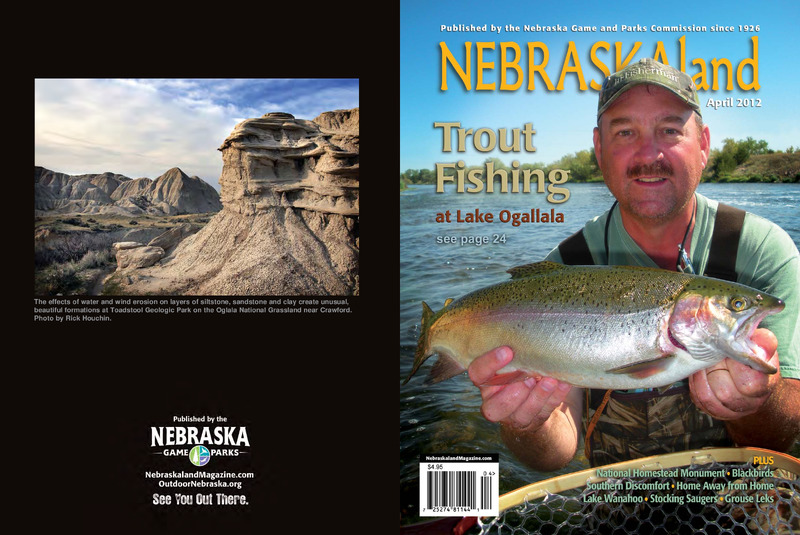
The effects of water and wind erosion on layers of siltstone, sandstone and clay create unusual,
beautiful formations at Toadstool Geologic Park on the Oglala National Grassland near Crawford.
Photo by Rick Houchin.
Volume 90, Number 3, April
p 2012
14 Celebrating Homesteaders
th
14
●
This year marks the 150 anniversary of the Homestead Act
and will be celebrated at Homestead National Monument of
America near Beatrice. TEXT AND PHOTOS BY JON FARRAR
22 Red-winged Blackbird
Found across the Great Plains, the red-winged blackbird is
highly adaptable. TEXT AND PHOTOS BY MICHAEL FORSBERG
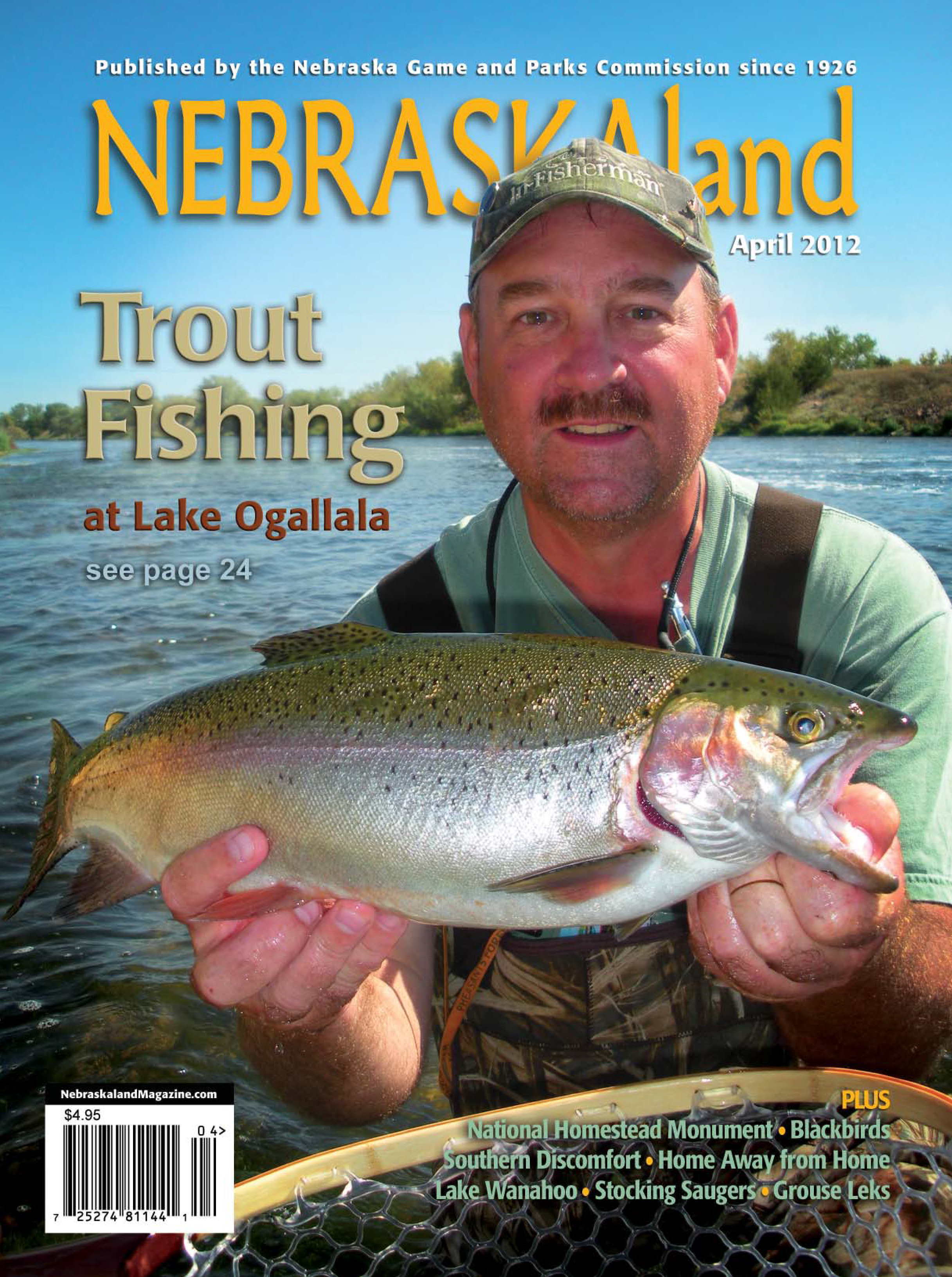
24 Lake Ogallala Trout – Something Special
As far as trout fishing goes, it doesn’t get much better than
Nebraska’s Lake Ogallala. BY DARYL BAUER
30 They Call Me Grandpa Ed
Profile of campground hosts Ed and Betty Hanna.
TEXT AND PHOTOS BY JEFF KURRUS
32 Built for Fish
Eastern Nebraska’s newest outdoor recreation destination
should be worth the wait. TEXT AND PHOTOS BY ERIC FOWLER
38 Boomers in the Basins
Prairie chicken leks on increase in south-central Nebraska.
TEXT AND PHOTOS BY ERIC FOWLER
40 Southern Discomfort
A pair of Southern turkey hunters get a taste of Nebraska’s
spring weather but still leave happy. BY ADAM BURRESS
Comment ................................................................... 4
Mixed Bag................................................................. 6
Nature Notes ............................................................44
In the Field ...............................................................45
Classifieds ................................................................46
Portraits from the Past ............................................ 48
Page 49.....................................................................49
The Last Stop .......................................................... 50
44
●
40
●
32
●
Cover: Lake Ogallala, fed by cold, well-oxygenated water from Lake
McConaughy, offers tremendous trout fishing. See story on page 24. Photo
courtesy of Daryl Bauer. Opposite: A male grackle gives a glaring look while
perched on a fence post in Hall County. Photo by Luke Kathol.
NEBRASKAland (VOL. 90 / NO. 3, ISSN 0028-1964) is published monthly, except for the
combined Jan./Feb. and Aug./Sept. issues, by the Nebraska Game and Parks Commission,
2200 N. 33rd St., Lincoln, NE. Periodicals postage paid at Lincoln, Nebraska, and additional
mailing offices. POSTMASTER: Send address changes to NEBRASKAland, P.O. Box 30370,
Lincoln, NE 68503-0370.
2 NEBRASKALAND • APRIL 2012
APRIL 2012 • NEBRASKALAND 3
Correction
In last month’s issue, the above photo
should have been used to end Steve
Zechmann’s story about capturing a
special moment in time as a pair of
deer lined up perfectly. We regret the
error. – The Editor
Plum Creek Valley
Dear Mr. Farrar,
NEBRASKAland has been delivered
to my home for many years. My
parents were both born and raised in
northeast Nebraska – Dad in Niobrara
and Mom in Bloomfield. They came to
Oregon with my dad’s mom in 1937.
I rode along on that trip, safely tucked
in my mother’s womb. Both sets of
grandparents were farmers/ranchers
– my mother’s father, William Obert,
homesteaded the land that is now the
Santee Reservation.
Getting to Tillamook, Oregon was
sort of a “Grapes of Wrath” affair –
my dad and grandma loaned a fellow
enough money to buy a flatbed truck.
The terms of the loan included my
grandma and parents riding free of
charge to Tillamook. The guy had a
wife and two children, so the truck was
charged with hauling five adults and
two kids some 1,700 miles across the
country. They traveled during daylight
hours and slept on, under, or inside the
truck at night. Unlike the Joads, there
was a job waiting for my dad at the
Ford garage in Tillamook.
So, all this leads up to my telling you
how very much I enjoyed your piece
on Plum Creek Valley. You somehow
reached a perfect balance of the history,
the present and the future of this small
piece of Nebraska. A very enjoyable
“read,” and the pictures were perfect
for the article.
I get back to Nebraska every couple
of years. I have relatives in Seward
and Omaha. My guess is that on the
next visit, I will check out Plum Creek
Valley WMA.
Lyelle F. Hathaway
Springfield, Oregon
Bighorn Relocation
Gentleman,
In last week’s Omaha World Herald
appeared a story and photographs of
your work and accomplishments to
bring to Nebraska a magnificent herd
of bighorn sheep from Canada.
Each word and picture gave a sense
of pride and appreciation for all you
did to do this. I can only imagine the
“blood, sweat and tears” it took to
accomplish the job.
I am looking forward to updates on
how the herd flourishes and adjusts to
their new home. I welcome our new
residents, and thanks again for all you
did to bring them to Nebraska.
Jean Carter
Omaha, Nebraska
Thanks for your letter – the story
of bighorn sheep reintroduction to
Nebraska is indeed an interesting saga,
and one that has been very successful
so far. In next month’s issue, Eric
Fowler will detail some of the “blood,
sweat and tears” that went into this
recent trip to Canada, as he tagged
along to help out and to capture
photographs and video of the project.
It should make for a very entertaining
article. – The Editor
NEBRASKAland Visitor Letters
We want to thank all 48 readers
that sent e-mails and letters for last
issue’s visitor, a spittlebug that was on
page 50 (see page 13 for the winner,
rules and this issue’s hint). Here are
some of the responses we received:
PHOTO BY ERIC FOWLER
I found the bug resting on the top,
righthand side of page 50. It is an
orange-colored bug, appears to have
wings. This one is a tough one – it
could be an aphid of some sort, or a
cicada. I think I am going with some
sort of a cicada. Thanks for the great
magazine, I grew up in Nebraska and
now live in Colorado only because
my profession brought me here. I love
reading your magazine – it takes me
back to my earlier days when I lived
there. What great times.
Monte Deatrich
Thornton, Colorado
A bighorn sheep ram runs from a stock trailer into its new home near Harrison in
February. Read more about the Commission effort that moved 40 sheep from Alberta,
Canada, to Nebraska, in the May issue of NEBRASKAland.
4 NEBRASKALAND • APRIL 2012
I just got my NEBRASKAland
Magazine! I think the beetle on page
50 in the upper right hand corner is a
scarab beetle.
I’ve been searching web sites for
over an hour, and that’s all I have come
up with at this point. I didn’t write
down the scientific name for it.
Thank you for making it a little
easier to see! My eyes are about shot!
Love the magazine of my home state.
Donna Gibson
Hazel Green, Alabama
Spittlebug is the common name of
a family of insects (Cercopidea)
that have an interesting defense
mechanism. Young spittlebugs
produce a spit-like mass of fluid and
air that surrounds their body, hiding
them from predators. It also helps
protect their young bodies from drying
out. Spittlebugs overwinter as eggs,
and hatch in early spring. Nymphs
will begin feeding on plant sap, and
can often be found on plant stems
in early summer, encased in their
trademark white, frothy foam. The
nymphs will develop into adults which
will also feed on plants, but do not
coat themselves in a spit mass. There
are several species of spittlebugs, with
a wide host range. Small infestations
of spittlebugs are generally not a
problem, though a heavy infestation
can cause damage. If you don’t
appreciate presence of
nymphs on your plants,
remove by hand, or knock
them off with a quick shot
of water.
Special thanks to Julie Van Meter, State
Entomologist, Nebraska Department of
Agriculture. Visitor image by Chris Helzer.
www.bugguide.net is a good site for identification
Send your comments to:
Doug Carroll, Editor
NEBRASKAland Magazine
P.O. Box 30370
Lincoln, NE 68503
or e-mail Doug.Carroll@Nebraska.gov
Please include your postal address and
telephone number.
Letters may be condensed and edited
for clarity. Photographs are welcome
and will be returned.
COMMISSION
CONSERVATION OFFICERS
Director Rex Amack
Deputy Director Jim Douglas
Commissioners
Chairman - Ron Stave, Waterloo
Vice Chairman - Norris Marshall, Kearney
2nd Vice Chairman - Jerrod Burke, Curtis
Dr. Mark Pinkerton, Wilber
Dr. Kent Forney, Lincoln
Lynn Berggren, Broken Bow
Rex Fisher, Omaha
Mark Spurgin, Paxton
Mick Jensen, Blair
NORTHWEST
Officer
City
Jim Zimmerman (S) Gering
MAGAZINE STAFF
Editor Doug Carroll
Associate Editor Jeff Kurrus
Art Director Tim Reigert
Senior Editor Jon Farrar
Regional Editor Eric Fowler
Contributing Editor Michael Forsberg
Regular Contributors Bill Hager, Chris Helzer,
Lisa Knopp
Photo Librarian Sarah Johnson
Circulation Donna Robinson
For address changes and questions about
your subscription, e-mail Donna.Robinson@
Nebraska.gov
or call (800) 632-5263
Marketing/Advertising
For advertising information contact
Larson Enterprises
e-mail dave@larsonent.com
or call (515) 440-2810
NEBRASKAland Magazine Copyright 2012, all rights reserved.
NEBRASKAland is available on audio cassette from the Nebraska
Library Commission Talking Book and Braille Service, Suite 120, 1200 N
St., Lincoln, NE 68508. (800) 742-7691. NEBRASKAland Magazine and
the Nebraska Game and Parks Commission reserve the right to reject any
advertising not in keeping with the agency mission.
Rates: $18 for one year; $33 for two years; $44 for three years. Nebraska
recipients must add appropriate sales tax. To subscribe call
1-800-NEBLAND (632-5263), or go online to: NebraskalandMagazine.
com.
COMMISSION OFFICES
Headquarters/Southeast District Office
2200 N. 33rd Street Lincoln, NE 68503
Phone (402) 471-0641
Northeast District Office
2201 N. 13th St. Norfolk, NE 68701
Phone (402) 370-3374
Southwest District Office
301 E. State Farm Rd. North Platte, NE 69101
Phone (308) 535-8025
Northwest District Office
East Hwy. 2, Box 725 Alliance, NE 69301
Phone (308) 763-2940
Bassett Office
524 Panzer St., Box 508 Bassett, NE 68714
Phone (402) 684-2921
Kearney Office
1617 First Ave. Kearney, NE 68847
Phone (308) 865-5310
Omaha Office
1212 Bob Gibson Blvd. Omaha, NE 68108
Phone (402) 595-2144
Greg Hesse
Scott Brandt
Heath Packett
Dan Kling
Frank Miller
Phone (308)
(office) 763-2940
(cell) 641-6138
Alliance
760-3647
Gering
631-0663
Gordon
360-0682
Harrison
430-0572
Valentine (402) 389-0444
SOUTHWEST
Officer
City
Phone (308)
Roger Thompson (S) N. Platte (office) 535-8025
(cell) 530-3097
Ray Dierking
Brkn. Bow
870-0322
George Sund
Cambridge
655-0028
Michael Thome
Cozad
529-8146
Terry Brentzel
Doniphan (402) 469-5795
Matt Andrews
Elwood
746-2418
Dirk Greene
Imperial
882-0015
Jerry Pecha (Sup.) Kearney (office) 865-5327
(cell) 293-3551
Dale Johnson
Kearney
440-3847
Dudley Sorensen
N. Platte
530-0016
Nicholas Fix
Lemoyne
289-0427
Dennis Thompson
Ogallala
289-0755
Rich Routh
Rep. City
920-0367
NORTHEAST
Officer
City
Tom Zimmer (Sup.) Norfolk
Dale Davis
Steve Oberg
Daniel Roberts
Randy Pomplun
Jeff Jones
Jon Reeves
Tim Williams
Pat George
Doug Pollard
Cory Krause
Phone (402)
(office) 370-3374
(cell) 649-8053
Bassett
760-0712
Columbus
910-3366
Fremont
719-1108
Fullerton (308) 550-0489
Hartington
762-5022
Kennard
889-8508
Neligh
929-0051
O’Neill
340-0787
Ord
(308) 778-7101
West Point
380-6410
SOUTHEAST
Officer
Duane Arp (Sup.)
City
Gretna
Sean McKeehan
William Krause
Mike Luben
Dan Zuehlke
Darin Gress
Douglas Kramer
Dina Barta
Stacey Lewton
Levi Krause
Robert Finke
Russell Mort
Dan Evasco
Jeff Clauson
Phone (402)
(office) 332-2965
(cell) 521-0194
Ashland
521-0159
Auburn
274-8063
Colon
443-6392
Cortland
806-9084
Hebron
768-8665
Lincoln
890-6465
Lincoln
890-6463
Lincoln
890-7140
Louisville
949-0593
Milford
947-1363
Nebr. City
209-1506
Papillion
616-5961
Waterloo
658-7057
ADMINISTRATION
Officer
City
Craig Stover (Adm.) Lincoln
Phone (402)
471-5531
Nebraska Wildlife Crimestoppers 1-800-742-7627
Ak-Sar-Ben Aquarium
21502 W. Highway 31 Gretna, NE 68028
Phone (402) 332-3901
Under federal and/or state law, discrimination is prohibited on the basis
of race, color, religion, age, gender, marital status, national origin,
disability or political affiliation. If you think you have been discriminated
against in any program, activity or facility by the Nebraska Game and
Parks Commission or want more information, contact the Commission in
Lincoln, NE, at (402) 471-0641 or the Equal Opportunity Commission,
Lincoln, NE, (402) 471-2024, TTY/TDD (402) 471-4693).
APRIL 2012 • NEBRASKALAND 5
Here is a
list of upcoming
outdoor events across Nebraska.
For more information about these and
other events, visit the calendar page at
www.OutdoorNebraska.org.
April 1
Paddlefish Archery Application
The application period for archery
paddlefish permits runs April 1-30.
For more information, pick up a free
2011-2012 Nebraska Fishing Guide.
Contact Bob Zegar
402-471-5455
bob.zegar@nebraska.gov
Shorebird Migration
American Avocet
By Jon Farrar
Call it the quiet spring migration – the passage of shorebirds through Nebraska
on their way to northern nesting grounds. Sandhill cranes and geese come in
vociferous swarms and draw bird-watching crowds by the busload to the central
Platte River and Rainwater Basin to view the spectacle. Relatively few people go
looking for shorebirds. That alone is a perfectly good reason to do it, to avoid the
crowds, but there are many others.
The first shorebirds to arrive are usually killdeer and yellowlegs during the
migration rush of March. Other species follow during April. As a rule, mid-May
is the peak of shorebird migration through Nebraska. About 40 different species
of sshorebirds have been reported in Nebraska.
Of those, 20 or less are considered common,
and each and every one of them are worthy of a
bird
birder’s attention. But it is the uncommon and
rare species that cause seemingly sane grown men
and women to drive through the night to ogle
them through binoculars and spotting scopes.
the
Some shorebirds may pause for only a day or a
So
night, others linger to feed and put on fat that
nig
will carry them to their Arctic nesting grounds,
wi
and some remain in the state to nest.
an
A good source of information about shorebirds
(and all other species to be seen in the state)
(a
and the best places to view them in Nebraska
an
is the NEBRASKAland special issue, Birding
Nebraska, published in 2004. The original
N
cover price of $12.95 has been reduced to
co
$$2 – a bargain basement, blue-light special
vvalue. The 180-page book can be purchased at
Nebraska Game and Parks
Pa Commission offices or by going online to
NebraskalandMagazine.com and clicking on the “Special Issues” link near the top
of the page.
6 NEBRASKALAND • APRIL 2012
April 7
Youth Shotgun Turkey Season
The 2012 youth shotgun turkey
season begins April 7 and the
general shotgun turkey season
begins April 14. Both run through
May 31. Youth turkey permits are
only $6. For more information, pick
up a free 2012 Nebraska Turkey
Guide, available at Commission
offices and permit vendor locations
across the state.
April 17
Growing up Wild
Growing Up WILD: Exploring Nature
with Young Children builds on
children’s sense of wonder about
nature and invites them to explore the
world around them. This class will be
held at the Papio-Missouri NRD office,
8901 S. 154th Street #A in Omaha from
6:30 p.m. to 8:30 p.m.
Contact Lindsay Rogers
402-471-5581
lindsay.rogers@nebraska.gov
April 21
Indian Cave’s First Annual
Outdoor Adventure
Come out for an event-filled day for
the whole family at Indian Cave State
Park. Featuring a mushroom hunting
contest, fish fry, archery shooting,
birdwatching and much more, it’s
sure to cure spring fever! Contact
the park office for more details. A
park entry permit is required.
Contact: Indian Cave State Park
402-883-2575
ngpc.indian.cave@nebraska.gov
Spring Stargazing
8 NEBRASKALAND • APRIL 2012
Prescribed Burns Scheduled
Don’t be surprised if you see smoke rising from a wildlife
management area (WMA) this spring: The Nebraska Game
and Parks Commission will once again be conducting
prescribed burns at various WMAs and state recreation areas
across the state when conditions are favorable.
The primary goal of these burns is to reduce invasive
species that are competing with native species. Burning also
improves the diversity and quality of habitat available to a
variety of wildlife.
Crankbaits and Trees – a Perfect Match
Jeff Kurrus
About six years ago, I was fishing in a bass
tournament in Iowa. Unable to find any fish, my partner
and I began fishing through a flooded stump field in
search of lunkers – he with soft plastics and me with
crankbaits.
“Don’t get hung up now,” he told me, knowing each
minute we were untangling a lure was time spent not
fishing.
“I won’t,” I told him.
My confidence from fishing a floating crankbait
through flooded timber, a practice often not attempted
by novice anglers, was from learning how best to fish
these lures through thick cover. The secret is simple:
allow the lure’s lip to function as it should.
Lipped floating crankbaits, as opposed to lipless
versions such as Rattletraps, are easy to bounce off
logs as long as you are watching your line and paying
attention to your retrieve. During the retrieve, the point
where your line enters the water will get closer to you
unless your crankbait is about to cross a submerged
structure. When this happens, stop reeling and your
lure will rise
above the
structure,
keeping you
from being entangled, and allowing you to continue your retrieve.
However, windy days sometimes prevent you from seeing your line. Now
you must rely on feel. Therefore, when your lure’s lip hits a log, stop reeling
momentarily and your lure will clear the obstruction. Then you can continue your
retrieve.
If you can master this simple technique, you will open yourself up to fishing
crankbaits in many more situations than you thought. Plus, during those “pause
and rise” moments, I have caught many fish that apparently like it when the bait
stops and suddenly floats toward the surface.
Now if I could just figure out how to fish those crankbaits through thick grass.
APRIL 2012 • NEBRASKALAND 9
PHOTO BY DOUG STEINKE
Matthew Marx
With the ground finally
thawed and the earth coming
alive in April, campers, hikers
and fishermen are filling their
days exploring state parks,
walking the trails or angling
for frisky crappie and bass.
But after the campfire embers
burn low, the sky comes
alive as well. Stargazing is a
primal human experience that
requires little more than a clear sky away from
ambient light, a warm blanket and a sense of wonder. The
experience, however, can be made more fulfilling if you
know what you’re looking at.
The best book I have ever read on basic astronomy is
simply called The Stars by H.A. Rey, author of the famous
Curious George children’s series. The Stars succeeds in
making complex constellations and the science behind their
movements understandable to children and adults alike. The
genius of this book is Rey’s technique, which revolutionizes
how we look at individual constellations. Using people’s
innate tendency to imagine lines between points, Rey draws
stick figures that actually look like what the constellations
are supposed to represent. For example, the constellation
G
Gemini
(The Twins) is drawn to look like two stick-figure
ppeople walking side by side (as seen on the cover at left);
U
Ursa Major (The Great Bear, which contains the unofficial
cconstellation The Big Dipper) looks like a polar bear sniffing
tthe air; Hercules looks like a man in stride wielding a club.
A
After looking at the drawings in the book, the stars in the
ssky begin to form more easily recognizable pictures.
Whenever I anticipate a good opportunity to stargaze
I make sure I have Rey’s book (or photocopies of the
aappropriate pages) and a flashlight with a red bulb, as white
llight impairs night vision. (Tape colored with a red marker
sstuck over the end of a flashlight works, too.) So whether
yyou are alone with your thoughts, snuggling next to your
ssweetheart, or spending time with your kids, consider
stretching back on a clear spring night and enjoying nature’s
most ancient light show – the stars.
See You Out There ... But Where?
“Useful, with a pleasant degree of fish odor”
BY DARYL L. BAUER
This is it! Spring, especially May
and June, offers some of the best
fishing of the year for a variety of
fish. The weather is warming and
everyone is anxious to hit the water,
so regardless of your favorite fish or
favorite waters, it’s time to GO FISH!
• Big Waters
Although the early spring walleye
spawn period attracts a lot of anglers
to the dam faces of Nebraska
reservoirs, those walleyes are not
easy to catch because, well, they
have other things on their mind.
Better walleye fishing occurs after
the spawn is completed. When May
and June roll around, walleyes will
be roaming Nebraska reservoirs
searching for prey, and bait fish will
be fewer at that time. That is good
news for anglers! Look for walleyes
to be cruising and eating a variety
of prey items; anglers should stay
mobile, cover water and try a variety
of baits and presentations. Generally,
the best strategy is to start shallow
and work towards deeper water, as
shallow waters are more likely to
have an abundance of prey in the
spring. Sutherland, Maloney, Merritt,
Swanson, Enders and McConaughy
will be some of the state’s best
walleye waters this year. Smaller
reservoirs in eastern Nebraska
don’t support as many walleyes, but
anglers can still find some at Wagon
Train and Stagecoach.
Water levels have been good on
most Nebraska reservoirs for the past
couple of years, which should result
in some great fishing this spring.
Swanson Reservoir will be one of
the best in the state for a variety of
species, including largemouth bass.
Acres of flooded trees have produced
a boom in crappie populations in
Harlan County Reservoir and those
fish have grown large enough to
provide some great fishing this
year. Elwood Reservoir also has an
abundance of flooded cover right
now, resulting in a resurgence of
panfish as well as northern pike.
Elwood will be one of the best places
for wipers this year; toss some jigs,
crankbaits or swimbaits at wind-blown
shorelines for those fish.
10 NEBRASKALAND • APRIL 2012
• Small Waters
Small bodies of water warm
faster and by May and June fish
in Nebraska pits, ponds and small
reservoirs will be very active. Anglers
should look for crappies and other
panfish in protected bays and coves,
especially those with shallow water
cover such as brush piles, fallen
trees or aquatic vegetation. Small
and medium-size reservoirs across
Nebraska will produce some good
crappies this spring: from Whitney
and Oliver in the Panhandle to the
new Wanahoo and Stagecoach in
eastern Nebraska.
Nebraska sandpits and ponds have
always been some of the state’s best
bass habitats and will produce some
of the best bass fishing from early
spring right through early summer.
Many of them are privately owned
and require landowner permission,
but some are enrolled in the Open
Fields/Open Waters program and
are open to public access. Other
small waters that will provide some
excellent bass fishing and panfishing
can be found on the Windmill, Ft.
Kearny, and Fremont Lakes state
recreation areas.
• Natural Lakes
Most waters fished by Nebraska
anglers are some type of manmade water – Nebraska does not
have a lot of natural lakes, but
there are some, and the Sandhill
lakes are the best examples. These
offer some of the best ice-fishing
to be found anywhere, but they
also provide excellent open-water
fishing. In the spring anglers can cast
buzzbaits, spinnerbaits or spoons
on a number of Sandhill lakes for
pike and beautiful, fat largemouth
bass. Goose and Swan lakes in the
eastern Sandhills will offer some
excellent fishing this spring, as
well as a number of lakes on the
Valentine National Wildlife Refuge.
On Valentine, Watts Lake should
be particularly good for bass, while
Pelican and Dewey lakes will offer
both pike and bass. Clear Lake would
be a good bet for some big pike.
• Trying Something New
Have you ever caught a redear
sunfish? A rock bass? How about
a pumpkinseed? Nebraska anglers
know that spring is an excellent time
to catch bluegills, but there also are
waters that provide the opportunity
to catch a variety of other sunfish
species. An angler can explore the
Interstate-80 lakes both east and
west of North Platte to find some
redear sunfish and rock bass, in
addition to bluegills. Head up into the
Sandhills to find a few pumpkinseeds
at Cottonwood Lake near Merriman
or Box Butte Reservoir in the
Nebraska Panhandle.
If you have never fished the
Missouri River in northeast Nebraska,
you should plan to this year. After
last year’s flooding, the fishing on
Nebraska’s upper Missouri River
has been outstanding for a variety
of species and that will continue in
2012. Part of the fun of fishing the
Missouri is that you never know what
you might catch; walleye, sauger,
smallmouth bass, white bass,
freshwater drum, goldeyes, catfish
and a variety of other species cruise
its waters. There have already been
some surprising catches from the
Missouri following last year’s flooding
and there likely will be more this year.
Do you know where this Nebraska photograph was taken?
See answer at the bottom of page 13.
Public Expo Day at Ft. Kearny
Outdoor enthusiasts of all ages are
invited to take part in the Outdoor
Discovery Program that will be held at
Ft. Kearny State Recreation Area on
May 12.
This event will be held from 9 a.m
to 4 p.m. and will be a great way to
kick off Mother’s Day weekend by
giving the whole family a chance
to experience a variety of outdoor
activities. Some of the hands-on
activities that will be offered include
shotgunning, air rifles, bowfishing,
outdoor crafts, campground games,
kayaking and fishing.
Other highlights include a s’mores
eating contest, Cabela’s Outdoor
Challenge, fish cleaning and cooking
demonstrations, outdoor photography
classes, roasted hotdogs, predator
calling demonstrations, and a 3D
archery tournament for moms and
others.
The event is free, but a state park
permit is required to enter Ft. Kearny
State Recreation Area.
“The best time to fish is when
you have time to fish.” — D.L.B.
APRIL 2012 • NEBRASKALAND 11
Nebraska’s Other Salamander
W
hether you know them as
waterdogs, mudpuppies, or
salamanders, you are more than
likely familiar with the most common
salamander in Nebraska – the tiger
salamander. As larvae they are usually
greenish-gray with large gills on the
sides of their heads, and they are often
sold as waterdogs or mudpuppies in
bait shops (even though mudpuppies
are actually a completely different
kind of salamander). As adults they
transform into gill-less terrestrial forms
that look like wet lizards. They also
change colors, with some becoming
black with yellow bars and some taking
on a more yellow-green blotched
pattern. They can be found from
Harrison to Rulo in stock ponds, cattle
tanks and even roadside ditches.
But Nebraska is home to another
salamander. One that is not as large,
not as brightly colored, not sold as
bait, and not as common. In southeast
Nebraska in the Missouri River flood
plains there are shallow depressions
and ditches that fill up with rain, snow
and even floodwaters from time to
time. These temporary pools are the
perfect breeding sites for smallmouth
salamanders, especially if they are
fishless. Smallmouth salamanders
occur from Sarpy County south to
Richardson County, but are only found
in areas near the Missouri and Big
Nemaha Rivers. South and east of
Nebraska they are quite common, but
in Nebraska they reach the extreme
northwest limits of their range. At four
to five inches long, they are half the
size of their tiger salamander cousins.
But with an olive green to brown
ground color and blue-gray metallic
flecks all over their bodies, they are
equally as beautiful. As you can guess
from the name, they have a relatively
small mouth, and in fact a small head
in comparison to the size of their
bodies. They also have much smaller
legs than tiger salamanders do.
Smallmouth salamanders are
the earliest risers of Nebraska’s
amphibians. In late-February when all
12 NEBRASKALAND • APRIL 2012
the other amphibians are
still in a deep winter’s
sleep, the “smallmouths”
start their migration to
those temporary pools.
Sometimes snow is still
on the ground and a little
ice is still on the water’s
surface, but this little
salamander can tolerate
the cold quite well. Cold
rains with temperatures in
the low to mid-40s are the
trigger, and the purpose
for this late winter activity
is to mate. Laying eggs
early guarantees that larvae will hatch
and grow quickly enough to get out
of the pools before they dry up during
summer. When they leave the water
the young salamanders are nearly
jet black and about an inch long (for
comparison, when tiger salamanders
leave the water they are about
four inches long). Earthworms and
arthropods make up the bulk of their
diet, but it will be several years before
the newly metamorphosed salamanders
are large enough to return to the
pool and mate. They have very slow
metabolisms and are slow growers, but
they can also live for more than 20 years.
If winters are dry and the pools
do not fill with water, smallmouth
salamanders will not mate. In fact
they may go years without mating.
Producing eggs is costly in terms
of energy, and female salamanders
would rather not waste the energy if
their eggs are not going to survive.
Several dry years in a row prevents
new generations of young salamanders
from becoming established. As climate
conditions here in Nebraska continue
to change, mild winters are becoming
increasingly common and spring seems
to be arriving earlier. These changing
conditions can cause animals such as
smallmouth salamanders to become
active earlier than normal, but if an
Arctic blast brings back subfreezing
temperatures, the pools can freeze solid
again and any salamanders or eggs in
the pools would then die. Nebraska’s
smallmouth salamander populations
are small and so close to the edge of
their range that they are particularly
vulnerable to rapidly changing climatic
conditions. Hopefully the pools will
continue to fill every year so that these
metallic-looking salamanders with
Muppet-like smiles will be a part of our
natural legacy for a long time.
NEBRASKAland Visitor
Winner and Hint
Last issue’s winner of
the NEBRASKAland
Visitor drawing was
Rodney Blevins of
Amherst, Nebraska, who found
the spittlebug on page 50.
Readers are encouraged to contact
NEBRASKAland within 10 days
after this issue’s publication with the
correct page number and name of
this issue’s “Visitor” – a bug found
in Nebraska that just happened to
find its way onto one of the pages of
our publication.
We will then gather the correct
entries and draw one to win a
NEBRASKAland Magazine mug.
To enter each month, write:
NEBRASKAland Visitor
2200 North 33rd Street,
Lincoln, NE 68503.
Or e-mail:
Tim.Reigert@Nebraska.gov
with “Visitor” in the subject line of
the message.
HINT: This issue’s visitor is not
on page 5, 6, 7, 12, 16, 27 or 51.
Two Rivers State Recreation Area Caboose Cabins
Dan Fogell, Herpetologist,
Southeast Community College
APRIL 2012 • NEBRASKALAND 13
Celebrating
Homesteaders
Text and photos by Jon Farrar
This year marks the 150th anniversary
of the Homestead Act and will be
celebrated at Homestead National
Monument of America near Beatrice.
I
f you can’t sell land at $1.25 an acre, you just as well
give it away. That is what the U.S. Government did
when it passed the Homestead Act of 1862. There were,
of course, strings attached – like living on the land
for five years and making improvements. Would-be
homesteaders had to be 21 years of age or older (18 if
married), and have “never borne arms against the United
States Government or given aid and comfort to its enemies.”
Anyone meeting those qualifications could file on 160 acres,
a quarter of a section, of unclaimed and unappropriated land
and eventually hold deed to it. The only cost was a modest
filing fee.
A case could be made that the seeds for the Homestead
Act were planted in 1803 when the U.S. Government
acquired 828,000 square miles of land in the center of
what today is the United States – the Louisiana Purchase.
For the price of about $15 million, roughly three cents
an acre, France agreed to relinquish its claim to the land.
colonize this vast region was passage of the Preemption
Act of 1841. Under that act, the head of a family, 21 years
or older and a U.S. citizen, could purchase up to 160 acres
of government land, usually at the cost of $1.25 an acre, if
they built a home and lived on the land for one year. That
act, and the continuing trickle of settlers overland from
the east and up the Mississippi and Missouri rivers, started
settlement of the eastern edge of the Louisiana Purchase
territory, but not as quickly as hoped. While the $200 price
tag on a quarter section of land would surely be a bargain
today, it was no doubt an impediment for many families who
would have moved west and settled, and immigrants who
would come to this country with the dream of owning land.
Birth of the Homesteader
To encourage settlement of the Great Plains, the
Homestead Act of 1862 was signed into law by President
Abraham Lincoln on May 20, 1862.
Unlike acquiring land under the
Preemption Act, the land was free if
settlers met all the requirements. A
flurry of federal laws were passed
that year to hasten settlement of the
west – the Department of Agriculture
was created to promote farming,
particularly to develop techniques for
more arid western lands; the Morrill Act
created the land grant college system
(including the University of Nebraska
in 1869) to encourage farming and
improve its efficiency; and the Pacific
Railway Act launched construction of a
transcontinental railroad (completed in
1869) to link the east and west coasts,
promote the movement of settlers to
the Great Plains and carry their produce
to markets. While settling the land and
making it productive was at the core
The Palmer-Epard cabin built in 1867, left, was moved to Homestead National
of the Homestead Act, other reasons
Monument of America from nearby land and furnished to authentically represent
also prompted its passage: President
pioneer times. Monument park guide, Allison Alley, in pioneer period dress, is
Lincoln and northerners in Congress
shown at the spinning wheel in the cabin.
feared that if the Civil War ended with a
The purchase doubled the size of the United States, and
negotiated peace and the southern states successfully gained
encompassed much of the Great Plains region. The region
independence, slavery would spread west. The Republican
had some non-native trappers, traders, hunters and the like in Party had been formed in 1854 to oppose the spread of
1803, but the government wanted the territory occupied by
slavery into western states.
farmers and families, tillers of the land, stock raisers, towns,
cities and industries. The westward push of settlers from the
eastern seaboard colonies was slow, too slow, having stalled
out not far west of the Appalachian Mountain states. The
When Nebraska was admitted as a state in 1867, it
sheer vastness of the land beyond was daunting, unknown,
had an estimated population of only 50,000 persons. By
filled with dangers and occupied by Native Americans who
1870, the state’s population had grown to 72,000. Native
had no regard at all for countries claiming land, or selling
American tribes had been coerced, one by one, to cede their
the rights to land they had claimed.
lands to the government over most of eastern and southern
The federal government’s first significant attempt to
Nebraska. Agriculture had proven to not only be feasible,
Settling Nebraska
14 NEBRASKALAND • APRIL 2012
APRIL 2012 • NEBRASKALAND 15
The First Homesteader
Goldenrod, white snakeroot and smooth sumac can be found on the site’s 100 acres of restored tallgrass prairie.
16 NEBRASKALAND • APRIL 2012
It has long been written the first person to file a
Homestead claim was Daniel Freeman in Nebraska. Freeman
was a native of Ohio, raised in Illinois, graduated from
a medical institute in Cincinnati, Ohio, and for a time
practiced medicine in Illinois.
As the family story goes, Freeman was a Union soldier
during the Civil War, part of the Seventeenth Illinois
Volunteer Infantry and stationed at Fort Leavenworth in
Kansas, although some historians say there is no proof he
served in the military. It was said he may have served in
the army’s “secret service.” Homestead claims could first
be legally filed beginning January 1, 1863. Freeman was in
southeastern Nebraska on furlough several days before, and
had designs on a piece of land along Cub Creek northwest of
Beatrice, then a small town in central Gage County. Family
history told that Freeman somehow persuaded the registrar
of the land office in Brownville to open shortly after
midnight on January 1 so he could file his claim. Qualifiers
such as “among the first” or “may have been the first” are
now usually placed in front of the claim Freeman was the
first in the nation to file a claim under the Homestead Act.
But there seems to be no definitive proof he was not.
Apparently, Freeman did not actually reside on his
homestead until after the Civil War ended in the spring of
1865, bending (as would many others) the exact letter of
the law stating the settler was required to “…reside upon
PHOTO COURTESY OF NEBRASKA STATE HISTORICAL SOCIETY - RG4376.PH4-14
but profitable. In 1860, the average farm size was about 225
acres. Settlement, though, was principally the eastern third
of the state and, farther west, south of the Platte River.
“What a blessing this wise and humane legislation will
bring to many a poor, but honest and industrious family,”
Nebraska territorial governor Alvin Saunders said, speaking
to the legislature in 1864. “Its benefits can never be
estimated in dollars and cents. The very thought, to such
people, that they can now have a tract of land that they can
call their own, has a soul-inspiring effect upon them, and
makes them feel thankful that their lots have been cast under
a government that is so liberal to its people.”
Homesteaders paid a $10 filing fee at the nearest
land office and a $2 commission to the land agent. If
all requirements were met the homesteader took legal
possession of the land after five years and two witnesses
(usually neighbors or friends) vouched for the truth of
his or her statement regarding occupation of the land and
improvements. The homesteader then submitted an affidavit
“proving” he had met all legal requirements to claim the
land. When this final form was completed and a $6 fee paid,
the homesteader received a final certificate and deed to the
property and it was recorded by the county register of deeds.
Less strenuous occupation of the land requirements were
allowed for Union soldiers who had served in the Civil War,
or their widows and minor children. Up to four years of a
soldier’s time in the service could be deducted from the fiveyear residency requirement.
In addition to being a homesteader, Daniel Freeman was
also a physician, county coroner and county sheriff.
or cultivate the same for the term of five years immediately
succeeding the time of the filing affidavit….” Once Freeman
did settle on his land he built a log cabin and married Agnes
Suiter, the fiancée of his brother, who had been killed in
the Civil War. The Freemans acquired additional tracts of
land surrounding his homestead in subsequent years, resided
in several houses, and raised eight children. In addition to
farming, Freeman worked as a physician, county coroner and
county sheriff. He lived there until his death in 1908; and
Agnes until shortly before her death in 1931.
An Imperfect Program
Many homesteaders stayed on their claims long enough to
receive deeds to it, but nearly as many did not, even though
in 1912 the homestead residence requirement was reduced
from five to three years. In Nebraska, 131,561 persons filed
under the Act between 1863 and 1895, but only 68,862
(about 52 percent) had received final patents to the land by
1900. Nationwide, about four million claims would be made
under the Act, with filings peaking in 1913. Only about 40
percent of those filing claims gained title to the land.
Like other government programs to transfer public land
into productive farms and ranches that would follow – the
APRIL 2012 • NEBRASKALAND 17
PHOTO COURTESY OF NEBRASKA STATE HISTORICAL SOCIETY - RG4376.PH4-14
The Palmer-Epard cabin – built on a nearby homestead
in 1867 of oak, hackberry, ash, locust, walnut, elm, and
homemade bricks – was moved to the monument site in
1950 and has been furnished to authentically represent
the 1880s. The Freeman School building, where some of
the Freemen children were taught, has been preserved and
furnished as it would have been in the 1890s. To further
recreate the scene as it would have appeared in late-1800s,
more than 100 acres have been restored to tallgrass prairie,
work that began in 1939. Workers laid sod strips from
nearby prairies to introduce a variety of native plants; and
between the strips seeded with native grasses and forbs.
Prescribed fires and other management tools are used to
maintain and improved the prairie grassland. Part of a
hedge of Osage orange planted by the family can still be
seen. These thick, prickly hedges were commonly planted
in southeastern Nebraska in the early years of settlement as
fences to contain livestock.
What to Do
In a painting done by Gusta Strohm in about 1888, Daniel Freeman is shown at his homesite near Cub Creek.
Timber Culture Act of 1873 and the Kinkaid Act of 1904
– the Homestead Act was exploited by land speculators
to acquire large tracts of land. This was commonly done
by having a person, often an employee, file for a quarter
section of land. The law allowed that after living on the
land for six months that person could “commute” the
homestead, meaning title to the land could be obtained by
purchasing it at a per acre cost substantially less than the
land could be sold on the open market. In 1860, the average
cost of farmable land in eastern Nebraska was nearly $6
an acre. Commuted homesteads allowed some landowners
and speculators to acquire land at bargain-basement costs.
Similarly, if a claimant gave up any claim to the land filed
on, in effect “relinquishing” it, the land reverted to the
government. It was not uncommon for the original claimant
to “sell a relinquishment” to a second party. Acquisition of
land by speculators and land barons by such means declined
once formal, legal institutions were in place.
Another flaw in the Act was that no consideration was
given to the tract size needed to support a family in different
regions. While 160 acres of rich bottomland in eastern
Nebraska could be enough for a family to farm and prosper,
much of the land in central and western Nebraska was not
suited to farming because the soils were not rich enough and
rainfall too unreliable; and 160 acres was not large enough
for a ranch. Still, many filed on lands there, tried to eke
out a living farming, and unless they were able to acquire
more land, usually failed. Prolonged droughts, frightful
blizzards and plagues of grasshoppers contributed to many
homesteaders abandoning or selling their claims. And, in
18 NEBRASKALAND • APRIL 2012
The place to begin a tour of the Homestead National
Monument of America is the Homestead Heritage Center
dedicated in 2007. Described by the National Park Service as
a “multipurpose facility,” it features wonderfully elaborate
Kambree Singleton, part of a Lewiston school group, senses
pioneer life by walking through head-high restored prairie.
truth, many with a dream of owning their own land had no
farming experience or enough money to buy the livestock
and equipment necessary to succeed. The same was also true
under the 1904 Kinkaid Act, when 640 acres could be filed
on, again dashing the dreams of would-be farmers.
Most historians have written that the Homestead Act failed
to live up to its intent – to settle public land with families
too poor to acquire it by outright purchase. It did, however,
move an enormous amount of land into private ownership.
Under the Act, 270 million acres of land – 10 percent of the
nation – was transferred from the federal government into
private ownership.
Of the 30 states where the Homestead Act was allowed,
only Montana, with over 32 million acres, surpassed the
more than 22 million acres successfully homesteaded in
Nebraska. The peak time when final patents on claims were
received in Nebraska was from 1901 through 1920, but
overlooked parcels were still being claimed in the early1950s. The Homestead Act officially ceased in 1976 except
in Alaska, where it was used to settle public lands until 1986.
Monument to Homesteaders
Freeman’s homestead was chosen to be the site of the
Homestead National Monument of America by the U.S.
Congress in 1936, that it be: “…an appropriate monument
to retain for posterity a proper memorial emblematical of
the hardships and the pioneer life through which the early
settlers passed in the settlement, cultivation and civilization
of the Great West.”
Diller-Odell fourth-graders Kyleigh Barnts, left, and Emily Swanson receive a pioneer laundry lesson from Mary Ann Gabel.
APRIL 2012 • NEBRASKALAND 19
The Homestead Heritage Center was dedicated in 2007 and is
the best place for visitors to begin their journey back in time.
Sesquicentennial
The Heritage Center features interactive exhibits giving visitors a taste of pioneer life and the story of the Homestead Act.
interactive exhibits demonstrating pioneer life; and a basic
understanding of the Homestead Act and its effect on the
settlement of Nebraska and other states. Films are shown in
the auditorium, and a spacious balcony gives visitors a view
of restored tallgrass prairie. The center is a repository for
more than 60,000 historical objects, scientific specimens and
archival documents. The collection is a treasure trove for
those doing research of homesteader ancestors. The building
also houses a gift shop, where items with a historical flavor
and books ranging from history to natural history can be
purchased.
Nature trails pass through the restored prairie west of the
20 NEBRASKALAND • APRIL 2012
Heritage Center. There is a short loop trail and a long loop
trail, the later taking hikers to Cub Creek, where a bridge
allows access to the Education Center. The Education Center
can also be accessed by vehicles off State Highway 4.
In addition to art exhibits, visiting speakers and an exhibit
of old farming implements and horse-drawn conveyances,
the Education Center is the heart of one of the national
monument’s most important missions – education, telling
the story of how Nebraska was settled, and how those who
did it lived from day to day. The program options visitors
can choose from is expansive and particularly geared to
school-age children, who often come by the busload on field
trips. Topics explored include earth science, life science
and history. Local teachers and graduate students have
helped the monument staff in creating a curriculum guide
for grades K-12. Each topic area has classroom activities to
prepare students for their field trip to the site, and reinforce
what they learned once back in their classrooms. Field trips
such as “Day in the Life of a Homesteader” and “Prairie
Walk” give students a taste of pioneer life when Nebraska
was being settled under the Homestead Act. Living history
demonstrations are periodically offered using volunteers
in period dress showing everything from candle making to
homegrown music making.
To commemorate the 150th anniversary of the Homestead
Act, special events will be held throughout the year at
Homestead National Monument of America. The original
document creating the act, signed by President Abraham
Lincoln, will be on display April 25 through May 28.
A chautauqua with the theme “Free Land – 1862 and
the Shaping of Modern America” will be held May 21
through May 25. There will be a storytelling festival, a
fiddling championship, Homestead Days with living history
demonstrations, art exhibits, special tours – the list goes on
and on. Bring your walking shoes, your camera, some bug
spray and your children. A schedule of events throughout the
year and a wealth of information about the act can be found
at http://www.nps.gov/home/index.htm. ■
Homestead National Monument of America is located four
miles west of Beatrice on State Highway 4. For information:
write Homestead National Monument of America, 8523 W.
State Hwy. 4, Beatrice, NE 68310; or call (402) 223-3514.
APRIL 2012 • NEBRASKALAND 21
Text and photos by Michael Forsberg
G
rowing up on the eastern edge
of Lincoln, I remember playing
baseball with my buddies in
the front yard until a long line of
red-winged blackbirds flew over our
house at sunset. On many spring and
fall evenings massive, chattering
flocks would fly into town from the
surrounding countryside to roost in the
old grove of Siberian elms at the park
down the street. The flock would pass
over us for several minutes nonstop,
like a long, black belt waving in the
wind, horizon to horizon. Sometimes
the flock would fly so low you felt like
you could almost touch them. When
they did, we would play “Moses,”
lifting our baseball bats high in the air
like staffs. The flock would react by
splitting in two, then coming together
again as they flew west into the setting
sun.
Wide-ranging and highly adaptable
to man’s activities, the red-winged
blackbird (Agelaius phoeniceus) is
one of the most numerous land birds
found in North America. It comes from
the family Icteridae, which includes
meadowlarks, orioles and other
blackbird species, and was one of
20 bird species noted by the Lewis and
Clark expedition as it moved up the
Missouri River along eastern Nebraska
two centuries ago.
A large, stocky songbird with
rounded wings, shorter tail and sharp,
straight beak, the redwing is perhaps
at its finest hour in spring, when the
glossy black male in breeding plumage
demands attention from his perch as he
spreads his wings and tail while flaring
his fire-engine red shoulder patches
(or “epaulets”) and offers his raspy
“Conk-a-reeeee” song to attract a mate
Red-winged blackbirds breed throughout Nebraska and are nearly nine inches in
length, with a wingspan of 13 inches. Their largest nesting densities are found
in wetlands with large stands of cattail and bulrush.
22 NEBRASKALAND • APRIL 2012
Red-winged blackbirds are common spring and fall migrants in Nebraska, often traveling in flocks numbering in the thousands.
or declare a territory in the freshwater
marsh he calls home.
The red-winged blackbird is a bird of
open habitats and is found across the
Great Plains. It breeds from the subarctic in Canada throughout the U.S.
to Central America and as far south as
Costa Rica.
In contrast to yellow-headed
blackbirds, which live in the western
plains and specialize in deeper water
wetlands, the redwing is a generalist
and therefore more adaptable to a
variety of habitats. In Nebraska they
are an abundant statewide breeder and
can be found in most every wet spot in
the state, from large wetlands to stock
ponds to roadside ditches and urban
parklands.
Redwings usually nest over or near
open water in dense stands of bulrush
and cattails, willow thickets or other
low, thick vegetation. Semi-colonial
nesters, one male may aggressively
defend a nesting territory occupied
by several females and mate with
all of them, although females have
been known to sneak out from under
a male’s watchful eye and mate with
neighboring males.
The female red-winged blackbird is
dark brown above with white streaking
below. She builds a finely-crafted,
cup-shaped nest of grasses, stems or
reeds woven between upright cattail
stalks, branches or other sturdy stems.
The nest is typically constructed three
to six feet off the ground or water. In
May, she lays three to four blue-green
eggs with dark brown blotches, which
she incubates for 10-12 days until they
hatch. The chicks are fed an all-protein
diet of insects and spiders and will
leave the nest in about two weeks. The
female may raise up to two broods a
year.
Redwings forage on the ground
in open fields or near water.
During breeding season, adults are
omnivorous, eating protein in the form
of insects and other invertebrates, as
well as seeds and grain. In a few cases,
redwings have even been observed
“fishing” for minnows at the water’s
edge. During migration and while on
wintering grounds, cultivated grains
and seeds make up 90 percent of their
diet.
After the breeding season, redwings
begin to gather in loose flocks that can
merge with other blackbird species,
cowbirds, grackles and starlings to
form huge wintering populations that
can number in the millions at places
such as Squaw Creek and DeSoto Bend
national wildlife refuges along the
Missouri River. In 1965, 40 million
blackbirds were estimated at a single
location in Arkansas.
Redwings have adapted well to
agricultural settings and in spring
will feast on waste grain left over
in farmers’ fields, spilled near grain
elevators or picked out of dung left by
wintering cow herds or in feedlots. At
night they find sanctuary by roosting
in trees, dense stands of cattails or
other vegetation in or near water.
During the day, they often will travel
several miles from their winter roosts
to forage.
In Nebraska, the return of the redwinged blackbird to its wetland haunts
is as an indelible sight and sound
as the iconic meadowlark is to our
prairies. The long, dark sinuous lines
that now are winging over the major
river corridors in the state act like a
drawstring pulling the curtain of
winter away, ushering in longer days,
warmer temperatures and the promise
of spring. ■
APRIL 2012 • NEBRASKALAND 23
Lake
Ogallala
Trout
Something Special
PHOTO BY DOUG STEINKE. OPPOSITE PAGE PHOTO BY DARYL BAUER
By Daryl Bauer, Fish and Wildlife Program Manager
As far as trout fishing goes, it doesn’t get much
better than Lake Ogallala in Nebraska. A by-product
of Lake McConaughy’s Kingsley Dam, it provides the
habitat needed by trout – water that is both cold
and well-oxygenated.
T
he North Platte River begins high
in the Rocky Mountains of northcentral Colorado and Wyoming.
Trout anglers ply North Platte waters
all the way through Wyoming, and find
quality trout fishing along its length
in Wyoming. However, when water
and habitat conditions are right, which
happens to be the case right now,
some of the best trout fishing found
anywhere along the North Platte is in
Nebraska!
Nebraska’s largest reservoir, Lake
McConaughy, sits on the North Platte
River in west-central Nebraska. Years
ago, McConaughy itself was able to
support rainbow trout year-round, but
as time rolls on reservoirs age, and the
accumulation of sediment and nutrients
in Lake McConaughy eventually
squeezed out the cold, well-oxygenated
habitat needed by trout until none
was left. Nebraska Game and Parks
Commission fisheries biologists knew
a long time ago that eventually “Big
Mac” would not have the habitat to
support trout, but all along they had
a backup plan.
Big Mac was created by the
building of Kingsley Dam on
the North Platte River, and the
huge earthen dam was largely
created by the excavation of
24 NEBRASKALAND • APRIL 2012
A view from Lake McConaughy’s Kingsley Dam reveals one of Nebraska’s most exciting fisheries - Lake Ogallala.
With trophy rainbow trout in its waters, this lake has become a destination fishery for many anglers in the region.
fill material immediately downriver
of the dam’s location. The big hole in
the ground created by the excavation
soon filled with water and became
Lake Ogallala. Although the habitat
in McConaughy no longer supports
trout during the summer, it does supply
water cold enough to support trout in
Lake Ogallala, and the water is also
aerated as it passes through the dam,
providing the base habitat needed by
trout – water that is both cold and welloxygenated. A trout fishery created
by cold water released from a large
dam is referred to as a “tailwater”
trout fishery. Lake Ogallala is typical
of tailwater trout fisheries that can be
found throughout the United States; it
is, however, unique to Nebraska.
Tailwater trout fisheries typically
produce outstanding trout fishing
because they have excellent water
quality and incredible productivity.
That is the case at Lake Ogallala under
the best of conditions, but there are
occasions when the quality of the water
leaving McConaughy is less than ideal.
For example, in 1984 the installation
of the hydro-power plant where water
enters Lake Ogallala altered its release
and has resulted in less oxygen in the
water during mid- and late-summer. In
addition, the recent multi-year drought
caused extremely low water levels
in McConaughy, resulting in warmer
water entering Lake Ogallala in late
summer and early fall of those drought
years. Fortunately, Lake McConaughy
returned to full pool in 2010 and
2011, and its water releases have been
favorable for trout production since
then.
Lake Ogallala is also home to Lake
Ogallala SRA. At this SRA, there is a
modern campground with 82 pads, 62
with electrical hook-ups. In addition,
there are 180 non-designated campsites,
perfect for those looking for a camp/fish
combo.
APRIL 2012 • NEBRASKALAND 25
Anatomy of Lake
Ogallala
Kingsley Dam
North Basin
South Basin
Keystone Diversion Dam
North
Sutherland Supply
River
Canal
Lake McConaughy
Bank anglers can also take advantage of the excellent trout fishing at Lake Ogallala, including this walkway near Kingsley Dam.
26 NEBRASKALAND • APRIL 2012
There is more than one way to catch a trout, as seen by these spinners and small crankbaits. In addition,
trout can also be caught by fly and bait anglers using various rod and reel combinations.
have been a necessary fisheries management tool in order to
maintain the high-quality and very popular Lake Ogallala trout
fishery.
Rotenone is a fish-killing chemical that is applied to the
water. When fisheries biologists apply rotenone they usually
eliminate all fish in a given body of water and then re-stock
with desirable species. Rotenone renovations have been
accomplished at Lake Ogallala in 1969, 1997 and 2009, after
which the lake has produced trout fishing as good as can be
found anywhere in the North Platte drainage until the carp and
sucker numbers peak again. Following the most recent rotenone
renovation, restocking of 10-inch rainbow trout started in the
winter of 2009-2010. By the following spring, anglers were
already experiencing excellent trout fishing in Lake Ogallala
and associated waters downstream. The largest of those trout
are now much larger than 20 inches and are attracting anglers
from all over Nebraska and surrounding states.
Because there is no natural trout reproduction in Lake
Ogallala, all its trout are stocked. When water and habitat
conditions are favorable, approximately 40,000-50,000 trout
are stocked there each year. Those fish are the same as the
10-inch catchable trout stocked in the fall, winter and early
spring in a number of urban and parks waters around Nebraska,
but whereas those are put-and-take fisheries, Lake Ogallala is a
put-GROW-and-take fishery capable of producing trophy trout.
For that reason, fisheries managers have chosen to manage
Lake Ogallala differently than other trout fisheries in the state:
Special harvest regulations have applied to Lake Ogallala trout
in the past, and the statewide daily bag limit of only one trout
larger than 16 inches is now in place to enhance the production
of big trout in Lake Ogallala.
The productivity of Lake Ogallala and abundance of trout
prey means that the trout feed on a variety of prey items and
can be caught using a variety of baits, lures and presentations,
PHOTO BY DOUG STEINKE
PHOTO BY DOUG STEINKE
Lake Ogallala, also known as the “little lake” because of its proximity to
Lake McConaughy, has about five miles of shoreline and covers about 320
acres from Kingsley Dam to the Keystone Diversion Dam. The lake, created
from dirt taken to construct Kingsley Dam, has become one of the best
trout fisheries in the country.
PHOTO BY DOUG STEINKE
Keystone Basin
Platte
There is one other challenge that
fisheries managers have to deal with to
produce the high-quality trout fishery
Lake Ogallala is capable of: rough fish
such as carp and suckers.
The bottom of Lake Ogallala,
especially the relatively shallow south
basin, is often covered with a carpet
of submerged aquatic vegetation
that hosts a mind-boggling amount
of aquatic insects and other prey
items that trout love to eat. Without
competition from common carp and
suckers, Lake Ogallala’s trout gorge
on a smorgasbord of aquatic insects,
crayfish and baitfish, and can grow at
a phenomenal rate of up to one inch
per month. Unfortunately, there is no
way to prevent carp and suckers from
entering Lake Ogallala as they come
downstream from McConaughy, and
over time the rough fish increase to the
point where they outcompete trout for
prey and destroy aquatic vegetation as
they root up bottom sediments. As a
result, periodic rotenone renovations
Blake Steinke fishes for trout on an early spring morning
at Lake Ogallala with spinning gear.
APRIL 2012 • NEBRASKALAND 27
Trout are coldwater fish, but they are not necessarily more
fragile than any other fish when caught and released properly.
Here are a few tips:
● Circle hooks - I have experimented with circle hooks while
fishing with nightcrawlers and similar baits for trout. The hardest part is finding circle hooks small enough for trout. Owner
circle hooks are the ones I have used: www.ownerhooks.com.
Even with nightcrawlers, most trout end up hooked right in the
corner of the mouth.
● Landing nets - Many companies make landing nets
specifically for the catch and release of fish. Those nets are
oversized and made of knotless mesh. For trout I prefer the
rubber-mesh landing nets.
● Minimal handling - Land the fish with a net in the water.
Remove the hooks, take a quick picture, and release the fish
with a minimum of handling and stress on the fish. Handled
that way, trout are no more delicate than any other fish.
not only in the lake itself, but also in
the canal and a short stretch of the
North Platte River downstream
that the trout migrate into. There
are no gear or bait restrictions on
Lake Ogallala so all anglers, from
beginners to expert fly fishers,
enjoy fishing its waters. For those
who want to toss out a rod and
relax, Lake Ogallala rainbows
can be tempted into eating a
variety of natural and prepared
baits. The old favorite, a
nightcrawler, can be stillfished on the bottom or
drifted with split shot, and
that bait and rigging has
resulted in lots of trout
from Lake Ogallala’s
waters. Prepared baits
now on bait shop shelves
such as PowerBait,
GULP! and a
variety
of
Holly Byler poses with a rainbow trout
caught at Lake Ogallala with a beadhead
nymph imitating a midge larvae.
28 NEBRASKALAND • APRIL 2012
oothers often work just as well or better
tthan ‘crawlers. At times trout cruise
aalong the bottom, but fishing off of the
bbottom will usually get the attention
oof more trout. A couple of small
marshmallows added to a hook will
m
ffloat baits off the bottom or an angler
ccan use a floating jig-head. Floats and
bbobbers are another very effective
method for presenting baits off the
m
bbottom to cruising trout, and fish that
ppull a bobber under are a lot less likely
tto be deeply hooked.
At times, especially during the coldwater periods of the year, there is an
w
aabundance of cold-stressed alewives
tthat drift out of Lake McConaughy.
When stressed alewives are present,
W
Lake Ogallala rainbows, especially
L
ttrophy-size fish, become “meat-eaters”
aand anglers toss a variety of shiny
artificial baits that imitate alewives.
Heavy spoons such as KastMasters and
a variety of spinners work well, and so
do crankbaits (e.g. Countdown Rapala).
Some anglers will throw jigs with
marabou, bucktail or plastic bodies to
imitate the alewives, and swim baits
that match the size and color of that
baitfish will catch trout too. Since trout
are naturally curious, shiny artificial
baits can be used to cover water and
catch some trout almost anytime on
Lake Ogallala and associated waters,
even if cold-stressed alewives are not
present. Casting is an excellent way
to cover water and catch some fish,
but boat anglers also troll a variety of
artificial baits to catch trout in Lake
Ogallala.
A plethora of aquatic insects upon
which trout stuff themselves can also
be found in the lake. On summer
evenings midges can be thick enough
to choke a person, and all of those bugs
spend most of their lives below the
surface where they are a favorite trout
food. Fly anglers find plenty of action
on Lake Ogallala and downstream
waters, especially when trout are
feeding on the aquatic midge larvae. A
variety of nymph patterns that imitate
midge larvae usually work best, but
other nymph and wet fly patterns will
also catch fish. When alewives are
present, big white streamer patterns
can fool some big fish. Fly anglers
most commonly use 3-, 4- or 5-weight
rods on Lake Ogallala and downstream
waters; floating fly lines are usually the
only lines that are needed.
Fish populations are dynamic,
always changing. There is no doubt
that eventually the Lake Ogallala
fishery will swing back towards more
rough fish and a variety of other cool
and warm-water species. When that
time comes it will be time to repeat
The author with a Lake
Ogallala trophy trout.
PHOTOS COURTESY OF DARYL BAUER
Catch & Release
the renovation and trout
re-stocking cycle. For
now, anglers can
ride the wave of
quality rainbow
trout fishing
in Nebraska,
and that truly
is something
special. ■
For additional information
regarding the fishing and
camping at Lake Ogallala
SRA, visit
OutdoorNebraska.org.
They Call Me
Grandpa Ed
A Profile of a Campground Host
Text and photos by Jeff Kurrus
“God grants us many great gifts. But the gift of friendship
has to be near the top of the list, and that’s why we host at
Mahoney State Park.”
– Grandpa Ed
E
ighty-four-year-old Ed Hanna is
adamant with those who use the
word “sir” when addressing him:
“You call me Grandpa Ed,” he says
with a smile, and you become quickly
captivated by his positivity.
In his mind, as well as his wife
Stop by and see the Hannas this summer
at Mahoney SP. You’ll be glad you did.
30 NEBRASKALAND • APRIL 2012
Betty’s, they have a lot to be
positive about. With five children,
nine grandchildren, and 12 greatgrandchildren, both have had enough
wonderful memories to last
10 lifetimes. Then September rolls
around and another month of great
memories occurs.
The beginning of fall is important for
tthis couple because that is when they
gget to go to what they call “home”:
E
E.T. Mahoney State Park in eastern
N
Nebraska. While staying there nearly
a month for each of the past 12 years,
tthey serve as volunteer campground
hhosts for the Nebraska Game and Parks
C
Commission.
“For nearly 60 years I had a dance
bband that traveled all around,” said Ed.
““One time, while tapping at Mahoney,
tthen-superintendent Jim Swenson
aasked us if we wanted to become
ccampground hosts. We told him I was
sstill very busy performing, but he
aassured me that Betty could hold down
tthe fort while I was away for a few
hhours here and there during our time
hhere.
“And he was right. We started soon
aafter and have been hosting since.”
As campground hosts, Ed and Betty
The Campground
Host Program
“The Campground Host
Program is invaluable to us,”
said Outdoor Recreation
Planner Michelle Stryker.
“Not only are the volunteers
dedicated to our state park
system, they are remarkable
in their abilities to connect
to our visitors in a personal
way that allows Nebraska’s
state parks to stand out.”
Hosts provide information
to visitors, assist with
camper registrations and
reservations, help maintain
the campground areas,
handle emergencies, and
have specific tasks handed to
them based on their skill set.
Stryker estimates that
their value was more than
$250,000 to the park system
during 2011 alone, and
hopes that number will
increase this year.
help campers with their reservations,
offer suggestions about activities at the
park and nearby locations, and act as
the general go-to people for any other
questions or problems that park visitors
might have. And they absolutely love
it.
“It’s the best part of the year,” said
Betty. “We are both very social – we
really like people.”
“It’s so great to meet different
people,” added Ed. “We discovered
that after awhile, folks started
re-visiting the park at the same time
that we were hosting. So each time
we’re there we have old friends and
new friends around.”
By creating this community, Ed
and Betty have also formed a sense of
commitment to the park itself. “Betty
and I always like to go through Little
Creek Campground and make sure
there’s not one ounce of trash left over.
And we think this rubs off on people
because when they pull in it’s clean,
and when they leave it’s clean.”
This September, stop by Mahoney
SP and look for the smiling man
with a pile of feathers in his cap.
He’ll probably be helping someone,
telling a story, or giving his wife more
headaches than she could possibly
stand. Just make sure you keep his
campground clean, and that you never,
ever, call him sir. ■
The Campground Host Program
takes place from April 1 to November
30 each year, with each park area
needing hosts for different dates. While
campground host volunteers are not
paid for their work, they get to stay at
the park for free during the time they
are assigned to that park. To find out
more about this program, visit
www.outdoornebraska.ne.gov/admin/
volunteer/.
E.T. Mahoney State Park is located just
northwest of the Platte River off Interstate
80 in eastern Nebraska and is this state’s
most visited state park. For more
information on this vacation location,
visit OutdoorNebraska.org.
Ed and Betty Hanna love their time at E.T. Mahoney State Park each year. As
campground hosts, they have found an entirely new way to enjoy life.
2012 Parks With Campground Hosts
The following is a list of some of the state park areas that will have
campground hosts in 2012. If you would like to volunteer at any
of these or at another area that isn’t listed, please contact Michelle
Stryker at (402) 471-5425 or michelle.stryker@nebraska.gov.
Alexandria
Branched Oak
Calamus
Chadron
Conestoga
Enders
Fremont
Ft. Kearny
Ft. Robinson
Indian Cave
Johnson Lake
Keller Park
Lake Maloney
Lake McConaughy
Lake Minatare
Lake Ogallala
Lewis and Clark
Louisville
Medicine Creek
Merritt Reservoir
Niobrara
Pawnee
Ponca
Red Willow
Rock Creek Station
Summit
Sutherland
Wagon Train
Willow Creek
Windmill
APRIL 2012 • NEBRASKALAND 31
Built
for Fish
Lake Wanahoo
Expected to be a
Big Draw
Text and photos by Eric Fowler
T
hat it took so long shouldn’t be a surprise, but the fact
that Lake Wanahoo was built at all might be – not
many lakes are in this day and age, with most of the
prime spots for dams already taken and countless hurdles to
clear for those that aren’t.
After more than 20 years of planning and four years of
construction, however, eastern Nebraska’s newest outdoor
recreation destination, located on the north edge of Wahoo,
is tentatively set to open to the public this spring.
“There’s a lot of excitement in town, whether it’s the
economic opportunities or the fact that it’s such a nice
facility,” said John Miyoshi, general manager of the
Lower Platte North Natural Resources District, which
built the project in cooperation with the U.S. Army Corps
of Engineers, Nebraska Game and Parks Commission,
Nebraska Environmental Trust, Nebraska Department of
Roads, Nebraska Department of Natural Resources, the city
of Wahoo and Saunders County.
The “facility” includes a fishery designed from the ground
up with fish and anglers in mind that is brimming with
largemouth bass, bluegill, black crappie, walleye, northern
pike and blue catfish; unique hunting opportunities open
exclusively to youth; 134 campsites, including 74 with
electrical hookups; a four-mile-long hike-bike trail circling
the lower half of the lake and two more miles of primitive
trails. The fact that Wahoo is located 25 miles from both
Lincoln and Omaha, the state’s two largest cities, almost
guarantees it will be a busy place.
A Historic Name
The lake draws its name from Wanahoo Park, a popular
dance hall and recreation area located on the northeastern
edge of Wahoo in the 1920s and 1930s. The park was best
known for “Dance Island,” a dance hall surrounded by a
32 NEBRASKALAND • APRIL 2012
The morning sun reflects off Lake Wanahoo north of Wahoo, silhouetting flooded trees and the
breakwater and bridge that divide the upper and lower portions of the lake.
moat. The demise of the park – major flooding on Sand
Creek in 1963 – was also the impetus for the construction of
Lake Wanahoo.
While damming Sand Creek had been discussed several
times since that flood, the latest incarnation of the project
grew legs when Wahoo and Saunders County officials
approached the NRD about building the dam in 1990. After
preliminary studies found the project was feasible, the NRD
began working with the U.S. Army Corps of Engineers on
the details, and the project soon included much more than
flood control.
The Sand Creek Environmental Restoration Project
reached into the watershed to improve surface water quality
and mitigate wetland losses that had occurred in the region.
Wetlands were created in the upper end of the reservoir
and in a sediment trap above it, as well as in and around
seven smaller upstream dams. Miyoshi said the NRD has
also worked with landowners in the Sand and Duck creek
watersheds on such water quality projects as building
terraces, grassed waterways and stream buffers in fields “to
try to keep the soil on the land rather than letting it get in
the lake.” Additionally, the Nebraska Department of Roads
incorporated the U.S. Highway 77 bypass into the project,
routing the four-lane expressway around the west and north
sides of Wahoo and
across the dam, a
project tentatively
set for completion
in 2014.
Fish Food
The Nebraska Game and Parks Commission signed onto
the project in 1999, agreeing to help design the lake to make
the most out of the fishery. Initially there were doubts, said
Steve Satra, program specialist with the Commission’s
APRIL 2012 • NEBRASKALAND 33
Wanahoo Info
Size: 662 surface acres of water.
Total Drainage Area: 87 square miles of the Sand
Creek watershed.
Normal Storage capacity: 6,638 acre feet.
Maximum flood storage: 27,356 acre feet.
Maximum depth: 35 feet.
Dam: 4,100 feet long, 1.4 million cubic yards of dirt
– enough to cover a football field 220 yards deep.
Boating: No wake, 5 mph speed limit. Three-lane
boat ramp on west side.
Trails: Three miles of surfaced trail complete with
one more planned. About two miles of primitive
mowed trails in upper portions of area.
Camping: 50 hard surface and 24 gravel camping
pads with electrical hookups and 60 tent camping
sites.
Fishing: Stocked with bluegill, blue catfish, black
crappie, largemouth bass, northern pike, walleye.
Seven breakwaters, including two with ADA accessible fishing decks, and other design features
improve access for bank anglers.
Hunting: A portion of the uplands above the
mid-lake breakwater is reserved for youth by
Pheasants Forever through the Nebraska Game
and Parks Commission’s PATH program.
fisheries division – the lake’s 87-square-mile watershed is
massive when compared to the size of the lake. That could
lead to an increased chance that fish might be flushed from
the reservoir following heavy rains, but more importantly,
sediment carried into the lake by runoff, as well as that
stirred by waves buffeting the shallows along the shore,
might keep the water turbid. “If you have turbidity, you’re
not going to grow rooted vegetation – plants that are
essential to the aquatic food chain and fish community,” said
Satra. “That’s the primary production area a lot of the fish
will use as habitat and feeding areas at different life stages.”
Satra said early site visits alleviated his concerns. While
Sand Creek, like most eastern Nebraska streams, ran muddy
after a rain, the sediment settled and the water cleared
relatively quickly. That meant with the proper design the
lake could stay clear and healthy, making the eventual
$1.4 million in federal Sport Fish Restoration funding –
proceeds from excise taxes paid by anglers on fishing tackle
and boats – a worthwhile investment.
But designing a two-mile-long lake that wouldn’t be
hindered by wind-driven, shore-pounding waves wouldn’t be
easy, “so designers started looking at it as two smaller lakes
instead of one 660-acre lake,” Satra said.
Ultimately a 3,500-foot-long dike was built atop County
Road N, the lake’s midpoint. A bridge spans a 40-foot gap in
the dike, allowing water and boats to pass under the bridge
and people to hike or bike over it on the trail circling the
lower mile of the lake.
While primarily a breakwater, the structure will also serve
Most of the trees were left standing along the 2½ miles of Sand Creek that was inundated by Lake Wanahoo and
in the sediment wetland above it, seen here in the foreground.
34 NEBRASKALAND • APRIL 2012
While most crappies sampled by biologists last November measured 8 to 10 inches in length, a handful spanned
13 inches – 10 inches longer than they were when they were stocked just 13 months earlier.
as a second sediment dike, which designers hope will hold
back much of the muddy water and sediment following a
heavy rain in the lake’s upper half, where the maximum
depth is nine feet. This will extend to 80 years the estimated
lifespan of the lower portion of the lake, which measures
approximately 380 acres with depths of up to 35 feet.
Another water quality consideration made early on was to
limit boating speeds to 5 mph in order to reduce shoreline
erosion and the problems it causes. Miyoshi said many
questioned the logic of building a lake as big as Wanahoo
and not allowing water skiing, but explained the regulation
was a condition of the Corps of Engineers’ financial
participation. “Come up with $10 or $12 million dollars, and
we can make a ski lake out of it,” said Miyoshi.
Until recently, all or most of the trees on the banks of
streams that were dammed to build reservoirs were typically
removed, in part because of boater safety, but primarily
because of the perceived maintenance issue trees could cause
if they washed up on the dam. In reality, however, Satra said
the cost of removing the trees is much greater than the cost
of removing the scant few that cause problems.
With skiing out of the equation, leaving the trees standing
in Lake Wanahoo was possible. Doing so provided another
buffer to slow wind-driven waves, but the trees will also be
a boon to the fishery, providing vertical structure that fish
can use as escape or ambush cover, depending on their size,
as well as another substrate to support aquatic insects that
many fish feed upon. And more food equals more and/or
bigger fish.
Lanes were cleared through the 200-yard-wide riparian
forest to make it easier for boaters to get from one side of
the lake to the other. Some of those trees, as well as what
was removed to build the dam and breakwaters, were piled
and anchored to provide additional underwater habitat. What
remains is about 60 acres of standing timber in the lower
portion of the lake and 30 in the upper. “The trees are so
thick in some places you can’t get a boat through, which
is fine with me,” said Satra. “It gives some refuge for fish
where they can’t just be easily had by anglers.”
The final design elements to bolster water quality are
the nine breakwaters found in the main body of the lake.
Seven breakwaters were built perpendicular to the shore to
protect it from north and south winds while also providing
bank anglers easy access to deep water. Two are topped
with fishing decks and are wheelchair accessible. Two
other breakwaters parallel the bank, protecting a point and
shoreline exposed to waves.
But fish habitat design didn’t stop there. A lot of thought
was put into depth diversity at Lake Wanahoo as well.
Rather than simply scooping dirt from the adjacent lake bed
to build the dam, soil was taken from strategic locations
throughout the lake, creating zones up to 25 feet deep,
scattered trenches and nine small bays providing shoreline
irregularity. Two islands in the upper half of the lake provide
added shoreline habitat, and in the lower half, rock-covered
underwater islands and shoals will diversify deep-water
habitat.
Additionally, six “cats paws” – three or four parallel
points protruding from the shoreline – were created in both
the upper half of the lake as well as the wetland above it.
The tops of these structures, as well as a long v-shaped
mound in the upper portion of the lake, were built to be no
more than a foot below the normal waterline in hopes that
cattails, rushes and other aquatic vegetation would colonize
them, and also to provide shallow water and structure
adjacent to deep water, a diversity sought by spawning
crappies in the spring, Satra said.
If, after a few years, shoreline vegetation begins to wane
as it typically does in eastern waters, a specially designed
outlet structure will allow managers to lower the lake’s
APRIL 2012 • NEBRASKALAND 35
water level one to three feet from normal full pool for a
short period of time before refilling it, stimulating wetland
plant growth. “That will let those areas dry out and let that
seed stock and some of those plants reset themselves and
expand,” Satra said. “Then we’ll reflood the habitat. It’s
almost like resetting the lake.”
Here Fishy Fishy
So far, according to sampling by fisheries biologists, it
looks as though the extra design work is paying off. Nearly
one million fish have been stocked in the lake so far, starting
with 500 10- to 18-inch largemouth bass when the outlet was
closed in the fall of 2009 and continuing in 2010 with more
smaller bass, as well as blue catfish, bluegills, black crappie,
northern pike and walleyes. All are growing fast and fat.
Crappies weren’t stocked until the fall of 2010, giving
predator populations a chance to build and lessening the
chance of crappies overpopulating, but early sampling says
the popular panfish, measuring up to 13 inches last fall with
plenty of fish in the 10-inch range, is the brightest spot in a
lake that appears to have been built just for them.
“It looks pretty good,” said Jeff Jackson, fisheries manager
in southeastern Nebraska. “It’s going to be one of the best in
the state for 10-inch crappies.”
Anglers, however, will have to leave their favorite crappie
bait – live minnows – at home. No live bait fish will be
allowed at Lake Wanahoo, a regulation designed to lessen
the chance of carp and white perch, both non-natives that
can wreck a fishery, will find their way into the lake in a
bait bucket. With recent improvements in artificial baits such
as Berkley Gulp Minnows, or simply a box of jigs and the
knowledge of how to fish them vertically in the standing
trees or brush piles, Jackson said anglers don’t need the real
thing: “Crappies are pretty easy to catch without them.”
While walleyes seldom do as well in eastern waters as
they do in the big, clear waters of western reservoirs, they
do very well in new reservoirs such as Lake Wanahoo and
should provide anglers with some fun and a tasty meal in the
short term. Natural reproduction is not expected, however,
and at least for a few years the lake’s walleye population
will not be supplemented with stocking, which has proven
to be futile in new lakes with high densities of largemouth
bass that gobble up walleye fry as quickly as they are
stocked. Instead, said Jackson, biologists hope to maintain a
population of other predators, namely pike and blue catfish.
Northern pike are doing well in the new lake and
Jackson hopes there will be enough vegetation in the upper
portion to provide spawning habitat for the toothy critters.
Additionally, biologists will be stocking the lake with 11- to
12-inch fish every other year to maintain the population.
Biologists used frame nets and electrofishing to capture
and tag as many pike as possible in early March to help
estimate how many pike were in the lake. Reports from
anglers who catch tagged fish, combined with a creel
study to be conducted in cooperation with the Nebraska
Cooperative Fish and Wildlife Research Unit at the
University of Nebraska-Lincoln, will help determine how
many pike are harvested by anglers. In past instances anglers
have quickly emptied new lakes of pike. The study will
36 NEBRASKALAND • APRIL 2012
help determine future stocking rates, as well as if special
regulations are needed above and beyond the 30-inch
minimum length limit proposed to go into effect in 2013.
Blue catfish were stocked at Lake Wanahoo instead of
channel cats to create what Jackson hopes will be a unique
trophy fishery, albeit with a one-fish daily bag limit. “A lot
of people try to group blues with other catfish, but they’re a
completely different animal,” he said. “They get bigger and
they’re a little more of an open water fish and probably a
little more aggressive, and they feed more on live fish than a
channel cat would.”
Growth rates of all species, as is almost always the case
in a new reservoir full of food, has been excellent, with
bluegills to nine inches, walleyes to 14 and pike to 22. At
least three year-classes of bass are well represented, with
oodles of them in the 12- to 13-inch range. Jackson said the
lake has been a hot topic among anglers he’s spoken with,
and while anglers shouldn’t expect to catch big fish, they
should be able to catch lots of them, especially this spring
when he plans to load up his canoe and join the crowd
expected at the lake.
“If you can’t catch fish there, maybe you should think of
something else to do,” he joked.
Young Guns
Young hunters have gotten a jumpstart on the rest of the
public in using the Lake Wanahoo complex, thanks to a
unique agreement between the NRD, Pheasants Forever
(PF) and the Commission. PF acquired 160 acres of land
above the reservoir, enrolled it in a permanent conservation
easement under the federal Wetlands Reserve Program,
and then gave it to the NRD. As part of the deal, PF retains
exclusive hunting rights to the property for 50 years, which
they are reserving for youth. The Commission has been
managing access to the property since 2010 through its Pass
Along The Heritage (PATH) program, allowing mentors
to reserve one of seven sites at Lake Wanahoo totaling
1,065 acres for their exclusive use for a day of pheasant,
waterfowl, deer or turkey hunting.
“We helped them buy this piece of land and they
said, ‘Let’s do this for youth.’ It’s a great project,” Pete
Berthelsen, state director for Pheasants Forever, said of the
agreement with the NRD.
Pheasants Forever also helped design the habitat plantings
and formulate the seed mixtures, donated by both PF and
Prairie Plains Resource Institute. The grasslands were then
planted by local PF chapter members driving tractors loaned
to them by area implement dealers. PF staff continues to
help manage the habitat, mostly with burning and spraying.
The land open to hunting is located north of the main
breakwater. During the hunting season, it is closed to all but
the youths and their mentors who reserve it.
“It’s another good example of how partnerships can
work for the benefit of a lot of things,” Berthelsen said. “If
someone wants an area to take a youth hunting, it’s a good
spot to go to.”
“It’s nice it’s open to kids only,” said Joe Roof of
Fremont, who took his son, Drake, duck hunting at
Wanahoo last fall, reserving the entire sediment wetland for
themselves. “It’s so relaxed. In Iowa where I grew up you
would be shoulder to shoulder on some days.”
Stay and Play
Al Hastings of the Commission’s North Platte Fish Hatchery
stocks six-inch blue catfish into Lake Wanahoo from the County
Road O bridge last spring.
The final key components of the Lake Wanahoo project,
the campgrounds and picnic areas, were completed last
fall. Roger Kuhn, head of the Commission’s parks division,
expects Lake Wanahoo to be as popular as the busiest parks
in the region, including Louisville and Branched Oak state
recreation areas and Eugene T. Mahoney State Park, where
modern campgrounds are 90 to 100 percent full on most
summer weekends.
“That shows there’s plenty of demand in this area and
you would expect that, given the proximity to the biggest
population centers of the state,” Kuhn said.
While it had not received final approval by the NRD board
as of press time, the Commission has approved a plan to
allow the agency to manage the area under a cooperative
Stuart Oden and his son, Nick, pause while hunting pheasants
at Lake Wanahoo. The lake and land around it is open only to
youth hunters.
agreement similar to ones it has with other NRDs, which
subsidize operating and maintenance expenses.
The campgrounds, designed with the help of Commission
staff, offer both modern sites with electrical hookups and
primitive tent sites within a short walk of the lake’s western
shore and three breakwaters. A shower building is expected
to be built in the campground this year, and a three-lane
boat ramp is located in the northwestern corner of the lower
portion of the lake. The day use area, located on the lake’s
eastern shore, includes four picnic shelters and access to five
breakwaters.
The portion of the hike/bike trail that crosses the dam
is not yet surfaced, and may not be completed until the
Highway 77 work is done. When the segment is finished, it
will complete a four-mile loop around the lower half of the
lake that is expected to be very popular among visitors and
Wahoo residents, who someday will be able to follow a trail
planned between the lake and town. Two miles of primitive
trails mowed through the grasslands in the upper half of the
lake and around the wetland above it will be attractive to all
sorts of nature lovers in the spring and summer.
Put simply, there will be plenty to see and do at the lake.
“It’s an exciting project,” Kuhn said. “It’s not very often
there’s a large body of water that’s created and developed in
Nebraska, especially in eastern Nebraska where a population
base is.” ■
APRIL 2012 • NEBRASKALAND 37
Booming in
the Basins
Prairie chicken leks on increase in
south-central Nebraska
By Eric Fowler
W
hen talk of springtime
birdwatching opportunities
in central Nebraska arises,
it typically centers on sandhill cranes.
But there are plenty of other species to
view in the neighborhood, including
one a short drive south of the Platte
River that might surprise some: greater
prairie chickens.
Prairie chicken breeding display
grounds, known as leks, can be found
on at least seven Waterfowl Production
Areas (WPA) in the Rainwater Basin
between Bertrand and Sutton, areas
better known for the wetlands and
migratory birds they attract. It is
the uplands around these marshes,
however, that have attracted the
chickens.
38 NEBRASKALAND • APRIL 2012
The uplands at 60 WPAs in the
basins that are managed by the U.S.
Fish and Wildlife Service (USFWS)
and 30 more Wildlife Management
Areas managed by the Nebraska Game
and Parks Commission provide most of
the grassland habitat still remaining in
a region now dominated by row-crop
agriculture but historically occupied by
prairie chickens.
Jeff Drahota, a USFWS biologist
stationed at Funk WPA, said there
weren’t many prairie chickens in the
basin when he started with the service
about 20 years ago, but they began
seeing more birds during the winter
about 10 years ago. Leks may have
been forming at that time, but Drahota
can’t say for sure because they
weren’t looking for them. Recent
springtime projects, however,
have made it possible to
identify leks on seven
Male prairie chickens perform their mating display on a high point in a wet meadow on Crane Trust, Inc., property long the
Platte River near Grand Island. For part of the mating season, the birds share the meadow with sandhill cranes.
sites, and Drahota suspects there could
be more, considering the number of
birds he’s seeing in the winter on other
areas. He’s also seen prairie chicken
broods on WPAs in the summer,
making it likely that birds are nesting
on the sites as well.
There is at least one other lek in the
region, and likely more – biologists
with Crane Trust, Inc., discovered a
lek on the organization’s property on
the Platte River south of Grand Island
about five years ago. “There’s actually
quite few around here now,” said Mark
Morten, Crane Trust land manager,
noting he counted 60 birds on the lek
last spring.
The greater prairie chicken was
once native to much of the tall- and
mixed-grass prairie of central North
America, especially prairie openings
in oak woodlands and savannahs. Like
most native wildlife, prairie chicken
populations initially declined following
Euroamerican settlement and the
conversion of grasslands to croplands.
Nationally, their range has now shrunk
to include mostly the band of states
from North Dakota to Texas.
In recent years, however, the prairie
chicken’s range in Nebraska has
expanded from the southern and eastern
margins of the Sandhills and sandsage
prairie in Dundy and Chase counties to
include the north-central Sandhills and
more of the southern edge of the state.
Studies have found the birds require
landscapes that are at least 25 percent
grasslands, which are used for nesting,
roosting and loafing. They utilize
cropland for winter food and leks.
Jeff Lusk, upland game program
manager with the Commission, said
prairie grouse populations fluctuate
from year to year in response to spring
nesting conditions but are relatively
stable and healthy, with the exception
of eastern Nebraska, where native
and restored grasslands have been
converted to cropland in recent years.
Studies elsewhere have found
instances of prairie chickens migrating
from seven to 100 miles between
winter and breeding ranges. So
the growth in bird numbers in the
Rainwater Basin, said Lusk, could be
the result of birds pioneering from
fingers of grassland extending north
from the Republican River. He also
said there might be small remnant
populations there that are expanding
as conditions have become more
conducive to nesting success and lek
formation.
Drahota said four of the areas where
he has found prairie chicken leks –
Clark, Prairie Dog, Quadhamer and
Lindau – have prairie dog towns, and
the males take advantage of the short
grass in them for their displays. Leks
might also move to areas that have
been grazed with livestock to increase
plant diversity. But with few high points
– the types of places where prairie
chickens typically display – birders
searching for leks should remember
another tip from Drahota: “Look low.
It seems like these chickens in the
basins like to use the lowest areas that
are not flooded, so they get in those dry
wetlands and use them as leks.”
While the birds can see and hear
each other fine in those low, open
areas, Drahota said they can be hard to
spot. Get on a high point and listen for
the “whhooo-doo-doooh” mating call
of the males, and you should be able to
pinpoint the lek. ■
To hear a recording of the mating
call, visit NebraskalandMagazine.com
and click on “Prairie Chicken call.”
Spanning 150 miles of south-central
Nebraska between Lexington and Seward,
the Rainwater Basin contains several
hundred wetlands.
APRIL 2012 • NEBRASKALAND 39
Southern
Discomfort
By Adam Burress
We had no idea what to expect when we
visited Nebraska to spring turkey hunt.
However, we most certainly didn’t think
snow would be on the agenda.
PHOTO COURTESY OF ADAM BURRESS
W
While Adam Burress’s
turkey trip to Nebraska
started slow, it had a
memorable second half.
40 NEBRASKALAND • APRIL 2012
hen NEBRASKAland’s Jeff
Kurrus called, my buddy
Stephen Pecaitis and I were
less than an hour from meeting Jeff and
Scott Bonertz, the landowner whose
place we would be hunting on the
opening day of the Nebraska spring
turkey season. “Hope you have your
snow boots,” he said. I laughed it off,
watching rain fall down but knowing
there was no way snow would be in
store for our opening day.
Being from the South, turkey
season is all about thick vegetation,
ticks and mosquitos, and snake chaps
where I usually hunt in Tennessee and
Arkansas. Why would Nebraska be any
different, I thought? The question was
quickly answered when the rain we
were driving through turned to snow.
By the time we got to St. Helena,
where we would be hunting, there
were nearly six inches of the stuff on
the ground and the temperature had
dropped more than 30 degrees since the
last time we had rolled the windows
down. But our host Scott quickly
bolstered our confidence. “Snow or
not, we got turkeys everywhere,”
he said. So began my first Nebraska
turkey hunting trip.
The next morning we hunted a
patch of private land close to where
Scott grew up, land that had produced
countless birds for him and his friends
in past years. Set up in a combination
of open strutting grounds, cedar
thickets and big timber, the land
reminded me of what I always thought
hunting in this part of the world would
be like – open enough to see, but not
open enough that stalking wasn’t out of
the question.
However, other than seeing a few
turkey tracks in the snow, not a bird
was seen. Or heard. It was a far cry
from the story a local landowner had
relayed to Scott about what happened
on that land the previous archery deer
season. “Three guys, three days, three
toms apiece,” he said. Even with my
southern education, I knew that three
plus three plus three was at least eight
birds. That’s a lot of birds that weren’t
walking this land anymore.
That afternoon the situation was no
different. We saw beautiful country,
but did not hear or see a bird. The
day picked up, however, when we got
a bite to eat at Murdo’s Aten Resort
overlooking the Missouri River – while
we had come to Nebraska to turkey
hunt, fried walleye and a beer or two
was a good way to end the evening.
APRIL 2012 • NEBRASKALAND 41
The next morning, Scott was
obviously nervous. Being a firefighter
and paramedic in Tennessee, I kept
asking Jeff if our host was going to
stroke out. “There’s all kinds of birds
around here,” he would say. “Turkeys
everywhere,” he’d add 15 minutes
later. “I don’t know what the deal is.”
Anytime you’re a guide for someone
else and feel responsible for their
success, it’s nerve racking. I imagine
Scott was thinking about the 800 miles
we had driven, the multiple nights
in hotel rooms and his guarantees of
“turkeys everywhere.”
But it was evident the snow had
displaced the turkeys, causing them
to flock back up, and there had been
a few more birds taken from the area
than we had anticipated. That didn’t
stop Scott from shaking his head each
time we would all separate to hunt and
come back with no birds in hand. “It
just doesn’t make sense,” he would
say. His weekend was getting worse
by the minute, but ours was great – we
were off work, hunting a place we had
never seen before, and it was obvious
that the area should have a great
population of turkeys.
The next day we did see a few birds,
but once again no shots were taken.
The snow was starting to melt, but
hunting is what hunting is – sometimes
it works out and sometimes it doesn’t.
Steve and Scott had a tom approach to
about 60 yards,
y
, but couldn’t draw the
minutes and I’d get my wish – that this
area’s weather changes quite often.
Well, I wish my wish would have come
true – I had a truck full of clothes, but
not one piece of camoflauge there was
keeping me warm and hunting turkeys
in the snow was not on the top of my
list of most desirable things to do. Still,
I’m glad I did it. I was even happier
when Jeff convinced Steve and I to try
hunting southeastern Nebraska for a
day or two before heading to Kansas
on our way back home.
Down there we didn’t have any
contacts. No private land was waiting
for us when we arrived – only a CRPMAP Atlas showing us land open to
public hunting and a full tank of gas.
Our first destination would be a small
patch of Open Fields and Water land
west of Auburn that Jeff had pointed
us towards. As soon as we arrived that
first afternoon, we saw a gobbler in
full strut about 70 yards away. As we
devised a plan to get closer, however,
the landowner’s daughter rode through
on a four-wheeler while hunting morel
mushrooms, scaring the bird.
By this point we were pretty much
lost – we had a map we could sort
of read, but no real idea which way
was up. So we started driving roads,
looking for birds and then knocking
on doors. We finally ended up on a
farm east of Auburn, with a landowner
questioning why we would drive 800
miles just to shoot a turkey. I think
he felt sorry for us, so he granted us
permission and we hunted a beautiful
patch of land for the next three days.
The property was on a bluff
overlooking the Missouri River and
was a picture perfect place. We told
stories, killed birds and wondered
constantly why Tennessee didn’t have
the same hunting opportunities as
Nebraska. By the time we crossed into
Kansas on the next leg of our trip, we
had shot two mature gobblers and one
jake, but the trip was more than just the
birds: We turkey hunted in the snow (a
first), struggled long enough to become
a bit worried that we might not get
a shot at a bird, then had some good
success. We also met two new friends
who hopefully will share a day or two
with us overlooking Arkansas rice
fields while a group of mallards circle.
But if they’re snobs and decide
not to join us down South, we’ll do
what good Southern folks do – we’ll
invite ourselves back north for another
hunting trip and show up right about
dinner time.
As long as the snowy roads don’t
keep us from being on time. ■
Pecaitis (left) and Burress search for turkeys through the snow on the opening day of
“spring” turkey season in Nebraska.
42 NEBRASKALAND • APRIL 2012
wanted his end to pan out so we could
all hunt down South. What he should
have known already was that the mere
offer to come hunt in Nebraska was
great enough – we’d definitely be
hunting ducks whenever he wanted to
catch a plane to warmer weather.
Warmer weather. I was told while
in Nebraska that if I wanted a weather
change, I should just wait a few
PHOTOS BY JEFF KURRUS
bbird in any closer. As for myself, I still
hhadn’t seen the first bird.
This fact continued to weigh
hheavy on Scott, for our gentleman’s
aagreement was to trade a Nebraska
tturkey hunt for an Arkansas duck hunt.
I have the good fortune of hunting
near the duck capitol of the world, and
my hunting buddies and I do quite
well during waterfowl season. Scott
Pecaitis (left), Burress, and Bonertz sit down for a late-morning breakfast at the host’s house in Cedar County.
APRIL 2012 • NEBRASKALAND 43
The Sweet Pods of Buffalo Bean
Sauger Anyone?
By Gerry Steinauer, NGPC Botanist
By Jeff Kurrus
A member of the pea family, buffalo bean pods are edible and found statewide.
ultiple considerations need
to be looked at when trying
to decide what fish species
should or should not be
stocked into a given body of
water. How will a new species affect
species already there? What effect will
this new fish have on anglers? Is the
trade-off, because there will be one,
beneficial for anglers and the water
body overall?
Each of these questions is debated
by fisheries biologists throughout
the country, including those for
the Nebraska Game and Parks
Commission, when looking at
stocking options. The situation was no
different when Commission biologists
questioned if stocking sauger in the
Tri-County Canal system (a series of
canals that provide water for irrigation,
the generation of electricity, and
recreation in south-central Nebraska)
would benefit the fishery and its
anglers.
“We played with stocking saugeyes
in water bodies for a while in
Nebraska,” said fisheries biologist
Daryl Bauer. “We thought, and hoped,
these fish would do good in small
or more turbid waters.” But saugeye
stocking was not a low-maintenance
affair – it’s a hybrid produced in a
hatchery (saugeyes are a cross between
a sauger and a walleye), and biologists
soon found that this fish didn’t offer
much benefit compared to walleyes.
Therefore, the Commission continued
to stock walleyes in its water bodies.
But in 1993, Bauer and biologist
Brad Newcomb were starting a new
regional fisheries office in south-central
Nebraska,and began analyzing all the
canal reservoirs, including Johnson,
Plum Creek, Gallagher’s Canyon and
Midway. The more they discussed how
to improve these fisheries, the more
they agreed that these water bodies,
including the canal, could have the
habitat needed to introduce a new fish:
the sauger. “Saugers tend to favor fast
current, are usually found in big rivers,
Fishing for Saugers
By Brian Robinson
PHOTOS
The buff
alo bean
’s grape
-s
ized see
dpods
appear in
late spri
ng.
BY CHR
IS HELZE
R
44 NEBRASKALAND • APRIL 2012
M
livestock consume locoweed
foliage in large amounts they
develop “locoism” or “go
loco,” symptoms including
depression and listless
behavior, although horses can become
easily excited and wild. Animals can recover from
these poisonings if diets are changed and the diseases have
not overly progressed. In humans, selenium poisoning
through ingestion can result in brittle hair, deformed nails,
rashes, swelling of the skin, severe pain and even death.
By late summer, buffalo pea pods have dried to leathery,
light-brown globes. Within the wrinkled, two-chambered
pods are a few dozen flat, round, coal-black seeds. The hardcoated seeds can remain viable possibly for decades. Several
years’ worth of dried pods can accumulate about plants, and
these make easy picking for prairie restorationists collecting
its seed for planting. Mice and other rodents are fond of the
nutritious seeds and cache the pods in tidy piles for leaner
times. Eventually, buffalo bean pods break apart, releasing
the seeds to bring forth a new generation of
plants. ■
Although somewhat similar to walleyes, saugers have
specific characteristics that anglers need to take into
consideration. First, look at their habitat – large bodies of
water fit walleyes’ need to cruise open water chasing prey
such as shad, alewife and perch, and gives them a variety
of depths and structure in which to hide. Saugers, however,
Because saugers prefer more current than walleyes,
presentations to catch them should reflect their differences.
PHOTO BY BRIAN ROBINSON
I
n the spring of 1811, renowned botanist Thomas Nuttall
was traveling by keelboat up the Missouri River with an
expedition of the American Fur Company. In a prairie
near present day Omaha he discovered, and subsequently
named, the wildflower Astragalus crassicarpus (Latin
for “thick-fruited milkvetch”), commonly known as buffalo
bean.
Buffalo bean, also called buffalo pea and ground plum
milkvetch, is a member of the pea family. Growing in welldrained prairies nearly statewide, several four- to 24-inchlong sprawling stems emerge from a woody taproot. The
pinnate leaves are two to five inches long. Slender flowers,
in racemes of five to 25 and whitish pink to purple in color,
bloom as early as late-March, and into April and May, and
the nearly round, smooth, grape-sized seedpods appear
about a month later. The clusters of pods lay upon the
ground, the pods light green color turning to red on the sunexposed side. Covered with dew or rain, and bathed in soft
morning light, the smoothed-surfaced pods become highly
photogenic, attracting photographers to snap glossy images.
Buffalo bean pods were part of the Native American diet:
“The Dakota sometimes ate the fruits fresh off the plant.
The Pawnee, when traveling in the early summer often
picked these fruits and ate them to prevent thirst,” wrote
Kelly Kindscher in his 1987 book, “Edible Wild Plants of
the Prairie: an Ethnobotanical Guide.” Plains Indians also
boiled the pods, and early settlers spiced and pickled fresh
pods. The pods are best when young, becoming tough and
bitter with age.
Platte milkvetch (Astragalus plattensis) is the only other
milkvetch with edible pods in our state. It grows in prairies
nearly statewide, often with buffalo pea. The two species are
easily distinguished only when in fruit, as Platte milkvetch
pods are hairy and somewhat smaller than buffalo bean
pods.
Nebraska is also home to several toxic milkvetches,
including creamy poisonvetch (Astragalus racemosus)
found in prairies nearly statewide, and twogrooved
poisonvetch (Astragalus bisulacatus) and woolly locoweed
(Astragalus mollissimus), the latter two found mostly in dry
Pandhandle prairies. The pods of poison milkvetches and
locoweeds are longer than wide, quite different in shape
from those of buffalo bean and Platte milkvetch.
Poison milkvetches accumulate selenium, an essential
micronutrient – though toxic in high concentrations –
when growing on selenium-rich soils. Cattle consuming
large quantities of poison milkvetch foliage develop
“blind staggers,” the symptoms of which include aimless
wandering and faltering vision, or “alkali disease,” where
animals become dull, emaciated and lame. Woolly locoweed
contains locoine, a substance addictive to livestock,
especially horses, causing them to seek out plants. When
This new addition is thriving in some Nebraska waters.
Royal Robinson of Lexington caught this
Master Angler sauger from the Tri-County
Canal last July.
and survive in murky water compared
to walleyes,” said Bauer. “And this is
exactly what the canal system has.”
It turned out to be a good call. By
including this new fish, a niche was
filled in waters that walleyes were not
thriving in, plus there has been some
recruitment of sauger in the canal
system, hopefully providing a stable
population of these fish for years to
come. ■
have a torpedo-shaped body and aren’t as large, which
explains why they prefer more current than walleyes. When
you find a large hole in a canal or river system, saugers
will generally be found in deeper areas than walleyes. This
makes jigs, tipped with either live bait or a variety of plastics,
a favorite go-to presentation for targeting saugers. A simple
jigging motion can often put more fish in your boat if you add
a pause after lifting the jig off the bottom during a vertical
presentation.
Another way in which saugers differ from walleyes is
that they relate to the bottom much more than walleyes. In
fact, a finely tuned color finder will show saugers directly on
the bottom. Traditional lindy rigs and 3-way rigs are good
examples of presentations that work well for both walleyes
and saugers. However, when trolling crankbaits
for suspended walleye you will rarely hook a sauger. As
a result, if you’re wanting to target saugers, getting your
crankbaits near or on the bottom is clearly the ticket. A
tactic that works especially well when fishing for saugers is
making sure your crankbait makes frequent contact with the
bottom, and it doesn’t take long to learn how to decipher a
sauger strike from a crankbait hitting the bottom. ‘Digging
up’ saugers is a great way to cover lots of water when such
opportunities present themselves off the main river or canal
channel.
APRIL 2012 • NEBRASKALAND 45
BOOKS/PUBLICATIONS/VIDEOS
NEBRASKA WILDFLOWERS. It’s baaack ... ! Out of
print for 21 years, the second edition of NEBRASKAland
senior editor Jon Farrar’s Field Guide to Wildflowers
of Nebraska and the Great Plains is now available.
This 6 by 91/8-inch paperback is a must have for anyone
interested in learning more about Nebraska’s wildflowers. To order, visit NebraskalandGifts.com or call (800)
742-0056.
EXPLORE NEBRASKA art, history, culture and the
great outdoors with a subscription to Nebraska Life
Magazine. One year (six issues) for $21 or two years
(12 issues) just $38. Phone (800) 777-6159, write us at
206 W Norfolk Ave, Norfolk NE 68702-0819 or visit
www.NebraskaLife.com. Makes a great gift.
MAKES A WONDERFUL GIFT! – Published
since 1926, NEBRASKAland Magazine is a nationally recognized, award-winning magazine of choice.
For those loved ones here and away, give the gift that
keeps giving year-round. Order a gift subscription today –
only $18 for one year (10 issues). Call 1-800-632-5263 or
subscribe online at NebraskalandMagazine.com.
“BECOMING AN OUTDOORS-WOMAN” Cookbook.
150 pages containing a variety of recipes, including traditional home cooking along with Dutch oven and wild
game. $9.75 plus $2.50 shipping. Proceeds will help fund
future projects sponsored by BO-W. Call (402) 471-5482,
or go online to www.NebraskaBOW.com.
in training programs for waterfowl and upland hunting
retrievers, spaniels, pointing Labradors and all gundog
pointing breeds. Dale-Kris Taylor (402) 787-2048, www.
premiergundogs.com.
FLATLANDER KENNELS INC, Scottsbluff, Ne.
Nebraska’s premier full-time retriever training facility for
the serious hunter or AKC and HRC hunt tester. Trainer
of NE, CO, KS and SD’s first and only GRHRCH’s!
Training, puppies and stud dogs available for all levels of
hunt tests and gun dogs. Chris Jobman (308) 249-0707,
www.Flatlanderkennels.com.
DUBLEM HUNTING DOG TRAINING. All breed
training. World Class British Labrador Retriever, English
Springer Spaniel and English Cocker Spaniel puppies.
https://sites.google.com/site/dublemgundogs/ (402) 5700598
GERMAN
SHORTHAIRS
&
BRITTANYS.
Very close working hunters that point and retrieve
naturally. Awesome stud dog service available. Puppies
occasionally. We “HUNT” our dogs on “WILD” birds.
Plumthicket Kennels for 40 years. Elm Creek NE. Doc &
Jared Nelson: 308-987-2294.
FISH/FISHINIG
FISH FOR SALE. Catfish, largemouth bass, smallmouth
bass, perch, crappie, bluegill, walleye, rainbow trout,
grass carp, minnows. Pleasant Valley Fish Farm, 72645
U.S. Highway 83, McCook, NE 69001. (308) 345-6599.
DOGS
PLUM CREEK KENNEL. German Shorthairs, stud service, puppies and started dogs. Training for all pointing
breeds. Specialize in training the handler as well as the
dog. Wayne Clark, Percival IA 51648 (402) 304-1074,
712-529-4309, clarks1@iowatelecom.net
DUCKDAWG RETRIEVERS - Raising exceptional
yellow and black Labradors. 30 month written health
guarantee. www.duckdawg.com North Platte, NE (308)
534-3659.
PREMIER GUNDOGS TRAINING KENNEL, Inc:
Nebraska state licensed gundog training kennel specializing
46 NEBRASKALAND • APRIL 2012
It’s EASY to make RESERVATIONS
for your favorite
NEBRASKA STATE PARKS
Online at
www.OutdoorNebraska.org
or by calling (402) 471-1414
NEBRASKA LAKE MANAGEMENT. Biological lake
surveys, fish stocking, rough fish control, lake aeration,
algae control, aquatic weed control. Rob Hofpar, Aquatic
Biologist, licensed, insured and qualified. (402) 784-6005
Valparaiso - (888) 850-2460 www.nelakes.net.
GET YOUR FISHING PERMIT online today! Don’t
wait until tomorrow to enjoy Nebraska’s great outdoors
by going fishing with the family. To purchase a permit
from the comfort of your own home, go online to www.
OutdoorNebraska.org and click on Purchase a Permit
under Licenses and Fees.
FOOD/GIFTS/HOME
HOMEBREWING/BEER AND WINEMAKING.
Fermenter’s Supply, 8410 K Plaza, Suite #10, Omaha,
NE 68127. Phone orders only, (888) 655-2739. Advice
line (402) 593-9171. www.fermenterssupply.com.
GIVE THE GIFT of a lifetime – a Nebraska lifetime permit. Call 1-800-742-0056 or visit us online at
www.OutdoorNebraska.org.
GUIDES/OUTFITTERS
CANOE - KAYAK - TUBE RENTALS on the
beautiful Niobrara River with Dryland Aquatics
at Sparks, Nebraska. Your Niobrara River Specialist.
(800) 337-3119. www.drylandaquatics.com, info@
drylandaquatics.com.
TURKEY HUNT: 2-3 PERSON, three day hunt, lots
of options, near O’Neill NE, Eagle Creek Area. 402
336 2395
OUTDOOR EQUIPMENT
IS PERFORMANCE IMPORTANT? For the finest
canoes and accessories look to Great Plains Canoe Co.,
205 Main, Springfield, NE 68059. Phone (402) 253-2000.
VACATIONS/RESORTS
THE OLDE MAIN STREET INN. A historic bed and
breakfast listed in the National Register of Historic Places.
Beautiful dining room with fireplace. Headquarters for
General Nelson Miles, Wounded Knee Incident, 189091. 115 Main Street, Chadron NE 69337 (308) 432-3380.
www.chadron.com/oldemain.
DIAMOND B TROUT RESORT, Orchard, Nebraska.
Lodge, cabins, spring-fed lakes, playground equipment,
paddleboats. Great for families, groups, hunters. Book
your cabin now! Call for brochure (800) 974-3002. www.
diamondbtroutresort.com.
BIG BLUE RANCH & LODGE - Enjoy fishing, hunting,
hiking, birdwatching and ranch adventures on 2,000+
acre cattle ranch in southeastern Nebraska. Beautiful log
cabin, with fireplaces, kitchens & big covered porches,
overlooks 20-acre lake. www.bigblueranch.com (402)
730-3643.
HUNTER & FISHERMAN PARADISE: Located on
Elwood Reservoir. 1,300+ acres of wildlife, trophy-size
fish – wipers, walleye, muskies, perch, catfish and crappie. Nebraska’s best kept secret for hunting – duck, turkey, deer and quail. Cabins, rooms, tent and camper-spot
campgrounds with full hook ups (30 amp, 50 amp). Call
(308) 440-4993 or visit www.elwoodcampground.com
WANTED
WANTED – VOLUNTEER INSTRUCTORS. Interested
in making a difference? Get involved in teaching the
next generation of hunters. Call Mike Streeter at (402)
471-6134, or e-mail mike.streeter@nebraska.gov.
NEBRASKA STATE PUBLICATIONS and history
magazines from 1885-1958. Archival Books, 335 N
William Ave, Fremont NE 68025. (402) 721-9438 or
tretrove@yahoo.com
Classified Rates: 85¢ per word, minimum $15.
Closing: First business day six weeks before issue
date. Classified ads are accepted on a first-come,
first-served, space-available basis. Classified
Ads, NEBRASKAland Magazine, P.O. Box 30370,
Lincoln, NE 68503-0370. Telephone (402) 4715473. Fax: (402) 471-1984. E-mail: ngpc.classifieds
@nebraska.gov.
APRIL 2012 • NEBRASKALAND 47
When I Win the Lottery...
Roger shares part of the plan for his pot of gold.
▲
Mornings before school, as well as weekends,
my classmates and I enjoyed hunting pheasants,
ducks and deer. During my junior year at
Dorchester High School, now 51 years ago, I shot
this deer north of town on the Saline and Seward
counties border. It was the last day of the season
– December 31, 1960. I used a $5 fiberglass
longbow and wooden arrows, primative hunting by
today’s standards of compound and crossbows,
carbon-graphite arrows, camouflage clothing and
trail cameras. At the time I was told that this was
quite likely the only deer in the area to be shot by
this method. I still prefer bowhunting, purchasing
permits almost every year since that time.
– Dan Tesar, DeWitt, Nebraska
▲
This is a photo of my father, Tony Scheinost, taken in the
fall of 1955 in Spencer. Tony was an avid sportsman who
loved to hunt and fish. Boyd County was a great place for
these activities, because the Missouri River to the north and
the Niobrara River to the south provided plenty of waterfowl
hunting. His favorite place for hunting blinds was in open
crop fields, on the edge of a corn and alfalfa field. When the
ducks and geese came out to feed in the mornings and late
evenings, the sky would be filled with thousands of birds. He
also enjoyed making his own decoys out of old tires, cutting
them up, bending them into shape, and painting them. Our
Thanksgiving and holiday meals were always bountiful, with
plenty of ducks, geese and venison.
– Steve Scheinost, Lincoln, Nebraska
Send contributions to: Portraits from the Past, NEBRASKAland Magazine, P.O. Box 30370, Lincoln, NE 68503-0370. Or e-mail to tim.
reigert@nebraska.gov. Photos should show people enjoying Nebraska outdoor activities, such as camping, boating, hunting or fishing, and
must have been taken before 1980. We will give priority to unusual photos or activities. When possible, please include a story about the
photograph and identify the people, places and approximate date it was taken. Photos will be returned.
48 NEBRASKALAND • APRIL 2012
By Roger Welsch
F
or one thing, even when I’m stinking rich I will
continue to be a great guy. Although I can imagine
I’ll have to drop a few friends just to avoid their smart
remarks about me picking up the tab for burgers up at
the town tavern.
To stay ahead of the curve, I
have made a list of what I intend
to do with my new fortune
(Linda once won six dollars
at Powerball and announced
that she was going to continue
working), and at the very top is
something I’m betting you would
never have guessed – I’m going
to call Elba Sand and Gravel
just up the road and have them
deliver 20 loads of cobble rock.
Next on the list at number two is
“Buy a good lounger and put it
out by the piles of cobble rock.”
Number three on the list: “Go
to the chair, sit down and start
sorting rocks into four buckets:
‘Pretty rocks,’ ‘Interesting
rocks,’ ‘fossils and teeth’ and
‘putterites.’ You know – ‘Put
‘er right over there in the fourth
bucket.’”
In my financial state of the
past 40 years, I have managed to maintain a modest schedule
of cobble rock delivery – the big, coarse stuff – once every
year or so. I use the rock to keep holes in our drive filled
and to insure that Linda gets a new washer and dryer on
a regular basis because of the rocks from my pockets that
wind up banging around in our appliances, sinks, furniture
and clothes. Ask her. She will tell you (actually, she may tell
you even if you don’t ask) that there are little piles of my
interesting and pretty rocks scattered all around the house –
on the stairs, on shelves, in drawers. I love those rocks!
Why Elba Sand and Gravel? Because the pits at Elba
dredge up Pleistocene glacial gravels, not the boring stuff
that washes down the Platte out of Colorado and Wyoming.
I want the variety of Ice Age scrapings from all across the
northland, not just the washings and refuse of the mountains
and plains. I want camel teeth, buffalo skulls, petrified wood
and turtles, ancient mastodon tusk ivory, metamorphic rocks,
igneous rock, sedimentary rock, interesting and pretty rocks.
That’s what you get out of the North Loup that I get much
less of here on the Middle Loup where I live.
I blame my father for all this. I think he intended it to be
a lesson in humility for his only son, but as so often was
the case in my father’s instructional intentions for me, it
didn’t work: We were headed “out west,” as the phrase
was for every single vacation we ever took in my youth,
so I was scouring maps for sites I would like to suggest for
stops during our travels. Somewhere in the southwest part
of Nebraska I found a small star for a “point of interest”
labeled “The Nation’s largest
silica mine.” Wow. A silica mine.
In Nebraska. Who would have
guessed? I had images of sweating
men with picks and dynamite,
railed tramways plunging deep,
deep into the earth to bring forth
the treasured, uh, silica. Whatever
that was.
So Pop agreed to put this
Modern Wonder on our list of
travel destinations. Well, you
know by now what I didn’t then –
silica is sand. And what we found
down there somewhere around
McCook was a sand and gravel
pit. Oh, you think I was crushed
and lived to hate my father for
misleading my innocence so
terribly. Well, you’re wrong. We
stopped for our picnic lunch near
the pit’s refuse pile – all the junk
that came up from the dredge
that wasn’t suitable for graveling
drives and roads. Mostly it was … interesting rocks, fossils,
fragments and bones. I was in heaven. I dragged everything
I could to the backseat of the car and we then hauled it to
California and back and I missed seeing wonderful sights
like the Grand Canyon because I was in the car sorting out
agates from mud rock, teeth from tibias.
Thus, as the twig is bent … And I have ever since that
day haunted the refuse and cobble piles of Nebraska sand
and gravel pits and sorted out every shovel full of rocks
delivered here on our place before I throw the “putterites”
into the new holes in the drive. So if you should drive by
and wonder what I am doing out there by the drive, standing
by the tractor bucket peering into my hand and carefully
sorting something, it’s rocks. And don’t bother me, because
I’m busy. Next stop, Linda’s washing machine! ■
Roger Welsch is an author, humorist and
folklorist. For years he was a regular guest
on CBS’s Sunday Morning with Charles
Kuralt. Welsch resides in Dannebrog,
Nebraska, with his wife, Linda. He has
appeared in NEBRASKAland Magazine
since 1977.
APRIL 2012 • NEBRASKALAND 49
I
t’s not often a great horned owl becomes a snowy.
Staring out through a November blizzard is an owl named Oberon. Though he looks
perturbed, he’s actually quite calm, just as he’s been all his life.
Oberon came into captivity as an orphaned youngster, brought to someone’s porch in the
mouth of a dog. He survived, and grew up with so little fear of man that caregivers knew they
could never release him back into the wild.
He remains in very good hands to this day, though. His calm demeanor makes him an ideal
‘ambassador bird’ for education, and he’s been taken out to many public events and schools over
the years, delighting thousands who would otherwise never get to see his bright yellow eyes up
close.
The group that has cared for Oberon over the years, Raptor Recovery Nebraska, has taken in so
many birds of prey that it’s hard to keep count, but somehow they do; 10,400 or so. That number
grows nearly every day, everything from peregrine falcons to red-tailed hawks to eastern screech
owls. It’s been 36 years since Betsy Finch founded RRN, a mostly volunteer organization, with a
network that spans the state. They’ve been hard at work ever since, rescuing,
rehabilitating and educating.
Raptors get in trouble for a variety of reasons, primarily habitat loss,
pollution, collisions with man-made structures (such as wind turbines and
power lines) and shootings.
If only enough people got to meet Oberon, surely that would change.
For more on Raptor Recovery Nebraska and what you can do to help save
birds of prey, visit www.raptorrecoverynebr.org.
Joel Sartore
March 7, 2012
50 NEBRASKALAND • APRIL 2012
Position: 820 (12 views)