Volume 90, Issue 1, 2012
January-February 2012
- Identifier:
- nela.2012_090_01
- Title:
- Volume 90, Issue 1, 2012
- Issue Name:
- January-February 2012
- Date Issued:
- 2012-01-01
- year:
- 2012
- Season:
- Winter
- PDF filename:
- NL_90.01_2012_Jan_Feb_Spreads_Entire.pdf
- Publisher:
- Nebraska Game and Parks Commission
- Format:
- Periodical
- volume:
- 090
- issue:
- 01
- number:
- 090.01
- Decade:
- 2010s
- Type:
- Rights Holder:
- Copyright Nebraskaland Magazine/Nebraska Game and Parks Commission, all rights reserved.
- Extracted Text:
-
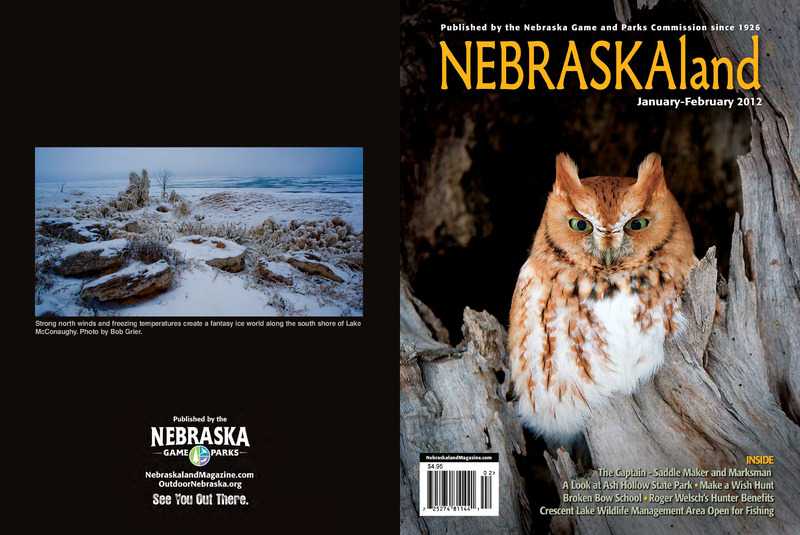
Strong north winds and freezing temperatures create a fantasy ice world along the south shore of Lake
McConaughy. Photo by Bob Grier.
Volume 90, Number 1, January-February 2012
12 Out of the Classroom and Into the Field
At Broken Bow Public Schools, a school day for some
students may involve ice augers and tip-ups or worms and
spinning rods. TEXT AND PHOTOS BY DOUG CARROLL
16 Ash Hollow – An Oasis on the Trail
Marking an important stopping point on trails heading west
in the mid-1800s, Ash Hollow State Historical Park celebrates
an important part of the past. TEXT AND PHOTOS BY ERIC FOWLER
24 Barn Owl Sighting
A chance discovery in an empty grain bin leads to several
interesting photos of a barn owl nest and its two owlets over
the course of several weeks. BY JANA LINDER
26 First of Many
An opening day firearm deer hunt becomes a special event
for a boy, his family, and the community around him.
TEXT AND PHOTOS BY JEFF KURRUS
32 A.H.“Captain”Hardy – Saddle Maker & Marksman
Hardy made a name for himself as a leatherworker and
sharpshooter in Hyannis at the turn of the last century,
leading to a career as an exhibition shooter and Hollywood
consultant. BY JON FARRAR
40 Crescent Lake – Finally Open for Fishing
32
●
40
●
Finally completed late last year when the Nebraska Game
and Parks Commission was able to obtain a lease on
87 acres to create the Crescent Lake Wildlife Management
Area. BY ERIC FOWLER
Comment . . . . . . . . . . . . . . . . . . . . . . . . . . . . . . . . . 4
Mixed Bag . . . . . . . . . . . . . . . . . . . . . . . . . . . . . . . . 6
Outdoor Business . . . . . . . . . . . . . . . . . . . . . . . . . .44
Classifieds . . . . . . . . . . . . . . . . . . . . . . . . . . . . . . . .46
Portraits from the Past . . . . . . . . . . . . . . . . . . . . . . 48
Page 49 . . . . . . . . . . . . . . . . . . . . . . . . . . . . . . . . . .49
The Last Stop . . . . . . . . . . . . . . . . . . . . . . . . . . . . . 50
26
●
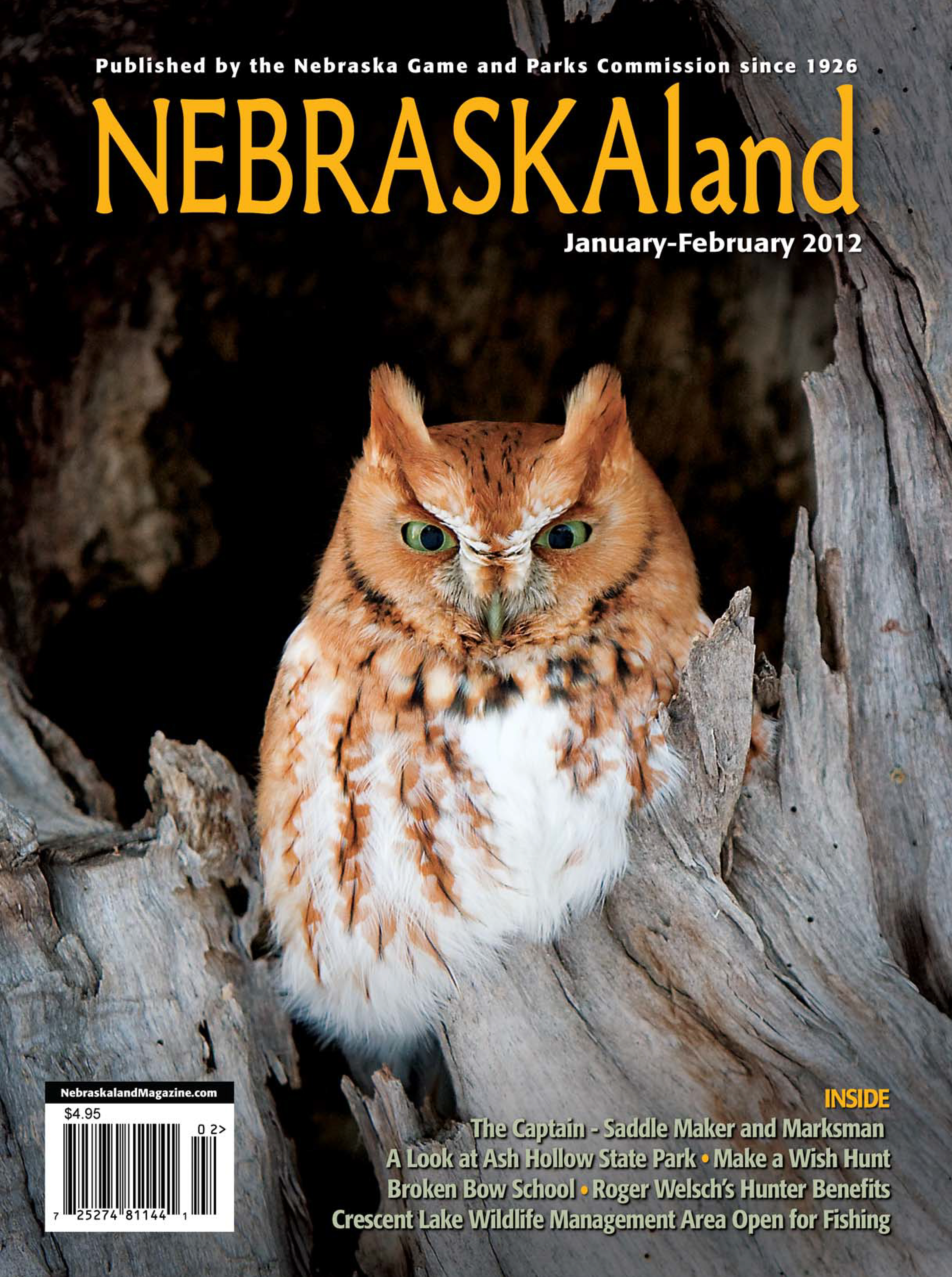
Cover: An eastern screech owl sits in the remnants of a hollowed out tree in
Hall County, sunning itself on a cold winter day. Photo by Rick Rasmussen.
Opposite: Hoarfrost coats the upwind side of a sunflower stem on a cold
winter morning. Photo by Eric Fowler.
NEBRASKAland (VOL. 90 / NO. 1, ISSN 0028-1964) is published monthly, except for the
combined Jan./Feb. and Aug./Sept. issues, by the Nebraska Game and Parks Commission,
2200 N. 33rd St., Lincoln, NE. Periodicals postage paid at Lincoln, Nebraska, and additional
mailing offices. POSTMASTER: Send address changes to NEBRASKAland, P.O. Box 30370,
Lincoln, NE 68503-0370.
16
●
JANUARY-FEBRUARY 2012 • NEBRASKALAND 3
Thanks, always a fun search before
diving into the good articles.
Solveig Knott
Grand Island, Nebraska
The visitor made his appearance on
the bottom right of page 43. The visitor
is a firefly.
What did the firefly say when the
little child pulled his “lantern” off and
put it on his finger as a bright shining
ring?
“I’m delighted,” said the firefly!!!
Phil Feese
Kearney, Nebraska
Battling Bucks
I really enjoyed the article in the
October issue on camera traps.
Recently I began hanging a camera on
my uncle’s land west of Fort Calhoun
where I have bow and rifle hunted for
about the past 10 years.
Using a mineral block to attract deer
to my camera setup (I know that it’s
illegal to hunt over bait in Nebraska – I
just use the camera and mineral block
to see what's using the area), I’ve been
able to capture some great images and
thought I’d share this photo of two
young bucks scrapping it out in early
November. They put on a good show
until they finally had enough and
parted ways.
Cody Madsen
Lincoln, Nebraska
issue’s visitor, an eastern firefly that
was on page 43 (see page 11 for the
winner, rules and this issue’s hint).
Here are some of the responses we
received:
Once again it was a challenge when
the new NEBRASKAland magazine
arrived to see who could find the bug
first.
The bug is a Pyralis firefly found on
page 43 of the December issue.
Keep up the good work. We
thoroughly enjoy the photos and stories
in NEBRASKAland.
Thanks again for a great magazine!
Irvin Reiber
Campbell, Nebraska
I found a firefly (Photinus pyralis)
checking out the fishing tournament
results on page 43 of the December
2011 NEBRASKAland. Seems a bit
cold for this fellow to be out, as we
usually see them in the summer
lighting up after dusk. Perhaps he
would prefer to hang out with the bees
or the cardinals, down south!
While I have never ice fished with
Dave Fehlhafer, I have fished with his
second place team partner, Don Cox,
(page 43, tournament results column)
and would not be at all surprised if he
had used a firefly or similar imitation
(shown next to Dave’s name) as bait!
Ken Fankhauser
Kearney, Nebraska
Just Visiting
We were camping at Eugene T.
Mahoney State Park in October. My
husband was relaxing and enjoying the
beautiful weather by sitting outside and
reading. Our dog was at his side.
Fourteen wild turkeys came out of the
woods and walked 10 feet in front of
him. What an awesome sight!
Sharon Buckley
Bellevue, Nebraska
NEBRASKAland Visitor Letters
We want to thank all 68 readers
that sent e-mails and letters for last
4 NEBRASKALAND • JANUARY-FEBRUARY 2012
The visitor on page 43 in the lower
right hand corner is very fitting for
December and Christmas. We have a
lightning bug or firefly there. Hope
everyone at NEBRASKAland Magazine
has a happy Thanksgiving and blessed
holiday season.
Steve Tyler
Omaha, Nebraska
The eastern firefly (Photinus pyralis)
is likely the most common firefly (or
lightningbug) in North America and
measures roughly ½-inch in length.
Don’t be fooled by the name: They
aren’t bugs; they’re actually beetles.
Fireflies get their common name
because they are bioluminescent; they
can create visible light with their
bodies. Bioluminescence is caused by
a chemical reaction within the body of
the insect and is notable because it is a
type of “cold light,” producing virtually
no heat. Fireflies flash their light as a
form of communication, most often in
their mating rituals. Males fly in a
pattern distinct to each species, lighting
up the luminous portion of their
abdomen as they fly. Females will
flash a response of their own. Eastern
fireflies are nocturnal, and tend to be
most active beginning at dusk
and on into the night. The best
“light show” can often
be found over tall,
unmowed grass,
particularly grassy
areas adjacent
to trees.
Special thanks to Julie Van Meter, State
Entomologist, Nebraska Department of
Agriculture. Visitor image by Chris Helzer.
www.bugguide.net is a good site for identification
Send your comments to:
Doug Carroll, Editor
NEBRASKAland Magazine
P.O. Box 30370
Lincoln, NE 68503
or e-mail Doug.Carroll@Nebraska.gov
Please include your postal address and
telephone number.
Letters may be condensed and edited
for clarity. Photographs are welcome
and will be returned.
COMMISSION
CONSERV
CONSERVATION OFFICERS
Director Rex Amack
Deputy Director Jim Douglas
Commissioners
Chairman - Mick Jensen, Blair
Vice Chairman - Ron Stave, Waterloo
2nd Vice Chairman - Norris Marshall, Kearney
Jerrod Burke, Curtis
Dr. Mark Pinkerton, Wilber
Dr. Kent Forney, Lincoln
Lynn Berggren, Broken Bow
Rex Fisher, Omaha
Mark Spurgin, Paxton
NORTHWEST
Officer
City
Jim Zimmerman (S) Gering
MAGAZINE
MAGAZINE STAFF
STAFF
Editor Doug Carroll
Associate Editor Jeff Kurrus
Art Director Tim Reigert
Senior Editor Jon Farrar
Regional Editor Eric Fowler
Contributing Editor Michael Forsberg
Regular Contributors Bill Hager, Chris Helzer,
Lisa Knopp
Photo Librarian Sarah Johnson
Circulation Donna Robinson
For address changes and questions about
your subscription, e-mail
Donna.Robinson@Nebraska.gov
or call (800) 632-5263
Marketing/Advertising
For advertising information contact
Larson Enterprises
e-mail dave@larsonent.com
or call (515) 440-2810
NEBRASKAland Magazine Copyright 2012, all rights reserved.
NEBRASKAland is available on audio cassette from the Nebraska
Library Commission Talking Book and Braille Service, Suite 120, 1200 N
St., Lincoln, NE 68508. (800) 742-7691. NEBRASKAland Magazine and
the Nebraska Game and Parks Commission reserve the right to reject any
advertising not in keeping with the agency mission.
Rates: $18 for one year; $33 for two years; $44 for three years. Nebraska
recipients must add appropriate sales tax. To subscribe call
1-800-NEBLAND (632-5263), or go online to:
NebraskalandMagazine.com.
COMMISSION OFFICES
Headquarters/Southeast District Office
2200 N. 33rd Street Lincoln, NE 68503
Phone (402) 471-0641
Northeast District Office
2201 N. 13th St. Norfolk, NE 68701
Phone (402) 370-3374
Southwest District Office
301 E. State Farm Rd. North Platte, NE 69101
Phone (308) 535-8025
Northwest District Office
East Hwy. 2, Box 725 Alliance, NE 69301
Phone (308) 763-2940
Bassett Office
524 Panzer St., Box 508 Bassett, NE 68714
Phone (402) 684-2921
Kearney Office
1617 First Ave. Kearney, NE 68847
Phone (308) 865-5310
Omaha Office
1212 Bob Gibson Blvd. Omaha, NE 68108
Phone (402) 595-2144
Greg Hesse
Scott Brandt
Heath Packett
Frank Miller
Dan Kling
Phone (308)
(office) 763-2940
(cell) 641-6138
Alliance
760-3647
Gering
631-0663
Gordon
360-0682
Valentine (402) 389-0444
Harrison
430-0572
SOUTHWEST
Officer
City
Phone (308)
Roger Thompson (S) N. Platte (office) 535-8025
(cell) 530-3097
Ray Dierking
Brkn. Bow
870-0322
George Sund
Cambridge
655-0028
Michael Thome
Cozad
529-8146
Terry Brentzel
Doniphan (402) 469-5795
Matt Andrews
Elwood
746-2418
Dirk Greene
Imperial
882-0015
Jerry Pecha (Sup.) Kearney (office) 865-5327
(cell) 293-3551
Dale Johnson
Kearney
440-3847
Dudley Sorensen
N. Platte
530-0016
Nicholas Fix
Ogallala
289-0427
Dennis Thompson
Ogallala
289-0755
Rich Routh
Rep. City
920-0367
NORTHEAST
Officer
Tom Zimmer (Sup.)
Dale Davis
Steve Oberg
Daniel Roberts
Randy Pomplun
Jeff Jones
Jon Reeves
Pat George
Doug Pollard
Tim Williams
Cory Krause
Phone (402)
(office) 370-3374
(cell) 649-8053
Bassett
760-0712
Columbus
910-3366
Fremont
719-1108
Fullerton
550-0489
Hartington
762-5022
Kennard
889-8508
O’Neill
340-0787
Ord
778-7101
Neligh
929-0051
West Point
380-6410
SOUTHEAST
Officer
Duane Arp (Sup.)
City
Gretna
Sean McKeehan
William Krause
Mike Luben
Dan Zuehlke
Darin Gress
Douglas Kramer
Dina Barta
Stacey Lewton
Levi Krause
Robert Finke
Russell Mort
Dan Evasco
Jeff Clauson
City
Norfolk
Phone (402)
(office) 332-2965
(cell) 521-0194
Ashland
521-0159
Auburn
274-8063
Colon
443-6392
Cortland
806-9084
Hebron
768-8665
Lincoln
890-6465
Lincoln
890-6463
Lincoln
890-7140
Louisville
949-0593
Milford
947-1363
Nebr. City
209-1506
Papillion
616-5961
Waterloo
658-7057
ADMINISTRATION
Officer
City
Craig Stover (Adm.) Lincoln
Phone (402)
471-5532
Nebraska Wildlife Crimestoppers 1-800-742-7627
Ak-Sar-Ben Aquarium
21502 W. Highway 31 Gretna, NE 68028
Phone (402) 332-3901
Under federal and/or state law, discrimination is prohibited on the basis
of race, color, religion, age, gender, marital status, national origin,
disability or political affiliation. If you think you have been discriminated
against in any program, activity or facility by the Nebraska Game and
Parks Commission or want more information, contact the Commission in
Lincoln, NE, at (402) 471-0641 or the Equal Opportunity Commission,
Lincoln, NE, (402) 471-2024, TTY/TDD (402) 471-4693).
JANUARY-FEBRUARY 2012 • NEBRASKALAND 5
Here is a list of upcoming outdoor
events across Nebraska.
For more information about these and
other events, visit the calendar page at
www.OutdoorNebraska.org.
Preliminary Data Shows
Record November Deer
Harvest
Nebraska saw a record November
deer harvest in 2011, according to
preliminary data received by the
Nebraska Game and Parks
Commission. The harvest of 64,548
deer taken November 12-22 with
firearm, archery and Season Choice
permits was an increase of 865 from
last year, which was also a record year.
Harvest in the Commission’s
Northwest district was down by 429
deer compared to 2010, but the
Southwest harvest was up by 830, the
Southeast harvest was up by 141 and
the Northeast harvest was up by 553.
Harvest information by species, sex,
age and unit will be available following
the close of the last deer season. The
archery and muzzleloader seasons are
open now through the end of the year,
and Season Choice permit holders have
until January 18 to fill their tags.
Archery, muzzleloader and Season
Choice permits are still available for
most of the state.
Project WILD – Focus on Winter
This will be a Project WILD
workshop focusing on winter,
animals’ winter adaptations, and how
to engage your students in learning
outside during the winter.
9 a.m. - 3 p.m. To register, contact
lindsay.rogers@nebraska.gov.
January 7
Beyond BOW Event – Snowshoeing
Open to women 18 years of age and
older, this class at Platte River State
Park will teach participants about
snowshoeing.
For more information and to register,
contact Julia.Plugge@nebraska.gov
or call 402-471-6009.
January 20
Crow Season
Season Dates: Jan. 20 - April 6.
Daily Bag Limit: None.
Possession Bag Limit: None.
Open Area: Statewide.
January 21-February 5
Pat Keslar’s wife, Carmen, surprised him
with his message plate a few years ago for
Father’s Day. The plate does not show
Keslar’s admiration for some kind of dinosaur, as his hunting buddy thought
when he first saw it – it’s testament to he and his wife’s 30-plus years of
raising Labrador retrievers at their Hyannis home and the 30 to 40 days
each year Pat spends hunting pheasants behind them, including 29 years
as a handler in Broken Bow’s One Box Pheasant Hunt.
If you have a unique outdoor message plate you would like to share or
know someone who does, e-mail a photo (high-resolution, jpeg format
only, please) of it to Eric.Fowler@Nebraska.gov, along with your name,
hometown and a brief description of the interests expressed on your
license plate.
6 NEBRASKALAND • JANUARY-FEBRUARY 2012
Light Goose Regular Season
Season Dates: Jan. 21. - Feb. 5.
Daily Bag Limit: 20.
Possession Limit: None.
Open Area: Statewide.
February 4-5
White-fronted Goose Season
Season Dates: Feb. 4 - 5, 2012.
Daily Bag Limit: 1
Possession Limit: 2
Open Area: Statewide.
For more information on hunting
regulations and season, visit
www.OutdoorNebraska.org.
PHOTO BY JEFF KURRUS
January 7
Amack to Retire as Game and Parks Director
“Useful, with a pleasant degree of fish odor”
BY DA RYL L. BAU E R
PHOTO BY DOUG.CARR0LL
Nebraska Game and Parks Commission Director Rex
Amack has announced his intent to retire in April 2012,
the end of his current term.
Amack’s 24 years at the helm of the 475-employee
agency distinguishes him as the longest-serving director
in Commission history.
“I am so grateful for the opportunity afforded me by
the Commission to serve the citizens of this wonderful
state," said Amack. "It is hard to imagine a more
rewarding and meaningful career.”
Rex Amack
Amack thanked Commissioners for instilling in him
their trust and lending him their support and friendship throughout the years. "I also
want to acknowledge and thank those who I have been blessed to work shoulder
to shoulder with each day. Our employees are results-oriented professionals who
work hard to meet the Commission’s mission of stewardship of the state's fish,
wildlife, park and outdoor recreation resources. It has been an extraordinary honor.”
A native of Red Cloud, Amack began his career with the Commission as a
University of Nebraska intern in June 1967 working in the Information and
Education department. Upon graduation with a bachelor of arts degree in May
1968, he joined the Commission as a full-time employee in the same department.
In collaboration with the Nebraska Educational Television Network, Amack
helped develop the Commission’s Outdoor Nebraska television program, which he
hosted for several years.
In 1975, Amack was promoted to chief of the Information and Education
Division, and five years later he was promoted to assistant director of
administration by then Commission Director Gene Mahoney. Following
Mahoney’s retirement in 1988, the
Commissioners appointed Amack to a
six-year term as director. He was later
reappointed to successive six-year terms
in 1994, 2000 and 2006.
Some of the major achievements that
stand out during his tenure as director
of the Commission include the
developments of Eugene T. Mahoney
and Smith Falls state parks, as well as
the Calamus Reservoir Fish Hatchery;
the bighorn sheep project; ongoing elk
hunting opportunities; $5 youth turkey
and deer permits; the makeover of
Ponca State Park; the Cornhusker Trap
Shoot; the Open Fields and Waters
hunting and fishing access program;
the Recruitment, Development and
Retention program for Nebraska youth;
and the Becoming an Outdoors-Woman
program.
Amack also has been immersed in
conservation and parkland issues on
regional and national platforms. He has
twice served as president of the Midwest
Do you know where this
Association of Fish and Wildlife
Nebraska photograph
Agencies and has served as president of
was taken?
the Association of Fish and Wildlife
See answer at the bottom
Agencies. Amack is currently presidentof page 11.
elect of the Western Association of Fish
and Wildlife Agencies.
No one can predict how cold our
winter will be nor how much ice we
will have, but with at least an “average”
winter, anglers should see one of
Nebraska’s best ice-fishing seasons
in years! Water levels in many of the
state’s waters have rebounded after
several years of drought and anglers
can now start reaping the benefits of
improved water conditions, excellent
habitat conditions and the resulting
increase in fish production.
penetration can result in bluegills and
dams and reservoir inlets can produce
a variety of other panfish, such as
Many of Nebraska’s largest waters
crappies, redear sunfish and rock bass. some open-water walleyes or even
sauger. Anglers can also catch some
are reservoirs where water level
Catching Big Fish
channel catfish and a variety of other
fluctuations normally inhibit the
Panfish may be the bread and butter species where the warm-water power
production of panfish such as crappies,
for ice anglers, but it sure is nice to
plant discharge is released back into
bluegills and yellow perch. However, on
slip a few large predator fish onto the the cooling pond and into Sutherland
occasion these water fluctuations can
ice as well (kind of like throwing a
Reservoir itself.
result in an abundance of flooded
big ol’ slab of deer salami on that
terrestrial vegetation, producing
Not Caring What You Catch
sandwich). The best ice-fishing for
“booms” in panfish populations. A
Often the best approach to ice-fishing
large predator fish would no doubt be
number of Nebraska reservoirs have
targeting northern pike on Nebraska’s is to just catch any fish, which is why
seen habitat conditions swing in favor
panfish are such a popular ice-fishing
Sandhills lakes. Goose Lake would
of panfish in recent years and could
target. With the clear water of winter
be a good bet for pike this winter, as
produce some great ice-fishing this
well as several lakes on the Valentine and the reduced metabolism of fish,
winter. Harlan County Reservoir
tackle down to lighter lines and smaller
National Wildlife Refuge (NWR) that
should produce good numbers of
baits and then take it as it comes!
have produced excellent ice-fishing
crappies through the ice this winter,
for pike for a long, long time, such as Pick a body of water that has some
as well as Sherman Reservoir, which
good panfish and an angler can catch
Dewey, Pelican and Clear. Anglers
produces good crappie fishing most
some larger predator fish right along
should also consider fishing larger
years. Oliver and Whitney reservoirs
baits while panfishing through the ice with the panfish on the same baits.
in the Nebraska Panhandle have
on all Nebraska waters, as largemouth That “take it as it comes” approach
good crappie populations right now,
bass, walleye and occasionally channel can be used on just about any body
as do Willow Creek and Czechland in
catfish can be caught right along with of water where an angler can get on
eastern Nebraska. Calamus Reservoir
the ice this winter.
the panfish.
does not give up a lot of crappies
Best Bet
Trying Something New
through the ice, but can produce some
Grab the ice-fishing gear and head
The
majority
of
winter
fishing
in
quality fish. And, of course Merritt and
Nebraska will be done while standing for the hills – the Sandhills that is!
Box Butte would be two of the best
on top of frozen water, but not all of it There are a number of Sandhills
reservoirs in the state for pulling a
lakes that should produce some
variety of panfish through an ice hole. – there are some open-water fishing
opportunities that can be enjoyed on excellent yellow perch, bluegill and
Catching Numbers - Small Water
those winter days when it warms up a black crappie this winter. Along with
Panfish are no doubt the “bread and
those panfish, anglers will have an
few degrees. The Gavins Point Dam
butter” for ice anglers, and there are a
excellent opportunity to catch some
tailwaters will produce some walleye
host of small waters throughout
northern pike on some of those
and sauger all winter long, and after
Nebraska that are excellent panfish
Sandhill lakes and some big, beautiful
last summer’s high flows on the
habitats. Ice anglers who can access
Missouri River, that fishery should be largemouth bass on almost all of them.
private pits and farm ponds can catch
particularly good. Bouncing a jig and Pelican, Dewey, Hackberry, Willow,
both a mess of panfish for a meal of
minnow or jig and GULP Alive! minnow Frye, Island, Goose, Crescent, Smith
fresh fish as well as some trophy
and Blue will be a few Sandhills lake
just off the bottom will catch those
panfish for a quick photo and release.
names whispered by Nebraska ice
fish. Likewise, trout can be caught
Interstate lakes in central Nebraska
year-round from open water on Lake anglers this winter.
can have extremely clear water during
Ogallala or the East Branch of Verdigre
the winter, which can make fish tough
“The best time to fish is when
Creek. On the Tri-County Canal in
to catch, but targeting these lakes
central Nebraska, a number of check you have time to fish.” — D.L.B.
during periods of reduced light
• Catching Numbers - Big Water
•
•
See You Out There ...
But Where?
•
•
•
PHOTO BY JEFF KURRUS
8 NEBRASKALAND • JANUARY-FEBRUARY 2012
JANUARY-FEBRUARY 2012 • NEBRASKALAND 9
Boating Safety Law Change
Takes Effect January 1
Due to changes in boating law
regulations last spring, as of January 1,
2012, any person born after December
31, 1985 who is operating a motorboat,
including personal watercraft such as
Jet Ski or Waverunner, must have
completed a boating safety course and
have proof of completion with them.
Nebraska boating safety certification
may be obtained through a six-hour
classroom course, or by home study
with a proctored exam. Nonresident
boaters may present certifications from
their home state as long as it’s from an
approved course.
The minimum age to operate a
motorboat in Nebraska is still 14 years
of age. For available boating safety
classes in your area, visit outdoor
nebraska.org/boating or call your local
Nebraska Game and Parks Commission
office.
The deadline for entering the contest
is 5 p.m. on April 15 and there are
three seperate categories that can be
entered: Grades 3-6, Grades 7-12 and
an Open category.
The best commercial of all three
categories will be selected by a public
vote and will run on major television
stations across the state during the
2013 tax season. Commercials should
be designed to raise awareness of the
Wildlife Conservation Fund, help
people better appreciate Nebraska’s
wildlife and encourage people to
donate to the fund through their tax
rebates or through the fund’s web site.
For more information and complete
contest rules, visit NebraskaWildlife
Fund.org or e-mail at kristal.stoner@
nebraska.gov or scott.bonertz@
nebraska.gov. Music, images and
video will be available on the
commercial contest resources portion
of the web page, but do not have to be
used for any commercials entered in
the contest.
Prescribed Burns Planned
Commercials Wanted
The Nebraska Wildlife Conservation
Fund is hosting a commercial contest
and encourages anyone who is interested
in designing their own commercial to
enter.
Participants are encouraged to
create an original, creative 30-second
commercial highlighting the Nebraska
Wildlife Conservation Fund, then
upload it to a YouTube account.
NEBRASKAland Visitor
Winner and Hint
Last issue’s winner of
the NEBRASKAland
Visitor drawing was
Rachel Oltjenbruns of
Ceresco, Nebraska, who found the
eastern firefly on page 43. Readers
are encouraged to contact
NEBRASKAland within 10 days
after this issue’s publication with the
correct page number and name of
this issue’s “Visitor” – a bug found
in Nebraska that just happened to
find its way onto one of the pages of
our publication.
We will then gather the correct
entries and draw one to win a
NEBRASKAland Magazine mug.
To enter each month, write:
NEBRASKAland Visitor
2200 North 33rd Street,
Lincoln, NE 68503.
Or e-mail:
Tim.Reigert@Nebraska.gov
with “Visitor” in the subject line of
the message.
HINT: This issue’s visitor is not on
page 5, 15 or 49.
Agate Fossil Beds National Monument Visitor Center
The Nebraska Game and Parks
Commission will conduct prescribed
burns this winter to increase the
diversity of plant species in grasslands
and remove invasive woody plants.
Some burns will be used to remove
slash piles that remain from timber
stand improvement practices.
Burns will be conducted, when
conditions allow, at the following
locations: Rose Creek and Flathead
wildlife management areas (WMA) in
Jefferson County, Meridian WMA in
Thayer County, Lake Minatare and
Wildcat Hills state recreation areas in
Scotts Bluff County, Chadron State
Park (SP) in Dawes County and Smith
Falls SP in Cherry County.
JANUARY-FEBRUARY 2012 • NEBRASKALAND 11
Out of the
Classroom
and Into
the Field
Text and photos by Doug Carroll
Broken Bow students show off a nice northern pike they caught through the ice on a field trip to Valentine Natinal Wildlife Refuge.
S
chools teach their students a
lot of things: Language arts,
mathematics, science, social
studies and other subjects too
numerous to mention. Some of
these are things they’ll need in whatever
career they eventually choose to pursue,
but many are simple day to day living
skills – how to balance a checkbook
and live healthy lives, etc. Broken Bow
Public Schools take this a little further
than most – they give students a
hands-on opportunity to learn about the
Nebraska outdoors, try a lifetime sport
they might not already be familiar with,
and create memories that will last far
beyond their school years.
Learning and Remembering
Under the inky blueness of a cold,
overcast, predawn January morning, a
bright yellow school bus rolls down the
highway, carrying a busload of nervous,
12 NEBRASKALAND • JANUARY-FEBRUARY 2012
somewhat sleepy eighth-grade boys, a
teacher or two, and several volunteers
as they head northwest to Valentine
National Wildlife Refuge and its mecca
of great ice-fishing lakes.
Over the course of what promises to
be a fun-filled day – fish or no fish,
freezing cold or tolerable temperatures –
the boys will learn about ice-fishing,
the great outdoors, and themselves. All
while having fun.
Held every year since 1995 (weather
permitting) the ice-fishing trip was
started by Broken Bow Public Schools
physical education teacher Kevin Foster
as a way to get the kids out of class for
a day and teach them a sport they might
not otherwise have a chance to learn.
Despite Foster’s death in a 2004 car
accident, the annual field trip has
continued to honor his memory and
because “It’s good for the kids,” said
Jerry Scott, a science teacher in Broken
Bow.
Eighth-grade students celebrate the successful landing of a
rainbow trout during an all-girls outing to Arnold Park
JANUARY-FEBRUARY 2012 • NEBRASKALAND 13
Scott, who helps with the trips and
was a friend of Foster, said that despite
the school’s location in some of the
best hunting and fishing areas in the
state, many of students don’t have
much experience with outdoor sports:
“I would guess less than a fourth of
the students have been fishing before. I
fished and hunted with my dad since
before I can remember, and with my
own boys since they were old enough
to walk. The bonds that we have created
are something that will never be broken.
I haven’t regretted for a second the
time I’ve spent on the water or in the
field with my boys or my students.”
Usually a week or two before the
scheduled day of the trip, Scott said,
students get instruction at school on the
basics of ice-fishing so they can get
started as soon as they reach the ice.
Because few if any of the kids have
their own equipment, most of what
they use on the trip has been donated
or loaned for the day by some of the
many area outdoorsman who help with
the event, such as Roger Carroll, a
retired bus mechanic from Broken
Bow, and Hank Linder and Don Cox,
whom Scott described as “obsessive”
ice fishermen.
“We couldn’t do this without Hank,
Don and the guys,” said Scott. “They
go above and beyond.”
No matter what fishing success they
have, said Scott, most participants
come away with many new memories,
whether it’s of the one that got away,
the one that didn’t, or which team won
the impromptu tug-of-war contest held
on oh-so-slippery ice.
“It is really refreshing to see these
students in a different light away from
the classroom,” said Scott. “Kids who
think they are pretty tough in the
hallways and classrooms aren't quite as
tough on the ice. Then there are kids
who are meek and mild in the classroom,
but are animals on the ice.”
Something for the Girls
Hank Linder demonstrates his jigging technique through the ice at Valentine NWR.
14 NEBRASKALAND • JANUARY-FEBRUARY 2012
Not to be left out, each spring (again,
weather permitting) the eighth grade
girls at Broken Bow also get the chance
to learn about fishing – except they
don’t have to drill any ice holes and
usually don’t have to bundle up quite
as much as the boys do as they chase
trout at one of many bodies of water
that the Nebraska Game and Parks
Commission stocks with rainbow trout
in the fall and spring.
Rachelle Haines, who teaches physical
education in Broken Bow, said that
while fishing is taught as part of the
lifetime sports portion of the school’s
PE curriculum (eighth-grade PE in
Broken Bow is taught separately by
different teachers, thus the separate
trips), students are allowed to opt out if
they wish. Not many do, however.
“Each year many of the girls say that
they do not want to go, but once we
head home, they say they had a great
time,” said Haines.
While some of girls have fished
before and have their own equipment,
for many this trip is their first real
Baiting a hook is one of several things students get to experience during their outdoor adventures.
fishing experience. Using equipment
loaned by the Commission and others,
Haines and volunteers such as Don
Wolford of Broken Bow teach the girls
how to set up their equipment, show
them how to cast and then answer any
questions they might have, including
how to unhook fish.
“It’s a great experience for the girls –
they seem to love the trip, have fun
enjoying nature and come back with
lots of great fishing stories,” said
Haines. “As the teacher, I think it is
a lot of fun to take kids out of the
traditional classroom and let them
experience one in the outdoors.”
Start Them Early
As great as their eighth-grade field
trips are, those events are far from the
only outdoor experience that Broken
Bow students get to try out: Sixth- grade
students get to spend an overnight trip
at the State 4-H camp in Halsey, where
they experience a variety of outdoor
education opportunities, and Broken
Bow seventh graders travel to Calamus
Reservoir to get a tour of the dam and
fish hatchery before stopping to tour
Ft. Hartsuff State Historical Park on the
way back to school. Broken Bow is also
one of the more than 150 Nebraska
schools that take part in the National
Archery in the School program, which
teaches target-style basic archery skills
to students in fourth through twelfth
grades.
Although there may be other schools
in Nebraska who take their students out
on similar ventures, neither Scott nor
Haines are aware of them. Which is a
shame, said Haines, who added that
although the trips don’t necessarily
make lifetime anglers out of the students,
they are are a great experience for the
kids, especially if their families are not
the “outdoors” type.
Scott agreed: “I feel that the icefishing and trout fishing is an attempt
to get kids to appreciate nature,” said
Scott. “Most will probably never ice
fish again, but they will go away with a
better understanding of nature. The
more they see the more they know.
“Many of the kids tell me it is the
best field trip they make in school.
Some years the weather just doesn’t
cooperate. I’ve had parents comment to
me they were disappointed that their
younger child didn’t get the experience
that an older brother had.
“I really appreciate the fact that our
administration has been so supportive,
and that our students have the opportunity to get outside the classroom.” ■
JANUARY-FEBRUARY 2012 • NEBRASKALAND 15
Ash
Hollow
An Oasis on the Trail
Photos and text by Eric Fowler
F
rom the air, two paths are plainly visible leading north from the tablelands
between the North and South Platte rivers into Ash Hollow. One is paved with
asphalt. The other is a rut filled with little bluestem and sideoats grama. Those
traveling the former would be wise to stop at Ash Hollow State Historical Park and
learn about the latter, which was created by the wheels of wagons carrying emigrants
down the Oregon and California trails throughout much of the 1800s.
A neighboring rancher started putting worn-out
cowboy boots (opposite) atop fence posts along
Highway 26 in Ash Hollow in the 1960s. Others started
adding their own and boots now line the highway
through most of the valley.
Accented by little bluestem in its reddish fall tint, ruts
created in the 1800s by wagons traveling the OregonCalifornia Trail lead north down a ridgetop toward
Windlass Hill and Ash Hollow, both part of Ash Hollow
State Historical Park near Lewellen.
16 NEBRASKALAND • JANUARY-FEBRUARY 2012
JANUARY-FEBRUARY 2012 • NEBRASKALAND 17
A
bout 1,400 vehicles a
day follow Nebraska
Highway 26 through Ash
Ash Hollow State Historical Park is located
Hollow, a narrow, twoon Highway 26, three miles south of
Lewellen or 30 miles northwest of Ogallala.
mile-long wooded canyon. The main grounds are open from 8 a.m. to
5 p.m., April 1 through October 31. The
park’s visitor center is open from 9 a.m. to
Some of those modern
4 p.m. on weekends from Memorial Day
through Labor Day, and to groups
travelers might think they weekend
by appointment. The south portion of the
park, including Windlass Hill, is open
are on a tight, gotta-getyear-round.
there, schedule, but consider
the travelers of yesteryear: The wagon trains couldn’t
leave Independence, Missouri, until May, when the
prairie grasses needed to sustain their teams of oxen,
horses or mules and other livestock greened up. While
the spring-fed stream and shade made Ash Hollow a
good place to camp, settlers couldn’t stay long – it took
Above: Decked out in period gear for their
parts in the annual Ash Hollow Pageant,
LeDene and Larry Rutt of Chappell and
Garnet and Ron Storer of Lewellen walk a
park trail once traversed by prairie
schooners. The stone walls, often
mentioned in pioneer diaries, were
formed by sediments carried east from
the Rocky Mountains before the Ice Age
and were dubbed the Ash Hollow
Formation by a geologist in 1850s.
Left: Park Superintendent Jeff Uhrich walks
along spring-fed Ash Hollow Creek, one of
many reasons pioneers had to stop in the
draw. “This is good sweet water; we have
had alkali and nithing was good,” Keturah
Belknap wrote in an 1848 journal entry.
While lessened by groundwater
development, the creek still flows most
of the year.
18 NEBRASKALAND • JANUARY-FEBRUARY 2012
four to six months to reach their West Coast destination. Dawdle on the trail and winter
might beat you there, as it did the infamous Donner Party in 1846. Some had no
choice, though, needing time to repair their wagons following a rough ride down
Windlass Hill where, one pioneer said, “the road hangs a little past the perpendicular!"
“Here we were obliged, from the steepness of the road, to let the wagons down by
ropes . . . The bottom of Ash Creek is tolerably well wooded, principally with ash and
some dwarf cedars . . . traces of the great tide of emigration . . . plainly visible in
remains of camp fires, in blazed trees covered with innumerable names . . . total
absence of all herbage." - Howard Stansbury, July 3, 1852.
JANUARY-FEBRUARY 2012 • NEBRASKALAND 19
W
hile school tours add some bustle to the park in spring and fall and most visitors
stop during the summer months, there’s usually not enough at any one time to
disrupt the peace and quiet. Things were much different during a three-week span in
late-May and early June back in the mid- to late 1800s, when the area was an important
camp on trails headed west. The migration started slowly with fur traders and
missionaries. The first wagon train passed through in 1841, and a few hundred to a
few thousand people followed the trail each year until the 1849 discovery of gold in
California opened the floodgates. In 1850, the height of the migration, 65,000 people
headed west, sending an average of 2,500 people, 600 wagons and 10,000 animals
through Ash Hollow each day. Wagon trains still followed the trail through the 1880s,
long after the Union Pacific Railroad opened the west to anyone who could afford the
fare. When all was said and done, roughly 500,000 people passed through Ash Hollow.
Kathy Mills of Glenwood, Iowa, her husband Bob, and grandchildren Bob, Carter and Josah, took a short detour to visit Ash Hollow
and walk in the wagon ruts on Windlass Hill while vacationing in 2010. Eight of Mills’ grandparents, five generations removed on her
family tree, passed the same point while on the Oregon-California Trail between 1849 and 1864. She said only one made to their
destination, the rest “tied up” in Idaho or Utah. She owns a quilt her grandmother, Mary Peterson Burt, made and carried on the trail
in 1864.
Ash Hollow contains a wealth of human, geological and paleontological history, much of which is on display
at the park’s visitor center, including fossilized remains of prehistoric rhinos, mastadons and turtles. In a rock
shelter near the center, archealogists peeled away layers on the floor to find evidence left by four distinct
cultures of Native Americans during a 1,700-year period.
20 NEBRASKALAND • JANUARY-FEBRUARY 2012
When wood was not available, homesteaders used prairie sod to build houses. A soddy built in 1967 at the base of Windlass Hill in
Ash Hollow SHP is a popular stop for park visitors, including Don and Lynne Bender of Skull Valley, Arizona. The remains of the
1899 homestead dwelling of Reverend Dennis B. Clary sit behind the sod house.
JANUARY-FEBRUARY 2012 • NEBRASKALAND 21
E
ach June since the 150th anniversary of the Oregon Trail was
celebrated in 1993, folks have gathered in the hollow to celebrate
the past with the Ash Hollow Pageant. The pageant recognizes the
hard times pioneers faced on their 2,000-mile journey, which at
this point in the trail was only one-third complete. They had
already faced scorching heat and thunderstorms, and endured dust
stirred by wagon and stock. Many succumbed to cholera, including
Rachel E. Pattison, who died June 19, 1849, and is buried in the
Ash Hollow Cemetery. Here they could relax, if only for a night,
resupply at one of four trading posts, and even leave a letter at a
U.S. Mail station to be carried back east. As Merrill Mattes wrote
in Great Platte River Road: "In a country otherwise devoid of
noteworthy features, Ash Hollow, with its high white cliffs, flower
beds, oasis-like patches of trees and shrubbery, and beneficent clear
springs, is an outright marvel.”
First held in 1967 in conjunction with the Nebraska Centennial, and held Father’s Day weekend each year since 1993, the annual
Ash Hollow Pageant, presented by local actors and actresses, is a whimsical and serious look at life on the trail with skits, songs and
readings from pioneer diaries. The first pageant drew 25,000; today’s draws about 600 a night for its two night run.
A pre-pageant dinner
includes succulent, cut-witha-fork roast beef and fry
bread, best devoured with
butter and honey. Both the
pageant and dinner are
presented by the Lewellen
chapter of Volunteers of
America.
22 NEBRASKALAND • JANUARY-FEBRUARY 2012
Cynthia Miller and Lynn McGaha donned makeup facial hair to play parts as men in the pageant.
JANUARY-FEBRUARY 2012 • NEBRASKALAND 23
Text by Doug Carroll, photos by Jana Linder
J
ust over a year ago, Jana Linder of Obert
and her family were at their cabin cleaning
out a barn when her then 12-year-old son,
Cody, discovered a barn owl nest at the
bottom of an old, empty grain bin.
Returning weekly to photograph the young
owlets, Linder wasn’t always able to get
close enough to photograph the young birds,
as the adults sometimes wouldn’t let
her near the grain bin entrance, but
the photographs she did get provide a
glimpse of one of Nebraska’s prettiest
owls.
According to Joel Jorgensen, nongame bird
program manager with the Nebraska Game
and Parks Commission, barn owls are
somewhat rare in northeast Nebraska, but are
found in larger numbers in southern and
western parts of the state, although they are
considered uncommon even there.
A medium-sized owl, the barn owl (Tyto
alba) has a white or mostly white underside,
tawny colored back and a heart-shaped, white
face. Barn owls have excellent low-light vision
and can easily find prey at night by sight, but
their ability to locate prey by sound alone is
reported to be the best of any animal that has
ever been tested – they can catch mice in
complete darkness in the lab or hidden by
vegetation or snow out in the real world.
The barn owl’s common name refers to their
use of man-made structures such as barns for
hunting, roosting and nesting. Very beneficial
to man, their diet is largely made up of small
mammals such as mice and other rodents.
Linder said the owls
entered and left the bin
from a small opening
near its bottom, close to
where the grain auger
would go when the bin
was being used. Seven
eggs were laid, but only
two hatched.
Linder said she was
able to get a look at the
young birds when they
were at the flying stage,
but wasn’t able to
capture them on camera.
“It’s kind of scary when
Out of the seven eggs, only two hatched.
Almost bald at birth, young barn owls grow quickly and soon are covered in down.
An adult barn owl (inset) sits on the seven eggs that were laid at the bottom of a grain bin.
24 NEBRASKALAND • JANUARY-FEBRUARY 2012
Almost entirely nocturnal, a tawny colored adult barn owl leaves its grain bin nest site.
an owl flies out at you
from a hole you’re trying
to look in and shoot
pictures!”
If you have concerns
or problems with owls
or other raptors, contact
Raptor Recovery
Nebraska, a nonprofit
organization that
rehabilitates orphaned
or injured raptors. In
eastern Nebraska call
(402) 994-2009. For
central and western
Nebraska the number is
(308) 750-3816.
JANUARY-FEBRUARY 2012 • NEBRASKALAND 25
First of Many
Text and photos by Jeff Kurrus
An opening day firearm deer hunt becomes a
special event for a boy, his family, and the
community around him.
“C
ayden, it’s time to get up,
buddy,” said Ryan McConnell,
reaching over and nudging his
11-year-old son on the
second day of the November
firearm deer season. “There’s a gigantic
buck standing out in the field.” But
Cayden didn’t fall for his dad’s lie, so
Ryan nudged him again, not unlike
many other father/son interactions
before an early morning hunting
trip.
Except this was no ordinary trip, and
rousing his son was the least of Ryan’s
concerns. More important, obviously,
was the inoperable tumor in Cayden’s
brain, the one discovered in early
August of 2011 that had rendered his
son’s left arm paralyzed and added a
limp to his walk. An evil mass that had
forced Cayden to face a mountain of
pills, radiation and chemotherapy in an
effort to thwart the cancer’s progress,
which had, in a very short time,
attempted to strip every ounce of
normalcy from his life.
Cayden’s concerns, however, were
different that morning. Yeah, he really
didn’t like the way one of the pills
tasted, wasn’t fond of the headaches
and upset stomach that his new
medicines caused, and definitely
wasn’t in favor of needing help to
put on clothes or eat his dinner.
But these were only minor
inconveniences as compared to his
main concern – being able to position
his rifle quick enough, and make his
shot steady enough, to ensure that any
buck that walked into the field he was
overlooking would hit the ground when
he squeezed the trigger.
A deer hunting “hotel” of sorts was the location from where Cayden shot his first white-tailed buck in Gage County.
The Hotel
Cayden McConnell looks out his deer stand window as his dad Ryan looks on.
26 NEBRASKALAND • JANUARY-FEBRUARY 2012
When Cayden finally sat up that
Sunday morning, it was following his
second night sleeping in Gage County
landowner Rex Adams’s deer hunting
“hotel” – an elevated wooden blind
complete with two beds, multiple
shooting windows and a 25-foot
vantage point overlooking hay fields,
winter wheat food plots, and thick
cedar draws – just the kind of habitat
that keeps big bucks in an area all year
long.
The pairing between Rex and the
McConnell family came by way of
Cayden’s uncle, Jim Hartig. “He [Jim]
told me about Cayden’s situation and
that he could get Cayden a doe,” said
Rex, “but he didn’t have the type of
spot that had great odds for getting a
shot at a buck.” Jim also informed Rex
that while Cayden had shot a doe
before, he was hoping to get his first
antlered deer.
So Rex donated access to his own
land in Gage County, as well as his son
Frosty’s best hunting spot, for the
opening weekend of the firearm season
to give Cayden a better opportunity to
shoot a buck. And opportunities he
would have.
Throughout the first day, multiple
bucks entered the field that Cayden and
his dad were watching, but not one shot
was fired – two small bucks moved
JANUARY-FEBRUARY 2012 • NEBRASKALAND 27
Support
As Cayden drifted off to sleep,
probably with antlers filling his
dreams, calls poured in to Rex’s phone.
“No, not yet,” he told the first caller.
“We’ll be back out tomorrow,” he said
to another. “Uh-uh,” he said to a third.
The calls, and his response, barely
changed from one conversation to the
next, for Cayden’s hunt had now
become dinnertime fodder for folks all
across eastern Nebraska, reminiscent of
the reaction Rex had first gotten from
local outdoor enthusiasts weeks before
the hunt.
“I just started asking for help, and
folks started helping,” said Adams.
Free hats, jackets, pants, a bow, a
shotgun, a rifle, a muzzleloader, gift
certificates, deer processing and
mounting, and cash for Cayden to
spend however he wanted – the
multitude of donations exemplified the
types of people the outdoor world has
at its core.
But this is not surprising to anyone
who hunts or fishes – tell a fly angler
you’re introducing a kid to 10s and 2s,
and he’ll hand you a dozen homemade
dry flies. Tell a bowhunter you have a
little boy wanting to learn about
compound bows, and he’s likely to give
the kid his old bow as a starter. Tell a
trap shooter that your daughter loves to
pull the trigger, and they may offer to
take her to the local range.
Many hunters and anglers know their
roles, and understand how important it
is to make sure the next generation
keeps the outdoor passions alive after
they are gone. Which is why Rex had
multiple offers for other people to take
Cayden hunting that weekend, and why
the donations came easy from people
of so many different backgrounds.
“Rifleman, archers, shotgunners –
everyone came together,” said Adams.
Located in southeastern Nebraska,
Gage County has a large population
of whitetailed deer as well as what
seems like an even larger population
of outdoor enthusiasts willing to
take time out for a little boy
relatively new to the sport
of hunting.
Host Rex Adams (left), Ryan McConnell, and Cayden McConnell took a break from hunting to share a few moments during the
middle of the opening day of the firearm deer season. From this stand location, the McConnells were able to look out at more than
80 acres of food plots, grass fields and cedar draws in an attempt to harvest Cayden’s first buck. During their nearly two-day hunt,
the father and son saw more than 50 deer from this spot.
A small buck approaches the deer decoy from behind.
28 NEBRASKALAND • JANUARY-FEBRUARY 2012
across the field too quickly for Cayden
to position himself, and one large buck
came in near dark but only allowed the
young hunter a few moments to find
him in the scope before quickly
disappearing. And then there was the
spike that stayed in the field for several
minutes, seemingly asking, nearly
begging, to be shot. “Some deer are
just meant to be taken,” said Rex, who
was acting as a spotter on the roof of
the deer stand.
Cayden thought differently. “Not
what I was looking for,” he said to the
adults near him after the hunt that
night. They couldn’t help but smile at
the young hunter who, after an eventful
opening day, was content with dinner, a
shower and a good night’s sleep in
the deer hotel in preparation for day
two.
Sportsmen from various outdoor groups in Gage County came together to provide the McConnell family with a memorable opening
day hunt, donating various outdoor-related products to make sure that this was just one of many hunts for young Cayden.
JANUARY-FEBRUARY 2012 • NEBRASKALAND 29
Cayden holds the buck’s leg as Frosty Adams begins to field dress the deer.
“And I have repeatedly seen this aspect
from these folks throughout the years.”
But even though all these people had
stepped forward, none of them could
make a buck stand still long enough in
range for Cayden to shoot. That power
was out of everyone’s hands.
The Buck
As soon as it was light enough to see
Sunday morning, Cayden and his dad
heard a tap, tap, tap on the roof above.
Frosty was back at his usual stomping
grounds, sitting atop the same spot
that he had frequented since he was a
boy. This time, however, the rules were
a bit different. While Frosty had free
reign over every deer that walked
into the upper fields surrounding the
hotel, young Cayden would take
first shot at any buck in his field.
Cayden and his dad looked out every
window, but didn’t see anything. Frosty
tapped louder. “There he is,” Ryan said.
Moments later, “He’s a buck,” was voiced
by both father and son. Even in the justbreaking day, antlers could be seen.
Cayden stuck his gun barrel out the
window as the deer approached the deer
decoy that the Adams’ had set out the
day before and again that morning. The
buck’s head lowered as he approached,
coming within feet of the likeness. With
his dad helping him steady it, Cayden
held the rifle with one arm as the buck
circled the decoy. The deer stopped, as
did the rest of the world. Cayden’s shot
echoed against the walls of the blind.
The buck leapt into the air, obviously
hit, and ran into the nearby grass,
disappearing from sight. “You busted
him,” Ryan said to his son, taking the
rifle.
Cayden pumped his fist. “Yes!”
But 30 minutes later, there was no
fist pumping. Three sets of eyes looked
down at the ground near the decoy,
across the field and into the grass. Not
a single drop of blood could be found.
The Search
Shortly after Cayden’s hunt, he
would begin a 33-week session of
chemotherapy, which works by killing
30 NEBRASKALAND • JANUARY-FEBRUARY 2012
cancer cells and combating their
spreading. However, “chemo” can’t
differentiate between harmful cancer
cells and the body’s healthy cells.
Therefore, the process is very hard on
the body, resulting in fatigue, loss of
appetite, frequent vomiting and possibly
worse.
His hunting days, once this began,
would probably end for awhile. It is a
process that is very challenging for
people of all ages, and would prove
especially difficult for a child. The day
after the hunt, Cayden would be taken
to Denver to begin this ordeal, thus
leaving him with this one last day to
hunt ... for awhile.
Therefore, with eyes to the ground,
this search for blood would be the most
important that any in this group had
ever been apart of.
Reds
Look at a field from a distance after
the green of summer goes away and
it appears brown and drab. Look
closer, however, and you will see a
myriad of colors not the least bit
recognizable from more than a few feet
away. One of the colors that presents
itself repeatedly is red – grass blade
edges burn red, orange sunrise shadows
on dead leaves create blood-colored
spots, and various pieces of brown
grass turn shades of yellow, black,
brown ... and red.
Post-shot searches for liquid red
often include grass-stained knees and
the licking of leaves. These times are
often filled with the feeling of trepidation
and lost opportunity. But all it takes is
one drop, a speck, and the entire trail
can open up in a way no onlooker
might think possible.
No blood had been found for more
than 30 minutes, so both Frosty and
Ryan searched the closest nearby
canyon for a body. Rex, meanwhile,
was on his way from home to join the
group after being notified of the situation
by Frosty. And while the sun had just
recently risen, it was already getting
fearfully close to dark in Rex’s mind.
When Rex finally arrived, however,
he had just missed the smallest, and
most important, voice speak up. “Blood,”
Cayden had said seconds before,
pointing to the ground near his dad. Five
minutes later, the group was standing
over top of Cayden’s first buck.
Next Year
Hunting is a lot tougher when you’re
hoping someone else does well, as this
group confirmed, but it’s also so much
sweeter when it actually comes to fruition.
Which is why there was no need to
coax smiles from this group of hunters.
After a flurry of photographs and the
story re-capped from everyone’s angle,
Cayden looked down at the buck he
would be showing off the rest of the day.
“He would have been a really nice
one next year,” he said.
“He’s a really nice one this year,” Rex
replied, but he and everyone else in the
group understood Cayden’s comment.
While this was the end of this year’s
hunt, Cayden was thinking in true deer
hunter fashion – the next hunt. For
this buck was just the start of
something very, very special for a
young boy. ■
Cayden poses with the buck shot on opening weekend of the firearm season.
“He would have been really nice next year,” Cayden said, the sign of a
hunting career only at its beginning.
The McConnell family would like to thank the following for
their contributions to this hunt:
• Beatrice Gun Club
• Behrens Meat Plant
• Big Indian Archers
• Blue River Archery
• Browning Firearms
• Buck Commander
• Casey’s in Wymore
• Dollar Store in Wymore
• Ducks Unlimited
• Kevin Haskamp
• Nebraska Bowhunters
• NGPC
• Nikon
• Oregon Trail
• Patch & Powder
• Pheasants Forever
• RD’s Liquor
• Rex Adams and his Family
• Scheels
• Super Foods in Wymore
• Whitetails Unlimited
• Wild Turkey Federation
• Wymore Express
• Wymore Oil
JANUARY-FEBRUARY 2012 • NEBRASKALAND 31
A.H.“Captain”Hardy
Saddle Maker & Marksman Extraordinaire
By Jon Farrar
Hardy made a name for himself as a leatherworker and
sharpshooter in Hyannis at the turn of the last century, leading to
a career as an exhibition shooter and Hollywood consultant.
T
his is how the story goes. It was
published in Grant County – Its
Friends and Neighbors, and in
other publications. It was
penned by the story’s principal
participant – Albert Howard Hardy.
“I had worked several months in a
saddle shop in Omaha and had
arranged for another job in Mike
Elmore’s saddle shop in Alliance,”
wrote Hardy. It was 1895, and he was
traveling with his older brother, Elmer,
who was going west at the same time
to take a job on the Oregon Short Line.
Elmer had “railroad letters” that he
believed would allow
both to travel
32 NEBRASKALAND
without paying. All went well until
Whitman, when the railroad’s
“roadmaster” boarded.
“The conductor said he was afraid to
carry us so we contacted the head
brakeman, who told us every car on the
train was sealed but he would permit us
to ride on the ladders if we gave him
85 cents each,” Hardy continued. “This
we declined to do and determined to
ride anyway.” The brothers hopped on
the train before it gained much speed
leaving Whitman. “Going through
Hyannis, the train started to slow up. I
noticed a brakie [brakeman] crawling
back toward me with a lantern under
his coat and felt apprehensive.
Anticipating his intention, my
six-shooter was ready. And when
he came even with me he let
out an oath and with his
lantern tried to knock me
off. A shot on either side
of his head changed his
mind and he ran back
to the engine.”
Elmer then
fired two shots
in the air, the
brothers’
signal to
get off
the
train. That same night they hitched a
ride on another train to Alliance. The
next day, told the sheriff was looking
for them, the brothers hid their revolvers
and went to find him. Elmer was
arrested but not Albert, as he was
underage. Both were taken back to
Hyannis. Because it was months before
the fall trial term and Hyannis had no
jail, Elmer was put in the custody of
the sheriff, who was also happened to
be the local blacksmith, and put to
work. With financial assistance from
the county judge and others, Albert was
set up in a small shop repairing and
making saddles.
When it came time for the trial, the
Burlington Northern Railroad sent
a fleet of lawyers to Hyannis to make a
showcase that would discourage other
“hobos” from hitching rides. It was a
particularly good opportunity, as shots
had been fired at railroad employees.
The Hardy brothers engaged the services
of Alliance attorney Billy Mitchell.
“When I took the stand and testified
that it was I and not Elmer who did the
Some of Hardy’s leatherworking tools,
shown here on a saddle fender he
fashioned, along with other memorabilia,
are on display at the Grant County
Historical Society Museum in Hyannis.
From 1904 into 1938, he was an exhibition
shooter for the Peters Cartridge Company
and traveled widely. While doing an
exhibition in Spokane, Washington in
1935, Hardy posed with Blackfeet Indians
for a photograph. The caption noted the
girl to his left holding a rifle was a
“crack shot.”
shooting and that it was done in selfdefense to keep from being knocked
off a speeding train (then a penitentiary
offense), and that Elmer had fired two
shots in the air later as a signal to leave
the train they [the lawyers] realized
they had been lied to.
“Billy Mitchell spent very little time
in presenting the defense, simply
requesting Judge Thompson to grant
an unusual request – adjourn court to
outside of the hall (there was no
courthouse then) so that he might
prove that if either of us had attempted
to kill the brakeman he would not have
been there to testify. The request was
granted and we proceeded to do our
stuff. We each held an object in one
hand while the other shot it out. Cards
were cut in two edgewise, a postage
stamp on an envelope held at 20 feet
covered the next three shots. It was a
gala day in Hyannis and the hall was
packed with cowmen from miles
around.”
The jury returned a not guilty verdict
in less than five minutes, Hardy wrote.
An account of the trial was reported in
the New York World newspaper. Other
newspapers picked it up, or wrote their
own accounts. Letters began arriving
asking Hardy to put on shooting
exhibitions at fairs and carnivals,
which he did. A fluke, being thrown
off a freight train, had determined the
direction of Hardy’s life.
Youthful Shooter
Hardy was born May 6, 1876 on a
farm near Leigh, Nebraska in Platte
County. He had three brothers and four
sisters. Hardy’s interest in firearms
surfaced early in his life, but his parents
did not approve of them. Before he
was 10 years old he covertly owned a
.22-caliber rifle and a .32-caliber
revolver. But his hidden passion for
shooting ground to a screeching halt
when he took his rifle to school, it was
confiscated by a teacher, and his
parents notified.
Hardy wrote he hunted ducks and grouse
for the market while living in Hyannis,
but little is known if he hunted for sport
once he was on the exhibition circuit.
Likely he did as a guest of admirers,
or at the request of the Peters Cartridge
Company for advertising.
34 NEBRASKALAND • JANUARY-FEBRUARY 2012
“My mother had a horror of a gun,”
Hardy wrote, “and when she discovered
the rifle and revolver, which I had
always kept in the barn, she proceeded
to bury both in an old cave; by the time
I found them they were ruined with
rust. My heart was broken.”
Elmer secretly gave Hardy “an old
worn-out Colt .32-20 repeater” that
“would not shoot twice in the same
place.” Hardy competed in turkey
shoots with the rifle, but never
won. He eventually put together
enough money, $16, to buy a new
.32-20 rifle. He won the first six turkeys
put up at a shoot and was asked to stay
out of the next round. “My mother,
who was a devout church member,
finally told me that if I was determined
to shoot all the time I must promise
never to smoke, chew or drink, and
she would let me shoot to my heart’s
content.” Hardy agreed, and kept the
promise his entire life.
At the age of 16, Hardy took an
interest in the violin and became
good enough to play in a small
band, earning as much as 75 cents
a night if dancers were generous in
their donations. Hardy’s “fiddling
money” paid for his practice
ammunition.
setting up a saddle-making and
leatherwork shop in Hyannis. When
business was short, he hired out to
ranchers, and he later wrote he hunted
“gray wolves” for their bounties and
shot ducks and grouse for the eastern
market. Hyannis was one of the biggest
shipping points of game from the
Sandhills in the 1890s. With what little
money was left over from supporting
himself, Hardy continued practicing
shooting. “One year I recall having
shot up eleven cases of .22 short
cartridges alone in practice, which is
110,000 rounds,” wrote Hardy in Grant
County – Its Friends and Neighbors.
During those years in Hyannis,
Hardy was frequently asked to
put on sharp-shooting
exhibitions at
celebrations in the region.
In 1896, Hardy and friend Charlie
Haney rode horseback 135 miles
cross-country to North Platte to see
the Buffalo Bill Wild West Show and
deliver horses needed to put it on.
Hardy was smitten with the exhibiton
shooting of Cody, Cody’s sharpshooter
foster son Johnnie Baker, and Annie
Oakley. Cody encouraged Hardy to
stay with his shooting, and in time a
fast friendship would develop between
the two men. When he returned to
Hyannis he intensified his practice,
spending all the money he made
playing the fiddle on cartridges. He
married one of the local schoolteachers
in 1898, and their first child was born
two years later.
Hardy seemed to be settling
down in Hyannis, but that
same year, Captain Will
Bartlett, an exhibition
shooter for
Peters
Saddle Maker
In 1893, when Hardy
was seventeen years
old, he moved to
Omaha to work as
an apprentice in a
harness shop, learned
to make saddles and
harnesses, and “hand
tool” leather. In less
than a year, though,
struck with wanderlust,
Hardy accepted a job with a
saddle shop in Alliance. It
was on that trip west that
Hardy had the run in
with the railroad
brakeman, an
event which
lead to
him
Hardy learned to make
saddles during a year
spent in Omaha when
he was 17 years old. He
made saddles and did
other leatherwork the rest
of his life. The saddle
shown here has been
repaired, and is on display
at the Grant County
Historical Society Museum.
JANUARY-FEBRUARY 2012 • NEBRASKALAND 35
The Peters Cartridge Company, and other ammunition and firearm manufacturers,
employed exhibition shooters to not only demonstrate the superiority of their products
but to promote recreational shooting in general.
Cartridge Company, traveled to
Hyannis to see Hardy shoot. Peters was
looking for more representatives to
travel and demonstrate the superiority
of their ammunition. Within a few
days, a telegram arrived from Peters to
report to Cincinnati immediately if
Hardy was interested in the job.
Hardy had not been on the shooting
exhibition circuit long before it became
evident he had a knack for pleasing a
crowd. One of his most popular
demonstrations was shooting an outline
of an Indian chief on a sheet of tin so
quickly it seemed impossible. Hardy
added “Captain” to his name for
promotional purposes, a title that would
be made official in 1916 when he was
commissioned by the Ordinance
Department of the Colorado National
Guard. Hardy was no longer playing
the fiddle to earn ammunition for
practicing – Peters Cartridge Company
supplied him with all he could shoot.
On the Road
The early years of the 1900s were a
time when both arms and ammunition
manufacturers recognized the financial
36 NEBRASKALAND • JANUARY-FEBRUARY 2012
advantage of not only advertising and
promoting their products, but also
promoting sport shooting in general as
a wholesome activity. The more people
shooting, the more ammunition sold,
and Peters would have its share of the
market. Hardy moved to Lincoln in
1904 so it was convenient to travel by
rail to destinations in all directions.
While Hardy’s shooting interests were
largely restricted to rifles and revolvers,
he was also an accomplished shotgun
shooter. In 1906, Hardy took a Lincoln
trapshooting team to the American
Handicap at the Chicago Gun Club,
where they broke the world record by
dusting 494 of 500 blue rocks. During
his residence in Lincoln, Hardy was a
regular performer at the Nebraska State
Fair.
A common feat of exhibition shooters,
or “trick shooters” as they were more
commonly called, such as Buffalo Bill
was to gallop through the arena breaking
glass balls thrown in the air. These
marksmen were using rifles but most
were firing cartridges loaded with shot,
not bullets. Hardy refused to trick his
audiences and when he shot objects
thrown in the air his rifle was loaded
with bullets.
Hardy seemed determined to set all
records for shooting air-borne small
objects with a rifle, usually shooting
Peters’ .22-caliber “shorts.” Hardy shot
5,152 21/2-inch wooden balls out of the
air before missing at the Nebraska
State Fair in 1905. In 1907, he hit all
but six of 1,000 apples thrown in the
air. That same year he hit 992 of 1,000
marbles tossed in the air. And, Hardy
could accomplish such shooting feats
in record times. On one occasion he
broke 500 balls in a little over 11
minutes. Peters Cartridge Company,
was delighted and frequently used
Hardy to advertise their ammunition in
sporting publications.
Hardy disliked being called a “trick
shooter” and in an October 1939
Outdoor Life article was quoted to say:
“Expert fancy shooting is what it
should be called, not trick shooting.
Trick means to deceive, and there is
certainly nothing deceptive about fancy
shooting. Anyone with normal faculties
can learn to shoot well, if he has
perseverance and coordination.”
In 1912, the Peters Cartridge
Company moved Hardy to Denver to
serve as their representative for
Colorado, New Mexico and southern
Wyoming. When William F. “Buffalo
Bill” Cody died in 1917, he was living
with a sister in Denver, having lost
most of his once substantial fortune on
poor investments. Hardy was one of
Cody’s pallbearers. In 1926, Hardy was
transferred to the Pacific Coast, where
he coached men of the Los Angeles
police department, and in 1927 the
Hardys purchased a home in Beverly
Hills; a two-story, Spanish style house
with a 65-foot long underground
shooting gallery where Hardy could
practice. The Hardys’ days of moving
were over.
A.H. Hardy retired from exhibition
shooting in 1938, four years after the
Remington Arms Company bought the
Peters Cartridge Company. Through
all the years Hardy was traveling for
exhibition shoots, he always kept a full
leatherworking shop wherever he lived.
After retiring from the shooting circuit,
he devoted most of his time to making
saddles and other equestrian leatherwork,
gun cases and
holsters –
about anything
that could be
made from cow
hide. Hardy’s
meticulous work
and his intricate
and exquisite tooling
made any piece of
leatherwork that had
passed through his
hands highly desirable
at the time, and even
more so today.
Hollywood Cowboys
Because he lived in Beverly Hills
and because of his reputation with
firearms, it was not surprising that
Hardy was soon in demand in the
motion picture industry as a “technical
director” for shooting sequences. When
the 1935 movie Annie Oakley was
filmed (a romanticized biography of
the lady sharpshooter), Hardy’s
Hardy
not only
made saddles, gun
cases and holsters, but almost
anything that could be made from
cow hide, including purses.
youngest daughter, Kathryn, did the
shooting for Barbara Stanwyck, who
played Annie, and Hardy for Preston
Foster, who played Toby Walker. Hardy
taught many cowboy actors how to
One of Hardy’s most popular demonstrations was shooting an outline of an Indian on a sheet of tin with a .22 caliber rifle.
JANUARY-FEBRUARY 2012 • NEBRASKALAND 37
Life reported the following: “Hardy
performed one of the greatest shotgun
feats of all time at the dedication of an
airport in Cincinnati, Ohio in 1923. A
plane flying at eighty-five miles an
hour, at an elevation of about 200 feet,
drew behind it ten six-inch balloons on
a long line. The shooter, leading the
target by fifteen feet, shot at a balloon
each time the plane passed, and he
burst nine out of ten!”
The 1928 American Rifleman article
reported guns used by Hardy for his
exhibition shooting included: “...three
handguns, two of which are 6-inch
Colt Officer’s Models, the other being
a Camp Perry Model ... In .22-caliber
rifles Captain Hardy used a Model 90
Winchester slide-action, and the lever
action Marlin. Then there is a .32-20
Marlin lever action and a 12-gauge
hammerless Marlin Pump gun. Captain
Hardy and Mr. Marlin were close
personal friends.
“Shooters are not born;” Hardy
wrote in the July 1927 issue of The
American Rifleman, “they are
developed by hard, intelligent practice.
Naturally some become more proficient
than others, just the same as in music
you will find those who acquire the art
much faster than others, which we call
natural ability. Application, however, is
the keynote to success.’
A.H. “Captain” Hardy passed away
August 13, 1950, in Los Angeles after
a brief illness.
Editor’s Note: Photographs for this
article and much of the information
were graciously made available by the
Grant County Historical Society
Museum. A special thank you to Ginger
Fouse, curator. Grant County – Its
Friends and Neighbors, originally
published in 1980, was expanded and
reprinted in 2003 and is available from
the historical society in Hyannis.
Hardy’s Winan’s American Amateur
Revolver Championship first place metal
was one of dozens won by the
sharpshooter.
Once retired from exhibition shooting, Hardy devoted more of his time to leatherwork, particularly saddles and holsters for
movie cowboys. His leatherwork was valuable then, and is highly sought by collectors today. This photo was taken in 1942.
shoot rifles and revolvers, and often
made custom holsters for them. Many
became lifelong friends. Perhaps the
most famous cowboy actor Hardy
worked with was Tom Mix, who made
336 films between 1910 and 1935, all
but nine of which were silent films.
Mix, dubbed “King of the Cowboys,”
was the prototype for the dozens of
cowboy actors who would follow him.
Over the years Hardy tutored, in
addition to Tom Mix, Fred Stone,
Clark Gable, William S. Hart, Andy
Devine, Fred MacMurray and others.
Shooting Feats
“Capt. A.H. Hardy, of Nebraska, has
been before the public but a
comparatively short time,” a January
21, 1905 article in The Sportsman’s
Review, reported, but “his feats in rifle
and revolver shooting are recognized as
phenomenal. He is an athlete, as well
as a crack shot with a rifle, pistol and
revolver. At his exhibition at the
Cincinnati Gun Club grounds last
Friday, he, with a rifle, cut cards held
edgewise at a distance of perhaps thirty
feet, and also duplicated this standing
on his head.”
Hardy gave an exhibition at the
National Matches at Camp Perry in
September 1928. An article in the
October 1928 issue of American
Rifleman stated: “Captain Hardy
opened his performance by shooting
with his .38 Special revolver, at a
silhouette man target at 300 yards.
With the variable cross wind blowing it
seemed incredible that any hits could
be made at all at that range with only a
revolver, held in one hand and having a
velocity of but 860 foot-seconds at the
muzzle. The odds were strongly against
Captain Hardy, who stated that such
shooting could be done only on an
absolutely calm day. Yet the Captain
went through with it, and actually
scored four hits out of nine shots at this
300-yard range.”
“Captain Hardy then showed how
two Blue Rock targets – one stationary,
and one swinging – could be broken,
38 NEBRASKALAND • JANUARY-FEBRUARY 2012
simultaneously, by using a revolver in
each hand,” the article continued.
“Many interesting stunts followed,
such as hitting small-sized steel
washers thrown into the air, both
.22 and .32-20 caliber rifles being
used, the latter with the new high speed
ammunition. Hitting apples thrown in
the air, shooting the .32-20; shattering
quartered bricks in the air with the
.30-30; hitting five Blue Rock targets
thrown in the air simultaneously, a
repeating shotgun being used for the
purpose. One particularly difficult stunt
Captain Hardy performed was to eject
a .22 cartridge from a slide-action
repeating rifle, and then hit this
cartridge before it reached the ground.”
Hardy also shot the end off a cigar held
in the mouth of an assistant, split a
playing card at about 15 yards, and shot
a blue rock while facing the opposite
direction with a revolver on top of his
head and aiming with the aid of a mirror.
Hardy was always coming up with
never-before-done shooting exhibits.
The October 1939 issue of Outdoor
Hardy and his family were living in Beverly Hills, California when he retired. He soon was teaching movie cowboys,
like silent screen cowboy star Tom Mix, shown here with his wife in 1926, how to draw fast and shoot straight.
JANUARY-FEBRUARY 2012 • NEBRASKALAND 39
Crescent Lake
Finally Open for Fishing
By Eric Fowler
I
worthwhile, for at the end road
are yellow perch, bluegill, crappie
and large and smallmouth bass.
Hunters will appreciate the project,
too, as they can now use the WMA
as a base camp for hunts on the
adjacent Crescent Lake National
Wildlife Refuge (NWR), as well as
waterfowl hunts on Crescent Lake.
(Yes, it’s confusing and no, we
don’t know why they named a
refuge after a lake that is outside
its boundaries, but that’s another
story.)
The creation of Crescent Lake
WMA actually began in the late1800s, when federal surveyors
were crisscrossing the countryside
marking section and township
corners for the free land that would
be provided to homesteaders.
When surveyors came to a lake too
large to run their equipment
across, they meandered their
survey line around it. Nineteen
such meandered lakes exist in
Nebraska,
including
Crescent Lake, the
second largest of
our Sandhills lakes
next to Dad’s Lake
on the Valentine
NWR. As such,
the Nebraska
Game and Parks
Commission has
the authority to
improve them for
public use, but
heretofore had not,
primarily because
while the lakes are
public, the land
around them is
not.
The size and
Al Hanson, Nebraska Game and Parks Commission district
fisheries manager, holds a pair of yellow perch caught at Blue Lake. depth of Crescent
40 NEBRASKALAND • JANUARY-FEBRUARY 2012
PHOTO BY BOB GRIER
PHOTO BY ERIC FOWLER
t’s a long, winding and sometimes
bumpy road to Crescent Lake, no
matter where you’re driving from –
20 to 30 miles of gravel or singlelane asphalt from Oshkosh to the
south, or Antioch or Lakeside to the
north. The metaphorical road to opening
this deep, publicly owned Sandhills
lake and its neighbor, Blue Lake, to
public fishing was nearly as tortuous.
The effort, an idea spawned more than
20 years ago, was finally completed
late last year when the Nebraska Game
and Parks Commission obtained a lease
on 87 acres to create Crescent Lake
Wildlife Management Area, built an
access road, parking lots and a boat
ramp, and opened the lake to fishing.
An easement with AgReserves, Inc., a
land-management subsidiary of the
Mormon church and owner of the land
around both lakes, will now allow
anglers access to Blue Lake.
Whether they prefer soft water or
hard, anglers should find the journey
down the long road to the lakes
At 982 acres, Crescent Lake, foreground, is the largest of Nebraska’s Sandhills lakes, including its neighbor to the west, Blue Lake,
and Island Lake and others to the north on Crescent Lake National Wildlife Refuge. Crescent and Blue are now open to fishing.
Lake (982 acres and 16-feet deep in
spots) made the idea of gaining access
worth pursuing. The fact that the state
already owned a portion of the land
around the lake, “school land” managed
by the Board of Educational Land and
Funds (BELF), helped make it a reality.
Discussions between the Commission,
BELF, and the Eldred family, the
previous lease holder of the school
section and owner of the surrounding
ranchland, about purchasing or leasing
all or part of the school land began in
the 1990s. The deal was completed in
2010, with the Commission leasing
enough to provide access from the
county road to the lake. AgReserves,
Inc., which purchased the Eldred
Ranch, kept the lease on the rest and
also agreed to an easement allowing
anglers access to Blue Lake via a
2.7-mile-long, two-track, 4-wheel-drive
trail road.
While the lease for Crescent Lake
WMA was signed in 2010, work to
improve fishing began in 2007 when
Commission biologists renovated seven
lakes and the drainage ditches and
wetlands connecting them on private
and refuge land in the watershed above
Crescent and Blue lakes in order to kill
the common carp that dominated the
waters. The renovation of Crescent and
Blue in the fall of 2008 was followed
with stocking of yellow perch and
bluegill. In the summer of 2009, black
crappies were added to both lakes, and
Crescent Lake received largemouth
bass while smallmouth bass were
stocked in Blue Lake.
Al Hanson, the Commission’s fisheries
manager in northwestern Nebraska who
has been working on the Crescent Lake
project since the late-1980s with
former district manager Jack Peterson,
has sampled the lakes with both nets
and fishing pole.
“There’s going to be some nice perch
out there [this winter],” said Hanson.
“I’m sure there are some 10 ½- to
11-inchers.”
However, Hanson said, there won’t
be a large number of that size class of
fish, which are from the original stocking
of 50,000 four-inch-long perch in Blue
and 125,000 in Crescent. Anglers will
find more of their progeny, as well as
plenty of 10- to 12-inch smallmouth
and largemouth bass and a few 8- or
9-inch crappies.
Hanson said he wanted to try
smallmouth bass in the Sandhills after
seeing reports of them doing well in
lakes of comparable size in South
Dakota. “Smallies” are less productive
than their big-mouthed cousins, which
can sometimes take over a lake. “I
wanted it to be taken up by perch,
crappie and bluegill,” said Hanson.
Only limited sampling has been
conducted on the lakes since they were
restocked, and Hanson is looking to
get more reliable data when they are
sampled in earnest next spring. For the
most part, however, he suspects most of
the fish need one more growing season
JANUARY-FEBRUARY 2012 • NEBRASKALAND 41
PHOTO BY JON FARRAR
What’s There
The removal of carp has improved water quality and increased aquatic vegetation,
providing more food and cover for ducks such as blue-winged teal.
before enough have reached keepersize proportions to make a trip to the
lake worthwhile.
It will take several more years for
another benefit of the project to take
hold: the reemergence of aquatic
vegetation in all of the lakes where
carp had stirred the bottom and clouded
the water, either hindering or preventing
aquatic plant growth that is a vital link
in the aquatic food web needed to
support a quality fishery.
Crescent, Hanson said, was almost
entirely devoid of emergent vegetation.
“That thing has been a wind-swept
mud hole since carp came in here,” he
said. “I don’t know how long carp have
been there, but I’d bet it’s been 80 years
at least.” Recovery will be slow, but
already Hanson is seeing bulrushes
spring up where there had been none,
as well as a few cattails.
While vegetation is the cornerstone
of a good fishery in the Sandhills,
alkalinity of the water is another factor
that will affect both fish and vegetation.
While Crescent, Blue and seven of the
lakes above them are connected, their
alkalinity varies greatly. Both Crescent
and Blue are more alkaline than, for
example, the Sandhills lakes on the
Valentine NWR, and as such can have
a somewhat different invertebrate forage
base. Hanson said that while he rarely
sees cattails on an alkaline lake, sedges
and hard-stemmed bulrushes do fine.
Fish production can be higher on lakes
with mid-range alkalinity, especially
perch, likely due to the types of
invertebrates the water and aquatic
vegetation support.
Increased aquatic vegetation will
also benefit waterbirds, providing both
food and cover for both nesting and
migrating ducks, geese, shorebirds and
wading birds. Surveys on Island Lake,
a popular fishery on the refuge, showed
a tenfold increase in breeding pairs of
ducks using the lake and a forty-fold
increase in overall duck use following a
1978 renovation to remove carp.
Vegetation won’t dominate either
Crescent or Blue lake, as it does some
Sandhills lakes, because their depth,
16 and 20 foot maximum and mean
depth 8 and 10 feet, respectively, easily
double the typical depths found on
other Sandhills waters. That depth,
Hanson said, will help stave off
winterkill, which can sometimes affect
shallower lakes.
The nature of the groundwater-fed
Crescent Lake, as well as its depth,
combined to create the only bad news
in the project to date: some carp
survived the renovation efforts.
Notoriously difficult to eliminate from
this type of lake, Hanson suspects the
carp found refuge in the springs
seeping from the deep trench that spans
the lake from north to south. “That’s
what happens when you have good
water flow seeping in from good
groundwater,” he said. “It’s just real
tough to get it targeted.” With high
water in 2010, a few of those carp have
found their way into Blue Lake, as did
largemouth bass.
If those carp gain a foothold, as they
almost always do, vegetation and game
fish will begin to decline and the lakes
may have to be renovated again. But
that may not be for 10 years or more,
so don’t let the carp deter you from
fishing. In the meantime, Crescent and
Blue lakes will be as productive as any
other newly renovated Sandhills lake in
western Nebraska, said Hanson. That
should mean excellent fishing … if
you’re willing to follow the long,
winding and sometimes bumpy road. ■
Island
Lake
Hackberry
Lake
Crane
Lake
Crescent
Lake
Blue
Lake
Crescent
Lake
WMA
Fishing
Crescent Lake: 982 acres,
largemouth bass, yellow perch,
bluegill, black crappie. Concrete
ADA boat ramp, parking lot and
camping area on 87 acres. Access
via county road. 5 mph (no wake).
No ATVs on ice.
Blue Lake: 311 acres, small- and
largemouth bass, yellow perch,
bluegill, black crappie. Access
across private land via 2.7 milelong, two-track, 4-wheel-drive trail
road. Close gates behind you. Small
boats are recommended as there is
no improved ramp. 5 mph (no
wake). Lake open to fishing only
and only during daylight hours. Area
is closed to all access during the
nine-day November firearm deer
season. No ATVs allowed.
Crescent Lake National Wildlife
Refuge - Island Lake: (711 acres,
bluegill, crappie, largemouth bass,
yellow perch) is open year-round.
Smith Lake (225 acres, bluegill,
crappie, largemouth bass, yellow
perch) and Crane Lake (128 acres,
yellow perch) are open to fishing
from Nov. 1 to Feb. 15 only, with no
boats allowed. The refuge is open
during daylight hours only. No live
baitfish allowed.
Hunting
Upland hunting opportunities are
very limited on Crescent Lake
WMA, but waterfowl hunting is
allowed from the water anywhere
on the lake.
Most of the adjacent Crescent
Lake National Wildlife Refuge is
open to prairie grouse, pheasant,
rabbit, coyote, furbearer and deer
hunting, and a portion is open to
waterfowl hunting. Nontoxic shot is
required for all shotgun hunting on
both the NWR and WMA.
Camping
In 2008, rotenone was used to kill carp in Crescent and Blue lakes, a key step in the fishery restoration in both lakes.
42 NEBRASKALAND • JANUARY-FEBRUARY 2012
ILLUSTRATION BY TIM REIGERT
PHOTO BY BOB GRIER
Oshkosh
22 miles
Crescent Lake and Blue Lake are
located in Garden County just
south of Crescent Lake National
Wildlife Refuge, about 22 miles
north of Oshkosh or 35 miles
south of Antioch and Lakeside.
JANUARY-FEBRUARY 2012 • NEBRASKALAND 43
A parking lot in the uplands above
the lake is designated for primitive
camping on Crescent Lake WMA.
A pit toilet is located adjacent to this
lot. No open fires are allowed. No
trash pickup is provided (there are
better things to spend your permit
dollars on), so pack out what you
pack in.
No camping is allowed on
Crescent Lake NWR.
For more information on the
Crescent Lake NWR, go to
www.fws.gov/crescentlake.
Linking restoration, research and education.
By Lindsay Rogers, Wildlife Education, Nebraska Game & Parks Commission
C
PHOTO COURTESY OF CORY GREGORY
onservation is akin to a three-legged chair. One leg is
the research necessary to understand the needs of
wildlife species. Another is using that understanding
to take actions necessary to benefit wildlife, such as
managing their habitats. The last leg is education,
passing knowledge along so that others can make informed
conservation decisions. Each leg is equally important;
without one the others fail.
The Nebraska Wildlife Conservation Fund (WCF)
exemplifies this metaphor. The Fund, which the Nebraska
Legislature created to benefit the hundreds of species that are
not hunted or fished, provides much needed financial support
for conservation research, actions and education. It receives
no tax funding, instead solely relying on donations made by
thousands of conservation-minded Nebraskans across the state.
The benefits of research and conservation projects supported
by the WCF are often easy to see. For example, when scientists
recently placed WCF-funded satellite transmitters on two
Sandhills-nesting long-billed curlews, their subsequent
movements painted a fascinating real-time picture of how
these birds made their way to and from wintering grounds in
northern Mexico. Studying the migration patterns of birds
allows researchers to know the specific habitats and resting
spots the birds are using. This, in turn, allows conservation
actions to target these areas.
Similarly, anyone walking a pasture who has come upon a
steel livestock watering tank and seen an unfortunate bird
bobbing on the surface can understand the benefit of
WCF-funded “tank ladders” – small metal ramps placed
inside the tank that help small animals escape after an
unexpected dunking.
The benefits of
conservation
education are
sometimes more
difficult to discern
because they often play out
over many years, long after a
class exercise or workshop is over. However, few doubt the
power of education to help people make solid decisions, and
the WCF is actively invested in supporting the “third leg” of
the chair. It is through education that we help Nebraska’s
citizens – adults and children – understand why nongame
species need protection, why we need to learn more about
them, and what benefits they provide to all of us.
The range of education projects funded by the WCF is
impressive: plant identification workshops with local
land-owners, wildlife track guide and matching cards, an
interactive bird web site, peregrine falcon nest cam, and
on-the-ground environmental education positions, to name
a few.
44 NEBRASKALAND • JANUARY-FEBRUARY 2012
Plant Identification Workshops
These workshops help landowners get to know the native
(and invasive) plants on their land. Although most
landowners in Nebraska thoroughly know their land, these
workshops help landowners identify native plants and
provide information about their function in the prairie
ecosystem. Landowner workshops also help teach
participants about conservation practices that are available
and ways to conserve native plants that still provide
economic benefit.
Track Id Guide and Matching Cards
Workshops are great for landowners and teachers, but for
young students education looks entirely different. For these
students, environmental education might entail dissecting
owl pellets, building a bird feeder, or looking for animal
tracks in the snow. Last year, the WCF helped create a guide
to the tracks of Nebraska animals. This simple guide contains
bright, full-color images of 22 different Nebraska animals, as
well as information about each animal and crisp drawings of
their tracks.
Accompanying this guide is a set of matching cards. Using
the identification guide, students are asked to match the
image of the animal with the animal’s front and hind tracks.
Looking for animal tracks is a simple way to get outside
and explore. Providing
Nebraska’s teachers and
students with guides and
Nebraska-specific resources
affords them the knowledge
and encouragement they need
to get actively engaged in
nature. Once outside,
students will begin to look,
explore and wonder about the
nature around them. This, in
turn, leads to students
developing a deeper
understanding of the
ecosystem around them.
Project BEAK
Project BEAK (Bird Education and
Awareness for Kids) started as a small
endeavor to create Nebraska-specific
educational resources about birds for middle-school students.
With the help of several grants – including one from the
Wildlife Conservation Fund – Project BEAK quickly
developed into an incredible web site (www.projectbeak.org)
dedicated to educating students of all ages about Nebraska’s
birds. The web site contains scientifically accurate information
about bird conservation, bird adaptations, Nebraska’s unique
bird biodiversity and Nebraska’s threatened and endangered
birds, plus video clips, interactive games, quizzes, diagrams
and bird-related resources and links. In addition, there are a
series of classroom activities to help teachers incorporate
birds and birding into their curriculums while meeting state
education standards.
The goal of Project BEAK is to teach students about the
amazing habitats, ecosystems and bird species found here in
Nebraska – their backyard. They do not need to travel great
distances to see exciting species, intricate courtship dances,
or remarkable bird adaptations. It’s all right here in
Nebraska. Project
BEAK seeks to get
kids interested in
birds, and then
encourage them to
go outside to see
these incredible
Nebraska species for
themselves.
The web site is
geared to students in
grades 5-8; however,
anyone can glean
information from the units, whether it’s a teacher looking for
background information, a beginning birder, or an expert
birder looking for a fun activity.
Peregrine Falcon Nest Cam
Watching a peregrine falcon chick hatch out of its egg is
an amazing sight, but because peregrines nest on top of soaring
building and towering
cliffs, it is not something
easily seen. Beginning in
1990, peregrines were seen
around the State Capitol
building in Lincoln. To
encourage nesting on the
capitol tower, a nest box
was added in 1991 with
WCF support. Nest boxes
are great at encouraging
falcons to nest, but they
don’t allow people to see the eggs, chicks and eventual
fledging. In 2005, a WCF-funded camera was placed on a
new nest box. Since then, citizens from across the state (and
the world) have witnessed 16 chicks fledge from atop the
capitol tower.
These nest cams are important because they are a simple,
effective way of engaging Nebraska citizens in conservation
actions. Anyone can log on to the nest cam (OutdoorNebraska.
ne.gov/wildlife/webcam/peregrine) and see what is happening
in the next box during the nesting season, and everyone is
invited to participate in the “Name the Chick” contest
sponsored by the Nebraska Game and Parks Commission.
PHOTO OPPOSITE TOP AND LEFT BY LINDSEY ROGERS
Wildlife Conservation Funding
Environmental educator Jamie Bachmann of Norfolk helps a
visually-impaired student feel a coyote pelt.
Environmental Educators
When it comes to environmental education, workshops,
guides and web sites are great; but what often makes the
biggest impact in a local area is on-the-ground environmental
educators. These educators provide skills and enthusiasm for
conservation and environmental education that a web site
cannot.
The Wildlife Conservation Fund recently devoted funds
to create two environmental education partnerships in
Nebraska. These partnerships – one with the U.S. Fish and
Wildlife Service, the other with the National Wild Turkey
Federation – created two educator positions in Nebraska.
These educators will be local contacts in the Grand Island and
Norfolk areas for teachers and resource professionals wanting
to engage their students in environmental education. Whether
they are presenting to a classroom of preschoolers, leading an
educator workshop, or simply helping direct a teacher to the
best local field trip site, one thing is sure – without WCF
support, these education positions would not be possible.
Why Environmental Education?
As an environmental educator, people often ask me why
we need environmental education. Explaining that it is the
third leg on the chair often does not satisfy them. The true
reasons we need environmental education are simple and vast:
Environmental education leads to knowledgeable citizens, it
leads to students who have an appreciation of their local
community and environment, it leads to citizens who
understand the need for research on long-billed curlews.
Most importantly, environmental education leads to citizens
who are willing to conserve our natural resources.
Environmental education leads to action. •
Donations to the Wildlife Conservation Fund can be made
online at NebraskaWildlifeFund.org or by a check made out
to the Fund and sent to the Nebraska Game and Parks
Commission, P.O. Box 30370, Lincoln,
NE 68503-0370. Donations can also be
made by using the nongame check-off
box found on state income tax forms.
All contributions to the Wildlife
Conservation Fund are tax deductible.
JANUARY-FEBRUARY 2012 • NEBRASKALAND 45
BOOKS/PUBLICATIONS/VIDEOS
NEBRASKA WILDFLOWERS. It’s baaack ... ! Out of
print for 21 years, the second edition of NEBRASKAland
senior editor Jon Farrar’s Field Guide to Wildflowers of
Nebraska and the Great Plains is now available. This 6 by
91/8-inch paperback is a must have for anyone interested in
learning more about Nebraska’s wildflowers. To order,
visit NebraskalandGifts.com or call (800) 742-0056.
EXPLORE NEBRASKA art, history, culture and the
great outdoors with a subscription to Nebraska Life
Magazine. One year (six issues) for $21 or two years
(12 issues) just $38. Phone (800) 777-6159, write us at
206 W Norfolk Ave, Norfolk NE 68702-0819 or visit
www.NebraskaLife.com. Makes a great gift.
MAKES A WONDERFUL GIFT! – Published since
1926, NEBRASKAland Magazine is a nationally recognized,
award-winning
magazine
of
choice.
For those loved ones here and away, give the gift that
keeps giving year-round. Order a gift subscription today
– only $18 for one year (10 issues). Call 1-800-632-5263
or subscribe online at NebraskalandMagazine.com.
our home. 30-month, written health guarantee. Stud
service: GRHRCH UN DuckDawg’s Eba Roll the Dice
and GRHRCH UH McMac Magic Eyes A’Smilin MH.
The first Grand Hunting Retriever Champions in
Nebraska. www.duckdawg.com Ron Green, DVM and
Libby Milroy, North Platte, NE (308) 534-3659.
PREMIER GUNDOGS TRAINING KENNEL, Inc:
Nebraska state licensed gundog training kennel specializing
in training programs for waterfowl and upland hunting
retrievers, spaniels, pointing Labradors and all gundog
pointing breeds. Dale-Kris Taylor (402) 787-2048,
www.premiergundogs.com.
FLATLANDER KENNELS INC, Scottsbluff, Ne.
Nebraska's premier full-time retriever training facility for
the serious hunter or AKC and HRC hunt tester. Trainer
of NE, CO, KS and SD's first and only GRHRCH's!
Training, puppies and stud dogs available for all levels of
hunt tests and gun dogs. Chris Jobman (308) 249-0707,
www.Flatlanderkennels.com.
"BECOMING AN OUTDOORS-WOMAN" Cookbook.
150 pages containing a variety of recipes, including traditional home cooking along with Dutch oven and wild
game. $9.75 plus $2.50 shipping. Proceeds will help fund
future projects sponsored by BO-W. Call (402) 471-5482,
or go online to www.NebraskaBOW.com.
“A Day at the Lake.” Photography book by Wayne
Hathaway. Holmes Lake wildlife and scenery. Order
your copy today at www.inplainssight.com, or e-mail
wayneh924@gmail.com.
DOGS
PLUM CREEK KENNEL German Shorthairs, stud service, puppies and started dogs. Training for all pointing
breeds. Specialize in training the handler as well as the
dog. Wayne Clark, Union NE, 68455. (402) 263-5081,
clarks1@iowatelecom.net.
DUCKDAWG RETRIEVERS - Raising exceptional
hunting yellow and black Labradors. Puppies raised in
FISH/FISHING
FISH FOR SALE. Catfish, largemouth bass, smallmouth
bass, perch, crappie, bluegill, walleye, rainbow trout,
grass carp, minnows. Pleasant Valley Fish Farm, 72645
U.S. Highway 83, McCook, NE 69001. (308) 345-6599.
NEBRASKA LAKE MANAGEMENT. Biological lake
surveys, fish stocking, rough fish control, lake aeration,
algae control, aquatic weed control. Rob Hofpar, Aquatic
Biologist, licensed, insured and qualified. (402) 784-6005
Valparaiso - (888) 850-2460 www.nelakes.net.
HOMEBREWING/BEER AND WINEMAKING.
Fermenter’s Supply, 8410 K Plaza, Suite #10, Omaha, NE
68127. Phone orders only, (888) 655-2739. Advice line
(402) 593-9171. www.fermenterssupply.com.
GUIDES/OUTFITTERS
CANOE - KAYAK - TUBE RENTALS on the
beautiful Niobrara River with Dryland Aquatics at
Sparks, Nebraska. Your Niobrara River Specialist.
(800) 337-3119. www.drylandaquatics.com, info@
drylandaquatics.com.
GET YOUR FISHING PERMIT online today! Don’t
wait until tomorrow to enjoy Nebraska’s great outdoors
by going fishing with the family. To purchase a permit
from the comfort of your own home, go online to
www.OutdoorNebraska.org and click on Purchase a
Permit under Licenses and Fees.
IS PERFORMANCE IMPORTANT? For the finest
canoes and accessories look to Great Plains Canoe Co.,
205 Main, Springfield, NE 68059. Phone (402) 253-2000.
FOOD/GIFTS/HOME
PHOTOGRAPHY
OUTDOOR EQUIPMENT
FINE ART PHOTOGRAPHS & IMAGES: Two Rooster
Images, a different view of everyday images of
landscapes and still-life photos.
Steve O’Hare:
http://tworoosterimages.com/ or steveo48@gmail.com.
REAL ESTATE
INVESTMENT OPPORTUNITY: Sunset Lodge offers
the business investor and sportsmen an opportunity to
own a complete turnkey business package, including a top
professional fishing guide service. Situated on 3.5 acres
near Pierre, SD, offering panoramic views of Lake Oahe.
Call Dakota Properties, Todd Schuetzle, broker,
(605) 280-3115, www.dakotaproperties.com.
VACATIONS/RESORTS
THE OLDE MAIN STREET INN. A historic bed and
breakfast listed in the National Register of Historic
Places. Beautiful dining room with fireplace.
Headquarters for General Nelson Miles, Wounded Knee
Incident, 1890-91. 115 Main Street, Chadron NE 69337
(308) 432-3380. www.chadron.com/oldemain.
DIAMOND B TROUT RESORT, Orchard, Nebraska.
Lodge, cabins, spring-fed lakes, playground equipment,
paddleboats. Great for families, groups, hunters. Book
your cabin now! Call for brochure (800) 974-3002.
www.diamondbtroutresort.com.
BIG BLUE RANCH & LODGE - Enjoy fishing, hunting,
hiking, birdwatching and ranch adventures on 2,000+
acre cattle ranch in southeastern Nebraska. Beautiful log
cabin, with fireplaces, kitchens & big covered porches,
overlooks 20-acre lake. www.bigblueranch.com (402)
730-3643.
PLANNING A VACATION? Why not spend it at a
Nebraska state park? With more than 80 state park and
recreation areas across Nebraska to choose from, you can
enjoy a campground or cabin and enjoy activities such as
fishing, swimming, camping and hiking. Call
(402) 471-1414 for reservations or go online at
www.OutdoorNebraska.org and follow the Parks link.
HUNTER & FISHERMAN PARADISE: Located on
Elwood Reservoir. 1,300+ acres of wildlife, trophy-size
fish – wipers, walleye, muskies, perch, catfish and crappie.
Nebraska’s best kept secret for hunting – duck, turkey,
deer and quail. Cabins, rooms, tent and camper-spot
campgrounds with full hook ups (30 amp, 50 amp). Call
(308) 440-4993 or visit www.elwoodcampground.com
WANTED
DOUBLE BARREL SHOTGUNS, hammer or hammerless, Damascus or steel barrels, .410 to 8 gauge, single
pieces or collections. Larry Golden, PO Box 1504, North
Platte, NE 69103 or call (308) 534-4242.
WANTED – VOLUNTEER INSTRUCTORS. Interested
in making a difference? Get involved in teaching the
next generation of hunters. Call Mike Streeter at (402)
471-6134, or e-mail mike.streeter@nebraska.gov.
Classified Rates: 85¢ per word, minimum $15.
Closing: First business day six weeks before issue
date. Classified ads are accepted on a first-come,
first-served, space-available basis. Classified Ads,
NEBRASKAland Magazine, P.O. Box 30370,
Lincoln, NE 68503-0370. Telephone (402) 471-5473.
Fax: (402) 471-1984. E-mail: ngpc.classifieds
@nebraska.gov.
46 NEBRASKALAND • JANUARY-FEBRUARY 2012
JANUARY-FEBRUARY 2012 • NEBRASKALAND 47
Hunting for Hunters
Perhaps attending the masquerade is not so uncommon as one may think.
By Roger Welsch
A
▲ Fishing the outlet at Johnson Lake in 1947.
Left to right are: Darrell Martin, Cliff “Slim” Martin, and myself, Bob
Martin. There was a pump house we used to clean fish at.
– Bob Martin, Lincoln, Nebraska
▲ This picture was taken on Post Office Hill in Peru, Nebraska
in the mid-1960s. Pictured left to right are: myself, Gary
Adams; my dad, Virgil Adams; Hank Baker; and my brother,
Steve Adams.
Our dad hunted and fished around Peru all of his life and
the lessons he taught us about the outdoors we have used to
this day. I think pheasant and quail hunting were his favorites.
A Korean War vet, great father and grandpa – he passed
away in 1998.
– Gary Adams, Auburn, Nebraska
▲ These three young fellas went trout fishing on the Niobrara River in Sioux
County in 1972 with snow on the ground.
From left to right are: Steve Morava, Mike Kresl and Greg Morava. All are
from Hemingford.
– Alvin Kresl, Hemingford, Nebraska
Send contributions to: Portraits from the Past, NEBRASKAland Magazine, P.O. Box 30370, Lincoln, NE 68503-0370. Or e-mail to
tim.reigert@nebraska.gov. Photos should show people enjoying Nebraska outdoor activities, such as camping, boating, hunting or fishing,
and must have been taken before 1980. We will give priority to unusual photos or activities. When possible, please include a story about
the photograph and identify the people, places and approximate date it was taken. Photos will be returned.
48 NEBRASKALAND • JANUARY-FEBRUARY 2012
ILLUSTRATION BY TIM REIGERT
▲ These photos were taken at Lincoln County’s Lake Maloney
during the summer of 1977. The fisherman is the late John
Norrell of North Platte. What I remember most about this photo
is how his dog went on point everytime he hooked a fish. The
camera used to take these photos was a Leica M-3.
– Francis McWilliams, Sierra Vista, Arizona
bout this time of year I used to get
to feeling mighty lonely and left
out. You see, I’m not a hunter, but
I have a lot of buddies who are.
So I’d go uptown for the mail and
there would be all my friends, standing
around outside Schroeder’s Bakery, the
fire hall or the American Legion where big
hunters’ breakfasts were being shoveled up
... pancakes, eggs, coffee, pastries, bacon,
ham, sausage, fried potatoes ... the works.
Or they’d be leaning up against pickup
trucks full of dogs, comparing guns,
belching, smelling bad, chewing on
homemade jerky, talking loud and
obnoxious, wearing all kinds of neato,
shabby outdoor clothes, kind of worn and
comfortable stuff, unshaven, muddied,
scruffy, getting ready to climb trees, hide
in bushes, drive randomly around the
countryside, cuss, shoot, complain, lie….
And there was me, in clean overalls and
smelling good, relatively, going home to
sit here and look out the window at the
outdoors. No one would even talk with me
because I just didn’t fit in. And it was obvious. They were
having fun. And I wasn’t.
And then they all took off to ricochet around Nebraska for
a couple days, waste time, eat huge, greasy meals at various
taverns in other towns, flirt with waitresses, sit around
campfires with the dogs, eat without washing their hands and
come home late, still smelling bad. And no one (nudge
nudge, wink wink) could give them a bad time about it
because, well ... they were only out there working “to put
meat on the family table.”
Then I got smart and figured out that I don’t really have to
hunt to do all those things. I just need to get the right kind of
brown coveralls, heavy boots, some scruffy dogs and a
pickup truck, and stand around like all my friends. I didn’t
even need a gun. Just an appetite for pancakes, bacon, ham,
sausage, fried potatoes, gooey pastries, eggs… A couple
days of personal neglect pretty much took care of the
requisite smell and the loud hoohaing comes natural to me as
a male. I don’t think my friends even noticed that when we
all yelled our wishes for a good hunt at each other and took
off down main street that I didn’t go anywhere other than
usual. I just pulled into my driveway, took the mail into the
house and settled down for a nap to sleep all that good food
off. Later I could drive around wearing a hunter orange vest,
wave at other hunters, maybe stop and ask them how it was
going, even stroll into a village tavern and join a bunch of
other stalwarts, walk around in the woods, and then go home
tired and smelling bad. Just like my friends.
That was working fine for me and I was beginning to
congratulate myself for being so smart when it occurred to
me that, hey, I wasn’t seeing any pheasants or deer carried
out of those fields or in the back of those pickup trucks!
Wait a minute! How many of these guys are doing the
same thing I am?! What percentage of frauds are out there
masquerading as hunters but only indulging in the easy
parts? You know…like me!
So I sure hope I’m not giving anything away here, but I’m
thinking maybe 75 to 85 percent of the “hunters” you see out
there in Nebraska fields, forests and villages aren’t hunters at
all, but frauds like me who just want to be in on the good
times, wear comfortable old clothes, keep company with good
dogs and eat big breakfasts. But of course I can’t be sure.
What’s your opinion? And while we analyze this situation,
why don’t you pass the sausage and pancakes – and oh yeah,
the butter and maple syrup… Let’s chow down, then go out
in the street, lean on our pickups and talk about it. ■
Roger Welsch is an author, humorist and
folklorist. For years he was a regular guest
on CBS’s Sunday Morning with Charles
Kuralt. Welsch resides in Dannebrog,
Nebraska, with his wife, Linda. He has
appeared in NEBRASKAland Magazine
since 1977.
JANUARY-FEBRUARY 2012 • NEBRASKALAND 49
T
he pictures you go out to make are often not the ones you come home with when you work
as a wildlife photographer. It was late January, and deep cold following a blizzard had
settled into the Platte Valley. I had spent the day in a grassy blind trying to photograph
wintering mallards in a warmwater slough, but regular flyovers by a parade of raptors had
kept the ducks scattered and on the opposite side of the river. Chilled to the bone, I wandered
back to the truck in late afternoon, following an old trail road that divided a weedy field border and
a woodland edge. In a drift of snow the shape of a crescent moon, I found a
small cluster of quail tracks and followed. The tracks led me here to the middle
of this weedy field, where the bobwhites now rested peacefully as frozen
statues backlit by the weak winter sun. Nature all at once can be cruel and
fragile, yet even in death there is a dignified beauty which will spring new life.
Michael Forsberg
January 26, 2010
50 NEBRASKALAND • JANUARY-FEBRUARY 2012
Position: 467 (22 views)