Volume 89, Issue 5, 2011
June 2011
- Identifier:
- nela.2011_089_05
- Title:
- Volume 89, Issue 5, 2011
- Issue Name:
- June 2011
- Date Issued:
- 2011-06-01
- year:
- 2011
- month:
- June
- Season:
- Spring
- PDF filename:
- NL_89.05_2011_Jun_Spreads_Entire.pdf
- Publisher:
- Nebraska Game and Parks Commission
- Format:
- Periodical
- volume:
- 089
- issue:
- 05
- number:
- 089.05
- Decade:
- 2010s
- Type:
- Rights Holder:
- Copyright Nebraskaland Magazine/Nebraska Game and Parks Commission, all rights reserved.
- Extracted Text:
-
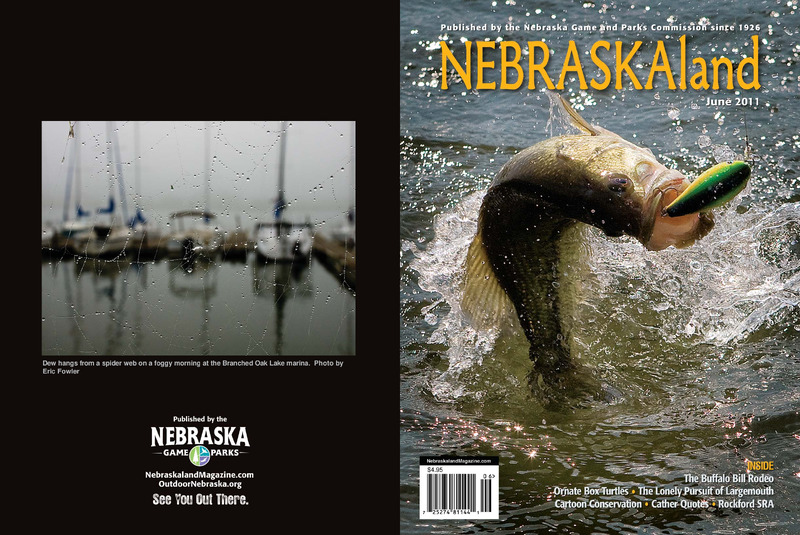
Dew hangs from a spider web on a foggy morning at the Branched Oak Lake marina. Photo by
Eric Fowler
Volume 89, Number 5, June 2011
14
●
14 Buffalo Bill Rodeo
The word rodeo was not widely used until the 1920s, but
NEBRASKAland Days at North Platte hosts one of the
biggest and best in the state. TEXT AND PHOTOS BY JON FARRAR
20 Ornate Box Turtles
Although relatively small, this long lived species is common
to much of Nebraska and makes its life primarily in grasslands.
TEXT AND PHOTOS BY MICHAEL FORSBERG
24 A Lonely Pursuit – Largemouth Bass Fishing
Fishing for this species is often a quiet endeavor, regardless
of what outdoor television tries to tell us.
TEXT AND PHOTOS BY JEFF KURRUS
30 Cartoon Conservation
While he sought to make us laugh, cartoonist Gary Larson of
“The Far Side” fame provided more than just a few smiles.
He suggested how we should think about nature.
BY JEFF KURRUS
34 Willa Cather – An Author for the Ages
A photographic companion to some of this “Nebraska”
author’s most famous quotes.
PHOTOS BY BILL HAGER AND MICHAEL FORSBERG
40 Rockford SRA – Get Away for a Weekend or a Week
Whether skiing, fishing or just enjoying a summer day at
Rockford SRA, one thing is for sure – you probably won’t
be having fun alone. PHOTOS AND TEXT BY ERIC FOWLER
Comment . . . . . . . . . . . . . . . . . . . . . . . . . . . . . . . . . 4
Mixed Bag . . . . . . . . . . . . . . . . . . . . . . . . . . . . . . . . 6
Antidotal Amusements . . . . . . . . . . . . . . . . . . . . . .44
Outdoor Business . . . . . . . . . . . . . . . . . . . . . . . . . .46
Parks & Places . . . . . . . . . . . . . . . . . . . . . . . . . . . .47
Classifieds . . . . . . . . . . . . . . . . . . . . . . . . . . . . . . . 48
Portraits from the Past . . . . . . . . . . . . . . . . . . . . . . 50
24
●
34
●
30
●
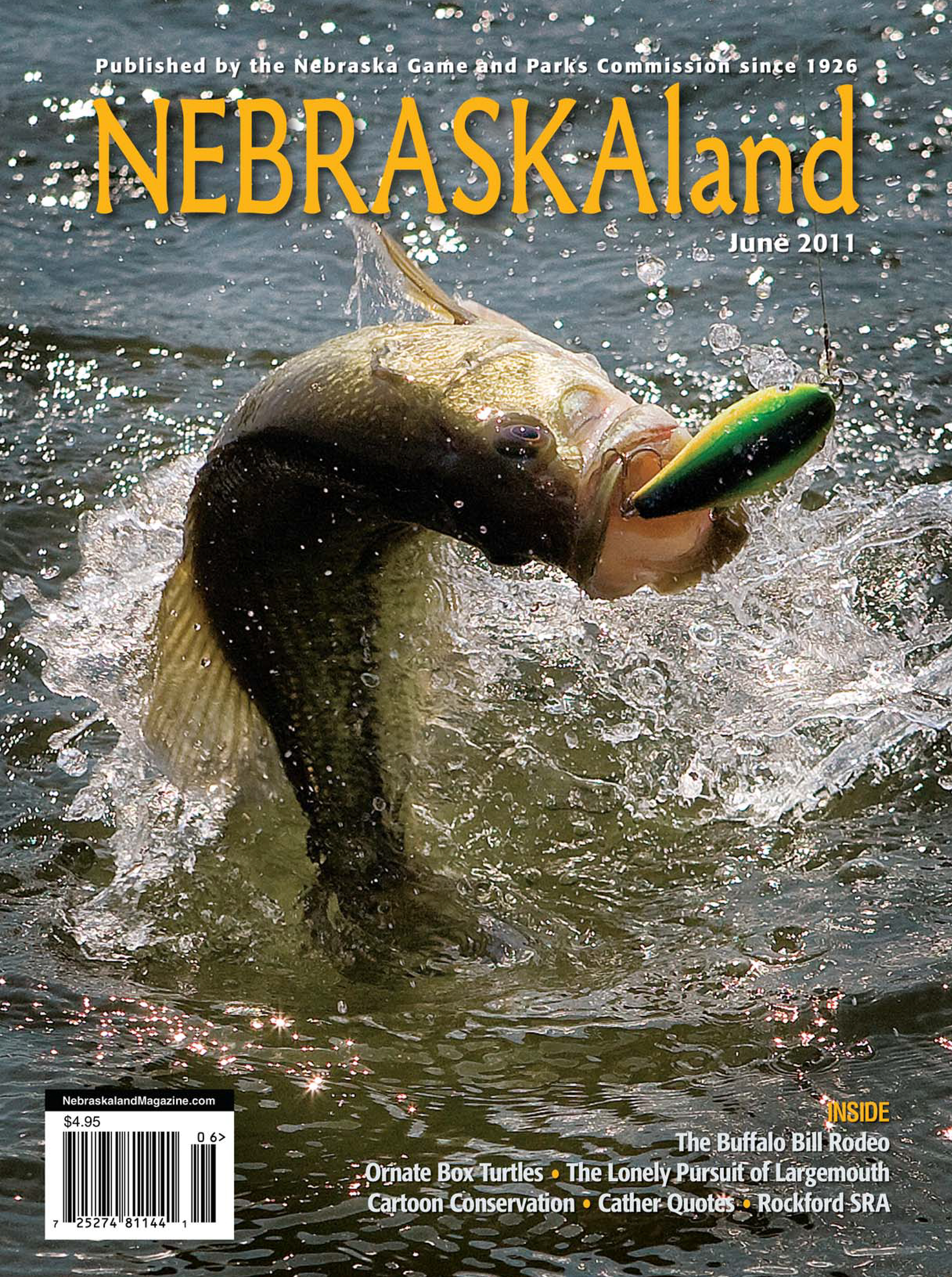
Cover: A largemouth bass leaps from the water at Verdon Lake State
Recreation Area. See story on page 24. Photo by Jeff Kurrus. Opposite:
Platte River State Park visitors explore the tipi below the Walter Scott
Lodge and Lincoln Journal Tower on a summer evening. The park also
has tipis that visitors can rent for a night. Photo by Eric Fowler.
NEBRASKAland (VOL. 89 / NO. 5, ISSN 0028-1964) is published monthly, except for the
combined Jan./Feb. and Aug./Sept. issues, by the Nebraska Game and Parks Commission,
2200 N. 33rd St., Lincoln, NE. Periodicals postage paid at Lincoln, Nebraska, and additional
mailing offices. POSTMASTER: Send address changes to NEBRASKAland, P.O. Box 30370,
Lincoln, NE 68503-0370.
JUNE 2011 • NEBRASKALAND 3
$6 Smile
The youth shotgun season opened
last Saturday – it was our five-year-old
son Cole’s first time being able to
shoot and he got his first turkey with
his new .410-shotgun. We (Chad and
Katie Graham, parents) were excited
when the Nebraska Game and Parks
Commission came out with the $6
youth permit for turkey hunting: We
thought it would be a great way to get
him excited about hunting and it
definitely resulted in a great memory –
it was amazing to watch Cole’s
determination and respect for hunting
as he shot his first turkey.
Being the mom, I usually have had to
stay home and watch our other son
while dad and son went hunting, so it
was great for me to get to watch Chad
call in the turkeys and work so hard to
get that moment just right for Cole.
Every wife and mother whose husband
and kids hunt should go with at least
once and maybe even start hunting
themselves. I have a pink camo bow
now and love it! You will respect and
understand hunting so much more and
it’s so beautiful being out in the early
morning.
Hunting has also taught Cole how to
work for something, and it’s teaching
him patience and a respect for the
outdoors. Hunting has also given our
family new time with each other that
isn’t sitting in front of the television —
we are all together out in the great
outdoors and that is the best part!!
Katie Graham
McCook, Nebraska
4 NEBRASKALAND • JUNE 2011
Prince Charming
Last summer my lady friend and
myself, along with a friend and his
daughter, spent the day pond-jumping
for bass in Pawnee county. “Princess
Chelsie” got bored with the fishing and
caught herself a bullfrog, but unlike the
fairy tale, we ended up leaving without
Prince Charming.
Jim Gronewold
Beatrice, Nebraska
Thank you for “Postcards from
Louisville” in the May 2011 issue of
NEBRASKAland. When our daughter
Arielle was three, our family camped at
Louisville State Recreation Area. As
we enjoyed sipping lemonade at a
picnic table, she suddenly stopped,
grinned at my husband Paul and me,
and said, “We are having a happy
time!” Although she is in college now,
we continue to make wonderful
memories at Nebraska state parks and
recreation areas any chance we get.
Sharon Berg
Bellevue, Nebraska
NEBRASKAland Visitor Letters
We want to thank all 78 readers
that sent e-mails and letters for last
issue’s visitor, a sac spider that was on
page 31 (see page 13 for the winner,
rules and this issue’s hint). Here are
some of the responses we received:
This is a particularly rich edition of
my favorite magazine – NEBRASKAland!
My husband is a belly boat fisherman;
the Switzer ranch safari story evokes
future outdoor travel dreams; and the
entire magazine is just loaded with
other great articles and photos.
I did find the visitor on page 30 – a
gentleman grilling out at a park looks
ecstatic as he seems to be flipping a
spider high in the air. Extra crunchy
protein maybe?!
Debora Brownyard
Lincoln. Nebraska
Hunting and Fishing Rocks –Thanks
Dear Nebraska Game and Parks
Commission,
I want to thank you for selecting me
as one of the winners at this year’s
sports and travel show. I always have
so much fun going to the sports and
travel show. Because I was lucky
enough to win a half-price lifetime
habitat stamp, it was more special this
year. I really enjoy hunting so having a
habitat stamp will help make sure I will
be able to hunt for a long, long time.
Sincerely,
Ben Fink
Elkhorn, Nebraska
Ok, I believe that the "visitor" you
are looking for is found on page 31 in
the upper left hand of the page and is a
yellow sac spider.
I have arachniphobia in the worst
way and it was absolutely horrific
for me to look all this up. Yheewww!!!
I hope that in the next issue it is a
snake, tick or rodent of some sort.
Thanks for great issue again.
Becky Ingold
North Platte, Nebraska
I have found the visitor. I believe it is
a yellow sac spider. I am not sure if the
guy doing the bbqing is laughing or
screaming because it appears that he
has seen a spider.
Peg Webster
Wayne, Nebraska
Looks like a small spider attached
itself to the top right corner of the
photo on pages 30 and 31. Seems the
griller is looking at the spider.
Thanks for a wonderful magazine. I
enjoyed the article about the Sandhills,
having spent many enjoyable visits to
my wife's home in Burwell.
Sincerely,
Robert A. Barclay
Healdsburg, California
I enjoy searching for your “visitor”
in each issue of NEBRASKAland. We
subscribed for our four sons and their
families at Christmas so they could
look. I believe the visitor this issue is
the spider on page 31 at the top left.
Thanks for the extra enjoyment in
each issue. There is always so much
to enjoy in your magazine.
Nancy Horalek
Humboldt, Nebraska
This small, pale creature is a sac
spider in the family Cheiracanthium.
These spiders generally live outside,
though they will enter homes,
especially in fall. They feed on insects,
hunting for their prey at night. The
sac spider gets its common name from
the silk tube or sac it constructs,
instead of weaving a web. If
threatened, sac spiders will
bite humans, causing
mild swelling and
occasionally
redness.
– Julie Van Meter,
State Entomologist,
Nebraska Department of Agriculture.
Send your comments to:
Doug Carroll, Editor
NEBRASKAland Magazine
P.O. Box 30370
Lincoln, NE 68503
or e-mail Doug.Carroll@Nebraska.gov
Please include your postal address and
telephone number.
Letters may be condensed and edited
for clarity. Photographs are
welcome and will be returned.
COMMISSION
CONSERV
CONSERVATION OFFICERS
Director Rex Amack
Deputy Director Jim Douglas
Commissioners
Chairman - Mick Jensen, Blair
Vice Chairman - Ron Stave, Waterloo
2nd Vice Chairman - Norris Marshall, Kearney
Jerrod Burke, Curtis
Dr. Mark Pinkerton, Wilber
Dr. Kent Forney, Lincoln
Lynn Berggren, Broken Bow
Rex Fisher, Omaha
Mark Spurgin, Paxton
NORTHWEST
Officer
City
Jim Zimmerman (S) Gering
MAGAZINE
MAGAZINE STAFF
STAFF
Editor Doug Carroll
Associate Editor Jeff Kurrus
Art Director Tim Reigert
Senior Editor Jon Farrar
Regional Editor Eric Fowler
Contributing Editor Michael Forsberg
Regular Contributors Bill Hager, Chris Helzer,
Lisa Knopp
Photo Librarian Sarah Johnson
Circulation Donna Robinson
For address changes and questions about
your subscription, e-mail
Donna.Robinson@Nebraska.gov
or call (800) 632-5263
Marketing/Advertising
For advertising information contact
Larson Enterprises
e-mail dave@larsonent.com
or call (515) 440-2810
NEBRASKAland Magazine Copyright 2011, all rights reserved.
NEBRASKAland is available on audio cassette from the Nebraska
Library Commission Talking Book and Braille Service, Suite 120, 1200 N
St., Lincoln, NE 68508. (800) 742-7691. NEBRASKAland Magazine and
the Nebraska Game and Parks Commission reserve the right to reject any
advertising not in keeping with the agency mission.
Rates: $18 for one year; $33 for two years; $44 for three years. Nebraska
recipients must add appropriate sales tax. To subscribe call
1-800-NEBLAND (632-5263), or go online to:
NebraskalandMagazine.com.
COMMISSION OFFICES
Headquarters/Southeast District Office
2200 N. 33rd Street Lincoln, NE 68503
Phone (402) 471-0641
Northeast District Office
2201 N. 13th St. Norfolk, NE 68701
Phone (402) 370-3374
Southwest District Office
301 E. State Farm Rd. North Platte, NE 69101
Phone (308) 535-8025
Northwest District Office
East Hwy. 2, Box 725 Alliance, NE 69301
Phone (308) 763-2940
Bassett Office
524 Panzer St., Box 508 Bassett, NE 68714
Phone (402) 684-2921
Kearney Office
1617 First Ave. Kearney, NE 68847
Phone (308) 865-5310
Scott Brandt
Heath Packett
Frank Miller
Dan Kling
Phone (308)
(office) 763-2940
(cell) 641-6138
Gering
631-0663
Gordon
360-0682
Valentine (402) 389-0444
Harrison
430-0572
SOUTHWEST
Officer
City
Phone (308)
Roger Thompson (S) N. Platte (office) 535-8025
(cell) 530-3097
Ray Dierking
Brkn. Bow
870-0322
George Sund
Cambridge
655-0028
Michael Thome
Cozad
529-8146
Terry Brentzel
Doniphan (402) 469-5795
Matt Andrews
Elwood
746-2418
Dirk Greene
Imperial
882-0015
Jerry Pecha (Sup.) Kearney (office) 865-5327
(cell) 293-3551
Dale Johnson
Kearney
440-3847
Dudley Sorensen
N. Platte
530-0016
Nicholas Fix
Ogallala
289-0427
Dennis Thompson
Ogallala
289-0755
Rich Routh
Rep. City
920-0367
NORTHEAST
Officer
Tom Zimmer (Sup.)
Dale Davis
Steve Oberg
Daniel Roberts
Randy Pomplun
Jeff Jones
Jon Reeves
Pat George
Doug Pollard
Tim Williams
Cory Krause
Phone (402)
(office) 370-3374
(cell) 649-8053
Bassett
760-0712
Columbus
910-3366
Fremont
719-1108
Fullerton
550-0489
Hartington
762-5022
Kennard
889-8508
O’Neill
340-0787
Ord
778-7101
Neligh
929-0051
West Point
380-6410
SOUTHEAST
Officer
Duane Arp (Sup.)
City
Gretna
Sean McKeehan
William Krause
Mike Luben
Dan Zuehlke
Darin Gress
Douglas Kramer
Dina Barta
Stacey Lewton
Levi Krause
Robert Finke
Russell Mort
Dan Evasco
Jeff Clauson
City
Norfolk
Phone (402)
(office) 332-2965
(cell) 521-0194
Ashland
521-0159
Auburn
274-8063
Colon
443-6392
Cortland
806-9084
Hebron
768-8665
Lincoln
890-6465
Lincoln
890-6463
Lincoln
890-7140
Louisville
949-0593
Milford
947-1363
Nebr. City
209-1506
Papillion
616-5961
Waterloo
658-7057
ADMINISTRATION
Officer
City
Ted Blume (Adm.)
Lincoln
Craig Stover (Asst.) Lincoln
Phone (402)
471-5531
471-5532
Nebraska Wildlife Crimestoppers 1-800-742-7627
Omaha Office
1212 Bob Gibson Blvd. Omaha, NE 68108
Phone (402) 595-2144
Ak-Sar-Ben Aquarium
21502 W. Highway 31 Gretna, NE 68028
Phone (402) 332-3901
Under federal and/or state law, discrimination is prohibited on the basis
of race, color, religion, age, gender, marital status, national origin,
disability or political affiliation. If you think you have been discriminated
against in any program, activity or facility by the Nebraska Game and
Parks Commission or want more information, contact the Commission in
Lincoln, NE, at (402) 471-0641 or the Equal Opportunity Commission,
Lincoln, NE, (402) 471-2024, TTY/TDD (402) 471-4693).
JUNE 2011 • NEBRASKALAND 5
Robber Flies
Chris Helzer
Here is a list of
upcoming outdoor
events across
Nebraska.
For more
information
about
these and
other events, click on
the calendar at
www.OutdoorNebraska.org.
June 1-28
R
obber
flies are
among the
most impressive
flying predators
in the insect world.
They typically hunt
by sitting on a prominent
perch and waiting for flying
prey to pass by. When a robber fly
spots a likely victim, it zips out and catches it in mid-air before piercing it with its
long, stiff mouth, and injecting a paralyzing and liquefying substance. It then
returns to its perch or other safe location to suck out the liquefied remains.
There are more than 7,000 species of robber flies in the world. In Nebraska,
robber flies can reach sizes of 1½ inches or more, and can attack prey much
larger than themselves, including bumblebees and dragonflies. While their bite
can be painful to humans, they don’t bite people unless they are handled roughly.
Unfortunately, insects can’t count on the same consideration.
A robber fly on its perch along the Platte River near Chapman. Photo by Chris Helzer
Elkhorn River Cleanup
Volunteers will be taking part in
a day-long cleanup project on the
Elkhorn River on June 18. Trash
will be collected in canoes on
about 16 miles of the river,
starting at Elkhorn Crossing and
ending at Q Street in the Omaha
area.
This is the first year for the
event, and organizers hope to
grow the program, repeating the
effort at a different Nebraska
river each year. The National
6 NEBRASKALAND • JUNE 2011
Karen Anderson
Park Service is organizing the
event, with participation and
support of several co-sponsors.
The event will go from 8 a.m. to
5 p.m., with a barbecue dinner to
follow. Volunteers must be 14+
years old to participate. All skill
levels are welcome. For a
registration form or for volunteer
information and other details
about the event, contact Karen
Anderson at (402) 661-1542 or
Karen_anderson@nps.gov.
• Family Fishing Events
These events provide rod, reel, bait
and fishing instruction for new
anglers and those that haven’t fished
for years. Events are held from 6 to 8
p.m. unless otherwise noted:
June 1, Omaha’s Benson Park
Pond; June 4, Kearney’s Yanney
Lake, 10:30 a.m. to 1 p.m.; June 5,
Grand Island’s Mormon Island Lake
2, 12 to 4 p.m.; June 7, Papillion’s
Halleck Park Lake; June 8, Lincoln’s
Bowling Lake; June 14, Columbus’s
Pawnee Park East; June 15, Norfolk’s
Skyview Lake; June 16, Omaha’s
Youngman Lake; June 21, Lincoln’s
Holmes Lake; June 22, Omaha’s
Walnut Creek Lake; June 28,
Omaha’s Cunningham Lake.
June 4-5
• Rock Creek Trail Days – Rock Creek
Station State Historical Park
Buffalo Stew Cookout and
Program, $9 for adults and $6 for
children ages 13 and under.
Contact: Rock Creek Station SHP
(402) 729-5777
ngpc.rock.creek.station@nebraska.gov
June 4-5
• Fort Atkinson Living History Days–
Fort Atkinson State Historical Park
Step back in time and experience
life as it was at an early 19th century
frontier Army post
June 10
• E.T. Mahoney State Park Stargazing
Party
View the spectacular night sky
using powerful telescopes.
Stargazing begins at the driving
range from dusk to 11 p.m., weather
permitting.
June 18
• Outdoor Skills Workshop for Men Platte River State Park
This day-long workshop is
designed to increase your knowledge and to make you a better outdoorsman.
Contact: Christy Christiansen
(402) 471-5547
christy.christiansen@nebraska.gov
Nebland Flashbacks
Jeff Kurrus
In the Summer 1940 edition of
NEBRASKAland predecessor
Outdoor Nebraska, the natural
history articles “Meet Mr. Chukar”
and “Turtles – Friends or Foes of
Fish?” gave readers valuable
information about game found
throughout Nebraska. In addition,
readers could view the correct –
and not so correct – way to hold a
gun, as shown in side-by-side
photographs one would not see in
a 21st-century outdoor publication.
What would be seen are many
other topics written much in the
same style our current publication’s
Mixed Bag section is constructed:
Short articles on the sauger,
first-aid how-to, and even a poem
entitled “The Plea of the Tree”
entertain people just before a
not-so-entertaining time in
American history – the United
States’s entry into World War II
in December of 1941.
One of the most interesting
pieces from this particular issue is
a small news release in the back
of the magazine entitled “Bald
Eagles Protected.” This article
relayed information concerning the
recent Bald Eagle Act approved
by President Franklin Roosevelt
and serves as a reminder that
some of our best laws haven’t
always been in place.
To read “Bald Eagles Protected”
and “Turtles – Friends or Foes
of Fish?” visit
NebraskalandMagazine.com and
click on “A Look Back.”
8 NEBRASKALAND • JUNE 2011
Roadside Snappers
Jon Farrar
It is not an uncommon sight during
June and into July, particularly in the
Sandhills where sandy trail roads are
close to lakes. Fishermen driving the
trail road on the north side of Pelican
Lake on the Valentine National Wildlife
refuge will surely see “it” – evidence of
female snapping turtles coming ashore
to lay eggs. Early and late in the day is
the mostly likely time to actually see a
female excavating a nesting cavity with
her hind legs, seeming to back down
into the sand, usually on the north side
of the trail (for maximum exposure to
the sun), and usually where there is a
drop-off made by the blade of a road
grader. Destroyed nests are seen even
more often, where some predator dug
out the clutch of eggs, crushed them in
its mouth to extract the nutrient-rich
contents, and left behind broken and
deflated golf-sized egg shells.
The larger the female snapper the
more eggs she lays, but they tend to be
smaller than those of younger turtles.
Twenty-five to 80 eggs comprise an
average clutch. Once the eggs are laid,
the female covers them with sand and
returns to water. Incubation is then
accomplished by the sun-warmed soil.
It is not surprising,
then, that length of
incubation varies, from about
nine to 18 weeks; and those eggs in
warmer underground sites require less
time to hatch. Even more interesting is
that the temperature at which an egg is
incubated appears to determine the sex
of the turtle that will emerge from it.
Males are produced if the temperature
averages between 70 and 85 degrees
Fahrenheit. Eggs incubated at cooler or
warmer temperatures usually produce
females. In large nests there may be
significant differences in temperature
between eggs deepest in the nest and
those near the surface of the ground, so
females may hatch from one part of the
nest and males from the other, and at
different times.
Male snapping turtles are mature
when three to five years old, females
when four to six years old. Predation
of snapping turtle nests is common,
with some studies reporting as high as
70 percent destroyed. In Nebraska, the
most likely nest predators are skunks,
raccoons and badgers. Once mature,
though, snapping turtles are essentially
invulnerable to predators and so the
species prospers even with high nest
losses.
Okay, this one’s a little different.
We found this image among our
photographic archives and are
guessing it is from back when
tourism and promotion for the
state were part of the Nebraska
Game and Parks Commission.
We don’t know who this “pheasant
girl” is, or where this took place,
but if you know, we’d love to hear
from you.
JUNE 2011 • NEBRASKALAND 9
Hiking with my Friends
Tom Scheimo
Nebraska has more public hiking opportunities than most
people realize – there are many lakes, riversides, peaks,
buttes, valleys, canyons and open prairies. But what if you
don’t know an area well, or just don’t want to hike alone? If
so, it’s time to sponsor a weekly or monthly hike for old and
new friends alike. Here’s how you get started:
• Advertise in various local media, including television,
radio, web sites or newspapers. These media usually have a
spot for “events” at no cost to you. Or, if you have any
writing abilities at all, pen a “news” or “feature” story –
local newspapers are always looking for fillers of this type,
and any photos you provide are a plus.
• If these local media are too ambitious for you, post flyers
around town. If there is a college in the area, the campus is a
great place to find others. Students away from home crave
downtime from their studies and are willing to explore their
temporary homes. Notices can be posted at local businesses
(get permission first), a “town square” location, library, coffee
shop … the list is endless. Every community is different.
• Post the following items on your flyer when recruiting a
hiking group: water, snacks (depending on the outing’s
length), sunscreen, mosquito repellent, pepper spray if going
into the wilderness, jacket, hat, good hiking footwear and, of
course, a map of the hiking area and compass.
• Information for the outing should also include the
destination or a couple of choices to be voted on by the
group. Will you allow dogs? What if only one person is joining
you – will you hike with a stranger? Think safety. Also meet
in a well known, easy-to-find public place.
Bring your sense of adventure during these outings.
There’s education around every bend, especially if someone
in your group knows the history, flora or fauna of an area.
Stopping Aquatic Hitchhikers
Aquatic nuisance species pose a great
threat to boaters, anglers and any
water-based business or public utility in
Dispersing Wet Seeds
Chris Helzer
Many wetland plants have
seeds that can float, which helps
facilitate seed dispersal. When
those plants drop their seeds into
the water, they can travel across
the water’s surface – propelled by
wind and/or current – until they
are eventually marooned on the
wet soil along the edge of the
water. Traveling by water helps
ensure the seeds will end up in a
place appropriate for wetland
plants to grow.
Some water-dispersed seeds
are simply so small that they
don’t break through the surface
The 2011 National Trails Day
A group of hikers break during an autumn walk along
Nebraska’s Pine Ridge.
Plus, the more comfortable you get with a group, the more
opportunities arise, including, at least within my hiking
circles, homemade jam and baked bread.
It is guaranteed you will make friends when you group
hike, for there are no demands, no protocol – just life. So
start enjoying it now.
the state. Preventing the spread of these
species starts with the owners of all
water vessels. Boats and boat trailers
can easily transport aquatic hitchhikers
in many ways, so follow these
10 NEBRASKALAND • JUNE 2011
Ridge” event.
• Bader Memorial Park in Chapman
will again have their float event on the
Platte River. For anyone interested in
visiting, visit baderpark.com for
additional details.
• The YMCA in South Sioux City is
sponsoring their Healthy Kids Day
Event on June 4, which will include
hiking, kite flying, learning about
camping, and preparing healthy trail
snacks. Visit www.nwsymca.org.
Visit americanhikingsociety.org
before June 4 to either register your
own event or see if any more have been
added. Then, lace up your sneakers,
grab your family and friends, and start
walking.
See You Out There ... But Where?
Do you know where this Nebraska photograph was taken?
See answer at the bottom of page 13.
JUNE 2011 • NEBRASKALAND 11
PHOTO BY BOB GRIER
Ken Carlson of Lincoln caught his
first trout on a fly on Long Pine Creek
as a teenager more than 50 years
ago and now totes his fly rod around
Nebraska casting for trout, panfish,
bass and carp. He’s had this message plate for 25 years.
If you have a unique outdoor message plate you would like to share, or
know someone who does, e-mail a photo of it (high-resolution, JPEG format
only, please) to Eric.Fowler@Nebraska.gov, along with your name, hometown,
and a brief description of the interests expressed on the license plate.
guidelines before leaving a body of
water to help protect Nebraska’s aquatic
resources and recreational opportunities:
• Drain every conceivable place that
holds water, including live wells, bilge,
ballast tanks, and transom wells (don’t
forget the engine itself, especially on
personal watercraft).
• Remove all visible plant fragments,
mud and other debris from the vessel
and its trailer.
• Clean and dry all equipment that
came in contact with water.
• Allow everything to dry completely
for several days before launching into
another body of water.
Zebra and quagga mussels are a
particularly hardy variety of aquatic
nuisance species and can be quite small
- their larvae are microscopic and
adults can range in size from a grain of
sand to two inches in length.
Tom Scheimo
National Trails Day was originally
conceived in 1987 after a report from
Ronald Reagan’s President’s
Commission on American Outdoors.
The commission felt it very important
that every American should be able to
live within 15 minutes of a trail from
their homes.
These trails were recommended to
wind around and through communities,
allowing an experience without
retracing steps. This was called Trails
for All Americans, and inspired others
to join the American Hiking Society, as
the first National Trails Day was
launched in 1993.
Now, nearly 20 years later, the
American Hiking Society helps all of
us to carry the idea of National Trails
Day into our communities, where we
can expand our experiences and
comfort zones to the great outdoors.
On their web site there are a number
of hikes registered for this year’s
Saturday, June 4 date throughout the
country, including multiple events in
Nebraska. Some of these include:
• Panhandle Trails, in cooperation
with the National Forest Service,
is sponsoring a hike. Visit
panhandletrails.weebly.com for
more information on their “Hike the
tension of water.
Others have hairs
or other structures
that help them float.
Still others have
hollow spaces that
make them
buoyant. As with
other plants, most
seeds produced by
wetland plants
won’t land in a
place that allows
them to successfully A raft of wetland seeds float on the edge of a small
wetland at The Nature Conservancy’s Platte
germinate and grow restored
River Prairies in Hall County.
into a new plant.
However, it only takes one
to make the effort of growing,
successful seed – out of the
flowering and producing seeds
worthwhile.
hundreds to millions produced –
Turpin Time
The Omaha-area metro lakes all experience heavy
use and have size restrictions on black bass – the
minimum length is 21 inches and you can only keep
one bass a day. That is a nice fish, a trophy
largemouth bass, otherwise you need to practice
catch and release bass fishing on these lakes.
Anglers who wish to keep some fish to eat should
concentrate on panfish, trout or catfish as they often
have no size restrictions and liberal bag limits.
When they are hitting, however, some anglers are
tempted to keep a short bass or two. Enforcement
comes in three forms: Routine patrol, checking
permits and creels on anglers actively fishing; or
with information provided by calls to the Wildlife
Crime Stoppers number (1-800-742-7627) or the
local Conservation Officer, whose cell numbers are
listed in the yearly fishing guide and on page 5 of
each NEBRASKAland issue.
The third way is the most productive. It requires
patience, a good vantage point and a 25X spotting
scope. The scope is a great piece of equipment –
we can scan anglers and other outdoorsmen at long
distance, watching for illegal activity. While doing
this I have witnessed violators stash illegal short
bass into waders, coolers, picnic baskets and
vehicles.
I used the scope recently at Walnut Creek to scan
several anglers scattered around the lake. One was
fishing from a rocky point and was catching a few
bass, all under the legal size as he appeared to be
releasing them back into the water. I noticed,
however, that he always released the short bass in
the exact same spot each time, so I decided to
watch him a little closer. As it turned out, he had a
pen made out of rocks in the open waters – no
stringer, no fish basket and any officer making
routine checks would be none the wiser. When the
violator decided to call it quits, he grabbed three
short bass from the pen and put them somewhere –
I couldn’t see where as there was brush obscuring
my view. To top things off, I watched him throw two
empty beverage cans into the cattails.
I left my vantage point and drove around the lake
where I met up with him. I asked to see his fishing
license and made small talk as he set his gear on
the ground. Thump, thump. I asked if he'd kept any
fish. "Not today," he said. Thump, thump. "What's
that?" I asked. "What's what?" Thump, thump.
"There's a thump-thump coming from your tackle
box." Thump, thump. "Something's trying to get out,
lets see what it is shall we?" Thump,thump. He
emptied out the three illegal bass. They were still
lively and flopping around, so I was able to release
them back into the impoundment for another day,
and another fisherman. I encouraged him to go
back and pick up his litter while I wrote out a court
citation that included a hefty fine.
In my business, a good spotting
scope and thumping black bass are
sometimes all that's needed to
make a case.
– Dan Evasco, Conservation
Officer, Papillion
Cody Newlun of Hastings hit 186 out of 200 clay pigeons in very windy conditions to
win this year’s Cornhusker Cup trophy.
Cornhusker Trapshoot
Cody Newlun of Hastings 4-H won a shootout to capture the Cornhusker Cup at
the 42nd Annual Cornhusker Trapshoot in Doniphan this year.
Despite very winding conditions throughout the meet, Newlun finished with a
186x200 two-day score to tie Republican Valley 4-H’s Blake Brumbaugh and head
to the shootout. Jacqueline Baude of Papillion-LaVista South was the high overall
girl with a 179x200, while Wade Knott of Louisville was crowned the junior high
school champion after breaking 95 out of 100 16-yard targets.
This year 1,216 shooters competed in the senior high division of the trapshoot,
and 692 competitors shot in the junior high portion. The Cornhusker is held at the
home grounds of the Nebraska Trapshooting Association (NTA) and is hosted by
the Nebraska Game and Parks Commission and the NTA.
The largest event of its kind in the country, the Cornhusker Trapshoot is open to
any academically eligible junior high or high school student who has completed a
Nebraska-recognized hunter education course.
High School 3D Championships
36th Time is a Charm
A 49-year-old Sheldon, Wisconsin
man has been sentenced to six months
in jail for having a deer his son shot in
12 NEBRASKALAND • JUNE 2011
Nebraska tagged with a Wisconsin deer
hunting tag.
Richard Kochevar was sentenced by
U.S. Magistrate Judge Stephen Crocker
in federal court in Madison, Wisconsin.
According to a Department of Justice
press release, the elder Kochevar had
35 previous criminal violations,
including 10 separate Wisconsin
Department of Natural Resources
wildlife violations.
He pled guilty to a charge of
submitting a false statement regarding
the deer shot in Nebraska and
transported to Wisconsin.
According to the press release,
Kochevar and his son went hunting in
Nebraska in the fall of 2009 but neither
had hunting licenses.
The son shot a deer and Kochevar
took it back to Wisconsin, with
Kochevar getting a friend to tag the
deer with an unused Wisconsin deer
hunting tag.
The investigation into the crime was
conducted by the Wisconsin DNR and
the U.S. Fish and Wildlife Service.
According to state court records,
Kochevar has been found guilty of a
variety of wildlife offenses, including
hunting deer out of season, failing to
obtain a deer hunting license, and
assisting with bear hunting without a
license.
Entries are being accepted for the 2011 Nebraska
High School Bowhunter 3-D Championships to be
held in Broken Bow on June 11.
The event consists of firing shots with a bow
and arrow at 3-D targets resembling animals that
commonly are hunted. The targets are set at
different ranges in different terrain to simulate hunting. The objective is to score
hits in the vital areas of the 3-D target.
This free event is open to all school students ages 12 through 18 who have
completed a bow hunter education course and can prove certification. Awards will
be given to individuals and teams.
The championships, sponsored by the Nebraska Game and Parks Commission’s
Hunter Education Programs and Mid-Nebraska Bowhunters, will be held at the
Nebraska One Box Shooting Range.
For more information or to register, contact Mark Eggers at (402) 368-5588,
mjeggers@cableone.net, or Hunter Education Coordinator Mike Streeter at (402)
471-6134, mike.streeter@nebraska.gov.
NEBRASKAland Visitor
Winner and Hint
Last issue’s winner of
the NEBRASKAland
Visitor drawing was
Bill Coday of Fremont,
Nebraska who found the sac spider
on page 31.
Readers are encouraged to contact
NEBRASKAland within 10 days
after this issue’s publication with the
correct page number and name of
this issue’s “Visitor” – a bug found
in Nebraska that just happened to
find its way onto one of the pages of
our publication.
We will then gather the correct
entries and draw one to win a
NEBRASKAland Magazine mug.
To enter each month, write:
NEBRASKAland Visitor
2200 North 33rd Street,
Lincoln, NE 68503.
Or e-mail:
Tim.Reigert@Nebraska.gov
with “Visitor” in the subject line of
the message.
HINT: This issue’s visitor is not on
page 5, 6, 32, or 36.
Calamus Fish Hatchery near Burwell.
Thump, Thump
Dick Turpin
I’ve lost count,
but you can re-use
five gallon buckets
for about 400
purposes. Here’s one that dog owners
and gardeners might like.
Take a bucket and a good sharp
knife…go around it like this (cutting
bucket into two parts about four inches
from the bottom) … I sawed this before
I got here … the bottom of these buckets
makes a good dish to water the hunting
dog. That thing will last a long time for
a dog waterer. Just throw it in the back
of your truck and you got it. But this
part here? What are you going to do
with that part? I’m going to take it
right over there and when I put my
tomatoes in tonight I’m going to put
this over one of those plants so it’ll
keep the bunnies out. They have
enough to eat, they don’t need to eat
my tomatoes. ■
JUNE 2011 • NEBRASKALAND 13
Text and photos by Jon Farrar
Not until the 1920s did the word rodeo come into
common usage. Seeing who could ride a bucking
bronco the longest or rope a calf the quickest was
probably infomal competition in ranch country a
hundred years earlier.
hile Nebraska has as legitimate a claim to be the home of the first rodeo as
any – Buffalo Bill’s Old Glory Blowout celebration in North Platte in 1882
– it is impossible to assign that honor to any specific time or place unless
rodeo is so narrowly defined as to be meaningless. The first rodeos were organic –
like mushrooms, they just grew from spawn in the soil whenever ranch hands
gathered around a corral and put a little hard-earned cash on who they thought
was the best rider or roper. Rodeo is the only American sporting activity that grew
out of a real working occupation.
The word rodeo came from the Spanish word rodear, (pronounced ro-day-oh).
As originally used, the word rodeo meant rounding up livestock. An 1851
California statute, for example, states that: “Every owner of a stock farm shall be
obliged to give, yearly, one general Rodeo within the limits of his farm, from the
first day of April until the thirty-first day of July…in order that parties interested
may meet, for the purpose of separating their respective cattle….” In the United
States, during the days of running cattle on unfenced government rangeland, the
Above: Competition between cowboys after round-ups was probably the beginning of
rodeos. By the early 1900s, they were common Fourth of July events in small towns.
Right: Michelle Boesart, Miss Nebraska Rodeo 2010, at last year’s Buffalo Bill rodeo.
14 NEBRASKALAND • JUNE 2011
Buffalo Bill Ranch
State Historical Park
In the calf-roping event, contestants are
timed roping a running calf, dismounting
and tying three of its legs together.
Saddle bronc rider’s gear – halter and hack rein, protective vest and chaps.
16 NEBRASKALAND • JUNE 2011
equivalent word was “round-up.”
As the story goes, and it is almost
surely correct, in the late-1700s and
early 1800s in Mexico and what later
became the United States’ southwest,
vaqueros (hired hands on large cattle
ranches, call them the original North
American cowboys if you want) were
said to compete against one another in
such things as roping and bronc riding
at the end of roundups. The same custom
soon appeared on the Great Plains after
cattle were gathered from large ranches
to be sorted and some shipped to market.
Such cowboy competitions surely drew
crowds, but were too informal to be
called rodeos. And the competition was
little removed from real ranch work,
such as breaking horses and roping
calves. Bull riding apparently was a
Spanish tradition that grew out of the
even more dangerous competition of
bull wresting, and bore no resemblance
at all to any form of useful ranch work.
Some researchers state the first real
rodeo, even though it was not called
that, was held in Cheyenne, Wyoming,
in 1872. That tradition continues as the
Cheyenne Frontier Days Rodeo, which
claims to be the largest outdoor rodeo.
Some assign the first rodeo to Pecos,
Texas, in 1883, as it was the first to
offer prizes to contestants; or to
Prescott, Arizona, in 1888 because it
was the first to charge spectators an
admission fee. However the first
rodeo is defined, there is little doubt
Buffalo Bill Wild West Shows were
Right next door to the Wild West Arena where the annual
Buffalo Bill Rodeo is held, is part of what once was Buffalo
Bill’s ranch on the north edge of North Platte. It became a state
historical park in 1965. When William F. Cody was at the height
of his show business career, he owned about 4,000 acres there
and appropriately called his home Scout’s Rest, his retreat
from the hectic show business world.
Cody was born in 1846 in Iowa. He hired out as an ox-team
driver when only 11 years old. In 1859 he went with other
hopeful gold prospectors to Colorado and in 1860 signed on as
a Pony Express rider. Although too young to enlist in the army
during the Civil War, he served as a dispatch messenger and
scout for the Union Army. After the war he was paid to hunt
bison to feed workers on the Kansas Pacific Railroad, and was
reported to have killed 4,280 animals in eight months; but he
earned his title “Buffalo Bill” in shooting competition with another professional bison hunter. He was an Army scout for General
George Armstrong Custer in campaigns against American
Indians; and in 1872 he guided the Grand Duke Alexis of
Russia on a bison hunting expedition in southwestern
Nebraska.
Cody had his beginning as a showman in Ned Buntline’s
stage play about the old west. After another stint as Army
guide, he began touring eastern cities portraying scenes of battles with the Sioux. In 1882 he organized and staged the first
Old Glory Blowout celebration in North Platte, an event often
credited with being the beginning of rodeos. It also was the
beginning of his Wild West Show. From 1883 into 1886, Cody
toured the U.S., and in 1887 he took the show on a tour in
England. It also played next to the 1893 Chicago World Fair. He
enlarged his show and again toured Europe in 1902. Cody was
always ready to roll the dice, and so was susceptible to questionable investments. He was forced to sell Scout’s Rest Ranch
in 1911 and died destitute in 1917 in the Denver home of a sister.
Today the historical park encompasses 16 acres that includes
Buffalo Bill’s house, built in 1886, and barn and outbuildings
that have been restored to their original condition and filled with
Cody memorabilia. Adjacent to the park is a 233-acre state
recreational area providing picnicking, camping and hiking.
There are 23 pad sites with 50 amp electrical hookups; as well
as tent camping areas. For additional information see:
http://outdoornebraska.ne.gov/parks
Buffalo Bill Ranch State
Historical Park is located in
northwestern North Platte.
From Interstate 80 at North
Platte, take U.S. Highway 83
north to U.S. Highway 30,
west two miles, then north
on Bufalo Bill Avenue. Open
10 a.m. to 4 p.m. March 24 to
Memorial Day, 9 a.m. to 5 p.m. Memorial Day to Labor Day, closed Labor
Day; 10 a.m. to 4 p.m. Monday through Friday after Labor day.
★
JUNE 2011 • NEBRASKALAND 17
While rodeos would seem to be mostly a draw for rural folks, from their beginning they’ve fascinated city people
as well. Two old cowboys found quiet seats near top of the grandsatand at the 2010 Buffalo Bill Rodeo in North Platte.
instrumental in promoting their popularity.
It was not until the 1920s that the word rodeo was
commonly used, even among those competing in the sport.
That same decade, rodeos became large organized events,
staged not just for public entertainment but entrepreneurial
profit and, like the wild west shows that preceded them,
included such events as trick and fancy roping and riding.
Women competed in the same events as men until 1929,
when one of the country’s best female competitors, Bonnie
McCarroll, died of an injury sustained in a bronc riding
event. It apparently remained acceptable for men to die in
rodeo events.
Rodeos were immensely popular in large eastern cities.
Rodeos billed as “championship competition” were held at
New York’s Madison Square Garden, the first in 1922. Even
18 NEBRASKALAND • JUNE 2011
during the depression of the 1930s, some cowboys were
earning more rodeoing than were teachers or dentists. Of
course teachers and dentists rarely end a work day with
broken ribs. American rodeos were staged in Europe, the
Far East and South America before World War II.
Rodeo promoters organized before the cowboys offering
up their bodies for small purses and audience entertainment
did. In 1929, the Rodeo Association of America formed to
promote the sport, but not until 1936 did those competing
form their own organization, the Cowboys Turtle Association
(CTA). It is said “turtles” was part of the organization’s
name as the cowboys were slow to organize but finally
stuck out their necks. During a rodeo billed as the “world
championship” in Boston the calf ropers, bull and bronc riders
went on strike, refusing to compete in protest of purses
smaller than promised, poor promotion,
incompetent (if not unfair) judging, and
a lack of uniform rules. The CTA
sanctioned no women’s contests. In
1945, the organization was renamed the
Rodeo Cowboys Association, and in
1975 became the Professional Rodeo
Cowboys Association (PRCA). America
being a capitalistic society, it was
predictable that rodeos would become
big business and the best of those
competing would be financially rewarded,
which only seems proper for anyone
who would willingly crawl on the back
of an enraged bull or jump off a perfectly
Young Texas twirlers Cody Jo Hattery (front) and Gracie Gambio (black hat) hawk
pint-sized lariats at the Buffalo Bill Rodeo as Terilynn Riley totes the wares.
JUNE 2011 • NEBRASKALAND 19
Steer wrestling is one of eight rodeo events sanctioned by the Professional Rodeo Cowboys Association.
Of those, only barrel racing is a womans’ event.
good horse onto the back of a running steer. Prize money
swelled enough that a select few were able to tour and make
rodeoing a fulltime profession, at least until dislocated
shoulders and rib-punctured lungs forced their retirement.
Today, the National Finals Rodeo in Las Vegas draws nearly
200,000 spectators and attracts about 13 million television
viewers.
The PRCA-sanctioned events are saddle bronc riding,
bareback riding, bull riding, calf roping, steer wrestling,
team roping, and steer roping. Barrel racing is the only
20 NEBRASKALAND • JUNE 2011
women’s event sanctioned at PRCA rodeos and was not
added until 1968. In response to the PRCA’s longtime
refusal to sanction women’s events, the Girl’s Rodeo
Association organized in 1948. It later changed its name to
the Women’s Professional Rodeo Association and has played
an important role in bringing women back to rodeo and
ensuring purse money for women is the equal of that for
men. Since the late-1940s, youth rodeo associations have
formed, such as the National Intercollegiate Rodeo
Association, the National High School Rodeo Association,
Roedy Owen Farrell of Thermopolis, Wyoming, stays behind the arena gates
but outfits himelf the same as his father, Will, a professional bull rider.
and the American Junior Rodeo Association. “Old-timers”
rodeos have also increased in popularity.
Rodeo competition has grown steadily over the years as
purses increased. In 1953, the total prize money awarded at
PRCA rodeos was about $2.5 million. Thirty years later it
was over $13 million. Today, the best of the cowboys earn
well over $100,000 a year. As an example of the earnings
possible in professional rodeoing, consider Cody Ohl from
Texas, who started in PRCA competition in 1994. His
specialties were team roping, tie-down roping and steer rop-
ing. His PRCA career earnings are $2.4 million.
While most rodeos are a certified business, today, the once
uncomplicated tradition of rodeos remains alive and well at
small town Fourth of July and county fair events.
The annual Buffalo Bill Rodeo (where the photographs for
this article were taken last year) is held in conjunction with
the NEBRASKAland Days celebration in North Platte and
will take place June 15-18 this year. For additional information
call (308) 532-7939, (888) 313-5606, or go online to:
http://www.nebraskalanddays.com/. ■
JUNE 2011 • NEBRASKALAND 21
Ornate Box
Turtles
Text and photos by Michael Forsberg
Although relatively small, this long lived
species is common to much of Nebraska and
makes its life primarily in grasslands.
L
ast May I sat on a hillside in the
Nebraska Sandhills watching two
Swainson’s hawks riding thermals
on a warm sunny day. Taking part in
courtship flight, the birds were carving
circles in near perfect synchrony, like
two lovers figure skating together on an
icy pond of blue sky.
Suddenly my attention was drawn
back to earth by sand moving beneath
my boot – a beautiful ornate box turtle
was emerging from a shallow burrow
in the soil at
my feet. I
watched as it
paused briefly
to survey its
surroundings,
sand rolling
down its high
domed shell
as its head
swiveled
slowly left,
right, then up
toward the
sky, almost as
if watching
the hawks
still circling above. With typical turtle
deliberateness and speed, it then made
its way downslope, dodging bluestem
towers of the prairie and
disappearing out of sight, leaving only
its tracks behind.
The ornate box turtle (Terrapene
ornate) is one of nine native turtle
species found in Nebraska and is the
only native terrestrial species that
makes its life primarily in grasslands.
Although shy by nature, drive a highway
or ranch road in the Sandhills after a
22 NEBRASKALAND • JUNE 2011
rainstorm in early summer and you will
often see ornate box turtles moving
across the road or poised along the
shoulder.
The adult ornate box turtle is relatively
small, rarely larger than six inches
long. Its hard, intricately colored shell
resembles dappled sunlight when
viewed from above, with bright mustard
yellow lines that can extend to their
legs, head and tail radiating across a
dark background. The upper part of the
box turtle’s
shell (called a
carapace) is
highly domed.
The bottom
part of the
shell (the
plastron) has
a single hinge,
which allows
the shell to
close tight,
protecting the
turtle’s soft
body parts
from
predation.
Side by side, the male is slightly
smaller and can be more showy, usually
with bright red eyes and reddish-orange
forelimbs. The female’s eyes are a more
subdued maroon, yellow or green.
There are four species of box turtles
in North America, and their fossil
record dates back 15 million years. The
ornate box turtle was first recorded in
Nebraska in 1795, and today is found
throughout much of the Great Plains
and parts of the Upper Midwest.
In Nebraska, the ornate box turtle
An ornate box turtle (Terrapene ornate) moves along a mowed path on a tallgrass prairie in southeastern Nebraska.
can be found statewide except in certain
northeastern counties. It is most common
in western Nebraska, especially in the
Sandhills. Its habitat encompasses short,
mixed and tallgrass prairies where loose
sandy or loamy soils allow its curved
claws to excavate nests and burrow to
overwinter or escape temperature
extremes by thermoregulation (turtles
are ectothermic, meaning their body
temperature reflects the environment
around them).
Like other turtles, the ornate box
turtle has a beak rather than teeth, like
most reptiles have. They are omnivores
and use their beak to eat a varied diet
of succulent plants, fruits, earthworms,
carrion and insects. These turtles forage
throughout the day unless temperatures
become extreme and they have to seek
shelter. In more northern parts of their
range they are active roughly from
spring to fall, while down south they
can be active year-round.
In Nebraska, ornate box turtles breed
from May through September and
females lay their eggs in the summer or
hold the sperm to use the following year.
There are usually one to seven eggs in
a clutch, and the sex of the young is
determined by the temperature at which
the eggs are incubated – cooler
temperatures produce males, warmer
temperatures females. Ornate box turtles
do not reach sexual maturity until about
age 10, and can live 50 years or more
in the wild.
Because ornate box turtles have
relatively low reproduction, suffer high
young mortality and are slow to reach
sexual maturity, their populations are
easily affected by changes to the
landscape, such as habitat lost to crop
conversion and habitat that is fragmented
by roads and other development, which
can hinder movement, increase vehicle
mortalities and stop the flow of genetics
from one population to another. In
some states a history of commercial
collection for sale in pet stores has had
a big impact on ornate box turtle
populations. Fortunately, they are now
protected from commercial collection
in six midwestern states, including
Nebraska.
If you see an ornate box turtle face to
face, try to look deeply into its eyes.
There you will find a fire kindled long
ago and born of the prairie that still
burns brightly in those cherished places
in Nebraska where our native grasslands survive. ■
Contributing editor and freelance
nature photographer Michael Forsberg
lives in Lincoln. To view more of his
work, visit www.michaelforsberg.com.
JUNE 2011 • NEBRASKALAND 23
“The angler known for their prowess also
shows how inept they truly are when largemouth bass angling.The more lures one has –
the more failure they have experienced.”
three consecutive days, neither Brauer
or West caught a single fish and were
disqualified from even fishing the final
day of the tournament.
To understand the complexity of
fishing for a species often perceived
as easy to catch, one should look no
further than the spinnerbait – one of
largemouth bass fishing’s most
common lures. The spinnerbait,
resembling virtually nothing else
swimming in freshwater, seemingly
supports some people’s claims that
the largemouth will strike just about
anything moving through the water.
How could a lure be so popular for a
freshwater fish that resembles a
saltwater creature, the jellyfish, much
more than anything in your local pond
or reservoir? The simplicity of this
lure, however, ends there.
When fishing a spinnerbait, an angler
must first consider color. While white
and black are always near the forefront,
any angler new to bass fishing will
also learn a color not often seen in the
pursuit of other hobbies – chartreuse.
Once this new color is learned, one
must now decide on the various blade
options available, including those with
names like the Colorado, Indiana or
willow-leaf, or if the angler wants the
blades to be copper, gold, silver or a
painted color. Anglers must also decide
if they will fish a single blade or tandem
blades, and what types of blades will
be combined together.
Once these elementary choices are
made, then spinnerbait size is chosen –
1
/8-, ¼-, 3/8-, or ½-ounce are the norms,
yet ultralight, as well as heavy, muskietempting sizes, will also suffice. Finally
comes the additions – will you add a
pork trailer, soft plastic tail or some
other appendage to spice up your
selection?
A conversation between two anglers
regarding this process therefore might
resemble something like this:
“What are you going to fish with?”
“Red head, white skirt. Tandem
blades.”
“Two willows?”
“Gold Colorado and silver willow.”
I was taught quite early in life by my father (pictured at Valentine National Wildlife Refuge) that bass fishing can be an isolated venture.
Text and photos by Jeff Kurrus
“Y
ou know why God made largemouth bass? So every person
could catch a fish.”
That statement, recently made
to me by a walleye fisherman
at Merritt Reservoir, often seems to be
the overwhelming thought concerning
America’s most popular freshwater
fish, the largemouth bass. And why
shouldn’t it be? As a creature known
for its propensity to strike just about
anything on or near the water, includ24 NEBRASKALAND • JUNE 2011
ing frogs, birds, turtles, other fish, or
even tin can tops (according to fishing
writer Robert Hughes in his memoir A
Jerk on One End), the bass’s reputation
as an easy catch seems well justified.
At least until one watches some bass
anglers in action.
If catching these fish were so simple,
why would one need a bass boat that
skims the water at 70 miles per hour,
why would a tournament angler,
complete with his or her logo-covered
uniform, scream in elation at every
two-pounder caught in front of a
camera, and why would there be aisles
and aisles of largemouth lures at every
outdoor retailer? If these so-called
“green carp” were so readily available
for anglers to essentially scoop from
the water, a johnboat and relatively
large net should seemingly suffice in
limiting out for the day.
Yet anyone who has spent time on
the water fishing for largemouths
understands why some anglers go to
these extremes to catch these fish – it’s
pretty darn fun to watch them jump
into the air, and it’s certainly not
always as easy as it looks. Dennis
Brauer and Darrell West, two
tournament anglers who fished the
2010 Bassmasters Classic on Lay Lake
in Alabama, would support this latter
claim – while perennial tournament
power Kevin VanDam eventually won
the tournament, boating 5-fish limits on
The spinnerbait, one of largemouth bass fishing’s most popular lures, is a curious lure.
JUNE 2011 • NEBRASKALAND 25
For many largemouth anglers, speedy boats (above) have become part of the bass fishing experience. If largemouth bass are so easy to
catch, then why do so many tackle boxes (right) look like this one?
“3/8?”
“Quarter. You?”
“Black, blue skirt. Half-ounce.”
“Wow, going big today?”
“Yeah. Thought about a trailer, but
decided against.”
“Blade?”
“Single silver Colorado. You know,
sunny day and all.”
Once this conversation is had and
each lure is cast, how will the angler
fish it? The options are numerous.
Reeling it back as fast as possible near
the surface, letting it sink to a preferred
depth and then reeling it back, giving
the spinnerbait an occasional twitch or
complete stop of motion, or any other
number of techniques used by anglers.
Any angler that invests this much
complicated preparation would seemingly garner a little respect from those
whose days are spent using bottom
bouncers or Lindy rigs, but it will probably never happen, despite the fact that
any bass angler who has spent their fair
share of time on the water also knows
26 NEBRASKALAND • JUNE 2011
how to Carolina rig a worm, float a
fluke, bounce cranks, or scum frog lily
pads. Much like the walleye, crappie or
trout angler, the bass angler learns
these acts not out of curiosity, but
necessity.
So the following question must be
asked: Why all the “green carp”
whisperings? Perhaps it’s this fish’s
so-called palatability issues. Why eat
this scrap fish when our Nebraska
waters have bluegill, crappie and
walleye in them? The basic notion of
fishing involves catching something
that will eventually be eaten. However,
the largemouth bass is more known
these days by the catch-and-release
principles attached to it. Every time a
walleye angler sees another catch-andrelease claim by a television fisherman,
a giggle must inevitably slip out. Even
the channel catfish, known for its
ability to eat just about anything dead it
can find on the bottom of a waterbody,
garners more dinner respect than the
bass. However, I still contend that
while each of these species is a suitable
meal cooked any manner of ways, my
cracker crumb-fried or mushroom and
lemon sauce-grilled bass recipes can
each hold their own on any number of
outdoor supper tables.
Eat bass? How dare I? Well, some
things learned as a child never seem to
change. I can still remember walks
through the woods back to my parents’
home as a 13-year-old, a stringer of
15-inch largemouth slung over my
shoulder. While the rest of the world
was calling me a teenager, I was calling
myself a bass fisherman. That year I
was given both an over-and-under
Plano by my father and the opportunity
to choose five lures from his tackle box.
In any other world, used goods are
often no better than second-rate gifts
that someone seeks to rid themselves
of by handing off to you. Yet inside a
tackle box, each of these lures holds
the key to how good they are by how
many teeth marks scratch their surface.
Being young and inexperienced in the
constant inner struggle of what to do
next when pursuing a fish that is so
“easy to catch.”
If you pull a green carp angler to
the side, and force him or her to
whisper why they chase the not-soelusive, but often-hard-to-catch,
largemouth, they’ll probably give you
a similar answer, almost embarrassed
how bass fishing is too-often portrayed
on outdoor television, yet also
understanding why an occasional fist
pump or high-five is shared between
anglers in the boat.
And while I’ve never been on the
A largemouth bass leaps from the water at Verdon State Recreation Area, trying to shake a treble-hooked crankbait from its mouth.
ways of the fishing world, I, however,
picked the brightest and shiniest, no
doubt choosing a small set of lures that
had good reason for being so glossy.
With this collection I began fishing
by myself, taking those walks through
the woods behind my parents’ home
and repeatedly casting my still shiny
lures into stump-filled water. During
those days, I noticed how largemouth
often strike your lure right before you
pull it from the water, I saw females on
28 NEBRASKALAND • JUNE 2011
spawning beds repeatedly pick up and
move my plastic worm without striking
it, and I learned how to feel stumps
beneath the surface with my crankbaits,
often deciding that a successful fishing
day was measured not so much by the
numbers of fish caught as the numbers
of lures in my tackle box at the end of
the trip.
The more I fished, the more places I
fished. The more places I fished, the
more I learned. I knocked on a lot of
doors during those years, promising not
to keep any fish. I also kissed a few
girls during that time with one eye
closed and the other looking over their
shoulder at their daddy’s pond behind
the house.
It was on those days that I learned
about this fish that “anyone can catch,”
and how true, yet how maddeningly
false, this statement can sometimes be.
Catching largemouth bass can be
ridiculously easy occasionally, but even
during the good times the veteran bass
angler has the question “Why?” running repeatedly through their mind.
Even the elated, screaming bass angler
is trying to figure out why they’re
catching fish today – what makes today
so different than yesterday?
I learned this conundrum early on
while bass fishing, and have constantly
chased the answer to “Why isn’t this
working today?” This is my love/hate
relationship with the largemouth, a
water and heard an angler scream after
catching a fish, I have heard more than
one angler swear under their breath at
why they have so many lures that are
absolutely, positively worthless at
catching bass. I also know that those
anglers who so enjoy fishing by
themselves do so because it’s the only
time they can hear themselves think.
“You know why God made
largemouth bass? So every person
could catch a fish.”
I guess so. At least, sometimes, I
hope. ■
In hindsight, the first
six months of a new
parent’s life is marred
by little sleep, irrelevant
and, quite often,
indiscernible spousal
arguments and diapers. It was during
these times that a
10-minute walk for my
wife, or a 30-minute
bass fishing trip for me,
allowed us to function
in mainstream society.
It was during those
times that I took issue with the Nebraska Game and Parks
Commission slogan “See You Out There”: You, regardless
of who you are, were not welcome in my few moments of
quiet and calm.
It was on those rare afternoons, right before sunset, that
the sound of line releasing from the spool of my 5500 C
was the only sound worth hearing. The click of the spool
release, the swoosh of the cast, the plop in the water and
the first turn of the handle. Just as the ripples drifted away,
so too did the weight on my chest.
That was where, for an instance, my questions of whether
I would be a good father were replaced by “Can I make a
cast to that overhanging tree limb on the opposite bank?”
Because I could usually make that cast, and though I was
still unsure of my original query, the weight was much less
heavy.
JUNE 2011 • NEBRASKALAND 29
CARTOON
By Jeff Kurrus
“I can’t imagine how we’ll be remembered by future generations
if we allow this to happen. It’s a holocaust. Only instead of killing
off people, we’ll be ‘the flora and fauna Nazis.’”
– Gary Larson
CONSERVATION
While he sought to make us laugh, cartoonist Gary Larson of “The Far
Side” fame also created a desire to learn more about the natural world
around us – often for no reason other than to “get” the joke.
W
e have all seen the cartoons – deer with bull’s-eye
birthmarks and bears with “deer guts.” But
many of Gary Larson’s 4,337 cartoon strips from
1980-1994, syndicated in over 1,900 newspapers,
17 languages and aptly titled “The Far Side,” not only
revealed a slightly tilted way of looking at nature, they also
sought to bare witness to many of the problems that confront
the very subjects he writes about. See, it would not be funny
to write about something that is no longer there. And while it
is simple enough to congratulate Larson for making us
laugh, it is far more appropriate to commend and thank
him for his contributions to conservation.
The Scientific Community
It has been well documented in multiple publications that
Larson has been contacted by the scientific community,
albeit rarely, when he has failed to provide accurate
representations of the natural world – Larson would be
reminded that humans and dinosaurs didn’t coexist, or
that polar bears and penguins are not found in the same
hemisphere outside of zoos. Despite that, when the scientific
community starts noticing and wanting you to correct your
cartoons, there is definitely a thought of inclusion into that
particular community.
“I’ve seen Larson’s cartoons come up in national
meetings a lot,” said American Entomologist editor-in-chief
Gene Kritsky. “Larson’s work provides a way for the
nonprofessional to connect to nature. People who understand
Larson’s humor can use that as a vehicle to understanding
natural history.”
Larson provides the opportunity for viewers to find out for
themselves what the punchlines to his cartoons mean. To
understand his humor past its visual component, viewers
must either have a working knowledge of nature or have the
curiosity necessary to form this working knowledge. Perhaps
the most intriguing aspect of Larson’s work is that his humor
encourages readers to think and learn about nature.
“Larson trusts us to know things,” said Salon writer
Susan McCarthy, “He figures we’ve heard about spiders
that disperse by ballooning on pieces of silk, and will be
amused by the idea of bison doing the same thing.”
However, McCarthy added, even if we are unsure of what
is going on with the ballooning bison, “there’s still a goofy
pleasure to be gotten from the picture.” By doing this,
In 1987, at the height of his popularity. Larson sat down with
Rolling Stone writer Peter Richmond for a rare interview.
30 NEBRASKALAND • JUNE 2011
Wildlife Preserves, published in 1989, is one of Larson’s 23 books.
Larson encourages readers to research wildlife in order to
“get” the joke. This learning process, in turn, allows us to
understand even more punch lines in the future.
When one starts to read Larson, it is hard not to want to
learn about hibernation, ornithology, scavengers, anthropology,
the metamorphosis of butterflies, how various avian species
feed their young, and how many insect species eat their
young. One of his cartoons features a pair of insects talking
at a dinner party: “Think about it, Ed….the class Insecta
contains 26 orders, almost 1,000 families, and over 750,000
described species – but I can’t shake the feeling we’re all
just a bunch of bugs.” Another cartoon shows a man and his
son watching a bird singing in a tree. The father says: “And
now, Randy, by use of song, the male sparrow will stake out
its territory … an instinct common in the lower animals.”
Surrounding the father and son are rows and rows of fences
marking the boundaries between houses.
These are examples of probably Larson’s finest technique
– allowing humans to see how ridiculous and simple-minded
we are without having to hammer readers over the head to
get the point across. In a 1987 Rolling Stone interview,
Larson commented, “There are so many animals on this
planet that we’re dependent on. Without them, we’d be history.
But take us off the planet, and who suffers?” The author of
the article, Peter Richmond, also commented about Larson’s
cartoons. “[His] message deep down is a dark one –
something about taking ourselves too seriously and strutting
around as if we owned the place.” He goes on to note: “In
one strip … God drops a jar labeled humans onto the earth
by mistake and mutters ‘Uh-oh,’ as woodland creatures stand
by in bewilderment.”
Larson has the unique ability to entertain while also
inspiring, and this humor has been carried over into the
academic world. In a January 2005 National Public Radio
broadcast, it was stated that Professor Michael Burgett, a
scientist at Oregon State University, teaches a class entitled
Honors College 299: Far Side Entomology. Class topics, as
the broadcast told, range from “insect phobias to the wonder
of a spider’s web to the bloodsucking nature of mosquitoes.”
The class is laced, as reported by Tom Goldman, with
comedy, yet there is a serious side as well: Students
discover how certain insects contain up to 1,000 sensors
that distinguish between dark and light, while also learning
that insects have societies much like humans do. When asked
JUNE 2011 • NEBRASKALAND 31
In addition, a statement made by the Society for
Conservation Biology in 2001 when it gave Larson a
Distinguished Service Award for his contributions to science
in nature in “an irresistibly funny and thought-provoking
style, and in helping people re-think ourselves and nature
from an unlikely perspective.” He was also dubbed the
“unofficial cartoonist laureate of the scientific community”
by Natural History. And in 1989, Dale Clayton from the
Committee of Evolutionary Biology at the University of
Chicago sent Larson a letter requesting his permission to
name a newly discovered species of louse the Strigiphilus
garylarsoni, after the cartoonist. “It is simply meant to honor
the enormous contribution that my colleagues and I feel you
have made to biology through your cartoons,” he said.
Natural Concerns
Many of Larson’s most iconic cartoons involve animal-related subjects. It is clear when viewing his cartoons that he understands
the influence that mankind has on the animal world, as well as the absurdities surrounding these relationships.
why Burgett wants his students to study entomology through
Larson, he replied that he will have done his job if he can
make his students first laugh about Larson, then broaden
their thinking to subjects like Karl von Frisch, who won the
1973 Nobel Prize for his work on honeybee communication.
“Someone once asked von Frisch why study a honeybee,”
Burgett said, “and he said, ‘Why study the elephant?’ He
said any species can reveal all or nearly all the secrets of
life, and that’s very, very, very true.”
In a recent interview, Professor Burgett stated, “Larson
contributed by giving thousands, if not millions, of people a
better understanding of the broad bosom of Mother Nature.
Specifically, in my class at Oregon State University about
800 students who have taken my “Far Side Entomology”
class over the past 20 years are much more keenly aware of
the inter-dependence that exists in the web of life … and that
32 NEBRASKALAND • JUNE 2011
appreciation came largely through explaining the entomology
behind Larson’s cartoons.”
Because of these contributions, the scientific community
has diligently embraced Larson in a variety of ways. In a
Fall 1994 American Entomologist article, G.D. De Jong
sampled 217 cartoons, mostly syndicated strips, and found
that Larson’s “The Far Side” made up 39.2 percent of the
cartoons featuring insects, while no other cartoon sampled
more than nine percent and most were less than one percent.
While the study did not include cartoons that were based on
an “entomological taxon” (e.g., Spiderman, the ants in B.C.)
unless the humor was directed at another insect, it still
brought up a relatively sound point, concerning Larson’s
work: If millions of readers were going to come across
insects in their daily reading, more than likely they were
going to come across them in Larson’s work.
“I can’t imagine how we’ll be remembered by future
generations if we allow this to happen,” said Larson in
Weise’s 2006 interview. “It’s a holocaust. Only instead of
killing off people, we’ll be ‘the flora and fauna Nazis.’”
“[Growing up] I had a strong interest in reptiles and
amphibians,” said Larson in a recent NPR interview. “But
when you do that, you start to obviously encounter a lot of
reactions from people. They walk into your place and they
are horror-stricken at what they see. It made you feel like
you had to explain yourself. I never had a fear of those
things at all. I thought they were beautiful. It started me
thinking, ‘Well, is it me or is it you?’ Why is someone else
looking at this and saying it’s ugly … and I started realizing
that maybe we all bring prejudice to nature as well when we
decide what’s beautiful or what’s ugly, or what’s dramatic
and impressive and what’s not.”
Do we care more about white-tailed deer than opossums?
More about pheasants than crows? Is that not one of the
ongoing concerns when we talk about conservation on the
prairies, a place many people see as a thoroughfare to either
the mountain or the ocean? Just because we don’t have
snow-capped peaks or the sound of the Atlantic in our
backyard, people too often don’t think about what it means
to an ecosystem when the prairie is plowed under or the
Platte River becomes overrun with invasives.
But what would happen if we were told that we will never
be able to see a pronghorn antelope, a sandhill crane or a
bullfrog again? Imagine the first warm day of spring. Now
imagine it without hearing birds. It’s nearly impossible to
do, yet man has found a way to continue its elimination of
species throughout the world. In a 2001 article for the
American Institute of Biological Sciences entitled “The
Sixth Extinction,” paleontologist Niles Eldredge wrote,
“There is little doubt left in the minds of professional
biologists that Earth is currently faced with a mounting loss
of species that threatens to rival the five great mass extinctions
of the geological past. As long ago as 1993, Harvard biologist
E.O. Wilson estimated that Earth is currently losing something
on the order of 30,000 species per year – which breaks down
to the even more daunting statistic of some three species per
hour. Some biologists have begun to feel that this biodiversity
crisis – this ‘Sixth Extinction’ – is even more severe, and
more imminent, than Wilson had supposed.”
Funny how mere cartoons can acquire so much acclaim
and attention. If all he did was write and draw cartoons,
many people might still think all the attention was justified,
yet Larson has gone beyond giving us talking bears and
car-driving cows. In the last few years Larson has become
involved in multiple conservation fronts as USA Today’s
Elizabeth Weise reported in a November 2006 article entitled
“Larson is Drawn to the Wild Side.” From his page-a-day
calendar, “all his earnings from the three million calendars
printed about $2 million, according to publisher Andrews
McMeel, will go to Conservation International for the
organization’s work to help end the illegal trade in Asian
elephants, Indochinese tigers, Asiatic black bears, pangolins,
freshwater turtles and Siamese crocodiles in Cambodia.”
The money also helped to provide awareness in China
concerning the use of threatened species for exotic dishes,
traditional medicine and for pets. Larson has also helped
raise money for the Jane Goodall Institute after a cartoon
related to her work was reprinted on a T-shirt for fundraising
purposes. Furthermore, in 2006 he assisted in a coalition to
save an area open to hikers and naturalists known as
Turtleback Mountain on the west side of Orcas Island near
Seattle, Washington that was staring in the face of developers
who wanted to alter the area’s 1,578-acre natural landscape.
Larson, in his desire to aid this particular effort, created an
original artwork for the project that was also screened onto
T-shirts which were then given to people who donated at
n his own unique way, Larson has provided a way for
least $150. The cartoon featured a number of doctors tending
us to see the absurdities of nature and, sometimes, our
to the mountain in an emergency room – while one doctor
own treatment of it regardless of where we live. Be it a
applies a defibrillator, another removed developers from
metropolitan area or the rural parts of western
the mountain and tossed them into a waste can. A limited
Nebraska, we can all relate to the nature that Larson
edition, two-volume “The Complete Far Side” book and
presents. Even if we can’t relate, we definitely want to, and
lithograph set was also auctioned off for $32,000. By
by wanting to we also want to see more, learn more, care
November 15, 2006, the $18.5 million dollars needed to
more. Which is the essential essence of
preserve the mountain from development was raised.
conservation. ■
As reported by the United Nation’s Millinnium
Although G
Ecosystem Assessment, species are going extinct
Far Side” in ary Larson retired fr
approximately 1,000 times faster today than they did
om “The
1
available th 994, his collections
a few hundred years ago. In the last 50 years, the
are still
roughout th
your local
e world, in
report said, “humans have changed ecosystems more
bo
cluding
to laugh. O okstores. Open one
rapidly and extensively than in any comparable
and try no
r, in a more
t
realistic sc
open one a
period of time in human history.”
enario,
nd try not
to learn.
I
WAILLA
C
ATHER
A
A
N
UTHOR FOR THE
GES
“As one of the greatest American novelists of the
20th century, Cather was gifted in conveying an
intimate understanding of her characters in relation
to their personal and cultural environments.”
W
34 NEBRASKALAND • JUNE 2011
fiction. Other well-regarded works include The
Professor’s House (1925), My Mortal Enemy
(1926), Death Comes for the Archbishop (1927),
Shadows on the Rock (1931), Lucy
Gayheart (1935) and Sapphira and
the Slave Girl (1940).
As one of the greatest
American novelists of the
20th century, Cather was
gifted in conveying an
intimate understanding of
her characters in relation
to their personal and
cultural environments –
environments that often
derived from Red
Cloud. Complex and
brilliant, Cather lives on
through her many
devoted readers and
through the work of the
Willa Cather Foundation.
Since 1955, the Foundation
has worked to preserve and
promote the art, literary and
historical collection relating to the
life, time and work of Cather. In total,
the Willa Cather Historic Site comprises the
largest number of sites on the National Register of
Historic Places devoted to a single author. Both
town and country tours of sites related to Cather
are available. ■
For more information, visit
www.WillaCather.org or call (866) 731-7304.
— The Willa Cather Foundation
LEFT: PHOTO COURTESY OF THE WILLA CATHER FOUNDATION. OPPOSITE: PHOTO BY BILL HAGER
illa Cather was born in Back Creek
Valley, Virginia in 1873. When Cather
was nine years old, her family moved to
rural Webster County, Nebraska.
The family later resettled in the county
seat of Red Cloud, where Cather
lived until beginning her college
studies at the University of
Nebraska-Lincoln. During
her eight years in Webster
County, Cather seemed to
soak up nearly everything
happening around her. In
a 1921 interview, she
said, “My deepest
feelings were rooted in
this country because
one's strongest emotions
and one's most vivid
mental pictures are
acquired before one is 15.
I had searched for books
telling about the beauty of
the country I loved, its
romance, and heroism and
strength and courage of its people
that had been plowed into the very
furrows of its soil, and I did not find them.
And so I wrote O Pioneers!.”
Over a period of several decades, Cather wrote
prolifically. Her works include Alexander’s Bridge
(1912), O Pioneers! (1913), My Ántonia (1918),
and A Lost Lady (1923), all of which explored the
pioneering experience on the Plains. In 1923, One
of Ours (1922) received the Pulitzer Prize for
ALL PHOTOS BY MICHAEL FORSBERG
“Trees were so rare in that country, and they had to make such a hard fight to grow, that we used to feel
anxious about them, and visit them as if they were persons.” – My Ántonia
“The chirping of the insects down in the
long grass had been like the sweetest
music. She had felt as if her heart were
hiding down there, somewhere, with the
quail and the plover and all the little wild
things that crooned or buzzed in the sun.
Under the long shaggy ridges, she felt the
future stirring.” – O Pioneers!
36 NEBRASKALAND • JUNE 2011
“I felt motion in the landscape; in the fresh, easy-blowing
morning wind, and in the earth itself, as if the shaggy grass
were a sort of loose hide, and underneath it herds of wild buffalo
were galloping, galloping…” – My Ántonia
38 NEBRASKALAND • JUNE 2011
“The feeling of the rain on you is sweet.
It seems to bring feelings you had when
you were a baby. It carries you back into
the dark, before you were born."
– O Pioneers!
ALL PHOTOS BY MICHAEL FORSBERG
“But the great fact was the land
itself, which seemed to overwhelm
the little beginnings of human
society that struggled in its somber
wastes. The land wanted to be let
alone, to preserve its own fierce
strength, its peculiar, savage kind of
beauty, its uninterrupted
mournfulness.” – O Pioneers!
JUNE 2011 • NEBRASKALAND 39
Rockford SRA
Get away for a weekend or a week
Photos and text by Eric Fowler
Rockford State Recreation Area is
a busy place on most summer
weekends. Located southeast of
Beatrice, the reservoir’s popularity is
understandable. Despite numerous
lakes in the area, including two
that allow speedboats to actually
speed, Rockford draws the most
attention because, at 150 acres, it
is twice the size of the area’s next
largest “speed” lake. You’ll still
drive in circles at Rockford, but
they’re bigger circles.
40 NEBRASKALAND • JUNE 2011
Above: A handful of primitive sites where folks can park an RV have
remained popular even after a modern campground with electrical
hookups opened at Rockford State Recreation Area in 2006.
Right: Lawrence Bay and his son Tyson frequently make the short drive
from their home in Beatrice to jet ski on the lake.
Opposite: Jason and Andrea Faas of Louisville pull dinner off the grill
at their lakeside campsite.
For more information about Rockford SRA and other
camping, hunting and fishing areas in southeastern
Nebraska, visit OutdoorNebraska.org.
JUNE 2011 • NEBRASKALAND 41
You won’t, however, have the area to yourself. On
any given summer weekend, campers fill most of
the 32 spots in the modern campground that opened
in 2006, as well as other primitive sites that allow
campers to pitch a tent near the water’s edge. Others
will pull up a picnic table in the day-use area while
kids play on the swimming beach or playground.
Anglers might even wet a line to fish for channel
catfish.
You also might find visitors simply soaking up the
scenery provided by the 100 acres of land around the
lake, much of it forested, or the colorful slabs of limestone protruding from its banks.
Come autumn, after the boats have been put away
for the year, you may be the only one taking in the
fall color. On these days you might want to bring a
shotgun, bow or rifle and chase the wild turkeys,
white-tailed deer and other wildlife that roam the
area.
On these days you’ll realize that Rockford can be a
quiet place. Even though quiet at this SRA isn’t
always on the agenda. ■
Above: Garrett Hereth and Cindy Burrows of Beatrice pull up some
shade to fish for catfish and watch boats go by.
Opposite: A group of Beatrice families spend a summer day relaxing
and swimming from a pontoon boat anchored in the lake.
42 NEBRASKALAND • JUNE 2011
JUNE 2011 • NEBRASKALAND 43
Roger’s Devilish Nebraska Quiz
Take this quiz, if you dare call yourself a Nebraskan.
By Roger Welsch, Dubious Facts Checker
ellow Nebraskans – I have long
insisted that to bear that title we
should have a citizenship test
(and a lot of other requirements,
to wit, viz: leaving the state for
more than two weeks, especially for
reasons of climate, would bring about
an immediate cancellation of Nebraska
citizenship). To that end, and in
keeping with my own reputation as the
State Keeper of Perverse Information, I
would like to present to you my own
Devious, Deceptive and Devilish
Nebraska Quiz. Careful now … this one
could leave you cussing and writing
nasty letters of complaint to the editors
of NEBRASKAland. As usual, I have
included at least two erroneous facts
just to keep things interesting (and to
save my sorry hide, since even I’m not
sure of some of these puzzlers).
F
Questions
1. What Nebraska town could just as
easily be called Bait Town?
2. What Nebraska town likes to brag
that it is the only town in the state with
every one of its streets paved?
3. Which is the correct spelling? A)
Kearney or B) Kearny?
4. What Nebraska ghost town sees by
far and away the most automobile
traffic?
5. Where in Nebraska is the Rio de
Santa Maria?
6. Where in Nebraska, according to
one prominent historian/Nebraska
scholar, does “the West begin?”
7. Where is Nebraska’s largest body of
water?
8. Why is Grand Island named Grand
Island?
9. What three counties in Nebraska are
named after animals? (I know this is an
oldie but it’s also one of my favorite
bits of Nebraska trivia.)
10. What town name in Nebraska has
44 NEBRASKALAND • JUNE 2011
been changed occasionally to reflect
the latest census?
11. Where in Nebraska is the Nebraska
River?
12. What is the only town in Nebraska
that was bombed during World War II?
13. According to Pawnee legend, the
Nahurac (or Animal Council) meets
annually to decide how things will go
the following year. Give an approximate
location for three of the four meeting
sites of that congress.
14. Where is Howard City, Nebraska.
(Guesser beware! I thought about
asking you where Lone Star, Nebraska,
is, but that would have been sneaky
because it made a huge mistake and
changed that name in 1881. Howard
City, however, is still Howard City,
according to postal records.
15. Which is the correct pronounciation
of Keya Paha (ignore how your favorite
weather forecasters mispronounce it …
if they can’t get the weather right, we
can hardly turn to them for information
about place names!)
a. KAY-a-puhuh
b. KEE-uh-PA-ha
c. Kee-YAP-un-huh
d. KIP-uh-ha
16. Where is the longest straight main
street in the world?
17. What Nebraska town is named
after the oldest flag in the world? That
was, in fact, handed down to its people
by God? None of that Betsy Ross stuff
here.
18. What Nebraska place name comes
from Native American connections,
calls its high school teams the Indians,
yet honors the person most famous for
being hated and killed by Indians?
19. What Nebraska town is known to at
least one Nebraska tribe as “Salt?”
20. What Nebraska river was known to
both the Pawnee and the Omaha as
“Plenty Potatoes?”
21. List 10 Nebraska towns named for
Indian tribes.
22. Name five Nebraska towns named
for specific Indians.
23. What is the county seat of
a. Kearney County
b. Lincoln County
c. Seward County
d. Grant County
e. Arthur County
f. Scotts Bluff County
Answers
1. Worms, just down the road from my
home a piece.
2. Again … Worms. Of course, there’s
only one street in town, but it IS paved.
(I told you this was going to be tricky!)
Worms, Nebraska
3. Both. Two e’s = the town; one e =
the fort.
hold out your left arm. See? Everything
to your left is … WEST! And there you
are, precisely midway. And probably
soon on your way to the hospital in an
ambulance – have you seen the traffic
at 13th and O lately?
would you rather have determining the
fate of the world? Congress, or the
animal representatives of the Nahurac?
7. The Ogalala
Aquifer under our feet.
15. D.
8. Because it’s on an
island, and it’s a grand
one. As you go down
the Interstate, notice
all the channels of the
Ogalala Aquifer
Platte you cross, and
they are all going in the same direction.
That means you are … on an island!
Gosh, I wonder why so many people in
Grand ISLAND have water in their
basements!
9. • Antelope
• Buffalo
• Garfield.
10. Farwell.
How old does that make Odie?
When Poles
dominated the town, it was Posen but
when the census listed more Danes, it
became Farwell…or “farewell.”
Farewell to Posen!
11. Ha! That was another name for the
Platte and I want the name changed back.
Nebraska is so much more melodious
than PLLLLAAAAAAT! You say
Wyoming and Colorado probably won’t
go along with that idea? Tough. That’s
THEIR problem. They can call it
whatever they want in THEIR states.
5. That was one of the first names for
the Platte. You have to admit, it sure is
easier on the ear than Plllllaaaaaat!
12. I hope I’m right on this
one. It’s been a while since
I’ve thought about. But
according to my 73-year-old
and wornout synapses, it
was Dix. Well, okay, so it
was bombed by us, with
dummy bombs, by some
tipsy lads in training for our
Army Air Force, but still…
6. It is my expert opinion that the
West begins in the middle of the main
intersection of Lincoln – 13th and O –
and I can prove it. Stand smack in the
middle of that crossroads, right in the
middle of the star, and face north
toward Love Library on the university
campus. Hold out your right arm
parallel to the ground. Everything to
your right is to the east, right? Now
13. The primary Pahuka where the
Nahurac, or Animal Council, meets is
the towering cliffs on the south side of
the Platte River opposite Fremont.
Other sites mentioned as Nahurac
meetings spots are the high cliffs on the
Cedar north of Fullerton, a cedarcovered island in the Platte near
Central City, and Guide Rock on the
Republican. And think about it: Who
4. Charleston. And I’m betting you’ve
been there. A lot of times. It lies under
I-80 Exit 348. When you go through
that interchange (watch that
speedometer, buddy!) you are driving
right through Charleston.
14. Howard City is still the official
name for … Boelus, Nebraska. Don’t
pay attention to what the maps say.
16. O Street in Lincoln. I wasn’t sure if
if this is still true but Jim McKee,
official Lincoln historian, says that is
indeed the case as far as he knows. I
think it was poet Allen Ginsberg who
remarked that it is “the brave little town
that calls its main street O Street!”
17. The Dannebrog, Denmark’s flag,
although the preferred spelling is
DannebRog. At least
here at our place.
18. Custer County.
Someone with a
GREAT sense of
humor came up with
the idea of calling the
high school team of
CUSTER County’s
largest town “the Indians.”
Custer
19. Lincoln’s name in the Omaha
language is Niskithe, or … Salt.
20. The Loup. And what does “loup”
mean? It’s French for “wolf.” Named
after the animal but also the Wolf
Indians … which is to say, the Pawnee.
21. • Ogallala
• Arapahoe
• Ponca
• Otoe
• Pawnee City
• South Sioux City
• Winnebago
• Omaha
• Brule
• Santee
• Dakota City
• Seneca (although probably
named after the New York State
town of Seneca, which is named
after the eastern tribe. But not the
Roman Seneca? No one seems to
be sure on this one.)
• South Yankton
• One could argue that Macy is
named for the Omaha tribe since
the name is a contraction of Omaha
Agency. By the way, the Omaha
name for Macy is “Hail.”
• Loup City (which is named for
the tribe, which
is named for the
animal, which is
to say the wolf,
which is loup in
French, or
maybe it is
named for the
river, which is
named for the
wolf, which is
also the source
of the name for
the tribe. But it
doesn’t matter
since most
people who are
not the middle
of Nebraska
spell it Loop
anyway and
think it’s named
after a lariat.)
Tecumseh
Osceola
22. • Tecumseh
Red Cloud
• Yutan (an Oto
chief)
• Osceola
• Red Cloud
• Leshara (a Pawnee
chief)
LaFlesche
• Rosalie (After
Rosalie
LaFlesche, the
famous PoncaOmaha
scholar)
• Barada (for
Antoine
Barada
Barada,
Omaha-French trapper-trader and
talltale figure)
23. • Minden
• North Platte
• Seward
• Hyannis
• Arthur
• Gering
I would welcome any additions to my
lists in this quiz. If you have complaints
or arguments with
my questions and/or
answers, write to
the NEBRASKAland
Complaint Desk,
Roger Welsch
Corrections
Division, Dubious
Facts Checker.
JUNE 2011 • NEBRASKALAND 45
Trail Maps Updated
Ashfall Fossil Beds State Historical Park
GPS information being added online to state’s trail maps.
Prehistoric burial site in northeastern Nebraska only one like it in the world.
By Eric Fowler
By Jon Farrar
M
hike, mountain bike, etc.); check the
weather; measure trail lengths (and
area); bookmark trails for quick
reference; and more.
Zoom in and click on a trail to pull
up detailed information on each trail,
and switch between street, satellite and
combined views as needed. The map
legend includes 32 amenities that are
marked on the trail, including scenic
viewpoints, campgrounds, snack bars
and more. Photos taken along some of
the trails are a click away, and imbedded
links will take you to the park’s web
page.
The Commission’s engineering staff
has been walking and riding park trails
while packing survey-grade GPS
equipment and digital cameras to gather data for the agency to present online.
Through two years of work, they have
learned one certainty:
“We’re finding more trails than we
thought we had,” said Michelle Stryker,
Outdoor Recreation Planner with the
Commission. “Our brochures said we
had nine miles of trails at Chadron
State Park, and now we have 15 miles
mapped. Wagon Train SRA has
9½ miles of trails and none of that
was mapped.”
Most of the existing trail maps were
completed in the 1990s without GPS
technology. Combine those estimated
lengths with the work that has been
done so far, and the Commission has
about 300 miles of trails in 40 parks.
That could change, as trails have been
added at some parks and some have
been closed, including at Ponca State
Park, where new cabins were built
across trails in recent years. The maps
can be easily updated, so future additions
or closures, even temporary ones caused
by things such as landslides or fallen
trees, can be easily noted on the maps.
Crews hope to finish mapping the
remainder of the trails this year.
Eventually the project will also map the
10 water trails the Commission has laid
out for canoers, kayakers and tubers on
nine Nebraska rivers, including the
Cedar, Niobrara and Missouri. When
the state park trails are completed, said
Stryker, the Commission will work with
communities and other state and federal
agencies to include their trails on the site.
The mapping project is being funded
by a Recreational Trails Program
grant through the Federal Highway
Administration. Keeping the work
in-house is allowing all of the parks to
be mapped for less than the $145,000
bid the Commission received to map
only Mahoney and Platte River state
parks. ■
A
MAP BY SUDHIR PONNAPPAN
46 NEBRASKALAND • JUNE 2011
shfall Fossil Beds State
Historical Park (SHP) had its
beginning not so much out of
luck but as a stroke of good
fortune, a pay-off for
paleontologists’ persistence. In 1971,
University of Nebraska-Lincoln
professor of geosciences Mike Voorhies
and his wife were searching an eroded
hillside in Antelope County when they
found part of a small skull protruding
from the soil. Connected to the skull
was the skeleton of a young barrelbodied rhino. In subsequent years one
thing led to another, or more accurately,
one skeleton led to another.
Twelve million years ago the
landscape that is now Nebraska was a
vast savannah where prehistoric horses,
camels, barrel-bodied rhinos and a host
of other animals roamed. An enormous
volcanic eruption in Idaho sent clouds
of ash particles (essentially shards of
microscopic volcanic glass) into the
sky. Prevailing winds carried the ash
dust east, depositing a layer up to two
feet deep in northeastern Nebraska.
Animals inhaled the ash and died when
too much accumulated in their lungs –
first the smaller animals and then the
large hoofed species. Paleontologists
speculate the large mammals lasted no
longer than three to five weeks.
Where Voorhies found the baby rhino
skull apparently had been a watering
hole where animals of all kinds had
gathered and perished, their bodies to
be covered by more ash and deposits
that became sandstone, then layers of
sand and gravel, and ultimately soil
that grew corn. The massive burial site
was entombed, waiting for Voorhies
to discover it and for dozens of
paleontologists to exhume and study the
bodies. Because the animal carcasses
were so quickly covered, they were
preserved in three dimensions – what
paleontologists call an articulated
skeleton. Young animals have been
uncovered next to their mothers, their
last meals still in their stomachs.
Because of that, and because there are
PHOTO BY JON FARRAR
aps detailing the hiking,
biking and horseback trails
winding through Nebraska’s
state parks and recreation
areas have been available for
years, if the term “detailing” was used
loosely: The maps provided a good
idea where the trail started, but only a
general idea of where they led, which
might leave you standing in the
woods, staring at a piece of paper and
wondering how far it was to the creek,
campsite, trailhead, outhouse or
wherever else you really wanted to be.
Thanks to technology, much of that
has changed now. Detailed, accurate,
interactive maps of 100 miles of trails
at eight parks are now available on the
Commission’s web site, with 32 more
parks still to come. And not only
can you print those maps, you can
download the data to your hand-held
Global Positioning System (GPS)
equipment before hitting the trail.
The trails maps join the Hunting,
Fishing, Parks and Boating features on
the Commission’s feature-rich,
Geographic Information Systems
Mapping Tool at OutdoorNebraska.gov.
Widgets (tools or interfaces) allow
users to search for trails by park or trail
name, surface (paved or rock, for
instance) or use (horse, snowmobile,
Paleontology student Maria Brown delicately exposes ancient rhino bones.
so many species preserved in a relatively
small area, there is no paleontological
site like Ashfall in the world. Since 2010,
about 200 fossil skeletons have been
unearthed there, including of 14 species
of prehistoric land mammals, three species
of birds and four species of reptiles.
Ashfall Fossil Beds SHP, a joint
venture of the Nebraska Game and
Parks Commission and the University
of Nebraska State Museum, was
opened to the public June 1, 1991. No
more than a handful of fossil sites are
enclosed in North America, and Ashfall
is the only one where paleontologists
continue excavating fossil skeleton and
the public can watch. In 2006, Ashfall
was designated a National Natural
Landmark by the U.S. Department of
the Interior.
Initially, a small “rhino barn” (so
named as barrel-bodied rhinos are the
most common species uncovered) was
constructed to protect the site from the
elements. It covered 2,000 square feet
and allowed for 11 years of work.
Because fossilized skeletons were left
partially exposed for public to view,
paleontologists had run out of room for
further excavations. In 2007, the
Theodore F. and Claire M. Hubbard
Family Foundation of Omaha
announced a $1.2 million gift to the
University of Nebraska Foundation for
construction of a larger and better
enclosure. Work on the 17,500-squarefoot, temperature- and humiditycontrolled, structure was completed
and opened to the public in 2009,
appropriately named the Hubbard Rhino
Barn. The new barn encompasses part
of the hillside to expose the sedimentary
layers lying over the fossil bed. Voorhies
estimated the new barn will allow for
40 more years of excavation. ■
★
Ashfall Fossil Beds State Historical Park
is located two miles west and six miles
north of Royal in Antelope County.
The park’s summer hours are 9 a.m. to
5 p.m. Monday through Saturday, and
Sundays 11 a.m. to 5 p.m. A Nebraska
State Park Permit is required and
there is an admission fee.
JUNE 2011 • NEBRASKALAND 47
grass carp, minnows. Pleasant Valley Fish Farm, 72645
U.S. Highway 83, McCook, NE 69001. (308) 345-6599.
ATTRACTIONS/EVENTS
NEBRASKA LAKE MANAGEMENT. Biological lake
surveys, fish stocking, rough fish control, lake aeration,
algae control, aquatic weed control. Rob Hofpar, Aquatic
Biologist, licensed, insured and qualified. (402) 784-6005
Valparaiso - (888) 850-2460 www.nelakes.net.
WILDERNESS SURVIVAL CLASS - Start a fire with
the bow-drill method, build a survival shelter,
be introduced to primitive traps, cordage, flint
knapping, edible and medicinal plants, water
location and purification, and much more! Go to
www.greatplainstracker.com.
GET YOUR HUNTING/FISHING PERMIT online today!
Don’t wait until tomorrow to go outside with the family.
Log on to www.OutdoorNebraska.org and click on
Purchase a Permit under Licenses and Fees.
BOOKS/PUBLICATIONS/VIDEOS
EXPLORE NEBRASKA art, history, culture and the
great outdoors with a subscription to Nebraska Life
Magazine. One year (six issues) for $21 or two years
(12 issues) just $38. Phone (800) 777-6159, write us at
206 W Norfolk Ave, Norfolk NE 68702-0819 or visit
www.NebraskaLife.com. Makes a great gift.
SHAFER’S NEBRASKA PHEASANT HUNTING
ALMANAC celebrates Nebraska’s 2011 Pheasantennial,
the 100th anniversary of the ring-necked pheasant and
more. A unique book and gift. Black and white edition:
$20.00, Color edition: $35.00. Send check or money
order to Lonnie Shafer, PO Box 404 Exeter NE 68351.
Email: Exeter.shafer@yahoo.com or call (402) 266-4401.
MAKES A WONDERFUL GIFT! – Published since
1926, NEBRASKAland Magazine has been a nationally
recognized, award-winning magazine of choice.
For those loved ones here and away, give the gift that
keeps giving year-round. Order a gift subscription today
– only $18 for one year (10 issues). Call 1-800-632-5263
or subscribe online at NebraskalandMagazine.com.
DOGS
PLUM CREEK KENNEL. German shorthairs, stud
service, puppies and started dogs. Training for all pointing breeds. Specialize in training the handler as well as
the dog. Wayne Clark, Percival, Iowa (near Omaha) (712)
529-4238, clarks1@iowatelecom.net.
DUCKDAWG RETRIEVERS - Raising exceptional
hunting yellow and black Labradors. Puppies raised in
our home. 30-month, written health guarantee. Stud
service: GRHRCH UN DuckDawg’s Eba Roll the Dice
and GRHRCH UH McMac Magic Eyes A’Smilin MH.
48 NEBRASKALAND • JUNE 2011
FOOD/GIFTS/HOME
HOMEBREWING/BEER AND WINEMAKING.
Fermenter’s Supply, 8410 K Plaza, Suite #10, Omaha, NE
68127. Phone orders only, (888) 655-2739. Advice line
(402) 593-9171. www.fermenterssupply.com.
GUIDES/OUTFITTERS
The first Grand Hunting Retriever Champions in
Nebraska. www.duckdawg.com Ron Green, DVM and
Libby Milroy, North Platte, NE (308) 534-3659.
PREMIER GUNDOGS TRAINING KENNEL, Inc:
Nebraska state licensed gundog training kennel specializing
in training programs for waterfowl and upland hunting
retrievers, spaniels, pointing Labradors and all gundog
pointing breeds. Dale-Kris Taylor (402) 787-2048
www.premiergundogs.com.
FLATLANDER KENNELS INC. Bayard, NE
Full-time retriever training facility for the serious hunter
or AKC and HRC hunt tester. Trainer of Nebraska's first
and only GRHRCH's! Super Retriever Series competitor
and a member of Avery's Team Waterdog. Training
available for all levels of hunt tests and gundogs. Chris
Jobman: (308) 249-0707, www.flatlanderkennels.com.
FISH/FISHING
FISH FOR SALE. Catfish, largemouth bass, smallmouth
bass, perch, crappie, bluegill, walleye, rainbow trout,
CANOE - KAYAK - TUBE RENTALS on the
beautiful Niobrara River with Dryland Aquatics at
Sparks, Nebraska. Your Niobrara River Specialist.
(800) 337-3119. www.drylandaquatics.com, info@
drylandaquatics.com.
NIOBRARA RIVER CANOE, tube and kayak trips. We
specialize in trips through Fort Niobrara Wildlife Refuge
and Smith Falls State Park. www.niobrarasuper
tubes.com, 402-376-2956
(308) 432-3380. www.chadron.com/oldemain.
DIAMOND B TROUT RESORT, Orchard, Nebraska.
Lodge, cabins, spring-fed lakes, playground equipment,
paddleboats. Great for families, groups, hunters. Book
your cabin now! Call for brochure (800) 974-3002.
www.diamondbtroutresort.com.
BIG BLUE RANCH & LODGE - Enjoy fishing, hunting,
hiking, birdwatching and ranch adventures on 2000+ acre
cattle ranch in southeastern Nebraska. Beautiful log
cabin, with fireplaces, kitchens & big covered porches,
overlooks 20-acre lake. www.bigblueranch.com (402)
730-3643.
PLANNING A VACATION? Why not spend it at a
Nebraska state park? With more than 80 state park and
recreation areas across Nebraska to choose from, you can
enjoy a campground or cabin and enjoy activities such as
fishing, swimming, camping and hiking. Call
(402) 471-1414 for reservations or go online at
www.OutdoorNebraska.org and follow the Parks link.
Classified Rates: 85¢ per word, minimum $15.
Closing: First business day six weeks before issue
date. Classified ads are accepted on a first-come,
first-served, space-available basis. Classified Ads,
NEBRASKAland Magazine, P.O. Box 30370,
Lincoln, NE 68503-0370. Telephone (402) 471-5473.
Fax: (402) 471-1984. E-mail: ngpc.classifieds
@nebraska.gov. Ads are posted online at
NebraskalandMagazine.com at no additional charge.
OUTDOOR EQUIPMENT
IS PERFORMANCE IMPORTANT? For the finest
canoes and accessories look to Great Plains Canoe Co.,
205 Main, Springfield, NE 68059. Phone (402) 253-2000.
VACATIONS/RESORTS
THE OLDE MAIN STREET INN. A historic bed and
breakfast listed in the National Register of Historic
Places. Beautiful dining room with fireplace.
Headquarters for General Nelson Miles, Wounded Knee
Incident, 1890-91. 115 Main Street, Chadron NE 69337
It’s EASY to make RESERVATIONS
for your favorite
NEBRASKA STATE PARKS
Online at
www.OutdoorNebraska.org
or by calling (402) 471-1414
JUNE 2011 • NEBRASKALAND 49
▲
Photographed in November 1969, these ducks were taken from ponds
in the canyons near Atlanta (southwest of Holdredge).
Pictured left to right are: Larry Haphe; Gary Johnson (myself); Marion
Wallington; and Larry Haphe’s cousin.
These friends used
to go hunting all the
time. One of the
ducks in the picture
was the one
mentioned in the
enclosed certificate of
appreciation.
– Gary Johnson,
Holdrege, Nebraska
▲
This photo was taken at our farm in Thayer County in the late-1970s when
pheasants were plentiful.
Pictured left to right: Dean Lancaster of Lincoln (former manager of the
Nebraska Crop Improvement Association; his nephew, Brian, and his brother,
Everett (deceased). Dean, now 96, was an avid and excellent hunter.
Early one morning while we were walking to the prime waterway that we
always hunted first, Dean
dropped two roosters and
wryly remarked “If I don’t take
the shells out of my gun, I’ll
have to go back to the motel.”
– Reuben Schiefer,
Chester, Nebraska
▲ Pictured left to right is my dad, Kenneth
Dangler, and his cousin, Percy Dangler, on
a Sunday afternoon in 1946. The stringer of
bullheads were taken from a pond in the
middle of the section that our family farm
was located on near Giltner. Bullheads are
generally looked down on for “eaten’ fish,”
but if you put them in a washtub with water
running through it for a couple of days, the
“muddy” taste goes away and they are
really very good. The same goes for
crawdads – their taste then very much
resembles shrimp. Dad died in 1983 and
Percy died in 1948.
– Bob Dangler, Hastings, Nebraska
▲ This picture was taken about 1940. From left to right are: Rollie Campbell – my great uncle;
William Campbell – my great grandfather; James Campbell – my grandfather; and Cleo
“Tank” Campbell – my father. They would fish Beaver Creek near Albion until they had two
washtubs full of catfish and then come home and salt them down for future consumption.
– Randy Campbell, York, Nebraska
Send contributions to: Portraits from the Past, NEBRASKAland Magazine, P.O. Box 30370, Lincoln, NE 68503-0370. Or e-mail to
tim.reigert@nebraska.gov. Photos should show people enjoying Nebraska outdoor activities, such as camping, boating, hunting or fishing,
and must have been taken before 1980. We will give priority to unusual photos or activities. When possible, please include a story about
the photograph and identify the people, places and approximate date it was taken. Photos will be returned.
50 NEBRASKALAND • JUNE 2011
Position: 736 (15 views)