Volume 89, Issue 4, 2011
May 2011
- Identifier:
- nela.2011_089_04
- Title:
- Volume 89, Issue 4, 2011
- Issue Name:
- May 2011
- Date Issued:
- 2011-05-01
- year:
- 2011
- month:
- May
- Season:
- Spring
- PDF filename:
- NL_89.04_2011_May_Spreads_Entire.pdf
- Publisher:
- Nebraska Game and Parks Commission
- Format:
- Periodical
- volume:
- 089
- issue:
- 04
- number:
- 089.04
- Decade:
- 2010s
- Type:
- Rights Holder:
- Copyright Nebraskaland Magazine/Nebraska Game and Parks Commission, all rights reserved.
- Extracted Text:
-
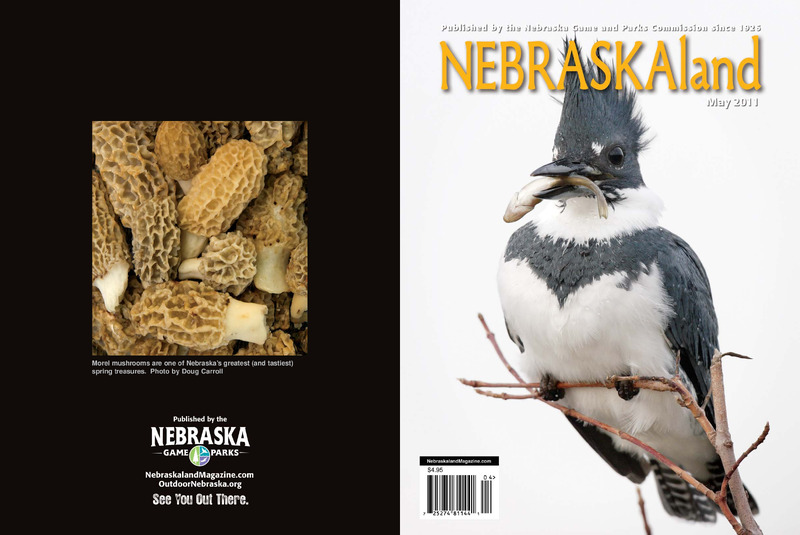
Morel mushrooms are one of Nebraska’s greatest (and tastiest)
spring treasures. Photo by Doug Carroll
Volume 89, Number 4, May 2011
14 Fort Robinson – The Country Club of the Army
Frontier fort, Olympic training ground – Fort Robinson has
a storied past. BY THOMAS R. BUECKER
20 The Plains Topminnow
Plains topminnows are one of many native fish species
struggling to survive. TEXT AND PHOTOS BY MICHAEL FORSBERG
22 A Natural Fit
A Sandhills ranch family discovers a creative way to continue
living on the land they love. TEXT AND PHOTOS BY ERIC FOWLER
30 Postcards from Louisville
A few reasons why this quiet, eastern Nebraska state recreation
area is worth visiting. PHOTOS AND TEXT BY JEFF KURRUS
32 In My Belly – Boat, that is...
Float tubes are an enjoyable and effective way of fishing.
Here’s how to get started. TEXT AND PHOTOS BY JEFF KURRUS
36 Double-decker
Yellow warblers thwart parasitic cowbirds by entombing
eggs. BY JON FARRAR
38 Mountain Mahogany
22
●
This rare but hardy shrub can be found in western Nebraska.
BY GERRY STEINAUER
38
●
40 Belles and Bulls
Shooting big elk isn’t limited to men. BY ERIC FOWLER
Comment . . . . . . . . . . . . . . . . . . . . . . . . . . . . . . . . . 4
Mixed Bag . . . . . . . . . . . . . . . . . . . . . . . . . . . . . . . . 6
Nature Notes . . . . . . . . . . . . . . . . . . . . . . . . . . . . . .44
Outdoor Update . . . . . . . . . . . . . . . . . . . . . . . . . . . .45
Outdoor Business . . . . . . . . . . . . . . . . . . . . . . . . . .46
Outdoor Education . . . . . . . . . . . . . . . . . . . . . . . . .47
Classifieds . . . . . . . . . . . . . . . . . . . . . . . . . . . . . . . 48
Portraits from the Past . . . . . . . . . . . . . . . . . . . . . . 50
14
●
32
●
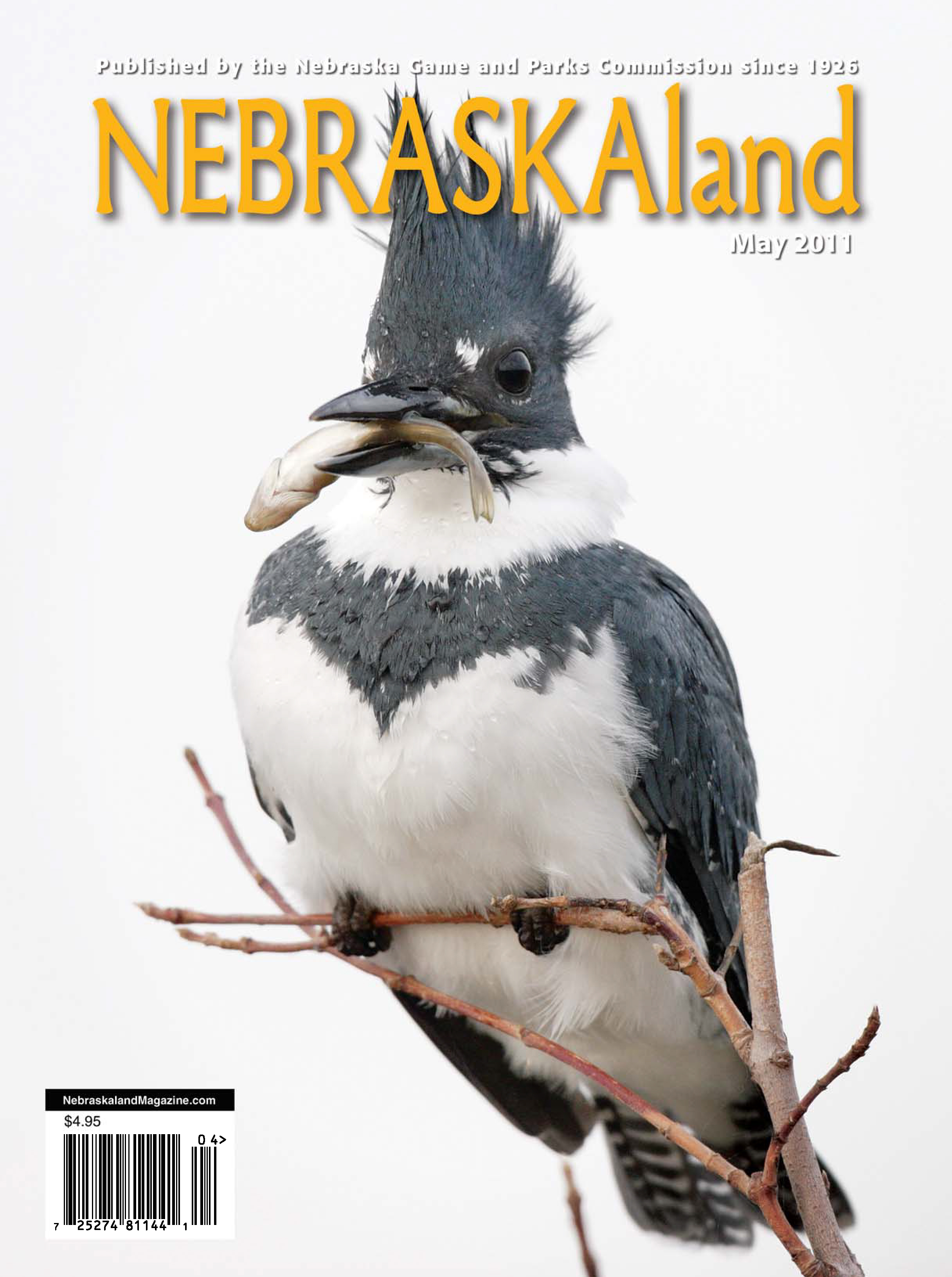
Cover: A belted kingfisher perches on a branch after catching a fish from
the Platte River. Photo by Luke Kathol. Opposite: Dry, windblown sand
highlights footprints of people, deer and shorebirds on a wet Calamus
River sandbar north of Taylor. Photo by Eric Fowler.
NEBRASKAland (VOL. 89 / NO. 4, ISSN 0028-1964) is published monthly, except for the
combined Jan./Feb. and Aug./Sept. issues, by the Nebraska Game and Parks Commission,
2200 N. 33rd St., Lincoln, NE. Periodicals postage paid at Lincoln, Nebraska, and additional
mailing offices. POSTMASTER: Send address changes to NEBRASKAland, P.O. Box 30370,
Lincoln, NE 68503-0370.
MAY 2011 • NEBRASKALAND 3
Fox Photo Op
Last winter during some of the heavier
snows, my wife Marge and I were
forced to walk our dog, a Maltese
named Jasper, at Mahoney Park here in
Lincoln. Generally we walk him along
the bike path just north of Colfax
Avenue (the old Rock Island Railroad
line) but the heavy snows prevented us
from doing that.
Since I got a new camera for
Christmas, I decided to give it a try on
one of our walks in the park. As we
entered the park off of Colfax we
began our usual walk up the Shana
Bike Trail/Walking Path. We were
about 100 yards in when I caught a
movement to my north, just south of
the bike path in the wild prairie section
of the park. It turned out to be a fox, so
I started snapping photos of it. The fox
was 50 to 100 yards away and did not
seem bothered by our presence. It
continued to hunt for food as we
watched. My guess is the fox has gotten
used to people walking the park.
For the next few days we were able to
glimpse the fox on our afternoon walks
and I was able to photograph and video
it on several occasions. We spoke to
some folks who frequent the bike path
and they say the fox has a den close to
the path on the north side, as they see it
occasionally. We are hoping to see the
fox with a litter of pups this spring as
speculation is the fox is female. Hope
you enjoy the pictures.
George Lehr
Lincoln, Nebraska
Flooding Story
I thoroughly enjoyed Eric Fowler's
"The Other Side of Flooding" article
in the April 2011 edition of
NEBRASKAland.
As an owner of land on the Elkhorn
River in Dodge County, I was a firsthand
witness to the events and transformations
Mr. Fowler so accurately described of
the June 2010 flooding – it was if he
4 NEBRASKALAND • MAY 2011
had written the article based on what
he saw on our property. From the
high-bank erosion, to the loss of mature
trees, to the creation of new sandbars,
the article was spot on. I am sure other
folks would concur.
I have been coming to this area of
the Elkhorn for many years, and
Fowler's article reaffirms my long-held
belief that a river is a living, breathing
thing, and nature will change it in ways
man cannot always control. Although
devastating at times, it is also a beautiful
thing.
Damon Ott
South Sioux City, Nebraska
Flashback Identified
The photo on page 6
of the April issue looks
like the Rex Amack
(current director of the
Nebraska Game and
Parks Commission) I
knew when I was in the
Decoy Carver and
Collector club along
with Jack Curran back
in the 1980s.
David Kettleson
Crosslake, Minnesota
Snow Goose Article
Finally, an objective and heartfelt
analysis of the plight of the snow goose.
Jon Farrar's "Sky Carp" piece in the
March 2011 issue of NEBRASKAland
is the first I've seen that focuses directly
on the sad present state of these
magnificent birds. Jon appropriately
provided analysis of the problems
caused by the burgeoning populations
of these birds, while simultaneously
lamenting the denigration of the species
by so many in the waterfowling world.
Like Jon, I've watched and listened
as the majority of waterfowlers seem to
have taken the position that the snow
goose is suddenly expendable and
unworthy of respect. And I fully believe
that widespread position is a direct result
of the loosening of hunting regulations
in an effort to enhance the annual kill,
thus reducing widespread deterioration
of extraordinarily valuable Arctic nesting
grounds.
I certainly don't disagree with the
obvious need to reduce the snow goose
population. However, the means by
which that objective is now pursued has
resulted in the widespread malignment
of a magnificent species, and worse, in
my opinion, a general deterioration of
hunting ethics and respect for wildlife
among too many waterfowlers,
particularly young waterfowlers.
As one who has hunted ducks
and geese for more than 45 years, I
pleasantly recall the time when
"snows and blues" were considered
real trophies. Now I hear and see
them not only verbally maligned, but
irresponsibly slaughtered like vermin,
without regard to the standards of sport
hunting or to the respect due all wild
creatures.
We certainly have a snow goose
population problem. But perhaps
there's a better way to solve it. In the
meantime, thanks to Jon Farrar and
NEBRASKAland for presenting the
issue responsibly. Snow geese are still
the beautiful birds they always were –
worthy of respect and worthy of
respectful hunting practices by those
who pursue them.
Gary Goodpaster
Collierville, Tennessee
NEBRASKAland Visitor Letters
We want to thank all 118 readers
that sent e-mails and letters for last
issue’s visitor, an emerald ash borer
that was on page 21 (see page 13 for
the winner, rules and this issue’s hint).
Here are some of the many wonderful
responses we received:
Hi! I finally found the bug in the
April issue – it's mobbing with the
birds on page 21. I've never run across
one of these bugs before, but based on
some Google searching it appears to be
an “emerald ash borer.” I love your
magazine and I never fail to learn
something new in each issue. Keep up
the great work!
Scott Cooper
Stillwater, Oklahoma
I found the visitor on the top right
on page 21. I had to go through the
magazine twice to find it. This April
issue is so interesting I can't put it
down, when I should be working on
my income tax papers.
Marilyn Brennan
Douglas, Nebraska
Finally, after a year and a half of
looking at each issue, I have found one
of your “Visitors.” The insect is on page
21 in the upper right corner. It's a
beautiful green, but it's name doesn't
come to me. I moved to north-central
Idaho 22 years ago and had missed the
NEBRASKAland I grew up with. My
aunt Retta, the ex-York County
Treasurer, gave me a calendar two years
ago when I visited my mother. All my
friends think I'm a crazy Nebraskan,
but I'm just proud to be from Nebraska.
Dennis Tracy,
Grangeville, Idaho
The emerald ash borer (Agrilius
planipennis) is an exotic, invasive
insect that infests and kills ash trees.
Emerald ash borer (EAB) is not
known to occur in Nebraska, but can
be found in 15 other states, including
parts of Iowa and Missouri. The adult
EAB is a small, narrow, green beetle,
approximately 1/3- to 1/2-inch in length.
It is similar in size and shape to the
native bronze birch borer, a close
relative.
The adult beetles emerge from ash
trees in the late spring and early
summer. They feed on the ash foliage,
mate and lay their eggs in bark
crevices. The eggs hatch and the
larvae immediately begin to eat their
way under the bark, where they feed
in the phloem. Their feeding
disrupts the movement of
water and nutrients
through the tree, eventually
resulting in its death.
– Julie Van Meter,
State Entomologist,
Nebraska Department of Agriculture.
Send your comments to:
Doug Carroll, Editor
NEBRASKAland Magazine
P.O. Box 30370
Lincoln, NE 68503
or e-mail Doug.Carroll@Nebraska.gov
Please include your postal address and
telephone number.
Letters may be condensed and edited
for clarity. Photographs are
welcome and will be returned.
COMMISSION
CONSERV
CONSERVATION OFFICERS
Director Rex Amack
Deputy Director Jim Douglas
Commissioners
Chairman - Mick Jensen, Blair
Vice Chairman - Ron Stave, Waterloo
2nd Vice Chairman - Norris Marshall, Kearney
Jerrod Burke, Curtis
Dr. Mark Pinkerton, Wilber
Dr. Kent Forney, Lincoln
Lynn Berggren, Broken Bow
Rex Fisher, Omaha
Mark Spurgin, Paxton
PANHANDLE
Officer
City
Jim Zimmerman (S) Gering
MAGAZINE
MAGAZINE STAFF
STAFF
Editor Doug Carroll
Associate Editor Jeff Kurrus
Art Director Tim Reigert
Senior Editor Jon Farrar
Regional Editor Eric Fowler
Contributing Editor Michael Forsberg
Regular Contributors Bill Hager, Chris Helzer,
Lisa Knopp
Photo Librarian Sarah Johnson
Circulation Donna Robinson
For address changes and questions about
your subscription, e-mail
Donna.Robinson@Nebraska.gov
or call (800) 632-5263
Marketing/Advertising
For advertising information contact
Larson Enterprises
e-mail dave@larsonent.com
or call (515) 440-2810
NEBRASKAland Magazine Copyright 2011, all rights reserved.
NEBRASKAland is available on audio cassette from the Nebraska
Library Commission Talking Book and Braille Service, Suite 120, 1200 N
St., Lincoln, NE 68508. (800) 742-7691. NEBRASKAland Magazine and
the Nebraska Game and Parks Commission reserve the right to reject any
advertising not in keeping with the agency mission.
Rates: $18 for one year; $33 for two years; $44 for three years. Nebraska
recipients must add appropriate sales tax. To subscribe call
1-800-NEBLAND (632-5263), or go online to:
NebraskalandMagazine.com.
COMMISSION OFFICES
Headquarters
2200 N. 33rd Street Lincoln, NE 68503
Phone (402) 471-0641
District Office I
East Hwy. 2, Box 725 Alliance, NE 69301
Phone (308) 763-2940
District Office II
524 Panzer St., Box 508 Bassett, NE 68714
Phone (402) 684-2921
District Office III
2201 N. 13th St. Norfolk, NE 68701
Phone (402) 370-3374
District Office IV
301 E. State Farm Rd. North Platte, NE 69101
Phone (308) 535-8025
District Office VI
1617 First Ave. Kearney, NE 68847
Phone (308) 865-5310
Omaha Office
1212 Bob Gibson Blvd. Omaha, NE 68108
Phone (402) 595-2144
Ak-Sar-Ben Aquarium
21502 W. Highway 31 Gretna, NE 68028
Phone (402) 332-3901
Scott Brandt
Heath Packett
Nicholas Fix
Dennis Thompson
Frank Miller
Dan Kling
Phone (308)
(office) 763-2940
(cell) 641-6138
Gering
631-0663
Gordon
360-0682
Ogallala
289-0427
Ogallala
289-0755
Valentine (402) 389-0444
Harrison
430-0572
SOUTHWEST
Officer
City
Phone (308)
Roger Thompson (S) N. Platte (office) 535-8025
(cell) 530-3097
Ray Dierking
Brkn. Bow
870-0322
George Sund
Cambridge
655-0028
Michael Thome
Cozad
529-8146
Matt Andrews
Elwood
746-2418
Dirk Greene
Imperial
882-0015
Virgil Gosch
McCook
340-2440
Dudley Sorensen
N. Platte
530-0016
Rich Routh
Rep. City
920-0367
SOUTH-CENTRAL
Officer
Jerry Pecha (Sup.)
Terry Brentzel
Randy Pomplun
Darin Gress
Dale Johnson
Robert Finke
Doug Pollard
City
Phone (308)
Kearney (office) 865-5327
(cell) 293-3551
Doniphan (402) 469-5795
Fullerton
550-0489
Hebron
(402) 768-8665
Kearney
440-3847
Milford
(402) 947-1363
Ord
778-7101
NORTHEAST
Officer
Tom Zimmer (Sup.)
City
Norfolk
Dale Davis
Steve Oberg
Daniel Roberts
Jeff Jones
Jon Reeves
Pat George
Tim Williams
Cory Krause
Phone (402)
(office) 370-3374
(cell) 649-8053
Bassett
760-0712
Columbus
910-3366
Fremont
719-1108
Hartington
762-5022
Kennard
889-8508
O’Neill
340-0787
Neligh
929-0051
West Point
380-6410
SOUTHEAST
Officer
Duane Arp (Sup.)
City
Gretna
Sean McKeehan
William Krause
Mike Luben
Dan Zuehlke
Douglas Kramer
Dina Barta
Stacey Lewton
Levi Krause
Russell Mort
Dan Evasco
Jeff Clauson
Phone (402)
(office) 332-2965
(cell) 521-0194
Ashland
521-0159
Auburn
274-8063
Colon
443-6392
Cortland
806-9084
Lincoln
890-6465
Lincoln
890-6463
Lincoln
890-7140
Louisville
949-0593
Nebr. City
209-1506
Papillion
616-5961
Waterloo
658-7057
ADMINISTRATION
Officer
Ted Blume (Adm.)
Craig Stover (Asst.)
Wes Loos (Asst.)
Rod Loos (Asst.)
City
Lincoln
Lincoln
Lincoln
Ogallala
Phone (402)
471-5531
471-5532
471-5591
(308) 284-8056
Nebraska Wildlife Crimestoppers 1-800-742-7627
Under federal and/or state law, discrimination is prohibited on the basis
of race, color, religion, age, gender, marital status, national origin,
disability or political affiliation. If you think you have been discriminated
against in any program, activity or facility by the Nebraska Game and
Parks Commission or want more information, contact the Commission in
Lincoln, NE, at (402) 471-0641 or the Equal Opportunity Commission,
Lincoln, NE, (402) 471-2024, TTY/TDD (402) 471-4693).
MAY 2011 • NEBRASKALAND 5
PHOTOS BY DAN FOGELL
Night Songs
Dan Fogell
It isn’t just the birds that
fill the air with songs every
spring. Spring is the season
that frogs and toads give a
nocturnal vocal performance
rivaling that of their daytime
avian counterparts. Every
available pool of water
seems to be a stage for this
after-dark glee club. Large
crowds of males hoping for
the opportunity to mate
Gray treefrog
gather in ponds, marshes,
whistling and humming at the same
and even roadside ditches to serenade
females. Peeps, chirps, trills, and croaks time, while Woodhouse’s toads cry out
a loud WAAAAAAAHH like a baby
fill the evening air, and the louder the
crying for a bottle. Blanchard’s cricket
song, the more likely the amphibian
frogs sing in May as well, making a
crooners are to pass on their genes to
rik-rik-rik sound comparable to a
the next generation.
Eleven species of frogs and toads call couple of pebbles banging against each
other. The next three frogs, like Gene
Nebraska home, each with its own
unique song and performance schedule. Kelly, prefer to sing in the rain. The
Great Plains narrowmouth toad has a
The annual concert opens up with the
high-pitched WAAAAAAH song that
boreal chorus frogs in very early
sounds like a bleating lamb. Plains
spring, usually sometime around the
spadefoots have a loud, baritone song
end of March. These tiny frogs have
of repeating WAAH…WAAH…
a big voice that sounds like fingers
WAAHs that can be heard up to a mile
running across the teeth of a comb.
away. And on the rainiest of nights,
Next up are two leopard frogs – the
Great Plains toads belt out a metallic
northern leopard frog making its long,
ratta-ratta-ratta tune that sounds like a
snoring sound followed by a few short
croaks, and the plains leopard frog with riveter. Gray treefrogs sometimes sing
a series of chuck-chuck-chucks followed from their arboreal roosts sounding like
night-time warblers with a short, highby the same croaks. A couple of toads
pitched trill. And finally, that last song
take the stage in late-April and May.
before the amphibian curtain comes
American toads ring out a long,
down for the year belongs to the
musical trill that sounds like they’re
bullfrog. Their indisputable, throaty, jug-orum ballad is a sure sign
that summer has arrived.
Frogs and toads end
their performances just in
time for the next cast of
vocalists – insects such as
cicadas, katydids and
crickets – to take the
stage during midsummer.
But they leave behind a
legacy ... thousands of
tadpoles that will help
ensure that the amphibian
choral society will return
next year and for years to
come.
American toad
6 NEBRASKALAND • MAY 2011
Here is a list of
upcoming outdoor
events across
Nebraska.
For more
information
about
these and
other events, click on
the calendar at
www.OutdoorNebraska.org.
April 30
• Living History Days – Fort Atkinson
State Historical Park
Each weekend from April-October.
Contact: John Slader
402-468-5611
ngpc.fort.atkinson@nebraska.gov
April 30
• Arbor Day Commemorative Tree
Planting – Arbor Lodge SHP
Contact: Arbor Lodge SHP
402-873-7222
ngpc.arbor.lodge@nebraska.gov
May 4
• Family Fishing Night –
Scottsbluff/Gering Area
Bring the family and learn to fish at
Terry’s Pit from 6-8 p.m.
May 21
• Free Fishing and Park Entry Day –
Statewide
Fish anywhere in the state or visit
any state park or state recreation area
for free. For information about specific
events offered on this day, see ad on
inside back cover of this issue.
May 28
• Niobrara State Park Buffalo Cookout
Enjoy an evening of food and
entertainment at Niobrara State Park's
Group Lodge. The cookout begins at
6 p.m., all you can eat, cost is $9 for
adults and $6 for children. A free
educational program will follow the
cookout. Tickets must be purchased
by noon on the day of the cookout.
Contact: Niobrara State Park
402-857-3373
ngpc.niobrara@nebraska.gov
June 4-5
• Rock Creek Trail Days – Rock Creek
Station State Historical Park
Buffalo Stew Cookout and Program,
$9 for adults and $6 for children ages
13 and under.
Contact: Rock Creek Station SHP
402-729-5777
ngpc.rock.creek.station@nebraska.gov
Nebraska Waters at Risk from Asian Carp
Jeff Kurrus
8 NEBRASKALAND • MAY 2011
Nebland Flashbacks
ILLUSTRATION BY JOE TOMELLERI
Last month I made a plea for
Roger Welsch to write more for
NEBRASKAland Magazine.
However, in this request I dropped
the “c” from his last name, probably
alienating me even more from
Roger. This month, I will attempt
to convey this same message to
former NEBRASKAland regional
editor Rocky Hoffmann (two n’s, I
got it), whose work is missed
since he stopped writing for the
magazine.
But what I didn’t fully realize at
the time was how far Hoffmann’s
knowledge about outdoor topics
went. Not until I, in a fit of
narcissism, decided to find out
what was being written about in
NEBRASKAland in May of 1994,
the month I graduated high
school.
That month, Hoffmann was
writing about Rock Creek SRA and
“Belly Boats.” The curious part of
Hoffmann’s latter article is that
this month I have my own version
of a belly boat article, complete
with my own list of advantages for
fishing from these vessels much
like my former colleague’s.
It is simply another reminder
that while I was still asking for
gas money from Mom, this
NEBRASKAland writer was
already writing about more
subjects than I could ever cover
in a lifetime.
To read more about “Belly Boats”
visit NebraskalandMagazine.com
and click on “A Look Back.”
Elizabeth Mack
Asian carp were introduced into the U.S. from Asia in the 1970s to control
phytoplankton in lakes, but they eventually made their way into natural waters –
with disastrous results. If not carefully managed, the carp can spread at a lightning
pace and, according to fisheries biologists, are now in Nebraska waters. Fish
sampling conducted last year from the Loup Power Canal below the Columbus
power plant show Asian carp to be one of the most abundant species.
Native species often are negatively impacted once Asian carp are introduced
into their waterways, with channel catfish, walleye, bass and crappie the most
affected. Once waterways are invaded with Asian carp, they will compete with
native fish for food, as they can consume up to 20 percent of their body weight
daily. They have little value as a food source in the U.S. and, because they feed on
plankton, are almost impossible to catch.
The majority of the Asian carp
Bighead carp
threatening Nebraska are
silver and bighead carp.
Jumping silver carp have
been known to cause
serious injury to boaters,
anglers and skiers who have
been hit by the flying fish, as
the adult fish can weigh
anywhere from 20 to
40 pounds. Bighead carp
usually don’t jump, but
can grow to 100 pounds or
more.
Nebraska and South Dakota
Silver carp
are both concerned about what
will happen if Asian carp continue
to spread. Biologists fear if they get established above Gavin’s Point Dam on
the border of South Dakota, they could then continue up the system towards
Fort Randall Dam in South Dakota and up the Niobrara River towards
Spencer Dam. Once Asian carp infiltrate water systems, they are almost impossible
to control, according to Jeff Schuckman, Commission fisheries biologist for
northeastern Nebraska. “Removal efforts don’t work well, such as netting or
shocking. The only control measures that are successful are keeping them from
infiltrating other areas.”
Young Asian carp look similar to gizzard shad that anglers use for bait, so
moving them out of one area into another can create an infestation with
catastrophic results. Strict regulations are intended to prevent people from moving
the fish around; it’s illegal to release fish in public waters that did not originate in
the same body of water. In addition, baitfish regulations below Gavin’s Point Dam
for both Nebraska and South Dakota prohibit anyone from transporting collected
baitfish outside of this Missouri River area. Gavin’s Point Dam is one area
biologists are keeping their eye on, as Gavin’s Point is a barrier for all those fish.
So far it seems to be working. “We also have education pamphlets for the public
to show them the difference between young Asian carp and gizzard shad. At this
point it’s a big education and regulation effort,” said Schuckman.
The high water on the Missouri River in 2010 created ideal spawning conditions
downstream for bighead and silver carp, and their population exploded.
“They are there to stay,” said Schuckman. “We are not going to be able to
eradicate them, so we’re just going to have to live with the presence of Asian carp,
and educate and regulate where we can to keep people from spreading these things
around.”
It’s something to keep in mind when using live bait for fishing – without the
help of responsible anglers, the situation could quickly become much worse.
This August 1967 issue of NEBRASKAland included a black-footed
ferret in its ongoing “Notes on Nebraska Fauna” feature. Illustrated by
then current staff wildlife artist C. G. “Bud” Pritchard, each focused on one of
Nebraska’s many species of wildlife. The feature later expanded to include
Nebraska flora as well and was illustrated by both former NEBRASKAland artist
Michele Angle Farrar and Nebraska wildlife artist Neal Anderson, a two-time
winner of the Federal Duck Stamp contest.
MAY 2011 • NEBRASKALAND 9
BY DA RYL L. BAU E R
(For the months of May and June)
First off, you can’t go wrong picking a place this
time of the year and fishing because May and
June are the best times to fish for a variety of
species. But if you are going to force me to
choose favorites, I’ll try.
• Catching Numbers - Big Water
I am going to lean on walleyes here at Lake
Minatare in the west. For numbers of fish,
including eating-size walleyes and a shot at
some bigger fish, Minatare walleye fishing
would be hard to beat this year.
I’m going to do a combo here for largemouth
bass. Take a look at Wolf-Wildcat and Burchard
in southeastern Nebraska or Maskenthine,
Buckskin Hills, and Powder Creek in northeastern
Nebraska. If one isn’t producing for you on a
particular day, drive down the road and start
fishing the next. But I doubt you’ll need to do
that.
• Catching Big Fish
Flatheads on the Loup or Tri-county canal system
would be good picks, or how about trolling
some crankbaits for big flatties on reservoirs
like Sherman, Branched Oak or Harlan – yes, I
said trolling crankbaits for flathead catfish. Just
make sure to get those baits down banging on
the bottom. However, with the timing I would
stay with the walleye theme. There may be
some ‘eyes swimming in McConaughy right
now that will challenge our hook & line state
record. Since the water has rebounded, fishing
has gotten tougher at McConaughy, but those
fish are still there and May/June will likely be
one of the best times to catch them. Whitney
and Merritt would be other top picks for some
25-inch+ walleyes this year.
• Trying Something New
Grab a fly rod and target bluegills in shallow
water. This would be one of the periods when a
fly rod may be the best tool for catching
bluegills. I must note that if anglers are cherrypicking the big male ‘gills off their spawning
10 NEBRASKALAND • MAY 2011
• Not Caring What You Catch
Sherman would be a good choice for crappies,
walleyes, flatheads and some white bass too. I
would also suggest the combo trip theme
again. There are parts of the state where a
person has a lot of different options, a lot of
different waters to choose from, and again in
May/June you could fish a different body of
water each day, fish for a different species each
day, and catch fish every day. Merritt is an
excellent multi-species fishery by itself, but if a
person were in that area he or she could also
spend a couple days fishing the Valentine
Refuge lakes or Big Alkali for even more variety.
A day trip east of there also would put a person
on some of our best trout streams (e.g. Long
Pine, Plum Creek). Or, in the North Platte area
a person can be on several reservoirs for
walleyes, white bass, wipers and maybe even
some pike, shift to Interstate lakes for bass and
bluegills, and still be close enough to take
advantage of the Lake Ogallala trout fishery.
Killdeer are probably the most evident shorebird in Nebraska and among the first to
arrive in the spring. Some linger to nest and rear young, others continue north.
Watch Your Step
Jon Farrar
Killdeer nest statewide in Nebraska
and are perhaps our most common, at
least most commonly seen, shorebird.
Like most shorebirds they are usually
found near wetlands, and in the
killdeer’s case a “wetland” may be
anything from the shoreline of
Lake McConaughy to a rain puddle in
a wheat field. More than any other
shorebird that passes through or nests
in Nebraska, they have come to tolerate
the invasion of man and his reshaping
of the landscape. Killdeer might be
found nesting on the graveled rooftops
of commercial buildings in downtown
Omaha, on crushed limestone parking
lots, golf courses or the margins of
graveled roads; so watch where you
step if you see a shorebird that looks
like the one in the photograph. Young
leave the nest as soon as the last egg in
the clutch is hatched, so it is not unusual
to see recently hatched chicks – like
fuzzy marshmallows on stilts – running
down county roads and trail roads.
Killdeer are among the earliest
shorebirds to arrive in Nebraska, often
as early as late-February but more
typically in March. Their nest is a
simple scrape, a shallow depression
just deep enough to keep eggs from
rolling out; often lined with larger
pieces of gravel, weeds or other bits of
debris presumably to make the mottled
eggs better camouflaged. They nest
from early May well into June. The
usual clutch size is four.
• Best Bet
Man, don’t make me pick just one! For
May/June, take as much time off as possible,
travel as much of the state as possible and
F-I-S-H! If I had to pick one, that Merritt/
Valentine refuge lakes combo would be darned
hard to beat. A person could target some big
walleyes and maybe even a muskie on Merritt;
slip over to the refuge lakes and have a blast
catching largemouths and pike, and then find
some huge black crappies and some channel
cats at Big Alkali.
Stay tuned for Bauer’s Dog Day Fishing Spots
in the July edition of NEBRASKAland.
“The best time to fish is when you have time
to fish.” — D.L.B.
Do you know where this
Nebraska photograph
was taken?
See answer at the bottom
of page 13.
Killdeer are particularly adept
executing the “broken-wing display”
where a parent bird holds one or both
wings away from the body, dragging
them on the ground while hopping
away from a predator or intruding
human, a ploy designed to convince the
threatening creature that a bird with a
broken wing is an easier meal than
eggs or young hidden in the grass. Once
the parent has led the threat far enough
away it stops its plaintive calling, pulls
its wings in and flies away.
David Weber of Lincoln doesn’t let
the fact that he prefers traveling on
his motorcycle affect the passion for
fly fishing he advertises in his plate.
He just packs 4- and 5-piece rods
and breathable waders alongside the
rest of his lightweight, compact gear for his moto-camping trips around
Nebraska in search of trout, bass, bluegill and pike. His BMW R1200GS will
get him to any lake he likes.
If you have a unique outdoor message plate you would like to share, or
know someone who does, e-mail a photo (high-resolution, Jpeg format
only, please) of it to Eric.Fowler@Nebraska.gov, along with your name,
hometown, and a brief description of the interests expressed on your
license plate.
MAY 2011 • NEBRASKALAND 11
PHOTO BY JEFF KURRUS
• Catching Numbers - Small Water
beds while doing
this, selective
harvest should be
the order of the day
– turn those big,
parental males loose
and keep a few smaller
males and females for a
meal of fresh bluegill fillets.
PHOTO BY JON FARRAR
See You Out There ...
But Where?
Not long ago a few officers were issued motorcycles and bicycles to be
used for patrol and public relation events such as outdoor expos and other
things that conservation officers do. When I first started riding the bicycle I
had lots of people asking who I worked for and doing a double take as I
rode by in the parks. I handed out citations to some folks who were surprised,
to see me, to say the least. One such group was at Holmes Lake in Lincoln
– I have friends who live on the downstream side of the dam and let me
park my patrol truck in their drive while I patrol the lake via the bicycle.
When I first started my patrol one day I could see three fishermen who
looked like they were fishing for catfish along the dam. I decided to check
them last just because they had a long way to walk back to their cars.
I had pedaled almost all the way around the lake, checking fishing permits
and listening to stories of the big ones that got away, when I realized that
my catfishermen on the dam were packing up. I pulled out my binoculars
and could see that they were hiking to the parking lot, so I jumped on the
bicycle and caught up to them just as they were getting off the hiking trail.
I knew something was wrong by their faces the minute they saw who was
on the bike. I did a long wave from around 50 feet away and nobody waved
back – a nonverbal way of saying “oops.” They had a few fish over their limit,
so after the tickets were written I had five catfish to haul as evidence. At that
point I was wondering how to get the fish to my truck, but as it turned out,
an off-duty Lincoln police officer was fishing and saw the whole thing go
down. He agreed to keep the fish with him until I returned with my truck.
That was good, because my next step was to call Lance Armstrong for an
opinion on biking with fish.
My other story has to do with the motorcycle – I was patrolling Olive Creek
State Recreation Area, where we get lots of calls regarding the illegal take
of bass and bluegill. Fully marked, I ride to a side of the lake where several
folks are fishing. When I pulled up on the motorcycle, just feet from where
they were fishing, several looked up at me. I even heard one ask his friend if
he thought I was a warden. The friend looking right at me replied “No way.”
I just sat on a nearby picnic table and waited a few minutes until I could
tell who was fishing before walking over and asking to see their fish and
fishing permits. Now I have their attention, and the same person who said
“No way” is having one heck of a time getting rid of some illegal-size fish.
It’s a good thing they were bluegill and not catfish like with the bicycle story.
– Stacey Lewton, Conservation Officer, Lincoln
NASP Results
Gabe Collins of Nebraska City and
Roxanne Hyland of Oakland-Craig had
the high overall scores at this year’s
National Archery in the Schools
Program (NASP) state tournament.
Collins led all boys with 276 points
and Hyland led the girls with 271.
The event, held at the Lancaster
Event Center in Lincoln, drew more
than 400 elementary, middle school and
high school archers from 17 schools.
The sixth annual tournament, the
largest youth archery event in the state,
was the culminating event in the state for
NASP, a physical education curriculum
12 NEBRASKALAND • MAY 2011
that has spread across the nation.
The top-scoring seniors, Chris Haase
of Oakland-Craig at 265 points and
Lupe Rodrigues of Nebraska City at
240, each earned a $600 Saunders
Scholarship.
"The enthusiasm, sportsmanship and
courtesy the archers, coaches and
volunteers bring to this tournament
every year is awesome," Match
Director Jim Tubbs said. "Being able
to be part of this tournament from the
beginning, with 165 archers to more
than 400 this year and last, says a lot
about the program."
The state tournament was made
possible by the Nebraska Game and
Top Fishing Equipment Brands
for 2010
North Platte Good Place to Live
• Top rod brand: Shakespeare (12%
of all purchases)
A Nebraska city has been tabbed one
of the best places in the nation to live.
American Cowboy, a western-lifestyle
magazine, recently released its fourth
annual list of “Best Places to Live The
West” and North Platte was one of the
top 20 listed.
“This year’s entries truly live up to
the Western ideal of places embodying
the rugged, free spirit of the Western
version of the American Dream,” said
DeAnna Jarnagin, Associate Publisher
of American Cowboy. “They're places
where you can experience authentic
cowboy culture, spectacular scenery, a
true dose of history and a really, really
good steak.”
Major criteria for selection include
outdoor appeal, historical significance,
regional ranching activity and tourism.
Editors also considered population,
average land price, average household
price, median age and number of western
events held throughout the year.
To check out the complete article
in the April/May issue of American
Cowboy, go online to http://american
cowboy.com/travel/trips/texasoklahoma
great-plains.
Local DU Chapter Recognized
The Burt/Washington County
Chapter of Ducks Unlimited was
recently named one of DU’s Top 100
Chapters list, reserved for chapters that
raise up to $100,000 in grassroots
income for DU’s conservation mission.
The Burt/Washington County
Chapter is one of more than 2,700 DU
chapters nationwide. DU’s grassroots
system has become a model for other
conservation organizations worldwide
and has helped conserve more than
12 million acres of waterfowl habitat.
Southwick Associates’
AnglerSurvey.com announced the
brands and products anglers purchased
most frequently in 2010. This list has
been compiled from the 31,082 internetbased surveys completed by anglers
who volunteered to participate last year
in AnglerSurvey.com polls.
• Top rod and
reel combo brand:
Shakespeare
(23.6% of all purchases)
• Top reel
brand: Shimano
(19.4% of all purchases)
• Top fishing
line producer:
Berkley (12.8% of
all purchases)
• Top hard bait brand: Rapala
(25.7%
of all purchases)
• Top fishing
knife brand: Rapala (22.4% of all
purchases)
• Top soft bait
brand: Zoom (13.3%
of all purchases)
• Top
spinnerbait brand:
Strike King (16.7%
of all purchases)
• Top hook
brand: Eagle
Claw/Lazer Sharp (28% of all
purchases)
• Top sinker
brand: generic
(29.7%), Water Gremlin (12% of all
purchases)
• Top fly rod
brand: LL Bean
(25.6% of all purchases)
• Top fly reels
brand: Orvis
(17.5% of all purchases)
• Top fly combo
brand: Pflueger
(6.5% of all purchases)
• Top fly line brand: Rio (32.1% of
all purchases)
• Top fly leader
brand: Rio (31.2%
of all purchases)
• Top fly tying
material brand:
Wapsi (14% of all
purchases)
• Top fish finder
or sonar brand:
Humminbird (34.7% of all purchases)
• Top tackle box
brand: Plano (45.5%
of all purchases)
• Top landing net
brand: Frabill (33.4%
of all purchases)
Wildcat Hills Nature Camps
The Nebraska Game and Parks
Commission is sponsoring four camps
for children at the Wildcat Hills Nature
Center in western Nebraska this summer.
The camps are: Creepy Crawlies, for
pre-kindergarten children ages 3-5
accompanied by a parent or guardian, on
June 1 from 9-11:30 a.m; Little Bobcats,
for students who just completed
kindergarten and first grade, June 7-8
from 9-11:30 a.m; Wildcat Explorers,
for students who just finished the
second and third grades, June 14-16
from 9 a.m.-noon; and Trees of
Nebraska, for students who just finished
the fourth through sixth grades,
June 28-30 from 9 a.m.-noon.
Advance registration and payment
are required and some camps have
enrollment limits. Registration forms
are available at the nature center,
located south of Gering. For more
information, contact the Wildcat Hills
Nature Center at (308) 436-3777 or
ngpc.wildcat.hills@nebraska.gov.
Turpin Time
Dick Turpin
I don't know how
many times I've
been camping and
I've looked down to
find the grill I want to cook on is a
little bit dirty. Here's a good tip if you
forget that wire brush. Just take some
tin foil ... tear off a batch and get a ball
... oh, maybe the size of a tennis ball or
a softball... something like that, and
just rub off your grill with that. Takes it
right off. So if you forget your wire
brush when you go camping ... use a
small ball of tin foil.
Finding Bald Eagles
If you happen to be out and see a
bald eagle nest or what you think may
be one, please email Commission
bird biologist Joel Jorgensen at
joel.jorgensen@nebraska.gov or call
him at (402) 471-5440. ■
NEBRASKAland Visitor
Winner and Hint
Last issue’s winner of
the NEBRASKAland
Visitor drawing was
George Schneider of
Liberty, Illinois who found the
emerald ash borer on page 21.
Readers are encouraged to contact
NEBRASKAland within 10 days
after this issue’s publication with the
correct page number and name of
this issue’s “Visitor” – a bug found
in Nebraska that just happened to
find its way onto one of the pages of
our publication.
We will then gather the correct
entries and draw one to win a
NEBRASKAland Magazine mug.
To enter each month, write:
NEBRASKAland Visitor
2200 North 33rd Street,
Lincoln, NE 68503.
Or e-mail:
Tim.Reigert@Nebraska.gov
with “Visitor” in the subject line of
the message.
HINT: This issue’s visitor is not on
page 5 or 45.
Snake River in Cherry County
Two-Wheel Patrol
Parks Commission, Nebraska State
Archery Association, Lincoln Prairie
Bowmen Archery Club, Golden Arrow
Archery Club of Omaha, Saunders
Archery and several volunteers.
All top-five individual finishers
qualified for the national tournament,
as well as Lincoln North Star and
Omaha Mater Dei Academy high
school teams and Lincoln Pound’s
middle school and elementary teams.
MAY 2011 • NEBRASKALAND 13
FORT ROBINSON
THE COUNTRY CLUB OF THE ARMY
n the tradition of the United States
Army, the lifestyle and easy-going
reputation found at certain military
posts led veteran servicemen to
informally bestow them with
characteristic nicknames. In Army
circles, training at the elite, yet
challenging, Fort Riley Cavalry School
was commonly known as “the life of
Riley.” In more recent years, the
Presidio of San Francisco, with its
attractive setting and facilities, was
deemed “the country club.” In another
era, this capricious title was also applied
to Fort Robinson in northwestern
Nebraska.
Fort Robinson, established in 1874 to
protect the Red Cloud Indian Agency,
was a key military post during the
Plains Indian wars. In the 1870s it was
the scene of dramatic events, including
the death of Crazy Horse and the tragic
Cheyenne Outbreak. Because of the
conspicuous role it played in the Indian
wars, by the turn of the century Fort
Robinson was known as a famous post
that had secured its place in western
American history.
Fort Robinson, unlike other western
forts, was not abandoned when the
frontier passed but continued on for a
number of years as an active troop
station. With hundreds of soldiers in
garrison, diversions were necessary to
occupy the men during off-duty periods.
Typically those activities included
various forms of outdoor recreation and
sport. Many officers and enlisted men
enjoyed hunting and fishing, and team
sports such as baseball and football were
played and watched with considerable
enthusiasm. But because Fort Robinson
was primarily a cavalry station, horserelated sports such as racing and polo
also drew strong participation and
interest.
All of this changed during World
I
14 NEBRASKALAND • MAY 2011
War I. The acceptance of the tank and
truck notwithstanding, the U. S. Army
still needed lots of horses. No longer
used as a troop station, in 1919 Fort
Robinson became a Quartermaster
Remount Depot. In this new role, men
at the post received, conditioned and
issued horses for the mounted services.
Besides a change in duty, the post also
witnessed a change in appearance:
Many of the older adobe and frame
buildings from the cavalry days were
removed as new stables and horse
handling facilities, newly painted white
with green trim, appeared. In what were
the last decades of the horse cavalry,
the post took on the appearance of a
Kentucky horse farm.
With the advent of automobiles, the
horse gradually became less essential
to mainstream Americans, particularly
the growing urban majority. To many
citizens, riding, jumping and other
equestrian activities were viewed as
recreational, almost elitist pursuits.
Likewise the horse, once an integral
adjunct of the U.S. Army, was
considered almost obsolete by
continuing mechanization. For many
years, however, leisure activities at
Fort Robinson continued to center
around the animal.
Many found duty at the Robinson
Quartermaster Depot a coveted
assignment. With a smaller troop
component, adequate and comfortable
housing was available for both officers
and enlisted men. This, plus the
refreshing western climate, made the
post an exceptionally desirable place to
live. One, perhaps overzealous visitor,
called Fort Robinson a perfect summer
retreat, where the “. . . longing to leave
. . . isn’t simply overpowering.”
As a whole, the Army personnel
stationed at Fort Robinson were
excellent, knowledgeable horsemen.
NEBRASKA STATE HISTORICAL SOCIETY RG1517.PH25-2
By Thomas R. Buecker, Curator, Fort Robinson Museum
As a whole, the Army personnel stationed at Fort
Robinson were excellent, knowledgeable horsemen. As
one officer recalled, the place was “horsey,” where people
seldom discussed anything but horses – a veritable horse
heaven.
— Thomas R. Buecker
Riding to the hounds was a common recreation for officers. By 1933, the pack contained 20 hounds; mostly French staghounds
with some English fox and Welsh hounds. In the absence of foxes, the hounds trailed a coyote skin dragged through the riverbottoms.
MAY 2011 • NEBRASKALAND 15
As one officer recalled, the place was
“horsey,” where people seldom discussed
anything but horses – a veritable horse
heaven. Officers were expected to ride
while conducting their daily duties on
the post and reservation. Upon arrival
at Robinson, horses were issued to
each officer and to all family members
who desired mounts. All of this was
expected at a place where hundreds of
fine horses milled in pastures and there
were sheltered feeding areas and stable
corrals. Some of the finest thoroughbred
horse stock in the country were bred
16 NEBRASKALAND • MAY 2011
and raised there.
During the 1930s, the equestrian
sports of racing, competitive jumping
and other mounted contests were the
standard fare for both officers and
enlisted men. The Army urged officer
participation in all forms of mounted
sports to provide exercise and good
training. For the enlisted men these
sports encouraged and maintained
interest in horsemanship and fostered
unit esprit de corps. Some form of
mounted activity was always available
and Crawford residents and other
NEBRASKA STATE HISTORICAL SOCIETY RG1517.PH45-25
NEBRASKA STATE HISTORICAL SOCIETY RG1517.PH1-23
In addition to regular horse shows and jumping competitions, races around a nearly
two-mile long track were regular events at the fort. Some of the finest thoroughbred
horse stock in the country were bred and raised at Fort Robinson.
civilians regularly came out to watch
and frequently to participate.
In the twentieth century, polo became
the true equestrian sport in this country.
The Army encouraged officers to play
to improve their equestrian skills. As a
result, the sport became popular at
Army posts across the country. Polo
play began at Fort Robinson in 1903,
when the Tenth Cavalry post team
won the department competition and a
number of open championships.
Although polo declined at Fort
Robinson after 1910, interest in the
sport was revived in the 1920s. The
post team played Army teams from
Fort Meade, South Dakota; Fort
Warren, Wyoming; Fort Logan,
Colorado; and civilian teams from
Denver, Colorado Springs and Hot
Springs, South Dakota. At times,
officers from affluent families brought
their own polo ponies with them when
assigned to Fort Robinson. Polo,
however, was a gentlemen’s game,
requiring careful observation of rules
and consideration for safety of the
players – it might not have been
altogether popular in the enlisted
ranks. Perhaps the post newspaper
correspondent summed it up best when
he wrote: “Can it be that the reason
enlisted men don’t go in for polo is it’s
a game with too much horse play?”
Along with polo, the Army saw the
benefits of participation in hunt club
activities. Riding to the hounds was
seen as “bold riding,” giving officers
experience in cross-country travel. With
the arrival of Major Edwin Hardy as
post commander in 1932, the Soldier
Creek Hunt Club was organized.
Hardy, an avid rider and outdoorsman,
was master of the hunt. Two other
officers with short-handled whips
served as whippers-in to keep the
hounds on the scent. By 1933, the
Fort Robinson pack contained 20
hounds; mostly French staghounds
augmented with English fox and
Welsh hounds. The pack was officially
recognized by the Masters of
Foxhounds Association of America.
Due to the lack of foxes in the post
vicinity, Hardy’s hunts were “drag
hunts.” The trail of a pursued animal
was simulated by dragging a coyote
Polo was a popular equestrian sport in the early 1900s. The Army encouraged officers to play and improve their horsemanship.
hide through the creek and riverbottoms
near the post and the dogs would follow
the scent. Biweekly hunts were held on
Wednesday and Sunday mornings, with
hunt club membership open to post and
local residents. The hunts often ended
at the Wood Reserve (today’s Soldier
Creek Wilderness Area) cabin west of
the fort, where breakfast was served to
all riders.
As could be expected, horse shows
and competitions became an important
facet of Fort Robinson life. After World
War I, American officers followed the
European lead where exhibition style,
off-road riding and jumping were
predominate sports of Army officers.
By 1930, post horse shows became
regular features on the Fort Robinson
calendar. Besides providing excellent
training and a boost to post morale,
horse shows attracted hundreds of
spectators to view the work of the
remount service.
Such shows were frequently held in
conjunction with “Quartermaster Day,”
the annual celebration of the
establishment of the Quartermaster
Corps. “Gymkhana,” or mounted
games, where the enlisted men competed
in mounted wrestling, relay races, and
musical chairs, were always on the
program. Equestrian skills were
demonstrated in the mounted potato
race, where men used pointed poles to
pick potatoes from one bucket and race
50 yards to deposit them in a second.
The main features were the jumping
events. Open jumping required two
circuits around a course with four
jumps, each three-and-one-half feet
high. Competitive classes were held for
both male and female riders. Hunterjumper classes were added in 1937,
and later shows brought classes for
wrangling horses and cow ponies.
Businesses in Crawford often closed
during the exhibitions and private horses
were accommodated free of charge at
the post for civilian participants.
Besides horse shows and hunts,
recreational riding was popular. With
the rise of automobile travel, horseback
riding for most Americans largely
became recreational. The rugged buttes
around the post made riding exciting
and aesthetically pleasing. In 1932,
riding classes began to better prepare
the enlisted men to perform their
remount duties. Sensing an interest,
Major Hardy organized a ladies riding
class, to teach both how to ride crosscountry and make moderate jumps.
During the remount period, one social
institution common to all Army posts
also existed at Fort Robinson: A favorite
off-duty hangout that contributed to the
post’s “country club” lifestyle was the
officer’s club, the exclusive, private club
for officers and their guests. Housed in
the former commanding officers quarters,
it was the scene of parties, dinners and
other social activities. Two annual
events keenly followed by radio at the
club were the running of the Kentucky
Derby and the Army-Navy football
game. Derby day saw considerable
wagering among the officers, some
receiving inside information “from
officers who knew prominent horses
of Thoroughbred racing.”
MAY 2011 • NEBRASKALAND 17
NEBRASKA STATE HISTORICAL SOCIETY RG1517.PH75-4
An officer’s cabin was built on the fort’s Wood Reserve in 1934, complete with a large
living room, guest bedrooms, sleeping porch and Spanish balcony.
A favorite equestrian event held at the fort was jumping competitions, requiring two
circuits around a course with four, 31/2-feet-high jumps.
guest of post commander Major
Sumner Williams on breaks from his
Mt. Rushmore project. Another frequent
visitor was Pierre Lorillard, head of the
Lorillard Tobacco Company. Lorillard,
a knowledgeable horseman, was also a
reserve colonel in the Quartermaster
Corps and put in part of his annual
active duty time at Robinson.
The epitome of success for Fort
Robinson as a world horse center came
in 1935. The year before, Captain
William Bradford, captain of the
United States Olympic Equestrian
Team, visited Fort Robinson. Hosted
by Major Hardy, Bradford was
impressed with both the pleasant
climate and the facilities found at the
post. In June 1935, the U.S. equestrian
team came to Fort Robinson to train for
the 1936 Berlin games. Fort Robinson
was in the national spotlight, as the
best of America’s horsemen and horses
rode and jumped there. Fort Robinson
reached its zenith as an equestrian
center as thousands attended special
exhibitions put on by team members.
Unfortunately, the team only won one
medal at the 1936 games.
After Berlin, summer Olympic
training at Fort Robinson continued
for the next three seasons. As the
1939 session ended, however, war
clouds appeared in Europe and there
was no 1940 Olympic Games. During
World War II, the Army dismounted its
cavalry branch, effectively removing a
key mission of Fort Robinson. Work
with pack mules and K-9 war dogs
replaced much of the horse activity.
Although the world of fine horses and
easy lifestyle briefly returned after
war’s end, the days of the country club
were over, as well as the fort’s use as a
remount center. In 1948 the old post
was abandoned by the Army,
eventually to become Nebraska’s
largest state park.
In its last several decades as an
Army post, the mission and lifestyle at
Fort Robinson dramatically changed
from its turbulent beginnings during the
Plains Indian War. Ironically, in an era
when Fort Robinson became a “country
club,” horse use by the Army was in
an inevitable decline. As such,
Fort Robinson remained one of the last
NEBRASKA STATE HISTORICAL SOCIETY RG3132.PH0-36
18 NEBRASKALAND • MAY 2011
pool, costing $5,000, was also opened,
and although it had no shower or
dressing facilities, proved a welcomed
recreational addition. Additionally, a
skeet range was built, as trap shooting
became a popular pastime. With a
variety of recreational outlets available,
life at Fort Robinson in the 1930s stood
in sharp contrast to the frontier post of
50 years earlier.
Because of its small garrison and
non-combat mission, an easy-going,
casual lifestyle developed at Fort
Robinson. To outsiders, it might appear
like a military post, but for soldiers
stationed there, it did not seem like a
regular Army post. The relationship
between officers and enlisted men was
NEBRASKA STATE HISTORICAL SOCIETY RG2721.PH1-4
In 1934 an impressive officer’s cabin
was built from logs on the post Wood
Reserve. Complete with a large living
room, guest bedrooms, sleeping porch
and Spanish balcony, it became a
popular retreat for post officers and
visiting dignitaries. A small swimming
pool, light plant and stable with quarters
for attendants, completed the complex.
Constructed as a Civil Works
Administration project, the officer’s
cabin was the scene of countless parties
and barbecues.
Fort Robinson was also a desired
station for the enlisted ranks. Officially
the post provided an excellent place for
enlisted men inclined toward animal
husbandry, but other perks came with
duty there. With a small number of
officers on staff, noncommissioned
officers were housed in vacant officers’
quarters. The soldiers had their own
on-post social outlets with the enlisted
men’s and N.C.O. clubs. They also had
their own recreational cabin in the
Wood Reserve and participated in local
league sports through the Fort
Robinson Athletic Association, in
addition to the aforementioned
equestrian competitions.
Other “club-type” amenities were
available and popular. In the 1920s, a
nine-hole golf course was laid out north
of the main post. By the mid-1930s,
new concrete tennis courts were built
for the officers and their families with a
new court near the barracks added for
the enlisted men. A concrete swimming
more informal than that found at larger
posts where combat soldiers were
stationed. Less emphasis was put
on military bearing and uniform
appearance. Even the enlisted men’s
mess hall looked more like a fancy
restaurant than a mess hall.
This country club lifestyle and
associated amenities made Fort
Robinson an irresistible rest area for
Army chiefs of staff, Washington
politicians – even for some celebrities
of the day. Major General Charles P.
Summerall made stops at the post to
fish and ride in the hills during his term
as chief of staff. In 1936, Colonel J.J.
Johnson, the chief of Remount, spent a
month at the officers’ cabin. Likewise,
quartermaster generals and chiefs of
the cavalry and artillery branches
enjoyed the social life and pleasant
atmosphere at the post. General
Johnson Hagood, the Seventh Corps
commander, spent much of his time at
the fort fishing. During this period,
reservation waterways were stocked by
the federal Bureau of Fisheries, which
operated a hatchery at Crawford.
Additionally, the Army created ponds
on Cherry and Soldier creeks that were
periodically stocked with bass and
trout. On a 1935 Thanksgiving Day
outing, three officers reportedly caught
120 trout in three hours.
Prominent civilian visitors during the
1930s included sculptor Gutzon
Borglum, who came to the post as a
Fort Robinson was also a desired post for enlisted men during the early 1900s.
Like the officers, much of their Army life and recreational time revolved around horses.
vestiges of the “old Army” between the
wars, before the Army bid farewell to
the horse. Today, many of the same
types of recreational activities found
when Fort Robinson was called
“The Country Club of the Army” are
available to park visitors. In this sense,
a proud tradition of the old Army
continues. ■
While not quite the equestrian hotbed
it once was, Fort Robinson is still a
horse lover's paradise. Encompassing
some 22,000 acres with many miles of
trails and fire service roads to ride,
Fort Robinson State Park even offers
a nice campground dedicated to
horse owners, complete with newly
remodeled horse barns and stalls that
can be rented by the night (you’ll need
to bring your own feed and hay). Don’t
own a horse? Not a problem – the park
offers trail rides from Memorial Day
weekend through Labor Day weekend
using its own string of horses. For
more information call the park at
(308) 665-2900 or e-mail
ngpc.fort.robinson@nebraska.gov.
MAY 2011 • NEBRASKALAND 19
The
Plains Topminnow
Text and photos by Michael Forsberg
ry Creek, a small groundwater-fed stream in
the Nebraska Sandhills, belies its name. Dry
Creek quietly drains a watershed of rumpled
hills north of Burwell before emptying into the
northeast end of Calamus Reservoir.
Last June I sat hunched over on a hunter’s stool, knee deep
among fallen logs in its cool waters and shading my eyes from
the noonday sun as I tried to photograph the plains topminnow
(Fundulus sciadicus), a native fish with an uncertain future
that is about the size of a pen cap and is endemic to the
Great Plains. My photography tools included a widebrimmed hat, wading shoes, polarized sunglasses and an
underwater point-and-shoot camera with remote flash. I
looked like I was going to the beach.
The plains topminnow is 1½ to 2½ inches long and is
rather plain looking at first glance – olive brown in color
with bronze reflections and faint blue-green crosshatching.
But during spawning in early summer, the males color up to
a beautiful orangish-red. Topminnows feed near the surface
and aquatic insects make up an important part of their diet.
They prefer clear cool water, quiet pools and shallow
slackwater areas with little noticeable current along rivers
and streams.
D
Plains topminnows forage near flooded timber in Dry Creek near Burwell. Endemic to the Great Plains,
topminnows are one of several native fish species whose populations are shrinking.
Slackwater areas such as this one along Dry Creek provide quality habitat for
the plains topminnow.
20 NEBRASKALAND • MAY 2011
Dry Creek is an important habitat for this
fish, which once ranged through much of
Nebraska’s river systems and the central
Plains states. The largest distribution of the
minnow is centered in Nebraska. The state
holds roughly two-thirds of the historic
plains topminnow records dating from the
late-1930s, yet based on recent sampling
efforts in the last decade, only about a
third of these historic locations still hold
topminnows today.
The plains topminnow represents the
struggles of an increasing number of native
fish species in the Great Plains whose range
and populations are shrinking. Alteration of
habitat and flow regimes through dams and water diversion
construction, water pollution from agricultural runoff, and
the spread of exotic species such as the western mosquitofish
(Gambusia affinis), which can outcompete native minnows,
pose great challenges for their survival.
Today, Nebraska Game and Parks Commission biologists
and University of Nebraska – Kearney researchers are
studying the species to update the minnows’ range,
population trends and learn more about their life history.
Topminnows collected from source areas such as Dry Creek
have been developed into broodstock and are being released
in both key historic locations and new areas in efforts to help
restore populations.
The first two days of photography yielded few results
other than a sunburn and being the center of attention for a
herd of cattle coming in to drink. But around high noon on
the third day, as puffball-shaped clouds raced overhead, the
tea-stained water started to flash as if there were small
mirrors reflecting light from beneath. The topminnows had
moved in.
They were feeding along the submerged base of a log
heavy with vegetation next to my feet. Each time they turned
in the water their scales shimmered in the sunlight before
they retreated back into the shadows. I lowered the camera
gently into the water and finally, a band of these tiny little
fish swam through the frame and into the light of day. ■
To see more of Mike Forsberg’s images, visit his web site
and online gallery at www.MichaelForsberg.com.
MAY 2011 • NEBRASKALAND 21
A Natural Fit
Tourism Now Part of Family Ranch
Text and photos by Eric Fowler
A Sandhills family discovers that marketing the
natural resources on their ranch makes it possible for the entire family to continue living on
the land they love.
T
hrough the ups and downs that are cut hay and raise a few crops. They
owned nature. And people would pay
inherent to the farming and
to experience it.
ranching business, it can be tough
to support one family, much less two.
Work more ground, or work the ground
you have harder, is often the
only way to make ends
Bruce and Sue Ann
meet.
Switzer raised their
So what happens
children, Adam and
when the kids
Sarah, on the same
decide they don’t
land that Sue
Ann’s great
want to follow
grandfather,
their classmates
Alfred
to the big city
in search of
Scherzberg,
bigger and
claimed and
better things?
homesteaded
The kids that
under the
want to stay
Kincaid Act in
home and
1904. Adam
continue the
didn’t really
family’s legacy
want to leave
on the land,
home when he
and do it now,
graduated from
rather than
high school in
waiting until the
Taylor in 1992,
folks retire?
but at the time the
Here’s a story
cattle business was
about one Nebraska
bleak and the grass
family, the Switzers,
could only handle
who figured out how to
enough cows to support
make it all work on their ranch
one family.
northwest of
“He never wanted
Upland sandpipers will benefit from
Burwell. Not only
to
leave home, but
grassland work on the Switzer ranch.
did one of the
agriculture wasn’t in
Switzer kids come home, both did. And a very pretty state at that time and he
they were able to do so without adding
knew Sue Ann and I were just barely
an acre of land or head of stock. What
making it,” said Bruce. “We encouraged
they found is their land had much more him to go on and get a job because
to offer than just a place to graze cattle, things were so sour.”
Coming Home
22 NEBRASKALAND • MAY 2011
Sarah Sortum and her guests enjoy a hilltop view of the Switzer ranch during a jeep tour, an idea she got after taking an African safari.
Calamus Outfitters received the 2010 Outstanding Nature Tourism Award from the Nebraska Department of Economic Development.
So Adam headed off to a technical
school for two years and then worked
construction, traveling to jobs here and
there, living in motels during the week,
then coming back to the ranch, where
he had a little farmhouse of his own to
call home, on weekends. Often he’d
wake to find deer or turkeys in his
yard, something he never saw from his
motel window. One of those mornings
in 2000, he decided he’d had enough.
“I got to get out a little bit,” Adam
said of his time away from home. “But I
was just tired of taking orders. I finally
just decided to come home, whether
[Dad] liked it or not. This is where I
wanted to be, on the ranch.”
One of Adam’s last construction jobs
was building a high fence to contain
elk for a pay-to-hunt operation. That
planted the seed for an idea he thought
could provide the ways and means to
stay home: start an outfitting business,
but without the fences. He talked the
idea over with his parents and they
weighed it against how much grass and
how many cows it would take for him
to make a living. “I said, ‘Adam, we
know what the cows will do for us,’”
Bruce said, alluding to the financial
uncertainty that was part of ranching.
“‘Go for it.’”
So Adam began marketing his new
endeavor, Calamus Outfitters, and
remodeling the ranch house that had
belonged to Sue Ann’s late brother.
That house, across the driveway from
his parents’, would be the lodge where
the deer, turkey and pheasant hunters
who had filled Adam’s calendar for the
upcoming seasons in the fall of 2001
would stay. Then the day that changed
everything for so many in this country
happened – September 11. “They all
cancelled,” Adam said. “They couldn’t
fly with guns, and some didn’t feel
comfortable leaving home.”
Their startup plan turned on its ear,
the Switzers scrambled to find another
customer base to get them to the next
fall. They devised a plan to offer tanking, tubing and canoeing trips down the
Calamus River and began marketing
their lodge to anglers using Calamus
Reservoir, just across the road.
They soon found their lodge, with
room for 20 in five bedrooms, five
baths, a kitchen and great room, was
just what families were yearning for.
“After 9/11, everybody started to do stuff
★
Calamus Outfitters is located 16 miles
northwest of Burwell on Highway 96.
For more information, go to
CalamusOutfitters.com.
MAY 2011 • NEBRASKALAND 23
Dave Christensen of McPherson, Kansas, searches for deer with Adam Switzer in the hills
north of Calamus Reservoir during muzzleloader season last December. Guided deer
hunts are so popular that the Switzers hire another guide to help handle all their clients.
more as a family across the country,”
Sue Ann said. “They stayed close to
home and they did stuff together all of
a sudden. And here we were, we had
the facility already set up. There it was,
ready for the whole family. It was just
an accident, probably.”
The lodge proved to be so popular
that the Switzers went to work on two
school houses Sue Ann’s brother had
moved from the river to the property
when the reservoir was built. Joining
them together, they had another
five-bedroom cabin open in 2003. “And
gosh, we were still turning people
away,” Sue Ann said. “We didn’t even
have to advertise. They were just here.”
Four small, pre-built cabins were
added in 2004. The summer business,
including lodging, river trips and
horseback rides, was packed. So was
Adam’s hunt calendar, with folks
coming from across the state and
country to hunt white-tailed and mule
deer, pheasants, waterfowl and turkeys.
Business was booming, and then another
opportunity presented itself.
A contingent from the National
Audubon Society’s Rowe Sanctuary
and state tourism officials paid a visit
to Calamus Outfitters in 2004. Tens of
thousands of people visited Rowe and
other spots along the Platte River each
spring to watch the sandhill crane
migration, but some of those folks
would surely be interested in other
birdwatching opportunites nearby, they
24 NEBRASKALAND • MAY 2011
said – why don’t you offer birders the
opportunity to watch prairie chickens
boom and sharp-tailed grouse dance on
their mating grounds?
Bruce, a prototypical Sandhills
cowboy right down to the boots,
Stetson and handlebar moustache,
found it hard to believe people would
pay to see the courtship rituals of the
two species of prairie grouse they had
on their ranch. “I knew they were there
and I did enjoy hearing them, but I
never sat down and watched them,” he
said. “I never took the time.”
But in the spring of 2005, with help
from the folks at Rowe and using the
same school buses they used to ferry
tankers and tubers to and from the river
as photo blinds, they began offering
guided tours to chicken and sharptail
leks. And just like Adam’s hunts, what
started small has grown each spring
and drawn people from around the
country, often with Bruce as their
guide.
“I was skeptical, but I was sure
wrong,” Bruce said. “They made us
aware that we have something. I really
enjoy it. It raised my awareness on
other birds, on all birds, especially
grassland birds.”
Another Homecoming
Grouse viewing was the first move
Switzers made toward catering to
birdwatchers and others simply looking
Matt and Wendy Sheffield and their children, Lainey, Sophie and Sawyer, float the Calamus River through the Switzer Ranch in a horse tank.
for opportunities to explore new
landscapes. Their daughter’s decison to
move home was the second.
Like Adam, Sarah headed off to
college after high school and then to
work elsewhere, but really wanted to
come home. In the fall of 2006, while
working on the management team of a
guest ranch in Steamboat Springs,
Colorado, with her husband, Mark
Sortum, they decided to do just that. At
the time, neither one of them had a job
lined up, but knowing the ranch and
outfitting business could provide at
least part-time work for Sarah made the
move possible. “We were going to
figure out the rest later. It was a real
smart decision,” Sarah said, with a hint
of both sarcasm and truthfulness.
Mark landed a job as a high school
science teacher in Sargent. Sarah began
looking for new and innovative ways to
manage the family’s land to benefit both
the ranch and the outfitting business.
The interest in birds led to the
realization that some native grassland
bird species that called the Switzer’s
and neighboring ranches home were in
decline. Which led to the realization
that their land, while in relatively good
shape, was not as healthy as it could
be. “If your end result is for the
species, well, it’s their habitat that
needs to be there,” Sarah said.
So the family looked at their grazing
rotations to see if things could be
changed to improve the diversity and
health of their grassland, and they
began to address the number one threat
to those grasslands: the spread of
eastern red cedars. Sarah and Adam
saw the need to use prescribed fire to
control cedars and improve grassland
health, but it took a year to sell their
parents on the idea. Not only did they
have to help them overcome the fear of
fire many people have, they had to
convince them of the need to not graze
the pasture they wanted to burn for a
year. Leaving grass to burn instead of
letting cows eat it is a foreign concept to
most long-time ranchers, but it doesn’t
mean you have to graze fewer cattle:
“When you look at this from a bird’s
point of view, if you leave one patch of
grass, well, you can graze another
The day after the Switzers conducted their first prescribed burn, it was business as
usual for meadowlarks (pictured) and other grassland birds, including sharp-tailed
grouse that danced on their burned lek.
patch of grass heavier than you usually
would because there are also birds that
like that short grass,” she said.
When they finally conducted their
first burn last spring, the wind quickly
took the backfire over the fire break
and they ended up burning the adjacent
pasture and many of the cedar trees in
it, not the one they had intended to.
Despite that, Adam and Sarah planned
MAY 2011 • NEBRASKALAND 25
Steve and Dana Coleman of Ossining, New York, watch a prairie chicken lek with Bruce Switzer. The Colemans’ main reason for
visiting Nebraska was to cross the sandhill crane migration off their life list, but found out about Calamus Outfitters when they were
planning their trip and added it to their itinerary. “It’s just as amazing as a National Geographic special,” said Dana.
on burning again this spring and their
parents, who saw how quickly the
pasture recovered and how good it
looked once it did, even while letting
cattle graze it, supported them. “It didn’t
kill a lot of the bigger [cedar] trees, but
it must have killed a million of them
that were a foot tall,” Adam said.
Many of those bigger trees died
anyway last fall when the Switzers
partnered with a neighbor to rent a tree
shear. But there are more pastures with
cedars to clear. Along with two
neighbors, the Morgans and Prices,
they have formed the Gracie Creek
Landowner’s Association and are
developing plans to integrate
conservation measures into their
A hot breakfast is standard for birdwatchers and hunters at Calamus Outfitters, which
will also provide a home-cooked dinner to hunters and other guests upon request.
26 NEBRASKALAND • MAY 2011
operations to improve the grassland on
the 50,000 acres they share that are
now part of the Greater Gracie Creek
Landscape Important Bird Area (IBA).
That IBA project is part of an
international effort led by the National
Audubon Society to identify the areas
that are most important for maintaining
bird populations and to focus
conservation efforts on protecting these
sites. Biologists identified 26 such sites
in Nebraska, but the Gracie Creek IBA
is the only one on private land.
Surveys have identified 215 bird
species in the Gracie Creek IBA,
including long-billed curlew, upland
sandpiper, burrowing owl, grasshopper
sparrow, bobolink, swainson’s hawk,
loggerhead shrike, lark bunting and
bald eagle. Last year, Sarah organized
volunteers that fanned out and found 27
prairie chicken and sharp-tailed grouse
leks while covering just half of the
three ranches. She hoped a similar
effort would cover the other half this
spring, and looks forward to comparing
this baseline data to future surveys that
follow conservation efforts.
“We’re interested in seeing if those
numbers change over time,” she said.
A grant from the Nebraska
Environmental Trust that received
preliminary approval in early 2011
could help speed conservation planning
and work in the IBA, and expand it to
include another 50,000 acres in the
upper reaches of the Gracie Creek
watershed. The effort doesn’t focus
only on grass and birds – the three
ranches are also managing for blowout
penstemon, a state endangered species.
That includes having University of
Nebraska-Lincoln researchers
reintroduce the plant to blowouts on
their land, and developing grazing
systems that encourage blowouts. The
health of Gracie Creek is also a
concern – the installation of center
pivots and drainage tile in the upper
reaches of the stream changed its
hydrology, speeding its flow and
causing downcutting of the stream in
the lower section, affecting hay
meadows there. “That stream didn’t
spread out like it used to,” Sarah said.
“It just got in that channel and went
right on down, really fast.”
With the help of the Sandhills Task
Force, wiers were installed in recent
years to slow the stream, but landowners
from across the watershed have begun
discussions with a hydrologist on what
more could be done.
Nebraska’s “Africa”
The IBA designation has drawn more
attention and business to Calamus
Outfitters. So too has an offshoot that
began in 2009: the designation of most
of the ranch as the Switzer Ranch and
Nature Preserve. That idea grew from
a trip that Sarah and Bruce took to
Namibia on the southwest coast of
Africa that same year that was
sponsored by the World Wildlife Fund
and the Grassland Foundation, a
non-profit foundation based in Lincoln
working to advance the creation of
protected grasslands while looking for
innovative ways to improve the
well-being of people who live on the
Great Plains.
Namibia has developed a burgeoning,
nature-based ecotourism business.
People come from around the world to
see its vast, unspoiled and, in many
places, unfenced landscape and
abundant wildlife. Realizing that
The Switzers use school busses as viewing blinds on both prairie chicken (pictured)
and sharp-tailed grouse leks. “The prairie chickens never disappoint,” said Bruce.
expenses often outweighed revenue,
ranchers there discovered they could
supplement their income nicely by
conserving, promoting and sharing the
natural resources on their land.
Neighboring landowners have worked
together to form freehold conservancies
managed for the greater good of the
landscape and wildlife. That’s a big
switch from the time when landowners
thought too much wildlife competed
with their goats and cows, Sarah said.
“There’s a lot of things that they’re
selling over there,” Bruce said,
“Wildlife viewing, hunting and then
just the landscape – you know, the
beautiful vistas and stuff.
“At first we thought, ‘Well, yeah, but
it’s Africa. It’s the mystique of Africa.’
But you know what? Those people
from Long Island that left this morning
[after watching the prairie chickens in
March] they were just as enthused
about what they saw here as what
Sarah and I saw when we were in
Namibia.”
The trip inspired the Switzers to do
more on many fronts, including the
inspiration Sarah got while on a safari.
She returned home and added Jeep
tours of the Sandhills to the offerings,
providing guests the opportunity to
venture farther into the ranch and
further from civilization, and to sip a
glass of wine while they’re there. And
with the help of a partner they’ve since
tested and hope to expand outfitted
camping trips. Dubbed by some as
“glamping” (short for glamour
camping), all guests have to do is
paddle and hike their way through the
ranch between campsites in the
“middle of nowhere,” where tents and
dinner are waiting. “They didn’t see
anybody or anything besides wildlife and
grass for those two days,” said Sarah.
Sarah is now one of five members on
the Grassland Foundation’s advisory
board, and the only one without Ph.D.
after her name.
MAY 2011 • NEBRASKALAND 27
eat the flower off the plant while you’re
explaining how the Indians used it to
make footwear and baskets and how it
contributes to the overall ecosystem.
That’s a whole
new experience instead of just telling
someone, ‘There’s a soapweed.’”
Still a Ranch
Bruce Switzer helps move his neighbor’s cows home after they spent the summer
grazing on his ranch. While the ranching operation has changed as Calamus
Outfitters has grown, the ranch is still a priority for the Switzers.
Learning and Teaching
In nearly all the offerings at Calamus
Outfitters there are educational messages
to share, including the history and inner
workings of the ranch, the Sandhills
ecosystem and how they work together.
“A lot of that was built out of having
so many people here that we talked to
that didn’t have a clue on a lot of levels
where their food came from, and didn’t
know how the land was managed,”
Sarah said. But part of it also has grown
from the family’s greater appreciation
28 NEBRASKALAND • MAY 2011
for the plants and wildlife on their land
and their own desire to learn more.
“I’ve been trying to learn the names
[of species], but what I also love are
the stories and how they connect,”
Sarah said. One of her favorites is how
the yucca is pollinated only by the
yucca moth, which lays its eggs in the
plant’s flower. When the eggs hatch,
the larvae feed on the plant’s seeds.
“That’s a huge symbiotic relationship
that hardly anyone knows about. We
can go out there, and if it’s the right
time of year, you can have somebody
While Calamus Outfitters has grown
by leaps and bounds during the past
10 years, ranching is still the number
one breadwinner and top priority for
the Switzers.
“There would be no outfitters without
the ranch,” Adam said. “The ranch is
kind of the priority. We take care of
that first.”
But the growth has led to major
changes on the ranch, too.
“This is the first year there isn’t a
cow on the place, the first year we
haven’t calved out a cow,” Bruce said.
The family began moving away from
the typical cow/calf operation several
years ago, a move driven partly by cattle
markets, but mostly by time. Grouse
viewing and spring turkey seasons both
coincided with calving seasons, which
meant that when birders and hunters
were on the ranch, checking cows
and other chores started at 3 a.m. and
continued after serving breakfast to the
guests.
“Adam, every year, was just getting
busier and busier with his birding and
spring turkey hunts, and every year I
kept getting a little older,” Bruce
said. “I couldn’t take care of a
cow/calf operation by
myself anymore.”
The Switzers now rent some of their
grass to neighbors during the summer
and graze yearlings the rest of the year.
“I kind of miss it,” Bruce said of calving.
“Adam and I were talking the other day
and he kind of misses it too. I guess if
it’s in you, it’s in you. It’s just hard to
give it up.”
While there are many Nebraska
families running businesses that cater
to hunters, anglers, birders, canoers and
other outdoor enthusiasts, “I don’t know
of anybody who’s crazy enough to do
all this,” Sarah said with a laugh.
“I still don’t know what we’ve done,”
Adam said.
The family has overcome the pitfalls
of running their business, which unlike
some others, is year-round. They work
odd hours and nearly every weekend,
which means they seldom get to go to
church on Sunday. The only days they
are closed are Easter, Thanksgiving and
Christmas, but because part of what
they offer is good old-fashioned
Nebraska hospitality, they’ve had hunters
join them for Easter and Thanksgiving
dinner on more than one occasion.
The Switzers learned to work together
long ago, and being able to do so, and
having the labor pool, is part of what
allows them to do so many different
things. The ranch could get by without
Calamus Outfitters, but Adam, Sarah
and their families couldn’t. “It’s a
significant part of our operation
because two more families live here
and wouldn’t be if we didn’t have
While eco-tourism might be a relatively new concept, Nebraskans have
been selling nature for more than 100 years. The state’s outdoor recreation
offerings have grown considerably from those Platte River duck hunts.
VisitNebraska.gov, the state’s tourism web site, lists 53 guest ranches with
lodging, 106 businesses catering to hunters and anglers, and 21 offering
birdwatching. Tom Tabor, ecotourism consultant with the Nebraska
Department of Economic Development, said there’s room for many more. “We
have a lot of things to offer, and it’s a way that people can make a pretty good
income if they’re willing to share their land.”
Tabor sees plenty of untapped potential in wildlife watching and backcountry
hiking and camping. He pointed to the Sandhills Guest House at Lakeside,
where Clint and Jean Anderson’s guests can watch long-billed curlews, stilts
and other shorebirds from a floating blind, go on guided nature hikes, or
sleep under the stars at a remote campsite.
While Nebraska doesn’t have mountains like Colorado or lions and
cheetahs like Africa, “I just think there are opportunities out there that people
are missing out on,” Tabor said. “We need to change our perception about
what we have here.”
Tabor can help farmers and ranchers start a nature-based business. For
more information, contact him at (402) 471-7755 or Tom.Tabor@Nebraska.gov.
this,” Sue Ann said.
That includes five grandkids, ages 7
months to five, the fifth generation to
live on the ranch. “They’re why we’re
doing this,” Bruce said last spring, as
four got back to the business of playing
in the dirt under his front porch after
going with him to check cows.
“Are you my whipper snapper or are
you my pard’?” he asked Sarah’s
oldest, Emmett,
now age four.
“I’m your pard’,” Emmett replied.
“I’m your pard’, too,”
chimed the others.
Thanks to nature,
everyone’s home. ■
MAY 2011 • NEBRASKALAND 29
30 NEBRASKALAND • MAY 2011
MAY 2011 • NEBRASKALAND 31
Gonzales’ lure options are immense, but he spends most of
his time fly-casting wet flies, including pheasant tail or
hare’s ear nymphs, or dry flies when he’s observing fish on
the surface or during an insect hatch, including elk-hair
caddis and foam poppers in sizes 12 and 14 for bluegills.
He’ll also fly-cast 1/80-ounce microjigs and wooly buggers for
crappie, catching many bluegills and bass on these as well.
Regarding color, Gonzales’ choices cover the entire prey
fish gamut. “Because big bluegills are predators with a
capital P and love minnows, my favorite spoon color is
silver. When jigging, I use a blood-red body with a chartreuse
tail pattern. When fly-fishing, I use natural colors, including
olive, black, and brown, but will also use flies with some
orange and yellow in them.”
Because fly-fishing is his primary technique, most of his
day is spent with various fly patterns in shallow water.
“Once the fly or popper gently lands in the water,” said
Gonzales, “all I do is strip a little line, from three to 10 feet,
and then pause from one to 10 seconds. The pause allows
the lure’s rubber legs and marabou tail to pulsate in the
water. When I see the first twitch of the line, I set the hook.”
Using this technique as he moved up and down the bank,
Gonzales caught fish everywhere he
went. If he was catching bluegills
smaller than he liked, he moved to a
new spot. While he was well pleased
with the size of fish he was catching
at Walnut Creek that day, with
multiple fish measuring more than
nine inches, he will resort to other
tactics if necessary.
“If nicer fish aren’t shallow yet, I’ll
move back into deeper water and fan
cast jigs and small spoons with my
spinning tackle,” he said. Using a
count-down method, he jigs his lure
through various depths until he finds
fish. Some of this fishing is done
from the bank, but most of it is done
from his belly boat, which allows
him to access spots he can’t get to
from shore and fish good-looking
habitat from a variety of angles.
“The maneuverability of a belly
boat is one of its best attributes,” he
said. “While it’s not the fastest craft
Above: Along with largemouth bass and bluegills, crappies (pictured) are a fish often
on the water, you can cover a lot of
caught by light tackle anglers in Nebraska lakes.
water without ever putting your rod
Opposite: Alex Gonzales fly-fishes from his float tube at Walnut Creek Reservoir.
down.”
“There’s nothing better than fishing
from a belly boat,” added Commission fisheries biologist
Once he arrived at his destination, an area on the
and belly boat lover Daryl Bauer. “You’re stealthy and can
southeastern side of the lake, Gonzales stepped out of his
get much closer to fish this way. Those bass in small waters
belly boat, picked up his fly rod and started fishing
know everything that is going on when you’re fishing from
shallow water. “I work shallow water because I’m trying to
the bank or boat. In a belly boat, you’re more like a big duck
sight-fish in the spring,” he said. “If aquatic vegetation is
or goose. You’re less a threat.” Bauer was a major influence
present, I’ll fish the weed edges and open spots in the early
to Gonzales’ transition to the world of float tubes, as was
morning and late afternoon for the best action.”
friend and fellow angler Roger Flanders.
Because bugs are seemingly everywhere in the summer,
riginally this particular NEBRASKAland story
was going to focus on Alex Gonzales’ use of a
fly rod to catch bluegill. After following him
on a trip last year to eastern Nebraska’s Walnut
Creek Reservoir, it became apparent that the
story should not be limited to that particular
technique – doing so would diminish the fact
that Gonzales catches fish (a lot of them) using
a variety of tools that don’t take lessons from “A River Runs
Through It” to learn.
First, and most importantly, Gonzales was fishing from a
belly boat, otherwise known as a float tube. From this
portable, one-man flotation device, he navigated the lake
with a pair of flippers strapped to his feet, catching bluegills
and crappies on seemingly every cast before getting to
where he really wanted to fish.
All of these transit fish were caught on ultralight spinning
tackle. Making casts toward the bank, to nearby flooded
treetops sticking out of the water, and even into open
water, Gonzales went few casts without catching a fish or at
least getting a strike on the small, 1/8-ounce spoon he was
using.
32 NEBRASKALAND • MAY 2011
Tube Pickin’
What’s in My Belly?
Float tubes start near $100 and come in a variety of styles,
including traditional, round innertube look-a-likes that allow you
to sit inside of them and u-boat shaped vessels that are open in
the front. They will all suffice regarding fishability, but those higher
in price will have a more durable covering (most are made with
nylon), more space for the angler to sit, more storage
compartments, and may have a hydrodynamic back for easier
navigation.
“For one of the less expensive models you probably won’t be
disappointed,” said Bauer, “but I would suggest you find one that
has a flotation bladder that is easily replaced.” While a retailer
can promise the durability of a bladder, and Bauer supports that
some can withstand more wear and tear than others, replacement
of the bladder is inevitable if you use your belly boat often.
In addition, some of the higher quality float tubes have more
than one bladder. “For safety reasons, this is a good quality just
in case one of your bladders busts while fishing,” said Bauer.
“You’ll still have flotation, often in the back rest, and this will give
you more peace of mind as you maneuver back to shore.”
Lastly, consider how far down in the water you want to be
when you fish. The lower the seat on a float tube, the less visible
you are. However, casting and basic manuevering may be
compromised. In contrast, a float tube with a higher seat will be
more comfortable and easier to fish from, but will make you a
little less stealthy.
Just like any outdoor passion, spending a lot
of money is easy if one so desires. However, if
you’re the type of angler who just wants to catch
fish without taking out a loan to do so, belly
boating is an excellent option. Here are some
items you need:
• Waders – You’ll want these when the water
is cool. Look for those designed for land-based
trout anglers. As the water warms, stocking foot
waders are also serviceable.
• Spinning rod/reel and/or fly rod/reel combos –
Tell a retailer exactly what you’re looking for. If
you’re unsure, tell the person that you’re starting
to fish from a belly boat and your principal interest
is to catch as many fish as you can, regardless
of size. They will be able to recommend
something for you.
• Flippers – Flippers move you across a lake.
Make sure they fit over your wader boots before
purchasing.
• Life jacket – Don’t break the law and be
smart. A lifejacket must be attached to your
vessel (yes, even a belly boat) while on the
water, but go ahead and do yourself a favor by
putting one on while you fish.
“Flanders, who unfortunately passed away in 2009, was a Nebraska Fish &
Game Association (NEFGA) member and diehard belly boat fly-fisherman,”
said Gonzales. “At the time I scoffed at fly-fishing and didn’t own a belly
boat. Yet he told me to drop my preconceived notions that all fly anglers
were stuck up, and assured me of the fun I could have catching bluegills
from a belly boat. After my first trip with him, I was convinced of both.”
Now, Gonzales fishes two or three times a week from his belly boat, and
in really good weather will fish seven days a week. His experience
definitely shows – using his own advice, he caught and released at least
100 fish at Walnut Creek by lunchtime during our trip together,
including crappies, bluegills and largemouth bass on a public lake
within minutes of Omaha. All without another belly boat on the
water and a constant smile on his face.
• Ultralight tackle and a carrying
case – Start with a combination
pack of tube jigs. A good beginner
assortment for panfish and bass are
1
/16- to 1/32-ounce jigs.
• Flies and a carrying case –
Purchase both topwater and sinking
flies in a variety pack. Also find a
carrying case that floats.
• Pliers and line clippers – Buy a
pair that comes with either a
flotation device or lanyard.
Gonzales is a regular contributor to the NEFGA’s online outdoor
forums at nefga.org. The NEFGA is a nonprofit organization
dedicated to promoting Nebraska’s outdoor pursuits though
community, involvement and education. NEFGA features an
online forum where the latest fishing and hunting reports,
gear reviews, and other outdoor topics posted by some of
the most passionate outdoor people in the state can
be found.
Opposite: Gonzales releases a bluegill while fly-fishing.
Above: Spinning gear allows float tube anglers to fish light tackle for
various panfish species. Above, right: Purchase a floating tackle box to
carry bass and bluegill flies.
For most anglers, many of these
items are already within arm’s reach.
But if all of this is new to you, visit
an outdoor retailer. If they’re worth
their weight at all, they’ll point you to
the best deals for the money.
MAY 2011 • NEBRASKALAND 35
Double-decker
Yellow warblers thwart parasitic
cowbirds by entombing eggs.
By Jon Farrar
ast May, the 25th to be exact,
Breeding Bird Atlas Project
coordinator Wayne Mollhoff was
looking and listening for evidence of
breeding birds near the North Loup
River north of St. Paul in Howard
County. In a roadside clump of
dogwood, about seven feet above the
ground, he found a yellow warbler nest,
but not your run-of-the-mill yellow
warbler nest. This one measured
seven inches top to bottom, roughly
twice the height of an average nest for
the species, and contained just one
egg. Wayne was almost certain why
the warbler had built a “double-decker
nest.” He checked the nest a month
later – it was empty and appeared to
have been abandoned for some time.
While conceivable that the warbler
had finished laying its clutch of eggs
and the young had fledged, Mollhoff
doubted it.
Since Mollhoff had the necessary
state and federal permits he salvaged
the nest and his suspicion was later
confirmed when now retired Nebraska
Game and Parks Commission forensic
biologist Dave Oates x-rayed the nest:
Five brown-headed cowbird eggs were
in the original nest and the
warbler had built a new one
on top of the them and started
a new clutch of her own eggs.
Brown-headed cowbirds are
what ornithologists call
“brood parasites.” They do not
build their own nest, incubate
their own eggs or care for
their own young. Rather they
lay their eggs in the nests of
other species where, at least
often enough to keep cowbirds
plentiful, surrogate parents
raise the cowbird young. If
there are already eggs in the
host’s nest, the female cowbird
frequently ejects or damages
them, ensuring her eggs will
be the first to hatch if the host
birds lays more eggs and
incubates all. If the young of
both species hatch, the larger
cowbird chick typically
demands and receives the
lion’s share of food brought
by parent birds and the
biological offspring may
X-ray of nest showing five brown-headed cowbird
eggs sealed off by the yellow warblers.
perish. Species of flycatchers,
L
36 NEBRASKALAND • MAY 2011
Two-story yellow warbler nest found near
the North Loup River last May.
finches, vireos and warblers are the
most often parasitized, as are
bobolinks. Mollhoff said that of 60
yellow warbler nest records in his file,
at least 10 had been parasitized by
cowbirds. Old World cuckoos are also
brood parasites but are specific to the
species of host nests. If you are of an
etymologic nature, that practice is the
origin of the words cuckold, cuckolding
and cuckoldry, all being references to
an unfaithful wife. American species
of cuckoos occasionally lay eggs in a
nest other than their own.
Ornithologists long ago noted that
host birds such as yellow warblers
will build a new nest atop cowbird
eggs deposited in their original nest.
Thomas Nuttall, a naturalist with the
Townsend expedition that crossed
Nebraska in 1833, wrote in A Popular
Handbook of the Birds of the United
States and Canada, published in
1891: “It is amusing to observe the
sagacity of this little bird [a yellow
warbler] in disposing of the eggs of
the vagrant and parasitic Cow
Troopial [brown-headed cowbird].
The egg, deposited before the laying
of the rightful tenant, too large for
ejectment, is ingeniously incarcerated
in the bottom of the nest, and a new
lining place above it so that it never
hatched to prove the dragon of the
brood.” Nuttall also noted finding
three-story nests.
Numerous theories have been
advanced as to why cowbirds evolved
to leave the rearing of their young to
host species. Cowbirds (there are
several species) appear to have
originated in South America. When
cowbirds arrived in North America,
large herds of prehistoric grazing
mammals roamed the North American
continent, a geologic time period
ending about two million years ago,
and the birds principally fed on
insects stirred up in the soil by the
hooves of these large ungulates, as
well as insects found on the animals
themselves. In historic times, brownheaded cowbirds no doubt followed
the vast herds of bison, hence their
early-day common name of buffalo
bird. Because they make their living
taking advantage of constantly moving
herds, settling in long enough to mate,
build a nest, lay eggs, incubate eggs,
and raise chicks to flight was not a
good reproductive strategy. Courtship
and egg laying can both be done,
well, on the run.
“It was probably at that [prehistoric]
period that the Cowbird acquired the
habit of accompanying the grazing
herds, which were wandering
continually in search of good pasture,
water and shelter, in their season
migrations and movements and to
escape their enemies,” Otto Widmann
is quoted as speculating in Arthur
Cleveland Bent’s Life History of
North American Blackbirds, Orioles,
Tanagers, and Allies, 1958.
“As the pastoral habit of the bird
became stronger,” Widmann
continued, “it gave rise to the parasitic
habit, simply because, in following the
roving animals, the bird often strayed
from home too far to reach its nest in
time for the deposition of the egg,
and, being hard pressed, had to look
about for another bird’s nest wherein
to lay the egg. By a combination of
favorable circumstances this new way
of reproduction proved successful,
and the parasitic offspring became
more and more numerous. In the
course of time the art of building
nests was lost, the desire to incubate
entirely gone, paternal and conjugal
affection deadened, and parasitism
had become a fixed habit.”
Widmann’s theory is unlikely to
either be incontrovertibly confirmed
or refuted. Even if not the proper
explanation, it is plausible in addition
to being a good story. ■
Warblers, such as the yellow warbler above, along with flycatchers, finches and vireos, are common hosts of cowbird eggs.
MAY 2011 • NEBRASKALAND 37
M
PHOTO BY BOB GRIER
ountain mahogany
(Cercocarpus montanus) is
an iconic shrub of the
mountain west; a plant few
know by name but have seen dozens of
times in movies of the old west – a
dusty, slicker-clad cowboy riding his
saddle horse through dry chaparral.
Though a prominent plant westward,
mountain mahogany is an uncommon
shrub on the high plains of Nebraska,
growing on only on a few rocky,
Panhandle escarpments.
Four species of Cercocarpus grow
in the western United States. The
Nebraska species is usually referred to
simply as mountain mahogany, but
other common names include true,
birch-leaf and alder-leaf mountain
mahogany. Cercocarpus montanus
ranges from southern Montana to
southwestern Oregon, south to Baja
California and northern Mexico, and
eastward to the Texas Panhandle. An
adaptable shrub, it grows at elevations
varying from 4,000 to 10,000 feet,
where annual precipitation ranges from
10 to 26 inches, in association with
alpine shrublands, pine forests, oak
woodlands, chaparral and sagebrush.
Mountain mahogany is at the
extreme eastern edge of its range in
Nebraska. On the Pine Ridge of
Dawes, Sheridan and Sioux counties it
grows at only a few sites, no more than
small patches scattered over a few acres.
It is more common on the Wildcat Hills
of Scottsbluff and Banner counties, and
most abundant several miles south of
the Wildcat Hills on an unnamed
escarpment near the headwaters of
Greenwood and Hackberry creeks in
Banner and Morrill counties. Here
thickets spread to cover more than a
hundred acres.
Mountain mahogany is a three- to
eight-foot-tall, multi-stemmed shrub in
Nebraska, but may attain small-tree
stature on favorable sites farther west.
Its stems are usually no more than two
inches in diameter and covered with a
thin, smooth bark. Although, deciduous
in Nebraska, in regions with a mild
climate it is occasionally evergreen.
On Panhandle escarpments, mountain
mahogany grows on steep slopes with
dry, shallow, rocky soils. Its extensive
roots spread wide and deep seeking
scarce moisture and contain nitrogenfixing bacteria in nodules similar to
legumes, adding fertility to otherwise
infertile soils. On parched, sun-exposed
south- and west-facing slopes it forms
open thickets of shorter plants; but on
moister east- and north-facing exposures,
growing in the company of chokecherry
and skunkbush sumac, it can establish
tall, nearly impenetrable thickets.
Stunted, scraggly, scattered ponderosa
pines and Rocky Mountain junipers
are often found growing among the
mountain mahogany. Below the shrub
canopy there usually is a sparse cover
of purple three-awn, grama grasses and
needle-and-thread.
Mountain mahogany flowers in lateMay and early June in our region and
fruits in July and August. Though a
member of the rose family, the small,
wind-pollinated flowers lack petals and
are rather inconspicuous to the eye.
They occur singly or in small clusters
of up to 12 on the upper portion of
two-year-old stems. The fruit is a hard,
cylindrical achene (a small, dry, oneseeded fruit) coated with short, villous
hairs. The name Cercocarpus is Greek
for fruit and tail, which describes the
more than two inch long, hairy plumes
(persistent styles) attached to the
achenes. South Dakota rancher and
self-trained botanist Claude Barr wrote
of the plumes in his 1983 book Jewels
of the Plains, that mountain mahogany:
In Nebraska,
mountain
mahogany is
known from only
a few sites in
the Pine Ridge,
the Wildcat Hills
in Scotts Bluff
and Banner
counties, and in
an unnamed
escarpment south of the
Wildcat Hills.
MULE DEER in a mountain mahogany thicket in the Wildcat Hills. Mule
and white-tailed deer browse the leaves and young stems throughout the year.
MAY 2011 • NEBRASKALAND 39
PHOTO BY GERRY STEINAUER
PHOTO BY BOB GRIER
MOUNTAIN MAHOGANY thickets in rocky escarpments south of the North Platte River may spread to cover more than
a hundred acres. The band of dark green from left to right in the middle of this photo is mountain mahogany.
“…remains an unobtrusive but pleasant
novelty until fall, when its plentiful
seed plumes draw attention. The long
glossy plumes, which are spiraled,
feathery and light-reflecting, become
more conspicuous as the leaves are
shed in late fall, and at length serve as
whirling parachutes to disperse the
heavy seeds to no great distance, the
shrub’s only attempt at propagation.”
Mountain mahogany is a valuable
wildlife plant. Mule and white-tailed
deer browse its leaves and young
stems throughout the year, and the
40 NEBRASKALAND • MAY 2011
stems provide critical winter browse.
Dense stands provide excellent escape,
fawning and winter cover for deer.
Mountain mahogany is prominent
in the summer diet of bighorn sheep
in areas of the Rockies. In the
Wildcat Hills, the shrub is found
within the range of one of Nebraska’s
reintroduced bighorn sheep herds, but
a 2005 fecal pellet analysis study in
the Wildcat Hills, found that the sheep
consumed little of the shrub, possibly
because thickets there are old, not
having been rejuvenated by fire for
decades.
When top-killed by fire, mountain
mahogany vigorously resprouts.
First-year sprouts can reach 11/2 feet in
height and bear unusually large, tender
and nutritious leaves. In addition to the
leaves, browsers generally eat only
succulent, first-year twigs as they are
easily digested and higher in protein
compared to older, woody stems.
Another benefit of prescribed fires
is removing dead stems, making the
entire plant accessible to browsers. A
prescribed fire is planned for the
spring of 2012 on the Cedar Canyon
Wildlife Management Area, which is
used by bighorn sheep and contains
extensive mountain mahogany thickets.
The prescribed fire will reduce pine and
juniper densities on the escarpment
(bighorn sheep prefer more open
habitats to densely wooded sites) and
revitalize mountain mahogany for big
game browsing.
There is no evidence Plains Indians
used mountain mahogany for medicine,
tools or building materials, possibly
because of its limited distribution and
THE SMALL, DRY FRUIT of mountain mahogany is attached to two-inch-long,
spiraled plumes that carry them on the wind to sites where they might germinate.
abundance in the region. Some western
tribes, however, used the plant
extensively – southern California tribes
used its hard, dense wood for arrow
tips, spears, fighting clubs, digging
tools and carved pipe heads. The
Navajos used mountain mahogany
extracts to treat stomach ailments,
reportedly including sickness from
overindulgence of venison, and to
speed postpartum recovery. Chewing
mountain mahogany leaves from a
deer-browsed plant was thought to
bring luck to Navajo hunters. Recently
mountain mahogany has been promoted
as a drought- and heat-tolerant, waterwise landscaping shrub. Perhaps
someday this “pleasant novelty” will
grace the lawns of western Nebraska
towns and cities. ■
MAY 2011 • NEBRASKALAND 41
Belles and Bulls
By Eric Fowler
K
to some. But it’s not – women make up
one of the fastest growing segments in
shooting sports nationally, a fact that
no doubt has helped fuel a recent rise
in overall hunting permit sales. And
they’re no stranger to elk camp.
Nebraska is no exception, especially
when it comes to big game hunting. Of
the 118,500 people who hunted deer,
elk, pronghorn and turkey in Nebraska
in 2010, approximately 10,000 – 8.4
percent – were female. In 2002, around
6,000 women made up 6.5 percent of
Nebraska’s big game hunters. That’s a
67 percent increase in just nine years
in a sport that also saw a 25 percent
PHOTO COURTESY OF KURT HOLSCHER
Kirsten Holscher harvested her bull in the Hat Creek Unit near Crawford.
42 NEBRASKALAND • MAY 2011
increase among male participants.
Many factors have played into the
rise in numbers among both male and
female big game hunters, including the
increased availability of permits and
game and the reduced minimum age for
deer and turkey hunting. Nebraska Game
and Parks Commission education
programs like Becoming an Outdoors
Woman, Outdoor Skills Camps and the
Archery in the Schools Program have
certainly sparked interest among women.
But in some cases, including the
increase in female elk hunters, who
held 15 percent of the Nebraska’s
272 tags compared to 4 of 77 in 2002,
it simply comes down to a woman’s
decision to try something new.
That was the case for Rebecca
McFarlane of Hubbard who, like
Holscher, drew an elk tag the first time
she applied, a feat in itself. McFarlane
has hunted since she was a girl growing
up on the family ranch in California.
She bow and rifle hunts for deer in
Nebraska and has hunted big game
in South Africa. Yet while she has
accompanied her husband, Brian, on
elk hunts in Colorado many times, she
hadn’t hunted elk herself.
“I don’t really have a good reason for
not trying it earlier,” she said. “It was
probably the cost – we had three kids
going off to college.”
She now has a hunt to remember:
trips to Chadron on three straight
weekends, having her husband call a
small bull within 12 yards the one day
she didn’t take her bow into the field –
“I didn’t go out without my bow
again” – and finally harvesting her
trophy with a rifle, all while undergoing
chemotherapy and radiation treatments
for cancer.
“It was really a good, good hunt for
me,” she said. “It was awesome.
“A lot of the women are like, ‘Holy
cow. You went hunting for an elk. How’d
you do that?’ To me its just no different
PHOTO COURTESY OF BRIAN MCFARLANE
irsten Holscher posted some
photos on her Facebook page
last fall that no other 12-yearold girl in Nebraska could: bag shots of
her and the 5x7 bull elk she harvested
in the Pine Ridge near her home in
Crawford. Four other girls nearly
matched her feat, except that they were
age 13. The success rate for the girls in
that age bracket? 100 percent, a tad
higher than the statewide elk success
rate of 61 percent.
The girls were five of 39 female elk
hunters that took to the field in
Nebraska last fall to partake in a sport
that might be considered a man’s game
Rebecca McFarlane of Hubbard harvested her bull in the Bordeaux Unit near Chadron.
than hunting a deer. Except that they’re
bigger. Yea, they’re a lot bigger.
Especially when you walk up to them.
“I can’t explain it to them,” said
McFarlane. “I think either you have it
or you don’t, that desire to go out and
want to do that. For me it’s that I can
go out and nobody bothers me. It’s so
peaceful to me, whether I’m hunting
with a rifle or hunting with a bow.
“Going out, just to get a break from
everyday life and the stresses of that, I
just really enjoy it.”
For Holscher, it wasn’t even her first
elk hunt. That came a year earlier, when
she harvested a cow on a youth permit
in Wyoming.
“I’ve always wanted to shoot an elk,”
she said. “Having my dad [Kurt] and
grandpa always getting elk tags made
me want to get one.”
Kirsten and Kurt didn’t have far to
go to hunt. They started scouting a few
miles from their house in the fall and
put some bulls to bed the eve of the
season opener. With bulls bugling on
both sides of the road on opening
morning, they simply went after
another bull when another hunter
spooked their initial target. With the
second bull within range and her rifle
resting across a backpack on her dad’s
lap, she ended her hunt before the sun
had even been up an hour.
“We went over and looked at him
and just one look I could see that it was
the bull of my dreams,” she said.
In reality, it would be the bull of
anyone’s dreams, boy or girl.
Kirsten ran all the way back to their
vehicle where her grandparents were
waiting. Grandpa had bet grandma that
she wouldn’t get her elk.
“We knew she would get one,” Kurt
said.
“She did everything right. She was
pretty excited. I was just happy to be
able to tag along. It was a pretty neat
experience for a father to have a
12-year-old girl shoot an elk.” ■
The Nebraska Game and Parks
Commission authorized a record
294 elk permits for 2011. That’s
nearly six times as many as were
issued 10 years ago, and speaks
well for the health and growth of the
state’s elk herd.
While 61 percent of hunters filled
their tag last year, a relatively high
success rate compared to other
states, the chances of drawing a
permit were not nearly as good. About
2,300 people applied for permits in
2010, and the overall odds of drawing
a once-in-a-lifetime bull permit were
1 in 25. The odds of drawing a cow
permit are much better, as good as
1 in 4 in some units.
Elk permits, as well as most
pronghorn and deer permits in a
handful of units, are issued through a
drawing. Applications will be taken
from May 16 through June 3 online at
OutdoorNebraska.gov, by mail or at
any Commission permitting office.
MAY 2011 • NEBRASKALAND 43
Although hard to identify, sedges are important plants across the state.
What’s in YOUR Pallet (of Firewood)?
By Gerry Steinauer, Botanist, Nebraska Game and Parks Commission
By Julie Van Meter, State Entomologist, Neb. Dept. of Agriculture
tight clumps. Sedges vary considerably in size: The marshs the Commission’s only botanist, I am often goodinhabiting ripgut sedge, for example, grows up to four feet
naturedly harassed by the wildlife biologists with
tall and can form robust colonies, while the delicate, prairiewhom I work for my perceived less-cool,
inhabiting needleleaf sedge rarely tops six inches in height.
more-nerdy profession. They have gone so far as
labeling me with nicknames – botany-boy, friend-of- Several sedges are rare in the state, including mud sedge, a
northern species known only from a single fen (a
the-fern and blossom. Revenge, oh sweet revenge, comes on
groundwater-fed wetland with peat or muck soils) in Cherry
botany field days while in prairie or marsh I ask an
County. Others are widespread, such as bottlebrush and
unsuspecting wildlife biologist to identify a particular sedge
woolly sedge. All of our sedges are native species except
(nondescript, grasslike plants). Invariably, they stall,
ditch sedge, a European species
stammer, blush then mutter
collected only once in Knox
“I don’t know.” Take that wildlifeCounty.
boy! Friend-of-the-ferret!
Most Nebraska sedges grow
Wildlife biologists, however,
in wetlands, including the aptly
have plenty of company as sedge
named brown bog,
species are numerous and
Hale’s meadow and fen tussock
notoriously difficult to identify.
sedge. In meadows, sedges can
Sedges belong to the family
contribute significantly to hay
Cyperaceae and genus Carex.
crops. Eastern Nebraska’s
There are an estimated 2,000
deciduous woodlands are home to
species worldwide – 480 in North
many species. At Indian Cave
America and 81 in Nebraska
State Park or Fontenelle Forest
alone. They are distinguished
one might easily encounter 10 or
from other genera of the
more flowering species in the
Cyperaceae, including the spikespring, including Hitchcock’s,
rushes, bulrushes and nut-sedges,
few-fruited and Davis’ sedge.
by the presence of perigynia,
Some sedges are adapted to
baglike structures surrounding the
prairies. A moist, southeastern
seeds that are absent in the other
Nebraska tallgrass prairie may
groups. The perigynium acts as a
have five or six species;
flotation device to aid seed
including Bicknell’s,
dispersal and may protect seeds
yellow-fruit and sun sedge,
from mold and fungal infections.
which is common in prairies
Sedges are similar to grasses
statewide, though rarely noticed
(family Poaceae) in general
due to its diminutive size and
appearance. They differ from
early
flowering. On dry Panhandle
grasses, however, in flower
Brevior's sedge, shown in fruit, is a common sedge
in prairies and meadows nearly statewide.
prairies one may encounter only
structure and by having solid,
two or three species.
triangular stems (“sedges have
Blackroot sedge, named for its mass of black, wiry,
edges” being a useful rhyme in identification) and a leaf
sod-forming roots, is common in the Panhandle. It is a
sheath (the lower portion of the leaf) that envelops the stem.
In contrast, grasses have often hollow, round stems and split, protein-rich, prime forage species, especially in spring when
at peak growth. A Panhandle rancher once told me: “It’s
open leaf sheaths, such as on corn. Sedge species are
what makes my cattle fat.” Blackroot is also favored by
identified mainly on the shape and details of the fruiting
bison, bighorn sheep, black-tailed prairie dogs and other
spikes, seeds and perigynia. Therefore, plants bearing ripe
native grazers. Like many sedges, its seeds are eaten by
seed and well-developed perigynia are usually needed for
small mammals and birds.
positive identification, along with a good hand lens. Even
To many Nebraskans, sedges are an unknown and
botanists struggle to identify some sedges.
Sedges are cool-season plants with most growth, flowering overlooked group of plants likely mistaken for grasses. To
wildlife biologists they are an enigma to be avoided if
and fruiting occurring in the spring. Many sedges spread
possible. For botanists, they are a diverse and challenging
vegetatively by rhizomes (underground lateral stems with
group of plants and respected constituents of the state’s
buds that produce new shoots) forming loose to dense
floral communities. ■
colonies, while others are fibrous-rooted plants growing in
he Memorial Day weekend
unofficially kicks off the summer
camping season. Many people
will be packing up tents or firing
up motor homes and heading to
state parks and private campgrounds in
Nebraska and other states. Vehicles will
be packed tight with tents and sleeping
bags, coolers and lawn chairs, bikes and
grills. What about firewood? Are you
planning to take firewood with you
when you camp? Would you reconsider
if you knew you might be introducing
an invasive insect to your favorite
campground?
Firewood has recently become a
hot button issue in the battle against
invasive plant pests. Many damaging
insects and diseases can be transported
from infested to non-infested areas
through the movement of firewood.
Emerald ash borer (EAB) is one
example; others include gypsy moth,
Asian longhorn beetle and thousand
cankers disease of walnut trees.
The emerald ash borer is a 1/3- to
½-inch-long, metallic-green beetle
originally from Asia. The larvae feed
under the bark of ash trees, damaging
the phloem of the tree and creating
S-shaped galleries. This damage
prevents the movement of water and
nutrients throughout the tree, eventually
causing the tree to die.
Symptoms of an EAB infestation
include branch or crown die-back, bark
splitting, and suckering, which occurs
when sprouts or shoots grow up in a
cluster on the trunk or base of the tree.
EAB adults create a 1/8-inch, D-shaped
exit hole in the ash bark as they emerge
from the tree. EAB typically require
one year to complete a life cycle, and it
may take a few years of EAB infestation
before symptoms appear in a tree.
EAB has not yet been found in
Nebraska, but has been confirmed in
15 states since its discovery in the
United States in 2002. Infested states
include Illinois, Indiana, Iowa,
Kentucky, Maryland, Michigan,
Minnesota, Missouri, New York, Ohio,
A
PHOTO BY CHRIS HELZER
44 NEBRASKALAND • MAY 2011
T
Pennsylvania, Tennessee, Virginia,
West Virginia and Wisconsin. Ontario
and Quebec, Canada also have
EAB infestations. Many infestations
are known to be the direct result of
firewood movement, as EAB larvae
can reside in firewood cut from infested
trees and emerge later after the firewood
has been transported to a previously
non-infested area.
The United States Department of
Agricultural has enacted a quarantine
regulating the movement of hardwood
firewood from EAB-infested areas to
non-infested areas. Similarly, because
of concerns about thousand cankers
disease, the Nebraska Department of
Agriculture enacted a quarantine in
2010 prohibiting the movement of
hardwood firewood from Arizona,
California, Colorado, Idaho, Nevada,
New Mexico, Oregon, Tennessee, Utah
and Washington into Nebraska.
The Nebraska Forest Service
estimates that Nebraska is home to
more than 40 million ash trees. Look
at the trees around your house, your
school, and your favorite campground.
How many of these trees are ash? Each
of these trees is at risk of infestation
by EAB, should it be introduced to
our state.
None of us want to be responsible
for bringing EAB, or any other
invasive plant pest, to Nebraska, so
take these easy, commonsense steps to
prevent it. Leave your firewood at
home and purchase locally harvested
and produced firewood at your
destination. Don’t bring firewood back
home with you when you finish
camping, either – leave it for the next
camper. It’s a cheap price to pay to
help make sure our state’s trees stay as
healthy as possible.
If you think you’ve found an
EAB-infested tree, contact the
Nebraska Department of Agriculture
at (402) 471-2394. ■
For more information, visit
www.emeraldashborer.info.
S-shaped galleries caused by EAB larvae
feeding under the bark of an ash tree.
An adult EAB,
approximately
1
/3- to 1/2-inch in
length. Adults
are active
from late-May
through July,
with peak
emergence in
June. After
emerging
from the ash tree in spring, they feed on
ash foliage, mate and lay their eggs in
ash bark cracks and crevices.
An ash tree showing crown die-back, a
symptom of an EAB infestation.
MAY 2011 • NEBRASKALAND 45
BOTTOM TWO PHOTOS – MICK SKWAROK, WISCONSIN DEPARTMENT OF AGRICULTURE, TRADE AND CONSUMER PROTECTION
A Burning Question
PHOTO BY JULIE VAN METER
Nebraska’s Diverse but Vexing Sedges
The Lingering Effects of Drought
Lost in The Wilderness
Dry conditions can affect trees long after moisture returns.
Being prepared makes for a much safer outdoor adventure.
By Mark Harrell, Nebraska Forest Service, University of Nebraska
By Tom Scheimo
he drought that spanned
Nebraska most of the past
decade seems to have ended,
but its effects on our trees
can still be seen. It takes
several years for a tree to fully
recover from the damage that dry
soil causes to roots, and during this
time the tree is more susceptible to
a variety of problems.
During periods of drought (and
even during the first couple of years
of recovery), a tree’s root system
is not able to supply its foliage
with all the water it needs for
photosynthesis, so less energy is
captured from the sun and the tree
is not able to fully carry out all of
An Austrian pine in Kearney killed by Diplodia
its functions.
blight after being stressed by drought.
One consequence of the reduced
energy is a drop in the production
chemicals favor insect pests and
of cellulose – one of the primary
pathogens and can lead to larger
materials used in building new plant
amounts of damage if the tree is
tissue. This causes trees to produce
fewer, smaller leaves and shorter stems, attacked.
Drought can also affect the
making the canopy look thinner and
association that trees have with
more open than normal.
beneficial soil fungi. These fungi,
The drop in energy also causes a
known as mycorrhizal fungi (myc
reduced production of defensive
means fungus, rhiz means root), grow
chemicals, making the tree more
in close association with tree roots. In
susceptible to a wide variety of
diseases and insect pests. Insect borers, normal years, trees rely on the fungi for
bark beetles and stem and root diseases the absorption of most of the water and
minerals that the trees need. The
all benefit from drought stress because
structure of mycorrhizal fungi makes
of the weakened tree defense it causes.
them more effective in absorbing
One pine disease that has been a larger
minerals from the soil, and their
problem in the last few years because
of the recent drought is Diplodia blight, abundant growth can increase the
surface area of a tree’s root system by
which has killed branches of and, in
500 percent or more. In exchange for
some cases, entire drought-stressed
the water and minerals, trees provide
Austrian pines.
the fungi with energy in the form of
Some of the common defensive
sugars. This symbiotic relationship is a
chemicals produced by trees include
relatively inexpensive way for trees to
phenols, coumarins, lignins, tannins,
significantly expand their root systems,
and resins: Phenols can kill insects and
and can be very beneficial to trees
fungi; coumarins inhibit the growth of
during times of short-term drought
fungi; Lignins and tannins make trees
when fungal strands can probe the soil
more difficult for insects to digest;
for water far beyond what a tree’s root
and tannins can also be toxic. Resins,
system could do on its own.
found mostly in conifers, deter insect
Prolonged periods of drought,
feeding and inhibit the growth of fungi.
however, can cause this arrangement to
Reduced amounts of any of these
here’s an old saying, “Those
who fail to prepare, are
preparing to fail.” This certainly
applies to any serious hike, as I
once found out the hard way.
New to Chadron a few years ago, I
decided to try a winter hike on
Chadron State Park’s Black Hills
Overlook Trail. Instead of consulting a
good forest service map or a topo map,
I relied on a simple map that was
devoid of any accurate references or
distance points. Arriving at the park
two hours before sunset, I thought the
three miles indicated on the map would
be a piece of cake. Things went downhill
from there.
While Chadron SP’s trails are now
well-marked, such was not the case
then. The hike was taking longer than
anticipated, and lengthening shadows
from the approaching sunset and the
absence of trail markers en route led
me to a hasty, and unwise, shortcut
attempt. Reasoning that the park’s
canyon system led out to Chadron
Creek, I assumed I could simply
descend to the canyon floor and follow
it out to the parking lot.
Three things complicated this plan:
First, there was thick and tangled brush
throughout the canyon. Second, deep
snow complicated problems with the
brush. Third, while the last hour of sun
illuminated the canyon’s rim, long dark
shadows were
46 NEBRASKALAND • MAY 2011
PHOTOS BY MARK HARRELL
T
Bark beetle holes and chewed pine
sawyer beetle oviposion sites on a
Scotch pine indicate some of the
damage that can be done to a tree as
a result of drought.
break down – as soil becomes too
dry, even the fungi are not able to
pull up the full amount of water a
tree needs, resulting in reduced
photosynthesis, less captured
energy and smaller amounts of
sugar produced and provided to the
fungi. This results in a reduction in the
volume of mycorrhizal fungi growing
around the tree’s roots, further reducing
the amount of water that can be
absorbed and causing a chain-reaction
that can continue to get worse until the
tree ultimately dies.
If soil moisture conditions improve,
the process reverses itself slowly and
the tree’s root system and mycorrhizal
fungi begin to grow again, but this
process of regrowth may take several
years before the tree’s root system
and mycorrhizal fungi reach their predrought size.
The recent drought may have ended,
but only time will tell for sure. In the
meantime, we need to take steps that will
promote good tree health and help our
trees recover. These include providing
additional water during dry periods,
mulching with wood chips, and
controlling insect pests and diseases
as needed. With a little extra care at
this time, we will likely be able to enjoy
our trees for many years to come. ■
For more information on trees and
tree health, visit the Nebraska Forest
Service website at www.nfs.unl.edu.
T
already reducing visibility within.
The hike out took 30 minutes
past sunset. I lucked out, stumbling to
freedom in the cold night with just a
few new cuts. Had this hike taken place
just west in the larger expanse of the
national forest, I might not have been
so fortunate. To avoid such mistakes,
thorough preparations must be made.
It’s better to avoid getting lost than
to try to find your way out later.
Here’s how you do that:
• Make a complete study of the area
you are going into. A detailed and
accurate map is a must – know the
terrain with all its landmarks, distances
and where good roads are that border
the area. A real compass is also essential
– GPS units can be helpful, but
sometimes malfunction. Create a plan
that allows plenty of time for your
venture. Make sure you let a reliable
friend or local official, such as the local
sheriff, know of your plans and when
you expect to be back. Trailnote.com
offers this service free.
• Check the weather before you go
and be ready to postpone your trip if
necessary. Severe weather can be deadly.
Plan to stay with your route, and be
prepared to go back if you cannot.
• Take all necessary equipment with
you in case you get lost or run into
unexpected problems. This would
include a first-aid kit, waterproof plastic
tarp (5x7 is good), food bars, plenty of
water, sunscreen, hat, waterproof
jacket, flashlight and batteries, matches
or reliable lighter, knife, whistle, a
good marker to leave notes, signal
mirror and insect repellent. Pepper
spray is a good idea if you think
hostile animals could be a problem.
Cell phones might be a help, but
are often “out of range” in remote
areas. A hiking stick can come in
handy. In addition, take a friend –
solo ventures into the wilderness
carry additional risks.
• After making these
preparations be sure to frequently
check your map against where you are.
Then, if you start to find yourself in
unfamiliar territory, you will not be far
from your last known reference point.
Your compass should help guide you
back.
If you follow the tips above, you
may never have to deal with being
lost. However, if you find yourself lost
for whatever reason, here are some
tips that should help resolve your
problem:
• At the first sign of being lost, stop
and take time to assess your situation.
When was the last time you knew
exactly where you were? What
landmarks do you recognize? Is there
safe high ground nearby you can see
from?
• If it is dark or storming, find or
make shelter as soon as possible. You
need a shelter where you can be dry and
warm. Avoid any location that could be
flooded. Making a fire is a good idea,
so long as you do not start a forest fire.
A fire can also act as a signal. If you
have brought a metal pan or cup, you
can boil water to purify for drinking.
• If you have shared your wilderness
plans with someone reliable, help should
be on the way within a day. Getting lost
even deeper in the wilderness will make
rescue attempts difficult, so don’t
venture from where you are at unless
you have a sure route back to a known
landmark and use your marker to leave
notes behind you for rescuers.
Being prepared helped minimize a
“lost” situation in 2009 for one of our
hiking groups in Dawes County – hiking
on the Pine Ridge Trail east from the
West Ash trailhead, we lost the marked
trail due to storm-downed trees
obscuring trail junction signs. By simply
consulting our maps, then backtracking,
we were able to hike out without any
real trouble.
By making careful preparations for
your wilderness outing, you greatly
increase your chances for a wonderful
adventure. ■
MAY 2011 • NEBRASKALAND 47
ATTRACTIONS/EVENTS
FLATLANDER KENNELS INC. Bayard, NE
Full-time retriever training facility for the serious hunter
or AKC and HRC hunt tester. Trainer of Nebraska's first
and only GRHRCH's! Super Retriever Series competitor
and a member of Avery's Team Waterdog. Training
available for all levels of hunt tests and gundogs. Chris
Jobman: (308) 249-0707, www.flatlanderkennels.com.
WILDERNESS SURVIVAL CLASS - Start a fire with
the bow-drill method, build a survival shelter,
be introduced to primitive traps, cordage, flint
knapping, edible and medicinal plants, water
location and purification, and much more! Go to
www.greatplainstracker.com.
FISH/FISHING
BOOKS/PUBLICATIONS/VIDEOS
FISH FOR SALE. Catfish, largemouth bass, smallmouth
bass, perch, crappie, bluegill, walleye, rainbow trout,
grass carp, minnows. Pleasant Valley Fish Farm, 72645
U.S. Highway 83, McCook, NE 69001. (308) 345-6599.
EXPLORE NEBRASKA art, history, culture and the
great outdoors with a subscription to Nebraska Life
Magazine. One year (six issues) for $21 or two years
(12 issues) just $38. Phone (800) 777-6159, write us at
206 W Norfolk Ave, Norfolk NE 68702-0819 or visit
www.NebraskaLife.com. Makes a great gift.
DISCOVER NEBRASKA HISTORY and its culture with
a membership to the Nebraska State Historical Society.
Membership includes Nebraska History and Nebraska
History News, quarterly for $40/annually or save $10 and
get two years for $70/annually. Call 1-800-833-6747 or
(402) 471-3270 and mention Code N2, or visit
www.nebraskahistory.org. A membership makes a great
gift!
SHAFER’S NEBRASKA PHEASANT HUNTING
ALMANAC celebrates Nebraska’s 2011 Pheasantennial,
the 100th anniversary of the ring-necked pheasant and
more. A unique book and gift. Black and white edition:
$20.00, Color edition: $35.00. Send check or money
order to Lonnie Shafer, PO Box 404 Exeter NE 68351.
Email: Exeter.shafer@yahoo.com or call (402) 266-4401.
NEBRASKAland
For Visa or MasterCard orders call
1-800-NEB-LAND
(632-5263)
48 NEBRASKALAND • MAY 2011
NEBRASKA LAKE MANAGEMENT. Biological lake
surveys, fish stocking, rough fish control, lake aeration,
algae control, aquatic weed control. Rob Hofpar, Aquatic
Biologist, licensed, insured and qualified. (402) 784-6005
Valparaiso - (888) 850-2460 www.nelakes.net.
GET YOUR HUNTING/FISHING PERMIT online today!
Don’t wait until tomorrow to go outside with the family.
Log on to www.OutdoorNebraska.org and click on
Purchase a Permit under Licenses and Fees.
DOGS
PLUM CREEK KENNEL. German shorthairs, stud
service, puppies and started dogs. Training for all pointing breeds. Specialize in training the handler as well as
the dog. Wayne Clark, Percival, Iowa (near Omaha) (712)
529-4238, clarks1@iowatelecom.net.
DUCKDAWG RETRIEVERS - Raising exceptional
hunting yellow and black Labradors. Puppies raised in
our home. 30-month, written health guarantee. Stud
service: GRHRCH UN DuckDawg’s Eba Roll the Dice
and GRHRCH UH McMac Magic Eyes A’Smilin MH.
The first Grand Hunting Retriever Champions in
Nebraska. www.duckdawg.com Ron Green, DVM and
Libby Milroy, North Platte, NE (308) 534-3659.
PREMIER GUNDOGS TRAINING KENNEL, Inc:
Nebraska state licensed gundog training kennel specializing
in training programs for waterfowl and upland hunting
retrievers, spaniels, pointing Labradors and all gundog
pointing breeds. Dale-Kris Taylor (402) 787-2048
www.premiergundogs.com.
FOOD/GIFTS/HOME
HOMEBREWING/BEER AND WINEMAKING.
Fermenter’s Supply, 8410 K Plaza, Suite #10, Omaha, NE
68127. Phone orders only, (888) 655-2739. Advice line
(402) 593-9171. www.fermenterssupply.com.
GUIDES/OUTFITTERS
CANOE - KAYAK - TUBE RENTALS on the
beautiful Niobrara River with Dryland Aquatics at
Sparks, Nebraska. Your Niobrara River Specialist.
(800) 337-3119. www.drylandaquatics.com, info@
drylandaquatics.com.
OUTDOOR EQUIPMENT
IS PERFORMANCE IMPORTANT? For the finest
canoes and accessories look to Great Plains Canoe Co.,
205 Main, Springfield, NE 68059. Phone (402) 253-2000.
VACATIONS/RESORTS
THE OLDE MAIN STREET INN. A historic bed and
breakfast listed in the National Register of Historic
Places. Beautiful dining room with fireplace.
Headquarters for General Nelson Miles, Wounded Knee
Incident, 1890-91. 115 Main Street, Chadron NE 69337
(308) 432-3380. www.chadron.com/oldemain.
DIAMOND B TROUT RESORT, Orchard, Nebraska.
Lodge, cabins, spring-fed lakes, playground equipment,
paddleboats. Great for families, groups, hunters. Book
your cabin now! Call for brochure (800) 974-3002.
www.diamondbtroutresort.com.
BIG BLUE RANCH & LODGE - Enjoy fishing, hunting,
hiking, birdwatching and ranch adventures on 2000+ acre
cattle ranch in southeastern Nebraska. Beautiful log
cabin, with fireplaces, kitchens & big covered porches,
overlooks 20-acre lake. www.bigblueranch.com (402)
730-3643.
PLANNING A VACATION? Why not spend it at a
Nebraska state park? With more than 80 state park and
recreation areas across Nebraska to choose from, you can
enjoy a campground or cabin and enjoy activities such as
fishing, swimming, camping and hiking. Call
(402) 471-1414 for reservations or go online at
www.OutdoorNebraska.org and follow the Parks link.
WANTED
WANTED – VOLUNTEER INSTRUCTORS. Interested
in making a difference? Get involved in teaching the next
generation of hunters. Contact Mike Streeter at
mike. streeter@nebraska.gov or call (402) 471-6134.
Classified Rates: 85¢ per word, minimum $15.
Closing: First business day six weeks before issue
date. Classified ads are accepted on a first-come,
first-served, space-available basis. Classified Ads,
NEBRASKAland Magazine, P.O. Box 30370,
Lincoln, NE 68503-0370. Telephone (402) 471-5473.
Fax: (402) 471-1984. E-mail: ngpc.classifieds
@nebraska.gov. Ads are posted online at
NebraskalandMagazine.com at no additional charge.
MAY 2011 • NEBRASKALAND 49
Free Fishing and
Park Entry Day
Saturday, May 21, 2011
▲ Waterfowl hunting on the North Loup River around 1929. Pictured from left to right are Vic
Dobish, Bill Dobish (standing on the car), Jerry Hupanak, George Dobish and Ed Lukasiewicz
(my grandfather), all from Farwell, where grandpa owned a hardware store.
– Michael Yearley, Lincoln, Nebraska
▲ This is a photo of my cousin, Steve
Topil (right), and me taken in October
1968. Steve and I were 15 and 16 years
old, respectively, at the time. We had
just completed a successful duck hunt
on a farm pond north of Rising City.
Steve used a Long Tom single-shot
12-gauge while I had a Stevens model
940C single-shot 20-gauge, which I still
own today.
Steve's dad, the late Joe I. Topil,
introduced us to hunting. We still live
in Rising City and occasionally enjoy
a duck hunt together.
Every month I look forward to the next
issue of NEBRASKAland Magazine.
– Hank Topil, Rising City, Nebraska
▲
This picture was taken in 1967 after my father, Dave Hansen (far
left) and partners returned from a typical hunt at the Plattsmouth
Waterfowl Refuge. His hunting group consisted of three other men,
Carol, Vic Johnson and Sal (left to right), all of which worked at the
old Swift & Co. packing plant in south Omaha. Following the closure
of Swift in Omaha, my dad opted to transfer to the Glenwood, Iowa,
plant, thus Forney Refuge became his new hunting grounds. Just
becoming old enough I then began hunting with my father and even
after shooting our limit at Forney time after time, he still insisted there
was no place like Plattsmouth. I believe forging hunting memories
with close workmates may have had something to do with that
opinion. I would enjoy learning the last names of Carol and Sal,
should any of your readers know or would like a copy of the picture.
– Keith Hansen, Manhattan, Kansas
Fish anywhere in the state and visit any Nebraska state park or state
recreation area for FREE. No park entry or fishing permit required!
As part of
▲
This was in the early 1920s on a ranch west of Wayside, 25 miles northwest
of Chadron.
The photo shows my husband’s father, Ira A. Felz, with his horse “Dandy” and
a coyote. Ira A. got money for coyotes and lived on his ranch for 58 years. His
grandson, Howard, now owns it.
I certainly enjoy NEBRASKAland Magazine. The black on the picture is from
an old album. My late husband, Ira, did a lot of hunting in Nebraska for antelope,
deer and duck. He even got a bobcat with his bow and arrow. I even got a buck
deer over on Wolf Point.
– Frances Felz, Clearmont, Wyoming
Send contributions to: Portraits from the Past, NEBRASKAland Magazine, P.O. Box 30370, Lincoln, NE 68503-0370. Or e-mail to
tim.reigert@nebraska.gov. Photos should show people enjoying Nebraska outdoor activities, such as camping, boating, hunting or fishing,
and must have been taken before 1980. We will give priority to unusual photos or activities. When possible, please include a story about
the photograph and identify the people, places and approximate date it was taken. Photos will be returned.
50 NEBRASKALAND • MAY 2011
Free Fishing and
Park Entry Day, the Nebraska
• Alexandria State Recreation Area
(9:30 am – 2:30 pm)
• Fort Robinson State Park
(9:00 am - noon)
• Ponca State Park
(9:00 am – 8:00 pm)
• Two Rivers State Recreation Area –
Lake #1 (9:00 am – noon)
• Fremont Lakes State Recreation Area – • Victoria Springs State
Lake #3 (9:00 am – noon)
Recreation Area
(9:00 am – 6:00 pm)
• Louisville State Recreation Area –
Game and Parks Commission is
Lake #1 (9:00 am – noon)
offering the 14th Annual Family
• E.T. Mahoney State Park –
Owens Marina (9:00 am – 11:00 am )
Fishing Clinic at select state parks
Platte River State Park
•
and recreation areas:
(9:00 am – noon)
For information on specific area events, visit
www.OutdoorNebraska.org
or contact the individual area
Position: 467 (22 views)