Volume 88, Issue 5, 2010
June 2010
- Identifier:
- nela.2010_088_05
- Title:
- Volume 88, Issue 5, 2010
- Issue Name:
- June 2010
- Date Issued:
- 2010-06-01
- year:
- 2010
- month:
- June
- Season:
- Spring
- PDF filename:
- NL_88.05_2010_Jun_Spreads_Entire.pdf
- Publisher:
- Nebraska Game and Parks Commission
- Format:
- Periodical
- volume:
- 088
- issue:
- 05
- number:
- 088.05
- Decade:
- 2010s
- Type:
- Rights Holder:
- Copyright Nebraskaland Magazine/Nebraska Game and Parks Commission, all rights reserved.
- Extracted Text:
-
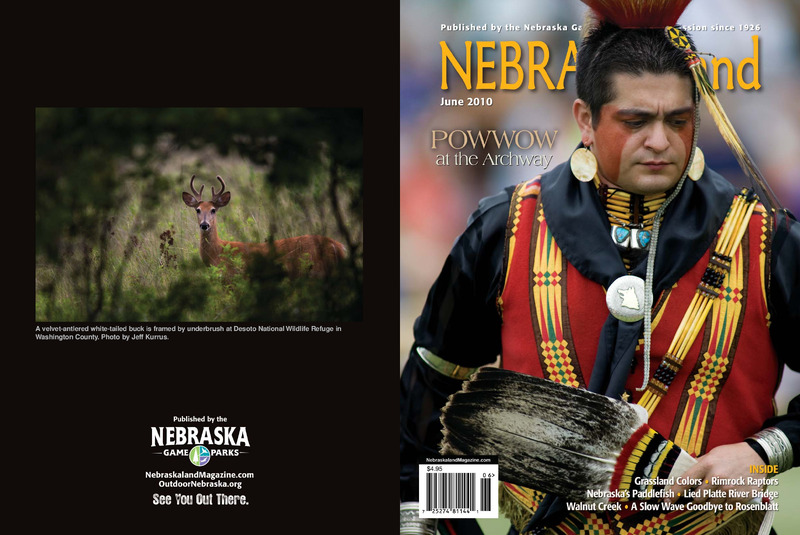
A velvet-antlered white-tailed buck is framed by underbrush at Desoto National Wildlife Refuge in
Washington County. Photo by Jeff Kurrus.
Volume 88, Number 5, June 2010
14 Plains Powwow at the Archway
Despite wet conditions, last year’s inaugural Dancers of the
Plains Powwow was deemed a great success and this year’s
celebration may be even better. BY KEN BOUC
18 Walnut Creek – The Story of a Template
Built more than 10 years ago with fish habitat in mind,
Walnut Creek has become one of eastern Nebraska’s most
popular lakes. For good reason. TEXT AND PHOTOS BY JEFF KURRUS
22 Grassland Colors
The grasslands and gumbo of the northwestern Panhandle
may seem colorless and drab most of the year, but look
again after snowmelt and rains briefly bring color back to
this parched landscape. PHOTOS AND TEXT BY BOB GRIER
30 Rimtop Raptors
In Nebraska’s Panhandle, where the land seems but a
footnote to the sky, raptors reign supreme. PHOTOS AND TEXT BY
MICHAEL FORSBERG
36 Nebraska’s Paddlefish
22
●
Rarely caught on a baited hook, paddlefish survive in
Nebraska today largely because of anglers’ support of
regulations that restricted the harvest of this prehistoric fish.
Those changes may have helped prevent its demise and
brought the species to where it is today – a success story in
fisheries management. TEXT AND PHOTOS BY ERIC FOWLER
Comment . . . . . . . . . . . . . . . . . . . . . . . . . . . . . . . . . 4
Mixed Bag . . . . . . . . . . . . . . . . . . . . . . . . . . . . . . . . 6
Nature Notes . . . . . . . . . . . . . . . . . . . . . . . . . . . . . .44
Parks & Places . . . . . . . . . . . . . . . . . . . . . . . . . . . .45
From the Fieldbook . . . . . . . . . . . . . . . . . . . . . . . . .46
Classifieds . . . . . . . . . . . . . . . . . . . . . . . . . . . . . . . 48
Portraits from the Past . . . . . . . . . . . . . . . . . . . . . . 50
30
●
36
●
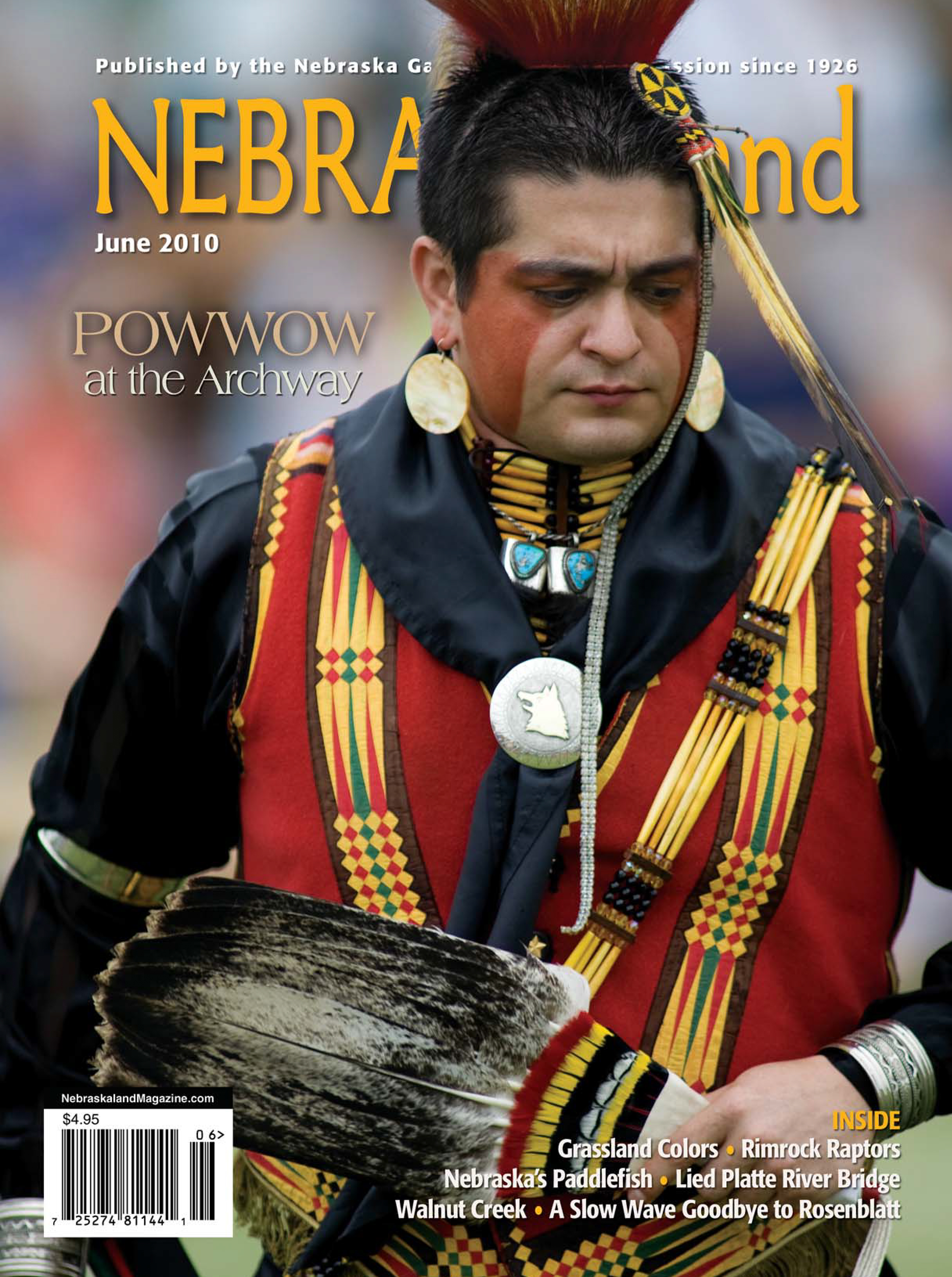
Cover: A.J. Leadingfox of Pawnee, Oklahoma, performs at last year’s
Dancers of the Plains Powwow in Kearney. See story on page 14. Photo
courtesy of Department of Economic Development. Opposite: Spencer
Whitney of Lincoln fishes from a float tube at Wagon Train Lake on a
beautiful, warm summer evening. Photo by Doug Carroll.
NEBRASKAland (VOL. 88 / NO. 5, ISSN 0028-1964) is published monthly, except for the
combined Jan./Feb. and Aug./Sept. issues, by the Nebraska Game and Parks Commission,
2200 N. 33rd St., Lincoln, NE. Periodicals postage paid at Lincoln, Nebraska, and additional
mailing offices. POSTMASTER: Send address changes to NEBRASKAland, P.O. Box 30370,
Lincoln, NE 68503-0370.
18
●
JUNE 2010 • NEBRASKALAND 3
First Trip of Year
We got out for the first time this year
to go fishing and after having his sister
Katelin catch the first bluegill of the
year, you could see the disappointment
in Colton’s face. A minute later,
however, he hooked into this monster
and boy was that exciting!
We were glad to welcome in the
2010 fishing season with catch-andrelease on the first trip to the fishing
pond. Thanks, NEBRASKAland, for all
the fun stories and memories over the
years.
Tom and Lisa Keller
Katelin and Colton
Malcolm, Nebraska
Crow Numbers?
Dear Sir,
What happened to all the crows?
In the 1930s they migrated for days
after days. At night, big flocks roosted
high in the trees where the neighbors
and I would shoot them and collect a
ten cents bounty for each head. That
was welcome money in the tough
times. There were also lots of thistles
in the fencerows where we could hide
and pick the crows off as they went by.
I am 94 and have subscribed to your
magazine for a lot of years.
Duane Gray
O’Neill, Nebraska
Since the arrival and expansion of
West Nile virus in North America, many
scientists are carefully watching how
crows and other species are reacting to
this disease. According to Joel
Jorgensen, nongame bird program
manager for the Nebraska Game and
Parks Commission, the number of
4 NEBRASKALAND • JUNE 2010
American crows and other corvids,
such as black-billed magpies, declined
at roughly the same time that West Nile
virus appeared in the Midwest.
Although one study has shown that
crow genetics make them vulnerable to
the more virulent form of the disease,
he doesn’t believe we have to worry
about crows going extinct any time soon.
Although there is no longer a bounty
in Nebraska for crows, there is still a
crow season – last season’s crow hunting
dates were October 1 - November 15
and January 20 - April 6. In addition to
these dates, there was also a Public
Health Hazard season for crows that
ran from November 16 - January 19.
– The Editor
Something Good on Tax Day?
On this year’s Tax Day, April 15,
God blessed two Polish hunters with
nice tom
turkeys. After a
couple hard
days of hunting
in rain, wind,
and ticks, friend
Dale Grobowski
and I were able
to down these
two toms within
three minutes of
each other as
they came in
one at a time to
attack our decoys. We didn’t like
their attitudes, but we loved their
beards and spurs. It was a really fun
time hunting as the toms were
responding to calls, strutting and
drumming their way in. What
magnificent birds and such a thrill to
behold. Guess it’s time now to hunt
mushrooms, go camping, enjoy some
great carp shooting with our bows and
do some fishing.
Nebraska really is “The Good Life”
and NEBRASKAland is the best place
to read up on where and how to live
it!!! Get out there and enjoy the
gobbles.
By the way – ladies sometimes it’s
really nice to have a man around, as
you can tell by the picture of Dale
carrying both birds. They aren’t turkeys
all the time!
Janice Spicha
Lincoln, Nebraska
NEBRASKAland Visitor Letters
We want to thank all 98 readers that
sent e-mails and letters for last issue’s
visitor, a common house fly on page 3
(see page 13 for the winner, rules and
next month’s hint). Here are just a few
of the many wonderful responses we
received:
I opened the May 2010
NEBRASKAland and somehow
immediately saw a fly sitting on the
handle of a fishing reel in the upper
left-hand corner of page three. So I
thought that I had better send this e-mail
before it buzzes off. This little contest
is a nice addition to a super magazine.
By the way, the 2009 deer season
was my 50th consecutive year of
hunting deer in Nebraska. My first hunt
was in 1960 in what was then the
Nemaha Area near the Missouri River
in southeast Nebraska. Most of my
hunting since then has been either in the
Pine Ridge area or Blue area. The deer
population and deer hunting have both
seen quite a few changes since 1960.
Dan Leuenberger
Lincoln, Nebraska
I found the American house fly on
page three of the May 2010 issue of
NEBRASKAland. My husband and I
have been traveling this past winter, but
now that we're back home we are
enjoying getting caught up on the
“visitor” challenges of the magazine.
This is a wonderful publication and we
have continued our subscription to it
even though we now live in the Black
Hills of South Dakota. We both retired
from the Fremont area 10 years ago,
but even though we don't live in
Nebraska anymore, we still continue
our “connection” to the state!
Linda and Erik Palle
Spearfish, South Dakota
Our kids get so excited when a new
issue of NEBRASKAland arrives in the
mail. They love trying to find each
issue's visitor.
Our son found the “visitor” in the
May 2010 issue. It is a musca domestica,
or common house fly, and is located on
page 3 in the upper left-hand corner.
Thanks for making your magazine
fun for everyone in our family. It is a
good tie to Nebraska while we live
away from our home state.
Mike and Debra Jilek
Perkaskie, Pennsylvania
A pesky fly is sitting on the handle
of a fishing reel pictured in the upper
left-hand corner of page 3 of the May
2010 issue of NEBRASKAland. I'm
excited I finally found it! We have
subscribed to NEBRASKAland for
many years and I always enjoy the
beautiful photography and well-written
articles. They are a wonderful resource
for students of the history, geography,
culture and wonders of this great state
of Nebraska. I am also enjoying the
hunt for the “visitor” each month.
Dianne Kleist
Malcolm, Nebraska
I am 14 and I love spending time with
my daddy hunting and fishing. We also
love looking for the NEBRASKAland
visitor. We like to make a competion
out of it to see who can find ‘em first.
Of course, I win again this month. The
visitor is the fly on page three in the
upper left-hand corner. My dad thought
it was the cartoon worm on pg. 29. I
also enjoy reading the wonderful articles
and looking at the beautiful pictures
each month.
Thanks for doing a terrific job!
Brianna Schulzkump
West Point Nebraska
The common house fly (Musca
domestica) is the most common
of all domestic flies, accounting for about 90% of all flies
in human habitations. It is found
all over the world and considered a
pest that can carry serious diseases.
Send your comments to:
Doug Carroll, Editor
NEBRASKAland Magazine
P.O. Box 30370
Lincoln, NE 68503
or e-mail Doug.Carroll@Nebraska.gov
Please include your postal address and
telephone number.
Letters may be condensed and edited
for clarity. Photographs are
welcome and will be returned.
Under federal and/or state law, discrimination is prohibited on the basis
of race, color, religion, age, gender, marital status, national origin,
disability or political affiliation. If you think you have been discriminated
against in any program, activity or facility by the Nebraska Game and
Parks Commission or want more information, contact the Commission in
Lincoln, NE, at (402) 471-0641 or the Equal Opportunity Commission,
Lincoln, NE, (402) 471-2024, TTY/TDD (402) 471-4693).
COMMISSION
CONSERV
CONSERVATION OFFICERS
Director Rex Amack
Assistant Directors Roger Kuhn, Kirk Nelson,
Sam Sidner
Commissioners
Chairman - Jerrod Burke, Curtis
Vice Chairman - Mick Jensen, Blair
2nd Vice Chairman - Ron Stave, Waterloo
Dr. Mark Pinkerton, Wilber
Dr. Kent Forney, Lincoln
Lynn Berggren, Broken Bow
Rex Fisher, Omaha
Mark Spurgin, Paxton
Norris Marshall, Kearney
Panhandle
Officer
Jim Zimmerman (S)
Scott Brandt
Heath Packett
Dennis Thompson
Dan Zuehlke
Doug Pollard
Frank Miller
Dan Kling
MAGAZINE
MAGAZINE STAFF
STAFF
Editor Doug Carroll
Associate Editor Jeff Kurrus
Art Director Tim Reigert
Senior Editor Jon Farrar
Regional Editors Eric Fowler, Bob Grier
Contributing Editor Michael Forsberg
Regular Contributors Bill Hager, Chris Helzer,
Lisa Knopp
Photo Librarian Sarah Johnson
Circulation Donna Robinson
For address changes and questions about
your subscription, e-mail
Donna.Robinson@Nebraska.gov
or call (800) 632-5263
Marketing/Advertising
For advertising information contact
Larson Enterprises
e-mail dave@larsonent.com
or call (515) 440-2810
NEBRASKAland Magazine Copyright 2010, all rights reserved.
NEBRASKAland is available on audio cassette from the Nebraska
Library Commission Talking Book and Braille Service, Suite 120, 1200 N
St., Lincoln, NE 68508. (800) 742-7691. NEBRASKAland Magazine and
the Nebraska Game and Parks Commission reserve the right to reject any
advertising not in keeping with the agency mission.
Rates: $18 for one year; $33 for two years; $44 for three years. Nebraska
recipients must add appropriate sales tax. To subscribe call
1-800-NEBLAND (632-5263), or go online to:
NebraskalandMagazine.com.
COMMISSION OFFICES
Headquarters
2200 N. 33rd Street Lincoln, NE 68503
Phone (402) 471-0641
District Office I
East Hwy. 2, Box 725 Alliance, NE 69301
Phone (308) 763-2940
District Office II
524 Panzer St., Box 508 Bassett, NE 68714
Phone (402) 684-2921
District Office III
2201 N. 13th St. Norfolk, NE 68701
Phone (402) 370-3374
District Office IV
301 E. State Farm Rd. North Platte, NE 69101
Phone (308) 535-8025
District Office VI
1617 First Ave. Kearney, NE 68847
Phone (308) 865-5310
City
Gering
Gering
Gordon
Ogallala
Ogallala
Oshkosh
Valentine
Harrison
Phone (308)
763-2940
631-0663
360-0682
289-0755
289-3399
778-7101
(402)389-0444
430-0572
Southwest
Officer
City
Roger Thompson (S) N. Platte
Ray Dierking
Brkn. Bow
George Sund
Cambridge
Michael Thome
Cozad
Matt Andrews
Elwood
Dirk Greene
Imperial
Virgil Gosch
McCook
Dudley Sorensen
N. Platte
Rich Routh
Rep. City
Phone (308)
535-8025
870-0322
655-0028
529-8146
746-2418
882-0015
340-2440
530-0016
920-0367
South-central
Officer
Jerry Pecha (Sup.)
Jeff Jones
Terry Brentzel
Randy Pomplun
Darin Gress
Dale Johnson
Robert Finke
City
Phone (308)
Kearney
865-5327
Clay Center(402)762-5022
Doniphan (402)469-5795
Fullerton
550-0489
Hebron (402) 768-8665
Kearney
440-3847
Milford
(402) 947-1363
Northeast
Officer
Tom Zimmer (Sup.)
Dale Davis
Steve Oberg
Daniel Roberts
Jon Reeves
Marion Shafer
Pat George
Tim Williams
Cory Krause
City
Norfolk
Bassett
Columbus
Fremont
Kennard
Norfolk
O’Neill
Neligh
West Point
Phone (402)
370-3374
760-0712
910-3366
719-1108
889-8508
992-7590
340-0787
929-0051
380-6410
Southeast
Officer
Duane Arp (Sup.)
Sean McKeehan
William Krause
Mike Luben
Douglas Kramer
Dina Barta
Stacey Lewton
Levi Krause
Russell Mort
Dan Evasco
Jeff Clauson
City
Gretna
Ashland
Auburn
Colon
Lincoln
Lincoln
Lincoln
Louisville
Nebr. City
Papillion
Waterloo
Phone (402)
332-2965
521-0159
274-8063
443-6392
890-6465
890-6463
890-7140
949-0593
209-1506
616-5961
658-7057
Administration
Ted Blume (Adm.)
Craig Stover (Asst.)
Wes Loos (Asst.)
Rod Loos (Asst.)
Murray Johnson
Lincoln
Lincoln
Lincoln
Ogallala
Lincoln
471-5531
471-5532
471-5591
(308) 284-8056
471-5003
Nebraska Wildlife Crimestoppers 1-800-742-7627
Omaha Office
1212 Bob Gibson Blvd. Omaha, NE 68108
Phone (402) 595-2144
Ak-Sar-Ben Aquarium
21502 W. Highway 31 Gretna, NE 68028
Phone (402) 332-3901
JUNE 2010 • NEBRASKALAND 5
PHOTO BY KEN BOUC
How Vultures Locate Food
Jon Farrar
Turkey vultures (Cathartes aura) are
common spring and fall migrants, as
well as expected breeders in some
Nebraska locations. Black vultures
(Coragyps atratus) have a more
southern range and are considered
accidental visitors.
Before Euroamericans settled
Nebraska, summering turkey vultures
were largely restricted to areas with
potential nest sites, such as cliff faces
with cavities or covered ledges,
particularly along river valleys such
as the Missouri, Niobrara and the
Republican; and near rocky escarpments
in the Panhandle. These locations also
provide the thermal updrafts vultures
seek for soaring. Today, turkey vultures
have adopted abandoned buildings with
open windows or doors allowing
access, particularly house attics or barn
mows, for nest sites and are more
widespread during the summer months.
Vultures are principally carrion
feeders, and ornithologists have long
debated how they locate their food.
Opposing observations and opinions
were bandied between respected
ornithologists in the late-1800s and
early-1900s. Charles Darwin, on his
famous Voyage of the Beagle in the
southern hemisphere in the 1830s,
concluded vultures located their food
by sight alone, and it turns out he was
right. Mostly.
Yet in the early-1900s, by covering or
not covering a ripening animal carcass
and observing if vultures found it or not,
researchers drew varied conclusions –
that vultures locate food items by
sight alone, principally by scent, or a
combination of the two. Today, bird
researchers agree that North American
vultures have a better developed sense
of smell than Old World vultures; and
of the vulture species on this continent
it is most acute in turkey vultures.
Some have attributed this to turkey
vultures being more inclined to locate
food in wooded areas, where the sense
of smell is more useful than the sense
of sight. Black vultures and California
condors, on the other hand, are larger
than turkey vultures and have heavier
wing-loading, making it more difficult
for them to maneuver in confined
spaces and hence are more inclined to
search for food in open habitats. Few
birds of any species possess an acute
sense of smell.
Contrary to popular thought, vultures
prefer newly dead animals as food over
putrid and rotting flesh. Pressed by
hunger, though, they will feed on
decaying flesh and have a resistance to
the microbes and toxins in it. And they
will feed on living animals, such as
snakes and grasshoppers, when the
opportunity arises, as well as plant
material such as fruits or vegetables.
Alcohol Ban to be Reviewed
The Nebraska Game and Parks
Commission will consider ending the
ban on alcohol consumption in state
park and wildlife management areas
(WMAs) at its May 28 commission
meeting at the Civic Center in Gering.
The public hearings to consider ending
the ban are scheduled to begin at
8:30 a.m. and the proposed regulation
changes include the following
restrictions: consumption of alcohol
may be prohibited on any state park
and wildlife areas, or portions thereof,
with the use of appropriate signage;
consumption is prohibited between the
hours of 10 p.m. and 6 a.m.;
consumption is prohibited on all
roadways, designated swimming areas
and parking areas; and all containers of
alcoholic beverages whose single liquid
capacity is greater than one gallon, are
prohibited.
6 NEBRASKALAND • JUNE 2010
If nothing else, “A Look Back”
has forced me to look at how
NEBRASKAland’s early writers
handled the publication during
times of significant historical
events. The Summer 1944 edition
of Outdoor Nebraska was being
perused by readers during the
time that Allied forces were
invading Normandy, France during
their World War II D-Day invasion.
I would have to imagine that
during those times, even a few
minutes of outdoor reading was
being done by Nebraskans to take
their mind off of world events. This
was never more evident than in
the photo essay “It’s in Nebraska,”
highlighting a series of outdoor
activities throughout the state and
introducing these images with this
message: “Nebraska has IT, and it
is just what the young men of
Nebraska are going to crave most
when it is over, over there.”
Also in this issue were features
on Arbor Lodge, Chadron,
Niobrara, Ponca and Victoria
Springs state parks, as well as
a bit of humor from Paul T. Gilbert,
head of the Commission at the
time, entitled “Elegy to a Cane
Pole.”
To read “Elegy,” log on to
NebraskalandMagazine.com and
click on “A Look Back.”
PHOTO BY JEFF KURRUS
Jeff Kurrus
Woodhouse Toad
Kelsea Nore
The Woodhouse toad is a familiar
sight in Nebraska and can be found
throughout the entire state. This
amphibian bears a distinctive light
yellow or green stripe down its back
and has a white stomach, but is more
commonly recognized by the wart-like
bumps that decorate its dry skin.
Woodhouse toads prefer a moist
environment and usually remain in
small burrows during the daytime,
coming out after sunset to eat. And eat
they do – they have been known to
consume two thirds of their body
weight in a single evening on a diet of
insects such as mosquitoes, beetles and
crickets.
However, the toads are rarely
snacked upon themselves. Behind each
eye is a kidney-shaped paratoid gland
that secrete a poison that can be harmful
to predators, allowing this amphibian to
thrive in a Nebraska environment that
can be quite inhospitable to small
creatures at times.
They’re Back!
For the sixth straight year, a pair of
peregrine falcons has produced eggs in
a nest box outside the 18th floor of the
Nebraska State Capitol.
After observing mating and apparent
egg-laying via the webcam, Joel
Jorgensen, nongame bird program
manager with the Nebraska Game and
Parks Commission, checked the nest
box on April 19, counting four eggs.
Peregrines generally lay three or four
eggs, but one to six eggs have been
recorded and the pair has had four eggs
each of the last two years. He said the
eggs were expected to hatch about the
second week of May.
Jorgensen also read the leg bands of
8 NEBRASKALAND • JUNE 2010
the female and confirmed it was the
same bird, with a leg band reading
“A/*Y,” present since 2005. The male,
with the leg band “19/K,” is believed to
be the same male that has been at the
Capitol since 2003, but Jorgensen was
unable to read its leg band.
FalconCam, a video camera mounted
atop the Capitol, is providing streaming
video of the nest box and may be
viewed at OutdoorNebraska.org.
Streaming video also is available on a
television in the Capitol rotunda at the
peregrine falcon display.
Helzer’s Prairie Book
Jeff Kurrus
Landowners
who want to
increase the
abundance and
diversity of
wildlife and
plant species on
their prairies
now have a
new resource
available to them. NEBRASKAland
Magazine regular contributor Chris
Helzer’s “The Ecology and
Management of Prairies in the Central
United States” was released this spring
by the University of Iowa Press.
While intended for prairie owners and
land managers, this book is a great
resource for anyone interested in
learning about grassland wildlife and
plant communities.
Prairies are incredibly complex and
diverse natural communities. They
evolved under harsh conditions: huge
herds of bison, expansive fires and
extended droughts. In many places
they’ve now been largely replaced by
rowcrop agriculture and urban sprawl
or degraded by years of continuous
overgrazing and haphazard herbicide
use. Those prairies that remain are
often relegated to steep terrain or
places where rocks or moisture make
farming difficult.
Because of their scarcity, it’s critically
important that the remaining prairies
retain as much biological diversity as
possible by being subjected to periodic
intense disturbances such as fire and
grazing. In addition, invasive species
must also be managed because they can
quickly degrade the plant diversity and
habitat quality of a prairie if allowed to
gain a foothold, especially in landscapes
that are so fragmented. Because of all
these factors, thoughtful management is
essential to the continued health and
survival of prairie communities.
Helzer’s book is an attempt to
provide background and guidance to
prairie managers trying to preserve the
biological diversity of native grasslands,
and most of the information in this
book and its general management
philosophies should apply to grasslands
anywhere in North America. However,
the specific management strategies and
recommendations are most relevant to
prairies in the eastern half of Nebraska
and elsewhere in the mixed-grass and
tallgrass prairie regions of the continent.
Whether you are a landowner
looking for plant and wildlife diversity
on your own land, or a newcomer to
the region who wants to learn more
about your new home, Helzer’s book is
an excellent resource to begin your
relationship with this hopefully
increasing prairie landscape.
JUNE 2010 • NEBRASKALAND 9
PHOTO BY JEFF KURRUS
See You Out There ... But Where?
Saturday and from 8 a.m. to 11 a.m. on
Sunday. Dennis Ferraro, a professor at
UN-L, and Dan Fogell, a professor at
Southeast Community College, will be
leading the survey.
Those people planning on attending
part or all of either or both days are
asked to contact Laci Prucinsky at
(402) 731-3140, ext 230 or lprucinsky@
fontenelleforest.org.
Participants should wear long pants
and sturdy shoes or hiking boots. They
might also want to bring bug spray,
sunscreen, work gloves, waders or mud
boots, a hat and a field notebook.
Snack items (fruit, granola bars, etc.)
will be provided, as will water and a
refrigerator to store meals in.
commemorate famous natives, such as
Sheridan County’s Mari Sandoz.
Marker 312 in York County describes
the establishment and growth of
Henderson. To date, the last marker
erected is at Pleasant Hill Cemetery in
Dorchester.
A list of all marker locations and their
texts can be found at www.nebraska
history.org/publish/markers/texts/.
Donations Received
The Nebraska chapter of Safari
Club International recently gave the
Nebraska Game and Parks Commission
the last installment of their five-year
pledge of a $50,000 donation to help
with the Commission’s bighorn sheep
reintroduction and research efforts in
the western part of the state.
In recent years, the Iowa Foundation
of North American Wild Sheep has also
donated to the Commission’s sheep and
youth programs, donating $30,000 for
the bighorn program and $5,000 to
help purchase the Commission’s family
day trailers.
Do you know where this Nebraska photograph was taken?
See answer at the bottom of page 13.
Going Soft
Help Needed for Herp Survey
The Fontenelle Nature Association in
Bellevue is looking for volunteers to
help with a May 22-23 survey of the
reptiles and amphibians that live at
Fontenelle Forest.
The survey will be conducted rain
or shine from 12 p.m. to 10 p.m. on
PHOTO BY JEFF KURRUS
10 NEBRASKALAND • JUNE 2010
PHOTO BY DOUG CARROLL
Jeff Kurrus
Largemouth bass
are one of the
state’s most popular
game species. But
as spring creeps
into summer, many
of the state’s best
fishing waters
become choked
with vegetation,
both submergent
and emergent. This
is quite frustrating
to anglers, who
often curse their
crankbaits and
spinnerbaits as
they repeatedly
remove gunk from the hooks.
Yet there is no reason to curse these
lures. If the fish are in the vegetation,
go in there with them with totally
weedless options. There are many to
choose from, but the following two are
as good as any you’ll find for weeds:
Texas-rigged floater – I say “floater”
because these lures can come in the
form of worms, lizards, slug-o’s and
any other of the variety plastics that
anglers use. The main thing anglers
must understand is to use these lures
without a weight. This allows them to
float better along the top of the
vegetation, allowing for less hang-ups
while providing better sight for the angler.
There’s nothing like seeing a fish strike
these lures through the vegetation.
Scum frogs – These also float on
top and are my No. 1 lure for heavy
vegetation fishing. Like the floating
plastics, these can be fished using
multiple techniques, including swimming
them, stop-and-go, small twitches and
large twitches. Each technique gives
the lure different action in the water,
and should be tried if another method
isn’t working.
In June, I’m still fishing a lot of open
water, but as the vegetation increases, I
don’t fight it – I just move right in the
middle of it. And these areas always
seem to have action. Now, whether or
not you can catch and actually land those
big bass pulling your lure beneath the
greenery is a different story.
Roadside Markers
Kelsea Nore
There are 466 state historical markers
in Nebraska and they can be found near
major highways, on county roads and
in city parks in every county of the
state. While some are small plaques
and others stand six feet tall, they all
have a story to tell. The first one was
erected on Highway 92 in Morrill:
“No single sight along the Oregon and
Mormon trails attracted more attention
than Chimney Rock, 11/2 miles south of
here” reads this particular marker.
The posts give a brief peek at events
throughout the state’s history, such as
the marker in Garden County that tells
of the Easter Blizzard of 1873. Others
JUNE 2010 • NEBRASKALAND 11
PHOTO BY BOB GRIER
Kristen Friesen
The Father’s Days of the 1980s went
like this: Mom always presented Dad
with a new shirt and tie, and Dad
always acted surprised. But whenever
my sisters and I asked Dad what he
wanted most in the world, his answer
was always and only, “Good girls.
That’s all I want.”
And with three of us girls running
amuck in Lincoln’s Wedgewood
neighborhood, he probably wasn’t
lying. But “good girls” are difficult to
deliver, if not wrap up, even on
Father’s Day.
“The next best thing,” he’d say,
“would be to spend an entire day
together.”
That usually meant heading to
Pawnee Lake, where we'd take turns on
Dad's tiny Sunfish sailboat, munch cold
Hy-Vee chicken and bask in the warm
June sun until we were too tired to
cause any trouble.
Here are a few more family-friendly
Father’s Day weekend events available
statewide this year:
• 22nd Annual Mid-States Rodeo in
Clarkson: June 17-18; (402) 892-3457.
• 18th Annual Ash Hollow Historical
Pageant at Ash Hollow State Historical
Park in Lewellen: June 18-19;
Historical drama, music, tours, displays
and chuckwagon supper, (308) 7785548.
• Celebrate Lincoln International
Festival: June 18-19; Music, vendors,
entertainment, activities and ethnic
12 NEBRASKALAND • JUNE 2010
food, (402) 434-6902.
• Great Nebraska Tractor Ride from
Wisner’s River Park to Norfolk: June
18-19; (402) 372-5423.
Back to the Basics
One day a few summers ago I was working with another officer at
Zorinsky Lake in Omaha when we asked a couple of anglers if they
had fishing permits. They said they didn’t, so we asked them to follow
us to parking lot where they were parked. The two individuals, in the
best way they could, told us that they could not speak English.
Because I had been taking a beginning Spanish course, I thought I
would try and speak to them in their language to help ease the
situation.
When we finished writing out the citations, I tried explaining mine to
the individual, and then I tried to explain how to send the citation in
to the court. When I was in the Spanish class, they told us not to use
Spanglish, which is pretty much putting a “O” on the end of a word.
Example: lots-o of food-o. In trying to explain to the individual that he
needed to send the citation to the Douglas County court, I informed
him that I had a preaddressed envelope for him to use. But what I
said was “Put the stamp-o on the envelope-o.”
The other officer informed me that I should probably go back and
try taking the class again. However, as he was telling
me this, he asked his individual, “Where are you
from?”
The individual said, “I am from El Paso.”
The other officer then said, “Oh, from New Mexico,
huh?”
I looked at the officer and said, “Who needs to go
take another class?”
– Sean McKeehan, Conservation Officer, Ashland
• Father’s Day Trail Ride at Ash
Creek Ranch in Crawford: June 20;
Bring your own horse; Dutch-oven
supper provided, (308) 665-1580.
• Heartland MX Series Racing at
Sandhills Motorsport Park in Sargent:
June 20; (308) 215-0564.
Bryant Wins Cornhusker Cup
found that outdoors is a great place to
be with your family.”
Keenan Kremke of Karp and Krow
4-H in Ord was crowned the junior
high school champion on the shoot’s
first day. Kremke won with a score of
99x100 on 16-yard targets.
Safety is the top concern at the
Cornhusker and all participants are
certified in hunter education. “The kids
Zach Bryant of Lincoln Southwest
won the Cornhusker Cup at the 41st
Annual Cornhusker Trapshoot held
April 30 – May 2 at the Nebraska
Trapshooting Association (NTA) home
grounds in Doniphan.
Bryant shot a 196x200 for high overall
honors after shooting a 99x100 to win
the handicap title on Saturday. Print
Zutavern of Broken Bow was second
and Cody Stout of Weld County (Colo.)
4-H was third overall.
The Lincoln shooter had scored a
97x100 in the 16-yard competition
Friday, when three shooters, including
Zutavern, scored 100s.
“I knew it was going to take a 98 or
99 to get back the three rocks I lost
yesterday,” said Bryant, a senior and
five-year veteran of the trapshoot. “I
have been shooting handicaps good all
year, so I knew it was possible.”
A record 1,811 shooters from
Nebraska, Kansas, Missouri and
Colorado registered for this year’s shoot.
“In Nebraska and surrounding states,
shooting sports are still growing,” said
co-shoot director Terry Brentzel.
“Whether it is shotgun, archery,
muzzleloader, or rifle, families have
David Gerdes of LaVista has been
bass fishing since he was about
13 years old and has had his
message plate, which reflects both
his love for fishing and the brand of
boat he fishes from, since 2005.
Despite also having a B.A.S.S. sticker on his rear window, he still gets
questions about the meaning of the plate.
If you have a unique outdoor message plate you would like to share, or know
someone who does, e-mail a photo (high-resolution, .jpg format only, please)
of it to Eric.Fowler@Nebraska.gov, along with your name, hometown and a
brief description of the interests expressed on your license plate.
have been shooting in their conferences
for the last six weeks,” said Brentzel.
“With six weeks of supervision by
coaches and parents, they know safety is
the No. 1 priority. In 41 years here,
there never has been an accident.”
Turpin Time
Dick Turpin
In Nebraska,
we’re fortunate …
we really don’t
have a lot of
trouble with camp
theft. Most things
taken are items
that can be easily carried, like for
instance a stove, a cooler, a lantern, a
fishing pole, a radio … those sort of
things. Those smaller things that folks
can carry off readily. So when you
leave camp or go to sleep, put those
things out of sight, at least in the tent
or in your vehicle. Remember this – if
you wouldn’t leave it lying around in
your front yard, don’t leave it lying
around in camp. ■
NEBRASKAland Visitor
Winner and Hint
Last issue’s winner of
the NEBRASKAland Visitor drawing
was Andrew Heskett of
Leavenworth, Kansas, who found the
common house fly on page 3.
Readers are encouraged to contact
NEBRASKAland within 10 days
after this issue’s publication with the
correct page number and name of
this issue’s “Visitor” – an insect or
bug found in Nebraska that just
happened to find its way onto one of
the pages of our publication.
We will then gather the correct
entries and draw one to win a
NEBRASKAland Visitor mug.
To enter each month, e-mail
Tim.Reigert@Nebraska.gov
with “Visitor” in the subject line of
the message or write:
NEBRASKAland Visitor
2200 North 33rd Street,
Lincoln, NE 68503.
HINT: This month’s visitor is not
on page 5, 13, or 44.
Fort Kearny State Historical Park
Good for Father’s Day
• Demolition Derby at Custer
County Fairgrounds in Broken Bow:
June 19; (308) 215-0241.
• Chadron State Park’s 89th
Anniversary Celebration: June 19: Live
music, games, demonstrations, wagon
rides, antique tractor show, archery
shoot, paddle boat races, arts and crafts
shows and 89-cent meals, (308) 4326167.
• Shrine Bowl of Nebraska at
Memorial Stadium on June 19; featuring
Nebraska’s premier senior high school
football players, (402) 477-8908.
• 35th Annual Father’s Day Rod Run
in Ord: June 19-20; Classic cars,
Saturday night burn-out show and
shine, and parade, (308) 728-9950.
• Father’s Day Fossil Hunt and Fish
Fry at Ponca State Park: June 19-20;
Treasure hunt, paleontologist-guided
fossil dig, children’s fossil boxes and
fish fry, (402) 755-2284.
JUNE 2010 • NEBRASKALAND 13
POWWOW
at the Archway
By Ken Bouc
Despite wet conditions, last year’s inaugral Dancers of
the Plains Powwow was deemed a great success and
this year’s celebration may be even better.
14 NEBRASKALAND • JUNE 2010
PHOTOS COURTESY OF DEPARTMENT OF ECONOMIC DEVELOPEMENT
P
the reunion of the Pawnee and Arikara
awnee voices and drums echoed
in Nebraska (see sidebar on page 17).
across the Platte River Valley
While there will be other attractions,
near Kearney in June 2009, a
the event’s main drawing card will be
sound that hadn’t been heard in
the dancers and drums in the powwow
Nebraska since the last of the Pawnee
arena from 1 p.m. to 3:30 p.m. each
were moved to Indian Territory in
day. Singer and drummer groups (each
Oklahoma 134 years earlier. This June,
group of drummers
voices and drums
is collectively
of their Arikara
called a “drum”)
kinsmen, music
will provide
perhaps not heard
rhythm and song
in Nebraska for
for the dancers.
more than 170
Some of the songs
years, will blend
may date back to
with those of the
when the Skidi and
Pawnee.
Arikara were
Last year, the
together in
first Dancers of the
Nebraska, and
Plains Powwow
drums from other
was billed as
tribes may also join
“The Pawnee
in.
Homecoming” and
“We’ve been
exceeded all
taking our drum to
expectations of its
celebrations up
sponsor and host,
there (Arikara
the Great Platte
celebrations in
River Road
North Dakota) for
Archway near
eight or nine years.
Kearney: “We
Warren Pratt of Pawnee, Oklahoma,
The Arikara were
thought perhaps
watches as some of his fellow dancers
once
part of my
15 or 20 Pawnee
take part in last year’s powwow.
band, the Skidi,”
would make the
said Pat Leading Fox, head chief of the
trip from Oklahoma, but 155 showed
up,” said Ronnie O’Brien, the archway’s Pawnee Nasharo Council in Pawnee,
Oklahoma.
director of cultural education. In a
Last year’s powwow, like most,
similar vein, spectators were expected
to number 1,000 or so, but estimates of opened with a grand entry led by U.S.
and tribal color guards, dancers, and
actual attendance ranged from 3,000 to
tribal and local veterans. Rain showers,
5,000.
however, unfortunately silenced the
Building on last year’s success, this
drums and ended the dancing after only
year’s event has been expanded to two
45 minutes. “Last year was excellent –
days, June 18th and 19th, and is being
so many people showed up,” said
billed as “Pawnee & Arikara
Leading Fox. “The only thing I didn’t
Rendezvous on the Platte” to celebrate
Members of the Pawnee Indian Nation take part in last year’s inaugural Dancers of the Plains Powwow
at the Great Platte River Road Archway in Kearney. This year’s event will be held June 18-19.
like about it was getting rained out.”
If weather should threaten again this
year, however, organizers now have
contingency plans in place and the
powwow and exhibits will be moved
indoors to the Viaero Event Center in
the southwest quadrant of the Kearney
I-80 interchange Exit 272. Since public
parking will not be available at the
archway, the event center will also be
the designated parking lot, rain or
shine, for the powwow. Free shuttles to
and from the powwow arena, about
three miles distant, will be provided
from 9 a.m. to 6 p.m. each day.
The powwow invitation extended to
the Arikara for this year’s event
inspired a plan to build an earth lodge
near the powwow arena, a replica of
the dwellings that had housed their
ancestors and other plains tribes for
hundreds of years.
Men from the Three Affiliated Tribes
(Mandan, Hidatsa and Arikara) in
North Dakota with experience building
earth lodges visited the Kearney area in
March. Cory Spotted Bear, Jasper
“Jazz” Young Bear and Marty Young
Bear found a good supply of the large,
cured tree trunks they needed, either
standing dead trees or others already
felled, in the woods along the adjacent
Platte River. These heavy timbers
would bear the weight of the roof and
form the framework of the walls.
In addition, young cottonwoods that
had been killed by the New Year’s Eve
ice storm of 2007-08 would provide the
longer, slimmer poles needed to create
the lodge’s sloping roof and outer
walls, and seemingly everywhere were
the slender, young willows that would
be used to make mats to lay beneath
the sod that would be put on the roof
and used to fill spaces between the
slightly slanting poles that would
support the lodge’s earthen walls.
Spotted Bear and the Young Bears
were scheduled to be part of a crew of
approximately 10 workers from the
★
The Great Platte River Road Archway is
located just east of Kearney off I-80 Exit
272. Designed to emulate a covered
bridge, this history museum uses a
variety of media to document more than
150 years of transportation and
communication across America.
JUNE 2010 • NEBRASKALAND 15
Left: Taylor Keen of Omaha, a member of
the Omaha Indian tribe, dances with
members of the Pawnee tribe at last
year’s powwow as a sign of respect for
their tribe, which was once a longtime
enemy of the Omaha tribe.
Below: wearing a traditional headband,
Micah Horn of Pawnee, Oklahoma takes
his lead from other dancers.
Above: Reenactors prepare to fire a
cannon near the archway museum
at last year’s event.
PHOTOS COURTESY OF DEPARTMENT OF ECONOMIC DEVELOPEMENT
Right: Charlotte Miles, also of Pawnee,
performs a shawl dance using a fringed
cape.
Three Affiliated Tribes that were slated
to start work on the project in mid-May,
with plans to finish the 60-foot diameter
lodge in 12 days. Fifteen Pawnee tribal
members from Oklahoma planned to
help with the project while learning
about earth lodge construction.
A special fundraising breakfast to
help pay some of the expenses of the
earth lodge project will be held at the
Viaero Event Center the morning of
June 18. Tickets are $27 each and are
available through the Viaero Event
Center at www.kearneyevents.com or
by calling (308) 338-8144.
16 NEBRASKALAND • JUNE 2010
Last year’s powwow included a
variety of attractions in addition to the
dancing, and this year’s version is no
different. Various living history
demonstrations, including grizzled
trappers preparing hides, tipis, a
traditional Pawnee garden and
demonstrations of Civil War-era U.S.
Army tactics involving muzzle-loading
rifles and a cannon will be available for
visitors to view and learn about. In
addition, at this year’s Civil War camp
visitors will learn about the important
role that Pawnee scouts played at nearby
Fort Kearny both during and after the
Civil War, and the service that Arikara
scouts put in during Army campaigns
on the northern plains.
Last year, Pawnee artists exhibited
and sold their work near the powwow
arena and additional artists are expected
to attend this year, including perhaps
some from the Three Affiliated Tribes
of North Dakota and others from
Nebraska and neighboring states. As
they did last year, outdoor concessions
near the archway entrance will provide
food, snacks, drinks and souvenirs,
while the archway itself offers food
at its Chuck Wagon Restaurant,
souvenirs and books in its gift shop,
restrooms, and tours of the exhibits
in the elevated gallery that spans
Interstate 80.
To find out more about the powwow
and its attractions, see the ad on page 11
or go to www.archway.org. ■
Ancestors of the four Pawnee bands (Skidi, Chaui,
Kitkahaki and Pitahawirata) and the Arikara lived in
scattered communities across the central plains, from South
Dakota into Kansas, as much as 1,000 years ago.
Today, both Arikara and Skidi state that their two
communities were once unified, then separated when
Arikara villages on the Elkhorn River in Nebraska moved
north to be near other Arikara villages in today’s South
Dakota.
According to Roger Echo-Hawk of
Longmont, Colorado, a scholar of ancient
American history, Skidi oral traditions say
that by the mid-1700s, large groups of Skidi
were moving north for extended visits with
the Arikara on the Missouri near today’s Fort
Pierre and Mobridge, South Dakota.
Roger Echo-Hawk
Likewise, groups of Arikara were coming to
the Loup River to visit the Skidi in Nebraska.
As a result, a very close political relationship developed
between them. These visits were probably the earliest
reunions of the Skidi and Arikara.
Smallpox and attacks by Sioux, recent newcomers to the
northern plains at the
time, changed
circumstances for the
worse for the Arikara
by 1790, and a
conflict with the U.S.
Army in 1823 forced
them to abandon their
villages for a time. The
Loup Fork Village, Pawnee 1871
Arikara eventually
returned to their
villages and endured drought and more Sioux attacks until
the summer of 1832, when they left for another
rendezvous with the Skidi.
In the spring of 1833, the Arikara
established camp near the forks of the
Platte and contacted the Skidi, who
hunted buffalo in that region every
winter and summer. In October 1834,
a missionary noted 2,200 Arikara visitors at the Skidi village on the Loup. In
the winter of 1836, Sioux attacked and
defeated the Arikara, who fled the Platte
and joined the Mandan and Hidatsa
tribes far to the north.
Asa Taka (White Horse), 1876
JUNE 2010 • NEBRASKALAND 17
Walnut Creek
The Story of a Template
Text and photos by Jeff Kurrus
Built over 10 years ago with fish habitat in
mind, Walnut Creek has become one of eastern
Nebraska’s most popular lakes. For good reason.
I
n the December 1999 issue of
NEBRASKAland, senior editor
Jon Farrar wrote an article on an
eastern Nebraska reservoir entitled
“Walnut Creek: Fish Habitat From the
Ground Up.” In the piece, Farrar
chronicled the step-by-step process
that the Nebraska Game and Parks
Commission, in cooperation with
the Papio-Missouri River Natural
Resources District, the USDA, the city
of Papillion and other resident groups,
went through to create a lake close to
the metropolitan area with one main
purpose – fishing. “Walnut Creek was
built with fish habitat in mind, and it
continues to be an excellent fishery
because of that,” Commission Fisheries
Outreach Program Manager Daryl
Bauer said recently.
But not only has it remained an
effective fishery, it has also provided a
standard that all future lakes must be
measured by – a template for how to
create and maintain such a consistent
fishery close to so many people.
Even before Walnut Creek was created,
constructors knew that the land adjacent
to the planned lake would be quickly
developed with housing. Problem was,
such development can create serious
problems both during and after
At Walnut Creek, one of eastern Nebraska’s most popular fishing spots, boats coming and going is a very common sight.
Riprap was used at Walnut Creek to provide stability to its banks, helping prevent erosion
and extending the life of the lake. These spots also provide excellent bank fishing.
18 NEBRASKALAND • JUNE 2010
completion due to sediment run-off:
more sediment means less fish habitat,
poorer water quality and fewer
invertebrates for fish to eat. This
potential problem was rectified early
on with the creation of the 15-member
Clean Lakes Community Council,
consisting of area farmers, residents
and other private citizens. The council’s
mission was to develop management
goals for the lake’s watershed that would
serve the needs and desires of the
community and protect the lake from
run-off pollution. The council quickly
established itself by requiring
a high level of erosion control on
construction sites in the area and
penalizing violators. The city of
Papillion subsequently adopted the
ordinance within its jurisdiction of the
lake watershed, and these practices
provided the first barrier for keeping
sediment out of the lake.
An additional aide to the lake’s
future was then-lake manager Randy
Lee, who, as the area manager and
NRD employee, knew the laws and
methods of controlling erosion. Lee
was passionate about maintaining the
lake and watched over the development
of the area. Because of similar sediment
problems, $6.8 million was recently
spent at Holmes Lake in Lincoln for
renovation, so having someone policing
Walnut Creek the last 10 years has
been pivotal.
Lee gathered support from local
watershed communities, which also
helped oversee the area. Similar groups
have been formed at Zorinsky and
Glenn Cunningham lakes in Omaha,
and Holmes Lake. At Holmes, the local
watershed community has been
promoting the use of nonphosphorus
fertilizers near the lake in an attempt to
thwart nutrient runoff from lawns, and
has also addressed local pet waste,
found to be a source of bacteria in the
lake.
Lee also recruited local boyscouts to
place used tires at Walnut Creek to
help with erosion on several areas.
“They’re pretty effective,” said
★
Walnut Creek Lake and Recreation
Area is open year-round from 6:00 a.m.
to 10:00 p.m. It is located south
of Highway 370 and west of 96th Street
in Papillion.
JUNE 2010 • NEBRASKALAND 19
Joe Anderson helps wife Lindsey lower her kayak into the water at Walnut Creek. Because the lake has a 5 mph speed limit for all
boats, this eastern Nebraska reservoir is a great metropolitan lake for a variety of recreational water sports.
Commission fisheries biologist Jeff
Jackson, “because they knock the energy
out of waves before they strike the bank.”
Another step to increasing Walnut
Creek’s life was proper construction of
the lake itself: Sediment dams would
not be enough to prevent silt and
erosion – the lake’s shape also had to
be carefully planned out. Any time a
water body is built in Nebraska,
prevailing winds must be factored in.
At Walnut Creek, the lake’s north end
was expected to undergo the most
shoreline erosion due to fetch, the
amount of area available for waves to
travel. Natural points on the lake also
needed to be addressed because these
tend to be the first degraded by wind
action. Jetties (long fingers of shoreline
covered in rock) were used to combat
these problems and were beneficial in
several ways: they reduced the fetch,
thus minimizing wind erosion for the
lake in general; the rock covering them
provided habitat for prey fish and
reduced the jetties’ own erosion; and
the lake bed material used to construct
them created deeper water adjacent to
the jetties, which anglers could use to
20 NEBRASKALAND • JUNE 2010
access it. Jetty construction has proven
so effective that it was used on future
aquatic habitat projects, including
Cottonmill Lake near Kearney and
Cunningham.
In addition, two islands were created
at Walnut Creek near natural high spots
on the lake, also aiding in the lake’s
sediment issues. “We tried to use the
natural contours of the lake to benefit it
in the long term,” said Jackson. “In the
past, we have not been that involved in
the design phase of a lake. But this
time we were able to use some Sport
Fish Restoration funds and
Environmental Protection Agency 319
funds to help design and develop
Walnut Creek to better support its
water quality and fish habitat.”
Vegetation was also introduced at the
reservoir, but very carefully. “You run the
risk of the vegetation being invasive to
a body of water, and even its watershed,”
said Jackson. “We planted water lilies,
water willows and cattails within Lee’s
tires to protect the shoreline.”
But introducing habitat isn’t always
necessary – sometimes leaving things
as they are is better. For example, more
than 90 percent of the existing trees
were left standing when the lake was
built. This saved a lot of money that
would have been spent on their
removal, and it created excellent fish
habitat that will last 20 more years with
no expense.
Regardless of the habitat choices
and plans made at the lake, Walnut
Creek had one thing going for it that
cannot be easily altered or replaced:
“The watershed for Walnut Creek is
very good, with 20 acres of watershed
for every one acre of lake,” said
Jackson. “In comparison, the Salt
Valley lakes are closer to 40-to-1 and
other reservoirs in eastern Nebraska are
100-to-1. The higher the ratio, the
higher the potential for sedimentation
and the poorer the water quality.”
Given proper construction, it is also
mandatory to have proper fish
management in order to have a good
fishery, and Commission biologists
manage urban fisheries differently than
other water bodies. “Near the metro
area, we want high catch rates for both
bluegill and bass,” said Jackson. “If we
are managing for big fish, we strive for
high bluegill densities and low bass
densities. But people won’t catch near
as many fish.”
To achieve this goal at Walnut Creek,
biologists stocked a year class of adult
bass, followed by a fingerling stocking.
After the adult bass spawned, there
were then three different year classes in
the lake simultaneously. Next they
stocked bluegill and black crappie –
prolific spawners that would need little
time to become competitive in the
fishery.
When the lake opened to the public,
a 21-inch minimum length limit on
bass was enacted, which kept anglers
from keeping every 12- to 15-inch fish
they caught. “We get about 98-percent
compliance at this location,” said
Jackson. “Twenty years ago, we would
have gotten 70 percent. If we still had
low compliance, bass would leave this
lake very quickly. Given the opportunity,
anglers will take between 80 and 90
percent of a lake’s bass population in
two weeks. We didn’t want that to
happen here.”
Thanks to good planning and the
cooperation of local officials, however,
Vegetation help prevent erosion and
provides excellent fish habitat.
it’s looking like there will be more of
the same here well into the future –
good fishing at a lake close to the
metro. If nothing else, Walnut Creek
has shown that great fisheries can be
found in high-use areas, good news in
today’s world when having to stay
close to home is becoming more
commonplace for many outdoor
enthusiasts. ■
With few other boats on the water, a Saturday morning sunrise is prime time to fish for largemouth bass at Walnut Creek.
JUNE 2010 • NEBRASKALAND 21
With adequate and timely moisture, the grasslands again show their
vibrant colors of green grasses, golden sunflowers and clover blooms.
Warm sunrises and sunsets paint the gumbo clay formations red and
gold. Add deep blue skies, as well as the dark blues, golds and
brilliant flashes of lightning against nearly black storm clouds, and
the grasslands become an artist’s palette.
Previous page: A midsummer storm
moves noisily and colorfully across the
badlands north of Harrison. The colorless,
sedimentary layers laid down by an
ancient ocean, now exposed and eroded,
are temporarily awash in color.
Above: A gumbo ghost-town, Orella sits
quietly, weathered and nearly colorless
beside an abandoned gravel highway and
still-busy train tracks. Lilacs planted and
tended long ago become festive with this
year’s abundant moisture.
Opposite: Even with northwest Nebraska’s
normal annual quota of precipitation –
15 inches – landscapes blanketed by
blooming sweet clover are rare, perhaps
once every four or five years. Here a
cottontail enjoys a colorful evening.
Right: Fall finds a flock of wild turkeys
chasing grasshoppers near one of the
remaining stands of quaking aspen on a
Pine Ridge stream north of Crawford.
JUNE 2010 • NEBRASKALAND 25
The grassland vistas nearly always demand a sweeping panoramic
rendition that encompasses both land and sky. The seemingly endless
landscape is home to prairie speedsters such as the pronghorn and
solitary, stoic characters like badgers and jackrabbits. Scattered widely
are human additions to the landscape – ranches, a white church and
a few weathered gray and abandoned pioneer homes.
Opposite: A fast-moving thunderhead fills
the sky above the picturesque Montrose
Church and cemetery in north-central Sioux
County.
Above: Sugarloaf is nearly colorless during
much of the year, a brilliant white beacon
resting on the edge of land and sky, witness
to decades of seasons and each day’s sunrise
and sunset.
Right: His tunnel still secure through nearly
three feet of snow, this jackrabbit’s patience
and insulation is illustrated by the blanket of
blowing snow and ice crystals that cover it.
26 NEBRASKALAND • JUNE 2010
JUNE 2010 • NEBRASKALAND 27
Left: Evening’s last sunlight illuminates
a mule deer buck feeding in the gold
and orange grass along Sowbelly
Creek northeast of Harrison.
Above: The sky above a grassland
pond filled by above-normal snowmelt
and rains is punctuated at dawn by an
unusual alignment of Jupiter and a
waning moon.
Even skies inky black several hours before sunrise slowly become
colorful, the dull orange eastern horizon slowly dividing sky from the
dark land shrouded in mystery below. Only a few hours later the
day’s light reveals large beds of yellow wall flowers in season, prickly
pear cactus, lavender milk-vetch, the diminutive wild onion and
gumbo lily, and the showy prairie and gumbo primrose.
Everywhere colors – subtle, outrageous, warm, cool, tranquil,
liquid, gaseous but always fleeting, colors. ■
28 NEBRASKALAND • JUNE 2010
JUNE 2010 • NEBRASKALAND 29
RIMROCK RAPTORS F
In Nebraska’s Panhandle, where the land seems but a
footnote to the sky, raptors reign supreme.
Text and photos by Michael Forsberg
rom the late 1970s
through the early 1990s,
Nebraska Game and Parks
Commission biologists
Ross Lock, Greg
Wingfield, and John Dinan
conducted periodic inventories of
golden eagle, ferruginous hawk
and prairie falcon nests in the
Nebraska Panhandle. Seasoned
field biologists, their tools of the
trade were pen and paper, cameras
and spotting scopes, low flying
airplanes, climbing equipment,
and old pickup trucks. They
met with dozens of landowners,
traveled hundreds of miles of
Above: Backlit by summer twilight, the soft and delicate texture of a golden eagle
in shortgrass prairie belies the strength and presence of this fierce predator,
county roads and two-track trails, feather
long a symbol of nobility and power on the Great Plains. In Plains Indian cultures, a
and either rappelled down or
golden eagle feather was said to give courage, strength and wisdom in battle.
climbed up countless buttes and
Left: Passing time awaiting the delivery of its next meal, a month-old ferruginous hawk
chick tests its wings in a series of "flap jumps" as a sibling looks on. Ferruginous
outcrops to document nests and
hawks are the largest hawks in North America and prey primarily on rodents.
inspect chicks. The culmination
of their work helped gain
insights into
As a staff photographer and writer for
these birds’ life histories in
NEBRASKAland years later, I would sometimes
Nebraska, established a baseline walk over to the Commission library and pull up a
knowledge of breeding popu- chair next to two large, faded green, three-ring
lations, and helped guide
binders, which sat appropriately on the shelf next
conservation strategies to Arthur Cleveland Bent’s classic series Life
for these iconic
Histories of North American Birds.
western raptor
Inside these binders were the biologists’ raptor
species of the
data sheets and fieldwork notes, small photographic
shortgrass
prints of landscapes, and close-ups of the nests
prairie.
and chicks. There were Xeroxed copies of county
maps showing township and range coordinates,
and tiny red dots that marked nest locations.
Occasionally on a page I’d find a squashed
mosquito that had met its untimely death in
the field, or a small grape jelly stain that
tipped off what someone had for lunch on
a particular day. I’d lose myself inside
these pages, pouring over the
photographs and imagining in
my mind’s eye what it
would be like to at
that moment be
at places they
had named
“Eagle
Above: After a months-long drought, timely June rains bring the shortgrass prairie to life in a flush of green and a sudden bloom of
white evening primrose.
Left: Bathed in the glow of a prairie sunset, a female golden eagle looks to the west as she guards two-week-old chicks at her nest
anchored to a cliff face in the Niobrara breaks of Sioux County. If lucky, her now tiny, down-covered chicks will grow to become the
top avian predators on the Plains, able to dive nearly as fast as a peregrine falcon, agile enough to snatch a dodging jackrabbit and
powerful enough to take down a young pronghorn.
Aerie,” “Swede Canyon”, “The Needle” or “Ash
Hollow.”
Inspired by their work, I began to make periodic
sojourns into this rimrock raptor country with
camera in hand, trying to pay homage to the
biologists’ work and in some small way do justice
to these noble birds of prey where the land seems
only a footnote to the sky.
Over the years I hiked miles of hills covered in
blue grama, sat in acre-sized fields of white
evening primrose and watched these birds for
hours on easy summer days as they soared among
the towers and wedding cake-shaped buttes and
followed the thin thread of the upper Niobrara
River that cuts through much of these high plains.
I have also been scared out of my skin by the
harshness of this place, waiting in blinds while
being pelted with hail, rocked by thunderstorms
and nearly blown off ridgelines. Yet in this fierce
weather that makes mere humans want to cry
for mommy, these birds seem indifferent to its
schizophrenic nature. In fact, they seem to almost
relish in it.
In Sioux County, in the most remote untrammeled
places where raptor numbers are high, their
penthouse aeries are traditionally anchored among
the sandstone formations that rise vertically out of
the surrounding plain: Golden eagles amazingly
pinning their huge stick nests to sides of cliffs;
prairie falcon scraping out small platforms tucked
in deep, shadowed recesses of box canyon walls;
ferruginous hawks, the largest hawk in North
America, crafting their nests on inaccessible,
knife-edge points of rock, or sometimes boldly
placing them right on the ground.
Since early spring, when these birds first
returned back to this country to claim nesting
territories, their diligence and commitment to
JUNE 2010 • NEBRASKALAND 33
A prairie falcon diligently patrols the skies and inspects all
intruders near her nest, located in a shadowed recess of
sandstone tucked under the lip of a canyon wall.
protecting and rearing their young has been
constant and unwavering – incubating eggs,
brooding chicks, fiercely protecting territories
and shielding their chicks from snow, wind,
intense heat and driving rain.
By midsummer, however, the adults’
commitment begins to wane. The young chicks
have grown strong, fully feathered and are
testing their wings. The adults visit less often,
usually only to drop off food and leave. From
the nest the fully grown chicks watch their
parents soar high overhead, sometimes for
hours, almost as if coaxing the young birds to
come join them among the clouds.
Then – usually on a hot, windy day when
strong updrafts swell from the valley floor,
wash up the rock walls and and pass over their
wings – the chicks’ urge to leave their nest and
fly becomes too great. They inch towards the
rim of the nest like a high diver on the edge of
a cliff. They stand on the precipice, waiting,
then open their wings and launch themselves
into the dome of blue sky, leaving the nest
behind and learning to ride the winds where
they will make a life on the vast prairie sea.
This is rimrock raptor country. ■
An empty golden eagle nest sits idle after the chicks fledged. Breeding raptors in the high plains can have large nesting territories
(a golden eagle’s might cover 100 square miles) and may also have several alternate nests they can use in different years. Some of
these nest sites have been used for generations, and will hopefully be used for generations to come.
34 NEBRASKALAND • JUNE 2010
JUNE 2010 • NEBRASKALAND 35
Nebraska’s
Paddlefish
Prehistoric species persisting
in Missouri River
Text and photos by Eric Fowler
he North American paddlefish
has many official distinctions: It
is both the heaviest and longest
fish to swim in Nebraska waters,
and ranks among the largest
freshwater fishes in the world. It is also
among oldest fish species, unchanged
for millions of years. It most certainly
has the longest nose.
Known by some as “poor-man’s
lobster,” this prehistoric fish is rarely
caught on a baited hook. Yet it is so
endeared by the anglers who pursue it,
they wholeheartedly supported regulation
changes in the 1980s and 1990s that
restricted its harvest in Nebraska.
T
Those changes may have helped
prevent its demise and brought the
species to where it is today – a success
story in fisheries management.
A Swimming Fossil
With its earliest fossil records dating
back to the Cretaceous period some
135 million years ago, the paddlefish
is among the most ancient freshwater
fishes in the world and is one of two
families in the order Acipenseriformes,
the other being sturgeon. While there
are 26 sturgeon species in the world,
there at most two species of paddlefish,
PHOTO COURTESY OF ELMER (JEROME) PROMES
Easily recognized by their paddle-shaped snout, paddlefish in Nebraska are found primarily in the Missouri River. Jaw tags on the
fish help biologists track their movements up and down the river. Nebraska’s record paddlefish, snagged below Gavins Point Dam in
1998, tipped the scales at 93 pounds. The current hook-and-line world record of 144 pounds came from Kansas.
Roger Thoene (left), Orville Sudbeck (center), and Elmer (Jerome) Promes show off
paddlefish they snagged north of Wynot on the Missouri River around 1970.
36 NEBRASKALAND • JUNE 2009
and some fear the Chinese paddlefish
may now be extinct.
Paddlefish are blue-gray to black
on top of their body and have a white
bottom. They can live more than
50 years, reach lengths of more than
seven feet and weigh in excess of
150 pounds. A fish speared in Iowa’s
Lake Okoboji in 1916 reportedly
weighed 198 pounds, the largest on
record. The biggest fish documented in
Nebraska weighed 140 pounds after it
was found dead in 1996 in Lake
Maloney, likely an escapee from a
holding pond. It measured 75 inches
and biologists estimated its live weight
at 150 pounds.
Toothless except as young and
mostly scaleless, the paddlefish has
a cartilaginous skeleton protecting a
rubbery rotocord that runs from its
brain to its tail, with its only bones
being in the jaw. The species’ unique,
paddle-shaped snout led to its name,
as well as other common names such
as spoonbill and spoonbill cat, and its
scientific name, Polydon spathula.
Paddlefish are born without this
snout, technically known as a rostrum.
It begins growing at one to two weeks
of age, and makes up about one half of
the fish’s total body length by five
weeks and one-third of its length as
an adult. Scientists once speculated
paddlefish, which live on zooplankton
filtered though their huge mouths and
close-set gill rakers, used their rostrum
to stir up food in bottom sediments.
Others believed it was used as a rudder
or stabilizer – with no swim bladder to
give it neutral buoyancy, a paddlefish
must swim constantly or sink.
Biologists now know that the rostrum
is full of sensory receptors that help the
fish detect food. These sensors are also
found on the fish’s head and upper
body, which helps explain why fish that
lose their rostrum when hit by boats or
while passing through hydro-electric
dams do fine without them.
The North American paddlefish was
first documented in the 16th century
by Hernando DeSoto, a Spaniard
exploring the Mississippi River. That
river and its major tributaries, including
the Missouri and Ohio, continue to be
the primary home for the species,
which prefers quiet or slow-moving
water. It also inhabits a few other rivers
leading to the Gulf of Mexico, as well
as some reservoirs. In free-flowing
rivers, paddlefish are most often found
in pools below sandbars, as well as
other river habitats with reduced current
or where food is more plentiful or
concentrated.
In Nebraska, the fish is found primarily
in the Missouri River, especially the
unchannelized reach below Gavins
Point Dam. It is also found in Lewis
and Clark Lake and in the lower Platte
and Elkhorn rivers, and likely ventures
into other major tributaries as well.
One was even snagged below a diversion
dam in the North Platte River east of
North Platte in 1983. The fish are also
occasionally found in sandpits along
the lower Platte, finding their way into
those waters during floods.
Despite its size, longevity and wide
range, the paddlefish has suffered
major population declines throughout
its range. The species was hurt by
overfishing in the late 19th and early
JUNE 2010 • NEBRASKALAND 37
20th centuries. The construction of
dams and locks and channelization of
rivers throughout the Mississippi basin
in the past century blocked fish
movement, destroyed natural habitat,
including historic spawning habitat that
was inundated by reservoirs or silted in
by soil-laden runoff from farm fields,
and held back spring rises that triggered
spawning, reducing natural reproduction.
Native to 26 states, it has been extirpated
from four on the eastern edge of its
historic range.
While the two semi-natural reaches
of the Missouri River above and below
Lewis and Clark Lake resemble its
historic form, the construction of
Gavins Point Dam and channelizing
the river below Sioux City, Iowa,
certainly affected the paddlefish in
Nebraska, said Gerald Mestl, Missouri
River program manager with the
Nebraska Game and Parks Commission.
“The river contained a diversity
of habitats that were important for
paddlefish, such as sandbar pools
backwaters and oxbows,” Mestl said.
“These are the places where paddlefish
feed … so losing those habitats had a
direct impact on how many fish the
river could support.”
As with many long-lived fish and
mammals, paddlefish are slow to
become sexually mature: four to nine
years for males and six to 18 years for
females, with maturity being attained
earlier in the southern portion of their
range. Mature male paddlefish can
spawn each year, but while annual
spawning has been documented in
some females in the south, it may take
two to seven years for northern females
to develop the massive amounts of eggs
they carry, which can comprise up to
25 percent of their weight.
Little was known about their spawning
habitat until the 1960s, when a biologist
working on Missouri’s Osage River
noticed paddlefish spawning on gravel
bars during a significant spring rise.
When river levels dropped, he found
their grey to black adhesive eggs
broadcast on the bar and, later, larvae
in the waters around it.
Strung out as far as the eye can see
from the Highway 15 bridge near Maskel,
paddlefish gorge themselves on a
concentration of zooplankton being
washed from the huge, shallow flat
upstream at Mulberry Bend.
38 NEBRASKALAND • JUNE 2009
In Nebraska, paddlefish spawn from
mid-May through June. Day length,
water temperature and water flow all
influence spawning, which historically
was triggered by rising water that came
when snowmelt from the Rocky
Mountains arrived. If those triggers
don’t coincide and the fish can’t find
clean gravel under flowing water, the
females reabsorb their eggs. Eggs hatch
in six to 14 days, depending on water
temperature, and larvae immediately
swim to the surface to ensure they will
drift downstream and not be stranded
by receding water. Larvae live on
their attached yolk sack for up to five
days, at which point they are able to
consume zooplankton and insects.
Paddlefish adapt and even thrive in
many reservoirs, where they grow
larger and faster because food is more
abundant and they don’t expend energy
constantly swimming against the current
like their river counterparts. In such
situations, fish migrate into rivers
above them to spawn, as is the case
with fish found in Lewis and Clark
Lake, which spawn near the mouth of
the Niobrara River.
Paddlefish grow rapidly, reaching
12 inches by their first fall and 20 inches
in a year. In aquaculture ponds, fish
have reached 28 inches in 100 days.
Beyond age five, fish begin adding more
weight than length, and can double or
triple their mass by age 10. Females
grow larger than males and growth
rates are greater in their southern range.
The Fish Market
The commercial harvest of paddlefish
was allowed in seven states in 2006,
with about 500 tons of fish and 28 tons
of roe (eggs) taken annually from 2000
to 2006, mostly from Tennessee,
Kentucky and Arkansas. That’s well
below the 940 tons taken nationally
in the late 1800s, when harvest was
primarily for flesh but soon shifted to roe
for caviar. These unsustainable harvest
rates led to significant declines or even
depletion of paddlefish stocks. By 1931,
harvest had dropped to 108 tons and by
1975, it was just 46 tons.
Commercial paddlefish harvest has
not been allowed in Nebraska waters
since 1955, but was legal in South
Dakota through 1978. Loren Bender of
St. Helena remembers when fishermen
Tim Porter, a Nebraska Game and Parks Commission conservation technician, pulls a net heavy with paddlefish from the tailwaters of
Fort Randall Dam during a study of fish in the river reach that extends from the dam to Lewis and Clark Lake in Nebraska.
would set trammel nets in the river to
catch carp, buffalo and paddlefish.
“They would come around and peddle
them for 50 cents a fish,” Bender said.
“But nobody really knew how to clean
them in those days. They didn’t know
you had to cut the red meat off. My
dad always bought them … but they
fried the dark meat and the white meat
and it was pretty tough to eat, pretty
strong. Only in the later years did they
figure out that if you cut the dark meat
off then you’ve got a nice piece of fish.”
Commercial harvest was once
nonselective for age or sex, especially
when the primary goal was collecting
roe. All fish were simply sacrificed to
determine if they were female and had
eggs ready for taking. Commercial
fishermen now use syringes to sample
eggs, but periodic spikes in caviar
prices, including those caused by a
recent decline in sturgeon populations
in the Caspian Sea, the source of the
world’s most desirable caviar, have
increased the demand for eggs. This, in
turn, has increased both commercial
fishing pressure and poaching on both
paddlefish and sturgeon populations in
North America.
Anglers are occasionally cited for
illegally snagging or netting paddlefish
from the Missouri River in Nebraska.
Russ Mort, a Conservation Officer
from Nebraska City, has occasionally
found paddlefish left on the bank with
their bellies slit open and eggs removed,
but doesn’t believe the practice is
common. However, Mark Webb, a U.S.
Fish and Wildlife Service (USFWS)
agent now living in Denver, believes
paddlefish are being taken illegally for
their eggs in every state they are found.
Webb, who now heads the unit that
handles covert poaching investigations
nationwide for the service, followed
several leads when he worked in
Nebraska several years ago, but wasn’t
able to substantiate any significant
caviar trade on the Missouri. It may be
worse today – with egg prices tripling
to $125 a pound in recent years,
making a 60-pound paddlefish carrying
10 pounds of eggs worth $1,250 to a
poacher, that may have changed:
“Because of the money involved, it’s a
very clandestine operation,” said Webb.
“We’re looking at a whole different
type of person involved in the [illegal]
caviar trade.”
In 1998, the liquidated damages for
an illegally taken paddlefish increased
to $750 in Nebraska, making poaching
a risky business. Still, the illegal trade
in eggs is of worldwide concern, and
led to some protection for paddlefish
and sturgeon species in 1998 from the
Convention on International Trade in
Endangered Species of Wild Fauna and
Flora (CITES), including import and
export quotas or bans on some caviar.
Nebraska’s paddlefish snagging season
occurs in the fall, when roe, if present,
is not suitable for caviar. Fourteen
states had paddlefish seasons in 2006,
three fewer than in 1983. Most allow
snagging during the spring spawning
run, when the catch is primarily mature
fish. Mestl said because fish of all age
classes are present in the river below
Gavins Point Dam and because the
population is vital to maintaining the
fishery, Nebraska isn’t likely to ever
have a spring season. “We don’t really
want people focusing on the small
segment of the population with black
eggs,” he said. “Commercializing a
sport fish concerns us. It can lead to
black market activity and inappropriate
behavior by anglers.”
In any case, the demand for roe from
wild fish may soon be cut dramatically,
as Mestl reported that China recently
announced plans to release 300 tons of
caviar from pond-raised fish onto the
world market. That should lead to a
JUNE 2009 • NEBRASKALAND 39
recognized the
threat to the
population, and
implemented the
first paddlefish
regulations in
1957, limiting
anglers to two
fish per day with
four in possession
during a yearround season.
Out of concern
for increasing
fishing pressure
and a continued
Filter feeding paddlefish are equipped with huge mouths and large decline in
paddlefish
gill rakers.
numbers, the
daily bag and possession limit was
drop in price, Mestl said, and because
reduced to one in 1970, the same year
aquaculture facilities guarantee
that Nebraska and South Dakota began
production year-round at a lower cost
working together to study and manage
than gathering eggs from wild fish, he
the population. Their research in the
believes they are likely the future for
1980s found that most paddlefish
the caviar industry. “I think this is a
below Gavins Point Dam were likely
good thing from a fisheries biologist’s
perspective, because it will stop harvest spawned above it near the mouth of the
Niobrara River, then drifted and swam
just for the eggs,” he said. “We can
downriver, through Lewis and Clark
manage harvest of paddlefish from the
Lake and out the dam’s floodgates or
sport fishing side. We’ve proven that.”
hydro-electric plant. After harvest
ballooned to 5,500 fish in 1986, more
than twice the 1971 harvest estimate,
biologists made drastic changes in
While these filter-feeding fish are
1987 to protect the broodstock above
seldom caught on baited hooks,
paddlefishing is popular where allowed. the dam and the fish below it: Fishing
was closed above Gavins Point Dam
To catch these fish, anglers cast a large
treble hook on weighted line, hoping to and below the mouth of the Big Sioux
River, and below Gavins the snagging
snag them on the retrieve.
season, which had been cut to seven
Paddlefish are the only game fish
months in 1974 and five in 1983, was
that can still be legally snagged in
cut to just November.
Nebraska. Any fish could be snagged
When harvested continued to occur
year-round throughout Nebraska until
at rates biologists believed were
1964, when it became limited to the
unsustainable, the states enacted a new
Missouri River for part of the year.
regulation that led to one of the most
Snagging other game fish in the
colorful eras in the fishery: a harvest
Missouri was banned in 1978.
quota. The 1989 season would open
When Gavins Point Dam was
October 15 and close when anglers had
completed in 1955, paddlefish began
harvested 1,000 fish from the tailwaters.
concentrating in its tailwaters, where
With additional harvest downriver, they
their upstream movement was blocked
estimated the take would be 1,600 fish,
but they could still take advantage of
abundant food flushed from the reservoir. or five percent of the estimated
population.
These fish were very vulnerable to
Knowing that if they didn’t get their
snagging, and anglers took home an
estimated 100,000 pounds for two win- fish early they might not get the chance,
anglers showed up in droves on opening
ters. Fort Randall Dam was completed
in 1956, and in 1958 nearly 13,000 fish day. In both 1989 and 1990, the quota
was met by the end of the second day,
were harvested from its tailwaters.
but because South Dakota regulations
Nebraska and South Dakota soon
Snagging Spoonbills
40 NEBRASKALAND • JUNE 2009
required 48-hours notice of the closure,
the season remained open for two
more days and hundreds more fish
were harvested.
While the quota was controlling
harvest, biologists could see that there
were few sexually mature fish and little
natural reproduction. After a test run of
snag-and-release fishing in 1991 found
that few, if any, released fish died, a
protected slot limit was imposed in
1992 that required anglers to release
fish between 35 and 45 inches in
length, giving mature fish time to
spawn several times.
After a few comparably calm seasons,
the popularity of paddlefishing, for
whatever reason, again began to rise,
and by 1995 the area below the dam
had more anglers than it could handle.
Lines at boat ramps were long, and if
they could find a place to park, bank
anglers were now waiting for a space to
fish. Area managers were concerned for
safety. In both 1995 and 1996, quotas
were met on opening day. The snagging
season had become a race for anglers
and a tourist attraction for spectators.
In 1997, with the intent of spreading
the pressure throughout the entire
month and improving the angling
experience, the 30-day season was set
to open October 1, and each of the
states began issuing 1,200 free permits
through a drawing.
Archery fishermen were brought
under the permit system as well in
1997, with each state getting 200 tags.
They had followed the same bag and
possession limits as snaggers since
1957. After having a year-round season
for paddlefish in the Missouri River
through 1962, their season dates were
cut several times and by 1992, lasted
nine days in July.
Fewer changes have been made to
paddlefish regulations since 1997. Both
states now charge for permits, and
with demand for snagging permits
far outweighing supply, Nebraska
implemented a preference point system
in 2008, ensuring most anglers could
draw every other year. The archery
season now begins the second Saturday
in July and lasts 30 days.
Harvest has been both above and
below the target during the archery and
snagging seasons, but the combined
harvest by Nebraska anglers since 1997
is about 800 fish, below what biologists
Paul Lind of Norfolk lands a paddlefish on opening morning of the 2008 snagging season in the Gavins Point Dam tailwaters. Once
packed with anglers during the time when paddlefish were managed with a quota system, the rocks now offer plenty of room to snag.
Even when the season opens on a weekend, only 25 percent of those with permits hit the river on opening day.
consider manageable levels. In response,
the number of permits issued by each
state has increased twice, most recently
to 1,600 for snagging and 275 for
archery in 2008. In 2009, Nebraska
anglers harvested 1,174 fish and
released more than 9,400 during the
snagging season, both the highest since
harvest tags were first issued, as was the
total catch rate of 173 fish per 100 hours
of fishing.
Taking Stock
Today, paddlefish populations are
stable or improving in most states
where it is found, with just three listing
it as declining, down from seven in
1983. Efforts to reintroduce the fish in
Pennsylvania and New York have begun.
Much more is known about
paddlefish than was a few decades
ago. This grew from a 1989 petition to
grant paddlefish protection under the
Federal Endangered Species Act. While
the USFWS found such a listing was
unwarranted, the review led to the
formation of the 28-state Mississippi
Interstate Cooperative Resource
Association (MICRA), which has
replaced the state-by-state management
with a basinwide approach more
appropriate for the far-ranging fish.
Through MICRA, paddlefish
research grew significantly, including
tagging studies of both wild fish and
most of the nearly 2.2 million hatcheryreared fish stocked in 14 states between
1988 and 2006 to supplement natural
reproduction, restore extirpated
populations or support recreational
fishing. These tagging studies help
biologists monitor habitat use,
distribution, movement, harvest and
exploitation rates of paddlefish.
With help from Nebraska and South
Dakota biologists, the USFWS’s
Gavins Point National Fish Hatchery
has raised paddlefish since the late
1980s for South Dakota to release in
the Missouri River system. Some were
stocked in the Missouri River above
Lewis and Clark Lake, but with some
natural reproduction occurring and
concern for genetic diversity, those
efforts were discontinued in 1997.
Early stocking efforts paid little
attention to genetic diversity, Mestl
said, and fish raised at the Gavins Point
hatchery were sent around the country,
something that might not be done
today. “There is an increasing concern
and understanding for local genetic
stocks and adaptations that are now
taken into consideration,” said Mestl.
South Dakota has stocked more than
400,000 hatchery-reared paddlefish in
Lake Francis Case, where no natural
reproduction has been documented.
Jason Sorensen, a SDGFP fisheries
biologist, said recruitment of stocked
fish has been good enough that they are
considering opening a limited season
and continuing to stock fish. “We have
a lot of paddlefish in Lake Francis Case
right now,” said Sorensen.
Studies have found that some
paddlefish stocked in Lake Francis
JUNE 2010 • NEBRASKALAND 41
Jeff Powell and Craig Bockholt of the Gavins Point National Fish Hatchery move
paddlefish from a rearing pond to a truck for transfer to Lake Francis Case in 2008. For
years, broodstock for paddlefish production at the hatchery have been netted below
Fort Randall Dam and near the mouth of the Niobrara River.
Case have been flushed through Fort
Randall and Gavins Point dams and
moved all the way to the Mississippi
and Ohio River basins. Likewise, fish
stocked in downstream states end up in
Nebraska. “Many paddlefish stocked in
Kansas have ended up in the Gavins
Point tailwater area,” Mestl said. “It’s
just a part of their world. In the
Missouri River and its tributaries, it’s
all one group of fish.”
Despite the wide-ranging movements
of these fish, sport and commercial
fishing regulations still vary greatly
among states sharing the same open
water, although MICRA members
are working toward cooperative and
standardized regulations similar to
those jointly used by South Dakota and
Nebraska or Montana and North
Dakota.
Fish surveys do not reveal absolutes
about a population, but they do reveal
trends. The one that Mestl points to
when discussing the status of paddlefish
in Nebraska’s stretch of the Missouri is
the mean body length of fish sampled,
which has increased from 29.4 inches
in 1995 to 33.2 inches last year in the
reach below Gavins Point Dam.
And the MICRA paddlefish surveys,
as well as those that are tracking other
fish, including the endangered pallid
sturgeon, have shed more light on
paddlefish reproduction. In 2009,
biologists surgically implanted a radio
transmitter in a female pallid sturgeon
and tracked her intensively in the
spring to identify the spawning habitat
42 NEBRASKALAND • JUNE 2010
she was using. In order to watch her
spawn near Decatur, they deployed a
DIDSON camera, a high-tech underwater
system that uses sonar to capture
images. Not only did they find the
sturgeon, they also found paddlefish
spawning in the same habitat: the base
of a revetment, the rock that protects
the outside bend of the river. That
wasn’t a complete surprise to Mestl.
“They’re both big river fish and
they have fairly similar spawning
requirements,” he said.
Mestl said biologists are now finding
paddlefish whenever they sample larval
fish in the Missouri River throughout
Nebraska and all the way to its
confluence with the Mississippi at
St. Louis. He believes these larval fish
and the increase in mean length are a
direct result of stricter regulation of the
fishery. “I think by protecting those
fish from 35 to 45 inches, we’ve really
stabilized paddlefish reproduction in
the Missouri River,” he said. “And by
maintaining the number of spawning
adults, we have adults spread out
everywhere and they’re able to take
advantage of any sort of a rise out a
tributary to spawn successfully.”
While the swift current of the
channelized Missouri River is not ideal
for paddlefish, holes behind wing dikes
provide a continuous chain of still
water where the fish can find refuge
and food. Paddlefish are regularly seen
or sampled in restored backwaters and
chutes, including those at Schilling
Wildlife Management Area near
Plattsmouth and Ponca State Park, and
continued work could foster further
growth in the population. “They’re out
there,” Mestl said. “We’re starting to
work with Iowa to try and figure out how
many actually live in the channelized
river. Is the fish a resident there or is it
from the unchannelized river and moving
through? We are trying to capture some
fish, tag them and hopefully recapture
them to figure out where they came
from.” If a significant number of
paddlefish are found, it could lead to
further opportunities for anglers.
Still, there continue to be concerns,
including the number of paddlefish in
the reach between Fort Randall and
Gavins Point dams. A recent study by
Brenda Pracheil, a University of
Nebraska graduate student, found that
high spring flows from the Niobrara
River can influence spawning and make
up for the change in both temperature
and magnitude of spring flows due to
controlled releases from Fort Randall
Dam. But Pracheil also found that even
when there is good natural reproduction,
most young are flushed through Gavins
Point Dam, leaving little natural
recruitment in this reach. Additionally,
fish stocked in Lake Francis Case and
flushed through the dam comprise a
greater percentage of the population
each year. “If they quit stocking
paddlefish above Fort Randall, it might
Paddlefish eggs swirl in a jar at the
Gavins Point National Fish Hatchery.
Brenda Pracheil scans the rostrom of a paddlefish netted below Fort Randall Dam to determine if it contained an electronic tag
identifying it as a hatchery-raised fish. While dams block upstream movements, downstream movement of paddlefish is common.
One released in Lake Francis Case was recaptured seven years and 1,200 river miles later in the Kentucky’s Cumberland River after
having passed through five dams.
only be a matter of time before the
population disappeared,” Pracheil said.
Paddlefish raised for Lake Francis
Case last year were instead stocked in
the river below Gavins Point Dam, the
first time fish had been stocked in that
reach. The move was made following
the discovery of Asian clams in Lewis
and Clark Lake last summer. The lake
supplies water to the Gavins Point
hatchery, raising concerns that the
clams, which had previously been
found only below the dam, may have
entered the hatchery and could be
spread with paddlefish, pallid sturgeon
or other fish raised there, said Kurt
Schilling, project leader at the hatchery.
Schilling said the program will be put
on hold until methods are found that
can reduce or eliminate the risk of
spreading the clams to Lake Francis
Case, including chemical treatment of
water, which is already done to control
zebra and quagga mussels but was
found to be ineffective for clams.
Another unknown is the number of
paddlefish in Lewis and Clark Lake.
Radio telemetry studies and sampling
efforts in Lewis and Clark Lake have
proven difficult, but there could be more
fish in that reservoir than anyone knows.
Biologists are currently exploring the
possibility of using the DIDSON camera
to run survey transects on the lake to
find the answer. “With this camera
you can not only tell which fish are
paddlefish, but you can actually measure
them, so we could actually do a size
distribution of paddlefish without setting
nets. It would be a very hands-off way
to do a repeated survey,” Mestl said.
Concerns that invasive, non-native,
filter-feeding fish such as the bighead
and silver carp, and even zebra mussels,
would compete with paddlefish for
food have somewhat subsided in the
Missouri River. While Asian carp
species have affected native fishes in
other North American rivers, Mestl said
their numbers might actually be declining
somewhat throughout the Missouri
River, and that the fish have not fared
well above the mouth of the Platte
River. “When you look at mean weight,
we’re seeing a slight increase in the
size of our paddlefish,” Mestl said.
“So at this time, we haven’t seen an
impact.”
So for now, the paddlefish’s future in
Nebraska, at least in the river below
Gavins Point Dam, is bright, and Mestl
doesn’t see that changing. Much of the
credit, he said, is due to the cooperation
from anglers, who participated in public
meetings and surveys and supported
changes in regulations, even though it
would limit their opportunity.
“I guess it was not a message that
you might not always hear from
anglers or people that harvest fish and
game,” Mestl said. “But they were very
clear and adamant, right from the
beginning, that even if they couldn’t
harvest them, they wanted paddlefish in
the river. We have had the support from
the beginning to enact the right kind of
management and regulations.”
The approach, Mestl said, has been
conservative. “Were obviously allowing
harvest, but we manage that harvest
closely and we manage the size of the
fish that they harvest, all with the idea
that if we leave the adults in the system,
the fish will take care of themselves.
And that’s exactly what they’re doing.”
“I really think this is a success story, I
really do. We’re being very conservative
but it’s paying off.” ■
Editor’s Note: Next month’s
NEBRASKAland Magazine will
include a how-to feature on shooting
and snagging paddlefish.
JUNE 2010 • NEBRASKALAND 43
Tick Season is Here
Prevention
Lied Platte River Bridge
Don’t let it stop you from going outdoors.
• Wear light-colored clothing
Perhaps eastern Nebraska’s best Platte River view.
By Elizabeth Mack
COURTERSY OF UNL ENTOMOLOGY DEPARTMENT
S
44 NEBRASKALAND • JUNE 2010
•
Wear long sleeves and tuck
pant-legs into socks.
• Use insect repellent
containing DEET; the more
natural oil of lemon
eucalyptus has also been
found to be effective.
• Check all parts of body that
bend: behind knees; underarms; behind ears and any
place where elastic is tight
on skin.
• Shower immediately after
returning from grassy or
woody areas.
• If a tick is found, remove
gently with tweezers; do not
try to burn off.
• If a bull’s eye rash develops,
seek medical treatment.
they aren’t always accurate. We have
gotten used to expecting a 100 percent
accurate diagnostic test for everything,
but Lyme disease is one of those diseases
where the diagnosis is sometimes
impossible to make.”
Kramer believes that when Lyme is
reported (often inaccurately) and
publicized, the result if often confusion
and sometimes even panic. It’s important
to note, he said, that if diagnosed in the
early stages when the rash first develops,
Lyme disease (and its milder, Nebraska
version) responds very well to antibiotic
therapy, though symptoms could worsen
if left untreated. And the chances of
contracting Lyme-type diseases in
Nebraska remains slim: Compared to
the northeastern U.S., where the more
serious Lyme disease exists and cases
number in the thousands (well over
20,000 cases in eight northeastern
Atlantic states in 2008), Nebraska had
only eight confirmed cases, though
Kramer believes even that number may
be inaccurate.
So don’t let the fear of Lyme disease
keep you inside this summer. With the
proper precautions, ticks shouldn’t take
a bite out of your outdoor fun. ■
By Elizabeth Mack
★
tretching across the Platte River
near South Bend in eastern
Nebraska rests the expansive
Lied Platte River Bridge. The
former Rock Island Railroad
Bridge once helped move tons of stone,
sand and gravel from quarries and pits
along the Platte River to build Nebraska
towns, and according to Roger Sykes,
superintendent of Platte River State
Park, the bridge also carried railroad
cars with teams of horses and mules
destined for the Omaha Stockyards.
Today, the 2,000 foot-long pedestrian
bridge connects multi-use hiking and
biking trails in Cass and Sarpy counties.
With four fishing stations and an
observation deck where bikers and
pedestrians can view the occasional
eagle and other wildlife, the bridge is a
popular destination located near several
other popular attractions, including the
Strategic Air Command Museum;
Mahoney, Schramm and Platte River
S
state parks; and Lee G. Simmons
Conservation Park and Wildlife Safari.
Work on the Lied Bridge included
numerous phases of development in the
$2.7 million Platte River Connection,
including removing the top of the old
bridge and replacing it with a 14-footwide concrete trail with railings and
viewing platforms. Parking lots have
been completed on the Cass and Sarpy
county sides, as well as a trail that will
eventually connect with Lincoln’s
MoPac East trail.
Completion of the connector trails
will be the final step in linking the
50-mile trails between Omaha and
Lincoln, although according to Gerry
Bowen, Natural Resources Planner at
Papio-Missouri River NRD, the
expansion has been slowed as of late
by changes in the federal system: “The
north end is two-thirds complete but,
unfortunately, stimulus projects at the
Department of Roads has shifted
Lied Platte River Bridge is located in
Cass County off Nebraska Highway 66,
near Platte River State Park. From Omaha,
take Nebraska Highway 50 to Louisville
and turn onto Spur-13/Highway 66.
From Lincoln, take I-80 East to Exit 426,
then head toward South Bend.
personnel to other projects, so right
now the project is delayed until the
federal system runs its course.” On the
Lincoln end, the Cass County Board
and NRD hope to locate the best route
this month, though projected completion
remains anywhere from 5-10 years away.
Once completed, the dream of
cyclists being able to travel between
Lincoln and Omaha entirely by
recreational trails via the Lied Bridge
will become a reality. Whether hiking,
biking, fishing or just observing
wildlife, the Lied Platte River Bridge is
a must-see in eastern Nebraska. ■
PHOTO BY JEFF KURRUS
bacteria that can cause a disease with
similar, Lyme-like symptoms (bull’s
eye rash, fever, aches) that is much
less severe. The same antibiotic
treatments for both diseases are
extremely effective when administered
in the early stages.
South of the Platte River, from
Omaha to the Republican City area,
is the main region in Nebraska
associated with the lone star tick
(named for the white “star” on its
back), partially because deer, an
important host for this species of tick,
are abundant in this area. Even though
deer are also abundant in other parts of
the state, Kramer explained, lone star
ticks are not.
However, Kramer noted, even though
the lone star tick has traditionally only
been found in southeastern Nebraska as
well as the southern tier of Iowa,
Illinois and Indiana, the species has
gradually been creeping north over the
last 15-20 years: “It’s being found in
places where it didn’t use to occur.”
Although Lyme disease is often
reported by those with its symptoms,
research on it has been limited and
diagnosis often difficult. A vaccine
used to be available, but never really
caught on and was removed from the
market. Lyme disease differs from
other vectorborne diseases
because the
diagnosis is
just not very
accurate, said
Kramer: “A
lot of people
with Lyme
disease are not
diagnosed, and
a lot of people
who probably
don’t have
Lyme disease
are told they
do. And even
though there
Left: Lone star tick; Top: Deer tick; Right: Dog or wood tick.
are blood tests,
pring has sprung – which means
ticks will surely follow. May,
June and July are peak season
months for ticks in Nebraska – a
fact that may unnecessarily keep
some people from enjoying the great
outdoors. Why? Lyme disease.
The issue of Lyme disease in
Nebraska is still pretty muddy, causes
great confusion and is probably
overblown, according to Wayne
Kramer, the former medical
entomologist and lead investigator of
vector-borne diseases for the Nebraska
Department of Health and Human
Services who is currently an Associate
Professor of Entomology at Louisiana
State University. “Nebraska doesn’t
have the classic tick and bacteria
combination of true Lyme disease,”
said Kramer.
True Lyme disease comes from the
bacteria, Borrelia burgdorferi, and the
tick, Ixodes scapularis. The majority
of all true human Lyme cases (90 to
95 percent) come from the northeast
Atlantic region (the disease’s name
comes from Lyme, Connecticut, where
it was originally identified) as well as
Minnesota and Wisconsin.
Southeastern Nebraska does, however,
have the lone star tick (Amblyomma
americanum) and Borrelia lonestar, a
when outdoors.
The Lied Platte River Bridge allows anglers, pedestrians and bikers access to one of eastern Nebraska’s best sunset views.
JUNE 2010 • NEBRASKALAND 45
A Slow Wave Goodbye to Rosenblatt
Sometimes the game itself is the last thing fans are watching.
By Jeff Kurrus
I
46 NEBRASKALAND • JUNE 2010
Incoming left field fans didn’t even
bother to take their seats before yelling
at those standing in the right field
bleachers, while folks from the right
field bleachers yelled back at them, and
all outfield bleachers yelled at box seat
purchasers, each group self-congratulating
afterward with high-fives and more
battle cries. Meanwhile, from Green’s
first pitch on, an epic baseball game
ensued on the field, with both teams
scoring a run apiece in the third inning.
Then a beach ball emerged from a
hole in the right field bleachers, flying
into the air as all cheered and many
spilled drinks and food in an effort to
tap the ball in a different direction.
Madness ensued until the ball landed
on the field. Then, quite suddenly,
cheers heightened as a member of the
Rosenblatt field crew ran toward the
ball, high-stepping as he did so in
mock-track star fashion as his knees
nearly hit his head with each stride.
An inning later at least a dozen beach
balls emerged from the crowd. And
with each one that landed on the field,
the track star emerged to again remove
it from the field. One group of college
kids in right field then tied a string to a
ball, pulling it up quickly before the
field staff could capture it. The crowd
clapped. The PA announcer asked fans
to not throw beach balls on the field.
More balls emerged. As did more
cheering. Meanwhile, a tight game
continued into the later innings.
Earlier in the game, between insults
and beach ball breaks in the outfield,
the left field fans started a wave. This
great example of mob mentality, which
Americans claim as their own invention
despite it originating at a 1980 hockey
game in Canada, is an afterthought at
most sporting events nowadays. People
will do it, yes, but if you’re older than
12, it only becomes worthwhile if
everyone in attendance is doing it.
Even then it’s always easy to find a few
people who still refuse to hold up their
arms from their seated position.
But the mentality of this crowd was
different, as was seen later between the
7th and 8th innings when Arizona State
right fielder Matt Newman decided that
he was going to give the crowd more
reason to cheer. After another beach
ball landed on the field, the track star
got out of the blocks, only to be
countered by Newman. He raced the field
crew member to the ball, attempting to
throw it back in the crowd before the
field crew could get it. As he made his
first attempt, the high jumper tried to
block his throw, and it tipped off the
crowd’s fingers and back onto the field.
Newman got it, faked right, and then
threw it left in the crowd as the field
monitor once again attempted a block.
Finally, with the ball back in the
crowd’s hands, Newman returned to his
position, as did the field crew member,
and the crowd roared louder.
This particular event must have inspired
the left field bleachers in a game of
“you top this.” Those in the outfield
seats, with one out in the bottom of the
9th while Arizona State held on to a
one-run lead, started the slow wave.
Personally, I’ve been to a lot of sporting
events, and have seen a lot of waves.
But I’ve never seen the mad creation
known as the “slow wave.” In the left
field bleachers, the crowd slowly stood
together, raising their arms up, at a snail’s
pace, and then back down, as the
motion slowly traveled in our direction.
The entire crowd began to laugh, many
pointing as if the game on the field had
long been decided. The right field
bleachers, foregoing their earlier hatred
of their left field counterparts, joined in
as it drew nearer to our section. With one
eye I watched the next pitch, with the
other, the slow wave. My sister and brotherin-law smiled, we agreed we would
participate, and then I heard the crack.
The entire crowd gasped – ASU,
Texas and the “who cares” fans alike. I
found the ball. It was towering over the
center field wall off the bat of Longhorn
catcher Cameron Rupp to tie the game.
With the game now even, the next
batter popped up on the infield for the
Built in 1948, the site of the Men's
Division I College World Series since
1950 was originally called Omaha
Municipal Stadium.
Johnny Rosenblatt (1907-1979)
whose name graces this ballpark,
played amateur, semipro and
professional baseball before entering a
life of public service. He was mayor of
Omaha from 1954 to 1961. He located
this hilltop site and pushed for its construction. It opened in 1948, and two
years later attracted the NCAA College World Series while winning the hearts
of those who have attended the College World Series year after year.
showed right then that they were a
baseball fan, cheering the college kid
as he rounded the bases.
As most people left the stadium,
aside from those disappointed Sun
Devils peppering the crowd, people
began to talk about the day they had at
the ball park. I assume a few were even
planning their trip to Rosenblatt this
June, for it will be the last year the
College World Series is held at this
neighborhood venue.
And that’s exactly what Rosenblatt
has always been for me, regardless of
how few times I’ve been there – a
neighborhood ballpark whose action off
of the field has done nothing but add to
the action on the field. I just hope that
same atmosphere can be created in the
new downtown stadium.
Rosenblatt has always had a pulse to
it, complete with its own host of
memories – which is why it makes so
little sense to me why I visited so few
times. So I’ll wave good-bye to it this
month, doing so slowly while I shake
my head wondering why I never did
carve out a few more days each year to
see more than a game or two at the old
ballpark. ■
JUNE 2010 • NEBRASKALAND 47
SOURCE: NCAA.COM
’m not the person that can recount
all the years I went to Rosenblatt
Stadium. Actually, the number of
times I have been to a College
World Series game while living in
Omaha is embarrassing – I can’t count
them on one hand, but I definitely
wouldn’t need more than two.
What makes that worse is that each
trip I have made to Rosenblatt, I
remember something from it: the free
box seat tickets my friend Berk and I
got from a stranger in the parking lot,
the last lemon-ice from the vendor’s
cart that went to my wife instead of the
bratty child who was also thirsty, and
my introduction to the slow wave.
The latter came during the 2009
tournament elimination game between
Texas and Arizona State. With my brotherin-law Chris and sister Amy, we tried
to watch the 18 on the field, but were
repeatedly distracted by the more than
23,000 in attendance, most definitely
by those in the outfield bleachers.
To acquire an outfield seat at a
College World Series game it takes a
little money and a lot of persistence.
For $10 tickets last year, hundreds of
people stood in line for the chance to
get into the stadium. The closer to the
front of the line, the better those chances
were. While definitely a one, maybe
even two, water bottle proposition at
times, this line was also a place to meet
new friends. That couple from “Baaton-ruuuge,” those college kids wearing
the baby blues from Carolina, and
those “Hook-em Horns” fans, equipped
with finger gestures for all, were just a
few folks willing to kill time chatting
about Omaha and all things baseball
before being allowed into the stadium.
And in most cases, as probably
occurred while my family and I were
hounding scalpers for cheaper box
seats, these outfield patrons were
developing plans even before the first
pitch by Texas starter Cole Green was
thrown, plans that included berating
those whose seats were in a different
section from their own.
second out. Everyone in the crowd was
glued toward the infield as centerfielder
Connor Rowe came to the plate –
everyone except those watching the
slow wave emerging again from left
field. As the catcher threw the ball back
after the first pitch, arms and bodies
again began to raise, then lower. The
pitcher pitched. The hitter watched,
and the crowd slow waved.
It made it to the right field bleachers,
and we again sought participation. We
were all kids at the moment, taking in
a glorious game under the lights at
Rosenblatt after a torrential downpour
during the afternoon had all but dashed
our hopes of watching baseball that
evening.
As it turned the corner from the right
field bleachers to our section, with my
eyes only staring at the crowd, I heard
the crack from Rowe’s bat. Everyone
stood, the slow wave ended, and the
ball landed in the left field bleachers
for a walk-off homerun, ending the ball
game and ASU’s season.
It seemed at that moment that
everyone was a Texas fan. That, of
course, wasn’t correct. But everyone
ATTRACTIONS/EVENTS
WILDERNESS SURVIVAL CLASS - Start a fire with
the bow-drill method, build a survival shelter,
be introduced to primitive traps, cordage, flint
knapping, edible and medicinal plants, water
location and purification, and much more! Go to
www.greatplainstracker.com.
SEE CHAUTAUQUA in Columbus, NE June 17-20 in
West Pawnee Park. Hear five speakers portray American
leaders during the 1930s: Franklin Roosevelt, Will
Rogers, Huey Long, Zora Neale Hurston and Aimee
Semple McPherson. Music, home tour, cemetery tour,
bike ride. www.chautauquacolumbus.com.
BOOKS/PUBLICATIONS/VIDEOS
EXPLORE NEBRASKA art, history, culture and the
great outdoors with a subscription to Nebraska Life
Magazine. One year (six issues) for $21 or two years
(12 issues) just $38. Phone (800) 777-6159, write us at
206 W Norfolk Ave, Norfolk NE 68702-0819 or visit
www.NebraskaLife.com. Makes a great gift.
DOGS
PLUM CREEK KENNEL. German shorthairs, stud
service, puppies and started dogs. Training for all pointing breeds. Specialize in training the handler as well as
the dog. Wayne Clark, Percival, Iowa (near Omaha) (712)
529-4238, clarks1@iowatelecom.net.
DUCKDAWG RETRIEVERS - Raising exceptional
hunting yellow and black Labradors. Puppies raised in
our home. 30-month, written health guarantee. Stud
service: GRHRCH UN DuckDawg’s Eba Roll the Dice
and GRHRCH UH McMac Magic Eyes A’Smilin MH.
The first Grand Hunting Retriever Champions in
Nebraska. www.duckdawg.com Ron Green, DVM and
Libby Milroy, North Platte, NE (308) 534-3659
AT STUD: GRHRCH UH Platte's TNT Duckdawg Dozer
MH. First yellow Labrador in the state of Kansas to earn
his Grand, Upland and Master titles. Seventy pounds of
muscle, exceptional marker and blind runner Dozer
is available for breeding to approved females. Natural
breeding requires a brucellosis test on females. Chilled
semen available. Stud Fee $600. Contact owner Tom
Phillips at (785) 635-5776 or trainer/handler - Chris
Jobman at (308) 249-0707, www.flatlanderkennels.com.
surveys, fish stocking, rough fish control, lake aeration,
algae control, aquatic weed control. Rob Hofpar, Aquatic
Biologist, licensed, insured and qualified. (402) 784-6005
Valparaiso - (888) 850-2460 www.nelakes.net.
FOOD/GIFTS/HOME
THE OLDE MAIN STREET INN. A historic bed and
breakfast listed in the National Register of Historic
Places. Beautiful dining room with fireplace. Featuring
prime rib, buffalo, seafood, homemade soups, chilis and
desserts. 115 Main Street, Chadron NE 69337 (308) 4323380. www.chadron.com/oldemain.
HOMEBREWING/BEER AND WINEMAKING.
Fermenter’s Supply, 8410 K Plaza, Suite #10, Omaha, NE
68127. Phone orders only, (888) 655-2739. Advice line
(402) 593-9171. www.fermenterssupply.com.
DIAMOND B TROUT RESORT, Orchard, Nebraska.
Lodge, cabins, spring-fed lakes, playground equipment,
paddleboats. Great for families, groups, hunters. Book
your cabin now! Call for brochure (800) 974-3002.
www.diamondbtroutresort.com.
GUIDES/OUTFITTERS
BIG BLUE RANCH & LODGE - Enjoy fishing, hunting,
hiking, birdwatching and ranch adventures on 2000+ acre
cattle ranch in southeastern Nebraska. Beautiful log
cabin, with fireplaces, kitchens & big covered porches,
overlooks 20-acre lake. www.bigblueranch.com (402)
730-3643.
CANOE - KAYAK - TUBE RENTALS on the
beautiful Niobrara River with Dryland Aquatics at
Sparks, Nebraska. Your Niobrara River Specialist.
(800) 337-3119. www.drylandaquatics.com, info@
drylandaquatics.com.
NIOBRARA SUPERTUBES in Valentine. We rent only
high-quality Mad River Canoes. For all your Niobrara
River canoe & tube rentals call (402) 376-2656 or go to
www.niobrarasupertubes.com.
OUTDOOR EQUIPMENT
IS PERFORMANCE IMPORTANT? For the finest
canoes and accessories look to Great Plains Canoe Co.,
205 Main, Springfield, NE 68059. Phone (402) 253-2000.
PHOTOGRAPHY
NEBRASKA WILDLIFE PHOTOGRAPHIC PRINTS.
Matted. Go to inplainssight.homestead.com. "The more
you buy, the quicker my wife can retire!"
TAXIDERMY
B&B SKULL CLEANING and European mounts.
Professional services at affordable prices. Contact Rubin
Fields, Omaha, NE, at rfields.otbb@gmail.com or (402)
598-1873
VACATIONS/RESORTS
WINEMAKER'S LOFT at Sage Hill Vineyard:
comfortable accommodations fit 4-6 in rustic Rock Creek
Valley, Parks, NE. Southwestern Nebraska's most ideal
lodging for hunting, fishing, birding and wine touring.
(308) 423-2062 or (308) 423-9463, walkers@
bwtelcom.net, www.nebraskawines.com.
MILL IRON V LODGING has modern cabins for your
vacation pleasure. We are located near Verdigre, NE
in turkey country. Each cabin offers privacy, view and a
birdwatcher’s paradise. Stay with us for a COUNTRY
EXPERIENCE. (402) 668-7488. www.milliron-vlodging.com, jpeinrem@gpcom.net.
UNCLE BUCK'S LODGE: Treat yourself to a lodge
vacation at the scenic Rhoades family ranch on the North
Loup river near Brewster in central Nebraska. Cattle
drives, brandings, hunting, birdwatching, stargazing,
family reunions, spa weekends, tanking and river fun.
14,000 sq. ft lodge, full service restaurant/bar (800) 2399190, www.unclebuckslodge.com.
WANTED
WANT TO VISIT WITH someone about training bird
dogs for quail, partridge and prairie chickens. Public
areas where you can ride horses and camp. Rich Thornton
(515) 231 2465, rdfoxtrot@hotmail.com.
Classified Rates: 85¢ per word, minimum $15.
Closing: First business day six weeks before issue
date. Classified ads are accepted on a first-come,
first-served, space-available basis. Classified Ads,
NEBRASKAland Magazine, P.O. Box 30370,
Lincoln, NE 68503-0370. Telephone (402) 471-5473.
Fax: (402) 471-1984. E-mail: ngpc.classifieds
@nebraska.gov. Ads are posted online at
NebraskalandMagazine.com at no additional charge.
NEBRASKAland
Display
Advertising...
Enhance your
your
Enhance
advertisement
with
advertisement with
photos,
graphics
and
photos, graphics and
color!
Reach
color! Reach
thousands
thousands
of NEBRASKAland
NEBRASKAland
of
readers
with your
your
readers with
message
through
our display
message
advertising
program.
A limited
limited
advertising program. A
number
of
spots
are
number of spots are
available, so
so call
call us
us today
today at
at
available,
(515)
440-2810
or
e-mail
(515) 440-2810 or e-mail
dave@larsonent.com
PREMIER GUNDOGS TRAINING KENNELS: Boykin
spaniel puppies due midsummer 2010. Gundog training
for all pointers, hunting retrievers and spaniels. Dale and
Kris Taylor: (402) 787-2048, www.premiergundogs.com.
FLATLANDER KENNELS INC. Bayard, NE
Full-time retriever training facility for the serious hunter
or AKC and HRC hunt tester. Trainer of Nebraska's first
and only GRHRCH's! Super Retriever Series competitor
and a member of Avery's Team Waterdog. Training
available for all levels of hunt tests and gundogs. Chris
Jobman: (308) 249-0707, www.flatlanderkennels.com.
FISH/FISHING
FISH FOR SALE. Catfish, largemouth bass, smallmouth
bass, perch, crappie, bluegill, walleye, rainbow trout,
grass carp, minnows. Pleasant Valley Fish Farm, 27851
U.S. Highway 83, McCook, NE 69001. (308) 345-6599.
NEBRASKA LAKE MANAGEMENT. Biological lake
48 NEBRASKALAND • JUNE 2010
JUNE 2010 • NEBRASKALAND 49
▲
This picture was taken near
Broadwater around 1937. The man on
the right is Fred Larson of Omaha, the
man in the center is Bert Cafferty, who
went from eastern Nebraska to
Broadwater to farm, and my father,
Donald Waugh of Valley, is on the left.
Dad made many trips to central and
western Nebraska to hunt ducks and
grouse.
– Harlan Waugh, Fremont, Nebraska
▲
My mother, Fern Allen, was born
and raised in Valley and married a
Sandhills rancher named Roy Loudon.
In the early 1940s her brother, Walter
Allen of Valley, would bring his friends
out to hunt and this photo shows their
daily bag limit of pheasants and
ducks. Pictured are Fred Whitmore;
Clyde Allen; Roy, David and Jack
Loudon; and Walter Allen. The picture
was taken north of Thedford in Cherry
County.
– Joellen Phillips,
Mullen, Nebraska
▲ My father-in-law, Leonard Pelster,
is pictured in the early 1940s before
he joined the Army. He would trap
badgers, coyotes [shown here] and
skunks around his father Ed’s farm
north of Elsie. My husband, Joe,
thinks his dad is around 16 or 17
years old in the picture. Leonard is
now 85 and lives in North Platte with
Christine, his wife of 60 years.
– Carol Pelster, Elsie, Nebraska
▲
Taken in 1914 on a hunting trip to
the Sandhills south of Rushville, the
back of this card says “How many do
you want for 25 cents?” They camped
for three days and each person ended
up with several ducks. The tent and
open fire used for cooking can be
seen in the background. Pictured left
to right are Ernest Wendt, Bill Thomas,
George Peck, an unknown man,
Frank Fisher and my grandfather,
John E. Rush.
– Jane Burrows Stiehl,
Colorado Springs, Colorado
Send contributions to: Portraits from the Past, NEBRASKAland Magazine, P.O. Box 30370, Lincoln, NE 68503-0370. Or e-mail to
tim.reigert@nebraska.gov. Photos should show people enjoying Nebraska outdoor activities, such as camping, boating, hunting or fishing,
and must have been taken before 1980. We will give priority to unusual photos or activities. When possible, please include a story about
the photograph and identify the people, places and approximate date it was taken. Photos will be returned.
50 NEBRASKALAND • JUNE 2010
Position: 737 (15 views)