Volume 88, Issue 4, 2010
May 2010
- Identifier:
- nela.2010_088_04
- Title:
- Volume 88, Issue 4, 2010
- Issue Name:
- May 2010
- Date Issued:
- 2010-05-01
- year:
- 2010
- month:
- May
- Season:
- Spring
- PDF filename:
- NL_88.04_2010_May_Spreads_Entire.pdf
- Publisher:
- Nebraska Game and Parks Commission
- Format:
- Periodical
- volume:
- 088
- issue:
- 04
- number:
- 088.04
- Decade:
- 2010s
- Type:
- Rights Holder:
- Copyright Nebraskaland Magazine/Nebraska Game and Parks Commission, all rights reserved.
- Extracted Text:
-
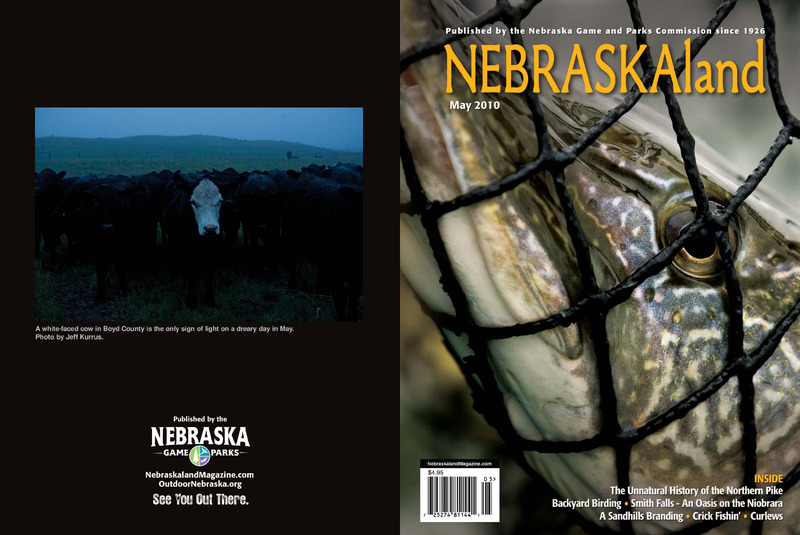
A white-faced cow in Boyd County is the only sign of light on a dreary day in May.
Photo by Jeff Kurrus.
Volume 88, Number 4, May 2010
12 Tales of an Esox – The Unnatural History of the Northern Pike
Myths and outright lies about northern pike abound. No matter
how it’s perceived, there are plenty of stories to back
your point of view. TEXT AND PHOTOS BY JEFF KURRUS
20 Backyard Birding – A Love Story
A young newlywed couple learns the ins
and outs of backyard bird feeding while discovering the
beauty of their new, finely feathered friends. BY JODY KEISNER
22 A Sandhills Branding
Unless you live near a ranch, there’s a good chance you’ve
never seen a cattle branding. Here’s a quick look at one of
the Sandhills’ most necessary traditions.
PHOTOS BY BILL HAGER
28 Crick Fishin’
Protecting your secret fishing place can be difficult – but
keep trying. BY ZANE DICKENSON
32 Long-billed Curlew – Mysterious Shorebird of the Sandhills
Unlike most shorebirds, long-billed curlews nest in
grasslands during the breeding season. Research is revealing
more about their time in Nebraska. TEXT BY CORY GREGORY
32
●
38 Smith Falls – an Oasis Along the Niobrara
While Nebraska comes up on the short end competing in the
realm of vertical natural wonders throughout the country, on
the Great Plains, Smith Falls’s delicate cascade of water over
rock is certainly a contender. TEXT AND PHOTOS BY JON FARRAR
Comment . . . . . . . . . . . . . . . . . . . . . . . . . . . . . . . . . 4
Mixed Bag . . . . . . . . . . . . . . . . . . . . . . . . . . . . . . . . 6
In the Field . . . . . . . . . . . . . . . . . . . . . . . . . . . . . . .44
Step Outside . . . . . . . . . . . . . . . . . . . . . . . . . . . . . .45
Outdoor Update . . . . . . . . . . . . . . . . . . . . . . . . . . . .46
Classifieds . . . . . . . . . . . . . . . . . . . . . . . . . . . . . . . 48
Portraits from the Past . . . . . . . . . . . . . . . . . . . . . . 50
28
●
22
●
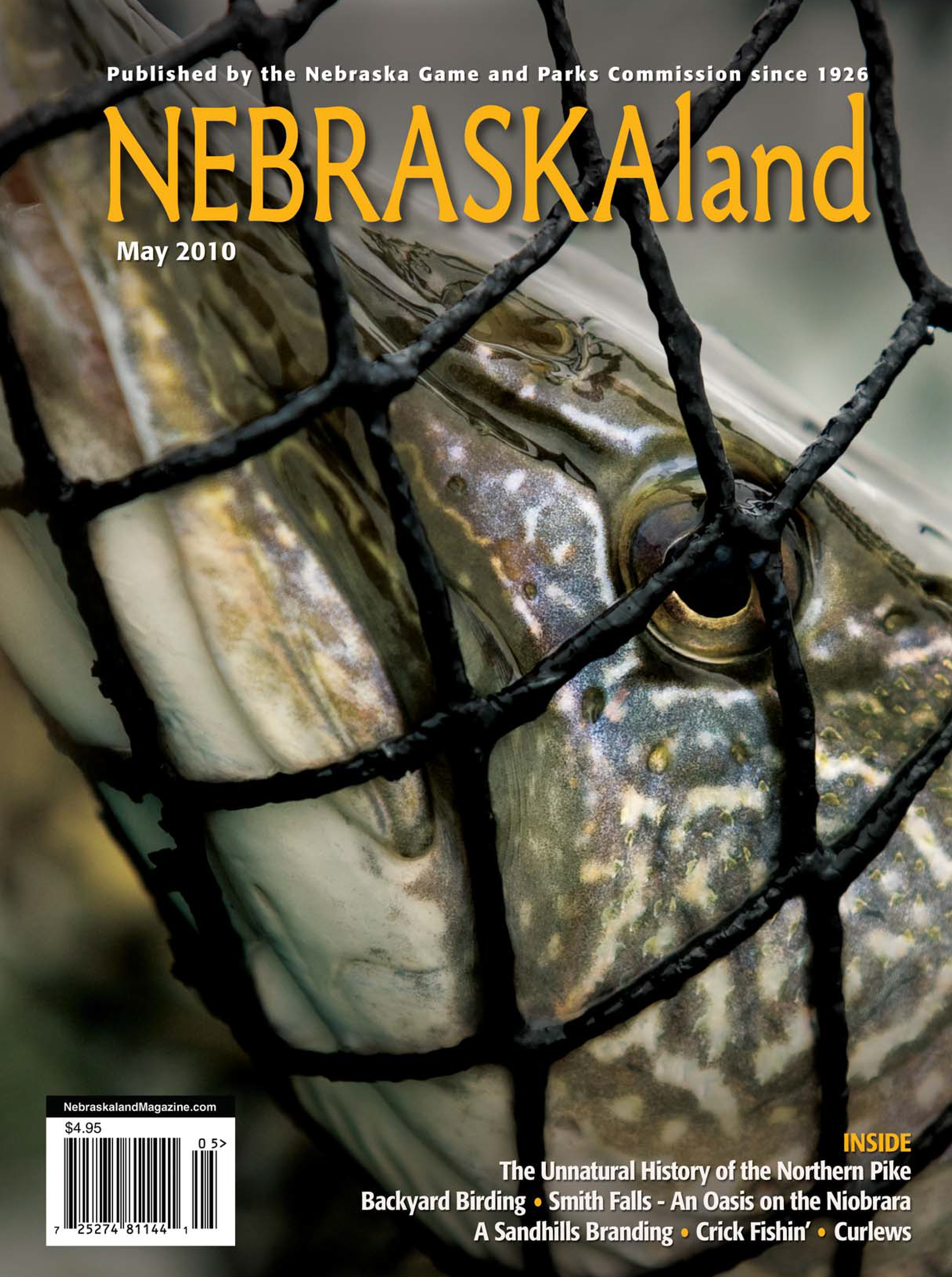
Cover: A northern pike is landed at the Valentine National Wildlife Refuge’s
Clear Lake in Cherry County. See story on page 12. Photo by Jeff Kurrus.
Opposite: Nonnative but extremely common, ox-eye daisies line Highway
370 between Bellevue and Gretna last May. Photo by Jeff Kurrus.
NEBRASKAland (VOL. 88 / NO. 4, ISSN 0028-1964) is published monthly, except for the
combined Jan./Feb. and Aug./Sept. issues, by the Nebraska Game and Parks Commission,
2200 N. 33rd St., Lincoln, NE. Periodicals postage paid at Lincoln, Nebraska, and additional
mailing offices. POSTMASTER: Send address changes to NEBRASKAland, P.O. Box 30370,
Lincoln, NE 68503-0370.
38
●
MAY 2010 • NEBRASKALAND 3
Published by the
Nebraska Game and
Parks Commission
Director:
Rex Amack
Assistant Directors:
Roger Kuhn, Kirk Nelson, Sam Sidner
Commissioners
Chairman:
Jerrod Burke, Curtis
Vice Chairman:
Mick Jensen, Blair
2nd Vice Chairman:
Ron Stave, Waterloo
Dr. Mark Pinkerton, Wilber
Dr. Kent Forney, Lincoln
Lynn Berggren, Broken Bow
Rex Fisher, Omaha
Mark Spurgin, Paxton
Norris Marshall, Kearney
Magazine Staff
Editor: Doug Carroll
Associate Editor: Jeff Kurrus
Art Director: Tim Reigert
Senior Editor: Jon Farrar
Regional Editors: Eric Fowler, Bob Grier
Contributing Editor:
Michael Forsberg
Regular Contributors:
Bill Hager, Chris Helzer and
Lisa Knopp
Photo Librarian: Sarah Johnson
Circulation: Donna Robinson
For address changes and questions about
your subscription, e-mail
Donna.Robinson@Nebraska.gov
or call (800) 632-5263
Marketing/Advertising:
For advertising information contact
Larson Enterprises
e-mail dave@larsonent.com
or call (515) 440-2810
NEBRASKAland Magazine
Copyright 2010, all rights reserved.
NEBRASKAland is available on audio cassette from the Nebraska
Library Commission Talking Book and Braille Service, Suite 120, 1200 N
St., Lincoln, NE 68508. (800) 742-7691. NEBRASKAland Magazine and
the Nebraska Game and Parks Commission reserve the right to reject any
advertising not in keeping with the agency mission.
Rates: $18 for one year; $33 for two years; $44 for three years. Nebraska
recipients must add appropriate sales tax. To subscribe call 1-800-NEBLAND (632-5263), or go online to: NebraskalandMagazine.com.
4 NEBRASKALAND • MAY 2010
We Get Around
I just wanted to tell you that the story
you ran about the locked-up bucks my
wife and I found (January/February
2010) continues to surprise me. My
brother was in Sterling, Colorado, and
a friend of his came up and showed
him the article. I did not realize so
many people get this magazine. Thank
you!
Al Nelson
Crofton, Nebraska
It's something that I often forget, but
yes, the magazine does travel a bit –
NEBRASKAland has subscribers in
every state, as well as 16 foreign
countries. Apparently there are a lot of
former residents and visitors that still
want a taste of Nebraska. Thanks again
for sharing your story with our readers.
– The Editor
Anglers’ Pet Peeves
Jeff – Nice article in NEBRASKAland!
I would add a pet peeve that I’ve had
for 20 years: As a bank fisherman, on
several occasions I’ve cast live bait for
northerns at DeSoto Bend, Calamus,
Grove Lake and others. I leave the bait
on the bottom, put the reels in free
spool, clip bobbers on the line and
wait. Then the hotshots in bass boats
cruise by, pitching lures at the bank and
retrieving. There are some that feel
they have to cover every inch of shoreline. Consequently, if I only had a buck
for every time one of these jerks has
snagged my line with his lure ... I’d
buy us both lunch. Why some people
can’t respect others and allow some
room is beyond me!
John Jordison
Palmyra, Nebraska
One thing that I am always critical of
when I am bank fishing is not to get
too close to someone else. I make sure
to stay at least two casting lengths from
the person next to me if I can, but this
doesn’t always work if you’re in an
inlet or outlet area. Just a couple of
others:
1) If everyone could take an empty
plastic bag in and fill it with trash on
the way out, we would all enjoy nature
that much more.
2) Don't leave fish or fish parts on
the bank. Pack it out as you would
trash.
3) If you’re an able-bodied angler,
don’t fish in the handicapped areas.
Have a great day in the outdoors,
Monte Deatrich
Thornton, Colorado
NEBRASKAland Visitor Letters
We want to thank all 194 readers that
sent e-mails and letters for last issue’s
visitor, an American dog tick
(Dermacentor variabilis) on page 25
(see page 11 for the winner, rules and
next month’s hint). Here are just a few
of the many wonderful responses we
received:
I have found the visitor on page 25 of
the April 2010 issue of NEBRASKAland.
It is a female American dog tick
(Dermacentor variabilis).
What a fitting month to put this
arachnid into the magazine. Thanks for
the reminder to mix up a batch of
homemade insect repellent:
HOMEMADE TICK REPELLENT
(Suggested by the USDA Forest
Service)
2 cups white vinegar
1 cup Avon Skin So Soft bath oil
1 cup water
1 T. eucalyptus oil
Put the mixture in a spray bottle. Use
spray before going into areas where
ticks are apt to be present.
Thanks,
David Gloe
Omaha, Nebraska
I love the new "visitor" contest in
NEBRASKAland - it has changed the
way I read my favorite magazine! I
used to thumb through to take a look at
the photos, then go back and read it
cover to cover. My new routine has
added finding the visitor between those
steps.
This month's visitor is a tick located
on the green fishing lure near the center
of the photo on page 25.
Thanks for producing such a topnotch publication that highlights the
best of Nebraska.
Jeramy Phillips
Seward, Nebraska
Just received my April 2010 issue
and had to once again jump on the
opportunity to find this month’s 'visitor'
– the American dog tick camouflaging
itself as a dot on the center dry fly.
Have always enjoyed the excellent
articles and photography that the
NEBRASKAland staff produces. When
it arrives each month, it's always the
first piece of mail that I seek out to
read. Having been a lifelong hunter
and angler, I find this month's visitor
to be quite timely with spring turkey
(ie. tick) season soon to begin. I have
utilized much of the information from
past issues in my teachings as a NGPC
Aquatic and Hunter Education volunteer
instructor.
Keep up the excellent work – I’m
looking forward to next month’s 'visitor'
challenge.
Kirk Gunnerson
Lincoln, Nebraska
A female American dog tick
(Dermacentor variabilis) is one of
the most frequently encountered
ticks and is sometimes known as
the wood tick. The larvae and
nymphs feed on small warmblooded animals such as
mice and birds. The adult
American dog tick will
feed on humans and
medium to large mammals, such
as raccoons and dogs.
Send your comments to:
Doug Carroll, Editor
NEBRASKAland Magazine
P.O. Box 30370
Lincoln, NE 68503
or e-mail Doug.Carroll@Nebraska.gov
Please include your postal address and
telephone number.
Letters may be condensed and edited
for clarity. Photographs are
welcome and will be returned.
Under federal and/or state law, discrimination is prohibited on the basis
of race, color, religion, age, gender, marital status, national origin,
disability or political affiliation. If you think you have been discriminated
against in any program, activity or facility by the Nebraska Game and
Parks Commission or want more information, contact the Commission in
Lincoln, NE, at (402) 471-0641 or the Equal Opportunity Commission,
Lincoln, NE, (402) 471-2024, TTY/TDD (402) 471-4693).
Headquarters
2200 N. 33rd Street
Lincoln, NE 68503
Phone (402) 471-0641
District Office I
East Hwy. 2, Box 725
Alliance, NE 69301
Phone (308) 763-2940
District Office II
524 Panzer St., Box 508
Bassett, NE 68714
Phone (402) 684-2921
District Office III
2201 N. 13th St.
Norfolk, NE 68701
Phone (402) 370-3374
District Office IV
301 E. State Farm Rd.
North Platte, NE 69101
Phone (308) 535-8025
District Office VI
1617 First Ave.
Kearney, NE 68847
Phone (308) 865-5310
Omaha Office
1212 Bob Gibson Blvd.
Omaha, NE 68108
Phone (402) 595-2144
Ak-Sar-Ben Aquarium
21502 W. Highway 31
Gretna, NE 68028
Phone (402) 332-3901
World Wide Web site:
Panhandle
Officer
City
Phone (308)
Jim Zimmerman (Sup.) Gering
763-2940
Scott Brandt
Gering
631-0663
Heath Packett
Gordon
360-0682
Dennis Thompson
Ogallala
289-0755
Dan Zuehlke
Ogallala
289-3399
Doug Pollard
Oshkosh
778-7101
Frank Miller
Valentine (402) 389-0444
Dan Kling
Harrison
430-0572
Southwest
Officer
City
Phone (308)
Roger Thompson (Sup.) N. Platte
535-8025
Ray Dierking
Brkn. Bow
870-0322
George Sund
Cambridge
655-0028
Michael Thome
Cozad
529-8146
Matt Andrews
Elwood
746-2418
Dirk Greene
Imperial
882-0015
Virgil Gosch
McCook
340-2440
Dudley Sorensen
N. Platte
530-0016
Rich Routh
Rep. City
920-0367
South-central
Officer
Jerry Pecha (Sup.)
Jeff Jones
Terry Brentzel
Randy Pomplun
Darin Gress
Dale Johnson
Robert Finke
City
Phone (308)
Kearney
865-5327
Clay Center(402)762-5022
Doniphan (402)469-5795
Fullerton
550-0489
Hebron (402) 768-8665
Kearney
440-3847
Milford (402) 947-1363
Northeast
Officer
Tom Zimmer (Sup.)
Dale Davis
Steve Oberg
Daniel Roberts
Jon Reeves
Marion Shafer
Pat George
Tim Williams
Cory Krause
City
Phone (402)
Norfolk
370-3374
Bassett
760-0712
Columbus
910-3366
Fremont
719-1108
Kennard
889-8508
Norfolk
992-7590
O’Neill
340-0787
Neligh
929-0051
West Point
380-6410
Southeast
Officer
Duane Arp (Sup.)
Sean McKeehan
William Krause
Mike Luben
Douglas Kramer
Dina Barta
Stacey Lewton
Levi Krause
Russell Mort
Dan Evasco
Jeff Clauson
City
Gretna
Ashland
Auburn
Colon
Lincoln
Lincoln
Lincoln
Louisville
Nebr. City
Papillion
Waterloo
Administration
Ted Blume (Adm.)
Craig Stover (Asst.)
Wes Loos (Asst.)
Rod Loos (Asst.)
Murray Johnson
Lincoln
471-5531
Lincoln
471-5532
Lincoln
471-5591
Ogallala (308) 284-8056
Lincoln
471-5003
Phone (402)
332-2965
521-0159
274-8063
443-6392
890-6465
890-6463
890-7140
949-0593
209-1506
616-5961
658-7057
Nebraska Wildlife Crimestoppers 1-800-742-7627
MAY 2010 • NEBRASKALAND 5
2009 a Record
Year for
Walleye at
Merritt
6 NEBRASKALAND • MAY 2010
PHOTO BY PAT MINGARELLI
Eric Fowler
If you fish for walleye, you
undoubtedly heard how good the
walleye bite was at Merritt Reservoir
near Valentine last summer. How good
was it? From May through August,
anglers caught about 74,000 walleyes
and took 28,000 of those fish home.
Those estimates were calculated in
an angler creel survey conducted at the
lake. For comparison, the last creel
survey conducted at Merritt in 2006
estimated that anglers caught about
4,800 walleye and kept 1,600. Of the
creel surveys conducted since 1991,
only 1999 came close to the total catch,
with 58,000 fish caught but only 5,200
kept. More fish were harvested in 2009
than in the last seven survey years
combined, including the previous
record of 7,800 in 2000.
Zac Brashears, a Commission
biologist who works and fishes at
Merritt and other north-central
Nebraska waters, said anglers he spoke
with told him the fishing was “the best
they’ve ever seen,” especially for fish
between 22 and 28 inches in length.
Brashears said several factors played
into the record catch. Timely rains and
a canal shutdown for repairs meant less
water needed to be released for
irrigation, and the reservoir dropped
only seven feet rather than the normal
20-foot decline. That kept aquatic
vegetation, a favorite early-season
habitat of walleyes in the lake, flooded
all summer, and allowed anglers to
target fish in or near that habitat longer.
That factor, combined with cooler-thannormal weather, extended a bite that
normally tapers off in July well into
August.
So what can anglers expect this year?
“It would be hard to maintain that
catch and harvest rate again in 2010,
but fishing should be good again, not
only for walleye, but also for a number
of other species throughout the year,”
Brashears said.
Of course, they do call it fishing and
not catching, so you just never know.
See you out there.
What Do Fawns Eat?
Pat Mingarelli
Late spring is a time for an abundance
of new life. The trees have taken on a
lush green color and wildflowers have
begun to bloom. The animal kingdom
is bursting with new life as well,
including white-tailed deer fawns.
Most fawns in Nebraska are born at
the end of May or in early June after a
200-day gestation period. The majority
of does give birth to twins, while some
give birth to triplets. However, younger
does usually have single births. On
average, there are 140 fawns born per
100 doe in Nebraska.
At birth, the mothers allow the fawns
to suckle not milk, but colostrum.
Colostrum is produced by all mammals
before they produce milk. It is especially
rich in antibodies that are called
immunoglobulins, which are normally
found in the blood of vertebras. These
antibodies provide newborn fawns with
their first immunity, since their own
immune system is not yet active.
After about 36 hours, the doe begins
to produce strictly milk. Deer’s milk is
about 10 percent milk fat – a high fat
content compared to cow’s milk, which
is roughly three percent fat. This high
fat milk is needed to help take a fawn
from five to seven pounds at birth to
the 80 to 85 pounds it will need to be
before winter sets in. Milk will be the
fawn’s only food source for two to
three weeks until it begins to nibble
on leaves and grasses.
At one month, a fawn’s diet is mostly
vegetation and just partially milk as it
transitions into eating an adult deer
diet. Nebraska deer survive on native
plants, including many wooded plants
and non-woody, broad-leafed plants,
grasses, sunflowers and a variety of
nuts. Also, in some areas of the state
corn can make up to 40 to 50 percent
of the year-round diet for deer.
Fawns will gradually increase their
intake of these foods and, by week 12,
a fawn’s stomach is fully developed.
Most are fully weaned by that time and
are ready for the winter months that lie
ahead.
Crow’s Sloppy Joes
Megan Crow
1 lb. ground venison
3
/4 cup ketchup
11/2 Tblsp. prepared mustard
1
/2 cup diced onion
1
/4 cup brown sugar
1 tsp. red pepper flakes
1 (10.5 ounce) can condensed French
onion soup
1
/2 tsp. coarse ground pepper
1
/4 tsp. garlic salt
1
/4 tsp. liquid smoke
Brown ground beef and diced onion.
Mix in ketchup, mustard, brown
sugar, garlic salt and black pepper.
Pour mixture into crockpot and stir in
french onion soup, red pepper and
liquid smoke.
Cover and cook on low for five
hours. Serve over hamburger buns.
PHOTO BY BOB GRIER
Jeff Kurrus
Recycling Fishing
Line
Party With the Stars
Kelsea Nore
When people think of Nebraska, they
often conjure up images of wide-open
stretches of land. The same can be
said of the state’s skies, and the northcentral part of the state is one of the
best stargazing areas in North America,
with a very low level of light pollution.
Several years ago, the Prairie
Astronomy Club of Lincoln and the
Omaha Astronomical Society came
together to create what is known as the
Nebraska Star Party, which this year
will be will holding its 17th annual
event August 8-13 at Merritt Reservoir,
approximately 27 miles south of
Valentine.
This weeklong event welcomes
stargazers of every level, and includes
a children’s program and field classes
to educate beginner astronomers.
Cletus Baker, publications director of
The Nebraska Star Party, said “attendees
continue to be amateur astronomers
recycled more than nine million miles
of fishing line since 1990.
Recycled fishing line, combined with
other materials, is used to create aquatic
habitat structures that help rejuvenate
older bodies of water lacking natural
cover essential to the growth and
development of healthy fish populations.
The fishing line recycling bins are
constructed from three-foot sections of
white PVC tubing and will be mounted
on posts or existing structures near boat
ramps and fishing piers. Bins will also
be placed in local bait and tackle shops.
The NEFGA is looking to partner with
other outdoors-related organizations
and retailers to acquire funding to
underwrite the costs of constructing,
installing and servicing additional fishing
line recycling bins.
Anyone interested in sponsoring a
fishing line recycling bin should contact
Steve Wagle at Steve.Wagle@nefga.org.
Nebraska Outdoor Expo
This year’s version of the Nebraska
Game and Parks Commission’s popular
Nebraska Outdoor Expo will be held
May 15th from 9 a.m. – 5 p.m. at the
Fort Kearny State Recreation Area near
Kearney.
This free family event is designed
for everyone from novice to seasoned
outdoor enthusiasts and features a
variety of activities, including fishing
and bowfishing, shotgun and air rifle
ranges, a 3-D archery range, kayaking,
seminars on a variety of topics, including
predator calling, fish cleaning and
turkey hunting, and a marketplace
where vendors and exhibitors will
represent different sectors of the
outdoors.
In addition to these offernings, there
were also be adult and youth divisions
for both the Cabela’s Outdoor Challenge
event and a s’more eating contest, as
well as a Dutch over cookoff where
Expo visitors can vote for their favorite
recipe.
To find out more about the Expo,
log on to its web site at
www.NebraskaOutdoorsExpo.org.
There is no cost to attend the
Nebraska Outdoor Expo, but an annual
or daily park permit will be required on
all vehicles entering the park.
See You Out There ... But Where?
PHOTO BY JEFF KURRUS
Do you know where this Nebraska photograph was taken?
See answer at the bottom of page 11.
8 NEBRASKALAND • MAY 2010
The Nebraska Fish &
Game Association
(NEFGA), in cooperation
with the Nebraska Game
and Parks Commission
and other local agencies,
is launching a statewide
fishing line recycling
program to help reduce
environmental damage
caused by discarded monofilament
fishing line. Collected line will be sent
to the Berkley Conservation Institute
(BCI) in Spirit Lake, Iowa, which has
PHOTO COURTESY OF NEBRASKA FISH & GAME ASSOCIATION
Readers in the spring of 1956
were waving goodbye to the
sandhill cranes, who had once
again passed through on their
migratory flight through central
Nebraska. As the cranes departed,
Outdoor Nebraska featured Bud
Pritchard’s “Wildlife in One Reel,”
while also writing about some of
the same ventures as people do
today. In Bruce McCarraher’s
“Northern Pike?” he wrote, “… it
must be assumed that the northern
pike exhibits a rather unique place
in the North American sport fishery,
inasmuch as it is either an
extremely popular fish or greatly
disliked,” which is a similar notion
found in this month’s article by
associate editor Jeff Kurrus,
entitled “Tales of an Esox.”
Also in that issue, biologists then
were asking questions that have
resonated in recent times,
including George Schildman’s
“Can We Help the Bobwhite’s
Plight?” and Dan Heyl’s “Have our
Pheasants Reached the Bottom?”
Plus, the recent history of walleye
stocking in Nebraska’s western
reservoirs was covered, as was
programs to improve fishing in
Nebraska and nature notes on
brown trout.
To read both 1956 articles
about two of Nebraska’s upland
bird species, log on to
NebraskalandMagazine.com and
click on “A Look Back.”
who bring their own telescopes and a
thorough knowledge of the skies, but
more and more folks are coming for
the opportunity to learn and look
through the wide variety of instruments
on the field, ranging from binoculars
to some of the largest telescopes in
private hands.”
For more information, visit
www.nebraskastarparty.com.
MAY 2010 • NEBRASKALAND 9
Many years ago when I was stationed in the
Lincoln area, I was assigned to work the south Salt
Valley Reservoirs. It was Memorial Day weekend,
and I was at Bluestem Reservoir. There was a lot of
camping activity and I was in an area on the
southwestern side of the reservoir doing routine
patrol work. I happened to notice vehicle tracks
around a guard post that was meant to keep vehicles
out of that specific area.
There were signs posted stating that vehicles were
to stay on roadways and in parking lots. The terrain
where the tracks led was hilly, with quite a few trees
and tall grass. I followed the tracks on foot and hadn’t
gone too far when I came upon the vehicle along
with its owner, who had set up a camp for his family
away from the crowd and all the hustle and bustle. I
issued him a citation for having his vehicle in an
unauthorized area and directed him to remove the
vehicle.
The following holiday, Independence Day, I
happened to be patrolling the same area and
noticed a bright reflection coming from a group of
Virginia Creeper
PHOTO BY JEFF KURRUS
Kelsea Nore
“Leaves of three, let them be,” is a
common warning to those spending
time hiking trails or working in the
garden. The five-leafed Virginia creeper
can cause the same reaction in people
who are more partial to the affects of
poison ivy or sumac.
The oxalate crystals in
the plant’s sap cause
skin irritation,
especially in those
who are susceptible to
poison ivy. While some
may not develop a skin
rash, the plant is
extremely toxic if
eaten. Dark blue
berries appear on the
vines in the late spring.
However, the fruit is
not harmful to birds
and other animal wildlife. Virginia
creeper also blooms with small whitegreen flowers in the spring, though it
is for the leaves that many choose to
10 NEBRASKALAND • MAY 2010
trees in the vicinity of where I had issued the citation
the previous holiday. It was quite aways further in
from the parking lot where I first saw the tracks
Memorial weekend. I didn’t give it much thought at
the time, but later I was in the area and took a hike
to where I’d seen the sunlight reflecting off something.
Turned out that it was a windshield – the same
windshield of the same vehicle who’s owner I had
issued a citation to the previous holiday. He pretty
much knew the drill the second time around, so
things went a little faster. His only comment was “I
thought I hid it better this time.”
Before we parted, I advised him that we had one
more major holiday left that summer, that I would be
working it and I would still have an
ample supply of “ticket books” at my
disposal. He assured me that he
had learned his lesson the second
time around.
I made it a point to check Labor
Day weekend, but did not encounter
my slow-to-learn “friend.”
– Jerry Pecha, Conservation Officer, Kearney
cultivate this plant.
Many use this deciduous plant as
ground cover or to create an ornamental
cover over fences and outdoor walls.
Virginia creeper is dark green in the
summer but blushes in several shades
of red early in the fall. This perennial
grows rapidly, making it an excellent
climbing plant, but only if one is willing
to put forth the effort to maintain the
plant with regular pruning. The tendrils
of this vine are ‘adhesive-like’ (imagine
tiny suction cups). There are incidents
of the tendrils climbing into the tiny
cracks in stone foundations or brick
walls. Also, if the plant latches on to
other vegetation, such as a neighboring
tree, it will invade and take over its
host. Be warned – Virginia creeper is
not easy to remove. Those wishing to
get rid of the plant achieve their desired
results only through time and repeated
cuttings of the base stem.
The attractive colors and quick
growth of the plant are winsome
qualities but Virginia creeper is also a
very hardy plant. Originating within
the borders of its namesake state,
the parthenocissus quinquefolis
prospers in over 40 states and in
Canada. It will grow in full sun and
partial shade and can withstand periods
of drought. In Nebraska, it will grow
just as easily in the Sandhills as it
would in a Beatrice backyard. The only
question is: Do you want it there?
Can’t Beat the Drum
Elizabeth Mack
Nebraska waters are populated with
some of the most diverse fish
species any angler could hope
for, and the freshwater
drum (Aplodinotus
grunniens) is a
favorite of many
fishermen. The
freshwater
drum’s
common
names
fishing, and a favorite of Wagner’s, can
be found in the lower Elkhorn River
near Waterloo, where drum are abundant.
Many areas across the state boast an
abundance of freshwater drum, including
state records of 23- and 29-pounders
from the Missouri River just below
Gavins Point dam in northeastern
Nebraska.
Although some anglers are turned off
at the sight of a drum because of their
dank smell and mucus lining, the drum
has become a popular catch for many
commercial fishermen and provides a
major source of income. According to
Andrew Rypel, a researcher at the
University of Mississippi’s biology
department who has done extensive
research on drum, commercial demand
for drum is typically low; however,
Rypel explains, “because of their high
abundance in many waterways, they
can make up a very high proportion of
a commercial harvest, even though they
are not targeted.” Commercial harvest
in the Mississippi has been over
300,000 pounds each year in the past
decade alone.
You may be eating drum and not
even know it. Stoller Fisheries in
northwestern Iowa processes a high
volume of drum, what they refer to as
“underutilized” fish. The drum, along
with carp and other rarely targeted fish,
are regularly used in dehydrated soup
bases and as fish stocks.
Once the temperatures begin to
warm, freshwater drum will become
active and move in schools to shallow
waters. If you happen to catch one
of these fierce fighters, Wagner
recommends frying them up in Cajun
seasoning. You won’t be disappointed.
Junior Duck Stamp Winner
The Best of Show at this year’s
Nebraska Federal Junior Duck
Stamp Contest was awarded to
15-year-old Emily Tolliver of
McCook, whose acrylic painting
of a pair of Canada geese was
selected from more than 900
entries received from across the
state.
Tolliver’s artwork was sent on the
National Junior Duck Stamp
Competition and will be used for next
year’s Nebraska state waterfowl stamp.
Turpin Time
Dick Turpin
Now I know old
newspapers have
been used for
everything from
birdcage liners to
fire starters. They
can also help
freshen up your cooler. Sometimes
them coolers get an odor to them. Just
take some newspaper, wad it up…stuff
that newspaper in there, get it stuffed
pretty full and leave that until your next
trip. That paper just sucks that odor
right out of there.
You can also freshen up your vehicle
by using scented laundry dryer sheets.
Man, they smell good. What I do with
them is place them around my truck on
the floor, up in the vents, in the
defroster so that air flows through
there. This old pickup has a lot of
memories for me and the missus. If I
get this old thing smelling good again,
I might ask her out for an ice cream
cone … take her out for a little ride. ■
NEBRASKAland Visitor
Winner and Hint
Last issue’s winner of
the NEBRASKAland Visitor drawing
was Gene Backemeyer of Murdock,
who found the American dog tick
on page 25.
Readers are encouraged to contact
NEBRASKAland within 10 days
after this issue’s publication with the
correct page number and name of
this issue’s “Visitor” – an insect or
bug found in Nebraska that just
happened to find its way onto one of
the pages of our publication.
We will then gather the correct
entries and draw one to win a
NEBRASKAland Visitor mug.
To enter each month, e-mail
Tim.Reigert@Nebraska.gov
with “Visitor” in the subject line of
the message or write:
NEBRASKAland Visitor
2200 North 33rd Street,
Lincoln, NE 68503.
HINT: This month’s visitor is not
on page 5 or 11.
Henry Doorly Zoo, Omaha
Slow to Learn
include sheepshead, croaker, silver
perch, gaspergou (goo) and grunter.
The croaker and grunter names come
from the drum’s ability to produce
grunting sounds with specialized
muscles that vibrate against their swim
bladders, a sound associated with
spawning activity. Native Americans
referred to drum as buffalofish because
of how similar their grunts sound to a
buffalo.
In addition, drum also possess
exceptionally large inner ear bones
called otoliths. These marble-sized
bony structures assist the fish in
maintaining balance. Fishermen often
keep these ear bones as good luck
pieces, and Native Americans once
used otoliths for jewelry as well as
currency. Numerous otolith bones
have been found around old Indian
settlements.
Drum have the largest latitudinal
range of any freshwater fish in North
America. According the Greg Wagner,
Public Information Officer with
Nebraska Game and Parks
Commission, the freshwater drum was
originally found in Nebraska only in
the Missouri River and the lower reaches
of its larger tributaries. “After stockings
in 1936, the freshwater drum became
established in waters across the state,”
Wagner said.
The bottom-feeding drum prefer
backwaters or areas with slack current
and are primarily active at night. One
great spot for
drum
MAY 2010 • NEBRASKALAND 11
“T
he Fish of 10,000 casts,” the
northern pike (Esox lucius) is
not. That is reserved for the
muskellunge.
“North America’s most popular game
fish,” the northern pike is not. That
would probably be the largemouth
bass. The northern pike is not even this
country’s tastiest game fish, debated
among anglers to include bluegill,
crappie, walleye or catfish. People will
eat northern, but it’s not often listed as
the world’s most palatable – a thought
that has prevailed for centuries: “His
meat is not for the dining table,” wrote
a 4th century Roman poet, “but sold at
cheap shops smoky with its reeking
stink.”
Anglers and pike have not had the
friendliest of relationships through the
years. While this game fish is known as
one of the world’s most adaptable fish,
one of few freshwater species to live in
both North America and Eurasia, this
longtime Nebraska resident is too often
spoken about in a negative tone. While
anglers celebrate Esox masquinongy,
the muskellunge, northern pike are
much less adored throughout the
world.
In Francis Buzzacutt’s 1913 The
Complete Sportsman’s Encyclopedia,
he wrote, “The muskallonge is the
largest and handsomest of the Pike
family.” However, writer Craig
Springer, in a 2007 Country Living
article, wrote that the northern pike is
one of Ohio’s five ugliest fish.
A curious observation for two fish so
similar to each other.
There are five fish in the Esox
family – northerns, the muskellunge
and the chain, grass and redfin pickerals
– with the “muskie” being most similar
to the northern pike having a long,
sleek shape; large, cutting teeth; and at
least one other trait: “For the most part,
the northern pike sometimes rivals the
muskellunge himself in
size and weight, and, to
my way of thinking, is
the equal in the latter in
fighting ability,” wrote
former Outdoor Life
fishing editor O.
Warren Smith in 1935.
“After a lifetime of
MAY 2010 • NEBRASKALAND 13
ARTWORK BY JOSEPH TOMELLERI
pike growing nearly three times as
large as the Nebraska state record
largemouth.
However, the muskie is held in
high regard while the northern pike is
not, a point that has been echoed for
hundreds of years and often resonates
today, even though there is good reason
it shouldn’t.
Legend
While the northern pike (top) is often cursed and the muskellunge (bottom)
is often revered, the differences between these freshwater predators are
minor. First, the fish are patterned different. Second, the northern pike has
scales on its gill cover and cheek while the muskellunge does not.
Third, the muskellunge has more pores under each side of its lower jaw.
Fourth, the muskellunge grows larger. In Nebraska, the state record northern
pike weighed 30-1 and was caught by Steven Morris at Terry’s Pit in 1997,
while Jarred Haddix’s 1992 Merritt muskie weighed 41-8.
COURTESY OF ROGER WELSCH
nine in the muskellunge.
The last difference is their size.
Muskies grow larger than northern
pike. In Nebraska, the state record
muskie weighed 41-8, and was caught
by Jared Haddix at Merritt Reservoir
in 1992; while the state record northern
pike weighed 30-1, and was caught by
Steven Morris at Terry’s Pit in 1997.
Records from other states are similar,
with muskies weighing more than
pike. Yet both species still grow to
enormous sizes, with the northern
“GREAT SPORT FISHING HERE” reads this 1910 “tall-tale” postcard which
features fish, including northern pike, attacking these anglers’ boat as they fish.
14 NEBRASKALAND • MAY 2010
PHOTO COURTESY OF MR. AND MRS. FRANCIS WOOD
fishing, given two fish of equal weight,
and in the same environment, there is
not the slightest difference in their
fighting qualities.”
Plus, the differences they do have
are minor: First, the markings on both
fish are patterned different; second, the
northern pike has scales on its gill
cover and cheek, while the muskellunge
does not. The third distinction is the
number of pores under each side of the
lower jaw – there are usually five on
the northern pike and between six and
While the aforementioned 4th century
Roman poet seemingly prefaced the
next 1,800 years of Esox text by writing
“Lucius besieges the complaining
frogs in obscure holes among sedges
and mud,” it was Izaak Walton’s 1653
The Compleat Angler that is more
often quoted regarding the voracity of
pike: “All pikes that live long prove
chargeable to their keepers,” wrote
Walton, “because their life is maintained
by the death of so many other fish,
even those of his owne kind, which has
made him by some writers to bee
called the tyrant of the rivers, or the
fresh-water wolf, by reason of his
bold, greedy, devouring disposition.”
These thoughts were later supported
in Genio Scott’s 1869 Fishing in
American Waters. “It [the pike] preys
on any living thing from a duckling to
a swallow, and from a mouse to a frog.
Everything is game to this wolf of the
pond that moves at night, hides in the
watery sedges, sneaks upon his prey
and devastates and terrorizes the world
of the inland seas.” With Esox being
Latin for pike, named from the fish’s
resemblance to the slim and deadly
medieval weapon of the same name,
and lucius being Latin for “wolf,” this
predator was perfectly described by
early scribes, some of whom must
surely have wet a line or two during
their days.
However, this fish is so described
not only because of its hunting, but
also because of its response once it has
been hooked: “A Pike whose mouth
has been lacerated by a hook, will
continue after it with eagerness,” wrote
Francis Buzzacutt’s in his 1913 The
Complete Sportsman’s Encyclopedia.
Smith echoed this sentiment 22 years
later, saying that the pike would
deliberately seize an angler’s line in
its mouth to liberate itself. To combat
this issue, Smith suggested a gaff,
because he admitted that it was next to
impossible to land a 20-pounder with a
net. However, he also admitted an
additional aide to his gaff. “As I said, a
strong gaff is better, but do not undertake
to gaff a large northern pike without
first having administered a sharp blow
on the head with a club, or having sent
a pellet of lead between the eyes from
a thirty-two revolver. I do not like
shooting fish, but a large northern pike
requires a dose of that medicine.”
In Nebraska, there was a time when
Smith’s advice could have been legally
taken (see photo on right). Similarly,
today on Vermont’s Lake Champlain,
it is still legal for two months each
spring to hunt northern pike with
shotguns, handguns and rifles – an
extremely controversial season still
prevailing in the northeast.
But to hunt for a fish so known for
its hunting probably doesn’t seem
totally unreasonable to some Vermont
residents. “The northern pike has about
the same appeal to fisherman as the
wolf or the grizzly does to some biggame hunters,” wrote Silvio Calabi in
1988’s Game Fish of North America.
“But while the rapacious nature of the
two animals is grossly exaggerated,
old Esox lucius, the waterwolf, is
indeed a nasty customer.”
Calabi supported his statement by
relaying a tale from when he was once
fishing in Canada’s Labrador River. “I
almost stepped on a medium-sized
pike that was lying in six inches of
water in the lee of a rock; it had a
ten-inch brook trout sideways in its
jaws. The pike rolled one eye upward,
studied me, then deliberately swallowed
the trout down before shooting away
into the current.”
It has been stated in multiple texts
that a northern pike will attack
anything of reasonable size that
moves. And writers throughout history
have relayed stories of pike biting
mules drinking water and eating small
ducks and other birds. Similarly, in
Frank Dufresne’s 1946 Alaska’s
Animals and Fishes, he stated that,
along the Yukon, some Eskimos tell of
THIS 18-POUND NORTHERN PIKE was taken by Burk Wood (right) at
Sievers Lake near Ewing in 1900.
remote “devil lakes” where there are
monster pike able to swallow not only
man but canoe as well. Even to
approach these lakes is held to be bad
medicine.
It is stories such as this about the
pike that transcend legend, carving a
reputation of a fish to be so hideous
that it must more applicably deemed
“mythical.”
Myth
How can such a predatory fish come
from something as benign as a plant?
In the 1550s, biologist Conrad Gesner
theorized that pike were bred from
what was called “pickeral-weed.” In
some ponds, the combination of the
sun and this vegetation bred “pikes.”
Gesner also wrote that the “bones,
MAY 2010 • NEBRASKALAND 15
NORTHERN PIKE have been featured on magazine covers through the years,
including Outdoor Nebraska, predecessor to NEBRASKAland. On most of these
covers, the pike’s “sinister” ways are repeatedly displayed.
and hearts, and gals of pikes are very
medicinable for several diseases, as
to stop bloud, to abate fevers, to cure
agues, to oppose or expel the infection
of the plague, and to be many ways
medicinable and useful for the good
of mankind.” One of these uses
include pike ashes, which were said
to serve as an antidote for pain in
“shameful places.”
Pike also seem to heal themselves,
as Walton chronicled them to have a
natural antidote against all poison,
which allows them to eat venomous
things. It is assumed that this antidote
was extremely beneficial to the
267-year old pike spoke about in
William Samuels’s 1577 The Arte of
Angling, a fish that was caught from
a lake near Haslepurn, Sweden that
measured 19 feet in length and
weighed 550 pounds.
For a fish to live that long, mostly
because of the constant changing that
waters undergo, it must become very
adaptive, as pike have proven to be
GROVE LAKE WMA, in northeast Nebraska, is one of the state’s best trophy northern pike lakes.
16 NEBRASKALAND • MAY 2010
JEFF CHIN, from Omaha, holds a 42-inch Master Angler pike caught, and quickly released, at Grove Lake WMA last fall.
MAY 2010 • NEBRASKALAND 17
The Other Esox
THE NORTHERN PIKE is known by more than 40 names, including jackfish,
snake, the Great Lakes pike, slough shark, gator, slinker and water wolf.
18 NEBRASKALAND • MAY 2010
ladder, hammer, nails, thorns, whips
and sponge – all the result of Christ
carrying his cross through a brook in
which pike lived, wrote Will Ryan in
Northern Pike. It has also been
assumed by some, Ryan added, that
these marks were created by the devil
to vex God.
“The northern pike’s history is
studded with tall tales and hints of the
occult,” wrote Ryan. The problem that
results is deciding what is real and
what isn’t, and if that question even
matters in the first place.
When describing how to catch northern pike, Francis Buzzacutt, in his
1913 The Complete Sportsman’s Encyclopedia, wrote, “Even a white
and red rag will suffice, as they [northern pike] are extremely ravenous,
hence are termed the fresh water wolf and will bite at almost anything
offered them from a piece of China crockery to bright pieces of jagged
tin or colored rag.”
While I do not entirely subscribe to Buzzacutt’s tactics, in Nebraska
waters I’ve done little more than fish white, blue and black spinnerbaits
for pike. With these lures, I’ve caught pike above 40 inches, working
both deepwater structure and shallow grassy edges like I would for largemouth bass. I’ve also
caught pike trolling with casting spoons and even a topwater prop lure or
two. From ice-out into May and later when the leaves begin changing into
fall are my favorite times to pike fish. However for die-hards, through the
ice is probably the best time.
For more in-depth information regarding catching pike, much more than
could ever be written in this publication, take a look at both Will Ryan’s
Northern Pike and Pike – An In-Fisherman Handbook of Strategies.
Regardless of how and where you choose to fish for them, remember
one bit of advice taken from a 14th century German text that advised
anglers to use a line covered with wire due to the pike’s sharp teeth, a
line very similar to the steel leaders so often associated with northern
pike in current times.
There are lakes in the Cornhusker
state where anglers can catch a large
number of pike, including Box Butte
Reservoir and recently renovated
Goose Lake. There are other lakes that
boast the opportunities of big northern,
including Merritt Reservoir, Dewey
Lake and Red Willow Reservoir. At the
date of press, there were 17 different
public lakes that had Master Angler
catches in 2009. And that’s not even
taking into account the possibilities of
big fish in the Missouri River. Last
year I got into a conversation with a
smallmouth angler on the Missouri who
told me that just east of Verdel Landing,
near Niobrara State Park, it would not
surprise him at all if someone caught a
northern in the 25- to 30-pound range.
Even though Nebraska is on the
southernmost tip of the northern pike’s
native range, these fish can be readily
caught in multiple Nebraska lakes,
which means that anglers are much
closer than meeting this legend in
Nebraska waters than the other Esox.
Now the only question would be if they
would revel it.
I’m convinced they should. Before I
moved to Nebraska, I was a largemouth
guy for life. That was, and forever would
be, my fish. But my heart doesn’t beat
the same way for largemouth any more
like it does when I’m in pike waters.
So now I’m spending more and more
time pike fishing in Nebraska, hunting
for a fish whose aggressiveness has
been chronicled for centuries. A fish
who I don’t have to make 10,000 casts
for. Not that there’s anything wrong
with that either. I just prefer to see
trophy fish a bit more often than that.
Which is exactly what Nebraska offers
me. Because, as Smith said in 1935 –
and it still rings true today – their fight
is the same. And isn’t that what it
should come back to anyway?
“When someone tells of a big trout
or bass, it usually involves something
the angler did to the fish,” wrote Ryan.
“Fooled it, caught it, lost it, or whatever.
When someone tells of a big pike, the
gist of the tale almost invariably
involves something the pike did.” Proof
enough that Mr. Ryan has seen more
than his fair share of pike, and even
more proof that old Esox lucius is good
enough for me. ■
Jeff Kurrus, NEBRASKAland’s
Associate Editor, has been with the
Commission for three years and pike
fishing for seven years. He is pictured
here with his trophy Northern Pike
caught at Grove Lake WMA in 2009.
PHOTO BY JEFF CHIN
by pulling people into ponds, severing
hands, and having infants discovered in
their stomachs.
Maybe it was these fears that forced
Theodoric, ruler of the Ostrogoths, in
526 to die of fright when looking at
markings on a pike’s head. Some
witnesses claimed he had seen the face
of an enemy he had recently executed,
which also seems entirely reasonable
when one considers what others have
viewed when looking at pike.
The pike carries marks on his head
which have been linked to the cross,
Sit down with NEBRASKAland
regional editor Eric Fowler and he’ll
tell you about his pike encounter at
Pelican Lake. Or spend a few moments
with fisheries biologist Daryl Bauer to
hear his teenage sandpit northern story
that has been told and re-told by him
since that day nearly 30 years ago
(read Bauer’s story at
barbsandbacklashes.wordpress.com).
Or the stories from those not from
this area, including Kevin McMillan,
the focus of the May, 2008
NEBRASKAland article “At First Pike”
who, when first fishing for Esox lucius,
had a rod-and-reel in one hand and a
pair of welder’s gloves in another.
“What in the hell was that?” he asked
after the first pike of the day at the
Valentine National Wildlife Refuge
kept a spinnerbait for himself, a story
he repeatedly recounts to people when
he’s tells friends of his fishing trip “up
North.”
“Chin, I need help,” was the line I
spoke to my friend, Jeff Chin, during a
fight with a Master Angler northern at
Grove Lake WMA in northeastern
Nebraska last fall. It was reminiscent of
character Chief Martin Brody’s line
“We’re going to need a bigger boat,”
in the movie Jaws. While we didn’t
necessarily need a bigger boat, we
definitely needed a bigger net, for my
“trophy” largemouth bass net did
nothing more than fit half of my pike
inside of it, showing us what a true
Nebraska trophy looks like.
However, many still don’t view a
northern pike as a trophy. To some, this
slimy, foul-smelling snake is a destroyer
of worthier fish and tackle, and a
frequent interrupter of a good walleye
fishing day. At the same time, however,
while many anglers curse the appearance
of a ghastly northern, they would still
revel at the appearance of the legendary
muskie.
Canadian biologists say experienced
musky fishermen average one hundred
angling hours per legal fish. “Like all
good monsters,” wrote Calabi, “it [the
muskellunge] is fairly rare.” Yet the
northern pike is not a rarity, especially
in Nebraska.
MAY 2010 • NEBRASKALAND 19
Backyard Birding
A Love Story
By Jody Keisner
A young newlywed couple learns the ins
and outs of backyard bird feeding while
discovering the beauty of their new, finely
feathered friends.
M
20 NEBRASKALAND • MAY 2010
animals. Yes, any feeder would tempt
squirrels, but we could use safflower
seeds since the squirrels didn’t like
them. We could also purchase what
looked like the plastic collar a dog wears
after surgery so it wouldn’t lick itself, a
giant upside down funnel – called a
baffler – that would hang below the
birdfeeder and block the squirrel from
skittering farther up a tree.
Since Jon and I only have one mature
tree in the corner of our backyard, we
chose a shepherd’s hook from which to
hang a hopper birdfeeder that had a
long enough perch for larger birds such
as blue jays and redwing blackbirds as
well as smaller birds like finches,
chickadees and orioles. We drove home
and set up our birdfeeder in the middle
of the backyard, a location that insured
sunlight for the birds and a spot for us
to watch from the kitchen. I crouched
behind the table, expecting immediate
activity, but there was none.
“Remember,” Jon said gently, “we
might have to wait several days for
visitors.”
Three days passed without any
action. I was disappointed. It seemed
Jon and I had failed at our first attempt
to greet the neighborhood wildlife.
On afternoon walks, I counted the
other birdfeeders in nearby yards and
started to see them as competition.
Our carefully mowed yard looked
barren and unfriendly.
I was standing at the kitchen sink
rinsing a cucumber a few days later
when I spotted her – a yellow and
brown-breasted beauty, orange-beaked,
with a carroty crest and a muted golden
PHOTO BY BOB GRIER
arried just three and a half
months, I started thinking that
the natural progression of our
union should include the addition
of a living creature to our home. I was
thinking something of the four-legged
variety, but my husband Jon proposed
we buy a bird feeder. I was skeptical –
backyard birding seemed a feeble
solution to my pet loneliness and our
uninhabited yard. How could a few
robins hopping around replace the
comfort and love I would get from a
dog or cat? A bird wouldn’t let you
scratch its head or scramble to the door
at the sound of your key in the lock. A
bird would never lick your cheek or
nose, curl up next to your leg at night,
or paw your shoulder to wake you up
in the morning.
Still, I agreed to give it a try, and the
owner of Backyard Birds Inc, a westOmaha neighborhood store, patiently
answered our questions about food and
styles of birdfeeders. Other than what I
had learned from listening to my parents
talk about the myriad of birds that
dropped by for a snack at their Fremont
farm – a red-bellied woodpecker, a fleet
of hummingbirds, a pair of rose-breasted
grosbeaks – I knew very little.
Jon and I soon learned from Sandy
Seibert, who with her husband began
their bird store 17 years ago, that birds,
like people, need food, water, shelter
and a place to raise their young. We
were told to clean the birdfeeder
regularly and make sure any food we
offered didn’t spoil. We’d also need
to assure that the bird feeder was
positioned away from predatory
tail with flashes of scarlet. I froze. She
dipped her head into the safflower
seeds, dropping several shells below.
“Jon,” I whisper-screamed. “A female
cardinal! Come see!”
She flew off by the time Jon got to
the window, but by then the male
cardinal had arrived in all his crimson
brilliance. He had a sensational red
crest, a black mask over his eyes and a
robust, puffed up body. I couldn’t take
my eyes off of him. He nibbled for a
few seconds and then flew into the
pine trees in our neighbor’s yard. It
was all so exciting – a stylish couple
visiting our backyard. Maybe they
were newlyweds like us.
I soon learned that the female always
breakfasted first, about seven in the
morning, while her mate waited on an
evergreen limb. They took turns flying
to the bird feeder. One perched; one
ate. After work, right before Jon and I
had our own dinner, they returned. I
called Jon to the kitchen every time,
but he didn’t always come (especially
when he was in the middle of paying
bills or cleaning the garage). I,
however, was hooked.
Within a month, my days had
become marked by bird sightings. As
soon as I arrived home at night, I went
to the kitchen window. I left for work
later each morning, so enthralled had I
become with the pair. I called Jon at
work to give him play-by-play accounts
of what the cardinals were doing. I
watched as the male chased the female
from branch to branch, ruffling his
feathers and peck-kissing her when he
caught up. Because we had not yet
found a birdbath, I set a casserole dish
with fresh water on our patio table.
“Hello, pretty bird,” I said softly to them
through the window, which now had
paper streamers hanging in front so the
birds wouldn’t accidentally crash into
it. I began referring to the birds as “our
cardinals” when I was in conversation
with others. “The neighborhood
cardinals,” Jon would correct.
One morning I caught sight of the
male’s dazzling reflection in the
bathroom mirror. I froze, toothpaste in
one hand, toothbrush in the other. He
swooped down onto the table, stuck his
beak in the casserole dish and took a
drink. He then perched on the back of a
patio chair and started singing, while
seeming to look right at me. It was a
lovely sound: “Whooit, whooit, cheer,
cheer, cheer, cheer.” The female joined
in from her spot on a branch – a duet.
I recognized the song. It was the sweet
whistle that had awakened us most
mornings since we’d moved into our
home, perhaps a love song, a promise
of fledglings to come. ■
Jody Keisner is a writer who lives in
Omaha. This is her first submission to
NEBRASKAland Magazine.
MAY 2010 • NEBRASKALAND 21
Photos and text by Bill Hager
U
nless you live on a ranch, there’s a good chance you’ve never seen a cattle branding.
Until a few years ago, such was the case with me, with my only reference to the tradition
coming from watching cowboy westerns as a kid. Then I was actually invited to a couple.
Many people probably think of branding as an old custom long since passed by, but not
only does it still occur in the Sandhills, it’s an integral part of life that allows ranchers to
readily identify their livestock. It’s a process that evolved during the days of open range and
gives ranchers a chance to look over their new crop of calves while doing health checks and
vaccinations.
One such family whose lives are so intertwined with spring branding is Pat and Wanda
Simonson of Seneca, who were gracious enough to invite me to their version of this Sandhills
tradition a few years ago.
One of the first things to understand about branding is that it is more than just an
opportunity to work calves – it’s a social event, a reunion of sorts where friends and family
come together to get the job done and catch up on lost time. But while socializing is a part,
work is the whole.
Left: A comfortable saddle
and well-worn chaps make
Jared Simonson that much
better at tossing a rope.
Right: Marc Ericksen helps
hold a calf on the ground
while others brand and
vaccinate it.
22 NEBRASKALAND • MAY 2010
T
he setting for the Simonson branding was a little side pasture next to a
fenced-off wooded area. The trees blocked the breeze from the north while the
sun warmed the cool morning air. Neighboring rancher Jerry Merz readied the
propane-fired iron oven that rested on a trailer hitched to his flatbed pickup,
while others watched from the edge of the corral.
24 NEBRASKALAND • MAY 2010
MAY 2010 • NEBRASKALAND 25
Wanda and Janice headed back to join a group of neighbor
ladies and finish readying the main meal – a mountain of food
and desserts to be shared after the work was finished – and
soon we were back at it. Newly energized after their break, the
group worked quickly and by two-o’clock the propane tank
feeding the stove was turned off and this spring branding was
complete.
Behind the ranch house, tables and chairs filled space in the
old garage out back, and food filled the 30-foot workbench –
roasters heaped with roast beef, casserole dishes full of steaming
goodness, bowls filled with vegetables, breads and salads. At
the table’s end were pies, cakes and trays of secret recipe
desserts requiring tough decisions be made.
It was standing room only for everyone who ate, drank, told
stories, laughed and enjoyed some live entertainment. For some,
this was just another day of many, a chance to spend a little
time each spring helping friends and neighbors work calves.
For others, however, it was a peek into the lives of a ranching
community, a chance to experience the tradition and way of life
that could only be read about or seen on television.
For me, it was an opportunity to spend time in a place I love
and with people I respect – people who I will always owe a
debt of gratitude for their willingness to share. ■
W
ith a head nod from the iron stove where Michael and Nick Simonson were standing,
Hyde Kramer, Martin DeNaeyer and Tim Simonson waded into the pen on horseback and
started roping back legs. Soon a cast of more than 20 characters, including ranchers, farmers,
a doctor, a lawyer, an accountant, a local businessman, a respiratory therapist, a helicopter
pilot, a conservationist, fence contractors and a team of cowboys and cowgirls ranging from
elementary through college age were holding calves as other team members gave shots, ear
marks and brands. The group efficiently churned out three worked calves every few minutes,
and by mid-morning they were driving to the next pen.
Pat and Aaron Simonson had gathered the second group of calves in a wide valley flanked
by tall hills, with a grove of old cottonwood trees to the west – a classic Sandhills backdrop.
Much like before, the pace was steady, but now some new faces were tossing the rope toward
the quick-footed calves. Midway through the second pen, temperatures dropped in the forties
and rain began to fall. Yet the work continued, with few even bothering to put on a rain
slicker. With more brandings to do than days to do them in, once a date is set they get done
no matter what the weather.
Around mid-morning, Wanda, her sister Janice Huber, and a pile of kids and grandkids
showed up with a spread of snacks and soda pop. Their timing couldn’t have been better –
everybody gathered around the tailgate of the pickup and helped themselves.
26 NEBRASKALAND • MAY 2010
Previous pages: Martin (left) and
Clayton DeNaeyer crest a hill en route
to the day’s last pen of calves.
Above: Work begins as riders rope
calves while wrestlers wait at the
open end of the corral.
Right: Tough are the hands that do
this kind of work year after year.
MAY 2010 • NEBRASKALAND 27
Crick Fishin’
By Zane Dickinson
Protecting your secret fishing place can be difficult – but keep trying.
ou have to be mentally tough to fish a crick.
Although physical prowess isn’t much of a factor,
you must be prepared to suffer some pain – thorns
will scratch you, nettles will sting you, poison ivy will drive
you nuts, mosquitoes and horseflies will suck your blood,
and you’ll ache from contorting your body into agonizing
positions. And that’s on a good day.
When you go through all that misery to catch a fish, the
last thing you want is for
someone to find out about
it, so it’s absolutely
imperative that you fish
alone. Even the slightest
hint that you’re going to
the crick will bring
ARTWORK BY TIM REIGERT
Y
28 NEBRASKALAND • MAY 2010
carloads of masochistic friends to your door, and if by some
miracle one of them catches a trout, there goes your crick.
Let’s say, for example, that your neighbor and occasional
fishing partner sees you loading fishing gear into your car.
You can’t very well tell him you’re going golfing – you have
to tell the truth and probably take him with you. So in order
to prevent prevarication (something all fishermen try to
avoid, of course), buy a golf bag, an old driver and some
head covers. A telescoping metal rod with the reel topped
with a fluffy cover looks just like a No. 3 wood, although the
pitch may be different. (Don’t even think about taking your
good fly rod; you won’t be able to use it unless you can roll
cast into a teacup while lying on your stomach in a patch of
willows.)
In any golf bag you’ll have plenty of room for a
fishing vest, a can of worms, a few hooks, a
snakebite kit and a nice lunch. A pair of golf shoes
tied to the bag will fool even the most skeptical
neighbor and might even keep you from slipping into
the crick, which is an absolute no-no. In crick fishin’,
even the tiniest ripple will scare every trout
within 300 yards, and in some cricks that’s
every fish. Needless to say, you won’t need
waders. (I wore a pair once, not because I
needed them, but because I had them. When
the rose bushes and barbed wire ripped
them to shreds and let out the sweat, I cried
in relief.)
To be a successful crick fisherman,
you have to avoid nosy neighbors,
travel light and, above all, be sneaky.
Parking your car within a mile of the
stretch of crick you plan to fish is a
sure sign of an amateur. I once
parked too close to my fishing
spot and my neighbor and two
crick fishin’ buddies found
my car even though it had a
camouflage paint job and
was covered with 40 yards
of camo-netting under a
half ton of pine boughs.
They fished out that stretch
of crick in one afternoon.
By far the best way to
get to a crick is to have
someone (a non-crick fishin’
person, of course) drop you
off before daylight and pick
you up after dark, but since this
is rarely an option, consider tying your
golf bag to the back of your daughter’s bike
and waving to everyone you see on your way to the
crick. Onlookers will be so astonished to see you on a bike,
crick fishin’ won’t even enter their minds. Bikes are also
easier to hide than cars. If you own a horse, your rod can
easily be disguised as a polo mallet, but if the nearest polo
field is 50 miles away, forget it. Somehow polo and crick
fishin’ don’t seem to fit together anyway.
If you want to outwit other crick fishermen, never tell
where you caught a fish or what you caught it on. I know
it's difficult not to tell the gang at the barbershop and show
pictures, but one slip and it’s goodbye fish. You have to take
precautions. Take, for example, my last trip to Beaver Crick.
(Not its real name, of course.)
With my golf bag packed with fishing gear, a bologna
sandwich and a can of soda, I waved to my neighbor Pete as
I pushed my daughter’s bike out of the garage.
“Nice day,” Pete said. “Going fishing?”
“Do I look like I’m going fishing?” I answered pointing to
the golf bag.
“Well, yes. Do you always wear that hat with the flies and
stuff stuck on it when you golf?” he asked.
“Umm, I couldn’t find my golf hat,” I said, straddling the
bike.
“Why only two clubs?” Pete asked as I went by.
“I’m just going to practice driving. See you later!” I
answered, as I wobbled out the drive.
Minutes after arriving at the golf course, my wife Vi drove
up. I crawled into the back seat of the car and flattened
myself on the floor. Since she was going to her sister’s and
would pass close to the crick anyway, all I had to do to get
the ride was promise to vacuum, cook, wash windows and
serve her breakfast in bed for a month. I got a pretty good
deal.
As we neared the crick, Vi slowed to 25 mph. I opened
the door, Vi jerked the wheel as hard as she could to the
left and flung me out. She had this down to a science
– we had practiced this once a month for a year and
found (two broken arms and one concussion later)
that 30 was too fast and 20 was too slow because
I couldn't clear the ditch without being
recognized. At 25 mph I could usually clear the
ditch and land only semi-broken.
As I came to a stop, I knew it was going to
be a good day – I hadn’t broken my rod,
just my nose and a couple of ribs. Minor inconveniences, as
I could still dunk a worm. I hid the golf bag under a bush
and checked my watch. Through the cracked crystal I
could read 8:30.
“Ah, great,” I said to myself, putting on the golf
shoes. Vi said she’d pick me up at three o’clock,
which gave me six and a half hours. I laid out my
timeline: A half mile to the crick; that’s at least an
hour, maybe more depending on the number of snakes
that are out, unless Miller’s bull is in the pasture. Then
it’s about three minutes – you don't take time to watch
for snakes if a Holstein bull is on your tail. Twenty
minutes through Johnson’s feedlot. Five minutes to eat
my sandwich – didn’t have to worry about the soda. It had
exploded when I landed, and I now barely noticed the shards
of aluminum piercing my leg. Forty minutes for each hole,
then an hour to get back here. “Yes! Plenty of time,” I
assured myself.
I beat Miller’s bull by a good millisecond, stuck two dried
cow patties to my golf shoes so I could slide through
Johnson’s feedlot quicker, and made it to the first hole with
time to spare.
I soon caught two 12-inch browns and stuck them into the
back pocket of my vest. At the second hole, I caught nothing
after losing my worm when I swatted at a snake. I skipped
the third hole, which was full of cows. At the fourth hole I
got a “parr.” Actually it wasn’t, as there were no salmon in
that crick – it was a six-inch rainbow that I let go. At the
fifth hole, I got a birdie, or rather it got me: A mother
blackbird attacked and tangled herself in my hat. She tore off
part of my eyelid and it felt like she had eaten my earlobe.
Just another day at the crick. I fed my remaining worms to
her chicks as a peace offering. At the sixth hole, an aggressive
14-inch brown choked himself on my bologna.
Seventh hole – yahoo! I hooked old Silver, five pounds of
Beaver Creek rainbow. I was in ecstasy – three Davids and
then Goliath. Life was good.
In my weakened state of
exhaustion, I momentarily
forgot I was crick fishin’ and
raised up on my elbows to
celebrate. A car stopped
on the road
and out
stepped
MAY 2010 • NEBRASKALAND 29
– who else – Milt, the town barber.
“Hey, Zane, is that you? Catching anything?” Milt yelled
as he crossed the ditch and started toward me.
“A great big sucker,” I answered, hoping he’d take my
answer literally and leave.
“Oh, is that all?” he yelled back, stopping. “Come on over
and I’ll give you a lift. You hurt? Why are you all flattened
out like that? What’s that hump on your back?” Milt yelled,
starting toward me again. “Here, let me help you up,”
grabbing the back of my vest and pulling me up. “You said
you caught a big sucker? Is this it?” he asked, pulling the
fish out of my vest by the tail. “Holy cow, when you said a
big sucker, I thought you meant a big sucker, not a big
sucker of a trout.”
“Oh well, now you know. He is big, isn’t he?” I said.
“OK, what did you catch him on?” Milt asked, looking at
the fish. “That big brown thing hanging from your ear?”
tugging at the fly in my earlobe. My ear did feel a little
different after the blackbird attack, but a crick fisherman's
ears always feel a little funny. “Come on, what did you catch
him on?”
“A brown hunk,” I answered.
“I knew it,” Milt cried, “and you’re going to wear it as an
earring, kind of retire it. I’d retire it too, but I don’t think I’d
wear it like that. Maybe as a tie tack or something, but not
an earring. But if that’s your thing ... Where was he? Where
did you find him?”
Milt was full of questions, but I was slow to answer, not
knowing if he was a crick fisherman or not.
“You know that old Ford in the crick behind Miller’s
pasture?” I answered.
“There isn’t a ford on this whole creek. There’s a bridge
about six miles up from here, but I know there’s no ford,”
insisted Milt, who is from the east and still says creek
instead of crick.
“No Milt, the Ford in the crick – well, maybe it’s a
Chevy,” I said.
“What?” he said puzzled. “You mean that old car in the
30 NEBRASKALAND • MAY 2010
creek up by Miller’s? Nobody fishes there – you’ve got to
escape Miller’s bull, wade through Johnson’s feedlot, climb
down a cliff and climb out on a dead tree to even get close.”
“That’s it, Milt! You've been there?” I was worried.
“N-no,” he stuttered. “I don’t fish creeks. I stick to my
boat, but Smitty told me about it in the barber shop. He said
he hooked a big one in that old car but it broke off. You
must’ve gotten him. Probably the only big fish in the creek.
If I thought there’d be another fish like that big sucker in this
creek,” he said, laughing, “I'd probably start fishing it.”
“There is, Milt,” I said. “When I was hauling this old boy
in, another one at least as big followed him up. You know
how they do that – they think their partner is skipping school
or something. I tried a long time to get him to bite, but he’s
still there.”
“Yeah? Really? Two of those big ones in that old car.
Yeah, it makes sense, but I bet there aren't any others
anywhere else,” he said.
“There are a few nice ones left,” I said, dumping my entire
day’s catch on the ground. “I got all these under that old
bridge this side of Johnson’s.”
“What?” he said, looking incredulous. “No way. I’ve seen
that old bridge – how did you get a line through all that
brush and wire and stuff? It looks impossible. Besides, to get
there since they moved the road, you’ve got to get across the
bog below it and come up on the other side. Only place on
the creek you can’t jump. Don’t think you could wade it
either – mud looks too deep. How did you get there?” (Milt
sure knew a lot about the crick for not having fished it.)
“You're right, Milt, the mud’s too deep to wade. I swam,” I
said. “Well, I kinda swam and kinda waded. I got into the
crick just below the fence at the stockyard. It’s only a couple
hundred yards.”
“Doesn’t wading scare the fish?”
“Not there,” I answered. “They’re used to cows wading
through there all the time.”
“How’d you get your fly under the bridge?” he asked.
“Through a hole on top,” I said. “Dropped that brown
chunky down the hole and pulled them out. Lost three or
four so big they wouldn't fit through the hole.”
“Well, I’ll be. Wait until the guys at the shop hear this.”
“Whoa, Milt, wait a minute. Please don’t tell anyone,” I
pleaded. “They'll fish the crick out.”
“No, I don’t think so,” he said. “I don’t think any of those
guys have the – uh, uh, the passion – that’s it. I don’t think
they have the passion to fish the creek the way you do. I
wouldn't worry.”
“The, the passion, Milt?” I choked. “Maybe you’re right.
Someone would have to have a real passion, or be crazy, to
risk life and limb, not to mention higher insurance rates, just
to catch trout out of a crick.”
“That's right,” Milt agreed. “The boys at the barber shop
may not be too sharp, or passionate, but they aren't bonkers
either. Your creek should be safe. Want a lift?”
“No, thanks,” I said. “Vi is going to pick me up. Thanks
anyway.” I looked at my watch, which still said 8:30. “Milt,
you got the time?” I asked.
“Yeah, it’s 2:30,” he answered.
“Thanks,” I said, stuffing the fish back into my vest. “See
you later.”
I had a half hour to make it back to my golf bag. I knew
my stretch of the creek would remain safe. The stretch I told
Milt about was so slow, shallow and silted in that it was
devoid of fish and you had to use one hand to hold your nose
if you did fish it. I knew a few fish lived under the old
bridge, and could only hope there were enough there that the
boys caught one every third trip or so. That would keep them
from exploring.
As I pulled my golf bag from the brush, Vi drove up,
stopped, opened the door and let me in. With no need to
hide, since everyone in town would know about the fish
before I got there anyway, I sat in the front seat, with my
golf bag between my legs.
“Good day?” asked Vi.
“Yep,” I said.
“What happened to your face?” she asked.
“Blackbird fight,” I answered.
“Any snakebites?” she asked.
“Nope,” I said, “but you’d better stop at Doc Parker’s
anyway. Broke my nose and a couple of ribs.”
“I’ve already made an appointment for
3:30,” she said.
The next day, after
I took
Vi’s breakfast to her, I had just enough time before doing
windows to run out to the crick. Milt had underestimated the
lure of a fish. Through binoculars I counted four drippingwet pseudo crick fishermen, all trying to fish through a
three-inch hole in the bridge. Two more were clinging to the
dead tree by the old car. As I left, I saw Milt himself, rod in
hand, stuck waist deep in Johnson’s stockyard.
When I pulled into the driveway, Pete yelled across the
fence, “Ha, ha, smart guy – I talked to Milt! I knew you
were fishing. You didn’t fool me a bit. I’m holding your bike
for ransom until you take me out to the old car where you
caught the big one.”
“Sure, Pete,” I answered, “Next month.”
Yes sir, it pays to be sneaky, but I’ll have to think of some
new ploy. Vi just told me that we have a new neighbor
moving in across the street who likes to fish. He also golfs.
Time to put the thinking cap on. ■
Zane Dickinson is a retired technical writing teacher
living in Chadron. He has fished and hunted all of his life.
This is his first submission to
NEBRASKAland Magazine.
MAY 2010 • NEBRASKALAND 31
Long-billed Curlew
Mysterious Shorebird of the Sandhills
Unlike most shorebirds, long-billed curlews nest in grasslands during
the breeding season. Research is revealing more about those that nest
in Nebraska – where they are found in the state, estimates of their
abundance, preferred nesting sites and where they spend the winter.
By Cory Gregory
I
t’s dawn on a chilly May morning in the Nebraska Sandhills.
I’m huddled on a hillside, knees sinking into the sand, a pair of
binoculars pressed to my eyes. In the howling wind I hear the
quivering calls of a curlew somewhere off in the distance. My eyes
strain to find the bird, and I finally do. I watch it pace back and forth
on the still winter-bleached grassland. It takes one last, nervous look
around and slyly vanishes into the grass. At the same time, another
curlew flushes nearby. “Ah ha!” I think. “A curlew just swapped places
with its mate to incubate their clutch of eggs.” After more than an hour
of stalking and mindless muttering, my patience had finally rewarded me
with the location of a curlew nest. But let’s back up. What is a curlew?
The long-billed curlew is a shorebird, the largest shorebird in North
America. Standing nearly two feet tall, with long legs and neck, it is
aptly-named for its nearly foot-long curved bill. The bird’s size and
long, down-curved bill makes it easily one of the most recognizable of
shorebirds. The genus name for the curlew, Numenius, comes from the
Greek word Noumenios, translating as “of the new moon” in reference
to their sickle-shaped bills.
The long-billed curlew is one of eight known curlew species in the
world, two of which are thought to be extinct. Its close relatives here
in North America – the smaller whimbrel (a curlew, although not in its
common name) and bristle-thighed curlew – both breed in the Arctic.
Of the two, only the whimbrel is seen in Nebraska, and only rarely.
The other large shorebirds found in Nebraska that could be confused
with long-billed curlews, especially the godwits, all have upturned
bills rather than downturned bills. A drive through the grasslands of
western Nebraska during the spring breeding season and into the
summer, especially along seldom-used highways or single-lane roads
crisscrossing the region, is almost certain to provide occasional
glimpses of this large shorebird. Usually they will be seen in pairs, and
if they have a nest or young anywhere near the road, they are likely to
exhibit aggressive or diversionary behavior to drive or lure away the
perceived threat. When observed from a distance with binoculars or a
spotting scope, they will be seen moving slowly and methodically
through meadows and low swales, feeding on grasshoppers and other
insects.
Long-billed curlews spend three to four months each spring and
summer in grasslands from Washington and Oregon in the west,
eastward to South Dakota and Nebraska. Most arrive in Nebraska in
Mated curlews share in incubating eggs and brooding young. When the
chicks are about two weeks old, though, the chicks become the male’s
responsibility while the females gather into flocks and begin their southward
migration. Males and young follow later, at the end of summer.
32 NEBRASKALAND • MAY 2010
PHOTO BY JON FARRAR
Natural History
MAY 2010 • NEBRASKALAND 33
the Gulf Coast and elsewhere in the southern United States,
as well as throughout Mexico. They winter on lagoons and
mudflats, as well as dry grasslands and prairie dog colonies.
Since the advent of satellite-tracking technology, it is now
known that curlews nesting in Oregon travel south to the
Central Valley of California and curlews breeding in Nevada
fly south to western Mexico. So where do the curlews from
Nebraska go? Until recently, very little research had been
done on curlew migration from Nebraska.
Curlews in Nebraska
PHOTO BY JON FARRAR
Before the tallgrass prairie was converted to agricultural
land, the range of long-billed curlews was much more
extensive than it is today and they nested as far east as
Michigan, Illinois and Indiana. As mid-continent grasslands
were settled, the curlew’s range shrank back to the west –
out of Indiana, out of Iowa and, by the late-1800s, out of
eastern Nebraska. Prior to that time, written historical
accounts suggest long-billed curlews were “an abundant
migrant” statewide. As center pivot irrigation spread in the
1970s and 1980s in the eastern and southern Sandhills, and
cornfields replaced native grasslands, the number of curlews
nesting in the state continued to decline. Unaltered rangeland
in the Nebraska Sandhills remains a refuge for this species
yet today.
Another probable factor in the decline of curlews was
unregulated hunting from the mid-1800s and early years of
the 1900s. Although reported to not be as palatable as now
extinct Eskimo curlews, early accounts show long-billed
curlews were hunted and shipped to markets. Not until the
signing of the Migratory Bird Treaty Act of 1918 with
Canada was it illegal to kill long-billed curlews. Still, small
numbers of curlews were said to be hunted illegally through
the early 1980s in Idaho. Today, the long-billed curlew is
considered a highly imperiled species in the United States,
and an at-risk species in Nebraska. Although it is not federally
listed as threatened or endangered, many experts believe
their numbers are still declining due to habitat loss and
degradation.
Long-billed curlews may select nest sites near hay meadows, or high in bordering hills. They depend on their cryptic coloration
and the nest being “a needle in a haystack” to avoid predation by raptors and other predators, such as skunks and coyotes.
the early spring, often as early as late-March, while most
other shorebirds are still wintering to the south. Even spring
snowfalls in western and northwestern Nebraska do not seem
to deter curlews from their early spring migration.
Unlike most shorebirds, which typically nest close to
water, long-billed curlews nest in rolling prairie uplands and
grazed meadows, sometimes far from water. Curlew nests
are not elaborate, no more than shallow, grass-lined
depressions in the ground. Rather than concealing their nests
in thick vegetation, such as the grassland-nesting upland
sandpiper does, curlews often nest in exposed sites with only
sparse grass cover. It is believed these sites allow curlews to
see approaching predators from a distance.
A long-billed curlew’s clutch of four eggs is usually laid
34 NEBRASKALAND • MAY 2010
by mid-April. Both the male and female of the pair incubate
the eggs, typically with the female covering the eggs for the
first eight hours of the day while the male feeds in nearby
meadows or upland grasslands. After being relieved at the
nest in late afternoon, the female feeds feverishly during the
evening hours. The male remains on the nest through the
night. The chicks hatch after 30 days of constant incubation
and, once their downy plumage has dried, are capable of
leaving the nest not long after hatching. Unlike some birds,
curlews begin incubation only after the last egg in the clutch
is laid, and so all chicks in the clutch usually hatch within a
few hours of one another and are led away by the parents
into meadows to feed. Parents aggressively defend them by
hazing predators or other intruders with steep, screaming
Nebraska Research
dives, swooping down as close as two or three feet. While
adults are mounting such defenses, the blotchy-colored
chicks crouch and stay completely still, perfectly
camouflaged in similarly colored grass and sand.
After spending two weeks with both parents, the chicks
that have evaded hawks, coyotes and other predators are left
in the care of the male while the females join other females
in flocks, often as early as late-July, before migrating south.
Curlew chicks are capable of flight when about 40 days old.
As the summer wanes, the males and young gather in
small flocks and migrate south to wintering grounds. By
mid-September, they will be gone from Nebraska for
another year.
Long-billed curlews migrate south to the Pacific Coast,
To learn more about curlews in Nebraska, researchers
from Iowa State University, the University of NebraskaLincoln and the Nebraska Game and Parks Commission
initiated a study in western Nebraska in 2008, funded by a
Nebraska State Wildlife Grant. The three-year study will
be completed this year, and will play a vital role in better
understanding the status and life history of long-billed
curlews while they are in this state.
The first aspect of the study was to estimate the number
of breeding curlews in Nebraska by conducting extensive
roadside surveys during the 2008 and 2009 breeding seasons.
Researchers selected areas to survey by randomly choosing
townships within the expected curlew range in Nebraska. A
starting point on a public road in that township was randomly
MAY 2010 • NEBRASKALAND 35
PHOTO COURTESY OF CORY GREGORY
banded birds so they could be visually
identified from a distance for the duration
of the research season.
Researchers returned regularly to check
nests throughout the nesting season. By
floating the eggs in a small container of
water and observing how high the egg
floated, they could determine approximately
what day the chicks would hatch.
Returning on hatch day, they measured the
chicks just as they did adults, and placed
similar indentifying bands on their legs.
Tiny radio-transmitters were attached on
the lower back of many chicks, assuring
researchers they could locate those chicks
Lightweight satellite transmitters were attached to adult curlews to track their
in the following days. To gain as much
southward migration. Nebraska nesting curlews wintered in northeastern Mexico.
information as possible about the survival
of those chicks, they were tracked daily
using a radio receiver and antenna to zero in on the transmitter
and chick. Even though analysis of data is ongoing, it is
clear that newly hatched chicks can move relatively long
Adult curlews only spend a quarter of their year on the
distances not long after hatching. One- and two-day old
breeding grounds in Nebraska. To understand the annual life
chicks were documented moving nearly a mile and a half in
cycle and array of threats they face throughout the year, it
less than 24 hours.
is important to know where the curlews winter. Nebraska
researchers used the same tracking technology as used to
study curlews in Oregon and Nevada. By fitting two
Nebraska-nesting curlews with satellite transmitters,
researchers could track them after they left the state. Sandy
and Bailey, as the two birds were named, roamed western
Nebraska through much of June after they lost their clutches
to coyotes. One day Sandy bolted from Nebraska and flew
straight to northern Texas in less than 24 hours. Bailey
migrated more leisurely, stopping in Kansas and Oklahoma
before reaching southern Texas in about a week. Eventually,
both curlews settled just south of the U.S. border near coastal
lagoons in northeastern Mexico.
This breeding season, the last year of the study, researchers
will continue to search for nests and track curlew chicks
through meadows of western Nebraska. When all the
information gathered from three seasons of field research is
analyzed, researchers will have a far greater understanding of
the status of these emblematic shorebirds of Nebraska’s
grasslands, what the threats are to their future, and be able to
make recommendations to ensure they continue to prosper at
least at their current abundance. ■
Where Curlews Go
PHOTO BY JON FARRAR
Because eggs are not incubated until the last is laid, chicks hatch within hours of one another and are quickly led away from the nest.
36 NEBRASKALAND • MAY 2010
between two people, systematically back and forth across
the grasslands, researchers are occasionally lucky enough
to flush an adult off its nest.
The next step was to capture adult curlews on their
nests. After ensuring the curlew is incubating eggs, two
researchers would cautiously approach the nest holding a
long, rectangular bird net between them. If the curlew
flattened down, deciding to rely on its cryptic camouflage
to escape detection, the researchers simply placed the net
over the nest and captured the bird. If the bird escaped, a
second chance was rare, as the next time humans approached
the nest, the incubating adult usually flushed before they
could get close enough to capture it.
Bird in the Hand
Captured adults were weighed, and both the bill and
wing lengths measured. Such information provides crucial
data to determine the bird’s gender, as females are both
significantly larger and heavier than the males. Researchers
also clipped a toenail to take a small blood sample for potential,
future genetic research. A uniquely-numbered metal band
was placed around the leg of each bird captured so that
information like longevity and migration routes could be
determined if the bird was recaptured elsewhere or found
dead. A numbered, green leg band was also attached to
PHOTO COURTESY OF CORY GREGORY
chosen. Every half-mile for 20 miles, researchers stopped for
five minutes to look and listen for curlews. Each route was
surveyed once. During the course of two summers, more
than 1,400 stops were made. The results of these surveys
are still being analyzed, but when completed will establish
a defensible estimate of the number of breeding curlews in
Nebraska.
There are still questions to be answered about the curlew’s
biology, such as what factors affect the survival of chicks
and the habitat and characteristics of nesting sites. To
answer these questions, researchers are studying the curlews
on a much smaller scale compared to the broader, early
surveys to determine the population size for the state.
Crescent Lake National Wildlife Refuge in the eastern
Panhandle boasts a healthy population of curlews, so it
was chosen as a study site.
The researchers’ first task was to find curlew nests – no
small feat as these mottled, sandy-brown birds blend in
exceptionally well with the grassland vegetation of western
Nebraska. By spending hours and days watching certain
pairs of birds, researchers began to zero in on where they
nested. Watching from afar and observing a curlew return to
the nest site was the most reliable method to locate nests.
Adults are quite secretive, and will not switch incubation
duties if there is a threat nearby. Another method to find
nests is to “rope-drag” – by simply pulling a weighted rope
Radio transmitters were attached to chicks to gain information
about survival and daily movements. Green leg bands allowed
researchers to identify individual chicks from a distance.
Acknowledgements: Cory Gregory is a graduate student at
Iowa State University and has spent the last two summers
studying curlews in western Nebraska. He would like to
thank Dr. Stephen Dinsmore at Iowa State University, Dr.
Larkin Powell at the University of Nebraska-Lincoln, and
Joel Jorgensen with the Nebraska Game and Parks
Commission. Also, he extends his thanks to the Crescent
Lake National Wildlife Refuge staff, the Sandhills Task Force,
the US Fish and Wildlife Region 6 staff, the Nebraska Game
and Parks Commission and the seasonal helpers who
assisted with the fieldwork.
MAY 2010 • NEBRASKALAND 37
The Duane and Susan Sattler family of Lincoln read at their campsite while bratwursts
sizzle on the grill. Only primitive camping is allowed at Smith Falls State Park to protect
the site’s ecological significance.
Falling nearly 63 feet, Smith Falls east of Valentine is the tallest in the state and considered by many the most beautiful.
ach Indian tribe that knew the
Niobrara River had its own
name for it, most translating as
“running water” or “moving water.”
Anthropologist George Bird Grinnell,
who during his lifetime wore many
prestigious hats, wrote in 1906 that the
Cheyenne name for the Niobrara was
Hisse youi yoe, translating as the
“sudden” or “unexpected” river. And
indeed, for those new to the region,
Sandhills rivers do sometimes seem to
appear out of nowhere.
Most Sandhills highways run northsouth and most Sandhills rivers course
roughly northwest to southeast, the
same as the alignment of the region’s
E
38 NEBRASKALAND • MAY 2010
dune ridges and valleys; and so today’s
drivers come upon Sandhills rivers
suddenly, as did the Cheyenne. The
landform of the Sandhills is relatively
young, and so are its rivers. There are
no miles-wide valleys, as found on the
lower Platte River, to suggest the river
that created the broad valley lies ahead.
In the Sandhills, drivers may top a
dune ridge and there below is a sparsely
wooded, if wooded at all, river, the
only suggestion of its presence being a
few red cedar or ponderosa pine trees
pioneering out into the grasslands, and a
yellow road sign with a truck on a steep
incline. The Niobrara River is like that
on several highways in Sheridan and
northwestern Cherry County.
The Niobrara River roughly defines
the Sandhills’ northern edge, and from
Valentine downstream to north of
Ainsworth, where the river valley
begins to widen and is more densely
wooded, there are often clues it lies
ahead several miles before reaching it.
Along that stretch of the Niobrara are
other surprises unexpected on the
Great Plains – waterfalls. A recent
University of Nebraska-Lincoln
master’s thesis study completed in
2005 and sponsored by the National
Park Service documented 223 waterfalls
between Borman Bridge just southeast
of Valentine downstream about 35 miles
to the Norden Bridge north of
Johnstown. Other falls no doubt
occur in that stretch of river but were
not mapped because access to survey
them was denied. Most of the
waterfalls are on the south side of the
river. The drop of these waterfalls
ranged from one foot to Smith Falls,
Nebraska’s tallest, at nearly 63 feet.
Located about 12 straight-line miles
east of Valentine, Smith Falls is located
on Smith Falls State Park (SP).
Only a handful of Nebraska rivers
have natural waterfalls, and none can
match the height or volume of those on
the Niobrara or the Snake River, one of
the Niobrara’s principal tributaries.
Most waterfalls in mountainous regions
are fed by snowmelt. The source of water
for the Niobrara’s falls is quite different.
South of the Niobrara lies the vast
Sandhills region, some 19,000 square
miles of sand dunes sparsely covered
with grasses and other plants of short
stature. Most of the dunes formed some
12,000 years ago at the end of the last
ice age, when the mid-continent climate
turned warmer and drier, but the dunes
have been reworked again and again
during subsequent periods of drought,
some as recently as 650 years ago.
This vast dune field is as thick as
800 feet in southwestern Cherry
County; and saturated with water,
forming the Ogallala aquifer that
extends as far south as Texas. About
one-fourth of the Sandhills region,
nearly 12,000 square miles, drains into
the Niobrara River. It is the groundwater
of these sands that feeds waterfalls
such as Smith Falls.
Along the northern edge of the
Sandhills, water leaching slowly
downward through the dunes encounters
an impervious layer of rock geologists
call the Rosebud Formation, and here
the groundwater’s downward journey
turns horizontal and northward.
Between Valentine and the mouth of
Plum Creek north of Ainsworth, the
Niobrara River has carved down as
much as 300 feet below the canyon
rim, through the Rosebud formation,
allowing the groundwater to spill out as
seeps and springs on the south canyon
wall or only a short distance from it. The
spring-fed creek feeding Smith Falls is
less than one-half mile long from
where it bubbles up from the ground to
where it spills down to the floodplain
of the Niobrara. Because the volume of
water stored in the Ogallala Aquifer is
so vast, the movement of water through
the sands so slow, and because the
Sandhills are used principally as range
land, not irrigated crop production that
can cause the water table to fall, the
flows of these seeps and springs has
been essentially constant.
The north-facing, south valley wall
sheltered from the dissecting summer
sun and the cool, damp microclimates
created by the seeps, springs and
waterfalls have created something of a
living fossil bed in the Niobrara Valley
for 35 miles downstream from
Valentine. The shaded, spring-branch
canyons fingering off south from the
river are home to 42 northern plant
species, relics leftover from the end of
the last ice age, plants that could not
have survived if exposed to the extreme
heat of Nebraska summers.
At Smith Falls there are colonies of
paper birch and hybrid aspens, wild
MAY 2010 • NEBRASKALAND 39
Above: Cool and moist microclimates created by seeps, springs and waterfalls on the north-facing Niobrara Valley wall are home to relic
plant communities and species, including the white-barked paper birch, once common across Nebraska at the end of the last ice age.
Right: Jeremy and Karen Keller from Ocean Springs, Mississippi walk on the historic bridge at the park that spans the Niobrara River.
sarsaparilla, Saskatoon serviceberry,
sedges and other vestiges of a time
when climate was cooler and the
Nebraska Sandhills were cloaked not in
prairie grasses, but in spruce forests
and aspen groves. It is also along the
moist south valley walls that eastern
deciduous forest extends to its westward
limit in northern Nebraska. Six distinct
biomes merge along the central
Niobrara – the northern boreal forest
remnants found in the spring branch
canyons, eastern deciduous forest,
Rocky Mountain forest on the north
rim characterized by ponderosa pine,
and three types of prairie – tallgrass,
mixed-grass and western shortgrass.
For that reason the river downstream
from Niobrara has been called the
“biological crossroads” of North
America. An estimated 160 plant species
are at the edge of their range in the
central Niobrara Valley.
Because of the merging of these
biological biomes, Smith Falls SP is an
excellent site for birders as well as
amateur botanists. About 268 species
40 NEBRASKALAND • MAY 2010
of birds have been reported from the
central Niobrara River Valley and nearly
half of them nest there. Numerous
eastern species are at the western limit
of their range, and western species at
their eastern limit. Closely-related species
from east and west hybridize in the river
corridor, among them indigo and lazuli
buntings, scarlet and western tanagers,
Baltimore and Bullock’s orioles, rosebreasted and black-headed grosbeaks,
eastern and spotted towhees and others.
Other nearby sites worthy of attention
are the Fort Niobrara National Wildlife
Refuge (NWR) three miles northeast of
Valentine and The Nature Conservancy’s
Niobrara Valley Preserve with
headquarters just southeast of the
Norden Bridge north of Johnstown.
Little is known of Frederic “Honey”
Smith, an early settler for whom the
falls was named. Smith filed the first
homestead patent on the land in 1896.
During this time, six companies of
U.S. Army troops were still stationed at
the Fort Niobrara Military Reservation
east of Valentine to keep the Sioux on
the Rosebud reservation just across the
state line.
In 1941 Frederic Krzyzanowski is
said to have purchased the land for
$7 per acre, principally for the cattle
pasture south of the river valley, not
knowing the falls was on the property.
Unlike the Snake River waterfall
southwest of Valentine, Smith Falls was
not easily accessible and received little
attention from state geologists,
botanists, ornithologists or sightseers;
there were probably no ranch wagons
gathered by it for Sunday picnics; and
few early-day photo postcards made of
it to send to relatives back east showing
the beauty to be found in Nebraska.
Before 1970, floating the Niobrara
River downstream from Valentine was
uncommon, and mostly limited to scout
groups and local recreationists; as often
as not in a homemade, flat-bottom boat
or tractor tire inner tube rather than by
canoe. All that began to change in the
early-1970s when seat-of-the-pants
canoe outfitters began taking customers
down the river. Putting in just below
MAY 2010 • NEBRASKALAND 41
Smith Falls State Park is a favorite takeout point and camping site for thousands of canoers, tubers and kayakers each summer.
Cornell dam near the Valentine NWR
headquarters made the first day of a
leisurely two-day trip conveniently end
at Smith Falls, where many canoeists
camped for the night. Krzyzanowski
apparently enjoyed the occasional
visitors and joined them to tell local
stories and lore around the campfire in
evenings. As canoe traffic increased he
would make the rounds collecting an
overnight camping fee of twenty-five
cents a night.
By the end of the 1970s, and certainly
42 NEBRASKALAND • MAY 2010
during the 1980s, the Niobrara River
had been discovered, and summer
weekend traffic exploded. By the end
of that decade, canoeing the river was
too often accompanied by trespassing
on private land, excessive drinking and
other unacceptable behavior. Canoe
camps popped up willy-nilly and bankto-bank crowds on summer weekends
transformed the Niobrara into a party
river. Use of the Niobrara River below
Valentine had to change and it did.
A proposed dam across the Niobrara
near the Norden Bridge for flood-control
and irrigation set off a prolonged and
heated battle at hearings, in newspapers,
in court and in Congress to decide how
that stretch of the river would be used
in the future. In May 1991, then
President George H. Bush signed the
Niobrara Scenic River Designation Act.
The National Park Service was to
administer the 76-mile stretch of the
Niobrara downstream from Valentine.
No land would be acquired; the
designation only established guidelines
for preserving the historical and natural
values of the river valley. Use of the river
by canoeists and tubers boomed during
the 1990s. A national backpacking
magazine named the Niobrara one of
the nation’s top 10 canoeing rivers and
Nebraska’s “best kept secret” was
exposed nationwide. Smith Falls was the
most popular site for visitors to stop, and
foot traffic lead to erosion threatening the
scenic and biologically important area.
Fred Krzyzanowski died in 1988. A
September 14, 1991 Omaha World-
Herald editorial noted that Krzyzanowski
“...and his family have been good
stewards and gracious hosts to river
travelers. The family has performed a
great public service by keeping
Smith Falls open to canoeists and others.
However, there are no assurances that
future owners would keep Smith Falls
open to the public.” With the cooperation
of the Krzyzanowski family, the
Nebraska Game and Parks Commission
obtained a 30-year lease on the 250-acre
property with an option to extend it an
additional 30 years. Financial support
to establish a park came from the
Nebraska Game and Parks Foundation
and private donations. In May 1992,
Smith Falls became Nebraska’s newest
and eighth state park.
Because of its small size and unique
ecological significance, Smith Park was
not extensively developed, particularly
the south side where the falls is located.
To minimize erosion and encourage the
recovery of native plants, a mile-long,
self-guided nature trail passing through
a spring-branch canyon was established
on the south side of the river. Aspen
trees – a unique hybrid between the
eastern big-toothed aspen and the
Rocky Mountain quaking aspen –
will be encountered along the trail.
Volunteers from the Telephone
Pioneers of America, financed by a
grant from U.S. West, built a 300-foot
boardwalk to the falls. Primitive
campsites, fire pits, restrooms and a
parking area were the only developments
on the floodplain and are all on the
north side of the river. Above the
floodplain and largely screened from
the river by trees, a visitor’s center,
maintenance shop and house for the
park superintendent were constructed.
Still, there remained a problem
accessing the falls. In Krzyzanowski’s
time, the county had constructed a
hand-powered cable car across the river
so his children could cross the river and
meet their school bus. That cable car
was also frequently used by visitors to
access the falls, even after his children
no longer need it. Because of liability
concerns it was removed. The only
way to reach the falls was by canoeing
or floating the river, or wading or
swimming from the north side. In
October 1996, a historic 160-foot iron
truss bridge was moved to the park to
span the river and allow foot access
from the north side to the falls. The
bridge had spanned Verdigre Creek in
Knox County before being replaced by
a more modern bridge. The bridge is
similar in construction to others on that
reach of the Niobrara River and is listed
on the National Register of Historic
Places. Wheelchair access is now
possible from the north side of the
river to the boardwalk and the falls.
More often than not, natural and
manmade wonders tend to be vertical –
Pikes Peak, California’s sequoias,
the Empire State Building or the
lighthouses of Maine. Being a
grassland state, Nebraska comes up
on the short end competing in the
realm of vertical natural wonders,
but on the Great Plains, Smith Falls’s
delicate cascade of water over rock is
certainly a contender. ■
The Niobrara River from the launch
site below Cornell Dam at Fort
Niobrara National Wildlife Refuge to
Smith Falls can easily be canoed in one
day. There are 23 camping sites at
Smith Falls State Park but no RV pads.
Reservations may be made a year in
advance. Picnic tables, restrooms, a
concession and pay showers are on the
north side of the river. The park is open
from May to mid-November. For
additional information: call or write
Nebraska Game and Parks
Commission, Parks Division, PO Box
30370, Lincoln, NE 68503-0370,
402-471-0641 or 1-900-826-7275 to
leave your name, complete address
and information request. Visit
www.OutdoorNebraska.org for
additional park information. For
reservations, call 402-376-1306.
★
Smith Falls is located at Smith Falls
State Park, 18 miles east of Valentine in
north-central Nebraska. A sign marks
the turn-off on State Highway 12.
MAY 2010 • NEBRASKALAND 43
The Hows of Hiking
Take Me Fishing
Prepare yourself for Nebraska’s most understated outdoor activity.
National initiative introduces fishing to the mainstream.
By Tom Scheimo
By Jeff Kurrus
fter an exceptionally long and
cold winter, Nebraska hikers
are anxious to get back out on
trails around the state. Despite
the perception of out-of-state
travelers on I-80 that Nebraska is flat
and exposed, in-state hikers know
better: The wealth of outstanding hiking
opportunities here has long been one of
the state’s best-kept secrets. However,
that seems to be changing.
Backpacker Magazine featured
Nebraska hikes in several of its issues
last year, and Summit Post, a world
mountaineering and hiking web site,
has a growing section on Nebraska
hikes and climbs. Hikers in eastern
Nebraska will be glad to know the
Omaha Hiking Club has a web site
listing events for their area, while
Panhandle Trails gives trail and event
information for hikers in the west (see
PHOTO BY JEFF KURRUS
A
Web Sites for Hiking in Nebraska
The following is a list of addresses for web sites that have good
information and tips on planning safe Nebraska hikes in a variety of
areas across the state.
• www.ngpc.state.ne.us/parks/guides/trails/findtrails.asp
• http://members.cox.net/omahahikingclub/index.htm
• www.panhandletrails.com
• www.americanhiking.org/Get-Involved/National-Trails-Day/
• www.trailnote.com
sidebar for addresses). Also, for those
desiring to get involved in National
Trails Day events (June 5 this year), the
American Hiking Society has several
area hikes listed. And, of course, the
Nebraska Game and Park Commission’s
web site has a section-by-section
interactive map of hiking trails
throughout the state.
While many people
hike year round in
Nebraska, the greatest
period of activity
generally runs from
Memorial Day
through November.
The greatest
concentration of
trails are in the
southeast and in the
Pine Ridge region of
northwest Nebraska.
Nebraskans hike for
a variety of reasons,
including fitness and
health, experiencing
nature at their own
pace, increased
photo opportunities
and as a great activity
that allows plenty of
time to visit with
friends or family.
Both beginner and
seasoned hikers
should bring a variety
of things on their
outings. Water,
Hiking provides some of Nebraska’s best views.
sunscreen, insect
44 NEBRASKALAND • MAY 2010
repellent, rain gear or a jacket, a hat,
small first-aid kit and a pocket knife
are common. Sturdy footwear, in the
form of hiking boots or shoes, is
important, and in order to avoid blisters,
feet should be kept dry. Many use foot
powder or take along an extra pair of
socks. Some hikers also like to bring a
backpack or belt pack, a hiking stick, a
camera, and a trash sack to pack out
their waste or litter they encounter
along the way.
Standard hiking courtesy includes
always yielding right-of-way to horse
traffic, since the animals spook easily,
and obtaining landowner permission
before venturing onto private property.
Hiking safety is important, so
making sure to bring a map, compass
or GPS unit is a wise step. Checking
the weather forecast ahead of time can
be vital, since hail, lightning, floods or
blizzards can all threaten one’s health.
Wildlife hazards do occur, especially in
the form of rattlesnakes, and in parts of
the state where mountain lions may be
found, some hikers opt to carry pepper
spray or hike in groups. Off-trail hiking
can also be risky, especially in the form
of falls, barbed wire and old wells.
Solo hiking increases one’s safety risks,
so for those going it alone, be sure to
notify a reliable person of your exact
plans and timetable, so they can contact
authorities if you do not show up at the
designated time.
But these are only minor duties when
participating in one of Nebraska’s most
underutilized outdoor activities. ■
phones, laptops and PS3s. Youtube, Google and
Facebook. Face it, technology is the world we live in,
and it’s hard to turn your head and not see something
related to the science fiction that our world has become.
However, among all of these media outlets so dedicated
to our global advancement, recently it’s been hard not to
notice the Take Me Fishing advertisements that are often
book-ended with an ad for something like the latest
breakthroughs in televisions.
It’s understandable to see ads concerning fishing on the
Outdoor Channel or Versus, or in copies of Field & Stream
and Outdoor Life. But in the mainstream? This is a new spin
on an age-old passion. One that I’m enjoying seeing.
Take Me Fishing is a program originally created by the
Recreational Boating & Fishing Foundation (RBFF), which
was established in 1988 as part of the Sport Fishing and
Boating Safety Act and is administered by the U.S. Fish &
Wildlife Service. That act required the Secretary of the
U.S. Department of the Interior to implement a national
outreach plan to address recreational boating and fishing
participation. The Sport Fishing and Boating Partnership
Council developed the plan and RBFF was created to
carry these plans out.
I
One of RBFF’s initiatives was the Take Me Fishing
campaign, created to increase the number of anglers on the
water throughout the country. As RBFF states, “parents don’t
frame pictures of their children playing video games and
couples don’t reminisce about the unforgettable evenings
they spent sitting in front of the TV. That’s just not how
memories are made.”
Memories are made on the water, and the Take Me
Fishing initiative gets people there with their web site –
TakeMeFishing.org.
At TakeMeFishing.org, visitors can view state-specific
information concerning their local fishing and boating
opportunities. For example, I can do a search near Lincoln
and find what walleye lakes are close to the capital city. It is
information that I can get from a variety of outlets, but for
planning a trip across Nebraska or even to a different state,
it’s a valuable resource to have all of the information in one
spot. In addition, it provides links to purchase fishing
licenses and the latest fishing and boating equipment.
Furthermore, Fishington – TakeMeFishing’s “Boating and
Fishing Capitol of the
Internet” – provides online
chat rooms, news and
events, and information on
RBFF’s Anglers’ Legacy
program, which is a pledge
anglers take to introduce
someone new to the sport
of fishing.
That’s it. That’s all the
RBFF is asking. Take
someone fishing. It’s a
pretty simple thought,
really, but in today’s
constantly evolving
television and internet
world, it’s something
that often gets left out
of everyday life for
both kids and adults.
Good thing these
same media outlets
are also being used to
advertise something
so memorable.
Personally, I’ve
never seen an
advertisement that
makes me smile as much as those
featuring a little kid with what could be his first, or hundredth,
fish of the day. It’s hard to tell the difference because all the
smiles are the same. ■
MAY 2010 • NEBRASKALAND 45
Controlling the Herds
Big changes in store for 2010 deer seasons.
Major Changes for 2010
Deer Seasons
• Expanded area, length and $10
permits for October Antlerless
Season
By Eric Fowler
• Added Earn-A-Buck requirement in
aving liberalized deer seasons
in recent years in hopes of
increasing the white-tailed doe
harvest and reducing the deer
herd in eastern Nebraska and
still not reaching that goal, the
Nebraska Game and Parks Commission
is pulling out all the stops this year,
even implementing an Earn-A-Buck
regulation in some units that will force
hunters to target antlerless deer.
But reflecting the diversity that
makes Nebraska unique, the 2010 deer
regulations, the most complex set ever
approved in the state, also aim to
either increase or decrease mule deer
numbers in western Nebraska, depending
on the locale.
Kit Hams, big game program manager
with the Commission, said he hopes
Earn-A-Buck, which will require
firearm hunters in the Elkhorn and
Wahoo management units to check in a
doe before or while checking in a buck,
an expanded October Antlerless season
and an increased number of Season
Choice and bonus antlerless tags will
jumpstart an effort to trim whitetail
numbers by 25 percent in the eastern
third of the state by 2013.
The new regulations might not have
PHOTO BY DOUG CARROLL
H
Expanded antlerless deer seasons and the
new $5 youth deer permit will make it even
easier to take youths hunting this fall.
46 NEBRASKALAND • MAY 2010
been necessary had last year’s whitetailed doe harvest not fallen 7,000
animals short of the goal biologists had
set for all seasons in the Missouri,
Wahoo, Elkhorn, Blue Southeast and
Blue Northwest units, which cover the
eastern third of the state where deer
numbers and crop damage complaints
are the highest.
Part of that shortfall was pinned on
only 1,000 deer being harvested in the
inaugural three-day October Antlerless
season, 2,500 short of projections, but
weather was also a factor: A wet fall
delayed crop harvest, giving deer miles
of standing corn to hide in during the
November firearm season and beyond.
In the east, three blizzards in December
and January and extreme cold kept
many muzzleloader and late season
rifle season hunters home. Doe harvest
was down in 12 of 18 units across all
seasons, and the total statewide harvest
fell by 4,000 deer to 76,613.
The Commission is hoping that
expanding the October season from
three days to 10, opening 60 percent of
the state to hunting, and reducing the
price of October antlerless permits to $10
for residents and $54 for nonresidents
will increase participation and trim
10,000 deer from the herd
Not knowing if that projection will
ring true, however, biologists also felt it
was necessary to add the Earn-A-Buck
requirement in the Elkhorn and Wahoo
units, a move they had hoped to avoid.
To reduce the herd in eastern units,
biologists believe does must make up
60 percent of the total harvest. It was
51 percent for all seasons in the
Elkhorn unit and 55 percent in the
Wahoo unit last year. In both units,
only 39 percent of the firearm harvest
was antlerless.
A similar program has been used off
and on in Wisconsin since 1996, mostly
in deer management units in farm
country in the southern portion of the
state. “It definitely worked,” said Keith
Warnke, big game ecologist with the
Wisconsin Department of Natural
Elkhorn and Wahoo units
• Expanded Late Firearm season for
Season Choice permit holders
• $5 Youth Deer Permits
• Added 750 Either-sex firearm deer
permits
• Created Mule Deer Conservation
Area in Southwest
• Created Statewide Whitetail Buck
Permit valid during three seasons
Resources. “Earn-A-Buck increased the
harvest of antlerless deer by upwards of
40 percent in most units. In many of
those units, we needed Earn-A-Buck to
just get the population to stop growing –
free antlerless tags and extra days of
gun hunting didn’t do it.”
Earn-A-Buck is not popular among
Wisconsin hunters, and Hams expects
hunters in the Elkhorn and Wahoo units
to have a similar view, even though
54 percent of 14,000 recently surveyed
hunters supported the idea. On the
same token, 65 percent of archers were
not in favor of the October Antlerless
season, but Hams said the new
regulations will probably have to stay
in effect until deer harvest goals are
met and, in the case of Earn-A-Buck,
could be expanded to other units.
Biologists knew they needed to trim
whitetail numbers in the east and were
developing plans to do so even before
Omaha State Senator Scott Lautenbaugh
introduced a bill in the Unicameral that
addressed the whitetail issue with drastic
measures. Recrafted with the help of
the Commission and others and passed
in March, LB 836 will give the
Commission the ability to create
depredation seasons or to extend existing
seasons to target deer in problem areas.
Complaints of too many deer are not
limited to eastern Nebraska. Two new
Season Choice units were created in
the west, one along the North Platte
River west of Lake McConaughy, and
the other along the White River in
Dawes County, to help control whitetails.
And in some parts of the Panhandle
and north-central Nebraska, an increase
in mule deer herds and crop damage
led biologists to issue more antlerless
permits and bonus tags to allow for
mule deer doe harvest.
In southwestern Nebraska, however,
mule deer management is more
complicated and has led to the creation of
a Mule Deer Conservation Area (MDCA)
that includes the Platte, Frenchman,
Buffalo and Republican units.
Within the MDCA, mule deer numbers
are higher in grassland areas than in
farmlands, but across the MDCA, the
buck-to-doe ratio and the number of
mature bucks is below the level biologists
would like to see.
To more tightly control mule deer
harvest, statewide archery and
muzzleloader permits will no longer be
valid within the MDCA. Only those
with Youth, Landowner or a new threeseason permit, valid during Archery,
November Firearm or Muzzleloader
seasons, will be able to harvest a mule
deer. Additionally, mule deer buck
harvest is not allowed in the MDCA on
the redefined Restricted Statewide
Buck Permits. Last year, mule deer
could not be harvested on Statewide
Buck Permits south of Interstate 80.
Biologists also created three new
Season Choice areas within the MDCA
to allow for antlerless mule deer
harvest where it is needed.
“We wanted to limit the mule deer
buck take and we wanted to be fairly
distributed through the archers,
muzzleloaders and firearm hunters so
they all have an equal chance of getting
a permit,” said Hams.
Within the MDCA, archers and
muzzleloaders can continue to hunt
whitetails at will, and whitetail-only
permits will continue to be issued in
the four units for the November
Firearm Season.
Applications for the drawing of permits
in the Republican Mule Deer Buck unit
and DeSoto muzzleloader seasons will
be accepted through May 7. All other
deer permits will be available from
Commission permitting offices or
online beginning June 14. For more
information on the upcoming seasons,
pick up a copy of the 2010 Nebraska
Big Game Guide from a permit agent
or Commission office, or visit
www.OutdoorNebraska.org. ■
2009 Deer Season Roundup
Permits and Harvest
2008
Total permits sold ..................................................................131,392
Archery permits sold ................................................................16,350
Youth permits sold......................................................................6,854
Non-resident permits sold ........................................................12,022
Total permits and bonus tags (potential harvest) ..................217,252
Total deer harvest ..................................................................*80,467
Whitetail antlerless harvest ....................................................*32,397
Whitetail buck harvest ............................................................*36,235
Mule deer buck harvest ............................................................*9,115
*all-time record
Deer Hunter Profile
2009
..............*132,338
................*17,265
..................*7,230
................*12,535
..............*239,245
..................76,613
..................29,711
..................34,768
....................8,926
2008
2009
Total hunters ............................................................................96,337 ..................96,970
Hunters with one permit ..........................................................68,511.................. 69,119
Hunters with more than one permit..........................................27,826 ..................27,851
No. of permits they purchased ..............................................62,875 ..................63,228
Most permits for one hunter ............................................................27..........................22
Average permits per hunter ........................................................1.36 ......................1.36
Average harvest per hunter .......................................................... .84 ....................... .79
Female hunters ..........................................................................8,588 ....................9,037
Hunters age 15 and under ........................................................9,179 ....................9,537
Oldest hunter ..............................................................Four at age 95 ......Two at age 94
Harvest by Permit Type (includes antlerless deer taken with bonus tags)
Type ....................Permits Sold..........Total Harvest ..........Antlerless ....Mule Deer
Firearm......................55,302 ....................34,501 ....................20% ....................19%
Landowner ................12,215 ......................7,239 ......................33% ....................16%
Archery......................17,265 ......................7,612 ......................44% ......................4%
Muzzleloader ............14,490 ......................5,929 ......................59% ....................16%
Youth ..........................7,230 ......................5,472 ......................37% ....................19%
Season Choice..........24,921 ....................15,009 ....................100% ....................6%
Top Units
Whitetails
Antlerless, all seasons:
Wahoo, 5,830
Blue Southeast, 3,535
Elkhorn, 3,521
Blue Northwest, 3,271
Republican, 2,829
Total bucks, all seasons:
Wahoo, 4,801 (2,089 in November
Firearm season)
Blue Southeast, 3,412
Elkhorn, 3,491
Blue Northeast, 3,271
Republican, 3,205
Percent of bucks age 2½ or older,
November Firearm season:
Sandhills, 88
Pine Ridge, 84
Plains, 82
Keya Paha, 80
Calamus West, 78
Buffalo Whitetail, 74
Missouri, 73
Republican/Rep. Whitetail, 73
Statewide Buck, 74
Loup West, 70
Mule Deer
Antlerless, all seasons:
Sandhills, 538
Plains, 456
Pine Ridge, 377
Total bucks, all seasons:
Sandhills, 1,274 (910 in November
Firearm season)
Frenchman, 1,429
Pine Ridge, 923
Platte, 903
Plains, 862
Percent of bucks age 2½ or older,
November Firearm season:
Sandhills, 90
Statewide Buck, 89
Pine Ridge, 83
Calamus West, 79
Keya Paha, 79
Plains, 78
Buffalo, 77
Loup West, 76
Frenchman, 72
Upper Platte, 74
Platte, 67
MAY 2010 • NEBRASKALAND 47
ATTRACTIONS/EVENTS
bass, perch, crappie, bluegill, walleye, rainbow trout,
grass carp, minnows. Pleasant Valley Fish Farm, 27851
U.S. Highway 83, McCook, NE 69001. (308) 345-6599.
WILDERNESS SURVIVAL CLASS - Start a fire with
the bow-drill method, build a survival shelter,
be introduced to primitive traps, cordage, flint
knapping, edible and medicinal plants, water
location and purification, and much more! Go to
www.greatplainstracker.com.
NEBRASKA LAKE MANAGEMENT. Biological lake
surveys, fish stocking, rough fish control, lake aeration,
algae control, aquatic weed control. Rob Hofpar, Aquatic
Biologist, licensed, insured and qualified. (402) 784-6005
Valparaiso - (888) 850-2460 www.nelakes.net.
SEE CHAUTAUQUA in Columbus, NE June 17-20 in
West Pawnee Park. Hear five speakers portray American
leaders during the 1930s: Franklin Roosevelt, Will
Rogers, Huey Long, Zora Neale Hurston and Aimee
Semple McPherson. Music, home tour, cemetery tour,
bike ride. www.chautauquacolumbus.com.
BOOKS/PUBLICATIONS/VIDEOS
EXPLORE NEBRASKA art, history, culture and the
great outdoors with a subscription to Nebraska Life
Magazine. One year (six issues) for $21 or two years
(12 issues) just $38. Phone (800) 777-6159, write us at
206 W Norfolk Ave, Norfolk NE 68702-0819 or visit
www.NebraskaLife.com. Makes a great gift.
DOGS
PLUM CREEK KENNEL. German shorthairs, stud
service, puppies and started dogs. Training for all pointing breeds. Specialize in training the handler as well as
the dog. Wayne Clark, Percival, Iowa (near Omaha) (712)
529-4238, clarks1@iowatelecom.net.
DUCKDAWG RETRIEVERS - Raising exceptional
hunting yellow and black Labradors. Puppies raised in
our home. 30-month, written health guarantee. Stud
service: GRHRCH UN DuckDawg’s Eba Roll the Dice
and GRHRCH UH McMac Magic Eyes A’Smilin MH.
The first Grand Hunting Retriever Champions in
Nebraska. www.duckdawg.com Ron Green, DVM and
Libby Milroy, North Platte, NE (308) 534-3659
AT STUD: GRHRCH UH Platte's TNT Duckdawg Dozer
MH. First yellow Labrador in the state of Kansas to earn
his Grand, Upland and Master titles. Seventy pounds of
muscle, exceptional marker and blind runner Dozer
is available for breeding to approved females. Natural
breeding requires a brucellosis test on females. Chilled
semen available. Stud Fee $600. Contact owner Tom
Phillips at (785) 635-5776 or trainer/handler - Chris
Jobman at (308) 249-0707, www.flatlanderkennels.com.
PREMIER GUNDOGS TRAINING KENNEL:
Expecting two litters of Labrador retriever puppies in
February and March. Gundog training for all pointers,
hunting retrievers and spaniels. Dale and Kris Taylor:
(402) 787-2048, www.premiergundogs.com.
FLATLANDER KENNELS INC. Bayard, NE
Full-time retriever training facility for the serious hunter
or AKC and HRC hunt tester. Trainer of Nebraska's first
and only GRHRCH's! Super Retriever Series competitor
and a member of Avery's Team Waterdog. Training
available for all levels of hunt tests and gundogs. Chris
Jobman: (308) 249-0707, www.flatlanderkennels.com.
HAVE CANADIAN-WHELPED FEMALE PUDELPOINTER, sired by German import, want to raise pups.
Looking for male dog to breed. dffattig@gmail.com
FISH/FISHING
FISH FOR SALE. Catfish, largemouth bass, smallmouth
48 NEBRASKALAND • MAY 2010
AKC GERMAN WIREHAIRED POINTER pups: “Fur
covered hunting machines." Ready April 20th. 4 males,
5 females $550/$650 Call (402) 301-3402, email:
Tamkelley25@yahoo.com, Elkhorn, NE.
FOOD/GIFTS/HOME
HOMEBREWING/BEER AND WINEMAKING.
Fermenter’s Supply, 8410 K Plaza, Suite #10, Omaha, NE
68127. Phone orders only, (888) 655-2739. Advice line
(402) 593-9171. www.fermenterssupply.com.
is slowly coming alive on the windswept prairie of
northwest Nebraska. Rejuvenate your spirit through a
wide variety of activities amongst the ruggedness and
beauty that is only limited by your imagination. Popular
activities include day family outings, bunkhouse cabin
overnight stays, hunting, birding, stargazing, fossil
hunting and the trails that are available for mountain
biking & horseback riding. Great cowboy cookin' at the
Cookshack. Visit: www.highplainshomestead.com,
Call: (888) 365-2592.
EXPERIENCE. (402) 668-7488. www.milliron-vlodging.com, jpeinrem@gpcom.net.
WINEMAKER'S LOFT at Sage Hill Vineyard:
comfortable accommodations fit 4-6 in rustic Rock Creek
Valley, Parks, NE. Southwestern Nebraska's most ideal
lodging for hunting, fishing, birding and wine touring.
(308) 423-2062 or (308) 423-9463, walkers@
bwtelcom.net, www.nebraskawines.com.
Classified Rates: 85¢ per word, minimum $15.
Closing: First business day six weeks before issue
date. Classified ads are accepted on a first-come,
first-served, space-available basis. Classified Ads,
NEBRASKAland Magazine, P.O. Box 30370,
Lincoln, NE 68503-0370. Telephone (402) 471-5473.
Fax: (402) 471-1984. E-mail: ngpc.classifieds
@nebraska.gov. Ads are posted online at
NebraskalandMagazine.com at no additional charge.
MILL IRON V LODGING has modern cabins for your
vacation pleasure. We are located near Verdigre, NE
in turkey country. Each cabin offers privacy, view and a
birdwatcher’s paradise. Stay with us for a COUNTRY
WANTED
WANT TO VISIT WITH someone about training bird
dogs for Quail partridge prairie chickens. Public areas
where you can ride horses and camp. Rich Thornton
(515) 231 2465, rdfoxtrot@hotmail.com.
GUIDES/OUTFITTERS
CANOE - KAYAK - TUBE RENTALS on the
beautiful Niobrara River with Dryland Aquatics at
Sparks, Nebraska. Your Niobrara River Specialist.
(800) 337-3119. www.drylandaquatics.com, info@
drylandaquatics.com.
OUTDOOR EQUIPMENT
IS PERFORMANCE IMPORTANT? For the finest
canoes and accessories look to Great Plains Canoe Co.,
205 Main, Springfield, NE 68059. Phone (402) 253-2000.
PHOTOGRAPHY
NEBRASKA WILDLIFE PHOTOGRAPHIC PRINTS.
Matted. Go to inplainssight.homestead.com. "The more
you buy, the quicker my wife can retire!"
TAXIDERMY
B&B SKULL CLEANING and European mounts.
Professional services at affordable prices. Contact Rubin
Fields, Omaha, NE, at rfields.otbb@gmail.com or (402)
598-1873
NEBRASKAland Now Offers
Display Advertising...
Enhance youradvertisement
with photos, graphics and
color! Reach
Reach thousands
thousands of
of
NEBRASKAland readers with
your message through our
display advertising program.
A limited number of spots are
available, so call us today at (515)
440-2810 or e-mail
dave@larsonent.com
VACATIONS/RESORTS
THE OLDE MAIN STREET INN. A historic bed and
breakfast listed in the National Register of Historic
Places. Beautiful dining room with fireplace. Featuring
prime rib, buffalo, seafood, homemade soups, chilis and
desserts. 115 Main Street, Chadron NE 69337 (308) 4323380. www.chadron.com/oldemain.
DIAMOND B TROUT RESORT, Orchard, Nebraska.
Lodge, cabins, spring-fed lakes, playground equipment,
paddleboats. Great for families, groups, hunters. Book
your cabin now! Call for brochure (800) 974-3002.
www.diamondbtroutresort.com.
BIG BLUE RANCH & LODGE - Enjoy fishing, hunting,
hiking, birdwatching and ranch adventures on 2000+ acre
cattle ranch in southeastern Nebraska. Beautiful log
cabin, with fireplaces, kitchens & big covered porches,
overlooks 20-acre lake. www.bigblueranch.com (402)
730-3643.
HIGH PLAINS HOMESTEAD, Home of the Drifter
Cookshack & Bunkhouse – An Old-West Cow-Town
MAY 2010 • NEBRASKALAND 49
▲
Enclosed is a picture I took
back in November 1980 or so
near McCook.
Pictured (from left to right)
are John Rich, Royal Rich Jr.,
James Rich, Royal Rich Sr.,
Larry Rich and Harry Rich.
I was the only outsider who
was fortunate enough to
pheasant hunt with this great
family. We’re all still hunting
with the exception of Royal Sr.,
who passed away in 1999.
What a gentleman he was,
and the best wing shooter I’ve
had the pleasure of hunting
with in my many years in the
field.
– Fred Liedell, Centennial,
Colorado
▲ Grouse hunting at Halsey Forest in about 1966 with (from
left to right) Chick Houser, Donald Stanley and Donald’s father,
Dale Stanley. I am the first wife of Dale, who is now deceased.
My son, Donald, was seven years old then. He is now a
Federal Park Ranger at Catoctin Mountain Park, Maryland,
where Camp David (the presidential retreat) is located.
– Marjorie Wyant, Lincoln, Nebraska
▲ I have fond memories of my grandpa, Charley Holliday, while fishing and
hunting in Nebraska. My grandparents were from St. Francis, Kansas, but
spent countless hours fishing in Nebraska. Grandpa won the “Big Fish of
the Month” sponsored by Rich King’s Texaco in St. Francis. This photo was
taken in the 1960s, and the northern pike was caught at the Rock Creek
Fish Hatchery lake in Parks, Nebraska. Grandpa received a free fishing reel
for bringing in this big catch. Grandpa’s love for the outdoors has become
his legacy through his children, grandchildren and now great grandchildren.
– Kevin Holliday, Shubert, Nebraska
▲
Pictured are my grandmother, Betty
Maser, and grandfather, George Maser
Jr. This photo was taken in the summer
of 1969 at their home in Waverly. My
grandparents had just returned home
from a weekend at the family cabin on
the Platte River near Ashland.
– Kellie Spier, Bennet, Nebraska
Free Fishing and
Park Entry Day
Saturday, May 22, 2010
Fish anywhere in the state and visit any Nebraska state park or state
recreation area for FREE. No park entry or fishing permit required!
As part of
Free Fishing and
Park Entry Day, the Nebraska
• Alexandria State Recreation Area
(9:30 am – 2:30 pm)
• Chadron State Park
(9:30 am – 2:30 pm)
• Mahoney State Park – Owens Marina
(9:00 am – 11:00 am )
• Platte River State Park
(9:00 am – noon)
• Ponca State Park
• Fort Robinson State Park
(9:00 am - noon)
(9:00 am – 8:00 pm)
• Fremont Lakes State Recreation Area – • Two Rivers State Recreation Area –
Lake #3 (9:00 am – noon)
Lake #1 (9:00 am – noon)
• Lake Minatare State Recreation Area
• Victoria Springs State
Game and Parks Commission is
offering the 13th Annual Family
(9:00 am – 1:00 pm)
Fishing Clinic at select state parks
Louisville State Recreation Area –
•
and recreation areas:
(9:00 am – noon)
Recreation Area
(9:00 am – 6:00 pm)
For information on specific area events, visit
Send contributions to: Portraits from the Past, NEBRASKAland Magazine, P.O. Box 30370, Lincoln, NE 68503-0370. Or e-mail to
tim.reigert@nebraska.gov. Photos should show people enjoying Nebraska outdoor activities, such as camping, boating, hunting or fishing,
and must have been taken before 1980. We will give priority to unusual photos or activities. When possible, please include a story about
the photograph and identify the people, places and approximate date it was taken. Photos will be returned.
50 NEBRASKALAND • MAY 2010
www.OutdoorNebraska.org
or contact the individual area
Position: 664 (17 views)