Volume 88, Issue 3, 2010
April 2010
- Identifier:
- nela.2010_088_03
- Title:
- Volume 88, Issue 3, 2010
- Issue Name:
- April 2010
- Date Issued:
- 2010-04-01
- year:
- 2010
- month:
- April
- Season:
- Spring
- PDF filename:
- NL_88.03_2010_Apr_Spreads_Entire.pdf
- Publisher:
- Nebraska Game and Parks Commission
- Format:
- Periodical
- volume:
- 088
- issue:
- 03
- number:
- 088.03
- Decade:
- 2010s
- Type:
- Rights Holder:
- Copyright Nebraskaland Magazine/Nebraska Game and Parks Commission, all rights reserved.
- Extracted Text:
-
Two young boys cast a line from the dock into the evening sky at Wildwood Lake in northern Lancaster
County. Photo by Bill Hager.
Published by the
NebraskalandMagazine.com
OutdoorNebraska.org
Volume 88, Number 3, April 2010
12 RARE – Portraits of America’s Endangered Species
A profile of Nebraska photographer Joel Sartore’s latest book.
TEXT AND PHOTOS BY JOEL SARTORE
16 Family Camping in Nebraska State Parks
Why this year’s vacation doesn’t have to break the bank.
BY MATTHEW MARX
22 In Search of Open Water Gillies
Often easy to catch and a great gateway fish for beginners of
all ages, bluegill can easily be found throughout Nebraska.
TEXT AND PHOTOS BY ERIC FOWLER AND JEFF KURRUS
26 The John Dinan Memorial Conservation Area
A tract of land in south-central Nebraska was purchased to
memorialize a former Commission nongame bird program
manager. PHOTOS AND TEXT BY MICHAEL FORSBERG
32 Bogbean
This obscure plant seems a bit misnamed.
TEXT AND PHOTOS BY JON FARRAR
34 Sublime Beauty – The American White Pelican
A regular spring and fall migrant in Nebraska, some
nonbreeding American white pelicans can be found
throughout the state in the summer.
TEXT BY ELIZABETH MACK, PHOTOS BY RICK RASMUSSEN
40 Year of the Walleye
Nebraska’s state record walleye was caught almost 40 years
ago, but indications are there may be a new record swimming
around even as you read this. TEXT AND PHOTOS BY ERIC FOWLER
26
●
16
●
Comment . . . . . . . . . . . . . . . . . . . . . . . . . . . . . . . . . 4
Mixed Bag . . . . . . . . . . . . . . . . . . . . . . . . . . . . . . . . 6
Step Outside . . . . . . . . . . . . . . . . . . . . . . . . . . . . . .44
Nature Notes . . . . . . . . . . . . . . . . . . . . . . . . . . . . . .45
Outdoor Business . . . . . . . . . . . . . . . . . . . . . . . . . .46
Parks & Places . . . . . . . . . . . . . . . . . . . . . . . . . . . .47
Classifieds . . . . . . . . . . . . . . . . . . . . . . . . . . . . . . . 48
Portraits from the Past . . . . . . . . . . . . . . . . . . . . . . 50
22
●
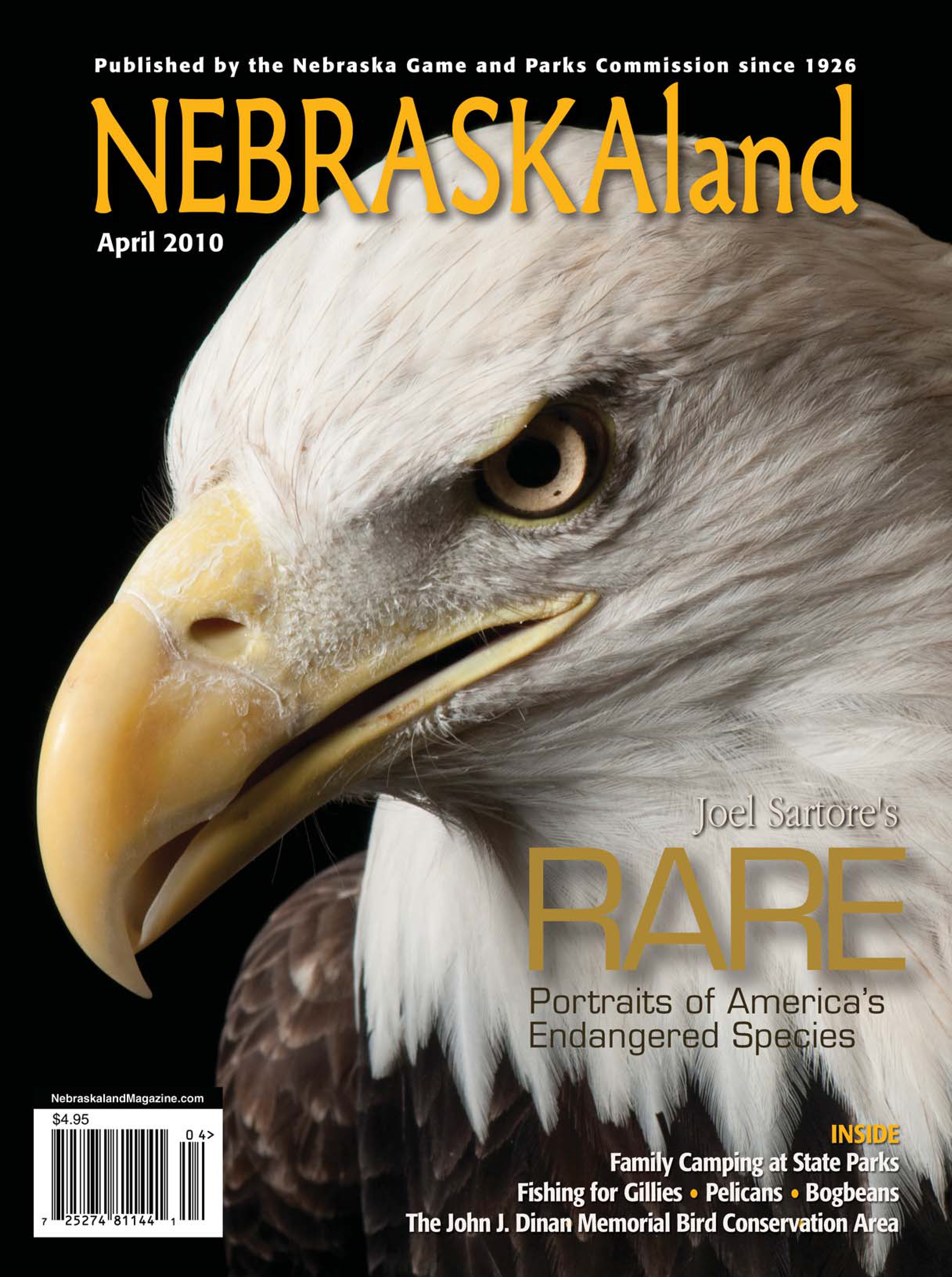
Cover: This bald eagle (Haliaeetus leucocephalus) was photographed at Sutton Avian
Research Center in Bartlesville, Oklahoma for the book RARE: Portraits of America’s
Endangered Species. See story on page 12. Photo by Joel Sartore. Opposite: On a hillside
near the Missouri River, a pasque flower breaks free from the woven blanket of prairie thatch
as one of the first prairie wildflowers to show itself in the spring. Photo by Michael Forsberg.
NEBRASKAland (VOL. 88 / NO. 3, ISSN 0028-1964) is published monthly, except for the
combined Jan./Feb. and Aug./Sept. issues, by the Nebraska Game and Parks Commission,
2200 N. 33rd St., Lincoln, NE. Periodicals postage paid at Lincoln, Nebraska, and additional
mailing offices. POSTMASTER: Send address changes to NEBRASKAland, P.O. Box 30370,
Lincoln, NE 68503-0370.
34
●
APRIL 2010 • NEBRASKALAND 3
lady bug!
Peter S. Berthelsen
Senior Field Coordinator
Pheasants Forever, Inc. and
Quail Forever
Elba, Nebraska
Published by the
Nebraska Game and
Parks Commission
Director: Rex Amack
Assistant Directors:
Roger Kuhn, Kirk Nelson, Sam Sidner
Information & Education Administrator:
Doug Bauch
Commissioners
Chairman:
Jerrod Burke, Curtis
Vice Chairman:
Mick Jensen, Blair
2nd Vice Chairman:
Ron Stave, Waterloo
Dr. Mark Pinkerton, Wilber
Dr. Kent Forney, Lincoln
Lynn Berggren, Broken Bow
Rex Fisher, Omaha
Mark Spurgin, Paxton
Norris Marshall, Kearney
Magazine Staff
Editor: Doug Carroll
Associate Editor: Jeff Kurrus
Art Director: Tim Reigert
Senior Editor: Jon Farrar
Regional Editors: Eric Fowler, Bob Grier
Contributing Editor:
Michael Forsberg
Regular Contributors:
Bill Hager, Chris Helzer and
Lisa Knopp
Photo Librarian: Sarah Johnson
Circulation: Donna Robinson
For address changes and questions about
your subscription, e-mail
Donna.Robinson@Nebraska.gov
or call (800) 632-5263
Marketing/Advertising:
For advertising information contact
Larson Enterprises
e-mail dave@larsonent.com
or call (515) 440-2810
NEBRASKAland Magazine
Copyright 2010, all rights reserved.
NEBRASKAland is available on audio cassette from the Nebraska
Library Commission Talking Book and Braille Service, Suite 120, 1200 N
St., Lincoln, NE 68508. (800) 742-7691. NEBRASKAland Magazine and
the Nebraska Game and Parks Commission reserve the right to reject any
advertising not in keeping with the agency mission.
Rates: $18 for one year; $33 for two years; $44 for three years. Nebraska
recipients must add appropriate sales tax. To subscribe call 1-800-NEBLAND (632-5263), or go online to: NebraskalandMagazine.com.
4 NEBRASKALAND • APRIL 2010
Hunter Hunts His First Goose
Thought you might be interested in
this great picture of three young boys
holding some big Canada geese.
These birds were harvested in central
Nebraska a few days after Thanksgiving
and the 10-year-old in the picture got
his first goose that day. I’ve been goose
hunting for lots of years, and it is
always fun to take any age person out
to get their first goose.
Pictured from left to right is
seven-year-old Jackson Osentowski of
Tulsa, Oklahoma, Hunter Osentowski
of Kearney, who had just shot his first
goose, and Dalton Dearmont, a friend
who lives near Rose.
Rich Osentowski
Kearney, Nebraska
Kudos to Your Photography
I just
received my
March issue
of your
magazine
and want to
say that the
photography
(from the
cover on) is
absolutely
superb!! I am
also enjoying the accompanying
articles.
Shirley Clifton
Lincoln, Nebraska
NEBRASKAland Visitor Letters
We want to thank all 24 readers that
sent e-mails and letters for last issue’s
visitor, a parson spider (Herpyllus
ecclesiasticus) on page 32 (see
page 11 for the winner, rules and next
month’s hint). Here are just a few of
the many wonderful responses we
received:
Dear NEBRASKAland,
We found the visitor on page 32 – a
spider in the grass near a turkey spur.
My husband and I had a competition
to see who could first find the "Visitor"
in this month's issue. I must admit, it
was him. It was pretty tricky this
month. I've decided next month I won't
tell him the magazine has arrived until
after I've spotted it!
Andrea and Curtis Lusch
Plattsmouth, Nebraska
It’s on page 32. The print resolution
doesn’t allow for proper identification,
but it’s probably either a wolf spider or
a parson spider.
So … how many people have
responded with the correct answer and
location? I didn’t know that such a
‘contest’ was going on until I picked up
my latest issue while sitting on the
couch last night. My competitive nature
made it something that I couldn’t let go
until I got my magnifying scope and
started looking a bit harder.
This was certainly harder than the
I think you forgot to send the bug
with my issue of NEBRASKAland, or it
may be that it really is on the coffee
mug on page 11. That seems too easy.
Or I guess it could be the maggot Frank
Reid is about to put in his mouth on
page 30.
If it isn't one of those, then you
simply forgot to put one in my copy of
the March issue!
Thank you for bringing back so many
great memories with this wonderful
magazine.
Growing up in Omaha was the best
place to grow up. We had so many
fishing and hunting experiences in the
surrounding area. We even gathered
nightcrawlers to sell to make enough
money so we could travel outside of
our area for vacations.
Thanks again from a former
Nebraskan.
Donna Gibson; nee Decker
Hazel Green, Alabama
The parson spider’s common name
derives from the dorsal abdominal
stripe resembling an
old-style cravat worn by
clergy in the 18th century.
They are ground spiders and
do not spin webs for
prey capture,
but are active nocturnal
hunters, mostly of other spiders.
Send your comments to:
Doug Carroll, Editor
NEBRASKAland Magazine
P.O. Box 30370
Lincoln, NE 68503
or e-mail Doug.Carroll@Nebraska.gov
Please include your postal address and
telephone number.
Letters may be condensed and edited
for clarity. Photographs are
welcome and will be returned.
Under federal and/or state law, discrimination is prohibited on the basis
of race, color, religion, age, gender, marital status, national origin,
disability or political affiliation. If you think you have been discriminated
against in any program, activity or facility by the Nebraska Game and
Parks Commission or want more information, contact the Commission in
Lincoln, NE, at (402) 471-0641 or the Equal Opportunity Commission,
Lincoln, NE, (402) 471-2024, TTY/TDD (402) 471-4693).
Headquarters
2200 N. 33rd Street
Lincoln, NE 68503
Phone (402) 471-0641
District Office I
East Hwy. 2, Box 725
Alliance, NE 69301
Phone (308) 763-2940
District Office II
524 Panzer St., Box 508
Bassett, NE 68714
Phone (402) 684-2921
District Office III
2201 N. 13th St.
Norfolk, NE 68701
Phone (402) 370-3374
District Office IV
301 E. State Farm Rd.
North Platte, NE 69101
Phone (308) 535-8025
District Office VI
1617 First Ave.
Kearney, NE 68847
Phone (308) 865-5310
Omaha Office
1212 Bob Gibson Blvd.
Omaha, NE 68108
Phone (402) 595-2144
Ak-Sar-Ben Aquarium
21502 W. Highway 31
Gretna, NE 68028
Phone (402) 332-3901
World Wide Web site:
Panhandle
Officer
City
Phone (308)
Jim Zimmerman (Sup.) Gering
763-2940
Scott Brandt
Gering
631-0663
Heath Packett
Gordon
360-0682
Dennis Thompson
Lemoyne
289-0755
Dan Zuehlke
Ogallala
289-3399
Doug Pollard
Oshkosh
778-7101
Frank Miller
Valentine (402) 389-0444
Dan Kling
Harrison
430-0572
Southwest
Officer
City
Phone (308)
Roger Thompson (Sup.) N. Platte
535-8025
Ray Dierking
Brkn. Bow
870-0322
George Sund
Cambridge
655-0028
Michael Thome
Cozad
529-8146
Matt Andrews
Elwood
746-2418
Dirk Greene
Imperial
882-0015
Virgil Gosch
McCook
340-2440
Dudley Sorensen
N. Platte
530-0016
Rich Routh
Rep. City
920-0367
South-central
Officer
Jerry Pecha (Sup.)
Jeff Jones
Terry Brentzel
Randy Pomplun
Darin Gress
Dale Johnson
Robert Finke
City
Phone (308)
Kearney
865-5327
Clay Center(402)762-5022
Doniphan (402)469-5795
Fullerton
550-0489
Hebron (402) 768-8665
Kearney
440-3847
Milford (402) 440-3847
Northeast
Officer
Tom Zimmer (Sup.)
Dale Davis
Ross Oestmann
Steve Oberg
Daniel Roberts
Jon Reeves
Marion Shafer
Pat George
Tim Williams
Cory Krause
City
Phone (402)
Norfolk
370-3374
Bassett
760-0712
Bloomfield
360-0553
Columbus
910-3366
Fremont
719-1108
Kennard
889-8508
Norfolk
992-7590
O’Neill
340-0787
Neligh
929-0051
West Point
380-6410
Southeast
Officer
Duane Arp (Sup.)
Sean McKeehan
William Krause
Mike Luben
Douglas Kramer
Dina Barta
Stacey Lewton
Levi Krause
Russell Mort
Dan Evasco
Jeff Clauson
City
Gretna
Ashland
Auburn
Colon
Lincoln
Lincoln
Lincoln
Louisville
Nebr. City
Papillion
Waterloo
Administration
Ted Blume (Adm.)
Craig Stover (Asst.)
Wes Loos (Asst.)
Rod Loos (Asst.)
Murray Johnson
Lincoln
471-5531
Lincoln
471-5532
Lincoln
471-5591
Ogallala (308) 284-8056
Lincoln
471-5003
Phone (402)
332-2965
521-0159
274-8063
443-6392
890-6465
890-6463
890-7140
949-0593
209-1506
616-5961
658-7057
Nebraska Wildlife Crimestoppers 1-800-742-7627
APRIL 2010 • NEBRASKALAND 5
Why So Many? Why So Big?
Elizabeth Mack
“How many leaves? How large? And
why?” It is with a child’s fascination
that I ask these questions each spring.
Luckily, there are many people who
know a lot more about leaves than
myself. Here are a few of their thoughts:
“Trees with small leaves typically
produce more of them,” said Omahabased arborist Jack Phillips. “In addition,
as trees age the number of leaves
changes. For example, in a small tree –
a seedling – leaves will represent
about 60 percent of the tree’s weight.”
However, the leaves from a 60-foot-tall
tree, such as a mature oak, can number
anywhere from 100,000 to 300,000 but
represent less than 10 percent of the
total weight of the tree.
In addition, even in the most ideal
conditions certain tree species will have
larger leaves than other species. Bur oak
leaves will typically be larger than those
of elms, and sycamores will typically be
larger than silver maples. However, all
leaves can be affected by environmental
conditions. By midsummer a tree might
have as many leaves, but size depends
on the amount of stored energy or starch
in the bud that was made the summer
before.
When trees are affected by drought,
their root systems are affected adversely,
and it could take several years for these
trees to recover. In contrast, too much
moisture due to an excess of precipitation
or over-irrigation in the landscape affects
trees by driving oxygen that is needed by
roots from the soil, causing them to be
damaged and die. This, in turn, stresses
the entire tree and its growth processes.
Another variable affecting leaf size
relates to a leaf’s positioning in the
crown. “The ‘sun leaves’ on the top and
edges of the crown will be the most
representative size and form of the
species,” said Nebraska Game and
Parks Commission horticulturalist
Mike Groenewold, “while the ‘shade
leaves’ on the bottom or inside of the
crown will usually be larger than those
that typically represent the species.”
In their abundance, it is difficult to
focus on each particular leaf of a tree.
A closer look at each one, however,
reveals that every leaf has a unique
story to tell.
6 NEBRASKALAND • APRIL 2010
The Snood
Caroline’s Creamy White Chili
Jeff Kurrus
This spring, more than one successful
turkey hunter in Nebraska will look
down at their trophy and ask, “Now
what’s this thing?” while holding the
flap of skin hanging over the beak of
the turkey. This fleshy appendage is
called a snood, and can be found on
both males and females, although it is
much more pronounced on males. The
snood can be extended or contracted at
will and can turn colors, much like the
rest of a turkey’s head, when excited or
irritated. However, while there are
speculations regarding the exact purpose
of the snood, including as a way to
attract mates, the National Wild Turkey
Federation admits that even they are
unsure of the precise function of this
curious-looking flap of skin.
By Caroline Gaia
Now I have to confess, I originally
made this chili with chicken, but
recently found that a turkey breast
works just as well. So this spring, try
something new. I guarantee it won’t be
the last time you do.
1 boneless and
skinless turkey
breast (cut
into 1/2-inch
cubes)
1 medium
onion, chopped
1 teaspoon garlic
powder
1 tablespoon olive oil
2 cans (151/2 ounces each) great
northern beans, drained
1 can (141/2 ounces) chicken broth
2 cans (4 ounces each) chopped
green chilies
1 teaspoon salt
1 teaspoon dried oregano
1 teaspoon pepper
1
/2 teaspoon cayenne pepper
1 cup (8 ounces) sour cream
1
/2 cup whipping cream
In a large saucepan, sauté turkey,
onion and garlic powder in oil until
turkey is no longer pink. Add beans,
broth, chilies and seasonings. Bring to
a boil. Reduce heat and simmer
uncovered for 30 minutes. Remove
from heat, then stir in sour cream and
whipping cream. Serve immediately.
Yields 5 servings.
Chickens and Stars
Doug Carroll
The Nebraska Nature and Visitor
Center, formerly known as Crane
Meadows Nature Center, will be
hosting a “Chicken and Stars” trip to
the Sandhills April 9-11.
The weekend will include viewing
and photography of prairie chickens on
some of their courtship leks, as well as
chances to do some stargazing and
astrophotography.
For more information or to register,
call (308) 382-1820 or e-mail
info@nebraskanature.org.
8 NEBRASKALAND • APRIL 2010
PHOTO BY ERIC FOWLER
NEBRASKAland Blog
Brian Sweet, formerly of the Commission's North Platte Fish Hatchery, and Valentine
Fish Hatchery staff Dana Krueger and Doug Graham work the dock during walleye egg
collection at Merritt Reservoir in 2008.
Squeezing Walleye
By Eric Fowler
Fisheries biologists will fan out
across three Nebraska reservoirs this
month in an effort to collect a record
number of walleye eggs for hatchery
production and stocking.
Work will begin April 5 when
biologists set gill nets at Merritt and
Sherman reservoirs, both long-time
mainstays for egg collection. On April 7,
work will begin at Lake McConaughy.
Netting efforts will continue until a
combined total of 550 quarts of eggs
have been collected, up from 519
quarts last year.
Dean Rosenthal, hatchery supervisor
with the Nebraska Game and Parks
Commission, said between 400 and
430 quarts of eggs are typically all that
is needed to fill the stocking needs for
Nebraska reservoirs and those states
that trade other species for our walleye,
but district fisheries biologists have
requested more than 34 million fry and
2.5 million fingerlings to stock in 43
Nebraska reservoirs this year. With
125,000 eggs per quart and about
65 percent of eggs viable, Commission
hatcheries in North Platte and at
Calamus Reservoir, as well as the U.S.
Fish and Wildlife Service hatchery at
Gavins Point Dam, will have about
44 million fry to work with. Fry raised
in the hatcheries will be stocked around
April 19, and those raised to fingerlings
will be moved to hatchery ponds in
early May and stocked in June.
Walleye egg collection and stocking
is very labor intensive, but is critical to
supporting the state’s fisheries. “Most
of the lakes in Nebraska do not support
much, if any, natural reproduction or
recruitment, so we have to supplement
that with stocking in order to provide a
fishery,” said Rosenthal.
But even stocking fish does not
guarantee they will end up on a dinner
plate. “Some years have poor returns
and some years are great,” Rosenthal
said. “It depends on what Mother
Nature deals us.”
Egg collection has been declining in
recent years at Sherman Reservoir.
Hoping to reverse that trend, the
Commission implemented a slot limit
there in 2009 that requires anglers to
release all fish between 20 and 28 inches
long. The decline at Sherman is what
led biologists to shift more efforts to
McConaughy. Merritt has produced the
lion’s share of eggs in recent years.
The face of the dam and artificial
spawning reefs at Sherman Reservoir
will be closed April 1-20 to protect
spawning fish. The northern third of
Kingsley Dam at Lake McConaughy
will be closed while female walleye are
being collected. A lighted bouy will
mark the south end of the closed area.
No areas are closed at Merritt, but the
Commission asks that anglers and
boaters stay away from the nets.
Social media – those web-based
mediums through which the flow of
information becomes a two-way street,
such as blogs, Twitter and Facebook –
has transformed much of the way the
public receives information, and the
Nebraska Game and Parks Commission
is embracing this new technology.
Thanks to social media, more people
are interacting with the Commission
electronically than ever before, and the
agency is disseminating information to
the public in more ways. Users can find
See You Out There ... But Where?
PHOTO BY JEFF KURRUS
On the April 1962 cover of
NEBRASKAland Magazine, artist
Frank Holub recreates a famous
1872 buffalo hunt featuring Duke
Alexis and “Wild” Bill Cody.
“The Duke Alexis Hunt,”
described in that issue by thenmanaging editor J. Greg Smith,
recounted the 19th century tale of
“an honest-to-goodness Russian
prince ready to take on the prairie
wilderness for a couple of days of
buffalo hunting.”
Joined by Custer, Sheridan and
Cody, Alexis set up camp on Red
Willow Creek near the present town
of Hayes Center as Cody, then a
26-year-old scout, led Alexis on his
hunts. Yet this small group wasn’t
the only participants – newspaper
reporters, the Duke’s entourage
and close to 1,000 native Americans
were on hand to witness the show.
And a show it was.
To read the entire 1962 article
about the Duke, Wild Bill and the
infamous Custer, log on to
NebraskalandMagazine.com and
click on “A Look Back.”
Do you know where this Nebraska photograph was taken?
See answer at the bottom of page 11.
PHOTO BY JEFF KURRUS
Jeff Kurrus
links to all Commission social media
at OutdoorNebraska.org, including
four blogs. The most recent to launch
is "Afield and Afloat," the
NEBRASKAland Magazine blog that
shares staff experiences in the great
outdoors, reveals what goes into
producing the magazine (including the
occasional photo tip) and ideas on
where to go and what to do outside.
The other blogs are: "Barbs and
Backlashes,” where fisheries outreach
program manager Daryl Bauer shares
his vast knowledge with fishing
enthusiasts; "In the Wild with Greg
Wagner," where one of the agency’s
most popular outdoor personalities
shares his knowledge of the outdoors
and encourages people to get out into
the wild; and "Lock, Stock and
Bedlam," where Jeff Rawlinson and
Aaron Hershberger of the Commission’s
outdoor education team give straightforward, timely information on hunting,
fishing and shooting skill techniques
and tips. The Commission also is taking
advantage of Facebook and Twitter, and
web page users will find that the
Commission has a YouTube channel,
on which a variety of state park videos
may be viewed. To keep up on the latest
news, readers may subscribe to receive
RSS feeds or e-mailed news releases.
Fishing’s Unwritten Rules
Jeff Kurrus
Last summer, fishing partner and
NEBRASKAland freelance writer
Matthew Marx and I were catching
largemouth bass at Verdon Lake SRA
in southeastern Nebraska. We had the
lake to ourselves, aside from a couple
of bank anglers across the water,
until a truck pulled up to the spot
used for an earthen boat ramp. He
put his boat in the water, jumped in
and started fishing. He never moved
his truck.
Seeing his obvious disregard for
his fellow anglers, Marx and I began
talking about fishing’s other unwritten
rules. At first, we came up with the
obvious one, packing in/pack out, and
decided it could be linked to most of
fishing’s “messy” side. But there were
a few others that we came up with that
usually aren’t talked about as much but
should be:
• Don’t front end your friends. If you
are bass fishing and approaching three
stumps on a lake, leave two for the guy
behind you in the boat.
• Don’t front end strangers by cutting
in front of another boat when fishing
water close to one another.
• If you’re fishing from the bank and
have your dog along, keep the dog out
of the water if boat anglers are nearby.
• Keep your voices down on the
water. Noise travels well, and even
playful profanity between friends
seems to travel especially well.
• Big boat anglers give way to small
boat anglers, and all boat anglers give
way to bank anglers.
• Don’t cast close to docks when
anglers are fishing from them.
Like I said before, I’m sure we
missed a few. If so, email me at
Jeff.Kurrus@Nebraska.gov and steer
me in the right direction. I’m sure I’ll
need it.
APRIL 2010 • NEBRASKALAND 9
I was on patrol in the early afternoon around Skyview Lake in
Norfolk, using my newly assigned patrol motorcycle. I parked in an
area where I could observe who was fishing before I checked for
permits. One group caught my eye as I watched three kids fish and
run around, accompanied by two adults. I finally observed one of
the adults catch a fish and it appeared he was putting it on a stringer
but I couldn’t tell for sure as a tree was blocking a clear view. I
approached the group and asked to look at fishing licenses for the
adults. They both showed me their fishing permits, but when asked to
see the fish they caught I was told by one adult that he didn’t speak
English and they had “no fish.” I then asked one of the kids that was
fishing if he had been catching anything and he gladly told me “yes”
and that he had caught the largest fish. When I asked what he did
with it, the kid pointed to a blue tackle box and said
the fish was in there. I opened the tackle box and
found three largemouth bass under the size limit and
several bluegill. The father of this child – the one who
didn’t speak English – now spoke perfect English,
admitted to catching the largemouth bass and was
issued a citation.
Whooper Watch
The Crane Trust, located near Wood
River, is seeking volunteers for their
“Whooper Watch” Program.
Each spring, typically the last two
weeks of March through April, most of
the wild population of endangered
whooping cranes (Grus americana)
migrates north through the Central
Flyway from Texas to Canada, with
Nebraska serving as a significant
– Tim Williams, Conservation Officer, Neligh
Platte River Art Show
This year’s Platte River Art Show
will be held April 10-11 at Eugene T.
Mahoney State Park near Ashland.
Featuring some of the finest art in the
country in a variety of mediums, the
show will be open from 9 a.m. to 8 p.m.
on Saturday, and from 9 a.m. to 4 p.m.
on Sunday. In addition, Nebraska
Game and Parks Commission outdoor
personality Greg Wagner will do a live
broadcast of his Great Outdoor Radio
Show from the park’s Peter Kiewit
Lodge from 9 a.m. to 11 a.m. on
Saturday.
An Old West Rib Fest featuring
barbeque ribs will also be held in
conjunction with the art show from
11 a.m. to 2 p.m. both days. The cost
of the meal is $5.75 per person.
Turkey Hunting Workshop
A hands-on turkey hunting workshop
will be held from 6 p.m. to 9 p.m. on
April 14 at the Lincoln Izaak Walton
League.
10 NEBRASKALAND • APRIL 2010
Nebraska Game and Parks
Commission outdoor specialists and
Hunter Education instructors will be on
hand to help participants hone their
turkey calling skills and pattern their
shotguns. Basic skills, biology and
safety will be covered in this event,
which is open to the entire family. There
is no cost for the event, but space must
be reserved by contacting Heather Weihe
at Heather.Weihe@Nebraska.gov.
CRP and Pivot Corners
According to Tim McCoy, agricultural
program manager for the Nebraska
Game and Parks Commission, incentive
payments are now available to
landowners enrolling cropped pivot
corners and/or small crop fields
(5-7 acres in size) in the Central Basins
Conservation Reserve Enhancement
Program (CREP).
Landowners could qualify for a
one-time $100 “resource corner area”
incentive payment as well as a $100
bonus incentive payment for enrolling
all four corners of a center pivot field.
Curtis Schneider of Lincoln has
had his message plate since 1997,
when he ran an archery shop from
his York home that was called
Archer’s Rest. When he’s not
bowhunting turkeys in the spring or
deer in the fall, this Bowhunter
Education Master Instructor keeps
his skills sharp on the target
range.
If you have a unique outdoor
message plate you would like to
share, or know someone who does,
e-mail a photo (high-resolution,
.jpg format only, please) of it to
Eric.Fowler@Nebraska.gov, along
with your name, hometown and a
brief description of the interests
expressed on your license plate.
Turpin Time
Jeff Kurrus
Because male bluegills generally grow
larger than females, they are targeted by
anglers on the spawning beds. Big, colorful
and aggressive, these fish are an angler’s
prized catch (See “In Search of Open Water
Gillies” on page 24). However, there are other, less
known, males that can negatively affect a fishery.
These males resemble the female bluegills, being
smaller and less brightly colored. They will also sneak
into the nests and fertilize the female eggs.
Because of this, anglers must be careful not to harvest too many of the
large, colorful males. “If you do that, what you’re left with are those
smaller, slow-growing males that will never grow as large as the other
males,” said Commission fisheries outreach program manager Daryl
Bauer. “And you may be left with stunted bluegills because that’s all
you’ve left in the population.”
To protect those brightly colored trophy bluegills for the future, keep the
6- to 8-inch fish (where allowed), as well as these smaller males, but release
those trophies 9 inches and above to preserve future year classes.
stopover location. These majestic birds
often stop along the Platte River for
rest and rejuvenation before continuing
onward to their breeding grounds at
Wood Buffalo National Park in Canada.
The wild whooping crane population
has increased from an all time low of
16 individuals in 1941 to the current
known population of 263. The Crane
Trust shares information with federal and
state agencies, allowing collaborative
efforts in the conservation and protection
of this endangered species. Part of this
information includes sightings of the
birds in Nebraska, many of which are
made by volunteers.
Last year, 17 individual whooping
cranes were sighted in Hall County,
near the Platte River. Additional
sightings occurred in Phelps, Kearney,
Brown, Custer, Lincoln, Cherry,
Fillmore, Gosper, Keha Paha, Garfield,
Holt and Rock counties of Nebraska.
If you see a whooping crane in
Nebraska, please call the whooper
watch line at 1-888-399-2824.
The Crane Trust is located 1 mile
south of I-80 exit 305 (Alda) and 1.5
miles east on Whooping Crane Drive.
Here’s some tips for identifying a
whooping crane
• Whooping cranes are snowy white
and stand more than four feet tall.
• In flight, black wingtips are visible
and the neck and the legs are extended.
• Their wingspan is approximately
seven feet.
• In good light, you may be able to
see the red crown on adult birds.
• Juvenile whoopers have rust and
white colored feathers.
DU Chapter Lauded
Each year, Ducks Unlimited publishes
“The President’s Top 100” – a list of
the group’s chapters that raise the most
grassroots dollars for this national
organization’s habitat conservation
work. This year Nebraska’s
Burt/Washington County DU chapter
made the list as one of the organization’s
highest fundraising chapters.
“These fundraising events are the
backbone of how DU conserves
habitat and the volunteers who make up
these chapters are the on-the-ground
conservationists making a difference
for North American waterfowl
populations,” said John Pope, president
of DU. “It takes a lot of effort to crack
the Top 100 and these chapters deserve
to be congratulated from every person
who enjoys the outdoors.”
Dick Turpin
A handy item
to have in your
fishing boat is
one of those
good magnets. I
have a 100pounder. Hook
a real good line
to it … say 25
or 30 feet …
and boy howdy, these things around a
dock … you’d be surprised the things
you’ll pick up just dabbing around.
I’ve picked up wrenches,
cigarette lighters, fishing
lures, pliers … just a
myriad of things so
this is kind of fun to
have. These things
really work but I tell
you to be careful. I
was out once on a lake
and hooked on to something … almost
like fighting a fish … I got it up and I
had a beautiful mermaid hooked right
by the belt buckle. Wife made me
throw her back. ■
NEBRASKAland Visitor
Winner and Hint
Last issue’s winner of
the NEBRASKAland Visitor drawing
was Chris Kroeger of Schuyler who
found the parson spider on page 32.
Readers are encouraged to contact
NEBRASKAland within 10 days
after this issue’s publication with the
correct page number and name of
this issue’s “Visitor” – an insect or
bug found in Nebraska that just
happened to find its way onto one of
the pages of our publication.
We will then gather the correct
entries and draw one to win a
NEBRASKAland Visitor mug.
To enter each month, e-mail
Tim.Reigert@Nebraska.gov
with “Visitor” in the subject line of
the message or write:
NEBRASKAland Visitor
2200 North 33rd Street,
Lincoln, NE 68503.
HINT: This month’s visitor is not
on page 5, 11, 12 or 14.
Kingsley Dam at Lake McConaughy, Ogallala
Those Darn Kids
This would be in addition to annual
rental payments of 120 percent of the
USDA CRP soil rental rate. Cost
share payments are available to meet
80 percent of the seed and planting
requirements of the program.
Landowners in the CREP area can
enroll at their local Farm Service
Agency office, and can contact their
local Commission office or Pheasants
Forever Farm Bill Wildlife Biologist
for more information.
APRIL 2010 • NEBRASKALAND 11
RARE
Portraits of America’s Endangered Species
Text and photos by Joel Sartore
IOWA PLEISTOCENE SNAIL (DISCUS MACCLINTOCKI)
FARMERSBURG, IOWA
T
aking pictures for National Geographic Magazine
has got to be the greatest job on Earth. Nothing but
travel to exotic locales and glamour at every turn,
right?
Not quite. Try eating llama head, guinea pig,
piranhas, raw seal stomach lining and live
beetles. Then see if you like being chased
by bees, grizzlies, musk oxen and a
variety of bad guys, or being deafened by
a fungus, chewed by a flesh-eating parasite
and bitten by three dogs at the same time.
Other than that, the job is fabulous.
So why do it?
To tell you a story. And, hopefully, to get you to care.
I’ve tried to do this in a variety of ways over the years.
Mostly it involves throwing big chunks of time and piles
of money covering subjects you’ve never heard of. If it’s a
heavy topic, such as endangered species, the hope is always
that enough people see it, are moved to take action, and right
a wrong here and there.
Surprisingly, an event right here in Lincoln, Nebraska,
changed the way that I see things. In 2006, my wife Kathy
was diagnosed with breast cancer. With three kids at home, it
was time for me to stay put.
Months later, when she started to heal, I began to think to
myself, ‘Well, now what?’ Working for NGM is a bit like
AMERICAN BURYING BEETLE (NICROPHORUS AMERICANUS) - ST. LOUIS ZOO
being an astronaut; you fear the day that you’re not. You
know your life will never again be as exciting or interesting.
But oddly enough, just the opposite came true.
On the days that Kathy felt well and with the kids in
school, I began to make little day trips. I figured that if I
couldn’t get to the jungle or the swamps anymore, I’d at
least try to do formal studio portraits of captive animals from
faraway places.
The Lincoln Children’s Zoo gave me my start.
I had a used lighting kit and a couple of
backgrounds – one black, one white. They brought
out a naked mole rat and a pair of blue poison dart
frogs. I was hooked.
After years of nothing but long lens pictures of
animals in the field, those clean backgrounds
bathed in soft light seemed to wash away my all
my troubles. No more fleeting glimpses. In my
little studio, the animal is right there, going
nowhere, eyes sharp as pins. Finally, I could use
a wide-angle lens.
This portrait technique was also a great equalizer.
Afloat on a black and white sea, all creatures
great and small are given the same weight and
importance. And personalities emerge: A whooping
crane demurs, waiting for her escape from a brightly
lit space. Pallid sturgeon with battleship noses
This American
peregrine falcon
(Falco peregrinus)
was photographed at
Raptor Recovery
Nebraska near
Elmwood, Nebraska.
GRAY WOLF (CANIS LUPUS) - NEW YORK STATE ZOO, WATERTOWN, NEW YORK
12 NEBRASKALAND • APRIL 2010
APRIL 2010 • NEBRASKALAND 13
This grizzly bear
(Ursus arctos horribilis)
was photographed at
the Sedgwick County
Zoo in Wichita, Kansas.
patrol for food. Baby least terns drift off to sleep.
I’ve specialized in rare species and the reasons
they get into trouble, from climate change to habitat
loss. But through these portraits, I’ve learned to
appreciate all forms of life, no matter what the politics
of the moment may be. All are interesting, have a
role to play and deserve to exist. In the grand
scheme of things, even prairie dogs count.
Here in Nebraska, we live in a bubble of sorts.
Everyone’s nice (unless we lose a football game)
and we say hello to strangers. Surely all is right in
SALT CREEK TIGER BEETLE (CICINDELA NEVADICA LINCOLNIANA) - UNIVERSITY OF
NEBRASKA-LINCOLN.
BLOWOUT PENSTEMON (PENSTEMON HAYDENII) - LINCOLN, NEBRASKA
the world. But for some of the oft-ignored creatures you see
here, the situation is dire. The Salt Creek tiger beetle is on
the brink of extinction due to development. The black-footed
ferret is being knocked down once more by plague.
Until humans start to understand, care and reverse our loss
of biodiversity and ecosystems, we’re only hurting
ourselves. Healthy forests regulate rainfall and climate.
Grasses bind the soil. Insects pollinate our crops.
Can you imagine a world without songbirds, amphibians
or even bees? Unless there’s a real change in how we treat
nature, you’ll see all this and more.
And so it starts here, in the pages of this magazine. From
peregrines to penstemon, each has a unique story to tell. But
will we care enough to listen?
Only time will tell. ■
BLACK-FOOTED FERRET (MUSTELA NIGRIPES) - CHEYENNE MOUNTAIN ZOO, COLORADO SPRINGS, COLORADO
14 NEBRASKALAND • APRIL 2010
PALLID STURGEON (SCAPHIRHYNCHUS ALBUS) - GAVINS POINT NATIONAL FISH HATCHERY, YANKTON, SOUTH DAKOTA
Joel Sartore is a contributing photographer
for National Geographic Magazine, speaker
and author of RARE: Portraits of America's
Endangered Species. To see more of his
pictures of threatened and endangered species,
go to rarethebook.com.
WHOOPING CRANE (GRUS AMERICANA) - AUDUBON CENTER FOR RESEARCH OF
ENDANGERED SPECIES IN NEW ORLEANS, LOUISIANA.
APRIL 2010 • NEBRASKALAND 15
Family Camping in Nebraska State Parks
Why this year’s vacation doesn’t have to break the bank
By Matthew Marx
Under a full moon on a picture-perfect night, Lincolnites Claire
and Jeff Valder; Chris, Stephanie, Daniel and Annika Kuchar;
Leslie and Travis Pillen; and Kyle Eley relax around a campfire at
Wagon Train State Recreation Area near Hickman.
Photo by Eric Fowler
PHOTO BY MICHAEL FORSBERG
camping near your vehicle, however, where weight is not an
issue and comfort reigns supreme. Rectangular bags are larger,
softer and less expensive than high-tech backpacking bags,
and are very comfortable. Sleeping bags are rated by
temperature, so a 50-degree bag should be comfortable
when the air temperature drops to 50 degrees. I recommend
choosing a bag that is rated lower than the lowest temperature
you expect, and because a woman’s body temperature is
generally lower than a man’s, ladies may want to choose one
rated 5-10 degrees lower. In Nebraska, a 20- to 40-degree
bag will work just fine for most summer camping and can be
supplemented with blankets in the spring and fall. Buy a bag
with synthetic insulation – it’s cheaper, stronger, insulates
when wet and is non-allergenic. Some rectangular bags can
also be zipped together to form a queen-sized bag. Make
sure to check the label for this feature and buy two bags with
zippers on opposite sides. Some models simply flip over so
they can be zipped together. If cost is a pressing issue, you
can do away with sleeping bags altogether and just take
sheets, blankets and pillows from home.
For an extended backwoods wilderness excursion, expensive
sleeping pads (either self-inflating or closed cell) are a good
choice for lightweight hiking. But for simple camping, the
kids will be comfortable on air pads (which can be manually
inflated) or egg-crate foam, which is inexpensive. For Mom
and Dad, however, nothing comes close to the comfort of a
big air mattress. Again, quality matters. Air mattress
technology has come a long way in the last few years and
A sunrise cup of tea is a welcome pleasure for parents who wake up before their children on a Nebraska camping trip.
T
Gear
While many of the items you will want to take with you
can be found around the house – such as silverware, cups,
pillows, blankets and matches – there is some gear you may
not have that is indispensible when it comes to successful
camping. The most inexpensive way of acquiring gear is
simply to borrow it. People who love to camp tend to have
quality gear and are usually happy to loan a tent, some
18 NEBRASKALAND • APRIL 2010
sleeping bags or a camp stove. Your local Boy Scouts troop
may also be willing to loan out gear. Both the University of
Nebraska-Omaha’s Outdoor Venture Center (402-554-2258,
www.unomaha.edu/wwwocr/ovc) and the University of
Nebraska-Lincoln’s Campus Recreation (402-472-3467,
http://crec.unl.edu/outdoor/rental.shtml) rent quality gear –
including family-sized tents, coolers, stoves and even yard
games – to the general public, and have pricing information
located on their respective web sites.
Estimated cost of fees for five days at
Niobrara State Park for a family of four:
• Park entrance fee (1 year pass, with access
to all state recreation areas): $20
• Tent camping ($9 per night x 5 nights): $45
• Horse trail rides ($15 per person x 4 people):
$60
• Swimming at the pool ($4 per day x 4 people):
$16
• Fishing ($26 annual resident x 2 adults, kids
16 and under fish free): $52
• Hiking and enjoying nature: free
Total cost of lodging and fees: $193
Cost for 5 days lodging and entry fees at
Disneyland: $1,711-$2,697
the cost has come down dramatically. Do you remember the
days of accordion-style foot pumps or hours spent lightheaded from filling a large air mattress with lung power?
Suffer no longer. For convenience, I recommend buying
an air mattress with a cordless, built-in pump – it’s selfcontained and easy to use, as long as you remember the
Tents and Tarps
If you are buying gear, balance cost and quality. Chances
are you won’t need an ultra-lightweight, four-season storm
tent suitable for surviving Mount Everest, but you also won’t
want the cheapest tent you can find, which will be practically
useless in wet weather and won’t last for more than a few
seasons anyway. Remember that you are making an investment,
so if you buy a tent, do yourself a favor and purchase a
good-quality one from a reputable company. That way, if it
rains you’ll know why you spent the extra money and you’ll
be happier for it. Properly maintained, a good-quality tent
can last for 10 years or more. For a family of four, buy a sixperson tent (or larger) – you’ll appreciate the extra room.
Invest in a tarp to go under your tent to protect the floor
from rips and snags, and before you head afield for the first
time, set up the tent in the backyard to familiarize yourself
with all of its components. It is also a wise idea to use a
seam sealer on tents to ensure that extra bit of weather
protection – when tents leak, it’s usually at the seams.
Sleeping Bags
When hiking in the backwoods for a week, it’s a good idea
to invest in a lightweight, down-filled, “mummy”-style
sleeping bag with a drawstring hood. This is not the case for
PHOTO BY ERIC FOWLER
he red, yellow and purple glow of yet another beautiful
Nebraska sunset has given way to the crackle of the
campfire, where the kids, happy and weary from a day
of fishing and playing, are helping prepare an evening meal
of hot dogs and freshly filleted fish. Your new friends from
the neighboring campsite have gathered their lawn chairs and
brought over graham crackers, chocolate and marshmallows.
The laughter is loud and the tall tales are getting taller. This
is what a summer vacation is all about. And it didn’t mean
breaking the bank.
If the cost of travel has you wondering if you can afford a
family vacation outside the state this year, camping at one of
Nebraska’s many excellent state parks can be an inexpensive
and fun alternative. Instead of spending thousands of dollars
on airline tickets, car rentals, hotels and theme park entrance
fees, you can spend a fraction of your usual summer vacation
money for a family experience that will bring you closer
together, get you more in touch with nature and teach skills
that will last a lifetime.
Nebraska is blessed with an incredible state parks system
that can be accessed at a very low cost compared to other
kinds of vacation activities. There are, however, a few things
to carefully consider before planning a state park camping
excursion.
Estimated Costs
Gary, Ginny and Payton Stratton of Lincoln cook breakfast in the Valley View Flat campground at Calamus Reservoir near Burwell.
APRIL 2010 • NEBRASKALAND 19
clean water with you for drinking, washing dishes and taking
cat baths, although some parks offer potable water, showers
and even laundry facilities. Check individual parks for
available services.
Plan Your Trip
PHOTO BY JEFF KURRUS
Planning a family vacation should include the whole family;
when kids get involved in making decisions, they tend to get
excited about activities. The current economic downturn has
been hard on many families, but it may be a good reminder
that the truly high quality experiences – coming together as a
family, playing outside, making new friends, appreciating
nature, developing community-building attitudes and learning
new skills – are much less expensive than commercial-fueled
forms of family entertainment, which our society seems to
have strangely adopted as the norm. Perhaps it’s an opportune
time to reevaluate what it means to spend quality family time
together.
Nebraska state parks offer a wide variety of activities,
such as fishing, horseback riding and archery, but because
not all parks offer the same options, it’s important to do your
research. In Nebraska, there are 86 state park and recreation
20 NEBRASKALAND • APRIL 2010
• Hiking
• Bird watching
• Fishing (many parks
will loan people free
rods, reels, and
tackle!)
• Photography
• Horseback riding
• Archery
• Swimming
• Boating
• Miniature golf
• Nature tours and
workshops
• Rock climbing
• Hayrack rides
• Mountain biking
• Kayaking
• Paddleboating
• Geocaching
• Leather and ceramic
craft making
• Historical building
tours
batteries. The only drawback to an air mattress is the
possibility of a puncture. Bringing along a rubber cement
patch kit is a good idea, but duct tape will usually work in
a pinch as well.
areas, 71 of which offer camping. The Nebraska Game and
Parks Commission web site (OutdoorNebraska.org) has
plenty of detailed information about each area. Some parks
allow patrons to make reservations; others are on a firstcome, first-served basis, so make sure to do your homework.
Pay special attention to the “Park Fees” area of the web site,
which has information about entrance fees, reservation
schedules and activities, so you can quickly get an estimate
of the total cost of any required fees.
Coolers, Grills, Camp and Hobo Stoves
Camping Community
When camping, there are two things to consider when
planning meals: keeping food cool and getting it hot. A cooler
full of ice takes care of keeping perishables fresh, and for
cooking, many Nebraska state park campsites are outfitted
with permanent grills and fire rings. With some charcoal or
firewood, this makes cooking camp food such as hamburgers
and hot dogs easy. For more elaborate meals, breakfast foods
or hot drinks, however, consider taking a camp stove. The
classic is the green, briefcase-style Coleman two-burner
stove, which is perfect for family camping and can be found
cheap at garage sales. If money is tight and you are good
with your hands, you can also make a high-efficiency woodburning “rocket stove,” “hobo stove,” or alcohol-burning
“soda can” stove (check Wikipedia online for detailed
directions). They’re all fun to make and are great projects
for kids (with parental supervision, of course). Most other
cooking necessities, such as pots, pans, plates, silverware
and cups, can be taken directly from your kitchen or bought
for a song at thrift stores.
One of the most enjoyable forms of family camping is
organizing your vacation with other families, especially
those with kids the same ages as yours. Imagine how excited
your kids will be when you tell them they get to go on a
camping vacation with other kids. And for the parents, it’s
nice to have a trusted community of adults with whom to
share supervision, meals, gear and stories. Even if your
family is going alone, a big part of camping is learning to be
in a community, which is essentially what a campground is.
In a place like Nebraska, where friendliness abounds, it’s
easy for kids to start learning about the importance of
community and sharing.
Food and Water
Choose family meals that can be made quickly in large
quantities. Hamburgers, hot dogs, instant oatmeal and
pancakes (the “just add water” kind) are all good choices.
Consider making more elaborate recipes such as goulash
or homemade soup beforehand, freezing them (which helps
to keep the cooler cold), and then reheating them at the
campsite. It’s a good idea to take plenty of gallon jugs of
See You Out There
With so many parks from which to choose, it should be
easy to find the camping experience that is right for your
family. Whether you crave the quiet solitude of fishing and
bird-watching, or the excitement of horseback riding and
archery, Nebraska has a park to fit your preference. And with
a little research and creativity, you can put
together a summer vacation that will thrill
your family without breaking the bank. ■
PHOTO BY MATT HOUSKA
Let the kids help plan activities. Offer different
options.
• Before your trip, read with your kids. Pick
books about local animals, outdoor activities or
nature. Get a copy of H.A. Rey’s The Stars, the
best book for any age on identifying
constellations. (He’s the author of the Curious
George books.)
• Create “merit badges” for campfire building,
cooking, tent set-up, fishing and constellation
recognition.
• Have a nightly, around-the-campfire awards
ceremony for biggest fish released, best tall tale,
funniest animal impersonation, best repair job or
sloppiest s’more.
• Turn off the portable videogames and DVD
player. Instead, play I-Spy from pre-generated
lists: “I spy a deer hoof print. I spy a circling
hawk. I spy a web with a spider in the middle. I
spy a Colorado license plate. I spy a park ranger.
I spy a . . .”
• Consider camping with other families. Kids
love to play outside with other kids, especially
when exploring new places.
• Make kids responsible for certain chores,
such as dishwashing, tent-organizing, and trash
collection. Then pair them up with more fun,
supervised chores like fire building and fish
cleaning. Let kids do chores in pairs or teams.
Activities at Nebraska state parks (check
individual park for availability):
Parks and Activities
During a camping trip with his parents, a youngster focuses on his bait while fishing at Two Rivers State Recreation Area near Yutan.
Tips for Camping with Kids
Activities at State Parks
Stargazing is an option for families throughout Nebraska, as
seen from this photo taken in the Oglala National Grasslands.
Matthew Marx is an English instructor
at the University of Nebraska-Omaha.
His last feature for NEBRASKAland
Magazine was “Couple Camping” in the
April, 2009 issue.
APRIL 2010 • NEBRASKALAND 21
The Spawn
When not on their beds, bluegills
will be near a food source. Because
these fish mainly feed on aquatic
insects, vegetation is a good place to
start. Also look at shallow water
early and late in the day as fish sun
themselves at these depths. If not at
these locations, look for fish in deeper
water near drop-offs, humps or flooded
trees, especially during the summer
months.
To find good bluegill waters, start
with the Commission’s 2010 Fishing
Forecast, which can be found
throughout the state at outdoor retailers
and at OutdoorNebraska.org. A quick
look shows that recently renovated
Summit Lake near Tekamah is an
excellent choice for large bluegill, as
well as Skyview Lake near Norfolk
and Walnut Creek Reservoir in
Papillion.
When viewing this forecast, also
look at the largemouth bass numbers.
“If you want big bluegills,” said Bauer,
“look for lakes with lots of small
bass.” Bass eat bluegill, and a lot of
10- to 15-inch bass will eat a lot of
young of the year bluegill. Bluegill
numbers won’t be as high in these
lakes, but the bluegill that escape the
bass and survive will have little
competition for food, resulting in faster
BLUEGILL, (Lepomis macrochirus),
are found in warm, weedy waters
throughout the state.
growth rates. The inverse is also true:
lakes with a few big bass typically
have lots of small bluegill. With that
in mind, also look at Cheyenne SRA
near Wood River, Two Rivers No. 1 near
Yutan, Verdon SRA in the southeast,
and Coot Shallows near Odessa.
Anglers would also be wise to spend
a little time fishing the natural Sandhill
lakes in north-central Nebraska, which
are so fertile that bluegill have enough
food to grow big regardless of the status
of their bass population. “Sandhill
lakes are as good as any bluegill
fisheries in the country,” said Bauer.
“Your density for fish is lower, but
your chance to catch big bluegills
increases.” While there, fish Duck
Lake on the Valentine National
Wildlife Refuge (recently renovated
Hackberry should also be very good in
the years to come), and both Smith
lakes – the one south of Rushville
and the other on the Crescent Lake
National Wildlife Refuge.
PHOTO BY JEFF KURRUS
PHOTO BY JEFF KURRUS
Nebraskan Chad Bright holds a bluegill
caught at Mayberry SRA in the southeast
part of the state, located near Burchard
Lake, another quality bluegill fishery.
Most serious anglers will say the
best time to catch big bluegills is
when they are on the spawning beds
between late-May and early June.
Male bluegills fan out circular-shaped
nests on the lake bottom in which
females will lay their eggs. The males
then guard the eggs until they hatch,
attacking anything that comes near
these areas. The nests are usually built
on sand- or gravel-covered areas in
two to six feet of water with escape
cover nearby. Without these substrates,
bluegills will spawn anywhere with a
hard bottom. Where there is one nest,
there are often more, and some beds
can contain hundreds on nests. In clear
water, spawning beds are easy to
locate, while in murky water, sometimes
the only way to find these areas is to
simply fish.
Bluegills spawn when water
temperatures are between 67 and
80 degrees. A good time to start
searching out spawning beds is
around Memorial Day in southeastern
Nebraska, a week or two later in
western Nebraska. Some fish will even
spawn more than once a year. “I didn’t
think it was possible, but I’ve seen it
happen many times,” said Jeff Jackson,
the Nebraska Game and Parks
Commission’s district fisheries
supervisor for southeastern Nebraska.
Revisit the beds as late as July, and
you may be able to pull in a few more
trophy males.
While big, trophy, colorful male
bluegills are often targeted during the
spawn, anglers should remember that
females can grow big as well. Those
fish can often be found in deeper water
adjacent to the beds.
On the Lake, Throughout
the State
DUANE RAVER / USFWS
O
ften easy to catch and a
great gateway fish for
beginners of all ages,
bluegill can easily be
found throughout
Nebraska. But that doesn’t
tell the entire story.
“Catching bluegills is
nothing,” said Nebraska Game and
Parks Commission fisheries biologist
Daryl Bauer. “Consistently finding big
bluegills, now that’s another story.”
It’s a story that must answer the
questions “Where?” and “How?”
FLY-FISHING IS AN EFFECTIVE technique for catching bluegill during the
spawning season in late-May and early June.
APRIL 2010 • NEBRASKALAND 23
“Catching bluegills is nothing. Consistently finding
big bluegills, now that’s another story.”
– Daryl Bauer, Fisheries Biologist
Lastly, as of date of press, anglers
turned in applications for 106 Master
Angler bluegill – those fish measuring
10 inches or weighing 1 pound – in
2009. Of those, 62 were caught at
private ponds. Do your homework,
knock on some doors and you may
be able to get permission to these
excellent fisheries.
Techniques
PHOTO BY JEFF KURRUS
before they find your hook … if they
make it that far. A teardrop jig and
waxworm – a perfect combination for
catching bluegills through the ice –
is often overlooked by summertime
anglers. Yet this rig it is just as deadly
year-round, and Berkley now produces
waxworm-sized Powerbait and Gulp
baits that are a suitable substitute when
the natural bait isn’t available.
A No. 8 or 10 hook is well suited
for small-mouthed bluegills. If you
get into fish and tire of unhooking
small ones, use a larger No. 6 that
only larger fish can swallow. While
BANK FISHING IN SHALLOW WATER is best at sunrise and sunset when bluegill move shallow to take advantage of
the sun’s warm rays.
24 NEBRASKALAND • APRIL 2010
PHOTO BY JEFF KURRUS
For any fish species, the techniques
you use to catch them should always
relate to what that particular fish eats.
For bluegill, that list is long and
includes aquatic and terrestrial insects,
leeches, crayfish and even zooplankton.
Bluegills will sometimes eat small
fish, but for the most part they are
sippers. Their mouths are small and
are structured for eating small prey.
With that in mind, remember that
insects are small and don’t move fast,
so fish small baits and lures, and fish
them slow.
A full or even half a nightcrawler is
too large for even a Master Anglersized bluegill and simply gives small
bait stealers something to nibble on
their small mouths are well-suited for
their feeding habits, they are not for
removing fish hooks. Using longshanked hooks simplifies this task,
especially with fish that swallow bait
deeply.
Below are some other options for
tackle and techniques, and some random
thoughts on each:
Bobber: Few anglers can say their
first fishing trip didn’t involve a float
with a baited hook suspended beneath
it. This is fishing in its simplest form,
requiring little skill and allowing the
angler to see the bite, rather than having
to feel it. With all of the high-tech
tackle on the market today, bobber
fishing is still perhaps the best way to
catch bluegills.
Yet for anglers of any age, there are
still advantages to adding a high-tech
twist to bobber fishing by replacing
the age-old, red and white, plastic
floats with a slip bobber or pencil
float. Slip bobbers allow line to slide
freely between the jig or weighted
hook and a bobber stop. Anglers can
adjust the depth of their presentation
by simply sliding the stop up or down
their line. Bobber stops are designed
to pass through rod guides, which
makes landing fish and casting much
simpler when fishing at depths
greater than 4 feet. When fish are
schooled up in 10 feet of water in
mid-summer, slip bobbers are a
requirement. With neutrally buoyant
pencil floats, anglers get the added
bonus of being able to detect not
only fish that pull the bait down, but
those that rise to take it, causing the
float to rise as well. Detecting these
bites is nearly impossible with
common round floats.
Whichever bobber-type you choose,
use one no larger than needed to
support your hook or lure. When a
fish takes a bait below a bobber, it can
feel the bobber pulling back and will
often spit the bait before you have a
chance to set the hook.
Ultralite: Pound for pound, bluegills
fight as hard as any fish swimming in
Nebraska waters. You can’t truly
appreciate this attribute using the
same rod-and-reel you do for catfish,
bass or walleye. Ultralight spinning
tackle with 4-pound test line not only
allows you to more effectively present
lighter lures required to catch them, it
WHEN BLUEGILL FISHING, dry flies can be used while fishing with a fly rod
or with a casting bubble.
also enhances the sheer enjoyment of
the fight. Small jigs or a 1/32 oz. Beetle
Spin are all you need.
On the Fly: Investing in a fly rod
and taking the time to learn how to
use it is well worth the effort, and adds
an effective and enjoyable twist to
bluegill fishing. With a 2- to 5-weight
fly rod, use a floating popper or
sinking fly on a 4- to 6-pound tippet,
or you can even skip the tapered
leader in favor of a piece of 4-pound
monofilament. Fly tackle is extremely
productive when fish are in the shallows
or on their beds due to the stealthy
presentation it offers. Also, using
top-water poppers allows anglers to
fish weedbeds that jigs cannot be
pulled through. By switching to
sinking line, simply adding split shot
or using a weighted fly, fly anglers can
target bluegills in deeper water. If you
are new to fly-fishing, spend a few
minutes talking to an expert at a local
outdoor retailer and they’ll show you
how to get started.
Bubble: If you lack a proper fly rod,
tie a bubble float to the end of your
line, add a 4- to 6-foot leader of
4-pound test and a floating popping
bug, and you have a poor-man’s fly
rod. In a crunch, the weight from
the bubble will allow you to use
bass-fishing gear without having to
carry an ultralite combo. When fishing
spawning beds, be sure to cast well
beyond the bed and pull your lure
back to it, as the splat of a bubble can
spook fish.
Regardless of when, where or how
you fish, keep one last thing in mind.
If you’re not catching big bluegills
doing what you’re doing, change
something. Depth, bait and location
are three places to start. As for the
latter, keep in mind that while bluegills
are smaller fish, they tend to segregate
by size. If you’re catching small
bluegills, you should move until you
find a school of big ones. Because in
the end, it’s not bluegill you’re after.
It’s big bluegill. And there are plenty
of Nebraska waters that have them. All
you have to do is find them. ■
APRIL 2010 • NEBRASKALAND 25
The
John J. Dinan
Memorial Bird Conservation Area
Photos and text by Michael Forsberg
B
ack in early 2006, a 200-acre tract of
land along the Platte River in southcentral Nebraska was purchased by
Audubon’s Rowe Sanctuary with the
help of the Nebraska Game and Parks
Commission. The acquisition helped
complete the protection of another mile of
river channel and created an opportunity
to restore habitat for at-risk wildlife,
especially the threatened and endangered
species that rely on the broad, braided river
channels of the Platte.
Lights from the city of Kearney glow in the distance at twilight as thousands of sandhill cranes gather on a Platte River roost
at the Dinan tract of Audubon's Rowe Sanctuary.
Evening light sets off the silk-like seed hairs of common milkweed.
26 NEBRASKALAND • APRIL 2010
Located immediately upstream of Rowe’s
western boundary, the site – mostly river
channel – already had high conservation
value: It contained one of the largest roost
sites in the Platte River corridor for
sandhill cranes during spring migration
and was situated within a five-mile stretch
of river which has had more confirmed
whooping crane sightings since 1980 than
any other five-mile stretch on the Platte.
But like most lands brought under the
conservation umbrella in the Platte River
Valley in modern times, it was in need of a
habitat makeover to combat the combined
effects of decades of reduced water flows
due to a history of dams and diversion. It
needed to be reshaped to take on the
character of the broad-braided, prairie river
it once was if it was going to serve the
needs of wildlife far into the future.
In late-spring 2006, shortly after its
acquisition, a major habitat restoration
project began. The Commission, Rowe
Sanctuary and several other public and
APRIL 2010 • NEBRASKALAND 27
PHOTO BY GERRY STEINAUER
private partners used
federal, state and private
conservation dollars to
build sandbar islands in
the river channel to supply
nesting habitat for
John Dinan
threatened and endangered
least terns and piping plovers, restore
backwater sloughs and prairie, and remove
the acres of trees and brush that had
encroached on the channel since 1940,
when upstream dams and diversions first
significantly started to alter water flows
and change the character of the river and
its habitat.
The nest islands were the first ever built
on the central Platte. Nearly one mile of
sloughs were sculpted 30 to
40 feet wide, and the removal
of 28 acres of trees and brush
was part of the 75 acres of
mature trees from a former
channel and another
60 acres of small cedars
from wet meadow prairie
that had been removed
elsewhere on Rowe
property.
By fall 2006 the
restoration was complete.
Almost as if on cue, a
migrating family of three
endangered whooping
cranes were observed
Above: In early winter a bobcat moves along a game trail
connecting river, woodland and prairie.
Opposite: A remote camera captures a federally
threatened piping plover and its hours-old chick at the nest
on a restored sandbar island in the Platte River channel.
roosting on its restored braided channels and using
the newly created prairie sloughs. The following
summer, federally threatened piping plovers and
endangered least terns nested successfully on the
sandbar islands, marking the first time in a decade
that either species had been documented nesting in the
channel on the Big Bend reach of the Platte. Needless
to say, conservation was getting an early return on its
investment.
The land was dedicated in April 2007 in memory of
the Commission’s longtime nongame bird program
manager, John Dinan, who died of cancer in 2005 at
the age of 51. The John J. Dinan Memorial Bird
Conservation Area continues to be a restoration success
story and is managed as part of the five miles of river
corridor and adjacent lands at Rowe. Now, almost
four years later, whooping cranes continue to be seen
on this reach of river, least terns and piping plovers
have nested successfully on the nesting islands every
year since 2007, and its mix of riparian habitats serve
28 NEBRASKALAND • APRIL 2010
APRIL 2010 • NEBRASKALAND 29
the needs of a vast diversity of both resident and migratory
wildlife – everything from cranes to waterfowl, shorebirds
to snakes, native fish, otters, mink, bobcat and deer.
Over his 28-year career, John Dinan was keen at
identifying threats to the threatened and endangered
wildlife he cared so much about. His easy manner, deep
knowledge of the natural world and focused, common
sense approach also made him just as keenly adept at
finding solutions and moving conservation forward. His
work and vision on least terns and piping plovers, for
Left: The tine of a white-tailed deer
reaches upward out of a foot of snow
on restored prairie.
Above: In early fall, a doe pauses
along the woodland edge on its way
to the river.
30 NEBRASKALAND • APRIL 2010
example, helped establish the Tern and
Plover Conservation Partnership, and his
careful field observations helped guide the
design of the nesting islands on the site
that now honors his memory.
Today, the rich diversity of wildlife on
the land that bears Dinan’s name is
testament to the commitment and impact
that he and so many of his colleagues in
conservation, past and present, have had
working as guardians of the river and its
wildlife, protecting part of our natural
heritage here in Nebraska for us and
future generations. ■
A NEBRASKAland contributing editor,
Lincoln-based wildlife photographer
Michael Forsberg’s work has appeared in
numerous publications, such as Audubon,
National Geographic and National
Wildlife.
He can be contacted at the
Michael Forsberg Gallery, 100 North 8th St.,
Suite 150, Lincoln, NE 68508. Call (402) 477-5030, or go to
www.michaelforsberg.com.
APRIL 2010 • NEBRASKALAND 31
Bogbean
Text and photo by Jon Farrar
This obscure plant seems a bit misnamed.
ome common names for plants cannot help but
pique your curiosity – spotted touch-me-not
(why not touch it?), spotted Joe-Pye weed
(who was Joe Pye?), bastard toad-flax (you have to
wonder about that entire name) and, one of my
favorites, the bogbean (Menyanthes trifoliate).
The common name is intriguing because the plant
is not in the bean family. In fact, it is the only plant
in its genus, meaning it has no close relatives, which
is uncommon in the botanical world. Furthermore,
Nebraska does not have bogs, yet the “bogbean”
grows here. The plant is also known by a host of
other common names – buckbean, bog myrtle, bog
hop, bog nut, brook bean, bean trefoil (a reference to
its leaves being in groups of threes), marsh trefoil,
bitter trefoil (a reference to the plant’s bitter
properties), water shamrock, marsh clover, moon
flower and bitterworm.
Before man interfered, most species of plants were
homebodies by nature – seldom found on more than
one continent, typically only in specific regions of a
continent and often only at very specific sites. The
bogbean is native to the northern half of the temperate
zone (the band of earth between the tropics and the
Arctic) of North America, Asia and Europe. While
the species is considered “widespread, abundant,
and secure globally,” botanists consider it rare in
Nebraska, as it has been found at relatively few sites
in the northern Sandhills region where its narrow
habitat requirements are met – shallow water or
saturated soils, particularly in fens.
Fens are wetlands with highly organic soils
composed of peat (partially decomposed plant parts)
and muck (decomposing peat) that accumulated over
thousands of years in beds that may be many feet
thick. In contrast, bogs are found in more moist, cool
states and provinces, particularly north and east of
Nebraska. Bogs have acidic soils, receive water
principally from precipitation and are relatively
infertile. Fens are fed by groundwater that has
passed through mineral soils and so are richer in
nutrients, less acidic and provide a more hospitable
environment for plants than bogs.
About 40 fens sites have been identified in Cherry
County, and others occur elsewhere in the state. Fens
often support plants considered ice-age relics –
plants that persisted here even after the glaciers
S
32 NEBRASKALAND • APRIL 2010
retreated north and the Great Plains climate became
warmer and drier. These plants survived because of
the constant seepage of cool groundwater. Sandhills
fens support a number of ice-age relic plants –
cotton grass (Eriophorum polystachion), bog violet
(Viola nephrophylla), marsh marigold (Caltha
palustris), western red lily (Lillium philadelphicum)
and others.
Bogbean is a perennial aquatic herb, meaning it
lives more than one year, but the above ground
portion dies back each autumn. It grows from a
creeping rhizome – an underground stem that gives
rise to roots and stalks that rise above the ground
or above the water surface and bear leaves and
flowering stalks.
When growing in shallow water, bogbean may
establish dense colonies of substantial extent, but on
saturated soils in wet meadows bogbean often
appears as solitary plants or in small, localized
colonies. Its three somewhat fleshy and smooth
leaves are borne on the ends of otherwise leafless
stems. The flowers, as many as 30, radiate out from
an erect, central stalk. Unopened flowers are pinkish,
but when the blossoms open the five petals are white
and fringed with cottony hairs.
In Nebraska, bogbean is usually in flower from
late-May through June, but it is occasionally found
blooming in the summer. The fruit is a remotely
bean-like capsule approximately 5/8-inch long and
containing many shiny, yellowish-brown seeds.
Bogbean spreads both by seeds and its creeping
rhizomes.
Throughout history, particularly in Europe, extracts
and decoctions from bogbean have been used as a
cure for scurvy, rheumatism, gout, a dozen other
ailments and to stimulate the appetite. An extract
from its bitter-tasting leaves has been used in
beer-making, as “bitters” in mixed drinks, and in
herbal cigarettes.
The chances of seeing a bogbean in flower in
Nebraska are remote unless one searches for them in
just the right places, although a Sandhills rancher
mowing hay too near a lake or marsh might catch a
glimpse of them just before his tractor sinks in up to
its axles. Colonies of bogbeans look somewhat like
an aquatic weed patch, but upon close examination
the lavishly fringed flowers are a delight. ■
Sublime Beauty
The American White Pelican
Text by Elizabeth Mack
Photos by Rick Rasmussen
I
east of the Rockies usually breed in the
Northern Great Plains and migrate
along the Mississippi River, wintering
in the lower Mississippi River Valley
and along the Gulf of Mexico. As
many as 30,000 breed at Chase Lake
NWR, one of the largest breeding
colonies for white pelicans in North
America.
According to Joel Jorgensen,
nongame bird program manager for the
Nebraska Game and Park Commission,
the white pelicans’ lazy fall migration
can last for several months, and
stragglers have been sighted as late as
December, with some overwintering
in the state: “White pelicans have
successfully overwintered almost
every year at the Sutherland Reservoir
cooling pond in the last few decades.
Lake Ogallala is another site where
pelicans seem to consistently pause
during migration and end up staying.
But that can often end up being a bad
decision.”
Jorgensen
explained that for
whatever reason
those few birds don’t migrate, whether
due to illness, weakness or other
conditions, the consequence is often
fatal and some of the birds that remain
in Nebraska do not survive the state’s
harsh winters. However, Jorgensen said,
those pelicans that stay at Sutherland’s
cooling pond, where heated water is
discharged from the nearby power plant,
do fairly well.
White pelicans, one of North
America’s largest birds, cover great
distances during their migration. Birds
banded at Chase Lake NWR have been
recovered as far south as El Salvador
and Nicaragua, although most pelicans
summering in the northern Great Plains
winter along the Gulf Coast, mainly in
Mississippi and Louisiana.
Pelicans fly cross-country at high
With powerful wingbeats, a white pelican lifts off at Calamus SRA.
magine looking up into a blue Nebraska sky and seeing
hundreds of white pelicans gliding through the air, their
massive, black-tipped wings carrying them effortlessly
over the prairie below. Lewis and Clark observed just such a
mesmerizing scene as their expedition made its way along
the Missouri River more than 200 years ago, noting upwards
of 5,000 white pelicans feeding on a river sandbar as they
traveled along what would one day become Nebraska’s
eastern edge.
A regular spring and fall migrant in Nebraska, the
American white pelican (Pelecanus erythrorhynchos) can be
found across the state, usually after lakes are clear of ice in
early April. White pelicans found in Nebraska during the
summer, however, are nonbreeding birds, as their nesting
grounds are farther north. Researchers and biologists studying
the white pelican note that nearly half of the population
breeds at four major colonies along the Great Plains: Chase
Lake National Wildlife Refuge (NWR) in central North
Dakota, Bitter Lake in northeastern South Dakota, Medicine
Lake in Montana and Marsh Lake in Minnesota. The closest
breeding population of white pelicans, however, is just north
of Nebraska, at LaCreek NWR near Martell, South Dakota.
The American white pelican normally breeds in large
colonies, with sometimes upwards of several thousand nesting
pairs in one area during a breeding season. White pelicans
34 NEBRASKALAND • APRIL 2010
American white pelicans loaf in early morning light on a gravel bar at Calamus State Recreation Area near Burwell.
altitudes to maximize their soaring performance. Although
their massive wings – more than nine feet across from wing
tip to wing tip – are not built for speed, pelicans can easily
ride thermal updrafts, gliding with relatively little effort
expended. On long distance flights, pelicans practice
formation flying (the V-pattern of flying so commonly seen
in flocks of geese). This aerodynamically efficient mode of
flying is further enhanced by the pelicans’ flapping and
gliding in coordinated harmony, which also can improve
their flight efficiency by reducing turbulence.
Other large birds fly with their neck extended, but the
white pelican is one of the few to fly with its head pulled
back onto its body. Paul Johnsgard, Foundation Professor
Emeritus of Biological Sciences at the University of
Nebraska and one of America’s leading ornithologists,
reasons: “Because of the weight of the head, with its long
and heavy beak and pouch, it is less tiring to carry the head
back on the shoulders, and it may move the center of gravity
back somewhat, improving flight stability.” In flight, the
white pelican displays the same plumage pattern as snow
geese and whooping cranes – all white with black wingtips –
and is often confused with them. Pelicans, however, flap
their wings much more slowly than geese or cranes, and
the pelican’s distinctive yellow-orange bill should
distinguish it from other large, white birds.
White pelicans do not plunge dive for their prey like
brown pelicans, the only other pelican species found in the
United States; instead, they simply swim along the water
surface, scooping up their favorite food – carp, suckers,
crayfish, salamanders and chubs. In the Nebraska Sandhills,
bullheads and minnows are also an important food source.
White pelicans can eat up to four pounds of fish a day
(one adult can eat upwards of 40 percent of its own body
mass a day during the breeding season), trapping the fish
in their large bills and landing them in their substantial,
bucket-like pouches. As the pelican lifts its fish-filled bill,
water slowly drains from the pouch. On occasions they feed
in synchronized groups, trapping schools of fish in shallow
water.
Shallow lakes and marshes are attractive feeding grounds
APRIL 2010 • NEBRASKALAND 35
for white pelicans, and once they find a waterbody that suits
their needs, they will settle in until it’s time to move to a
new location with a full stock of food. Some of Nebraska’s
reservoirs that regularly attract migrating or nonbreeding
pelicans during the spring and summer months include
Branched Oak Reservoir outside of Lincoln, and Lake
Pelican Reproduction Facts
• White pelicans typically lay a two-egg clutch.
• White pelicans nest only on the ground, in
•
•
•
•
•
•
subtle depressions 2-3 feet across and only a
few inches high.
Both parents incubate the eggs with the help of
their large webbed feet.
Once eggs begin to hatch, they are shifted to
the top of the feet, probably to avoid crushing.
Eggs are hatched 2-3 days apart; the older bird
being stronger will often be the only one to
survive.
Newly hatched chicks are blind, featherless and
totally dependant on their parents for survival.
Parents feed their young by regurgitating
semi-digested food.
Adults feeding young will fly up to 100 miles a
day to forage for food.
36 NEBRASKALAND • APRIL 2010
McConaughy and Lake Ogalalla in Keith County, as well
as Clear Creek Wildlife Management Area just to the
northwest, which is considered to have one of the largest
and most diverse birding populations in the Great Plains.
Located in south-central Nebraska, Harlan County
Reservoir is also home to large numbers of white pelicans
and other migrating birds every year, including Canada
geese, ducks and even the rare gull or two. With more than
13,000 acres of water, Harlan County is the southernmost
large body of water in Nebraska, so it’s usually the first in
the state to see the migrating birds each spring.
The lakes and marshes on Valentine NWR in north-central
Nebraska are attractive summer feeding grounds for white
pelicans. Although they’ve been known to lay eggs at
Valentine NWR, there are no records of successful nesting
there. When asked if it would be likely or possible for white
pelicans to nest in Nebraska, Johnsgard stated: “I would
think that pelicans might be able to nest in Nebraska, but
Lake McConaughy fluctuates too much to allow it, even
though its fish population supports a large number of
summering, mostly immature, pelicans. Some of the larger
lakes at the Crescent Lake or Valentine refuges might have
the sandy islands that they would need . . . . I have only
seen them nesting on fairly large marshes or lakes where
there is little human disturbance, often in association with
cormorants. Pelicans need low, sandy or gravelly islands
on lakes or large marshes where there is very little water
fluctuation. I doubt if many such conditions exist in the
state.”
Research biologists at Chase Lake in North Dakota
studying their populations have been banding white pelicans
for years, and many of those banded birds have turned up in
Nebraska. Tommy King, research wildlife biologist with the
USDA National Wildlife Research Center, said: “We’ve
been color banding pre-fledged American white pelicans at
Chase Lake since the summer of 2000 for a research study
looking at colony dynamics of the species.” According to
King’s research, sustained productivity at this and the other
three major Plains’ colonies is crucial to the entire white
pelican population.
Because white pelicans are colonial breeders, they are
especially vulnerable to disturbances such as severe weather
events, human disturbance, predation of colony nesting sites
and disease. In recent years, researchers have zeroed in on
one potentially catastrophic disease to the white pelican –
West Nile virus. Marsha Sovada, a research wildlife biologist
with Northern Prairie Wildlife Research Center in North
Dakota, has been studying the impact of West Nile virus on
the white pelican. According to her research, unusually large
numbers of near-fledging white pelicans have tested positive
for the disease at the four major northern Plains’ breeding
colonies ever since West Nile virus first arrived in the region
back in 2002.
Sovada’s research noted West Nile virus in pelican chicks
following a seasonal rise of the mosquito (Culex tarsalis)
that carries the disease. Mortality rates fell dramatically in
2006, but that was probably attributable to near drought
conditions in the region and, hence, lower mosquito
populations. Sovada said researchers have found that it’s
the pelican chicks, not the adults, that seem susceptible to
the virus: “Among colonial species, pelicans were the first
documented to have such high rates of chick mortality
attributed to West Nile virus.” No adult pelicans with West
Nile have been found at any of the colonies. Sovada and
other biologists are now investigating the possibility the
virus could be transmitted bird-to-bird, but as of yet, no
definitive conclusions have been made.
Fertility and reproduction success of American white
pelicans plummeted during the hard-pesticide era (1940s1970s) and many breeding colonies vanished. Additionally,
biologists are finding that suitable nesting habitat free of
human disturbance is rapidly declining across the United
States. White pelicans were listed as endangered in Canada
for years, but the protection of nesting colonies there has
resulted in populations increasing, so they have been
removed from the endangered status. However, in other
places, such as the state of Washington, the white pelican
has been disappearing from historic breeding areas and is
still considered endangered.
The U.S. Fish and Wildlife Service (USFWS) identifies
three major factors limiting the success of white pelicans:
habitat destruction, utilization of wetlands and lakes for
other purposes (irrigation, hydroelectricity, waterfowl
production), and human and predator disturbance of nesting
colonies. In 2004, Chase Lake NWR experienced a total nest
abandonment on one of their major white pelican nesting
peninsulas. None of the abandoned eggs or chicks survived.
The USFWS manager at Chase NWR, Natoma Buskness,
believes a pair of coyotes was the cause: “We found a coyote
den on the peninsula where the abandonment took place.
The white pelicans have returned to Chase, but will not
return to that peninsula, even though we have removed the
den. We are confident that coyote predation was the cause,
though we can never be 100 percent sure.”
In Washington, where white pelican populations had
been falling, habitat destruction is one of the leading factors
APRIL 2010 • NEBRASKALAND 37
A white pelican carefully uses its large bill to preen its feathers.
contributing to their endangerment. However, according to
Madonna Luers, Public Information Officer for the
Washington Department of Fish and Wildlife, their numbers
are finally showing some improvement, with the number of
breeding pairs up: “The increase in breeding pairs might be
due to improvements in the past decade in areas where we
have lots of non-breeding bird use. A good example is the
Yakima River, which was cleaned up, mostly through
irrigation system changes, in a multi-agency effort. Water
38 NEBRASKALAND • APRIL 2010
clarity (which helps the birds fish)
has improved and toxins in
sediments have been reduced as
well.”
Protective legislation and
improved conservation efforts have
contributed to reversing population
declines in other areas as well.
Tommy King speculates the increase
may be due to a number of factors,
including the expansion of the
aquaculture industry in the
southeastern United States, which
may be helping more pelicans in the
east survive the winter by providing
an abundant food source. However,
the resulting conflicts with catfish
farms are causing concern.
According to the National Wildlife
Research Center, the production of
farm-raised catfish has increased
dramatically in the last 25 years.
Because of the high fish-stocking
rates, the ponds provide an attractive
foraging environment for the white
pelican, which causes a significant
economic loss for catfish producers.
Additionally, white pelicans have
been identified as one of the hosts of
commercial catfish parasites which
have been responsible for the loss of
entire catfish populations.
“The American white pelican
transmittal of the trematode parasite
remains a major problem for catfish
producers in the Southeast,” according
to King, who, along with other
researchers, estimates production
losses of $27.1 million for
Mississippi catfish farmers alone due
to the parasites. Although King
states that pelicans cannot be totally
prevented from foraging on catfish
ponds, he believes their foraging can
be greatly reduced.
Although the white pelican
population seems to be increasing in
some areas east of the Rockies while
decreasing in others, King said researchers can’t be sure
without a continental survey: “We don’t know what effect
the disease problem is having, but it appears they are still
moving eastward into new areas. But because there is no
funding to do a thorough survey, we don’t really know what
is going on with the white pelican population.”
Before any questions about the pelican population can be
answered, King said, researchers must first accurately
determine how many there are now. But that will take
money, which is in short supply when it comes to pelicans:
“Everybody likes these birds, even the fish farmers, though
they’d rather not have them eat their fish. But when it comes
time for funding, there is apparently no interest, and with the
economic times the way they are, it’s probably only going to
get worse.”
For now, American white pelicans remain a majestic
presence across the Great Plains, just as they were in the
time of Lewis and Clark. Masters of aerial precision, a
graceful, gliding procession of white pelicans is truly a
remarkable sight to behold. ■
Tommy King, Research Wildlife Biologist with the National
Wildlife Research Center would like to request that any
banded White Pelican sighting please be turned in to the
Bird Banding Lab at:
http://www.pwrc.usgs.gov/bbl/ homepage/recwobnd.cfm.
(The author would like to note the scientific and
population information was taken from Paul Johnsgard’s
Cormorants, Darters, and Pelicans of the World;
Jon Farrar’s Birding Nebraska; Sharpe, Silcock and
Jorgensen’s Birds of Nebraska; Tommy King’s Interaction
Between the American White Pelican and Aquaculture in the
Southeastern US; and The National
Audubon Society’s Waterbirds.
Elizabeth Mack is a freelance writer
living in Omaha. Her last feature story
in NEBRASKAland Magazine was
November 2009: “Pigeons – The Most
Misunderstood Bird.”
As dawn’s sun clears the horizon, a solitary pelican leaves its roost and flys out to find some breakfast at Calamus SRA.
APRIL 2010 • NEBRASKALAND 39
Year of the
Record
Walleye
By Eric Fowler
Nebraska’s state record walleye
was caught almost 40 years ago,
but indications are there may be a
new record swimming around
even as you read this.
A lucky angler could pull a state record walleye from Lake McConaughy this year.
Daryl Bauer, fisheries outreach
program manager for the Commission,
said of all the state’s reservoirs,
McConaughy has the best chance of
producing a new record, largely
because three fish caught there in
recent years came within a pound of
the mark: a 15-8 walleye in 2008 and a
15-4 in 2009, both of which were kept,
and a 35-incher that was released in
2001 after tipping the angler’s scale at
15-12.
Being the state’s largest reservoir,
Big Mac also has the most walleye,
upping the odds that one can live long
enough
Above: Randy
Richards of North
Platte holds a 32-inch,
14.98-pound walleye
he caught from Lake
McConaughy last
April, the second
largest walleye
submitted for a
Master Angler award
in 2009.
Right: Brenda
Pracheil holds the
18-pound walleye
a fisheries research
crew caught in the
Missouri River
below Fort Randall
Dam last March, a
photo Pracheil says
doesn’t do the fish
justice.
to grow to record proportions. And the
introduction of alewife into the reservoir
in 1986 to help alleviate the boomand-bust cycles that can come with
gizzard shad, McConaughy’s primary
prey fish to that point, “literally supersized everything” in the lake, helping
walleye grow fast and fat, Bauer said.
The Commission gives Master Angler
awards for kept walleye weighing eight
pounds or more or released fish
measuring 28 inches or longer. While a
walleye can reach eight pounds in just
six years in ideal habitat conditions
stocked with abundant food, Bauer said
it takes eight to 10 years for most to
reach that size, and it may take 15 to
20 years for a walleye to reach
state-record proportions.
Historic sampling records have
shown that good walleye fishing in
McConaughy is tied to lake levels,
said Bauer. When the lake is full,
reproduction is high and results in
good fishing in the years that follow.
Cutshall’s fish could have been the
product of the first high-water period at
the lake, Bauer said. While Kingsley
Dam was completed and Lake
McConaughy began filling in 1941, the
reservoir didn’t reach capacity until
1951. Twenty years later, Nebraska’s
walleye record was set.
Another high-water period stretched
from 1983 to 1987, resulting in the
highest walleye abundance to date in
1988. In 1996, the number of trophy
walleye caught in Big Mac began to take
off, and between 1997 and 2002, an
average of 333 Master Angler awards
were issued annually, making it one of
the best walleye fisheries in the Midwest.
Bauer said those fish, which included a
15-pounder caught in 1996, were likely
survivors from excellent production in
the late 1980s that grew up on alewives.
“I expected that if we were going to
bust the record, the early 2000s were
probably the best time,” Bauer said.
While that window of opportunity
closed, another appears to be opening.
Drawn to what seemed at the time to
be abysmally low levels in 1991, Big
Mac’s water rose significantly in 1993
and stayed there through 1999, again
producing an abundance of walleye.
“We’re 17 years out from that,” Bauer
said, “so that’s probably those
15-pound fish we’re seeing now.”
Bauer is happy to see those big fish
being caught. He’d worried chances
weren’t as good at setting a new record
this time around due to the nature of the
recent drought-induced, record low water
levels at Lake McConaughy. At the
same time, however, with lake levels
now recovering and expected be to the
highest since 2000, the stage is also
being set for another glut of big
walleye in the years to come.
State
Kansas
Iowa
North Dakota
Nebraska
South Dakota
New Mexico
New York
Michigan
Idaho
Wyoming
Minnesota
Pennsylvania
Montana
Wisconsin
Colorado
West Virginia
Oregon
Washington
Missouri
Kentucky
Arkansas
Tennessee
Weight
13.16
14.5
15.75
16.13
16.13
16.56
16.56
17.19
17.38
17.42
17.5
17.56
17.75
18
18.81
18.97
19.15
19.3
21.1
21.5
22.69
25.0
Year
1996
1986
1959
1971
2002
1989
2009
1951
2006
1991
1979
1980
2007
1933
1997
2004
1990
2007
1988
1958
1982
1960
Whether the next record walleye is
swimming in Big Mac, the Missouri
River or somewhere else, setting it may
come down to timing. The 18-pound
walleye biologists netted in the
PHOTO COURTESY OF BREND
A PRACHEIL
40 NEBRASKALAND • APRIL 2010
APRIL 2010 • NEBRASKALAND 41
EXCERPTED FROM 2009 FRESHWATER FISHING HALL OF FAME OFFICIAL WORLD AND USA STATE FRESH WATER ANGLING RECORDS
PHOTO COURTESY OF RANDY RICHARDS
O
said Brenda Pracheil, the University of
Nebraska-Lincoln graduate student who
led the Commission’s sampling crew.
Jeff Schuckman, who manages
northeastern Nebraska fisheries from
the Commission’s Norfolk office, said
tagging studies have shown walleye do
indeed move up and down that reach of
the Missouri River, some long distances.
Fish tagged in the Fort Randall tailwaters
have been caught as far downriver as
Lewis and Clark Lake and vice versa,
although most fish stay where they
were tagged.
“There’s an opportunity for a big
walleye anywhere in that system up
there,” Schuckman said, adding that
while fish tend to stack up below the
reservoirs, there are also sections of the
river downstream from the dam that are
also good walleye fisheries, especially
the area where the Missouri first flows
into Nebraska.
PHOTO BY BOB GRIER
f the 50
hookandline
records on the
books in
Nebraska, only
six have stood
longer than the
16 pound, 2 ounce
walleye Herbert Cutshall
of Ogallala landed on
Lake McConaughy in
July 1971. Of those, only one
– a 10 lb.-11 oz. largemouth
bass caught in 1965 – ranks
with walleye among the top five game
fish most sought by anglers.
Will the state walleye record ever be
broken? Nebraska Game and Parks
Commission fisheries biologists say
based on some recent catches, it could.
And if it is, it will most likely happen in
one of two waters: the unchannelized
Missouri River in Boyd County or
Lake McConaughy.
Of the two locations, the odds may
be better on the Missouri River. In
March of 2009, an 18-pound, egg-laden
female was caught in gill nets set by
biologists studying paddlefish below
Fort Randall Dam, just five miles from
the Nebraska state line. In the same
net, they caught a 15-pound walleye,
and in July they netted another that
weighed 15-9. All fish were released
and could still be alive and even larger.
Another fish caught in the Fort Randall
tailwaters in November 2002 matched
Nebraska’s record and set a new one
for South Dakota.
“There are some mega-giant walleye
up there in the Fort Randall tailwaters,”
Nebraska’s walleye record
ranks favorably among other
midwestern states, according to
Daryl Bauer, fisheries outreach
program manager for the
Nebraska Game and Parks
Commission.
The list below contains all
Midwestern walleye records as
well as those from other states
that top Nebraska’s. In an
apples to apples comparison
on habitat, only Colorado and
Wyoming top Nebraska. Bauer
said the records from
southeastern states, including
Missouri, are from a larger
strain of walleye. As one would
expect, records from traditional
walleye-belt states such as
Minnesota are bigger than
Nebraska’s. As for Montana and
other points to the west, Bauer
said those fish grow bigger than
ours thanks to a diet of trout.
and 2009, both in the number of fish caught and the
number harvested. And only 29 Master Angler awards
for walleye were earned at the lake in 2009, well below
the average of 333 per year awarded from 1997 to
2002.
However, said Eichner, “Those numbers don’t
represent what’s out there.”
That may be in part to Master Angler-sized walleye
being so common in McConaughy in recent years
that many anglers aren’t worried about getting a
certificate. “I’m one of them,” said Kerry Keane of
Gering, who guides at Lake McConaughy and last
year caught or guided anglers to 35 to 40 Master
Angler-sized fish that were not submitted for awards,
including one or two a day during a hot fall bite. “I
haven’t turned in a Master Angler for years, and I really
need to, because I know the biologists like to have that
data.”
Eichner said several factors may have played into the
overall drop in fishing success at Lake McConaughy
the past two years, most notably cool spring weather
and rising water levels.
The walleye fishing at Big Mac typically picks up in
April when the fish stage and spawn on Kingsley Dam.
Following a post-spawn lull of a week or two, the
walleye bite picks up in the western half of the
reservoir as water temperatures rise. From early May
into June, anglers usually have the best luck drifting
leeches or nightcrawlers on Lindy rigs or worm
harnesses in shallow water, and catch a few fish on
trolled spinner rigs or crankbaits. In July, walleye
fishing slows as the fish move to deeper water. As fall
approaches, success improves as fish look to fatten up
for winter, but by then, fishing pressure has declined
substantially.
In 2008 and 2009, however, the water was slow to
PHOTO BY ERIC FOWLER
Anglers fish Lake McConaughy near Kingsley Dam.
42 NEBRASKALAND • APRIL 2010
Missouri River last spring was just
29 inches long. No girth measurement
was taken, but the pre-spawn female was
so fat it was “like holding a football,”
said Pracheil. “It was unbelievable. I’ve
never seen anything like it. And we’ve
caught a lot of big walleye.”
While some may scoff at the notion
that a 29-inch fish could weigh that
much, Bauer said fish put on more
girth than length as they age. He said
the eggs the fish was carrying likely
weighed between one and two pounds,
meaning that the fish’s post-spawn
weight could still top either the
Nebraska or South Dakota record.
Master Angler data from McConaughy
shows 29-inch walleye weighing up to
13 pounds and a 27-incher weighing 12.
“Body mass, fat … even what it had
for supper the night before could have
an influence on weight,” Bauer said.
“When you talk about a state recordsized fish, that’s not just a big fish,
that’s an exceptionally big fish. That’s
the rarest of the rare,” Bauer said. “So
habitat conditions have to be good, if
not ideal. You’ve got to have a heckuva
lot of prey to eat, and I’ll tell you that
in most cases those exceptionally big
fish are relatively fast growing. But
even if they’re fast growers, they’ve got
to live for a pretty good length of time
to reach record proportions. And that
some gaps, but it’s going to be very difficult not to
snag up.”
The decline in angler success has helped keep
walleye numbers up in Lake McConaughy, which is
good considering walleye recruitment was poor the
past two years, despite the stocking of 2.2 million
fingerlings and 3.5 million fry.
“The 1- to 3-year-old walleye are there, but my
concern is they’re not there in strength,” Eichner said.
Poor shad reproduction and low lake levels could be
to blame, Eichner said, but he hopes increasing the
stocking rate in the lake this year will result in a strong
year class.
Eichner’s concern, however, plays into future years.
For now, at least, things are shaping up for a big year
for big walleye at Big Mac.
means they’ve got to escape anglers for
a pretty good length of time.”
The latter point took at least two
potential record setters out of the
equation. Given another year or two,
the 15-pound walleyes caught in Big
Mac in recent years might have topped
16-2. Bauer always encourages anglers
to release the big ones, and says he
would turn a 15-pounder back himself
after snapping a few photos and taking
measurements for a graphite mount.
“But I’m not going to be a catch-andrelease Nazi over something like that,”
said Bauer. “I know how danged excited
you’re going to be, because I would be
too. That is a fish of a lifetime. A
CHART GRAPHICS BY STEVE O’HARE
If the weather cooperates and anglers can pattern the
fish, Lake McConaughy could produce an astounding
number of big walleye this year and maybe even a new
state record.
When Nebraska Game and Parks Commission
biologists set gill nets there last fall, they collected
more fish longer than 25 inches than any other lake in
the state … way more.
Biologists averaged a total of 27 fish per gill net at
Big Mac last fall, fourth highest in the state behind
Swanson, Maloney and Sutherland reservoirs. But
roughly one third of those fish were 25 inches or
longer, a third 20 to 25 inches and another third 15 to
20 inches. According to a formula developed to estimate
the total number of walleye in Lake McConaughy, there
are more than 400,000 fish 15 inches or longer waiting
to be caught.
“I anticipate a lot of Master Angler awards this year,”
said Daryl Eichner, district fisheries supervisor in
charge of McConaughy and other southwestern
Nebraska reservoirs, referring to awards issued by the
Commission for trophy fish.
While the fall sampling haul was impressive, Eichner
said the one night last April that biologists spent netting
females to collect eggs for use in hatchery production
was even more impressive: In just nine sets, biologists
caught more than 140 females, most weighing eight
pounds or more. For comparison, the best night last
spring at Merritt Reservoir, the state’s top lake for egg
collection, produced 99 females on 32 sets.
That said, anglers haven’t had nearly as much luck
as biologists when it came to catching fish at Big Mac
the past two years, causing some to wonder if the
lake’s fishery might have crashed due to extended
drawdown caused by drought. Angler success
measured by creel surveys was down sharply in 2008
warm and the May/June bite simply never took off,
Eichner said. “There would be little flurries of a hot bite,
but then we would get hit by a storm front with wind
and cool temperatures and the bite would die down
and it would be dead for a week or more.”
Keane agreed. “Last year was good once it warmed
up and stabilized, but that didn’t happen until mid-July.
The May and June bite was horrible.”
Rising water levels are a blessing and curse.
Extended drought and low inflows caused the lake to
dip to a record-low elevation, but reduced irrigation
releases by Central Nebraska Public Power and
Irrigation District, timely rains and increased runoff
from the North Platte River basin have brought water
levels up 40 feet since 2006, including a 15-foot rise
since February 2009. Central engineer Cory Steinke
projects the lake will rise another
10 feet prior to this year’s irrigation
season, bringing it to within 15 feet
of full pool and to 77 percent of
capacity, the highest it’s been since
2000.
“There’s only so much carrying
capacity, so fish populations
adjusted accordingly,” Eichner said
of the low water years. “Now we’re
going to return to something that
resembles a full McConaughy and
the fish are going to have a lot
more elbow room.”
And with rising water expected to
flood 5,000 acres of trees that grew
on the exposed lakebed during the
drawdown, “it’s going to make it
more challenging to get those fish
out of shallow water on the western
part of the lake,” Eichner said. “It’s
going to be work. The guys are
going into that brush, trying to find
15-pound walleye? That’s unheard of.”
And if an angler’s scale shows he’s
holding a potential state record, Bauer
said there is little chance that fish will
survive the required trip to a certified
scale and inspection by a biologist.
“Are you going to kill that fish to
have a state record?” he said. “Heck
yes! And have my name in all the
newspapers? Yes! Almost everybody
would tell you that.”
So if you’re looking to be the next
record holder, spend some time on
McConaughy or the Missouri River,
and you never know. If a few fish have
grown to or near a record weight, others
have as well. ■
APRIL 2010 • NEBRASKALAND 43
Turkey Loads for Kids
Not all recoils are created equal.
By Eric Fowler
ew people would consider the
.30-06 Springfield a good caliber
for a young or small-framed deer
hunter – the recoil might be
enough to forever impart a case
of the flinches.
Yet without even thinking about it,
many turkey hunting guides send this
same class of hunters into the field with
a shotshell load that packs a much bigger
punch and leads to similar results. “If
you flinch when pulling the trigger, it
is very difficult to hit the head and
neck of a turkey,” said Kit Hams, big
game program manager with the
Nebraska Game and Parks Commission.
Store shelves are littered with a
variety of magnum turkey loads, but
peruse the numerous ballistics and
recoil charts available online and you’ll
find that the felt recoil of some is
intense. A 2-ounce magnum 12-gauge
load, for example, delivers 46 footpounds of recoil energy, nearly equaling
that of a .458 Winchester, a popular
rifle cartridge for game such as elephants
and Cape buffalo. Even a standard 1¼ounce, 12-gauge game load delivers more
recoil than some .30-06 cartridges.
“I don’t see the need for that kind of
firepower,” Hams said.
PHOTO BY DOUG CARROLL
F
Rifle vs. Shotgun Recoil Comparison
Firearm
(gauge/
caliber)
Bullet/Shot Gun Weight Recoil
(grains/
(pounds)
(footounces)
pounds)
.243 Win.
100 gr
7.5
20 GA
7
/8 oz.
6.5
44 NEBRASKALAND • APRIL 2010
A little spittle goes a long way for this beguiling bug.
By Chris Helzer
10.9
12.2
A standard 12- or
20-gauge trap load with 7/8
20 GA
1 oz.
6.5
16.2
to 11/8 ounces of 7½ shot is
12 GA
11/8 oz.
7.5
18.2
a better choice for smaller
.270
130 gr.
8
20.1
hunters. While those loads
20 GA
11/4 oz.
6.5
23.2
still have more recoil than a
.30-06 Spgfld. 180 gr.
8
23.5
.243 Winchester, a popular
1
12
GA
1
/
4 oz.
7.5
26.9
starter rifle, they are
12 GA
13/8 oz.
7.5
28.9
certainly more manageable
12 GA
11/2 oz.
7.5
33.7
than any magnum, and
plenty deadly. Hams said if
.338 Win.
225 gr.
9
34.6
these loads can break blue
.375 H&H
270 gr.
10
36.2
rocks at 40 yards, they have
12 GA
15/8 oz.
7.5
40.4
plenty of pattern density
12 GA
2 oz.
7.5
46.0
and energy to kill a turkey
.458 Win.
510 gr
10
51.1
at 30 yards or less.
12
GA
2¼
oz.
8
60.6
The key when selecting a
turkey load is to pattern
Data compiled by Kit Hams using common loads and the
recoil formula found in the Lyman Reloading Handbook.
several, see which performs
Recoil values can vary widely with changes to powder
adequately within a given
charge, velocity and gun weight. Auto-loading shotguns
range, and then take shots
will absorb some of the felt recoil, which also factors
in recoil velocity. Online calculators can be used to
only within that range.
determine the recoil of your load.
To pattern a shotgun, fire
different loads at targets
placed at ranges of 15 to 40
but has a lower pattern density.
yards and select one that is capable of
Aftermarket turkey choke tubes that are
putting at least six pellets in the
tighter than full can bring the pattern
turkey’s head and neck. In Nebraska,
density to acceptable levels, but at
shot sizes from No. 2 to No. 7½ are
shorter ranges, the pattern from these
legal for turkey hunting. Larger shot
chokes can be too tight. A standard full
delivers more energy at longer range,
choke will work, but at close ranges, a
modified choke may be a better choice,
giving a beginning hunter room for error.
Turkey targets are available at most
outdoor retailers, but hunters can print
their own from several web sites,
including the Nebraska Game and
Parks Commission’s. For the latter,
simply type “turkey target” in the search
box. Free targets are also available at
most Commission offices.
For first time hunters, the practice
that comes with patterning a shotgun
will be invaluable when that big
gobbler steps into range. And Johnny
or will be so excited, they won’t even
notice the recoil. ■
To find out which loads work best in your gun, pattern your shotgun using a turkey target.
Spittle Bugs
Turkey permits are $5 for those age
15 and under. Also, there is no minimum
age to hunt turkeys in Nebraska.
broad-leaved plants, and trees. In some
out of the body under pressure, mixes
ne of my favorite things to
cases they are considered pests, probably
with air and forms bubbles – up to
show kids on nature hikes is
spittle bug froth on the stem of 80 bubbles per minute in some species. more because the “spittle” is disgusting
to gardeners rather than the bugs actually
As the bubbles emerge, the nymph
plants. I always tell them the
causing much harm to plants. Two
same thing – spittle bugs make reaches back with its legs and pulls the
exceptions may be that spittle bugs can
bubbles forward and over its back to
the froth to keep them from drying out
cause lower yields and smaller
and to protect them from predators
fruits in strawberries, and can
while they feed on the sap of the
increase the risk of diseases to
plant. It’s a fine story, but short
pine trees.
and incomplete.
Recently, an article in the
In this case, the longer story is
journal Nature provides one more
worth telling. Spittle bugs are
interesting fact about spittle bugs
small members of the order of true
– they’re champion jumpers. In
bugs (Hemiptera), along with
fact, they make the previous
cidadas, aphids and boxelder bugs.
champions, fleas, look bad by
They are often ¼-inch in length as
comparison. One British species
full-grown adults and tend to hop
of spittle bug, only ¼ of an inch in
rather than fly, although they have
size, can jump two feet in the air!
functional wings. Spittle bugs are
In case that doesn’t immediately
also sometimes called froghoppers
sound impressive to you, consider
because their heads resemble those
this – that would be the equivalent
of frogs if you look really closely.
of you jumping over the Gateway
Like other true bugs, they have
Arch in St. Louis. As an additional
sucking mouth parts, and spittle
comparison, in order to make that
bugs feed by inserting their
jump, spittle bugs have to take off
strawlike beak into plants and
with more than 400 times the
sucking out the juices.
force of gravity (fleas only
And that’s where the story starts
manage a measly 135 times).
to get interesting. If you remember
Humans can generally only
your high-school biology, plants
handle three times the force of
have two types of tissue that
gravity (3 G’s) before passing out.
transport nutrients: xylem and
Inside this frothy mass of bubbles, a tiny spittle bug
The next time I show a group of
phloem. Most sap-sucking insects
nymph feeds on the sap of a rosinweed plant.
fourth graders some spittle bug
feed on the nutrient-rich phloem,
froth I might add the information about
create the foamy glob from which the
which transports sugars made by
how high spittle bugs can jump to my
insect gets its name.
photosynthesis to the rest of the plant.
Of course, because the bubbles come short story. Otherwise, I’ll probably
Spittle bugs, on the other hand, feed
skip the rest of the longer story – partly
out the wrong end to be called spit, the
on xylem, which transports nutrients
because of time, but mostly because
term “spittle bug” is not technically
captured by the roots. Xylem is much
even the short story provides more than
correct. (Maybe the technically-correct
less nutrient-rich than phloem, so it
enough fodder for bathroom humor to
alternatives are even worse?) However,
takes a lot more of it to get the proper
kids that age. Talking in depth about
the appearance of the foamy glob does
amount of amino acids the spittle bugs
spittle bugs to people that still giggle
look much like someone hocked a parneed for growth and development.
about bubbles in the bathtub is
ticularly good loogie, so to speak.
Processing large amounts of liquid
probably a bad idea. ■
Whatever you call it, the glob does
through one’s body is a challenge for
seem to serve several important purposany of us, but spittle bug nymphs turn
es, including protection from desiccatheir extra effluent into something
Chris Helzer is a
tion, temperature extremes and predauseful. As they feed, the nymphs
regular contributor to
excrete excess liquid out their anus. On tion.
NEBRASKAland. He is
Spittle bugs of various species can
the way out, the liquid is mixed with
the Eastern Nebraska
be found on almost any kind of plant
another substance that increases its
Program Director for The
surface viscosity. The mixture is forced that has a stem, including grasses,
Nature Conservancy.
O
APRIL 2010 • NEBRASKALAND 45
Volunteers Across Nebraska
St. Deroin Cemetery
Outdoor opportunities abound for those willing to help.
The last remains are a schoolhouse and cemetery at Indian Cave State Park.
By Bob Grier
By Jon Farrar
scheduled for May 8,” said Ridder, “but to spend a minimum of two weeks at
volunteer projects begin earlier and
the park, with a maximum of four
continue throughout the spring and
weeks. Hosts receive free camping with
summer on many areas across the state.” electrical hookups and the use of other
The Take Pride projects are not
park facilities, including shower houses
limited to state parks system – volunteers if available.
can work with Commission
“There are nearly 30 participating
biologists on critical habitat
campground areas requiring hosts,” said
work on wildlife management Ridder, “and more information about
areas and public fishing
the program is available on the state
waters statewide.
parks web site or in the campground
By April, a list of volunteer host brochure available at most state
projects under the umbrella
parks and Commission offices. We’re
of the national volunteer
seeing increasing interest each year
day activities will be listed
from volunteers that wish to become
on the state parks web site
hosts, and the park system’s current
at OutdoorNebraska.org.
need is to provide hosts on campgrounds
The campground host
scattered across western Nebraska.”
program operates May 1
More information about the state
through September 15
park volunteer programs is available on
each year at the larger state
the Commission’s web site or by calling
park and recreation area
Suzanne Ridder at (402) 471-1623.
Members of a Chadron Boy Scouts troop plant trees
campgrounds
throughout
Volunteers can also register for different
at Fort Robinson State Park near Crawford.
Nebraska. Campground
programs on the web site’s volunteer
state historical parks, state recreational
hosts welcome visitors, acquaint them
pages, found by first selecting the
areas and state recreational trails. In the with park facilities and act as liaisons
“State Parks” link at the top of the
current era of stretched budgets and
with park staff. Individuals over
OutdoorNebraska.org home page, then
the “I Want To” link on the upper right
limited resources, these volunteers
18 years old may serve as campground
have become a critical component in
hosts, but volunteer hosts must be willing of the parks division’s home page. ■
protecting and preserving one of the
best state park systems in the country.
“The Nebraska state park volunteer
programs include the national Take
Pride in America Day annual events
each spring and summer, as well as the
VIP program – Volunteers In the Parks
– and the popular campground host
program on state park campgrounds,”
said Suzanne Ridder, an administrative
assistant with the Nebraska Game and
Parks Commission’s parks division.
As always, volunteers are needed this
year to help carry out a wide variety of
important projects at state parks across
Nebraska, including tree planting, trail
maintenance, trail marker/sign repair
and replacement, improving handicap
access, and shoreline, roadside and
trailside cleanups.
“The official Take Pride in America
Day (a day dedicated to volunteer
Michelle Cangelosi and Lindsay Larson paint picnic tables at
Branched Oak State Recreation Area near Raymond.
events across the country) for 2010 is
illiam Cutler, in
Andreas’ History
of the State of
Nebraska
published in 1882,
wrote that the town of Deroin
was founded on the bank of
the Missouri River in1854 by
Robert Hawke, Joseph Deroin
and others. The town was
later renamed “Saint Deroin”
to boost the town’s appeal,
suggesting the prosperous
downstream towns of St.
Joseph and St. Louis.
Deroin, the son of a French
trapper and Oto woman, was
born near Bellevue in 1819
and moved to the largest
remaining Oto village near
the mouth of the Platte River
in 1836. He moved to a 640acre tract of land in Nemaha
and Richardson counties in
1842 on the 138,000-acre
Nemaha Half-Breed
Reservation, established by
the 1830 Treaty of Prairie du
Chien. The reservation was
created for homeless offspring
of trappers who married
The St. Deroin cemetery was established in 1866.
Native Americans, including
Omaha, Iowa, Oto, Yankton
important shipping point for grain, and
Sioux and Santee Sioux. During its
a ferry shuttled passengers and goods
early days, the reservation was home
across the Missouri River. The town
for about 230 residents of mixed
heritage, including 111 orphans. Deroin prospered in the 1870s, reaching its
high point with a population at about
apparently operated a trading post on
300 and nearly 20 businesses, including
the site before the town of Deroin was
two blacksmith shops, saw and grist
established. Deroin’s trading post
mills, and a hotel. Three physicians
became a general store for the sale of
were in residence. By the 1880s, only
goods to the Oto Indians residing on
about 90 people still resided in the little
the reservation. Deroin was killed in
river town.
1858 while attempting to collect $6 for
In 1903 the Burlington Railroad was
a pig from a settler. His attacker was
completed through the nearby towns of
tried and acquitted.
Shubert and Nemaha City, carrying
In 1859, Judge A. J. Ritter opened a
general merchandise store with his son; passengers and freight faster than by
river boat, and St. Deroin was left to
and a post office was established in
wither. The final blow to St. Deroin
1861 with Ritter appointed postmaster.
was a flood in 1911, washing most of
A schoolhouse and flouring-mill were
the town downstream. Some buildings
built in 1868. St. Deroin was an
olunteers are increasingly
important contributors to
the outdoor recreational
experiences enjoyed by the
millions of visitors that come
each year to Nebraska’s 86 state parks,
PHOTO BY SUZANNE RIDDER
46 NEBRASKALAND • APRIL 2010
W
PHOTO BY JON FARRAR
PHOTO BY DEB KENNEDY
V
survived and were moved from
the floodplain to the foot of the
bluffs. By the 1920s the town
had been abandoned except for
the school and graveyard. The
school was used until 1944
The Nebraska Game and
Parks Commission acquired the
first tract of land in 1962 to
establish Indian Cave State
Park. Today the park covers
more than 3,000 acres, most of
which is wooded Missouri River
bluffs, and the former site of St.
Deroin. The school was restored
by the Commission in 1978.
The only other remnant of the
once prosperous river town is
the St. Deroin cemetery, where
residents were first interred in
1866. As with many cemeteries,
legends are attached to
St. Deroin’s. One is that Joseph
Deroin was buried there atop
his horse. Another legend tells
that A.J. Ritter lost an arm
while using dynamite to stun
fish. His arm was buried west
of the town. When Ritter died
he was buried in the St. Deroin
cemetery. It once was told by
locals that Ritter occasionally
arose from his grave at night in
search of his arm. Many of the old
tombstones are still standing, and the
cemetery is a favorite stop for park
visitors. ■
★
Indian Cave State Park is located 10 miles
south of Brownville and 5 miles east on
S 64E. A pristine area devoted to
camping, hiking, backpacking, picnicking,
nature and wilderness activities, it has
3,052 rugged acres bordering the
Missouri River in Richardson County.
Park entry permit required.
APRIL 2010 • NEBRASKALAND 47
ATTRACTIONS/EVENTS
WILDERNESS SURVIVAL CLASS - Start a fire with
the bow-drill method, build a survival shelter,
be introduced to primitive traps, cordage, flint
knapping, edible and medicinal plants, water
location and purification, and much more! Go to
www.greatplainstracker.com.
BOOKS/PUBLICATIONS/VIDEOS
EXPLORE NEBRASKA art, history, culture and the
great outdoors with a subscription to Nebraska Life
Magazine. One year (six issues) for $21 or two years
(12 issues) just $38. Phone (800) 777-6159, write us at
206 W Norfolk Ave, Norfolk NE 68702-0819 or visit
www.NebraskaLife.com. Makes a great gift.
DOGS
PLUM CREEK KENNEL. German shorthairs, stud
service, puppies and started dogs. Training for all pointing breeds. Specialize in training the handler as well as
the dog. Wayne Clark, Percival, Iowa (near Omaha) (712)
529-4238, clarks1@iowatelecom.net.
DUCKDAWG RETRIEVERS - Raising exceptional
hunting yellow and black Labradors. Puppies raised in
our home. 30-month, written health guarantee. Stud
service: GRHRCH UN DuckDawg’s Eba Roll the Dice
and GRHRCH UH McMac Magic Eyes A’Smilin MH.
The first Grand Hunting Retriever Champions in
Nebraska. www.duckdawg.com Ron Green, DVM and
Libby Milroy, North Platte, NE (308) 534-3659
AT STUD: GRHRCH UH Platte's TNT Duckdawg Dozer
MH. First yellow Labrador in the state of Kansas to earn
his Grand, Upland and Master titles. Seventy pounds of
muscle, exceptional marker and blind runner Dozer
is available for breeding to approved females. Natural
breeding requires a brucellosis test on females. Chilled
semen available. Stud Fee $600. Contact owner Tom
Phillips at (785) 635-5776 or trainer/handler - Chris
Jobman at (308) 249-0707, www.flatlanderkennels.com.
PREMIER GUNDOGS TRAINING KENNEL:
Expecting two litters of Labrador retriever puppies in
February and March. Gundog training for all pointers,
hunting retrievers and spaniels. Dale and Kris Taylor:
(402) 787-2048, www.premiergundogs.com.
FLATLANDER KENNELS INC. Bayard, NE
Full-time retriever training facility for the serious hunter
or AKC and HRC hunt tester. Trainer of Nebraska's first
and only GRHRCH's! Super Retriever Series competitor
and a member of Avery's Team Waterdog. Training
available for all levels of hunt tests and gundogs. Chris
Jobman: (308) 249-0707, www.flatlanderkennels.com.
GUIDES/OUTFITTERS
CANOE - KAYAK - TUBE RENTALS on the
beautiful Niobrara River with Dryland Aquatics at
Sparks, Nebraska. Your Niobrara River Specialist.
(800) 337-3119. www.drylandaquatics.com, info@
drylandaquatics.com.
HAVE CANADIAN-WHELPED FEMALE PUDELPOINTER, sired by German import, want to raise pups.
Looking for male dog to breed. dffattig@gmail.com
GUNS/SHOOTING/ARCHERY
FISH/FISHING
GUNS – Browning, Benelli, Winchester, Ruger, etc. 1700
guns, buy-sell-trade (402) 729-6112, Bedlan’s, Fairbury,
NE 68352. www.bedlans.com.
FISH FOR SALE. Catfish, largemouth bass, smallmouth
bass, perch, crappie, bluegill, walleye, rainbow trout,
grass carp, minnows. Pleasant Valley Fish Farm, 27851
U.S. Highway 83, McCook, NE 69001. (308) 345-6599.
OUTDOOR EQUIPMENT
NEBRASKA LAKE MANAGEMENT. Biological lake
surveys, fish stocking, rough fish control, lake aeration,
algae control, aquatic weed control. Rob Hofpar, Aquatic
Biologist, licensed, insured and qualified. (402) 784-6005
Valparaiso - (888) 850-2460 www.nelakes.net.
HOMEBREWING/BEER AND WINEMAKING.
Fermenter’s Supply, 8410 K Plaza, Suite #10, Omaha, NE
68127. Phone orders only, (888) 655-2739. Advice line
(402) 593-9171. www.fermenterssupply.com.
VACATIONS/RESORTS
Since the switchover to our new internet system, some customers have had a little trouble while
trying to renew or order a subscribtion at NEBRASKAlandMagazine.com. Even if you are a current
subscriber, the first time you use the new system you will have to click on “Register & Checkout”
under “New Customers” (see below). Once you are registered, you can then enter the site as a
“Returning Customer” and log in to renew or subscribe for the first time.
WANTED
Classified Rates: 85¢ per word, minimum $15.
Closing: First business day six weeks before issue
date. Classified ads are accepted on a first-come,
first-served, space-available basis. Classified Ads,
NEBRASKAland Magazine, P.O. Box 30370,
Lincoln, NE 68503-0370. Telephone (402) 471-5473.
Fax: (402) 471-1984. E-mail: ngpc.classifieds
@nebraska.gov. Ads are posted online at
NebraskalandMagazine.com at no additional charge.
PHOTOGRAPHY
NEBRASKA WILDLIFE PHOTOGRAPHIC PRINTS.
Matted. Go to inplainssight.homestead.com. "The more
you buy, the quicker my wife can retire!"
Attention Subscribers Wanting to Renew Online!
WINEMAKER'S LOFT at Sage Hill Vineyard:
comfortable accommodations fit 4-6 in rustic Rock Creek
Valley, Parks, NE. Southwestern Nebraska's most ideal
lodging for hunting, fishing, birding and wine touring.
(308) 423-2062 or (308) 423-9463, walkers@
bwtelcom.net, www.nebraskawines.com.
WANT TO VISIT WITH someone about training bird
dogs for Quail partridge prairie chickens. Public areas
where you can ride horses and camp. Rich Thornton
(515) 231 2465, rdfoxtrot@hotmail.com.
IS PERFORMANCE IMPORTANT? For the finest
canoes and accessories look to Great Plains Canoe Co.,
205 Main, Springfield, NE 68059. Phone (402) 253-2000.
FOOD/GIFTS/HOME
CABIN/BUILDING/HOME Design and Construction.
Full-line building materials. Schreier’s Lumber Company
- Verdigre, NE. “Over 100 years experience”
schrlmbr@gpcom.net (402) 668-2624.
beauty that is only limited by your imagination. Popular
activities include day family outings, bunkhouse cabin
overnight stays, hunting, birding, stargazing, fossil
hunting and the trails that are available for mountain
biking & horseback riding. Great cowboy cookin' at the
Cookshack. Visit: www.highplainshomestead.com,
Call: (888) 365-2592.
FOR FISHING AND HUNTING accommodations.
Guided pheasant hunts. Jefco Inn, South Cornell St.,
Gordon, NE 69343 (308) 282-2935.
THE OLDE MAIN STREET INN. A historic bed and
breakfast listed in the National Register of Historic
Places. Beautiful dining room with fireplace. Featuring
prime rib, buffalo, seafood, homemade soups, chilis and
desserts. 115 Main Street, Chadron NE 69337 (308) 4323380. www.chadron.com/oldemain.
DIAMOND B TROUT RESORT, Orchard, Nebraska.
Lodge, cabins, spring-fed lakes, playground equipment,
paddleboats. Great for families, groups, hunters. Book
your cabin now! Call for brochure (800) 974-3002.
www.diamondbtroutresort.com.
MILL IRON V LODGING has modern cabins for your
vacation pleasure. We are located near Verdigre, NE
in turkey country. Each cabin offers privacy, view and a
birdwatcher’s paradise. Stay with us for a COUNTRY
EXPERIENCE. (402) 668-7488. www.milliron-vlodging.com, jpeinrem@gpcom.net.
BIG BLUE RANCH & LODGE - Enjoy fishing, hunting,
hiking, birdwatching and ranch adventures on 2000+ acre
cattle ranch in southeastern Nebraska. Beautiful log
cabin, with fireplaces, kitchens & big covered porches,
overlooks 20-acre lake. www.bigblueranch.com (402)
730-3643.
HIGH PLAINS HOMESTEAD, Home of the Drifter
Cookshack & Bunkhouse – An Old-West Cow-Town
is slowly coming alive on the windswept prairie of
northwest Nebraska. Rejuvenate your spirit through a
wide variety of activities amongst the ruggedness and
1
●
First click on
“Register &
Checkout” under
“New Customers”
2
●
Then enter the site
as a “Returning
Customer” and
log in to renew
your subscription
or subscribe for
the first time.
48 NEBRASKALAND • APRIL 2010
APRIL 2010 • NEBRASKALAND 49
▲ This is a picture of the two Pancake boys – Glenn (left), about five
years old, and Jim, about seven, with their father Arthur (Art) from
Omaha. This was in the summer of 1947 at Louisville lakes with a
stringer of bullheads.
Jim says that in one of the lakes they stocked trout later on. He
told me that the rods they used were fashioned by their father from
old car radio antennas. They were then, and still are, avid outdoorsmen. The boys now are in their late-60s and still going strong in
Tennessee. Both are very active deer and bird hunters. Glenn now
owns about 50 acres with his wife that is groomed exclusively for
wildlife.
Jim has a large timber lease with some friends, primarily for deer
hunting, with about ten acres planted to sunflowers for mourning
dove and other wildlife. Both have fond memories of their childhood
in Nebraska with their other brother Van and sister Carol, who also
reside in Tennessee.
– Jerry Pecha, Kearney, Nebraska
▲ This photo of four friends with a limit of green-winged teal was
taken in 1948 after a day of puddle jumping farm ponds near
McCool Junction.
We all went to Crete High School and are all still living – just in
different parts of the country now.
Pictured left to right are: Marvin Gifford, who last hunted in 2002;
Bob Mahacek, who still likes to hunt and fish, has six Master Angler
Awards and still goes deer hunting every year; Karl Nedela, who
traded in his shotgun for bigger guns serving as a gunner in the
Korean War and VietNam; and myself, Harold Neihart, still hunting
pheasants and turkeys and RV camping.
– Harold Neihart, Omaha, Nebraska
▲
I have worked for Nebraska tourism for the
past 13 years, most of the time at the NebraskaOmaha Travel Information Center in Omaha.
A few years ago, a lady asked me if a
Nebraska native could have a free Nebraska
road map. We talked for a few minutes and she
told me that she had grown up in Custer County
near Oconto. I told her that I hunted in the
Oconto area and we talked about sod houses
and growing up in Custer County.
Later, I received a package from her (she lives
in Ohio) containing several pictures of her just
after WWII at her uncle’s sod house near
Oconto. Later, I found out where it was located
and went out to the house. It was still standing
but in bad shape. She also included a copy of a
journal that her grandmother had written while
she and her family moved from back east to
Custer County in the 1890s.
One of the most interesting things she sent
me was an original postcard of a wolf that had
been killed near Oconto. I’m not sure of the year
but looks to be from the early part of the 20th
century. Interesting that it was called a “buffalo wolf.”
I enjoy the Portraits from the Past and the hunting heritage of Nebraska.
– Bob Benson, Omaha, Nebraska
Send contributions to: Portraits from the Past, NEBRASKAland Magazine, P.O. Box 30370, Lincoln, NE 68503-0370. Or e-mail to
tim.reigert@nebraska.gov. Photos should show people enjoying Nebraska outdoor activities, such as camping, boating, hunting or fishing,
and must have been taken before 1980. We will give priority to unusual photos or activities. When possible, please include a story about
the photograph and identify the people, places and approximate date it was taken. Photos will be returned.
50 NEBRASKALAND • APRIL 2010
Position: 664 (17 views)