Volume 88, Issue 2, 2010
March 2010
- Identifier:
- nela.2010_088_02
- Title:
- Volume 88, Issue 2, 2010
- Issue Name:
- March 2010
- Date Issued:
- 2010-03-01
- year:
- 2010
- month:
- March
- Season:
- Winter
- PDF filename:
- NL_88.02_2010_Mar_Spreads_Entire.pdf
- Publisher:
- Nebraska Game and Parks Commission
- Format:
- Periodical
- volume:
- 088
- issue:
- 02
- number:
- 088.02
- Decade:
- 2010s
- Type:
- Rights Holder:
- Copyright Nebraskaland Magazine/Nebraska Game and Parks Commission, all rights reserved.
- Extracted Text:
-
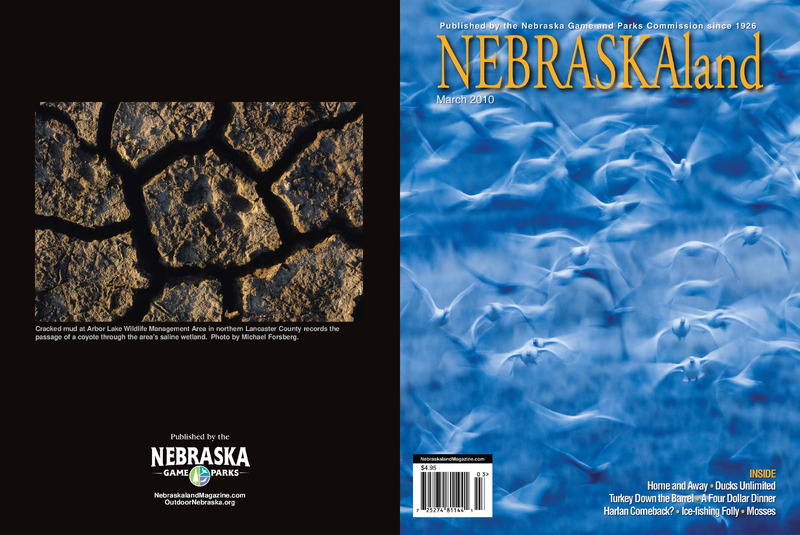
Cracked mud at Arbor Lake Wildlife Management Area in northern Lancaster County records the
passage of a coyote through the area’s saline wetland. Photo by Michael Forsberg.
Published by the
NebraskalandMagazine.com
OutdoorNebraska.org
Volume 88, Number 2, March 2010
12 Home and Away – Photographing Nebraska and Beyond
Nature photographer Don Brockmeier captures images across
Nebraska and around the world.
PHOTOS BY DAN BROCKMEIER,TEXT BY ROCKY HOFFMANN
20 A Four Dollar Dinner
Fun to both catch and eat, the rainbow trout at Two Rivers SRA
are a bargain that can’t be beat. TEXT AND PHOTOS BY JEFF KURRUS
22 Ducks Unlimited – in the Rainwater Basin
Ducks Unlimited was founded in 1937 to raise funds to
enhance wetlands in Canada. Today it is working across the
continent. TEXT AND PHOTOS BY JON FARRAR
30 Lyin’ in Winter
A novice ice-fisherman “describes” his first experience.
BY FRANK REID
32 Turkey Down the Barrel
Scouting and patience pays off for a young turkey hunter
whose hunt is over at sunrise on the season’s opening day.
TEXT AND PHOTOS BY JEFF KURRUS
36 Mosses
12
●
These ancient species are fun to learn about if you want to
increase your vocabulary. TEXT AND PHOTOS BY CHRIS HELZER
38 Harlan Comeback?
After years of drought sapped lake levels at Harlan County
Lake, fisheries biologists and anglers are eaglerly anticipating
what typically comes when a reservoir refills: more fish.
TEXT AND PHOTOS BY ERIC FOWLER
Comment . . . . . . . . . . . . . . . . . . . . . . . . . . . . . . . . . 4
Mixed Bag . . . . . . . . . . . . . . . . . . . . . . . . . . . . . . . 6
Step Outside . . . . . . . . . . . . . . . . . . . . . . . . . . . . . .44
Wilderness Workshop . . . . . . . . . . . . . . . . . . . . . .45
In the Field . . . . . . . . . . . . . . . . . . . . . . . . . . . . . . .46
Parks & Places . . . . . . . . . . . . . . . . . . . . . . . . . . . .47
Classifieds . . . . . . . . . . . . . . . . . . . . . . . . . . . . . . . 48
Portraits from the Past . . . . . . . . . . . . . . . . . . . . . 50
20
●
36
●
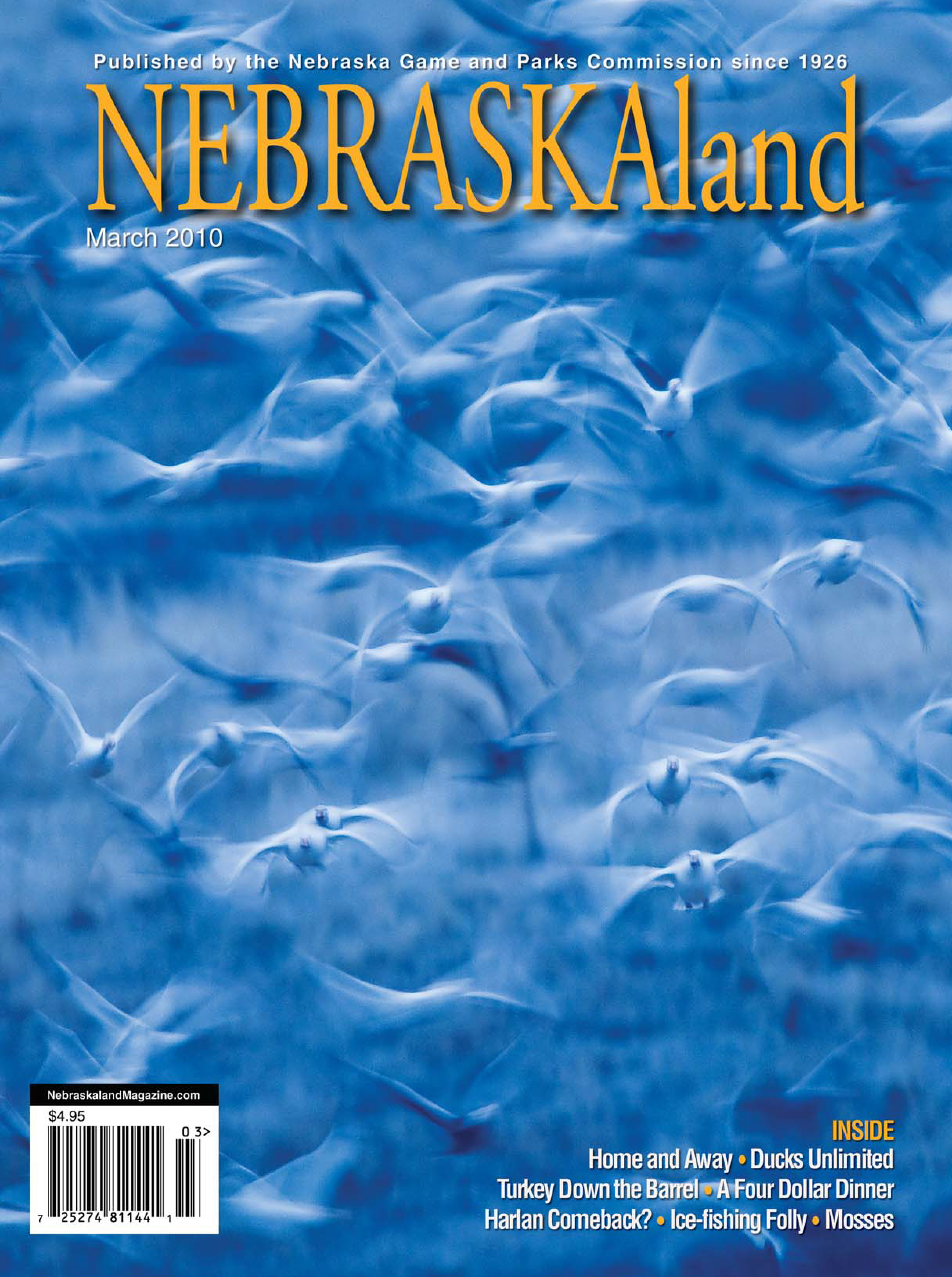
Cover: A deliberately slow shutter speed used by nature photographer Don Brockmeier
emphasizes the movement of a flock of snow geese flushing from a pond near Eustis during
an early morning blizzard. See story on page 12. Opposite: A pair of great horned owl chicks
peer from their nest located in secluded woods on the edge of Lincoln. Photo by Bill Hager.
NEBRASKAland (VOL. 88 / NO. 2, ISSN 0028-1964) is published monthly, except for the
combined Jan./Feb. and Aug./Sept. issues, by the Nebraska Game and Parks Commission,
2200 N. 33rd St., Lincoln, NE. Periodicals postage paid at Lincoln, Nebraska, and additional
mailing offices. POSTMASTER: Send address changes to NEBRASKAland, P.O. Box 30370,
Lincoln, NE 68503-0370.
22
●
MARCH 2010 • NEBRASKALAND 3
Published by the
Nebraska Game and
Parks Commission
NEBRASKAland Visitor Letters
We want to thank all 158 readers that
sent e-mails and letters for last issue’s
visitor, a lady bug on page 13 (see
page 11 for winner and rules). Here
are just a couple of the many wonderful
responses we received:
Director: Rex Amack
Assistant Directors:
Roger Kuhn, Kirk Nelson, Sam Sidner
Information & Education Administrator:
Doug Bauch
Commissioners
Chairman:
Jerrod Burke, Curtis
Vice Chairman:
Mick Jensen, Blair
2nd Vice Chairman:
Ron Stave, Waterloo
Dr. Mark Pinkerton, Wilber
Dr. Kent Forney, Lincoln
Lynn Berggren, Broken Bow
Rex Fisher, Omaha
Mark Spurgin, Paxton
Norris Marshall, Kearney
Magazine Staff
Editor: Doug Carroll
Associate Editor: Jeff Kurrus
Art Director: Tim Reigert
Senior Editor: Jon Farrar
Regional Editors: Eric Fowler, Bob Grier
Contributing Editor:
Michael Forsberg
Regular Contributors:
Bill Hager, Chris Helzer and
Lisa Knopp
Photo Librarian: Sarah Johnson
Circulation: Donna Robinson
For address changes and questions about
your subscription, e-mail
donna.robinson@nebraska.gov
or call (800) 632-5263
Marketing/Advertising:
For advertising information contact
Larson Enterprises
e-mail dave@larsonent.com
or call (515) 440-2810
NEBRASKAland Magazine
Copyright 2010, all rights reserved.
NEBRASKAland is available on audio cassette from the Nebraska
Library Commission Talking Book and Braille Service, Suite 120, 1200 N
St., Lincoln, NE 68508. (800) 742-7691. NEBRASKAland Magazine and
the Nebraska Game and Parks Commission reserve the right to reject any
advertising not in keeping with the agency mission.
Rates: $18 for one year; $33 for two years; $44 for three years. Nebraska
recipients must add appropriate sales tax. To subscribe call 1-800-NEBLAND (632-5263), or go online to: NebraskalandMagazine.com.
4 NEBRASKALAND • MARCH 2010
Dog with Goose
I have been photographing my hunts
for awhile now – sunsets, dogs, birds
etc. I love NEBRASKAland Magazine
and all of the wonderful pictures that
are in it.
This is one of the best photos I have
ever taken of Haley, my eight-year-old
female black Labrador. It was taken in
Blaine County on the North Loup
River, and she is holding a big, lateseason Canada.
Thank you,
Tyson Owens
Lincoln, Nebraska
$5 Youth Permits
Kudos to outgoing Game and Parks
Commission Chairman James Ziebarth
and the entire Board for deciding to
make youth 15 and under turkey, deer
and antelope tags $5 each beginning
this year.
This ground-breaking decision for
young Nebraska hunters will provide a
very affordable opportunity to learn
about the wildlife around them while
continuing to grow forward our hunting
heritage.
I believe this landmark change will
not only create more involvement by
young hunters, but will stand as a
shining example of our state’s
commitment to the future of
hunting.
Kent Boughton
Grand Island, Nebraska
Youth Hunting a Hit
I wanted to submit this photo and
note of appreciation to the Nebraska
Game and Parks Commission for the
youth hunting program!
My son turned 10 on November 6th,
just in time for the November firearm
deer season, and was fortunate to take
his first deer on my in-laws ranch north
of North Platte! We were also able to
do a little duck hunting that same week
on the South Platte near Big Springs
and he shot his first duck as well.
I’ve included a photo of my son
Parker, our puppy, Macy, and myself to
share with you and see if you notice
any “jewelry” my son’s first duck may
be wearing!
Eric Banks
North Platte, Nebraska
Love the magazine and happy to be
receiving it, even though I'm no longer
in Nebraska. You've got the best
photographers (and editors) around!
Thanks,
Jeffrey J. Huebschman, Chair
Department of Biology
University of Wisconsin-Platteville
We are totally impressed with your
magazine!! We received the
subscription as a gift from my brother
in Lincoln one year for Christmas. It is
always “travelling” from room to room
in our house, depending on who is
reading it! Wish Minnesota had a
magazine like this!! Great job!! Keep it
up!!
(I grew up in Nebraska, so it also
brings back fond memories for me).
Carol L. Paterson-Smith
Alexandria, Minnesota
Send your comments to:
Doug Carroll, Editor
NEBRASKAland Magazine
P.O. Box 30370
Lincoln, NE 68503
or e-mail doug.carroll@nebraska.gov
Please include your postal address and
telephone number.
Letters may be condensed and edited
for clarity. Photographs are
welcome and will be returned.
Under federal and/or state law, discrimination is prohibited on the basis
of race, color, religion, age, gender, marital status, national origin,
disability or political affiliation. If you think you have been discriminated
against in any program, activity or facility by the Nebraska Game and
Parks Commission or want more information, contact the Commission in
Lincoln, NE, at (402) 471-0641 or the Equal Opportunity Commission,
Lincoln, NE, (402) 471-2024, TTY/TDD (402) 471-4693).
Headquarters
2200 N. 33rd Street
Lincoln, NE 68503
Phone (402) 471-0641
District Office I
East Hwy. 2, Box 725
Alliance, NE 69301
Phone (308) 763-2940
District Office II
524 Panzer St., Box 508
Bassett, NE 68714
Phone (402) 684-2921
District Office III
2201 N. 13th St.
Norfolk, NE 68701
Phone (402) 370-3374
District Office IV
301 E. State Farm Rd.
North Platte, NE 69101
Phone (308) 535-8025
District Office VI
1617 First Ave.
Kearney, NE 68847
Phone (308) 865-5310
Omaha Office
1212 Bob Gibson Blvd.
Omaha, NE 68108
Phone (402) 595-2144
Ak-Sar-Ben Aquarium
21502 W. Highway 31
Gretna, NE 68028
Phone (402) 332-3901
World Wide Web site:
Panhandle
Officer
City
Phone (308)
Jim Zimmerman (Sup.) Gering
763-2940
Scott Brandt
Gering
631-0663
Heath Packett
Gordon
360-0682
Dennis Thompson
Lemoyne
289-0755
Dan Zuehlke
Ogallala
289-3399
Doug Pollard
Oshkosh
778-7101
Frank Miller
Valentine (402) 389-0444
Dan Kling
Harrison
430-0572
Southwest
Officer
City
Phone (308)
Roger Thompson (Sup.) N. Platte
535-8025
Ray Dierking
Brkn. Bow
870-0322
George Sund
Cambridge
655-0028
Michael Thome
Cozad
529-8146
Matt Andrews
Elwood
746-2418
Dirk Greene
Imperial
882-0015
Virgil Gosch
McCook
340-2440
Dudley Sorensen
N. Platte
530-0016
Rich Routh
Rep. City
920-0367
South-central
Officer
Jerry Pecha (Sup.)
Jeff Jones
Terry Brentzel
Randy Pomplun
Darin Gress
Dale Johnson
Robert Finke
City
Phone (308)
Kearney
865-5327
Clay Center(402)762-5022
Doniphan (402)469-5795
Fullerton
550-0489
Hebron (402) 768-8665
Kearney
440-3847
Milford (402) 440-3847
Northeast
Officer
Tom Zimmer (Sup.)
Dale Davis
Ross Oestmann
Steve Oberg
Daniel Roberts
Jon Reeves
Marion Shafer
Pat George
Tim Williams
Cory Krause
City
Phone (402)
Norfolk
370-3374
Bassett
760-0712
Bloomfield
360-0553
Columbus
910-3366
Fremont
719-1108
Kennard
889-8508
Norfolk
992-7590
O’Neill
340-0787
Neligh
929-0051
West Point
380-6410
Southeast
Officer
Duane Arp (Sup.)
Sean McKeehan
William Krause
Mike Luben
Douglas Kramer
Dina Barta
Stacey Lewton
Levi Krause
Russell Mort
Dan Evasco
Jeff Clauson
City
Gretna
Ashland
Auburn
Colon
Lincoln
Lincoln
Lincoln
Louisville
Nebr. City
Papillion
Waterloo
Administration
Ted Blume (Adm.)
Craig Stover (Asst.)
Wes Loos (Asst.)
Rod Loos (Asst.)
Murray Johnson
Lincoln
471-5531
Lincoln
471-5532
Lincoln
471-5591
Ogallala (308) 284-8056
Lincoln
471-5003
Phone (402)
332-2965
521-0159
274-8063
443-6392
890-6465
890-6463
890-7140
949-0593
209-1506
616-5961
658-7057
Nebraska Wildlife Crimestoppers 1-800-742-7627
MARCH 2010 • NEBRASKALAND 5
ARTWORK BY TIM REIGERT
are blue-winged teal and shovelers.
But there are exceptions to this
tidy migration chronology, and there
is no better example than mallards.
The core of the mallard breeding
range is the Prairie-Pothole region,
so it would seem they would not
be at the forefront of the spring
migration, but they typically are.
Why? The simple explanation is
because they can. They are as
tolerant of frigid weather as any
species of waterfowl. All they
require is open water (and
lacking that they will roost on
ice) and a source of food. That
means when there is open water in
Nebraska in the spring, and grain
fields are not buried under snow,
they have all they require to
prosper, and so they push north.
Likely, there is more waste grain
to be found in Nebraska fields in
March than in those in more
southerly states gleaned clean by
wintering waterfowl.
There is an old saying that “nature
abhors a vacuum.” It seems nature also
abhors rigid rules.
Why Migrate?
Jon Farrar
Why do birds migrate? The short
answer is to minimize competition for
nesting sites and food. Some species of
birds, like sharp-tailed grouse, live and
prosper year-round in the same place.
But, an acre, square mile, or township
can only support a limited number of
bird species, and a limited number of
birds of any species. So, birds evolved
to utilize nearly all places on the surface
of the earth for at least part of the year,
and they did that by migrating – in the
Northern Hemisphere spending their
summers in the north and their winters
in the south.
What drives ducks and geese north in
springtime is a hormonally-induced
urge to reproduce. The timing of their
migration is determined, to a large
degree, by how far north they travel to
their breeding grounds, and whether
winter is quick or lingering in its
6 NEBRASKALAND • MARCH 2010
retreat. Because of the short
summers in northern latitudes, birds
nesting there, particularly in the Arctic
– white-fronted geese, small Canada
geese, snow geese, wigeons, pintails
and green-winged teal – have a narrow
window of opportunity to arrive on the
nesting ground, have the hen lay and
incubate her eggs and still have time
for the young to attain flight stage
before winter sweeps across their
breeding grounds. More southerly
nesters, such as species nesting in the
Prairie-Pothole country of the northcentral U.S. and south-central Canada –
the large races of Canada geese, gadwall,
mallards, shovelers, blue-winged teal,
canvasbacks and redheads – have more
summertime days to complete their
reproductive cycle, and so have the
luxury of a later and more leisurely
migration.
So it seems logical that those species
nesting in the far north would be the
first migrants to arrive in Nebraska during
spring migration, and that is mostly
true. Among the first ducks and geese
to arrive here are white-fronted geese,
snow geese, pintails, and green-winged
teal. Among the latest to migrate north
Marlin Hupka of Lincoln loves to
hunt pheasant, quail, dove, grouse,
turkey and deer, and has advertised
his interest in the sport on a
message plate since 1985.
If you have a unique outdoor
message plate you would like to
share, or know someone who
does, e-mail a photo of it (highresolution, .jpg format only, please)
to Eric.Fowler@Nebraska.gov,
along with your name, hometown
and a brief description of the
interests expressed on your
license plate.
NatureSearch
Nowadays, most deer processing
articles speak about meat or
antlers, NEBRASKAland included.
However, the first article featured in
the March 1972 of NEBRASKAland
Magazine was entitled “How to
Make a Deerskin Vest.”
Also in that issue was Norm
Hellmers’s “Story in the Snow,”
explaining the author’s use of animal
tracks to locate winter wildlife with
a camera. In addition, Greg
Beaumont’s photo essay “Songs of
the Wind” displayed other wintry
scenes affected by constant blowing.
But winter themes weren’t this
issue’s only focus. Lou Ell and
current NEBRASKAland regional
editor Bob Grier’s “Under Sail”
reminded readers of the spring to
come with images from
McConaughy, Lewis and Clark,
and other Nebraska waters. Lastly,
the popular section “Notes on
Nebraska Fauna” focused on the
meadowlark, providing one last
hope for the end of winter: “The
coming of the meadowlark,” wrote
a former Nebraska Game and
Parks Commission nongame
specialist, “in early spring while the
fields are still brown is a thrilling
event. It announces its arrival with
a song as it stands on a fence
post, with its bright, yellow breast
gleaming in the morning sun.”
These days, and I imagine the
same was true in 1972, those
mornings can’t come soon
enough.
PHOTOS BY ROLAND BARTH
Jeff Kurrus
Julie Anderson
Say you’re walking in a forest in
eastern Nebraska and run across a
funky fungus, fancy
flower or interesting
insect that you don’t
recognize. Here’s
what you do:
Snap a quick
picture and use
Fontenelle Forest’s
fnanaturesearch.org
to tap into more than
1,300 photographs –
divided into 12
categories – of living
things recently spotted
on Fontenelle Forest
grounds. The photos
come with descriptions
and details about when
and where each
species is found, and users can also
click for a close-up of the photos.
Bellevue’s Roland Barth, co-author
with Neal Ratzlaff on two books related
to Fontenelle Forest and Neale Woods
– Field Guide to Flowers and Field
Guide to Trees, Shrubs, Woody Vines,
Grasses, Sedges and Rushes – came up
with the NatureSearch concept.
The pair, along with other volunteers,
took many of the photos and continue to
add to the site while encouraging others,
particularly kids, to also submit photos.
Fallow Deer Request
Jon Farrar
Fallow deer are native to most of
Europe, but in the 20th century were
often imported into the United States
by game fanciers and game park
keepers. In 1939 and 1940, surplus
fallow deer from the Lincoln City Park
Department were released into the wild
along Beaver Creek northwest of
Petersburg in Boone County. The
transplants prospered, and by 1955
had expanded into Greeley and Hall
counties.
An archery season was first allowed
in 1956, followed by firearm seasons
during the 1960s. Because of complaints
they were damaging cropland, freeranging fallow deer were essentially
eliminated from the region, although
some persisted into the 1970s.
NEBRASKAland would like to publish
an article on the history of fallow deer
in the state but has been unable to
locate illustration. Anyone with
photographs of fallow deer in the wild
in Nebraska, hunters with fallow deer
taken during legal seasons, or mounted
heads that still exist are asked to
contact Jon Farrar, Nebraskaland
Magazine, 2200 North 33rd St., POB
30370, Lincoln, NE 68503, (402) 4715492, jon.farrar@nebraska.gov.
NBA Banquet
The 2010 Nebraska Bowhunters
Association Awards Banquet will be
held March 5-6 at the Kearney Ramada
Inn.
This year’s featured speaker will be
Tom Hoffman, Jr., a world-famous
bowhunter and television personality,
who will give a presentation on
making, preserving and sharing
memories in the field. Other things
going on during the event include,
seminars, photo contests, auctions,
raffles, and dealer displays.
Tickets for Saturday’s banquet and
seminars are $25 for adults and $15 for
children under age 15. Tickets for
attending the seminars alone are $15.
All ticket requests should be sent to
Pat O’Brien, NBA Banquet, 2471 SW
42nd, Cortland, NE 68331. For more
information, call (402) 798-8208.
The Nebraska Bowhunters
Association promotes ethical hunting
of wild game and fish with bow and
arrow, and its mission is to preserve
and promote bowhunting in Nebraska.
Electonic Permits Only Now
As winter begins to ease its cold grip
on the state, the thoughts of many people
start turning to fishing or spring turkey
hunting. The Nebraska Game and Parks
Commission wants to remind people
that Nebraska hunting and fishing
permits, as well as its state-issued
conservation stamps, are no longer sold
from permit books as they had been for
decades.
Electronic permitting means customers
may go to OutdoorNebraska.org to buy
and print out a permit at any time, or
8 NEBRASKALAND • MARCH 2010
A Nice Criminal
One night several years ago near the North Loup River, I was
sitting in my truck on the side of a county road at 3 a.m. when I saw
a glimpse of light shine in a nearby field. Then blackness.
The vehicle remained dark for about 15 minutes. Then a light from
the passenger window shone. This same process took place four
times before I finally heard the report of a high-powered rifle. A
half-hour later, vehicle lights shone again as two subjects appeared to
load something in the back of the truck.
I stopped the vehicle on the road. “What you doing, sir?” I asked.
“Ohhhhhhh, just a little deer huntin,’” the driver replied.
“What did you get?”
“Ohhh, a little buck.”
“Well, we need to get the paperwork done, then I will need to take
the buck with me.”
“Well, when you get the paperwork done,” said the driver, “just drop
your tailgate and back up to my truck and we will drag
it across. That’s definitely easier than lifting it again.”
The driver paid a $100 fine and $100 in liquidated
damages for spotlighting and taking a deer after legal
shooting hours. But how things have changed – today
the same violation could cost an individual in excess
of $1,000.
Ross Oestmann, Conservation Officer, Bloomfield
they can get one at any Commission
permitting office or participating
permit vendor. A paper permit will
still be provided, and the transaction
will be automatically recorded
electronically.
Not all permit vendors have, or will,
convert to this new system, however, so
customers may not be able to purchase
a permit from their traditional vendors
and may need to check with the vendor
or purchase their permit at home before
heading afield.
Some of the benefits of the system
are:
• A single purchase of a stamp
ensures the stamp will be displayed on
any other permits purchased the
remainder of the calendar year.
• Lost or damaged permits can be
replaced at any time from anywhere.
• Landowners need to enter legal
descriptions only once and update only
as needed.
• Multiple online purchases can be
made for multiple individuals with a
single transaction.
Portraits from Before 1980
Starting in the April, 2010 issue,
NEBRASKAland will begin considering
Portraits of the Past images taken
before 1980. Please send your images to:
Portraits from the Past
NEBRASKAland Magazine
P.O. Box 30370
Lincoln, NE 68503-0370.
Or e-mail to:
tim.reigert@nebraska.gov.
MARCH 2010 • NEBRASKALAND 9
Roger Hammer’s “look forward to”
locale is this scene of the Snake
River looking northeast from
Highway 61.
Eldon Marsh of Brunswick gave
specific directions to the “Ridge
Road” near the Missouri River in
Boyd County, saying that he has
traveled Nebraska for 77 years and
that while “there are truly some
roads where you wish the traveling
would never end, the most beautiful
road of all is the one that takes you
to Sunshine Bottom.”
Patrick Carraher of Lincoln also
had his favorite spot, pinpointing the
Brownlee road west of Highway 83
that goes northwest and runs into
Highway 97 south of Merritt
Reservoir in Cherry County and
relaying the one thought all
photographers sometimes have:
“My photos just don’t do it justice.”
For Larry Williams, “Cracker Box
Road” in Dawson County is one of his
favorite spots.
Other responses included that of
reader Larry Williams of Lexington.
He wrote of “Cracker Box Road” in
northeast Dawson County: “It is very
quiet here, with the only sounds
being the wind and an occasional
wild animal,” wrote Williams. “If you
close your eyes you can see
homesteaders putting up hay or
moving cattle.”
This road in Brown County is a
brightspot in Bill Ihm’s life.
Eldon Marsh’s vote was this road
looking west toward Fort Randall
Dam.
Finally, Bill Ihm of Brown County
seemed to say it best about how
one should view their favorite
locations. “This particular picture
may not be a hotspot,” he said,
referring to a dirt corridor between
pastures near his home, “but it is a
bright spot in my life.”
Continue to send your “Prettiest
Roads” photographs to
jeff.kurrus@nebraska.gov and
reasons why these locations are so
special to you.
10 NEBRASKALAND • MARCH 2010
Relocating Geese
Elizabeth Mack
“The lover of place
seeks out stories of
home – stories that not
only tell of familiar
places and people,
but also tales that
invest our placebased experience
with meaning and
wonder.” So writes
Thomas Dean, a self-described “weather
geek” and author of Under a Midland
Sky, a collection of essays celebrating a
topic that many Plains inhabitants
(including myself) decry – the weather.
Dean’s beautifully fashioned prose
captures the essence of the Plains as
he takes us through personal
remembrances of tornadoes, flash
floods, late-spring freezes and the
hell that is February.
Dean’s tales of weather-related
devastation do nothing to muddy his
admiration and obsession with weather.
In “Embracing Humidity,” he admonishes
the reader to quit complaining about
August: “Summer humidity is
wondrous. Isn’t it remarkable to feel
like you’re almost swimming in air
sometimes?”
Dean concludes his collection by
describing an affliction that he and most
other Plains inhabitants share: White
Christmas Anxiety (WCA). Dean
explains the first step to recovery is to
“acknowledge unrealistic expectations.”
He argues convincingly that even
though we habitually complain about
the loss of our white Christmases from
the past, we never actually had many to
begin with: “. . . our memories of those
‘winters like when we were children’
are figments of our selective memory.”
Even though Dean at times sounds
like an incurable romantic when it
comes to our climate, his affection and
passion for our cursed weather becomes
contagious. “Almost nothing grounds
us in locality as much as our body’s
interaction with what’s going on in the
air, the air that gives us our very life,”
Dean writes. During the dead of winter
as we curse the frigid temps, bleak
landscapes and meteorologists, Under a
Midland Sky might work to pull us out
of our weather doldrums.
Eric Fowler
Not long ago, Canada geese nesting
in Nebraska might’ve been considered
a novelty. Now, so many are nesting in
urban areas that in some cases they
have become a nuisance, grazing on
lawns and sometimes crops, soiling
lawns and sidewalks with their
droppings and even attacking the
occasional innocent passersby.
Part of the problem is rooted in
current landscape design, which often
includes ponds surrounded by manicured
lawns. This combination, be it in a
housing development, park or golf
course, provide exactly what the nesting
geese are looking for: food and water
for themselves and the goslings they
will raise.
What complicates the issue is some
people like having the geese around.
“They’re typically the people that don’t
have the actual problem of geese pooping
on their lawns,” said Mark Vrtiska,
waterfowl program manager with the
Nebraska Game and Parks Commission.
Commission biologists use various
techniques to control nuisance geese,
including trapping flightless goslings and
trucking them to points around the state
void of the bird, and destroying nests.
Last year, they began experimenting
with another technique: trapping adult
females on the nest and shipping them
to the Sandhills.
Vrtiska said this was done in a few
locations where they have problems
PHOTO BY ERIC FOWLER
In November 2009,
NEBRASKAland Magazine asked
readers to send in their nominations
for Nebraska’s “Prettiest Roads.”
The number of responses was
large, as was the variety in
selections. Locations in Gosper,
Nemaha and Sioux counties were
mentioned, as were sections of
highways 12, 20 and 83. Even the
short stretch of Interstate 80
crossing the Platte River near
Eugene T. Mahoney State Park was
listed by one responder as “the
perfect start and end to my work
day” on his commute from Omaha
to Lincoln.
A Late Winter Reading
every year in hopes that the females
will become attached to the Sandhills
and not return. Neck collars were placed
on five birds, said Vrtiska, so “the
ultimate test will be to see if they show
back up this spring in the places we
took them from.”
Neighborhood associations should set
thresholds dictating how many geese
will be tolerated, Vrtiska said. In many
cases, these associations or individual
homeowners can use one or more of
the techniques listed below to head off
problems caused by geese, but in the case
of nest destruction and lethal control, a
permit from the Commission is required.
• Harassment: Continually disturbing
geese as they begin to select nesting
sites can encourage them to move
elsewhere.
• Habitat modification: Keeping
areas mowed where geese like to nest
will discourage them from doing so.
Because geese prefer new growth,
mowing lawns less often is an easy
way to rid your self of grazing geese,
as is planting trees and shrubs in open
areas where they regularly land.
• Nest destruction: Oiling eggs to
smother embryos is most often used
because adults will continue to incubate
and eventually give up rather than
attempting to re-nest when eggs are
simply destroyed.
• Lethal control: In rare cases,
nesting adults are killed. While it hasn’t
yet been used here, other states issue
depredation permits to kill geese
causing crop damage.
Turpin Time
Dick Turpin
Here’s a
little game
you can
do in the
winter
time to
get the
kids out
of the
house.
You
take some half-inch
plywood and cut
yourself out some big
feet like Sasquatch.
Then go out in the
timber and lay out a
trail … weave it …
and then at the end of
the trail … have yourself
a nice big bonfire and have all the
materials you need for s’mores…
Now while you’re doing all this
you can show them squirrel, rabbit,
deer and turkey tracks … whatever
you run onto. And give them a little
wintertime outdoor education. ■
NEBRASKAland Visitor
Winner
Last issue’s winner of the
NEBRASKAland Visitor drawing
was Jack Lammers of Minden
who found the ladybug on page 13.
Readers are encouraged to contact
NEBRASKAland within 10 days
after each issue’s publication with
the correct page number and name of
that issue’s “Visitor” – an insect
found in Nebraska that just happens
to find its way onto one of the pages
of our publication.
We will then gather the correct
entries and draw one to win a
NEBRASKAland Visitor mug.
To enter each month, e-mail
tim.reigert@nebraska.gov
with “Visitor” in the subject line of
the message or write:
NEBRASKAland Visitor
2200 North 33rd Street,
Lincoln, NE 68503.
MARCH 2010 • NEBRASKALAND 11
Home and Away
Photographing Nebraska and Beyond
Photos by Don Brockmeier
Text by Rocky Hoffmann
Don Brockmeier’s camera has taken him around the world, yet he
claims to have barely scratched the globe’s surface. After all, he said,
he’s not even finished with the letter “A” yet. Brockmeier has not only
shot photos in the Americas, including Alaska, he’s also been on
photo safaris to Africa, Antarctica and the Arctic Circle. This Eustis
native developed an interest in photography while attending the
1984 Summer Olympics in Los Angeles, where he first attempted to
use a telephoto lens. He continued to shoot sporting events, locally in
southwestern Nebraska as well as Husker games, but his attraction to
hunting and fishing soon steered him in a different direction.
Above, “Full Pump”: A bald eagle flies above Alaska’s Dutch Harbor.
Opposite, “Daydreaming”: The fading sun bathes a lion in soft light as it
rests before heading out on its evening prowl in Tanzania, Africa.
12 NEBRASKALAND • MARCH 2010
MARCH 2010 • NEBRASKALAND 13
About the time that he began focusing more on
outdoor sporting themes, Brockmeier became an
accomplished fly fisherman and started visiting
world-class trout streams. His camera was an easy
addition to his pack, but he often encountered a
wide variety of wildlife on these trips that he could
not capture on film because of lens limitations.
Brockmeier now totes a Nikon D300 SLR digital
camera along with a variety of quality lenses from
12mm to 600mm. His backpack contains it all,
and he shoulders a solid tripod with a quality
head. He shoots nearly everything off of the tripod
and cannot stress enough how important a solid
rest is, particularly with long lenses.
Although he has traveled extensively to exotic
locations, Brockmeier considers some of his most
rewarding photography to have
occurred within a 75-mile radius
of home, where within easy reach
lies one of the world’s greatest
migration spectacles. Not only
does Brockmeier spend countless
hours shooting images of the
millions of waterfowl and cranes
that pass through central
Nebraska, he also volunteers his
time to guide visitors at Rowe
Audubon Sanctuary, where he
14 NEBRASKALAND • MARCH 2010
Above, “Pause That Refreshes”:
Zebras keep a sharp outlook for
predators as they drink from an
African pond.
Right, “The Pounce”: A Wyoming
coyote pounces on a rodent in tall
grass, looking for a quick meal.
Opposite, “Crying”: A male bobwhite
quail comes out of the brush and calls
for his mate shortly after she flushed
near Eustis.
MARCH 2010 • NEBRASKALAND 15
Right, “Synchronized Diving”: Adelie
penquins dive off an ice floe in the
Antarctica.
Below, “Getting High”: During the mating
season, prairie chickens will jump on
anything to command the high ground and
get noticed, as did this male prairie chicken
near Eustis.
Opposite Top, “The End and the
Beginning”: Brockmeier had to force
himself to zoom out to get the whole scene of
this whale and snowy mountains in the
Antartica.
Opposite Bottom, “Yummy”: A cheetah
pauses while feeding on a zebra kill in
Tanzania, Africa.
meets people from around the world who share his interest in
wildlife photography.
In recent years, Brockmeier has been working with the
Whooping Crane Trust volunteer program to positively
identify whooping cranes sighted in the area. He also takes
photos of the cranes in their migration habitat and said
working with endangered species such as whooping cranes is a
special thrill that requires a strong photo ethic be followed.
As the Frontier County coordinator for Bluebirds Across Nebraska, Brockmeier uses
his photography to promote the conservation of this species and the economies of several
central Nebraska communities – through his efforts with Rural Nebraska Living, he
helped establish the Chicken Dance Trail (www.chickendancetrail.com).
“The Chicken Dance Trail provides birders an opportunity to see and photograph a
variety of birds and wildlife,” said Brockmeier, “but one of my greatest enjoyments is
watching and photographing prairie chickens on the lek. I used to travel to Halsey or the
16 NEBRASKALAND • MARCH 2010
MARCH 2010 • NEBRASKALAND 17
experiencing the area’s unique pristine environment.
His most demanding photo journey, however,
was to Alaska, where he floated the Kongakut
River north to the Arctic Ocean. The float itself
lasted ten days. At one point along the trip he
hiked into the Brooks Range, where he camped in
an incredible wilderness area of the Alaskan
National Wildlife Refuge.
Whether he’s shooting polar bears near
Churchill, American bison at Yellowstone or a
bobwhite quail pleading for a mate in Frontier
County, Brockmeier tries to capture a unique
expression of the animal’s day in its personal and
unique habitat. ■
Valentine refuge to photograph their amazing courtship display, but a NEBRASKAland
Magazine photographer suggested that I drive into the country around Eustis at sunrise
and stop and listen every mile or so. I found leks everywhere, and I even found a sharptailed grouse visiting one of the chicken leks. I had no idea that prairie chickens inhabited
southern Nebraska in the central part of the state.”
As far as his photo trips abroad, Brockmeier described Africa as a “photographer’s
dream” and said his experience there provided him with what seemed to be an endless
variety of colorful species to photograph. His most revealing trip, however, was his
month-long photo journey to the Falkland Islands, South Georgia and the continent of
Antarctica. There he shot images of penguins, seals, whales and landscapes while
18 NEBRASKALAND • MARCH 2010
Above, “Painting with Light”: Sunrise
through a low level fog with a clear sky
above combined to almost paint this
picture for Brockmeier at Harlan
County Reservoir.
Right, “A Golden Moment”: Lateevening light reflecting off trees paints
this drake wood duck in a golden glow
on a pond near Lexington.
MARCH 2010 • NEBRASKALAND 19
A Four Dollar
Dinner
Photos and text by Jeff Kurrus
“Crowded” is the word usually
associated with a small lake that
has more than 3 or 4 people fishing
it at the same time. At Two Rivers
State Recreation Area (SRA) last
March, despite the hundreds of anglers lining the
bank trying to catch a trout, another word could
have come to mind – fun.
With light tackle and fly rods, anglers caught up
to 12 trout (four per $4 permit, with a limit of three
permits), spending a couple hours smiling on one
of the first warm Saturdays of the year, looking for
beautiful rainbows and usually finding plenty. ■
★
Two Rivers SRA, located near Yutan,
contains seven lakes totaling 32 acres
of water, and this year the area’s “trout
lake” (Lake No. 5) will be open from
March 13 to October 1. Although no
boats are allowed on this lake, anglers
can wade or fish from the bank from
7 a.m. to sunset, using one pole
per angler. An adult angler is allowed
to have two children under age 16
fish under their tag, but the group is
still limited to four trout per tag.
Special note: Two Rivers SRA has
expanded the lodging season for its
popular Union Pacific caboose
cabins – they are now open from
May 1 through September 30.
(From left to right) Zach Fosler, Dave Fosler, Ed Ehrenfried and Ian Ehrenfried trout fish near sunrise at Two Rivers Lake No. 5.
MARCH 2010 • NEBRASKALAND 21
seasonal wetlands, because they provide
such an abundance of food for migrating
waterfowl. Our priority is providing
spring migration habitat because it
directly impacts waterfowl production
in the prairie-pothole breeding grounds
to the north.”
Donovan said that most U.S. Fish
and Wildlife Service (USFWS)
Waterfowl Production Areas (WPAs)
and Nebraska Game and Parks
Commission (NGPC) Wildlife
Ducks Unlimited
in the Rainwater Basin
Text and photos by Jon Farrar
Management Areas (WMAs) in the
Rainwater Basin are large, semipermanent wetlands. Many hold water
year-round during wetter years.
“Those were the wetlands farmers
had the most difficulty draining and
converting to cropland,” said Donovan,
“so those were the ones that more
readily came up for sale. Consequently,
those were the ones state and federal
conservation agencies were able to
acquire over the years. They provide
Ducks Unlimited was founded in
1937 to raise funds to enhance
wetlands in Canada. Today it is
working across the continent.
DU believes restoring and protecting wetlands used by migrating watefowl is an important management component.
D
ucks Unlimited was founded in
1937, in the depth of prolonged
drought and plummeting
waterfowl abundance. The fledgling
organization’s objective was
straightforward – increase the abundance
of waterfowl in North America by using
money raised privately in the U.S. for
conservation work in Canada, the
continent’s principal waterfowl breeding
grounds. It was a sound objective for
its time, but incomplete – breeding
22 NEBRASKALAND • MARCH 2010
grounds in the U.S. also needed
protection, and wintering grounds were
vanishing. Beginning in the 1980s,
DU broadened its work to protect and
restore wetland habitat along the entire
migratory flyway, from Canada to
Mexico, by establishing regional offices
in the continental United States. The last
piece of the North American waterfowl
puzzle to be put in place was protection
and enhancement of wetlands used by
waterfowl during their twice a year
migration across the continent.
In 2000, DU hired or moved field
staff to Nebraska; recognizing it was a
key migration habitat state in the
Central Flyway, particularly the
Rainwater Basin region in south-central
counties, the Platte River and the
Sandhills region in north-central
Nebraska. While DU is working
statewide, it has concentrated its efforts
in the Rainwater Basin and along the
Platte River. Today, DU has five full-
time and four part-time employees
working in Nebraska, a mix of
biologists and engineers, all with
wetland conservation skills.
“Our goal, developed about five
years ago, was to put 12,000 acres of
additional wetlands and associated
grasslands out there in the Rainwater
Basin,” said Steve Donovan, Manager
of Conservation Programs for DU in
Nebraska. “We want to focus on small
and medium-sized wetlands, particularly
Shawn Meyer and his sons, Aaron with a blue-winged teal, and Jake, hunted from a
blind on DU’s Verona Complex during the Youth Waterfowl Hunting Season.
MARCH 2010 • NEBRASKALAND 23
DU’s Verona Complex in Clay County has a small prairie dog colony.
When DU acquires a tract of land it restores uplands with a mix of native grasses and forbs to prevent erosion and provide habitat.
important migration habitat, but they
typically do not grow the types of
plants that produce an abundance of
seeds providing food for ducks. Waste
corn in fields is an important food for
migrating waterfowl to put on fat, but
alone it does not provide all the
nutrients they require.
“DU wanted to complement those
larger wetlands by restoring and
protecting the smaller, seasonal-type
wetlands,” Donovan continued. “Those
are the wetlands that grow plants like
smartweed and wild millet, plants
producing high-value duck food.
Having the different types of wetlands
in close proximity to each other is
extremely important. Ideally the large,
semi-permanent wetlands that provide
24 NEBRASKALAND • MARCH 2010
roosting and resting sites are encircled
with smaller, seasonal wetlands. And
we want those seasonal wetlands
spread around the Rainwater Basin so
we can take advantage of localized
precipitation events. That improves
the chances of always having water
somewhere in the region for waterfowl.”
To accomplish its goals in Nebraska,
DU approaches wetland protection and
enhancement in several ways. Its mission
is not necessarily to acquire and hold
land, but to keep funds raised by DU,
and usually matched with outside dollars,
working on one project after another.
Property is only acquired from willing
sellers.
“With our Revolving Habitat
Program, we identify land with wetland
enhancement opportunities that are
coming up for sale,” Donovan explained.
“Typically we buy land with wetlands
that have been drained or are severely
degraded, and the surrounding portions
of the property are being farmed.
Once we own the property, we get our
biologists and engineers out there,
figure out what we need to do to
restore the wetlands to there maximum
capacity, and we implement that plan.”
While DU often buys land where
wetlands have been farmed for years,
the two critical components to restore
those wetlands are still in place – a
drainage pattern that concentrates
runoff, and a clay pan that will hold
water on the surface. Typically, DU
brings in earthmoving equipment and
removes sediment that has washed into
the wetlands over the years and any fill
material that had been placed in the
wetland in an attempt improve crop
production. If ditches or tiles had been
put in place to drain the wetlands for
farming, they are plugged or removed.
Reuse pits, excavated to concentrate as
much of a wetland’s water as possible
in one deep pool, are sealed and filled
with compacted soil. Irrigation wells, if
not already in place, are often added so
wetlands can be pumped to create spring
migration habitat when precipitation
has been inadequate, or in the fall to
provide additional migration habitat
and hunting opportunity. Uplands
surrounding the wetlands are seeded
to native grasses and forbs to create
terrestrial wildlife habitat and protect
the wetlands from silt-laden runoff.
“Then we protect the restored habitat
with a perpetual conservation easement
so it will be there forever,” Donovan
said. “These easements prevent future
owners from ever going in and digging
a ditch to drain the wetlands, digging a
big pit to concentrate the water, or
plowing up and destroying grasslands.
Once we have it restored and fully
protected we will resell that land to
whomever wants to buy it – someone
who wants more pasture, a recreational
buyer who wants to keep the land to
hunt, or a conservation agency. The
bottom line is that those grasslands and
wetlands will be protected forever. We
take the proceeds and reinvest in new
purchases and projects. We keep the
money revolving.”
The Revolving Habitat Program is a
relatively new concept in Nebraska, but
already DU has restored more than
2,400 acres, and the acquisition of
more land is underway.
When a state or federal conservation
agency owns a piece of land, selling or
trading it is difficult and takes time. DU,
however, can quickly execute land
purchases and trades, which it has done
in the Rainwater Basin. A common
scenario is that a private landowner has
a tract of land containing a wetland,
typically a wetland that has been
drained and degraded and is poor
agricultural land. The farmer is tired of
fighting the oft-flooded tract, but the
watershed above it is farmed. DU knows
the wetland can be restored, so it
negotiates with the landowner, and if
he or she agrees, DU buys a nearby
tract of productive land and trades it for
the wetland ground. Such trades are not
acre for acre but value for value. The
end result is that a wetland is restored
and a private landowner has a tract of
land better suited to agriculture.
“Every situation is different when it
comes to protecting a wetland,” said
Donovan, “and we use all the tools at
our disposal to accomplish that.”
The flexibility DU has to act as
quickly as a private individual buying
land has made it an important partner
with state and federal conservation
agencies, particularly in acquiring land
for sale that adjoins existing WPAs or
WMAs. State or federal conservation
agencies were often not able to acquire
all of a wetland when the original
purchases were made, making
management of those wetlands difficult
without affecting farming operations on
adjacent private land. DU refers to these
purchases as “round-outs.” DU usually
does wetland and grassland restoration
work before transferring the land to
either the USFWS or the NGPC.
Donovan said that more than 5,000 acres
of wetlands adjacent to existing WPAs
or WMAs remain in private ownership.
MARCH 2010 • NEBRASKALAND 25
DU’s main goal in the Rainwater Basin is providing shallow, food-rich wetlands during spring migration – wetlands that often dry in
summer.
Shallow, seed-rich wetlands produce annual plants that are an important food source for pintails, mallards and other ducks.
26 NEBRASKALAND • MARCH 2010
Additionally, DU frequently funds, or
finds funds for, wetland enhancement
on existing WPAs and WMAs, such as
drilling wells, filling reuse pits and
drainage ditches, removing or building
berms and the mechanical disturbance
of undesirable plants – such as reed
canarygrass, cattail, river bulrush, and
phragmites – that can choke a wetland.
DU usually does not partner with
other organizations in owning land,
believing management is more
efficiently accomplished by one entity.
Nor does DU intend to hold and manage
significant acreages land, but rather sees
its role as partnering with conservation
agencies that do hold and manage
wildlife lands, and with private
landowners. Because DU seldom retains
ownership of lands it acquires, it is
not burdened with an ever-growing
commitment to paying property taxes.
Its money remains working money. The
Verona Complex in Clay County is an
exception.
The Verona Complex encompasses
1,026 acres. The site was selected
because groundwater there was
expensive to extract for crop irrigation
and so the land less expensive to
purchase; but it contained several, small,
degraded wetlands. Grasslands and
wetlands have been restored, and buried
pipelines now deliver water to the
seasonal wetlands if needed. Fencing has
been installed so cattle can be used as a
management tool. Verona is an on-theland presence for DU in the Rainwater
Basin where the wise management of
wetlands and uplands will always be on
display. A tract of land on Verona has
been designated as a youth hunting area
to encourage youngsters to learn to hunt,
hoping that as adults they will support
wildlife habitat conservation. Verona, and
all DU properties, is open to hunting.
Fallen Heroes Marsh is located on the
area, a wetland dedicated to Nebraska
veterans wounded or killed during the
wars in Afghanistan and Iraq.
DU also works to restore and protect
wetlands on private land, often acting
as a middleman by finding funding
from such sources as the Nebraska
Environmental Trust, the Rainwater
Basin Joint Venture, North American
Wetlands Conservation Act grants and
other conservation organizations,
agencies and programs that share DU’s
conservation goals. Grant money is
used to restore or establish wetlands
and grasslands on private land, and to
buy conservation easements from
landowners, ensuring habitat will be
protected in perpetuity. The easement
may be held by DU or another entity,
such as a Natural Resources District
whose principal interest may be reducing
groundwater depletion. Participating
landowners typically have a deep interest
in providing habitat for wildlife but
cannot afford to set land aside without
financial help, even though most
wetlands being farmed in the
Rainwater Basin are marginal for
agricultural use. Many easements allow
The Rainwater Basin spans
21 counties in south-central
Nebraska. About 75 percent of the
6,100 square mile area is used for
crop production. Historically it
contained 204,000 acres of
wetlands. Today, only 40,000 acres
remain and most are in poor
condition. Annual ground and aerial
surveys conducted by the
Rainwater
Basin Joint
Venture has
shown that
about twothirds of all
surface water in
the region ends
up in reuse pits,
not wetlands.
How important is the
Rainwater Basin to wildfowl
and other wildlife?
Approximately 90 percent of the
mid-continent population of greater
white-fronted geese, 50 percent of
the mid-continent population of
mallards and 30 percent of the
continental population of northern
pintails use the Rainwater Basin
during spring migration. Over
257 bird species have been
recorded in the region, and
42 percent of confirmed whooping
crane observations in Nebraska
are from the Rainwater Basin. At
least 200,000 to 300,000 shorebirds,
of over 40 species, migrate through
the basins in spring. The region
was recently designated the firstever “Landscape of Hemispheric
Importance” for shorebirds by the
Western Hemisphere Shorebird
Reserve Network, in part because
virtually the entire world’s
buff-breasted sandpiper population
(above) stop there during spring
migration. It is estimated only
20,000 to 30,000 birds of that
species remain in the world.
MARCH 2010 • NEBRASKALAND 27
DU wetland projects not only benefit ducks and geese, but wading birds such as
great blue herons and over 40 species of shorebirds. The marsh edge and upland
grasslands are equally rich in both migrant and resident bird species.
restored grasslands to be used as pasture
or hayed, but not farmed. DU sees
grazing and haying as management
tools to keep seasonal wetlands at the
early stages of plant succession and
producing annual crops of seeds that
28 NEBRASKALAND • MARCH 2010
ducks forage for on the bottoms of the
wetlands.
Hunters and others are often
confused, sometimes even angry, when
they see DU’s Conservation Manager
Tim Horst and his crew disking up
earth and vegetation around summerdry wetlands with a large, four-wheel
drive tractor nicknamed “Big Red.” But
such intentional disturbance is critical
to maintaining an environment where
early-succession plants prosper and
produce heavy seed crops for ducks. A
wetland choked with cattail or bulrush
may be more appealing to the eye,
but it’s of little use to waterfowl,
particularly during migration periods.
DU has found mechanical disturbance
to be an effective tool for controlling
unwanted wetland plants. An unmanaged
wetland filled with undesirable
vegetation provides little of what
waterfowl require. Similarly, prescribed
fires on grasslands are used to maintain
a desirable mix of native grass and
forbs, and suppress unwanted invasive
plants such as brome grass, bluegrass
and exotic thistles. In addition to
disking its own wetlands, DU will disk
private and public-owned wetlands at
no charge. Intense, short-term grazing
is also used to manipulate vegetation
on both uplands and wetlands.
While DU is concentrating its
Nebraska efforts in the Rainwater
Basin, it is actively protecting wetlands
elsewhere in the state. Over the last six
years, DU has been ramping up its
efforts on the Platte River, a lifeline for
ducks and geese and myriad other
waterbirds. On the Platte, DU’s
principal tool has been easements to
ensure the river and adjoining land will
not be developed at the detriment of
wildlife. Currently, DU holds
conservation easements on four tracts,
protecting about 3,395 acres and over
seven miles of Platte River habitat.
Three more easements were scheduled
to be in place by the end of 2009.
Additionally, DU has joined with
partners and found funding for
restoration work along the Platte –
particularly removing phragmites,
willows, cottonwoods, cedars and
other invasive species that have been
encroaching on river channels for
decades; and restoring sloughs and
backwaters in the river floodplain.
DU has also funded wetland restoration
projects along the Missouri River, and
is looking at possible wetland
enhancement projects in the Sandhills.
DU’s Conservation Manager Tim Horst and his crew disk seasonal wetlands to keep them from being choked with aquatic
vegetation of little value to waterfowl and other water birds, and to promote the growth of seed-producing annual plants.
DU works hand-in-glove with many
partners to accomplish its goals. One of
the most important is the Rainwater
Basin Joint Venture, organized in 1992.
The idea of joint ventures for wetland
protection grew out of the North
American Waterfowl Management Plan
in 1986. The goal was “a framework
for partnerships, through which
government agencies, conservation
organizations, and other groups and
landowners cooperate on conservation
projects, each contributing different
resources or expertise.” That concept
has greatly accelerated the protection
and restoration of wetlands in the
Rainwater Basin.
“The Joint Venture provides a
framework to allow collaboration and
coordination among different agencies
and organizations doing conservation
work in the region,” said Rainwater
Basin Joint Venture coordinator Andy
Bishop. “We are using science to
justify our habitat objectives, good
science to make good decisions. We
don’t just need acres of habitat; we
need acres of the right types of habitat,
and in the right places to provide for
the needs of migratory waterfowl.
“The days of believing if you have
water and waste corn you are meeting
all of their needs are over,” Bishop
continued. “Imagine eating nothing
but Hostess Twinkies for every meal.
Spring migration is a critical period in
the annual lifecycles of waterfowl.
Hens are preparing to nest and require
balanced diets; essential minerals,
amino acids, and proteins they will
only find in well-managed wetlands.
The strength of DU in the Rainwater
Basin is coming up with funding
mechanisms to make things happen.”
Since 1992, DU has spent over
$14 million in Nebraska and conserved
44,213 acres – part of $188 million that
has been spent to protect more than a
million acres of land in the Central
Flyway. Money raised at local DU
banquets, from major donors in
Nebraska and from corporations, is
often multiplied five to ten times by
leveraging funds and taking advantage
of matching grants. Nationwide, DU
has more than a million supporters, the
world’s largest waterfowl conservation
organization, and has conserved more
than 12 million acres. DU’s original
concept of raising money in the U.S.
to protect duck breeding grounds in
Canada has come a long way. ■
For additional information about the
work of Ducks Unlimited in Nebraska,
contact Steve Donovan, Ducks
Unlimited, 2550 N. Diers Avenue, Suite
L, Grand Island, NE 68803, (308) 3838075, sdonovan@ducks.org
MARCH 2010 • NEBRASKALAND 29
By Frank Reid
O
kay, there are folks who enjoy
fishing in the middle of winter.
Some are called “ice fishermen,”
others “steelheaders.” I prefer to use
the collective noun – insane masochists.
Mind you, it’s not like I haven’t been
ice-fishing myself – I once was the
third man in a two-hole ice tent. If
you’ve never seen one, imagine a
nylon-covered porta-potty on the
middle of a frozen lake, surrounded by
little flags stolen from a Smurf golf
course. At least, that’s what it looks
like to me. Some of these tents and
shacks are very fancy, with solid sides,
sofas, TV and hot and cold running
maniacs. More on that later.
My epic adventure took place after a
late-January ice-fishing invitation from
Henry and John. Being a flyfisherman, I show
up with my fly rod
and a chainsaw,
figuring I can cut a
long, keyhole shape
in the ice and get
two or three casts
in before the guides
freeze up. Before I
could get started,
however, the guys
invite me into their
tent. Since my
8’6”, five-weight
fly rod won’t fit, I
leave it at the door but hang onto the
chainsaw for self defense, noting a
crazed look in the eyes of my erstwhile
“friends.”
The tent’s furnishing are sparse – two
upturned five-gallon buckets, with a
kerosene space heater in the middle,
facing two holes in the ice. A pair of
miniature fishing rods, obviously taken
away from their mothers too soon, sit
on little stands next to the holes, their
lines going into the water.
“I need a hole,” I say, for the first
time in my life.
Henry steps outside and returns with
“the drill.” This isn’t your standard
Black and Decker drill – it has a two30 NEBRASKALAND • MARCH 2010
horsepower gas motor on the top,
handles designed for hands wearing
boxing gloves, and a nine-inch bit. Not
nine inch long – nine inches across.
Apparently this is the WMD evidence
that we were looking for in Iraq.
John pushes things back and Henry
pulls the rip cord. Immediately the tent
fills with smoke and noise. Henry
centers the bit between the two holes,
pushes a lever and poof! We have a
three-hole ice tent. Fourteen inches
down and he’s into the lake. He takes
the drill outside and then starts to
explain their fishing techniques.
“Okay, those holes outside are John’s
and mine. You fish out of your hole
here. We don’t have the gear to set you
up outside.”
“Those are more fishing holes? I
thought the local
CSI had been out
here tagging
evidence from
some bizarre Inuit
gang war. How do
you get the fish in?
You’ve got no
fishing poles.”
“Well, the flags
are tip-ups,” he
says. “When the
flag goes up, we
run out and pull up
the line. Right now,
we have them set for bigger, cruising
fish. We don’t want to catch tiddlers.”
“You catch tiddlers on your tip-ups?”
“No, we don’t want to catch tiddlers on
the tip-ups. That’s why we use a flasher.”
I start to think these guys are suffering
frostbite between the earmuffs. I warily
eye my two tent mates in their kneelength parkas as I slowly move to the
back corner of the tent.
“You flash the fish?”
“Yes, we put the probe down the hole
and we can see the fish with the flasher.”
“You put the probe down the hole so
you can see the fish with the flasher
and not catch tiddlers with the tip-ups.”
“Exactly!”
ARTWORK BY TIM REIGERT
Lyin’ in Winter
“Okay, I think I’ve got it. What I’ve
got, I’ve no clue. What do you use for
bait?”
“Wax worms.”
“Those look like maggots.”
“No, no. They’re totally different.”
“Well, they don’t seem to have much
action.”
“You have to warm them up.”
“How do you warm them up?” asks
I.
“Just pop a few in your mouth and
hold ‘em in your cheek.” He then raises
his mitten to his mouth and coughs up
four wriggling worms into his palm.
“I think I’m gonna spew!”
“Don’t worry about it. They’re wax
worms. Perfectly clean.”
“You’re sure about this?”
“Of course, been doing it for years.
Since I’ve started warming up my bait,
I’ve tripled the amount of fish caught.”
John is beside me, nodding seriously.
He opens up a little cardboard can and
shakes a tablespoonful of chilled, fleshcolored rice krispies into my glove. I
summon up my courage and pop them
into my mouth.
“Mmbule, mrammblu bebeme nbm
mammods?”
“What?”
I move the wax worms around, with
my tongue playing sheepdog, and
finally herd the suckers into my cheek.
“I said, what’s the difference between
wax worms and maggots? You said
they were totally different.” The wax
worms are starting to wake up and one
escapes out the corner of my mouth,
plopping onto the ice and squirming
away.
“Marketing. No one in the U.S.
would buy maggots, so they changed
the name to wax worms.”
John takes the pepper shot full in the
face. He now looks like a genetically
altered Medusa, with maggots instead
of snakes. Nonetheless, they are both
laughing hysterically.
This is ice-fishing initiation – Henry
just had a few wax worms in his palm
to keep them warm. With a bit of
sleight of hand, he spit into the mitten
and voila, there they were.
I, on the other hand, am not
laughing. I still have one little bugger
caught behind a crown and a second is
heading for my sinuses. Now I know
where they got the idea for so many
movies along the line of “Alien” – that
sucker nested up there and later
hatched out during a big presentation I
was giving at work.
Time to get down to fishing. John
hands me a spare rod. It’s about
18 inches long with a little bitty reel
attached. I remove my gloves to bait
the hook, picking a couple of live ones
out of John’s hair.
Since there is no room up front, I
lean over the space heater and finally
set up on my hole, plunking the bait
down into the water along with a
bobber the size of a kidney bean. Hey,
this isn’t so bad – I’m here with a
couple of “friends,” fishing and
chatting away. Even after my appetizer,
I’m starting to get hungry.
As a matter of fact, I smell
something cooking, although it doesn’t
smell very good. More like burning
plastic bags. Smoke curls up around
my face. John looks over and casually
comments “fire.”
“What?”
“You’re on fire.”
I look down. The lower portion of
my parka is touching the space heater
and flames are licking up from my
groin to my chest. I calmly assess the
situation. Ah, yes – stop, drop and roll.
I remember that from kindergarten.
Unfortunately, there is no room in the
tent for this maneuver. I believe its time
to quietly exit the facility and find a
snow bank. Translation: The scream I
emit sets off car alarms for a 50-mile
radius and many Nebraskans head to
their tornado shelters. Throwing down
the rod and reel, which take the path of
least resistance and drop straight
through the hole in the ice, I proceed to
beat myself across the stomach and
chest whilst doing a great impression
of the Tasmanian Devil in a confined
space. I finally head for the exit.
I hit the door doing about Mach 10,
but the Velcro closure decides to hold
fast and my panic-driven momentum
starts moving the whole tent across the
windswept lake. After a few steps the
tent catches on its two other occupants,
molding around them like a second
skin. They don’t move, because John
thinks he has a nibble. The Velcro
finally gives and I burst through the
door.
As it turns out, the flames on my
parka were apparently oxygen starved
in the tent. I believe this to be the case
because as soon as I hit the outside air,
I turn into a human comet – a flaming
blue head trailed by a stream of grey
smoke. I head for the nearest snow
bank, only to discover the true meaning
of windswept. Ain’t no snow banks for
hundreds of yards.
Still panicked, I blindly stumble
away from the tangled mess that was
the ice-fishing tent, in the process
hip-checking into Kansas a ten-yearold playing hockey with his friends.
Slaloming through the flagged
minefield of Henry and John’s tip-ups,
I manage to snag every one of them
with my mukluks. I look like a
Wisconsin limousine kitted out for a
wedding. One tip-up is attached to a
state-record walleye that flies through
the air, flash freezes, shoots across the
lake and trips a figure skater who does
the first-ever quadruple Lutz.
Unfortunately, she lands in an ice hole
and is never seen again.
I finally dive for the ice, rolling and
spinning in an inaugural Winter
X-Games break dance competition. The
officials hold up their signs: 2, 1.5, 2.
The French judge gives me a 0.5. The
flames out, I look back. Henry and
John haven’t moved, and the tent site
looks like a plane crash debris field.
My fly rod is broken and forms a cross
over the hole the skater disappeared
through. John raises his rod and brings
up a six-inch yellow perch.
I think I’ll stick to fly fishing and
class V rapids, it’s safer. ■
Frank Reid is a retired military
member and fly-fisherman from
Plattsmouth. He’s also the creater of
the “Full Reid” move which, in flyfishing parlance, means to greet the
creek with your face.
MAARCH 2010 • NEBRASKALAND 31
Turkey
Down the Barrel
Text and photos by Jeff Kurrus
Scouting and patience pay off for a
young turkey hunter whose hunt is over
at sunrise on the season’s opening day.
THIS TURKEY’S SPUR indicates that Brad
Cheloha’s opening day tom was a relatively young
bird.
TAKING AIM, Cheloha watches as a tom turkey
steps into the opening and gives him, as well as the
photographer, a perfect opening day turkey shot.
32 NEBRASKALAND • MARCH 2010
T
he original story idea was to find at least
two teenage turkey hunters who were finding
some balance between school, friends, sports
and the rest of the long list of pre-adult
necessities. Eighteen-year-old Brad Cheloha of
Columbus and a friend of his were to be the
exact pair I was looking for.
As it often happens for teenagers during that pivotal age
in life, Brad was the only one that thought he could hunt
opening day. If his friend had known just how quick of a
hunt it would be, he probably would have been able to come
too. By 7 a.m., Brad and I were shaking hands as we stood
over a dead tom. An hour later we were eating breakfast,
and by nine I was on my way home, a solid day of work
already behind me that had essentially started at midnight.
To some, Brad’s hunt may seem to have been very short,
but it had actually started several weeks prior to the trigger
being pulled.
“They’ll walk right down this road,” he had told me as we
drove down a dirt-bottom logging road on his family’s
Platte County land next to the Loup River two weeks before
opening day. Brad had been scouting for several days by
himself, but wanted to show me the spread – patches of
hardwoods between grass-covered strutting areas. For me,
it was going to be as difficult wondering what was going
on around the corner as it was to actually hunt. But Brad
reassured me of our spot, and that the birds would come.
His homemade blind was beneath a giant mulberry tree.
Brad and his father had cleared out debris and surrounded
the spot with tree trunks, limbs and greenery. From the
outside, all that could be seen of a hunter sitting on a shortlegged turkey chair inside the blind was the top of the
hunter’s head. Overlooking one of the logging roads that
criss-crossed the area, the blind was less than a hundred
MARCH 2010 • NEBRASKALAND 33
A HOUSE MADE OF STICKS was the perfect turkey hunting spot for Cheloha. From the outside (below), Cheloha is
barely visible to turkeys in his vicinity as a tangle of tree limbs and other brush, including the mulberry trunk as a safe
backstop, hide him from approaching birds. However, a view from above (top) reveals that the blind is actually large enough
for two hunters, with room to spare.
yards from a grove of cottonwoods where the birds
traditionally roosted. Perfect.
I arrived the night before the hunt, meeting Rick, Brad’s
dad, and family friends for an outdoor cookout where wild
game filled the menu. “Where’s Brad?” was my first question.
“Scouting,” his dad told me.
34 NEBRASKALAND • MARCH 2010
A brief while later, his dad got a phone call from his son.
Closing his cell phone, he turned to me. “We have to go out
to the land tonight, after dark, to set up a blind for you and a
second blind in case it rains. Brad said the birds roosted
about 70 to 80 yards away, and there’s no way you can set
up early and not bump those birds off the roost.”
“Is Brad coming over here to the party?” I asked.
“No. He said he wanted to get some sleep before
tomorrow’s hunt.”
“Sleep? For a teenager?” I thought.
At midnight, I was following Rick along the logging road,
blinds in hand. Above, the sky was still clear. I set up my
blind to the right of the mulberry blind as Rick put his up
across the logging road. Shortly after, we were back at the
Cheloha home. Brad’s truck was in the driveway, so while
Rick walked inside, I gathered my overnight bag and felt the
hood of Brad’s vehicle. Cold. He hadn’t gone out all night.
Morning came early, as did the rain. Brad, wide-eyed and
face painted in a camouflage pattern, was walking through
the kitchen as I stumbled in. “You ready?” he asked.
I nodded, still too tired to speak, and we climbed in his
truck as a hard rain fell. Then the teenager in Brad emerged.
He drove out to the family land, with me as his nervous
passenger, as if he was competing in a NASCAR race. I
held on for dear life. Finally, when I couldn’t take the speed
of this teenager’s truck anymore, I spoke up. “I flipped a truck
just like this one time years back, driving in a rain storm.”
Brad turned to me as the tires traded blacktop for gravel.
“Me, too,” he said, “right down here where this gravel gets a
little soft.” A quarter-mile later, the truck’s back end started
fish-tailing. “See, it gets a little soft here,” he said, the back
end turning not violently, but darn near close.
By the time we arrived at our hunting spot, I was wondering
how good of an idea this all had been. Was I following a
loose cannon into the dark woods, or just another teenager
who had yet to pay his fair share of speeding tickets before
adulthood, just like myself at his age?
This question was answered with the hunt. He
elected the mulberry blind, and I set up in the
blind behind him. Rain continued to fall, but
most of it was blocked by the massive amount of
leaves above us. We saw the first birds minutes
after sitting down – apparently they had left the
roost early, as we hadn’t heard them fly down. It
was legal shooting time, but still very dark, as
six hens walked down the logging road toward
us in single file. Before they reached our blinds,
however, they turned and walked into a patch of
woods. If there was a tom behind them, he
would probably follow.
Minutes later, with Brad looking to our right, I
glanced left and saw the blue head of a tom.
Seconds later, Brad saw him too, and his shoulders
immediately perked up as he picked up his slate
call and softly purred at the bird. It was hard not
to notice Brad’s calling subtlety.
There were two hens with the tom, but they
didn’t follow the original six into the woods and
instead stayed near the logging road. Gobblers
normally show little interest in calls when
they’re with hens, but this one showed little
interest in his co-eds and instead moved into an
open area close to the mulberry blind. Brad had
a shot, but it was through a tangle of underbrush.
A killing shot, yes. The best shot, no. He raised
his gun. “Wait, wait,” I thought. But he didn’t
need my silent suggestions.
When the bird moved behind a cottonwood
tree between the blind and the logging road, he
raised his gun again. Then the bird cleared. I
worried that it could hear my camera’s incessant
clicking for, with my heart in my throat, that was
all I could hear until the tom gobbled boastfully.
Brad continued to wait as the bird walked to
within 20 yards of us. Then he shot.
We were back at the truck a few minutes after
seven, talking more now than we had the entire
morning and adding small intricacies to the story
due to the brevity of the actual tale.
“You sure played that well,” I told him.
“Thanks,” he said.
“I got one request for you.”
“What’s that?” he answered, casing his gun.
“Like I said earlier, I had a truck like this years ago but
haven’t driven a stick shift in a long time. You mind if I drive?”
“Not at all,” he said, tossing me the keys.
I had seen enough of him in the field to know that he was
experienced beyond his years with a turkey call and shotgun
in his hand. However, I had ridden with him long enough to
know that, in most other places, he was still a teenager at
heart. Which meant that it was my turn behind the wheel,
for it was still drizzling rain and there was still a lot of
turkey season left for both of us to hunt. ■
THE HUNT ENDED for Cheloha with a bird
in hand just after sunrise on the opening day of
the spring shotgun turkey season.
MARCH 2010 • NEBRASKALAND 35
Mosses
Text and photos by Chris Helzer
These ancient species are fun to learn about if you want to increase your vocabulary.
million years before sunflowers appeared on the scene
and formed complex alliances with birds and bees for
pollination and seed dispersal, mosses were popping the
tops off their capsules to release thousands of spores into
the air. Those spores went wherever the wind or rain took
them, but a small percentage landed where the soil and
moisture allowed them to grow into new moss plants. The
It turns out that mosses are much more than simply the
spore strategy is considered by today’s biologists to be
stuff that clogs up your lures, but learning about them is
“primitive,” meaning that it’s simple and old, but it’s
not for the faint of heart. First of all, studying up on
also generally less cool than more recent and complex
mosses for this article required me to learn quite a few
strategies. However, even though much of the present-day
new vocabulary words. For example, mosses don’t have
earth is covered with pretty flowers (the kind that are
stems, they have seta. Furthermore, those stringy
attached to real stems with real leaves and roots), there
structures that anchor mosses to logs or rocks and look a
are also more than 14,000 species of mosses
that have managed to survive just fine too.
In fact, mosses can survive in just about
any environment, from sea level to the tops
of mountains. There are moss species that
can grow underwater and others that grow
in deserts. Nebraska has about 200 species
of mosses growing in a wide variety of
habitats, including prairies, woodlands, rock
outcrops and seeps. They quietly go
about their jobs, such as preventing soil
erosion and slowly turning rocks and logs
into rich productive soil. Unfortunately,
their humble existence and inconspicuous
appearance has meant that they historically
have not gotten much attention or respect
from the general public. Even botanists,
who should know better, have tended to
ignore them. Roscoe Pound and Frederic
Clements, two of Nebraska’s most famous
botanists, co-wrote an 1898 paper on the
plants of Nebraska, and their very short
Above: A bur oak acorn cap sits on a bed of moss in a Sarpy County
section on mosses started “These are of
woodland. Opposite page: Thousands of tiny spores will be released from
very little importance with us, on account
these sporophytes (capsules), a few of which may grow into new moss plants.
of the small number of species and their
lot like roots are really called rhizoids. And mosses don’t general lack both of abundance and of frequence.”
All right, so mosses were not going to win any
have flowers, they have sporophytes, and what look like
popularity contests back then, and I’m pretty sure they’re
tiny seeds are really spores. Their leaves aren’t
not going to win any now. But if you take the time to
technically leaves either, of course, but I didn’t ever find
look closely at them, they do have a certain charm.
another term to describe them other than “spirally
Many are actually pretty attractive in their own way,
arranged leaf-like appendages.” I thought I was doing
and if you learn more about them, you might find that
pretty well with my new vocabulary until I struggled
you start to appreciate some of the little known
through a paragraph on a University of Massachusetts
web site that ended with this sentence: “The gametophyte characteristics that have allowed them to survive for
more than 350 million years. For example, I think it’s
generation of the mosses is, thus, dimorphic.”
Of course the big reason mosses are different than most pretty neat when they shed their operculum to expose the
delicate peristome beneath … .
other plants, including the names of their structures, is
Or you could just go fishing. ■
that mosses have been around much longer. Two hundred
hen I was growing up, moss was the stringy green
gunk I was always trying to peel off my fishing
hook. Now that I’m a biologist I know it is more
than this, but I still catch myself griping about the moss on
my hooks. Maybe because phrases like “filamentous green
algae” tend to earn me funny looks from my fishing buddies.
W
36 NEBRASKALAND • MARCH 2010
MARCH 2010 • NEBRASKALAND 37
Harlan
Comeback?
Text and photos by Eric Fowler
After years of drought-sapped lake levels at
Harlan County Lake, fisheries biologists and
anglers are eaglerly anticipating what typically
comes when a reservoir refills: more fish.
F
ishing has been difficult at Harlan
County Lake in recent years.
Initially the problem was a lack of
water. That problem has been resolved,
but now the fishing is tough for another
reason: There are more than 5,000 acres
of flooded trees for the fish to hide in.
But while they don’t yet have any
proof to hang their fishing caps on,
biologists and anglers are optimistic
Wilbur Holloway fishes for walleye in
trees that grew on the exposed lakebed at
Harlan County Lake during an extended
drawdown and were flooded when the
reservoir filled in 2008.
Hoping to capitalize on the habitat
provided by the flooded timber, fisheries
biologists have stocked thousands of
northern pike fry in recent years.
38 NEBRASKALAND • MARCH 2009
that things are about to change for the
better at Harlan.
Reservoir Ups and
Downs
In irrigation reservoirs, the water
level typically falls in the summer
when water is being released for
for crops and then rises the remainder
of the year. Harlan is about 50 feet
deep and holds 314,000 acre feet of
water at normal operating levels. If all
150,000 acre feet of water reserved for
irrigation is released, the lake can
drop 13 feet, but the annual drawdown
is usually only between six and 10 feet.
During dry years, however, reservoir
inflow might not be enough to replace
what was released during the summer.
String a few dry years together, and the
cumulative effect can cause lake levels
to plummet. One example of this began
in 1988, and by September 1991, the
lake had fallen 17 feet and was at only
42 percent of its capacity, the lowest
point since it filled in the late-1950s.
While it can take reservoirs years to
recover from drastic drawdowns, an
abnormally wet year in 1993 brought
the lake up 22 feet and above full pool.
The recovery didn’t come as quickly
in the most recent drought, which started
sapping Harlan’s water in 2001. From
September 2003 through February
2007 the Republican River, the lake’s
main source of water, was often dry. As
a result, the lake stayed 16 to 20 feet
below normal during this time,
including a new record low in
December 2004 that left it at one-third
of its capacity. No water was released
for irrigation or to maintain flows in
the Republican River below the dam in
2004 and 2005, and irrigation releases in
2006 and 2007 were but a fraction of
the normal allocation. Farmers weren’t
the only ones affected – dramatic
reductions in reservoir volume often
lead to reductions in fish populations
for the simple fact that a given
amount of water can only support so
many fish.
When full, Harlan County Lake
covers 13,300 surface acres, spans
11 miles, including two miles of lake
above Highway 183, and has 75 miles
of shoreline. At its lowest point in
2004, it covered less than 7,000 acres
and spanned seven miles. Most boat
ramps, including the one at Alma and
another at Methodist Cove two miles
east of town, went out of service in
2001. The U.S. Army Corps of
Engineers, which manages the land
around the lake, used dredges to keep
access to North Shore Marina in the
lake’s northeast corner and Patterson
Harbor on the southeast open to boats,
and built two other low-water boat
ramps on the east end of the lake.
Wilbur Holloway purchased
Fisherman’s Corner in Alma in the fall
of 1999, and admits he couldn’t have
picked a worse time. “The first summer
we were in here the water was up and
the next year on the Fourth of July we
lost it,” he said.
But there were no friendly barbs
thrown at Alma from those in
Republican City at the opposite end of
the lake, who could at least still see the
water from the edge of their town. “It
hurt their business too,” Holloway said.
“I still had some people coming
through, but bait sales went to nothing.
It’s just part of life. Things happen.”
Despite the hardship it was causing
at the time, however, things were
indeed happening on the 5,000 acres
of exposed lakebed that would bode
well for the future. During annual
drawdowns of irrigation reservoirs,
some vegetation grows on the exposed
lake bed that provides habitat for fish
when the lake refills. After being
MARCH 2009 • NEBRASKALAND 39
Anglers fish for channel catfish in the Republican River channel above Highway 183 last June at Harlan County Lake. During the
recent drought, even the river was dry at times in this area. Now the area is a maze of flooded trees and smartweed.
exposed for four years, much of
Harlan’s lake bed had become a forest.
“There was tremendous growth of
willows, cottonwoods and a few
unwanted things like saltcedar,” said
Brad Newcomb, district fisheries
supervisor for the Nebraska Game and
Parks Commission, which manages the
Fisheries biologist Brad Eifert stocks young pike in the lake above Highway 183, where
abundant flooded timber, here rising 10 feet out of seven feet of water, and aquatic
vegetation will improve their chances for survival.
40 NEBRASKALAND • MARCH 2009
fishery at Harlan. “We have abundant
growth that’s been flooded, so aquatic
habitat-wise, we’ve been sitting much
better than normal for the last 2½ years.”
Much of that forest was flooded
when the lake rose 13 feet in 2007. The
rest was inundated in 2008, when the
lake came up another seven feet,
putting it three feet above normal.
Any flooded vegetation serves as a
host for phytoplankton, microscopic
plants at the base of the aquatic food
chain. This provides more food for
zooplankton, the primary food source
for newly hatched walleye and white
bass, as well as gizzard shad, the
primary forage fish in Harlan. The
flooded trees also provide cover for
young open-water species and shoreline
predators, and are prime habitat for
crappies. That was the case after
Harlan refilled in 1993, when both
game fish and forage fish rebounded,
Newcomb said. And that was with less
vegetation than was inundated this time
around.
“We’re doing several things to take
advantage of it,” Newcomb said of the
those numbers to try and make any
high water and flooded trees.
the total number of walleye captured
sense of them,” Newcomb said. “The
While there have always been
per gill net actually fell from six in
white bass and walleye numbers are
largemouth bass in the reservoir,
2008 to four, well below the goal of
16 fish per net. In addition, no youngconfusing to say the least. We expected
biologists hadn’t stocked them for
some better results.”
of-the-year walleye were captured in
decades. But in 2008, they released
113,000 fingerling bass in
Harlan, and they added
another 118,000 in 2009.
They hadn’t stocked
northern pike since 1996,
but added 33,000
fingerling in 2008, and
another 43,000 in 2009.
In hopes of helping
reverse a decline in channel
catfish in the lake, biologists
stocked 57,000 five- to
seven-inch-long fish in
2007 – the first time they
had stocked catfish in
15 years – and another
135,000 in 2009.
Biologists had been
stocking three-inch
fingerling walleye one
year, fry the next and then
skipping a year to allow for
natural reproduction, which
can be good in the reservoir.
With fry providing the best
Dean Laberto of Orleans lands a drum that Joe Coakley of Edison hooked while fishing for catfish
results, 13.5 million of
in the Republican River above Harlan County Lake. A popular fishing destination, the river was low
them were released in open or dry for several years during the recent drought. With water back in the river, so are the fish.
water of the reservoir’s
upper third in 2009. “We tried to
Newcomb saw no indication that a
gill nets in 2009, which wasn’t normal.
avoid timber in case it was holding
However, electrofishing did show some substantial number of either species left
crappie, white bass and walleye
the reservoir when water was released,
fish of that year’s year class, but they
because they eat fry,” Newcomb said.
were smaller than normal and too small and harvest pressure was not large
“It’s been shown there are higher
enough to have an effect. He is hoping
to be caught in gill nets. A poor shad
concentrations of zooplankton in
hatch in 2009 likely left walleye without the huge shifts the sampling data is
the upper lake, which the fry will be
showing are simply due to the lake, for
as much to eat as they typically have,
feeding on for several weeks to a
all intent and purposes, being entirely
contributing to low growth rates.
month.”
different than the one they normally
On the bright side, about one-third
sampled, and the fish were simply
of the walleye that were sampled
where their nets were not.
measured 20 inches in length or more,
“It is like a new lake environment,”
including more 25 inch and longer than
he said. “It’s very possible that we’re
While Newcomb was optimistic about biologists had seen since 2001.
comparing different numbers and
The sampling data was even worse
the conditions and the management
our catch ability may have changed
for white bass. For four years, the
strategies they’ve used, he’s not sure if
dramatically.”
number and size of white bass in the
the lake will live up to its potential.
The westernmost sampling point
lake made it one of the best in the state.
Each fall, biologists use gill nets, trap
biologists used the past two years was
Biologists had sampled 30 fish per net
nets and electrofishing to capture fish
near Methodist Cove, about midway up
or more those years, including a big
at sites that have been used for years,
the lake. Typically, there was no reason
jump in 2007, and saw excellent
providing population trend data they
to go farther west, or even the ability to
distribution among the year classes.
can use in reservoir management.
do so, considering the lower lake levels
But in 2009, they captured an average
Sampling the past two years, however,
usually seen at that time of year. “[The
of only three fish per net.
showed very few young of the year
fish] could’ve been farther west than
“You don’t like to have to look at
walleye in the population. And in 2009,
Where Are the Fish?
MARCH 2009 • NEBRASKALAND 41
Each year the water dropped lower at Harlan County Lake, a new crop of willows and cottonwoods sprouted on the newly exposed
lakebed. When the lake filled in 2008, those trees were poking out of the water in Prairie Dog Bay and off White Cat Point in depths
of up to 20 feet.
we sampled because we didn’t sample
the western quarter of the lake,”
Newcomb said.
Whether that is the case or not will
be revealed as trees decompose and
lake conditions return to normal. How
long that will take depends on how
long Harlan stays full, which forecasters
say will be for at least another year.
“When they’re underwater, the trees
will last a long time,” Newcomb said.
The flooded trees have provided
excellent spawning habitat for crappies,
which had a strong year class in 2007
and good reproduction since. Newcomb
expected to see more eight- to 10-inch
fish in last fall’s sample, but they did
find some, as well as some 12-inch
fish. “We do expect good things with
that crappie population and I think we
should see some great fishing in the
next few years,” he said.
Catfish numbers also continue to
climb from historic lows sampled in
2006. Newcomb said samples showed
fish in all size classes, and about
20 percent of the fish sampled were
42 NEBRASKALAND • MARCH 2009
24 inches or longer. “Catfish are probably
one of the brightest pictures we’ve
seen down there,” said Newcomb. “We
are seeing recruitment even in years we
didn’t stock, so we will likely not
continue catfish stocking for a while and
see how things go. I think we’ve made
the recovery we’re looking for there.”
While their sampling doesn’t target
bass and pike, biologists did capture
some of each, and anglers caught a few
as well. Bass measured 8 to 20 inches
and pike 22 to 34 inches, with the
shorter fish possibly coming from the
2008 stocking and the longer from
earlier, naturally reproduced fish.
Tough Fishing
Biologists aren’t the only ones
having trouble catching fish at Harlan.
Newcomb said the effect is even
greater on anglers, who have had to
cope with reduced fish densities, a
result of the lake doubling in volume,
as well as the increased habitat where
fish can hide. In many places, the tops
of trees are sticking out of the water,
everywhere from the shoreline to
depths of up to 20 feet.
A creel survey has been conducted at
the lake most years since 1990. Anglers
have landed only 1,000 or so walleye in
each of the past two years, a dismal
catch rate that produced a fish every
20 hours. The 60 teams that fished the
two-day 2008 Governor’s Cup Walleye
tournament boated only three fish. In
2009, 80 teams upped that total to
15 fish, and the 47 teams in the local
walleye club tournament caught
15 fish.
“People are having a hard time
fishing the conditions down there,”
Newcomb said. “People who like to
troll in about 10 to 12 feet of water
can’t do it. They have to fish outside of
17 to 20 feet.”
Trolling or drifting in the shallows
these days typically only sends folks to
the tackle shop to restock. “It’s good
for my business,” Holloway joked.
Walleye anglers who had the best
luck resorted to vertical jigging or
Because the crappies are still
to work for them and saw increased
using slip bobbers in the flooded trees.
relatively small, few people are
success, including limits of fish on
“You’ve got to adjust the way you
Halloween, the opening day of pheasant targeting them, a fact that could change
fish,” said Holloway, who himself had
season. Trolling with lead-core line and with more keeper-sized fish in the
some luck using both techniques last
population. Holloway said crappies are
jigging with slab spoons in depths of
summer.
scattered throughout the trees around
up to 38 feet, especially along dropoffs
But Holloway said relatively few
that have historically held fish, produced the lake rather than concentrated in the
people have ventured into the flooded
coves, as they have been in years past.
the best results, Holloway said.
forest, especially above Highway 183.
Kids in Alma have taken a liking to
Another bright spot on the walleye
“There are spots deep enough that there
the resurgence of largemouth bass, and
could be walleye up there,” he said. “It’s front came earlier in the year when
it was a rare day in the summer when a
just matter of going out and hunting for anglers had excellent luck fishing the
few weren’t fishing around the boat
face of the dam during the spring
them. I think we get to the point where
ramp on the southeast corner of town.
spawning run. “It was the best April
we hunt and fish memories more than
Holloway weighed a 4½-pound bass
night fishery on the dam that we’ve
going out and looking for new spots to
for one lucky young angler, and has
fish and hunt. I know I’m guilty of that seen in 10 years,” Newcomb said.
also seen a few nice bluegills showing
White bass fishing, long a staple at
at times.”
up in angler’s catches.
Harlan, also took a hit in 2009 after
Newcomb said it’s a tough call for
Some of the decline in total number
seeing dramatic improvement in 2008,
those who do fish the trees on whether
according to the creel survey. Yet while of all species of fish caught in the lake
to move until they find fish or sit tight
can be attributed to a decline in effort.
angling success was sporadic, the
until the fish find them. “I think the
For the past three years, the creel survey
spring white bass spawning run in the
fish move through it enough to find
estimated there were 20,000 angler
Republican River above the reservoir,
food,” he said. “It will depend
trips to the lake, down considerably
once a hot bite and a favorite of area
primarily on shad distribution within
anglers, reappeared in 2009 for the first from the 40,000 to 55,000 trips made
that type of habitat. If the shad
during most years in the
numbers are high in the
1990s. In 2009, half of the
whole entire area, they
anglers were targeting
won’t have to move a lot.
white bass and just
But especially this year,
8 percent, – 1,600 trips –
when it looked like there
were targeting walleye.
were lower numbers of
Walleye are a priority
small shad, I’d bet they
species at Harlan.
were moving quite a bit.”
Newcomb hopes their
Complicating the issue
management plan can not
further is the fact that using
only produce more fish
sonar to locate fish, a prime
but increase the number
tactic among both walleye
of anglers pursuing them
and white bass anglers, is
at the lake to more than
nearly impossible in the
10,000. He wants the total
flooded trees. “When you
number of angler trips to
get under 20 feet, your
once again rise above
sonar blacks out,”
50,000.
Newcomb said. The sonar
Holloway and other
pictures many anglers were
business owners in Alma
seeing in deeper water last
and Republican City
summer, however, do lend
would be happy to see
credence to Newcomb’s
that. “We just need to get
guess that plenty of white
Holloway holds a four-pound walleye caught at Harlan County Lake
fishermen back down
bass and walleye remain in last June.
here,” Holloway said.
the lake.
“You’ve got to have your line in the
“All summer long, I’d go out and run time in years.
water. There’s always something out
The total number of channel catfish
that deep water and see big schools out
here to catch. Whether it’s catfish,
caught declined slightly in 2009, but
there,” Holloway said, noting that the
drum, bluegill, white bass or walleye,
the number harvested increased.
sonar pictures he and other anglers
something’s bound to hit. There have
Catfishing was good from the spring
were seeing weren’t much different
been days I haven’t come out here and
run in the upper end of the reservoir
than what they’d seen in other years.
caught that I wanted to, but I’ve always
and in the Republican River above it,
The anglers who continued to fish
caught fish.” ■
and througout summer across the lake.
through the fall put that information
MARCH 2009 • NEBRASKALAND 43
Divers and Dabblers
Late-winter Photography
Spring migration is a great time to improve duck identification skills.
Some of the best photo opportunities can be found in the dead of winter.
By Jon Farrar
By Bob Grier
ducks dive to feed, although lesser
body is near horizontal in orientation.
here are a number of ways to
scaup in coastal waters have been
sort ducks into like groups, from To keep the center of gravity over the
legs of a diving duck, the body must be observed as deep as 40 feet. Divers
sophisticated DNA analysis to
tilted with the head higher than the tail. typically feed underwater from 10 to
“those with green heads” and
40 seconds but are capable of remaining
The rearward placement of the legs is
“all the rest.” Somewhere in the
submerged for over a minute.
even more extreme in loons, grebes,
middle of that range is categorizing
When divers are feeding they compress
and cormorants – birds that seldom
ducks by whether they are divers or
their body feathers, expelling air and
dabblers. Dabblers are also called
making them less buoyant, just as a
“puddle” ducks. Diving ducks do dive
submarine blows air from its ballast
to find their foods. Dabblers tip-up,
tanks to submerge. At rest on the
with just the back half of their
water, the tails of divers are
bodies above water, or feed
on or barely above the
near or on the surface of
surface, while the tails of
the water. But,
puddle ducks are held
sometimes dabblers
higher. And, the
make shallow dives
plumages of diving
to feed underwater
ducks are more
and divers
subdued – white,
sometimes feed
and shades of gray
on or near the
and black –
surface. Among
contrasted with the
the diving ducks
colorful nuptial
common to
feathers of drake
Nebraska are
dabbling ducks.
canvasbacks,
Granting that
redheads, ringnecks,
species of both divers
scaup, goldeneyes,
and dabblers have their
buffleheads and ruddy
The legs of diving ducks, as the scaup, above, are farther back
own characteristic time of
ducks. Common dabblers
on their bodies than those of dabbling ducks, making them
migration – blue-winged teal
include mallards, pintails,
more efficient feeding underwater; and so stand tilted
migrating
north late in spring,
gadwalls, wigeons, shovelers,
to center their bodies over their legs. Illustration
and south early in autumn, for
wood ducks and the teal.
from Game Birds, Wild-Fowl and Shore Birds
by Edward Forbush, 1912.
example, while mallards are typically
One of the most conspicuous
in the vanguard of the spring migration
differences between these two groups
and the tail end of the autumn
venture onto land. Also, the feet of
of ducks is placement of the legs.
migration – feeding habits and leg
divers, their paddles, are larger than
Because diving ducks feed by
placement plays a role in time of
those of dabblers, and their legs more
swimming underwater, their legs are
migration. Because diving ducks are
powerful.
located farther back on the body than
aquatic feeders and inept on land, they
Another way to tell if a duck is a
are the legs of dabblers. The reason is
do not feed in grain fields. Their
rather obvious. If you were designing a dabbler or a diver is to observe their
principal foods are aquatic insects,
submarine, where would you locate the take-off from water – dabblers spring
small mollusks, seeds, roots and tubers.
up from the water while divers must
propeller? Diving ducks have not
Diving ducks are forced to migrate
run across the surface to get airborne.
evolved to that extreme, but their legs
south to open water when shallow
Divers are heavier-bodied relative to
are far enough back to more efficiently
their wing surface than dabblers, have a northern lakes and marshes freeze.
propel them through water; but still far
higher wing-load, and so need a running Mallards, on the other hand, can stay
enough forward they can walk on land
north so long as waste grain in the
start to get airborne and fly with faster
or in shallow water, albeit rather
fields is not covered by snow and their
wingbeats. The shorter wings of divers
awkwardly. Even without seeing a
roosting and loafing waters in large
make them more compact when diving
duck’s legs it is easy to tell a dabbler
reservoirs or rivers remain ice free,
and, in some species, are used as
from a diver by the angle of the body
flippers to aid in propulsion. Ten feet is long after the shallow feeding waters of
when they are standing. Dabbler legs
diving ducks are sealed by ice. ■
probably about as deep as most diving
are centered under the body and so the
ike avid hunters locked in a
deep freeze waiting for spring,
photography enthusiasts too
often put their hobby on hold
during the late winter months as
March winds blow cold across barren,
colorless landscapes and trees without
leaves, agricultural fields without crops
and rarely seen wildlife hunker down
for the winter. Sure, so of the more
commonly photographed subjects may
be hard to find, but numerous photo
opportunities can still be found – ice
patterns, vegetation bordering open
water covered in bright hoarfrost, last
night’s fluffy snow sitting quietly in the
trees before the winds return. Often the
small things hiding in plain sight make
beautiful photo subjects.
Successful images, the kind that
photographer’s enjoy showing often, rely
on good composition – the arrangement
of shadows, shapes and light within a
photograph’s borders. Simple subjects
and simple compositions – less is often
more – is a good way to start looking
for winter photo subjects.
One aid often
suggested by
experienced photographers is a
black 8x10-inch
mat board or
cardboard with
a 4x5-inch
rectangular
cutout in the
center. Looking through
the opening held at arms length and close
to natural subjects, the card suggests
different compositions, including what
to leave within the photo’s frame and
what to exclude. Vertical and horizontal
compositions, size and distance from
the viewpoint or camera – all are
important to strong compositions.
Moved closer and further from the
viewer’s eye, the cut-out card can even
suggest the use of a wide angle lens or
perhaps a slightly telephoto lenses’
rendition of the subject.
To use the cut-out card, look through
T
PHOTO BY BOB GRIER
44 NEBRASKALAND • MARCH 2010
L
Bright red bittersweet berries in the upper right corner of this winter scene along East
Ash Creek in the Pine Ridge is the only color seen in the otherwise bluish tangle of
snow-covered trees and brush.
it while scanning potential subjects,
such as frost-covered sunflower husks
or a vegetation-clogged riparian stream
after a fresh snow, isolating possible
compositions. Then switch to your
camera and looking through the
viewfinder or at the camera’s liquid
crystal display, move the camera’s
zoom lens back and forth to duplicate
the view seen in the card.
The so-called “Digital Revolution”
has provided today’s photo-buffs with
excellent camera offerings in all price
ranges. A simple “point and shoot”
digital or film camera offering a built-in
zoom lens and both fully auto and some
selectable “modes” can do everyting
that most photographers require.
Most have zoom lenses – the ability
to increase or decrease the lens’
magnification of subjects from the
same camera-to-subject distance.
Another advantage of the digital
cameras is the liquid crystal display
(LCD) screen that can be used like a
camera’s optical viewfinder to help
compose images and review a small
version of the photograph after the
shutter is pressed. The LCD screen is
small and may be somewhat difficult to
see in bright light conditions, so the
recommended cut-out viewing card
might make it easier to see and imagine
how a photograph might appear.
All across Nebraska, winter’s
interesting natural details and subjects
can be found close to home. The creek
bottoms and stream courses mentioned
earlier are often located on land open
to public access, and Nebraska Game
and Parks Commission park areas in all
of the state’s geographical areas are a
great resource for photographers
throughout the year. In addition, nature
trails like those found on the Fontenelle
Nature Association’s nature preserve in
south-east Omaha, Lincoln’s Pioneer
Park and hundreds of community hiking
trails, Natural Resource District (NRD)
recreational lands scattered across
Nebraska often provide a wealth of
subjects.
Over the history of photography,
amateur and professional photographers
with imagination and patience, and
often only the simplest of equipment,
have captured great photographs in the
late winter. Photos from their home or
apartment windows, some taken on
short walks and often in urban areas.
Regardless of a photographer’s selection
of subject matter, even in late winter,
Nebraska offers a wealth of suitable
photo subjects. ■
MARCH 2010 • NEBRASKALAND 45
Going Once, Going Twice, Going Again
Spend the Night in a Cabin
An auction for conservation claims the fates of participants.
State Parks offer year-round overnight fun.
By Jeff Kurrus
By Tim Reigert
46 NEBRASKALAND • MARCH 2010
Lodging reservations are
available up to a year in advance
on a first-come, first-served basis.
Reserve online at Nebraska
Stateparks.ReserveAmerica.com or
by calling Nebraska's
Reservation Call
Center at (402)
471-1414.
The Reservation Call
Center is open 9 a.m. 6 p.m., Monday - Friday.
During peak season a
two night minimum stay
is required. (This
requirement may be
waived if a room or
Niobrara State Park has 19 modern housekeeping cabins
cabin is available for
that sit high on the bluffs, offering a commanding view of
one night between two
ooking to get away for a night
or a weekend? A place where
the kids have something to do?
Maybe a romantic getaway for
just you and your spouse?
L
PHOTO BY ERIC FOWLER
“What just happened?” Lauren said.
“Oh my God,” Laura said.
“This is awesome!” Dustin laughed.
“Are we in the auction?” I asked.
“Three fifty going once. Three fifty
going twice,” the auctioneer continued.
Laura was stone-faced, and I could
already see me saying “That was an
accident.” To which they would reply,
“But it’s for conservation.” And how
are you going to argue with that? They
might have booed us out of the place
after Dustin had garnered so much respect
for our table with his early triumph.
A miracle hand raised across the
room. The auctioneer turned back to
my wife. “Can I get $400?” Laura
pretended to contemplate, then shook
her head slowly. She had escaped.
After the auction they began pulling
raffle tickets again, this time for bigmoney items spread across the room’s
back tables. “274379,” called the man
up front. My new friend Jim, who was
sitting at our table, was thumbing
through his pile of tickets. “I don’t
have my glasses on,” he said.
“Let me see,” I said. Thumbing
through, I said, “It’s right here.”
“Thanks,” he said. He disappeared,
collected a .22 rifle and returned to his
seat. By the time he was back, I was
handing him another one of his winning
tickets, this time for a collection of
outdoor goodies. He was no longer
looking through his pile – I had taken
that job over.
But our spoils didn’t stretch much
further. Dustin paid $100 for a $5 box
of shotgun shells and a blanket, and
Lauren cursed when her winning
number wasn’t called for the 20-gauge
over-and-under.
“You got you some good stuff there,”
Laura said to Jim.
“I know. Crazy thing is, I don’t even
hunt,” he said.
“Really?” Laura said.
“Yeah, I just like coming to these
dinners.”
I could see exactly where he was
coming from. ■
the breathtaking expanse of bluffs, cliffs and river.
Getting a cabin at one of these many
Nebraska state parks (SP) and recreation
areas (SRA) may be the answer:
Chadron SP
Eugene T Mahoney SP
Fort Robinson SP
Lewis & Clark SRA
Niobrara SP
Platte River SP
Ponca SP
Two Rivers SRA
Victoria Springs SRA
•
•
•
•
•
•
•
•
•
prior
reservations or
walk-in
registrations.)
During
non-peak
season, one
night stays are
accepted for
SundaysThursdays,
excluding
Platte River State Park has 21 modern
housekeeping cabins (above), as well as
16 more-rustic camper cabins.
holidays.
Reservations require a $7 (plus tax)
reservation fee per unit in addition to
the regular lodging fee. Reservations
are accepted in person, telephone or by
mail during regular office hours. Cabin
check-in time is 4 p.m. and check-out
time is 11 a.m. (except at Fort Robinson
SP where check-in time is 5 p.m. and
check-out time is 10 a.m.).
For more information, go online at
www.OutdoorNebraska.org.
Lewis and Clark State Recreation Area’s cabins are situated on
the shore of Lewis and Clark Lake, offering a beautiful and
scenic view of the lake and surrounding bluffs.
PHOTO BY JEFF FIELDS
T
so hard. Lauren shook her head; my
mouth was agape.
The other man went in again, trumping
Dustin’s $425. Dustin raised his again.
“Dustin Owen,” his wife said. The
whole room was staring at him. His
archenemy raised his hand at $475.
Dustin paused, staring at the crowd.
“Can I get five hundred? Five hundred,
five hundred now. Five. Five. Give me
five,” the auctioneer said.
Dustin was still frozen. The auctioneer
began to walk toward him, cutting
between tables and stopping a few feet
away from him. “It’s just $50 more,”
the auctioneer said. Dustin looked
around the room. The guys at the bar
had stopped serving drinks, and the
live-action raffle tumbler had ceased
tumbling.
“You can’t let that guy take your
hunt like that,” I whispered to him.
“Jeff!” his wife said, hitting me.
“Five hundred,” Dustin said.
“Can I get five twenty-five?” the
auctioneer crowed.
Dustin’s nemesis raised his hand.
Dustin immediately raised his hand
back up at $550. I half thought he
might stand up, look the man in the eye
and exclaim, “ONE ... THOUSAND
... DOLLARS,” but it wasn’t needed –
the other man folded and Owen highfived me after the win, yelling “We’re
going to Schuyler!”
The crowd gave him a quick cheer
and Dustin turned to us. “The whole
crowd was staring at me. I couldn’t let
them down.”
Fifteen minutes and seven items later,
the blond-haired lady was at it again.
We sat back, admiring her technique.
“What does she do? ” Lauren said.
“I think she raises her finger like
this,” Dustin said to his wife, imitating
the blonde’s form.
“No,” Laura said, “it’s more like
this.” Laura raised her hand up.
The auctioneer saw her flinch. “Lady
in the back, three hundred and fifty.
Can someone give me three seventyfive, three seventy-five?”
PHOTO BY JEFF KURRUS
he fever hit me when I walked
through the door at a Ducks
Unlimited dinner last year in
Omaha, and spiked when the
auctioneer started.
“Give me two hundred. Two. Say two.
Two hundred now. Two hundred now.
Two. Two.” Not a hand was raised,
including my wife Laura, friend Dustin
Owen, and his wife Lauren.
“One hundred. Cut it in half. One
hundred now. One hundred. One. One.”
Still no hands. “Folks,” the auctioneer
said, “Remember, this is fundraiser for
conservation. We have to start
somewhere. I’ll start this with fifty
myself.” He paused. Then, “I got fifty.
Fifty. Fifty now. Can I hear seventyfive?” A man raised his hand. “Seventyfive. How about a hundred, a hundred
now …” And so the auction began.
I raised my hand for a couple of duck
prints early on, but lost my confidence
when the price went over $100.
However, the blond-haired lady in front
of us had no lack of confidence – she
was a single finger raiser at the start,
then a head nodder once the competition
became her versus another competitor.
For a framed waterfowl print, she
nodded at $300, then $400, then
declined at $500, waving coolly back
to the auctioneer that she was done.
“What we have next is an all-expense
paid, duck and goose hunt in Schuyler,
Nebraska. Two-night, two day hunt,”
the moderator said. Dustin raised his
hand. Someone else raised back. Dustin
went in at $200. Lauren began to stare
at him. The other person’s hand raised.
Dustin raised back, was countered, then
raised again. Lauren began to hit
Dustin as he, beer in hand and smile on
face, continued to raise.
His opposition came down to one
person, a eye-glasses wearing man at
the table behind us. The man raised at
$400. Dustin raised at $425. Then
Dustin raised his again at $450, bidding
against himself. The auctioneer wouldn’t
allow it. Dustin tried again, tears nearly
coming from his eyes he was laughing
PHOTO BY JEFF KURRUS
The new mini-lodges at Ponca State Park are located near the visitor center and are open year-round.
MARCH 2010 • NEBRASKALAND 47
ATTRACTIONS/EVENTS
WILDERNESS SURVIVAL CLASS - Start a fire with
the bow-drill method, build a survival shelter,
be introduced to primitive traps, cordage, flint
knapping, edible and medicinal plants, water
location and purification, and much more! Go to
www.greatplainstracker.com.
BOOKS/PUBLICATIONS/VIDEOS
EXPLORE NEBRASKA art, history, culture and the
great outdoors with a subscription to Nebraska Life
Magazine. One year (six issues) for $21 or two years
(12 issues) just $38. Phone (800) 777-6159, write us at
206 W Norfolk Ave, Norfolk NE 68702-0819 or visit
www.NebraskaLife.com. Makes a great gift.
“CRIPPLED BY DOCTORS” by a Nebraska author. True
story of 25 operations, 11 months in hospital, died once,
½ of heel amputated. Never told it might happen, but it
did. Send $12 to: Highwater LLC, Box 571, York NE
68467. Price includes postage/sales tax.
DOGS
PLUM CREEK KENNEL. German shorthairs, stud
service, puppies and started dogs. Training for all pointing breeds. Specialize in training the handler as well as
the dog. Wayne Clark, Percival, Iowa (near Omaha) (712)
529-4238, clarks1@iowatelecom.net.
DUCKDAWG RETRIEVERS - Raising exceptional
hunting yellow and black Labradors. Puppies raised in
our home. 30-month, written health guarantee. Stud
service: GRHRCH UN DuckDawg’s Eba Roll the Dice
and GRHRCH UH McMac Magic Eyes A’Smilin MH.
The first Grand Hunting Retriever Champions in
Nebraska. www.duckdawg.com Ron Green, DVM and
Libby Milroy, North Platte, NE (308) 534-3659
AT STUD: GRHRCH UH Platte's TNT Duckdawg Dozer
MH. First yellow Labrador in the state of Kansas to earn
his Grand, Upland and Master titles. Seventy pounds of
muscle, exceptional marker and blind runner Dozer
is available for breeding to approved females. Natural
breeding requires a brucellosis test on females. Chilled
semen available. Stud Fee $600. Contact owner Tom
Phillips at (785) 635-5776 or trainer/handler - Chris
Jobman at (308) 249-0707, www.flatlanderkennels.com.
PREMIER GUNDOGS TRAINING KENNEL:
Expecting two litters of Labrador retriever puppies in
February and March. Gundog training for all pointers,
hunting retrievers and spaniels. Dale and Kris Taylor:
(402) 787-2048, www.premiergundogs.com.
FLATLANDER KENNELS INC. Bayard, NE
Full-time retriever training facility for the serious hunter
or AKC and HRC hunt tester. Trainer of Nebraska's first
and only GRHRCH's! Super Retriever Series competitor
and a member of Avery's Team Waterdog. Training
available for all levels of hunt tests and gundogs. Chris
Jobman: (308) 249-0707, www.flatlanderkennels.com.
NEBRASKA LAKE MANAGEMENT. Biological lake
surveys, fish stocking, rough fish control, lake aeration,
algae control, aquatic weed control. Rob Hofpar, Aquatic
Biologist, licensed, insured and qualified. (402) 784-6005
Valparaiso - (888) 850-2460 www.nelakes.net.
GET YOUR FISHING PERMIT online today! Don’t
wait until tomorrow to go fishing with the family. Log on
to www.OutdoorNebraska.org and click on Purchase a
Permit under Licenses and Fees.
FOOD/GIFTS/HOME
HOMEBREWING/BEER AND WINEMAKING.
Fermenter’s Supply, 8410 K Plaza, Suite #10, Omaha, NE
68127. Phone orders only, (888) 655-2739. Advice line
(402) 593-9171. www.fermenterssupply.com.
CABIN/BUILDING/HOME Design and Construction.
Full-line building materials. Schreier’s Lumber Company
- Verdigre, NE. “Over 100 years experience”
schrlmbr@gpcom.net (402) 668-2624.
GUIDES/OUTFITTERS
HAVE CANADIAN-WHELPED FEMALE PUDELPOINTER, sired by German import, want to raise pups.
Looking for male dog to breed. dffattig@gmail.com
CANOE - KAYAK - TUBE RENTALS on the
beautiful Niobrara River with Dryland Aquatics at
Sparks, Nebraska. Your Niobrara River Specialist.
(800) 337-3119. www.drylandaquatics.com, info@
drylandaquatics.com.
FISH/FISHING
GUNS/SHOOTING/ARCHERY
FISH FOR SALE. Catfish, largemouth bass, smallmouth
bass, perch, crappie, bluegill, walleye, rainbow trout,
grass carp, minnows. Pleasant Valley Fish Farm, 27851
U.S. Highway 83, McCook, NE 69001. (308) 345-6599.
GUNS – Browning, Benelli, Winchester, Ruger, etc. 1700
guns, buy-sell-trade (402) 729-6112, Bedlan’s, Fairbury,
NE 68352. www.bedlans.com.
OUTDOOR EQUIPMENT
IS PERFORMANCE IMPORTANT? For the finest
canoes and accessories look to Great Plains Canoe Co.,
205 Main, Springfield, NE 68059. Phone (402) 253-2000.
PHOTOGRAPHY
NEBRASKA WILDLIFE PHOTOGRAPHIC PRINTS.
Matted. Go to inplainssight.homestead.com. "The more
you buy, the quicker my wife can retire!"
VACATIONS/RESORTS
FOR FISHING AND HUNTING accommodations.
Guided pheasant hunts. Jefco Inn, South Cornell St.,
Gordon, NE 69343 (308) 282-2935.
THE OLDE MAIN STREET INN. A historic bed and
breakfast listed in the National Register of Historic
Places. Beautiful dining room with fireplace. Featuring
prime rib, buffalo, seafood, homemade soups, chilis and
desserts. 115 Main Street, Chadron NE 69337 (308) 4323380. www.chadron.com/oldemain.
DIAMOND B TROUT RESORT, Orchard, Nebraska.
Lodge, cabins, spring-fed lakes, playground equipment,
paddleboats. Great for families, groups, hunters. Book
your cabin now! Call for brochure (800) 974-3002.
www.diamondbtroutresort.com.
MILL IRON V LODGING has modern cabins for your
vacation pleasure. We are located near Verdigre, NE
in turkey country. Each cabin offers privacy, view and a
birdwatcher’s paradise. Stay with us for a COUNTRY
EXPERIENCE. (402) 668-7488. www.milliron-vlodging.com, jpeinrem@gpcom.net.
BIG BLUE RANCH & LODGE - Enjoy fishing, hunting,
hiking, birdwatching and ranch adventures on 2000+ acre
cattle ranch in southeastern Nebraska. Beautiful log
cabin, with fireplaces, kitchens & big covered porches,
overlooks 20-acre lake. www.bigblueranch.com (402)
730-3643.
HIGH PLAINS HOMESTEAD, Home of the Drifter
Cookshack & Bunkhouse – An Old-West Cow-Town
is slowly coming alive on the windswept prairie of
northwest Nebraska. Rejuvenate your spirit through a
wide variety of activities amongst the ruggedness and
beauty that is only limited by your imagination. Popular
activities include day family outings, bunkhouse cabin
overnight stays, hunting, birding, stargazing, fossil
hunting and the trails that are available for mountain
biking & horseback riding. Great cowboy cookin' at the
Cookshack. Visit: www.highplainshomestead.com,
Call: (888) 365-2592.
WINEMAKER'S LOFT at Sage Hill Vineyard:
comfortable accommodations fit 4-6 in rustic Rock Creek
Valley, Parks, NE. Southwestern Nebraska's most ideal
lodging for hunting, fishing, birding and wine touring.
(308) 423-2062 or (308) 423-9463, walkers@
bwtelcom.net, www.nebraskawines.com.
48 NEBRASKALAND • MARCH 2010
PLANNING A VACATION? Why not make it at a
Nebraska State Park? With more than 80 state park and
recreation areas across Nebraska to choose from, you can
enjoy a campground or a cabin and enjoy activities such
as fishing, swimming, camping and hiking. Call
(402) 471-1414 for reservations or go online at
www.OutdoorNebraska.org and follow the Parks link.
WANTED
WANT TO VISIT WITH someone about training bird
dogs for Quail partridge prairie chickens. Public areas
where you can ride horses and camp. Rich Thornton
(515) 231 2465, rdfoxtrot@hotmail.com.
Classified Rates: 85¢ per word, minimum $15.
Closing: First business day six weeks before issue
date. Classified ads are accepted on a first-come,
first-served, space-available basis. Classified Ads,
NEBRASKAland Magazine, P.O. Box 30370,
Lincoln, NE 68503-0370. Telephone (402) 471-5473.
Fax: (402) 471-1984. E-mail: ngpc.classifieds
@nebraska.gov. Ads are posted online at
NebraskalandMagazine.com at no additional charge.
MARCH 2010 • NEBRASKALAND 49
▲ This picture was taken in the early 1920s, shortly after my father, Roy Comstock (fourth from left front
row) came home from WWI. These are his friends from the Ashland/Greenwood vicinity.
Bill Kelly is at far right in the back row. Of the other nine, five are unidentified. The rest are Vern
Schlepfer, Dutch Warbrittan, Charlie Dyer and Frank Bassett (not sure of their positions in the photo).
This was in Hooker County at Mullen, near the Dismal River. I have been hunting there for 55 years
and still go out. I am 81 years old.
My grandpa, Charlie Pilfold (not pictured) was head of the Nebraska Fish and Game Commission’s
seining crew in the early 1900s and worked there until 1930.
– Frank Comstock, Greenwood, Nebraska
ATTENTION NEBRASKAland SUBSCRIBERS
We are quickly running out of submissions for “Portraits from the Past.”
If you send us yours, we may be able to get it into an upcoming issue
relatively soon (first-come, first-served, of course).
Send your originals (or good reproductions) to the address below,
and we will be sure to return them.
If e-mailing pictures, please send as JPEGs scanned at 100% and a high
resolution (i.e. 300 dpi) to tim.reigert@nebraska.gov. Call (402) 471-4595 if
you have questions. When possible, please include a story about the
photograph, identifying people, places and approximate date photo was taken.
Send contributions to: Portraits from the Past, NEBRASKAland Magazine, P.O. Box 30370, Lincoln, NE 68503-0370. Or e-mail to
tim.reigert@nebraska.gov. Photos should show people enjoying Nebraska outdoor activities, such as camping, boating, hunting or fishing,
and must have been taken before 1980. We will give priority to unusual photos or activities. When possible, please include a story about
the photograph and identify the people, places and approximate date it was taken. Photos will be returned.
50 NEBRASKALAND • MARCH 2010
Position: 132 (46 views)