Volume 88, Issue 1, 2010
January-February 2010
- Identifier:
- nela.2010_088_01
- Title:
- Volume 88, Issue 1, 2010
- Issue Name:
- January-February 2010
- Date Issued:
- 2010-01-01
- year:
- 2010
- Season:
- Winter
- PDF filename:
- NL_88.01_2010_Jan_Feb_Spreads_Entire.pdf
- Publisher:
- Nebraska Game and Parks Commission
- Format:
- Periodical
- volume:
- 088
- issue:
- 01
- number:
- 088.01
- Decade:
- 2010s
- Type:
- Rights Holder:
- Copyright Nebraskaland Magazine/Nebraska Game and Parks Commission, all rights reserved.
- Extracted Text:
-
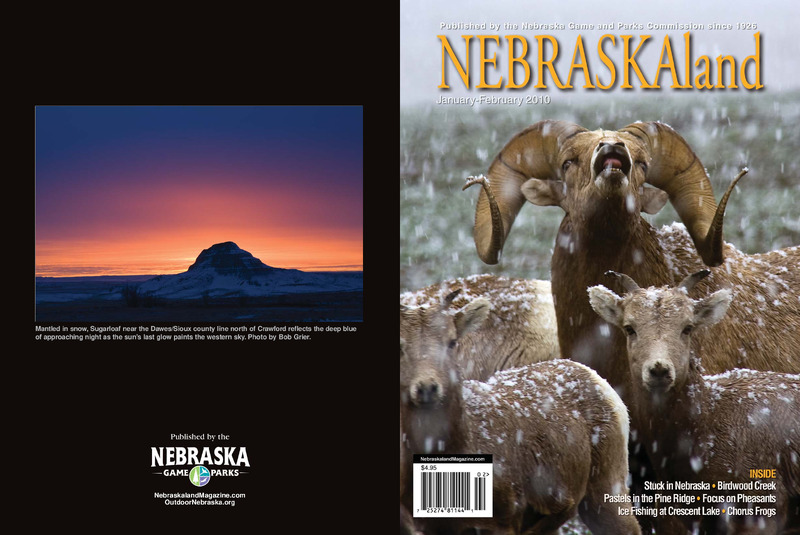
Mantled in snow, Sugarloaf near the Dawes/Sioux county line north of Crawford reflects the deep blue
of approaching night as the sun’s last glow paints the western sky. Photo by Bob Grier.
Published by the
NebraskalandMagazine.com
OutdoorNebraska.org
Volume 88, Number 1, January-February 2010
12 Stuck in Nebraska
Outdoor recreation is a must for many military members
stationed in the Great Plains. TEXT AND PHOTOS BY JEFF KURRUS
18 Pine Ridge Pastels
Throughout Pine Ridge artist Mary Louise Tejada’s life there
has always been one constant – art. TEXT AND PHOTOS BY BOB GRIER
22 Focus on Pheasants
Proving that pheasant populations could, and would, go up if
they had sufficient habitat was one of its goals when the Focus
on Pheasants initiative began. That goal has now been met.
TEXT AND PHOTOS BY ERIC FOWLER
30 Crescent Lake – Ice-Fishing Family Fun
Ice-fishing on a nearby pond or lake is a wonderful way for
families to spend a winter afternoon together.
TEXT AND PHOTOS BY BOB GRIER
34 Chorus Frog – Small Frog, Loud Voice
This rarely seen but often heard grassland species is one of
the earliest of all amphibians to emerge in the Nebraska
spring. TEXT AND PHOTOS BY MICHAEL FORSBERG
36
●
36 Birdwood Creek – A unique ecological diversity
A brief look at Birdwook Creek as it courses toward the
North Platte River. PHOTOS AND TEXT BY ROCKY HOFFMANN
42 Locked Up
A spur of the moment drive through the woods results in a
Good Samaritan encounter and a once-in-a-lifetime experience.
TEXT BY DOUG CARROLL
Comment . . . . . . . . . . . . . . . . . . . . . . . . . . . . . . . . . 4
Mixed Bag . . . . . . . . . . . . . . . . . . . . . . . . . . . . . . . 6
Outdoor Update . . . . . . . . . . . . . . . . . . . . . . . . . . .44
Parks & Places . . . . . . . . . . . . . . . . . . . . . . . . . . . .46
In the Field . . . . . . . . . . . . . . . . . . . . . . . . . . . . . . .47
Classifieds . . . . . . . . . . . . . . . . . . . . . . . . . . . . . . . 48
Portraits from the Past . . . . . . . . . . . . . . . . . . . . . 50
12
●
30
●
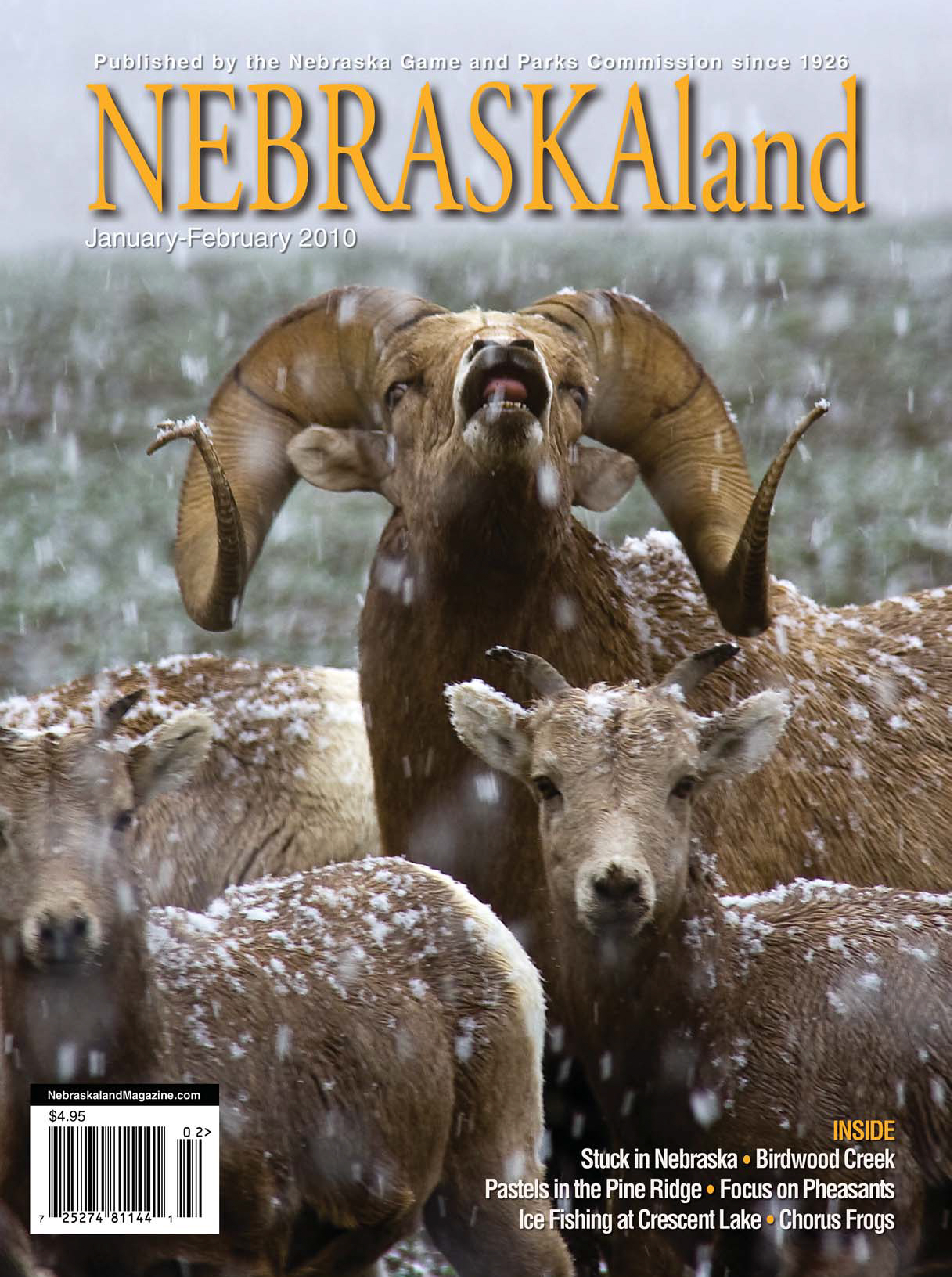
Cover: Living alone or in small groups throughout the summer, mature bighorn rams rejoin the
ewes and younger rams in late-November and December, their annual breeding season. Here
a full-curl ram "lip curls" as he looks for estrous ewes in a herd living in the buttes overlooking
Chadron State Park. Photo by Bob Grier. Opposite: A horse exhales warm air during a cold,
late afternoon winter day in Burt County. Photo by Jeff Kurrus.
NEBRASKAland (VOL. 88 / NO. 1, ISSN 0028-1964) is published monthly, except for the
combined Jan./Feb. and Aug./Sept. issues, by the Nebraska Game and Parks Commission,
2200 N. 33rd St., Lincoln, NE. Periodicals postage paid at Lincoln, Nebraska, and additional
mailing offices. POSTMASTER: Send address changes to NEBRASKAland, P.O. Box 30370,
Lincoln, NE 68503-0370.
18
●
JANUARY-FEBRUARY 2010 • NEBRASKALAND 3
Published by the
Nebraska Game and
Parks Commission
Director: Rex Amack
Assistant Directors:
Roger Kuhn, Kirk Nelson, Sam Sidner
Information & Education Administrator:
Doug Bauch
Commissioners
Vice Chairman:
Jerrod Burke, Curtis
2nd Vice Chairman:
Mick Jensen, Blair
Dr. Mark Pinkerton, Wilber
Ron Stave, Waterloo
Dr. Kent Forney, Lincoln
Lynn Berggren, Broken Bow
Rex Fisher, Omaha
Mark Spurgin, Paxton
Magazine Staff
Editor: Doug Carroll
Associate Editor: Jeff Kurrus
Art Director: Tim Reigert
Senior Editor: Jon Farrar
Regional Editors:
Eric Fowler, Bob Grier
Contributing Editor:
Michael Forsberg
Regular Contributors:
Bill Hager, Chris Helzer, and
Lisa Knopp
Photo Librarian: Sarah Johnson
Circulation: Donna Robinson
For address changes and questions about
your subscription, e-mail
donna.robinson@nebraska.gov
or call (800) 632-5263
Marketing/Advertising: Jane Gustafson
For advertising information e-mail
ngpc.advertising@nebraska.gov
or call (402) 471-5481
NEBRASKAland Magazine
Copyright 2010, all rights reserved.
NEBRASKAland is available on audio cassette from the Nebraska
Library Commission Talking Book and Braille Service, Suite 120, 1200 N
St., Lincoln, NE 68508. (800) 742-7691. NEBRASKAland Magazine and
the Nebraska Game and Parks Commission reserve the right to reject any
advertising not in keeping with the agency mission.
Rates: $18 for one year; $33 for two years; $44 for three years. Nebraska
recipients must add appropriate sales tax. To subscribe call 1-800-NEBLAND (632-5263), or go online to: NebraskalandMagazine.com.
Boxelder Bug
Is it an accident or on purpose? I
brushed at the upper right hand corner
of page 9 in the December 2009 issue
of NEBRASKAland several times
before I realized that the boxelder bug
was part of the page! I've looked
through the magazine trying to find a
reference to it, but have not succeeded.
Cute trick!
Also, is it my imagination or are
there more lady bugs than boxelder
bugs this year?
We get NEBRASKAland Magazine at
work, and everyone seems to take a
turn reading it. Thanks and keep up the
good work.
Enid Cederlind
Phillips, Nebraska
According to senior editor Jon
Farrar, there has been an increase in
lady bugs this year. But instead of
common lady bugs, the ones often
being seen are the multicolored Asian
lady beetles (Harmonia axyridis),
known for their biting ability.
And yes, apparently a boxelder bug
(Boisea trivittatus) crawled across the
scanner while we were in production of
the December issue. This is the first
time we’ve seen this problem and I’m
guessing it will probably continue to
plague us in the future.
And since you,
Enid, were the
first one to
identify
December’s
“accidental
visitor,” you will
receive a
complementary
NEBRASKAland Visitor mug.
Readers are encouraged to contact
NEBRASKAland within 10 days after
each month’s publication with the
correct page number and name of that
month’s “visitor.”
We will then gather the correct
entries and draw one to win a
NEBRASKAland Visitor mug.
To enter each month, e-mail
tim.reigert@nebraska.gov
with “Visitor” in the subject line of the
message or write:
NEBRASKAland Visitor
2200 North 33rd Street,
Lincoln, NE 68503.
4 NEBRASKALAND • JANUARY-FEBRUARY 2010
to cook. He called the process “hanging
them high.”
He also mentioned that in England’s
old days, after the birds fell they would
be rolled in mud to form a ball, which
was then put into a fire for an
unspecified period of time. When the
mud was hard, the baked ball was
taken out of the fire and cracked. As
the baked mud came off, so did the
feathers, and there was the bird ready
to eat.
Russ Pargett
Omaha, Nebraska
Near Deer Collision
Just thought we would pass this
photo along. It was taken November 27
at the end of our property line, which
borders Chalco Hills Recreation Area
here in Omaha. We were both standing
on our deck when we noticed this buck
standing about 60 yards away, so my
husband went and got his new camera.
The buck eyeballed us for about 15
minutes so I went to the garage and
grabbed some rattling antlers. When I
started rattling from our driveway in
front of the house, he came a’running
and Dennis got this picture. Not
knowing the buck was heading my way
we almost collided! Dennis then ran
through the house and into the
garage/driveway and photographed him
again as he ran into our front yard and
the neighbor’s as well. It scared me to
death, but was a beautiful sight!
I am a new bowhunter, yet to take a
deer, and I could have reached out and
touched this one! I hope one day to see
one as beautiful as him while hunting!
Happy Holidays!
Dennis and Sue Clark
Omaha, Nebraska
Hang’em High
Back in the 1950s when I was
attending UN-L, a friend gave our
engineering professor, who was from
England, a pheasant right out of the
field after a hunt. A week later we
asked him how he liked the bird. He
said he hadn’t eaten it yet, as it hadn’t
fallen off its feathers. He explained that
they hung birds by their tail feathers,
and when they fell off they were ready
Headquarters
2200 N. 33rd Street
Lincoln, NE 68503
Phone (402) 471-0641
District Office I
East Hwy. 2, Box 725
Alliance, NE 69301
Phone (308) 763-2940
District Office II
524 Panzer St., Box 508
Bassett, NE 68714
Phone (402) 684-2921
District Office III
2201 N. 13th St.
Norfolk, NE 68701
Phone (402) 370-3374
District Office IV
301 E. State Farm Rd.
North Platte, NE 69101
Phone (308) 535-8025
District Office VI
1617 First Ave.
Kearney, NE 68847
Phone (308) 865-5310
Omaha Office
1212 Bob Gibson Blvd.
Omaha, NE 68108
Phone (402) 595-2144
Ak-Sar-Ben Aquarium
21502 W. Highway 31
Gretna, NE 68028
Phone (402) 332-3901
World Wide Web site:
Love the Magazine
I just wanted to drop a quick line and
let you know I love your magazine and
can't wait to get my next month's issue.
My wife is from Elgin and her parents
are retired and have a farm there. We
reside in Arvada, Colorado and look
forward to visiting every chance we
get. Here is a photograph I took of a
beautiful sunset over a Thanksgiving
weekend. The windmill is on the
Durrie Ranch just outside of Elgin.
Thanks,
Steve Gooderham
Arvada, Colorado
Send your comments to:
Doug Carroll, Editor
NEBRASKAland Magazine
P.O. Box 30370
Lincoln, NE 68503
or e-mail doug.carroll@nebraska.gov
Please include your postal address and
telephone number.
Letters may be condensed and edited
for clarity. Photographs are
welcome and will be returned.
Under federal and/or state law, discrimination is prohibited on the basis
of race, color, religion, age, gender, marital status, national origin,
disability or political affiliation. If you think you have been discriminated
against in any program, activity or facility by the Nebraska Game and
Parks Commission or want more information, contact the Commission in
Lincoln, NE, at (402) 471-0641 or the Equal Opportunity Commission,
Lincoln, NE, (402) 471-2024, TTY/TDD (402) 471-4693).
Administration
Ted Blume (Adm.)
Craig Stover (Asst.)
Wes Loos (Asst.)
Rod Loos (Asst.)
Murray Johnson
Lincoln
471-5531
Lincoln
471-5532
Lincoln
471-5591
Ogallala (308) 284-8056
Lincoln
471-5003
Panhandle
Officer
City
Phone (308)
Jim Zimmerman (Sup.) Gering
436-7561
Scott Brandt
Gering
436-3418
Heath Packett
Gordon
282-2553
Dennis Thompson
Lemoyne
289-0755
Dan Zuehlke
Ogallala
284-4815
Doug Pollard
Oshkosh
772-9950
Frank Miller
Valentine (402) 376-1183
Dan Kling
Harrison
668-9456
Southwest
Officer
City
Phone (308)
Roger Thompson (Sup.) N. Platte
532-9175
Ray Dierking
Brkn. Bow
872-3078
George Sund
Cambridge
697-4629
Michael Thome
Cozad
784-4362
Matt Andrews
Elwood
785-3025
Dirk Greene
Imperial
882-5328
Virgil Gosch
McCook
345-2185
Dudley Sorensen
N. Platte
532-0747
Rich Routh
Rep. City
799-2085
South-central
Officer
Jerry Pecha (Sup.)
Jeff Jones
City
Phone (308)
Kearney
865-5327
Clay Center(402)762-3124
Terry Brentzel
Randy Pomplun
Darin Gress
Dale Johnson
Mark Reeves
Robert Finke
Doniphan (402)845-2021
Fullerton
536-2987
Hebron (402) 768-2287
Kearney
237-1079
Loup City
745-0662
Milford (402) 761-3537
Northeast
Officer
Tom Zimmer (Sup.)
Dale Davis
Ross Oestmann
Steve Oberg
Daniel Roberts
Jon Reeves
Marion Shafer
Pat George
Tim Williams
Cory Krause
City
Phone (402)
Norfolk
371-6625
Bassett
273-1700
Bloomfield
373-4412
Columbus
564-5937
Fremont
721-7852
Kennard
427-7378
Norfolk
371-2031
O’Neill
336-1588
Neligh
887-1335
West Point
372-6979
Southeast
Officer
Duane Arp (Sup.)
Sean McKeehan
William Krause
Mike Luben
Douglas Kramer
Dina Barta
Stacey Lewton
Levi Krause
Russell Mort
Dan Evasco
Jeff Clauson
City
Gretna
Ashland
Auburn
Colon
Lincoln
Lincoln
Lincoln
Louisville
Nebr. City
Papillion
Waterloo
Phone (402)
332-2965
944-4174
274-3789
443-4278
466-9001
483-2358
476-0436
234-2212
873-5684
592-6733
359-5301
Nebraska Wildlife Crimestoppers 1-800-742-7627
JANUARY-FEBRUARY 2010 • NEBRASKALAND 5
PHOTO BY JEFF KURRUS
Open Water Winter Fishing
Jeff Kurrus
Not all fishing this time of the year
in Nebraska is done on hard water.
Below Lewis and Clark Reservoir’s
Gavins Point Dam, the water usually
stays open the entire winter. Many
anglers frequent this area for its
walleye and sauger fishing, and their
tackle and techniques are manageable
for even anglers new to open water
winters.
“Spinning gear, 4- to 8-pound test
line, and a jig and minnow fished right
off the bottom straight below the boat,”
said Commission fisheries biologist
Daryl Bauer. “If the fish aren’t inhaling
the whole bait, consider putting a
stinger hook in the tail of the minnow.
“I would bet there have been more
walleyes and sauger caught below
Gavins using that presentation than
all other methods combined,” said
Bauer.
River Use Study Underway
Eric Fowler
A January 14 meeting in Omaha will
give Nebraskans a chance to voice their
opinion on how the Missouri River
should be managed.
The focus group meeting, set to
begin at 5:30 p.m. at the U.S. Army
Corps of Engineers office, is one of
many scheduled throughout the river
basin as part of the Missouri River
6 NEBRASKALAND • JANUARY-FEBRUARY 2010
Authorized Purposes Study.
The five-year study, authorized by
Congress in 2009, will examine the
current management of the river as
authorized by the Flood Control Act
of 1944. The long list of original
authorized purposes includes flood
control, navigation, hydropower, water
supply, recreation and fish and wildlife.
“Every use that is authorized will get
a fair shake and they’ll look at the
plusses and minuses of each one and
see if there are any opportunities to
make changes for the future,” said
Gene Zuerlein, Missouri River Program
Manager with the Nebraska Game and
Parks Commission.
The process could resolve a long
running dispute between downstream
states, which contend that barge shipping
continues to be a viable use of the
river’s water, and upstream states,
which contend the water is more
valuable if left in the six large reservoirs
for recreation. Additionally,
environmental interests would like to
see the river, currently contained in a
narrow navigation channel, broadened
to restore natural function and create
fish and wildlife habitat and expanded
hunting and fishing opportunities for
the people who live near it.
For more information on the study
and meetings, go to mraps.org.
November Deer Harvest Down
Hunters harvested 53,641 deer in
Nebraska during the November firearm
season, according to the Nebraska
Game and Parks Commission, a three
percent decrease from the 2008 harvest.
Officials believe a likely reason for the
decline was the lagging corn harvest,
caused by an unusually wet October,
provided plenty of cover for deer. That
was especially true in eastern Nebraska,
where deer harvest totals were down
more than 10 percent.
One of the more interesting reports
was from a hunter in the Pine Ridge
who reported tracking a deer he had
shot and finding it being attacked by a
mountain lion. The hunter dispatched
the deer, scaring off the cat. The hunter
left to retrieve field-dressing equipment
and returned to find the deer had been
partially consumed and covered by
debris.
Cold Winter Sunrises
Jeff Kurrus
8 NEBRASKALAND • JANUARY-FEBRUARY 2010
Deer Jerky Recipe
PHOTO BY ERIC FOWLER
This month marked one of
NEBRASKAland’s crowning
achievements: The Road Home –
A Photographic Journey.
“Interstate 80 travelers can be
forgiven as they whirr across
Nebraska with too little time for
their urgent missions. Through
their windows they snatch only
glimpses of Nebraska … Their maps
show them how to get through, not
into Nebraska” was written in The
Road Home’s introduction.
NEBRASKAland’s staff, including
current senior editor Jon Farrar
and regional editor Bob Grier,
now-contributing editor Michael
Forsberg, and former
NEBRASKAland writer/
photographers Ken Bouc, Don
Cunningham and Rocky Hoffmann
created a publication that continues
to withstand time. In these pages,
all of those sights so reminiscent
of Nebraska welcome readers at
every page – small town football,
corncribs, county fairs, pheasant
hunting, cottonwoods, sandhill
cranes and, of course, big skies.
Turning through its pages nearly
15 years later draws multiple
responses – a desire to return to
the way things once were, as well
as a desire to look around and see
what things around us still are.
Hardcover editions of The Road
Home are still available for $3 and
can be ordered at
NEBRASKAlandMagazine.com.
Jeff Kurrus
While it seems logical that it would
become warmer as soon as the sun rises
on a winter morning, many hunters will
tell you that the coldest part of their
morning in a deer stand or waterfowl
blind is when the sun rises. There’s
good reason for this.
Between sunset and sunrise, the
Earth’s surface gathers no solar energy
but continues to radiate away its stored
heat and the temperature lowers. When
the sun comes up at dawn, the incoming
solar radiation from the sunlight is
weak – it doesn’t yet have enough
strength to counter all the heat escaping
from the surface. As a result, the
earth’s surface continues to lose heat
for some time following sunrise and air
temperature continues to fall.
“At some point,” says University of
Nebraska-Lincoln meteorologist Mark
Anderson, “usually an hour or two after
sunrise, the accumulated energy from
the sun is larger than the heat lost and
the atmosphere begins to warm.”
An additional factor that could also
the sweat can chill the body as it
evaporates. In addition, the first
response many hunters have when they
arrive at their location is to shed
clothes, which also cools the body and
makes it difficult to warm up again.
The best solution to these problems is
to wear a minimal amount of clothes
while going to your location, then
finish dressing once you’ve arrived.
contribute to hunters’ early morning
chill is that their body temperature,
which rises while walking to their
hunting location, begins to lower once
they reach their destination and sit down.
In addition, sweat can form during
these walks and if a hunter isn’t wearing
some sort of moisture-wicking material,
Elizabeth Mack
I have been
making this jerky
recipe for over
15 years now. I
have tried others,
and have let our deer
processor make his
recipe, and none comes
close to this.
First, you don’t have
to use a dehydrator. I just
prop the oven door
open with a wooden
spoon and make sure
to line the oven floor
with foil.
Second, don’t make
the mistake I did once
and use garlic salt
instead of garlic
powder. It won’t end
well.
Third, hand-dip
each piece into the
seasoning mixture
instead of dumping all
the meat in the bowl at
the same time. The
final product is worth
the extra effort.
Ingredients:
2 pounds venison or other lean meat
½ cup soy sauce
2 tablespoons Worcestershire sauce
½ teaspoon black pepper
½ teaspoon garlic powder
1 teaspoon onion powder
2 teaspoons liquid smoke
Directions:
Slice meat about 1/8-inch thick. Mix
all ingredients in a shallow bowl. Dip
each slice in mixture, coating well.
Place in 13x9-inch glass dish, pouring
any remaining mixture over top. Cover
and place in refrigerator 24 hours to
cure. Pat dry and place pieces across
oven racks. Bake at 155º-175º for four
to seven hours, depending on thickness
of slices, with oven door slightly open.
Store in airtight container.
Pallid Sturgeon Update
Last November, Nebraska Game and
Parks Commission fisheries staff,
working in cooperation with the
Missouri Department of Conservation’s
Blind Pony State Fish Hatchery, tagged
and stocked more than 3,600 endangered
pallid sturgeon into the Missouri River
near Winnebago, Fort Calhoun and
Nebraska City. These 6- to 8-inch-long
juvenile fish were spawned from three
adult females and eight males collected
from the Missouri River last spring and
transported to Blind Pony SFH. This
was the most successful effort to collect
and spawn fish from the middle Missouri
River since the pallid sturgeon was listed
as endangered in 1990.
In addition to the fish stocked, an
additional 11,000 of their siblings will
be overwintered at Neosho National
Fish Hatchery in Neosho, Missouri and
Matthew Schafers of Lincoln
loves hunting and was surprised
when he found the plate that
carries that message wasn’t
already taken when he made it his
in 2000. He’s also amazed at the
number of conversations the plate
sparks with complete strangers
who happen upon it in a parking
lot.
If you have a unique outdoor
message plate you would like to
share, or know someone who
does, e-mail a photo (highresolution, .jpg format only, please)
of it to Eric.Fowler@Nebraska.gov,
along with your name, hometown,
and a brief description of the
interests expressed on your
license plate.
stocked in the spring. Approximately
90,000 pallid sturgeon, ranging in age
from a few days to seven years old,
have been stocked in the lower 811 miles
of the Missouri River below Gavins
Point Dam since the inception of the
pallid sturgeon stocking program.
The Commission’s fisheries staff is
currently planning the 2010 broodstock
collection effort (see “Saving a
Living Dinosaur” in the April 2009
NEBRASKAland).
JANUARY-FEBRUARY 2010 • NEBRASKALAND 9
Project BEAK
Decoys
Shooting from public roads and hunting without
permission can be a problem just about anywhere
in Nebraska. When complaints come in from a
certain area, conservation officers will encourage
the landowner to allow them to set up a decoy
operation. We use mounted game animals, and
some move electronically while others just stand
there. Not just deer decoys either, but grouse,
pheasant, rabbit, turkey – even red fox.
There are strict guidelines for a decoy setup: The
landowner must sign a form allowing it on their place,
the nearby roadway must have a clear field of view
from either direction to avoid any road accident and
the decoy must have a solid backstop for any
wandering bullet or shot. This setup involves the
entire chain of command – regional supervisors
inspect and approve each site. The setup requires
three law enforcement officers communicating by
handheld radios – one to operate the marked patrol
vehicle hidden nearby, one officer becomes a
camouflaged troll beneath a nearby bridge or culvert,
often filming the scenario for possible court cases,
and the third officer, dressed in fluorescent orange,
is backup for both. There is also more required to
be done, but I’ll keep those as trade secrets.
Running these decoy operations can be dangerous
for the officers. Once, in Gage County after a road
shooter had blazed away at a deer decoy, the troll
shouted from its hiding place for the shooter to drop
his firearm. The backup officer, about 100 yards
away, stepped onto the roadway, wearing fluorescent
orange while waving a flashlight. Meanwhile, the
radio officer failed to make contact with the chase
truck due to a faulty radio battery. The shooter
jumped back into his unmarked light blue van and
took off, spraying gravel and nearly running over the
backup officer. Meanwhile, the chase vehicle officer
sat in the hidden vehicle with a dead radio while the
felon made his getaway in a cloud of dust.
Another time, an elderly gentleman and his 21year old grandson stopped their vehicle to shoot “Ol’
Shep,” the original Nebraska Game and Parks
Commission deer decoy. Ol’ Shep was a full-body
deer mount, with a fairly nice rack. He was a tired
old veteran, having been shot some 30 times and
missed over 100 more times. On this occasion the
youngster shot Ol’ Shep twice. Then the elderly man
frantically grabbed the rifle from the boy and said,
“Here, let me have that rifle, I’ll show you how to
shoot that s.o.b!” Gramps then shot Ol’ Shep three
10 NEBRASKALAND • JANUARY-FEBRUARY 2010
more times before being apprehended by our officers.
During one pheasant decoy setup after a heavy
snow storm, a car drove by and spotted our fake
pheasant in a plum thicket. He slammed on the
brakes and did two complete 360’s before
disappearing into a cloud of snow. When I arrived at
the vehicle, I noticed two empty shotguns in the
middle seat and shotgun shells scattered all over
the dash and floorboard. I asked how was
everything? The driver said, “We’re just peachy,” and
the passenger spoke, “Times have never been better.”
We’ve also ran operations at the Homestead
National Monument. One day, we set up Ol’ Shep
and along came the first vehicle. The person
stopped, stuck his rifle out the window and aimed.
He never fired. He then dismounted and took a
kneeling position, aiming the rifle without firing. On
this day I was the troll. In full uniform, I approached
the comedian and told him to get back on the road.
He looked up and said, “Sure, but would you first
drive that big buck away from those cows so that I
can shoot him?” I turned to look at Ol’ Shep and he
was surrounded by a dozen dairy cows. One
Holstein was even licking Ol’ Shep’s back. I called in
the backup, we drove the cows back to the barn
and called it a day.
Some “catches” can even be personal
disappointments, as when a shooter took on a
pheasant decoy and then turned out to be a man
that I’d thrown hay for while in high school. Some
are trophies, though. One was the organizer of a
locally infamous big-buck contest. He ventilated
poor Ol’ Shep twice with a magnum from his pickup
window. I still grin about that one.
Because of the cell phone age, we also can quickly
have a lot of tourists on hand who will try to draw
officers from their concealment. I’ve seen everything
from spontaneous tail-gate picnics to various
combinations of the Keystone Cops and Chinese
fire-drills. Many times a jester will stop, stick their
rifle out the window, aim, then yell, “bang-bang,”
before speeding off down the roadway.
Running decoy operations are
always dangerous for the
Conservation Officers involved. A
great number of road-shooters have
been humbled and embarrassed.
Some respond with wit and humor.
And some are just plain hilarious –
just ask Ol’ Shep.
– Dan Evasco, Conservation Officer, Papillion
Brent Bollwitt of Lincoln poses with the
bighorn ram he harvested.
Lincoln Hunter Bags
Bighorn Sheep
A Nebraska bighorn sheep was
harvested by Brent Bollwitt of Lincoln
on December 8 near Fort Robinson
State Park. The full-curl ram was
approximately nine years old.
Bollwitt was guided by Nebraska
Game and Parks Commission Wildlife
Division staff from Alliance and stayed
as a guest at Fort Robinson State Park
during the hunt. The hunting party
observed 15-20 sheep during the hunt.
Fifteen bighorn rams have been
harvested in Nebraska over the past
11 years. Bighorns were reintroduced
to the state in 1981. Approximately
275 bighorns now live in Nebraska.
Nearly $700,000 has been generated
from the sale of auction and lottery
permits for the bighorn sheep program
in Nebraska since 1998. These funds
have been used for the benefit and
reintroduction of bighorns throughout
the Panhandle. No bighorn sheep
season is scheduled for 2010, due to a
small number of younger rams recruiting
into the population.
Bollwitt’s was the second bighorn
harvested in Nebraska this year. John
Marsh, a Kansas hunter who purchased
this year’s auction permit, took an
11-year-old ram on December 1 near
Fort Robinson State Park.
The net green score on the Marsh
ram was 1787/8, and the Bollwitt ram
scored approximately 175.
If you are a teacher, student, or just
someone who likes to learn interesting
and unique facts about Nebraska birds,
then you should check out Project
BEAK at http://www.projectbeak.org/.
Project BEAK is an interactive,
web-based curriculum that contains
scientifically accurate information
about avian conservation, avian form,
function and other adaptations that help
birds survive, Nebraska’s unique avian
biodiversity, Nebraska’s threatened and
endangered birds, plus video clips,
interactive games, quizzes and diagrams,
additional resources and links, and
classroom lesson plans.
The Education Workgroup of the
Nebraska Bird Partnership (NBP), in
cooperation with Nebraska Educational
Television and with funding from the
Nebraska Environmental Trust, the
Environmental Protection Agency and
the Nebraska Wildlife Conservation
Fund, designed and created Project
BEAK. Members of the NBP
Education Workgroup, including
teachers, resource professionals,
ornithologists, and Educational Service
Unit (ESU) staff, assisted in the
development and/ or reviewed content
for the project.
Turpin Time
Dick Turpin
This tip is for
any of you
folks who deal
with cold
weather and
zippers.
You get out
there and your
hands get really
cold – you’re
sledding with
the kids … you got to go to the
bathroom … you’re going shopping
trying to unlock the car … you just
got to get your keys out. Here’s a good
deal … take a split ring and run it
through that little hole in the zipper tag
and pull it on through. When it comes
time and your hands are cold and you
can’t function very well … use a split
ring. It’ll save you a lot of time and
frustration. ■
JANUARY-FEBRUARY 2010 • NEBRASKALAND 11
Stuck in Nebraska
Text and photos by Jeff Kurrus
Outdoor recreation is a must for many military members
stationed in the Great Plains.
U
nited States Air Force
navigator Dustin Owen’s
head poked out the top of
the waterfowl blind in
Lancaster County. “We’re
not very good,” he said, referring to
himself and his hunting partner.
“How many did you kill?”
“None. We messed that one up bad.”
Moments earlier, six shots had rung
out from the blind in the general
direction of a small flock of Canada
geese. Now Owen was shaking his
head. For many hunters, three-and-outs
happen more often than desired, but
there’s always the next volley. For
ABOVE: Dustin Owen, an Air Force navigator, breathes cold air during a waterfowl hunt
near Valley. OPPOSITE: Owen’s lanyard of waterfowl calls and bands reveals this
military member’s passions during his tenure in the Cornhusker state.
12 NEBRASKALAND • JANUARY-FEBRUARY 2010
military members like Owen, however,
when and where that next volley might
come isn’t always known.
They’re called “wish lists.” People
just entering the military are asked
where they prefer to be stationed during
their service time. While mountain and
ocean states often top the lists, very
seldom does one receive their “wish,”
and people often find themselves in an
unfamiliar place they never planned to
be. At that point, once the last of the
necessities are unpacked and the stillfilled boxes are crammed into the attic,
the question obviously becomes “Now
what?” For the outdoor enthusiast, this
question is even more important.
After all, if you’ve seen one city,
you’ve seen them all. Sure, there is
only one Empire State Building and
Golden Gate Bridge, but there are a
long list of metropolitan areas with river
walks, movie theaters, sporting events
and other nightlife activities to keep
most people pleased in their spare time.
Yet for those with a true love of the
outdoors, there is a feeling of immediacy
that accompanies these transitions,
whether it be a serviceman or woman
being transferred, or someone from the
private sector moving to a new place.
While golf courses will always be
there, things like this year’s waterfowl
season won’t be. So new Nebraskans
like Owen, who may only be living in
their new home for a brief amount of
time, often have to quickly find out
what their options are.
“I couldn’t just not go hunting and
fishing when I moved here,” Owen
said. “These were things I just couldn’t
JANUARY-FEBRUARY 2010 • NEBRASKALAND 13
“Our Valley lease was a large cornfield. Our group killed a few geese there, but no ducks at all. Plus, there
wasn’t a good place to work our dogs.We just wanted a little bit more.” His new hunting spot has cut wheat
for dove, a small pond for waterfowl, and woods for turkey and deer hunting.
Frost covers Owen’s goose decoys during a winter hunt last season near Valley.
Getting There
For newcomers, these
resources are imperative to
locating spots to hunt and fish
in Nebraska.
Delorme Atlas
put on hold. Hunting and fishing are
what I love to do.”
And he’s not the only military person
stationed here who feels that way. Each
year, Offutt Air Force Base sells
approximately 700 permits to fish
Base Lake, which is only open to
Department of Defense employees. In
addition, Offutt also offers classes on
bowhunter, boater and firearm safety, as
well as canoeing classes, as part of the
base’s outdoor recreation education
program, managed by Iowa native
Jason Ehlers. “We organize hiking
trips, pheasant hunts, fishing trips …
you name it,” said Ehlers. “This year
we’re going on our first deer hunt through
the program and we’ll do two ice-
It is difficult to come across
a hunter or angler whose
backseat is not graced by one
of these. It helps hunters and
anglers find locations, and
marks a large amount of the
state’s public hunting and
fishing spots.
Hunting and Fishing
Guides
Published by the Nebraska
Game and Parks Commission,
the Nebraska Hunting, Fishing,
and Big Game guides all reveal
public lands to hunt or fish in
the state and the corresponding
regulations for those particular
areas. The Waterfowl and
Boating guides are also handy
to have in the glove
compartment.
CRP-Map Atlas
This publication reveals public
lands for that particular year
that hunters can access.
Because of the difficulty of
finding some of the locations
due to being unfamiliar with a
new state, it is best to study
this guide with a Delorme Atlas
close by.
NGPC Web site
The Nebraska Game and
Parks Commission web site
(Outdoor.Nebraska.org) gives
the online version of the
aforementioned guides, as well
as up-to-date news regarding
Nebraska’s natural resources.
Using the Commission’s
web site and print publications,
it is evident that there are
multiple public areas not owned
by the Commission that are
open to hunting and fishing,
including multiple sites near
Omaha.
Casey, a Labrador retriever, watches a flock of geese during a hunt at Schilling WMA with Owen and the dog’s owner, Adam Wahl.
14 NEBRASKALAND • JANUARY-FEBRUARY 2010
Owen looks out of a goose blind in Lancaster County.
JANUARY-FEBRUARY 2010 • NEBRASKALAND 15
ABOVE: Owen works with his Labrador, Minnie, at Two Rivers State Recreation Area near Venice. OPPOSITE: Minnie makes a
retrieve at Two Rivers SRA.
fishing trips this winter. The ice-fishing
is especially interesting each year
because I’ve taken 4-year-olds to 74year-olds on their first ice-fishing trips.”
Ehlers, also in the Air Force, briefs
incoming servicemen who are “first
term” – those airmen right out of high
school and into the military. “I cover
hunting, fishing, hiking, camping,
boating and a list of other outdoor
activities,” he said. “I make sure I tell
them everything I would want to know
if I were new at a base, especially
about those opportunities close to
Offutt because some of these airmen
don’t have a lot of money.”
When he moved here, Owen also
learned about these close-to-home
opportunities. He found public
areas near his home in Omaha –
Cunningham Lake and Two Rivers
State Recreation Area (SRA) – to work
his two Labrador retrievers, Minnie and
Bo. His hunting lease was also another
option for him.
Hunting leases are often cast in a
negative light because many think they
take the common, blue-collar hunter
out of the equation due to their cost.
However, inexpensive leases can often
be found and may be a viable option
for some hunters if they can be shared
with others. Owen’s current lease,
which is close to the metropolitan area
and also leased by six other military
members, is near Two Rivers SRA. Last
year’s was in Valley. “Our Valley lease
was a large cornfield,” said Owen.
“Our group killed a few geese there,
but no ducks at all. Plus, there wasn’t a
good place to work our dogs. We just
wanted a little bit more.”
His new hunting spot has cut wheat
for dove hunting, a small pond for teal
and duck hunting, and woods for
turkey and deer hunting. For a few
hundred dollars, money he was willing
to spend for his own spot, he was able
to guarantee he’d have land to hunt. At
the same time, however, he didn’t stop
knocking on doors, which led to more
properties to hunt near both South
Bend and North Bend. A few more
conversations led to him locating land
to hunt near Valentine.
He’s also dove hunted at Twin Lakes
16 NEBRASKALAND • JANUARY-FEBRUARY 2010
Wildlife Management Area (WMA)
near Pleasant Dale, and hunted for deer
at Tobacco Island WMA and geese at
Schilling WMA, both near Plattsmouth.
At Schilling WMA his hunting partner
Adam Wahl, also a military member,
would arrive at the blind location at
3 a.m. to make sure he and his partners
had a place to hunt at this first comefirst served location.
Now that Owen has been in Nebraska
for three years, he’s figured out some
places to fulfill his passion. However,
he’s at another crossroads – does he
want to continue living in Nebraska
long-term and be one of the estimated
11,000 military retirees who have
decided to spend the rest of their life in
Nebraska? Or should he put in for a
transfer and take the opportunity to
travel and experience a different place
with his wife, Lauren?
These are easy decisions for someone
who has nothing staked in a place. As for
Owen, he’d rather talk about the topic
after next hunting season. And maybe
even then it wouldn’t be a good time to
bring it up. ■
Pine Ridge
Pastels
Text and photos by Bob Grier
he warmth, grace and experience of a life devoted to
art and family are readily apparent to anyone stepping
into Mary Louise Tejeda’s log home and its spacious
wooden studio on the northern edge of the Pine Ridge
southwest of Chadron. The walls carry Mary’s soft
pastels of the Pine Ridge and her late husband Reynold
Brown’s bold movie poster art and oil paintings.
One of the most striking oils – a young woman in her late
teens or early twenties with beautiful black hair wearing a
Spanish-inspired, festive blouse with ribbons – captures the
eye above a row of file cabinets containing artwork collected
over a long and productive lifetime.
The young woman in oil is Tejeda, painted by Brown more
than 60 years ago. The model’s flashing eyes and smile are
as evident today as they were when the portrait was painted
as Mary invites visitors into her studio. The dark hair has
become luminous silver against the warm wood background
– and at 88 years of life, Mary’s thoughts, expressions and
lively hand gestures are spellbinding in their impact.
T
18 NEBRASKALAND • JANUARY-FEBRUARY 2010
“So many wonderful memories,” she begins. “When I was
a little girl I was always drawing, even before I entered
grade school. My dad found out there was a woman that did
oil painting that lived nearby, so every Saturday morning she
would teach me to paint. I knew immediately I wanted to be
an artist.”
Mary was born in Los Angeles in 1921, the daughter of a
Swiss mother and a father from Mexico. “Mother spoke
German and Dad spoke Spanish, and they insisted that as
children, we speak both Spanish and German in the home –
English was for the outside world.”
During her grammar school years Mary’s drawings
attracted the interest of her teachers and friends and she was
soon decorating the classroom’s blackboards for the holiday
season. Following the eighth grade, Mary went to an all-girls
Catholic high school in Los Angeles. “It was a wonderful
melting pot,” she recalls, “Germans, Italians, Polish, Irish –
people from all over the world.”
In those days, the ninth and tenth grade were devoted to
required courses,
and the last two
years were
preparation for
a young girl’s
vocational training.
Mary’s school only
offered three
vocations: nursing,
teaching or as a
secretary. “But I
knew I wanted to be
an artist.
“There was a
wonderful art
teacher at the
high school and I
continued learning
to draw and paint
until I graduated.
While all the other
girls looked for
jobs in the three
professions offered
at the high school,
I began looking at
continuing formal
art training. There
were three private art schools in Los Angeles at the time –
Otis, Chouinard and the Art Center School, today known as
Art Center College of Design. The Frank Wiggens Trade
School was free, so that is where I went.
“The art and drawing department taught me to draw
everything from small advertisements to billboards,” said
Mary. “Photography wasn’t yet mainstream.” Then, in her
second year, she got a job with the Raymond Advertising
Agency, where she was able to do most of her work in India
ink and pencil.
Shortly after, Mary, and the rest of the nation, was thrown
a curve. “My Dad, brother and sister and I took a trip into
Mexico, and we returned to Los Angeles on December 6th,
1941. The next day, we listened on the radio as President
Franklin Roosevelt declared war. The Second World War had
begun.”
After a brief stint assembling gas tanks for the war effort
at Goodyear, Mary interviewed for a job at North American
Aviation in the engineering art department. “They asked if I
could read blueprints, and I answered ‘Yes.’ Then I began
night school to learn to read blueprints,” she says with a
laugh.
Mary met Reynold at North American Aviation, where
he was eventually tasked to use his own artistic skills. “He
worked in what they called the ‘secret room,’ where he
would render WWII fighters and other aircraft from the
engineer’s blueprints. He had also drawn a popular comic
strip called ‘Tailspin Tommy’ before the war, and our lives
were intertwined around art from the beginning.”
Mary was assigned to work as Reynold’s assistant as the
demands of the world-wide war increased the demand for
new airplanes.
“We were married in 1946,” she continues, “after
Reynold made a trip to New York to determine if there was
commercial work for an illustrator and artist.” The Browns,
including three children born in New York, returned to
California in 1950, moving to a rural property in the
Mary Louise finds beauty in her garden (iris in bloom, upper left)
and along East Ash Creek, where her pastels capture the rocky
bluffs above the stream.
foothills above Pomona.
Reynold’s career then took another turn when he was
“discovered” by Hollywood, eventually producing nearly
250 movie posters and other art for the movie industry (see
“Remember Reynold Brown” in the July 1988 edition of
NEBRASKAland).
“Reynold wanted to do western art and the taxes on our
JANUARY-FEBRUARY 2010 • NEBRASKALAND 19
Mary Louise’s composition of summer fallow and stubble anchored by the foreground
bales of straw leads the eye gracefully to the dramatic clouds drifting over the
Pine Ridge escarpment.
property in California was jumping by leaps and
bounds. One year, we drove east into Montana,
Wyoming and Nebraska looking for a place to settle. At
the annual Fort Robinson Art Show we met fellow artist
Mel Gerhold who introduced us to several Pine Ridge
landowners and that was how we came to western
Nebraska.
“When I was able to start drawing again, I didn’t
want to use Reynold’s coattails, so I decided to do
pastels rather than oil, and signed each piece as
Mary Louise Tejeda. That was another reason we
settled in the Pine Ridge – all of the beautiful
landscapes and scenery. I could drive to East Ash
Creek, into the badlands and ranch country all around
Summer sunflowers (top) and the morning and evening
sky (left) offer ever-changing subjects for the perceptive
artist.
20 NEBRASKALAND • JANUARY-FEBRUARY 2010
us, and find
inspiration.”
Mary continues
to draw daily at
88 years of age,
overcoming difficult
challenges with her
eyesight that include
glaucoma and
age-related macular
degeneration,
reducing her ability
to see distance in the
landscape.
Her daughter
Regina believes it was Mary’s strong background that helps
her continue to produce her pastels. “Her experience reading
blueprints and her solid art foundation helps her compensate
for the lack of central vision in one eye and her reduced
vision in the other,” Regina says. “Lately, she has been able
to work from memory, producing drawings after we briefly
visit different landscapes. When she is ‘spot on,’ the
drawings evoke something in the viewer that we both felt in
the landscape.”
Regina and her husband, Jerry Ochoa, moved to the Pine
Ridge to be with Mary in 2001 and both women are often
seen along East Ash Creek and other scenic overlooks in
good weather – Mary in her bright yellow artist’s smock
and sunbonnet, her easel holding a lovely work in progress.
“Time goes by, and it goes faster and faster,” Mary says.
“We still go everywhere we can to draw. And I think I’ve
done everything around here, until each new season brings
something new and exciting to the landscape.” ■
Mary’s work is represented by the Silver Eagle Art
Gallery, 261 Main St., Chadron, NE 69337; (308) 432-8925.
Mary Louise (left) and daughter Regina share a keen love of
art and life. Regina and her husband Jerry moved to the
Pine Ridge from California in 2001 to be with her mother.
JANUARY-FEBRUARY 2010 • NEBRASKALAND 21
FP OCUS
ON PHEASANTS
P
B
H
U
ROGRAM ROVES ENEFITS OF
ABITAT PGRADES
Text and photos by Eric Fowler
B
T
amount of the pheasant habitat in
t wasn’t long after legal shooting
ACKING UP THE HEORIES
Nebraska. When that program was
time arrived and the 2009 Nebraska
launched in 1985, farmers converted
pheasant season began that the
Similar stories have played out on
marginal or highly-erodible cropland
first shot rang out across Branched public and private land around the
Oak Wildlife Management Area
state in recent years thanks to Focus on into grass. But it took a few years for
the grass to become established. In the
northwest of Lincoln. More shots
Pheasants. When the program, a
meantime, forbs, including what
followed from all corners of the
many considered weeds like
area and continued throughout the
sunflowers, dominated the stands.
day. Pickups, cars and SUVs were
There was plenty of vegetation for
parked in every lot around the lake
a hen pheasant to nest. At ground
and some had arrived hours before
level, a pheasant chick could easily
sunrise to stake a claim on the
move around beneath the plants
spot they wanted to hunt. With
that protected them from hawks
blaze-orange clad hunters in every
and other aerial predators. And the
field, the place looked like a
forbs, including legumes like clover
pumpkin patch.
and alfalfa, attracted numerous
It was a completely different
insects, which provide a significant
scene than what one would’ve
food source for hen pheasants and
encountered on opening day just
are the primary food source for
eight years ago. A few people
chicks. In most cases, the mix of
hunted the land around the lake
plants also provided excellent
back then, but many had given up
winter cover. During the first few
on it, tired of spending time and
years, CRP fields looked like the
energy hunting there and seldom
idled crop fields enrolled in the
seeing a rooster pheasant, much
federal Soil Bank program in the
less putting one in their game vest.
1950s and 1960s. In both cases,
But the number of hunters wasn’t
pheasants thrived and hunters were
the only aspect of the scene that
happy.
had changed at Branched Oak.
Slowly but surely, however, the
Where there was once row after
forbs were crowded out until all
row and mile after mile of cedar,
Where aged grasslands have been upgraded under
that remained were monotypic
pine and autumn olive trees
on Pheasants, there are now more roosters
stands of grass. CRP fields that
dissecting the 4,400 acres of public Focus
crowing in the spring.
had been planted to warm-season
land surrounding the lake, now
there were wide-open spaces and a
mixes or switchgrass provided winter
cooperative effort between the
patchwork quilt of grasses and forbs in
cover, something that couldn’t be said
Commission, Pheasants Forever, the
different stages of succession, providing USDA Farm Service Agency and
of brome. These fields still provided
adequate nesting cover, but with a
much better habitat for pheasants, quail the Natural Resources Conservation
tangled web of new and old growth at
and other grassland birds. Restoring
Service, began, upland game managers
that habitat was the goal of the
had a pretty good idea why the pheasant ground level and much less insect life,
they were woeful brood-rearing cover.
Nebraska Game and Parks
population in Nebraska was declining:
Nesting and brood-rearing cover,
Commission’s Focus on Pheasants
The birds simply didn’t have the
biologists concluded, was what
initiative when it was launched in
habitat to meet their needs for each
Nebraska was lacking. On a small
2002. So was restoring bird and hunter
life-cycle stage and thrive.
scale, biologists had already found that
numbers. From the sound of things on
At the time, the 1.1 million acres
disturbing these aged CRP fields,
opening weekend, both goals were
enrolled in the federal Conservation
accomplished.
Reserve Program provided a considerable primarily through disking, and then
I
22 NEBRASKALAND • JANUARY-FEBRUARY 2010
A patchwork of wildlife-friendly habitats in different stages of succession are now found where row after of row of trees once
fragmented aged grasslands on the wildlife lands surrounding Branched Oak Lake prior to work done under Focus on Pheasants.
interseeding forbs, could restore this
much-needed cover type and increase
pheasant numbers, in some cases
dramatically, by providing the birds
everything they need. What the
biologists wanted was more hard-nosed
scientific proof to back it up.
So the Commission and its partners
went to work on projects of a much
larger scale. It identified several focus
areas on both public and private land
where intensive habitat upgrades could
be completed. In Stanton and Dixon
counties, they worked to create 65 acres
of early successional habitat per square
mile in 16- to 32-square-mile areas that
included a high percentage of CRP.
Similar efforts would help restore habitat
on public land at Branched Oak and
Sherman Reservoir wildlife management
areas and the Corps of Engineers
Harlan County Lake. Organizers of the
One-Box Pheasant hunt in Broken Bow
performed habitat upgrades in their
neighborhood, and many individual
landowners across the state did the
same with the help of local Pheasants
Forever chapters.
and interseeding 320 acres of his CRP,
Wherever the upgrades were
which was mostly brome, providing a
completed, pheasant numbers
flush of sweetclover, red clover and
increased. One of the most dramatic
pheasants. “We had a very large bird
increases was at Branched Oak Lake.
population,” Clark said of the pheasant
In 2002, biologists conducted spring
response to the management.
crowing count surveys, which involve
stopping at 20
predefined points
for set intervals
on both the
public land and
adjacent private
land to listen for
crowing rooster
pheasants.
Before work
began, they
heard only one
rooster. Two
Work done at Branched Oak Lake has resulted in a significant
years later, they
increase in pheasant broods, often seen sunning themselves on
heard 300, and
roadsides on dewy mornings.
since 2006, the
total number of crows has been near
Three studies in the Stanton County
400. “We’re seeing a lot of birds this
focus area helped quantify and justify
year,” Kirk Hansen, a biologist working the habitat work. In the first, biologists
at the lake, said last summer. In the
trapped 100 hen pheasants and fitted
Stanton County focus area, Dale Clark
them with radio transmitters. For two
rarely saw a pheasant before disking
years, they tracked the pheasants,
JANUARY-FEBRUARY 2010 • NEBRASKALAND 23
he Focus on Pheasants initiative helped show how disturbing
aged grasslands enrolled in the federal Conservation
Reserve Program and interseeding forbs can benefit
pheasants, quail and a variety of other grassland birds and wildlife.
These upgrades are required under newer CRP contracts as part
of mid-contract management, with the USDA Farm Service Agency
covering half of the cost. But what Focus on Pheasants also
showed is that simply meeting the minimum requirements of the
contract may not produce the results wildlife professionals wanted to
see when they asked that the practice be required. “Minimal effort
produces minimal results,” said Jake Holt, who is leading Focus on
Pheasants efforts for the
Commission and Pheasants
Average costs per acre of CRP
Forever.
upgrades based on contract work
done in Johnson County in 2009.
While conducting a prescribed
burn prior to interseeding can
• Step 1 Burning = $7.83 or
meet contract requirements, a
Shredding = $12.67
burn followed by an application
•
Step
2
Chemical treatment =
of glyphosate will provide better
$21.62, or Disking
and longer lasting results.
2 to 3 passes = $20.32
Biologists recommend burning,
•
Step
3
Seeding = $18.00
shredding, haying or grazing as
a pre-treatment to remove plant
residue before disking or spraying. This reduces the number of
passes required with disking and increases the effectiveness of a
chemical application. Burning is an economical option and, if timed
correctly, can provide the added benefit of stressing brome and
further increasing the effectiveness of spraying. Haying will reduce a
landowner’s rental payment, but in instances where fields are hayed
for forage, following that practice with an upgrade is ideal.
Disking is effective in setting back grass and may also allow for a
greater flush of annual weeds than spraying, but in fields with a
history of noxious weed problems, spraying may be a better option.
Landowners with other small grasslands not enrolled in CRP can
use some of these same techniques to improve their pheasant
habitat. Simply spraying bromechoked draws with glyphosate
will allow the seeds of native
grasses and forbs in the soil bank
to sprout.
The costs of contracting for
this work can vary widely across
the state. Landowners who are
willing to invest their own time
and use their own equipment
may receive enough in their
cost-share payment to cover
direct costs related to fuel,
chemicals and seed. They will
receive further payment in the
form of pheasants and other
wildlife.
T
24 NEBRASKALAND • JANUARY-FEBRUARY 2010
pinpointing nesting and brooding sites.
Nearly all of the birds had access to
both CRP fields that had been upgraded
and others that hadn’t.
“Not only did the hens show a strong
preference for nesting and raising their
broods in the disked and interseeded
areas, they raised about twice as many
chicks on average than hens that did
not use those areas,” said Scott Taylor,
head of the Commission’s wildlife
research section.
The second study in Stanton County
measured the response of other
grassland birds to disking and
interseeding. Researchers found that
the upgraded fields supported a greater
number of birds in a greater variety of
species, such as western meadowlarks,
grasshopper sparrows and dickcissels,
and had higher nest densities than aged
CRP stands. It did find, however, that
two species, Henslow’s sparrows and
bobolinks, preferred mature stands.
Another study in Stanton County
backed up previous findings from
research in Lancaster and Johnson
counties – insect abundance and total
biomass was higher in disked and
interseeded CRP.
In Johnson County, where work
began in 2008 to upgrade CRP fields in
a new focus area, another radio-telemetry
study looked at the habitat selected by
100 greater prairie chickens fitted with
radio transmitters. That study found
that hen prairie chickens also preferred
CRP to other grasslands for nesting.
Of those, hens showed a preference
for fields that had been disked and
interseeded with forbs like alfalfa and
red clover, where nesting success was
also higher.
Pheasants was able to show how the
upgrades benefit wildlife – and the
consequences of not managing the
habitat. Because of that, changes were
made on a national level that now
require new CRP enrollments to be
upgraded at least once, and in some
cases twice, during the contract, which
typically spans 10 or 15 years, and
provides cost-share payments for the
work. “That was the kind of thing we
hoped to achieve,” said Taylor.
Focus on Pheasants also made sure
interested landowners could get an
up-close look at the work through
numerous habitat tours held in the
focus areas. During these tours, which
will continue in the years to come,
biologists explain the many different
management practices that can be used.
“People really want a recipe,” said
Pete Berthelsen, senior field coordinator
for Pheasants Forever in Nebraska.
“Tell me what to do, how to do it, how
much to use and when to do it, and I’ll
go out and do it.”
The recipe used at the outset of the
program – disking mature stands of
grass and then interseeding legumes –
is now one of many used to upgrade
TWEAKING THE RECIPE
While biologists knew the value of
restoring early successional habitat in
CRP fields, convincing landowners to
do the work was a challenge due in
large part to the fuel, seed and other
costs of the upgrades.
Prior to Focus on Pheasants,
landowners were not required to
upgrade their CRP, even though one of
the purposes of the program was to
provide wildlife habitat. Focus on
Hen pheasants that nested in upgraded
CRP in Stanton County raised twice as
many chicks as those which didn’t.
Food plots can be of value to pheasants and other wildlife. But unless your land has
sufficient nesting and brood-rearing habitat for pheasants, as is the case on this
northeastern Nebraska farm, there will be fewer birds to use them.
CRP. But biologists found that much
more effort is needed to set back brome
grass and get the results they wanted.
“The smooth brome grass, no matter
what we did to it, was eventually going
to go back to smooth brome grass,”
said Scott Wessel, a biologist in the
Commission’s Norfolk office.
Where fields were disked deeply
with two, three or even four passes,
leaving only black dirt, however, the
habitat improvements were greater and
longer lasting, and there were rarely
problems with erosion, as some had
feared. Fields that were only lightly
disked returned to solid brome within
two years.
At Sherman Reservoir, biologist
Mark Feeney has used a variety of
techniques to set back brome grass,
including prescribed burns, chemical
control and disking. Of the 3,290 acres
of land around the reservoir, 80 percent
was grassland and half of that was
brome. The Sherman County Pheasants
Forever chapter helped by disking 600
of the 885 acres that have been upgraded
there to date.
Feeney found the longest-lasting
benefits have been from spraying
brome with Roundup or another
glyphosate after a killing frost or by
conducting a prescribed burn in the fall
and then spraying the regrowth with
glyphosate in the spring. With the latter
“you’re interrupting the plant’s growth
process twice in one growing season,”
said Feeney. “It’s a very good effect.”
At Harlan County Lake, Jim Brown,
natural resource specialist with the
Corps, has a luxury the private
landowners working to improve CRP
do not – he’s able to break up fields
that are 100 percent brome and farm
them, replacing those grassland acres
by seeding existing cropland to a highdiversity mix of warm-season grasses
and forbs, and keeping the mix of
3,500 acres of cropland, 7,900 acres of
grassland and 6,200 acres woodland
habitat around the reservoir.
Biologists are also using the same
techniques to improve warm-season
stands of CRP. In 2009, some private
land in the Branched Oak area enrolled
in CRP-MAP was burned in the spring
to remove plant residue and then
sprayed in the summer with Select, a
herbicide used to control grass that
doesn’t harm native forbs. This will set
back the warm-season grasses and
allow the interseeded forbs to become
established.
LEARNING CONTINUES
Focus on Pheasants has been a
learning process. Some of the things
learned by land managers wasn’t good:
At Sherman Reservoir, half of the
fields that have been upgraded were
reseeded using a mix that included
Maximillian sunflower. In many of
those fields, this tall, aggressive native
JANUARY-FEBRUARY 2010 • NEBRASKALAND 25
Sweet clover thrived in brome-dominated CRP on Dale Clark’s farm in Stanton County
in 2004 (above) after being disked and interseeded the previous fall. Just three years
later, however, the brome had reclaimed the field, again choking out the beneficial
forbs (below). This rapid succession illustrates the importance of aggressive
management when setting back brome is the desired result.
perennial has taken over, even though it
was a small component of the seed
mixture. While the problems aren’t as
extensive, the plant has also become
thick in spots at Branched Oak Lake.
While large dense stands of the
Maximillian sunflower provide good
winter cover and good brood-rearing
cover because of the overhead protection
it provides, it can also shade out other
grasses and forbs that were planted. To
control the plant, Feeney has gone so far
as to have a contractor harvest the seed
in the fall, remove enough of the stalks
that he can spray the plant during the
following growing season, and will
experiment with other methods of
chemical control this year. Biologists
are now recommending seeding rates
be cut, especially in the eastern portion
of the state.
Land managers also found that fields
26 NEBRASKALAND • JANUARY-FEBRUARY 2010
where noxious weeds such as Canada
or musk thistle were once a problem
will have more trouble when disking
releases the long-lived seeds of these
plants. Clayton Stalling, a biologist in
the Commission’s Norfolk office, said
that before work began in the Dixon
County focus area, landowners, county
weed boards and Farm Service Agency
field staff all talked about the trouble
they might have with musk thistle after
disking and interseeding. “We knew
we were going to have a problem. We
didn’t quite realize it was going to be
the magnitude that it turned out to be,”
he said.
In most cases, spot spraying, shredding
and chopping controlled the thistle
without removing the beneficial forbs.
“There were two instances where we had
to go in and just nuke it, which took out
the diversity, just because musk thistle
dominated the entire field,” he said.
While disking may provide a greater
flush of annual weeds than is obtained
with chemical control, the latter may be
a safer choice on fields with a history
of noxious weed problems.
At Harlan, Brown found that three
years of cropping worked well to
eliminate brome, but wasn’t enough to
control Kentucky bluegrass, another
invasive that can take over grasslands,
and is now cropping fields for five
years. “We think we didn’t crop it long
enough to expend that seed source,”
Brown said.
Unfortunately, biologists also learned
that depending on a federal conservation
program to provide wildlife habitat has
no long-term guarantee. The 2008
Farm Bill cut the nationwide cap on
CRP from 39 to 32 million acres.
Numerous contracts in Nebraska have
expired and the land returned to crops.
With no general signup offered, acreage
will drop from 1.3 million acres in
2007 to about 900,000 acres this year.
The hardest hit region appears to be
northeastern Nebraska: Wessel said
about half of the 8,000 acres of CRP
in the Stanton County focus area
have been lost, including many of the
2,000 acres that were upgraded under
Focus on Pheasants. As the habitat
has disappeared, so have the pheasants
that used it. There is no indication
Purple coneflower, black-eyed susan, mare’s tail, common and Maximillian sunflower, big bluestem and indian grass are among the
20 to 30 native plants seeded in one field at Branched Oak Lake, providing diversity that is valuable to wildlife.
when a new signup period might begin
that could stem the tide of CRP losses.
If it doesn’t happen soon, Nebraska’s
CRP acreage will dip below 500,000
acres in 2013 and to a mere 55,000 acres
in 2020.
If a new sign-up period does come,
many of the things learned in Focus on
Pheasants can be put to work. “In my
opinion there is nothing you can do for
wildlife management where you plant
it and just walk away from it and always
have good results,” said Berthelsen.
“One of the things Focus on
Pheasants taught us is that if you wait
until year 8 or 10 or 15, it’s going to
take a lot more time, money and effort
to get the kind of wildlife habitat that
we want. If you just do a little bit each
year and stay on it, it’s really quite
easy to have good wildlife habitat that
produces pheasants and quail and
grassland songbirds.”
Doing some work each year, whether
it’s on 10 percent of a field or 30 percent,
helps create a patchwork of habitats in
different stages of succession, each of
which can meet different life-cycle
needs of pheasants and other wildlife.
MORE BIRDS TO COME
Part of the success at Branched Oak
can be attributed to the removal of
21 miles of tree rows that had been
planted in the 1960s to help create
edge. At the time, that’s what upland
game managers felt would benefit
pheasants and quail most. Early on,
it did. But as the trees grew, they
dominated the landscape, spreading into
the grasslands and serving as perches for
aerial predators that feast on grassland
birds and creating many small fields as
opposed to the larger ones pheasants
have since been found to prefer.
Scott Smathers of Lincoln began
hunting around Branched Oak as a teen
in 1976. He quit hunting there in the
mid-1980s after habitat and pheasant
and quail numbers declined. “You saw
a few birds, but they were concentrated
in a few areas and you had to know
where to go,” Smathers said. “At one
time, probably in the mid- to late1980s, I knew of one covey of quail on
the entire area.”
Smathers is once again a regular at
Branched Oak, returning soon after
Hen pheasants were captured and fitted
with radio transmitters to track their
nesting and brood-rearing habits
as part of a Focus on Pheasants study
in Stanton County.
JANUARY-FEBRUARY 2010 • NEBRASKALAND 27
for moisture, nutrients and sunshine, or the corners
of center-pivot irrigated fields that don’t get the water
the rest of the field does. “Production sometimes
drops to the point where you’re up-side-down and it
costs you more to farm it than what you’re producing
on it,” Berthelsen said.
These areas can be enrolled at any time in a
variety of practices under the continuous sign-up
portions of the federal Conservation Reserve
Program, including the State Acres For Wildlife
Enhancement (SAFE) and CP33 programs,
guaranteeing income. In Nebraska, monitoring found
significantly higher numbers of quail, pheasants,
dickcissels and field sparrows in fields with CP33
borders than those without. In 2008, spring quail
surveys found more than five times as many male
bobwhites in the CP33. As Berthelsen likes to say,
it’s instant wildlife – just add habitat.
Other opportunities include enrolling highly erodible
portions of fields or stream buffers, both of which
also can improve water quality by keeping soil on
the land, and squaring up odd-shaped fields, making
them more efficient to farm.
Reload Nebraska builds on a successful partnership
between Pheasants Forever, the Nebraska Game
and Parks Commission and the Natural Resources
Conservation Service that has employed six Farm
Bill Wildlife Biologists since 2004 to provide one-stop
shopping for landowners interested in enrolling in
conservation programs. That program has proven so
popular, however, that there is a 2½ month wait to
see one of the biologists. And so far it has served
mostly landowners with a passion for creating
wildlife habitat who come looking for
help, a group Berthelsen estimates
represents just 10 percent of all
landowners. Berthelsen believes by
expanding the workforce, biologists
will have time to seek out landowners
who are initially uninterested and
sell them on the programs in a
conversation over the kitchen table
or across the cab of pickup. “By
putting more people on the ground
… over a period of four or five years,
I think we can get to all 90 percent of
the people that would be interested,”
Berthelsen said.
Reload Nebraska will also create
The size difference in ears of corn picked from a field bordering a shelterbelt,
a Landowner Stewardship Fund for
one ear from each of the first 20 rows, clearly illustrates the decreased
each county that can be used to
productivity of these areas.
oor-to-door sales is a tried
and true method of hawking
one’s wares, putting a
product in front of a potential
customer who might not know the
product exists. Reload Nebraska will
use that age-old sales technique
with a sales pitch that’s hard for landowners to
resist: increase your farm income and create
pheasant habitat at the same time.
Launched in 2009 by Pheasants Forever, the
Reload Nebraska initiative has a lofty goal of
establishing and improving 1.1 million acres of
wildlife habitat on private and public land across the
state, a significant number considering 97 percent of
the land is privately owned and much of that is
devoted to farming or ranching. The primary
component of the $20 million plan involves employing
40 Farm Bill Wildlife Biologists to develop
conservation plans for every landowner in the state.
“We want to be able to sit down with landowners
and show them how we can increase their farm
and ranch income with the use of the different
conservation programs that are available and also
provide wildlife habitat,” said Pete Berthelsen, senior
field coordinator for Nebraska Pheasants Forever.
While increasing habitat and farm income at the
same time seems counterintuitive, Berthelsen said
research and the high-tech input cost and crop yield
monitoring employed in modern agriculture has
shown it is possible. The prime examples are field
borders adjacent to shelterbelts and streams,
where crops often struggle to compete with trees
PHOTO BY PETE BERTHELSEN, PHEASANTS FOREVER
D
28 NEBRASKALAND • JANUARY-FEBRUARY 2010
improve existing habitat, a front where Berthelsen
has seen countless opportunities in his travels. One
example is spraying a brome-choked plum thicket
with glyphosate following a hard freeze. “That’s an
example of where you don’t have to plant anything
new, it cost a couple of bucks and some sweat
equity, and you can have tremendous quail habitat,”
he said.
Berthelsen expected to announce three new Farm
Bill Wildlife Biologist positions by the end of 2009,
and hopes to have four to seven more added by
July. But he said the program is not just about hiring
people, it’s about improving the delivery system of
existing conservation programs. This can increase
habitat for all wildlife and help reach the goals of
the Nebraska Natural Legacy Program, which aims
to keep common species common and provide
additional habitat for species of concern, including
the regal fritillary butterflies and wildflowers
Berthelsen has seen in the restored grassland on
his small central Nebraska farm.
“It’s not just about pheasants and quail,” said
Berthelsen. By increasing upland game bird
populations, he hopes small towns across Nebraska
can once again see full motels and restaurants and
lines at hunter breakfasts on opening weekend. “We
can bring some of those traditions back that will
have an impact on rural economies.”
Farm Bill Wildlife Biologists
These individuals can help landowners enroll in
federal conservation programs. Positions will be
added soon in other communities across the state.
For an updated list, go to NebraskaPF.com and click
the “Contacts” link.
Bruce Sprague, Tecumseh, 402-335-3316 ext.119
Jason Sykes, Nelson, 402-225-2311 ext. 120
Andy Moore, Scottsbluff, 308-632-2195 ext. 122
Ryan Lodge, Ord, 308-728-3244 ext. 119
Sara Fulton, Stanton, 402-439-2213
Kelsi Niederklein, North Platte, 308-534-2360
•
•
•
•
•
•
Fox Lane of Lincoln hunts pheasants at Branched Oak Lake,
where early successional habitat provides excellent nesting,
brood rearing and winter cover.
Focus on Pheasants work began, well before he went to
work as a regional representative for Pheasants Forever
in 2008.
Smathers and three other hunters chose to avoid the
opening day crowds at Branched Oak this year and hunt
on day two. They only took home three birds after a halfday’s work, but they were happy, knowing that the high
hunting pressure the day before likely pushed many of
the birds onto adjacent private land. They knew the birds
would return later in the season, and they would, too.
“It’s a far improvement over what it had been,” he said,
adding that it’s nice to know that he can count on seeing
birds and “my walk’s not going to be just a walk.”
Commission biologists are taking what they learned
at Branched Oak and applying it on other wildlife
management areas across the state. While it has always
been a part of their land management efforts, an added
emphasis is being placed on clearing invasive trees and
upgrading grasslands to create early successional habitat.
There are many factors that affect pheasant populations,
most notably the weather. But many of those are out of
anyone’s control. The one thing biologists know they can
control is the quality of habitat available to pheasants. To
borrow an already overused movie line, they know that if
they build it, they will come. ■
JANUARY-FEBRUARY 2010 • NEBRASKALAND 29
Crescent
Lake Ice-Fishing
Family Fun
Text and photos by Bob Grier
Families across Nebraska looking for a great winter
sport without expensive equipment and travel will
find ice-fishing on a nearby pond or lake to be a
wonderful way to spend a winter afternoon together.
G
rowing up in western Minnesota, excited when we talked about going ice Neil Powers’ fondest memories fishing for the first time in late-2007,”
said Powers. “Ice-fishing can be a
are "on ice" – playing hockey
great outdoor experience for youngsters,
or ice-fishing each winter as a boy.
but we wanted to make sure that the
When his children became old
all-important first experience on the
enough, he and his wife, Amy,
introduced their children to ice-fishing. ice was especially enjoyable. We
picked a warmer, late winter day
It quickly became a treasured family
without wind, and the kids really had
activity that they look forward to each
a blast catching small bluegill and
winter.
yellow perch on Smith Lake, which
Until late-2008, the Powers family
is located near the western edge of
home was located on Crescent Lake
the refuge."
National
Ice-fishing
Wildlife
can be a
Refuge north
low-tech,
of Oshkosh,
inexpensive
where Powers
pursuit each
served as
winter after
refuge manager
safe ice forms
until taking a
on Nebraska’s
job at another
lakes and
refuge in
ponds.
North Dakota.
Specialized
Located on the
gear isn’t
western edge of
required –
Nebraska’s
standard
Sandhills, the
fishing rods
45,849-acre
with four to
Crescent Lake
six-pound test
NWR provides
monofilament
several nearby
line, a few
ice-fishing
small bobbers
destinations.
or floats, and a
"Meagan,
handful of
then a six-yearsmall iceold, and her
fishing jigs or
three-year-old
teardrops lures
brother, Jaden,
Four-year-old Jaden Powers proudly holds up a
bluegill taken at Smith Lake.
and wax
were really
30 NEBRASKALAND • JANUARY-FEBRUARY 2010
Neil Powers helps son Jaden remove a small ice-fishing jig from his catch.
worms, available from local bait shops,
are very productive. A hand-turned ice
auger is probably the most expensive
item required, although some icefishermen still use a simple, steel ice
spud with a chisel-shaped tip at one
end to open their fishing holes.
After their first successful ice-fishing
trip, a gas-powered ice auger made a
perfect family Christmas present,
followed the next year by a pop-up icefishing shelter that folds up and doubles
as a sled used to carry fishing gear and
young children across the ice.
Smith Lake (not to be confused with
Smith Lake Wildlife Management Area
located north of Lakeside) is an
approximately 300-acre marsh and
open-water complex managed for
waterfowl production on Crescent
Lake NWR. Like many of the shallow,
non-alkaline Sandhills lakes, Smith
Lake offers good water quality. With its
associated wetlands and surrounding
uplands, Smith Lake is the refuge’s
most productive waterfowl breeding
area. Refuge regulations close the
lake to public access each year during
the waterfowl breeding season, but the
lake re-opens to public fishing access
between November 1 and February 15.
No boats or floating devices of any
kind are permitted, but the lake offers
shoreline access for open water fishing
each fall until freeze up.
"When we first started, both Meagan
and Jaden could watch the small bobber,
usually placed on the line to let the
small tear drop or jig and wax worm
remain suspended about a foot or so
above the bottom," said Powers. "They
wouldn’t even have to reel in the line
★
Located on Crescent Lake National
Wildlife Refuge, Smith Lake is 25 miles
north of Oshkosh on the western edge
of the Nebraska Sandhills.
Crescent Lake NWR’s Smith Lake is
often confused with Smith Lake Wildlife
Management Area, another prime
ice-fishing destination located in central
Sheridan County.
JANUARY-FEBRUARY 2010 • NEBRASKALAND 31
Neil (with auger) and colleague Steve Knode of Gering bring home the catch and Jaden after an enjoyable afternoon on Smith Lake.
Jaden enjoys fishing inside the family’s pop-up shelter as the outside temperatures
begin to cool.
on shallow Smith Lake – both almost
instinctively began taking several steps
back with their fishing rod and that was
enough to pull the fish out of the hole.
Small forceps or needle-nose pliers are
useful to unhook the fish, and after
replacing a wax worm, the kids are
back fishing quickly.
"It’s important to monitor their
activities – snacks and hot chocolate
help, and if they are obviously getting
cold, we can quickly load everything
up and head back to home or other
warm area. This is where a pop-up or
homemade ice-fishing shelter can be
very useful. With a shelter, it isn’t as
important to wait for warmer days
without wind."
Powers, Meagan and Jaden usually
begin their winter’s ice-fishing after
Christmas. "Later in the season we
know that there is good, safe ice, and
the longer days with sunshine usually
provide warmer temperatures in the
afternoon, which is when the fish are
often biting best. I can leave work an
hour or so early and we can be on the
ice in about 30 minutes.
"Ice-fishing safety, especially with
young anglers, is basic common sense
– safe ice of at least six inches of clear,
hard ice is adequate, but by waiting
until after Christmas, we’re usually
assured of ice at least one foot in depth.
Sandhills lakes and possibly other bodies
of water may have springs and "muskrat
holes" that can make localized, unsafe
areas – that is when experienced
32 NEBRASKALAND • JANUARY-FEBRUARY 2010
anglers with local knowledge can be
very helpful. Safety gear, including
a length of rope suitable to help
someone that might fall through,
provide additional insurance for icefishermen who want to be prepared for
any emergency. As spring approaches,
be sure to test the ice thickness and
quality.
"We haven’t used ice gripper
attachments for the youngsters’ snow
boots and they get around very well.
Other ice-fishing families with young
anglers also carry along ice skates,
sleds and other "entertainment" if the
fishing slows – anything to keep the
youngsters active and interested.
Dressing in layers is important so the
children remain warm, but other than
their normal winter clothes, it really
isn’t necessary to invest in anything
specialized."
"Ice-fishing is a great winter activity
for families and everyone looking
for a winter sport without costly
equipment will find it easy to learn,”
said Powers. "And a tasty meal of fresh
bluegill, yellow perch or crappie is a
wonderful way to spend a winter
evening at home and prepare everyone
for another outing on the ice." ■
Editor’s note: Nebraska families
looking for suitable opportunities to
introduce youngsters to ice-fishing
close to home can obtain a Nebraska
Game and Parks Commission Fishing
Guide, which covers fishing regulations
and has statewide maps and detailed
listings of potential ice-fishing ponds
and lakes open to public access.
Numerous private land farm ponds and
smaller lakes scattered across the state
are available by landowner permission.
Maps of Nebraska lakes and
additional information about ice-fishing
are available on-line at at
www.OutdoorNebraska.org and by
contacting the Commission’s district
offices. Fisheries personnel and other
Commission staff can provide up-todate fishing reports and directions to
good ice-fishing locations in each of
the Commission’s districts.
“Ice-Fishing 101,” which appeared
in the December 2007 issue of
NEBRASKAland, provides additional
information on ice-fishing, with
recommendations on equipment, fish
location, and specific fishing techniques.
Back issues of NEBRASKAland are
available at local libraries.
Panfish, including bluegill, yellow
perch and crappie, are the most popular
species for most Nebraska ice-fishing
anglers, although northern pike,
largemouth bass, walleye and other
species are also caught through the ice.
Bluegill and a yellow perch represent popular panfish available across Nebraska.
JANUARY-FEBRUARY 2010 • NEBRASKALAND 33
Chorus
Frog
Small Frog – Loud Voice
Text and photos by Michael Forsberg
This rarely seen but often heard grassland
species is one of the earliest of all amphibians
to emerge in the Nebraska spring and is a
reminder of warm days to come.
I
f you walk out on a Nebraska
prairie in early spring, while snow
still lingers in grassy pockets of
north-facing slopes and in the
shadowed recesses of a farmer’s
woodlot edge, you may hear a raspy,
rapidly repeating “cree-e-eeeek” that
rises in pitch like the sound you heard
as a kid when you took your Dad’s
black pocket comb and ran your
thumbnail repeatedly down its teeth.
If you hear this sound, go ahead and
follow it to its source, which will likely
be found in
a shallow
wetland, farm
pond, road
ditch or lake.
But don’t try
to walk right
to it – once
the water is
in sight, you
must keep
your profile
low, below
the horizon
line, and then
zero in.
Creep quietly
toward the
shoreline on your hands and knees. If
the sound stops, you stop. When it
starts up again, move closer still. As
you close in the last few feet, get even
lower, sliding on your belly and pushing
off with your toes until you are just at
the water’s edge. When you are so close
that the sound is causing your teeth to
rattle and your eardrums to pound, you
are close enough.
But don’t be discouraged if you still
can’t see the maker of this sound. Be
patient. Stare intently into the new,
emergent green growing on the bank.
Let your eyes go out of focus. You may
see the blink of a golden eye first, or
perhaps the tiny, yellowish throat
expanding and contracting like someone
sucking in and out of a half blown up
balloon. There, barely large enough to
cover your thumbnail, the tiny male
chorus frog will be.
Rarely seen
yet often
heard, the
chorus frog
(Pseudacris
maculata) is
a diminutive,
smoothskinned frog
whose voice
signals the
beginning of
spring, much
like the
chainsaw
buzz of
cicadas mark
the dog days
of late summer. It ranges from
Canada’s Northwest Territories to the
Desert Southwest, and from the Central
Rockies to the Great Lakes region. In
Nebraska, it is found statewide.
At only 1½ inches long, the chorus
frog is distinguished from other small
frogs, such as cricket frogs and spring
peepers, by its long body, short legs
34 NEBRASKALAND • JANUARY-FEBRUARY 2010
As adults, chorus frogs are only found in water during the breeding season.
and three dark bands running lengthwise
down its back. Their overall color is
highly variable, ranging from drab
brown to red to bright green. Although
a member of the tree frog family, the
chorus frog is specifically adapted to
grassland habitats and is one of the
earliest of all amphibians to emerge
onto the Nebraska prairie each spring.
Equipped with a biological
“antifreeze” in their blood and tissues
that keeps them from freezing to death,
in Nebraska chorus frogs have been
found emerging from hibernation
habitat such as crayfish burrows and
from under logs and rocks as early as
February. They begin breeding in
March and early April, about the time
sandhill crane migration is peaking in
the state. On a calm evening, the tiny
male’s breeding chorus sometimes
mixes with crane calls and can be
heard even from a distance of a halfmile away.
Once a female chorus frog is bred,
she will lay soft, gelatinous eggs in
clusters of up to 300 that are attached
to submerged vegetation in shallow
water near the bank. While water
temperature can be a limiting factor
on egg and tadpole development, the
eggs typically hatch in 14 days, and
tadpoles metamorphose into froglets
at the end of eight weeks. The quick
completion of the frog’s growth cycle
is an advantage while breeding in
wetlands that can quickly appear and
just as quickly disappear on these
drought-prone Plains.
As adults, chorus frogs are only
found in water during the breeding
period, which can last into early
summer. They spend the rest of their
lives in surrounding upland grasslands,
in areas where they can still find
moisture. While most chorus frogs are
never found far from wetlands, scientists
have found some individuals over onequarter of mile away from water in the
non-breeding season.
Chorus frogs sing and feed mostly at
night. Their diet consists of a variety of
insects and other invertebrates, from
tiny ants to moths to spiders. In turn,
they also are prey to larger water birds
like cranes and herons, game fish like
bass and northern pike, and other
creatures, including larger frog species,
toads and numerous snakes.
Chorus frogs can live five years, but
their seemingly long life belies the
trouble for amphibians on the Plains
and around the world today. By some
estimates, half of all amphibian species
could be lost in our lifetimes due to
habitat loss, water pollution, climate
change and diseases such as chytrid
fungus and ranavirus which can wipe out
entire populations and is amplified by
the effects of environmental degradation.
The continued plowing up and
drainage of grasslands and wetland
habitats, more frequent and extreme
droughts caused by global warming,
and persistent use of certain agrochemicals that can pollute surface and
groundwater resources are all looming
threats for chorus frogs on the Plains.
As species highly sensitive to changes
in their environment, scientists here in
Nebraska and abroad are increasingly
paying close attention to frog and other
amphibian populations, monitoring
them as environmental indicators to
help determine the relative health of
our ecosystems that harbor the natural
resources and diversity upon which all
life depends. ■
JANUARY-FEBRUARY 2010 • NEBRASKALAND 35
Birdwood Creek
a unique ecological diversity
Photos and text by Rocky Hoffmann
One of many naturally secreted Sandhills streams,
the Birdwood winds its way south and east, sometimes
snakelike, from its two branches, both originating in
southwest McPherson County and culminating as one
at its confluence with the North Platte River between
Sutherland and Hershey. Birdwood and West Birdwood
account for a mere 50 miles of stream, with each branch
siphoning from the sandy sponge and contributing a
significant flow below the forks.
Above: Wintering trumpeter swans wait out ice cover on their Sandhills nesting lakes and course the length
of the creek daily, searching out its rich forage. Left: A pair of young red fox warm in the rising sun of a
den entrance along Birdwood Creek.
36 NEBRASKALAND • JANUARY-FEBRUARY 2010
JANUARY-FEBRUARY 2010 • NEBRASKALAND 37
Surrounded mostly by lofty native
Sandhills prairie, vegetation along the
banks of the creek varies considerably,
providing an immeasurable value to
wildlife. Scattered old-growth
cottonwoods are few but distinct, towering
above sandbar willow, peachleaf
willow, indigo, sumac and plum. Upper
reaches are dissected deeply and lined
intermittently with Eastern red cedar,
where beaver ponds stairstep the creek’s
path. Cattails and bulrush are common
in the marshy meadows.
Above: Near the Birdwood’s mouth between
Hershey and Sutherland, a floral dissolve from
Sandhills sparse grass and buckbrush to sultry
Platte River entanglements provides a variety of
color. Birdwood is the largest North Platte River
contributor east of Lake McConaughy.
Left: Although mule deer (shown) are the
predominant historical species to inhabit the
Birdwood drainage, they now share the creek
with an ever-increasing population of whitetailed deer.
Right: Year-round open water on Birdwood
provides a haven for wintering mallards and
Canada geese.
38 NEBRASKALAND • JANUARY-FEBRUARY 2010
JANUARY-FEBRUARY 2010 • NEBRASKALAND 39
In winter, family groups of trumpeter
swans stage with puddle ducks and
Canada geese along the lower reaches of
the creek. By early spring, the swans
have returned to their nesting lakes, but
sandhill cranes take their place for
awhile. Greater prairie chickens and
sharp-tailed grouse combine their chorus
with songbirds, finding solitude in the
higher grounds along with mule deer and
pronghorn, while white-tailed deer haunt
the rushes and deeper cuts. There are
jackrabbits and cottontails as well as
red fox, coyotes and bobcats in that
balance, all living off and with each
other, supported by the lifeblood of this
subtle Sandhills stream. ■
Above: Spring migrating sandhill
cranes have expanded their reach
to cropfields along the lower
Birdwood as well as the creek’s
shallow and open sandbars.
Left: A creek mostly hidden by
lofty sand hills shines like a ribbon
of silver at last light .
Right: As mystic as the creek itself,
a tom turkey provides a fading
glance in one of the few woodlots
along Birdwood’s banks.
40 NEBRASKALAND • JANUARY-FEBRUARY 2010
JANUARY-FEBRUARY 2010 • NEBRASKALAND 41
Locked Up
Text by Doug Carroll, photos by Kathy Nelson
A spur of the moment drive through the woods results in a Good Samaritan
encounter and a once-in-a-lifetime experience.
hen Al and Kathy Nelson of Crofton decided to
take their new Rhino for a drive on November 11,
little did they know what excitement their test
drive would bring.
“It’s been quite an adrenaline rush,” said Al.
Driving across the back of their 520–acre property, the
two decided to visit a part of their land that, as Al put it,
they “never go.”
As the two drove across the head of a draw, they
suddenly noticed a strange sight approximately 50 yards
away – the bodies of two bucks lying side by side, antlers
locked together after an apparent fight to the death.
Stopping the vehicle, they walked up to the fallen bucks
and stood over them, examining the scene. Both bucks had
lifeless eyes, said Al, and one looked and smelled like it
had been dead for several days, its blackened tongue
W
42 NEBRASKALAND • JANUARY-FEBRUARY 2010
sticking out the side of its mouth.
Al was examining the tangled antlers, when suddenly
Kathy screamed and pointed: “That one’s alive!”
Almost imperceptibly, the flanks of the smaller buck
could be seen slowly moving in and out as the deer struggled
to breathe.
Realizing that they first had to get the bucks untangled if
the one had any chance at all to survive, the pair started
flopping and twisting the two bucks back and forth, trying
to figure out a way to unhook the tangled mass of antlers.
All to no avail.
“It was almost like the antlers were welded together,”
said Al.
Ultimately, the Nelsons had to retrieve a tree saw from
their cabin, cut one of the live deer’s split brow tines, and
break one of the dead deer’s jaws to get the two deer apart.
Not once during the entire entanglement process did the
live deer budge, said Al – it was just too worn out from
dragging the dead deer around. That didn’t change even
after Al finished sawing the antlers loose: “We finally got
them apart and the live deer didn’t even move.”
After rolling the deer onto its stomach so it could
breathe easier, it took a half hour to regain its strength
to raise its head at all, said Al. Knowing that the buck
probably hadn’t drank for several days and had to be
thirsty, Kathy went to the cabin and soon returned with
some bottled water.
“I thought it was probably stupid and a waste of time,”
said Al, “but I started pouring the water along the side of
his face and after a few seconds he turned his head and
started lapping at the water.”
Soon it was back to the cabin for more water and a dog
dish. Lifting its head slightly, the buck buried its muzzle
into the water and drank two full dishes before laying its
head back on the ground like a dog.
At that point the couple had spent about 2½ hours
getting the deer untangled and giving it some water, so
they decided the best thing to do was probably to leave it
alone and let it finish recovering on its own. So they went
back to the cabin, and after he helped coach a young girls
basketball practice in Crofton that night, Al and a couple
of friends went to check on the buck. It was gone.
Al said it was quite an uplifting feeling to think about
the good thing he and his wife had done that day, but alas,
the story didn’t have the happy ending they had been
hoping for: The next day Kathy wanted to go back and see
if they could find out how the buck was doing, and they
unfortunately found it lying dead about 250 yards away
from where they had left it. Apparently the ordeal had
weakened the buck too much to survive.
“My heart was broken when we found that deer,” said
Al.
After calling local conservation officer Ross Oestman
and explaining the whole situation, the Nelsons found out
they could keep the bucks, so they delivered the head and
antlers of both deer to a taxidermist, who’s going to mount
them just as they were first found using the pictures Kathy
shot with her cell phone of the two deer locked together
for reference.
Avid deer hunters, Al said he and his wife only had
regrets for a few seconds after finding the deer, both very
respectable animals that would have made any hunter
proud. Al said the bigger of the two deer, a perfect 5-by-5,
would have scored in the 165-170 range, while the smaller
one, which had 11 points, would have scored in the low
130s.
“Both deer were really nice for this area,” he said,
estimating that the bigger deer probably weighed close to
300 pounds.
Al believes the big buck “probably just worked himself
to death” dragging around the smaller buck, which may
have lived longer because it wasn’t expending as much
energy while the big one was alive and moving. He said
he’d always hoped to find a pair of bucks locked up like
these two, but wished the outcome would have been
different for the buck they had tried to save.
“I was hoping that I’d never find it again – that would
have been the best story in the world!” said Al.
“It was quite an emotional run.” ■
JANUARY-FEBRUARY 2010 • NEBRASKALAND 43
The Wildlife Conservation Fund
Nongame and endangered species need your help – donations accepted!
PHOTO BY CORY GREGORY
PHOTO BY BOB GRIER
S
44 NEBRASKALAND • JANUARY-FEBRUARY 2010
GERRY STEINAUER
the state lottery, and the federal State
crounging is a way of life for
Wildlife Grant (SWG) program. NETF
Nebraska Game and Park
funds are competitive, meaning one must
Commission nongame biologists
write a grant and compete against others
– an ornithologist, two
to get funds for a particular project. The
mammalogists, a plant ecologist
federal government has awarded SWG
and a botanist (myself). We have
funds the last several years, but continued
learned to look for a couple hundred
SWG funding is not guaranteed –
dollars here and a few thousand there
Congress must appropriate these funds
until we find enough piecemeal funds for
annually and when budgets are tight,
a project. Nongame species are native
conservation funding is often the first cut.
plants, wildlife and other organisms
Both NETF and SWG grants require
that are not hunted, trapped or fished.
matching funds, so Conservation Fund
Although they make up the vast majority
dollars are often used as the match,
of Nebraska’s biodiversity, funding
allowing the Commission to leverage
for their conservation is seldom
several times over any money that is
straightforward or easy to come by.
donated to the fund.
By law, the Commission cannot use
Conservation Fund money is used
money from the sale of hunting and
for
those species at greatest risk of
fishing licenses on nongame species –
The swift fox (Vulpes velox) is on the
disappearing
from our state, threatened
it can only be used to directly help
state’s endangered species list.
and endangered species such as the
game species. Similarly, funds from the
river otter, Topeka shiner and small
donations, primarily those made by
sale of Habitat Stamps and Aquatic
white-lady’s slipper orchid, but also on
individuals through the nongame
Habitat Stamps, which are also
more common species we are trying to
“check-off” box located on state
required to hunt and fish, are used to
keep from becoming rarer. Examples
income tax forms. Donations to the
purchase and manage habitat for game
of recent projects completed with
Conservation Fund peaked in 1997
species, although these habitats often
Conservation Fund dollars include a
at nearly $120,000, but have been
benefit native plants and nongame
rare plant survey on the central Niobrara
declining since. Last year’s donations
species as well. Which brings us to the
River, a study of the recently discovered
were $96,000.
Wildlife Conservation Fund, formerly
Platte River caddisfly (see
known as the Nongame and
“Platte River Caddisfly” August
Endangered Species
2009 NEBRASKAland), and
Conservation Fund.
support for the Lincoln Safari
The Wildlife Conservation
outdoor education program.
Fund is the Commission’s
Another recent effort supported
most consistent funding
by the Conservation Fund is the
source for nongame projects,
Nebraska Long-billed Curlew
primarily research, inventory
Satellite Tracking Project,
and population monitoring.
which is trying to identify the
The money also helps fund
previously unknown migration
education efforts such as
routes and wintering habitat of
the new Master Naturalist
curlews that breed in Nebraska.
Program, which is designed
Two adult female long-billed
to train volunteers to provide
curlews, one named Sandy and
education, outreach and
the other Bailey, were outfitted
service for biodiversity
with satellite transmitters in
conservation.
Donations to the Conservation Fund are helping researchers
Garden County in May 2009
While license and stamp
determine key information about long-billed curlews.
and the tracking is ongoing.
sales are the Commission’s
Long-billed curlews (Numenius
Other funding sources for nongame
primary funding sources, bringing in
species conservation in the state include americanus) are North America’s
several million dollars each year, the
the Nebraska Environmental Trust Fund largest shorebird, standing nearly two
Conservation Fund, initiated in 1985,
feet tall. Named for their long, decurved
(NETF), which is supported through
is almost totally supported through
back with a Teflon
harness and cause little
impediment to movement. The
transmitters attached to Sandy and Bailey
sent signals that were downloaded daily
by Gregory and Jorgensen and indicated
that the birds left Nebraska on their fall
migration in June after failed nesting
attempts and ended up on the TexasMexico border several days later. Both
birds appeared to have settled on inland
wetlands or lagoons just a few miles
from the Gulf of Mexico, but how long
they will remain there is uncertain. At
the time of this writing, signals had not
been received from Bailey’s transmitter
for several weeks and Jorgensen feared it
may have fallen off or become defective.
The Sandhills Taskforce and money
from a State Wildlife Grant paid for the
transmitters, but Wildlife Conservation
Fund money was used to cover the cost
of the satellite service, which must be
subscribed to on a monthly basis and
will likely run several thousand dollars
by project’s end.
Jorgensen said he was pleased with
the study’s results so far and happy that
they were able to determine where
Nebraska curlews are wintering, which
ultimately might help biologists protect
the species from further decline. He
also said that without the Conservation
Fund, which he’s tapped into for several
projects over the past couple of years,
the curlew study and others like it
might never have happened.
“The Conservation Fund is the only
flexible money source I have access to.
I don’t have to write a grant to get it
and I can use it as match to get other
conservation dollars. I’m not sure what
I would do without it.” ■
Donations to the Wildlife
Conservation Fund can be made
through a check written to the fund and
sent to the Commission at P.O. Box
30370, Lincoln, NE 68503-0370.
Contributions to the fund can also
be made by using the nongame checkoff box found on
state income
tax forms. All
contributions are
tax deductible.
JANUARY-FEBRUARY 2010 • NEBRASKALAND 45
PHOTO BY CORY GREGORY
By Gerry Steinauer, Botanist, NGPC
bill and “curluoo” call, long-billed
curlews have a buff-colored body,
tinged with pink or cinnamon, and
banded in
long, blue-gray legs. Unfortunately,
Nebraska in
like many grassland bird species,
1933, but
curlew populations are in trouble – in
that’s it,”
2007, their rangewide population was
said
estimated at 123,500 individuals.
Jorgensen.
Long-billed curlews nest in the Great
“It was easy to speculate that our birds
Plains and Intermountain West and
headed to the Texas Gulf Coast vicinity,
winter on the Gulf and Pacific coasts,
but speculation is one thing and solid
as well as interior sites in Mexico and
data to back it up is another.
south Texas.
“Our curlews spend only a few
“Breeding bird surveys show curlews
are a declining species with a long-term months on their breeding grounds and
the rest of the year they are somewhere
downward trend,” said Joel Jorgensen,
nongame bird program manager for the else. To develop effective conservation
Commission. “Curlews require relatively strategies to preserve the birds here, we
needed to know where these highly
large unbroken native grasslands for
mobile birds were
nesting and in
going the rest of
Nebraska they
the year,” said
nest in the
Jorgensen. “We
Sandhills and
may be doing
the Panhandle,
everything right in
primarily north
Nebraska, the birds
of the North
may have adequate
Platte River. As
breeding habitat and
native prairie is
food sources, but if
converted to
something is afoul
cropland or
elsewhere in their
developed, curlew
range, our efforts
habitat is lost.”
may be in vain.
Breeding
That’s the reason
curlews arrive in
for the study.”
Nebraska from
Cory Gregory,
wintering sites by
an Iowa State
early April and
University graduate
most are nesting
student, captured
by late-April.
both Sandy and
Females generally
Bailey during their
lay four eggs in
nesting attempts
“nests” – lined
Blue flag (Iris virginica) is a native
and fitted them
scrapes on the
species in need of conservation in
Nebraska.
with transmitters as
ground – and
part of his larger
both males and
statewide project to estimate breeding
females incubate the eggs and defend
the nest. The eggs hatch simultaneously curlew numbers, nest and chick survival,
and determine what kind of broodand the young leave the nest a few
hours after hatching. The chicks mature rearing habitat they require. Along with
the Commission, partners in the study
rapidly and are independent of the
include Iowa State University, the
adults in about eight weeks. Both
University of Nebraska, the Sandhills
adults and young leave their Nebraska
breeding grounds on their fall migration Taskforce and the United States Fish
and Wildlife Service.
by late-August.
Satellite transmitters, a relatively new
Until the tracking project began, the
technology, use a Global Positioning
migration route and wintering grounds
System (GPS) to track migratory
of Nebraska’s breeding curlews were
birds. The light-weight, solar-powered
unknown to biologists. “We had one
recovery on the Texas coast from a bird transmitters are attached to a bird’s
A Conservation Two-step
Open Fields and Waters
Summit Lake renovations help both fishing and hunting.
New program helping landowners and outdoorsmen alike.
By Jeff Kurrus
By Jerry Kane
“We mostly fish for panfish, bass and
bluegills,” said Todd Connsbrooke, one
of the NWA anglers on the water.
“When you find bluegill eight inches
long and above, the word gets out quick.”
Various patches of anglers on the ice
proved Connsbrooke true. The part of
the lake void of anglers, however,
probably contained the most important
contingent of people: Volunteers from
the Burt County Pheasants Forever
chapter, in cooperation with the
Commission, were taking cedar trees
that had been cut to improve pheasant
habitat on the upland grounds
surrounding the lake and placing them
atop the ice between jetties near the
south boat dock. The cedars, which had
been degrading wildlife habitat, would
provide excellent fish habitat following
the spring ice melt.
This conservation two-step had
started with the
elimination of
more than 150
cedar trees from a
30-acre section of
the state recreation
area by park
superintendent
Jason Grof.
Volunteers then
used ATVs to
move the trees,
some up to 30 feet
tall, out onto the
18-inch-thick ice.
Anchored by
cinder blocks,
these brush piles
sunk two months
later at ice-out and
were fished by
bluegill and bass
anglers throughout
the summer.
The Commission
and Pheasants
Forever also did a
controlled burn at
Summit Lake last
Pheasants Forever volunteers use concrete blocks to sink
recently cut cedar trees at Summit Lake SRA for fish habitat.
summer to
he Open Fields and Waters
Program, a statewide, two-year
pilot program of the Nebraska
Game and Parks Commission,
first began offering hunting and
fishing access opportunities last fall,
and it didn’t take hunters long to take
advantage of it.
"Our first big spike in use was
especially noticeable during the
November firearm deer season," said
Kirk Nelson, an assistant director with
the Commission. "It seemed like there
were always people using the sites.”
The focus of the program is to expand
hunter and angler access to private lands
by paying landowners to allow walk-in
hunting and fishing opportunities on
their enrolled land. The program is
similar to the current Conservation
Reserve Program-Management Access
Program (CRP-MAP), but expands the
habitat types beyond those enrolled in
CRP-MAP, thus increasing opportunities
for different kinds of hunting and
fishing. For hunting, this program is
focused on sites that have high-quality
woodland or wetland habitat, which
will complement the grassland/upland
game focus of existing CRP-MAP.
During the first year of the program,
he reason for a recent trip to
190-acre Summit Lake State
Recreation Area (SRA) in Burt
County was twofold: to witness
ice-fishing on one of the state’s
most recently renovated lakes, and to
view the ongoing habitat work being
done to the area.
At a cost of more than $1.1 million,
in 2000 the Nebraska Game and Parks
Commission and other agencies did an
aquatic habitat project at Summit Lake
that focused on reducing shoreline
erosion and sediment loading, eradicating
rough fish, and restocking sport fish.
The restocking effort has led to
greatly increased fishing success. The
winter morning I visited, a number of
anglers from the Nebraska Walleye
Association (NWA), along with a larger
contingent of other anglers, converged
there for a day of ice-fishing.
T
46 NEBRASKALAND • JANUARY-FEBRUARY 2010
T
Nebraska angler Joe McCallister holds a
Summit Lake largemouth bass.
improve pheasant habitat, something
that needed to be done, said Grof. “If
you get a regular cycle of burning, you
can keep these cedar trees in check and
provide necessary pheasant habitat.”
Now the area is starting to recover,
with a nice stand of big bluestem and
other grasses coming back. “I’m also
hearing a lot of pheasants and seeing a
good many as well,” said Grof.
More of the SRA will be burned this
spring, but now it’s time to fish – many
of those 8-inch bluegill are even bigger,
and there are more brush piles for
anglers to target. If last year was any
indication of how the NWA spends its
winters, then Connsbrooke and company
are probably near the water right now,
sitting next to holes in the ice and
preparing for a midday cookout on
this hard water hotspot. ■
37,242 acres of land were enrolled,
including 371 acres of ponds and lakes
and 38 miles of streams. Enrolled acres
are published in the Nebraska Public
Access Atlas, which also includes other
public areas, including CRP-MAP. These
atlases are available at Commission
offices and from most permit vendors.
“We expect a lot more interest this
year since landowners have had a
chance to talk about the merits of the
program," Nelson said. "These kinds of
programs always seem to gain traction
in the second year.”
The program is open to landowners
across the state, but is targeted toward
land near major population centers and
makes the assumption that not all access
is of equal quality and value. This belief
is reflected by larger payment rates
being given to landowners who enroll
higher quality wildlife habitat into the
program where more people live.
A base of 10 acres of mature,
deciduous woodland, 10 acres of
huntable wetland or 40 acres of
coniferous woodland is required to take
part in the hunting portion of this
program, and payment is based on
type/quality of land, its location and the
amount of access granted. Because
many landowners might
not enroll their land if they have to give
up the November firearm deer hunting
season, landowners still can enroll
acres at a reduced payment if they
restrict access during the firearm deer
hunting season. This type of arrangement
still provides important opportunities
for archery and muzzleloader deer
hunting, as well as turkey and small
game hunting. The program also
provides for the enrollment of lakes,
ponds, rivers, and streams to create
expanded opportunities for anglers.
Of special note is the fact that those
who enroll in the Open Fields and Waters
Program are afforded protection through
the Nebraska Recreation Liability Act,
which states that landowners or tenants
do not assume responsibility or incur
liability for injury to any persons who
enter land opened to public hunting and
fishing under agreement with the state.
The Commission is enrolling land in
this program now, but contracts for the
program must be signed by June in
order for the land to be included in next
year’s public access publication.
Interested landowners should contact
their nearest district Commission office
for more information and to sign up. ■
★
Summit Lake SRA is located 41/2 miles
west of Tekamah in Burt County.
This SRA features hunting, fishing,
camping and hiking opportunities.
JANUARY-FEBRUARY 2010 • NEBRASKALAND 47
ATTRACTIONS/EVENTS
www.duckdawg.com Ron Green DVM and Libby
Milroy, North Platte NE (308) 534-3659.
GOT PRAIRIE? We do! Prairie Plains Resource Institute
is Nebraska born and dedicated to the people and
landscape of the Great Plains. Since 1980 we’ve been
planting prairies, getting kids outside and spending time
with people on the land. For beautiful photos, calendar
of events or to become a member, visit
www.prairieplains.org or call (402) 694-5535.
AT STUD: GRHRCH UH Platte's TNT Duckdawg Dozer
MH. First yellow Labrador in the state of Kansas to earn
his Grand, Upland and Master titles. Seventy pounds of
muscle, exceptional marker and blind runner Dozer
is available for breeding to approved females. Natural
breeding requires a brucellosis test on females. Chilled
semen available. Stud Fee $600. Contact owner Tom
Phillips at (785) 635-5776 or trainer/handler - Chris
Jobman at (308) 249-0707, www.flatlanderkennels.com.
WILDERNESS SURVIVAL CLASS - Start a fire with
the bow-drill method, build a survival shelter,
be introduced to primitive traps, cordage, flint
knapping, edible and medicinal plants, water
location and purification, and much more! Go to
www.greatplainstracker.com.
BOOKS/PUBLICATIONS/VIDEOS
EXPLORE NEBRASKA art, history, culture and the
great outdoors with a subscription to Nebraska Life
Magazine. One year (six issues) for $21 or two years
(12 issues) just $38. Phone (800) 777-6159, write us at
206 W Norfolk Ave, Norfolk NE 68702-0819 or visit
www.NebraskaLife.com. Makes a great gift.
“CRIPPLED BY DOCTORS” by a Nebraska author. True
story of 25 operations, 11 months in hospital, died once,
½ of heel amputated. Never told it might happen, but it
did. Send $12 to: Highwater LLC, Box 571, York NE
68467. Price includes postage/sales tax.
DOGS
PLUM CREEK KENNEL. German shorthairs, stud
service, puppies and started dogs. Training for all pointing breeds. Specialize in training the handler as well as
the dog. Wayne Clark, Percival, Iowa (near Omaha) (712)
529-4238, clarks1@iowatelecom.net.
DUCKDAWG RETRIEVERS - Raising exceptional
hunting yellow and black Labradors. Puppies raised in
our home. 30 month health guarantee. Stud service:
GRHRCH UH DuckDawg's Eba Roll The Dice and
GRHRCH UH McMac Magic Eyes A'Smilin MH - the
first Grand Hunting Retriever Champions in Nebraska.
PREMIER GUNDOGS TRAINING KENNEL: Gundog
training for all pointing breeds and hunting retrievers.
Labrador retriever puppies with 30-month hip and eye
guarantees. References gladly given. Dale and Kris
Taylor: (402) 787-2048, www.premiergundogs.com.
FLATLANDER KENNELS INC. Bayard, NE
Full-time retriever training facility for the serious hunter
or AKC and HRC hunt tester. Trainer of Nebraska's first
and only GRHRCH's! Super Retriever Series competitor
and a member of Avery's Team Waterdog. Training
available for all levels of hunt tests and gundogs. Chris
Jobman: (308) 249-0707, www.flatlanderkennels.com.
FISH/FISHING
FISH FOR SALE. Catfish, largemouth bass, smallmouth
bass, perch, crappie, bluegill, walleye, rainbow trout,
grass carp, minnows. Pleasant Valley Fish Farm, 27851
U.S. Highway 83, McCook, NE 69001. (308) 345-6599.
NEBRASKA LAKE MANAGEMENT. Biological lake
surveys, fish stocking, rough fish control, lake aeration,
algae control, aquatic weed control. Rob Hofpar, Aquatic
Biologist, licensed, insured and qualified. (402) 784-6005
Valparaiso - (888) 850-2460 www.nelakes.net.
FOOD/GIFTS/HOME
HOMEBREWING/BEER AND WINEMAKING.
Fermenter’s Supply, 8410 K Plaza, Suite #10, Omaha, NE
68127. Phone orders only, (888) 655-2739. Advice line
(402) 593-9171. www.fermenterssupply.com.
CABIN/BUILDING/HOME Design and Construction.
48 NEBRASKALAND • JANUARY-FEBRUARY 2010
Full-line building materials. Schreier’s Lumber Company
- Verdigre, NE. “Over 100 years experience”
schrlmbr@gpcom.net (402) 668-2624.
PHEASANT FEATHER FRAMED ARTWORK (8x10)
Beautiful designs for home, office, special occasion gift
or business. Call (402) 650-8770, www.pheathers
artistry.com.
GUIDES/OUTFITTERS
CANOE - KAYAK - TUBE RENTALS on the
beautiful Niobrara River with Dryland Aquatics at
Sparks, Nebraska. Your Niobrara River Specialist. (800)
337-3119.
www.drylandaquatics.com,
info@drylandaquatics.com.
GUNS/SHOOTING/ARCHERY
GUNS – Browning, Benelli, Winchester, Ruger, etc. 1700
guns, buy-sell-trade (402) 729-6112, Bedlan’s, Fairbury,
NE 68352. www.bedlans.com.
OUTDOOR EQUIPMENT
IS PERFORMANCE IMPORTANT? For the finest
canoes and accessories look to Great Plains Canoe Co.,
205 Main, Springfield, NE 68059. Phone (402) 253-2000.
PHOTOGRAPHY
NEBRASKA WILDLIFE PHOTOGRAPHIC PRINTS.
Matted. Go to inplainssight.homestead.com. "The more
you buy, the quicker my wife can retire!"
PHOTOGRAPH NEBRASKA - Photography symposium
featuring Joel Sartore and Michael Forsberg. Two days,
four keynotes, eight breakout session topics. Lochland
Country Club, Hastings, Nebraska. February 26 & 27,
2010. Register at www.photographnebraska.com.
VACATIONS/RESORTS
FOR FISHING AND HUNTING accommodations.
Guided pheasant hunts. Jefco Inn, South Cornell St.,
Gordon, NE 69343 (308) 282-2935.
Call: (888) 365-2592.
THE OLDE MAIN STREET INN. A historic bed and
breakfast listed in the National Register of Historic
Places. Beautiful dining room with fireplace. Featuring
prime rib, buffalo, seafood, homemade soups, chilis and
desserts. 115 Main Street, Chadron NE 69337 (308) 4323380. www.chadron.com/oldemain.
Classified Rates: 85¢ per word, minimum $15.
Closing: First business day six weeks before issue
date. Classified ads are accepted on a first-come,
first-served, space-available basis. Classified Ads,
NEBRASKAland Magazine, P.O. Box 30370,
Lincoln, NE 68503-0370. Telephone (402) 471-5473.
Fax: (402) 471-1984. E-mail: ngpc.classifieds
@nebraska.gov. Ads are posted online at
NebraskalandMagazine.com at no additional charge.
DIAMOND B TROUT RESORT, Orchard, Nebraska.
Lodge, cabins, spring-fed lakes, playground equipment,
paddleboats. Great for families, groups, hunters. Book
your cabin now! Call for brochure (800) 974-3002.
www.diamondbtroutresort.com.
MILL IRON V LODGING has modern cabins for your
vacation pleasure. We are located near Verdigre, NE
in turkey country. Each cabin offers privacy, view and a
birdwatcher’s paradise. Stay with us for a COUNTRY
EXPERIENCE. (402) 668-7488. www.milliron-vlodging.com, jpeinrem@gpcom.net.
BIG BLUE RANCH & LODGE - Enjoy fishing, hunting,
hiking, birdwatching and ranch adventures on 2000+ acre
cattle ranch in southeastern Nebraska. Beautiful log
cabin, with fireplaces, kitchens & big covered porches,
overlooks 20-acre lake. www.bigblueranch.com (402)
730-3643.
ASPINWALL LODGING: Rural farmhouse located near
Nemaha among the rolling hills of southeastern
Nebraska. Three bedrooms, full kitchen, washer & dryer,
TV. Situated close to Indian Cave State Park, historic
Brownville,
Game
and
Parks
wildlife
management areas, Missouri and Nemaha rivers, and
much more. Open all year, accepting reservations,
brochure available. (402) 883-2788.
HIGH PLAINS HOMESTEAD, Home of the Drifter
Cookshack & Bunkhouse – An Old-West Cow-Town
is slowly coming alive on the windswept prairie of
northwest Nebraska. Rejuvenate your spirit through a
wide variety of activities amongst the ruggedness and
beauty that is only limited by your imagination. Popular
activities include day family outings, bunkhouse cabin
overnight stays, hunting, birding, stargazing, fossil
hunting and the trails that are available for mountain
biking & horseback riding. Great cowboy cookin' at the
Cookshack. Visit: www.highplainshomestead.com,
JANUARY-FEBRUARY 2010 • NEBRASKALAND 49
▲ Here is a photograph of three of my classmates after a 1970 waterfowl
hunt at Mose’s Hill slough, located northwest of Holdrege in Phelps County.
They were all about 15 years old at the time, and this was their first goose.
On the left is Mike Gleason, in the middle is Jeff Bomstad and on the right
is John “Butch” Hoxmeier. The boys were shooting Alcan shells bought at
Pamida when it was still located downtown.
– Ralph Wall, Lincoln, Nebraska
▲ This is a picture taken in 1950 of myself (LaVerne), age
12, and my brother Bob, age eight. We resided near
Surprise, Nebraska.
The eight-pound carp was caught by Bob in the David
City Lagoon using snail for bait.
I now reside in Omaha, Bob lives in Ravenna and we
both still enjoy hunting and fishing together.
– LaVerne E. Vrbka, Omaha, Nebraska
▲
I caught this big catfish below the waterfall on the south fork of
the Nemaha River near Dubois. Years ago the area was called
Kinter’s Ford and people would use it to get across the river,
occasionally stopping in the middle to wash their cars. I found out
about the area in 1947 and fished it a lot until 1963, often fishing all
night. I don’t have any idea how many fish I caught out of there, but
it was unbelievable. The river was narrow there and there were three
layers of limestone where the water ran over the falls, which were
about four feet tall. If you looked at them from the right angle on a
night with a bright full moon, you could even see a faint rainbow.
I had hooked this fish the night before, but was unable to land it
before it dove under the limestone rock I was standing on and broke
the line. So the next night my cousin and nephew came back with
me and I was able to hook it again, this time successfully getting it to
shore. The fish weighed about 35 pounds and still had my hook and
about a foot and a half of line in the corner of its mouth.
Pictured from left to right is my cousin, John Clark; my nephew,
Charles Hendrix; and myself.
Before I quit fishing there and the falls were still good, it was
nothing to see 15 to 25 people fishing there, most of them leaving
with their limit of catfish.
– Don Clark, Falls City, Nebraska
Send contributions to: Portraits from the Past, NEBRASKAland Magazine, P.O. Box 30370, Lincoln, NE 68503-0370. Photos should show
people enjoying Nebraska outdoor activities, such as camping, boating, hunting or fishing, and must have been taken before 1970. We will
give priority to unusual photos or activities. When possible, please include a story about the photograph and identify the people, places and
approximate date it was taken. Photos will be returned.
50 NEBRASKALAND • JANUARY-FEBRUARY 2010
Position: 583 (19 views)