Volume 87, Issue 10, 2009
December 2009
- Identifier:
- nela.2009_087_10
- Title:
- Volume 87, Issue 10, 2009
- Issue Name:
- December 2009
- Date Issued:
- 2009-12-01
- year:
- 2009
- month:
- December
- Season:
- Autumn
- PDF filename:
- NL_87.10_2009_Dec_Spreads_Entire.pdf
- Publisher:
- Nebraska Game and Parks Commission
- Format:
- Periodical
- volume:
- 087
- issue:
- 10
- number:
- 087.10
- Decade:
- 2000s
- Type:
- Rights Holder:
- Copyright Nebraskaland Magazine/Nebraska Game and Parks Commission, all rights reserved.
- Extracted Text:
-
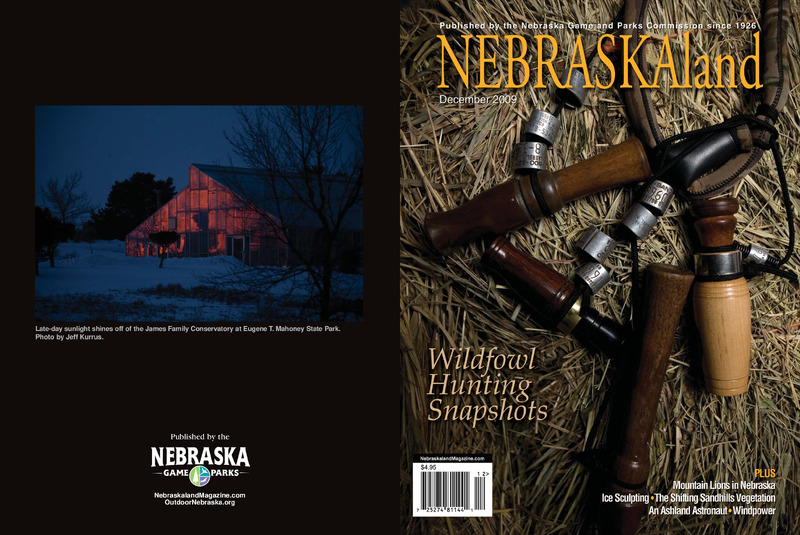
Late-day sunlight shines off of the James Family Conservatory at Eugene T. Mahoney State Park.
Photo by Jeff Kurrus.
Published by the
NebraskalandMagazine.com
OutdoorNebraska.org
Volume 87, Number 10, December 2009
12 Wildfowl Hunting Snapshots
Snow-covered game, old ducks calls and even older decoys –
all are fair game for the duck hunter with a camera.
PHOTOS AND TEXT BY JON FARRAR
20 Finding Art in Ice
Patience is a valuable virtue to have when trying to turn a
chunk of frozen water into art. TEXT AND PHOTOS BY DOUG CARROLL
22 Windpower – Not Entirely Green
Wind energy has the potential to be the state’s newest cash
crop, but many obstacles must be overcome to make that a
reality, including ensuring that development does not
adversely affect wildlife and wildlife habitat.
TEXT AND PHOTOS BY ERIC FOWLER
26 The Shifting Sandhills Vegetation
Nebraska’s Sandhills – where they’ve been, where they are
and where they might be going. BY GERRY STEINAUER
34 A Nebraska-born Astronaut
Nebraska native Clay Anderson used the things he learned
growing up in small-town Nebraska to reach his ultimate dream
– becoming an astronaut. BY DOUG CARROLL
38 Return of the Big Cats
38
●
Although mountain lions were once part of Nebraska's native
fauna, they had been extirpated here by the end of the 19th
century. In recent years, young male mountain lions have
been seen across the state, but now females have as well and
there’s evidence they’ve even had young in the Pine Ridge
area. TEXT AND PHOTOS BY MICHAEL FORSBERG
Comment . . . . . . . . . . . . . . . . . . . . . . . . . . . . . . . . . 4
Mixed Bag . . . . . . . . . . . . . . . . . . . . . . . . . . . . . . . 6
In the Kitchen . . . . . . . . . . . . . . . . . . . . . . . . . . . .44
In the Field . . . . . . . . . . . . . . . . . . . . . . . . . . . . . . .46
Parks & Places . . . . . . . . . . . . . . . . . . . . . . . . . . . .47
Classifieds . . . . . . . . . . . . . . . . . . . . . . . . . . . . . . . 48
Portraits from the Past . . . . . . . . . . . . . . . . . . . . . 50
22
●
34
●
26
●
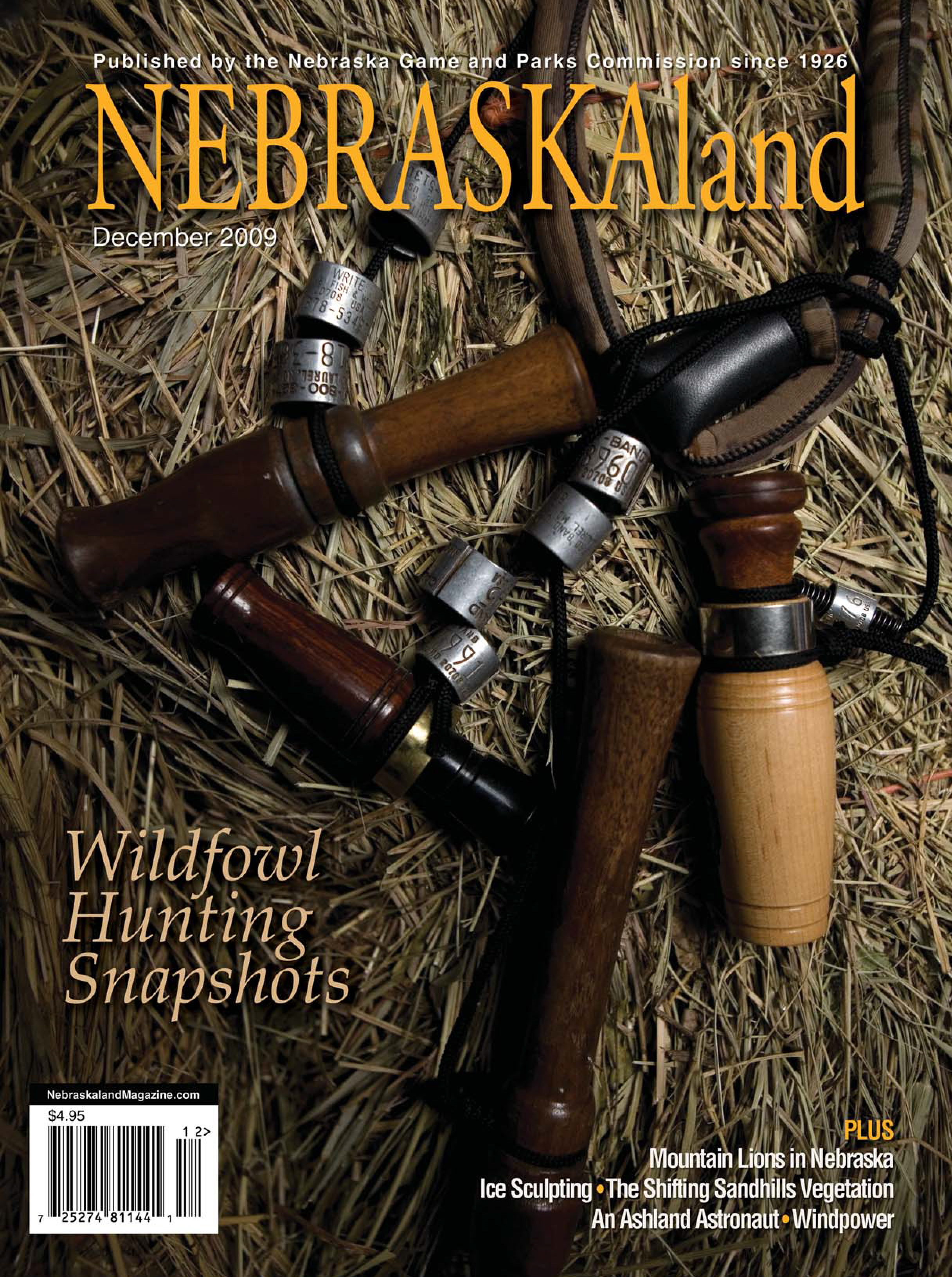
Cover: A lanyard with calls and bands provides a snapshot from waterfowl season. See story
beginning on page 12. Photo by Jeff Kurrus.
NEBRASKAland (VOL. 87 / NO. 10, ISSN 0028-1964) is published monthly, except for the
combined Jan./Feb. and Aug./Sept. issues, by the Nebraska Game and Parks Commission,
2200 N. 33rd St., Lincoln, NE. Periodicals postage paid at Lincoln, Nebraska, and additional
mailing offices. POSTMASTER: Send address changes to NEBRASKAland, P.O. Box 30370,
Lincoln, NE 68503-0370.
DECEMBER 2009 • NEBRASKALAND 3
pale eggs are that of the house finch.
This species has a penchant for
nesting in hanging, potted baskets. The
larger eggs are from a brown-headed
cowbird, a nest parasite. Brown-headed
cowbirds lay their eggs in other
species’ nests and have the host species
raise their young. Cowbirds never build
their own nests.
Published by the
Nebraska Game and
Parks Commission
Director: Rex Amack
Assistant Directors:
Roger Kuhn, Kirk Nelson, Sam Sidner
Information & Education Administrator:
Doug Bauch
Commissioners
Chairman:
James Ziebarth, Wilcox
Vice Chairman:
Jerrod Burke, Curtis
2nd Vice Chairman:
Mick Jensen, Blair
Dr. Mark Pinkerton, Wilber
Ron Stave, Waterloo
Dr. Kent Forney, Lincoln
Lynn Berggren, Broken Bow
Rex Fisher, Omaha
Mark Spurgin, Paxton
Magazine Staff
Editor: Doug Carroll
Associate Editor: Jeff Kurrus
Art Director: Tim Reigert
Senior Editor: Jon Farrar
Regional Editors:
Eric Fowler, Bob Grier
Contributing Editor:
Michael Forsberg
Regular Contributors:
Bill Hager, Chris Helzer, and
Lisa Knopp
Photo Librarian: Sarah Johnson
Circulation: Donna Robinson
For address changes and questions about
your subscription, e-mail
donna.robinson@nebraska.gov
or call (800) 632-5263
Marketing/Advertising: Jane Gustafson
For advertising information e-mail
ngpc.advertising@nebraska.gov
or call (402) 471-5481
NEBRASKAland Magazine
Copyright 2009, all rights reserved.
NEBRASKAland is available on audio cassette from the Nebraska
Library Commission Talking Book and Braille Service, Suite 120, 1200 N
St., Lincoln, NE 68508. (800) 742-7691. NEBRASKAland Magazine and
the Nebraska Game and Parks Commission reserve the right to reject any
advertising not in keeping with the agency mission.
Rates: $18 for one year; $33 for two years; $44 for three years. Nebraska
recipients must add appropriate sales tax. To subscribe call 1-800-NEBLAND (632-5263), or go online to: NebraskalandMagazine.com.
4 NEBRASKALAND • DECEMBER 2009
Caught in the Snow
On October 10 we had unseasonal
temperature and snow accumulation in
our area, with amounts ranging from
five to eight inches. We were in the
eight-inch region and tied the record
with a high of 41 F and a low of 27 F.
When I went outside to take pictures
of the winter wonderland, I noticed the
biggest and coldest gray tree frog I’ve
ever seen. The poor thing moved in
slow motion. I snapped a few photos,
put him in a bucket and brought him in
the house to warm up. After he
recovered, I made a shallow hole in
the warm garden soil, put him in
and covered him lightly. I hope he
remained in the hole, because that night
the temperature fell into the 20 degree
mark.
Marion Ball
Arlington, Nebraska
Eggs that Flock Together?
This summer my wife took down one
of our hanging baskets to water it and
noted this nest with four eggs. Since
the eggs were
different colors,
we assume two
species were
using the same
nest. Just
curious if you
had seen this
before and if
you could identify the species that laid
the eggs. I know that a house finch was
one of the species, but we’re not sure if
they hatched successfully.
Kevin Byington
Omaha, Nebraska
Joel Jorgensen, nongame bird
program manager, responds:
There is a perfectly good explanation
for this observation. You are correct,
there are eggs from two different
species of birds in the nest. The small,
An Unexpected Photo
Although I live in Ontario, Oregon,
several of my
friends know that I
was born and raised
in Nebraska. I was
actually born on the
banks of the Platte
River south of
Shelton ... an
Oregon Trail baby!
One day one of
my friends gave
me several dozen
NEBRASKAland magazines. He had
found them at a local garage sale and
thought of me. Imagine my surprise
while reading them to find a picture of
my dad, Roland Hackbart, on page 29
of the April 2000 issue. The picture had
been taken before he met my mom and
30 years before I was born. Even
though the magazine came to me
through a roundabout way, it was no
less enjoyable. Thanks.
Dale Hackbart
Ontario, Oregon
Thanks for the Memories
I would like to commend Jon Farrar
on his article “Save the Gizzard” in the
November 2009 NEBRASKAland. It
brought back fond memories of my
Dad and me cleaning the ducks and
geese when I was younger. My family,
as well as many others, always ate the
whole bird. Nobody turned up their
noses at the dinner table.
Today’s hunting shows rarely
highlight eating the whole bird when
recipes are shown at the end of the
show. Some of the younger generations
watching now have a “substitute
teacher.” In this hurried world, many
traditions have been lost.
I admire the past generations for
eating everything they shot. By
utilizing discarded material they could
make something out of nothing – decoys,
blinds and feather dusters, just to name a
few. It was made to work and last.
My family has enjoyed the many
diverse articles published in
NEBRASKAland over the years. Our
favorite ones center on the state’s
hunting, particularly history articles.
Thanks for everyone’s hard work in
producing a superb magazine.
Lisa Bringewatt
North Platte, Nebraska
Sassy Cat
I was just reading
the letter in the
November 2009
issue questioning
the bobcat picture
that was in the
October 2009 issue
of NEBRASKAland Magazine, so I
thought I would send you a picture of
our domestic housecat, “Sassy.” I always
say she looks kind of like a bobcat.
Every marking on her body and head
are exactly the same on one side as on
the other side. I think she has Siamese
blood in her, as she has the blue eyes.
Janett Wohlers
Crawford, Nebraska
Prices Incorrect
The Gift Collection portion of last
month’s NEBRASKAland incorrectly
listed the current prices for lifetime
hunting and fishing permits. For a
listing of the correct prices, contact
your local district Commission office
and ask for a copy of the Lifetime
Permits and Stamps brochure or go to
OutdoorNebraska.org and click on
“License & Fees.” We regret the error.
— the Editor
Send your comments to:
Doug Carroll, Editor
NEBRASKAland Magazine
P.O. Box 30370
Lincoln, NE 68503
or e-mail doug.carroll@nebraska.gov
Please include your postal address and
telephone number.
Letters may be condensed and edited
for clarity. Photographs are
welcome and will be returned.
Under federal and/or state law, discrimination is prohibited on the basis
of race, color, religion, age, gender, marital status, national origin,
disability or political affiliation. If you think you have been discriminated
against in any program, activity or facility by the Nebraska Game and
Parks Commission or want more information, contact the Commission in
Lincoln, NE, at (402) 471-0641 or the Equal Opportunity Commission,
Lincoln, NE, (402) 471-2024, TTY/TDD (402) 471-4693).
Headquarters
2200 N. 33rd Street
Lincoln, NE 68503
Phone (402) 471-0641
District Office I
East Hwy. 2, Box 725
Alliance, NE 69301
Phone (308) 763-2940
District Office II
524 Panzer St., Box 508
Bassett, NE 68714
Phone (402) 684-2921
District Office III
2201 N. 13th St.
Norfolk, NE 68701
Phone (402) 370-3374
District Office IV
301 E. State Farm Rd.
North Platte, NE 69101
Phone (308) 535-8025
District Office VI
1617 First Ave.
Kearney, NE 68847
Phone (308) 865-5310
Omaha Office
1212 Bob Gibson Blvd.
Omaha, NE 68108
Phone (402) 595-2144
Ak-Sar-Ben Aquarium
21502 W. Highway 31
Gretna, NE 68028
Phone (402) 332-3901
World Wide Web site:
Administration
Ted Blume (Adm.)
Craig Stover (Asst.)
Wes Loos (Asst.)
Rod Loos (Asst.)
Murray Johnson
Lincoln
471-5531
Lincoln
471-5532
Lincoln
471-5591
Ogallala (308) 284-8056
Lincoln
471-5003
Panhandle
Officer
City
Phone (308)
Jim Zimmerman (Sup.) Gering
436-7561
Scott Brandt
Gering
436-3418
Heath Packett
Gordon
282-2553
Dennis Thompson
Lemoyne
289-0755
Dan Zuehlke
Ogallala
284-4815
Doug Pollard
Oshkosh
772-9950
Frank Miller
Valentine (402) 376-1183
Dan Kling
Harrison
668-9456
Southwest
Officer
City
Phone (308)
Roger Thompson (Sup.) N. Platte
532-9175
Ray Dierking
Brkn. Bow
872-3078
George Sund
Cambridge
697-4629
Michael Thome
Cozad
784-4362
Matt Andrews
Elwood
785-3025
Dirk Greene
Imperial
882-5328
Virgil Gosch
McCook
345-2185
Dudley Sorensen
N. Platte
532-0747
Rich Routh
Rep. City
799-2085
South-central
Officer
Jerry Pecha (Sup.)
Jeff Jones
City
Phone (308)
Kearney
865-5327
Clay Center(402)762-3124
Terry Brentzel
Randy Pomplun
Darin Gress
Dale Johnson
Mark Reeves
Robert Finke
Doniphan (402)845-2021
Fullerton
536-2987
Hebron (402) 768-2287
Kearney
237-1079
Loup City
745-0662
Milford (402) 761-3537
Northeast
Officer
Tom Zimmer (Sup.)
Dale Davis
Ross Oestmann
Steve Oberg
Daniel Roberts
Jon Reeves
Marion Shafer
Pat George
Eric Wiebe
Tim Williams
Cory Krause
City
Phone (402)
Norfolk
371-6625
Bassett
273-1700
Bloomfield
373-4412
Columbus
564-5937
Fremont
721-7852
Kennard
427-7378
Norfolk
371-2031
O’Neill
336-1588
Ponca
755-2566
Neligh
887-1335
West Point
372-6979
Southeast
Officer
Duane Arp (Sup.)
Sean McKeehan
William Krause
Mike Luben
Douglas Kramer
Dina Barta
Stacey Lewton
Levi Krause
Russell Mort
Dan Evasco
Jeff Clauson
City
Gretna
Ashland
Auburn
Colon
Lincoln
Lincoln
Lincoln
Louisville
Nebr. City
Papillion
Waterloo
Phone (402)
332-2965
944-4174
274-3789
443-4278
466-9001
483-2358
476-0436
234-2212
873-5684
592-6733
359-5301
Nebraska Wildlife Crimestoppers 1-800-742-7627
DECEMBER 2009 • NEBRASKALAND 5
literal meaning of blue moon – a moon
that is bluish in color because of dust
particles or smoke in the atmosphere.
There will not be another blue moon
until November 2010, and none in 2011.
PHOTO BY BILL HAGER
Record Elk Harvest
Blue Moons
6 NEBRASKALAND • DECEMBER 2009
PHOTO BY ERIC FOWLER
Jon Farrar
This month, on the last day of the
last of the “ought years” most of us
will ever see, there will be a “blue
moon.” Do not expect a moon blue in
color; rather it will be the second full
moon in the same month. This second
full moon happens about every three
years. The metaphorical phrase “once
in a blue moon,” was once a commonly
used expression meaning something
uncommon or rare.
The explanation for blue moons is
rather simple mathematics, and yet
another example of man’s sense of
order not aligning with nature’s sense
of order. There is a full moon every
29.5 days but our Gregorian calendar
months range from 28 to 31 days (29
every fourth year in February, the Leap
Year), and so the day of the month of
the full moon advances through the
calendar months. Whenever a full
moon occurs on the first day or two of
a month is the time a second full moon
will appear at the end of the month.
A rare phenomenon, last occurring in
1999, and happening about once in
every 19 years, is two blue moons in
the same year. This most often occurs
in January, as February has less days
than the 29.5 days in which moon
phases go full cycle. In those rare years,
there is no full moon in February.
An older definition of a blue moon is a
third full moon of a season (as summer),
the significance of which is rather
obscure as most four month periods have
four full moons. And, there is a more
As of late-October, hunters harvested
a record 66 bull elk this fall season,
compared with 57 taken in 2008.
The bull elk season, which ended
October 25 in all units except the Boyd
Unit, resulted in a success rate of
80 percent for 82 bull elk permit holders.
The Hat Creek Unit had the highest
rate at 100 percent, followed by
Niobrara River, 84; Bordeaux, 81; Ash
Creek, 78; North Platte River, 68; and
Box Elder, 67.
Forty cows were also taken during
the first half of the antlerless elk season,
which also closed October 25 for all
units except the Boyd Unit. The second
half continues December 1-21.
Goose (or Duck) Kabobs
Eric Fowler
Ingredients:
Skinless, boneless duck or goose,
bacon, bell peppers, onions, and
tomatoes. You know, kabob stuff.
Marinate:
1 can beer (the cheap stuff is fine)
½ cup soy sauce
1 teaspoon ginger
Directions:
Cut duck or goose breasts and thighs
into 1-inch cubes and marinate in the
refrigerator overnight. Drain meat,
wrap in bacon and thread onto bamboo
or metal skewers with cubed vegetables
between each chunk. Grill until medium
or medium-rare (don’t overcook),
turning often and dousing fire started
by bacon grease as necessary.
Alternatively, skip the marinate and
sprinkle kabobs with seasoned salt
before cooking.
Short-horned Lizards
Jeff Kurrus
8 NEBRASKALAND • DECEMBER 2009
PHOTO BY CHRIS HELZER
“There’s a great deal more to
come … from the new Eugene T.
Mahoney State Park near Ashland,
to expansion of Nebraska’s very
first state
park at
Chadron,”
was written
in the
December
1987 of the
magazine in
the article
“Nebraska
Parklands –
Scenic
Treasures
and Outdoor Pleasures,” a sure
sign that things have definitely
changed through the years when
Mahoney is now the state’s most
popular park.
However, some things have
remained the same. Current
NEBRASKAland senior editor Jon
Farrar was writing about waterfowl
hunting then, as he did with his
article “Ducklore Lodge – The
Memories Storz Built,” and he
continues that trend in this month’s
photo essay entitled “Wildfowl
Hunting Snapshots.” In that same
issue, Farrar introduced readers to
the Ord’s kangaroo rat in one of
the magazine’s popular sections of
the time, “Notes on Nebraska
Fauna.” Coincidentally, Farrar
revisited this mammal in the
October, 2009 article entitled
“Gnomes of the Night.”
“The common boxelder, a
member of the maple family,
makes maple sweeteners available
to plainsmen who adopt Yankee
gathering and refining techniques,”
was the introduction to Doug
Kapke’s article “Sweet Harvest,”
which also included a how-to for
making homemade syrup. And last
was “Dickie Trammel And The
Walgren Lake Monster,” in which
the writer, signed “Yrs. Sincerely,
Clemens Babcock,” chronicled the
story of a friend’s dog, Mamie,
emerging from a hole in the ice
during a winter fishing trip with a
live crappie in her mouth. The truth
of this story is still yet to be
determined.
Chris Helzer
When you’ve got the kind of
camouflage a short-horned lizard has,
freezing in place is a pretty good way
to escape notice from predators and
prey – their sand-colored, rough skin
blends extremely well into the dry terrain
they live in. As winter approaches,
however,
these lizards
prepare to
freeze in a
more literal
way.
In the fall,
short-horned
lizards dig a
shallow
burrow, four
inches or so
deep, in
which they
will spend
the winter.
While an
adequate
depth to
survive in the southern United States
and Mexico, four inches is probably a
little inadequate in Nebraska. Because
they manage to emerge each spring
from those shallow burrows, even in
places like southern Alberta, scientists
believe horned-lizards might be able to
survive, at least for a few days, being
frozen solid.
This possible ability is only one of
many interesting facts about shorthorned lizards. To start, they are often
referred to as horned or horny toads
because their fat bodies and short legs
make them look somewhat more like
toads than lizards.
Unlike most reptiles, short-horned
lizards are viviparous, giving birth to
live young rather than laying eggs.
They can have between 5 and 36 young,
each just over an inch in length. If
they can keep from being eaten by
hawks, snakes, coyotes and other
predators, horned lizards may live as
long as five years and grow to a
maximum
length of
about six
inches.
Their
cumbersome
bodies make
it difficult to
move through
dense
vegetation, so
they primarily
inhabit open
grassland
areas where
vegetation is
sparse, and
they
particularly
like warm, south-facing slopes. Their
home ranges are less than an acre in
size. Within that area they hunt for
insects, particularly ants, by sitting still
until prey comes within range.
Being cold-blooded, they soak in the
sun on cool mornings and will flatten
their bodies like a deflated tire to
maximize their exposure to sunlight.
During hotter parts of the day they
narrow their body for the opposite
effect, and when even that fails to cool
them sufficiently, they dig themselves
into loose soil or seek shelter in rodent
burrows. When temperatures drop
overnight, horned lizards often seek
vegetation that is dense enough to
provide some insulation against the cold.
In Nebraska, short-horned lizards are
found mainly in the very western end
of the state in places such as the Oglala
National Grassland and Toadstool Park.
If you’re hiking in those areas, look
around carefully in places where
vegetation is sparse and you might
catch a glimpse of one of the state’s
most unusual creatures.
New Quail Forever Chapter
A group of
Howard County
residents have
formed the
nation’s newest
chapter of Quail
Forever (QF). The
group, called the
Central Nebraska
Chapter of QF, plans to improve area
habitat for bobwhite quail.
“Considering the tough times
bobwhite quail are having due to habitat
losses across much of the U.S., all of
us in central Nebraska are pretty
fortunate to have the growing quail
numbers we’ve seen in the last decade,”
said George Burgess, the new chapter’s
president. “This chapter wants to make
sure those bird numbers continue to
improve and this is our way of giving
back.”
Formed in 2005, QF applies the
successful Pheasants Forever model of
empowering local chapters to determine
how 100% of their locally raised
conservation funds will be spent toward
quail habitat. To date, four chapters of
QF have joined Nebraska’s 60 PF
chapters.
The Central Nebraska Chapter will
host Howard County’s first ever QF
banquet on Friday, November 20 at
the Boelus Civic Center, beginning at
5:30 p.m. The chapter is planning a hog
roast for the dinner. Tickets for the
event are $40 and are available by calling
Pete Berthelsen at (308) 754-5339,
Ryan Lodge at (308) 750-1215, or
George Burgess at (308) 390-0583.
To join or learn more about Quail
Forever or Pheasants Forever chapters in
Nebraska, go to www.NebraskaPF.com
or call toll free (877) 773-2070.
Thank You
NEBRASKAland would
like to thank the freelance
writers and photographers
who made such valuable
contributions to the
magazine in 2009:
Hager
Michael Cameron, Mark
Dietz, Judy Dye, Gary
M. Fellers, Michael
Forsberg, Liese
Greensfelder, Bill Hager,
Paul Haverkamp, Chris
Higgins
Helzer, Fran Higgins,
W. Wyatt Hoback,
Thomas R. Jones, Jeff
Kooser, Margie Lukas,
Elizabeth Mack,
Matthew Marx,
Pasquale Mingarelli,
Lukas
Tom Scheimo, Ron
Stave, Dick Turpin,
Justin Wambold,
Julie Watts, and
Greg Wingfield.
NEBRASKAland also
Mack
acknowledges the many
conservation officers,
wildlife and fisheries
biologists, and other
Nebraska Game and
Parks Commission
employees for their
Marx
contributions.
Lastly, NEBRASKAland
would like to thank all
of the outdoor experts
who provided such
invaluable research
Scheimo
support for the more
than 200 articles in this
magazine’s 84th consecutive year
of publication.
Here is a list of
upcoming outdoor
events across
Nebraska.
For more
information
about
these and
other events, click on
the calendar at
www.OutdoorNebraska.org.
December 5
• Fort Robinson State Park Annual
Historical Christmas Dinner (sold out)
December 6 and 12
• Christmas at the Bowring –
Bowring Ranch State Historical Park
Two sit down meals and entertainment
fundraisers for local youth groups.
Reservations are required.
Supper served at 5 p.m. on
December 6 and 6 p.m. on December 12.
$15 per person. Call (308) 684-3428
December 16
• Bowring Christmas Lights –
Bowring Ranch State Historical Park
Enjoy Christmas lights, decorations,
music and play cards and other board
games. Refreshments will be served in
the visitor center. Call (308) 684-3428
December 18-21
• Christmas at the Cody’s – Buffalo
Bill Ranch State Historical Park
The 1886 mansion, 1887 horse barn,
log cabin and other outbuildings all
have exterior lights. The mansion will
have 18 lighted and decorated
Christmas trees and decorations in
the interior. There will be a large
decorated Christmas tree in the barn
where visitors can make their own
ornament to hang on the tree. Santa
Claus and Buffalo Bill will talk to
visitors. Outside there will be roasted
chestnuts, hot apple cider and cookies.
Draft horse-drawn hay rack rides will
be available (weather permitting).
5:30 - 8 p.m. $5 per person at the
door, children 12 and younger are free,
as well as military with current ID
card. Call (308) 535-8035
December 24-25
• Christmas Buffet – Eugene T.
Mahoney State Park - Peter Kiewit
Lodge
5 p.m. - 8 p.m. on Christmas Eve,
11 a.m. - 6 p.m. on Christmas Day.
Adults $13.95, children $6.95
December 31
• New Year’s Eve Adults/Kids Buffet
– Eugene T. Mahoney State Park Peter Kiewit Lodge
11 a.m. - 6 p.m. Adults $13.95,
children $6.95
DECEMBER 2009 • NEBRASKALAND 9
Changes in Hunting Regs
The Duck Check
One cold December morning about three years ago, Conservation
Officer Sean McKeehan and I were checking duck hunters at the
south end of Two Rivers State Recreation Area on the Platte River.
On our way back across the river, Sean, who was leading us, started
falling very slowly in the river. He was still going down when, all of a
sudden, he did some kind of twist and tried to take me under with
him. I let go of him and he went under the water up to his chin.
When he finally regained his feet and stood up, he was wet from
his chin to his toes. As I looked at him, trying not to laugh, the three
hunters we just checked yelled at us, “Thanks, we wanted to know
how deep the water was there.” Sean looked at me and said he was
going to the truck to dry out.
By the time I met him back there, he had the
defroster on high and the dash board was lined with
two cell phones, a gun belt, and a wallet with all its
paper in it. Sean also did not have much in the way of
clothing on either. I got in the truck and started
laughing uncontrollably as I drove him back to his
vehicle so he could go change.
– Jeff Clausen, Conservation Officer, Waterloo
First, Officer Clausen failed to note how cold it really was that day.
He also failed to mention was that I did not just fall in the river – I
gracefully found a submerged root that my foot fit perfectly under. I
tried my best to quickly pull my other foot up, however, the river current
caused my foot to hook to the back of my other leg still wedged in
the root. At that point, there was no stopping this tower from falling,
especially with Jeff’s “help.”
With water rushing into my waders, I tried to get my legs downriver
so the current would help push me back to my feet. Well, since Jeff
was now standing on the downriver side of me, all the while pushing
down on the back of my neck (so it seemed), I could not get my legs
past him to help me stand up. I tried to kick my legs around a little
more, which might have tripped Jeff a little, but I don’t believe I gave
him just cause to use the top of my head as a pivot post. But it did
move him out of my way far enough that I could finally stand back up.
It could not have been more than two or three minutes after we
crawled back up the bank that my waders had already started freezing
solid on the outside. When I got back to the truck, I struggled forever
to get those frozen stiff waders off, remembering that when we finished
checking duck hunters, we were to appear on Greg Wagner’s radio
show.
As Jeff drove back, he replayed the story, laughing
continuously. I also had to relive the whole thing again
when my wife showed up at the office and, of course,
once we were on Wagner’s radio show. While I did not
understand the humor that day, nowadays I will at
least give a smile when the whole fiasco gets brought
up again … and again … and again.
– Sean McKeehan, Conservation Officer, Ashland
10 NEBRASKALAND • DECEMBER 2009
• Removed all restrictions on draw
weight and draw length of archery
equipment used to take deer, antelope,
turkey, elk, and bighorn sheep.
• Added a regulation that archers
hunting deer, antelope, elk, or bighorn
sheep are not required to wear hunter
orange during the firearm seasons for
antelope, elk or bighorn sheep.
• Removed all restrictions on how
long deer, antelope, turkey, elk, bighorn
sheep, game birds or game animals
may be possessed. Added language that
states that it is unlawful to possess
more than a possession limit of game
birds or game animals.
There has been a national trend of
declining participation in hunting for
years, but at their October meeting, the
Nebraska Game and Parks Commission
took a big step to to attract more young
big game hunters.
The Board of Commissioners
approved youth deer, turkey and antelope
permits that will each cost only $5
when it held its meeting at Pheasant
Bonanza, northwest of Tekamah.
The
current prices
for selected
permits are,
excluding agent fees:
resident deer ($29),
nonresident deer ($208),
resident antelope ($29),
nonresident antelope
($149.50), resident turkey ($23), and
nonresident turkey ($90). All hunters,
including youth, pay those prices.
Starting next year, youth under age 16
may purchase those permits for $5 each.
Other permits were created and fees
amended by the board: In an effort to
raise funds for such things as acquiring
land, supporting public access programs
and improving habitat, the board raised
the cost of an annual Nebraska Habitat
Stamp to $20. It also raised the annual
Nebraska Aquatic Habitat Stamp to $10.
New permits that were created
include nonresident paddlefish,
nonresident combination hunt/fish
permit, lifetime fur harvest, nonresident
elk and nonresident landowner elk.
The board also raised the cost of a
lifetime habitat stamp by $80 to $400
and created agent fees of $1 (purchased
through Commission) and $2 (purchased
through an agent other than Commission)
for most hunting, fishing and fur harvest
permits.
In addition, changes to the 2010
turkey hunting regulations also were
approved – spring turkey permits are now
valid for both the archery and shotgun
seasons as long as the appropriate
weapon is used.
The following changes were also
made at the October meeting:
• A limited landowner applicant may
Deer Meetings Scheduled
Mike Gleason’s love for hunting
in Nebraska and elsewhere is
strong enough that it not only
shows on his message plate – I
HUNT – but his wife, Judy’s, as
well – I HUNT NE. A Holdrege
native now living in Lincoln,
Gleason is involved in Ducks
Unlimited and the Safari Club, and
while he’s hunted around the world,
he still enjoys walking the Sandhills
for grouse and hunting waterfowl
on the Platte River. Judy doesn’t
hunt, but loves the outdoors and
joins Mike regularly.
If you have a unique outdoor
message plate you would like to
share, or know someone who
does, e-mail a photo (highresolution, .jpg format only, please)
of it to Eric.Fowler@Nebraska.gov,
along with your name, hometown,
and a brief description of the
interests expressed on your
license plate.
be a spouse or child of the owner or
leaseholder of qualifying land or a
sibling sharing ownership of the land.
The spouse or child need not be residing
in the same household of the owner or
leaseholder.
• Added landowner bull elk to the
list of permit applicants who receive
preference points if denied a permit and
who lose all preference points if granted
a permit. It also removes language that
states all preference points will be lost
if a person does not apply at least once
for five consecutive years.
The Nebraska Game and Parks
Commission will be scheduling meetings
across the state in December to provide
information on current issues and the
management of deer and big game.
At the meetings Commission
Wildlife Division district managers
will be on hand to field questions and
comments from those in attendance.
To find out when and where meetings
in your area have been scheduled,
contact your local Commission district
office.
Turpin Time
Dick Turpin
This is for
you archers,
muzzleloaders,
or even lateseason rifle
hunters. Take a
small pile of
clothespins and
spray paint them
fluorescent so
they’ll work at
night or in the daytime.
Then throw a couple of them in your
pocket and use this as your reference
on the last blood spot you saw after
you shoot a deer. You go five or 15 feet
or 20 yards and find another spot …
put a clothespin there and pick the first
one up.
Keep leap frogging those clothespins
and they’ll help you establish a deer
trail and won’t lose the place you last
found blood. ■
DECEMBER 2009 • NEBRASKALAND 11
Wildfowl
Hunting
Snapshots
Photos and text by Jon Farrar
Another duck hunting season is nearly
behind us. All that remains for us early
shooters are a few birds in the
freezer and, if we had occasional flashes of
foresight in the thick of birds working our
decoys, a handful of snapshots for the
scrapbook – our new pup bringing back its
first duck or a decoy; a best friend
scrunched up in the corner of the blind
sleeping; eggs, hash browns and sausage
sizzling on a griddle.
LEFT: GARY EBERT SWEET TALKING MISSOURI RIVER MALLARDS. ABOVE: RICH WALTERS AND ASPEN ON THE NORTH PLATTE RIVER.
12 NEBRASKALAND • DECEMBER 2009
DECEMBER 2009 • NEBRASKALAND 13
OPPOSITE: DUCK HUNTER’S CABIN APPROPRIATELY OUTFITTED WITH WONDERFULLY UNNECESSARY MEMORABILIA.
ABOVE: THE LOGBOOK – A LINK BETWEEN HUNTERS OVER THE DECADES. BELOW: FAVORITE OLD DUCK CALLS.
If we are lucky, we hang our waders in a
hunting cabin now and then. We are double
lucky if that cabin has been around long enough
to have accumulated all the memorabilia and
paraphernalia needed to create the proper
ambiance – unclaimed camouflaged hats on
twisted wire coat hooks, a blue-glass Mason
jar stuffed with curled tail feathers from drake
mallards, a 1962 calendar from the local
hardware store, a cigar box filled with duck
calls with missing or bent reeds, an old
wooden decoy with no head, and cast-iron
skillets hanging on the wall with lovely patinas
born of decades of pig fat. After supper there
will be 10-point pitch or penny-ante poker.
Light-sleepers hustle off to their bunks before
the heavy snorers wind up for the night. Why
do snorers fall asleep so quickly?
14 NEBRASKALAND • DECEMBER 2009
DECEMBER 2009 • NEBRASKALAND 15
Dogs are not required to hunt ducks, but they should be. Not just because they find and
retrieve birds that might otherwise be lost, but because they are part of the hunt, the best of
them as good-natured companions as to be found in boat or blind. The best dog is always
your own dog, but proper hunters love all dogs that do their job and are at least as well
behaved as their two-legged companions. Waterfowlers take pride in their calling skills
and shooting abilities, but the welling of pride when a new pup brings back its first duck
or goose, that this dog may be the next in a line of “best ever” retrievers, knows no equal.
A hunting dog’s enthusiasm is infectious, their powerful need to hold a bird in their
mouths unexplainable, their tolerance for the worst of waters and weather a toughness we
admire. Some dogs live most of their lives in outdoor kennels and that is a shame, for the
dog and for the owner. Other dogs have their own recliner in the house. The more a dog
and his hunter live together the better they come to understand one another: little
routines, the meaning of the most subtle gesture – they come to communicate in ways far
more sophisticated than electronics.
OPPOSITE: WALTERS’ CHOCOLATE LAB FETCHES IN A DRAKE WIGEON IN NUPTIAL FEATHERS. ABOVE: EBERT CLEARS THE WAY THROUGH THE
DECOYS FOR HIS YELLOW LAB PUP, MOOSE. BELOW: DOUBLE RETRIEVE BY MOOSE.
16 NEBRASKALAND • DECEMBER 2009
DECEMBER 2009 • NEBRASKALAND 17
ABOVE: FAVORITE OLD DECOYS IN THE BOTTOM OF THE BOAT. BELOW: BOATS DUSTED IN SNOW
AT A MARSH-STYLE LAUNCH SITE IN THE SANDHILLS. OPPOSITE: DUCKS HUNG TO AGE
ON THE CABIN WALL THE MORNING AFTER THE STORM FROZE THE MARSH. THE HUNT IS OVER.
More ducks are probably killed on bluebird days than in the face of a storm, but waterfowlers
persist in believing the best days are when there is “weather” about – sleet, driving snow and
howling nor’westers. When a night wind suddenly begins flapping the canvas or rattling
shutters, hunters clamber out of their beds extra early to make ready – work up a more hearty
breakfast than usual, build coat-pocket sandwiches of bratwurst with onions and mustard on rye.
Winter storms bring discomfort and misery as often as ducks – decoys foolishly left out and
frozen in ice the next morning, a shotgun overdue cleaning and working sluggishly, balky
outboards. But there is an undeniable magic in hunting such days, watching careening
greenwings materialize out of a wall of snow only 50 yards from your decoys. How did they
know they were there?
There is magic in hunting over water. Rowing out in the darkness before the first hint of dawn,
the patter of coots running unseen across the water ahead; the nervous whimpers from your dog
laying on hay in the bottom of the little duck boat, his head on the gunnel; the crunch
of window-pane ice at the feet of cattail stalks as you push your boat into them. Blood never
courses a duck hunter’s veins so warmly as during a morning on the marsh or river – a steaming
dog between his legs, shotgun across his lap, decoys bobbing before him, the vision of orange legs
dropping down. It has always been that way. ■
18 NEBRASKALAND • DECEMBER 2009
DECEMBER 2009 • NEBRASKALAND 19
Finding Art
in Ice
Text and photos by Doug Carroll
Patience is a valuable virtue to have (or learn)
when trying to turn a frozen chunk of water
into a masterpiece.
M
ost people look at ice as
something to scrape off
their windshield, skate on
or perhaps drill a hole
through and do a little icefishing. For Mike “Pudge”
Mulder, however, ice is a medium to be
turned into a work of art.
Mulder, the Food Service Director at
Eugene T. Mahoney State Park near
Ashland, has been shaping blocks of ice
into sculptures for more than 30 years
and sees no sense in stopping now.
“I started working with ice back in
1976. One of the first ice carvings I
did was for the Iowa Beef Packers
Association’s annual party. I carved
the letters I.B.P in a block of ice and
colored it with glitter like their company
logo. I thought it was the best thing I
had ever done back then, and it got me
hooked on working with ice. I loved
After shaping his sculpture, Mulder uses a dremel tool to carve letters in the ice.
20 NEBRASKALAND • DECEMBER 2009
Mike “Pudge” Mulder uses an electric chainsaw to
shape of Nebraska.
that feeling of making a block of ice
come to life.”
Mulder estimates that he has now
done between 1,200 and 1,500 ice
carvings, anywhere from 20 up to as
many as 100 in a single year, including
doing 15 in one week for the grand
opening of a casino in South Dakota.
He’s done ice sculptures for a variety
of events and parties at numerous
places that he’s worked, including
creating his works of art for several
special events and holiday dinners at
E.T. Mahoney SP.
To create his pieces, Mulder starts
with special ice that is created by air
being blown into water as it freezes to
prevent bubbles or other defects from
forming. The resulting block of clear
ice weighs about 300 pounds and
measures 20 inches wide, 40 inches
high and 10 inches thick.
To shape the ice, Mulder uses an
electric chain saw and a set of chisels
made in Germany specifically for carving
ice, chisels that he sometimes spends
hours at a time sharpening until they are
just right. He also has the chain saw
blade resharpened after every two or
three sculptures, and uses a dremel tool
to dig out holes, outline the figures that
he is cutting out, and do detail work in
delicate spots.
carve a 300-pound clear block of ice into the
Depending on the time of year,
Mulder usually lets the block of ice sit
outside the freezer for 30 to 90 minutes
to air out and become “tempered,” as
he calls it, before beginning his work.
“You get used to knowing when the
ice is just right to start on. Remember,
you are using a chain saw to cut the
body out, so you have to be careful –
one wrong move or too much pressure
and you could find yourself starting
over.
“After I have the bulk of the ice
removed from what I’m carving, then I
use a shaver to bring it a little more
into shape. A shaver is like five ice
picks in one handle. After that I use the
chisels to make the final shape and
detail the ice until I get everything the
way I want it. When I’m done with
everything else, then I use a v-shaped
chisel to put the final detail work on
the ice – usually what I call vine work
to decorate the surface up.”
Mulder estimates that he spends
about three hours on the average
sculpture, but that can vary greatly
depending on the complexity of the
design.
“There are times that I can do a swan
in about an hour, but I can also spend
four or five hours doing the detail work
on something like the wings of an
eagle or the feathering on a swan. I
know I sometimes spend way too much
time working on the details – I always
want them to look perfect, so it drives
me crazy until I feel like it is just right.
I have finished a carving many times
and then went back in the freezer to
work on it some more because I decided
it didn’t look the way I wanted it to yet.”
Mulder credits his ice sculpting with
helping do his normal work better. Being
in the food service business, he said,
requires him to be very understanding
while training a lot of people how to
do a variety of jobs – “from cooks to
dishwashers and everything in
between” – and working with ice has
made him a more patient person.
“You cannot rush an ice carving –
you need to make sure you take it easy
and do it right the first time because
you’ll just have to start over if you’re
not being patient and careful.”
Mulder has justifiable pride in every
sculpture he has ever done, but like all
artists, he has his favorite pieces, some
with special meaning to him.
“One of the best ice sculptures I’ve
done was for my daughter’s wedding.
Their last name is “Bolt” so Tarah asked
me to do something with a bolt in it – a
bolt like nuts and bolts. So I had a bolt
coming out of a rock with the threads
on the bottom of the bolt and a six-sided
head at the top. I carved their initials
on the top of the bolt and added a
heart on the side of the bolt down at
the bottom, so when I was finished it
looked like this huge bolt and heart
coming out of a rock.”
No matter where life might lead him
in the future, one thing is for sure –
he’ll never be too far away from his
ice tools.
“I like working with ice because I like
the end result. I like knowing people
really appreciate what I have done –
it’s very self-fulfilling and it’s an
accomplishment people get to enjoy.
Then you get to watch it melt away.” ■
Red glitter adds color to Mulder’s
creation and helps the letters stand
out in the almost finished piece.
The finished sculpture is now ready to be the centerpiece
of a special dinner or other event.
DECEMBER 2009 • NEBRASKALAND 21
Windpower
Not Entirely Green
Text and photos by Eric Fowler
Wind energy has the potential to be the state’s newest cash crop, but many
obstacles must be overcome to make that a reality, including ensuring that
development does not adversely affect wildlife and wildlife habitat.
G
PHOTO BY ROCKY HOFFMANN
reen is the latest buzzword
in the nation’s vocabulary.
Products are advertised as
being green, stamped with
green and packaged in
green. Green is good. Not green?
That’s bad.
On the energy front, wind is being
billed as the greenest of green, the
environmentally friendly solution to
our country’s need for more power
to run our computers, plasma TVs
and, soon, electric cars.
Wind energy currently provides a Greater-prairie chickens are one of many wildlife
species that could be adversely affected by the
little more than one percent of the
development of wind farms.
nation’s electricity. While there is
enough wind in the country to generate Working Group (NWWWG) to develop
twice as much electricity as is currently planning tools and voluntary guidelines
produced by all sources, some estimate for wind developers to consider when
selecting a site for a new wind farm.
that wind energy could realistically
The group also hopes the Nebraska
provide 25 percent of our electricity,
reducing both our dependence on foreign Legislature will use the guidelines as it
oil and the emission of greenhouse gas. develops a state plan for renewable
energy expansion under the interim
Best of all, it’s seemingly free for the
study called for in the last session by
taking.
Yet to be found, however, is an energy Legislative Resolution 83.
source without some environmental
The NWWWG was created by
Nebraska Game and Parks Commission
cost, and wind energy is no exception.
and U.S. Fish and Wildlife Service
The towers, rotating blades and
(USFWS) officials and also includes
transmission lines can all cause direct
and indirect mortality to birds and bats, representatives from the Nebraska
Energy Office and several conservation
and wind farms can fragment rare or
pristine landscapes, thereby degrading
groups, including the Nebraska
wildlife habitat as well as the scenic
Wildlife Federation and The Nature
value of the land. Those concerns led
Conservancy. It supports wind energy,
the Nebraska Wind and Wildlife
but only if it is done in a way that does
22 NEBRASKALAND • DECEMBER 2009
not adversely affect wildlife. “We
want to see wind power developed
in Nebraska, but we want it to be
done right,” said Tim McCoy,
agricultural program manager with
the Commission.
With its relatively low population
and vast open spaces, there appears
to be plenty of room for wind farms
in Nebraska. According to the
American Wind Energy Association,
the state ranks sixth in wind energy
potential, but 22nd in production,
with a current capacity of 152
megawatts (MW) – enough to
power 121,600 average-sized homes.
The state’s capacity more than doubled
following the completion of the 80-MW
Elkhorn Ridge Wind Energy Project
near Bloomfield last spring, where
private developers erected 27 three-MW
turbines that rise 410 feet from the base
to the tip of the 144-foot-long blades.
Texas leads the nation with more than
8,700 MW of capacity and Iowa, which
ranks 10th in potential, is second with
more than 3,000 MW.
Studies conducted under LR 83
assume Nebraska will be producing
7,800 MW of wind energy by 2030,
50 times more than today and 87 percent
of the capacity of the state’s existing
coal, nuclear and hydro generating
facilities. Much of that power would be
exported. To produce it, the Nebraska
Power Association estimates 2,600
wind turbines would need to be erected.
The total cost, including land leases and
major expansion of the transmission
grid needed to export the power, is
estimated at $20 billion.
But while wind energy potential is
high in Nebraska, so too is the potential
for its development to pose serious
threats to wildlife. The Central Platte
River and the Rainwater Basin attract
millions of ducks, geese, sandhill
cranes and other migratory birds during
their spring and fall migrations. While
studies have found relatively few bats
and birds are killed at most wind farms
in the Midwest, there have been cases
of significant losses to what some call
the Cuisinart effect of the blades at
some farms in the U.S. The most
extreme case may be at Altamont Pass
Wind Farm in central California, one of
the nation’s oldest and the world’s
largest, with nearly 5,000 small turbines
spread over 75 square miles and along
a major migratory bird route and amidst
a major golden eagle nesting area.
Studies estimate the spinning rotor
blades annually kill as many as 4,700
birds, among them 1,300 raptors,
including more than 100 golden eagles.
To reduce losses, many towers have been
moved or replaced with newer models
believed to be less lethal to birds, and
half of the turbines have been shut
down from November through
February. Such restrictions reduce the
cost effectiveness of any facility.
A wind farm in the Rainwater Basin
could also kill a large number of birds,
and of greater concern would be the
death of even one federally endangered
whooping crane, either due to collision
with the turbine blades or with the
transmission lines that would need to
be built to carry wind power to the grid.
No more than 269 whooping cranes
were expected to fly south this fall
from their breeding grounds in Canada’s
Northwest Territories to their wintering
grounds on the Gulf Coast in Texas. An
estimated 21 percent of this flock, the
only self-sustaining population in the
world, was lost between April 2008 and
April 2009. “Most mortality occurs
during migration, and of all the known
sources of mortality, collisions with
power lines are the highest,” said
Martha Tacha, a biologist in the
USFWS Grand Island field office.
In addition to direct mortality,
fragmentation of the state’s grasslands
and the displacement of grassland birds
is also a concern. A Kansas study found
the lesser prairie chicken, a candidate
for listing under the Endangered
Species Act (ESA), has an innate
aversion to man-made structures, likely
an evolutionary adaptation to avoid
high points where raptors might perch.
The study predicted that nesting and
brood-rearing hens of both lesser and
greater prairie chickens, the latter of
which is found in Nebraska, would
avoid areas within one mile of a wind
tower. A Minnesota study found nesting
densities of grassland birds to be four
times higher 200 or more yards from a
wind tower than within 90 yards.
A few wind farms spread across the
Sandhills, one of the largest intact
grasslands in the world, might have a
negligible effect on grassland birds.
But with less than two percent of the
historic tallgrass prairie remaining, one
wind farm in or even next to a remnant
tract in southeastern Nebraska could
displace greater prairie chickens and
A Lincoln Electric System wind tower rises above a cornfield north of Lincoln. The guidelines developed by the Nebraska Wind and Wildlife
Working Group encourage placing turbines on ground that has already been disturbed rather than in grasslands or wildlife habitat.
DECEMBER 2009 • NEBRASKALAND 23
Wind and Wildlife Index
other grassland birds, which collectively
have seen the steepest population
declines of all North American birds in
the past 30 years, primarily due to
habitat loss. Remnant native prairies are
often found on ridge tops that are not
suitable for farming, but also have the
greatest wind potential. And wherever
wind towers are built, roads must be
built to service them, further degrading
the grasslands. “There’s not a lot of
native prairie left and wind farms have
a big potential to damage a lot of
them,” said Gerry Steinauer, a botanist
with the Commission.
Potential and reality differ widely
when it comes to wind power. Contrary
to popular belief, the wind doesn’t
always blow in Nebraska, and
sometimes it blows too hard for wind
turbines to operate safely, meaning
only 40 percent of generating capacity
is actually realized, making site
selection key in profitability.
Nebraska’s unique position as the
only state in the nation where all power
companies are publicly owned is part
of the reason it has lagged behind other
24 NEBRASKALAND • DECEMBER 2009
states in wind development. With
electric rates fifth lowest among the 50
states – and half of what Californians
pay – paying for wind farms takes
longer in Nebraska. Nebraska’s public
power companies are also not eligible
for the same federal Production Tax
Credits that private companies use to
subsidize wind development in other
states. In Iowa, state and federal
incentives amount to a 45 percent
subsidy in the cost of developing wind
energy, which now provides 7 percent
of that state’s electricity.
Nebraska’s competitive disadvantage
was lessened in 2007 when state laws
were changed to allow for CommunityBased Energy Development (C-BED),
and construction of new farms in the
state is beginning to pick up. C-BED
wind farms are financed by landowners,
who are eligible for federal tax credits
and also for state sales and use tax
exemptions on equipment to build the
facilities. Similarly, public power
companies are partnering with
private wind energy developers,
agreeing to purchase the power from
the corporations, which can build and
operate the wind farms and collect the
federal incentives. Nebraska Public
Power District (NPPD) buys power
from the owners of the Elkhorn Ridge
facility and will also buy power from
two similar projects in the works near
Petersburg and Broken Bow, each of
which will add 54 1.5-MW turbines
and 80 MW of generating capacity.
So far, utilities and developers have
shown an admirable concern for nature
in their site selection. Two sites were
proposed for the new wind farm near
Broken Bow. One was located west of
town in the Central Table Playas
region, an area dotted with wetlands
and frequented by migrating whooping
cranes. After reviewing the NWWWG
guidelines and touring the site with
Commission and USFWS staff, NPPD
ruled out that site and selected the
other east of Broken Bow.
“We talked about it and we just felt it
was not the right place to go,” said Joe
Citta, NPPD’s corporate environmental
manager who also heads up the
environment committee for the
MAP BY RACHEL SIMPSON, NATURAL HERITAGE PROGRAM
Developed by the Nebraska Wind and Wildlife Working Group, this map shows how sensitive different areas of the state
might be to wind energy development. Biologists considered the habitat needs and areas used by 14 wildlife, bird and bat
species (including eagles, whooping cranes and bighorn sheep), their current population status and how wind towers could
affect them. Major stopover points for migratory birds were also included. The map only gives a broad look at the state,
however, and site-specific evaluations may still find that building a wind farm in low-sensitivity areas could have a
significant effect on wildlife or habitat resources. For a detailed explanation on how the map was developed, go to
OutdoorNebraska.org and search for “Wind and Wildlife.”
That concerns even the state’s public
earn a substantial amount of money by
Legislature under LR 83. “There was
power companies. The current
leasing their land to wind developers
another area we had that was less
transmission grid is built to handle the
for turbine construction, and as such,
intrusive on those wetland areas. It
wind energy is being touted by some as power generated and consumed in the
was just not the right thing to do for
state, plus the minimal amount that is
the state’s newest cash crop waiting to
the cranes.”
currently exported. Increasing the
be developed and exported. Eager to
Such changes please members of the
state’s wind generating capacity to
cash in, some landowners may balk at
NWWWG. “Our initial concern was it
7,800 MW will require significant
any voluntary guidelines that tell them
was going to be full speed ahead and
transmission line upgrades on both the
how they can use their land. Private
developers were going to say ‘You
state and regional distribution level.
developers may do the same.
aren’t going to slow this down. We’re
State utilities and their ratepayers don’t
The NWWWG hopes the work done
going to do this when, where and how
under LR 83 could lead to the voluntary want to be stuck with the estimated $4
we want,’” McCoy said. “That hasn’t
billion tab that chore will carry.
guidelines becoming requirements,
been the case so far, and the more we
More power will be needed to meet
ensuring wind farms aren’t built where
do, the better it seems to be.”
growing demand in the state, and wind
The change follows what appears to be wildlife losses could be high or where
can help meet that demand, possibly
rare, pristine habitats destroyed. The
a nationwide trend in the wind energy
negating the need to build more power
state of Wyoming recently took such a
industry. In Kansas, Horizon Wind
plants. But conventional production
step, saying wind development would
Energy, The Nature Conservancy and
not be allowed in the core habitat of the will still be needed when the wind
others formed a partnership to restore
doesn’t blow, especially in the summer
and enhance prairie chicken habitat and sage grouse, also a candidate for ESA
when demand is the highest.
listing, and that wind farm and
offset moderate losses of grassland
So while wind power may seem to be
transmission line development would
habitat to wind farms. Similarly, at the
there and free for the taking, harnessing
Elkhorn Ridge project, NPPD completed be carefully thought out.
LR 83 began in response to a number it isn’t as simple as putting up towers.
conservation easements to protect
Especially when it comes to finding a
of wind energy-related bills introduced
prairie chicken habitat to make up for
during the last session of the Legislature. place for them.
habitat taken up by the wind turbines.
“With new types of energy come new
“Job growth, additional landowner
Environmental considerations are
challenges,” said McCoy. “From a
income and increased tax revenues are
part of any project NPPD develops,
wildlife standpoint, wind energy is
very attractive to legislators,” said
Citta said, whether it’s wind power or
transmission lines. The public aspect of McCoy. “But changes that would allow different from anything we’ve ever
dealt with before. These are towers in
commercial overdevelopment of wind
NPPD and other Nebraska utilities
the air with spinning blades that can
without any tie to local funding or
helps ensure those considerations are
kill things, not just development that
ownership, or without any required
made. “We all have boards or city
affects habitat on the ground.
regulations or permitting, could turn
councils or whatever to report to, and
“It’s got to be green, not just a little
Nebraska into the Wild West for wind
when we do our projects, it’s all in the
bit green.” ■
development.”
public eye,” he said.
But such foresight is not
guaranteed, nor is there any
guarantee that a wind farm will
never be built in the middle of
the Rainwater Basin. Currently,
there are few laws that could
stop such a development. Wind
farms of 80 MW or less are not
required to obtain a permit from
the Nebraska Power Review
Board, so no environmental
review is required to identify,
minimize or mitigate losses to
wildlife or wildlife habitat, as
the NWWWG guidelines
recommend. Larger projects
could easily sidestep the
current law by being divided
among two developers or built
in phases.
The NWWWG is also
concerned about the growing
The 27-turbine, 81-megawatt Elkhorn Ridge Wind Energy Project north of Bloomfield was built by
phenomenon known as
private developers after Nebraska Public Power District agreed to purchase the electricity
“turbine envy.” Landowners can
generated by the facility. Such agreements are helping wind power expand in Nebraska.
DECEMBER 2009 • NEBRASKALAND 25
The Shifting
Sandhills
Vegetation
Text and photos by Gerry Steinauer
NEBRASKA STATE HISTORICAL SOCIETY
Prior to Euroamerican settlement, bison were the primary large grazer in the Sandhills. Here bison graze on The Nature
Conservancy's Niobrara Valley Preserve.
s the last ice age released its
frozen grip on the continent
some 12,000 years ago, spruce
trees grew in Sandhills valleys
and prairie grasses and aspen
groves covered the upland dunes. In
contrast, only 650 years ago, near the
end of one of several, recurring longterm droughts, many dunes lacked
plant cover; blown by wind, they rolled
across the landscape. Early European
explorers who entered the then prairiecovered Sandhills labeled them an
uninhabitable wasteland. Not until the
late-1870s did the first settlers, cattlemen,
venture into the Sandhills and find its
lush valleys and grassy dunes to their
A
26 NEBRASKALAND • DECEMBER 2009
cattle’s liking. Today, cattle ranching is
still the region’s principal industry.
Little impacted by farming and
development, the Sandhills remain one
of North America’s most unspoiled
grassland ecosytems. Covering 20,000
square miles of north-central Nebraska,
it is the continent’s largest sand dune
field, with some wind-formed dunes
reaching 400 feet in height and five miles
in length. In valleys between dunes, the
region’s high water table provides for
nearly 2,000 lakes and over a million
acres of marsh and wet meadow.
Prior to Euroamerican settlement,
the region’s climate, along with wildfire
and bison grazing, shaped the plant
cover of the dunes and valleys. After
settlement, cattle ranching and an
invasion of non-native species has
influenced Sandhills vegetation. If the
past is a predictor of the future, the
Sandhills’ plant communities will
continue to evolve in response to
human occupation and climate change.
The Last 12,000 Years
As the ice age period drew to a close,
glaciers to the north were in retreat but
our region’s climate was still cold and
moist. Mammoths, giant bison and
other ice age megafauna roamed the
Sandhills. North America’s post-glacial
Sparse vegetation and blowing sand were characteristic of the Sandhills when it was
settled. This photo shows sand drifting onto railroad tracks west of Thedford in April 1924.
climate warmed swiftly, though, and
around 11,000 years before present
(yrBP), prairie begin to displace
woodland in the Sandhills and elsewhere
in the Great Plains. This rapid climate
change and accompanying vegetation
change doomed most megafauna
species to extinction. Some archeologists
believe hunting by the newly arrived
Native Americans contributed to the
extinctions. With the megafauna gone,
modern day bison emerged as the
Great Plains’ primary large grazer.
As the Plains’ climate continued to
become warmer and drier, the region
entered an intense drought about 9,000
yrBP, which lasted 3,000 to 4,000
years. The protective prairie grasses
were parched from Sandhills dunes,
exposing sands to erosive winds and
dunes moved across the landscape.
This major period of dune formation
and migration in the Sandhills reworked
most of the large, and nearly all of the
small, dunes that filled the landscape.
During this drought, many Sandhills
valleys were like oases among Saharalike dunes, as groundwater sustained
wetland vegetation. When migrating
dunes buried valleys, new valleys
formed in their wake. The presence of
bison hoofprints buried deep in today’s
dunes – lobed impressions in the
laminated sands and now visible in
road cuts and blowout walls – suggests
bison were common when the dunes
were being reworked and forage and
water were available in nearby valleys.
With game available, Native Americans
likely occupied the Sandhills during this
period, possibly only seasonally, and
migrated to more hospitable areas
outside the region during the driest
times.
Around 6,000 yrBP, the region’s
climate became wetter than in previous
millennia and prairie grasses again
covered the dunes. This condition has
generally continued to the present,
although it has been interrupted by
three substantial periods of drought
DECEMBER 2009 • NEBRASKALAND 27
cattle [bison]” between the Calamus
and North Loup rivers, but paint a
bleak picture of what is now the rich
grazing lands of southeastern Cherry
County: “Great desert of drifting sand
where there is neither trees nor soil nor
rocks nor water nor animals of any kind.”
In the first half of the 1800s, the
region’s reputation discouraged
exploration as travel on loose sand was
difficult by horseback and even more
difficult by wagon. Most early westward
trails skirted the Sandhills. Traveling
through the Sandhills in 1855,
Lieutenant G. K. Warren described the
dunes north of the Calamus River as
characteristic of the region: “The sand
is nearly white … and about three fourths
covered in coarse grass and other plants
… the feet of the animals [their horses]
NEBRASKA STATE HISTORICAL SOCIETY
and associated dune activity, each lasting
several hundred years.
About 950 yrBP, the most recent of
these prolonged droughts set upon the
Sandhills. This one lasted 300 years.
While not as severe as some earlier
droughts, dunes were again laid bare
and began migrating, although the
lower, moist slopes of many larger
dunes appeared to have remained grasscovered and stable.
“Wherever we look in the Sandhills,
we find smaller-scale dunes formed
during this period superimposed on the
big dunes formed earlier,” said Jim
Swinehart, University of Nebraska
geologist. “Even if the large dunes
were stabilized at this time, they were
hanging on by their fingernails, as only
15 to 30 percent plant cover will keep
Cattle were first brought to the Sandhills in the 1870s. Above cattle graze a Sandhills
valley in 1926.
dunes stable.”
Swinehart believes the Sandhills’
numerous wetlands helped keep lower
slopes grass-covered. Through
evaporation, wetlands release moisture
to the atmosphere, moderating the local
impact of drought on vegetation.
Arrival of the Euroamericans
James McKay, leading an Upper
Missouri Company expedition into the
eastern Sandhills in 1796 to locate
native trading partners, was the first
explorer to leave a written record of the
region. At the time, the Sandhills were
still the contested hunting grounds of
several tribes, including the Cheyenne,
Pawnee, Omaha, Ponca and the
increasingly powerful Sioux. McKay’s
limited notes mention “many wild
28 NEBRASKALAND • DECEMBER 2009
frequently sinking so as to make
progress excessively laborious.”
In 1857, Warren led a military
expedition into the Sandhills from
the southeast to identify travel routes
through the region. His route ran
westward up the Middle Loup River
Valley and then northward to the
Niobrara River, at times following
“buffalo and Indian trails.” On July 29th,
the expedition observed a herd of several
thousand bison moving down the
Middle Loup Valley. A few days later,
near the confluence of the Dismal
and Loup rivers, J.H. Snowden, the
expedition’s chief topographer,
described the Sandhills on both sides
of the river as “much broken and cut
by the winds, supporting a very scant
vegetation.” Perhaps grazing by the
bison herd observed days earlier had
contributed to the scantness of the
vegetation. When the expedition
reached the Loup headwaters, Warren
wrote: “Our greatest wish is to be away
from it [the Sandhills] as soon as possible
and never return.”
Only two decades later, in 1876, the
Sioux’ hunting rights in the Sandhills
were ceded and their primary food
source, bison, had been exterminated
by market hunters. Concurrently,
cattlemen were becoming aware of the
once-dreaded region’s ability to produce
beef. One story goes that in 1874,
cattle herds being moved north to
Indian agencies on trails along the
western edge of the Sandhills were
scattered by a winter storm. The cattle
drifted east into the Sandhills, where
they were feared lost in the sea of sand.
Cowboys later found the cattle fat and
thrifty in the lake country where they
had survived the winter, and word
quickly spread that the Sandhills could
support livestock.
In July 1877, William F. “Buffalo
Bill” Cody and famous U.S. Army
Indian scouts Frank and Luther North
drove 1,500 cattle to the south branch
of the Dismal River Valley and claimed
one of the first ranches in the Sandhills,
an unfenced stretch of land about 20 by
30 miles in what is now Hooker County.
Other cattlemen followed. Many of the
largest operations were owned by
European investors who demanded
high profits and the range was heavily
stocked. Severe winters in 1886 and
1887 killed many cattle and put many
of the large livestock operations out
of business. By the late-1880s, the
open range years were waning. The
departure of the large investors, the
coming of barbed-wire fence, the
draining and development of meadows
for hay production, and windmills
allowed cattle to be better managed
and introduced a new type of ranching
to the Sandhills.
The region’s sandy, nutrient-poor
soils and semi-arid climate had for
the most part dissuaded farmers from
settling in the Sandhills. The Kinkaid
Act of 1904, however, allowed
homesteading on 640 acres, instead of
the 160 acres allowed by the earlier
Homestead Act, and land-hungry
farmers with new hope in the Sandhills
flocked to the region, first settling and
farming in the more moist, deeper-
Today the Sandhills region is densely vegetated with prairie grasses, such as little bluestem and prairie sandreed.
soiled valleys.
In all, about 10 percent of the Sandhills
was farmed in the late-1800s and
early-1900s. Defeated by poor soils,
grasshoppers and drought, most of the
ill-fated sodbusters had left the
Sandhills, abandoning their fields to
the prairie grasses, even before the
Dust Bowl years of the 1930s.
While history is a great teacher, it is
often poorly remembered. In the
1970s, the proliferation of center pivot
irrigation again spurred the plowing of
drier valleys and gentler dunes for corn
production. In a few years, high input
costs and low commodity prices caused
many of the fields to be abandoned
and planted back to grass, most at the
taxpayers’ expense. Recent high grain
prices again have speculators turning
over Sandhills sod.
Open Sand to Thick Grass
“In the old days you could track a
wolf all the way from the Loup River
to the Dismal River” goes a Sandhills
saying, describing the scant vegetation
and abundant bare sand at the time of
Euroamerican settlement. Widely-
spaced plants of little bluestem, sand
bluestem, prairie sandreed, sand
lovegrass and other sand-adapted
species provided enough cover to keep
the dunes stable, although blowouts
were abundant on dry, wind-exposed
dune tops. Today, the dunes are more
densely vegetated and most old
blowouts are grassed over.
Ranchers and scientists speculate as
to why the grass cover on the dunes
has shifted from sparse to dense since
settlement. Theories include elimination
of heavy bison grazing, control of
wildfires, a wetter climate and
improved grazing management.
Because bison had largely been
eliminated from Nebraska prior to
extensive exploration or settlement of
the Sandhills, there are few records of
their impact on dune vegetation. The
Sandhills at times likely supported
bison herds numbering into the tens of
thousands of animals. There are no
reports of the huge herds, numbering
into the hundreds of thousands of
animals, reported for other regions of
the Plains. Their impact to Sandhills
vegetation likely remained localized,
with areas near well-watered valleys
being grazed and trampled more heavily
than areas farther from water. When
bison had grazed an area heavily they
usually moved to ungrazed areas,
allowing grasses to recover.
The impact of early cattle grazing is
better documented and was likely more
severe. During the late-1880s and
early-1900s, the Sandhills were heavily
stocked with cattle and areas were
overgrazed. At the time there was
little understanding of proper grazing
management and a misconception of
unlimited natural resources. Unlike the
free-roaming bison, the fenced cattle
could not migrate from heavily grazed
areas and would continue to graze
diminished grasses. Eventually stressed
plants died, leaving more space
between living plants.
In other areas of the world, cultivation
and overgrazing by livestock have
caused desertification and dune
movement. In deserts of China’s Inner
Mongolian region, Swinehart has
observed where heavy goat and sheep
grazing has denuded vegetation and set
dunes to blowing. “These dunes were
mainly shrub-covered, and the goats
and sheep had chewed them down to
DECEMBER 2009 • NEBRASKALAND 29
The high dunes bordering Dads Lake on the Valentine National Wildlife Refuge are pocketed with healed and partially-healed blowouts
(wind-excavated depressions on dune tops). The blowouts likely healed due to a relatively moist climate in recent decades.
the nub,” said Swinehart. Unlike the
Sandhills, overgrazing has previously
eliminated grasses from these dunes.
The fibrous grass roots help bind sand
providing protection from wind,
trampling and wildfire.
Wildfires were traditionally considered
destructive to Sandhills prairie. In 1914,
renowned Nebraska plant ecologist
Raymond Pool wrote of Sandhills’
prairie fires: “Driven by powerful wind,
such a fire may sweep for miles across
the hills … the immediate destruction
of the range is not the only damage
done by such a fire … the wind striking upon the exposed sandy slopes
results in the rejuvenation of blow-outs
and of general maximum sand movement.”
Prairie vegetation’s response to fire is
tied to several factors, a primary one
being precipitation. In the Sandhills,
annual precipitation ranges from 14 to
24 inches, west to east. A study of
fire-scars in tree rings of ponderosa
pines on the Niobrara River bluffs in
Cherry County adjacent to the Sandhills
indicates that during presettlement
times, wildfires burned though the
region about every five years. Contrary
to popular belief, recent studies in the
30 NEBRASKALAND • DECEMBER 2009
Sandhills have shown that spring fire,
followed by adequate rain, increases
vegetative cover on the dunes. When
grazing follows burning of Sandhills
prairies, grasses can be stressed, but
when given adequate rest the grasses
quickly recover. Autumn fires allow
little time for plant regrowth and can
expose sands to erosive winter winds.
By the following spring, however, new
growth protects the soil.
Although, heavy grazing and fire
were likely factors, most evidence
indicates prolonged drought caused the
sparse dune vegetation and abundant
blowouts around the time of settlement.
Studies of tree ring widths indicate the
overall climate was drier and droughts
more common in central Nebraska
during the centuries prior to 1900 than
during the 20th century. Many of the
droughts were more severe than the
Dust Bowl. The dunes were likely
sparsely vegetated for centuries prior to
settlement, and today’s dense grass
cover is favored only by a recent moist
climate.
Many ranchers believe their careful
grazing management over the last
half-century has healed the dunes
and blowouts. “Sandhills grazing
management has changed a great deal
since the early days of ranching,” said
Pat Reece, a retired rangeland ecologist
with the University of Nebraska. “In
recent decades most Sandhills ranches
have changed from using season-long,
continuous grazing to rotation grazing.
Much cross-fencing has gone in, making
pastures smaller. Cattle are often now
in pastures for 30 days or less then
moved to a new pasture, and grazed
pastures may be rested for an entire
growing season before being grazed
again. Rest from grazing allows plants
to increase energy reserves, grow
extensive roots and produce buds
for next year’s growth. Good grazing
management has certainly lessened the
stress on dune vegetation.”
Reece stressed that rotation grazing
is not a cure-all for grasslands. If too
heavily stocked or poorly managed,
even the best grazing system cannot
prevent damage to prairie vegetation.
Invasive Species
A consequence of Euroamerican
settlement has been the introduction of
non-native plant species to Sandhills
plant communities. Most invaders are
of Eurasian origin and were either
intentionally or accidentally introduced
to North America. Invasive species
degrade plant communities, wildlife
habitat and range production by
displacing native vegetation, and can
alter soil chemistry, hydrology, natural
grazing and fire frequencies.
Fortunately, few non-native plants
can compete with native plants in the
hostile dune environment and Sandhills
dune prairies have remained in good
ecological condition compared to more
invasive-susceptible grasslands. In
areas, smooth brome and Kentucky
bluegrass have invaded the moister, low
dune slopes and swales. The noxious
weed leafy spurge occurs sporadically
on dunes, although it is more common
in meadows in the northern and eastern
Sandhills. The native eastern red cedar
is spreading rapidly from river valleys
and plantings into adjacent prairie due
to wildfire suppression. Its control
will likely require prescribed fire.
Invasive plants are far more
troublesome in the Sandhills’ moist
valley communities. Beginning about
1900, many Sandhills meadows and
drained lakes and marshes were seeded
with Eurasian legumes and cool-season
grasses, such as timothy, redtop, reed
canary grass and bromes, to increase
hay tonnage and quality. Traditional
midsummer haying favors these species,
which have completed much of their
seasonal growth when hayed, but
stresses native warm-season plants at
peak growth. These invasive species
now dominate many Sandhills meadows.
Reed canary grass is the most
devastating of the invasive meadow
grasses. Once established, it spreads
rapidly from rhizomes and seed. When
sprayed with herbicides, it quickly
reestablishes from seed. Few native
plants can compete with reed canary
grass and it now forms extensive
monocultures in many Sandhills wetlands.
“Though most ranchers haven’t
planted any for decades, I’m not
optimistic about replacing stands of
reed canary grass with native plant
communities,” said Reece. “On state
and federal wildlife lands it might be
controlled through consistent herbicide
spraying if you can get to populations
before they get too large. Most ranchers,
though, can’t afford the cost or don’t
have the time to control most invasive
plants.”
As it turns out, reed canary grass
does not produce quality forage – as it
matures, it accumulates an alkaloid,
making it unpalatable to cattle. At the
same time, it produces tall, coarse
stems that reduce the nutritive value
of the hay. Recently, agronomists have
been promoting the non-native
Garrison creeping-foxtail as a better
forage grass for Sandhills meadows.
As with other promising introductions,
though, it is already spreading from
planted sites and displacing native
vegetation.
Narrow-leaf cattail, a possible native
of the Atlantic seaboard or introduced
from Europe, has invaded Sandhills
marshes in recent decades. Though
and wetlands is the European variety of
common reed, better known as
phragmites. This robust grass grows to
10 feet tall and, like reed canary grass
and narrow-leaf cattail, forms dense
stands that exclude native vegetation.
A less robust, non-aggressive variety
of phragmites is native to Sandhills
marshes. On the Republican and Platte
rivers, the non-native phragmites has
colonized river channels and sandbars,
destroying waterbird habitat and sucking
precious water from the streams. The
only apparent control is widespread
herbicide application, which also kills
other wetland vegetation. Even then,
phragmites is likely to reestablish from
wind-blown and water-carried seed.
Compared to non-native plants, few
non-native animals have adversely
impacted Sandhills vegetation. The
Hybrids of the non-native narrow-leaf cattail and the native broad-leaf cattail (above)
are aggressvie and now form dense stands in many Sandhill marshes.
similar in general appearance to the
native broad-leaf cattail, narrow-leaf
cattail is taller, darker green and, as its
name suggests, has narrow leaves.
Narrow-leaf cattail is aggressive and
forms dense stands in many Sandhills
marshes. The rapid spread of narrowleaf cattail is partially due to its light,
wind-blown seeds. Additionally, narrowleaf and broad-leaf cattail easily
hybridize through wind-blown pollen,
and many Sandhills populations are
likely hybrids between the two species.
These hybrids are also aggressive.
Another invasive plant that will likely
soon reach Sandhills stream channels
common or European carp, however,
has devastated the aquatic vegetation
of many Sandhills lakes and marshes.
First stocked in Nebraska ponds as a
sport and food fish in the early 1880s,
carp quickly entered streams and
spread statewide.
Connected during high water, the
Marsh lakes, including North, Middle,
and South Marsh lakes, are located on
the east side of the Valentine National
Wildlife Refuge in Cherry County.
These lakes provide an example of the
destructive nature of carp. Until recently
the Marsh lakes were premier waterbird
habitat – their clear water and abundant
DECEMBER 2009 • NEBRASKALAND 31
aquatic vegetation supported a wealth
of microorganisms that attracted breeding
and migratory ducks, western grebes,
white-faced ibises and other waterbirds.
Carp entered the Marsh lakes during
the high-water years of 1985 and 1986
when the outflow provided an entry
point. By 1992, the carp were well
established. Bottom grubbing and
feeding soon eliminated aquatic
vegetation and muddied the lakes’
waters so much that microorganism
populations plummeted. The lakes’
abundant bird life has since vanished.
Refuge manager Mark Lindvall said
removing carp from the Marsh lakes
would cost well over $200,000 and
require lowering the lakes’ water levels
by pumping before rotenone, a fishkilling chemical, could be effectively
applied. Rotenone application, however,
is not fail-safe and if all of the lakes’
carp weren’t killed, which frequently
occurs, their populations could rebound
in just a few years.
Alternative Management
In recent years, some conservation
organizations have begun managing
their Sandhills lands in ways designed
to improve habitat for native plants and
wildlife. One example is the 46,000-acre
Crescent Lake National Wildlife Refuge
The murky, carp-infested waters of Trout Lake (above) stand in stark contrast to the
clear, carp-free waters of West Long Lake. Both lakes are located in Cherry County.
32 NEBRASKALAND • DECEMBER 2009
(NWR) in Garden County. The refuge
has had a varied management history
since its establishment in 1932, ranging
from intense grazing and haying to little
land management. “We now graze 30
to 40 percent of the refuge each year at
light to moderate stocking rates using
the neighbors’cattle,” said Marlin
French, refuge biologist. “We also do
some prescribed burning and a little
haying of our meadows.”
The refuge attempts to provide
alternative habitat from the mostly
moderately grazed, mid-height prairie
found on neighboring ranches. Some of
the refuge’s upland pastures are grazed
to provide short vegetative cover.
Others are left ungrazed for two to
three years, allowing vegetation to
grow tall and dense, and allowing
plant litter (dead stems and leaves) to
temporarily accumulate.
Mid-height prairie provides habitat
for some wildlife species, but species
such as kangaroo rats, lizards and lark
sparrows are adapted to short-grazed,
open, sandy habitats. Nesting
sharp-tailed grouse and grasshopper
sparrows prefer lightly grazed, tall,
dense vegetation.
Previously, the refuge created
dense nesting cover in meadows for
waterfowl and game birds by not
haying or grazing for several years
until French discovered that
approximately 90 percent of the
refuge’s duck nests were being predated
by bullsnakes. Excessive plant litter
had allowed populations of voles and
other small rodents that prefer such
conditions to explode, in turn providing
food for bullsnakes to increase their
populations.
“Thick vegetation does provide
thermal and escape cover for wildlife,
but it is also very predator friendly,”
said French. In addition, dense litter
intercepts sunlight, cooling the soil and
favoring cool-season exotic grasses.
Waterfowl nest success has risen in
those refuge meadows now grazed for
short periods in spring or fall to reduce
litter.
French also noted that spring
prescribed fires have decreased some
exotic cool-season grasses in refuge
meadows and stimulated native
meadow plants. “The native grasses
provide better nesting habitat for
waterfowl, grouse and passerines than
exotic grasses,” said French. “On
dunes, native grasses and wildflowers
have also responded favorably to
burning, especially when rains follow
the burn.”
Crescent Lake NWR supports a large
population of endangered blowout
penstemon, a plant of open-sand habitats.
Once common in the Sandhills, native
penstemon numbers in recent years have
fallen to a few thousand individuals
due to blowouts healing.
In an attempt to create blowout
habitat, the refuge conducts heavy
fall grazing in pastures with penstemon
and uses bulldozers and tractor loaders
to expand the edges of existing
blowouts. Though much of the work
was conducted during the recent
drought, the blowouts have expanded
little and since 1987 the refuge’s native
penstemon population has declined
from a few thousand plants to about
500. “As much as ranchers dislike
blowouts, they are not easy to create,”
said French.
Climate Change
“Drought is part of the package in
the Sandhills,” said Swinehart. “If you
asked me if we will have a drought
lasting 20 to 40 years in the next 2,000
years, I’d say you’re darn right. If we
keep releasing greenhouse gases like
we are, it could happen in the next
100 years.”
The exact impact of global warming
on the Sandhills remains somewhat
unclear. Most global warming models
agree there will be substantial warming
of the climate in the region. A few
models predict less precipitation and
some predict more precipitation for
the region.
“The problem is the precipitation
likely will come in larger amounts in
fewer storms, and possibly not during
the growing season. From a vegetation
point of view, this is less effective
precipitation,” said Swinehart. “You
could see the Sandhills return to what
they were 800 or 900 years ago within
the next century. It wouldn’t be a full
blown sand sea, but you better be
riding a dune buggy.”
Swinehart explained that if Sandhills
groundwater is extensively pumped to
provide water for thirsty cities or crop
irrigation, wetlands will disappear
Most global warming models agree there will be substantial warming in the Sandhills
region. Blowouts like this one could once again be a common feature of the Sandhills.
along with their moderating effect on
local climate, possibly making area
dunes more susceptible to reactivation
when drought appears.
Since the last ice age, Sandhills
vegetation has changed dramatically,
mostly in response to climate. Since
settlement, through their occupation
and agricultural use of the region and
their recent ability to modify the
climate, humans now contribute to the
destiny of Sandhills plant communities.
Over the next century, will the
Sandhills remain a well-managed
grassland, become open migrating
dunes, or become overrun with
non-native species? Only time will tell
the fate of this unique grassland
ecosystem. ■
Gerry Steinauer
lives in Aurora and
is a botanist for the
Nebraska Game and
Parks Commission’s
Wildlife Division.
He has been a
NEBRASKAland
contributer since
1990.
DECEMBER 2009 • NEBRASKALAND 33
A Nebraska-born
Astronaut
By Doug Carroll
Left: Clay Anderson, the first native Nebraskan to fly in space, shows his Husker pride
aboard Shuttle Atlantis in 2007. Above, this photo taken during Anderson’s trip on
Shuttle Atlantis shows the Dismal and Middle Loup rivers as well as the rolling dunes
that make up the Sandhills in central Nebraska.
n admitted small-town
Nebraska boy, Clay Anderson
grew up dreaming big and
working hard, using the
lessons he learned from his
parents and neighbors while growing
up to achieve his lofty goal of flying
into space.
Born February 23, 1959 in Omaha,
Anderson grew up in Ashland, graduated
from Ashland-Greenwood High School
and later attended Hastings College,
where he received a bachelor of science
degree (Cum Laude) in Physics. In 1983,
he got a master of science degree in
A
34 NEBRASKALAND • DECEMBER 2009
Aerospace Engineering from Iowa
State University before joining the
Johnson Space Center and holding
various positions until reaching his
ultimate goal on June 8, 2007, when he
lifted off aboard the space shuttle
Atlantis and spent 152 days in space as
a science officer, conducting experiments
and making three space walks.
Anderson credits his success to his
upbringing:
“I think that being from a small town
is a huge advantage because you can do
many different things,” said Anderson.
“ You can be involved in many various
In 2007, Clay
Anderson became the
first native
Nebraskan to fly into
space. Seeing his
hometown from some
200 miles above the
Earth is a memory
he’ll never forget, but
if things go as
planned, he may get
another chance in
March 2010, when
he’s again scheduled
to rocket into space.
activities and you’re exposed to many
different types of things.
“I think as an astronaut in this day
and age, being well-rounded is hugely
important. In addition to that, in the
town I grew up in, my parents and
everyone else I knew looked out
for each other. If “Clay” or “Jack
Anderson’s son” was in trouble,
somebody would be there to help until
the parents could be involved. So I
think there was a huge feeling of family
within that small town and I think this
mindset permeates through Nebraska
and people are able to understand that
DECEMBER 2009 • NEBRASKALAND 35
Photographed from space, agricultural fields near the South Platte River appear as a
mosiac pattern of colors and shapes.
when they hail from this state. They
know what it’s like to be in a small
town and they know what it’s like to
have a great relationship with all the
people in the community.”
Anderson said one of the biggest
things he learned while growing up was
the value of hard work and not to
expect anything to be handed to him,
lessons that would later prove very
valuable to his career.
Anderson said that although his
father went to work every day and
worked hard, he didn’t make much
money.
“I remember my first summer job
as a NASA intern ... when I got my
paycheck, it was more than my father
was making and he had been working
for the State Department of Roads for
years and years. He always instilled
in me that you had to work hard, do
the right thing and that’s how you
got ahead – it wasn’t somebody
handing you something. So I’m very
appreciative to my mom and dad for
that upbringing, and all the teachers I
had in school as well.”
Although he didn’t do any hunting
while growing up, Anderson remembers
camping with other Boy Scouts and
fishing with his grandfather in the
Platte River, nearby Memphis Lake and
several creeks around Ashland.
“Grandad, he just liked to throw the
Photographed by Anderson during the 2007 Nebraska football game against Texas A&M, Memorial Stadium
in Lincoln shows up as a sea of red even from over 200 miles away in space.
Lake McConaughy and portions of the North Platte and South Platte rivers are readily visible in this view from space.
36 NEBRASKALAND • DECEMBER 2009
old pole over the side of the bridge and
we just stood there for a few hours and
tried our luck, probably doing more
talking than fishing and learning a lot
about life that way.”
When Anderson finally was able
to make his dream trip to space, he
naturally began doing what probably
most astronauts do the first time up –
he started trying to see his hometown.
But it wasn’t as easy as one might
expect.
“To tell the truth, I was very
excited to look for Nebraska and my
hometown, to see it from space for the
first time, but my first couple of
attempts I failed because the earth goes
by at five miles every second and I
wasn’t ready for that.
“You think you know what Nebraska
looks like because you look at a map
all the time, but when you’re looking at
the earth from space, you have to be
pretty astute at finding the landmarks
that will lead you to places you know
and can recognzie, like the city of
Omaha, the city of St. Louis, or
whatever. It took me a little while to
get that depth of understanding.
But I’ll tell you what, the first time I
did recognize things, we were passing
southwest to northeast and I saw
Lincoln and then I saw Ashland and
Omaha and I cried. I was so emotionally
excited that I actually shed a tear when
I saw my hometown from space for
the first time. It was one of the best
experiences I had my entire time in
space.”
Anderson might get a chance to shed
another tear in the near future: He’s
been selected to fly on the space
shuttle Discovery in March 2010 and is
currently training for that mission.
Looks like this small-town Nebraska
boy’s dreams haven’t ended yet. ■
Editor’s note: The photos used for
this story are courtesy of Earth
Sciences and Image Analysis
Laboratory, NASA Johnson Space
Center. If you’d like to look at other
pictures from space, go to
http://eol.jsc.nasa.gov/.
To look specifically at some of the
photos taken of Nebraska during
Clay Anderson’s first trip, click on
“Technical Search” under “Find
Photos>Search. Then under
“Geographic Region” click on
USA-Nebraska to highlight it. Under
“Missions” click on ISSO15, then click
the “Submit” button at the bottom of
the page. A “Database Search Results”
page will then appear and if you click
on “Show Thumbnails ...,” you can
click on each image to see a larger
view of it and download it for free if
you wish.
Anderson also kept an online journal
during his space flight. If you are
interested in reading it, go to
www.nasa.gov/mission_pages/station/
expeditions/expedition15/journals_
clayton_anderson.
DECEMBER 2009 • NEBRASKALAND 37
Return of
the Big Cats
Text and photos by Michael Forsberg
Although mountain lions were once part
of Nebraska's native fauna, they had
been extirpated here by the end of the
19th century. In recent years, young
male mountain lions have been seen
across the state, but now females have
as well and there’s evidence they’ve
even had young in the Pine Ridge area.
t was late-February 2007 when I
received a phone call from
NEBRASKAland staff photographer
Bob Grier, who had been helping me
monitor a camera trap we had set up
on a well-established game trail at the
bottom of a remote creek drainage in
the heart of the Pine Ridge east of
Chadron.
I
The drainage was heavily used in the
winter as a travel route, principally by
deer and elk, and that winter several
area landowners had noticed a large
increase in deer numbers after summer
wildfires on the west side of Bordeaux
Creek Valley had pushed the deer east.
A scouting trip to the area in January
had confirmed the large deer population,
In late February 2007, a cougar with kittens believed to be less than six months old were captured
in a "camera trap" set up along a game trail in a remote area of the Pine Ridge.
Sandstone buttes rise above the Pine Ridge escarpment in northwestern Nebraska, some
of Nebraska’s best potential mountain lion habitat.
38 NEBRASKALAND • DECEMBER 2009
but we were not after pictures of
deer – we were after pictures of
cougars, often referred to in the
American West as mountain lions,
one of the last big predators to roam
the plains. The landowner had found
numerous footprints of a large cat on
his land, so we were hopeful that we
would be able to catch the cat on
camera.
Bob was to the point: “Hi, Mike.
Do you want the good news or the
bad news first?”
“The good news.”
“You’ve got a picture of a mountain
lion with cubs.”
“Are you kidding me?”
“No, we got it. Two frames.”
“So what could possibly be the bad
news?”
“Well, she must have attacked the
camera after it went off because it was
knocked to the ground. It’s pretty
banged up, cords are pulled out, and
the rest of the images taken after that
were blurry pictures of dirt and grass.
There were cat prints all around it.”
The photographs weren’t great,
but they were irrefutable proof of a
mountain lion with cubs in Nebraska,
something that in recent times had
never before been officially documented.
It was a complete surprise. The first
image showed three-fourths of the
adult female’s muscular body walking
out of the frame, with two cubs trailing
behind, one stopping in the frozen
creek licking ice with the other close
behind. The second image showed a
better view of the first cub’s body, a
tawny brown dressed with spots.
A day after the photos were taken,
Nebraska Game and Parks Commission
officials recovered the carcass of a
mountain lion kitten only a few miles
away. Believed to be less than six
months old, the young female had been
hit as it and two other cubs followed an
adult across U.S. Highway 20 near the
Dawes-Sheridan county line.
Approximately fourth months later a
larger cub, a young male weighing
roughly 80 pounds and still with spots
on its legs, was killed while crossing
U.S. Highway 385 near Chadron State
Park, not far from the first sighting of
cubs in February. It’s only conjecture
whether that lion was a second cub from
that same litter, but these sightings have
been important evidence as biologists
start to draw conclusions about the
distribution of mountain lions in the
state and whether or not they have
established a breeding population.
DECEMBER 2009 • NEBRASKALAND 39
mountain lion with a South Dakota
radio-collar was killed by a semi on
Highway 20 near Valentine on June 27,
2006.
Biologists in Wyoming are also
aware of a few mountain lions on the
Wyoming side of the Pine Ridge, in the
Laramie Mountains and the breaks
west of Scottsbluff. So mountain lion
populations are healthy and growing or
stable in the three western states
bordering Nebraska – South Dakota,
Wyoming and Colorado.
December of 2008.
Today, Wilson and other biologists
continue to study evidence of mountain
lion distribution and reproduction in
Nebraska. He recently answered a series
of questions regarding their natural
history and status in this state:
What have you learned from the
South Dakota biologists conducting
mountain lion research in the Black
Hills?
We’ve learned that dispersing young
male mountain lions can cover incredible
distances looking for females and a
new home range, so I am not surprised
to find them anywhere in Nebraska.
They had one collared cat get killed by
a train in Oklahoma. It had traveled
663 miles. Another research cat was
confirmed in Saskatchewan. Their study
has been incredibly valuable to everyone
involved in mountain lion research or
management. We can use the home
range and density information they’ve
learned to look at areas in our state
that may have similar habitat and
hopefully get an idea of how many
mountain lions a given area could
support.
Are cougars re-colonizing parts of
Nebraska, and if so, where are they
coming from?
We’ve been saying they are likely
dispersing from the Black Hills
population that was growing throughout
the 1990s and now has an estimated
250 animals, according to South
Dakota Game, Fish and Parks officials.
The assertion was validated twice in
2006 – on February 17, 2006, we got a
trail camera photo of a mountain lion
in the Pine Ridge with an ear tag that
had been placed as part of a study by
South Dakota biologists working in
conjunction with South Dakota State
University where they radio-collar and
ear tag mountain lions. Then another
Black Hills study animal was confirmed
in Nebraska when a young male
How many cougars historically
existed in Nebraska and how many
do you think there are today?
We don’t know numbers specifically,
but according to Knox Jones Jr. in
his book, “Mammals of Nebraska,”
historical records show cougars
occurred throughout Nebraska and
were likely associated with wooded
areas or rugged/steep areas. Today it
would appear they are very rare in
Nebraska, but are starting to become
more common, especially in the Pine
Ridge. Nationwide where populations
are still found, they are likely stable or
expanding.
My disclaimer on all this is that
mountain lion population numbers are
notoriously difficult to assess – by
nature, large predator species are few
DEAN STUDNICKA, WILDLIFE DIVISION
This image and the one shown on page 39, taken only seconds apart, helped build early evidence of cougar reproduction in Nebraska.
Treed by the landowner’s dog near a rural
farmhouse in western Nebraska, this
cougar spent several hours in the tree
before descending and running back into
the Pine Ridge.
40 NEBRASKALAND • DECEMBER 2009
Sam Wilson, nongame mammal and
furbearer program manager for the
Commission, said after the first kitten
was killed that “… it was the first
confirmation of a mountain lion kitten
and the first evidence of reproduction
in Nebraska in modern times.”
At that time, it was also only the
second female cougar recently
documented in Nebraska (a hunter
killed the first female in Sioux County
near the South Dakota border in 1991),
but since 2007, multiple females had
been confirmed in the Pine Ridge. The
only known female outside this area
was one euthanized in the city limits of
Scottsbluff earlier this year. All other
mountain lion confirmations in Nebraska
with a known age and gender had been
dispersing young males.
Almost two years after these first
kitten images were made, a second
sighting of mountain lion cubs in this
state was confirmed when a trail camera
placed on a deer carcass in the Pine
Ridge by Commission conservation
technician Steve Masek captured an
image of an adult and a cub in
•
Cougars (Puma concolor), often called mountain lions, pumas,
panthers, catamounts or a variety of other names throughout their
range, are found from the Canadian Yukon south to the tip of South
America, making them the largest ranging land mammal besides man
in the Western Hemisphere.
•
Typically tawny brown in color, mountain lions have lean, muscular
bodies, long tails, short, stocky legs and large paws with retractable
claws. Adult cougars can measure six to eight feet in length from
head to tip of tail. Their tail can make up one third of their entire
length and is used as a counter balance when the animal runs and
jumps. Cougars can jump 18 feet vertically and can leap 30 feet or
more. Their wide, deeply-lobed paws leave tracks that are typically
three to three and a half inches wide with no visible claw marks.
Male cougars can weigh more than 150 pounds and be forty percent
heavier than females.
• Cougars are a classic low-density species. Mostly solitary creatures,
a single cat requires a minimum home range of 50 to 100 square
miles to thrive. Both sexes defend home ranges. Males protect their
home ranges vigorously and do not tolerate other males, but females
are more tolerant and will overlap home ranges with other family
groups. Adult females are either pregnant or raising cubs three quarters
of their lives. The cubs stay with their mother 14-22 months before
they go out on their own. The typical litter size is two to four cubs,
and they can have them any time of year.
• Cougars are carnivores, and feed heavily on deer. They are solitary
hunters, using stalking and ambush techniques to kill their prey. They
can consume roughly one deer a week, perhaps more if they have
cubs. They will also eat rabbit, porcupine, raccoon, turkey, etc.
• Before Euroamerican settlement, cougars were found in all lower
48 states but were quickly extirpated throughout their eastern range
except in Florida. According to the Cougar Fund, today 16 states have
sustaining cougar populations, primarily in the American West, where
varying degrees of protections have been in place with regulations on
hunting since the early 1970s. Cougars are legally hunted in 13 states.
and far between, and mountain lions
are more secretive in their habits than
many other species. Certainly the
population in the Black Hills has
experienced incredible growth since
1990, and the number of mountain
lions killed in the western U.S. has
risen dramatically since the early
1900s. This likely indicates that their
populations are recovering after
historic eradication efforts ended and
key prey species such as deer and elk
recovered as well.
So how many confirmed cougar
sightings in Nebraska have we had in
recent years?
There have been 87 confirmed
sightings since Nebraska’s first modern
confirmation in 1991. But I must stress
that this in no way means that we have
had 87 mountain lions in Nebraska –
the same animal can be confirmed
over and over as it moves through the
landscape. More than 80 percent of the
sightings have been in the Nebraska
Panhandle, with the vast majority of
those (63) in the Pine Ridge. confirmed
sightings have picked up dramatically
in the Pine Ridge since 2004 – from
1991 through 2003 we had only four
confirmations there.
The year 2004 was a turning point
for our detection. Possibly it was the
year a female took up residence in the
Pine Ridge, which might have held
DECEMBER 2009 • NEBRASKALAND 41
The Black Hills in western South Dakota contain a healthy population of cougars, and
are likely the key source area for animals dispersing into northwestern Nebraska.
dispersing young males. There are also
a larger number of hunters now using
trail cameras out there in the woods,
scouting for deer and sometimes
getting images of mountain lions. As of
late-October, we had made 18 more
confirmations this year alone, more
than the total number made from 1991
through mid-2004, and more than any
other year at this time of the year.
Would you consider we now have
in Nebraska a population of cougars,
or are they still mostly transient
animals passing through?
Yes, we have evidence of reproduction
and a resident population living in
the Pine Ridge, including the two
documented kitten photos and two trail
camera pictures from 2009 that show
two adult-sized mountain lions together
– either for breeding purposes or it was
an adult female with her sub-adult
offspring.
We have also confirmed two unique
females through DNA analysis of scat
we collected. We have suspected that
the Pine Ridge may have a reproducing
population and have stated so on our
web site and in the thousands of
brochures that we have been handing
out over the years, but this is really the
first time we have had the evidence to
prove that we have more than one
reproducing female.
42 NEBRASKALAND • DECEMBER 2009
We still, however, have not had any
evidence of reproduction or a resident
population outside of the Pine Ridge.
In eastern Nebraska, for example, we
have only detected transient males. I
want to point out that mountain lion
populations are detectable, as you can
see from the Pine Ridge numbers, and
if we had an established population
anywhere else we would likely know it,
as mountain lions leave tracks on snow,
make multiple deer kills that are easily
identifiable, and more and more lions
get photographed every year by the
thousands of trail cameras out snapping
photos 24 hours a day on the best deer
trails in the state.
So what are the limiting factors for
reproduction and maintaining a
mountain lion population here in
Nebraska?
In a word, habitat. The Pine Ridge,
Wildcat Hills and Niobrara River
breaks pass the eyeball test for habitat,
but are likely too small to carry a
completely self-sustaining population
of mountain lions without the occasional
disperser from one of the neighboring
states. We also don’t know for sure
how well they can do in the other areas
of the state that don’t have as much
cover. Humans and other mountain
lions are typically their biggest
mortality factors. Public acceptance is
An adult cougar takes its own picture walking through a camera trap at night in the Black Elk Wilderness in western South Dakota.
Scientists have learned a single cat requires a home range of 50 to 100 square miles, and can eat up to one deer a week.
probably the single biggest factor for
them being to survive and prosper here.
Mountain lions are not limited by food
almost anywhere in Nebraska, as they
eat mainly deer but also raccoons,
turkeys, porcupine, etc.
As you see it, what are the prospects
for mountain lions continuing to
exist with humans across the United
States and here in Nebraska?
Mountain lions are secure in the U.S.
and have one of the largest ranges of
any large mammal, with populations
found from the Yukon to the tip of South
America. As with all large predators,
habitat loss and human understanding
are the key. We have created policies to
try and ensure a secure future here in
Nebraska by minimizing or eliminating
conflicts with people or livestock. The
Commission created a mountain lion
response plan that calls for killing
mountain lions that have entered a
municipality, depredated on livestock or
threatened humans. This policy is aimed
at eliminating any problem animals
while protecting the majority of
mountain lions that are not in conflict
with people and simply out there
eating deer.
Cougars are a rich part of Nebraska’s
natural heritage and as a large predator
play a key role in the balance of a
healthy ecosystem. The question is will
we allow these animals to be a part of
our future? The conservation challenges
are complex, but a combination of
continued scientific study, open
conversation and tolerance may allow
us to coexist with this magnificant cat in
certain areas of the Plains once again. ■
Editors note: Public reports are a
key element in monitoring the status of
mountain lions in this state. If you
capture a photo of a mountain lion in
Nebraska, please send it and the
location where it was taken to
sam.wilson@nebraska.gov.
A NEBRASKAland contributing editor,
Lincoln-based wildlife photographer
Michael Forsberg’s work has appeared
in numerous
publications, such
as Audubon,
National
Geographic and
National Wildlife.
He can be
contacted at the
Michael Forsberg
Gallery, 100 North
8th St., Suite 150, Lincoln, NE 68508,
call (402) 477-5030, or go to
www.michaelforsberg.com.
DECEMBER 2009 • NEBRASKALAND 43
Hanging Pheasants and Other Wild Fowl
A little-used process, aging game birds results in a delectable treat.
By Gerry Steinauer
fter a pheasant hunt last winter,
I mentioned to my friend,
Mace Hack, that we should go
to my place and clean the
birds. “Oh no, I now hang my
birds for a few days before I clean
them,” said Mace. “My
English brother-in-law turned
me on to it. Aged birds are so
much better eating.”
Though I knew that the
choicest beef and venison
steaks result from aging, the
thought of hanging pheasants
with feathers and entrails
intact and letting them “rot a
bit” sounded a bit repulsive.
But I had to try it.
I laid a young rooster and
an old, long-spurred rooster
on my basement windowsill
for five days. It was during a
cold spell and the temperature
on the windowsill over the
period ranged from 40 to 45 F.
When I cleaned the birds, the
skins slid easily from the bodies
and there was no foul odor.
The fried thigh and breast
fillets of the old rooster were
tender and tasty, not tough
like many mature roosters I
have eaten. The young bird
was also good, though my
girlfriend, Grace, thought the
breast meat was too mushy,
possibly over-aged, and less
flavorful than the fillets of the
old bird.
This experiment further
kindled my interest in aging
pheasants, so I e-mailed Mace’s brotherin-law, John Hall, who now lives in
Greenwich, Connecticut. Aging game
birds is an old European tradition, and
who better to provide insight into the
matter than an Englishman?
“Experience will teach you how long
to hang a pheasant,” wrote Hall. “We
hang them singly, sometimes in braces,
from a beam in a shed using twine
around the neck. We don’t clean or pluck
PHOTO BY GERRY STEINAUER
A
the birds first, and hang by the neck to
keep the blood in the carcass. The
temperature in the shed was probably
40 to 45 F in November through January
during our pheasant season. Under those
conditions we hang birds for about a
44 NEBRASKALAND • DECEMBER 2009
week, maybe as long as 10 days.
Others say to hang them until the tail
feathers pull out easily. Often we shoot
on Saturday, then clean, pluck and eat
the birds the following Sunday or
refrigerate or freeze them for later use.”
According to Hall, aged pheasant meat
is darker, has a more pronounced flavor
and is noticeably more tender. He
advised not to tell the dinner guests
about hanging the birds.
The Science of Aging Game
Three factors affect the tenderness
of meat in all animals, whether it be
beef cattle or pheasant: background
toughness, rigor mortis and aging the
meat.
Background toughness
results from the amount of
collagen (connective tissue) in
and between muscle fibers.
The amount of collagen, as
well as the interconnectivity
of the collagen, increases as
animals get older, explaining
why an old rooster is naturally
tougher than a young bird.
Rigor mortis is the partial
contracting and tightening of
muscle fibers in animals after
death and results from chemical
changes in the muscle cells.
Depending on temperature and
other factors, rigor mortis
typically sets in a few hours
after death and maximum muscle contraction is reached 12 to
24 hours after death. Rigor
mortis then begins to subside,
which is when the aging
(tenderization) of the meat
begins.
Tenderization results from
pH changes in the muscle cells
after death that allow naturally
occurring proteinase enzymes
in cells to become active. These
enzymes break down collagen,
resulting in more tender meat.
In beef cattle, the aging process
will continue at a constant rate
up to 14 days, as long as the meat is
held at a proper and consistent
temperature, and then decreases after
that. In fowl, the rate of tenderization
begins to decline after a few days.
A common misconception is that
bacteria-caused rotting is responsible
for meat tenderization, and this is why
many find the thought of aging game
repugnant. Warm temperatures and
exposure to air promote bacterial
growth and rotting. The greening of
tissue and the telltale rotten smell –
the latter caused by bacterial waste
products – are signs of rotting.
Maintaining a constant, cool temperature
is key to preventing bacterial growth
when aging meats. The sicknesscausing E. coli bacteria grows rapidly
at temperatures at or above 60 F, but
very slowly at 50 F.
Perfecting the Aging Process
Opinion has likely varied for centuries
on how to best age pheasants and other
fowl to reach perfection in tenderness
and taste. In 1825, French intellectual
and culinary expertise Jean Anthelme
Brillat-Savarin wrote in his famous
book The Physiology of Taste: “When
the pheasant is eaten only three days
after its death, it has no peculiarity; it
has not the flavor of a pullet, nor the
perfume of a quail….. It is especially
good when the pheasant begins to be
decomposed.”
In the days of old in this country,
hunters were often claimed to have
favored hanging their wild fowl until
green around the vent or until the body
slipped from the head. Truth be told, in
the days before electricity hanging game
birds may have had as much to do with
meat preservation as tenderization. My
girlfriend’s mother, Lucille Kostel of
Wagner, South Dakota, said before they
had electricity and freezers on their
farm they let fall-harvested waterfowl
and pheasants hang as long as possible
on the north side of the barn as a
means of storage. Only when a warm
spell threatened to spoil the meat or a
hard cold threatened to turn the birds
into frozen blocks would they clean
the birds and then can the meat.
Tenderization was not an objective.
Recently science has tackled the
issue of the perfectly aged pheasant. In
an Australian study, test panels fed
roasted pheasants found birds hung for
nine days at 50 F to be more acceptable
than those hung for four days at 59 F
or for 18 days at 41 F. They found the
birds aged for four days at 59 F were
tougher than those aged for longer
periods at lower temperatures. The
pheasants hung at 50 F were considered
more gamey in flavor.
Retired NEBRASKAland writer
Rocky Hoffmann has been aging wild
fowl for more than 25 years with
excellent results. Hoffmann hangs birds
in his shed when the temperatures are
cool and stable, and uses an old
refrigerator when temperatures are too
warm, too cold or fluctuating.
Hoffmann has removed the racks from
the refrigerator and fastened a grate to
the top for attaching hanging hooks. He
keeps the refrigerator temperature in
the low 40s and hangs pheasants by the
head, with the feathers on and entrails
still intact. He used to hang them by
the feet, upside down with the entrails
suspended in the chest cavity. “This is
supposedly an old English method to
impart flavor into the breast of the bird,
but I found no difference in flavor
between birds hung by the feet and
those hung by the head,” said Hoffmann.
Hoffmann explained that leaving the
skin and feathers on pheasants while
hanging prevents the meat from drying
out or freezing if temperatures drop.
The feathers are easily plucked after
hanging if one desires. He usually
plucks and guts waterfowl prior to
hanging. He hangs birds for about a
week. The skin on plucked birds that
are aged turns golden in color.
“The best pheasant I ever ate, I hung
for about a month under carefully
controlled conditions,” said Hoffmann.
“I plucked it and roasted it. Pheasants
can taste a little bland, but this bird was
wonderful. I have even hung some spruce
grouse I shot in Manitoba. Locals claim
that spruce grouse taste terrible, but these
were young birds and after hanging a
few days they were delicious.” He
added that aged waterfowl have a
mellow, somewhat nutty flavor.
“Nothing I have ever hung has looked
or smelled bad, and I’ve never gotten
sick from eating aged game birds,” said
Hoffmann. He stressed, however, that he
hangs meat only under very controlled
temperatures and never hangs birds that
are “shot up,” where intestinal bacteria
could contaminate the meat.
Hanging pheasants and other fowl may
not be for everyone, but for those who
enjoy tradition and delectable meals,
hanging may be just the thing. ■
DECEMBER 2009 • NEBRASKALAND 45
The Mad Hatter
Group Opportunities at Parks
Park Group Facilities
Where can a pumpkin head buy a decent hat these days?
State parks great for weddings, reunions, etc.
Chadron State Park
By Jon Farrar
By Eric Fowler
PHOTO BY JON FARRAR
W
really don’t want the ventilation.
Nowadays, when I find an apparel
item I like for a part of my body not
likely to change in size – feet, head and
hands – I buy several just in case they
quit making them, which they surely
will if it is something good. But all the
good ball caps I bought years ago are
now so grimy a waitress will not come
to my table if I wear one, as if she
suspects I’m a serial killer on the lam
46 NEBRASKALAND • DECEMBER 2009
who just hopped off the last freight
through town.
And why is 90 percent of today’s
outdoor clothing, including hats,
camouflaged? Everything seems
camouflaged, even pickup trucks and
lingerie. Who wants to lose their
pickup in the woods, or have the best
parts of their pretty young thing vanish
against the Mossy Oak wallpaper in
the bedroom? I’m not always hunting
or making wildlife photos, and during
those times, like going to the grocery
store, I want people to see me coming
down the aisle and get the heck out of
the way, particularly those oblivious
people who take up half of the aisle
with their cart and the other half with
themselves as they strain through their
trifocals, calculating price per ounce
between two different sized jars of
Kosher dill pickles.
What happened to plain brown, like
hunting coats and hats used to
be? Ok, I could still buy a
plain brown hunting coat from
Filson, but now it’s too late in
life for that – I’m too damn
old to spend 20 years breaking
it in and getting it comfortable. Back when I had still
had the time to break one in, I
couldn’t afford one.
But here is my main gripe
about ball caps: Why can’t I
buy a hat without something
written on it or without it
featuring a leaping bass or
white-tailed deer head? Why
do I pay Bass Pro Shop to
advertise for them? If you
ever walk up behind me on
the street you might notice I
still wear Wranglers, but you
won’t see that little fauxleather Wrangler patch on the
back pocket – I cut them off
with my pocketknife before
the first washing so you won’t
even see where they were.
I’m not about to be a walking
billboard for Wrangler until
I start getting quarterly checks in the
mail.
Used to be if something was
written on a hat, you got it free. Ok,
you probably had to buy seed corn to
get a Garst Seed Company cap, or a
bulldozer to get a Caterpillar hat, but
what I’m griping about is paying for a
hat and getting stuck providing free
advertising to a retail giant who doesn’t
need it.
There, I feel better now. ■
ebraska’s state parks and
recreation areas are obvious
destinations for campers, hikers,
boaters and general outdoor
enthusiasts. But many parks
also have group facilities that are great
places to hold family reunions, parties,
corporate retreats – even weddings.
Between six and 15 couples cross the
footbridge and climb the Step Garden to
make their vows at Chadron State Park
each year. This beautifully landscaped
hillside sits in the shadow of towering
ponderosa pines in a clearing shaded
by hardwoods and edged by Chadron
Creek. Couples often hold their wedding
reception in the park’s central building,
which is wrapped by duplex cabins
where friends and family can retire
when the party ends.
“For an outdoor wedding, it’s just
cool,” said Linda VanHorn, office clerk
at the park.
Chadron is one of many state parks
that host numerous weddings and
receptions each summer. What draws
couples there is what spawned each
park’s creation: spectacular scenery. At
Niobrara, wedding guests are treated to
an expansive view of the picturesque
Missouri River from the brick patio
outside the group lodge. At Ponca, they
can step onto the patio of the ornately
N
detailed conference facilities of the
Missouri National Recreational River
Resource and Education Center and
soak in the scenery. At Platte River and
Eugene T. Mahoney state parks, both
situated in the eastern hardwood forest
along the Platte River, visitors can
choose from one of many facilities to
meet the size of their party.
These group facilities are popular for
anniversaries, birthdays and Christmas
parties. Located between the state’s two
largest cities, Platte River and Mahoney
state parks are in demand for corporate
functions. Fort Robinson’s Mare Barn,
with horse stables and meeting space
under the same roof, is frequented by
riding groups. Several of the parks offer
food service and catering for events.
On a summer weekend at any of the
parks, you are apt to find families who
traveled from near and far for a reunion
gathered in one of the lodges or at a
picnic shelter for an evening meal
before retreating to their cabin or
campsite for the night.
Because of their popularity, many
park facilities are booked a year in
advance, so you’ll want to plan ahead
for your group function. For more
details and to check availability,
contact the park directly or go to
OutdoorNebraska.org. ■
Eugene T. Mahoney State Park
As many as 5,000 people have
gathered at park’s Pavilion for a
corporate picnic. Park’s large cabins
allow for smaller meetings and lodging
under one roof. Sixteen group facilities
available for rent at the park.
Fort Robinson State Park
Comanche Hall has full kitchen and
sleeps up to 60 people. Buffalo
Soldier and Dodd Hall meeting
rooms accommodate 200 people.
Mare Barn Annex meeting room
holds up to 150 people and is
popular with equestrian groups.
Niobrara State Park
Group lodge near cabins on hill
overlooking scenic Missouri River
perfect for receptions and other get
togethers.
Platte River State Park
Mallett, Scott and Decker Creek
lodges popular for weddings,
receptions, corporate retreats,
Christmas parties and other
functions for groups of up to 150
people. Food service available.
Ponca State Park
Missouri National Recreational
River Resource and Education
Center popular for weddings,
receptions and meetings with up to
250 people or can be divided for
smaller groups.
Lake McConaughy SRA
Two meeting rooms available in
Visitor Center.
Wildcat Hills SRA
Rent a meeting room, classroom or
entire Nature Center.
Fort Atkinson SHP
Theater in the Harold W. Anderson
Visitor Center seats 63 and is
available for rent during the off
season, as is primitive Council
House building.
Picnic Shelters
PHOTO BY ERIC FOWLER
hen the 1950s were giving
way to the 1960s, in my
little town of Monroe
(population about 300) it
was a ritual for boys to get a
new ball cap as soon as school was
over for the year. That meant a trip to
Dave Schreiber’s Red and White
Grocery Store on Main Street. There
was a corner of the store where all the
clothes a boy needed for summer could
be found – Wrangler blue
jeans, white T-shirts, black
Converse tennis shoes and ball
caps. There were several
shelves of felt ball caps, each
carrying the insignia of a
major league baseball team. I
suppose there were several ball
team choices but we all bought
New York Yankee caps, as that
was the team in those days.
There were rows of different
sized hats, both red and blue if
my memory serves me – 6½,
6¾, all the way up to 7½ and
perhaps even larger.
Those memories bring me to
today’s sad state of affairs in
the hat business: Why is it I
can’t buy a hat like that today,
one without a plastic
adjustable head band? Ok, ok,
I know why – they are cheaper
to make and take up less shelf
space – but that will not
prevent me from griping. Also,
why are most hats sold today
made for pinheads? If you
have a pumpkin head, as I do,
you’re invariably on the last one or two
pegs on the band and they soon break.
And why is it that in recent years
almost all caps fit tightly on the head?
It’s impossible for us old geezers with
pumpkin heads, who desire a little
vertical frontage to enhance our noggin
profiles and who like a little a breeze
blowing over our balding pates, to find
a proper hat. For unexplained reasons,
it’s easier to buy a cap with air room
over the head in winter caps, when you
Step Garden popular site for
outdoor weddings. Duplex cabins and
central building with kitchen great for
reunions and meetings.
Brandi Deurmier talks with guests on the Niobrara State Park lodge patio durng the
reception following her wedding to Steve Hanson.
Chadron, Fort Robinson, Indian
Cave, Eugene T. Mahoney, Niobrara,
Platte River, Ponca and Smith Falls
state parks, Fort Kearny and Rock
Creek Station state historical parks;
and Branched Oak, Lake Minatare,
Louisville, Calamus, Victoria Springs
and Lewis and Clark state recreation
areas all have picnic shelters
available to rent.
DECEMBER 2009 • NEBRASKALAND 47
ATTRACTIONS/EVENTS
GOT PRAIRIE? We do! Prairie Plains Resource Institute
is Nebraska born and dedicated to the people and
landscape of the Great Plains. Since 1980 we’ve been
planting prairies, getting kids outside and spending time
with people on the land. For beautiful photos, calendar
of events or to become a member, visit
www.prairieplains.org or call (402) 694-5535.
WILDERNESS SURVIVAL CLASS - Start a fire with
the bow-drill method, build a survival shelter,
be introduced to primitive traps, cordage, flint
knapping, edible and medicinal plants, water
location and purification, and much more! Go to
www.greatplainstracker.com.
BOOKS/PUBLICATIONS/VIDEOS
EXPLORE NEBRASKA art, history, culture and the
great outdoors with a subscription to Nebraska Life
Magazine. One year (six issues) for $21 or two years
(12 issues) just $38. Phone (800) 777-6159, write us at
206 W Norfolk Ave, Norfolk NE 68702-0819 or visit
www.NebraskaLife.com. Makes a great gift.
DOGS
PLUM CREEK KENNEL. German shorthairs, stud
service, puppies and started dogs. Training for all pointing breeds. Specialize in training the handler as well as
the dog. Wayne Clark, Percival, Iowa (near Omaha) (712)
529-4238, clarks1@iowatelecom.net.
DUCKDAWG RETRIEVERS - Raising exceptional
hunting yellow and black Labradors. Puppies raised in
our home. 30 month health guarantee. Stud service:
GRHRCH UH DuckDawg's Eba Roll The Dice and
GRHRCH UH McMac Magic Eyes A'Smilin MH - the
first Grand Hunting Retriever Champions in Nebraska.
www.duckdawg.com Ron Green DVM and Libby
Milroy, North Platte NE (308) 534-3659.
AT STUD: GRHRCH UH Platte's TNT Duckdawg Dozer
MH. First yellow Labrador in the state of Kansas to earn
his Grand, Upland and Master titles. Seventy pounds of
48 NEBRASKALAND • DECEMBER 2009
muscle, exceptional marker and blind runner Dozer
is available for breeding to approved females. Natural
breeding requires a brucellosis test on females. Chilled
semen available. Stud Fee $600. Contact owner Tom
Phillips at (785) 635-5776 or trainer/handler - Chris
Jobman at (308) 249-0707, www.flatlanderkennels.com.
PREMIER GUNDOGS TRAINING KENNEL: Gundog
training for all pointing breeds and hunting retrievers.
Labrador retriever puppies with 30-month hip and eye
guarantees. References gladly given. Dale and Kris
Taylor: (402) 787-2048, www.premiergundogs.com.
FLATLANDER KENNELS INC. Bayard, NE
Full-time retriever training facility for the serious hunter
or AKC and HRC hunt tester. Trainer of Nebraska's first
and only GRHRCH's! Super Retriever Series competitor
and a member of Avery's Team Waterdog. Training
available for all levels of hunt tests and gundogs. Chris
Jobman: (308) 249-0707, www.flatlanderkennels.com.
FISH/FISHING
FISH FOR SALE. Catfish, largemouth bass, smallmouth
bass, perch, crappie, bluegill, walleye, rainbow trout,
grass carp, minnows. Pleasant Valley Fish Farm, 27851
U.S. Highway 83, McCook, NE 69001. (308) 345-6599.
NEBRASKA LAKE MANAGEMENT. Biological lake
surveys, fish stocking, rough fish control, lake aeration,
algae control, aquatic weed control. Rob Hofpar, Aquatic
Biologist, licensed, insured and qualified. (402) 784-6005
Valparaiso - (888) 850-2460 www.nelakes.net.
FOOD/GIFTS/HOME
HOMEBREWING/BEER AND WINEMAKING.
Fermenter’s Supply, 8410 K Plaza, Suite #10, Omaha, NE
68127. Phone orders only, (888) 655-2739. Advice line
(402) 593-9171. www.fermenterssupply.com.
CABIN/BUILDING/HOME Design and Construction.
Full-line building materials. Schreier’s Lumber Company
- Verdigre, NE. “Over 100 years experience”
schrlmbr@gpcom.net (402) 668-2624.
PHEASANT FEATHER FRAMED ARTWORK (8x10)
Beautiful designs for home, office, special occasion gift
or business. Call (402) 650-8770, www.pheathers
artistry.com.
Guided pheasant hunts. Jefco Inn, South Cornell St.,
Gordon, NE 69343 (308) 282-2935.
GUIDES/OUTFITTERS
THE OLDE MAIN STREET INN. A historic bed and
breakfast listed in the National Register of Historic
Places. Beautiful dining room with fireplace. Featuring
prime rib, buffalo, seafood, homemade soups, chilis and
desserts. 115 Main Street, Chadron NE 69337 (308) 4323380. www.chadron.com/oldemain.
CANOE - KAYAK - TUBE RENTALS on the
beautiful Niobrara River with Dryland Aquatics at
Sparks, Nebraska. Your Niobrara River Specialist. (800)
337-3119.
www.drylandaquatics.com,
info@drylandaquatics.com.
GUNS/SHOOTING/ARCHERY
GUNS – Browning, Benelli, Winchester, Ruger, etc. 1700
guns, buy-sell-trade (402) 729-6112, Bedlan’s, Fairbury,
NE 68352. www.bedlans.com.
OUTDOOR EQUIPMENT
IS PERFORMANCE IMPORTANT? For the finest
canoes and accessories look to Great Plains Canoe Co.,
205 Main, Springfield, NE 68059. Phone (402) 253-2000.
PHOTOGRAPHY
NEBRASKA WILDLIFE PHOTOGRAPHIC PRINTS.
Matted. Go to inplainssight.homestead.com. "The more
you buy, the quicker my wife can retire!"
PHOTOGRAPH NEBRASKA - Photography symposium
featuring Joel Sartore and Michael Forsberg. Two days,
four keynotes, eight breakout session topics. Lochland
Country Club, Hastings, Nebraska. February 26 & 27,
2010. Register at www.photographnebraska.com.
TAXIDERMY
B&B SKULL CLEANING. Professional services at
affordable prices. Contact Rubin Fields in Omaha NE at
rfields.otbb@gmail.com or (402) 598-1873.
VACATIONS/RESORTS
FOR FISHING AND HUNTING accommodations.
Cookshack. Visit: www.highplainshomestead.com,
Call: (888) 365-2592.
Classified Rates: 85¢ per word, minimum $15.
Closing: First business day six weeks before issue
date. Classified ads are accepted on a first-come,
first-served, space-available basis. Classified Ads,
NEBRASKAland Magazine, P.O. Box 30370,
Lincoln, NE 68503-0370. Telephone (402) 471-5473.
Fax: (402) 471-1984. E-mail: ngpc.classifieds
@nebraska.gov. Ads are posted online at
NebraskalandMagazine.com at no additional charge.
DIAMOND B TROUT RESORT, Orchard, Nebraska.
Lodge, cabins, spring-fed lakes, playground equipment,
paddleboats. Great for families, groups, hunters. Book
your cabin now! Call for brochure (800) 974-3002.
www.diamondbtroutresort.com.
MILL IRON V LODGING has modern cabins for your
vacation pleasure. We are located near Verdigre, NE
in turkey country. Each cabin offers privacy, view and a
birdwatcher’s paradise. Stay with us for a COUNTRY
EXPERIENCE. (402) 668-7488. www.milliron-vlodging.com, jpeinrem@gpcom.net.
BIG BLUE RANCH & LODGE - Enjoy fishing, hunting,
hiking, birdwatching and ranch adventures on 2000+ acre
cattle ranch in southeastern Nebraska. Beautiful log
cabin, with fireplaces, kitchens & big covered porches,
overlooks 20-acre lake. www.bigblueranch.com (402)
730-3643.
ASPINWALL LODGING: Rural farmhouse located near
Nemaha among the rolling hills of southeastern
Nebraska. Three bedrooms, full kitchen, washer & dryer,
TV. Situated close to Indian Cave State Park, historic
Brownville,
Game
and
Parks
wildlife
management areas, Missouri and Nemaha rivers, and
much more. Open all year, accepting reservations,
brochure available. (402) 883-2788.
HIGH PLAINS HOMESTEAD, Home of the Drifter
Cookshack & Bunkhouse – An Old-West Cow-Town
is slowly coming alive on the windswept prairie of
northwest Nebraska. Rejuvenate your spirit through a
wide variety of activities amongst the ruggedness and
beauty that is only limited by your imagination. Popular
activities include day family outings, bunkhouse cabin
overnight stays, hunting, birding, stargazing, fossil
hunting and the trails that are available for mountain
biking & horseback riding. Great cowboy cookin' at the
DECEMBER 2009 • NEBRASKALAND 49
▲ This picture, taken in 1959 on our farm north of Battle Creek, is of the five oldest
Hughes brothers, sons of Jerry and Nancy Hughes. They had just returned from a
rabbit hunt with their dad. They are from left to right: Tom, Jim, Bill, Pat and John.
Bill was mad because there was not a rabbit for him to hold.
– Nancy Hughes, Battle Creek, Nebraska
▲ A handful of neighbors in the farming community
of the Macon Prairie in Franklin County hunted
deer together in the 1960s. This group deer hunt
began with Nebraska’s first modern statewide deer
season in 1961. One of those memorable lateNovember hunts occurred in 1963 when my father,
Wayne Steinkruger, shot a record-setting whitetail
deer. This deer was taken on land, then owned by
Lee Cyr, near the Republican River two miles
southeast of Franklin. Now, 46 years later, the
antlers were recently scored by a Boone &
Crockett Club measurer, who certified the buck at
1787/8ths inches. Currently, this earns the 26th
ranking on the Nebraska Game and Parks
Commission Big Game Trophy Shelf in the
Whitetail Deer – Firearm – Typical category, based
on available records dating back to 1945. This
score also qualifies for the official Boone &
Crockett Club all-time record book.
Left to right (standing) is George Schurman,
Mike McNiff, Rod Steinkruger, Wayne Steinkruger
(my father), and Thomas McNiff.
Left to right (sitting) is Roger Steinkruger (my
brother), Richard McNiff, and William Nielsen.
– Rod Steinkruger, Franklin, Nebraska
Send contributions to: Portraits from the Past, NEBRASKAland Magazine, P.O. Box 30370, Lincoln, NE 68503-0370. Photos should show
people enjoying Nebraska outdoor activities, such as camping, boating, hunting or fishing, and must have been taken before 1970. We will
give priority to unusual photos or activities. When possible, please include a story about the photograph and identify the people, places and
approximate date it was taken. Photos will be returned.
50 NEBRASKALAND • DECEMBER 2009
Position: 798 (13 views)