Volume 87, Issue 6, 2009
July 2009
- Identifier:
- nela.2009_087_06
- Title:
- Volume 87, Issue 6, 2009
- Issue Name:
- July 2009
- Date Issued:
- 2009-07-01
- year:
- 2009
- month:
- July
- Season:
- Summer
- PDF filename:
- NL_87.06_2009_Jul_Spreads_Entire.pdf
- Publisher:
- Nebraska Game and Parks Commission
- Format:
- Periodical
- volume:
- 087
- issue:
- 06
- number:
- 087.06
- Decade:
- 2000s
- Type:
- Rights Holder:
- Copyright Nebraskaland Magazine/Nebraska Game and Parks Commission, all rights reserved.
- Extracted Text:
-
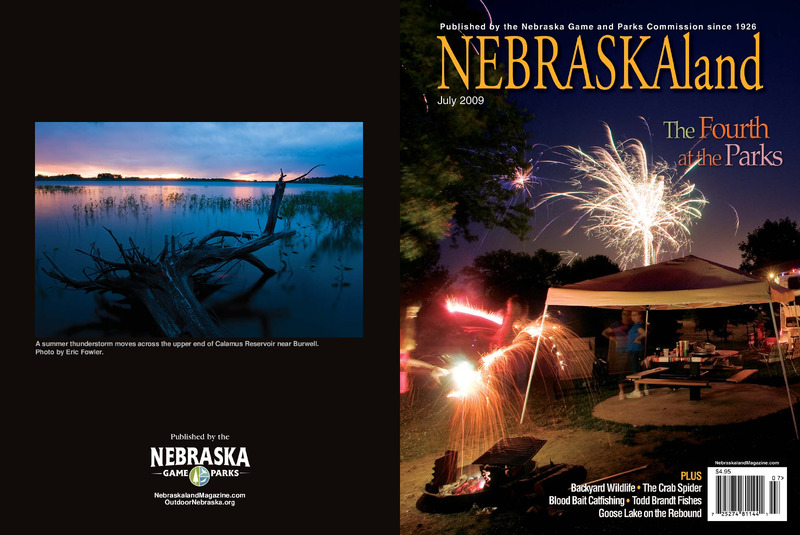
A summer thunderstorm moves across the upper end of Calamus Reservoir near Burwell.
Photo by Eric Fowler.
Published by the
NebraskalandMagazine.com
OutdoorNebraska.org
Volume 87, Number 6, July 2009
12 The Fourth at the Parks
State parks and recreation areas are great places to visit any
time of year, but they’re especially enjoyable in early July
when our nation comes together to celebrate its freedom.
22 Ambush!
A patient hunter, the crab spider sits motionless – until...
TEXT AND PHOTOS BY CHRIS HELZER
24 Fishing with Marcus
Omaha’s Marcus Washington competes in tournaments but he
finds fishing’s greatest values lie in fishing with his family.
TEXT AND PHOTOS BY KEN BOUC
28 What’s in Your Backyard?
The backyard pond that the author and her husband built is an
attractor of wildlife. TEXT AND PHOTOS BY JULIE WATTS
30 Goose Lake Rebound
A renovation and regulation change have tranformed this
eastern Sandhills lake into a prime fishery.
TEXT AND PHOTOS BY ERIC FOWLER
38 No Time to Talk
When not on the radio, talk show host Todd Brandt likes to
fish – quietly. TEXT AND PHOTOS BY JEFF KURRUS
22
●
40 A Bloody Mess of Cats
If you like eating catfish, you might want to give blood bait, a
favorite of Jay Dee Osburn and many other anglers, a try.
TEXT AND PHOTOS BY ERIC FOWLER
Comment . . . . . . . . . . . . . . . . . . . . . . . . . . . . . . . . . 4
Mixed Bag . . . . . . . . . . . . . . . . . . . . . . . . . . . . . . . 6
Step Outside . . . . . . . . . . . . . . . . . . . . . . . . . . . . . .44
In the Field . . . . . . . . . . . . . . . . . . . . . . . . . . . . . . .45
Outdoor Update . . . . . . . . . . . . . . . . . . . . . . . . . . .46
Classifieds . . . . . . . . . . . . . . . . . . . . . . . . . . . . . . . 48
Portraits from the Past . . . . . . . . . . . . . . . . . . . . . 50
28
●
24
●
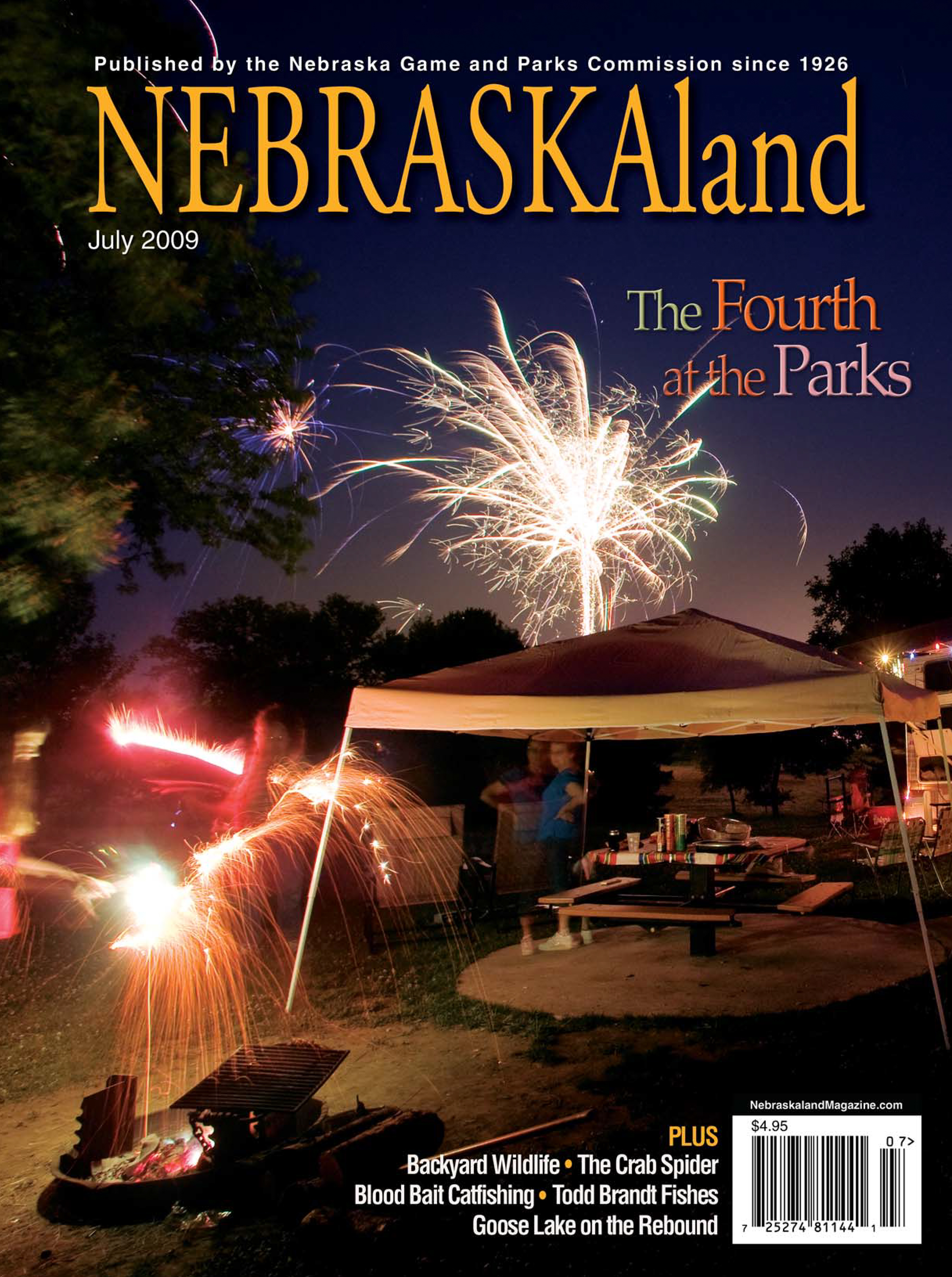
Cover: For some, the Fourth of July means fireworks. For others, it means a trip to the lake.
Thousands of people across the state, like this group camping at Pawnee State Recreation
Area last year, combine the two. See story beginning on page 12. Photo by Doug Carroll.
Opposite: A windmill is motionless on a calm summer day at The Nature Conservancy's
Dahms Tract south of Wood River near the Platte River. Photo by Chris Helzer.
NEBRASKAland (VOL. 87 / NO. 6, ISSN 0028-1964) is published monthly, except for the
combined Jan./Feb. and Aug./Sept. issues, by the Nebraska Game and Parks Commission,
2200 N. 33rd St., Lincoln, NE. Periodicals postage paid at Lincoln, Nebraska, and additional
mailing offices. POSTMASTER: Send address changes to NEBRASKAland, P.O. Box 30370,
Lincoln, NE 68503-0370.
30
●
JULY 2009 • NEBRASKALAND 3
Published by the
Nebraska Game and
Parks Commission
Director: Rex Amack
Assistant Directors:
Roger Kuhn, Kirk Nelson, Sam Sidner
Information & Education Administrator:
Doug Bauch
Commissioners
Chairman:
James Ziebarth, Wilcox
Vice Chairman:
Jerrod Burke, Curtis
2nd Vice Chairman:
Mick Jensen, Blair
Dr. Mark Pinkerton, Wilber
Ron Stave, Waterloo
Dr. Kent Forney, Lincoln
Lynn Berggren, Broken Bow
Rex Fisher, Omaha
Mark Spurgin, Paxton
Old Spaces and Old Friends
Dear Bob (Grier),
I have really enjoyed reading your
articles on the Panhandle area of
Nebraska, especially the May 2009
article on old deserted houses. I was
born and raised in Alliance, and I am
now living in Vienna, Virgina, with my
husband, who lived in Lincoln and is
an NU graduate. I was wondering if
you are the nephew of Emily Hein of
Alliance. She died several years ago,
but she and my mother were very good
friends and I thought so much of
Emily.
Hope you continue to write the
interesting articles about Nebraska with
your excellent photographs.
Sincerely,
Peggy Williams Doole
Vienna, Virginia
Arizona Wildlife Kudos
To my colleagues at NEBRASKAland:
I don’t often have time to read all the
magazines that come through our
doors here at
Arizona
Wildlife Views,
but I just picked
up your
December 2008
issue and was
entranced by
“The Next Hole.”
Kudos for a
design that pulled
me in and a
writing style that
kept me intrigued
throughout the
story. Without preaching, the article
conveys a sense of the magnitude of the
gift when one generation passes on
tradition to the next. Nice work!
Julie Hammonds, associate editor
Arizona Wildlife Views Magazine
Magazine Staff
Editor: Doug Carroll
Associate Editor: Jeff Kurrus
Art Director: Tim Reigert
Senior Editor: Jon Farrar
Regional Editors:
Eric Fowler, Bob Grier, Rocky Hoffmann
Photo Librarian: Sarah Johnson
Circulation: Donna Robinson
For address changes and questions about
your subscription, e-mail
donna.robinson@nebraska.gov
or call (800) 632-5263
Marketing/Advertising: Jane Gustafson
For advertising information e-mail
ngpc.advertising@nebraska.gov
or call (402) 471-5481
NEBRASKAland Magazine
Copyright 2009, all rights reserved.
NEBRASKAland is available on audio cassette from the
Nebraska Library Commission Talking Book and Braille
Service, Suite 120, 1200 N St., Lincoln, NE 68508. (800)
742-7691. NEBRASKAland Magazine and the Nebraska
Game and Parks Commission reserve the right to reject
any advertising not in keeping with the agency mission.
Rates: $18 for one year; $33 for two years; $44 for
three years. Nebraska recipients must add
appropriate sales tax.
To subscribe call 1-800-NEBLAND (632-5263),
or go online to: NebraskalandMagazine.com.
4 NEBRASKALAND • JULY 2009
Young Bass Angler
My 10-year-old son, Ryan Tejral
of rural Pleasant Dale, caught this
largemouth bass in our home pond
on May 10, 2009, just as it began to
sprinkle. He caught it with rod and
reel using a “sparkly, shiny lure” as
he described it. He was so excited!
Becky Tejral
Pleasant Dale, Nebraska
First Turkey Nest
Dear Editor of NEBRASKAland:
This is a first for me. I was
mushroom hunting on May 14th with a
friend, and I came upon a hen turkey
laying on her eggs. She flew away
when we got near (about three feet
before she even moved ... I didn’t even
see her) and I found this turkey nest.
This is the first time I have ever seen a
nest in 25 years of hunting turkeys. The
area was protected by a tree limb and it
had dry leaves as the bed. There were
11 eggs in the nest.
Scott Houston
Beaver Lake, Nebraska
Shoemaker and Insects
This is a late thank you to all the
staff at NEBRASKAland Magazine. The
April article on Shoemaker Marsh was
most interesting, and the photos of the
insects a few months ago were
spectacular.
Keep up the good work.
NEBRASKAand is the best.
Clayton Brant
Lincoln, Nebraska
Headquarters
2200 N. 33rd Street
Lincoln, NE 68503
Phone (402) 471-0641
District Office I
East Hwy. 2, Box 725
Alliance, NE 69301
Phone (308) 763-2940
District Office II
524 Panzer St., Box 508
Bassett, NE 68714
Phone (402) 684-2921
District Office III
2201 N. 13th St.
Norfolk, NE 68701
Phone (402) 370-3374
District Office IV
301 E. State Farm Rd.
North Platte, NE 69101
Phone (308) 535-8025
District Office VI
1617 First Ave.
Kearney, NE 68847
Phone (308) 865-5310
Omaha Office
1212 Bob Gibson Blvd.
Omaha, NE 68108
Phone (402) 595-2144
Ak-Sar-Ben Aquarium
21502 W. Highway 31
Gretna, NE 68028
Phone (402) 332-3901
World Wide Web site: www.OutdoorNebraska.org
Thanks for a Lifetime of Outdoors
This is the thank-you letter that eightyear-old Seth Fink of Elkhorn sent in
after having his name drawn for a halfprice hunt and fish lifetime hunting
permit this past spring. On behalf of
the Commission, as well as the
Nebraska Game and Parks Foundation,
which funds the other half of these
permits that are drawn for at various
locations every year, let me say “You
are so very welcome, Seth.” - Editor
Send your comments to:
Doug Carroll, Editor
NEBRASKAland Magazine
P.O. Box 30370
Lincoln, NE 68503
or e-mail doug.carroll@nebraska.gov
Please include your postal address and
telephone number.
Letters may be condensed and edited
for clarity. Photographs are
welcome and will be returned.
Under federal and/or state law, discrimination is prohibited on the basis
of race, color, religion, age, gender, marital status, national origin,
disability or political affiliation. If you think you have been discriminated
against in any program, activity or facility by the Nebraska Game and
Parks Commission or want more information, contact the Commission in
Lincoln, NE, at (402) 471-0641 or the Equal Opportunity Commission,
Lincoln, NE, (402) 471-2024, TTY/TDD (402) 471-4693).
Administration
Ted Blume (Adm.)
Craig Stover (Asst.)
Wes Loos (Asst.)
Rod Loos (Asst.)
Murray Johnson
Lincoln
471-5531
Lincoln
471-5532
Lincoln
471-5591
Ogallala (308) 284-8056
Lincoln
471-5003
Panhandle
Officer
City
Phone (308)
Jim Zimmerman (Sup.) Gering
436-7561
Walt Meyer
Chadron
432-4398
Scott Brandt
Gering
436-3418
Heath Packett
Gordon
282-2553
Dennis Thompson
Lemoyne
355-2024
Dan Zuehlke
Ogallala
284-4815
Doug Pollard
Oshkosh
772-9950
Frank Miller
Valentine (402) 376-1183
Dan Kling
Whitney
432-8367
Southwest
Officer
City
Phone (308)
Roger Thompson (Sup.) N. Platte
532-9175
Ray Dierking
Brkn. Bow
872-3078
George Sund
Cambridge
697-4629
Michael Thome
Cozad
784-4362
Matt Andrews
Elwood
785-3025
Dirk Greene
Imperial
882-5328
Virgil Gosch
McCook
345-2185
Dudley Sorensen
N. Platte
532-0747
Rich Routh
Rep. City
799-2085
South-central
Officer
Jerry Pecha (Sup.)
Jeff Jones
Terry Brentzel
City
Phone (308)
Kearney
865-5327
Clay Center(402)762-3124
Doniphan (402)845-2021
Randy Pomplun
Darin Gress
Dale Johnson
Mark Reeves
Robert Finke
Fullerton
536-2987
Hebron (402) 768-2287
Kearney
237-1079
Loup City
745-0662
Milford (402) 761-3537
Northeast
Officer
Tom Zimmer (Sup.)
Dale Davis
Ross Oestmann
Steve Oberg
Daniel Roberts
Jon Reeves
Marion Shafer
Pat George
Eric Wiebe
Tim Williams
Cory Krause
City
Phone (402)
Norfolk
371-6625
Bassett
273-1700
Bloomfield
373-4412
Columbus
564-5937
Fremont
721-7852
Kennard
427-7378
Norfolk
371-2031
O’Neill
336-1588
Ponca
755-2566
Neligh
887-1335
West Point
372-6979
Southeast
Officer
Duane Arp (Sup.)
Sean McKeehan
William Krause
Mike Luben
Douglas Kramer
Dina Barta
Stacey Lewton
Levi Krause
Russell Mort
Dan Evasco
Jeff Clauson
City
Gretna
Ashland
Auburn
Colon
Lincoln
Lincoln
Lincoln
Louisville
Nebr. City
Papillion
Waterloo
Phone (402)
332-2965
944-4174
274-3789
443-4278
466-9001
483-2358
476-0436
234-2212
873-5684
592-6733
359-5301
Nebraska Wildlife Crimestoppers 1-800-742-7627
JULY 2009 • NEBRASKALAND 5
sports after the hunt was finding and
retrieving spent shells. Dr. Green
cautions hunters not to overlook
accidental lead poisoning. He said
that it is important not to discard the
remains of cleaned birds where dogs or
raptors may find them. It’s also not
wise to leave shotgun shells lying
around for a playful pup to discover. In
this case, one pellet was almost fatal to
a normal, healthy retriever.
PHOTO BY ROCKY HOFFMANN
Fishin’ Fever
Get the Lead Out
Rocky Hoffmann
Sweetie, a well-trained, four-year-old
yellow Labrador, wasn’t acting right.
She began to ignore basic field
commands, became disoriented, got
confused in field corners as well as the
corner of the living room and couldn’t
find her way out. Within days, she had
completely stopped eating and sleeping.
She constantly paced in circles while
panting. Her muscle mass had
deteriorated significantly. She was
dying.
North Platte veterinarian Dr. Ronald
Green remembered seeing some of
these symptoms – not in dogs, but in
cattle. It turned out that the cattle were
suffering from lead poisoning, which
they had been exposed to by chewing
or licking old batteries discarded in
pastures. An x-ray revealed that
Sweetie’s stomach contained a single
lead shot pellet. When the pellet was
surgically removed it appeared that it
had eroded significantly. Chelation and
steroid treatments followed. More than
a month after the surgery, the dog was
still recovering and had to relearn some
of her training. Some personality
departures still exist but are improving.
Most likely, Sweetie either ate the
discards of a cleaned pheasant that
contained lead shot or she chewed up a
shotgun shell – one of her favorite
6 NEBRASKALAND • JULY 2009
Jeff Kurrus
Recently doing research for an
upcoming NEBRASKAland American
bullfrog article, I ran across the following
poem taken from the 1901-1902 First
Biennial Report of the Nebraska Game
and Fish Commission. It was amusing
to find poetry included with an official
state government document.
Like to drop my work an’ go
Tew a fishing’ hole I know;
Reckon I wud miss my guess
Ef I cud’nt ketch a mess.
Pears tew me they ort tew bite:
Sun and sky an’ air seems right;
Ef I jes’ cud have my pick,
I’d be down erlong th’ crick.
Like to drop my wurk an’ go
Tew a fishin’ hole I know;
Like to go an’ fish away
Jes th’ hull endurin’ day;
Like tew fish away an’ hear
Worter singin’ in my ear;
An’ I’d go, I calculate,
Wuzzent jes for diggin’ bait.
Turpin Time
Dick Turpin
Camping, kids
and s’mores.
Everybody knows
that story … but
this time of year
you open that
marshmallow bag
up and it’s just a
big glob of goob.
Here’s a way to solve that. If those
marshmallows are sticking together, get
yourself some powdered sugar and a
container big enough to hold what you
need. Take those stuck together …
separate those babies … dump them all
in there … give them a shake … and
those babies are ready to go … coats
them … dusts them … so they don’t
stick together. When you get to camp
you’ll be glad you did.
Black Squirrel Sightings
Jeff Kurrus
I receive more letters from
readers
regarding
the
October
2007 “Black
Squirrels-An
Uncommonly
Common Squirrel
of Nebraska” than
anything else I’ve
written for NEBRASKAland. This
has led to colleagues buying me black
squirrel prints, stuffed animals and the
like. It has also led to people telling me
their own black squirrel sightings,
something that I am becoming more
intrigued about because of the frequency
of black squirrels I am seeing, most
recently at Louisville SRA in eastern
Nebraska.
So, because I have been unofficially
deemed the “black squirrel guy,” let me
know where your latest sightings have
occurred by e-mailing me at
Jeff.Kurrus@nebraska.gov so I can
begin to create the Nebraska black
squirrel map my colleagues have stated
that I was born to make.
Outdoor Message Plates
Steve Scheinost of Lincoln and his
family began camping in a tent more
than 30 years ago and are looking
forward to many more. They have
improved their accommodations since,
stepping up to a pop-up camper, a travel
trailer and now a fifth-wheel, which he
8 NEBRASKALAND • JULY 2009
pulls with a pickup adorned with this
plate.
If you have a unique message plate you
would like to share, or know someone
who does, e-mail a photo (highresolution .jpg format only, please) of it
to Eric.Fowler@Nebraska.gov, along
with your name and hometown, and a
brief description of the interests
expressed on your license plate.
Lewis and Clark SRA Shoreline
Stabilization Funding
The Nebraska Game and Parks
Commission will receive a $500,000
grant from the Nebraska Environmental
Trust for the Lewis and Clark State
Recreation Area (SRA) Shoreline
Stabilization.
The Trust board announced funding
for the project on April 2. This is the
first year of the award, with a potential
for second- and third-year funding
totaling $910,000. The project is one of
82 receiving $15,065,944 in grant
awards from the Trust this year. The
Commission also received $250,000
from the Sport Fish Restoration Fund
for this project.
There has been significant waverelated shoreline erosion and filling of
the channel with shale and sediment at
the popular Miller Creek and South
Shore access points at Lewis and Clark
SRA on Lewis and Clark Lake. The
project includes three rock jetties at
these areas to decrease the rate of
erosion, provide fish habitat and ensure
proper bank stabilization.
The Nebraska Legislature created the
Nebraska Environmental Trust in 1992.
Using revenue from the Nebraska
Lottery, the Trust has provided more
than $142 million in grants to 1,134
projects across the state. The Nebraska
Environmental Trust works to preserve,
protect and restore our natural
resources for future generations.
Test Negative for Tuberculosis
The 42 wild white-tailed deer
sampled near a Knox County facility
where bovine tuberculosis was detected
were free of the disease, recent test
results showed.
Biologists with the Nebraska Game
Here is a list of
upcoming outdoor
events across
Nebraska.
For more
information
about
these and
other events, click on
the calendar at
www.OutdoorNebraska.org.
July 2-4
• Fort Robinson SP Annual Art Show
July 3
• Niobrara SP Kids Program
July 4
• Niobrara SP Buffalo Cookout
July 4
• Fort Robinson 4th of July BBQ
July 4-5
• Pioneer Longrifle Rendezvous,
Indian Cave SP
July 4-5
• Fort Kearny Stampede Day
July 4-5
• Fort Atkinson SHP - Living History
July 7
• Family Fishing Night, Zorinsky
Lake, Omaha
July 10
Dutch Oven Chicken
Joey’s Stupendous Chicken
• 4 chicken breasts, skinned &
boned
• ½ cup milk or white wine
• 8 slices Swiss cheese
• ½ cup freshly grated Parmesan
cheese
• 2 beaten eggs
• 1 16 oz jar marinara sauce
• 8 slices mozzarella cheese
• Parsley & twists of orange
(optional)
• Bread crumbs
• Nebraska Star Party Star Gazing,
Eugene T. Mahoney SP
• Butter
• Olive oil
July 10-12
• Chadron SP Fur Trade Days
July 11
Dip chicken in eggs and roll in
fresh bread crumbs. Brown in half
butter, half olive oil. Add milk or
wine to marinara sauce. Pour into
bottom of Dutch oven, and layer
browned chicken breasts on top.
Layer cheeses over top of chicken
breasts. Top with Parmesan
cheese. Bake 30-40 minutes.
Uncover and cook to reduce liquid
slightly. Garnish with parsley
sprigs and twisted orange slices.
– from the 2004 Dutch Oven
Cooking pamphlet
published by the
Nebraska Game
and Parks
Commission
• Niobrara SP Buffalo Cookout
July 14
• Family Fishng Night, Holmes Lake,
Lincoln
July 18
• Niobrara SP Buffalo Cookout
July 22
• Family Fishing Night, Standing
Bear Lake, Omaha
July 23-25
• 88th Nebraska's Big Rodeo,
Calamus SRA/Burwell
July 24-29
• Merritt Reservoir Star Party
July 25
• Niobrara SP Buffalo Cookout
July 25
• Lake McConaughy's 20th Annual
Kites and Castles
July 29
• Family Fishing Night, Wildwood
Lake
July 31
• Niobrara SP RV Campground Kids
Program
JULY 2009 • NEBRASKALAND 9
A couple of years ago, Conservation Officers Jeff Jones, Darin
Gress, and I were assigned to an undercover fish detail at Maloney
and Sutherland reservoirs, where some of the state’s best fishing
opportunities can be found, because we had received complaints
about people catching and keeping more white bass in one day than
their daily bag, or even possession, limit allowed.
Officer Gress and I were posing as fishermen at Sutherland
Reservoir and watching for the overbagging problems to develop. The
fishing was good and everyone seemed to be catching some fish. It
didn’t take long to spot two groups of people who were obviously
out-catching most people and keeping well over their limit of 15 white
bass. We watched as some of the individuals caught and kept more
than twice their limit in just 45 minutes! They tried to disguise this
activity by having a group member take fish up to the camp while
others continued to fish.
While we were watching these groups, Officer Jones was coming in
our direction after being at Maloney Reservoir. Just as he arrived, a
van from the first group was leaving camp with a load of fish, so he
stopped the vehicle outside the campground and discovered that
they had more fish than their bag limit. It was quite obvious that the
van’s occupant called to warn the others because they abruptly
stopped fishing, packed up and headed back to camp. We decided it
was time to make the contact despite the fact that there was another
group not associated with them that was also catching more than
their limit.
Officer Gress and I stopped one of the first group’s vehicles. The
car, with one occupant, was trying to leave the area with well over
200 white bass. We spent quite some time collecting fishing licenses,
counting fish, interviewing subjects and taking pictures. Deputies
from the Lincoln County Sheriff’s Office and a federal game warden
came to assist.
I was concerned that we were only going to catch one of the
groups with illegal fish because of the circus we were creating with
the first party. So as we worked, Officer Gress and I kept glancing
over to where the other party’s vehicle was parked and where they
were fishing. We were astounded that it was taking them so long to
decide to leave. When one of them went to the vehicle, Officer Gress
and I contacted them and, much to our amazement, they still had
their fish and far more than their limit – the fishing was so good they
hadn’t even noticed the commotion or patrol cars parked in the
campground near them. The first party of nine anglers had 416 white
bass in their possession and had caught them all in
approximately three to four hours of fishing. The other
group of four had caught 77 white bass in about the
same time. In total, the two groups of fishermen paid
a total of $7,568 in fines, court costs and liquidated
damages, and had their fish and coolers seized for
evidence. Luckily we were able to donate the fish to a
local homeless shelter after the case disposition.
– Mike Thome, Conservation Officer, Cozad
10 NEBRASKALAND • JULY 2009
A Look Back - July 1978
Jeff Kurrus
31 years ago this month,
NEBRASKAland Magazine
featured a photo essay by Jon
Farrar on Goose Lake, the same
place
where
Eric
Fowler’s
article this
month,
“Goose
Lake
Rebound,”
is focused.
Natural
history
articles
entitled “Owl Encounters” and
“Black-Footed Ferret” were also
included. And last, but not least,
was “Gardening with Whiskers,”
which spoke about Mother Nature
gardens found in the outdoors.
low-grade fever and pneumonia with a
chronic, moist cough. It usually is
transmitted through contact with
respiratory secretions from an infected
animal.
PHOTO BY DOUG CARROLL
A Good Day Fishing Gone Bad
and Parks Commission and the U.S.
Department of Agriculture’s Wildlife
Services (USDA-WS) collected the
free-ranging deer in early May within a
mile of a facility containing captive elk,
several of which tested positive for
tuberculosis earlier this spring. Samples
from the deer were tested at the
University of Nebraska-Lincoln
Veterinary Diagnostic Laboratory
(VDL). Biologists with USDA-WS,
USDA-Veterinary Services and the
Commission assisted the VDL with
sample preparation.
The collection and testing of wild
deer was necessary to help determine if
the disease organism was present
outside the captive facility. Deer were
collected on private land with landowner
permission.
This was not the first time Nebraska
deer have been tested for tuberculosis.
The Commission collected and tested
271 samples in 1996, with no positives
resulting from the tests.
Tuberculosis is a slow, progressive
bacterial disease and is difficult to
diagnose in the early stages. As the
disease progresses, animals may exhibit
emaciation, lethargy, weakness, anorexia,
Peregrine Chicks Banded
Two male and two female peregrine
falcon chicks from the nest box near
the top of the Nebraska State Capitol
building were banded and given a
checkup in early June by the Nebraska
Game and Parks Commission and
Raptor Recovery Nebraska.
“The banding went very well and the
chicks appear to be in very good
shape,” said Joel Jorgensen, the
Commission’s nongame bird program
manager. “They have everything they
need to be successful.”
The banding was performed by
Jorgensen and the Commission’s
Melissa Santiago, as well as Betsy
Finch and Janet Stander of Raptor
Recovery Nebraska.
Peregrine female A/*Y laid four eggs
about the second week of April and,
with the help of her mate, 19/K,
hatched the eggs between May 12 and
May 14. The same pair has been present
at the Capitol since 2005.
The 20-day-old chicks hatched in the
nest box located on the 18th floor.
Biologists placed unique bands on both
legs, took blood samples and checked
for diseases and parasites before
returning the youngsters to the nest box.
This is the fourth year that the
peregrine pair successfully hatched
eggs. In 2005, the pair successfully
raised a chick that, through a “Name
the Chick” contest, was named Pioneer.
In 2006, three chicks fledged and were
given the names Willa, Bess and
Sterling after famous Nebraskans Willa
Cather, Bess Streeter Aldrich and J.
Sterling Morton. In 2007, four chicks
fledged and were named Boreas,
Notus, Eurus and Zephyrus after the
four wind gods from Greek mythology
that are ascribed to the cardinal directions
North, South, East, and West. Last
year’s nesting attempt failed.
Peregrine falcons were first observed
at the State Capitol when a lone male
was seen in August 1990.
Peregrine falcons almost disappeared
from the lower 48 states following
World War II because of eggshell thinning
caused by the pesticide DDT. The falcon
was listed as endangered under the
Endangered Species Act in 1970.
Recovery efforts, including the release
of falcons at tall buildings in urban
areas, were successful. By the late 1990s,
peregrine falcon numbers recovered
and the species was removed from the
list of endangered species in 1999.
Bow Practicing
Doug Carroll
While it might be hard to think
about this fall’s archery season when
all you want to do is sit near an air
conditioner and escape the summer
heat, the practice you do now makes a
big difference to the success you have
during archery season.
To shoot accurately on a consistent
basis, make sure your equipment and
your muscles are in good working
order – something that can’t be done
with just a few weeks of shooting
before the season starts.
Summer is a good time to get used
to new equipment, such as arrow rests,
sights and arrow releases, if you use
them. It’s also a good time to lengthen
your effective range by working on
longer shots and by shooting targets at
unknown distances to improve your
distance judging – missing a shot on
the range is much better than doing it
in the field.
By shooting early in the morning or
late in the evening during the summer,
you can accomplish several goals –
you’ll be a much better and more
confident shooter come this fall, you’ll
escape the worst heat of the typical
summer day and you’ll also be used to
shooting in the lowlight conditions that
often exist when your best hunting
opportunities occur. ■
JULY 2009 • NEBRASKALAND 11
The
Fourth at the Parks
State parks and recreation areas are great places
to visit and have fun any time of year, but they’re
especially enjoyable in early July when our
nation comes together to celebrate its freedom.
Campers at Pawnee State Recreation Area enjoy last year’s Fourth of July by
setting off their own fireworks and watching the displays of others.
PHOTO BY ERIC FOWLER
Flags line the road next to campsites at Area 2 of Branched Oak State Recreation Area near Malcolm last year.
W
PHOTO BY DOUG CARROLL
hat better way to celebrate our freedom
than to spend Independence Day fishing,
boating, swimming or camping? Visit
almost any state park or recreation area across the
state on July 4th and you will see plenty of examples
of American pride on display. And although not
every park allows fireworks, celebrants at several
can enjoy pyrotechnics from the comfort of their
campsite while visitors to those parks where
fireworks are not allowed can often make a quick
trip to a local town to enjoy the traditional nightime
barrage of celebratory firework displays before
returning to their campsite for a bedtime s’more.
Either way, spending the day outdoors is a great
way to celebrate this holiday.
Megan and Maddie Poe of Hickman use colored smoke bombs to write a Fourth of July greeting
on the blacktop in the campground area of Pawnee State Recreation Area last year.
14 NEBRASKALAND • JULY 2009
JULY 2009 • NEBRASKALAND 15
PHOTO BY ERIC FOWLER
For Tanya Strayer, the Fourth is all about red, white and blue.
PHOTO BY JEFF KURRUS
Bill and June Hansen of Omaha ride their tandem recumbent bike through Two Rivers State Recreation Area last Fourth of July.
PHOTO BY ERIC FOWLER
PHOTO BY ERIC FOWLER
PHOTO BY JEFF KURRUS
Lizzie McGrath from Kansas City plays
on the jungle gym at E.T. Mahoney SP.
If awards were given for the best campsite decorations, the prize might go to Matt and Tanya Strayer of Lincoln,
who invite friends and family to share in the celebration each year at their Branched Oak Lake campsite.
16 NEBRASKALAND • JULY 2009
Sailboats are a constant at Branched Oak Lake, including last year on the
Fourth, when Steve Bauer of Seward (left to right), Jeff Ryan of Bellevue and
Roger Bast of Lincoln set sail in their catamarans with a perfect wind.
JULY 2009 • NEBRASKALAND 17
PHOTO BY JEFF KURRUS
PHOTO BY ERIC FOWLER
PHOTO BY PASQUALE MINGARELLI
PHOTO BY PASQUALE MINGARELLI
Chad, Austin and Jordyn Becwar, along with Ken and Dylon Stithem, all of Lincoln, watched the Area 11 fireworks display and their
fishing lines from the jetty near Branched Oak Marina last year.
Carson Pecera plants a flag at Victory Lake’s beach at
Fremont Lakes SRA.
George Rushing of Bellevue and his grandson, Isaiah Cooks of
Omaha, have fun in a paddleboat at Platte River State Park.
Tent campers at Louisville State Recreation Area enjoy last year’s Fourth under the shade of the park’s cottonwood trees.
18 NEBRASKALAND • JULY 2009
JULY 2009 • NEBRASKALAND 19
Visitors can take in the fireworks display on Liebers Point, one of two
designated fireworks areas at Branched Oak Lake, from land or water.
Ambush!
A patient hunter, the crab spider
sits motionless – until...
Text and photos by Chris Helzer
C
rab spiders don’t spin elaborate webs like those
made by big, yellow and black garden spiders.
They’re not big, fast, hairy hunters like wolf
spiders either. In fact, crab spiders mostly just sit
around on flowers, but they have a charm of their
own and they’re worth getting to know.
Named for their similarity in appearance to crabs, crab
spiders have short, wide, flat bodies, and their first two or
three pairs of legs are much longer than the rest and are often
held away from their bodies, much like a crab’s claws. These
spiders are a diverse group, with more than 2,000 species
worldwide. In North
America there are
about 200 species of
crab spiders, at least 50 of which are found in Nebraska.
I frequently see crab spiders in prairies, but only if I
remember to look closely enough. They’re small enough
(most are less than a centimeter in length) and sit so still that
they’re easy to miss – which, of course, is the idea. Because
of their camouflage and patience, crab spiders are excellent
at ambushing prey. Most sit quietly on leaves or flowers,
waiting for an unsuspecting insect to wander within reach.
A small insect searches for nectar on a black-eyed Susan, likely unaware of the camoflauged crab spider with posed legs waiting for its
chance to strike on the other side of the flower head.
22 NEBRASKALAND • JULY 2009
Of those that hunt on flowers, many have
the ability to change color, mainly between
yellow and white. They are not quickchange artists like octopi or chameleons –
it can take several days for a crab spider
to complete its transformation – but the
ability to match the flower color they’re
hunting on adds to their effectiveness as
predators.
Unlike jumping spiders, wolf spiders
and other free-living (non web-spinning)
spiders, which have large eyes and keen
eyesight, all eight of a crab spider’s eyes
are small and probably function more like
motion detectors than true eyes. Their
hunting method, however, is such that their
Faster than the blink of an eye, the crab spider grabbed this unlucky visitor to the
poor eyesight is not a disadvantage. Most
flower head and quickly gave it a paralyzing bite.
crab spiders in Nebraska hunt by taking up
a position on a flower and waiting for
small prey to come within range of their
long front legs. When a small insect comes
to gather pollen, nectar or just to rest, it’s
not likely to notice the silently waiting
spider. If the unsuspecting insect ventures
too close, the spider’s front legs snap
together like a trap and the spider gives its
prey a quick, paralyzing bite. The venom
used by the spider is extremely effective
on insects, but fortunately crab spiders are
not a threat to humans.
As I was walking through one of The
Nature Conservancy’s prairies along the
Central Platte River last summer, I stopped
to examine a black-eyed Susan flower.
Kneeling down to get a better look, I
noticed a small crab spider sitting at the
edge of the dark flower center. I decided
to grab my camera and wait to see if
Its much larger prey neutralized, the crab spider enjoys its lunch beneath a flower
petal while an insect above can once again search for nectar in safety.
anything happened. It turned out to be a
good decision.
fly I’d seen, or one just like it, came back. I was reminded of
After shooting a couple photos of the spider, a small fly
movies where the customers in a bar sort of melt away when
arrived in search of some nectar. It seemed to be staying on
they see an impending fight, and then sidle back when it’s over.
the opposite side of the flower from the spider, which was
I had read about crab spiders and had even seen them
sitting perfectly still, its front legs poised to snap shut if the
holding prey before, but I had never had the chance to be
fly came close enough. A minute or so later, the fly flew
present at the moment of capture. It was an
away as a larger one arrived. The new arrival wasn’t as
impressive display of hunting prowess.
cautious or lucky as its smaller counterpart – I didn’t
I was glad to have seen the event,
actually see the spider move, but the next thing I knew the
but I also found myself grateful that
fly was connected to it. I assume the spider bit the fly
crab spiders are less than an inch
immediately, because the fly never moved once it was in
in size. ■
the spider’s grasp.
The spider sat perfectly still for a half minute or so, and
then retreated underneath the lip of the flower with its prey,
Chris Helzer lives in Aurora and is
probably looking for a safe place to sit and suck out the now the Eastern Nebraska Program
liquefied insides of its prey. I was impressed with how easily Director for The Nature Conservancy.
the spider carried the fly, which looked about twice as heavy He has been a contributor to
as its captor. Not long after the spider disappeared, the first
NEBRASKAland since 1994.
JULY 2009 • NEBRASKALAND 23
Fishing with Marcus
Text and Photos by Ken Bouc
maha’s Marcus Washington
competes in bass tournaments
and really enjoys participating
in the amateur division of
the B.A.S.S. (Bass Anglers Sportsmen
Society) Tournament Trail Weekend
Series on waters in Iowa, Oklahoma,
Kansas and, of course, Nebraska.
But as much as Marcus enjoys meeting
the pros, fishing new waters and the
knowledge he learns in the process, he
finds fishing’s greatest values lie far
from the tournament trail – “Fishing is
for families. Fishing is for kids,” he
says with conviction.
Marcus came by his belief from
personal experience. He was born in
Independence, Kansas, lived in
Oklahoma until he was two or three,
then moved to Wichita with his mother
and two sisters when their parents
separated. But his father, who remained
in Oklahoma, maintained contact with
his children, and fishing played a large
part in their relationship.
“Every summer, he would come and
get me and my sisters or send for us. I
would just dream about it and couldn’t
wait until I got down there because I
knew we were going to fish. We went
O
fishing almost every day,” Marcus said.
In fact, he still fishes with his father.
Marcus’s mother moved her family
from Wichita to Omaha when he was
in the fourth grade, and about seven
years ago, Marcus’s father also moved
to the Omaha area.
“When I was three years old, my dad
hooked a worm under a bobber and
“When you go
camping and fishing,
you see nature, and
most inner city kids
don’t get that
experience.”
told me to watch that bobber. He tells
the story that the bobber went under
and I had a five-pound catfish on the
line. Ever since then, I’ve been
hooked,” Marcus said.
Fishing with their dad when they
The Washington family talks about the day around a campfire at E. T. Mahoney State Park.
24 NEBRASKALAND • JULY 2009
were youngsters was important to
Marcus and the rest of the family, so
now he’s applying the same formula
while raising his own family. “My dad
taught me to fish and I loved it, so I
wanted to show my kids how to fish.
Once they catch that first fish, that gets
them hooked. My kids are being
taught to fish, both the girls and the
boys. My youngest, Keshaun, just
caught his first fish, a catfish, last year.
He was five then,” Marcus said proudly.
“Sometimes, the catfishing is good and
that’s what we all do, then sometimes
we’re bass fishing.”
Marcus also cited some of the
angling accomplishments of others in
the family. DeAngelo, the oldest boy,
caught his biggest largemouth bass,
about 2½ pounds, on an artificial lure
in an Otoe County farm pond in 2007.
DeAngelo’s mother, however, topped
that.
“I took my wife, Kylie, fishing when
she caught her first fish,” Marcus said.
“After that, she caught a five-pound
bass. I’ve been fishing since I was three
years old, and the biggest bass I ever
caught weighed five pounds, so she
matched me in just one year of fishing!”
Like many families today, the
Washington household is a blend of
two broods. When Marcus married
Kylie, she brought her children,
DeAngelo and Kyliesha Peak into the
fold with Marcus’ daughter, Tiara. Sons
Marcus Jr. and Keshaun came along
later. They now fish as one family, with
Marcus, a concrete specialist who makes
foundations for new homes during the
week, serving as the family fishing
guide.
When the weather’s nice and fish are
active, weekends often find Marcus
fishing. Sometimes this involves a
distant bass tournament, but his favorite
outings are with the family at nearby
lakes, such as those at Two Rivers and
Louisville state recreation areas, and
occasional farm ponds. Some are simply
day trips taken on a Saturday or
Sunday when there’s no overtime or
youth activities scheduled, but the main
Marcus Washington
and DeAngelo land a
largemouth bass at a
private pond in Otoe
County.
JULY 2009 • NEBRASKALAND 25
Marcus and DeAngelo try their luck at Summitt Lake near Tekamah in Burt County.
events are at least two full summer
weekends spent at an area lake.
Washington and his family likes to
set up camp on Friday evening and stay
until Sunday evening. “We fish, we
camp, we grill. We make s‘mores
around the campfire at night, play
board games and play card games,”
Marcus said. “I think fishing brings us
closer together. We get to spend quality
time with our family, quiet time
without all the ruckus and all the noise
of the city. It’s quiet and you get to talk
to your kids.
“When you go camping and fishing,
you see nature, and most inner city
kids don’t get that experience. They
just play video games and Playstation.
I think it’s of value when they get
out and see Mother Nature, see the
different kinds of birds and different
kinds of wildlife that they never see in
the city.”
DeAngelo mentioned playing with
garter snakes on their camping trips,
and Marcus reminded him of the frogs,
toads and tadpoles he had captured and
the Canada geese and broods of
26 NEBRASKALAND • JULY 2009
The Washington family enjoys spending quality time fishing together at Two Rivers
State Recreation Area (pictured above) and many other public lakes around Omaha.
goslings that swam around the lakes as
they fished.
When asked if any of his friends at
school or in his activities talked about
fishing, camping or any of the other
experiences with wildlife or the
outdoors that he’s been exposed to,
DeAngelo couldn’t remember anything
like that ever being mentioned.
“I’m from North Omaha ... I
know there is a loss of interest in the
outdoors within the black community
because there’s no one teaching it to
the kids,” said Marcus. “I think their
grandfathers fished a lot back in their
day, but this new generation is losing
interest in fishing and the outdoors
because now fathers are not teaching
their kids. They let them play video
games all week long,” Marcus said.
“When we go camping and fishing, I
don’t often see minorities – in fact, in
the whole urban community, there is
definitely a lack of interest in nature
and the outdoors.
“We need to reach out, get people
more involved in the outdoors – fishing
camping and the beauty of nature. I
believe if we were to reach out, we
could do that. God’s blessed us with
the beauty of nature, and I believe that
everyone, at least once in their lifetime,
should experience that through camping
and fishing.”
Marcus once took his seven nephews
camping, and ever since then they’ve
been asking when he might take them
again. “I tried to reach out to them and
maybe get them hooked. I need to do
that more often, like my stepfather did
with me. He’s a camper and the one
who taught me … Camping and fishing
go together. It was a good experience
for my nephews, like in trying to put
their first worm on the hook,” Marcus
said with a grin. “They didn’t catch
anything but they had fun. They still
talk about it.”
While Marcus understands that fishing
and an appreciation of the outdoors are
best learned from family, he wondered
why more public programs are not
offered to fill the need. As it turns
out, there is quite a number of them
available from city, state and private
sources, but not all of them are widely
known (see sidebar).
Marcus’s kids, however, will not need
classes or programs for their outdoor
education. They have Marcus. ■
Urban Youth Fishing
Opportunities
By Andrea Faas
Outdoor Education Specialist, Ak-Sar-Ben Aquarium
Various organizations offer a variety of fishing opportunities
across the state. Contact your local Commission office to find
out what’s available in your area. Here are a few to get you
started.
• Nebraska’s Youth Fishing Program
Volunteer Fishing Instructors are available statewide to take young
people and their families fishing. Fishing tackle and educational
handouts are available to certified volunteers. To find out about
local fishing opportunities or to become a volunteer, contact Andrea
Faas at (402) 332-3901 or andrea.faas@nebraska.gov. You can
also go online to www.outdoornebraska.org and look under aquatic
education or at the events calendar to find out about upcoming
events.
• Fishing Tackle Loaner Program
Fishing rods and tackle are available for park visitors to borrow at
18 of Nebraska’s state parks and recreation areas. Check out the
following web site for park locations or ask at your local state park
office. http://www.ngpc.state.ne.us/fishing/tackloan.asp
• Take Me Fishing
This web site has information about local fishing, regional outfitters
and other resources. www.TakeMeFishing.org
• Lincoln Parks and Recreation Department
A weeklong fishing camp is usually offered the week after the public
school year ends. Many of the department's summer day camps
also offer fishing as a part of their camp experience. Contact
Lincoln Parks and Recreation at (402) 441-7847 for details.
• Omaha Parks and Recreation Programs
Call (402) 455-5900 for information on fishing in Omaha city parks
and the parks department’s youth fishing programs.
• Missouri River Expo, Ponca State Park
Kids can learn casting, fishing knots and fish identification. September
18 is set aside for schools, and September 19 and 20 are open to
the public. Call (402) 755-2284 for information on the Ponca event,
or call (402) 471-6009 regarding other Commission expos.
• SANDS Programs
Sportspeople Assisting Nebraska's Disabled Sportspeople
(SANDS) offers a youth fishing program for kids with disabilities.
Contact Dave Burgess at (402) 559-3743 for more information.
• Nebraska Walleye Association
The NWA is dedicated to promoting primarily walleye fishing, and
offers family fishing opportunities around Nebraska. Clinic dates
and sign-up information are available at www.nebraskawalleye.com/.
JULY 2009 • NEBRASKALAND 27
What’s in
Your
Backyard?
Text and photos by Julie Watts
“Build it and they will come”
was the big line in a popular
movie years ago. Turns out the
line is very true – we built it,
and they came.
The house, with the waterfall leading down to the pond.
f you want an ideal opportunity to attract wildlife, just add
water. My husband, Mike, and I both enjoy being outdoors
and recently purchased a few acres in the Pine Ridge area
of northwestern Nebraska. In addition to a 1920s house,
which needed total restoration, our property also included
more than 80 years of accumulated trash. We found three
water tanks and decided to use one to build a small pond. We
imagined it as a project for a year or two down the road, but
I
These three leopard frogs are frequent visitors to the pond.
28 NEBRASKALAND • JULY 2009
two hours later, because
patience is not one of
my virtues, the hole
was dug, the tank was
set and the water was
running. Within hours,
birds began to filter in,
drinking and bathing.
We quickly decided
A western tanager.
we needed another pond
and went for the tank of
all tanks – four foot
wide by sixteen foot
long, approximately
1000 gallons of pond
luxury. We placed it in
the natural atrium near
the house, an enclosure
surrounded by
hardwoods and lilacs
A pygmy nuthatch.
where the arched
branch of an ash tree
creates an entrance. We planned ahead for a waterfall, which
would provide aeration and be powered by a solar pump.
Native water plants were added, as well as painted turtles,
fathead minnows, frogs and other local aquatic creatures.
Our last addition was solar lights at the edge of the pond to
draw in insects for our pond critters.
At least 25 different species of birds have visited our pond
– goldfinches, chickadees,
orioles, Townsend’s solitaires,
tanagers, crossbills, and pinyon
jays. While mountain and
western bluebirds are more
open prairie birds, both joined
us at the new watering hole.
Then, near nightfall, bats
began to bombard the pond.
So we added several birdhouses and a bat house to
encourage them all to return.
As our wetland and its
surrounding flora grew, we
began to see rabbits, deer and
coyotes. Several weekends
A screech owl naps in a tree trunk.
that first summer, a large pile
of scat greeted us near the pond and our fish population began to
diminish. It made for lively conversation and good-natured
disagreement as we contemplated what animal had visited. So we
e-mailed scat photos to wildlife friends. Opinions varied, but I was
holding out for a mountain lion. Mike was convinced it was from a
large raccoon. If so, that would be one big coon. That winter, we
also found a deer kill site nearby, furthering the debate.
The subject of a game camera soon came up. We found one
with a rechargeable battery, fed by a small solar panel. Placing it
in the corner, we could get a diagonal shot of the entire pond area,
catching all the entrances and exits as well as having enough
sunlight for power. In theory, it was perfect.
Reality was
arriving to find
a dead battery
and more than
500 photos,
mostly birds,
rabbits and a
Images of deer, turkey and elk were a few
of the many animals that the game camera
lot of empty
captured near the pond. No mountain lion
shots where
yet.
birds and
rabbits had
evidently been seconds before. Moving the camera to
another location, we tried again. The camera didn’t take
high-quality photos, but they were adequate for our purpose.
Rabbit, turkey, a screech owl, deer, elk, porcupine and coyote
were filmed frequenting the area, but no raccoon or
mountain lion. We probably even captured the turkey on
film that displaced the hose for the waterfall, causing the
water to be pumped on the ground and draining the pond
down to almost nothing. The pump no longer ran and we
sent it back for repair. It was returned with a note: “Don’t
run pump dry.” Tell that to the turkey.
We brought the camera in for the winter, put a pond
heater in for a vent hole in the ice, and let nature take its
course. We continued to see wildlife during the winter
months, but our sights are set for next spring, when we can
sit by the pond and watch the show. Plus, I’ll put our game
camera back out, curious to see if I get a picture of a big
cat. ■
Two grosbeaks bathing in the waterfall.
Julie Watts is a freelance writer living in Chadron.
JULY 2009 • NEBRASKALAND 29
Goose Lake
Rebound
A renovation and regulation change
have tranformed this eastern
Sandhills lake into a prime fishery.
Text and photos by Eric Fowler
W
hen the Bureau of Fish and Game of Nebraska
purchased Goose Lake in 1925, it didn’t do so with
the expectations that it was getting a good fishing
lake. Located in Holt County on the eastern edge
of the Sandhills, the lake, with its ever-fluctuating
water level, was subject to winterkill and summer dry downs,
making it a long shot for fishing. The Bureau, predecessor to
the Nebraska Game and Parks Commission, also didn’t buy
it to provide a place to water ski, as that sport had just been
born. The only thing they knew for sure was the area would
be a great place to camp and hunt ducks.
Yet the lake’s primary use has shifted through each of
those purposes. A well installed in 1975 made maintaining
water levels and water-skiing possible, and it also made
managing the fishery possible – a renovation and restocking
of the fishery in 1990 showed the lake could be as productive
as any in the Sandhills. But high-speed boating muddied the
waters of the shallow lake, and it also increased the conflict
PHOTO BY JON FARRAR
Spinnerbaits are a good bet to catch northern pike, and their weedless design makes them a good choice for Goose Lake.
A boat pulls a water skier around Goose Lake in 1977, two
years after the installation of a well to maintain water levels
made this popular pastime possible each summer.
30 NEBRASKALAND • JULY 2009
between boaters and anglers that had begun even before
the well was installed. Water-skiing also conflicted with the
management philosophy that governed other wildlife
management areas. So in 2008, after years of discussion,
Goose Lake finally became what this agency’s forefathers
had envisioned – a great place to hunt waterfowl and a great
fishing lake. Sorry, no speedboats allowed.
By most accounts, the modern conservation movement
began in the 1800s with the writings of Thoreau and Muir
and the photos of William Henry Jackson. Those works
heightened our nation’s awareness of its natural resources
and the need to preserve them for future generations. They
also led to the creation of our country’s first national park –
Yellowstone – in 1872 and the National Forest Service in
1905 by then-President Theodore Roosevelt.
It wasn’t until 1921, however, that the movement to
preserve wild places for enjoyment by the masses gained
enough of a foothold in Nebraska that the State Park Board
and the state’s first park, Chadron State Park, were created.
Two more parks, Arbor Lodge and Victoria Springs, were
added in 1923. In 1925 and 1926, the Bureau of Fish and
Game, then part of the Department of Agriculture, joined the
movement. With $50,000 from hunting and fishing permit
revenue, it purchased four properties – Goose Lake, Walgren
Lake in Sheridan County, Rat and Beaver lakes in Cherry
County, and Fremont Sandpits in Dodge County – and designated them as special use areas. Goose Lake, with 249 acres
of water and 100 acres of land around it, came at the bargain
price of $7,000.
“The people of the
middle west are just
now awakening to the
fact that unless
something is done –
and done quickly – the
wild life and natural
beauty of the prairie will
have vanished before the
ever grasping hand of
commerce,” Frank
O’Connell wrote in the
June 1926 issue of Outdoor
★
Located 23 miles south
and four miles east of O’Neill,
Goose Lake Wildlife
Management Area offers
fishing, hunting, primitive
camping and a wheelchairaccessible boat ramp
and dock.
JULY 2009 • NEBRASKALAND 31
NEBRASKA STATE HISTORICAL SOCIETY (RG2836.PH:53-3)
the can of worms such an arrangement could open up.
Almost immediately, it did.
During negotiations, the Commission granted the NRD
permission to drill a test well, but before the final agreement
was even signed, the well was installed, water was being
pumped into the lake, and NRD officials were talking about
building a dike to close off the shallow, south arm of the lake
to make pumping efforts more efficient. When the agreement
was completed, the Commission retained overall management
of the property while the NRD could do little more than use
their well to maintain lake levels. The NRD would foot the
bill for the pumping, and could “grant no special or specific
privileges to any person or group for exclusive use of any
part of or all of this land and water area.” The agreement
was for 10 years.
Fish surveys in 1975 found the lake was loaded with
8-inch bullheads and also contained a few common carp.
Northern pike were stocked in 1976 and 1977 and bluegills
in 1978, and before long, anglers were having fair success.
But few people fished the lake, due in part to incessant
pounding their boats took from the wakes left by ski boats.
The conflicts between boaters and anglers didn’t stop there.
NRD officials demanded that biologists remove brush piles
they had placed in the lake for fish habitat because they were
a danger to water skiers. Fishermen “had a lot of other
places to go in the area, water skiers had none,” one NRD
board member wrote in a letter to the Commission.
A hard winter in 1978-79 killed many of the pike and nearly
all of the panfish, yet left plenty of 5- to 9-inch bullheads.
After spending $5,900 to pump during the summer of 1981,
the NRD asked the Commission to fund pumping during
the winter to prevent another winterkill of fish. Commission
fisheries and wildlife managers balked at the idea. “If pumping
is necessary and beneficial to the fishery, I would be in
agreement, but if the main benefit is to keep a high water
level for water skiers next summer, I’m opposed to pumping,”
Commission district wildlife manager Larry Radant wrote in
an agency memo, adding that “it seems to me that the NRD
has gotten into a costly program and now wants the
Commission to pay for it.”
By the late 1980s, sportsmen in the area had begun to
wonder if the lake could be a better fishery, and even
circulated a petition asking the Commission to aggressively
manage the area for fish and wildlife and limit boating to
electric motors only. Leon Spangler of Ewing signed his
name to the petition, hoping he could have a lake closer to
home to fish instead of making long drives to other Sandhills
lakes or even South Dakota to fish.
This photo of people fishing and wading in Goose Lake from about 1915 was one of more than 2,000 images taken by Emanuel
Wolfe of Neligh and donated to the Nebraska State Historical Society.
Nebraska magazine, the predecessor to NEBRASKAland.
“With our population rapidly increasing and more mouths to
feed, our workshop must necessarily be widened. And when
our workshop is widened, just so much is our playground
narrowed.
“The Bureau of Fish and Game of Nebraska has taken up
this problem and is making an earnest endeavor to secure
hunting and fishing and camping grounds for the future.
With hunting and fishing facilities rapidly falling into the
hands of private parties who lease such places to persons of
means, the Bureau realizes that prompt action must be taken
if the average Nebraskan of modest means shall have a place
for recreation – a place far from crowded cities where he
may go to enjoy some of the natural beauty of this state.”
Goose Lake was already a popular retreat for area residents,
who would travel by horse and wagon to splash in its waters.
O’Connell wrote that Goose Lake had been a famous hunting
and fishing ground that was “full of pickerel and the wild fowl
came down to it by the thousands.” When it was acquired,
however, the maximum depth of the lake was just three feet,
and stocking it with more game fish would have to wait.
The Bureau hoped that wouldn’t take long, thanks to two
flowing wells sunk in the lake bed. But their combined
capacity of 8,820 gallons per day was only enough to add a
half inch to its level during the course of a year – not enough
to keep the lake from going dry, as it sometimes did. In
32 NEBRASKALAND • JULY 2009
some years, the lake would actually dry out enough that area
residents played baseball on the dry bed.
The wet years, however, kept people wanting more.
When the lake was up, the Commission stocked game fish
periodically through 1944 in hopes of developing a decent
fishery, and ski boats would carve circles around it. But
when the next dry spell hit, lake levels would drop, causing
winter or summer kill of the fish and leaving boats parked in
the shed for the summer.
It isn’t known exactly when talks about doing something
to “fix” the lake began, but correspondence in the
Commission’s files from 1957 floated several ideas, including
dredging and deepening the lake or adding more free-flowing
wells or a pump to keep levels sufficient for fish and
wildlife. In the 1960s, keeping the lake high enough for
boating was the main topic of discussion.
It wasn’t until 1975, however, that something finally
happened and the Upper Elkhorn Natural Resources District
(NRD), acting on the behalf of boaters, entered into a
cooperative agreement with the Commission in which the NRD
would drill a well and install a pump to maintain lake levels.
Fisheries and wildlife biologists with the Commission
were opposed to the idea. While folks had been skiing at
Goose Lake for years, they didn’t like the idea of entering
into an agreement that would, for all intents and purposes,
designate a wildlife management area a ski lake. They saw
About 14 inches of rain fell in the Goose Lake area in October of 2007, leaving the lake and low spots in hay meadows around it
brimming with water. In this view, looking south, the boat ramp and primitive camping area is at lower right.
JULY 2009 • NEBRASKALAND 33
While a ring of cattails has always surrounded the lake,
submergent aquatic vegetation such as American pondweed
couldn’t grow in waters stirred by common carp and
powerboats.
“I understand guys wanting to ski it,” Spangler said. “I did
it when I was growing up. I remember seeing people [crash
and] come up with mud on their head. It was a mud hole.”
By 1990, carp had taken over the lake and further muddied
the water that was already being stirred every summer weekend
and then some by ski boats and jet skis. Water clarity was
limited to three inches on most days and 10 inches on a good
day. Aquatic vegetation, apart from the cattails that ringed
the lake, was nearly nonexistent, and biologists found only a
few bluegills, pike, black crappie, largemouth bass and yellow
perch in fish surveys. The pike were as thin as broomsticks.
“Basically the pike were starving to death because the carp
and bullheads were too big to eat and they couldn’t see to eat
either,” said Jeff Schuckman, district fisheries supervisor in
the Commission’s Norfolk office.
But Schuckman, who started working for the Commission
in 1976, also saw the potential of the lake, based in part on
“the old quart jar test.” When faced with poor water quality
in a lake, fisheries managers simply take a jar full of lake
water, put it on a shelf and see how long it takes the sediment
to settle out and the water to clear. “That will tell you
whether something in the water is keeping it stirred up or
whether you’ve got something like clay in suspension that
just won’t allow that water to clear up,” he said. The sample
34 NEBRASKALAND • JULY 2009
from Goose Lake cleared up in a matter of days.
“Water clarity is everything in a shallow lake like that
because you have to establish aquatic vegetation to anchor
the sediments and keep the thing clear, and then you also
provide your fish habitat, invertebrates and on down the line.”
In the fall of 1990, drought had sapped lake levels and
water had receded from the few cattails that fringed the lake,
providing a perfect opportunity for Commission biologists to
ensure all existing fish could be removed with rotenone, a
chemical that kills fish. Schuckman said the day after
biologists applied the chemical, dead carp lined the banks
and the water was noticeably clearer. Within days, you could
see the bottom in the deepest part of the lake. The following
spring, native aquatic vegetation, including northern water
milfoil, coontail, sago and American and narrow leaf
pondweed, reappeared and flourished.
The pike, bluegill, perch and bass stocked in the lake after
the renovation flourished too, and by 1992, fishing was
excellent. Anglers were ecstatic. So were duck hunters, who
flocked to the lake in the fall to hunt ducks drawn by the new
smorgasbord of plants. Boaters, on the other hand, were not
thrilled with the vegetation, which was so dense that it clogged
props and made skiing either difficult or impossible. NRD
board members, who had just signed an extension to the
management agreement in 1990 with the understanding that
all boating would be allowed or the pump would be shut
down, went so far as to demand that the Commission
chemically kill the aquatic vegetation, a proposal rejected
by the agency.
Seemingly never ending rains in 1993 inundated the
countryside. In wet cycles such as this, Goose Lake and the
Elkhorn River are connected by Clearwater Creek. Carp
followed that path, as
well as flooded road
ditches and meadows,
back into the lake. “We
tried to put chicken wire
fencing and screens up at
that time, but we just
kept fighting the rising
water and the carp won
that battle,” Schuckman
said.
Schuckman knew this
would eventually lead to another downfall of the fishery, but
it also allowed Commission biologists and engineers to
determine the flow patterns of the water – and carp – in and
out of the lake and begin to develop a solution to that problem.
Carp eventually began to degrade water quality, inhibiting
the growth of vegetation and making power boating possible
once more. By 2003, fishing was still good, but the condition
and number of panfish in the lake was declining and “we could
see the writing on the wall,” Schuckman said.
That summer, $202,000 from the angler-funded Aquatic
Habitat Program was used to build four rock barriers across
drainages connecting to the lake to Clearwater Creek. The
barriers, which adjacent landowners graciously allowed to be
By 2003, fishing
was still good, but
the condition and
number of panfish
in the lake was
declining.
Leon Spangler of Ewing fights a northern pike to the boat last summer.
built on their land, allow water to pass through but not carp –
not even fry or eggs. In addition, the project also shored up a
dike that rings the lake’s south arm, separating it from pastures
that flood in wet years and blocking another avenue carp
could follow into the lake. And under a separate $42,000
project to improve access, the lake was deepened around the
boat ramp and the parking lot and boat ramp rebuilt.
With work complete, biologists jumped on the opportunity
provided by drought, which had again sapped lake levels, and
in the fall of 2003 killed the fish in the lake after removing
450 northern pike and many largemouth bass, which were
trucked to other lakes or to the Calamus Fish Hatchery to
restock in Goose Lake.
“It wasn’t an easy decision, but it was pretty obvious when
we were doing some of the salvage work in the summer of
‘03 that we did make the right decision with all of the carp
we were finding in there and all the small carp coming on,”
Schuckman said. “They were the most abundant fish we saw.”
The renovation didn’t come without more conflict with
boaters. Wanting to keep lake levels low and water out of the
cattails to ensure a complete kill of carp, the Commission
asked that there be no pumping. More than once, however,
the pump was turned on, likely by folks who wanted to ski
that summer.
As was the case after the 1990 renovation, aquatic
vegetation and fish responded quickly to the improved water
quality. By 2006, pike
had reached lengths of
26 inches, and bluegill
and perch up to 10 inches
were being caught.
But one problem
remained – the agreement
between the NRD and the
Commission regarding the
well, which had been
renewed in 1990 and
expired in 2000. A new
one could not be reached.
The NRD wanted the
Commission to continue to
allow power boating. The
Commission, on the other
hand, did not. It wanted
the management of Goose
Lake to match the purpose
of other WMAs, which is
to balance hunter and
angler desires with
resource capabilities,
provide outdoor recreation
opportunities while
Last summer, young-of-the-year
carp were fighting unsuccessfully
to swim through a barrier built to
keep them out of the lake.
JULY 2009 • NEBRASKALAND 35
Al Schilousky of Ewing lands a yellow perch last summer.
protecting, enhancing and sustaining diverse wildlife fish
and plant resources, and limit activity to compatible use
within the those objectives. Studies had shown that the prop
wash from a 10-horse outboard motor operated at full throttle
could stir bottom sediments in six feet of water. A 50-horse
motor could do it in 15 feet of water. In a wet year, Goose
Lake might be nine feet deep, but in a normal year, it is only
six feet deep. Commission staff felt that because of this, and
because hunters and anglers had funded the purchase of the
lake and the Aquatic Habitat work that had been done, their
interests should take priority.
Goose Lake had also become a top destination for area
anglers and, being the eastern-most Sandhills lake, its pike
and perch also attracted anglers from throughout central and
eastern Nebraska. Anglers had become more willing and
able to travel, and on any given weekend, you were as likely
to find vehicles from Omaha in the parking lot as you were
those from O’Neill. And in contrast to what the NRD board
member had stated when asking the Commission to remove
brush piles two decades earlier, there were now better and
deeper waters for skiers in the region, including Calamus
Reservoir and Willow Creek Lake, reservoirs that were
constructed in the 1980s. Many boaters were already
choosing these destinations over Goose Lake.
In accordance with the 1990 agreement, the Commission
held a public meeting in O’Neill in October 2006 to allow
area residents to weigh in on a proposed regulation change
that would limit boats on Goose Lake to 5 mph. Attendance
was low, and the NRD asked that another be held in
December. Only nine residents attended the second meeting,
the majority of which supported the change. As such, the
NRD agreed to sell the well and pump to the Commission
for $10,000, ensuring the lake’s future as a fish and wildlife
area, not a ski lake.
Not all news is good for those who are enjoying the
excellent pike and panfishing at the lake, however. When
they designed the fish barriers, engineers had assumed the
36 NEBRASKALAND • JULY 2009
landscape around Goose Lake
couldn’t get much wetter than
it did in 1993. But following
14 inches of rain in the area in
October of 2007 alone and an
extremely wet spring in 2008, it
did just that. The area was so
wet that water flowed over the
top of the south fish barrier.
When it did, a handful of carp
were able to reenter the lake.
Pike and bass may be able to
keep carp in check, but
Schuckman knows the lake may
need to be renovated again.
“You can try to control carp and
keep them at bay, but eventually
they may win and you just have
to start over,” he said. “But I
have no problem doing that as a
fisheries manager. My philosophy going in was if we can get
10 good years out of the deal, the renovation will be well
worth it.
“It only takes about two years to develop a heck of a
fishery in that lake. It’s so productive and those fish grow so
fast that we’re not losing a lot of time and the benefits are
well worth sacrificing a
year or so following a
renovation.”
A fifth fish barrier
was constructed in the
lake’s northeast corner
this spring. Knowing
that carp can be kept
out of the lake except in
extremely wet years,
and that the affects of
power boating will no
longer hinder the fishery,
will make that decision
even easier.
“I’m sure there are a
few people that still
wish they could go
there and Jet Ski and
water ski, but by and
large the people that are
using the lake, and I
While submergent aquatic vegetation
would classify it as
such as coontail makes it difficult
to fish crankbaits in Goose Lake –
very high angler use,
are very pleased to have or any lake – its presence is vital to
a healthy, productive fishery.
it the way it is – a nice
quiet place to go fishing. It’s a good fishing opportunity and
they’re taking advantage of it.”
The only thing anglers need to worry about now is
whether or not they will be able to get their boats through all
of the vegetation. ■
S
andhills lakes are extremely productive when it comes
to fishing. Though often shallow, their excellent water
quality typically leads to an abundance of aquatic
vegetation, which in turn produces an abundance of the
invertebrates needed to support good numbers of panfish
such as bluegills and yellow perch. Where there are panfish,
big predators such as northern pike and largemouth bass
can also thrive.
Goose Lake fits that mold perfectly. Following renovations
in 1990 and 2003 to remove common carp, bluegills, perch,
bass and pike that were stocked in the lake grew fast and
fat. In 2008, anglers caught a few pike that measured
36 inches or longer, bass up to 18 inches, 14-inch perch
and 10-inch, one-pound plus bluegills.
“This is panfish heaven,” Elgin angler Al Schilousky
said while fishing the lake last summer.
Anglers from throughout the eastern half of Nebraska
are coming in droves to fish the lake year-round, both in
open water and through the ice. The heavy fishing pressure
and presence of northern pike will make managing panfish
populations a challenge, but it’s one Jeff Schuckman,
district fisheries supervisor in the Nebraska Game and
Parks Commission’s Norfolk office, is happy to tackle.
“We realize pike can be hard on panfish populations,”
he said. “They’re a heck of a predator. But pike are a big
draw for a lot of people. They’re a fun fish to catch and a
good-eating fish. I think Goose is well suited for them.”
Schuckman said annual sampling will monitor the density
and growth of pike. The 5,100 fish that were stocked in
2004 are reproducing naturally, so none have been stocked
since. So far, the density is fairly high and on target with
management goals. Should pike numbers get too high,
some fish will be netted and moved to other lakes where
more pike are needed, but Schuckman said he doubts that
will be necessary. “Anglers are the best tool we have to
manage pike and they’re harvesting
a lot of them out there,” he said.
Research at the Valentine National
Wildlife Refuge has shown that big
northerns are fairly effective at
controlling carp, and all pike
28-inch and longer that are caught
there must be released. On Goose
Lake, a protected slot limit was
imposed, requiring anglers to
Jeff Schuckman
release all pike between 28 and
34 inches, leaving room for some
trophy fish to be kept.
Carp weren’t expected to be a problem in the lake, but
extremely high water levels in the spring of 2008 allowed
the rough fish to swim over the top of barriers built to keep
them out. Even though intense angling pressure has
prevented many pike from reaching the slot limit, something
biologists are tracking closely, Schuckman hopes simply
having any pike in the lake will keep carp numbers in check
for a few more years than would be the case without them.
“This is our first attempt at a slot limit on northern pike,”
Schuckman said. “We’re going to have to see how it works.”
The number of yellow perch, the preferred food of pike
and a favorite of fry pan-toting anglers as well, isn’t
where Schuckman would like it despite good natural
recruitment. Supplemental stocking has occurred in the
past two years to maintain a quality perch fishery.
Bluegills are doing quite well, with many fish in the
8- to 10-inch range. Largemouth bass are in good shape as
well, both in numbers and size. Thanks to excellent water
quality, abundant aquatic vegetation and plenty of food,
all four species
are seeing
excellent
growth in both
length and
girth. That said,
the vegetation
can make
fishing difficult,
especially
during the
summer when
motors are
easily clogged
by the growth.
When the
boating speed
limit on the lake
was reduced to
5 mph in 2007,
the Commission
purchased the
well and pump
the Upper
Elkhorn
Natural
Steve Frederick of Scottsbluff hoists a
Resources
northern pike caught from Goose Lake
District had
this spring.
been using to
maintain lake levels for water skiing. “That is our hedge
against winterkill and to keep the water levels up during
drought cycles,” Schuckman said.
Pumping hasn’t been needed since 2003. When it is
necessary, Schuckman said most will be done in the fall,
when it is more efficient due to reduced evaporation. The
Commission might also pump during the winter to keep
the northwest corner of the lake open and prevent fish
kills that can occur when thick ice and snow cover can
cause vegetation to die, which depletes oxygen levels.
About $5,000 annually is budgeted for pumping.
“It’s going to be a gut feeling on our part when we think
we need to get those water levels up, but we’d like to see
six foot or more water out there for sure,” Schuckman said.
Camping is allowed in an area near the boat ramp, but
other than a few picnic tables, fire rings and an outhouse,
there are no amenities. Some improvements are planned
for the summer of 2009, but the site will remain primitive.
Overall, Schuckman is very pleased with what has
happened at the lake and the regional fishery it has
become. “Anytime we do a project and make the fishing
good, and I see anglers out there enjoying themselves
and catching fish and having a good time, I’m happy,” he
said. “That’s my job. And as a fisherman, I’m happy.”
JULY 2009 • NEBRASKALAND 37
No Time to Talk
When not on the radio, talk show host
Todd Brandt likes to fish – quietly.
Text and photos by Jeff Kurrus
e did not discuss politics or
media controversies, or about
the actors, musicians and other
celebrities he had met. Unless pressed,
he most certainly did not talk about
himself. In fact, Todd Brandt, one-half
of Omaha’s highly rated and syndicated
morning radio talk show “The Todd
and Tyler Radio Empire,” rarely spoke
at all during a recent fishing trip to
Louisville State Recreation Area (SRA).
He just fished.
Brandt originally began his radio
experience in high school, followed by
stops in Fargo, Phoenix, Spokane,
Portland, Cleveland, Louisville and
then Harrisburg, Pennsylvania. “[Mike]
Tyler and I were only on the air for five
months in Harrisburg,” he said. “Then
we came here as a joint deal in August
of 1993. Because we both like to avoid
conflict and have no big philosophical
differences, it works well.”
One of their differences, which
occasionally emerges on their radio
program, is Brandt’s interest in the
outdoors, which began when he was a
kid. “Grandpa got me started fishing,”
he said. “My first fish was a bullhead
in North Dakota. We caught pike and
perch as well. When I moved here, I
ran into a couple of guys who liked to
fish, so I spent a lot of time with them.”
Yet his outdoor time is not limited to
the water.
“My wife Christy and I
like to tent camp,” he said,
“I’m not a luxury camper.
We just like to go away
from home, places that
tend to be a little less
crowded. I don’t mind a
National Forest Service
campsite. Trees separating
everybody so you can’t see
your neighbor. As long as
there are no bears or
lightning, I’m good most
private places.”
He had no bear worries
that day at Louisville SRA.
A little rain on a summer
weekend, yes, but the worst
thing that might happen
that day was not catching a
fish. That didn’t happen.
Using a 1/8-ounce yellow
jighead with a two-inch
chartreuse plastic shad,
Brandt caught several
crappie over those few
hours, including a couple
of nice slabs along the west
bank of Lake No. 2.
Todd Brandt with a nice crappie at Louisville SRA.
H
38 NEBRASKALAND • JULY 2009
For someone familiar with his radio
show, it was a bit surprising that Brandt
was so silent while fishing. But after a
bit of thought, it made perfect sense:
For a person who talks five hours a
day, five days a week, 250 days a year
to an estimated audience of 100,000 in
Wichita, Kansas; Springfield, Missouri;
Burlington, Vermont; Plattsburgh, New
York and Omaha, it wasn’t any wonder
why he had little to say when in the
fishing boat.
On the radio, there’s no telling what
opinion he might voice, but the subject
of nature makes frequent appearances,
as seen in interviews with the Nebraska
Game and Parks Commission’s Greg
Wagner. “Todd’s love for the outdoors
periodically bleeds through during his
time on the radio,” said Wagner. “Those
guys are great to work with. Todd is
straight-shooting and promotes
Nebraska by getting a totally different
audience interested in the outdoors.”
Brandt’s views on several controversial
topics are well known and offend some
people, but he knows his work is simply
designed to get folks from home to
work every morning. It was quite
evident after a little time on the water
that the boisterous Todd from the radio
show is much different than the
reserved Todd observed during a day
of fishing.
He did discuss football, his family
and how he wanted to learn more about
morel mushrooms. He relayed past
bear encounters while camping at state
parks in Colorado and Montana, then
expressed an interest in fishing the long
line of Interstate 80 sandpits, telling of
the notes he and his wife had recorded
about the lakes while driving to and from
Brandt uses spinning tackle to handle the light-weight jigs needed for crappie fishing.
Denver. He also spoke of the Sandhills,
and how each summer he loves to fish
a group of backwater farm ponds along
the Middle Loup River near Mullen.
But for the most part, turns of the
handle were all that could be heard.
Maybe a bit of background noise from
the ever-growing number of bank
anglers showing up. Bank anglers that
never came to talk to him, never
requested an autograph and never asked
a question about the radio show – a far
cry of what day-to-day life can be for a
long-haired, city-dwelling, rock-station
listening angler who loves to spend
time on the water. Quietly. ■
Brandt has Louisville SRA Lake No. 2 all to himself on a summer morning.
JULY 2009 • NEBRASKALAND 39
A Bloody
Mess of Cats
Text and photos by Eric Fowler
If you don’t like the sight of blood, don’t go catfishing with Jay Dee
Osburn. But if you like eating catfish, you might want to give blood
bait, a favorite of Osburn and many other anglers, a try.
lood bait is a favorite among
catfish anglers. And we’re not
talking about one of the many
commercial catfish baits that
include blood in their list of
ingredients – we’re talking about
100-percent pure blood, straight from
a meat processor, that’s allowed to
coagulate into a Jell-O-like mass that
can be carved into chunks and threaded
onto hooks. It’s probably not the best bait
for someone with a queasy stomach.
The latter doesn’t apply to Jay Dee
B
Osburn, a lifelong resident of Valentine
who makes the time to pursue with
trap, hook, bullet or arrow nearly every
furred, feathered or finned creature that
calls his neighborhood home. Osburn
learned the virtues of blood bait in
1996 while working at Merritt Trading
Post on Merritt Reservoir. A customer
at the lake for a catfish tournament told
Osburn how to fish with blood bait and
even gave him a few of the leaders he
would need. That angler may have
regretted sharing his secrets when
Osburn and his partner won the same
tournament a few years later with a
catch that still ranks as the largest in
the tournament’s history.
“We caught 17 fish that night,”
Osburn said. “We weighed our biggest
10 and it was 163 pounds. Our biggest
fish that night was 22 pounds, so our
average was pretty darn good.”
Osburn has tried a few variations to
the technique originally shared with
him, but keeps coming back to where
he started simply because it works. It
all begins with a bucket and a trip to
the local meat locker for some blood.
Any type of blood.
Left: To make blood bait, blood is collected
fresh from a locker, allowed to coagulate,
then cut into chunks and frozen.
Right: Troy Hansen of Blair and Jay Dee
Osburn of Valentine fish the shallows of
Big Alkali Lake, dragging hooks baited with
blood. Once in the water, it’s easy to see
the trail that blood bait leaves and why it’s
a good bait to use for scent-feeding catfish.
40 NEBRASKALAND • JULY 2009
“Some guys swear you need to use
buffalo blood and some guys swear you
need to use pig’s blood,” Osburn said.
Still others use chicken or deer blood.
Osburn doesn’t think the catfish care.
“I think if the fish are there and you put
it in front of them, you’re going to
catch them,” he said.
Like many anglers, Osburn mixes a
small bottle of dime-store anise oil
with the blood while it’s still fresh. “I
don’t know, but that black licorice
smell seems to take some of the stink
off the straight blood and maybe that’s
why I like it,” Osburn said.
Other blood bait anglers have used
about every kind of extract known to
man, including spearmint, cinnamon
and wintergreen. “I’ve tried coconut
and caught fish on it,” Osburn said.
“I’ve tried cherry and didn’t catch fish,
but that doesn’t necessarily mean it
doesn’t work.”
He’s also used straight blood, fishing
it in a side-by-side test against his
anise-scented bait. Anise won that
battle seven fish to four. Osburn cautions,
however, that that “doesn’t mean it
works better, it just means that’s what
we caught.”
After adding the anise oil, Osburn
allows the bucket of blood to set up for
five or six hours. He then carefully
dumps what is now a chunk of blood
into the sink and uses a fillet knife to
cut it into 4-inch cubes, which he
freezes in a plastic coffee can and
thaws when it’s time to fish.
Above: Osburn watches his rods
and fish finder, waiting for a bite
as dusk settles on Cub Creek
Lake near Springview last April.
Left: Osburn lands a channel
catfish estimated at 10 pounds
that took his blood bait in 27 feet
of water at Cub Creek Lake.
Some anglers are more
precise, pouring their blood
into cake pans and allowing it
to set up there. Others freeze
the chunks separately on a
cookie sheet and keep them
frozen until it’s time to thread
them onto the line and dip
them into the lake. “I’ve never
tried that but it might not be
such a bad thing,” Osburn said.
“The blood would probably
last longer.” On the other hand,
he’s pretty sure his significant
other would not appreciate the
sight of frozen blood cubes in
the freezer.
42 NEBRASKALAND • JULY 2009
Still others start with big chunks that
they freeze, thaw and refreeze several
times. Each time the chunks thaw,
water drains off the blood. Eventually,
Osburn said, “they get little pieces
almost like leather that you can cast.
They fish single circle hooks and they
don’t get snagged as much as you do
with treble hooks. I’ve tried it a couple
of times but I don’t really care for it.
It’s just a lot of work freezing and
thawing that stuff out.
“There are a ton of different variations.
Go to a couple of catfishing tournaments
and just start talking to guys. Pretty soon
you’ll end up with about 50 different
ways to do it. Just like anything else,
you’ve got to find what works for
you.”
Not all blood is created equal,
Osburn said. He’s had batches that
set up better than most and others
that just wouldn’t set up at all.
He makes sure he gets two or
three buckets of blood before a
tournament to ensure he has something
that will stay on a hook.
Osburn’s tackle consists of heavy
baitcasting and spinning rods spooled
with 30-pound Berkley Fireline,
40-pound braided nylon leaders,
2/0 treble hooks, and heavy barrel and
snap swivels to connect the line and
leader. He uses a small piece of light
wire to thread the blood onto his leader
and hook.
While the blood bait sets up into a
somewhat solid form that can be
handled, it is usually not firm enough
to cast. Once on the hook and in the
water, it will sink, so unless you’re
fishing in deep water or on a windy
day, no weight is needed, Osburn said.
Using weight just leads to more snags,
which, apart from fish, are the only
thing that will prevent the blood from
staying on your hook for hours.
“I usually change bait every one to
two hours just to give it fresh flavor,”
Osburn said. “But if you’re in fish, it
won’t last that long before you catch
them.”
Some anglers, especially those who
fish waters with lots of bottom
vegetation, put a clear float between a
weight and the blood-baited hook to
keep it off the bottom and reduce the
chance of snagging. “Up here in the
Sandhills it’s pretty easy to drag your
stuff along the
bottom because
it’s sand and not
a lot of weeds.
You’ll snag a
few times, but
not a lot,”
Osburn said.
“I’ve heard
of guys
who put
their
blood in panty hose so they don’t have
to be so gentle with it. I’ve never tried
it because I don’t wear panty hose.”
When he’s on the water, Osburn
makes one or two drifts to lay down a
blood line across the entire width of a
lake’s arm, especially where there’s
current flowing into the lake. If the
wind isn’t blowing, or isn’t blowing in
the right direction, he’ll use his electric
trolling motor for the job. In doing so,
he creates a trail for fish to follow to
his hook.
“Those catfish will hit that trail and
start working to find the source of it,”
he said. “That’s why a lot of times if
you run a drift trail and just drift up
against the bank and let your bait sit
there for a while, you’ll catch fish after
a few minutes.
“If you catch a fish [during a drift],
just throw out an anchor and sit there
because the fish are going to be coming.
When they smell that and taste it, they
just go nuts. If there are fish there, they
usually hammer it. I’ve fished it in the
[Niobrara] river a few times. You pull
up in your canoe behind a little rock or
a log or something where there’s a
deep spot behind it and you drop that
blood in there. If there’s a fish in that
hole, within two or three minutes he’s
on the hook. If they’re there, you
hammer them. After five minutes, if
you don’t catch a fish, go to the next
hole because there’s not a fish there.”
Blood bait isn’t a magic bullet, or
bait, in this case. “Nothing’s a sure
thing,” Osburn said. To catch fish, you
still have to find fish, and they have to
be hungry, or at least in the mood to
eat. But if you fill both of those
requirements? “It’s not even fair,”
Osburn said.
Which likely explains why,
according to Osburn’s estimates,
nine out of 10 anglers use blood
in tournaments. “In my opinion,
it’s the best bait out
there,” he said.
As long as you
don’t mind the
mess. ■
What Will
Catfish Eat?
Channel catfish will eat just
about anything, dead or alive,
from fish, crayfish, worms,
nightcrawlers and insects, to plant
material and artificial lures. As
one might expect from a species
which feeds primarily on the
bottom and whose habitat is
often murky water, they have an
uncanny sense of taste, allowing
them to locate food.
Their whisker-like barbels are
their primary tool in this task, but
a catfish’s entire body is also
covered with taste buds. To
illustrate this fact, The Fishes of
Missouri, a book that serves as a
reference for the description and
habits of fish from that state, says
that when you touch a piece of
meat to a catfish’s side, it will turn
and gulp it down. To further the
point, it says that even allowing
the juices from a piece of meat to
touch the fish’s side will elicit the
same reaction.
That gives credence to using
congealed blood for bait rather
than steak. While a piece of meat
would leave a trail of blood behind
it, eventually the amount trailing
behind the bait would diminish.
Catfish are most active at night
when they move into the shallows
to feed. During the day, they are
usually found near snags or other
cover in deeper water. They’re not
always bottom feeders, however,
and have been known to suspend
beneath schools of baitfish, eating
live fish or scraps dropped by
other predators.
While they feed primarily by
scent or taste, catfish also feed
by sight. But to judge their sightfeeding ability, one needs only to
compare their small, beady eyes
with the big glassy ones of a
walleye, another fish that often
feeds at night. Both are adapted
to different habitats and habits,
which explains why a catfish
might take a Rapala, but a
walleye probably won’t gulp down
a gob of blood.
JULY 2009 • NEBRASKALAND 43
The Maiden Voyage at Walnut Creek
Asking permission to hunt is hard for many hunters, but these tips might help.
A “simple” bass boat test-drive quickly became a test of humility.
By Jeff Rawlinson
By Jeff Kurrus
property, especially your own.
county clerk’s office. These can be
unting in Nebraska remains
Make sure you know, understand and
high on the list of priorities for invaluable for learning who owns a
respect property boundaries.
many. The lengthy seasons and certain piece of property.
Be a value to landowners and offer to
When knocking on doors, dress
abundant wildlife make hunting
help with chores, farming, etc. This
appropriately – first impressions are
in our state a joy for many.
relationship should not be a one-way
everything.
However, once you realize that nearly
street.
97 percent of the land in Nebraska
Offer game to the landowner.
is privately owned, it’s easy to
Better yet, offer processed or
see why landowners are such
cooked game (jerky is a favorite)
valuable partners in our wildlife
to landowners to show your
management efforts and are
appreciation.
important partners for many
Network yourself within your
hunters.
community – often people you
Gaining permission to access
already know have fantastic
private property is still one of the
hunting opportunities available.
jewels of Nebraska hunting –
Once permission is granted,
many hunters have established
make sure you let the landowner
lifelong friendships with farmers
know when you are coming out –
and ranchers through hunting, and
don’t assume permission is granted
that should be the goal of each
indefinitely. Call beforehand and
request. Hunters who find the
ask if anything on the property
most private land access are not
has changed since your last visit.
shy and genuinely appreciate the
One of the main reasons some
newfound relationships they have
landowners are reluctant to give
made. The following are some
permission is not knowing when
tips to consider that may enhance
hunters are on their property. This
your success in finding places to
can also avoid dangerous situations
hunt and in developing lifelong
such as multiple hunters in the
friendships with Nebraska
same location.
landowners.
Make sure you make a special
Summer months can be good
trip back to thank landowners for
times to approach landowners.
Face-to-face meetings at the proper time of year go a
their hospitality.
Nebraska landowners make their
long way toward receiving permission to hunt.
If you approach a landowner
living off the land, so planting
correctly to ask permission to hunt,
Appreciate any access provided and
season (April – June), harvest
respect all rules. Ask questions to make chances are you’ll ultimately have
season (September – November) and
some success. At that point you may
sure you understand landowner rules,
hunting seasons are poor times to
have found much more than a new
approach farmers, as they are generally requests, etc.
Oftentimes, how you act after you’ve place to hunt … you might have made
very busy. Also, by the time hunting
some new family friends. Remember
been granted access plays a key role
season approaches, many landowners
these folks during holidays, family
as to whether you’re allowed back a
have already granted access to other
events, etc, and appreciate the gift
second time, and can also affect
hunters and are less inclined to add
they’ve given you. ■
whether other hunters are given the
more to the mix.
chance to hunt. Remember: One bad
A face-to-face meeting and a
apple can ruin the entire barrel. Here
handshake go a long way. Take time to
Jeff Rawlinson
are some tips that will go a long way
actually knock on doors and introduce
is the Outdoor
toward developing a long-lasting
yourself to landowners. It shows
Education manager
relationship with a landowner.
respect and is much more personable
and an Assistant
Leave all gates, fences, etc as you
than a phone call.
Division
found them and promptly report any
Find landowner names using a plat
Administrator for the
unusual findings to the landowner.
map. Such maps can generally be
Nebraska Game and
Pick up any litter found on the
found at the local county treasurer’s or
Parks Commission.
needed a place close to home to try
out my new toy – a slightly used
17-foot bass boat with a 150-horsepower motor trailing behind. Living
in Gretna, my options for using the
big motor were limited, but 105-acre
Walnut Creek Lake was within 20
minutes and would be perfect for
cranking up the boat and seeing how
she idled.
Dad was in town, and our original
plan was to do the test-drive on a
Saturday. However, that being one of
the first warm weekends of the year,
we decided to allow the weekend crowd
to disperse and go out Sunday morning
instead. What we didn’t plan on was
how many other people would have the
same idea. Big boaters, small boaters,
canoeists, kayakers and bank anglers
could be seen in every direction.
Personally, I’m usually not fond of this
many people being around when I’m
on the water, but if any small reservoir
can accommodate these numbers, it’s
Walnut Creek.
Two small, rock-lined islands, three
jetties, shallow water vegetation, sunken
brush piles, and a long line of exposed
trees allow anglers to locate their own
niche on the lake. If fishing isn’t your
thing, the entire public area covers
440 acres, and includes a walking path,
picnic tables, and wheelchair-accessible
fishing pier. Our objective, however,
was simply idling and trolling.
Unfortunately, we couldn’t get the
main engine to turn over because the
battery was dead, so I immediately had
to go to Plan No. 2 – the trolling motor.
As I sought to learn the motor’s foot
control operations, spinning us in circles
a few times and trying to ignore the everincreasing number of curious visitors,
we made our way to our first bank.
While the Nebraska wind would have
been manageable for a trolling motor
that actually worked, it thwarted ours
quickly. A slow push on the foot control
became an even slower lumber across
the bank. Then a quick gust of wind
buried us into the opposite east bank –
PHOTO BY JEFF KURRUS
H
44 NEBRASKALAND • JULY 2009
I
a very, very long
way from the
boat ramp.
When I
pulled the
trolling motor
from the water to
check our speed, it
resembled a barely
turning ceiling
fan. But
because of the
long line of trees in the
lake’s middle, we would at least have
the opportunity to slowly make our
way from tree to tree with a paddle. We
only had, however, a five-foot paddle,
so the person in front would have to
lean down from their knees and scull
the boat back to the dock if we wanted
a chance to get home.
Now was not the time to ask fellow
boaters for help, or to even think about
the bank anglers, who, beneath their
caps, had to be trying not to smile at
the paddling big-boat fisherman. While
I was mentally swearing at all of them
at the time, I understood their position:
This was a show that needed watching.
While on all fours on my boat’s front
deck with the paddle, I repeatedly
gazed at my surroundings, trying to see
if I was making any headway, while in
the back Dad made casts toward the
trees. The nearby flock of coots was
moving faster that us, as was the
kayaker making his second trip around
the lake. Then at least one pheasant
cackled from the nearby grass.
My right arm began to tire, but from
my position I couldn’t rightly paddle
with both hands. If I could get seated
on the front of the boat and straddle the
trolling motor, I could guide us,
canoe-style, back to the ramp.
As I climbed into position, I failed to
remember how proficiently my friend
Rob and I had recently waxed the boat.
As soon as I sat down on the boat’s
edge, my body began taking me to the
left. Dad later described the scene:
“You slid into the water just like one of
those seals on the Discovery channel.”
When my head went under, I realized
two things. One, the large throng of
people at the lake had to see that and
not know whether to laugh or throw me
a flotation device. Two, even though it
was nearly May, the water was still
very, very cold. Dad leaned over to
help but couldn’t. He tried, much like
he had tried to steer me and our johnboat
away from an electric fence years ago,
but his laughter thwarted all efforts this
time as well.
After finally being hauled back into
the boat like a tuna, I continued
paddling with my original technique,
trying to make it from one set of trees
to the next. Finally we made it to
another angler, and I was forced to ask
for help. I was too tired to introduce
myself, so I have no idea the name of
the Samaritan. “Not too good of a day,”
he said. “I just broke one of my rods
myself.” We offered our condolences,
thanking him every few feet for his
generosity.
We then explained our original
objectives to him. “Yeah, one day,” he
started, “I pulled up to the boat dock
and went to get my truck to load my
boat. When I came back down, the boat
was floating halfway down the lake.
There was a man fishing from the
bank. ‘I think you lost your boat,’ the
guy said. You talk about feeling like an
absolute idiot.” Dad and I nodded as I
rang out my shirt. Yeah, we knew the
feeling. ■
JULY 2009 • NEBRASKALAND 45
ILLUSTRATION BY TIM REIGERT
Getting Permission to Hunt
Bison Bellows Research at Fort Niobrara NWR
Study finds that quiet bison sire more calves than louder rivals.
By Liese Greensfelder
During bison mating season, the quietest bulls score the most
mates
and
sire
the
most
offspring while studs with the loudest bellows see the least action,
according to a surprising new study by researchers at University of
California, Davis, and Point Loma Nazarene University in San
Diego. The researchers also found that the volume of a bull’s bellow was not related to its weight or age.
PHOTOS BY PAUL HAVERKAMP/UC DAVIS
“We were expecting to find that the
bigger, stronger guys – the high-quality
males – would have the loudest bellows,
because they can handle the costs of
it,” said Megan Wyman, a graduate
student in geography at UC Davis and
the lead author of the study. “But
instead, we found the opposite. My
collaborator in San Diego wanted me to
call the paper ‘Speak softly and carry a
big stick.’”
The study is the first to examine
UC Davis geography graduate student Megan Wyman measures the amplitude of a
bison's bellow in Nebraska's Fort Niobrara National Wildlife Refuge.
46 NEBRASKALAND • JULY 2009
how the amplitude, or loudness, of a
mammal’s vocalizations correlate with
reproductive success. It was published
in the November issue of the journal
Animal Behaviour.
Most studies of vocalized sexual
signals among animals have focused on
the pitch characteristics, timing and
duration of calls. Amplitude has
received much less attention, Wyman
said, largely because loudness is
especially difficult to measure in the
field. By the time a grunt or a roar
reaches a sound-level meter, its
amplitude may have been affected by
the animal’s distance from the meter,
the direction the animal was facing
when it called, wind conditions and a
number of other factors.
Bison bellows are loud, low-frequency
vocalizations performed by bulls during
the rut. They are most commonly used
when one male challenges another,
typically when the two are within 45 to
90 feet of one another. Yet sometimes a
bellow will attract bulls from farther
away, and this may be one reason that a
herd’s dominant bulls keep their voices
down, Wyman speculated.
“It could be that bulls provide
information about their high quality
through other signals – for example,
the frequency or the duration of their
bellows. So they don’t have to be louder,
they just have to be heard,” she said. “If
you bellow too loudly, it could bring in
too many other bison to check you out.”
The bigger question raised by the
study, Wyman said, is why lower-quality
males don’t turn down the volume of
their bellows to emulate their more
successful rivals.
“That’s a lot harder to explain,” she
said. “It could be that if you use a
quieter volume, other bulls have to
approach even closer to check you out,
and any time you bring someone that
close, there’s a higher risk of attack. And
that’s the type of cost that these lowranking bulls may not be able to bear.”
To learn how bison communicate
with one another, Wyman and Michael
S. Mooring of Point Loma Nazarene
University and a number of student
interns spent two summers monitoring
325 wild bison at Fort Niobrara National
Wildlife Refuge in the Nebraska
Sandhills. The animals were well
habituated to the four-wheel drive
vehicles the team used to shadow them,
and each was easily identifiable by a
unique brand it had been given as a
calf.
Observing the herd for 14 hours each
day during the two-month rut of July
and August, the team was able to
record each copulation and to detail the
tangled web of connections between
males and females as bulls lost and
gained cows during their intense
competitions. To assess where each
bull ranked in the herd’s hierarchy of
dominance, Wyman tallied outcomes of
challenges between rivals, including
threats that ended with an animal backing
down in the face of combat, as well as
full-blown, head-to-head fights. When
calves were born the following spring,
DNA samples were taken to determine
parentage.
For measurements of amplitude,
Wyman used a hand-held sound-level
meter from the safety of her vehicle.
With each reading, she also recorded
specific behaviors of the bull, his
female and any challenging rivals, as
well as noting the factors that could
affect the level of the reading, such as
the bull’s head orientation, its distance
from the meter and wind conditions.
After selecting for accuracy and quality,
she narrowed some 2,000 readings
taken from 67 bulls down to 408 readings
from 44 bulls.
Her analysis showed that, on average,
the least successful bulls – those with
the lowest number of copulations and
offspring – bellowed at least 50 percent
louder than their more successful rivals,
corresponding to decibel readings
averaging from 109 per bull down to
103. This drop in volume correlated
with a rise in the number of times a
bull copulated from none to five, and
the number of calves it sired from none
to nine.
These data are just a portion of the
information the researchers collected in
the field with the overarching goal of
understanding how bison communicate
vocally. Yet the results clearly
indicate
that loudness as a factor of
animal
communication should receive more
attention,
Wyman
said.
“We’ve
shown a way
of using simple, affordable
instruments in
the field that can
give a good measure
of amplitude,” she
explained. “I’m
hoping that researchers will now start
looking at amplitude as something
that matters.” ■
Liese Greensfelder is the senior
public information officer at the
University of California, Davis. Her
husband, Bob Erickson, grew up
in Lincoln and is a longtime subscriber
to NEBRASKAland Magazine.
JULY 2009 • NEBRASKALAND 47
ATTRACTIONS/EVENTS
GOT PRAIRIE? We do! Prairie Plains Resource Institute
is Nebraska born and dedicated to the people and
landscape of the Great Plains. Since 1980 we’ve been
planting prairies, getting kids outside and spending time
with people on the land. For beautiful photos, calendar
of events or to become a member, visit
www.prairieplains.org or call (402) 694-5535.
WILDERNESS SURVIVAL CLASS - Start a fire with
the bow-drill method, build a survival shelter,
be introduced to primitive traps, cordage, flint
knapping, edible and medicinal plants, water
location and purification, and much more! Go to
www.greatplainstracker.com.
DOGS
PLUM CREEK KENNEL. German shorthairs, stud
service, puppies and started dogs. Training for all pointing breeds. Specialize in training the handler as well as
the dog. Wayne Clark, Percival, Iowa (near Omaha) (712)
529-4238, clarks1@iowatelecom.net.
his Grand, Upland and Master titles. Seventy pounds of
muscle, exceptional marker and blind runner Dozer
is available for breeding to approved females. Natural
breeding requires a brucellosis test on females. Chilled
semen available. Stud Fee $600. Contact owner Tom
Phillips at (785) 635-5776 or trainer/handler - Chris
Jobman at (308) 249-0707, www.flatlanderkennels.com.
CANOE - KAYAK - TUBE RENTALS on the
beautiful Niobrara River with Dryland Aquatics at
Sparks, Nebraska. Your Niobrara River Specialist. (800)
337-3119. www.drylandaquatics.com, info@drylandaquatics.com.
FLATLANDER KENNELS INC. Bayard, NE
Full-time retriever training facility for the serious hunter
or AKC and HRC hunt tester. Trainer of Nebraska's first
and only GRHRCH's! Super Retriever Series competitor
and a member of Avery's Team Waterdog. Training
available for all levels of hunt tests and gundogs. Chris
Jobman: (308) 249-0707, www.flatlanderkennels.com.
NIOBRARA RIVER TRIPS. Let Little Outlaw in
Valentine outfit your river trip. Canoes-Tubes-KayaksStock Tanks (402) 376-1822 or www.outlawcanoe.com.
AKC BRITISH LABRADOR PUPS for sale, Champion
pedigree, excellent hunters and pets, 26-month health
guarantee,
$400.
(402)
366-8055
or
ryan.ideus@gmail.com.
FISH/FISHING
FISH FOR SALE. Catfish, largemouth bass, smallmouth
bass, perch, crappie, bluegill, walleye, rainbow trout,
grass carp, minnows. Pleasant Valley Fish Farm, 27851
U.S. Highway 83, McCook, NE 69001. (308) 345-6599.
DUCKDAWG RETRIEVERS - Raising exceptional
hunting yellow and black Labradors. Puppies raised in
our home. 30 month health guarantee. Stud service:
GRHRCH UH DuckDawg's Eba Roll The Dice and
GRHRCH UH McMac Magic Eyes A'Smilin MH - the
first Grand Hunting Retriever Champions in Nebraska.
www.duckdawg.com Ron Green DVM and Libby
Milroy, North Platte NE (308) 534-3659.
FOOD/GIFTS/HOME
48 NEBRASKALAND • JULY 2009
GUIDES/OUTFITTERS
PREMIER GUNDOGS TRAINING KENNEL: Gundog
training for all pointing breeds and hunting retrievers.
Labrador retriever puppies with 30-month hip and eye
guarantees. References gladly given. Dale and Kris
Taylor: (402) 787-2048, www.premiergundogs.com.
WILDERNESS KENNELS Since 1968 – over 90 years
combined professional experience. Gun dog training, all
sporting breeds – retrievers, flushing and pointing. All
dogs worked on pen-raised birds and wild game.
Obedience training includes heel, sit, stay, down and
come when called. Pups, started dogs and fully trained
dogs for sale. Hunting dogs trained by hunters. Henry
Sader, Roca, NE (402) 423-4212. www.wildernesskennels.com.
AT STUD: GRHRCH UH Platte's TNT Duckdawg Dozer
MH. First yellow Labrador in the state of Kansas to earn
CABIN/BUILDING/HOME Design and Construction.
Full-line building materials. Schreier’s Lumber Company
- Verdigre, NE. “Over 100 years experience”
schrlmbr@gpcom.net (402) 668-2624.
NEBRASKA LAKE MANAGEMENT. Biological lake
surveys, fish stocking, rough fish control, lake aeration,
algae control, aquatic weed control. Rob Hofpar, Aquatic
Biologist, licensed, insured and qualified. (402) 784-6005
Valparaiso - (888) 850-2460 www.nelakes.net.
HOMEBREWING/BEER AND WINEMAKING.
Fermenter’s Supply, 8410 K Plaza, Suite #10, Omaha, NE
68127. Phone orders only, (888) 655-2739. Advice line
(402) 593-9171. www.fermenterssupply.com.
GUNS/SHOOTING/ARCHERY
GUNS – Browning, Benelli, Winchester, Ruger, etc. 1700
guns, buy-sell-trade (402) 729-6112, Bedlan’s, Fairbury,
NE 68352. www.bedlans.com.
OUTDOOR EQUIPMENT
IS PERFORMANCE IMPORTANT? For the finest
canoes and accessories look to Great Plains Canoe Co.,
205 Main, Springfield, NE 68059. Phone (402) 253-2000.
PHOTOGRAPHY
NEBRASKA WILDLIFE PHOTOGRAPHIC PRINTS.
Matted. Go to inplainssight.homestead.com. "The more
you buy, the quicker my wife can retire!"
REAL ESTATE
LUXURIOUS MISSOURI RIVER CABIN: Near new in
Brooky Bottom Park area near Wynot, Nebraska. Level
owned lot, double-insulated garage, nice trees, knotty
pine plank interior, new appliances. Boat ramp nearby.
Must see to believe. $89,900. Lewis & Clark Realty:
(888) 665-9383, www.yanktonareahomes.com.
VACATIONS/RESORTS
THE OLDE MAIN STREET INN. A historic bed and
breakfast listed in the National Register of Historic
Places. Beautiful dining room with fireplace. Featuring
prime rib, buffalo, seafood, homemade soups, chilis and
desserts. 115 Main Street, Chadron NE 69337 (308) 4323380. www.chadron.com/oldemain.
HIGH PLAINS HOMESTEAD, Home of the Drifter
Cookshack & Bunkhouse – An Old-West Cow-Town
is slowly coming alive on the windswept prairie of
northwest Nebraska. Rejuvenate your spirit through a
wide variety of activities amongst the ruggedness and
beauty that is only limited by your imagination. Popular
activities include day family outings, bunkhouse cabin
overnight stays, hunting, birding, stargazing, fossil
hunting and the trails that are available for mountain
biking & horseback riding. Great cowboy cookin' at the
Cookshack. Visit: www.highplainshomestead.com,
Call: (888) 365-2592.
DIAMOND B TROUT RESORT, Orchard, Nebraska.
Lodge, cabins, spring-fed lakes, playground equipment,
paddleboats. Great for families, groups, hunters. Book
your cabin now! Call for brochure (800) 974-3002.
www.diamondbtroutresort.com.
KEYA PAHA RIVER CAMPGROUND. Escape to a
quiet getaway along the scenic Keya Paha River! A
privately-owned campground for RVs and tent camping.
Picnic tables, port-a-potties and grills available. Come for
canoeing, kayaking, fishing, swimming, tanking and
FOR FISHING AND HUNTING accommodations.
Guided pheasant hunts. Jefco Inn, South Cornell St.,
Gordon, NE 69343 (308) 282-2935.
MILL IRON V LODGING has modern cabins for your
vacation pleasure. We are located near Verdigre, NE
in turkey country. Each cabin offers privacy, view and a
birdwatcher’s paradise. Stay with us for a COUNTRY
EXPERIENCE. (402) 668-7488. www.milliron-vlodging.com, jpeinrem@gpcom.net.
BIG BLUE RANCH & LODGE - Enjoy fishing, hunting,
hiking, birdwatching and ranch adventures on 2000+ acre
cattle ranch in southeastern Nebraska. Beautiful log
cabin, with fireplaces, kitchens & big covered porches,
overlooks 20-acre lake. www.bigblueranch.com (402)
730-3643.
ASPINWALL LODGING: Rural farmhouse located near
Nemaha among the rolling hills of southeastern
Nebraska. Three bedrooms, full kitchen, washer & dryer,
TV. Situated close to Indian Cave State Park, historic
Brownville,
Game
and
Parks
wildlife
management areas, Missouri and Nemaha rivers, and
much more. Open all year, accepting reservations,
brochure available. (402) 883-2788.
COME ENJOY ALL the great outdoors has to offer under
starry skies at NEBRASKA’S PREMIER FISHERY,
Merritt Reservoir, in the heart of the scenic Sandhills.
Cabins, RV hookups, fuel, groceries, ice, bait, tackle,
rentals, restaurant & lounge and more. (402) 376-3437
www.merritttradingpost.com.
tubing. For availability, rates, directions and to make
reservations, call (866) 393-1372 or e-mail
keya_paha_river_campground@yahoo.com.
CENTRALIZE YOUR RV IN ORD: 1/2 hour access to
3 reservoirs, 4 rivers & 5 golf courses. Month/year.
Full hook-ups. Call (308) 730-0658 evenings or e-mail
janaalan@hotmail.com.
Classified Rates: 85¢ per word, minimum $15.
Closing: First business day six weeks before issue
date. Classified ads are accepted on a first-come,
first-served, space-available basis. Classified Ads,
NEBRASKAland Magazine, P.O. Box 30370,
Lincoln, NE 68503-0370. Telephone (402) 4715473. Fax: (402) 471-1984. E-mail: ngpc.classifieds
@nebraska.gov. Ads are posted online at
NebraskalandMagazine.com at no additional charge.
NEBRASKAland Now Offers
Display Advertising...
Enhance your
your advertisement
advertisement
Enhance
with photos,
photos, graphics
graphics and
and
with
color! Reach
Reach thousands
thousands of
of
color!
NEBRASKAland readers
readers with
with
NEBRASKAland
your message
message through
through our
our
your
display advertising
advertising program.
program.
display
A limited
limited number
number of
of spots
spots are
are
A
available, so
so contact
contact us
us today
today at
at
available,
ngpc.advertising@nebraska.gov or
or
ngpc.advertising@nebraska.gov
call (402)
(402) 471-5481
471-5481
call
JULY 2009 • NEBRASKALAND 49
▲
Pictured left to right are Kennerd
Palmer, Ralph Kohler and myself,
Gordon Cram, posing with more than
500 crows that were shot off their
roost at night back when crows were
considered a disease carrier and this
was legal.
Pictured below is myself and Linda
Lea with coyotes in front of the plane
they were shot from. We did a lot of
coyote hunting back in those days
(1947). We spotted for a bunch of
hunters with dogs (greyhounds) and
we caught 70-some coyotes a couple
of years.
– Gordon Cram,
Tekamah, Nebraska
▲ This photo is of my father, Art Ballmer, and uncle, Herb Ballmer, in
the late-1920s. As brothers they grew up north of Cozad on a farm
that was located close to Buffalo Creek, where they did their trapping.
Shown are the pelts of beavers, racoons and muskrats trapped during
a season of hunting. You can see their traps in the middle, under the
pelts.
– Dale Ballmer, LaVista, Nebraska
▲ This is a photo of my grandpa, Dean Russell (bottom right), and
my great uncle, Roger Russell (top left), with some of their friends
from Texas. The photo was taken in the winter of 1967 on my
grandpa’s land near Wallace, Nebraska. Judging by the amount of
pheasants they shot, I’m sure their friends from Texas deemed the
trip a success.
Roger now lives near Chattanooga, Tennessee, and my grandpa
passed away a few years ago. He always loved to pheasant hunt,
and I’m grateful he passed that tradition on down through the family.
Thanks for a great magazine.
– Derek Russell, Imperial, Nebraska
Send contributions to: Portraits from the Past, NEBRASKAland Magazine, P.O. Box 30370, Lincoln, NE 68503-0370. Photos should show
people enjoying Nebraska outdoor activities, such as camping, boating, hunting or fishing, and must have been taken before 1970. We will
give priority to unusual photos or activities. When possible, please include a story about the photograph and identify the people, places and
approximate date it was taken. Photos will be returned.
50 NEBRASKALAND • JULY 2009
Position: 798 (13 views)