Volume 87, Issue 5, 2009
June 2009

- Identifier:
- nela.2009_087_05
- Title:
- Volume 87, Issue 5, 2009
- Issue Name:
- June 2009
- Date Issued:
- 2009-06-01
- year:
- 2009
- month:
- June
- Season:
- Spring
- PDF filename:
- NL_87.05_2009_Jun_Spreads_Entire.pdf
- Publisher:
- Nebraska Game and Parks Commission
- Format:
- Periodical
- volume:
- 087
- issue:
- 05
- number:
- 087.05
- Decade:
- 2000s
- Type:
- Rights Holder:
- Copyright Nebraskaland Magazine/Nebraska Game and Parks Commission, all rights reserved.
- Extracted Text:
-
The rolling ridges of a blowout point up to a beautiful Nebraska sky
in the Sandhills of Thomas County. Photo by Doug Carroll.
Published by the
NebraskalandMagazine.com
OutdoorNebraska.org
Volume 87, Number 5, June 2009
12 From the Past, for the Future
Doniphan’s Ken Haggard does more than repair old
baskets – he’s a creel maker preserving fishing’s history for
the future. BY JEFF KURRUS
16 Outdoor Kids
Youngsters near Genoa are proof that some kids still play
outside during the summer. PHOTOS AND TEXT BY ERIC FOWLER
22 Rock Creek Trail Days
A weekend of living history celebrates the colorful past of
Rock Creek Station State Historical Park. TEXT AND PHOTOS BY
ERIC FOWLER
26 The Trip
Old friends journey to the Sandhills for a week during the
fall migration. PHOTOS AND TEXT BY BILL HAGER
32 Cordilleran Flycatchers
These rarely seen or heard birds in Nebraska successfully
reared a trio of young in western Sowbelly Canyon last
summer. TEXT AND PHOTOS BY BOB GRIER
36 Kill or Be Killed
Life in a Nebraska farm pond is an evergoing challenge. There
seems to be 1,001 ways for a fish to die, which makes landing
a Master Angler trophy that much more special. BY JEFF KURRUS
32
●
42 In Defense of Grasshoppers
Their diversity and complexity make them important to
grassland ecosystems. TEXT AND PHOTOS BY CHRIS HELZER
Comment . . . . . . . . . . . . . . . . . . . . . . . . . . . . . . . . . 4
Mixed Bag . . . . . . . . . . . . . . . . . . . . . . . . . . . . . . . 6
Wilderness Workshop . . . . . . . . . . . . . . . . . . . . . .44
Parks & Places . . . . . . . . . . . . . . . . . . . . . . . . . . . .45
In the Field . . . . . . . . . . . . . . . . . . . . . . . . . . . . . . .46
Classifieds . . . . . . . . . . . . . . . . . . . . . . . . . . . . . . . 48
Portraits from the Past . . . . . . . . . . . . . . . . . . . . . 50
42
●
22
●
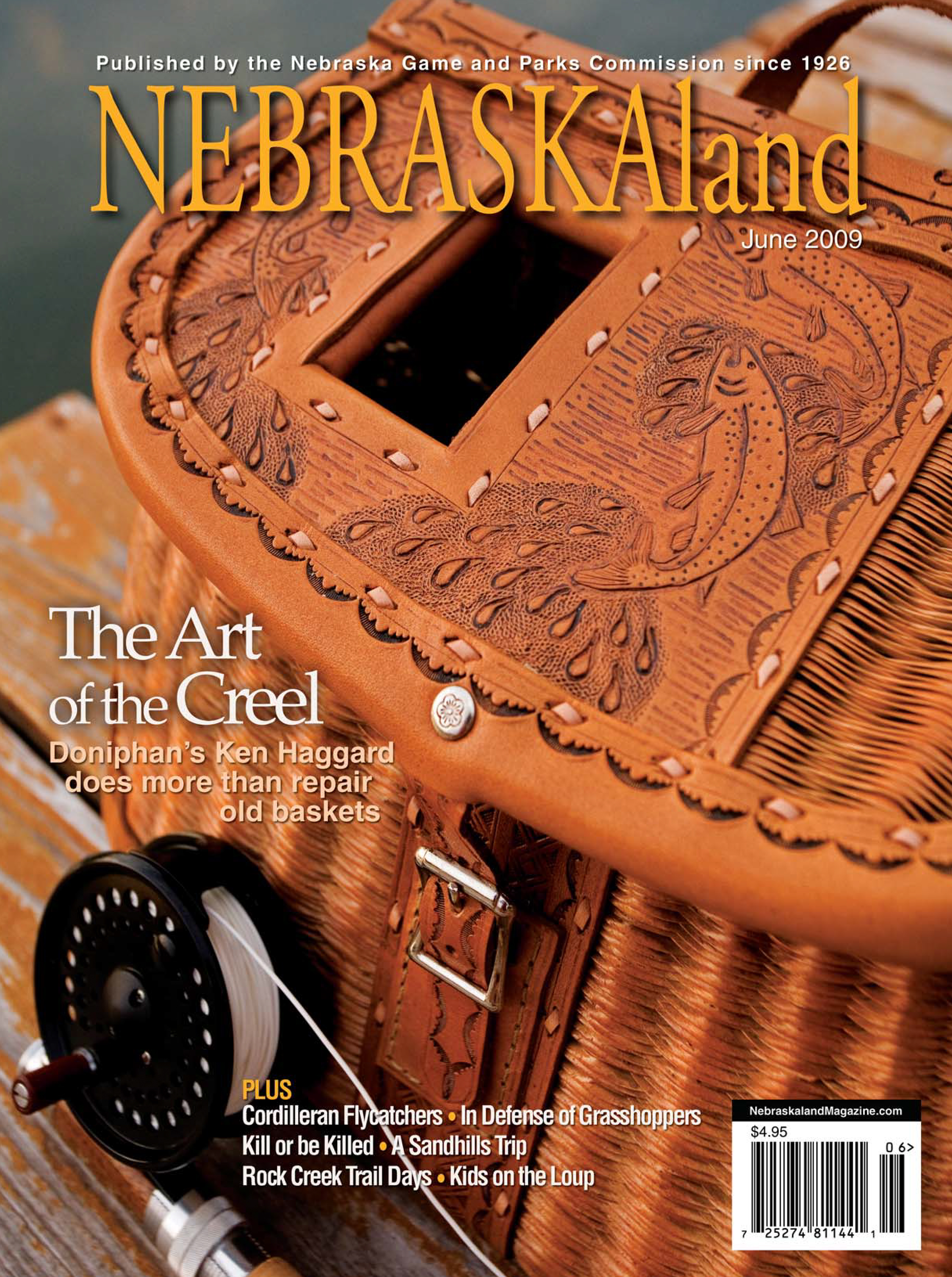
Cover: Creels have a long history related to fishing, and Doniphan creel maker Ken Haggard
is trying to assure that one of fishing’s most recognizable items survives into the future. See
story beginning on page 12. Photo by Jeff Kurrus.
Opposite: A snapping turtle crosses a gravel road on a June afternoon near Lewis and
Clark State Recreation Area. Photo by Jeff Kurrus.
NEBRASKAland (VOL. 87 / NO. 5, ISSN 0028-1964) is published monthly, except for the
combined Jan./Feb. and Aug./Sept. issues, by the Nebraska Game and Parks Commission,
2200 N. 33rd St., Lincoln, NE. Periodicals postage paid at Lincoln, Nebraska, and additional
mailing offices. POSTMASTER: Send address changes to NEBRASKAland, P.O. Box 30370,
Lincoln, NE 68503-0370.
36
●
JUNE 2009 • NEBRASKALAND 3
Published by the
Nebraska Game and
Parks Commission
Director: Rex Amack
Assistant Directors:
Roger Kuhn, Kirk Nelson, Sam Sidner
Information & Education Administrator:
Doug Bauch
Commissioners
Chairman:
James Ziebarth, Wilcox
Vice Chairman:
Jerrod Burke, Curtis
2nd Vice Chairman:
Mick Jensen, Blair
Dr. Mark Pinkerton, Wilber
Ron Stave, Waterloo
Dr. Kent Forney, Lincoln
Lynn Berggren, Broken Bow
Rex Fisher, Omaha
Mark Spurgin, Paxton
Magazine Staff
Easter Fox Kits
I was wondering if you have any
interest in pictures of a red fox with
seven babies. We were driving along
Nebraska Highway 2 towards Cairo on
Easter morning when we noticed the
fox and her young ones in a cornfield
next to the road. The babies were
playing on top of the den with no care
in the world. The mother was circling
the den while we were taking pictures,
then she ran out into the cornfield a
ways and stopped to watch us. We
thought it was pretty neat since the
pups hadn’t changed colors yet.
Sue Carkoski
Grand Island, Nebraska
Editor: Doug Carroll
Associate Editor: Jeff Kurrus
Art Director: Tim Reigert
Senior Editor: Jon Farrar
Regional Editors:
Eric Fowler, Bob Grier, Rocky Hoffmann
Photo Librarian: Sarah Johnson
Marketing/Advertising:
Jane Gustafson
Old Spaces
“Old Spaces” (May 2009) by Bob
Grier was a true pleasure to read and
even more enjoyable to look at. I know
how important it is to preserve species
such as the Salt Creek tiger beetle, but
I bet if a readers survey were taken,
you would also find plenty of votes to
spend tax money on keeping man-made
treasures such as those in the story
from becoming extinct.
Keith Hansen
Beatrice, Nebraska
For advertising information e-mail
ngpc.advertising@nebraska.gov
or call (402) 471-5481
Circulation:
Donna Robinson
For address changes and questions about
your subscription, e-mail
donna.robinson@nebraska.gov
or call (800) 632-5263
NEBRASKAland Magazine
Copyright 2009, all rights reserved.
NEBRASKAland is available on audio cassette from the
Nebraska Library Commission Talking Book and Braille
Service, Suite 120, 1200 N St., Lincoln, NE 68508. (800)
742-7691. NEBRASKAland Magazine and the Nebraska
Game and Parks Commission reserve the right to reject
any advertising not in keeping with the agency mission.
Rates: $18 for one year; $33 for two years; $44 for
three years. Nebraska recipients must add
appropriate sales tax.
To subscribe call 1-800-NEBLAND (632-5263),
or go online to: NebraskalandMagazine.com.
4 NEBRASKALAND • JUNE 2009
and he shot this turkey at 7:25. It
weighed 25.02 pounds, the beard was
111/2 inches long, and the spurs were
19/16 of an inch. Garrett was so excited!
He went on his first turkey hunt
when he was four years old and couldn’t
wait until he was big enough to hold a
gun up to shoot one himself. He shot
it with his Charles Daly 20-gauge. He
likes to point out to everyone that his
turkey was bigger than any that his dad
has ever shot and he is only seven and
his dad is 37 (Dad is kind of regretting
mentioning that to him). I think it was
the best hunting day ever for all three
generations.
Sincerely, one proud mom,
Lee Clark
Salem, Nebraska
Mine’s Bigger!
Here’s a picture of Garrett, our
seven-year-old son, with his first
turkey. Garrett, his dad and his grandpa
(all lifetime hunters) went out opening
day of the youth turkey season. The
night before, Garrett couldn’t get to
sleep until about 11:45 because he was
so excited, then he got up at 5 a.m.
ready to go. They sat in a ground blind
Arbor Day Fans Fight Back
It’s disappointing to see your magazine
become a platform for people with
extremist views. I’m referring to the
article by Eric Fowler: “Kill a Tree for
Arbor Day.” Many Nebraskans who are
working to protect our environment
through some of the many programs
available do not share Fowler’s slanted
views. Programs such as: Retree
Nebraska, the new NRD/NRCS tree
program, Pheasants Forever Corners
for Wildlife, and the Arbor Day
Foundation help protect water, air, soil,
wildlife and slow the effects of global
warming.
Regardless of Fowler’s distorted
views, it’s a slap in the face to all
Nebraskans for your magazine to insult
our rich history this way. What’s next
on your agenda, “Burn a Flag for
Independence Day” or “Degrade a Vet
for Veterans Day?” I hate to think what
Fowler would write for Martin Luther
King, Jr. Day. Our forefathers had the
knowledge and foresight to see what
value trees could have in our state and
honored the efforts of many people,
past and present, with Arbor Day. I
suggest that you keep personal and
agency agendas out of your magazine
and concentrate on the richness and
history that make Nebraska such a
wonderful state.
Randal Williams
Davenport, Nebraska
Mr. Williams’ letter was one of a
couple we received in regards to this
article, but most readers who read Eric
Fowler’s article in its entirety appear
to understand his point – as a whole,
trees are indeed very good things and
definitely have their place in the
environment. Eric also recommended
several of the same organizations
promoted by some of the people who
wrote in. However, not every tree is a
good tree, and some habitats (and the
animal and plant species that inhabit
them) are much better off either without
trees at all, or with trees that are
properly managed.
— Editor
Send your comments to:
Doug Carroll, Editor
NEBRASKAland Magazine
P.O. Box 30370
Lincoln, NE 68503
or e-mail doug.carroll@nebraska.gov
Please include your postal address and
telephone number.
Letters may be condensed and edited
for clarity. Photographs are
welcome and will be returned.
Under federal and/or state law, discrimination is prohibited on the basis
of race, color, religion, age, gender, marital status, national origin,
disability or political affiliation. If you think you have been discriminated
against in any program, activity or facility by the Nebraska Game and
Parks Commission or want more information, contact the Commission in
Lincoln, NE, at (402) 471-0641 or the Equal Opportunity Commission,
Lincoln, NE, (402) 471-2024, TTY/TDD (402) 471-4693).
Headquarters
2200 N. 33rd Street
Lincoln, NE 68503
Phone (402) 471-0641
District Office I
East Hwy. 2, Box 725
Alliance, NE 69301
Phone (308) 763-2940
District Office II
524 Panzer St., Box 508
Bassett, NE 68714
Phone (402) 684-2921
District Office III
2201 N. 13th St.
Norfolk, NE 68701
Phone (402) 370-3374
District Office IV
301 E. State Farm Rd.
North Platte, NE 69101
Phone (308) 535-8025
District Office VI
1617 First Ave.
Kearney, NE 68847
Phone (308) 865-5310
Omaha Office
1212 Bob Gibson Blvd.
Omaha, NE 68108
Phone (402) 595-2144
Ak-Sar-Ben Aquarium
21502 W. Highway 31
Gretna, NE 68028
Phone (402) 332-3901
World Wide Web site: www.OutdoorNebraska.org
Administration
Ted Blume (Adm.)
Craig Stover (Asst.)
Wes Loos (Asst.)
Rod Loos (Asst.)
Murray Johnson
Lincoln
471-5531
Lincoln
471-5532
Lincoln
471-5591
Ogallala (308) 284-8056
Lincoln
471-5003
Panhandle
Officer
City
Phone (308)
Jim Zimmerman (Sup.) Gering
436-7561
Walt Meyer
Chadron
432-4398
Scott Brandt
Gering
436-3418
Heath Packett
Gordon
282-2553
Dennis Thompson
Lemoyne
355-2024
Dan Zuehlke
Ogallala
284-4815
Doug Pollard
Oshkosh
772-9950
Frank Miller
Valentine (402) 376-1183
Dan Kling
Whitney
432-8367
Southwest
Officer
City
Phone (308)
Roger Thompson (Sup.) N. Platte
532-9175
Ray Dierking
Brkn. Bow
872-3078
George Sund
Cambridge
697-4629
Michael Thome
Cozad
784-4362
Matt Andrews
Elwood
785-3025
Dirk Greene
Imperial
882-5328
Virgil Gosch
McCook
345-2185
Dudley Sorensen
N. Platte
532-0747
Rich Routh
Rep. City
799-2085
South-central
Officer
Jerry Pecha (Sup.)
Jeff Jones
Terry Brentzel
City
Phone (308)
Kearney
865-5327
Clay Center(402)762-3124
Doniphan (402)845-2021
Randy Pomplun
Darin Gress
Dale Johnson
Mark Reeves
Robert Finke
Fullerton
536-2987
Hebron (402) 768-2287
Kearney
237-1079
Loup City
745-0662
Milford (402) 761-3537
Northeast
Officer
Tom Zimmer (Sup.)
Dale Davis
Ross Oestmann
Steve Oberg
Daniel Roberts
Jon Reeves
Marion Shafer
Pat George
Eric Wiebe
Tim Williams
Cory Krause
City
Phone (402)
Norfolk
371-6625
Bassett
273-1700
Bloomfield
373-4412
Columbus
564-5937
Fremont
721-7852
Kennard
427-7378
Norfolk
371-2031
O’Neill
336-1588
Ponca
755-2566
Neligh
887-1335
West Point
372-6979
Southeast
Officer
Duane Arp (Sup.)
Sean McKeehan
William Krause
Mike Luben
Douglas Kramer
Dina Barta
Stacey Lewton
Levi Krause
Russell Mort
Dan Evasco
Jeff Clauson
City
Gretna
Ashland
Auburn
Colon
Lincoln
Lincoln
Lincoln
Louisville
Nebr. City
Papillion
Waterloo
Phone (402)
332-2965
944-4174
274-3789
443-4278
466-9001
483-2358
476-0436
234-2212
873-5684
592-6733
359-5301
Nebraska Wildlife Crimestoppers 1-800-742-7627
JUNE 2009 • NEBRASKALAND 5
PHOTO BY ROCKY HOFFMANN
Feather Colors
6 NEBRASKALAND • JUNE 2009
Woodland
Pinedrops
Julie Watts
Pinedrops
(Pterospora
andromedea),
rarely seen in
Nebraska, have
knee-high
reddish stems
covered by ivory-colored balls which
hang like small ornaments. Native to
North America, they are most commonly
found in the western half of the
continent, and are part of the
Monotropaceae family. Growing one to
three feet tall, the spikes (or racemes)
grow in clusters in the heavy soils of
coniferous forests. Stems arise from a
tight ball of roots, producing flowers at
about four weeks, the first usually
opening in June. New shoots can be
produced throughout the growing season.
The sepals appear hairy and have a
sticky feel. In late July and August,
anywhere from 20 to 128 fruiting
capsules are produced, each bearing up
to 4,800 wind-dispersed seeds. Even
though these plants are perennial, they
may not appear above ground every
year. The color of pinedrops is due to
their lack of chlorophyll. The plant
forms a mycorrhizal relationship, which
is a mutually beneficial association of a
fungus and plant root, to obtain nutrients.
PHOTO BY JULIA WATTS
Jon Farrar
We think of colors as coming from
pigments such as those used in paints.
The plumage colors of some birds are
the result of pigments in their feathers,
but other colors are produced by the
structure of their feathers. This is also
the case with colors found on some
fish, reptiles and insects.
Three pigment groups produce colors
in birds. The presence of melanins
result in colors ranging from black to
browns to pale yellows. In addition to
providing color, feathers containing
melanins are more resistant to wear,
probably explaining black on wing
margins (which are most subject to
wear) of otherwise white birds such as
the American white pelican, whitephase snow geese and whooping
cranes. Carotenoids are pigments birds
obtain from eating plants, and account
for the brilliant red of male cardinals
and the vibrant yellow of American
goldfinches. The third pigment group is
the porphyrins, produced by modified
amino acids and creating many pinks,
browns, reds and greens seen in bird
plumages.
Feather color can also be created
without pigments by the refraction of
light. White light is actually composed
of all the colors of the spectrum –
something easily observed when it
passes through a prism and is separated
into all the colors of the rainbow. Such
“structural colors” are created by the
arrangement of specialized cells in
feathers – some colors of the spectrum
are absorbed and some reflected.
Nearly all blue feathers are created in
this way. If a blue jay feather is
crushed, disrupting or destroying the
feather structure, the blue color
vanishes and it becomes brown.
Iridescent colors, as seen on
mourning doves or the speculums of
ducks, are created in a similar fashion.
That is why the color of iridescent
feathers changes relative to the
direction of light and angle of the
viewer to it; why a drake mallard’s
head appears emerald green when
viewed from one angle, almost black
from another. Some colors found on
birds are a combination of pigment
color and structural color. Nearly all
birds with greens, such as hummingbirds,
owe their hues to a combination of
yellow pigment blended with blue
structural color.
So, the next time you view a bird
through field glasses, do not be so sure
what you are seeing really exists –
even the most vibrant colors may be no
more than an optical illusion.
•
For more information on rare plants
in Nebraska, log on to
http://www.natureserve.org/explorer/.
NatureServe compiles information
about plant and animal distribution and
conservation, and identifies pinedrops
as ‘imperiled’ in Nebraska. They can be
found in the pine woodlands/forests in
the Pine Ridge, Wildcat Hills and along
the Niobrara River.
Outdoor Message Plates
Doug Echtenkamp of Lincoln has
been fly-fishing across Nebraska and
the country since picking up his first
fly rod while at Kearney State College
in 1971. He’s advertised his passion on
his license plate for about eight years.
If you have a unique message plate
you would like to share, or know
someone who does, e-mail a photo
(.jpg format only, please) to
eric.fowler@nebraska.gov, along with
your name and hometown, how long
you’ve been active in your hobby and
how long you’ve had your message
plate.
Fishing’s Top 10
PHOTO BY BILL HAGER
Chasing Raptors
Jeff Kurrus
On a recent drive near Lincoln, I saw
a familiar but confusing sight – a small
bird chasing away a larger raptor.
Curious as to what exactly was
occurring, I spoke with Joel Jorgenson,
a Nebraska Game and Parks
Commission biologist. “Passerines
often chase larger raptors when they
are in the vicinity of their nests/young.
Western kingbirds, eastern kingbirds
and red-winged blackbirds are often
the usual suspects and species such as
red-tailed hawks and bald eagles
(pictured) are the ones at the receiving
end. Sometimes the smaller passerine
will make contact and even appear to
‘ride’ the hawk.” Because these
smaller birds have such great
maneuverability when in close
proximity, larger raptors are less likely
to be able to quickly retaliate.
8 NEBRASKALAND • JUNE 2009
Recently, the American Sportfishing
Association (ASA) announced their top
10 list of “Products That Transformed
an American Pastime” over fishing’s
last 75 years. The list was determined
by members of the Anglers’ Legacy
Ambassadors, in collaboration with
ASA, regarding their thoughts on
fishing’s most instrumental products.
Original Floater Minnow (1936)
remains one of
the most
successful and widely
copied hard lures in sportfishing’s
history.
Original and current manufacturer:
Rapala.
Spring-loaded Bobber (1947) made
suspending a baited hook at a desired
depth simpler and easier. Even today
this item is in virtually every angler’s
tackle box.
Original manufacturer: Nibble Nabber.
Current: Various companies.
Mitchell 300 (1949) was the first
commercially successful spinning reel,
and is still one of the most common
reels used today.
Original manufacturer: Mitchell.
Current manufacturer: Pure Fishing.
•
•
•
Creme Plastic Worm (1949)
changed the sport forever as the
first – and still famous
– long-lasting
artificial worm
that both looked
and felt real.
Original and current manufacturer:
Creme Lure Company.
Closed-face Spincast Reel (1949)
made fishing easy and affordable to
everyone regardless of age, size, gender
and expertise.
Original manufacturer: Zero Hour
Bomb Company.
Current Manufacturer: ZEBCO Brands.
Lowrance Fish Lo-K-Tor (1957),
the “Little Green
Box” introduced
anglers to the use
of sonar in
locating
individual fish.
Original
Manufacturer:
Lowrance
Electronics.
Current:
Lowrance/Navico.
Monofilament
Line (1958) improved
the durability,
affordability and casting ability of
fishing line while reducing its visibility
to fish.
Original manufacturer: DuPont Stren.
Current manufacturer: Pure Fishing.
Minn Kota Trolling Motor (1958)
was the first electric, gear-driven
trolling motor that gave anglers the
ability to quietly maneuver and position
their boats.
Original manufacturer: Minn Kota.
Current manufacturer: Johnson
Outdoors.
Fenwick High Modulus Graphite
Rod (1972), with its super-sensitive
carbon (graphite) fibers, revolutionized
the method of making fishing rods and
how anglers fished.
Original Manufacturer: Fenwick.
Current Manufacturer: Pure Fishing.
Shakespeare Ugly Stick (1976),
with its special construction, this
fishing pole created an affordable,
unbreakable and dynamic fishing rod
that’s still in use today.
Original and current manufacturer:
Shakespeare.
•
•
•
•
•
•
Here is a list of
upcoming outdoor
events across
Nebraska.
For more
information
about
these and
other events, click on
the calendar at
www.OutdoorNebraska.org.
May 30
• Niobrara SP Buffalo Cookout
June 2
• Family Fishing Night – Prairie View
Lake, Bennington
June 6
• Calamus Carp Tournament
• Victoria Springs SRA “VIK” Day
June 6-7
• Rock Creek Trail Days, Rock Creek
Station SHP
• Muzzleloading demonstrations and
trail maintenance at Indian Cave SP
• Fort Atkinson SHP living history
demonstrations
June 9
• Family fishing night, Holmes Lake,
Lincoln
June 11
• Pony Express Reride at Midnight,
Fort Kearny SHP
June 12
• Star Gazing Party, E.T. Mahoney SP
June 12-13
• Ash Hollow Pageant, Ash Hollow
SHP
June 13
• Niobrara SP Buffalo Cookout
June 17
• Family fishing night, Halleck Park,
Papillion
June 20
• Pawnee Storytelling, Fort Kearny
SHP
• Father’s Day Fossil Hunt, Ponca SP
• Chadron SP 88th Anniversary
• Calamus SRA bike tour
June 24
• Family fishing night, Bowling Lake,
Lincoln
June 27
• Carp-O-Rama, Pawnee SRA
June 28
• Bowring Ranch Sod House Sunday,
Bowring Ranch SHP
JUNE 2009 • NEBRASKALAND 9
Casting Stones
During the summer months, conservation officers have to patrol the
campgrounds of the state. One of the major problems we have is
alcohol consumption. When I first started in 1992, alcohol was
allowed on our campgrounds, and during summer weekends large
parties would take place. Domestic violence and child abuse/neglect
were a problem in the campgrounds and local rural volunteer fire
departments were constantly being called to the campgrounds for
unresponsive individuals. A few incidents of drunk drivers running
into tents also occurred, so in 1994 alcohol was banned in state parks.
Some people still question why they cannot enjoy a beer while they
fish or camp, but because we have no way of knowing if a person will
drink just one beer or consume a case and be a problem later in the
day, we have to treat everyone the same.
Early evenings are the best time to patrol a campground to see where
there might be a potential problem later. You can see where there are
large groups that might have alcohol, which campsites have large
dogs, which groups are glad to see you and which ones are not.
Conservation Officer Mike Luben and I were patrolling Pawnee
Lake one evening and as we pulled into the electrical campgrounds,
we noticed a small, gray car full of teenage boys who looked at us
hard out of the corner of their eyes as they went by. We wondered
what they were up to.
I was driving slowly, and near the end of the campsites, we
observed four elderly gentlemen sitting in lawn chairs. One stood
up when he noticed me and waved me to stop. As he approached, I
observed he was carrying a can. I said to him “That better not be a
beer your carrying up to my vehicle.” While his buddies grinned, the
man turned around, walked to a tree, and “hid” the can behind the
tree. I guess he believed since I no longer could see it, it didn’t exist.
The gentleman approached my vehicle again and said, “There are
four boys in a small, gray car speeding all over the place. They are
going to hurt someone.” I smiled, remembering the
look I got from the boys, and stated, “Well, that’s
ironic! Four boys in a small, gray car just stopped me
to tell me there are four old men up here drinking
beer.” The man just stared at me, but his buddies
almost fell over in their chairs laughing.
Please try not to be breaking the law when you
decide to point out that someone else is.
– Dina Barta, Conservation Officer, Lincoln
High School Bowhunter 3D
Championships
The 2009 Nebraska High School
Bowhunter 3D Championship will be
held June 6 at the Prairie Lake Archery
Range outside of Hastings.
Hosted by the Cottonwood Archery
Club and sponsored by the Nebraska
10 NEBRASKALAND • JUNE 2009
Game and Parks Commission, this free
event is open to all 12- through 18-yearold students who attended school or
were homeschooled in 2009 and have
completed a Bowhunter Education
course.
Individual competitors will compete
in two divisions – senior, age 15-18; and
junior, age 12-14. There will also be a
team competition, composed of fourmember teams representing the same
school or 4-H club. Classes for the
competition are traditional – long bow,
recurve or bare bow; freestyle limited –
no releases allowed, finger shooters only;
and freestyle – release aids allowed.
For more information or to pre-register,
contact match director Darryl Parde,
(402) 984-7270, greatplatte@alltel.net;
or Mark Eggers, (402) 368-5588,
mjeggers@cableone.net.
Centaur with a Straw
Fran Higgins
Hummingbird moths (Hyles lineata)
enjoy sweet nectar at dusk, hovering to
feed on phlox, lilac, clover, petunia,
honeysuckle and other varieties. In
North America they mostly inhabit the
deserts of the west, but also range
throughout the country, including city
gardens like mine in Omaha.
Except for their quick, darting
movements, these cute, furry-bodied
insects almost blend with the plants
they pollinate – their wings beat so fast
they’re practically invisible and the
pink bands on the back of their wings
match the flowers they feed on.
Wingtip to wingtip, they’re about 21/2 to
3 inches wide, much larger than the
regular moths we see banging into
lamps outside at night.
Hyles means “of the woods” but was
also the name of a centaur in Greek
mythology: half man, half horse.
Equally enigmatic, these moths in
flight appear to be birds and at rest they
look like butterflies, yet they are neither.
Hence, they are also known as
hummingbird moths or hawk moths.
The species name, lineata, describes
the lines on the forewings, and
although their colors are muted, the
markings are quite striking.
The long, whip-like proboscis – or
feeding tube – can apparently exceed
10 inches in some species, allowing
them to sip from a distance like a person
with a soda straw.
Rich Wissink at rwissink@pheasants
forever.org, (715) 722-0286.
Herpetology Workshop
Project WILD workshops will be held
in Neligh and Loup City on June 29
and June 30, respectively, for people
interested in becoming certified to
teach the program’s activities.
Project WILD is a conservation and
environmental education program that
uses hands-on, inquiry-based activities
to help students develop problemsolving, decision-making, observation,
classification and research skills.
Participants in these free workshops
will receive hands-on instruction from
environmental education specialists,
Project WILD certification and Project
WILD K-12 curriculum and activity
guides. To register or find out more
information about the Neligh workshop,
contact Jamie Bachmann at (402) 3703374, prairiemama@gmail.com. For the
Loup City workshop, contact Jeanine
Lackey at jeanine.lackey@nebraska.gov,
(402) 471-5581. The workshops are limited
to the first 25 people who register. ■
A free, hands-on herpetology
workshop will be held June 12-13 at
Lake Ogallala. Herpetological experts
will bring live native specimens to the
workshop for observations and study,
and participants will also explore local
habitats in search of local herpetofauna.
The workshop is designed for biologists,
teachers and naturalists, but anyone
wanting to learn more about Nebraska’s
snakes, frogs, turtles, salamanders and
lizards, as well the conservation issues
involving them, is welcome to attend.
Workshop space is limited to the first
30 participants who sign up. For more
information and to register, contact
Amanda Keep at amanda.keep@
rmbo.org, (308) 220-0052; or Jeanine
Lackey at jeanine.lackey@nebraska.gov,
(402) 471-5581.
Focus on Forever
Project WILD Workshops
A Look Back- June 1969
Jeff Kurrus
Forty years ago this month,
NEBRASKAland Magazine focused
on the rodeo boom town of Nora
in Nuckolls County, Toadstool Park
in the
Badlands,
and the
northern
grasshopper
mouse.
An article
entitled
“Zany
Patents”
recounted
outdoor-related inventions with
names like Gun In the Hat, Two
Men in a Cow, and Curved Gun, all
amusing, and easily imaginable,
concoctions that reflect the article’s
subtitle: “When men strive to
outfox game or fish, odd inventions
are result.”
The 2009 Focus on Forever workshop
will be held July 17-19 at the Holiday
Inn in Grand Island.
Hosted by Pheasants Forever, Quail
Forever and the Nebraska Game and
Parks Commission, this workshop is
designed to give participants the
information and tools they need to
develop future stewards of the land
by providing outdoor adventures that
connect youth and their families to wild
places and the wildlife that live there.
Some of the seminar topics at the
workshop will include: teaching
wingshooting skills to kids, reading the
landscape with a GPS unit, improving
youth mentor hunts, introducing youth
to archery, starting a local shooting
team, and teaching plant identification
skills to kids.
The cost of the workshop is $250,
which includes workshop registration,
instructional materials and meals. A
limited number of scholarships are
available to cover the workshop’s cost.
For more information about the
workshop or scholarships, contact
Aaron Hershberger at aaron.hershberger
@nebraska.gov, (402) 471-6144; or
JUNE 2009 • NEBRASKALAND 11
From the Past, for the Future
Nebraskan does more than repair baskets
T
creels graced the hips of fly anglers in
years past but have probably graced the
shelves of art collectors for just as long.
Haggard has collected creels since
1978, but upon retirement from a
Grand Island bank in 2005, he shifted
his attention to restoring them. “I was
given The Art of the Creel and thought,
‘I can do this,’” said Haggard. Haggard
had several objectives he wanted to
accomplish with his work – he wanted to
work with vintage baskets that were 65
to 100 years old and in good condition,
and he wanted to use premium, oildyed leather for the tooling, carving
and hand sewing he would be doing.
Haggard is no basket maker, as he
will tell you, but there is more to a
creel than its basket. “On an average
creel, I’ll use six to eight square feet of
leather,” Haggard said, standing in his
home-based workshop. “It will take me
about two weeks per creel, working
five to eight hours a day. At least one
PHOTO BY KEN HAGGARD
hey are among us. Collectors and
fashioners of yesteryear. And their
fishing lures, shotguns, shotshell
boxes and fly reels are safely guarded
by glass at local outdoor retailers and
antique shops. They are the baseball
card collectors of the outdoor world,
wondering if it’s better to hold on to a
1951 Mickey Mantle or a 1954 Hank
Aaron if forced to make such a gutwrenching decision.
Rarely, however, do we see the
fashioners of tomorrow’s antiques, the
wooden decoy and handcrafted turkey
calls that will grace collectors’ shelves
in future years. Even rarer is to meet a
person who works with materials that
are so familiar to the active sportsman,
yet also so foreign.
Doniphan resident Ken Haggard
restores fishing creels, a not-so-commonly
used piece of fly-fishing gear in today’s
world. Used to store caught fish, maybe
even a sandwich and drink for the day,
Above: Haggard fashions creels with a variety of features, including knife sheaths.
Right: Carved and buck-stitched trout highlight Haggard’s “Trout Supreme” creel.
12 NEBRASKALAND • JUNE 2009
day to prep the basket by removing old
leather, cleaning, re-shaping, bleaching
and performing minor repairs, then two
days to tool, carve and emboss the
leather. The dying process is another day,
followed by the leather highlighting and
protective sheen process which takes two
more days. Hand-sewing the leather to
the basket then takes at least three
more days.
“By the end, after spending $300 to
$400 in materials, I’m not making
much more than minimum wage,” he
laughed. While Haggard has seen
contemporary creels sell for $1,600 to
$3,600, his run between $1,200 and
$1,500. “It’s a labor of love,” he said.
“I’m definitely not getting rich.”
Haggard’s clients come in all sorts –
the 97-year-old man who asked
Haggard to re-leather his creel for his
son; or the gentleman that asked him to
replace the basket and rework the 1910
leather of his family creel, making it
look and smell like new. Custom orders
have also come from creel collectors
and interior decorators for the home,
office or cabin. “There are a lot more
lure and rod collectors than there are
creel collectors,” Haggard said, “but
what people are starting to desire is
having a high-quality heirloom that can
be handed down to family members.”
Customers have many decisions to
make regarding their creels – how
many and what type of fish should be
engraved in the leather? What type of
thread and stitching should be used?
What color? How large? “There is
blood in every creel from that freaking
awl,” said Haggard, smiling. “There’s
also some cussing.” Because of all
these choices, no two creels are ever
the same.
Like most other existing creels,
Haggard’s are seen as collectibles. He
attends antique shows throughout the
country, and more than once has sold
out of his product before a show has
PHOTO BY JEFF KURRUS
By Jeff Kurrus
A Brief History of Creels
even begun. He’s been approached by
companies wanting him to make more
creels and to make them faster, but
Haggard doesn’t want an assembly-line
business – he wants a passion he
enjoys, and he wants to put as much
time, and blood, in each creel as he can.
Even though he knows his creels
probably won’t stay on the front lines
of fishing, his job is to make sure they
remain in the consciousness of fishing
history. “Mr. Haggard, don’t get your
feelings hurt,” one client recently told
him, “these are going to get used.”
Haggard knows the reality, however,
and he’s okay with that.
Fishing is now too often seen as
broadcasting the biggest and the
brightest. Without those like Haggard,
we would be left with only the current
nylon and plastic representations of
yesteryear’s creels – they might still
adorn shelves, but they would be seen
in miniature, mere facsimiles of what
they once were. Current makers of
creels, the very few that exist, are
assuring that history is preserved.
Even if these items, so steeped in
angling lore, never again carry a newly
caught fish. ■
14 NEBRASKALAND • JUNE 2009
Exporters, however, began sending
creels to the American colonies. From
there, creels were fashioned according
to the availability of local goods and
the style of a particular culture.
Makers along North America’s west
coast constructed creels from baleen,
which is the flap of a whale’s upper
jaw. Both Native American and
Euroamerican groups east of the
Mississippi were known for their
eastern woodland creels and their
checker-woven basket style.
Watermelon creels were made
throughout the country from grape
vines and oak splints. Leatherreinforced creels were first practical in
their usage and became popular in the
American West
because creels used
along that region’s
rougher rivers needed
reinforcement to
keep them from
breaking. The George
Lawrence Company
is synonymous with
the leathered creel,
and at least 10
different Lawrence
styles were available
at the beginning of
the 19th century.
In addition, the work of other U.S.
creel makers was distinguished by a
variety of factors, including the leather
work and how they were hinged,
stitched and embossed. Creel makers
McMonies, Clark, Peters, A.E. Nelson,
Turtle and Whitney Sporting Goods
were known for their distinctive styles,
and creels were sold throughout the
country by various outdoor retailers,
including Abercrombie & Fitch.
Following World War II, however,
the American production of creels
lessened considerably. Currently, there’s
a small number of artists working with
them, which makes the work that
Haggard and his contemporaries do
that much more important to preserving
the history of creels. ■
.
irca 1700
er creel c
th
a
le
h
s
li
Eng
l.
Cedar cree
creel.
oodland
Eastern W
CCLAIN
OF DAN M
URTESY
OTOS CO
CREEL PH
RIGHT: Creel maker Ken Haggard flyfishes while one of his self-made creels
hangs at his hip.
PHOTO BY JEFF KURRUS
ABOVE: Considered the authoritative
guide on creels, The Art of the Creel by
Hugh Chatham and Dan McClain gives a
history of fishing creels made throughout
the world. Organizing creel makers by both
name and geographic region, the authors
provide a pictorial history of these artifacts,
explaining how art was such an important
aspect of creel development.
T
hey are a symbol of fishing, both
on the mantle and in the language
itself. Our fishing limits are often
referred to as “creel” limits, and it is
nearly impossible to view outdoorrelated decorations without seeing
creels. As said in The Art of the Creel:
“The creel, the basket to hold fresh
fish, has become the icon of the
modern fly fishing industry. Creels
appear as part of the logos of smart
shops, advertising agencies use them
for props, decorators put flower pots in
them to decorate homes, window
trimmers utilize them in department
store windows and the cover paintings
on old hunting and fishing magazines
show creels in use. But one hardly ever
sees them on a stream,
in the use for which
they were intended.”
Stream anglers
once used creels
while fishing as
portable and handy
storage. Because of
its permeable design,
air could circulate
through it to keep fish
cool, and its top kept
flopping fish from
escaping. Their form
is standard: flat
bottomed, shaped to fit the curve of
the body, with a lid and a hole to
drop fish through. A shoulder strap
was frequently used. Creels were made
with willow, split bamboo, rattan, palm,
ash, oak, bass and other trees. Some
were even made out of metal.
Creels were originally fashioned, in
their current form, around 1665, when
a willow creel was first pictorially
referenced in Robert Venables’ The
Experienced Angler. Other sources
suggest that creels have existed since
1250, and it has been recorded that
creels have been made throughout the
world, including Japan, the rest of Asia
and Europe.
In Europe, specifically, leather
creels became fashionable during the
17th century. Yet by the middle of the
18th century, the popularity of creels,
comprised mostly of leather, had faded.
For more information about Haggard
Creels, visit Customcreels.com.
any creel.
ce Comp
n
re
w
a
L
George
They still play outside in Genoa
Photos and text by Eric Fowler
K
ids don’t play
outside as much as they
used to. At least that’s
what some people say.
They’re inside playing
video games, watching
the tube or surfing the
net instead of playing
at the park, splashing
in the gutter during a
warm summer rain or
exploring the “crick.”
Of course, that’s not the
case with every kid in
every town. Especially
in one like Genoa.
Left: Elli and Conner Johnson of
Osceola run through the shallows
of the Loup River south of Genoa.
Above: Walker Olson, Brennan Reeg,
Devon Korth and Caleb Brezina rig
their poles at the Loup Power
District canal on the edge of town.
JUNE 2009 • NEBRASKALAND 17
D
rive south from this small, east-central Nebraska
town and there’s a good chance you’ll see kids
outside doing something. Which makes sense,
considering there is so much to do on the edge of
town. They’re often fishing for drum and catfish
in the Loup Power District canal or wading and
skipping rocks in Beaver Creek. When they’re old
enough and have earned the trust of their parents,
they can hop on their bikes and pedal less than two
miles farther south to swim in the Loup River. If
they haven’t reached that point, they beg their parents
for a ride to Headworks Park west of town. When
their parents tell them they can’t stay out all day,
they ask “Why not?”
Left: Mike Johnson and his children, Elli
and Conner, swim in the Loup River
alongside Don Dworak Wildlife
Management Area.
Above: A fishing trip to the canal is a
short bike ride from home for boys in
Genoa.
Right: Walker Olson wears the evidence
of a day of playing in Beaver Creek.
18 NEBRASKALAND • JUNE 2009
“W
e come down here to
fish until we’re out of bait,”
said Genoa’s Caleb Brezina.
“Once we run out of bait, we
take a day off until it rains and
go nightcrawler hunting. We’ve
got a ton around here.”
JUNE 2009 • NEBRASKALAND 19
T
o see them out there, getting dirty, sunburned and
bug bitten, and having so much fun doing it, is like
being transported to a time when that’s what kids did.
It makes you think how lucky they are to live near so
much. And wish you were a kid again, living in
Genoa or some other town blessed with a crick. ■
Occasionally, a check of the seine would bring calls of “Ahhh! The motherload!”
Brezina, Olson, Reeg and Korth ham it up with part of their seining haul from Beaver Creek.
T
hey don’t care that the water isn’t filtered or disinfected with chlorine. Or that the
activities aren’t organized, like so many are these days. “I like the peace and quiet,”
Brezina said. “It gives you time to think.” About what, girls? “Sometimes. I think
about what I’m going to do with my life. I think about big fish ... and the ones that got
away.” Said Brennan Reeg, “We’re the only ones who can catch the big one.”
20 NEBRASKALAND • JUNE 2009
Reeg and Korth help free Olson from knee-deep silt in Beaver Creek.
JUNE 2009 • NEBRASKALAND 21
Rock Creek
Trail Days
Text and photos by Eric Fowler
A weekend of living history celebrates Rock
Creek Station State Historical Park’s colorful past.
W
hile it’s not always the case,
often there are indeed, as the old
saying goes, two sides to every
story. In some cases, including the
story of the shooting of three men at
Rock Creek Station in 1861 by “Wild
Bill” Hickok and others, there are
many more.
At Rock Creek Trail Days, held the
first weekend in June each year to
celebrate the history of what once was
an Oregon Trail outpost and Pony
Express Station and is now a state
historical park southeast of Fairbury,
visitors get to learn several sides of the
story of the fight turned deadly firsthand
from reenactors.
The story begins in 1857, when S.C.
and Newton Glenn established an
Oregon Trail trading post on the west
side of Rock Creek. Two years later,
David McCanles, who had fled North
Carolina to escape embezzlement
charges and was on his way to the
goldfields of Colorado, arrived at
the station. By the time he did, he’d
already crossed paths with disgruntled
gold seekers who had failed to strike it
rich and were headed back east.
McCanles could have trudged on or
turned tail, but instead he bought Glenn’s
trading post and traded his dreams of
gold for ranching and business.
McCanles and his family built a
Stagecoach rides around the reconstructed buildings on the park’s East Ranch are a highlight for many visitors, young and old.
Old West wares are on display in the cabin (below) in the West Ranch Cabin.
In the sensationalized version of the story he told to Harper’s Magazine, Hickok said he
single-handedly killed 10 members of McCanles’ gang despite being stabbed and shot
repeatedly. Reenacting the tale at Rock Creek Trail Days in 2008 were (clockwise from
bottom) Jerry Carlson as James Wood, April Prall as Horace Wellman, Dave Prall as
Hickok and Jerry Ayers as James Gordon.
22 NEBRASKALAND • JUNE 2009
house on the east side of the creek and
a toll bridge across it, offering westward
travelers an easier crossing than the
rugged ford that had been battering
their wagons since the early 1840s. In
1860, he leased the station property on
the east side of the creek to the
Overland Stage Company for its Pony
Express, a 10-day mail service between
St. Joseph, Missouri, and Sacramento,
California. In March of 1861, an
Overland employee who would go on
to Wild West fame arrived: James
Butler Hickok.
A month later, Overland agreed to
purchase the buildings on the east side
of the creek from McCanles. They paid
him one third of the price up-front and
would cover the rest in installments.
The Pony Express, however, was a
financial failure that would close its
brief but colorful 18-month run that
fall, and Overland quickly fell behind
on payments. In June, McCanles
demanded payment from the station
manager, Horace Wellman, by July 1.
When that deadline passed, McCanles
again demanded payment from
Wellman, who agreed to get the
money from the line superintendent
in Brownville while he was there for
supplies. When Wellman returned, he
carried only news that the company
was bankrupt.
On July 12, McCanles, his 12-yearold son Monroe, cousin James Woods
JUNE 2009 • NEBRASKALAND 23
Sam Reedy of Blue Springs takes aim at the bad guys while on a stagecoach ride.
Susan Hughes of the Turkey Creek Regulators demonstrates mounted cowboy action
shooting for park visitors last year.
24 NEBRASKALAND • JUNE 2009
and friend James Gordon went to
Wellman’s house to demand the return
of the property. They were met at the
door by Wellman’s wife, Jane. When
Wellman refused to come out of the
house and McCanles threatened to
come in and drag him out, Hickok
stepped into the picture.
According to Monroe McCanles’
account of the events 54 years later,
Hickok shot his unarmed father dead
and then shot and wounded Woods and
Gordon when they ran to see what
happened. Hickok, Wellman and J.W.
Brink tracked down and killed Woods
and Gordon. Monroe ran for the creek
and escaped unharmed.
Hickok, Wellman and Brink were
arrested three days later, but in Gage
County’s first criminal case, the
charges were dismissed on grounds of
self defense. No records of the
proceedings have ever been uncovered.
The story didn’t end with the trial. In
1867, the myth of “Wild Bill” Hickok
was born on the pages of Harper’s
Magazine, in which the writer relayed
the melodramatic version of the story
as told by Hickok – how he singlehandedly killed 10 members of
McCanles’ gang despite being stabbed
and shot repeatedly. The story made
Hickok a celebrity, which he parlayed
into stints as a sheriff, marshal and
performer in Buffalo Bill Cody’s Wild
West shows, and a life of gunfights,
drinking and gambling. But it may
have also led to his early death at age
39. In 1876, while playing poker in a
Deadwood, South Dakota saloon, he
was shot in the back of the head by
Jack McCall, a transient, for reasons
that remain unclear to this day. Legend
has it that Hickok held two pairs – aces
and eights – when he was shot. A hand
now known as the dead man’s hand.
As years passed, more stories of the
McCanles-Hickok skirmish emerged,
and questions still abound. Did
McCanles initiate the fight and Hickok
shoot him in self-defense, or was
McCanles unarmed and shot in cold
blood? Did Hickok even fire the shot
that killed McCanles or was it
Wellman? Was a conflict over
McCanles’ mistress the real reason
behind the shooting?
Regardless of what happened,
reenactments of two sides of the story –
Monroe McCanles’ version and
Hickok’s, as told in Harper’s Magazine –
make for good theater at Rock Creek
Trail Days. And they certainly added a
colorful chapter to the history of Rock
Creek Station.
The living history demonstrations are
centered around buildings that were
reconstructed in the early 1980s
following archeological excavations
and with the help of an 1860 photo of
the station that was discovered in the
California State Library in Sacramento.
The Burlington Northern Foundation
Visitor Center houses artifacts found in
the excavation and a wealth of history
about the Oregon Trail, the Pony Express
and the Hickok-McCanles affair.
Outside the center and on other parts of
the park’s 350 acres, visitors can step
in ruts cut by the covered wagons that
carried a half-million emigrants west.
The adjacent 40-acre Rock Creek
State Recreation Area (SRA) includes
25 RV campsites and 10 additional
primitive sites. There is also a horse
camp, where visitors can camp and
corral their horses. Six miles of marked
and mapped trails are open to hikers,
mountain bikers and horseback riders
on the historical park and the adjacent
706-acre Rock Glen Wildlife
Management Area.
The three Commission properties
include wooded creeks and draws,
unbroken tallgrass prairie and abundant
wildlife. Primitive yet pristine, visitors
have plenty to do when they’re done
soaking in the park’s history during
Rock Creek Trail Days, or any other
time of year. ■
Like Hickok, Belle Star, who earned the nickname “Bandit Queen,” was sensationalized
in dime novels. Though unrelated to the history of Rock Creek Station, reenactors
Norma Long and Curtis Spilker show the crowd what likely would have happened if
Starr and another Old West outlaw, Cole Younger, were in a shootout: She would have
shot him in the back long before he covered 10 paces.
Two full days of living history
are planned for Rock Creek
Trail Days at Rock Creek
Station State Historical Park
(SHP) near Fairbury June 6-7.
The Old West Theater
Company will reenact the
famous incident in which
James Butler “Wild Bill”
Hickok killed David McCanles
and began his bloody career
as a gunfighter at 11 a.m.
and 3 p.m. on June 6 and at
11 a.m. and 2 p.m. on June 7
at the park’s East Ranch, the
site of the shooting.
Other activities planned for
Rock Creek Trail Days, held
the first weekend of June each
year, include black powder
shooting demonstrations,
Oregon Trail living history,
Dutch-oven cooking,
blacksmithing, knitting, frontier
survival skills, Pony Express
reenactments, stagecoach
rides and more.
A buffalo stew cookout and
evening program will be held
Saturday night at 7. Tickets for
the cookout are $9 for adults
and $6 for children age 13 and
younger. All other events are
free and open to the public,
although a Nebraska Park
Entry Permit is required for all
vehicles entering the park.
Roads to Rock Creek Station
SHP, located southeast of
Fairbury, are well marked. To
reach the park from Fairbury,
take the PWF Road east 41/2
miles, turn right on 573 Ave.
and go south one mile, and
then turn left on 710 Rd. and
go 11/4 miles east. From
Beatrice, take Hwy 136 west
to Jansen, turn left on 573
Ave. and travel south 41/2
miles, then turn left on 710
Rd. and go 11/4 miles east.
★
JUNE 2009 • NEBRASKALAND 25
A
generation back, my father Jack and his friend Butch introduced Darrin
and I to this region of Nebraska. Eventually Darrin, another of Dad’s friends,
and I started making the trips by ourselves. Our trips originally were tied to
hunting – grouse, ducks and deer in the fall. Through the years, however, fewer and
fewer trips were made with weapon in hand. We began making trips for brandings,
spring calving, fishing, motorcycle camping and photography.
Our kinships with the locals began over coffee, the same place we learned about the
amazing blend of educated knowledge and common sense that Sandhills people have.
Solving problems and fixing things is what they do everyday. Combine that ability with
the network of neighbors in this region and one can easily see how they've survived
for generations without a national discount store or Quick Shop on every corner.
Originally, most of our trips were sandwiched between Friday afternoon and
Monday morning. Yet the more places we discovered, the harder it became to visit
them all in a single trip. By the time Darrin returned from Iraq, however, any place in
the Sandhills would be good enough for him – he just needed to be among friends. As
an added bonus, this time we planned to spend at least a week on our trip.
We began our trek in October, accompanied by Troy, a close friend. Eventually the
River Road led us to the protection of a wall tent and wood-burning stove along the
Niobrara River near Sparks. After many of our Nebraska stories had been told, Darrin
started sharing some of his from Iraq. Around the campfire Troy and I listened as he
talked about some of the medivac missions he had flown on and what it was like to be
shot at.
Above: Sunlight cuts through the smoke from the woodstove on the first morning in camp on the Niobrara River.
Left: Five whooping cranes – four adults and one juvenile – were a rare sight. The group had spent the night resting
on a shallow sandbar in the river. The stopover was part of the fall migration from Wood Buffalo National Park, Canada
to their wintering ground in Texas.
JUNE 2009 • NEBRASKALAND 27
V
ery quickly Troy and I figured out two things – Darrin
had to tell his stories, in this place and time, but it was
also necessary for him to hear the same old tales that
we had been spinning for years. That first night ended too
soon. Before we knew it, it was morning and time for a canoe
trip from Cornell Bridge to Smith Falls State Park. Darrin was
floating the river for the first time, so I told him about the
route we would take and where wildlife might appear along the
way. Within the first mile, we saw a pair of bald eagles perched
in a tall birch on the shaded south bank of the river. Neither of
them moved a muscle as we floated by. Continuing down the
river on that 70-degree day, I took pictures of low-flying
Canada geese and, later that evening, of a group of migrating
whooping cranes.
A stop in Valentine for a few supplies and lunch at the
Pepper Mill allowed time for more stories with friends Robin
and his wife Theresa. Then it was on to a southern Cherry
County ranch. Driving along Nebraska Highway 97 as it
weaved along Merritt Reservoir's east side, we enjoyed another
fine October day with the windows rolled down. Cottonwood
and ash trees in fall color complemented Merritt's blue water.
At Cedar Bay Campground we stopped to see if the shower
house was open. It wasn’t, so we took a dip in the lake to wash
off the dust. It was cold, but effective.
A brief sit-down with Pat and Wanda at the ranch allowed
us to catch up with what was going on in each other’s lives
and confirmed that we were welcome to camp at a favorite spot
near some lakes on their ranch. Many miles from the ranch
28 NEBRASKALAND • JUNE 2009
Top left: Darrin Divis paddles
the canoe on a warm fall day on
the Niobrara River.
Above: Steam rises from the
Niobrara River near Brewer
Bridge on a cool autumn
morning.
Right: Early light on a Cherry
County lake near camp gave full
view of a diverse population of
waterfowl. The chatter and call
of those same birds was present
each morning and throughout
the day, as calm winds and
warm temperatures slowed the
fall migration for a few days.
JUNE 2009 • NEBRASKALAND 29
O
ver the next couple days, Troy, Darrin and I watched
the fall migration in full swing. The small lakes
around our camp were filled with mallards, wood
ducks, redheads, goldeneyes, Canada geese and trumpeter
swans. The birds didn’t seem to mind that we were there, as
low-level fly-bys in front of the tent were the norm. In fact, you
could set your watch each morning to the swans that flew by
at sunrise.
One afternoon we watched sandhill cranes land by the
hundreds in the meadow near our tent, then take off after a
two-hour rest. During the evenings we viewed an everincreasing number of deer through our binoculars, with several
of the bucks beginning to show pre-rut behavior. When we
weren't watching the wildlife, we were cutting wood, tending
to camp chores or visiting our rancher friends in the area.
We woke on the last morning to the sound of machine gun
fire as each of us emerged from our sleeping bags with squinty
eyes – a northern flicker was pounding his breakfast out of a
tree limb above our tent. We all started laughing. Darrin
smiled, shook his head, and said, "Thank God I'm home."
As the week closed, we were forced to leave the two-track road
and reemerge onto the single lane, oil-and-dirt road that would
then connect to a two-lane blacktop. Before long, we all knew,
that blacktop would turn into four-lane interstate and the
Sandhills would be far behind us. Yet only if you measure in
terms of miles. ■
house, our tires rolled down a
two-track windmill road through
pastures absent of cows and closed
gates, where views of lakes,
meadows and hills filled the palette.
Under some golden cottonwood trees
we set up camp, fifteen yards from
one of the lakes. This would be our
base camp for the remainder of our
trip. With a full moon rising, and
supper on the cookstove, it was hard
to imagine life could be any better.
30 NEBRASKALAND • JUNE 2009
Above: A view of base camp in
the cottonwoods at three in the
morning. Throughout our trip,
clear nights allowed the moon
to illuminate the colorful fall
landscape.
Left: Darrin and Troy gather wood
near camp.
Right: This innocent trail, which
goes on for miles through the
meadow and over the hills, gives
no hint of the landscape and
wildlife at the other end.
JUNE 2009 • NEBRASKALAND 31
Cordilleran
Flycatchers
Text and photos by Bob Grier
Rare nesters in Nebraska, and rarely
seen or heard here period, a pair of
these diminutive birds successfully
reared a trio of young in western
Nebraska’s Sowbelly Canyon last
summer.
ecause Wayne Mollhoff’s directions were so accurate,
finding their nest was the easiest part of photographing
a pair of cordilleran flycatchers last summer.
Perhaps one of the country’s most active birders
(see “An Inordinate Fondness for Birds” May 2004),
Mollhoff’s e-mail message to me last June had carefully
described the flycatcher nest in Sowbelly Canyon northeast
of Harrison and noted how he had used a small length of blue
B
Three almost fully feathered chicks call for more food as a female cordilleran flycatcher flies away from her nest. While rare
east of the Rocky Mountains, cordilleran flycatchers are slowly expanding their breeding range into western Nebraska.
In 2008, avid birder Wayne Mollhoff discovered nesting
Cordilleran flycatchers in western Nebraska’s Sioux County.
32 NEBRASKALAND • JUNE 2009
baling twine from the nearby Sioux County road surface
to mark the base of a tree near the “somewhat difficult to
find” nest. While very rare, nesting cordilleran flycatchers
(Empidonax occidentalis) in Nebraska have been documented
by birders several times since a nest with four young was
discovered in the upper reaches of Sowbelly Canyon by
Richard Rosche in 1974.
The cordilleran flycatcher is small – approximately six
inches in length with wingspans approaching nine inches –
with pale-yellow wing bars and rings around each eye, and
pale-yellowish underparts, similar in coloring to the more
numerous, and even smaller, pine sisken (Carduelis pinus).
The cordilleran flycatcher’s head is topped with a short peak
and crown at the rear, and the bird’s lower bill is yellowishorange to pinkish compared to its darker, upper mandible.
Both sexes in the adult appear similar. Feathered young
are similar to the adults as well, although researchers can
often identify young-of-the-year flycatchers by their “rough”
or “buff” wing barring.
Before 1989, researchers and scientists believed that both
cordilleran and Pacific-slope flycatchers (Empidonax difficilis)
were a single species known as the “western” flycatcher.
Research continues to better identify range boundaries for
both species, as well as examining the possibility that one
Pacific-slope subspecies (E. d. insulicola) may also be a
distinct species.
The Pacific-slope flycatcher and the cordilleran flycatcher
divide their ranges approximately along a north-south line
through the Cascades and Sierra Nevada mountain ranges,
with the Pacific-slope species found at least as far north as
several British Columbia islands and south to breeding and
wintering grounds along the west-central coast of Mexico
and the lower Baja Peninsula.
The cordilleran flycatcher is found primarily east of the
Cascades and Sierra Nevada from British Columbia and
Alberta southward along the Rockies and into Mexico. Most
of the published range maps for the species do not include
the plains east of the Rockies and into Nebraska, but since
the 1974 nesting discovery in Sowbelly Canyon, researchers
have documented flycatchers nesting at locations on Monroe
Creek north of Harrison and birders have noted that the
eastward expansion continues, with recent nests or breeding
adults seen in the Squaw Creek drainage southeast of
Crawford and eastward to the vicinity of Chadron State Park.
The only known Nebraska nesting away from the Pine Ridge
was a nest discovered near the Wildcat Hills Nature Center
south of Gering in 2003. Nesting has been documented in the
Black Hills of South Dakota as well.
Nesting in Nebraska occurs primarily in June and July, but
migrant cordilleran flycatchers may be seen anywhere in the
Panhandle from mid-May to the first week in September as
they travel to and from their wintering grounds in Mexico.
Migrants have also been seen at the Valentine National
Wildlife Refuge south of Valentine.
“So far in Nebraska, at least in my experience, the nests
have been found in the bottom of canyons, usually not far
from water,” said Mollhoff. “Nests have been most often on
JUNE 2009 • NEBRASKALAND 33
a rock outcrop, but one was under a bridge on a
beam and another was in a rotted-out pine snag.
I’ve also seen a cordilleran flycatcher nest in
Colorado atop an outside light on a porch, like
house finches often do.”
Mollhoff said he found the Sowbelly nest last
summer by sound: “I was too close to the nest
and the non-incubating bird was yelling at me
when I first became aware of it.”
The cordilleran flycatcher’s vocalizations or
song is represented as a “pseet, ptsick, seet,”
with a higher-pitched first syllable on the initial
pseet and ptsick notes. These higher-pitched
syllables are the only recognized difference
between the Pacific-slope and cordilleran
flycatchers’ songs.
Like Mollhoff, I too had difficulty hearing the
high-pitched vocalizations, but after a few minutes
sitting quietly and watching the location
Mollhoff had described from his earlier trip to
Sowbelly Canyon, I noticed a small, nervous
bird – obviously annoyed by my presence –
attempting to hide behind a twisted pine snag
and woody vegetation near the nest site. The
bird, later identified as the female flycatcher,
would dart toward a small rocky area before
quickly returning to the screening vegetation.
A second bird, which I eventually determined
to be the male, made its presence known, at one Left: The male flycatcher pauses on a nearby branch before bringing an insect
point landing within a yard or so – barely far
to the nesting female. Above: The female watches for danger during a feeding
trip to the nest. The characteristic light-colored ring around the birds’ eyes can
enough away for my telephoto lens to focus on
be seen in both photographs.
it. As I watched and photographed the closer
bird, which had a reddish-colored insect held
gleaning insects from plants and other vegetation. There
firmly in his bill, the female made several flights along an
seemed to be a variety of insects caught during my
exposed rock face nearby, only to dart quickly back to her
observation period and several times I watched the male
hiding place. Looking in the direction the female was
attempt a mid-air capture only to come away empty-handed.
attempting to move, I eventually noticed a possible nest, or
When he did catch an insect, he usually carried it to the nest
more accurately, a small bit of grass in a narrow rock cleft.
and fed the female.
The nest was little more than a small amount of vegetation.
After the sun finally dropped behind the western cliffs, the
My retreat to a more distant observation point brought
female began to move away from the nest for longer periods,
more movement by the female as she increased her distance
from her hiding spot three or four times before finally landing usually returning with insects. As an adult approached the
nest, each of the chicks would present themselves for their
on the rock ledge next to the nest. During nearly an hour’s
observation, both adults made repeated trips to the nest and I share of the catch. On several occasions, one of the young
would climb over a sibling to stand outside the nest on the
could see several small, pin-feathered chicks appearing at
times above its rim.
narrow rock ledge. After feeding their young, the adults
Flycatcher feeding activities continued throughout the
would occasionally dip their heads into the nest to collect
and remove the youngs’ fecal sacs.
morning hours and I took advantage of the shaded nest
Feeding activity slowed as evening approached and the
location and the breeding adult’s growing acceptance to set
canyon began to cool, so I packed up my gear and headed
up a camera closer to the nest. By midday, sunlight began to
illuminate the nest and the female began brooding her chicks home. On subsequent trips I found out three chicks occupied
the nest, but a return to the nest site in mid-July found the
to protect them from the direct, warm sunlight, signaling the
end of the photography opportunity at the nest site itself
nest abandoned for the year.
until at least that evening, when the sun would drop behind
This diminutive flycatcher is quiet both in its vocalizations
and its habits. If most breeding pairs’ nest sites are similar
the high cliffs on the western rim of the canyon.
to the one I photographed last year, they will remain rarely
From a more remote location, however, I could still
seen and heard. But for those lucky enough to hear the pseet,
observe and photograph the male as it continued to capture
ptsick, seet song or notice the small bird leaving its perch to
insects flying near his usual perch on nearby chokecherry
catch insects, the cordilleran flycatcher will have found a
branches. Cordilleran flycatcher feeding activities include
new friend and admirer. ■
leaving their perch to catch airborne insects as well as
JUNE 2009 • NEBRASKALAND 35
Kill or Be
Killed
Life in a Nebraska
Farm Pond
By Jeff Kurrus
For the inhabitants of a Nebraska farm pond, the
ability to survive seems miraculous when analyzing
how many different ways a fish can die.
n a calm spring or summer
afternoon, Nebraska farm
ponds look anything but
treacherous. They are peaceful
places to take a kid for an
afternoon of bobbers and hooked fingers,
or to steal an afternoon nap on the
water’s edge. Below the surface,
however, ponds are a place of death
Left: A white egret holds a golden shiner
in its beak. Egrets and other birds, including
great blue herons and cormorants, pose
big threats to individual fish.
Right: It is unknown what caused the
death of this Master Angler-sized
largemouth bass in Sarpy County. What is
known is that there is a long list of
potential suspects.
36 NEBRASKALAND • JUNE 2009
PHOTO BY JEFF KURRUS
PHOTO BY PASQUALE MINGARELLI
O
and destruction where mothers and
fathers eat their own children and
survival on a daily basis is close to
miraculous.
Just as it is on land, there is a pecking
order to the underwater world – adult
bluegill are bigger than minnows, adult
bass are bigger than bluegills, etc – but
the limited types of food sources and
the accompanying competition for them
often muddies this pecking order. Young
fish of all species compete against each
other to eat the same plankton they
require until they grow large enough to
eat other foods, and young fish of even
the largest species are fair game for
almost any other fish that happens to be
bigger at a given time.
However, each year reports emerge
from around the country about enormous
largemouth bass, some in the 20-pound
range, being caught. While bass in
Nebraska do not grow this large – the
state record weighed 10 pounds, 11
ounces, and a five-pound largemouth
bass is recognized by the Nebraska
Game and Parks Commission as a
“Master Angler” trophy – there were
still 374 Master Angler largemouth
bass reported to the Commission in
2008 and probably many more caught
that were never reported. Quite often,
many anglers even fail to take a picture
of a lunker largemouth or, for that
matter, any other trophy species they
catch.
Yet it takes, on average, 10 years
for a Nebraska bass to reach Master
Angler size. Ten years of survival in a
habitat that can be quite inhospitable at
times. For purposes of illustration, the
following uses largemouth bass to
examine the daily struggles all fish have
in their attempt to reach adulthood. Only
by learning about and understanding
these struggles can an angler truly
appreciate the trophy fish that is
caught, whether it be a six-pound bass,
1½ pound bluegill or 20-pound channel
catfish. If anglers knew how rare those
catches were, and what each of those
Master Angler fish had to do to grow to
that size, they would report every
catch, release every trophy back into
the water, and consider themselves
quite fortunate to have spent a few
seconds with a species who has
excelled in the “fish eat fish” world of
survival of the fittest (and luckiest).
The Top-Tier Prey
PHOTO BY JEFF KURRUS
In Largemouth Bass, by Don Oster,
the author states that between 5 and
10 bass are likely to survive to reach
10 inches in length from a nest that
hatches between 2,000 and 12,000
eggs. Largemouth bass typically nest
once per year after they reach 12 inches
in length, which in Nebraska may not
happen until their second or third year
of life. After they hatch, bass fry feed
primarily on zooplankton and insect
larvae, but they do so in direct
competition with a variety of other fish
species, most notably bluegill.
As they grow, largemouth bass are
not very selective with their prey choices
Because both bluegills and largemouth bass prey so heavily upon young catfish
(pictured), catfish must be repeatedly stocked in farm ponds to maintain populations.
38 NEBRASKALAND • JUNE 2009
and can thrive in a variety of waters.
This flexibility allows the species to
survive in 49 states, from canyon
reservoirs in the western United States,
brackish tidal sloughs in Louisiana, to
Nebraska’s farm ponds. Bass eat
insects, crayfish, frogs, lizards, snakes,
other fish, baby birds and ducks, mice
or anything else they think they can fit
in their mouth. They can swim at
speeds up to 12 miles per hour in short
bursts, five times faster than an angler
can retrieve a crankbait. Simply stated,
they eat whatever food is available.
Despite their voracity, however, they
are also prey for other animal species.
Six years ago I was walking down the
edge of Louisville SRA’s Lake No. 2
and saw a two-pound bass pivoting
above a nest of eggs as a group of
bluegills, at least a dozen, surrounded
the nest-guarding male on three sides.
A bluegill would dart toward the nest
from the right, and the bass would
swim toward the intruder, ushering it
away while one, if not more, bluegills
from the left would move in and start
eating eggs. For each egg the largemouth
tried to save on one side, he lost three
more on the other. Within an hour the
bass was gone, as were all the eggs he
had been guarding.
Bluegills are one of many species
that will feed upon other young fish.
Northern pike, crappie, flathead catfish,
channel catfish and largemouth bass
will attack other fish species as well as
their own. In addition, multiple bird
species, including American pelicans,
ducks, terns, grebes, egrets, great blue
herons and kingfishers, eat largemouth
bass. Cormorants, for example, can
consume three to five pounds of fish
per day. Even more threats come from
PHOTO BY JEFF KURRUS
PHOTO BY ROCKY HOFFMANN
Even catch-and-release anglers can pose a threat to fish if they fail to handle their catch properly.
Largemouth bass are the top-tier predator in most Nebraska farm ponds.
JUNE 2009 • NEBRASKALAND 39
“MSY versus OSY”
PHOTO COURTESY OF TIM REIGERT
Catching and releasing lunker largemouth bass was not a common practice in years past. Currently, however, most anglers carefully
return Master Angler-sized largemouth back into the water, one positive for trophy bass trying to survive in a Nebraska farm pond.
land – turtles, snakes, minks, raccoons,
otters and bullfrogs will all feed on fish
if given the chance.
All of these predators help to account
for the small number of largemouth
bass that will survive to reach 10 inches.
However, in research previously
chronicled in the In-Fisherman book
The Largemouth Bass, it was reported
that largemouth bass most commonly
consume prey that is 20 to 50 percent
of their own length, and sometimes up
to 70 percent. That means that some of
these “safe” 10-inch largemouth bass
could be eaten by their 20-inch brethren.
PHOTO BY JEFF KURRUS
Weather Death
Even though this largemouth bass
recently ate, he still struck a fishing lure.
40 NEBRASKALAND • JUNE 2009
Aside from the predators in and
around a pond, largemouth bass and
other fish species must also contend
with Nebraska’s chaotic weather. A
summerkill can occur in shallow ponds
that contain a large amount of
decomposing organic material and
excessive algae blooms. This organic
material can enter the pond from the
surrounding watershed as well as
through duck, goose and grass-eating
carp excrement, which, in large amounts,
can raise the nutrient levels of a pond
and create an algae bloom. While algae
produces oxygen during the day, algae
uses it at night or when the sun is not
shining, lowering oxygen levels.
Winter can be just as dangerous.
During this time of year, ice prevents
atmospheric absorption of oxygen, so
all the available oxygen has to come
from plant photosynthesis or from
oxygen already stored in the water. In
order for that to happen, however,
clear or even cloudy ice is needed to
allow enough sunlight to penetrate
down to the plants. If the ice is too
thick or is blanketed with snow for
an extended period of time, the plants
may not receive enough sunlight to
produce sufficient oxygen, resulting in
a fish kill.
Three inches of ice, covered by five
inches of snow, will block 99 percent
of incoming sunlight. Remove snow
from 30 to 50 percent of the pond
surface or just in shoreline areas where
submergent vegetation would be located
beneath the ice, and fish have a much
larger chance for winter survival.
The Ultimate Predator
While anglers love to catch big bass,
many also love green yards and bugfree gardens. Insecticides, herbicides,
fertilizers, petroleum products and
domestic sewage often find their way
into nearby ponds, lakes and rivers, and
can result in fish kills. In addition,
heavily-grazed pastures and row crops
can allow silt to enter a body of water
and increase its turbidity, making eating
hard for largemouth bass and other
sight-feeding fish species. Excessive
amounts of sediment can also smother
eggs in a nest when it is stirred up and
then settles.
If fish can survive this multitude of
variables, they can also die in the hands
of an angler – either intentionally and
ending up on a dinner plate, or
unintentionally. Fish secrete a protective
mucus coating which helps prevent
fungal and bacterial infections. Anglers
who do not wet their hands when
handling fish decrease that fish’s
chance for survival by making it more
susceptible to infection.
Just Right
Added to the already long and varied
list, fish species can also succumb to
extreme pH levels, spawning stress,
and other bacterial infections. Mortality
can also occur during the early spring
when a fish’s disease resistance is low
due to winter and pre-spawning
stressors. In addition, if a pond is too
shallow, fish will likely perish every
winter. Yet if there is not enough shallow
water in a pond, there will also be a
lack of spawning areas for fish to
reproduce. Simply put, there are a lot
of ways to kill a fish.
Survival is a numbers game. If enough
young largemouths can survive their
spawn, using their coloration as
camouflage and a pond’s aquatic
vegetation as a hiding place, they may
have a chance to reach adulthood. Once
they reach adulthood, they may have the
opportunity to reach Master Angler size
if they win life’s lottery. At that point,
they deserve two things: One, snap a
couple pictures before releasing the fish
and don’t be so worried about getting
the next cast in the water as quick as
you can. Two, release the fish. Of the
374 Master Angler largemouths reported
in 2008, 48 were not released back into
the water. Five-pound largemouths
don’t fillet very well anyway, and they
deserve to swim again. They have
definitely earned the right. ■
By Daryl Bauer, Fisheries Biologist
Any population of fish in any body of water is capable of
supporting a certain level of harvest. That harvest could be
expressed in pounds of fish harvested per year or “yield,” a
number that can be supported over a period of years without
the population being endangered. That would be the Maximum
Sustainable Yield (MSY).
When fish populations are managed under a MSY philosophy,
the goal is simply the sustained harvest of fish, which is typically
obtained by allowing those fish to reach sexual maturity and then
harvesting as many as possible. Under an MSY philosophy, no
consideration is given to producing bigger or older fish, or for
managing the fishery for any other qualities.
A more recent fisheries management philosophy is
Optimum Sustainable Yield (OSY). In contrast to the MSY
philosophy, the OSY philosophy emphasizes some other quality
of the fishery besides the maximum harvest of fish fillets. For
example, under an OSY philosophy, a management priority may
be to provide bigger fish, high catch rates or even an attractive
location where folks want to fish. Most of our recreational fisheries
in Nebraska and elsewhere are managed with an OSY philosophy.
Or are they?
In today’s world almost all of us fish recreationally. Very few
people fish because they have to put protein on the table. One
would assume that in recreational angling today, most of our
fisheries are managed with OSY values. However, many of our
recreational fisheries receive enough pressure from anglers that
we are in fact managing those fisheries at or near a level of
maximum sustainable yield.
Overharvest of fish populations can be observed in a couple of
ways. In the worst case, fish populations can be harvested to the
point where they cannot maintain themselves – too few adults are
left to maintain the population. Rarely does harvest reach that level
in any recreational fisheries, and even under an MSY harvest
philosophy, populations should not be harvested to the point where
they are threatened. However, overharvest can also be exhibited in
populations where the fish are not allowed to reach their full
growth potential.
Why is it important that anglers grasp this concept of MSY
versus OSY? Each angler needs to ask themselves why they fish
and how important is it to have an opportunity to catch large fish,
some big specimens of whatever species they are pursuing.
Fisheries biologists in a state like Nebraska are not directed to
producing enough fish to feed all the citizens of the state. Our
mission is the stewardship of the state’s fisheries resources for the
benefit of those resources and the people. Our charge is not to
manage at an MSY level, but to manage for an OSY based on
people’s desires and recreational values.
I read a quote in In-Fisherman magazine this spring that really
rang true. Gord Pyzer, a retired Canadian fisheries biologist said,
“. . . it’s actually quite easy to produce quality walleye fisheries –
or bass, muskie, and other fisheries for that matter. The only two
questions ever are how badly do anglers really want them, and are
they prepared to pay the price?”
Are we satisfied with fisheries that are managed at or near a
level of MSY, or do we want more?
In Defense of
Grasshoppers
Their diversity and complexity make them an
important component of grassland ecosystems.
Text and photos by Chris Helzer
G
rasshoppers are a much maligned insect species.
Though a few species have adapted very well to
row crop agriculture and have become serious
pests, most are much less sinister and play
important roles in the functioning of grassland
ecosystems. Of the 400 known grasshopper species in the
western United States, only about 20 are considered pests.
While they can rival cattle and bison for the amount of
For some farmers and ranchers, this is the face of destruction,
but the true role of grasshoppers is much less ominous.
42 NEBRASKALAND • JUNE 2009
forage they eat on a per acre basis, if you see grasshoppers
only as eating machines and potential competition for other
animals (including cattle), you’re overlooking a much more
complex and fascinating story.
The story starts with eggs, of course. Grasshopper eggs
are typically laid in clusters in shallow holes in the soil.
The soil temperature determines whether the eggs hatch
right away or stay dormant. Many grasshopper species
overwinter as eggs and begin growing when soil temperatures
warm up in the spring. When the embryos hatch and make
their way to the surface, they then have to lie on their back
or side and squirm out of their embryonic membrane. During
this period they are extremely vulnerable to predation,
especially by ants. Once they shed the membrane, however,
the nymphs, as they are now called, can stand and hop. They
look just like tiny adult grasshoppers at this stage, but with
shorter antennae and no wings. Over the next couple of
months the nymphs will molt up to a half dozen times,
shedding their skin and emerging each time as larger, more
developed nymphs, until they finally reach adulthood and
have fully developed wings and sexual organs.
Regardless of their stage in life, grasshoppers are voracious
eaters. Every grasshopper species has unique feeding
preferences – some feed up high in the vegetation, while
others rarely leave the ground. Some species eat a wide
variety of plant types, while others are very selective. Either
way, grasshoppers have sensitive organs on the tips of their
antennae with which they can test a leaf before eating it to
decide whether it is the right species of plant or even if the
leaf is at the right growth stage to provide good nutrition.
Most tend to eat mainly young green leaves and avoid older
leaves, but some ground-dwelling grasshoppers will eat older
leaves, including those felled by other grasshoppers.
Besides eating, the other critical part of a grasshopper’s
daily life, as with other insects, is thermoregulation. Because
they are ectothermic (cold-blooded), grasshoppers have to
constantly regulate their body temperature by changing their
location. When the air temperature is cool, they find sunny
places to feed or rest. When the day grows very hot, they
have several strategies to keep cool. Sitting in the shade is
one obvious technique, and you can often see grasshoppers
The pallid-winged grasshopper (Trimerotropis pallidipennis) has pale, mottled coloration that causes them to blend in
well with their habitat – such as this Platte River sandbar near Kearney.
sitting vertically on the shady side of a grass or other plant
stem in the middle of a hot afternoon. In sparse vegetation,
grasshoppers will climb any available plant to get away from
the hot ground and will then face the sun so that only their
head is exposed to the direct sunlight, minimizing exposure
of the rest of their body. Some species will also fly to cool
themselves off. On calm days they will mill around just
above the tops of the grasses, but on windy days these
flights, whether to cool off or to search for new feeding
areas, can add up to distances of several miles or more
throughout a season.
Few people realize that grasshoppers have a variety of
ways to communicate with each other. First, like crickets,
they can make sounds by rubbing their hind legs against
the side of their abdomen. In addition, they can rapidly flex
and snap their hind wings while flying, a process called
crepitation, which can make a loud, rattling sound. Each
species produces unique sounds and they can communicate a
number of messages this way. Finally, grasshoppers employ
a number of visual signals, including rubbing their legs
against their wings, tipping, shaking or stomping their legs,
and flashing their wings. In this way they can attract and
recognize mates, ward off an unwanted suitor and defend
territories or food sources.
While grasshoppers have a poor reputation among many
people, only a small percentage of grasshopper species
actually cause us problems. In Nebraska, only 14 grasshopper
species are considered to be pests in rangeland and four
species in cropland. In reality, grasshoppers are a diverse
and very important component of grassland ecosystems.
When they are abundant, they can play a major role in
nutrient cycling, particularly in grasslands with no cattle or
other large vertebrate grazers. In addition, because of their
size and abundance, grasshoppers are a critical food source
for many grassland nesting birds, including popular game
species such as prairie chickens, bobwhite quail and
ring-necked pheasants. They are also eaten by a diversity
of other predators, everything from insects to mammals.
Because grasshoppers eat the same plants we feed
ourselves and our livestock, there will probably always
be conflicts of interest between us. On the other hand, they
are an essential part of native grasslands in our state. It’s
easy to simply lump all grasshoppers into the category of
pests, but as with any other stereotyping exercise, that
whitewashes over the incredible diversity among the group.
Not all Texans wear ten-gallon hats,
and not all grasshoppers destroy fields
and pastures. In fact, some of each can
be downright interesting and worth
having around. ■
Chris Helzer lives in Aurora and is
the Eastern Nebraska Program
Director for The Nature Conservancy.
He has been a contributor to
NEBRASKAland since 1994.
JUNE 2009 • NEBRASKALAND 43
Patch-Burn Grazing
Wildwood Lake
Using fire to benefit both ranchers and wildlife.
This area’s best days are in the near future.
By Chris Helzer
By Jeff Kurrus
Year 3
Year 2
Last year’s
burn
Unburned
This
year’s
burn
Unburned
Last
year’s
burn
This year’s burn
44 NEBRASKALAND • JUNE 2009
twice.
“Fish Wildwood,” fisheries biologist
During that initial trip, fish were
Daryl Bauer told me last summer.
very aggressive near the islands and
“You’ll be impressed.”
repeatedly hit topwater plugs. Later on
A week later, I topped the hill on my
last summer during a second trip,
first trip to 103-acre Wildwood Lake,
bluegill were the fish of choice and were
located two miles northwest of Agnew
easy to catch in many parts of the lake
in Lancaster County and owned by the
on floating popping bugs.
Lower Platte South
The lake’s best aspect
Natural Resources
is its potential. Currently,
District. Before I ever
all largemouth bass and
wet the first line, I knew
channel catfish must be
I would like the lake.
released, while there is
Three rock-lined
an eight-inch minimum
islands, a riprap dam
on bluegills. Plus, no
and two coves could be
live baitfish is allowed
seen from the boat ramp.
and there is a five mph
The lake’s southwestern
speed limit on boats.
cove, near one of the
These regulations are in
lake’s two campgrounds,
place to build this
is tree-lined, and by this
eastern Nebraska lake
time of the year should
The ground around Wildwood
into one of the state’s
have a good bit of
offers good turkey hunting.
premier fisheries.
vegetation to fish, making
Originally, Wildwood was created as
topwater angling for species such as
a flood control reservoir 1979 as part of
largemouth bass a treat.
The lake’s other cove, a stump-infested the North Oak Watershed Project. In
1993, a catch-and-release experiment
angler’s paradise, is located on the
north end of the lake. Because this cove was instituted to curb fish overharvest.
is several hundred yards long, an angler In 2002, the Nebraska Game and Parks
Commission completed an aquatic
could spend an entire day fishing this
habitat rehabilitation project at the lake,
area and never see the same water
A restored Platte River prairie owned by
The Nature Conservancy showcases the
plant diversity and habitat structure that
can result from patch-burn grazing.
In Nebraska, patch-burn grazing has
been tested by The Nature Conservancy
on their properties along the Niobrara
River since the early 1990s and on the
Central Platte River since 2001. The
Conservancy’s data supports the results
from other states showing benefits to
both wildlife habitat and plant diversity.
The new research project in eastern
Nebraska is expanding on that data
with a larger number of sites and will
be able to look more closely at the
effects of patch-burn grazing on
introduced grasses such as smooth
brome and Kentucky bluegrass, both
of which can have severe impacts on
plant diversity and wildlife habitat. In
addition, the new study will include
many private lands sites, giving
landowners a chance to test the idea
themselves and develop a firsthand
opinion of the potential application for
their own operations. ■
Chris Helzer is the Eastern Nebraska
Program Director for The Nature
Conservancy. He lives and works in
Aurora, Nebraska.
Special regulations apply to Wildwood’s
largemouth bass (above) and catfish.
deepening portions of it and increasing
shoreline habitat and angling
opportunities, including a wheelchairaccessible fishing deck. The lake was
then restocked with largemouth bass,
bluegill, channel catfish and walleye.
The lake did have a minor setback in
2005 because of a fish kill, but fisheries
biologist Daryl Bauer has great
expectations for this lake in the near
future – “I expect Wildwood to hit its
peak in the next two to three years.”
Wildwood also has nearly 500 acres
of public hunting land. Deer, dove,
pheasant, quail, rabbit, squirrel,
waterfowl and turkey can be hunted on
the ground surrounding the lake, and it
is difficult to fish here in the early spring
without hearing turkeys gobbling nearby,
making Wildwood the perfect locale for
a fish/hunt combo trip.
For more information on Wildwood
or the Commission’s Aquatic Habitat
Program, visit OutdoorNebraska.com. ■
★
PHOTOS BY JEFF KURRUS
T
grasses recovering from a year of
intense grazing. These “recovery
patches” create tall weedy cover with
sparse grass underneath – perfect
brood-rearing habitat for birds such as
prairie chickens, quail and pheasants.
Meanwhile, the remainder of the
pasture contains tall dense prairie
vegetation, which is excellent habitat
for many bird species, including
nesting and winter cover for upland
game birds.
Plant diversity appears to benefit
from patch-burn grazing as well – the
intense grazing in the burned patch
weakens the dominant grasses, opening
up space above and below ground.
This provides new opportunities for
establishment by a variety of plant
species that are normally suppressed
by those grasses. Within a year or two
after a patch is burned, the dominant
grasses are able to recover their vigor,
but the periodic intense grazing allows
a diversity of other plants to persist in
the prairie as well. As a whole, the
system provides the kind of disturbance
regime that prairie plant species and
communities have adapted to during
thousands of years of large-scale fires
and bison grazing.
The best news from patch-burn
grazing research that has been done so
far is that it seems to work as well for
livestock producers as it does for
wildlife. Oklahoma State University
has tested patch-burn grazing against
other common grazing systems in both
tallgrass prairies and dry prairies, using
both cow-calf pairs and stocker cattle.
In all cases, patch-burn grazing has
supported the same stocking rates as
other systems and has shown nearly
identical results for weight gains and
other measures of livestock productivity.
This management system can also
make prescribed burning for the control
of cedar trees and other invasives easier
to implement because no cross-fencing
or deferring of pastures is necessary to
build up the dense grass needed to
carry a fire.
PHOTO BY CHRIS HELZER
his summer marks the beginning
of a three-year research project
investigating the effects of
patch-burn grazing on private
and public lands in eastern
Nebraska. The study will be led by
Steve Winter of Oklahoma State
University, in cooperation with the
Nebraska Game and Parks
Commission.
Patch-burn grazing is a grassland
management strategy that produces
benefits for wildlife habitat, biological
diversity and livestock production.
Most commonly the method involves a
single pasture, within which a portion
(patch) is burned each year. Cattle
are allowed free access to the entire
pasture, but previous studies have
shown that they spend most of their
time grazing the most recently burned
patch. After a new patch is burned, the
cattle largely abandon the previous
burn patch and concentrate in the new
one. That allows the previous patch
time to rest and recover for two years
or more until it is burned again. This
dynamic combination of fire, intense
grazing and rest produces a variety of
benefits to wildlife, livestock and
prairie diversity.
From a wildlife standpoint, patchburn grazing creates a variety of
available habitat types and supports a
diverse mixture of animal species,
everything from tiny insects to large
mammals. Recently burned patches are
cropped short by cattle all season,
resulting in excellent habitat for those
birds and other wildlife that utilize low
vegetation structure, while the patch
that was burned the previous year fills
with annual and biennial plants, taking
advantage of the reduced vigor of
Wildwood’s 103 surface acres feature excellent bank and boat angling opportunities.
Wildwood Lake, located two miles
northwest of Agnew in Lancaster
County, offers fishing, hunting and
primitive camping. There is no cost or
permit needed to camp.
JUNE 2009 • NEBRASKALAND 45
Getting Unhung
One of fishing’s most important, and nerve-racking, skills to develop.
By Jeff Kurrus
f you are really trying to catch fish,
it’s definitely going to happen. So
don’t even worry about it. But what
should you do once you are
snagged?
Wait, let me back up. First, if you
never want to get hung up, stay at the
house. If you rarely want to get hung
PHOTO BY JEFF KURRUS
I
up, however, use only weedless lures.
Scum frogs, grass mice, floating
plastics, weedless jigs – all are good
for throwing wherever and whenever
you want. The next lure on the depth
chart is definitely a spinnerbait. This
lure is relatively weedless as well and
can access most places. When thrown
Fishing crankbaits near wooded structure is manageable if you know how to untangle
your lure when it becomes snagged.
46 NEBRASKALAND • JUNE 2009
over a limb or other obstruction, slowly
reeling it back over can usually keep
this lure from snagging. For all other
hangups, read on.
Emergent Hangups
Say you’re working a likely looking
shoreline full of stumps and trees and
your first cast of the day overshoots
your target and gets hung up. Most
people immediately give up after a cast
like this and automatically head for the
lure, disturbing fish they might have
caught.
Sure, that’s an option, but it isn’t
your only one and it shouldn’t be your
first. If you make a bad cast over a
limb near the water, lower the lure to
the water and twitch it on the surface.
If a fish hits, it’s going to absorb the
lure’s hooks, which would otherwise
snag the lure. Then you can pull your
fish over the obstruction, assuming, of
course, you’re using heavy line.
If no fish strikes, make a judgment
call. If it’s a huge tree trunk where the
lure isn’t visible, you’ll have to pull the
lure over the trunk. Raise your rod tip
and experiment on how hard to jerk.
Usually a simple twitch of the wrist is
good enough to get it away from most
obstructions. That also allows the lure
to stay close to the stump once it’s
back in the water. Getting untangled is
not enough; turning a bad cast into a
great cast is the most important part.
If your lure is hung in a tree limb and
it’s too high to entice a fish, get the lure
swinging. Then while it’s swinging away
from you, use a gentle twitch to flip the
lure free from the branch. However, if
you surmise that swinging the lure
above that limb will entangle it in
another limb, let out enough line so
that the lure lowers to the point where
you can retrieve it by hand.
Now, a worse-case scenario of events.
You throw your lure and it gets entangled
in a pine tree, a piece of netting, a rope,
or a crack in a boat dock. This is simple.
Give a slight tug on your lure. If it
won’t come, go get it.
Submergent Hangups
When fishing with a crankbait or
spinnerbait, watch your line. When the
line stops as you continue to reel, the
lure is about to go over an underwater
limb. If fishing with a floating crankbait,
stop reeling and allow the lure to float
to the surface. If fishing with a sinking
lure, such as a spinnerbait, raise your
rod top and gently twitch the lure with
your wrist above the obstruction. Then
you can continue reeling. What if your
line stops with a big fish? A possibility,
yes, but 99 percent of the time the lure
will make some sort of other movement
such as a left or right swing when a fish
takes it. Second, watch the emergent
structure to guess where the submergent
structure is. If fishing with a suspending
or sinking lure, simply lifting the rod
tip while reeling will allow the lure to
move over most underwater structure.
If the lure is snagged beneath the
water, you have multiple options. First,
reel until the rod tip is touching the
lure. Then push the rod tip away from
you in the opposite direction that the
lure was originally swimming. If fishing
with a baitcaster, keep your thumb on the
spool. If this doesn’t work or if your rod
tip becomes entangled with your lure,
you’ll then be able to release your spool
to prevent your rod from breaking if
the tip is bent too far in one direction.
Second, move the boat to the opposite
side of the snag and pull. This allows
your lure to come out the same way it
came in. This also works well if you
can’t reach your lure with your rod tip. If
fishing from the bank, change the angle.
If you can’t get on the opposite side,
move as far to the left or right as
possible and pull. Third, there are several
companies who make tools that connect
to your line and slide down to free the
lure from a snag. When fishing deepdiving crankbaits, this is sometimes the
only way to untangle a lure without
losing it.
Fourth, if fishing near riprap, use the
bow technique: Tighten your line, then
use your fingers and pluck at the line
from the reel to the first eyelet as if you
were playing a guitar. The momentum
of the pluck may jar your lure loose
beneath the water. This technique
works best with monofilament line
because of its ability to stretch.
If none of these techniques work,
position the boat on the opposite side,
reel down as far as you can in the water
with your thumb on the spool, and pull
toward you. This will either break the
limb, break the knot or straighten the
hook. The problem with this technique
is when fishing with braided lines that
can exceed tests of over 100 pounds. You
must also make sure that when pulling,
you are pulling straight so the rod tip is
not broken in the process. And with all
of these techniques, protect yourself
from flying lures – a three dollar fishing
lure isn’t worth losing an eye over.
The object when getting unhung is to
get your lure out of trouble and put it
in a fish’s mouth as quickly as possible.
Learning these techniques will allow you
to have the confidence to make casts in
areas with better structure for fish. Don’t
try to throw in the trees on purpose, but
make sure you’re not pulling back on
casts that might have otherwise landed
right in a fish’s living room. When you
start having more confidence making
casts whenever and wherever you want
to, you’ll see your fishing success
increase dramatically. ■
JUNE 2009 • NEBRASKALAND 47
ATTRACTIONS/EVENTS
GOT PRAIRIE? We do! Prairie Plains Resource Institute
is Nebraska born and dedicated to the people and
landscape of the Great Plains. Since 1980 we’ve been
planting prairies, getting kids outside and spending time
with people on the land. For beautiful photos, calendar
of events or to become a member, visit
www.prairieplains.org or call (402) 694-5535.
WILDERNESS SURVIVAL CLASS - Start a fire with
the bow-drill method, build a survival shelter,
be introduced to primitive traps, cordage, flint
knapping, edible and medicinal plants, water
location and purification, and much more! Go to
www.greatplainstracker.com.
DOGS
PLUM CREEK KENNEL. German shorthairs, stud
service, puppies and started dogs. Training for all pointing breeds. Specialize in training the handler as well as
the dog. Wayne Clark, Percival, Iowa (near Omaha) (712)
529-4238, clarks1@iowatelecom.net.
his Grand, Upland and Master titles. Seventy pounds of
muscle, exceptional marker and blind runner Dozer
is available for breeding to approved females. Natural
breeding requires a brucellosis test on females. Chilled
semen available. Stud Fee $600. Contact owner Tom
Phillips at (785) 635-5776 or trainer/handler - Chris
Jobman at (308) 249-0707, www.flatlanderkennels.com.
CANOE - KAYAK - TUBE RENTALS on the
beautiful Niobrara River with Dryland Aquatics at
Sparks, Nebraska. Your Niobrara River Specialist. (800)
337-3119. www.drylandaquatics.com, info@drylandaquatics.com.
FLATLANDER KENNELS INC. Bayard, NE
Full-time retriever training facility for the serious hunter
or AKC and HRC hunt tester. Trainer of Nebraska's first
and only GRHRCH's! Super Retriever Series competitor
and a member of Avery's Team Waterdog. Training
available for all levels of hunt tests and gundogs. Chris
Jobman: (308) 249-0707, www.flatlanderkennels.com.
NIOBRARA RIVER TRIPS. Let Little Outlaw in
Valentine outfit your river trip. Canoes-Tubes-KayaksStock Tanks (402) 376-1822 or www.outlawcanoe.com.
AKC BRITISH LABRADOR PUPS for sale, Champion
pedigree, excellent hunters and pets, 26-month health
guarantee,
$400.
(402)
366-8055
or
ryan.ideus@gmail.com.
FISH/FISHING
FISH FOR SALE. Catfish, largemouth bass, smallmouth
bass, perch, crappie, bluegill, walleye, rainbow trout,
grass carp, minnows. Pleasant Valley Fish Farm, 27851
U.S. Highway 83, McCook, NE 69001. (308) 345-6599.
DUCKDAWG RETRIEVERS - Raising exceptional
hunting yellow and black Labradors. Puppies raised in
our home. 30 month health guarantee. Stud service:
GRHRCH UH DuckDawg's Eba Roll The Dice and
GRHRCH UH McMac Magic Eyes A'Smilin MH - the
first Grand Hunting Retriever Champions in Nebraska.
www.duckdawg.com Ron Green DVM and Libby
Milroy, North Platte NE (308) 534-3659.
FOOD/GIFTS/HOME
48 NEBRASKALAND • JUNE 2009
GUIDES/OUTFITTERS
PREMIER GUNDOGS TRAINING KENNEL: Gundog
training for all pointing breeds and hunting retrievers.
Labrador retriever puppies with 30-month hip and eye
guarantees. References gladly given. Dale and Kris
Taylor: (402) 787-2048, www.premiergundogs.com.
WILDERNESS KENNELS Since 1968 – over 90 years
combined professional experience. Gun dog training, all
sporting breeds – retrievers, flushing and pointing. All
dogs worked on pen-raised birds and wild game.
Obedience training includes heel, sit, stay, down and
come when called. Pups, started dogs and fully trained
dogs for sale. Hunting dogs trained by hunters. Henry
Sader, Roca, NE (402) 423-4212. www.wildernesskennels.com.
AT STUD: GRHRCH UH Platte's TNT Duckdawg Dozer
MH. First yellow Labrador in the state of Kansas to earn
CABIN/BUILDING/HOME Design and Construction.
Full-line building materials. Schreier’s Lumber Company
- Verdigre, NE. “Over 100 years experience”
schrlmbr@gpcom.net (402) 668-2624.
NEBRASKA LAKE MANAGEMENT. Biological lake
surveys, fish stocking, rough fish control, lake aeration,
algae control, aquatic weed control. Rob Hofpar, Aquatic
Biologist, licensed, insured and qualified. (402) 784-6005
Valparaiso - (888) 850-2460 www.nelakes.net.
HOMEBREWING/BEER AND WINEMAKING.
Fermenter’s Supply, 8410 K Plaza, Suite #10, Omaha, NE
68127. Phone orders only, (888) 655-2739. Advice line
(402) 593-9171. www.fermenterssupply.com.
GUNS/SHOOTING/ARCHERY
GUNS – Browning, Benelli, Winchester, Ruger, etc. 1700
guns, buy-sell-trade (402) 729-6112, Bedlan’s, Fairbury,
NE 68352. www.bedlans.com.
OUTDOOR EQUIPMENT
IS PERFORMANCE IMPORTANT? For the finest
canoes and accessories look to Great Plains Canoe Co.,
205 Main, Springfield, NE 68059. Phone (402) 253-2000.
PHOTOGRAPHY
NEBRASKA WILDLIFE PHOTOGRAPHIC PRINTS.
Matted. Go to inplainssight.homestead.com. "The more
you buy, the quicker my wife can retire!"
VACATIONS/RESORTS
FOR FISHING AND HUNTING accommodations.
Guided pheasant hunts. Jefco Inn, South Cornell St.,
Gordon, NE 69343 (308) 282-2935.
THE OLDE MAIN STREET INN. A historic bed and
breakfast listed in the National Register of Historic
Places. Beautiful dining room with fireplace. Featuring
prime rib, buffalo, seafood, homemade soups, chilis and
desserts. 115 Main Street, Chadron NE 69337 (308) 4323380. www.chadron.com/oldemain.
biking & horseback riding. Great cowboy cookin' at the
Cookshack. Visit: www.highplainshomestead.com,
Call: (888) 365-2592.
DIAMOND B TROUT RESORT, Orchard, Nebraska.
Lodge, cabins, spring-fed lakes, playground equipment,
paddleboats. Great for families, groups, hunters. Book
your cabin now! Call for brochure (800) 974-3002.
www.diamondbtroutresort.com.
KEYA PAHA RIVER CAMPGROUND. Escape to a
quiet getaway along the scenic Keya Paha River! A
privately-owned campground for RVs and tent camping.
Picnic tables, port-a-potties and grills available. Come for
canoeing, kayaking, fishing, swimming, tanking and
tubing. For availability, rates, directions and to make
reservations, call (866) 393-1372 or e-mail
keya_paha_river_campground@yahoo.com.
MILL IRON V LODGING has modern cabins for your
vacation pleasure. We are located near Verdigre, NE
in turkey country. Each cabin offers privacy, view and a
birdwatcher’s paradise. Stay with us for a COUNTRY
EXPERIENCE. (402) 668-7488. www.milliron-vlodging.com, jpeinrem@gpcom.net.
BIG BLUE RANCH & LODGE - Enjoy fishing, hunting,
hiking, birdwatching and ranch adventures on 2000+ acre
cattle ranch in southeastern Nebraska. Beautiful log
cabin, with fireplaces, kitchens & big covered porches,
overlooks 20-acre lake. www.bigblueranch.com (402)
730-3643.
ASPINWALL LODGING: Rural farmhouse located near
Nemaha among the rolling hills of southeastern
Nebraska. Three bedrooms, full kitchen, washer & dryer,
TV. Situated close to Indian Cave State Park, historic
Brownville,
Game
and
Parks
wildlife
management areas, Missouri and Nemaha rivers, and
much more. Open all year, accepting reservations,
brochure available. (402) 883-2788.
COME ENJOY ALL the great outdoors has to offer under
starry skies at NEBRASKA’S PREMIER FISHERY,
Merritt Reservoir, in the heart of the scenic Sandhills.
Cabins, RV hookups, fuel, groceries, ice, bait, tackle,
rentals, restaurant & lounge and more. (402) 376-3437
www.merritttradingpost.com.
HIGH PLAINS HOMESTEAD, Home of the Drifter
Cookshack & Bunkhouse – An Old-West Cow-Town
is slowly coming alive on the windswept prairie of
northwest Nebraska. Rejuvenate your spirit through a
wide variety of activities amongst the ruggedness and
beauty that is only limited by your imagination. Popular
activities include day family outings, bunkhouse cabin
overnight stays, hunting, birding, stargazing, fossil
hunting and the trails that are available for mountain
CENTRALIZE YOUR RV IN ORD: 1/2 hour access to
3 reservoirs, 4 rivers & 5 golf courses. Month/year.
Full hook-ups. Call (308) 730-0658 evenings or e-mail
janaalan@hotmail.com.
WAGNER BUNKHOUSE: Peaceful, rural setting, close
to Calamus Reservoir and the North Loup River. Full
kitchen, living room, three bedrooms, two baths. Call for
reservations or a brochure at (308) 346-4931, or e-mail
Wagnerbunkhouse@hotmail.com.
Classified Rates: 85¢ per word, minimum $15.
Closing: First business day six weeks before issue
date. Classified ads are accepted on a first-come,
first-served, space-available basis. Classified Ads,
NEBRASKAland Magazine, P.O. Box 30370,
Lincoln, NE 68503-0370. Telephone (402) 4715473. Fax: (402) 471-1984. E-mail: ngpc.classifieds
@nebraska.gov. Ads are posted online at
NebraskalandMagazine.com at no additional charge.
NEBRASKAland Now Offers
Display Advertising...
Enhance your
your advertisement
advertisement
Enhance
with
photos,
graphics
and
with photos, graphics and
color!
Reach
thousands
of
color! Reach thousands of
NEBRASKAland
readers
with
NEBRASKAland readers with
your
message
through
our
your message through our
display advertising
advertising program.
program.
display
A
limited
number
of
spots are
are
A limited number of spots
available,
so
contact
us
today
at
available, so contact us today at
ngpc.advertising@nebraska.gov
or
ngpc.advertising@nebraska.gov or
call
(402)
471-5481
call (402) 471-5481
JUNE 2009 • NEBRASKALAND 49
▲ This is a picture of my brother, Sherman Johnson (left), Ordie Allen (middle)
and S.E. “Pappy” Ling (right) blood testing pheasants at the Northeast
Pheasant Farm, located six miles north of Madison.
Some adult pheasants were kept on the farm all year. The eggs were
collected and shipped to Wilber, where they were hatched.
The baby pheasants were then returned to the pheasant farm and
raised to adults. They were then released at various locations
thoughout the state.
The photo was taken in the fall of 1953 by Mike Kohl.
– Jan Kohl, Madison, Nebraska
▲ Growing up in Lincoln and being the son of an avid
fisherman wasn’t an easy situation. This obstacle was
remedied by 26 cents a gallon gas, 61/2-hour drives and
a dad who was a TROUT fisherman.
I was taught at an early age how to read trout
streams such as Nine Mile, Red Willow and the Snake.
Often trips out west were timed to match the spawn of
McConaughy rainbows, which interrupted my high
school boys basketball attendance.
Gladly absent, my teacher taught me the art of
spinning gear for these migratory wonders. This was
an amazing fishery and I am so happy to see great
efforts being made to protect this legacy.
My fishing partner is gone now and I miss these trips
west. Your article [Nine-mile Creek, June 2008] took
me back to a time in Nebraska that I now only visit
through articles in magazines and family photos such
as this one of my father, Gus, taken in 1963.
– Dan Riner, Lincoln, Nebraska
▲ I enjoy your “Portraits from the Past” page in NEBRASKAland each month, so I thought I’d send along this photo, which is widely distributed
in our extended Reyner/Olson family. The photo dates to around 1928 or 1929, and was posed somewhere near Hyannis, deep in the
Sandhills. From left: a farmhand (unknown); my great-grandfather, Gust Olson; his brother-in-law, Art Reyner; and Clarence and Marguerite
Worley. Marguerite is Art’s youngest sister – she and Clarence were married just around the time of this photo. Gust came from pioneer
Swedish stock around Broken Bow. He ranched for some years at Victoria Springs and then in the Panhandle. Eventually he and his wife,
Alice Reyner, moved to California, where he worked as a longshoreman. The rest of the family mostly stayed put.
– John Montag SJ, St. Louis, Missouri
Send contributions to: Portraits from the Past, NEBRASKAland Magazine, P.O. Box 30370, Lincoln, NE 68503-0370. Photos should show
people enjoying Nebraska outdoor activities, such as camping, boating, hunting or fishing, and must have been taken before 1970. We will
give priority to unusual photos or activities. When possible, please include a story about the photograph and identify the people, places and
approximate date it was taken. Photos will be returned.
50 NEBRASKALAND • JUNE 2009
Position: 443 (23 views)