Volume 87, Issue 4, 2009
May 2009
- Identifier:
- nela.2009_087_04
- Title:
- Volume 87, Issue 4, 2009
- Issue Name:
- May 2009
- Date Issued:
- 2009-05-01
- year:
- 2009
- month:
- May
- Season:
- Spring
- PDF filename:
- NL_87.04_2009_May_Spreads_Entire.pdf
- Publisher:
- Nebraska Game and Parks Commission
- Format:
- Periodical
- volume:
- 087
- issue:
- 04
- number:
- 087.04
- Decade:
- 2000s
- Type:
- Rights Holder:
- Copyright Nebraskaland Magazine/Nebraska Game and Parks Commission, all rights reserved.
- Extracted Text:
-
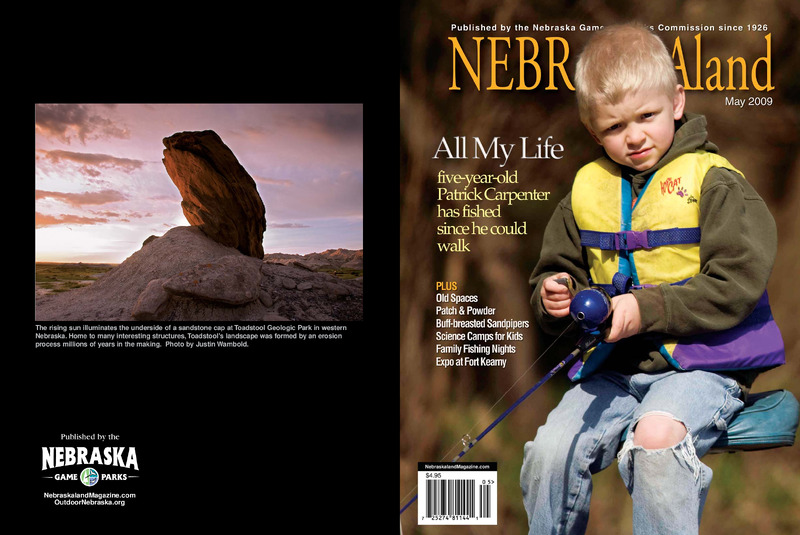
The rising sun illuminates the underside of a sandstone cap at Toadstool Geologic Park in western
Nebraska. Home to many interesting structures, Toadstool's landscape was formed by an erosion
process millions of years in the making. Photo by Justin Wambold.
Published by the
NebraskalandMagazine.com
OutdoorNebraska.org
Volume 87, Number 4, May 2009
12 Buff-breasted Sandpipers – Shorebirds of the Uplands
Infrequently seen because they are rarely found near water,
these unusual shorebirds stop in the Rainwater Basin each
spring. TEXT BY JOEL JORGENSON, PHOTOS BY JON FARRAR
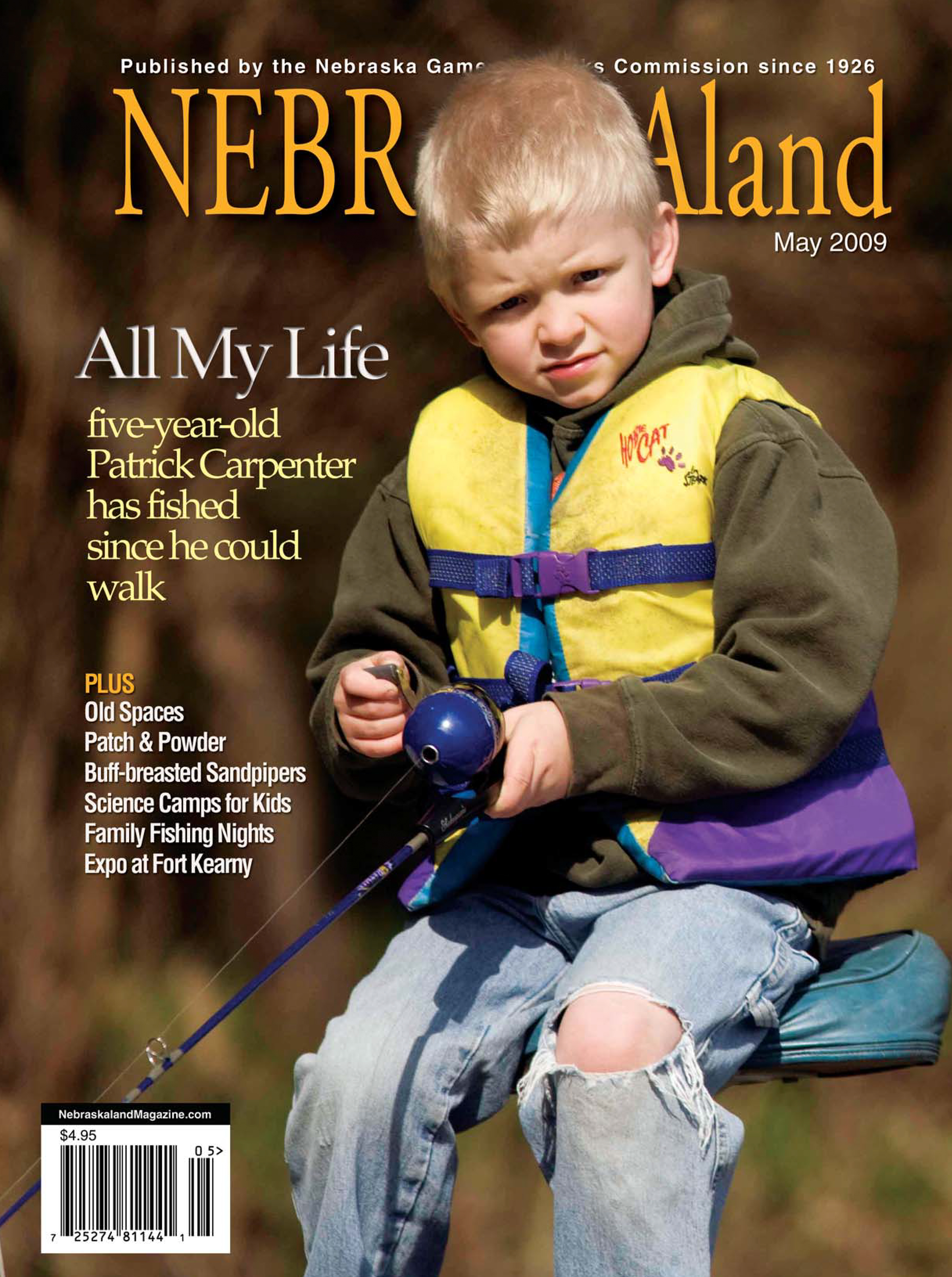
20 All My Life
An experienced angler, Patrick Carpenter loves to fish and has
been doing it his entire life – all five years of it.
TEXT AND PHOTOS BY JEFF KURRUS
22 Science Camps for Kids
Hands-on learning and direct interactions with researchers
and scientists set this science camp apart. TEXT AND PHOTOS BY
BOB GRIER
26 EXPO!
With its new location, this year’s Nebraska Outdoors Expo
promises even more fun. BY DOUG CARROLL
28 Old Spaces
Abandoned farmsteads and delapitated buildings scattered
across the landscape of Nebraska’s western half provide a
glimpse of Nebraska’s early days. TEXT AND PHOTOS BY BOB GRIER
36 Patch & Powder
A muzzleloading turkey hunt. PHOTOS AND TEXT BY JEFF KURRUS
12
●
38 Family Fishing Nights
22
●
Special fishing events held weekday nights throughout the
summer promise plenty of fun for the whole family. BY DOUG
CARROLL
Comment . . . . . . . . . . . . . . . . . . . . . . . . . . . . . . . . . 4
Mixed Bag . . . . . . . . . . . . . . . . . . . . . . . . . . . . . . . 6
Outdoor Update . . . . . . . . . . . . . . . . . . . . . . . . . . .42
Step Outside . . . . . . . . . . . . . . . . . . . . . . . . . . . . . .44
Nature Notes . . . . . . . . . . . . . . . . . . . . . . . . . . . . .45
In the Field . . . . . . . . . . . . . . . . . . . . . . . . . . . . . . .46
Classifieds . . . . . . . . . . . . . . . . . . . . . . . . . . . . . . . 48
Portraits from the Past . . . . . . . . . . . . . . . . . . . . . 50
36
●
28
●
Cover: Like any other five-year-old, Patrick Carpenter likes bullfrogs, football and cartoons.
What makes him different is that he has been fishing since he can remember. See story
beginning on page 20. Photo by Jeff Kurrus.
Opposite: This narrow beardtongue (Penstemon angustifolius) was found in a high meadow on
the north side of the Niobrara River near Nenzel. Photo by Bill Hager.
NEBRASKAland (VOL. 87 / NO. 4, ISSN 0028-1964) is published monthly, except for the
combined Jan./Feb. and Aug./Sept. issues, by the Nebraska Game and Parks Commission,
2200 N. 33rd St., Lincoln, NE. Periodicals postage paid at Lincoln, Nebraska, and additional
mailing offices. POSTMASTER: Send address changes to NEBRASKAland, P.O. Box 30370,
Lincoln, NE 68503-0370.
MAY 2009 • NEBRASKALAND 3
Published by the
Nebraska Game and
Parks Commission
Director: Rex Amack
Assistant Directors:
Roger Kuhn, Kirk Nelson, Sam Sidner
Information & Education Administrator:
Doug Bauch
Commissioners
Chairman:
James Ziebarth, Wilcox
Vice Chairman:
Jerrod Burke, Curtis
2nd Vice Chairman:
Mick Jensen, Blair
Dr. Mark Pinkerton, Wilber
Ron Stave, Waterloo
Dr. Kent Forney, Lincoln
Lynn Berggren, Broken Bow
Rex Fisher, Omaha
Mark Spurgin, Paxton
Magazine Staff
Editor: Doug Carroll
Associate Editor: Jeff Kurrus
Art Director: Tim Reigert
Senior Editor: Jon Farrar
Regional Editors:
Eric Fowler, Bob Grier, Rocky Hoffmann
Photo Librarian: Sarah Johnson
Marketing/Advertising:
Jane Gustafson
For advertising information e-mail
ngpc.advertising@nebraska.gov
or call (402) 471-5481
Circulation:
Donna Robinson
For address changes and questions about
your subscription, e-mail
donna.robinson@nebraska.gov
or call (800) 632-5263
NEBRASKAland Magazine
Copyright 2009, all rights reserved.
NEBRASKAland is available on audio cassette from the
Nebraska Library Commission Talking Book and Braille
Service, Suite 120, 1200 N St., Lincoln, NE 68508. (800)
742-7691. NEBRASKAland Magazine and the Nebraska
Game and Parks Commission reserve the right to reject
any advertising not in keeping with the agency mission.
Rates: $18 for one year; $33 for two years; $44 for
three years. Nebraska recipients must add
appropriate sales tax.
To subscribe call 1-800-NEBLAND (632-5263),
or go online to: NebraskalandMagazine.com.
4 NEBRASKALAND • MAY 2009
Now and Then
During the
past 40-plus
years,
NEBRASKAland
from time to time
has changed its
appearance to
stay abreast of
advancing trends.
Artists,
photographers and
writers have come
and gone throughout
the years and have taken their individual
styles with them.
A few weeks ago my father gave me
some old NEBRASKAland magazines
that were stored at his house for a
rather long time. Well, wouldn’t you
know it, the magazines were from
January through March 1971,
December 1971, and December 1977.
I have been a subscriber to the magazine
for years and the stories and photos are
as good now as they were back then!
Thank you for such a fantastic magazine
that provides hours of enjoyable reading
and outdoor information about the
wonderful state we live in. As an avid
turkey hunter, I really enjoyed April’s
edition of the magazine and the great
article on turkeys.
Todd L. Bouton
Lincoln, Nebraska
Trespassing Laws
As a longtime subscriber to
NEBRASKAland Magazine, a supporter
of numerous conservation organizations
and an avid outdoorsman, I am very
disappointed to read various articles
such as Aaron Hershberger’s “Nebraska
Canoeing” (April 2009) that promote
recreation on Nebraska’s rivers and
never once inform the reader of the
need to respect private property and not
break the law by trespassing during
their activities.
My wife and I own property on a
Nebraska river and have had to deal
with numerous people who believe
the river is “public property.” We
discovered a three generation fishing
party on our property who, when
confronted with their trespassing,
responded that as long as they were in
the river they were not trespassing.
Additionally, individuals believed that
they could run ATVs up and
down the river because they
thought it was “public property.”
I believe it would have been
very appropriate for Aaron’s
article to explain the activities
which would be considered
illegal trespassing by canoeists
passing through private
property such as stepping out
of their canoe and touching
the riverbed, landing anywhere
on private property to picnic
or relieve themselves or stopping and
playing on sandbars in the middle of
the river. My belief is that the majority
of the public does not understand the
limitations of using Nebraska’s rivers
legally without trespassing on private
property. To assist in improving
relations between landowners and
individuals wishing to enjoy the rivers,
you could provide a great service by
reminding your readers of their legal
responsibilities to respect private
property.
Steve Groeteke
Doniphan, Nebraska
You bring up a good point, and one
which we have discussed several times in
the magazine. Unfortunately we don’t
have the room to discuss trespassing
laws in depth in every article we run.
In short, riverbeds and their banks
belong to the owner of the land through
which the water flows. Canoeists may
portage around fences and other
obstructions, but are responsible for
property damage. Except at designated
public campsites, landowner permission
is required to walk, picnic or camp on
private property.
— Doug Carroll, Editor
Hull Lake
The article on Hull Lake (March
2009) triggered many childhood
memories for me. I grew up near Butte
and spent many days in the late-50s
and early-60s fishing Hull Lake with
my two brothers. We were fortunate to
have two great uncles and an aunt who
lived within walking distance of the
lake, including Ray Haney, who was
mentioned in the article.
My great uncle, Charles Kinzie, lived
for many years in a cabin about 50 yards
north of the lake. Largemouth bass and
bluegill were the usual fish we caught.
A couple of years we were able to catch
rainbow trout, which were stocked in
the lake. Spring and summer fishing
included dusting our socks heavily with
sulfur powder to avoid chiggers, which
were a bank fishing menace.
During recent years, my two sons
and I have gone ice-fishing at Hull,
where they have had to endure my
childhood memories of fishing the lake.
Gary Kinzie
Ainsworth, Nebraska
Martin’s Reach
The March issue of NEBRASKAland
Magazine contained an article and
pictures by Eric Fowler regarding
Martin’s Reach Wildlife Management
Area. The text and pictures were great,
and both Eric
and the editors
should be
complimented
for a job well
done.
Your
magazine may
have covered
the Martin
brothers’
monument at
some time in the past. It is south of the
main channel of the Platte River on the
Alda bridge road in Hall County. I
mention this because it is an area that
is prime sandhill crane viewing, and
my wife and I have even seen a
whooping crane in this area.
Thank you for a good article.
Carl R. Throckmorton
Hastings, Nebraska
Send your comments to:
Doug Carroll, Editor
NEBRASKAland Magazine
P.O. Box 30370
Lincoln, NE 68503
or e-mail doug.carroll@nebraska.gov
Please include your postal address and
telephone number.
Letters may be condensed and edited
for clarity. Photographs are
welcome and will be returned.
Under federal and/or state law, discrimination is prohibited on the basis
of race, color, religion, age, gender, marital status, national origin,
disability or political affiliation. If you think you have been discriminated
against in any program, activity or facility by the Nebraska Game and
Parks Commission or want more information, contact the Commission in
Lincoln, NE, at (402) 471-0641 or the Equal Opportunity Commission,
Lincoln, NE, (402) 471-2024, TTY/TDD (402) 471-4693).
Headquarters
2200 N. 33rd Street
Lincoln, NE 68503
Phone (402) 471-0641
District Office I
East Hwy. 2, Box 725
Alliance, NE 69301
Phone (308) 763-2940
District Office II
524 Panzer St., Box 508
Bassett, NE 68714
Phone (402) 684-2921
District Office III
2201 N. 13th St.
Norfolk, NE 68701
Phone (402) 370-3374
District Office IV
301 E. State Farm Rd.
North Platte, NE 69101
Phone (308) 535-8025
District Office VI
1617 First Ave.
Kearney, NE 68847
Phone (308) 865-5310
Omaha Office
1212 Bob Gibson Blvd.
Omaha, NE 68108
Phone (402) 595-2144
Ak-Sar-Ben Aquarium
21502 W. Highway 31
Gretna, NE 68028
Phone (402) 332-3901
World Wide Web site: www.OutdoorNebraska.org
Administration
Ted Blume (Adm.)
Craig Stover (Asst.)
Wes Loos (Asst.)
Rod Loos (Asst.)
Murray Johnson
Lincoln
471-5531
Lincoln
471-5532
Lincoln
471-5591
Ogallala (308) 284-8056
Lincoln
471-5003
Panhandle
Officer
City
Phone (308)
Jim Zimmerman (Sup.) Gering
436-7561
Walt Meyer
Chadron
432-4398
Scott Brandt
Gering
436-3418
Heath Packett
Gordon
282-2553
Dennis Thompson
Lemoyne
355-2024
Dan Zuehlke
Ogallala
284-4815
Doug Pollard
Oshkosh
772-9950
Frank Miller
Valentine (402) 376-1183
Dan Kling
Whitney
432-8367
Southwest
Officer
City
Phone (308)
Roger Thompson (Sup.) N. Platte
532-9175
Ray Dierking
Brkn. Bow
872-3078
George Sund
Cambridge
697-4629
Michael Thome
Cozad
784-4362
Matt Andrews
Elwood
785-3025
Dirk Greene
Imperial
882-5328
Virgil Gosch
McCook
345-2185
Dudley Sorensen
N. Platte
532-0747
Rich Routh
Rep. City
799-2085
South-central
Officer
Jerry Pecha (Sup.)
Jeff Jones
Terry Brentzel
City
Phone (308)
Kearney
865-5327
Clay Center(402)762-3124
Doniphan (402)845-2021
Randy Pomplun
Darin Gress
Dale Johnson
Mark Reeves
Robert Finke
Fullerton
536-2987
Hebron (402) 768-2287
Kearney
237-1079
Loup City
745-0662
Milford (402) 761-3537
Northeast
Officer
Tom Zimmer (Sup.)
Dale Davis
Ross Oestmann
Steve Oberg
Daniel Roberts
Jon Reeves
Marion Shafer
Pat George
Eric Wiebe
Tim Williams
Cory Krause
City
Phone (402)
Norfolk
371-6625
Bassett
273-1700
Bloomfield
373-4412
Columbus
564-5937
Fremont
721-7852
Kennard
427-7378
Norfolk
371-2031
O’Neill
336-1588
Ponca
755-2566
Neligh
887-1335
West Point
372-6979
Southeast
Officer
Duane Arp (Sup.)
Sean McKeehan
William Krause
Mike Luben
Douglas Kramer
Dina Barta
Stacey Lewton
Levi Krause
Russell Mort
Dan Evasco
Jeff Clauson
City
Gretna
Ashland
Auburn
Colon
Lincoln
Lincoln
Lincoln
Louisville
Nebr. City
Papillion
Waterloo
Phone (402)
332-2965
944-4174
274-3789
443-4278
466-9001
483-2358
476-0436
234-2212
873-5684
592-6733
359-5301
Nebraska Wildlife Crimestoppers 1-800-742-7627
MAY 2009 • NEBRASKALAND 5
PHOTO BY CHRIS HELZER
A fifth instar differential grasshopper
nymph (Melanoplus differentialis)
emerges from its old skin. This species is
common in tall grassland but has also
become a serious pest in cropfields.
Most grasshoppers, however, are not
pests but are an important part of
grassland ecosystems.
Metamorphosis
6 NEBRASKALAND • MAY 2009
ILLUSTRATION BY TIM REIGERT
Chris Helzer
Growing bigger seems to come easily
for most creatures. Essentially, you eat
more and you get bigger.
But growing can be a much more
complex process when you’re living
inside a hard exoskeleton. Most insect
species get around the problem by
going through a process called
“complete metamorphosis” in which
the larva hatches out of an egg,
grows larger, retreats into a pupa and
transforms into an adult (this is the
caterpillar-to-butterfly process).
In that case, only the soft-bodied
larva grows, and the adult is the same
size from the time it emerges from the
pupa until it dies. That makes growing
much easier but means that the insect
is soft and vulnerable for much of its
life.
The other major strategy, used by
about 12 percent of insects – including
grasshoppers, mantids, dragonflies and
true bugs – is to go through “incomplete
metamorphosis.” In this process, a
nymph hatches from its egg looking
almost exactly like a miniature adult.
Over the next weeks, the nymph will
grow larger, but will have to shed its
exoskeleton between four and eight
times before reaching its adult size.
Each stage of growth is called an “instar.”
Other than an increasing body size, the
major visible changes between instars
are that the wings and antennae grow
longer. Because nymphs don’t have
fully-formed wings, only the adult
insects can fly.
Shedding one exoskeleton and
exchanging it for another is more
complicated than it might seem at first
blush. In order to remain protected as
much as possible, the nymph has to
grow its next exoskeleton before
shedding the old one. As a first step,
the old exoskeleton separates from the
underlying layers and the gap is filled
with fluid. The nymph then grows a
new exoskeleton beneath the old one.
Once the new one is completed it’s
time to molt.
First, the nymph takes in as much
air as it can to swell its body, and
contracts its muscles to force the outer
skin to split – usually along the back.
It then squirms and squeezes out.
Once out, the insect puffs itself up
again and expands the new exoskeleton
to its full size.
Over the next several hours the new
exoskeleton will harden and darken in
color. After the final molt, the insect
emerges as a fully-formed adult, able to
fly, mate and eat.
Valentine Checklist
Jeff Kurrus
It’s not enough to bring rods, reels,
lures and a boat to the Valentine National
Wildlife Refuge in May when fishing
for northern pike. These are the definite
necessities, but after spending the last
couple of springs at the refuge I have
come across a number of other items
necessary for success. The refuge has
given up 40-inch pike the last two
years, yet during each trip our group
has battled elements that we weren’t
fully prepared for. If you’re planning a
pike fishing trip up there (and everyone
should fish the area at least once in
their lifetime), here are some items you
should bring along:
Jaw spreaders and pliers –
Trophy pike don’t like to
open their mouth so you
can retrieve your lure.
Anchor – The hills around many of
the refuge lakes are not high enough to
thwart the wind. If you do find fish,
hold your spot with an anchor.
Extra trolling battery – With a near
constant wind, don’t rely on one battery
to get you through a long
day. Bring a backup.
Depth finder – These
Sandhills lakes are not
very deep, which makes
dropoffs, where you find
them, all that much more
important. Use a depth finder to
locate dropoffs and the ambushing pike
they’re likely to hold.
Camera – No cell phone cameras,
please. A nice image captured with
even a simple point-and-shoot will
make friends say, “And you caught that
in Nebraska?”
Steel leaders – You’re trophy pike
fishing when you’re at the refuge. You
have to have these.
Waders – Probably the most
important item of all. When your
anchor won’t keep you still, and your
trolling batteries are almost dead, drift
to the bank, put on a pair of chest
waders and wade as far as you can into
the water to fish the dropoffs with your
feet firmly on the ground. The wind
can do nothing to control you then.
National Audubon Society’s Christmas
Bird Count.
The reports showed that nearly a
third of the nation’s 800 bird species
are endangered, threatened or in
significant decline due to habitat loss,
invasive species and other threats.
Sixty-seven species are currently
federally listed as endangered or
threatened, and an additional 184
species are ranked as “species of
conservation concern” because of their
small distribution, high threats or
declining populations. Far and away
the most threatened species were those
found in Hawaii or requiring ocean
habitats, but grassland bird species
were the third most threatened of the
nine habitat types ranked in the report.
Of the 46 recognized grasslandbreeding birds, 48 percent are species
of conservation concern, of which four
are federally listed as endangered. Half
of the grassland bird species are
“declining significantly.” Among the
grassland species in sharp decline are
eastern and western meadowlarks,
bobolinks, short-eared owls, mountain
plovers, lark buntings and several
species of native sparrows and longspurs.
Several grassland game birds – lesser
and greater prairie chickens, sharp-tailed
grouse, northern bobwhites and northern
pintails – have also shown steep
declines in abundance.
•
•
•
•
•
•
•
In March, United States Secretary of
the Interior Ken Salazar released the
first ever comprehensive report on bird
populations in the United States.
Information for the report was compiled
from surveys conducted by the U.S.
Fish and Wildlife Service, the U.S.
Geological Survey (including the
annual Breeding Bird Survey) and
data gathered through volunteer bird
census programs such as the
8 NEBRASKALAND • MAY 2009
PHOTO BY JON FARRAR
The State of Birds
Upland sandpipers have declined in
abundance as grassland meadows were
plowed and converted into cornfields.
The conversion of grasslands to
cropland continues to be the principal,
but not only, reason for the decline of
grassland bird species. While the
Conservation Reserve Program added
hundreds of thousands of grassland
acres in Nebraska, they were not
suitable habitat for all grassland bird
species; and as contracts in that federal
farm program expire, even those
grassland acres are vanishing.
“Just as they were when Rachel
Carson published Silent Spring nearly
50 years ago, birds today are a
bellwether of the health of land, water
and ecosystems,” Salazar said. “From
shorebirds in New England to warblers
in Michigan to songbirds in Hawaii,
we are seeing disturbing downward
population trends that should set off
environmental alarm bells. We must
work together now to ensure we never
hear the deafening silence in our
forests, fields and backyards that
Rachel Carson warned us about.”
To read the entire report got to
http://www.stateofthebirds.org.
Aquatic Skills Camp
For the second year in a row, the
Nebraska Game and Parks Commission
will team up with Nebraska 4-H to host
an Aquatic Skills Camp this summer.
Open to youth 14 to 18 years old, the
camp will be held June 22-25. The first
day will be spent at the State 4-H Camp
near Halsey learning water safety
and earning Basic Boating Safety
certification, then participants and their
gear will be transported to Calamus
Reservoir, where they will learn how to
water ski, operate jet skis, surf on
wakeboards, and use kayaks.
Evenings will include some of
Nebraska’s best fishing, campfires and
other camp favorites. Participants need
to bring their own sleeping bag and
Type-3 Personal Flotation Device. The
workshop is limited to 20 campers and
costs $358.
For more information, go to
http://4h.unl.edu/camp/.
largemouth
bass with
no
luck,
take a
break
from the
big boys and
panfish instead.
Start by using
an ultralight
spinning reel and
a 1/64-ounce jighead
with a two-tone green, curlytail grub.
This lure is far too light for heavier
baitcasting gear, but with a spinning
reel and six-pound-test line, 20 foot
casts can be regularly made. If this
distance isn’t enough, switch to a
1
/32-ounce jighead. However, an angler
will usually miss more fish with the
bigger lure.
Fish this lure around the crooks
of fallen trees, fingertip ends of
submerged branches or shallow points.
Let the lure sink to the desired depth,
usually two or three feet, and use a
steady retrieve to get the curlytail
wiggling. When the fish grabs the lure,
gently set the hook with a quick tug
instead of the mouth-ripping hookset
used for big bass.
Any fish in the lake will hit this lure,
including bluegills, crappies and even
catfish. Have a pair of needlenose pliers
handy. Many bluegill and crappie
mouths are too small for big fingers, a
good problem to have shortly after
deciding that the bass fishing was not
as productive as desired.
A Fishing Alternative
Cooper Wins
Duck Contest Again
Matthew Marx
When the desire to catch a fish, any
fish, is larger than repeatedly casting for
An entry by Bethany Cooper of
Banner County High School, last year’s
winner, was again chosen Best of Show
MAY 2009 • NEBRASKALAND 9
Trapshoot
Outdoor Message Plates
J.D. Avery of Omaha, chairman of the Ducks Unlimited chapter in Valley, would
like everyone to follow the instructions on the message plate he’s displayed since
1995.
If you have a unique message plate you would like to share, or know someone who
does, e-mail a photo (.jpg format only, please) of it to Eric.Fowler@Nebraska.gov
along with your name and hometown.
at the Nebraska Junior Duck Stamp
Art Contest.
Cooper’s acrylic painting of a drake
wood duck was selected from more
than 650 entries received from across
the state. Her entry will be used to create
the 2010 Nebraska
Waterfowl Stamp and was sent to the
national competition to be held in
Washington, D.C.. The winner of the
national competition will receive
$5,000, a trip to Washington, and have
his or her art used to make the 20082009 Junior Duck Stamp. Proceeds
from the sale of Junior Duck Stamps,
which cost $5, support conservation
education.
Information for next year’s contest
will be posted on the U.S. Fish and
Wildlife Service’s internet homepage at
http://duckstamps.fws.gov.
Free Park/Fishing Day
This year’s Nebraska Free Fishing
and Park Entry Day will be observed
Saturday, May 16. On this day no fishing
license is required anywhere in the state,
and the public can visit any state park
or state recreation area without having
to purchase a Nebraska Park Entry
Permit.
As part of this event, the Nebraska
Game and Parks Commission is offering
the 12th Annual Family Fishing Clinic
at select state parks and recreation
areas across the state. This is also the
date for the Nebraska Outdoor Expo,
which will be held at Fort Kearny
State Recreation Area near Minden.
10 NEBRASKALAND • MAY 2009
The 40th Annual Cornhusker
Trapshoot will be held April 30 - May 2
at the Nebraska Trapshooting
Association’s home grounds in
Doniphan. Last year 1,681 shooters
competed in the meet, making it the
largest of its kind in the nation.
Traditionally open only to students in
the seventh through 12th grades, this
year’s meet has been expanded to
include sixth-grade students, and
organizers expect to set a new record
for participation this year. The event is
free to spectators, and in addition to
watching the competitors, attendees can
visit the booths of a variety of shooting
vendors that will be on hand and
displaying a variety of wares.
Ponca BOW Workshop
Building on the success of the
annual Becoming an Outdoors –
Woman workshop held every each
fall at the State 4-H Camp near Halsey,
this year the Nebraska Game and
Parks Commission is hosting a similar,
yet smaller, BOW workshop at Ponca
State Park. located in northeastern
Nebraska.
Open to women 18 years of age and
older, the Ponca BOW workshop will
be held May 29-31 and is limited to the
first 25 participants to register. Activities
covered at the workshop include
archery, an introduction to firearms,
beginning shotgunning, bird banding
and identification, camping and
outdoor skills/safety, dutch-oven
cooking, kayaking and lake fishing.
Participants will stay in tents provided
by the organizers, and all equipment
needed for the classes will be provided.
The cost of the workshop is $125,
which includes instruction for all
sessions, program materials, use of
equipment and all meals. For more
information, go online to
www.NebraskaBOW.com.
While there, you can also check out
information about next fall’s BOW
workshop in Halsey, which will be held
October 2-4, and the slate of Beyond
BOW classes that are being offered
this year, including a basics of outdoor
survival class that will be held June 1214 at Lake McConaughy.
Great Park Pursuit
After a successful inaugural year in
2008, the Great Park Pursuit will return
with more sites and outdoor adventures
in May 2009. The Nebraska Recreation
and Park Association, along with the
Nebraska Game and Parks Commission,
partnered to develop the program with
the goal of encouraging a healthier
lifestyle for participants while increasing
awareness of Nebraska’s nature-rich
outdoor recreation opportunities. This
year’s program will be sponsored in
part by the Nebraska Department of
Health and Human Services.
The Great Park Pursuit revolves
around a challenge to visit park sites
throughout Nebraska. Participants
follow clues to collect nature-based
impressions from posts hidden in each
of the selected parks. Prizes and entry
into drawings are based on the number
of tracings collected.
While participants become registered
for a free two-night cabin stay at a
Nebraska state park of their choice
with just one tracing, the more sites
that participants visit, the more
opportunities they have to win the free
cabin stay or other prizes that are
offered: Participants who visit seven
sites will be entered one time in a
drawing for grand prizes; those who
visit 10 sites will be entered three
times; and those who visit all 15 sites
will be entered five times and will
receive a free 2010 Nebraska Park
Entry Permit.
A kickoff event for this year’s Great
Park Pursuit will be held May 16 at the
Nebraska Outdoors Expo that will be
held at Fort Kearny State Recreation
Area (SRA). Other special events will
be held June 20 at Pioneers Park in
Lincoln, July 25 at Walnut Creek in
Papillion and August 8 at Calamus SRA
near Burwell.
Sites for this year’s Great Park
Pursuit include Pioneers Park in
Lincoln, Indian Cave State Park (SP),
Platte River SP, Walnut Creek Lake and
Recreation Area in Papillion, Lewis
and Clark Landing in Omaha, Scenic
Park in South Sioux City, Cowboy Trail
near Norfolk, Calamus SRA, Bessey
Ranger District of the Nebraska
National Forest near Halsey, Fort
Robinson SP, Central Park in Alliance,
Ash Hollow State Historic Park, Kelley
Park in McCook, Stolley Park in Grand
Island and Pawnee Park in Columbus.
Barbs and Backlashes
Jeff Kurrus
Nebraska Game
and Parks Fisheries
Biologist Daryl
Bauer recently
started the “Barbs
and Backlashes”
blog on the
Daryl Bauer
Commission’s
website at Outdoor.Nebraska.org. “You
can expect me to ramble on here about
a variety of topics related to fish and
fishing in Nebraska,” said Bauer on his
first entry. “As a biologist I like to take
a logical, ‘science’-based approach to
fishing. You can expect me to weave in
information on fisheries science, fish
anatomy and physiology, aquatic ecology,
limnology and more. Hopefully that
will not be overwhelming, hopefully it
will make sense, and hopefully it will
help folks catch more fish!”
Bauer’s enthusiasm for fishing,
specifically in Nebraska, makes him
one of the most enjoyable voices to
hear throughout the state regarding this
passion. At the end of his first blog,
Bauer penned the following: “I wrote
down something he [a friend of
Bauer’s] said during [a] conversation
because he absolutely nailed it; his
quote describes what I hope this blog
will accomplish – “teaching problemsolving skills, not giving away the
answers.”
Readers of his blog might just walk
away feeling like his problem-solving
skills teach so much more than answer
giving every could. ■
MAY 2009 • NEBRASKALAND 11
Buff-breasted Sandpipers
Shorebirds of the Uplands
Text by Joel Jorgensen
Photos by Jon Farrar
An unusual shorebird in that it spends little time on watery shorelines,
the buff-breasted sandpiper has other unusual characteristics, such as the
males strutting their stuff for females on display grounds. Most of the buffbreasted sandpiper population pauses each spring in the Rainwater Basin.
I
t’s past midnight in the middle of May and I’m in stocking
feet, standing alone in a recently planted York County
cornfield. There are flashes of lightning on the western
horizon and in my hand I’m holding the largest fish net sold
by Cabela’s. I know its six-foot metal handle is a lightening
rod if the storm heads my way. I keep walking. There isn’t
another person around so I’m not likely to be asked to
explain what I am doing. On the Discovery Channel, great
adventures in wildlife research take place in the jungles of
South America, Africa and Asia, or on the tundra above the
Arctic Circle. Why would a wildlife biologist choose to
wander around corn and soybean fields at night in central
Nebraska and consider it an adventure? The answer – to
catch a buff-breasted sandpiper, a migrant shorebird that
briefly stops in Nebraska each spring.
Buff-breasted sandpipers, buffies for short, are shorebirds
about the size of a robin that winter in southern South
America and breed in the Arctic. They are long-distance
migrants, with some birds traveling more than 18,000 miles
in a single year. Even though the primary migration route of
buff-breasted sandpipers is through the Great Plains, they are
infrequently observed, in part because, unlike most other
shorebirds, they are seldom found near water. In the 1970s,
York County farmer and birder Lee Morris discovered large
numbers of buffies in agricultural fields while planting corn.
Morris farmed in the Rainwater Basin of south-central
Nebraska, a flat landscape with numerous shallow, freshwater
wetlands. Those wetlands are an annual stopover for millions
of waterfowl and other migratory waterbirds. Buffies, though,
occupy terrestrial habitats of short or sparse vegetation, such
as heavily-grazed pastures and agricultural fields.
That buff-breasted sandpipers are shorebirds not found on
shorelines is only one of their atypical characteristics.
Similar to prairie-chickens and sharp-tailed grouse, the buffbreasted sandpiper is a true lekking species (leks are display
grounds where groups of males display to attract females) –
the only North American shorebird that has this mating
system. Buffies engage in courtship displays and other social
interactions during their stopover in the Rainwater Basin.
The “double-wing courtship embrace” is the male’s
12 NEBRASKALAND • MAY 2009
primary lek display, during which the male holds both
wings outstretched and marches in place while tipping its
bill upwards and making a barely audible tik, tik, tik sound.
The undersides of a buff-breasted sandpiper’s wings are
satiny white, sharply contrasting with the bird’s rich buff
color. Occasionally males perform this display with no other
birds in the vicinity, but usually it is initiated when another
bird wanders close by. Females, sometimes two or three at a
time, will stand in front of the male and be “embraced” by
his outstretched wings.
The “single-wing flash” or “wing-up display” is also
frequently observed during their stop in Nebraska. During
this display a bird raises one wing in the air and waves it
back and forth, a motion that from a distance looks like a
white flag flashing in the wind. This display is most often
given when other birds are flying in the vicinity, and
appears to communicate where birds are congregating.
Relative to most other shorebirds that have distinctive,
loud calls, buffies are quiet, perhaps because their
elaborate wing displays are a substitute for calls.
A Vagabond Existence
Buffies are present in significant numbers in Nebraska
from about May 10 through May 23. By late-May, the
number of buff-breasted sandpipers drops off rapidly as
the birds continue their northward migration. Little is
known of their route to the Arctic once they leave the
Rainwater Basin. There are no known, key stopover
sites in the Dakotas or prairie provinces during spring
migration. Buff-breasted sandpipers reach their summer
home on the Arctic coastal plains of northwestern
Canada, Alaska, and possibly Siberia by early-June,
where they have a very short time to mate, nest
and raise young before the brief summer wanes.
Once on their nesting grounds, males establish leks
In a display called the “double-wing courtship embrace,”
males spread their wings, tip their bill skyward while
uttering a tik, tik, tik sound, and march in place.
small numbers are observed in the Rainwater
Basin during their southbound migration. From
both a historical and contemporary standpoint
this is not surprising, as appropriate habitat is
limited in late-summer. Vegetation in the
Rainwater Basin landscape, whether corn or
prairie, is at its peak and is too tall to be
attractive. Juveniles wander even wider, with a
few being found on each coast almost every fall.
A Species in Peril
The buff-breasted sandpiper is a bird of
conservation concern. The species never fully
recovered from unregulated sport and market
hunting in the late-1800s and early-1900s,
and habitat destruction and the unregulated
use of highly toxic pesticides may have also
Each captured bird is fitted with an aluminum identification band and colorcoded plastic bands that allow researchers to identify individuals at a distance. contributed to their decline. Because of their
status, the fact that a large proportion of the
and display to attract females to mate. Males contribute
world’s buffy population stops in the Rainwater Basin during
nothing more than sperm to raising young. Females are
migration assigns Nebraska an important role in contributing
tending nests in late-June. By mid-July chicks are emerging
to their conservation. Migration stopover sites that shorebirds
from eggs and adult males are already migrating southward.
depend on are now recognized as crucial to sustaining
If chicks escape a host of Arctic predators, they fledge in a
populations. Changes in stopover habitat, such as the loss of
little less than three weeks and begin their passage south in
a particular food resource, can negatively affect populations.
August. By late-September and October, the buffies have
The Rainwater Basin has been transformed over the past two
returned to their wintering grounds.
centuries from a prairie plain where herds of wild grazing
During their autumn migration, buffies again pass through
animals roamed to an agricultural powerhouse producing
the Great Plains but their migration corridor is wider. Only
millions of bushels of corn and soybeans each year. In order
Key anatomical measurements, such as wing length and weight, are taken of each captured bird. They are also
outfitted with tiny radio transmitters that allow researchers to track them during their stopover in Nebraska.
14 NEBRASKALAND • MAY 2009
to find out how buff-breasted sandpipers are using today’s
Rainwater Basin landscape, and the role their Nebraska
stopover plays in the species’ annual cycle,
avian biologists recognized the need to
capture and track some by attaching
leg bands and radio transmitters.
Planning such a project is
relatively easy, but carrying
it out was another matter.
Commission
nongame bird
biologist Joel
Jorgensen stalks
through soybean
and corn fields in
the dark of night,
occasionally
turning on a
spotlight to
locate resting
sandpipers
and capturing
them with a
dip net.
ends, gathers his gear and drives to the spot where the
birds were last located. His task for the next several hours
is to track the position and movements of the birds with a
radio receiver.
What We Have Learned
The study began in 2004 and was funded with a State
Wildlife Grant and support from the University of Nebraska
at Omaha. Our initial work was to determine how many
buffies stop in the Rainwater Basin during spring migration
and what habitat they used. We genuinely did not know what
our results would show us.
The first phase of the study revealed 20,000 to 40,000
buffies paused in the Rainwater Basin. Surprisingly, those
numbers were larger than the estimated size of the entire
population, suggesting previous estimates were too low and
that nearly all of the world’s buff-breasted sandpipers stop in
the Rainwater Basin during their spring migration. We also
learned that buffies are five times more likely to be found in
soybean stubble than corn stubble. They also seem attracted
to fields recently worked by farm implements, perhaps
explaining their attraction to cornfields, as corn is being
planted during their time in Nebraska.
The second-phase of our research took place from 2006
through 2008 and was again funded by UNO and a State
Wildlife Grant, as well as Wildlife Conservation Fund
dollars. We caught 13, 7 and 10 buffies in 2006, 2007 and
2008, respectively. While the number of birds captured is
small, the information we acquired from our work has been
important.
Through our measurements of captured buffies we learned
The flat, intensively farmed land of York County seems an unlikely location to find shorebirds, but it is the preferred stopover
for buff-breasted sandpipers. Before settlement they were probably drawn to grasslands closely cropped by bison and prairie dogs.
Elusive Study Subjects
So how do you catch a small, brown bird in the middle of
a cornfield in the dark of night?
In short, it’s a systematic process that involves carrying a
large fishing net, walking about 50 feet, briefly turning on a
spotlight to sweep the field in search of birds, then repeating
the process time and time again. Having put birds to bed
after sunset increases the chances of finding them later, but
actually catching the birds is difficult. Many factors can
cause the effort to fail – for instance, if the birds are able to
recognize the human form behind the light, either by sight
or sound, they flush before a net can be dropped over them.
Some nights the odds are stacked against you, such as a dead
calm night with a full moon – it’s difficult to sneak up on
birds when you’re throwing a shadow and every step results
16 NEBRASKALAND • MAY 2009
in crackling crop stubble.
Other times conditions are favorable, but circumstances
are wrong. For instance, while making a promising approach
on a single buffy you might see another another bird close
by but off to the side. Because it’s impossible to keep a
direct light on both birds, usually one bird, both, or all birds
close by flush.
All the buff-breasted sandpipers captured for this study
were caught either by me or by John P. McCarty and
L. LaReesa Wolfenbarger, professors at the University of
Nebraska at Omaha (UNO) and co-researchers on the project.
Once a buffy is caught, we carefully attach a small radio
transmitter to feathers on its back. The transmitters we use
for this study are small, weighing only tenths of an ounce, so
they don’t impede flight or other activities. When the bird
molts later in the year, the radio transmitter falls off.
We also place a metal identification band and a set of
unique colored bands on each bird’s legs for identification,
weigh it and measure key anatomical features such as wing
length. After a bird is processed, we release it in the same
field where it was captured. As many fields as possible
are searched each night. If the number of birds found is
encouraging, the search may go on until 3:30 in the morning.
Other nights, birds may leave the fields after sundown and
the search wraps up before midnight.
A night of catching birds finishes with a return to fields
where a bird was radio-tagged earlier that evening. The
radio receiver is turned on to check for a click, click, click
as the transmitter sends its signal, indicating the bird is still
in the field. The last known location of each bird is left on
the voicemail of our technician, UNO student Jonas
Grundman, who, at about the same time our night search
Shorebirds other than buff-breasted sandpipers, such as American
golden-plovers, also pause in spring on agricultural land.
MAY 2009 • NEBRASKALAND 17
When buff-breasted sandpipers first arrive in Nebraska and on
hot, windy days during their stay, they often seek shallow pools
of water where they drink, bathe (above), and preen.
they are fat when they arrive in the Rainwater Basin during
spring migration. During most of the year, a male buffy
weighs 1.9 to 2.3 ounces, but the average weight of the
males we captured was 3.1 ounces. Stored fat is their
migration fuel, so when buffies arrive in the Rainwater Basin
they essentially have a full tank of gas. This tells us that
birds do not need to gorge in Nebraska to continue their
northward migration. As these birds make their annual
migration from southern South America, they are apparently
“fattening up” somewhere south of the Rainwater Basin.
Before we put our first transmitter on a bird, we assumed
we would track individual birds for a few days from field to
field and in the process gather information about how they
used the landscape. We were surprised to find our birds did
not remain in the area for any length of time: Radio-tagged
birds usually left the Rainwater Basin in less than 24 hours.
In 2007 and 2008, we rented an airplane to cover a larger area
and locate radio signals with greater efficiency. Even then
we confirmed birds were leaving after a short period of time.
Although they do not linger long in the Rainwater Basin,
our research shows buff-breasted sandpipers do feed in
agricultural fields. Loosely organized flocks of 20 to 50, or
occasionally a few hundred, are found together. They most
often feed in the morning and are least active during midday.
In late-afternoon or early evening, particularly on warm
days, these upland shorebirds frequent spots of standing
water to drink and bathe. Migrating birds typically seek
water as soon as they arrive in Nebraska. After five to
10 minutes at the water’s edge the birds seem to be refreshed
and engage in courtship displays. After as little as 30 minutes
the buffies usually return to fields to feed or rest.
We know buff-breasted sandpipers stop in agricultural
fields in the Rainwater Basin today, but were they pausing
there before European settlement transformed the landscape?
While we lack any hard evidence, we are able to make some
reasonable guesses. At one time, the Rainwater Basin was a
nearly
flat
region of
prairie
grasses. There
were more
wetlands than today,
and areas disturbed by
native ungulates such as
bison. Those heavily-grazed
patches were probably suitable
stopover sites. Perhaps even more
important were short-cropped prairie dog
colonies that would have been present. Prairie
fires, albeit unpredictable, may have also provided
stopover habitat for buffies and other shorebirds.
While the buffy is unique, other shorebirds also
are found in agricultural fields: American goldenplovers and Baird’s sandpipers frequently are seen
in the same fields. These two species have ranges
and migrations similar to buff-breasted sandpipers.
Historically, Eskimo curlews, now extinct, also
accompanied this suite of upland shorebird species
pausing in Nebraska. Early literature identifies the
Rainwater Basin as an important stopover site for the
curlew. Evidence suggests that the basin, a landscape
defined by its shallow wetlands, was, and is, also an
important stopover for birds that infrequently use wetlands.
Implications
The presence of female buff-breasted sandpipers often elicit displays from males, even before the birds arrive on their
Arctic nesting grounds. The bird in the back is doing the “wing-up display,” which is often used to attract birds flying by.
18 NEBRASKALAND • MAY 2009
If a species’ critical habitats or food resources vanish or
are altered, that species is at risk. The future of migratory
shorebirds can be threatened by habitat alteration or loss at
critical stopover sites. This is true even though birds pause at
a site for only a few days or weeks during their annual cycle.
The Atlantic Coast population of a shorebird called the red
knot is a classic example. This species has a migration and
range similar to the buff-breasted sandpiper, but along the
Atlantic Coast. Their key spring stopover is at Delaware Bay
in New Jersey, where they feed on horseshoe crab eggs. The
horseshoe crab population there has been devastated by
unregulated hunting and overharvest. As a result, red knot
numbers have declined precipitously and the population may
become extinct within a decade. The scientific link between
the decline of crabs and red knots is strong, underscoring the
importance of stopover sites.
Avoiding listing a species as threatened or endangered is
in the interest of everyone. Recovering species is costly and
not an effective, long-term strategy to maintain wildlife
populations. Comprehensive action before a species has
declined to the point of needing government protection is a
more cost-effective and feasible long-term strategy.
Only a few years ago, there was growing concern that
buff-breasted sandpipers were edging closer to becoming
listed as a threatened or endangered species. It was at that
time that the question “Does anyone even know what a buffbreasted sandpiper is?” was raised at a Nebraska Game and
Parks Commission meeting when funding for our initial
research project was the topic. Even though it was rhetorical,
A seemingly headless male sandpiper displays for a nearby
female. Buff-breasted sandpipers are considered “lek” birds,
much like sharp-tailed grouse or prairie chickens, where males
gather on traditional grounds and display to attract females.
it was a legitimate question – few people had ever heard of a
buff-breasted sandpiper.
Our ongoing research has contributed significantly to the
conservation of this species. Based on our studies, the
estimate of the world’s population has been revised upward
and we have documented the importance of the Rainwater
Basin during the species’ 18,000-mile annual journey. While
our research identified no specific threats to the species, we
also do not have a complete understanding of its relationship
to agriculture. The buff-breasted sandpiper is still a species
of conservation concern, but our research suggests that we
do not have the elements for a scenario similar to the red
knot’s at Delaware Bay.
Oddly enough, most of our data about buff-breasted
sandpipers came from wandering around a York County
cornfield in the middle of the night in stocking feet with a
spotlight and a giant fishing net. ■
Editor’s note: The researchers wish to acknowledge the
cooperation of landowners who allowed access to their
property for the study. John P. McCarty and L. LaReesa
Wolfenbarger contributed to the writing of this article.
MAY 2009 • NEBRASKALAND 19
All My Life
Five-year-old Patrick Carpenter has
been fishing since he could walk
Text and photos by Jeff Kurrus
t was a good sight to see as I drove
out of Fremont Lakes State
Recreation Area (SRA) – a grown
man fishing with a young boy. But
something was different here – the
young boy was not fishing with a
bobber and there was no Snoopy pole.
He reeled his lure, a soft plastic
worm, to the end of his rod and made
a cast toward the bank, his lure landing
inches from its edge. He slowly moved
his hands up and down, bouncing the
worm along the bottom as he stared in
its direction, readying for a hook set.
It was not the typical behavior usually
associated with a five-year-old.
Watching Patrick Carpenter and his
grandfather, David, fish is pure delight.
It is a combination of boy and man,
but also of partner and partner. The
duo fishes a number of lakes in eastern
Nebraska and western Iowa, including
Two Rivers SRA’s trout lake, and
various others for bluegill and
largemouth bass. “I like
the bass fishing because it
keeps him moving,” said
David. “It keeps him
interested. Having a kid
bored is the worst thing.”
Patrick was rarely bored
that day. An occasional
rest to look in a tackle box
was as close as he got,
along with a glance of
disdain when grandpa had
a fish on and he didn’t.
“Is that a good one?” the
boy asked as his
grandfather pulled in a
bass.
“Not bad.”
“You took my spot,” the
five-year-old said. “I want
to measure the fish.”
“Okay,” said David.
Patrick pulled the metal
ruler from one of the bass
boat’s portals.
“Put his nose forward
like I told you,” said
David.
“He’s 14 and a half
Five-year-old Patrick holds up grandpa’s largemouth
inches,” Patrick said.
I
bass caught at Fremont Lakes SRA.
20 NEBRASKALAND • MAY 2009
David Carpenter hooks a fish as
grandson Patrick looks on.
“Okay, release him back into the
lake.”
Patrick did so, then wiped his hands
on his pants and picked up his rod
again.
“I have three kids and two
grandkids,” David said. “They’ve all
been in the boat since they were two.
When Patrick was little, he would fall
asleep in the boat. When he woke up,
he’d start fishing.” As David spoke,
Patrick alternated between casting,
sitting, or staring at all the happenings
around the lake – the family picnicking
on the bank, the high, bright sun, and
the local Canada geese flying by.
“Patrick, let’s go over here,” David
said, obviously knowing when his
fishing partner was being taken over
by the five-year-old. “It’s good to
keep him moving,” he said. “When
we’re out here, he’ll also catch frogs.
We’ll put an artificial frog on his line
and let him cast toward bullfrogs on the
bank. If he catches one, he’ll play with
it in the livewell until we release it.”
“I want to catch a turtle,” Patrick
called out.
“There’s always something to do on
the water,” David said.
“I want to fish with the baitcaster,”
Patrick said.
“Okay,” David said, “come here.”
Patrick walked to his
grandpa’s end of the boat
and accepted the
baitcaster – a boy just a
few years from diapers
working with tackle
many grown men have
difficulties with.
“Cast it really slow,”
David said. “Remember,
you have to hold your
thumb on the spool. Press
the button, hold your
thumb on there, and take
your thumb off when you
cast it. Before it hits the
water, put your thumb
back on the spool.”
Patrick battled between
listening and just wanting
to do it. “If you don’t do that,” David
warned, “you’ll have a mess.”
Patrick cast and the lure went
about 15 feet. He reeled in and cast
again, with the lure landing close to
the same spot. He continued to cast as
David watched. “I’ve been working
with him a little bit all the time. He
gets frustrated because he can’t cast it
as far when the brake is tight.”
David turned to Patrick. “We’ll
loosen it up a bit and it will go farther.”
The youngster continued to cast, his
attempts reflective of perhaps the best
way to introduce kids to fishing.
Watching a bobber is great, but keeping
a child in motion by casting gives them
one more activity to do in the boat.
“Hey, Patrick,” David said, interrupting
the boy’s next attempt and pointing
toward the bank. “Is that a lure in that
tree over there?” he said.
“Where?” Patrick asked, no longer
interested in fishing.
Grandpa pointed again, using the
boat’s trolling motor to move in the
lure’s direction. Arriving, grandpa
helped Patrick cut the crankbait off
the tree limb and then handed it to
him. “You can add that to your tackle
box,” he said.
“Yippee,” Patrick responded, a
solitary word exemplifying how
David Carpenter is introducing his
grandson to fishing. ■
Patrick gets ready to heave a cast while bass fishing last summer.
MAY 2009 • NEBRASKALAND 21
Science Camps
for Kids
at Wildcat Hills Nature Center
Text and photos by Bob Grier
“T
uesday the Badlands were
awesome! We walked around the
Badlands and discovered lots of
bones lying around the site. The rocks
were millions of years old. They were
also real slippery, so you couldn’t step
in some places without falling. They
found the whole skeleton of an
oreodont. Only the skull was showing.
We learned about layered and pink
rocks.”
– Journal entry, Danielle,
June 20, 2008
researchers and scientists each June as
part of the continuing series of High
Plains Science Adventures offered to
Panhandle sixth- through eight-grade
students.
Sponsored by the National Park
Service (including both nearby Scotts
bluff National Monument and Agate
Fossil Beds National Monument) and
the Nebraska Game and Parks
Commission, these annual camps’ nearly
weeklong activities are built around
timely and interesting science-based
topics.
Young students interested in science
In 2007, participants in the “Water,
have the opportunity to participate in
Water Everywhere” science camp
looked at the continuing drought on the
hands-on learning and a rich variety of
high plains, including everything from
experiences and interactions with
historical water uses in the
North Platte River Valley to
current water uses and
conflicts. In last year’s
“Paleontology, Can you Dig
It?” science camp, students
excavated and preserved 32to 34-million-year-old fossils
and traveled the recently
established “Fossil Highway”
(see sidebar on page 25) from
the Wildcat Hills Nature
Center northward to the famed
Mammoth Site at Hot Springs,
South Dakota, with stops at
Agate Fossil Beds National
Monument and the University
of Nebraska Trailside Museum
at Fort Robinson.
The theme for this year’s
camp, which will be held
June 22-26, is “Buggin’ Out on
Kim Ward of Mitchell adds to her journal entries
the Prairie – Entomology and
during a visit to UN-L’s Trailside Museum at Fort
Robinson State Park.
Botany of the Short Grass
22 NEBRASKALAND • MAY 2009
Science campers hike to University and Carnegie hills above the Niobrara River, site of Agate Fossil Bed
National Monument’s famed bone beds of Miocene Era life from 20 million years ago.
Prairie,” during which students will
examine the intricate relationship
between insects and plants of the
prairie.
“There are so many unique and
rewarding opportunities built into the
science camp activities each year,” said
Anne James, naturalist at the Nebraska
Game and Parks Commission’s Wildcat
Hills Nature Center located south of
Gering. “The five-day camps and
the participation of paleontologists,
meteorologists, hydrologists,
entomologists, botanists, scientists
and wildlife biologists, as well as the
really diverse resource centers, parks,
museums and educational facilities
available here in western Nebraska,
let camp organizers and sponsors
create educational activities that are
both fun, educational and memorable.”
The science camp activities are
available to about 40 students each
year, and each participant is sponsored
by a regional science teacher for the
students’ strong interest in the sciences.
Camp organizers have a waiting list
each year for enrollment.
“There are established state and
national groups initiatives that fit well
into the philosophy of each year’s
camps,” said James, “including
‘Children and Nature in Our Parks,’
‘No Child Left Inside,’ ‘Nebraska
Prairie Partners’ and others. The goal is
to get students outdoors learning about
science and reconnecting with nature
based on curriculum standards.”
During the 2007 “Water, Water
Everywhere” camp, for example,
student activities included studying
high plains weather patterns through
history, visiting the Farm And Ranch
Museum to look at early irrigation
development, “setting” irrigation
tubes on supply canals, studying the
relationship between surface and
groundwater irrigation systems and
water treatment plants, and conducting
water quality studies on Nine Mile
Creek east of Scottsbluff. Students also
were able to fish with Commissioncertified fishing instructors – for many
students their first and only opportunity
to go fishing.
The visit to Nine Mile Creek for the
water camp gave instructors from the
North Platte Natural Resource District
and the Nine Mile Creek Project, as
well as Commission fisheries biologists,
a chance to present diverse looks at one
of western Nebraska’s best cold-water
streams. Aquatic entomology studies
of the creek, including netting and
identifying macro-invertebrates, were
conducted with the help of resource
professionals, and landowners
explained the stream’s history as a
hand-dug irrigation spill canal that
eventually became a perennial stream
and important fishery through changes
in the region’s groundwater table and
the continued use of large, sand-bottom
irrigation supply canals above the
creek.
The importance of streamside habitat
and controlling invasive plant species
was also covered during the trip to
Nine Mile: Students were told about
projects to remove Russian olive trees
and other invasive species, such as salt
cedar, and helped plant trees such as
cottonwood and ash which stabilize and
protect fragile stream banks while
lowering stream water temperatures to
trout-supporting levels.
Another portion of that year’s science
camp involved a trip to Scotts Bluff
National Monument, where historic
images of the North Platte Valley
revealed the early river valley without
trees and other vegetation. Following
a visit to the national monument’s
museum, park rangers accompanied
the group to the top of the bluff to view
the present-day river valley, a scene
dramatically different than that
represented in the late-1800 images
that the students had just seen.
★
Cooperatively developed, funded and
operated, the Wildcat Hills Nature Center
south of Gering in Scotts Bluff County is
a museum, interpretive center and
educational facility.
MAY 2009 • NEBRASKALAND 23
conducted on private land with
landowner permission, and the fossils
that were found will be displayed at the
Wildcat Hills Nature Center in the
future.
“We found lots of turtle shells and
we also found a camel jaw and an
oreodant jaw that I found hidden in
the soil. On Thursday, we hiked up to
University and Carnagie Hill (at Agate
Fossil Beds National Monument) and
on Friday, we made shark tooth
necklaces from real shark teeth.”
– Kelly, June 20, 2008
Small teams of students prepare to excavate 32- to 34-million-year-old fossils on private
land in the North Platte River Valley. Tortoises, camel jaws and oreodont skulls were
excavated, preserved in plaster and will be displayed at the Wildcat Hills Nature Center.
Below, two camp participants takes water samples from Nine Mile Creek.
“Then we went to the Scotts Bluff
Monument and we got to hike down it.
During the hike, I learned it was made
of sandstone, and when it gets touched
it erodes away. I learned something
about the Monument that I never knew
before, I learned
that there
is a
24 NEBRASKALAND • MAY 2009
layer of ash. I thought that was really
cool, because I didn’t think that ash
came into Nebraska.”
– Hayley, June 20, 2008.
Last year’s “Paleontology, Can You
Dig It?” camp included significant
firsts for the young science students,
including the opportunity to find and
excavate 32- to 34-million-year-old
fossils such as large tortoises,
camel jaws, squirrel jaws,
dung beetle balls and
oreodont skulls (a
prehistoric
sheeplike
animal).
The fossil
discoveries,
excavation
and preservation
steps were
conducted
with Shane
Tucker,
Highway Salvage
Paleontologist for
the State Museum
in Lincoln. All
excavations were
After unearthing the fossils and
preserving the finds in plaster, the
paleontology campers traveled to
Agate Fossil Beds National Monument
on the Niobrara River, where the group
stayed overnight before traveling along
the Fossil Highway. The monument’s
museum was the perfect place to watch
Ben Stiller’s recent movie “Night at the
Museum.”
“Monday (today) I met my team, the
Bear Dogs, at the Wildcat Hills Nature
Center. They were Taylor, Britany,
Keeley, Anne, Jessica (group leader)
Stephanie, Tracie and Kim. We learned
about where some fossils were found,
like at highway constructions. It was
presented by a paleontologist, Shane
Tucker, and after dinner, we learned
about GPS (Global Positioning System)
and then we went to private property to
excavate turtle fossils.”
– Shaylen, June 20, 2008
At UN-L’s Trailside Museum at Fort
Robinson State Park, new displays
featuring “Clash of the Titans” – the
fossils of two interlocked mammoths
found north of Crawford – were another
highlight of the Fossil Highway before
the group continued north to visit the
Mammoth Site in Hot Springs, where
it was able to learn from Dr. Larry
Agenbroad, the site’s director and chief
paleontologist.
“We geocached using a GPS, and
talked to a guy named Ray (Ray
Boice, one of the principal architects
of the Fossil Highway) about two
sabertooth tigers who died in battle
stuck together.”
– Trent, June 20, 2008
The UN-L Trailside Museum at Fort Robinson State Park includes the “Clash of the Mammoths” display (background) that shows two
Ice Age Columbian bull mammoths just as they were found and excavated – locked in combat more than 10,000 years ago. The
full-sized mammoth in the foreground was also unearthed near Crawford.
“Each camp participant, either in a
small group or individually keeps a
journal or diary of each day’s activities
and at the end of the camp the journals,
photographs taken by the students,
and other information is entered onto
a science camp website (http://classrooms.esu13.org/hpsa/) where students
can discuss their experiences,” said
James. “The journal entries can range
from whimsical to highly imaginative
mini-novels about subjects the young
students learned about and found
interesting.
“One of the catch phrases that we’ve
utilized is the evolving ‘Citizen-Scientist’
concept – conducting scientific
observations while working under the
direction of a scientist. We conduct
science education from a hand’s on
perspective – discoveries that can shape
lifelong attitudes about the importance
of science and the natural world,” said
James. “This annual events camp will
hopefully spur an interest in science
and some of our campers will hopefully
become scientists in the future. Service
learning, where education is intricately
connected to a community service
project, is also a part of every camp we
conduct. Grant funds from Learn and
Serve America and the National Park
Service, along with local donors,
provide the majority of the funding for
the camp.
“The 2009 camp, ‘Buggin’ Out on
the Prairie,’ will generate plant and
insect collections, prairie biodiversity
studies and a section working with
entomologists and range specialists as
well as shortgrass prairie restoration at
Scotts Bluff National Monument as a
community service project; which all
link directly to the local high plains and
give the students a sense of place.” ■
For additional information on the
High Plains Science Adventure camps,
please contact Anne James at the
Wildcat Hills Nature Center in Gering,
Nebraska at (308-436-3777) or
anne.james@nebraska.gov.
Fossil Freeway
Rather than a true roadway,
“Fossil Freeway” refers to
paleontology corridor that runs
from the Wildcat Hills of Gering
up to the Black Hills and
Badlands of South Dakota.
Within this corridor lie worldclass fossil finds and geologic
wonders that offer a variety of
attractive destinations for
visitors with even a brief
interest in science and history.
Some of the best places to
visit within Nebraska’s borders
include Chimney Rock, Scotts
Bluff National Monument,
Wildcat Hills State Recreation
Area, the Trailside Museum at
Fort Robinson State Park,
Agate Fossil Beds National
Monument, Toadstool Geologic
Park and the Hudson-Meng
Bison Bonebed.
MAY 2009 • NEBRASKALAND 25
It’s
EXPO
Time!
Deanna Panwitz of Hastings shoots a dart gun as Nebraska Game
and Parks Commission biologist Dustin Darveau watches.
Photos and text by Doug Carroll
Come join the fun at the 2009 Nebraska
Outdoor Expo! This third annual expo will be
held from 9 a.m. to 6 p.m. on May 16 and
promises to be bigger and better than ever
at its new location – Fort Kearny State
Recreation Area near Kearney. All activities
at the expo are free to the public, and
because it’s being held on Free Fishing and
Park Entry Day, Nebraska State Park Entry
Permits are not required.
Designed for novice or experienced
participants of all ages, some of the
highlights of this expo include a fish cleaning
and cooking clinic, camping displays,
Nebraska history reenactments, kayaking,
air rifles, a youth and adult shotgun shooting
contest, turkey hunting and dog training
seminars, a Kids Discovery Dome, a
3-D archery trail and many other displays
and activities.
In addition, exhibitors will be on hand
displaying and selling outdoor sports
merchandise, and there will be a drawing for
multiple half-price youth lifetime hunting,
fishing and habitat permits. For more
information regarding the expo, go online to
www.NebraskaOutdoorsExpo.org.
See you out there!
26 NEBRASKALAND • MAY 2009
Under the watchful eye of experienced boaters, Expo participants try their hands at kayaks and canoes.
Dustin Teichmeier of Merna studies
a tank of fish.
Marie Mejia shows off her
hat at the archery shoot.
NGPC’s Lyle Huston instructs James Chamberlain of
Kearney at a trapshoot station.
McKenzie Cuba of Twin River Elementary takes part in a wildlife
habitat demonstration.
Jesse Gruber of Amherst proudly shows off the bluegill
he caught – his first fish.
Commission biologist Brad Newcomb lets an Expo visitor
hold a softshell turtle.
MAY 2009 • NEBRASKALAND 27
O
ne of a beautiful two-story sod home’s windows
(below) glows with its builder’s skill and its
owner’s pride. The building’s thick sod walls were
carefully carved and plastered, and hints of a more
recent wallpaper and curtain still remain. The entire room, an
entryway leading from the front door, includes a lovely white
staircase with a built-in China cabinet and the detailed
woodwork extends through a wide doorway into the home’s
spacious living room – large enough by pioneer standards to
be a very welcoming room for community dances and family
gatherings. The large room includes a collapsed sod wall on
its east side as well, more than a hint of the inevitable fate
shared by most abandoned soddies.
R
ock and wood – A patient construction of local rock (above)
and one of the original “pre-fabricated kit” homes sold by
Sears, Roebuck and Co. between 1908 and 1940 (left) can be
found on high ground above the North Platte River in the
central Panhandle. The rock home includes a covered porch
extending from the front wall to add living space and the
home’s inhabitants painted that part of the wall a light
turquoise color well ahead of the popularity of modern
architecture’s “southwest” style. Sears offered 147 styles and
sold between 70,000 to 75,000 of their kit homes that buyers
were able to customize. Across the county road from this one
stands another with exactly the same floor plan – it remains
inhabited today.
30 NEBRASKALAND • MAY 2009
MAY 2009 • NEBRASKALAND 31
“T
hree Doors” – An exterior blue door and two interior doors
remain open as a welcoming or threatening gesture,
depending on the visitor’s intent. County sheriff departments
bemoan the vandalism to abandoned and empty spaces but, like
the continuing impacts of weather and time, it is nearly
impossible to prevent. This two-story sod house’s roof was
removed by high winds this spring and the spirit and spirits
found in this unique room will quickly, completely and
perhaps more honorably, fade into history.
“B
uffalo Sod” – An eroding sod wall
(above) resembling a bison bull
trapped within a wall of concrete blocks
looks wistfully out the room’s only
window. The decaying and collapsing
roof will continue to allow the sod to
weather and wither, promising the
extinction of this patient and quiet bull.
The “Little House on the Prairie” (left)
is becoming smaller as its rock and
concrete foundation splits and shifts
and the home’s rooms continue to
collapse.
32 NEBRASKALAND • MAY 2009
MAY 2009 • NEBRASKALAND 33
O
ften we quickly assume stewardship of treasured
discoveries, such as this two-story sod house
northwest of Alliance. The owner mentioned the house
was his grandmother’s – “We stopped our combines
each year while harvesting wheat to handpick a few
currents still growing around the house." I’ve
photographed the soddie through the seasons,
including the interior rooms (“Three Doors” shown
on the previous page), and closeups of white
rocks and clay used to chink the exterior sod
walls over the years. Sadly, high winds in
early March of this year removed the
home’s roof and the leaning sod walls
will soon return to prairie. ■
34 NEBRASKALAND • MAY 2009
MAY 2009 • NEBRASKALAND 35
Patch &
Powder
Text and Photos
by Jeff Kurrus
On a turkey hunt last year near Beatrice, Lloyd Warren reaffirmed that
just because a person has a great place to hunt doesn’t necessarily
mean that all hunts will end with a bird in hand.
loyd Warren from Beatrice
walked to the blind in the
dark, daylight delayed by a
thick patch of clouds that had
moved into the area. Yet he didn’t need
light to know there were turkeys in the
area. The world echoed with gobbles.
He separated from his son, James,
L
who disappeared while Lloyd set two
decoys near the blind, one in a cut
beanfield and one on a lake dam.
Gobbling persisted. One, two, three –
at least four different birds sounded off
from the patch of woods across from
him. Lloyd reentered the blind.
“They’ll come right out of those
woods,” he whispered, pointing to the
patch the birds echoed from. “You can
barely see it, but if a person wanted to
kill one of those birds off of the roost,
you could do it easily.” Lloyd had set his
blind more than three hundred yards
away from where the turkeys had
roosted. The first bird entered the field.
Then the second. In moments at least 12
birds stood in the field, blue and red
heads glowing in the dark. This was
going to be an easy hunt. “I’m not going
to call as long as they keep coming,”
Lloyd whispered. 150 yards, 120 yards,
then 90 yards. Then a turn, changing
the entire day in seconds.
“We might be able to head
them off,” Lloyd said when the
birds, now failing to respond
to his call, disappeared from
sight. Within seconds, the
63-year old hunter and
his double-barrel
muzzleloader floated
through the myriad of
trees. He hiked up, over
and through a number
of valleys and draws,
crouching throughout,
staring to the north and
anticipating a turkey sighting with
each step, hoping for at least a few
Lloyd Warren pauses during a
stalk to use his slate call in an
attempt to call in a turkey.
minutes that he wouldn’t see one until
he got in proper position.
He moved from brush pile to brush
pile, only pausing after seeing three
deer on the far end of the field. “If those
deer spook in the turkeys’ direction,
we’re done,” Lloyd said. The deer
eased south as Lloyd set up on the edge
of the last brush pile. “They will either
go straight or cross the ditch and move
this way.” Lloyd waited. Then he saw
the first turkey moving toward a fence
line that divided his land from public
walk-in land on the other side. One
turkey after the other moved across his
line of sight on the opposite ridge as
Lloyd purred on his box call. Gobble.
Again with the box call. Again a
response.
Despite the replies, the turkeys
continued heading away from him to
the west. Except one. The tom eased
his way down the hill, closing the
distance to Lloyd’s brush pile. All
the tom had to do was cross the
creek bottom, venture up to the top of
the hill, and Lloyd would have his shot.
He waited for several minutes, calling
again but now not receiving a response.
Finally, he topped the hill. The creek
bottom was empty.
“Where did that turkey go?” he
asked.
Minutes later he met James to
compare notes. “I had birds around me
all morning,” James said. “I just couldn’t
get any close enough.”
Lloyd shared his own story as they
walked back to the truck for a midday
snack. Passing by the blind where he
had started the day, he looked down.
“That’s fresh,” Lloyd said, eyeing a
turkey track within 60 yards of the
blind. “Had to be right after I left.”
36 NEBRASKALAND • MAY 2009
Over the next hour, father and son
shared tailgate tablefare, the usual
outdoor banter filling the air in front of
fence post backrests. Then James stood
up, searching for his set of binoculars
and glassing the valley below. “There
isn’t a turkey down there,” Lloyd told
his son.
James sat back down. “Stick.”
Ten minutes later, Lloyd jumped up,
running to the truck for his own glasses.
“Looks like a jake,” he said, scanning
the same valley. In seconds, the two
were making their way back to their
blinds.
It was an hour before Lloyd saw his
first wildlife again from the blind – a
mottle-colored deer that nearly
knocked over one of his decoys as it
ran in his direction. It was another hour
before he saw another turkey, this time
three gobblers making their way down
a ridge behind his blind.
With each scratch across the slate,
one of the gobblers responded. Then
the birds disappeared into a creek
bottom and once again failed to come
out the other side. He moved again, this
time near a small farm pond, and set up
his blind for another half-hour before
hearing James shoot, which prompted a
cell phone call. “Ten- to 12-inch
beard,” Lloyd said, repeating his son’s
message. “Good job.”
Thirty minutes later, with afternoon
drawing ever shorter, Lloyd found
himself once again easing out of
a blind toward a group
of birds that were
failing to
respond to
his calling
and were
standing
on the
opposite
side of
one of
the brush
piles on
an upper
field.
The great
thing about hunting
is the plans first drawn in
dirt and concocted with a series of
points and head nods. This plan was
much like many in the woods and, like
all of them, was a good one. Lloyd was
to make his way down a ravine, always
keeping the group of five turkeys on
the opposite side of the brush pile. His
movements were then set in motion. He
was quiet, calculated, but not aided by
the sudden, momentary absence of a
Nebraska wind, which ironically
ceased its blowing for the
purposes of his stalk.
“Hmm,” Lloyd
responded after
he turned the
corner of
the brush
pile and
saw no
turkeys.
Then,
giving
him one
last shot,
a gobbler’s
head emerged
from grass on
the walk-in property.
Lloyd, still hunkering
as he stalked, crossed over the
fence and closed ground on the bird,
which was 50 yards away from the
fence’s edge. Thirty more yards and
Lloyd would have a shot. He topped
TOP: James poses with his turkey.
BOTTOM: Lloyd’s blackpowder supplies.
the hill, muzzleloader in ready position.
But there were no turkeys. Lloyd
paused. “Where did he go?” he asked.
Five hundred yards away, entering into
another patch of woods, ran five
turkeys. Fifty yards had turned into
nearly half a mile. On this day,
“outmatched” was an understatement.
Lloyd then made his way back to
James a half-hour before sunset, seeing
his son’s bird for the first time. He
shook his head, swore friendly
profanities, and smiled.
On the opening day of turkey season
in Nebraska, a state which offers some
of the nation’s best turkey hunting
opportunities, Lloyd Warren never fired
the first shot even though there was a
little more daylight left.
But as far as he was concerned, that
was okay. “Look, we don’t hunt birds
going to roost,” Lloyd said. “Sitting
next to a roost right at sunset, that isn’t
hunting.”
And with all the plans, all the stalks,
and all the calling, how could one
argue with his logic? ■
MAY 2009 • NEBRASKALAND 37
Family Fishing Night
by Doug Carroll
L
PHOTO BY DOUG CARROLL
PHOTO BY DOUG CARROLL
ast year the Nebraska Game and
Parks Commission’s fisheries division
held a series of “Family Fishing Night”
events at several lakes in the Lincoln
and Omaha area that were well
received – hundreds of anglers young
and old, novice and experienced alike,
attended the events and had a great
time catching fish and visiting with
fisheries biologists and other anglers.
“I have to clean the grass off so the fish can see my
lure,” said Dylan McCurley of Lincoln.
Family Fishing Night is just that – a night to get away from distractions in your life and enjoy quality time with loved ones.
T
PHOTO BY DOUG CARROLL
PHOTO BY DOUG CARROLL
Nebraska Game and Parks Commission Director Rex Amack landed a
whopper while helping at one of last year’s events.
38 NEBRASKALAND • MAY 2009
Kaye Knight of Lincoln watches her line intently
while fishing with granddaughter Chloe Nore.
PHOTO BY DOUG CARROLL
his year the Commission’s
Youth Fishing Program
will again be sponsoring these
monthly events at some lakes
in the Omaha and Lincoln
areas. On these nights an
Urban Fisheries trailer will be
available so fisheries biologists
can loan out fishing
equipment and advice.
Five-year-old Lily Jansen of Lincoln shows off a nice bluegill.
MAY 2009 • NEBRASKALAND 39
Fishing Schedule
Tackle Loaner Program
The following is the list of Family Fishing Nights scheduled
for 2009. See you out there!
In addition to the Family Fishing Night
events it puts on, the Commission also
provides fishing equipment through a fishing
tackle loaner program that is available at
16 Nebraska state park (SP) and state
recreational areas (SRA) across the state.
Easy-to-cast Zebco 33 rod-and-reel combos,
hooks, bobbers, weights, other tackle and
sometimes bait are available at no charge for
park guests at these locations. While children
are given priority to use this equipment, adult
newcomers are also encouraged to borrow
the tackle and give fishing a try at the following
public areas:
pm
pm
pm
pm
pm
pm
pm
pm
pm
pm
pm
pm
pm
pm
pm
pm
pm
pm
Scott Bullinger holds up his son Jarrett’s largemouth bass. Family fishing nights are a
great way for families and friends to spend time together in a relaxing atmosphere.
40 NEBRASKALAND • MAY 2009
• Alexandria SRA (Jefferson County)
• Branched Oak SRA - Area 1 and 4
A father rebaits a hook as he and his family enjoy the last
rays of sunlight on a gorgeous summer evening.
T
here is no cost to
take part in these
events, but anglers
16 years and older
must have a valid
2009 fishing license.
In addition to the
fishing nights, the
Commission is also
sponsoring a Carp-ORama fishing event
at Pawnee Lake just
west of Lincoln on
June 27. The event
will be held from
8 a.m. to 1 p.m.
and features
instruction on how
to catch, clean and
cook carp. ■
PHOTO BY ERIC FOWLER
6-8
6-8
6-8
6-8
6-8
6-8
6-8
6-8
6-8
6-8
6-8
6-8
6-8
6-8
5-7
5-7
5-7
5-7
PHOTO BY DOUG CARROLL
Wehrspann Lake
Pawnee Lake
Prairie View Lake
Holmes Lake
Halleck Park Lake
Bowling Lake
Zorinsky Lake
Holmes Lake
Standing Bear Lake
Wildwood Lake
Walnut Creek Lake
Holmes Lake
Wehrspann Lake
Bowling Lake
Standing Bear Lake
Holmes Lake
Halleck Park Lake
Bowling Lake
PHOTO BY ERIC FOWLER
• Omaha- May 20
• Lincoln- May 27
• Omaha- June 2
• Lincoln- June 9
• Papillion- June 17
• Lincoln- June 24
• Omaha- July 7
• Lincoln- July 14
• Omaha- July 22
• Lincoln- July 29
• Papillion- Aug. 4
• Lincoln- Aug. 11
• Omaha- Aug. 19
• Lincoln- Aug. 26
• Omaha- Sep. 1
• Lincoln- Sep. 8
• Papillion- Sep. 16
• Lincoln- Sep. 23
campgrounds (Lancaster County)
• Calamus Reservoir SRA (Garfield
County)
• Chadron SP (Dawes County)
• Dead Timber SRA (Dodge County)
• Fort Kearny SRA (Kearney County)
• Fort Robinson SP (Sioux
County)
• Fremont SRA (Dodge County)
• Lake McConaughy SRA (Keith County)
• Lewis and Clark SRA (Knox County)
• Louisville SRA (Cass County)
• Mahoney SP (Sarpy County)
• Medicine Creek Reservoir SRA
(Frontier County)
• Pawnee SRA (Lancaster County)
• Platte River SP (Cass County)
• Ponca SP (Dixon County)
• Victoria Springs SRA (Custer County)
• Willow Creek SRA (Pierce County)
For more information on Family Fishing Nights
and the Tackle Loaner Program, call Andrea
Faas at (402) 332-3901 or go online to
www.OutdoorNebraska.org.
A simple worm and a bobber was all that was needed
to bring a largemouth bass and smile to Mace Fowler.
MAY 2009 • NEBRASKALAND 41
New Antlerless Deer Season Set for October
By Eric Fowler
by 2,280, muzzleloader by 1,923,
landowner by 1,628 and youth by 1,620.
While many of those bonus tags were
filled in the Blue Southeast, Elkhorn
and Wahoo units, which together
accounted for almost half of the state’s
antlerless harvest last year, biologists
felt the new October season was
the best next step to meet herd
reduction goals in those units.
“If the deer complaints decline,
that’s our measurement of true
success,” Hams said. If that doesn’t
happen, the next move may include
restricting the number of either-sex
permits available or reducing the
price of antlerless permits.
“We need people to harvest
more does in some areas, but
we’ve avoided forcing people to
do something they don’t really
want to do,” Hams said. “What
we’ve tried to do so far is create
opportunity for people to harvest
more does. If hunters are interested
in a trophy deer, they should
consider passing on yearling bucks
and those smaller than ones they’ve
shot before and help us out by shooting
antlerless deer.”
For this year, the Commission
authorized an additional 5,100 antlerless
permits and more bonus tags for
Season Choice areas, with increases
coming in 12 of those 21 areas. In most
cases, those changes are being made to
increase doe harvest. In the Blue
Northwest, Calamus East, Keya Paha,
Loup East and Loup West units, the
additional Season Choice permits will
offset reductions in either-sex permits
for the November firearm season, which
were made in order to increase the
number of mature bucks in the herd.
That hasn’t been an issue in most
corners of the state. As biologists set
seasons to target whitetail does, it has
taken pressure off bucks, allowing more
of them to mature and grow into trophies.
This in turn has allowed hunters to be
selective and pass on young bucks. The
net result last year was two-thirds of the
whitetail bucks harvested in the state
were age 2½ or older, another record
and twice the percentage as 20 years
ago. When there are more older bucks
harvested, there are also more surviving
the season that could reach trophy status.
Regulations designed to increase mule
deer populations in some units, either
by prohibiting the harvest of mule deer
does or limiting buck harvest, are paying
dividends. The 2,603 mulie does
harvested in 2008 was 230 more than
in 2007, yet was still the second lowest
since 1982, and the mulie buck harvest
was a record 9,113. Still, biologists are
adding one more regulation to protect
mule deer: Statewide Buck permit
holders will not be allowed to harvest
mulie bucks south of Interstate 80. This
is expected to decrease mule deer buck
harvest by 250 in the Frenchman, Platte
and Republican units.
Some wondered whether a new
regulation allowing the use of scopes in
the statewide muzzleloader season
would encourage more hunters to try
the frontloading season. Instead, the
number of muzzleloader permits sold
dropped by 878 to 15,199, the lowest
number in the past 10 years.
Conversely, the regulation may have
improved hunter success, as the
number of bucks harvested increased
by 93 to 2,956. ■
the field appears to be growing.
Fourteen percent of deer hunters
age 15 and under were females,
compared to 8 percent of all hunters.
Nineteen percent of the exemption
certificates were issued to females.
Reversing the decline in the
number of hunters and anglers is a
priority for the Commission. “We’ve
got to continue to attract new
participants, whether they be adults
or youth,” said Jeff Rawlinson, head
of the Commission’s Hunter
Education and Outreach programs.
Top Unit? Wahoo!
hen asked to harvest more
whitetail does – and given
the tools to do so – in 2008,
Nebraska deer hunters took
home 32,387 antlerless deer,
9,700 more than in 2007.
While that met the statewide goal
Nebraska Game and Parks Commission
biologists had set when they crafted
last year’s deer seasons, still not
enough antlerless deer were harvested
in the Blue Southeast, Elkhorn and
Wahoo management units, where
complaints of crop damage by deer
are increasing.
So for 2009, biologists moved to
Plan B, creating a special three-day
antlerless season October 9-11 in
Season Choice areas 18, the
boundary for which has been
redefined, and 21. Combined, those
areas cover the eastern end of the
state between South Sioux City and
Kansas, as well as land within
three miles of the banks of the
Platte River east of Central City.
An unlimited number of tags will
be issued for this season, during
which hunters can use firearms,
muzzleloaders, bows or crossbows,
and biologists hope another 3,500
antlerless deer will be harvested.
“That’s where most of our deer
complaints are, so we do feel we have
too many deer in those areas,” said
Kit Hams, the Commission’s big game
program manager.
Hams said that in looking at data
from past Nebraska seasons, as well as
harvest strategies used by states with
even more whitetails than we have, at
least 50 percent of the annual deer
harvest must be does to maintain
PHOTO BY ERIC FOWLER
W
population levels in our eastern deer
units. To significantly reduce the herd,
does must make up at least 60 percent
of the harvest. In 2008, antlerless deer
made up 52 to 55 percent of the harvest
in the three units in question.
The Commission was liberal with
antlerless permits last year, providing
bonus antlerless tags with more permits
than ever – nearly 86,000 in all – and
lengthening antlerless seasons for some
hunters. Biologists feared issuing bonus
tags would cut into permit sales, but sales
actually increased to a record 131,392
permits, thanks in large part to the
addition of nearly 6,000 deer hunters.
Biologists weren’t sure how many people
would want to harvest a second deer,
considering that 70 percent of the state’s
deer hunters only buy one permit each
fall, so Hams was pleasantly surprised
to see archery antlerless harvest increase
Hunters in the Wahoo Unit
harvested a combined 11,828 deer
in all seasons in 2008.
For comparison, the statewide deer
harvest in 1963 was 10,999.
Youth and Apprentice Hunting
About 1,200 youths were able to
hunt deer in Nebraska for the first
time in 2008 thanks to a new
regulation that reduced the
minimum age from 12 to 10.
Another 1,515 hunters obtained
the new Apprentice Hunter
42 NEBRASKALAND • MAY 2009
Education Exemption Certificate,
allowing them to try hunting before
passing a Hunter Education class.
Forty percent of the certificates
were issued to youths under age
18, including 193 to 12-year-olds.
The number of young women in
2008 Deer Season Roundup
It’s starting to sound trite, but it’s true: Nebraska’s
deer hunters have never had it better. With more
deer comes more opportunity to hunt them, and
in 2008 it also led to record harvests in many
categories. More records could fall this year.
For details on the coming seasons, pick up a
copy of the 2009 Nebraska Big Game Guide.
Records Set
Permits sold ......................................................................................up 2,100 to 131,386
Total deer harvest ............................................................................up 12,000 to 80,467
Potential deer harvest, including bonus tags ......................................................217,252
Whitetail antlerless harvest ................................................................up 9,700 to 32,397
Whitetail buck harvest ........................................................................up 1,700 to 36,235
Mule Deer Buck harvest ..........................................................................up 550 to 9,115
Non-resident permit sales ....................................................................up 700 to 12,022
Hunter Profile
Total deer hunters ..................................................................................................96,337
Hunters with one permit ........................................................................................68,511
Hunters with more than one permit ......................................................................28,826
(number of permits they purchased) ................................................................62,881
Most permits for one hunter..........................................................................................27
Average permits per hunter ......................................................................................1.36
Average deer harvested per hunter ............................................................................ .84
Female Deer Hunters ..............................................................................................7,644
Youths age 10 and 11 who were able to hunt thanks to new minimum age ..........1,200
Hunters age 15 and under ......................................................................................8,457
Oldest deer hunter ....................................................................................Four at age 95
Harvest by Permit Type
(includes antlerless deer taken with bonus tags)
Type
Total Harvest
Percent Antlerless
Percent Mule Deer
Firearm ............................37,442 ............................22 ..................................20
Landowner........................7,637 ............................37 ..................................15
Archery ............................7,440 ............................41....................................3
Muzzleloader ....................6,946 ............................57 ..................................16
Youth ................................5,654 ............................41 ..................................18
Season Choice ................14,710 ..........................100 ..................................5
Top Units
Whitetails
Antlerless, all seasons:
Wahoo, 6,544
Blue Southeast, 4,389
Elkhorn, 4,292
Total bucks, all seasons:
Wahoo, 5,284 (2,153 in November
Firearm season)
Blue Southeast, 4,128
Elkhorn, 3,822
Percent of bucks age 2½ or older,
November Firearm season:
Pine Ridge, 84
Sandhills, 82
Blue Southeast, 74
Plains, 74
Republican/Republican Whitetail, 74
Statewide Buck, 74
Mule Deer
Antlerless, all seasons:
Sandhills, 429
Pine Ridge, 417
Plains, 401
Total bucks, all seasons:
Sandhills, 1,498 (2,153 in November
Firearm season)
Frenchman, 1,234
Pine Ridge, 999
Percent of bucks age 2½ or older,
November Firearm season:
Sandhills, 87
Pine Ridge, 82
Plains, 81
Statewide Buck, 80
Keya Paha, 76
Calamus West, 71
MAY 2009 • NEBRASKALAND 43
Interview with Fishing Legend Hank Parker
A Woman’s World
A professional angler gives his tips for fishing Nebraska waters.
Male Wilson’s phalaropes brood and rear young.
By Jon Farrar
44 NEBRASKALAND • MAY 2009
Hank Parker
to use lures that do not rattle. I use
smaller baits with smaller blades that
displace less water. You know, a beetle
spin – a little beetle spin – is probably
one of the most productive all-around
lures for catching bass in ponds of
anything that I know of.
DB – You can almost always catch
something on a beetle spin.
HP – People think: Well, you know,
I’m bass fishing, I don’t want to throw
that – that’s for panfish. Some of the
biggest bass I know of caught – I know
of a 13-6 that was caught in a little
pond in South Carolina on a beetle
spin. So I don’t ever discard that beetle
spin. I think that that’s one of the best
ways to start. Then I like soft plastics
and smaller grubs, and little artificial
crawfish are very deadly in ponds
as well.
RW – A lot of people love walleye in
this state. Anything there you would
pass along?
HP – I’ve fished with some of the
best walleye fishermen in the world,
and I always get a thrill to watch how
technical these guys are on little simple
rigs, but probably the one walleye
To listen to the rest of the 15-minute
interview, go to OutdoorNebraska.com
and click on Fishing, where more
information
about Hank
Parker and a
link to the
interview can
be found.
there are bird
species where
females have
equal rights,
Wilson’s
phalaropes are
surely the best
example.
Unlike most
bird species,
female Wilson’s
phalaropes are
larger than the
males, and during
the breeding
Because male phalaropes incubate eggs in ground nests,
season have a
their plumage is subdued.
brighter, more
is established, the female defends her
striking plumage than do their more
cryptically-colored mates. Polyandry is male from the advances of other
females. Other courtship displays are
the phalarope’s mating arrangement,
also initiated by the female.
meaning the female may have more
Once on the breeding grounds, the
than one mate during a breeding season.
pair bond is maintained only long
Courtship begins during the spring
enough – seven to 10 days – for a full
migration. In reverse of some other
clutch of eggs to be deposited in the
waterbirds, such as pintails, where
nest. The nest, constructed by the male,
several drakes pursue one hen in aerial
is little more than a circular depression
courtship chases, up to 10 female
scraped into the surface of the ground
phalaropes pursue one male attempting
to win him as a mate. Once a pair bond and sparsely lined with grass if anything
at all.
As if all this were not enough of a
role reversal, once the eggs are laid, the
female leaves and the male incubates
and cares for the young hatchlings until
they are self-sufficient. During the
breeding season, males, not females,
develop brood patches – featherless
tracts on the breast so the adult’s skin
warms the eggs during incubation.
Female phalaropes may court other
males and occasionally lay a second
clutch of eggs. Most females, though,
because they have no parental
responsibilities, begin their southward
migration to wintering grounds on the
Argentine pampas soon after the male
begins incubation. Once the brood is
self-sufficient the males migrate, and
still later the young-of-the-year birds
fly south.
For the phalaropes, it truly is a
The opposite of most birds, female phalaropes are larger and more
brightly colored than the males. woman’s world. ■
here are three North American
phalarope species. Red
phalaropes have coastal
migration routes and are rare in
Nebraska. The migration routes
of red-necked phalaropes are also along
the east and west coasts, but they are
regularly sighted in Nebraska in the
spring. By far the most common of the
three species in the interior are
Wilson’s phalaropes – small shorebirds
migrating through the midcontinent
twice a year. Some linger to nest in the
north-central Sandhills lake country
and the Panhandle, and during
good-water years are known to nest in
the Rainwater Basin.
Phalaropes favor, but are not restricted
to, slightly alkaline wetlands. They are
conspicuous because of their peculiar
feeding behavior – kicking their legs
and spinning rapidly like whirligigs in
shallow water, often in groups, to lift
small aquatic prey from the bottom. To
facilitate this, their toes are lobed, an
unusual anatomical feature among
shorebirds. That characteristic is
only the beginning of the Wilson’s
phalarope’s exceptions to normal. If
T
PHOTO BY JON FARRAR
PHOTO COURTESY WWW.HANKPAKRER.COM
I
story that has been the most favorite
for me is there’s a new technique in
bass fishing that came from
California called drop-shotting.
Drop-shotting is not really new at
all to walleye fishermen. I was
doing a show with Gary Roach,
who is known as Mr. Walleye – he’s
from Minnesota – but I was going
to show him this drop-shotting
technique, and I caught four or five
fish on it. He caught four or five in
the process. He showed me his rig,
his little Lindy rig with a hook that
was so similar to drop-shotting.
So you can take a bass drop-shot
rig, put a little two-inch Gulp minnow
on it, and be very effective at
walleye fishing just as if you were
bass fishing.
DB – That’s a good point. A lot
of times, the anglers get zeroed in
on this technique for this particular
species, but a good technique can
be adapted and work great for other
species, too. Guys just don’t
experiment enough and try those
things. So it’s a good tip to keep in
mind, especially in a place like
Nebraska, where we’ve got so many
different species, so many variety of
waters – try some different things.
You never know what’s going to work.
HP – Yeah, I would highly
recommend, on some of the reservoirs
that have smallmouth and walleye alike
and if you’re fishing primarily for
walleye, is to try that little drop-shot
rig with that little two-inch Berkley
Power smelt and you may end up
catching a bonus smallmouth while
you’re catching your walleye. ■
MAY 2009 • NEBRASKALAND 45
PHOTO BY JON FARRAR
n February, radio/video producer
Ralph Wall and fisheries biologist
Daryl Bauer, both with the
Nebraska Game and Parks
Commission, interviewed
nationally-known fishing legend
Hank Parker during his recent trip to
Nebraska. The following is an
excerpt from that interview, originally
broadcast the second week of
February on stations across the state
that carry the Commission’s Outdoor
Nebraska radio show.
DB – Hank, we were talking earlier
that some of our best bass waters are
smaller bodies of water, pits and
ponds. Those are just our best bass
habitats. You’ve got some good tips,
some excellent tips, for fishing those
smaller waters.
HP – About 70 percent of all the
fishing that’s done throughout this
country is done in lakes of 10 acres
or less, so there’s a lot of farm pond
fishing and a lot of lures that are
designed to be very successful in small
bodies of water. I have found personally
that downsizing is a big thing – instead
of using a big 6- or 8-inch crankbait,
use a three-inch or even a two-inch. Go
to a much smaller bait that displaces a
lot less water. You know, when fish live
in a small area, they’re very familiar
with their surroundings. When you go
in there with a radical approach, you
tend to intimidate more than you do
entice them into hitting the lure, so I
think downsizing is a big key – smaller
line and smaller lures.
RW – Hank, I’m sure if something is
not biting, you’re just experimenting
and going through everything in the old
magic tackle box, but specifically, what
do you like to start with when you’re
out there tossing?
HP – Well, you know, there are so
many baits out there with rattles in
them and they make these baits that
have a lot of vibration, and that’s
primarily for off-colored water and
aggressive fish and bigger bodies of
water. I prefer when I’m fishing ponds
Close Encounters with Humankind
Chance encounters with rattlesnakes and what to do if you get bitten.
Move away from the snake to avoid a second strike, try to confirm the type of
snake if it is still visible, and move slowly and calmly with as little exertion...
By Bob Grier
rairie rattlesnakes have their own
way of managing close encounters
of the human variety and it is
surprising how few hunters,
hikers, wildlife and landscape
photographers, rock collectors and others
that spend long periods of time in this
snake’s habitat have been bitten. I
know of someone bitten twice in less
PHOTO BY BOB GRIER
P
than two years, but fortunately the bites
were “dry” – without venom – and were
easily managed at the local hospital
without complications.
Prairie rattlesnakes inhabit most of
western Nebraska but even in the
badlands of the northern Panhandle, a
rattlesnake encounter is rare enough to
be memorable. In nearly forty years of
Despite their fearsome reputation, prairie rattlesnakes are actually quite beautiful and
not nearly as deadly as some people have been led to believe.
46 NEBRASKALAND • MAY 2009
climbing, hiking and photographing
throughout Toadstool Park north of
Crawford, I still haven’t seen a
rattlesnake within the area, and the
very few that have made their presence
known on the nearby grasslands and
gumbo were either found on prairie
dog towns or seen – dead or alive – on
Sioux or Dawes county roads.
Not so for the section of land around
Chimney Rock south of Bayard, one of
the few areas where I expect to see
prairie rattlers on every trip during the
spring, summer and fall. One evening
quite a few years ago the plan was to
photograph Chimney Rock with a full
moon rising in the eastern sky, requiring
a mile or better hike from the parking
area and trail head southeast of the famed
spire and covering the same distance
back to the vehicle after dark.
On the first leg of the hike, I stopped
to photograph Chimney Rock from its
base. This only took a minute or two,
but turning to retrieve the camera bag
lying on the ground I vaguely heard
what a noise that sounded like a
grasshopper taking flight. But there
was something slightly off-key in the
sound and a closer look revealed a
dust-colored rattlesnake lying in the
well-worn trail less than two steps
beyond the camera bag. The remainder
of the planned hike was quickly
terminated at the thought of re-crossing
the same pasture in the dark.
Rarely have I heard prairie rattlers
issue their buzzlike sound, and most of
those times the cautionary rattling of
the snake’s unique tail was a well-taken
warning that any closer movement
wouldn’t be wise or tolerated.
Prairie rattlesnakes are normally
docile and lack any of the aggressiveness
often seen when a television host gets
down and dirty to let the videographer
film a spitting cobra, a belligerent black
mamba or one of the lesser known
venomous snakes in Africa or
Australia. The loudest buzzing I’ve
ever encountered was certainly more
aggravated than aggressive – two very
lively prairie rattlers buzzing in a duet
as they moved quickly to their den on
the the edge of Oregon Trail wagon
wheel ruts southwest of Scottsbluff.
Scotts Bluff National Monument on
the North Platte River, specifically the
paved hiking trail to the summit, is
another area where humans and
rattlesnakes often interact and snake
bites are usually a yearly occurrence.
It’s not unusual to find a rattlesnake
soaking up warmth from the black tar
trail surface on a cool spring or summer
evening while speed walkers out for
exercise walk past in the dark, moving
rapidly side-by-side on the narrow trail
without flashlights.
It is not always the cool evening air
of an early summer that brings snakes
and people together. A good friend and
hunting partner years ago laid down on
a rocky slope just south of Toadstool
Park to call coyotes on a chilly midDecember morning only to find himself
eye-to-eye and a few feet from a notso-dormant prairie rattlesnake.
Despite these stories, rattlesnake
bites are actually rare, and the chances
of them resulting in a human fatality
are even rarer. While first-aid information
is available in manuals and on the
Internet, neither are usually available
when needed.
Current first-aid recommendations
for snakebite, given by medical and
emergency-response practitioners
in areas where rattlers are often
encountered, requires no equipment or
training and can be distilled into a few
common sense responses: Move away
from the snake to avoid a second strike,
try to confirm the type of snake if it is
still visible, and move slowly, calmly
and with as little exertion as possible to
a vehicle and drive or ride to the nearest
medical facility. If you’re accompanying
someone that has been bitten, take
charge of the situation to keep the
victim calm.
Most first-aid responders caution that
snakebite treatments once believed to
be helpful, possibly even necessary –
including cutting and suction, applying
tourniquets and ice packs – have
proved to be ineffective and even
dangerous. Fortunately there are few
places in prairie rattlesnake country
where medical facilities are not
available within minutes, if not hours.
Don’t let the threat of a chance
encounter keep you from enjoying the
outdoors. Simply avoid situations
where a snake encounter is more likely,
wear adequate footwear, including
snake boots or chaps if necessary and
practice preventive caution – just like
most of the prairie rattlesnakes I’ve
encountered over the years. ■
MAY 2009 • NEBRASKALAND 47
ATTRACTIONS/EVENTS
GOT PRAIRIE? We do! Prairie Plains Resource Institute
is Nebraska born and dedicated to the people and
landscape of the Great Plains. Since 1980 we’ve been
planting prairies, getting kids outside and spending time
with people on the land. For beautiful photos, calendar
of events or to become a member, visit
www.prairieplains.org or call (402) 694-5535.
WILDERNESS SURVIVAL CLASS - Start a fire with
the bow-drill method, build a survival shelter,
be introduced to primitive traps, cordage, flint
knapping, edible and medicinal plants, water
location and purification, and much more! Go to
www.greatplainstracker.com.
Come to the Nebraska Wine & Jazz Festival held May 1-2
in downtown Kearney – The Bricks. Enjoy Nebraska
wine and musicians at our outdoor festival. Tickets are
$20/day sold at the door. Friday, 5-11 pm and Saturday,
3-11 pm. For more information, call (308) 237-3114 or
go to www.kearneyfoundation.org.
DOGS
PLUM CREEK KENNEL. German shorthairs, stud
service, puppies and started dogs. Training for all pointing breeds. Specialize in training the handler as well as
the dog. Wayne Clark, Percival, Iowa (near Omaha) (712)
529-4238, clarks1@iowatelecom.net.
WILDERNESS KENNELS Since 1968 – over 90 years
combined professional experience. Gun dog training, all
sporting breeds – retrievers, flushing and pointing. All
dogs worked on pen-raised birds and wild game.
Obedience training includes heel, sit, stay, down and
come when called. Pups, started dogs and fully trained
dogs for sale. Hunting dogs trained by hunters. Henry
Sader, Roca, NE (402) 423-4212. www.wildernesskennels.com.
DUCKDAWG
hunting yellow
our home. 30
GRHRCH UH
RETRIEVERS - Raising exceptional
and black Labradors. Puppies raised in
month health guarantee. Stud service:
DuckDawg's Eba Roll The Dice and
48 NEBRASKALAND • MAY 2009
GRHRCH UH McMac Magic Eyes A'Smilin MH - the
first Grand Hunting Retriever Champions in Nebraska.
www.duckdawg.com Ron Green DVM and Libby
Milroy, North Platte NE (308) 534-3659.
AT STUD: GRHRCH UH Platte's TNT Duckdawg Dozer
MH. First yellow Labrador in the state of Kansas to earn
his Grand, Upland and Master titles. Seventy pounds of
muscle, exceptional marker and blind runner Dozer
is available for breeding to approved females. Natural
breeding requires a brucellosis test on females. Chilled
semen available. Stud Fee $600. Contact owner Tom
Phillips at (785) 635-5776 or trainer/handler - Chris
Jobman at (308) 249-0707, www.flatlanderkennels.com.
PREMIER GUNDOGS TRAINING KENNEL: Gundog
training for all pointing breeds and hunting retrievers.
Labrador retriever puppies with 30-month hip and eye
guarantees. References gladly given. Dale and Kris
Taylor: (402) 787-2048, www.premiergundogs.com.
FLATLANDER KENNELS INC. Bayard, NE
Full-time retriever training facility for the serious hunter
or AKC and HRC hunt tester. Trainer of Nebraska's first
and only GRHRCH's! Super Retriever Series competitor
and a member of Avery's Team Waterdog. Training
available for all levels of hunt tests and gundogs. Chris
Jobman: (308) 249-0707, www.flatlanderkennels.com.
FISH/FISHING
FISH FOR SALE. Catfish, largemouth bass, smallmouth
bass, perch, crappie, bluegill, walleye, rainbow trout,
grass carp, minnows. Pleasant Valley Fish Farm, 27851
U.S. Highway 83, McCook, NE 69001. (308) 345-6599.
(402) 593-9171. www.fermenterssupply.com.
Gordon, NE 69343 (308) 282-2935.
CABIN/BUILDING/HOME Design and Construction.
Full-line building materials. Schreier’s Lumber Company
- Verdigre, NE. “Over 100 years experience”
schrlmbr@gpcom.net (402) 668-2624.
THE OLDE MAIN STREET INN. A historic bed and
breakfast listed in the National Register of Historic
Places. Beautiful dining room with fireplace. Featuring
prime rib, buffalo, seafood, homemade soups, chilis and
desserts. 115 Main Street, Chadron NE 69337 (308) 4323380. www.chadron.com/oldemain.
GUIDES/OUTFITTERS
CANOE - KAYAK - TUBE RENTALS on the
beautiful Niobrara River with Dryland Aquatics at
Sparks, Nebraska. Your Niobrara River Specialist. (800)
337-3119. www.drylandaquatics.com, info@drylandaquatics.com.
GUNS/SHOOTING/ARCHERY
GUNS – Browning, Benelli, Winchester, Ruger, etc. 1700
guns, buy-sell-trade (402) 729-6112, Bedlan’s, Fairbury,
NE 68352. www.bedlans.com.
OUTDOOR EQUIPMENT
IS PERFORMANCE IMPORTANT? For the finest
canoes and accessories look to Great Plains Canoe Co.,
205 Main, Springfield, NE 68059. Phone (402) 253-2000.
Four ANTIQUE GOOSE DECOYS by Samuel "Sig"
Scott. See NEBRASKAland April 2008 for description,
pages 35-36. Will be at moving auction at 2721 West 3rd
in North Platte on May 30th. See pictures on auction bill
at www.mcdermottauctionservice.com after May 1.
PHOTOGRAPHY
NEBRASKA LAKE MANAGEMENT. Biological lake
surveys, fish stocking, rough fish control, lake aeration,
algae control, aquatic weed control. Rob Hofpar, Aquatic
Biologist, licensed, insured and qualified. (402) 784-6005
Valparaiso - (888) 850-2460 www.nelakes.net.
WILDLIFE PHOTOGRAPHIC PRINTS. Matted, framed
and signed. Go to inplainssight.homestead.com,
hathfotofreak@hotmail.com, (402) 848-2358. “The more
you buy, the quicker my wife can retire!”
FOOD/GIFTS/HOME
VACATIONS/RESORTS
HOMEBREWING/BEER AND WINEMAKING.
Fermenter’s Supply, 8410 K Plaza, Suite #10, Omaha, NE
68127. Phone orders only, (888) 655-2739. Advice line
FOR FISHING AND HUNTING accommodations.
Guided pheasant hunts. Jefco Inn, South Cornell St.,
DIAMOND B TROUT RESORT, Orchard, Nebraska.
Lodge, cabins, spring-fed lakes, playground equipment,
paddleboats. Great for families, groups, hunters. Book
your cabin now! Call for brochure (800) 974-3002.
www.diamondbtroutresort.com.
MILL IRON V LODGING has modern cabins for your
vacation pleasure. We are located near Verdigre, NE
in turkey country. Each cabin offers privacy, view and a
birdwatcher’s paradise. Stay with us for a COUNTRY
EXPERIENCE. (402) 668-7488. www.milliron-vlodging.com, jpeinrem@gpcom.net.
BIG BLUE RANCH & LODGE - Enjoy fishing, hunting,
hiking, birdwatching and ranch adventures on 2000+ acre
cattle ranch in southeastern Nebraska. Beautiful log
cabin, with fireplaces, kitchens & big covered porches,
overlooks 20-acre lake. www.bigblueranch.com (402)
730-3643.
ASPINWALL LODGING: Rural farmhouse located near
Nemaha among the rolling hills of southeastern
Nebraska. Three bedrooms, full kitchen, washer & dryer,
TV. Situated close to Indian Cave State Park, historic
Brownville,
Game
and
Parks
wildlife
management areas, Missouri and Nemaha rivers, and
much more. Open all year, accepting reservations,
brochure available. (402) 883-2788.
COME ENJOY ALL the great outdoors has to offer under
starry skies at NEBRASKA’S PREMIER FISHERY,
Merritt Reservoir, in the heart of the scenic sandhills.
Cabins, RV hookups, fuel, groceries, ice, bait, tackle,
rentals, restaurant & lounge and more. (402) 376-3437
www.merritttradingpost.com.
HIGH PLAINS HOMESTEAD, Home of the Drifter
Cookshack & Bunkhouse – The Old-West cow-town
slowly comes alive on the windswept prairie of northwest
Nebraska. Rejuvenate your spirit through a wide variety
of activities amongst the ruggedness and beauty that is
only limited by your imagination. Popular activities
include; family day outings, bunkhouse cabin overnight
stays, hunting, birding, stargazing, fossil hunting and the
trails that are available for mountain biking & horseback
riding. Great cowboy cookin' at the Cookshack. Visit
www.highplainshomestead.com or call (888) 365-2592
KEYA PAHA RIVER CAMPGROUND. Escape to a
quiet getaway along the scenic Keya Paha River! A
privately-owned campground for RVs and tent camping.
Picnic tables, port-a-potties and grills available. Come for
canoeing, kayaking, fishing, swimming, tanking and
tubing. For availability, rates, directions and to make
reservations, call (866) 393-1372 or e-mail
keya_paha_river_campground@yahoo.com.
CENTRALIZE YOUR RV IN ORD: 1/2 Hour access to
3 reservoirs, 4 rivers, & 5 golf courses. Month/year.
Full hook-ups. Call (308) 730-0658 evenings or e-mail
janaalan@hotmail.com.
WAGNER BUNKHOUSE: Peaceful, rural setting, close
to Calamus Reservoir and the North Loup River. Full
kitchen, living room, three bedrooms, two baths. Call for
reservations or a brochure at (308) 346-4931, or e-mail
Wagnerbunkhouse@hotmail.com.
Classified Rates: 85¢ per word, minimum $15.
Closing: First business day six weeks before issue
date. Classified ads are accepted on a first-come,
first-served, space-available basis. Classified Ads,
NEBRASKAland Magazine, P.O. Box 30370,
Lincoln, NE 68503-0370. Telephone (402) 4715473. Fax: (402) 471-1984. E-mail: ngpc.classifieds
@nebraska.gov. Ads are posted online at
NebraskalandMagazine.com at no additional charge.
NEBRASKAland Now Offers
Display Advertising...
Enhance your
your advertisement
advertisement
Enhance
with
photos,
graphics
and
with photos, graphics and
color!
Reach
thousands
of
color! Reach thousands of
NEBRASKAland
readers
with
NEBRASKAland readers with
your
message
through
our
your message through our
display advertising
advertising program.
program.
display
A
limited
number
of
spots are
are
A limited number of spots
available,
so
contact
us
today
at
available, so contact us today at
advertising@ngpc.ne.gov
or
call
advertising@ngpc.ne.gov or call
(402) 471-5481
471-5481
(402)
MAY 2009 • NEBRASKALAND 49
▲ This picture was taken in 1944 in Crookston. My dad,
Lester Jordan, was 49 years old and I, Dick Jordan, was
eight. These farm horses were outfitted with insect blankets
and their names were Prince and Duke. Our family farm was
located about five miles from the Rosebud Indian
Reservation on the South Dakota border.
– Dick Jordan, Albany, Oregon
▲
This is a
photo of my
father, George,
mother, Rita,
and myself, all
of King Lake,
proudly
showing our
deer taken
near Crawford.
The photo
was taken on
the main
street of
Waterloo in
1960.
We hunted
the ranches of Ben Ward and his
brother-in-law, Roy Mansfield.
– Terry Holst, Valley, Nebraska
▲ This is a photo of (left to right) my dad, Gene Stilley, his
three brothers – Jerry, Ben and Roy – and Ben’s son, Steve.
Jerry was home on leave from the Army, and Ben and his
family were visiting from California. All four brothers were
raised in Nebraska and loved to hunt and fish. Dad and Roy
lived in Alliance all of their lives, and always fished and hunted
in the area. I’m not sure, but I believe this photo was taken in
1943 or 1944.
– Joanne Morgan, Gering, Nebraska
▲
This picture was taken on
Thanksgiving in 1959. I was
about 16 at the time and ran
that old Ford all around the
Wilcox area hunting for birds. I
did have a little help, as my
dad, Ron Sr., who was a rural
mail carrier, would point me in
the right direction. I shot these
ducks with my new Winchester
Model 12 pump at the
Sacramento-Wilcox Game
farm. Pictured with me is my
cousin, Lynn Adam, who now
farms in the Loomis area. I
enjoyed hunting at the game
farm and around Wilcox for
many years.
– Ron Melbye,
Waverly, Nebraska
Send contributions to: Portraits from the Past, NEBRASKAland Magazine, P.O. Box 30370, Lincoln, NE 68503-0370. Photos should show
people enjoying Nebraska outdoor activities, such as camping, boating, hunting or fishing, and must have been taken before 1970. We will
give priority to unusual photos or activities. When possible, please include a story about the photograph and identify the people, places and
approximate date it was taken. Photos will be returned.
50 NEBRASKALAND • MAY 2009
Position: 877 (8 views)