Volume 87, Issue 3, 2009
April 2009
- Identifier:
- nela.2009_087_03
- Title:
- Volume 87, Issue 3, 2009
- Issue Name:
- April 2009
- Date Issued:
- 2009-04-01
- year:
- 2009
- month:
- April
- Season:
- Spring
- PDF filename:
- NL_87.03_2009_Apr_Spreads_Entire.pdf
- Publisher:
- Nebraska Game and Parks Commission
- Format:
- Periodical
- volume:
- 087
- issue:
- 03
- number:
- 087.03
- Decade:
- 2000s
- Type:
- Rights Holder:
- Copyright Nebraskaland Magazine/Nebraska Game and Parks Commission, all rights reserved.
- Extracted Text:
-
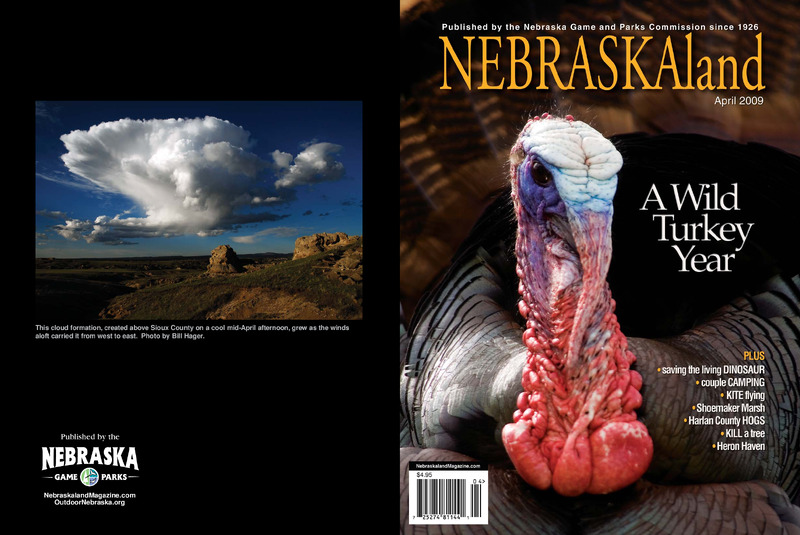
This cloud formation, created above Sioux County on a cool mid-April afternoon, grew as the winds
aloft carried it from west to east. Photo by Bill Hager.
Published by the
$4.95
NebraskalandMagazine.com
OutdoorNebraska.org
Volume 87, Number 3, April 2009
12 Shoemaker Marsh
For 75 years, these saline wetlands on the northern edge of
Lincoln were the hunting grounds for the Little Salt Gun
Club. In 2003, the 160 acres were purchased by Lincoln to
preserve a piece of Nebraska’s most rare ecosystem.
BY JON FARRAR
22 Couple Camping
Early spring in Nebraska is a perfect time to sneak away
with your loved one on a private camping trip.
BY MATTHEW MARX
24 Wild Hogs at Harlan?
Using a helicopter and an aerial gunner, state and federal
wildlife officials attacked the feral pig problem at Harlan
County Reservoir this past February.
BY DOUG CARROLL
28 A Wild Turkey Year
The year in a turkey’s life is both a long and beautiful trek
through Nebraska’s four seasons. PHOTOS AND TEXT BY ROCKY
HOFFMANN
36 Go Fly a Kite!
Last April, the Midwest Winds Kitefliers welcomed folks to
LaVista to celebrate National Kite Month with a display of
giant kites and fun for all ages. BY ELIZABETH MACK
12
●
38
●
38 Saving a Living Dinosaur
Aided by dozens of volunteers, biologists spent 12 long days
last April catching endangered pallid sturgeon on trotlines in an
effort to help save the species. BY KIRK STEFFENSEN
Comment . . . . . . . . . . . . . . . . . . . . . . . . . . . . . . . . . 4
Mixed Bag . . . . . . . . . . . . . . . . . . . . . . . . . . . . . . . 6
In the Field . . . . . . . . . . . . . . . . . . . . . . . . . . . . . . .44
Parks and Places . . . . . . . . . . . . . . . . . . . . . . . . . .45
Step Outside . . . . . . . . . . . . . . . . . . . . . . . . . . . . . .46
Classifieds . . . . . . . . . . . . . . . . . . . . . . . . . . . . . . . 48
Portraits from the Past . . . . . . . . . . . . . . . . . . . . . 50
36
●
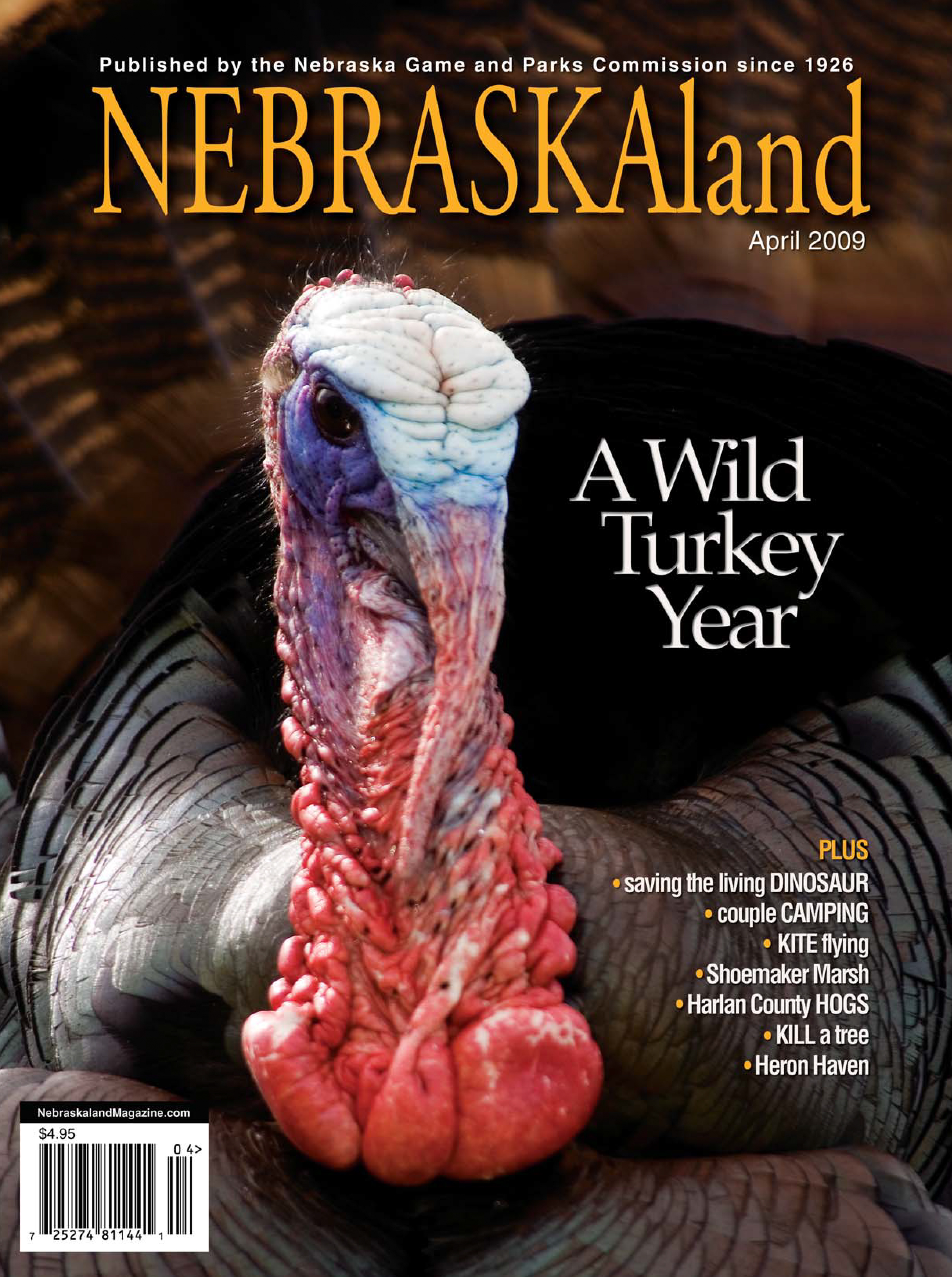
Cover: Ready to do battle, a mature tom turkey can be quite intimidating to younger or less
hardy males. To a hen, however, he is a perfect mate. For a behind the scenes story regarding
this image, see page 6 in the Mixed Bag section of this issue. Photo by Rocky Hoffmann.
Opposite: The red patches on the head of this rooster pheasant contrasted brightly with the
green grass of a Clay County fence line last spring. Photo by Bill Hager.
NEBRASKAland (VOL. 87 / NO. 3, ISSN 0028-1964) is published monthly, except for the
combined Jan./Feb. and Aug./Sept. issues, by the Nebraska Game and Parks Commission,
2200 N. 33rd St., Lincoln, NE. Periodicals postage paid at Lincoln, Nebraska, and additional
mailing offices. POSTMASTER: Send address changes to NEBRASKAland, P.O. Box 30370,
Lincoln, NE 68503-0370.
22
●
APRIL 2009 • NEBRASKALAND 3
Published by the
Nebraska Game and
Parks Commission
Director: Rex Amack
Assistant Directors:
Roger Kuhn, Kirk Nelson, Sam Sidner
Information & Education Administrator:
Doug Bauch
Commissioners
Chairman:
James Ziebarth, Wilcox
Vice Chairman:
Jerrod Burke, Curtis
2nd Vice Chairman:
Mick Jensen, Blair
Dr. Mark Pinkerton, Wilber
Ron Stave, Waterloo
Dr. Kent Forney, Lincoln
Lynn Berggren, Broken Bow
Rex Fisher, Omaha
Mark Spurgin, Paxton
Magazine Staff
Editor: Doug Carroll
Associate Editor: Jeff Kurrus
Art Director: Tim Reigert
Senior Editor: Jon Farrar
Regional Editors:
Eric Fowler, Bob Grier, Rocky Hoffmann
Photo Librarian: Sarah Johnson
Marketing/Advertising:
Jane Gustafson
For advertising information e-mail
ngpc.advertising@nebraska.gov
or call (402) 471-5481
Circulation:
Donna Robinson
For address changes and questions about
your subscription, e-mail
donna.robinson@nebraska.gov
or call (800) 632-5263
NEBRASKAland Magazine
Copyright 2009, all rights reserved.
NEBRASKAland is available on audio cassette from the
Nebraska Library Commission Talking Book and Braille
Service, Suite 120, 1200 N St., Lincoln, NE 68508. (800)
742-7691. NEBRASKAland Magazine and the Nebraska
Game and Parks Commission reserve the right to reject
any advertising not in keeping with the agency mission.
Rates: $18 for one year; $33 for two years; $44 for
three years. Nebraska recipients must add
appropriate sales tax.
To subscribe call 1-800-NEBLAND (632-5263),
or go online to: NebraskalandMagazine.com.
4 NEBRASKALAND • APRIL 2009
History of Pheasants
Jon Farrar’s piece on the introductory
history of pheasants into Nebraska
(March 2009 NEBRASKAland) was
superb work. What must have been
exhaustive work in gathering the data,
researching countless official and
unofficial documents clearly paid off.
His work expertly illustrates the
foresight and determination the early
Nebraskan sportsmen, bird fanciers and
state game officials had in their
decision to actively introduce what few
knew or understood would become the
premiere game bird in the Midwest. I
very much enjoyed Jon’s creativity in
weaving dry statistical data with
personal testaments of those involved
in this great venture into an informative
and interesting piece. Well done, Jon!
In eight short pages your article not
only entertained but provided a
thorough account of how the Nebraska
pheasant got to where it is today.
Many thanks.
Joe Sereno
Tampa, Florida
Winter Camping
Having just read the January 2008
NEBRASKAland, I found the article
about winter camping very interesting
and enjoyable. As a scoutmaster of
Troop 223 in Beatrice back in the 70s,
we had many winter campouts, and
loads of fun. There is a book Matthew
Marx would find very interesting if he
hasn’t already read it. It is “Of Men
and Mountains” by William Douglas.
The hardback copy has the maps in the
front and rear covers, so is preferred if
the library has it. Enjoy.
Kenneth Laughlin
Rockport, Texas
Kudos for Goose Story
Thanks to Jon Farrar for his accurate,
comprehensive and very interesting
two-part December/January article on
the history of Nebraska goose hunting.
In 1970, Nick Lyman and I brought
the first loads of Canada geese to the
Sandhills for release. The birds had
some giant Canada goose bloodlines
and were reared by Forest Lee at the
Northern Prairie Wildlife Research
Center in Jamestown, North Dakota.
Little did we know then how
successful the establishment of a
nesting goose population would be.
Dan Timm
North Platte, Nebraska
An Eye for Photos
Bill Hager’s owl photo in the March
issue was one of the most captivating
outdoor life
photos I have
ever seen.
He seems to
have the eye
and judgment
of an artist as
well as the
ability and
patience to
capture the
world of
nature. I
would encourage NEBRASKAland to
continue using his work in future
issues. Perhaps his military service as a
helicopter pilot has sharpened his sense
and appreciation for the beauty we
enjoy from our outdoor experiences.
Cliff Dale
Lincoln, Nebraska
Where’s the Tag?
As a Hunter Education instructor and
member of law enforcement, I couldn’t
help but notice the photograph of Keith
and Seth Colburn hanging Seth’s mule
deer (“Hunting the Home Place”
November 2009 NEBRASKAland). I’m
sure there’s more than meets the eye,
but I cannot find a carcass tag or
“check-in” ring on the deer’s antlers.
I’ve also looked over the antlers
hanging on the wall and can only find
two with rings on them. Again, I’m
sure there’s more to the story, but to a
young reader this does not look to set a
very good example. Thanks for
listening.
Jeff Shelton
Minden, Nebraska
It’s hard to see, but there actually is
a metal seal barely visible in the right
ear of the deer in question. Also,
according to Conservation Officer
Murray Johnson, under Nebraska game
law there is no requirement to leave a
deer seal on an animal indefinitely.
Many mounted heads are minus the
seal (it’s often attached to the backing
and out of sight or simply discarded).
The burden of proof of an illegal animal
rests with law enforcement, not with the
person who possesses the mount.
Since an animal does not immediately
have to go to a check station, it is not
uncommon to see an animal hanging
without a seal. Seals may also be
attached anywhere on the deer, not just
on the antlers or a rear hock.
Once a person delivers an animal to
a check station, the seal may legally be
removed whenever the animal is ready
to be processed if a person so chooses.
A Cody Christmas
Thanks so much for your wonderful
magazine. Amazing photographs and
very useful articles.
Our trip to
North Platte,
planned after
your article about
Christmas at
Buffalo Bill’s
Ranch, was
really interesting.
The enclosed photo was taken on the
weekend of January 24th at our home
southeast of Lexington. We have three
pairs of cardinals that visit our feeders.
Thanks again.
Larry Williams
Lexington, Nebraska
Send your comments to:
Doug Carroll, Editor
NEBRASKAland Magazine
P.O. Box 30370
Lincoln, NE 68503
or e-mail doug.carroll@nebraska.gov
Please include your postal address and
telephone number.
Letters may be condensed and edited
for clarity. Photographs are
welcome and will be returned.
Under federal and/or state law, discrimination is prohibited on the basis
of race, color, religion, age, gender, marital status, national origin,
disability or political affiliation. If you think you have been discriminated
against in any program, activity or facility by the Nebraska Game and
Parks Commission or want more information, contact the Commission in
Lincoln, NE, at (402) 471-0641 or the Equal Opportunity Commission,
Lincoln, NE, (402) 471-2024, TTY/TDD (402) 471-4693).
Headquarters
2200 N. 33rd Street
Lincoln, NE 68503
Phone (402) 471-0641
District Office I
East Hwy. 2, Box 725
Alliance, NE 69301
Phone (308) 763-2940
District Office II
524 Panzer St., Box 508
Bassett, NE 68714
Phone (402) 684-2921
District Office III
2201 N. 13th St.
Norfolk, NE 68701
Phone (402) 370-3374
District Office IV
301 E. State Farm Rd.
North Platte, NE 69101
Phone (308) 535-8025
District Office VI
1617 First Ave.
Kearney, NE 68847
Phone (308) 865-5310
Omaha Office
1212 Bob Gibson Blvd.
Omaha, NE 68108
Phone (402) 595-2144
Ak-Sar-Ben Aquarium
21502 W. Highway 31
Gretna, NE 68028
Phone (402) 332-3901
World Wide Web site: www.OutdoorNebraska.org
Administration
Ted Blume (Adm.)
Craig Stover (Asst.)
Wes Loos (Asst.)
Rod Loos (Asst.)
Murray Johnson
Lincoln
471-5531
Lincoln
471-5532
Lincoln
471-5591
Ogallala (308) 284-8056
Lincoln
471-5003
Panhandle
Officer
City
Phone (308)
Jim Zimmerman (Sup.) Gering
436-7561
Walt Meyer
Chadron
432-4398
Scott Brandt
Gering
436-3418
Heath Packett
Gordon
282-2553
Dennis Thompson
Lemoyne
355-2024
Dan Zuehlke
Ogallala
284-4815
Doug Pollard
Oshkosh
772-9950
Frank Miller
Valentine (402) 376-1183
Dan Kling
Whitney
432-8367
Southwest
Officer
City
Phone (308)
Roger Thompson (Sup.) N. Platte
532-9175
Ray Dierking
Brkn. Bow
872-3078
George Sund
Cambridge
697-4629
Michael Thome
Cozad
784-4362
Matt Andrews
Elwood
785-3025
Dirk Greene
Imperial
882-5328
Virgil Gosch
McCook
345-2185
Dudley Sorensen
N. Platte
532-0747
Rich Routh
Rep. City
799-2085
South-central
Officer
Jerry Pecha (Sup.)
Jeff Jones
Terry Brentzel
City
Phone (308)
Kearney
865-5327
Clay Center(402)762-3124
Doniphan (402)845-2021
Randy Pomplun
Darin Gress
Dale Johnson
Mark Reeves
Robert Finke
Fullerton
536-2987
Hebron (402) 768-2287
Kearney
237-1079
Loup City
745-0662
Milford (402) 761-3537
Northeast
Officer
Tom Zimmer (Sup.)
Dale Davis
Ross Oestmann
Steve Oberg
Daniel Roberts
Jon Reeves
Marion Shafer
Pat George
Eric Wiebe
Tim Williams
Cory Krause
City
Phone (402)
Norfolk
371-6625
Bassett
273-1700
Bloomfield
373-4412
Columbus
564-5937
Fremont
721-7852
Kennard
427-7378
Norfolk
371-2031
O’Neill
336-1588
Ponca
755-2566
Neligh
887-1335
West Point
372-6979
Southeast
Officer
Duane Arp (Sup.)
Sean McKeehan
William Krause
Mike Luben
Douglas Kramer
Dina Barta
Stacey Lewton
Levi Krause
Russell Mort
Dan Evasco
Jeff Clauson
City
Gretna
Ashland
Auburn
Colon
Lincoln
Lincoln
Lincoln
Louisville
Nebr. City
Papillion
Waterloo
Phone (402)
332-2965
944-4174
274-3789
443-4278
466-9001
483-2358
476-0436
234-2212
873-5684
592-6733
359-5301
Nebraska Wildlife Crimestoppers 1-800-742-7627
APRIL 2009 • NEBRASKALAND 5
to hunt turkeys, but all archery turkey
hunters must use a bow with a draw
weight of at least 40 pounds at or before
28 inches of draw. All hunters under
the age of 12 must be accompanied by
a person 19 years of age or older who
has a valid Nebraska hunting permit
when hunting turkeys.
Spring Woodland Wildflowers
Behind the Cover
Rocky Hoffmann
For this month’s cover photo, I was
able to capture the angry expression on
the tom turkey’s face by placing a
mount of another male turkey in full
display out front of my blind. When
this dominant tom came along, it really
upset him to see another tom displaying.
His first attack was a kick to the
head of the mount, tearing the head
completely off and sending it flying
about 15 yards. I had borrowed the
mount from law enforcement and I
don't believe they were too pleased
when I brought it back.
Turkey Permits Now Available
Permits for the 2009 spring turkey
hunting seasons may now be purchased.
Hunters will have more opportunity to
use them, too, as the seasons have been
extended by a combined 10 days.
The 2009 hunting seasons are:
archery and youth archery, March 25May 31; youth shotgun, April 11-May
31; and shotgun, April 18-May 31.
Spring turkey hunting permits, which
are valid statewide, may be purchased
through May 31. Each hunter may
purchase up to three permits for the
spring seasons, and that limit may
be any combination of shotgun and
archery tags.
Resident permits are $24 and
nonresident permits are $91. Permits
may be purchased online at
OutdoorNebraska.org. The bag limit
is one male or bearded female turkey
per permit.
There is no minimum age requirement
6 NEBRASKALAND • APRIL 2009
Jon Farrar
Gardeners with limited space but a
taste for variety often resort to “double
cropping” – seeding early maturing
plants such as radishes between future
rows of larger plants like potatoes and
green beans. Long before the larger
plants tower over the radishes and steal
the sunlight, the radishes have been
used. Something similar happens quite
naturally in woodlands. Before sunlight
is shut off from the forest floor by a
canopy of leaves, many forest wildflowers
have sent up stalks, spread leaves,
flowered and set seed. Among these
early bloomers in Missouri River
Valley woodlands are Virginia spring
beauty, bloodroot, Dutchman’s
breeches, Jack-in-the-pulpit,
downy blue violet, May-apple,
dog’s-toothviolet and blue
phlox. To a
degree, these
prevernal
wildflowers have
counterparts on
grasslands, racing to
complete their lifecycle
before the light is
stolen away by
chest-high
bluestem
and Indiangrass.
Before the forest’s leafy
canopy closes is one of the
best times for the wildflower
photographer in woodlands, but even
then finding the best light can be
difficult, and it is even more difficult
once leaves are on. While digital
photography and photo-manipulation
software has made making corrections
easier after the photo is taken,
photographers should not rely solely on
them. The better the original image, the
better the “worked-up” final image and
the less time required to get to it.
4-H Wildlife Habitat
Evaluation Program
PHOTO BY TOM SCHEIMO
There will be occasions when a
photographer wants dramatic light – a
beam of light falling on a columbine
flower with a near-black background –
but more often soft, delicate, dispersed
light is sought. Unfortunately, woodlands
typically offer a patchwork of dark
dark shadows interspersed with harsh
light where sunlight penetrates.
There are a number of ways to
balance the intensity of woodland light.
One of the best is to photograph on
bright-overcast days. If the day is
overcast, but you can see a faint shadow
under the car ahead of you, you have
bright-overcast light. Photographing
before or after sunlight begins falling
on the forest floor will offer the same
even light, but requires longer exposures
and higher ISO settings. One way to
fill heavy shadows with light is to use a
strobe set to provide light one to two
stops less than your exposure reading
for the ambient light. Small collapsible
reflectors to bounce sunlight into shadow
areas are even easier to use. While not
as convenient, a piece of white
matboard or other reflective surface can
be used to accomplish the same thing.
Close-to-the-ground tripods or other
devices to hold cameras at low levels
not only provide stability and prevent
unwanted camera movement, but
will also free a hand for a reflector or
off-camera strobe.
Area), treated to
stunning views of
Barrel Butte and
the West Ash
Creek canyon to
the east.
Considering the
rugged beauty in
the array of steep
buttes, deep
canyons, small
streams, and thick
forests, it’s
surprising that the
area does not see
more hikers.
Because this
A view from the Rim of the World Trail at Ponderosa WMA.
WMA’s streams are
not stocked with fish, few anglers even
senior team to the National Wildlife
try. The area’s largest number of visitors
Habitat Evaluation Invitational.
To get help forming a team, finding a includes fall deer hunters and spring
turkey hunters. The rest of the time
coach and learning more about WHEP,
things are pretty quiet.
contact your local extension office or
This WMA tucked away in western
Kirk Gunnerson, Nebraska WHEP
Dawes County has been in existence
State Coordinator, (402) 470-0440,
since 1965, and has survived the
nebraskaWHEP@Hotmail.com.
McIntosh Fire in 1985 and the Sawlog
Fire in 2000. Fortunately, area fire
crews were able to save much of the
forest, protecting the habitat for large
numbers of deer, wild turkeys, bighorn
sheep and other wildlife.
Tom Scheimo, Chadron
No doubt the Black Hills to the north
It was an absolute delight. Savoring
the soft scent of ponderosa pines warmed and the Rockies to the west divert
by the sun, my wife and I were amazed much attention from this area and the
rest of Nebraska’s Pine Ridge, but as I
at the unspoiled beauty around us. We
consider the pristine beauty of the area,
were hiking on the Rim of the World
I have to wonder if that is such a bad
Trail through Nebraska’s 4,000-acre
Ponderosa WMA (Wildlife Management thing.
On the Rim of the World
in Nebraska
April Events
April can be a busy time of year as the
weather starts to warm up and people
start looking for more to do outside.
Here are a couple of events that you
might want to check out.
If you like getting your hands dirty,
you should try to attend this year’s
20th Annual Fort Robinson Tree Plant
held the weekend of April 4th.
Jim Schmitt, chairman of the event,
said more than 1,100 Boy Scouts,
volunteers and Nebraska National Guard
members are expected to attend this
year’s event and will plant 20,000 trees
to help bring Fort Robinson and the
surrounding hills back to the way they
were before a big wildfire raged through
the area in 1988. More than 350,000
trees have been planted since 1989.
For more information, e-mail Schmitt
at foxes4@daltontel.net, call him at
(308) 377-2240 in the evenings,
(308) 254-5365 during the day, or call
Fort Robinson at (308) 665-2900.
Another fun event that weekend, and
one a lot closer to the eastern part of
the state, is the Spring Art Show that
will be held at Eugene T. Mahoney
State Park near Ashland. The show is
being put on by Loren Goedeken of
Prairie Images, a well-known artist
whose work has been used for
Nebraska Habitat Stamps in the past. A
rib cookout will be held in conjunction
with the art show, and the park’s
restaurant will be having an Easter
Buffet on Palm Sunday, April 12. For
Doug Carroll
The Wildlife Habitat Evaluation
Program is a fun and challenging
outdoor adventure where youngsters
age 8-18 can learn about wildlife,
conservation and management. Guided
by wildlife handbooks especially
designed for young people, volunteer
leaders help youth learn about the
needs of wildlife. The junior (age 1213) and senior (age 14-18) division
youth then compete at a state contest
as teams or individually in June. The
novice group (ages 8-11) does not
compete at the state contest, but learns
about wildlife through fun educational
activities and games.
Sponsors provide T-shirts and
awards, including a trip for the top
8 NEBRASKALAND • APRIL 2009
APRIL 2009 • NEBRASKALAND 9
A Family Affair
One late night in Nemaha County, fellow conservation officer Bill
Krause and I were looking for hunters illegally spotlighting. As Bill
drove our truck down a broken trail, I asked him what kind of selfrespecting poacher would be on a road like this. Just then lights
appeared in front of us, bouncing up and down on the same rocky
trail. Bill stopped and backed up to a high hill.
After seeing a large spotlight shining out the window, Bill turned on
his lights and approached the rusty, extended cab truck. Inside it was
a drunk man holding a gun, his mother, who was holding a powerful
spotlight, the man’s daughter and three of her children. I have heard
that hunting can be a family affair, but I thought this was over the top.
When we asked the man why he had so many people with him, he
said he needed all the help he could get.
I looked at Bill and wondered how many tickets we were going to
write. Bill said he wanted the drunken man and that I could deal with
the others. Great – I was going to have to give a ticket
to a 77-year-old great grandma or a mother with three
kids who just wanted to go for a ride. Just then the
great grandmother, who was driving, barked out, “I
hope I get my damn light back, I need it for the rest of
the season!”
After that comment I realized sometimes attitudes
make it easier for officers to do their jobs.
– Stacey Lewton, Conservation Officer, Lincoln
more information about either event,
call the park at (402) 944-2523.
For Arbor Day on April 24th,
Arbor Lodge State Historical Park in
Nebraska City will be holding two
children’s programs, one at 9 a.m. and
the other beginning at 1 p.m., that are
open to the public. The event features
entertainment by Darrel Draper as J.
Sterling Morton, founder of Arbor Day,
and tree seedlings will be given to each
child and participant in attendance for
them to plant at home. There will also
be a commemorative tree planting
ceremony the following day. For more
information, call Arbor Lodge at
(402) 873-7222.
$80,000 Toward Nebraska
Bighorn Sheep Program
The Nebraska bighorn sheep
management program got a big boost
when a Kansas man placed the winning
$80,000 bid for a permit to hunt
10 NEBRASKALAND • APRIL 2009
bighorn sheep in Nebraska’s Pine
Ridge next year.
John Marsh of Topeka, Kansas, was
the winning bidder at this year’s Wild
Sheep Foundation convention in Salt
Lake City. He will receive four days of
guide service, horse usage, lodging and
meals at Fort Robinson State Park
during the 2009 bighorn sheep season
this December.
Each year the Nebraska Game and
Parks Commission conducts a lottery
for one resident sheep hunting permit,
and the Commission occasionally
offers one permit for auction. While the
lottery permit is restricted to Nebraska
residents, each auction permit can be
purchased by anyone. To date, each
lottery winner and auction permit
holder has harvested a full-curl ram
from Nebraska’s Pine Ridge.
Applications for the 2009
bighorn lottery permit cost
$25 and will only be
accepted through 5 p.m.,
August 12 at the
Commission’s headquarters in Lincoln.
Applications may also be made online
at OutdoorNebraska.org. Online
registrations will be accepted until
midnight, August 12.
Ninety percent of the proceeds from
the bighorn permit auction go directly
toward the state’s reintroduction and
management program for bighorn
sheep. The program is credited with
returning bighorn to the state after they
were extirpated in the late-1800s. The
most recent milestone reached by the
program was the purchase of 51 sheep
from Montana that were released into
the Wildcats Hills in 2007. Forty-nine
sheep were relocated to the Pine Ridge
in 2005.
Nebraska has four bighorn herds:
Fort Robinson and Barrel Butte in the
Pine Ridge, and Cedar Canyon and
Hubbard’s Gap in the Wildcats Hills.
The estimated bighorn population in
the state is 280.
Hunting Facts
Because hunting takes planning,
start thinking now about what you and
your young ones need to legally hunt
this year. The Nebraska Game and
Parks Commission holds Hunter and
Bowhunter Education classes
throughout the year and the class
listings can be found on the Wildlife
portion of the Commission’s web site
at OutdoorNebraska.org. If you are
unsure what you or a youth needs to
start hunting, here are a few facts:
The minimum age requirement for
hunting deer in Nebraska is 10 years of
age and the minimum age requirement
for all other big game (pronghorn, elk
and bighorn sheep) is 12 years of age.
The age at which a child can start
hunting anything else, including turkeys,
is a parental
decision.
In addition,
all hunters
Message Plates
Eric Fowler
Outdoor enthusiasts tend to
be passionate about their
pursuits, some so much that
anyone who looks at their
license plate can tell exactly
what they do in their free time.
Take Larry Kroeker of
Ogallala, for example, whose
plate reads “ILK2FISH.” Or Jeff
Rawlinson of Lincoln, the head
of the Nebraska Game and
Parks Comission’s hunter
outreach programs, whose
plate reads “GO HUNT.”
You can get your own
message plate, often called
vanity plates, through the
Nebraska Department of Motor
Vehicles for an additional fee of
$30 when you license your
vehicle.
If you have an idea for one,
good luck getting it. Most of the
good ones, like “I HUNT” and
“WTRFWLR,” are taken. I know
this because I checked the
online search at
https://www.nebraska.gov/dmv/
splate/.
If you have a unique
message plate you would like
to share, or know someone
who does, e-mail a photo of it
(.jpg format only, please) to
Eric.Fowler@Nebraska.gov,
along with your name and the
town you live in.
course may obtain an
Apprentice Hunter
Education Exemption
Certificate from the
Commission.
These exemption
certificates provide
novice hunters the
opportunity to try hunting
and receive training from
experienced hunters
before completing a
hunter education course.
Hunters using this certificate
must be accompanied at all times by
a licensed hunter age 19 or older
who is in unaided visual and verbal
contact with them while hunting. This
certificate may be obtained once in
each person’s lifetime, expires on
December 31 of the year in which it
was purchased and may be renewed
only once. The fee is $5.
Finally, with the exception of
turkeys, big game hunters under the
age of 16 must be accompanied by a
licensed hunter age 19 or older who is
in unaided visual and verbal contact
with the younger hunter at all times.
Certificates of Recognition
The Nebraska Game and Parks
Commission has started a new program
for individuals wishing to
commemorate their trophy or first-ever
game animal or fish with a webgenerated Certificate of Recognition.
These certificates are designed
especially with young outdoorsman and
woman, but older individuals are
welcome to participate as well.
Look for the appropriate certificates
under the Hunting and Fishing portions
of the Commission’s web site at
OutdoorNebraska.org. ■
in Nebraska between the ages of 12
and 29 who:
• are hunting with either a firearm or
crossbow must carry proof of successful
completion of Firearm Hunter Education
• are hunting big game (deer,
pronghorn, elk or bighorn sheep) with
bow and arrow must carry proof of
successful completion of Bowhunter
Education
• have not completed a Firearm
Hunter and/or Bowhunter Education
APRIL 2009 • NEBRASKALAND 11
SHOEMAKER MARSH
By Jon Farrar
For 75 years, these saline wetlands on the north edge of
Lincoln were the hunting grounds for the Little Salt Gun Club.
In 2003, the 160 acres were purchased by Lincoln to preserve a
piece of Nebraska’s most rare ecosystem.
Shoemaker Marsh is nestled in gently rolling farmland on Lincoln’s northern edge along Little Salt Creek.
“I
12 NEBRASKALAND • APRIL 2009
Lincoln’s western and northern edges. When rains were timely
those wetlands attracted waterbirds, and the ducks among
them attracted hunters from the city’s earliest days.
The location for the city of Lincoln was selected because of
those basins and the promise of a rich commerce evaporating
salts from their saline waters. That hope was dashed by the
discovery of easily mined salt deposits in Kansas. From that
time until recently, the salt marshes were viewed as mosquitobreeding swamps to be filled with rubbish so something
useful could be built on the sites. From the 1930s until the
mid-1950s, low ground and wetlands near Oak Lake on
Lincoln’s western edge were used as the city dump. Into
the 1980s, other wetlands west of Lincoln were filled with
construction rubble. Wetlands on Lincoln’s northern edge
were used as the city landfill from the mid-1950s until 1988.
Saline wetlands that survived were farther from the city,
mostly along Little Salt Creek to the north and Rock Creek
south of Ceresco. Wetlands near Lincoln survived for as long
as they did because until recently the city had not spread to
them, they could only be farmed when dry (and even then
produced poor crops) and they were owned or leased by
waterfowl hunters. And that is the story of Shoemaker Marsh
on Lincoln’s northern edge.
LITTLE SALT GUN CLUB
Dana F. Cole – certified public accountant, charter member,
and secretary-treasurer for most of the Little Salt Gun Club’s
history – recalled the club’s founding in a 1977 talk to
Lincoln sportsmen. In 1927, an acquaintance asked Cole for
a loan so he could lease “a place out north of town where
commercial hunters used to hunt. It was a great hunting spot.”
PHOTOS BY JON FARRAR
had awakened at 5 a.m. and put on my dad’s old hunting
coat and drove the long miles in the darkness to reach
the location on North 27th Street that people now know
as Shoemaker’s Marsh,” Charles “Fritz” Craft wrote
in the “Local View” column of the January 29, 2005
edition of the Lincoln Journal Star. “But to me and a few
men in the Lincoln area, it will always be known as Little
Salt Duck Club.”
That morning Craft, who was briefly home from Cambodia,
where he was the chief dental officer for the U.S. Embassy,
spread his father’s ashes on the wetlands they both loved.
Charles “Fred” Craft, Fritz’s father, had been a member of the
Little Salt Gun Club for nearly five decades and the principal
caretaker of the club’s dikes, pumps and blinds.
In the first half of the 20th century, duck hunting clubs
could be found on most of the shallow, saline wetlands on
Common yellow-throats – small, secretive warblers of marshy
and brushy shorelines – are again common on the wetlands.
APRIL 2009 • NEBRASKALAND 13
the shooting there satisfactory, and purchased it the following
spring. For the next three decades, those 80 acres were a
close-to-home getaway for members, their sons and their
friends. In 1930 the club incorporated, retaining its original
name and purpose – “to maintain hunting, fishing and
recreation grounds; to maintain a club house thereon and
other improvements necessary thereto,” with the intent of
“continuing 99 years.” That same year, the club leased the
40 acres with a wetland that adjoined their land on the east,
purchased Triumph Hen Scratch from Crete Mills to feed
the English call ducks they kept in a pen by their shack, and
purchased custom-made steel tanks from Nebraska Boiler in
Lincoln and Dempster Manufacturing in Beatrice to be their
shooting boxes.
The drought and depression of the 1930s strained even
prosperous businessmen – interest payments on the club’s
mortgage were often late, and several members dropped
out. The remaining members remained
optimistic. In October
1933, a
ARCHIVES & SPECIAL COLLECTIONS,
UNIVERSITY OF NEBRASKA-LINCOLN LIBRARIES
The man proposed building a dike to enlarge the pond and
sell hunting memberships. Cole loaned the man the money,
and that autumn Cole and several friends hunted the pond
regularly, killing a total of 850 ducks. Cole visited the
company holding the mortgage on the land and said he
wanted to buy it. “It isn’t worth anything, it’s worthless” the
banker told him. In the spring of 1928, Cole and seven other
Lincoln businessmen purchased the 40 acres of land for
$2,000 and formed the Little Salt Gun Club “for recreation
and social purposes.”
The land was along Little Salt Creek, about two miles
above its mouth, today a little more than a mile north of the
intersection of Interstate 80 and North 27th Street. Within
months the club grew to 10 members, the limit prescribed in
the bylaws. The members immediately set about building a
shack, pumping water from Little Salt Creek into the pond
and refurbishing blinds left by previous hunters. Having a
duck pond close to town allowed the businessmen a few
hours of shooting in the morning before going to work.
Ducks were dropped off at a local poultry house and dressed
for 12 cents a bird.
In 1929, the club leased an adjoining
40 acres for hunting,
found
Saline wetlands were common on Lincoln’s western and northern edges, and a frequent destination for duck
hunters. Frank Shoemaker, the man for whom the marsh is named, took this photo near Lincoln in the early 1900s.
dozen mallard and a dozen redhead
decoys were purchased from Henkle &
Joyce Hardware Company at $8.50 a
dozen. Robert M. Joyce, the Joyce in
the company’s name, was a member of
the Little Salt Gun Club. A week later,
a dozen duck heads were purchased.
Hunting, though, was poor; the
ponds often dry and not worth
pumping.
Maintenance and improvements
were endless – new blinds were
sunk partially underground, old
blinds repaired or moved, leaking
blinds patched for another season;
repairs made to an old tractor
used to pump water into the
pools before the hunting season;
breached, low-level dikes
repaired and raised a few more
inches. During the 1930s the
work was done by hired labor.
In 1930 the club paid $75 for
“2 men, 3 horses” to do nine
days of work “repairing
4 dikes” and the road to the
shack. After World War II
the work would be done
with dozers and dump
trucks.
In 1939, James Stuart
Sr. acquired a membership in the club. He would hold that
membership for decades and serve as club president for
many years after World War II. Stuart was one of few
surviving officers of the Battle of the Bulge. He began hunting
the club’s ponds while still in college. “I would get up in
the morning and in 20 minutes I would be at the club
[grounds],” he recalled. “I would have my hunting clothes
on. My going-to-school clothes were in the backseat of the
car. I would shoot for 20 minutes or whatever period of
time I could, quickly change my clothes and get to an
eight o’clock class.”
It was Stuart who brought Fred Craft, a former fraternity
brother at the university, into the club in 1955, and they
shared the same duck blind many mornings, as Fred’s
son Fritz said: “Watching Lincoln wake up.” Fred was a
professional engineer and the on-site manager of the club’s
land into the 1980s. It was Fred’s idea to sink burial vaults
to be used for duck hunting blinds in 1955.
“He wanted them delivered out at the gun club,” Stuart
recalled. “The water was sort of out of the lake, and he drew
a picture of the lake and he said: ‘Now, this is where I want
this put.’ One was in the center of the big pond. So the guy
said, ‘Well, okay.’ He went out there and he was going to dig
the hole. Those burial vaults must have weighed a thousand
tons, you know. Of course he got stuck and he had to bring
a tractor out and pull his truck out. He called Craft and
said: ‘Don’t ever call me again.’ We hunted out of those
for years.”
It is the nature of the shallow salt marshes to periodically
dry during the summer and often remain dry into the autumn
hunting season. The club’s solution was to pump water from
APRIL 2009 • NEBRASKALAND 15
hunting, and the number of birdwatchers asking permission
to use the land was growing.
In 1987, Lincoln purchased 58 acres containing a saline
wetland immediately southeast of the club’s land as
mitigation for wetlands destroyed by street construction in
southwestern Lincoln and named it Arbor Lake. Everyone,
including the Little Salt Gun Club, was beginning to see the
remnant saline wetlands as more than just swamps to be
drained and filled to make way for a housing development,
or as a “close to home” place to hunt ducks. During the
1990s, the club talked with the Lower Platte South Natural
Resources District about a conservation easement and
investigated other wetland preservation programs to
perpetually protect the land.
PHOTO BY JON FARRAR
To create additional Salt Creek tiger beetle habitat, soil over seeps was intentionly disturbed to leave wet, saline earth.
PHOTO BY JON FARRAR
the creek to fill the pools. As decades passed, though, it
became evident pumping fresh or slightly saline water into
the ponds was converting them to freshwater ponds, and
freshwater aquatic plants like cattails soon invaded the open
waters where the hunters hoped to spread their decoys.
Aquatic plant herbicides were tried, and Craft mowed the
dry wetlands at different times in the summer to “keep the
weeds down.”
In the summer of 2008, entomologists found 165 Salt Creek
tiger beetles, the lowest number since the first survey in 1991.
16 NEBRASKALAND • APRIL 2009
Throughout the club’s history the members hosted dignitaries,
among them, on several occasions, Lieutenant Colonel
James “Jimmy” Doolittle who led the first air raid on the
Japanese home islands April 18, 1942, knowing they would
not have enough fuel to return. One of Doolittle’s pilots on
the one-way raid launched from the carrier Hornet was
Lt. Richard O. Joyce who after the war was a member of the
club. Joyce’s B-25 ran out of fuel over China. He parachuted
to safety and spent two more years fighting in the ChinaBurma-India theater.
In 1960, the club again reorganized, legally becoming the
Little Salt Development Company, a name suggesting the
members had more in mind for their land than duck hunting.
To the members, however, it remained the Little Salt Gun
Club. The reorganization was prompted by the purchase of
80 acres of land lying immediately east of the club’s land,
including 40 acres it had been leasing. By the 1960s, Dana F.
Cole was the only charter member remaining. Other members
had passed their memberships to sons or their interests had
been sold to other prominent Lincoln businessmen. The club
considered purchasing land with wetlands to the north, but
did not. In 1967, they had concrete rubble dumped in Little
Salt Creek to allow foot traffic from one side of the property
to the other.
An irrigation well was installed in the early-1980s and
made filling the ponds easier, but the older club members
seemed to require less hunting to be satisfied. Fred Craft
wrote Stuart he was “weary” of the work with pumps, dikes
and blinds and wanted to “bring on the young guys.” By the
1980s, the land was increasingly being used for pheasant
In June 2003, Lincoln purchased the Little Salt Gun Club’s
160 acres. The purchase was negotiated by the Nebraska
Game and Parks Commission. The two
government entities had worked together protecting wetlands
before, such as Arbor Lake, which is owned by the city but
managed by the Commission. Because the Little Salt Gun
Club land was small and so near the city limits, the
Commission believed it was not the right fit to be a wildlife
management area. Funds for the purchase came nearly
equally from a Nebraska Environmental Trust grant to the
city and a State Wildlife Grant award to the Commission by
the U.S. Fish and Wildlife Service. The Saline Wetland
Conservation Partnership, formed in 2002 and composed
of governmental agencies and conservation organizations,
provides additional funding and expertise managing the
property. The new park was named Frank Shoemaker Marsh,
after an early day amateur naturalist. Also in 2003, Tom
Malmstrom was hired by Lincoln as the Saline Wetland
Project Coordinator to oversee managing Shoemaker Marsh
and other saline wetlands.
Funding to purchase the property was available in part
because the Salt Creek tiger beetle, listed as a State
Endangered Species, lives there. Two years after the purchase,
the species was listed as endangered by the U.S. Fish and
Wildlife Service because it was “one of the rarest insects in
the United States.” Surveys conducted by University of
Nebraska-Lincoln entomologists in the summer of 2008 on
saline wetlands known to have the rare beetle produced a total
count of only 165 – all the known Salt Creek tiger beetles in
the world – of which 29 were on Shoemaker Marsh.
Just as whooping cranes, piping plovers and least terns
have had the legal clout and funding to bring protection and
restoration to the central Platte River that has benefitted a
host of other plants and animals, the rare tiger beetle has
been the headline grabber in protecting the state’s most rare
and vanishing habitat. But tiger beetles are only one of the
reasons to preserve saline wetlands – the wetlands provide
flood protection, improve water quality and are habitat for
many plant and animal species. The highest quality saline
wetlands that remain are home to salt-tolerant plants rarely
found in mid-continent – saltwort (a Nebraska endangered
species), sea blite, saltmarsh aster and others. Eastern saline
wetlands were never widespread. The most reliable estimate
Frank Shoemaker was born in Iowa in 1875, and
moved to Omaha in 1897 to work as a stenographer
and clerk for Western Union Telegraph Company. His
youthful interest in natural history came with him, and
he spent as much time as possible exploring nearby
Missouri River woodlands in search of birds and
insects. He began taking photographs in 1898, using
5-by-7 glass plate negatives. Over 3,000 of his
photographs
are now housed
at the University
of NebraskaLincoln
Archives.
During the
early-1900s he
occasionally
accompanied
University of
Nebraska
zoologists and
botanists on
expeditions to
the Sandhills
and the
Panhandle, and
in 1911 he was
a “special
student” at the
university. Even
before working
in Lincoln,
Shoemaker had Frank Shoemaker (1875-1948), an
amateur naturalist, was particularly
traveled to the
saline wetlands interested in tiger beetles.
in northern
Lancaster County to observe and photograph nature,
particularly the many species of tiger beetles found
there, which he collected extensively for specimens.
He wrote tiger beetles were present in such “great
numbers” they sometimes flushed ahead of him and
“the ground seemed to rise and walk away.”
Shoemaker never married and held a variety of
jobs over his lifetime, leaving him free to travel for
nature study. From 1910 through 1913 he worked as
a photographer for universities in Lincoln and Omaha,
and was a clinical photographer for the University
Hospital in Omaha in the late-1920s and early-1930s.
During the Depression he was a photographer for the
Federal Art Project and held odd jobs in Sioux and
Dawes counties. He lived in California from 1928
through 1942, when he returned to Lincoln.
Shoemaker lived modestly, working as needed to
support himself, pursuing his passion in life until his
death in 1948.
– Information from a three-part article series about
Frank Shoemaker (March, April and May 1987
NEBRASKAland) by Jim Ducey.
ARCHIVES & SPECIAL COLLECTIONS, UNIVERSITY OF NEBRASKA-LINCOLN LIBRARIES
MAKING SHOEMAKER MARSH
FRANK SHOEMAKER
APRIL 2009 • NEBRASKALAND 17
PHOTO BY ERIC FOWLER
the work. A technical advisory committee was formed,
composed of representatives of all 11 local, state and federal
sponsoring agencies and organizations, as well as professionals
representing various scientific fields – soil scientists,
hydrologists, engineers, botanists, entomologists, ornithologists
– including three biologists from the Commission who had
worked with wetland restoration for many years. A smaller
core team spent days becoming familiar with the site, and
met frequently to develop concepts for the restoration.
Periodically they presented their ideas to the advisory
committee for review and comment. A private engineering
firm specializing in wetland restoration was contracted to
develop the actual plan, which was reviewed and revised
several times by both planning teams. The plan was completed
in July 2006, and earthwork on the site was done between
September 2006 and April 2007.
Prior to the construction phase, 21 acres of uplands that
had been a soybean field were seeded to native grasses and
forbs. Over the years, trees had encroached on the site’s small
remnant patches of native grassland. Many of the invasive
trees were removed. “There was only one tree on the place
when we bought it,” Dana Cole recalled. Malmstrom said the
objective is not to restore the entire area to grassland, but to
leave some trees as habitat for woodland and woodland-edge
species, particularly migratory songbirds. The trees on the
margins of the area serve as visual barriers to enhance the
experience of visitors in the wetlands. Additionally, Salt
Creek tiger beetles are known to be attracted to bright lights
and will fly considerable distances to reach them, making
the beetles vulnerable to predation and disrupting the mating
cycle. Should development encroach closer to Shoemaker, it
is hoped the trees will serve as a visual barrier to the beetles
as well.
About 50 acres of saline wetlands were present when the land
was purchased, but others had become freshwater wetlands
and were choked with aquatic vegetation, particularly cattails.
Restoring salinity to the wetlands and allowing saline plant
communities to recolonize was the primary objective of the
restoration plan. Low-level dikes were created or repaired
on each of the site’s three wetland pools. Each dike has a
is about 20,000 acres at the time eastern Nebraska was
settled. Today, less than 4,000 acres remain and many of
those are highly degraded.
COMPLEX HYDROLOGY
Where does the saline water found in wetlands such as
Shoemaker Marsh come from? The answer is deeply buried
in ancient shales laid down in Cretaceous times, the Age of
Reptiles, some 70 to 160 million years ago when much of
central North America was covered by a vast inland ocean of
marine waters. Overlying those deeply-buried shale deposits
is Dakota sandstone, a soft, permeable rock that outcrops in
eastern Nebraska.
18 NEBRASKALAND • APRIL 2009
For hundreds of thousands of years these salty waters have
percolated upward, wicked to the surface during drought and
filling the shallow basins of the upper Salt Creek drainage.
During the dry months of summer, water in the basins
evaporates and the salts precipitate out on the surface. With
each cycle of replenishment and evaporation the soil became
more saline.
While filling with garbage, construction rubble and soil
caused the direct destruction of many saline wetlands in
and near Lincoln, many were degraded in a more insidious
way – the alteration of the complex hydrology that created
and maintained them. The principal instrument was the
straightening and confining of Salt Creek with levies to
prevent it from flooding, flooding Lincoln in particular.
Once confined and straightened, the velocity of Salt Creek
increased, its channel cutting deeper; and channels of smaller
streams feeding into it, like Little Salt Creek, also carved
deeper beds, creating steep, eroded banks. Periodic floods
less frequently spilled into floodplain pools and basins. The
water table fell and saline waters were less efficiently
wicked to the surface. All of these changes were decades in
the making.
Completely restoring the saline wetland’s natural hydrology
will never be feasible. The best managers can hope for is
simulating the incredibly complex system. Before the first
yard of earth was moved on Shoemaker Marsh, Malmstrom
and the Saline Wetland Conservation Partnership gathered
the best experts in many natural resources fields to advise
PHOTO BY JON FARRAR
An aerial view of Shoemaker Marsh, looking southwest, shows Little Salt Creek’s meandering course and three wetlands areas.
Saltwort, a Nebraska endangered species, is a compact, lowgrowing, succulent plant found on wet saline soils.
APRIL 2009 • NEBRASKALAND 19
PHOTO BY JON FARRAR
built on the north and east side of the wetland near 27th
Street to trap sediment from runoff around the wetland.
Almost a mile of Little Salt Creek meanders through
Shoemaker, so planners also addressed the problem of its
down-cutting bed. The relationship between the creek, the
wetlands, and the groundwater connecting them is not fully
understood, but planners and managers knew the connection
was and is important. Two small, in-stream weirs were
installed, one on the north end of the property and one on
the south end. Most of the concrete rubble the duck club had
put in the creek was removed and a large rock weir was
installed at the same location near the middle of the area,
creating a four to five feet rise in the stream level. The weirs
were built only high enough to stop Little Salt Creek from
continuing to cut deeper. Higher weirs might have reversed
the down-cutting by allowing sediment to accumulate
upstream and re-build the streambed, but there was concern
that could increase flooding on upstream private land during
high-water periods.
Historically, Salt Creek tiger beetles were found on saline
wetlands and wet salt flats. Since the destruction or degradation
of most of these wetlands, the beetle’s last retreat has been
the mudflats and saline seeps on Little Salt Creek.
Commission wetlands specialist Ted LaGrange, a member of
the technical advisory committee, proposed additional
stream-side tiger beetle habitat could be created by removing
the vegetation at some of the saline seeps. At two locations
where seeps were evident on Little Salt Creek’s banks,
backhoes were used to pull back the soil overburden, leaving
wet, saline mudflats, the preferred habitat of Salt Creek tiger
beetles. Tiger beetles were found on both sites in 2008.
Kevin Poague and other birders find not just wetland species
on Shoemaker Marsh, but also grassland and woodland birds,
including American bitterns, opposite.
control structure so the water level in the pools can be
regulated and surplus water shunted to the creek. The natural
cycle of saline wetlands – wet in the spring, dry in the summer
and wet again in the autumn – can be simulated, explained
Commission wetlands biologist Randy Stutheit, who has
been on the core team since Shoemaker was purchased. “It
gives us better control over both the freshwater and saline
waters entering the wetlands.” Malmstrom usually lowers the
pools after the spring migration of waterbirds, and raises the
water level again in the autumn to provide migration habitat.
Water in the pools is completely dependant on precipitation,
saline seeps and runoff. No creek or groundwater is pumped
into the pools.
A consultant who worked on the project determined that
numerous layers of saline soils existed in the soil column
beneath the wetland’s surface. Soil salinity was about 15 times
greater 18 inches below the surface. During the earthwork
phase of the project, silt was removed from some of the
wetlands to uncover the saline soils. Earthwork avoided sites
where rare saline plant communities existed. A berm was
20 NEBRASKALAND • APRIL 2009
No one expects the marsh to ever be what it once was, but
every year it should be closer as the renovation work begins
to bear fruit and more is learned about saline wetland
hydrology. Saline plants should return and flourish fairly
quickly in the restored wetlands. The restoration of a diverse
prairie plant community will take longer. Simulating the
complex hydrology that created and maintained the wetlands
could require decades.
“What we did at Shoemaker,” LaGrange said, “was to pull
together the best expertise we knew of, come up with a plan
we could implement and now we are watching how it plays
out. It is an evolving process. Many of the things we are
trying will probably work, some will not, or not as well as
we’d like, and we will tweak what we are doing.”
Even though Shoemaker is a city park, it will never be a
“traditional park setting,” Malmstrom said. “It will remain
primitive, a park in the rough, but a great place for hikes or
birdwatching close to the city.”
Shoemaker Marsh has only minimal visitor development.
There is a parking area off North 27th street, a handicap
walkway to an overlook high above Little Salt Creek, another
overlook near a wetland, a pedestrian bridge over the creek
allowing access to the western half of the property, and dirt
trails winding throughout. It is an ecologically significant
site, one that will grow in complexity as the clock is slowly
turned back. ■
PHOTO BY JON FARRAR
SHOEMAKER’S FUTURE
APRIL 2009 • NEBRASKALAND 21
PHOTO BY ERIC FOWLER
Wes and Melisa Goeden of Columbus settle into their lakeside campsite at the Miller Creek Area of Lewis and Clark SRA.
Couple Camping
By Matthew Marx
arly spring in Nebraska can be a perfect time to go
“couple camping” – a special overnight vacation for just
you and your sweetheart. The summer crowds haven’t
descended upon the state parks, so it’s possible to find
seclusion in the woods. The weather is cool enough to
snuggle, but not so cold as to be uncomfortable, especially
if you take proper gear. And Nebraska’s state bird,
the mosquito, has yet to find its wings. To ensure a great
experience, here are a few tips.
Instead of “car camping” with coolers, grills, radios and
big tents, pretend like you’re heading to the backwoods –
everything goes in the backpack. You can still take some
heavier gear, because you aren’t actually climbing any
mountains, and you’ll gain a sense of being out in the middle
E
22 NEBRASKALAND • APRIL 2009
of nature with barely another soul around. Walking together
through the woods is a great way to spend the day. Take
pictures, talk, hold hands and just enjoy yourselves.
While trail mix and beef jerky are good for weeklong
mountain hikes, make something special for couple camping.
Bold flavors put fire in the blood. I like Thai Cuisine Tasty
Bites (Satay vegetables are my favorite), which come in foil
pouches that can be boiled in water over a camp stove or a
campfire if there is a ring and available wood. I use an MSR
alcohol-burning, one-pot stove. Side dishes of couscous and
salad are easy with small-sized containers or zip-lock baggies.
Don’t forget dessert. Hot cocoa, cookies, and dark chocolate
are always good.
Make sure you use a quality tent. While big, cheap tents
may seem like a great value, nothing ruins a trip more than
water dripping onto your face and the floor flooding with
cold water. Conversely, nothing is more romantic than
snuggling with your sweetheart under a warm and dry quality
tent as the rain comes down.
While a self-inflating, queen-sized air mattress is very
comfortable, the weight is restrictive, so unless it’s a short
hike to camp, leave it at home. For weight and comfort,
sleeping pads are fine, but there is a hitch: Most of them are
made for single sleepers, and simply putting two together
inevitably leads to an uncomfortable rift between them.
Cascade Designs created Thermarest Couplers, a couple of
lightweight straps that keep most 20-inch pads snugly
together. For one-night use, though, two strips of duct tape
would serve the same purpose. If you often go couple
camping, consider buying Link Rests – foam pads with
edges that lock together like puzzle pieces.
The cheapest and easiest (not to mention the heaviest)
option for sleeping bags are rectangular versions that zip
together (make sure of this before your trip). I use a couple
of Coleman bags rated to 30 degrees that I got on clearance
for $10 each. While I would never recommend these bags for
a backwoods mountain adventure, they are fine for overnight
couple camping. If weight is an issue and money is not, I
recommend the North Face Cat’s Meow (about $150 each);
just make sure one bag has a zipper on the right and the
other has a zipper on the left.
When I’m backwoods camping with my buddies, body
cleanliness is not a big issue. When I’m couple camping
with my sweetheart, it’s a different story. Be considerate to
your significant other. Water, camp soap and bandanas are
basic ingredients for a “cat bath.” If water is plentiful and
available, a dromedary bag (made by MSR) hung from a tree
makes a great shower. Also, wet wipes are invaluable.
Many Nebraska state parks offer campsites in the woods
away from the noise and crowds of car campers. Call ahead
to make sure this is an available option. If you’re looking for
a memorable spring getaway, consider couple camping. It
may just be the best time you’ve ever spent in the woods. ■
Matt Marx is a teacher and writer living in Omaha. His
story, Out in the Cold, appeared in the January/February
2008 issue of NEBRASKAland.
APRIL 2009 • NEBRASKALAND 23
Text and photos by Doug Carroll
Using a helicopter and an aerial gunner, state and
federal wildlife officials attack the feral pig problem
at Harlan County Reservoir.
he helicopter repeatedly cruising
back and forth at low altitudes
over heavy cover at Harlan
County Reservoir in lateFebruary 2009 may have looked
like a hot-shot pilot out for a joy ride,
but the occasional downward blast
from his shotgun-wielding passenger
indicated that it was anything but a
day of fun in the sun.
The helicopter and its two occupants
were the key components of a
coordinated effort to rid the area of
destructive and potentially dangerous
feral pigs that have been living there
for years. Believed to be descendents
T
of domesticated hogs that were
released or escaped from area pig
operations, this feral pig population
had grown significantly and had been
negatively affecting wildlife habitat,
causing significant crop damage to
local farmers, and likely damaging
local wildlife populations.
So for the second time in two years,
officials from the Nebraska Game
and Parks Commission, the U.S.
Department of Agriculture’s Wildlife
Services division and the U.S. Army
Corps of Engineers teamed up with a
private helicopter pilot to conduct an
aerial hunt for the pigs.
PHOTO BY JEFF KURRUS
Dallas Virchow, a wildlife disease biologist with the USDA, and Travis Kenny, a conservation technician with the Nebraska Game
and Parks Commission, take blood samples from one of the feral hogs killed at Harlan County Reservoir in late-February.
Having more hair and longer tusks, feral pigs are usually easily discernible from
their domestic brethren after just a few generations of living in the wild.
24 NEBRASKALAND • APRIL 2009
In January and February of 2008,
86 feral hogs were killed at Harlan,
including 69 that were shot from the
air. This year’s effort was done over
two days during the last week of
February and resulted in a total of 15
pigs being killed: Five adults and five
young pigs were shot the first day, and
four adults and one young juvenile
were shot the second.
“I believe we killed the vast majority
of the existing herd last year and did
the same this year. There may be a
few still running around, but not that
many, so I see this year’s effort as
being a big success,” said Sam
Wilson, nongame mammal and
furbearer program manager for the
Commission.
Wilson said aerial hunting was used
as a control method due to the large
amount of land that needed to be
covered and because the area’s
inaccessibility in the winter, rough
terrain and heavy habitat made hunting
the pigs from the ground virtually
impossible. The helicopter pilot and
Wildlife Services gunner made
numerous transect passes over the
search area, shooting every pig they
could and then relaying the animal’s
location to the recovery team on the
ground. The recovery team, including
employees from NGPC, Wildlife
Services and the Corps of Engineers,
then used ATVs and hand-held GPS
devices to collect the carcasses for
disease testing and disposal.
Much of the search area was public
ground owned by the Corps of
Engineers, Wilson said, but adjacent
private ground where pigs had been
seen was also searched with the
owners’ permission.
"The helicopter and crew were highly
trained aerial hunting professionals
with safety concerns for people and
livestock their top priority,” Wilson
said. “We obtained the best level of
expertise and safety available in order
to conduct this operation.”
All of the adult pigs recovered
APRIL 2009 • NEBRASKALAND 25
The large amount of land to be covered and the area’s rough terrain required that a
helicopter be used to effectively control the feral pig population in Harlan County.
during the hunt were tested for
pseudorabies, swine brucellosis and
classical swine fever, but results were
not available at time of publication.
Wilson said a feral pig killed near
Genoa in January of 2007 tested
positive for pseudorabies and was one
example of the threat feral pigs pose
to the economy in Nebraska. In
addition to the threat of disease, feral
pigs cause $800 million in damages
annually to crops and the ecosystem
across the country.
While Harlan County has had the
largest concentrations of pigs, it’s not
the only place in the state where
they’ve been observed in recent years.
Wilson said there are a few feral pigs
still running loose near Genoa in
Nance County as a result of the illegal
importation of pigs from Texas a few
Because of the disease risk, all feral pigs collected during the eradication effort were hauled away and buried.
Commission biologist Nic Fryda (left) and volunteer Shawn Warner move one of the collected feral pigs from the back of a
pickup to a waiting flatbed trailer so blood could be drawn for disease testing.
26 NEBRASKALAND • APRIL 2009
years ago, and he is not sure if any of
the pigs that have been observed in
Valley County are still around. Wilson
also said that the group of feral pigs
that had been living in Seward County
near Garland a few years ago appear
to have been eliminated as “we
haven’t found any pig sign there in
two years.”
“We’re confident we’ve removed the
majority of pigs that were living at
Harlan,” said Wilson, “but we still
would like to find those few individual
pigs that may still be running around
so we can complete our eradication
efforts. If turkey hunters or anyone else
that’s out and about happens to see
feral pigs around Harlan – or anywhere
else in the state for that matter – please
give us a call at (402) 471-5174. It may
seem counterintuitive that it’s illegal
for members of the general public to
shoot feral hogs, but we believe that it
removes any incentive for people to
bring feral/wild pigs into the state and
gives us the best shot at a pig-free
Nebraska in the long term.” ■
Although they look very different than the domestic hog most people are
used to seeing at county and state fairs, most feral hogs are not that far
removed from their domestic brethren.
“Studies have shown that the offspring of an escaped domestic pig can
look totally different within only three to five generations of living on their
own in the wild,” Wilson said. “Although a few of the feral pigs we come
across still show signs of domesticity through coloration, etc., many of
them, such as most of the ones we’ve killed at Harlan, look like typical
feral pigs found in other states – their tusks are longer, they have more
hair and the piglets are brown and striped.
“These feral hogs are also much different in other ways – most people
don’t think of domestic hogs as being terribly bright, but feral hogs are
extremely intelligent, which is why it’s so hard to get rid of them. Living in
the wild makes them extremely suspicious, so they’re hard to trap, and if
they get much hunting pressure at all, they’ll go nocturnal or move out of
the area entirely, which is why we try to eliminate entire groups at one time.”
Feral pigs will have up to two litters of young a year and can have 10
young per litter, which explains why their populations can expand so fast.
The young are usually born in large nests – 5 to 10 feet across – of grass
that the sow has arranged in a circular pattern.
Evidence that feral pigs are using an area include tracks, which are
similar in size to those of deer but more roundish and with blunter toes,
and signs of rooting, especially in crop fields where the pigs will dig up
young plant shoots or seed.
APRIL 2009 • NEBRASKALAND 27
S
pring often begins on the roost in the dark of night
with the clamorous awakening of a single hormonal
tom. As the forest warms in predawn glow, individual
responses to this solitary outburst dissolve into a cascade of
gobbles, one tom igniting another and that another until at
last the instigator himself sounds off again, and the cycle
begins anew.
The flock has just outlasted winter, an eerily silent period
for such vocal birds. Amidst the snow and ice however there
is the occasional and subtle mix of muffled yelps and chirps.
On lesser occasion, a distant crow harassing an owl sparks
an extemporaneous yet meaningless gobble.
ABOVE: A huddle of hens
conserve warmth during severe
cold.
LEFT: Spring toms posture for
position almost constantly.
RIGHT: In ice and heavy snow
turkeys spend some daytime
hours in trees.
30 NEBRASKALAND • APRIL 2009
W
inter instead is spent
surviving. It’s a season
of endless preening and
fluffing. Feather maintenance is
key to frigid existence. It’s a
season of squatting on icy feet,
group contact and stoking the
caloric furnace. The longest
December night means 15 hours
on the roost, clutching a
precariously flimsy branch with
bare toes, tail bobbing up and
down seeking balance.
APRIL 2009 • NEBRASKALAND 31
remain markedly separate and vigilant. The mingling
of broods began early in summer. Safety in numbers
I suppose. Fostering of young, however, has its limits, and
hens harshly repel youngsters that display overzealous
familial confusion. As a group, their focus is emerging
insects. In the mix of herbaceous cover, young bugs grow
strong turkeys.
I
n summer, last spring’s stalwart tom grows sleek, racy
and often solitary. Only his long beard gives
evidence of his status in the flock. His black coat
mercilessly soaks up July’s sun. Shade and water become
life. The only turkey sounds are the occasional frantic
I
n the fall, iridescent feathers
produce a spectrum of colors
that competes with a palette of
autumnal grasses and leaves.
Phantom figures in tall, golden
grass await the inevitable long
nights of the coming season.
Grasshoppers endure a mild frost or
two then give way to grain, wild
seeds and withered berries.
Hens with poults have integrated
back into the flock’s perimeter yet
32 NEBRASKALAND • APRIL 2009
ABOVE: Hens take in the
sun’s warmth on a golden fall
afternoon.
LEFT: A turkey’s iridescent
plumage shines during an
autumn morning.
RIGHT: Hens and poults are
ever alert to danger.
APRIL 2009 • NEBRASKALAND 33
peeping of a lost poult, which instinctively triggers a brooding
posture and equally frantic gathering call from the hen –
unattended chicks tend to have short lifespans.
Summer’s poults hatched in late-May through June result
from a long and stressful breeding season that begins with
spring’s first gobble from that nighttime roost. Toms have
sole ownership of early nuptial stress, as they vie for
dominance and breeding rights. Strutting displays are not
only intended to contract a mating opportunity but to stifle
the amorous attempts of other males.
Marauding toms intent on stealing a harem will find
willing battle, a battle that begins with ferocious spurring
and flogging. Then, like breeding snakes, heads and necks
become one. Beaks lock onto beaks, assuring a grip to test
strength and endurance. Jakes gather to watch but hens pay
little attention. Give-and-take shoving may continue for
more than an hour until the victor overruns the loser and
sends him on his way.
Breeding rights that no young bird will challenge are won
in battle. A single dominant tom will likely produce all the
chicks from the entire harem, but in that process, a potential
rival will certainly be among the young toms. There will be
another challenge. There will be another fight. ■
ABOVE: Always ready for
battle, mature toms face off
in a battle for breeding
rights.
LEFT: More often, supremacy
is won by strut and display.
RIGHT: By spring, tail fans
have replaced all lost
feathers and are essential to
attracting a mate.
34 NEBRASKALAND • APRIL 2009
APRIL 2009 • NEBRASKALAND 35
Go Fly
a Kite!
By Elizabeth Mack
Whether it’s at a city park, a state
park or your backyard, kite flying is
fun for children and adults of all
ages, as these avid kite-flying
hobbyists can attest.
A
s I turned off the main road and rounded the corner
toward the LaVista Soccer Complex, a technicolored
horizon danced before my eyes. Floating in the skies over
the greening fields were kites, but these weren’t the kites of
my childhood, back when we glued paper to two sticks and
tied on a tail torn from some worn sheet. Among these kites
was a 90-foot-long prehistoric fossil, a 12-foot-tall guitar
and even a giant flying fish.
The sun was bright and winds chilly as 15 to 20 avid
hobbyists from the Midwest Winds Kitefliers club welcomed
young and old alike to LaVista last April to help celebrate
National Kite Month. As the day unfolded and novice
enthusiasts flew their kites alongside the hobbyists, the
spring skies soon filled with well over 75 kites. More than
300 spectators came to admire the impressive scene, and
many of them were soon joining the fun.
Don Murphy, president of Midwest Winds Kitefliers and
regional director of the 5,000-member-strong American
Kitefliers Association, declined to say just how much his
90-foot trilobite fossil kite – the third largest kite in the
United States – cost, but he did say “It’s a hobby, and people
spend lots of money on all sorts of hobbies. Mine just happens
to be kites.”
Murphy has been flying kites since he was eight years old.
“My dad was in the Navy and went away on tour to South
America. In every port, the Navy would give the sailors a
kite and strings. When he got back, Dad had a whole case of
kites and string, so I made my own kites. I’d fly them over
the ocean until they fell apart.” Murphy lost interest in the
sport as he grew older, but it was renewed when he had a
son of his own. Although his son is now grown, Murphy
remains an avid flier.
Several of the kites flying at the LaVista festival were
stunt kites. Jeff Kuhns, an enthusiast who owns more than
50 kites, flew a double-lined Delta, named for the Greek
36 NEBRASKALAND • APRIL 2009
letter whose shape the kite mimics. “These stunt kites can do
acrobatic maneuvers and tricks by pulling in and letting out
two or four lines,” he said. Kuhns lamented it was too windy
for many of the stunt kites, which only need three to five
mile per hour winds to perform. “Kiting is a great hobby
because you can get into it relatively inexpensively. For
$25, you can get a good quality kite that will last forever.
But if you wanted, you could also spend a few thousand.”
Kuhns estimated that there was more than $25,000 worth of
kites in the air at the spring festival.
Many of those kites were designed and sewn by the fliers
themselves. Midwest Winds Kitefliers holds several kitemaking workshops throughout the year, and multiple members
have received national prizes for their efforts. Murphy’s
wife, Betty, a kitemaker herself, often teaches the workshops.
“The possibilities are endless. You can come in with a
blank canvas and create about anything you can think of.
With the new materials available, more intricate designs are
possible. The colors hold and don’t fade in the sun like they
used to,” she said.
Today’s kites are sturdier than those of my childhood
and are made from new materials, such as ripstop nylon,
fiberglass and carbon graphite, all of which make kites
stronger and lighter. Anchoring them to the ground is
another art – some of today’s bigger kites are capable of
pulling a person into the air if they’re not careful, as
Murphy, no small man himself, can attest. “I’ve seen guys
get carried 20, 30 feet up.”
Surprisingly, it doesn’t take much wind to get the
kites off the ground. “The ideal wind speed is about
10 to 15 mph for the largest kites,” Murphy said.
“Any more than that can damage your kite or knock
it down.”
Betty Murphy has spent many hours repairing
their trilobite kite (trilobites were hard-shelled,
segmented creatures that existed over 300 million
years ago), but most tears and rips are easy to fix.
Gusty winds were a problem at the conclusion of
last year’s LaVista festival, as the Murphys
attached several pounds of candy to the
Elizabeth Mack is a freelance writer living in Omaha.
PHOTOS BY JEFF KURRUS
High-flying kites hovered over the LaVista Soccer Complex in Omaha last April.
No-fly “ground bouncer” kites are tethered to the ground where
they roll with the breeze, spiking anyone in their path.
giant fish and tried hoisting it into the air, only to have it
fall a few times before it successfully took flight. Once it
was well into the air, Betty pulled a cord and candy
dropped from the sky to the screaming crowd of children
below.
Glancing at two large blackbirds soaring overhead, I
soon realized they too were kites, but the most popular
kite at the festival, the “ground bouncer,” wasn’t in the sky
at all. Wind inflates ground bouncers and once inflated,
kids young and old run under the giant spiked balls as the
breeze gently rolls them back and forth, softly “spiking”
anyone underneath. “The kids love them,” Murphy said as
he watched from a distance. “That’s what it’s all about.”
On evenings and weekends throughout the year you will
find the Midwest Winds Kitefliers at Omaha’s Immanuel
Field, located at 72nd Street and Sorenson Parkway. The
public is always invited to take part in any of their flying
events. For more information, contact Don Murphy at
(402) 391-8503 or region7@aka.kite.org. ■
The candy drop is the kite festival finale. Children rush for the
goodies as Betty Murphy pulls the drop cord attached to the kite.
APRIL 2009 • NEBRASKALAND 37
Saving a Living
Dinosaur
By Kirk Steffensen
any people never have the
opportunity to see an
endangered species in their
lifetime. However, many of the
53 volunteers that participated
in last April’s first ever intensive
broodstock collection effort for pallid
sturgeon not only got to see one of the
rarest fish in North America, they got
PHOTO BY JEFF KURRUS
M
UN-L grad student Brenda Pracheil baits
one of the hooks used in the pallid
sturgeon study.
38 NEBRASKALAND • APRIL 2009
to touch one.
Organized by the fisheries division
of the Nebraska Game and Parks
Commission, the project was the first
targeted effort toward sampling
reproductively mature pallid sturgeon
in the channelized portion of the
Missouri River from the mouth of the
Platte River down to Brownville, but
smaller scale efforts also concentrated
on the South Sioux City and Decatur
portions of the river. Overall, sampling
crews composed of Commission
biologists and volunteers representing
seven state and federal agencies, as
well as four state universities and
colleges, were able to sample more
than 80 river miles.
Pallid sturgeon are often referred to as
“living dinosaurs” due in part to their
unique appearance. Their cartilaginous
skeleton has a flattened, shovel-shaped
snout and a long, slender armor-plated
body. Their protrusible mouth is located
underneath the snout and looks bettersuited for feeding on algae at the bottom
of the river, but pallids are actually
quite efficient predators and feed on a
variety of small fish.
Pallids are native to the Missouri and
Mississippi river systems, but population
declines led to the species being listed
as federally endangered in 1990. Human
alterations to the Missouri River, such
PHOTO BY DOUG CARROLL
Aided by dozens of volunteers, biologists spent
12 long hour days last April catching endangered
pallid sturgeon on trotlines in an effort to help
save the species.
Gerald Mestl, manager of the Nebraska Game and Parks Commission’s Missouri River Program, transports one of the
adult pallid sturgeon caught last year to a waiting truck so it could be taken to a hatchery as potential brood stock.
as the mainstem dams which destroyed
or altered spawning areas, reduced food
sources, altered water temperature and
turbidity and changed the natural
hydrograph of the river, have likely been
the driving forces behind these declines.
In order to protect this ancient species,
several recovery projects are ongoing
to monitor the current population status
of pallids and other native river species,
evaluate changes in habitat alterations/
improvements, and to identify and
understand various life history
characteristics of pallid sturgeon,
particularly those involving reproductive
behaviors. A stocking augmentation
program has also been developed to
insure the species survives until the time
when pallids begin naturally reproducing
at the level where they can once again
become a self-sustaining population.
Until last year, the lower Missouri River
relied on the availability of upper
Missouri River progeny to stock below
Gavins Point Dam, because since the
recovery projects began in 2003, very
few adult pallid sturgeon in reproductive
condition had been captured below the
dam. Last year’s broodstock collection
efforts hoped to change that.
Hitting the Water
During the sampling efforts, volunteers
either reported every morning at 7 a.m.
to the Missouri River fisheries office in
Lincoln and left shortly afterward or
met their crew at the Missouri River
boat ramp they were departing from.
South
●Sioux City
●Decatur
Plattsmouth
●
Brownville
●
Sampling crews fished areas below the
confluence of the Platte River to
Brownville, but smaller scale efforts were
also concentrated in the South Sioux City
and Decatur areas of the river. Overall,
crews were able to sample more than
80 river miles.
APRIL 2009 • NEBRASKALAND 39
Pallid sturgeon are often referred to as
eight trotlines were pulled and checked,
each of the 320 hooks was rebaited
with nightcrawlers and the trotlines
were reset for the next day’s crews.
The number of crews varied each day
depending on the number of volunteers
available, but three to five boats fished
daily from Sunday, April 14 through
Thursday, April 24, 2008. Work days
averaged nine to ten hours under a
variety of weather conditions – on
April 15, the high temperature was
79 degrees with south winds blowing
40-45 mph. Two days later the
temperature only reached the upper 30s
and crews were working in rain with a
25 mph sustained wind. The volunteer
hours combined with those of the
18 NGPC Missouri River Program
employees that worked on the project
totaled 221 days of work in a twelve
calendar day span.
Trotlines were used because they
could be targeted for the benthic (bottom
dwelling) fish community and wouldn’t
negatively affect other fish species. Each
trotline was 200 feet long and had
40 hooks. The lines were anchored on
the upstream end with commercial boat
anchors and forced to the bottom of
the river with cinder blocks on the
downstream end. Each leader was
attached to the main line with a quick
PHOTO BY JEFF KURRUS
PHOTO BY DOUG CARROLL
“living dinosaurs” due in part to their unique
appearance.Their cartilaginous skeleton has a
flattened, shovel-shaped snout and a long,
slender, armor-plated body.Their protrusible
mouth is located underneath the snout with
four barbels set slightly forward.
Once the boats were loaded with gear
and hit the water, the real work began –
pulling the first of eight trotlines, each
containing 40 hooks, which had been
set in various locations the previous
day. Every fish caught was measured,
weighed and then released back into
the river except for the adult pallids,
which were kept in a tank on the boat
and later transported to a hatchery via a
on-call, oxygenated tank truck. After all
Setting trotlines to catch pallid sturgeon doesn’t seem like that much work until you
realize that each crew had to bait 320 hooks every day.
40 NEBRASKALAND • APRIL 2009
Once the day was done and each crew was back at the dock, their work wasn’t yet done – they still had to transport any adult
pallid sturgeon they had caught to a waiting hatchery truck and unload the boat before they could head for home.
APRIL 2009 • NEBRASKALAND 41
PHOTO BY JEFF KURRUS
PHOTO BY DOUG CARROLL
The more common shovelnose sturgeon made up most of the catch, but a variety of
information was recorded for each pallid caught, including barbel measurements.
of the 4,254 fish sampled. Prior to this
effort, trotlines had seen limited use on
the Missouri River by Commission
biologists. This gear has proven to be
effective and will likely continue to
play a large role in future sampling
efforts of pallid sturgeon.
Results of the Project
A total of 168 pallid sturgeon were
collected during the 2008 broodstock
Hauling in the trotlines was a labor filled process that usually required good gloves and a strong back.
42 NEBRASKALAND • APRIL 2009
Know Your Sturgeon
Pallid and shovelnose sturgeon are very similar in appearance.
Pallids are typically lighter in color than shovelnose sturgeon, but
coloration is not a distinguishing characteristic to differentiate the
species.
The presence or absence of belly scales and the arrangement of
barbels are more definitive characteristics – pallid sturgeon have
no belly scales and their inner barbels are set forward of the outer
barbels. Also, the inner barbels of pallid sturgeon usually don’t
extend into the front of the mouth. Conversely, shovelnose sturgeon
have belly scales and their inner barbells are in-line with the outer
barbels.
Although the current Nebraska state record shovelnose sturgeon
is four pounds, five ounces, biologists working on the river rarely
collect a shovelnose larger than three pounds. Any sturgeon longer
than 30 inches is probably a pallid. A conclusive identification mark
is the presence of an elastomere tag – a colored latex injectable
marker used to identify stocking information from hatchery-reared
pallid sturgeon – on the underside of the rostrum.
NGPC is participating in a basin-wide shovelnose sturgeon
population study. Some shovelnose sturgeon are marked with a white
plastic tag at the base of the dorsal fin. Each tag has a unique five
digit number, so if you catch a marked shovelnose sturgeon, please
record the number and call 1-866-762-3338 to report the collection.
Pallid Sturgeon
Inner
barbel
bases
set
forward
Shovelnose Sturgeon
Barbel
bases
in-line
Belly without plates
this effort and it could not have been
accomplished without the hard work of
all of the volunteers. We are continuing
this broodstock collection effort and
look forward to developing further
relationships among other agencies and
organizations. A similar effort is being
Belly covered with
small plates
(except in young)
planned again this year and will happen
April 5 - 10 and April 13 - 18. ■
Kirk Steffensen is a fisheries
biologist with the Nebraska Game and
Parks Commission’s Missouri River
Program who lives in Lincoln.
APRIL 2009 • NEBRASKALAND 43
ILLUSTRATION BY RANDY BRIGHT
PHOTO BY JEFF KURRUS
snap and was approximately 12 to
15 inches long. A total of 303 trotlines
were deployed during the project,
resulting in 11,953 hook nights.
Trotlines were surprisingly specific to
sturgeon species, which made up 3,842
collection efforts. Thirty-one of these
fish were sent to Gavins Point National
Fish Hatchery at Yankton, South
Dakota and four were sent to Blind
Pony State Fish Hatchery at Sweet
Springs, Missouri for evaluation of
their sex and reproductive condition.
In addion, 133 juvenile pallids were
immediately released. Pallid sturgeon
(either hatchery reared or of wild
origin) were collected each of the days
that crews sampled, and adult pallid
sturgeon were transported to a hatchery
every day but one.
Reproductive assessment indicated
that 24 males and five of the females
that were caught were in reproductive
condition to spawn. All fish not in
reproductive condition were released
back into the river near their capture
sites, and several of these fish were
surgically implanted with a telemetry
tag so that research crews can monitor
their movement patterns. In addition,
these fish can be located and recaptured
in future years using actively drifted
trammel nets in order to do a
reproductive assessment. Any of the
those recaptured fish that were
reproductively ready would then be
transported to a hatchery to be used in
that year’s propagation efforts.
Of the 133 juvenile pallid sturgeon
collected last year, 97 were known to
be hatchery reared because they still
had their original tags. A genetic
sample was taken from the remaining
juvenile pallids to determine how many
of them came from a hatchery. Three of
the fish that were collected had passed
through Gavins Point Dam and were
captured below the confluence of the
Platte River.
Overall, the average movement of the
hatchery-reared pallid sturgeon was
21.3 miles downstream from their
original stocking site. The largest
downstream movement was 307.6 miles
from Sunshine Bottoms, just west of
Verdel, to the Nebraska City area. The
largest upstream movement was
401.8 miles from Boonville, Missouri
to just below the confluence of the
Platte River. Recaptured pallid sturgeon
of hatchery origin had been at-large for
an average of 4.1 years.
The number of pallid sturgeon
collected during last year’s 12 day period
exceeded the expectations of everyone
involved. We learned a great deal from
Planting trees in town has merit, but elsewhere less can be more.
A wildlife sanctuary in the middle of suburbia.
By Eric Fowler
By Pasquale Mingarelli
e always like to get letters
from our readers here at
NEBRASKAland. This
should help. As you celebrate
Arbor Day on April 24, go
out and kill a tree.
I know, saying something like that in
Nebraska, home of Arbor Day and once
officially known as the “Tree Planters
State” is blasphemy. But before you send
a lynch mob after me, let me explain.
Nebraska is a prairie state. Accounts
of early explorers tell us there were trees
along rivers and streams, in the Pine
Ridge and other escarpments, and in
deep, shaded canyons, but elsewhere
there was grass as far as the eye could
see. Periodic wildfires thinned the forest,
keeping it healthy, and keeping trees
confined, but as soon as man began
suppressing fire, forests started creeping
into the grasslands that hadn’t been
plowed.
Nebraska’s Forests 2005, a report by
the USDA Forest Service, estimated
there are 352 million trees covering
1.2 million acres, or 2.5 percent of the
state. Forested acres in the state
increased by 500,000 acres between
1983 and 2005, including a 300,000acre jump since 1993.
Eastern red cedar and Rocky Mountain
juniper made up a large part of the
increase, and more cedars is seldom a
good thing. This highly prolific species
has invaded the rare tallgrass prairie in
eastern Nebraska, the loess hills mixedgrass prairies of southwestern and
central Nebraska, the pine forest of
the Niobrara River Valley, and the
understory of hardwood and cottonwood
forests throughout the state.
Cedars are not the only problem:
Gray-leaf dogwood and other shrubs
choke the understory of many riparian
forests; Russian olive, a non-native
species, has overtaken many meadows
in the North Platte River Valley; and
ponderosa pines have spread from the
steep draws and slopes to the grassed
ridgetops, valleys and meadows in the
Pine Ridge.
t’s a still
morning as
the sun rises
above a
wooded
slope. The
distinctive calls
Mingarelli
of dueling redwinged blackbirds can be heard in
surround sound across an otherwise
seemingly peaceful marsh. A pair of
wood ducks swims along, occasionally
dabbling down for something to eat.
This peaceful scene, quiet enough to
relax a restless heart, is suddenly
broken by the squawk of a great blue
heron coming in for a landing. It
flutters down into a corner of the
marsh, transforming into a typically
stoic, hunting heron. The momentarily
interrupted tranquility soon returns.
This is not some rustic setting far
from the hustle and bustle of city – this
marsh known as Heron Haven sits in
the heart of west Omaha on 25 acres of
land nestled between a major highway,
a residential community, a golf course
and what used to be a bar. Located just
off Old Maple Road, Heron Haven was
born when local naturalist Ione
Werthman convinced the PapioMissouri River Natural Resources
District to help purchase a wetland area
that was slated to become an apartment
complex. With additional funds from
private and group donations, the land
was purchased in 1993 and slowly
developed into a wildlife oasis within
a city.
Today Heron Haven is home, or at
least a stopover, for 125 different
species of birds according to
Werthman, a former board member of
the National Audubon Society, and
other bird experts. These range from
common species such as cardinals and
blue jays to the not so common yellowthroated warblers. A bald eagle and an
osprey have also been sighted here, and
as of last year a couple of great egrets
have made a spring migration visit.
Other commonly seen species on the
W
PHOTO BY ERIC FOWLER
44 NEBRASKALAND • APRIL 2009
I
A contractor uses a tractor to pile cut cedars in 2002 as part of a restoration project at
Twin Oaks Wildlife Management Area in Johnson County.
In the case of pines and cedars, the
consequences of having more trees can
be catastrophic – in 2002, thousands of
acres of pastureland, some of it choked
with cedars, burned south of Brady. In
2006, four wildfires scorched 65,000
acres of pine forest and grassland in the
Pine Ridge, and another fire burned
3,000 acres and destroyed 10 homes on
the edge of Valentine.
For ranchers, there are financial
implications. Where cedars grow, grass
doesn’t. And where there are a few
cedars, there will soon be more if steps
aren’t taken to control them. Eventually
there could be little grass for cattle.
Wildlife is also affected by tree
encroachment, especially in grasslands,
one of the least conserved ecosystems
in the world. Many grassland bird
species are in decline, and the bare
ground beneath cedars is highly erodible,
affecting water quality in streams.
Yes, trees are important. They clean
the air, save on heating and cooling bills
by shading our homes and blocking the
winter wind, and extend the life of our
streets. There is most certainly a need
for trees in our communities, and
programs like those of the Arbor Day
Foundation and the Nebraska Forest
Service’s ReTree Nebraska are worthy
causes. Planting a tree in your yard is a
good thing.
But do your homework before planting
a tree in the country. Deer, wild turkeys
and even native woodland bird species
have plenty of tree cover already. In
some places, they probably have more
than they need. Planting a plum thicket
for pheasants and quail is a good thing.
Planting a cedar windbreak might have
some benefits, but it might also become
a problem in years to come.
If you really want to make a difference
for wildlife, cut down trees or conduct a
prescribed burn in your grasslands or in
the understory of your oak or cottonwood
forest. Through numerous programs,
the Commission and many of its partners
are working diligently to restore these
ecosystems both on land they own and
by assisting private landowners.
If you don’t own land, you can’t just
grab your chainsaw and start removing
trees on someone else’s, but you can help
by making a donation to the Nebraska
Wildlife Conservation Fund or one of the
many groups that have made grassland
restoration a priority in Nebraska.
The cost of controlling the trees
where they aren’t welcome is huge
and the work may never be done, but it
has begun. Part of that job includes
teaching everyone that not every tree is
a good tree. ■
property include turkeys, juncos,
goldfinches, kingfishers, the everpresent Canada geese, and a summer
resident green heron.
Werthman is the president of Friends
of Heron Haven, a nonprofit organization
given a 10-year lease by the PapioMissouri River NRD to care for the
land. The nonprofit group’s mission
is to make Heron Haven a wildlife
sanctuary in the middle of suburban
Omaha, and there’s more to see there
than just birds – as you walk down one
of the area’s trails, you might encounter
muskrats, rabbits or raccoons. Deer and
red foxes have also been known to
make an appearance.
One of these trails starts as a short
stroll through trees and ends at the
boardwalk that reaches out into the
middle of Heron Haven’s main pond.
While relaxing on a bench, you may
catch a glimpse of the mink family that
has made their home on a small island
near the base of the boardwalk. A
second trail winds through the woods
out to the far end of the property. There
you will discover a large photo/birding
blind that looks out across another
large pond. The blind’s benches can
easily accommodate six guests, but if
you come in the morning you will
more likely enjoy a time of solitude
while watching and observing nature.
For those not wanting to make the
trek out to the blind, many birds and an
occasional black or fox squirrel can be
seen at the bird feeders through two
large picture windows in the area’s
nature center. The feeders, which are
filled with food everyday, are located in
a fenced area directly behind the center
and attract a variety of birds that
frequent Heron Haven.
Another way for visitors to observe
life on a smaller scale is the area’s
vibrant butterfly garden seeded with
native Nebraskan flowers, such as
redleaf rose and butterfly milkweed.
Monarchs, viceroys, eastern tiger
swallowtails and common buckeyes are
just a few of the butterflies that can be
A variety of bird species, such as this
great egret, use Heron Haven’s waters.
seen gathering sweet nectar from the
abundant bouquet.
Friends of Heron Haven has more
than 200 members who make an annual
donation of $25 or more, but there is
no charge to visit the area. Many
people come to experience the birding,
nature, environmental and photography
seminars that Werthman and others
teach inside the area’s spacious nature
center. There are also classes designed
for Boy Scouts to earn their merit
badges. Other visitors include church
groups, school field trips and homeschooled children. Each fall Heron
Haven has an open house that more
than 150 people attend.
Heron Haven is open from dawn to
dusk year-round with additional parking
located outside the gate for those who
arrive early. For more information, call
(402) 493-4303. ■
Pasquale Mingarelli is a nature
photographer living in Omaha.
GOOGLE MAPS © 2009
Heron Haven
PHOTO BY PASQUALE MINGARELLI
Kill a Tree for Arbor Day
Heron Haven is located in west Omaha.
APRIL 2009 • NEBRASKALAND 45
Nebraska Canoeing – it’s all downstream
These canoeing basics will have the novice paddling in no time.
By Aaron Hershberger
anoes have been around since
there have been places to float
them, and in that time they have
been used for transportation,
sport and as a wonderful way to
get away from the stress of everyday.
You can use them for those very same
reasons and you’ll even find that there
is no better place to give it a go than
right here in Nebraska and half the fun
is learning how to do it. Here’s a quick
look at what you need to know to get
your paddling trails started.
The three most important items you
need are a canoe, a paddle for each
paddler and a good place to float your
boat. To be legal don’t forget your
personal flotation device (PFD), a
bailing mechanism – such as a sponge
or pail – and a whistle, just in case you
need to call for assistance. It’s also a
great idea to learn a little of the lingo
as well.
C
PHOTO BY ERIC FOWLER
Canoes
• Bow – the front of the boat
• Stern – the back of the boat
• Starboard – the right side of the boat
• Port – the left side of the boat
• Gunwales (pronounced ‘gunnels’) –
the top edge of the sides of the boat
• Centerline – an imaginary line that
perfectly dissects the canoe from bow
to stern
There are canoes that you can use by
yourself, but usually canoeing is all
about teamwork as two paddlers work
in unison to propel and steer the craft.
For best results both paddlers must face
the same direction – toward the bow –
and paddle on opposite sides.
The stern paddler has a better view
on the line (direction) of the canoe and
has an easier time steering the vessel.
The bow of the canoe is the power
position where the paddler provides
more propulsion than steering, though
when tight turns or abrupt slowdowns
are needed this paddler must be able to
lend the necessary help.
Paddles
•
•
•
•
Grip – the top of the paddle, opposite
the blade
Shaft – the long skinny part that
attaches the grip to the blade
Throat – the narrow area where the
shaft and the blade meet
Blade – the larger part of the paddle,
used in the water
For such a simple device, canoe
paddles come in a variety of materials,
designs and lengths. Length should be
the paddler’s main consideration as it
helps maintain comfort level while
canoeing. Though personal preference
plays significantly into the equation, a
paddle that stands at about the level of
your chest to chin area
as it sits on your toe is
a decent starting point.
As you become more
serious in canoeing,
more in-depth
measurements can be
made to ensure a proper
fit. To properly hold a
paddle for use portside,
grip the throat of the
paddle with your left
hand and place your
right hand on the grip
with your fingers
wrapping up and over.
For paddling on the
starboard side, reverse
your hand positions.
Water
John Bradley and Leon Kresl of Omaha canoe the Calamus River as it winds through the Sandhills
in Brown County.
46 NEBRASKALAND • APRIL 2009
Canoes can be used
on just about any water
found in Nebraska, and
the state has a diversity
of water types. However,
for your first canoe
adventure, a calm pond
is ideal as it will allow you the best
opportunity to work on your paddling
strokes, steering and getting comfortable
in the watercraft. As your canoeing
skills increase you can enhance the
challenge by moving to larger bodies of
water and rivers where steering
becomes much more important.
Staying Dry
Canoes are actually very stable
watercraft, but because the occupants
usually outweigh the canoe itself, it’s
important to remember that balance is
maintained by staying low and centered
in the vessel. This is especially important
as you enter and exit the canoe.
To load safely and dryly, teamwork is
needed. Position the canoe on a gently
sloping shoreline so that most of the craft
is floating, preferably on calm water,
while the edge of the stern remains on
shore. With the entire centerline
supported, the canoe will move around
less as you climb in. Lay paddles flat
on the canoe bottom before anyone gets
in. With the stern paddler straddling the
back of the vessel, the bow paddler steps
into the center of the canoe, keeping one
hand on each gunwale. Staying in this
crouched position, the bow paddler
slowly walks toward the front of the
canoe, keeping their steps along the
centerline. Once seated, the bow paddler
grabs their paddle and helps brace the
canoe in the most stable manner
possible as the stern paddler boards.
This can be done a variety of ways. If
it’s warm and the water shallow, it
might be best to gently push the rest of
the canoe into the water, place your
hands on the gunwales and then step
into the canoe by placing your foot
onto the centerline of the craft. If you
want to stay completely dry, gently
push the canoe to the very edge of the
water, place your hands on the gunwales
and with one foot step onto the centerline
of the boat while using the other to
give one more push from shore.
Steering
Once in the canoe and away from
shore, you’ll find that just about any use
of the paddle influences the direction the
craft travels. Paddling on one side of
the canoe usually pushes the canoe in
the opposite direction, while reversing
the stroke pulls the canoe toward the
paddle. Below is a description of
paddling basics, but they are best
learned by actually being on the water.
You’ll also develop some of your own
techniques to keep your canoe going in
the right direction.
The most common strokes used are:
Forward Stroke – the motion of
pulling water towards the stern of the
boat parallel to the centerline. Used by
both paddlers to move the canoe forward
and maintain a straight line on the water.
Reverse Stroke – the motion of pushing
water toward the bow of the boat parallel
to the centerline. Used by both paddlers
to back the canoe up or to slow the
craft down on moving water.
Sweep – a forward stroke with an
arcing line in relation to the keel. Used
mostly by stern paddler to aid in steering
the canoe in the opposite direction that
the paddle is being used.
Reverse Sweep – a reverse stroke
with an arcing line in relation to the
centerline. Used mostly by stern paddler
to aid in steering the canoe in the same
direction that the paddle is being used.
J-Stroke – a forward stroke with a
short hook away from the boat at the
end. Used by the stern paddler to aid in
steering the canoe and maintaining a
straight line.
Some other key things to remember
include:
keep 2/3 of your paddle blade in the
water during the paddle stroke
to avoid fatigue, push with your grip
hand more than you pull with your
throat hand
efficient strokes have the paddle
blade perpendicular to the centerline
Lastly, and probably most importantly,
braking is accomplished by placing the
paddle blade straight up and down in
the water while using the hand on the
throat to also grip the boat’s gunwales.
For more information on canoeing
Nebraska’s public areas, log on to
www.OutdoorNebraska.org and click
on State Parks.
Nebraska has lots to offer canoeing
enthusiasts, so get out there and enjoy
Nebraska’s great water resources. ■
•
•
•
•
•
-
Aaron Hershberger is an Outdoor
Education Specialist with the Nebraska
Game and Parks Commission.
APRIL 2009 • NEBRASKALAND 47
ATTRACTIONS/EVENTS
GOT PRAIRIE? We do! Prairie Plains Resource Institute
is Nebraska born and dedicated to the people and
landscape of the Great Plains. Since 1980 we’ve been
planting prairies, getting kids outside and spending time
with people on the land. For beautiful photos, calendar
of events or to become a member, visit
www.prairieplains.org or call (402) 694-5535.
WILDERNESS SURVIVAL CLASS - Start a fire with
the bow-drill method, build a survival shelter,
be introduced to primitive traps, cordage, flint
knapping, edible and medicinal plants, water
location and purification, and much more! Go to
www.greatplainstracker.com.
GREAT NEBRASKA
MUSHROOM
HUNT:
Saturday April 25th & Sunday April 26. Contests - Food
- Music. For more information, telephone (850) 9161616 or visit www.NebraskaTheGoodLife.com.
Come to the Nebraska Wine & Jazz Festival held May 1-2
in downtown Kearney – The Bricks. Enjoy Nebraska
wine and musicians at our outdoor festival. Tickets are
$20/day sold at the door. Friday, 5-11 pm and Saturday,
3-11 pm. For more information, call (308) 237-3114 or
go to www.kearneyfoundation.org.
DOGS
PLUM CREEK KENNEL. German shorthairs, stud
service, puppies and started dogs. Training for all pointing breeds. Specialize in training the handler as well as
the dog. Wayne Clark, Percival, Iowa (near Omaha) (712)
529-4238, clarks1@iowatelecom.net.
WILDERNESS KENNELS Since 1968 – over 90 years
combined professional experience. Gun dog training, all
sporting breeds – retrievers, flushing and pointing. All
dogs worked on pen-raised birds and wild game.
Obedience training includes heel, sit, stay, down and
come when called. Pups, started dogs and fully trained
dogs for sale. Hunting dogs trained by hunters. Henry
Sader, Roca, NE (402) 423-4212. www.wildernesskennels.com.
48 NEBRASKALAND • APRIL 2009
DUCKDAWG RETRIEVERS - Raising exceptional
hunting yellow and black Labradors. Puppies raised in
our home. 30 month health guarantee. Stud service:
GRHRCH UH DuckDawg's Eba Roll The Dice and
GRHRCH UH McMac Magic Eyes A'Smilin MH - the
first Grand Hunting Retriever Champions in Nebraska.
www.duckdawg.com Ron Green DVM and Libby
Milroy, North Platte NE (308) 534-3659.
AT STUD: GRHRCH UH Platte's TNT Duckdawg Dozer
MH. First yellow Labrador in the state of Kansas to earn
his Grand, Upland and Master titles. Seventy pounds of
muscle, exceptional marker and blind runner Dozer
is available for breeding to approved females. Natural
breeding requires a brucellosis test on females. Chilled
semen available. Stud Fee $600. Contact owner Tom
Phillips at (785) 635-5776 or trainer/handler - Chris
Jobman at (308) 249-0707, www.flatlanderkennels.com.
PREMIER GUNDOGS TRAINING KENNEL: Gundog
training for all pointing breeds and hunting retrievers.
GSP and Labrador retriever puppies and started dogs with
30-month hip and eye guarantees. References gladly
given. Dale and Kris Taylor (402) 787-2048,
www.premiergundogs.com.
FLATLANDER KENNELS INC. Bayard, NE
Full-time retriever training facility for the serious hunter
or AKC and HRC hunt tester. Trainer of Nebraska's first
and only GRHRCH's! Super Retriever Series competitor
and a member of Avery's Team Waterdog. Training
available for all levels of hunt tests and gundogs. Chris
Jobman: (308) 249-0707, www.flatlanderkennels.com.
FISH/FISHING
FISH FOR SALE. Catfish, largemouth bass, smallmouth
bass, perch, crappie, bluegill, walleye, rainbow trout,
grass carp, minnows. Pleasant Valley Fish Farm, 27851
U.S. Highway 83, McCook, NE 69001. (308) 345-6599.
NEBRASKA LAKE MANAGEMENT. Biological lake
surveys, fish stocking, rough fish control, lake aeration,
algae control, shorewall construction. Rob Hofpar,
Aquatic Biologist, licensed, insured and qualified. (402)
784-6005 Valparaiso - 1(888) 850-2460.
Come enjoy all the great outdoors has to offer under starry
skies at NEBRASKA’S PREMIER FISHERY, Merritt
Reservoir, in the heart of the scenic sandhills. Cabins,
RV hookups, fuel, groceries, ice, bait, tackle, rentals,
restaurant & lounge and more. (402) 376-3437
www.merritttradingpost.com.
GET YOUR FISHING PERMIT online today! Don’t
wait until tomorrow to go fishing with the family. Log on
to www.OutdoorNebraska.org and click on Purchase a
Permit under Licenses and Fees.
FOOD/GIFTS/HOME
HOMEBREWING/BEER AND WINEMAKING.
Fermenter’s Supply, 8410 K Plaza, Suite #10, Omaha, NE
68127. Phone orders only, (888) 655-2739. Advice line
(402) 593-9171. www.fermenterssupply.com.
CABIN/BUILDING/HOME Design and Construction.
Full-line building materials. Schreier’s Lumber Company
- Verdigre, NE. “Over 100 years experience”
schrlmbr@gpcom.net (402) 668-2624.
GUIDES/OUTFITTERS
PHOTOGRAPHY
WILDLIFE PHOTOGRAPHIC PRINTS. Matted, framed
and signed. Go to inplainssight.homestead.com,
hathfotofreak@hotmail.com, (402) 848-2358. “The more
you buy, the quicker my wife can retire!”
VACATIONS/RESORTS
FOR FISHING AND HUNTING accommodations.
Guided pheasant hunts. Jefco Inn, South Cornell St.,
Gordon, NE 69343 (308) 282-2935.
THE OLDE MAIN STREET INN. A historic bed and
breakfast listed in the National Register of Historic
Places. Beautiful dining room with fireplace. Featuring
prime rib, buffalo, seafood, homemade soups, chilis and
desserts. 115 Main Street, Chadron NE 69337 (308) 4323380. www.chadron.com/oldemain.
DIAMOND B TROUT RESORT, Orchard, Nebraska.
Lodge, cabins, spring-fed lakes, playground equipment,
paddleboats. Great for families, groups, hunters. Book
your cabin now! Call for brochure (800) 974-3002.
www.diamondbtroutresort.com.
CANOE - KAYAK - TUBE RENTALS on the
beautiful Niobrara River with Dryland Aquatics at
Sparks, Nebraska. Your Niobrara River Specialist. (800)
337-3119. www.drylandaquatics.com, info@drylandaquatics.com.
MILL IRON V LODGING has modern cabins for your
vacation pleasure. We are located near Verdigre, NE
in turkey country. Each cabin offers privacy, view and a
birdwatcher’s paradise. Stay with us for a COUNTRY
EXPERIENCE. (402) 668-7488. www.milliron-vlodging.com, jpeinrem@gpcom.net.
GUNS/SHOOTING/ARCHERY
BIG BLUE RANCH & LODGE - Enjoy fishing, hunting,
hiking, birdwatching and ranch adventures on 2000+ acre
cattle ranch in southeastern Nebraska. Beautiful log
cabin, with fireplaces, kitchens & big covered porches,
overlooks 20-acre lake. www.bigblueranch.com (402)
730-3643.
GUNS – Browning, Benelli, Winchester, Ruger, etc. 1700
guns, buy-sell-trade (402) 729-6112, Bedlan’s, Fairbury,
NE 68352. www.bedlans.com.
OUTDOOR EQUIPMENT
IS PERFORMANCE IMPORTANT? For the finest
canoes and accessories look to Great Plains Canoe Co.,
205 Main, Springfield, NE 68059. Phone (402) 253-2000.
ASPINWALL LODGING: Rural farmhouse located near
Nemaha among the rolling hills of southeastern
Nebraska. Three bedrooms, full kitchen, washer & dryer,
TV. Situated close to Indian Cave State Park, historic
Brownville,
Game
and
Parks
wildlife
management areas, Missouri and Nemaha rivers, and
much more. Open all year, accepting reservations,
brochure available. (402) 883-2788.
COME ENJOY ALL the great outdoors has to offer under
starry skies at NEBRASKA’S PREMIER FISHERY,
Merritt Reservoir, in the heart of the scenic sandhills.
Cabins, RV hookups, fuel, groceries, ice, bait, tackle,
rentals, restaurant & lounge and more. (402) 376-3437
www.merritttradingpost.com.
HIGH PLAINS HOMESTEAD, Home of the Drifter
Cookshack & Bunkhouse – The Old-West cow-town
slowly comes alive on the windswept prairie of northwest
Nebraska. Rejuvenate your spirit through a wide variety
of activities amongst the ruggedness and beauty that is
only limited by your imagination. Popular activities
include; family day outings, bunkhouse cabin overnight
stays, hunting, birding, stargazing, fossil hunting and the
trails that are available for mountain biking & horseback
riding. Great cowboy cookin' at the Cookshack. Visit
www.highplainshomestead.com or call: (888) 365-2592
Classified Rates: 85¢ per word, minimum $15.
Closing: First business day six weeks before issue
date. Classified ads are accepted on a first-come,
first-served, space-available basis. Classified Ads,
NEBRASKAland Magazine, P.O. Box 30370,
Lincoln, NE 68503-0370. Telephone (402) 4715473. Fax: (402) 471-1984. E-mail: ngpc.classifieds
@nebraska.gov. Ads are posted online at
NebraskalandMagazine.com at no additional charge.
NEBRASKAland Now Offers
Display Advertising...
Enhance your advertisement
with photos, graphics
and color!
Reach thousands of
NEBRASKAland readers with
your message through our
display advertising
program. A limited number
of spots are available, so
contact us today at
advertising@ngpc.ne.gov
or call (402) 471-5481
APRIL 2009 • NEBRASKALAND 49
▲
This photo is of my father, Don Schaepler, and his mother, Mrs. Charlie
Schaepler posing with a skunk that Dad had trapped. He used a #1 single long
spring, and was trapping along the Little Blue River on the family farm two
miles south of Polk. At that time, a skunk skinned and finished sold for two
dollars – a lot of money for a 12-year-old in 1939. Dad would run his traps on
his way to school, and on one occasion his teacher excused him for the day
because he had been sprayed by a skunk that morning.
He continued to trap after marrying Margaret Goztsch in 1948 and in 1951
he trapped 11 mink, selling them for 30 dollars apiece. That money paid for
hospital and doctor bill when his oldest daughter (me) was born.
In 1960, Dad went to work for the Nebraska Game and Parks Commission as
a Conservation Officer – a position that he held until 1976 when he and my
mother moved to Lincoln and he took the position of Assistant Chief of Law
Enforcement. Shortly after he became Chief.
Upon retiring in 1992, he and my mother moved to Holbrook in southwestern
Nebraska, right in the heart of some of the best hunting, fishing and trapping in
the state. He returned to his love of trapping and in 1995 he trapped, finished
and sold 55 raccoons, four coyotes, eight bobcats and a few skunks.
In 2003 he suffered a stroke while trapshooting. Even though he no longer
traps, he still hunts turkeys and deer. He continues to enjoy NEBRASKAland
Magazine every month – especially Portraits from the Past – and for that
reason I am sending you this picture.
– Deborah Schaepler, Arapahoe, Nebraska
▲
This is a picture of my
grandfather, Steve
Bahensky (center), his
brother Joe (left) and
nephew Leonard with a
stringer of catfish caught
at Spring Creek near
Wolback probably about
1915. They felt along the
banks for holes containing
fish and caught them by
hand. Leonard’s dad, KD
Bahensky, probably took
the picture. Steve was father of LeRoy Bahensky – one-time state senator and I think
member of the Nebraska Game Commission.
– Milt Kotre, Kearney, Nebraska
This is my father, Henry Proehl
(left), my brother, Richard, and my
uncle, Burnell Proehl (right), at our
home in rural Boone County east of
Albion in 1953. My uncle Burnell
would visit us from California each
summer and we would fish Beaver
Creek east of Albion for catfish.
This stringer was from a summer
night’s fishing on Beaver Creek that
made for a great fish fry.
Thanks NEBRASKAland for
printing these old photos and
stories. They keep memories alive.
– Robert Proehl,
Marietta, Georgia
▲
▲ Enclosed is a photo taken during the 1940
Armistice Day Blizzard. The storm covered much of
the Midwest with up to two feet of snow, 50-plus mph
winds and temperatures in the single digits. The
storm was blamed for more than 150 deaths, including
a larger number of duck hunters on the Mississippi
River who were caught off guard by the speed and
intensity of the storm. The storm did push large
numbers of ducks and prompted Dad and the others
in this photo to venture out to a spring hole on
Beaver Creek, west of Petersburg.
Included in the photo are (left to right): Dad
(Jerome Mack), Del Henn, Joe Leifield and Roman
(Pood) Mack, all of Petersburg. Hunting was a large
part of my dad’s life and outcomes like the one in
this photo were common. What made this story
unique was the weather conditions these gentlemen
endured.
I have been a subscriber for a very long time and
truly enjoy each and every edition, especially the
old photos/stories.
– Ron Mack, Norfolk, Nebraska
Send contributions to: Portraits from the Past, NEBRASKAland Magazine, P.O. Box 30370, Lincoln, NE 68503-0370. Photos should show
people enjoying Nebraska outdoor activities, such as camping, boating, hunting or fishing, and must have been taken before 1970. We will
give priority to unusual photos or activities. When possible, please include a story about the photograph and identify the people, places and
approximate date it was taken. Photos will be returned.
50 NEBRASKALAND • MARCH 2009
Position: 843 (11 views)