Volume 87, Issue 1, 2009
January-February 2009
- Identifier:
- nela.2009_087_01
- Title:
- Volume 87, Issue 1, 2009
- Issue Name:
- January-February 2009
- Date Issued:
- 2009-01-01
- year:
- 2009
- Season:
- Winter
- PDF filename:
- NL_87.01_2009_Jan_Feb_Spreads_Entire.pdf
- Publisher:
- Nebraska Game and Parks Commission
- Format:
- Periodical
- volume:
- 087
- issue:
- 01
- number:
- 087.01
- Decade:
- 2000s
- Type:
- Rights Holder:
- Copyright Nebraskaland Magazine/Nebraska Game and Parks Commission, all rights reserved.
- Extracted Text:
-
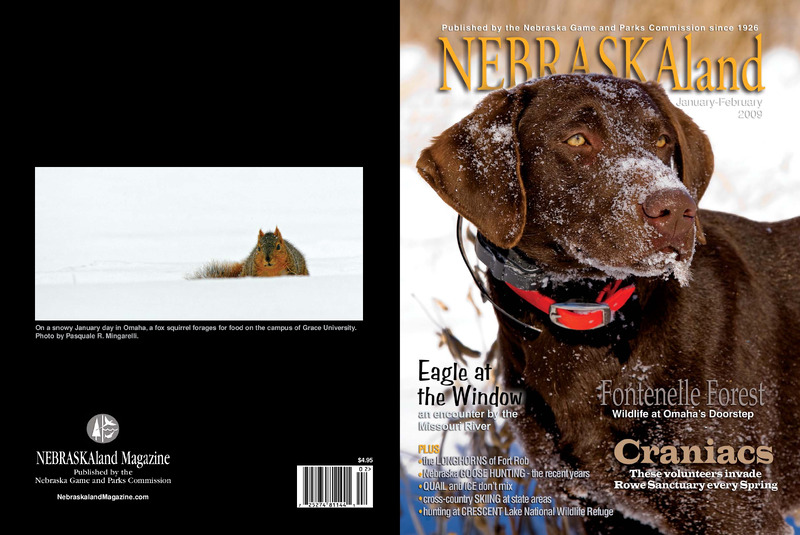
On a snowy January day in Omaha, a fox squirrel forages for food on the campus of Grace University.
Photo by Pasquale R. Mingarelli.
NEBRASKAland Magazine
Published by the
Nebraska Game and Parks Commission
NebraskalandMagazine.com
$4.95
Volume 87, Number 1, January-February 2009
12 Conservation Forest
Outdoor education is the core of the Fontenelle Nature
Association. BY JEFF KURRUS
22 Eagle at the Window
A surprise encounter by the Missouri River. BY MARGIE LUKAS
24 Nebraska Goose Hunting – the recent decades
Part two of the history of Canada goose hunting in Nebraska.
BY JON FARRAR
32 No Country for Old Hunters
Alliance pheasant hunter Alan Tuck and his English-bred
Labrador, Jesse, often successfully hunt Crescent Lake NWR.
TEXT AND PHOTOS BY BOB GRIER
36 Craniacs
Volunteers invade central Nebraska’s Rowe Sanctuary every
spring. BY JEFF KURRUS
42 The Longhorns of Fort Robinson
Fort Robinson State Park’s herd of longhorn cattle is the
perfect addition to an area already rich in Old West history.
TEXT AND PHOTOS BY BOB GRIER
12
●
10 Mixed Bag
Late season deer, pike rigs for kids, Lewis and Clark SRA
cabins, Turpin Time and a book review.
46 Outdoor Update
NEBRASKAland calendar still popular 45 years after it began.
47 In the Field
Quail and ice don’t mix.
49 Parks & Places
Cross-country skiing in Nebraska.
36
●
22
●
Comment . . . . . . . . . . . . . . . . . . . . . . . . . . . . . . . . . 4
Outdoor News . . . . . . . . . . . . . . . . . . . . . . . . . . . . . 6
Classifieds . . . . . . . . . . . . . . . . . . . . . . . . . . . . . . . 48
Portraits from the Past . . . . . . . . . . . . . . . . . . . . . 50
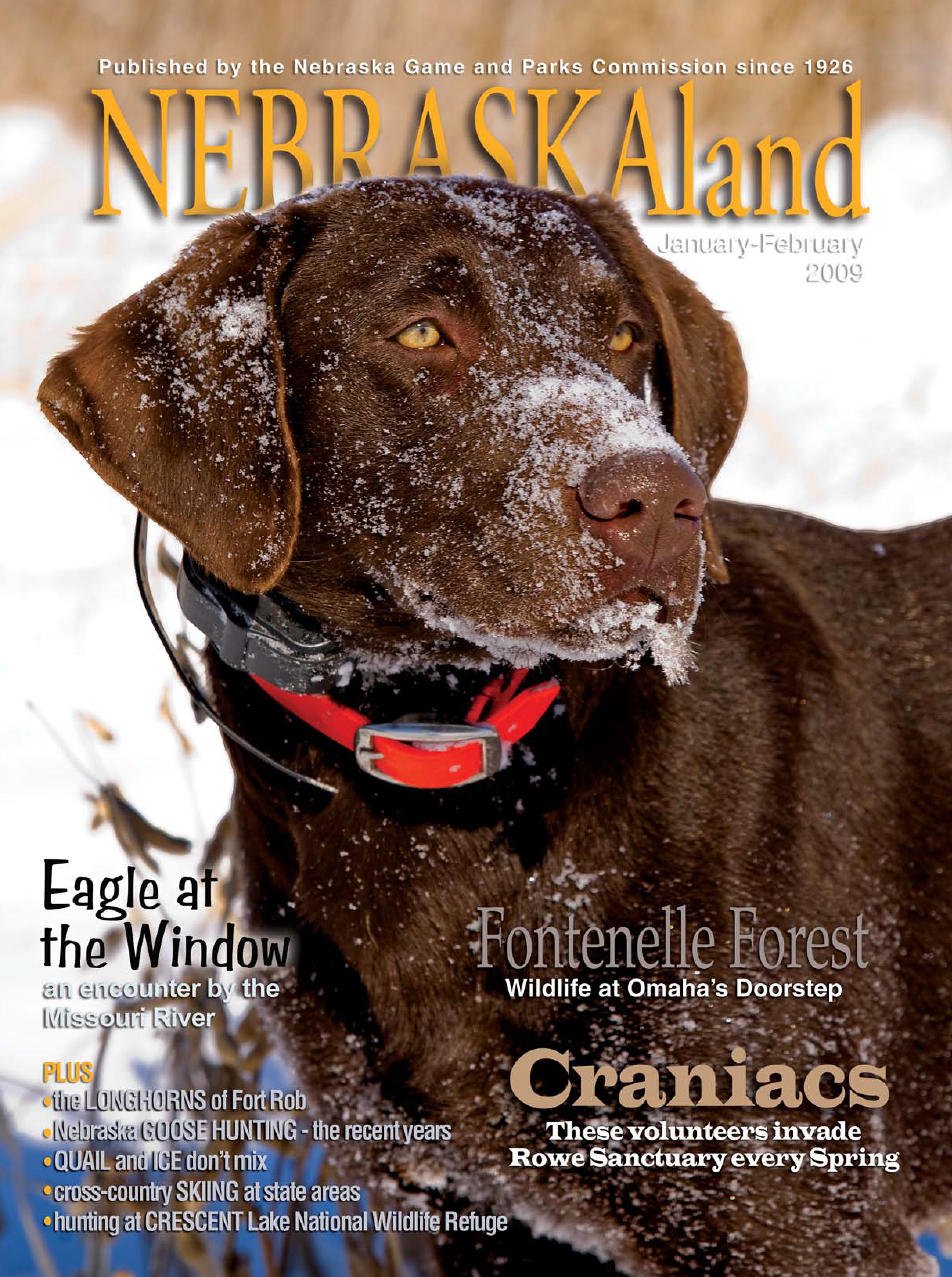
Cover: Drake, a Labrador retriever owned by Andy Sawyers, takes a break during a winter
pheasant hunt near Columbus in Platte County. Photo by Jeff Kurrus.
Opposite: In the early morning, a train rides the rails along the Platte River and
Eugene T. Mahoney State Park in Sarpy County. Photo by Jeff Kurrus.
NEBRASKAland (VOL. 87 / NO. 1, ISSN 0028-1964) is published monthly, except for the
combined Jan./Feb. and Aug./Sept. issues, by the Nebraska Game and Parks Commission,
2200 N. 33rd St., Lincoln, NE. Periodicals postage paid at Lincoln, Nebraska, and additional
mailing offices. POSTMASTER: Send address changes to NEBRASKAland, P.O. Box 30370,
Lincoln, NE 68503-0370.
32
●
JANUARY-FEBRUARY 2008 • NEBRASKALAND 3
Trout Fishing Help
I am looking for a publication that
shows all trout waters in Nebraska.
Specifically, streams. I fly-fish, live in
western Nebraska and am interested
in finding a few options.
Tim Lecher
Sidney, Nebraska
Published by the
Nebraska Game and
Parks Commission
Director: Rex Amack
Assistant Directors:
Roger Kuhn, Kirk Nelson, Sam Sidner
Information & Education Administrator:
Doug Bauch
Commissioners
Chairman:
James Ziebarth, Wilcox
Vice Chairman:
George E. Hall, Bridgeport
2nd Vice Chairman:
Jerrod Burke, Curtis
Dr. Mark Pinkerton, Wilber
Ron Stave, Waterloo
Dr. Kent Forney, Lincoln
Lynn Berggren, Broken Bow
Mick Jensen, Blair
Magazine Staff
Editor: Doug Carroll
Associate Editor: Jeff Kurrus
Art Director: Tim Reigert
Senior Editor: Jon Farrar
Regional Editors:
Eric Fowler, Bob Grier, Rocky Hoffmann
Circulation: Donna Robinson
Photo Librarian: Sarah Johnson
Marketing/Advertising: Jane Gustafson
For advertising information e-mail
advertising@nebraska.gov
or call (402) 471-5481
NEBRASKAland
ISSN: 0028-1964
VOL. 87 / NO. 1
JANUARY-FEBRUARY 2009
Published monthly, except for Jan./Feb. and Aug./Sept.
issues, by the Nebraska Game and Parks Commission, 2200
N. 33rd St., Lincoln, NE. Copyright 2008, all rights reserved.
Please address comments or questions to this address.
Periodicals postage paid at Lincoln, Nebraska, and other
locations. POSTMASTER: Send all address changes to
NEBRASKAland, P.O. Box 30370, Lincoln, NE 68503-0370.
NEBRASKAland is available on audio cassette from the
Nebraska Library Commission Talking Book and Braille
Service, Suite 120, 1200 N St., Lincoln, NE 68508. (800)
742-7691. NEBRASKAland Magazine and the Nebraska
Game and Parks Commission reserve the right to reject
any advertising not in keeping with the agency mission.
Rates: $18 for one year; $33 for two years; $44 for
three years. Nebraska residents must add
appropriate sales tax.
To subscribe call 1-800-NEBLAND (632-5263),
or go online to: NebraskalandMagazine.com.
For address changes and questions about your
subscription, e-mail donna.robinson@nebraska.gov.
“Trout Fishing
in Nebraska’s
Streams” offers
lots of great
information
about fishing
for trout here
and can be
found at most
Commission
offices across the state, or can be
sent to you directly if you send a
request to let.hain@nebraska.gov.
Out-of-state Hunters
I was not very happy about the
pheasant hunting article in a recent
issue.
It is getting
harder every
year for locals
to find a place
to hunt. As
good as it is to
have them
nearby, Cabela’s
is a detriment
as they are
leasing much
of the ground that we used to be able
to hunt.
Then to add insult to injury,
Nebraskaland Magazine writes a
nice article on out-of-state hunters
hunting the west end of Lake
McConaughy. Can’t “our” magazine
find some Nebraskans to write about?
I know we gain income from out
of state hunters, but do we charge
the high rates that other states charge
us if we wish to hunt there?
Well, I feel better now that I have
vented. I just hate to see our kids
and grandkids get shut out of the
sport of hunting that I so enjoyed as
youngster in Nebraska.
Ron Mettscher, via e-mail
4 NEBRASKALAND • JANUARY-FEBRUARY 2008
The story was about a Nebraskan
who wishes he still lived here. But as
is often the case, he and his wife, an
Oshkosh native, followed careers to
other states. So whenever he gets the
chance to come “home,” Vasa makes
the most of the lifetime hunting permit
he’s carried since high school and
heads to the field with old friends
who still live here, (including one
from Oshkosh featured in this story)
and occasionally with new ones that
he’s lured to the Cornhusker state by
taking every opportunity he gets to
extoll its virtues. One of those is the
ease of finding places to hunt.
Yes, leasing has closed some
land to resident hunters, including
yourself. That trend concerns the
Nebraska Game and Parks
Commission, but the Commission is
not sitting idly by. Its CRP-MAP
program has opened more than
180,000 acres of private land to all
hunters, and the Commission is set to
launch another access program. In
doing so, it hopes to boost the number
of hunters in the state, a number that
has been on a steady decline among
both residents and nonresidents, in
order to maintain the revenue needed
to support the agency’s mission.
Approximately 19 percent of the
99,000 Nebraska small game licenses
sold in 2007 went to nonresidents.
While the fees that Nebraska charges
nonresident bird hunters are slightly
lower than elsewhere, those permits
still account for about 42 percent
of the $3.4 million generated for
Commission programs, and
nonresidents spent another $300,000
on habitat stamps. Additional money
is brought in by big game and
waterfowl hunters that are nonresidents.
An informal survey by this magazine
in 2000 found that two-thirds of
nonresident hunters had ties to the
state. Like Vasa, many grew up just
down the road. Your kids and
grandkids could fit the same mold
someday. Will you want them to
bring their shotguns when they come
back to visit?
-Editor
Lake Maloney
The August/September article
about Lake Maloney near North
Platte, brought back a lot of
memories.
I was born in 1936 and my parents,
Louis and Alice Drost, together with
their good friends Frank and Ethel
McKain, completed the first lake
cabin on lot 99. This was in 1937-38,
I believe, and my uncle and aunt,
Joe and Anna Mae Prohosky,
completed the second cabin on lot
101 a short time later.
Many friends were entertained
over the following years at these two
cabin sites. Boat rides, surfboarding
behind the boat and cookouts were
the tone of the weekends.
Later, just after WWII, that
original cabin was sold and my
parents built their second cabin on
lot 97. It was named the Pla-Mor
and I believe it is still there, with
several modifications over the past
60-plus years.
I spent many summers fishing
from our dock and catching
numerous varieties of fish –
crappies, perch, catfish, walleyes
and one 18 1/2 pound northern pike.
The lake has changed over the
nearly 70 years, but it is still a
welcome place for fishing, boating
and relaxing.
Thanks to Rocky Hoffmann for
writing that article.
Ken Drost
Omaha, Nebraska
Send your comments to:
Doug Carroll, Editor
NEBRASKAland Magazine
P.O. Box 30370
Lincoln, NE 68503
or e-mail doug.carroll@nebraska.gov
Please include your postal address
and telephone number.
Letters may be condensed and edited
for clarity. Photographs are
welcome and will be returned.
Under federal and/or state law, discrimination is prohibited on the
basis of race, color, religion, age, gender, marital status, national
origin, disability or political affiliation. If you think you have been
discriminated against in any program, activity or facility by the
Nebraska Game and Parks Commission or want more information,
contact the Commission in Lincoln, NE, at (402) 471-0641 or the
Equal Opportunity Commission, Lincoln, NE, (402) 471-2024,
TTY/TDD (402) 471-4693).
Headquarters
2200 N. 33rd Street
Lincoln, NE 68503
Phone (402) 471-0641
District Office I
East Hwy. 2, Box 725
Alliance, NE 69301
Phone (308) 763-2940
District Office II
524 Panzer St., Box 508
Bassett, NE 68714
Phone (402) 684-2921
District Office III
2201 N. 13th St.
Norfolk, NE 68701
Phone (402) 370-3374
District Office IV
301 E. State Farm Rd.
North Platte, NE 69101
Phone (308) 535-8025
District Office VI
1617 First Ave.
Kearney, NE 68847
Phone (308) 865-5310
Omaha Office
1212 Bob Gibson Blvd.
Omaha, NE 68108
Phone (402) 595-2144
Ak-Sar-Ben Aquarium
21502 W. Highway 31
Gretna, NE 68028
Phone (402) 332-3901
World Wide Web site: www.OutdoorNebraska.org
E-mail: info@ngpc.ne.gov
Administration
Ted Blume (Adm.)
Craig Stover (Asst.)
Wes Loos (Asst.)
Rod Loos (Asst.)
Murray Johnson
Lincoln
471-5531
Lincoln
471-5532
Lincoln
471-5591
Ogallala (308) 284-8056
Lincoln
471-5003
Panhandle
Officer
City
Phone (308)
Jim Zimmerman (Sup.) Gering
436-7561
Walt Meyer
Chadron
432-4398
Scott Brandt
Gering
436-3418
Heath Packett
Gordon
282-2553
Dennis Thompson
Lemoyne
355-2024
Dan Zuehlke
Ogallala
284-4815
Doug Pollard
Oshkosh
772-9950
Frank Miller
Valentine (402) 376-1183
Dan Kling
Whitney
432-8367
Southwest
Officer
City
Phone (308)
Roger Thompson (Sup.) N. Platte
532-9175
Ray Dierking
Brkn. Bow
872-3078
George Sund
Cambridge
697-4629
Michael Thome
Cozad
784-4362
Matt Andrews
Elwood
785-3025
Dirk Greene
Imperial
882-5328
Virgil Gosch
McCook
345-2185
Dudley Sorensen
N. Platte
532-0747
Rich Routh
Rep. City
799-2085
South-central
Officer
Jerry Pecha (Sup.)
Jeff Jones
Terry Brentzel
City
Phone (308)
Kearney
865-5327
Clay Center(402)762-3124
Doniphan (402)845-2021
Randy Pomplun
Darin Gress
Dale Johnson
Mark Reeves
Robert Finke
Richard Seward
Fullerton
536-2987
Hebron (402) 768-2287
Kearney
237-1079
Loup City
745-0662
Milford (402) 761-3537
Ord
728-3115
Northeast
Officer
Tom Zimmer (Sup.)
Dale Davis
Ross Oestmann
Steve Oberg
Daniel Roberts
Jon Reeves
Marion Shafer
Pat George
Eric Wiebe
Tim Williams
Cory Krause
City
Phone (402)
Norfolk
371-6625
Bassett
273-1700
Bloomfield
373-4412
Columbus
564-5937
Fremont
721-7852
Kennard
427-7378
Norfolk
371-2031
O’Neill
336-1588
Ponca
755-2566
Neligh
887-1335
West Point
372-6979
Southeast
Officer
Duane Arp (Sup.)
Sean McKeehan
William Krause
Mike Luben
Douglas Kramer
Dina Barta
Stacey Lewton
Levi Krause
Russell Mort
Dan Evasco
Jeff Clauson
City
Gretna
Ashland
Auburn
Colon
Lincoln
Lincoln
Lincoln
Louisville
Nebr. City
Papillion
Waterloo
Phone (402)
332-2965
944-4174
274-3789
443-4278
466-9001
483-2358
476-0436
234-2212
873-5684
592-6733
359-5301
Nebraska Wildlife Crimestoppers 1-800-742-7627
JANUARY-FEBRUARY 2008 • NEBRASKALAND 5
Big Blue Dies
For 111/2 years, he awed visitors to
the Ak-Sar-Ben Aquarium near
Gretna, and at 95 pounds he was the
largest North American catfish in
captivity. For the previous month,
the fish affectionately known as Big
Blue had been “turning up his nose”
at trout he once consumed at the rate
of seven per week. On November 4,
Big Blue pumped his gills for the
last time.
Big Blue came to the Aquarium in
the bed of Cliff and Donna
Ferguson’s pickup truck. He made
the trip from the Nishnabotna River
in northwest Missouri after being
caught by the Fergusons on a setline
baited with a 5-inch bullhead. The
ride was tough on Big Blue and
things were touch-and-go for a couple
of days, but thanks to treatment
from Aquarium staff, Big Blue made
a full recovery. An examination of
Big Blue’s pectoral spine and otolith
(ear bone) revealed that he was at
least 35 years old at the time of his
death, making him among the oldest
living blue catfish ever documented.
The Ak-Sar-Ben Aquarium would
like to replace Big Blue and is seeking
a blue catfish weighing at least 50
pounds. A plaque with the name of
the person providing the first blue
catfish meeting or exceeding that
weight that is in good condition will
be displayed at the Ak-Sar-Ben
Aquarium on the tank containing the
fish. Contact Tony Korth at (402)
332-3901 for details.
Rex Amack Elected
President of AFWA
The Association of Fish and
Wildlife Agencies named Nebraska
Game and Parks Commission
Director Rex Amack as its new
president during the Association’s
recent Annual Meeting in Saratoga
Springs, New York. Amack has
41 years of experience with the
Nebraska Game and Parks
Commission and 2l years as the
Commission’s director.
“It is an overwhelming privilege
and honor to serve as president of
the Association of Fish and Wildlife
Agencies. I look forward to
representing every fish and wildlife
agency in the country and many in
6 NEBRASKALAND • JANUARY-FEBRUARY 2008
Canada and Mexico, assuring that
the mission of the Association is
fulfilled,” Amack said.
Amack currently serves on the
Association’s Executive, Audit, and
Fish and Wildlife Trust Funds
committees. During his one-year
tenure as president, he plans to pay
particular attention to the work of
the Association membership in
enhancing public understanding and
appreciation of fish and wildlife
management and conservation,
especially as it relates to hunter and
angler recruitment and retention as
well as connecting young people
with nature.
The Washington, DC-based
Association of Fish and Wildlife
Agencies is the collective voice of
North America’s fish and wildlife
agencies at every level of government.
The Association provides its member
agencies and their senior staff with
coordination services that range
from migratory birds, fish habitat,
and invasive species, to conservation
education, leadership development,
and international relations. The
Association represents its state
agency members on Capitol Hill and
before the Administration on key
conservation and management
policies, and works to ensure that all
fish and wildlife entities work
collaboratively on the most
important issues.
Amack will serve as president
through September 2009.
November Deer Season Sets
Harvest Record
Hunters harvested a record 57,529
deer during the recent November
firearm season, according to
preliminary results by the Nebraska
Game and Parks Commission.
The November firearm season
harvest breaks the previous record,
set last year, by 8,100 (16 percent).
The highest firearm harvest was in
southeast Nebraska, where 14,096
deer were taken, an increase of
26 percent from last year. Every
permit in that district included a
bonus tag.
Kit Hams, the Commission’s big
game program manager, attributes
the sharp increase to the issuance
this year of 85,000 bonus tags that
allow the harvest of antlerless
white-tailed deer.
“This is good news,” he said. “It’s
definitely what we were trying to
accomplish with the bonus tags we
authorized this year.”
The goal of the bonus tags is to
thin the antlerless whitetail herd,
especially in eastern Nebraska,
where crop-damage complaints and
deer-vehicle collisions are common.
The 2008 November firearm
deer harvest totals by district, and
percentage of increase from 2007,
are:
Southeast, 14,096, 26 percent;
Northeast, 12,900, 11 percent;
Southwest, 6,223, 17 percent;
South-central, 9,142, 8 percent;
North-central, 9,428, 20 percent;
and Panhandle, 5,740, 17 percent.
The Commission’s objective to
control the expanding deer population
continues into January 2009 with
the antlerless firearm season that
runs January 1-15.
Hams expects the total harvest
from all deer seasons this year to be
in the 75,000-80,000 range, which
would be a record. Last year’s total
harvest was 68,500.
8 NEBRASKALAND • JANUARY-FEBRUARY 2008
Mountain Lion Shot Near
Chadron by Deer Hunter
A 16-year-old boy hunting during
the November firearm season shot and
killed a 97-pound female mountain
lion south of Chadron when it
appeared on a game trail and
approached within 15 steps of the
hunter without showing any fear.
Mountain lions are a protected
species in Nebraska, but can be shot
in defense of life or livestock if
imminent danger is present.
The boy was in a group of hunters
that were driving deer on U.S.
Forest Service land. The group
reported the incident to officials at
Chadron State Park. No decision has
been made yet as to what will be
done with the carcass, which was
turned over to officials.
The fact that this mountain lion
was female was significant, as most
Nebraska lion sightings in the past
several years have been of young
males.
In a related note, an e-mail hoax
circulating in Nebraska contains
photos claiming to be of mountain
lions in the Fort Calhoun area. Sam
Wilson, the Nebraska Game and
Parks Commission’s nongame
mammal/furbearer program manager,
said the trail-camera photos actually
are of cats in South Dakota.
The photos show an adult female
cat and two nearly grown young. An
orange tag is visible on the adult’s
ear. Wilson said the tags are placed in
study animals as part of the ongoing
mountain lion research project being
carried out in the Black Hills.
For accurate information about
mountain lions in Nebraska, go to:
http://www.ngpc.state.ne.us/wildlife/
mountainlion.asp.
Kosman Receives Award
It’s likely that hunters, hikers and
nature lovers in western Nebraska
are a big reason Hod Kosman of
Scottsbluff was named the Hero of
the Year in Field and Stream
Magazine’s Heroes of Conservation
awards gala in New York City in
September. Their votes, which put
Kosman at the top of a field of seven
finalists, were no doubt thanks for
the land Kosman, through Platte
River Basin Environments (PRBE),
has conserved and opened to the
public.
Kosman helped form PRBE in
1989 in honor of a long-time friend,
Clive Ostenberg, who had
bequeathed a large sum to the
Nature Conservancy and Ducks
Unlimited. In doing so, Ostenberg
challenged Kosman and others to
find ways to use the money to
restore and protect land in the area
where enjoyed hunting and fishing
and open it to the public so they
could do the same.
Since it’s founding, PRBE has
used Ostenberg’s gift, along with
grants and help from partners, to
acquire or protect nearly 40,000
acres of land in the Wildcat Hills
and Pine Ridge escarpments and
along the North Platte River, including the Cedar Canyon, Kiowa, Chet
and Jane Fliesbach at Facus Springs
and Chadron Creek wildlife management areas, which the group has
transferred to the Nebraska Game
and Parks Commission.
Each finalist received a $5,000
grant from Toyota to support their
project. As Hero of the Year,
Kosman also received a new Toyota
Tundra.
Kudos
The Plattsmouth Wildlife & Gun
Club deserves a pat on the back –
for several years the club has been
supporting the quarterly Trail Tales
magazine that is sent for free to
every fourth-grader in the state, and
it has also been a strong supporter
of the state’s Hunter Education
programs. Last fall they donated
$4,000 to each program - $8,000 in
all. Many thanks! ■
JANUARY-FEBRUARY 2008 • NEBRASKALAND 9
A Winter Reading- The Rites of Autumn by Dan O’Brien
10 NEBRASKALAND • JANUARY-FEBRUARY 2008
Jeff Kurrus
This winter, take Mom’s old
broomstick and cut it into
three, 10-inch sections. Take
Dad’s drill, and with a 1/8 inch
bit, drill a hole in the side of
each section. While Brother isn’t
looking, steal about 10 feet of 12to 20-pound-test line and tie it
into the hole you just drilled,
cinching it with an improved
clinch knot. On the line’s other end,
go into Sister’s tacklebox and first
“borrow” a wire leader and then a
size 4 or larger treble hook or 6’s
rigged in tandem.
Once you’ve made this rig, wind
your line around the broomstick
handle and anchor the hook(s) in the
end of the handle. Then attach one of
the many bobbers that Uncle has
given you through the years to the
line, and when you use these icefishing, the bobber will sit on top of
the ice and your new wooden rig will
straddle the hole. When your bobber
moves across the ice, you have a fish.
The only thing you’re going to have
to provide is the bait, which could be
large minnows, and some way to dig a
hole. Do you have any relatives left
that can provide those things for you?
Lewis and Clark Cabins
It is never too early to rent a summer
cabin at Lewis and Clark SRA. It is
also never too late to reserve a lastminute winter cabin. There are 10
cabins at this SRA, each one sleeping
seven and having the following
amenities: Two bedrooms, one with a
queen bed and the other with a queen
bed, a bunk above it, and another set
of bunk beds; bathroom with shower;
living room; dining area; and a
kitchen with refrigerator, stove and
microwave oven. The cabins are also
equipped with linens and towels.
No smoking is allowed in any of
the cabins and no campers or tents
are allowed in the cabin area.
Reservations are accepted up to one
year in advance for a minimum of two
nights and are $128.00 per night. One
night stays are on a first-come, firstserved basis if a cabin is available and
cabins must be paid in full at the time
of reservation. Because cabins fill up
quickly from the Memorial Day
through Labor Day holidays, reserve
your room now. Or visit this beautiful
area in Nebraska a bit earlier in the
year and, chances are there will be a
cabin to rent while snow is still on the
ground. Plus, cabins at Lewis and
Clark SRA are often discounted 30
percent from October through April
on reservations made for Sunday
through Thursday. Reservations may
be made at the park, by calling (402)
471-1414, or online at
www.OutdoorNebraska.org.
Dick Turpin
For you
folks who
wear rubber
boots …
whether it’s
chest waders,
hip boots or
these little
cut-off knee
boots … there
is kind of a
canvas liner in
most of those
… especially
the insulated
ones … and of course your sock ….
when you try to put that on … you
get a lot of friction. Well here is a
good way to solve that problem. Take
a plastic trash bag … put that over
your foot … and slip into that boot
and that will go on so much better.
That plastic just slicks that up and
you can slide right in them. The other
good thing about this is … these are
scented and they smell so good. I
know that is going to help my smelly
feet because they get a little rank in
those rubber boots. The only thing is I
wish they had something besides
pink. ■
PIKE RIG ILLUSTRATION BY TIM REIGERT
Jeff Kurrus
At some point this winter, I’m going to be done
with going outside. I’ll be tired of it being cold, and
I’m sure I’m not alone. This happens every winter at
some point, and during those moments I’m always
looking for a new book to read.
A few years ago I came across Dan O’Brien’s The
Rites of Autumn, the nonfiction story of falconer
Dan O’Brien’s attempt to release a young peregrine
falcon into the wild after traveling with the falcon
along a 2000-mile trip from the Canadian border to
the Gulf of Mexico, following the annual migration of waterfowl south.
As the book’s back cover states, “O’brien taught her to hunt as a wild
falcon would, in the hopes of releasing her into the natural world. The
Rites of Autumn is the riveting account of their incredible journey.” I
agree.
This book speaks of the wide-open places still left on the Great Plains,
the similarities and differences between wildlife and man, and his involvement in the natural cycle of life on the planet. The one problem with this
book is its length. At only 192 pages, you may have to find something else
to fill the winter months. Good thing Rites isn’t O’Brien’s only book. He is
the author of several nonfiction books as well as fiction novels.
Later in 2009, Dan O’Brien will publish a collection of nature essays in
NEBRASKAland contributing editor Michael Forsberg’s book Great
Plains: America’s Lingering Wild. Stay tuned in NEBRASKAland for
additional information regarding this book. And in the meantime, enjoy
The Rites of Autumn. Out-of-print, but available online.
Pike Rigs for Kids
Turpin Time
PHOTO BY JEFF KURRUS
PHOTO BY JEFF KURRUS
Jeff Kurrus
Two seasons ago, I hunted the last
month of the deer season, from
December 15 during muzzleloader
season to the end of late firearm on
January 15, and never saw the first
cedar; and the south-facing slopes of
creek bottoms and canyons all provide
protection from the wind, cold and snow.”
During this same time of the year,
deer will also be found in larger
numbers, much like turkeys during this
time and because of similar reasons.
In addition, groups of deer move
through snow more efficiently than
individuals since they can follow each
others’ paths.
“Because the primary rut is over,
deer are trying to replenish fat
reserves before deep winter sets in,”
said Hams. “You may see some deer
in some of the same areas as you did
during October and November, but it
will be much less frequently.”
Translated, this is not the time of
the hunting season to get hard-headed.
Experiment with your hunting
locations to assure that you’re not in a
spot that deer haven’t regularly used
in a long time.
PHOTO BY DOUG CARROLL
Late-season Deer Hunting
deer at a place where deer are
frequently seen during the November
firearm season. Each day that I hunted
and saw nothing, I was more
determined to hunt again at the same
place, trying to prove that time spent
would eventually provide what I was
looking for. Not so, said Kit Hams,
big game program coordinator for
the Nebraska Game and Parks
Commission.
“Deer move into wintering locations,
usually during December, changing
their entire travel patterns. And they
do so for multiple reasons. One, food
is available in fewer locations. They
will eat standing and residual
agricultural foods, branch tips from
trees and shrubs, as well as acorns
and fruits. While the list is long, there
is just a smaller amount. Two, they
seek out thermal cover, which is also
available in fewer locations. Cattail
marshes; tall, warm-season grasses;
JANUARY-FEBRUARY 2008 • NEBRASKALAND 11
By Jeff Kurrus
On the front page of the Fontenelle Nature Association’s web site at
fontenelleforest.org is the following statement:
The mission of Fontenelle Nature Association is
to enhance human stewardship of the natural world by providing
citizens of the greater Omaha metropolitan area with:
• Quality Environmental and Natural Science Education
• Ecologically Sound Management of the Association’s Natural
Resources
• Preservation and Interpretation of the Association’s Historic and
Cultural Resources
• Increased opportunities for personal reflection and enjoyment of
the outdoors
It is always encouraging when an organization involved with outdoor
education and conservation follows through with what they plan to do.
12 NEBRASKALAND • JANUARY-FEBRUARY 2009
Education
Children
OUTDOOR EDUCATION IS THE CORE of what the
Fontenelle Nature Association (FNA) does at both of its
properties – 1,500-acre Fontenelle Forest in Bellevue and
567-acre Neale Woods in north Omaha. When asked what
exactly it is that FNA does on these two properties, FNA
director of education Marty Pagel took a deep breath and
smiled. It was obvious she didn’t know where to start.
Thirty minutes later, it wasn’t clear if she was ever going to
stop.
“You just need to see it for yourself,” she said at the end,
knowing there was no way she had failed to leave something
out. So I took her advice. And see I did.
At Neale Woods, a young summer camper stared into the
eyes of a fox snake; another child held a butterfly net in her
hand, eyes peeled on the grass below her; and a group of
toddlers painted beneath a tree near the Carl Jonas
Interpretive Center. Later that morning, a group of boys
crowded around each other, staring at a recently caught
Woodhouse’s toad near Fontenelle’s Wetland Learning
Center, where wetland conservation classes are held; boys
and girls gobbled at a flock of turkeys near Fontenelle’s
Camp Logan; another group of children on their hands and
knees held magnifying glasses at Fontenelle’s Camp
Brewster as they observed the massive amount of nature at
their fingertips; and even more children pushed and poked at
JANUARY-FEBRUARY 2009 • NEBRASKALAND 13
PHOTO BY MICHAEL CAMERON
the Fontenelle nature
center’s interactive
displays, learning
about a variety of
topics related to
native Nebraska
plant and animal
species.
A few weeks later, after the opening
of FNA’s new one-acre outdoor interactive display named
Acorn Acres, kids and adults built lodges like a beaver, hid
like small Nebraska mammals, viewed butterflies and
participated in various other outdoor activities. This area allows
children the chance for unstructured play and outdoor learning,
and is a place where problem-solving skills related to the
natural world can be developed. Yet all of these interactive
activities are just the beginning of what FNA offers.
Other programs are organized depending on the ages of
the participants and the subjects they are interested in.
Classes are held in astronomy, birding and geology. Kids can
become amateur rock hounds, sculptors, raptor experts,
microbiologists and nature detectives. For older students,
FNA’s summer programs include classes on canoeing and
creating nature art. There is also a program called
“Adventure Camp,” where participants fish, complete a ropes
course and hike in the Forest’s wetland region.
During the school year, this outdoor education continues
with many students throughout eastern Nebraska and western
Iowa. The Bellevue public school system requires each student,
kindergarten through 6th grade, to visit Fontenelle each year.
Brothers Tristan (left) and Logan Cameron begin a walk at
Fontenelle. Parents are encouraged to visit with their children.
In addition, other public, private and home-schooled students
from the surrounding area also visit, with all of Fontenelle’s
programs designed to meet Nebraska’s state science standards.
“Quite often, Fontenelle even provides inner-city students
with their first access to nature,” said Pagel.
Concerning high school-aged students, organized activities
are provided specific to a teacher’s curriculum needs. In
addition, photography classes are held and students are also
asked to assist with special events and trail maintenance.
“Each year, more than 27,000 children visit Fontenelle
properties,” said Pagel.
PHOTO BY JEFF KURRUS
Adults
A young camper has her first encounter with a fox snake during a Fontenelle
Forest summer camp.
14 NEBRASKALAND • JANUARY-FEBRUARY 2009
College-age students from Creighton
University, the College of St. Mary’s, the
University of Nebraska-Omaha, Iowa Western
Community College and other institutions visit
Fontenelle on a regular basis to do work related
to their classes. Specifically, Creighton brings
many of its international students to Fontenelle
to take part in the Critters program, a class
designed to introduce new Nebraskans to this
region’s natural world.
Other programs for all ages cover subjects
such as meditation, yoga, native grass
landscaping and archeology. FNA sponsors
bird and camera clubs, brings in guest speakers
on various subjects, and offers limited deer
hunting opportunities in order to manage the
area’s large deer herd.
Many visitors, however, come solely for the
hiking opportunities. Fontenelle Forest has 17 miles of trails,
while Neale Woods has nine miles that pass through a
combination of forest and restored prairie.
Hikers often use flora guides (see sidebar) and birding
books specific to these areas on their excursions, which
usually include glimpses of other wildlife, such as whitetailed deer and turkeys, along the trails. Two hundred and
forty-six birds have been recorded on the Fontenelle property
alone, and the site has been named in Birder’s World as
one of the Top 10 warbler viewing locations in the United
States.
For older adults, the Seniors Understanding Nature (SUN)
program, held the first Tuesday of each month, concentrates
on birding, nature walks, seasonal changes, constellations
and other nature-related subjects. The program also travels to
local senior-living facilities to do programs.
“Our strength is our flexibility,” said Pagel. “There’s not a
group we can’t do a nature program for, and we pride ourselves
in that fact.” However, there’s one part of Fontenelle’s mission
that remains inflexible. “Ninety-eight percent of our programs,
regardless of the time of the year, go outside sometime during
the class,” she said. Which is exactly why visitors come to
Fontenelle in the first place.
The Two Field Guides
Roland E. Barth and Neal S. Ratzlaff’s
Field Guide to Trees, Shrubs, Woody
Vines, Grasses, Sedges and Rushes
and Field Guide to Wildflowers both
focus on the species found at
Fontenelle Forest and Neale Woods.
While the two volumes include a
history of the land and its
management at both areas, as well
as descriptions and photographs of
included species, their greatest strengths
are their specificity related to FNA
properties.
Flora newcomers will find these guides
especially navigable due to the locations
included by the authors. For example, in
the Field Guide to Wildflowers, the tall
bellflower reference includes the
following: “Occurrence: In woodlands
and their edges. Fontenelle Forest:
Common along Camp Gifford Road near the
railroad tracks. Neale Woods: Common along the
Missouri River Ecology Trail.”
These descriptions are included for each species
listed, as well as how common each one is. With
this information, experienced individuals can
quickly find their favorite species, while
newcomers can quickly become experienced.
Management
BEFORE EUROPEAN SETTLEMENT, fires and floods
helped regulate the native ecosystem of what is now
Fontenelle Forest, an ecosystem that was described as late as
1856 by surveyor William N. Byers as having three landforms:
the riverbottom or floodplain, the rolling prairie uplands and
the bluffs dividing the two. Fires prevented nonnative
vegetation from taking root, while spring floods on the
Missouri River shaped the floodplain and helped provide a
complex ecosystem.
Following settlement, three influential acts drastically
changed this ecosystem. One, because settlers plowed
present-day Fontenelle prairies in the late-1800s and the
Neale Woods prairies as recently as 50 years ago, nonnative
flora such as garlic mustard and tree of heaven have been
able to take hold and crowd out native plants, decreasing the
diversity of FNA properties. Second, inhabitants have thwarted
the fires necessary to push back plant succession and have
logged many of the oak trees common to this area’s oak
savanna. As a result, faster-growing shade tree species and
nonnative understory plants have taken over. Third, the
channelization of the Missouri River completed in the 1950s
resulted in less spring flooding and reduced diversity in the
floodplain’s plant communities. It also cut Fontenelle’s Great
Marsh and Hidden Lake off from the Missouri River.
For a number of years the association took a hands-off
approach with its natural resources, hoping nature would
preserve itself. This approach did not achieve the desired
results, however, so over the last 25 years, significant
restoration projects have taken place on FNA properties.
At Neale Woods, upper and lower portions of Knull Prairie
were seeded in 1983 and 1985 with material gathered from
local native prairies. In 1988, Neale’s Jonas and Koley
prairies were also seeded. In the late-1990s, Fontenelle staff
began restoring oak savannas by clearing away shady
understory trees to allow more sunlight to reach the forest
floor. The result has been the spontaneous regeneration of
savanna groundcover such as the grasses bottle brush, slender
wild rye and American beakgrain, and forb species such as
feverwort and pale Indian plantain.
One of the most effective plant management efforts at
PHOTO BY MARK DIETZ
The Leaflet, FNA’s
newsletter, features a
schedule of activities for
visitors, including program
information, location,
cost (if any) and
appropriate age group. It
is mailed to members
and can also be found
at fontenelleforest.org.
A white-tailed deer fawn in early spring at Fontenelle Forest.
JANUARY-FEBRUARY 2009 • NEBRASKALAND 15
Garabrandt and his small crew recently collected
more than 4,000 bur oak acorns and shagbark
hickory nuts to send to native Omahan Scott
Schlarbaum, now a biologist at the University of
Tennessee-Knoxville and head of the university’s
Tree Improvement Program.
After receiving the nuts, Schlarbaum will
plant them at the Georgia Forestry
Commission State Nursery, and send
them back to Fontenelle as 3- to 4-foot-tall
trees in March 2010. It is a relationship
first forged by Schlarbaum’s volunteer
work at the nature center years ago and
continued by his offer to help out Fontenelle’s
oak savannah restoration by growing trees for the
FNA.
“I advocate using high-quality seedlings from local
seed sources,” said Schlarbaum. “After some
discussion with Gary [Garabrandt], all he had to do
was send the seed and use shelters around the
trees because of the deer browse. Over the years,
Gary has sent seed of bur oak, northern red oak,
hawthorn, Kentucky coffeetree and bladdernut. I
have really enjoyed my renewed contact with
Fontenelle Forest and am very pleased to give
something back to an organization that was
important to me in my formative years.”
History
In 1936, archeologist Robert Gilder (middle, with cane) leads a hike in Fontenelle Forest.
16 NEBRASKALAND • JANUARY-FEBRUARY 2009
TO START WITH
THE FORMATION of
the Fontenelle Forest
Association in 1913
would drastically
shortchange the area’s
history as well as the
Lewis Bostwick took this photo of Fontenelle Forest’s Riverview Trail in 1917.
teachings that Fontenelle naturalists continue to relay to the
public.
There is evidence of Indian cultures inhabiting the area
from as early as 1100 BP, and there are 60 sites on
Fontenelle property where timber and sod-constructed houses
once stood. Fish hooks, knives and needles were found in
the early 1900s by archeologist Robert Gilder, and Eric
Kaldahl discovered projectile points, maws and grindstones
in the 1990s.
in Trading Posts, “Evidence from both archeological remains
and historical records shows they lived in well-built and
comfortable houses. The buildings had wooden floors, glass
windows with shutters and doors with finely-crafted hinges
and locks. Furniture included cabinets with intricately-made
drawer pulls and guards … Meals were served on ornate
plates flanked with high quality knives and forks. Imported
coffee was ground at the trading posts, served in delicate
china cups and stirred with pewter spoons. Brandy was
Missouri Fur Company
History provides record of Lewis and Clark crossing the
land’s path in 1804, but it wasn’t until 1822 that the
Missouri Fur Company, otherwise known as Pilcher’s Post,
began the settlement of Bellevue with a trading post on what
is now FNA property.
The Bellevue post, located near the present Great Marsh,
was a stopover spot for traders making their way toward the
Rocky Mountains and contained supplies for the trip west.
As Richard E. Jensen recorded in his book The Fontenelle &
Cabanne Trading Posts, “Many, if not most, of the mountain
men of the west were occasional visitors. In the spring,
brigades of trappers might spend a week or more at the
posts, waiting for the weather to warm or the grass to grow
for their pack animals, before continuing their journey up the
Missouri River or westward to the Rocky Mountains.”
Later archeological digs at the Fontenelle site found mouth
harps, gun parts, tobacco pipes and beverage bottles. As stated
COURTESY OF FONTENELLE NATURE ASSOCIATION
PHOTO COURTESY OF FONTENELLE NATURE ASSOCIATION
Fontenelle has been to control its white-tailed deer population.
In 1996, efforts to control this herd began to take shape
because it became apparent that the deer were eating
themselves out of house and home and were destroying the
area in the process. As chronicled in Ken Bouc’s
August/September 1996 NEBRASKAland article entitled
“Too Many Deer, Not Enough Forest,” doe-only hunts were
instituted at the Forest to help control the area’s deer herd,
and these hunts continue today.
Each year, Gary Garabrandt, Fontenelle’s director of science
and stewardship, and biologists from the Nebraska Game
and Parks Commission conduct an aerial survey at
Fontenelle. The survey occurs 24 hours after a fresh snowfall
and allows biologists to calculate the area’s approximate
deer herd. Since Fontenelle instituted the deer hunt in 1996,
Garabrandt’s aerial surveys have shown a gradual trend
toward a more manageable population. In 2003, a similar
program was instituted at Neale Woods, resulting in the
current three-day muzzleloading hunt on the property during
Nebraska’s firearm deer season.
Also in 1996, both Great Marsh and Hidden Lake at
Fontenelle were dredged. As they became shallower since
the channelization of the Missouri River, they became less
viable and diverse as wetland areas. The dredging made
them larger and deeper, sustaining their lives. Hidden Lake
was also reconnected to the Missouri River, providing
spawning areas for native fish species, including largemouth
bass, black and yellow bullhead, black crappie, bluegill and
northern pike.
In 1997, FNA adopted its Land and Resources
Management Plan, which included protecting, restoring and
maintaining its native plant and animal communities through
grants and mitigation acts. Since this date, forest staff has
continued to re-create oak savannah areas, perform prescribed
burns in locations with large amounts of underbrush, remove
nonnative plants and re-introduce native plants at both
Fontenelle and Neale Woods.
“Some of our biggest problems include areas with the
invasives tree of heaven, barberry and garlic mustard,” said
Garabrandt. “Garlic mustard is so detrimental because it
changes the soil chemistry and inhibits root growth of native
plant species. Trees grow slower in garlic mustard soil.
We’ll put 300 hours each year in an effort to control this
invasive.”
Information concerning these projects is included in FNA’s
monthly newsletter and on their web site, with explanations
concerning the impact of completed projects. The constant
work being conducted on FNA property is best explained
in their own words: “Like all restorations, ours are not
perfect representations of native prairies. They are
considerably less diverse
… Fully a third of the
approximately 85 prairie
plant species in the
Neale Woods
restorations are
represented by less than
five known individuals.”
PHOTO COURTESY OF FONTENELLE NATURE ASSOCIATION
Southern-grown Trees
George Catlin’s 1832 painting “Belle Vue, Indian Agency of Major
Dougherty” depicts a view of what is now Fontenelle Forest
property from the Iowa side of the Missouri River.
JANUARY-FEBRUARY 2009 • NEBRASKALAND 17
Forest of the Past days allow visitors to view free demonstrations
at Fontenelle, such as this work being done by Connie Wheeler
of the Omaha Weavers and Spinners Guild.
18 NEBRASKALAND • JANUARY-FEBRUARY 2009
The view from the Riverview Trail at Fontenelle Forest during the summer.
Land
Acquisition
In 1910,
Omaha’s A.A.
Tyler and Harold
Gifford Sr. wanted
to purchase and
preserve the land
that now makes up
the northern portion
of Fontenelle
Forest. The state of
Nebraska rejected
their petition to
purchase the land,
then owned by the
estate of Everard
Ferguson, for a
state forest
preserve. So Tyler,
Gifford and a
group of
others purchased
the land
themselves. By
1913, the group
COURTESY OF JOSLYN ART MUSEUM
sipped from stemmed glasses. Time was kept with gold
pocket watches. Evidently, their goal was to live comfortably,
even luxuriously, and to perpetuate the trappings of affluent
society in the East.” At Cabanne’s site, and probably at the
Fontenelle site as well, most customers bought items on
credit. Because Cabanne knew that nearly half of the debts
would never be repaid, the trader might have increased their
prices by three or four times the cost.
In the area hunting pressure was intense, so much that by
the mid-1820s, large animals had essentially disappeared.
Riverbottom swarms of mosquitoes also spread disease to
those in the area, plus there were Indian raids. Hasps and
padlocks were later found on the Fontenelle site through
archeological digs, revealing the need for security at the
time. Violence was a common occurrence.
However, the close proximity to the Missouri River did
provide multiple advantages, including travel as well as
drinking water. “Though the water of this river appears so
very dirty, yet it is very palatable, and considered very
wholesome,” wrote John Dunbar in 1835. “The people who
live near the stream, I was informed, use its waters in
preference to those of the fountains in its vicinity. I have
become very fond of the river water, and think I have never
tasted any more pleasant.”
In 1824, Lucien Fontenelle, a French-American fur trader
who originally entered the Missouri River fur trade in 1819,
married Me-um-bane, daughter of Omaha Indian chief Big
Elk. Together they raised five children, the eldest being
Logan Fontenelle, who was born in May 1825 and would
later become a spokesman for the Omaha tribe.
Lucien purchased the trading fort in Bellevue in 1828, but
sold it to the U.S. Office of Indian Affairs four years later.
The fort was then used as the Upper Missouri Indian Agency
headquarters by the U.S. government. Poor attention and
lack of use deteriorated the building until, on July 3, 1839,
Joseph V. Hamilton wrote this account of the former post:
“… the Public Buildings at Bellevue are in a shocking
condition and certainly cannot be intended to be inhabited by
anything else than rats & bugs.” The post was finally
abandoned that winter. Lucien and his family moved about
six hundred yards down the river and built a new house for
his wife and family. He died in 1840 and was buried on the
bluff overlooking the former trading post.
By the early 1850s, Lucien’s son Logan had been recognized
as an Omaha chief by both the tribe and the U.S. government.
With his white father and Omaha mother, Logan grew up in
the cultures of both and had become an interpreter for the
American Indian Agency by the age of 16. When he was 29,
Fontenelle met with federal officials in Washington, D.C. on
March 16, 1854, to sign a treaty selling Indian land to the
U.S. government and restricting themselves to a reservation
in northeast Nebraska, thus opening the Nebraska Territory
to settlement. During a buffalo hunt the following year with
his Omaha party he was killed by Sioux Indians. Logan is
buried within the boundaries of the forest that now bears his
last name.
PHOTO BY MARK DIETZ
PHOTO BY JUDY DYE
The Fontenelles
Fontenelle Forest is named after Logan
Fontenelle, an interpreter for the Omaha
tribe killed in battle with Sioux Indians in
1855. This painting by George Simons in
the latter half of the 19th century is based
on the only known photo of Fontenelle
taken between 1853 and 1855.
had formed the Fontenelle Forest Association to raise money,
and by 1920 had raised $60,000 to buy 300 acres of land.
Through the first half of the 20th century, the Forest was
used as a nature area by the public for hikes, picnics and the
like. In the 1960s, Omaha city forester Jim Malkowski began
to lead educational hikes through the Forest, resulting in the
desire for even more nature-based education on the property
and culminating in the 1966 opening of the Fontenelle Forest
Nature Center.
Since that time, there have been a series of additions to
Fontenelle. In 1971, the Forest accepted a gift of 120 acres
of land from Edith Neale in north Omaha. Neale’s father had
homesteaded the land in the mid-1800s and she wished it to
stay natural after her death. Neale Woods later expanded
when Carl Jonas not only donated land, but also his former
home, which has been modified into the Carl Jonas Interpretive
Center.
In 1998, property adjacent to the Forest, 82-acre Camp
Brewster, was purchased through the aid of the Willer
Foundation and the Nebraska Environmental Trust. In
addition, the Gilbert and Martha Hitchcock Wetlands
Learning Center was opened on the floodplain portion of
Fontenelle Forest in 1999 and the Katherine and Fred Buffett
Forest Learning Center in October 2000.
FNA teaches its members about the Forest’s history
through classes and living-history demonstrations. There is
also a self-guided history trail on the southern portion of
Fontenelle. In addition, information on Fontenelle’s history
is periodically featured in the association’s newsletter, and
the history of the area can always be found at FNA’s
web site.
Personal Reflection
EACH VISITOR TO FONTENELLE has their own
indelible image of the area etched into their conscience,
regardless of the amount of time spent there. Mine came in
the last hour of a four-hour hike late last winter. I was tired,
winded and ready to go home. When I saw two does scurry
past me, I barely paused. When the buck stepped out of the
creek a mere 10 steps from me, water dripping from his
mouth, I stopped. As did he. Then he turned his head,
making sure the does had not wandered too far away. He
peered at me one last time, gave a loud, echoing blow, then
trotted toward his companions, leaving me still tired and
winded, but no longer ready to go home.
By the time I had made my way back to the visitor center,
two families had passed by, kids in tow, in search of their
own afternoon enjoyment. Much like many others fortunate
enough to visit this forested oasis.
The following quotes were spoken by current and past
FNA members, explaining why these areas are so important
to them.
What Others Say
“… I have raised my children to love the outdoors because
of the opportunities they had walking in the Forest and the
prairie and participating in the educational programming. I
JANUARY-FEBRUARY 2009 • NEBRASKALAND 19
Neale Woods. These experiences repeat themselves again
and again, as thousands of visitors discover or rediscover the
Forest for the first or 100th time.”
– Howard Kaslow
PHOTO BY JEFF KURRUS
“I recently moved to Omaha from Florida. When I lived in
Florida I had several locations I considered ‘hot spots,’
places that I would frequently visit to take photographs of
the natural world. One of the first things I needed to discover
when I moved to Omaha were some local ‘hot spots.’
Fontenelle Forest was highly recommended, and it took very
little time to realize why I needed to spend time there.
While I do not encounter a deer or other animals on every
trip to Fontenelle, moments there keep bringing me back to
the Forest and nature in general. I always enjoy the opportunity
to walk through the canopy of leaves while quietly reflecting
on the important things in my life. Having a forest retreat
close to home is important to me. Especially on days when I
just need to escape from “the real world” and spend time
alone with God and the nature He created.”
– Pasquale R. Mingarelli
Fontenelle Forest’s Katherine and Fred Buffett Forest Learning Center.
am now bringing my grandchildren to experience nature in
the real world and not on the TV or the computer.”
– Carol Russell
“… Fontenelle Nature Association is a unique example of
Nebraskans providing for the future of Nebraskans,
particularly by preserving the natural environment in which
our state is literally rooted … It is not hard for our citizens,
our children and our visitors to imagine the land before our
ancestors arrived here, and to discover our heritage in the
course of a walk through the woods.”
– Michael McCarthy
In 1986, Fontenelle member Ruth Green and
Mark Dietz, then an employee of Fontenelle,
formed a photography club.
While that first group fit around
a small dinner table, the
Fontenelle Camera Club now
averages 35 members each
year. The group has a variety of
programs for their monthly
meetings, and a host of wellknown nature photographers,
including Michael Forsberg
and Thomas Mangelsen, have
done presentations for the club.
The group participates in photography field trips
both locally and across Nebraska, but spends
most of their time on Fontenelle property. One of
their most current projects was to gather photos
for this particular article. Outside of the historical
photos and those taken by NEBRASKAland staff,
the rest of the photos for this article were taken by
Fontenelle Camera Club members.
“I was raised in Omaha and visited Fontenelle Forest on
school trips and nature hikes in the 1960s. I also worked
there briefly in the late 1960s, when James Malkowski
switched jobs from City Naturalist to Director of Fontenelle
Forest. All there was at that time was an old green shed at
the main trailhead, an old cabin-type house, a garage and
some animal cages. The Forest has really come a long ways
since those days.”
– Scott Schlarbaum
“…students may not remember the page that they did in
math yesterday, but they will never forget the experiences
they have had at the Forest.”
– Marjorie Reed-Schmid
Mink at Fontenelle Forest.
20 NEBRASKALAND • JANUARY-FEBRUARY 2009
“Last week a member of my office staff told me how excited
her four-year-old son was on a recent visit to Fontenelle
Forest Nature Center and how interested in nature he had
become as a result of his trips to the Forest. Another old
friend of mine recently commented on how much he had
enjoyed a nighttime visit to the astronomy observatory at
PHOTO BY MICHAEL FORSBERG
PHOTO BY MARK DIETZ
“Hiking on the Great Marsh trail on a spring morning at
Fontenelle Forest can be a magical trip. With the arrival of
spring, hints of green can be seen in the forest canopy and
the sounds of migrating songbirds can be heard. One never
knows what they might find around each bend and turn in the
trail. One morning while photographing waterfowl, I happened
to come across an elusive mink fishing. With a bit of patience
and a preoccupied mink, I was able to capture this shy creature
enjoying its morning breakfast of freshly caught sunfish.
What a great memory and a beautiful way to start the day.”
– Mark Dietz
Thanks go to the Nebraska State Historical
Society, the Fontenelle Nature Association
and Richard E. Jensen and his book The
Fontenelle & Cabanne Trading Posts for the
historical information included.
Water lilies bloom at Fontenelle Forest’s Great Marsh.
Photographs on pages 12 and 13 are as
follows (clockwise from upper left): Karl
Bodmer’s “Bellevue Agency, Post of Major
Daugherty” on the current site of Fontenelle
Forest property, courtesy of Joslyn Art
Museum; snapping turtle at the Great Marsh,
photo by Maureen Hoskinson; young camper
with Woodhouse’s toad at Hitchcock Wetlands
Learning Center, photo by Jeff Kurrus; inky
cap mushrooms at Fontenelle, photo by
Maureen Hoskinson; young camper staring
at Eastern tiger salamander at Neale Woods,
photo by Doug Carroll; and summer camp
participants and instructors Kate Murphy
(left) and Kit Straley with wild turkeys at
Camp Brewster, photo by Jeff Kurrus. ■
JANUARY-FEBRUARY 2009 • NEBRASKALAND 21
PHOTO BY MAUREEN HOSKINSON
“... It’s pretty obvious that Fontenelle Forest, Neale Woods
and I are old friends – friends that have shared years of
discovery together. Seasons of birding in a spot recognized
as one of this region’s ‘go to’ sites; seasons of plant
observation culminating in the co-production of two field
guides with a friend; seasons of watching the flight of
butterflies; seasons of just enjoying the songs of birds and
insects with friends; seasons of connecting with the Earth
that sustains us all; and especially seasons of discovery
revealing the rich human history of this place and the
remarkable diversity of plants and animals all of us can still
experience and enjoy in these two islands tucked away in a
metro area of a half million people.”
– Neal Ratzlaff
Fontenelle Camera Club
Eagle at
the Window
By Margie Lukas
What I saw out the window that cold day in March had
me looking for “proof” of my encounter. What was left
turned out to be both disappointing and rewarding.
“I
f a man could pass through
Paradise in a dream, and have a
flower presented to him as a
pledge that his soul had really
been there, and if he found that
flower in his hand when he awake –
Aye, what then?”
– Samuel Taylor Coleridge
22 NEBRASKALAND • JANUARY-FEBRUARY 2009
ILLUSTRATION BY TIM REIGERT
The United States Department of the
Interior has removed the bald eagle from
the endangered species list. Their
numbers are thriving: From an estimated
four hundred nesting pairs in the lower
48 states in 1963, the number of nesting
pairs is now believed to be more than
11,000. Which means more and more
people across the country are having
eagle sightings.
On a cold Saturday morning in lateMarch last year, I sat with my first cup
of coffee in a cabin by the Missouri
River, south of Omaha in Otoe County.
Suddenly shadows swooped across the
walls, momentarily cutting the room
into bright and dark wedges of light.
Loud and unsettling screeches pierced
the quiet. Out the window and only a
few feet above where I sat staring, a
bald eagle – its wings still outstretched
– had just touched down on a branch of
my winter-bare cottonwood. The eagle’s
drawing in and folding of its massive
wings reminded me of my daughters
folding up full-length lawn chairs.
From the outside, the large, river-facing
window reflected the trees, water and
sky. My vantage point matched that of
a 1980s cop-show detective standing
behind a two-way mirror – the bird
couldn’t see me, but I sat near enough
to see the smooth, enameled texture of
its gold beak. Still, I sat breathless,
afraid to move and shatter the moment.
The eagle perched erect and silent
while the screeching continued out of
my view. Then a second bird, some
breed of hawk I presumed, drew closer
to the perching eagle. It definitely wasn’t
a younger bald eagle. I knew eaglets
didn’t mature into their white hoods for
four, or even five, years, but the bird
confused me because it was larger than
the first one, had white speckles on its
brown underside, and was sans the gold
beak, gold talons and white tail. It
continued to make its harsh, strident
screams and its threatening diving
maneuvers, swooping in and out at the
eagle only to be all but ignored by its
potential adversary.
After a few minutes, the second
raptor quit diving and lifting, instead
trying a new maneuver consisting of
moving from branch to branch like a
robin, but with none of a robin’s grace.
Its likely seven-foot wingspan never
fully opened, yet never entirely closed.
The word splashing came to mind, the
dark wingtips splaying in and out, the
wings looking ragged and broken, the
feathers seeming to crash through the
cottonwood limbs.
When the eagle allowed this other
bird into close proximity, I knew there
would be no combat. I had been wrong
– they were family. The adult eagle, its
amber eyes unmoving, began dipping
its head into something it was clutching
and tearing off chunks of meat. No part
of the meal extended over the edges of
the wide branch, and the eagle had
landed before I saw what it carried. I
could only see the bird tearing into the
flesh, dipping its gold beak into red,
lifting its head and gulping the bloody
chunks. Once, when the raptor gave a
particularly hard tug, a gray-taloned
foot rose off the branch and dropped
back lifeless. The kill, or find, I could
not know which, was another large
bird. There seemed something sinister
about one huge bird eating another, and
I was surprised to see the clawed foot
rather than a catfish tail.
The adult eagle finally dropped a
hunk of flesh to the now-patient eaglet.
The youngster dropped onto the sand
beneath the tree and swallowed the red
meat the way my springer spaniel
inhales hotdogs. The bird then sprang
back to the same low branch beneath
the adult and waited. And waited.
Another 10 minutes of tearing and
gulping flesh passed, and the whole of
the adult bird’s beak was covered in
blood before it dropped the remainder
of its meal. I saw only a flash of dark
feathers and bloody meat before the
eaglet caught the feast in mid-air and
vanished outside the scope of the window.
The adult lingered, cleaning and
honing its beak on a branch in hard
swipe-swipe, left-right, left-right
motions like a blade over whetstone.
Then in one seamless, muscled gesture,
the wings tipped, the legs pushed off
and the bird lifted, its shadow a dark
drape floating across my furniture and
over my walls.
Though I’d been awake only an hour,
and had long before finished that cup
of coffee, I thought of lines from a
Samuel Coleridge poem. Surely, out
under the cottonwood I’d find some
proof of the encounter – a large eagle
feather I could tuck behind a picture as
testament of the gift I’d received. I
hurried, walking back and forth over the
sand, hunting for my talisman. Nothing.
No feathers. No sign. Even the low,
gray branches looked barren and ghosted.
The only gift the birds had left was the
memory of the encounter. A souvenir
both richer and poorer than a feather.
These days I don’t pour that first cup
of morning coffee without checking the
cottonwood for eagles, hoping that
whatever made them choose that tree
the first time will call them back. Thanks
to the Endangered Species Act and the
subsequent thriving eagle population, I
now know the possibility exists. ■
Margie Lukas is a writer and teacher
living in Omaha.
JANUARY-FEBRUARY 2009 • NEBRASKALAND 23
ent channels, lots of sandbars, real hard to find a big enough
island to build a blind, so what we would do is take chicken
wire or hog wire and weave grass and willows in it and set that
up on the sandbar. A lot of times you stood in two inches of
water all the time to hunt.”
During the 1930s and 1940s, McNeel most often hunted
waterfowl on the North Platte River northwest of North Platte
as his uncles farmed there. He described the lower North
Platte River Valley in those decades as dotted with sloughs
and ponds. The river’s floodplain was mostly pastureland, and
hayed if dry enough during summers. His favorite hunting
spot was east of Lewellen, the first land east of the Garden
County Refuge, now the upper end of Lake McConaughy. “It
was a beautiful river, wide, not filled with trees,” McNeel
recalled. “There were a few willows, but not too many.
“Then they started breaking up the meadows,” McNeel said,
“and a lot of them put that land into alfalfa.” A few farmers
dug ditches to the river to lower the water table, McNeel said,
so the floodplain could be hayed or planted to crops. But what
really made farming possible on most of the lower North
Platte River Valley was a falling water table because of
upstream irrigation. The falling water table not only affected
the bottomland, it changed the North Platte River. The
changes McNeel witnessed in the 1950s were only harbingers
of greater changes to come.
A River Changed
PHOTO BY JON FARRAR
he plowing of native grasslands and shriveling stream
flows as a result of ever-expanding irrigation were not
the reasons Canada geese declined precipitously in
Nebraska and continentwide during the first half of the
20th century. Rather, it was the decades-long aftermath of
unregulated slaughter by market and sport hunters prior to
1900, followed by excessively liberal seasons and bag limits
for three decades. Through the 1920s, hunters were still
allowed eight to 10 Canada geese daily, even though the
chance of shooting one almost anywhere in Nebraska was
remote. During the last half of the 20th century, though,
changes in the landscape directly and indirectly played a large
role in the number of Canada geese and other waterfowl pausing
here, where they stopped and how long they stayed.
T
24 NEBRASKALAND • JANUARY-FEBRUARY 2009
Even though upstream irrigation had diminished flows in
the North and South Platte rivers by the 1920s, especially during the summer months, both remained broad, shallow waterways laced with treeless sandbars; in short, ideal goose roosts.
But Jodi McNeel of North Platte said in a 2004 interview, two
years before his death at the age of 91, that it was “a rare deal”
for anyone to shoot Canada geese in the North Platte area
from the 1920s into the 1960s.
Part of the reason was that the populations of Canada geese
migrating through central Nebraska remained small relative to
their pre-settlement abundance, and there was no sanctuary
like the Garden County Refuge to hold migrating birds on the
lower North Platte River. During the middle decades of the
1900s it seemed everyone was a duck hunter, McNeel said,
and rivers were lined with occupied blinds every day when
migration was underway. For those duck hunters a Canada
goose was a trophy bird, and no goose found refuge along the
North Platte River during the autumn migration except in
Garden County. In the 1930s and 1940s, McNeel said, most
hunters didn’t bother with goose decoys because “your
chances of seeing a goose was nil. Why go to all the work of
packing a bunch of goose decoys around when you’re never
going to see a goose?
“I would say around 1950 you started noticing the [North
Platte] river shrinking,” McNeel said. “At Sutherland, just east
of the bridge, that used to be a real beautiful piece of river. You
come up over this hill on the bluff and look down, a mile wide
across there, nothing but six-inch to three-foot water in differ-
In the 1950s, agriculture began its transformation to bigger,
more mechanized, more efficient operations; and became
increasingly consumptive of natural resources, particularly
water. In the decades that followed, especially after the introduction of center pivot irrigation in the 1970s, diversified
farms with small fields planted to several different crops, few
of which were irrigated, vanished; replaced by huge irrigated
fields planted to only one cash crop, usually corn. As irrigation proliferated and more impoundments were constructed
on the Plattes and their tributaries, reduced flows allowed
farming of the floodplain and even more irrigation. The elimination of spring floods that once scoured woody vegetation
from sandbars and riverbanks allowed trees to encroach on the
formerly broad and shallow Platte River. Once Lake
McConaughy was completed on the lower North Platte River
in 1945, all those changes accelerated downstream. Year to
year the changes were almost imperceptible, but they were
enormous over the span of several decades.
Since the closing of Kingsley Dam north of Ogallala and the
diversion of flows for irrigation, the lower North Platte River,
the river McNeel hunted most of his life, evolved into more of
a meandering riparian forest than a meandering prairie river,
and Canada geese no longer found abundant sandbars without
vegetation for roosts between Lake McConaughy and North
Platte.
Land-use changes on the North Platte’s floodplain above
Lake McConaughy were not as extensive as those downstream, but the river valley in Garden County today is different than what it was in the early-1900s. Tom Olson of Lisco
remembers the river valley in Garden County as grassland
with patches of corn or potatoes here and there until the late1940s. That began changing in the 1950s when upstream
JANUARY-FEBRUARY 2009 • NEBRASKALAND 25
Nebraska Game, Forestation and Parks Commission biolo- Canada geese wintered there. By 1966, the number of Canada
gist John H. Wampole surveyed western Nebraska waterfowl geese using the area in the fall had grown to an estimated
between mid-December and mid-February in the winter of 13,000, of which about 3,500 wintered. From 1995 through
1946-1947 and reported his findings in the January-June 1947 2005, an average of about 5,400 Canada geese wintered at
issue of The Nebraska Bird Review. He surveyed four areas Clear Creek.
known to have ducks and geese present. An estimated 5,000
to 10,000 ducks were observed on Sutherland Reservoir, but
the only geese present were “at least 250” white-fronted
The liberal limits of the first three decades of the 1900s
geese, probably birds already migrating north. Ducks, but
no geese, were found on the South Platte River between were cut during the 1930s as prolonged drought settled on the
Ogallala and Big Springs. More than 3,000 Canada geese mid-continent and the number of ducks and geese plummeted.
were on the upper end of Lake McConaughy. “At locations Those short hunting seasons and small bag and possession
near Lewellen, Oshkosh and Lisco,” Wampole reported, “the limits remained the rule into the 1960s. Through most of the
best counts show that at least 2,000 Canada geese spent 1940s the limit on geese was two daily and four in possession,
most of the winter on the refuge area.” He speculated this was although hunters were allowed to take additional snow geese
probably “only part of the actual total number of birds from 1941 through 1943. In 1946, in response to poor profrequenting the areas.” Both small and large Canadas were duction on the breeding grounds and the swelling number of
servicemen returning from World War II and resuming huntobserved.
“Lake McConaughy and Sutherland Reservoir are impor- ing, only two geese of any species were allowed daily.
tant resting areas for waterfowl ....” Wampole wrote. “The Through the 1950s and 1960s, only two dark geese were
newly built reservoirs may be expected to provide similar con- allowed daily, and the statewide Canada goose harvest was
ditions ....” He noted that the North and South Platte rivers estimated to range between 5,000 and 10,000 birds. Outside
“constitute an important waterfowl wintering area,” and that of the North Platte River Valley, the bag limit could have been
“the best waterfowl areas
along the Platte River are
well commercialized for
hunting.”
Creation of the North
Platte River Refuge on
about four miles of the
North Platte River north
and east of North Platte in
1955 apparently did not
significantly increase the
number of Canada geese
as had the Garden County
Refuge 30 years earlier.
Perhaps it was not large
enough, or perhaps the
river there was not as
attractive as in Garden
County, as trees and
shrubs were claiming
more of the shorelines
and islands. During the
1950s, McNeel said,
In the early-1900s, prior to the beginning of heavy withdrawals of water for irrigation that allowed trees to
Canada
geese
were encroach on its river bed, the Platte was a river of sandbars and shallow water ideal for roosting Canadas.
uncommon on that stretch
of the river during migration. Cody Park on the northern edge 10 Canadas daily with little impact on the statewide harvest.
Many factors probably explain why Canada geese were
of North Platte, though, with its resident flock of Canada
slow to recover even in the decades after restrictive hunting
geese, did attract migrating and wintering Canadas.
In 1960, the Nebraska Game, Forestation and Parks regulations were imposed in the mid-1930s. Because they
Commission established the Clear Creek Wildlife were relatively uncommon, Canada geese became even more
Management Area upstream from the west end of Lake of a trophy bird than they had been in earlier decades, and
McConaughy under a lease with Central Nebraska Public were subject to unrelenting pressure during autumn migration
Power and Irrigation District. Today the area encompasses and on wintering areas. Canada geese are long-lived birds and
6,118 acres. Objectives for the area were to create and typically do not successfully breed until three years old, and
enhance migration and wintering habitat for waterfowl, espe- so they are slower to increase than species such as pheasants
cially Canada geese, and provide public hunting. One year or ducks. State and federal refuges were becoming increasafter the creation of the Clear Creek refuge more than 1,400 ingly abundant, but were still relatively few and small in the
The Long Road Back
PHOTO BY JON FARRAR
The late Earl “Goldie” Haworth of Sidney, above, began hunting geese on North Platte River meadows in the 1940s. Previous page:
Cameron Peister, left, and James Vrbsky are shown hunting on the Platte River near Kearney in 1993, the beginning of the good years.
26 NEBRASKALAND • JANUARY-FEBRUARY 2009
– they would get up to go feed and you could operate on one
bunch. Now it’s a pretty tough cookie when you’re dealing
with that many birds.”
Where Geese Were
Since the late-1930s, winter counts, taken when geese are
more concentrated than through the rest of the year, have been
used to estimate the size of populations. Winter surveys in the
1940s and early-1950s seldom revealed more than 2,000
Canada geese in the state. Some years small numbers were
reported on the central Platte River, usually near Overton or
Lexington, but most geese were on the North Platte River, particularly in Garden County and on the upper end of Lake
McConaughy. Winter weather, of course, played a critical role
in how many Canada geese, if any, remained in the state. A
January 1942 survey showed only 150 Canada geese, all on
the North Platte River. That year, U.S. Game Management
Agent Clyde L. Licking noted western Nebraska was blanketed with six to 10 inches of snow at the time of the survey and
temperatures had been below zero the preceding 10 days. In
January 1946, the local game warden and “other interested
persons” estimated 3,000 to 4,000 wintering geese along the
North Platte River. Licking noted that was “more geese than
for many years.” In January 1949, 3,489 Canadas were reported on the North Platte River above Lake McConaughy.
While reduced river flows resulted in the loss of traditional
goose roosts on rivers, the construction of reservoirs, such as
Lake McConaughy, provided new water habitat for the everadaptable birds.
JANUARY-FEBRUARY 2009 • NEBRASKALAND 27
NEBRASKA STATE HISTORICAL SOCIETY RG3120-74
impoundments essentially eliminated spring floods, increased
irrigation lowered the water table enough that bottomland
could be farmed, and cash crops came to dominate Nebraska
agriculture. And with the introduction of center pivot irrigation in the 1970s, corn began replacing traditional dryland
wheat and small cornfields on the tableland. The size of the
fields and bushels per acre rose almost beyond belief.
“It used to be that about 80 to 100 acres would be about all
a person could farm with four head of horses, and that’s just
before breakfast now,” Jack Robinson of Oshkosh said in a
2000 interview. Robinson was born in 1921, shot his first two
geese in 1928 and still hunts geese in Garden County. The
increase in corn undoubtedly attracted more Canada geese and
kept them on the North Platte River longer; but modern combines leave less grain in the fields than was left when corn was
harvested with two-row pickers. Robinson also believes that
the large cornfields make geese less vulnerable to hunting
than when fields were small. Available waste grain, though, is
only half of the equation – to attract and hold Canada geese
the birds require a broad river laced with bare sandbars and
shallow water for roosts.
“Those geese have to get out of the water and rest on sandbars, and it’s getting to where there aren’t that many sandbars,” Robinson said. He believes that not only will there be
fewer geese using the North Platte River if woody vegetation
continues to encroach on it, geese will be more concentrated
on the few remaining roosts. Robinson said he knew of 3,000
to 4,000 Canadas on one roost, where in the past it was 200
here and 300 there. “Hunting was good then,” he said
“because those little bunches were scattered all along the river
migrate through the North Platte River Valley to winter
in eastern Colorado, eastern New Mexico and western
Texas, and include some larger geese. Geese from the
Hi-Line Population are large Canadas, with adult
males averaging 10 pounds. These birds nest in
southeastern Alberta, southwestern Saskatchewan
and through Montana and Wyoming. They winter in
Colorado, New Mexico and on the North Platte River
in Nebraska. Mixed in the Hi-Line Population are giant
Canada geese returned to their native nesting grounds
by restoration programs initiated in the 1960s. Geese
from the Western Prairie Population are also large
birds and include giant Canada geese. These geese
nest in eastern Saskatchewan and western Manitoba
and winter from South Dakota to Texas, wintering only
as far south as required to find open water and grain.
Their migration is principally through eastern
Nebraska but often as far west as Garden County. The
last population important in Nebraska is the Great
Plains Restoration Population. These large geese, with
adult males weighing 10 to 14 pounds, were
reintroduced throughout the central and northern
Great Plains. The North Platte River, particularly the
Garden County Refuge, are important wintering
grounds for these birds. ■
An important factor in
the comeback of
Canada geese in recent
decades has been the
identification of specific
populations – where
they winter, where they
nest and their migration
corridors – allowing the
setting of more precise
hunting regulations.
PHOTO BY ERIC FOWLER
The identification of four major flyways from east to
west across the continent in 1948 was the first step by
wildlife managers to better understand the migration
of geese and other waterfowl, but they only crudely
plotted migration routes and corridors. And large
numbers of ducks and geese typically migrated
through more than one flyway. With evermore banding
projects, and the ability to better survey far-north
nesting grounds, the identification of distinct
populations led to a greater understanding of geese in
North America, their breeding range, wintering range,
staging areas and migration corridors. Armed with this
knowledge, wildlife managers could more precisely
tweak hunting regulations, allowing a liberal harvest
of thriving populations while reducing pressure on
recovering populations.
The taxonomy (identification of distinct species or
races) of Canada geese has long been a realm of lively
debate. Over the last 50 years as many as 12
subspecies and four different species have been
suggested to classify Canada geese. The most recent
classification, adopted by the American Ornithologists
Union in 2004 and largely based on mitochondrial
DNA studies, recognizes two living species: The
cackling goose (Branta hutchinsii), comprised of four
subspecies of small geese breeding principally in the
tundra; and the Canada goose (Branta canadensis),
with seven subspecies of larger geese nesting inland
and more southerly.
Five populations of Canada geese migrate through
the Central Flyway, more than any other flyway. Geese
from the Tall Grass Prairie Population migrate through
the eastern third of Nebraska, nest in the eastern
Canadian Arctic and winter in eastern Kansas,
Oklahoma and on the Texas coast. They are small
Canada geese, lessers and Richardson’s. Geese from
the Short Grass Prairie Population are also mostly
small birds, the same races as in the Tall Grass Prairie
population, but nest in the western Canadian Arctic,
Great Plains Restoration
Population
Hi-Line Population
28 NEBRASKALAND • JANUARY-FEBRUARY 2009
Tall Grass Prairie
Population
Short Grass Prairie
Population
ILLUSTRATION BY TIM REIGERT
Western Prairie
Population
Central Flyway compared to today. Modern game manage- (USFWS) collaborated to restrict the harvest of populations
ment, at both state and federal levels, was still in its formative that needed some protection to grow. This was particularly
years, and the principal tool in managing waterfowl popula- true for restoration flocks, but waterfowl managers knew all
tions was manipulating hunting regulations on a flyway-wide Canada goose populations would benefit.
During the 1970s, large restoration Canadas were being
scale. All of these factors in total probably explain the slow
recovery of Canada goose populations. Also, there is a princi- shot in worrisome numbers on the North Platte River. “The
ple in wildlife ecology called “population threshold density” kill on the wintering area of western Nebraska has been a
that suggests a wildlife population needs to increase above a major factor in limiting the growth of quite a few of these
certain minimum level, its threshold, before it can expand at flocks,” former Commission waterfowl biologist George
its full potential. It is likely that most Canada goose popula- Schildman wrote in Report on Goose Populations Occurring
tions in North America were below that threshold until the in Nebraska, published in about 1973. “To those in the goose
raising business outside our state, western Nebraska is
1960s and perhaps even the 1970s.
Just as many factors collaborated to keep Canada goose referred to as the ‘goose slaughter area.’” In response, goose
numbers suppressed in the mid-1900s, many contributed to hunting regulations became increasingly conservative, includtheir comeback that started in the 1970s. One obvious factor ing early season-closing dates and daily bag limits of one or
was the reintroduction of the so-called “giant” Canadas, geese two birds. In Keith County, as early as 1971, the daily bag
that weigh up to 14 pounds, to their native breeding grounds limit changed within the season, allowing two birds early
on the central and northern Great Plains.
Once believed to be extirpated, the lineage
had survived in captive flocks, many of
which originated with call geese used by
hunters until the mid-1930s. Beginning in
the 1960s, individuals of this large race
were gathered at state and federal game
farms, and the young they reared released
across the race’s former breeding range. A
total of 4,100 goslings were released in
the Sandhills between 1970 and 1983.
Between 1984 and 1993, large Canadas
were released in the North Platte River
Valley and since 1993, elsewhere in the
state. Similar restoration programs were
also underway in other Great Plains states
and provinces during the same period.
Today, giant Canada geese are common
across their former range. Many winter on
the Platte rivers and are an important
component of the goose harvest, but the
return of giant Canadas only contributed
The Clear Creek Wildlife Management Area, established on the west end of Lake
McConaughy in 1960, immediately became an important wintering area.
to the increasingly good goose shooting
of the last 30 years. All populations of
Canada geese migrating through and wintering in Nebraska when small, Arctic-nesting geese were migrating through the
have been on the increase since the 1970s. (See sidebar, oppo- area, and reducing the limit to one later in the season when
site, for more information on North American Canada goose restoration geese arrived. The daily bag limit was reduced
populations.)
statewide to one dark goose after December 4 in 1972.
Federal wildlife refuges providing feeding grounds and
The state was first divided into east and west zones in 1973,
water roosts probably played an increasingly significant role allowing specific hunting dates and limits for eastern and
in protecting migrating Canada geese during hunting seasons, western Canada goose populations. The Sandhills region was
especially in the eastern part of the Central Flyway. And, closed to dark goose hunting from 1970 through 1979 to probreeding habitat in prairie Canada and North and South tect restoration birds; and when dark goose hunting was reinDakota improved, leading to a 10 percent annual increase in stated there in 1980, only one bird was allowed per year under
the Western Prairie and Great Plains populations of Canada a special permit system. In subsequent years, the bag limit of
geese. Nebraska Game and Parks Commission waterfowl dark geese in the Sandhills was gradually liberalized.
specialist Mark Vrtiska said those populations comprise the
In 1976, waterfowl managers first attempted to separate the
primary wintering populations using the Platte River. But, to hunting seasons for light and dark geese, and that was coma large degree, the explanation for growing Canada goose pleted in 1980. In 1981, the North Unit was established to
numbers over the last four decades has been management of control the harvest of large Canadas reared in the Sandhills. A
the harvest, allowing struggling populations to increase above Panhandle Unit was established in 1983 to maximize hunting
that critical population threshold. The Commission, other opportunities while protecting late-migrating, large Canada
states in the flyway and the U.S. Fish and Wildlife Service geese. For goose hunters, the 1970s and 1980s were a time of
JANUARY-FEBRUARY 2009 • NEBRASKALAND 29
Vrtiska and now-retired waterfowl biologist Nick Lyman
chronicled the changes in Canada goose numbers and distribution in their paper, “Wintering Canada Geese Along the
Platte Rivers of Nebraska, 1960-2000,” published in Great
Plains Research, Spring 2004. In the 1960s, they noted, the
North Platte River held an average of 87 percent of all Canada
geese wintering in the state. While the North Platte River,
including Lake McConaughy, continued to hold most of the
Canada geese wintering in Nebraska into the 2000s, the proportion of geese on the central Platte increased dramatically.
During the 1960s, the central Platte, from the confluence of
the North and South Platte rivers east of North Platte to
Central City, held only four percent of the geese observed
during the Mid-Winter Survey. The Mid-Winter Survey,
conducted by the Nebraska Game and Parks Commission and
the USFWS, is the principal tool managers use to assess
waterfowl distribution and monitor populations trends. In the
1990s, that survey showed the central Platte held 28 percent
of the Canadas in Nebraska. And, a quarter of the state’s total
Canada goose harvest came from that region. Significantly
more than half of the Canadas shot there were large races.
Canada geese have proven to be adaptable species, quickly
taking advantage of any site where food and safe roosts are
available. In the 2000s, Canada geese were overwintering in
increasing large numbers where they had not been, such as
Lake Minatare, Laing Lake and the Sidney area in the
Panhandle. From 1996 through 2006, 2,000 to more than
20,000 Canadas wintered at Harlan County Reservoir. And
large Canada geese have not been shy about adopting urban
waters. During the early 2000s, 5,000 to 38,000 Canadas were
estimated using sandpits within Grand Island’s city limits; and
as many as 46,000 were counted in a January survey on
Grandpa’s Pit on Kearney’s southern edge. “Sandpits provide
deepwater habitat that does not freeze as early as shallower
wetland habitats, and most sandpits provide refuge for geese
from hunting,” Vriska and Lyman wrote. Increasingly, large
numbers of Canada geese winter on the North Loup River
in Blaine and southeastern Cherry County where cornfields
border the river.
De Facto Refuges
30 NEBRASKALAND • JANUARY-FEBRUARY 2009
PHOTO BY GREG WINGFIELD
North Platte’s Cody Park has attracted Canada geese since the
1970s. The lower North Platte River (top of photo), did not
because of the encroachment of trees on sandbars.
Why Canada geese increased in abundance on the central
Platte in a relatively short time can probably be attributed to
several factors, the most important of which is more Canada
geese in the Central Flyway. Land use in the Platte Valley has
not changed significantly, other than larger farms, more corn
and less hay meadow and pastureland. Waste grain has been
available since farming was first introduced to the region.
The establishment of river roosting areas where geese can
rest without being hunted has almost certainly been an important factor. In the early-1970s, not a single site along the Big
Bend region of the Platte was set aside as a refuge for migratory waterfowl. A 1971 proposal by the USFWS to establish a
15,000-acre wildlife refuge on Mormon Island southwest of
Grand Island was withdrawn in the face of strong opposition
from landowners fearing their land would be condemned and
hunters fearing they would lose shooting grounds. The
USFWS then proposed an alternative – small scattered
refuges on the central Platte acquired from willing sellers. By
PHOTO BY ERIC FOWLER
short-term sacrifice for better goose hunting down the road.
And Canada goose populations responded.
Numbers put the recovery of Canada geese in perspective.
The 2006-2008 average winter count of Canada geese in the
Central Flyway was 1.5 million birds, compared to about
206,000 in the 1960s. About half of the 1.5 million geese were
from the three populations comprised primarily of large
Canadas – the Hi-Line, Western Prairie and Great Plains
populations. By 2000, all populations of Canada geese in the
Central Flyway had exceeded management objectives.
“Between the early 1970s and 1990s, the Flyway and
individual states maintained a conservative hold on hunting
regulations,” former Commission waterfowl biologist Joe
Gabig wrote in a report prepared for the Central Flyway in
2000. “As population objectives were achieved after decades
of effort, there was a concern that liberalizing regulations too
quickly might cause an unwanted population decline.
Ultimately, regulations were slowly liberalized, harvest
increased and populations continued to grow.”
During the 1990s, season lengths and bag limits were gradually increased. The dark goose season grew from 72 days to
95 days, and three geese were allowed daily rather than one.
The 2008-2009 season is 107 days. In many urban areas,
flocks of resident Canada geese had grown to the point they
were becoming a problem, and the USFWS began allowing
states to set September and January seasons to pare back their
numbers. In the period 1995-1998, the average annual harvest
of Canada geese in Nebraska was 82,000 birds, 228 percent
higher than the average from 1980-1989. From 1999 through
2007, the harvest has averaged 77,900.
As interesting as the dramatic increase in the number of
Canada geese passing through and wintering in Nebraska is
that the increase happened nearly statewide. Nowhere was the
comeback more dramatic than on the 80-mile-long Big Bend
region of the central Platte River, the premier goose hunting
region of the state before 1900.
Canada geese have become year-round residents on urban waters, such as these wintering on Oak Lake in Lincoln.
then the flames of opposition were lapping high and the
USFWS abandoned their hoped-for refuge. Ironically, since
that time more land has been set aside for wildlife on the central Platte River than the USFWS sought in 1971.
In 1974, the National Audubon Society purchased 782 acres
on the middle channel southeast of Gibbon, including 2½
miles of river, principally to provide migration habitat for
sandhill and whooping cranes. Today, Audubon’s Lillian
Annette Rowe Sanctuary encompasses about 1,900 acres,
including three miles on both side of the river and two miles
of side channel. Rowe holds an easement on an additional 420
acres. In 1978, the Platte River Whooping Crane Trust was
created as mitigation for construction of the Grayrocks Dam
on a tributary of the North Platte River in Wyoming. Funded
with a $7.5 million endowment, the Trust has acquired almost
10,000 acres of Platte River Valley between Grand Island and
Overton at eight locations, encompassing about 20 miles of
the Platte River. The Nature Conservancy owns 3,450 acres
and holds 2,056 acres in easements on the central Platte River,
amounting to more than 11 miles of river frontage. The
USFWS managed about 450 acres on the Platte southeast of
Kearney from 1988 into 2007, land set aside as part of a riverflow settlement with Wyoming. That tract is now managed by
the Platte River Recovery Implementation Program. Central
Nebraska Public Power District leases 4,100 acres and owns
350 acres on the central Platte, encompassing seven miles of
river on the north side and five miles on the south side. Central
allows limited waterfowl hunting as their federal license to
operate Kingsley Dam encourages the “historical use” of their
properties, which includes waterfowl hunting. Even more
miles of central Platte River will be restored to the benefit of
Canada geese and other species in the future by way of projects currently on the drawing board.
All of these organizations have expended time and money
clearing trees from the river to create bare sandbars and
shallow waters where geese and other water birds roost. The
impact these refuges on the central Platte have on Canada
goose numbers pausing during migration and wintering
cannot be underestimated. Additionally, many waterfowlers
who own or lease land on the Platte have engaged in similar,
albeit on a smaller scale, habitat restoration favorable to
migratory waterbirds. And there are a number of privately
owned, abandoned gravel mining pits and small lakes created
during the construction of Interstate 80 where waterfowl find
refuge. In total, these protected roosting areas have created
sanctuaries on the central Platte that hold Canada geese just as
the Garden County Refuge has since 1925.
If the Platte rivers of old flowed through the horizon-tohorizon corn and soybean fields of today, with the refuges
now in place, Canada geese would probably be declared
noxious birds. Outdoor writer Sandy Griswold, in the Omaha
Daily Bee, January 6, 1895, wrote that nowhere between the
“two oceans” furnished better goose shooting than “ ... the
country traversed by this erratic and legendary [Platte] river.”
It seems that is once again true. Even given the rivers’ greatly
diminished flows, they provide Nebraska’s premier goose
hunting, and some of the best to be found in the Central
Flyway. ■
Editor’s note: Part one of the history of Canada goose
hunting in Nebraska appeared in the December 2008 issue.
JANUARY-FEBRUARY 2009 • NEBRASKALAND 31
No Country for
Old Hunters
Crescent Lake NWR
Text and photos by Bob Grier
heasant hunters know habitat – adjacent wetlands that offer some of
the state’s thickest pheasant habitat.
everything from grassed
“It’s really like the recent Cohen
waterways snaking through
brothers’ film, ‘No Country for Old
undulating fields of standing
Men,’” Tuck says earnestly. “When
corn in eastern and central
someone asks me if they can go along
Nebraska to the chest-high stands of
on a Crescent Lake pheasant hunt, I
sunflowers and mature CRP fields and
have to ask ‘Can you walk ten miles in
abandoned shelterbelts that are found
very heavy cover wearing hip-boots?’
in the west.
If the answer is no, I try to suggest
Alliance pheasant hunter Alan Tuck
other places to hunt.”
and his English-bred Labrador, Jesse,
It’s not just that the NWR has large
know about gnarly, nasty and even
areas of knee-high grass, chest-high
dangerous pheasant habitat found on
Crescent Lake National Wildlife Refuge stands of sunflowers and grassy uplands
(NWR) in the rolling sandhills of western that offer both pheasant and sharptailed grouse hunting opportunities, it’s
Nebraska.
that the refuge,
While it’s a
especially after
distinction that
the timely snows
Tuck never
and rains of 2008,
mentions, a
also has marshes
review of the
covered with
refuge’s hunter
dense stands of
harvest cards for
8-foot-tall cattails
many years
and phragmites,
reveals that he and
thick tangles of
Jesse consistently
sunflowers,
harvest more
ragweed, kochia
roosters than any
and smaller
of the other
thickets of plum
pheasant hunters
and large areas of
that travel to the
scattered wild
refuge, usually for
rose. After the first
their first and last
timely moisture
hunt because of
conditions in six or
the extremely
The vierling gun that Alan Tuck hunts with
seven
years, even
tough hunting
is truly a handcrafted work of art.
Tuck and Jesse
conditions they
were finding it nearly impossible to hunt
encounter.
some of the cattail marshes last fall.
Crescent Lake NWR in Garden
Conventional pheasant hunting wisdom
County is located approximately
at Crescent Lake NWR normally
25 miles north of Oshkosh or the same
recommends saving the refuge for
distance south of Lakeside. Like
late-season hunts after the marshes and
Valentine NWR in Cherry County,
Crescent Lake NWR includes lakes and lakes are frozen solid to give dogs
P
32 NEBRASKALAND • JANUARY-FEBRUARY 2009
Alan Tuck of Alliance and his English-bred Labrador Jesse work the rolling sandhills of Crescent Lake National Wildlife Refuge.
and hunters the ability to go after birds
in the thick cattails, but Tuck has
experienced firsthand the dangers of
hidden springs, muskrat holes and
other areas with thin ice, even during
extremely cold winters.
“I don’t know where you will find a
more dangerous place to hunt. I’ve
hunted the refuge regularly now for 15
years and I still fall through occasionally
and Jesse will as well. Imagine breaking
through thin ice in the middle of a
square mile or two of seven to eightfoot-tall cattails, sinking a foot or two
in decaying vegetation and mud on the
bottom of the marsh and trying to
climb out of water that is from waist to
chest-deep surrounded by unsafe ice.
There’s no one to call, the only cell
phone service is at the top of one or
two of the highest hills on the refuge.
“It often takes 30 minutes or more to
finally get a foot on top of the ice –
I’ve actually thought I was going to die
after falling through and flailing about,
trying to get a foothold on the slippery
ice. When your dog breaks through it
has to find a way out as well – there’s
no way to reach the dog and attempt to
pull it free. Getting a foothold on
downed cattails on top of the ice is
about the only way possible to get out.”
In spite of the extremely thick cover
and the danger of breaking through the
ice later in the season, you’ll often find
Tuck and Jesse at the refuge, usually
visible only as they traverse between
marshes or while climbing the uplands
surrounding the refuge lakes and marshes
on warm afternoons when the roosters
move into uplands to feed before
returning to the thick cover to roost.
Tuck’s observations over 15 years and
his close study of pheasant crop contents,
the impact of weather conditionss on
hunting success and the importance of
hunting with a good dog offer a
distinctive perspective that pheasant
hunters will find valuable wherever they
hunt. He shares his knowledge freely,
knowing full well that very few hunters
are prepared to tackle the refuge.
“To begin with, it’s really impossible
to hunt thick cover anywhere without a
good gun dog,” Tuck said during a lunch
break on a late-November pheasant
hunt last year. Full sunlight glinted
from the thin ice cloaking the nearby
water’s surface and the tall cover
upwind of a grassy low spot provided
shelter out of the wind to conduct an
in-the-field interview.
“Even when the dog hasn’t flushed a
bird, it is crucial to have a dog recovering
birds knocked down over the cattails or
other thick cover.”
Jesse was seven years old during the
November 2007 hunt and it was eyeopening to see how well the dog handled
heavy cover, at least when it was visible.
During most of the day the dog was
completely out of sight.
“He’s the first dog I’d hunted with
that would work parallel or ‘offset.’ For
example, there are times when the dog
will move into cover so thick and tall
JANUARY-FEBRUARY 2009 • NEBRASKALAND 33
The head-high cover at Crescent Lake
NWR makes hunters like Tuck work for
the pheasants they harvest.
that it would be impossible for the
hunter to even see a flushing rooster.
There are times when it wouldn’t even
be possible to raise the shotgun and get
a shot even if I could see the bird. With
Jesse, I can walk along the edge and he’ll
work into the cattails moving parallel
and close enough that I can get a shot
at the birds as they flush.
“Jesse is an English-bred Labrador,
which are somewhat taller, ‘lankier’
and lighter field dogs, shaped more like
a pointer than most Labs that are bred
for size. There are certainly other breeds
that can dig into heavy cover and do
the job, but without exaggeration or
bragging, Jesse takes to tough hunting
conditions like no other dog I’ve had
the opportunity to hunt over.
“But even with a hardy dog, Crescent
Lake’s conditions are tough on dogs.
Fortunately, there is usually water
available, but I have to literally get him
to stop at times to prevent overheating.
I carry a leash in the hunting vest,
make Jesse stop and pour water on his
ears to help him cool down. Never let
the dog get down – many gun dogs just
won’t stop unless you force the issue.
With the leash, I can control his
movements to slow down, cool down
and also walk him into pheasant holding
areas and weed patches before releasing
him to hunt.”
Tuck also fits Jesse’s collar with a
small receiver, a “beeper” that he can
use to signal the unseen dog working in
heavy cover by using a small transmitter.
“Basically, the beeper tells him to
check with me – to come look for me –
the previous day, but at the end of the
very useful when I can’t locate the dog
hunt we had only three or four birds.
or when I need to change directions.”
The difference was the weather. Instead
Tuck’s examination of pheasant
crops of harvested birds is an insightful of sunlight, the second day was cloudy
and dark. Pheasants can find everything
look at pheasant feeding patterns when
they require in the marsh and don’t
different food sources are available.
need to come out to feed, at least for
“I can normally identify the three or
four favorite pheasant food items in crops several days. Evidently, the food items
in the marsh are not as rich as their
at Crescent Lake refuge, including, in
order of preference, ragweed, sunflowers, normal diet. I’ve actually seen the
birds’ conditions deteriorate during
kochia and grasshoppers. Surprisingly,
longer periods when they don’t get out
I’ve seen pheasant crops in December
to feed.
that were 100 percent grasshoppers.
“Hunters can use the bird’s feeding
Ragweed is a source of very high
patterns to locate pheasants and there
protein that the birds will use heavily,
will always be birds using the rushes
and I’ll also see birds using more
as well, but understanding the impact
kochia later in the year. Identifying
of wind, temperature and moisture
food items seasonally as the hunting
conditions is important. Cloudy,
season progresses will help hunters
snowy days will keep the birds in
‘pattern’ birds somewhat, but an
heavy cover. Drier conditions make it
important secondary consideration is
difficult for dogs to scent effectively
the daily weather condition and how
and high winds keep the birds in the
that impacts bird movements as well.”
heavy cover or on the downwind side
Describing a previous year’s hunt on
of cover, similar to sharptails in the
Crescent Lake helped Tuck detail the
importance of understanding the impact high hills. We try to always hunt into
the wind to help the dog, and at times
of weather conditions encountered
the winds at Crescent Lake are in the
during the hunt.
30- to 40-mile-per-hour class. At least
“A hunt several years ago with four
we know the direction flushing birds
friends at Crescent Lake is a perfect
will use to escape – they’ll turn almost
example. On the first day’s hunt, the
sky was clear, sunny
conditions prevailed
and we were able to
limit out during a
hunt that lasted less
than half of the day.
We also saw lots of
birds flushing out of
range and my hunting
partners were really
excited about
returning for a second
day’s hunt.
“The next day we
arrived at the refuge
and I told the other
hunters that we won’t
kill very many birds.
They couldn’t believe
that after all the birds
we’d seen on the
previous day. The
second day ended
with a tired, leg-sore
group of hunters.
We’d covered many
of the same areas
where we’d seen
Tuck drops a rooster pheasant that a great hunting dog and
good knowledge of this bird’s habits helped him find.
numerous birds on
34 NEBRASKALAND • JANUARY-FEBRUARY 2009
Jesse retrieves a rooster earned after lots of legwork by both hunting partners.
immediately and try to move with the
wind.”
Tuck finds ragweed in areas with better
soils, not in the marshes specifically,
but in low areas adjacent to the marshes
and low areas within the surrounding
hills. Sunflowers prefer sandy soils, but
thicker stands of sunflowers at Crescent
Lake have been missing in recent years
due to drought. The 2008 moisture
patterns produced bumper crops of
sunflowers in the sandy hillsides, trails
and roadsides.
During the November 2007 hunt,
Tuck carried his “combination gun” – a
German, handcrafted work of art called
a “vierling” that has four barrels: two
side-by-side 16-gauge shotgun barrels,
with a .22 Hornet barrel in the top rib
and an 8x57 JR rimmed centerfire lower
barrel. Combination guns, including the
three barrel drilling (from the German
drei for three), the four-barreled
vierling and even a five-barrel combination gun called a “fünfling” (from
the German fünf for five) are extremely
rare and expensive. Where and when
legal, the vierling combination gun can
be used for varmints, upland game
birds and waterfowl, and even deer, elk
and North America’s largest big game.
In Europe, where combination
guns remain popular, hunts are often
conducted from stands, with drivers
pushing a variety of birds as large as
small turkeys, varmints and game
mammals to the concealed hunters.
Also, stalking hunters may be able to
take a wide variety of game birds and
mammals under traditional European
hunting practices.
“The vierling shotgun barrels are about
cylinder bore and improved modified.
The upper barrel fires the standard .22
Hornet that is very popular for smaller
game, varmints and even wild turkey
where it is legal to use a rifle, and the
8x57 rimmed is a very effective big
game cartridge that uses a .318-caliber
bullet. The handmade gun has double
triggers, with a selector to choose the
barrel that fires, and both triggers “set”
to enable a lighter trigger pull for longrange shooting,” said Tuck.
Tuck’s vierling includes a handmade
rib mount and quick detachable scope
rings that can be removed and remounted
without changing the rifle barrel’s zero.
Tuck has never used the vierling to take
a deer, but on his first outing of 2008
he bagged three roosters, a sharp-tailed
grouse and a coyote.
“The amazing thing about the gun to
me is that the craftsman or artisan
builder is able to make everything work.
I’ve known about this combination gun
even when I was a teenager starting to
buy, sell and trade firearms, but of
course I couldn’t afford one then.”
After the lunch break and hunting a
few nearby marshes, Tuck drove to a
smaller grouping of lakes with a ridge
of hills along their western edge. He
and Jesse worked the lowlands along
the lake for nearly a mile without
flushing a pheasant before moving up
into the hills as the sun began to lower
in the western sky. The choppy terrain
offered a glimpse of several roosters
and hens that flushed out of range as
the dog and hunter topped the first
ridge. With the sun setting in the west
the pair began the long trek back to the
vehicle parked in the valley below.
“Crescent Lake totals over 45,000acres. Not all of it is huntable, and
pheasants might be found only on several
thousand acres of the refuge at any one
time,” Tuck said. “Hunters must ‘pay
their dues’ to successfully hunt the
refuge. Look for the specific areas that
hold birds during the different periods
of the day, talk to refuge biologists and
supervisors to gain their insights and start
a conditioning program for yourself
and your dog early if you want to tackle
these challenging conditions.” ■
★
Crescent Lake National Wildlife Refuge
is located approximately
25 miles north of Oshkosh and
25 miles south of Lakeside. Kiosks
located at all refuge entrances offer
orientation and interpretive
information. To find out about current
regulations and to obtain a map of
designated hunting and fishing areas,
consult the Crescent Lake NWR Public
Use Regulations brochure usually
available at the unmanned kiosks, or
contact the Refuge Manager, Crescent
Lake National Wildlife Refuge, 10630
Road 181, Ellsworth, NE 69340,
(308) 762-4893, crescentlake@fws.gov
or http://crescentlake.fws.gov.
Refuge information is also available
from 1-800-344-WILD.
JANUARY-FEBRUARY 2009 • NEBRASKALAND 35
Craniacs
These volunteers
invade Rowe Sanctuary
every spring
By Jeff Kurrus
Photos by Jeff Kurrus and Michael Forsberg
PHOTO BY MICHAEL FORSBERG
Nearly two hours before sunrise, the parking lot at Rowe
Sanctuary in central Nebraska was full. Inside the area’s
visitor center, a crowd of people gathered in a dimly lit room
as volunteer Carl Wolfe whispered last-minute instructions.
The group was then silently led to one of three viewing
blinds overlooking the Platte River as thousands of sandhill
cranes conversed with each other on the adjacent water.
While Wolfe
quietly answered
questions,
professional and
weekend
photographers
alike captured
images of the
increasingly
visible gray birds
in the morning
light. Shortly after
sunrise, a loud
“whoosh” echoed
as thousands of
cranes ascended
into the air, nearly
blackening the
sky. A woman
next to me
breathed a quiet
“Wow” – an
effective, one
word summary of
the morning.
“Did you enjoy
it?” Wolfe asked
when we returned
to the center.
Rowe Sanctuary staff member Bill
“Yes I did,” I
Taddicken (left) goes over a list of
said.
morning viewing blind participants with
volunteer Carolyn Hall.
“Was it your
36 NEBRASKALAND • JANUARY-FEBRUARY 2009
first time?”
“Yes.”
“It was spectacular,
wasn’t it,” he said
rhetorically.
As we talked, more
visitors filtered
through the center,
some looking at
various items in the
gift shop, others
perusing the tapestries
on the walls. Some
wandered aimlessly,
taking in the morning
and occasionally
pausing as a new,
thought-provoking
question entered their
mind. Each time one
of these moments
occurred, all the
visitor had to do was
stop one of the greenshirted volunteers
patrolling the center
and ask for a moment
of their time. “Anything
I can help you with?” they would hear back, a familiar
response from the long line of volunteers who happily
invade Rowe Sanctuary each and every spring.
PHOTO BY JEFF KURRUS
Morning
Midday
Volunteer Erv Nichols, originally from Big Bear Lake,
California, welcomed patrons to the spotting scope near the
north window that overlooks the Platte and a birdfeeder only
a few feet away.
Nichols started his volunteering at Bosque del Apache, a
national wildlife refuge in New Mexico. “A few years back,
Brad Mellema (Rowe’s former director) came down and put
A crane-viewing morning overlooking the Platte River at Rowe Sanctuary.
his hands on my shoulder. He said, ‘You need to come to
Nebraska.’ I had been watching 7,000 cranes in New Mexico
and thought it was great. Then I came to Nebraska. I was
blown away.”
Coming from Colorado, Maine, California, Wisconsin,
Canada and all parts of Nebraska, numerous volunteers land
at Rowe every year, each filling a different role. They teach
visitors about cranes and their habitat, history and day-today activities; conduct morning and evening tours; maintain
the blinds; housekeep; garden; work the counter in the
visitor’s center; restore habitat; maintain trails; answer
phones; and assist with the rest of Rowe’s various projects.
“Everything from cleaning the bathrooms and changing
toilet paper to washing dishes. Whatever I am needed for,”
said Marianna Wimberley, who has volunteered at Rowe for
four years. “Our family had been out before, but I had never
been on one of the blind tours. I think a lot of people don’t
realize what a difference it is being in a blind, seeing the
cranes so close and hearing the stupendous noise they make
when they leave. Forget about talking when that happens –
they have the floor.”
Regardless of what jobs the volunteers are assigned to,
they ooze interest about cranes, perhaps their largest
contribution. “The volunteers are the face, the one-on-one,
of what we do at Rowe,” said Tony Docherty, Rowe’s
volunteer coordinator. “With only five full-time employees,
JANUARY-FEBRUARY 2009 • NEBRASKALAND 37
Midday Afternoon
“And where are you from?” the woman behind the counter
asked.
“Omaha,” I replied.
her home in
Bassett, she
started
volunteering at
Rowe in 1989.
“Back then, we spent a lot of time cutting
willows on sandbars,” she said, her voice
booming with excitement. “We’d come up
in July and August, the later the better so
they wouldn’t regrow, and work to clear
the Platte with help from the Whooping
Crane Trust. So if this area on the river
looks farmed, it’s because it is.”
As Carolyn’s voice continued to echo
through the center, volunteer Caryl
McHarney sat at a table, water colors and
canvas before her as she looked out at the
Platte
River. “Early this morning at
Volunteer Rosie Docherty smiles as crane watchers visit the photo booth at the
Family Crane Carnival at Rowe Sanctuary.
dawn,” she said, “it was sort of yellow and
gray, and the sun was behind one of the
trees. I’m just trying to capture that early effect.” She continued
“We’ve had people from all over today,” she said. “One
to paint as visitors walked by, still and video cameras in their
man was from Germany.”
hands.
“Is this your first time?” another volunteer behind the
Caryl has lived in New Mexico since the 1940s, but life
counter asked.
totally changed for her nearly 10 years ago after her son
“Yes. How long have you been here?”
went to a Boy Scout camp at Bosque del Apache. When he
She pointed to the pin on her chest. It read “Carolyn” and
had a “5” beside it, but Carolyn Hall quickly admitted to not came home, he told his mom that she wasn’t going to
believe what he had seen. She decided to investigate. “The
having updated her pin and began to tell of her almost 20
next weekend, I went down, made a turn in the road and saw
years of volunteer service at Rowe.
a field of gray corn. It took me a minute to realize that I was
“Why are you here?” I mused.
looking at five-foot-tall birds, and I’ve been in love with
“To talk to you,” she replied.
She told me about crane blinds, the
volunteer quarters and the cranes
themselves, all while using a hand-held
clicker to record each person that
walked through the door. “It will be in
the 600s here very soon,” she said.
“You were clicked as well.”
When Kent Skaggs, Rowe’s office
manager, started working there in 1992
there were only 3,000 to 5,000 visitors
during the entire crane season. “We didn’t
have the number of volunteers that we
have today, so staff led nearly all of the
morning and evening trips to the viewing
blinds, as well as dealing with all of the
crane watchers during the course of the
day, for the entire season. Today, it’s
essentially the reverse – our volunteers
lead most of the crane viewing trips and
are the first to greet the 12,000-plus
visitors that walk through our doors
each season since the Iain Nicolson
Audubon Center opened in 2003.”
Carolyn continued to click as visitors Volunteer Carl Wolfe (left) watches as Emme Forsberg colors at Rowe Sanctuary’s
walked through the door. Driving from
Family Crane Carnival.
PHOTO BY MICHAEL FORSBERG
PHOTO BY MICHAEL FORSBERG
Volunteer Caryl McHarney attempts to recreate a Platte River
morning by painting. Caryl teaches Nebraska students about
nature through art and journaling classes.
PHOTO BY MICHAEL FORSBERG
PHOTO BY JEFF KURRUS
we couldn’t function without them.”
During a volunteer’s first year, they are partnered with a more
experienced volunteer and evaluated by staff so they can be
positioned based on their strengths and availability. Because
many of the local volunteers have jobs and are limited by time,
out-of-state volunteers are heavily relied on because of their
attendance over anywhere from one to five weeks of the season.
“They are extremely important because they are essentially
trapped here,” laughed Docherty.
Out-of-town volunteers are put up in local homes in Kearney or
stay at the sanctuary itself. The latter is a big aid because of the
6:30 a.m. trips to the blind. But it’s not all work. “We’re flexible
enough that volunteers can leave, go take a nap or disappear for
awhile,” said Docherty. “No one is under pressure to do six or
eight hours of work per day. We work with what their needs and
desires are.
“And people keep coming back because what is happening here
isn’t happening anywhere else in the world. Anywhere. People
want to be part of that. Many people don’t have the money to
give a big wad of cash to Rowe, but they can donate hours and
time. That’s a very worthwhile way of looking at life.”
Volunteer Cindy Weitzel (foreground) and Cindy Powell teach kids the crane dance during the Family Crane Carnival at Rowe Sanctuary.
38 NEBRASKALAND • JANUARY-FEBRUARY 2009
JANUARY-FEBRUARY 2009 • NEBRASKALAND 39
In 2007, shortly after volunteer
Stevie Staples’s death, Rowe Sanctuary’s west blind was
renamed “Stevie’s Blind” in her honor. “There is a lot of love
around here,” said volunteer Phil Mesner. “But sometimes there’s
a lot of pain. Rowe is a sanctuary for people who have a love for
cranes that carries over to the love people have for each other.”
PHOTO BY MICHAEL FORSBERG
them ever since.”
An art teacher, Caryl started doing crane paintings, which
were well received at a Bosque del Apache crane festival.
Soon she was visiting festivals in other states, and now she
spends springs in Nebraska. “I’m a crane groupie,” she said.
“I just love this place.”
She isn’t the only traveling volunteer of the group, says
fellow volunteer Susan Ahlschwede. “There are a number of
people who go from refuge to sanctuary to national park,
and this is their life – they meet up with each other at
various places.”
This particular “place” takes Caryl two days to reach each
spring, where she has volunteered for the past six years.
“These trees here,” she said, pointing out of the window,
“are unique. I call this my left-handed tree because all the
branches come out on the left side. There was a terrible ice
storm in December that has pretty much demolished the tree,
as you see. That’s an example of what nature does. But we
can decide to either cut that off or let it decay so that insects
can live in it and woodpeckers can feed off of it.”
Rowe volunteers either arrive with a sense of the
environment or leave with one, and they share their ideas
with others. Caryl works with youth from the area during
crane season, teaching them about art and journaling by
viewing nature. “I want them to understand that Earth was
given to everyone. We didn’t design it, we didn’t work to
build it, but everything on it works, and the only responsibility
they have is to take care of it.”
Evening
“In the evening you wait, and wait, and wait,” said
Carolyn, describing the cranes’ daily return to their Platte
River roosting sites. “Then they start to come. Two weeks
ago it was nearly dark before they arrived. Then they came
Sandhill cranes viewed from a Rowe Sanctuary viewing blind.
PHOTO BY MICHAEL FORSBERG
Volunteer Phil Mesner talks to a crane viewer in one of Rowe Sanctuary’s blinds.
40 NEBRASKALAND • JANUARY-FEBRUARY 2009
in one solid mass.”
This day it was different, however. The cranes returned to
their river roosts in small pairs, larger groups and huge, dark
swarms. People filled the bridges at the Central Platte
Natural Resources District’s Plautz and Alda viewing sites
and the hike/bike trail at Fort Kearny State Recreation Area.
Cameras, binoculars and spotting scopes lined every roadside
clearing. “There is potential for growth here in our volunteer
base,” said Skaggs. “Manning all of these local viewing spots
with knowledgeable volunteers would be great.”
Until then, volunteers will continue their day-to-day
activities at Rowe itself, providing the pulse for everything
that the Sanctuary does each spring.
Yet there was still one question that I still I wanted
answered before I left. Why did so many volunteers return
to Rowe year after year? Was it the cranes? The people?
What?
“Something about the cranes is different,” said Canadian
Phil Mesner, a longtime volunteer. “Many people talk about
them in a spiritual sense and I can’t put it into words. All I
know is that it makes me feel very good about what I do here.”
“They come for the same reason I stay here,” said
Docherty. “Once you see the cranes’ behavior and know
their background and history, you become captivated.”
Janet Christiansen, another longtime volunteer, walked
through. She spends a month at Rowe every spring and,
when asked why, smiled. “Because it’s March,” she said.
“It’s the cranes. It’s too easy to make the birds human, but
they do so many human things. They dance because they’re
happy. They fight each other. They have families. They are
constantly talking back and forth. They are a fascinating and
beautiful bird. At the same time, I come here for the people.
You never know what sort of person is going to come
through that door next. I’ll be here every March,” she said,
turning to walk away.
Then she turned back. “And if you need anything else, I’ll
be around.” ■
“C
ranes are the storyline but the
story is much bigger.They connect
habitats with people who migrate
to the Platte River over and over
again, each time dropping another
root. For a lot of these folks, this is
their anchor.The cranes, Rowe
Sanctuary, the volunteers – they are
all family.These volunteers send
birthday cards and create email
chains; they go to each others’
weddings and funerals.And each
year they return to the Platte. For
there is something solid about
knowing that every day, at an hour
before sundown,those birds are going
to come back to that river.And
these volunteers will once again
have new and old friends alike right
beside them, listening to the sounds
of the birds as if for the first time. It
is a very comforting routine.”
– Michael Forsberg
Author of On Ancient Wings – The
Sandhill Cranes of North America
JANUARY-FEBRUARY 2009 • NEBRASKALAND 41
The Longhorns
of Fort Rob
Text and photos by Bob Grier
A key component in western lore and cowboy
tales, Fort Robinson State Park’s herd of longhorn
cattle is the perfect addition to an area already
rich in Old West history.
n some ways, the snowy, 170-mile,
nine-day trail that led nearly
140 Texas longhorns from Fort
Niobrara National Wildlife Refuge
near Valentine to Fort Robinson
State Park (SP) eight years ago has
grown significantly – now longhorn
ranchers, breeders and enthusiasts from
across North America trek to northwest
Nebraska to see the only publicallyheld herd of genetically documented
and registered Texas longhorns in the
United States.
Texas longhorns have been part of
I
Texas longhorn mother and calf.
the Americas ever since Christopher
Columbus made his second voyage to
the New World in 1493, bringing
Spanish settlers and their Iberian cattle
to the major islands of the Antilles –
Jamaica, Hispaniola, Cuba and Puerto
Rico. Soon after the Spanish conquest
of mainland Mexico in 1519, the
longhorns arrived on this continent and
began weaving their extraordinary,
several century-long trail through
American history.
Despite their historical significance,
Texas longhorns were nearly extinct at
the beginning of the 20th century.
In 1927, after an extensive and
exhausting search through Texas
and Mexico, only 30 pure-bred
Texas longhorns were selected
and taken to the Wichita National
Forest near Lawton, Oklahoma in
an effort to protect the bloodline.
Of those animals, research
conducted in the early 1960s
indicates, only one of the mature
bulls left progeny. In his report in
Proceedings of the Oklahoma
Academy of Science, Arthur
Halloran writes that "... a review
of the record indicates that one
bull, 19 cows and one of the
1927 bull calves formed the
original herd foundation."
Halloran noted the addition of
42 NEBRASKALAND • JANUARY-FEBRUARY 2009
During their annual Fort Robinson trail ride, Joe Berens of Las Vegas and other members of the American
Paint Horse Association drive Fort Robinson longhorns to the Crawford rodeo arena.
eight longhorns from Marathon, Texas,
to the Wichita Forest herd in 1953, and
his report added "... it seems that 59
animals constituted the foundation
stock for the present herd."
In an effort to protect the species’
gene pool, four heifers, a bull and a
steer were transferred to Fort Niobrara
Wildlife Refuge near Valentine in 1936
– the southern herd was branded WR
and the Fort Niobrara herd was branded
US. Approximately 4,000 calves were
born to the Fort Niobrara herd between
1936 and 2000, at which time the herd
was transferred to the Nebraska Game
and Parks Commission.
The Oklahoma herd, which now
resides on the current-day Wichita
Mountains Wildlife Refuge, isn’t
managed to maintain individual siredam records, so the Fort Robinson SP
herd is the only remaining publicallyheld herd managed to maintain the
original Texas longhorn gene pool.
If a Texas longhorn is anything, it
isn’t speed, beauty and grace. They
were described in the October 2001
NEBRASKAland Magazine article
about the Fort Niobrara to Fort
Robinson trail drive as "...a breed of
long-legged, raw-boned, cat-hammed,
long-tailed cattle with shoulders sharp
enough to split hailstones, fearsome
horns and dispositions forged over 500
years of nearly wild existence in rock
and thorn country..."
"That’s the Texas longhorn we’re
trying to preserve at Fort Robinson
State Park," says Mike Morava,
★
Fort Robinson State Park is western
Nebraska's premier state park. Located
west of Crawford, the park offers more
than 22,000 acres of exquisite Pine
Ridge scenery, compelling old west
history, exceptional lodging, loads of
fun activities, scenic camping and its
own buffalo and longhorn herds.
JANUARY-FEBRUARY 2009 • NEBRASKALAND 43
superintendent and longhorn herd
manager at Fort Robinson SP. "The
longhorn herd is managed to preserve
the original bloodlines, characteristics
and traits – not just their diverse colors,
conformation or horn, but the longhorn’s
hardiness, ‘ranginess,’ vitality and – to
some eyes at least – their classic beauty."
Ever since their arrival at Fort
Robinson, Morava has maintained
individual sire and dam records for each
of the herd’s longhorns. Every newborn
calf is registered with the three existing
longhorn registries, including the
prestigious Cattleman’s Texas Longhorn
Registry (CTLR) that requires blood
samples from each longhorn to
authenticate and ensure the integrity of
the herd’s bloodlines and genetics.
Key to Morava’s ability to manage the
park’s longhorn herd is the integration
of the herd with the annual schedule
and activities of a full-fledged
Nebraska state park.
"We schedule the longhorn’s activities
around the park season," he said,
“including beginning longhorn calving
in late-February to mid-April each
year. Longhorns are extremely hardy,
and while they don’t require as much
assistance or care as other breeds during
the calving season, they do produce
small calves – the average live-weight
on the calves is about 40 pounds. It
would be great to schedule calving
later in the spring to avoid the wet and
cold weather, but our park season really
picks up each year as spring approaches."
Morava and the park’s wranglers
move the calving cows into pastures
close to his ranch home on Fort
Robinson before the calving season
begins. "Again, the calves are light
and they are usually born during latewinter’s cold and wet weather. We
monitor the calving closely to ensure
the calf can rise and begin milking, and
in extreme conditions we may have to
bring a newborn in to warm up."
At birth, the calves are ear-tagged to
record lineage, and each receives a
herd identification brand at the park’s
annual branding operation. The
longhorn calves are weaned about
the beginning of November, after the
annual park season begins to slow, and
the park’s annual surplus sale is held
each year in late-November.
"We try to maintain about 125
breeding cows each year and normally
see better than 80 percent reproduction.
To maintain the herd, we have the
125 breeding-age cows plus about
20 trophy steers and 10 to 15 bulls.
From the annual calf crop, we’ll keep
three or four bull calves to evaluate
for addition to the herd and about
25 heifers to raise to yearlings for
evaluation and other uses on the park
as well, thus each of the candidates
for addition to the herd go through at
least two culls as we try to pick the
‘top of the top’ to maintain the herd.
Our annual surplus sale in November
isn’t a production sale – we are
required by State of Nebraska
regulations to auction surplus
livestock, and we sell some good
Each Fort Robinson longhorn receives an ear tag and identification brand in order to maintain complete sire and dam records.
Surplus longhorns and bison from the Fort Robinson herds are auctioned off each November at the Crawford Livestock Sales Arena.
44 NEBRASKALAND • JANUARY-FEBRUARY 2009
stock that attracts longhorn breeders
and owners from across the United
States each November."
To maintain the genetic records of
sire and dam, Morava uses as many as
eight to 10 separate breeding pastures
each year, with a single mature bull
moved into each of the pastures in
late-May through June. The longhorn’s
gestation period is approximately nine
months.
"The selection of breeding bulls
and cows is an active process to help
maintain the longhorn’s color,
conformation and other characteristics,
and we constantly try to breed for the
longhorn's diversity, including colors
and the original longhorn ‘look.’
Several years ago, we acquired five
additional bulls from longhorn breeders
in south Texas maintained on the
CTLR registry to ensure their genetics
add to the herd’s diversity.
"Colors can range from spotted or
speckled with a wide range of colors –
red, black to roan and white and
numerous shadings and patterns. We’ve
seen red begin to predominate within
the Fort Robinson herd and our current
efforts try to select breeding stock to
reduce red and achieve some of the
more unique colors, like the blue to
roan colors and even the all-black
colors that cattlemen use to help reduce
calving difficulties within their herds.
"Private longhorn breeders can select
for specific traits – horn size and length
is a good example. When we received
the longhorn herd from Fort Niobrara,
we also took on the responsibility to
maintain the longhorn’s original
characteristics."
Fort Robinson’s park visitors can
observe both the longhorns and bison
along the park’s interior roads and in
the larger, drive-through display
pasture on the park’s southwestern
edge. The information booth in front
of the park’s main lodge and office
during the annual park season can
provide timely information on the
best viewing locations throughout the
park. The paved Smiley Canyon road
passes through the main display pasture
and the one-way access road is open
daily from sunrise to sunset. Visitors
should avoid closely approaching bison
and longhorns but the park’s interior
roads and numerous scenic viewpoints
offer excellent viewing opportunities.
Some of the longhorn calves that
Morava and the park’s wranglers hold
back each year also appear as roping
stock in the evening rodeos held
regularly throughout the annual park
season from Memorial Day weekend
to Labor Day weekend, and the fort’s
popular restaurant menu offers both
bison and longhorn from the herd’s
surplus production.
Fort Robinson SP represents a
critical effort to preserve and protect
the last remaining publically-held and
genetically registered herd of Texas
longhorns. The “long-legged,
raw-boned, cat-hammed, long-tailed
cattle with fearsome horns and
formidable dispositions” that reside
there offer a unique opportunity to
view history on the hoof, living
examples of the cattle trailed out
of Texas on the Chisholm and
Goodnight-Loving trails and into
American history. ■
JANUARY-FEBRUARY 2009 • NEBRASKALAND 45
Mark Your Calendars
Quail and Ice Don’t Mix
The NEBRASKAland Calendar continues to brighten walls.
Population reduced in southwestern Nebraska due to winter storms.
By Rocky Hoffmann
By Rocky hoffmann
F
crispness that provoke a little ‘awe.’
Then we try to represent the state by
featuring a wide range of locations.”
When the call for photos goes out,
Schimonitz asks staff to include
images featuring scenics, nongame
flora and fauna, game animals, aerials,
close-ups, fishing, boating, park
scenics and activities – even
agriculture. Photos must also represent
all seasons and even more specifically,
the months for
which they will
be used.
“We are truly
blessed with the
changing seasons
in Nebraska, and
showcasing
images that are
time-appropriate
to each particular
month keeps the viewer
current to what they can
actually see in the outdoors
at that specific time of the
year,” said Schimonitz.
A committee of staff
photographers and artists
select the 12 images
from scores of many
qualifying photographs.
Schimonitz said some
years the submissions
are “heavy” with a
single subject matter, such as birds,
and although many of those images
would qualify for selection, some
might not get used for several years
until there is a scarcity of bird
images submitted.
Photos featuring different locations
across the state are of great interest
to both current residents and out-ofstate recipients of the calendar.
Schimonitz gets calls such as: “Is
that really found in Nebraska?” The
past few years, she has included a
small Nebraska map on the back
cover, roughly identifying where
46 NEBRASKALAND • JANUARY-FEBRUARY 2009
each month’s photo was taken, and
the photographers whose photos
appear write short captions for their
photos on the date pages, as well as
more in-depth captions for their
photos on a thumbnail page.
“Creating the NEBRASKAland
Calendar is more intense than many
people would suspect. There is a
great deal of research and fact finding
required for setting up the changing
moon phases, sunrise/sunset schedules,
holiday dates and historical notations.
When the Lewis and Clark Discovery
Expedition was being commemorated
and followed across the nation,
significant travel dates through
Nebraska were noted on the calendar,”
Schimonitz said.
The first calendar cover in 1965
featured the oxen “Neb” and “Raska”
leaning against their yoke and hitched
to a covered wagon with the bold
letters “Where the WEST begins –
NEBRASKAland.” Not only has the
calendar changed, but so too have
the times. The 2009 calendar features
a hen turkey leading her poults on
an insect hunt. When the first
calendar appeared, turkey hunting
was only three years old in
Nebraska. Now
the wild turkey
is one of
the state’s
most popular
and
abundant
game
birds. ■
he National Weather Service
termed the December storms
of 2006 as classic strong midlatitude cyclones. For many
wildlife species and especially
northern bobwhite quail the double
storm combination spelled destruction
for the breeding
populations along
the storms’ paths.
On December
19, the first of
the two events
began with a
half-inch coating
of ice, followed
by an 8-inch
snowfall over the
next two days.
The center of the
storm was
widespread, covering most of
southwestern Nebraska. On
December 29 through 31, a more
severe storm struck along the central
Platte River corridor and south, coating
everything with at least an inch of
ice, followed again by snow.
Temperatures on the heels of both
storms remained well below freezing
during daytime hours and extremely
cold at night. These temperatures
were quite significant because the
daytime highs were not high enough
to allow the ice to thaw, and the
nighttime temperatures were cold
enough to require a high caloric
intake by quail for survival.
However, ice coated every food
source. A single kernel of corn
became the size of a golf ball, a wild
sunflower head the size of a baseball
– even foxtail heads weighed their
supporting stems to the ground.
Because of the heavy snow cover,
ground temperatures maintained the
ice even on sunlit days. Food
sources remained encapsulated and
unavailable for more than a week.
Quail simply ran out of energy and
T
began to perish, leaving a huge
void in the spring 2007 breeding
population in those areas.
According to Dr. Jeffrey Lusk,
Nebraska Game and Parks
Commission’s upland game program
manager, “Our June 2007 whistle
counts truly
reflected the
impact of the
December 2006
storms on quail
in the West Platte
and Republican
quail management
areas.”
Lusk said that
the June whistle
count, a standard
measurement
conducted by
Commission biologists to measure
annual breeding populations, was
down considerably in the two quail
management units affected by the
storms. The West Platte quail
management unit and the
Republican quail management units
were in the path of both storms and
showed a drop of 45 percent and
50 percent from the five year means,
respectively.
Lusk said that storms are often
responsible for setting back northern
bobwhite quail, as Nebraska is located
on the northwest fringe of the quail
range. Long periods of heavy
snow cover with extremely cold
temperatures are detrimental where
habitat is marginal. Heavy ice coating
for any extended time can affect quail
numbers even in good habitat areas.
Lusk said that the recovery process
is underway, and the June 2008
whistle counts support that. The
West Platte counts indicated a
50 percent increase over the fiveyear mean, and the Republican
counts indicated an 84 percent
increase over the five-year mean.
“If weather conditions are favorable,
quail will tend to fill ideal habitat
areas first. Then, as those areas reach
carrying capacity, surplus birds will
begin to populate less ideal habitat or
even find isolated preferred habitat
areas,” Lusk said.
Quail are beginning to show up in
the hunter’s bag again throughout
these hard hit areas, especially where
habitat is ideal and contiguous. It might
take several years of good production
before quail seek out more isolated
pockets of supportive quail habitat. ■
TOP PHOTO BY GREG BEAUMONT, BOTTOM PHOTO BY ROCKY HOFFMANN
orty-five years ago, the
premiering 1965
NEBRASKAland Calendar
of Color was inserted in the
1964 December issue of its
namesake, NEBRASKAland
Magazine, and mailed to every
subscriber. Calendars that were sold
across the counter the following year
were priced at just 50 cents. In those
years, the magazine was more
popularly known as Outdoor
NEBRASKAland. Color
pages in the magazine
were relatively new and
few, but the calendar first
appeared in color and has
remained famous for its
spectacular color
photos each
year.
For nearly
a decade
now,
Nebraska
Game and
Parks graphic
artist Donna
Schimonitz
has had the
responsibility of
creating the
annual
NEBRASKAland
calendars. Donna
said that the heart
of the calendar’s success lies in
the photography, but finding those
photos and balancing the layout
require considerable effort and
planning. What makes a photo a
NEBRASKAland Calendar photo?
“All calendar images are photos
taken by agency personnel. This is
our in-house presentation to the
public,” Schimonitz said. “Of course
we begin with the technical merits
of the photographs submitted for
consideration. They have to be quality
photos with good resolution and
JANUARY-FEBRUARY 2009 • NEBRASKALAND 47
ATTRACTIONS/EVENTS
GOT PRAIRIE? We do! Prairie Plains Resource
Institute is Nebraska born and dedicated to the people
and landscape of the Great Plains. Since 1980 we’ve
been planting prairies, getting kids outside and spending time with people on the land. For beautiful photos,
calendar of events or to become a member, visit
www.prairieplains.org or call (402) 694-5535.
WILDERNESS SURVIVAL CLASS - Start a fire
with the bow-drill method, build a survival shelter,
be introduced to primitive traps, cordage, flint
knapping, edible and medicinal plants, water
location and purification, and much more! Go to
www.greatplainstracker.com.
GREAT NEBRASKA MUSHROOM HUNT:
Saturday April 25th & Sunday April 26. Contests Food - Music.
Contact: (850) 916-1616 or
www.NebraskaTheGoodLife.com
DOGS
PLUM CREEK KENNEL. German shorthairs, stud
service, puppies and started dogs. Training for all
pointing breeds. Specialize in training the handler as
well as the dog. Wayne Clark, Percival, Iowa (near
Omaha) (712) 529-4238, clarks1@iowatelecom.net.
WILDERNESS KENNELS. Since 1968 – over 60
years combined experience. Gun dog training, all
sporting breeds – retrievers, flushing and pointing.
All dogs worked on pen-raised birds and wild game.
Obedience training includes heel, sit, stay, down and
come when called. Pups, started dogs and fully
trained dogs for sale. Hunting dogs trained by hunters.
Henry Sader, Roca, NE
(402) 423-4212.
www.wildernesskennels.com.
DUCKDAWG RETRIEVERS – Raising exceptional
hunting/field-bred yellow and black Labradors.
Hunting, family and competition companions.
Puppies raised in our home. Written health guarantee.
Stud services available.
Home of GRHRCH
DuckDawg’s Eba Roll The Dice – (Ylw) and
GRHRCH McMac Magic Eyes A’Smilin MH-(Blk).
The only two Grand Hunting Retriever Champions in
Nebraska. www.duckdawg.com. Ron Green DVM
and Libby Milroy, North Platte NE (308) 534-3659.
AT STUD: GRHRCH UH Platte's TNT Duckdawg
Dozer MH. First yellow Labrador in the State of
Kansas to earn his Grand, Upland and Master titles.
Seventy pounds of muscle, exceptional marker and
blind runner Dozer is available for breeding to
approved females. Natural breeding requires a brucellosis test on females. Chilled semen available. Stud
Fee $600. Contact owner Tom Phillips at (785) 6355776 or trainer/handler - Chris Jobman at (308) 2490707, www.flatlanderkennels.com.
PREMIER GUNDOGS TRAINING KENNEL:
Gundog training for all pointing breeds and hunting
retrievers. GSP and Labrador retriever puppies and
started dogs with 30-month hip and eye guarantees.
References gladly given. Dale and Kris Taylor (402)
787-2048, www.premiergundogs.com.
FLATLANDER KENNELS INC. Bayard, NE
Full-time retriever training facility for the serious
hunter or AKC and HRC hunt tester. Trainer of
Nebraska's first and only GRHRCH's! Super Retriever
Series competitor and a member of Avery's Team
Waterdog. Training available for all levels of hunt
tests and gundogs. Chris Jobman: (308) 249-0707,
www.flatlanderkennels.com
TGK’s NEBRASKA POINTING LABS: AKC/APLA
hunt-tested. Puppies & started dogs available all year.
Written health guarantee. Waverly NE (402) 5800323 www.tgksptlabs.com
FISH/FISHING
FISH FOR SALE. Catfish, largemouth bass, smallmouth bass, perch, crappie, bluegill, walleye, rainbow
trout, grass carp, minnows. Pleasant Valley Fish Farm,
27851 U.S. Highway 83, McCook, NE 69001. (308)
345-6599.
NEBRASKA LAKE MANAGEMENT. Biological
lake surveys, fish stocking, rough fish control, lake
aeration, algae control, shorewall construction. Rob
Hofpar, Aquatic Biologist, licensed, insured and qualified. (402) 784-6005 Valparaiso - 1(888) 850-2460.
FOOD/GIFTS/HOME
Construction. Full-line building materials. Schreier’s
Lumber Company - Verdigre, NE. “Over 100 years
experience” schrlmbr@gpcom.net (402) 668-2624.
Got Snow?
GUIDES/OUTFITTERS
Many state park and recreation areas offer great skiing.
CANOE - KAYAK - TUBE RENTALS on the
beautiful Niobrara River with Dryland Aquatics at
Sparks, Nebraska. Your Niobrara River Specialist.
(800)
337-3119.
www.drylandaquatics.com,
info@drylandaquatics.com.
GUNS/SHOOTING/ARCHERY
GUNS – Browning, Benelli, Winchester, Ruger, etc.
1700 guns, buy-sell-trade (402) 729-6112, Bedlan’s,
Fairbury, NE 68352. www.bedlans.com.
OUTDOOR EQUIPMENT
IS PERFORMANCE IMPORTANT? For the finest
canoes and accessories look to Great Plains Canoe Co.,
205 Main, Springfield, NE 68059. Phone (402) 253-2000.
PHOTOGRAPHY
WILDLIFE PHOTOGRAPHIC PRINTS. Matted,
framed and signed. Go to inplainssight.homestead.com,
hathfotofreak@hotmail.com, (402) 848-2358. “The
more you buy, the quicker my wife can retire!”
VACATIONS/RESORTS
FOR FISHING AND HUNTING accommodations.
Guided pheasant hunts. Jefco Inn, South Cornell St.,
Gordon, NE 69343 (308) 282-2935.
THE OLDE MAIN STREET INN. A historic bed and
breakfast listed in the National Register of Historic
Places. Beautiful dining room with fireplace.
Featuring prime rib, buffalo, seafood, homemade
soups, chilis and desserts. 115 Main Street, Chadron
NE 69337 (308) 432-3380. www.chadron.com/oldemain.
HOMEBREWING/BEER AND WINEMAKING.
Fermenter’s Supply, 8410 K Plaza, Suite #10, Omaha,
NE 68127. Phone orders only, (888) 655-2739.
Advice line (402) 593-9171. www.fermenters
supply.com.
DIAMOND B TROUT RESORT, Orchard, Nebraska.
Lodge, cabins, spring-fed lakes, playground equipment, paddleboats. Great for families, groups,
hunters. Book your cabin now! Call for brochure
(800) 974-3002. www.diamondbtroutresort.com.
CABIN/BUILDING/HOME
MILL IRON V LODGING has modern cabins for
your vacation pleasure. We are located near Verdigre,
NE in turkey country. Each cabin offers privacy, view
and a birdwatcher’s paradise. Stay with us for a COUNTRY
EXPERIENCE. (402) 668-7488. www.milliron-vlodging.com, jpeinrem@gpcom.net.
NEBRASKAland
Now Offers Display
Advertising...
Enhance your
advertisement with
photos, graphics
and color!
48 NEBRASKALAND • JANUARY-FEBRUARY 2009
and
BIG BLUE RANCH & LODGE - Enjoy fishing,
hunting, hiking, birdwatching and ranch adventures
on 2000+ acre cattle ranch in southeastern Nebraska.
Beautiful log cabin, with fireplaces, kitchens & big
covered porches, overlooks 20-acre lake.
www.bigblueranch.com (402) 730-3643.
DUCKLORE LODGE - OUTSTANDING WATERFOWL HUNTING North Platte River, Lisco,
Nebraska. Historic facility, including fireplace,
kitchen, bedrooms and bar. Accommodates six
hunters. Excellent blinds adjacent to Garden County
Game Refuge. Tom (308) 772-3226 or
tolsonsr@fnbancs.com.
ASPINWALL LODGING: Rural farmhouse located
near Nemaha among the rolling hills of southeastern
Nebraska. Three bedrooms, full kitchen, washer &
dryer, TV. Situated close to Indian Cave State Park,
historic Brownville, Game and Parks wildlife
management areas, Missouri and Nemaha rivers, and
much more. Open all year, accepting reservations,
brochure available. (402) 883-2788.
Classified Rates: 85¢ per word, minimum $15.
Closing: First business day six weeks before
issue date. Classified ads are accepted on a
first-come, first-served, space-available basis.
Classified Ads, NEBRASKAland Magazine,
P.O. Box 30370, Lincoln, NE 68503-0370.
Telephone (402) 471-5473. Fax: (402) 471-1984.
E-mail: classifieds@ngpc.ne.gov. Ads are
posted online at NebraskalandMagazine.com at
no additional charge.
OT SNOW? If the answer is homepage and the next page that
through Labor Day weekend, with
yes and you can dig out or
appears includes a menu leading to
year-round lodging available at
borrow a pair of “skinny
the State Parks Area Guide. Click on Mahoney, Platte River and Niobrara
skis” hiding for too long in a any of the parks numbered on each
state parks, as well as Lewis and
closet, garage or attic, the
of the guide map’s regions to read
Clark State Recreation Area.
Nebraska Game and Parks
detailed information on that park,
Primitive camping and camping with
Commission’s 86 state parks, state
including location, daily hours, park
electrical hookups are available on
recreation areas and other sites across facilities and attractions, as well as a some areas even during the winter,
but most park facilities are
Nebraska offer excellent crossreduced or closed during the
country skiing opportunities
winter.
that are close to home and
Popular cross-country
easy to find. The state park’s
skiing destinations within
lineup features eight
the parks system include
locations, including Eugene
Indian Cave State Park, with
T. Mahoney State Park near
3,052-acres bordering the
Omaha and Fort Robinson
Missouri River in southeast
State Park in the Pine Ridge;
Nebraska and 20 miles of
nearly 40 state recreation
hiking trails within the
areas, including Louisville
park. The Cowboy State
and the Salt Valley lakes in
Recreation Trail, the longest
the urban east, Lewis and
rail-to-trail development in
Clark Lake in the northeast,
the United States when
Box Butte Reservoir in the
finished, will include
central Panhandle and the
321 miles from Norfolk
southwest reservoirs near
to Chadron, covering
McCook are also prime
4,121-acres and 600 water
skiing spots.
crossings, with 221 bridges
Add 10 state historical
and three miles of decking
parks across Nebraska for
already completed. Each
good measure and all of
year, 13 to 20 miles of
the state parks system’s
hiking trails, unplowed interior Connie and Brad McKinney take a break from skiing at developed trail will be added.
For the latest update on the
roads and trails, and numerous Wildcat Hills State Recreation Area.
Cowboy Trail, visit the Commission’s
open areas and terrain become
list of nearby accommodations and
available for cross-country ski
web site and download the latest
other attractions within the
adventures when winter weather
Cowboy Recreation and Nature Trail
immediate vicinity.
cooperates. Nearly all of the areas
brochure. The brochure includes trail
This parks information is also
offer scenic beauty, quite surroundings available by brochure at Commission tips, safety and access rules as well
and gas saving, close-to-home
offices and permit vendors across the as highlights and Nebraska
access.
communities found along the trail.
state. The brochure includes a large
The easiest way to find the closest map of Nebraska with the locations
A valid Nebraska state park entry
state parks in your area is to obtain a of parks available within five major
permit is required year-round for all
copy of the Nebraska State Park
motor vehicles entering any state
regions of the state and detailed
brochure or log on to the Game and
park, state historical park or state
information on each of these
Parks Commission’s web site at
recreation area. State park permits
locations.
www.OutdoorNebraska.org and
The web site pages and information are available wherever hunting and
follow the state park links from the
brochure offer helpful phone numbers fishing are sold, from any
web site’s main page. From the
and additional resources as well. The Commission office, at manned state
park areas and online at
internet, select the State Parks link at traditional state park season runs
www.OutdoorNebraska.org ■
the top of the Commission’s
from Memorial Day weekend
G
JANUARY-FEBRUARY 2009 • NEBRASKALAND 49
PHOTO BY BOB GRIER
Reach thousands of
NEBRASKAland readers
with your message
through our display
advertising program.
A limited number of
spots are available,
so contact us today at
advertising@nebraska.gov
or call (402) 471-5481
Design
By Bob Grier
▲
This is a picture of my dad and brother fishing at Lake Ogallala
in August 1963. My father, Joe Welsh Jr., was a State Board
Inspector in the Ogallala area from 1952 until 1992 and died in
2004. My brother Doug, seen here at eight years of age,
graduated from Ogallala High in 1973 and still enjoys fishing.
I remember many good days of fishing with my father at
Lake Ogallala. Our favorite spot was on the south end near the
spillway. The bait of choice was usually worms, as seen in my
dad’s hands. The rods and reels are almost as old as Kingsley
Dam is today, which can be seen in the background.
I enjoy your magazine – keep up the good work.
– J. “Chuck” Welsh III, Ogallala, Nebraska
▲
This picture was taken in the 1920s after a successful prairie chicken
hunting trip in Rock and Brown counties. In the picture, from left to right,
are: Walter Christensen with his 1897 Winchester, Alfred Johnson, Roy
Christensen, Harvey Christensen with his Remington Model 10 pump
gun, and Andrew Olson. Most of the men were from the Minden area.
The picture was passed on to me by my uncle, Jack Christensen of
Lincoln, and my father, Aubrey (Chris) Christensen of Superior, sons of
Harvey Christensen.
– Alan Lee Christensen, Waverly, New York
Don’t Let
These Species
Slip Away!
Your contribution at tax time
will make a difference for
Nebraska’s threatened and
endangered species.
Salt Creek Tiger Beetle
Piping Plover
Your donation, however big or small, is vital to
the conservation efforts we Nebraskans need to
support to protect these native
species. With your help they can
be saved for future generations.
Sturgeon Chub
River Otter
www.OutdoorNebraska.org
Interior Least Tern
Small White Lady’s-Slipper
As habitat is continually lost each year, so are
the diverse and unique wildlife species that
are Nebraska’s natural legacy.
▲ My father, Jac Lofholm, hunted all his life near Loup
City, where he grew up. This photo, taken in 1943,
shows one of his many successful pheasant and
squirrel hunts. He was an avid taxidermist as well as
hunter; so we not only ate what he shot, we also had a
home filled with wildlife in various poses. It gave all of
us kids an appreciation for the beauty, as well as the
taste, of wildlife in Nebraska.
– Nancy Lofholm, Grand Junction, Colorado
▲ My great uncle, Oscar Blevens from Oconto, just landed a
6-pound cat on September 7th, 1924. With Oscar (from left to
right) is the bait carrier, fish packer, and water boy.
– Vernon Lee Dewey, Lake Havasu, Arizona
▲
This picture of my mother, Darleen Butolph, was taken as she stood
outside of her Kearney home in 1940. She and my father, Clarence,
hunted together until he was drafted into the Army during World War II.
My father was killed in action in 1944 in France while serving with the
Corp. of Engineers. My mother continued to hunt until about 1990 and
has since found joy in watching the cranes and geese as they migrate
through Nebraska each year. She still thinks she can shoot her 12gauge and I wouldn’t bet against it. On February 26, 2008,
she will celebrate her 90th birthday. Submitted in celebration of a life
well lived.
– Richard Butolph, Ventura, California
Send contributions to: Portraits from the Past, NEBRASKAland Magazine, P.O. Box 30370, Lincoln, NE 68503-0370.
Photos should show people enjoying Nebraska outdoor activities, such as camping, boating, hunting or fishing, and must
have been taken before 1970. We will give priority to unusual photos or activities. When possible, please include a story
about the photograph and identify the people, places and approximate date it was taken. Photos will be returned.
50 NEBRASKALAND • JANUARY-FEBRUARY 2009
Swift Fox
In order to ensure their survival, we must work
with both public agencies and private
landowners to conserve the habitat these
species so desperately need.
NEBRASKA GAME AND PARKS COMMISSION
Check the box on your Nebraska State Tax form to designate
a part of your state tax refund for the
Nebraska Wildlife Conservation Fund
Position: 820 (12 views)