Volume 86, Issue 8, 2008
October 2008
- Identifier:
- nela.2008_086_08
- Title:
- Volume 86, Issue 8, 2008
- Issue Name:
- October 2008
- Date Issued:
- 2008-10-01
- year:
- 2008
- month:
- October
- Season:
- Autumn
- PDF filename:
- NL_86.08_2008_Oct_Spreads_Entire.pdf
- Publisher:
- Nebraska Game and Parks Commission
- Format:
- Periodical
- volume:
- 086
- issue:
- 08
- number:
- 086.08
- Decade:
- 2000s
- Type:
- Rights Holder:
- Copyright Nebraskaland Magazine/Nebraska Game and Parks Commission, all rights reserved.
- Extracted Text:
-
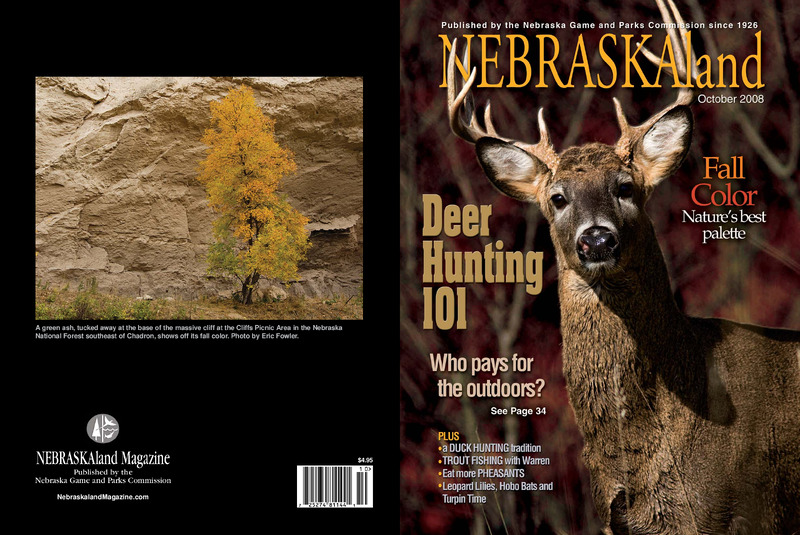
A green ash, tucked away at the base of the massive cliff at the Cliffs Picnic Area in the Nebraska
National Forest southeast of Chadron, shows off its fall color. Photo by Eric Fowler.
NEBRASKAland Magazine
Published by the
Nebraska Game and Parks Commission
NebraskalandMagazine.com
$4.95
Volume 86, Number 8, October 2008
12 Planting the Seed
Duck hunting is a fabric woven into their very existence
that has bound these North Platte duck hunters as one with
nature on frosty mornings as ducks cup wings over decoys.
TEXT AND PHOTOS BY ROCKY HOFFMANN
18 Fall Color
From the trail, road, or even the air, this is Nebraska’s
autumn – the one time of the year that people might
not think twice about gas prices, for there seems to be a
new color ready to emerge from around every corner.
TEXT BY JEFF KURRUS
24 Deer 101
Despite what you may have been led to believe, deer
hunting with a rifle is not that hard. By following these
basic steps there’s an excellent chance almost anyone
could harvest a deer this year, and there’s never been a
better time to take up deer hunting in this state.
TEXT AND PHOTOS BY ERIC FOWLER
34 The Other Nebraska ... and its future
12
●
Last September I spent a few days hiking with Chadron
resident Tom Scheimo and learned that the future
of outdoor recreation is upon us. What I didn’t learn was
how it was all going to be paid for.
TEXT AND PHOTOS BY JEFF KURRUS
42 Fly-Fishing with Warren
Fishing western Nebraska’s streams, rivers and ponds is a
personal passion for Warren Sedivy of Alliance, a certified
fishing instructor and quiet ambassador for the sport of
fly-fishing. TEXT AND PHOTOS BY BOB GRIER
42
●
10 Mixed Bag
Leopard lilies, hobo bats, fall fishing and Turpin tips.
18
●
49 In the Kitchen
How to cook pheasants – the original free-range chicken.
Comment . . . . . . . . . . . . . . . . . . . . . . . . . . . . . . . . . 4
Outdoor News . . . . . . . . . . . . . . . . . . . . . . . . . . . . . 6
Classifieds . . . . . . . . . . . . . . . . . . . . . . . . . . . . . . . 48
Portraits from the Past . . . . . . . . . . . . . . . . . . . . . 50
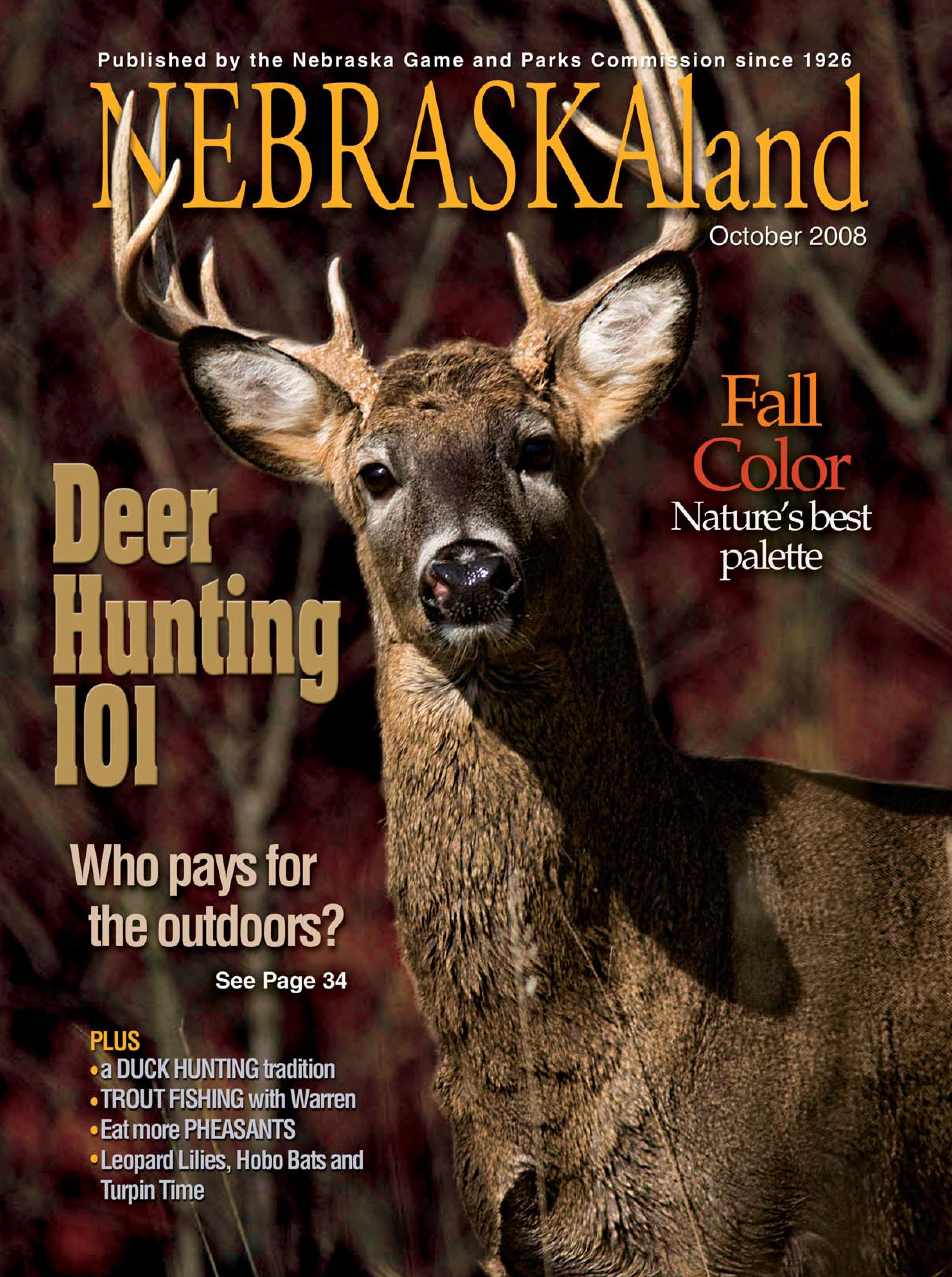
Cover: While chasing does during the rut, a white-tailed buck pauses at Indian Cave State
Park in Richardson County. Fall is a great time of year to view and photograph deer, other
wildlife and spectacular fall foliage at state parks across the state. Photo by Jeff Kurrus.
Opposite: Surrounded by fall color in a Prairie Plains Resource Institute restoration site in
Aurora, a katydid rests on a round-headed bushclover flower. Photo by Chris Helzer.
34
●
OCTOBER 2008 • NEBRASKALAND 3
Published by the
Nebraska Game and
Parks Commission
Director: Rex Amack
Assistant Directors:
Roger Kuhn, Kirk Nelson, Sam Sidner
Information & Education Administrator:
Doug Bauch
Commissioners
Chairman:
James Ziebarth, Wilcox
Vice Chairman:
George E. Hall, Bridgeport
2nd Vice Chairman:
Jerrod Burke, Curtis
Dr. Mark Pinkerton, Wilber
Ron Stave, Waterloo
Dr. Kent Forney, Lincoln
Lynn Berggren, Broken Bow
Mick Jensen, Blair
Magazine Staff
Editor: Doug Carroll
Associate Editor: Jeff Kurrus
Art Director: Tim Reigert
Senior Editor: Jon Farrar
Regional Editors:
Eric Fowler, Bob Grier, Rocky Hoffmann
Circulation: Donna Robinson
Photo Librarian: Sarah Johnson
Marketing/Advertising: Jane Gustafson
For advertising information e-mail
advertising@ngpc.ne.gov
or call (402) 471-5481
NEBRASKAland
ISSN: 0028-1964
VOL. 86 / NO. 8
OCTOBER 2008
Published monthly, except for Jan./Feb. and Aug./Sept.
issues, by the Nebraska Game and Parks Commission, 2200
N. 33rd St., Lincoln, NE. Copyright 2008, all rights reserved.
Please address comments or questions to this address.
Periodicals postage paid at Lincoln, Nebraska, and other
locations. POSTMASTER: Send all address changes to
NEBRASKAland, P.O. Box 30370, Lincoln, NE 68503-0370.
NEBRASKAland is available on audio cassette from the
Nebraska Library Commission Talking Book and Braille
Service, Suite 120, 1200 N St., Lincoln, NE 68508. (800)
742-7691. NEBRASKAland Magazine and the Nebraska
Game and Parks Commission reserve the right to reject
any advertising not in keeping with the agency mission.
Rates: $18 for one year; $33 for two years; $44 for
three years. Nebraska residents must add
appropriate sales tax.
To subscribe call 1-800-NEBLAND (632-5263),
or go online to: NebraskalandMagazine.com.
For address changes and questions about your
subscription, e-mail donna.robinson@ngpc.ne.gov.
4 NEBRASKALAND • OCTOBER 2008
Wayne Cacek of Burchard sent in these before and after pictures of the “mercy
mission” he undertook last spring to help a button buck in distress.
Good Samaritan
As I was reading a NEBRASKAland
Magazine earlier this year, I saw
the picture of a little fawn that a
landowner from Kearney had sent
in and thought you might enjoy
hearing about an experience I had
last spring.
One Saturday morning in June my
daughter called while she and her
husband were traveling down the
highway near Lewiston on their way
to Branson. They had seen a deer
hung up on a fence and were
wondering if I could help it out, so I
headed out on what I call a “mercy
mission.”
Because I’ve hunted deer since
back in the 1950s, I’ve had some
encounters that have proved that
deer can be dangerous, so I
proceeded with caution when I came
upon the situation.
It wasn’t an easy task, but I was
finally able to get the deer out of the
fence without cutting any wire or
injuring him any further. He wasn’t
cut up any, but his mobility was not
the best, so after I freed him, I rolled
him on his side, placed his hind legs
under him properly so he could get
his circulation back
to normal, and tried
to massage his hind
quarters to help
him a little. I even
patted him on the
head to see how
alert he was, and he
let me know that he
was very alert. Ha!
I left him in
some fairly tall
grass to recuperate
and came back to
check on him a few hours later. He
wasn’t where I left him, but after I
milled around and made a little
racket, he popped his head up to see
what was going on. He was about
250 yards from where I had left
him. From there I let nature take
over and went back home.
Hope you enjoy these before and
after pictures I shot!
Wayne Cacek
Burchard, Nebraska
Big Moth
One morning we saw this insect
sitting on our screen door. Its
wingspan tip to tip was about three
or four inches. My wife took this
photo, but we didn’t know if it was a
moth or some sort of butterfly. The
next morning it was gone. We thought
you or some of NEBRASKAland’s
readers might be able to identify it.
William Eihausen
Columbus, Nebraska
Your visitor was a cecropia moth
(Hyalophora cecropia), one of the
largest moths found in North
America. Although common in
Nebraska, you don’t often see
cecropia moths since they only fly at
night. Because the mouths of these
moths are not developed, they cannot
eat in the adult stage and live only
long enough to mate and lay eggs.
Female cecropia moths can lay
more than one hundred eggs, and the
young caterpillars that hatch grow
quickly and molt several times
throughout the summer. By late
summer, the now large caterpillars
are ready to spin the cocoon where
they will spend the winter before
emerging as adult moths the
following spring to begin the moth’s
life-cycle again.
- Editor
Headquarters
2200 N. 33rd Street
Lincoln, NE 68503
Phone (402) 471-0641
District Office I
East Hwy. 2, Box 725
Alliance, NE 69301
Phone (308) 763-2940
District Office II
524 Panzer St., Box 508
Bassett, NE 68714
Phone (402) 684-2921
District Office III
2201 N. 13th St.
Norfolk, NE 68701
Phone (402) 370-3374
District Office IV
301 E. State Farm Rd.
North Platte, NE 69101
Phone (308) 535-8025
District Office VI
1617 First Ave.
Kearney, NE 68847
Phone (308) 865-5310
Omaha Office
1212 Bob Gibson Blvd.
Omaha, NE 68108
Phone (402) 595-2144
Ak-Sar-Ben Aquarium
21502 W. Highway 31
Gretna, NE 68028
Phone (402) 332-3901
World Wide Web site: www.OutdoorNebraska.org
E-mail: info@ngpc.ne.gov
Statement of ownership and monthly circulation of
NEBRASKAland Magazine
Owner and publisher: Nebraska Game and
Parks Commission
Editor: Doug Carroll
Headquarters of Publisher and Publication:
2200 N. 33rd St., Lincoln, NE 68503
Stockholders, Bondholders, Mortgage and
Security Holders: None
Average number of copies
of each issue during
preceding 12 months
Single issue
nearest to
filing date
A. Total Copies Printed
(net press run) ..................30,643 ............33,002
B. Paid Circulation
1. Single-copy sales............2,242 ..............2,792
2. Mail subscriptions ........26,124 ............25,767
C. Total Paid Circulation ........28,435 ............28,625
D. Free Distribution
by Mail ................................4362 ..............1,972
E. Free Distribution
Outside the Mail ....................344 ................344
F. Total Free Distribution ............780 ..............2,316
G. Total Distribution ..............29,215 ............30,941
H. Copies Not Distributed ....1,4280 ..............2,061
I. Total....................................30,643 ............33,002
J. Percent Paid and/or
Requested Circulation ..............97%................93%
Send your comments to:
Doug Carroll, Editor
NEBRASKAland Magazine
P.O. Box 30370
Lincoln, NE 68503
or e-mail doug.carroll@ngpc.ne.gov
Please include your postal address
and telephone number.
Letters may be condensed and edited
for clarity. Photographs are
welcome and will be returned.
Under federal and/or state law, discrimination is prohibited on the
basis of race, color, religion, age, gender, marital status, national
origin, disability or political affiliation. If you think you have been
discriminated against in any program, activity or facility by the
Nebraska Game and Parks Commission or want more information,
contact the Commission in Lincoln, NE, at (402) 471-0641 or the
Equal Opportunity Commission, Lincoln, NE, (402) 471-2024,
TTY/TDD (402) 471-4693).
Administration
Ted Blume (Adm.)
Craig Stover (Asst.)
Wes Loos (Asst.)
Rod Loos (Asst.)
Murray Johnson
Lincoln
471-5531
Lincoln
471-5532
Lincoln
471-5591
Ogallala (308) 284-8056
Lincoln
471-5003
Panhandle
Officer
City
Phone (308)
Jim Zimmerman (Sup.) Gering
436-7561
Walt Meyer
Chadron
432-4398
Scott Brandt
Gering
436-3418
Heath Packett
Gordon
282-2553
Dennis Thompson
Lemoyne
355-2024
Dan Zuehlke
Ogallala
284-4815
Doug Pollard
Oshkosh
772-9950
Frank Miller
Valentine (402) 376-1183
Dan Kling
Whitney
432-8367
Southwest
Officer
City
Phone (308)
Roger Thompson (Sup.) N. Platte
532-9175
Ray Dierking
Brkn. Bow
872-3078
George Sund
Cambridge
697-4629
Michael Thome
Cozad
784-4362
Matt Andrews
Elwood
785-3025
Dirk Greene
Imperial
882-5328
Virgil Gosch
McCook
345-2185
Dudley Sorensen
N. Platte
532-0747
Rich Routh
Rep. City
799-2085
South-central
Officer
Jerry Pecha (Sup.)
Jeff Jones
Terry Brentzel
City
Phone (308)
Kearney
865-5327
Clay Center(402)762-3124
Doniphan (402)845-2021
Randy Pomplun
Darin Gress
Dale Johnson
Mark Reeves
Robert Finke
Richard Seward
Fullerton
536-2987
Hebron (402) 768-2287
Kearney
237-1079
Loup City
745-0662
Milford (402) 761-3537
Ord
728-3115
Northeast
Officer
Tom Zimmer (Sup.)
Dale Davis
Ross Oestmann
Steve Oberg
Daniel Roberts
Jon Reeves
Marion Shafer
Pat George
Eric Wiebe
Tim Williams
Cory Krause
City
Phone (402)
Norfolk
371-6625
Bassett
273-1700
Bloomfield
373-4412
Columbus
564-5937
Fremont
721-7852
Kennard
427-7378
Norfolk
371-2031
O’Neill
336-1588
Ponca
755-2566
Neligh
887-1335
West Point
372-6979
Southeast
Officer
Duane Arp (Sup.)
Sean McKeehan
William Krause
Mike Luben
Douglas Kramer
Dina Barta
Stacey Lewton
Levi Krause
Russell Mort
Dan Evasco
Jeff Clauson
City
Gretna
Ashland
Auburn
Colon
Lincoln
Lincoln
Lincoln
Louisville
Nebr. City
Papillion
Waterloo
Phone (402)
332-2965
944-4174
274-3789
443-4278
466-9001
483-2358
476-0436
234-2212
873-5684
592-6733
359-5301
Nebr aska Wildlif e Cr imestopper s 1-800-742-7627
OCTOBER 2008 • NEBRASKALAND 5
PHOTO BY SARAH ROBERTS
Sarah Roberts’ photo of a male cardinal feeding its mate at the nest won the Wild
and Scenic division of the 2008 Nebraska State Fair photography contest.
Dwight Photographer Wins
Wild and Scenic Competition
A photo of a pair of nesting
cardinals won this year’s Wild and
Scenic division of the Nebraska
State Fair photo contest. The winning
photographer, Sarah Roberts of
Dwight, said the picture was one of
hundreds taken of the nest.
“My husband Ben and I were sitting
in our backyard in May 2007 when
we heard a cardinal singing. We
started to look around for it and saw
a female cardinal fly into a pine tree.
We could see that she was hanging
around the same area and soon
realized that she was sitting on a
nest. I set up a blind and over the
next couple of days we watched her
and the male feeding the babies. We
got to observe a lot of interesting
behavior that we had never seen
before. The most amazing part was
when we got to see the male cardinal
feeding the female while she sat on
the nest, and that’s the picture I
submitted to the state fair. I used a
tripod and shot the picture with a
Nikon D50 with a 300mm lens. I
probably shot about 500 pictures of
those cardinals, and that picture is
my favorite that I have ever taken.”
Sarah and her husband moved to
Nebraska from Ohio in January 2007.
6 NEBRASKALAND • OCTOBER 2008
Because she wanted to have pictures
of her new surrounding to send back
to family in Ohio, the move rekindled
her interest in photography, so she
started buying photography books
and magazines. She started off doing
landscape photography, but soon
discovered that her favorite subject
turned out to be animals and birds.
Now she and her husband have several
bird feeders filled with various types
of bird food in their backyard. To
see more of her work, go to
www.RobertsCustomPhotography.com.
Deer Exchange Program
A new program that begins this
fall is intended to unite hunters with
people who want to receive deer meat.
The Deer Exchange is a pilot
program of the Nebraska Game and
Parks Commission that is designed
to bring together hunters who have
deer or deer meat that they are willing
to give away and citizens who want
to receive deer meat. There is no cost
to enter the program, and no money
may exchange hands between donors
and recipients.
According to Kit Hams, big game
program manager for the Commission,
the program is designed to help
increase the harvest of antlerless
deer and to allow more people to
enjoy healthy, nutritious venison.
“We really need to harvest more
antlerless whitetail deer in some
parts of the state in order to keep the
deer population in check, but I’ve had
numerous hunters tell me that that
while they’d like to shoot more deer,
they don’t need any more meat. With
this program, hunters will be able to
enjoy more time in the field, help
control the deer population and easily
share the harvest,” said Hams.
Program participants will be
brought together via a database on
the Commission’s web site at
OutdoorNebraska.org. It’s up to the
donor and recipient to make
arrangements for the transfer of deer,
and the Commission is not responsible
for the quality of the deer meat or
the failure of either party to follow
through with the transfer.
New Recreation Area Open
on Missouri River
Bow Creek Recreation Area, the
first property acquired by the
National Park Service on the
Missouri National Recreational
River in northeastern Nebraska, is
now open near Wynot.
Located at the mouth of Bow
Creek, this 200-acre property
includes approximately one mile of
Missouri riverfront, three-fourths of
a mile of Bow Creek, bottomland
forest, grasslands and picturesque
limestone and shale bluffs. The Park
Service purchased a portion of the
property in 2004 and the rest in
2008.
The area is open to hiking, hunting,
fishing and primitive camping. No
campfires are allowed and visitors
are urged to practice Leave No Trace
camping by packing out everything
they pack in.
Waterfowl hunters on the area
must remove blinds daily. Deer
hunters can use a tree stand and
leave it in place for the duration of
the hunting season, but only one
stand is allowed per hunter and must
be marked with the hunter’s name,
address and phone number.
To reach the area from Wynot,
follow 586 Avenue 2.2 miles north
to 893 Road. Turn right and follow
893 Road and a trail road 1.6 miles
to the parking lot. A portion of the
property lies across Bow Creek and
can be reached by boat or by wading
the creek when water levels allow.
The nearest Nebraska boat ramp is
located two miles downstream at
Brooky Bottom Park. The Myron
Grove boat ramp is located across
the river in South Dakota.
For more information, contact the
Park Service at (402) 667-2550.
New Ponca SP Campsite
A mock Lewis and Clark
encampment was recently completed
at Ponca State Park in northeastern
Nebraska and is now available for
rent to organized groups such as
scouts, churches and 4-H clubs.
Built on a remote stretch of the
Missouri National Recreational River,
this educational campsite features
two large wall tents (officer’s tents)
along with 10 small wedge tents set
up in an early 1800s military-style
encampment. According to park
superintendent Jeff Fields, the
campsite offers the opportunity to
sense and contemplate what a camp
on the Missouri River might have
been like in the early 1800s.
“Visitors can experience the
sounds and smells of the Missouri
River while camping, the same as
Lewis and Clark experienced, while
learning about our natural and cultural
heritage,” said Fields.
The riverside site is located on the
park’s north addition. Water and
restrooms are available on-site, and
groups can reserve this campsite up
to one year in advance from June
through October. The fee is $11 a
night, plus $1 a person after the
initial eight people. Call the Ponca
State Park office at (402) 755-2284
for reservations.
Conservation Officer Awards
The Nebraska Conservation
Officers Association (NCOA) recently
announced their conservationist,
judge and conservation officer of the
year awards for 2008.
Scott Lickteig of Auburn, an
advocate for trapping and wildlife
conservation and an active member
of the Nebraska Fur Harvesters
Association, won the Conservationist
of the Year award for his efforts on
teaching youth about fur harvesting
and his work with Sam Wilson, the
furbearer manager for the Nebraska
Game and Parks Commission.
Judge Linda Caster Senff of the
5th Judicial District was named
Judge of the Year, an award given to
judges or prosecutors in the state
who take wildlife crimes seriously
when dealing with violators.
Conservation Officer Rick Seward
of Ord was given the Loron Bunney
Award. A 35-year veteran of the
Commission, Seward was rewarded
for his efforts in making Calamus
Reservoir one of the safest, most
law-abiding areas in the state, for
the effort he puts out for his
popular weekly radio show and for
his diligence in seeing wildlife
violators brought to justice.
Hunter Ed Awards
Four volunteer Nebraska hunter
education instructors were recently
recognized for 30 or more years of
service. Those honored were
Kenneth Gill of Bloomfield, 31
years; Charles Mahler of Allen, 30
years; Robert Wollenberg of Gretna,
30 years; and Allan Zeitz of
Norfolk, 31 years. ■
8 NEBRASKALAND • OCTOBER 2008
OCTOBER 2008 • NEBRASKALAND 9
PHOTO BY ERIC FOWLER
Kirkpatrick Basin North Wildlife Management Area near York has been dry for
at least 10 years, but it was brimming with water in June and still had plenty
in August. Duck hunters should find water throughout the Rainwater Basin
wetlands this fall following a wet spring. “Some areas are dry or not as wet,
so if duck hunters have a specific place they want to hunt, they should
probably check it out ahead of time to make sure it’s wet – but overall it’s
looking pretty good,” said Randy Stutheit, a Nebraska Game and Parks
Commission biologist stationed in Lincoln.
10 NEBRASKALAND • OCTOBER 2008
Turpin Time
Dick Turpin
Some of
you might
think this
topic is a little
extreme but
it’s important.
The hunting
boot you hunt
in should only
be worn in the
woods and I’ll
tell you why.
You get up in
the morning and go hunting and you
get that boot on … you stop and gas
up the pickup … you walk across that
lot … and it’s got a lot of oil and
scents on the ground … different
peoples’ scents too … you walk inside
… you get scents in there when you
get your coffee … your boots will
gather it all up.
Then you walk in the woods … a
lot of those scents are there and those
animals are going to detect you, so
my advice is your hunting boots
should be kept in some kind of
container with maybe cedar boughs
… anything to keep it out of the main
street of town.
Hobo Bat
Rocky Hoffmann
In early August, Rick Speck, a
Union Pacific Railroad electrician
working on a locomotive in North
Platte’s Bailey Yards, found a
mummified bat that he assumed
An eastern red bat similar to this one was
found dead in North Platte last year.
“It’s the Most Wonderful Time of the Year”
Daryl Bauer
Most anglers eagerly await the first warm days of spring when
they can shake off the winter’s cabin fever and start the “fishing
season.” I fish year-round, but would have to say that I cannot wait
until the day after Labor Day. Now that is an arbitrary date, but I
believe it signifies the beginning of some of the best fishing of the
year.
Many fish feed heavily in the fall. Winter brings “lean times” for all
wild creatures, so fish try to store extra energy in the fall or “fatten
up” to prepare. In addition, the development of eggs and milt for the
upcoming spring’s spawn begins in the fall and fish need extra
energy for that development. The amount of prey consumed per
day actually increases for some fish species during autumn. Couple
this with prey populations that have been steadily depleted
throughout the summer, and you have hungry fish with less to eat –
that is a prescription for excellent fishing.
The need to build energy reserves makes it more likely that fish
will feed on large prey items in the fall. Furthermore, prey fish will
have grown to larger sizes by the time September rolls around.
That makes fall one of the peak periods when anglers fishing big
baits have an excellent chance to catch some of the biggest,
fattest, fish of the year.
Water-based outdoor activity declines
as soon as September arrives, and that
is another reason fall is the best time to
fish each year. With less watercraft and
less competition from other anglers,
autumn anglers seldom have to worry
about fish being harvested or bothered.
Fish settle into fall routines and are less
likely to be spooked or harassed; they
are more likely to stay in the same
habitats and be caught on the same
presentations over a period of days or
even weeks. In a year when warm
weather extends well into November,
the most wonderful fishing of the year
can extend clear up to the beginning of
the holiday season at Thanksgiving.
PHOTO BY JEFF KURRUS
Basins Look Ducky
had dropped out of a narrow opening
in the engine compartment. Upon
closer inspection, the bat was found to
have a wing band with the number
A13416 and the letters KY F&W.
After contacting the Kentucky
Fish and Wildlife (KY F&W),
employees of the local Nebraska
Game and Parks Commission office
in North Platte were able to find out
that an organization called
Copperhead Environmental
Consulting Incorporated had banded
the bat in Bullitt County, Kentucky
on May 29, 2007.
Mark Gumbert of Copperhead said
that for the past four years the
company has worked with the general
public to study the bats of Bernheim
Arboretum and Research Forest in
north-central Kentucky. The project’s
primary purpose is to bring awareness
of the importance of bats and their
role in the environment to the general
public and to identify the ecological
niche of all species found at the site.
Gumbert said these goals are being
achieved with the help of a coalition
of state and federal government
agencies, consulting firms and
interested individuals throughout
Kentucky that have been brought
together to participate in the research.
Gumbert said their programs are
designed to give the general public
hands-on experience with the
techniques used for bat research and
conservation. Participants receive
lectures about different species found
PHOTO BY DOUG CARROLL
Gerry Steinauer
Several years ago I saw my first
leopard lily (Fritillaria atropurpurea)
while relaxing at the base of an
eroded butte in the Wildcat Hills of
Scotts Bluff County, only by chance
glimpsing the brownish-purple
flowers, mottled with white and
yellow, hidden among the prairie
grasses. It is likely that in my outdoor
wanderings I had passed this wellcamouflaged plant before without
notice.
The leopard lily, also known as the
spotted missionbell and chocolate lily,
ranges from Oregon southward to
California and east as far as Nebraska.
In our state it has been found in four
poisonous if consumed in large
quantities. The Lakota tribe also
pulverized the plant into a salve and
applied it to heal ulcerated swellings.
In Chinese medicine, several species
of Fritillaria are used to cure
maladies, including cancer.
Finding leopard lilies takes a keen
eye and may require a strenuous hike
to reach suitable habitats. The effort,
however, rewards the successful seeker
with plants laden with beauty and
history.
COURTESY COPPERHEAD ENVIRONMENTAL CONSULTING, INC
PHOTO BY GERRY STEINAUER
Leopard Lily
Panhandle counties and in northcentral Nebraska’s Cherry County. It
grows in ponderosa pine woodlands,
rocky mixed-grass prairies and
badlands, most often at the base of
slopes and in low swales where
moisture collects.
In Nebraska, the species is rare and
most populations are small, ranging
from just a few to less than 100
individuals. This past May, however, I
was surprised to see thousands of
these flowering plants on silty flats
below badland buttes on The Nature
Conservancy’s Conata Basin Preserve
in southwestern South Dakota.
Leopard lilies grow from a fleshy,
white bulb and generally reach a
height of about eight inches. The
leaves are long and narrow, and from
their base arise one to three longstemmed, inch-wide flowers. The
name, Fritillaria, is Latin for dice box
and likely refers to the box-like shape
or spotted pattern of the flowers. The
flowers bloom in May and emit the
pleasant odor of morel mushrooms.
Native Americans relished boiled
leopard lily bulbs, although they are
in the area and their importance, and
they are also involved in mist netting
activities, including collecting field
data on animals captured and taking
part in their banding.
In addition, radio transmitters are
placed on multiple species, which are
then tracked the following day to their
respective roosting locations.
Descriptions of these roosts assist
participants to key in on roost
selection differences between various
species.
Looking through the group’s banding
records, Gumbert was able to find out
that the adult male eastern red bat that
arrived in North Platte via rail was the
only bat captured on an exceptionally
cold night. Gumbert said that there
is a railroad track within a half mile
of the banding site, and he believes
that it is likely that the train hit the
bat while it was feeding along the
railroad right-of-way. Gumbert said it
is common for red bats to collide with
cars while chasing bugs, and because
they are typically roost in foliage
trees, it would be rare to find one
roosting anywhere on a building,
vehicle or train. ■
OCTOBER 2008 • NEBRASKALAND 11
Planting the Seed
Text and Photos by Rocky Hoffmann
Duck hunting is a fabric woven into their very existence that has
bound these North Platte duck hunters as one with nature on frosty
mornings as ducks cup wings over decoys.
t used to be so easy. The shotgun
stood in the corner behind the
pantry door, and was a fast grab
on the way out. If Mom didn’t
happen to check behind the door or
notice the gun was missing while
sweeping the floor, she assumed we
were sitting at our school desks – or at
least we assumed she assumed that.
Skipping school in those days was also
easy and even predictable when the
weather turned “fowl.” The teacher
quickly learned who the hunters were in
her classroom, and although we were
counted absent, the mark against us
always boiled down to an excused
absence in the end. Making up days
over the summer months for time
missed during the fall duck flights
simply didn’t happen.
Probably the easiest part of all was
finding a place to hunt, which in
those days meant just about
anywhere we so desired – the
river didn’t seem to belong to
anybody, except to whoever
got there first and marked
out their territory. Sure, the
land along the river was
privately owned, but many
landowners didn’t really care
if a couple of kids stuck up a
few willows and froze their butts
off all day for a bluebill or mallard.
Besides, everybody knew everybody
then. They also understood that
whatever was shot from that willow
blind was going to be taken home for
supper, and that’s probably why Mom
allowed the gun to stand in the pantry
corner in the first place.
Not so today. Instead, good river
bottom or marsh is sacred territory that
is sought out, purchased or leased at a
significant price and defended fervently
against intrusion. Simply being a kid
with an old shotgun and a desire to
hunt is no longer a ticket to do so. At
I
12 NEBRASKALAND • OCTOBER 2008
the very least, trespassing now results in
a sound scolding, and more commonly
the local game warden is called in to
officially communicate the landowner’s
sentiments.
Larry and Patricia Golden of North
Platte own one of those highly prized
duck spots. Consisting of marshland
nestled between the North Platte and
South Platte rivers, the Golden Points
Ranch is a duck and goose hunter’s
paradise developed by the Golden family
primarily for that purpose. Larry and
Pat’s children grew up there, kicking
around barefoot in the river sand in the
summer and breaking holes in the ice
for mallards in late winter. Son Bernie
and grandson Hadley are chasing that
heritage into a third generation.
Both Larry and Bernie recognize how
extremely important duck hunting has
been to them. It is more than something
they do on a Saturday morning. Duck
hunting is a fabric woven into their very
existence that has bound them as one
with nature on a frosty sunrise when a
flock cups wings over a few decoys. The
Goldens also recognize the importance
of introducing this tradition to youngsters
who may otherwise never get the
opportunity to experience such earthy
things as the smell of a freshly fired
shotgun shell, the sound of geese
approaching in predawn darkness, the
numbing ache of toes in a leaky boot
and the pungent odor of marsh gas
mingling with the rich aroma of deer
loin frying in butter on an iron skillet.
Most frequent in attendance at the
Golden school of duck and goose
hunting are Hadley’s early teen chums,
Kaelin Becker and Ross Rasmussen.
Partners all, preparation for the fall
hunt begins early at the “Points,” with
the gang of five pouring sweat onto
blisters during the late summer task of
covering the group’s four blinds they
usually set up – two on the North Platte
River and two on a backwater marsh to
cover all possible temperature, wind
direction, snow and last minute hunting
guest situations.
Finding appropriate blind cover
is no longer a problem along
the once barren Platte River
drainages: Phragmites has invaded
every square foot of sandbar and
every linear foot of riverbank near
the confluence of the North and
South Platte rivers. This exotic
grass, which threatens a hostile
takeover of the entire river system
from border to border, is nearly the
sole vegetative species in this area, so
in order to hide a blind in its “natural”
surroundings, hunters cover their blinds
with it. Although no further damage to
the ecosystem can occur by using
phragmites for blind cover in areas
where it already exists, a real danger
arises if hunters transport it to cover
blinds on lakes or streams that are
currently safe from the invasion. The
introduction of phragmites into
Sandhills lakes, for example, could be
devastating to that ecosystem, and
hunters are strongly advised not to
Blind building is group effort that usually takes place in the heat of late summer.
Left to right, Ross Rasmussen, Kaelin Becker and Hadley Golden display the bounty of
the summer labor alongside of Mac, a yellow Labrador.
14 NEBRASKALAND • OCTOBER 2008
cover boat blinds or other trailer-pulled
blinds with this invasive plant.
Something good to say about the plant
is that it makes excellent blind cover
because it is so durable and abundant.
On a sweltering day last summer,
Hadley, Kaelin and Ross gathered
armloads of the tall exotic grass as
Bernie separated it from its roots with
a harness-supported “weed whacker.”
Bernie replaced the steel cutting blade
with a plastic substitute as a safety
precaution for working in tight quarters.
“The plastic blade is strong enough
to raise a welt and a whine, but that’s
about the extent of the damage it can
cause through a set of waders. It makes
quick work out of cutting a boatload
of blind cover, and we exercise a lot
of caution around the guy running the
cutter. Who wants to ruin a pair of
waders?” chuckled Bernie.
Larry has promoted himself to the
role of advisor during these projects
and is good at what he does. In fact,
the boys agree that advice is one thing
he is never short on.
“Pick a subject, and he’s got advice,”
Hadley said of his grandpa. “The
problem is sorting out what is serious
advice and what is just thrown out
there when he’s messing with us.”
Hadley, Kaelin and Ross often hunt
out of one of the river blinds while Larry
sits in another blind on the opposite
side of the channel. Although there is
considerable distance between the two
blinds, the boys usually have no difficulty
hearing the ongoing commentary coming
from the elder Golden. If the ducks are
flying, comments concern calling and
shooting, whether the boys waited too
long to shoot or took them too soon,
dog work, staying hidden, decoys, and
duck identification. When the ducks
aren’t flying, topics are many, varied
and shy away from very little. This is
when most of the sorting of good advice
and not so good advice is important,
especially when girlfriends and dating
are part of Larry’s list of discussion
items for the day.
One discussion item that the boys
always pay attention to, however, is that
of safety. Larry and Bernie have made
sure that their young hunters fully
appreciate that gun safety is their
number one responsibility and priority.
Guns are carried empty to the blind
and are loaded and unloaded with the
muzzles safely out of the standup
holes. Safeties are checked between
flocks and all hunters recognize their
personal zones of fire.
“A safe hunt is always a successful
hunt,” said Larry as he reminded
the boys to unload their guns at
the end of one day’s hunt. “They
don’t need reminded anymore, of
course – I just can’t help myself.”
Larry continued on the subject
of safety. “Dogs can be a real
concern in a blind full of hunters
and guns. Even a well-handled
dog can knock a gun over. We’ve
just made it a practice not to allow
dogs in our blinds.”
Actually, there wouldn’t be much
room left for hunters or guns if
Bernie’s Labrador and Larry’s
Chesapeake were allowed in the
blind. Mac is a tall, big-boned
yellow Labrador that Bernie
picked up for a little bit of nothing
and truly loves to hunt, so much
so that he sometimes gives voice
on the way to a retrieve. His long
legs allow him to cover a lot of
shallow river water and soft
sandbars in a short amount of time.
“I can’t recall ever losing a bird over
that $50 dog,” Bernie said. “He’s
simply been tremendous.”
Hunter is a huge Chesapeake.
“Hunter weighs in at 141 pounds
and is gaining,” said Larry. “He’s a
marsh mudder, and they haven’t
grown a goose too big for him yet.”
Because they’re not welcome in the
hunting blinds, the retrievers have their
own. In the marsh the dog kennels are
on posts above the water level and are
also covered with phragmites. The dogs
use ramps to enter their kennels, but
rarely use them when sent for a retrieve.
Although camouflaged from the duck’s
eye view, the dogs are able to visually
mark most downed birds in front of
them and sniff out those that fall in the
cattails and phragmites behind them.
Although Mac is Bernie’s dog,
Bernie’s job as a railroad engineer keeps
him out of the hunt once in a while, and
Hadley has learned to handle Mac quite
well on his own. All three youngsters
realize how important it is to hunt with
a trained retriever in this type of an
environment where birds could be lost
easily. They also have come to cherish
the simple enjoyment of hunting with a
dog regardless of the situation.
Even if the safety issue of having a
dog in the blind could be solved, the
issue of begging for blind food would
likely result in a pooch’s ejection.
Hadley (front) and Kaelin watch a
distant flock of mallards.
When a sharp wind is blowing, it takes a
lot of food to stoke the stomachs of three
teenage boys from sunrise to sunset,
and competition for that food with a
slobbering dog would meet some
resistance. There is rarely a shortage in
the food pantry at a Golden blind,
however, and the propane is more often
flowing to the griddle than to the heater.
“In days past, we’d fry up a pan full
of bacon and eggs, then throw in a stick
of butter, flour up some deer steaks and
fry them up as well for breakfast.
OCTOBER 2008 • NEBRASKALAND 15
the same way each time – that’s the
trick,” said Kaelin.
Hadley agreed, adding, “It’s also
more fun to learn from hitting than
from missing, because we tend to poke
a little fun when somebody misses.
Trash talk works both ways sometimes,
and a guy had better learn to take a little
ribbing around here.”
Ross interjected some self-defense for
having the only pump gun in the purist
double-barrel world in which he hunts.
“When they miss twice, they watch the
flock fly away. When I miss twice, I still
have a third shell with which to redeem
myself. I’d better not miss with that one.”
The hunting experiences at the Points
are truly memories in the making for
Hadley, Kaelin and Ross. Larry and
Bernie will capture some memories as
well, but it will be the youngsters who
will smell, taste, see and hear for the
rest of their lives every moment of
every first light, every flock, every
retrieve and every burrito. Larry has
planted the seed, like his dad and
granddad did with him and like Bernie
is doing now. It will be up to Hadley,
Kaelin and Ross to pass it on, and that
gets a little more difficult each season. ■
Kaelin and Hadley gather ducks collected on Hunter’s front porch.
Somewhere in mid-January we’d begin
trying to restore our cholesterol to
more normal levels.” Larry said. “Now
the boys’ moms make up a batch of
breakfast burritos, making sure to put
in a few healthy ingredients while
excluding some of the unhealthy stuff.
Actually they are pretty good – easy to
heat up and there’s not much cleanup
involved,” he said, before quickly
adding, “We still have our deer steaks
later in the day.”
Larry and Bernie love old doublebarreled guns, and Larry especially
enjoys collecting and shooting side-bysides. Hadley hunts with an over-andunder and Kaelin has gone to the more
16 NEBRASKALAND • OCTOBER 2008
traditional side-by-side, but Ross still
shucks shells from his pump-action
single barrel. Pump guns, unlike
autoloaders, are “allowed” at Golden’s
blinds because of their long tradition in
waterfowl gunning. Larry, however,
keeps the propaganda flowing in an
effort to convert Ross to the world of
side-by-side shooting. “I think he’s
weakening,” Larry said after an
exhaustive filibuster on the enjoyment
of shooting a good double gun.
Larry shoots a selection of side-bysides, including some shotguns with
Damascus barrels in which he uses
light, hand-loaded steel shot and black
powder. “Damascus has gotten a bad
rap in many instances. In fact, the
welded iron and steel ribbons that form
a Damascus barrel are not only patterned
beautifully into the barrel, but they can
make a fairly strong barrel as well. Still,
only an experienced gunsmith can make
proper recommendations for the loads
that antique guns can handle,” said Larry.
Bernie recalled an incident that
occurred early last season when he was
out of the blind setting up the floating
goose decoys from a boat. “Of course,
Dad was advising from the blind when
a long string of Hutchies came up the
river and headed toward the decoys.
They flew right over the spread. Dad
picked up his old 16-gauge L.C. Smith,
thumbed back the hammers, and in a
matter-of-fact motion, dropped two
geese stone dead. We heard about that
for a while.”
The youngsters, too, are fairly efficient
wing shooters, and get a little bit better
with each flock. Every duck and goose
at which they shoot produces a different
angle, speed and distance for them to
enter into their memory banks. The boys
feel that they learn more from the shots
they make than from the ones they miss.
“When I cleanly miss a bird, I’m never
really certain where my pattern was, so
it’s difficult to correct, but when I hit a
bird, I know exactly where my pattern
was and how I put it there. Just do it
The North Platte River has provided hundreds of hunting memories for
generations of the Golden family and their friends.
OCTOBER 2008 • NEBRASKALAND 17
Fall Color
Nature’s best palette
By Jeff Kurrus
From the trail, road, or even the air, this is
Nebraska‘s autumn. It’s the remnants of a once hot
summer, as well as a reminder of the impending winter
to come, the time for early morning hikes when a
light jacket and wristwatch are needed – one for the
lowering temperature, the other for the afternoon
Husker game. It’s the time of year when hunters can’t
sleep, and anglers wait impatiently for good ice, the
one time of the year that people might not think twice
about gas prices, for there seems to be a new color
ready to emerge from around every corner.
JEFF KURRUS
Above: A Canada goose swims across one of the old fish hatchery ponds at Schramm Park State
Recreation Area as autumn’s colors reflect off the water’s surface. Left: The red leaves of a
northern oak tree shine at Fontenelle Forest’s Neale Woods Nature Center in north Omaha.
JEFF KURRUS
OCTOBER 2008 • NEBRASKALAND 19
ERIC FOWLER
JEFF KURRUS
Above left: Sunrise at Stagecoach State
Recreation Area near Hickman fills the sky with
pink clouds.
Left: Freshly fallen leaves add color to the
mistly blue palette found at the base of the Stone
Creek waterfall at Platte River State Park.
DOUG CARROLL
20 NEBRASKALAND • OCTOBER 2008
Right: In the midst of changing from green to
red in late-September, sumac leaves, one of the
first color cues of fall, seem to glow on a rainy
day at the Bessey Ranger District of the
Nebraska National Forest near Halsey.
ERIC FOWLER
Above right: Frenchman Creek winds its way
through golden ash trees and sandsage prairie on
Enders Wildlife Management Area near Imperial.
OCTOBER 2008 • NEBRASKALAND 21
ERIC FOWLER
Above: Yellow cottonwoods leaves
sparkle in the late-day October sun at
Lake Minatare State Recreation Area
near Scottsbluff.
Left: Yellow elm leaves lie on a
moss-covered log in a spring branch
canyon at Smith Falls State Park near
Valentine.
ERIC FOWLER
22 NEBRASKALAND • OCTOBER 2008
JEFF KURRUS
Right: A lone cottonwood leaf rests on a
Missouri River island at Ponca State
Park in northeastern Nebraska.
OCTOBER 2008 • NEBRASKALAND 23
Text and photos by Eric Fowler
Deer hunting is not as difficult as
some people make it out to be. Follow
these tips and you may well fill your
freezer with tasty venison this fall.
nyone can shoot a deer with a rifle. Seriously. It’s just not
that difficult.
In fact, for someone who has never hunted, deer may
just be the easiest game to harvest. If you hunt right, you
will see a deer long before it sees you, and all you have to do
is wait until the deer is standing still, aim your high-powered
rifle, which even in the hands of a novice is capable of striking
a target within inches of the exact spot at which it was aimed
at a distance of 100 yards or more, and squeeze the trigger. To
top it off, your target, the deer’s heart and lungs, is as big as a
dinner plate.
Contrast that with pheasant hunting, where a rooster can
flush at your feet at any given moment while you’re
walking through a field, which can scare even the most
seasoned hunter out of their boots. As the bird flies away at
any given angle and at speeds of 30 to 60 mph, you have only
seconds to set your feet, shoulder your shotgun, take aim and
pull the trigger before the bird is out of range.
If you’ve thought of taking up deer hunting, but have been
intimidated by the unknown, I hope that comparison helps put
your mind at ease. When you boil it down to the basics, deer
hunting is simple. There also has never been a better time to
hunt deer in Nebraska, where deer populations, and hence
hunting opportunities, have reached record highs. Keep reading
and you’ll learn just enough to get started. When you’re done,
go to www.NEBRASKAlandMagazine.com and you’ll find an
extended version of this story with information on getting a
permit, hunter education requirements, field dressing deer,
hunting public land and how wind can help or hinder your
success.
Then you can spend the rest of your life fine-tuning
Pluto towed umpteen dogs. Two schizophrenic
your
craft.
I’ll see
woods this fall.
lampstands
sacrificed
oneyou
mat, in
butthe
the angst-rid-
A
24 NEBRASKALAND • OCTOBER 2008
OCTOBER 2008 • NEBRASKALAND 25
Y
ou can spend a truckload of money gearing up to hunt deer, picking up
some clothes in the latest and greatest camouflage pattern, a tree stand,
scents, optics, guns and ammunition. But there is no need to,
especially when you’re just getting started.
Assuming you already have a pair of boots and warm clothes, you
really only need a few things to hunt deer: a rifle, ammunition, knife
and a blaze orange hat and vest. Optional but very valuable pieces of
equipment include a rifle scope and binoculars. Most hunters are
more than willing to help someone get started in the sport, and if
it’s your first hunt, you may be able to borrow one
or more of these items. If you’re certain your first
hunt won’t be your last and want to get your own
gear, start with the basics and build from there.
Just as it does with most merchandise, you do
get what you pay for when it comes to hunting
equipment. That doesn’t mean that cheap
won’t get the job done.
With rifles, accuracy can increase with
price, but there are some very accurate
rifles available for less than $400.
Spend more and you may get better
materials, workmanship and aesthetics,
and an investment that can outlive you
and your kids, but there’s also nothing
wrong with a good, used rifle.
Getting what you pay for may
apply more to optics than
firearms, where another rule
of thumb applies: buy the
best you can afford. Highpriced optics typically use
better glass, providing a clearer
picture and making them more
functional at first and last light,
primetime for hunting. They are also
more durable and handle the
elements and a little abuse better
than cheaper goods.
The cost of ammunition can
also vary widely. You don’t
need premium ammunition for
practice or even to harvest a
deer, but considering one box
of hunting ammo can last
several years, the added
cost can be justified.
With knives, cost also
relates to materials and
workmanship. If you
don’t like to sharpen
them, buy a good
knife that will hold
its edge. ■
26 NEBRASKALAND
Rifle: There are enough
styles (bolt-action, semiautomatic, etc.), brands and
calibers of rifles on the market to
make your head spin. Adults can’t
go wrong with a bolt-action in one
of two tried-and-true calibers: .270
Winchester or .30-06 Springfield. For
youngsters and small-framed women
who want less recoil, a .243 will suffice.
Add a sling to make the walk to and
from the woods easier.
Rifle scope: Iron sights are fine for
deer hunting at short ranges, but beyond
50 yards, it’s much easier to aim with a
scope. A 3x9 variable-power scope can
be used anywhere from heavy
woodlands to open prairies. You’ll also
need rings and bases to mount it
to your rifle.
E
Lights:
To find your stand in the pre-dawn
darkness, you’ll need a flashlight or
headlamp. The latter is also invaluable for
field dressing deer after sundown.
Ammunition: Because of the
popularity of these calibers, .243, .270
and .30-06 cartridges can be found in
numerous loads, again making your
head spin. Most manufacturers print
recommendations on their packaging
that will help you
choose.
Binoculars:
These are more
of a necessity when
hunting mule deer in
open country, but can be
equally valuable when sizing up a
whitetail buck in the woods. A 10x42 roof
prism is a good choice. Stay away from
compact models, such as an 8x21 or
10x25, unless you plan on hunting only in
the woods.
Blaze orange:
Nebraska law
requires everyone
who hunts deer with a firearm to wear blaze
orange on their head, chest and back.
The reason is simple – safety.
Hunters wearing this color are
much more visible to
other hunters.
Knives
and
Saws:
Once your deer hits the
ground, the real work begins:
field dressing. A knife with a 4-inch
drop-point blade is the best choice for
this task. A gut hook is a good option to
add. A sturdy knife will open a deer’s
ribcage, but some hunters prefer to use a
bone saw for this task.
ven if your rifle has years of experience, you need to head to the
rifle range before each deer season and make sure it still shoots
where you aim. If your rifle is brand new, sighting in is a requirement.
Most gun dealers will bore-sight a rifle and scope you purchase from
them with a specialized tool. If you are buying a package, the manufacturer
usually takes care of this task. But bore-sighting only ensures that the
first shot you fire will hit somewhere on a standard paper target – you
must still make fine adjustments to the scope’s windage and elevation
to get the rifle to hit the bull’s-eye. If you put a scope on a bolt-action
rifle yourself, you can get it close without the tool. Place it in a steady
rest, remove the bolt, look through the barrel at a target and adjust the
scope until the crosshairs fall on the spot you see through the barrel.
Once you have the rifle bore-sighted, it’s time to head to the range.
Your first three shots at a target should be from 25 yards. If you’re on
the paper, adjust your scope to move the bullet grouping in the direction
of the bull’s-eye and then fire three more. Once you’re hitting dead center,
or very close to it, move back to 100 yards from the target.
From this range, you will repeat the process, but your goal here is two
fold. First, you want to be able to put three shots in as small of an area
as possible. Your rifle and cartridge can both limit your accuracy, but
how steady you hold your rifle and how smoothly you pull the trigger are
more important considerations. Three shots in a three-inch circle is
acceptable for a novice. Three in a one-inch circle is incredible.
Your next goal is to adjust your scope so that while aiming at the
bull’s-eye, your bullets are striking the target about three-quarters of an
inch above it. This is to compensate for the arced flight path of the bullet.
At 150 yards, standard .243, .270 and .30-06 cartridges sighted in this
way will all hit dead on. At 200 yards, they will hit about 2 inches low,
still well within the kill zone.
Gun clubs across the state open their gates to deer hunters for one
or more days each fall for a nominal fee. If you don’t have a safe place
to shoot, take advantage of these opportunities, which are listed on the
Commission’s web site. The more you shoot, the better you will shoot,
and the more confident you will be when you lower your crosshairs on
a deer. ■
When you sight in a rifle, start close (25 yards or so) and adjust your
sights until your shots are hitting the bull’s-eye.
OCTOBER 2008 • NEBRASKALAND 27
D
eer are creatures of habit. For the most part, their lives are spent doing three
things: eating, sleeping and walking between the places they eat and sleep.
With that in mind, there are three places you can hunt deer: their bedroom,
their dining room or on trails linking the two.
It’s not as easy as it sounds, however. Deer are crespuscular, which means they
are most active at dawn and dusk. Thankfully, legal hunting hours run from onehalf hour before sunrise to one-half hour after sunset, when deer usually are
moving to or from feeding areas. So those hours are best spent hunting feeding
areas or trails leading to or from them.
Deer are browsers that like to nip leaves from trees and shrubs, and nibble on
tender, green grass. But both white-tailed and mule deer will feed on domestic
crops such as corn, soybeans, winter wheat and alfalfa if they are available. That
is the case for nearly all whitetails in the state and most of the mule deer as well.
Deer have acute senses of sight, smell and hearing, which means that while you
may know where deer eat and sleep, getting close enough during legal shooting
hours can be a challenge. To combat this challenge, camouflage clothing helps us
blend into whatever landscape we may be hunting simply by breaking up the
human outline. It’s much more important, however, to limit the amount of
movement you make while on the stand or still hunting. More often than not,
however, it’s a deer’s sense of smell that gives it the edge, primarily because deer
often smell us before we can see them. Even though in most hunting situations
the range of a high-powered provides a buffer against this sense, never hunt
upwind of the spot where you expect to see deer.
Nebraska rifle hunters also have another advantage in that their season usually
falls during the deer breeding season, also known as the rut. During this time, deer
are more active during the day, especially bucks in search of does.
While these basics of deer behavior hold true for both mule deer and
white-tailed deer, the habitats the species occupy are different, and so are the
methods used to hunt them. Turn the page to find specific tips on hunting both
species. ■
28 NEBRASKALAND • OCTOBER 2008
hunting in Nebraska. These areas
sometimes receive considerable hunting
pressure during the November firearm
season, but they hold plenty of deer,
and plenty of hunters are successful
there. Details on these properties can
be found on the Commission’s web
site, in the Nebraska Guide to Hunting
The area you hunt might not look as good as this mythical slice of
whitetail heaven, but you can still use the same principles when deciding where to
sit or hang your stand. Deer in this area are bedding both in the creekbottom forest
and upland shelterbelt and feeding in crop fields. Pick your stand according to wind
direction and plan your approach so the deer can’t see or smell you coming.
1) Sit in the fence line where grass, trees or simply a fence post will break up your outline and where you can
see deer coming out of the woods to feed. In a perfect world, you could find a spot offering a shot at both
creekbottom and shelterbelt deer. Deer might also follow the draw or fence lines between the two habitats.
2) Pick a spot on the downwind side of the shelterbelt that provides a view of its entire length.
3) Hunt one of these spots to catch deer returning from the fields in the morning. If deer aren’t feeding until
after dark, sneak in here in the afternoon and you might get a shot as deer browse in a staging area.
Set up on the edge to cover both the woods and field, but don’t get too close to their bedding area.
4) Take a stand in a funnel – a narrow spot between two large woodlands – and you have a good chance of
intercepting deer passing between them, especially deer pushed out of one area by other hunters.
and Public Lands and the CRP-MAP
Atlas, which includes maps of public
land as well as private land enrolled in
the federal Conservation Reserve
Program that also is open to walk-in
hunting.
While there is good hunting on public
land, 98 percent of Nebraska is
privately owned. Some landowners do
not allow hunting. Others have leased
the hunting rights on their property or
reserve their farms and ranches for
friends and family during the
November season. But many
landowners welcome deer hunters,
especially those who have trouble with
deer eating their crops. All you have to
do is find them.
Wise hunters will go for a drive in
the country in the morning and
evening and look for deer feeding in
fields before they ever knock on a door
and ask permission. When they spot
deer, they open the plat map they
bought at the local courthouse to find
out who owns the land and where
they live, knock on the door, introduce
themselves and politely ask permission.
Hunters willing to harvest does will
increase their odds of gaining access,
especially in areas where whitetail
numbers are on the rise.
If you receive permission, let the
landowner know what days you plan
on hunting and what vehicle you will
be driving. Ask if there will be other
hunters on their land, and if they
would like you to hunt in a certain
area. Whether you harvest a deer on
their land or not, thank them when the
season is over. A gift and thank-you
card is always in order.
It’s never too early to start this
process, but it can be too late. Start
your search in early fall at the latest,
not the week before deer season. ■
OCTOBER 2008 • NEBRASKALAND 29
ILLUSTRATION BY TIM REIGERT
I
f you’ve never hunted deer, finding a
place to hunt should be one of your
top priorities. Deer aren’t everywhere, so finding a good place to hunt
is key to success. You can start in one
of two places: public or private land.
There are approximately 800,000
acres of state and federal land open to
A Whitetail’s Home
M
ost white-tailed deer live in heavy
cover offered by woodlands, and
hence, are most abundant along
rivers and in forested areas of eastern
Nebraska.
The easiest way to harvest a whitetail
is to spend an evening waiting for one
to arrive at its dining room: a crop field
adjacent to heavy cover. Chances are
you found one of these feeding areas
while you were looking for a place to
hunt. All you need to do now is find a
spot to sit that is within rifle range of
the the location where deer most often
walk out of the woods and into the
field. Don’t get any closer than you
have to – the closer you are, the more
likely it is that deer will see, hear or
smell you and spook. A spot 100 yards
away is close enough to offer a clean
shot. Look for a tree to sit against that
will break up your outline and make
you less visible to deer. If that tree is
on a hillside overlooking a creek
bottom, you will have a commanding
view and an easy shot at any deer
that walks out of the woods within
100 yards of either direction of your
location. If there are no trees, look for
other vegetation, hay bales, old farm
buildings, machinery or terrain that can
hide you from sight.
Deer start moving into crop fields an
hour or more before sunset. The first to
appear are usually does, fawns and
immature bucks. Trophy bucks might
not move into the fields until well after
legal shooting time. That might be the
case for all deer in a heavily hunted
area during the season.
You can hunt crop fields in the
morning, too, but you will have to
approach quietly in total darkness,
wait for shooting light and hope the
deer are still feeding. Get to your
stand at least 30 minutes before legal
shooting time if you plan on hunting in
the morning.
Most white-tailed deer bed in heavy cover, be it woodland, tall grass or a cattail slough, and many whitetails, especially mature
bucks, may linger on the edge of cover at dusk, waiting until it’s nearly dark to move into crop fields to feed. A stand location in
these areas is also a good place to hunt in the morning, giving you a chance to catch deer on the way back to their bedding area.
30 NEBRASKALAND • OCTOBER 2008
Another tactic for whitetail hunting
is to hunt in the woods near the spot
where deer are leaving the woods to
feed. Deer will often mill around on the
edge of cover before they walk into an
open field. Walk the edges of fields,
look for well-worn trails and follow
them into the woods a short distance.
From the trail, look for places where
you could sit or hang a tree stand that
provide a clear shot to that trail and
possibly others. Don’t wait until the
eve of the opener to do this scouting,
as you could easily spook deer out of
the neighborhood.
Most whitetails bed in heavy cover,
be it a woodland, tall grass or a cattail
slough. Go into one of these areas
during the day and chances are all
you’ll see is a deer waving its white tail
at you as it runs away. That doesn’t
mean you can’t hunt bedding areas,
but doing so means getting there and
on your stand well before first light,
while the deer are still out feeding,
and waiting for them to come back.
If you do decide to go for a hike in
the woods during the day, walk softly
and slowly, making as little sound as
possible and stopping often to scan the
cover for deer. Walk with the wind in
your face or to your side so deer won’t
smell you coming. They might still see
you before you see them, but if you’re
lucky, they will stand up and stare at
you for a few seconds before bolting at
breakneck speed. Be ready to shoot,
and you might just get to.
If you aren’t seeing deer in the area
you are hunting, but have seen them
there in the past, be patient or check
other nearby fields. Deer have a home
range in which they spend most of their
lives. But two studies in Nebraska have
found this annual home range can be as
small as 170 acres and as large as
1,500 acres – more than two square
miles. Most whitetails use the same core
bedding area throughout the year and
move from there to the best available
food source during any particular
season. If they aren’t where you found
them in July, keep looking, because
they haven’t gone far. ■
M
ule deer prefer wide-open grasslands and are primarily found in the
western half of Nebraska, especially the Sandhills, Panhandle and
southwestern regions.
One study found that crops made up half of the diet for mule deer in the
North Platte River Valley during the fall. So like whitetails, a good strategy
is to look for deer in the morning and evening around fields that abut large
grasslands. But mulies don’t necessarily bed in the same area each day and
hence don’t always follow trails like whitetails do, which makes it difficult,
but not impossible, to find a stand location near a field. Also, a western
Nebraska study found the winter home range of mule deer does to be
more than three times that of white-tailed does, although the home range
of mule deer bucks was actually smaller than that of white-tailed bucks and
much smaller than mule deer does.
The technique most often used to hunt mule deer, however, is commonly
known as spot and stalk hunting. In theory, it’s simple: spend a lot of time
looking for deer through your binoculars while driving or walking through
mule deer country and then try to figure out a way to sneak within rifle
range of one when you spot it. In practice, it’s not that simple.
Rather than using heavy cover to conceal themselves, mule deer often
bed on an open hillside with the wind to their back, using their eyes and
ears to detect danger approaching from downwind and their nose and ears
to detect anything coming from behind them. All of a deer’s senses are sharp,
but if hunters can stay out of sight and prevent their scent from blowing to
the deer, they can usually close to within the range of a high-powered rifle.
With practice, mule deer are easy to spot with good optics, especially
when they are up and moving in the morning or evening, or during midday
when they rise to browse and stretch. When hunting on foot, don’t walk on
hilltops where it’s easiest for deer to spot you. Creep slowly over hills,
scanning cover a slice at a time as it comes into view. If you get close
enough and the deer is still bedded, a whistle will typically get it to its feet
without sending it running. If you happen to spook a mule deer from its
bed, you can often take advantage of a fatal flaw in the species behavior.
Unlike a spooked whitetail, which will run long and hard until it is out of
sight, a mulie will usually bound away for a short distance and then stop
and look back at whatever spooked it. Be ready to pull the trigger when
they do, and you’ll be grilling tenderloins for dinner. ■
While spot-and-stalk mule deer hunting in the wide-open grasslands of
southwestern Nebraska, Tim Rowley of Grant uses binoculars to try to spot
bedded deer before they spot him. When he does, all that’s left is to find a way
to sneak close enough for a shot.
OCTOBER 2008 • NEBRASKALAND 31
F
or died-in-the wool deer hunters,
opening day is like Christmas
morning. The anticipation makes
getting to sleep the night before as
difficult as it was when you were a kid
wondering what Santa would bring. At
least if you can’t sleep, it’s a lot easier
to get out of bed and head for the
woods at 0-dark-thirty.
Scouting is part of hunting, and if
you have put in your time by opening
day, you should have an excellent
chance at being successful. If it’s
your first hunt, don’t be picky. Any
deer taken in an ethical manner is a
trophy, so take the first deer that
presents a good shot, buck or doe.
Time in the woods and getting a taste
of the sport and success are much more
important than antler size. Harvesting a
trophy is indeed a challenge, and one
that many relish, but get a few years
under your belt before you start holding
out for a wallhanger.
When your chance comes, relax, take
your time, take note of the exact spot
where the deer is standing, aim carefully,
squeeze the trigger and listen for the
tell-tale thump a bullet makes when it
strikes the deer’s chest. The recoil of
your rifle will likely cause you to
momentarily lose sight of the deer
through your scope, so use that as an
opportunity to raise your head and
watch how the deer reacts as you
chamber another cartridge. Some deer
drop in their tracks, some arch their
backs and stand still, some kick their
hind legs high in the air before bolting
and some simply bolt as if they
weren’t hit at all. If the deer is still
standing, take another shot. If it runs,
watch closely and note where it runs
out of sight. This is a lot to keep in
mind for a beginner, so it’s good
to hunt with someone who can be
your eyes and ears.
Do not assume you missed if your
deer runs away. This is fairly common,
even for a deer shot directly in the
heart. Chances are it will run no more
than 100 yards before it collapses. If
the deer runs out of sight, go to where
it was standing when you shot and
look for drops of blood on the ground.
Wait 15 to 30 minutes before you start
your search, follow the blood trail
slowly and quietly, and you should
find your deer. In some cases, you may
find your deer injured but alive, so be
ready to take another shot.
Some hunters celebrate when they
recover their deer. Others pay their
respects to the animal and pause for a
moment of prayer. Everyone should
take time to have a photo taken with
their deer, especially if it’s their first.
Take several photos from different
angles. Don’t wait until the deer is in
the back of the pickup for a photo.
Today’s digital cameras are so small
and light that every hunter should put
one in their pack before heading into
the field. ■
W
shot to this area cuts off all blood flow
and deflates both lungs. It also gives
room for error. Shoot a few inches low
and you hit the heart directly. Shoot a
few inches back and you hit the lungs
and liver. Shoot forward or high and
you still hit both lungs.
Never attempt to shoot a deer in the
head or neck – those are simply not
ethical or efficient shots. To make a
clean kill in those areas, you must hit
the brain or spine, which are much
smaller than the heart and lung area.
Miss by a few inches and you may only
cripple a deer. ■
hen your chance comes, aim for
the epicenter of a deer’s vital
organs – the veins and arteries at
the top of its heart – and you will
almost always collect your prize. A
Broadside: Aim for a spot a third of the way up the deer’s body
on the line formed by the back of its front leg.
32 NEBRASKALAND • OCTOBER 2008
Take a camera on your hunt and get a
bag shot of you and your deer in the
field, especially if it’s your first deer, as
this was for Dakota Pitts of Lincoln.
Quartering toward: Aim for the front half of the shoulder to
both disable that limb and strike the epicenter.
Quartering away: Place your shot a few
ribs behind the shoulder.
C
ommercial tree stands and ground blinds can increase a hunter’s
chances for success, but they aren’t a necessity, especially for someone
just starting out.
The old adage is that deer don’t look up and a hunter 15 feet up a tree is
less likely to be spotted by a deer walking down a trail towards him. That’s
not entirely true – make one false move and a deer will see it, whether
you’re in a tree or on the ground.
A better reason to use a tree stand is it gets you above shrubs, saplings
and other groundcover on the forest floor, allowing you to see and shoot
farther, both good things when hunting with a rifle.
There are three basic types of tree stands to choose from. Ladder stands
combine a ladder and a seat. They are heavy and can be difficult to carry
into the woods, but are easy to set up and climb. Hang-on stands are
lighter and easier to pack, but require steps be screwed into or strapped to
the tree, a cumbersome process. Climbing stands have platform and seat
sections with teeth that can be walked up a tree, negating the need for
screw-in steps. They are comfortable, but only work on straight trees without
lower limbs. Hunters have also been building stands for years, often wood
platforms that can be reached by climbing a ladder or screw-in steps, but
weather can deteriorate these stands, making them unsafe and they are not
recommended.
Ground blinds do a better job of concealing a hunter’s movements and
can make hunting on a cold, wet or windy day bearable. But deer notice
these changes to their environment, and a blind itself can be as visible to a
deer as a hunter would be, if not more so, if it is simply plopped down in the
woods on opening day.
Some blinds are extremely portable and can fit in a pack. Others have
room for four people, but are large and bulky enough that you won’t want to
carry them far. If you are hunting
private land and want to use a blind,
set it up before hunting season and
let deer get used to it. If you’re
hunting public land and would like to
use your blind more than once, pile
limbs where you plan on hunting and
then put your blind behind them to
be less obtrusive.
Both blinds and tree stands have
disadvantages as well. Once they
are set up, a hunter might have a
hard time convincing himself that
he’s picked a poor stand location
and needs to move. He might also
decide to hunt a stand even if the
wind is not blowing the right
direction for that stand, a sure
recipe for failure.
A hunter can do just as well
finding a tree to sit against where he
has a good view of a well-worn trail.
If it turns out the deer are using a
Deer stands get hunters like Ken
trail 50 yards away, and he can’t get
Bouc of Lincoln off the ground, giving
a shot from his current location,
them a better view and getting them
moving is easy. Some hunters pile
out of the direct line of sight of deer.
limbs and brush around themselves
Ladder stands are a bit bulky but are
to break up their outline and help
easy to set up and climb into.
conceal their movements. ■
OCTOBER 2008 • NEBRASKALAND 33
The Other
Nebraska...
and its future
Text and photos by Jeff Kurrus
C
otton socks. I knew better. I was
on my back in the Economy 9
Motel in Chadron, wondering
why I was naïve enough to
assume I could get by wearing cotton
socks for even one day of hiking. Bad
idea. And given that I would again be
hiking the next morning, it was only
going to get worse.
“Why do people hike?” was the
logical question that continually came
to mind that evening. Unless one is
going to or from a duck blind, fishing
hole, or deer stand, why would
someone spend so much time walking,
essentially in a circle? My thoughts
repeatedly placed Hiking versus Hook
& Bullet in opposing corners.
Hunting and fishing keep me up at
night, and it is pointless to even think
about having to set an alarm the night
before any activity in the field or on the
water. At the same time, I knew that the
following morning local hiker Tom
Scheimo would be meeting me at
sunrise, and I had a good feeling that
he wouldn’t need an alarm either. Me, I
made sure I set two of them.
The Next Day
Scheimo and his friend, Larry Olson,
led me on a hike down the Bison Trail
into Toadstool Geologic Park. The
views were other-worldly, and each
lunar-like rock formation begged
Geocaching is becoming a popular outdoor activity for nature enthusiasts who desire
to include the “treasure hunt” aspect with their hiking experiences.
34 NEBRASKALAND • OCTOBER 2008
another question as Olson stopped
repeatedly, answering Scheimo’s
inquiries of “why,” “how” and “when.”
I trailed behind, voicing my own
thoughts occasionally, but for the most
part silent on my own hike, tip-toeing
on sore feet, taking in Toadstool’s
eccentricities and thinking about the
dove hunt I had been on a few days
prior. Although I had never seen anything
similar to what Toadstool offered, I
could not get that last hunt out of my
mind. Yet with Scheimo and his group
of friends, I knew I was in the minority.
Hiking, biking, geocaching – these
are the types of activities they do. Few
of them ever buy a hunting or fishing
permit. So the farther I walked, and the
sorer I got, I began to think more and
more about the differences between
myself and them, wondering where
they fit into the future of how people
interact with nature. Because the way
things are set up now, that is a question
that someone is going to have to
answer very soon.
Survey Says
According to the U.S. Fish and
Wildlife Service’s (USFWS) 2006
National Survey of Fishing, Hunting,
and Wildlife-Associated Recreation,
650,000 U.S. residents and
nonresidents 16 years old and older
fished, hunted, and/or watched wildlife
in Nebraska that year. Of that number,
198,000 fished, 118,000 hunted and
490,000 participated in wildlifewatching activities, including observing,
feeding and photographing wildlife –
176,000 who did so away from the
home.
At Toadstool, we were that last
group. Without a gun or rod and reel in
sight, we merely took in the cool
September morning after a short drive
from town with no other purpose than
to see the area’s vistas and wildlife, not
unlike many other current outdoor
enthusiasts across the country.
In the past 10 years, the Nebraska
Game and Parks Commission reports
that there was a loss of 18,579 hunters
and 36,272 anglers in the state,
numbers similar to nationwide trends.
To combat this, the Commission
recently adopted its Recruitment,
Development, and Retention (RDR)
program, aimed at drawing hunters and
Mahoney SP is Nebraska’s answer for the 21st century outdoor
user – nonconsumptive, close to the metropolitan and
filled with nature-based recreation for people of all ages.
anglers back into the field. If these
numbers continue to decrease, it is
inevitable that the cost for hunting and
angling-related activities, and quite
possibly other outdoor-related activities,
will continue to increase.
As it currently stands, the Commission
receives a lot of its operating budget
through the sales of hunting and fishing
licenses. In addition, Nebraska, like all
states, also gets an annual apportionment
from funds generated by the Wildlife
Restoration (WR) Act of 1937
(Pittman-Robertson), which places a
federal excise tax on certain hunting
equipment – 11 percent on firearms,
ammunition, bows, and archery
equipment; 10 percent on handguns;
and 12.4 percent on arrow components.
Those excise taxes are apportioned to
each state based 50 percent on the
state's area (square miles) and 50 percent
on the number of licensed hunters in
each state.
Furthermore, the Sport Fish
Restoration (SFR) Act of 1950
(Dingell-Johnson) provides funding for
sport fish programs through similar
excise taxes on fishing equipment,
including trolling motors, flashers, and
tackle, and the 1984 Wallop-Breaux
Amendment adds taxes to motorboat
fuel and pleasure boat purchases to
fund motor boat access and aquatic
education programs. These excise taxes
are apportioned back to each state
based 40 percent on the state's area
(square miles) plus 60 percent on the
number of licensed anglers in the state.
In 2006,
Nebraska’s
hunting and
fishing permit
sales totaled a
little over
$14 million.
That same
Nebraska Annual
Park Entry permits allow users to
access Commission areas for a variety of
outdoor activities.
36 NEBRASKALAND • OCTOBER 2008
year, there were 171,419 certified
hunters in the state and the Commission
received $22.30 from the federal
government for each of these hunters;
that same year, the number of certified
anglers was 194,982, and $18.78 per
angler was received from the
government. These totals, combined
with license fees, come to
approximately $21 million to preserve
the state’s natural areas and the programs
that support them.
Yet based on the USFWS survey and
from what I saw in Chadron, there is a
large number of people spending time
in the outdoors who are not hunting or
fishing. Because many of them are not
purchasing these permits, little money
from their outdoor pursuits is being
directly funneled back toward
conservation or the areas they use.
However, is it fair to ask a group like
Scheimo’s to pay more when they don’t
need a rod and reel to make their day
complete? What happens if we don’t
and the number of hunters and anglers
continues to fall – who will pay for
wildlife conservation then?
Trails
Quite often that week it seemed as if
the only thing Scheimo and the other
hikers I met would stop for was to take
photographs, as if this group had never
walked these paths before. Given the
number of hiking locations within a
50-mile radius of this Panhandle town
– Toadstool Geologic Park, the GilbertBaker State Wildlife Management
Area, Fort Robinson State Park (SP),
the Pine Ridge Trail and Chadron SP –
that might be understandable.
But after seeing Scheimo’s shoe
bottoms for quite some time, I had a
good feeling he had ventured down
most, if not all, of these. A formidable
task, even if considering Chadron SP
alone.
This area features 974 acres of land,
including a series of paths – the Black
Hills Overlook, Steamboat Butte Trail,
Scout Trail and the park’s Yellow and
Blue trails. The week I visited Scheimo
and his group, organized by his
creation of the hiking web site
www.panhandletrails.com, we were
often the only ones on the path.
“I just don’t get it,” he said more
than once, pulling a point-and-shoot
from his pocket. “Why don’t more
people here hike?” We spoke repeatedly
about his weekday and weekend hikes,
many of which he claims occur without
seeing another person on the trail.
The Commission’s statistics would
say that people, in fact, do hike in
Nebraska. In 2007, Chadron SP had
204,978 visitors. The area does not
allow hunting and most visitors
spend their time away from the park’s
one-acre pond hiking, biking, swimming
at the area’s pool, picnicking, and
camping. But Scheimo’s assessment
was understandable – hiking through
the park on three different occasions
that week, we saw only a handful of
people.
In contrast, if Scheimo spent his
afternoons and mornings at eastern
Nebraska’s Eugene T. Mahoney SP, he
would witness an entirely different
scenery of both land and people.
Located just west of Omaha,
Mahoney SP is Nebraska’s most visited
state recreation area, and had 1,150,600
visitors in 2007. While one of the
reasons for its popularity is its proximity
to Nebraska’s metropolitan areas, it is
also the state’s most effective park for
alternative users.
No hunting is allowed on the park’s
690 acres, and park superintendent
Brian Schmidt estimates that only one
percent of people fish at Mahoney’s
two lakes. Instead, visitors spend their
time horseback riding, playing
miniature golf, hiking, biking,
swimming, ice skating in the winter,
wildlife viewing, camping and staying
in one of the park’s 54 cabins, 40 lodge
rooms or 149 campsites with family
would have provided the same amount
of funding but was tied to offshore
drilling revenues.
Although CARA passed by a 3-to-1
margin in the U.S. House of
Representatives and had majority
support in the Senate, the bill was never
made into law. Despite the setback, the
TWW coalition continued to grow from
3,000 organizations in 2000 to more
than 5,800 organizations today, and it is
known as much for its diversity as its
size, including most of the country’s
major conservation organizations, as
well as businesses, local nature centers
and hunting clubs.
As part of the coalition, the state of
Nebraska has 280 participating
organizations itself, the fourth most in
the country. Some of these organizations
include Pheasants Forever, The Nature
Conservancy, Audubon Society, Ducks
Unlimited, and businesses such as Wild
Bird Habitat Stores, Inc. and Calamus
Outfitters. The coalition even includes
ranching organizations such as the
Nebraska Grazing Lands coalition,
demonstrating that there is broad
With views like this in Nebraska, it is easy to understand why some nature lovers choose to participate in activities such as hiking
instead of hunting and fishing. Yet what will be their contributions to fund outdoor recreation?
and friends.
Mahoney SP is Nebraska’s answer
for the 21st century outdoor user –
nonconsumptive, close to the
metropolitan and filled with naturebased recreation for people of all ages.
Due to its number of visitors,
Mahoney SP also has a very large hand
in paying for the rest of the state’s
parks and recreation areas. What
Nebraska football is to the university’s
athletic department, Mahoney SP is to
the state’s park system – able to fund
itself as well as aid other park projects
throughout the state.
In 2007, 136,539 annual park permits
were purchased. These $20.35 permits
allowed purchasers to visit any
Nebraska state park or recreation area
for free the rest of the calendar year. Of
those purchasers, 51,912 bought a
duplicate permit at $10.35. Add the
242,500 daily park permits sold for
38 NEBRASKALAND • OCTOBER 2008
$4.35, and the other 9,752 patrons who
paid by drop box, the Commission
made $4,258,908 from park permit
sales to aid its funding of Nebraska’s
SPs, SRAs and state historical parks.
That sounds like a lot of money, a
banner year perhaps, especially after
selling 2,768 annual permits more than
the year before. However, the 2007
totals were 10,728 annual permits
fewer than 2003’s totals. Plus, the
number of daily park permits sold in
2007 was 10,255 less than in 2006, and
33,078 less than were sold in 2003.
What happens if, over time, not only do
hunting and fishing participants
decline, but state park visitation
declines as well?
If this happened, one might assume
that there would also be a decreasing
amount of money being spent toward
outdoor-related expenditures. Yet we all
know what assuming gets us.
Teaming With
Wildlife
According to the 2006 USFWS
survey, expenditures by Nebraska
hunters, anglers, and wildlife viewers
totaled $231 million, $181 million and
$142 million, respectively. Of that
number, equipment expenditures for
hunters, anglers, and wildlife viewers
totaled $138 million, $84 million and
$108 million, respectively – guns,
shells and clothes for hunters; rods,
reels and lures for anglers; spotting
scopes, camera equipment and birding
books for wildlife viewers.
While hunters and anglers have
always been recognized for their “toys,”
wildlife viewers are also spending their
share toward outdoor-related materials.
Currently, however, there are no
additional funds being garnered from
the sale of this equipment similar to
those excise-tax structures set up by the
Wildlife and Sport Fish Restoration acts.
The Teaming With Wildlife (TWW)
coalition, whose purpose is to secure
dedicated funding for wildlife
conservation, education, and naturebased recreation, was organized in the
1990s. TWW’s original concept was to
place a small (one to five percent)
excise tax on outdoor-related items
such as binoculars, field guides, hiking
and camping gear.
This tax would have only cost the
average outdoor user about $20 annually
and would have generated $350 million
for state fish and wildlife agencies,
including $4.2 million for the Nebraska
Game and Parks Commission, but
because public support for an excise
tax was lacking, the coalition got
behind the 2000 Conservation and
Reinvestment Act (CARA), which
Bike riding near Chadron along the Pine Ridge fills the afternoons of
George Ledbetter (front) and his wife, Elizabeth.
OCTOBER 2008 • NEBRASKALAND 39
Rock of the Bluffs
Roadside views of western Nebraska provide Scheimo and his group of hiking friends ample opportunities for enjoying nature.
agreement about the need for increased
wildlife funding.
TWW has been successful in
securing approximately $70 million in
annual appropriations each year.
Current efforts are also underway
to seek dedicated funding
for wildlife in climate
change legislation
or other energy
legislation tied to
outer continental
shelf drilling.
So far, efforts
by TWW are
immense. But
“If you enjoy hiking,
canoeing or adding one
more bird to your lifelist the
Wildlife Heritage License is for you,” says
the state of Alabama. At a cost of $10,
this contribution receives a three-to-one
match on every dollar it raises. Is
something similar in Nebraska’s future?
unless there are secure funding sources
set in place similar to the Wildlife and
Sport Fish Restoration acts, will their
ongoing efforts, and those of other
organizations like them, be enough?
Crow Butte and a
Roadside Sunset
On morning number three of my
Chadron trip, I was taken on a private
land hike up Crow Butte with Scheimo,
and local hikers Michael Watts, Max
Franey and Greg Pak. As we scaled the
peak, I listened to Pak. I never even
heard the first gasp as he ascended.
Me, I lumbered much farther behind,
only hearing each “Wow!” from his
mouth through the sucking-of-air from
my own.
The “Wow’s” came constantly: during
Franey’s stories about Crow Butte, the
Greg Pak photographs a sunset from the side of Deadhorse Road in Sioux County.
40 NEBRASKALAND • OCTOBER 2008
various views from atop the butte, and
from the walking trail back. Everything
was a fascination to Pak, and each
response was supported by the others,
each listening to Franey’s stories as he
continued the private tour, a tour
reminiscent of how many people are
spending their outdoor hours.
On that same afternoon before my
departure, Scheimo told me that our
hike would be short. While I was
thinking that it was fine with me if we
forewent hiking and went and had a
few beers, I agreed for one last walk.
The hike was even briefer than expected,
a trek starting at the Coffee Mill Butte
trailhead on the Pine Ridge Trail with
my two-day worn synthetic socks. No
more cotton for me.
On the way back to Chadron on
Deadhorse Road, Scheimo, Pak and I
stopped at a collection of mini-badlands.
In photographs these formations appear
as if you are looking down at a
cavernous landscape from an elevated
vantage point. In actuality, the badlands
are only a few feet tall and are beautiful.
While viewing them, Scheimo and Pak
both stopped to photograph as I sat
back and pondered – what about a
hiking permit or a wildlife viewing
sticker for those not hunting or fishing?
But Pak’s “Wow’s” echoed again,
interrupting the thought, and I was
once again wondering how I could ask
people like Pak and Scheimo to pay
any more than they already were when
Pak, with his digital point-and-shoot
held firmly in front of his face, had
convinced me of all I need to know
about accessing nature from the side of
the road?
I just couldn’t wait until the radio
picked up 93.3 “Rock of the Bluffs” on
my way back east. But before then, I
had a little time to rest … and worry.
After hiking all week with Scheimo,
I understood that my ways of accessing
nature were probably even more limited
than I realized. I also know that the
number of people not hunting or fishing
may continue to grow.
However, hunting and angling
licenses, as well as excise taxes on
certain hunting and angling-related
items, pay for much of Commission’s
outdoor-related efforts. Outside of park
permit fees, which generate funds to
maintain the state’s park system, there
is no other direct money being funded
back toward conservation from this
growing number of hikers, bikers, and
bird watchers of the world.
So until there is a dedicated funding
source, the only place left to pull from is
the generosity of the public. All users can
purchase a hunting or fishing permit, which
is better than a donation because of the
certified fund matched by the federal
government. If that permit just happens to
be a lifetime hunting/fishing permit for
a youngster yet to decide how they will
spend their time outdoors, even better.
In addition, Nebraska’s voluntary
nongame tax check-off program has
benefited outdoor recreation since 1984.
Citizens can voluntarily contribute to this
program when doing their state income
taxes or by making a donation directly
to the Commission. The revenues
provide vital funding for nongame species
and serve as a source of matching dollars
for federal grants. Interpretive signs
such as those recently placed along
hiking trails at Chadron SP were paid
for in part through this program.
Furthermore, the purchase of a
Nebraska Habitat Stamp, whose revenues
are used to support the conservation of
public and private lands, would also be
beneficial, as well as supporting the
passage of a conservation license plate
bill in the state legislature to provide a
boost to nongame and outdoor recreation.
These options noted, I am definitely
not trying to reinvent the wheel here.
The Nebraska Legacy Plan was
completed in 2006 so that all species of
wildlife and plants could be conserved
for future generations to enjoy, including
(From left to right) Michael Watts, Max Franey, Tom Scheimo and Greg Pak participate in
a private land hike up Crow Butte in Sioux County.
hunters, anglers and nonconsumptive
users such as hikers. And, as mentioned
before, there are many other organizations
who seek these same results.
But will there be enough citizens that
voluntarily contribute from their own
personal lives and their pockets in order
to conserve the lands and programs we
now have? We will see.
So I sat there with my shoes off on
my ride home, resting my feet as a
chorus of Zeppelin rang in my ears. I
admired the countryside as I drove,
once again thinking about my most
recent dove hunting trip. Looking at
my watch and my Nebraska atlas, I
could be hunting in less than an hour.
There were a couple of public spots
within a few miles of Interstate 80, and
I still had my shotgun and ammunition
in tow. The only question left was
whether or not my feet could handle
the walk from the parking lot to my
spot on the edge of the field. ■
For more information on Teaming
With Wildlife, visit www.teaming.com;
for more information on the Nebraska
Legacy Plan, visit
www.ngpc.state.ne.us/wildlife/programs/
legacy/. The author would like to give
special thanks to Mark Humpert of the
Association of Fish & Wildlife Agencies
and Marilyn Tabor of the Nebraska
Game and Parks Commission for the
federal aid information included.
OCTOBER 2008 • NEBRASKALAND 41
FLY-FISHING
WITH WARREN
Text and photos by Bob Grier
Fishing western Nebraska’s streams, rivers and
ponds is a personal passion for Warren Sedivy of
Alliance, a certified fishing instructor and quiet
ambassador for the sport of fly-fishing.
F
or a self-proclaimed “average”
fly-fishing enthusiast, the first
catch of the day was anything
but average – the colorful
brown trout that Warren Sedivy
of Alliance eventually lifted from the
surface of the Niobrara River was
beautiful. At six-plus pounds and more
than 26 inches in length, the deeply
colored male trout had been a handful
on Sedivy’s five-weight fly rod and
light monofilament tippet as it first ran
upstream then down after being fooled
by a carefully presented artificial
grasshopper.
The trout had had everything in its
favor – this stretch of the Niobrara
includes a few deep pools separated
with shallow, swift water moving through
tight twists
and turns,
including
partially
submerged
tumbleweeds
and other
natural
snags and
obstructions
the trout
could use
effectively
to throw
the hook.
For more information about trout fishing
in Nebraska, pick up a copy of this
publication at your nearest Nebraska
Game and Parks Commission office.
42 NEBRASKALAND • OCTOBER 2008
The heavy trout’s strong movements
required quick and decisive reactions.
As the trout moved upstream, Sedivy
followed, at times running along the
bank, jumping the narrow stream in
places and then wading upstream and
down after the trout almost swam
between his legs in a quick change of
direction.
Landing nets are prohibited on
designated trout waters, but by dropping
to his knees along a portion of steep,
sand bank, Sedivy was able to carefully
cradle the trout between his lower leg
and the bank, lay his fly rod down and
use both hands to gently control the
trout’s movements.
“It is important not to exhaust the
fish but try to end the fight as quickly
as possible,” he said, as he used small
forceps to remove the small hook from
the fish’s lower jaw. Still kneeling, he
turned with the trout held in the water
and then carefully raised the trout
above the river’s surface for several
photos before lowering the colorful
trophy to the water and allowing it to
swim downstream to a deeper pool.
“This dry fly is called a ‘Stimulator’
and is an easily tied hopper pattern,”
he said as he examined the fly’s
small, barbless hook and pulled the
monofilament leader between thumb
and forefinger to check the tippet for
damage. “I caught a nearly identical
brown trout, almost exactly the same
length and weight, on an earlier trip to
the Niobrara and the landowner was
surprised to see it released. My wife
Jeanie and I are not totally catch-andrelease – we enjoy fresh fish after a
daylong outing – but a trophy trout like
that should be released unharmed and
possibly another angler will have the
opportunity of a lifetime.”
The Niobrara River in Sioux County
is one of many Panhandle fly-fishing
destinations for Sedivy and his wife.
Their normal quarry includes trout and
other gamefish as well as at least one
species, Cyprinus carpio – the common
carp – that is not usually considered
too gamefish-like unless the angler is
using a fly rod and attempting to land a
20-pound specimen.
“Jeanie also loves to fly-fish for
bluegill, so we try to make trips to Box
Butte Reservoir and the Sandhill lakes
near Alliance each spring and summer,”
said Sedivy, adding that the Panhandle
offers quite a variety of fly-fishable
waters for both beginning and
experienced anglers.
“We fish the Niobrara, Ninemile
Creek, Soldier Creek, East Ash Creek,
Chadron Creek, Lake Ogallala, Fort
Robinson and Chadron state parks’
(SP) ponds, Lake Carter P. Johnson,
Smith Lake, Red Willow Creek,
Bridgeport State Recreation Area
(SRA), the North Platte River and other
waters that don’t come to mind
immediately. We’re always ready to try
new waters. Panhandle fly-fishing
opportunities include a variety of fish
species – rainbow, brown and brook
trout; bluegill, largemouth bass, yellow
perch, crappie – even wipers, walleye
and white bass. We also enjoy flyfishing for catfish and carp.
“The upper Niobrara in Sioux
County, with the exception of that
portion on the Agate Fossil Beds
National Monument south of Harrison,
is almost completely privately owned,”
he said, “and landowner permission is
required to fish this area. The upper
Niobrara is small and won’t support a
lot of fishing pressure, so we try to
fish it only once or twice a year, and
perhaps not even every year.”
According to Sedivy, the Niobrara
offers its best fly-fishing opportunities
in the fall, winter and spring. “We’ve
fished February and March, for example,
and while the Niobrara has frozen in
the late winter, recent winters have been
open and mild. Daytime temperatures
“The fly should move along with the
current.To me, mending the line and a
natural presentation are much more
important than casting ability.”
deeper water.
“Rather than casting a streamer and
retrieving it, I’ll try to hold it in a spot
in the current, usually above habitat
that holds fish, such as an undercut
bank, shaded pool or submerged tree
trunk. In our Panhandle streams, a
streamer held in place is the best
technique because of the limited space
we have to work with.”
Sedivy uses and recommends
inexpensive fly rods for the variety of
opportunities found in the Panhandle.
For northern pike and largemouth bass
he occasionally uses a heavier fly rod,
up to an eight-weight rod with a
matching, weight-forward floating line,
and heavier tippet material. Northern
pike fishing usually requires a short
section of wire leader above the
streamer or other artificial.
Sedivy occasionally pauses while
fishing to look under stream bed rocks
or lift and inspect small amounts of
aquatic vegetation. “It is really important
to see the varieties of aquatic life in the
stream and try and match them. Take
sowbugs, for example. Sowbugs are a
very good nymph pattern and it is best
to try to match the size of the aquatic
insects seen in the streams. At times
I’ll use nymphs from size 16 down to
A warm winter afternoon finds Sedivy carefully working his way upstream on Nine Mile Creek east of Scottsbluff,
using short, accurate casts to entice the stream’s browns and rainbows.
during the summer months however,
especially July and August, are often
more than 100 degrees. The High
Plains drought and increased water use
in recent years has also impacted the
upper Niobrara’s trout holding capability,
so I think October and November
would be the best time to fish the
Niobrara.
“The browns definitely like to use
the deeper pools and undercut banks.
They’re by far more predatory than
rainbows and want to feed on larger,
natural prey such as minnows. A
deer-hair mouse pattern sometimes
works for aggressive brown trout.”
44 NEBRASKALAND • OCTOBER 2008
Sedivy is low-key in his approach to
fly-fishing. He fishes the smaller
streams with lighter-weight fly rods,
usually a three-weight and reserving a
five-weight for the more open terrain of
the Niobrara, where the opportunity
exists to hook larger trout. Several
small fly-boxes carrying home-tied and
commercially available patterns, a few
spools of leader material or
packaged tapered leaders, a lightweight
vest and hip boots normally round out
the inexpensive equipment he uses to
fish the Panhandle.
“Panhandle streams require stealth
and care to prevent spooking wary fish
– watch your shadow – and some
anglers even crawl to reach a good spot
along a stream. Another tip would be
to carefully ‘mend’ the fly line, trying
to keep the presentation as natural as
possible. The fly should move with the
current. To me, mending the line and a
natural presentation are much more
important than casting ability. Most of
the Panhandle streams are timbered and
choked with underbrush, and it is
almost impossible to do traditional flycasting. Normally a short cast and only
a few yards of line are needed to fish
the streams.
“Almost always I’ll use a floating fly
line matched to the rod, usually with a
5- to 7-foot-long, 4X to 5X tippet or
tapered leader. Always try to use the
lightest leader possible to avoid spooking
trout. This is especially important with
delicate, natural presentations such as
dry flies. In the spring, a dry fly,
streamer or small nymph usually works
on the small streams. Patterns include
size 8 or 10 Muddler Minnows and
Clouser Minnows. The streams are not
very deep, only a few inches in most
areas, and I hardly ever use a weighted
fly, although I’ll add a very small split
shot above the fly for streamers and
nymphs, but usually only in slightly
Favorite patterns on Sedivy’s vest include (clockwise from top left): Clouser Minnow,
Muddler Minnow, High-Vis Hopper, Stimulator, Blue Damselfly, Ant, Royal Coachman,
Bunny Leach and a Copper John fly in the center.
OCTOBER 2008 • NEBRASKALAND 45
Taven Kimmel, 8, (left) and sister Kyah, 6, show off a trout caught at the annual youth
fishing workshop in Alliance that Sedivy helps the Nebraska Game and Parks
Commission put on.
can go out there and really catch fish.
Nymphs, hoppers and dry flies work
well, and ant patterns work well
because of ants falling from the large
cottonwood trees overhanging the
ponds.
“We’ll also use medium-sized
Woolly Buggers, sizes 8 to 12, and the
damselfly nymph and Bunny Leech
patterns are also effective. Other
Panhandle ponds include the Gilbert
Baker WMA pond north of Harrison,
the Bridgeport SRA and Morrill ponds
in the North Platte river valley, as well
as some of the Sandhills lakes.”
The ponds at Fort Robinson and
Chadron state parks, Lake Carter P.
Johnson, the Chadron city reservoirs as
well as the Gilbert-Baker WMA are
regularly stocked with catchable rainbow
trout and Sedivy occasionally catches
crappie, largemouth bass, bluegill and
other species on many of the ponds and
Sandhills lakes.
“Jeanie’s favorite are the bluegill at
Box Butte Reservoir, Smith Lake and
other waters that have bluegill. A fiveweight rod, poppers – almost anything
with rubber legs – as well as Wooly
Buggers and dry flies are great fun
when the bluegill are hitting.”
Sedivy has caught an 81/2-pound
channel catfish on a three-weight fly
rod at Bridgeport SRA in the central
panhandle, and more recently, a nearly
20-pound common carp on a fiveweight fly rod at the same lake.
“Fly-fishing in the Panhandle
provides great fishing,” he said as he
finished tying on a new fly and placed
a well-worn fly box back in his vest
pocket. “Fly-fishing is often considered
a thoughtful, peaceful pursuit, and at
times it certainly is, but catching a
feisty, 61/2-pound brown trout or even a
big catfish on a fly rod offers all the
excitement necessary to keep a flyfisherman coming back for more.” ■
PHOTO BY TONY MUNTER
46 NEBRASKALAND • OCTOBER 2008
PHOTO BY TONY MUNTER
upstream, especially during
the hopper season.
“Brook trout are rare in
Nebraska, and small streams
like Soldier Creek can be
fished out in short order if
catch-and-release isn’t
practiced. These colorful little
trout – a one-pound brook
trout is a Master Angler
Award fish in Nebraska – are
too precious and should be
released unharmed.
“The abandoned hatchery
ponds on the middle fork of
Soldier Creek require about a
20-minute hike, and the same
equipment and patterns used
in Soldier Creek usually work
well on the very small
ponds.”
Ninemile Creek east of
With rough-hewn mechanic’s hands that feature a surprisingly deft touch, Sedivy shows off a fly
Scottsbluff
is one of Sedivy’s
box that holds a variety of fly patterns suitable for nearly all of Nebraska’s fly-fishing waters.
favorites, and he fishes both
the Nine Mile Creek Wildlife
midge imitations like a Griffith Gnat,
size 20.”
Management Area (WMA) and the
Another technique that he sometimes in sizes 18 to 20, are productive, and
later on in the spring and early summer, newer, walk-in public access areas
uses is to present two different nymph
described in the recent Nine Mile
patterns at one time using a “drop line” slightly larger, size 12 to 16 Elk-hair
Creek article in NEBRASKAland
Caddis and Royal Coachman patterns
tied to the hook of the nymph at the
Magazine (June 2008), as well as private
end of the tippet. He often uses a larger, are effective dry fly patterns. Another
land on Nine Mile with landowner perbrighter, more “flashy” pattern at the top dry fly that works really well is the
mission.
Blue Damselfly, especially if you see
and a smaller, more natural appearing
“The walk-in access areas are
damselflies on the stream. Summer and
nymph on the bottom of the tandem.
excellent and it is well worth the effort
fall is hopper time, and patterns like
The two flies are usually three to four
to obtain landowner permission on
Joe’s Hopper, Madam X or the
inches apart. The combination of flash
Stimulator are very productive whenever Nine Mile,” he said. “Nine Mile is
and natural is a subtle presentation
another stream that can be fished yearhoppers are seen along the stream.”
trick that occasionally finds success
round and I’ve fished dry flies in
Hopper imitations are also used tied
when either one of the two patterns
January on a nice winter day. The
in tandem, using a “hopper dropper” –
presented alone won’t trigger a strike
a short length of line tied to the floating spring and summer irrigation season is
by the fish.
hopper’s hook to keep a sinking nymph tougher, but it is possible to still catch
“It’s important to let the fish tell you
trout if the water turbidity is down.
or caddis fly pattern moving near the
what they like best,” he said. “You can
Nine Mile’s browns and rainbows are
stream bottom. The hopper pattern
often see a preference for either the
small on average, but still provide good
larger or smaller fly when two different- floating on the stream’s surface
fishing. The browns become very
becomes an effective “strike indicator”
sized flies are tied in tandem.”
predatory as they age – many flywhen trout pick up the submerged
For another change of pace, Sedivy
fishermen are purists and wouldn’t fish
frequently adds a small split shot above nymph.
a nymph, but the same patterns, including
“Soldier Creek above Fort Robinson
the two nymphs and uses a floating
hoppers in season, and the dropperis a favorite Panhandle fly-fishing
strike indicator, usually a fluorescent
added nymph tied below, are effective
stream,” said Sedivy. “Soldier Creek
color that can seen easily, tied slightly
on Nine Mile.
hasn’t really changed significantly in
higher on the tippet, usually at about
“Ponds, including those at Fort
one to one-half the depth of the stream. recent years, with brown trout usually
Robinson and Chadron state parks and
found from the Soldier Creek National
The weighted patterns and strike
the nearby Chadron city reservoirs,
Wilderness Area boundary above the
indicator are helpful to keep the
often require different patterns to be
fort downstream to Lake Carter P.
nymphs moving at the current speed
effective,” said Sedivy. “The Grabel
Johnson, and brook trout in the upper
for a natural presentation.
ponds on Fort Robinson are excellent
portions of the stream. Most of Soldier
“Of course, anytime you can see
for fly-fishing – the ponds are accessible
bugs and insects flying, and trout rising Creek is overgrown with brush and
and open. For pure enjoyment, they are
trees, but there are spots that it is
to feed at the surface, it’s time to fish
about as good as it gets. A fly-fisherman
dry flies. In the winter and early spring, possible to effectively drift a fly from
Alliance’s Eathan Halstead shows off his
trophy caught during the 2005 workshop.
OCTOBER 2008 • NEBRASKALAND 47
ATTRACTIONS/EVENTS
GOT PRAIRIE? We do! Prairie Plains Resource
Institute is Nebraska born and dedicated to the people
and landscape of the Great Plains. Since 1980 we’ve
been planting prairies, getting kids outside and spending time with people on the land. For beautiful photos,
calendar of events or to become a member, visit
www.prairieplains.org or call (402) 694-5535.
WILDERNESS SURVIVAL CLASS - Start a fire
with the bow-drill method, build a survival shelter,
be introduced to primitive traps, cordage, flint
knapping, edible and medicinal plants, water
location and purification, and much more! Go to
www.greatplainstracker.com.
DOGS
PLUM CREEK KENNEL. German shorthairs, stud
service, puppies and started dogs. Training for all
pointing breeds. Specialize in training the handler as
well as the dog. Wayne Clark, Percival, Iowa (near
Omaha) (712) 529-4238, clarks1@iowatelecom.net.
WILDERNESS KENNELS. Since 1968 – over 60
years combined experience. Gun dog training, all
sporting breeds – retrievers, flushing and pointing.
All dogs worked on pen-raised birds and wild game.
Obedience training includes heel, sit, stay, down and
come when called. Pups, started dogs and fully
trained dogs for sale. Hunting dogs trained by hunters.
Henry Sader, Roca, NE
(402) 423-4212.
www.wildernesskennels.com.
DUCKDAWG RETRIEVERS – Raising exceptional
hunting/field-bred yellow and black Labradors.
Hunting, family and competition companions.
Puppies raised in our home. Written health guarantee.
Stud services available.
Home of GRHRCH
DuckDawg’s Eba Roll The Dice – (Ylw) and
GRHRCH McMac Magic Eyes A’Smilin MH-(Blk).
The only two Grand Hunting Retriever Champions in
Nebraska. www.duckdawg.com. Ron Green DVM
and Libby Milroy, North Platte NE (308) 534-3659.
AT STUD: GRHRCH UH Platte's TNT Duckdawg
Dozer MH. First yellow Labrador in the State of
Kansas to earn his Grand, Upland and Master titles.
Seventy pounds of muscle, exceptional marker and
blind runner Dozer is available for breeding to
approved females. Natural breeding requires a brucellosis test on females. Chilled semen available. Stud
Fee $600. Contact owner Tom Phillips at (785) 6355776 or trainer/handler - Chris Jobman at (308) 2490707, www.flatlanderkennels.com.
PREMIER GUNDOGS TRAINING KENNEL:
Gundog training for all pointing breeds and hunting
retrievers. GSP and Labrador retriever puppies and
started dogs with 30-month hip and eye guarantees.
References gladly given. Dale and Kris Taylor (402)
787-2048, www.premiergundogs.com.
FISH/FISHING
FISH FOR SALE. Catfish, largemouth bass, smallmouth bass, perch, crappie, bluegill, walleye, rainbow
trout, grass carp, minnows. Pleasant Valley Fish Farm,
27851 U.S. Highway 83, McCook, NE 69001. (308)
345-6599.
NEBRASKA LAKE MANAGEMENT – Biological
lake surveys, fish stocking, rough fish control, lake
aeration, algae control, shorewall construction.
Rob Hofpar, Aquatic Biologist, licensed, insured and
qualified. Phone (402) 784-6005 (Lincoln), or
toll-free (888) 850-2460.
FOOD/GIFTS/HOME
HOMEBREWING/BEER AND WINEMAKING.
Fermenter’s Supply, 8410 K Plaza, Suite #10, Omaha,
NE 68127. Phone orders only, (888) 655-2739.
Advice line (402) 593-9171. www.fermenters
supply.com.
CABIN/BUILDING/HOME
Design
and
Construction. Full-line building materials. Schreier’s
Lumber Company - Verdigre, NE. “Over 100 years
experience” schrlmbr@gpcom.net (402) 668-2624.
CHRISTMAS GIFT BOOKS: New 2nd Edition,
“Ju-Ju Swallowed a Penny.” Hardcover - $23:
Softcover - $13. Nebraska novels, “In the Shadow of
the Bluff” and “The Courthouse.” Available book
stores or Betty Dunn, 410 CR 324, Navasota, TX
77868; bdunn@mssblue.net.
NEW POSTER! 22” x 30” Nebraska State Capitol
poster featuring a dramatic photograph of the Sower.
Printed on glossy, heavy 100 lb. coverstock. Visit
www.lightstruckpress.com to order.
NEBRASKAland Now
Offers Display
Advertising...
Enhance your
advertisement with
photos, graphics
and color!
48 NEBRASKALAND • OCTOBER 2008
CANOE THE NIOBRARA with an affordable canoe
trip by Dryland Aquatics. One- and two-day trips ... full
service, or just canoe, tube or kayak. Transportation
furnished. Your Niobrara River specialists ... We do it
your way! Dryland Aquatics, Dept. N, Box 33C,
Sparks, NE 69220 or phone (800) 337-3119. www.drylandaquatics.com, info@drylandaquatics.com.
GUNS/SHOOTING/ARCHERY
GUNS – Browning, Benelli, Winchester, Ruger, etc.
1700 guns, buy-sell-trade (402) 729-6112, Bedlan’s,
Fairbury, NE 68352. www.bedlans.com.
OUTDOOR EQUIPMENT
IS PERFORMANCE IMPORTANT? For the finest
canoes and accessories look to Great Plains Canoe Co.,
205 Main, Springfield, NE 68059. Phone (402) 253-2000.
PHOTOGRAPHY
WILDLIFE PHOTOGRAPHIC PRINTS. Matted,
framed and signed. Go to inplainssight.homestead.com,
hathfotofreak@hotmail.com, (402) 848-2358. “The
more you buy, the quicker my wife can retire!”
VACATIONS/RESORTS
FOR FISHING AND HUNTING accommodations.
Guided pheasant hunts. Jefco Inn, South Cornell St.,
Gordon, NE 69343 (308) 282-2935.
THE OLDE MAIN STREET INN. A historic bed and
breakfast listed in the National Register of Historic
Places. Beautiful dining room with fireplace.
Featuring prime rib, buffalo, seafood, homemade
soups, chilis and desserts. 115 Main Street, Chadron
NE 69337 (308) 432-3380. www.chadron.com/oldemain.
DIAMOND B TROUT RESORT, Orchard, Nebraska.
Lodge, cabins, spring-fed lakes, playground equipment, paddleboats. Great for families, groups,
hunters. Book your cabin now! Call for brochure
(800) 974-3002. www.diamondbtroutresort.com.
MILL IRON V LODGING has modern cabins for
your vacation pleasure. We are located near Verdigre,
NE in turkey country. Each cabin offers privacy, view
and a birdwatcher’s paradise. Stay with us for a COUNTRY
EXPERIENCE. (402) 668-7488. www.milliron-vlodging.com, jpeinrem@gpcom.net.
BIG BLUE RANCH & LODGE - Enjoy fishing,
hunting, hiking, birdwatching and ranch adventures
on 2000+ acre cattle ranch in southeastern Nebraska.
Beautiful log cabin, with fireplaces, kitchens & big
covered porches, overlooks 20-acre lake.
www.bigblueranch.com (402) 730-3643.
ASPINWALL LODGING: Rural farmhouse located
near Nemaha among the rolling hills of southeastern
Nebraska. Three bedrooms, full kitchen, washer &
dryer, TV. Situated close to Indian Cave State Park,
historic Brownville, Game and Parks wildlife management areas, Missouri and Nemaha rivers and much
more. Open all year, accepting reservations, brochure
available. (402) 883-2788.
LODGING AVAILABLE. Bunkhouse located near
Bristow, Nebraska, close to Missouri and Niobrara
Rivers. Sleeps five, Kitchenette, washer/dryer,
shower, Dish TV. www.dringmansbunkhouse.com,
cdring@nntc.net, or (402) 583-0085.
CAMPERS TO RENT for your hunting pleasure in
the Panhandle or Blackhills. Merle Spickelmier,
Hemingford, NE, merles@bbc.net, (308) 760 4123.
Classified Rates: 85¢ per word, minimum $15.
Closing: First business day six weeks before
issue date. Classified ads are accepted on a
first-come, first-served, space-available basis.
Classified Ads, NEBRASKAland Magazine,
P.O. Box 30370, Lincoln, NE 68503-0370.
Telephone (402) 471-5473. Fax: (402) 471-1984.
E-mail: classifieds@ngpc.ne.gov. Ads are
posted online at NebraskalandMagazine.com at
no additional charge.
Cream-of-mushroom soup not needed for free-range chicken of the wild.
By Eric Fowler
f I hear one more person tell me
they don’t like to eat pheasants,
I’m going to scream.
“It’s dry,” they say.
“How do you cook it?” I ask.
“In the Crock-Pot with cream-ofmushroom soup,” they say.
“Why?” I ask. “Is that how you
cook your chicken?”
“Well, no.”
You get my point. Pheasant is one
of the tastiest game birds you can
harvest in this state. It does not taste
gamey, so please save the cream-ofmushroom soup for game that does.
People pay big bucks for free-range,
organic chickens that wander the
farmyard eating bugs and grain. Sounds
like a pheasant to me. I’ll go shoot my
own, thank you. It’s a lot more fun.
I’m a lifetime member of the “If it
ain’t broke, don’t fix it” club. As
such, there are two ways I cook
pheasants, and both are easy. I’m
also a man, not a gourmet chef, so I
don’t like recipes with
lots of ingredients. My
first recipe, grilled
pheasant, has only two
ingredients – pheasants
and Italian dressing or
barbecue sauce. The
second, fried pheasant,
has a few more –
pheasants, flour, Lawry’s
seasoned salt, black
pepper, milk and eggs.
Preparing the birds for
both recipes is the same.
If I’m hunting close to
home, I don’t even have
to draw the birds – when
I get home I just peel the
skin away from the
breast, legs and thighs
and carve the meat from
the bone. If I’m farther
from home and
transportation laws are in
play (a leg must be
I
attached during transport), I skin and
eviscerate the birds for the trip.
Whether I’m eating the bird right
away or not, I still cut the meat from
the bone when I get home, because
it’s much easier to remove the air
that can cause freezer burn from a
bag of boneless meat than a whole
bird.
One knock on pheasants is
warranted – due to the amount of
real-estate this bird covers on foot
compared to a chicken, the leg and
thigh meat is tough. For this reason,
you may want to use those cuts in a
soup or casserole, where long, slow
cooking will tenderize them. I did
branch out and cook some white chili
using pheasant last winter. Delicious.
As for the breasts, I separate the
tenderloin and split the larger chunk
of meat in half. If I’m grilling, I
marinate these strips in Italian dressing
or barbecue sauce for at least a half
hour and cook them on a hot grill. As
with any meat, game or not, do not
overcook it or it will be tough and
dry. Serve the meat with a vegetable
and you have a healthy meal.
If I’m frying, I just start dumping
flour and spices into a plastic
container until the color looks right.
I double-coat the meat, dipping it in
milk, seasoned flour, eggs and again
in flour, and then fry it in a cast-iron
skillet of hot Crisco. Smash up a
bunch of potatoes, whip up some pan
gravy, add a side of corn and you
have a high-cholesterol version of a
healthy meal. The only drawback to
fried pheasant is there are more dishes
to do after dinner.
Fried pheasant is one of my
favorite meals, and I’ve met other
pheasant hunters who agree. Serve
either to someone who thinks
pheasant is dry and gamey, and
they’ll agree … and never again
smother this tasty bird in cream-ofmushroom soup. ■
Boneless pheasant fingers, marinated in Italian dressing, grilled and
served with corn and potatoes, is an easy and tasty meal.
OCTOBER 2008 • NEBRASKALAND 49
PHOTO BY ERIC FOWLER
Reach thousands of
NEBRASKAland readers
with your message
through our display
advertising program.
A limited number of
spots are available,
so contact us today at
advertising@ngpc.ne.gov
or call (402) 471-5481
Eat More Pheasants
GUIDES/OUTFITTERS
I recently found this picture in
my husband’s books. Perhaps you
might like to use it on your
Portraits from the Past page.
Those pictured are (from the
left) Bernard Rischling, Warren
Rischling, Francis Fixemer and
Jack Adams. All the boys were
from Geneva, Nebraska, and the
picture was probably taken around
1935. No doubt their catch was
from nearby Turkey Creek.
My husband was an avid reader
of NEBRASKAland Magazine. For
many years he received the
magazine as a birthday gift from
his parents. I continued giving it to
him after their deaths.
– Patty Adams, Omaha, Nebraska
This picture is of my younger brother, Tommy Kassube, who is
now Thomas Kassube, DDS, of Sioux Falls, South Dakota.
The picture was taken when Tommy was seven years old in
December of 1957 on the farm where we lived, three miles
southwest of Weeping Water.
Obviously, the coyote was dead and frozen solid. Our dad
propped him up to pose for this picture with Tommy and his toy
gun.
Our dad would hunt and kill coyotes, cut off their ears, wrap
them up and take them to the Cass County Courthouse in
Plattsmouth to collect a bounty, which at one time was $2.00 per
pair. I don’t know what the payout was in 1957.
Notice the fuel tanks in the background – they were out in the
middle of the farmyard. Back then there was no worry about
anyone stopping by in the middle of the night and helping
themselves!
– Jan Larson, Lincoln, Nebraska
This picture was taken in the late-1940s of my hunting
friends Fritz Kramer (left) and Percy Davis from Unadilla,
Nebraska. They were cleaning the limit of pheasants we
shot the first morning of the season. We hunted on the
Ed and Thelma Langdenburg farm near Orleans,
Nebraska. In those days (1940s and ‘50s) a lot of our
spare time was spent hunting and fishing. Food for the
table, if we had any luck. We hunted pheasants, quail,
ducks, geese, squirrels and rabbits, and even had a big
roundup for coyotes.
We really enjoy NEBRASKAland Magazine, especially
the historical articles. Nebraska has such an interesting
history with the Oregon Trail and such.
Keep up the good work.
– Bob Fey, Palmyra, Nebraska
Send contributions to: Portraits from the Past, NEBRASKAland Magazine, P.O. Box 30370, Lincoln, NE 68503-0370.
Photos should show people enjoying Nebraska outdoor activities, such as camping, boating, hunting or fishing, and must
have been taken before 1970. We will give priority to unusual photos or activities. When possible, please include a story
about the photograph and identify the people, places and approximate date it was taken. Photos will be returned.
50 NEBRASKALAND • OCTOBER 2008
Nebraska state parks offer joys
as simple and diverse as life
itself. Camp, ski, fish, ride,
or relax to a chorus of nature.
Visit a state park today and
discover a world of wonder.
To learn more, or to buy a Park
Entry Permit – visit us online at
www.OutdoorNebraska.org.
Nebraska
State Parks
Nebraska Game and Parks Commission
Position: 769 (14 views)