Volume 86, Issue 7, 2008
August-September 2008
- Identifier:
- nela.2008_086_07
- Title:
- Volume 86, Issue 7, 2008
- Issue Name:
- August-September 2008
- Date Issued:
- 2008-08-01
- year:
- 2008
- Season:
- Summer
- PDF filename:
- NL_86.07_2008_Aug_Sep_Spreads_Entire.pdf
- Publisher:
- Nebraska Game and Parks Commission
- Format:
- Periodical
- volume:
- 086
- issue:
- 07
- number:
- 086.07
- Decade:
- 2000s
- Type:
- Rights Holder:
- Copyright Nebraskaland Magazine/Nebraska Game and Parks Commission, all rights reserved.
- Extracted Text:
-
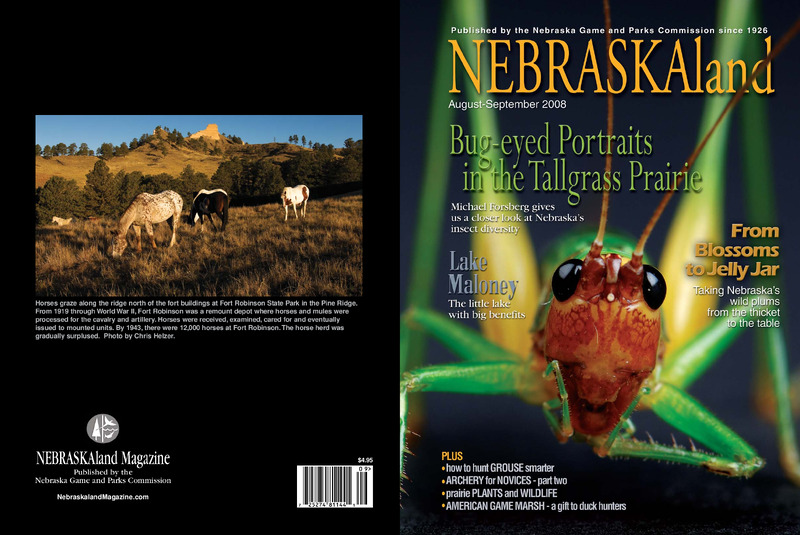
Horses graze along the ridge north of the fort buildings at Fort Robinson State Park in the Pine Ridge.
From 1919 through World War II, Fort Robinson was a remount depot where horses and mules were
processed for the cavalry and artillery. Horses were received, examined, cared for and eventually
issued to mounted units. By 1943, there were 12,000 horses at Fort Robinson. The horse herd was
gradually surplused. Photo by Chris Helzer.
NEBRASKAland Magazine
Published by the
Nebraska Game and Parks Commission
NebraskalandMagazine.com
$4.95
Volume 86, Number 7, August-September 2008
12 Bug-eyed Portraits in the Tallgrass Prairie
Mike Forsberg and a small squad of volunteers went out for
two days last September to capture as many different kinds
of insects as they could at Spring Creek Prairie.
TEXT AND PHOTOS BY MICHAEL FORSBERG
18 Prairie Plants and Wildlife
Using seeds gathered wherever and however possible,
biologists are trying to restore and improve wildlife habitat
by bringing back the plants that evolved here. BY GERRY STEINAUER
22 Never Too Old to Hunt Grouse
Never Too Young to Hunt Smarter
Grouse hunting doesn’t have to be hard – follow these tips
and you will bag birds without walking your legs off.
TEXT AND PHOTOS BY JON FARRAR
34 From Blossoms to Jelly Jar
Wild plums can be enjoyed in the dead of winter with a little
late-summer work. TEXT AND PHOTOS BY ROCKY HOFFMANN
38 Lake Maloney – The Little Lake with Big Benefits
34
●
Built as a regulating reservoir for the local public power district, Lake Maloney provides much-needed camping, fishing
and watersport recreational opportunities.
TEXT AND PHOTOS BY ROCKY HOFFMANN
42 Archery for Novices – Part II
This last of a two-part series talks about broadhead selection,
practicing for real hunting situations and how to scout for
good archery stands. TEXT AND PHOTOS BY DOUG CARROLL
10 Mixed Bag
Heron spearfishing, Turpin Time, dove hunting tips...
46 Parks and Places
18
●
22
●
The American Game Marsh Wildlife Management Area.
49 Outdoor Update
Nebraska waterfowl hunter survey completed.
Comment . . . . . . . . . . . . . . . . . . . . . . . . . . . . . . . . . 4
Outdoor News . . . . . . . . . . . . . . . . . . . . . . . . . . . . . 6
Classifieds . . . . . . . . . . . . . . . . . . . . . . . . . . . . . . . 48
Portraits from the Past . . . . . . . . . . . . . . . . . . . . . 50
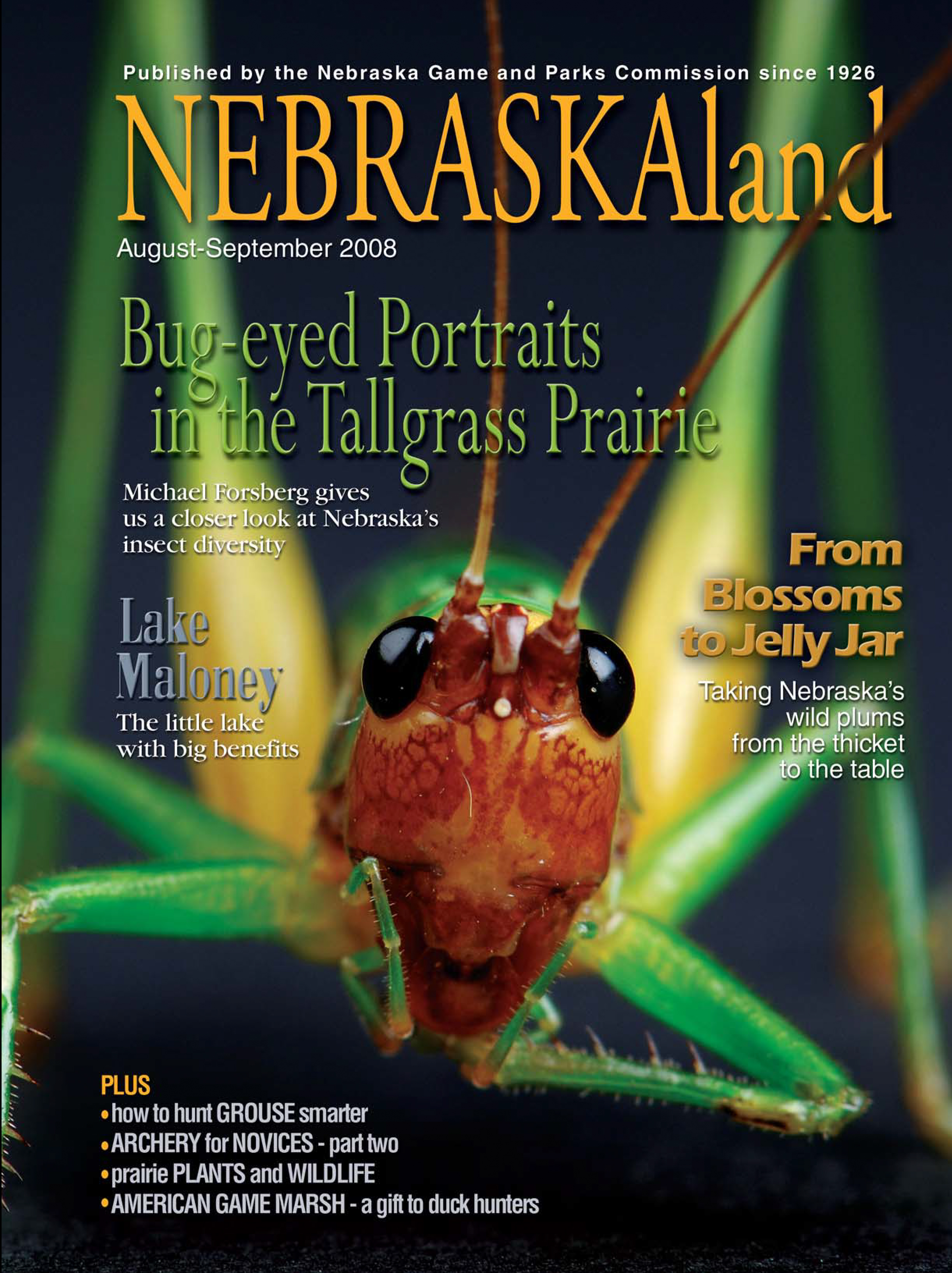
Cover: Inhabiting moist meadows and wetlands, the gladiator katydid (Orchelimum gladiator)
is so named because of its armour-like exoskeleton formed of overlapping plates. See story
on page 12. Photo by Michael Forsberg. Opposite: Canada wild rye sparkles in the early
morning sun on the bottomland at Ponca State Park in Dixon County. Photo by Eric Fowler.
38
●
AUGUST-SEPTEMBER 2008 • NEBRASKALAND 5
Headquarters
2200 N. 33rd Street
Lincoln, NE 68503
Phone (402) 471-0641
District Office I
East Hwy. 2, Box 725
Alliance, NE 69301
Phone (308) 763-2940
District Office II
524 Panzer St., Box 508
Bassett, NE 68714
Phone (402) 684-2921
Published by the
Nebraska Game and
Parks Commission
Director: Rex Amack
Assistant Directors:
Roger Kuhn, Kirk Nelson, Sam Sidner
Information & Education Administrator:
Doug Bauch
Commissioners
Chairman:
James Ziebarth, Wilcox
Vice Chairman:
George E. Hall, Bridgeport
2nd Vice Chairman:
Jerrod Burke, Curtis
Dr. Mark Pinkerton, Wilber
Ron Stave, Waterloo
Dr. Kent Forney, Lincoln
Lynn Berggren, Broken Bow
Mick Jensen, Blair
Magazine Staff
Editor: Doug Carroll
Associate Editor: Jeff Kurrus
Art Director: Tim Reigert
Senior Editor: Jon Farrar
Regional Editors:
Eric Fowler, Bob Grier, Rocky Hoffmann
Circulation: Donna Robinson
Photo Librarian: Sarah Johnson
Marketing/Advertising: Jane Gustafson
For advertising information e-mail
advertising@ngpc.ne.gov
or call (402) 471-5481
NEBRASKAland
ISSN: 0028-1964
VOL. 86 / NO. 7
AUGUST-SEPTEMBER 2008
Published monthly, except for Jan./Feb. and Aug./Sept.
issues, by the Nebraska Game and Parks Commission, 2200
N. 33rd St., Lincoln, NE. Copyright 2008, all rights reserved.
Please address comments or questions to this address.
Periodicals postage paid at Lincoln, Nebraska, and other
locations. POSTMASTER: Send all address changes to
NEBRASKAland, P.O. Box 30370, Lincoln, NE 68503-0370.
NEBRASKAland is available on audio cassette from the
Nebraska Library Commission Talking Book and Braille
Service, Suite 120, 1200 N St., Lincoln, NE 68508. (800)
742-7691. NEBRASKAland Magazine and the Nebraska
Game and Parks Commission reserve the right to reject
any advertising not in keeping with the agency mission.
Rates: $18 for one year; $33 for two years; $44 for
three years. Nebraska residents must add
appropriate sales tax.
To subscribe call 1-800-NEBLAND (632-5263),
or go online to: NebraskalandMagazine.com.
For address changes and questions about your
subscription, e-mail donna.robinson@ngpc.ne.gov.
Turtle Egg Question
The beginning of June brought out
the large snapping turtles that live in
our one-acre pond. We relocated an
approximately 12-inch in diameter
female snapper laying eggs in the
landscaping right next to our house,
then the next day I witnessed a large
pair breeding in the pond, with
another large “bystander” waiting in
the shallows.
When three of my small children
came running to tell me about a
turtle digging in the landscaping, I
immediately checked it out, hoping
it was not another snapper. It turned
out to be this female painted turtle
and I was able to watch her finish
covering up her freshly laid eggs.
If you have any information about
how long it takes for the eggs to
hatch, I would appreciate it – not
everyone gets the opportunity to
watch newly hatched turtles emerge
from the earth!
Thanks.
Krystal Keiser
Waterloo, Nebraska
Western painted turtle eggs hatch
approximately 10 weeks (70-80
days) after being deposited, and the
hatchlings are about the size of a
quarter when they emerge from the
roundish, leathery egg shell.
Interestingly enough, the average
temperature of the eggs during the
6 NEBRASKALAND • AUGUST-SEPTEMBER 2008
incubation period has a great effect
on what sex the young turtles will be:
If the eggs are 82 degrees F or lower
during the incubation periof, then
2
/3 of the turtles will be males. If the
eggs average 86 degrees or higher,
then most of the hatchlings will be
females. If the average temperature
is somewhere between, then the
sexes will be fairly evenly split.
-Editor
Caught on Camera
While on some land I own near
Page, Nebraska this spring, I came
across a pair of very young fawns.
One went wandering off through the
the trees, but the other hid in some
tall grass and I was able to get a
close-up picture of it without
disturbing it too much. Thought you
might like to share it with your
readers.
Ron Spangler
Kearney, Nebraska
Correction: In “Transplanting a
Rare Orchid” (NEBRASKAland,
June 2008), Tim Janssen was
misidentified in the photo on page 39.
-Editor
Rare Find
Jennie Gates and myself were out
May 1, 2008 west of South Sioux
City conducting a wetland delineation
and came across an amazing sight –
a woodcock and chick hunkered
down in a patch of scouring rush. I
hope you share these with your
readers. There was no zoom lens
involved – we actually got this close
in both sets of pictures.
Stacey L. Froscheiser
Omaha, Nebraska
Send your comments to:
Doug Carroll, Editor
NEBRASKAland Magazine
P.O. Box 30370
Lincoln, NE 68503
or e-mail doug.carroll@ngpc.ne.gov
Please include your postal address
and telephone number.
Letters may be condensed and edited
for clarity. Photographs are
welcome and will be returned.
Under federal and/or state law, discrimination is prohibited on the
basis of race, color, religion, age, gender, marital status, national
origin, disability or political affiliation. If you think you have been
discriminated against in any program, activity or facility by the
Nebraska Game and Parks Commission or want more information,
contact the Commission in Lincoln, NE, at (402) 471-0641 or the
Equal Opportunity Commission, Lincoln, NE, (402) 471-2024,
TTY/TDD (402) 471-4693).
District Office III
2201 N. 13th St.
Norfolk, NE 68701
Phone (402) 370-3374
District Office IV
301 E. State Farm Rd.
North Platte, NE 69101
Phone (308) 535-8025
District Office VI
1617 First Ave.
Kearney, NE 68847
Phone (308) 865-5310
Omaha Office
1212 Bob Gibson Blvd.
Omaha, NE 68108
Phone (402) 595-2144
Ak-Sar-Ben Aquarium
21502 W. Highway 31
Gretna, NE 68028
Phone (402) 332-3901
World Wide Web site: www.OutdoorNebraska.org
E-mail: info@ngpc.ne.gov
Administration
Ted Blume (Adm.)
Craig Stover (Asst.)
Wes Loos (Asst.)
Rod Loos (Asst.)
Murray Johnson
Lincoln
471-5531
Lincoln
471-5532
Lincoln
471-5591
Ogallala (308) 284-8056
Lincoln
471-5003
Panhandle
Officer
City
Phone (308)
Jim Zimmerman (Sup.) Gering
436-7561
Walt Meyer
Chadron
432-4398
Scott Brandt
Gering
436-3418
Heath Packett
Gordon
282-2553
Dennis Thompson
Ogallala
284-6450
Dan Zuehlke
Ogallala
284-4815
Doug Pollard
Oshkosh
772-9950
Frank Miller
Valentine (402) 376-1183
Dan Kling
Whitney
432-8367
Southwest
Officer
City
Phone (308)
Roger Thompson (Sup.) N. Platte
532-9175
Ray Dierking
Brkn. Bow
872-3078
George Sund
Cambridge
697-4629
Michael Thome
Cozad
784-4362
Matt Andrews
Elwood
785-3025
Dirk Greene
Imperial
882-5328
Virgil Gosch
McCook
345-2185
Dudley Sorensen
N. Platte
532-0747
Rich Routh
Rep. City
799-2085
South-central
Officer
Jerry Pecha (Sup.)
Jeff Jones
Terry Brentzel
City
Phone (308)
Kearney
865-5327
Clay Center(402)762-3124
Doniphan (402)845-2021
Randy Pomplun
Darin Gress
Dale Johnson
Mark Reeves
Robert Finke
Richard Seward
Fullerton
536-2987
Hebron (402) 768-2287
Kearney
237-1079
Loup City
745-0662
Milford (402) 761-3537
Ord
728-3115
Northeast
Officer
Tom Zimmer (Sup.)
Dale Davis
Ross Oestmann
Steve Oberg
Daniel Roberts
Jon Reeves
Marion Shafer
Pat George
Eric Wiebe
Tim Williams
Cory Krause
City
Phone (402)
Norfolk
371-6625
Bassett
273-1700
Bloomfield
373-4412
Columbus
564-5937
Fremont
721-7852
Kennard
427-7378
Norfolk
371-2031
O’Neill
336-1588
Ponca
755-2566
Neligh
887-1335
West Point
372-6979
Southeast
Officer
Duane Arp (Sup.)
Sean McKeehan
William Krause
Jeremy TenKley
Mike Luben
Douglas Kramer
Dina Barta
Stacey Lewton
Levi Krause
Russell Mort
Dan Evasco
Jeff Clauson
City
Gretna
Ashland
Auburn
Beatrice
Colon
Lincoln
Lincoln
Lincoln
Louisville
Nebr. City
Papillion
Waterloo
Phone (402)
332-2965
944-4174
274-3789
228-1437
443-4278
466-9001
483-2358
476-0436
234-2212
873-5684
592-6733
359-5301
Nebraska Wildlife Crimestoppers 1-800-742-7627
AUGUST-SEPTEMBER 2008 • NEBRASKALAND 7
Attention
Migratory Bird
Hunters...
HIP
t
Harves ion
t
a
Inform
m
Progra
Dove, duck, goose,
snipe, rail, coot and
woodcock hunters
must register with
the Harvest
Information Program
(HIP) before hunting
and must carry their
registration number
in the field.
HIP numbers for 2007-2008
hunting seasons are no
longer valid. Call the
toll-free number below to
register for the 2008-2009
seasons.
Register online at the Nebraska Game
and Parks Commission’s web site:
OutdoorNebraska.org
or call:
1-877-634-8687
(Only residents under 16 years
of age are exempt)
PHOTO BY ERIC FOWLER
You
Must
Get
HIP
Again!
Bald eagles may soon be removed from the state’s list of threatened and
endangered species.
Bald Eagle De-listing
The Nebraska Game and Parks
Commission is initiating the process
to remove the bald eagle from the
state list of threatened and endangered
species. This follows the species’
June 2007 de-listing from the federal
list of threatened and endangered
species. State de-listing is the final
hurdle for a species to be considered
fully recovered in Nebraska.
In 1983, a recovery goal of 10
breeding pairs was set for Nebraska
in the federal Bald Eagle Recovery
Plan. Breeding bald eagles had been
extirpated from the state in the late1880s due to unregulated hunting.
The first documented occurrence of
nesting in more than 100 years
occurred in 1991, and by 1996 the
recovery goal was achieved. In 2006,
45 active nests were documented in
Nebraska and in 2007, the number
jumped to 51. The number of nest
reports continues to increase. “We
may close in on 60 active nests
when all the reports come in for
2008,” said Joel Jorgensen, the
Commission’s nongame bird program
manager.
If the bald eagle is de-listed by
the Commission, it will remain a
conservation priority. Federal
protection changed little with federal
de-listing. The species remains
protected by the Bald and Golden
Eagle Protection Act (BGEPA). It
8 NEBRASKALAND • AUGUST-SEPTEMBER 2008
still will be illegal to hunt, shoot,
harm or disturb bald eagles. Bald
eagles also remain protected by state
law.
The Commission is seeking public
input regarding the recommendation
to de-list the bald eagle. A series of
eight public meetings will be held
throughout the state through August,
and written comments will be
accepted through August 18. To
learn more about the bald eagle’s
recovery in Nebraska, public meeting
details, or to review documentation
to support the Commission’s
action, visit
www.ngpc.state.ne.us/wildlife/bald
eagle.asp.
center.
Cost of the entire conference,
including meals, is $80. One-day
registration is $50 and a half-day
session is $25. Separate charges
apply to breakout session options.
Musical entertainment will be
provided for no additional charge
after the evening meals.
The event is sponsored by the
Nebraska Game and Parks
Commission, Nebraska State
Historical Society, Missouri River
Institute/University of South Dakota,
Better Ponca Foundation and the
National Park Service.
For more information and
registration, please contact Ponca
State Park at (402) 755-2284 or
jennifer.wolff@ngpc.ne.gov.
Trail Fund Grants Available
The American Hiking Society is
now accepting applications for its
2009 National Trails Fund, an effort
to preserve community hiking trails
across the nation. Since the grant
program’s inception 10 years ago,
89 different hiking trail projects have
received a combined $340,000. This
year, Nature Valley’s Save the Trails
program donated $50,000 to double
the size of the 2009 National Trails
Fund. This means that 10 applicants
will each be awarded $5,000.
Nonprofit organizations may apply
for a 2009 National Trails Fund grant
by visiting www.wheresyours.com
or www.americanhiking.org. In
addition to the written proposal,
applicants are required to upload
video or images. Applications are due
August 15, 2008. On September 30
the American Hiking Society will
post its top 20 submissions on
www.americanhiking.org for public
voting during the month of October.
The top 10 entries, announced in
April 2009, will each receive $5,000
to repair their respective trails. For
more information, contact Abram
Shanedling at (612) 455-1775 or
ashanedling@psbpr.com. ■
Missouri River History
Conference
Nationally-known historians and
steamboat experts are coming to
Ponca State Park on September 4-7
to discuss the history of Missouri
River steamboats. Topics include
wrecks and recoveries, navigation
along the Missouri River, Native
American reflections and perspectives,
economics and transshipments of the
American Fur Company and the
Bertrand Recovery Project. Breakout
sessions include options of touring
the North Alabama steamboat
wreck, kayaking along the Missouri
River, and/or viewing artifacts on
display within the park’s education
AUGUST-SEPTEMBER 2008 • NEBRASKALAND 9
A Lifetime of Birds
Doug Carroll
Jack Curran, former NEBRASKAland
Magazine art director and Nebraska
Game and Parks Commission employee,
has published a portfolio of his
photographs, watercolors and wood
carvings with commentary on forty
years of watching birds and their
behaviors.
Bill Hager
I photographed this
great blue
heron in
Julie Watts
“Wild and Scenic” may be the
portrayal of the Niobrara
River as it flows through
north-central Nebraska,
but it is
also an accurate
description of the
surrounding countryside. Deer, turkey,
grouse and waterfowl
inhabit the rivers, grasslands
and forests of one of the
largest stabilized dune fields in the
world. And Thomas Creek Wildlife
Management Area in Keya Paha
10 NEBRASKALAND • AUGUST-SEPTEMBER 2008
Four Steps for Improved Dove Shooting
Tom Keith
Here are four things you can do between now and September 1,
dove season’s opening day, to greatly improve your shooting
abilities and add more birds to your bag.
First, pattern your shotgun. You must know where your gun is
shooting and the density of the pattern it throws. Try different
brands of shells and different loads to determine which perform
best in your gun and use them for both practice and hunting.
Listen to Mel Gibson. In the film "The Patriot," Gibson’s character
reminds his sons to "aim small, miss small." Although he was
talking about firing a flintlock rifle and blowing the button off a
redcoat’s tunic with a 50-caliber roundball rather than surrounding
a fast-flying dove with a pattern of No. 8 shot, the theory is just as
valid – don’t shoot at the whole target, concentrate on just a small
spot – its eye or beak -- and your accuracy will greatly improve.
Shoot bluerocks as often as possible prior to opening day. Shoot
from the same positions that you will assume in the field and at
different distances and
angles. Practice focusing on
the leading edge rather
than the whole spinning
bluerock.
Train yourself to wait to
mount the shotgun until the
dove is in range. Watch the
bird approach, focus on its
eye or beak, then in one
motion, start the swing with
your body as you bring the
gun to your shoulder, swing
through the bird and pull
the trigger.
with some movement of bighorns
seen east of U.S. Highway 385.
Bighorn sheep and their lambs can
be seen on and near Fort Robinson SP
near Crawford, as well.
Turpin Time
Dick Turpin
Few things
are as
revolting as
opening the
lid to a
sour-smelling
cooler.
You folks
that camp a
lot know what
I’m talking
about, when
PHOTO BY DOUG CARROLL
PHOTO BY BILL HAGER
Thomas Creek WMA
County encompasses 1,154 acres
secluded in the midst of these
Sandhills.
Steep canyons drop down from the
prairie, and from the north parking lot
you can hike your way to the main
canyon, where Thomas Creek flows.
According to a local farm/rancher,
Thomas Creek is named after William
C. Thomas, a Civil War veteran who
lived in the area and is buried nearby.
The creek runs year-round, although
the headwaters move farther down the
canyon later in the summer. The trek
through the trees may seem like a
square dance at times as you do-si-do
your way around dense growths of
cedar.
On a recent trip, streams of last
year’s leaves flowed over large mosscovered boulders and down the
canyon as I made my way to the
headwaters and past two tributaries to
Thomas Creek before it got boggy
enough to turn back.
When visiting, wear insect repellant
for ticks and mosquitoes and longsleeved shirts and pants for poison ivy
and scratches from the underbrush
and cedar. This is definitely a hike for
the adventuresome, with steep banks
and obstacles. Finding your way
through won’t be easy, but is well
worth the effort.
For directions, hunting regulations
and more information on this area, go
to www.OutdoorNebraska.org.
Bob Grier
Visitors to Nebraska’s first state
park this year may have the chance to
see another Nebraska first – twin
bighorn sheep lambs that were born
last spring.
Rana Tucker, a wildlife technician
tracking bighorn sheep in western
Nebraska almost every day, observed
a pair of lambs nursing one of the
radio-collared ewes from the Barrel
Butte bighorn herd and repeated
observations confirmed the first birth
of bighorn twins in Nebraska.
According to Dave Kinnamon,
Chadron State Park (SP)
Superintendent, the opportunity to
view the twins and other bighorn
sheep within the park is exciting but
completely random. “We’ve seen the
sheep using the rocky butte above the
group shelter on the park interior road
as well as feeding in the open just
above the parks trail ride stables. Park
visitors have also seen the bighorns
occasionally from the Black Hills
Overlook road that crosses the U.S.
Forest Service pastures bordering the
park.”
Bighorn sheep evolved in the Arctic
and normally produce only one lamb
each year following a short gestation
period. Research indicates that twin
lambs are extremely rare in bighorn
sheep.
Wildlife enthusiasts, photographers
and observers should avoid approaching or otherwise affecting bighorn
sheep, deer and other wildlife.
Bighorn ewes with lambs will protect
their young if approached too close.
Binoculars, spotting scopes and moderate telephoto lenses will be very
useful for bighorn observations and
photographs. Visitors in vehicles on
the park loop road and elsewhere in
the region should be careful as they
slow or park to observe wildlife.
The bighorns moving on Chadron
SP are from the Barrel Butte herd
released on the Bighorn Wildlife
Management Area (WMA) west of
Chadron SP. The herd is scattered in the
Pine Ridge between the Ponderosa
WMA near Crawford and Chadron SP,
ILLUSTRATION BY TIM REIGERT
Heron Spear-fishes Carp
Twin Bighorns Born
PHOTO BY JULIE WATTS
Jack Curran’s World
of Birds is a 144-page hardcover
volume that showcases his work and
thoughts as a “true bird watcher, not
just a birder and not a lister.”
Born in Omaha in 1935, the author
currently resides in Bella Vista,
Arkansas. To find out more about the
book or see examples of his other
work, visit www.jackcurran.com.
Copies of his book are available at
www.amazon.com or by e-mailing the
author at jcurran@jcurran.com.
early May 2008 in Cherry County.
The water level in the complex of
lakes I had been working was higher
than I had seen in many years. Some
of the lakes had water flowing
between them across what is usually
pasture ground. While watching a
flock of white pelicans on one of the
lakes, I noticed a single great blue
heron standing out in the meadow.
I shifted my attention to the heron
and watched as he slowly maneuvered
around the meadow in ankle-deep
water. After about 15 minutes, he
became very still and focused all his
attention in the grass just to his
immediate lower right side. With one
swift movement he reached down and
grabbed something that was in the
grass.
A few seconds later he raised
himself back to an upright position
with a large grass carp impaled on his
beak. Shocked by the size of his
catch, I continued to record images
for the next 90 seconds until the fish
was completely swallowed by the
heron.
Looking back at the metadata for
the digital images I had captured
showed that 15 seconds after the
heron captured the fish he had him off
the beak and headed down his throat
headfirst. Some 90 seconds later the
fish was swallowed. With a pause and
a couple drinks of water, the heron
started to stalk through the grass again.
that cooler gets to the point that when
you open it up, you don’t want to eat
‘cuz it smells so bad.
Good tip here, from Coleman as a
matter of fact: Get bleach, water it
down…a tablespoon to a gallon of
water is probably plenty…soak a rag
up…wipe that thing down…it’ll kill
the bacteria and help the smell. Also
for the smell problem, get another
rag…soak it with some vanilla…wipe
the cooler out or leave the rag in it
overnight for a day or so…then take it
out and that smell will impregnate
your cooler and make it smell a lot
better.
When you open up your cooler and
it looks like little baby rabbits have
been born in there – those little gray
fuzz balls – that’s the time to do this
treatment. ■
AUGUST-SEPTEMBER 2008 • NEBRASKALAND 11
Text and photos
by Michael Forsberg
I
n “Horizontal Grandeur” Bill Holm
writes: “A woods man looks at 20
miles of prairie and see nothing but
grass, but a prairie man looks at a
square foot and sees a universe.” If
the prairie really is a universe, then the
majority of its citizens are insects.
The insect world makes up 90 percent
of all life on the planet. The class Insecta
contains 26 orders, nearly 1,000 families
and more than 750,000 described
species – one-tenth of what scientists
conservatively believe may actually
exist on Earth. Insects are a vast and
complex collective of tough, highly
mobile, genetically adaptable creatures
that can be found on water, land and in
the soil. They wear their skeletons on
the outside, their three-part body
designs can stretch our wildest
imaginations and their myriad forms
truly match their specialized functions.
One of the most species-rich places
to find insects in Nebraska is the
tallgrass prairie along the eastern
A walking stick bug caught in a net at Audubon’s Spring Creek Prairie near Denton.
shoulder of our state. Up until the early
20th century, the tallgrass prairie was a
sea of grass that stretched from eastern
Nebraska to Illinois. Containing 800
indigenous plant species, it was one of
the most highly diverse ecosystems on
the North American continent. Today,
tallgrass prairie has been reduced by
as much as 98 percent, but scientists
believe more than 5,000 insect species
still exist in the scattered remnants left
today, which makes them important
insect strongholds for the future.
Insects are the main consumers of
plants on Earth, and compose the
largest group of all grassland herbivores.
Insects feed on plants by piercing,
sucking, rasping, lapping, sponging,
siphoning and gnawing with their
mandibles, tongues, beaks and other
mouthparts. Their lives are not mere
self-indulgence, however: They give
the prairie its shaggy and patchy look
GOLDENROD CRAB SPIDER
BLACKSPOTTED PROMINENT
CLOUDED CRIMSON
ABOVE: BROWN STINKBUG. OPPOSITE: GLADIATOR KATYDID, TOP LEFT: ASSASSIN BUG
BLACKHORNED TREE CRICKET
AUGUST-SEPTEMBER 2008 • NEBRASKALAND 13
SNOWBERRY CLEARWING LARVAE
OBSCURE BIRD GRASSHOPPER
SILVER ORB BANDED GARDEN SPIDER
PICTUREWINGED FLY
by constantly shaping the vegetation,
which helps maintain its diversity. They
also provide the base of the food chain,
providing food for predacious insects
such as beetles, ants and mantises, as
well as spiders, rodents, birds and even
mammals.
Insects also play a critical role in
pollination in a kind of sex for food
trade-off. Unlike grasses, which primarily
self pollinate or pollinate by the
wind, many flowering plants, such as
wildflowers, are pollinated by insects
such as moths, butterflies, beetles, bees
and wasps that inadvertantly transfer
pollen from the anthers (male organs)
to the stigmas (female organs) of
flowers as they travel from plant to
plant seeking out nectar and pollen. So
the next time you eat a piece of fruit or
marvel at a wildflower, you can thank
an insect.
Insects are seldom shown gratitude,
however, and get far too little respect or
attention unless they are crawling up
someone’s leg, eating a farmer’s crop
or munching on grandma’s backyard
tomatoes. The truth is, few insects are
considered pests – the vast majority is
beneficial to humankind and we would
be hard pressed to live without them.
Which led to my idea to help make
their case: I and a small squad of
volunteers (bribed with free lunches at
Runza) would go out for two days in
early September to Audubon’s Spring
Creek Prairie near Denton armed
with sweep nets, plastic peanut butter
containers and mason jars, and try to
capture as many different kinds of
insects and other invertebrates as we
CRAB SPIDER NYMPH
14 NEBRASKALAND • AUGUST-SEPTEMBER 2008
could manage. We would search up
high in the prairie canopy and down
low in the thatch, on hilltops, side slopes
and near water, in brush and on bare
soil. Once captured in the net, we would
put our subjects in jars, bring them
inside to do portrait photography in
assembly line fashion on a makeshift
table-top studio, then release them back
into the areas of the prairie from which
they came. The result would be a
beautiful and comprehensive portfolio
of insect life on the tallgrass. Easy.
No. Not easy. Outside on the prairie
it was hot, muggy and, of course,
“buggy.” Insects were hard to capture,
nets tore and jar lids wouldn’t stay on.
Mosquitoes bit and shoes got stuck in
the mud. Inside in the studio, insects
refused to look toward the camera,
CAROLINA GRASSHOPPER
COMMON MEADOW KATYDID
REDLEGGED GRASSHOPPER
SAYS STINK BUG
AUGUST-SEPTEMBER 2008 • NEBRASKALAND 15
LARGEHEADED GRASSHOPPER
MONARCH BUTTERFLY
SWORDBEARING CONEHEADED KATYDID
DIFFERENTIAL GRASSHOPPER
CUDWEED GRASSHOPPER
would walk off the set or, worse yet,
fly away. A few refused to leave their
jars, and some insects decided to eat
other insects while they were waiting
in line to be photographed.
I also learned after the fact that most
insects have multiple life cycles, and
that the emergence of larvae and adults
is staggered throughout the seasons and
is different for each species. Many
species are timed to emerge coincidently
with the emergence and/or blooming of
a particular plant species or species
group. In other words, it was impossible
to photograph at one time all the
species that live in a particular prairie.
Our two-day adventure gave me
a great appreciation for portrait
photographers: It’s nerve racking,
meticulous and exacting work. My
photos turned out to not be high art, and
we only captured about 30 different
insect species – roughly .006 percent
of the 5,000 or so insect species that
may have been out there – but all was
not lost.
The lavish portfolio that I had
envisioned turned out to be more a
scrapbook of sorts – a brief glimpse at
a single page of bug-eyed portraits out
of a very thick high school yearbook,
a glance at the diversity of life in the
constantly changing cast of characters
we call insects that are found in the
ALFALFA BUTTERFLY
prairies and other grasslands near our
home. Perhaps a scrapbook is more
appropriate anyway. That is how most
of us in our everyday lives experience
nature – getting a glimpse here and
there whether we take a hike, go on a
hunt, cast a line or wade a stream. We
never see it all, but what we see we
appreciate.
So if you walk into a grassland and
are constantly bugged by the insects you
encounter, know that you are probably
in a very healthy grassland and give
thanks, for these tallgrass prairie
remnants are true Nebraska treasures,
the last of the few that somehow
survived “progress,” and the insects
they protect in turn help anchor the
web of life that sustains us all. ■
WOODLAND MEADOW KATYDID
16 NEBRASKALAND • AUGUST-SEPTEMBER 2008
The author would like to give special
thanks to the University of Nebraska
Entomology Lab and Extension
Services for species identifications of
the insects seen in these photographs.
MONARCH BUTTERFLY CATERPILLAR
PHOTO BY GERRY STEINAUER
Brad Krohn conducts a prescribed burn on a prairie restoration at Funk Waterfowl Production Area in Phelps County.
By Gerry Steinauer, Botanist
Nebraska Game and Parks Commission
Using seeds gathered wherever and however possible,
biologists are trying to restore and improve wildlife
habitat by bringing back the plants that evolved here.
E
displacing native plants and degrading
wildlife habitat. In recent decades,
wildlife managers have come to
recognize many native prairie species
as superior to introduced species both
in hardiness and as food and habitat for
wildlife.
Since 2000, Brad Krohn, a biological
science technician with the United
States Fish and Wildlife Service’s
Rainwater Basin District, and coworkers
have planted more than 2,800 acres of
prairie restorations on Waterfowl
Production Areas (WPAs) in southcentral Nebraska. Additionally, they
18 NEBRASKALAND • AUGUST-SEPTEMBER 2008
benefit by replacing traditional food
plots with prairie forbs to provide food
and brood-rearing habitat. Winter food
should be close to heavier cover
(particularly shrubs for quail) to
minimize daily movements by birds
and reduce their exposure to predators.
Local Ecotype Seed
claims, such as “provides the proper
nutrients to grow gigantic racks on
the bucks.” They fail to mention the
negative aspects of many non-natives.
Sericea lespedeza, for example, a
native of eastern Asia, was first planted
in eastern Kansas in the 1930s for
erosion control and later for wildlife
cover and food. Today it is a noxious
weed in Kansas, having spread to
prairies and displaced native vegetation.
Sericea lespedeza has few of its
proclaimed wildlife benefits, has few
disease or insect threats in North
America to check population growth,
and is difficult to control with fire,
grazing, or herbicides. It has now been
found in eight southeastern Nebraska
counties and may soon be listed as a
noxious weed.
Sources for local ecotype seed in
Nebraska are limited. Most native prairie
grass and forb seed sold by seed dealers
are from cultivars – plant varieties bred
for specific characteristics, such as large,
showy flowers or aggressive growth.
Prairie restorationists generally avoid
planting cultivars as they can
outcompete more desirable species
and can spread to native grasslands,
Each year Krohn uses a combine to
harvest 8,000 to 12,000 pounds of
native grass and forb seed from prairies
and restorations to plant on WPAs and
other conservation sites. The seed is
supplemented with hand-collected seed
of selected species. His plantings
include seeds of 80 to 120 species of
cool-season and warm-season grasses;
sedges; and early to late-blooming
annual, biennial and perennial forbs.
This variety of plants provides diverse
food and habitat resources for wildlife.
“We believe using native, local ecotype
seed is the right thing to do,” said Krohn.
“It provides the best habitat for what we
are after and grows well on our WPAs’
various soils. The diverse grasslands
resulting from the rich seed mix are
also more resilient to invasive plants
and climatic extremes, such
as drought, than low diversity
grasslands, and therefore
provide more stable habitat.
The prairie restorations fulfill
a management directive for
the WPAs of providing
‘historical conditions that
benefit multiple species of
plants, animals, and insects.’
“In the past we have used
nonnatives, such as smooth
brome, intermediate
wheatgrass, and sweet clover,
but they’ve proven to be a
challenge due to their
aggressive nature,” said
Krohn. “The brome and
wheatgrass usually take over
and the plantings have to be
torn up and replanted every
10 years or receive some
other serious management.”
Many seed companies still
promote and sell nonnatives,
such as New Zealand white
clover, sericea lespedeza and
dwarf essex rape, for wildlife
plantings. Their sale ads
Grasshopper sparrows are one of many wildlife
sometimes include grandiose
species that use prairie restorations.
AUGUST-SEPTEMBER 2008 • NEBRASKALAND 19
PHOTO BY CHRIS HELZER
uropean farmers who settled
Nebraska had little appreciation
for the prairie they encountered
in such seemingly limitless abundance:
They plowed under much of the native
grasslands that covered the state and
planted species from their homeland
that they believed superior to native
species.
This bias continued into the 20th
century, as exotic species were planted
for forage, landscaping, erosion control
and wildlife habitat. Many of these
plants proved to be aggressively
invasive, spreading into prairies,
have interseeded prairie forbs (broadleaf
plants that die back to the ground each
year) into more than 1,000 acres of
existing grasslands. Prairie chicken,
pheasant, quail and other grassland
bird numbers on these WPAs have
since increased, and Krohn believes
the plantings are in large part the
reason why.
Prairie plants provide upland game
birds and grassland birds needed habitat.
Quail, for example, prefer the stiff,
upright growth of native warm-season
grasses for nesting, particularly midheight species such as little bluestem
and sideoats grama. These native grasses
conceal nests from predators and are
green and growing during the nesting
season, reducing the temperature and
increasing humidity around the nest.
Some biologists speculate these
conditions may increase egg hatchability.
Nonnative, cool-season grasses such as
smooth brome that now dominate many
Nebraska grasslands are entering summer
dormancy by mid-June and provide
less favorable nesting microclimates.
Brood-rearing habitat, where chicks
forage for insects, is as important to
grassland birds as nesting habitat. Good
brood-rearing habitat has overhead cover
to protect chicks from aerial predators
and is open below, so chicks can easily
move and forage for insects. Prairie
forbs with narrow bases and spreading
canopies provide such habitat. Dense,
tall stands of grass limit chick movement
and foraging, and are not suitable for
brood rearing. Brood-rearing habitat is
best located near nesting cover – if
chicks have to travel long distances
from nests to brood-rearing habitat,
they are more susceptible to predators.
Annual weeds, such as some ragweeds
and sunflowers, dominate in young
prairie restorations and provide excellent
brood-rearing habitat. Quail and
pheasant populations often peak
during the first three or four years of
a restoration then decline as weedy
annuals give way to perennial grasses,
this reducing the quality of brood-rearing
habitat available. Seeding patches of
only prairie forbs can provide lasting
habitat for young birds.
In winter, dense stands of native
grass provide upland game birds and
other wildlife with cover from predators
and harsh weather. Tall grasses reduce
wind velocities at ground level and
their dried, reddish-brown leaves add
warmth by absorbing sunlight. Exotic
cool-season grass leaves dry to a
grayish color and absorb less winter
sunlight.
In winter, pheasants and quail using
Krohn’s WPAs feed primarily on
soybeans and corn in adjacent crop
fields. However, he has found prairie
forb seed, primarily deer vetch and
sunflower seeds, in the crops of hunterharvested birds. The seeds of a number
of prairie forb species are high-quality
wildlife foods with a long period of
availability and high nutritional value.
Domestic grains are high in energy but
lack some amino acids needed by game
birds, so feeding solely on grains may
reduce the birds’ reproductive success.
Although land managers commonly
plant corn and sorghum food plots for
pheasants and quail where access to
other cropland is poor, areas where
cropland is abundant would probably
PHOTO BY CHRIS HELZER
an area with heavy thatch, and the
grazing focus shifts to this patch. For a
year or two after being burned and
heavily grazed, and while perennial
grasses and forbs recover, these affected
patches have a lot of bare ground, little
thatch and a flush of annual and biennial
forbs. Cattle weight gains on patchedburned pastures are comparable to
those of other grazing systems in
certain grassland types.
It is human nature to look over the
fence and see something that appears to
be better. Such has been the case with
our native grasslands. Under the feet of
pioneers was a diverse grassland, a mix
of plants perfectly adapted to our soils
and climate, a plant community
perfected over thousands of years. It
supported a full complement of wild
creatures, including vast herds of
grazing animals. Even though it has
taken more than a century, Nebraskans
are beginning to realize that the value
of these native plants, not just for
wildlife but as pasture for our domestic
livestock, was better than what we
created. ■
Jake Hart of The Nature Conservancy collects Canada milkvetch seed pods (Astragalus canadensis) for future planting from a
prairie restoration project at Deep Well Wildlife Management Area in Hamilton County that provides excellent wildlife habitat.
Planting and
Management
Krohn broadcasts seed for prairie
restorations into existing cropland in
winter. The restorations are up to several
hundred acres in size. He also interseeds
prairie seed into existing, human-planted
warm-season grasslands and highly
degraded native prairies. These
grasslands are burned prior to seeding
to reduce thatch and provide good
seed-to-soil contact. They are grazed
the spring and summer after seeding to
further incorporate the seed into the
soil and to reduce competition from
existing grasses. Due to competition,
often only the hardiest prairie species
establish in interseedings – plants such
as prairie clovers, Canada milkvetch,
sunflowers, goldenrods and yarrow.
When restoring cropland, prairie
plants will eventually outcompete
annual weeds that sprout from the soil
seed bank and dominant young plantings.
Krohn does not mow these weeds,
although he conducts prescribed burns
on the restorations if weed thatch
threatens to shade out prairie seedlings.
Seeded prairie species are usually
well established five or six years after
planting, at which time Krohn begins
grazing or haying the restorations.
Proper management is critical to
maintaining the health of a prairie and
quality wildlife habitat. Without periodic
20 NEBRASKALAND • AUGUST-SEPTEMBER 2008
fire, grazing or haying, prairies
stagnate, accumulate thatch, become
susceptible to non-native species
invasion, lose plant diversity and,
ultimately, wildlife habitat degrades.
Fire, grazing and haying can be used
to remove thatch, control nonnative
species, stimulate native plants,
control woody vegetation and provide
the variety of vegetation heights and
densities needed by wildlife.
A new grassland management practice
called patch-burn grazing may help
provide diverse wildlife habitat. In
patch-burn grazing, one-fourth to
one-third of a pasture is burned each
year. Cattle have access to the entire
area, grazing the nutritious regrowth on
the burned patch about 75 percent of
the time and keeping the vegetation
short. Unburned areas of the pasture
are lightly grazed and the vegetation
PHOTO BY GERRY STEINAUER
contaminating native plant gene pools.
In several neighboring states, seed
dealers grow and sell local ecotype
seed. If Nebraska’s wildlife enthusiasts
begin to demand local ecotype seed,
our growers may fill this niche.
remains taller and denser. The following
year a different patch is burned, usually
Methods for harvesting and planting
native seed and managing prairie
restorations are detailed in A Guide to
Prairie and Wetland Restoration in
Eastern Nebraska available online at
PrairiePlains.org or
PrairieNebraska.org. More information
on patch-burn grazing is available
online at FireEcology.okstate.edu.
Seeds of native prairie plants such as Illinois tick-clover (upper left), Canada milkvetch
(upper right), compass plant (lower right) and Illinois bundleflower (lower left) are a
valuable food for many wildlife species.
AUGUST-SEPTEMBER 2008 • NEBRASKALAND 21
The Value to Wildlife
Of the thousands of insect species that
inhabit Nebraska’s prairies, most are
generalists, using several to many native
plants as food and habitat. Some, though,
are specialists, relying on one to a few plant
species. Regal fritillary butterfly (Speyeria
idalia) caterpillars, for example, feed only on
violets. This monarch butterfly-sized, orange
and brown butterfly is now rare over most of
its range due to habitat loss, but still common
in eastern Nebraska prairies. In Nebraska
adult fritillaries feed on the nectar of several
prairie forbs, including butterfly milkweed,
whorled milkweed and leadplant.
Even more specialized, the small snout
beetle (Tychius liljebladi) lays its eggs only in
the young seedpods of Canada milkvetch, a
prairie forb found throughout much of
Nebraska. The larva feeds on the
developing seeds and in late-summer
bores through the pods, crawls down into
the soil and overwinters as a pupa. Without
Canada milkvetch plants, the snout beetle
would vanish.
Insects are vital to the health of a prairie,
serving as decomposers, soil formers,
pollinators and critical wildlife food. The diet
of many prairie mammals, birds and reptiles
is composed of insects during the spring,
summer and fall. The fast-growing chicks of
grassland birds and upland game birds feed
almost exclusively on high-protein insects
(the dry weight of grasshoppers, for example,
a favorite food of many birds, is 50 to 70
percent protein). Adult meadowlarks may
capture more than 100 grasshoppers per
day when feeding chicks.
After insect-killing frosts, many birds and
small mammals switch to a seed and fruit
diet. Prairies can provide as much as several
hundred pounds of edible seeds and fruits
per acre depending on prairie type, climate,
and other factors. Not all prairie seeds and
fruits are eaten by wildlife – some are too
small, such as the pinhead-sized seeds of
prairie cinquefoil, while others are nutrient
poor or mechanically or chemically protected
against herbivory.
In selection trials of tallgrass prairie seeds,
meadow voles and other small mammals
preferred large, nutritious, unprotected
seeds, such as those of rosinweed and
compass plant. Small mammals, however,
rejected the large nutritious seeds of Illinois
bundleflower (38 percent protein), perhaps
suggesting they had an unpleasant taste.
Another study found no toxins in bundleflower
seeds and that birds readily ate them. When
grown in pure stands in the Midwest,
bundleflower can yield nearly 1,100 pounds
of seed per acre, similar to soybean yields.
In addition to being an excellent plant for
wildlife, bundlflower has potential as a crop
for human consumption, and efforts are
underway to develop tasty, high-yielding
varieties.
The foliage of many prairie plants are
valuable forage for wildlife, from leafhoppers
to deer. Illinois bundleflower foliage, for
example, is nearly 20 percent protein,
comparable to alfalfa. Such nutrient-rich
prairie forbs can support an abundance
of insects and, therefore, more insectdependent wildlife.
Never Too Old
for Grouse,
Never Too Young
to Hunt Smarter
Text and photos by Jon Farrar
few years back I was loitering in the Big Alkali Fish Camp office south of
Valentine in early October. Three young fellows walked in, probably in their
early 30s. They were in conspicuously top-flight physical condition – less than
eight percent body fat was my rough estimate, wiry muscles under sweat-soaked
T- shirts. I believe they were Air Force men stationed in Colorado. After a bit of
small talk I asked how they had done grouse hunting. One quickly expressed his
exasperation with the poor hunting on the Valentine National Wildlife Refuge.
“I walked 13.4 miles today, measured it on my pedometer, and never shot a bird.”
I suppose he had done the math, and 13.4 miles of walking the hills entitled him
to 2.61 grouse in his game pouch. “Did you see many birds?” I asked. “Oh, we saw
a lot of birds, but wild, flushing a hundred yards ahead of us.” At that moment I had
a glimpse of myself 25 years younger. Back in those days I also believed there was
a correlation between miles walked and birds bagged. That was before I hunted
grouse with Len McDaniel, and learned successful grouse hunting is not a mathematical equation.
A
Hunting Like a Coyote
feet above the valley floor to the twomile-long ridge we would hunt. That day
I first met McDaniel in the late-1970s was a grouse hunting epiphany for me.
The first mistake most grouse hunters
when he came to work as a biologist on
make, McDaniel said, is thinking
the Valentine refuge, but years passed
Sandhills vegetation is the same
before we hunted grouse together.
McDaniel was
everywhere.
one of the best
Grouse know it
field biologists in
is not, and to be
Nebraska, sort of
successful,
a throwback to
hunters need to
game biologists of
know it is not.
the 1940s and
The quality and
quantity of
1950s, spending
vegetation varies
as much time as
with range
possible in the
hills and on the
management
marshes, learning
practices. Grouse
McDaniel makes his sharp-tailed grouse
everything he
like good cover,
decoys from the tough cardboard used on
so the best
could about the
cases of canned soft drinks.
pastures are
plants and
those not grazed during the spring and
animals he was managing. Before
summer, pastures set aside for winter
coming to the refuge system he had
range or otherwise being rested.
been a government hunter and trapper.
Within Sandhills pastures are different
Some of what he learned over those
years was evident once we climbed 350 plant communities, each providing
22 NEBRASKALAND • AUGUST-SEPTEMBER 2008
Len McDaniel of Valentine reloads as more grouse decoy while his yellow Lab, Lass, returns with a sharptail shot minutes earlier.
something different for grouse – food
plants here, shade plants there, loafing
cover in the patches of prairie sunflowers
in the little dishes on the dune ridge.
North-facing slopes, especially
northeast-facing slopes, are less
exposed to desiccating summer sun
and winds, hold soil moisture better,
and consequently have thicker and
taller vegetation. Grouse hold better in
good cover, so the north sides of dunes
are generally more productive hunting
than the south sides that have sparser
vegetation. McDaniel looks for hills
with a good diversity of plants,
especially forbs such as sunflowers that
provide seeds for grouse and woody
plants such as poison ivy, snowberry
and wild rose that bear fruits.
After recognizing Sandhills grasslands
are not uniformly cloaked in vegetation,
the next step is for hunters to understand
the daily habits of grouse and predict
where they will be at different times
of the day under different weather
conditions. McDaniel prefers to hunt
from about noon until 3:30 p.m. During
the morning, grouse are scattered and
feeding and may not return to loafing
areas until late-morning. “They are
usually in more open areas in the
morning where they’re hard to
approach,” he said. “Usually, you get
closer shots when you hunt them in the
middle of the day when they’ve settled
into loafing areas.”
Weather plays an important role in
determining where grouse loaf during
the midday hours. “The wind really
affects their activities,” McDaniel
explained. “They don’t like to be where
it hits them directly unless it is a warm
day.” So, on windy, cool days, look for
them in heavier cover, on wind-protected
slopes or in pockets and swales. On
warm days, grouse “usually are in
some shade and where they can catch
enough breeze to stay cool,” McDaniel
said. On days when the grass is wet,
grouse often loaf in more open cover,
but they are difficult to approach.
McDaniel prefers not to hunt grouse on
windy days, particularly days with
northwest winds. “I like a nice clear
day, about 65 degrees, calm or just a
light breeze, a steady one, preferably
out of the south.” McDaniel rarely
hunts grouse during the warm days
of September, mostly for his dog’s
comfort and his own.
AUGUST-SEPTEMBER 2008 • NEBRASKALAND 23
If we hadn’t come out here this year, you know,
we’d just be home kicking the dog.We look
forward to it that much. – Steve Jauron
When a hunter can recognize the
Sandhills’s plant communities, and
understands a grouse’s daily routine, all
that is left to be a proficient hunter is
learning how to not flush grouse until
within shotgun range. McDaniel does
not so much “walk for grouse” as he
stalks the places grouse should be.
The first time I hunted with
McDaniel, I watched him move through
pockets and along little ridges on the
high dune. He hunted slowly, zigzagging
back and forth, staying off the hilltops
and crater rims where grouse would see
him, popping over the rim of little
grassed pockets and, if not flushing
grouse, dropping down and slipping
along the slope to check the next likely
place. He hunts grouse the way a
coyote hunts grouse.
On cool days, when grouse want out
of the wind, McDaniel hunts with the
wind at his back if possible. That way,
when he tops a ridge the wind-protected
slope where the grouse should want to
be is right below him and any birds
there are within shotgun range. On
warm days when grouse want shade
and a place where they catch a breeze,
they will be on wind-exposed slopes or
hilltops and he tries to hunt into the
wind. Obviously there are not enough
grouse per square mile that there will
be birds everywhere a grouse should
want to be, but by using McDaniel’s
technique, hunters will flush more
grouse within shotgun range and not
need to cover as many miles to do it.
Hunters not proficient at predicting
where grouse should be can learn by
watching where grouse flush
and stalking similar sites.
Rather than stringing out in a
line and marching up and down
grassy dunes, large parties of
hunters would have better success
breaking into pairs and hunting
different hills. Hunting alone is
even better, as there is no need
to keep a partner’s pace, but two
compatible hunters soon work
out a system that is safe and
efficient. In addition to being a
more successful technique for
hunting grouse, slowly stalking
choppy hills is tailor-made for
those of us not as physically
finely tuned as were the three
Air Force fellows. The large
dune ridges of the Sandhills can
be a mile or more long, but
once on top they easily offer
several hours of hunting without
strenuous climbs.
Hunting Low Hills
Steve Jauron, a retired Iowa conservation officer,
recounts how a grouse flew off after he missed. He
has been grouse hunting in Nebraska for 30 years.
24 NEBRASKALAND • AUGUST-SEPTEMBER 2008
For older hunters with years
of bratwursts and beers under
their belts and no longer
inclined to take on the high
hills, there are grouse hunting
options only requiring a
Jauron and his hunting partners have found the relatively low relief of the eastern Sandhills easier walking for older legs.
reasonably sound set of legs. Walking
slowly and pausing often – a wise
hunting technique for most upland
game bird hunting – can compensate for
diminished lung capacity and too many
pounds-per-square-inch on old feet.
While sharp-tailed grouse prefer the
high hills, greater prairie chickens are
tallgrass prairie birds native to lowrelief grasslands and were once found
across eastern Nebraska. Prairie chickens
are more inclined to occupy grasslands
near cropland and to feed on waste
grain than are sharptails. With most of
Nebraska’s tallgrass prairie long-ago
turned under the plow, prairie chickens
are found today in restored grasslands, in
the tallgrasslike prairie of the eastern and
southern Sandhills, and on lush meadows
and the low hills bordering them in
the Sandhills interior. This habitat
preference translates into relatively
easy walking for grouse hunters.
Last September I tagged along with
now-retired conservation officer Bob
Kelly of Albion; conservation officer
Pat George stationed at O’Neill (the
only young fellow in the bunch, recruited
to administer cardiopulmonary
resuscitation as required), and three
Iowa hunters – Steve Jauron, retired
Iowa conservation officer, and Don
Haahr and Bill Anderson, both who
work for county park systems in Iowa.
The Iowa hunters have come to chase
grouse with Kelly for 30 years.
Discounting George, this was not a
hunting party of young roosters. Haahr
and Anderson were well on into their
50s, Jauron about to turn 61. Kelly was
almost 65, had hip replacement surgery
seven years before and kidney stones
shattered only two weeks earlier.
We met over coffee at the Bartlett
cafe, and the hunt was underway by
11 a.m. in a pasture of low rolling hills
abutting an unpicked cornfield. The
grass cover was good, the walking easy
and the weather almost too nice. Less
than 100 yards from the pickups, two
prairie chickens flushed and more
continued to flush with surprising
regularity. By 1 p.m. we were sipping
soft drinks on tailgates with six chickens
in game bags. All but one were youngof-the-year birds and most were
flushed as singles, many from nearly
flat pastureland bordering the cornfield.
Talk turned to how grouse hunting
had changed. Kelly said that when he
moved to Albion in 1969, pastureland
surrounded Bartlett and there were only
sharptails. All that began to change in
the 1970s as cornfields under center
pivot irrigation systems proliferated
and the country became a patchwork of
grain fields and grassland, habitat
favoring greater prairie chickens at the
AUGUST-SEPTEMBER 2008 • NEBRASKALAND 25
Bill Anderson of Iowa found prairie chickens in grasslands bordering a cornfield.
expense of sharp-tailed grouse.
The second pasture hunted had not
been grazed during the summer, and
the grass had grown lush with abundant
spring and summer rains. There was a
small range of higher hills, but of small
relief compared to the massive dunes of
the central Sandhills region. The hunting
strategy was loosely drafted as the
hunters spread at liberal distances from
one another and made a swing around
the section of grass. Every now and
then each hunter caught a glimpse of
the hunter to his left or right, usually
200 yards or more away, so each was
free to reconnoiter likely grouse
coverture in grassy pockets on hilltops
or swales. They hunted slowly and at
their own pace. Back at the trucks less
than two hours later, there were six
more prairie chickens in the bag and
Kelly had the morning’s birds fielddressed and in a cooler. In four hours
of hunting the five hunters were three
birds short of a daily limit, and Kelly
only hunted the first pasture. Anderson
commented that “the hunting was not
as good as most years,” a remark
intended to needle Kelly. A gracious
host, Kelly did not comment on the
number of easy shots missed at closeflushing birds. None of the hunters
reported how many miles were recorded
on their pedometer.
“Two years ago we hunted two
sections way back in the hills,” Kelly
said. “Some absolute mountains out
there, always a lot of birds, and I’m
sure they are still there. They are
going to be there as long as they want
to be, but we’ve just given up those
demanding hunts. We’re saving those
big-hill grouse for the young hunters.”
“It’s kind of funny,” Jauron commented
while sitting on a tailgate. “The Sandhills
is different for us. To be able to take off
and walk as far as you want, not a farm
building or piece of machinery in sight.
It’s really different than hunting in
Iowa. If we hadn’t come out here this
year, you know, we’d just be home
kicking the dog. We look forward to it
that much. We start planning the trip in
August.”
The secret of success for these older
hunters was hunting smart. The pastures
had good grass, good numbers of birds,
relatively low relief and they hunted
at their own pace. Most carried
lightweight 20-gauge shotguns and no
unnecessary equipment. The two
springer spaniels were valuable assets
finding downed birds in thick cover. All
of the hunters agreed that winged
26 NEBRASKALAND • AUGUST-SEPTEMBER 2008
grouse seem more inclined to run than
they did years ago, had become more
like pheasants in that regard, and the
dogs were worth their weight in gold.
One chicken triangulated down by two
hunters was found by one of the dogs
more than 100 yards away.
With grouse hunting this good,
why is the number of grouse hunters
declining? “No recruitment of young
hunters,” Kelly said. “You could see it
happening over the years, fewer and
fewer young people coming with their
dads and grandpas to hunt grouse.
School activities take up more of their
time, and the dads and grandpas are
hunting deer and turkey now, not
grouse.” Kelly said another factor
perhaps contributing to the decline is
that hunters seem reluctant to knock on
a rancher’s door and ask permission.
“They’ll do it to hunt deer or turkey,
but not grouse,” he said. Because there
are more absentee landowners in the
eastern Sandhills than 30 years ago, it
sometimes is difficult to find them to
ask permission, Kelly said, but not so
difficult it should discourage hunters.
Most landowners are more inclined to
give permission to hunt grouse than
they are deer because there are more
deer hunters than grouse hunters, most
probably have already granted
permission to hunt deer or are saving it
for family and friends, and because
grouse hunting, a hunter with a just a
shotgun, is low impact.
late day, as grouse usually move back
into the hills to loaf in midday. Unlike
when hunting uplands, a wide-ranging
pointing dog that hold points is
valuable. When the hunting season is
new, most grouse are young-of-the-year
birds and more inclined to hold for a
dog than older birds, or any birds in
sparse upland cover.
Even in years when the aftergrowth
is modest, grouse come to the meadows
to feed. With such short cover, though,
they are virtually impossible to
approach within shotgun range. While
sharptails are more apt to fly between
high hills and meadows, prairie chickens
are often close to the meadows all day,
so the band of low, rolling pastureland
between the meadow and the high hills
is the best bet from midmorning to
midafternoon.
Passage of the Conservation Reserve
Program (CRP) as part of the Food
Security Act of 1985 has provided yet
another flatland grouse hunting option.
The program was primarily designed to
help farmers take erosion-prone land
out of crop production but has also
been a boon for wildlife, including
grouse. Currently there are about
1.2 million acres enrolled in Nebraska.
Statewide it has almost single-handedly
brought grouse back to parts of the
state where they had not been for many
decades, and increased their numbers
where remnant populations were hanging
on, particularly prairie chickens. Just as
introducing cornfields into grasslands
in the eastern Sandhills benefited
prairie chickens, albeit at the expense
of sharptails and other grassland
wildlife, so too has establishing
grasslands where formerly there were
only grain fields.
Making CRP land even better for
hunters has been the Management
Access Program (MAP) established in
1997. The program allows hunting
access without permission on CRP land
enrolled in the program. The Nebraska
Game and Parks Commission publishes
an atlas showing the location of these
sites that is available at Commission
offices and permit vendors.
While “erosion-prone land” implies
landscape relief, most CRP fields are
not difficult walking, other than those
choked with dense stands of tall grass,
and those fields, or those parts of
fields, are the least likely places to find
grouse anyway. The best CRP fields for
grouse are areas with a good diversity
of plants, including forbs such as
sunflowers, and where vegetation is
more open, typically on higher ground.
Recently retired Commission wildlife
biologist Dan Rochford of North Platte
worked with the CRP and MAP
programs in his area and frequently
hunts them for pheasants, quail and
grouse.
“I think September and earlyOctober are probably the best times to
hunt grouse in CRP,” Rochford said.
“Once it cools off, when you get into
November, they start to bunch up and it
becomes more difficult to get within
shotgun range. On average, the best
time of day to hunt them is from
midmorning into late-afternoon.”
South of the Platte River, Rochford
said, “grouse hunting on CRP is almost
entirely for prairie chickens, but in the
Panhandle counties hunters are as apt
Flatland Grouse
Even easier on older legs than low
rolling hills like those Kelly hunts are
meadows and the edges of meadows. In
years when hay crops are put up in
early summer, and summer rains are
abundant enough to send up a luxurious
aftergrowth – some years half way to a
hunter’s knees – grouse, particularly
prairie chickens, come to these meadows
to feed on green vegetation. Huge
meadows are common in the eastern
Sandhills, to a lesser degree in southern
counties in the region, and found in the
central and western Sandhills where
they are usually hemmed in by high,
long-running dune ridges.
Hunting grouse in tall grass on
meadows, unlike hunting them in
sparse upland cover, is best during their
feeding periods in early morning and
Don Haahr waits for a prairie chicken to clear his springer spaniel. Young-of-the-year grouse hold tight early in the grouse season.
AUGUST-SEPTEMBER 2008 • NEBRASKALAND 27
PHOTO BY ROCKY HOFFMANN
Some of Dan Rochford’s most productive grouse hunting spots are the grassed corners of cornfields under center pivot irrigation.
to flush sharptails.” Rochford said the
time of day that grouse use CRP fields
depends on the cover in that field,
land-use surrounding it and the weather.
Where there are only cornfields and
CRP grasslands, grouse will probably
be found in the grasslands throughout
much of the day, especially early in the
season when weed seeds and insects
are available. Once the corn is out and
the weather turns colder, they will
leave the CRP in early morning and
late afternoon to feed on waste corn. In
many places in southwestern Nebraska
there are not only cornfields nearby but
also native grass pastures. If there are
native grasslands nearby, grouse may
loaf there during the midday, particularly
during mild weather from lateSeptember well into October, but roost
in the heavier cover on CRP land.
“I look for CRP with a diverse mix
of plants,” Rochford said when asked
how he selects fields to hunt. “I don’t
hunt fields that are just dense stands of
grass, like switchgrass. Grouse may use
the heavier vegetation in CRP fields
when the weather is harsh, but otherwise
they prefer more open cover, particularly
if there are forbs interspersed with the
grass. That is where they find weed
seeds and insects, there is bare ground
for dusting and, when it is warm, a bit
of breeze at ground level. I don’t try
and cover an entire field, but hunt the
places that look like grouse should be
there at that time of the day and season.
Especially early in the season, they
seem to like higher ground in CRP,
little knobs with a good mix of
vegetation.”
Even small patches of CRP grassland
can hold prairie chickens. Some of
Rochford’s consistently good grouse
hunting spots are grassed corners
around center pivots over corn. “On
average,” Rochford said, “most hunters
will take fewer grouse off CRP land
than they will hunting the Sandhills
where they are more abundant, but if
you live close to CRP with grouse
and not the Sandhills, why not take
advantage of it?” For more on hunting
opportunities in CRP, see Rocky
Hoffmann’s article, “Much More than
Pheasants” in the October 2004 issue
28 NEBRASKALAND • AUGUST-SEPTEMBER 2008
of NEBRASKAland.
Nebraska grouse hunting seasons are
divided into east and west zones. East
of U.S. Highway 81, a limited number
of permits are issued, allowing each
hunter to shoot three prairie chickens
during the season. The permits are
offered on a first-come, first-served
basis. Permit requests are accepted by
phone, by mail or in person at the
Commission headquarters beginning
August 1. Hunting prairie chickens in
eastern Nebraska is really in the realm
of a trophy upland bird hunt.
Pass-Shooting
It was late-December when I again
tagged along with Bob Kelly on a totally
different kind of grouse hunt. His
partner that day was Marvin Koch of
Petersburg. Koch is retired from his
agricultural supply business and runs a
gun shop and unofficial museum of
outdoor curiosities such as antler
chandeliers, old shotshell boxes and
mounted rattlesnakes. It is on
Petersburg’s main street and worth a stop.
“There is a range of hills out here
that is fairly narrow, pretty rough and
with cornfields and bean fields around
them,” Kelly told me in September.
“Grouse come out of those hills every
morning and every evening to feed on
the waste grain. You can almost set your
watch by them. It’s not uncommon to
have 200 to 500 grouse move out to
feed. All you have to do to shoot
grouse is watch them long enough to
figure out their flight pattern and
position yourself along it.”
It was 17 degrees when I met Kelly
in Albion at 6:20 a.m., and we drove to
Petersburg to pick up Koch. There was
a skiff of thin clouds in the east and
only a light west wind. The forecast
was for sunshine, the wind shifting to
the west-southwest and growing to no
more than 10 miles an hour. There had
been heavy snow a few days earlier,
and the wind had gathered it from the
flats and piled it in drifts two to three
feet deep in low areas or where there
was some obstacle to slow it down.
We were situated and ready for
grouse before sunrise on a piece of
Koch’s land, and it was the perfect
layout for waylaying prairie chickens.
We hunkered down on the east end of
an east-west running shelterbelt of red
cedar and pines no more than 10 feet
tall, where a fence ran north and south.
To the east was pastureland, to the
northwest a cornfield, and to our south
CRP grassland and another cornfield.
Kelly and I nestled into cedar trees on
buckets, but Koch, even at 66 years of
age, was one of those Sandhills pacers
and at best hunkered down now and
then behind a fence post to our north.
Being fully hidden or camouflaged,
Kelly and Koch said, is not particularly
important when pass-shooting grouse,
as grouse do not seem to look on the
ground for danger when on the wing.
The flight only lasted about
45 minutes. During that time as many
birds flew to the cornfield to the south
as past us. The largest, close flock,
about 20 birds, passed just beyond the
range of Koch’s shotgun. Most left the
hills as singles, doubles or in small
groups of four to five birds. Kelly
killed two young-of-the-year males and
Koch a grand old man chicken with
long ear pinnae feathers covering the
yellow-orange air sacks on his neck.
Both Koch and Kelly said the
morning’s shooting was poor compared
to the average. Koch told of days when
four or five shooters killed their limits
within an hour. Part of the reason the
morning was not up to snuff was there
was only two shooters spread along the
flight line, but both believed that the
crusted snow cover in the cornfield
reduced the number of birds coming
to feed. Had there been less snow, or
cattle in the cornfields to break the
snow cover and expose waste corn,
more birds would have passed within
shotgun range.
Kelly and Koch started pass-shooting
in the early-1970s, but not together.
Why? In the 1970s both were young
men and still stomping the hills for
Marvin Koch of Petersburg watches for passing prairie chickens. Earlier he shot an
adult male with long ear pinnae feathers covering the orange air sacks on its neck.
AUGUST-SEPTEMBER 2008 • NEBRASKALAND 29
Retired Nebraska conservation officer Bob Kelly of Albion fires at passing prairie chickens in the dim light just before dawn.
grouse. “For me, it was just seeing the
birds set a pattern,” Kelly said. “I was
seeing them land in certain fields in the
mornings and evenings, and they kept
Kelly started pass-shooting grouse
in the early 1970s. It extended his grouse
hunting season into December.
that up day after day. And you think,
‘Geez, if they are going to set that kind
of a pattern, we ought to be able to get
in between some place and get some
decent shooting’ and it extended my
grouse season into December.” In saying
that, Kelly hit on the key to make passshooting work – you must spend the
time observing the daily patterns of the
grouse and identify their flyways. Passshooting requires an investment of time
to select a good spot, but once it is
found, it will probably be good year after
year unless land-use changes. Turkey
and deer hunters expend considerable
time getting permission to hunt and
scouting, why should a grouse hunter
not do the same?
Kelly said grouse seem to “pick
certain hills to winter in, usually rough
choppy hills relatively close to grain
fields. Once it freezes hard enough to
kill the grasshoppers, once they lose
their feed out in the hills, they start
coming to the waste grain, especially
prairie chickens, and they bunch up.”
Kelly said the grouse typically leave
the hills at first light but may gather in
staging areas in the hills before moving
to grain fields. He said after feeding on
waste grain in the morning, they go
back into the hills but return again in
late afternoon to feed. Both Kelly and
Koch prefer to shoot the morning
flight.
Pass-shooting is not easy shooting
30 NEBRASKALAND • AUGUST-SEPTEMBER 2008
for some hunters. Grouse within shotgun
range typically pass 30 to 40 yards
high and are moving deceptively fast,
even when gliding on set wings. “All
you do is cover them with the end of
your shotgun, squeeze the trigger and
keep your shotgun moving with the
bird,” Kelly advised. “You touch the
button right and you’re going to kill
them.” The worst mistake a hunter can
make is to let the grouse pass and try a
shot as they fly away.
Gunning Over Decoys
A refinement of pass-shooting grouse
is hunting over decoys. Yes, grouse
decoys. You cannot buy commerciallymade grouse decoys, not yet anyway,
but making your own is not difficult
and ratchets up a hunter’s satisfaction
when wild birds take the bait. It is not a
new concept, but one rarely employed.
Gene Hornbeck did it in the late-1960s
when he was a writer-photographer for
NEBRASKAland, and I remember
seeing one of his two-inch-thick,
hand-painted Styrofoam grouse decoys
around the office when I started
working there in 1970. I’ve shot a few
grouse over mallard decoys (grouse are
not discriminating) placed on Sandhills
meadows near where male grouse
come to half-heartedly display when
the balance of daytime and nighttime
convinces them it is the spring
courtship season, but I had never seen
grouse shooting over decoys done
properly until the second week of
December last year. Once again I found
myself learning from Len McDaniel.
McDaniel first shot grouse over
decoys in the late-1970s. It was lateafternoon of the last day of the grouse
season. He and his oldest son, Ronn,
had been walking for sharptails and
had shot three. They were crossing a
mowed meadow when several flocks of
birds highballed by on their way back
to night roosts. “When we saw another
flock coming,” McDaniel recalled, “I
told Ronn and Sandy, my yellow Lab,
to get down, threw the three dead birds
out in front and we started to call,
cuck-cuck-cuck-cuck-cuck. That flock
landed right in front of us. We each
shot one, sat back and waited for
another flock. It did the same thing,
and Ronn shot our last bird.”
A similar experience in the fall of
1980, the first year Canada geese were
again legal game in the Sandhills after
being protected for a decade during a
restoration program, convinced
McDaniel grouse could be decoyed. “I
was hunting with my youngest son,
Paul,” McDaniel recalled. “We were set
up for Canada geese on a hay meadow,
shooting over a dozen of those old
Johnson fold-up decoys. That was
before I learned they were valuable
antiques. And this grouse popped right
into the decoys. I kicked out my goose
load, put in a trap load, flushed the bird
and shot it. Then another grouse did the
same thing and I started putting two
and two together, and started making
my own grouse decoys.”
The first morning I hunted with
McDaniel, and our longtime mutual
friend, rancher Dick Ballard, grouse
did not exactly pour into the decoys,
but the weather conditions were not in
our favor. There was four to five inches
of snow on the flat and drifted deeper
in the cedar shelterbelt where we were
hunting. The snow cover was not the
problem – in fact, McDaniel prefers to
hunt with it as his decoys are more
visible and snow cover hinders feeding
on the ground, sending grouse to feed
on tree berries and buds. He said his
best grouse-decoying days are after a
big snowstorm that make the grouse
hunker down. When it clears they are
eager to feed, constantly on the move
Cherry County rancher Dick Ballard hunkered down at the base of a red cedar. While
motion will flare grouse, being completely concealed is seldom necessary.
and decoying opportunities increase.
But we had fog or low clouds hanging
over the hills and visibility was poor.
Grouse were leaving the hills where
they had spent the night and were
flying to cedar trees to feed, but were
doing so lower than normal and not
seeing the decoys, passing 100 yards or
more on either side of us. “Usually
they get up high when they move in the
morning,” McDaniel said. “They might
fly two miles to feed. Two miles is
nothing for a grouse.”
Late that afternoon we scouted for a
place with fewer cedars to improve the
odds of grouse seeing the decoys and
found it – a cluster of two fairly large
but squatty cedars surrounded by
young cedars on a hillside. To the
northwest was a dense belt of cedars
heavy with fruit and filled with feeding
sharptails. To the southeast was a large
range of hills where the grouse roosted
at night. McDaniel prefers to hunt
under relatively small cedar trees,
especially because it allows him to
place decoys in or near the treetops
where they are conspicuous.
McDaniel said that grouse can be
intercepted and decoyed anywhere
there is a regular flight line. Early in
the season grouse may be feeding on
AUGUST-SEPTEMBER 2008 • NEBRASKALAND 31
McDaniel and Ballard deploy decoys in small cedar trees between where sharptails roost at night and feed mornings and evenings.
new growth in meadows or alfalfa
fields, and later in the season in
cornfields. All a hunter needs to do is
find where they are feeding, where they
are roosting and then a place between
to deploy decoys and intercept them.
The more grouse there are, the more
likely some will find your decoys and
pass within shotgun range or decoy.
We were hunting over McDaniel’s
second generation grouse decoys. His
first used two pieces of corrugated
cardboard, one piece cut in the shape of
a grouse as viewed from the side, the
other in the shape of a grouse viewed
from above. The two pieces interlocked
by way of grooves cut halfway through
each piece. McDaniel found those
decoys too bulky, and he could not
carry as many as he wanted into out-ofthe-way places. His second design was
essentially patterned after the old
Johnson folding decoys. To make them
he uses the thin, but tough, cardboard
from 24-pack cases of soft drinks in
cans. First he coats both sides with a
gray, latex primer, then cuts two grouse
profiles for each decoy. The two
McDaniel’s homemade sharptail decoys can be spread at the bottom to create
the illusion of being three-dimensional and can be seated on tree branches.
32 NEBRASKALAND • AUGUST-SEPTEMBER 2008
halves are joined at the top with small
grommets, the bottoms left free so they
can be spread like a pup tent, giving
the illusion of being three-dimensional.
Grommets on the sides of the decoys
accommodate wire stakes, with
crossbars soldered near the top to
spread the two halves so they can be
set on the ground or a fence post, or
they can be spread without stakes to
straddle a cedar bough. McDaniel uses
spray can primer to create an undercoat
of light brown on the upper half, and a
brush to apply white latex feathering
detail around the eyes, throat, belly and
rump. He then applies a plumage pattern
with black and brown permanent
marker pens. The object is to simulate
a grouse, not duplicate the plumage of
a grouse in great detail, but McDaniel
has observed grouse for so many years
he creates a remarkably lifelike
plumage pattern. He uses darker decoys
on the ground in snow, lighter ones in
the dark foliage of cedar trees.
Before sunrise the next morning we
spread about 16 of McDaniel’s decoys
on the boughs of cedars and on the
ground. There was sign under the trees
grouse had been feeding – nipped off
cedar needles, cedar berries and grouse
tracks in the snow. To increase visibility,
McDaniel typically sets most decoys at
a right angle to what he thinks will be
the grouse flight line. A few, though,
are randomly oriented to give the illusion
of a group of live birds and for the
benefit of grouse passing by in
different directions than expected. The
weather was almost exactly what
McDaniel prefers – cold (seven degrees
at 6 a.m.) and clear. He did not like the
rising wind. McDaniel does not believe
wind direction or velocity effects
decoying success, unless it is gale
force, but he prefers to hunt mornings
with little or no wind, mostly for
personal comfort and because strong
winds blow his decoys out of trees.
As on time as trains, sharptails began
gliding out of the hills toward the big
cedar shelterbelt at first light. Most
things that could go wrong did, such as
McDaniel still placing decoys when the
first sharptails passed within shotgun
range, and Ballard not having his
shotgun loaded. There was the grouse
that landed in our little gathering of
cedar trees but on the opposite side,
and the bird almost always wins in that
circumstance. There were occasions
when I was taking photographs and
flared birds, or was in the line of fire
and prevented shots, just as I had been
on both hunts with Kelly. McDaniel’s
11-year-old yellow Lab, Lass, had seen
it all before, and cocked her head
momentarily in disbelief before scanning
the sky for more incoming birds.
Unlike ducks that may circle and
circle decoys, grouse come straight,
flashing slivery wings and bellies in the
early morning sun. Once they have
attained the altitude they want, they
glide with only short bursts of wing
flapping, or none at all if the wind
direction is right. They see decoys at
remarkable distances. Some sharptails
turned from their flight path 400 yards
out and glided in without so much as
wiggling their wing tips. To attract the
attention of grouse, McDaniel gives the
sharptail’s cuck-cuck-cuck-cuck call.
“You hear sharptails give that call when
they sit in trees,” he said. “Calls other
birds right in to them. Prairie chickens
are not a very vocal grouse, you kick
them up and they never chuckle, but I
call to both and I think it works on
both.” McDaniel typically sees grouse
moving in small flocks of eight to 10.
His favorites are singles, twos and
threes, fewer than the number of his
decoys, birds that are looking for
company. “That’s our bread-andbutter,” he said.
When we quit an hour later because
of the bitterly cold windchill and the
end of the morning flight, there were
two dead sharptails. McDaniel was
disappointed. Typically, he said, if
there is a good crop of birds and the
decoys are in a good spot, two hunters
have their limits within the first hour.
Shooting grouse over decoys is less
strenuous than walking high hills, if
trudging through the snow carrying all
manner of gear is discounted, so it’s a
good alternative for senior hunters.
Ballard was 69 years old, wearing a
pacemaker-defibrillator and had heart
valve replacement surgery several years
before we hunted. McDaniel was 66 and
had hip replacement two
years before. Shooting
over decoys not only
extends a hunter’s grouse
season, it extends their
grouse hunting years.
“One of the reasons I
started hunting grouse
over decoys,” McDaniel
said, “was that I knew
the day would come
when I couldn’t hunt
them in the big hills. I
haven’t reached that age
yet, but I sure go slower
than I did five years ago.
I wasn’t about to give up
grouse hunting. And, it is
pretty darn exciting
decoying and calling
those birds to you.”
During the 1960s, deer were only
beginning to return in abundance, and
wild turkey had just gotten a toehold in
the Pine Ridge. As pheasant numbers
began to decline with changes in
agriculture, and deer and turkey
became ever more abundant, hunter’s
tastes shifted, particularly among
younger hunters. As hunters always
have, they hunt what is abundant. The
dyed-in-the-wool upland bird hunters,
well, they grew older and hunting
grouse the way most hunters do it –
Hunt Smart
It is hard to imagine
why the number of
grouse hunters in
Nebraska has been on a
steady decline in recent
years. Nebraska is one of
the best states in the
When snow covers sharptail food on the ground, they
nation for sharp-tailed
feed on the red cedar berries and tree buds. Trees where
they feed are excellent places to hunt over decoys.
grouse, and one of few
with enough greater
prairie chickens to provide hunting over forced marches up and down looming
sand dunes – was just too physically
a wide area. Part of the explanation,
perhaps, is that Nebraska hunters today demanding. But grouse hunting does
not have to be done the hard way, it can
are different then they were in past
be done the smart way, even by older
decades. From the 1930s into the
hunters, and they will probably kill
1960s, ring-necked pheasants were the
principle upland game bird in the state. more birds. As for young hunters, well,
Everyone hunted them, and nonresident there is no reason to wait until you are
old to figure out how to hunt grouse
hunters flocked to Nebraska to hunt
smart. However you hunt grouse, it will
them. The result was a generation, or
probably be in as pristine a setting as
two, of dedicated upland bird hunters,
you will find in the state, and that alone
and if you hunted pheasants you
is worth the trip. ■
probably also hunted quail and grouse.
AUGUST-SEPTEMBER 2008 • NEBRASKALAND 33
From Blossoms
to Jelly Jar
Text and photos by Rocky Hoffmann
Buttermilk pancakes, hard creamery butter and plum preserves ... a good start to any day.
34 NEBRASKALAND • AUGUST-SEPTEMBER 2008
I
f there is a need to justify a visit to
the countryside early in the spring
when skies hold onto winter’s gray
and leaves have not yet hatched from
swollen buds, it’s to immerse oneself in
the syrup-thick fragrance of wild plum
blossoms. Among the earliest trumpeters
of milder seasons to come, the
American plum (Prunus Americana)
flaunts its ivory clusters well before it
unfurls its own leaves. Softly contrasted
against charcoal skeletons of dense
thickets, plum blossoms highlight
canyon cuts and fencerows. The
beckoning perfume of plum blossoms
gradually builds to an olfactory
crescendo as the sun warms the season.
Thickets drone with a thousand
wings dragging follicle-lined legs
through this wealth of early pollen.
Then, with a sudden April breeze, a
blizzard of blossoms scatters across the
prairie. As leaves begin to drape prickly
branches, evidence that bees have been
proverbially busy is in the tiny almondshaped fruit that have set. Only a severe
freeze or an invasion of tent caterpillars,
both of which occur with frequent
regularity across Nebraska, can interrupt
the fruiting cycle.
Schoolboys have two employments
for wild plums, only one of which is
eating. When green and hard, plums
make perfect ammunition for slingshots.
I suspect I may be venturing back a
few years, actually quite a few years, to
my generation as a youth when every
country kid had a slingshot and every
fencerow had a plum thicket. As plums
The ivory clusters of the American plum
are often the first to be seen in spring.
ripen, they make even better ammunition,
because not only do they retain their
efficiency, but they also punctuate their
trajectory in an admirable splatter.
When plums become perfectly ripe,
however, they have outgrown the
leather in most slingshots and are also
Infestations of tent caterpillars often defoliate entire plum thickets, interrupting fruit production.
AUGUST-SEPTEMBER 2008 • NEBRASKALAND 35
Deep shades of reds, purples and yellows, combined with soft-when-pinched flesh, indicate plum ripeness.
When fruit is plentiful and ripe, little time is required to fill a pail.
36 NEBRASKALAND • AUGUST-SEPTEMBER 2008
much too sweet to launch at a horse’s
rump.
We ate them, of course, without
washing them or wiping the haze from
their skins, and there is a trick to eating
a wild plum. Simply score the skin on
one end of the plum with your teeth
and suck with all your might, while at
the same time, squeezing the plum
between forefinger and thumb. The
pulp and syrup from beneath the skin
pours forth, presenting a tangy palate.
Discard the skin because that’s where
the pucker resides. This process does
implant the pit in your mouth, which
you polish and discard or, even better,
use in your slingshot.
Raccoons and coyotes enjoy wild
plums even more than schoolboys, but
take a look around when you go for
a September walk and you’ll find
evidence that indicates that unlike
schoolboys, raccoons and coyotes
don’t bother to sort out the skins or the
seeds. Like schoolboys, however, it is
a numbers game. The more you eat,
the better you feel – at least for the
moment.
Short-term gratification is the usual
reward when it comes to seasonal fruit.
Fortunately, moms understand that
while wild plums can be enjoyed in
December, you’ll not find one on a
branch then. With a little extra time
invested in the thicket in September
and later over the burner of a stove,
plums can be put by for when the
natural pantry is bare. During those
Cut the plum in half with a sharp paring knife to remove the pit.
occasional years of bounty crops when
plums hang in clusters, filling a pail is
the least of the work involved. It is
important to wait until the plums are
perfectly ripe, a state that can be
detected not only by the wealth of
plums already fallen to the ground but
by their saturation in color, which
includes purples, deep yellows and
reds. A little pinch that produces some
soft denting in response is also a good
indicator of perfect ripeness.
Preserves and jams that retain the
skin also retain the integrity of the
plum and therefore are my choices for
jarring. Jam is made from crushed or
ground fruit and usually has a thick
consistency. Make preserves by cooking
whole or large pieces of fruit in thick
sugar syrup. Jelly is made from fruit
juice and contains no visible pieces of
fruit. It is clear, and it is firm enough to
hold its shape when scooped from a jar.
Clear jellies may look nice on the shelf,
but it’s not the looks of the topping that
make a slice of fresh warm bread and
cold butter a stand-alone meal.
Whatever choice is made, however, the
pit must be pulled, yet the task is not
too overwhelming regardless of the full
bucket of plums standing in wait.
Simply cut each plum in half along the
seam line and remove the pit.
Then there is pectin, acid and sugar.
Pectin is absolutely necessary for
thickening. It is always present in
fruits, but may be found in higher
concentrations in some fruits than in
others. It is also found commercially in
powdered or liquid form. Most recipes
call for commercial pectin. Acid must
also be present for gel to form. If natural
acid is lacking, lemon juice may be
added, but this is usually not required
of tart plums. Sugar also helps to form
the gel. It certainly adds sweetness and
is a true preservative. Low sugar fruitspread recipes are available and produce
good results. Refrigerate or freeze the
final product of low sugar recipes,
because non-nutritive sweeteners do
not preserve and spoilage will result.
Always use tried and proven recipes
from reliable sources and follow the
recipe. Don’t double up for bigger
batches – make two. Cleanliness is
always the key to food preparation and
sterile cleanliness is the key to canning.
Plum recipes can be found in many
cookbooks and by googling “plum
recipes” online. Try this one from the
National Center for Home Food
Preservation.
Plum Preserves:
5 cups pitted, wild plums, about 2.5
pounds
4 cups sugar
1 cup water
Yield: About 5, half-pint jars
Procedure: Sterilize canning jars.
Combine all ingredients. Bring slowly
to boiling, stirring until sugar dissolves.
Boil rapidly over high heat, about 15
minutes, almost to the jellying point,
which is 8 degrees F. above the boiling
point of water. Stir frequently to prevent
sticking or burning. Pour hot preserves
into hot jars, leaving 1/4-inch headspace.
Wipe rims of jars with a dampened,
clean paper towel; adjust two-piece
metal canning lids. Process the jars in
a boiling water canner for 10 minutes
anywhere in Nebraska, because that is
the process time for altitudes between
1,000 feet and 6,000 feet above sea
level. ■
•
•
•
AUGUST-SEPTEMBER 2008 • NEBRASKALAND 37
Lake Maloney
The Little Lake with Big Benefits
Photos and text by Rocky Hoffmann
Built as a regulating reservoir for the
local public power district, Lake Maloney
provides much-needed camping, fishing
and watersport recreational opportunities.
F
or more than 70 years now, the
little lake just five miles south
of North Platte has provided so
much to so many people. Lake
Maloney is the “go to” lake for
townfolk who want to run out after
work for an evening of fishing or other
water sports. It provides the local
swimming beach and picnic spot for
the summer crowd. In the fall, a few
hunters anchor boat blinds on shallow
flats for a chance at early flights of
migrating mallards or Canada geese.
Traveling humans also stop by the lake
for a campsite, and many of them
vacation there either for a weekend or a
week. Aside from these occasional and
seasonal visitors, a sizeable community
of year-round residents inhabit lakeside
and off lake homes.
Owned and operated by Nebraska
Public Power District, Lake Maloney
serves the District as a flow delivery
reservoir and was known simply as
the “regulating reservoir” for the first
10 years after it was constructed. Water
first trickled through the spillway into
the reservoir’s dry basin in 1936,
fulfilling a vision of the Nebraska
Legislature through their 1933 bill that
Lake Maloney’s proximity to North Platte makes it a popular destination for people interested in all types of water sports.
Ron Weigel of North Platte and “Henry” fish for catfish at Lake Maloney’s Kansas Point.
38 NEBRASKALAND • AUGUST-SEPTEMBER 2008
created public power and irrigation
districts. Immediately after the passage
of that bill, the Department of Roads
and Irrigation chartered the Platte
Valley Public Power and Irrigation
District. Platte Valley began construction
of the Sutherland Project, including
North Platte’s regulating reservoir, that
same year.
Although the regulating reservoir
south of North Platte was constructed
first, a large reservoir was also started
in an area south of Sutherland to store
as much North Platte River water as
possible. When built, stored water would
be fed into the regulating reservoir, and
releases there would provide moving
water to generate electricity at a
hydroelectric plant south of North
Platte. Due to severe power shortages in
Nebraska, water levels at the regulating
reservoir fluctuated substantially for
the first decade of operation. In the
late-1940s, however, work crews
completed the Bellevue Steam Plant,
supplementing some of the state’s
electrical power needs, and water levels
were maintained at a more constant level.
Sutherland Reservoir, when completed,
failed to hold the volume of water for
which it was originally designed.
Central Nebraska Public Power and
Irrigation District, who own and operate
Lake McConaughy, completed
Kingsley Dam in 1941, making the
Ogallala reservoir the largest storage
facility for North Platte River water.
Large reservoir recreational
development was new to Nebraska, but
the interest was obvious. As early as
1934, the District was already receiving
requests for concession rights to what
would become Lake Maloney. There
were even some who offered to lease
the entire lake for private interests.
Those interests ranged from lakeside
dance halls to Boy Scout camps to
summer cottages to game preserves. In
fact, the Platte Valley Board of
Directors made application to the
Game, Forestation and Parks
Commission on February 15, 1936 to
create a game reserve at the regulating
reservoir and all other properties under
District control. No agreement was
reached between the two entities, and
the entire reservoir’s properties were
closed to fishing, boating and hunting
through 1936. In August 1937, the
board rescinded its offer to the
Commission, and allowed hunting,
boating and fishing from then on.
The issue of lakeside lots drew
considerable attention from the district,
interested parties and the general public.
Lots were eventually granted, and there
was a rush on properties for the
construction of summer cottages.
AUGUST-SEPTEMBER 2008 • NEBRASKALAND 39
ILLUSTRATION BY TIM REIGERT
At 1,600 acres, Lake Maloney is the largest lake in the
immediate North Platte area. Private residences line most of
the lake, but there is plenty of public access for anglers, including
a wheelchair-accessible fishing pier at the lake inlet near the west end of
the dam. To get to the lake, go south 41/2 miles on Highway 83 from I-80 Exit 177
in North Platte, then turn west on North Lake Drive to the SRA.
Today, only a few of the original summer
cottages remain. Instead, a community
consisting of lakeside, year-round
homes have replaced the original cabins.
Lake Maloney has all the amenities as
well, including an 18-hole public golf
course, a roping club, trap and skeet
club, boating club, archery club, marina
and restaurants, state recreation areas
and private campgrounds. The trap and
skeet club is owned by the Lincoln
County Wildlife Club, which early on
had exceptional authority over Maloney
and Sutherland reservoirs. On April 4,
1940, the District signed a lease for
both reservoirs with the wildlife club,
authorizing it to lease lots to private
parties, allow concessions, supervise
Walker Stewart (left) and Jud Gallardo of North Platte fish for bluegill at Lake Maloney.
40 NEBRASKALAND • AUGUST-SEPTEMBER 2008
boating, hunting and fishing, and to
police the reservoir areas. It is believed
that the primary reason for the 1940
agreement was so the club could act as a
co-sponsor with the District in obtaining
Works Projects Administration (WPA)
assistance to develop recreational areas
around the lake.
The WPA, after initiating the project,
determined that the club could not
legally cosponsor recreational
improvements, because it was partially
made up of private membership. The
wildlife club surrendered its lease, and
the District took over management of
all facets of the regulating reservoir and
Sutherland Reservoir.
It wasn’t until 10 years after the
reservoir filled that a dedication
ceremony was held by the District, at
which time the regulating reservoir was
named Lake Maloney in honor of W.R.
Maloney, who served on the District’s
board from 1933 through 1945.
The Nebraska Game, Forestation and
Parks Commission was in the process
of constructing a fish hatchery at North
Platte and some of the release water
from Lake Maloney would be circulated
through hatchery ponds. Fisheries
personnel also captured spawning
walleye at Lake Maloney for fry
production at the hatchery. Ponds on
the south and west side of Lake
Maloney were also used for hatchery
purposes, as well as for holding display
fish for the Nebraska State Fair. Fish
escaping from those ponds likely
accounted for the introduction of drum
and buffalo into Lake Maloney.
Over the course of the next two
decades, the direction that the District
would take in the establishment of
recreation and public areas was debated
thoroughly. It wasn’t until the M.O.
Steen years as director of the Nebraska
Game and Parks Commission that the
agency accepted recreation authority at
Lake Maloney. The Lake Maloney
State Recreation Area (SRA) as created
and is currently divided into two primary
parcels: The Outlet Area is a sprawling,
shaded area of primitive camping not
laid out in any regimented order. Two
modern boat ramps, docks and a
swimming beach are positioned along
the area’s quarter mile of shoreline.
There is also a modern restroom, shower
facility and trailer dump station.
For those seeking electricity and
Traditionally known as a walleye lake, Lake Maloney also offers a variety of other fish species as well.
camper pads, the Inlet Area, locally
known as Kansas Point, is the right
choice. Kansas Point borders the south
side of the inlet, and bank fishing is the
primary activity there in the spring.
Walleye, white bass, wipers and
channel catfish all tend to concentrate
in the inlet in the spring and fall. Two
wheelchair-accessible fishing piers are
located there, one at the inlet SRA and
one at a commercial campsite on the
north side of the inlet. Campers at
Kansas Point will find fire rings and
grates as well as a sand volleyball
court and a horseshoe pit. There are
no boat ramps or docks located at
Kansas Point.
Two fish-cleaning stations are also
available on the recreation areas. One
is located at Kansas Point and the other
is located at the Outlet Area. Those
who fish from boats must launch from
the Outlet Area or from a private ramp
at Frontier Resort and Marina, which
also has boat fuel, bait, groceries,
camping cabins and a café. There also
are primitive boat launches on common
areas around the lake, but these sites
are not recommended for large craft.
Lake Maloney has always been a
walleye lake, but being a lake close
to a larger town and having its own
population of anglers as well, walleye
populations are usually abruptly cropped
at the legal size limit. Every year, a few
Master Angler category fish are taken,
usually in the spring of the year and
usually near the inlet or outlet areas of
the lake.
A fairly good wiper fishery has also
responded to stockings in the Platte
River reservoir system, and Lake
Maloney provides a good seasonal
wiper fishery for boat and bank anglers
alike.
Catfishing is excellent sport in the
inlet early in the year and equally good
in shallow bays during the carp spawn
in June. Archers pursue Lake
Maloney’s rafts of carp, and each year
some of the state’s largest buffalo are
taken there by hook and line as well
as bow and arrow. In the 1980s
professional netters were contracted to
remove some of Lake Maloney’s carp
and buffalo. Thousands of pounds of
rough fish were taken from under the
ice, and the seining crew noted that an
“extremely large fish was entangled in
the net for a time, but because of its
strength it escaped under the lead line.”
About that same time, anglers
occasionally reported hooking a fish so
large that it was uncontrollable and
eventually broke their lines. The
monster fish of Lake Maloney got quite
a bit of play in the press for a while.
Extreme low water levels two years
ago, along with strong sustained winds,
resulted in sand and silt from the dry
lakebed drifting over a third parcel of
recreation area known as J.C. Park.
Commission crews recently seeded the
park area with grass and restored and
expanded the swimming beach. The
area currently serves as a day-use area
for picnics and swimming.
There is a story that goes with
J.C. Park beach. In the early 1990s,
on a bright moonlit night, a large body
washed up on the beach. A resident
could see the object from a distance
rolling back and forth on the sand in
the waves and, afraid of what it might
be, called authorities to investigate.
A huge paddlefish, weighing in
excess of 140 pounds had died and
washed ashore. The paddlefish was
an escapee from the State Fair holding
ponds that had been abandoned
around 1970. It lived to a ripe old age
and sported propeller and hook scars
on its back and bill. Finally the
mystery of the Maloney Monster that
swam off with everybody’s line was
solved. ■
AUGUST-SEPTEMBER 2008 • NEBRASKALAND 41
Archery For Novices
PART II
Text and photos by
Doug Carroll
With summer winding down, now is the time to
finalize preparations for this year’s archery deer
season and other bowhunting opportunities.
you think you’re having this problem.
Another common problem are bows
that are not tuned properly,
usually noticed by the archer
himself or by a person standing
directly behind the shooter and
watching the flight of the arrow as
it is released. If the end of the arrow
fishtails (moves side to side) or
porpoises (moves up and down) after
it is released, then have someone help
you tune the bow properly, making
sure that the arrow’s fletching is
clearing the arrow release
properly.
One other thing to look at
is how your whole arrow,
including fletching, shaft,
nock and point, is balanced.
It’s easier to get good arrow
flight if 10 to 16 percent more
of the arrow’s total weight (including
the point) is in the forward half of the
arrow instead of the back half.
Broadhead Selection
With a practice and planning, anyone – young or old, male or female – can learn to bowhunt successfully.
n the June issue of
NEBRASKAland we ran the first
of a two-part series designed to
help teach novice archers how to
bowhunt successfully. In the first
article we talked about choosing some
basic equipment and learning how to
shoot correctly. This month we’ll talk
about broadhead selection, practicing
for real hunting situations, ethical shot
selection and how to choose a good
I
bowhunting stand.
Arrow Spine
By now you hopefully have
purchased a bow that fits you, have
been practicing on a regular basis and
have become fairly proficient with your
bow. If you feel like your shooting
form is good but you’re still not able to
shoot as tight of arrow grouping as you
42 NEBRASKALAND • AUGUST-SEPTEMBER 2008
would like, here are a couple of things
you might want to check:
First, make sure the arrows you are
using have the proper “spine” for the
bow weight are using. Spine is the
degree of stiffness every arrow has and
is based on the type of material used to
make the arrow, its overall length and
the weight of the arrowhead used.
When an arrow is released from a bow,
the forward thrust of the string causes
the arrow to bend first one direction,
then the opposite as it leaves the bow.
A properly spined arrow will stop
bending soon after the release, but
arrows that are too lightly or heavily
spined for the bow result in poor arrow
flight and a loss of accuracy. Arrow
manufacturers publish charts that
match bow weights to proper arrow
spine, and your local archery shop
should be able to help you as well if
Which leads us to broadhead
selection. I didn’t talk much about
broadheads in the first article, intending/
assuming that you would start practicing
with field points, but now that we’re
getting closer to the opening date of the
archery deer and pronghorn seasons,
it’s time to pick out what broadheads
you’re going to use so you can start
practicing with them and making
sure they fly the same as the
field points that you’ve
been using. There are a lot of
different broadheads on the market that
are designed to kill deer and other big
game, but they generally fall into two
categories: fixed blade and expandable.
Fixed blade broadheads fly through the
Fixed blade broadheads cut on contact and
are a good choice for all bows, especially
those with relatively low poundage.
When shot, expandable broadheads fly in
a closed position (above) until the arrow
hits its target, at which point the blades
of the broadhead expand, creating a wide
wound channel (below). Expandables may
be more accurate at longer distances, but
often require a heavier poundage bow to
deploy correctly and achieve good
penetration.
AUGUST-SEPTEMBER 2008 • NEBRASKALAND 43
Camouflage
Visit any major sporting
goods store or thumb
through virtually any
hunting gear magazine and
you’ll probably find more
camouflage options than
you ever thought possible.
While camo has its place,
many experienced
bowhunters feel minimizing
movement helps a lot more
then a fancy camouflage
suit. That said, clothing that
helps break up or hide
your outline can be very
valuable, especially if you
are hunting from the
ground. Because deer can’t
see color, the shade of your
clothing probably matters
a lot more than its color –
try to wear medium-toned
colors or patterns that
roughly match the vegetation
surrounding your stand,
try to keep from being
outlined against the sky,
and limit your movements
to when deer aren’t looking
your way.
air with exposed, razor sharp edges
that begin cutting through the deer
on contact. The blades on expandable
broadheads fly through the air in a
closed position and don’t open up
(expand) until the arrow strikes the
target.
The advantages of fixed-blade
broadheads include cutting on contact,
easily sharpened and reused, and the
fact that they usually don’t need to be
shot from a very high poundage bow to
achieve suitable penetration (complete
pass through of the arrow is preferable
– more blood vessels cut and two holes
for blood to escape, making tracking
easier. Unfortunately, the design of this
type of broadhead can cause the arrow to
plane off course sometimes, particularly
if the bow isn’t tuned properly or if the
arrow is shot at great speeds.
The advantage of an expandable-type
broadhead is often greater accuracy,
especially at longer distances and
greater arrow speeds, and larger wound
channels, since expandable broadheads
often have longer blades than fixedblades. However, they sometimes
don’t penetrate as well, resulting in
the possible lack of an exit wound,
since the longer blades encounter
Vital Areas of a Deer
Lungs
Heart
A deer’s chest cavity is its largest vital target zone. Broadside or slightly quartering
away opportunities at the chest cavity are the best shots for bowhunters to take.
44 NEBRASKALAND • AUGUST-SEPTEMBER 2008
more resistance as they go through the
target.
In general, hunters using a bow with
a draw weight of 50 pounds or lower
are better off using fixed-blade heads,
while those using a 60 to 70 pound
bow could use either style of broadhead.
Either way, make sure whatever
broadhead you use matches the weight
of the field points that you have been
using, and meets legal requirements for
hunting deer in Nebraska – a minimum
of three inches of cutting edge and at
least 7/16 of an inch cutting radius.
Because you’ll want to practice with
your broadheads several times to make
sure they fly correctly before using
them in the field, you should either buy
an extra set of identical broadheads to
use on the target range or plan on
doing a lot of sharpening after your
practice sessions are over – broadheads
used in the field need to be ultrasharp
to help pass through the animal while
cutting through blood vessels cleanly,
resulting in more bleeding. Bullets kill
by high-energy impact that crushes
tissue and bone, while broadheadtipped arrows create a low-energy
impact that kills by cutting vital tissue,
causing death either because of blood
loss (hemorrhagic shock), or by
puncturing one or both lungs, resulting
in a loss of oxygen to the brain and
other vital organs.
Much of your preseason practice
should be done on life-sized 3D targets
if possible to get a better idea of vital
zones and various shot angles. If you
don’t have a 3-D target to use, buy
target faces with life-size paper animal
targets, or at least life-size kill zones on
them to help visualize the shot that
you’ll see in the field. You should also
practice shooting at unknown distances
and under different circumstances –
kneeling, sitting, from an elevated
position, etc., mimicking the type of
hunting you think you’ll be doing
most, such as hunting from a ground
blind or tree stand. When shooting
from above, bend at the waist and keep
the bow arm raised at full draw.
Practice estimating distances and
walking them off to check your accuracy
will give you more confidence in the
field. Preseason is also the time to
establish your own personal “zone of
confidence” – the maximum distance at
which you can consistently place your
arrow in the vital zone of an animal.
After you’ve determined this range,
don’t take a shot at any animal beyond
this range. Many bowhunters step off
various distances around their blind
prior to hunting and determine visual
markers that they can refer to in deciding
if deer are within range.
Shot Selection and
Placement
The chest cavity is the main vital
area on a deer and is the only place that
you should aim for. It contains the heart,
lungs and major arteries and veins that
make up the circulatory system that
sustains life. The best shot for deersized animals is a 45-degree diagonal
shot that angles forward and hits the
liver, diaphragm, lungs and heart.
The next best shot is a double-lung
broadside shot that collapses both
lungs. On a quartering away shot you
should aim just ahead of the opposite
front leg, while on a broadside shot you
want to aim just behind the shoulder
closest to you, preferably while the leg
is forward. Quartering toward and
head-on or rear-end shots should not
be taken. Set up where you can get a
shot at a relaxed animal standing either
broadside or quartering away within
your personal zone of confidence.
Stands
Scouting for a good archery stand
is much the same as any other deer
scouting that you might do – try to
figure out where the deer are bedding
during the day and what they are feeding
on, then try to intercept them somewhere
along the way or at the food source, if
it’s at a location where you can sneak
out undetected if you don’t happen to
get a shot. Bedding areas are indicated
by bowl-shaped depressions on the
ground where deer have been laying
during the day, and there are usually
several fairly obvious deer trails leading
between bedding and feeding areas that
make good ambush sites. Perhaps the
Bowhunter Education Instructor Gary Brunberg demonstrates the proper use of a fullbody harness during a treestand safety course held at Eugene T. Mahoney State Park.
best way to find a good stand location
is to simply watch the deer from afar
for a few days and see where they
enter and leave crop fields. The biggest
difference between bow and gun hunting
is the distance involved – you’re better
off hunting a spot where a deer or two
might pass by within archery range
than hunting a stand where you can see
a lot of deer within gun range but too
far to shoot with a bow. Once you’ve
found a trail or other area that deer are
using on a regular basis, look for a
good stand location a short distance
downwind from where you expect deer
to walk by, based on normal prevailing
winds. Make sure your stand is within
shooting range, but don’t set up so
close that you become easily visible to
oncoming deer. I like to use tree stands
about 15 yards off a trail because it
keeps me out of a deer’s usual line of
sight and helps keep my scent away. I
also like to set my stand on the side of
the tree opposite of where I expect the
deer to come from. That way the tree
trunk helps to hide my body outline
and any movement I might make getting
in position to shoot, and the deer is
already broadside to me or quartering
away when it gets within shooting
range.
Remember – safety is paramount
when hunting from an elevated position.
Wear a full-body harness attached to
the tree whenever hunting from a tree
stand and use a haul line to raise and
lower gear from the stand. Use the
three point climbing method when
climbing or descending the tree (three
point of contact with the tree at all
times), and don’t trust dead branches
for handholds or footholds.
That’s about all the help I can give
you for now. The best way to learn
about bowhunting is to practice a lot
and spend as much time as you can out
in the field. Even if you come home
empty-handed or not, it will be time
well spent. ■
AUGUST-SEPTEMBER 2008 • NEBRASKALAND 45
American Game Marsh
Although small, only 160 acres, this Brown County wetland is a jewel.
By Jon Farrar
outheastern Brown County is
freckled with freshwater lakes
and marshes. They are,
collectively, the headwaters of
the Calamus River, and because
headwaters are water-rich landscapes,
the marsh is not unexpected. Still, when
you drive to it from the north and top
the ridge, the sight of American Game
Marsh Wildlife Management Area
sprawling across a broad meadow
steals your breath away. There never
seems to be anyone there and you
wonder why, but relish it like some
sweet little secret.
American Game Marsh is like many
other small lakes and marshes in the
north-central Sandhills. It is shallow,
especially so during recent droughty
years, and perhaps no more than four
feet at the deepest even during times
S
of plentiful rain. Fed by springs,
old-timers say the marsh has never
been dry, even in the 1930s. Its margins
are banded with cattail and bulrush,
and there are phragmite islands and
peninsulas, bays and necks, and
groves of cottonwoods and willows on
the southeastern side.
The animals found there are also
expected – great blue herons stalking
the shallows for small fish and frogs,
American bitterns sending forth endof-day calls from deep in cattail beds,
yellow-headed and red-winged
blackbirds raucously squabbling over
nesting territories. Puddle ducks nest,
mostly mallards, blue-winged teal,
shovelers and gadwall. Wood ducks are
unexpectedly abundant, an uncommon
species in the Sandhills only 40 years
ago. Canada geese and a pair of
trumpeter swans rear young on the
marsh most years.
While American Game Marsh is little
different than the marsh found over
the next ridge, it has a history unlike
any other wildlife management area in
Nebraska. The 160-acre area was
purchased in 1965 for $12,041 and
deeded to the Nebraska Game and Parks
Commission as a gift to the “ducks
and duck hunters of North America”
by the American Game Association,
hence its name.
The American Game Association
was chartered as the American Game
Protective and Propagation Association
on September 25, 1911, in New York
City. Its founders were influential
conservationists of the day and leaders
of the sporting industry, the heads of
companies like Peters Cartridge
46 NEBRASKALAND • AUGUST-SEPTEMBER 2008
A brass plaque on a red granite boulder on the northeastern corner of the area
commemorates the gift of the marsh to “ducks and duck hunters.”
encouraging the importation,
propagation and stocking of exotic
game birds.
Using the considerable political
influence of its members, the
association played a critical role in the
passage of the Migratory Bird Law in
1913 and the Migratory Bird Treaty
with Canada in 1916; legislation
ultimately awarding the federal
government the authority to regulate
migratory bird hunting and bring the
wanton slaughter of waterfowl to an
end. The test for the new legislation
centered on an arrest made in
Missouri by federal warden Ray
Holland. The Supreme Court’s decision
on Missouri vs. Holland in 1920,
delivered by Justice Oliver Wendell
Holmes, upheld the constitutionality
of the Migratory Bird Treaty Act.
Holland would later be president of
the association, editor of Field and
Stream magazine and approve the site
selected to become the American
Game Marsh. Over the years, the
group has changed its name several
times, first to the American Game
Association, then the American
Wildlife Institute. It reorganized in
1946 as the Wildlife Management
Institute, a privately funded, wildlife
conservation organization still active
today.
American Game Marsh is two miles
east and 19 miles south of Johnstown,
immediately adjacent a well-maintained
county road. About 120 acres of the
area is wetland – shallow water over
a mucky bottom or impenetrable
aquatic vegetation. There are only two
sane ways to enjoy the marsh – by
walking the uplands around the marsh
or in a small, shallow-draft boat.
There is no boat ramp, but a slot in
the bulrush and cattail at the parking
area makes it relatively easy to
launch. Electric and gas motors are
allowed, with a five-mile-per-hour
restriction, but a rowboat or canoe is a
better choice. Primitive camping is
allowed. There is not enough dry land
on the area to provide upland bird
shooting but waterfowlers will find
enough birds during the autumn
migration to be of interest. There are
other wildlife management areas not
far to the south. ■
AUGUST-SEPTEMBER 2008 • NEBRASKALAND 47
PHOTOS BY JON FARRAR
Most of American Game Marsh is marshy, shallow water over a mucky bottom and fringed with aquatic vegetation.
Company, Remington Arms-Union
Metallic Cartridge Company and the
Winchester Repeating Arms Company.
Individual memberships were offered at
$5 annually, and county-sized chapters
were encouraged. The association’s
roster of officers and supporters read
like a Who’s Who of American
conservationists – F.W. Olin,
T.C. du Pont, Theodore Roosevelt,
John Burroughs, George Bird
Grinnell, George Shiras, Ray Holland
and many others.
The 1910s was a time when
American wildlife (especially
waterfowl) was on the ropes after
decades of market hunting and
excessive, largely unregulated sport
hunting. The goals of the association
were sweeping – supporting the
enforcement of game laws (including
hiring its own game wardens);
influencing “sane game laws” at both
the state and federal level, including
reducing bag limits and the length of
open seasons; working for uniform
game laws across the country; and
ATTRACTIONS/EVENTS
GOT PRAIRIE? We do! Prairie Plains Resource
Institute is Nebraska born and dedicated to the people
and landscape of the Great Plains. Since 1980 we’ve
been planting prairies, getting kids outside and spending time with people on the land. For beautiful photos,
calendar of events or to become a member, visit
www.prairieplains.org or call (402) 694-5535.
JOIN US IN PLATTSMOUTH for the 77th Kass
Kounty King Korn Karnival, September 11-14, 2008.
The oldest harvest festival in Nebraska. Located on
Plattsmouth’s historic Main Street, fun for the whole
family. Contact Keith Roby, (402) 296-3123 for
information.
DOGS
PLUM CREEK KENNEL. German shorthairs, stud
service, puppies and started dogs. Training for all
pointing breeds. Specialize in training the handler as
well as the dog. Wayne Clark, Percival, Iowa (near
Omaha) (712) 529-4238, clarks1@iowatelecom.net.
WILDERNESS KENNELS. Since 1968 – over 60
years combined experience. Gun dog training, all
sporting breeds – retrievers, flushing and pointing.
All dogs worked on pen-raised birds and wild game.
Obedience training includes heel, sit, stay, down and
come when called. Pups, started dogs and fully
trained dogs for sale. Hunting dogs trained by hunters.
Henry Sader, Roca, NE
(402) 423-4212.
www.wildernesskennels.com
DUCKDAWG RETRIEVERS – Raising exceptional
hunting/field-bred yellow and black Labradors.
Hunting, family and competition companions.
Puppies raised in our home. Written health guarantee.
Stud services available.
Home of GRHRCH
DuckDawg’s Eba Roll The Dice – (Ylw) and
GRHRCH McMac Magic Eyes A’Smilin MH-(Blk).
The only two Grand Hunting Retriever Champions in
Nebraska. www.duckdawg.com. Ron Green DVM
and Libby Milroy, North Platte NE (308) 534-3659.
BRITISH LABRADOR PUPPIES, AKC/UKC,
O.F.A./CERF. Guarantees. “Wildrose” Dam and Sire.
Exceptional British field trial lines. Free training.
Wildwind British Labradors. (402) 429-1836
steve.macdonald@davisdesign.com.
WILDWIND BRITISH LABRADOR PUPPIES AKC/UKC, O.F.A./CERF. Guarantees. Parents from
imported British FTCh's. Properly socialized. Calm.
Intelligent. Exceptional hunters / companions. Black,
Yellow, Fox, and Red. www.wildwindbritlabs.com.
(402) 429-1836.
FLATLANDER KENNELS INC. Bayard, NE. Full-
Duck Hunter Survey
time retriever training facility for the serious hunter or
AKC and HRC hunt tester. Trainer of Nebraska's first
and only GRHRCH's! Super Retriever Series
competitor and member of Avery's Team Waterdog.
Training available for all levels of hunt tests
and gundogs. Chris Jobman: (308) 249-0707,
www.flatlanderkennels.com
WILDLIFE PHOTOGRAPHIC PRINTS. Matted,
framed and signed. Go to inplainssight.homestead.com,
hathfotofreak@hotmail.com, (402) 848-2358. “The
more you buy, the quicker my wife can retire!”
Survey revealed importance of Platte River and desire for late seasons.
FISH/FISHING
REAL ESTATE
By Jon Farrar
FISH FOR SALE. Catfish, largemouth bass, smallmouth bass, perch, crappie, bluegill, walleye, rainbow
trout, grass carp, minnows. Pleasant Valley Fish Farm,
27851 U.S. Highway 83, McCook, NE 69001. (308)
345-6599.
PLATTE RIVER HOMESTEAD & ACREAGE: 5.1
acres located on the Platte River, Hall County area;
modern 3 bedroom / 3½ bathroom home; added
garage; pool; easy access.
(308) 583-2990;
rdape@gtmc.net
NEBRASKA LAKE MANAGEMENT – Biological
lake surveys, fish stocking, rough fish control, lake
aeration, algae control, shorewall construction.
Rob Hofpar, Aquatic Biologist, licensed, insured and
qualified. Phone (402) 784-6005 (Lincoln), or
toll-free (888) 850-2460.
RESIDENTIAL LOTS near the beautiful Calamus
Reservoir close to Burwell, Nebraska. Contact
Ron Shonka, Broker Owner, 46056 W Calamus Dr,
Burwell, NE
68823.
(308) 346-4338,
rshonka@nctc.net
FOOD/GIFTS/HOME
HOMEBREWING/BEER AND WINEMAKING.
Fermenter’s Supply, 8410 K Plaza, Suite #10, Omaha,
NE 68127. Phone orders only, (888) 655-2739.
Advice line (402) 593-9171. www.fermenters
supply.com.
CABIN/BUILDING/HOME
Design
and
Construction. Full-line building materials. Schreier’s
Lumber Company - Verdigre, NE. “Over 100 years
experience” schrlmbr@gpcom.net (402) 668-2624
GUIDES/OUTFITTERS
CANOE THE NIOBRARA with an affordable canoe
trip by Dryland Aquatics. One- and two-day trips ... full
service, or just canoe, tube or kayak. Transportation
furnished. Your Niobrara River specialists ... We do it
your way! Dryland Aquatics, Dept. N, Box 33C,
Sparks, NE 69220 or phone (800) 337-3119. www.drylandaquatics.com, info@drylandaquatics.com.
GUNS/SHOOTING/ARCHERY
GUNS – Browning, Benelli, Winchester, Ruger, etc.
1700 guns, buy-sell-trade (402) 729-6112, Bedlan’s,
Fairbury, NE 68352. www.bedlans.com.
OUTDOOR EQUIPMENT
IS PERFORMANCE IMPORTANT? For the finest
canoes and accessories look to Great Plains Canoe Co.,
205 Main, Springfield, NE 68059. Phone (402) 253-2000.
NEBRASKAland Now Offers
Display Advertising...
Enhance your advertisement
with photos, graphics
and color!
48 NEBRASKALAND • AUGUST-SEPTEMBER 2008
VACATIONS/RESORTS
FOR FISHING AND HUNTING accommodations.
Guided pheasant hunts. Jefco Inn, South Cornell St.,
Gordon, NE 69343 (308) 282-2935.
THE OLDE MAIN STREET INN. A historic bed and
breakfast listed in the National Register of Historic
Places. Beautiful dining room with fireplace.
Featuring prime rib, buffalo, seafood, homemade
soups, chilis and desserts. 115 Main Street, Chadron
NE 69337 (308) 432-3380. www.chadron.com/oldemain.
LORD RANCH RESORT. Hunters, fishermen, family
vacations, family reunions. Deluxe cabins, complete
cooking facilities & TV. Quiet and peaceful in the
middle of the Sandhills. Three miles north of
Valentine Wildlife Refuge, open all year. Aubrey and
Dorothy Lord, HC 37, Box 41, Valentine, NE 69201.
Call (800) 270-0181. www.lordranchresort.com.
DIAMOND B TROUT RESORT, Orchard, Nebraska.
Lodge, cabins, spring-fed lakes, playground equipment, paddleboats. Great for families, groups,
hunters. Book your cabin now! Call for brochure
(800) 974-3002. www.diamondbtroutresort.com.
MILL IRON V LODGING has modern cabins for
your vacation pleasure. We are located near Verdigre,
NE in turkey country. Each cabin offers privacy, view
and a birdwatcher’s paradise. Stay with us for a COUNTRY
EXPERIENCE. (402) 668-7488. www.milliron-vlodging.com, jpeinrem@gpcom.net.
DELUXE NIOBRARA RIVER CABIN: Private,
fully furnished. Kids’ adventure or adult
getaway.
Ideal
for
out-of-town
hunters.
www.nolasupertubes.com, (800) 799-9929.
BIG BLUE RANCH & LODGE - Enjoy fishing,
hunting, hiking, birdwatching and ranch adventures
on 2000+ acre cattle ranch in southeastern Nebraska.
Beautiful log cabin, with fireplaces, kitchens & big
covered porches, overlooks 20-acre lake.
www.bigblueranch.com (402) 730-3643.
ASPINWALL LODGING: Rural farmhouse located
near Nemaha among the rolling hills of southeastern
Nebraska. Three bedrooms, full kitchen, washer &
dryer, TV. Situated close to Indian Cave State Park,
historic Brownville, Game and Parks wildlife management areas, Missouri and Nemaha rivers and much
more. Open all year, accepting reservations, brochure
available. (402) 883-2788.
LODGING AVAILABLE. Bunkhouse located near
Bristow, Nebraska, close to Missouri and Niobrara
Rivers. Sleeps five, Kitchenette, washer/dryer,
shower, Dish TV. www.dringmansbunkhouse.com,
cdring@nntc.net, or (402) 583-0085.
Classified Rates: 85¢ per word, minimum $15.
Closing: First business day six weeks before
issue date. Classified ads are accepted on a
first-come, first-served, space-available basis.
Classified Ads, NEBRASKAland Magazine,
P.O. Box 30370, Lincoln, NE 68503-0370.
Telephone (402) 471-5473. Fax: (402) 471-1984.
E-mail: classifieds@ngpc.ne.gov. Ads are
posted online at NebraskalandMagazine.com at
no additional charge.
ast May, approximately
10,000 surveys were mailed
to Nebraska duck hunters,
almost everyone who indicated
they hunted ducks on their
2006 Harvest Information Program
(HIP) survey response. Duck hunters
were asked how often they hunted
(number of days per year and if
every year), where they hunted and to
select the season dates they preferred
from five or six options in each of
the state’s three duck season zones.
Almost 3,500 responses were
received.
The Nebraska Game and Parks
Commission has always given hunters
the opportunity to express their season
preferences through several venues,
but “this is the first time we have
surveyed a high percentage of duck
hunters about their season-date
preferences,” said Mark Vrtiska,
Nebraska Game and Parks
Commission waterfowl program
manager. “If we don’t try to match
those preferences, we are not doing
our jobs.” Vrtiska said other factors
will also be considered in setting
season dates and boundaries – the
hunting season framework established
by the U.S. Fish and Wildlife Service,
what is best for the resource in the
long term, and what research and
experience indicates are the best
times to provide maximum outdoor
recreation for the most hunters.
In addition to season dates, the
survey will also guide waterfowl
managers in establishing zones for
future seasons. States are allowed to
adjust zone boundaries every five
years under federal regulations, so
zone changes, if there are any, can’t
be implemented until the 2011 hunting
season.
“I wish we had done a similar
survey five years ago so we could
now look at hunting preference trends,
but with this survey we will at least
L
Responses to a recent survey of
Nebraska duck hunters will be used
to help set season dates and duck
hunting zones in the future.
have baseline data,” said Vrtiska.
While information from the survey
is still being interpreted, Vrtiska did
make some generalizations about
what it revealed. One finding was
not surprising: The Platte River is the
single-most important habitat for
waterfowl in Nebraska and therefore
the most important water in the state
for waterfowl hunters. That has farreaching ramifications in the realm
of water issues and maintaining
habitat for ducks, geese and other
waterbirds, Vrtiska said. The
Rainwater Basin marshes of southcentral Nebraska were the second
most significant waterfowl hunting
region in the state, in part because of
the extensive public wetlands found
there, followed by the Sandhills
region with its extensive natural
lakes and marshes. The Salt Valley
lakes and watershed ponds in the
southeastern counties were popular
destinations for many duck hunters,
again, probably because of extensive
public access. The unchannelized
portion of the Missouri River along
Nebraska’s northeastern border,
including Lewis and Clark Lake,
was important but accommodated
relatively few duck hunters compared
to other regions of the state.
Somewhat surprising was the
desire for late seasons in all zones,
even in the Rainwater Basin and
Sandhills where shallow waters
normally freeze relatively early,
usually in November, and early
seasons provide the maximum
number of hunting days. Vrtiska
speculated hunters’ desires for late
seasons might be related to their
preference for mallard shooting and a
perception that the mallard migration
was coming increasingly later in
recent years. He said additional
analysis of the survey data, and
perhaps a follow-up survey, will be
necessary to refine the findings.
The survey suggested, as have
national surveys, that many duck
hunters, certainly the duck hunters
who reported shooting the most
birds, hunt every year and hunt
many days each year. Approximately
50 percent of the responding hunters
reported hunting 10 days or less a
season and seem satisfied with
season dates of recent years.
“There will never be perfect
season dates for every duck hunter,”
Vrtiska said. “That is just not realistic,
and attempting to achieve it would
result in complex and burdensome
regulations. The more we carve the
state up into little zones in an
attempt to satisfy more individuals,
the more complicated regulations
become. I don’t want regulations to
stand in the way of hunters having as
many options as possible and having
an enjoyable experience.”
For more information about the
waterfowl hunter survey, go to
www.OutdoorNebraska.org and click
on “Hunting.” ■
AUGUST-SEPTEMBER 2008 • NEBRASKALAND 49
PHOTO BY JON FARRAR
Reach thousands of
NEBRASKAland readers with
your message through our
display advertising
program.
A limited number of
spots are available,
so contact us today at
advertising@ngpc.ne.gov
or call (402) 471-5481
PHOTOGRAPHY
I ran across this photo of a fishing trip taken on
July 4, 1948. I am in the middle of picture with the
straw hat. There are eight or nine stringers of bass
weighing 3 to 5 pounds each. They were basically
caught on plugs and surface baits.
The lake is Spring Valley Lake near Hyannis. We
didn’t know about fishing with minnows, but the
spinning reels were just on the market. I was using a
Burke-Lumbe, but a 5- to 6-foot casting rod was the
popular pole. We were using a five-man inflatable
boat and a 12-foot aluminum craft. Lots of fun when
the fish were hitting.
I look forward to the magazine as I used to be an
avid hunter and fishingman.
– Homer Sargent, Scottsbluff, Nebraska
This is a photo of my great-uncle, Dr. George Gandy
(right), and his friend, Dr. Novak (left), enjoying a
grouse hunting trip in the Nebraska Sandhills sometime
in the 1920s. They were camped near Long Lake.
Dr. Gandy was a resident of Humbolt, Nebraska.
– G. David Dorland, Greeley, Colorado
The enclosed photo is of John Schuckman (right) and myself, taken in the winter of
1945-46. It was taken at the south edge of Humphrey, Nebraska, on the now longtime
vacated Chicago and Northwestern railroad tracks. The railway operated between Scribner
and Oakdale. We were both residents of Humphrey.
My sister, Phyllis, who was quite interested in John at the time, accompanied us earlier
in the day and returned with some pheasants. Pheasants were abundant but we only took
what we could consume, and we also did some fishing and trapping together.
John became a longtime Nebraska conservation officer in the Crofton area and I lived in
Omaha. Although we only lived about 160 miles apart, we have not seen each other in
nearly 60 years. If asked why, I do not think we have an answer. Respectfully,
– Elmer Adams, Omaha, Nebraska
Enclosed is a picture of one of my family’s hunting
weekends near Halsey in the Sandhills. My sister, Vera
Sautter, and her family were living in Halsey when this
picture was taken. The rest were from Lincoln.
I believe they were turkey hunting, something fairly new
in Nebraska in the fall of 1963. Floyd H. Pierce (far right)
taught hunting skills and gun safety rules to his son-inlaws – (back row from right) Glen Starlin, John Sautter
(Halsey resident in 1963), Ed Moss Sr.; grandchildren –
(standing from left) Joe Starlin, Paul Sautter (kneeling),
Ed Moss Jr., and (on the ground from left) Nancy Starlin
and Glenda Starlin. Lady was the family’s faithful
Labrador hunting dog (laying on ground in front). Floyd
hunted Nebraska pheasants, grouse and turkeys nearly
every year and was always accompanied by family. Once
and a while they would hunt deer.
– June Moss, Lincoln, Nebraska
Send contributions to: Portraits from the Past, NEBRASKAland Magazine, P.O. Box 30370, Lincoln, NE 68503-0370.
Photos should show people enjoying Nebraska outdoor activities, such as camping, boating, hunting or fishing, and must
have been taken before 1970. We will give priority to unusual photos or activities. When possible, please include a story
about the photograph and identify the people, places and approximate date it was taken. Photos will be returned.
50 NEBRASKALAND • AUGUST-SEPTEMBER 2008
Position: 704 (16 views)