Volume 86, Issue 4, 2008
May 2008

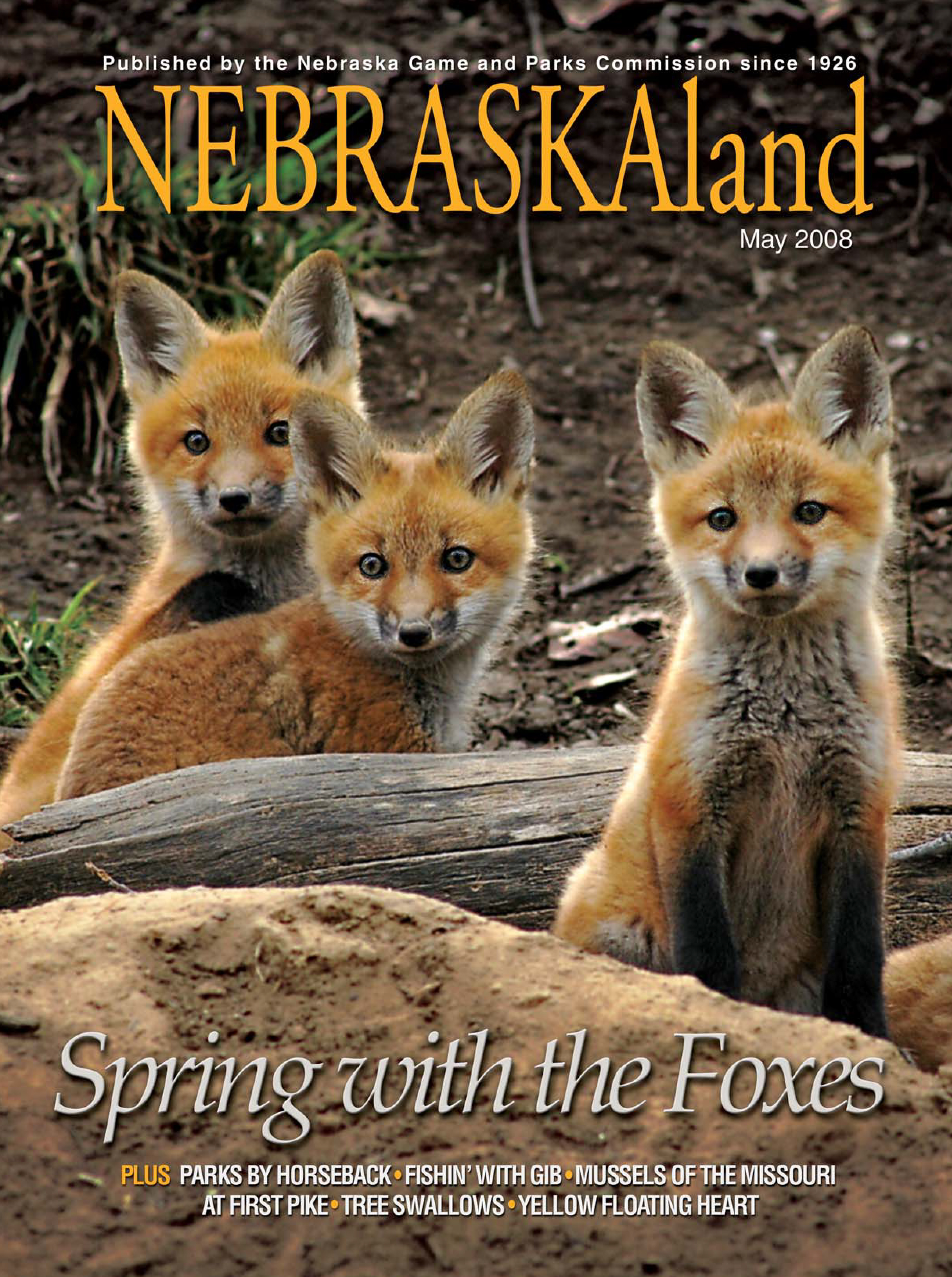
- Identifier:
- nela.2008_086_04
- Title:
- Volume 86, Issue 4, 2008
- Issue Name:
- May 2008
- Date Issued:
- 2008-05-01
- year:
- 2008
- month:
- May
- Season:
- Spring
- PDF filename:
- NL_86.04_2008_May_Spreads_Entire.pdf
- Publisher:
- Nebraska Game and Parks Commission
- Format:
- Periodical
- volume:
- 086
- issue:
- 04
- number:
- 086.04
- Decade:
- 2000s
- Type:
- Rights Holder:
- Copyright Nebraskaland Magazine/Nebraska Game and Parks Commission, all rights reserved.
- Extracted Text:
-
The shadow of a wrangler and the horse he is currying is cast by early morning light on a
barn at Eugene T. Mahoney State Park as another fun day of trail rides begins. Photo by
Eric Fowler.
NEBRASKAland Magazine
Published by the
Nebraska Game and Parks Commission
NebraskalandMagazine.com
$4.95
Volume 86, Number 4, May 2008
10 Spring with the Foxes
A photographer shares his experience after photographing six
young fox pups last spring. TEXT AND PHOTOS BY MARK DIETZ
18 Mussels of the Missouri
A 2006 Missouri River mussel survey failed to find two
endangered species, but painted a clearer picture on the status
of other mussel populations. TEXT AND PHOTOS BY ERIC FOWLER
20 Fishin’ with Gib
Self-described I-80 lake purists, two North Platte fishermen
get together once a week from ice-out to freeze-up to try
their luck. TEXT AND PHOTOS BY ROCKY HOFFMANN
26 Tree Swallows
Once in decline, tree swallow populations are making a
comeback. TEXT AND PHOTOS BY JON FARRAR
28 Giddyup!
With dozens of horses and miles of scenic trails available at
most state parks, now is a great time to go for a ride. TEXT AND
PHOTOS BY ERIC FOWLER
36 At First Pike
28
●
A lifelong bass angler discovers the excitement of pike fishing
on his first trip to Nebraska. TEXT AND PHOTOS BY JEFF KURRUS
40 Lake McConaughy’s Fishery
36
●
Despite recent low water problems, Big Mac still provides
some of the state’s best fishing. TEXT AND PHOTOS BY BOB GRIER
9 Outdoor Business
Changes in deer regulation aimed at increasing doe harvest.
46 Outdoor Update
Elwood Reservoir taking major hit from recent water shortages.
47 In the Field
26
●
Yellow Floating Heart – the beautiful invader.
49 Outdoor Education
Protect yourself from skin cancer now or pay the price later.
Comment . . . . . . . . . . . . . . . . . . . . . . . . . . . . . . . . . 4
Outdoor News . . . . . . . . . . . . . . . . . . . . . . . . . . . . . 6
Classifieds . . . . . . . . . . . . . . . . . . . . . . . . . . . . . . . 48
Portraits from the Past . . . . . . . . . . . . . . . . . . . . . 50
Cover: Young red fox pups keep a sharp eye out as they play and practice life skills outside
the entrance of their den. See story on page 10. Photo by Mark Dietz. Opposite: Disturbed
while sunning itself near the prairie dog hole where it had spent the winter, a prairie rattlesnake
takes a defensive posture against potential danger. Photo by Doug Carroll.
20
●
MAY 2008 • NEBRASKALAND 3
Published by the
Nebraska Game and
Parks Commission
Director: Rex Amack
Assistant Directors:
Roger Kuhn, Kirk Nelson, Sam Sidner
Information & Education Administrator:
Doug Bauch
Commissioners
Chairman:
James Ziebarth, Wilcox
Vice Chairman:
George E. Hall, Bridgeport
2nd Vice Chairman:
Jerrod Burke, Curtis
Dr. Mark Pinkerton, Wilber
Ron Stave, Waterloo
Dr. Kent Forney, Lincoln
Lynn Berggren, Broken Bow
Mick Jensen, Blair
Magazine Staff
Editor: Doug Carroll
Associate Editor: Jeff Kurrus
Art Director: Tim Reigert
Senior Editor: Jon Farrar
Regional Editors:
Eric Fowler, Bob Grier, Rocky Hoffmann
Contributing Editor: Michael Forsberg
Circulation: Donna Robinson
Photo Librarian: Sarah Johnson
NEBRASKAland
ISSN: 0028-1964
VOL. 86 / NO. 4
MAY 2008
Published monthly, except for Jan./Feb. and Aug./Sept.
issues, by the Nebraska Game and Parks Commission, 2200
N. 33rd St., Lincoln, NE. Copyright 2008, all rights reserved.
Please address comments or questions to this address.
Periodicals postage paid at Lincoln, Nebraska, and other
locations. POSTMASTER: Send all address changes to
NEBRASKAland, P.O. Box 30370, Lincoln, NE 68503-0370.
NEBRASKAland is available on audio cassette from the
Nebraska Library Commission Talking Book and Braille
Service, Suite 120, 1200 N St., Lincoln, NE 68508. (800)
742-7691.
Rates: $18 for one year; $33 for two years; $44 for
three years. Nebraska residents must add
appropriate sales tax.
To subscribe call 1-800-NEBLAND (632-5263),
or go online to: NebraskalandMagazine.com.
For address changes and questions about your
subscription, e-mail donna.robinson@ngpc.ne.gov.
4 NEBRASKALAND • MAY 2008
April Issue a Hit
Wow! NEBRASKAland just keep
getting better. You are setting a
standard that will be a challenge to
maintain.
Consider the April issue. First
there was fishing with Tom Osborne,
then turkey hunting, and suddenly
there was the late Bill Horst. What a
lovely tribute to Bill and his rod and
reel legacy. Undoubtedly it resulted
in tears, but also cherished memories
and joy for his wife, Diane Horst.
As if all this was not enough, next
was the finest narrative and pictorial
presentation on decoys I have ever
read. An absolutely outstanding
article. My congratulations to Farrar,
Peterson and Zaruba.
On final comment. I subscribe to
other state magazines. Unfortunately
they now clutter virtually every page
with advertisements, unrelated
announcements, and photographs
that are ruined by excessive cropping
or overlaid print. NEBRASKAland
continues to avoid this deleterious
format, and I applaud your decision
to maintain full-page articles that are
clean, attractive to the eye and a joy
to read.
Keep up the good work, it’s
appreciated.
Sincerely,
Jerry P. Lightner
DeLand, Florida
Picture submissions
I’m interested in submitting some
of my photos for your publication. I
was just wondering the best method
for submitting digital photos. I read
the guidelines, but I didn’t see
where it talks about how to submit
digital photos. Would you prefer that
I print them and send them, make a
CD with the pictures on them or
another method?
our past special issues and cookbooks
under “Publications” and in the
“Bargain Corner” section of the
web site. You can also order past
issues through our office by calling
(800) 632-5263.
- Editor
If you have just a few pictures that
you think NEBRASKAland might be
interested in using, then feel free to
e-mail them to me. If you have quite
a few, then please burn them on a
CD and mail them to me. Both
addresses are listed in the yellow box
on page 5. Please remember that we
only use high quality photographs,
and that submitting photographs in
no way guarantees that we will be
able to run them in the magazine.
- Editor
Equipment Question
Are stone points (knapped stone
broadheads) legal equipment for
hunting big game in Nebraska?
Randy Clark
Via e-mail
Nebraska Conservation Officer
Murray Johnson replies: If the stone
meets our dimensions required for
broadheads – three inches of cutting
service and 7/8 of an inch cutting
diameter – then it would be legal.
Kudos
The March issue of
NEBRASKAland Magazine is superb
cover to cover. Congrats to all.
Richard
McCabe, Vice
President
Wildlife
Management
Institute
Annapolis,
Maryland
Purchasing Past Issues
The October 2007 issue had an
article on “black squirrels.” Is there
a way to get a copy of that issue? I
have ordered a subscription of the
magazine, but will have missed the
October issue.
Please advise. Thank you.
Bob Hudson
Via E-mail
You can purchase this issue by
going to our web site at
NebraskalandMagazine.com. Just
click on the “Online Catalog”
button on the left side of the page,
then click on the “Nebraskaland”
button to find back issues. By
browsing through our online
catalog, you can also find some of
Send your comments to:
Doug Carroll, Editor
NEBRASKAland Magazine
P.O. Box 30370
Lincoln, NE 68503
or e-mail doug.carroll@ngpc.ne.gov
Please include your postal address
and telephone number.
Letters may be condensed and edited
for clarity. Photographs are
welcome and will be returned.
Under federal and/or state law, discrimination is prohibited on the
basis of race, color, religion, age, gender, marital status, national
origin, disability or political affiliation. If you think you have been
discriminated against in any program, activity or facility by the
Nebraska Game and Parks Commission or want more information,
contact the Commission in Lincoln, NE, at (402) 471-0641 or the
Equal Opportunity Commission, Lincoln, NE, (402) 471-2024,
TTY/TDD (402) 471-4693).
Headquarters
2200 N. 33rd Street
Lincoln, NE 68503
Phone (402) 471-0641
District Office I
East Hwy. 2, Box 725
Alliance, NE 69301
Phone (308) 763-2940
District Office II
524 Panzer St., Box 508
Bassett, NE 68714
Phone (402) 684-2921
District Office III
2201 N. 13th St.
Norfolk, NE 68701
Phone (402) 370-3374
District Office IV
301 E. State Farm Rd.
North Platte, NE 69101
Phone (308) 535-8025
District Office VI
1617 First Ave.
Kearney, NE 68847
Phone (308) 865-5310
Omaha Office
1212 Bob Gibson Blvd.
Omaha, NE 68108
Phone (402) 595-2144
Ak-Sar-Ben Aquarium
21502 W. Highway 31
Gretna, NE 68028
Phone (402) 332-3901
World Wide Web site: www.OutdoorNebraska.org
E-mail: info@ngpc.ne.gov
Administration
Ted Blume (Adm.)
Craig Stover (Asst.)
Wes Loos (Asst.)
Rod Loos (Asst.)
Murray Johnson
Lincoln
471-5531
Lincoln
471-5532
Lincoln
471-5591
Ogallala (308) 284-8056
Lincoln
471-5003
Panhandle
Officer
City
Phone (308)
Jim Zimmerman (Sup.) Gering
436-7561
Walt Meyer
Chadron
432-4398
Scott Brandt
Gering
436-3418
Heath Packett
Gordon
282-2553
Dennis Thompson
Ogallala
284-6450
Dan Zuehlke
Ogallala
284-4815
Doug Pollard
Oshkosh
772-9950
Frank Miller
Valentine (402) 376-1183
Dan Kling
Whitney
432-8367
Southwest
Officer
City
Phone (308)
Roger Thompson (Sup.) N. Platte
532-9175
Ray Dierking
Brkn. Bow
872-3078
George Sund
Cambridge
697-4629
Michael Thome
Cozad
784-4362
Matt Andrews
Elwood
785-3025
Dirk Greene
Imperial
882-5328
Virgil Gosch
McCook
345-2185
Dudley Sorensen
N. Platte
532-0747
Rich Routh
Rep. City
799-2085
South-central
Officer
Jerry Pecha (Sup.)
Jeff Jones
Terry Brentzel
City
Phone (308)
Kearney
865-5327
Clay Center(402)762-3124
Doniphan (402)845-2021
Randy Pomplun
Darin Gress
Dale Johnson
Mark Reeves
Robert Finke
Richard Seward
Fullerton
536-2987
Hebron (402) 768-2287
Kearney
237-1079
Loup City
745-0662
Milford (402) 761-3537
Ord
728-3115
Northeast
Officer
Tom Zimmer (Sup.)
Robert Kelly
Dale Davis
Ross Oestmann
Steve Oberg
Daniel Roberts
Jon Reeves
Marion Shafer
Pat George
Eric Wiebe
Tim Williams
Cory Krause
City
Phone (402)
Norfolk
371-6625
Albion
395-2538
Bassett
273-1700
Bloomfield
373-4412
Columbus
564-5937
Fremont
721-7852
Kennard
427-7378
Norfolk
371-2031
O’Neill
336-1588
Ponca
755-2566
Neligh
887-1335
West Point
372-6979
Southeast
Officer
Duane Arp (Sup.)
Sean McKeehan
William Krause
Jeremy TenKley
Mike Luben
Douglas Kramer
Dina Barta
Stacey Lewton
Levi Krause
Russell Mort
Dan Evasco
Jeff Clauson
City
Gretna
Ashland
Auburn
Beatrice
Colon
Lincoln
Lincoln
Lincoln
Louisville
Nebr. City
Papillion
Waterloo
Phone (402)
332-2965
944-4174
274-3789
228-1437
443-4278
466-9001
483-2358
476-0436
234-2212
873-5684
592-6733
359-5301
Nebraska Wildlife Crimestoppers 1-800-742-7627
MAY 2008 • NEBRASKALAND 5
Nebraska Federal Junior
Duck Stamp Winner
An acrylic painting of a northern
pintail was chosen best of show in
this year’s Nebraska Federal Junior
Duck Stamp Contest.
The winning entry, painted by
Bethany Cooper, a 16-year-old
student at Banner County High
School, was chosen from among
more than 800 entries received from
across the state.
Cooper’s painting will be used to
create the 2009 Nebraska Waterfowl
Stamp and was sent on to the
National Junior Duck Stamp
Competition held April 17 at the
San Diego Zoo. The winner of the
national competition receives
$5,000, a trip to Washington D.C.,
and his or her artwork will be used
to make the 2008-2009 Junior Duck
Stamp. Proceeds from sale of these
stamps, which cost $5, are used to
support conservation education
efforts across the nation.
Judges for this year’s competition
were Brad McKinney, a biologist
with Pheasants Forever; Bob Grier,
writer/photographer for
NEBRASKAland Magazine; Ron
Kephart, artist and curator of the
Natural History Museum in Gering;
Paul Cornes, a refuge supervisor
with U.S. Fish and Wildlife Service;
and Kevin Mooney, news director
for KNEB radio in Scottsbluff.
Information for next year’s contest
will be posted on the U.S. Fish and
Wildlife Service Internet homepage
at http://duckstamps.fws.gov.
Lake Contour Maps Available
If you’re looking for a good spot
to fish this year, check out the
contour maps of 98 of Nebraska’s
best fishing reservoirs and lakes,
available for downloading or
viewing in the fishing section of
the Nebraska Game and Parks
Commission’s web site at
www.OutdoorNebraska.org.
New to the list of maps are:
Gracie Creek Trout Pond near
Taylor; Twin Lakes Wildlife
Management Area (WMA) North
and Twin Lakes WMA South near
Bassett; Victoria Springs Lake State
Recreation Area (SRA) near
Anselmo; Fremont Lakes SRA lakes
No. 1 and No. 5 near Fremont;
Louisville SRA lakes No. 2 and No.
3 near Louisville; Rockford Lake
SRA near Beatrice; Timber Point
Lake near Brainard; Blue Hole
WMA West Lake near Elm Creek;
Johnson Lake SRA near Lexington;
and War Axe SRA near Shelton.
Beth Cooper’s acrylic painting of a northern pintail won this year’s Nebraska Federal
Junior Duck Stamp contest.
6 NEBRASKALAND • MAY 2008
Free Park and Fishing Day
to be held May 17
Nebraska’s annual Free Fishing
and Park Entry Day will be held on
Saturday, May 17 this year. On this
day, the need for park entry permits
and fishing licenses is waved, but all
other park and fishing regulations are
still in effect.
As part of this celebration, the
Nebraska Game and Parks
Commission is offering the
11th annual Family Fishing Clinic at
select state parks (SP) and recreation
areas (SRA) across the state. Here are
the locations and times for the clinics:
Alexandria SRA, 9:30 a.m. to
2:30 p.m.; Chadron SP, 9:30 a.m. to
2:30 p.m.; Fort Robinson SP, 9 a.m.
to noon; Fremont Lakes SRA, 9 a.m.
to noon; Lake Minatare SRA, 9 a.m.
to 1 p.m.; Louisville SRA, 9 a.m. to
noon; Eugene T. Mahoney SP, 9 a.m.
to 11 a.m.; Platte River SP, 9 a.m. to
noon; Ponca SP, 9 a.m. to 8 p.m.;
Two Rivers SRA, 9 a.m. to noon;
and Victoria Springs SRA, 9 a.m. to
6 p.m.
Nebraska Breeding Bird Atlas
Volunteers Needed
The Nebraska Breeding Bird Atlas
is entering its third year of data
collection and volunteers are still
needed. Many Nebraska Game
and Parks Commission state parks,
recreation areas and wildlife
management areas are included as
“blocks.” Volunteer contributions can
range from reporting a single active
robin’s nest to spending the entire
summer compiling a long and
comprehensive list of breeding bird
observations. For more information
about the project and also to find
maps where the “blocks” are
located, go online to:
www.ngpc.state.ne.us/wildlife/programs/bba/bba.asp.
To volunteer for the project, please
contact Wayne Mollhoff at
wmollhoff@netscape.net, or Joel
Jorgensen at
joel.jorgensen@ngpc.ne.gov.
MAY 2008 • NEBRASKALAND 7
The Great Park Pursuit
8 NEBRASKALAND • MAY 2008
Population Control
Changes in deer regulations intended to increase doe harvest.
By Doug Carroll
permit at their March
hanks to changes
meeting: Youth permits
made during the
can now be used to
Nebraska Game
harvest antlerless deer
and Parks
during the January
Commission
antlerless season.
meeting last March, deer
Restrictions were also
hunters in Nebraska
placed on mule deer
will have a lot more
doe harvest to allow the
opportunities to take
population to increase in
multiple deer during next
southern and eastern
fall’s deer hunting
mule deer units, and
seasons.
mule deer does will be
Kit Hams, big game
protected in some public
program manager for the
areas of the Pine Ridge,
Nebraska Game and
where the population has
Parks Commission, said
decreased in recent years.
regulation changes that
These area are Fort
expand deer-hunting
Robinson State Park (SP)
opportunities to an
and wildlife management
unprecedented level were
area (WMA), Peterson
a reflection of the
WMA, and Soldier
Commission’s desire to
Creek Wilderness Area.
control the rising deer
In other action at their
population in the state,
March meeting,
especially white-tailed
commissioners changed
deer in eastern Nebraska,
antelope regulations for
while allowing mule deer
2008 so landowner
populations to increase in
permits will be eithercentral and southern mule
sex, unused North
deer units.
Sioux Unit landowner
Nebraska’s white-tailed
muzzleloader permits
and mule deer populations
Leslie Hershberger of Milford poses with a one of two does she
can
now be converted
have been steadily
shot near Nebraska City during the antlerless-only deer season
to North Sioux Unit
increasing and buck quality last January.
landowner firearm
has never been higher,
permits, and Fort Robinson SP is
youth and landowner permits,
said Hams, but complaints about
now closed to antelope hunting.
formerly restricted to one deer of
crop and vehicle damage caused by
Highlights of the changes to elk
deer continue to increase, particularly either sex, will now allow the harvest
regulations enacted for this fall’s
of one bonus antlerless deer. Bonus
in eastern Nebraska and along the
season include expanding the Box
state’s major river corridors. In order antlerless permits will also be used
to increase antlerless harvest in some Elder Elk Unit from approximately
to alleviate these problems, the
300 to 17,000 square miles in order
firearm units, including Blue
Commission is issuing a record
to manage elk that have become
Northwest, Blue Southeast, Wahoo,
number of bonus antlerless permits
established in new areas,
and Season areas 19 and 20. In
this year and has created four new
discontinuing the use of either-sex
all, approximately 87,000 bonus
Season Choice antlerless units in
permits and replacing them with
antlerless tags, most of them for
the Calamus and Loup deer hunting
bull and antlerless permits, and
whitetails, will be available this
units.
creating a December antlerless-only
year.
Perhaps the biggest, and most
elk season in order to increase
The Commission also changed
welcome, change for many hunters is
antlerless harvest. ■
regulations regarding the youth deer
that now all archery, muzzleloader,
T
MAY 2008 • NEBRASKALAND 9
PHOTO BY DOUG CARROLL
Encouraging active lifestyles while
increasing awareness of outdoor
recreation opportunities throughout
Nebraska parks and trails via a series
of interactive activities is the goal of
The Great Park Pursuit that is being
held across the state this year.
Based on a similar program started
in Connecticut, which uses it as the
centerpiece of its No Child Left
Inside initiative, The Great Park
Pursuit encourages people to get out
and visit some of Nebraska’s most
scenic places by making participants
eligible for valuable prizes.
Bass Pro Shops and Blue Cross
Blue Shield of Nebraska are
corporate sponsors of The Great
Park Pursuit, and the Nebraska Game
and Parks Commission and the
Nebraska Recreation and Park
Association are the founding
program coordinators. Outdoor
Recreation Products and Landscape
Structures are contributing sponsors.
The Great Park Pursuit awards
levels of participation with prizes,
including five grand prizes sponsored
by Bass Pro Shops. Each grand prize
winner will get to pick from one of
the following three packages valued
at $1,000 each: a canoe/kayak
package, a camping package or a
fishing package.
“Too often, recreation time is
spent in front of a screen,” said Lee
Handke, vice president of Health
Network and Wellness Services for
Blue Cross Blue Shield of Nebraska.
“We are happy to sponsor The Great
Park Pursuit because it encourages
families to get out and spend
meaningful time together in
Nebraska’s beautiful parks. Families
will be rewarded with more active
lifestyles, plus create memories that
will last a lifetime.”
Here are the details of the program:
Participants have 10 specific state
or city parks to visit from April 26
through Sept. 1. At each park they
are prompted to find their way to a
designated location, where they will
make a pencil tracing of nature
artwork mounted on a post. They
will then mail in the tracings they
have made, reflecting the total
number of parks visited. Prizes will
be awarded based on the number of
tracings collected and mailed in by
Sept. 10, 2008.
Participants can visit
www.negpp.org to register or get
more information. They may register
individually, as a group, or as a
family. They will select a park from
the 10 available, then print off that
park page and take it to the park.
They should follow the clues on the
park page to the post that has the
nature impression, make the tracing,
then plan a trip to another park.
Participants should continue to
complete as many tracings as possible
while enjoying the outdoors and
other activities at the parks.
Those who complete and mail in
one nature impression tracing will
be entered to win a two-night stay
at a Nebraska state parks cabin
of their choice. The first 200
participants who complete and mail
in five tracings will get a $25 Bass
Pro Shops gift card. Those who
complete and mail in seven tracings
will be entered once for the grand
prize drawing, and those who
complete and mail in all 10 tracings
will be entered three times for the
grand prize drawing and will also
receive a free 2009 Nebraska Park
Entry Permit.
The 10 parks included in The
Great Park Pursuit are: Steinhart
Park, Nebraska City; Chadron State
Park (SP); Scottsbluff Riverside
Park; Zorinsky Lake Park, Omaha;
Smith Falls SP; Yanney Park,
Kearney; Eugene T. Mahoney SP;
Iron Horse Park, North Platte; Ponca
SP; and Lake Hastings Park,
Hastings.
Kickoff events for the Great Park
Pursuit are planned at three locations
in conjunction with other activities:
April 26 – Iron Horse Park, 3-5
p.m., held in conjunction with the
O’Rourke Triathlon; May 17 –
Eugene T. Mahoney State Park,
9-11 a.m., as part of Nebraska Free
Park Entry and Fishing Permit Day,
fishing derby and outdoor education
seminars; June 14 – Lake Hastings
Park, 10 a.m.-noon, in conjunction
with a fishing derby, kite flying and
disc golf.
“Nebraska is blessed with 86 state
park areas and many more community
parks,” said Roger Kuhn, assistant
director for the Commissions Parks
Division. “The Great Park Pursuit
park areas include some of the best
Nebraska has to offer, and visitors
will not be disappointed. From the
Pine Ridge of western Nebraska to
the unmatched beauty of the
Niobrara River Valley to the
Missouri River at Ponca State Park,
the Great Park Pursuit has wonderful
parks to visit.” ■
’ve scouted the hills and plains
for many years looking for
opportunities to photograph the
elusive red fox. I’ve even set up
photo blinds near deer carcasses
in the woods, hoping to capture a few
images of Vulpes vulpes stopping by
for a bite, but I’d only go home with a
few frames of raccoons, opossums and
perhaps an occasional image of my
cunning target.
Eventually I came to realize that my
best fox photos had come from setting
up on the few den sites I had come
across during my travels through the
woods, so now I spend a lot of my time
I
scouting the woods for dens that might
offer good photo opportunities. I start
my search in late winter, usually in
mid-February. I like going out after a
fresh snow because it helps me locate
newly excavated sites, and the tracks
and other sign easily visible in the
snow can indicate whether or not a fox
has been doing the work. Occasionally,
however, I am “outfoxed” – some of
the dens I have worked turned out to
be woodchuck (a.k.a. groundhog) dens.
I have a lot of nice woodchuck photos,
but that’s another story.
I generally try to set up my blind
three to four weeks before I plan on
using it. This works particularly well
when photographing adult foxes, and
may provide opportunities to photograph
white-tailed deer as well.
Last year started out like many
others. After a new snow, I spotted
freshly excavated earth on a hillside
that would be ideal for setting up a
blind – it was a south-facing bank with
no obstructions and there was some
level ground in a good spot for a
portable blind. Everything looked
perfect. Then the owner of the new den
revealed himself – a robust woodchuck.
Having found no other locations for a
blind, I decided it was going to be
another woodchuck year. For several
12 NEBRASKALAND • MAY 2008
weeks I monitored the den from a
distance with binoculars to see if there
was any activity, occasionally watching
the woodchuck sunning in the den’s
entrance.
After hunting morel mushrooms
one day in early April, I stopped by to
check on the den. In the last light of
day, I noticed a flurry of activity
around the den and discovered there
had been a change in tenants – a fox
family had apparently evicted the
woodchuck and taken possession of the
den, because I could see several young
fox pups at the den entrance. With my
blind already in place, all I needed was
some nice weather and a little time to
spend in the blind. I just hoped the
woodchuck didn’t decide to reclaim his
den.
My first opportunity to sit in the
blind was a mid-April afternoon. An
hour or so passed before I saw the first
fox pup (also called a kit) crawl out the
den opening. A few moments later a
second appeared. Both looked like they
just finished a long nap, and neither
paid any attention to my blind. It wasn’t
long before they started exploring their
surroundings.
While I was busily trying to follow
their activities with my camera, I
noticed more movement at the entrance
of the den. Two more pups were lying
Above: Because she had such a large
and hungry family, Mom was very popular
whenever she returned from one of her
numerous hunting forays.
Opposite: Although red fox pups (also
called kits) are fairly small and more of a
brownish color when they first emerge
from their birthing den, they grow quickly
and soon take on the reddish/orange
color of their parents.
there. Before long I was trying to keep
track of six pups. It was as if the recess
bell had rung and all the students were
releasing their pent-up energy on the
playground.
Everything within 20 feet of the den
MAY 2008 • NEBRASKALAND 13
Curious and active, much like a kitten, the
first few months of a fox pup’s life are
made up of a lot of play and wrestling
matches that strengthen the muscles,
improve coordination and prepare it for
life outside the den. All of this activity,
combined with the fact that they are
growing rapidly, requires a lot of
nourishment, so their parents are on the
hunt during almost every waking
moment.
entrance was fair game. It could be
chewing on sticks, digging holes,
exploring, climbing or simply
wrestling. Lots and lots of wrestling.
At times it resembled a pro wrestling
tag-team match – all it took was for
one pup to find something that nobody
else had, such as a stick, leaf or bone.
Then they all wanted it.
The wrestling matches usually
went on for several minutes, with no
decisive winner. One of the smaller
pups often joined in to take a cheap
shot at one of the other pups being
assailed by several others, but no
serious harm was ever done.
All the action going on at once was
difficult to follow with my camera. I
might have two pups stalking a squirrel
to the far right, two or three pups
wrestling in front and one playing with
a stick up the hill. All this activity
would go on for about an hour, then
each pup would slowly return to the
den entrance to take a break. A few
pups might try to rest, but usually one
or two others would try to keep them
from getting any shut-eye.
As the light of day started to fade,
some of the pups retreated to the safety
of the den. Just as I started thinking
about packing up my gear for the day, I
heard a commotion on the hillside
above the den. It was Mom!
Mom was greeted by a mob of
hungry pups. With some trying to
nurse and others begging for handouts,
the reunion lasted for a short time and
ended when the adult made a highpitched bark that sent the pups to the
den as she scampered off up the hillside.
As I packed up my gear, I realized that
I had taken nearly 400 images within a
couple hours. Thank goodness I
switched to digital – buying and
processing that much film would have
14 NEBRASKALAND • MAY 2008
put me in the poorhouse.
It was more than a week before I
could return to the blind – the dreary
spring weather wasn’t very suitable for
photography, and I found the pups didn’t
care for the wet weather either. Still, I
was anxious to get back to the blind to
see what the pups were up to and I
eventually had more opportunities to
visit and photograph my new friends.
The recent rains had revitalized the
forest floor with color, and the pups
were changing color, too, from brown
to a light red.
The pups were up to their usual
activities – exploring, wrestling, sleeping
and more wrestling. Mom would
occasionally stop by for a visit and the
pups would stop what they were doing
to greet her, hoping for a handout.
These visits were short and often
occurred away from the den site. It
seemed the pups could sense her
presence – they always knew she was
in the area long before I realized it.
MAY 2008 • NEBRASKALAND 15
Fox Facts:
• Foxes can thrive near urban areas,
Mark Dietz is the property
manager of Camp Maha, a Girl
Scout camp located along the
Platte River in Sarpy County. His
photos and stories have been
used numerous times in both
NEBRASKAland and Trail Tales,
the quarterly magazine published
by the Nebraska Game and Parks
Commission that is geared
toward elementary-age children.
and fewer coyotes mean more foxes.
• Adult pairs can mate for life.
• Foxes can live 10 years in the wild.
• Dens can average from 1-7 pups,
with a high mortality rate the first
year.
• Adult males can help raise young,
and last year’s non-breeding females
may help raise young.
• On occasion, adults will move pups
to another den if the den is infected
with mange mites.
• It’s not uncommon for foxes to use
the den the next year.
• A fox’s diet consists of mice, voles,
rabbits, ground-nesting birds, squirrels,
and an occasional domestic cat.
Above: Personal grooming habits,
including scratching, quickly become a
family affair when you have six siblings
living together.
Opposite: Sleeping space near a fox den
is apparently a rare commodity even
aboveground.
By the middle of May, activity
around the den became less frequent.
The pups were getting bigger and spent
much of their time a short distance
away from the den. On occasion I
would watch a couple of them stalking
squirrels or songbirds without success.
16 NEBRASKALAND • MAY 2008
One morning I witnessed a different
side of the pups’ behavior when Mom
showed up with a couple of voles.
What used to be play turned into an
all-out fight, with only two winners. I
suspect the hierarchy of the den had
thus been set. On several occasions, I
saw Mom or Dad out hunting during
the middle of the day, accompanied by
a single pup.
As May came to a close, I would
see just two or three pups at the den,
usually after they ran past the blind
from somewhere behind me. I
wondered what had happened to the
other three pups. Because past
experience had shown me that pups are
often moved to an alternative den site,
I did a little investigation and found
the missing pups at another den about
70 yards away. They must have
outgrown the original den and the
parents decided to split them up.
My last few trips to the blind were
for the most part uneventful, with the
occasional appearance of a single pup.
Mom, apparently a successful hunter,
would leave gifts for her hungry
offspring, including rabbits, squirrels, a
woodchuck and even a whitetail fawn.
Eventually the fox family abandoned
their dens completely and I removed
my blind. Although the pups were out
in the world now, they were not out of
my thoughts.
Over the summer I would
occasionally catch a glimpse of the
foxes darting in and out of a nearby
cornfield and my thoughts would drift
back to the times I had spent watching
them. When I go back now and look at
the many photographs I took over my
spring with the foxes, it’s hard not to
smile. Next time I’m going to pack a
video camera, too. ■
MAY 2008 • NEBRASKALAND 17
Mussels of the Missouri
Text and photos by Eric Fowler
A
18 NEBRASKALAND • MAY 2008
Heidi Dunn of Ecological Specialists, Inc., counts freshwater mussels she and her crew collected below Gavins Point Dam.
Missouri firm that conducted the 2006
study for the Corps, believes a freshwater
drum, the preferred host for the
scaleshell, may have brought glochidia
from central Missouri, the closest
population, to Gavins Point Dam. While
the survey found none, there could be
more, although “with as many mussels
as we found and with as much time as
we spent out there, to not find any of
them leads you to believe that they’re
not really living in the Missouri River
proper, but they had to come from
somewhere,” Dunn said. Exactly where
– a tributary, Lake Yankton or somewhere
in Missouri, is anyone’s guess.
Dunn and others involved in the
study believe that because no other
pink muckets or Higgins’ eye mussels
have been found in the Missouri River
and it is so far outside their historic
range, it is more likely that someone
simply discarded the shell that was
found below Gavins Point Dam.
Dunn’s 2006 survey did find 2,524
specimens of 12 different species of
mussels, the most common being fragile
heelsplitter (Leptodea fragilis) and pink
papershell (Potamilus ohiensis). A total
of 18 species have been found in the
river in seven studies dating to 1981.
Most have been found in shallower areas
protected from the river’s swift flows.
Mussel abundance and diversity was
highest in the reach below the dam
where sediment-free water has washed
fine sand and silt from the river bottom,
leaving more of the gravelly substrate
preferred by the mussel species that
inhabit the Missouri. This was especially
true near the Lake Yankton outlet, an
area known as “the bubble,” and near
the mouth of the James River. Ironically,
while man-made changes to some
rivers has resulted in a decline in the
number and variety of mussels, the
changes to this short segment of the
Missouri may have made it more
habitable for them than it once was.
“We didn’t find as many downstream
in the natural river where the sand and
channel is shifting. Those conditions
aren’t conducive to freshwater mussels,”
said Dunn.
That was good news to the Corps,
which is busy dredging sand from the
bottom of the river to rebuild sandbars
between Gavins Point Dam and Ponca
State Park to serve as nesting habitat
for the endangered least tern and
PHOTO COURTESY OF
G. WATTERS, OHIO STATE UNIVERSITY
could affect these and other mussel
uses has also reduced their numbers.
2006 survey of the Missouri River
species.
Freshwater mussels are a segment of
between Gavins Point Dam and
Freshwater mussels are declining
the mollusca phylum, which includes
Ponca State Park failed to turn up
nationwide. Of the more than 300
oysters and snails among its more than
two federally endangered mussel
species once found in North America,
110,000 species worldwide and is second
species that had been found in the
7 percent are believed to be extinct and only to arthropods in species diversity.
river in recent years. But it did paint a
more than 30 percent are either listed
Two shells hinged by a ligament protect
clearer picture of freshwater unionid
or proposed for listing as federally
their soft bodies, and they are capable
mussel populations in a river that
threatened or endangered species.
of producing pearls. Depending on a
historically was mostly devoid of
Mussels are good indicators of
species’s preference, mussels live in
mussels, mistakenly called clams by
environmental quality because they filter sand, silt, mud or gravel on the bottom
most people, and will help guide
microscopic plants and animals from
of rivers and lakes, where they bury most
ongoing habitat restoration efforts on
the water and, as such, are sensitive to
of their shell in the substrate and move
this reach of the Missouri.
pollution. The construction of dams,
by pulling themselves along by
Shells from scaleshell mussels
the channelization of rivers, silt from
extending a muscular, fleshy foot from
(Leptodea leptodon) were found below
between their shells.
Gavins Point Dam in 2004 and 2005, the farm fields and construction sites, and
overharvest for food and commercial
The unique lifecycle of a unionid
first time the species was documented
mussel begins when a male
in the river since 1981.
releases sperm into the
The shells were still
water. Females capture this
intact and had not been
sperm through a siphon,
affected by weather,
and the fertilized eggs
indicating the animals had
develop into a larval stage
probably died less than a
called glochidia. After
year before they were
growing in the female for
found. The weathered
up to 10 months, glochidia
shell of another mussel
are released into the water,
believed to be either the
where they float until they
Higgins’ eye pearlymussel
can attach to the gills of a
(Lampsilis higginsii) or
fish host or die. The
the pink mucket
glochidia remain attached
(Lampsilis abrupta) was
to the host’s gills for one to
also found in 2005. All
four weeks. Some actually
three are endangered.
feed on the host while others
The discoveries of these
just hitch a ride. After
species in the Missouri
developing shells, the
River, well outside their
young mussels drop off,
known range, created a
leaving the fish unharmed.
stir among biologists and
If they happen to fall in
raised hope that additional
suitable habitat, they survive.
reproducing populations
Fish hosts help mussels
had been found. It also
spread up and down rivers
prompted the U.S. Army
and across lakes. Heidi
Corps of Engineers to
Under the right conditions, finding a freshwater mussel is as easy
Dunn, president and lead
commission the 2006
as following the trail it leaves in the sand, as Kendall Cranney of
researcher
for Ecological
study to determine if its
Ecological Specialists, Inc., did during a mussel survey on the
Specialists, Inc., the
work to rebuild sandbars Missouri River in October 2006. With Cranney is Jeff Dolwick.
Scaleshell mussel.
threatened piping plover. Most of these
sandbars are below the areas with the
highest concentrations of mussels. The
river rebuilt sandbars naturally when it
was free flowing with high flows in the
spring and lower flows in the summer.
Currently, flows from Gavins Point
Dam are fairly constant, with higher
flows much of the year to support
downstream barge shipping and lower
flows in the winter.
“We’re thinking it’s not very likely
that we’ll find any federally listed
species in those areas,” said Becky
Latka, a Corps biologist assigned to the
Missouri National Recreational River.
Still, Latka said the Corps will
continue to survey sites where sandbars
will be constructed to ensure existing
mussel beds are not affected. ■
MAY 2008 • NEBRASKALAND 19
Text and photos by Rocky Hoffmann
Self-described I-80 lake purists, these two North
Platte fishermen get together once a week from
ice-out to freeze-up to try their luck.
t age 14, Larry Sable went
to work sacking groceries
and stocking shelves at
Sixth Street Foods in
Ogallala. Sable retired from
Sixth Street 48 years later as a store
manager, and claims he enjoyed
every single minute of his career.
“How boring!” Gib interjected.
Gilbert (Gib) Larsen worked
26 different jobs before retiring from
the railroad two years ago. Those jobs
ranged from trucker to state trooper,
and oil rigger to yardmaster at Union
Pacific’s Bailey Yards in North Platte.
Gib’s hobbies are as varied as his
vocational pursuits. Among other
things, he’s a blacksmith, flint chipper
and hide tanner. He’s also a pretty
good fisherman.
Gib and Larry grew up together in
Ogallala, attended high school
together and then parted ways. Nearly
45 years later, after both had retired,
they bumped into one another at a
North Platte garage sale.
“We were kind of caught up in our
new lifestyles of doing nothing, so I
suggested we ought to get together
and catch a fish or something. We
A
did, and we’ve been fishing partners
ever since,” Gib recalled.
“This will be our third season of
fishing together,” said Larry, “and
it’s been a good arrangement. I take
my grandsons fishing fairly regularly,
but they’re not always available.
Gib, on the other hand, is always
ready to go, and we’ve worked it out
that we fish at least once a week
from ice-out to freeze-up.”
“I don’t like ice-fishing,” Gib
chimed in, “because I can’t stand the
taste of schnapps.”
So at least one day every week
during the open-water fishing season,
Gib and Larry pack a lunch and
some bottled water, gather their
tackle and push Gib’s boat off the
trailer onto an I-80 lake somewhere
on either side of sunrise. Then they
fish and chat until they put the boat
back on the trailer somewhere close
to sunset.
One would surmise that since
both fishermen grew up in Ogallala,
they would be prone to fish Lake
McConaughy, or, since they both live
in North Platte, that they would be
found wetting their lines on Lake
“Gib’s eyes ‘light up’ when a bluegill dances on his line,” said Larry Sable,
his fishing partner.
20 NEBRASKALAND • MAY 2008
MAY 2008 • NEBRASKALAND 21
Maloney or
Sutherland
Reservoir.
Instead, they
have become
I-80 lake
purists.
“We like the
consistent
clarity of the
water, the
This guide to
unique
fishing the
I-80 corridor
character that
is free at all
district offic
es and many
each lake offers,
public vendor
s. their relative
small size, the
excellent fishing and the solitude,” Gib
explained.
Solitude? On lakes that, as their
collective name aptly describes, are
located just across the fence from one
of the busiest interstate highways in the
nation, where thousands of trucks and
cars pass daily?
“We don’t hardly notice the traffic
once we focus on fishing,” Gib said.
“Sometimes we use it (the highway
traffic) as a diversion when things get a
little slow on the water. I’m a real truck
nut, and I have an extensive model
truck collection. In fact, I can identify
every truck that passes and hit the year
pretty close as well. Larry knows his
old cars, and there are a lot of antique
automobiles being toted up and down
the interstate. He’ll see one on a trailer
and say, ‘there goes a ‘51 Studebaker,’
and I’ll point out a classic, older-style
Peterbilt still hauling freight that might
have a million miles or more on it.”
Truckers often honk at the two
fishermen as they pass. “Some of these
guys have a regular route out to the
coast and back, and they’re likely to
see us on the same lake when they go
out and when they come back. They
must think we’re there all the time. We
get a chuckle out of that,” Larry said.
As far as the fishing goes, last year
was their best year yet. The more they
fish these small lakes, the better success
they have. Gib feels they learn from
every outing, and to help them improve
their catch rates each year, he keeps
notes in a fishing journal designed
specifically for that task. The book,
Fishing Journal, Angling Legacy,
provides space for categorical entries
such as weather, water temperature, air
temperature, wind speed and direction,
trip observation and special catches.
Special catches have been remarkable,
especially in numbers last year when
the two men had numerous 20- to
30-fish days that included a Master
Angler or two.
Gib and Larry feel no need to fish
anywhere else. The chain of I-80 lakes
in their area suits them just fine.
“Why go dragging your boat across
the state? The lakes we fish are
relatively close, we catch a lot of fish
and we catch a few Master Anglers,”
said Gib. “Besides, my boat is just
perfect for these small lakes and is too
small for Lake McConaughy or the
This duo’s fishing trips begin on either side of sunrise and usually end somewhere near dusk.
other large, southwest reservoirs. I
grew up on Lake McConaughy, and I
know what can happen if you don’t
have enough boat.”
Snuff
Gib’s 15-foot bass boat is the perfect size for the small I-80 lakes he fishes with Larry.
22 NEBRASKALAND • MAY 2008
In fact, Gib’s last two
boats were designed for
small lakes. Not long ago,
he had one of those little
“bass buggies,” which he
felt served him fairly well
when fishing alone.
However, it was a bit
crowded with a fishing
Snuff
partner and he couldn’t
take along all the items that make
a fishing trip a bit more enjoyable.
One such item is Snuff, Gib’s Chinese
pug and constant companion both on
the water and off.
“I sold that boat and bought a 15-foot
fiberglass bass boat. You don’t see
many bass boats that short around here,
and it’s absolutely perfect on these little
lakes for Larry, Snuff and me.”
Snuff quickly determines who’s
catching most of the fish during an
outing and positions himself near that
person until the momentum changes.
Then so does Snuff.
“We’re catch-and-release fishermen,
except for the first little sunfish of the
day, and that fish belongs to Snuff.
He’s come to expect it, and always
seems more excited about the first fish
reeled to the boat,” said Gib.
An I-80 Bass Boat With a
Power Anchor?
Not only is Gib’s small boat suited
perfectly for two people and a little dog
on I-80 lakes, it has everything that the
bigger bass boats have, including a
bow-mounted electric trolling motor,
two fish locators, livewells and an
outboard motor (which hasn’t been
started for some time) on the rear. One
of the things used most on Gib’s boat is
the anchor, which is deployed whenever
they want to fish a particular spot for a
while.
“The best thing about this anchor
system is the electric winch. We use an
anchor a lot, and I’d hate to pull that
hunk of steel off the bottom and hoist it
by hand over the side of the boat every
time we wanted to lift anchor. I’ll never
have another boat without a power
anchor,” said Gib.
“He’s getting pretty good at operating
it too,” bragged Larry. “The other day
he was barefoot in the boat and was
running the electric motor with one
foot while operating the electric winch
switch with the big toe on his other
foot. Who has a more talented fishing
partner than I?”
Catch’em and Let’em Go
Other than the outboard motor, the
only other equipment on their boat that
hasn’t been used for a while is the
livewell. Gib and Larry don’t keep any
MAY 2008 • NEBRASKALAND 23
fish several times and at different
stages in their lives, from when they
were small up to Master Angler-size. I
mean, we fish these lakes so often that
we have to be catching some of these
fish time and again,” said Gib. “I would
feel selfish if I took a nice fish out of
these lakes when I can weigh it, snap a
photo and turn it loose for someone
else to catch.”
One of the things that Gib in particular
has noticed about I-80 lakes is how the
fishing in them has improved over the
years. Gib moved to North Platte in
— Gib Larsen
1978 and immediately began fishing
the lakes along the interstate. At that
time, he said, he had consistent catches
of 8-inch bass. Now it’s not uncommon
of their catch, as Gib claims the fun
for him to hook a 14- to 16-inch fish,
part of fishing is the time period from
and the frequency of catches has also
when the fish is hooked until it’s in the
improved.
boat. Then, he said, the fun is over and
Larry’s style of fishing is quite similar
you might as well turn the fish loose.
to Gib’s. Both fishermen use ultra-light
“I’ll bet we’ve caught some of these
rods, reels and line, and they enjoy
catching most
of the species
that these little
lakes have to
offer. Larry has
a slight aversion,
however, to
catfish, which,
as luck would
have it, he
catches
frequently. He
prefers catching
largemouth
bass, but
rationalizes that
since they
release all of
their fish, it
doesn’t really
matter what
they catch.
“We still have
our preferences,
however. For
instance, you’re
most likely to
find Gib’s end
of the boat
tucked into a
bluegill hole
whenever he
gets the
chance,” Larry
Snuff is always found close to the fisherman who is having the
said.
most luck.
The fun part is from
when the fish is
hooked until the
time it’s in the boat.
Then, the fun is all
over and you might
as well turn the fish
loose.
24 NEBRASKALAND • MAY 2008
Bluegill Rule!
“Usually a good bluegill spot is next
to a good bass spot. I’ll try to position
the boat so that Larry can fish for bass
for a while, allowing me to catch a few
bluegill. We have a lot of good-natured
fun with each other about who’s catching
the most and biggest fish, but when it
comes right down to it, each of us gets
more enjoyment out of watching the
other guy catch a fish than catching
one ourselves,” Gib said.
Larry is very aware of Gib’s obsession
with bluegill: “His eyes always light up
when he gets a bluegill dancing on the
end of his line. Gib claims that it’s a
good thing that bluegills don’t grow
to 10 pounds, because he doubts if
anybody could land one that big.”
Right now, Gib is more interested in
big bluegill.
“In the past while fishing alone, I
know I’ve caught some 10-inch bluegill.
I’d just turn them loose. That 10-inch
threshold is the benchmark for Master
Angler-sized bluegill, and it has
become a hard one to catch. I’ve caught
lots of 6- and 8-inchers and a few 9-inch
bluegill, but I just haven’t been able to
find the real big ones lately. They’re
out there, and if not this year, I’ll get
into them next year.”
Gib’s logbook is fairly revealing and,
at times, somewhat surprising. For
example, while many fishermen pack it
in during the dog days of July and
August, Gib and Larry keep right on
fishing and catching fish. A July 20
entry, beginning at midday, indicates
that Gib and Larry began catching bass
at a rate of one every five minutes. By
the end of the trip, Larry had boated
15 bass and Gib had caught 18,
including one Master Angler.
The Pitiful
Although Gib and Larry use
just about everything in their
tackle boxes over the course
of a season, Gib constantly
returns to a small lure he
designed several years ago.
He calls it “The Pitiful,” and
it’s rather simple – an inline
spinner with a tiny blade
and some beads. He trails
it with a No. 6 Aberdeen
Gib fishes a bluegill hole after positioning the boat so that Larry can fish for bass.
hook and usually just enough
nightcrawler to cover the hook. It
received its name from its looks.
“Several years ago I was fishing with
a friend and pulled this little spinner
contraption out. He took a look at it
and said that it was the most pitiful lure
he had ever seen. The name stuck,” Gib
recalled.
Pitiful or not, it catches fish of all
species.
“It’s my go-to bait after I’ve been
‘exercising’ my tackle box a lot,” said
Gib. “I even get Larry to try it once in
a while. The last time he used it, he
tossed it back to me when he was done,
and it went in the lake. I told him that
was pretty low rent. Some people will
do anything to get the upper hand on
fishing.”
Boat Talk
Such good-natured jabs don’t bother
Larry, who rarely talks all day long.
Gib, on the other hand, talks constantly.
“Sometimes I don’t hear what he’s
saying because of the interstate noise,
but he carries on anyway. When he
knows that I am unable to hear him, he
talks to himself. Gib always says that
it’s alright to talk to yourself, and it’s
even alright to answer yourself, but
when you start saying ‘huh?’ to
yourself, then you have problems.”
Mike
“When you spend as many hours on
an I-80 lake as Larry and I do, you
realize that you’re really not as alone
as you think you are,”
said Gib. “We don’t see
many fishermen, but
those we do see are likely
standing way off in the
corner of the lake tossing
lures. Just because there
are not a lot of people, it
doesn’t mean you own
the lake. These little
lakes along the highway
have a lot of wildlife. In
the spring, the redwinged blackbirds give
us heck if we get in too
close to the rushes, and every once
in a while a pair of Canada geese sail
in looking for a place to nest. This
year we came upon a muskrat that had
no fear of us. We could coast right up
next to him, and he’d just sit there on
his feed bed, munching reeds. Every
time we went to that lake, there he’d
be. We even named him Mike. I don’t
know why, he was just Mike to Larry
and me.”
Not everything needs an explanation
when you’re fishin’ with Gib! ■
Mike the muskrat.
MAY 2008 • NEBRASKALAND 25
Tree Swallows
Text and photo by Jon Farrar
A combination of environmental factors resulted in declining tree
swallow abundance in Nebraska and across the continent, but they
have made a remarkable comeback in recent years.
O
f the eight species of swallows
found in Nebraska, the tree
swallow and purple martin (a
swallow, though not by name)
are the only two that nest in tree cavities.
Because of their nesting requirements,
tree swallows historically were largely
restricted to woodlands of the Missouri
River Valley and the lower reaches of
its major tributaries, such as the Platte
and Elkhorn rivers. As timberland was
cleared for agriculture and other uses,
much of the tree swallow’s nesting
habitat, principally abandoned
woodpecker holes, vanished and the
species began a steady decline in both
Nebraska and across the continent.
Competition with introduced house
sparrows and starlings for nesting
cavities, and the impact of pesticides
since the mid-1900s, also played roles
in the decline of tree swallows.
Tree swallows, however, have made a
remarkable comeback in recent
decades, even expanding their breeding
range across Nebraska as woodlands
spread westward along river valleys.
Tree swallows migrating in the spring
apparently pioneer and prospect for
acceptable breeding areas, even finding
isolated cottonwoods and willows with
woodpecker holes on the margins of
Rainwater Basin marshes and Sandhills
lakes. Trees with old woodpecker holes
are critically important nesting habitat.
Tree swallows readily adopt bluebird
nest boxes, but ornithologists point out
that bluebird nest boxes alone will not
maintain tree swallow numbers in
North America. Tree swallows are far
more common in Nebraska today than
26 NEBRASKALAND • MAY 2008
they were only 50 years ago.
The increase in woodlands near
water across Nebraska has been the
perfect formula to bolster tree swallow
numbers. These areas, where insects
are abundant, are the species’s preferred
nesting habitat. Insects make up the
majority of a tree swallow’s diet and
are taken as the bird swoops, dives and
careens over grasslands, fields and wetlands. Tree swallows migrate earlier in
the spring (usually in late-March), linger
later in the autumn (mid- to lateOctober) and winter farther north than
other swallow species. Consequently,
they can encounter cold weather and a
shortage of insects, and have evolved
the very un-swallowlike habit of feeding
on berries and seeds when necessary.
Tree swallows are adept fliers and most
in their element when on the wing, even
skimming insects off the surface of
calm waters and bathing by dipping
across surface water and shaking
vigorously as they fly away.
Males usually arrive on the breeding
grounds before the females, locating
acceptable nesting cavities and
establishing territories around them.
Pairs form when the females arrive and
accept a male’s choice of territory and
nesting cavity. For such a fragile bird,
male tree swallows aggressively defend
their nesting territories against rival
tree swallows and other cavity-nesting
species. Outside of the breeding
season, tree swallows are highly social.
Where abundant, they gather into large
flocks during autumn migration and
share night roosts.
The bowl of the tree swallow’s
nesting cavity is lined with grasses or
other plant material, and bird feathers
found near the nest site are added after
the eggs are laid. Typically, the male
gathers these feathers and presents
them to the female, who incorporates
them into the nest by pressing them
into a form with her breast. Four to six
smooth, white eggs are laid. Only the
female incubates the eggs, for 13 to 16
days, and broods the clutch, but both
adults feed the chicks. At 18 to 22 days
of age, the young leave the nest cavity
and make their maiden flights. Adults
are reported to continue to feed the
young birds for at least three days after
they leave the nest. Tree swallows
breed across most of North America
where acceptable habitat is available,
and winter in the southern United
States and Central America. They are
most common in eastern Nebraska.
In Nebraska’s central and western
counties, tree swallows could be
confused with violet-green swallows.
Tree swallows, though, characteristically
climb with rapid wing beats and make
periodic glides. Both species have only
shallowly notched tails. If viewed
closely or with optics, identification is
simple – violet-green swallows have
white feathers above and behind the
eyes, tree swallows do not.
Tree swallows readily accept nesting
housing built specifically for them. Plans
and finished houses can be found by
searching the Internet for “tree swallow
house.” Placement is important, the
best being eight to 12 feet above the
ground in a dead tree near water and
grasslands. ■
Tree swallows, which prefer to nest in woodpecker holes found in dead trees, have made a remarkable comeback in recent years.
MAY 2008 • NEBRASKALAND 27
Hit the trail at parks across Nebraska
Photos and text by Eric Fowler
I
n the grand scheme of things, it wasn’t that long ago that most Nebraskans
knew how to ride a horse, and many owned one. In a sense, we all still own a piece
of the 170 horses that roam the trails at seven of Nebraska’s state parks, and can
saddle one up most any summer day and go for a ride.
ABOVE: ISABELLE KAEDING OF BLAIR CLIMBS ABOARD FOR A TRAIL RIDE AT INDIAN CAVE STATE PARK. “IT WAS THE LONGEST RIDE
OF MY LIFE,” SHE SAID AFTER RETURNING TO THE STABLES. OPPOSITE: WRANGLER BLAIN WILLIER LEADS THERESA BAKER, LAURA
CHUBICK AND LESLEE KEEPERS PAST A ROCK FACE TUCKED IN THE PINES ATOP A RIDGE AT CHADRON STATE PARK.
28 NEBRASKALAND • MAY 2008
OPPOSITE: ON THE LONGEST OF TWO RIDES OFFERED AT FORT ROBINSON STATE PARK, RIDERS GET AN UPCLOSE
LOOK AT THE RED CLOUD BUTTES. ABOVE: WRANGLERS JAKE HENDERSON AND CODY MEYERKORTH CATCH SOME
SHUT-EYE BETWEEN TRAIL RIDES AT INDIAN CAVE STATE PARK.
T
he horses know their way around
some of the most scenic landscapes in
the state better than most of the
wranglers who spend their summers
leading trail rides at the parks. They
should – the horses follow the same
trails hundreds of times each summer,
and some have been doing it for 20
years or more.
GLENN CASS SADDLES UP FOR HIS FIRST
HORSEBACK RIDE EVER WHILE ON A FIELD
TRIP FROM THE KING SCIENCE AND
TECHNOLOGY MAGNET SCHOOL IN OMAHA.
“IT WAS A LITTLE SCARY, BUT IT WAS A
LITTLE FUN, TOO,” HE SAID.
30 NEBRASKALAND • MAY 2008
MAY 2008 • NEBRASKALAND 31
ABOVE: HORSES GET PREFERENTIAL TREATMENT, INCLUDING THEIR OWN STALLS, AT NIOBRARA STATE PARK. BELOW: YOU HAVE TO LIKE
HORSES TO TAKE A SUMMER JOB LEADING TRAIL RIDES, AND BECKY LEARMONT, WHO WORKS AT PLATTE RIVER STATE PARK, IS NO EXCEPTION.
T
he experience of the horses
is good news for the folks
who climb aboard – some
riders, both young and old,
are greenhorns who have
never been on a horse in
their lives. Others were
once seasoned horsemen or
women who haven’t grabbed
the reins since they left the
farm decades ago. Either way,
the horses pretty much run
on autopilot, making holding
onto the reins optional most
of the time.
WRANGLER CIERA MARSHALL LEADS CYDNEE BANCROFT OF OMAHA
ALONG A HILLTOP TRAIL OVERLOOKING THE NIOBRARA RIVER AT
NIOBRARA STATE PARK.
32 NEBRASKALAND • MAY 2008
MAY 2008 • NEBRASKALAND 33
W
hether you’re looking to cut your teeth,
relive the good ol’ days, or just want to traverse a
Pine Ridge or Missouri River bluff trail on a
summer vacation without investing any boot
leather, your horse is waiting.
Fort Robinson
State Park
Chadron
State Park
● ●
Niobrara
State Park
Ponca
State Park
Eugene T.
Mahoney
State Park
●
●
Platte River
State Park
Indian Cave
State Park
●
●
●
State Parks with
Trail Rides
34 NEBRASKALAND • MAY 2008
ABOVE: SCOTT MCALLISTER, RODNEY WEIMANN AND JORDAN KINCAID OF INDEPENDENCE,
MISSOURI, FOLLOW WRANGLER ERICA MCCARTHY THROUGH A TUNNEL OF OAK TREES AT
PONCA STATE PARK. OPPOSITE TOP: A ROLL IN THE DIRT AT DAY’S END IS CUSTOMARY FOR
MOST HORSES AT PLATTE RIVER STATE PARK. OPPOSITE BOTTOM: KALLYN MEYER OF KANSAS
CITY BROUGHT HER PINK COWGIRL BOOTS FOR A RIDE AT MAHONEY STATE PARK WITH HER
SISTER, JENSEN, AND FATHER, DALE.
MAY 2008 • NEBRASKALAND 35
At First Pike
Text and photos by Jeff Kurrus
A lifelong largemouth bass fisherman, angler
Kevin McMillan found that there’s more to
fishing than just bass on his first trip to Nebraska.
“H
ow quick can you get me to
the middle of nowhere?” the
voice on the phone asked.
“How quick can you get
here?” I responded.
“I’ll be on a plane tomorrow.”
“I’ll believe it when I see it,” I said.
That next day, longtime friend Kevin
McMillan shook my hand at Eppley
Airfield in Omaha. “I can’t believe I’m
in Nebraska.”
“That makes two of us. You must
have really needed to get away.”
“More than you’ll ever know,” he said.
“Well, you have two hours to make a
decision,” I said. “We’ll start on I-80
and either fish along the interstate or
take a detour.”
This new spinnerbait took a beating after
just one day of pike fishing in Nebraska.
36 NEBRASKALAND • MAY 2008
“I want to fish where you’ve never
fished,” he said.
“New water it is.”
“New” is a common word in Kevin’s
life. He coaches basketball, and in the
coaching profession, seldom does one
remain in one spot for the duration of
their career. Three different stops,
including jobs on both the high school
and college level, were already on his
résumé. More recently, interviews in
three states and visits to multiple high
school and university campuses had
filled his summer, as well as long talks
with his wife Paige about again moving
their family, including sons Matt and
Ben. Yet there was one issue that, at
least for this day, trumped all others.
“I’ve fished once in two years,” he
said, “and that was with you in Arkansas.”
“What does Paige think about this trip,
when everything’s so hectic back home?”
“She told me to go. She got tired of
watching me pace around the house.
She also knows that I haven’t done this
for so long, that this is one thing my
last job didn’t afford me the chance to
do.” A bass fisherman by nature, it is
hard imagining Kevin not spending
time on the water each year. Yet that is
what life had become, and he was
trying to change that aspect.
He repeatedly checked his cell phone
as we traveled down the interstate,
answering calls about jobs until we
headed north and stopped at Ravenna. I
thought that the phone calls would
continue for the entire trip, that he
would be consumed by his impending
relocation. Little did I know.
Less than ten minutes on Ravenna
Lake, Kevin saw his first Nebraska
largemouth strike, a Master Angler fish
that bludgeoned a topwater scum frog.
Then he saw it again, and again. “You
got to be kidding me,” he finally said.
“Do Nebraska bass always hit this hard?”
A bit of perspective on this: Kevin has
caught a number of big bass in Arkansas,
North Carolina and Tennessee, fish that
would rival Nebraska’s state-record
largemouth. But it was the pure
aggressiveness of these strikes that
excited him, as well as a local teenager
sitting on the bank.
At an age where girls are normally
more important than fishing, the
teenager temporarily left his companion
and walked over to us. “What are you
using?” he asked.
“Scum frog,” Kevin said, pulling one
from his tackle box and showing how it
worked. A couple minutes later, the
boy was walking back to his girlfriend
with tips on how to use this lure and
one to try out.
Twenty bass later, Kevin’s $370
flight (which was delayed two hours),
and the stress of his job search had all
but drifted away. He climbed in the
truck. “I’m done. I don’t have to catch
another fish,” he laughed. “But I do
have one question for you.”
“Pizza Hut,” I answered.
“That’s all I needed to know.”
Our drive toward Valentine took us to
Broken Bow, where we sat down to
dinner and began our customary attempt
to rank our latest aquatic triumph with
the host of others we had shared on the
water. We compared notes through a
quick dinner, debated the next day’s
plans, and asked the server if there was
a Dairy Queen in Thedford.
She could only giggle. “No, not so
much. The last ice cream is right down
the road. Past that, you’re not going to
see much at all.”
An hour later we understood what
she meant as we drove north on U.S.
Highway 83. “I can’t see a light in any
direction,” Kevin said. We debated
through the darkness toward Valentine,
pulling out notes I had compiled earlier
after talking to Nebraska Game and
Parks Commission biologist Daryl
Bauer about northern pike fishing.
Despite being a bass angler, Kevin now
wanted to catch pike because he had
never fished for them before. “But it
really doesn’t matter what happens
tomorrow,” he said. “There’s no way
On his first fishing trip in Nebraska, Kevin McMillan caught this Master Angler-sized northern pike at Clear Lake near Valentine.
MAY 2008 • NEBRASKALAND 37
261/2 inches that we realized how big
his largest fish had been.
At lunchtime he wanted to try
something new, so we put in at the
refuge’s Duck Lake for bass-only
opportunities. Within 15 minutes, Kevin
had seen three thunderous topwater
strikes, comparable to anything he
would see back home, and caught one
largemouth measuring 19 inches. Before
coming to Nebraska, Kevin’s
recreational life was bass fishing. Now,
with Duck Lake showing its largemouth
potential, he turned to me.
“Pike,” he said.
“Huh?”
“Northerns,” he said. “What are we
doing here when we could be catching
northerns at the other lake?” We were
off the lake five minutes later.
When we put the boat back on Clear
Lake, the question was whether or not
the pike would still be feeding off the
deep drop-offs. Within 10 minutes, we
knew the answer.
“There he is,” Kevin said, fighting
his first pike of the afternoon.
Between white spinnerbaits and
“Northerns,” Kevin said.“What are we
doing here when we could be
catching northerns at the other lake?”
spoons, the rest of the day was spent
slow-fishing for pike, except for a
10-minute period when two pike were
caught on a topwater prop bait. Neither
one of us had ever seen a northern hit
on top before. Kevin spoke for both of
us. “Oh, m-my, G-god.”
We got off the lake near sunset,
starting our drive to North Platte and
already questioning why we were leaving
in the first place. Although the next day
found us catching smallmouth bass at
Ft. McPherson Wildlife Management
Area near Maxwell and largemouths at
Recharge Lake near York, all talk
centered on Clear Lake. “Those pike
are just so powerful,” he kept saying
over and over again. Then, every once
in a while, he would say, “What about
Ravenna? I’ve never seen bass like that.”
He repeated these lines all the way
back to Eppley, where I assume he did
eventually check his cell phone again.
But for a couple days in Nebraska, jobs
and stress were the furthest things from
his mind.
A couple days after he returned home,
I got a phone call from Kevin. “Hey, let
me ask you a question,” he said, “How
far is Valentine from Denver?”
“I don’t know. Why?”
“I’m going to be out there in a couple
months with a few buddies from back
home. Do you think you could meet us
in Valentine?”
All I could do was smile. He isn’t
wearing Cornhusker gear yet, but he
sure is close. ■
Ravenna Lake welcomed Kevin to Nebraska, and he was catching quality largemouth bass soon after he started fishing.
you can top today.”
By the next morning, we had settled
on Clear Lake at the Valentine National
Wildlife Refuge. Because of its 425acre size, we decided to split the lake
in thirds and headed toward the
shallower, northeastern side.
We started fishing with casts in
shallow water, much like we were
largemouth fishing, with an assortment
of topwater and spinnerbait lures. The
water was much clearer than anything
Kevin had ever fished back home.
“We’re not going to catch a fish,” he
suddenly said.
I wasn’t sure myself. The area was
much too shallow, much too clear, and
had no visible structure. The bulrushes
we thought we needed to find fish were
on the land, far from the water’s edge. I
turned and made a long cast toward
deep water. “Great, 15 minutes in and
you’re already casting out in the middle
of nowhere,” he said.
“I did see a drop-off out there when
we trolled across,” I replied. It was the
most important comment of the day.
Kevin finally turned himself, making
a long cast to open water. During one
38 NEBRASKALAND • MAY 2008
of his first casts, he jerked, looking at
me over his shoulder as he did. He
reeled fast, attempting to catch up with
what quite possibly was a fish running
toward the boat. When he reeled up the
end of his line, his spinnerbait was
gone. He looked at me.
I was belatedly reminded of a recent
conversation with Bauer. “What about
steel leaders?” I had asked.
“A necessity,” he said. “If not, you’ll
probably lose your lure the first time a
pike strikes.”
Kevin stared at his line, then at me.
Then back at his line. “What in the hell
was that?”
“Northern,” I said.
A pause. Then a look at the glassy
water. “Do you have one of those, uh,
steel thingies?” he asked.
“Yep.”
He retied, put a similar spinnerbait
back on, and looked nervously at me.
“What happens if I catch one?”
“You get it in the boat,” I answered.
“I’m not so sure I want to.”
The first pike he landed shortly after
became the most photographed fish in
the history of Nebraska. However,
these were not photographs worth
viewing. Usually the angler is smiling
in fishing photographs, happy with his
or her catch. Shots of Kevin that day,
especially early on, were filled with
trepidation and fear. With his welding
gloves beside him, he asked for help.
“Just open his mouth and get the
hook out,” I said, also remembering a
colleague’s suggestion to never pike
fish without jaw spreaders.
“He doesn’t want to open his mouth,”
Kevin returned.
“Make him,” I said, obviously not
knowing his adversary.
That day it often took both of us to
pry open a pike’s mouth to retrieve a
lure, especially with the larger fish.
Being a first-time pike angler, Kevin
judged fish by whether he could easily
put his hand around the fish’s back. If
he was able to, it was a nice fish. If he
wasn’t, it was a really nice fish. By the
end of the day, he had caught two fish
he couldn’t get his hand around. When
Kevin caught the largest fish of the day,
we knew it was a good fish. But it wasn’t
until later when we finally measured
one of the smaller pike of the day at
Kevin caught pike at Clear Lake by casting spinnerbaits and spoons along contour changes.
MAY 2008 • NEBRASKALAND 39
Lake McConaughy’s
Fishery
Going With the Flow
Text and Photos by Bob Grier
Throughout its history, Lake McConaughy has provided some of
the best fishing opportunities to be found anywhere. Despite recent
low water problems, it still does.
A
t full pool, Lake McConaughy
holds 1,743,000 acre-feet of
water, stretches 22 miles west
from Kingsley Dam and attracts
anglers, boaters, campers and beachseekers from across the region. However,
eight years of drought in the North
Platte River watershed, which stretches
from the northern Rockies in Colorado
through southeastern Wyoming and
into Nebraska, has left Big Mac
battered, bruised and only one-third of
its full-pool size. But like a journeyman
heavyweight, the lake continues to
fight back. Despite record low inflows,
boater access issues and a reshuffling
of the lake’s forage and game fish
populations in recent years,
McConaughy has still been able to
produce world-class walleye fishing in
quantity and
quality, a
resurgent white
bass fishery that
hints of the lake’s
former glory
days, and a
surprisingly
diverse fishery
that includes
walleye, white
bass, wipers,
smallmouth bass
and channel
Some of the new technology employed by Big Mac anglers in
recent years include devices such as this one, which helps figure catfish.
For irrigation
out what color of lure to use based on water and light conditions.
40 NEBRASKALAND • MAY 2008
hydrologists managing the water in
the complex, multi-state system of
interconnected impoundments, delivery
canals and the North Platte River’s
mainstream reservoirs, McConaughy
has met one of its original design
goals – storing enough water to help
the downstream irrigation system
withstand a five-year drought. For
Nebraska Game and Parks Commission
fisheries managers working to provide
the best fishing possible with the
resources available, “going with the
flow” is a challenge and fast-paced
ecosystem classroom.
Managing a Top-notch Fishery
in an Ever-changing World
For hydrologists, fisheries managers
and anglers alike, Lake McConaughy
now sits at the most challenging and
uncertain period of its 60-year plus
history.
One thing certain is that, with few
exceptions, knowledgeable anglers
pursuing their sport on Big Mac have
enjoyed quality fishing ever since the
reservoir filled in the early 1950s.
Photo albums and scrapbooks from the
past 25 years are filled with memories
from the white bass glory years of the
‘80s and the remarkable rainbow
trout fishery produced back when the
full-pool lake stratified by midsummer
and the introduction of downriggers
and other depth-control techniques
allowed anglers to target rainbows in
the narrow, trout-supporting band.
This period also included the
arrival of stripers, the so-called “dead
sea era” when the 1989 introduction of
alewife exploded, making it difficult
for anglers to compete with the lake’s
abundant natural forage, and the truly
world-class trophy walleye fishery that
ultimately resulted from that same
introduction. The lake’s significant
mileposts also include the demise of
stripers, their unanticipated impact on
the lake’s migratory rainbow trout
fishery, and the eventual loss of trout
from the lake fishery as lower and
lower water levels resulted in higher
summer water temperatures throughout
the lake’s water column.
Anglers that have perfected their
fishing techniques to pattern
McConaughy’s white bass, trout,
stripers and walleye over the years now
face a surprising challenge – what will
happen to the lake’s traditional open
water fishery if and when the lake
refills to flood the stands of timber
growing in the lake’s western basin?
“Everything I’ve learned over
nearly 30 years would change
overnight,” said Jim Kohl of Ogallala
during a fall walleye fishing trip last
September.
Big Mac’s recent history is filled
with enough twists, turns and surprises
to sound like a mystery novel.
District fisheries manager Darrol
Eichner’s voluminous data files tell
McConaughy’s story best, the highs
and lows over decades and how fishery
managers attempted to respond to
immediate and long-term trends. The
data sets gathered from creel surveys
of McConaughy’s anglers as well as
from netting, electro-fishing and other
on-going research of the lake’s game
fish and forage reproduction and
survival show the complexities of
managing a fishery even without the
drought-related, low-water cycles
added to the mix.
Colored lines on the charts reveal
year-class survival, water temperatures,
dissolved oxygen, population estimates
of gizzard shad and alewife, game fish
★
Nebraska’s largest reservoir,
Lake McConaughy is located 11 miles
north of Ogallala in Keith County.
Despite several years of drought, Big
Mac is still 12 miles long.
MAY 2008 • NEBRASKALAND 41
numbers, the state of zooplankton at
the bottom of the food chain and how
important microscopic organisms are to
fingerling fish survival.
“This is a good place to start,”
Eichner said as he held up a jar of
zooplankton captured years ago on
McConaughy with a fine-mesh
plankton net. The jar of water was
clouded with millions of light-yellow
plankton called daphnia (Daphnia
pulex).
“Daphnia are larger plankton and
are ideal forage for walleye and other
game fish hatchlings,” he said.
“Daphnia in McConaughy are
available to hatching game fish fry as
they absorb their egg sacks and begin
feeding. Over the years, these
microscopic organisms have been
responsible for excellent hatchling
survival until the juvenile fish convert
to foraging on the fry of baitfish such
as gizzard shad.”
Although McConaughy is on the
very northern edge of their range,
gizzard shad were the lake’s
predominant forage base during the
1970s and early ‘80s. Significant
shad die-offs and the accompanying
reduction in annual shad reproduction
soon thereafter directly impacted game
fish survival and growth rates, so
biologists attempting to diversify
McConaughy’s forage base introduced
four additional prey species – rainbow
smelt, spottail shiner, threadfin shad
and alewife. Rainbow smelt and
threadfin shad stockings failed to
survive, but although the lake still
supports a token population of spottail
shiners, it was the alewives stocked in
the late-1980s that quickly exploded
into extremely large numbers.
“The introduction of alewives was a
double-edged sword,” said Eichner.
“They were the ideal shape and size for
forage – a one- to two-year-old alewife
is approximately four to five inches in
length, but they don’t have the body
depth of a similar size gizzard shad,
which makes them an ideal shape and
size for walleye and other predators.
At the same time, alewives are very
efficient filter feeders and their
exploding numbers quickly eliminated
the lake’s zooplankton population,
primarily the 2 mm-size daphnia that
were available to juvenile game fish,
including white bass in May and
walleye in June. The abundance of
alewives directly impacted angler
success as well – walleye fishermen,
specifically, found their traditional
presentations couldn’t outcompete the
large forage populations.”
Research soon documented the
alewife’s predation on young-of-theyear walleye and other game fish. Even
with nearly three miles of ideal walleye
spawning habitat along the dam, annual
walleye surveys and netting studies
looking at walleye recruitment and year
classes revealed the sharp impact of the
alewife predation on natural walleye
recruitment.
“We felt the predation was serious
enough that we started stocking
walleye and the hatcheries ramped up
their walleye production to meet the
demand,” said Eichner. “Ideally, we
hoped that by stocking fingerling
walleye, they would be beyond the
size that alewives could readily utilize
and also large enough to feed on
gizzard shad and alewife fry. Alewife
spawn in June and gizzard shad in June
and July. During those initial years,
One benefit of recent low water levels at Lake McConaughy is that visitors have had
miles upon miles of clean beaches to camp and have fun on.
42 NEBRASKALAND • MAY 2008
Although it may not be quite the trophy walleye fishery it once was, Big Mac anglers still can find plenty of good fish to catch.
we chemically marked some of the
fingerling walleye and, using a black
light that revealed the dye imbedded in
walleye bones, the large numbers of
stocked fish that began to show up in
anglers’ catches were remarkable.”
In the early ‘90s, Eichner and other
biologists that had been pummeled
with questions and criticisms from
anglers unable to catch walleye with
their traditional techniques responded
by inviting representatives of local
sportsmen’s groups and other walleye
anglers to participate in an electrofishing survey along the dam. The
onlookers joined the biologists in the
survey boats as they applied electrical
current into the water to stun fish
caught between the boat’s electrodes.
“I’ll always remember the look on
everyone’s faces when we started
electro-fishing along the dam that
night,” said Eichner. “We’d only moved
a few yards along the rocks and started
netting trophy size walleye – beautiful
fish in the 10- to 12-pound size range.”
During the early to mid-1990s,
anglers at McConaughy began changing
their walleye presentations to “match
the hatch” – running larger, alewifecolored crankbaits instead of using the
traditional jig and crawler or trolled
spinners with nightcrawlers that had
proven ineffective because of the lake’s
alewife-dominated forage base. During
this same period, anglers began to
increasingly fish specifically for walleye
to the exclusion of other species, and
In-Fishermen Magazine and numerous
cable channel fishing venues and
internet sources were filled with
walleye technique and information that
provided insights to catching
walleye populations using different
forage species, including alewives.
The breakthrough of sorts occurred
on McConaughy in June 1996, when
two anglers quite literally bumped into
trophy walleye staging along the dam
at night. The anglers arrived at the
lake’s headquarters the following
morning with a stringer that included
two 11-pound, a 10½-pound and a
noticeably smaller walleye that
weighed more than eight pounds.
After stopping at the McConaughy
park office, the anglers visited the
offices of the Keith County News in
Ogallala to have their picture taken.
Soon the word was out and anglers by
the hundreds were trolling the face of
Kingsley Dam to harvest trophy
walleye.
Between 2000 and 2005,
McConaughy became a world-class
trophy walleye fishery and anglers
traveled from all over to harvest large
walleye. The lake’s production of
Master Angler-size walleye, fish over
28 inches in length and eight pounds
and larger, hit record levels. In 2001,
McConaughy recorded 401 Master
Angler walleye and fishing pressure,
primarily on the face of the dam at
night but also during the day in the
lake’s western reaches within weeks of
the spawn, increased exponentially. On
May 19, 2007 – a Saturday – nearly
500 boats were counted on Lake
McConaughy.
“The boat counts were doubly
significant because during this period
the reservoir was only about one-third
of its full-pool capacity,” said Eichner.
“Even the 484 boats recorded that day
couldn’t compare with the numbers of
fishermen during the 1980s, when
anglers generally harvested two or
MAY 2008 • NEBRASKALAND 43
On the west side of Lake McConaughy, the North Platte River channel is now a narrow band of water that is cutting
into the lake’s historical sediment bed.
three times more white bass than
walleye.”
Anglers using the latest techniques
and technology to target Big Mac’s
walleye soon found that their new gear
worked on other species as well. It
wasn’t unusual for Eichner and other
fisheries biologists to hear comments
from anglers that were catching channel
catfish and other game fish as they
attempted to reach their daily bag limit
of walleye. McConaughy’s white bass
fishery, in particular, was almost
forgotten during this period.
“We’d seen record levels of white
bass year-classes from 1983 and 1984,
for example, and there is a very strong
correlation between white bass yearclasses and lake levels. During the
early ‘80s we enjoyed very high lake
levels and related high river inflows, so
white bass could easily move into the
North Platte River channel to spawn.
The declining lake levels since 2000,
however, combined with the other
factors, including losses of zooplankton
and the exploding alewife populations,
quickly reduced McConaughy’s white
bass numbers.”
Eichner responded with a request
to the Commission’s fish hatcheries
for white bass to stock in Lake
McConaughy.
“Ironically, white bass are fragile
and difficult to culture and grow, but
44 NEBRASKALAND • MAY 2008
our crews at our hatcheries geared up
to raise white bass and as their
success increased, we began to stock
white bass in an effort to bring back
McConaughy’s white bass fishing.
However, weather fronts, specifically
cold fronts, can decimate white bass
production in a hatchery – we saw a
complete bust in 1996 when
temperature declines hit the hatchery
ponds at a critical moment. Walleye in
the hatchery ponds can be similarly
impacted, and there have been
complete losses in the holding ponds
several times over the years.
“Thankfully, white bass recruitment
from natural reproduction that year
helped fill the void and we continue to
see growing numbers of white bass in
angler creels over the past five years or
so. In 2006, our creel clerks working at
the boat ramps recorded approximately
20,000 white bass in angler creels, but
just a year later, the creel count found
an estimated catch of 83,600 white
bass, and anglers reported catching
nearly 200,000 white bass while
releasing approximately 114,000.”
Delayed Impacts
The dramatic declines in
McConaughy’s water levels over the
past eight years have additional impacts
that are only now becoming clear.
When the lake is closer to full-pool it
stratifies into several distinct layers
of water temperature and dissolved
oxygen combinations. During high
water years, a cold water layer that is
nearly devoid of oxygen and thus
unable to support most fish species
extends to McConaughy’s outlet gates
at the southeastern corner of Kingsley
Dam. As a result, few if any fish were
drawn through the outlet gates during
irrigation and hydroelectric releases
into Lake Ogallala, which sits below
McConaughy.
Because of the lower lake levels of
recent years, however, oxygenated,
warmer water is lower in the water
column and some of the game fish
residing there are being sucked through
the outlet gates and out into the Lake
Ogallala complex and eastward through
the North Platte River and Keystone
Diversion Canal. While these
unintentional game fish releases have
been supporting the fisheries in
Lake Ogallala and other downstream
reservoirs, the warmer water being
released has had a negative impact on
the trout fishery below the dam.
Another impact of lower water
levels could be an increased threat of
algae-related fish kills. Even at full
pool in the 1970s, Lake McConaughy
saw a blue-green algal bloom that
resulted in a partial fish die-off,
primarily limited to carp and white
bass. In June 2002, Pruitt Reservoir,
located northeast of Brush, Colorado
on the South Platte River, suffered a
massive fish kill created by a golden
algae bloom (Prymnesium parvum).
Golden algae may be related to
stagnant water, unlike the water
found in Lake McConaughy, but the
die-off alarmed biologists and water
quality specialists across the Great
Plains.
The majority of McConaughy’s
inflows are irrigation return water from
the North Platte River valley, and
nitrates and phosphates carried into the
lake are at least partially trapped in
lake bottom sediments. As the water
edge at the west end of the reservoir
moves east, a forest of cottonwood,
willows and other vegetation has filled
the lake’s western basin from Sand
Point west into the Clear Creek
Waterfowl Refuge. The North Platte
River channel, located north of the old
Eagle Canyon boat ramp on the lake’s
southwest side and Omaha Beach on
the north shore, now forms a swift
flowing, narrow band of water that is
cutting into the lake’s historical
sediment bed.
The drought that continues to
blanket the Great Plains, including
the North Platte River drainage from
northern Colorado, Wyoming and into
western Nebraska, effectively holds
Lake McConaughy’s irrigators, anglers
and fisheries biologists in a state of
limbo, and everyone’s eyes are turned
to the west, watching winter snowpack
levels in the Rockies. The mainstream
Wyoming reservoirs on the North Platte
currently hold approximately 20 percent
of their capacities, and it will take
exceptional snow melt over a number
of years to bring the system back to
pre-drought levels in Wyoming and
Nebraska.
Down But Not Out
Despite all this, Lake McConaughy
still offers exceptional walleye fishing
and a resurgent white bass fishery.
Eichner’s annual walleye sampling
and creel surveys of McConaughy’s
anglers shows the result of low lake
levels since 2000 and five to six years
of heavy walleye fishing pressure. In
2006, anglers harvested 44 Master
Angler walleye in Lake McConaughy,
compared with 401 taken in 2001. Last
year the lake produced 24 walleye that
met Master Angler requirements.
Despite that large drop in numbers,
McConaughy still leads Nebraska in
the harvest of Master Angler walleye,
and the “quality and quantity” of
McConaughy’s recent walleye fishery
is revealed by looking at the average
size of walleye harvested throughout
the years – some years the average size
of the walleyes being caught was more
than 19 inches, but over the past
several years, the annual size average
from all walleye taken has still
exceeded 17 inches – an exceptional
resource for anglers.
Also, white bass fishing at the lake
has been steadily improving: A lot
more white bass have been showing up
in creel surveys, and the average size is
getting larger as well. Current fishing
regulations in Nebraska allow the daily
harvest of striped bass, white bass and
their hybrids of 15 daily, with no more
than one fish over 18 inches. Anglers
targeting white bass on the rocks along
the southeastern corner of
McConaughy in early 2007 found it
necessary to measure the majority of
white bass hitting their small
spinnerbaits in order to avoid violating
that regulation – a restriction that
represents a quality white bass weighing
about three pounds. White bass anglers
also found excellent success by
following gulls feeding on shad in the
late summer, much like they did during
McConaughy’s white bass glory years.
McConaughy may be down, but it
is definitely not out – Big Mac remains
a premier destination for anglers and
others seeking water-based sport and
recreation. ■
Lake McConaughy anglers still have good luck by simply bird watching – by following gulls feeding on schools of shad,
the anglers are able to target the feeding game fish that are driving the shad to the surface.
MAY 2008 • NEBRASKALAND 45
Elwood Reservoir
Yellow Floating Heart
Recent low water levels are harming this lake’s fishery.
The beautiful invader.
By Rocky Hoffmann
By J. D. Brewer
J
it has been. The lake cycled through
spectacular years of crappie, northern
pike, white bass, walleye and even
muskellunge fishing, but although all
those species have played a major
role in the lake’s fishing identity, it
was big walleye that began making
the largest mark there. As more and
more lunker walleyes were caught,
biologists could see the potential
specialized size limits would have so
more fish could reach trophy size.
So in 2004, the Commission enacted
regulations to protect 18- to 24-inch
walleye at Elwood. Walleye 15- to
17-inches long, as well as one over
24 inches, could be kept, but all other
walleyes had to be safely released.
The new regulation appeared to show
immediate promise, but the following
winter and spring, the lake was
unable to reach the beginning water
levels of the previous year and a
vicious, downward cycle ensued, with
each following year being equally
dry and resulting in less water.
Eventually Elwood spiraled down
to 52 feet below full pool and threatens
to lose even more water through
seepage, at a rate of about 1½ feet
per month. Large die-offs of prey
species have already resulted and
the identification and
approach Benson
regulation of noxious
Lagoon in north
weeds. The Nebraska
Omaha in the
Weed Control Association
predawn light with
(NWCA), headquartered
anticipation and
in Grand Island, works in
curiosity. The warm
conjunction with the
July morning breeze
Nebraska Department of
barely moves the leaves
Agriculture (NDA) to
of the elm and sycamore
identify and monitor
trees standing randomly
noxious and invasive
around the park as I
weeds in Nebraska.
near the water’s edge.
Leaving Benson
A school of fish darts
Lagoon, I wonder if
away from a bed of
N. peltata has a foothold
aquatic vegetation, the
in other parts of
same vegetation I am
Nebraska and if it will
there to see – the yellow
soon appear on the state’s
floating heart
noxious weed list.
(Nymphoides peltata).
A telephone call to
I kneel on the grassy
Although a beautiful plant, the yellow floating heart is not
welcome in Nebraska waters.
Mitch Coffin, program
bank for a closer look
director for the NDA’s
at a carpet of water
state’s noxious weed program,
undersides. The plant’s brilliantly
lily-like plants floating in the quiet
answers my questions: Mr. Coffin
yellow, five-petaled flower sits on a
shallows. Yellow buds resting on
informs me that he and his staff are
stalks rise about three inches above a stalk, has distinctive fringes around
aware of the plant’s presence in
the edges of the petals, and opens
green mat of shiny leaves. The
Benson Lagoon, but have no reports
and closes with the arrival and
closed buds lean in anticipation
departure of sunlight. Yet as beautiful of other incursions of the noxious
toward the warm rising sun. Insects
weed into Nebraska’s waters. He
as it is, the yellow floating heart is
are poised on the straining flowers,
not a welcomed guest to Nebraska – also indicates that there is no current
waiting patiently for the sun to
plan to place yellow floating heart on
it’s an infamous member of noxious
unlock the blooms and expose the
the state’s noxious weed list,
weed lists in 15 states.
flowers.
although his staff will monitor future
A native of Eurasia and the
Nearby and practically invisible, a
occurrences.
Mediterranean, the yellow floating
bullfrog rests comfortably on a
This plant’s invasion of Nebraska
heart arrived in the United States in
plant’s leaf. The coming sunrise
the late-1880s as an ornamental plant may well be short-lived: According
reflects in his dark eyes as he too
but it quickly spread. A perennial that to Coffin, the yellow floating heart
waits for the yellow blossoms to
forms dense mats which aggressively does not tolerate cold climates very
open and attract a flurry of
well. Rob Schultz of the NWCA
spread across the water’s surface, it
unsuspecting insects.
reinforces this view, indicating that
displaces native plants, creates areas
Suddenly light seems to jump
water plants such as the floating
of stagnant water and limits
above the treeline, flooding the
yellow heart usually do not become a
swimming, fishing and boating
lagoon with sunbeams. Almost
nuisance in climates with harsh winactivities in areas where it has taken
unperceivably the yellow flowers
ters like Nebraska.
over.
begin to open, revealing the
Perhaps that is the fatal flaw in the
Nebraska is no stranger to noxious
characteristic five-fringed petals of
yellow floating heart’s mysterious
weed invasions, so a part of the
the yellow floating heart.
invasion of Benson Lagoon, an
state’s administrative code, The
The yellow floating heart features
invasion that hopefully ended in the
Noxious Weed Control Act, assigns
heart-shaped green leaves that float
dark and icy months of last
to the Nebraska Department of
on the water’s surface and have
Agriculture specific duties relating to December. ■
slightly wavy margins and purplish
I
APRIL 2008 • NEBRASKALAND 47
PHOTO BY J. D. BREWER
46 NEBRASKALAND • MAY 2008
When it has sufficient water, Elwood
Reservoir is capable of being a trophy
fishing lake.
game fish numbers are also dwindling.
In an effort to save the fishery, the
Commission was able to negotiate
four special water deliveries to the
reservoir over the last three years.
Although this has helped, the effort
has been expensive, as two of the
deliveries alone cost $70,000, the
amount of revenue lost by CNPPID
that could have been earned had they
used the water to generate electricity.
Not only costly, the process of
obtaining special water deliveries is
also complicated. Restrictions,
regulations and water rights all play
a role in sending water to Elwood.
Most significant is that any delivery
to Elwood is tied to Lake
McConaughy water rights. Water
delivered to Elwood must come
from McConaughy, where low water
conditions since 2004 have caused
CNPPID to discontinue use of
Elwood Reservoir in their annual
irrigation plans.
To offset the effects of low water
conditions at Elwood Reservoir over
the next few years, the Commission
has applied for an Environmental
Trust grant to help pay the costs
associated with special water
deliveries. Without future deliveries,
the quality sport fishery for which
Elwood is known may be lost.
Commission biologists will continue
to monitor water quality and fish
populations in addition to providing
temporary boat access as long as
possible throughout this low-water
period at Elwood Reservoir.
On a positive note, when Elwood
refills, the extensive growth of
terrestrial vegetation on exposed
shorelines will be flooded, providing
excellent aquatic habitat conditions
similar to when the reservoir originally
filled and anglers should expect
excellent fishing to follow. Hopefully
that will come before further damage
is inflicted on the fishery. ■
PHOTO BY ROCKY HOFFMANN
ust when biologists believed they
had a very progressive trophy
walleye management plan
established at Elwood Reservoir,
the bottom fell out, or, perhaps
more accurately, the top came off.
Since 2004, this Gosper County
reservoir has dwindled from 32 to
52 feet below full pool. The typically
80-feet-deep reservoir was left holding
only 28 feet of water in its deepest
haunts, and it shrank from 1,150
surface acres to less than 300.
Back in 2004, Elwood ended the
irrigation season approximately
32 feet below full pool after releasing
much of its water so corn could be
irrigated in three south-central
Nebraska counties. Using Elwood’s
water to grow corn isn’t anything
new – that’s why Central Nebraska
Public Power and Irrigation District
(CNPPID) created the reservoir. The
difference since 2004, however, is that
Elwood has not received the normal
winter and spring canal inflows that
have traditionally refilled the reservoir
before the next irrigation season came
around and with major upstream
reservoirs, such as McConaughy
near Ogallala and Pathfinder and
Seminoe in Wyoming, all running
well below capacity, Elwood is last
in line to get any excesses.
Elwood Reservoir opened for public
recreation in 1979. Beyond irrigation,
the canyon-confined reservoir was
touted to be an angler’s reservoir.
Nebraska Game and Parks
Commission personnel had the
unique opportunity to walk the
canyon floors and construct artificial
habitat reefs from tires and other
structure in the years preceding the
reservoir’s first delivery of water,
and speed limit regulations were
enacted to protect the canyon’s fragile
banks from wake erosion.
All that work created a quiet fishing
reservoir, and what a fishing reservoir
ANTIQUES/COLLECTIBLES
WANT NEBRASKA LICENSES: resident and nonresident hunt, fish, trap, tribal, Pre-1930 hunt. $500
finder’s fee for 1901 Hunt that I get bought. Phil
Pfeiffer (402) 429-3181, sodacrowns@aol.com.
ATTRACTIONS/EVENTS
GOT PRAIRIE? We do! Prairie Plains Resource
Institute is Nebraska born and dedicated to the people
and landscape of the Great Plains. Since 1980 we’ve
been planting prairies, getting kids outside and spending time with people on the land. For beautiful photos,
calendar of events or to become a member, visit
www.prairieplains.org or call (402) 694-5535.
DOGS
PLUM CREEK KENNEL. German shorthairs, stud
service, puppies and started dogs. Training for all
pointing breeds. Specialize in training the handler as
well as the dog. Wayne Clark, Percival, Iowa (near
Omaha) (712) 529-4238, clarks1@iowatelecom.net.
WILDERNESS KENNELS. Gun dog training – over
60 years combined experience. Training all sporting
breeds – retrievers, flushing and pointing dogs. All
dogs worked on pen-raised birds and wild game.
Training program also includes obedience training –
heel, sit, stay, down and come when called. Pups,
started dogs and fully trained dogs for sale. Hunting
dogs trained by hunters. Henry Sader, Wilderness
Kennels, Roca, NE (402) 423-4212. Since 1968.
DUCKDAWG RETRIEVERS – Raising exceptional
hunting/field-bred yellow and black Labradors.
Hunting, family and competition companions.
Puppies raised in our home. Written health guarantee.
Stud services available.
Home of GRHRCH
DuckDawg’s Eba Roll The Dice – (Y1w) and
GRHRCH McMac Magic Eyes A’Smilin MH-(Blk).
The only two Grand Hunting Retriever Champions in
Nebraska. www.duckdawg.com. Ron Green DVM
and Libby Milroy, North Platte NE (308) 534-3659.
FROSTY BROOKE ACRES LLC, Labradors and
Golden Retrievers - Hunt test and Field Trial bloodlines up close. Super temperament, desire and looks.
Great all-purpose Labs and Goldens, www.frostybrooke.com. (308) 783-LABS (5227), Scottsbluff
Valley, Nebraska.
BRITISH LABRADOR PUPPIES, AKC/UKC,
O.F.A./CERF. Guarantees. “Wildrose” Dam and Sire.
Exceptional British field trial lines. Free training.
Wildwind British Labradors. (402) 429-1836
steve.macdonald@davisdesign.com.
WILDWIND BRITISH LABRADOR PUPPIES AKC/UKC, O.F.A./CERF. Guarantees. Parents from
imported British FTCh's. Properly socialized. Calm.
Intelligent. Exceptional hunters / companions. Black,
Yellow, Fox, and Red. www.wildwindbritlabs.com.
(402) 429-1836.
Get Outdoor News
Each Month in
NEBRASKAland
1-800-632-5263
Call
or visit us online at
NebraskalandMagazine.com
48 NEBRASKALAND • MAY 2008
FISH/FISHING
WILDLIFE PHOTOGRAPHIC PRINTS. Matted,
framed and signed. Go to inplainssight.homestead.com,
hathfotofreak@hotmail.com, (402) 848-2358. “The
more you buy, the quicker my wife can retire!”
FOR FISHING AND HUNTING accommodations.
Guided pheasant hunts. Jefco Inn, South Cornell St.,
Gordon, NE 69343 (308) 282-2935.
NEBRASKA LAKE MANAGEMENT – Biological
lake surveys, fish stocking, rough fish control, lake
aeration, algae control, shorewall construction.
Rob Hofpar, Aquatic Biologist, licensed, insured and
qualified. Phone (402) 784-6005 (Lincoln), or
toll-free (888) 850-2460.
THE OLDE MAIN STREET INN. A historic bed and
breakfast listed in the National Register of Historic
Places. Beautiful dining room with fireplace.
Featuring prime rib, buffalo, seafood, homemade
soups, chilis and desserts. 115 Main Street, Chadron
NE 69337 (308) 432-3380. www.chadron.com/oldemain.
BUZZ’S MARINE, YOUR FISHING and recreational
boat super store, www.buzzsmarine.com and family
watersports dealer, www.buzzswatersports.com.
LORD RANCH RESORT. Hunters, fishermen, family
vacations, family reunions. Deluxe cabins, complete
cooking facilities & TV. Quiet and peaceful in the
middle of the Sandhills. Three miles north of
Valentine Wildlife Refuge, open all year. Aubrey and
Dorothy Lord, HC 37, Box 41, Valentine, NE 69201.
Call (800) 270-0181. www.lordranchresort.com.
FOOD/GIFTS/HOME
HOMEBREWING/BEER AND WINEMAKING.
Fermenter’s Supply, 8410 K Plaza, Suite #10, Omaha,
NE 68127. Phone orders only, (888) 655-2739.
Advice line (402) 593-9171. www.fermenters
supply.com.
“NIOBRARA CROSSING” – a novel by Nebraska
native G. Gray McVicker. A contemporary story about
culture-clash violence in the Sandhills. At your
favorite bookstore or on NiobraraCrossing.com.
SANDSTONE GRILL-Burwell NE. A taste of the
city in a rural setting. Inventive menu, including
steak, seafood, deli sandwiches, homemade soups,
specialty salads, gourmet burgers, pasta, homemade
desserts and more. Friday night-prime rib & king
crab legs. Saturday night-steak & seafood specials.
www.sandstonegrill.com , (308)346-4582.
CABIN/BUILDING/HOME
Design
and
Construction. Full-line building materials. Schreier’s
Lumber Company - Verdigre, NE. “Over 100 years
experience” schrlmbr@gpcom.net (402) 668-2624
GUIDES/OUTFITTERS
CANOE THE NIOBRARA with an affordable canoe
trip by Dryland Aquatics. One- and two-day trips ... full
service, or just canoe, tube or kayak. Transportation
furnished. Your Niobrara River specialists ... We do it
your way! Dryland Aquatics, Dept. N, Box 33C,
Sparks, NE 69220 or phone (800) 337-3119. www.drylandaquatics.com, info@drylandaquatics.com.
KRIPPLE DUCK ADVENTURES – Southwestern
Nebraska. Guided hunts along the Frenchman Creek
for white-tailed and mule deer, waterfowl, upland
birds and turkey. We also have a controlled-shooting
area for pheasants, quail and chukar. New lodging
accommodations are available on site. For information, please call (308) 394-5345 or (308) 280-5345.
E-mail cdorn@bwtelcom.net, www.krippleduck.com.
GUNS/SHOOTING/ARCHERY
GUNS – Browning, Benelli, Winchester, Ruger, etc.
1700 guns, buy-sell-trade (402) 729-6112, Bedlan’s,
Fairbury, NE 68352. www.bedlans.com.
OUTDOOR EQUIPMENT
IS PERFORMANCE IMPORTANT? For the finest
canoes and accessories look to Great Plains Canoe Co.,
205 Main, Springfield, NE 68059. Phone (402) 253-2000.
OMAHA CANOE AND KAYAK RENTALS! Visit
website www.canfields.com, click on Rentals page for
rates, or call (800) 333-2263 for reservations.
Canfield’s Sporting Goods.
Protect yourself now or risk paying the price later.
By Eric Folwer
VACATIONS/RESORTS
FISH FOR SALE. Catfish, largemouth bass, smallmouth bass, perch, crappie, bluegill, walleye, rainbow
trout, grass carp, minnows. Pleasant Valley Fish Farm,
27851 U.S. Highway 83, McCook, NE 69001. (308)
345-6599.
FREE WAXWORMS & MEALWORMS – raise your
own. Thousands of waxworms and mealworms with
our breeder kits $22.95 - $24.95. New Illuminator
lighted glow jigs. Automatically light up when wet
and turn off when dry. (763) 323-9273,
www.waxwormkit.com.
Skin Cancer
PHOTOGRAPHY
DIAMOND B TROUT RESORT & RESTAURANT,
Orchard, Nebraska. Restaurant, lodge, cabins, springfed lakes, playground equipment, paddleboats. Great
for families, groups, hunters. Book your cabin now!
Call for brochure (800) 974-3002. www.diamondbtroutresort.com.
MILL IRON V LODGING has modern cabins for
your vacation pleasure. We are located near Verdigre,
NE in turkey country. Each cabin offers privacy, view
and a birdwatcher’s paradise. Stay with us for a COUNTRY
EXPERIENCE. (402) 668-7488. www.milliron-vlodging.com, jpeinrem@gpcom.net.
DELUXE NIOBRARA RIVER CABIN: Private,
fully furnished. Kids’ adventure or adult
getaway.
Ideal
for
out-of-town
hunters.
www.nolasupertubes.com, (800) 799-9929.
BIG BLUE RANCH & LODGE - Enjoy fishing,
hunting, hiking, birdwatching and ranch adventures
on 2000+ acre cattle ranch in southeastern Nebraska.
Beautiful log cabin, with fireplaces, kitchens & big
covered porches, overlooks 20-acre lake.
www.bigblueranch.com (402) 730-3643.
ASPINWALL LODGING: Rural farmhouse located
near Nemaha among the rolling hills of southeastern
Nebraska. Three bedrooms, full kitchen, washer &
dryer, TV. Situated close to Indian Cave State Park,
historic Brownville, Game and Parks wildlife management areas, Missouri and Nemaha rivers and much
more. Open all year, accepting reservations, brochure
available. (402) 883-2788.
LODGING AVAILABLE. Bunkhouse located near
Bristow, Nebraska, close to Missouri and Niobrara
Rivers. Sleeps five, Kitchenette, washer/dryer,
shower, Dish TV. www.dringmansbunkhouse.com,
cdring@nntc.net, or (402) 583-0085
WANTED
WANTED: DEER LEASE capable of supporting up
to 5 Texas hunters. Interested in the south-central /
southeastern part of Nebraska or northern Kansas.
Contact Bob Harris @ (817) 266-1722,
rjhfamily@sbcglobal.net
WANTED: MOREL MUSHROOMS. We buy fresh
morel mushrooms. Contact Wildwood Morels, Grand
Island, Nebraska, at (308) 391-2725, or e-mail:
Wildwoodmorels@live.com
Classified Rates: 85¢ per word, minimum $15.
Closing: First business day six weeks before
issue date. Classified ads are accepted on a
first-come, first-served, space-available basis.
Classified Ads, NEBRASKAland Magazine,
P.O. Box 30370, Lincoln, NE 68503-0370.
Telephone (402) 471-5473. Fax: (402) 471-1984.
E-mail: classifieds@ngpc.ne.gov. Ads are
posted online at NebraskalandMagazine.com at
no additional charge.
The risk is higher for some
’m not your mom. But if
people, including freckle-faced
you spend any time outside
redheads like myself with a
with me in the summer,
family history of skin cancer.
you might think I sound
Kids are also more vulnerable:
like her with my incessant
One blistering sunburn more
nagging about wearing a hat
than doubles their chances of
and sunscreen to protect
developing melanoma later in
yourself from the sun. Get a
life. And one study found that
sunburn, and I pull no punches.
only 1 in 7 high school students
“Are you stupid?” I’ll ask. “Do
routinely used sunblock, which
you want to get skin cancer?”
explains
why Watts is treating
Why do I get so fired up
While melanoma may first appear as a new mole,
younger patients these days.
about this subject? Several
changes in the size, shape, color or feel of an
existing mole such as this should prompt a visit to
All forms of skin cancer are
members of my family have
curable, but the cure ranges from
had chunks of skin carved from your doctor.
treatment with creams to surgically
Department of Health and Human
their ears, shoulders and noses, the
removing the affected area. If left
Services, there were 324 new cases
direct result of spending too much
of melanoma and 58 deaths reported untreated, both melanoma and
time in the sun without protection.
squamous cell carcinoma can
in the state in 2005, the most recent
I’ll be surprised if I don’t make a
year for which statistics are available. metastasize and spread to other parts
visit to the dermatologist to make a
donation of my own someday. When The number of cases in Nebraska has of the body. The key is to find them
early. “Always be aware of any
been increasing each year.
I was younger, I worked at Lake
lumps or bumps or spots on you
Considering sun exposure is the
McConaughy for four summers,
that are new or changing and have
spending long days in the sun without cause of more than 90 percent of all
those seen as quickly as you can by
skin cancer cases, anyone who
a shirt or even a drop of sunscreen.
someone who’s used to looking at
When I wasn’t working, I was fishing, spends time outdoors is susceptible.
skin,” Watts said.
water-skiing or just goofing off at the Dr. Dave Watts of Omaha, president
Better yet, do whatever you can to
of the Nebraska Dermatology Society,
lake, again with no skin protection.
minimize your risk. Wear sunscreen,
treats lots of farmers, construction
I was stupid. But with age comes
or even a dorky boonie hat, and
workers and others who are out in
wisdom, and now I seldom go out
without sunscreen or clothing to block the sun every day. But he sees plenty don’t let me catch you without them.
And if you end up paying a visit to
of hunters, anglers and boaters too.
the sun’s rays. I don’t care if I look
“Just outdoor folks in general,” Watts Dr. Watts, remember, I told you so. ■
like a dork in my wide-brimmed
said. “It’s common in this part of the
boonie hat. By summer’s end, I’m
barely a shade darker than my natural, country. That’s why we live here –
Protecting yourself
we love being outdoors. No one
pasty white.
from ultraviolet rays
If you don’t believe the risk is real, wants to stay indoors all summer
• Seek shade, especially during
you’re wrong. One in five Americans, long, so we just wear sunscreen.”
midday.
Watts said sunburns and even
and one in three Caucasians, will
Wear pants and a long-sleeved
•
indoor tanning can lead to basal cell
develop skin cancer during the
shirt.
carcinoma or melanoma later in life.
course of their lifetime. In men over
• Wear a wide-brimmed hat.
Daily exposure can lead to squamous
age 50, it’s the most common form
• Wear wrap-around sunglasses.
of cancer. And one in 59 people will cell carcinoma. Spend time at the
• Use SPF 15 or higher sunscreen.
lake or pool and you increase your
develop melanoma, the most serious
• Follow these tips even on
risk. “Water is a pretty efficient
form of skin cancer.
cloudy days.
reflector, but so is sand or concrete,”
The American Cancer Society
For more information:
www.cdc.gov/cancer/skin/
Watts said. “You see people out on
estimates there will be 62,480 new
www.cancer.org
cases of melanoma this year and that the water that are underneath shade
www.skincancer.org
8,420 people will die from the disease. that still wind up with a sunburn just
from reflected light.”
According to the Nebraska
I
MAY 2008 • NEBRASKALAND 49
PHOTO COURTESY OF NATIONAL CANCER INSTITUTE
Get all the current news,
informative articles and
breathtaking photography on
fishing, hunting, wildlife and
state parks in Nebraska.
QUAIL CANYON KENNELS. Foot Trailing/Gun
Dog Training. Training for All Pointing Breeds.
English Pointers, stud service, started dogs & puppies.
www.quailcanyonkennels.com, Josh Nieman, Elwood
NE (308) 325-9068
Free Fishing and
Park Entry Day
Saturday, May 17, 2008
Pictured in the photograph (from left to right) is our great-grandfather, Nick
Wetzel, and fathers and uncles Dean, John and Lee Buffington. This photo was
taken in Scotia, Nebraska in 1942 and includes a mixed bag of pheasants, prairie
chickens and ducks. Hunting runs deep in our family, a tradition that has lasted for
six generations. Cousins and friends continue to meet every year for a week of
bird hunting in Nebraska.
– Al, Doug, and Ron Buffington, Olathe, Kansas
This 1944 photo shows my
brother, Larry (left), and I with
bullheads caught from the Mormon
Canal west of Niobrara. My dad
owned the land around the
Mormon monument and when he
worked the land we went fishing.
The canal has been my favorite
fishing spot for more than 60
years.
– Charles Nielsen, Niobrara,
Nebraska
WINDMILL STATE RECREATION AREA
This is a 1966 photo of my wife, Sal, our son, Mark, our youngest
daughter, Shelly, and our two gold Labs, Liz and Cork. Sal shot these
two geese when they flew over Mark and her where they were hidden
on the west end of Linke Lake southeast of Bassett. This was prior to
the goose stocking program in the Sandhills and it was a rarity to see
geese and even more so, to get a shot at one. Mark got a little excited
and shot too soon with his 20-gauge single-shot. Sal’s first goose fell
dead on the ground and the other one fell out in the lake, where Liz did
a masterful job of retrieving it.
– Emry Mauch, Long Pine, Nebraska
Visit and fish at any Nebraska state park or state recreation area FREE.
No park entry or fishing permits required!
For more information log onto:
Pictured is Dr. M.J. “Jim” Busby (left), a longtime
veterinarian in Wakefield, and his helper, Harold “Skippy”
Measerschmitt, taken around 1940.
Doc was a great outdoorsman who loved hunting,
trapping, fishing and anything connected with it.
He took me on my first coon hunt around 1950 after he had
purchased two hounds in Missouri.
The photo came from an album of my Aunt Flora “Jack”
Salley, who was one of the first lady barbers in Nebraska.
– Bob Frederickson, Omaha, Nebraska
Send contributions to: Portraits from the Past, NEBRASKAland Magazine, P.O. Box 30370, Lincoln, NE 68503-0370.
Photos should show people enjoying Nebraska outdoor activities, such as camping, boating, hunting or fishing, and must
have been taken before 1970. We will give priority to unusual photos or activities. When possible, please include a story
about the photograph and identify the people, places and approximate date it was taken. Photos will be returned.
50 NEBRASKALAND • MAY 2008
www.OutdoorNebraska.org
NEBRASKA GAME AND PARKS COMMISSION
As part of
Free Fishing and
Park Entry Day, the Nebraska
• Alexandria State Recreation Area
(9:30 am – 2:30 pm)
• Chadron State Park
• Mahoney State Park
(9:00 am – 11:00 am)
• Platte River State Park
• Fort Robinson State Park
(9:00 am - noon)
• Fremont Lakes State Recreation Area
• Ponca State Park
(9:00 am – 8:00 pm)
• Two Rivers State Recreation Area
(9:30 am – 2:30 pm)
Game and Parks Commission is
(9:00 am – noon)
offering the 11th Annual Family
• Lake Minitare State Recreation Area
(9:00 am – 1:00 pm)
Fishing Clinic at select state parks
• Louisville State Recreation Area
(9:00 am – noon)
and recreation areas.
(9:00 am – noon)
(9:00 am – noon)
• Victoria Springs State Recreation Area
(9:00 am – 6:00 pm)
For specific information on area events, visit www.OutdoorNebraska.org or contact the individual area
Position: 737 (15 views)