Volume 86, Issue 2, 2008
March 2008
- Identifier:
- nela.2008_086_02
- Title:
- Volume 86, Issue 2, 2008
- Issue Name:
- March 2008
- Date Issued:
- 2008-03-01
- year:
- 2008
- month:
- March
- Season:
- Winter
- PDF filename:
- NL_86.02_2008_Mar_Spreads_Entire.pdf
- Publisher:
- Nebraska Game and Parks Commission
- Format:
- Periodical
- volume:
- 086
- issue:
- 02
- number:
- 086.02
- Decade:
- 2000s
- Type:
- Rights Holder:
- Copyright Nebraskaland Magazine/Nebraska Game and Parks Commission, all rights reserved.
- Extracted Text:
-
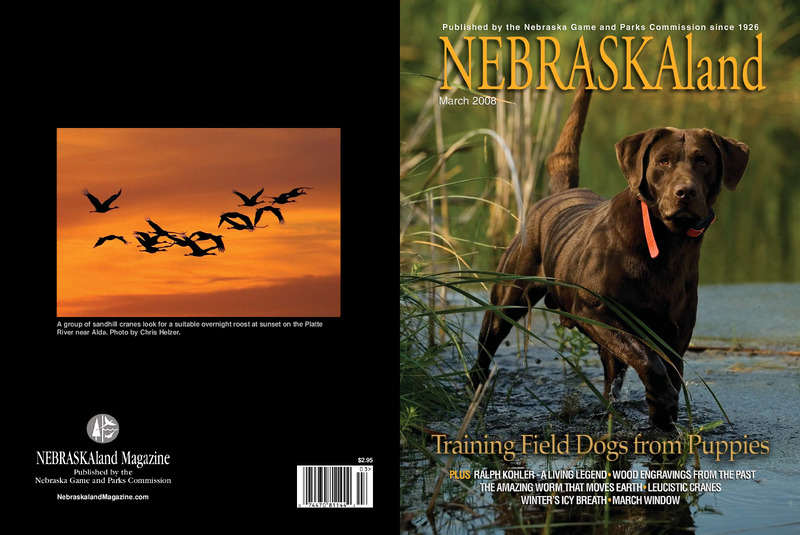
A group of sandhill cranes look for a suitable overnight roost at sunset on the Platte
River near Alda. Photo by Chris Helzer.
NEBRASKAland Magazine
$2.95
0 3>
Published by the
Nebraska Game and Parks Commission
NebraskalandMagazine.com
0
74470 81144
2
Volume 86, Number 2, March 2008
10 From the Litter to the Field
Purchasing a puppy is just the start of a new dog owner’s
commitment. From picking to training, each step must be
carefully executed to provide the most reliable companion
afield. TEXT AND PHOTOS BY JEFF KURRUS
18 Earth-mover
One can easily marvel that this practically senseless, dimwitted, vulnerable, fluid-filled tube is both a fertilizer factory
and an earth mover par excellence. BY LISA KNOPP
20 Wood Engravings of the Past
Precursors to today’s photojournalism practices, woodblock
engravings brought to life many aspects of early Nebraska
life that otherwise would have remained virtually unknown.
BY ROCKY HOFFMANN
28 Ralph Kohler – Legend of the Outdoors
It is unlikely any Nebraska waterfowl hunter can match the
number of days Ralph Kohler of Tekamah has logged in a
blind during the last 80 years. BY JON FARRAR
38 Leucistic Cranes – Rare, But Hard to Miss
“Rarer than hen’s teeth,” a pair of leucistic sandhill cranes
were often mistaken for whooping cranes last year near
Kearney. TEXT AND PHOTOS BY ERIC FOWLER
20
●
40 Winter’s Breath
Major ice storms last year left a swath of destruction across
central Nebraska that was both beautiful and costly.
BY ROCKY HOFFMANN
8 Outdoor Business
Power lines at Rowe Sanctuary more crane friendly.
46 In the Field
A March window of opportunity opens at Mayberry Lake SRA.
47 Mixed Bag
38
●
28
●
Good-All reels of Ogallala.
49 Parks & Places
Spawning catfish gather below Spencer Dam.
Comment . . . . . . . . . . . . . . . . . . . . . . . . . . . . . . . . . 4
Outdoor News . . . . . . . . . . . . . . . . . . . . . . . . . . . . . 6
Classifieds . . . . . . . . . . . . . . . . . . . . . . . . . . . . . . . 48
Portraits from the Past . . . . . . . . . . . . . . . . . . . . . 50
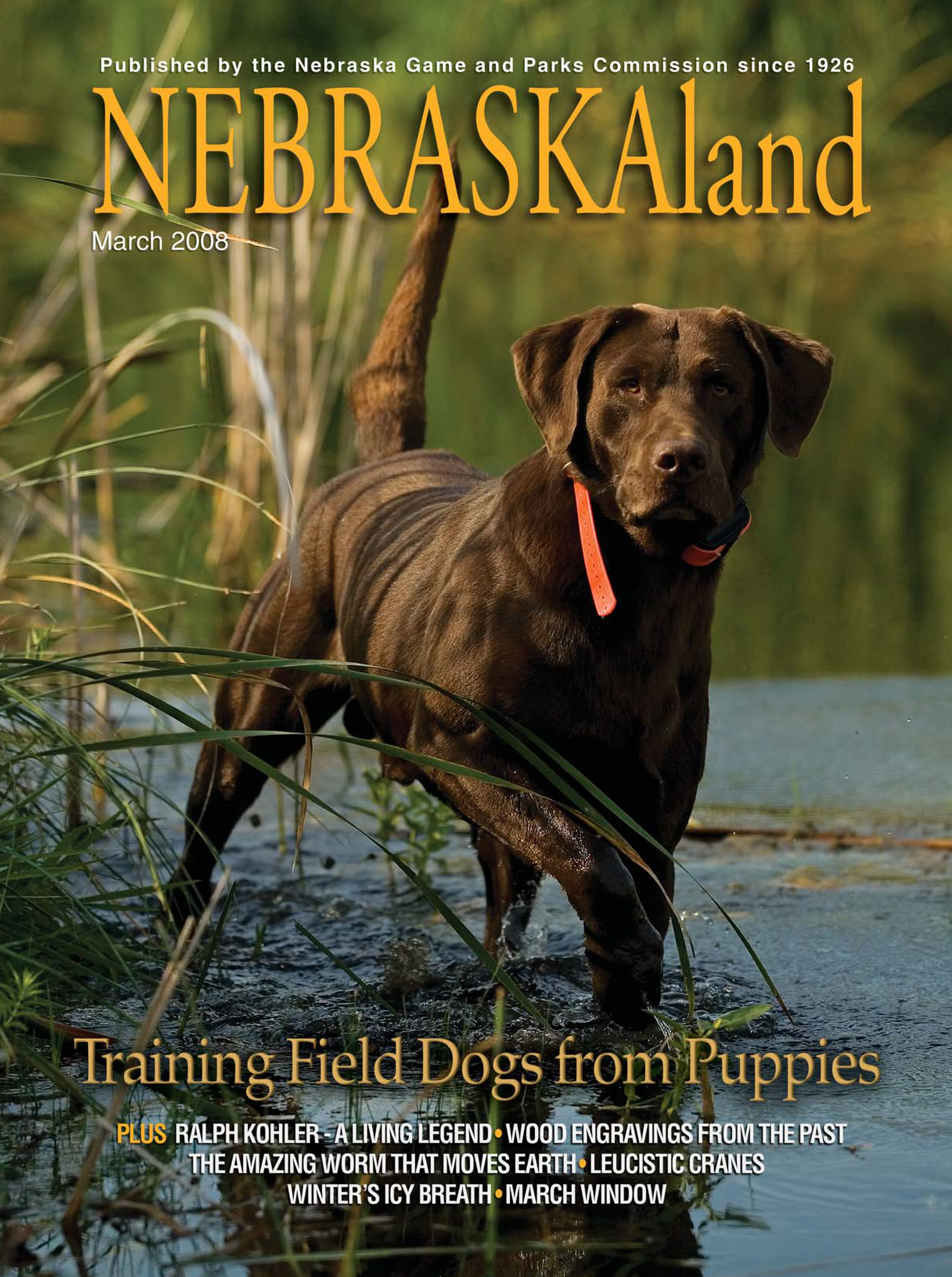
Cover: With a little planning and training, you may have a dog as well trained and stylish as
the chocolate Labrador pictured. For tips on choosing and training a dog you can be proud of,
turn to page 10. Photo by Jeff Kurrus. Opposite: Last fall's rigid goldenrod seed heads are
encased in ice following an ice storm in Aurora. Photo by Chris Helzer.
40
●
MARCH 2008 • NEBRASKALAND 3
Blue With Cold Bluebirds?
Every year that I’ve lived here,
bluebirds have been stopping for a
brief rest, mostly to take a drink.
One late winter (almost spring) I saw
a bluebird two days in a row, checking
out birdhouses. I purchased two
bluebird nesting boxes, thinking I
could entice the birds to stay here and
nest. So far, however, the bluebirds
have not made their home here and
the wrens have moved in instead.
Well, last December 5, four bluebirds
where resting in the tree across from
the sunroom, taking turns drinking
water from my heated birdbath. All
Published by the
Nebraska Game and
Parks Commission
Director: Rex Amack
Assistant Directors:
Roger Kuhn, Kirk Nelson, Sam Sidner
Information & Education Administrator:
Doug Bauch
Commissioners
Chairman:
James Ziebarth, Wilcox
Vice Chairman:
George E. Hall, Bridgeport
2nd Vice Chairman:
Jerrod Burke, Curtis
Dr. Mark Pinkerton, Wilber
Ron Stave, Waterloo
Dr. Kent Forney, Lincoln
Lynn Berggren, Broken Bow
Mick Jensen, Blair
Magazine Staff
Editor: Doug Carroll
Associate Editor: Jeff Kurrus
Art Director: Tim Reigert
Senior Editor: Jon Farrar
Regional Editors:
Eric Fowler, Bob Grier, Rocky Hoffmann
Contributing Editor: Michael Forsberg
Circulation: Donna Robinson
Photo Librarian: Sarah Johnson
NEBRASKAland
ISSN: 0028-1964
VOL. 86 / NO. 2
MARCH 2008
Published monthly, except for Jan./Feb. and Aug./Sept.
issues, by the Nebraska Game and Parks Commission, 2200
N. 33rd St., Lincoln, NE. Copyright 2008, all rights reserved.
Please address comments or questions to this address.
Periodicals postage paid at Lincoln, Nebraska, and other
locations. POSTMASTER: Send all address changes to
NEBRASKAland, P.O. Box 30370, Lincoln, NE 68503-0370.
NEBRASKAland is available on audio cassette from the
Nebraska Library Commission Talking Book and Braille
Service, Suite 120, 1200 N St., Lincoln, NE 68508. (800)
742-7691.
Rates: $18 for one year; $33 for two years; $44 for
three years. Nebraska residents must add
appropriate sales tax.
To subscribe call 1-800-NEBLAND (632-5263),
or go online to: NebraskalandMagazine.com.
For address changes and questions about your
subscription, e-mail donna.robinson@ngpc.ne.gov.
4 NEBRASKALAND • MARCH 2008
Shirley Allder of Lincoln sent in this picture of her grandson. “Issak was icefishing with his dad and grandpa. He fell asleep but still held on to his line.”
Storz Story
I enjoyed the November issue of
NEBRASKAland, especially the
photo of former governor Roy
Cochran and Art Storz. I'm from
Ogallala and after World War II,
spent many a happy morning in a
duck blind on Lake Mac and the
Platte River west of Lewellen, so the
photo was full of memories. One of
my friends at the time was Bill
Olson, a banker in Ogallala whose
family was from Oshkosh and Lisco.
Sometime after the passing of Art
Storz, they purchased Ducklore
Lodge and one Sunday we spent the
day there.
I was really moved by this issue
and think an article regarding Art
Storz, the history and activities at the
lodge, his guests, and the hunting that
occurred there would be fantastic! I
hope you consider it.
Dan Saunders,
Tempe, Arizona
Although it was quite a while ago,
we have done a story on Art Storz
and Ducklore Lodge. It appeared in
the 1987 November and December
issues of the magazine.
-Editor
Missing Names
The picture on page 16 of the
November 2007 NEBRASKAland
magazine was also on pages 32-33
of the July 1979 issue, "Sporstman's
Scrapbook, A 100 Year History of
the Outdoors." I showed the picture
to my dad, John A. Herrod Jr. (19051992) back then. He was able to tell
me the likely names of those pictured
with Keith Neville, and that the
group hunted on Brogan land. My
grandfather, John A. Herrod Sr.
(1861-1957) hunted on McFadden
land just west of theirs, and one of
his daughters married a McFadden. I
purchased the Brogan ground and
hunt there now with the grandsons of
one of the men pictured. We believe
Fred Petersen Sr. is second from
the left. He was the North Platte
postmaster. The other three men
may be, in no particular order, John
Denn, Eric Broker and "General"
Miltonberger. The General was head
of the National Guard we believe.
All or some of these men may have
been WWI veterans. They were all
involved in the Lincoln County
Sportsmen's Club and helped
organize a Ducks Unlimited chapter
in North Platte in the late '30s. My
dad was on the committee and
remembered the names of all his
friends who worked on the event.
Ducks Unlimited, sportsmen's clubs
and NEBRASKAland Magazine have
been a large part of my life.
Good health and good hunting,
Joe Herrod
Lincoln, Nebraska
Headquarters
2200 N. 33rd Street
Lincoln, NE 68503
Phone (402) 471-0641
District Office I
East Hwy. 2, Box 725
Alliance, NE 69301
Phone (308) 763-2940
District Office II
524 Panzer St., Box 508
Bassett, NE 68714
Phone (402) 684-2921
District Office III
2201 N. 13th St.
Norfolk, NE 68701
Phone (402) 370-3374
District Office IV
301 E. State Farm Rd.
North Platte, NE 69101
Phone (308) 535-8025
District Office VI
1617 First Ave.
Kearney, NE 68847
Phone (308) 865-5310
Omaha Office
1212 Bob Gibson Blvd.
Omaha, NE 68108
Phone (402) 595-2144
Ak-Sar-Ben Aquarium
21502 W. Highway 31
Gretna, NE 68028
Phone (402) 332-3901
World Wide Web site: www.OutdoorNebraska.org
E-mail: info@ngpc.ne.gov
of a sudden, one flew onto the
shepherd’s hook outside the window.
I had no time to open the window
and was forced to take a picture
through it. I noticed the birds had
frozen droplets of water on the end
of their beaks. I didn't get another
photo op of the birds before they left
for a warmer climate, but am sharing
this story because the December 5
sighting of bluebirds was a very
unusual event.
Marion Ball
Arlington, Nebraska
Send your comments to:
Doug Carroll, Editor
NEBRASKAland Magazine
P.O. Box 30370
Lincoln, NE 68503
or e-mail doug.carroll@ngpc.ne.gov
Please include your postal address
and telephone number.
Letters may be condensed and edited
for clarity. Photographs are
welcome and will be returned.
Under federal and/or state law, discrimination is prohibited on the
basis of race, color, religion, age, gender, marital status, national
origin, disability or political affiliation. If you think you have been
discriminated against in any program, activity or facility by the
Nebraska Game and Parks Commission or want more information,
contact the Commission in Lincoln, NE, at (402) 471-0641 or the
Equal Opportunity Commission, Lincoln, NE, (402) 471-2024,
TTY/TDD (402) 471-4693).
Administration
Ted Blume (Adm.)
Craig Stover (Asst.)
Wes Loos (Asst.)
Rod Loos (Asst.)
Murray Johnson
Lincoln
471-5531
Lincoln
471-5532
Lincoln
471-5591
Ogallala (308) 284-8056
Lincoln
471-5003
Panhandle
Officer
City
Phone (308)
Jim Zimmerman (Sup.) Gering
436-7561
Walt Meyer
Chadron
432-4398
Scott Brandt
Gering
436-3418
Heath Packett
Gordon
282-2553
Dennis Thompson
Ogallala
284-6450
Dan Zuehlke
Ogallala
284-4815
Doug Pollard
Oshkosh
772-9950
Frank Miller
Valentine (402) 376-1183
Dan Kling
Whitney
432-8367
Southwest
Officer
City
Phone (308)
Roger Thompson (Sup.) N. Platte
532-9175
Ray Dierking
Brkn. Bow
872-3078
George Sund
Cambridge
697-4629
Michael Thome
Cozad
784-4362
Matt Andrews
Elwood
785-3025
Dirk Greene
Imperial
882-5328
Virgil Gosch
McCook
345-2185
Dudley Sorensen
N. Platte
532-0747
Rich Routh
Rep. City
799-2085
South-central
Officer
Jerry Pecha (Sup.)
Jeff Jones
Randy Pomplun
City
Phone (308)
Kearney
865-5327
Clay Center(402)762-3124
Fullerton
536-2987
Terry Brentzel
Darin Gress
Dale Johnson
Mark Reeves
Robert Finke
Richard Seward
Grand Is.
384-8296
Hebron (402) 768-2287
Kearney
237-1079
Loup City
745-0662
Milford (402) 761-3537
Ord
728-3115
Northeast
Officer
Tom Zimmer (Sup.)
Robert Kelly
Dale Davis
Ross Oestmann
Steve Oberg
Daniel Roberts
Jon Reeves
Marion Shafer
Pat George
Eric Wiebe
Tim Williams
Cory Krause
City
Phone (402)
Norfolk
371-6625
Albion
395-2538
Bassett
273-1700
Bloomfield
373-4412
Columbus
564-5937
Fremont
721-7852
Kennard
427-7378
Norfolk
371-2031
O’Neill
336-1588
Ponca
755-2566
Neligh
887-1335
West Point
372-6979
Southeast
Officer
Duane Arp (Sup.)
Sean McKeehan
William Krause
Jeremy TenKley
Mike Luben
Douglas Kramer
Dina Barta
Stacey Lewton
Levi Krause
Russell Mort
Dan Evasco
Jeff Clauson
City
Gretna
Ashland
Auburn
Beatrice
Colon
Lincoln
Lincoln
Lincoln
Louisville
Nebr. City
Papillion
Waterloo
Phone (402)
332-2965
944-4174
274-3789
228-1437
443-4278
466-9001
483-2358
476-0436
234-2212
873-5684
592-6733
359-5301
Nebraska Wildlife Crimestoppers 1-800-742-7627
MARCH 2008 • NEBRASKALAND 5
Variable-power Scopes Now
Legal for Muzzleloaders
At their January 17 meeting, the
Nebraska Game and Parks
Commission approved the use
of variable-power scopes on
muzzleloaders during Nebraska
muzzleloading seasons. Prior to this
action, only scopes of up to one
power were legal to use during the
statewide muzzleloading season.
Kit Hams, big game program
manager for the Commission, said
the change in regulations should
result in cleaner kills, increase the
number of deer harvested and
hopefully recruit more hunters to
the muzzleloading ranks.
“First, this change should enable
people to sight more accurately,
which will assist in harvesting deer,
especially in low light conditions.
“Second, it will also allow people
to use something they are familiar
and comfortable with, since a lot of
people don’t know how to use open
sights very well. The argument
about people with poor eyesight
having trouble shooting accurately
without a scope is a fact – open
sights are more difficult to use, so
this change is a benefit for them.
“Third, this should increase
recruitment and participation, with
more hunters probably willing to
buy a muzzleloader permit. I hope it
can raise the number of permits sold
20 to 25 percent and increase the
harvest of antlerless deer.”
Hams said that despite arguments
that muzzleloader hunters will now
wound more deer because they will
take longer shots, he believes just
the opposite will happen: Hunters
will shoot more accurately at closer
deer.
The bottom line, Hams said, is
that the new regulations will help a
lot of current and potential hunters
while hurting very few.
Traditionalists will still be able to
hunt with open-sighted, more
traditional weapons, while other
hunters can use more modern
technology in their hunting efforts.
6 NEBRASKALAND • MARCH 2008
to local wetlands and lakes. This year
there will also be a pre-festival trip
to Lake McConaughy on March 13.
Conference activities will be held
in the Holiday Inn convention center,
and discount room rates are available
for conference registrants. For more
information visit
www.nebraska.audubon.org.
Antler Scoring Workshop
The Nebraska Game and Parks
Commission’s annual antler scoring
workshop will be held from 9 a.m.
to 4 p.m. on Saturday, March 8, at
the Ak-Sar-Ben Aquarium, located
five miles south of I-80 exit 432 on
Nebraska Highway 31.
Hunters are invited to bring their
deer, elk, or pronghorn trophies to
be officially scored on a first-come,
first-served basis by Commission
staff and volunteer scorers for entry
into the Nebraska Big Game Trophy
Records Program, the Boone &
Crockett or Pope and Young clubs or
the Longhunter Society record book.
There is no charge for the scoring
or entry into Ak-Sar-Ben Aquarium,
and hunters are encouraged to bring
proof of harvest in Nebraska for
recording purposes.
Call the aquarium at (402) 3323901 for more information.
Rivers and Wildlife
Celebration
The 38th annual Rivers and Wildlife
Celebration will be held March 1416 at the Holiday Inn in Kearney.
Wildlife enthusiasts from around
the world are expected to attend and
help celebrate the annual migration
of 500,000 sandhill cranes and
millions of waterfowl through
central Nebraska while learning
more about the natural world in a
friendly and informal atmosphere.
Renowned wildlife artist Robert
Bateman will be one of the featured
speakers at the event, which includes
field trips to crane viewing blinds
along the Platte River and excursions
Hunting-Related Incidents
Up from 2006
Following a record year in 2006,
when only six hunting-related
accidents were reported, Nebraska
recorded 12 hunting-related incidents
in 2007, including one that was fatal.
The fatal incident involved a 50year-old man who shot at a coyote
with a rifle from the deck of his
Saunders County home. The bullet
struck and killed a 47-year-old man
who was hunting for deer several
hundred yards away.
“Hunting incidents that result in
injury or death are extremely rare in
Nebraska,” said Nebraska Game and
Parks Commission Hunter Education
Coordinator Mike Streeter. “The
injury rate per 1,000 hunters is usually
lower than .01 percent. The average
number of people who participate in
hunting in Nebraska is around
170,000 each year, and the last 10year average of incidents where a
hunter was injured or killed is
around 12 per year.”
Streeter said the incidents occurred
because one or more of the participants
did not follow safety rules. Three
were due to the shooter not paying
attention to what was beyond the
intended target, and two involved
falls from tree stands. Other causes
were: failure to unload a firearm
when it wasn’t in use, failure to
practice muzzle control, and
allowing the muzzle of a firearm to
be pointed at another person. Five of
the incidents took place while hunting
deer, three while hunting upland
birds, two while hunting nongame
animals, and one each while hunting
turkey and small game. ■
MARCH 2008 • NEBRASKALAND 7
Firefly Diverters Installed at Rowe Sanctuary
We can’t afford to loose even a single
Partners hope devices will make power lines more visible and reduce bird mortality.
whooper to a collision with a powerline.
That’s the greatest single cause of
mortality for migrating cranes...
t is a virtual smorgasbord for
predators and scavengers, the
short stretches of the Platte River
that lie beneath two power
transmission lines on Audubon’s
Lillian Annette Rowe Sanctuary near
Gibbon. Last year, a study found 90
University of Nebraska at Kearney student Tim Smith counts sandhill crane
corpses in the Platte River beneath a power transmission line at Rowe Sanctuary
last March. An estimated 90 cranes died from collisions there last year.
8 NEBRASKALAND • MARCH 2008
Still more birds were fatally injured
but died elsewhere. In all, the study
estimated that 150 cranes died as a
result of the power lines, as well as
15 other species of fowl.
“We found bones and pieces of
birds all across the river,” said Bob
Harms of the U.S. Fish and Wildlife
Service’s Biological Field Services
office in Grand Island. “Every kind of
bird you could imagine was hitting
those lines – cranes, ducks, geese,
pelicans, sparrows – it’s a predator
buffet.”
Whether it’s 90 sandhill cranes or
200 that died is but a drop in the
bucket in the grand scheme of things,
a few hundredths of a percent of the
500,000 or so sandhill cranes that stop
on the river each spring during their
northward migration. But the risk to
the 237 or so endangered whooping
cranes that stop on the Platte, where
one bird represents four-tenths of one
percent of the population, as well as
other endangered, threatened and even
common birds, was great enough that
it led to a project biologists hope will
reduce bird deaths.
“This river segment between the
Gibbon and Minden bridges is the
most frequented by whooping cranes,”
said Harms. “We can’t afford to lose
even a single whooper to a collision
with a power line. That’s the greatest
single cause of mortality for migrating
cranes, hitting power lines.”
In late-August, Dawson Public
Power District (PPD) installed 465
Firefly diverters at 20-foot intervals at
the two sites, covering nearly a mile at
one location and 3,800 feet at the
other, across both water and the
adjacent land.
The plastic diverters clip to the
wires and spin in the wind. With
both reflective and glow-in-the dark
stickers on each side, they will create
a flashing effect for a few hours after
sundown that biologists hope will be
least tern, which also use
the river.
Most collisions with
power lines occur between
dusk and dawn, but weather
can also play a factor.
“If we have a lot of fog
or a snowstorm and the
birds get disturbed at
night … ,” said Bill
Taddicken, a biologist at
Rowe. “There are times
that birds can’t see well
anyway. But people in the
blinds have seen them hit
wires in good light, too.”
Area birdwatchers and
other visitors have also
seen grotesquely injured
Bob Miller of Dawson Public Power District installs
birds, with shattered wings
Firefly flight diverters on a transmission line
or missing legs, that are the
across the Platte River.
result of collisions with the
enough to get the birds to fly over the wires. “That’s not a great thing for
people to have to see,” said
lines.
Taddicken.
The U.S. Fish and Wildlife Service
A previous attempt to make the
(FWS) got the ball rolling on the
lines more visible by installing yellow
project a few years ago, after hearing
coils on the wires proved ineffective
about the bird deaths and then
because the coils quickly faded and
surveying the sites. Dawson (PPD)
was eager to cooperate on the project, weren’t very visible. Project partners
are more optimistic about this attempt,
which soon grew into a collaborative
but a UN-K study will measure the
effort that also included the National
effectiveness.
Audubon Society, which owns and
Bob Murphy, an assistant professor
manages Rowe Sanctuary, the
of biology who is teaching natural
Nebraska Game and Parks
Commission, the Platte River Whooping resources and ornithology at the
school, said this year’s research will
Crane Trust and the University of
be more intensive than the previous
Nebraska at Kearney (UN-K).
two years in an effort to quantify the
When it approached Dawson PPD,
the FWS was acting under the authority variables that are difficult to measure,
of both the Migratory Bird Treaty Act, including how many birds washed
downstream or were carried away by
which allows no take, be it voluntary
predators before observers counted
or involuntary, of most migratory
them, or how many flew off and died
birds, and the Endangered Species
elsewhere.
Act, which extends even more
“We really didn’t know where to
protection to whooping cranes. There
start,” he said of the difficulty of
is also concern for the threatened
estimating those factors. “This year,
piping plover and the endangered
because we’re going to do intensive
observation, we’ll be able to get the
information and see whether that is an
issue. We collected 90 carcasses and
based on stream flows and depth,
there were possibly another 50 or 60
cranes we missed.”
Observations at dawn and dusk will
also determine if a strike indicator that
will be installed on the transmission
line is as accurate in this case as it has
proven to be elsewhere. The
instrument detects vibrations caused
by birds colliding with power lines.
Observations and carcass monitoring
will also be conducted at other sites
where power lines span the Platte to
see how bird mortality compares to
what is occurring at Rowe. The
effectiveness of the Fireflies will fade
in a few years and they will need to be
replaced. But the cost is less than
burying the lines, a multi-million
dollar project that has been discussed
but no more. ■
PHOTO BY BRADLEY MELLEMA, ROWE SANCTUARY
PHOTO BY ERIC FOWLER
I
dead sandhill cranes on sandbars and
in the shallows beneath the wires,
where coyotes, raccoons, crows and
other furred and feathered creatures
feasted on the carcasses. The river and
predators carried away more evidence
of death before it could be counted.
PHOTO BY BRADLEY MELLEMA, ROWE SANCTUARY
By Eric Fowler
Firefly reflectors, which spin in the wind
and glow in the dark, are being installed
to help make power lines more visible
to birds. A previous attempt, yellow
coils that glowed at night, is pictured
here as well.
MARCH 2008 • NEBRASKALAND 9
at both
The Italian spinone (pictured) excels as
both pointing
a pointerand
or
retrieving,a afact
factpotential
potentialdog
dogowners
ownersshould
shouldknow
knowbefore
before
retriever,
purchasing.
P
urchasing a hunting dog can do
nothing but add to the pleasure
of the sport – if done correctly. I
have seen more than one dog point a
covey a quail, wait for the flush, then
point the first of many singles before
the shooter has vested the first bird. On
the other hand, I’ve also been on the side
of the road in the middle of nowhere,
Kansas, chasing a dog that refused to
hunt or return to the car, as the group
debated whether to leave just the dog,
or the owner and his dog, to fend for
themselves while we went to the
closest restaurant for supper.
You never want to be “that guy” in
the field, the one with the dog who
doesn’t obey, can’t locate birds, or
can’t retrieve. Instead, you want to be
the one that is called when a friend has
wrangled a new hunting spot. With a
good dog, you will be.
Given another chance, are there
things a dissatisfied pet owner could
12 NEBRASKALAND • MARCH 2008
have looked for to help guarantee a
better field companion? Furthermore,
are there universal teaching steps that
should be taken, regardless of the type
of dog selected or hunting desired,
once this training begins? Yes, and yes.
The practicality of the following
steps makes dog training seem like one
of the most doable aspects of the
outdoors as long as you possess one
attribute: commitment.
Litter Picking
“I train a dog which retrieves 200
geese during a weeklong trip to Canada
each year,” said Bart Peterson,
professional dog trainer and owner of
Bar Ten Kennel in Cozad, “and then
comes back to Nebraska and hunts four
days a week with his owner.” Prospective
dog owners have to know themselves
when purchasing a dog: Are they a
once-a-week hunter looking for a dog
that works close and is easy to handle?
Do they hunt three times a week and
want a strong dog that can hunt long
days? Aggressive and quick, or slow
and methodical? Ducks or quail?
Pheasants or geese? Or a little bit of
everything?
There is a long list of traits to look
for in a new dog. “You want a dog that
walks through like he owns the place,”
said professional dog trainer Scott
Steede. “When I’m picking out a dog,
I’ll throw an empty milk jug in the
corner of the pen and see what puppies
go to it first. The milk jug is usually
bigger than the dogs and gets them
ready for tall grass. The ones that go to
it aren’t intimidated and are going to
do well in the field. If I have a hat, I’ll
do the same thing.”
“If you’re picking out a dog to hunt
with because he’s cute or an attractive
shade of yellow or white,” said
Pheasant Bonanza trainer Ben Murray,
“then you’re taking a big chance on
whether or not he’s going to be a good
dog.”
“Forget looks. You want a dog that
has two things: confidence and desire,”
said Steede. “Have you ever been with
a dog who will hunt for 10 minutes and
then be behind the hunter? That dog has
a lack of desire. A hunter wants a dog
that would rather spend time in the brush
versus near the fireplace.”
Murray laughed. “I’ve seen very
young dogs, ones with a ton of desire,
walk right up to birds, tame geese for
example, and try and bite them.”
“With a good breeder, you can find
an entire litter that has confidence and
can turn off the lights and get a good
dog. Take the milk jug, and look for the
one that wants to explore,” Steede said.
Conversely, picking a dog from an
unknown breeder or a classified ad can
be quite chancy. Spend a lot more on
your dog versus your gun, these dog
trainers said, but the real issue goes
back to the seller of your dog. There’s
no reason to think spending $75 on a
crossbreed between a German shorthair
and a German wirehair is going to yield
a bird dog that you would stake your
life on. At the same time, many people
reason that spending an excessive
amount of money is not an option.
“But you will be wasting money if
you’re paying $150 for a dog and then
spending $800 a month in training,”
Steede said. “You’re better off putting
that money in a good dog and training
it yourself.”
“If a dog is talented,” said Murray,
“after 30 days we’ll know the dog is
going to be great. If we have a marginal
dog come in to be trained, after 90
days, you’ll see a marginal dog.”
“A potential dog owner needs to
understand that some dogs are very
talented and some are not,” said
Peterson. “No matter how hard you work
and prepare, and no matter how good
you are as a trainer, if you don’t have the
ability that God gave the dog then you’re
not going to get to the upper level.”
“A lot of people think they’re getting
a good deal when they buy a $150
puppy,” Steede said. “My experience is
when the dog has been part of a field
trial family and they have eight puppies,
all eight puppies will be good. With a
backyard breeder, you’ll have a couple
shining stars and the rest are marginal.
We have more problems with $150
dogs than we do with any other ones.”
“Most dogs I reject as candidates to
train are those found in a classified ad
that says ‘both parents hunt,’” said
Peterson. “Maybe they do, but do they
really retrieve? Plus, finding a wellbred puppy also deals with a dog’s
health, especially a Labrador retriever’s.
If you are buying a Lab, you need to
ask two questions before anything else:
1) Are the dog’s hips Orthopedic
Foundation of Animals (OFA)
certified, stating they are free of hip
dysplasia; and 2) Has CERF (Canine
Eye Registration Foundation) found the
Lab’s eyes free of retinal displacement
(or genetic eye disorder)?”
Peterson recommends finding a dog
with a pedigree of field trial work. While
there is a misconception about these
dogs being too wound up and headstrong,
he said dogs with these traits don’t
make it in field trial competitions.
“Abby, that yellow Lab,” he said,
pointing to her as she lie beneath his
truck, “when she’s done working, she’s
calm and does exactly what she’s doing
now. But she is a Platte River machine,”
he said. “She marks, runs super-straight
blinds and you can shoot as much as
you want. She’s also a good pheasant
dog. Eight people walking CRP fields
in South Dakota and she’ll quarter the
Some basic training steps will be used with
any dog, but there are major differences in
the overall training regimen for pointing
breeds, such as a Brittany spaniel
(pictured, left) versus retrieving breeds,
such as a Labrador retriever (right).
MARCH 2008 • NEBRASKALAND 13
entire time. She can go from the
pheasant field, to the duck blind, to the
field trial, without missing a beat.”
“The problem we have is that people
buy a dog without putting a whole lot
of thought into it,” said Murray. “You
have to look at it like having a child.
You’re taking care of this dog for the
next 15 years.”
Taking care of that dog begins as
soon as the owner signs on the dotted
line. Subsequently, training is not far
behind. And there are two ways to do
it: professionally-trained or hometrained. A new dog owner should look
at it this way: should they home school
their child, or send their child to
school? Dog training should be viewed
in the same way. And the owner must
still understand how important it is to
continue working with that dog at
home, regardless of who first trains it.
Home Training Tips
The owner must first lay a
foundation for future training. This is
why so many people begin with simple
commands such as “sit” and “stay.”
There’s no reason to have a dog that
knows how to hunt but hunts for itself.
Having a dog learn there are rules to
your relationship will allow for
additional teaching down the line when
more challenging training begins.
When you have a new dog, look at this
dog like trying to break a habit. It is
going to take time.
“Start your training
session with a goal,”
said dog trainer
Scott Steede.“If the
goal takes two
minutes, then stop.
If it’s twenty, quit
after it’s achieved.”
14 NEBRASKALAND • MARCH 2008
The best way to begin working is in
short bursts. Long, drawn-out training
sessions are negative for both the trainer
and dog. Not only will the young dog
lose interest because of its short
attention span, there’s also a good
chance the trainer will lose something
even more important, consistency.
For example, a new dog owner might
become so upset with a task the dog is
failing to complete that he will do it
over and over again long after the dog
has become frustrated or lost interest.
At the same time, a dog might perform
a task correctly and the owner wants to
see it repeatedly, wants to show friends
and family that their newfound student
can do it “one more time, one more
time.”
A trainer has to understand that the
task, even one as simple as sitting,
could become work for an anxious
puppy. “I’ve seen Lab owners take a
very young pup and make him retrieve
all summer and then question why he
isn’t retrieving come wintertime. A dog
will look forward to coming out here
every day because it’s a blast, not if it
becomes a job,” said Steede.
“The biggest aspect of training Labs
is socialization,” said Peterson. “With
Lab pups, we like to get people
involved at three to four weeks of age
once the pups have their eyes open and
are climbing out of the whelping box.
They are weaned, eating solid food and
also receive their first vaccination at the
fourth week. After this, it is pretty safe
for them to interact with the world and
we make sure they do just that. We will
have clients and their kids come over,
and have the kids sit right in with the
puppies and play with them. At four to
five weeks, the puppies come out of the
whelping room and venture outside. At
that point, they are introduced to their
first birds – a frozen teal or pigeon.
Just so they can pick the bird up. At
five to six weeks, we start retrieving
with tennis balls and small birds. At
seven weeks, they start riding in the
truck, going along to training sessions
and field trials. They begin to hear
gunshots, and they should also be
retrieving on land or in water with
birds or dummies. During that same
time, our clients will pick their dogs
back up. And the first thing the owner
should notice is how aggressive and
happy their new Lab pup is running out
When working with Labs, says dog trainer Bart Peterson, be sure to start your dog on water retrieves at an early age.
of the kennel.”
With this said, Peterson also added
that there is no magic date to officially
start training a dog. Some dogs are
more immature than others, and others
aren’t as aggressive. As a general rule,
however, once a dog’s adult teeth are in
their mouth it’s usually a good time to
start the training that a handler intends
to reinforce.
“Start your training session with a
goal,” said Steede. “If the goal takes
two minutes, then stop. If it’s twenty,
quit after it’s achieved.” Steede pointed
to a German shorthair he was training.
“This dog has never been out here. If
he finds the bird, the goal is done.”
Steede motioned to a pointer. “He is
working on steadiness. I’ll restrain him
when he’s on point. If he stays calm
once the bird flushes, the goal is
accomplished.”
One of the most important aspects of
training, Steede said, is that a limited
amount of negativity should occur when
in the field. The tougher moments, he
believes, must occur in the yard because
the field is for hunting and positive
experiences, an idea also shared by other
trainers. “I don’t do a lot of training with
my dogs, per say,” said longtime
Nebraska pheasant hunter Lee Rupp,
who was the topic of the November
1999 NEBRASKAland article, “Think
Like a Rooster.” “But everything I do
with the dog is associated as something
positive.”
Even if some negative training
moments do occur between handler and
dog, finish with a positive. This is ageold, common sense handling, yet it still
applies today. The last thing a young
pup needs to do is finish a day at school
feeling like the dumbest kid in the
room. “You don’t want to be forceful in
the field,” said Steede. “You can do the
retrieving work, which can become
extremely repetitive, in the yard. A lot
of people read books and the books
stress yard work drills. That’s good, but
when people come out in the field, they
force steps like they would in the yard
and dig themselves a hole.
“Even the ones I restrain out here,”
continued Steede, holding a chukar in
his hand before releasing the next dog
from its kennel, “I only restrain a little
bit. You’ve seen guys cramming a dead
bird in a young dog’s mouth. Why
would you want to give a dog that bad
experience? Do things like that with a
retrieving dummy in the yard. Make
reads off the dog. You’ll hit walls.
When you do, back off.”
“I have a six-year-old male field
champion Lab that weighs 88 pounds,”
said Peterson. “He’s a creampuff. So
you have to be real careful with him
when training, making sure you don’t
overtrain or overcorrect because the
dog will get down about it. I have
another dog, a young 45-pound female
MARCH 2008 • NEBRASKALAND 15
Lab, that you can’t train enough.
Another Lab I have has so much drive
that when he sits in a holding blind, he
quivers and nearly yodels the entire time
he sits there, waiting for something to
happen.”
These statements are made by people
who train dogs for a living, those who
analyze the differences between dogs
and make adjustments because of these
differences. Not only is a handler
training a dog, they’re also training
themselves to be a more consistent
trainer, something that doesn’t end
when the dog is out of the field.
“The dog needs to learn that
regardless of where he’s at, he needs to
perform because a dog will shut down,”
said Steede. “The big key is following
up. A dog will do what it wants to do,
hunt and quarter, but will often not do
what it doesn’t want to do, sit and
mind. ‘How come the dog won’t do it
for me?’ people ask. Because we make
them do it.”
Advanced Do’s and Don’ts
There are several specific points that
both the dog trainer and the dog should
know before entering the field. Here is
that list:
1) Know your breed: Pointing breeds
and young dogs want to run. “We put
birds out close for dogs that want to
run,” said Steede. “That way, the dogs
understand that the birds aren’t far off.
They are right here.” In the future, if
the dog isn’t finding birds in front of its
hunters, the dog will check back
knowing that there is the possibility of
a bird being close to the handler. “As
far as breeds are concerned, we also
make it a point to pet and praise
pointing breeds when they are standing,
and retrieving dogs when they are
sitting.”
2) The “Whoa” Command: If
working with a pointing breed, don’t
introduce the “whoa” command until it
is apparent that the dog is comfortable
with working with birds in the field.
Many dogs, if pressured, will sit when
“whoa’d,” something that isn’t needed
when a covey of quail is close by. The
“whoa” command never needs to be
something that a dog fears.
3) Collars and leashes: It’s good to
work a dog with a collar. It gets them
used to a routine. Using a leash is part
of avoidance training. If a dog is new
to the field, it allows for more control
to keep a dog extremely close by,
avoiding potential problems that could
arise if releasing a leashless dog in the
field for the first time.
4) Obedience training: “A dog that
knows he has to be good is a perfect
problem to have,” said Steede. “He
learns that it is the handler who is
going to give him freedom.” Always
work with obedience training with your
dog and be creative. For example, if it
is a dog that will be sitting most of the
time in the field, such as a duck blind
Lab, have the dog sit at each door you
encounter before you enter. You go
through, and then have the dog go
through behind you. If it is a standing
breed, such as a pointer, go through the
same steps with the dog standing.
5) Obstacles: Provide as many
different obstacles as possible during
training so there are few surprises
One of the largest problems a dog trainer
can encounter is a dog that hasn’t worked
with live birds enough. In Nebraska, the
harvest of pen-reared birds, with a limit of
five quail, two hen pheasants and unlimited
partridges, mallards, chukars (pictured,
left) and pigeons per dog per training
session, is allowed on private land as
well as five designated dog training
areas: Yankee Hill WMA and Wagon Train
Lake SRA dog training areas in Lancaster
County, Rakes Creek WMA in Cass
County, Red Willow Reservoir WMA in
Frontier County, and Sherman Reservoir
in Sherman County.
16 NEBRASKALAND • MARCH 2008
For pointing breeds, steadiness during a point is one critical component for success in the field.
afield, including water training. If you
like to pheasant hunt near cattails, there
is eventually going to be a downed bird
in the water. Make sure this isn’t the
first time your dog is exposed to a
water retrieve. Also, have the dog make
retrieves where they are forced to cross
a road, going from taller grass to no
grass at all. It’s just one more thing that
won’t confuse a dog if they see it in the
field. “If I have a dog that does not do
a certain type of retrieve well, that’s all
I’ll do for two weeks. I will do it with
very little correction, but I will make
them grind it out until they’re doing it,”
said Peterson.
6) Train alone: Quite often people
buy a puppy and work it with an older,
more experienced dog. “I never train
puppies with other dogs,” said Steede.
“They’ll just learn bad habits from old
dogs. Once I know the young dog can
hunt by himself, I’ll hunt with an older
dog. But people do it all the time.
Generally, as a rule, they’ll learn bad
habits and it’s better to let them learn
on their own.”
7) Teething: Steede and Peterson
both start formal training after the dogs
have their permanent teeth, which can
be a different time for each dog breed.
“There is no reason for a dog to pick
up a bird while they are teething and
associate that bird to some sort of
negativity, pain in this instance, with
hunting,” said Steede.
8) Distractions: When a dog gains
confidence with its surroundings in the
field, begin to add distractions. Extra
walkers, gunshots, conversations,
different terrain. The dog shouldn’t
hunt for just one person in the group.
Get the dog used to working with other
hunters so that the dog becomes a very
needed accomplice in the field, not an
adversary.
Time Spent
Steede spends at least six days a
week with the dogs he trains. He sees
them in small doses, and he understands
each of their strengths and weaknesses
and how to point them in the right
direction. He argues that a person can’t
teach a dog desire, but knows that if a
dog has talent there is a long list of
steps that should be taken when
training. And even though his
knowledge is immense, he is still in
constant contact with trainers asking
questions, and is always watching
videos and reading books to add one
more weapon to his training arsenal.
Because in the end, whether he’s at a
field trial competition or pheasant
hunting throughout Nebraska, he
knows his dog is only going to be as
good as its trainer. So he must instill
the same rules upon himself as he
would the dog.
Peterson, while working with a
different breed, carries similar
sentiments. “The money and time you
will spend, whether you choose a
professional or do the training yourself,
is a huge commitment. Watch the
videos and read as much as you can.
Something you read in this particular
book or journal might be more suited
for you, might strike a better idea while
you’re studying. Involve as many
different sources as you can. But
remember, always use common sense. If
you don’t want your dog to jump up on
the table, tell it not to. You don’t want
it to do something else, don’t let it.” ■
MARCH 2008 • NEBRASKALAND 17
Earth-mover
By Lisa Knopp
The lowly earthworm does more than move earth.
fter the first spring rain, the
earthworms are back: thickening
and thinning pieces of spaghetti
strewn on the sidewalk; wriggling, pink
tubes borne in a rivulet along the curb;
smashed smears on the street. Not that
the earthworms haven’t been there all
along. During the winter they burrow
deeply and hibernate. But when it
rains, legions of them come to the
surface where I can see them. I used to
believe that they surfaced because the
A
water flushed them out of their burrows.
Now I know that they surface before or
after a rain because then they can move
easily over the surface without drying
out.
Once the rain stops and the earth
dries, my work begins. When I set out
on my daily walk on such days, it’s not
for one of the carefree, meditative city
rambles that I love. Rather, I keep my
eyes to the ground and stop frequently
to lift a stranded worm off the sidewalk
Charles Darwin (1809-1882) in his later years. Photo by J. Cameron, 1869.
18 NEBRASKALAND • MARCH 2008
and set it in a curbside garden
or in the shade beneath a tree
where it can retreat into the
moist, cool, dark underworld.
The earthworm is a “skin
breather.” In the absence of
lungs, it absorbs oxygen directly into
its blood vessels through its skin, kept
moist by mucus-secreting cells. If the
thin skin dries out, the worm suffocates.
Some worms that I encounter are flat,
brittle “S’s.” I can’t save them. But
some are dark, dry and weakly moving.
They’re the ones that need me.
I barely noticed earthworms, much
less rescued them, until I read Charles
Darwin’s The Formation of Vegetable
Mould, Through the Action of Worms,
With Observation of Their Habits, a
slim volume in which he makes no
mention of evolution, natural selection
or the descent of man. By “vegetable
mould” Darwin meant topsoil, the rich
layer of soil in which I plant marigolds,
tomatoes and snow peas. For 44 years,
Darwin closely observed earthworms
and speculated about their significance.
In the final paragraph of this book,
published in 1881, one year before his
death, Darwin proclaimed: “It may be
doubted whether there are many other
creatures which have played so
important a part in the history of the
world.”
Darwin based this lofty claim on
what he observed in a pasture near his
house in England. In 1842, a layer of
chalk was spread over the field.
Eventually, the chalk dissolved but
pieces of flint remained. In 1871,
Darwin dug seven inches into the soil
before he reached the rock layer. He
calculated that the earthworms had
covered the flint with an average of
.22 inches of fertile soil per year. Give
the worms a full century and they’d
cover the rocks with two feet of soil.
Give them a couple of millennia and
they’d bury a city. The Roman ruins in
England were so well preserved,
Darwin said, because earthworms had
buried them.
What made these remarkable feats
possible is that in the process of
swallowing food (bacteria, fungi,
nematodes and manure; decaying roots,
rodents, bugs and a tossed apple core),
earthworms eat a lot of soil. Tons of it.
What they excrete are “castings” –
pellets of soil well-mixed with organic
matter that they deposit in mounds
outside the mouths of their burrows.
These castings are rich in calcium,
nitrogen, potassium, phosphorus, organic
minerals and nutrients, and so fertilize
my garden. Tunneling earthworms also
break up hard-packed soil, sift and aerate
it, even move stones. When in need of
fish bait, my son goes into the backyard
after dark with a flashlight and picks
up the night crawlers that have surfaced
into the relatively cooler, damper night
air. “Stay away from my garden,” I tell
him. “I need those worms.”
Darwin didn’t limit his studies to the
earthworm’s soil-building abilities. “As
I was led to keep in my study during
many months worms in pots filled with
earth, I became interested in them, and
wished to learn how far they acted
consciously, and how much mental
power they displayed.” To test their
sense of smell, Darwin breathed on the
worms after he’d put tobacco, perfume,
paraffin and ascetic acid in his mouth.
The earthworms only responded to the
latter, Darwin surmised, because it
irritated their sensitive skin. To test their
sense of hearing, Darwin assaulted
them with “the shrill notes from a
metal whistle ... the deepest
and loudest tones of a
bassoon ... the keys of a
piano ... played as loudly as
possible,” none of which had
any observable effect on the
worms. But when he placed
a pot containing two worms
on the piano and he hit “C”
in the bass clef, both worms
“instantly retreated into
their burrows.” Earthworms
couldn’t hear sounds but
they could feel them.
To study the mental powers of
earthworms, Darwin observed them as
they pulled leaves into the mouths of
their burrows. An instinctive behavior,
one might think, to keep food nearby
and to plug the entryway. Yet the
skillful manner in which these blind,
deaf, and appendage-less creatures
dragged the leaves, tip first, in most
cases, and “foot stalks” extending from
the burrow, and the fact that their
favorite leaf, that of the lime or linden
tree was not native to England,
suggested they’d learned how and with
what to stuff their burrows through
trial and error. “A near approach to
intelligence,” Darwin concluded.
Sometimes before I drop a oncestranded earthworm into the shadier,
damper soil beneath a tree, I pause. I
observe the worm’s segments, stacked
rings and grooves; the darker end where
the miniscule brain and the voracious
mouth are located; the clitellum, a
smooth, light band which produces the
egg case; and the strong muscular
contractions. If I had a magnifying
glass, I could see the setae, bristles
arranged in pairs around each segment
that allow the worm to hang on tightly
when a robin tries to pull it from its
burrow. I marvel that this practically
senseless, dim-witted, vulnerable, fluidfilled tube is both a fertilizer factory
and an earth mover par excellence.
But not everyone is so appreciative.
Last summer, as my daughter was
forking salad greens from a bowl onto
her plate, she shrieked. There, peeking
out of the leaves, was a pink earthworm.
“I know what happened,” I said. “A
worm got out of your brother’s box of
fish bait. Maybe the lid wasn’t closed
right or the box tipped over and this
one crawled out. I bet it’s glad to have
landed in a bowl of leaves.”
“I don’t care how it got there,” she
said with horror. “I’m never eating
anything out of that refrigerator again.”
Perhaps there were worms in the fruit
bin, worms in the butter dish, worms in
the potato salad, worms in the small
bowl of snow peas that I’d just brought
in from the garden. The snow peas. The
pods are so crisp and sweet that usually
I eat them as fast as I pick them, with
little to bring into the house. Snow peas
grown in soil that had passed through
the guts of many earthworms many
times, soil made rich and vital by
earthworm excrement. I opened the
refrigerator and inspected. “Nope, I
think it was just that one worm that got
loose.” I plucked the runaway from my
daughter’s plate and dropped it in the
box with the other worms.
I turned to set the box back in the
refrigerator but stopped. Why feed
these fine worms
to the fish at
Branched Oak
Lake when I have
a garden that
needs to be
aerated and
fertilized? It was
time for another
rescue. We took
the fish bait box
to the backyard
and dumped the
pink wrigglers
in the garden
where they
belonged. Darwin
would have
approved. ■
Lisa Knopp is
a teacher and
writer who lives
in Lincoln.
MARCH 2008 • NEBRASKALAND 19
By Rocky Hoffmann
ikely the most romantic, colorful
and appealing era of American
history involved the century-long
epoch of settling the West.
Beginning with the incredible
journey of Lewis and Clark, the 19th
century produced countless adventures
that included two wars between
Americans, rushes for gold and for
land, oxcarts and railcars, the first, last
and celebrated hunts of the nation’s
ARTHUR BOYD HOUGHTON
L
great bison herds, gunslingers,
hangings, the Wild West Show, forts,
Indians, and dirt farmers contending
with prairie fires, floods and blizzards.
Relatively few individuals of the
world’s population experienced
firsthand any part of this remarkable
sequence of events. Instead, most
remained comfortable in the more
civilized habitations of America’s
seaboard cities and Western Europe.
Houghton’s first Nebraska illustration “Coasting in Omaha” in 1870.
20 NEBRASKALAND • MARCH 2008
Swollen with curiosity, however, these
armchair crusaders of the westward-ho
movement hungered for news of the
American campaign to “conquer the
frontier.”
Newspapers flourished, and editors
scrambled for news. Many upstart
periodicals hit the city stands, and Old
West novelettes competed ruthlessly for
readership. Prior to mid-century, the
daring acts of heroes and outlaws alike
could only be captured by descriptive
and imaginative text writers. Their
flamboyant and over-dramatic
depictions of frontier events oftentimes
excessively stretched the truth. The
term “a photo is worth a thousand
words” must have originated from one
of those writers when photojournalism
arrived late in the 19th century. Although
photography was being used to capture
images in the west somewhat earlier in
the century, the production of the photo
image for mass publication would not
be possible for several more years.
Until that time, artists produced line
drawings based on photo images. Other
artists of equal talent then produced
woodblock engravings of the line art,
which were used to print the images
onto newsprint. Not all line drawings,
however, were based on photographic
images. Many drawings were produced
only from descriptive text, allowing the
artist free rein on interpretation of
ARTHUR BOYD HOUGHTON, THE GRAPHIC
Precursors to today’s photojournalism practices, woodblock
engravings brought to life (and readers across the world)
many aspects of early Nebraska life that otherwise would
have remained virtually unknown.
“facts.” If American history were
based wholly on the depictions of
19th century illustrators, accuracy,
most certainly, would be called into
question.
A few of the larger and more
profitable journals, such as Harper’s
Weekly, A Journal of Civilization,
Ballou’s Pictorial Drawing, Leslie’s
Illustrated and the London-based The
Graphic, hired illustrators, who were
dispatched directly into the action to
draw events firsthand based on their
observations. As the result of such
aggressive journalism, papers with a
strong staff of artists rose head and
shoulders above the rest. The
Illustrated London News, for example,
was the leading paper in Western
Europe for more than a quarter century.
Its eventual complacency with success,
however, led to a challenge by The
Graphic, a new paper in town. In 1869,
W. L. Thomas, the head engraver from
The London News, broke ranks and
began publishing The Graphic. Thomas
was an opportunistic, highly skilled
wood-engraver who sensed the lack of
competition in the European news
market, and formed the startup paper.
At one time, The Graphic employed
nearly a dozen illustrators that accounted
for the newspaper’s success. It
described itself to advertisers as “a
superior illustrated weekly newspaper,
containing twenty-four pages imperial
folio, printed on fine toned paper of
beautiful quality, made expressly for
the purpose and admirably adapted for
the display of engravings.” Many of
Arthur Boyd Houghton’s “Indians in North
America – Pawnee Squaws” appeared in
The Graphic, a London newspaper, on
February 22, 1873.
The Graphic artists eventually gained
fame for their inspiring, clever and
often action-packed drawings. The
paper was immediately recognized
throughout Europe and in America, and
its illustrators became highly celebrated.
One such artist was Arthur Boyd
Houghton. Houghton was born in India
in 1836 and lived a short but interesting
life, dying in England at age 39.
Known early on for his oil and
watercolors, he later became a highly
sought-after news illustrator. He
traveled east and west for The Graphic,
creating illustrations from Russia to
America. His illustrations were also
MARCH 2008 • NEBRASKALAND 21
found in books, most notably The
Arabian Nights and Don Quixote.
Houghton’s foreign news drawings
were rushed back to the engravers at
The Graphic who cut the images into
wooden blocks for printing.
Wood engravers, unlike the illustrators
from which they worked, have become
a forgotten lot of artists whose masterful
work made it possible for any illustration
to be sent to a large readership. After
transferring the original art in reverse
22 NEBRASKALAND • MARCH 2008
onto the end grain of a wooden block,
the engraver, with an assortment of
engraving tools known as burnishing
tools, painstakingly cut the lines of the
art into the block. Ink was applied to
the block, much like the printed type
blocks, and then pressed onto the paper,
producing a replica of the original art
(print) on every copy of the paper
going to press.
Sadly, most of the original illustrations
have been lost, as they were likely
damaged during the transfer process,
and the engraved woodblocks have also
disappeared. Although newspapers
retained some of the blocks as generic
ARTHUR BOYD HOUGHTON, THE GRAPHIC
connected the Atlantic and Pacific
oceans just months earlier and
Nebraska had been a state for only
three years. By passenger train, it took
him nearly two weeks to travel from
New Jersey to Omaha. In late-January,
while sitting in his Pullman car waiting
to depart Omaha Station for Clarks,
Nebraska, he was caught up in a snowy
scene of children sledding down a
slope in a park near Farnam Street. The
experience resulted in his first
Nebraska illustration, Coasting in
Omaha.
At Clarks, Houghton got off the train
and traveled to Nance County near
Genoa, where he stayed for a time at
the Pawnee Agency on Beaver Creek,
recording native life and rituals in his
sketches. The Pawnee liked Houghton
and rewarded him with a ceremonial
farewell feast. At the conclusion of the
feast, he shared the pipe of peace with
Pawnee elders and illustrated the event
that appeared in The Graphic on
November 4, 1871.
Europeans were keenly interested in
stories about Native Americans, and
one of Houghton’s first Nebraska
illustrations appeared in The Graphic
in April of 1871. Titled, “Bartering
with Indians,” Houghton sketched a
transaction at the Indian Agency
between Genoa and Fullerton. His
interest in Native Americans was
revisited in future illustrations. In 1873,
The Graphic published Houghton’s
“Indians of North America – Pawnee
Women,” titled inappropriately for
today’s standards of acceptance.
Buffalo Bill Cody led the hunt that
produced this scene between McCook
and North Platte. Titled “The First Buffalo,”
this artwork appeared in The Graphic in
July 1871.
Below: “Carrying the Mail” depicted either
the Platte or North Platte River.
Several of Houghton’s illustrations
appeared in The Graphic from 1871
through 1873. On July 29, 1871,
ARTHUR BOYD HOUGHTON, THE GRAPHIC
ARTHUR BOYD HOUGHTON, THE GRAPHIC
“Bartering with Indians” appeared April
1871 in The Graphic. The location was the
Indian Agency between Genoa and
Fullerton.
engravings that could be used again for
similar illustrative needs, others were
likely discarded or used to stoke the
wood stove in the engraver’s studio.
When photo printing became available,
most of the engraved woodblocks were
discarded.
Surviving, however, are the printed
illustrations clipped directly from the
newspapers. This may seem somewhat
surprising to those familiar with modern
print. Laying today’s newspaper
anywhere in the direct or indirect path
of the sun’s rays will turn it yellow in a
very short period of time and cause
rapid deterioration. But that’s the fate
of today’s paper, a highly acidic, wood
pulp-based product which has an acid
content that produces a self-destructive
mix with sunlight. In the 19th century,
the paper that was used to produce
printed pages was cotton-based and
non-acidic. Much to the delight of
collectors, artwork from early papers
sustained the test of time and are well
preserved.
Major collections of illustrative art
are found around the world. Both
personal collectors and museums have
established a value for this form of era
art. Contributing to the salvation of
news illustrations were public libraries
and the development of microfiche.
Until the process evolved where entire
newspapers could be preserved on
small filmstrips or negative plates,
libraries kept bulky inventories of
every edition of major papers. When
micro-storage was perfected, libraries
happily sold their print files for the ton
price of paper. Clever purchasers
clipped the art and tossed the rest.
Houghton’s art has been well collected
and is of particular relevance to this
article because a lot of his illustrations
were based on Nebraska events. After
arriving in New York Harbor in 1869
on an emigrant ship, Houghton spent
the rest of that year illustrating life in
the big city for The Graphic. In early
January of 1870, Houghton boarded a
train and headed west to fulfill his life
ambition. Still curious if the exciting
tales he had heard and read about while
back in England were fact or fiction,
his goal was to illustrate the adventures
of the new frontier. The railroad had
MARCH 2008 • NEBRASKALAND 23
large and complicated illustration,
measuring 131/2-by-201/2 inches and
likely depicted a ceremony that took
place at or near Fort Robinson in the
Nebraska Panhandle. The illustration
was so large that it covered the page
fold of the newspaper and involved the
engraving of three blocks of wood.
When printed, an editing artist
“stitched” the prints together. Close
“On the Scout” is a rare portrayal of a
young Bill Cody before public fame hit. In
it the 24-year-old is seen crossing a
stream near North Platte by balancing on
a tree branch.
Harper’s illustrators Jules Tavernier and
Paul Frenzeny created this large and
complicated piece titled “Indian Sun
Dance, Proving Their Endurance by Self
Torture.”
The Graphic printed a 6-by-9 inch
wood engraving of Houghton’s “The
First Buffalo,” which depicts an event
south of Lincoln County after his
earlier stay with the Pawnee in Nance
County. “The First Buffalo” illustrates
his hunting party as they spot a herd
bull on a Hayes County canyon bank.
Buffalo Bill Cody guided the hunt,
24 NEBRASKALAND • MARCH 2008
which was arranged for Houghton by
General Phil Sheridan. Ironically, only
six months after The Graphic ran the
illustration, Cody guided the Grand
Duke Alexis of Russia on a buffalo
hunt near Hayes Center, a hunt which
historians have labeled the last great
buffalo hunt.
On July 29, 1871, The Graphic
printed another 6-by-9 Houghton
illustration of a situation that he had
captured on either the Platte River or
North Platte River near North Platte.
“Carrying the Mail” indicated there
was adventure in almost all aspects of
frontier life, including such mundane
activities as delivering letters. It also
revealed just how important letters
from home were to the pioneers.
On March 9, 1873, Houghton’s work
revisited Bill Cody in a rare portrayal
of the young Cody before public fame.
Titled “On the Scout,” the 24-year-old
plainsman is depicted crossing a stream
near North Platte by balancing on a
tree branch. Few Houghton illustrations
are available after that, as he soon
returned to England, where he died two
years later.
In 1857, New Yorker Fletcher Harper
launched Harper’s Weekly, an offshoot
of Harper’s Monthly, which went to
press in 1850. Harper had become
aware of the tremendous success in
Britain of London Illustrated News. His
monthly addition of Harper’s was such
a success that the weekly-illustrated
edition was an obvious choice. In three
years the circulation of Harper’s
Weekly had reached 200,000 subscribers,
mostly due to its highly illustrative
format and political innuendos.
)
GRAPHIC (LONDON NEWSPAPER
ARTHUR BOYD HOUGHTON, THE
JULES TAVERNIER AND PAUL FRENZENY, HARPER’S WEEKLY NEWSPAPER
Keeping illustration in the forefront,
the journal hired Thomas Nast, who
developed political caricature art and
designed the donkey for the Democrat
Party and the elephant for the
Republican Party. He was also
responsible for the design of Uncle
Sam to represent the United States.
But Harper’s had a long list of
illustrators, two of whom were Jules
Tavernier and Paul Frenzeny. One of
their classic illustrations was titled
“Indian Sun Dance, Proving Their
Endurance by Self Torture.” This was a
MARCH 2008 • NEBRASKALAND 25
“Shooting Antelopes from a Railroad
Train in Colorado” likely depicted an area
formerly in Nebraska Territory.
Below: “The Overland Pony Express
Station at Cheese Creek, Nebraska.”
UNKNOWN ARTIST AND PUBLICATION
examination reveals the presence of
“stitch lines” in the printing. Frenzeny
and Tavernier combined on another
large piece of art titled “Shooting
Antelopes from a Railroad Train in
26 NEBRASKALAND • MARCH 2008
Colorado,” which likely was depicting
an area formerly in Nebraska Territory.
In 1873, William M. Cary illustrated
an antelope hunt on the high plains.
Not much is known of Cary or where
the illustration was originally published.
Because of the unconventional
technique employed in luring the
antelope into gun range, the illustration
has appeared in many modern texts.
The drawing shows a hunter taking aim
at an antelope in a small herd that has
been enticed into range by the hunter’s
partner lying on his back in the tall
grass and peddling his feet in the air.
We do know that the engraver was
named Maurand and that he engraved
Cary’s name in reverse when the art
was transferred to the block.
Several works of art taken from the
Nebraska plains have survived but are
unclaimed by artists or publications.
However, at one time they have been
woodblock-engraved and printed. One
is of “The Overland Pony Express
Station at Cheese Creek, Nebraska.”
Cheese Creek was one of the many
supply posts located along the eastern
Platte. Most road stores were noted in
particular for specialty supplies and
named for that product. Cheese Creek
was no exception. Another unclaimed
wood engraving is “Chimney Rock on
the North Platte River.” Although a
small illustration, it continues to
reappear in many historical references.
It was through wood engravings that
many of the West’s people and scenes
were first introduced to the rest of the
people of the world. How timely it was
collection by 18 individual artists at
the museum from April 8 through
August 17 in an exhibit titled “19th
Century Images of Nebraska.”
Following the exhibit, they will donate
their entire collection to the museum.
Above: An unknown artist’s “Chimney
Rock on the North Platte River.”
Below: This engraving came from William
M. Cary’s illustration of antelope hunters
luring the herd into range by one lying on
his back and peddling in the air with his
feet.
WILLIAM M. CARY, PUBLICATION UNKNOWN
JULES TAVERNIER AND PAUL FRENZENY, HARPER’S WEEKLY NEWSPAPER
During the late 1970s, Gary Zaruba
and Larry Peterson, University of
Nebraska-Kearney professors of art,
acquired a collection of 19th century
wood and steel engravings of Plains
Americana. Many were related to the
Nebraska scene. The wood engravings
depicted in this article were published
in British and eastern American
illustrated newspapers from the 1850s
to the 1870s. Dr. Zaruba and Dr.
Peterson, two of the founders of
Kearney’s Museum of Nebraska Art
(MONA) will display their 44-piece
UNKNOWN ARTIST AND PUBLICATION
that the mass printing of images
developed during the expansion of
America into a rugged, and sometimes
ruthless, frontier. The drawings from a
relative few talented illustrators shaped
the perception of those events, in effect
shaping history itself and establishing
the groundwork for today’s
photojournalists. ■
MARCH 2008 • NEBRASKALAND 27
R
ALPH KOHLER
legend of the outdoors
By Jon Farrar
It is unlikely any Nebraska waterfowl hunter can match the number of days
Ralph Kohler of Tekamah has logged in a blind during the last 80 years.
H
to carry on his family’s love of the outdoors.
e started hunting with his uncles when only
“Hunting was fast becoming the most important thing in
10 years old, when the Missouri River bordering
my life,” Kohler wrote of his youth. He was given a .410
Nebraska was not yet tamed by channelization,
when live decoys were legal, when bluebills drifted shotgun damaged in a fire, repaired it and began striking out
downstream in rafts of hundreds. That was 80 years on his own on the Missouri River bottomland. “No sooner
was I home from school than I would grab my gun and out
ago. He still hunts ducks and geese every day of the fall
through the timber and down the
season, and in recent years in
hedgerows I would go, looking
March when snow geese are
for new adventures,” Kohler
legal game, but he rarely fires a
wrote. “Nothing could stop me,
shotgun. He has guided more
I had to go hunting.”
than 50,000 hunters over 68
“We lived about a mile and a
years. In 2006, he was the first
half from the river,” Kohler
person west of the Mississippi
recalled in a 2007 interview. “I
River to be inducted into the
would go out and hit the main
Legends of the Outdoors Hall of
road. A right would take me to
Fame. That same year, the
school. If I took a left, it took
Nebraska Game and Parks
me to the river. I would look
Commission presented him with
back and see if Mom was
a certificate of achievement for
looking, and then, bingo, I was
his contribution to the state’s
gone to the river.”
wildlife resources. Without
The Missouri River was wide
question he is the state’s bestand sprawling in the 1920s, with
known waterfowl hunter. He is
sandbars, chutes, cutoffs and
Ralph Kohler, a living legend.
Ralph Kohler taught himself to call snow and Canada geese
backwaters attracting waterfowl
Born in Chicago, Kohler was
by mouth when he was a boy. He mouth called until one day
in now unimaginable diversity
only 18 months old when his
in 1973, when the snow goose migration was peaking, and
and numbers. When Kohler was
family moved to Tekamah to be he lost his voice. He has not been able to mouth call since.
10 years old, his uncles initiated
near his mother’s family after
him to waterfowl hunting on the river.
his father died. The loss was tragic, but the move set
“The morning was bitter cold, with snow flurries driven by
Kohler’s path in life. His mother’s three brothers (Max,
a thirty-mile-an-hour wind out of the north,” Kohler recalled
Fredric “Manie” and Dennis “Skip” Saltzman) were river
in his book. “We arrived near the river in the blackest part of
men who made their living hunting, fishing and trapping.
the night.” Skip and Manie fed the 50 call ducks held there
“Their tolerance of my presence at a very young age could
in a pen, then crated the birds and loaded them in their boat.
only be matched by my appreciation and love for them at a
Both were concerned about crossing the channel in the
time I needed them most,” Kohler wrote in the dedication to
storm, especially with the boy aboard.
his 1995 book, Born to Hunt. The outdoors tradition had
“The waves were pounding against the sides [of the boat],
deep roots in Kohler’s family. His great uncles, Jack and Bill
rolling it back and forth, revealing the severity of the storm,”
Faulk, were prominent eastern Nebraska sportsmen in the
late-1800s and early 1900s. They market hunted when it was Kohler continued. “There were two sets of oarlocks and both
men would be needed to make the crossing to the sandbar
still legal and later guided on an oxbow lake and wetlands
east of present-day Fort Calhoun. Kohler seemed predestined blind. Progress was slow and there were times we were so
28 NEBRASKALAND • MARCH 2008
Kohler is in a pit on his manmade lake east of Tekamah every day of the hunting season, calling birds and the shot.
MARCH 2008 • NEBRASKALAND 29
me could tell you, I didn’t think a snow goose could fly
by. I really didn’t. If he did, I knew somebody had just shot
at him.”
Kohler mouth called until October 19, 1973. That day he
had a large group of hunters in his blinds, the snow goose
migration was underway and the shooting exceptional, with
87 snow geese killed. “From the time that you could shoot
‘til noon, I never let up. I got really hoarse that day, which I
had many times before, and started losing my voice about
noon. And from that day on I never could holler right any
more. I just plain lost it. I couldn’t get that real high pitch
that I needed. It just vanished.”
CHANGING TIMES
Kohler, right, was 13 years old when he posed for a photo with Carl Schoenburger, left, and his uncle, Max Saltzman. It was the first time
Kohler was allowed to shoot one of his uncle’s Remington automatic shotguns, which could hold nine shotshells.
close to the bank the oars would tangle with debris that
had washed ashore .... The slightest mistake could mean
disaster .... The squeaking of the oars was becoming
increasingly louder as the wind and current carried us
downstream …. We had hit the full impact of the storm and
were being pushed onward, nearly out of control.”
The terror of Kohler’s first boat ride in the dark was quickly
forgotten as the magic of the river and its waterfowl unfolded
in the dim predawn light. “Then there was a roar of wings.
Even above the raging wind I could hear them. ‘Bluebills,’
said my uncle, ‘looks like it’s going to be a great day.’”
The young Kohler’s first chance to shoot was at decoying
mallards, “hundreds of mallards, some of them so close I
could almost touch them.” On that day, Kohler’s uncles
began parceling out river lore and waterfowl hunting
secrets to the young boy. Often their teaching was oblique,
encouraging Kohler to learn by observing, answering his
question if a flock of ducks would decoy by telling him to
watch the ducks closely and “they will tell you what you
need to know.” Kohler absorbed it like a sponge.
“There were times the river would be a mile wide,” Kohler
said of his early years on the Missouri, “beautiful white
sandbars. Down where my uncle hunted ... it made a great
30 NEBRASKALAND • MARCH 2008
big bend and there was a huge sandbar. It was, oh, a 50-acre
sandbar out there. When the migration was on you could see
pretty near any species sitting on that big bar. My God, those
bluebills would get in that shallow water along the edge, and
it was just like another whole big bar. I’ve seen that when it
was real windy when the flight was on. The whole day,
anytime you looked up, there’d be rafts of those bluebills
floating down the river, 500 or 600 in a raft … and they’d be
flying six feet off the water. They would float about so long
and then pretty soon they would get up and here they would
come out over the water. I never, ever, ever will forget it. It
was the most beautiful thing I ever saw.”
In his youth, Kohler learned to call snow and Canada
geese by mouth by listening to the birds during spring
migration. “Just as young as I can remember, I’d be laying
out on a sandbar or in the fields in the spring, watching those
geese and hollering at ‘em, and I just kept hollering until I
finally found what they liked,” he recalled in a 1989 interview.
“And I got to the point where I could be out in the field and
if the geese got up and started away, I would have bet you a
thousand dollars that I could call that bunch of geese back. I
had so much confidence. Whatever I was doing, it was right.
And for years and years and years, anybody that hunted with
During the early years Kohler hunted with his uncles, they
shot over live decoys – typically eight to 10 call geese and
about 35 English call ducks.
“The hens had a harness with a strap
and you tied them,” Kohler recalled. “The
drakes, you just turned them loose.
They’d stay right there, just swim around.
On still days, when it was sunshiny,
those drakes would kind of get in a ball
and … they’d be floating down and they’d
be a nodding. Pretty soon they’d wake up
and they’d be down there a hundred
yards. And boy, boom, back up they’d
come [to the hens]. We always had two
flyers … in the blind, and when the birds
would be going by, you’d throw one up
and if that didn’t get the wild birds to
decoy, you’d give them the next one.
Usually the next one was it. It really
worked.”
Drought and depression during the
1930s brought many changes, including
stringent waterfowl hunting regulations
in response to plummeting waterfowl
populations. In 1931, federal regulations
prohibited shooting over more than
10 live call geese. The following year
hunters could use no more than 25 live
call ducks. The banning of all live
call birds in 1935 sent waterfowlers
scrambling for legal decoys.
“The early decoys were really crude,”
Kohler recalled. He remembered watching
his uncles fashion duck decoys by tacking
the head and wings from a mallard onto a
two-by-four block attached to a lath with
a sharpened end to push into the sandbar.
They would use them “until they got to
smelling bad. Then you got new ones.”
Kohler’s uncle Max fashioned goose
decoys by cutting off chunks of piling
from the river, shaping bodies with a
small ax and attaching heads cut from one-by-four lumber.
“He’d paint them. They were beautiful.” Because each decoy
weighed so much, they only used 11 or 12 to make a spread.
Kohler said decoys were also made from stovepipe split
and spread over a block of wood with a head cutout
attached. Kohler recalled a man coming to hunt with him
one day, and when he saw the seven stovepipe decoys he
said, “What in the world is that?” Kohler replied, “That’s our
decoys,” to which the hunter said, “Well, you could never get
anything to come to that.” Kohler said during the next 15
minutes they shot seven geese. Surprisingly, Kohler never
used floating decoys on the river, only “stake-outs” on the
sandbars, and usually no more than nine. “If you had a good
place, it didn’t make any difference what you had for
decoys,” he said. “My idea about decoying birds, if you got a
place ducks or geese want to come, they’re easy, but if you
got a place they don’t like, then they’re tough.” Identifying
“I’ve got so many calls,” Kohler said. “I don’t
know how many. I’ve got boxes of them.
Everybody in the world has sent me a call.”
MARCH 2008 • NEBRASKALAND 31
no match for the floods of the 1940s and early 1950s. Not
until heavy equipment and massive dredges were used in the
early 1950s, and upstream dams closed, was channelization
of the Missouri River really accomplished. Until that time
the Missouri was essentially a wild and often treacherous
river. Kohler recalled a huge whirlpool just below a clay
point on the river about a mile above where he hunted. “Lots
of people would drive out there on Sunday just to see it. You
would see trees come around that point, then they would turn
right up on end and you would never see them again. Great
big trees. Oh, it was amazing.”
DEPRESSION YEARS
Guide Lyle Bohannon’s yellow Lab, Dutch, retrieves a Canada goose on a November 2007 hunt on Kohler’s lake.
where ducks and geese wanted to be, perhaps as much as
any of Kohler’s waterfowling skills, has been the key to his
decades of successful hunting.
Blinds and boats, like decoys, were utilitarian, homemade
and inexpensive during the money-tight Depression years
when Kohler hunted the Missouri River.
“When we would hunt out on a point of a bar in the middle
of the river, we’d just use a willow blind, make a frame and
push willows in around it,” Kohler said. “We would go out
there in August or September and pick out a bar where we
wanted to hunt and stake some willows on it. That was a
code. If you saw willows on a sandbar, boy, you left it alone,
because somebody had that marked. As the time came to
hunt, then you would put a permanent blind in. But when we
got over in the mouth of the chute, we dug into that high
bank. We’d dig a pit and square it off and put the willow
frame out in front, then take sweet clover after it was dead
and weave it all in there and maybe use some canvas inside.
We’d be pretty comfortable.”
The redwood boats used by Kohler’s uncles were made by
Allen Schmidt, another of Ralph’s uncles, and were similar
to those used up and down the Missouri River during the
early 1900s. Kohler remembers his uncle’s being 18 feet long
and 72 inches wide at the top, sloping down to a 48-inch
wide bottom. “They weighed a ton,” Kohler recalled, but
were large enough to carry four or five hunters and decoys.
32 NEBRASKALAND • MARCH 2008
“We’d get up at 3 o’clock in the morning and cross that
river in the pitch dark,” Kohler recalled. “It would be so dark
you couldn’t see three feet ahead of you, but we just pointed
the boat up the current and knew where we were going.
When we first started to hunt over there we had to take our
decoys over and bring them back, but after we learned the
people around us, we just got to leaving them over there.
On like a three-mile stretch, there may be only four or five
blinds.”
“The current was usually so swift out there,” Kohler
continued. “It was a big river. Crossing that first chute
wasn’t so bad, but after that you would get into the main
channel …. Most of the time there were two uncles and two
sets of oars and they would go pretty good. My uncle Manie,
oh God, how he could row those boats. That’s an art. I can
still hear those old oarlocks squeaking. When they would
get to squeaking fast, you knew you were in big trouble. I
didn’t understand what we were doing and it didn’t make
any difference, they were going and I was with them.”
Kohler first saw an outboard motor on the Missouri River in
about 1930. Kohler’s first was a nine-horsepower Johnson in
the early 1940s.
The U.S. Army Corps of Engineers first channelized the
Missouri River on Nebraska’s eastern border in the 1930s to
deepen the channel for barge traffic and to create jobs during
the Depression. But the pile dikes and stone revetments were
hunted on the river with them for two days. And they said,
‘Well, we’d like to come back every Monday and Tuesday
for the rest of the season.’ The first thing you know, I got a
group that came on Wednesday, then I had a bunch of doctors
on Thursday.” Before long, Kohler had hunters coming every
day of the week. Kohler’s machine shop was also growing,
with 13 full-time employees who kept the business humming
during the 60 or so days each fall he was guiding on the
river. Still, Kohler was spending many nights in the shop
after long days on the river.
By the mid-1950s, channelization of the Missouri River
along Nebraska’s eastern border was mostly complete. “The
big sand bars that had provided resting privileges for all
wildlife were gone,” Kohler wrote in his book. “The channel
was swift and deep and few hunting spots remained. The
good hunting spots were being eliminated at an alarming
rate.” And, with upstream dams in place, the Army Corps of
Engineers controlled the river flows. “It was frustrating to
hunt under the high bank one day and the next be in the middle
Many young men quit school to work and help support
their families during the Depression years. Kohler quit when
he was 12 years old to work, and he had an additional reason
– so he could spend more time hunting on the river. Most of
the year he strung together part-time jobs, and in the autumn
worked for his uncle Skip hunting and trapping.
Waterfowl hunting was a passion for
Kohler, but in his mid-teens another passion
appeared – girls, so long as they did not
interfere with his time on the river. Then,
as now, a car was essential for a boy to
properly court. Kohler saved five or six
dollars to make a down payment on a
Model T Ford that Skip was selling. He paid
off the $10 balance whenever he had a dollar
or two to spare. Kohler recalled hearing
Skip, a bachelor, joke about watching the
“noon flight” of girls on their lunch breaks
on Tekamah’s main street. While watching
the “after-school flight” one day, Kohler
met “a very attractive young lady” named
Dorothy Redding. At the time Kohler was
working part time in a machine shop,
“barely making enough to support my
Model T.” Kohler started working full time
and soon received a raise, from $9 a week
to $12, working 11-hour days, six days a
week. In 1935, just before Dorothy’s family
moved to Colorado, Ralph and Dorothy
married.
During the 1940s and early-1950s, Kohler, right, guided waterfowl hunters on the
Kohler continued taking time off during
Missouri River. Once the river was channelized he moved to a manmade lake.
the hunting season to help Skip, working
of the river hunting on a sandbar.” If Kohler was to keep on
overtime at the machine shop after the season closed to
guiding hunters, he had to make a change. “When I moved
make up for the lost income. With the arrival of their first
child, Kohler could no longer leave his job for most of the
off the river,” Kohler said, “that was just about the end of the
hunting season, but still was on the river on Sundays and
hunting there. It was just a narrow gut. I could see it coming
“flight days.” Kohler had a natural aptitude for machine shop for several years.” Once again he rolled the dice.
work, and in 1938 struck out on his own, opening the Kohler
OMMERCIAL UNTING
Welding and Machine Shop. Supporting a growing family
and starting a new business made hunting difficult. “I still
With the end of waterfowl hunting on the Missouri River
loved to hunt but there was a problem, you know, we were
in sight, Kohler approached a landowner about purchasing a
raising a family and everything,” Kohler recalled. “If I took a tract of land on the floodplain. “The farm where we lived
day off to hunt, I felt guilty about it.”
when I was a child was about two miles west of our river
In 1939 or 1940, Kohler received a phone call that
blind,” Kohler wrote. “I had watched the major migration of
changed his life. A group of Des Moines hunters wanted to
ducks and geese fly over it for many years and admit the
know if Kohler would guide them waterfowl hunting on the
thoughts of building a lake on some of the low ground did
Missouri River. “I just jumped at the chance,” Kohler said. “I occur. Water would stand in some parts of it year-round,
C
H
MARCH 2008 • NEBRASKALAND 33
the inside with 1/8-inch steel pipe frame. The feet are stamped
from 18-gauge sheet steel and the legs are made from 1/4-inch
steel rods. The complete Decoy with steel feet weighs 33/4
pounds. These Decoys are made to last and with normal use
they should last the average hunter a lifetime.” They were
sold with either a steel rod H-frame ($64 per dozen) or with
realistic feet ($78 per dozen).
K&W manufactured Canada geese in three models – a
large Canada with several head positions, a small Canada
painted on a snow goose body, and the Mae West version
with an oversized breast; both white- and blue-phase snow
geese; a field mallard and a mallard floater. All are collectible
today, particularly if in good condition with original paint.
The rarest are the Mae West and the floating mallard, because
so few were manufactured. Only 200 mallard floaters were
made because Kohler and West could not find a way to
permanently seal the two halves.
The success of K&W decoys proved there was a market
for durable, high-end decoys, but in 1962 Kohler and West
closed the business. “Operating a large and busy machine
shop, overseeing the decoy business and the commercial
hunting in the fall was just too much,” Kohler said. “After
four years of that, Dorothy said, ‘Hey, I’d like to get
acquainted with you again.’” All the equipment was sold to
Art Johnson in Bridgeport, but he did not start manufacturing
the decoys under the K&W name until 1968. Johnson
discontinued making the decoys after five years. Kohler
continued to hunt over his own decoys, mostly rejects not
good enough to sell, until the late-1980s, when he started
receiving phone calls from collectors wanting to buy them.
Kohler has built and hunted over three different shallow lakes on the Missouri River floodplain, all near where he lived as a boy.
He uses few decoys during the fall when hunting Canada geese and mallards, relying more on being in a place waterfowl want to be.
making excellent habitat.” In 1956, Kohler purchased the
60 acres he wanted and began building dikes to create a
shallow lake. A 10-inch irrigation pump was installed so he
would always have water, and blinds built and set in place.
“It was probably the first manmade lake for hunting in the
state,” Kohler said. “I was scared to death about it, not
knowing if the hunting would justify the venture.” A day
before goose season opened that fall, Kohler was adding
final touches to the blinds, listening to the World Series on a
transistor radio, and his concern was whisked away.
“For one moment, I thought I heard the call of a goose,”
Kohler wrote. “I waited. Then I heard it again, not one but
many more and they sounded excited. Again there was
silence. Then, as if a spotlight hit them, directly over me
were about two hundred snow and blue geese with wings
cupped, settling down from an unbelievable height. Down,
down they came until all were settled in the lake. They wasted
no time in starting to drink and feed on the tender millet.”
That hunting season was the beginning of 30 years of
unparalleled snow goose hunting, a species Kohler seldom
had the opportunity to shoot during his years on the river.
Snow geese would make his reputation as a commercial
hunter.
“It’s really funny, because during October, somewhere the
middle of October, we’d have a rainy night and you could
hear the snows and blues going over, and it would be very
34 NEBRASKALAND • MARCH 2008
possible the next day you’d get into a bunch or two, but that
was it,” Kohler recalled of his years hunting the river. It
was unusual to shoot snow geese, more common to shoot
Canadas. “And it just seemed like they were waiting for us
to build that lake.” Over the years, Kohler built three different
lakes for waterfowl hunting. Eventually he returned to his
first lake. Kohler’s success did not go unnoticed – today the
bottomland where Kohler has hunted for more than 50 years
is dotted with other commercial and private hunting setups.
Hunting a lake was dramatically different than a river, but
Kohler made adjustments. He quickly discovered that more
decoys were required to lure the large flocks of snow geese
out of the sky. A big problem for Kohler was finding goodlooking decoys that would hold up being used day after day.
Unlike most waterfowl hunters, Kohler possessed the skills
to design and make what he needed. In 1957, Kohler and a
longtime hunting companion began manufacturing decoys.
K&W DECOYS
“A friend of mine, Monte West, he loved to hunt the same
as me,” Kohler recalled. “And we were always belly achin’
about the kind of decoys you had to tolerate and this and
that, so we just got talking about it one fall, and I said to
Monte, ‘Listen, after hunting season is over why don’t you
come over and we’ll talk about this.’ We made the pattern ...
and took it to a foundry in Omaha. We were going to have
CHANGING MIGRATION
Kohler’s hunters had good success, particularly on snow
geese, during the 1960s and 1970s, the season kill rising to
nearly 700. By 1980, though, refuges along the flyway were
altering snow goose migration patterns, and the size of
migrating flocks continued to increase. Kohler said that
during the 1970s, 200 snow geese was a large migrating
them make the mold, and they wanted $40,000 just for one
part of it. We came home and were just about ready to kick
it in the pants, you know. I said, ‘Monte, I think we can
make them in the shop.’ We started small with it and the first
thing you know we just went ahead and
made all the molds and the dies and the
whole thing.”
Kohler and West used 1/8-inch-thick
forming board with 40 percent resin, making
the decoys tough and durable. When steamed,
the board became pliable and could be
formed in decoy molds with a 200-ton press.
The body halves and head-neck halves were
stapled together and the seam covered with
gauze using a water-resistant adhesive. The
decoys were spray painted using templates.
There was no hand painting, a good way to
distinguish an original K&W from a repainted
decoy. See the April 2008 issue of
NEBRASKAland for more on K&W decoys.
K&W’s 1958 promotional brochures stated:
“This high tensile forming board has a bursting
strength of over five hundred pounds per
square inch. Thus making the Decoys light,
durable, steadfast in the heaviest wind. The
Carl Marhenke has hunted with Kohler for 38 years, guiding in recent years. Phones
Decoys are made in halves and reinforced on
are usually busy in Kolher’s pits, mostly calls from hunters wishing they were there.
MARCH 2008 • NEBRASKALAND 35
grounds, flying over Nebraska with little more than a glance
down. “The kill has gone down ever since we quit getting
those early migrations,” Kohler said. “It seems like the
longer they stay up north, the tougher they are to decoy
when they get here.”
Kohler’s long tradition of providing snow goose shooting
for clients revived in 1995 with the first Light Goose
Conservation Action, allowing snow goose hunting when
birds are pushing north. Even though Kohler vowed to never
shoot a bird migrating to its nesting grounds, he opened his
pits for clients that March and has every year since. “Even
though I don’t shoot,” he said, “I probably enjoy it
more than anybody else there, I really do.”
lake, a good friend told me, ‘Ralph, there will come a time
in your life, I know how you like to shoot, but you won’t
want to shoot anymore.’ I said, ‘You’ve got to be kidding
me.’ But he was right. That time is here. I haven’t shot a
duck for years. I just haven’t. I’ve shot my share. But I never
miss a day being out there.” ■
Ralph Kohler’s book, Born to Hunt, is available for
$27.95 plus $2.70 shipping and handling. Order by mail
from Ralph Kohler, 820 Q St., Tekamah, NE 68061. Note if
you want the book signed and inscribed.
KOHLER’S DAY BOOK
Since 1956,
Kohler has kept
a detailed field
diary of every day he
hunts. It is perhaps the
most comprehensive
record of duck and goose
migration through Nebraska
over the last 50 years. Kohler’s
notes have been computerized for
easy access to specific information.
flock. Once they began using the refuges, flocks numbered
in the thousands, and they became increasingly difficult to
decoy.
“When I started the commercial hunting operation on the
lake,” Kohler said, “the snows and blues would start coming
anywhere around the 15th of September, and by the 25th
they were coming to beat hell. By the 10th of October it was
usually over. Back in the late ‘50s and all during the ‘60s
and early ‘70s, we were killing 50 to 75 geese a day on the
1st, 2nd, 3rd, 4th and 5th of October. Then the migration got
later. By about ‘83, ‘84 and ‘85, you always figured three
days would be the main push, about the 26th, 27th and 28th
of October. And by the end of the ‘80s, November 6th, 7th
and 8th was about the peak.” Kohler’s success on snow geese
declined dramatically during the 1980s, and in recent years
few snow geese have been shot from Kohler’s pits during the
fall migration.
Kohler attributes the decline in autumn snow geese hunting
success to several factors, the foremost being the establishment
of federal and state wildlife refuges along their migration
36 NEBRASKALAND • MARCH 2008
route in the Central
Flyway and managing
those refuges to hold
enormous numbers of
birds by providing water and
grain in the fields. There was
little reason for the geese to leave
the refuges and they became less
vulnerable to hunters on private land.
Since the mid-1980s, Kohler’s hunters
have been shooting more Canadas than
snows during the fall season, a reflection of both the change
in snow goose migration patterns and the increase of Canada
geese resulting from restoration programs in the Great
Plains. Kohler’s hunters also average about 1,200 mallards
during the fall season.
With hunters bagging fewer birds, the mid-continent
population of lesser snow geese mushroomed during the
1980s and 1990s, growing so rapidly they were destroying
the Arctic grounds they and other species required for nesting.
Refuges such as DeSoto National Wildlife Refuge, near
where Kohler hunts, began leaving less grain in their fields
to force snow geese to leave the refuge, making them more
vulnerable to hunters during the fall migration. While
successful to a degree, the ever-adaptive snow geese began
marshalling in large numbers in Saskatchewan and Manitoba
in south-central Canada, where hunting pressure is lighter.
They linger there until pushed south by winter storms and
migrate in massive flocks directly to southern wintering
Kohler kept a field diary even before he started
commercial hunting on his lake in 1956. Since 1956, he
has not missed a day in the field without making notes,
and they became more detailed, recording weather
conditions, moon phase, wind direction and velocity,
number of hunters, number of flocks by species, number
of flocks decoyed, number of birds in the flock, time of
day flocks seen and decoyed and the kill each day by
species. His decades of records also track the rise and
fall of waterfowl populations. It is probably the most
complete record of the waterfowl migration through
Nebraska during the last 50 years, and documents the
changing snow goose migration particularly well. Since
the mid-1980s, Kohler’s friend and hunting companion,
Scott Houston, has entered Kohler’s information into a
computer program at the end of each season so specific
information could be easily accessed. At a glance the
best shooting winds and weather can be pinpointed,
even the most likely time of the day for geese to decoy
– 9:23 a.m., 10:17 a.m., 12:08 p.m., 3:10 p.m. and 4:25
p.m. “It is uncanny how accurate these times can be,”
Kohler wrote in his book. “Keeping that day book is
just as important to me as it is going out there in the
morning.”
Kohler reached his 90th birthday in January, and will
celebrate his 73rd year of marriage to Dorothy in
September. He was in his hunting pit orchestrating the
shooting last fall, and no doubt will be when the snow
geese return this month. While his days of shooting are
essentially over, his desire to hunt has not diminished.
“I’ll never, never grow tired of it. I come out just like a
stallion every morning. I get out there, that crisp north
wind is ablowing, and the blue sky and those white
puffy clouds, even if you don’t shoot, you’ve had a
good day. You look up and there’s 100 mallards coming.
Give them a call and they stall out, and in the next 10
seconds, you’re picking up your birds.”
Kohler never took a shotgun to the blinds in 2006 or
2007. In the years before he only shot occasionally
when Canadas or whitefronts decoyed. “I just don’t feel
I have to shoot any more. The year I built that first
Holly Olson of Oakland is a regular hunter in Kohler’s pits.
Many hunters have come to hunt with Kohler for decades,
something of an annual pilgrimage to hunt with a legend.
MARCH 2008 • NEBRASKALAND 37
Leucistic Cranes
Rare, But Hard to Miss
A close-up look at a leucistic sandhill crane reveals normal coloration in its legs and beak, as well as a touch of brown in its
feathers. If the bird were a true albino, the legs and beak would be pink and the feathers pure white.
Two leucistic sandhill cranes fly among a flock of normally colored cranes near Fort Kearny State Historical Park last March.
Text and photos by
Eric Fowler
S
ighting a whooping crane along
the Platte River in the spring is a
rare event. Last spring, however,
something perhaps even rarer was
seen: a pair of sandhill cranes that
appeared to be albinos.
The pair was two of six sandhill
cranes spotted in central Nebraska last
spring that were white or partially
white rather than the normal light gray
and brown. None of the six were totally
absent of pigment, meaning they
weren’t truly albinos. All retained
38 NEBRASKALAND • MARCH 2008
pigment in their beaks, skin and eyes,
as well as some of their feathers,
including the trademark red crown.
Commonly, yet erroneously, referred to
as partial albinos, the birds actually had
a condition known as leucism, an
inherited disorder that reduces the
transfer of melanin to their feathers,
leaving them colorless.
Only six known cases of leucism
among the 500,000 or so cranes that
visit the Platte in the spring makes the
condition “rarer than hen’s teeth,”
joked Gary Lingle, an avian ecologist
with AIM, an environmental consulting
firm that, among other things, monitors
endangered whooping cranes during
the spring and fall migration.
“The really unusual thing was the
fact that the pair, from all behavioral
observations, were siblings,” Lingle
said. “Two surviving offspring from the
same nest are rare to begin with, but
for them both to be leucistic? I think
that’s probably unprecedented. In fact,
I’d stick my neck out and say there are
no other published records of leucistic
siblings. That’s extremely rare.”
At least one leucistic sandhill crane
shows up in the region each year,
sometimes two or three. The six last
year were the most Lingle has seen in
the 30 years he has monitored cranes.
Most of the whooping cranes (237
were observed nationally in the 2006
winter survey) that migrate between
Canada and Texas each spring and fall
stop in Nebraska.
Leucistic cranes make Lingle’s job
difficult, as he has to fly the Platte River
each morning during key migration
periods to count whooping cranes.
“They’re problematic,” Lingle said.
“They both look like a white crane
when you’re flying in an airplane.”
Size is one of the characteristics
Lingle uses to sort out the two, but the
difference is easier to see from the
ground: Whooping cranes, at five feet
the world’s tallest bird, are one to two
feet taller than sandhill cranes. Both
birds have red caps, but whoopers add
a black cheek patch. In flight, the
whooping crane’s black wingtips are a
giveaway.
“Occasionally we get reports from
the people seeing these (leucistic) birds
and calling them in as whooping
cranes,” Lingle said. ‘When you see a
white crane out there, that’s the first
thing that comes to mind.”
Researchers do their best to confirm
sightings of whooping cranes. Because
sandhill cranes tend to roost in the
same reach of river each night and feed
in the same area each day, researchers
learn quickly which whooper reports
are likely leucistic sandhills.
That fidelity to an area means it’s
likely that if the pair of white siblings
survived, they will be back again this
spring. So if you want to see a rare
sight, cruise the back roads around Fort
Kearny State Historical Park and watch
flocks coming to and leaving the
stretch of Platte downstream from the
Nebraska Highway 10 bridge. While
rare, they are hard to miss. ■
Leucistic sandhill cranes are often mistakenly reported as whooping cranes. From a
distance, the most easily recognizable difference between the two is size, as illustrated
by this whooper feeding among sandhills in a cornfield south of Kearney last spring.
MARCH 2008 • NEBRASKALAND 39
I
ROCKY HOFFMANN
n December 2006, two powerful upper-level low
pressure centers, one on December 19 and the other
10 days later, lifted across the desert Southwest and
onto the central High Plains, each producing a strong,
mid-latitude cyclone over much of south-central Nebraska.
The rare results from these storms – up to four inches of
ice on everything in their paths, followed by more than
eight inches of snow – left a swath of destruction across
the heart of the state. Although costly to infrastructure, its
magical beauty could not be denied.
PHOTO ON PAGES 40-41 AND PHOTO, RIGHT BY ERIC FOWLER
LEFT: Ice-coated cottonwoods
and grass along the Platte River
near Grand Island reflect the
warm glow of the sun peeking
over the horizon.
ABOVE: Nature’s barbs coat a
spliced barbed-wire fence in
southern Lincoln County.
ROCKY HOFFMANN
RIGHT: Hen turkeys perch on
glass-like treetops near
Wellfleet.
42 NEBRASKALAND • MARCH 2008
MARCH 2008 • NEBRASKALAND 43
ERIC FOWLER
ROCKY HOFFMANN
44 NEBRASKALAND • MARCH 2008
ABOVE: Ice had only begun to
melt off willows and phragmites
on the Platte River near Alda by
sunset on January 2, 2007.
LEFT: Encapsulated in ice, a
foxtail seed head glimmers in
northern Hayes County.
RIGHT: Near Lake Maloney in
Lincoln County, wooden windmills
to woven wire were made
crystalline by winter's breath.
ROCKY HOFFMANN
P
owerful Great Plains
storms, sometimes dark and
dangerous, sometimes
bright and beautiful, oddly are
oftentimes a little of both. Wild
things survive or perish, man
contends or moves on, and nature
soon erases its impact, leaving
only memories and photographs of
what was.
MARCH 2008 • NEBRASKALAND 45
March Window
Good-All Reels of Ogallala
The first warm day of the year draws anglers to the water.
Locally made fishing reels enjoyed brief popularity in post-war years.
By Jeff Kurrus
By Rocky Hoffmann
Keith Hansen unhooks a small bass
caught last March at Mayberry SRA.
O
Last March, bluegills were plentiful for Chad Bright (left) and George Stoner at
Mayberry Lake SRA.
1865 by William M.
uring the war
Stuart of Newark,
years of the
New Jersey. Unlike
1940s, R.A.
what sportsmen
Bob Goodall
know today as the
had a thriving
combination rod and
business in Ogallala,
reel that simply pairs
manufacturing
a popular spinning or
electrical condensers
casting reel with the
under government
appropriately matched
contract. When the war
rod, early combination
ended, so too did his
units were integrated
government contracts.
with the reels built
Goodall turned to the
into the rod butts. The
newly filled Lake
Good-All rod/reel
McConaughy just north
combination
of town for inspiration
employed a closedto keep the Good-All
face spinning reel
Manufacturing plant
Although popular for some time, Nebraska-based Good-All reels had a
relatively short-lived production run.
with the line passing
afloat. Long time
through the interior of the butt.
ones from hard-to-reach hiding
employee Ben Reimers, who
With all the models available and
places with spinning rod, bait rod or
designed most of the company’s
the initial appearance of popularity
electrical components, began designing fly rod. Easy-to-use drag, controls
among anglers, Good-All reels had a
fishing reels instead. Goodall retooled fish at all times – puts constant
surprisingly short run. Competition,
tension on fish when running and
his plant to manufacture a variety of
however, was stiff in the post-war
reels, rods and combinations of both. assures instant pick-up when fish
years. Because a host of companies
turns. So easy to use, you feel like
Good-All reels were introduced
had lost their lucrative manufacturing
an expert after 30 minutes time.
early in the 1950s, marketed widely
contracts with the government,
Positively cannot backlash or snarl;
in Outdoor Life and Field and
many had turned to recreational
Stream, and developed the reputation Stationery multi-gear retrieve;
development. With a national wealth
of being worthy and innovative gear. Clicker; Rustproof stainless steel
of irrigation and flood control
construction; Rich, satin-finish
The first Good-All reel was the
reservoirs, fishing equipment seemed
Trouble Free Fishing Spinning Reel, maroon alumilated aluminum cover.
to be the products of choice to market.
Model 15A $14.95.”
with a single knob handle that was
Keeping up with the innovations of
The manufacturing company then
later replaced with a double knob
the new spin-fishing era, especially
took their product line a step further
handle. Good-All later introduced
with the development of fiberglass
with the Good-All Spinning
the Universal “snarl proof” reel that
and plastics, soon outpaced the
Combination. Advertised as a
was promoted for spin-fishing, baitsmaller companies like Good-All.
complete unit that included a glass
casting, fly-fishing, trolling and still
Introduced in 1950, Good-All reels
rod (solid or tubular), braided
fishing. Without a brake it sold for
were discontinued in about 1956.
just $9.75 in a 1:1 line retrieve ratio. monofilament line, a lure and a
Reimers went on to start up the
Up the ratio to a little more than 2:1, carrying case. The rod had a shaped
Fre-Line Reel Company in Boulder,
cork grip and came in either a one
add a brake, and a fisherman paid
Colorado, whose products were
piece or two-piece model. A gold
$17.50 for a Universal.
eventually picked up by Wright and
In short order, Good-All Mfg. was reel indicated left hand retrieve,
while a maroon reel indicated a right McGill of Denver. The old Good-All
promoting what the company
reels remain moderately attractive
described as “the new reel sensation” hand retrieve. The various models
ranged in price from $19.95 to $29.95. to collectors and sell today for
– the Good-All Enclosed Spool
slightly more than their original
Reel makers in this country have
Spinning Reel with fingertip drag
retail price when era dollar values
control. Their advertisement in Field been producing combination rods
are compared. ■
and reels since the earliest patent in
and Stream read: “Now pull the big
D
MARCH 2008 • NEBRASKALAND 47
PHOTO BY ROCKY HOFFMANN
46 NEBRASKALAND • MARCH 2008
pounds. Overall, and this will surprise
people, Mayberry has a better averagesized bass than Burchard. Plus, no
one fishes here. Look around.”
Across the way, only one other set
of anglers could be seen and they
were bluegill fishing in waders. Chad
Bright and George Stoner were
hooking bluegill after bluegill,
catching and releasing many more
than they were keeping. Viewing both
sets of anglers, one didn’t know
whether to watch bowing ultralight
rods for bluegill or casting rods for
largemouth.
If so inclined, an angler can make
the 100-yard drag from the Mayberry
parking lot to the lake with a small
boat or canoe, but they don’t need to.
Because even on that first warm day
last spring, waders were enough to
provide ample fishing success.
Last March’s window of fishing
opportunity may well have been the
best thing about that month. While
ice-fishing lures many anglers, many
more are waiting for that first time of
the year when both the mind and
body are convinced that winter is
going to go away for awhile. Last
March, these anglers had that, if only
for a brief, very enjoyable, moment. ■
PHOTOS BY JEFF KURRUS
n March 2 last year, many
would-be Nebraska anglers
were shoveling nearly a foot
of snow from their driveways.
March has always meant
spring for many people, yet last year
spring was still so far away. One week
later, however, t-shirts and waders
and sunscreen were being packed for
the year’s first fishing trip. Freezing
temperatures were gone, replaced by
sun and 75 degrees – until four days
later when the high temperature would
again be 36 degrees. A sampling of
heat sandwiched between two pieces
of cold. In layman’s terms, a window
of spring fishing. And there was
more than one person opening it up
and climbing through.
“I put a little less than 200,000
miles driving from Murray to fish
these lakes down here in less than
four years. I finally said, ‘that’s
enough,’ and moved to Beatrice,”
Keith Hansen said last March at
Mayberry Lake State Recreation
Area (SRA) in southeastern
Nebraska as he made repeated casts
toward the bank.
“The spawners will start showing
up here good in late-April,” he said,
setting the hook of his Texas-rigged
worm. “Right now you can catch a
bunch of feeder bass, but the hotter,
the better. I follow the wind here.
When it’s out of the west by June, I
drop my worm through the holes in
the moss and catch fish stacked up.
You can fish this place when it’s 100
degrees and catch big bass.”
During the summer, Hansen also
buzzes Burchard Lake at night. “That
lake is just so clear. Buzzbaits,
jitterbugs, anything on top. The lake
is just so crowded during summer
days that night has by far been the
most productive for me.” He always
goes back to Mayberry, however,
and for good reason.
“Last year I caught three bass over
five pounds for the first time in 10
years. I’ve seen 18-pound catfish
here and I even got a state certificate
here on bluegill, with one almost 11
inches long.”
As Hansen fished, 8- to 12-inch
bass repeatedly struck, yet he was
quick to note they weren’t the norm
there. “The average bass here is
probably between two and three
ATTRACTIONS/EVENTS
Rob Hofpar, Aquatic Biologist, licensed, insured and
qualified. Phone (402) 784-6005 (Lincoln), or
toll-free (888) 850-2460.
NEBRASKA MUSHROOM FESTIVAL: April 27th
& 28th, 2008. Mushroom hunts - contests - food music. Contact Canfields Sporting Goods - (800) 3332263 Visit www.NebraskaTheGoodLife.com.
BUZZ’S MARINE, YOUR FISHING and recreational
boat super store, www.buzzsmarine.com and family
watersports dealer, www.buzzswatersports.com.
DOGS
PLUM CREEK KENNEL. German shorthairs, stud
service, puppies and started dogs. Training for all
pointing breeds. Specialize in training the handler as
well as the dog. Wayne Clark, Percival, Iowa (near
Omaha) (712) 529-4238, clarks1@iowatelecom.net.
WILDERNESS KENNELS. Gun dog training – over
60 years combined experience. Training all sporting
breeds – retrievers, flushing and pointing dogs. All
dogs worked on pen-raised birds and wild game.
Training program also includes obedience training –
heel, sit, stay, down and come when called. Pups,
started dogs and fully trained dogs for sale. Hunting
dogs trained by hunters. Henry Sader, Wilderness
Kennels, Roca, NE (402) 423-4212. Since 1968.
DUCKDAWG RETRIEVERS – Raising exceptional
hunting/field-bred yellow and black Labradors.
Hunting, family and competition companions.
Puppies raised in our home. Written health guarantee.
Stud services available.
Home of GRHRCH
DuckDawg’s Eba Roll The Dice – (Y1w) and
GRHRCH McMac Magic Eyes A’Smilin MH-(Blk).
The only two Grand Hunting Retriever Champions in
Nebraska. www.duckdawg.com. Ron Green DVM
and Libby Milroy, North Platte NE (308) 534-3659.
FROSTY BROOKE ACRES LLC, Labradors and
Golden Retrievers - Hunt test and Field Trial bloodlines up close. Super temperament, desire and looks.
Great all-purpose Labs and Goldens, www.frostybrooke.com. (308) 783-LABS (5227), Scottsbluff
Valley, Nebraska.
BRITISH LABRADOR PUPPIES, AKC/UKC,
O.F.A./CERF. Guarantees. “Wildrose” Dam and Sire.
Exceptional British field trial lines. Free training.
Wildwind British Labradors. (402) 429-1836
steve.macdonald@davisdesign.com.
FREE WAXWORMS & MEALWORMS – raise your
own. Thousands of waxworms and mealworms with
our breeder kits $22.95 - $24.95. New Illuminator
lighted glow jigs. Automatically light up when wet
and turn off when dry. (763) 323-9273,
www.waxwormkit.com.
FOOD/GIFTS/HOME
“NIOBRARA CROSSING” – a novel by Nebraska
native G. Gray McVicker. A contemporary story about
culture-clash violence in the Sandhills. At your
favorite bookstore or on NiobraraCrossing.com.
VACATIONS/RESORTS
CANOE THE NIOBRARA with an affordable canoe
trip by Dryland Aquatics. One- and two-day trips...full
service, or just canoe, tube or kayak. Transportation
furnished. Your Niobrara River specialists...We do it
your way! Dryland Aquatics, Dept. N, Box 33C,
Sparks, NE 69220 or phone (800) 337-3119. www.drylandaquatics.com, info@drylandaquatics.com.
KRIPPLE DUCK ADVENTURES – Southwestern
Nebraska. Guided hunts along the Frenchman Creek
for white-tailed and mule deer, waterfowl, upland
birds and turkey. We also have a controlled-shooting
area for pheasants, quail, and chukar. New lodging
accommodations are available on site. For information, please call (308) 394-5345 or (308) 280-5345.
E-mail cdorn@bwtelcom.net, www.krippleduck.com.
GUNS/SHOOTING/ARCHERY
GUNS – Browning, Benelli, Winchester, Ruger, etc.
1700 guns, buy-sell-trade (402) 729-6112, Bedlan’s,
Fairbury, NE 68352. www.bedlans.com.
FISH/FISHING
IS PERFORMANCE IMPORTANT? For the finest
canoes and accessories look to Great Plains Canoe Co.,
205 Main, Springfield, NE 68059. Phone (402) 253-2000.
NEBRASKA LAKE MANAGEMENT – Biological
lake surveys, fish stocking, rough fish control, lake
aeration, algae control, shorewall construction.
Get Outdoor News
Each Month in
NEBRASKAland
Get all the current news,
informative articles and
breathtaking photography on
fishing, hunting, wildlife and
state parks in Nebraska.
NebraskalandMagazine.com
48 NEBRASKALAND • MARCH 2008
OUTDOOR EQUIPMENT
OMAHA CANOE AND KAYAK RENTALS! Visit
website www.canfields.com, click on Rentals page for
rates, or call (800) 333-2263 for reservations.
Canfield’s Sporting Goods.
PHOTOGRAPHY
WILDLIFE PHOTOGRAPHIC PRINTS. Matted,
framed and signed. Go to inplainssight.homestead.com,
hathfotofreak@hotmail.com, (402) 848-2358. “The
more you buy, the quicker my wife can retire!”
REAL ESTATE
OUTDOORMEN'S DREAM PROPERTY - sitting on
40 acres near various ponds and Summit Lake.
Excellent deer, turkey and pheasant hunting. Lavish in
its 2,172 sq ft of beautiful wood floors,
cathedral vaulted ceilings and wrap-around porch,
providing panoramic views of the rolling hills.
$300,000. Call Matt Rasmussen at (402) 657-1969,
www.omahahomes4u.net.
VACATION OLDER HOME - Scenic wildlife
paradise. Two bedroom, 1 bathroom, ¾ unfinished
basement, detached garage. A well-established lot in
Oshkosh, NE.
Only 20 minutes from Lake
McConaughy. (970) 520-3379, dldenbo@hotmail.com.
APPROX 85 ACRES, campground area with ponds,
great hunting and fishing, lodge, dining hall, kitchen
& 3+ BR home. Close to Platte River, south of I-80 at
Lexington exit. For additional details call Patti at
BHA Real Estate (308) 324-5581 or (308) 325-1764,
e-mail her at patti@bharealestate.com, or go
FOR FISHING AND HUNTING accommodations.
Guided pheasant hunts. Jefco Inn, Gordon, NE 69343.
South Cornell, (308) 282-2935.
THE OLDE MAIN STREET INN. A historic bed and
breakfast listed in the National Register of Historic
Places. Beautiful dining room with fireplace.
Featuring prime rib, buffalo, seafood, homemade
soups, chilis and desserts. 115 Main Street, Chadron
NE 69337 (308) 432-3380. www.chadron.com/oldemain.
LORD RANCH RESORT. Hunters, fishermen, family
vacations, family reunions. Deluxe cabins, complete
cooking facilities & TV. Quiet and peaceful in the
middle of the Sandhills. Three miles north of
Valentine Wildlife Refuge, open all year. Aubrey and
Dorothy Lord, HC 37, Box 41, Valentine, NE 69201.
Call (800) 270-0181. www.lordranchresort.com.
DIAMOND B TROUT RESORT & RESTAURANT,
Orchard, Nebraska. Restaurant, lodge, cabins, springfed lakes, playground equipment, paddleboats. Great
for families, groups, hunters. Book your cabin now!
Call for brochure (800) 974-3002. www.diamondbtroutresort.com.
MILL IRON V LODGING has modern cabins for
your vacation pleasure. We are located near Verdigre,
NE in turkey country. Each cabin offers privacy, view
and a birdwatcher’s paradise. Stay with us for a COUNTRY
EXPERIENCE. (402) 668-7488. www.milliron-vlodging.com, jpeinrem@gpcom.net.
DELUXE NIOBRARA RIVER CABIN: Private,
fully furnished. Kids’ adventure or adult-getaway. Ideal for out-of-town hunters. www.nolasupertubes.com, (800) 799-9929.
BIG BLUE RANCH & LODGE - Enjoy fishing,
hunting, hiking, birdwatching and ranch adventures
on 2000+ acre cattle ranch in southeastern Nebraska.
Beautiful log cabin, with fireplaces, kitchens & big
covered porches, overlooks 20-acre lake.
www.bigblueranch.com (402) 730-3643.
ASPINWALL LODGING: Rural farmhouse located
near Nemaha among the rolling hills of southeastern
Nebraska. Three bedrooms, full kitchen, washer &
dryer, TV. Situated close to Indian Cave State Park,
historic Brownville, Game and Parks wildlife management areas, Missouri and Nemaha rivers and much
more. Open all year, accepting reservations, brochure
available. (402) 883-2788.
LODGING AVAILABLE: Bunkhouse located near
Bristow, Nebraska, close to Missouri and Niobrara
rivers. Sleeps five, kitchenette, washer/dryer,
shower, Dish TV. www.dringmansbunkhouse.com or
ccdring@nntc.net or (402) 583-0083.
Classified Rates: 75¢ per word, minimum $15.
Closing: First business day six weeks before
issue date. Classified ads are accepted on a
first-come, first-served, space-available basis.
Classified Ads, NEBRASKAland Magazine, P.O.
Box 30370, Lincoln, NE 68503-0370.
Telephone (402) 471-5473. Fax: (402) 471-1984.
E-mail: classifieds@ngpc.ne.gov. Ads are
posted online at NebraskalandMagazine.com at
no additional charge.
Spawning catfish gather below this Niobrara River dam.
By Jon Farrar
pencer Dam, located
immediately west of
U.S. Highway 281,
18 miles north of
O’Neill, and its
hydroelectric generation
plant were completed in
1927. The 3,700-foot-long,
18-foot-high, earthen dam
originally impounded a
1,200-acre reservoir, but it
has been diminished in size
over the years by siltation.
The hydro-plant, owned
and operated by the
Nebraska Public Power
District (NPPD), has two
generators, with a combined
maximum capacity of
3,000 kilowatts per hour.
Spencer’s peak generation
Catfishermen David Bathke of Laurel (left), Randy Bathke of Sioux City, and Danny Jackson
year was in 1996, when it
of Sioux City filled their stringers with catfish below Spencer Dam last May.
produced 14,848 megawatts
(one million watts) of
Because riverbanks below the
October. During the flushing
electricity, enough to power about
dam are on private land, most fishing
operation, five gates are opened for
1,250 households for a year.
is done immediately below the
about a week. Schuckman said
While power generation in northhydro-plant. NPPD officials advise
because water temperatures are still
central Nebraska is something of a
cool at the time of the year when the anglers to be cautious when fishing
curiosity, the early spring catfishing
below the plant because of the fast
flushing is done, it has minimal
below Spencer Dam attracts the
water in the tailrace, to stay clear of
impact on fish downstream. While
attention of more people. Each
there has been talk of building a fish generating and electrical equipment,
spring, shortly after ice-out, channel
to be alert for audible or visual
bypass to allow catfish to continue
catfish begin leaving the Missouri
warnings given before water releases
upstream, one has never been
River and move up the Niobrara to
and keep a close watch on children.
constructed.
spawn. Spencer Dam brings the
Spencer Wildlife Management
Although an occasional sauger or
migratory spawning runs to an
Area is located on the south side of
flathead catfish is caught below the
abrupt stop, and during April and
the river just below the dam and has
May, catfish gather in the tailwaters. dam, channel catfish is the principal
primitive camping facilities. ■
game fish species stopped by the
“If Spencer wasn’t there the lower
impoundment. Schuckman said the
and middle Niobrara would provide
size runs from “little nibblers” up to
more fishing opportunity,” said Jeff
★
Schuckman, the Nebraska Game and about 10 pounds. Because of the
heavy harvest of channel catfish
Parks Commission district fisheries
supervisor stationed in Norfolk. “But below Spencer Dam, the possession
limit from there to the mouth of the
it’s just a fact of life that it is there,
Niobrara River is five, not 10 as
and it does provides some excellent
spring and early summer catfishing.” elsewhere in the state. Cut baits are
Spencer Dam is on the Niobrara River
Schuckman said that NPPD flushes probably the most popular and
immediately west of U.S. Highway 281,
sediment out of the reservoir twice a effective at that time of the year and
18 miles north of O’Neill. Primitive
in the fast current.
year, in early April and again in
camping facilities are below the dam.
S
MARCH 2008 • NEBRASKALAND 49
PHOTO BY JON FARRAR
1-800-632-5263
Call
or visit us online at
CANYON RANCH in elk management area. 3,300 sq
ft 1998 owners home: 4 bedroom, 2 ½ bath, full basement; beautiful landscaped yard, golf driving range;
trapshooting facility; panoramic views. Excellent
access yet private. Deer and turkey hunting, elk on the
property – southeast of North Platte. 1,281 acres
rugged canyons. Excellent wildlife/recreation habitat.
Bruce (308) 539-4455, www.agriaffiliates.com. Agri
Affiliates (308) 534-9240.
SAND DRAW RETREAT on 200 acres, rough
canyon in transition habitat for trees and birds. Good
access but private, nice older – refurbished home,
year-round creek, beautiful. Duane (308) 530-0221,
www.agriaffiliates.com. Agri Affiliates (308) 534-9240.
WILDWIND BRITISH LABRADOR PUPPIES AKC/UKC, O.F.A./CERF. Guarantees. Parents from
imported British FTCh's. Properly socialized. Calm.
Intelligent. Exceptional hunters / companions. Black,
Yellow, Fox, and Red. www.wildwindbritlabs.com.
(402) 429-1836.
FISH FOR SALE. Catfish, largemouth bass, smallmouth bass, perch, crappies, bluegills, walleyes, rainbow trout, grass carp, minnows, bullheads. Consulting
available. Pleasant Valley Fish Farm, 27851 U.S.
Highway 83, McCook, NE 69001. (308) 345-6599.
187 ACRES FRONTAGE on Platte River. Excellent
deer and turkey hunting; waterfowl and fishing on
many gravel pit lakes. 40x72 steel shop with
telephone, subs well, electricity. Loren (308) 539-4452,
www.agriaffiliates.com. Agri Affiliates (308) 534-9240.
HOMEBREWING/BEER AND WINEMAKING.
Fermenter’s Supply, 8410 K Plaza, Suite #10, Omaha,
NE 68127. Phone orders only, (888) 655-2739.
Advice line (402) 593-9171. www.fermenters
supply.com.
GUIDES/OUTFITTERS
Spencer Dam
online to www.bharealstate.com.
This is a picture of my
father, Charles Cronan
(seated), and my uncle, Lew
Dalgreen.
My father is from
Rushville and my uncle
from Hay Springs.
The picture was taken
somewhere in that area
between 1910 and 1915.
– Lovella Wilkinson,
Modesto, California
This is a photo from my late-father’s collection of an early December hunt at Ainsworth, Nebraska in 1936. From left are:
the Lambley brothers – Marion, Quatin (my father), June, and Ulysse; brother-in-law Pat Lessig, and his son, Tom.
The mixed bag includes jackrabbits, ducks, sharptailed grouse and a pheasant all tied to my father’s A.H. Fox Sterlingworth
12-gauge double-barreled shotgun.
Tradition had it in the Lambley family that the brothers and their families would all come back to Ainsworth for one week
during the hunting season to share stories together and hunt every day. The kids, commonly called ‘bird dogs,’ would go
along to fetch game along with the real hunting dogs. In the evenings the wives would cook a full course meal which everyone
sat down to. After the meal the men would go to one room and play poker, the kids to another to play penny-ante or kids’
games while the women played pinocle in yet another room. Partaking in these ‘family events’ as a child in the late-40s and
early-50s are some of my fondest memories.
Thank you for allowing me the privilege to submit a special memory that at age 66 has even more warm feelings for me.
– Fred Lambley, Morse Bluff, Nebraska
Send contributions to: Portraits from the Past, NEBRASKAland Magazine, P.O. Box 30370, Lincoln, NE 68503-0370.
Photos should show people enjoying Nebraska outdoor activities, such as camping, boating, hunting or fishing, and must
have been taken before 1970. We will give priority to unusual photos or activities. When possible, please include a story
about the photograph and identify the people, places and approximate date it was taken. Photos will be returned.
50 NEBRASKALAND • MARCH 2008
Position: 584 (19 views)