Volume 85, Issue 10, 2007
December 2007
- Identifier:
- nela.2007_085_10
- Title:
- Volume 85, Issue 10, 2007
- Issue Name:
- December 2007
- Date Issued:
- 2007-12-01
- year:
- 2007
- month:
- December
- Season:
- Autumn
- PDF filename:
- NL_85.10_2007_Dec_Spreads_Entire.pdf
- Publisher:
- Nebraska Game and Parks Commission
- Format:
- Periodical
- volume:
- 085
- issue:
- 10
- number:
- 085.10
- Decade:
- 2000s
- Type:
- Rights Holder:
- Copyright Nebraskaland Magazine/Nebraska Game and Parks Commission, all rights reserved.
- Extracted Text:
-
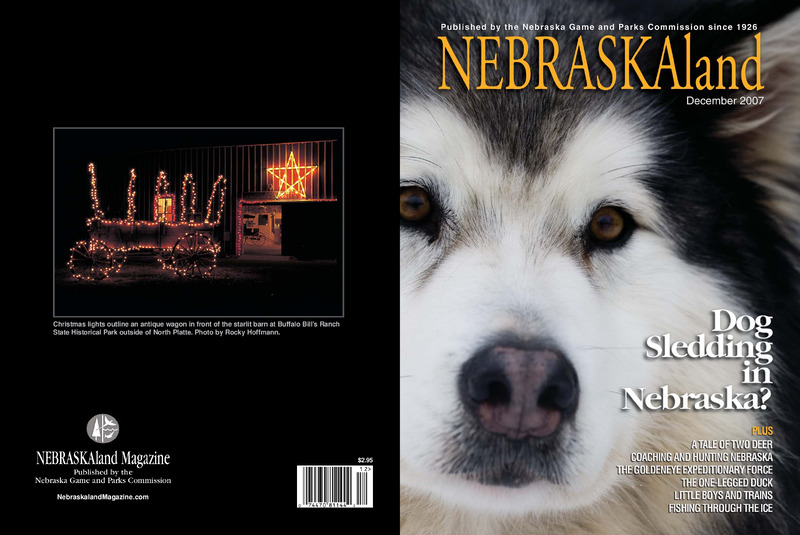
Christmas lights outline an antique wagon in front of the starlit barn at Buffalo Bill’s Ranch
State Historical Park outside of North Platte. Photo by Rocky Hoffmann.
NEBRASKAland Magazine
$2.95
1 2>
Published by the
Nebraska Game and Parks Commission
NebraskalandMagazine.com
0
74470 81144
2
Volume 85, Number 10, December 2007
10 Mush!
Everyone thinks it odd that a 73-year-old grandmother is
running a team of dogs in front of a sled...especially in
Nebraska. BY ROCKY HOFFMANN
16 The Things We Do for Deer
Two different deer, two different situations. This “tale of two
deer” tells the absurdities and calamities of my pursuit of this
most coveted Nebraska game species. BY JEFF KURRUS
18 Plus the Hunting
Former University of Nebraska baseball coach shares the
benefits of living and hunting in Nebraska. BY JEFF KURRUS
24 Two Rivers – Seven Lakes,Ten Cabooses
Great angling opportunities for a variety of fish species,
outstanding campgrounds, and the rare chance to sleep in a
caboose cabin make Two Rivers State Recreation Area a
terrific place to relax. BY ERIC FOWLER
28 Winter Whistlers
Avoided by most waterfowlers as they are reputed to be poor
table fare, common goldeneyes are sporty, late-winter ducks,
especially when hunted over homemade decoys. BY JON FARRAR
38 The One-legged Duck
18
●
And Other Ways Birds Battle the Elements. BY JEFF KURRUS
40 Ice Fishing 101
Angler Ronnie Schneider discusses the art of catching fish
through the ice. BY BOB GRIER
8 Outdoor Business
Flagship initiative focuses on uniquely diverse Wildcat Hills.
47 In the Field
Late-season hunting opportunities abundant in Nebraska.
38
●
40
●
48 Parks & Places
Winter events at Nebraska’s state parks.
Comment . . . . . . . . . . . . . . . . . . . . . . . . . . . . . . . . . 4
Outdoor News . . . . . . . . . . . . . . . . . . . . . . . . . . . . . 6
Classifieds . . . . . . . . . . . . . . . . . . . . . . . . . . . . . . . 48
Portraits from the Past . . . . . . . . . . . . . . . . . . . . . 50
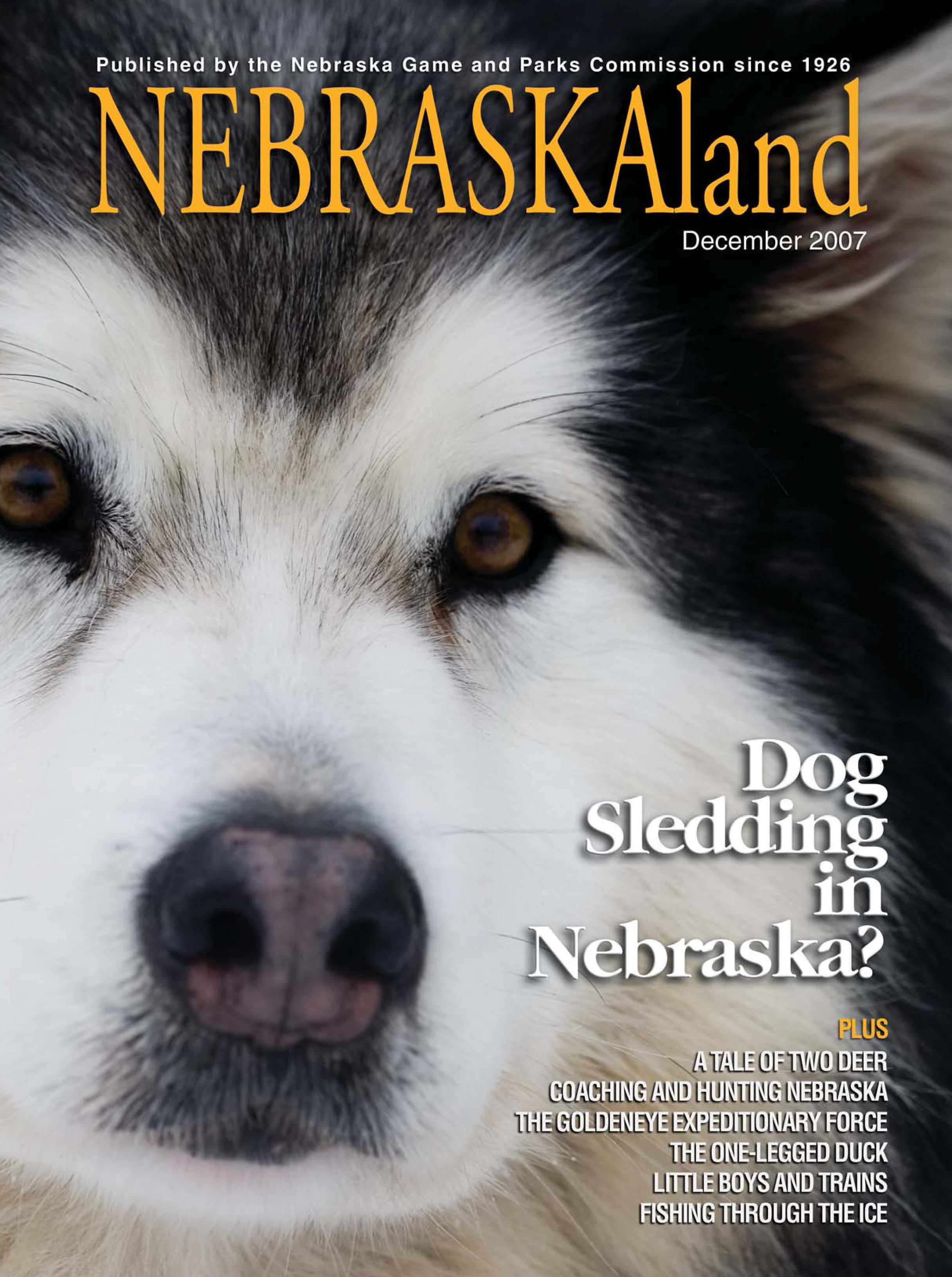
Cover: "Mushnuk", a 5-year old Malamute/Siberian husky cross, is one of the "wheel dogs" on
a dogsled team assembled by North Platte grandmother, Joyce McNeil. See story beginning on
page 10. Photo by Rocky Hoffmann. Opposite: A blanket of fresh snow adds sparkle to
Toadstool Geological Park on the Oglala National Grasslands north of Crawford. Photo by Bob
Grier.
28
●
NEBRASKAland ● December 2007
3
rock. It reminded me of someone we
all may know from our childhood –
Oscar from Sesame Street.
What a wonderful magazine. I
love the glossy cover, is that
something new?
John Roth
Lincoln NE
Published by the
Nebraska Game and
Parks Commission
Director: Rex Amack
Assistant Directors:
Roger Kuhn, Kirk Nelson, Sam Sidner
Information & Education Administrator:
Doug Bauch
Commissioners
Chairman:
Gary Parker, Columbus
Vice Chairman:
George E. Hall, Bridgeport
2nd Vice Chairman:
James Ziebarth, Wilcox
Jerrod Burke, Curtis
Dr. Mark Pinkerton, Wilber
Ron Stave, Waterloo
Dr. Kent Forney, Lincoln
Lynn Berggren, Broken Bow
Magazine Staff
Editor: Doug Carroll
Associate Editor: Jeff Kurrus
Art Director: Tim Reigert
Senior Editor: Jon Farrar
Regional Editors:
Eric Fowler, Bob Grier, Rocky Hoffmann
Contributing Editor: Michael Forsberg
Circulation: Donna Robinson
Photo Librarian: Sarah Johnson
NEBRASKAland
ISSN: 0028-1964
VOL. 85 / NO. 10
DECEMBER 2007
Published monthly, except for Jan./Feb. and Aug./Sept.
issues, by the Nebraska Game and Parks Commission, 2200
N. 33rd St., Lincoln, NE. Copyright 2007, all rights reserved.
Please address comments or questions to this address.
Periodicals postage paid at Lincoln, Nebraska, and other
locations. POSTMASTER: Send all address changes to
NEBRASKAland, P.O. Box 30370, Lincoln, NE 68503-0370.
NEBRASKAland is available on audio cassette from the
Nebraska Library Commission Talking Book and Braille
Service, Suite 120, 1200 N St., Lincoln, NE 68508. (800)
742-7691.
Rates: $18 for one year; $33 for two years; $44 for
three years. Nebraska residents must add
appropriate sales tax.
To subscribe call 1-800-NEBLAND (632-5263),
or go online to: NebraskalandMagazine.com.
For address changes and questions about your
subscription, e-mail donna.robinson@ngpc.ne.gov.
4 NEBRASKAland ● December 2007
This elk was photographed swimming in a pond at Gilbert-Baker WMA.
Cooling Off
This photo was taken at GilbertBaker Wildlife Management Area,
an area where prairie meets pine
trees, and the elk population seems
to thrive.
This particular bull gave me and
two of my friends the opportunity of
a lifetime when we found him just
100 yards from where we had
parked our truck. He was in an
opening when we initially stumbled
upon him on our morning hike. The
young bull soon discovered we were
watching him and bolted for cover.
We thought the excitement was
over until we reached the parking
area and found the bull swimming in
the pond next to the lot. He took his
time finding his way out and provided us
with some great photos.
It’s these once in a lifetime
opportunities that make me thankful
to live in such a great state like
Nebraska.
Seth Hulquist
Alliance, Nebraska
Buy a Bigger Freezer
Eric Fowler wrote in the October
edition of NEBRASKAland
magazine that hunters should
voluntarily harvest more does,
before regulations require it.
Nonresident hunters, such as myself,
pay quite a premium for deer
permits compared to Nebraska
residents. Maybe it’s time to reduce
the difference between resident and
nonresident permits to encourage
doe harvesting, or at least make the
second nonresident permit the same
price as for a resident.
Regards from a NEBRASKAland
reader in Europe, who, thanks to
great friends near Grand Island, has
the opportunity to hunt each year
and enjoy the nature of beautiful
Nebraska!
Chris Nendick
Belgium
In 2007 the price of nonresident
season choice antlerless permits
was reduced to $55 (they had been
$178) and many of the antlerless
permits also have bonus tags.
Hopefully many resident and
nonresident deer hunters alike will
take advantage of these permits and
help control the deer population.
– Editor
November Cover a Hit
I picked up the November issue of
your magazine at a newsstand the
other day and just had to comment
on the wonderful cover photo of the
Pine Ridge horseback riders. Also,
the rock formation on the back of
your magazine – is this a hoax? I
have never seen such a face on a
Headquarters
2200 N. 33rd Street
Lincoln, NE 68503
Phone (402) 471-0641
District Office I
East Hwy. 2, Box 725
Alliance, NE 69301
Phone (308) 763-2940
District Office II
524 Panzer St., Box 508
Bassett, NE 68714
Phone (402) 684-2921
District Office III
2201 N. 13th St.
Norfolk, NE 68701
Phone (402) 370-3374
District Office IV
301 E. State Farm Rd.
North Platte, NE 69101
Phone (308) 535-8025
District Office VI
1617 First Ave.
Kearney, NE 68847
Phone (308) 865-5310
Omaha Office
1212 Bob Gibson Blvd.
Omaha, NE 68108
Phone (402) 595-2144
Ak-Sar-Ben Aquarium
21502 W. Highway 31
Gretna, NE 68028
Phone (402) 332-3901
World Wide Web site: www.OutdoorNebraska.org
E-mail: info@ngpc.ne.gov
4-year old Ryley Hoke peeks out of a
goose blind while helping his dad and
granddad hunt near Lisco.
Eagle Eyes
“Grandpa, bird coming” is what
Ryley Hoke, my four-year-old
grandson, is saying. He was helping
me and his dad, Todd Hoke, hunt
geese near Lisco. Ryley can see the
geese coming long before his
grandpa can.
Lyle Hoke
Scottsbluff, Nebraska
Send your comments to:
Doug Carroll, Editor
NEBRASKAland Magazine
P.O. Box 30370
Lincoln, NE 68503
or e-mail doug.carroll@ngpc.ne.gov.
Please include your postal address
and telephone number.
Letters may be condensed and edited
for clarity. Photographs are
welcome and will be returned.
Story and photo submissions can be
sent to the same address. Include a
self-addressed stamped envelope for
mailed submissions. The publisher
assumes no responsibility for
unsolicited material.
Under federal and/or state law, discrimination is prohibited on the
basis of race, color, religion, age, gender, marital status, national
origin, disability or political affiliation. If you think you have been
discriminated against in any program, activity or facility by the
Nebraska Game and Parks Commission or want more information,
contact the Commission in Lincoln, NE, at (402) 471-0641 or the
Equal Opportunity Commission, Lincoln, NE, (402) 471-2024,
TTY/TDD (402) 471-4693).
Administration
Ted Blume (Adm.)
Craig Stover (Asst.)
Wes Loos (Asst.)
Rod Loos (Asst.)
Murray Johnson
Lincoln
471-5531
Lincoln
471-5532
Lincoln
471-5591
Ogallala (308) 284-8056
Lincoln
471-5003
Panhandle
Officer
City
Phone (308)
Jim Zimmerman (Sup.) Gering
436-7561
Walt Meyer
Chadron
432-4398
Scott Brandt
Gering
436-3418
Heath Packett
Gordon
282-2553
Dennis Thompson
Ogallala
284-6450
Dan Zuehlke
Ogallala
284-4815
Doug Pollard
Oshkosh
772-9950
Frank Miller
Valentine (402) 376-1183
Dan Kling
Whitney
432-8367
Southwest
Officer
City
Phone (308)
Roger Thompson (Sup.) N. Platte
532-9175
Ray Dierking
Brkn. Bow
872-3078
George Sund
Cambridge
697-4629
Michael Thome
Cozad
784-4362
Matt Andrews
Elwood
785-3025
Dirk Greene
Imperial
882-5328
Virgil Gosch
McCook
345-2185
Dudley Sorensen
N. Platte
532-0747
Rich Routh
Rep. City
799-2085
South-central
Officer
Jerry Pecha (Sup.)
Jeff Jones
Randy Pomplun
City
Phone (308)
Kearney
865-5327
Clay Center(402)762-3124
Fullerton
536-2987
Terry Brentzel
Darin Gress
Dale Johnson
Mark Reeves
Robert Finke
Richard Seward
Grand Is.
384-8296
Hebron (402) 768-2287
Kearney
237-1079
Loup City
745-0662
Milford (402) 761-3537
Ord
728-3115
Northeast
Officer
Tom Zimmer (Sup.)
Robert Kelly
Dale Davis
Ross Oestmann
Steve Oberg
Daniel Roberts
Jon Reeves
Marion Shafer
Pat George
Eric Wiebe
Tim Williams
Cory Krause
City
Phone (402)
Norfolk
371-6625
Albion
395-2538
Bassett
273-1700
Bloomfield
373-4412
Columbus
564-5937
Fremont
721-7852
Kennard
427-7378
Norfolk
371-2031
O’Neill
336-1588
Ponca
755-2566
Neligh
887-1335
West Point
372-6979
Southeast
Officer
Duane Arp (Sup.)
Sean McKeehan
William Krause
Jeremy TenKley
Mike Luben
Douglas Kramer
Dina Barta
Stacey Lewton
Levi Krause
Russell Mort
Dan Evasco
Jeff Clauson
City
Gretna
Ashland
Auburn
Beatrice
Colon
Lincoln
Lincoln
Lincoln
Louisville
Nebr. City
Papillion
Waterloo
Phone (402)
332-2965
944-4174
274-3789
228-1437
443-4278
466-9001
483-2358
476-0436
234-2212
873-5684
592-6733
359-5301
Nebraska Wildlife Crimestoppers 1-800-742-7627
NEBRASKAland ● December 2007
5
Stacey Anderson of Curtis poses with the 6-by-7 bull she harvested this fall in the
Box Elder Elk Management Unit.
Elk Harvest Sets New Record
isit our secure web site
to quickly and
conveniently purchase
fishing, hunting and park
permits using your Visa or
MasterCard.
V
nline permit purchase
is safe, hassle-free
and there is never a
checkout line. Simply
choose the permits you
want, pay for them,
and print. Then you are on
your way to Nebraska’s
great outdoors.
O
Permits are available
to nonresidents
as well as
residents.
www.OutdoorNebraska.org
NEBRASKA GAME AND PARKS COMMISSION
6 NEBRASKAland ● December 2007
As of November 1, a record 77 elk
had been harvested in the state
this year, according to preliminary
data by the Nebraska Game and
Parks Commission, with one elk unit
still open through the end of the
year.
This year’s elk harvest, including
partial harvest from the still-open
Boyd Unit, included 36 bulls, 32 cows
and nine calves. That compares to
73 elk taken total in Nebraska in 2006.
“The elk herd continues to expand
across the state, as do hunting
opportunities for Nebraska residents,”
said Kit Hams, big game program
manager for the Commission.
“Numerous sightings have occurred
this fall in southeastern Nebraska,
leading one to wonder if elk are
becoming established in new areas.
The elk herd has increased from
50 to more than 1,000 over the past
20 years.”
The success rate on bulls was 68
percent, compared to 76 percent last
year. Bull quality was outstanding,
with 22 of 23 Pine Ridge bulls (Ash
Creek, Bordeaux and Hat Creek
units) being 6-by-6 or better. Success
on bulls was highest in the new
Niobrara River unit, where five of
six hunters took bulls.
Fifty-three either-sex and
113 antlerless permits were issued.
The success rate on cows was
36 percent. “Cows usually are more
difficult to hunt and landowners
usually give preference to those
hunters with bull permits,” Hams
said. “It also is likely that hunters
with bull permits put forth more
effort.”
Hunters have harvested more than
500 elk in Nebraska since 1985.
Buy Lifetime Habitat Stamp
Now
The price of the Lifetime Habitat
Stamp, now priced at $260, will go
up to $320 on January 1, 2008, so
if you’ve been thinking about
purchasing one, you might want to
do so before the first of the year.
Every Nebraska resident 16 years
of age or older, and all nonresidents
regardless of age, must have a
Habitat Stamp to hunt game species
or harvest furbearers in the state.
The yearly stamp is valid for the
calendar year as dated, but Lifetime
Habitat Stamps are valid throughout
the holders life, whether they live in
Nebraska or not.
The stamp makes a great gift for
After 30 years, the Commission
will no longer hold a contest for
Nebraska’s Habitat Stamp. “In the
early years, the contest was popular
and we possessed the resources to
facilitate it. These aspects have
changed in our analysis. We
acknowledge some may be disappointed with this decision, yet most
will understand it was necessary,”
said Commission division
administrator Doug Bauch.
This holiday season, give a Nebraska
Park Entry Permit. It provides year-round
access to 86 park areas across the state
and is the perfect gift for family and
friends. Order today for easy gift giving!
New Ponca SP Addition
The Ponca State Park (SP)
Northern Addition is a newly acquired
682-acre tract of public land in
northeastern Nebraska.
The new area boasts canoe/kayak
access to the Missouri River and the
Lewis and Clark legacy campsite,
with officer and wedge tents
resembling a Lewis and Clark
campsite. “This area will become
very popular for boy scouts as well
as adventurous canoeists and
kayakers,” said Nebraska Game and
Parks Commission federal aid
administrator Neal Bedlan.
This addition is adjacent to 688acre Elk Point Wildlife Management
Area and both have newly restored
wetlands that will “enhance the
outdoor educational opportunities of
Ponca,” added Bedlan.
To order call toll-free
1-800-742-0056
Monday through Friday, 7:30 a.m. to 5 p.m. CST
www.OutdoorNebraska.org
NEBRASKA GAME AND PARKS COMMISSION
www.OutdoorNebraska.org/catalog
Habitat Art Contest Begins
New Direction
The Gift
of the
Nebraska
Outdoors
order your permit online at...
the holiday season and, in addition to
the paper version, comes with an
enameled brass plate engraved with
the holder's name, permit number
and date of birth. Stamp proceeds go
into the Nebraska Habitat Fund,
which acquires, manages and
restores land for wildlife. Income
generated from Lifetime Habitat
Stamp sales is invested and only the
interest is used.
The stamp may be purchased at
Commission offices throughout
the state, online at
www.OutdoorNebraska.org or by
calling 1-800-742-0056.
NEBRASKAland ● December 2007
7
Banding
Fishing Records Broken
Across State
We’re Tough
8 NEBRASKAland ● December 2007
Flagship initiative focuses on uniquely diverse Wildcat Hills.
By Bob Grier
band birds, gather standard
ntroducing young
data, including wing and
students to birds in
tail measurements,
western Nebraska’s
determine the bird’s fat and
Wildcat Hills is easy
molt characteristics as well
when you’re gently
as age and sex.”
holding a red-breasted
James, Ripper and
nuthatch or a spotted
wildlife education
towhee, birds caught just
coordinator for Prairie
moments before in mist
Partners Laura Barr tailored
nets at the Wildcat Hills
their programs to specific
Nature Center, 10 miles
ages, making the learning
south of Gering.
both fun and educational
The daily banding station
for participants.
and outdoor educational
Each of the students
workshops at the Nature
received a Prairie Partners
Center for four weeks in
Certified bird bander Dana Ripper shows off a recently
pocket guide to the prairie
September and October are captured bird to grade school students and their teachers.
birds and also had the
part of a newly developed
have the flexibility to offer programs opportunity to hike the Nature
“flagship initiative” focused on the
Center’s trails to find and observe
for students of all ages, as well as
uniquely diverse Wildcat Hills and
parents and other adults that visit the the numerous species of birds using
implemented as part of the ongoing
Nature Center,” she said. “The events the habitat in the immediate area. In
Nebraska Natural Legacy Program.
addition, Barr, based in Scottsbluff,
drew large numbers for the daily
The center hosted school groups,
also offered landowner workshops,
two-hour sessions and our Saturday
families, landowners, educators and
pre-service teacher training and
others from across the Panhandle and event on September 15 gave the
public that couldn’t attend during the teacher workshops in Project Wild,
entertained them with guided nature
week an opportunity to participate as Aquatic Wild and Flying Wild.
trail hikes, outdoor activities and
During the first week of this year’s
well.”
workshops on migration, adaptation
programs at the Wildcat Hills Nature
Visitors learned about the ecology
and habitat hosted by biologists
Center, 10 species of birds were
of migratory birds, bird adaptations,
and education specialists from the
captured and banded. These included:
the science of bird banding, as well
Rocky Mountain Bird Observatory
pine siskins, black-capped
as bird migration and its many
(RMBO), Prairie Partners and the
chickadees, red crossbills, spotted
hazards. Those attending were also
Commission.
towhees, chipping sparrows,
able to observe up close the birds
The bird banding station provided
red-breasted nuthatches, pigmy
an opportunity for participants of all harmlessly captured in mist nets.
nuthatches, Wilson’s warblers, house
In addition to the daily programs,
ages to watch as biologists captured,
wrens and house finches. For more
the information gathered at the bird
measured and released shortgrass
information on programs at Wildcat
banding station is forwarded to the
prairie and pine forest bird species.
Hills, the Nebraska’s Natural Legacy
U.S. Fish and Wildlife Service as
Events like the Wildcat Hills Nature
Program, or RMBO and Prairie
part of nation-wide bird research.
Center’s educational bird banding
Partners activities, contact Emily
“Most of the RMBO bird banding
station and outreach programs,
Munter, partners manager for the
stations serve as a research tool,”
which are funded by the Nebraska
Nebraska Game and Parks
certified bird bander from RMBO
Environmental Trust, are a rare and
Commission’s district office in
Dana Ripper explained, “but our
popular resource for the region’s KAlliance, (308) 763-2940; Anne
priorities also include outreach and
12th grade schools, families and the
James, Wildcat Hills Nature Center
education. While we collect all of
public, according to Anne James,
outdoor education specialist, (308)
the standard data that each of the
outdoor education specialist at the
436-3777; or go online to the
banding stations collect, we can
Wildcat Hills Nature Center.
Commission’s web site at
explain and demonstrate to the
“The participating biologists and
www.OutdoorNebraska.org ■
participants how we capture and
resource and educational specialists
I
NEBRASKAland ● December 2007
PHOTO BY BOB GRIER
A few years ago some conservation officers were issued kayaks to
patrol river systems throughout Nebraska. At the time I didn’t think a
lot about them, but after trying one out I found them to be a useful
tool. One cold day (very cold) in December, my neighboring officer to
the north, Mike Luben, called and wanted to do a detail on the Platte
River checking duck hunters with the kayaks. I jokingly told him that I
did not think it was cold enough to be on the river that day. In reality it
was near 10 degrees and the river was slushing up badly. But it was
near the end of the season and Mike and I believed we might surprise
a few people with the new equipment.
Before driving to meet Officer Luben I looked at the temperature to
see how many clothes I would need on our journey. I decided to put
on the old Filson coat and matching gloves. I forgot my chest waders
so I had to use my hip boots, which were nearly 10 years old. When
Mike and I arrived at the river’s edge he asked me how far down we
wanted to go. I bravely told him all the way to the park, well, that was
just over 20 miles. But we were tough!
We had not even made it a mile down the river when I realized I had
made a grave error (but I wasn’t about to tell Mike). I remember looking
back towards my patrol vehicle and thinking: “So long buddy it was
nice knowing ya.” A little further down the river we started running into
hunters, they not only were surprised to see us but gladly took us in
to show us their birds. I recall one particular hunter asking us what we
thought we were doing. Ah, we’re tough!
Continuing our trek we ran into a dry spell of occupied blinds, which
was particularly bad news for me because I had been drying my
gloves off on the blinds’ heaters. You also know it’s too cold to try
something like this when ice makes them too heavy to lift. My highend, supposedly water-proof gloves were failing badly when we
rounded a bend and I could see two duck blinds, one with hunters in
it. Mike stated later that he wondered what I had seen because I started
paddling straight for the empty blind. He hadn’t realized I could see a
200 lb. propane bottle behind it. I rushed inside thinking I would leave
a 5-spot with a note thanking the hunters for saving my life, but I
couldn’t write because my hands didn’t work and my pen was frozen.
At this time I could have witnessed someone shoot a hundred ducks
across the way … my priority was heat! I looked across the frozen
river and noticed Mike was getting along fine with the other blind (as if
I could have been of any help anyway). I opened the propane valve
and struck a match … nothing! The bottle was empty!
I grabbed an empty coffee can and made a small fire to warm my
hands and dry my gloves. Mike came over and with a smile mentioned
we had about 12 miles to go. A couple of ice
jams later and several near capsizing we
reached our other vehicle. Almost too frozen to
get out, I finally had made it.
This last winter while crossing the Platte
River I noticed it was almost completely frozen
except for a small stream with open water. My
once-frostbitten fingers called up Mike and
asked if he wanted to put in because the
ducks were really flying. He laughingly said it
wasn’t cold enough yet.
– Stacey Lewton, Conservation Officer, Lincoln
The following fish have been
recognized as new state records by
the Nebraska Game and Parks
Commission.
In the hook and line category:
– a 4-pound, 8-ounce spotted gar
taken from a private sandpit in
Dawson County by Dustin Noble of
North Platte on July 13.
– a 29-pound, 6-ounce freshwater
drum taken from Gavins Point Dam
Tailwaters by Roque Ramirez of Sioux
Falls, South Dakota, on June 23.
In the archery category:
– a 17-pound, 13-ounce silver carp
taken from the Missouri River by
Michael Holly of Belden on May 16.
– an eight-ounce orange spotted
sunfish taken from a Loup River
backwater in Platte County by Mike
Gutzmer of Columbus on July 1.
– a 3-pound European rudd taken
from Box Butte Reservoir by Will
Leef of Fleming, Colorado, on July 7.
– a 22-pound, 13-ounce freshwater
drum taken from Gavins Point Dam
Tailwaters by Ronald Anderson of
Omaha on July 23.
– a 62-pound, 1-ounce grass carp
taken from Buckskin Hills Lake by
Ronald Anderson of Omaha on
August 10.
In the underwater spearfishing
category:
– a 2-pound, 11-ounce European
rudd taken from Box Butte
Reservoir by Josh Adamson of
Alliance on July 4.
–5.5-ounce pumpkinseed taken
from Box Butte Reservoir by Hunter
Schafer of Alliance on July 7.
– a 1.97-ounce redear sunfish
taken from a private sandpit in
Lincoln County by Dustin Noble of
North Platte on July 11.
– a 20-pound, 4.8-ounce northern
pike taken from Box Butte Reservoir
by Joshua J. Adamson of Alliance
on July 26.
– a 4-pound, 10-ounce white sucker
taken from Box Butte Reservoir by
Joshua J. Adamson of Alliance on
July 28. ■
9
MUSH!
Photos and text by Rocky Hoffmann
“Everyone thinks it odd that a 73-year-old
grandmother is running a team of dogs in front
of a sled...especially in Nebraska.”
W
hen Joyce McNeil of North
Platte goes for a sleigh ride,
it involves a whole lot more
than a simple slide down a
hill on a Flexible Flyer. In
fact, McNeil’s style of sledding doesn’t
even require a hill, because gravity has
little to do with it. Powered by as many
as six huskies, McNeil can run her sled
up or down most hills and go flat out
fast on level ground.
“Everyone thinks it odd that a 73-yearold grandmother is running a team of
six dogs in front of a sled … especially
in Nebraska,” Joyce said of her unique
sport as she led each dog from the
kennel to a tie-out chain near her sled.
Joyce is a small lady, and it wasn’t
without difficulty that she handled each
dog across icy footing to the sled.
“They were born to pull. It doesn’t
matter to them whether they’re pulling
the sled or me around in my boots. In
fact, while I’m hitching them up, I have
to tie the sled to a tree until everything
is in place and ready to go, including
me,” said Joyce.
Each dog is hitched in an assigned
order depending on his or her ability
and skill. The “wheel dogs,” Mushnuk
and Yukon, are the hardest-working
dogs of the team and are the dogs
closest to the sled. The “team dogs” in
the center of the hitch are Mushski and
Zorro. Team dogs are used to provide
extra power to the hitch. There may be
as many as eight team dogs on larger
hitches of twelve or more dogs.
“My ‘lead dogs’ are Mushdog and
Shammu. Ideally, these are the dogs that
direct the team upon my commands. I
have no reins or lines to the dogs like
one would have with a team of horses,
but as with horses, the commands are
‘haw’ for left, ‘gee’ for right and, of
course, ‘whoa’ for stop. Those are the
three primary commands, but in reality
my lead dogs don’t respond as I would
like them. A while back my veteran
lead dog was run over and killed, and
Mushdog and Shammu stepped in with
no experience in that position. Because
they don’t always listen, I don’t know
where we’re going to end our run. I
have a brake on my sled, however,
which gives me the ability to enforce
the ‘whoa’ command before we get too
far in the wrong direction. Then I get
them back on trail and off we go again.
They’ll eventually learn the commands.”
All the dogs are husky and Samoyedcross except for Mushnuk, who is a
Siberian husky/Alaskan Malamute cross.
Siberian huskies, Alaskan Malamutes
and Samoyeds are all northern breeds
of working dogs. Siberian huskies
originated in eastern Siberia and were
first bred by the Chukchi tribes. They
Joyce McNeil and Erin Weaver mush a four-dog sled team through
deep snow last winter near North Platte.
10 NEBRASKAland ● December 2007
are medium-sized dogs but quite
capable of working in severe Arctic
cold. Malamutes descend from dogs of
the Mahlemut tribe of northwestern
Alaska. Malamutes are large dogs that
are capable of pulling heavy loads long
distances. Samoyed dogs derive their
name from the Samoyedic people of
Siberia. They were used to herd
reindeer and to pull sleds during
nomadic journeys.
Joyce’s past is not typical of most
“mushers.” Being a native Nebraskan,
selecting a snow sport would usually
rank far from the top of the list of
favorites, and taking up such a
demanding sport is not normally
something begun at age 66. Coming
from a farm and ranch background and
running a large dairy herd while raising
five children, however, Joyce was not
afraid of the work that caring for and
handling a team of large dogs requires.
Even when she adopted her first
husky from the North Platte animal
shelter, she had no intentions other than
making the dog a pet and providing it a
good home. The dog had belonged to a
man who had moved into the North
Platte area from Colorado and didn’t
have a place to keep him. Joyce was
amazed at how fast and strong the
Joyce McNeil mushes her six-dog team through a pasture gate in Snell Canyon southeast of North Platte.
Mushdog, a nine-year-old male Siberian husky, is a lead dog on McNeil's team.
12 NEBRASKAland ● December 2007
animal was. In order to exercise him,
she’d take him down a country road,
holding the leash out the window of the
pickup truck.
About the time Joyce was wondering
what in the world she was doing with
such a hard running dog, another man,
this one moving to Colorado, gave
Joyce a purebred Siberian husky
female. Things began to click in
Joyce’s mind, and soon she adopted
two more huskies. Now she had a team,
be it small and consisting of only
wheel dogs and lead dogs. Son Mike
built a wheeled cart for her summer use
and a sled for winter.
Joyce recalled her frustration. “I
knew absolutely nothing about dog
sledding. I had never seen a dog harness
and had no idea how to hook sled dogs
up other than tying the whole bunch
together with ropes. As fast as I’d tie
one to the hitch and go to another, the
first one would chew through the rope.
As expected, they were all eager to run,
but I had little understanding at the
time how difficult it would be to handle
them while hitching the team to the
cart or sled. There had to be a system.”
While she was building makeshift
harnesses and learning to handle her
dogs, she was also building kennels,
doghouses and a large exercise pen.
Fencing had to be strong enough and
tall enough to keep them confined.
“They are working dogs, and they’ll
work hard to get out and run because
that’s what they like to do!”
Then tragedy struck in 1998. That
very desire to get out and run resulted
in Joyce losing three of her dogs. The
heartbreak wasn’t over – that same
year, both of her parents and four close
friends passed away. Grief pushed its
way into Joyce’s life and took over.
“I had one dog, the purebred female,
and a big empty kennel. It was decision
time. My answer surprisingly came in
the mail in 1999. It was a brochure
about an expedition-type adventure in
the Boundary Waters of Minnesota.
The advertisement, among other things,
was for a hands-on experience in dog
sledding. I would drive a sled, perform
health checks on dogs, camp in the
snow, cross-country ski, travel by
snowshoes, navigate and learn winter
survival. Most inviting to me was this
was also a ‘life renewal’ course,
something that I desperately needed at
that time.”
Joyce deeply believes in fate and is
strongly vested in faith. When she
finally called for reservations, there
happened to be one opening left, and
the expedition was to begin on her
67th birthday. Her age, however, sent
up a red flag with the expedition hosts.
“They required me to have a complete
physical examination and my doctor’s
written permission,” Joyce recalled.
She was informed by the expedition
that she would be required to run three
miles in 35 minutes on uneven terrain
while toting a 45-pound pack. Not a
problem, it was only July and the
NEBRASKAland ● December 2007
13
spring, bringing Mushski with her.
Mushski had become too slow for the
rest of the 12-dog team that she was a
part of. She provided companionship
while Joyce sought alternative medical
treatments for her back injury. One of
the procedures finally worked, and she
became pain free. Another call came
from Colorado, this time with bad news
– one of her dogs had gotten free and
was killed on the highway.
“Do you want your other dogs back?”
asked the kennel owner, knowing how
upset Joyce was about her dog and how
much she missed all of them. Fate had
intervened again.
“My dogs are coming home!”
The dogs had worked for three years
and Joyce estimated they ran at least
1,000 miles each year. They had
matured and become much easier to
handle, even jumping onto a bench to
be harnessed. Joyce now shares her
sport and her experience with various
organizations, churches and youngsters
in the North Platte area.
During last winter’s final snow, she
hitched four dogs to an antique racing
sled given to her by daughter Shannon,
and tucked nine-year-old Erin Weaver
of North Platte into a wool Hudson Bay
blanket. Striking off through shelterbelts
that lined a Sandhills trail, the dogs were
at their best. The ride was stunning and
so fascinated her young rider that they
returned to the kennel and hitched all
six dogs to a safer, more sturdy sled
required by the additional dogs. This
time Joyce mushed her team into the
deeply dissected, cedar-lined canyons
southeast of North Platte. An eerie fog
dampened nearly all sounds, while
amplifying the icy song of the steel
runners on the sled. That evening, as
the dogs rested in the snow and Joyce
and Erin stared into the fire, Erin told
Joyce that she had just had “the best
day of her life.”
Joyce, a remarkable lady, who had
nearly given up on her hobby as well as
life in general, could not have been
more rewarded. ■
Joyce and Erin find warmth from the fire and steaming chili in the Dutch oven while the sled team rests.
expedition didn’t start until
December 27.
“Regardless of all the preparation in
store for me, the first thing I did was
get my lone surviving purebred female
bred. What could be more uplifting than
a box full of warm fuzzy puppies?”
Joyce said.
Joyce remembered that the expedition
was everything it was advertised to be,
an absolutely unique learning experience
for novice dog handlers. What was
most rewarding was that she was with
people that talked about and enjoyed
the same sport. Not many people talked
about dog sledding back in Nebraska.
“I also enjoyed the wilderness, the
quiet and peaceful setting, where the
only interruption was the nightly
howling of the dogs and the answer
from gray wolves,” Joyce recalled.
She arrived home eager to get started
14 NEBRASKAland ● December 2007
and much more knowledgeable about
her sport. Being an accomplished
leather craftsman, she reenlisted her
old heavy-duty Singer sewing machine
and began fashioning harness. She
purchased an authentic gang line to
replace the cobbled up ropes that her
previous team had chewed. The wheel
cart was an excellent training device
for the five puppies that arrived in
March following her expedition, but
Joyce knew that as the dogs matured,
the cart would be too light and therefore
too dangerous for her to handle.
In the procession of wheel carts,
Joyce then found a stripped down ATV
to which she welded a horseshoe for a
hitch and mounted a metal seat from a
hay rake. Last summer, daughter Julie
presented her with a commercial,
heavy-duty child’s coasting cart, that
she adapted to be pulled by dogs.
“I may have raised a few eyebrows
from neighboring ranchers with some
of my past contraptions, but I was
proud of all my adaptations. If you
know ranchers, you know they can’t
help but poke a little good spirited fun
at you, especially if you have a hobby
as unique as mine. One rancher
accused me of running all the deer out
of the country on the opening day of
deer season. I couldn’t help it that it
snowed on that particular day, but I
sure wasn’t going to waste the first
snow.”
Another dog sledding expedition
in 2000 put her in the company of
instructor Paul Schurke, who was a
member of the team that made the first
dog sled expedition to the North Pole
without support of new supplies since
Robert Peary accomplished the feat
in 1909. Joyce faced much greater
challenges and rougher territory in this
expedition and returned ready to take
on anything Nebraska had to offer.
Later that year, however, tragedy struck
again when Joyce suffered a debilitating
back injury that resulted in chronic pain.
Unable to exercise her dogs, she did
what she knew was best for them and
gave them up to a dog sledding business
in Leadville, Colorado, along with
harness, kennel and trailer. A year later
the pain still continued to plague her,
but fate stepped in once again. The
sledding business in Colorado had done
well and the folks who bought her team
asked her to come out and drive the
van picking up guests at Vail and serve
as a tour guide. Along with her new
responsibilities came renewed vigor for
life as she would again be with her
dogs.
Joyce returned to Nebraska in the
Joyce poses with Mushnuk, the five-year-old Malamute/Siberian husky wheel dog
that she raised and trained from a puppy.
NEBRASKAland ● December 2007
15
The Things We Do For Deer
By Jeff Kurrus
Two different deer, two different situations. This “tale of two deer” tells the absurdities
and calamities of my pursuit of this most coveted Nebraska hunting species.
O
16 NEBRASKAland ● December 2007
of the wreckage.
The temperature was in the low
teens, and a north wind was ripping
through the countryside. I huddled
against the underside of the truck and
suddenly remembered the scene from
The Empire Strikes Back when Luke
Skywalker, while stranded on some icy
planet, is forced to seek refuge inside
the body cavity of the giant dead
horse/camel/dragonlike thing he had
been riding on. This was his only
means for survival, which meant I too
had to make an important decision. I
didn’t have a horse/camel/dragonlike
thing to crawl inside of, much less the
light saber to make this dream a reality.
So if I didn’t want to become “Hatchet
Jack, being of sound mind and broke
leg,” I had to seek shelter.
I made my way toward one of the
few farms I had passed on the road,
walked down the icy driveway and
reached a glass door that gave way to a
view of the living room. I knocked.
Someone had to be home, I thought.
The Price is Right was on the TV, so I
continued to knock, watching the next
contestant play Plinko.
No answer. I waited, feeling
heat creeping out from each corner
of the door frame as I debated
curling up next to the 1/8-inch
crack to bathe in its radiant heat.
Finally, after several minutes
and still no answer, I began to
walk back to what was left of my
truck. That is, until I heard the 18wheeler in the distance. Then I
ran toward the road. I would not
question the truck’s motive for
being down this gravel road or
my decision to hitchhike with
this stranger in his toasty truck.
“Flip your truck?” he asked
before I climbed in.
“Nope,” I thought, looking back
at the undercarriage of the truck.
Then, much more appropriately,
“Yep.”
He took me to a tow truck operator
in Nebraska City, who drove me back
toward the carnage.
“Be careful down this road,” I said,
never shy of stating the obvious. “It
sure is slick.”
When he flipped my truck back over,
the shocks creaked and cracked upon
contact, but no windows were broken
and the only significant body damage
was on the passenger side door and
roof. “Try and crank her up,” he said,
and the truck turned over as soon as I
did. No leaks and no sparks. She was
ready to drive.
I handed him a credit card. He
peered at it as if I had just handed him
a library card. “I don’t take credit
cards,” he said. “Only cash.” I had no
cash, and I imagine the look on my
face said this. I also imagine he didn’t
like where this conversation was going.
“Do you have anything for collateral?”
he finally asked.
I searched in my wallet, bypassing
the library card. Now was not the time
for a bad joke. “How about this?” I
said, pulling out a Wal-Mart gift card.
T
he first time I saw the other
big buck that still haunts me
and my wife’s car, I was
driving down 25th Street in
Bellevue on my way back
from Wal-Mart. There had been snow
on the ground for several days, but the
road itself was clear. The sun-bright
moon reflected off the fields lining the
road, and as I peered out the
passenger window, I could see a
silhouetted object walking the edge of
a cut bean field. The shape was a largebodied Nebraska deer, and its gait
immediately told me it was a buck.
While I couldn’t see his rack, I
imagined the mass he carried on his
neck. I went home and told my wife
Laura about the big deer.
“I’ve seen deer on that road, too,”
she said. “Don’t go down that road
anymore.”
“Huh?”
“That road has deer near it.”
I told her how all roads in Nebraska
have deer near them.
“Don’t go down that road,” she
repeated.
Over the next few weeks, I continued
to think about that buck, but hadn’t had
a reason to drive down that street. Until
the night I was elected to take Laura’s
friend, Jessica, to the airport for a redeye flight.
Again it was a moon-filled night, and
I could nearly drive without using my
lights at all. Taking a left on 25th Street
toward Jessica’s house, I scanned the
fields around me. Empty. I reached for
a CD in the sun visor and looked back
down. The road had turned a dark
brown. I had no time to stop, or even
tap the brakes, before slamming into
the deer broadside.
With heart in throat, I inched my way
toward a gas station, listening to a host
of new and interesting sounds belching
from Laura’s car. Since we are the last
people in the English-speaking world
without a cell phone, I grabbed 35
cents and went to the pay phone.
“Hello,” she groggily answered.
“I just hit a deer.”
“Are you okay?”
“Yeah, but your car isn’t.”
“Where are you?” At this point I had
a decision to make, and I knew it was a
critical one. I said nothing.
“You’re down that road, aren’t you?”
“Quick,” I thought, “Hang up, hang
up.” I could clunk the car to the next
gas station, find 35 more cents, and tell
her I had lost connection. Then
sidetrack her by telling how bad we
really needed a cell phone.
“I told you not to go down that road,”
she started in again. “Why don’t you
listen to me? Why my car? You knew
there were deer there. Any other road
but that one…” she continued, but I had
stopped listening. I had a good feeling I
was going to hear this a few more
times before she was done. Why listen
now when I could hear the re-run later?
I finally interrupted. “It’s a big deer.
We’ll get to take it home,” I said.
She hung up the phone. Ten minutes
later, she picked me up, again reminding
me of all the other times I had failed to
listen. We then took Jessica to the
airport, who also agreed with Laura
that I shouldn’t have driven down that
road.
“What are you guys paying attention
to when you drive?” I thought, thinking
it harder to not see a deer driving down
a Nebraska road than to actually see
one. Their answer would have been,
“The road,” which is why I kept the
question to myself.
Later that morning, I went back
down 25th Street with my newly fixed
truck, whose body had been totally
reconstructed after its flips near
Nebraska City. The only indication it
wasn’t a new truck were the 40 or so
hail dents that had fallen the night after
I had gotten my truck back from the
shop, causing another $3,000 in damage.
It hadn’t been a good automobile year.
I saw the deer lying in a ditch next to
the road, and loaded it into the back of
the truck. It was a buck, yet one that
had recently shed its rack, leaving only
antlerless indentions a shovel handle
wide. I took the deer home and called a
state trooper, who then came to my
house and proceeded to ream me for
not calling the authorities as soon as
the wreck occurred. He didn’t care that
I had the deer, but he did care that I
had left the scene of an accident.
“But no one else was involved,” I
told him, thinking it might help. It
didn’t. I apologized profusely, saying I
didn’t know any better, and ended the
conversation with a long series of “Yes
sir’s.”
Which brings me to my current state
in life, when every time my wife’s car
makes a noise, pulls to the left, or is a
bit louder than it was yesterday, I have
to hear the dreaded statement that will
follow me for the rest of my life. “I
told you not to go down that road.”
“I just knew he was a big buck,” I’ll
respond, again seeing the silhouette as
it walked across the moonlit field. ■
ILLUSTRATIONS BY TIM REIGERT
n a backroads drive
through southeastern
Nebraska a couple
winters back, I
spotted what had to
be a 400-class buck standing at
the edge of a field. Stopping the
truck, I greedily stared at the
behemoth before he calmly
sauntered into the woods. I went
home but couldn’t seem to get
the deer out of my head. On my
next free day, I would drive back
down to find the landowner and
ask if I could hunt.
However, when that day finally
arrived, a snowstorm had settled
in on the area two days before,
giving southeastern Nebraska
nearly nine inches and making it
the imperfect time for a road trip. Yet I
went anyway, and as I pulled off the
main highway onto the gravel stretch
leading to the field, I rehearsed my
permission speech in my head.
But I never made it to the field.
Instead, my truck began to fishtail at
one of the icy road’s intersections,
sliding me toward a street sign, then a
mailbox, back toward the street sign,
and then toward a very small ditch.
Perfect, I thought, an easy glide into
the cutout and I would be a four-wheel
drive switch from getting out of this.
However, the ditch, the small ditch,
turned out to be not so small.
I had never flipped my truck before,
so I was quite impressed with my
calmness throughout the situation. “I’m
flipping again,” my mind said, a year’s
worth of McDonald’s wrappers, water
bottles, dental floss, socks, sunflower
seed hulls and peanut shells flying in
every direction of the cab. Then it
stopped. Everything that had been in
my floorboard now rested on the
passenger door as I hung in midair by
my seatbelt. I unbuckled myself,
cursing the huge buck, and climbed out
He eyed me suspiciously. “I guess
that’ll do. I’ll mail this back to you
after you mail me my money.”
I drove my truck home that day with
a little bit of pride. When other cars
passed me, and several did because my
truck was now making a loud
screeching noise when it got above 50
miles per hour, I nodded and tipped my
cap. I was a warrior, a demolition derby
man, and had the truck to prove it.
NEBRASKAland ● December 2007
17
PLUS THE HUNTING
FORMER UNIVERSITY OF NEBRASKA BASEBALL COACH
SHARES THE BENEFITS OF LIVING AND HUNTING IN NEBRASKA
Photos and text by Jeff Kurrus
F
Kentucky in 2006. “With Cohen, then
Van Horn (now at Arkansas), Childress
(now at Texas A&M) and Coach
Anderson (Nebraska’s current head
coach), I’ve had an excellent chance to
work with several good coaches.”
After leaving Northwestern State,
Andy took the head coaching job at
Hutchison Community College in
Hutchison, Kansas, then, two years
later, accepted an offer to coach at
Nebraska under Anderson. When asked
why he came back to Nebraska, it was
evident there was more to it than
baseball as soon as he climbed from
the truck that bitter January morning.
The north wind did not bite, it
gnawed, ravaging his face and
freezing every bit of moisture he
had on his skin as he trudged
through ankle-to-knee deep snow.
“I started hunting with a
After hunting for three hours
teammate that became one of
and flushing more than 50 birds
my best friends, Jay Sirianni,
on land he had only hunted once
while I was playing at the
before, Andy and his pointing
University of Nebraska in 1997
Lab, Drake, walked one last dike.
and 1998. Now he thinks I’m
Suddenly Drake went on point
absolutely crazy with how much
and the bird, still buried in the
I go,” said Sawyers, ice covering
brush, flushed. As Andy moved
his eyebrows as he walked
in he shot once, then twice, at
across a piece of land in Platte
point-blank range, missing with
County.
both efforts. “That’s why I
“When we were in college,
bought a pointing dog. For the
the worse time of the year for us
chance at shots like that.”
was between the end of pheasant
Moments later, Kevin Brandl,
season and the start of spring
who owns the land, drove up in
baseball practice. Just to have
his pickup.
something to do, a group of us
“If you would have been here
would go to Branched Oak to
a minute earlier, you would have
hunt rabbits. We’d maybe shoot
seen me miss the biggest layup
one rabbit in half a day.”
of the day,” Andy laughed.
It was a transitional time for
“That’s all part of it,” Kevin
Andy on several fronts, even
replied.
more than he could have ever
Kevin told Andy to get in his
realized at the time. “I couldn’t
truck
and he would drop him off
hit a lick at the University of
With eyebrows already frosted, Andy Sawyers walks yet
at his next spot, watch Andy
Nebraska,” Andy said. “I had a
another field for pheasants.
or Andy Sawyers, each hunt was
critical. Six inches of snow the
night before did nothing to deter
him, and not even the 30-mileper-hour wind and subzero
temperature could stop one of his final
hunts of the year. Not that the pheasant
season was nearing its end, but that
another was about to begin – the 2007
spring baseball season. As an assistant
coach for the University of Nebraska
baseball team, Andy took advantage of
his windows to hunt anytime he could
open them. No matter how cold that
opening might be.
January 2007- End of a
Season
18 NEBRASKAland ● December 2007
decent swing; I would just swing and
miss.” So playing as a career was not
going to be an option for him. However,
since he was catcher and already
accustomed to running the team from
behind the plate, coaching was an
option, one he began exercising at the
age of 22.
“When (former Nebraska coaches)
Dave Van Horn and Rob Childress
came to the University of Nebraska,
they talked me into assistant coaching
at their old school, Northwestern
State.” While there, Andy had the
opportunity to learn under then-head
coach John Cohen, who later won the
national coach of the year award at
NEBRASKAland ● December 2007
19
God gives you a strong-willed dog to
make you a better pack leader.
— Andy Sawyers
walk it, then pick him up on the other
end. “Take your time,” he told Andy.
“It’s unbelievable how giving people
are here,” Andy later said. “I started
hunting years ago. Everything I’ve
been able to do or learn is because
people like Kevin have been nice
enough to take me along and show me.”
Drake went on point twice, both
hens, then pointed a third time, holding
this one firmly. The rooster flushed and
Andy tracked it with a shot that quickly
found his dog atop the bird. Kevin
again drove up.
“That was a nice shot,” Kevin said,
ushering him into the truck. He had
another spot to take Andy.
While riding, they compared notes
from the morning hunt. “Were there
any in the far food plot?” Kevin asked.
“If you would have been here a minute earlier,” Andy told landowner Kevin Brandl, “you would have seen me miss the
biggest layup of the day.”
For Andy, time spent with Drake is just as important as the hunt itself.
20 NEBRASKAland ● December 2007
“How about near the milo? Did you see
the strips I cut on the one field? I just
want you to have some luck. Get
yourself warmed up, then I’ll wait for
you on the other end.”
As Andy worked the next field, it
was evident that this part of life was
just as important to him as balls and
strikes. Like most bird hunters, however,
Andy also knew that there was more to
bird hunting than walking ditch rows
and food plots. He had to have a plan.
One that started with a bird hunter’s
most reliable commodity, his dog.
Drake
“Be calm, be consistent. Don’t be
emotional about it,” Sawyers said.
“You talking about baseball?” I asked.
“Well, that too, but I was actually
talking about Drake.”
Andy bought Drake from a breeder
in Wisconsin, but had concerns early
on with their relationship. “Drake
wouldn’t point a wing on a string.
Wouldn’t point pheasants, quail or even
chukars I bought.”
Andy began asking questions to other
breeders and trainers, trying to gather
as much information as he could
concerning his new commitment. Then,
when Drake was seven months old,
Andy left him with a trainer who, after
seeing Drake simply pause when he set
a pigeon on the ground, told Andy he
could get Drake to point. Two weeks
later, Drake was doing just that.
“His prey drive was so much better
than his pointing instinct. The trainer
would release a bird to teach Drake he
couldn’t catch that bird, that he wasn’t
hunting for himself. Once I got him
back from the trainer, I realized I had
spent a lot of money on a pointing Lab
only to find out I would have to work
my butt off to get him ready to hunt.”
Work with Drake includes something
nearly every day of the year, a
relationship that has not only benefited
Drake, but also his handler. Andy and
Drake work out together in the morning
before work, incorporating exercise
with obedience. They jog, stop to do
five minutes of obedience, run some
more, then do additional obedience. At
the end of their workouts they do
NEBRASKAland ● December 2007
21
A Plan for Pheasants
There is no doubt Kevin Brandl had a
plan for pheasants when he bought 104
acres in Platte County, a plan that could
be accomplished by other landowners as
well. “Last summer we farmed the land
and planted several stands of milo, even
fertilizing it to make sure it would take. In
the spots that had tall weeds, I shredded
them and planted sweet clover.”
Brandl also has pasture areas for
nesting, as well as thick areas of cattails
for heavy cover. And his land is surrounded
on all sides by open farmland since it
rests in the middle of a section. “We’re in
the process of learning what in the hell
we got and what to do to make it better,”
Brandl said.
Jeff Lusk, upland game program
manager, said that Brandl’s land is
already a pretty good example of proper pheasant habitat. “You must have
habitat for different life stages, plus heavy cover in case of severe weather,
including residual vegetation (last year’s growth) for nesting that occurs prior
to the emergence of this year’s vegetation. Landowners should also have
open areas abutting heavy cover that males can use as crowing territories.
Broods seem to prefer cool season grasses interspersed with legumes,
because they provide better insect habitat than monotypic grass stands with
no forbs, and chicks need abundant arthropods for growth and development.”
“It’s hard to believe you can pull that many birds in on 100 acres,” said
Sawyers after his hunt last season. But that’s just what Brandl is doing
through proper management.
any time I get emotional, I stop
messing with him altogether. Same thing
when coaching players. Energizing a
situation emotionally does nothing to
help it.”
July 2007- Carousel in Motion
Drake looks on as Andy thanks landowner Brandl for the opportunity to hunt on his land.
retrieves. “Even tonight, after a long
hunt, we’ll do three minutes of training
around the house. At halftime of the
football game, I’ll put him in front of
the sofa doing holds.
“Anytime that I’m working with him,
it makes him mind Dena (Andy’s wife)
better when I’m not around. And I add
a little bit more each time.” Andy was
currently working on his “Whoa”
command, which he had waited to
install because he did not want Drake
apprehensive around birds early on.
22 NEBRASKAland ● December 2007
He also admitted that Drake did not
quarter well with bigger hunting groups
or handle great at long ranges. “Fifty
yards is about as far as he will go
before stopping,” he said. “But I want
him to range farther. I know he’s not
going to be a field trial dog, but I want
someone to have a better hunt with us
because of him. Maybe it will be that
they have never seen a pointing Lab
before. I just don’t want him to be a
nuisance. I haven’t hunted him with a
lot of people because I didn’t want to
be ‘that guy.’ You know, the one with
the unmanageable dog that everyone
has to chase around the field all day
instead of hunting. I don’t want to mess
up anyone else’s hunt.”
Watching Andy with Drake, it was
clear how the hunt wasn’t a hunt
without the dog, who is just as important
as the flushing pheasant. What he has
learned from training Drake has also
transferred over to the challenges of his
everyday demeanor. “One of my
weaknesses as a coach is exhibiting
self-control. Each year umpires will
eject me from a few games for disputing
calls. Every time, it’s been in defense
of a player and, at the time, I feel my
guys need defending. In practice, I
once broke a bat after a player dropped
a pop fly. I freaked out. When I do it in
a game, the players know I’m sticking
up for them. But after that situation in
practice, I went to the player and
apologized.
“With my dog, I can’t do that. So any
time I start to get frustrated with him,
For coaches, moving is a way of life.
Look at any coach’s resume and very
rarely will a person find a coach who
has spent their entire career at one
school. Andy is no exception. Now in
his early 30s, Andy has already moved
from California to Nebraska,
Louisiana, Kansas, back to Nebraska
and is now at Texas A&M in College
Station. As much as gloves for
ballplayers and shotguns for hunters,
transition is the norm when it comes to
coaching. Which makes Andy’s latest
move his toughest yet.
He recently spoke about his time in
Nebraska and the relationships he
developed. “The state of Nebraska is
phenomenal. I loved working at a school
that really cares. It was also important
for me to be with Coach Anderson,
who wants his players to be good
citizens. Then, after players graduated,
we still remained close to them.
“One time while I was still coaching
at Nebraska, I was out of town and
made a phone call to Jeff Christy, a
former Husker and recent sixth round
draft pick of the Minnesota Twins. I
asked him if he would snowblow our
driveway while Dena was home and I
was gone. I liked feeling that I could
make phone calls like this to players
we had, and I like when they still call
me for help.
“It was a fun place to coach and a
great place to live when you have great
people around you. Plus the hunting,”
he said, pausing in mid-sentence. “You
know, I bought a Nebraska lifetime
permit and habitat stamp a couple years
ago. I’ll be putting a lot of miles on my
truck come hunting season, because I’ll
definitely be spending time back in that
part of the world.” ■
NEBRASKAland ● December 2007
23
Two
Rivers
Seven Lakes, Ten Cabooses
Photos and text by Eric Fowler
Great angling opportunities, outstanding campgrounds,
and the rare chance to sleep in a caboose cabin make Two
Rivers State Recreation Area, on the banks of the Platte
River, a terrific place to relax.
knew boys liked trains, but I didn’t
realize how deep that fascination
ran until I had a son of my own.
Actually, with four-year-old Mace, it’s
beyond fascination – it’s more like
infatuation. You might say he has a
one-track mind. So you can imagine
his excitement when he found out he
was going to spend the night in a
caboose at Two Rivers State Recreation
Area (SRA) near Venice.
Cabooses, which originated in the
1840s when an enterprising train
conductor converted an old boxcar into
his rolling office, provided train crews
both a place to observe the train and a
I
home away from home on long trips.
By the 1980s, however, technology had
changed the way trains were operated
and cabooses became obsolete.
Soon after, Eugene Mahoney, then
director of the Nebraska Game and
Parks Commission, approached Union
Pacific Railroad with the idea for a
caboose park at Two Rivers SRA.
Railroad officials were easily sold on the
idea and delivered 10 of them to the
park, where they were remodeled as
cabins. At the time, it was the only
park in the nation offering such an
opportunity.
The cabins are air-conditioned, a
Mace Fowler stands on the deck of a cabin caboose at Two Rivers State Recreation Area.
Mace Fowler plays with his Thomas the Train set in a caboose cupola at Two Rivers SRA.
24 NEBRASKAland ● December 2007
must during humid eastern Nebraska
summers, sleep six, include a kitchenette
with a stove and fridge, and have a
deck for outdoor dining. “There’s two
bunk beds and an adult bed way, way
upstairs in the cupola,” Mace will tell
you emphatically when he recalls his
visit. The cupola, a raised portion of
the caboose surrounded by windows to
give crews a view of the entire train,
and the ladder leading to it instantly
drew Mace’s attention. He wore a big
smile as he climbed the ladder, but it
grew from ear to ear when he got to the
top and saw the bed. Not only was the
cupola his favorite place to sleep (a fact
he’ll relay to anyone who listens and
even those who don’t), it also was the
place to play with the Thomas the
Train toys he brought along.
There’s plenty more to do at Two Rivers
SRA, which opened in 1960 on the
banks of the Platte River just upstream
of the mouth of the Elkhorn River, with
many of the activities involving water.
Visitors can splash in the Platte or in
Lake No. 4, the only one of the area’s
seven sandpit lakes that has a designated
swimming beach.
The sandpits cover 320 of the park’s
622 acres and provide year-round fishing
for largemouth bass, bluegill, crappie,
bullhead, channel catfish and carp.
Feeders on two of the lakes help fish
grow fat and happy, and two catch-andrelease-only lakes give anglers a chance
at a lunker. The secret bait for catfish?
“Hot dogs,” Mace says with a snicker.
The cheaper the tube steak, the better.
★
Located one mile south and one mile west
of the town of Venice in southwestern
Douglas County, Two Rivers State
Recreation Area offers camping, fishing,
hiking and hunting opportunities in
season. Visitors can also stay at one of
10 caboose cabins located on the area.
NEBRASKAland ● December 2007
25
four trout and fishing remains
good through June.
Nonpowered boats are allowed
on all but the trout lake. In the
river, anglers might catch carp,
channel and flathead catfish,
and shovelnose sturgeon.
For anglers who like to
camp, there are several spots
where they can cast from their
front door into the Platte or a
sandpit. In all, the park has
206 camping pads (61 with
electricity) spread throughout
five campgrounds, as well as
10 primitive campsites for
tents. Located a short drive
from both Lincoln and Omaha,
the campgrounds are jammed
to capacity on summer
weekends and see plenty of
use during the week and well
into the fall. Shower facilities
are available at three of the
campgrounds. Of course those
aren’t as interesting to a fouryear-old as the primitive
restrooms. “The outhouse had
Mace Fowler heads up the ladder to explore the
caboose’s cupola.
a poop potty and a pee potty,”
Mace said.
New to the park is an equestrian
The park’s trout lake is the place to
area where horse owners can park their
be April 1, after Commission staff
trailers and ride some of the trails and
deliver the first of approximately
open spaces. They can also stay there
40,000 pan-sized rainbow trout from
overnight. “This is a really nice park to
the Grove Trout Rearing Station.
ride in,” Vickie Gautier of Ashland said
Opening day is always popular at this
put-and-take fishery, where anglers pay while riding last October with her
daughter, Megan. “There are a lot of
$4 for a tag that allows them to keep
Tom Perkins of Omaha casts from his kick boat at Lake No. 1, where he’d parked his RV in the Fawn Meadows Campground last fall.
Sierra Goodwin, Leslie Newburn, Slkee Park and Dan Newburn splash in the
Platte River at Two Rivers SRA.
26 NEBRASKAland ● December 2007
nice trails and the grounds are nice.”
Bicycles are a common sight on the
park’s roads, and those who don’t bring
their own can rent one from the park
office. Hiking trails wind through the
park’s riverbottom woodlands and the
adjacent wildlife management area.
Wildlife is abundant at the park,
including waterfowl and bald eagles on
the river in winter, songbirds in the
woods and white-tailed deer throughout.
Archery deer hunting is allowed on the
WMA and portions of the recreation
area in the fall.
But if you like trains, the cabooses are
enough reason to visit the park. Make
your reservation soon if you want to
spend a weekend in one. Demand is high
for this unique lodging option, and last
summer they were booked on all but a
few days of the season, which runs
from Memorial Day through Labor Day.
“We get people from around the
country who stay in them,” said Kathy
Barton, who works in the park office.
“They plan their vacation a year in
advance so they can stop here on their
way to wherever they’re going.”
Just be sure you bring your bedding
and kitchenware, a tip I overlooked in
the fine print when we signed up for a
caboose cabin. “We brought yogurt for
breakfast, but Dad forgot to bring
spoons,” Mace said. “So you know what
I had for breakfast instead? Pop tarts
and milk. And they were blueberry.”
Ahh, to be four again.
“It was lots and lots of fun,” Mace
said. “It was so fun, I’m going to stay
there forever.” ■
Jeff Blatchford of Omaha takes his daughters, Kourtney and Kassi, and friends Colton
McPeak and Julie Christenson on a bike ride around Two Rivers during a weekend stay.
NEBRASKAland ● December 2007
27
Winter
Whistlers
Photos and text by Jon Farrar
As I inspected that first drake I felt that somewhere in
the northern fastness where he dwells there must be a
duck valet who lacquers his short bill, shines his
yellow shoes, grooms the snowy, immaculate breast
and, as a final touch, affixes the round white
boutonniere just below either eye.
– Gordon McQuarrie, Gallopin’ Goldeneyes
T
he best madcap adventures
have long incubation
periods. So it was with the
“Goldeneye Expeditionary
Force” hunts in the winter
of Ought-Six and Ought-Seven. The
hunt’s first fetal movements came in
the early 1970s, back when I was doing
a fair amount
of taxidermy
work. I had
decided I
should have a
mounted pair
of all species
of ducks and
geese that
frequented and
were fair game
in Nebraska.
That figured
out to about
42 species;
times two for
one of each sex,
minus one each from that number for
those species where the sexes are
similar, such as the geese; and minus
rare and accidental species such as
garganeys and black-bellied whistling
ducks that I had no hope of ever seeing,
much less gathering.
28 NEBRASKAland ● December 2007
I made it to thirtysome mounted
waterfowl. Then, realizing I was never
going to shoot some species, I enlisted
assorted biologists and game wardens
that hunted places I did not, to shoot
species I would not. The deal I offered
was that for every two species on my
list they brought me, I would mount one
of anything for
them. Within
months I was
awash with
pheasants,
wood ducks
and mallards,
but not a single
goldeneye. I
was so
discouraged I
abandoned the
project, bought
off the wardens
and biologists
with birds I
had already
mounted, and gave all the unmounted
birds in the freezer to the U.S. Park
Service for their scientific collection.
What remained, for some inexplicable
reason, was a great desire to shoot a
common goldeneye. But it wasn’t until
December 2006, when two duck hunting
Gary Ebert pulls his boat blind onto a Missouri River sandbar in the predawn of a January morning.
cronies showered me with stories of
swarming goldeneyes on the Missouri
River, that hunting these speedy diving
ducks seemed a possibility.
Who Would Want to Eat One?
The common goldeneye is a mediumsized, cold-hardy diving duck found
throughout the Northern Hemisphere.
They are fast fliers with rapid wingbeats,
about nine beats per second the experts
report, producing a characteristic
whistling sound, especially audible in
cold and calm weather, hence their
colloquial name “whistler.” Goldeneyes
have also gathered other interesting
colloquial names – brass eye, cob-head,
merrywing, bull-head, whiffler, fiddler
duck, pie duck and winter duck.
Northern Indian tribes held them in
high regard, calling them conjuringducks and spirit ducks. In the Yukon,
whistler skins were stuffed to make
toys for children. Whistlers breed in
forested regions of Canada and are one
of several tree-cavity nesting ducks on
the continent. They are among the last
waterfowl migrants to arrive in
Nebraska, often not until December,
and some winter here where open
water is available. Goldeneyes are bigwater ducks – big rivers, big reservoirs.
Good places to observe winter
whistlers are the spillways below
Kingsley Dam on Lake McConaughy
or Gavins Point Dam on Lewis and
Clark Lake.
During the breeding season whistlers,
feed principally on small aquatic
animals, such as insects, mollusks and
crustaceans, and aquatic plants, a diet
similar to other diving ducks. During
the winter months their diet becomes
almost entirely animal, including fish,
although stomach sampling by
researchers suggests fish do not
comprise a large part of the whistler’s
diet. Unlike mergansers, whistlers did
not evolve to capture fish and lack the
merganser’s serrated bill and ability to
pursue small fish underwater. But alas,
for their part-time aquatic-animal diet,
even though shared in varying decrees
with other diving ducks, including the
esteemed canvasback, waterfowlers,
most of whom have never eaten a
whistler, label then as unfit for the
table.
“While the whistler is one of our
most beautiful ducks,” wrote George
Bird Grinnell in American Duck
Shooting, published in 1901, “it is not
highly regarded by those who have an
opportunity to kill better fowl, and, like
the little dipper [bufflehead] and ruddy
duck and the mergansers, it is often
allowed to pass over the decoys
without being shot at.”
Subsequent wildfowl writers were a
bit more generous. Dwight W.
Huntington in Our Feathered Game,
NEBRASKAland ● December 2007
29
the table and because they do not arrive
mild as mallards and
in significant numbers until late in the
others very strong.”
season, after most Nebraska hunters
Whistlers are not
shot in great numbers have hung their decoys in the back shed.
anywhere in the
United States. The
U.S. Fish and Wildlife
Service estimates the
Gary Ebert and Mike Livingston, the
annual kill has not
two hunting cronies who regaled me
exceeded 100,000
with accounts of whistlers renting crisp
during any of the last December skies, are not casual
five years. Only
waterfowl hunters. They eat, sleep,
about three percent
breathe and seemingly think of little
of the whistlers
other than hunting ducks and geese.
reported shot in
They will never have enough of it. If
North America during not actually hunting, they are making
recent decades were
ready to hunt or putting-away after the
taken by hunters in
hunt – fussing with retrieving dogs,
the Central Flyway.
decoys, shotguns, calls, blinds, boats
The lack of interest
and all the paraphernalia proper
in whistlers in the
waterfowlers are blessed to require.
Central Flyway
Our goldeneye affairs started in the
probably reflects
muggy days of July. First there were
fewer whistlers here
e-mails from Livingston – photos of
and hunters’
whistler decoys, photos of whistlers in
preference for other
flight, photos of East Coast hunters
species, especially
with game straps of whistlers. Talk
Mike Livingston cuts a basswood head for a drake goldeneye
mallards. During the
turned to making our own decoys. More
decoy in a courtship display posture.
last 10 years, the
e-mails – photos of drake whistlers
estimated mallard harvest in Nebraska
courting hens, and decoys imitating
1903, wrote: “About the coast the
has ranged from 91,602 to 131,487.
courting drakes. Then came accounts of
golden-eye feeds on shell-fish, and is
During the same period only once has
the inability of whistlers to fly past a
therefore not very good to eat, but in
the estimated whistler kill in Nebraska
spread of decoys of their own kind
the interior it feeds on grasses and
topped 1,000. The small kill of
without diving like kamikazes into the
roots and is better.”
whistlers in mid-continent is mostly a
muzzles of waiting shotguns. It was just
“While the species is not prized as
reflection of the belief they are unfit for too bizarre a scheme to not play out. So,
highly as are some others for eating,”
Dr. William Bruette wrote in American
Duck, Goose & Brant Shooting, 1929,
“still the flesh is good provided a certain
amount of vegetable food has been eaten
to offset the too gamy taste of the
animal-fed bird. Naturally, different
localities offer a various assortment of
food, hence it depends somewhat on the
particular feeding grounds as to just
what sort of eating the Golden-eye will
be.”
The quintessential wildfowler and
story spinner Gordon McQuarrie, in his
short story Gallopin’ Goldeneyes, did
not shy from whistler shooting: “The
solemn truth is they are not as good in
the roaster as most other deep divers.
Unquestionably their fishy diet tends to
make their flavor strong. But if they are
hung a week, soaked in vinegar and
water and then roasted with an onion
inside, it will take an expert to decide
what they are. Also, their flavor varies
Cork and wood goldeneye and bufflehead decoys ready for painting.
greatly. We have eaten some almost as
A Grand Experiment
30 NEBRASKAland ● December 2007
Zach Livingston shapes a green-winged teal body in cork while Ebert fashions a basswood head for a goldeneye.
starting in August, Ebert, Livingston
and often Livingston’s son, Zach, and I
gathered most Wednesday nights in my
small woodworking shop to produce the
required fake whistlers for the coming
winter hunts.
When whistlers arrive in Nebraska in
December they are already about the
business of courtship and forming pair
bonds for the coming breeding season.
During courtship, drakes pursue hens in
jet-fast aerial flights and strut their stuff
around hens on the water with ritualized
displays bearing curious, but descriptive,
names such as nodding, masthead,
ticking, head-flick, head-up, head-uppumping and bowsprit. The showiest
display of the drake’s repertoire is
called the “head-throw-kicks,” where
the drake thrusts his head forward, then
snaps it onto his back, bill pointing
skyward, uttering a single, grating call
before again thrusting his head forward
while kicking water with his feet. Our
intent was to produce at least one drake
decoy in that posture. It would, we
were sure, drive the other boys wild, a
visual signal that a drake was courting
and an available hen was nearby.
By December we had three all-wood
and five cork whistler decoys. In
defense of our low productivity, there
were peripheral items produced during
this time – a dufflebag full of a dozen
bufflehead decoys; a wooden
broadsword with metallic-silver paint
fashioned by Zach for Halloween; and
early-stage production on redhead and
canvasback decoys. Still, a conservative
estimate, even at minimum wage (which
we did not deserve, as a fair amount of
diversionary fun accompanied each
working session) put the cost per
goldeneye decoy in the neighborhood
of $328, more-or-less, depending on
whether refreshments were factored
into the equation. The whole operation
reminded me of words written by
Earnshaw Cook in his 1957 book Holica
Snooze, addressing the expenditure of
time and money to be a proper duck
hunter: “It requires a prodigious
amount of effort, organization and
equipment. The cost per pound of game
will simply not bear scrutiny.”
The official mantra of our decoymaking sessions was that so far as
ducks are concerned, or imitations of
them, “symmetry is over-rated”
because in part, as anyone who looks
closely at waterfowl knows, they get in
some very asymmetrical postures, lumpy
even. More importantly, imposing
symmetry to a block of wood or cork
requires a fair amount of skill we may
not have possessed. Symmetry, we
concurred, probably only matters in
decoy competitions where judges, who
have spent more time looking at decoys
than live birds, apply calipers. Symmetry,
we reasoned, cannot be a huge factor in
luring a squad of goldeneyes cruising
by at 50 miles an hour.
Our whistler spread grew marginally
in mid-December when Livingston
converted two old Herter’s balsa diving
duck decoys with broken bills to
whistler decoys and added two or three
cork whistler decoys he acquired from
an East Coast hunter. In all, our misfit
whistler spread numbered about a
dozen, more than enough, we calculated,
as whistler courtship is typically done
in small groups, four or five drakes and
one hen. Furthermore, whistlers move
about in small, compact flocks,
although larger flocks sometimes form
on wintering grounds. At the core of
our plan was the theory most whistlers
coursing the Central Flyway live and
die without ever encountering a decoy
of their species, and so a big spread
would not be required.
NEBRASKAland ● December 2007
31
This displaying drake
goldeneye decoy fashioned
from basswood was tall, top
heavy and prone to roll.
When coated with ice during
a late-season hunt, it laid
over on its side in the water.
Our secret weapon was a
hen goldeneye in a copulatory posture that looked like
a brown-headed, gray and
white torpedo.
Jumping the Gun
The baptismal voyage for our wood
and cork whistlers, discounting repeated
dunkings in a rubber hog-watering tank
in the dog run to weight them properly,
came the first day of December on the
upper Missouri River. November
had been mild and whistler reports
discouraging, but the first significant
cold front of the season was bearing
down across the Dakotas. We were
confident the northern horizon would
soon be black with fleeing whistlers.
The night before our first hunt the
wind vanished and the temperature
plummeted. Missouri River bays and
backwaters were coated in an inch or
more of ice, ice that by mid-morning
would be breaking away in sheets and
plowing through our decoy spread. But
the day was clear, with only a light
west wind, not at all uncomfortable in
the blind. We deployed 20 Canada
goose floaters, 43 mallards, four pintails,
one drake canvasback and seven
goldeneyes, the latter in a string just
downstream from the main body of
decoys. Except for an occasional squad
32 NEBRASKAland ● December 2007
of mallards on missions or a handful of
whistlers running the main channel, the
sky was nearly birdless the entire
morning – no expected flocks of
mallards or Canada geese trading
between the river and cornfields, and
no new birds arriving from the north.
Apparently the horizon dark with
mallards, whistlers, mergansers and
thick-skinned races of Canada geese,
the tail end of autumn migration, was
still somewhere in the Dakotas. The
slow morning, though, was a good time
to see how our homemade decoys rode
the water in the wind and current.
It is difficult to make a cork decoy
that does not ride the water properly, as
the density of the cork is consistent
throughout. Some of our cork whistlers
had wood baseboards, others only a
wooden keel glued and screwed to the
bottom of the cork body. The only
weighting needed was to keep them
from bobbing excessively and
counterbalance the head. The wooden
decoys were trickier, a challenge to
hollow and weight so they were
balanced front-to-back and side-to-side
while riding at the proper level in the
Livingston moves the mallard spread closer to the boat blind during our frigid December hunt on the Missouri River.
water. We had two wooden drake
decoys, one with its head in a traditional
forward posture, the other with its head
tossed back in display. The latter was a
tall bird and prone to roll, even with
ample lead in the keel. They were
heavy decoys, perhaps because they
were not hollowed enough, or because
the basswood came from the central
Niobrara River Valley, the westernmost
edge of the tree’s range, where growth
is slow and so the wood denser and
heavier. They were, frankly, only
practical for hunting from a boat.
The third wooden whistler was a hen,
designed as our secret weapon, or to
provide comic relief during lulls in the
shooting. It seemed that if we had
displaying drakes we should also have
objects for their attention. A hen in a
traditional posture would have served
the purpose, but we went one step
further and fashioned a hen in a
copulatory posture, riding low in
the water with her head and neck
outstretched. She looked something
like a brown-headed, gray and white
torpedo. Not sure how she would ride
in a current, we drilled three anchor
line holes on both ends of the deep
keel. We rigged the anchor line to the
middle hole on the back of the keel,
and she rode the water as well as any
of the decoys, her long neck and head
functioning as a rudder of sorts.
It was mid-morning before a single
drake whistler saw our decoys and
literally dove into them. Tony Wiese,
one of Livingston’s regular hunting
partners, killed the bird only two feet
off the water. We were impressed with
our decoys. All we required was more
whistlers.
I had never shot a goldeneye, and so
was the designated shooter for the next
bird. As usual, I managed to distinguish
myself by instead shooting a single
scaup that decoyed while two whistlers
were high but eyeballing the spread.
Just before noon I had a chance to
redeem myself when a hen whistler
came to our decoys. I stood up to take
her, decided I didn’t want to shoot a
hen, then decided I did, by which time
she was a bit beyond my range of
competence with a shotgun. That was
the extent of the day’s shooting. But
clouds were rolling in from the
northwest as we picked up decoys just
after noon, bringing the promise of new
birds in the morning. The plan was to
spread our decoys at a location closer
to the whistler routes the next day.
The weather on the second morning
was a horse of a different color. At
7 a.m. the temperature was 13 degrees
and the day topped out at 20 degrees.
The northwest wind was ferocious, a
steady 25 mph by mid-morning with
gusts later reported as high as 50 mph.
It was a bitter day to be on the river,
and again we only hunted until an hour
NEBRASKAland ● December 2007
33
Jet, Livingston’s black Lab, retrieves a hen goldeneye. Because of the Missouri’s fast,
powerful current, a dog can seldom retrieve more than one downed bird at a time.
after noon. While the horizon was not
black with whistlers, it was a good
mallard day, and so we settled for
shooting second-rate ducks over plastic
decoys. Ebert arrived the night before
so there were four of us in the blind,
along with Ebert’s yellow Lab, Bart,
and Livingston’s black Lab, Jet. By
shooting time we were set, but with
fewer decoys than the previous day –
about three-dozen mallards, a dozen
Canada floaters and all the goldeneye
decoys, including three esthetically
unappealing, plastic drake whistlers.
Because of the bitter cold and
powerful winds, and contrary to plans
made the previous day, we again spread
decoys in a sheltered spot, not the best
to intercept whistlers running the main
channel. It would have been unbearable
to hunt the channel, and increased the
likelihood of losing wounded birds.
Even without the whistler shooting we
hoped for, it was a spectacular morning
on a river. Unlike the day before, the
sky was seldom without mallards and
Canadas. There was an almost constant
shifting of birds between the river and
the fields, or birds picking up from
wind-battered exposures and moving to
more protected water. Even birds we
killed shortly after sunrise had crops
full of corn. If anyone in the blind had
cared about shooting limits of mallards
34 NEBRASKAland ● December 2007
it was easily within reach, quickly. It
had been years since I had seen flocks
of 15 to 50 mallards commit so fully,
come to the decoys with such reckless
abandon. We had flocks backpedaling
over the decoys, but no one called the
shot, no shots were fired and the
mallards were allowed to fly away.
For Ebert and Livingston,
waterfowling is about selecting the best
spot, setting the decoy spread exactly
right and precision calling. Once ducks
are hanging over the decoys, shooting
becomes nearly irrelevant. The banter
had begun in the gray of pre-dawn with
where to spread the decoys and how to
deploy, and continued throughout the
morning: Who was the blind master?
Who was going to call the shot? Were
we taking turns shooting? Was the one
duck per flock rule in place? Which
dog was retrieving? How many ducks
had to be down on the water before
both dogs were sent out? What time
was breakfast and who was cooking?
And there was the perennial exchange
between Ebert and Livingston about
the quality of the other’s calling.
The best moment of the morning,
like a Maynard Reece painting, was a
flock of 30 mallards spiraling down
above a flock of 50 or more already on
cupped wings over our decoy spread.
And I managed to delight the others
when a drake pintail in full nuptial
dress suddenly decoyed. There were,
and will always be, two versions of the
event – if I called the shot after missing
the drake or before missing the drake.
But I stray from the account of our
whistler mission, deterred by mere
mallards and a wayward pintail.
We decoyed but one drake whistler
all morning, and even that was not as
expected. We first saw the bird floating
down the far side of the channel. When
Ebert dishes up a mid-morning breakfast of scrambled eggs, hash browns and sausage.
Goldeneyes come readily to decoys of their own kind but rarely to decoys of other species, even those of other diving ducks.
across from our spread he sighted his
wooden brethren, nearly unscrewed his
head gawking, ran across the water
until airborne, and splashed down on
the edge of our whistler decoys. For the
next three or four minutes the drake
swam from decoy to decoy looking for
a gesture of life, perhaps a faint peent
or grunting sound. When the drake
grew nervous and flushed I took him.
Even that was an education. My first
shot seemed to be a solid hit but only
slowed the drake, my second dropped
him to the river but he was not dead
and began quickly drifting downstream.
It took a third shot from Livingston, and
a long retrieve by Jet, to boat the bird.
It was a rigorous test for our
homemade whistlers. All but one passed.
As the morning progressed and the
gusty wind whipped a fine spray across
the river and the decoys, the coating of
ice on the decoys grew thicker and
thicker. By late-morning, ice was half
an inch thick on some of the cork and
wood decoys. As the ice grew thicker,
the wooden drake with head tossed
onto its back weaved from side to side
and finally laid down, the weight of the
ice on the head equaling the weight of
the lead in the keel. Oddly, the plastic
decoys gathered little ice, no more than
an icicle on the ends of the bills and a
thin glaze on the backs.
Blame it on El Nino
We waited patiently through
December for winter and whistlers to
arrive, but temperatures remained
above normal. Golfers were enjoying
March-like weather. Snow and ice
storms in central Nebraska, while
severe, fell on unfrozen ground, and in
eastern Nebraska it only rained. It was
an El Nino year with the jet stream
pushing north, bringing wetter and
warmer weather from the Gulf. It was
not the makings of a good goldeneye
year in Nebraska. Whistlers only
migrate as far south as needed to find
open water, and in the winter of
2006-07, many no doubt lingered in the
Dakotas. The scarcity of whistlers,
though, did not deter us. We spread our
merry little band of whistler decoys on
the Missouri River in southeastern
Nebraska three different days at the
end of December and during the first
week of January. The weather was
balmy. Mallards, Canada geese and
bald eagles were far fewer than most
years, Ebert and Livingston said. Flocks
of robins flitted through riverbank
brush, singing.
While we never had the one big
shoot I had hoped for, never filled
Ebert’s leather game strap with drake
whistlers for a photo, we had grand
days on the river. Zach made his first
solo kill on a drake mallard. He’d
killed his first whistler the year before,
beating my first by 49 years. We had
one fancy sunrise, three good breakfasts,
resolved none of the world’s problems
but added none to them. Two days we
shot three whistlers, the last day of the
season only one. Yes, we muffed some
opportunities, but the weather was just
too nice – highs in the 40s with no more
than soft breezes – to keep the lids
NEBRASKAland ● December 2007
35
closed on Ebert’s boat blind or for Zach
to not be out diverting little channels of
Missouri River water across the small
sandbar where our decoys were spread.
We had small squads of whistlers slip
past us, even land in the decoys, catching
and-white bullets, not rising nor falling,
not weaving left or right, flying as if
running a taut wire. Ebert and
Livingston said whistlers seldom come
to decoys of other species, including
other diving ducks. When they see
decoys of their kind,
though, they come
without hesitation, never
seeming to reconsider,
committing far out,
coming in a few feet
above the water or
dropping under full
wing on an inclined
plane as if they intended
to bore into the river.
Because they often fly
low and blended into
the gray band of
woodlands of the
opposite shore, we had
birds tumble into the
decoys before we saw
them. We had as many
shots at birds flushing
as landing, and most
were killed only a few
feet off the water. Our
experience and
observations were not
far from those of
Gordon McQuarrie
when he wrote: “Their
charge into the decoys
had been so sudden and
direct that we did not
take the easy incoming
shot. For trimness with
speed, for power with
grace, no duck – not
even the wedge-faced
canvasback – has
anything to beat the
Zach, 11 years old, made his first solo mallard kill on our
January hunt. He shot his first goldeneye the year before.
golden-eye.”
Whistlers are tough to
us with our pants down. But there were bring down, tougher still to kill because
of their dense blanket of feathers and
lessons learned, especially for me, as
layer of fat under the skin; and expert
before last season I’d never seen a
divers, quick to escape if only wounded.
whistler while holding a shotgun.
The secret to not losing wounded
During decoy-making sessions,
whistlers is the same as with all
Livingston and Ebert said they usually
waterfowl hunting, times four: Get
see whistlers as singles, pairs, small
them close, shoot one bird at a time, try
groups of three and four, rarely a flock
for head shots and keep shooting them
larger than 12, and that was the way it
on the water until their head is down or
had been. They are busy ducks, always
their belly up. One dog will usually not
on the move, coursing the river
be able to retrieve more than one bird
apparently just for the joy of flying or
dropped from a flock in the Missouri’s
looking for others of their kind for
fast current, so it is wise to position
mates. They are fast flyers, like black-
36 NEBRASKAland ● December 2007
your boat to be quickly launched for
retrieves.
On the Table
At the end of each of our whistler
hunts there was never an argument
about who “had to take” the whistlers.
If there were three whistlers and three
hunters, each of us took one. I admit
some disappointment. I had hopes of
trying several recipes, but alas, my
sampling was small. If the temperature
is right, 36 to 45 degrees, I typically
hang my ducks for several days, up to a
week. It improves the flavor and allows
enzymes to begin breaking down the
muscle tissue, making even old birds
more tender. I hung the whistlers just the
same as I hang my mallards. I marinated
the breast fillets and legs in soy sauce,
beer, garlic and fresh ground ginger, the
same as mallards. I intended to roast a
whistler, but did not. Then again, I have
not roasted any duck for years.
If any game animal has a gamey
taste, it is probably from the fat, so if
you are nervous about eating a whistler,
or just want milder meat from any duck
or deer, bone out the meat and trim
away the fat. I had whistler legs and
breast cooked with sauerkraut in a
pressure cooker and stir fried, and in
both cases the meat was as good as
most ducks I eat. Yes, it tasted like
duck. Ducks taste like ducks. If you
don’t like the way ducks taste, you
should probably not eat ducks and
probably should not shoot ducks. Were
the whistlers we shot and ate enough
to be a scientific sampling of their
edibility? No. Perhaps there are
whistlers with unpleasant tastes, but so
are there mallards, canvasbacks and
gadwall that do not taste as good as the
average of their kind. This year, if we
have a proper winter, there will be a
larger sample.
Shooting any waterfowl over
homemade decoys is an immensely
satisfying hunt. It harkens back to
wildfowling of old, when most hunters
made their own decoys and boats, built
their own blinds and trained their own
dogs. In recent times, hunters often pay
others to do those essential preparations
and rituals, and they are poorer for it.
All that is left is shooting, and just
shooting is not proper hunting. Slipping
away, too, is the joy of hunting ducks
other than drake mallards.
Ebert, Livingston and I still gather
most Wednesday nights in my shop.
Sometimes we even make decoys. Last
summer we fashioned a modest stool of
common mergansers and made a few
coot decoys, what we hope will one day
grow to be a raft of coots. It just keeps
getting stranger and stranger, better and
better. But alas, we might be forced to
shoot some mallards this fall if nothing
more interesting decoys. ■
Our mid-winter hunts were balmy days with one fancy sunrise, three good breakfasts and none of the world’s problems solved.
NEBRASKAland ● December 2007
37
And Other Ways Birds Battle the Elements
By Jeff Kurrus
he question “Why does a duck
stand on one leg?” is a lot easier
to ask than to answer. And
while it could be simply stated
that a duck will stand on one
leg to conserve body heat, that might
be shortchanging you a bit. But let’s
start there anyway.
A number of avian species, including
ducks and geese, often stand on one
leg to thermoregulate (control their
body temperature) during cold weather
A duck will stand on one leg to keep as much of its body’s heat as close to its core
as possible. The temperature of the exposed leg is maintained by a process known
as counter-current exchange.
38 NEBRASKAland ● December 2007
Panting is a thermoregulatory technique used by owls, such as the great horned
owl, in an effort to aid cooling.
Bird weight will also increase during
the winter months as birds add fat and
plumage. House sparrows, for example,
will increase their weight by 70 percent
from summer to fall in preparation for
winter. Other species, such as emperor
penguins, huddle together for warmth;
ring-necked pheasants burrow under
snow during the winter; mourning
doves fluff their feathers to create
more air pockets; sandhill cranes
constrict blood vessels carrying blood
to their feet, which cuts down on heat
loss; and many bird species simply
migrate to more favorable climates.
Yet harsher climates are not limited
to just wintertime. Summer heat can
be just as difficult for birds to live
through and they must also find ways
to battle these extreme elements.
Since birds don’t have sweat glands,
some heat-stressed birds, especially
if dehydrated, allow their body
temperature to raise several degrees
above normal. For example, ostriches
will increase their core body
temperature during extreme heat,
saving liters of water per day that
would be otherwise lost to evaporative
cooling.
Panting, which increases evaporative
cooling from the nasal, buccal, and
upper pharyngeal regions of the trachea
and is used by many bird species,
including owls, is another cooling
technique. Similarly, sandhill cranes
vibrate their hyoid muscles and bones
in their throats, an action known as
gular fluttering, to increase the rate of
heat loss through evaporation of water
from the mouth and upper throat
areas.
Wood storks increase their own
heat loss through evaporative cooling
by excreting directly onto their legs.
Herring gulls, that often nest in
open areas with little or no shade,
constantly turn to face the sun on
hot, windless days, thus using their
most reflective plumage to deflect
sunlight. Also, chicks of various
bird species will stand in the
shadows of their parents in an effort
to thermoregulate.
Most of these practices are rarely
seen by casual viewers. However,
seeing a duck or goose standing on
one leg at a local public park is quite
common. And while the question has
been answered concerning this
behavior during the winter, why are
waterfowl often seen standing on one
leg in the summer?
Some researchers claim they have a
much better sense of balance than we
do, and are able to position their
center of balance over their supporting
leg, locking the tendons in their legs
much more efficiently than we can
lock our own knees. So, in a sense,
the question could simply relate back
to comfort. And just think, it only took
a thousand words to answer that. ■
PHOTO BY DOUG CARROLL
PHOTO BY JEFF KURRUS
T
by keeping more heat close to the
body, the same way a person might
wrap their arms around themselves
when cold. Much of our own heat
escapes through our extremities – our
arms, legs and especially head, where
more than 40 percent of the body’s
heat can be lost on cold days.
A lot of heat can also be lost
through waterfowl’s feet, so ducks
and geese will either sit in an attempt
to stay warm, saving up to 50 percent
PHOTO BY BOB GRIER
The One-legged Duck
of their body heat, or they will stand
on one leg. So how does that exposed
leg stay warm? Counter-current
exchange.
In simplest terms, counter-current
exchange is the mechanism by which
the property of one fluid is transferred
to another. In this example, warm
blood traveling through arteries from
the heart to the duck’s foot transfers
heat to the cooler blood returning to
the heart by way of veins that lie
adjacent to the arteries.
In effect, the heart does not have to
pump as much warm blood to the
extremities and can spend more energy
maintaining a constant core body
temperature. While a duck’s core
temperature standing on ice may be
104 degrees F, its feet may be only
slightly above freezing.
Yet counter-current exchange is
not the only method by which birds
thermoregulate, and some species can
do so earlier than others.
Precocial species (those born
relatively mature and mobile, such as
waterfowl and shorebirds), hatch
young who are covered with down,
making them capable of responding to
changes in temperature fluctuations as
well as leaving the nest sooner than
their altricial counterparts. Altricial
species, including songbirds, are
hatched helpless, confined in the nest
and dependent upon their parents until
their thermoregulatory processes
develop.
Once birds begin to mature, their
thermoregulatory processes vary.
Shivering increases oxygen
consumption and occurs at different
temperatures depending on the bird
species – birds native to southern
climates, northern cardinals and blue
jays, begin shivering at much warmer
temperatures (near 64 degrees F) than
northern species, gray jays and snow
buntings (between 44 and 48 degrees
F). Other species, including turkey
vultures and hummingbirds, will
actually lower their own body
temperatures, reaching self-controlled
levels of hypothermia in an effort to
conserve energy.
Mourning doves, in colder climates, fluff their feathers to create air pockets.
NEBRASKAland ● December 2007
39
Ice-fishing 101
Or, the Art of Catching Fish Through the Ice
Photos and text by
Bob Grier
Ronnie Snyder of Rushville ice-fishes for bluegill
at Smith Lake Wildife Management Area as the last
light of day disappears behind a cloud bank.
40 NEBRASKAland ● December 2007
C
Competitors and friends fishing the
big-name walleye tournament trails
each summer know Ronnie Snyder of
rural Rushville as an excellent walleye
angler who’s quick with a laugh and
ready to swap fishing stories, but also
routinely in the top tier when the
awards are handed out at the end of the
day. Snyder knows how to find and
catch walleye, and his team regularly
qualifies for the larger tournaments that
mark the end of each season. Not one
to give up fishing at the end of summer,
however, Snyder is also one of the best
hard-water anglers anywhere. When
good ice forms, he’s out in good and
bad weather fishing for bluegill, yellow
perch, crappie, walleye and northern
pike.
Snyder has ice-fished ever since he
was a young boy growing up along the
Niobrara River on the western edge of
the Sandhills, close to Smith Lake
Wildlife Management Area (WMA)
south of Rushville. His keen attention
to the numerous details that produce
good catches on the ice and willingness
to share tips and techniques makes him
a great source of ice-fishing how-to. A
balmy, late-winter day on Smith Lake
in early 2007 made an ideal classroom
for Ronnie Snyder Ice-fishing 101,
with graduate-level studies later in the
day on the art and science of catching
fish through the ice.
“It’s probably an exaggeration,”
Snyder said as we unloaded his icefishing shelter and sled from the back
of his pickup, “but I believe in the idea
that 90 percent of the fish are in less
than 10 percent of the lake’s water. Just
like searching for walleye in the summer,
ice-fishermen have to be mobile, willing
to travel at times and, once on the lake,
prepared to move about looking for
fish. You can use the best bait, the best
technique and fish the very best times
of the day, but unless you’ve found fish
it’s going to be a pretty dull day, and too
often it is the lack of initial success that
keeps new anglers from coming back.”
It helps, of course, to know the lake
like the back of your hand. Snyder said
that even in typical, bowl-like Sandhills
lakes, structure is really key to locating
fish-holding areas. He also recommends
visiting with other ice-fishermen on the
lake, most of whom, like Snyder, are
small rods, tip-ups, bait and a small,
willing to share information and help
gas-powered ice auger. The quickly
new ice-fishermen.
loaded sled with a long pull rope
“During the first part of the season, I
won’t go out on less than four inches of makes it easy to move even long
distances on the ice. His clothing
good, safe ice, and during the early
matches the expected weather
season it is possible to find fish just
conditions, but he always wears spiked
about anywhere on the lake. It does
cleats or ice grippers on his boots.
depend somewhat on the lake, of
“In addition to cleats, ice-fishermen
course, but when you arrive, begin
should carry something like a bridge
looking for structure. Structure is
spike or large nail in their outside coat
important at any time of the year.
pocket where they can be easily
Structure can be plant growth,
retrieved. You can be on thick, clear
submerged islands, drop-offs and
ice, but many of the Sandhills lakes
points, even moss beds – actually,
have springs and when you’re moving
anything that is different in the lake, a
submerged log, gravel bed or something around, be constantly aware of the
quality of ice. I’ve seen as much as
like the “cribs” that crappie fishermen
16 inches of ice that wouldn’t be safe.
sometime place in lakes to attract and
hold crappie. Sandhills
lakes might appear to be
uniform and without
structure, but it is that
lack of structure that can
make small areas that
offer something different
so inviting to baitfish
and feeding fish.
“It really helps to
have fished a lake during
the summer. The same
places you found fish in
the summer are excellent
spots to begin looking
after freeze-up, especially
early in the ice-fishing
season. The early season
offers good dissolved
oxygen and the fish will
tend to be shallow and
using areas in and near
aquatic vegetation
such as reed beds and
Colorful and tasty, bluegill are a mainstay for
submerged cattail stands.
hard-water anglers across Nebraska.
As the season progresses
Watch where the ice changes colors
and the amount of oxygen is reduced,
fish will move into the lake’s deeper
and be extremely careful if you start
water and the angler has to be ready to
seeing the ice getting dark and greenish
move. Experienced ice-fishermen will
– there are spring holes in Smith Lake
drill a series of holes and often spend
and most Sandhills lakes.
“If you do break through, that is
less than 15 minutes in an area without
when the spikes or homemade, short
catching fish before picking up and
ice picks with dowel rod handles can
moving. This is a good time to fish
be lifesavers. Don’t try to pull yourself
with friends – scatter out to find fish,
and if someone is having success, you’ll out vertically; start kicking and
be able to move to the productive area.” swimming. Once you’re horizontal, try
To make his movements on the ice as to swim out onto safe ice using the
safe and quick as possible, Snyder pulls spikes – it will be a lot easier and
quicker. Also, carry a long piece of
a small, combination pop-up shelter
stout cord or light rope. I’ve always
and sled loaded with gear – buckets of
NEBRASKAland ● December 2007
41
carried something in the sled that could
be thrown if someone breaks through,
but fortunately I’ve never had to use it.”
Smith Lake is one of the Sandhills’s
best fisheries throughout the year for
bluegill, crappie, yellow perch, pike and
walleye. Snyder will often let the fish
determine his methods and on-ice
activities, but regardless, if fish aren’t
biting, he is constantly on the move.
“If you’re after bluegill early in the
season, for example, make sure you
fish the evening. Bluegill will shut
down at dark. Bluegill are ‘stay at
home’ fish – if you find good bluegill
using an area today, 95 percent of the
time, they’ll be there the next day as
well. Largemouth bass are also ‘stay at
home’ fish. They’ll stay near habitat
that offers concealment and concentrates
prey species that the bass use. Yellow
perch are ‘nomads’ constantly on the
move, and you need to be on the move
as well, especially as the season
progresses, to find and catch perch.
There are times when just about
anywhere on the lake will produce perch,
but when they move, be ready to search.”
Snyder started out the day on Smith
Lake by cutting a row of holes in a
direct line. After spending just a few
unproductive minutes at each, he pulled
the sled several hundred yards farther
across the lake, trying to find a deeper
channel close to the lake’s southern
shore. His movements were often guided
by the amount of reeds extending
above the ice.
“I’ll try to fish in the reeds or right at
the edge of the reeds and then move
Late in the day Snyder began catching large bluegill on small, white and chartreuse teardrops baited with waxworms.
Snyder’s gas-powered auger allows him to quickly and easily drill fishing holes in the ice.
42 NEBRASKAland ● December 2007
into deeper and deeper water, but still
try to maintain contact with structure as
I move out. That is really the key.
Perhaps a point gradually extending
from shallow water out to deeper water.
Maybe the reeds and moss beds on the
point are located close enough to deeper
water that the fish will move in from
time to time to feed.
“Fishermen will often use flashers or
depth finders,” he added. “The flasher
will work in slightly deeper water, say
8- to 10-feet deep; but usually in shallow
water, I find the fishing pole to be more
effective for finding fish. In the deeper
water, the flasher can give you the
bottom depth and provide a good idea
of the depth the fish are using, and it’s
fun to watch a fish rise to your bait.”
Snyder’s bucket of small, ice-fishing
rods contained some with sensitive,
spring-like “bobber tips,” and the
spinning reels held light four-pound,
even two-pound test monofilament.
Several were spooled with low-stretch,
low-diameter co-polymer line. Snyder
won’t use the floats or bobbers, no
matter how light and sensitive, that
are often seen in ice-fishing kits. He
relies on line watching to observe the
very light bites that often go unnoticed
by other ice anglers.
“The smaller diameter, colored lines
such as Fireline are very useful when
you’re fishing for bluegill or yellow
perch,” he said. “Line watching is often
the only way to see that there is a fish
working the bait. Use a line you can
see and watch for any movement.
Perhaps if you’ve lowered the bait to
the depth you want to fish and the line
goes slack, it could be that a fish has
moved the bait upwards slightly, or if
you see the line slowly moving – like
there is a current pulling it across the
hole – that could be a fish that is staying
at the same depth but moving slowly.”
Watching Snyder sit at one hole with
only one rod in the water is a study in
concentration. With his fingertips
touching the line near the front of the
reel’s spool, he intently watches where
the line enters the water, using a large
scoop to keep the hole free of floating
ice. Occasionally he stopped his
concentration long enough to drop an
unhooked wax worm into the water.
“Sometimes a very small vertical
movement of the teardrop and wax
worm can be effective. I’ll drop a wax
worm into the water to see how fast it
sinks and then try to duplicate that
speed with the teardrop and wax worm.
Always try different depths as well,
NEBRASKAland ● December 2007
43
Snyder’s highly mobile ice-fishing outfit allows him to quickly pack up and move as he searches for active schools of panfish.
I’ve seen times when bluegill were
directly below the ice and you have to
fish only inches below the ice to get a
bite. Many ice-fishermen concentrate
on the few inches above the bottom. It
is better to fish above than below the
fish, but unless you try different depths,
how do you know where the fish are
holding?
“I have fished where the bluegill
were about six inches below the ice, and
at other times any depth to the bottom.
I often try to start a good six to 12
inches above the bottom, raising and
lowering the bait real slow. Often
changing depth as little as six to 12
inches will make all the difference.”
For bait that day Snyder used different
colored teardrop lures baited with wax
worms carried in a small tin. He quickly
changed colors as he moved across the
lake.
“Using different colors to find out
44 NEBRASKAland ● December 2007
what the fish want that day is also a
good time to be fishing with others –
each fisherman can use a different
color and everyone can change to the
most effective color if someone starts
catching fish.”
For crappie, live minnows are usually
the preferred ice-fishing bait. Live
minnows are restricted on some of
Nebraska’s waters, however, and
fishermen should be aware of the
restrictions and study the current
Nebraska Fishing Guide for fishing
rules and regulations.
“When we are after walleye through
the ice, it usually means night fishing.
Be out on the lake while there is still
light, set up your tip-ups, shelters and
lights and be prepared before it gets
dark. We’ll often use a small jighead
baited with a minnow head for walleye.
For northerns, usually larger bait such
as smelt or dead minnows works better.
“For northerns, I like to let the fish
run with the bait until the fish stops
and then set the hook when the fish
starts moving again. Too many times,
anglers will run to the tip-up and try to
set the hook just because the flag is up.
Northerns will take the bait by the tail
and slowly move off carrying the bait,
but then the movement will stop for a
brief period while the fish begins
turning and swallowing the bait. When
the line starts moving again is the best
time to set the hook.”
True to his earlier call, it was shortly
after sundown that the larger bluegill
began biting. The brilliantly-colored
bluegill were hitting a chartreuse or
white teardrop baited with a wax
worm, but as the light continued to
fade, Snyder switched to darker-colored
baits and continued to catch fish until
they stopped biting at dark.
“Just like summer fishing, light
conditions and weather conditions have
a real impact on fishing success,” he
said as we loaded the sled to return to
the vehicle parking area.
“Low-pressure fronts can be like a
light switch turning off the fish, but
with patience and a willingness to
explore different fishing spots and
techniques, it is possible to catch fish
even during cold front conditions.
“Ice-fishing requires that a fisherman
be prepared to travel – we don’t have
as much water as many states and most
of the ice-fishing is in the northern part
of the state. But if you’ve traveled quite
a ways to fish, don’t let the weather
conditions stop you. A good pop-up
wind shelter or ice-fishing tent can make
even blizzard conditions comfortable.
Be prepared with the right equipment,
a variety of bait and try to find the ‘spot
on a spot’ where the fish are active. Talk
to the other fishermen to see what is
going on. It is certainly possible to be
completely “skunked” at the end of the
day, and ice fishing takes patience at
times – but most of the time, if you find
the fish and try different baits, depths
and be prepared to move if the fish do,
you’ll have a great time on the ice.” ■
For additional information on icefishing, consult the annual Nebraska
Fishing Guide, go to the Commission’s
web site at www.OutdoorNebraska.org
or pick up a copy of NEBRASKAland’s
Ice Fishing Guide, available at
Commission offices across the state.
What’s Legal
A total of five lines with two hooks on each line are permitted while
ice-fishing, unless restrictions are listed for that specific water body in
the Nebraska Fishing Guide. Each line must be under direct supervision
and within unaided observation of the angler. Ice-fishing holes may not
exceed 10 inches in diameter on any area controlled by the Commission.
A special $5 permit is required for a permanent ice-fishing shelter on
state recreation and wildlife management area lakes. Applications and
regulations are available from conservation officers, Commission offices
or by mail from the Nebraska Game and Parks Commission, Box 30370,
Lincoln, NE 68503. This does not apply to temporary shelters used and
removed each day.
NEBRASKAland ● December 2007
45
The Beginning of the End
Winter Events at State Parks
Late-season hunting opportunities abundant in Nebraska.
Parks offer history, exhibits, celebrations, rides and outdoor fun.
By Jeff Kurrus
K
46 NEBRASKAland ● December 2007
The light pressure of late-season deer
hunting makes it a great time to take
young hunters afield while also giving
hunters the chance to hunt in snow.
Relatives: “You’re telling me that
all it’s going to cost me is $68 to
deer hunt in Nebraska?” asked my
dad before he came to visit. And he’s
not the only one thinking this. The
Nebraska Game and Parks
Commission provides some of the
best big game, as well as small
game, hunting options for visitors to
the state. In December, a seasonchoice permit holder can hunt the
entire month with a bow or
muzzleloader for $68 ($55 for the
permit and $13 for the habitat stamp),
and are allowed one antlerless deer
per permit. In addition, hunters in
areas 1, 18, 21 and 22 have a bonus
tag for an additional antlerless deer.
In January, a season-choice permit
holder can hunt January 1-15 using a
muzzleloader or rifle. At press time,
only season-choice area 13 was sold
out for this year.
For small game hunters, there are
also options available for nonresidents.
The Commission offers nonresidents
a two-day permit and habitat stamp
for $49.00. This allows the purchaser
to choose two consecutive days to
hunt a host of small game, including
squirrels, rabbits, quail or pheasants,
from the Wednesday preceding
Thanksgiving through the end of the
year.
Snow: Not to get too philosophical,
but Nebraskans often have a very
unique opportunity during their
wintertime hunting pursuits. Many
hunters in traditionally deer-rich
areas are seldom able to enjoy snow
with their hunting. Compared to many
areas throughout the country, the
opportunity to hunt in these conditions
occurs much more often in Nebraska
than other places. The state capitals
of Mississippi, Texas, Kansas and
Illinois, each known for their deer
hunting histories, all have less average
snowfall than Lincoln does. And
don’t take this lightly. While battling
snow elements during travel is
treacherous, a number of hunters
throughout the country would love to
drive a bit slower to and from their
hunting locales for even one day to
hunt in their white coveralls.
The main point? Get out and hunt
this time of the year, for each year is
going to offer something different
than the year before. For me, it was
jumping rabbits at Rakes Creek WMA
one year, another it was laying under
a white bedsheet jack-in-the boxing
mallards over a cut cornfield, a third
was watching my father shoot his
first two Nebraska deer, and another
it was still-hunting fox squirrels with
my .22 rifle on the last day of
January without another hunter in
sight. Each year of late-season
hunting brings something different
for those who do it. And look at it
this way – if nothing happens at all,
and it becomes the most uneventful
hunting trip for yourself, your
friends or your family, most of the
time you’re either back to the cabin
or house shortly after 5 p.m., right
about time to order some wings. ■
estive Christmas dinners,
holiday displays and sipping
coffee in front of a cozy fire
are just a few of the things to
enjoy at Nebraska’s state park
and recreation areas this winter.
While some activities and amenities
at the state parks close for the winter,
most parks don’t. Five parks have
special holiday events planned and
four offer cabin rentals at a 30-percent
discount for winter weekday stays.
The adventurous camper might choose
to pitch a tent, while others will plug
in their RV at a modern campground.
Either way, the parks typically aren’t
busy during the winter, so you might
feel like you have one all to yourself.
And if Mother Nature cooperates, you
can be the first to leave tracks on a
snow-covered woodland trail.
Many parks are open to hunting and
several have opportunities for icefishing or wildlife viewing. Check
hunting/fishing regulations for details.
F
Buffalo Bill’s Ranch State
Historical Park
North Platte, (308) 535-8035
Christmas at the Cody’s, Dec. 2023, 5:30 p.m. to 8 p.m.
Christmas lights wrap the 1880s
home of William F. Cody, better
known as Buffalo Bill, as well as the
barn and other buildings at this
historical park. Visitors can stop in
the mansion for roasted chestnuts,
hot apple cider and cookies, listen to
live piano music, visit with a Buffalo
Bill impersonator and Santa Claus,
or tour the park on a horse-drawn
hayrack ride. Admission is $4, and
children 12 and under are free.
Eugene T. Mahoney
State Park
PHOTO BY DOUG CARROLL
eep one thing in mind for
next year. Mark it on your
calendar if you have to.
Desoto National Wildlife
Refuge has a January doe
hunt for season-choice area 21 permit
holders. However, the 140 access
permits for Desoto are usually gone
by Thanksgiving, said assistant
refuge manager Mindy Sheets, so
you may already be too late for that
hunt. Sorry. But you’re not too late to
hunt in general. End-of-the-year hunts
are some of the most memorable
each year, a time when too many
hunters spend too much time watching
football versus wildlife, trading
waterfowl wings for chicken wings.
Yet that should change, and here are
a few reasons why:
Crowded: Let’s get this out of the
way first. There is obviously going
to be less people in the field. The
difference between the large number
of people in the Pine Ridge during
the rifle season compared to the
handful of Pine Ridge hunters during
the muzzleloader and late seasonchoice seasons is astounding, for
example.
Yet there are still deer to be hunted
there and across the state after the
rifle season. As the season moves
toward the new year, deer begin to
spend much more time in their
wintering grounds, moving to cut
crop fields in search of food. While
these deer may range too far for
muzzleloading hunters, the two week
antlerless hunt from January 1-15 is
prime time to be afield.
There are also plenty of other
game animals, such as pheasants, to
hunt this time of year. If you have
the opportunity in the new year,
longtime Nebraska pheasant hunter
Lee Rupp said some of the best days
to hunt are after the holidays because
a good number of hunters don’t renew
their license at the end of the year.
Ashland, (402) 944-2523
The Peter Kiewit Lodge will be
decorated inside and out from
Thanksgiving through Christmas.
The restaurant is open daily and
will serve special buffets on
Christmas, New Year’s Eve and New
Year’s Day. Cabins and lodge rooms
are available. The kids can run off
some energy in the park’s activity
center, which features an indoor
playground, climbing wall and an ice
skating rink when the weather stays
cold. Snowmaking machines extend
the season on the park’s sledding
hill, located next to the Lee and
Helene Sapp Riverview Lodge. A
Christmas play will be presented at
the Kountze Memorial Theater on
weekends through December. Quest
Lake is stocked with rainbow trout to
provide winter ice-fishing
opportunities. And if you’re looking
for a Valentine’s Day getaway, the
park has a special lodging package
February 10-14.
Bowring Ranch State
Historical Park
Merriman, (308) 684-3428
Bowring Christmas Open House,
December 12, 6 p.m.
This year’s holiday dinner,
“Christmas at the Bowring,” is already
sold out for both the December 2 and
9 dates, but guests can are invited to
stop by December 12 to enjoy the
Christmas lights and decorations,
play cards and board games, and
enjoy music and refreshments in the
ranch’s Visitor Center.
On January 22, the park will host
the third annual Cowboy Poetry and
Music Jam. Poets and musicians will
start performing at 2:30 p.m., and a
potluck supper begins at 5 p.m.
Arbor Lodge
State Historical Park
Nebraska City, (402) 873-7222
Christmas at the Mansion,
November 25; December 2 and 9, 1
p.m. to 5 p.m.
The Friends of Arbor Lodge
Foundation will decorate two floors
of the 52-room mansion, home of
Arbor Day founder J. Sterling
Morton, for the holidays. There will
also be refreshments and music.
Admission is $8 for the public, and
$5 for Friends of Arbor Lodge
Foundation. Outside the dates listed,
the mansion is closed from late
October through April.
Lake McConaughy State
Recreation Area
Ogallala, (308) 284-2332
Bald Eagle Viewing.
The Central Nebraska Public
Power and Irrigation District’s eagle
viewing building at Lake Ogallala
opens each winter to give visitors a
front-row seat of the spillway below
Kingsley Dam, where as many as
400 eagles have gathered to dine on
dead and injured fish. Weather
determines when and how many birds
show up, but late January is typically
best. Spotting scopes and binoculars
are provided. The center is open
from 8 a.m. to 4 p.m. on Saturdays
and Sundays and during the week by
appointment when eagles are present,
usually from late-December or early
January through February.
Fort Robinson State Park
Crawford, (308) 665-2900
Fort Robinson Historical Christmas
Dinner, December 1.
The 200 tickets for this event sell
out in 15 minutes when they go on
sale in early November, but visitors
can still enjoy an evening drive though
the park, where the historic buildings
are decorated by area businesses and
individuals through December 31.
Winter Cabins
Cabins are open year-round at
Mahoney, Platte River and Niobrara
state parks and at Lewis and Clark
Lake State Recreation Area. Rates
are discounted 30 percent for Sunday
through Thursday nights, excluding
holidays. ■
NEBRASKAland ● December 2007
47
BOOKS/PUBLICATIONS/VIDEOS
HOLIDAY SHOPPING: New 2nd Edition, Ju-Ju
Swallowed a Penny, Hardcover, $23; Softcover, $13.
Other Nebraska novels, In the Shadow of the Bluff and
The Courthouse. Available book stores or Betty Dunn,
410 CR 324, Navasota, TX 77868; bdunn@mssblue.net.
"BECOMING
AN
OUTDOORS-WOMAN"
Cookbook. 150 pages containing a variety of recipes,
including traditional home cooking along with Dutch
oven and wild game. $9.75 plus $2.50 shipping.
Proceeds will help fund future projects sponsored by
BO-W. Call (402) 471-5482, or go online to
www.NebraskaBOW.com.
DOGS
PLUM CREEK KENNEL. German Shorthairs, stud
service, puppies and started dogs. Training for all
pointing breeds. Specialize in training the handler as
well as the dog. Wayne Clark, Percival, Iowa 51648
(close to Omaha) (712) 529-4238, e-mail
wclark@heartland.net.
WILDERNESS KENNELS. Gun dog training – over
60 years combined experience. Training all sporting
breeds – retrievers, flushing and pointing dogs. All
dogs worked on pen-raised birds and wild game.
Training program also includes obedience training –
heel, sit, stay, down and come when called. Pups,
started dogs and fully trained dogs for sale. Hunting
dogs trained by hunters. Henry Sader, Wilderness
Kennels, Roca, NE (402) 423-4212. Since 1968.
DUCKDAWG RETRIEVERS – Raising exceptional
hunting/field – bred yellow and black Labradors.
Hunting, family and competition companions.
Puppies raised in our home. Written health guarantee.
Stud services available.
Home of GRHRCH
DuckDawg’s Eba Roll The Dice – Y1w – (NFC Abe’s
Ebony and Ivory X HRCH Smith’s Yellow Rose of
Texas SH) and GRHRCH McMac Magic Eyes
A’Smilin MH-Blk (NAFC Ebonstar Lean Mac X AFC
Abe’s Magic Maggie). The only two Grand Hunting
Retriever Champions in Nebraska. Ron Green DVM
and Libby Milroy, North Platte NE (308) 534-3659.
www.duckdawg.com.
FROSTY BROOKE ACRES LLC, Labradors and
Golden Retrievers - Hunt test and Field Trial bloodlines up close. Super temperament, desire and looks.
Great all-purpose Labs and Goldens, www.frostybrooke.com, (308) 783-LABS (5227), Scottsbluff
Valley, Nebraska.
BRITISH LABRADOR PUPPIES, AKC/UKC,
O.F.A./CERF. Guarantees. “Wildrose” Dam and Sire.
Exceptional British field trial lines. Free training.
Wildwind British Labradors. (402) 429-1836
steve.macdonald@davisdesign.com.
PRAIRIE DOG KENNELS, INC. specializes in
retrievers and versatile pointers. Dogs worked in
water, grass and timber on upland birds and waterfowl. Brian Moreland. Bennet, NE (402) 782-2075.
our breeder kits $22.95 - $24.95. New Illuminator
lighted glow jigs. Automatically light up when wet
and turn off when dry. (763) 323-9273,
www.waxwormkit.com.
FOOD/GIFTS/HOME
HOMEBREWING/BEER AND WINEMAKING.
Fermenter’s Supply, 8410 K Plaza, Suite #10, Omaha,
NE 68127. Phone orders only, (888) 655-2739.
Advice line (402) 593-9171. www.fermenters
supply.com.
MILL IRON V LODGING has modern cabins for
your vacation pleasure. We are located near Verdigre,
NE in turkey country. Each cabin offers privacy, view
and a birdwatcher’s paradise. Stay with us for a COUNTRY
EXPERIENCE. (402) 668-7488. www.milliron-vlodging.com, jpeinrem@gpcom.net.
GUIDES/OUTFITTERS
DELUXE NIOBRARA RIVER CABIN: Private,
fully furnished. Kids’ adventure or adult-getaway. Ideal for out-of-town hunters. www.nolasupertubes.com, (800) 799-9929.
CANOE THE NIOBRARA with an affordable canoe
trip by Dryland Aquatics. One- and two-day trips...full
service, or just canoe, tube or kayak. Transportation
furnished. Your Niobrara River specialists...We do it
your way! Dryland Aquatics, Dept. N, Box 33C,
Sparks, NE 69220 or phone (800) 337-3119. www.drylandaquatics.com, info@drylandaquatics.com.
KRIPPLE DUCK ADVENTURES – Southwestern
Nebraska. Guided hunts along the Frenchman Creek
for white-tailed and mule deer, waterfowl, upland
birds and turkey. We also have a controlled-shooting
area for pheasants, quail, and chukar. New lodging
accommodations are available on site. For information, please call (308) 394-5345 or (308) 280-5345.
E-mail cdorn@bwtelcom.net, www.krippleduck.com.
GUNS/SHOOTING/ARCHERY
GUNS – Browning, Benelli, Winchester, Ruger, etc.
1700 guns, buy-sell-trade (402) 729-6112, Bedlan’s,
Fairbury, NE 68352. www.bedlans.com.
OUTDOOR EQUIPMENT
IS PERFORMANCE IMPORTANT? For the finest
canoes and accessories look to Great Plains Canoe Co.,
205 Main, Springfield, NE 68059. Phone (402) 253-2000.
OMAHA CANOE AND KAYAK RENTALS! Visit
website www.canfields.com, click on Rentals page for
rates, or call (800) 333-2263 for reservations.
Canfield’s Sporting Goods.
PHOTOGRAPHY
WILDLIFE PHOTOGRAPHIC PRINTS. Matted,
framed and signed. Go to inplainssight.homestead.com,
hathfotofreak@hotmail.com, (402) 848-2358. “The
more you buy, the quicker my wife can retire!”
REAL ESTATE
QUIET SUBTLE BEAUTY with abundant wildlife.
It’s all yours at Riverview Assisted Living.
(308) 778-5351 riverview@gchealth.org, Lewellen
Nebraska.
WILDWIND BRITISH LABRADOR PUPPIES AKC/UKC, O.F.A./CERF. Guarantees. Parents from
imported British FTCh's. Properly socialized. Calm.
Intelligent. Exceptional hunters / companions. Black,
Yellow, Fox Red. www.wildwindbritlabs.com
(402) 429-1836
OUTDOORMEN'S DREAM PROPERTY - sitting on
40 acres near various ponds and Summit Lake.
Excellent deer, turkey and pheasant hunting. Lavish in
its 2,172 sq ft of beautiful wood floors,
cathedral vaulted ceilings and wrap-around porch,
providing panoramic views of the rolling hills.
$300,000. Call Matt Rasmussen at (402) 657-1969,
www.omahahomes4u.net.
FISH/FISHING
VACATIONS/RESORTS
FISH FOR SALE. Catfish, largemouth bass, smallmouth bass, perch, crappies, bluegills, walleyes, rainbow trout, grass carp, minnows, bullheads. Consulting
available. Pleasant Valley Fish Farm, 27851 U.S.
Highway 83, McCook, NE 69001. (308) 345-6599.
FOR FISHING AND HUNTING accommodations.
Guided pheasant hunts. Jefco Inn, Gordon, NE 69343.
South Cornell, (308) 282-2935.
NEBRASKA LAKE MANAGEMENT – Biological
lake surveys, fish stocking, rough fish control, lake
aeration, algae control, shorewall construction.
Rob Hofpar, Aquatic Biologist, licensed, insured and
qualified. Phone (402) 784-6005 (Lincoln), or
toll-free (888) 850-2460.
BUZZ’S MARINE, YOUR FISHING and recreational
boat super store, www.buzzsmarine.com and family
watersports dealer, www.buzzswatersports.com.
FREE WAXWORMS & MEALWORMS – raise your
own. Thousands of waxworms and mealworms with
48 NEBRASKAland ● December 2007
DIAMOND B TROUT RESORT & RESTAURANT,
Orchard, Nebraska. Restaurant, lodge, cabins, springfed lakes, playground equipment, paddleboats. Great
for families, groups, hunters. Book your cabin now!
Call for brochure (800) 974-3002. www.diamondbtroutresort.com.
THE OLDE MAIN STREET INN. A historic bed and
breakfast listed in the National Register of Historic
Places. Beautiful dining room with fireplace.
Featuring prime rib, buffalo, seafood, homemade
soups, chilis and desserts. 115 Main Street, Chadron
NE 69337 (308) 432-3380. www.chadron.com/oldemain.
LORD RANCH RESORT. Hunters, fishermen, family
vacations, family reunions. Deluxe cabins, complete
cooking facilities & TV. Quiet and peaceful in the
middle of the Sandhills. Three miles north of
Valentine Wildlife Refuge, open all year. Aubrey and
Dorothy Lord, HC 37, Box 41, Valentine, NE 69201.
Call (800) 270-0181. www.lordranchresort.com.
ASPINWALL LODGING: Rural farmhouse located
near Nemaha among the rolling hills of southeastern
Nebraska. Three bedrooms, full kitchen, washer &
dryer, TV. Situated close to Indian Cave State Park,
historic Brownville, Game and Parks Wildlife
Management Areas, Missouri and Nemaha rivers and
much more. Open all year, accepting reservations,
brochure available. (402) 883-2788.
BIG BLUE RANCH & LODGE - Enjoy fishing,
hunting, hiking, birdwatching and ranch adventures
on 2000+ acre cattle ranch in southeastern Nebraska.
Beautiful log cabin, with fireplaces, kitchens & big
covered porches, overlooks 20-acre lake.
www.bigblueranch.com (402) 730-3643
WESTVIEW BED & BREAKFAST- Historic landmark on ten acres, only 8 mins from downtown
Lincoln. View the Sunset Suite at www.westviewbb.com / (402) 470-6000.
SPACIOUS JOHNSON LAKEFRONT HOME has 4
bedrooms, 4 bathrooms. Master suites on upper and
main level. A fully equipped kitchen and open floor
plan make this ideal for family gatherings. Exquisite
sunrise and full moon view!
(308) 708-1078,
http://lakehousevacations.com/page-4431.html.
WINTER VACATIONS at Nebraska State Parks.
Hiking, camping, cross-country skiing, skating,
sledding or just plain lounging in one of our cabins or
lodge rooms. Don’t let the cold keep you from having
fun. Call (402) 471-1414 or go online at
www.OutdoorNebraska.org and follow the Parks link.
WEB SITES
JOIN THE HUNTING NEBRASKA COMMUNITY:
Hunting, fishing and general outdoor discussions.
Come in and join the great conversations going on
right now at www.huntingne.com/forum.
HELP STOP POACHING!
To report a game violation, call
the toll-free hotline at
1-800-742-7627
It’s EASY to make RESERVATIONS
for your favorite
NEBRASKA STATE PARKS
Online at
www.OutdoorNebraska.org
or by calling (402) 471-1414
Classified Rates: 75¢ per word, minimum $15.
Closing: First business day two months before
issue date. Classified ads are accepted on a
first-come, first-served, space-available basis.
Classified Ads, NEBRASKAland Magazine, P.O.
Box 30370, Lincoln, NE 68503-0370.
Telephone (402) 471-5473. Fax: (402) 471-1984.
E-mail: classifieds@ngpc.ne.gov. Ads are
posted online at NebraskalandMagazine.com at
no additional charge.
NEBRASKAland ● December 2007
49
When I read your article in NEBRASKAland about the trout rearing
station near Royal (Grove Lake Trout Rearing Station, July 2006),
I remembered this picture – Fred Bentley of Lincoln beside his day’s
catch along with his fly rod and my spinning rod. I took this picture with
my first 35mm camera, a Kodak fixed lens Retina IIa. I still have the
camera, though I seldom use it as it has since been replaced by more
modern equipment.
Fred and his wife, Elizabeth, were our next-door neighbors when we
moved to Lincoln in October 1964. We became very close friends.
He taught me how to fly fish, though I never perfected his skills, and
rekindled my interest in waterfowl and upland game hunting. His rod
was a traditional bamboo.
Fred moved to Lincoln in 1962 from Chagrin Falls, Ohio. He fished
for many years in New York, Pennsylvania, Michigan and Alaska,
where he was stationed during World War II. Fred was a lawyer and
held the position of Adjudication Officer for the Veterans Administration
here in Lincoln. He died in 1980.
– C.E. Paulson, Lincoln, Nebraska
Give the outdoorsman on your
holiday list a gift that will last
a lifetime: A Nebraska lifetime
hunting or fishing permit or a
lifetime habitat stamp.
For the dedicated hunter or
angler, the permits and stamps
offer virtually unlimited
recreational opportunities.
This is a picture of my parents, Glen and Elva Stevens, after a
successful afternoon of spear-fishing in September, 1944. The fish
are carp taken from the North Loup River, which flows through my
family’s farm northwest of Taylor, Nebraska. My parents were
courting at the time; Dad was home on leave from the Navy. After
their marriage began, spear-fishing continued to be a favorite
Sunday afternoon activity.
I remember splashing and playing at this site in the shallow river
while Mom and Dad chased after fish. We then always ate those
bony carp for Sunday supper. Dad has passed on, but Mom still
lives on the farm very near where this picture was taken.
– Kate Morse, Sargent, Nebraska
My father, Mitch Knothe, is pictured with a limit of pheasants,
shot west of St. Paul, Nebraska, in the early to mid-1950s. It was
very common to easily shoot your limit during the 1950s in
central Nebraska. The picture was taken at my parents’ home in
St. Paul.
Note Dad’s Browning automatic 12-gauge, which was made in
Belgium. Only my late brother, Gary, could shoot this full-choked
12-gauge with the accuracy that Dad did. Dad bought the
shotgun new, sometime after WWI, and it still works fine.
Mitch was a lifelong resident of St. Paul and a businessman
there, owning and operating Knothe’s Cafe for more than
30 years.
– Ken Knothe, Ontario, Oregon
Send contributions to: Portraits from the Past, NEBRASKAland Magazine, P.O. Box 30370, Lincoln, NE 68503-0370.
Photos should show people enjoying Nebraska outdoor activities, such as camping, boating, hunting or fishing, and must
have been taken before 1970. We will give priority to unusual photos or activities. When possible, please include a story
about the photograph and identify the people, places and approximate date it was taken. Photos will be returned.
50 NEBRASKAland ● December 2007
New for 2008!
A Lifetime Nebraska
Waterfowl Stamp will
be available for
purchase January 1,
2008. Nebraska
residents and nonresidents alike can
purchase this $100 lifetime permit and save the
cost and hassle of purchasing a yearly
Nebraska Waterfowl Stamp.
They eliminate the need for
the annual small-game, fishing
or combination hunt/fish
permit or annual habitat
stamp. And they are now
available for both Nebraska
residents and nonresidents.
Lifetime Hunt
Lifetime Fish
Lifetime Hunt and Fish
Lifetime Habitat Stamp
Residents
Residents
Residents
2007 Price
(0-5 years old) $126
(6-15 years old) $186
(16-45 years old) $286
(46+ years old) $186
(0-5 years old) $276
(6-15 years old) $326
(16-45 years old) $426
(46+ years old) $326
(0-5 years old) $376
(6-15 years old) $501
(16-45 years old) $646
(46+ years old) $501
$260
2008 Price
Lifetime Habitat Stamp price increases
to $320 as of January, 2008 – Order in
2007 and save!
Nonresidents
Nonresidents
Nonresidents
(0-16 years old) $626
(17+ years old) $1,001
(0-16 years old) $551
(17+ years old) $851
(0-16 years old) $1,076
(17+ years old) $1,601
$320
For more information go to www.OutdoorNebraska.org or contact any
Nebraska Game and Parks Commission district office. Credit card orders call toll-free at 1-800-742-0056
Position: 664 (17 views)