Volume 85, Issue 9, 2007
November 2007
- Identifier:
- nela.2007_085_09
- Title:
- Volume 85, Issue 9, 2007
- Issue Name:
- November 2007
- Date Issued:
- 2007-11-01
- year:
- 2007
- month:
- November
- Season:
- Autumn
- PDF filename:
- NL_85.09_2007_Nov_Spreads_Entire.pdf
- Publisher:
- Nebraska Game and Parks Commission
- Format:
- Periodical
- volume:
- 085
- issue:
- 09
- number:
- 085.09
- Decade:
- 2000s
- Type:
- Rights Holder:
- Copyright Nebraskaland Magazine/Nebraska Game and Parks Commission, all rights reserved.
- Extracted Text:
-
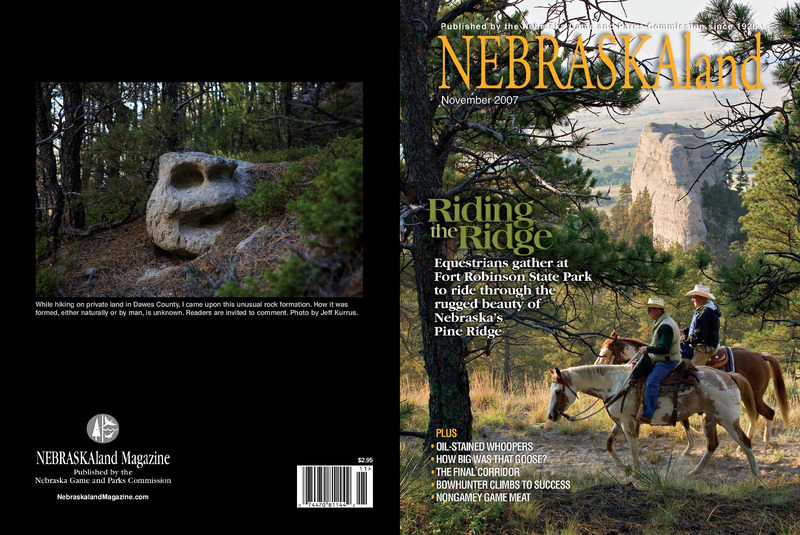
While hiking on private land in Dawes County, I came upon this unusual rock formation. How it was
formed, either naturally or by man, is unknown. Readers are invited to comment. Photo by Jeff Kurrus.
NEBRASKAland Magazine
$2.95
1 1>
Published by the
Nebraska Game and Parks Commission
NebraskalandMagazine.com
0
74470 81144
2
Volume 85, Number 9, November 2007
10 How Big Was That Goose
The debate has probably raged since hunters and Canada
geese first lived in close proximity to one another, certainly
since the invention of scales. Is there, have there ever been,
wild geese weighing more than 15 pounds? BY JON FARRAR
20 Paint Horse Trail Ride at Fort Robinson
Colorful paint horses and their riders gather each September
at Fort Robinson State Park for the American Paint Horse
Association’s trail rides at the historic frontier fort, cavalry
station and equestrian training center. BY BOB GRIER
24 The Final Corridor
In 1941, the North Platte River was forever transformed,
dramatically altering the appearance of this mountain to
prairie river and its valley. BY ROCKY HOFFMANN
32 Oil-stained Whoopers
An encounter on the Platte River with one of the world’s
most endangered wildlife species. BY MICHAEL FORSBERG
38 Bowhunt in Southeast Nebraska
Tim Heckenlively uses what might seem to be slightly
unorthodox hunting methods, but they work – he’s harvested
eight Pope & Young bucks in the past 10 years.
BY ERIC FOWLER
10
●
8 Outdoor Business
Waterfowl hunting’s opportunities and numbers are bountiful.
46 Outdoor Update
Biologists start restocking after last year’s winterkill.
47 Wilderness Workshop
Little-known secrets lead to better tasting deer.
38
●
24
●
49 Parks & Places
Wapiti WMA important for American burying beetles and elk.
Comment . . . . . . . . . . . . . . . . . . . . . . . . . . . . . . . . . 4
Outdoor News . . . . . . . . . . . . . . . . . . . . . . . . . . . . . 6
Classifieds . . . . . . . . . . . . . . . . . . . . . . . . . . . . . . . 48
Portraits from the Past . . . . . . . . . . . . . . . . . . . . . 50
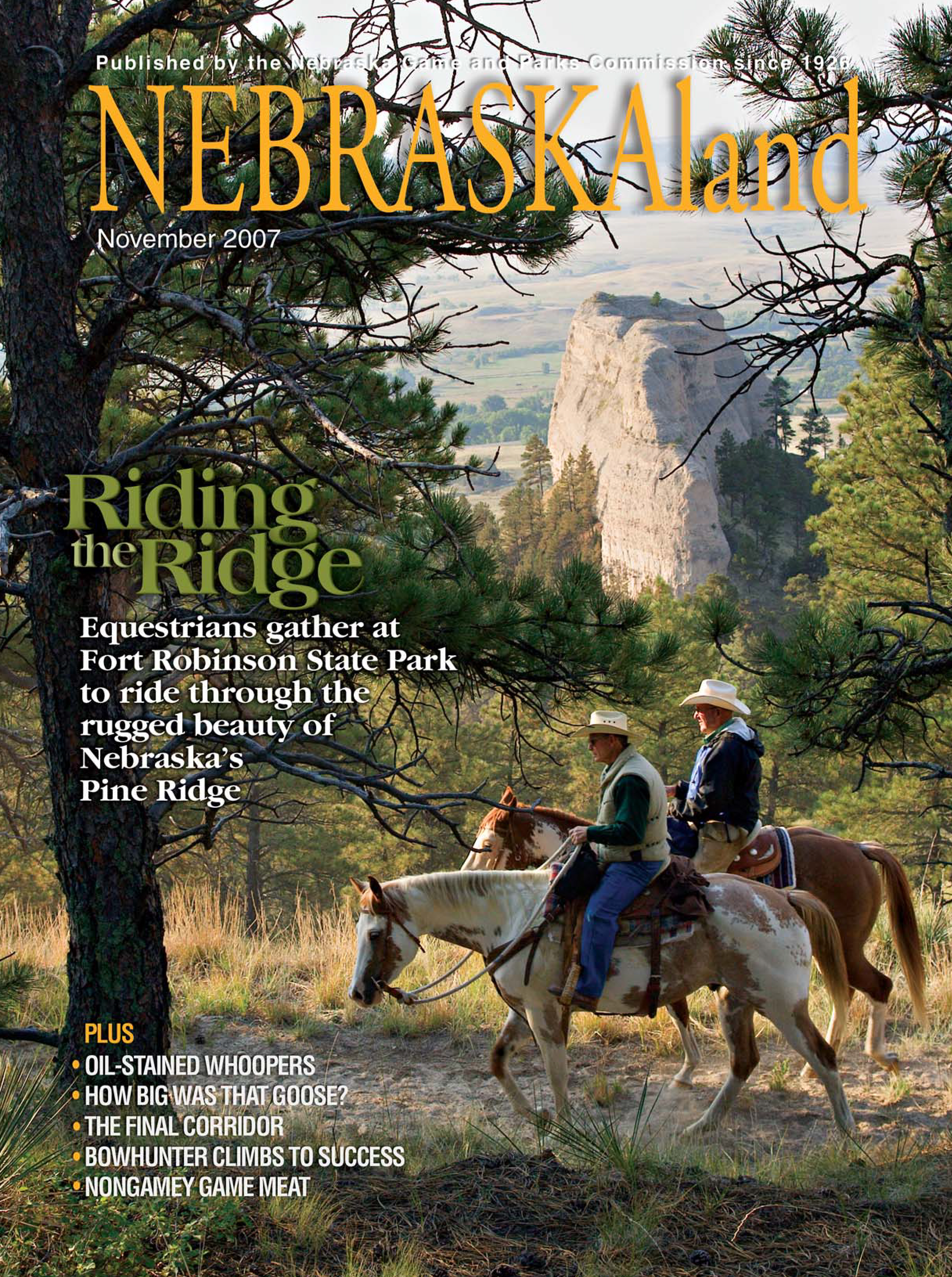
Cover: The annual American Paint Horse trail ride at Fort Robinson State Park gives riders a
view from atop the historic Red Cloud Buttes. The trail overlooks Giant's Coffin, a scenic butte
between Fort Robinson and nearby Crawford. See story beginning on page 20. Photo by
Bob Grier. Opposite: As the curtain falls on another Nebraska season, a last stiff goldenrod
(Oligoneuron rigidum) seed waits to fall in east-central Nebraska. Photo by Chris Helzer.
32
●
NEBRASKAland ● November 2007
3
Comment
with my Newfoundland.
The article's information and
speculations on origin and genetic
sources was also interesting as I
carried my interest in outdoors
through a biology degree. That
education and my other degrees has
allowed me to hold a deeper interest
in our niche in the world.
Tom McKean
Omaha, Nebraska
Published by the
Nebraska Game and
Parks Commission
Director: Rex Amack
Assistant Directors:
Roger Kuhn, Kirk Nelson, Sam Sidner
Information & Education Administrator:
Doug Bauch
Commissioners
Chairman:
Gary Parker, Columbus
Vice Chairman:
George E. Hall, Bridgeport
2nd Vice Chairman:
James Ziebarth, Wilcox
Jerrod Burke, Curtis
Dr. Mark Pinkerton, Wilber
Ron Stave, Waterloo
Bill Zutavern, Dunning
Dr. Kent Forney, Lincoln
Magazine Staff
Editor: Doug Carroll
Associate Editor: Jeff Kurrus
Art Director: Tim Reigert
Senior Editor: Jon Farrar
Regional Editors:
Eric Fowler, Bob Grier, Rocky Hoffmann
Contributing Editor: Michael Forsberg
Circulation: Donna Robinson
Photo Librarian: Sarah Johnson
NEBRASKAland
ISSN: 0028-1964
VOL. 85 / NO. 9
NOVEMBER 2007
Published monthly, except for Jan./Feb. and Aug./Sept.
issues, by the Nebraska Game and Parks Commission, 2200
N. 33rd St., Lincoln, NE. Copyright 2007, all rights reserved.
Please address comments or questions to this address.
Periodicals postage paid at Lincoln, Nebraska, and other
locations. POSTMASTER: Send all address changes to
NEBRASKAland, P.O. Box 30370, Lincoln, NE 68503-0370.
NEBRASKAland is available on audio cassette from the
Nebraska Library Commission Talking Book and Braille
Service, Suite 120, 1200 N St., Lincoln, NE 68508. (800)
742-7691.
Rates: $18 for one year; $33 for two years; $44 for
three years. Nebraska residents must add
appropriate sales tax.
To subscribe call 1-800-NEBLAND (632-5263),
or go online to: NebraskalandMagazine.com.
For address changes and questions about your
subscription, e-mail donna.robinson@ngpc.ne.gov.
4 NEBRASKAland ● November 2007
Comment
This black squirrel was photographed in
Hastings, Minnesota.
Black Squirrel Love
This guy/gal came into my yard
about three years ago and then left
for about six months. He has been
back all summer and seems to mingle
well with the gray squirrel population.
I was really excited to see him
initially and didn't know they existed.
My friend, who spends his summers
on Gull Lake near Brainerd,
Minnesota, tells me that's all they
have up there. Another friend says
there are actually calico squirrels in
southern Minnesota.
Speaking as a retired photographer,
your magazine is one of the best!
Loved the article in the October
issue on black squirrels. If I come
across one of those calico guys/gals,
I'll try to catch it with the digital!
John Colwell
Hastings, Minnesota
Thank you for a great magazine.
I really enjoyed the black squirrel
article in the October issue. I have
watched black squirrels from my
youth (63 years), first only seeing
them in Council Bluffs across the
river, then a gradual appearance in
Omaha neighborhoods along the
river. I thought when I moved west
in the city a few years back I would
miss them, but last week I saw a
black squirrel only blocks away
from the house while I was walking
Unusual Sight
Last night while driving my boys
to church, my 9-year-old son Ethan
said, "Hey Mom, there’s an elk!"
Needless to say, I didn't quite
believe him until my 13-year-old
son Clayton said, "No, Mom, really
there is an elk."
Sure enough, there stood a large
elk in a newly harvested bean field.
Since one does not often, if ever, see
an elk near Yutan, Nebraska, we
decided to take a picture. I quickly
dropped the boys off at church, drove
home, grabbed my camera and came
back to the field. The elk had
unfortunately moved further away,
but I took several pictures anyway.
During my drive home to get my
camera, two of my neighbors, Neal
Bedlan and Matt Tederman, had
seen the elk and had pulled over to
view the animal. We watched in
amazement for several minutes as
we discussed the oddity of an elk in
eastern Nebraska.
Liz Karloff
Yutan, Nebraska
Great Issue
Thanks for the October 2007 issue
of NEBRASKAland Magazine – it
was one of the best I've ever read.
I've saved virtually every article
written in the past 40+ years about
grouse and dove hunting in
Nebraska, two of my favorite fall
pursuits, and found "Much More
Than Pheasants" very entertaining!
Eric Fowler's article, "Ducks on
the Pond," was especially helpful as
our 11-year-old son is quickly
becoming an avid waterfowler in his
first year of duck hunting. And finally,
Jeff Kurrus's black squirrel article
answered many questions I've had
for years about them.
While working for the U.S. Postal
Service in Lincoln in the mid-1990s,
I would frequently see black
squirrels on my route. Most were in
the areas of 6th & D streets near
Friedens Lutheran Church and 20th
& D near First Plymouth
Congregational Church. Perhaps
these black squirrels liked living
near houses of worship?! Keep up
the good work!
Rev. David A. Feddern
Cambridge, Nebraska
Corrections
The prairie chicken on the cover of
last month’s issue was misidentified
by the magazine’s editorial staff.
Also, Yazoo, Mississippi was
misidentified in the story on black
squirrels. We regret the errors.
-Editor
Send your comments to:
Doug Carroll, Editor
NEBRASKAland Magazine
P.O. Box 30370
Lincoln, NE 68503
or e-mail doug.carroll@ngpc.ne.gov
Please include your postal address
and telephone number.
Letters may be condensed and edited
for clarity. Photographs are
welcome and will be returned.
This bull elk was photographed near
Yutan in early October.
Under federal and/or state law, discrimination is prohibited on the
basis of race, color, religion, age, gender, marital status, national
origin, disability or political affiliation. If you think you have been
discriminated against in any program, activity or facility by the
Nebraska Game and Parks Commission or want more information,
contact the Commission in Lincoln, NE, at (402) 471-0641 or the
Equal Opportunity Commission, Lincoln, NE, (402) 471-2024,
TTY/TDD (402) 471-4693).
Headquarters
2200 N. 33rd Street
Lincoln, NE 68503
Phone (402) 471-0641
District Office I
East Hwy. 2, Box 725
Alliance, NE 69301
Phone (308) 763-2940
District Office II
524 Panzer St., Box 508
Bassett, NE 68714
Phone (402) 684-2921
District Office III
2201 N. 13th St.
Norfolk, NE 68701
Phone (402) 370-3374
District Office IV
301 E. State Farm Rd.
North Platte, NE 69101
Phone (308) 535-8025
District Office VI
1617 First Ave.
Kearney, NE 68847
Phone (308) 865-5310
Omaha Office
1212 Bob Gibson Blvd.
Omaha, NE 68108
Phone (402) 595-2144
Ak-Sar-Ben Aquarium
21502 W. Highway 31
Gretna, NE 68028
Phone (402) 332-3901
World Wide Web site: OutdoorNebraska.org
E-mail: ngpc@ngpc.state.ne.us
Administration
Ted Blume (Adm.)
Craig Stover (Asst.)
Wes Loos (Asst.)
Rod Loos (Asst.)
Murray Johnson
Lincoln
471-5531
Lincoln
471-5532
Lincoln
471-5591
Ogallala (308) 284-8056
Lincoln
471-5003
Panhandle
Officer
City
Phone (308)
Jim Zimmerman (Sup.) Gering
436-7561
Walt Meyer
Chadron
432-4398
Scott Brandt
Gering
436-3418
Heath Packett
Gordon
282-2553
Dennis Thompson
Ogallala
284-6450
Dan Zuehlke
Ogallala
284-4815
Doug Pollard
Oshkosh
772-9950
Frank Miller
Valentine (402) 376-1183
Dan Kling
Whitney
432-8367
Southwest
Officer
City
Phone (308)
Roger Thompson (Sup.) N. Platte
532-9175
Ray Dierking
Brkn. Bow
872-3078
George Sund
Cambridge
697-4629
Michael Thome
Cozad
784-4362
Matt Andrews
Elwood
785-3025
Dirk Greene
Imperial
882-5328
Virgil Gosch
McCook
345-2185
Dudley Sorensen
N. Platte
532-0747
Rich Routh
Rep. City
799-2085
South-central
Officer
Jerry Pecha (Sup.)
Jeff Jones
Randy Pomplun
City
Phone (308)
Kearney
865-5327
Clay Center(402)762-3124
Fullerton
536-2987
Terry Brentzel
Darin Gress
Dale Johnson
Mark Reeves
Robert Finke
Richard Seward
Grand Is.
384-8296
Hebron (402) 768-2287
Kearney
237-1079
Loup City
745-0662
Milford (402) 761-3537
Ord
728-3115
Northeast
Officer
Tom Zimmer (Sup.)
Robert Kelly
Dale Davis
Ross Oestmann
Steve Oberg
Daniel Roberts
Jon Reeves
Marion Shafer
Pat George
Eric Wiebe
Tim Williams
Cory Krause
City
Phone (402)
Norfolk
371-6625
Albion
395-2538
Bassett
273-1700
Bloomfield
373-4412
Columbus
564-5937
Fremont
721-7852
Kennard
427-7378
Norfolk
371-2031
O’Neill
336-1588
Ponca
755-2566
Neligh
887-1335
West Point
372-6979
Southeast
Officer
Duane Arp (Sup.)
Sean McKeehan
William Krause
Jeremy TenKley
Mike Luben
Douglas Kramer
Dina Barta
Stacey Lewton
Levi Krause
Russell Mort
Dan Evasco
Jeff Clauson
City
Gretna
Ashland
Auburn
Beatrice
Colon
Lincoln
Lincoln
Lincoln
Louisville
Nebr. City
Papillion
Waterloo
Phone (402)
332-2965
944-4174
274-3789
228-1437
443-4278
466-9001
483-2358
476-0436
234-2212
873-5684
592-6733
359-5301
Nebraska Wildlife Crimestoppers 1-800-742-7627
NEBRASKAland ● November 2007
5
Outdoor News
Outdoor News
semblance of the natural high flows
in the spring and low flows in the
summer that still remain in this
stretch of the Platte River,” said
Nelson. “These natural high and low
flows are dependent on inputs from
the Loup River, Elkhorn River, Salt
Creek basins and the central Platte
River, therefore the action area of the
biological opinion includes the
Loup, Elkhorn and lower Platte
watersheds.”
The pallid sturgeon (Scaphirhynchus
albus) is a state and federally
endangered fish that has a complex
life cycle that requires habitat with
certain depth, velocity and river
connectivity. Interior least terns
(Sterna antillarum athalassos) are
state and federally endangered, and
piping plovers (Charadrius melodus)
are state and federally threatened.
These birds rely on the sandbars
created by natural high spring flows
and summer low flows to meet their
nesting needs on the lower Platte.
“The Commission’s mission is to
provide stewardship of the state’s
fish, wildlife and park, and outdoor
recreational resources in the best
long-term interests of the people and
those resources,” Nelson said. “We
hope people understand the action on
Fowl Ball
6 NEBRASKAland ● November 2007
ERIC FOWLER
Endangered least terns are among the
wildlife that depend on the Platte River.
Platte River Biological
Opinion Released
A recently completed Nebraska
Game and Parks Commission
biological opinion concludes that
further degradation of the lower
Platte River and its tributaries
by additional surface water
appropriations will jeopardize the
continued existence of the pallid
sturgeons, interior least terns and
piping plovers that depend on the
river for survival.
“We have been studying the
river since the 1980s – more than
25 years – and we feel the evidence
is conclusive that the river can stand
no further development,” said Kirk
Nelson, assistant director of the
Commission.
The biological opinion was
developed at the request of the
Nebraska Department of Natural
Resources to determine if continued
issuance of surface water
appropriations would jeopardize
threatened and endangered species
or their habitat requirements in the
lower Platte River.
The lower Platte River is the
section of the Platte River which
begins at the Loup River
confluence near Columbus and
extends downstream to Plattsmouth.
“These species utilize the lower
Platte River and require the
Protect
Wildlife
Report Game
Violations
Poaching is theft and all
Nebraskans are the victims.
Take a stand. Defend
wildlife and the right of
future generations to enjoy
it. When you see illegal
hunting, call your local
Conservation Officer or
this hotline to report it.
Nebraska Wildlife
Crimestoppers Toll-Free
Hotline
ERIC FOWLER
In late-March I received a call from a Mrs. Matt Asche in Cedar
Rapids regarding five or six wild turkeys that had been staying around
her family’s house the last few days. She said some of the turkeys had
become a problem and were somewhat annoying. The family had been
feeding the turkeys, so I told her if they quit doing that, they would
probably leave. I also told the woman that if the turkeys were around
her door or driveway that she could take a broom and strike the birds
with the flat side of the broom on their body in order to chase them
away. If they were not gone in a few days, I said I would try to relocate
them to a more rural setting. I told her to tell her husband about our
conversation and have him call me if that was not acceptable.
The next day I received a call from the Boone County Sheriff's office
regarding a call from a Cedar Rapids resident who said Matt Asche
was chasing and killing wild turkeys in his yard with a baseball bat.
While on my way to investigate the complaint, I received another call
about the same incident from the Nebraska Wildlife Crimestoppers
hotline. Both reporting parties stated that a number of high school
boys were at the scene and were chasing the turkeys also.
Mrs. Asche answered the door at their residence, but said she knew
nothing about what had happened. I asked if her husband was home
and she said he was at the town’s high school, which he was the
principal of. When I contacted him there, he first denied knowing
anything about the situation, but when told about the two eyewitnesses,
he dropped his head and became very nervous. He said the turkeys
were very aggressive toward his children and wife and that he was only
protecting his family, but didn’t answer when asked why he didn’t call me.
He indicated that he killed one of the turkeys with a ball bat and hit
one while it was on the ground flopping around to "finish it off so it
wouldn't suffer." When asked, he said he didn’t have the turkeys, but
thought they might be at the east end of the high school shop area. I
located the carcasses of a hen and a jake in the front-end loader
bucket of a school tractor and asked for the names of the involved, but
he wouldn’t tell me.
After tracking down the four students involved in the incident, I
conducted interviews and obtained written statements that corroborated
the fact that the principal had killed both turkeys with a ball bat. One
of the students had been instructed that day by Mr. Asche to try to
remove the birds one way or another, so they had gone to the house
to try and catch the turkeys so they could relocate them. One of the
turkeys was killed while the student was carrying it to the nearby
Cedar River in order to release it
No charges were filed against the students, but Mr. Asche was
charged with taking turkeys without a permit, taking turkeys by illegal
method, permit revocation and liquidated damages on the turkeys. He
pled not guilty to the charges and hired an attorney. The end result
was a plea bargain with the county attorney and all charges were
dropped except taking turkeys by illegal method. He paid a $50 fine,
$44 in court costs and $200 in liquidated
damages for the turkeys.
Within the first 24 hours after this incident
took place, I received complaints from six
individuals regarding it and numerous additional
calls and personal contacts from the general
public afterward. All of the callers indicated they
were very unhappy that someone would kill
turkeys in this manner and, most of all, that he
involved students from the school where he
was the principal.
– Bob Kelly, Conservation Officer, Albion
our part is not only for the wildlife
species dependent on the Platte
River, but also for the sustainability
of the river for the people who use it.
By stopping further depletions of
water from the lower Platte, we
will further sustain municipal and
domestic water supplies.”
A dramatic amount of degradation
to the lower Platte River has already
occurred over little more than a
century’s time. But returning flows
in the river to the levels recorded
from 1895-1909 isn’t the
Commission’s goal. “It’s important
to note that this opinion doesn’t
change any of the rights currently
granted. Farmers, ranchers and
businesses that already have rights
will retain them. We aren’t talking
about attempting to undo what has
already happened or change the
river’s current status,” Nelson said.
“What we are saying is that the very
least we can do to stop further
degradation to protect the river’s
status at the level it is today. The
interior least tern and piping plover
are in jeopardy now, and pallid
sturgeon numbers are below historic
levels. We simply can not allow
further degradation to the natural
flow regime of the river.” ■
1-800-742-7627
The Platte River, shown here near Silver Creek, has dried up in central Nebraska
each summer since 2002.
Nebraska Game and Parks Commission
NEBRASKAland ● November 2007
7
Outdoor Business
Waterfowl Hunting
When talking bird abundance and liberal seasons, these are “the good old days.”
By Jon Farrar
Mark Vrtiska, waterfowl program manager with the Nebraska Game and Parks
Commission, said hunting regulations have been liberal since 1995.
aterfowlers past the halfcentury mark remember the
not-so-good old days when
season regulations, weather
patterns and a shortage of
ducks and geese conspired to produce
loser years. We will still be grumbling
about them on our deathbeds. How
many of us, though, are making mental
notes about the liberal waterfowl
hunting seasons of recent years? To
put these seasons in perspective, look
back at some of the stinkers.
In 1947, a typical post-World War II
season, duck numbers were down.
Canada geese were as scarce as hen’s
teeth, and snow geese mostly blew
through the state without a downward
glance. Waterfowlers were allowed
four ducks daily, any species or sex,
but not more than one wood duck. The
season opened October 21 and closed
November 24, a 35-day season, and
the duck season was statewide – no
consideration for early marsh shooting
or late river shooting. Okay, 1947 was
60 years ago, ancient history.
In 1962, within the reach of many
oldster’s memories, duck production
PHOTO BY JON FARRAR
W
8 NEBRASKAland ● November 2007
was again down and reflected in a 25day, statewide season and a daily bag
limit of two, of which only one could
be a mallard. The following year, the
bag limit was raised to four birds daily
and the season was open 31 days. But
the 1963 season will probably go down
as the best example of the worst duck
hunting regulations in Nebraska’s
history. It was the first year the federal
framework allowed states to split the
total number of hunting days to
provide more hunting opportunity.
There always has been two duck
hunting camps in Nebraska: those
hunting Sandhills lakes, Rainwater
Basin marshes and farm ponds who
want as many days as early as possible
before freeze-up; and those hunting
rivers and large reservoirs wanting a
late season to take advantage of late
migration flights and wintering
mallards and Canada geese. In 1963,
the duck season was open statewide,
from October 5-13, and November 16
through December 8, a total of 31
days. Essentially, early shooters had a
nine-day season before freeze-up.
Considering that most ducks migrate
through Nebraska in October, the
1963 season was a slap in the face for
early-season hunters, and there were
nearly as disagreeable seasons in the
early 1990s, especially for early
season duck shooters.
Rains returned to the prairie-pothole
country in 1993, and by 1995,
waterfowl regulations reflected
swelling duck numbers. Beginning in
1995, the federal framework used to
set waterfowl hunting seasons has
been drafted under the Adaptive
Harvest Management (AHM) system.
The goal is to maximize hunter
opportunity while maintaining stable
waterfowl populations. Mallards drive
AHM because more data for more
years is available for mallards than
any other duck species. Two factors
are heavily weighed – the abundance
of water on the breeding grounds in
the spring and the size of the mallard
population. The computer model
suggests one of four season alternatives
– very restrictive, restrictive, moderate
or liberal. State and flyway waterfowl
managers discuss the alternatives
and make recommendations to the
U.S. Fish and Wildlife Service. Since
1995, all waterfowl seasons have been
set under the liberal criteria. Those
species significantly short of their
target population – such as canvasbacks
and pintails in recent years – receive
special consideration, even separate
seasons.
A waterfowler from the 1960s
would not believe today’s season dates
and bag limits. During 2007-08, the
duck season in the High Plains Unit is
97 days long, there is an early teal and
an early Canada goose season in
September, dark geese can be hunted
somewhere in the state from
mid-September into February, and the
Light Goose Conservation Action
allows hunting snow geese and Ross’s
geese from February 7 until April 13.
Except for the few days between the
early teal and the opening day of
regular duck seasons, a waterfowl
hunter could be in the field somewhere
in Nebraska from mid-September to
mid-April. The last time Nebraska
hunters enjoyed such liberal seasons
was before 1901, when there were
essentially no regulations.
“We try to accommodate the most
number of hunters, all the diversity,
the best way we can,” said Mark
Vrtiska, Nebraska Game and Parks
Commission waterfowl program
manager. “We try to get people in the
places they want to hunt when there
will be waterfowl there to hunt. But
we can only take that so far. Nebraska
is a migration state, and so weather
patterns determine the migration
peaks. And Nebraska is an incredibly
diverse state for waterfowl hunting.
We have places where winter waterfowl
habitat actually abuts early migration
habitat.”
Vrtiska’s advice to waterfowl
hunters is to be more mobile, to take
full advantage of the long seasons and
variety of hunting opportunities. The
nature of waterfowling often ties
hunters to one location – somewhere
close to where they live, where they
have permission to hunt or favorite
public hunting waters, the fact that
most blinds are stationary and that
travel can be expensive. Often,
though, Vrtiska said, different hunting
opportunities are not that far away –
15 miles to different zones and season
dates.
“Young hunters, those who started
in 1995, have never known a restrictive
season,” Vrtiska said, “in part because
of AHM, in part because of good
water and recruitment on the breeding
grounds. Young hunters have not gone
through a 39-day season and daily
limit of two or three ducks. Today’s
waterfowlers should be basking in the
exceptionally long seasons we’ve had
for the last 12 years.” ■
Get Ready to
Hunt this Fall
Buy Your Nebraska Hunting
Permits Online!
Visit our secure web site to
quickly and conveniently
purchase fishing, hunting and
park permits online using your
Visa or MasterCard.
Online permit purchase is
safe, hassle-free and there is
never a checkout line. Simply
choose the permits you want,
pay for them, download and
print. And, you are on your
way to Nebraska’s great outdoors.
www.OutdoorNebraska.org
NEBRASKA GAME AND PARKS COMMISSION
NEBRASKAland ● November 2007
9
How Big Was
That Goose?
By Jon Farrar
The debate has probably raged since hunters and Canada geese first
lived in close proximity to one another, certainly since the invention of scales.
Is there, have there ever been, wild geese weighing more than 15 pounds?
T
10 NEBRASKAland ● November 2007
Branta canadensis maxima
“It appears likely that a geographical
[Canada goose] race of large size once
inhabited the northern prairies, for
much heavier birds are recorded from
this region,” John C. Phillips and
Frederick C. Lincoln wrote in their
1930 book American Waterfowl – Their
Present Situation and the Outlook for
Their Future. They added: “This
breeding stock is now extirpated.”
William B. Mershon, a Michigan
copper mining executive and noted
waterfowl hunter of his time, often shot
in North Dakota in the 1880s. He
recalled the big Canadas in a 1925
issue of Field and Stream magazine:
“While having the general markings of
the Canada goose, such as the black
head and neck with white throat and
cheeks, they were lighter colored, of a
blue-ashy general appearance, and the
bodies were shaped differently – long
ovals instead of round, chunky ovals.”
Mershon wrote the “big geese held
aloof and did not mix with the others,”
segregating from smaller Canadas
when feeding in fields. He observed
they “came into their feeding ground
quietly, without any honking or noise,
knew right where they wanted to go
and did not circle about,” and “usually
flew low, not so high in the air as the
other geese.” Mershon considered any
birds weighing less than 12 pounds to
be “small geese.”
Canada geese exhibit greater variation
in body size than perhaps any other
bird species, ranging from little more
than two pounds to at least 14 pounds.
They are an exception to the biological
rule that warm-blooded vertebrates of
any species are usually largest in the
northern portions of their ranges.
Canada geese populations decrease in
body size from south to north – the
smallest races nest in the far north and
the largest race, the so-called “giant”
Canada goose, nests on the central
Great Plains. Additionally, the general
plumage coloration becomes darker
from southeast to northwest.
The taxonomy of Canada geese
(which ones are distinct species or
races) has long been a realm of lively
debate for biologists using Latin and
Greek scientific names, and for laymen
employing common names such as
honker, lesser, Hutchie, Richardson’s
and cackler. During the last 50 or more
years, as many as 12 subspecies and
four different species have been used or
suggested to classify Canada geese.
The most recent classification, adopted
by the American Ornithologists
Union in 2004 and largely based on
mitochondrial DNA studies, recognizes
two living species of “Canada geese” –
the cackling goose (Branta hutchinsii)
with five subspecies of small geese,
and the Canada goose (Branta
canadensis) with seven subspecies of
larger geese. The giant Canada goose is
still considered a subspecies, Branta
canadensis maxima. The giant
Canada’s field marks are a pale, grayish
plumage, especially on the underparts;
PHOTO COURTESY OF ART STORZ JR.
he argument has raged around
campfires, in the back rooms of
gun stores and in goose pits for
decades. Are there, were there ever,
free-flying Canada geese weighing
more than 15 pounds? Did some weigh
18 pounds, or even more? The maximum
weight of Canada geese was a frequent
topic in the columns of Sandy
Griswold, outdoor writer for the
Omaha Bee from 1886 into 1898, and
the Omaha World-Herald from 1898
until his death in 1929. An excerpt
from one of many letters he received
typifies the discourse. In the January
19, 1913, edition of the Omaha WorldHerald, R.C. Darby of Northboro,
Iowa, after hunting on the Missouri
River, wrote: “I killed one that weighed
fourteen pounds, thought that was
good, but one fellow said he killed one
weighing twenty-one pounds. Don’t
believe it, do you?” Griswold’s
response: “Canada geese weigh
anywhere, on an average, from eight to
fourteen pounds, one larger than that is
a rarity. No, I do not believe your
friend ever killed a Canada goose
weighing twenty-one pounds, and I do
not believe there ever was one of such
a weight.”
Griswold did believe wild Canada
geese reached weights of 15 to 19
pounds, and even claimed to have seen
them weighed. Griswold, like most
hunters (and most outdoor writers), had
moments of inconsistency, but more on
that later. First the science of large
Canadas as we know it today.
Former Nebraska governor Robert Cochran
(1935-1941), left, with Art Storz, Omaha brewer,
and their morning bag of mallards and Canada
geese at Storz’s Ducklore Lodge on the North
Platte River west of Lisco in Garden County.
NEBRASKAland ● November 2007
11
PHOTO COURTESY OF GARDEN COUNTY HISTORICAL SOCIETY
The North Platte River Valley has long drawn goose hunters and Canada geese of all sizes.
white on cheeks extending somewhat
farther up on the head than other
subspecies; very long neck, only rarely
with a white collar; and very large bill.
Whoppers of Old
12 NEBRASKAland ● November 2007
telling me about a Canada goose he
killed a few days before that weighed
within a fraction of 19 pounds. While I
have no cause to doubt this statement I
can safely say that if it is correct, that
goose was one of the heaviest Canada
geese ever killed in the state.…”
• And in a February 5, 1928, column,
Griswold wrote: “Therefore, with all
due reverence for the memory of Mr.
Hoagland and his opinion, I do know
positively and beyond all possible
revocation, that Canada geese have
frequently weighed as high as four
pounds more than the 15 [pounds] set
by Mr. Hoagland for his one thousand
dollar prize for the man who produced
one that even tipped the scales at that
figure.” (See pages 14-15).
George A. Hoagland’s offer of
$1,000 [earlier columns gave the prize
as $25] to any hunter producing a
Canada weighing more than 15 pounds,
given back in 1888 when Canadas were
still abundant, suggests exceptionally
large geese rarely, if ever, existed.
Hoagland was a wealthy Omaha lumber
merchant who came to Nebraska in
1861. Griswold noted that Hoagland
had probably killed more geese than
any other hunter in Nebraska at the
during the past quarter of a century. ....
Therefore I am willing to concede that
if George A. Hoagland’s offer for a
15-pound goose had been made in these
times, there would be little danger of
any man ever collecting the same.”
There is some scientific information
supporting Hoagland’s belief that there
were few, if any, Canada geese in
Nebraska in the 1880s weighing over
15 pounds. During the fall migration of
1884, 1885 and 1886, and the spring
migration of 1885, D.H. Talbot and
“his collectors” secured 593 Canada
goose specimens from the Mississippi
Valley area, of which 404 were collected
in central Nebraska. The collection
eventually was given to the University
of Iowa. The weights of 356 specimens
were preserved, of which 57 were
“larger geese.” The 57 Canada geese
ranged from 5.5 to 13 pounds, averaging
8.18 pounds. Female geese averaged
heavier, but the heaviest birds weighed
were all males.
How Big Today?
“Whether the average sportsman
realizes it or not, there is no gainsaying
the fact that our wild fowl are a fast
vanishing race,” Griswold wrote in
1907. “The Platte in the old days was
undoubtedly the greatest fall and spring
resort of wild geese of any region in
the country....Twenty years ago you
could see more geese at a glance of the
eye than you can in these modern times
from the first of March to the first of
March. The sight of a flock of Canadas
is now an event to excite the most
enthusiastic exclamations of even the
most persistent hunters along the
waters of the Platte valley....”
If all races of Canada geese were
much diminished by 1907, the giant
Canada goose no doubt was on the
cusp of extinction even before 1900.
Their characteristic low-flying habit
made them more vulnerable to the gun;
their great size made them more
desirable to hunters; and their breeding
range was the most southerly of all
Canada races, and so converted to
agriculture earliest and most extensively.
By the 1930s, shooting a Canada goose
in most Nebraska counties was rare, sure
to land a photo of the fortunate hunter
and his goose in the local newspaper.
But there were regions in Nebraska
where Canadas continued to be shot
with regularity, such as the North
Platte River Valley. How big were the
(continued on page 16)
PHOTO COURTESY OF RED DEER HUNTING CLUB
Griswold was probably the most
comprehensive chronicler of Nebraska
sporting history during the late-1800s
and early 1900s. During that time he
defended his contention that exceptional
Canada geese did weigh more than
15 pounds, even in the face of contrary
beliefs of older sportsmen he held in
high regard, sportsmen who had shot
geese in Nebraska decades before
Griswold moved to Omaha. A sample
of Griswold’s comments, and of other
Nebraska goose shooters, appearing in
the Omaha Bee or Omaha WorldHerald over the years follows.
• In an 1894 article about hunting
south of Lakeside in the western
Sandhills, Griswold wrote: “...during
the hour and a half we spent in our
grass suits amidst the rushes we
knocked over six big Canadas – the
largest pulling down the scales at
fifteen pounds and a half. ...”
• Griswold, in 1895, writing of a
hunt on the Platte River near Clarks:
“We had nine and one that tipped the
scales at nearly eighteen pounds. ...”
• “I never was much given to weighing
either the goose I killed or fish I
caught, contenting myself with mere
guesswork pertaining thereto.”
– Griswold, December 31, 1905.
• “I killed two Canadas in the year
1898 on the Platte River, about half a
mile east of the Burlington & Missouri
railroad bridge near this place, which
weighed seventeen and sixteen pounds
each, and I also killed one four miles
west of this place in 1901 that weighed
seventeen pounds after it was dressed.”
– W.E. Jordan, Central City, January
14, 1906.
• Jno. R. Woodin of Tekamah “killed
a Canada goose out on his winter
wheat field last Sunday that weighed
fifteen and one-quarter pounds. Woodin
weighed the bird himself, both on
common scales and a pair of steel
yards and says the above weight is
absolutely correct.” – Griswold,
December 1, 1912.
• In a January 15, 1928, column,
Griswold wrote: “Received a letter a
day or two since from a friend out in
the northwestern part of the state
time. As for Hoagland’s $1,000 reward
“in the iron Bank over on Farnam
awaiting demand from the lucky
individual that can produce this goose,”
well, it never left Hoagland’s account.
Dozens of Omaha’s most experienced
hunters took to the Platte River in
November 1888 when the flight of
Canada geese arrived, hoping to claim
the prize. Griswold recalled their
triumphant return and “the pile of dead
geese that were heaped up on the long
main counter of the gun store. ... That
great pile of geese was sorted and then
weighed, and it would have made you
jump to have heard the raucous outburst
from that crowd of good and honest
and jolly sportsmen, when the old
scoop shovel on the scales had held all
the largest, and not a single one
reached a single notch over 12¼
pounds.”
Griswold, though, persisted in
believing that geese weighing over
15 pounds once existed in Nebraska. In
1928 he wrote: “…when wild geese, and
I mean Canadas at that, were as plentiful
almost as the ducks themselves, and
when largely, perhaps on account of the
conditions existing, there were many
geese killed much larger than any that
have been killed save in rare instances,
By the early 1900s, the giant Canada geese that once nested in the Nebraska Sandhills were a thing of the past.
NEBRASKAland ● November 2007
13
December 31, 1905
Omaha World-Herald
BY SANDY GRISWOLD
ONK! Auh Unk!
There were a
number of the old
day hunters met
in Townsend’s old
gun store the
other night and
the subject of the
seemingly extraordinary size and
weight of the mallards this fall came
up for the usual discussion. One said
that this was accounted for by the
uncommon plentifulness of feed this
fall; another that it wasn’t so much a
question as to the abundance of
provender as it was to the long continued balmy and open weather,
which enable the ducks—which
were not too much disturbed—to
gorge themselves from morning until
night and thus gained the very maximum of their size and weight. Still
another experienced and observing
old fowler said that while both were
in a measure correct, that the same
could be said of the whole duck family, and the geese, too, for that matter....
While lolling around in front of a
tent out in the Sandhills one balmy
October afternoon, years ago, with
the venerable George A. Hoagland,
the Rev. Edwin H. Jenks and several
other kindred souls, a passing flock
of geese over the distant sand dunes
started us to discussing these birds
and incidentally the biggest ones we
had ever met with. After most of the
party had all had their say, Mr.
Hoagland turned to me and inquired
what the heaviest goose weighed
that I had ever killed.
“That I do not know,” I promptly
replied, “as I never was much given
to weighing either the goose I killed
or fish I caught, contenting myself
with mere guesswork pertaining
thereto. But I have seen one, Mr.
Hoagland,” I quickly added, “that
weighed eighteen pounds.”
“Whew, that was a whopper,”
rejoined Mr. Hoagland, “where was
14 NEBRASKAland ● November 2007
that, Sandy?”
“Down at Hardin’s gun store on
South Thirteenth street, after the club
hunt in 1888,” I responded glibly as
ever. “There were two of them that
weighed within a fraction one way or
the other of eighteen pounds each,
and they were both killed by the
same team of hunters, but for the life
of me I cannot remember who they
were, but I have a faint recollection
that one of them was the late John W.
Gwin, but I may be mistaken.”
“Were they Canadas—are you
sure?”
“Oh, yes, they were
Canadas all right, but old
timers, we all thought from
the gray of their plumage:
there was scarcely any
black blending with their
general color at all.”
“They must have been
old-timers, very old-timers,”
interjected Mr. Hoagland,
with much doubt implied in
his tone. “I’ve been shooting geese out in this country now for, let me see,
about forty years, and I
have never yet run across a
goose that weighed over
fourteen pounds.”
“Mr. Hoagland,” deprecatingly from me.
“Well, that’s so, and at
that I have only killed two
or three that reached that
weight. Why, some sixteen
or seventeen years ago, one
March morning down in
Collins’ gun store, on
Douglas,
between
Thirteenth and Fourteenth
streets, there was a lot of us
shooters discussing this very subject.
There were several, like you, who
imagined that they had seen an eighteen-pound, or even a twenty-pound
goose, and, of course, guided by my
extensive experience and close
observation, I disputed them and
finally to convince them that I was in
earnest, I offered $25 in cash and
immediately drew my check for that
amount and deposited it with G.W.
Collins, to the first man that brought
me in a Canada goose weighing over
fourteen pounds. That was in the
days when geese were as thick as
black birds and every man in the
party that night left Collins’ store with
that $25 of mine as good as in their
pockets.
“Some two weeks subsequent, one
afternoon, a boy came to my place of
business and told me I was wanted at
Sandy Griswold
Collins’ gun store right away. Not
suspecting what was up, I responded, however, within the next half
hour. When I reached Collins’ I
found pretty much the same crowd
there that had been present the night
we were discussing the Canada’s
weight, and Yank Hathaway said to
me: ‘Well, George, Mr. Blank has
won your $25. Look here.’ And I followed him to the back room where
John Collins had his saddlery shop,
and there on the floor I beheld a very
handsome old Canada gander. Blank
picked it up by the neck and held it
before me with the interrogation:
‘How much will he weigh?’
“Now, I pride myself that I cannot
be fooled on the close approximate
weight of a wild goose or a black
bass after I have had a chance to
look at it. I have a peculiar talent in
this line, I’ve weighed thousands of
both birds and fish and seldom misguess their weight more than an
ounce or so.
“Scrutinizing
Blank’s
gander
searchingly, I deliberately declared
that it wouldn’t weigh more than
twelve and a half pounds. The steelyards were out in a flash, and hooking the goose through the bill, Blank
held it up and it pulled down the
marker to fifteen and a half pounds!
They all gave me the laugh, of
course, and Mr. Collins said: ‘Shall I
give Blank his money?’ ‘not yet,’ I
replied, and turning round I stooped
and reaching under the bench where
Blank had carelessly tossed the
Canada, I dragged it out by one leg
and held it up, intending to heft it, as
I felt confident from its looks that I
had killed many a heavier goose.
“There was a pattering as like hail
upon the leather-scraped floor, and
as I jerked the goose up a little higher, a perfect stream of buckshot
began to pour from his throat, and so
the snap was given away and my $25
was safe. After the joke had been
abundantly enjoyed by us all, I insisted on stripping the gander’s crop of
the buckshot and weighed him and
you can imagine my pride and selfesteem when the bird notched exactly twelve and a half pounds.
“Now, Sandy,” continued the
genial old sportsman, “those two
geese you saw
down at Hardin’s in
the fall of ’88 may
have weighed eighteen pounds each,
as you claim, but I
think some one
handed you something, as they say
nowadays.
The time to give it to them.
“Did you see the
ter judges of the range of a shotgun,
birds weighed?”
I acknowledged that I did not. [In a few eyes much quicker than his to
February 1928 column, Griswold’s detect any suspicious motion, and
recollection of the event was differ- see through a flimsy blind. Nor are
ent: ‘I, myself, asserted previously, there many sounds that awake more
that I had seen two geese weighed tender thoughts than the deep-toned
down in the old Penrose & Hardin unk-auh-unk, whether, falling afar
gun store, in the fall of 1888, that tilt- from the sky as the noble bird floats
ed the scales at more than 18 away south in disdain of all your
pounds, and that is true, as I stood quarter of the universe, or sounding
by and saw them weighed not once, clear and generating above your tent
but repeatedly, and on the regular as he passes in the dead of the night,
store scales where patrons were hav- or rolling toward every corner of the
ing their shot and powder weighed sky as the flock sheers, whirls, and,
on great pounding pinions, climbs
daily.’]
“Then,” said Mr. Hoagland, “I have upwards as you rise from your hole
no hesitancy in declaring my doubts. in the field and pour a storm of leadI tell you I never saw a wild goose en bullets among them.
But to once more revert to the
that weighed over fourteen pounds.”
Now, how about Mr. Hoagland, weight of the Canada, and, with all
anyway? I know he is Omaha’s most due respect for the Hoagland opinactive sportsman among all the veter- ion, I shall never believe that the two
ans of the old day school, as he is, geese I saw on Johnny Hardin’s
without doubt, one of the best counter that memorable October
informed men on wild fowl in the evening eighteen years ago fell far
whole community, their diversified short of what they then said they
habits, peculiarities, flight, notes dur- weighed, eighteen pounds. I did not
ing both the closed and open season, see them weighed but there were
as well as the most effective way to many shooters there who did, and
hunt and kill them. And there is no maybe one of these in perusing these
shooting he likes better than goose lines will recall the incident and
shooting, and he is never more inter- come forth with a verification. If he
esting than when descanting upon does not, however, it is all right, and
the days he spent in his brush blind the next best thing I can do is to
on a bar in the sprawling Platte; or in invite sportsmen who have killed
a pit in some one of the limitless pas- geese weighing over fifteen pounds
to send me in a report...and, as for
ture lands which border it....
According to Mr. Hoagland no myself, I’ll promise to never allow
sportsman need know the bird over- another big goose to get away from
ly well to appreciate that he is quite me without first testing his poundage
worthy of his fire. Few birds are bet- on the scales.
NEBRASKAland ● November 2007
15
PHOTO COURTESY OF FRED W. SIEMAN
Canada geese, large and small, were still abundant in 1908 when hunters shooting on the North Platte River between Sutherland
and Paxton posed for a photo. Keith Neville, who would be Nebraska’s governor from 1917 through 1919, is the center hunter.
Canadas shot along the North Platte
River from the 1920s through the
1960s?
Irvin Winterer, a lifelong goose
hunter on the tableland northwest of
Oshkosh, said in a 1987 interview
when he was 88 years old that during
the 1920s and 1930s the average size of
Canada geese shot was 10 to 12
pounds: “Some of them would be bigger
than that, but that would be about the
average, 10 to 12 pounds.” Jack
Robinson of Oshkosh first hunted
geese in 1929 when he was eight years
old, hunted with Winterer, and still
hunts them today. Few living hunters
can match either his days in the goose
pit or number of geese shot during his
lifetime. “We’ve always killed about
eight-pound geese. Some were bigger.
The heaviest goose I’ve killed was
14 pounds and 2 ounces, weighed on
the post office scale. I’ve killed
12-pounders and 13-pounders, but only
that one over 14 pounds.”
The late Goldie Haworth of Sidney
began hunting on the North Platte
River Valley in 1919 as a high
16 NEBRASKAland ● November 2007
school sophomore and continued
hunting there into the 1990s. In a 1987
interview, Haworth said that while the
average size of Canada geese on the
North Platte had been increasing in
recent years because of the restoration
of giant Canadas to the northern Great
Plains, they still averaged eight or nine
pounds and the largest were about 12
pounds.
Haworth recalled a heavier goose,
though. In 1925, Haworth and two
companions were hunting along the
North Platte River in Garden County.
“We got a bunch of geese to come in
and we got six of them, big geese, one
weighed 14 pounds,” he said. The big
goose was only wing-tipped and
Haworth kept it for his call bird flock.
“So, my brother-in-law and I were
down in Joe Simodyne's pool hall one
night and we'd all been spiking bottles
of near-beer with a little alcohol and
we got to talking about big geese,”
Haworth recalled. “And Ed says, ‘well,
I've got the biggest geese.’ And he kept
his geese three miles out east of town
on a lake out there. And I kept mine
here in town. It was about 11 o'clock at
night. So we bet $5 who had the
biggest geese. He went out there and
got his goose and I went home and got
my goose and we took 'em down and
weighed 'em and my goose weighed
16 pounds and his weighed 14.” The
14-pounder Haworth shot and took
home in 1925 had gained two pounds
during its flightless life in a pen. That
was the only goose heavier than
15 pounds Haworth had seen during
70 years of raising and hunting them.
Ralph Kohler of Tekamah started
hunting waterfowl on the Missouri
River in the 1920s, and has operated a
commercial waterfowl hunting operation
since 1956. While the bulk of his
shooting has been snow geese, he has
seen thousands of Canada geese tumble
into his decoys. The largest Canadas he
has seen weighed came not during his
youth, but in 1988. “We needed seven
[more] to have the limit that day,”
Kohler recalled in a 1989 interview.
“We got into a bunch and it turned out
just exactly right, we just had seven of
‘em. Two of those weighed 14 pounds
and 10 ounces, one 13 pounds and 10
ounces, one 13 and 9 ounces, and one
13 and 6 ounces. I never saw such
big geese in my life. I’ve hunted all
those years and never seen anything
like it.”
With the successful restoration
programs during the 1970s, 1980s and
1990s, the chance for a hunter to shoot
a goose weighing 12 pounds or more
has not been better during the last
100 years. And so it is not surprising
that claims of Canadas weighing
15 pounds or more are heard most
hunting seasons. Few of these monsters
are actually weighed on certified
scales, though. But there are exceptions,
providing insight into the maximum
weights of birds today.
During the last six hunting seasons,
Commission biologists at Clear Creek
Wildlife Management Area on the North
Platte River above Lake McConaughy
have gathered hunter success
information, including the weights of
Canada geese shot there. Of 1,865
geese weighed, the average weight was
slightly over nine pounds. The heaviest
bird shot in any year ranged from
12 pounds, 8 ounces to 13 pounds, 4
ounces, with an average of 12 pounds,
14 ounces. The North Platte River is a
major migration stop and wintering
area for large geese nesting in the
northern Great Plains and south-central
Canadian provinces, and as such is
probably a reliable sampling ground.
Since 1976, the North Platte Valley
Sportsman’s Club has sponsored an
annual competitive goose shoot in the
Oshkosh area, with the proceeds going
to scholarships, local civic endeavors
and conservation projects. Last year
18 four-member teams competed. There
is an official weigh-in at the end of
hunt. Last year was a record setter for
big geese. Gary Ebert of Lincoln killed
the largest goose ever recorded during
the 30 years of the competition, a bird
weighing 14 pounds. Each member of
his team shot their limit, 12 geese total,
for a combined weight of 135.6 pounds
and an average of 11 pounds, three
ounces. That team total was also a
30-year record for the organized hunt.
Al Lake, who operates a game bird
cleaning service in Oshkosh, has
dressed ducks and geese for hunters
since 1980. He has processed as many
as 4,919 geese in one hunting season.
Return of the Giant
In the early 1910s, Ray P. Holland, president of the American Game
Protective and Propagation Association and later editor of Field and Stream
magazine, initiated a public discussion about the maximum weights of
Canada geese that continued into the 1930s. “I have been working on the
theory that there is a distinct species of big goose for the last ten years, but
have never gotten very far with it,” Holland wrote in 1922. “I have a pile of
data here in the office, but nothing conclusive enough to convince the
ornithologists that such a bird exists.” Holland concluded that the Platte River
was probably “about the southern limit of their range.”
In 1934, Holland received a letter from John Phillips, one of America’s
most prominent ornithologists, saying: “I believe you are right in your surmise
that there was a large race of Canadians in the Dakotas, Nebraska and
southern prairie region, but unfortunately, nothing tangible remains on which
to base a new subspecies.” Phillip’s judgment essentially resigned the debate
to dusty file drawers, largely for the absence of specimens either alive or
dead. There was a revival of the effort to document the existence of big
Canadas by ornithologist James Moffitt in the mid-1930s. Moffitt described a
race of large Canada geese native to western states, the race bearing his
name today, Branta canadensis moffitti. Moffitt was convinced an even larger
race once occurred in the North American interior. His research ended
prematurely when he was killed in World War II.
The rediscovery of giant geese is largely attributed to Harold C. Hanson,
an Illinois Natural History Survey research biologist and author of The Giant
Canada Goose, published in 1965. In 1962, Hanson, along with Minnesota
and federal biologists, trapped Canada geese wintering at a Rochester,
Minnesota city park to gather measurements. At first they thought their
scales were faulty because of the heavy weights recorded, but they were not.
The large birds perfectly fit descriptions of the giant Canada goose described
in the early 1900s. Hanson subsequently found giant Canadas in flocks from
Michigan to Colorado and north into the prairie provinces of Canada.
Also in 1962, South Dakota game biologists began to select and gather
large geese with the morphological traits old-time hunters and ornithologists
assigned to the giant Canada. In a cooperative project to reestablish giant
Canadas to their native range, the USFWS and the South Dakota Game,
Fish and Parks Commission assembled birds from game breeders in both
Dakotas and Minnesota. The Nebraska Game and Parks Commission
initiated a program to restore Canada geese to their native breeding grounds
in the Sandhills in the late-1960s. Thirty-seven male and 23 female
maxima-type goslings were obtained from the Northern Prairie Wildlife
Research Center in Jamestown, North Dakota, as well as birds from other
sources, such as Cody Park in North Platte, geese with lineages tracing back
to pre-1935 call bird flocks. Moffitt’s Canada geese, the slightly smaller race,
were also included in the breeding flock. Biologists were not as concerned
with producing a pure line of giant Canadas as they were birds of large size
that were reliable nesters and adapted to Nebraska. Restoration breeding
flocks were established at Sacramento-Wilcox Wildlife Management Area in
Phelps County, and a smaller breeding flock at Branched Oak Lake near Lincoln.
The first releases of still-flightless juvenile geese were made in the
Sandhills in 1970. Geese and most other birds imprint on the site where they
make their first flight and return there to nest when mature. To speed the
reintroduction, dark goose hunting was not allowed in the Sandhills for
10 years, and the harvest limited for several subsequent years. A total of
4,100 goslings were released in the Sandhills until 1983, when the goal of
establishing 500 breeding pairs was reached. The following year, a similar
program to restore large Canadas as breeding birds in the North Platte River
Valley was initiated. Over the next 10 years, more than 5,000 goslings were
released. After 1993, goslings were released at other locations across the
state. The restoration program was discontinued and the breeding flock
dispersed in 1997. Today, “giant” Canada geese are common across their
former range.
NEBRASKAland ● November 2007
17
information is little more than
anecdotal, but suggests Griswold’s
contention that old birds grew to
exceptional weights was probably
unfounded.
An Aversion to Scales
weight of a Canada goose shot in
Nebraska today? There is, of course, no
definitive answer, but evidence suggests
that any goose tipping the scales at
more than 14 pounds is an exceptional
goose.
Were there heavier Canada geese
years ago? Do today’s restoration
Canada geese accurately represent the
size of geese on the Great Plains in the
1800s? Considering that the weight
argument of 120 years ago was
essentially the same as the weight
argument of today – were there, are
there Canada geese that weigh more
than 15 pounds – suggests today’s big
Canadas probably are representative of
geese of old. After all, George Hoagland
bet against a goose heavier than
15 pounds in 1888 and kept his money.
Harold C. Hanson put his finger on
the difficulty of documenting the
maximum weights of Canada geese
when he wrote his 1965 book, The
Giant Canada Goose: “The proneness
of sportsmen to misjudge the size and
weight of the game animals they bag
has always been sufficient reason for
scientists to view with skepticism
reports of individual animals that
departed widely from the known norm
for a given species.” ■
PHOTO COURTESY OF EARL HAWORTH
Scales and large Canadas rarely seem
to be found in close proximity to one
another. And the accuracy of scales
should always be in question. Last
November, I hunted Canadas with Tom
Olson and Miles Fiscus near Lisco.
Both have hunted geese for many,
many years. Fiscus said the largest
goose he has killed and weighed on
certified scales was 14 pounds, 2
ounces. On that hunt we shot a
conspicuously large goose. Fiscus
weighed it an hour later on a hand-held
fish scale. The goose pulled down to
13 pounds, 6 ounces. About 12 hours
later it weighed 12 pounds, 6 ounces
on a certified scale at the North Platte
fish hatchery. There are at least two
explanations for the lost pound – either
the hand-held scale was inaccurate or
the dead goose lost a full pound
through dehydration.
So, returning to the question in the
title of this article, what is the maximum
Earl “Goldie” Haworth, left, hunted along the North Platte River more than 70 years.
The only goose weighing more than 14 pounds he saw was a flightless call bird.
18 NEBRASKAland ● November 2007
was 14 pounds.
Griswold wrote in 1928 that a hunter’s
chance of bagging a big Canada was
poor compared to 40 years prior
because few geese lived long enough to
attain exceptional size. “Considering
the terrific decimation of this class of
our wildfowl family that has taken
place within the past several decades, it
would be a rare goose, indeed, and one
that surely bore a charmed life, that
could survive even for three or four
seasons after being hatched.”
While far from a scientific sample, in
1995 I shot a banded Canada goose on
a Cherry County lake. The bird was in
good flesh and fat. The band on its leg
was nearly worn through. The goose
was weighed on a certified scale at Big
Alkali Fish Camp, a scale used to verify
weights of Master Angler fish. It
weighed 12 pounds, 9 ounces. The
goose was already an adult when banded
in June 1985, and so was more than 10
years old, but did not weigh 14 pounds,
15 pounds or 18 pounds. Such
PHOTO COURTESY OF JODI MCNEEL
While he has not kept formal records,
large birds regularly find their way to his
scale. Lake said more geese weighing a
few ounces over 13 pounds are shot in
the Lewellen area than farther west in
the North Platte River Valley, but they
are not common. The average weight
of a Canada goose he handles is about
eight pounds. “Twelve pounds is a pretty
big goose in the Oshkosh area,” Lake
said. He also noted that the winner of
biggest goose contests in Lewellen and
Oshkosh are usually 11- to 13-pound
birds, but he did recall a 14-pound
goose winning one year.
Nick Lyman, a recently retired
Commission waterfowl biologist
stationed in North Platte, worked with
Canada goose restoration projects in
Nebraska for 30 years. He has probably
handled more geese than anyone in the
state. He said the average weight of
Canada geese reared and released in
Nebraska during restoration programs
was eight to 12 pounds. The heaviest
Canada goose he ever saw weighed
By the 1920s, only smaller, northern-nesting Canada geese were taken by hunters during the fall migration.
NEBRASKAland ● November 2007
19
Photos and text by Bob Grier
Colorful paint horses and their riders gather each
September at Fort Robinson State Park for the
American Paint Horse Association’s trail rides at
the historic frontier fort, cavalry remount station
and Olympic equestrian training center.
T
ake one of North America’s
most famous frontier outposts,
cavalry remount station and
Olympic equestrian training center, add
the American Paint Horse Association’s
(APHA) thousands of riders nationwide
and sprinkle liberally with the region’s
colorful history and scenic, rugged
beauty, and you’ve put together the
perfect recipe for the “Cadillac” of all
trail rides. APHA’s riders and their
boldly marked paint horses gather each
September at Fort Robinson State Park
and this year marked their 12th annual
weeklong schedule of activities and
trail rides at the park.
The formal organization of paint horse
enthusiasts that make up APHA began
relatively recently, but paint horses
are no stranger to North America’s
grasslands. Spotted horses were among
the first horses to arrive in the New
World with Spanish explorers at the
beginning of the 16th century. Spanish
historian Diaz del Castillo, traveling
with the Cortes expedition in 1519,
described several of the expedition’s
mounts, including a “pinto” with
“white stockings on his forefeet” and a
“dark roan horse” with “white patches.”
Diaz del Castillo’s writings are the
earliest known records of the arrival of
paint horses on the continent. The
Spanish explorers’ spotted mounts are
20 NEBRASKAland ● November 2007
believed to have been descendants of
North African and Asian breeds.
Boldly marked, showy paint horses
quickly became prized for their beauty,
stamina and performance. The arrival
of horses in the New World also
opened an epic chapter in the history of
Native American tribes and the spotted
horse was revered by European and
native horsemen alike.
After their arrival in the southwest
from the upper Platte River in eastern
Wyoming and a brief period in eastern
Colorado and western Kansas, the
Comanche were among the first Native
American tribes to acquire horses from
Spanish explorers, settlers and their
allies. The Comanche became feared
raiders of the southwest, stealing horses,
women, children and goods, and often
selling their plunder back to the original
owners, who would rather barter and
buy what they couldn’t take back from
the fierce Comanche by force.
During this period, the oral and
recorded histories of many plains tribes,
including the Northern Cheyenne,
describe early horse-gathering forays to
the south to bring horses north. In the
beginning, the Cheyenne walked from
their homelands on the northern High
Plains as far south as Texas and
northern Mexico to acquire horses.
The romantic vision of mounted riders
Fort Robinson State Park superintendent Mike Morava leads a trail ride through the Red Cloud Buttes overlooking the scenic
White River Valley. Riders from across the United States enjoy Fort Robinson’s equestrian facilities and scenic Pine Ridge trails.
hunting immense herds of bison on the
grasslands and moving far and fast to
conduct intertribal warfare in the 18th
and 19th centuries became legendary.
Judging by figures of spotted horses in
numerous winter counts on bison
hides, and more recently as ledger
book art, the boldly patterned paint
horse was a highly regarded part of
Native American horse herds. The
plains horseman – the nomadic hunter
and warrior – remains today only as
history and legend, but the popularity
of the horse that has become the
American paint horse continues to grow.
According to APHA’s history, during
the 1800s and 1900s spotted horses
were called pintos, paints, skewbalds
and piebalds. Efforts to recognize and
preserve patterned paint horses began
with the organization of the Pinto Horse
Association in the 1950s, followed by
the 1962 organization of the American
Paint Stock Horse Association (APSHA)
by breeders and others interested in
preserving the colorful patterns and
working, stock horse-type conformation.
Another group, the American Paint
Quarter Horse Association (APQHA)
entered what became at times a heated
rivalry with the existing paint horse
organizations before APSHA and
APQHA merged in 1965 to become the
American Paint Horse Association, with
1,300 members and 3,800 registered
horses at the time. Maintaining the
breed registry to record pedigrees is
APHA’s primary responsibility, and the
organization’s activities and events
help preserve the breed’s history and
promotes the breeding, training,
showing, racing, sales and enjoyment
of American paint horses. With more
than 25,000 foals registered annually in
recent years, APHA has grown to be
the third-largest equine registry, with
more than a quarter million registered
horses worldwide.
The paint horse registry maintains
the color patterns and stock-type
conformation of working horses, but also
horses known for their beauty, natural
intelligence, gentle disposition and
versatility. Today, paint horses are used
for pleasure riding, showing, ranching,
racing, rodeoing, trail riding and as
companion horses for young riders.
American paint horses are formally
divided into established color patterns:
Tobiano (pronounced: tow be yah’ no),
NEBRASKAland ● November 2007
21
certainly our favorite. The wranglers
could all be professional clinicians –
they keep everything moving safely
and Mike and his wranglers have the
talent to spot potential problems and
solve them before something happens.
They really make this ride safe for all
caliber riders. The opportunity to ride
in Ash Creek and the beautiful buttes
around the park is wonderful – every
day is an absolute delight. We’ve made
every one of the Fort Robinson rides
and the friendships we’ve developed
during this ride over the years will last
a lifetime. It just gets better and better
each year.”
During the weeklong series of trail
rides, Morava and the wranglers begin
with shorter, less difficult rides to
acclimate riders and horses to the Pine
Ridge, and by the week’s end the APHA
riders take on evermore challenging
terrain and trails. The Friday trail ride
is considered the highlight of the week.
“We begin early on Friday,” Morava
explains, “leaving the mare barn
facilities usually right at sunrise and
riding into the Red Cloud Buttes
between the park and Crawford where
the group has a chuck-wagon breakfast
at the very top edge of the buttes
overlooking the park and the White
River Valley. After a hearty breakfast,
the trail winds through the buttes,
actually overlooking Giant’s Coffin,
Saddle Rock and the other formations.
We occasionally see bighorn sheep, deer
and other wildlife and stops along the
trail provide some of the best overlooks
above Crawford and the fort.”
As the riders descend to the base of
the buttes, Morava and his wranglers
put the APHA riders to work, herding
some of the park’s longhorn cows and
their calves into the rodeo arena at the
west edge of Crawford.
“The riders get to experience the
color and excitement of the historic
longhorn trail drives that brought the
first cattle into and through northwest
Nebraska in the mid- to late-1800s as
drovers led wild longhorns out of
Texas following the Civil War,”
Morava said. “Driving the longhorns
and their calves to the arena gives us the
opportunity to sort and select longhorns
for the park’s breeding program, and
there are usually a few exciting
moments as the riders and horses that
don’t have an opportunity to work
longhorns try to keep the herd lined
out and heading in the right direction.”
Once the longhorns are secure in the
rodeo arena, the APHA riders trail into
nearby Crawford. The sight of the
boldly patterned horses and riders on
the Crawford’s streets and sidewalks
is a tame re-enactment of the annual
arrival of trail-weary, gun-toting
cowboys of the old west.
“The longhorn drive gets really
exciting for a lot of horses and riders,”
Singleton said. “Actually helping out
with the longhorns is certainly one of
the memorable highlights of the week
at Fort Robinson. It isn’t difficult at all
to feel that Crawford hasn’t changed
much from the early days and we
enjoy the opportunity to cool off in the
shade provided on main street. The
Fort Robinson trail ride is great and
we really look forward to coming back
each fall. Hope to see you at the fort
during the ride.” ■
The Friday’s trail ride includes a hearty chuck-wagon breakfast on top of the Red Cloud Buttes, a winding descent into the White
River Valley and a colorful cattle drive to move longhorns and their calves into nearby Crawford.
overo (pronounced: oh vair’ oh) and
tovero, (pronounced: tow vair’ oh), a
classification used to describe horses
with markings similar to both the overo
and tobiano patterns. Paint horse color
patterns can have white and any one of
traditional equine colors – bay, brown,
chestnut, dun, grulla, sorrel, palomino,
gray, black or roan.
According to APHA, horses of the
tobiano pattern display “The dark
color usually covers one or both
flanks. Generally, all four legs are
white, at least below the hocks and
knees. Generally, the spots are regular
and distinct as ovals or round patterns
that extend down over the neck and
chest, giving the appearance of a
shield. Head markings are like those of
a solid-colored horse – solid, or with a
blaze, strip, star or snip. A tobiano
may be either predominately dark or
white. The tail is often of two colors.
On an overo patterned horse: “The
white usually will not cross the back
of the horse between its withers and its
tail. Generally, at least one and often
all four legs are dark. Generally, the
22 NEBRASKAland ● November 2007
white is irregular, and is rather
scattered or splashy. Head markings
are distinctive, often bald-faced, apronfaced or bonnet-faced. An overo may
be either predominantly dark or white.
The tail is usually one color.” Coat
patterns that don’t fit neatly into either
of these two classifications are listed
as tovero.
T
he annual APHA trail rides at
Fort Robinson occur each
September, a time that Mike
Morava, Fort Robinson’s superintendent,
says ideally fits into the park’s annual
schedule of activities. Nebraska’s
official state park season runs from
Memorial Day through Labor Day and
Morava and his wranglers look forward
to APHA’s arrival as the park’s summer
activities begin to wind down.
“We’ve enjoyed meeting riders from
all over the country, and they’ve always
been impressed with the complete
package of facilities and services that
the park offers. The fort’s stables,
corrals and lodging facilities are
among the best for organized equestrian
events, and the Pine Ridge near the
park offers scenic beauty and trails
suitable for new riders and their horses,
as well as trails that even the most
experienced riders will find challenging.
The park staff provides meals, our
facilities include the larger meeting
rooms, lodging, and campgrounds the
riders require, and our wranglers help
plan and participate in the trail rides
and other activities.
“APHA’s activities and programs are
also a real benefit to the park as well –
they usually end their stay at Fort
Robinson with a fund-raising banquet
on Friday, and we’ve been able to
refurbish and build onto our equestrian
facilities through the riders’ and
APHA’s generosity.”
Alice Singleton, of Arkansas, has
ridden every APHA trail ride at Fort
Robinson since the first event in 1995.
“The APHA Fort Robinson trail ride
is by far our favorite and our members
commonly refer to the visit to the Pine
Ridge as the “Cadillac” of all trail
rides,” she said. “We’ve ridden from
coast to coast, but Fort Robinson is
After Fort Robinson's longhorns are herded into Crawford’s rodeo arena for sorting, the Paint Horse Association’s riders relive the
arrival of trail-weary cowboys on the trails from Texas to Montana in the late-1800s.
NEBRASKAland ● November 2007
23
The Final Corridor
Photos and text by Rocky Hoffmann
In 1941, when the gates closed at Kingsley Dam,
the last 60 miles of the North Platte River were
forever transformed, dramatically altering the
appearance of this mountain to prairie river and
its valley. The transformation was striking and
not without implications both positive and
negative. Not to be denied, however, is the beauty
of this three-state river’s final corridor.
Below Kingsley Dam, Lake Ogallala heads up the final 60 miles of the North
Platte River, where a lone boat and fisherman ply curtains of fog in search of
rainbow trout. The little lake was formed as a by-product of fill dirt removed
for the earthen Kingsley Dam.
the 1910s and 1920s, all, except for the Sutherland
bridge, have been destroyed, leaving this structure as
the sole intact survivor. It is scheduled for demolition
in 2008.
T
he North Platte River and its associated
wetlands attract a variety of waterfowl, from
spring migrating gadwall to wintering
trumpeter swan families. Partnering wildlife agencies
and environmental groups have initiated extensive
wetland enhancement projects along the North Platte’s
lower reaches.
T
he multi-arched, historic Sutherland
bridge once spanned a much wider
river. Today, with a restricted river
channel passing beneath, many of its
14 arches go for naught. In the early
decades of the 20th century, cattle brought
down from Sandhills and Dismal River
ranches to waiting railroad cars would
have likely balked at a long bridge crossing.
26 NEBRASKAland ● November 2007
This bridge, however, was designed
specifically for the passage of cattle.
Completed in 1915, solid cement sidewalls
played an important role in convincing
cattle the bridge was safe to cross. The
Sutherland bridge is technologically
significant as the best example in the state
of concrete arch construction. Of the
17 multiple-arch concrete bridges built in
NEBRASKAland ● November 2007
27
A
less celebrated spring gathering site of northward-bound sandhill cranes is the
stretch of North Platte River from west of Sutherland to North Platte. More than
150,000 cranes have seasonally visited nightly roosts along this 30-mile stretch of
river for centuries. During the last 50 years, controlled flows and the advancement of
woody vegetation have significantly altered roosting habitat, but for now at least, cranes
instinctively continue to come.
A
s the river’s flows and timing changed, so too
have its flora and accompanying fauna. Altered
flows have reduced the scouring effects of
spring floods, resulting in increased woody vegetation
both in the river and on its banks. As a result, there
are now a lot more deer, turkey and eastern fox
squirrels living along the lower stretches of the North
Platte River than there once were.
28 NEBRASKAland ● November 2007
NEBRASKAland ● November 2007
29
P
ile jetties stand idly by like sentinels for most of
the year but protect the big bend area near North
Platte during periods of increased irrigation
releases. Less than a mile downstream, the North Platte
River's final corridor ends when it joins with the South
Platte River to form the Platte.
Left: In late-October, the whooping crane family with dark stains
believed to be oil fly to a roost at Audubon Rowe Sanctuary.
Below: The Platte River is critical stopover habitat for whooping
cranes during spring and fall migration.
still on the roost, and together cover about 90 river miles. If
they find them by air, they communicate their positions to two
spotters on the ground who drive to the locations and take turns
with other technicians monitoring and recording the cranes’
activities every 15 minutes throughout the daylight hours. This
information is shared with the U.S. Fish and Wildlife Service
Whooping Crane Cooperative Tracking Project, comprised
of state and federal cooperators along the Central Flyway
from Canada to Mexico. Martha Tacha, current project
coordinator, says one goal of the project is to assess the timing
and geographic range of the whooping crane migratory
corridor along the United States portion of the flyway.
The whooping cranes that pass through Nebraska comprise
the only natural wild flock of migrating whooping cranes
remaining in the world. They migrate from remote nesting
grounds in Wood Buffalo National Park in Canada’s
Northwest Territories to wintering grounds that stretch across
35 miles of predominantly salt marsh habitats in Aransas
National Wildlife Refuge along the Texas Gulf Coast. Their
migration route is 2,400 miles long, and cuts through the
heart of the Great Plains. Most of the sightings in Nebraska
occur from early October through early November, and from
early April through early May.
Photos and text by Michael Forsberg
Significance of Whoopers in Nebraska
I
t was Halloween Eve, 2006, and from the river’s edge a
small group of scientists and staff from Audubon’s Rowe
Sanctuary staff were watching ghosts. With a naked eye
you could see them at a half mile away: three tall, lean
white figures appearing, disappearing and reappearing
again as they moved among the high bars of sand and shallow
pools in the middle of the widest sections of an otherwise
parched Platte River channel between the John Dinan Tract
of Rowe Sanctuary near Gibbon and its headquarters.
A family of whooping cranes, one of the most endangered
bird species in the world, had arrived on migration and for
the last several days anchored themselves here where
persistent water flow and recent river clearing habitat work
combined to form an intricate wetland refuge in the middle
of the dusty plains.
Whooping cranes are a big deal when they arrive in
Nebraska on migration, making them subject to constant
supervision by wildlife officials. Especially on the Platte
River, where policy battles over endangered species and
instream flows, water rights, multiple use and multi-state
agreements are discussed with as much passion and political
32 NEBRASKAland ● November 2007
fervor as Cornhusker fans debate recruiting classes and the
West Coast offense.
At least five other whooping crane sightings had already
been reported in Nebraska by late-October, but these birds at
Rowe drew more attention because of the mysterious dark
stains that interrupted their otherwise white plumage. From
where we stood on the riverbank we couldn’t see the stains
until just before sundown, when the five-foot-tall birds with
eight-foot wingspans took off and flew far upstream, gaining
altitude toward the Minden bridge before wheeling around
and flying back down the center of the river, gliding toward
their usual roost just downstream of Rowe’s visitor center.
As they passed over us, the setting sun lit their undersides
and the dark stains came into view. These normally very
white birds looked like they had been dipped in very dark ink
or, perhaps more accurately, oil.
Monitoring Whoopers
Gary Lingle, an avian ecologist and vice chairman of AIM
(Assessment Inventory Monitoring), has likely logged more
hours watching whoopers on the Platte than anyone in recent
years. Since 2001, he has been contracted to monitor and
record information on whooping crane use of the Platte in
cooperation with the Platte River Cooperative Agreement
Program, and he was the first to see the dark stains on these
migrating cranes on the morning of October 24, a day after
their arrival.
“Well, I couldn’t believe it. We’d never seen anything like
this before,” Lingle said. But his small digital camera
photographs confirmed that the stains didn’t seem to be
washing off or fading away. These pictures and others over
the next several days would spread like wildfire to a network
of other crane biologists across the country in an effort to
identify what the stains might be.
Each year, Lingle and a small group of technicians
meticulously monitor whoopers in Nebraska and record
every move they make from sunrise to sunset each day during
a designated 33-day window from October 9 - November 10,
which is when most whooper sightings on the Platte occur
each fall. Planes leave from Grand Island and Kearney a half
hour before sunrise each day in order to try and spot whoopers
Today the central Platte is the bulls-eye for current
multi-state and federal efforts to ensure protection of critical
whooping crane migratory habitat for the long term.
Historical accounts and old hunting records from the 1800s
and early 1900s show the Platte was used consistently by
migrating whooping cranes. According to the Platte River
Whooping Crane Maintenance Trust, between 1884 and
1928 there were 333 documented cases of hunter-killed
whoopers in North America. Forty-three of those were in
Nebraska, the majority in the central Platte region.
North America’s two crane species rely on the Platte, but
they use it differently during migration. Migrating whooping
cranes typically use the Platte as a “stopover” site, while
migrating sandhill cranes use it as a “staging” area. The
NEBRASKAland ● November 2007
33
Demise and Protection
At night, whooping cranes need water to roost, but this family group also spent most of their daylight hours foraging on the river channel.
difference is that in a staging area, a bird is expected to stay
for extended periods of time with regular repeated use, like
sandhill cranes do for several weeks each March. In a
stopover site, it is more like an overnight or weeklong motel
stay, and the visits may not be as regular over the years. A
radio telemetry study on the migratory flock conducted from
1982 to 1984 showed Nebraska had a higher percentage of
whooping crane stopovers than any other state in the flyway,
and the cranes that stopped in Nebraska and Kansas tended
to stay longer than those other places, a fact that has been
observed regularly ever since. During the spring migration,
whooping cranes use the Platte River more than any other
location in their migration corridor.
According to scientists, the lure of the Platte may be in
the sense of scale it provides, along with its geographical
location about halfway between their nesting and wintering
grounds. As a stopover site, the Platte stretches across the
entire width of the whooping crane migratory flyway. If you
34 NEBRASKAland ● November 2007
are a whooping crane looking to rest and you require shallow,
slow-moving or still water with wide views in all directions;
little or no vegetation to roost in; and you will not rest until
you find it, the Platte River valley is an appealing place.
Furthermore, in years of extreme drought when many of
the northern and central prairie pothole lakes and wetlands
have been dry, rivers in Nebraska that hold water in the fall
like the Platte may be the only refuge for several hundred
miles.
Oil Speculation
The highest incidence of mortality for whooping cranes
occurs during their migration. Because their numbers are so
low, natural events like tornadoes, severe thunderstorms,
blizzards, disease and predation pose huge potential risks to
the species. But of increasing concern is death by the hand
of man, either directly or indirectly by overhead power lines,
illegal hunting or exposure to pollution, including
pesticides, that leak or are dumped into the wetland habitats in
which the cranes forage and roost.
Given increasing oil and gas mining operations in the
northern Plains, from coal bed methane extraction in the
Dakotas and eastern Montana to the extraction of oil from
tar sands and oil shale in Alberta and Saskatchewan, a leak
in an oil or gas line, poor site maintenance or random acts of
illegal dumping by any individual are all potential ways that
oil could leak into wetlands along the cranes’ migration
route. And if ingested or absorbed, oil in sufficient quantities
can prove toxic to cranes and also affect their ability to
reproduce.
Trying to get to the bottom of the stains of the whooping
crane family on the Platte, wildlife officials spent several
days searching the river channel, banks and sandbars trying
to find stained feathers and collect fecal samples for analysis.
No stained feathers were found, but fecal samples were
Historically, the nesting range of whooping cranes
once ranged through the prairies of the Upper Midwest
from Iowa north through interior Canada and was first
described in the 1700s. In the 1800s, as Euroamerican
settlement moved west, big, conspicuous, white birds
like whooping cranes and trumpeter swans disappeared
quickly. They were shot for food, feathers and
specimens, eggs were taken by egg collectors, and
their wetland habitats were drained and converted to
cropland.
By the Civil War, less than 1,300 whooping cranes
were thought to be left in the wild. By 1929, they were
extirpated as nesters from the North American prairie.
By 1941, their numbers had dwindled to 16 individuals,
whose remaining nesting grounds were located by
pilots on a remote part of Wood Buffalo National Park
in 1953. Every whooping crane alive today is the
descendant of those 16 birds.
In 1967, the whooping crane was one of the first
species federally protected under the Endangered
Species Preservation Act, and was subsequently listed
as endangered under the current Endangered Species
Act of 1973. In 1978, critical habitat was designated in
Nebraska, including a 53-mile stretch of the Platte
River extending from Lexington to Denman. Since then,
dedicated conservation efforts have resulted in a slow
but steady climb in their population. Today the wild and
captive whooping crane population exceeds 500 birds –
the first time the species has reached that mark in
nearly a century. Approximately half of those birds are
divided between an experimental migratory flock in
Wisconsin, a reintroduced nonmigratory flock in Florida
and birds in captivity; while the other half exists in a
wild migratory flock which passes through Nebraska
each year, including the dark-stained whoopers seen
last fall.
Field counts during in the fall of 2006 at Aransas
recorded 237 birds, the highest number of whooping
cranes found on their wintering grounds along the
Texas Gulf Coast since 1938, when the count first
started, and eclipsing the previous high of 220 birds
recorded in 2005. The success is believed to be due to
very good production in their nesting grounds at Wood
Buffalo National Park in Canada’s Northwest Territories
last summer. Other records broken during the fall survey
along the Gulf Coast were the largest number of
chicks, 42, and largest number of family groups with
two chicks, six.
According to published reports, the population of wild
whooping cranes has grown 4.6 percent annually and
climbed from 100 to 200 birds between 1987 and 2004.
Despite such success with this year’s birds, adult
mortality between the spring and fall of 2006 totaled
22 birds, just over 10 percent of the flock. The threats
are numerous: collision with power lines during
migration, wintering habitats threatened by reduced
inflows of freshwater, chemical spills from along the
shipping lanes of the Gulf Coast, and sea level rise
affecting the ratio between salt and freshwater in the
habitats in which the birds live.
NEBRASKAland ● November 2007
35
Update on Oil-stained
Whooper Family
Gary Lingle watched the oil stained whooper family
leave the Platte River with a flock of sandhill cranes
around 9:45 a.m., November 6, 15 days after their
arrival, breaking a record for the longest recorded
stay by a family group in Nebraska. Sometime after
4:30 p.m. that same day, they arrived at Salt Plains
National Wildlife Refuge in northern Oklahoma, 300 miles
to the south of the Platte, which meant their average
flight speed was near 45 mph, consistent with migrating
whoopers. On November 15th, they were spotted by
Tom Stehn during an aerial survey of their wintering
grounds along the Texas Gulf Coast. According to
Stehn, they likely had been on the wintering grounds
about a week when he first saw them.
Although the plastic coating on the color leg bands
had deteriorated and worn off, an aluminum band on
the right leg helped USFWS biologist and U.S.
Whooping Crane Coordinator Tom Stehn from the
Aransas National Wildlife Refuge in Texas positively
identify one of the birds as YbY-Y, a male that was
hatched and banded in 1987 in the Lobstick Creek
marshes just outside of Wood Buffalo National Park in
Canada’s Northwest Territories.
According to Stehn, YbY-Y began nesting in 1993 in
the western marshes along the Kewi River in Wood
Buffalo, and has successfully led chicks to wintering
grounds 8 out of 14 nesting years. “That is a productive
bird,” says Stehn. Whooping cranes rarely change
mates unless one dies. YbY-Y has potentially had three
different mates.
On the morning of April 13, 2007, these whooping
cranes, known by biologists as the North Cottonwood
family group, returned to the Platte River on their
migration northward, located about a mile upstream of
the Fort Kearny Hike-Bike Trail bridge. Gary Lingle
confirmed the report the morning of April 14 by
identifying YbY-Y bands. There was no evidence of oil
on any of the birds. Likely, the stained feathers were
molted or the stains had worn off. They migrated north
with a flock of sandhills late in the morning.
collected and sent off to a U.S. Fish and Wildlife Service
Analytical Control Facility in Shepherdstown, West
Virginia.
The tests concluded that there was indeed the presence of a
chemical signature that was consistent with exposure to oily
water, likely a crude or higher-grade fuel oil.
“They must have waded into a pond or wetland with a
sheen of oil on the surface, or maybe into something more
nasty, like a waste oil pit. But it is pure speculation on exactly
how or where they got exposed,” said Tom Stehn, whooping
crane coordinator for the U.S. Fish and Wildlife Service.
“The bottom line is that the staining is consistent with
petroleum exposure,” said Tacha. “Beyond that, this analysis
can’t tell how much of the compounds detected in the feces
36 NEBRASKAland ● November 2007
Above: A whooping crane dances for its mate on the
Platte River as a juvenile searches for food.
Right: Whooping crane tracks are left on a Platte River
sandbar by the crane family that stayed fifteen days on
the Platte last fall, a record by a family group.
come from possible ingestion of oil from the feathers, and
how much from other sources that may be prevalent in the
environment.”
In some cases, such tests can also reveal the geographic
location of where the oil came from. However, such analysis
is complex and these particular samples were not complete
enough to determine those facts, so how and where the
cranes acquired the oily stains will likely remain
unanswered.
A Future in Nebraska
By mere coincidence or fate, the oil-stained whooper
family was on the Platte when Nebraska Governor Dave
Heineman signed the Platte River Recovery Implementation
Program, a commitment between the U.S. Department of
the Interior and the Platte River basin states of Colorado,
Wyoming and Nebraska to provide funding and tools to
ensure long-term protection of the river resource and
endangered species interests.
During the whooping crane family’s two week stay,
several people that witnessed these birds used the word
“honored” to describe their experience in seeing these rare,
magnificent birds. It has often proven a difficult task for
those involved in conservation to argue the value of a
species’s right to exist based solely on economic arguments,
which seems to a be a benchmark by which most matters
are judged in the world today. But I suspect those that have
difficulty finding value in these birds simply have never
heard the voice of a whooping crane roll across a Platte
River valley fog at sunrise, or had one with its 8-foot
wingspan fly across the sun so close it casts a shadow
on your face. For those moments and for our future
generations, there is no price tag. ■
Freelance nature photographer Michael Forsberg lives in Lincoln.
To view more of his work, visit www.michaelforsberg.com.
NEBRASKAland ● November 2007
37
Climbing to Success
Photos and text by Eric Fowler
Tim Heckenlively uses what might seem to be slightly
unorthodox hunting methods, but they work – he’s
harvested eight Pope & Young bucks in the past 10 years.
W
“I think I saw this one a couple
ith about 10 minutes
years ago,” he said. “He’s really
of shooting light left
just a gnarly old buck.”
on a Friday evening
The buck officially scored
in early November,
137 6/8 inches on a scale used
Tim Heckenlively
by the Pope & Young Club and
was right where he wanted to be:
others that measures tine length,
in a tree stand, bow in hand,
spread and mass. That was short
watching deer crawl out of their
of the 155 inches a nontypical
daytime beds on the Nemaha
whitetail must score to qualify
River bottomland where he hunts
for the archery club’s records
near his home in Falls City.
program, but it was a trophy
He’d seen good doe movement
nonetheless, and one
since arriving, but didn’t know
Heckenlively was happy to add
what to expect. Four straight days
to his bowhunting resume.
in the tree stand a week earlier
This 5-by-5 white-tailed buck was the second trophy to
That resume – nine bucks in
had provided little indication that fall to Tim Heckenlively’s bow last fall.
the Pope & Young record book,
rutting activity, and the movement
including eight in the past 10 years –
need to get older, but as he slowly
of big bucks, was picking up.
turned to get into shooting position, the is longer than most bowhunters will put
Then Heckenlively caught a glimpse
together in a lifetime. For someone
younger buck, now just 15 yards away,
of a nice, 4-by-4 buck walking along
who is in their late-30s and has only
the edge of a cornfield about 150 yards spotted him, snorted and ran a short
been bowhunting seriously since
distance. When it did, the nontypical
to the east. With a few notes from his
after high school, it is
stopped dead in its tracks, fully alert,
grunt call, the buck turned and headed
impressive.
muscles tensed and ready to bolt. It
right toward him. While many
The resume was
soon relaxed, however, and resumed its
bowhunters would have been happy to
built with the
harvest the buck, Heckenlively knew he walk toward Heckenlively, sniffing the
intangibles
would let this deer get older and bigger, ground as it went until it, too, was a
that other
mere 15 yards away.
something he does regularly in his
“He stopped and looked up at me and bowhunters
annual quest for trophy-class deer.
I thought, ‘Oh, no,’” Heckenlively said. rely on –
He didn’t have to wait long for a
having a
“I sat there and he eyeballed me for a
trophy. As the 4-point approached,
good
while and kind of moved his head, but
Heckenlively heard a crunch behind
place to
I just remained real still. He was
him and turned to see a buck with a
hunt and
upwind of me, so everything was good
tall, narrow, nontypical rack walking
spending a
there. I held my composure and he
toward him on a trail leading from a
lot of time
turned broadside and started heading
nearby cattail slough. Heckenlively
east to the field with his head down for there. But
knew immediately that this deer didn’t
Heckenlively
a few steps and I came to full draw.
A small white-tailed buck stands beneath
believes his use of
When he stopped, it was a 15- to
Heckenlively’s tree stand during a hunt
climbing tree
18-yard shot, straight broadside.”
along the Missouri River last fall. (Right)
stands, and
The
8-by-9
buck
had
four
nontypical
Heckenlively has found success using a
the way he
points on each side of its frame,
climbing tree stand and changing
uses them, has
including a drop tine on the left beam.
locations often.
NEBRASKAland ● November 2007
39
When hunting from a tree on which a climbing stand can’t be used, Heckenlively uses a lightweight hang-on stand and climbing sticks.
Either way, he still packs his stand in and out of the woods on each hunt.
just as much to do with his success.
Most bowhunters head to the woods
in late summer to do their scouting and
hang tree stands in prime locations.
Some people hang just one or two
stands, while others might put up many
more. Regardless, once the stands are
up, they usually stay up until tags are
filled or the season is over.
In contrast, Heckenlively, who rarely
hunts in September and spends most of
his time in the woods in late-October
and early November, has his stand on
his back, his bow in his hand and is
ready to hunt the first time he walks
into the woods. He picks new stand
locations in late winter, after deer season
closes and before the spring turkey
season. At that time, the deer woods
40 NEBRASKAland ● November 2007
and movement patterns look like they
will in the fall. There is no waist-high
grass to conceal deer trails, the leaves
are down, making it easier to see
shooting lanes and keep trimming to a
minimum, and a hunter doesn’t have
to battle heat, humidity, ticks and
mosquitoes. “It’s a yearlong process,”
Heckenlively said. “I go on late-season
hunts to learn the properties even better.
In late-February, I start doing my
footwork and picking up sheds and
clearing shooting lanes. You can’t scout
and do that stuff in the summer and
you don’t want to be tromping around
during the hunting season.”
Finding a good tree to hang any type
of tree stand on can be a challenge.
Climbing stands further complicate the
process. These stands, which first hit
the market in Georgia in 1974, include
two sections: a lower platform on
which the hunter stands, and an upper
section that serves as a climbing aid
and seat. Both include a cable that
wraps around the tree and teeth that
bite into it. A hunter moves each
section alternatively to go up or down
the tree. They can only be used on trees
that are fairly straight and don’t have
large branches growing from their
trunk. And the trunk can’t be too large
or small – 9 to 20 inches in diameter
works for most climbing stands. These
facts no doubt limit the popularity of
climbing stands in Nebraska.
Heckenlively first used a climber
when hunting along the Republican
River near McCook where there were
lots of tall, straight cottonwoods. At
another location on the North Platte
River near Sutherland, most cottonwoods
had too many branches. Where he
hunts along the Missouri River in
Richardson County, the cottonwoods
are older and have few low branches,
but are too big around. His best bet
there is to find a sycamore, a species
that is on the edge of its range in
southeastern Nebraska. Where he hunts
along the Nemaha, there are ash trees
so perfect for climbing stands that they
seem to have been cultivated for the
purpose. On both properties he currently
hunts, there are a few large willows
that will hold a climber, but there are
also plenty of good trees that are laced
at her parents in Colorado for the
with poison ivy vines and can’t be
holiday.
used.
Heckenlively had been short luck
When he finds the perfect spot for a
that season and got a pass to stay home
tree stand but no tree that will hold a
and hunt. “You’ve got to have one of
climber, Heckenlively sometimes uses
two situations, just because of the time
climbing sticks and a lightweight,
commitment it takes, to bowhunt,”
hang-on stand, which he also packs in
Heckenlively said. “You’ve either got to
and out of the woods. Other times he
be single or you have to have an awfully
has to get creative, such as in the
understanding wife. Tracie’s good
spring of 2005, when he found a wellabout that. She knows when hunting
worn trail skirting the edge of a marsh
season rolls around she’s not going to
and trimmed hundreds of thorns and
see much of me on the weekends. She
a few branches from a nearby a
knows I’m there for the basics: food,
honeylocust, the only tree capable of
sleep and water, and that’s about it.”
holding a stand within 50 yards.
Choosing where he’ll hunt on a given
Heckenlively doesn’t hunt field
edges. He hunts deep in the woods near day depends on the time of day and
other factors. Heckenlively keeps a log
bedding areas. The perfect spot, he
of each hunt that details stand location,
said, is not necessarily on the most
temperature, wind direction, cloud
well-worn trails, because those are
cover, moon phase, the number of deer
typically made by does. Big bucks
seen, when he saw the most movement,
work through heavier cover, often
whether he saw any rutting activity and
moving from one patch to another.
anything else that was noteworthy. He
“Those whitetails are creatures that
also notes the crop rotation for the year
really follow the edges, so what I look
and has found that deer are more likely
for is hidden edges, where this habitat
type meets that type,” he said. “The big to feed in corn stubble than soybean
stubble, which means certain stands are
mature ones are just a whole ‘nother
only good every other year.
creature. Very seldom do they come
from the direction you
think they’re going to.
They come at odd times
and just show up.”
While some people
might hang numerous
stands around their
property, Heckenlively
instead has numerous
trees he can hunt with his
climbing stand on any
given day. Each tree has
a name based on
circumstances surrounding
a hunt: The Day 1 Stand,
which he used the first
time he hunted one of the
properties; the 4-by-4,
5-by-5 and nontypical
stands, named after bucks
he harvested from them;
Zayne’s Doe, where his
boy was along on a
late-season hunt when he
harvested a doe; and
Thanksgiving Stand,
where he arrowed a
Heckenlively trims small branches from trees when
monster buck while his
necessary to allow use of his climbing stand. Smart
wife, Tracie, and their
bowhunters keep trimming, which is not allowed on
three boys, Jace Daniel,
state wildlife management areas, to a minimum to retain
natural cover around their stand.
Zayne and Brenden, were
NEBRASKAland ● November 2007
41
Heckenlively and his son, Zayne, inspect a whitetail rub during a March scouting trip.
“A big part of my success is I jump
around and have a lot of trees,” said
Heckenlively. “I think the big boys key
in on that if you walk in and out of the
same stand area every time.
“Seldom do I hunt the same stand
more than once a weekend. Even if it’s
only moving 100 yards, I constantly
move around to try and catch them off
guard. It gives me the ability to play
the wind and the weather.”
Hunters who use bulky ladder stands
or hang-on stands with screw-in steps
might be hesitant to make such small
movements due to the work involved.
Not Heckenlively. He’d picked what he
thought was a good stand location early
in 2005, only to find when hunting
there in the fall that deer movement
42 NEBRASKAland ● November 2007
was better a short distance to the east.
So he cleared shooting lanes around a
sycamore the following spring. When
he hunted the stand that fall, plenty of
deer walked beneath him, but only
does, fawns and small bucks. The
mature bucks were consistently using a
trail on the other side of a thicket. So
he simply moved his climber to a tree
30 yards away. It would have paid off
handsomely had the massive 5-by-5 he
met on the trail after climbing down
the tree arrived before legal shooting
time ended a few minutes earlier.
“Deer, from what I’ve found, there’s
a rhyme and reason why they travel
where they travel – the lay of the land,
what they can see, edge habitat and
things like that. And until you’re right
Heckenlively and Zayne follow a deer trail through the woods on the way back to the truck following a March scouting trip.
on top of them and can really observe
them, you’ve got to just keep inching a
little deeper and closer, and you’ve got
to be really careful. Most of my good
stands, that’s how I find them – through
observation and literally getting right
into the deer’s bedroom.”
One of Heckenlively’s favorite spots
to hunt is near a cedar thicket where
big bucks like to bed. It’s too hard to
get to the area in the afternoon without
spooking deer, so he hunts it only in
the morning, when he can arrive well
before sunup while the deer are still
feeding in area fields. “And they come
from everywhere because there are crop
fields in every direction,” Heckenlively
said. “It’s really good during the rut,
but it’s got to be a north wind.”
Heckenlively knows that hunting
such spots means some deer will
invariably walk downwind from his
stand, smell him and spook. “Some
stands you just say you’re going to
hunt that stand regardless of the wind,”
he said.
To minimize his scent, he wears
rubber boots and sprays them with
scent killer before heading to his stand.
He also uses cover scent. But he has
yet to buy any of the carbon-filled,
scent-control clothing that has become
so popular among hunters in recent
years. “You can’t cover your tree stand
in it, you can’t cover your bow in it,
you can’t cover your backpack hanging
in the tree ... well, I suppose they make
backpacks now that are Scent-Lok,”
Heckenlively joked. “Your hat, your
gloves, your boots … I totally
understand and I’m sure it reduces your
scent. But that’s a huge investment and
when you’re like me and you’ve got so
many outfits for different weather
conditions and different hunting
situations – I hardly ever wear the same
combination two days in a row. Maybe
if I bought a Scent-Lok suit, it would
be one less decision I’d have to make.”
Heckenlively had a lot fewer decisions
to make when he began bowhunting
while in high school in Imperial. Lyle
Prell, an uncle and one of the founding
members of the Nebraska Bowhunters
Association, gave Tim’s father, Rex, a
homemade tree stand and convinced
him to buy a bow. “So we took that tree
stand and made several of our own and
at first all three of us, my dad, my
brother, Randy, and I all used that
bow,” Heckenlively said.
They hung those stands at Enders
Wildlife Management Area south of
Imperial. But a mule deer fawn, not an
Enders whitetail, was the first to fall to
an arrow released by Heckenlively’s
bow.
Heckenlively said he was more
interested in waterfowl hunting in those
days. That changed when he arrived at
Chadron State College in the fall of
1988 and began bowhunting with his
dorm mates. “Dad bought me a bow at
Cabela’s, a bargain-cave Jennings for
$70, and we got some arrows and started
bowhunting pretty big time.”
NEBRASKAland ● November 2007
43
He still has a few of those homemade
stands collecting dust in the attic of his
garage, but after using a climbing
stand, may never use them again.
“They’re so uncomfortable a guy just
can’t sit that long,” Heckenlively said
of the homemade stands. “I sit some
pretty long vigils, so I’ve got to have a
comfortable stand if I’m going to be
able to put in the time. Those climbers
are unbelievably comfortable. They’ve
got the armrests and the sling seat you
just kick back in. You can sleep in them
and not even worry about falling out of
the tree.”
Heckenlively enjoys being in the
woods, completely alert, watching for
the slightest movement and listening
for the slightest sound. “It’s just an
eerie feeling in the dark when you’re
walking through the woods or waiting
for sunrise, especially when you’re
back in the timber, just the unknown.”
For him, it is a solitary pursuit he
shares only with his brother and a few
close friends. “The fewer people there
are out there, the less scent there is in
the woods,” he said.
While the pursuit of trophy deer and
the challenge that presents drives him,
he now occasionally says “Today’s a
doe day,” when he heads out the door.
bucks over the course of the season.
Your odds of slinging an arrow
drastically decrease when you just
strictly trophy hunt,” Heckenlively said.
“Last year (2005) I just decided ‘I’m
going to have some fun,’ and I shot
four deer.”
The last of those deer came on an
unseasonably warm day in lateDecember with the second of his three
boys, Zayne, in the stand with him.
“A kid would just have a heyday
right now because between big does
and forkhorns, it’s like clockwork.
Everywhere we set up we’ve had them
right in our lap. A little kid, that’s what
they need.”
Of course, even in a prime spot,
harvesting a doe isn’t guaranteed.
Heckenlively made nine trips to the
woods after declaring a doe day before
filling his antlerless deer tag. “Three or
four days in a row they came in and
bedded at 35 or 40 yards,” he said.
“They would never come any closer
and they’d end up catching my wind,
they’d just leave or something would
happen.”
Until 2005, Heckenlively was
primarily a trophy hunter. He harvested
his first trophy whitetail, a massive
typical that scored 160 2/8, while
hunting along the North Platte
River in Garden County in
1993. Among deer entered in
the Commission’s Big Game
Trophy Records Program,
that buck ranks as the largest
typical and the second-largest
of all whitetails harvested in
that county with bow or
firearm. The minimum score
for the program is 125 inches,
the same as Pope & Young.
In 1997, he entered his
second trophy in the program.
This one came while he lived
in McCook and at 147 4/8
inches still ranks as the
largest whitetail taken with a
bow in Red Willow County.
A decent 5-by-5 buck cautiously circled Heckenlively’s
In all but three years since,
stand in thick cover one morning last October but
Heckenlively
has harvested a
stayed out of bow range.
trophy-class whitetail for a
“If you head into the whitetail woods total of nine, including eight in the past
10 years. In 1999, the year he moved to
not planning on dropping the string on
Falls City, he harvested two trophies,
anything but a Pope & Young buck,
including his largest, a 167 6/8-inch
your odds go down. Then the end of
nontypical, the largest bow-killed deer
the year comes and you look at the log
taken in Richardson County that’s
and you passed on 150 does and 63
44 NEBRASKAland ● November 2007
Heckenlively keeps an eye on the woods while hunting from a Missouri River bottom sycamore last October.
entered in the Commission’s record
books.
The last entry fell to his arrow two
days after he took the 8-by-9 nontypical
that began this story. And it came from
the same stand.
Heckenlively had chased two small
bucks from their beds about 80 yards
from his stand. Not wanting to spook
them and send them bounding through
the cattails, he sat tight for about 20
minutes until they wandered out of
sight and then still-hunted his way to
his stand.
It was 4 p.m., 65 degrees, sunny and
calm when Heckenlively got his
climbing stand locked onto the tree and
began his ascent. He was only one-third
of the way up to his preferred shooting
height of 20 feet when a flicker of
reflected light in the middle of the
slough caught his eye. He raised his
binoculars and was pleasantly surprised
to find the source to be sunlight shining
off the head of a mature 5-by-5 buck,
150 yards away and closing.
Heckenlively continued to shooting
height, locked the stand into position,
secured his safety harness and pulled
his bow up with the rope he’d clipped
to it. When he got the bow in hand, the
buck was 35 yards away.
“In the excitement of it all, it seems
like you lose all dexterity,” he said. “I
still remember struggling to get the
hook off the bow string.” He did,
nocked an arrow, drew his bow when
the buck walked behind a tree, blew his
grunt call, and let his arrow fly when the
deer stopped broadside at 25 yards. It
scored 144 2/8, his third-largest typical.
Heckenlively usually doesn’t hunt a
stand more than once a weekend, but
the big rubs left on nearby trees called
for an exception. He’d hunted nearby,
but hadn’t hunted that exact tree before.
Chances are, he’ll hunt the “Big Rubs”
stand again.
“It was just being at the right place
at the right time,” Heckenlively said.
“Everything came together like
clockwork.” ■
NEBRASKAland ● November 2007
45
Outdoor Update
Wilderness Workshop
Setback at Diamond Bar
Nongamey Game Meat
Biologists start restocking after last year’s winterkill.
Little-known secrets lead to better tasting deer.
By Rocky Hoffmann
By Jeff Kurrus
I
46 NEBRASKAland ● November 2007
Rod Shimmer of North Platte was one
of many ice anglers at Diamond Bar
Lake after fish stockings began in 1995.
Bar’s popularity, however, had begun
well before the final blow was
dealt by the 1949 blizzard – the
development of large reservoirs in
the Platte Valley, with hard-surfaced
highways leading to them, was more
attractive to anglers than the sand
trails leading to Diamond Bar. The
little lake sat idle for decades.
In 1994, Gifford Leu, who owns
Diamond Bar Lake and the Diamond
Bar Ranch, approached the Nebraska
Game and Parks Commission with a
vision to rekindle the sparkle in the
diamond. Gifford and Marion Leu
dreamed of visitors returning to the
area that had become just a memory
for most. People no longer seeking
the high traffic of big reservoirs were
looking for places off the beaten
path. Improved roads and vehicles
played a part in sparking a renewed
interest in the Sandhills lake.
Following lengthy survey analysis
of water chemistry, topography and
fish populations, the Commission
agreed to stock the lake with suitable
game fish and to provide supplemental
stockings as necessary. In return, the
Leus agreed to allow year-round
angler access to the lake at no charge.
Because fish surveys indicated no
carp were in the lake, chemical
renovation was not necessary, so in
1995 the Commission stocked the
lake with an initial release of 36,000
two-inch bluegills. That summer,
15,000 northern pike, 60,000 yellow
perch, 19,000 largemouth bass and
23,000 black crappies were also
stocked. Over the next several years,
additional stockings of bluegill,
yellow perch, largemouth bass and
walleye were made and fishing
eventually got underway with good
response from the angling public.
With a maximum depth of only six
and a half feet when full, biologists
were aware that a winter loss could
occur again if adverse conditions
persisted over a period of time,
which they did last winter when
heavy snow and thick ice covered the
lake for several weeks. Several dry
years that had reduced the lake’s
surface area from 120 acres to
80 acres, and its depth to four feet
contributed to the loss of most of the
lake’s fish.
In response, the Commission
began stocking the lake this past
summer and fall with yellow perch,
black crappie and bluegill, the priority
species identified in the fishery
management plan for this lake.
Biologists believe that Diamond Bar
Lake will not be ready for angling
pressure for at least two years,
pending future events that may occur.
Limiting the chances for success
would be the continuance of below
average precipitation and sustained
low water levels. Diamond Bar has
the potential to once again become a
jewel in the sand, but it teeters
precariously on the bubble of adverse
cyclical weather phenomenon. ■
his month, many people will
take their entire deer, hide and
all, to a commercial processor,
turning their $28 deer tag into
more than $100 of meat their
family may not eat. Not to say that
most processors aren’t good at what
they do, but they are also working
with what you give them. Which is,
quite often, an ill-prepared collection
of meat that can’t help but taste
“wild” or “gamey.” Before you make
this mistake again, try these steps to
make the venison you put on the
table more palate pleasurable.
T
Field Dressing
Field dress your deer quickly after
the kill, doing your best not to cut
anything that doesn’t need cutting.
Make sure you drain as much blood
from the deer’s cavity as possible,
because blood is what causes the
“gamey” taste often associated with
deer.
Skinning
I’ve been told there are guys up in
these northern parts that let their deer
hang for days if the temperature is
right. NEBRASKAland might do a
story on this technique in the near
future, but it won’t be written by me,
because first I’d have to try it myself.
Growing up down south, we usually
didn’t encounter weather cool enough,
or for long enough, to allow us to
hang deer for days without spoilage.
Most of the time, the day my deer
dies I skin it out, wash it off with a
water hose, trim any easily reachable
loose fat or undesirable meat, and
take the four quarters, backstraps,
tenderloins and as much neck meat
as I can wrangle and put it in a cooler.
PHOTO BY ROCKY HOFFMANN
ce fishing anglers accustomed to
the wintry trek though the
Sandhills to Diamond Bar Lake
would be wise to forego this
year’s excursion. The shallow,
120-acre Tryon area lake, historically
prone to winterkill has been blessed
with mild seasons since its decadeold fishery restoration. Last winter’s
onslaught of Arctic-class cold and
deep snow, however, delivered a
deadly blow to fish populations at
the McPherson County lake. Spring
surveys this year indicated a total
loss of all species except bullheads,
with those survivors averaging only
six inches long.
Diamond Bar Lake at one time
was one of the most popular fishing
holes in west-central Nebraska. In
1927, local trapper Buster Magnuson
turned entrepreneur and constructed
a string of “modern” cabins and a
commissary there to accommodate
the many anglers who came from
across Nebraska to catch what seemed
to be an endless supply of fish. It
was the place to go for weekend
vacationers, regardless of the difficulty
encountered in getting there. Only
sand trails led the way north from
Sutherland or west from Tryon, and
folks teamed up to help push each
other’s cars over the tops of sand
ridges to reach the lake.
With the good fishing and boating
times came the bad. A blizzard in
1931 buried the cabins to their peaks,
as did another blizzard in 1942, but
neither storm compared to the 1949
blizzard that gripped western
Nebraska for months. When the snow
and ice finally melted, fish carcasses
drifted in waves along the shore. Even
some of the bullheads had died.
It was primarily bullhead fishing
that continued into the 1950s, but
drought diminished the lake’s capacity
and winter die offs became chronic.
The downward slide of Diamond
In the Cooler
When the meat’s in the cooler, start
filling it with water while removing
any additional fat you didn’t see
before. Rinse and drain the meat
several times – each time you do
this, the water should be less bloody
than before. Finish trimming off as
much fat and connective tissue as
you can, because this is where grass,
dirt and blood will collect, adding to
the meat’s wild taste. Finally, sprinkle
at least ¼ cup of salt over the pieces
of meat, rubbing it into the meat as
much as possible, and cover with ice.
The next morning, drain all the
fluid out of the cooler again and add
additional ice as needed. By the end
of that day, drain one last time,
pouring out the large amount of blood
you didn’t know the meat could still
have and eliminating even more of
the “gamey” taste.
Go Commercial or Finish at Home?
Next you have to decide whether
you’re going to finish taking care of
the meat yourself or take it to a
commercial processor. I’m not
opposed to taking meat to a processor
because I have found some that make
excellent burgers, sausage and steaks,
but you should call beforehand and
ask if the processor will take a
quartered deer instead of a whole one.
The reason why I go to this much
trouble for meat that I might have a
processor finish is because after
quartering a deer, I know how well it
was cleaned. When someone else
does it, I’m not so sure. Because I’ve
had people suggest that a person never
knows whose meat they’re getting
back from a processor, I ask that
question before I ever deal with a
processor that I’m not familiar with.
If my meat doesn’t come back tasting
excellent, I find a different processor.
The Cutting Board
If you are sending your quartered,
rinsed meat to the processor, put it in
a clean cooler and cover with ice. If
not, decide how you might want to
cook it, then cut accordingly. Some
options include:
• Shoulders: Leave them whole
and slow cook in the oven before
smoking on the grill. Your friends will
ask how you made it taste so good.
• Hindquarters: Cut for roast or
steak, cube for shish kebabs, slice
for jerky, grind for burger or slow
cook like shoulders.
• Backstraps/Tenderloins: Cut into
steaks or slice into small chunks to
be fried with onions.
• Neck: The necks of the small
southern deer I grew up with weren’t
big enough to mess with, but
Nebraska deer necks have a lot more
meat on them, which I trim off and
roast in the crock pot. It won’t usually
be as tender as tenderloins, so longer,
slower cooking is definitely in order.
Freezing
Wrap shoulders and hindquarters
in a plastic wrap, covering them in
several layers to prevent freezer burn.
Then wrap with freezer paper, label
and place them in the freezer. For
the rest of the meat, freeze in water
using plastic bags and make sure
you fill the water up past the edge of
the meat. Also remove all the air
from the bags to preserve the meat
longer and prevent freezer burn.
Cooking
Cooking is the easy part if you
take care of your deer properly
before it’s in the pan. Like I was told
growing up, shooting a deer is half
the work. Field dressing, butchering
and freezing is the rest. And this
works for any game animal. Look,
my wife wasn’t raised on a farm and
didn’t eat wild meat until we were
married. Now, she’ll eat dove, duck,
deer and fish, and will often tell
those who haven’t eaten deer before
that it will taste like deer, but it
won’t taste “wild.” ■
NEBRASKAland ● November 2007
47
Parks & Places
Classifieds
BOOKS/PUBLICATIONS/VIDEOS
HOLIDAY SHOPPING: New 2nd Edition, Ju-Ju
Swallowed a Penny, Hardcover, $23; Softcover, $13.
Other Nebraska novels, In the Shadow of the Bluff and
The Courthouse. Available book stores or Betty Dunn,
410 CR 324, Navasota, TX 77868; bdunn@mssblue.net.
"BECOMING
AN
OUTDOORS-WOMAN"
Cookbook. 150 pages containing a variety of recipes,
including traditional home cooking along with Dutch
oven and wild game. $9.75 plus $2.50 shipping.
Proceeds will help fund future projects sponsored by
BO-W. Call (402) 471-5482, or go online to
www.NebraskaBOW.com.
DOGS
PLUM CREEK KENNEL. German Shorthairs, stud
service, puppies and started dogs. Training for all
pointing breeds. Specialize in training the handler as
well as the dog. Wayne Clark, Percival, Iowa 51648
(close to Omaha) (712) 529-4238, e-mail
wclark@heartland.net.
WILDERNESS KENNELS. Gun dog training – over
60 years combined experience. Training all sporting
breeds – retrievers, flushing and pointing dogs. All
dogs worked on pen-raised birds and wild game.
Training program also includes obedience training –
heel, sit, stay, down and come when called. Pups,
started dogs and fully trained dogs for sale. Hunting
dogs trained by hunters. Henry Sader, Wilderness
Kennels, Roca, NE (402) 423-4212. Since 1968.
DUCKDAWG RETRIEVERS - Raising exceptional
field-bred yellow and black Labradors. Hunting,
family and competition companions. Puppies raised in
our home. Written health guarantee. Stud service
available. Home of GRHRCH DuckDawg’s Eba Roll
The Dice - first and only Grand Hunting Retriever
Champion in Nebraska. www.duckdawg.com, Ron
Green DVM and Libby Milroy, North Platte, NE
(308) 534-3659.
FROSTY BROOKE ACRES LLC, Labradors and
Golden Retrievers - Hunt test and Field Trial bloodlines up close. Super temperament, desire and looks.
Great all-purpose Labs and Goldens, www.frostybrooke.com, (308) 783-LABS (5227), Scottsbluff
Valley, Nebraska.
BRITISH LABRADOR PUPPIES, AKC/UKC,
O.F.A./CERF. Guarantees. “Wildrose” Dam and Sire.
Exceptional British field trial lines. Free training.
Wildwind British Labradors. (402) 429-1836
steve.macdonald@davisdesign.com.
PRAIRIE DOG KENNELS, INC. specializes in
retrievers and versatile pointers. Dogs worked in
water, grass and timber on upland birds and waterfowl. Brian Moreland. Bennet, NE (402) 782-2075.
ENVIRONMENTAL SERVICES
BLUE-GREEN ALGAE MONITORING & TREATMENT – Water quality monitoring; laboratory analysis for algae toxins; algae management planning;
nutrient management; nuisance algae treatment; livestock waste impact assessments; authorized distributor for environmentally safe PAKTM27 algaecide.
Contact: Ripple Environmental, Inc., 2408 J Street,
Lincoln NE 68510, (402) 488-7592 www.rippleenvironmental.com.
FISH/FISHING
FISH FOR SALE. Catfish, largemouth bass, smallmouth bass, perch, crappies, bluegills, walleyes, rainbow trout, grass carp, minnows, bullheads. Consulting
available. Pleasant Valley Fish Farm, 27851 U.S.
Highway 83, McCook, NE 69001. (308) 345-6599.
BUZZ’S MARINE, YOUR FISHING and recreational
boat super store, www.buzzsmarine.com and family
watersports dealer, www.buzzswatersports.com.
48 NEBRASKAland ● November 2007
FOOD/GIFTS/HOME
HOMEBREWING/BEER AND WINEMAKING.
Fermenter’s Supply, 8410 K Plaza, Suite #10, Omaha,
NE 68127. Phone orders only, (888) 655-2739.
Advice line (402) 593-9171. www.fermenters
supply.com.
GUIDES/OUTFITTERS
CANOE THE NIOBRARA with an affordable canoe
trip by Dryland Aquatics. One- and two-day trips...full
service, or just canoe, tube or kayak. Transportation
furnished. Your Niobrara River specialists...We do it
your way! Dryland Aquatics, Dept. N, Box 33C,
Sparks, NE 69220 or phone (800) 337-3119. www.drylandaquatics.com, info@drylandaquatics.com.
KRIPPLE DUCK ADVENTURES – Southwestern
Nebraska. Guided hunts along the Frenchman Creek
for white-tailed and mule deer, waterfowl, upland
birds and turkey. We also have a controlled-shooting
area for pheasants, quail, and chukar. New lodging
accommodations are available on site. For information, please call (308) 394-5345 or (308) 280-5345.
E-mail cdorn@bwtelcom.net, www.krippleduck.com.
GUNS/SHOOTING/ARCHERY
GUNS – Browning, Benelli, Winchester, Ruger, etc.
1700 guns, buy-sell-trade (402) 729-6112, Bedlan’s,
Fairbury, NE 68352. www.bedlans.com.
OUTDOOR EQUIPMENT
IS PERFORMANCE IMPORTANT? For the finest
canoes and accessories look to Great Plains Canoe Co.,
205 Main, Springfield, NE 68059. Phone (402) 253-2000.
OMAHA CANOE AND KAYAK RENTALS! Visit
website www.canfields.com, click on Rentals page for
rates, or call (800) 333-2263 for reservations.
Canfield’s Sporting Goods.
PHOTOGRAPHY
WILDLIFE PHOTOGRAPHIC PRINTS. Matted,
framed and signed. Go to inplainssight.homestead.com,
hathfotofreak@hotmail.com, (402) 848-2358. “The
more you buy, the quicker my wife can retire!”
REAL ESTATE
QUIET SUBTLE BEAUTY with abundant wildlife.
It’s all yours at Riverview Assisted Living.
(308) 778-5351 riverview@gchealth.org, Lewellen
Nebraska.
PRICE REDUCED- BELOW MARKET VALUEHunter’s Paradise in western Nebraska, Geese-DucksDeer-Pheasant-Turkey, 204 +/- acres, ½ mile frontage
on North Platte River. Contact: Morrow Realty, LLC
(308) 262-1207, jb.morrow@charter.net.
VACATION HOME - Older home in scenic, wildlife
paradise. Two bedroom, 1 bathroom, ¾ unfinished
basement, detached garage. A well-established lot in
Oshkosh, Nebr. Only 20 minutes from Lake
McConaughy. (970)520-3379, dldenbo@hotmail.com.
VACATIONS/RESORTS
FOR FISHING AND HUNTING accommodations.
Guided pheasant hunts. Jefco Inn, Gordon, NE 69343.
South Cornell, (308) 282-2935.
THE OLDE MAIN STREET INN. A historic bed and
breakfast listed in the National Register of Historic
Places. Beautiful dining room with fireplace.
Featuring prime rib, buffalo, seafood, homemade
soups, chilis and desserts. 115 Main Street, Chadron
NE 69337 (308) 432-3380. www.chadron.com/oldemain.
LORD RANCH RESORT. Hunters, fishermen, family
vacations, family reunions. Deluxe cabins, complete
Wapiti Wildlife Management Area
cooking facilities & TV. Quiet and peaceful in the
middle of the Sandhills. Three miles north of
Valentine Wildlife Refuge, open all year. Aubrey and
Dorothy Lord, HC 37, Box 41, Valentine, NE 69201.
Call (800) 270-0181. www.lordranchresort.com.
DIAMOND B TROUT RESORT & RESTAURANT,
Orchard, Nebraska. Restaurant, lodge, cabins, springfed lakes, playground equipment, paddleboats. Great
for families, groups, hunters. Book your cabin now!
Call for brochure (800) 974-3002. www.diamondbtroutresort.com.
MILL IRON V LODGING has modern cabins for
your vacation pleasure. We are located near Verdigre,
NE in turkey country. Each cabin offers privacy, view
and a birdwatcher’s paradise. Stay with us for a COUNTRY
EXPERIENCE. (402) 668-7488. www.milliron-vlodging.com, jpeinrem@gpcom.net.
DELUXE NIOBRARA RIVER CABIN: Private,
fully furnished. Kids’ adventure or adult-getaway. Ideal for out-of-town hunters. www.nolasupertubes.com, (800) 799-9929.
BIG ALKALI Wildlife Management Area-OPEN
YEAR ROUND-fishing, hunting, bird watching and
star gazing. The perfect family vacation spot.
Lakeside cabins, RV pads and primitive campsites.
Located just 20 miles south of Valentine, NE near the
National Wildlife Refuge. Our small store includes,
bait, tackle, ice, licenses, and snacks. Call (402) 3761523 or www.bigalkalifishcamp.com
ASPINWALL LODGING: Rural farmhouse located
near Nemaha among the rolling hills of southeastern
Nebraska. Three bedrooms, full kitchen, washer &
dryer, TV. Situated close to Indian Cave State Park,
historic Brownville, Game and Parks Wildlife
Management Areas, Missouri and Nemaha rivers and
much more. Open all year, accepting reservations,
brochure available. (402) 883-2788.
BIG BLUE RANCH & LODGE - Enjoy fishing,
hunting, hiking, birdwatching and ranch adventures
on 2000+ acre cattle ranch in southeastern Nebraska.
Beautiful log cabin, with fireplaces, kitchens & big
covered porches, overlooks 20-acre lake. www.bigblueranch.com (402) 730-3643
WESTVIEW BED & BREAKFAST- Historic landmark on ten acres, only 8 mins from downtown
Lincoln. View the Sunset Suite at www.westviewbb.com / (402) 470-6000.
SPACIOUS JOHNSON LAKEFRONT HOME has 4
bedrooms, 4 bathrooms. Master suites on upper and
main level. A fully equipped kitchen and open floor
plan make this ideal for family gatherings. Exquisite
sunrise and full moon view!
(308) 708-1078,
http://lakehousevacations.com/page-4431.html.
WINTER VACATIONS at Nebraska State Parks.
Hiking, camping, cross-country skiing, skating,
sledding or just plain lounging in one of our cabins or
lodge rooms. Don’t let the cold keep you from having
fun. Call (402) 471-1414 or go online at
OutdoorNebraska.org and follow the Parks link.
WEB SITES
JOIN THE HUNTING NEBRASKA COMMUNITY:
Hunting, fishing and general outdoor discussions.
Come in and join the great conversations going on
right now at www.huntingne.com/forum.
Make RESERVATIONS for your favorite
NEBRASKA STATE PARKS
Online at
www.OutdoorNebraska.org
Classified Rates: 75¢ per word, minimum $15.
Closing: First business day two months before
issue date. Classified ads are accepted on a
first-come, first-served, space-available basis.
Classified Ads, NEBRASKAland Magazine, P.O.
Box 30370, Lincoln, NE 68503-0370.
Telephone (402) 471-5473. Fax: (402) 471-1984.
E-mail: classifieds@ngpc.ne.gov. Ads are
posted online at NebraskalandMagazine.com at
no additional charge.
Scenic area important for American burying beetles and elk.
By Rocky Hoffmann
utdoorsmen and women now
have public access to nearly
2,000 contiguous acres of
prime loess canyons
southeast of North Platte at
the Wapiti Wildlife Management
Area (WMA), where outdoor
opportunities include hunting,
trapping, hiking, and birdwatching.
Hunting is the primary draw, and
area game species include mule deer,
wild turkey, mourning dove, coyote,
cottontail rabbit, bobcat and elk.
Wapiti WMA is the only holding of
public wildlife lands suitable for
elk hunting within the current
boundaries of the Box Elder Elk
Management Unit, and the
frequent occurrence of wild, freeranging elk on the area provided the
basis for its Native American name.
The acquisition of the area’s
original 1,280 acres in 2004 was
initiated not by the presence of elk,
however, but by a small, rare insect,
the American burying beetle. These
colorful, mostly nocturnal beetles are
more numerous to the loess canyons
than the nonendangered elk, but
elsewhere in Nebraska and nationally,
the American burying beetle has
become extremely rare and is in
danger of becoming extinct.
A Recovery Land Acquisition
Grant, initiated under the
Endangered Species Act, provided
73 percent of the funding for the
original two-section purchase. The
Federal Aid in Wildlife Restoration
Act accounted for 23 percent of the
purchase price, and the Rocky
Mountain Elk Foundation provided
the remainder of the money needed
to acquire the property. In addition,
an adjoining section of school land
was recently added to the area
through a grant generated by lottery
receipts from the Nebraska
Environmental Trust Fund.
The new acquisition has a private
O
Wapiti WMA is located in the heart of the deeply dissected loess canyons
southeast of North Platte.
grazing lease attached through 2009,
which will be honored by the
Nebraska Game and Parks
Commission; and habitat management
efforts on that tract will begin in 2010.
According to Lance Hastings, a
Commission wildlife biologist from
North Platte, “We are specifically
managing for high priority species on
the area and utilizing a community
management approach for all other
species.”
Of primary importance is the
management for the American
burying beetle, whose population in
this area is one of the largest and
most viable in the country. Rocky
Mountain elk also are on the
prioritized management list, according
to Hastings. Management success
will be based primarily on
improvement of the native plant
composition of the mixed-grass
prairie community, including the
controlling of eastern red cedar.
Hastings said, “Habitat improvement
for elk is geared toward the
establishment of food, water, cover
and the development of remote elk
calving areas and summer thermal
refuges in open draws, while
maintaining hillsides with native
hardwoods and shrubs.”
The other priority species are mule
deer and wild turkey. Mule deer are
valued game animals in this region
of Nebraska, and population numbers
are of concern on a local, state and
national level. Wild turkeys also are
highly valued and have a strong
population base in the area.
The beauty of the area’s landscape
is astounding, largely because of its
immensity when viewed from a high
vantage point. The stark contrast of
dark cedars against winter’s snow or
against paling prairie in warmer
months is remarkable, and the
smattering of gold from intermittent
ash groves in the fall make Wapiti
WMA an area for all seasons. ■
★
PHOTO BY LANCE HASTINGS
NEBRASKA LAKE MANAGEMENT – Biological
lake surveys, fish stocking, rough fish control, lake
aeration, algae control, shorewall construction.
Rob Hofpar, Aquatic Biologist, licensed, insured and
qualified. Phone (402) 784-6005 (Lincoln), or
toll-free (888) 850-2460.
FREE WAXWORMS & MEALWORMS – raise your
own. Thousands of waxworms and mealworms with
our breeder kits $22.95 - $24.95. New Illuminator
lighted glow jigs. Automatically light up when wet
and turn off when dry. (763) 323-9273,
www.waxwormkit.com.
Wapiti WMA is located 13 miles south
and 9 miles east of North Platte.
Access maps are available from the
North Platte Nebraska Game and Parks
Commission Office.
NEBRASKAland ● November 2007
49
Portraits from the Past
This picture of three young trappers was taken
in December of 1930 in Holdrege, Nebraska.
The trappers were, from left to right: Wallace
Brown, 16 years of age, L. Simpson, 12 years of
age, and myself, Fred Egley, 14 years of age.
The skunk furs were sold for $13, which was a
lot of money in 1930, especially for three
teenage boys. The two smaller pelts on the left
were polecats.
Fanny, the dog, was an American water spaniel,
which were common in those days. Wally Brown
was the grandfather of Todd Brown, who had a
very successful football career at the University
of Nebraska in the 1980s. Brown and Simpson
are deceased. I am a retired school administrator
and have been in Norfolk since 1940.
– Fred L. Egley, Norfolk, Nebraska
Coyote hunters Ed Flynn of Valley (left, pilot) and
Floyd Daily (gunner) are pictured at the Leshara elevator.
The plane is a Piper Cub and the picture was taken
sometime in the 1940s. Ed told me years later that
after many hunts and much success, they had been
very lucky and never again hunted from the air.
– Leon F. Eggers, Valley, Nebraska
Imagine a frosty morning in a
duck blind, a weedy fencerow
with pheasants, a forest where a
10-point buck moves silently . . .
it’s hunting season in Nebraska.
For regulations and maps of
public hunting lands, get the
2007 Nebraska Hunt Guide
from permit vendors, or online
at www.OutdoorNebraska.org.
Hunt
Nebraska
Nebraska Game and Parks Commission
This is a photograph of brothers-in-law Swede Swanson (left)
and Bud Carlson. The coyote was shot with a .22-caliber rifle by
us about 12 miles north of Holdrege, Nebraska, in the summer of
1946 when I was 16 years old. The coyote was stealing chickens
from Mom’s chicken house.
I enjoy your magazine very much, and two of my sons also take
your magazine.
– Bud Carlson, Osceola, Nebraska
This is a picture of my granddad, Neal Provost
(center). He had a resort on North Marsh Lake in the
late-1920s and early 1930s. These two men were
fishermen from the resort showing their catch of perch
for the day.
– Annabelle Peterson, Casper, Wyoming
Send contributions to: Portraits from the Past, NEBRASKAland Magazine, P.O. Box 30370, Lincoln, NE 68503-0370.
Photos should show people enjoying Nebraska outdoor activities, such as camping, boating, hunting or fishing, and must
have been taken before 1970. We will give priority to unusual photos or activities. When possible, please include a story
about the photograph and identify the people, places and approximate date it was taken. Photos will be returned.
50 NEBRASKAland ● November 2007
Position: 769 (14 views)