Volume 85, Issue 8, 2007
October 2007
- Identifier:
- nela.2007_085_08
- Title:
- Volume 85, Issue 8, 2007
- Issue Name:
- October 2007
- Date Issued:
- 2007-10-01
- year:
- 2007
- month:
- October
- Season:
- Autumn
- PDF filename:
- NL_85.08_2007_Oct_Spreads_Entire.pdf
- Publisher:
- Nebraska Game and Parks Commission
- Format:
- Periodical
- volume:
- 085
- issue:
- 08
- number:
- 085.08
- Decade:
- 2000s
- Type:
- Rights Holder:
- Copyright Nebraskaland Magazine/Nebraska Game and Parks Commission, all rights reserved.
- Extracted Text:
-
A lone, red elm leaf lies among a carpet of yellow and brown on the forest floor at Bur Oak Wildlife
Management Area in Seward County. Photo by Eric Fowler.
NEBRASKAland Magazine
$2.95
1 0>
Published by the
Nebraska Game and Parks Commission
NebraskalandMagazine.com
0
74470 81144
2
Volume 85, Number 8, October 2007
10 Black Squirrels – An Uncommonly Common Squirrel
Throughout history, black squirrels were often thought of as a
distinct species. However, they can actually be a variety of
squirrel species, including the eastern fox and eastern gray
squirrels of Nebraska. BY JEFF KURRUS
18 Riding Through a Ribbon
West Papio Trail yields surprising rewards for this
suburban bike commuter. BY J.D. BREWER
20 Bighorn Wildlife Management Area
This WMA in Nebraska’s Pine Ridge region boasts an array
of diverse wildlife in its nearly 12,000 acres of rugged
beauty. BY BOB GRIER
30 Field Guide
An afternoon walk leads to the discovery of a new “green”
leaf. BY LISA KNOPP
32 Ducks on the Pond – A Mecca for Waterfowlers
Ever present and accessible, farm ponds are an underutilized
resource for today’s waterfowlers. BY ERIC FOWLER
40 Much More Than Pheasants
20
●
One of the most overlooked opportunities in CRP fields in
the western half of the state is hunting prairie chickens and
sharp-tailed grouse. BY ROCKY HOFFMANN
9 Outdoor Business
Hunters asked to voluntarily harvest more does.
46 Outdoor Update
The 25th anniversary of Wildlife Crimestoppers.
47 In the Field
Observations and oddities of the third eyelid.
10
●
18
●
49 Parks & Places
Ash Hollow State Historical Park.
Comment . . . . . . . . . . . . . . . . . . . . . . . . . . . . . . . . . 4
Outdoor News . . . . . . . . . . . . . . . . . . . . . . . . . . . . . 6
Classifieds . . . . . . . . . . . . . . . . . . . . . . . . . . . . . . . 48
Portraits from the Past . . . . . . . . . . . . . . . . . . . . . 50
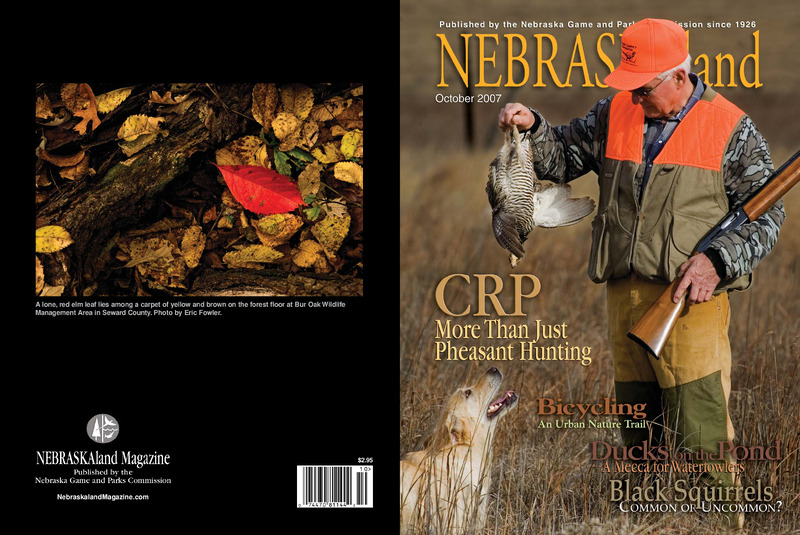
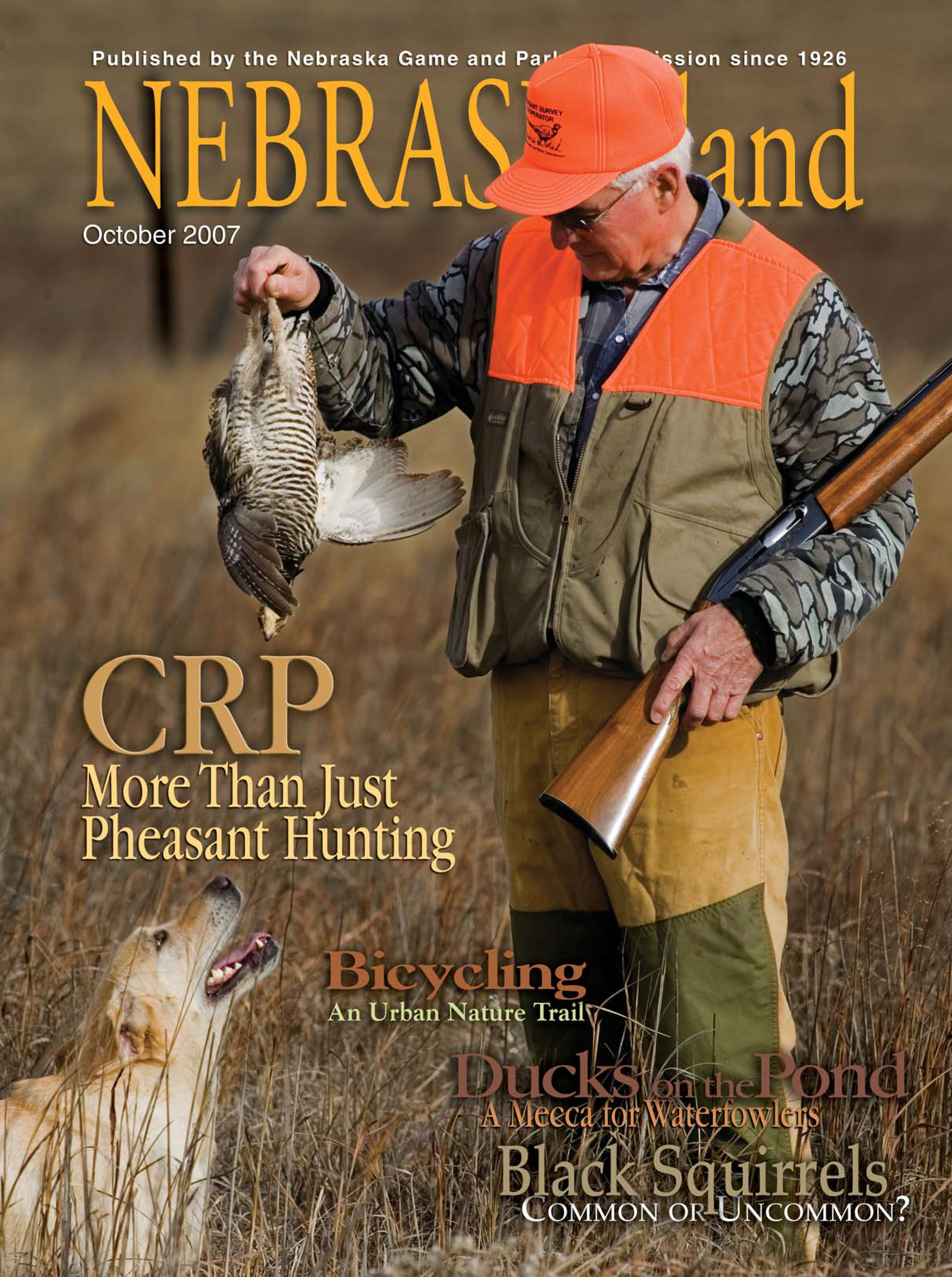
Cover: Retired wildlife biologist Dan Rochford of North Platte holds a sharp-tailed grouse he
harvested from a CRP-MAP field in southwestern Nebraska. See story beginning on page 40.
Photo by Rocky Hoffmann. Opposite: A small stand of aspen trees shows off the species’s
brilliant yellow fall color from a ridge overlooking Smith Falls in Cherry County. The area is one
of many Nebraska state parks that have beautiful fall color. Photo by Eric Fowler.
30
●
NEBRASKAland ● October 2007
3
Comment
lamb.
Thank God for these kind and
caring people. This story made me
think that in spite of all the cruelty
in the world, there just might be
hope for the human race after all.
I enjoy your magazine very much
and pass it on to my neighbors.
Keep up the good work!
J.B. Stupka
McCook, Nebraska
Published by the
Nebraska Game and
Parks Commission
Director: Rex Amack
Assistant Directors:
Roger Kuhn, Kirk Nelson, Sam Sidner
Information & Education Administrator:
Doug Bauch
Commissioners
Chairman:
Gary Parker, Columbus
Vice Chairman:
Bill Zutavern, Dunning
2nd Vice Chairman:
George E. Hall, Bridgeport
James Ziebarth, Wilcox
Jerrod Burke, Curtis
Dr. Mark Pinkerton, Wilber
James Stuart, Jr., Lincoln
Ron Stave, Waterloo
Magazine Staff
Editor: Doug Carroll
Associate Editor: Jeff Kurrus
Art Director: Tim Reigert
Senior Editors: Jon Farrar, Ken Bouc
Regional Editors:
Eric Fowler, Bob Grier, Rocky Hoffmann
Contributing Editor: Michael Forsberg
Circulation: Donna Robinson
Photo Librarian: Sarah Johnson
NEBRASKAland
ISSN: 0028-1964
VOL. 85 / NO. 8
OCTOBER 2007
Published monthly, except for Jan./Feb. and Aug./Sept.
issues, by the Nebraska Game and Parks Commission, 2200
N. 33rd St., Lincoln, NE. Copyright 2007, all rights reserved.
Please address comments or questions to this address.
Periodicals postage paid at Lincoln, Nebraska, and other
locations. POSTMASTER: Send all address changes to
NEBRASKAland, P.O. Box 30370, Lincoln, NE 68503-0370.
NEBRASKAland is available on audio cassette from the
Nebraska Library Commission Talking Book and Braille
Service, Suite 120, 1200 N St., Lincoln, NE 68508. (800)
742-7691.
Rates: $18 for one year; $33 for two years; $44 for
three years. Nebraska residents must add
appropriate sales tax.
To subscribe call 1-800-NEBLAND (632-5263),
or go online to: NebraskalandMagazine.com.
For address changes and questions about your
subscription, e-mail donna.robinson@ngpc.ne.gov.
4 NEBRASKAland ● October 2007
Comment
Greg Wingfield duct tapes dumbbells for
dive weights to Michael Forsberg’s feet.
A Bit of MacGyver
NEBRASKAland readers should
know that Michael Forsberg is not
full of hot air but truly practices
what he preaches when it comes to
using the tools of the trade in
photographing the great outdoors.
His list of uses for duct tape in the
August/September issue was
extremely limited, as evidenced by
this photograph taken last month
when in pursuit of underwater
images of Topeka shiners in the
Flint Hills of Kansas.
But I suggest that he modify his
recommendation to that of carrying
a full roll … a half roll is barely
enough to attach dumbbells as dive
weights. I think readers will also
agree that Mike is not afraid of
looking somewhat silly.
Greg Wingfield
Alma, Kansas
Not so Cruel
When I saw the stories about the
cruel treatment of dogs raised to be
fighters and the greyhounds that are
killed when they can no longer race,
I was angry, hurt and disgusted with
my fellow man.
Then I picked up the July issue of
NEBRASKAland and read the story
about the rescue of one little lamb.
That entire crew of people risked
life and limb and spent considerable
time and effort to rescue one little
Lake Zorinsky Cat
I have been a longtime subscriber
of your magazine and thoroughly
enjoy getting it each month. I am
submitting a picture for your review.
My brother, Bill Comba, was fishing
Zorinsky Lake in Omaha last June
with his daughter, Kylie, when he
landed this catfish. He estimated the
weight at over 60 pounds. He had
Kylie snap this photo before he
returned the fish to the water so it
could grow and live to see another
day. Bill owns Paul Davis Restoration
& Remodeling in Grand Junction,
Colorado, but we have family in
Omaha and get back as often as we
can to enjoy our family and friends.
I hope you can use this picture.
Curt Comba
Denver, Colorado
pictures – I look at them first when I
get the magazine each month. Makes
us appreciate our beautiful state of
Nebraska.
Eleanora Houser
Wilber, Nebraska
I enjoyed the photos in July's issue
of the magazine, particularly the
photo of Snake Falls. Thanks.
Gordon Coke
via e-mail
Send your comments to:
Doug Carroll, Editor
NEBRASKAland Magazine
P.O. Box 30370
Lincoln, NE 68503
or e-mail doug.carroll@ngpc.ne.gov.
Please include your postal address
and telephone number.
Letters may be condensed and edited
for clarity. Photographs are
welcome and will be returned.
Statement of ownership and monthly circulation of
NEBRASKAland Magazine
Owner and publisher: Nebraska Game and
Parks Commission
Editor: Doug Carroll
Headquarters of Publisher and Publication:
2200 N. 33rd St., Lincoln, NE 68503
Stockholders, Bondholders, Mortgage and
Security Holders: None
Average number of copies
of each issue during
preceding 12 months
Bill Comba, of Grand Junction,
Colorado, caught this catfish at
Zorinsky Lake in Omaha last summer.
Photo Positives
This is a pat on the back for your
photographers who take such fantastic
Single issue
nearest to
filing date
A. Total Copies Printed
(net press run) ..................31,559 ............29,957
B. Paid Circulation
1. Single-copy sales............1,602 ..............1,567
2. Mail subscriptions ........27,989 ............26,867
C. Total Paid Circulation ........29,657 ............28,434
D. Free Distribution
by Mail ..................................122 ................122
E. Free Distribution
Outside the Mail ....................860 ................860
F. Total Free Distribution ............982 ................982
G. Total Distribution ..............30,639 ............29,416
H. Copies Not Distributed ..........920 ................541
I. Total....................................31,559 ............29,957
J. Percent Paid and/or
Requested Circulation ..............97%................97%
Under federal and/or state law, discrimination is prohibited on the
basis of race, color, religion, age, gender, marital status, national
origin, disability or political affiliation. If you think you have been
discriminated against in any program, activity or facility by the
Nebraska Game and Parks Commission or want more information,
contact the Commission in Lincoln, NE, at (402) 471-0641 or the
Equal Opportunity Commission, Lincoln, NE, (402) 471-2024,
TTY/TDD (402) 471-4693).
Headquarters
2200 N. 33rd Street
Lincoln, NE 68503
Phone (402) 471-0641
District Office I
East Hwy. 2, Box 725
Alliance, NE 69301
Phone (308) 763-2940
District Office II
524 Panzer St., Box 508
Bassett, NE 68714
Phone (402) 684-2921
District Office III
2201 N. 13th St.
Norfolk, NE 68701
Phone (402) 370-3374
District Office IV
301 E. State Farm Rd.
North Platte, NE 69101
Phone (308) 535-8025
District Office VI
1617 First Ave.
Kearney, NE 68847
Phone (308) 865-5310
Omaha Office
1212 Bob Gibson Blvd.
Omaha, NE 68108
Phone (402) 595-2144
Ak-Sar-Ben Aquarium
21502 W. Highway 31
Gretna, NE 68028
Phone (402) 332-3901
World Wide Web site: OutdoorNebraska.org
E-mail: ngpc@ngpc.state.ne.us
Administration
Ted Blume (Adm.)
Craig Stover (Asst.)
Wes Loos (Asst.)
Rod Loos (Asst.)
Murray Johnson
Lincoln
471-5531
Lincoln
471-5532
Lincoln
471-5591
Ogallala (308) 284-8056
Lincoln
471-5003
Panhandle
Officer
City
Phone (308)
Jim Zimmerman (Sup.) Gering
436-7561
Walt Meyer
Chadron
432-4398
Scott Brandt
Gering
436-3418
Heath Packett
Gordon
282-2553
Dennis Thompson
Ogallala
284-6450
Dan Zuehlke
Ogallala
284-4815
Doug Pollard
Oshkosh
772-9950
Frank Miller
Valentine (402) 376-1183
Dan Kling
Whitney
432-8367
Southwest
Officer
City
Phone (308)
Roger Thompson (Sup.) N. Platte
532-9175
Ray Dierking
Brkn. Bow
872-3078
George Sund
Cambridge
697-4629
Michael Thome
Cozad
784-4362
Matt Andrews
Elwood
785-3025
Dirk Greene
Imperial
882-5328
Virgil Gosch
McCook
345-2185
Dudley Sorensen
N. Platte
532-0747
Rich Routh
Rep. City
799-2085
South-central
Officer
Jerry Pecha (Sup.)
Jeff Jones
Randy Pomplun
City
Phone (308)
Kearney
865-5327
Clay Center(402)762-3124
Fullerton
536-2987
Terry Brentzel
Darin Gress
Dale Johnson
Mark Reeves
Robert Finke
Richard Seward
Grand Is.
384-8296
Hebron (402) 768-2287
Kearney
237-1079
Loup City
745-0662
Milford (402) 761-3537
Ord
728-3115
Northeast
Officer
Tom Zimmer (Sup.)
Robert Kelly
Dale Davis
Ross Oestmann
Steve Oberg
Daniel Roberts
Jon Reeves
Marion Shafer
Pat George
Eric Wiebe
Tim Williams
Cory Krause
City
Phone (402)
Norfolk
371-6625
Albion
395-2538
Bassett
273-1700
Bloomfield
373-4412
Columbus
564-5937
Fremont
721-7852
Kennard
427-7378
Norfolk
371-2031
O’Neill
336-1588
Ponca
755-2566
Neligh
887-1335
West Point
372-6979
Southeast
Officer
Duane Arp (Sup.)
Sean McKeehan
William Krause
Jeremy TenKley
Mike Luben
Douglas Kramer
Dina Barta
Stacey Lewton
Levi Krause
Russell Mort
Dan Evasco
Jeff Clauson
City
Gretna
Ashland
Auburn
Beatrice
Colon
Lincoln
Lincoln
Lincoln
Louisville
Nebr. City
Papillion
Waterloo
Phone (402)
332-2965
944-4174
274-3789
228-1437
443-4278
466-9001
483-2358
476-0436
234-2212
873-5684
592-6733
359-5301
Nebraska Wildlife Crimestoppers 1-800-742-7627
NEBRASKAland ● October 2007
5
Outdoor News
Outdoor News
whether they catch a fish or not,
should complete the online form at
http://www.mi53.org/systemupdate2/
public/projects/Diary/card.html,
which will then be forwarded to the
NGPC. For more information,
contact Joel Klammer in Bassett at
(402) 684-2921 or Daryl Bauer in
Lincoln at (402) 471-7647.
BOB GRIER
The light goose season opens statewide on October 6 this year.
Commission Sets 2007
Waterfowl Seasons
The Nebraska Game and Parks
Commissioners set 2007-2008
waterfowl, crow and falconry
seasons at its August meeting in
Ponca.
Nebraska’s 2007 waterfowl, crow
and falconry seasons and bag limits
will be:
DARK GEESE
(Canada and brant geese)
East Unit: Oct. 20-Jan. 23
North Central Unit: Oct. 6-Jan. 18
Platte River Unit: Oct. 20-21 and
Oct. 27-Feb. 6
Panhandle Unit: Nov. 10-Feb. 6
Niobrara Unit: Oct. 20-21 and
Oct. 27-Feb. 6
Daily Bag Limit: Three geese.
Possession Limit: Six geese.
6 NEBRASKAland ● October 2007
LIGHT GEESE
(Snow, blue and Ross’s geese)
Statewide: Oct. 6-Jan. 6 and
Jan. 26-Feb. 6
Daily Bag Limit: 20 geese.
Possession Limit: Unlimited.
LIGHT GEESE
CONSERVATION ACTION
All Zones: Feb. 7-Apr. 13
Daily Bag and Possession Limit:
Unlimited.
2008 Refuge Photography
Contest Opens Soon
The National Wildlife Refuge
Association is looking for entries for
its 2008 Wildlife Refuge Photo
Contest.
Photographers may submit up to
ten digital photos taken at a national
wildlife refuge within the last two
years, and the grand prize winner
will receive a 2008 Toyota
Highlander Hybrid. Submissions
must be made between October 15,
2007, and December 15, 2007, and
results will be announced next
March. This year there will also
be a youth category for the first
time. For more information, visit
www.refugenet.org.
CROWS
Statewide: Oct. 1-Nov. 15 and
Jan. 20-Apr. 6
Special Public Health Hazard
Order: Nov. 16-Jan. 19
Daily Bag and Possession Limit:
Unlimited.
FALCONRY
Statewide: Concurrent with duck
season dates within zones and
management units.
Daily Bag Limit: Three ducks.
Possession Limit: Six ducks.
Huskerland Muskie Hunters
The Huskerland Muskie Hunters
and Nebraska Game and Parks
Commission are jointly sponsoring
the Muskellunge Angler Diary to
gain valuable information regarding
muskies caught in Nebraska.
Anglers fishing for muskie,
Two-For-One Turkeys
Starting this fall in Nebraska,
hunters may purchase two turkey
permits, with two turkeys being
allowed for each permit. Those
permits may include two archery,
two shotgun, or one of each.
Landowners may also have two
permits, with only one being a
landowner permit.
An increasing Nebraska turkey
Get Ready to
Hunt this Fall
Banquet to Raise Funds for
Mule Deer
BOB GRIER
DUCKS
Low Plains Early: Oct. 6-Dec. 16
and Dec. 22-23
Low Plains Late: Oct. 20-Jan. 1
High Plains: Oct. 6-Dec. 16
and Dec. 22-Jan. 14
Daily Bag Limit: All areas –
Conventional System.
Possession Limit: Twice the daily
bag.
(Pintail and Canvasback Seasons –
Low Plains Early and High Plains:
Oct. 6-Nov. 13. Low Plains Late:
Oct. 20-Nov. 27)
Daily Bag Limit: One pintail and
one canvasback per day
Possession Limit: Twice the daily
bag.
WHITE-FRONTED GEESE
Statewide: Oct. 6-Dec. 16
Daily Bag Limit: Two geese.
Possession Limit: Four geese.
population has resulted in the
liberalization of hunting regulations
in recent years. In 2004, permits
became unlimited in number and
valid statewide. The shotgun season
was lengthened in 2005 and shotgun
and archery seasons were extended
to the end of December in 2006. The
new bonus tag is the Commission's
latest effort to increase turkey harvest
and reduce crop damage.
The archery turkey season is Oct. 1Nov. 9 and Nov. 19 - Dec. 31. The
shotgun season is Oct. 13 - Nov. 9
and Nov. 19 - Dec. 31. Permits can
be purchased online at
www.OutdoorNebraska.org or at
commission offices located
throughout the state.
A banquet to raise funds for a
newly created chapter of the national
Mule Deer Foundation (MDF) will
be held October 26, 2007, at the Red
Willow Community Building in
McCook.
The Frenchman Chapter of
MDF was formed this summer by
sportsmen, landowners, and wildlife
professionals to help ensure the
conservation of mule deer in the
state. No mule deer remain in eastern
Nebraska, and there appears to be
recent population declines in portions
of western Nebraska. The nonprofit
conservation organization works
closely with state and federal
agencies by providing monetary and
advisory support on conservation
projects that benefit mule deer and
other wildlife species.
For more information on the
banquet and auction, which begins at
5 p.m., contact Brian Perks
(bperks56@hotmail.com, (308) 6973019), Chad Taylor (ctaylor@accessdirectwb.net, (308) 697-4005), or
Scott Hampel – MDF Regional
Director (shampel@muledeer.org,
(303) 659-2088).
To learn more about the MDF,
visit its web site at
www.muledeer.org. ■
Buy Your Nebraska Hunting
Permits Online!
Visit our secure web site to
quickly and conveniently
purchase fishing, hunting and
park permits online using your
Visa or Mastercard.
Online permit purchase is safe,
hassle-free and there is never a
checkout line. Simply choose the
permits you want, pay for them,
download and print. And, you
are on your way to Nebraska’s
great outdoors.
www.OutdoorNebraska.org
NEBRASKA GAME AND PARKS COMMISSION
NEBRASKAland ● October 2007
7
Outdoor Business
Buy a Bigger Freezer This Fall
Hunters asked to voluntarily harvest more does before regulations require it.
Photos and text by Eric Fowler
With white-tailed deer numbers increasing along most rivers in Nebraska, including the North Platte River in Garden County,
and in other locales, the Nebraska Game and Parks Commission is asking hunters to harvest more does this fall.
he Nebraska Game and Parks
Commission is asking deer
hunters to help themselves by
harvesting more white-tailed
does this fall. If they don’t,
game managers are already talking
about other options to encourage, or
even require, them to shoot more does
in 2008.
“There’s hardly a place in the state
where we don’t have a record number
of white-tailed
deer,” said Kit
Hams, the
Commission’s
big game
program
manager.
“Clearly harvest
numbers show
Kit Hams
that the
population is increasing, and if we
want to get it back to where it was
three or four years ago, we need to
shoot more does.”
Unfortunately, the current whitetail
doe harvest won’t accomplish that goal
in a herd that numbers approximately
300,000. For the past three years,
antlerless deer have made up 39 percent
of the total whitetail harvest, which
for all seasons in 2006 was a record
T
8 NEBRASKAland ● October 2007
53,322 deer. That’s down from peak
years, when does made up 45 percent
of the kill, and has fueled a 30 percent
increase in whitetail numbers since
2001. The biggest increases have been
seen along the Platte, Republican,
Missouri and Elkhorn rivers, and
throughout much of eastern Nebraska.
Predators, disease and accidents,
including collisions with vehicles,
account for twice as much deer
mortality as hunting, Hams said. But
hunting is the only thing biologists
can control. With that in mind, Hams
wants an equal number of bucks and
does killed in 2008, meaning hunters
will need to harvest 13,000 more does
than they did last year.
To help the cause, the Commission
authorized an additional 6,000 permits
for 2007, including 2,800 more
antlerless season choice permits and
added bonus tags to an additional
4,000 permits. Only four of the
18 deer management units and eight
of the state’s 93 counties are without
season choice tags, and in 11 of the 16
season choice areas and one firearm
unit, hunters receive a bonus antlerless
deer tag with their permit. The
Commission also made all tags
either-sex in all but two firearm deer
management units. Other options
being discussed for 2008 include more
bonus tags, longer seasons and a deer
meat donation program.
In 2006, approximately 89,000
hunters bought 123,000 permits,
30,000 more than were issued
10 years ago. But 2,000 permits went
unsold last season and 70 percent of
all hunters purchased only one permit.
“We’re already issuing about all of the
permits that hunters will buy,” Hams
said. “The challenge for the future is
to continue to recruit new deer hunters,
especially those who are willing to
take antlerless deer.”
A number of factors figure into herd
growth and the decline in doe harvest.
Whitetails are prolific: Adult does
average two fawns each spring, half of
them does. Doe fawns grow up and
have their own young, which have
their own young and so on. The result
in an unmanaged herd is exponential
population growth: The longer it goes
unchecked, the faster it grows. Even
with other mortality factors, Hams
said Nebraska’s whitetail herd would
double every four years if no does
were harvested.
Real men don’t shoot does?: There
are many types of deer hunters in
Nebraska. Some are meat hunters,
who either want just one deer and
take the first one they have a shot at,
buck or doe, or buy several doe tags
and fill their freezer with venison. At
the other end of the spectrum are
trophy hunters, who won’t take a deer
unless it’s worthy of a trip to the
taxidermist. In between are hunters
who, for some unknown reason, can’t
bring themselves to shoot a doe.
Instead, they shoot small bucks on
opening morning and then show up at
the check station and complain about
not seeing any big ones. About
87 percent of all hunters who fill an
either-sex deer tag shoot a buck.
Big buck bonanza: It’s easier for
hunters to hold out for a trophy buck
these days because there are more of
them. Fifty-four percent of the 33,000
whitetail bucks taken in 2006 were
2½ years old or older, up from 45
percent in 1997 and 32 percent in
1987. The increase is attributed to
both a larger herd and increased
hunter selectivity for older bucks. It
could be even greater if hunters
would pass on little bucks, let them
live another year and shoot a doe.
Access: Some landowners don’t
allow hunting. Deer have a knack of
finding these refuges. When they do,
they flourish and neighboring
landowners often feel the brunt of
population growth through crop
damage. And for those without
connections, finding a place to hunt
can be a daunting task, a byproduct of
the shift from a rural to urban society.
The propensity of mature does to have twin fawns can lead to exponential growth
in deer populations if hunters don't harvest enough antlerless deer.
Leasing: More and more land is
getting tied up in leases and the best
land is leased first. Hunters pay big
bucks to shoot bucks and often don’t
see the value in letting the little guys
walk or shooting does, although the
Quality Deer Management philosophy
spreading from southeastern portions
of the United States is slowly changing
that mentality. Having lots of deer is
nice, but too many can destroy habitat
and lead to a decrease in both body and
antler size. Leasing can also leave
individuals who had hunted that land
for years looking for a new place to
hunt.
Hunters come and go: Access and
other issues, including people having
less free time and more things to do
in what little time they do have,
contribute to the
fact that only
28 percent of the
state’s deer hunters
hunt at least four
of every five years.
Help yourself:
Three-fourths of
the deer taken with
landowner deer
permits are
bucks, so some
landowners could
do more to help
their own cause.
High corn and soybean prices this year have made some
Those with serious
landowners less tolerant of deer foraging in their fields.
deer problems who haven’t already
should consider opening their land to
anyone who wants to harvest a doe.
They can even insist that those wanting
to hunt bucks also take a doe, or even
shoot the doe first.
Most landowners don’t mind having
deer on their farms. But with the high
corn and soybean prices, some of that
tolerance has eroded and the number
of complaints to Game and Parks
offices has increased.
Some landowners have been
making an effort to cut the deer herd
on their land. One near Tekamah
had more than 100 deer harvested
from his farm last fall, but doesn’t
think it even put a dent in the local
population.
The Commission has taken many
steps to increase doe harvest in the
past decade, including issuing bonus
and season choice tags and reducing
the cost of antlerless permits for nonresidents. It is now asking hunters,
even begging, to be a bigger part of
the deer management process before
things get out of control, Hams said.
“Heaven forbid we reach the point
where we limit the buck kill or we
require doe kill,” Hams said. “Other
states have done it. Will we go there?
I don’t know, we’ll see.”
Use your bonus tags, Hams said. And
if you have enough deer in your freezer
already, find someone who doesn’t. ■
NEBRASKAland ● October 2007
9
Black Squirrels
AN UNCOMMONLY COMMON SQUIRREL OF NEBRASKA
By Jeff Kurrus
Throughout history, black squirrels were often thought of as a distinct
species. However, they can actually be a variety of squirrel species,
including the eastern fox and eastern gray squirrels of Nebraska.
B
lack squirrel sightings, at least
in my life, have been rare.
Growing up, I saw a limited
number on hunting trips near
Yahoo, Mississippi, and have
only recently seen additional numbers
near Omaha, Lincoln and Hastings. Yet
with each person I have spoken with
about these sightings, interest in their
presence has been viewed with bipolar
spectacles; either they are placed on a
rock star pedestal and celebrated, or are
seen as commonplace and altogether
ignored.
Regardless of public response,
however, there remains a lack of
information
concerning their natural history in
Nebraska, despite turn-of-the-century
references to their local presence. In an
October 1904 Omaha World-Herald
article, a reader wrote to sportswriter
Sandy Griswold: “On Friday last a
farmer boy living four miles north of
[Akota City] killed a pure black
squirrel…It was just the size of a gray
squirrel and exactly like one, only
wholly black, and jet black at that.”
Griswold responded, “Black squirrels
are a distinct and common species, that
is; they were formerly common in
Ohio, Indiana, Michigan, New York
and Pennsylvania.” Black squirrels,
however, are not a distinct species.
They can be, in fact, part of a number
of squirrel species throughout the
world, including the Eurasian red
squirrel, the North American red
squirrel, the 13-lined ground
squirrel, or a subspecies of
various Southeast Asian tree
squirrels. In Nebraska and
other parts of North
America, black squirrels
could also include both
the eastern gray and
eastern fox squirrel.
And even though 100
years have passed since
Griswold’s response,
10 NEBRASKAland ● October 2007
Why Black?
To understand this question, one
must note the differences between
“color phase” and “melanism,” and
how each relate to black squirrel
populations. “Color phase,” says Russ
Benedict, biology professor at Central
College in Iowa, “refers to any relatively
common, alternative color pattern seen
in a species, regardless of the specific
color. For instance, the snow goose has
two color phases – the ‘blue’ color
phase and the white phase.
“Melanism is a specific mutation that
leads to the overabundance of melanin,
usually creating a black or very dark
individual. Melanism is the opposite of
albinism. So, while color phase and
melanism are similar, they are
technically different. Another way of
thinking about this: if two individuals
of the same color phase breed, their
offspring will almost certainly have the
same coloration. On the other hand, the
very first melanistic individual in a
population came from the breeding of
two ‘normally’ colored parents.”
In addition to the theories surrounding
whether or not a particular black squirrel
is a color phase or a melanism, there
are even more theories proposed
regarding a number of black squirrelrelated issues.
Most naturally occurring black
Black squirrels are found
near Omaha, Lincoln and in
isolated areas throughout
Nebraska. This black squirrel
was seen at Chautauqua Park
in Hastings.
JEFF KURRUS
The black squirrel is
celebrated as a cornerstone of
the history of Council Bluffs,
Iowa, as indicated by this
collector’s plate.
there are still questions concerning this
sometimes unique, and sometimes not
so unique, mammal.
NEBRASKAland ● October 2007
11
should be no surprise that their origins
squirrel populations (as opposed to
in various regions of North America
introduced metropolitan populations)
are found at northern latitudes or upper often read like folklore versus fact.
Especially since there seems to be as
elevations, suggesting that the black
many questions regarding their history,
color is adaptive in some way to low
and subsequent spreading, as there are
temperatures, said biologists S. Innes
locations whose black squirrel
and D.M. Lavigne in a 1979 article in
populations are revered.
the Canadian Journal of Zoology.
These authors proposed that black
squirrels not only lose less heat during
the winter than the normally colored
In a 2005 Washington Post article
gray squirrels they were observing, but
entitled, “An Exotic
also have lower basal metabolic rates at
Evolution,” David
cold temperatures than gray
Fahrenthold reported
squirrels. Black squirrels, they
that 18 Canadian
claimed, are more energetically
black squirrels
efficient than gray squirrels in
were released at
the winter, requiring less
the National Zoo
energy to maintain constant
in Washington,
body temperatures. Selective
D.C. during
genetics, they argued, has
Theodore Roosevelt’s
given the black squirrel this
presidency in 1902
survival advantage.
and 1906. After
It has been reported by
At the Black Squirrel Golf
reading the tag of a
Richard Kiltie, from the
Club in Goshen, Indiana, it is black squirrel tail
University of Florida, that
said their population
that read “Cleveland
black squirrels were more
originated from Germany in Park, 1917,” it was
common in frequently burned
the 1850s.
noted that the black
areas than those that did not
squirrels had left
burn frequently. It has also
the National Zoo sometime between
been theorized that black squirrels can
their turn-of-the-century release and
survive better in urban environments
1917 and have since colonized Capitol
than their rural counterparts, where
they stand out much more to predators, Hill and crossed the Potomac River
into Arlington.
especially birds of prey.
In Marysville, Kansas, known by
Yet, as Kent State professor Lowell
more than one city street sign
Orr stated, “The theory
as “Marysville, Kansas – Black
that there would be less
Squirrel City,” the Marysville
predation in an urban
Chamber of Commerce has
situation is credible
explained their black squirrel
but does not explain
arrival: “The most likely
what the advantage of
explanation involves a
the black phase is in a
traveling carnival which
metropolitan
passed through town in the
situation. Richard
1920s and stayed for a few
Thorington, who,
days in the city's park.
along with Katie
“Among the carnival
Ferrell, wrote the
exhibits was a cage full of
book Squirrels: The
Many black squirrel
black squirrels. One night a
Animal Answer
populations in the United
Guide, has tested the States, including that of Kent, child opened the cage and
the squirrels escaped.” Since
hypothesis that
Ohio, are said to have been
this date, black squirrels
black squirrels are
transferred from London,
now represent 20 percent of
not run over by cars
Ontario.
Marysville’s squirrel
as often as grays in
population and, on August 28, 1972,
cities but has found no differences in
the black squirrel was made Official
mortality in the two color phases.”
Town Mascot by the Governing Body
Since many theories concerning
of Marysville. These days, they are
black squirrels read like back porch
abundant, and people are fined $25 for
tales woven over morning coffee, it
Folklore and Phenomenon
COURTESY OF THE OLD PRINT SHOP
This drawing, originally in The Quadrupeds of North America, displayed the black squirrel as a distinct species.
12 NEBRASKAland ● October 2007
Genetics
From Lowell Orr, Emeritus
Professor of Biological
Sciences at Kent State
The genetics of squirrel
coloration has not been studied
but there is no reason to
believe it is anything different
from other mammals. The
mechanism is undoubtedly a
multiple allele inheritance
mechanism similar to that which
controls the A, B, AB, and O
blood types in humans. Alleles
are contrasting genes at the
same locus (point on a
chromosome). Since
chromosomes are paired each
individual will have no more
than two genes at a particular
locus but there are a number of
alleles floating around in the
population that may make up
those genes. There are three
alleles in human populations
controlling the A, B, AB, and O
blood types. The normal genes
for coat color in mammals are
called agouti genes and produce
hairs that are banded in color
which cause the mammal to
have a salt and pepper
coloration, and allow the
mammal to be camouflaged.
Different agouti genes produce
slightly different banding
patterns. But some squirrels
have a recessive non-agouti
gene which causes the animal
to be black if two of these genes
are present. Thus, black color is
controlled by recessive genes,
not dominant genes. But if you
look closely at our black squirrels
(on Kent State’s campus), many
will have a brownish or reddish
cast which means they have the
non-agouti gene combined with
an agouti gene in a
heterozygous condition (Aa).
harming one since black squirrels, at
least in Marysville, have the right-ofway on all streets, alleys, and railroad
crossings.
In Kent, Ohio, Kent State University’s
Black Squirrel Festival is held each fall
at and features an array of activities
NEBRASKAland ● October 2007
13
states that, along with Reedsburg,
Wisconsin, “Princeton, New Jersey;
Galesburg, Illinois; Detroit, Michigan;
Lansing, Michigan and New Hartford,
Connecticut are the only five places in
the U.S. with a predominate population
of black-furred squirrels.” Yet what
does “predominate” actually mean?
For there is a long list of regions
where these squirrels, as chronicled by
web sites, books, and online forums,
are said to inhabit, including western
spots such as Black Forest, Colorado
and San Jose, California; northern
areas like Seabrook, New Hampshire
and north central Minnesota; southern
locales like Savannah, Georgia and
Barksdale Air Force Base, Louisiana;
and Midwestern cities including
Chicago, Illinois and Council Bluffs,
Iowa, which hosts the annual Council
Bluffs Black Squirrel Triathlon each
summer and, according to Griswold,
has had black squirrels since the turn of
the century. “There is quite a number
of black squirrels in the park over at
Council Bluffs” (from Omaha WorldHerald; October 16, 1904). Plus, with
the rarity with which some black squirrel
populations have occurred through the
years, it has been recorded that some
populations were completely eliminated
by hunters wanting to take their trophies
home with them after a day in the field.
Throughout North America, as
already stated, there are number of
squirrel species that could potentially
be black. However, in Nebraska, black
populations will usually concentrate on
Nebraska’s two most popular tree
squirrel species, the eastern gray
squirrel or the eastern fox squirrel.
Fox or Gray?
14 NEBRASKAland ● October 2007
NEBRASKAland ● October 2007
15
JEFF KURRUS
JEFF KURRUS
Throughout the country, black squirrels can be a color phase or a melanism of a number of squirrel species, including the eastern fox
squirrel (pictured) or the eastern gray squirrel.
Despite many differences between
eastern gray and eastern fox squirrels,
they evolved as a distinct lineage of
rodents approximately 36 million years
ago. The common name of the squirrel
can be traced back to the ancient
Greeks, where the word “skiouros”
used “skia” meaning shade and “oura”
tail; thus “he who sits in the shadow of
his tail” was recorded. Centuries later
the French created a noun “esquirel,”
from which the present name was
derived.
Squirrels are commonly divided into
tree squirrels, ground squirrels and
flying squirrels. Both the eastern gray
squirrel and the eastern fox squirrel are
defined as tree squirrels, and have long,
muscular legs used for leaping from
branch to branch and long arms to
grasp tree trunks.
They differ from ground squirrels
because of their long, bushy tail, which
they use for various functions including
balance, sunshade, an umbrella, a
blanket, a rudder when swimming and
as a distraction tool to display against
predators. Both species also use a
series of barks for communication with
other squirrels as well as warning calls
against predators, who can range from
foxes and coyotes, to raptors and snakes.
As far as individual differences are
concerned, the eastern gray squirrel
(Sciurus carolinensis), is probably the
most common North American tree
squirrel. It resides in den trees and leaf
nests in deep forests near river bottoms,
including the unbroken tracts of eastern
hardwood and immense undergrowth
found along the Missouri River in
southeastern Nebraska near Indian
Cave State Park. Their dorsal color of
silver-gray blends in with the bark of
beech, maple, and hickory trees it
inhabits throughout its range while its
ventral side is much lighter, an attribute
known as counter shading.
This species averages 15 inches from
head to tail tip and weighs about a
pound. Grays often choose to live in
oak-hickory and oak-maple-basswood
forests near grasslands, yet they will
also range into the mixed
deciduous-coniferous forests at
the United States-Canada
border. Their home range is
from two to seven acres, with
various individual squirrel
ranges overlapping, and
between two and 20 squirrels
will inhabit a single acre.
Through their range, eastern
gray squirrels are more tolerant
of other squirrels than eastern
fox squirrels when foraging
and eat most notably, but not
limited to, mast, including
white oaks and beeches. The
eastern gray squirrel, like its
eastern fox counterpart, will
scatter hoard food beneath the
soil for later consumption
burying several thousand nuts
a year, namely from red and
white oaks, with the ability to
bury five acorns in less than 4
minutes.
They will initially feed on
white acorns before the nuts
germinate. Since a nut that
germinates contains less energy
for a squirrel, they will eat
white acorns first. Squirrels
will then bury red acorns due
to their dormancy through the
winter, allowing a reliable food
source through these colder
months.
The Nebraska Guide to
Mammals states that eastern
gray squirrels may live five to
The eastern fox squirrel (above), seen here at Two
six years in the wild with some
Rivers
State Recreation Area (SRA), and the eastern
possibly reaching 12 to 15
gray
squirrel
(below), seen at Indian Cave State Park
years, while captive squirrels
(SP), can be differentiated by their color. However, if
have been known to reach 20
the squirrel is black, they can be distinguished by
years. However, a study
their ear sizes.
conducted by Fred Barkalow
at the University of North
high densities that mass migrations
Carolina found that eastern gray
were triggered, as in the early 19th
squirrels living in a nonhunted
century and in October of 1968, when
population near the university campus
thousands of squirrels migrated in
had a 75 percent death rate before
Tennessee, Georgia, and North
reaching their first birthday with an
Carolina following substantial nut
average life span of only 5 months.
production in 1967, a late frost and
While females survived longer than
little nut production in 1968.
males, only one female lived longer
Eastern fox squirrels (Sciurus niger),
than 10 years.
which are rusty-yellowish, with
Density numbers of eastern gray
sprinkles of white, yellow and black
squirrels are controlled by changes in
mast production. Gray squirrels, before frequently found, reside in much of
Nebraska, stretching from the Missouri
their environments were so fragmented
River to the Panhandle. The “niger” is
by humans, periodically reached such
JEFF KURRUS
including musical performers, photo
and art contests, craft displays and a
4.2-mile Black Squirrel Run. Also in
Kent is a pub, music company, gallery,
radio station, and song entitled “The
Black Squirrels of London” dedicated
to these local celebrities. Sixteen black
squirrels were originally introduced in
1961 by KSU’s groundskeeper after he
had observed them in natural
populations in London, Ontario. Since
their introduction, they have spread
throughout northeastern Ohio.
While these locations are most
prominently known by black squirrel
enthusiasts, they are far from being the
only areas claiming their presence. A
recent article by William C. Schuette
entitled, “Reedsburg’s Black Squirrels,”
Little-kno wn Squir r el Facts
While squirrels are one of the most abundantly viewed
animals in Nebraska, there is a long list of facts concerning
them that few people know. Here are a few:
Squirrels have dichromatic color vision. They can differentiate red or
green from other colors, but cannot distinguish red and green from
each other.
●
A squirrel’s eyes are much more acute than humans. While human
eyes have a small area of the retina where vision is most acute,
squirrels see much sharper across their entire retina, which allows
their peripheral vision to be much more effective than humans.
●
Eastern gray squirrels and eastern fox squirrels can both turn their
hind feet completely around when coming down a tree, aiding in their
descent.
●
While fox and gray squirrels do not hibernate, other animals in the
squirrel family, including chipmunks, prairie dogs and marmots, do.
●
Squirrels belong to the order of rodents, the family Sciuridae, and
have existed for some 30 to 40 million years. giving rise to the 278
species currently assigned to the family.
●
Inactive testes in gray squirrels will weigh 1 gram, whereas active
testes will weigh 6-7 grams.
●
2.5 million squirrels are harvested each year by hunters in
Mississippi, with an economic impact of $12.5 million dollars annually.
●
A squirrel’s hearing range (63-56,000 Hz) is comparable with that of
dogs, allowing them to hear higher pitches than humans.
●
As noted in a study chronicled in The National Audubon Society
Field Guide to North American Mammals, “Nuts buried by scientists
conducting an experiment were recovered by squirrels at about the
same rate as nuts they buried themselves, indicating that memory is
not involved in nut recovery.”
●
Eastern fox squirrels have been known to leap to the ground from
as high as 50 feet high in an effort to escape predators.
●
A squirrel’s teeth grow continuously. Their incisors will grow six
inches per year, but stay short due to the constant wear they receive.
●
The sweat glands of a tree squirrel are located on their feet,
between the foot pads and on their paws between the toes. When hot
or excited, a squirrel will leave wet tracks on a dry surface. This scent
is also used to mark trees in their territory.
●
It has been stated that W.K. Kellogg, of Corn Flakes fame,
introduced black squirrels to Battle Creek, Michigan, after a trip to
Canada in the early 1900s.
●
16 NEBRASKAland ● October 2007
in the woodland lots in the eastern part
and the riparian communities along
watercourses traversing the middle and
western parts of the state.
Their range is farther west than the
eastern gray squirrel, and they are the
largest of the North American tree
observed. Yet if there is still a level of
indecision, or if one finds areas of the
country where both species live, they
should look at the ears of the squirrels.
While smaller in body, the eastern gray
squirrel will have much larger ears than
the eastern fox, providing a
distinguishing mark as to exactly what
is being viewed.
Yet when one is viewing black
squirrels, especially in and near
Nebraska, there are still a number of
questions that need to be answered.
Did the Omaha population come from
Council Bluffs, Iowa? And how did the
Council Bluffs squirrels originate? Is
the growing number of black squirrels
in Lincoln due to lower predation or
changes in mast production?
Is the story about a man cutting
down a tree in Omaha that contained
black squirrels, then transferring that
tree to Hooper, Nebraska, the reason
for their presence in that town and
other towns? And how did the large
number of Hastings black squirrels
emerge? One story says that there was
a railroad engineer who lived in
Hastings and made frequent runs to
Marysville, Kansas. He liked the black
squirrels he saw in Marysville, and
subsequently trapped some and brought
them back to Hastings, releasing them
in his yard. Or how would one explain
the black squirrels located at Two
Rivers State Recreation Area near
Yutan? I thought the black squirrel
would be far less likely to survive any
"natural" migration due to its lack of
camouflage. So how did they arrive
there? It is questions like these will
continue to be posed as black squirrels
appear and disappear from natural and
urban areas around us.
future so that we might learn more
about how their coloration affects them
and what environmental needs they will
need to survive. Imported or exported,
melanistic or color-phased, the black
squirrel, whether an eastern gray,
eastern fox, or other squirrel species
throughout the world, is a unique
mammal that needs much more research
to see exactly how they fit into the
natural world. Just think, many people
have never seen a black squirrel before,
while others welcome them into their
yards on a daily basis. It should be
science’s job to find out why. ■
Future of Black Squirrels
The author would like to note that
the scientific information concerning
black squirrels was taken from Dr.
Richard Thorington and Katie Ferrell’s
book Squirrels: The Animal Answer
Guide, The National Audubon Society
Field Guide to North American
Mammals, Peterson’s Field Guides:
Mammals, The Nebraska Guide to
Mammals, The Washington Post, and
interviews with Lowell Orr, from Kent
State University in Ohio, and Russ
Benedict, from Central College in Iowa.
Accompanying each of these
inquiries is a need to better understand
black squirrels and the habitats that
will sustain them. When viewing them,
it is quite evident that they will usually
not let onlookers get as close as their
fox and gray squirrel brethren. At the
same time, when pressured they will
pin themselves to the bark of a tree in a
failed attempt to hide. These are the
behaviors that must be analyzed in the
MICHAEL FORSBERG
Latin for “dark” or “black.” Their
habitat consists of the broad-leafed
deciduous forests of the eastern United
States and the pine forests of the south,
excluding New England and the northern
Great Lakes region, along river and
stream corridors. In Nebraska, they live
squirrels, weighing up to three pounds
and measuring 19 to 28 inches in
length, about half of which is their tail.
They prefer the open forest with little
understory vegetation, which makes
them a staple in urban areas such as
parks and residential neighborhoods.
And while both species may be found
together in many places, only the fox
squirrel is likely to inhabit the narrow
strips of bottomland forest of
cottonwood, bur oak, ash, elm, and box
elder that border streams in Nebraska.
Their home range is between 10 to
40 acres, with up to three squirrels living
per acre, and they are much less social
than the eastern gray despite showing
the propensity to feed in common areas
and den together during harsh winters.
Since they often move long distances to
reach foraging areas, some of which
could be over a half mile or more apart,
they are more susceptible to terrestrial
predators due to their amount of time
on the ground. Like eastern grays, they
feed on a variety of mast but will also
eat seasonal foods, including springtime
buds and flowers, summertime insects,
and autumn nuts and seeds.
This species of squirrel can maintain
anywhere from three to 15 nests at the
same time, which coincides with their
much larger foraging ranges as
compared to the eastern gray, whose
number of nests usually ranges
between one and one and one-half
nests per squirrel. Eastern fox squirrels
nest in the cavities of trees or build,
similar to the gray squirrel, nests with
twigs on high branches in late summer.
They typically live from four to
seven years, although life expectancy at
birth is less than four months. While
both species are sympatric, breeding
between these two species has never
been confirmed despite there being
observations of varied color forms of
both the eastern fox squirrel and the
eastern gray squirrel breeding within
their own species.
A common sense approach will often
prevail when analyzing black squirrels
in an effort to distinguish between
eastern fox squirrels and eastern gray
squirrels. Seeing a large number of
eastern fox squirrels in a park close to
black squirrels will usually lead one to
assume that the black versions are also
eastern foxes, while analyses of habitat
and foraging behaviors can also be
When observing black squirrels, even in a recreation area setting, it is often difficult to get as close to them as normally colored squirrels.
NEBRASKAland ● October 2007
17
By J.D. Brewer
West Papio Trail yields surprising rewards for this
suburban bike commuter.
M
18 NEBRASKAland ● October 2007
roadways with stubborn bicyclists;
however, I had mitigated most of the
disadvantages (no control over the
weather, obviously) by riding mostly
on the concrete pathways that line a
ten-mile stretch of West Papillion
Creek.
As compensation for the
inconveniences associated with bike
commuting, I receive a number of
benefits, including physical exercise
and frequent early morning displays in
the sky above me, such as spectacular
sunrises, meteors or the starry carpet of
the Milky Way. In addition, there is
another unexpected benefit: The uplifting
feeling I receive from viewing and
interacting with the diverse wildlife
population that resides along this narrow
channel as it slices through West
Omaha suburbia. Unbeknownst to
most, if not all, the waves of motorized
humanity that crash east in the morning
and roar west in the afternoon, this
remarkable ribbon of “natural” habitat
shelters deer, beaver, raccoon, fox and
countless rabbits and squirrels.
I wondered how this exceptional
stretch of natural environment came to
exist virtually under the noses and
wheels of us suburbanites. My
research, which included a trip into
cyberspace and a handy map of
Omaha’s bike trails, told me that West
Papillion Creek is a former prairie
stream that flows though cornfields,
subdivisions and under busy roadways.
It begins north of Elkhorn, flows
southeasterly to connect with the North
Branch of the Papillion Creek near
Dodge and 168th streets in west
Omaha, then continues southeast to
join with the Big Papillion Creek near
Bellevue, eventually flowing into the
Missouri River.
PHOTO BY JEFF KURRUS, MAP COURTESY OF PAPIO-MISSOURI RIVER NRD
y legs ache as they push and
pull in the predawn darkness,
a cold, light autumn rain
swirling out of the northwestern sky
and into my squinting eyes, making it
virtually impossible to see the winding
concrete path ahead of me. My bike’s
feeble handlebar light fails miserably in
illuminating anything other than the
raindrops about to mercilessly strike
my body.
Momentarily lowering my head to
shake the rain from my face, I look up
to see two dark shapes straddling the
path thirty feet in front of me. The
outlines are familiar – deer, large deer.
I stop pedaling and coast nearer. No
movement. I wonder if someone placed
plaster statues on the path as a joke to
rattle unsuspecting bicyclists. Coasting
closer, there’s still no movement until –
just as my hands are clamping down on
the brake levers – the “statues” jump,
kicking my heart into overdrive at the
same time.
Stopping my bike to let my heart
resume its normal rhythm, I turn the
handlebar light toward the ominous
shapes still only a few yards away.
Four eyes glow in the misty beam,
reminding me of the jack-o-lanterns I
carved the night before. Their
characteristic tails are erect and
nervously twitching back and forth –
white-tailed deer.
Earlier in the year, in a lonely
attempt to protest the high cost of
gasoline and declare my independence
from the automobile, I had become a
bike commuter. As one would expect,
there are advantages and disadvantages
to scorning the automobile. Obvious
disadvantages include inclement
weather, broken roads and sidewalks,
and drivers unaccustomed to sharing
J.D Brewer, of Omaha, rides the West Papio Trail in west Omaha. A current map of Omaha area bike trails is available at the
Papio-Missouri River Natural Resources District web site at papionrd.org
Biking along the narrow shoulder of
the relatively straight channel, I imagine
that West Papillion Creek now bares
only a minor resemblance to its original
appearance. I learned that its basic
geomorphology originated in the early
19th Century as eastern Nebraska was
settled and large tracts of land were
cleared for farming. The clearing of the
land created increased runoff, erosion
of uplands, and gulling of floodplains
and terraces. With the relentless growth
of west Omaha came the sculpturing of
the creek channel by engineers and
geologists knowledgeable in flood
control and soil stability. Their sole
purpose was to protect West Omaha’s
urbanization from erosion and flooding,
so West Papillion Creek was born.
Occasionally, I stop my bike near
the grassy edge of the creek and gaze
across its span which varies from 75 to
200 feet, rim to rim. A narrower, deeper
channel cuts through bottom of the
primary watercourse and averages fifteen
feet wide and eight feet deep. This
smaller channel within the parent
channel maintains a constant flow of
water, although it diminishes during the
warm months of summer and early fall,
and during extended periods of drought.
In the ghostly light of dawn, the equally
curious, though wary, masked face of a
foraging raccoon often returns my gaze.
The slopes of the creek channel are
grass-covered and, in parts, treelined
with the occasional northern red oak,
American elm and poplar, but more
commonly found are cottonwoods, the
Nebraska state tree whose white,
tuft-covered seeds routinely fill the
early Nebraska summer air like an
unseasonable snowfall. In some
locations, the trees, bushes and
groundcover crowd together to provide
me a therapeutic, and much needed,
illusion of natural solitude in the midst
of suburban sprawl.
Autumn is rapidly becoming a fond
memory and the occasional morning
frost signals the approach of winter as I
continue to bike-commute. The falling
temperatures and relentless prairie
wind have turned my solo economic
and social protest into an endurance
contest. Unfortunately, my revitalizing
encounters with the inhabitants of West
Papillion Creek are less frequent as
they wisely huddle in burrows,
sheltered from the cold and the curiosity
of a shivering bicyclist. ■
J.D. Brewer is a freelance writer that
lives in the Omaha area.
NEBRASKAland ● October 2007
19
THE SUNRISE VIEW FROM 600 FEET ABOVE Bighorn Wildlife Management
Area located southeast of Crawford is spectacular – some of the sharpest knifeedge ridges in the entire Pine Ridge brightly colored by morning light and cutting
upwards out the darker fabric of the Ponderosa pine forest.
Here and there less repetitive and even solitary horse tooth-shaped buttes and
groupings of sandstone and marl rise to stand watch over deeply eroded canyons.
20 NEBRASKAland ● October 2007
n the shaded reaches of the narrow
canyons, inches-wide life-giving
and life-sustaining streams of
spring-fed water flow throughout the
year. Their narrow, fairly straight
courses teem with life – the north
flowing stream’s mature cottonwoods
and vibrant ash foliage, even cattails in
places, are home to all sorts of birds.
Sit quietly in the shade and soon a
solitary rose-breasted nuthatch becomes
several. Black-capped chickadees
I
appear as if from nowhere and a
vibrantly colored yellow warbler lands
in the streamside vegetation. Soon a
young male red crossbill with tan and
light red plumage joins the show.
Nebraska’s Pine Ridge is known for
its diversity, but here on the nearly
1200-acre Bighorn WMA, diversity is
double-parked. Narrow, sharply eroded
rocky ridges dominate the skyline, each
reaching varying heights but traveling
basically in the same direction as do
the streams, which travel north before
flowing under the undulating gumbo
prairie of the Pierre Hills grasslands.
The Bighorn WMA sits on the exposed
northern flank of the Pine Ridge, looking
out over intervening strips of fallow
and winter wheat fields, out over the
wider grasslands dotted with large and
small ranches, across both distance and
time towards South Dakota’s Black
Hills. Even in the dry summer heat, the
distant air hangs thick enough to
NEBRASKAland ● October 2007
21
The nectar of the shell-leaf penstemon’s (Penstemon grandiflorus) flowers attracts American bumble bees,
(Bombus fervidus) each spring and early summer.
obscure details; the Black Hills some
60 miles north are revealed as a medium
blue line painted along the horizon.
At the northwestern corner of
Bighorn WMA stands little-known
Barrel Butte, a single, vertical rock
standing at the end of the line of larger,
gnarled, twisted and pock-marked
buttes. Barrel Butte was the source of
the name for the area’s re-introduced
bighorn sheep herd – 49 bighorn rams
and ewes live captured in Montana and
released in January, 2005 – which
thankfully dodged an early, hasty
suggestion to name it the Bighorn
bighorn herd.
The Barrel Butte bighorn herd, like
the original Fort Robinson bighorn
herd, the Cedar Canyon bighorn herd
and the more recently re-introduced
Hubbards Gap bighorn herd in the
Wildcat Hills, is surviving, even thriving
at times, yet is continually threatened
by the simple echo of their species
evolution in more pristine northern
regions of the planet. Great predators –
wolves, cats and bears – were present
on their ancestral home and the
bighorns adapted and survived. Missing
for eons and uncounted generations of
22 NEBRASKAland ● October 2007
bighorns in those arctic regions were
the earlier forms of commonplace
diseases that have little or no impact on
domestic livestock but kill bighorn so
quickly today.
Bighorns, wherever they are found,
are rarely more than a few steps from
protective slopes and rocky fortresses
that easily defeat both ancient and
modern adversaries but provide no
protection at all against invisible
organisms.
The live-trapped and translocated
bighorns released on the Bighorn
WMA suffered their share of accidents
and stress-related fatalities following
their release – bighorn biologists hope
to encounter less than 10 percent losses
due to capture injuries, stress and
unforeseen accidents that accompany
trap and trans-location efforts. Of the
original 49, several bighorn were lost
almost immediately, victims of collisions
with fences and possibly capture and
release injury. At least one traveled too
many miles, joining a herd of domestic
sheep and sealing its fate, since it could
not be allowed to return to the bighorn
herd.
Despite the early losses, the herd’s
surviving adult ewes carried the future
of the bighorns from Montana’s
Missouri River Breaks to Nebraska’s
Pine Ridge. Biologists and technicians
documented 26 lambs born to the
Barrel Butte herd during the spring and
early summer of 2005 in the secluded
crags and nearly unreachable heights
of the Bighorn WMA and nearby
escarpments.
Careful tracking and monitoring of
the radio-collared adults and sightings
reported by neighbors, other landowners
and Commission personnel reveal a
more general dispersion of the Barrel
Butte bighorns than biologists have
seen with Nebraska’s other bighorn
herds. Perhaps these are the “pioneering”
sheep noted by bighorn researchers,
sheep that travel to find their home
ranges over extended tracts while others
of their species remain within a few
miles of release sites come hell or high
water.
From their release on Bighorn
WMA, small bands of bighorns
currently range across the Pine Ridge,
east to the vicinity of Chadron State
Park south of Chadron and west to the
Ponderosa WMA southeast of
Barrel Butte, located on Bighorn WMA’s northwestern corner, stands at the end of rocky outcroppings. The Richardson Tract recently
purchased by the Rocky Mountain Elk Foundation is located to the north and west of the butte.
NEBRASKAland ● October 2007
23
A late winter storm envelopes the Bighorn WMA in a blanket of snow as a white-tailed (Odocoileus virginianus) doe moves
cautiously through the pine forest.
The colorful berries of the American bittersweet, (Celastrus scandens), considered
poisonous by the Sioux Indians, are often collected for ornamental wreaths and vases.
24 NEBRASKAland ● October 2007
Crawford. One ewe even traveled far
enough northwest to join the Fort
Robinson herd.
The scattered bands include ewes
with their lambs traveling together after
the annual spring and early summer
lambing seasons, groupings of younger
rams and ewes intermixing at times and
smaller numbers of mature rams and
even solitary full-curl rams, their horns
well broomed off in battles meant to
establish and maintain their dominance
and right to breed. Many of the
bighorn travel unseen for long periods
of the summer and early fall before
slowly, but purposefully, returning to
the November and December breeding
herds to begin the cycle of seasons
anew.
The productive 2005 lambing season
was followed by a less-rewarding one
in 2006. That year’s pre-breeding
population included 55 sheep but
The common porcupine (Erethizon dorsatum) can be seen throughout the Pine Ridge,
living up to eight years and weighing as much as 40 pounds.
breeding success dropped, possibly
because of the untimely death of a
mature ram eventually found near the
ewe band located near Chadron State
Park. The results for the Barrel Butte
herd was only ten confirmed lambs
born during the spring and early summer
of 2006.
For the most recent breeding season
in 2007, the Barrel Butte herd was
comprised of 61 documented sheep and
to date, 19 lambs have been observed
and biologists suspect that there may
be additional births as yet unrecorded.
The Barrel Butte herd’s current
population stands at about 80 bighorn
sheep, and so far, the herd has escaped
the deadly outbreak of pasturella
pneumonia that cut in half the nearby
Fort Robinson herd and the Cedar
Canyon bighorn herd in the North
Platte Valley between 2004 and 2006.
Following the bands of bighorn
sheep in the narrow chutes and
alleyways formed by the parallel ridges
and isolated, stand-alone buttes on the
Bighorn WMA is fascinating and
frustrating. Sliding down shaded,
narrow slopes steep enough to require a
seated or even reclined sliding position
to slow the descent, testing each
foothold before stepping on slippery
pine needles and still trying to be
quiet and fast enough to intercept the
moving band of ewes and their lambs
is challenging.
The ewes know you’re following
and their tracks become wider apart
and their trail points upwards to the
very bottom of the vertical cliffs. The
terrain is theirs, their route can be a
well-practiced feint and deception or
more likely a direct line to the lofty
places where they can stand above the
two legged potential predator falling
noisily further and further behind.
Lungs straining for air and legs tiring,
you reach the top of ridge and take in
the rugged topography that provides
any one of a dozen notches and passes
where the moving bighorns made their
escape unnoticed.
A quick glance into the valley
beyond confirms that the bighorns
circled and climbed and may yet be
moving steadily away. Climbing a few
more steps, you reach the top of the
skyline ridge and the nearly flat
tabletop of rock with smaller pines
provides a shaded overlook. The
entire WMA to the north is visible,
as are walls of buttes to the east and
west.
Here or there a coyote, or even
bobcat, track is seen and circling
buzzards overhead and a magpie’s
startled takeoff into the air between the
ridges hint that life and death are also
part of the Bighorn’s diversity.
NEBRASKAland ● October 2007
25
Bighorn WMA’s watered canyons,
protected and isolated valleys and
skyline perches offered excellent hunting well suited to their survival. Near
the top of a gentle incline on the first
bench above the stream, a few fireblackened rocks have eroded out of the
bank. Closer inspection shows that the
fire hearth was purposefully and
carefully covered with rock logs,
commonplace concretion pipes seen
throughout the Pine Ridge and other
western Nebraska escarpments. The
smooth white rocks are unburned and
lay tightly together, hinting that perhaps
this hearth was not meant to be found.
Was this the camp of a fast moving,
smaller group of early humans far from
home or perhaps the escaping Northern
Cheyenne running north and west from
their infamous Oklahoma reservation in
the mid-1870s? Maybe it was a small
band of Crows hunting in Sioux country.
Whatever the case, the Bighorn WMA
Bighorn sheep (Ovis canadensis) live trapped on the northern rim of Montana’s Missouri River were translocated to Bighorn
WMA in 2005 and their population currently numbers about 80 rams, ewes and lambs.
Yet the beauty of the earlier
descent and the following climb are
rewarding. Each step reveals something
new, a golden eagle flying near its nest
site in a deep indent near the top of one
of the rock faces or a prairie falcon’s
nearby nesting pocket similarly placed
near the top of the towering rock face.
The overhead falcons high-pitched
alarm calls echo throughout the
canyon, telling one and all of your
presence.
26 NEBRASKAland ● October 2007
From the top of the world the four
directions all lead to a descent, so you
take one more controlled and easier,
into another deeply etched, north-south
canyon. At the bottom is a shaded,
grass-lined bubbling stream. Here the
air is cooler, the shifting breeze moving
through the trees carries the chirping of
songbirds and a wall of musky odor.
Deer, possibly elk, encamped through
the heat of the day by the stream?
Another step or two reveals five or six
mule deer only yards away, lying in the
shade of several cedar trees or standing
to feed in the open sunlight at the edge
of the small, eroded ravine entering the
stream’s course. The herd doe has
already spotted your movement and her
alarm snort has the deer running in all
directions. In a moment the stream
bottom is quiet again.
The stream widens a bit here and
there, its eroded banks providing
protection for the cedars and smaller
trees out from under the canopy of
aged cottonwood and tall pines.
Colorful bittersweet berries on their
vines are entwined in the branches near
a sandy wall covered with hundreds of
holes left by burrowing wasps. At the
base of the sandy bank, a cottontail
rabbit only a few feet away makes no
effort to run, its pocketed and broken
rockslide home offering protection just
inches away.
Undoubtedly earlier humans found
A resident of nearly all of North America, the male yellow warbler (Dendroica petechia)
has rust-colored streaks on the breast while the female is entirely yellow.
NEBRASKAland ● October 2007
27
Golden eagles (Aquila chrysaetos) nest on several of the vertical rock bluffs of the Bighorn
WMA and their young, like the one shown here, usually take wing by July.
keeps its secrets close.
Bighorn WMA was established
when the Nebraska Game and Parks
Commission acquired approximately
900 acres in April 2003, followed by a
second purchase of about 12 acres the
following year. Most recently, the Rocky
Mountain Elk Foundation purchased
250-acres, known as the Richardson
Tract, on Bighorn WMA’s northwestern
corner. On the west side the WMA
joins several thousand additional acres
of public land in the U.S. Forest
Service’s pasture 10 and allotments in
the West Ash Creek drainage.
Current public vehicle access into
Bighorn WMA is located on the eastern
boundary through a narrow, fenced trail
road and corridor that crosses private
land from the East Ash Creek county
road. The lane ends at a maintained
parking area on a hilltop overlooking
most of the eastern side of the Bighorn
WMA. Access onto the area beyond
this parking lot is by hiking or horseback
28 NEBRASKAland ● October 2007
only and a second access point may be
added along the western edge of the
area in the near future. The area’s
entire boundary fence is marked with
the white, diamond-shaped WMA signs
used by the Commission throughout
the state, and the area is managed for
wildlife, hunting and other outdoor
recreation. Primitive camping is
allowed but no open fires are permitted
on the area.
Bighorn WMA’s diversity – the mix
of both rocky buttes, open slopes, grass
parks and perennially flowing streams
offers wildlife biologists and land
managers significant opportunities to
expand and enhance wildlife habitat on
the area. Intense, short-term livestock
grazing, controlled burning and other
techniques will be used to attract, hold
and produce both game and nongame
species.
Bighorn WMA currently provides
hunting and wildlife viewing
opportunities for bighorn sheep, wild
turkey, elk and both mule deer and
white-tailed deer, and the rugged,
knife-edged buttes and shadowed
canyons offers some of the very best of
the Pine Ridge’s scenic beauty. ■
For maps of the area, contact the
Nebraska Game and Parks Commission
or log on to the Commission’s website
at www.outdoornebraska.org.
★
The approximately 1,200-acre Bighorn
WMA is located 1 mile east of Crawford
on U.S. Highway 20, 8 miles east, 1 mile
south and 1 mile east on Bethel Road,
then 1 mile south on Bethel Loop Road.
This WMA is open to hiking,
horseback riding, hunting, fishing and
other outdoor recreation.
NEBRASKAland ● October 2007
29
Field Guide
By Lisa Knopp
An afternoon walk leads to the discovery of a new “green” leaf.
was walking past the park,
admiring the autumn leaves against
the clear blue sky, when I heard the
crescendoing whine of an emergency
vehicle. Two children drawing with
chalk in a driveway, two women
standing near them and a man raking
leaves in the next yard, all stopped
what they were doing and looked in the
direction of the siren. Suddenly the
wails, horns, flashing lights and red
were upon us. After the fire truck
turned the corner, the siren stopped. In
the distance, I heard another siren
approaching. The women, the children,
and the rake-carrying man passed me
on the sidewalk. The air crackled with
excitement.
I didn’t join the parade. Something
on the sidewalk stopped me. Or rather
something drew my attention away
from the near emergency and the fall
foliage overhead and directed it to
where I was about to step. On the
edge of the sidewalk just before
me was what appeared to be
a leaf. It wasn’t russet
or gold like the
other
leaves.
I
30 NEBRASKAland ● October 2007
Rather, it was the bright, spring
green of a newly unfurled leaf. The leaf
had fallen so that it was creased and
folded along the main vein, and its
smooth margins perched tentlike on
the sidewalk. I bent down for a closer
look.
From this green tent extended a pair
of sweeping antennae and wispy legs.
This wasn’t a leaf, but a leaflike insect
– beautiful, delicate and vulnerable. I
had never seen such a creature and
hadn’t the broad, ready category to
place it in as I would of had it been an
unfamiliar beetle or butterfly. What was
this creature? I drank in the dazzling,
new green. Then I continued my
walk, marveling that there really was
something new under the sun.
When I returned home, I consulted
my copy of the Audubon Society’s
Field Guide to North American Insects.
I enjoy matching a specimen in hand –
a wild flower, a moth corpse, a shed
snake skin – with the photographs and
descriptions of a field guide. But using
a field guide to match my memory of
what for me is a new species with the
guide’s photographs and descriptions is
daunting and often fruitless.
The bird, plant or insect found in the
field is seldom as bright and
delineated as the one
pictured. Nor are the
details I
remember that
sure and
constant.
With each page that I turn, I’m in
danger of adding to my remembered
image a feature that appears on the
photographed specimen. For instance,
each of the field guide insects that
resemble my splendid, green tent-bug
sit high on big, bent-back legs. While I
did not observe that on my find, now
I can’t see my tent-bug without those
powerful grasshopper legs. Conversely,
features that I remember seeing but
don’t appear on the field guide model
eventually fade or vanish. The wings
that I saw on my tent-bug were larger
than any green wings in the field guide.
But with each photograph I study, with
each description I read, they shrink a
bit. When trying to identify a creature
from memory, I’ve sometimes become
so uncertain as to what I believe I saw
that I either give up the search entirely
or ask an employee at the county
extension office or at the Chet Ager
Nature Center to make the
identification for me.
My tent-bug possessed features
similar to those of some katydids. But I
hadn’t seen enough details to make a
more precise identification than that.
Now I wish that during those few
minutes when I gazed upon my splendid
green find, I had noticed the length of
the antennae and the size and shape of
the pronotum, the upper surface of the
first thoracic segment, both of which
are mentioned in the descriptions of
most katydids. Now I wish that I had
measured the wingspan with my
fingers and noted whether the wings
were double or single, spread or
folded, stiff or pliable, scaly
or velvety, lobed or
tapered, veined or
smooth, and where
they attached to the
body. Now I wish I
had noticed the type
of tree beneath which
I found this creature and
had scanned the area for
other tent-bugs.
Perhaps there had been a bivouac of
pitched tents nearby. In the presence of
a less spectacular find, I would have
had the presence of mind to look more
carefully, more analytically, and so
have remembered more. But in the
presence of such a new and exuberant
green, I was struck to the heart,
bewitched, bedazzled. Perhaps this is
what Christopher Columbus was up
against when he first beheld the
marvels of the “New” World.
The family to which katydids belong
has about 4,000 species, about half of
which are tropical. To say that I had
seen a katydid was fuzzy and
imprecise, like saying that the orchestra
played classical music or that we ate
ethnic food for dinner. Both of these
communicate an experience in broad
terms but fail to provide the particulars
that would evoke a clear, precise
picture of the experience. Had the
music been composed by Mozart or
Tchaikovsky? Was the food Mexican
or Ethiopian? Had I seen an
angular-winged katydid, the most
widely distributed katydid in the U.S.,
a broad-winged katydid, whose
vernacular name matched what I saw,
or something else?
Perhaps something extraordinary was
preventing me from determining
exactly what type of katydid I’d seen.
Perhaps I had chanced upon a species
that wasn’t common enough to be
included among the 11 shown in my
field guide. The field guide to
grasshoppers, katydids and crickets
that I borrowed from the library
presented more choices, yet not one
model displayed the large graceful
wings that I’d seen. Perhaps I had seen
a rarity, a rain forest dweller that
somehow had been carried from its
home and set down on the eastern edge
of the Great Plains. Perhaps I had seen
an aberration, an individual born with a
beautiful deformity or mutation.
Identifying a katydid that so departed
from the norm required the studied,
experienced eye of an expert. In truth,
I’ll never know precisely what I saw in
the middle of the sidewalk on that late
afternoon in early October in Eden
Park in Lincoln, Nebraska.
The field guide tells me what most
likely became of my katydid. By early
October, the courtship serenade of the
Eden Park katydids (some eastern
species actually say, “katydid,” but here
they raise a chorus of hoarse or lisping
chirps, ticks and clicks) had ended. The
katydid that I observed had probably
already mated and used her ovipositor,
the stingerlike organ at the tip of her
abdomen, to cut a slit in a leaf, twig,
tree bark or the soil and there insert her
flat, oval, tan or gray eggs. She and the
other adult katydids die around the time
of the first frost, leaving their eggs to
overwinter and hatch the next spring.
In the early spring, the pale wingless
nymphs will emerge. Several molts
later, my katydid’s offspring will also
possess new, exuberant green wings – a
perfect camouflage, all of the field
guides agree.
The one thing that I can say with
certainty is that my splendid, green
tent-bug’s camouflage is not
always perfect. On a June day when the
world outside was predominantly
green, I might have walked right past
my katydid if it was in the grass, on a
tree or even on the sidewalk. But on a
russet and gold afternoon in early
October, when my katydid was poised
in the middle of a gray sidewalk that
runs south into the street over which a
fire truck had recently passed and north
past two tennis courts, both in use, a
swimming pool, now closed, over a
cement-lined creek aflutter with
red-wing blackbirds, starlings, and
mallards, and across a bicycle path
where a pack of whippet-thin bicycles
and bicyclists streak past, it was
prominent, conspicuous, fully revealed,
and on display. ■
Lisa Knopp is a teacher and writer
who lives in Lincoln.
NEBRASKAland ● October 2007
31
By Eric Fowler
Rivers and marshes get most of
the glory in waterfowling circles.
But farm ponds can provide some
excellent shooting, and most
Nebraskans will find one within a
short drive of their back door.
Rad Dobson, Chad Engle and Kevin Fellows take aim at an early flight of
ducks from their blind on the banks of a farm pond near Hallam in southern
Lancaster County.
the majority of the bag. “I’m just not
sure what it is about that pond. We’ll
see a lot of mallards and pintails, but it
just doesn’t seem like we’re shooting
big numbers of those ducks,” Dobson
said.
The size of the pond the trio hunts
even makes it attractive to the diving
ducks, including bluebills, redheads
and canvasbacks. “Those are pretty fun,
especially the bluebills. When those
big groups come rocketing in there,
sometimes it just sounds like a jet,”
Dobson said.
One hunt last October ended with
hile no one has an exact
count, there are at least
20,000 farm ponds in
Nebraska, and there
could be as many as
40,000. That’s more lakes than
Minnesota has, although one could say
that’s comparing apples to oranges. But
if the exact number were in the middle
of that range, it would mean there’s a
pond for each of the state’s 30,000
waterfowl hunters.
Many of those hunters don’t even
think of a farm pond as a place they
might put out a spread of decoys and
try to shoot a duck or goose. Instead,
they focus on rivers or marshes and
W
34 NEBRASKAland ● October 2007
wetlands, venues more likely to provide
that picture-postcard setting many
envision.
Rad Dobson, Darrin Duffy and Chad
Engle don’t fit that mold. Duffy and
Engle went to high school together in
Lincoln, and Duffy and Dobson now
work together. They started hunting
together when they were fraternity
brothers at the University of Nebraska
– Lincoln, and pack up and head west
from their Lincoln homes to their blind
on the Platte River near Overton as
often as they can. But in the nearly 20
years they’ve been chasing ducks
together, they’ve learned that farm
ponds can also be a mecca for
waterfowling. And while some hunters
are sitting at home waiting for the first
big push of mallards to arrive from the
north sometime in November, the trio
enjoy some excellent shooting on the
10-acre pond they’ve been hunting near
Hallam since the early 1990s.
“From the middle of October on,
there are better years, but until then,
four or five guys can shoot a limit of
ducks virtually every time we go,” said
Dobson. With the help of friends who
get regular invites, the trio typically
harvests more than 100 ducks and a
few geese each fall, not bad for a
neighborhood that barely registers on
the list of Nebraska waterfowling
shoveler, mallard, teal, goldeneye and
redhead in the bag. They could’ve had
a canvasback or two if Duffy hadn’t
picked an inopportune time to
rearrange decoys. And they passed on a
flock of bluebills. “Its fun with all the
different ducks,” Duffy said.
If the migration is at its peak and the
weather is nasty, shooting can be good
for mallards and snow geese. But the
best luck for greenheads has come after
the pond has frozen. The hunters have
gone to great lengths to try to extend
their season when this happens,
including breaking ice and bringing in
hotspots.
The bag is always mixed, filled mostly
with early migrators like teal, widgeon
and gadwall. The early teal season in
September is hit-and-miss, but last year
was one of their best ever, adding more
than 60 ducks to the bag. By lateOctober, gadwall and wigeon make up
ABOVE: Dobson and Engle scan the sky
for ducks on a hunt in 2005, when dry
weather sapped water from the pond they
hunt.
RIGHT: Greyson Engle holds a wooly
bear, better known in the scientific
community as a Virginia tiger moth
larvae, while on an opening day hunt.
NEBRASKAland ● October 2007
35
pumps to spill water on top of it. “It
can be pretty amazing on those days,”
Dobson said. “But they can be pretty
crappy days too. I’m never bringing my
chainsaw down there again. It did work
a lot faster when the ice was really
thick, but you get wet. It’s kind of hard
not to.”
An early freeze-up – early compared
to most rivers anyway – is one of the
main drawbacks of hunting farm ponds,
just as it is for Sandhills lakes and
Rainwater Basin wetlands. “We’ve had
some years where we can only hunt
until Halloween or so because we get
froze out,” Dobson said. “Sometimes
we’re lucky to make it to Thanksgiving.
Another factor that makes hunting
ponds difficult is siltation. The lightest
soils are the first to wash from crop
fields in the watershed above any pond.
Catching this silt and keeping it out of
rivers and streams, therefore improving
water quality, is one of the purposes of
farm ponds. But when silt begins to
pile up on the bottom of a pond, it
begins to tug at your boots, making
wading extremely difficult. “If you stay
in one spot too long, you get sucked
into that stuff,” Dobson said. “Over the
years, as we’ve gotten older, it’s kind
of rough on the legs and the backs.”
When they began to hunt the pond,
the group built their blind – a 10-man
behemoth so big it was dubbed the
Hallam Hilton – on the upper end. But
the same storm that spawned the F4
tornado that destroyed Hallam on May
22, 2004, also dumped seven inches of
rain in the area. The flush of water that
came down the two creeks feeding the
pond washed their blind all the way to
the dam a quarter mile away and filled
the upper end of the pond with silt.
Wading there was now impossible,
forcing the group to move their blind to
the middle of the pond’s southeastern
shore. “It’s about the best wading in the
whole pond,” Dobson said. “You can
go out there and you’re only in a foot
of silt versus being up to your knees.”
While hunters have abandoned the
upper end, their dogs must still venture
up there to retrieve an occasional duck.
When the water’s low, “it wears a dog
out to retrieve a duck,” Duffy said.
“Your dog is beat by the time he gets
back.”
Another challenge faced by those
who hunt ponds is fluctuating water
levels. A quick rise often follows a rain
or snowmelt. When they hauled their
blind in last October, they put it three
feet from the water’s edge. When the
men went back to retrieve it after the
season, it was two feet into the water
and frozen in the ice. Water levels can
also fall several feet when the rains
don’t. This group tucks their blind in
the vegetation surrounding the pond,
but for most of the 2005 season, it was
more than 10 yards from the water’s
edge. That left little of the emergent
and submergent vegetation that is
attractive to ducks and also limited
shooting opportunity.
Lack of vegetation is one reason
some farm ponds in Nebraska provide
much better waterfowl hunting than
others. But even some that look good
aren’t. That is one reason this group is
happy with their spot near Hallam:
they’ve hunted plenty of other ponds
where the bad days far out numbered
the good.
There are a few factors that may
contribute to their success. First and
foremost, there is plenty of water in the
neighborhood. About 50 ponds five
acres or larger, hundreds of smaller
ponds and four of the Salt Valley Lakes
are within 10 miles. Each water body
might attract another duck that might
fly by this group’s blind. Nice fall
Saturdays, when anglers push ducks off
the Salt Valley Lakes, or nasty ones,
when the duck hunters push them off
the lakes and ponds, might even be
some of the better hunting days. “We
can tell when the guys have their boat
blinds out because we see a lot more
ducks on those days,” Duffy said.
The Big Blue River flows nine miles
to the east, funneling ducks into the
region that might just decide to stay a
while. The pond is also just 40 miles
from the eastern edge of the Rainwater
Basin, a magnet for ducks that might
decide to lay over on a southern
Lancaster County farm pond on their
way to or from the wetlands. Rainwater
ABOVE: Dobson, Engel and Darrin Duffy
wait for the next flock of ducks to appear
on a November morning.
LEFT: With the moon setting to the west,
Jeff Johnson picks out a duck from his
side of the flock on opening day in 2006.
RIGHT: Ed, a chocolate lab belonging to
Johnson, retrieves a coot, the first duck
shot by Greyson Engel.
36 NEBRASKAland ● October 2007
NEBRASKAland ● October 2007
37
Basin marshes full of water attract
more ducks to the basin, and
Duffy said those years are also
better on their pond near Hallam.
Duffy, Dobson and Engle usually
hunt only one day on the weekend.
Occasionally they’ll hunt both,
but they rarely hunt weekdays.
This gives ducks a chance to find
and use the pond all week. And a
few ducks on a pond are liable to
attract more. “That helps us a lot
as far as the number of birds we
see,” Engle said. “Because we’re
not here every day, they get to look
at it all week without a spread and
guys pounding on them.”
When they do hunt, they’re
usually not out long. On a slow
day, or a good one where bags are
filled early, they will be picking
LEFT: Chad Engel helps his son,
Greyson, flip through the pages of
a waterfowl identification guide and
identify a wood duck the party shot
as Kevin Fellows looks on.
BELOW: Chad Engle and Rad
Dobson pick up decoys after a late
November hunt in 2005.
38 NEBRASKAland ● October 2007
up decoys by 9 a.m. Rare is a day
when they aren’t home in time for
lunch. “It’s so close you sometimes get
your limit before the wife and kids
even get out of bed and still get home
in a decent enough time that you can
get your chores done around the house
or go to football games,” Dobson said.
With no rivers to cross or marshes to
wade to get to the blind, it’s also easier
for the men to bring their sons to the
pond. And with most of their hunts
there coming early in the season, the
weather is usually mild enough that a
youngster’s enthusiasm isn’t dampened
by a chill.
Engle brought his ten-year-old son,
Greyson, to hunt opening day last
season. The soybeans in the field next
to the pond hadn’t been harvested and
they hadn’t been able to haul their
blind yet, so they just hunkered down
in the vegetation along the bank. It was
a bluebird day, and Greyson had as
much fun playing with caterpillars and
his Daisy Red Ryder BB gun as he did
shooting his first “duck” – a coot that
landed on the edge of the decoys and
swam off, but not far enough that
Greyson and Chad couldn’t sneak within
shooting range. On a much cooler
morning two weeks later, Greyson sat
in the blind in front of the portable
propane heater and thumbed through a
duck identification guide to help identify
the take, including a wood duck.
Dobson has brought his oldest son,
five-year-old Jack, to the blind a few
times and hopes to do so more often
this year. Duffy’s four-year-old, Boddy,
has also been on a hunt. Getting the
boys out of bed is the initial challenge,
but not the only one, Duffy said. “We
need them to get a little older where
you can say, ‘Here’s a doughnut, now
be quiet,’” he joked. But if that doesn’t
happen, home, TV and cartoons are
only a half-hour drive away.
Farm ponds come without two
challenges faced by waterfowl hunters
elsewhere. In most cases, unlike rivers,
large reservoirs and public marshes,
there is no competition from other
hunters for birds or hunting spots. Some
of this trio’s first hunts together were at
public wetlands in the Rainwater Basin
where on weekends they would often
“go out there and stomp around for 40
minutes before you found a spot that
wasn’t already full of hunters,” Engle
said. “Everywhere you would get that
looked nice, somebody would shine a
flashlight at you.”
And unlike rivers, there is no current
to fight. “The decoys don’t float away,”
Duffy joked. “The water going up and
down on the river can be scarier. At
least if you’re stuck in the mud in a
pond, the worst case scenario is you
take your waders off and swim to the
bank.”
But the main thing that has kept
these guys hunting ponds and led them
to Hallam is convenience. Hunting
there doesn’t involve a long drive and
motel bills like their trips to Overton.
“Some years we hunt down at Hallam
more than others,” Duffy said. “If we
have a chance to go to the river, we go
to the river. But if we don’t have the
time, then we just go down to the pond.
“That’s all it is, opportunity. And it’s
an overlooked opportunity.”
Of course, having plenty of chances
to shoot a duck is a bonus.
“I’m glad I got up this morning,”
Dobson said on a hunt last October
after making the most of one of his
chances, downing three ducks from a
flock in three shots. ■
Hunting Farm Ponds
Chances are good there is one within a short drive
of wherever you live, but before you grab your decoys
and head out the door, know that not all ponds attract
ducks and provide good hunting. Collectively, however,
the better ponds are “an important piece of the habitat
in the state for ducks and for hunting opportunity,” said
Mark Vrtiska, waterfowl program manager with the
Nebraska Game and Parks Commission.
Vrtiska estimates that 20 to 30 percent of the state’s
duck hunters utilize ponds, especially the larger ponds
Mark Vrtiska
in eastern Nebraska. That still leaves plenty more ponds
where hunters could find good hunting, especially opportunistic hunters who
don’t have an excess of time or money to invest in the sport. “If there’s ducks
on the pond and you want to go, then go,” said Vrtiska. “Some ponds may not
have ducks on them consistently every fall, but I make a habit of checking
the ones I can hunt. And I’ve had some pretty good shoots on them.”
Some basics of farm pond hunting:
Find a pond: Do some scouting, either by driving backroads or looking at
paper or online maps. Satellite photos available on many web sites, including
the Commission’s mapserver at www.OutdoorNebraska.org, are valuable
tools. The best ponds have some aquatic vegetation. Once you find a place
you’d like to hunt, contact the landowner for permission, a task that may
require a plat map. Start your search in the fall, when you can see whether
ducks, or hunters, are using the pond. A good choice has the former, not the
latter.
Hunt the flyway: Ducks might use an isolated pond in the middle of
nowhere, but the best ponds will be located in the same neighborhood as
rivers, reservoirs or wetlands that are frequented by ducks.
Test the waters and the mud: Once you get permission, find the best place
to deploy your spread well before the season opens. Put your waders on and
test the bottom. Do this in the daylight and never do it alone. Many ponds, or
at least portions of them, are loaded with silt and impossible to wade safely.
That is an important consideration, especially if you don’t have a small boat.
Just ask anyone who’s gotten stuck in the mud and had to slip out of their
waders to get to shore.
Get a dog: For the previously mentioned reasons, trying to retrieve birds on
foot is risky business in farm ponds. The dog food and vet bills are worth it.
No blind required … or decoys: Be opportunistic. When you see ducks are
using a pond, just throw out a few decoys if you happen to have them and
hunker down in the weeds or cattails on the bank. Small ponds are also a
good place to jump-shoot ducks, especially if the ducks are near the dam,
which will easily conceal your approach.
Don’t overhunt it: Unless you have a prime piece of farm-pond real estate
in a prime flyway, don’t hunt it every day. Do so and your ducks will soon find
a new home. Save it for weekends and an occasional weekday hunt.
Make a bad pond good: Many farm ponds are used to water cattle and
have little vegetation, meaning they also have little to offer ducks. Fence off
all but a small a portion of the pond and the vegetation will recover. Offer to
do the work for the landowner, who will benefit from improved water quality
through increased weight gains in his livestock.
Make a good pond better: When water drops, plant millet on exposed mud
flats. If fall rains fill the pond and floods the vegetation, it will be irresistible to
ducks.
Start from scratch: Design your pond so water levels can be lowered to
encourage the growth of smartweed and other vegetation and then raised to
flood it.
For more on managing or building a pond to benefit waterfowl hunting or
production, contact the Commission for a copy of Nebraska Pond
Management, a new guide that includes tips on designing and managing
farm ponds for both waterfowl hunting and production.
•
•
•
•
•
•
•
•
•
NEBRASKAland ● October 2007
39
Much More Than
Pheasants
By Rocky Hoffmann
“Hunters who look at CRP only as pheasant fields are
missing some additional benefits of the program…”
— Dan Rochford, retired Nebraska Game and Parks Biologist
which are important to wildlife, and add
Nebraska’s unpredictable weather.
hen Congress passed the
Hunters support the use of tax dollars to the diversity of the tract. Diversity in
Food Security Act of 1985,
plant life results in a diversity of insect
to pay for the Conservation Reserve
it created the Conservation
life…an important protein nutrient for
Program, and their unselfish reward is
Reserve Program (CRP),
young birds.
offering farmers a voluntary merely the raucous outburst from a
Retired NGPC wildlife biologist Dan
long-term cropland diversion plan. The flushed rooster. Sweetening the pot is
Rochford of North Platte claims that
the current Management Access
program’s primary goal was to reduce
Program (MAP) that was established in hunters who look at CRP only as
erosion on susceptible land that had
pheasant fields are missing additional
traditionally been farmed. The removal Nebraska in 1997 and allows walk-on
benefits of the program, which, if taken
hunting on specifically enrolled CRP
of land from crop production was
advantage of, would afford them
acres. Under CRP-MAP, a partners
coupled with recovery plantings of
opportunities in these fields as early as
native grasses and backed by a per acre program of the Nebraska Game and
mid-September. Rochford helped to
Parks Commission, Pheasants Forever
payment to landowners for enrollment
and the Nebraska Environmental Trust, initiate CRP and MAP in Nebraska and
of their land.
worked with state, federal and private
landowners already enrolled in CRP
A national target enrollment of
land habitat programs until he
may be paid an additional amount per
45 million acres ushered in the
retired in 2006. Now he finds
program, and by 1990 farmers
gratification and a sense of
had already enrolled 34 million
accomplishment when he strikes
acres nationwide. Nebraska
out with shotgun to harvest some
farmers have made a strong
of the other crops that converted
showing in the program, and by
cornfields have to offer.
2006, the Cornhusker State had
“One of the most overlooked
1.2 million acres enrolled on
opportunities in CRP fields in
more than 15,000 farms. The
the western half of the state is
current Conservation Reserve
hunting prairie chickens and
Program has been tabbed by
sharp-tailed grouse. CRP fields
many as the most significant
at certain stages have provided
federal program ever enacted on
excellent cover for these prairie
the Great Plains.
grouse species,” Rochford said.
Pheasant hunters praised the
On southwestern Nebraska CRP-MAP acres, hunters
Prairie grouse are grassland
program for its expressed goals, often enjoy a mixed bag of pheasants and grouse.
species, and the conversion of
especially those directed toward
some crops to grass is a habitat
the creation of wildlife habitat,
and had a renewed vigor for their sport acre for the entire CRP field for disking bonus for prairie chickens and sharptailed grouse. Of the grouse species,
when the program was enacted. Hunters and planting legumes on 10 percent of
prairie chickens appear to have benefited
the enrolled tract. The contract also
began finding more pheasants, and
stipulates that the entire tract be open to most from the program. However,
most success was associated with the
walk-in access for hunting and trapping Panhandle area CRP-MAP acres
newly planted fields of grass. Today’s
primarily attract sharp-tailed grouse. In
during all legal hunting and trapping
orange clad hunters with eager hounds
the southwest, prairie chickens are
ply the blocked out seas of grass where seasons. Disking tends to encourage
the development of broad-leafed plants, attracted to CRP fields, especially
crops once struggled and often lost to
W
40 NEBRASKAland ● October 2004
Rochford and Rye admire a prairie chicken they combined on while hunting a CRP-MAP field in southwestern Nebraska.
NEBRASKAland ● October 2007
41
The rifle deer season was in progress,
and there were two deer hunters already
in the complex of the quarter section
CRP-MAP fields we had chosen to hunt.
when croplands or alfalfa are located
nearby. Prairie chickens appear to
thrive on a scattered diversity of grass,
grain and alfalfa.
“Secondly, more and more hunters
are discovering that the tall grass of
established CRP fields provide ideal
bedding habitat for both mule deer and
white-tailed deer, and many deer hunts
could end on a successful note even at
Rye picks up the scent of a lone prairie chicken in a CRP field edged by corn, a good combination for pheasant, quail and grouse.
Ralph Quick of North Platte jumped this trophy mule deer buck from the tall warm
season grasses of a CRP-MAP field.
42 NEBRASKAland ● October 2007
midday in the middle of a quarter
section of CRP,” Rochford said.
Rochford also said that it is not
unusual to find quail in CRP, but he
said that in most instances the types of
CRP fields that attract quail also have
tree and shrub plantings in the contract,
are in the proximity of tree and shrub
plantings, border grain crops or contain
significant weedy areas.
“In the past, quail had a tendency
to surprise me when they suddenly
scattered from the tall grass, and most
of the time, I’d be caught flat footed,
never getting off a shot. I’ve started to
associate the habitat components within
a CRP field or immediately adjacent to
the field that tend to attract quail, and
I’ve begun to anticipate that pulseraising flush of a covey. Now when I
hunt CRP acres I’m more in tune to the
possibility of quail,” said Rochford.
One day last November, Rochford
parked his truck in a pull-off parking
area established outside the boundaries
of a Keith County CRP-MAP field
marked by yellow signs. I had
accompanied him on the hunt, and he
had selected a field he felt had great
potential for prairie chickens as well as
pheasants. The rifle deer season was in
progress, and there were two deer
hunters already in the complex of
quarter section CRP-MAP fields we
had chosen to hunt. Since there were
several quarter sections involved, we
felt comfortable hunting one of the
quarters while remaining distant from
the rifle deer hunters. They wore orange,
we wore orange, and there certainly
was plenty of room to spare.
On the drive up, Rochford talked
about range conditions. Extreme
drought, combined with grazing, had
left no residual grass in the pastures.
The stressed grass appeared almost
white, having burned and frozen in the
hostile Sandhill environment.
“Not much cover for grouse or
anything else in these hills right now,”
Rochford remarked. “I’m certain that if
there are any birds in this area at all,
they will be on the CRP.”
Pivot cornfields adjacent to the CRPMAP tracts were half picked, and
Rochford pointed out several mule deer
feeding in the picked portions of those
fields.
“When the rest of the corn comes
out, I’ll guarantee that there will be a
lot of mule deer and white-tailed deer
too holding in these CRP fields,” he
said.
He guessed that a few deer had
already moved into the grass as the
corn was being harvested, and that the
fellows with the rifles might have some
success.
Not far into the hunt we jumped a
doe and fawn whitetail, and as we
crested the first hill, a small bunch of
mule deer stood up from their beds and
bounded off toward the west. The grass
on the CRP was in excellent shape
regardless of the dry conditions. Native
high plains grasses are extremely
resourceful when it comes to water
use. We also noticed a good supply of
grasshoppers on this unusually warm
November day. Only a couple of light
freezes had occurred earlier, and the
insulating qualities of the thick grass
had preserved insect life unusually late
into the season.
Traditionally, five species of warm
season grasses are planted under CRP
contracts. A good mix of switch grass,
Indian grass, big bluestem, little
bluestem and blue gramma is seeded
into the retired crop fields. This mixture
often varies from contract to contract
with consideration given to regional
climate and soil types. Sometimes trees
and shrubs are also added to contracts.
MAP upgrades require the planting
and midcontract maintenance of alfalfa
and clover on an interior parcel that
comprises from 10 to 33 percent of the
entire CRP tract.
For a field that was once irrigated by
NEBRASKAland ● October 2007
43
Rochford and Rye take a breather by a relic windmill, an indicator that native grasses and grazing preceded the cornfields that have
since been retired back to grass through the Conservation Reserve Program.
a center pivot, the tract that Rochford
had chosen to hunt was extremely
sculpted. As we made our way to the
top of a hill, there was little wonder in
our minds why this area was susceptible
to erosion. Rochford was seeking the
elevated portions of the field for a reason
other than exercise. Once on top, he
pointed out that the vegetation was
shorter, more diverse and contained
weeds and sunflowers. He pointed out
some rose hips that had survived the
plow and weren’t suffocated by tall
grass.
“If there are prairie chickens around,
they will likely be found on these high
spots where the vegetation is shorter,”
Rochford said.
He suggests that the same tactics be
used for hunting pheasants in established
CRP fields.
“Look for diversity, look for food,
look for weeds. I always search out the
sunflower patches in old CRP fields
and head right for them. Pheasants will
44 NEBRASKAland ● October 2007
visit these areas looking for sunflower
seeds that have been scattered on the
ground by wind.”
With that profound statement, a
rooster burst from just such a spot.
Rochford brought him down quickly,
and Rye brought him to hand. Rye is
my four-year-old yellow Labrador that
much prefers water sports but adapts
well to upland hunts too.
“Well, this isn’t what we came for
but we’ll take it,” Rochford said.
“Watch your dog, she’s onto another
bird right over there.”
This time Rye had a nostril full of
scent. She was circling radically and
appeared confused as to where the bird
was. I’d seen this behavior before with
her and other dogs, and it always
concluded with a bunch of grouse taking
flight. I think what happens is that
when a flock of grouse have been
milling around in an area, they leave a
confusing scent pattern that indicates a
strong but vague path to success.
Rochford managed to beat Rye to the
crest of the hill as a flock of grouse
came up perfectly in front of him. Two
birds were down when I came up over
the crest. I kept Rye working in the
grass, and as expected out came a
straggler, which I put down for a third
retrieve.
We spent most of midday working
similar sites without success. Grouse
hunting is such a needle in the haystack
sport, but odds can be improved by
hunting choice habitat areas instead of
walking aimlessly about. Rochford
suggested another approach.
“Let’s work some of that area adjacent
to the picked corn. It looks really good,
and there are probably birds using the
edge. We might find pheasants or
chickens there…maybe even a covey of
quail.”
We found a lot of weeds, including
sunflowers and Russian thistle. This
was great cover in which a rooster
pheasant or a lone adult male prairie
habitat on these same
chicken might hide.
acres. A valuable tool
Mature males are often
provided to the hunting
found as single birds this
public is the 2007 CRPtime of the year. Walking
Management Access
around a circle of corn is
Program Atlas. The atlas
a long hike, and to Rye’s
is a compilation of
dismay, the weeds also
individual county road
contained some patches of
maps that show all public
sandburs. It doesn’t take a
hunting areas, federal, state
dog long to recognize the
Examination of crops is a good technique employed by hunters, which
and private and contains a
bright yellow blades of
provides clues as to where to hunt grouse. The three crops from
wealth of hunting related
sandburs and discover a
Rochford’s grouse showed weed-seeds, sunflower seeds, rose hips,
information, including a
path of avoidance. Two
grasshoppers and field corn.
basic guide to regulations.
prairie chickens jumped
CRP-MAP is an exceptional gift to
from under Rochford’s gun as we nearly gave up some of his knowledge about
hunters and wildlife alike. MAP is
southwestern Nebraska CRP-MAP
completed the circumference. Had we
comprised mostly of large areas, well
fields as they might relate to grouse
decided to go the other direction from
distributed throughout many counties,
hunting.
the beginning, Rochford would have
“I’ve flushed grouse from at least one with specific wildlife management
completed his legal brace of three birds
CRP field in nearly every county under goals that go beyond the goals of CRP
within a few yards. Such is grouse
management..
my responsibility while working for
hunting.
“A hunter can take a MAP Atlas that
Game and Parks. Probably the best
I never had a shot at the second bird,
the Game and Parks prints each year
MAP fields for chickens are found in
but anymore a limit is just that, not a
Hayes County, where I’ve seen them on and go from one red block to another
goal. We had decided to call it a
until he walks his legs off. There is no
every established enrollment in the
complete hunt and head back to the
need to knock on doors or flag down
county. You might go there to hunt and
truck when we heard a single rifle shot
combines for permission to hunt. Just
not see a bird, but then again you will
in the direction of another quarter of
follow the rules that are printed on the
have a good opportunity for success.
CRP-MAP. The deer hunters may also
yellow signs,” Rochford said. ■
Grouse are very mobile, and they may
have had success.
be somewhere else at any given time,
Finally reaching our truck, we drove
or you simply might not run into
to where the other pickup was parked
them on the field you are hunting
and found a couple of tired hunters
because of the size of the field
off-loading a very nice mule deer buck
and the path you decide to take.”
from a two-wheeled cart. As is usually
Rochford said that he enjoys
the case in deer hunting, Ralph Quick,
the lucky hunter from North Platte, had hunting CRP fields for grouse
early in the season when they are
shot the buck about as far from the
vehicle as geometrically possible in the still in family groups. He said at
mosaic of old circles, active circles and that time of year they are less
triangular corners. Although I am certain spooky, and a hunter can get right in
the middle of a bunch before they
it was tempting for the hunters to drive
to the deer, they were aware of the foot jump. By mid-November, family
groups begin to combine into large
traffic only rule, and they were also
flocks and there are a lot more birds
aware of how critically dry the grass
to get nervous as a hunter approaches.
was and the danger of starting a fire as
The Management Access Program
a result of a hot catalytic converter.
Quick said that he and hunting partner continues to be popular among hunters
David Bertram of North Platte had seen and landowners alike. As a pilot
program tested in 1997 in 28 counties,
another impressive mule deer buck and
the Nebraska Game and Parks
a pretty good white-tailed deer buck as
Commission enrolled 20,000 MAP
well during their hunt. There were still
acres. A very positive response was
a few hours of sun remaining and they
received from hunters and landowners,
planned on heading out again for one
and the program continued … growing
more look in some grass that they
to 70,000 acres the following year. The
hadn’t visited earlier in the day.
hunter access portion of CRP-MAP
Persistence (a stubborn refusal to quit)
The 2007 CRP –
will open approximately 180,000 acres
pays benefits when deer hunting.
Management Access Program Atlas that
of private land this year, while the
We bid them safe and good hunting
locates nearly 180,000 acres of walk-in
management portion of this innovative
and turned the vehicle toward North
hunting is available at all Game and Parks
offices and some permit vendors.
program will improve the abundance of
Platte. On the drive home, Rochford
NEBRASKAland ● October 2007
45
Outdoor Update
In the Field
Nabbing Game Law Violators for 25 Years
The Third Eyelid
Nebraska Wildlife Crimestoppers protects wildlife.
Observations and oddities of the nictitating membrane.
By Tom Keith
By Jeff Kurrus
A
46 NEBRASKAland ● October 2007
deductible for those who itemize
their deductions on their federal
income tax return. If you would like
to contribute, send your donation to:
Nebraska Wildlife Crimestoppers,
P.O. Box 726, Broken Bow, NE
68822.
Since its inception in 1982, the
program has accounted for
$98,117.51 in fines and court costs,
14 license revocations, 850 hours of
community service, 60 days jail
time, 1,185 days probation, $6,100
paid to the NWC reward fund and
$208,445 in liquidated damages
assessed to persons convicted of
game law violations.
A total of 1,327 game violation
investigations have been launched
through the NWC program. Those
investigations resulted in 806 arrests.
The animals involved in cases
which resulted in arrests were: 652
fish, 411 deer, 13 antelope, 4 elk, 70
turkeys, 124 pheasants, 51 quail, 74
doves, 9 grouse, 186 ducks and
geese, 6 swans, 11 rabbits, 3
squirrels, 166 raccoons, 19 muskrats,
8 mink, 11 beaver, 8 opossum, 3
bobcats, 1 eagle, 32 hawks and owls,
2 songbirds, 6 porcupine and 2
coyotes.
Investigations by NWC usually
begin with a tip called in by the public
on a toll-free telephone hotline. The
information is relayed to conservation
officers in the field who investigate
the reports, arrest the violators and
testify against them in court.
Persons reporting a violation are
not required to give their name or
appear in court, but they may be
eligible for a cash reward. To date, a
total of 334 rewards totaling $45,690
have been paid for information.
If you witness or have knowledge
of a game law violation, you are
encouraged to call the NWC toll-free
hotline, 1-800-742-7627. The hotline
will be answered by a Game and
Parks Commission staff member
from 8 a.m. to 5 p.m. MondayFriday. After hours and on weekends
and holidays, it is answered by the
Nebraska Crimestoppers operator
and information is relayed to a
Commission conservation officer. ■
What Can You Do?
To report a violation, immediately
call authorities with as much
information as possible:
● What happened?
● Where and when did the violation
occur?
● Describe the violator as
completely as possible. Name and
address (if known), physical
description (weight, height, hair
and eye color, clothing and any
other pertinent information).
● Was the person armed or
carrying a concealed weapon?
● Were firearms involved in the
violation?
● Describe the vehicle - make,
year, color, style. Include license
number and any distinguishing
feature such as dented fenders, etc.
● What animals or fish were
involved, how many, and where
are they now?
● Physical evidence - such as
hides, entrails, guns, cartridge
cases, knives and such.
● Will the illegal game or evidence
be moved soon? If so, when and
where to?
● Were there other witnesses?
Give their names or descriptions.
● Any other information about the
violation and suspect that you
may have noted.
Callers to the Nebraska Wildlife
Crimestoppers Hotline, 1-800-7427627, may remain anonymous.
When you call, a number is
assigned, and all information and
reward payments are processed
under that number.
protective covering when biting
ince fish have fluid
to prevent injury against
constantly cleaning
thrashing prey.
debris from their eyes,
In some other animals, the
their use of eyelids for
nictitating membrane only
this purpose is not
appears if the animal is ill. A
needed. However, as animals
visible haw could be a symptom
have moved through
of dehydration, tetanus,
evolutionary history from
enophthalmos, low body
water to land, the eye has
weight, microphthalmia, or an
slowly evolved to include the
abscess near the eye in some
eyelid and tear ducts, whose
animals including domestic
purposes were to help keep
cats and dogs.
the eye clear and clean. Yet
The human eye also has
for an animal such as a bird
the vestigial remains of a
that is often in constant
nictitating membrane known as
motion, creating the potential
the plica semilunaris. It’s the
for additional dryness and
crescent-shaped piece of skin
debris to interrupt the eye and
folded permanently behind the
cause temporary, if not more
fleshy “button” in the corner of
prolonged, blindness, another
the eye closest to the nose.
tool became necessary to aid
This membrane is just one
in these visual dilemmas –
more way an animal’s body is
the nictitating membrane.
adapted to the specific
A bird’s eye is protected
environment where it resides.
by three eyelids: The upper,
Just like many birds’ eyes are
which resembles that of
set more laterally on their head
humans; a lower lid that
to prevent predator attacks
closes when the bird sleeps;
The nictitating membrane of an American robin is
from behind, the nictitating
and the nictitating (which
revealed while eating cherries at E.T. Mahoney SP.
membrane serves a valuable
means “blinking”) membrane,
purpose for animals whose job it is
for small prey, yet also cannot risk
which uses cartilage to sweep
to fly at high speeds in its hunting
harming their eyes while darting
horizontally across the eye’s
through woody, or even open, terrain. and evading efforts.
cornea from the medial side.
And while birds such as the
The nictitating membrane functions
The nictitating membrane, also
American robin are not listed in the
as goggles for these birds, while the
known as the haw, is a thin,
same hunting league as red-tailed
translucent third eyelid that is hinged additional moisture created by the
hawks or peregrine falcons, it should
membrane also aids their vision.
at the inner side of the eye. It serves
still be noted that American robins
However birds such as the owl or
multiple functions, including keeping
can reach flying speeds of over 30
the American robin are not the only
the eye clean and moist while also
miles per hour. This is necessary
animals that have nictitating
protecting it from wind, bright light
considering some of their diet
membranes – reptiles and some
and possible obstructions that could
consists of insects, small birds and
mammals also have this protective
enter the eye.
snakes.
covering. Aardvarks close their
Birds also use this membrane
Keep in mind, however, that while
membrane when eating termites to
while swimming, flying or eating so
keep from getting bitten; polar bears in certain situations a robin is the
that they can prevent any harm from
use their haw like sunglasses to filter predator, it is also the prey for others,
being done to this essential sense
including a number of raptors, whose
without compromising their ability to ultraviolet light and prevent snow
own nictitating membranes will be
blindness, while also working as
use it. Predators such as the owl, for
in use while chasing robins through
waterproof goggles in the salty, cold
instance, cannot risk repeatedly
the woodlots of Nebraska. ■
blinking their eyes while on the hunt water; sharks use this
S
JEFF KURRUS
n organization started to give
poachers their just rewards
is celebrating its silver
anniversary this year.
It’s been a quarter-century
since poachers first began to feel the
pinch exerted through Nebraska
Wildlife Crimestoppers (NWC), an
organized, grassroots effort to put
them out of business by using
information volunteered by the public
to identify, apprehend and prosecute
poachers for game law violations.
The program is a cooperative
effort of the Nebraska Wildlife
Protector’s Association (NWPA) and
the Nebraska Game and Parks
Commission (NGPC). It was
originally known as “Operation
Game Thief,” but its name was
changed to Nebraska Wildlife
Crimestoppers in July 2001 to better
reflect its purpose.
The NWPA sponsors the program.
It is made up of a group of concerned
citizens who handle fund raising and
reward payment. NWPA determines
whether a reward will be paid in a
certain case and, if so, how much.
The NWC program operates solely
on donations from people interested
in protecting wildlife from illegal
poaching activity.
“Nebraska Wildlife Crimestoppers
is funded through donations from
private citizens, businesses and
foundations, in addition to money
raised at a semi-annual banquet,”
said Paul Pack, president of the
NWPA. “We occasionally receive
money from the courts if the judge
requires a defendant to pay a certain
amount to the program in addition to
the regular assessed fine. There are
no tax funds involved. Our donations
range in size from $5 or $10 to
$1,000, and we appreciate every
penny. All of the money goes into
the NWC program.”
All donations to NWC are tax-
NEBRASKAland ● October 2007
47
Parks & Places
Classifieds
BOOKS/PUBLICATIONS/VIDEOS
HOLIDAY SHOPPING: New 2nd Edition, Ju-Ju
Swallowed a Penny, Hardcover, $23; Softcover, $13.
Other Nebraska novels, In the Shadow of the Bluff and
The Courthouse. Available book stores or Betty Dunn,
410 CR 324, Navasota, TX 77868; bdunn@mssblue.net.
DOGS
PLUM CREEK KENNEL. German Shorthairs, stud
service, puppies and started dogs. Training for all
pointing breeds. Specialize in training the handler as
well as the dog. Wayne Clark, Percival, Iowa 51648
(close to Omaha) (712) 529-4238, e-mail
wclark@heartland.net.
DUCKDAWG RETRIEVERS - Raising exceptional
field-bred yellow and black Labradors. Hunting,
family and competition companions. Puppies raised in
our home. Written health guarantee. Stud service
available. Home of GRHRCH DuckDawg’s Eba Roll
The Dice - first and only Grand Hunting Retriever
Champion in Nebraska. www.duckdawg.com, Ron
Green DVM and Libby Milroy, North Platte, NE
(308) 534-3659.
FROSTY BROOKE ACRES LLC, Labradors and
Golden Retrievers - Hunt test and Field Trial bloodlines up close. Super temperament, desire and looks.
Great all-purpose Labs and Goldens, www.frostybrooke.com, (308) 783-LABS (5227), Scottsbluff
Valley, Nebraska.
BRITISH LABRADOR PUPPIES, AKC/UKC,
O.F.A./CERF. Guarantees. “Wildrose” Dam and Sire.
Exceptional British field trial lines. Free training.
Wildwind British Labradors. (402) 429-1836
steve.macdonald@davisdesign.com.
PRAIRIE DOG KENNELS, INC. specializes in
retrievers and versatile pointers. Dogs worked in
water, grass and timber on upland birds and waterfowl. Brian Moreland. Bennet, NE (402) 782-2075.
AKC GERMAN SHORTHAIR PUPS-(2)Female
(5)Male *Versatile gun dogs, PARENTS ON SITE,
calm temperament, intelligent, affectionate,
exceptional markings, shots, dewormed, dewclaws
removed and tails docked, Ready to hunt! (402) 2652016 or e-mail: charliescotty@yahoo.com.
ENVIRONMENTAL SERVICES
BLUE-GREEN ALGAE MONITORING & TREATMENT – Water quality monitoring; laboratory analysis for algae toxins; algae management planning;
nutrient management; nuisance algae treatment; livestock waste impact assessments; authorized distributor for environmentally safe PAKTM27 algaecide.
Contact: Ripple Environmental, Inc., 2408 J Street,
Lincoln NE 68510, (402) 488-7592 www.rippleenvironmental.com.
FISH/FISHING
FISH FOR SALE. Catfish, largemouth bass, smallmouth bass, perch, crappies, bluegills, walleyes, rainbow trout, grass carp, minnows, bullheads. Consulting
available. Pleasant Valley Fish Farm, 27851 U.S.
Highway 83, McCook, NE 69001. (308) 345-6599.
NEBRASKA LAKE MANAGEMENT – Biological
lake surveys, fish stocking, rough fish control, lake
aeration, algae control, shorewall construction.
Rob Hofpar, Aquatic Biologist, licensed, insured and
qualified. Phone (402) 784-6005 (Lincoln), or
toll-free (888) 850-2460.
BUZZ’S MARINE, YOUR FISHING and recreational
boat super store, www.buzzsmarine.com and family
watersports dealer, www.buzzswatersports.com.
FREE WAXWORMS & MEALWORMS – raise your
48 NEBRASKAland ● October 2007
FOOD/GIFTS/HOME
HOMEBREWING/BEER AND WINEMAKING.
Fermenter’s Supply, 8410 K Plaza, Suite #10, Omaha,
NE 68127. Phone orders only, (888) 655-2739.
Advice line (402) 593-9171. www.fermenters
supply.com.
VISIT THE NEBRASKA MAPS & MORE STORE
at the School of Natural Resources UNL, U.S.G.S.
Topographic maps for the entire state of Nebraska – a
great tool to enhance your outdoor adventures. More
than 4,000 titles of natural resource, geology, wildlife
and agate books and maps. Shop online 24/7
http://nebraskamaps.unl.edu, 3310 Holdrege St.
Lincoln, NE, East Campus, (402) 472-3471.
"BECOMING
AN
OUTDOORS-WOMAN"
Cookbook. 150-pages containing a variety of recipes
including traditional home cooking along with Dutch
oven and wild game. $9.75 plus $2.50 shipping.
Proceeds will help fund future projects sponsored by
BOW. Call (402) 471-5482 or go online at
www.NebraskaBOW.com
GUIDES/OUTFITTERS
CANOE THE NIOBRARA with an affordable canoe
trip by Dryland Aquatics. One- and two-day trips...full
service, or just canoe, tube or kayak. Transportation
furnished. Your Niobrara River specialists...We do it
your way! Dryland Aquatics, Dept. N, Box 33C,
Sparks, NE 69220 or phone (800) 337-3119. www.drylandaquatics.com, info@drylandaquatics.com.
KRIPPLE DUCK ADVENTURES – Southwestern
Nebraska. Guided hunts along the Frenchman Creek
for white-tailed and mule deer, waterfowl, upland
birds and turkey. We also have a controlled-shooting
area for pheasants, quail, and chukar. New lodging
accommodations are available on site. For information, please call (308) 394-5345 or (308) 280-5345.
E-mail cdorn@bwtelcom.net, www.krippleduck.com.
BRYSON'S AIRBOAT TOURS - Fremont,NE. Travel
into the Heart and Soul of the Platte River. See animals in their natural habitat – bald eagles, blue herons,
white-tailed deer. The serene surroundings and much
more will be only a few feet away. (402) 968-8534 or
www.brysonsairboattours.com.
GUNS/SHOOTING/ARCHERY
GUNS – Browning, Benelli, Winchester, Ruger, etc.
1700 guns, buy-sell-trade (402) 729-6112, Bedlan’s,
Fairbury, NE 68352. www.bedlans.com.
OUTDOOR EQUIPMENT
IS PERFORMANCE IMPORTANT? For the finest
canoes and accessories look to Great Plains Canoe Co.,
205 Main, Springfield, NE 68059. Phone (402) 253-2000.
OMAHA CANOE AND KAYAK RENTALS! Visit
website www.canfields.com, click on Rentals page for
rates, or call (800) 333-2263 for reservations.
Canfield’s Sporting Goods.
PHOTOGRAPHY
WILDLIFE PHOTOGRAPHIC PRINTS. Matted,
framed and signed. Go to inplainssight.homestead.com,
hathfotofreak@hotmail.com, (402) 848-2358. “The
more you buy, the quicker my wife can retire!”
WILDLIFE AND NATURE PRINTS Photographic
wildlife images available as prints only or custom
framing available upon request. BJA Images,
www.bjaimages.com, images@bjaimages.com. (402)
278-0806.
REAL ESTATE
QUIET SUBTLE BEAUTY with abundant wildlife.
It’s all yours at Riverview Assisted Living.
(308) 778-5351 riverview@gchealth.org, Lewellen
Nebraska.
The History of Ash Hollow
FOR SALE-TWO BEDROOM home on the beautiful
Pine Ridge south of Crawford, near national forests
and Fort Robinson. 2½ acres with a large lily pond
makes for a very pleasant place. Garden shed, shop
and large garage. Exceptional variety of birds,
wildlife and trees. Contact Donna/Tom (308) 6651517.
Ruts from emigrant wagon trains still remain.
By Bob Grier
VACATIONS/RESORTS
FOR FISHING AND HUNTING accommodations.
Guided pheasant hunts. Jefco Inn, Gordon, NE 69343.
South Cornell, (308) 282-2935.
THE OLDE MAIN STREET INN. A historic bed and
breakfast listed in the National Register of Historic
Places. Beautiful dining room with fireplace.
Featuring prime rib, buffalo, seafood, homemade
soups, chilis and desserts. 115 Main Street, Chadron
NE 69337 (308) 432-3380. www.chadron.com/oldemain.
LORD RANCH RESORT. Hunters, fishermen, family
vacations, family reunions. Deluxe cabins, complete
cooking facilities & TV. Quiet and peaceful in the
middle of the Sandhills. Three miles north of
Valentine Wildlife Refuge, open all year. Aubrey and
Dorothy Lord, HC 37, Box 41, Valentine, NE 69201.
Call (800) 270-0181. www.lordranchresort.com.
DIAMOND B TROUT RESORT & RESTAURANT,
Orchard, Nebraska. Restaurant, lodge, cabins, springfed lakes, playground equipment, paddleboats. Great
for families, groups, hunters. Book your cabin now!
Call for brochure (800) 974-3002. www.diamondbtroutresort.com.
MILL IRON V LODGING is modern cabins for your
vacation pleasure. We are located near Vedigre, NE in
turkey country. Each cabin offers privacy, view and a
birdwatcher’s paradise. Stay with us for a COUNTRY
EXPERIENCE. (402) 668-7488. www.milliron-vlodging.com, jpeinrem@gpcom.net.
DELUXE NIOBRARA RIVER CABIN: Private,
fully furnished. Kids’ adventure or adult-getaway. Ideal for out-of-town hunters. www.nolasupertubes.com, (800) 799-9929.
BIG ALKALI Wildlife Management Area-OPEN
YEAR ROUND-fishing, hunting, bird watching and
star gazing. The perfect family vacation spot.
Lakeside cabins, RV pads and primitive campsites.
Located just 20 miles south of Valentine, NE near the
National Wildlife Refuge. Our small store includes,
bait, tackle, ice, licenses, and snacks. Call (402) 3761523 or www.bigalkalifishcamp.com
ASPINWALL LODGING: Rural farmhouse located
near Nemaha among the rolling hills of southeastern
Nebraska. Three bedrooms, full kitchen, washer &
dryer, TV. Situated close to Indian Cave State Park,
historic Brownville, Game and Parks Wildlife
Management Areas, Missouri and Nemaha rivers and
much more. Open all year, accepting reservations,
brochure available. (402) 883-2788.
BIG BLUE RANCH & LODGE - Enjoy fishing,
hunting, hiking, birdwatching and ranch adventures
on 2000+ acre cattle ranch in southeastern Nebraska.
Beautiful log cabin, with fireplaces, kitchens & big
covered porches, overlooks 20-acre lake. www.bigblueranch.com (402) 730-3643
WESTVIEW BED & BREAKFAST- Historic landmark on ten acres, only 8 mins from downtown
Lincoln. View the Sunset Suite at www.westviewbb.com / (402) 470-6000.
SPACIOUS JOHNSON LAKEFRONT HOME has 4
bedrooms, 4 bathrooms. Master suites on upper and
main level. A fully equipped kitchen and open floor
plan make this ideal for family gatherings. Exquisite
sunrise and full moon view!
(308) 708-1078,
http://lakehousevacations.com/page-4431.html.
Classified Rates: 75¢ per word, minimum $15.
Closing: First business day two months before
issue date. Classified ads are accepted on a
first-come, first-served, space-available basis.
Classified Ads, NEBRASKAland Magazine, P.O.
Box 30370, Lincoln, NE 68503-0370.
Telephone (402) 471-5473. Fax: (402) 471-1984.
E-mail: classifieds@ngpc.ne.gov. Ads are
posted online at NebraskalandMagazine.com at
no additional charge.
he majority of emigrants on
the Oregon-California Trail
passed through Ash Hollow,
but there is ample evidence
that the area attracted and held
humans thousands of years earlier.
Ash Hollow State Historical Park,
located three miles east of Lewellen,
preserves evidence of hunters
pursuing mammoth and bison dating
back to about 100 A.D. The area was
also a noted campground used by
Euroamerican emigrants during their
westward migrations from 1841 to
the linking of the transcontinental
railroad in 1869.
The Robert Stuart party, exploring
an easterly route from Fort Astoria on
the Pacific coast to the United States,
(then only a 36-year-old country of
18 states) spent the winter of 18121813 on the North Platte River just
west of the current WyomingNebraska border. Resuming their
journey, Stuart’s journal records the
crossing of “a creek thirty yards
wide” believed to be Blue Creek just
west of Lewellen. “Three miles
lower, another Branch joined the
main stream from the south, it is
thickly wooded a short distance from
its mouth, but with what kinds we
could not distinguish.”
Mountainmen explorers, trappers
and traders used the Stuart route in
the 1820s and 1830s, and the first
emigrant trains bound for the Pacific
coast started west during the spring
of 1841. The first large train, with
1,000 emigrants, including 130
women and 610 children, set out for
Oregon from Independence,
Missouri, during the spring of 1843,
led by Presbyterian missionary and
medical doctor Marcus Whitman.
Travel on both the Oregon and
California trails reached its zenith
during the California Gold Rush,
which occurred after the discovery of
gold at Sutter’s Mill in 1848. An
T
BOB GRIER
WILDERNESS KENNELS. Gun dog training – over
60 years combined experience. Training all sporting
breeds – retrievers, flushing and pointing dogs. All
dogs worked on pen-raised birds and wild game.
Training program also includes obedience training –
heel, sit, stay, down and come when called. Pups,
started dogs and fully trained dogs for sale. Hunting
dogs trained by hunters. Henry Sader, Wilderness
Kennels, Roca, NE (402) 423-4212. Since 1968.
own. Thousands of waxworms and mealworms with
our breeder kits $22.95 - $24.95. New Illuminator
lighted glow jigs. Automatically light up when wet
and turn off when dry. (763) 323-9273,
www.waxwormkit.com.
Windlass Hill is located east of the historical park's visitor center and the wagon
trails remain visible on the steep incline.
estimated 55,000 gold seekers
traveled the overland route by 1850.
The history of this period is greatly
indebted to author Merrill J. Mattes.
His research for Platte River Road
Narratives and The Great Platte
River Road found that about half a
million emigrants used the OregonCalifornia Trail and the Mormon
Trail on the north side of the Platte
River. Mattes collected more than
2,000 diaries, journals and overland
narratives, and excerpts are included
in Platte River Road Narratives.
The emigrants’ journals and diaries
are replete with mention of hundreds
of pioneer graves observed in Ash
Hollow. Asiatic cholera stalked the
Oregon-California Trail in the late1840s and early 1850s, but only two
grave markers in and near Ash Hollow
remain to illustrate this tragic period
of emigrant travel. Rachel Pattison’s
headstone in the cemetery at Ash
Hollow tells how the 18-year-old girl
became ill on the morning of May
19, 1849, and died at 11 that night.
The other emigrant headstone is
located on private land about a halfmile west of Pattison’s marker.
The emigrant diaries also
described the steep hill dropping into
Ash Hollow that is known today as
Windlass Hill, although there is no
surviving record of a windlass or
similar device being used to lower
the wagons to the valley floor.
Numerous wagon trails are still visible
on the sides of Windlass Hill. A
paved hiking trail to the top of the
hill and historical displays describe
the steep descent.
Today, Ash Hollow State Historical
Park offers a wealth of both early
human and historical information,
including displays and artifacts in
the park’s visitor center. From the
visitor’s center, a short trail leads to a
building that protects Ash Hollow
Cave where excavations have
identified at least seven occupational
layers dating back to about 100 B.C.
Ash Hollow’s visitor center is open
from Memorial Day through Labor
Day and at other times of the year by
appointment. A valid Nebraska
vehicle park entry permit is required
and can be purchased at the park or
from a nearby permit vendor. For
more information and group tours,
contact Ash Hollow State Historical
Park, PO Box 70, Lewellen, NE
69147 (308) 778-5651, e-mail:
ash.hollow@ngpc.ne.gov. ■
★
Ash Hollow State Historical Park visitor
center is open from Memorial Day
through Labor Day and at other times
of the year by appointment.
NEBRASKAland ● October 2007
49
Portraits from the Past
My aunts, Albie
Tesar Rasmussen
(left) and Helen
Kratina Tesar, after
a 1939 rabbit hunt
near Tobias,
Nebraska.
Albie also had six
brothers who all
hunted, and many
of their old pictures
show rabbits. One
had the caption “Ah
boy, fried rabbit and
cream gravy for
supper tonight!”
– Sharon Tesar
Johnson, Geneva,
Nebraska
This photo was taken in 1959. The tall, good-looking
gentleman on the left is Tom Wiese, who still lives in
Omaha. The shorter and slightly less handsome
gentleman on the right is retired and living in the
Olympia, Washington area. In the late-1950s, many a
daily limit was filled by this dynamic duo around the
Wahoo, Weston and Brainard areas.
– Tom Wiese, Omaha, Nebraska
Nebraska state parks offer joys
as simple and diverse as life
itself. Camp, ski, fish, ride,
or relax to a chorus of nature.
Visit a state park today and
discover a world of wonder.
To learn more, or to buy a Park
Entry Permit – visit us online at
www.OutdoorNebraska.org.
Nebraska
State Parks
Nebraska Game and Parks Commission
A good summer’s day catch in 1952 at Lake Ericson. Pictured outside the family cabin, left to right,
are W.H. Norton, his mother Catherine and father, W.W. Norton.
The Norton family, originally from Osceola, have a long history of love for Ericson. From the 1940s to
the present, Nortons have maintained cabins at the lakes.
– Nancy S. Somermeyer, Nebraska City, Nebraska
Send contributions to: Portraits from the Past, NEBRASKAland Magazine, P.O. Box 30370, Lincoln, NE 68503-0370.
Photos should show people enjoying Nebraska outdoor activities, such as camping, boating, hunting or fishing, and must
have been taken before 1970. We will give priority to unusual photos or activities. When possible, please include a story
about the photograph and identify the people, places and approximate date it was taken. Photos will be returned.
50 NEBRASKAland ● October 2007
Position: 18 (385 views)