Volume 85, Issue 4, 2007

Published by the Nebraska Game and Parks Commission since 1926
NEBRASKAland
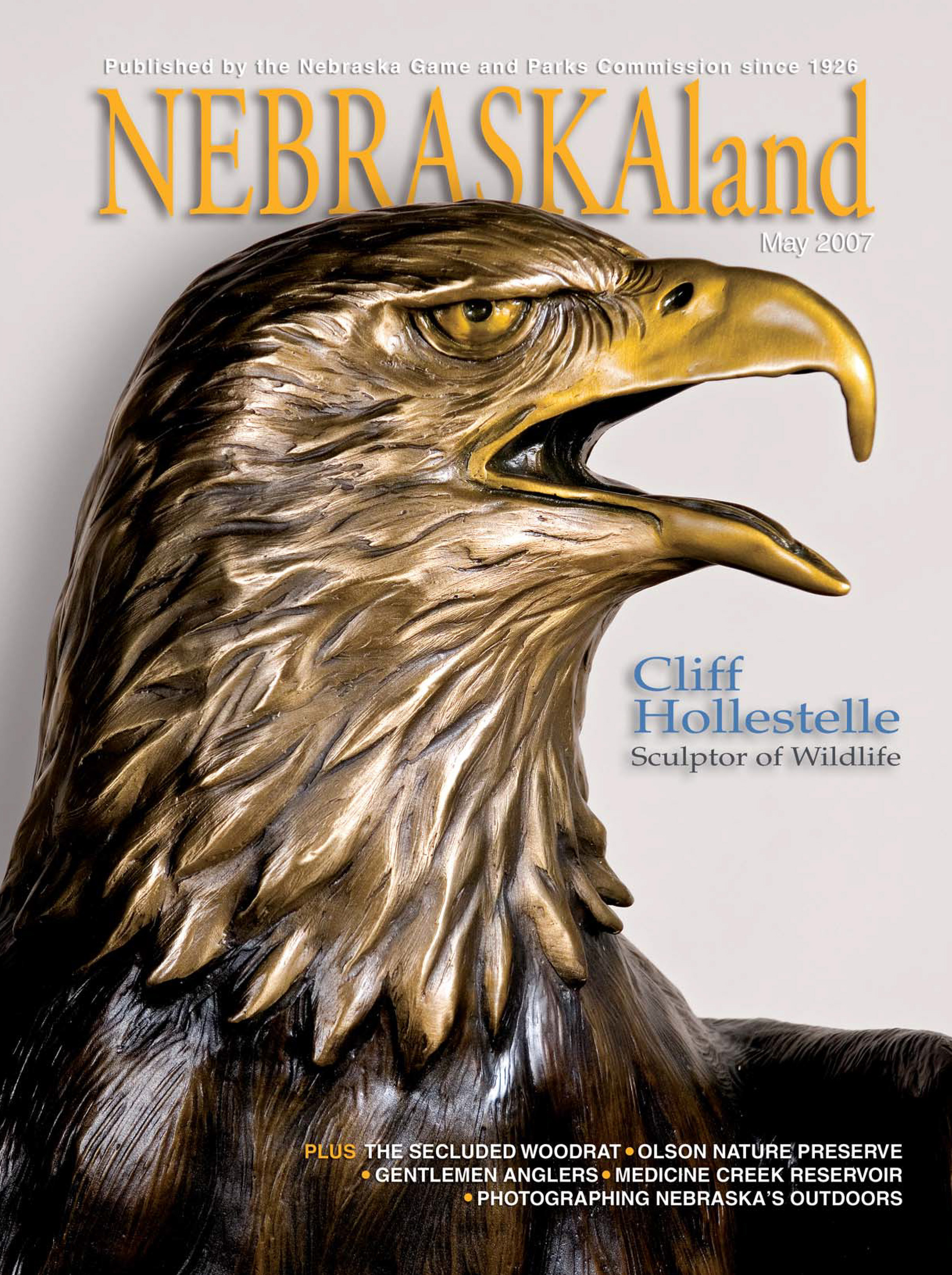
May 2007 Cliff Hollestelle Sculptor of Wildlife PLUS THE SECLUDED WOODRAT OLSON NATURE PRESERVE GENTLEMEN ANGLERS MEDICINE CREEK RESERVOIR PHOTOGRAPHING NEBRASKA'S OUTDOORS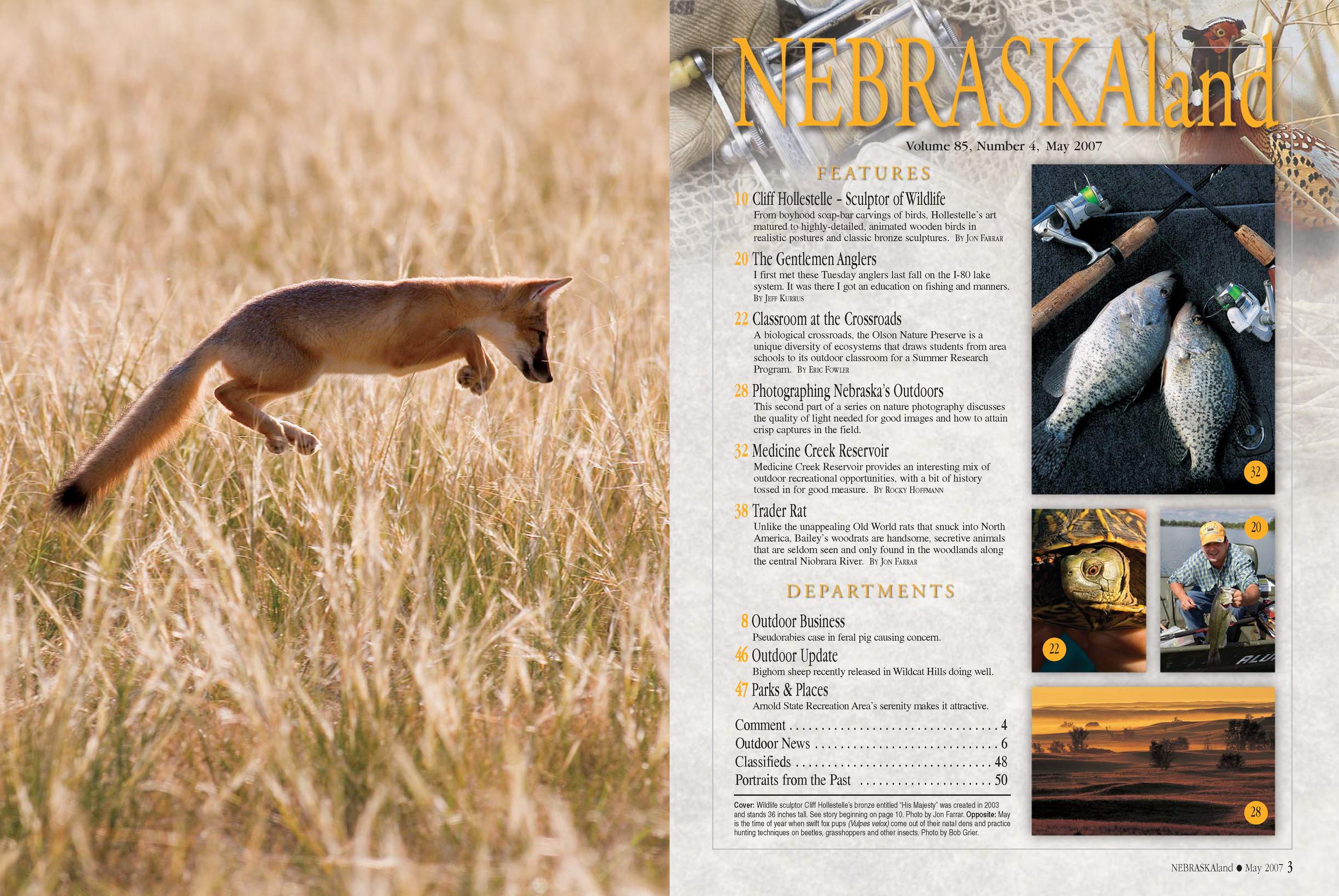
NEBRASKAland
Volume 85, Number 4, May 2007 Features 10 Cliff Hollestelle – Sculptor of Wildlife From boyhood soap-bar carvings of birds, Hollestelle's art matured to highly-detailed, animated wooden birds in realistic postures and classic bronze sculptures. BY JON FARRAR 20 The Gentlemen Anglers I first met these Tuesday anglers last fall on the I-80 lake system. It was there I got an education on fishing and manners. BY JEFF KURRUS 22 Classroom at the Crossroads A biological crossroads, the Olson Nature Preserve is a unique diversity of ecosystems that draws students from area schools to its outdoor classroom for a Summer Research Program. BY ERIC FOWLER 28 Photographing Nebraska's Outdoors This second part of a series on nature photography discusses the quality of light needed for good images and how to attain crisp captures in the field. 32 Medicine Creek Reservoir Medicine Creek Reservoir provides an interesting mix of outdoor recreational opportunities, with a bit of history tossed in for good measure. BY ROCKY HOFFMANN 38 Trader Rat Unlike the unappealing Old World rats that snuck into North America, Bailey's woodrats are handsome, secretive animals that are seldom seen and only found in the woodlands along the central Niobrara River. BY JON FARRAR Departments 8 Outdoor Business Pseudorabies case in feral pig causing concern. 46 Outdoor Update Bighorn sheep recently released in Wildcat Hills doing well. 47 Parks & Places Arnold State Recreation Area's serenity makes it attractive. Comment . . . . . . . . . . . . . . . . . . . . . . . . . . . . . . . . . 4 Outdoor News . . . . . . . . . . . . . . . . . . . . . . . . . . . . . 6 Classifieds . . . . . . . . . . . . . . . . . . . . . . . . . . . . . . . 48 Portraits from the Past . . . . . . . . . . . . . . . . . . . . . 50 Cover: Wildlife sculptor Cliff Hollestelle's bronze entitled "His Majesty" was created in 2003 and stands 36 inches tall. See story beginning on page 10. Photo by Jon Farrar. Opposite: May is the time of year when swift fox pups (Vulpes velox) come out of their natal dens and practice hunting techniques on beetles, grasshoppers and other insects. Photo by Bob Grier.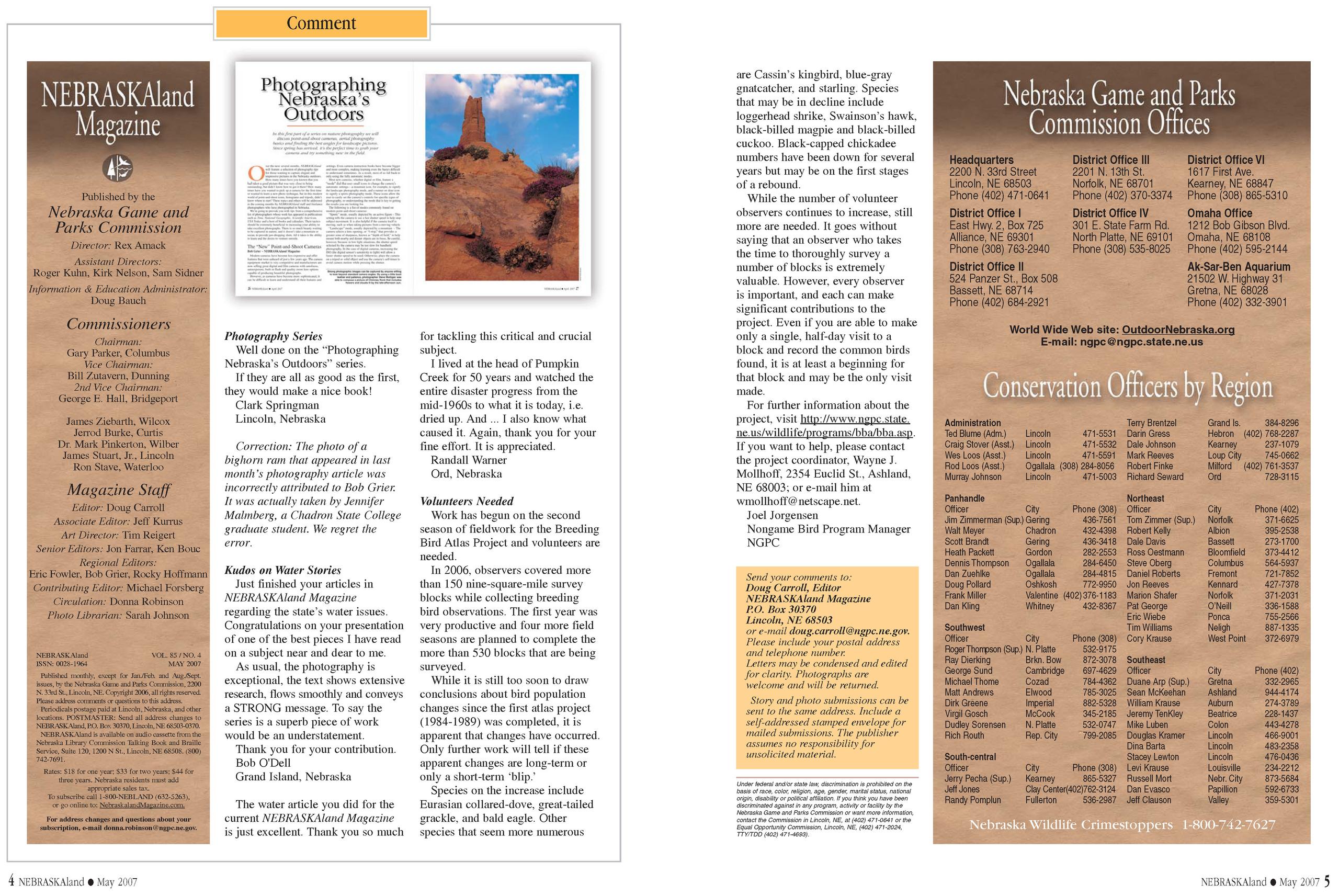
Comment
Well done on the "Photographing Nebraska's Outdoors" series.
If they are all as good as the first, they would make a nice book!
Clark Springman Lincoln, Nebraska Correction: The photo of a bighorn ram that appeared in last month's photography article was incorrectly attributed to Bob Grier. It was actually taken by Jennifer Malmberg, a Chadron State College graduate student. We regret the error. Kudos on Water StoriesJust finished your articles in NEBRASKAland Magazine regarding the state's water issues. Congratulations on your presentation of one of the best pieces I have read on a subject near and dear to me.
As usual, the photography is exceptional, the text shows extensive research, flows smoothly and conveys a STRONG message. To say the series is a superb piece of work would be an understatement.
Thank you for your contribution.
Bob O'Dell Grand Island, NebraskaThe water article you did for the current NEBRASKAland Magazine is just excellent. Thank you so much for tackling this critical and crucial subject.
I lived at the head of Pumpkin Creek for 50 years and watched the entire disaster progress from the mid-1960s to what it is today, i.e. dried up. And ... I also know what caused it. Again, thank you for your fine effort. It is appreciated.
Randall Warner Ord, Nebraska Volunteers NeededWork has begun on the second season of fieldwork for the Breeding Bird Atlas Project and volunteers are needed.
In 2006, observers covered more than 150 nine-square-mile survey blocks while collecting breeding bird observations. The first year was very productive and four more field seasons are planned to complete the more than 530 blocks that are being surveyed.
While it is still too soon to draw conclusions about bird population changes since the first atlas project (1984-1989) was completed, it is apparent that changes have occurred. Only further work will tell if these apparent changes are long-term or only a short-term 'blip.'
Eurasian collared-dove, great-tailed grackle, and bald eagle. Other species that seem more numerous 4 NEBRASKAland May 2007 are Cassin's kingbird, blue-gray gnatcatcher, and starling. Species that may be in decline include loggerhead shrike, Swainson's hawk, black-billed magpie and black-billed cuckoo. Black-capped chickadee numbers have been down for several years but may be on the first stages of a rebound.
While the number of volunteer observers continues to increase, still more are needed. It goes without saying that an observer who takes the time to thoroughly survey a number of blocks is extremely valuable. However, every observer is important, and each can make significant contributions to the project. Even if you are able to make only a single, half-day visit to a block and record the common birds found, it is at least a beginning for that block and may be the only visit made.
For further information about the project, visit http://www.ngpc.state. ne.us/wildlife/programs/bba/bba.asp. If you want to help, please contact the project coordinator, Wayne J. Mollhoff, 2354 Euclid St., Ashland, NE 68003; or e-mail him at wmollhoff@netscape.net.
Joel Jorgensen Nongame Bird Program Manager NGPC Send your comments to: Doug Carroll, Editor NEBRASKAland Magazine P.O. Box 30370 Lincoln, NE 68503 or e-mail doug.carroll@ngpc.ne.gov. Please include your postal address and telephone number. Letters may be condensed and edited for clarity. Photographs are welcome and will be returned. Story and photo submissions can be sent to the same address. Include a self-addressed stamped envelope for mailed submissions. The publisher assumes no responsibility for unsolicited material. Under federal and/or state law, discrimination is prohibited on the basis of race, color, religion, age, gender, marital status, national origin, disability or political affiliation. If you think you have been discriminated against in any program, activity or facility by the Nebraska Game and Parks Commission or want more information, contact the Commission in Lincoln, NE, at (402) 471-0641 or the Equal Opportunity Commission, Lincoln, NE, (402) 471-2024, TTY/TDD (402) 471-4693).
Outdoor News
A painting of two wood ducks by Armando Villarreal of Imperial has been chosen as the winner of the 30th annual Nebraska Habitat Stamp Art Contest.
The Nebraska Game and Parks Commissioners chose Villarreal's painting from 26 entries in the adult division of the contest. This is the fifth time Villarreal has won the contest, making him the most frequent winner in the contest's history. He also won in 1999, 2000, 2002 and 2004. Other finalists in this year's competition were Zachery Even of Sidney, who entered a painting of a pair of otters, and Jim Miklavcic of Lincoln, who entered a painting of a pair of bobwhite quail.
Villarreal's winning artwork will appear on the 2008 Habitat Stamp, which is required for all resident hunters age 16 and older and all nonresident hunters. Money raised from the sale of stamps goes directly into the Habitat Fund, which is used for acquisition and enhancement of habitat on state and private lands.
Villarreal will be asked to appear at the Commission's May meeting to accept a $300 cash award from the Omaha Fish and Wildlife Club, which helps sponsor the contest. Finalists will receive free subscriptions to NEBRASKAland Magazine.
All adult entries are on display through April 30 at the Commission's Lincoln office at 2200 N. 33rd St.
Honorable Mention status was awarded to three artists: Julie Crocker of Chapman, Deb Gengler- Copple of Hubbard and Loren Goedeken of Hebron.
Commissioners to Consider Fee Increases at Next MeetingThe Nebraska Game and Parks Commission will consider increases in some hunting and fishing permit fees at its May 24 meeting in Brady. The permits under consideration have not been raised since 2002, said Kirk Nelson, an assistant director of the Commission, and are necessary due to the ever-increasing costs involved in managing and protecting the state's fish, wildlife, park and outdoor recreation resources.
Approximately 85 percent of the Commission's funding comes from licenses, permits and user fees such as camping, cabin rentals and horseback riding. The remaining 15 percent is appropriated by the Legislature from the General Fund.
Some of the recommended increases include raising resident hunting licenses from $12 to $14 6 NEBRASKAland May 2007 and nonresident permits from $68 to $81; raising fishing licenses from $21 to $26 and $51 to $58 for residents and nonresidents respectively, raising turkey permit prices from $21 to $24 for residents; and raising the cost of a Habitat Stamp from $13 to $16.
If approved, the increases will become effective Jan. 1, 2008.
Peregrine Falcon ExhibitAn exhibit entitled "The Peregrine Falcon: The Return of an Endangered Species" runs to May 19, 2007 at the Hastings Museum of Natural and Cultural History.
Sponsored by Cathy Pershing and grandchildren, the 1000-foot exhibit uses specimens, objects, interactives, video and graphics to look at the biology, behavior and near demise of these remarkable birds.
"A large panorama photomural of a big-city skyline gives visitors a peregrine's-eye view of its modernday city habitat," said Drew Ceperley, the museum's director of marketing and membership. "Through illustrations, video, photography and falconry paraphernalia, visitors are introduced to the long history the peregrine has shared with humans. A mini-diorama introduces viewers to a mounted peregrine on its natural eyrie where they learn about the bird's former nesting areas and worldwide distribution.
"Another mini-diorama, a model of crushed and cracked eggs resting on a rock ledge, helps visitors understand the terrible toll DDT and other pesticides had on peregrine populations worldwide and across the eastern U.S. in particular. A real hack box and other equipment along with color photos help tell the story of how private falconers, university researchers and wildlife biologists brought the peregrine back through captive breeding and reintroduction."
For more information about the exhibit, contact the Hastings Museum at (800) 508-4629, or go online to www.hastingsmuseum.org.
Outdoor Business
Pseudorabies Case Causes Concern
This viral disease is another reason why wild hogs are not welcome here.
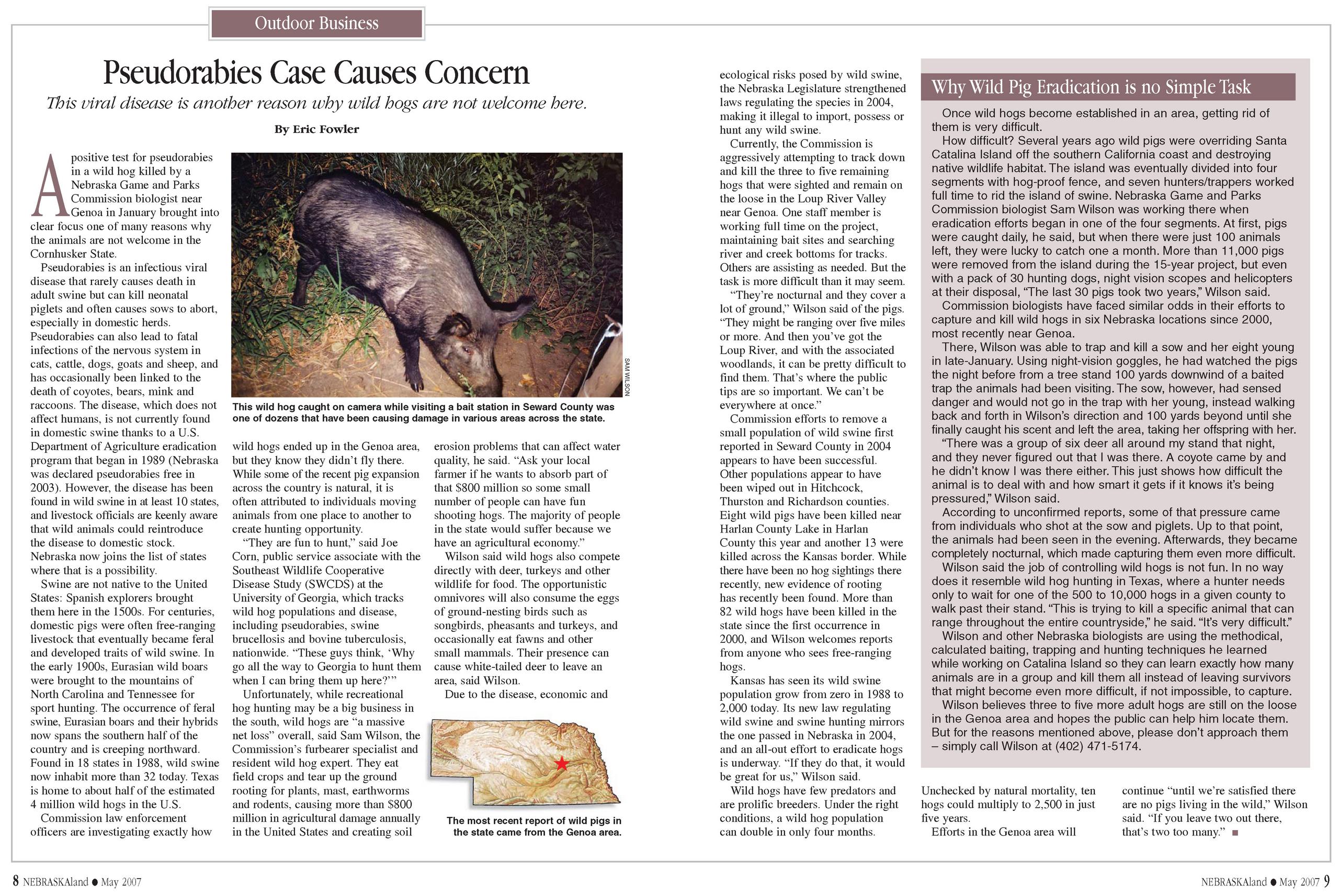
A positive test for pseudorabies in a wild hog killed by a Nebraska Game and Parks Commission biologist near Genoa in January brought into clear focus one of many reasons why the animals are not welcome in the Cornhusker State.
Pseudorabies is an infectious viral disease that rarely causes death in adult swine but can kill neonatal piglets and often causes sows to abort, especially in domestic herds. Pseudorabies can also lead to fatal infections of the nervous system in cats, cattle, dogs, goats and sheep, and has occasionally been linked to the death of coyotes, bears, mink and raccoons. The disease, which does not affect humans, is not currently found in domestic swine thanks to a U.S. Department of Agriculture eradication program that began in 1989 (Nebraska was declared pseudorabies free in 2003). However, the disease has been found in wild swine in at least 10 states, and livestock officials are keenly aware that wild animals could reintroduce the disease to domestic stock. Nebraska now joins the list of states where that is a possibility.
Swine are not native to the United States: Spanish explorers brought them here in the 1500s. For centuries, domestic pigs were often free-ranging livestock that eventually became feral and developed traits of wild swine. In the early 1900s, Eurasian wild boars were brought to the mountains of North Carolina and Tennessee for sport hunting. The occurrence of feral swine, Eurasian boars and their hybrids now spans the southern half of the country and is creeping northward. Found in 18 states in 1988, wild swine now inhabit more than 32 today. Texas is home to about half of the estimated 4 million wild hogs in the U.S.
Commission law enforcement officers are investigating exactly how
"They are fun to hunt," said Joe Corn, public service associate with the Southeast Wildlife Cooperative Disease Study (SWCDS) at the University of Georgia, which tracks wild hog populations and disease, including pseudorabies, swine brucellosis and bovine tuberculosis, nationwide. "These guys think, 'Why go all the way to Georgia to hunt them when I can bring them up here?'"
Unfortunately, while recreational hog hunting may be a big business in the south, wild hogs are "a massive net loss" overall, said Sam Wilson, the Commission's furbearer specialist and resident wild hog expert. They eat field crops and tear up the ground rooting for plants, mast, earthworms and rodents, causing more than $800 million in agricultural damage annually in the United States and creating soil erosion problems that can affect water quality, he said. "Ask your local farmer if he wants to absorb part of that $800 million so some small number of people can have fun shooting hogs. The majority of people in the state would suffer because we have an agricultural economy."
Wilson said wild hogs also compete directly with deer, turkeys and other wildlife for food. The opportunistic omnivores will also consume the eggs of ground-nesting birds such as songbirds, pheasants and turkeys, and occasionally eat fawns and other small mammals. Their presence can cause white-tailed deer to leave an area, said Wilson.
Due to the disease, economic and
Currently, the Commission is aggressively attempting to track down and kill the three to five remaining hogs that were sighted and remain on the loose in the Loup River Valley near Genoa. One staff member is working full time on the project, maintaining bait sites and searching river and creek bottoms for tracks. Others are assisting as needed. But the task is more difficult than it may seem.
"They're nocturnal and they cover a lot of ground,"Wilson said of the pigs. "They might be ranging over five miles or more. And then you've got the Loup River, and with the associated woodlands, it can be pretty difficult to find them. That's where the public tips are so important. We can't be everywhere at once."
Commission efforts to remove a small population of wild swine first reported in Seward County in 2004 appears to have been successful. Other populations appear to have been wiped out in Hitchcock, Thurston and Richardson counties. Eight wild pigs have been killed near Harlan County Lake in Harlan County this year and another 13 were killed across the Kansas border. While there have been no hog sightings there recently, new evidence of rooting has recently been found. More than 82 wild hogs have been killed in the state since the first occurrence in 2000, and Wilson welcomes reports from anyone who sees free-ranging hogs.
Kansas has seen its wild swine population grow from zero in 1988 to 2,000 today. Its new law regulating wild swine and swine hunting mirrors the one passed in Nebraska in 2004, and an all-out effort to eradicate hogs is underway. "If they do that, it would be great for us," Wilson said.
Wild hogs have few predators and are prolific breeders. Under the right conditions, a wild hog population can double in only four months. Unchecked by natural mortality, ten hogs could multiply to 2,500 in just five years.
Efforts in the Genoa area will continue "until we're satisfied there are no pigs living in the wild," Wilson said. "If you leave two out there, that's two too many."
Why Wild Pig Eradication is no Simple TaskOnce wild hogs become established in an area, getting rid of them is very difficult.
How difficult? Several years ago wild pigs were overriding Santa Catalina Island off the southern California coast and destroying native wildlife habitat. The island was eventually divided into four segments with hog-proof fence, and seven hunters/trappers worked full time to rid the island of swine. Nebraska Game and Parks Commission biologist Sam Wilson was working there when eradication efforts began in one of the four segments. At first, pigs were caught daily, he said, but when there were just 100 animals left, they were lucky to catch one a month. More than 11,000 pigs were removed from the island during the 15-year project, but even with a pack of 30 hunting dogs, night vision scopes and helicopters at their disposal, "The last 30 pigs took two years," Wilson said.
Commission biologists have faced similar odds in their efforts to capture and kill wild hogs in six Nebraska locations since 2000, most recently near Genoa.
There, Wilson was able to trap and kill a sow and her eight young in late-January. Using night-vision goggles, he had watched the pigs the night before from a tree stand 100 yards downwind of a baited trap the animals had been visiting. The sow, however, had sensed danger and would not go in the trap with her young, instead walking back and forth in Wilson's direction and 100 yards beyond until she finally caught his scent and left the area, taking her offspring with her.
"There was a group of six deer all around my stand that night, and they never figured out that I was there. A coyote came by and he didn't know I was there either. This just shows how difficult the animal is to deal with and how smart it gets if it knows it's being pressured," Wilson said.
According to unconfirmed reports, some of that pressure came from individuals who shot at the sow and piglets. Up to that point, the animals had been seen in the evening. Afterwards, they became completely nocturnal, which made capturing them even more difficult.
Wilson said the job of controlling wild hogs is not fun. In no way does it resemble wild hog hunting in Texas, where a hunter needs only to wait for one of the 500 to 10,000 hogs in a given county to walk past their stand. "This is trying to kill a specific animal that can range throughout the entire countryside," he said. "It's very difficult."
Wilson and other Nebraska biologists are using the methodical, calculated baiting, trapping and hunting techniques he learned while working on Catalina Island so they can learn exactly how many animals are in a group and kill them all instead of leaving survivors that might become even more difficult, if not impossible, to capture.
Wilson believes three to five more adult hogs are still on the loose in the Genoa area and hopes the public can help him locate them. But for the reasons mentioned above, please don't approach them – simply call Wilson at (402) 471-5174.
 10 NEBRASKAland May 2007
Cliff Hollestelle
Sculptor of Wildlife
From boyhood soap-bar carvings of birds, Hollestelle's art matured to highly-detailed, animated wooden birds in realistic postures and classic bronze sculpture.
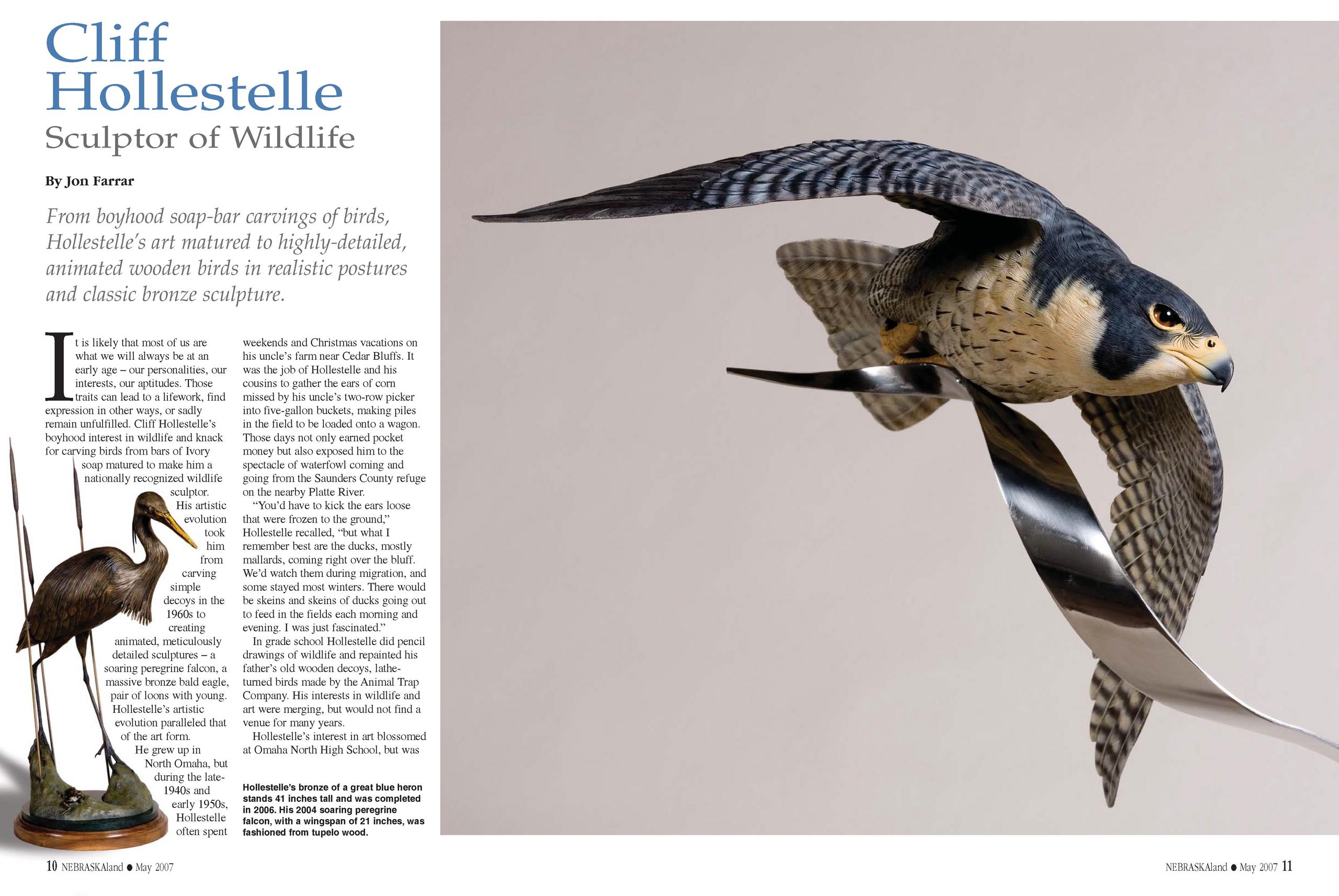
It is likely that most of us are what we will always be at an early age – our personalities, our interests, our aptitudes. Those traits can lead to a lifework, find expression in other ways, or sadly remain unfulfilled. Cliff Hollestelle's boyhood interest in wildlife and knack for carving birds from bars of Ivory soap matured to make him a nationally recognized wildlife
"You'd have to kick the ears loose that were frozen to the ground," Hollestelle recalled, "but what I remember best are the ducks, mostly mallards, coming right over the bluff. We'd watch them during migration, and some stayed most winters. There would be skeins and skeins of ducks going out to feed in the fields each morning and evening. I was just fascinated."
In grade school Hollestelle did pencil drawings of wildlife and repainted his father's old wooden decoys, latheturned birds made by the Animal Trap Company. His interests in wildlife and art were merging, but would not find a venue for many years.
Hollestelle's interest in art blossomed at Omaha North High School, but was
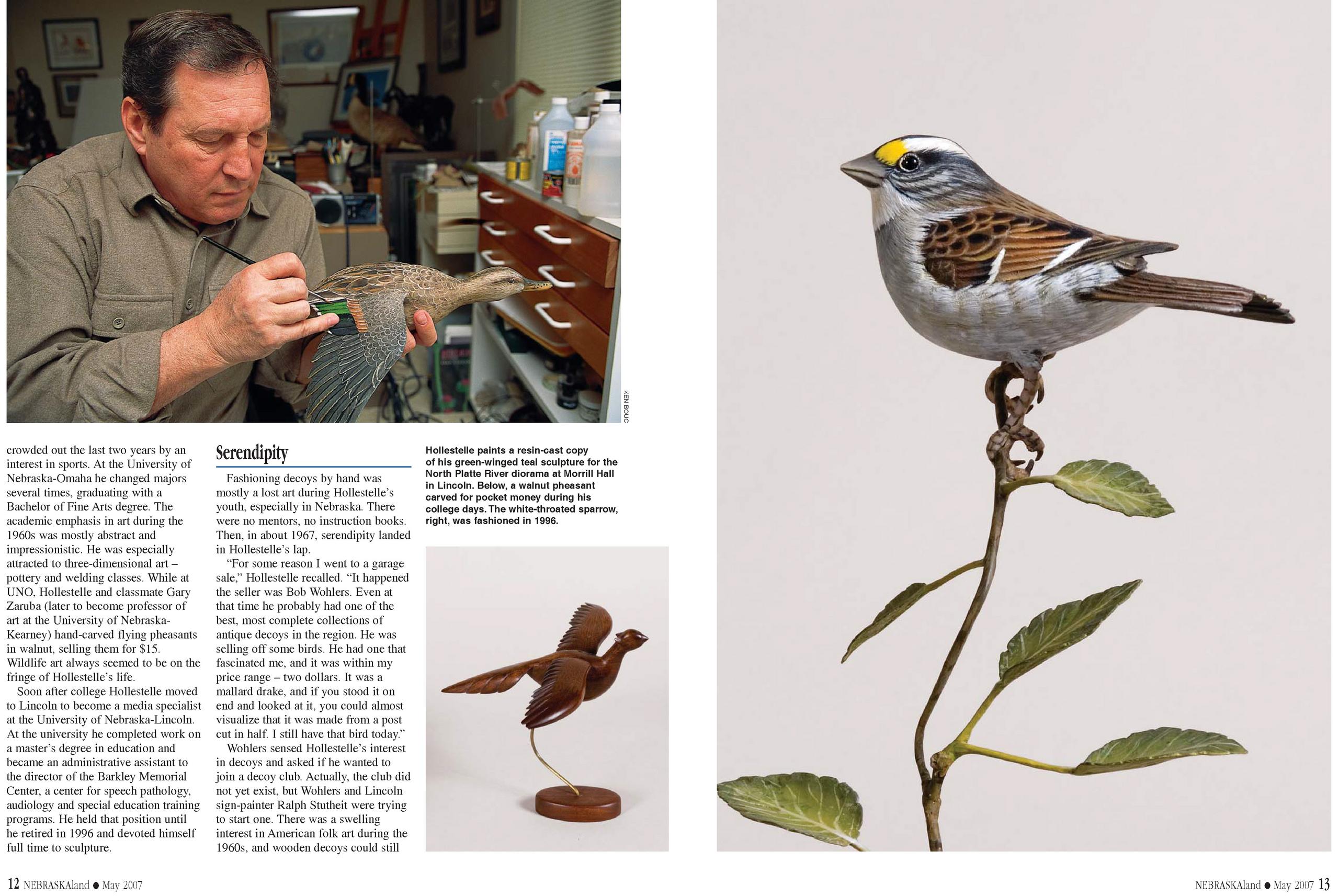
Soon after college Hollestelle moved to Lincoln to become a media specialist at the University of Nebraska-Lincoln. At the university he completed work on a master's degree in education and became an administrative assistant to the director of the Barkley Memorial Center, a center for speech pathology, audiology and special education training programs. He held that position until he retired in 1996 and devoted himself full time to sculpture.
SerendipityFashioning decoys by hand was mostly a lost art during Hollestelle's youth, especially in Nebraska. There were no mentors, no instruction books. Then, in about 1967, serendipity landed in Hollestelle's lap.
"For some reason I went to a garage sale," Hollestelle recalled. "It happened the seller was Bob Wohlers. Even at that time he probably had one of the best, most complete collections of antique decoys in the region. He was selling off some birds. He had one that fascinated me, and it was within my price range – two dollars. It was a mallard drake, and if you stood it on end and looked at it, you could almost visualize that it was made from a post cut in half. I still have that bird today."
Wohlers sensed Hollestelle's interest in decoys and asked if he wanted to join a decoy club. Actually, the club did not yet exist, but Wohlers and Lincoln sign-painter Ralph Stutheit were trying to start one. There was a swelling interest in American folk art during the 1960s, and wooden decoys could still
In 1970, about 20 Lincoln decoy carvers and collectors, including Hollestelle, Wohlers, Stutheit and University of Nebraska-Lincoln ornithologist Paul Johnsgard, organized the Central Flyway Decoy Carvers and Collectors Club. The group began meeting at least once a month, usually at Wohlers's house or Stutheit's sign shop.
"We would get together, put a few bucks in the pot to buy a couple sixpacks of beer and some potato chips, take some card-table chairs, gather in a circle and talk about birds, decoys and hunting trips," Hollestelle recalled. "Sometimes someone would bring antique decoys. You could buy about any decoy you wanted for $5 or $10. And sometimes we'd bring decoys we were working on to talk about, get advice on how to do something. Someone might look at your bird and say 'I would probably cut the head off and redo it,' or 'your bill is too long, your head is getting too cheeky.'"
During the late-1960s and early
1970s, decorative decoys were, by
today's standards, rather primitive
creations. In the early years, most
decorative decoys were flat-bottomed,
with traditional, resting-on-the-water
NEBRASKAland May 2007 15
 postures, what carvers today refer to as
"service decoys." Unlike most wooden
decoys of old, though, they had more
elaborate painting. Most still had smooth
bodies, but some had wing and tail
details carved in relief. Even in the
early 1970s, carvers were pushing the
limit of their equipment, materials and
skills.
postures, what carvers today refer to as
"service decoys." Unlike most wooden
decoys of old, though, they had more
elaborate painting. Most still had smooth
bodies, but some had wing and tail
details carved in relief. Even in the
early 1970s, carvers were pushing the
limit of their equipment, materials and
skills.
During the late-1960s and early 1970s, most Nebraska carvers worked in sugar pine, a tree found in western mountain states. During the 1970s, many switched to jelutong, wood from a tree native to southeastern Asia, that has low density, straight grain and fine texture. Jelutong was easier to work than sugar pine, both with a carving knife and wood burner. The principal drawbacks of jelutong were that it was excessively dusty to work, was laced with hollow ducts that needed to be filled and contained occasional pockets of a natural latex. By the late-1970s, and even yet today, most carvers in Nebraska and across the country were working in tupelo, wood from a tree found in swamplands in eastern and southeastern states. Tupelo has a fine, uniform texture and is hard enough to allow the burning of intricate feather detail.
When Hollestelle started carving, decoy shaping was done pretty much the same way it had been in the early 1900s. Bodies and heads were first cut
During the early years, carvers made do with what tools, materials and references they could get. Hollestelle said Stutheit was often ahead of his time. He remembers hunting ducks with him on the Ceresco flats north of Lincoln. Whenever they shot a species for which they did not have bill reference, they would immerse the bird's bill in a Dixie cup filled with the molding material used by dentists to make dental impressions, allow the material to dry and set, and later make plaster models to have reliable references for carving bills.
Many advances in carving occurred independently across the country, but Hollestelle credits Stutheit with introducing burning feather details to carvers in the Lincoln club. Initially they used inexpensive, hobby-store wood-burners, "the kind we all used in grade school 150 years ago," Hollestelle joked. But there was no way to consistently regulate the amount of heat, hence the depth and width of the line burned. Today, carvers can buy burners with interchangeable tips and dial-in temperature controls. "I can remember someone saying to Stutheit," Hollestelle recalled, "when he started wood-burning feather detail, 'Why did you ever start doing that! Now we're
"I took all my oil paints over to my sister's house one night," he recalled. "She was doing artwork at the time. 'Here, take these paints,' I told her. 'Use them up, do whatever you want with them, but if I knock on your door at 2 a.m. begging for them, do not give me those paints back.' I went out and bought all new acrylic paints. Since then I've used acrylic paints."
As competition grew ever more keen, carvers lavished increasingly more time on each bird. One advantage of flatbottomed service decoys was that they had no legs. A bird's feet and legs are intricate and difficult to replicate, and because the feet and legs support a fullbody sculpture on its base, they need to be strong. Neither wood nor commercially molded lead feet and legs were strong enough, so using welding skills learned in college, Hollestelle began making his own from brass and copper, welding or silversoldering pieces together, shaping toes with a small hammer and anvil. When two-part epoxy that remains somewhat pliable when dry became available, he began using it to fashion legs and feet around a metal armature.
When asked the standard question,
how long does it take to do one of his
birds, Hollestelle gives the standard
answer: "It's impossible to say." The
closest he can come to explaining the
NEBRASKAland May 2007 17
 time required is that about 50 percent is
shaping the bird, about 30 percent
burning detail, and about 20 percent
painting. "The painting might take
some carvers longer," he said, "but I
paint very fast."
time required is that about 50 percent is
shaping the bird, about 30 percent
burning detail, and about 20 percent
painting. "The painting might take
some carvers longer," he said, "but I
paint very fast."
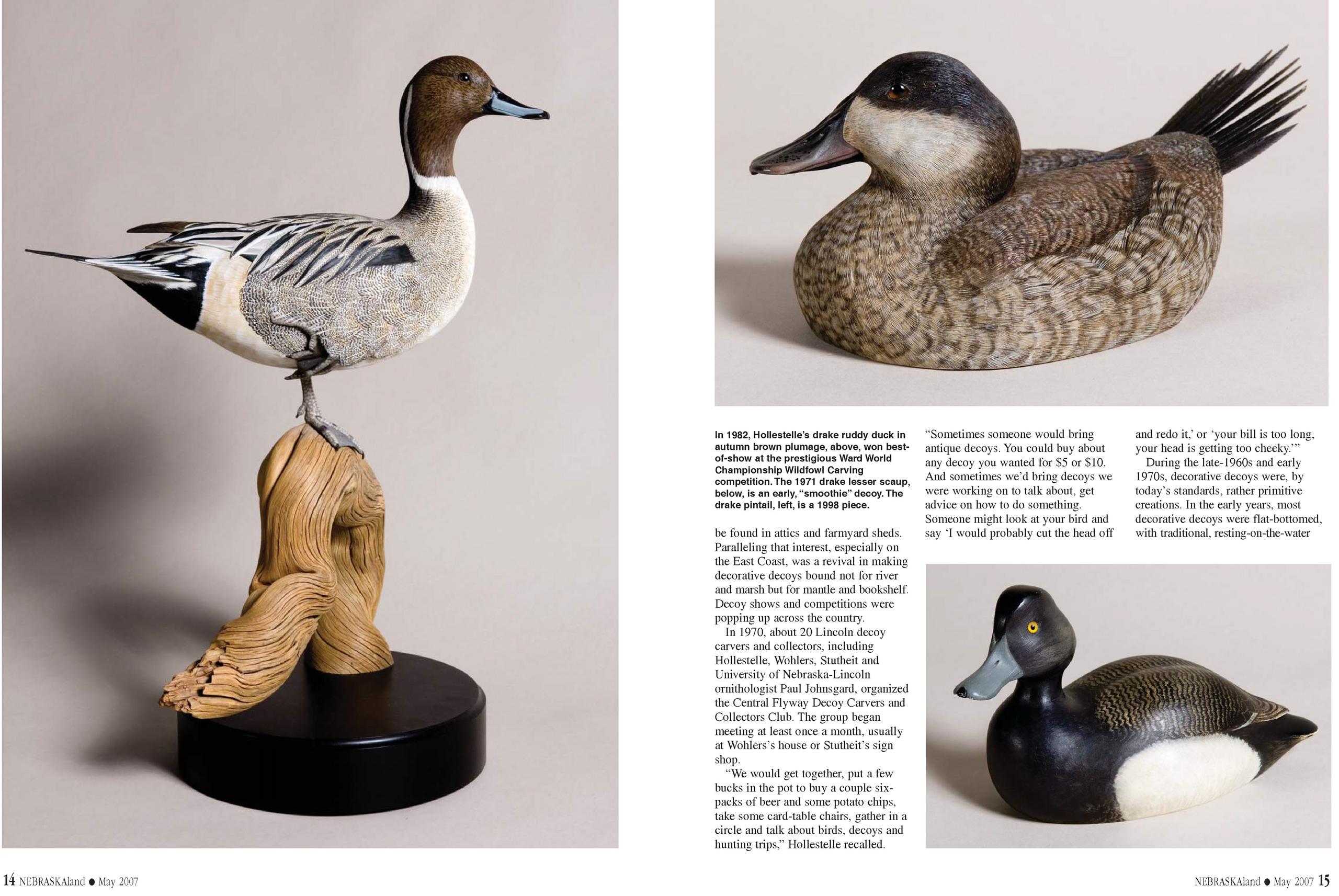
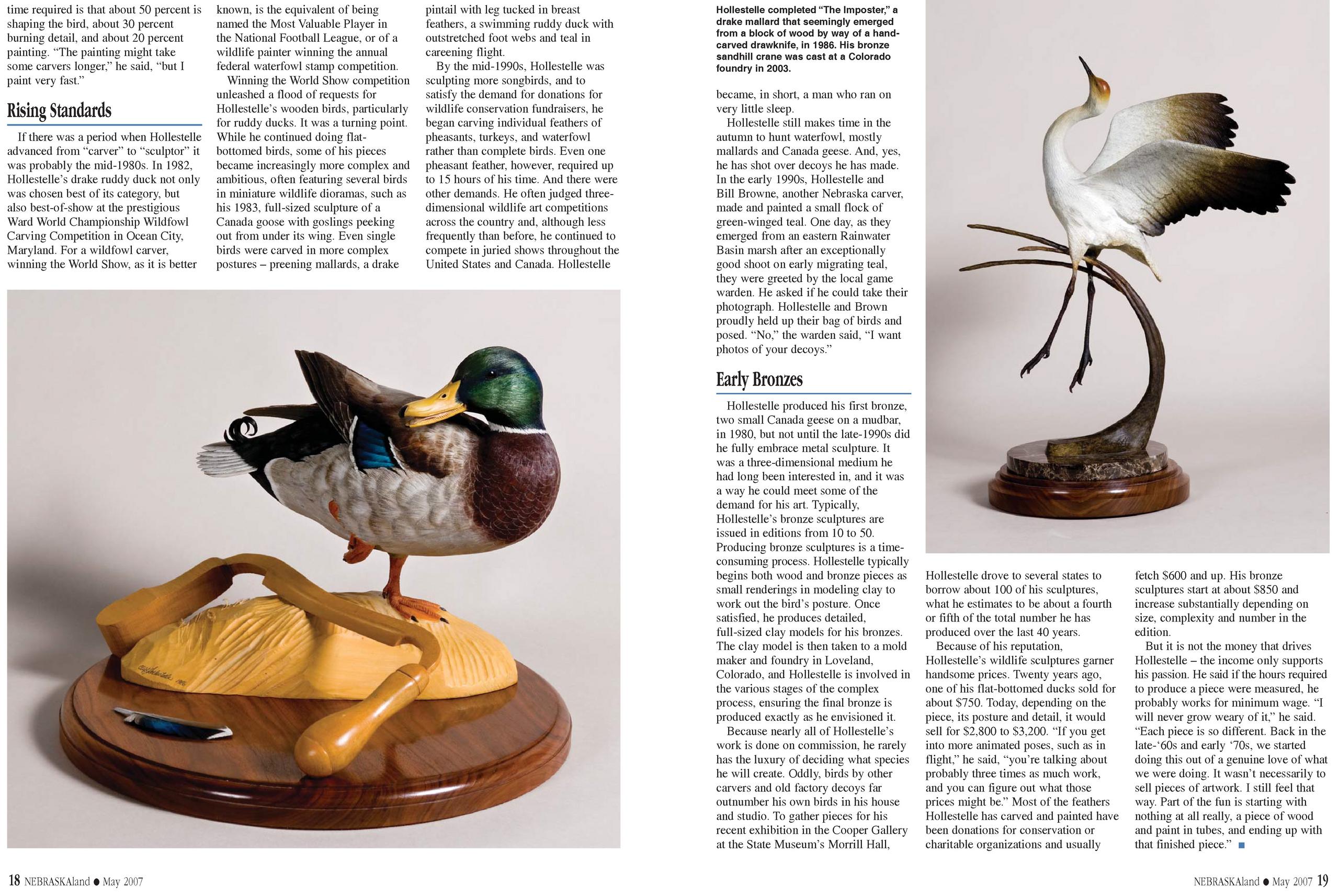
If there was a period when Hollestelle advanced from "carver" to "sculptor" it was probably the mid-1980s. In 1982, Hollestelle's drake ruddy duck not only was chosen best of its category, but also best-of-show at the prestigious Ward World Championship Wildfowl Carving Competition in Ocean City, Maryland. For a wildfowl carver, winning the World Show, as it is better known, is the equivalent of being named the Most Valuable Player in the National Football League, or of a wildlife painter winning the annual federal waterfowl stamp competition.
Winning the World Show competition unleashed a flood of requests for Hollestelle's wooden birds, particularly for ruddy ducks. It was a turning point. While he continued doing flatbottomed birds, some of his pieces became increasingly more complex and ambitious, often featuring several birds in miniature wildlife dioramas, such as his 1983, full-sized sculpture of a Canada goose with goslings peeking out from under its wing. Even single birds were carved in more complex postures – preening mallards, a drake pintail with leg tucked in breast feathers, a swimming ruddy duck with outstretched foot webs and teal in careening flight.
By the mid-1990s, Hollestelle was sculpting more songbirds, and to satisfy the demand for donations for wildlife conservation fundraisers, he began carving individual feathers of pheasants, turkeys, and waterfowl rather than complete birds. Even one pheasant feather, however, required up to 15 hours of his time. And there were other demands. He often judged threedimensional wildlife art competitions across the country and, although less frequently than before, he continued to compete in juried shows throughout the United States and Canada. Hollestelle
Hollestelle still makes time in the autumn to hunt waterfowl, mostly mallards and Canada geese. And, yes, he has shot over decoys he has made. In the early 1990s, Hollestelle and Bill Browne, another Nebraska carver, made and painted a small flock of green-winged teal. One day, as they emerged from an eastern Rainwater Basin marsh after an exceptionally good shoot on early migrating teal, they were greeted by the local game warden. He asked if he could take their photograph. Hollestelle and Brown proudly held up their bag of birds and posed. "No," the warden said, "I want photos of your decoys."
Early BronzesHollestelle produced his first bronze, two small Canada geese on a mudbar, in 1980, but not until the late-1990s did he fully embrace metal sculpture. It was a three-dimensional medium he had long been interested in, and it was a way he could meet some of the demand for his art. Typically, Hollestelle's bronze sculptures are issued in editions from 10 to 50. Producing bronze sculptures is a timeconsuming process. Hollestelle typically begins both wood and bronze pieces as small renderings in modeling clay to work out the bird's posture. Once satisfied, he produces detailed, full-sized clay models for his bronzes. The clay model is then taken to a mold maker and foundry in Loveland, Colorado, and Hollestelle is involved in the various stages of the complex process, ensuring the final bronze is produced exactly as he envisioned it.
Because nearly all of Hollestelle's work is done on commission, he rarely has the luxury of deciding what species he will create. Oddly, birds by other carvers and old factory decoys far outnumber his own birds in his house and studio. To gather pieces for his recent exhibition in the Cooper Gallery at the State Museum's Morrill Hall,
Because of his reputation, Hollestelle's wildlife sculptures garner handsome prices. Twenty years ago, one of his flat-bottomed ducks sold for about $750. Today, depending on the piece, its posture and detail, it would sell for $2,800 to $3,200. "If you get into more animated poses, such as in flight," he said, "you're talking about probably three times as much work, and you can figure out what those prices might be." Most of the feathers Hollestelle has carved and painted have been donations for conservation or charitable organizations and usually fetch $600 and up. His bronze sculptures start at about $850 and increase substantially depending on size, complexity and number in the edition.
But it is not the money that drives Hollestelle – the income only supports his passion. He said if the hours required to produce a piece were measured, he probably works for minimum wage. "I will never grow weary of it," he said. "Each piece is so different. Back in the late-'60s and early '70s, we started doing this out of a genuine love of what we were doing. It wasn't necessarily to sell pieces of artwork. I still feel that way. Part of the fun is starting with nothing at all really, a piece of wood and paint in tubes, and ending up with that finished piece."
THE GENTLEMEN ANGLERS
I first met these Tuesday anglers last fall on the I-80 lake system. It was there I got an education on fishing and manners.
It was a chance meeting. I happened to be pulling into the Fremont Slough Wildlife Management Area parking lot, just off Interstate 80 at North Platte, and they were there at the same time. I knew these were the kind of guys I needed to meet when one of them climbed from their truck and said, "You go ahead first." In the normal
Maybe it was because I was driving a Nebraska Game and Parks Commission vehicle. Nope. They also did it to the guy that pulled in as I walked over to their truck. After brief introductions, I came to find out that while I was just passing through on my way back to Lincoln, these guys would probably be there at the same time next week. Why? Because just as "Thursdays are for Trout" (NEBRASKAland April 2004), Tuesdays are for bass, at least as far as these guys are concerned.
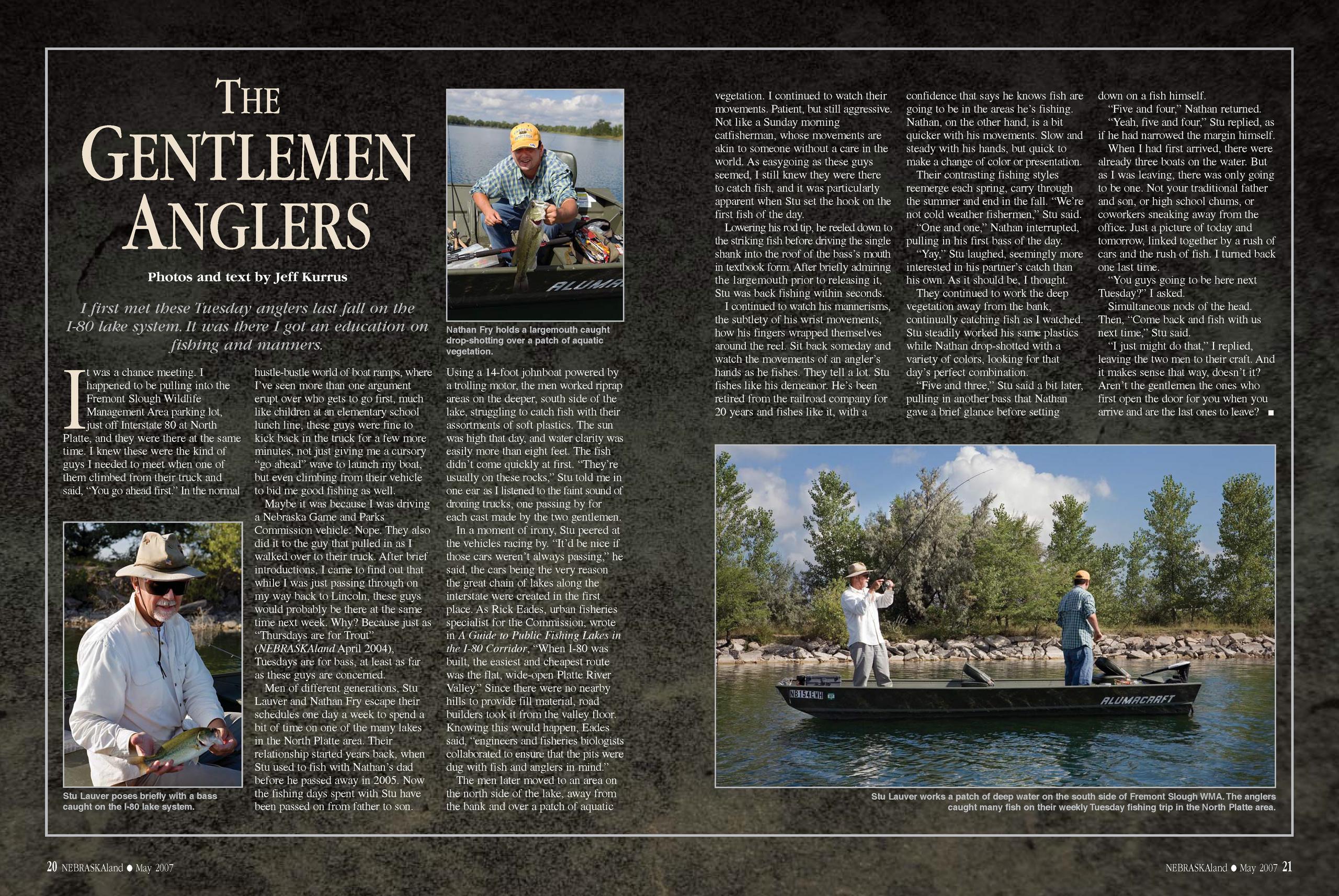
Men of different generations, Stu Lauver and Nathan Fry escape their schedules one day a week to spend a bit of time on one of the many lakes in the North Platte area. Their relationship started years back, when Stu used to fish with Nathan's dad before he passed away in 2005. Now the fishing days spent with Stu have been passed on from father to son.
In a moment of irony, Stu peered at the vehicles racing by. "It'd be nice if those cars weren't always passing," he said, the cars being the very reason the great chain of lakes along the interstate were created in the first place. As Rick Eades, urban fisheries specialist for the Commission, wrote in A Guide to Public Fishing Lakes in the I-80 Corridor, "When I-80 was built, the easiest and cheapest route was the flat, wide-open Platte River Valley." Since there were no nearby hills to provide fill material, road builders took it from the valley floor. Knowing this would happen, Eades said, "engineers and fisheries biologists collaborated to ensure that the pits were dug with fish and anglers in mind."
The men later moved to an area on the north side of the lake, away from the bank and over a patch of aquatic 20 NEBRASKAland May 2007 vegetation. I continued to watch their movements. Patient, but still aggressive. Not like a Sunday morning catfisherman, whose movements are akin to someone without a care in the world. As easygoing as these guys seemed, I still knew they were there to catch fish, and it was particularly apparent when Stu set the hook on the first fish of the day.
Lowering his rod tip, he reeled down to the striking fish before driving the single shank into the roof of the bass's mouth in textbook form. After briefly admiring the largemouth prior to releasing it, Stu was back fishing within seconds.
I continued to watch his mannerisms, the subtlety of his wrist movements, how his fingers wrapped themselves around the reel. Sit back someday and watch the movements of an angler's hands as he fishes. They tell a lot. Stu fishes like his demeanor. He's been retired from the railroad company for 20 years and fishes like it, with a confidence that says he knows fish are going to be in the areas he's fishing. Nathan, on the other hand, is a bit quicker with his movements. Slow and steady with his hands, but quick to make a change of color or presentation.
Their contrasting fishing styles reemerge each spring, carry through the summer and end in the fall. "We're not cold weather fishermen," Stu said.
"One and one," Nathan interrupted, pulling in his first bass of the day.
"Yay," Stu laughed, seemingly more interested in his partner's catch than his own. As it should be, I thought.
They continued to work the deep vegetation away from the bank, continually catching fish as I watched. Stu steadily worked his same plastics while Nathan drop-shotted with a variety of colors, looking for that day's perfect combination.
"Five and three," Stu said a bit later, pulling in another bass that Nathan gave a brief glance before setting down on a fish himself.
"Five and four," Nathan returned.
"Yeah, five and four," Stu replied, as if he had narrowed the margin himself.
When I had first arrived, there were already three boats on the water. But as I was leaving, there was only going to be one. Not your traditional father and son, or high school chums, or coworkers sneaking away from the office. Just a picture of today and tomorrow, linked together by a rush of cars and the rush of fish. I turned back one last time.
"You guys going to be here next Tuesday?" I asked.
Simultaneous nods of the head. Then, "Come back and fish with us next time," Stu said.
"I just might do that," I replied, leaving the two men to their craft. And it makes sense that way, doesn't it? Aren't the gentlemen the ones who first open the door for you when you arrive and are the last ones to leave?
Classroom at the Crossroads
A biological crossroads, the Olson Nature Preserve is a unique diversity of ecosystems that draws students from area schools to its outdoor classroom for a Summer Research Program.
How long does it take an ornate box turtle to walk from the Nebraska Sandhills, through a bur oak forest and to a riverbottom wetland on the edge of the loess hills? If you're talking about one of the turtles that lives at the Olson Nature Preserve northwest of Albion, it's not as long as you might think. It's not that the turtle is fast – less than 100 yards separate the three
Considered by many to be a biological crossroads, the diversity of ecosystems found in Nebraska is noteworthy. Even so, there probably aren't many 112-acre parcels of land in the state that possess the diversity found at this nature preserve. The uniqueness of the area is what encouraged local, civic-minded citizens to push for creation of the preserve and is also what draws students from area schools to this outdoor classroom for a Summer Research Program that involves work on a myriad of hands-on projects, including tracking box turtles with telemetry equipment.
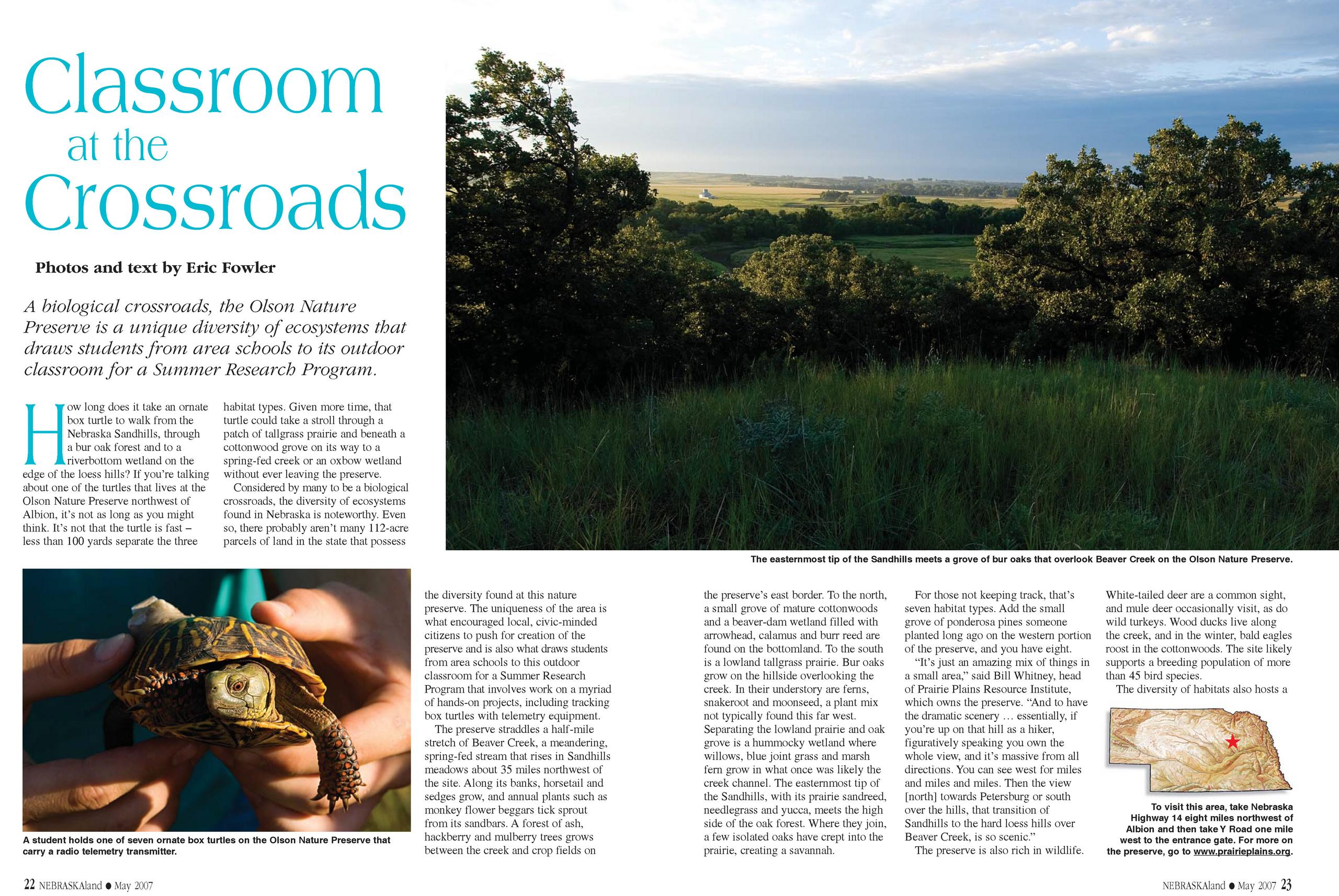
The preserve straddles a half-mile stretch of Beaver Creek, a meandering, spring-fed stream that rises in Sandhills meadows about 35 miles northwest of the site. Along its banks, horsetail and sedges grow, and annual plants such as monkey flower beggars tick sprout from its sandbars. A forest of ash, hackberry and mulberry trees grows between the creek and crop fields on 22 NEBRASKAland May 2007
the preserve's east border. To the north, a small grove of mature cottonwoods and a beaver-dam wetland filled with arrowhead, calamus and burr reed are found on the bottomland. To the south is a lowland tallgrass prairie. Bur oaks grow on the hillside overlooking the creek. In their understory are ferns, snakeroot and moonseed, a plant mix not typically found this far west. Separating the lowland prairie and oak grove is a hummocky wetland where willows, blue joint grass and marsh fern grow in what once was likely the creek channel. The easternmost tip of the Sandhills, with its prairie sandreed, needlegrass and yucca, meets the high side of the oak forest. Where they join, a few isolated oaks have crept into the prairie, creating a savannah.
For those not keeping track, that's seven habitat types. Add the small grove of ponderosa pines someone planted long ago on the western portion of the preserve, and you have eight.
"It's just an amazing mix of things in a small area," said Bill Whitney, head of Prairie Plains Resource Institute, which owns the preserve. "And to have the dramatic scenery … essentially, if you're up on that hill as a hiker, figuratively speaking you own the whole view, and it's massive from all directions. You can see west for miles and miles and miles. Then the view [north] towards Petersburg or south over the hills, that transition of Sandhills to the hard loess hills over Beaver Creek, is so scenic."
The preserve is also rich in wildlife. White-tailed deer are a common sight, and mule deer occasionally visit, as do wild turkeys. Wood ducks live along the creek, and in the winter, bald eagles roost in the cottonwoods. The site likely supports a breeding population of more than 45 bird species.
The diversity of habitats also hosts a
Porter also participated in the Summer Research Program at the preserve each year during high school, chasing bees, butterflies and doodlebugs. She still visits the area when she's back home, and says if she had to choose her top three places in the world to go, the Olson Nature Preserve would be one of them.
Porter credits the area's education program and diversity for her passion. "If it would've been just one [habitat type] you wouldn't have found much for insects. I don't think it would've been as much fun for me in the beginning to keep my interest going," she said.
Stories like Porter's make Mitch Osborn and Mark Seier, science teachers at Boone Central and Newman Grove high schools, respectively, glad they launched the summer program in 1997, where students spend 10 days working on various projects. They get no credit or grade for their efforts, but between 20 and 30 students sign up each summer.
"It's not for everyone," said Seier. "You can't predict what kind of kid will be interested. It's a different kind of science than what you do in the classroom. A kid that doesn't appear to be all that interested in science in the classroom, you get them out here and you see an altogether different
Osborn was in his first year teaching in Albion when the concept of a preserve began to form (see sidebar on page 27). Like many in the community, he threw his support behind it. When it became a reality, he immediately began hauling biology students there for field trips during the school year. Seventh graders were the first to get a summer camp at the preserve. Since 1995, they have spent three days there on biological science, social science and history studies, including Native American history that includes the death of Logan Fontenelle, chief of the Omaha tribe, who was killed on Beaver Creek by Sioux while on a 24 NEBRASKAland May 2007 buffalo hunt in 1855. A similar program for fifth graders began in 1997, and third graders also visit the area each fall.
Osborn said teachers have capitalized on the area's diversity to add variety to their programs and offer something different each year for the many students who are repeat customers. "If the diversity wasn't there, we wouldn't be able to do that," he said. "It if was just a brome pasture, it would be pretty limiting in what we could do."
The first project students did at the preserve was to inventory plants, and they identified about 300. An array of other programs has followed. Bumblebee research was cosponsored by UN-L. A study of the oak forest documented a lack of regeneration. Students trapped
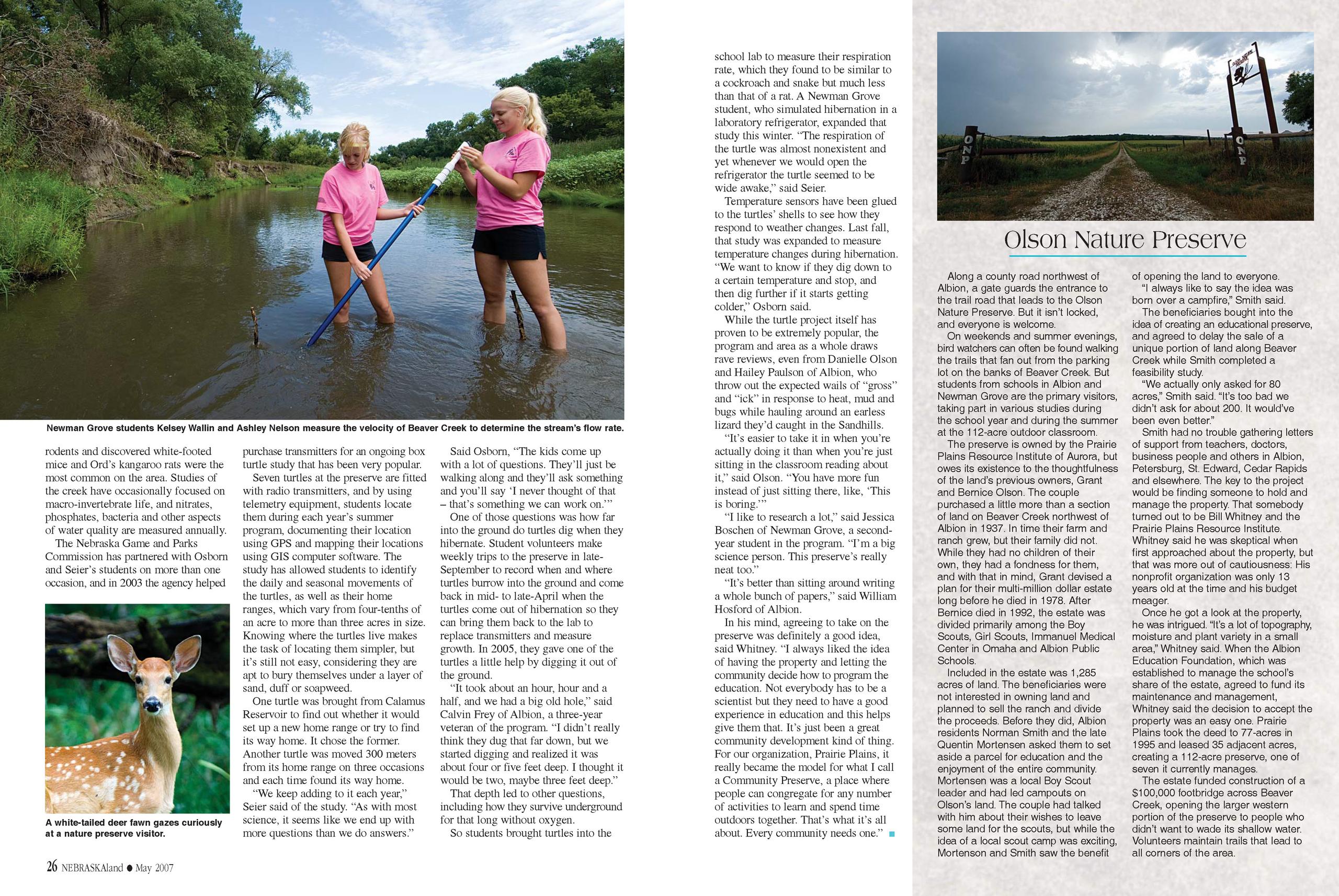
The Nebraska Game and Parks Commission has partnered with Osborn and Seier's students on more than one occasion, and in 2003 the agency helped
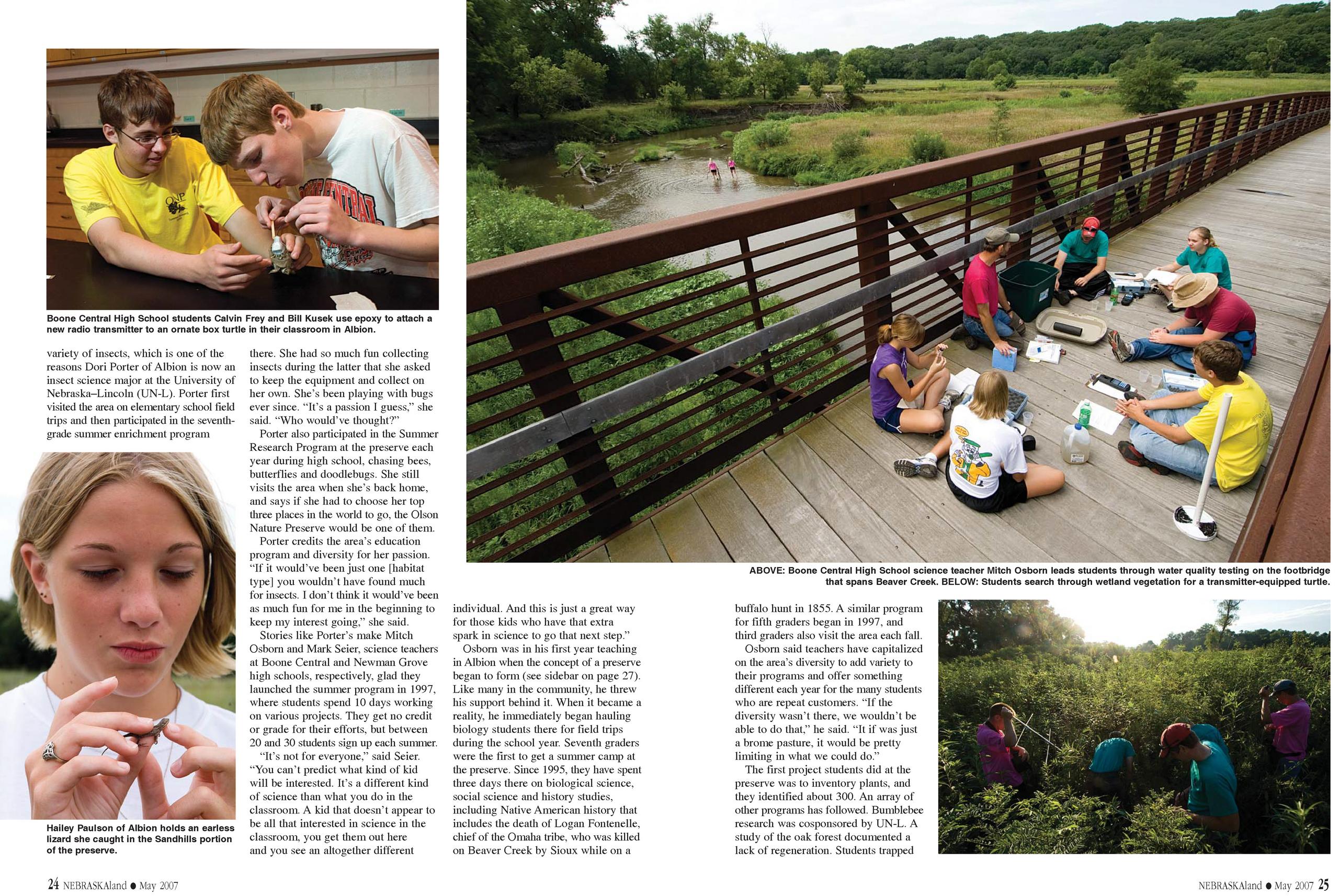
Seven turtles at the preserve are fitted with radio transmitters, and by using telemetry equipment, students locate them during each year's summer program, documenting their location using GPS and mapping their locations using GIS computer software. The study has allowed students to identify the daily and seasonal movements of the turtles, as well as their home ranges, which vary from four-tenths of an acre to more than three acres in size. Knowing where the turtles live makes the task of locating them simpler, but it's still not easy, considering they are apt to bury themselves under a layer of sand, duff or soapweed.
One turtle was brought from Calamus Reservoir to find out whether it would set up a new home range or try to find its way home. It chose the former. Another turtle was moved 300 meters from its home range on three occasions and each time found its way home.
"We keep adding to it each year," Seier said of the study. "As with most science, it seems like we end up with more questions than we do answers."
Said Osborn, "The kids come up with a lot of questions. They'll just be walking along and they'll ask something and you'll say 'I never thought of that – that's something we can work on.'"
One of those questions was how far into the ground do turtles dig when they hibernate. Student volunteers make weekly trips to the preserve in late- September to record when and where turtles burrow into the ground and come back in mid- to late-April when the turtles come out of hibernation so they can bring them back to the lab to replace transmitters and measure growth. In 2005, they gave one of the turtles a little help by digging it out of the ground.
"It took about an hour, hour and a half, and we had a big old hole," said Calvin Frey of Albion, a three-year veteran of the program. "I didn't really think they dug that far down, but we started digging and realized it was about four or five feet deep. I thought it would be two, maybe three feet deep."
That depth led to other questions, including how they survive underground for that long without oxygen.
So students brought turtles into the 26 NEBRASKAland May 2007 school lab to measure their respiration rate, which they found to be similar to a cockroach and snake but much less than that of a rat. A Newman Grove student, who simulated hibernation in a laboratory refrigerator, expanded that study this winter. "The respiration of the turtle was almost nonexistent and yet whenever we would open the refrigerator the turtle seemed to be wide awake," said Seier.
Temperature sensors have been glued to the turtles' shells to see how they respond to weather changes. Last fall, that study was expanded to measure temperature changes during hibernation. "We want to know if they dig down to a certain temperature and stop, and then dig further if it starts getting colder," Osborn said.
While the turtle project itself has proven to be extremely popular, the program and area as a whole draws rave reviews, even from Danielle Olson and Hailey Paulson of Albion, who throw out the expected wails of "gross" and "ick" in response to heat, mud and bugs while hauling around an earless lizard they'd caught in the Sandhills.
"It's easier to take it in when you're actually doing it than when you're just sitting in the classroom reading about it," said Olson. "You have more fun instead of just sitting there, like, 'This is boring.'"
"I like to research a lot," said Jessica Boschen of Newman Grove, a secondyear student in the program. "I'm a big science person. This preserve's really neat too."
"It's better than sitting around writing a whole bunch of papers," said William Hosford of Albion.
In his mind, agreeing to take on the preserve was definitely a good idea, said Whitney. "I always liked the idea of having the property and letting the community decide how to program the education. Not everybody has to be a scientist but they need to have a good experience in education and this helps give them that. It's just been a great community development kind of thing. For our organization, Prairie Plains, it really became the model for what I call a Community Preserve, a place where people can congregate for any number of activities to learn and spend time outdoors together. That's what it's all about. Every community needs one."
Along a county road northwest of Albion, a gate guards the entrance to the trail road that leads to the Olson Nature Preserve. But it isn't locked, and everyone is welcome.
On weekends and summer evenings, bird watchers can often be found walking the trails that fan out from the parking lot on the banks of Beaver Creek. But students from schools in Albion and Newman Grove are the primary visitors, taking part in various studies during the school year and during the summer at the 112-acre outdoor classroom.
The preserve is owned by the Prairie Plains Resource Institute of Aurora, but owes its existence to the thoughtfulness of the land's previous owners, Grant and Bernice Olson. The couple purchased a little more than a section of land on Beaver Creek northwest of Albion in 1937. In time their farm and ranch grew, but their family did not. While they had no children of their own, they had a fondness for them, and with that in mind, Grant devised a plan for their multi-million dollar estate long before he died in 1978. After Bernice died in 1992, the estate was divided primarily among the Boy Scouts, Girl Scouts, Immanuel Medical Center in Omaha and Albion Public Schools.
Included in the estate was 1,285 acres of land. The beneficiaries were not interested in owning land and planned to sell the ranch and divide the proceeds. Before they did, Albion residents Norman Smith and the late Quentin Mortensen asked them to set aside a parcel for education and the enjoyment of the entire community. Mortensen was a local Boy Scout leader and had led campouts on Olson's land. The couple had talked with him about their wishes to leave some land for the scouts, but while the idea of a local scout camp was exciting, Mortenson and Smith saw the benefit of opening the land to everyone.
"I always like to say the idea was born over a campfire," Smith said.
The beneficiaries bought into the idea of creating an educational preserve, and agreed to delay the sale of a unique portion of land along Beaver Creek while Smith completed a feasibility study.
"We actually only asked for 80 acres," Smith said. "It's too bad we didn't ask for about 200. It would've been even better."
Smith had no trouble gathering letters of support from teachers, doctors, business people and others in Albion, Petersburg, St. Edward, Cedar Rapids and elsewhere. The key to the project would be finding someone to hold and manage the property. That somebody turned out to be Bill Whitney and the Prairie Plains Resource Institute. Whitney said he was skeptical when first approached about the property, but that was more out of cautiousness: His nonprofit organization was only 13 years old at the time and his budget meager.
Once he got a look at the property, he was intrigued. "It's a lot of topography, moisture and plant variety in a small area,"Whitney said. When the Albion Education Foundation, which was established to manage the school's share of the estate, agreed to fund its maintenance and management, Whitney said the decision to accept the property was an easy one. Prairie Plains took the deed to 77-acres in 1995 and leased 35 adjacent acres, creating a 112-acre preserve, one of seven it currently manages.
The estate funded construction of a $100,000 footbridge across Beaver Creek, opening the larger western portion of the preserve to people who didn't want to wade its shallow water. Volunteers maintain trails that lead to all corners of the area.
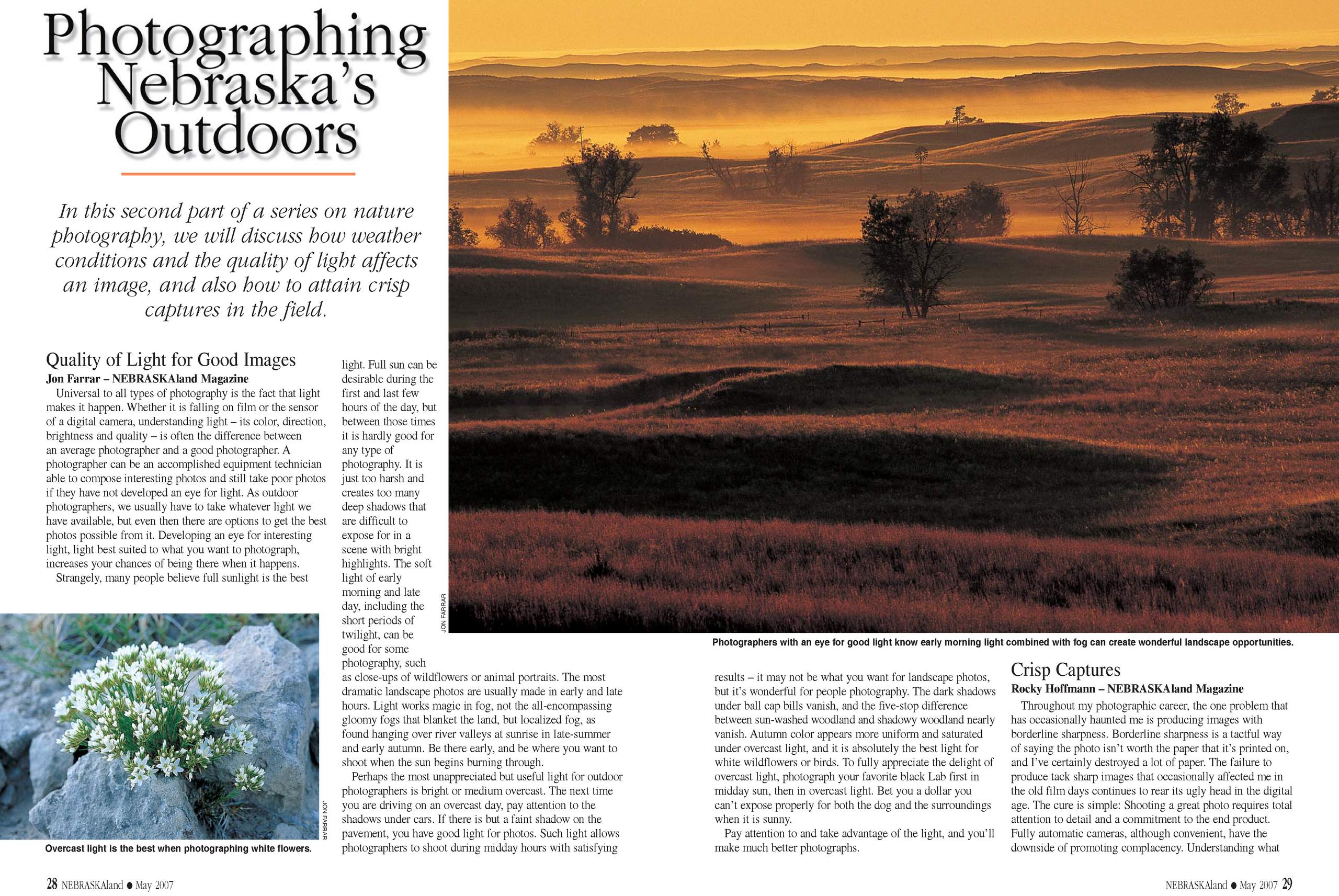
Photographing Nebraska's Outdoors
In this second part of a series on nature photography, we will discuss how weather conditions and the quality of light affects an image, and also how to attain crisp captures in the field.
Quality of Light for Good Images Jon Farrar – NEBRASKAland MagazineUniversal to all types of photography is the fact that light makes it happen. Whether it is falling on film or the sensor of a digital camera, understanding light – its color, direction, brightness and quality – is often the difference between an average photographer and a good photographer. A photographer can be an accomplished equipment technician able to compose interesting photos and still take poor photos if they have not developed an eye for light. As outdoor photographers, we usually have to take whatever light we have available, but even then there are options to get the best photos possible from it. Developing an eye for interesting light, light best suited to what you want to photograph, increases your chances of being there when it happens.
Strangely, many people believe full sunlight is the best
Perhaps the most unappreciated but useful light for outdoor photographers is bright or medium overcast. The next time you are driving on an overcast day, pay attention to the shadows under cars. If there is but a faint shadow on the pavement, you have good light for photos. Such light allows photographers to shoot during midday hours with satisfying 28 NEBRASKAland May 2007
Pay attention to and take advantage of the light, and you'll make much better photographs.
Crisp Captures Rocky Hoffmann – NEBRASKAland MagazineThroughout my photographic career, the one problem that
has occasionally haunted me is producing images with
borderline sharpness. Borderline sharpness is a tactful way
of saying the photo isn't worth the paper that it's printed on,
and I've certainly destroyed a lot of paper. The failure to
produce tack sharp images that occasionally affected me in
the old film days continues to rear its ugly head in the digital
age. The cure is simple: Shooting a great photo requires total
attention to detail and a commitment to the end product.
Fully automatic cameras, although convenient, have the
downside of promoting complacency. Understanding what
NEBRASKAland May 2007 29
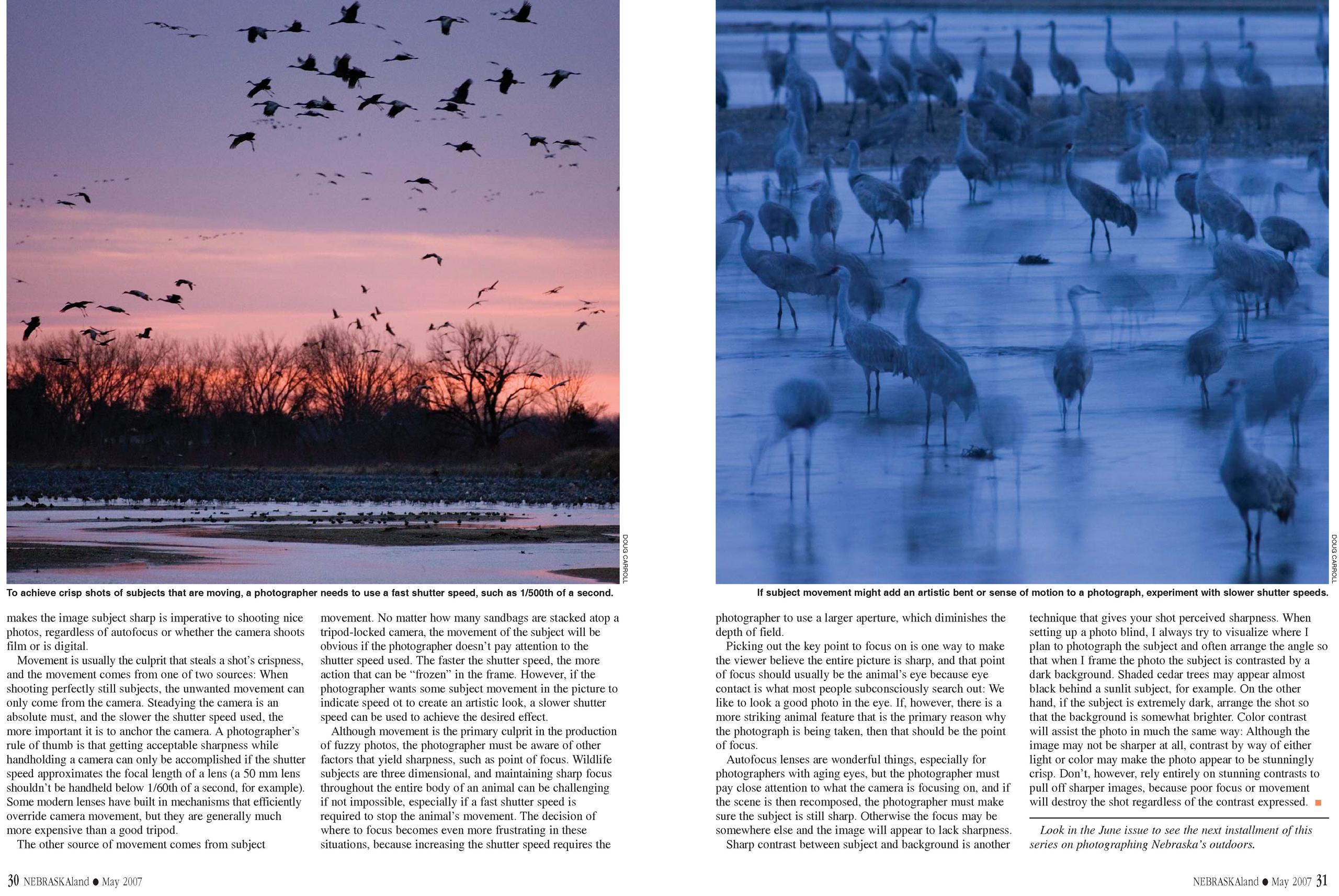
Movement is usually the culprit that steals a shot's crispness, and the movement comes from one of two sources: When shooting perfectly still subjects, the unwanted movement can only come from the camera. Steadying the camera is an absolute must, and the slower the shutter speed used, the more important it is to anchor the camera. A photographer's rule of thumb is that getting acceptable sharpness while handholding a camera can only be accomplished if the shutter speed approximates the focal length of a lens (a 50 mm lens shouldn't be handheld below 1/60th of a second, for example). Some modern lenses have built in mechanisms that efficiently override camera movement, but they are generally much more expensive than a good tripod.
The other source of movement comes from subject movement. No matter how many sandbags are stacked atop a tripod-locked camera, the movement of the subject will be obvious if the photographer doesn't pay attention to the shutter speed used. The faster the shutter speed, the more action that can be "frozen" in the frame. However, if the photographer wants some subject movement in the picture to indicate speed ot to create an artistic look, a slower shutter speed can be used to achieve the desired effect.
Although movement is the primary culprit in the production of fuzzy photos, the photographer must be aware of other factors that yield sharpness, such as point of focus. Wildlife subjects are three dimensional, and maintaining sharp focus throughout the entire body of an animal can be challenging if not impossible, especially if a fast shutter speed is required to stop the animal's movement. The decision of where to focus becomes even more frustrating in these situations, because increasing the shutter speed requires the 30 NEBRASKAland May 2007
Picking out the key point to focus on is one way to make the viewer believe the entire picture is sharp, and that point of focus should usually be the animal's eye because eye contact is what most people subconsciously search out: We like to look a good photo in the eye. If, however, there is a more striking animal feature that is the primary reason why the photograph is being taken, then that should be the point of focus.
Autofocus lenses are wonderful things, especially for photographers with aging eyes, but the photographer must pay close attention to what the camera is focusing on, and if the scene is then recomposed, the photographer must make sure the subject is still sharp. Otherwise the focus may be somewhere else and the image will appear to lack sharpness.
Sharp contrast between subject and background is another technique that gives your shot perceived sharpness. When setting up a photo blind, I always try to visualize where I plan to photograph the subject and often arrange the angle so that when I frame the photo the subject is contrasted by a dark background. Shaded cedar trees may appear almost black behind a sunlit subject, for example. On the other hand, if the subject is extremely dark, arrange the shot so that the background is somewhat brighter. Color contrast will assist the photo in much the same way: Although the image may not be sharper at all, contrast by way of either light or color may make the photo appear to be stunningly crisp. Don't, however, rely entirely on stunning contrasts to pull off sharper images, because poor focus or movement will destroy the shot regardless of the contrast expressed
Look in the June issue to see the next installment of this series on photographing Nebraska's outdoors.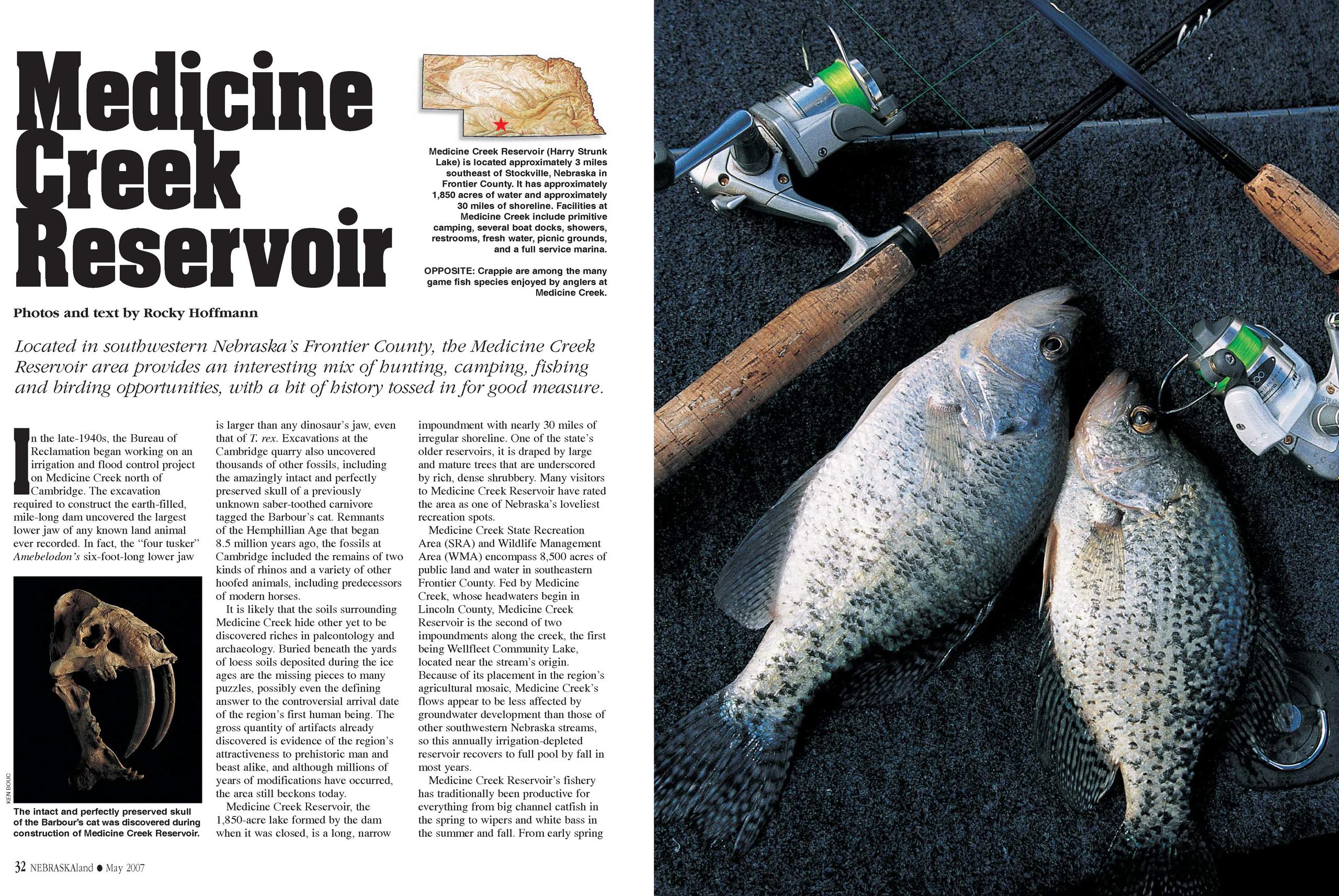
Medicine Creek Reservoir
Located in southwestern Nebraska's Frontier County, the Medicine Creek Reservoir area provides an interesting mix of hunting, camping, fishing and birding opportunities, with a bit of history tossed in for good measure.
In the late-1940s, the Bureau of Reclamation began working on an irrigation and flood control project on Medicine Creek north of Cambridge. The excavation required to construct the earth-filled, mile-long dam uncovered the largest lower jaw of any known land animal ever recorded. In fact, the "four tusker" Amebelodon's six-foot-long lower jaw
It is likely that the soils surrounding Medicine Creek hide other yet to be discovered riches in paleontology and archaeology. Buried beneath the yards of loess soils deposited during the ice ages are the missing pieces to many puzzles, possibly even the defining answer to the controversial arrival date of the region's first human being. The gross quantity of artifacts already discovered is evidence of the region's attractiveness to prehistoric man and beast alike, and although millions of years of modifications have occurred, the area still beckons today.
Medicine Creek Reservoir, the 1,850-acre lake formed by the dam when it was closed, is a long, narrow impoundment with nearly 30 miles of irregular shoreline. One of the state's older reservoirs, it is draped by large and mature trees that are underscored by rich, dense shrubbery. Many visitors to Medicine Creek Reservoir have rated the area as one of Nebraska's loveliest recreation spots.
Medicine Creek State Recreation Area (SRA) and Wildlife Management Area (WMA) encompass 8,500 acres of public land and water in southeastern Frontier County. Fed by Medicine Creek, whose headwaters begin in Lincoln County, Medicine Creek Reservoir is the second of two impoundments along the creek, the first being Wellfleet Community Lake, located near the stream's origin. Because of its placement in the region's agricultural mosaic, Medicine Creek's flows appear to be less affected by groundwater development than those of other southwestern Nebraska streams, so this annually irrigation-depleted reservoir recovers to full pool by fall in most years.
Medicine Creek Reservoir's fishery has traditionally been productive for everything from big channel catfish in the spring to wipers and white bass in the summer and fall. From early spring 32 NEBRASKAland May 2007
Crappie, other panfish and walleye are also a part of the early bite in the spring when most game fish come shallow seeking a spot to feed and spawn. By June, walleye have moved out to traditional lake spots and are caught by anglers employing bottom bouncers, nightcrawlers and leeches.
White bass and wipers hunt deep water in the early summer, but when the shad hatch develops in July, anglers can expect the bass attack to move to the surface, providing real excitement for the anglers who chase them.
In addition, the reservoir's long, narrow bays lined with brush as well as other structural elements provide largemouth bass anglers plenty of targets for "flippin or pitchin" tantalizing offerings of plastics and skirts
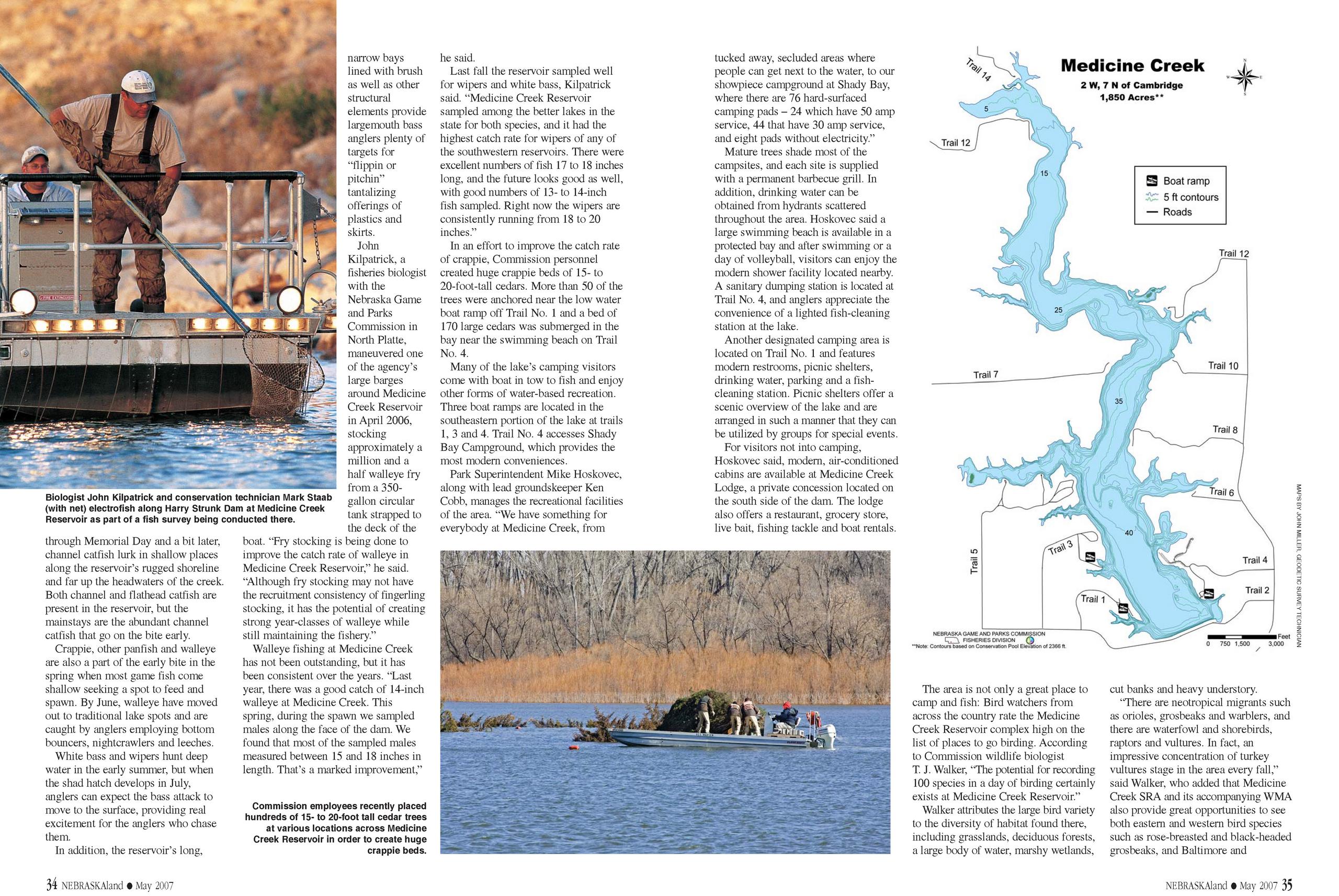
John Kilpatrick, a fisheries biologist with the Nebraska Game and Parks Commission in North Platte, maneuvered one of the agency's large barges around Medicine Creek Reservoir in April 2006, stocking approximately a million and a half walleye fry from a 350- gallon circular tank strapped to the deck of the boat. "Fry stocking is being done to improve the catch rate of walleye in Medicine Creek Reservoir," he said. "Although fry stocking may not have the recruitment consistency of fingerling stocking, it has the potential of creating strong year-classes of walleye while still maintaining the fishery."
Walleye fishing at Medicine Creek has not been outstanding, but it has been consistent over the years. "Last year, there was a good catch of 14-inch walleye at Medicine Creek. This spring, during the spawn we sampled males along the face of the dam. We found that most of the sampled males measured between 15 and 18 inches in length. That's a marked improvement," he said.
Last fall the reservoir sampled well for wipers and white bass, Kilpatrick said. "Medicine Creek Reservoir sampled among the better lakes in the state for both species, and it had the highest catch rate for wipers of any of the southwestern reservoirs. There were excellent numbers of fish 17 to 18 inches long, and the future looks good as well, with good numbers of 13- to 14-inch fish sampled. Right now the wipers are consistently running from 18 to 20 inches."
n an effort to improve the catch rate of crappie, Commission personnel created huge crappie beds of 15- to 20-foot-tall cedars. More than 50 of the trees were anchored near the low water boat ramp off Trail No. 1 and a bed of 170 large cedars was submerged in the bay near the swimming beach on Trail No. 4.
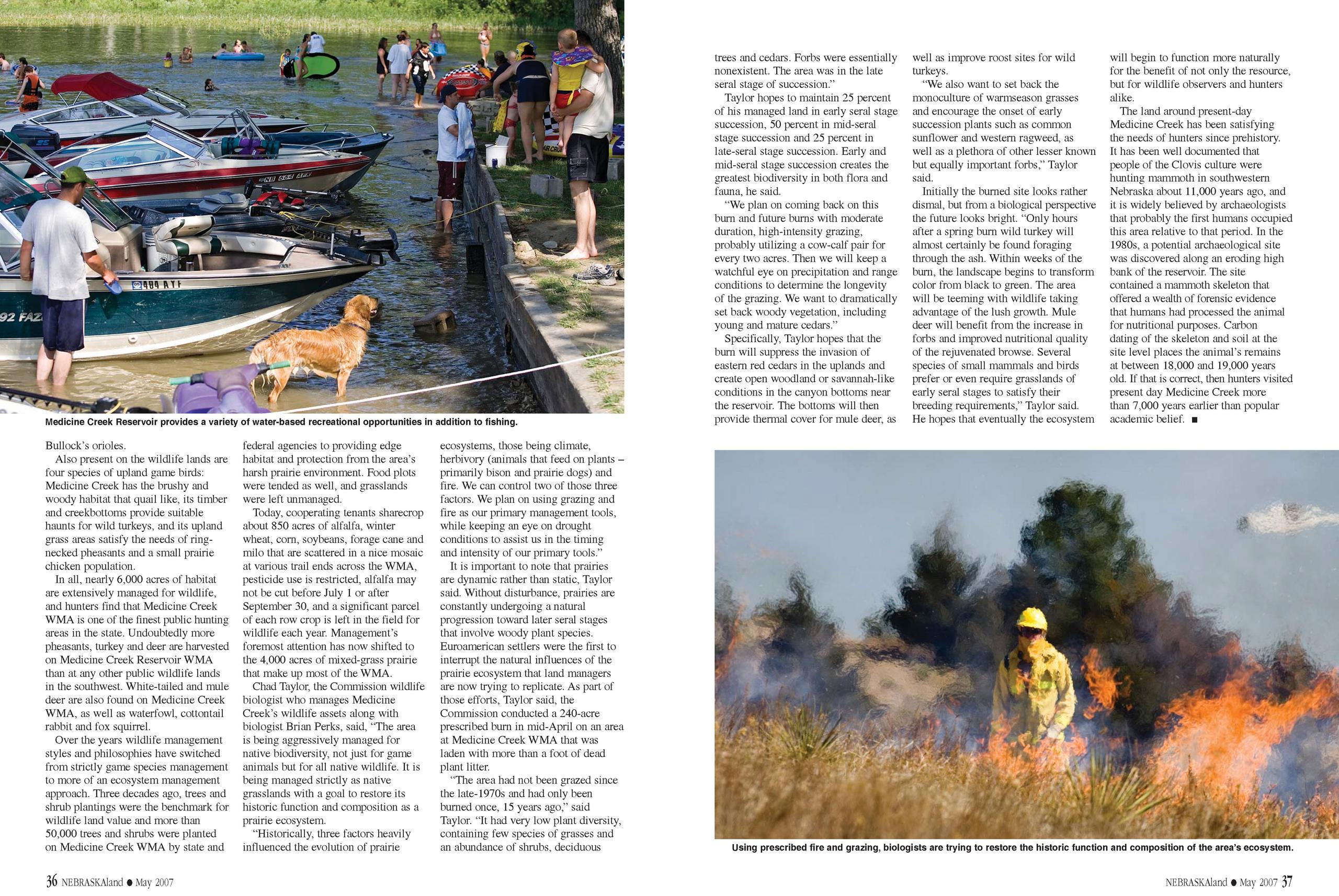
Many of the lake's camping visitors come with boat in tow to fish and enjoy other forms of water-based recreation. Three boat ramps are located in the southeastern portion of the lake at trails 1, 3 and 4. Trail No. 4 accesses Shady Bay Campground, which provides the most modern conveniences.
Park Superintendent Mike Hoskovec, along with lead groundskeeper Ken Cobb, manages the recreational facilities of the area. "We have something for everybody at Medicine Creek, from
Mature trees shade most of the campsites, and each site is supplied with a permanent barbecue grill. In addition, drinking water can be obtained from hydrants scattered throughout the area. Hoskovec said a large swimming beach is available in a protected bay and after swimming or a day of volleyball, visitors can enjoy the modern shower facility located nearby. A sanitary dumping station is located at Trail No. 4, and anglers appreciate the convenience of a lighted fish-cleaning station at the lake.
Another designated camping area is located on Trail No. 1 and features modern restrooms, picnic shelters, drinking water, parking and a fishcleaning station. Picnic shelters offer a scenic overview of the lake and are arranged in such a manner that they can be utilized by groups for special events.
For visitors not into camping, Hoskovec said, modern, air-conditioned cabins are available at Medicine Creek Lodge, a private concession located on the south side of the dam. The lodge also offers a restaurant, grocery store, live bait, fishing tackle and boat rentals.
The area is not only a great place to camp and fish: Bird watchers from across the country rate the Medicine Creek Reservoir complex high on the list of places to go birding. According to Commission wildlife biologist T. J. Walker, "The potential for recording 100 species in a day of birding certainly exists at Medicine Creek Reservoir."
Walker attributes the large bird variety to the diversity of habitat found there, including grasslands, deciduous forests, a large body of water, marshy wetlands, cut banks and heavy understory.
"There are neotropical migrants such
as orioles, grosbeaks and warblers, and
there are waterfowl and shorebirds,
raptors and vultures. In fact, an
impressive concentration of turkey
vultures stage in the area every fall,"
said Walker, who added that Medicine
Creek SRA and its accompanying WMA
also provide great opportunities to see
both eastern and western bird species
such as rose-breasted and black-headed
grosbeaks, and Baltimore and
NEBRASKAland May 2007 35
Also present on the wildlife lands are four species of upland game birds: Medicine Creek has the brushy and woody habitat that quail like, its timber and creekbottoms provide suitable haunts for wild turkeys, and its upland grass areas satisfy the needs of ringnecked pheasants and a small prairie chicken population.
In all, nearly 6,000 acres of habitat are extensively managed for wildlife, and hunters find that Medicine Creek WMA is one of the finest public hunting areas in the state. Undoubtedly more pheasants, turkey and deer are harvested on Medicine Creek Reservoir WMA than at any other public wildlife lands in the southwest. White-tailed and mule deer are also found on Medicine Creek WMA, as well as waterfowl, cottontail rabbit and fox squirrel.
Over the years wildlife management styles and philosophies have switched from strictly game species management to more of an ecosystem management approach. Three decades ago, trees and shrub plantings were the benchmark for wildlife land value and more than 50,000 trees and shrubs were planted on Medicine Creek WMA by state and federal agencies to providing edge habitat and protection from the area's harsh prairie environment. Food plots were tended as well, and grasslands were left unmanaged.
Today, cooperating tenants sharecrop about 850 acres of alfalfa, winter wheat, corn, soybeans, forage cane and milo that are scattered in a nice mosaic at various trail ends across the WMA, pesticide use is restricted, alfalfa may not be cut before July 1 or after September 30, and a significant parcel of each row crop is left in the field for wildlife each year. Management's foremost attention has now shifted to the 4,000 acres of mixed-grass prairie that make up most of the WMA.
Chad Taylor, the Commission wildlife biologist who manages Medicine Creek's wildlife assets along with biologist Brian Perks, said, "The area is being aggressively managed for native biodiversity, not just for game animals but for all native wildlife. It is being managed strictly as native grasslands with a goal to restore its historic function and composition as a prairie ecosystem.
"Historically, three factors heavily influenced the evolution of prairie ecosystems, those being climate, herbivory (animals that feed on plants – primarily bison and prairie dogs) and fire. We can control two of those three factors. We plan on using grazing and fire as our primary management tools, while keeping an eye on drought conditions to assist us in the timing and intensity of our primary tools.
It is important to note that prairies are dynamic rather than static, Taylor said. Without disturbance, prairies are constantly undergoing a natural progression toward later seral stages that involve woody plant species. Euroamerican settlers were the first to interrupt the natural influences of the prairie ecosystem that land managers are now trying to replicate. As part of those efforts, Taylor said, the Commission conducted a 240-acre prescribed burn in mid-April on an area at Medicine Creek WMA that was laden with more than a foot of dead plant litter.
"The area had not been grazed since the late-1970s and had only been burned once, 15 years ago," said Taylor. "It had very low plant diversity, containing few species of grasses and an abundance of shrubs, deciduous 36 NEBRASKAland May 2007 trees and cedars. Forbs were essentially nonexistent. The area was in the late seral stage of succession."
Taylor hopes to maintain 25 percent of his managed land in early seral stage succession, 50 percent in mid-seral stage succession and 25 percent in late-seral stage succession. Early and mid-seral stage succession creates the greatest biodiversity in both flora and fauna, he said.
"We plan on coming back on this burn and future burns with moderate duration, high-intensity grazing, probably utilizing a cow-calf pair for every two acres. Then we will keep a watchful eye on precipitation and range conditions to determine the longevity of the grazing. We want to dramatically set back woody vegetation, including young and mature cedars."
Specifically, Taylor hopes that the burn will suppress the invasion of eastern red cedars in the uplands and create open woodland or savannah-like conditions in the canyon bottoms near the reservoir. The bottoms will then provide thermal cover for mule deer, as well as improve roost sites for wild turkeys.
"We also want to set back the monoculture of warmseason grasses and encourage the onset of early succession plants such as common sunflower and western ragweed, as well as a plethora of other lesser known but equally important forbs," Taylor said.
Initially the burned site looks rather dismal, but from a biological perspective the future looks bright. "Only hours after a spring burn wild turkey will almost certainly be found foraging through the ash. Within weeks of the burn, the landscape begins to transform color from black to green. The area will be teeming with wildlife taking advantage of the lush growth. Mule deer will benefit from the increase in forbs and improved nutritional quality of the rejuvenated browse. Several species of small mammals and birds prefer or even require grasslands of early seral stages to satisfy their breeding requirements," Taylor said. He hopes that eventually the ecosystem will begin to function more naturally for the benefit of not only the resource, but for wildlife observers and hunters alike.
Initially the burned site looks rather dismal, but from a biological perspective the future looks bright. "Only hours after a spring burn wild turkey will almost certainly be found foraging through the ash. Within weeks of the burn, the landscape begins to transform color from black to green. The area will be teeming with wildlife taking advantage of the lush growth. Mule deer will benefit from the increase in forbs and improved nutritional quality of the rejuvenated browse. Several species of small mammals and birds prefer or even require grasslands of early seral stages to satisfy their breeding requirements," Taylor said. He hopes that eventually the ecosystem will begin to function more naturally for the benefit of not only the resource, but for wildlife observers and hunters alike.
Trader Rat
Unlike the destructive and unappealing Old World rats that snuck into North America, Bailey's woodrats are handsome, secretive animals that are seldom seen and are only found in the woodlands along the central Niobrara River.
Most Nebraskans interested in natural history know about the state's most celebrated and rare wildflower, Hayden's penstemon, also known as blowout penstemon or blowout bluebells. Until its recent discovery in Wyoming, the species was not believed to exist outside of the Nebraska Sandhills. Few know about Bailey's eastern woodrat, but there are parallels between the two species: Bailey's woodrat is not known to exist outside of the central Niobrara River valley; both woodrats and penstemon can be relatively abundant in the precise, but limited habitat they require; and both persist as remnants of once larger populations.
For the last eight years, Dr. David McCullough, professor of biology at Wartburg College in Waverly, Iowa, has come to The Nature Conservancy's Niobrara Valley Preserve on the central Niobrara River to study Bailey's woodrats. In alternate years he brings his Vertebrate Ecology of the Prairie class for three weeks of intensive field study. His early research documented Bailey's woodrat densities, habitat preferences and the response of woodrats to management practices such as prescribed fire, which is used on the preserve to set back the invasion of eastern red cedar and maintain plant diversity in grasslands and woodlands. McCullough's specialty is in mammalian population genetics, so last year he collected DNA samples to compare the Niobrara's eastern woodrats to populations elsewhere in their range. He is especially interested in finding out if Bailey's woodrats along the Niobrara are maintaining genetic diversity in isolation, and if they are more closely related genetically to eastern woodrats found to the south along the Republican River or to those found in Missouri and Kansas.
Depending on the authority accepted, there are eight to 12 species of woodrats in North America and additional subspecies. Two woodrat species are native to Nebraska: The bushy-tailed woodrat, Neotoma cinerea, is principally found in mountainous regions of the western U.S. and Canada, but its range extends eastward into the Nebraska Panhandle, encompassing the limber pine region in the extreme
Eastern woodrats (Neotoma floridana) are the second species found in Nebraska. Their range lies principally south and east of Nebraska. Early records of eastern woodrats in Nebraska come principally from the Republican and Niobrara rivers and their tributaries, but as deciduous woodlands expanded westward, they have extended their range into the Blue River drainage and a somewhat isolated population exists below the confluence of the North and South Platte rivers. Additionally, photos from the central Dismal River in the early 1900s show apparent woodrat nests constructed in a seasonally used trapper's shack.
There are two subspecies of eastern woodrats in Nebraska, and it is at this level that the population along the Niobrara River becomes significant. Eastern woodrats found in southern Nebraska are of the same subspecies found in southeastern states, hence widespread and common. Taxonomically they are classified as Neotoma floridana campestris, and their common name is simply eastern woodrats. Eastern woodrats found along the Niobrara River, however, are considered distinct enough to be classified as a unique subspecies, Neotoma floridana baileyi, and have their own name – Bailey's eastern woodrat, named for Vernon Bailey, a prominent U.S. mammalian naturalist of the late-1800s and early 1900s. The population along the central Niobrara River is the northwesternmost outlier of the eastern woodrat species.
Until recently it was believed Bailey's woodrats existed only along approximately 87 miles of the central Niobrara River valley east of Valentine, a distribution roughly overlapping the 76-mile reach of the Niobrara National Scenic River. In 2005, though, researchers Russell Benedict, Hugh Genoways and students from Central College and the University of Nebraska- Lincoln, found Bailey's eastern woodrats to be common on the Niobrara River south of Merriman, approximately 23 miles farther upstream than expected. "Whether this represents range expansion or previously overlooked populations is not clear," Benedict said. "But given that forests seem to be expanding along the western Niobrara, I suspect they are expanding west."
"Eastern woodrats are historically a deciduous forest animal," McCullough said, "but not necessarily a dense deciduous forest, more like an open woodland or meadow edge animal." Their distribution is fairly contiguous from central Florida west into Oklahoma, central Texas and eastern Colorado. Eastern woodrat distribution becomes disjunct on the western edge of their range, pioneering westward along deciduous woodlands associated with larger Great Plains rivers.
McCullough speculates eastern woodrats on the central Niobrara were isolated when ice sheets retreated 40 NEBRASKAland May 2007
It would be a terrible injustice to compare native North American woodrats to the unappealing and generally destructive Old World rats, the Norway rat and black rat – naked-tailed vermin that stowed away on ships coming to America and rapidly spread across the continent. Native woodrats are of a completely different genus than Old World rats and do not colonize, invade cities or spread diseases. In fact, they retreat before man's advances into their habitat. Unlike foul-tempered exotic rats, woodrats are secretive and retiring animals. They are quite handsome and fastidiously clean, frequently grooming by licking their fur, licking their forefeet to wash their faces and dustbathing in bare soil near their houses.
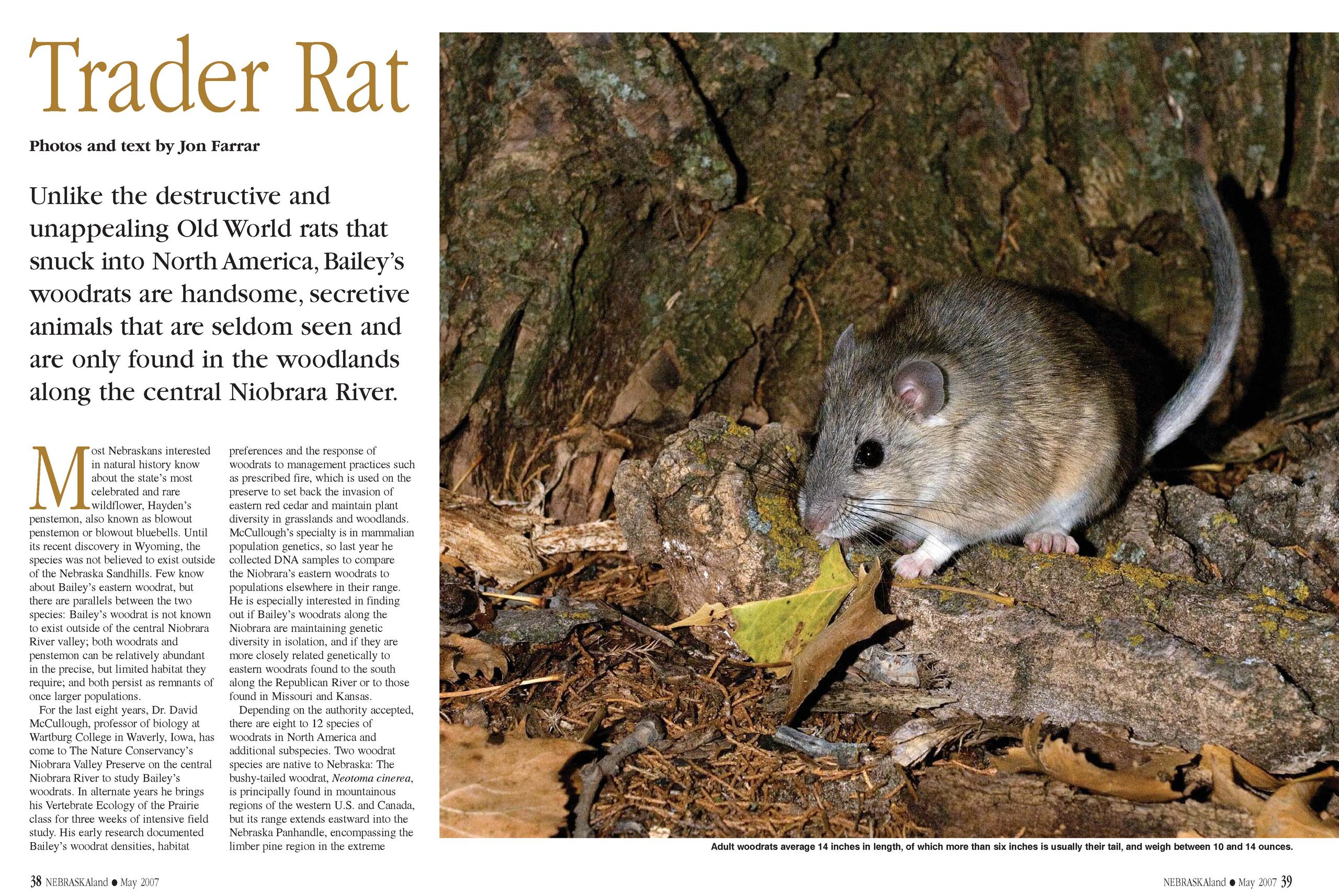
Adult Bailey's woodrats average
14 inches in length, of which more
than six inches is usually their tail, and
NEBRASKAland May 2007 41
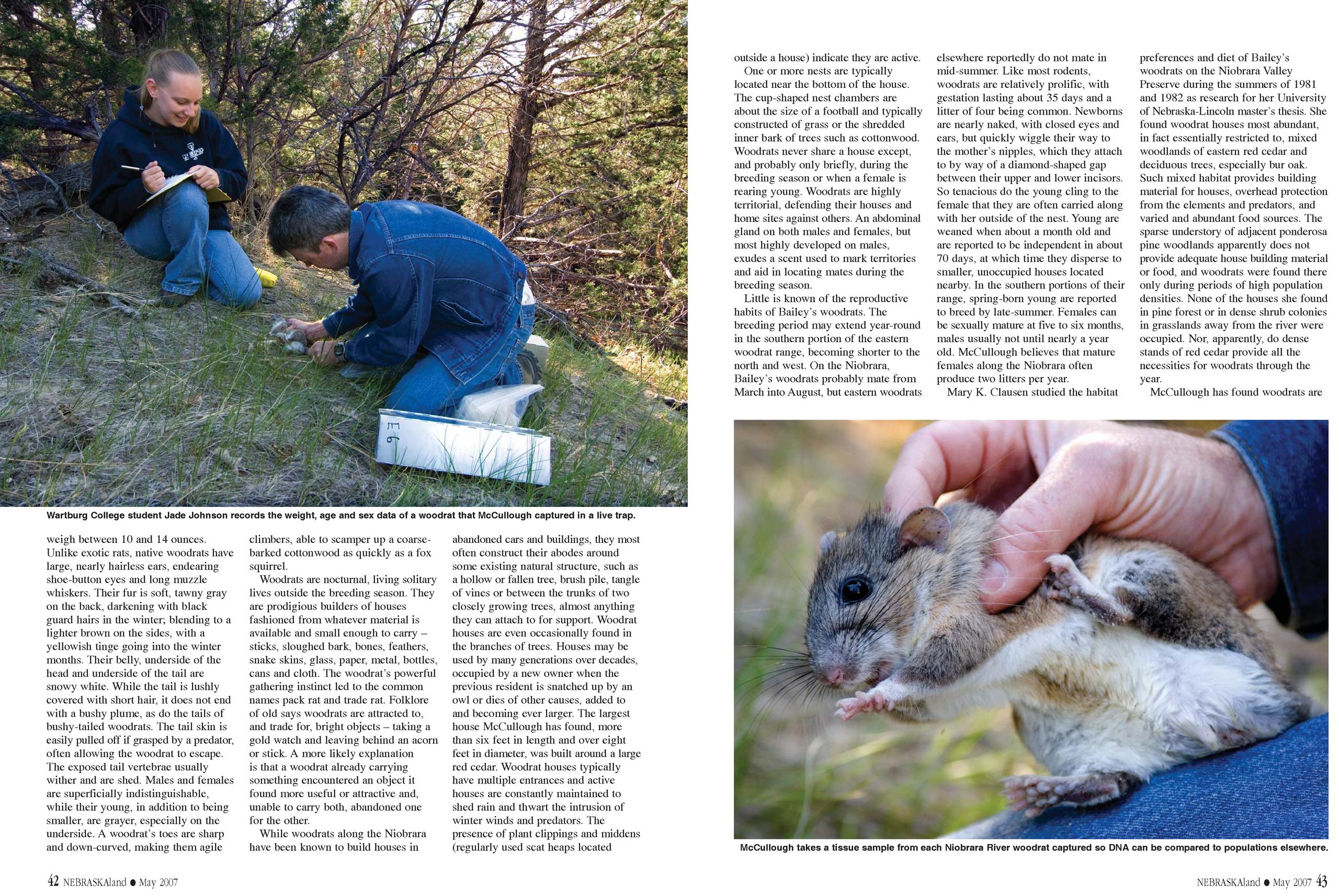
Woodrats are nocturnal, living solitary lives outside the breeding season. They are prodigious builders of houses fashioned from whatever material is available and small enough to carry – sticks, sloughed bark, bones, feathers, snake skins, glass, paper, metal, bottles, cans and cloth. The woodrat's powerful gathering instinct led to the common names pack rat and trade rat. Folklore of old says woodrats are attracted to, and trade for, bright objects – taking a gold watch and leaving behind an acorn or stick. A more likely explanation is that a woodrat already carrying something encountered an object it found more useful or attractive and, unable to carry both, abandoned one for the other.
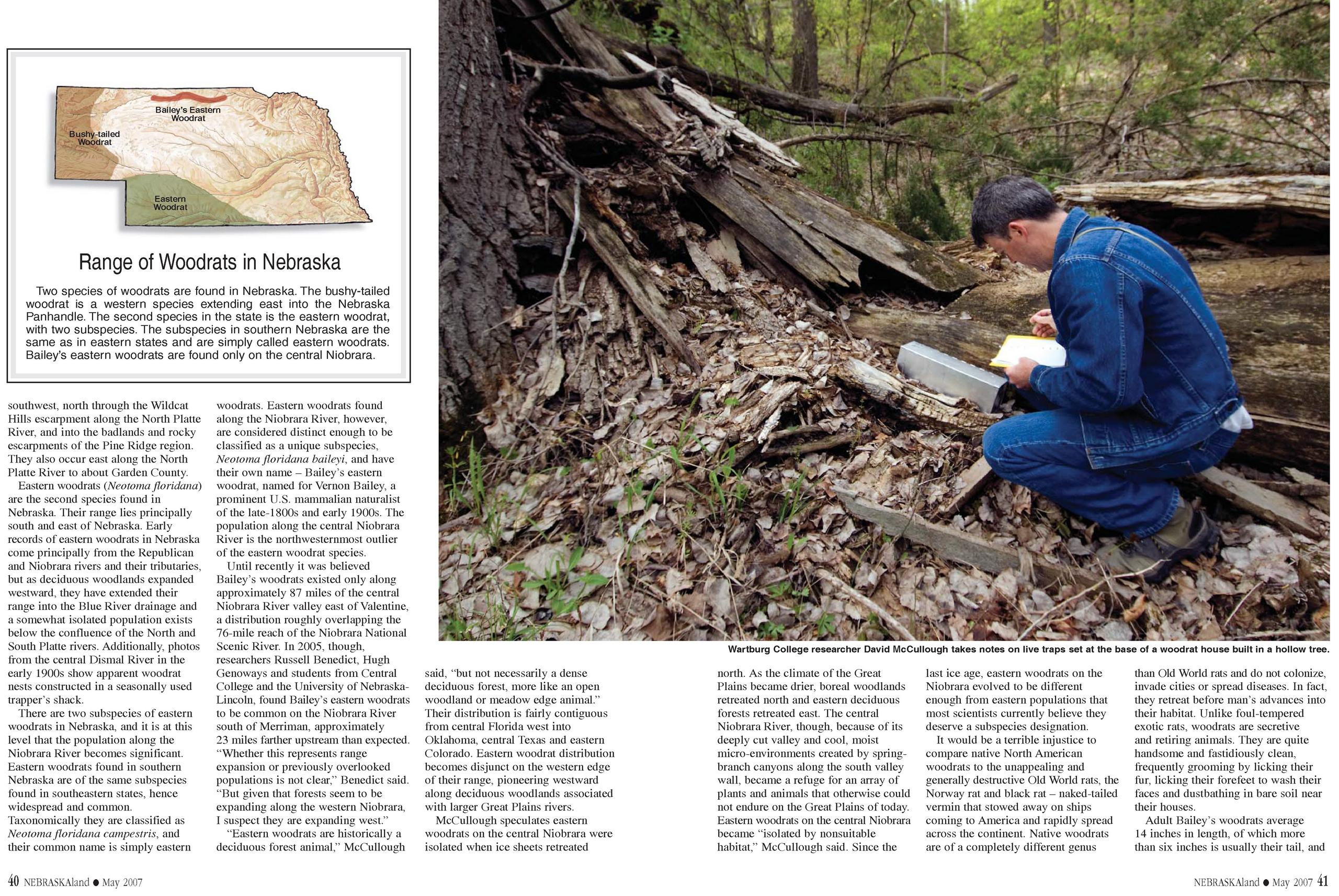
While woodrats along the Niobrara have been known to build houses in abandoned cars and buildings, they most often construct their abodes around some existing natural structure, such as a hollow or fallen tree, brush pile, tangle of vines or between the trunks of two closely growing trees, almost anything they can attach to for support. Woodrat houses are even occasionally found in the branches of trees. Houses may be used by many generations over decades, occupied by a new owner when the previous resident is snatched up by an owl or dies of other causes, added to and becoming ever larger. The largest house McCullough has found, more than six feet in length and over eight feet in diameter, was built around a large red cedar. Woodrat houses typically have multiple entrances and active houses are constantly maintained to shed rain and thwart the intrusion of winter winds and predators. The presence of plant clippings and middens (regularly used scat heaps located 42 NEBRASKAland May 2007 outside a house) indicate they are active.
One or more nests are typically located near the bottom of the house. The cup-shaped nest chambers are about the size of a football and typically constructed of grass or the shredded inner bark of trees such as cottonwood. Woodrats never share a house except, and probably only briefly, during the breeding season or when a female is rearing young. Woodrats are highly territorial, defending their houses and home sites against others. An abdominal gland on both males and females, but most highly developed on males, exudes a scent used to mark territories and aid in locating mates during the breeding season.
Little is known of the reproductive habits of Bailey's woodrats. The breeding period may extend year-round in the southern portion of the eastern woodrat range, becoming shorter to the north and west. On the Niobrara, Bailey's woodrats probably mate from March into August, but eastern woodrats elsewhere reportedly do not mate in mid-summer. Like most rodents, woodrats are relatively prolific, with gestation lasting about 35 days and a litter of four being common. Newborns are nearly naked, with closed eyes and ears, but quickly wiggle their way to the mother's nipples, which they attach to by way of a diamond-shaped gap between their upper and lower incisors. So tenacious do the young cling to the female that they are often carried along with her outside of the nest. Young are weaned when about a month old and are reported to be independent in about 70 days, at which time they disperse to smaller, unoccupied houses located nearby. In the southern portions of their range, spring-born young are reported to breed by late-summer. Females can be sexually mature at five to six months, males usually not until nearly a year old. McCullough believes that mature females along the Niobrara often produce two litters per year.
Mary K. Clausen studied the habitat preferences and diet of Bailey's woodrats on the Niobrara Valley Preserve during the summers of 1981 and 1982 as research for her University of Nebraska-Lincoln master's thesis. She found woodrat houses most abundant, in fact essentially restricted to, mixed woodlands of eastern red cedar and deciduous trees, especially bur oak. Such mixed habitat provides building material for houses, overhead protection from the elements and predators, and varied and abundant food sources. The sparse understory of adjacent ponderosa pine woodlands apparently does not provide adequate house building material or food, and woodrats were found there only during periods of high population densities. None of the houses she found in pine forest or in dense shrub colonies in grasslands away from the river were occupied. Nor, apparently, do dense stands of red cedar provide all the necessities for woodrats through the year.
McCullough has found woodrats are
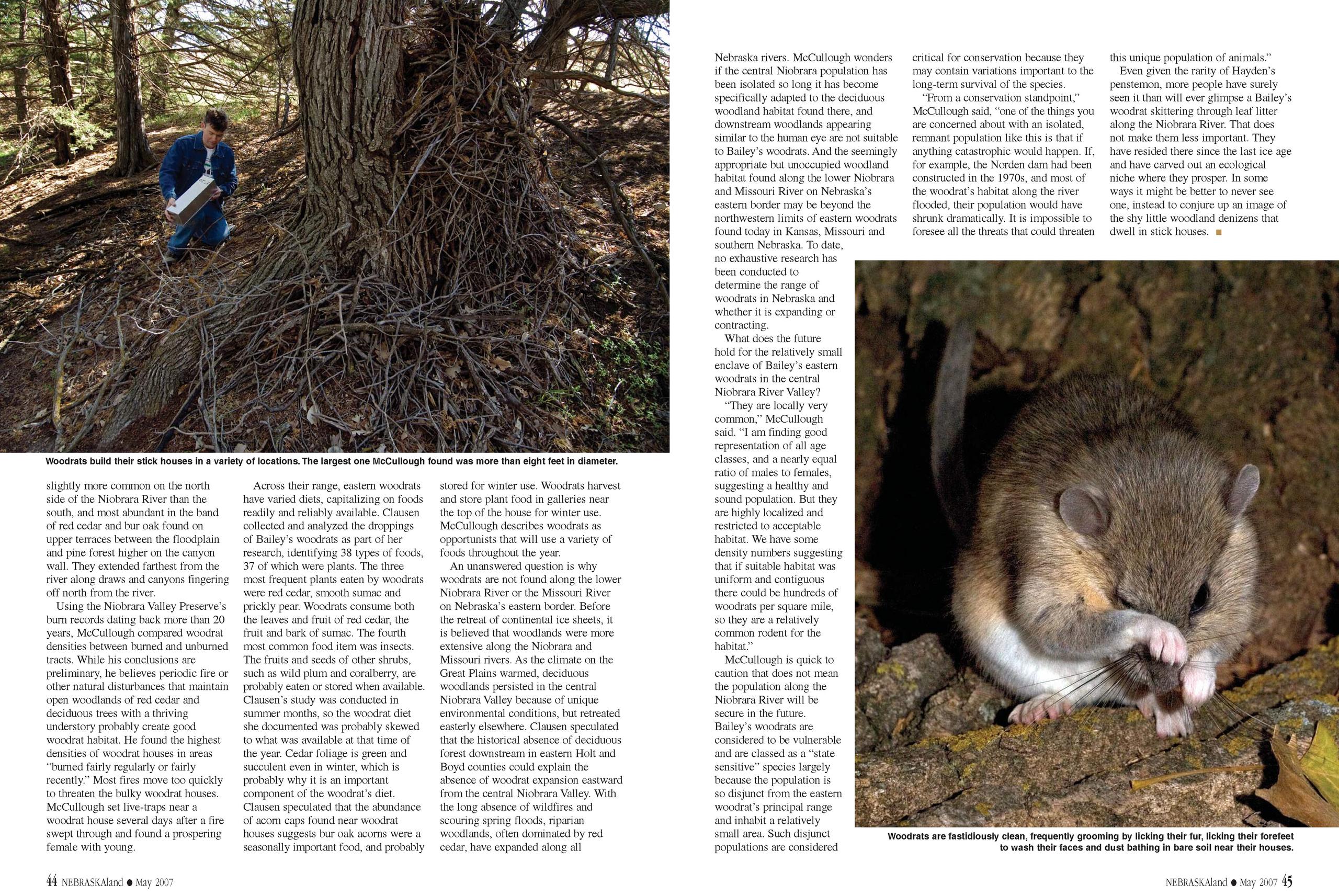
Using the Niobrara Valley Preserve's burn records dating back more than 20 years, McCullough compared woodrat densities between burned and unburned tracts. While his conclusions are preliminary, he believes periodic fire or other natural disturbances that maintain open woodlands of red cedar and deciduous trees with a thriving understory probably create good woodrat habitat. He found the highest densities of woodrat houses in areas "burned fairly regularly or fairly recently." Most fires move too quickly to threaten the bulky woodrat houses. McCullough set live-traps near a woodrat house several days after a fire swept through and found a prospering female with young.
Across their range, eastern woodrats have varied diets, capitalizing on foods readily and reliably available. Clausen collected and analyzed the droppings of Bailey's woodrats as part of her research, identifying 38 types of foods, 37 of which were plants. The three most frequent plants eaten by woodrats were red cedar, smooth sumac and prickly pear. Woodrats consume both the leaves and fruit of red cedar, the fruit and bark of sumac. The fourth most common food item was insects. The fruits and seeds of other shrubs, such as wild plum and coralberry, are probably eaten or stored when available. Clausen's study was conducted in summer months, so the woodrat diet she documented was probably skewed to what was available at that time of the year. Cedar foliage is green and succulent even in winter, which is probably why it is an important component of the woodrat's diet. Clausen speculated that the abundance of acorn caps found near woodrat houses suggests bur oak acorns were a seasonally important food, and probably stored for winter use. Woodrats harvest and store plant food in galleries near the top of the house for winter use. McCullough describes woodrats as opportunists that will use a variety of foods throughout the year.
An unanswered question is why woodrats are not found along the lower Niobrara River or the Missouri River on Nebraska's eastern border. Before the retreat of continental ice sheets, it is believed that woodlands were more extensive along the Niobrara and Missouri rivers. As the climate on the Great Plains warmed, deciduous woodlands persisted in the central Niobrara Valley because of unique environmental conditions, but retreated easterly elsewhere. Clausen speculated that the historical absence of deciduous forest downstream in eastern Holt and Boyd counties could explain the absence of woodrat expansion eastward from the central Niobrara Valley. With the long absence of wildfires and scouring spring floods, riparian woodlands, often dominated by red cedar, have expanded along all 44 NEBRASKAland May 2007 Nebraska rivers. McCullough wonders if the central Niobrara population has been isolated so long it has become specifically adapted to the deciduous woodland habitat found there, and downstream woodlands appearing similar to the human eye are not suitable to Bailey's woodrats. And the seemingly appropriate but unoccupied woodland habitat found along the lower Niobrara and Missouri River on Nebraska's eastern border may be beyond the northwestern limits of eastern woodrats found today in Kansas, Missouri and southern Nebraska. To date, no exhaustive research has been conducted to determine the range of woodrats in Nebraska and whether it is expanding or contracting.
What does the future hold for the relatively small enclave of Bailey's eastern woodrats in the central Niobrara River Valley?
"They are locally very common," McCullough said. "I am finding good representation of all age classes, and a nearly equal ratio of males to females, suggesting a healthy and sound population. But they are highly localized and restricted to acceptable habitat. We have some density numbers suggesting that if suitable habitat was uniform and contiguous there could be hundreds of woodrats per square mile, so they are a relatively common rodent for the habitat."
McCullough is quick to caution that does not mean the population along the Niobrara River will be secure in the future. Bailey's woodrats are considered to be vulnerable and are classed as a "state sensitive" species largely because the population is so disjunct from the eastern woodrat's principal range and inhabit a relatively small area. Such disjunct populations are considered critical for conservation because they may contain variations important to the long-term survival of the species.
"From a conservation standpoint," McCullough said, "one of the things you are concerned about with an isolated, remnant population like this is that if anything catastrophic would happen. If, for example, the Norden dam had been constructed in the 1970s, and most of the woodrat's habitat along the river flooded, their population would have shrunk dramatically. It is impossible to foresee all the threats that could threaten this unique population of animals."
Even given the rarity of Hayden's penstemon, more people have surely seen it than will ever glimpse a Bailey's woodrat skittering through leaf litter along the Niobrara River. That does not make them less important. They have resided there since the last ice age and have carved out an ecological niche where they prosper. In some ways it might be better to never see one, instead to conjure up an image of the shy little woodland denizens that dwell in stick houses.
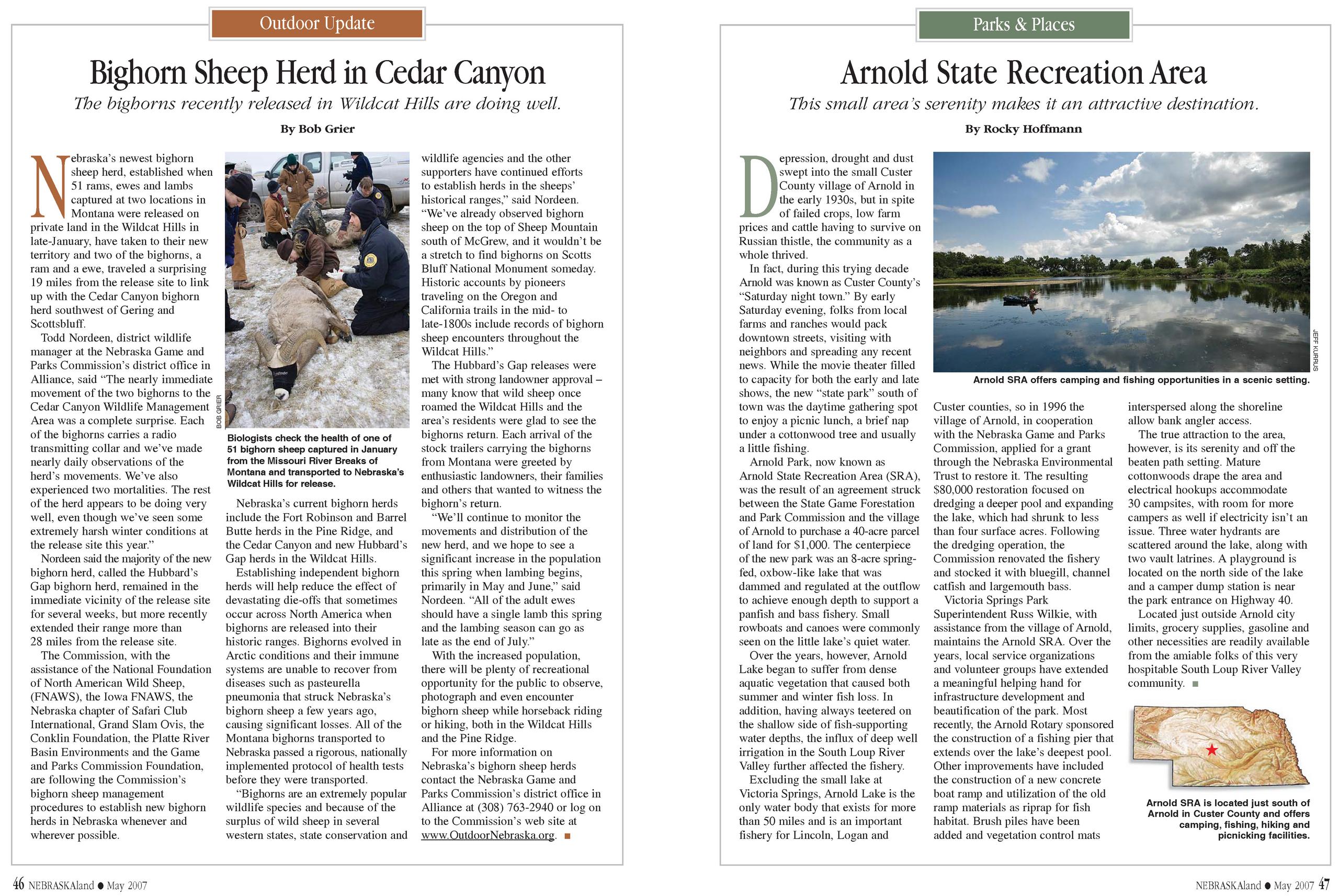
Outdoor Update
Bighorn Sheep Herd in Cedar Canyon
The bighorns recently released in Wildcat Hills are doing well.
Nebraska's newest bighorn sheep herd, established when 51 rams, ewes and lambs captured at two locations in Montana were released on private land in the Wildcat Hills in late-January, have taken to their new territory and two of the bighorns, a ram and a ewe, traveled a surprising 19 miles from the release site to link up with the Cedar Canyon bighorn herd southwest of Gering and Scottsbluff.
Todd Nordeen, district wildlife manager at the Nebraska Game and Parks Commission's district office in Alliance, said "The nearly immediate movement of the two bighorns to the Cedar Canyon Wildlife Management Area was a complete surprise. Each of the bighorns carries a radio transmitting collar and we've made nearly daily observations of the herd's movements. We've also experienced two mortalities. The rest of the herd appears to be doing very well, even though we've seen some extremely harsh winter conditions at the release site this year."
Nordeen said the majority of the new bighorn herd, called the Hubbard's Gap bighorn herd, remained in the immediate vicinity of the release site for several weeks, but more recently extended their range more than 28 miles from the release site.
The Commission, with the assistance of the National Foundation of North American Wild Sheep, (FNAWS), the Iowa FNAWS, the Nebraska chapter of Safari Club International, Grand Slam Ovis, the Conklin Foundation, the Platte River Basin Environments and the Game and Parks Commission Foundation, are following the Commission's bighorn sheep management procedures to establish new bighorn herds in Nebraska whenever and wherever possible.
Nebraska's current bighorn herds include the Fort Robinson and Barrel Butte herds in the Pine Ridge, and the Cedar Canyon and new Hubbard's Gap herds in the Wildcat Hills.
Establishing independent bighorn herds will help reduce the effect of devastating die-offs that sometimes occur across North America when bighorns are released into their historic ranges. Bighorns evolved in Arctic conditions and their immune systems are unable to recover from diseases such as pasteurella pneumonia that struck Nebraska's bighorn sheep a few years ago, causing significant losses. All of the Montana bighorns transported to Nebraska passed a rigorous, nationally implemented protocol of health tests before they were transported.
"Bighorns are an extremely popular wildlife species and because of the surplus of wild sheep in several western states, state conservation and wildlife agencies and the other supporters have continued efforts to establish herds in the sheeps' historical ranges," said Nordeen. "We've already observed bighorn sheep on the top of Sheep Mountain south of McGrew, and it wouldn't be a stretch to find bighorns on Scotts Bluff National Monument someday. Historic accounts by pioneers traveling on the Oregon and California trails in the mid- to late-1800s include records of bighorn sheep encounters throughout the Wildcat Hills."
The Hubbard's Gap releases were met with strong landowner approval – many know that wild sheep once roamed the Wildcat Hills and the area's residents were glad to see the bighorns return. Each arrival of the stock trailers carrying the bighorns from Montana were greeted by enthusiastic landowners, their families and others that wanted to witness the bighorn's return.
"We'll continue to monitor the movements and distribution of the new herd, and we hope to see a significant increase in the population this spring when lambing begins, primarily in May and June," said Nordeen. "All of the adult ewes should have a single lamb this spring and the lambing season can go as late as the end of July."
With the increased population, there will be plenty of recreational opportunity for the public to observe, photograph and even encounter bighorn sheep while horseback riding or hiking, both in the Wildcat Hills and the Pine Ridge.
For more information on Nebraska's bighorn sheep herds contact the Nebraska Game and Parks Commission's district office in Alliance at (308) 763-2940 or log on to the Commission's web site at www.OutdoorNebraska.org.
Depression, drought and dust swept into the small Custer County village of Arnold in the early 1930s, but in spite of failed crops, low farm prices and cattle having to survive on Russian thistle, the community as a whole thrived.
In fact, during this trying decade Arnold was known as Custer County's "Saturday night town." By early Saturday evening, folks from local farms and ranches would pack downtown streets, visiting with neighbors and spreading any recent news. While the movie theater filled to capacity for both the early and late shows, the new "state park" south of town was the daytime gathering spot to enjoy a picnic lunch, a brief nap under a cottonwood tree and usually a little fishing.
Arnold Park, now known as Arnold State Recreation Area (SRA), was the result of an agreement struck between the State Game Forestation and Park Commission and the village of Arnold to purchase a 40-acre parcel of land for $1,000. The centerpiece of the new park was an 8-acre springfed, oxbow-like lake that was dammed and regulated at the outflow to achieve enough depth to support a panfish and bass fishery. Small rowboats and canoes were commonly seen on the little lake's quiet water.
Over the years, however, Arnold Lake began to suffer from dense aquatic vegetation that caused both summer and winter fish loss. In addition, having always teetered on the shallow side of fish-supporting water depths, the influx of deep well irrigation in the South Loup River Valley further affected the fishery.
Excluding the small lake at Victoria Springs, Arnold Lake is the only water body that exists for more than 50 miles and is an important fishery for Lincoln, Logan and
Victoria Springs Park Superintendent Russ Wilkie, with assistance from the village of Arnold, maintains the Arnold SRA. Over the years, local service organizations and volunteer groups have extended a meaningful helping hand for infrastructure development and beautification of the park. Most recently, the Arnold Rotary sponsored the construction of a fishing pier that extends over the lake's deepest pool. Other improvements have included the construction of a new concrete boat ramp and utilization of the old ramp materials as riprap for fish habitat. Brush piles have been added and vegetation control mats interspersed along the shoreline allow bank angler access.
The true attraction to the area, however, is its serenity and off the beaten path setting. Mature cottonwoods drape the area and electrical hookups accommodate 30 campsites, with room for more campers as well if electricity isn't an issue. Three water hydrants are scattered around the lake, along with two vault latrines. A playground is located on the north side of the lake and a camper dump station is near the park entrance on Highway 40.
Located just outside Arnold city limits, grocery supplies, gasoline and other necessities are readily available from the amiable folks of this very hospitable South Loup River Valley community.

Classifieds
ATTRACTIONS/EVENTS ONLY ONE PAWNEE CITY! We have history that is proudly displayed at the Pawnee City Museum, The Schilling Bridge, the only Winery Micro-Brewery in the nation, Agritourism sites, the Pedal Clinic, a Toy Museum, and Our Historic Downtown. Go to Pawneecity.org for details. DOGS PLUM CREEK KENNEL. German Shorthairs, stud service, puppies and started dogs. Training for all pointing breeds. Specialize in training the handler as well as the dog. Wayne Clark, Percival, Iowa 51648 (close to Omaha) (712) 529-4238, e-mail wclark@heartland.net. WILDERNESS KENNELS. Gun dog training – over 60 years combined experience. Training all sporting breeds – retrievers, flushing and pointing dogs. All dogs worked on pen-raised birds and wild game. Training program also includes obedience training – heel, sit, stay, down and come when called. Pups, started dogs and fully trained dogs for sale. Hunting dogs trained by hunters. Henry Sader, Wilderness Kennels, Roca, NE (402) 423-4212. Since 1968. DUCKDAWG RETRIEVERS - Raising exceptional field-bred yellow and black Labradors. Hunting, family and competition companions. Puppies raised in our home. Written health guarantee. Stud service available. Home of GRHRCH DuckDawg's Eba Roll The Dice - first and only Grand Hunting Retriever Champion in Nebraska. www.duckdawg.com, Ron Becoming An Outdoors-Woman
Portraits from the Past
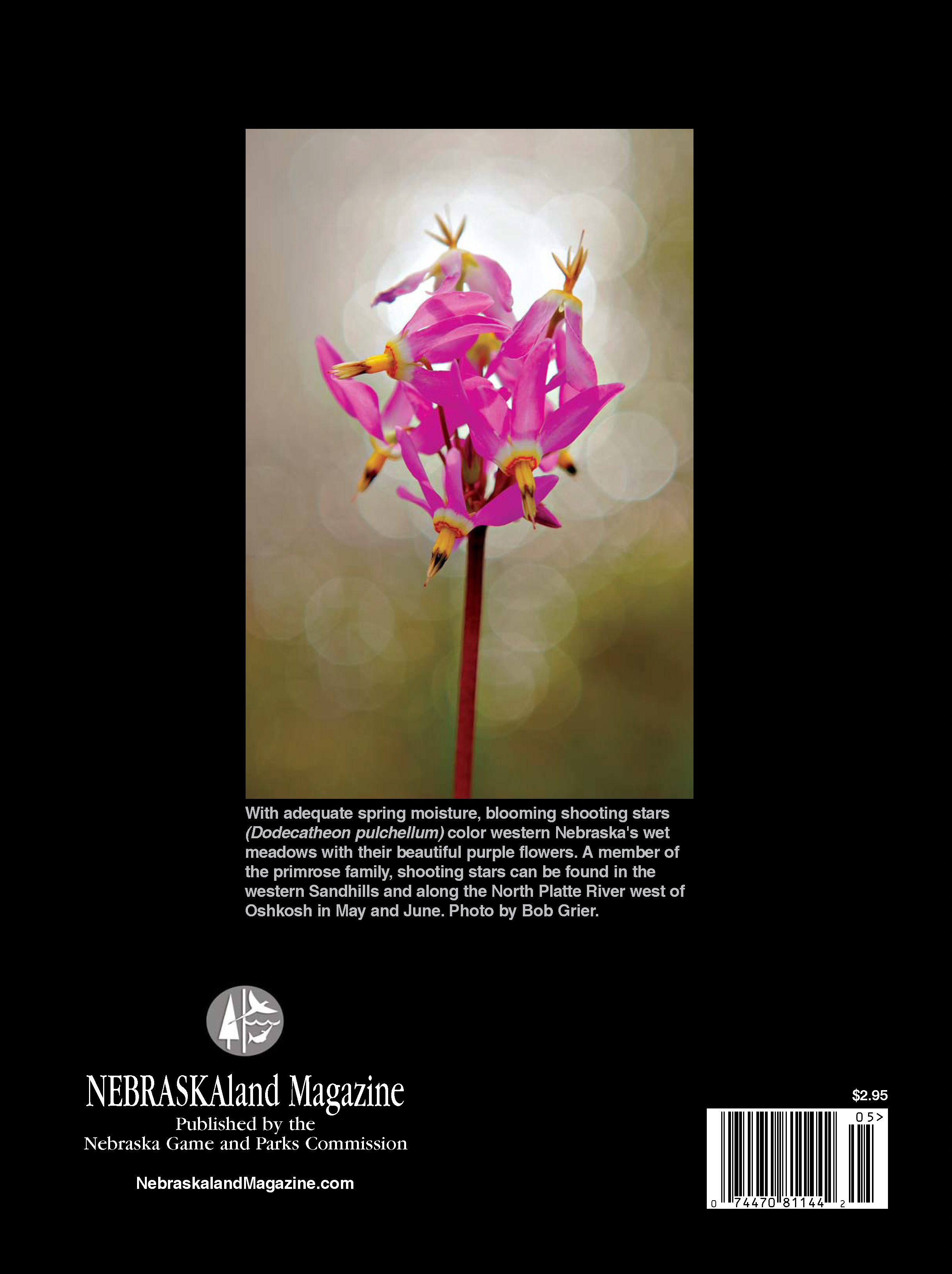
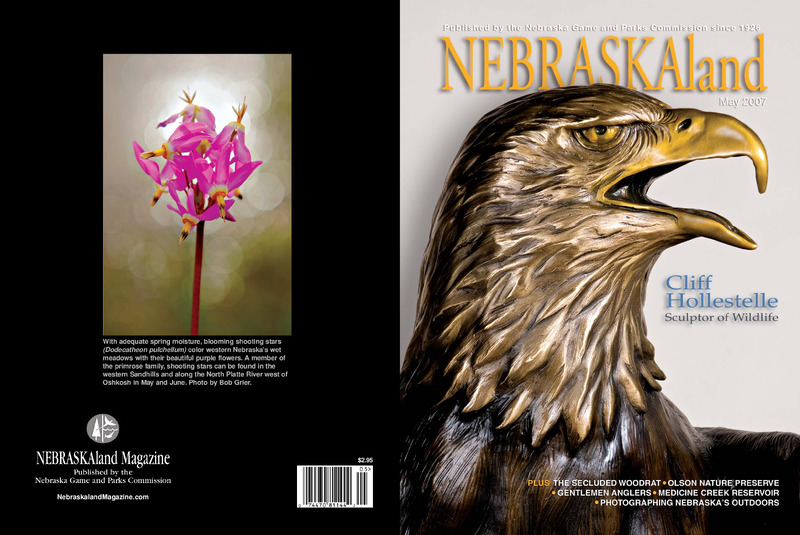
Position: 664 (17 views)