Volume 85, Issue 3, 2007
Published by the Nebraska Game and Parks Commission since 1926
NEBRASKAland
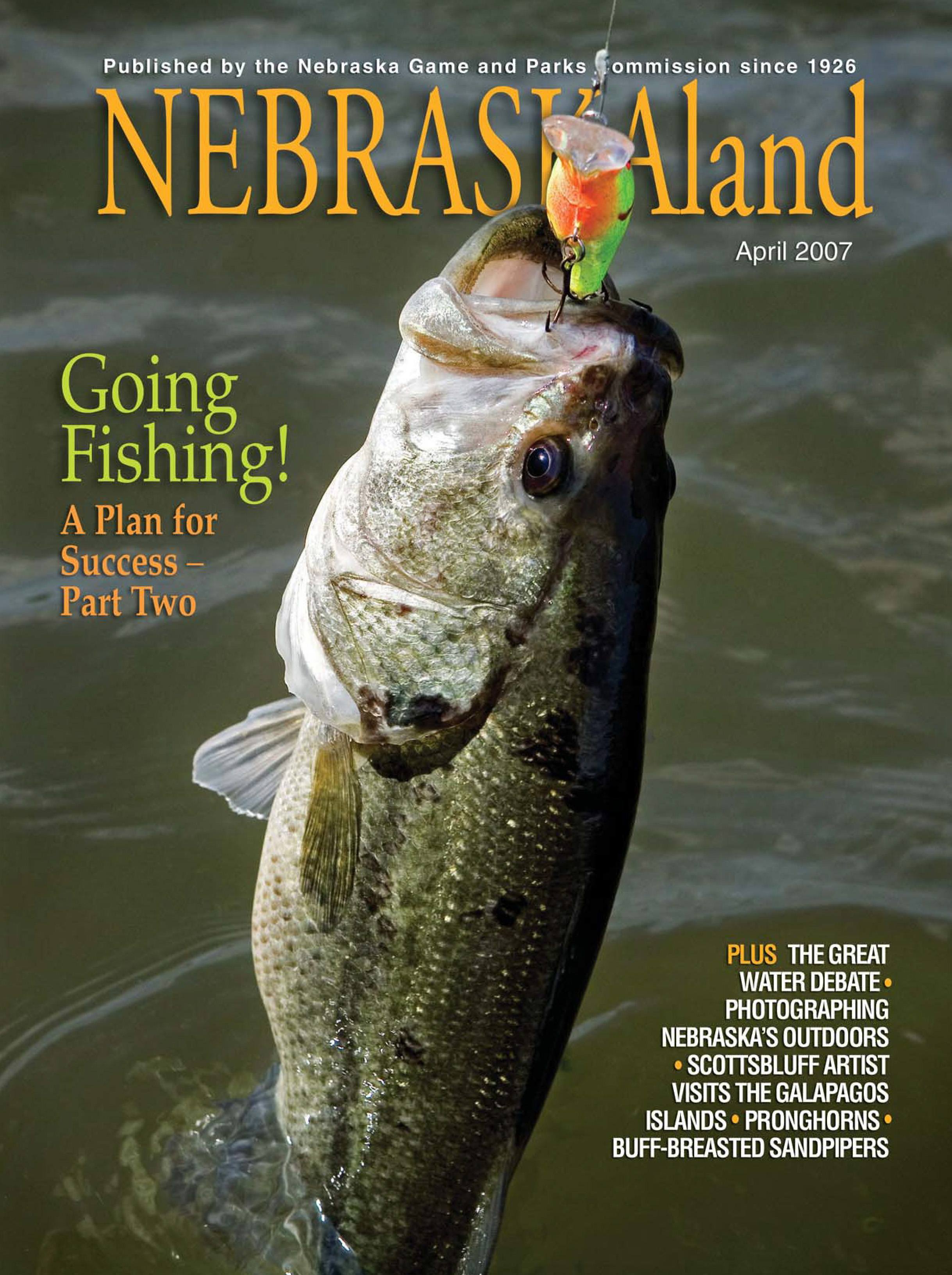
April 2007 Going Fishing! A Plan for Success - Part Two PLUS THE GREAT WATER DEBATE PHOTOGRAPHING NEBRASKA'S OUTDOORS SCOTTSBLUFF ARTIST VISITS THE GALAPAGOS ISLANDS PRONGHORNS BUFF-BREASTED SANDPIPERS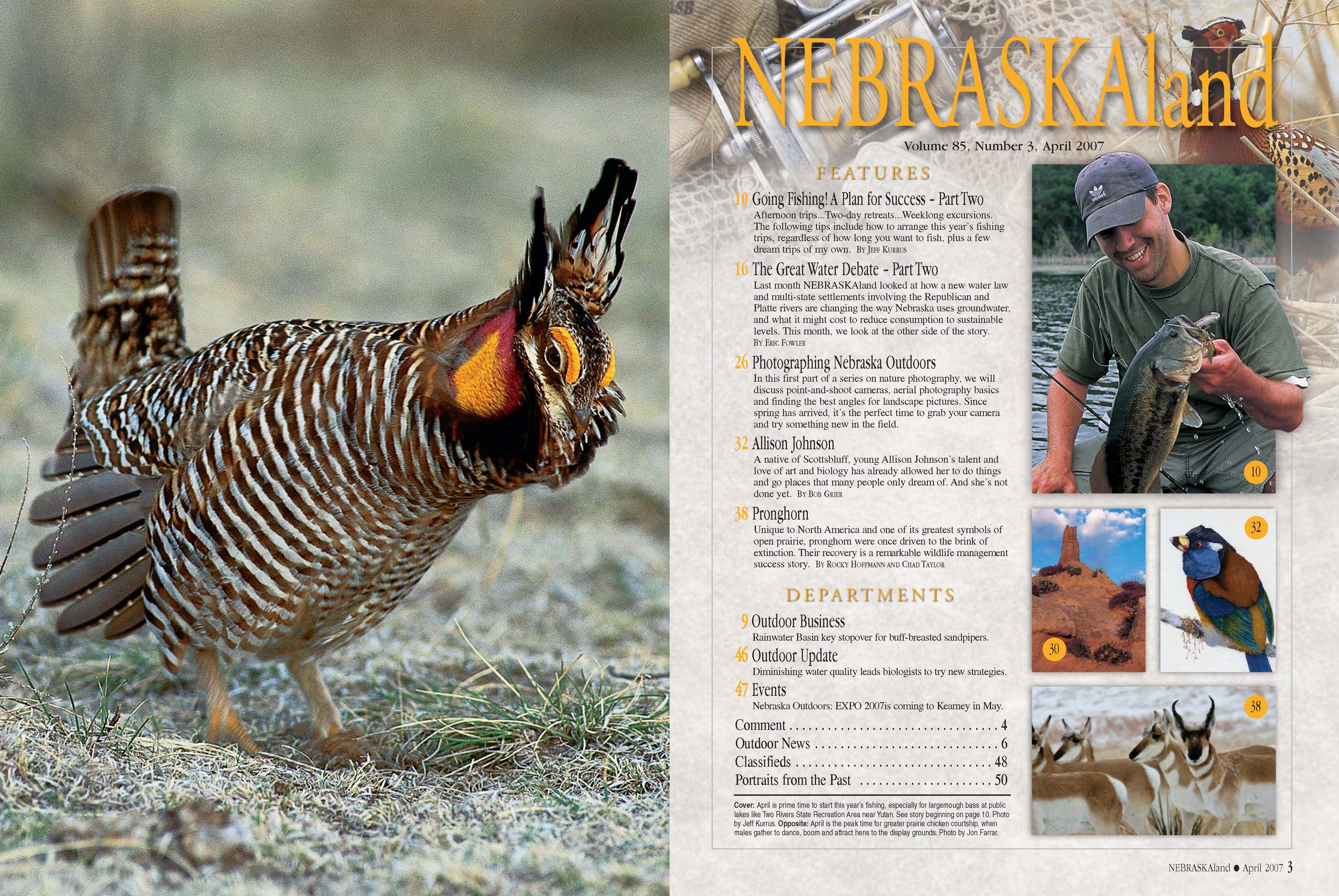
NEBRASKAland
Volume 85, Number 3, April 2007 Features 10 Going Fishing! A Plan for Success – Part Two Afternoon trips...Two-day retreats...Weeklong excursions. The following tips include how to arrange this year's fishing trips, regardless of how long you want to fish, plus a few dream trips of my own. BY JEFF KURRUS 16 The Great Water Debate – Part Two Last month NEBRASKAland looked at how a new water law and multi-state settlements involving the Republican and Platte rivers are changing the way Nebraska uses groundwater, and what it might cost to reduce consumption to sustainable levels. This month, we look at the other side of the story. BY ERIC FOWLER 26 Photographing Nebraska Outdoors In this first part of a series on nature photography, we will discuss point-and-shoot cameras, aerial photography basics and finding the best angles for landscape pictures. Since spring has arrived, it's the perfect time to grab your camera and try something new in the field. 32 Allison Johnson A native of Scottsbluff, young Allison Johnson's talent and love of art and biology has already allowed her to do things and go places that many people only dream of. And she's not done yet. BY BOB GRIER 38 Pronghorn Unique to North America and one of its greatest symbols of open prairie, pronghorn were once driven to the brink of extinction. Their recovery is a remarkable wildlife management success story. BY ROCKY HOFFMANN AND CHAD TAYLOR Departments 9 Outdoor Business Rainwater Basin key stopover for buff-breasted sandpipers. 46 Outdoor Update Diminishing water quality leads biologists to try new strategies. 47 Events Nebraska Outdoors: EXPO 2007is coming to Kearney in May. Comment . . . . . . . . . . . . . . . . . . . . . . . . . . . . . . . . . 4 Outdoor News . . . . . . . . . . . . . . . . . . . . . . . . . . . . . 6 Classifieds . . . . . . . . . . . . . . . . . . . . . . . . . . . . . . . 48 Portraits from the Past . . . . . . . . . . . . . . . . . . . . . 50 Cover: April is prime time to start this year's fishing, especially for largemough bass at public lakes like Two Rivers State Recreation Area near Yutan. See story beginning on page 10. Photo by Jeff Kurrus. Opposite: April is the peak time for greater prairie chicken courtship, when males gather to dance, boom and attract hens to the display grounds. Photo by Jon Farrar.
Comment
just wanted to let you know how much I enjoy your magazine.
I'm currently deployed in southern Baghdad but my grandparents send me their NEBRASKAlands when they are done with them. The articles and pictures remind me of better times when I visited them on their farm (basically my second home) near Homer.
Interestingly, the area I operate in is actually quite rural. On a daily basis I work with the local farmers in order to help them with their quality of life issues. On more than one occasion my soldiers and I have helped a local round up his cows that have broken through a fence. It's quite humorous watching a soldier in full combat gear chase a bunch of cows through a muddy field
Often these farmers are the best sources of information in terms of insurgent activities, since they are constantly out and about. Once back from mission, though, there is nothing more relaxing then sitting down and reading a NEBRASKAland.
Anyway, thanks again for producing such a great product.
LT Eric Rudberg Baghdad, Iraq Cedars Overtaking SandhillsAlong with other veterans I travel on the V.A. bus from O'Neill to Grand Island Veterans Hospital. The ride through the Sandhills is good therapy.
Every trip brings up the way eastern red cedars are devouring the prairies. It is alarming and frightening to wonder what our Sandhills will be like in the future. Of course, we will not be here, but our grandchildren will not know what a great state Nebraska used to be.
Duane Gray O'Neill, NebraskaWe had to share these pictures of a pair of eagles that we saw on December 23, 2006 in a tree along Highway 39 south of Silver Creek. We'd never seen eagles sit this close together before, so we thought you might find it interesting also.
Charlie and Cheryl Krohn Albion, Nebraska 4 NEBRASKAland April 2007 Comment BuffaloedEach fall, one of my daughters and I take what we call our Nebraska Sandhills ranch tour. We stop and visit many of our ranching friends we have met over the years. One of our stops last fall was the Perfect 10 Bison Ranch near Rose, Nebraska. Owner Dave Hutchinson raises cattle, goats, and bison on his organic ranch. The bison graze on natural prairie grass and drink from artesian well water.
I wanted to include a photo of some of the fun we had with Dave on his ranch. We were out checking on the buffalo and Dave called one of his buffalo, named "Miracle" over to visit. The photo is my daughter, Emily, getting up close and personal with Miracle while Dave observes from behind and Herman, his dog, sits on the back of a four-wheeler.
Our family really enjoys your magazine.
Steve Reeder Omaha, Nebraska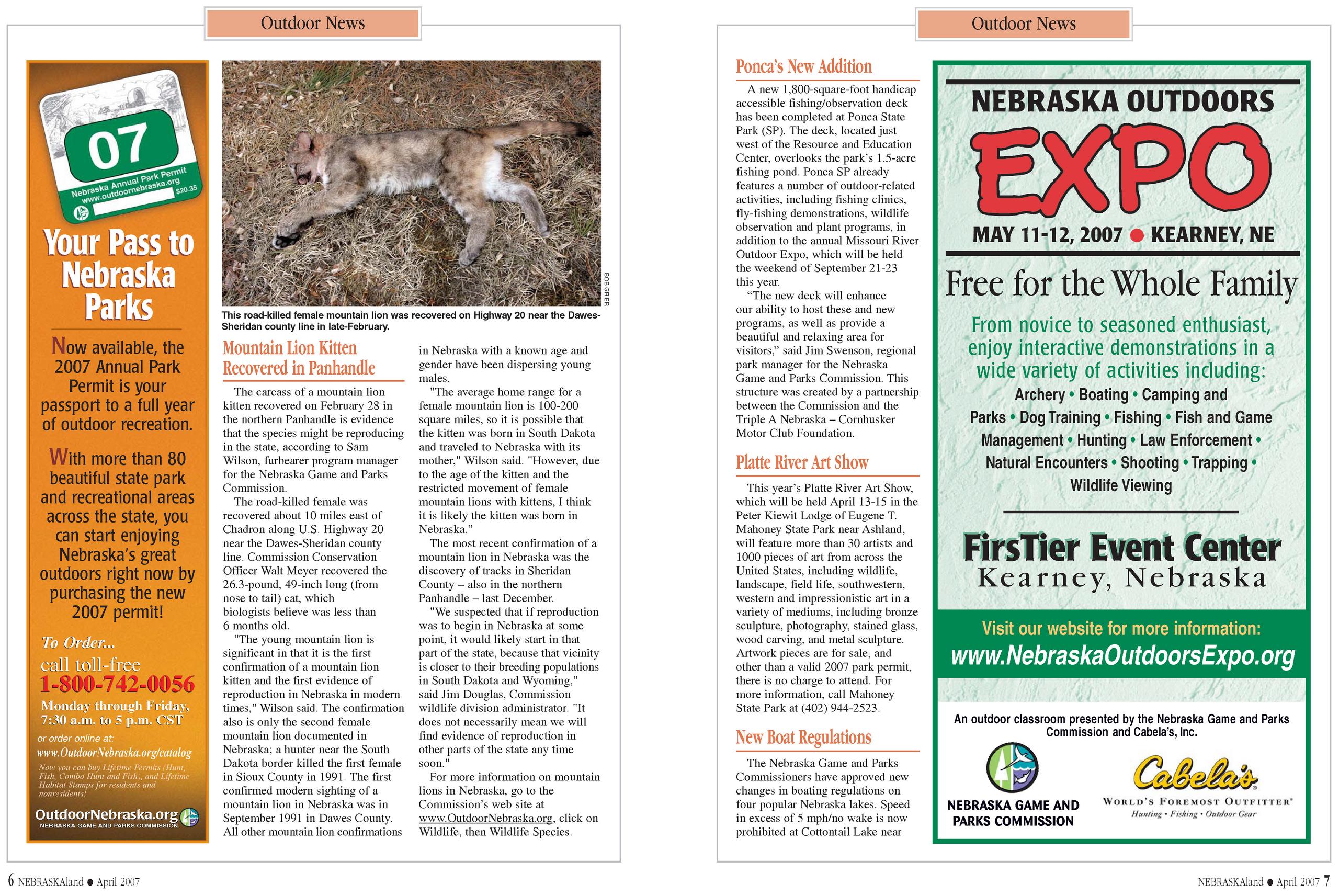
Outdoor News
The carcass of a mountain lion kitten recovered on February 28 in the northern Panhandle is evidence that the species might be reproducing in the state, according to Sam Wilson, furbearer program manager for the Nebraska Game and Parks Commission.
The road-killed female was recovered about 10 miles east of Chadron along U.S. Highway 20 near the Dawes-Sheridan county line. Commission Conservation Officer Walt Meyer recovered the 26.3-pound, 49-inch long (from nose to tail) cat, which biologists believe was less than 6 months old.
"The young mountain lion is significant in that it is the first confirmation of a mountain lion kitten and the first evidence of reproduction in Nebraska in modern times," Wilson said. The confirmation also is only the second female mountain lion documented in Nebraska; a hunter near the South Dakota border killed the first female in Sioux County in 1991. The first confirmed modern sighting of a mountain lion in Nebraska was in September 1991 in Dawes County. All other mountain lion confirmations in Nebraska with a known age and gender have been dispersing young males.
"The average home range for a female mountain lion is 100-200 square miles, so it is possible that the kitten was born in South Dakota and traveled to Nebraska with its mother," Wilson said. "However, due to the age of the kitten and the restricted movement of female mountain lions with kittens, I think it is likely the kitten was born in Nebraska."
The most recent confirmation of a mountain lion in Nebraska was the discovery of tracks in Sheridan County – also in the northern Panhandle – last December.
"We suspected that if reproduction was to begin in Nebraska at some point, it would likely start in that part of the state, because that vicinity is closer to their breeding populations in South Dakota and Wyoming," said Jim Douglas, Commission wildlife division administrator. "It does not necessarily mean we will find evidence of reproduction in other parts of the state any time soon."
For more information on mountain lions in Nebraska, go to the Commission's web site at www.OutdoorNebraska.org, click on Wildlife, then Wildlife Species
6 NEBRASKAland April 2007 Outdoor News Ponca's New AdditionA new 1,800-square-foot handicap accessible fishing/observation deck has been completed at Ponca State Park (SP). The deck, located just west of the Resource and Education Center, overlooks the park's 1.5-acre fishing pond. Ponca SP already features a number of outdoor-related activities, including fishing clinics, fly-fishing demonstrations, wildlife observation and plant programs, in addition to the annual Missouri River Outdoor Expo, which will be held the weekend of September 21-23 this year
"The new deck will enhance our ability to host these and new programs, as well as provide a beautiful and relaxing area for visitors," said Jim Swenson, regional park manager for the Nebraska Game and Parks Commission. This structure was created by a partnership between the Commission and the Triple A Nebraska – Cornhusker Motor Club Foundation.
Platte River Art ShowThis year's Platte River Art Show, which will be held April 13-15 in the Peter Kiewit Lodge of Eugene T. Mahoney State Park near Ashland, will feature more than 30 artists and 1000 pieces of art from across the United States, including wildlife, landscape, field life, southwestern, western and impressionistic art in a variety of mediums, including bronze sculpture, photography, stained glass, wood carving, and metal sculpture. Artwork pieces are for sale, and other than a valid 2007 park permit, there is no charge to attend. For more information, call Mahoney State Park at (402) 944-2523.
New Boat RegulationsThe Nebraska Game and Parks Commissioners have approved new changes in boating regulations on four popular Nebraska lakes. Speed in excess of 5 mph/no wake is now prohibited at Cottontail Lake near
NEBRASKA OUTDOORS EXPO MAY 11-12, 2007 KEARNEY, NE Free for the Whole Family From novice to seasoned enthusiast, enjoy interactive demonstrations in a wide variety of activites including: Archery Boating Camping and Parks Dog Training Fishing Fish and Game Management Hunting Law Enforcement Natural Encounters Shooting Trapping Wildlife Viewing FirsTier Event Center Kearney, Nebraska Visit our website for more information: www.NebraskaOutdoorsExpo.org An outdoor classroom presented by the Nebraska Game and Parks Commission and Cabela's, Inc. NEBRAKA GAME AND PARKS COMMISSION Cabela's WORLD'S FOREMOST OUTFITTER Hunting Fishing Outdoor Gear NEBRASKAland April 2007 7 Outdoor News
Officer's Notebook
Good Disguise
Outdoor News
Officer's Notebook
Good Disguise
I was working one of the Salt Valley Lakes in southern Lancaster County. A Wildlife Crimestoppers complaint was relayed to me from the local sheriff's office. The complainant stated that two individuals fishing from the dam at Stagecoach Lake were keeping approximately 30 undersized bass that they had caught.
I parked on the far side of the lake and by using my spotting scope, observed a man and woman fishing in the center of the dam. Each of them had a five-gallon buckets and fit the description of the suspects. Due to past experience of watching fishermen toss buckets of illegal fish back into the lake when I approached, I doubted I could approach them directly and make a case.
I drove around the lake, keeping my patrol truck hidden. When I saw two friends fishing on the lake's south side, I suddenly had an idea, so I stopped and borrowed a blue jean jacket and fishing pole from the husband and a broad-rimmed, purple party hat with dangling purple bells hanging from the rim from the wife. Putting these on over my field uniform, I walked over to the dam and started casting out a lure as I worked my way towards the suspects. I couldn't stop grinning at my ridiculous outfit – but it was working. After casting and strolling closer for about 200 yards, I was finally within a few feet of the buckets, which both held bass that were obviously too small to keep legally. "How's the fishing?" I asked the man, who was standing nearby. He replied, in perfect English, "The bass fishing is great."
I then laid down my fishing pole, walked over to the buckets and took off the blue jean jacket and psychedelic purple hat and grabbed the buckets of fish before they could be tossed. I announced that I was a state conservation officer and that they were in possession of illegal bass. A look of amazement crossed the gentleman's face.
When I asked for their fishing permits, he started screaming at his wife in a foreign tongue. While issuing them citations using their valid Nebraska driver licenses, I never once was able to get the gentleman or his wife to speak English again. I assumed he blamed his wife for letting me get that close, but she just couldn't see through the disguise either.
– Dan Evasco, Conservation Officer, PapillionMartell, Meadowlark Lake near Agnew, Timber Point Lake near Brainard and Goose Lake Wildlife Management Area near Bartlett.
ATV/Minibike TitlingCurrent and potential owners of all-terrain vehicles and minibikes should pay special attention to the titling laws for these types of vehicles, according to Beverly Neth, Director of the Department of Motor Vehicles.
Legislation passed in 2003 requires the owners of all new and used ATV's and minibikes originally purchased new after January 1, 2004 to apply for a certificate of title at their local county courthouse. Owners of older ATV's and minibikes have the option of obtaining the certificate of title.
Patch-N-PowderThe Patch-N-Powder Gang's Black Powder & Sporting Clay Shoots have started and will month in Beatrice and run through October.
Competitive shooting matches with blackpowder rifles, shotguns and pistols begin at 9 a.m. on the second Sunday of each month. Target, animal silhouette, and novelty shooting divisions occur during these shoots.
Spectators are welcome and people interested in shooting for the first time are also invited to attend. Call (402) 228-1391 for more information.
Walleye Spawn UnderwayThe walleye spawn is occurring this month at many Nebraska lakes. "We will be collecting walleye eggs for hatchery production of walleyes," said Commission fisheries biologist Daryl Bauer. To locate the state's best walleye lakes surveyed for 2007, refer to the spring edition of Outdoor Nebraska. And for the latest regulations, refer to the 2007 Nebraska Fishing Guide, available at Commission offices across the state as well as online at www.OutdoorNebraska.org.
Outdoor Business
Buff-breasted Sandpiper in the Rainwater Basin
Central Nebraska is an essential stopover for these long distance migrants.
For several years, University of Nebraska at Omaha (UNO) and Nebraska Game and Parks Commission (NGPC) researchers have been looking at the role the Rainwater Basin in south-central Nebraska plays in buffbreasted sandpiper migration. The team's investigation has led to some intriguing discoveries, including uncovering evidence that this small region in Nebraska is the species' primary stopover area in midcontinental North America.
Buff-breasted sandpipers are neither common nor well known, and labeling the birds as "migratory" could be considered a bit of an understatement. "Buffies," as they are sometimes known, spend the winter in southern South America and breed in the Arctic, with some birds even breeding in Siberia. Their primary spring migration pathway is through the eastern Great Plains, however, buff-breasted sandpipers are seldom seen in the United States or Canada during their migration.
One reason for this is that even though this species is a member of the sandpiper family, it is one of the few members of that group of shorebirds not closely associated with water. Specifically, buffies use grazed pastures, agricultural fields and other areas of short, upland grass, such as sod farms.
Up until about the 1970s, buffbreasted sandpipers were considered rare in Nebraska, that is until Lee Morris, a farmer and birder in York County, pointed out that he was seeing a lot of them each spring while planting corn. York County sits in the middle of the Rainwater Basin, a relatively flat landscape that contains numerous playa wetlands and is well known as a critical stopover area for waterfowl, shorebirds and other waterbirds. Perhaps because buff
Following two years of intensive and challenging research, results indicate 20,000 to 30,000 birds were using the region. Surprisingly, the world's population is estimated to be about this same figure, so it appears a very large portion of the population migrates through central Nebraska. "While buffies were known to occur here, it appears that this special and unique relationship was essentially hiding in plain sight for many years," Wolfenbarger said.
Now that it is apparent that the Rainwater Basin is an important and primary stopover site for this species of high conservation concern due to declining numbers, researchers are continuing their work by capturing, color-banding and fitting radiotransmitters to buffies so they can be followed during their stay here.
"Since most of the world's population of buff-breasted sandpipers appears to be resting in this part of Nebraska during their spring migration, we need to find out what is attracting them to the area and what we can do to ensure that they find enough food to continue their migration to the arctic in good condition," said Wolfenbarger
Because the birds use privately owned agricultural fields, the research hinges on the cooperation of landowners. "We usually don't know which field the birds are going to be in from day to day," McCarty said. "The buffies tend to come through Nebraska at the height of spring planting, so we were a little concerned about being able to get landowners' permission to capture birds. Most of the farmers, however, were interested to find out they had birds following their tractors that only a few people in the country ever saw."
Going Fishing
A Plan for Success – Part Two
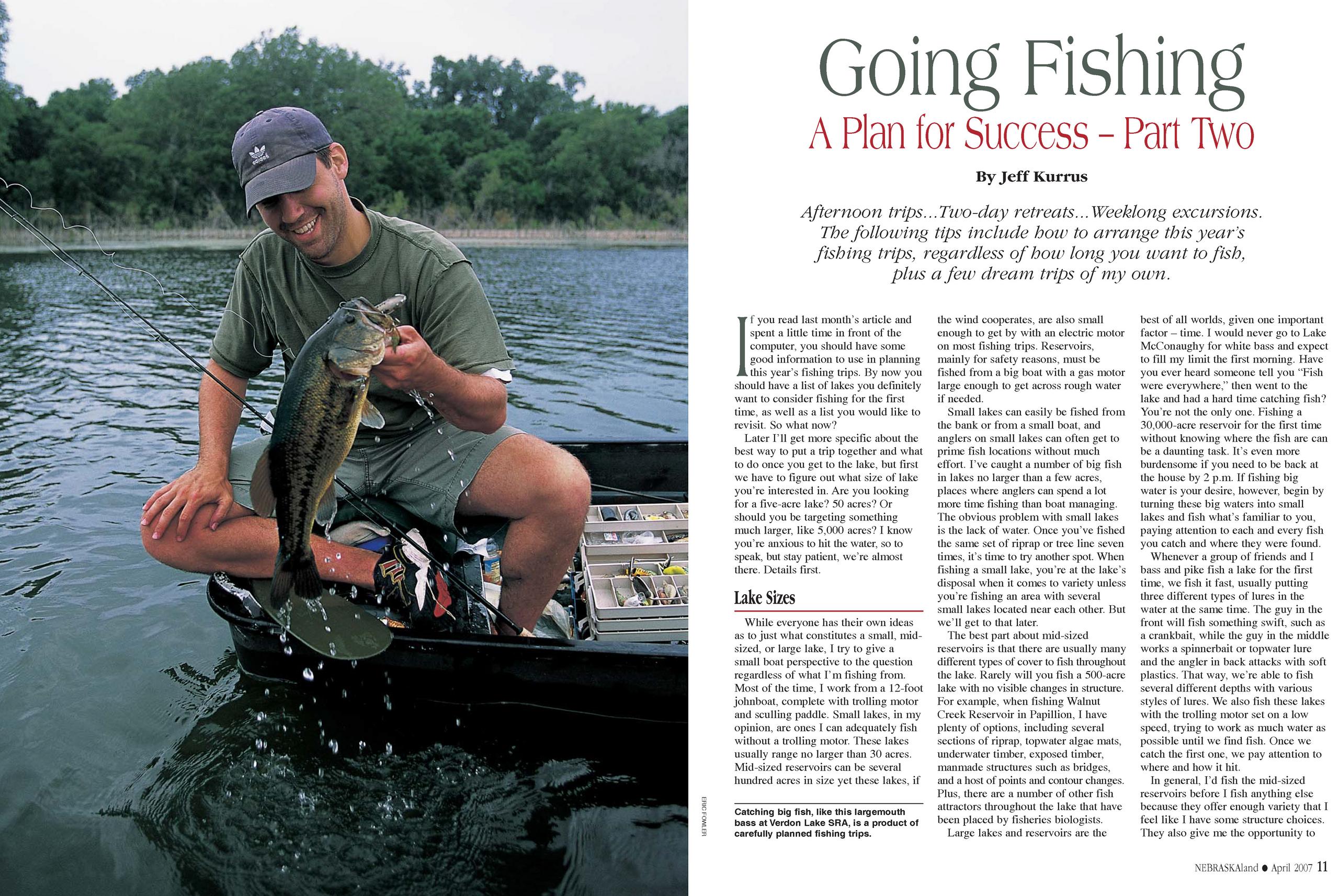
Afternoon trips...Two-day retreats...Weeklong excursions. The following tips include how to arrange this year's fishing trips, regardless of how long you want to fish, plus a few dream trips of my own.If you read last month's article and spent a little time in front of the computer, you should have some good information to use in planning this year's fishing trips. By now you should have a list of lakes you definitely want to consider fishing for the first time, as well as a list you would like to revisit. So what now?
Later I'll get more specific about the best way to put a trip together and what to do once you get to the lake, but first we have to figure out what size of lake you're interested in. Are you looking for a five-acre lake? 50 acres? Or should you be targeting something much larger, like 5,000 acres? I know you're anxious to hit the water, so to speak, but stay patient, we're almost there. Details first.
Lake SizesWhile everyone has their own ideas as to just what constitutes a small, midsized, or large lake, I try to give a small boat perspective to the question regardless of what I'm fishing from. Most of the time, I work from a 12-foot johnboat, complete with trolling motor and sculling paddle. Small lakes, in my opinion, are ones I can adequately fish without a trolling motor. These lakes usually range no larger than 30 acres. Mid-sized reservoirs can be several hundred acres in size yet these lakes, if the wind cooperates, are also small enough to get by with an electric motor on most fishing trips. Reservoirs, mainly for safety reasons, must be fished from a big boat with a gas motor large enough to get across rough water if needed.
Small lakes can easily be fished from the bank or from a small boat, and anglers on small lakes can often get to prime fish locations without much effort. I've caught a number of big fish in lakes no larger than a few acres, places where anglers can spend a lot more time fishing than boat managing. The obvious problem with small lakes is the lack of water. Once you've fished the same set of riprap or tree line seven times, it's time to try another spot. When fishing a small lake, you're at the lake's disposal when it comes to variety unless you're fishing an area with several small lakes located near each other. But we'll get to that later.
The best part about mid-sized reservoirs is that there are usually many different types of cover to fish throughout the lake. Rarely will you fish a 500-acre lake with no visible changes in structure. For example, when fishing Walnut Creek Reservoir in Papillion, I have plenty of options, including several sections of riprap, topwater algae mats, underwater timber, exposed timber, manmade structures such as bridges, and a host of points and contour changes. Plus, there are a number of other fish attractors throughout the lake that have been placed by fisheries biologists.
Large lakes and reservoirs are the best of all worlds, given one important factor – time. I would never go to Lake McConaughy for white bass and expect to fill my limit the first morning. Have you ever heard someone tell you "Fish were everywhere," then went to the lake and had a hard time catching fish? You're not the only one. Fishing a 30,000-acre reservoir for the first time without knowing where the fish are can be a daunting task. It's even more burdensome if you need to be back at the house by 2 p.m. If fishing big water is your desire, however, begin by turning these big waters into small lakes and fish what's familiar to you, paying attention to each and every fish you catch and where they were found.
Whenever a group of friends and I bass and pike fish a lake for the first time, we fish it fast, usually putting three different types of lures in the water at the same time. The guy in the front will fish something swift, such as a crankbait, while the guy in the middle works a spinnerbait or topwater lure and the angler in back attacks with soft plastics. That way, we're able to fish several different depths with various styles of lures. We also fish these lakes with the trolling motor set on a low speed, trying to work as much water as possible until we find fish. Once we catch the first one, we pay attention to where and how it hit.
In general, I'd fish the mid-sized reservoirs before I fish anything else because they offer enough variety that I feel like I have some structure choices. They also give me the opportunity to
NEBRASKAland April 2007 11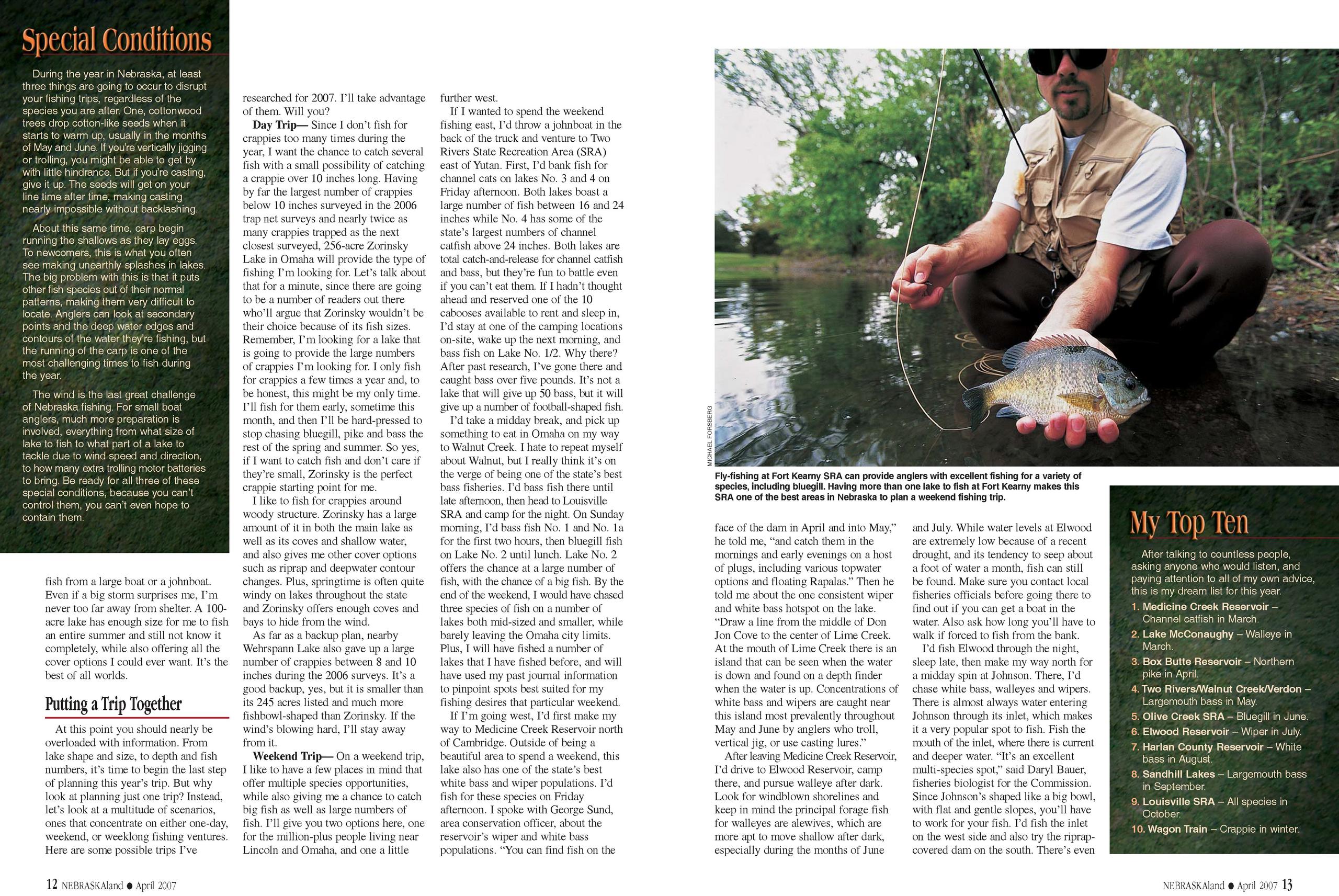 Special Conditions
During the year in Nebraska, at least three things are going to occur to disrupt your fishing trips, regardless of the species you are after. One, cottonwood trees drop cotton-like seeds when it starts to warm up, usually in the months of May and June. If you're vertically jigging or trolling, you might be able to get by with little hindrance. But if you're casting, give it up. The seeds will get on your line time after time, making casting nearly impossible without backlashing.
About this same time, carp begin running the shallows as they lay eggs. To newcomers, this is what you often see making unearthly splashes in lakes. The big problem with this is that it puts other fish species out of their normal patterns, making them very difficult to locate. Anglers can look at secondary points and the deep water edges and contours of the water they're fishing, but the running of the carp is one of the most challenging times to fish during the year.
The wind is the last great challenge of Nebraska fishing. For small boat anglers, much more preparation is involved, everything from what size of lake to fish to what part of a lake to tackle due to wind speed and direction, to how many extra trolling motor batteries to bring. Be ready for all three of these special conditions, because you can't control them, you can't even hope to contain them.
fish from a large boat or a johnboat. Even if a big storm surprises me, I'm never too far away from shelter. A 100- acre lake has enough size for me to fish an entire summer and still not know it completely, while also offering all the cover options I could ever want. It's the best of all worlds.
Putting a Trip TogetherAt this point you should nearly be overloaded with information. From lake shape and size, to depth and fish numbers, it's time to begin the last step of planning this year's trip. But why look at planning just one trip? Instead, let's look at a multitude of scenarios, ones that concentrate on either one-day, weekend, or weeklong fishing ventures. Here are some possible trips I've researched for 2007. I'll take advantage of them. Will you?
Day Trip— Since I don't fish for crappies too many times during the year, I want the chance to catch several fish with a small possibility of catching a crappie over 10 inches long. Having by far the largest number of crappies below 10 inches surveyed in the 2006 trap net surveys and nearly twice as many crappies trapped as the next closest surveyed, 256-acre Zorinsky Lake in Omaha will provide the type of fishing I'm looking for. Let's talk about that for a minute, since there are going to be a number of readers out there who'll argue that Zorinsky wouldn't be their choice because of its fish sizes. Remember, I'm looking for a lake that is going to provide the large numbers of crappies I'm looking for. I only fish for crappies a few times a year and, to be honest, this might be my only time. I'll fish for them early, sometime this month, and then I'll be hard-pressed to stop chasing bluegill, pike and bass the rest of the spring and summer. So yes, if I want to catch fish and don't care if they're small, Zorinsky is the perfect crappie starting point for me.
I like to fish for crappies around woody structure. Zorinsky has a large amount of it in both the main lake as well as its coves and shallow water, and also gives me other cover options such as riprap and deepwater contour changes. Plus, springtime is often quite windy on lakes throughout the state and Zorinsky offers enough coves and bays to hide from the wind.
As far as a backup plan, nearby Wehrspann Lake also gave up a large number of crappies between 8 and 10 inches during the 2006 surveys. It's a good backup, yes, but it is smaller than its 245 acres listed and much more fishbowl-shaped than Zorinsky. If the wind's blowing hard, I'll stay away from it.
like to have a few places in mind that offer multiple species opportunities, while also giving me a chance to catch big fish as well as large numbers of fish. I'll give you two options here, one for the million-plus people living near Lincoln and Omaha, and one a little further west.
If I wanted to spend the weekend fishing east, I'd throw a johnboat in the back of the truck and venture to Two Rivers State Recreation Area (SRA) east of Yutan. First, I'd bank fish for channel cats on lakes No. 3 and 4 on Friday afternoon. Both lakes boast a large number of fish between 16 and 24 inches while No. 4 has some of the state's largest numbers of channel catfish above 24 inches. Both lakes are total catch-and-release for channel catfish and bass, but they're fun to battle even if you can't eat them. If I hadn't thought ahead and reserved one of the 10 cabooses available to rent and sleep in, I'd stay at one of the camping locations on-site, wake up the next morning, and bass fish on Lake No. 1/2. Why there? After past research, I've gone there and caught bass over five pounds. It's not a lake that will give up 50 bass, but it will give up a number of football-shaped fish.
I'd take a midday break, and pick up something to eat in Omaha on my way to Walnut Creek. I hate to repeat myself about Walnut, but I really think it's on the verge of being one of the state's best bass fisheries. I'd bass fish there until late afternoon, then head to Louisville SRA and camp for the night. On Sunday morning, I'd bass fish No. 1 and No. 1a for the first two hours, then bluegill fish on Lake No. 2 until lunch. Lake No. 2 offers the chance at a large number of fish, with the chance of a big fish. By the end of the weekend, I would have chased three species of fish on a number of lakes both mid-sized and smaller, while barely leaving the Omaha city limits. Plus, I will have fished a number of lakes that I have fished before, and will have used my past journal information to pinpoint spots best suited for my fishing desires that particular weekend.
If I'm going west, I'd first make my way to Medicine Creek Reservoir north of Cambridge. Outside of being a beautiful area to spend a weekend, this lake also has one of the state's best white bass and wiper populations. I'd fish for these species on Friday afternoon. I spoke with George Sund, area conservation officer, about the reservoir's wiper and white bass populations. "You can find fish on the 12 NEBRASKAland April 2007
After leaving Medicine Creek Reservoir, I'd drive to Elwood Reservoir, camp there, and pursue walleye after dark. Look for windblown shorelines and keep in mind the principal forage fish for walleyes are alewives, which are more apt to move shallow after dark, especially during the months of June and July. While water levels at Elwood are extremely low because of a recent drought, and its tendency to seep about a foot of water a month, fish can still be found. Make sure you contact local fisheries officials before going there to find out if you can get a boat in the water. Also ask how long you'll have to walk if forced to fish from the bank.
I'd fish Elwood through the night, sleep late, then make my way north for a midday spin at Johnson. There, I'd chase white bass, walleyes and wipers. There is almost always water entering Johnson through its inlet, which makes it a very popular spot to fish. Fish the mouth of the inlet, where there is current and deeper water. "It's an excellent multi-species spot," said Daryl Bauer, fisheries biologist for the Commission. Since Johnson's shaped like a big bowl, with flat and gentle slopes, you'll have to work for your fish. I'd fish the inlet on the west side and also try the riprapcovered dam on the south. There's even
My Top Ten After talking to countless people, asking anyone who would listen, and paying attention to all of my own advice, this is my dream list for this year. 1. Medicine Creek Reservoir – Channel catfish in March. 2. Lake McConaughy – Walleye in March. 3. Box Butte Reservoir – Northern pike in April. 4. Two Rivers/Walnut Creek/Verdon – Largemouth bass in May. 5. Olive Creek SRA – Bluegill in June. 6. Elwood Reservoir – Wiper in July. 7. Harlan County Reservoir – White bass in August. 8. Sandhill Lakes – Largemouth bass in September. 9. Louisville SRA – All species in October. 10.Wagon Train – Crappie in winter. NEBRASKAland April 2007 13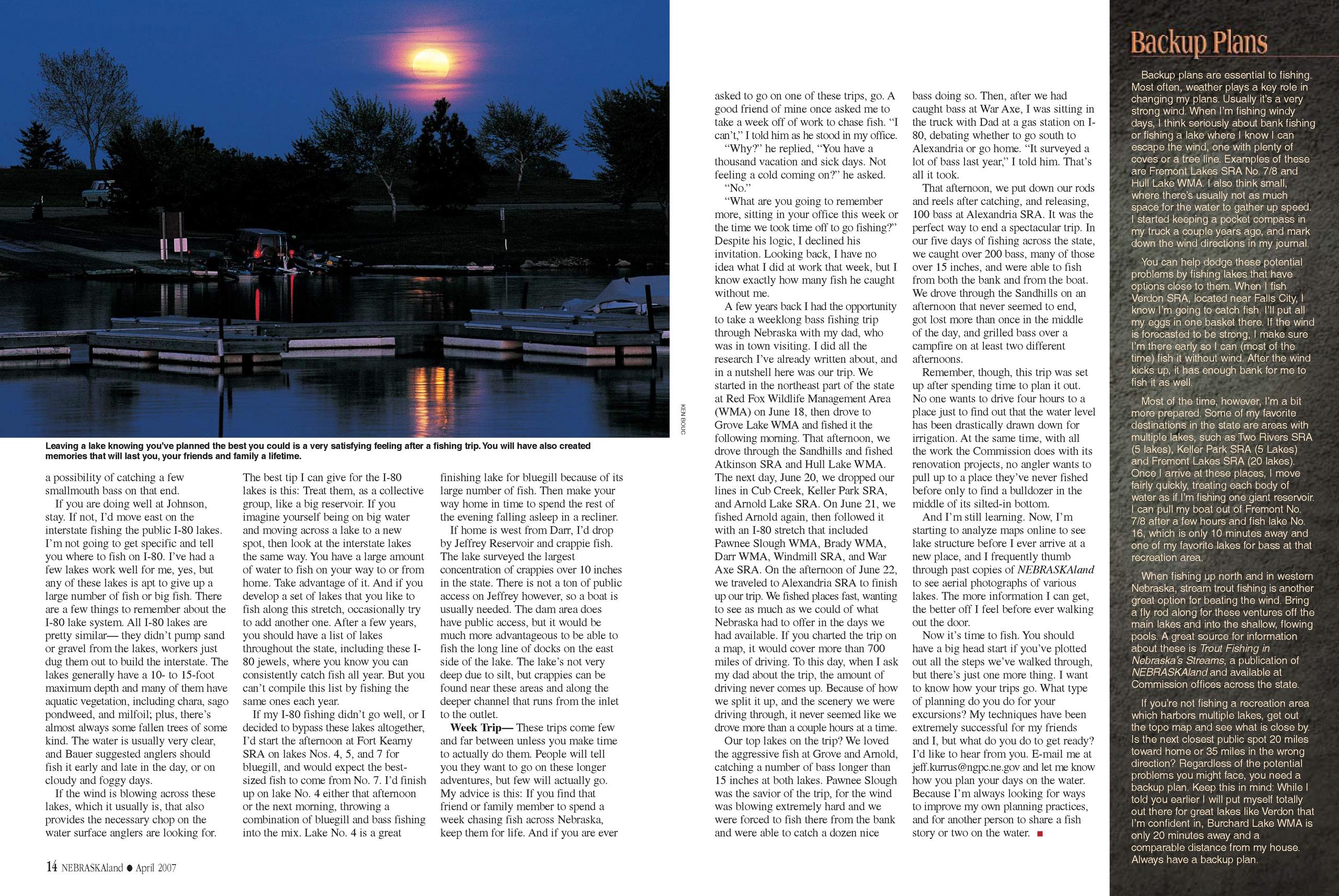
If you are doing well at Johnson, stay. If not, I'd move east on the interstate fishing the public I-80 lakes. I'm not going to get specific and tell you where to fish on I-80. I've had a few lakes work well for me, yes, but any of these lakes is apt to give up a large number of fish or big fish. There are a few things to remember about the I-80 lake system. All I-80 lakes are pretty similar— they didn't pump sand or gravel from the lakes, workers just dug them out to build the interstate. The lakes generally have a 10- to 15-foot maximum depth and many of them have aquatic vegetation, including chara, sago pondweed, and milfoil; plus, there's almost always some fallen trees of some kind. The water is usually very clear, and Bauer suggested anglers should fish it early and late in the day, or on cloudy and foggy days.
If the wind is blowing across these lakes, which it usually is, that also provides the necessary chop on the water surface anglers are looking for. The best tip I can give for the I-80 lakes is this: Treat them, as a collective group, like a big reservoir. If you imagine yourself being on big water and moving across a lake to a new spot, then look at the interstate lakes the same way. You have a large amount of water to fish on your way to or from home. Take advantage of it. And if you develop a set of lakes that you like to fish along this stretch, occasionally try to add another one. After a few years, you should have a list of lakes throughout the state, including these I- 80 jewels, where you know you can consistently catch fish all year. But you can't compile this list by fishing the same ones each year.
If my I-80 fishing didn't go well, or I decided to bypass these lakes altogether, I'd start the afternoon at Fort Kearny SRA on lakes Nos. 4, 5, and 7 for bluegill, and would expect the bestsized fish to come from No. 7. I'd finish up on lake No. 4 either that afternoon or the next morning, throwing a combination of bluegill and bass fishing into the mix. Lake No. 4 is a great finishing lake for bluegill because of its large number of fish. Then make your way home in time to spend the rest of the evening falling asleep in a recliner.
If home is west from Darr, I'd drop by Jeffrey Reservoir and crappie fish. The lake surveyed the largest concentration of crappies over 10 inches in the state. There is not a ton of public access on Jeffrey however, so a boat is usually needed. The dam area does have public access, but it would be much more advantageous to be able to fish the long line of docks on the east side of the lake. The lake's not very deep due to silt, but crappies can be found near these areas and along the deeper channel that runs from the inlet to the outlet.
Week Trip— These trips come few and far between unless you make time to actually do them. People will tell you they want to go on these longer adventures, but few will actually go. My advice is this: If you find that friend or family member to spend a week chasing fish across Nebraska, keep them for life. And if you are ever 14 NEBRASKAland April 2007 asked to go on one of these trips, go. A good friend of mine once asked me to take a week off of work to chase fish. "I can't," I told him as he stood in my office.
"Why?" he replied, "You have a thousand vacation and sick days. Not feeling a cold coming on?" he asked.
"No."
What are you going to remember more, sitting in your office this week or the time we took time off to go fishing?" Despite his logic, I declined his invitation. Looking back, I have no idea what I did at work that week, but I know exactly how many fish he caught without me.
A few years back I had the opportunity to take a weeklong bass fishing trip through Nebraska with my dad, who was in town visiting. I did all the research I've already written about, and in a nutshell here was our trip. We started in the northeast part of the state at Red Fox Wildlife Management Area (WMA) on June 18, then drove to Grove Lake WMA and fished it the following morning. That afternoon, we drove through the Sandhills and fished Atkinson SRA and Hull Lake WMA. The next day, June 20, we dropped our lines in Cub Creek, Keller Park SRA, and Arnold Lake SRA. On June 21, we fished Arnold again, then followed it with an I-80 stretch that included Pawnee Slough WMA, Brady WMA, Darr WMA, Windmill SRA, and War Axe SRA. On the afternoon of June 22, we traveled to Alexandria SRA to finish up our trip. We fished places fast, wanting to see as much as we could of what Nebraska had to offer in the days we had available. If you charted the trip on a map, it would cover more than 700 miles of driving. To this day, when I ask my dad about the trip, the amount of driving never comes up. Because of how we split it up, and the scenery we were driving through, it never seemed like we drove more than a couple hours at a time.
Our top lakes on the trip? We loved the aggressive fish at Grove and Arnold, catching a number of bass longer than 15 inches at both lakes. Pawnee Slough was the savior of the trip, for the wind was blowing extremely hard and we were forced to fish there from the bank and were able to catch a dozen nice bass doing so. Then, after we had caught bass at War Axe, I was sitting in the truck with Dad at a gas station on I- 80, debating whether to go south to Alexandria or go home. "It surveyed a lot of bass last year," I told him. That's all it took.
That afternoon, we put down our rods and reels after catching, and releasing, 100 bass at Alexandria SRA. It was the perfect way to end a spectacular trip. In our five days of fishing across the state, we caught over 200 bass, many of those over 15 inches, and were able to fish from both the bank and from the boat. We drove through the Sandhills on an afternoon that never seemed to end, got lost more than once in the middle of the day, and grilled bass over a campfire on at least two different afternoons.
Remember, though, this trip was set up after spending time to plan it out. No one wants to drive four hours to a place just to find out that the water level has been drastically drawn down for irrigation. At the same time, with all the work the Commission does with its renovation projects, no angler wants to pull up to a place they've never fished before only to find a bulldozer in the middle of its silted-in bottom.
And I'm still learning. Now, I'm starting to analyze maps online to see lake structure before I ever arrive at a new place, and I frequently thumb through past copies of NEBRASKAland to see aerial photographs of various lakes. The more information I can get, the better off I feel before ever walking out the door.
Now it's time to fish. You should have a big head start if you've plotted out all the steps we've walked through, but there's just one more thing. I want to know how your trips go. What type of planning do you do for your excursions? My techniques have been extremely successful for my friends and I, but what do you do to get ready? I'd like to hear from you. E-mail me at jeff.kurrus@ngpc.ne.gov and let me know how you plan your days on the water. Because I'm always looking for ways to improve my own planning practices, and for another person to share a fish story or two on the water.
Backup PlansBackup plans are essential to fishing. Most often, weather plays a key role in changing my plans. Usually it's a very strong wind. When I'm fishing windy days, I think seriously about bank fishing or fishing a lake where I know I can escape the wind, one with plenty of coves or a tree line. Examples of these are Fremont Lakes SRA No. 7/8 and Hull Lake WMA. I also think small, where there's usually not as much space for the water to gather up speed. I started keeping a pocket compass in my truck a couple years ago, and mark down the wind directions in my journal.
You can help dodge these potential problems by fishing lakes that have options close to them. When I fish Verdon SRA, located near Falls City, I know I'm going to catch fish. I'll put all my eggs in one basket there. If the wind is forecasted to be strong, I make sure I'm there early so I can (most of the time) fish it without wind. After the wind kicks up, it has enough bank for me to fish it as well.
Most of the time, however, I'm a bit more prepared. Some of my favorite destinations in the state are areas with multiple lakes, such as Two Rivers SRA (5 lakes), Keller Park SRA (5 Lakes) and Fremont Lakes SRA (20 lakes). Once I arrive at these places, I move fairly quickly, treating each body of water as if I'm fishing one giant reservoir. I can pull my boat out of Fremont No. 7/8 after a few hours and fish lake No. 16, which is only 10 minutes away and one of my favorite lakes for bass at that recreation area.
When fishing up north and in western Nebraska, stream trout fishing is another great option for beating the wind. Bring a fly rod along for these ventures off the main lakes and into the shallow, flowing pools. A great source for information about these is Trout Fishing in Nebraska's Streams, a publication of NEBRASKAland and available at Commission offices across the state.
If you're not fishing a recreation area which harbors multiple lakes, get out the topo map and see what is close by. Is the next closest public spot 20 miles toward home or 35 miles in the wrong direction? Regardless of the potential problems you might face, you need a backup plan. Keep this in mind: While I told you earlier I will put myself totally out there for great lakes like Verdon that I'm confident in, Burchard Lake WMA is only 20 minutes away and a comparable distance from my house. Always have a backup plan.
The Great Water Debate
Eight years of drought has sapped Nebraska's rivers and reservoirs and heightened awareness of how connected surface and groundwater are. Last month NEBRASKAland looked at how a new water law and multi-state settlements involving the Republican and Platte rivers are changing the way Nebraska uses groundwater, and what it might cost to reduce consumption to sustainable levels. This month, we look at the other side of the story.
As the state struggles to come up with solutions to reduce groundwater use and the crosshairs settle on irrigators, who account for 95 percent of the state's annual usage in a mere three month irrigation season, the debate often turns to how forcing those individuals to use less water will affect farm income. But few speak of how the looming changes (which will be required if the state expects to meet its obligations on the Republican and Platte) will benefit those rivers, the reservoirs they feed, and the fish, wildlife and people who utilize both.
Agriculture is one of the state's top industries and, according to one study, irrigation added $4.1 billion to the state's economy in 2003. But tourism isn't small potatoes. In 2005, travelers spent $3.1 billion in Nebraska. And one of the top segments in the tourism industry, outdoor recreation, depends on water as much as agriculture does. In 2001, nearly $500 million was spent on hunting, fishing and wildlife watching in Nebraska.
Spend time at any of the state's drought-sapped irrigation reservoirs these days and sooner or later the conversation will turn to water. And more often than not, the question will come up: "Would it be worth it to leave more water in the lake?"
According to two recent studies, the answer might be yes.
More Water for Big Mac?Lake McConaughy was built for two purposes: irrigation and hydropower. Recreation is simply a bonus.
For the hundreds of thousands of campers, anglers, power boaters and sailors who visit the lake each summer, that's hard to understand. But the simple truth is that someone owns every drop of water in the lake, known for its clear waters and white sand beaches. If everyone took their share, the lake would be left dry.
As that scenario seemed headed toward reality a few years ago, Tom Osborne, the former football coach and then-U.S. Congressional representative for Nebraska's 3rd District, asked the University of Nebraska - Lincoln (UNL) to look at the options for the lake.
UN-L economist Ray Supalla found that lake visitation is highest when the lake is at about 63 percent of its 1.74 million acre-foot capacity. If the lake is full, the lack of beach deters some visitors. If it is low, access becomes difficult and visitation drops. All three scenarios have played out in
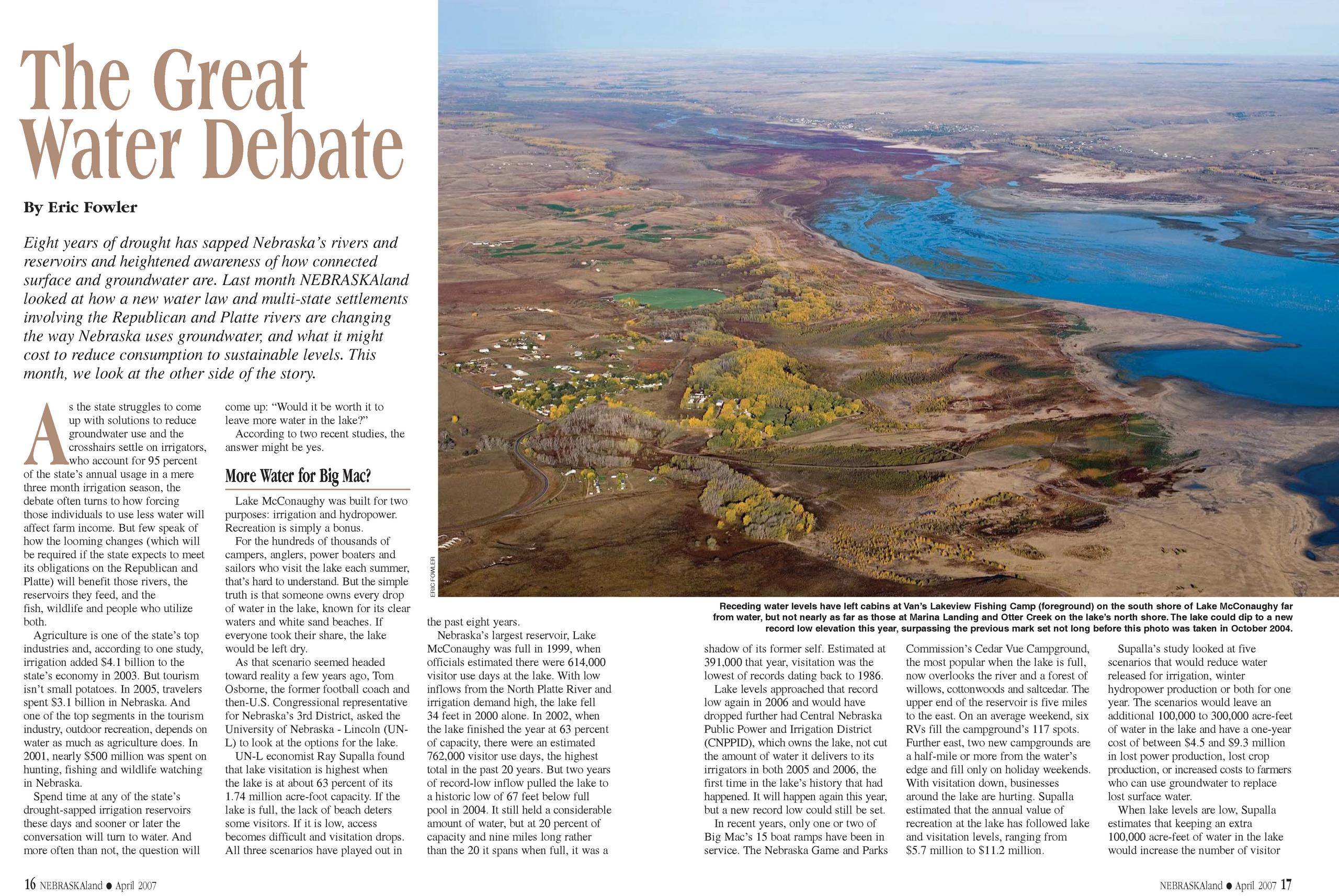
Nebraska's largest reservoir, Lake McConaughy was full in 1999, when officials estimated there were 614,000 visitor use days at the lake. With low inflows from the North Platte River and irrigation demand high, the lake fell 34 feet in 2000 alone. In 2002, when the lake finished the year at 63 percent of capacity, there were an estimated 762,000 visitor use days, the highest total in the past 20 years. But two years of record-low inflow pulled the lake to a historic low of 67 feet below full pool in 2004. It still held a considerable amount of water, but at 20 percent of capacity and nine miles long rather than the 20 it spans when full, it was a 16 NEBRASKAland April 2007 shadow of its former self. Estimated at 391,000 that year, visitation was the lowest of records dating back to 1986.
Lake levels approached that record low again in 2006 and would have dropped further had Central Nebraska Public Power and Irrigation District (CNPPID), which owns the lake, not cut the amount of water it delivers to its irrigators in both 2005 and 2006, the first time in the lake's history that had happened. It will happen again this year, but a new record low could still be set.
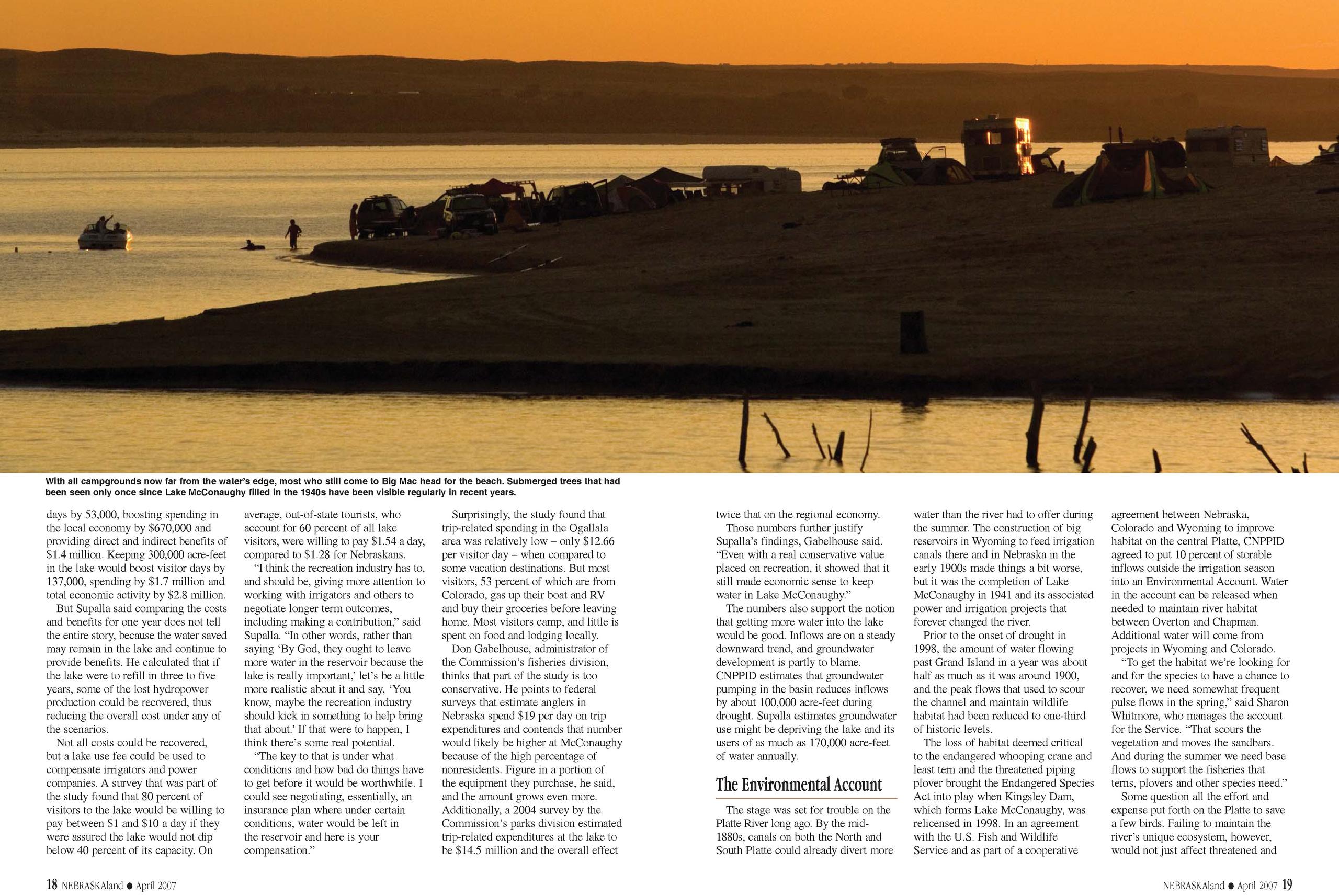
In recent years, only one or two of Big Mac's 15 boat ramps have been in service. The Nebraska Game and Parks Commission's Cedar Vue Campground, the most popular when the lake is full, now overlooks the river and a forest of willows, cottonwoods and saltcedar. The upper end of the reservoir is five miles to the east. On an average weekend, six RVs fill the campground's 117 spots. Further east, two new campgrounds are a half-mile or more from the water's edge and fill only on holiday weekends. With visitation down, businesses around the lake are hurting. Supalla estimated that the annual value of recreation at the lake has followed lake and visitation levels, ranging from $5.7 million to $11.2 million.
Supalla's study looked at five scenarios that would reduce water released for irrigation, winter hydropower production or both for one year. The scenarios would leave an additional 100,000 to 300,000 acre-feet of water in the lake and have a one-year cost of between $4.5 and $9.3 million in lost power production, lost crop production, or increased costs to farmers who can use groundwater to replace lost surface water.
When lake levels are low, Supalla
estimates that keeping an extra
100,000 acre-feet of water in the lake
would increase the number of visitor
NEBRASKAland April 2007 17
But Supalla said comparing the costs and benefits for one year does not tell the entire story, because the water saved may remain in the lake and continue to provide benefits. He calculated that if the lake were to refill in three to five years, some of the lost hydropower production could be recovered, thus reducing the overall cost under any of the scenarios.
Not all costs could be recovered, but a lake use fee could be used to compensate irrigators and power companies. A survey that was part of the study found that 80 percent of visitors to the lake would be willing to pay between $1 and $10 a day if they were assured the lake would not dip below 40 percent of its capacity. On average, out-of-state tourists, who account for 60 percent of all lake visitors, were willing to pay $1.54 a day, compared to $1.28 for Nebraskans.
"I think the recreation industry has to, and should be, giving more attention to working with irrigators and others to negotiate longer term outcomes, including making a contribution," said Supalla. "In other words, rather than saying 'By God, they ought to leave more water in the reservoir because the lake is really important,' let's be a little more realistic about it and say, 'You know, maybe the recreation industry should kick in something to help bring that about.' If that were to happen, I think there's some real potential.
"The key to that is under what conditions and how bad do things have to get before it would be worthwhile. I could see negotiating, essentially, an insurance plan where under certain conditions, water would be left in the reservoir and here is your compensation."
Surprisingly, the study found that trip-related spending in the Ogallala area was relatively low – only $12.66 per visitor day – when compared to some vacation destinations. But most visitors, 53 percent of which are from Colorado, gas up their boat and RV and buy their groceries before leaving home. Most visitors camp, and little is spent on food and lodging locally
Don Gabelhouse, administrator of the Commission's fisheries division, thinks that part of the study is too conservative. He points to federal surveys that estimate anglers in Nebraska spend $19 per day on trip expenditures and contends that number would likely be higher at McConaughy because of the high percentage of nonresidents. Figure in a portion of the equipment they purchase, he said, and the amount grows even more. Additionally, a 2004 survey by the Commission's parks division estimated trip-related expenditures at the lake to be $14.5 million and the overall effect twice that on the regional economy. 18 NEBRASKAland April 2007 twice that on the regional economy.
Those numbers further justify Supalla's findings, Gabelhouse said. "Even with a real conservative value placed on recreation, it showed that it still made economic sense to keep water in Lake McConaughy."
The numbers also support the notion that getting more water into the lake would be good. Inflows are on a steady downward trend, and groundwater development is partly to blame. CNPPID estimates that groundwater pumping in the basin reduces inflows by about 100,000 acre-feet during drought. Supalla estimates groundwater use might be depriving the lake and its users of as much as 170,000 acre-feet of water annually.
The Environmental AccountThe stage was set for trouble on the Platte River long ago. By the mid- 1880s, canals on both the North and South Platte could already divert more water than the river had to offer during the summer. The construction of big reservoirs in Wyoming to feed irrigation canals there and in Nebraska in the early 1900s made things a bit worse, but it was the completion of Lake McConaughy in 1941 and its associated power and irrigation projects that forever changed the river.
Prior to the onset of drought in 1998, the amount of water flowing past Grand Island in a year was about half as much as it was around 1900, and the peak flows that used to scour the channel and maintain wildlife habitat had been reduced to one-third of historic levels.
The loss of habitat deemed critical to the endangered whooping crane and least tern and the threatened piping plover brought the Endangered Species Act into play when Kingsley Dam, which forms Lake McConaughy, was relicensed in 1998. In an agreement with the U.S. Fish and Wildlife Service and as part of a cooperative agreement between Nebraska, Colorado and Wyoming to improve habitat on the central Platte, CNPPID agreed to put 10 percent of storable inflows outside the irrigation season into an Environmental Account. Water in the account can be released when needed to maintain river habitat between Overton and Chapman. Additional water will come from projects in Wyoming and Colorado.
"To get the habitat we're looking for and for the species to have a chance to recover, we need somewhat frequent pulse flows in the spring," said Sharon Whitmore, who manages the account for the Service. "That scours the vegetation and moves the sandbars. And during the summer we need base flows to support the fisheries that terns, plovers and other species need."
Some question all the effort and
expense put forth on the Platte to save
a few birds. Failing to maintain the
river's unique ecosystem, however,
would not just affect threatened and
NEBRASKAland April 2007 19
Watching the migration spectacle, one of the greatest anywhere, are flocks of tourists from around the world. Adjusting the findings of a 1996 survey to account for increases in travel costs, birdwatchers spend between $18 million and $28 million in the area, most of that coming in February and March. The number of crane watchers has grown considerably since then, so it's safe to say their contribution to the local economy has as well. As the river goes, so do the birds and this influx of money into the state. But the Platte is not just cranes. It's catfish, swimming, canoeing and waterfowl hunting.
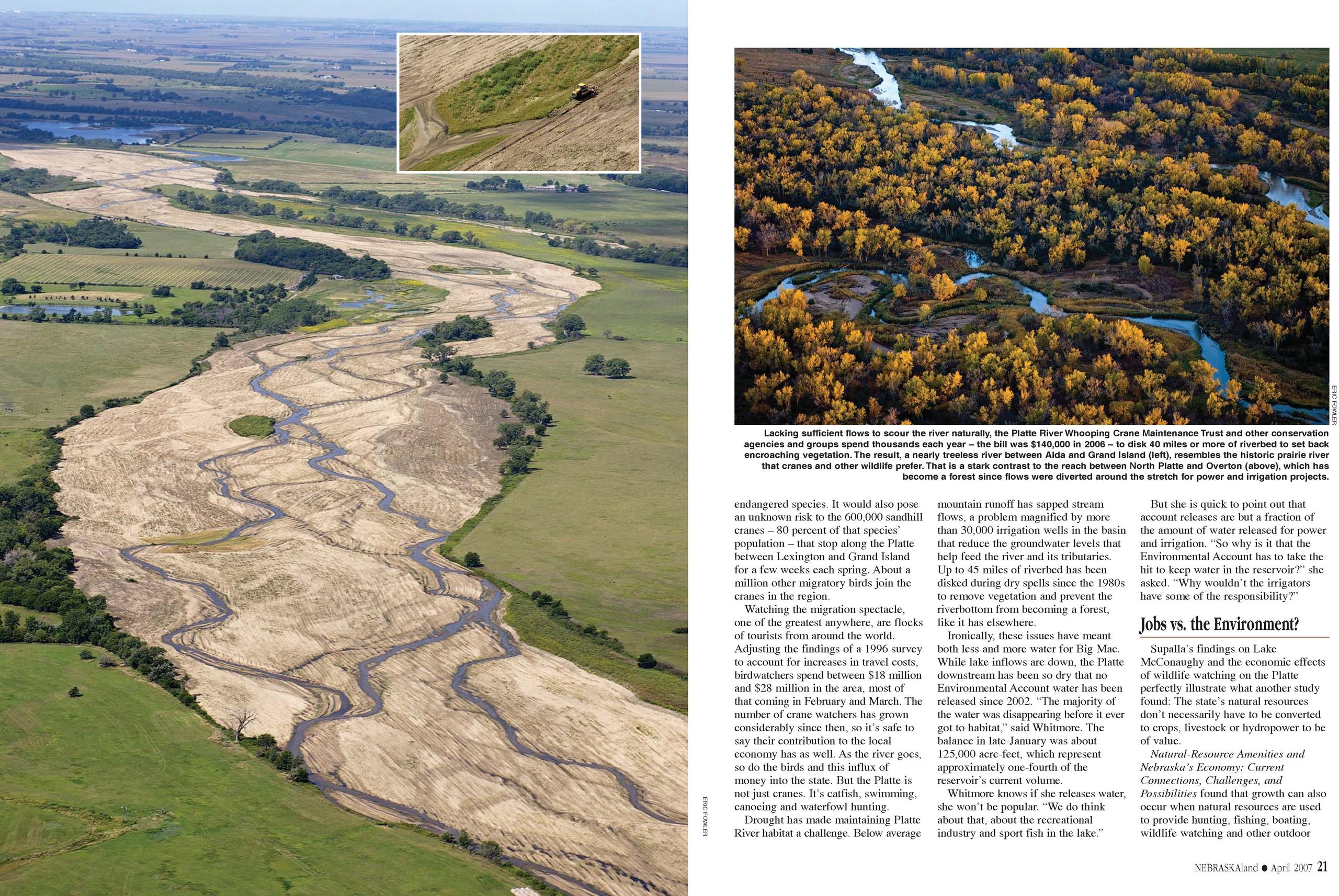
Drought has made maintaining Platte River habitat a challenge. Below average mountain runoff has sapped stream flows, a problem magnified by more than 30,000 irrigation wells in the basin that reduce the groundwater levels that help feed the river and its tributaries. Up to 45 miles of riverbed has been disked during dry spells since the 1980s to remove vegetation and prevent the riverbottom from becoming a forest, like it has elsewhere.
both less and more water for Big Mac. While lake inflows are down, the Platte downstream has been so dry that no Environmental Account water has been released since 2002. "The majority of the water was disappearing before it ever got to habitat," said Whitmore. The balance in late-January was about 125,000 acre-feet, which represent approximately one-fourth of the reservoir's current volume.
Whitmore knows if she releases water, she won't be popular. "We do think about that, about the recreational industry and sport fish in the lake."
But she is quick to point out that account releases are but a fraction of the amount of water released for power and irrigation. "So why is it that the Environmental Account has to take the hit to keep water in the reservoir?" she asked. "Why wouldn't the irrigators have some of the responsibility?"
Jobs vs. the Environment?Supalla's findings on Lake McConaughy and the economic effects of wildlife watching on the Platte perfectly illustrate what another study found: The state's natural resources don't necessarily have to be converted to crops, livestock or hydropower to be of value.
Natural-Resource Amenities and
Nebraska's Economy: Current
Connections, Challenges, and
Possibilities found that growth can also
occur when natural resources are used
to provide hunting, fishing, boating,
wildlife watching and other outdoor
NEBRASKAland April 2007 21
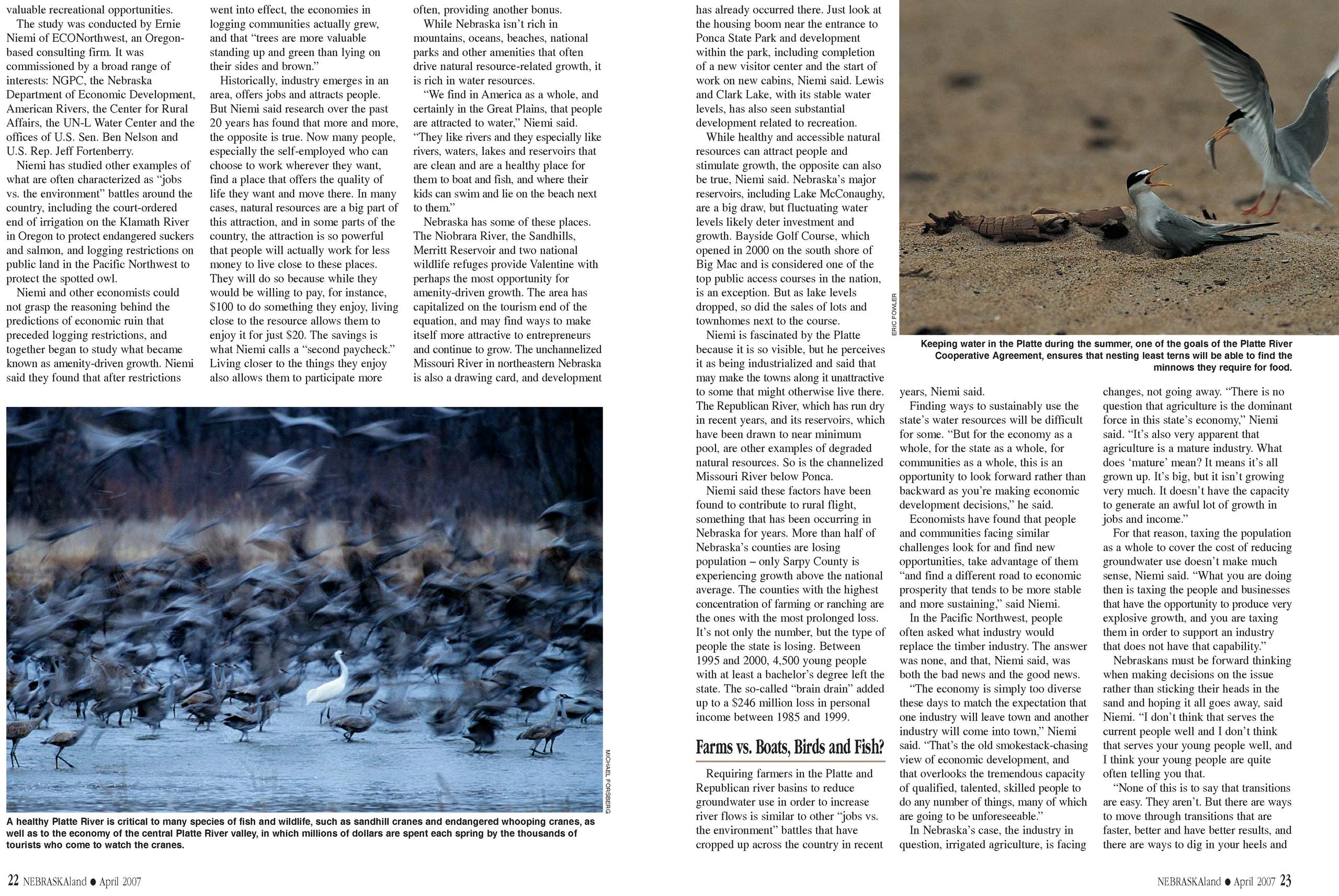 valuable recreational opportunities.
The study was conducted by Ernie Niemi of ECONorthwest, an Oregonbased consulting firm. It was commissioned by a broad range of interests: NGPC, the Nebraska Department of Economic Development, American Rivers, the Center for Rural Affairs, the UN-L Water Center and the offices of U.S. Sen. Ben Nelson and U.S. Rep. Jeff Fortenberry.
Niemi has studied other examples of what are often characterized as "jobs vs. the environment" battles around the country, including the court-ordered end of irrigation on the Klamath River in Oregon to protect endangered suckers and salmon, and logging restrictions on public land in the Pacific Northwest to protect the spotted owl.
Niemi and other economists could not grasp the reasoning behind the predictions of economic ruin that preceded logging restrictions, and together began to study what became known as amenity-driven growth. Niemi said they found that after restrictions went into effect, the economies in logging communities actually grew, and that "trees are more valuable standing up and green than lying on their sides and brown."
Historically, industry emerges in an area, offers jobs and attracts people. But Niemi said research over the past 20 years has found that more and more, the opposite is true. Now many people, especially the self-employed who can choose to work wherever they want, find a place that offers the quality of life they want and move there. In many cases, natural resources are a big part of this attraction, and in some parts of the country, the attraction is so powerful that people will actually work for less money to live close to these places. They will do so because while they would be willing to pay, for instance, $100 to do something they enjoy, living close to the resource allows them to enjoy it for just $20. The savings is what Niemi calls a "second paycheck." Living closer to the things they enjoy also allows them to participate more often, providing another bonus.
While Nebraska isn't rich in mountains, oceans, beaches, national parks and other amenities that often drive natural resource-related growth, it is rich in water resources.
"We find in America as a whole, and certainly in the Great Plains, that people are attracted to water," Niemi said. "They like rivers and they especially like rivers, waters, lakes and reservoirs that are clean and are a healthy place for them to boat and fish, and where their kids can swim and lie on the beach next to them."
Nebraska has some of these places. The Niobrara River, the Sandhills, Merritt Reservoir and two national wildlife refuges provide Valentine with perhaps the most opportunity for amenity-driven growth. The area has capitalized on the tourism end of the equation, and may find ways to make itself more attractive to entrepreneurs and continue to grow. The unchannelized Missouri River in northeastern Nebraska is also a drawing card, and development
While healthy and accessible natural resources can attract people and stimulate growth, the opposite can also be true, Niemi said. Nebraska's major reservoirs, including Lake McConaughy, are a big draw, but fluctuating water levels likely deter investment and growth. Bayside Golf Course, which opened in 2000 on the south shore of Big Mac and is considered one of the top public access courses in the nation, is an exception. But as lake levels dropped, so did the sales of lots and townhomes next to the course.
because it is so visible, but he perceives it as being industrialized and said that may make the towns along it unattractive to some that might otherwise live there. The Republican River, which has run dry in recent years, and its reservoirs, which have been drawn to near minimum pool, are other examples of degraded natural resources. So is the channelized Missouri River below Ponca.
Niemi said these factors have been found to contribute to rural flight, something that has been occurring in Nebraska for years. More than half of Nebraska's counties are losing population – only Sarpy County is experiencing growth above the national average. The counties with the highest concentration of farming or ranching are the ones with the most prolonged loss. It's not only the number, but the type of people the state is losing. Between 1995 and 2000, 4,500 young people with at least a bachelor's degree left the state. The so-called "brain drain" added up to a $246 million loss in personal income between 1985 and 1999.
Farms vs. Boats, Birds and Fish?Requiring farmers in the Platte and Republican river basins to reduce groundwater use in order to increase river flows is similar to other "jobs vs. the environment" battles that have cropped up across the country in recent
Finding ways to sustainably use the state's water resources will be difficult for some. "But for the economy as a whole, for the state as a whole, for communities as a whole, this is an opportunity to look forward rather than backward as you're making economic development decisions," he said.
Economists have found that people and communities facing similar challenges look for and find new opportunities, take advantage of them "and find a different road to economic prosperity that tends to be more stable and more sustaining," said Niemi.
In the Pacific Northwest, people often asked what industry would replace the timber industry. The answer was none, and that, Niemi said, was both the bad news and the good news.
"The economy is simply too diverse these days to match the expectation that one industry will leave town and another industry will come into town," Niemi said. "That's the old smokestack-chasing view of economic development, and that overlooks the tremendous capacity of qualified, talented, skilled people to do any number of things, many of which are going to be unforeseeable."
In Nebraska's case, the industry in question, irrigated agriculture, is facing changes, not going away. "There is no question that agriculture is the dominant force in this state's economy," Niemi said. "It's also very apparent that agriculture is a mature industry. What does 'mature' mean? It means it's all grown up. It's big, but it isn't growing very much. It doesn't have the capacity to generate an awful lot of growth in jobs and income."
For that reason, taxing the population as a whole to cover the cost of reducing groundwater use doesn't make much sense, Niemi said. "What you are doing then is taxing the people and businesses that have the opportunity to produce very explosive growth, and you are taxing them in order to support an industry that does not have that capability."
Nebraskans must be forward thinking when making decisions on the issue rather than sticking their heads in the sand and hoping it all goes away, said Niemi. "I don't think that serves the current people well and I don't think that serves your young people well, and I think your young people are quite often telling you that.
"None of this is to say that transitions
are easy. They aren't. But there are ways
to move through transitions that are
faster, better and have better results, and
there are ways to dig in your heels and
NEBRASKAland April 2007 23
"I'm not giving advice. I don't want to be characterized as somebody from the blue left coast coming in and telling you what to do. What I am saying is there are some lessons from many places in the United States that have faced and gone through very similar situations, and it's up to Nebraskans how they want to respond to it."
Making the Most of ItMark Heskett farms along Driftwood Creek southwest of McCook. In 2001, he and other farmers with rights to surface water stored in Swanson Reservoir received only part of their share. In the five years since, they haven't seen a drop. To make matters worse, falling groundwater levels, which have contributed to reduced flows into Swanson, have lowered the capacity of some of his wells. Of his 900 acres, he had enough water to farm only 90 last year.
For Heskett, growing crops without water is not an option. "You buy the ground as irrigated, and to pay the mortgage, dryland farming won't cover it," he said.
Insurance that pays farmers not to plant rather than to go to the expense of planting only to watch a crop fail "is all that's keeping us alive," Heskett said. But if Swanson and the irrigation canals it feeds don't fill soon, that payment, which is based on recent crop history, will begin to decline.
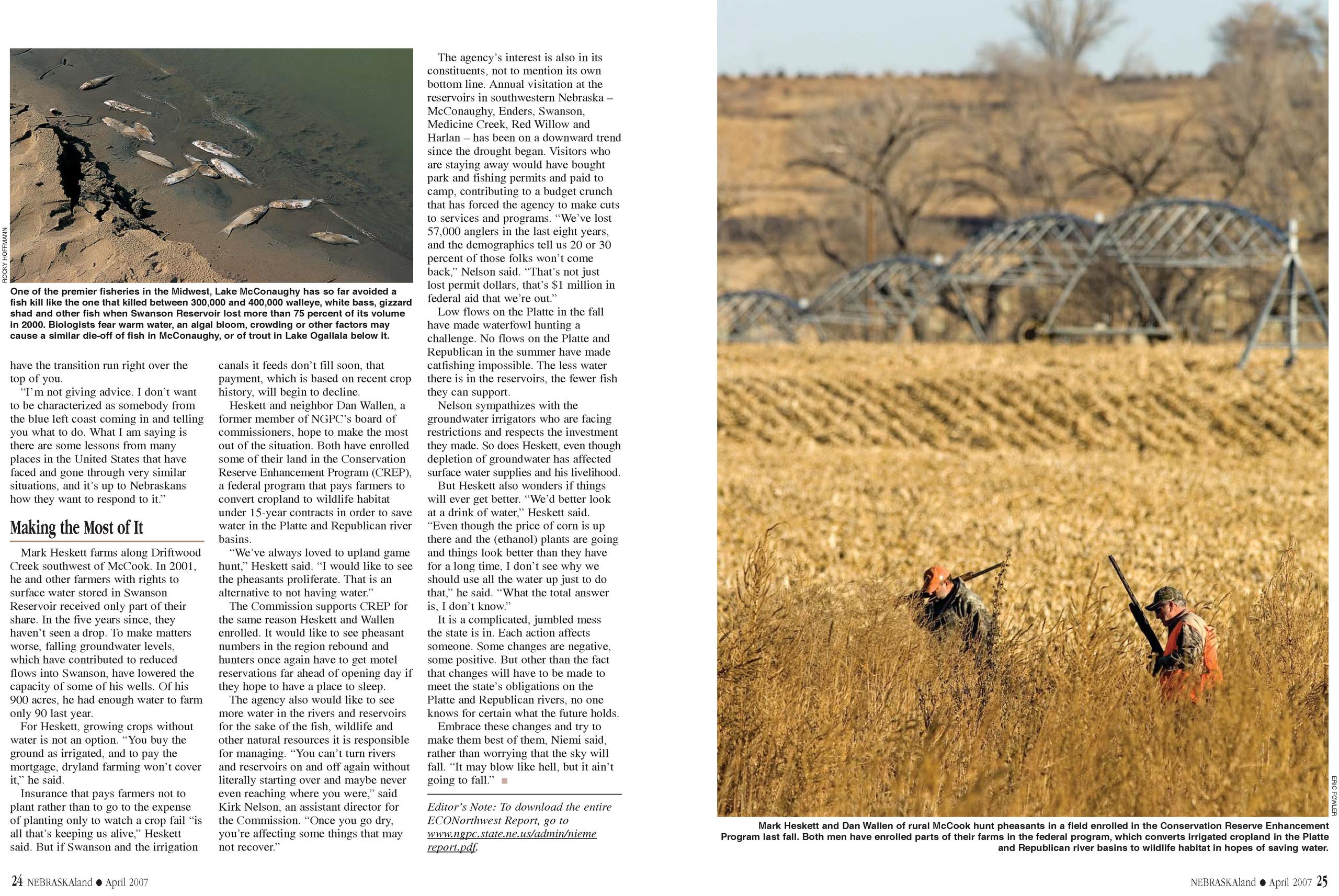
Heskett and neighbor Dan Wallen, a former member of NGPC's board of commissioners, hope to make the most out of the situation. Both have enrolled some of their land in the Conservation Reserve Enhancement Program (CREP), a federal program that pays farmers to convert cropland to wildlife habitat under 15-year contracts in order to save water in the Platte and Republican river basins.
"We've always loved to upland game hunt," Heskett said. "I would like to see the pheasants proliferate. That is an alternative to not having water."
The Commission supports CREP for the same reason Heskett and Wallen enrolled. It would like to see pheasant numbers in the region rebound and hunters once again have to get motel reservations far ahead of opening day if they hope to have a place to sleep.
The agency also would like to see more water in the rivers and reservoirs for the sake of the fish, wildlife and other natural resources it is responsible for managing. "You can't turn rivers and reservoirs on and off again without literally starting over and maybe never even reaching where you were," said Kirk Nelson, an assistant director for the Commission. "Once you go dry, you're affecting some things that may not recover."
The agency's interest is also in its constituents, not to mention its own bottom line. Annual visitation at the reservoirs in southwestern Nebraska – McConaughy, Enders, Swanson, Medicine Creek, Red Willow and Harlan – has been on a downward trend since the drought began. Visitors who are staying away would have bought park and fishing permits and paid to camp, contributing to a budget crunch that has forced the agency to make cuts to services and programs. "We've lost 57,000 anglers in the last eight years, and the demographics tell us 20 or 30 percent of those folks won't come back," Nelson said. "That's not just lost permit dollars, that's $1 million in federal aid that we're out."
Low flows on the Platte in the fall have made waterfowl hunting a challenge. No flows on the Platte and Republican in the summer have made catfishing impossible. The less water there is in the reservoirs, the fewer fish they can support.
Nelson sympathizes with the groundwater irrigators who are facing restrictions and respects the investment they made. So does Heskett, even though depletion of groundwater has affected surface water supplies and his livelihood.
But Heskett also wonders if things will ever get better. "We'd better look at a drink of water," Heskett said. "Even though the price of corn is up there and the (ethanol) plants are going and things look better than they have for a long time, I don't see why we should use all the water up just to do that," he said. "What the total answer is, I don't know."
It is a complicated, jumbled mess the state is in. Each action affects someone. Some changes are negative, some positive. But other than the fact that changes will have to be made to meet the state's obligations on the Platte and Republican rivers, no one knows for certain what the future holds.
Embrace these changes and try to make them best of them, Niemi said, rather than worrying that the sky will fall. "It may blow like hell, but it ain't going to fall." ■
Editor's Note: To download the entire ECONorthwest Report, go to www.ngpc.state.ne.us/admin/nieme report.pdf. 24 NEBRASKAland April 2007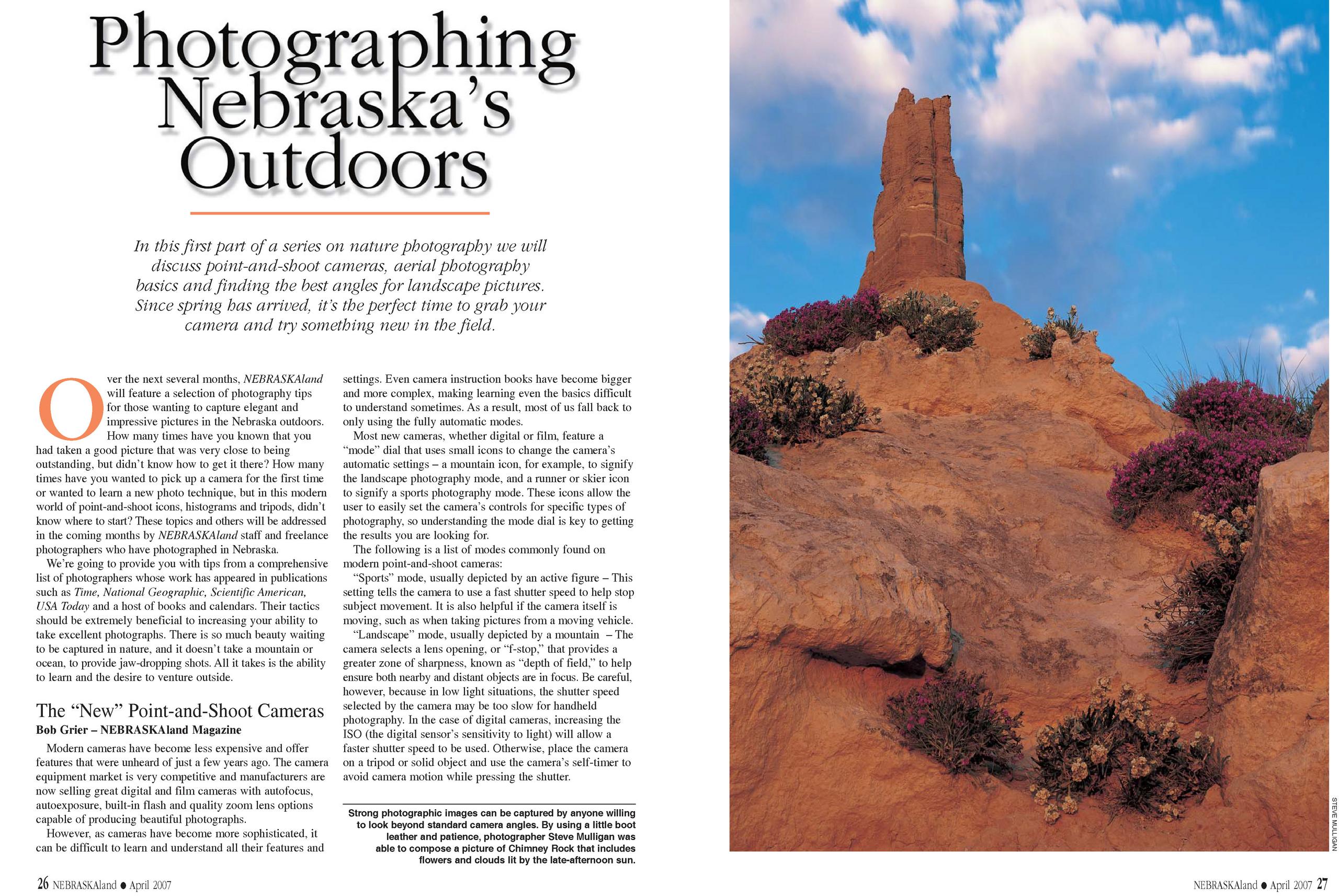
Photographing Nebraska's Outdoors
In this first part of a series on nature photography we will discuss point-and-shoot cameras, aerial photography basics and finding the best angles for landscape pictures. Since spring has arrived, it's the perfect time to grab your camera and try something new in the field.
Over the next several months, NEBRASKAland will feature a selection of photography tips for those wanting to capture elegant and impressive pictures in the Nebraska outdoors. How many times have you known that you had taken a good picture that was very close to being outstanding, but didn't know how to get it there? How many times have you wanted to pick up a camera for the first time or wanted to learn a new photo technique, but in this modern world of point-and-shoot icons, histograms and tripods, didn't know where to start? These topics and others will be addressed in the coming months by NEBRASKAland staff and freelance photographers who have photographed in Nebraska.
We're going to provide you with tips from a comprehensive list of photographers whose work has appeared in publications such as Time, National Geographic, Scientific American, USA Today and a host of books and calendars. Their tactics should be extremely beneficial to increasing your ability to take excellent photographs. There is so much beauty waiting to be captured in nature, and it doesn't take a mountain or ocean, to provide jaw-dropping shots. All it takes is the ability to learn and the desire to venture outside.
The "New" Point-and-Shoot Cameras Bob Grier – NEBRASKAland MagazineModern cameras have become less expensive and offer features that were unheard of just a few years ago. The camera equipment market is very competitive and manufacturers are now selling great digital and film cameras with autofocus, autoexposure, built-in flash and quality zoom lens options capable of producing beautiful photographs.
However, as cameras have become more sophisticated, it can be difficult to learn and understand all their features and settings. Even camera instruction books have become bigger and more complex, making learning even the basics difficult to understand sometimes. As a result, most of us fall back to only using the fully automatic modes.
Most new cameras, whether digital or film, feature a "mode" dial that uses small icons to change the camera's automatic settings – a mountain icon, for example, to signify the landscape photography mode, and a runner or skier icon to signify a sports photography mode. These icons allow the user to easily set the camera's controls for specific types of photography, so understanding the mode dial is key to getting the results you are looking for.
The following is a list of modes commonly found on modern point-and-shoot cameras:
"Sports" mode, usually depicted by an active figure – This setting tells the camera to use a fast shutter speed to help stop subject movement. It is also helpful if the camera itself is moving, such as when taking pictures from a moving vehicle.
"Landscape" mode, usually depicted by a mountain – The camera selects a lens opening, or "f-stop," that provides a greater zone of sharpness, known as "depth of field," to help ensure both nearby and distant objects are in focus. Be careful, however, because in low light situations, the shutter speed selected by the camera may be too slow for handheld photography. In the case of digital cameras, increasing the ISO (the digital sensor's sensitivity to light) will allow a faster shutter speed to be used. Otherwise, place the camera on a tripod or solid object and use the camera's self-timer to avoid camera motion while pressing the shutter.
26 NEBRASKAland April 2007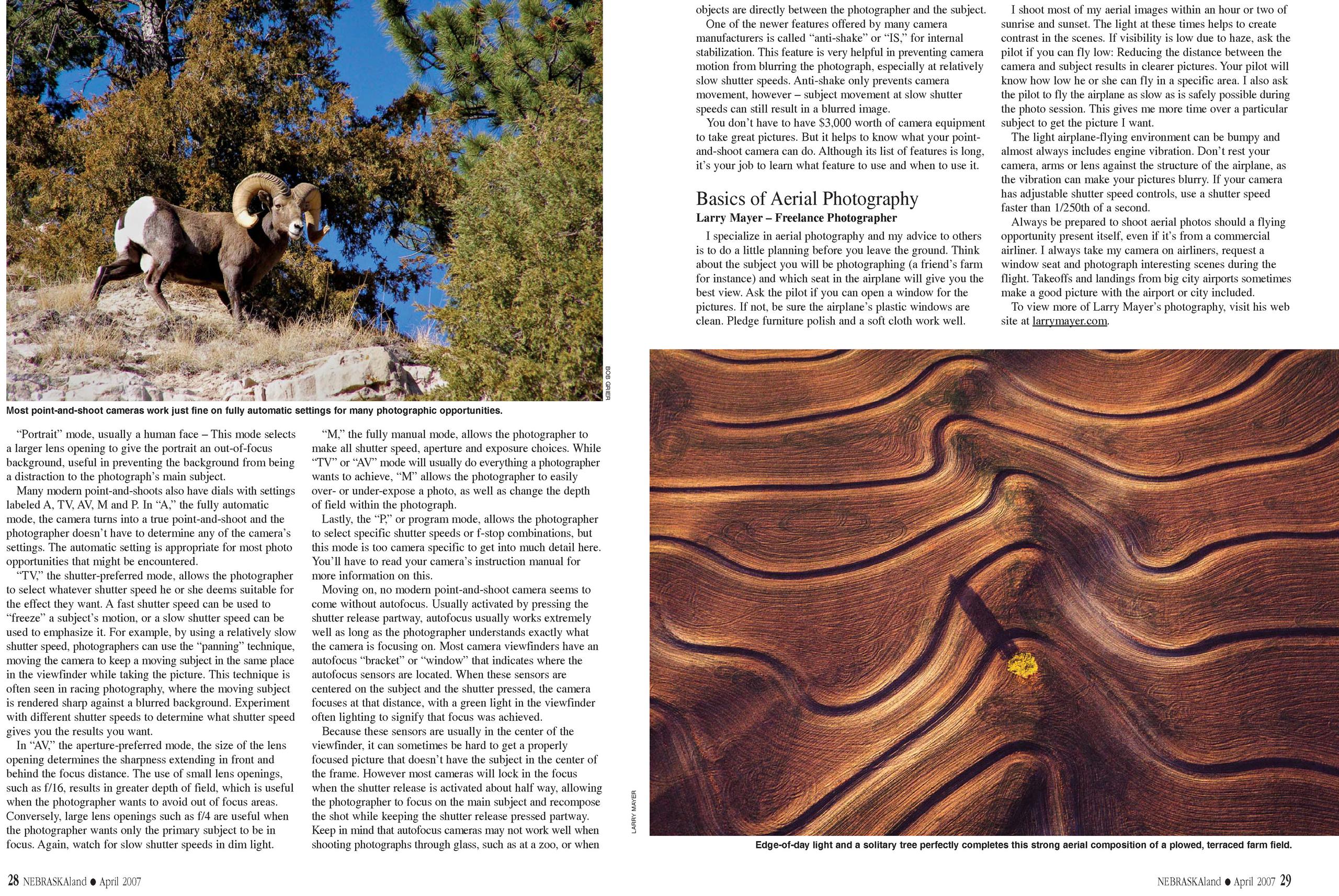
"Portrait" mode, usually a human face – This mode selects a larger lens opening to give the portrait an out-of-focus background, useful in preventing the background from being a distraction to the photograph's main subject.
Many modern point-and-shoots also have dials with settings labeled A, TV, AV, M and P. In "A," the fully automatic mode, the camera turns into a true point-and-shoot and the photographer doesn't have to determine any of the camera's settings. The automatic setting is appropriate for most photo opportunities that might be encountered.
"TV," the shutter-preferred mode, allows the photographer to select whatever shutter speed he or she deems suitable for the effect they want. A fast shutter speed can be used to "freeze" a subject's motion, or a slow shutter speed can be used to emphasize it. For example, by using a relatively slow shutter speed, photographers can use the "panning" technique, moving the camera to keep a moving subject in the same place in the viewfinder while taking the picture. This technique is often seen in racing photography, where the moving subject is rendered sharp against a blurred background. Experiment with different shutter speeds to determine what shutter speed gives you the results you want.
In "AV," the aperture-preferred mode, the size of the lens opening determines the sharpness extending in front and behind the focus distance. The use of small lens openings, such as f/16, results in greater depth of field, which is useful when the photographer wants to avoid out of focus areas. Conversely, large lens openings such as f/4 are useful when the photographer wants only the primary subject to be in focus. Again, watch for slow shutter speeds in dim light.
"M," the fully manual mode, allows the photographer to make all shutter speed, aperture and exposure choices. While "TV" or "AV" mode will usually do everything a photographer wants to achieve, "M" allows the photographer to easily over- or under-expose a photo, as well as change the depth of field within the photograph.
Lastly, the "P," or program mode, allows the photographer to select specific shutter speeds or f-stop combinations, but this mode is too camera specific to get into much detail here. You'll have to read your camera's instruction manual for more information on this.
Moving on, no modern point-and-shoot camera seems to come without autofocus. Usually activated by pressing the shutter release partway, autofocus usually works extremely well as long as the photographer understands exactly what the camera is focusing on. Most camera viewfinders have an autofocus "bracket" or "window" that indicates where the autofocus sensors are located. When these sensors are centered on the subject and the shutter pressed, the camera focuses at that distance, with a green light in the viewfinder often lighting to signify that focus was achieved.
Because these sensors are usually in the center of the viewfinder, it can sometimes be hard to get a properly focused picture that doesn't have the subject in the center of the frame. However most cameras will lock in the focus when the shutter release is activated about half way, allowing the photographer to focus on the main subject and recompose the shot while keeping the shutter release pressed partway. Keep in mind that autofocus cameras may not work well when shooting photographs through glass, such as at a zoo, or when 28 NEBRASKAland April 2007 objects are directly between the photographer and the subject.
One of the newer features offered by many camera manufacturers is called "anti-shake" or "IS," for internal stabilization. This feature is very helpful in preventing camera motion from blurring the photograph, especially at relatively slow shutter speeds. Anti-shake only prevents camera movement, however – subject movement at slow shutter speeds can still result in a blurred image.
You don't have to have $3,000 worth of camera equipment to take great pictures. But it helps to know what your pointand- shoot camera can do. Although its list of features is long, it's your job to learn what feature to use and when to use it.
Basics of Aerial Photography Larry Mayer – Freelance PhotographerI specialize in aerial photography and my advice to others is to do a little planning before you leave the ground. Think about the subject you will be photographing (a friend's farm for instance) and which seat in the airplane will give you the best view. Ask the pilot if you can open a window for the pictures. If not, be sure the airplane's plastic windows are clean. Pledge furniture polish and a soft cloth work well.
I shoot most of my aerial images within an hour or two of sunrise and sunset. The light at these times helps to create contrast in the scenes. If visibility is low due to haze, ask the pilot if you can fly low: Reducing the distance between the camera and subject results in clearer pictures. Your pilot will know how low he or she can fly in a specific area. I also ask the pilot to fly the airplane as slow as is safely possible during the photo session. This gives me more time over a particular subject to get the picture I want.
The light airplane-flying environment can be bumpy and almost always includes engine vibration. Don't rest your camera, arms or lens against the structure of the airplane, as the vibration can make your pictures blurry. If your camera has adjustable shutter speed controls, use a shutter speed faster than 1/250th of a second.
Always be prepared to shoot aerial photos should a flying opportunity present itself, even if it's from a commercial airliner. I always take my camera on airliners, request a window seat and photograph interesting scenes during the flight. Takeoffs and landings from big city airports sometimes make a good picture with the airport or city included.
To view more of Larry Mayer's photography, visit his web site at larrymayer.com.
 Finding the Best Angle
Steve Mulligan – Freelance Photographer
Finding the Best Angle
Steve Mulligan – Freelance Photographer
There are many aspects involved in the making of a good landscape photograph. Angle of light is important, as is proper location. However, of the various considerations, perhaps the most important is compositional angle. Selecting the best location to shoot any given landscape photo is the first step on the road to a successful image. Occasionally this will be an easy choice, obvious as soon as you decide to take a picture. More often it involves patience, exploration and a certain amount of walking. And of course, as with so many things in life, there will be the rare, but inevitable, extremecase scenario.
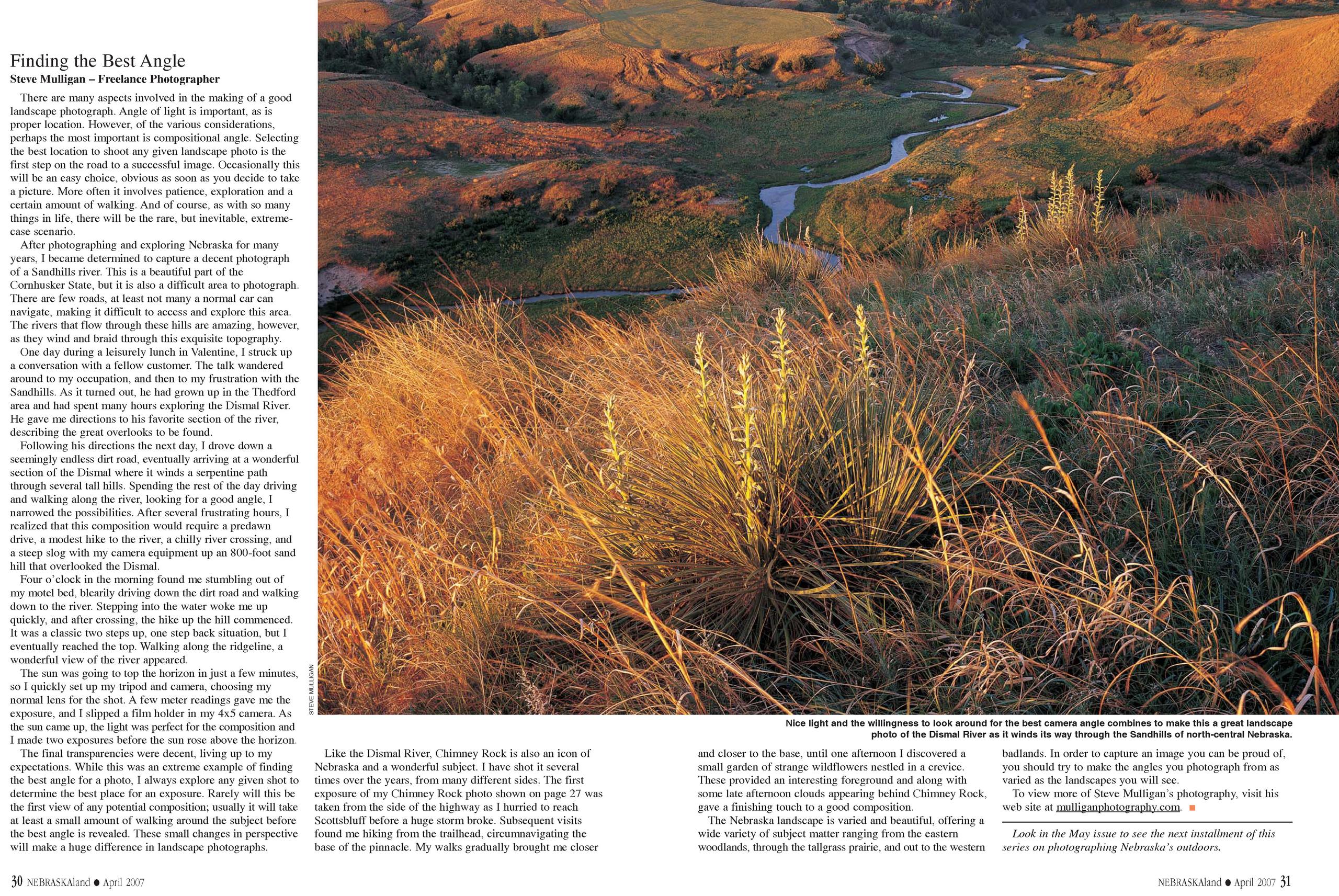
After photographing and exploring Nebraska for many years, I became determined to capture a decent photograph of a Sandhills river. This is a beautiful part of the Cornhusker State, but it is also a difficult area to photograph. There are few roads, at least not many a normal car can navigate, making it difficult to access and explore this area. The rivers that flow through these hills are amazing, however, as they wind and braid through this exquisite topography.
One day during a leisurely lunch in Valentine, I struck up a conversation with a fellow customer. The talk wandered around to my occupation, and then to my frustration with the Sandhills. As it turned out, he had grown up in the Thedford area and had spent many hours exploring the Dismal River. He gave me directions to his favorite section of the river, describing the great overlooks to be found.
Following his directions the next day, I drove down a seemingly endless dirt road, eventually arriving at a wonderful section of the Dismal where it winds a serpentine path through several tall hills. Spending the rest of the day driving and walking along the river, looking for a good angle, I narrowed the possibilities. After several frustrating hours, I realized that this composition would require a predawn drive, a modest hike to the river, a chilly river crossing, and a steep slog with my camera equipment up an 800-foot sand hill that overlooked the Dismal.
Four o'clock in the morning found me stumbling out of my motel bed, blearily driving down the dirt road and walking down to the river. Stepping into the water woke me up quickly, and after crossing, the hike up the hill commenced. It was a classic two steps up, one step back situation, but I eventually reached the top. Walking along the ridgeline, a wonderful view of the river appeared.
The sun was going to top the horizon in just a few minutes, so I quickly set up my tripod and camera, choosing my normal lens for the shot. A few meter readings gave me the exposure, and I slipped a film holder in my 4x5 camera. As the sun came up, the light was perfect for the composition and I made two exposures before the sun rose above the horizon.
The final transparencies were decent, living up to my expectations. While this was an extreme example of finding the best angle for a photo, I always explore any given shot to determine the best place for an exposure. Rarely will this be the first view of any potential composition; usually it will take at least a small amount of walking around the subject before the best angle is revealed. These small changes in perspective will make a huge difference in landscape photographs.
Like the Dismal River, Chimney Rock is also an icon of Nebraska and a wonderful subject. I have shot it several times over the years, from many different sides. The first exposure of my Chimney Rock photo shown on page 27 was taken from the side of the highway as I hurried to reach Scottsbluff before a huge storm broke. Subsequent visits found me hiking from the trailhead, circumnavigating the base of the pinnacle. My walks gradually brought me closer 30 NEBRASKAland April 2007 and closer to the base, until one afternoon I discovered a small garden of strange wildflowers nestled in a crevice. These provided an interesting foreground and along with some late afternoon clouds appearing behind Chimney Rock, gave a finishing touch to a good composition.
The Nebraska landscape is varied and beautiful, offering a wide variety of subject matter ranging from the eastern woodlands, through the tallgrass prairie, and out to the western badlands. In order to capture an image you can be proud of, you should try to make the angles you photograph from as varied as the landscapes you will see.
To view more of Steve Mulligan's photography, visit his web site at mulliganphotography.com.
Look in the May issue to see the next installment of this series on photographing Nebraska's outdoors.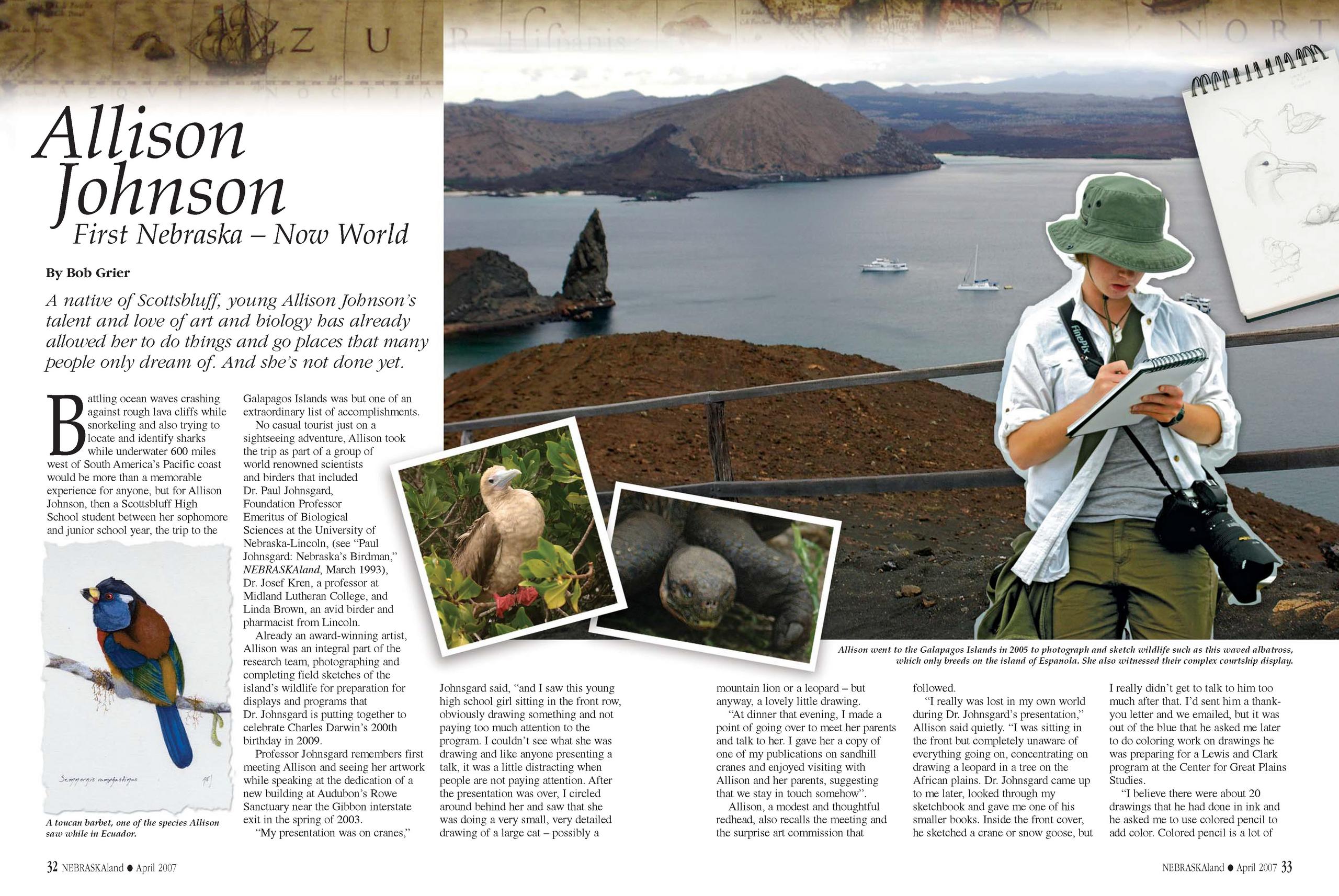
Allison Johnson
First Nebraska – Now World
A native of Scottsbluff, young Allison Johnson's talent and love of art and biology has already allowed her to do things and go places that many people only dream of. And she's not done yet.Battling ocean waves crashing against rough lava cliffs while snorkeling and also trying to locate and identify sharks while underwater 600 miles west of South America's Pacific coast would be more than a memorable experience for anyone, but for Allison Johnson, then a Scottsbluff High School student between her sophomore and junior school year, the trip to the
No casual tourist just on a sightseeing adventure, Allison took the trip as part of a group of world renowned scientists and birders that included Dr. Paul Johnsgard, Foundation Professor Emeritus of Biological Sciences at the University of Nebraska-Lincoln, (see "Paul Johnsgard: Nebraska's Birdman," NEBRASKAland, March 1993), Dr. Josef Kren, a professor at Midland Lutheran College, and Linda Brown, an avid birder and pharmacist from Lincoln.
Already an award-winning artist, Allison was an integral part of the research team, photographing and completing field sketches of the island's wildlife for preparation for displays and programs that Dr. Johnsgard is putting together to celebrate Charles Darwin's 200th birthday in 2009.
Professor Johnsgard remembers first meeting Allison and seeing her artwork while speaking at the dedication of a new building at Audubon's Rowe Sanctuary near the Gibbon interstate exit in the spring of 2003.
"My presentation was on cranes," Johnsgard said, "and I saw this young high school girl sitting in the front row, obviously drawing something and not paying too much attention to the program. I couldn't see what she was drawing and like anyone presenting a talk, it was a little distracting when people are not paying attention. After the presentation was over, I circled around behind her and saw that she was doing a very small, very detailed drawing of a large cat – possibly a 32 NEBRASKAland April 2007
"At dinner that evening, I made a point of going over to meet her parents and talk to her. I gave her a copy of one of my publications on sandhill cranes and enjoyed visiting with Allison and her parents, suggesting that we stay in touch somehow".
Allison, a modest and thoughtful redhead, also recalls the meeting and the surprise art commission that followed.
"I really was lost in my own world during Dr. Johnsgard's presentation," Allison said quietly. "I was sitting in the front but completely unaware of everything going on, concentrating on drawing a leopard in a tree on the African plains. Dr. Johnsgard came up to me later, looked through my sketchbook and gave me one of his smaller books. Inside the front cover, he sketched a crane or snow goose, but I really didn't get to talk to him too much after that. I'd sent him a thankyou letter and we emailed, but it was out of the blue that he asked me later to do coloring work on drawings he was preparing for a Lewis and Clark program at the Center for Great Plains Studies.
"I believe there were about 20
drawings that he had done in ink and
he asked me to use colored pencil to
add color. Colored pencil is a lot of
NEBRASKAland April 2007 33
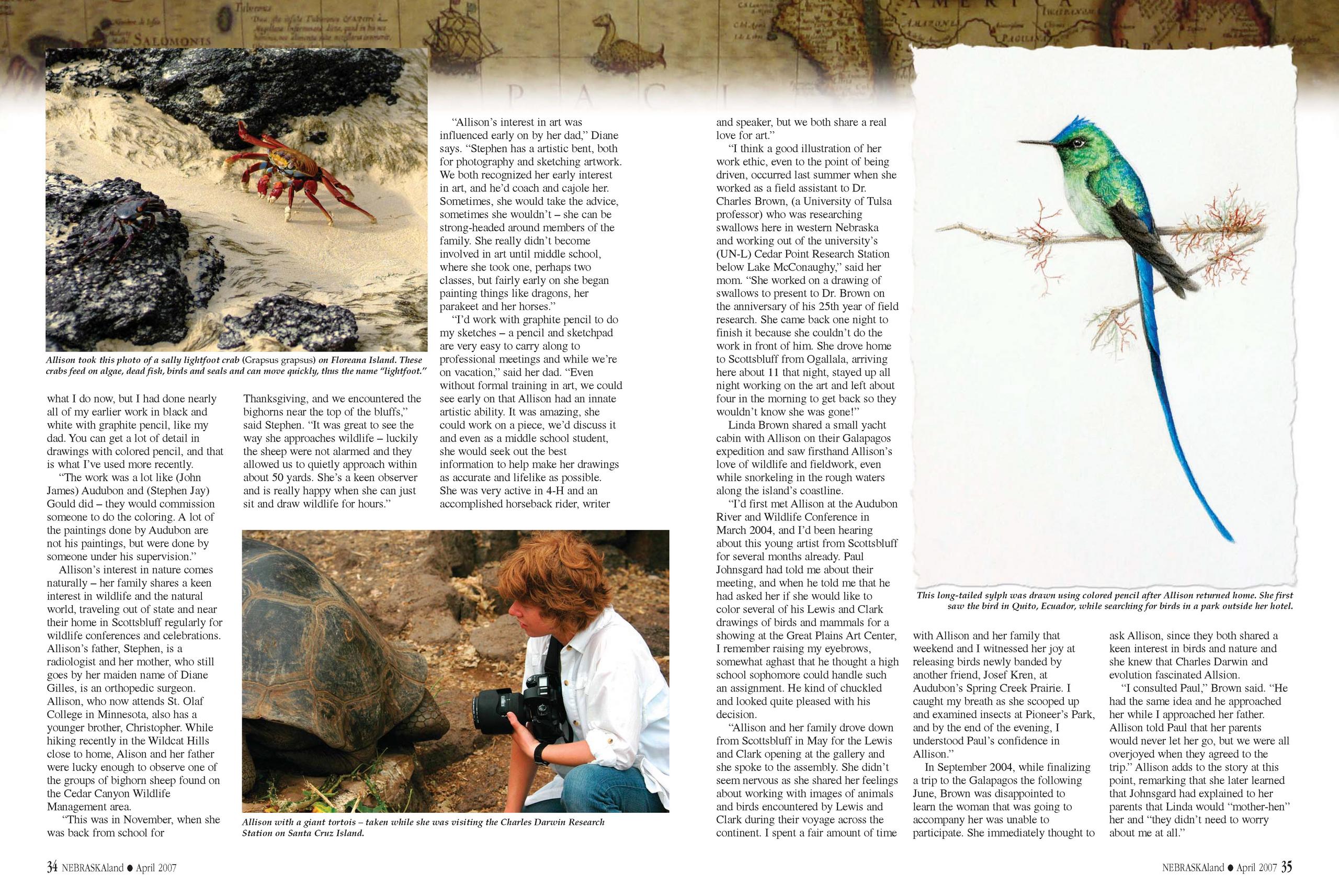
"The work was a lot like (John James) Audubon and (Stephen Jay) Gould did – they would commission someone to do the coloring. A lot of the paintings done by Audubon are not his paintings, but were done by someone under his supervision."
Allison's interest in nature comes naturally – her family shares a keen interest in wildlife and the natural world, traveling out of state and near their home in Scottsbluff regularly for wildlife conferences and celebrations. Allison's father, Stephen, is a radiologist and her mother, who still goes by her maiden name of Diane Gilles, is an orthopedic surgeon. Allison, who now attends St. Olaf College in Minnesota, also has a younger brother, Christopher. While hiking recently in the Wildcat Hills close to home, Alison and her father were lucky enough to observe one of the groups of bighorn sheep found on the Cedar Canyon Wildlife Management area.
"This was in November, when she was back from school for Thanksgiving, and we encountered the bighorns near the top of the bluffs," said Stephen. "It was great to see the way she approaches wildlife – luckily the sheep were not alarmed and they allowed us to quietly approach within about 50 yards. She's a keen observer and is really happy when she can just sit and draw wildlife for hours."
"Allison's interest in art was influenced early on by her dad," Diane says. "Stephen has a artistic bent, both for photography and sketching artwork. We both recognized her early interest in art, and he'd coach and cajole her. Sometimes, she would take the advice, sometimes she wouldn't – she can be strong-headed around members of the family. She really didn't become involved in art until middle school, where she took one, perhaps two classes, but fairly early on she began painting things like dragons, her parakeet and her horses."
"I'd work with graphite pencil to do my sketches – a pencil and sketchpad are very easy to carry along to professional meetings and while we're on vacation," said her dad. "Even without formal training in art, we could see early on that Allison had an innate artistic ability. It was amazing, she could work on a piece, we'd discuss it and even as a middle school student, she would seek out the best information to help make her drawings as accurate and lifelike as possible. She was very active in 4-H and an accomplished horseback rider, writer
"I think a good illustration of her work ethic, even to the point of being driven, occurred last summer when she worked as a field assistant to Dr. Charles Brown, (a University of Tulsa professor) who was researching swallows here in western Nebraska and working out of the university's (UN-L) Cedar Point Research Station below Lake McConaughy," said her mom. "She worked on a drawing of swallows to present to Dr. Brown on the anniversary of his 25th year of field research. She came back one night to finish it because she couldn't do the work in front of him. She drove home to Scottsbluff from Ogallala, arriving here about 11 that night, stayed up all night working on the art and left about four in the morning to get back so they wouldn't know she was gone!"
Linda Brown shared a small yacht cabin with Allison on their Galapagos expedition and saw firsthand Allison's love of wildlife and fieldwork, even while snorkeling in the rough waters along the island's coastline.
"I'd first met Allison at the Audubon River and Wildlife Conference in March 2004, and I'd been hearing about this young artist from Scottsbluff for several months already. Paul Johnsgard had told me about their meeting, and when he told me that he had asked her if she would like to color several of his Lewis and Clark drawings of birds and mammals for a showing at the Great Plains Art Center, I remember raising my eyebrows, somewhat aghast that he thought a high school sophomore could handle such an assignment. He kind of chuckled and looked quite pleased with his decision.
decision. "Allison and her family drove down from Scottsbluff in May for the Lewis and Clark opening at the gallery and she spoke to the assembly. She didn't seem nervous as she shared her feelings about working with images of animals and birds encountered by Lewis and Clark during their voyage across the continent. I spent a fair amount of time
In September 2004, while finalizing a trip to the Galapagos the following June, Brown was disappointed to learn the woman that was going to accompany her was unable to participate. She immediately thought to ask Allison, since they both shared a keen interest in birds and nature and she knew that Charles Darwin and evolution fascinated Allsion.
"I consulted Paul," Brown said. "He had the same idea and he approached her while I approached her father. Allison told Paul that her parents would never let her go, but we were all overjoyed when they agreed to the trip." Allison adds to the story at this point, remarking that she later learned that Johnsgard had explained to her parents that Linda would "mother-hen" her and "they didn't need to worry about me at all."
NEBRASKAland April 2007 35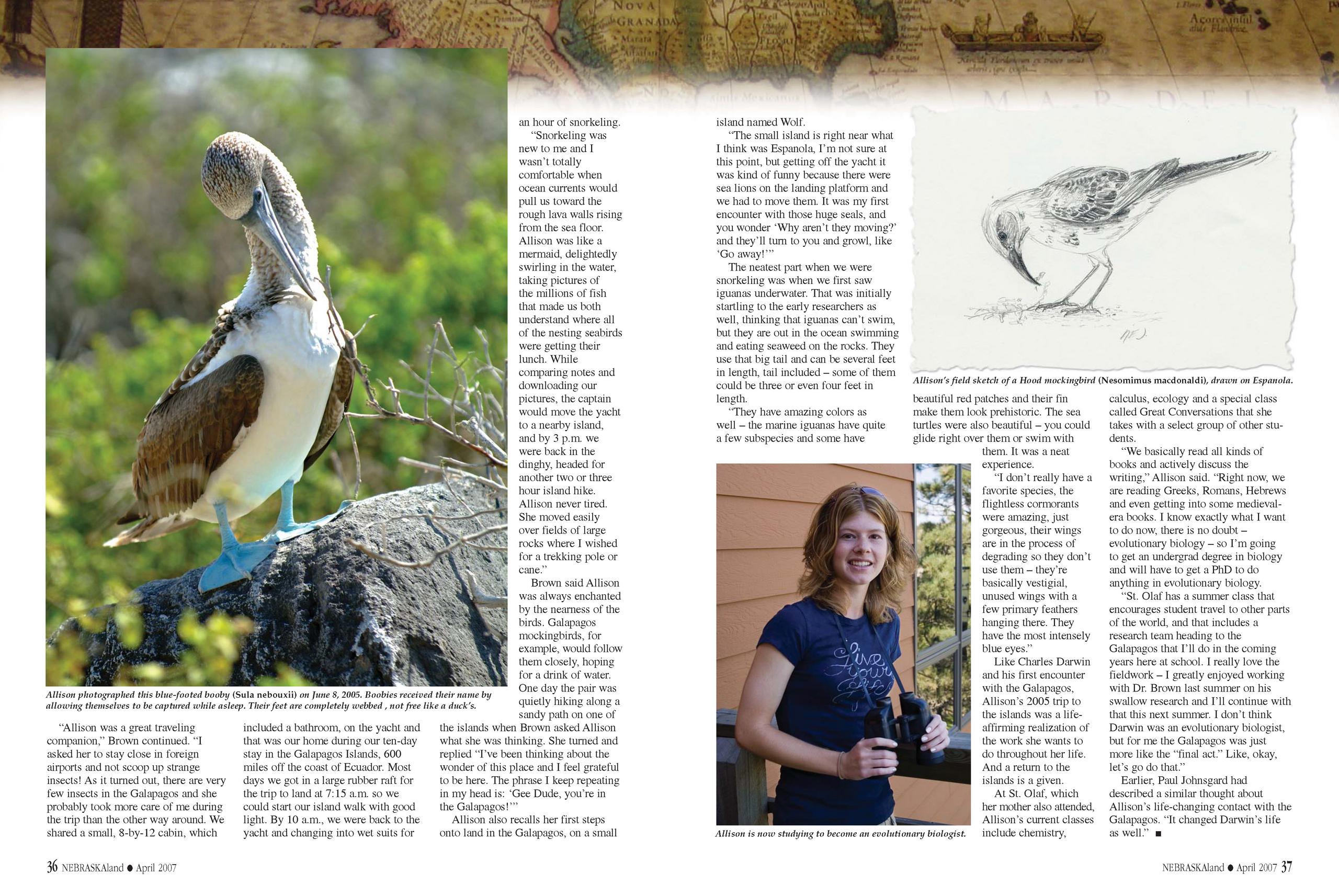
"Allison was a great traveling companion," Brown continued. "I asked her to stay close in foreign airports and not scoop up strange insects! As it turned out, there are very few insects in the Galapagos and she probably took more care of me during the trip than the other way around. We shared a small, 8-by-12 cabin, which included a bathroom, on the yacht and that was our home during our ten-day stay in the Galapagos Islands, 600 miles off the coast of Ecuador. Most days we got in a large rubber raft for the trip to land at 7:15 a.m. so we could start our island walk with good light. By 10 a.m., we were back to the yacht and changing into wet suits for an hour of snorkeling.
"Snorkeling was new to me and I wasn't totally comfortable when ocean currents would pull us toward the rough lava walls rising from the sea floor. Allison was like a mermaid, delightedly swirling in the water, taking pictures of the millions of fish that made us both understand where all of the nesting seabirds were getting their lunch. While comparing notes and downloading our pictures, the captain would move the yacht to a nearby island, and by 3 p.m. we were back in the dinghy, headed for another two or three hour island hike. Allison never tired. She moved easily over fields of large rocks where I wished for a trekking pole or cane."
Brown said Allison was always enchanted by the nearness of the birds. Galapagos mockingbirds, for example, would follow them closely, hoping for a drink of water. One day the pair was quietly hiking along a sandy path on one of the islands when Brown asked Allison what she was thinking. She turned and replied "I've been thinking about the wonder of this place and I feel grateful to be here. The phrase I keep repeating in my head is: 'Gee Dude, you're in the Galapagos!'"
Allison also recalls her first steps onto land in the Galapagos, on a small 36 NEBRASKAland April 2007 island named Wolf.
"The small island is right near what I think was Espanola, I'm not sure at this point, but getting off the yacht it was kind of funny because there were sea lions on the landing platform and we had to move them. It was my first encounter with those huge seals, and you wonder 'Why aren't they moving?' and they'll turn to you and growl, like 'Go away!'"
The neatest part when we were snorkeling was when we first saw iguanas underwater. That was initially startling to the early researchers as well, thinking that iguanas can't swim, but they are out in the ocean swimming and eating seaweed on the rocks. They use that big tail and can be several feet in length, tail included – some of them could be three or even four feet in length.
"They have amazing colors as well – the marine iguanas have quite a few subspecies and some have
"I don't really have a favorite species, the flightless cormorants were amazing, just gorgeous, their wings are in the process of degrading so they don't use them – they're basically vestigial, unused wings with a few primary feathers hanging there. They have the most intensely blue eyes."
Like Charles Darwin and his first encounter with the Galapagos, Allison's 2005 trip to the islands was a lifeaffirming realization of the work she wants to do throughout her life. And a return to the islands is a given.
At St. Olaf, which her mother also attended, Allison's current classes include chemistry, calculus, ecology and a special class called Great Conversations that she takes with a select group of other students.
"We basically read all kinds of books and actively discuss the writing," Allison said. "Right now, we are reading Greeks, Romans, Hebrews and even getting into some medievalera books. I know exactly what I want to do now, there is no doubt – evolutionary biology – so I'm going to get an undergrad degree in biology and will have to get a PhD to do anything in evolutionary biology.
"St. Olaf has a summer class that encourages student travel to other parts of the world, and that includes a research team heading to the Galapagos that I'll do in the coming years here at school. I really love the fieldwork – I greatly enjoyed working with Dr. Brown last summer on his swallow research and I'll continue with that this next summer. I don't think Darwin was an evolutionary biologist, but for me the Galapagos was just more like the "final act." Like, okay, let's go do that."
Earlier, Paul Johnsgard had described a similar thought about Allison's life-changing contact with the Galapagos. "It changed Darwin's life as well."
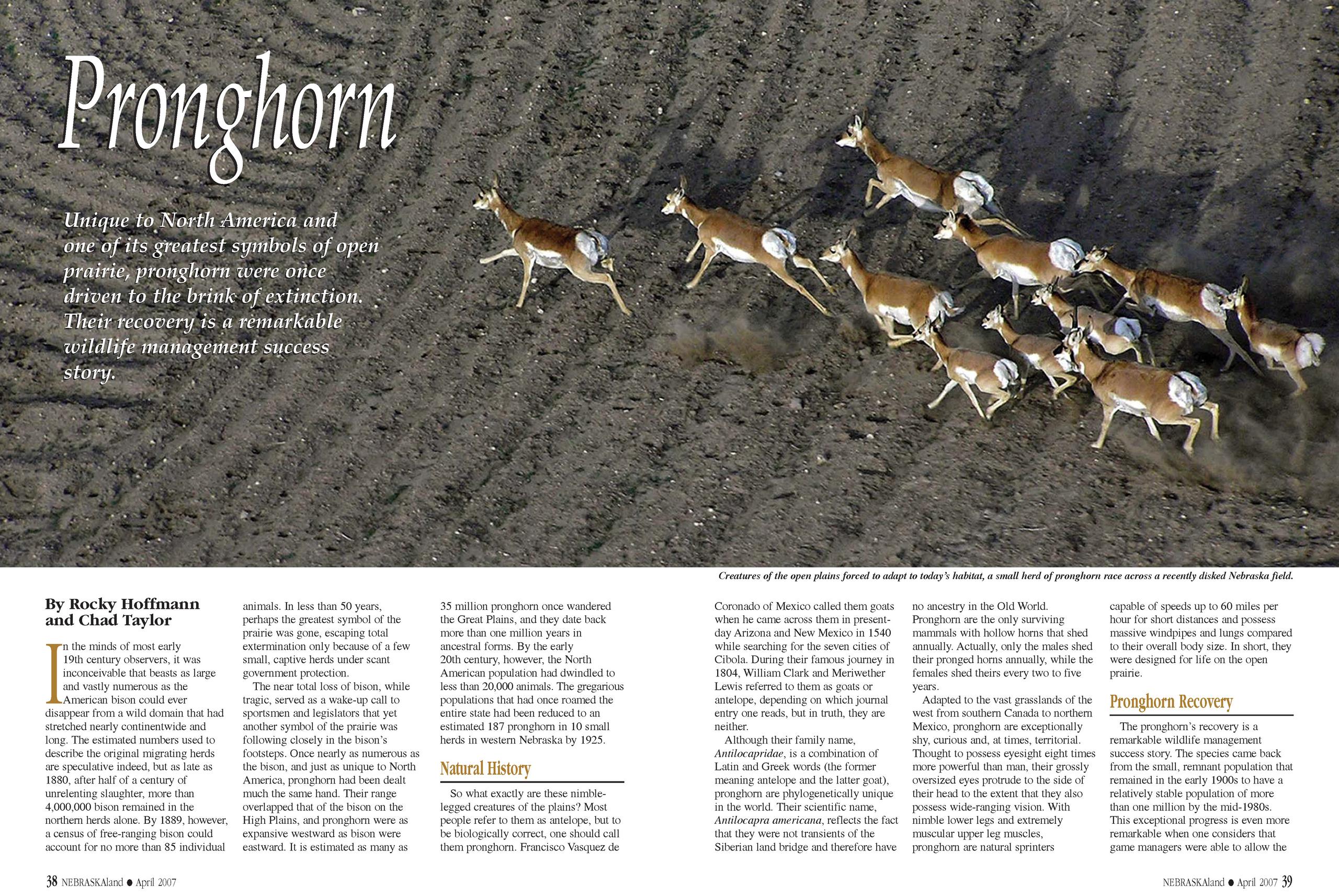
Pronghorn
Unique to North America and one of its greatest symbols of open prairie, pronghorn were once driven to the brink of extinction. Their recovery is a remarkable wildlife management success story.
In the minds of most early 19th century observers, it was inconceivable that beasts as large and vastly numerous as the American bison could ever disappear from a wild domain that had stretched nearly continentwide and long. The estimated numbers used to describe the original migrating herds are speculative indeed, but as late as 1880, after half of a century of unrelenting slaughter, more than 4,000,000 bison remained in the northern herds alone. By 1889, however, a census of free-ranging bison could account for no more than 85 individual animals. In less than 50 years, perhaps the greatest symbol of the prairie was gone, escaping total extermination only because of a few small, captive herds under scant government protection.
The near total loss of bison, while tragic, served as a wake-up call to sportsmen and legislators that yet another symbol of the prairie was following closely in the bison's footsteps. Once nearly as numerous as the bison, and just as unique to North America, pronghorn had been dealt much the same hand. Their range overlapped that of the bison on the High Plains, and pronghorn were as expansive westward as bison were eastward. It is estimated as many as 35 million pronghorn once wandered the Great Plains, and they date back more than one million years in ancestral forms. By the early 20th century, however, the North American population had dwindled to less than 20,000 animals. The gregarious populations that had once roamed the entire state had been reduced to an estimated 187 pronghorn in 10 small herds in western Nebraska by 1925.
Natural HistorySo what exactly are these nimblelegged creatures of the plains? Most people refer to them as antelope, but to be biologically correct, one should call them pronghorn. Francisco Vasquez de 38 NEBRASKAland April 2007 Coronado of Mexico called them goats when he came across them in presentday Arizona and New Mexico in 1540 while searching for the seven cities of Cibola. During their famous journey in 1804, William Clark and Meriwether Lewis referred to them as goats or antelope, depending on which journal entry one reads, but in truth, they are neither.
Although their family name, Antilocapridae, is a combination of Latin and Greek words (the former meaning antelope and the latter goat), pronghorn are phylogenetically unique in the world. Their scientific name, Antilocapra americana, reflects the fact that they were not transients of the Siberian land bridge and therefore have no ancestry in the Old World. Pronghorn are the only surviving mammals with hollow horns that shed annually. Actually, only the males shed their pronged horns annually, while the females shed theirs every two to five years.
Adapted to the vast grasslands of the west from southern Canada to northern Mexico, pronghorn are exceptionally shy, curious and, at times, territorial. Thought to possess eyesight eight times more powerful than man, their grossly oversized eyes protrude to the side of their head to the extent that they also possess wide-ranging vision. With nimble lower legs and extremely muscular upper leg muscles, pronghorn are natural sprinters capable of speeds up to 60 miles per hour for short distances and possess massive windpipes and lungs compared to their overall body size. In short, they were designed for life on the open prairie.
Pronghorn Recoveryemarkable wildlife management
success story. The species came back
from the small, remnant population that
remained in the early 1900s to have a
relatively stable population of more
than one million by the mid-1980s.
This exceptional progress is even more
remarkable when one considers that
game managers were able to allow the
NEBRASKAland April 2007 39
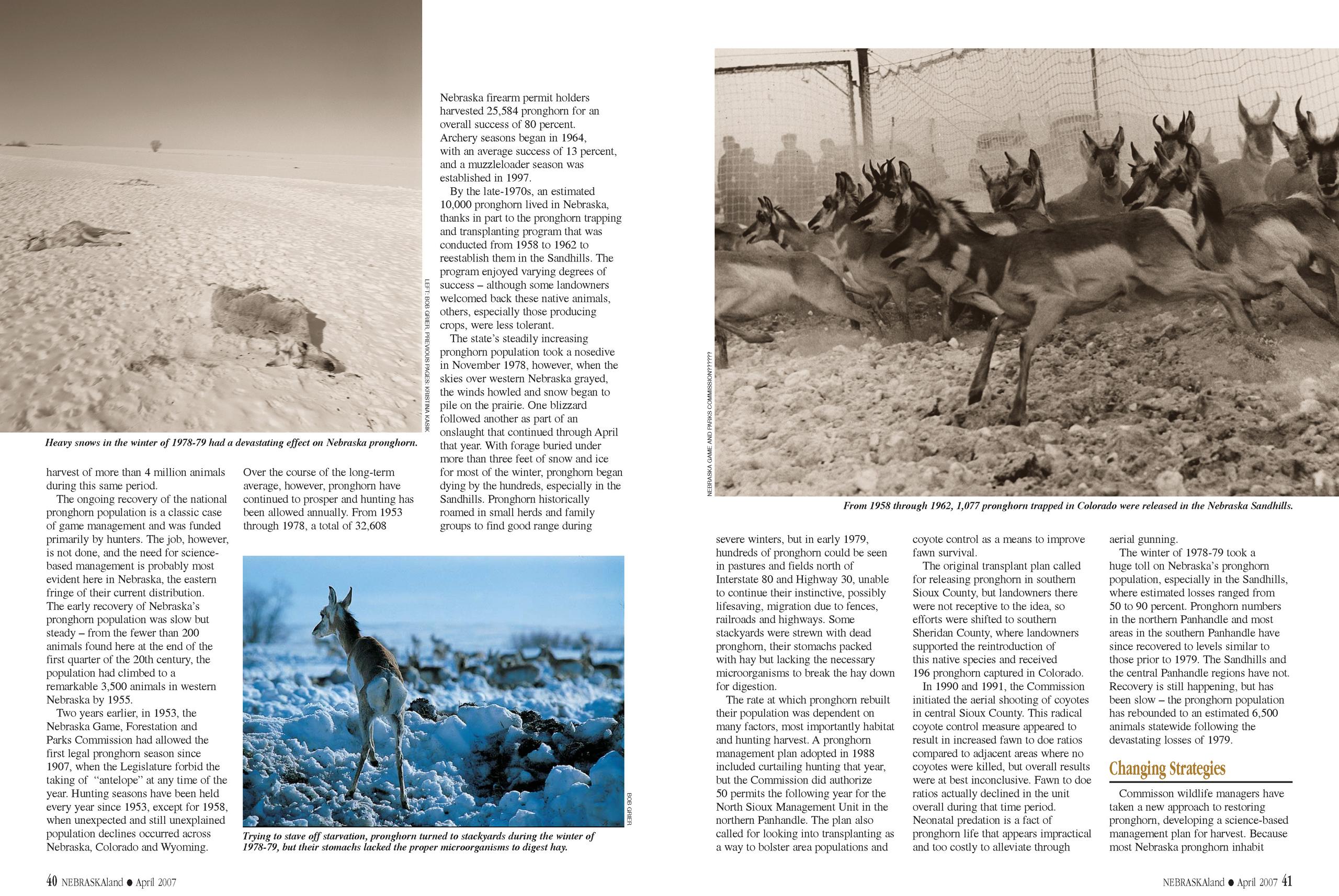
The ongoing recovery of the national pronghorn population is a classic case of game management and was funded primarily by hunters. The job, however, is not done, and the need for sciencebased management is probably most evident here in Nebraska, the eastern fringe of their current distribution. The early recovery of Nebraska's pronghorn population was slow but steady – from the fewer than 200 animals found here at the end of the first quarter of the 20th century, the population had climbed to a remarkable 3,500 animals in western Nebraska by 1955.
Two years earlier, in 1953, the Nebraska Game, Forestation and Parks Commission had allowed the first legal pronghorn season since 1907, when the Legislature forbid the taking of "antelope" at any time of the year. Hunting seasons have been held every year since 1953, except for 1958, when unexpected and still unexplained population declines occurred across Nebraska, Colorado and Wyoming. Over the course of the long-term average, however, pronghorn have continued to prosper and hunting has been allowed annually. From 1953 through 1978, a total of 32,608 Nebraska firearm permit holders harvested 25,584 pronghorn for an overall success of 80 percent. Archery seasons began in 1964, with an average success of 13 percent, and a muzzleloader season was established in 1997.
By the late-1970s, an estimated 10,000 pronghorn lived in Nebraska, thanks in part to the pronghorn trapping and transplanting program that was conducted from 1958 to 1962 to reestablish them in the Sandhills. The program enjoyed varying degrees of success – although some landowners welcomed back these native animals, others, especially those producing crops, were less tolerant.
The state's steadily increasing pronghorn population took a nosedive in November 1978, however, when the skies over western Nebraska grayed, the winds howled and snow began to pile on the prairie. One blizzard followed another as part of an onslaught that continued through April that year. With forage buried under more than three feet of snow and ice for most of the winter, pronghorn began dying by the hundreds, especially in the Sandhills. Pronghorn historically roamed in small herds and family groups to find good range during
The rate at which pronghorn rebuilt their population was dependent on many factors, most importantly habitat and hunting harvest. A pronghorn management plan adopted in 1988 included curtailing hunting that year, but the Commission did authorize 50 permits the following year for the North Sioux Management Unit in the northern Panhandle. The plan also called for looking into transplanting as a way to bolster area populations and coyote control as a means to improve fawn survival.
The original transplant plan called for releasing pronghorn in southern Sioux County, but landowners there were not receptive to the idea, so efforts were shifted to southern Sheridan County, where landowners supported the reintroduction of this native species and received 196 pronghorn captured in Colorado.
In 1990 and 1991, the Commission initiated the aerial shooting of coyotes in central Sioux County. This radical coyote control measure appeared to result in increased fawn to doe ratios compared to adjacent areas where no coyotes were killed, but overall results were at best inconclusive. Fawn to doe ratios actually declined in the unit overall during that time period. Neonatal predation is a fact of pronghorn life that appears impractical and too costly to alleviate through aerial gunning.
The winter of 1978-79 took a huge toll on Nebraska's pronghorn population, especially in the Sandhills, where estimated losses ranged from 50 to 90 percent. Pronghorn numbers in the northern Panhandle and most areas in the southern Panhandle have since recovered to levels similar to those prior to 1979. The Sandhills and the central Panhandle regions have not. Recovery is still happening, but has been slow – the pronghorn population has rebounded to an estimated 6,500 animals statewide following the devastating losses of 1979.
Changing StrategiesCommisson wildlife managers have
taken a new approach to restoring
pronghorn, developing a science-based
management plan for harvest. Because
most Nebraska pronghorn inhabit
NEBRASKAland April 2007 41
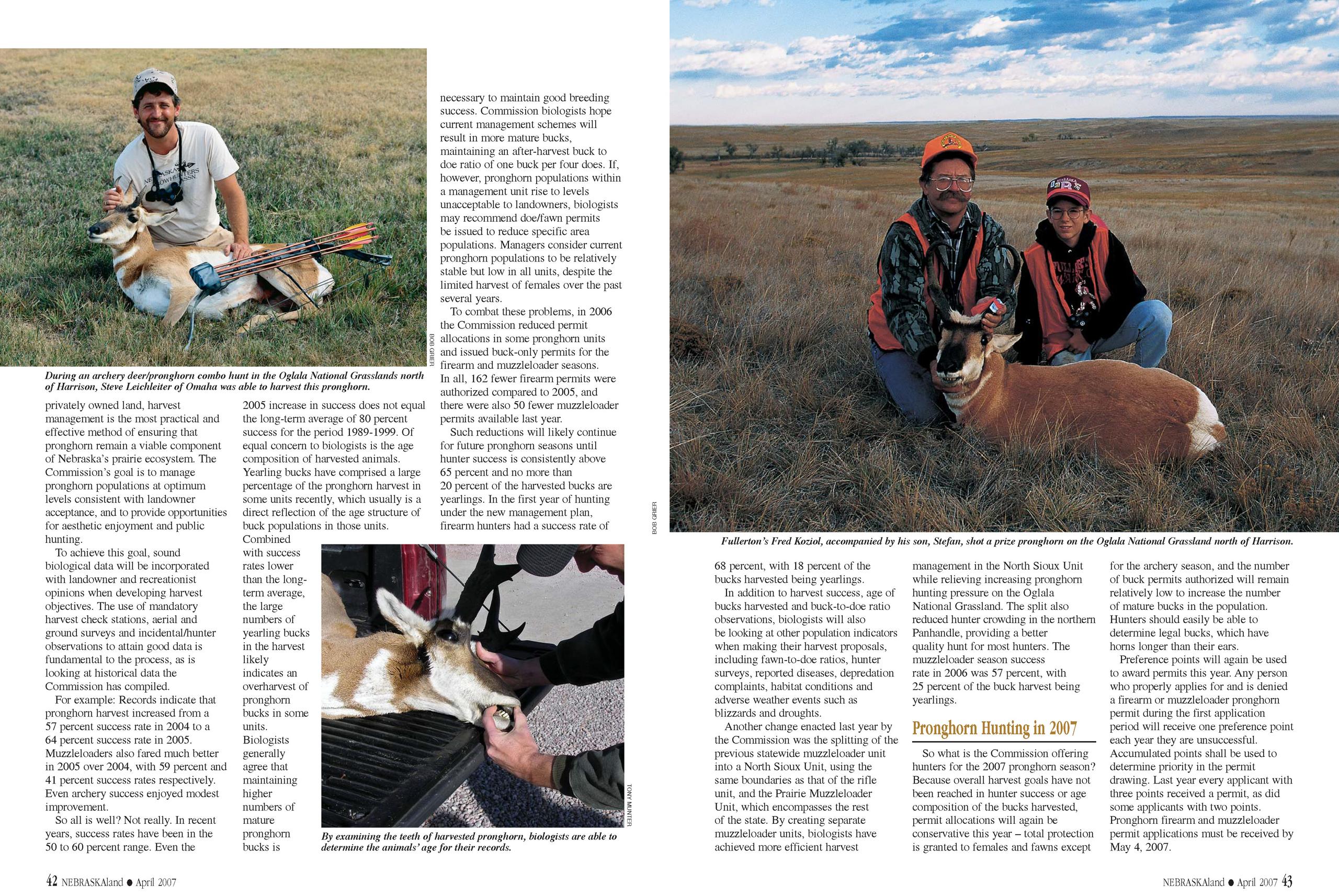
To achieve this goal, sound biological data will be incorporated with landowner and recreationist opinions when developing harvest objectives. The use of mandatory harvest check stations, aerial and ground surveys and incidental/hunter observations to attain good data is fundamental to the process, as is looking at historical data the Commission has compiled.
For example: Records indicate that pronghorn harvest increased from a 57 percent success rate in 2004 to a 64 percent success rate in 2005. Muzzleloaders also fared much better in 2005 over 2004, with 59 percent and 41 percent success rates respectively. Even archery success enjoyed modest improvement.
So all is well? Not really. In recent years, success rates have been in the 50 to 60 percent range. Even the 2005 increase in success does not equal the long-term average of 80 percent success for the period 1989-1999. Of equal concern to biologists is the age composition of harvested animals. Yearling bucks have comprised a large percentage of the pronghorn harvest in some units recently, which usually is a direct reflection of the age structure of buck populations in those units. Combined with success rates lower than the longterm average, the large numbers of yearling bucks in the harvest likely indicates an overharvest of pronghorn bucks in some units. Biologists generally agree that maintaining higher numbers of mature pronghorn bucks is necessary to maintain good breeding success. Commission biologists hope current management schemes will result in more mature bucks, maintaining an after-harvest buck to doe ratio of one buck per four does. If, however, pronghorn populations within a management unit rise to levels unacceptable to landowners, biologists may recommend doe/fawn permits be issued to reduce specific area populations. Managers consider current pronghorn populations to be relatively stable but low in all units, despite the limited harvest of females over the past several years.
To combat these problems, in 2006 the Commission reduced permit allocations in some pronghorn units and issued buck-only permits for the firearm and muzzleloader seasons. In all, 162 fewer firearm permits were authorized compared to 2005, and there were also 50 fewer muzzleloader permits available last year. Such reductions will likely continue for future pronghorn seasons until hunter success is consistently above 65 percent and no more than 20 percent of the harvested bucks are yearlings. In the first year of hunting under the new management plan, firearm hunters had a success rate of
In addition to harvest success, age of bucks harvested and buck-to-doe ratio observations, biologists will also be looking at other population indicators when making their harvest proposals, including fawn-to-doe ratios, hunter surveys, reported diseases, depredation complaints, habitat conditions and adverse weather events such as blizzards and droughts.
Another change enacted last year by the Commission was the splitting of the previous statewide muzzleloader unit into a North Sioux Unit, using the same boundaries as that of the rifle unit, and the Prairie Muzzleloader Unit, which encompasses the rest of the state. By creating separate muzzleloader units, biologists have achieved more efficient harvest management in the North Sioux Unit while relieving increasing pronghorn hunting pressure on the Oglala National Grassland. The split also reduced hunter crowding in the northern Panhandle, providing a better quality hunt for most hunters. The muzzleloader season success rate in 2006 was 57 percent, with 25 percent of the buck harvest being yearlings.
NEBRASKAland April 2007 43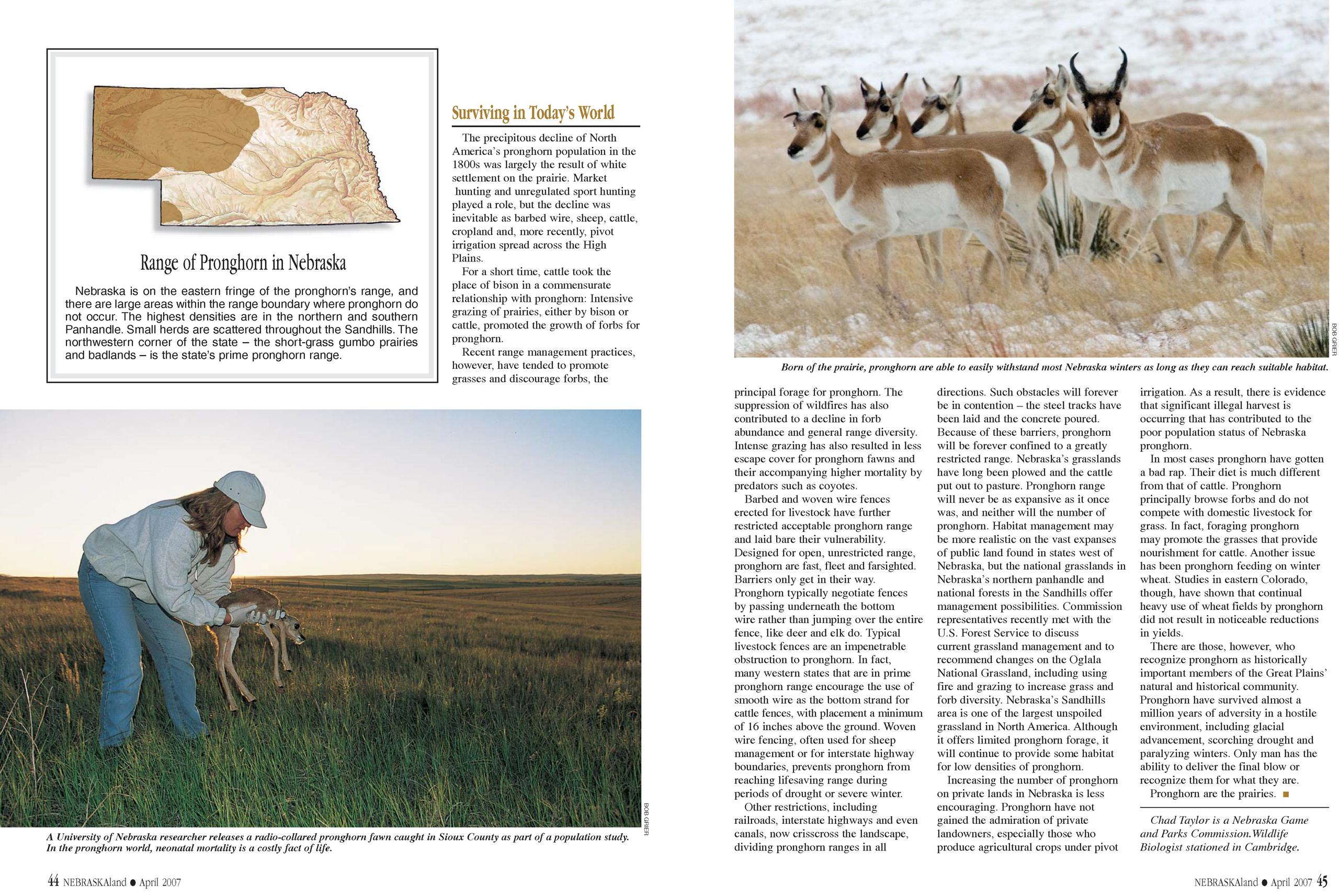 Pronghorn Hunting in 2007
So what is the Commission offering hunters for the 2007 pronghorn season? Because overall harvest goals have not been reached in hunter success or age composition of the bucks harvested, permit allocations will again be conservative this year – total protection is granted to females and fawns except for the archery season, and the number of buck permits authorized will remain relatively low to increase the number of mature bucks in the population. Hunters should easily be able to determine legal bucks, which have horns longer than their ears.
Preference points will again be used to award permits this year. Any person who properly applies for and is denied a firearm or muzzleloader pronghorn permit during the first application period will receive one preference point each year they are unsuccessful. Accumulated points shall be used to determine priority in the permit drawing. Last year every applicant with three points received a permit, as did some applicants with two points. Pronghorn firearm and muzzleloader permit applications must be received by May 4, 2007.
NEBRASKAland April 2007 43The precipitous decline of North America's pronghorn population in the 1800s was largely the result of white settlement on the prairie. Market hunting and unregulated sport hunting played a role, but the decline was inevitable as barbed wire, sheep, cattle, cropland and, more recently, pivot irrigation spread across the High Plains.
For a short time, cattle took the place of bison in a commensurate relationship with pronghorn: Intensive grazing of prairies, either by bison or cattle, promoted the growth of forbs for pronghorn.
Recent range management practices, however, have tended to promote grasses and discourage forbs, the
Barbed and woven wire fences erected for livestock have further restricted acceptable pronghorn range and laid bare their vulnerability. Designed for open, unrestricted range, pronghorn are fast, fleet and farsighted. Barriers only get in their way. Pronghorn typically negotiate fences by passing underneath the bottom wire rather than jumping over the entire fence, like deer and elk do. Typical livestock fences are an impenetrable obstruction to pronghorn. In fact, many western states that are in prime pronghorn range encourage the use of smooth wire as the bottom strand for cattle fences, with placement a minimum of 16 inches above the ground. Woven wire fencing, often used for sheep management or for interstate highway boundaries, prevents pronghorn from reaching lifesaving range during periods of drought or severe winter.
Other restrictions, including railroads, interstate highways and even canals, now crisscross the landscape, dividing pronghorn ranges in all directions. Such obstacles will forever be in contention – the steel tracks have been laid and the concrete poured. Because of these barriers, pronghorn will be forever confined to a greatly restricted range. Nebraska's grasslands have long been plowed and the cattle put out to pasture. Pronghorn range will never be as expansive as it once was, and neither will the number of pronghorn. Habitat management may be more realistic on the vast expanses of public land found in states west of Nebraska, but the national grasslands in Nebraska's northern panhandle and national forests in the Sandhills offer management possibilities. Commission representatives recently met with the U.S. Forest Service to discuss current grassland management and to recommend changes on the Oglala National Grassland, including using fire and grazing to increase grass and forb diversity. Nebraska's Sandhills area is one of the largest unspoiled grassland in North America. Although it offers limited pronghorn forage, it will continue to provide some habitat for low densities of pronghorn.
Increasing the number of pronghorn on private lands in Nebraska is less encouraging. Pronghorn have not gained the admiration of private landowners, especially those who produce agricultural crops under pivot irrigation. As a result, there is evidence that significant illegal harvest is occurring that has contributed to the poor population status of Nebraska pronghorn.
In most cases pronghorn have gotten a bad rap. Their diet is much different from that of cattle. Pronghorn principally browse forbs and do not compete with domestic livestock for grass. In fact, foraging pronghorn may promote the grasses that provide nourishment for cattle. Another issue has been pronghorn feeding on winter wheat. Studies in eastern Colorado, though, have shown that continual heavy use of wheat fields by pronghorn did not result in noticeable reductions in yields.
There are those, however, who recognize pronghorn as historically important members of the Great Plains' natural and historical community. Pronghorn have survived almost a million years of adversity in a hostile environment, including glacial advancement, scorching drought and paralyzing winters. Only man has the ability to deliver the final blow or recognize them for what they are.
Pronghorn are the prairies.
Chad Taylor is a Nebraska Game and Parks Commission.Wildlife Biologist stationed in Cambridge.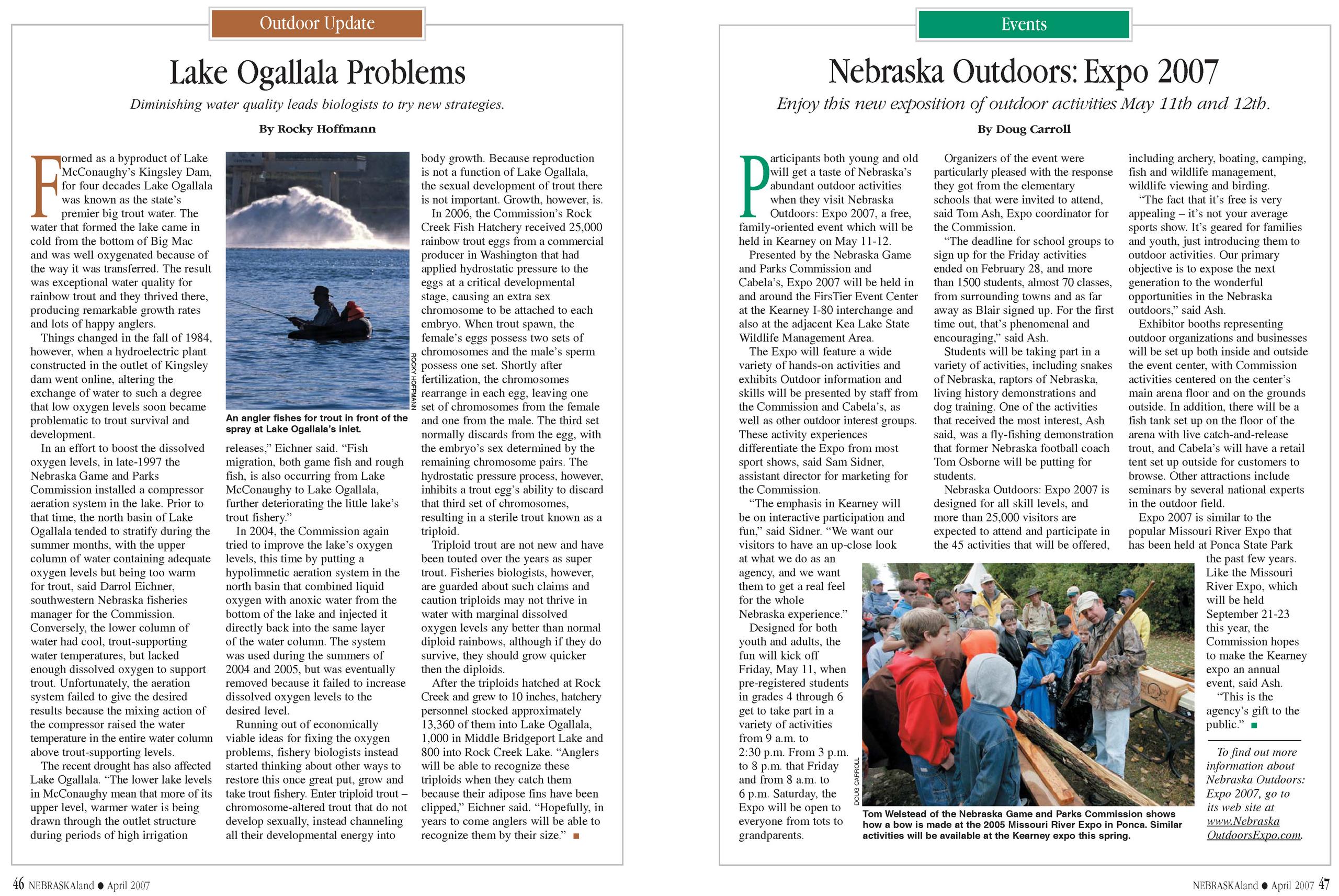
Outdoor Update
Lake Ogallala Problems
Diminishing water quality leads biologists to try new strategies.
Formed as a byproduct of Lake McConaughy's Kingsley Dam, for four decades Lake Ogallala was known as the state's premier big trout water. The water that formed the lake came in cold from the bottom of Big Mac and was well oxygenated because of the way it was transferred. The result was exceptional water quality for rainbow trout and they thrived there, producing remarkable growth rates and lots of happy anglers.
Things changed in the fall of 1984, however, when a hydroelectric plant constructed in the outlet of Kingsley dam went online, altering the exchange of water to such a degree that low oxygen levels soon became problematic to trout survival and development.
In an effort to boost the dissolved oxygen levels, in late-1997 the Nebraska Game and Parks Commission installed a compressor aeration system in the lake. Prior to that time, the north basin of Lake Ogallala tended to stratify during the summer months, with the upper column of water containing adequate oxygen levels but being too warm for trout, said Darrol Eichner, southwestern Nebraska fisheries manager for the Commission. Conversely, the lower column of water had cool, trout-supporting water temperatures, but lacked enough dissolved oxygen to support trout. Unfortunately, the aeration system failed to give the desired results because the mixing action of the compressor raised the water temperature in the entire water column above trout-supporting levels.
The recent drought has also affected Lake Ogallala. "The lower lake levels in McConaughy mean that more of its upper level, warmer water is being drawn through the outlet structure during periods of high irrigation
tried to improve the lake's oxygen levels, this time by putting a hypolimnetic aeration system in the north basin that combined liquid oxygen with anoxic water from the bottom of the lake and injected it directly back into the same layer of the water column. The system was used during the summers of 2004 and 2005, but was eventually removed because it failed to increase dissolved oxygen levels to the desired level.
Running out of economically viable ideas for fixing the oxygen problems, fishery biologists instead started thinking about other ways to restore this once great put, grow and take trout fishery. Enter triploid trout – chromosome-altered trout that do not develop sexually, instead channeling all their developmental energy into body growth. Because reproduction is not a function of Lake Ogallala, the sexual development of trout there is not important. Growth, however, is.
In 2006, the Commission's Rock Creek Fish Hatchery received 25,000 rainbow trout eggs from a commercial producer in Washington that had applied hydrostatic pressure to the eggs at a critical developmental stage, causing an extra sex chromosome to be attached to each embryo. When trout spawn, the female's eggs possess two sets of chromosomes and the male's sperm possess one set. Shortly after fertilization, the chromosomes rearrange in each egg, leaving one set of chromosomes from the female and one from the male. The third set normally discards from the egg, with the embryo's sex determined by the remaining chromosome pairs. The hydrostatic pressure process, however, inhibits a trout egg's ability to discard that third set of chromosomes, resulting in a sterile trout known as a triploid.
Triploid trout are not new and have been touted over the years as super trout. Fisheries biologists, however, are guarded about such claims and caution triploids may not thrive in water with marginal dissolved oxygen levels any better than normal diploid rainbows, although if they do survive, they should grow quicker then the diploids.
After the triploids hatched at Rock Creek and grew to 10 inches, hatchery personnel stocked approximately 13,360 of them into Lake Ogallala, 1,000 in Middle Bridgeport Lake and 800 into Rock Creek Lake. "Anglers will be able to recognize these triploids when they catch them because their adipose fins have been clipped," Eichner said. "Hopefully, in years to come anglers will be able to recognize them by their size."
Events
Nebraska Outdoors: Expo 2007
Enjoy this new exposition of outdoor activities May 11th and 12th.
Participants both young and old will get a taste of Nebraska's abundant outdoor activities when they visit Nebraska Outdoors: Expo 2007, a free, family-oriented event which will be held in Kearney on May 11-12.
Presented by the Nebraska Game and Parks Commission and Cabela's, Expo 2007 will be held in and around the FirsTier Event Center at the Kearney I-80 interchange and also at the adjacent Kea Lake State Wildlife Management Area.
The Expo will feature a wide variety of hands-on activities and exhibits Outdoor information and skills will be presented by staff from the Commission and Cabela's, as well as other outdoor interest groups. These activity experiences differentiate the Expo from most sport shows, said Sam Sidner, assistant director for marketing for the Commission.
"The emphasis in Kearney will be on interactive participation and fun," said Sidner. "We want our visitors to have an up-close look at what we do as an agency, and we want them to get a real feel for the whole Nebraska experience."
Designed for both youth and adults, the fun will kick off Friday, May 11, when pre-registered students in grades 4 through 6 get to take part in a variety of activities from 9 a.m. to 2:30 p.m. From 3 p.m. to 8 p.m. that Friday and from 8 a.m. to 6 p.m. Saturday, the Expo will be open to everyone from tots to grandparents.
Organizers of the event were particularly pleased with the response they got from the elementary schools that were invited to attend, said Tom Ash, Expo coordinator for the Commission.
"The deadline for school groups to sign up for the Friday activities ended on February 28, and more than 1500 students, almost 70 classes, from surrounding towns and as far away as Blair signed up. For the first time out, that's phenomenal and encouraging," said Ash.
Students will be taking part in a variety of activities, including snakes of Nebraska, raptors of Nebraska, living history demonstrations and dog training. One of the activities that received the most interest, Ash said, was a fly-fishing demonstration that former Nebraska football coach Tom Osborne will be putting for students.
Nebraska Outdoors: Expo 2007 is designed for all skill levels, and more than 25,000 visitors are expected to attend and participate in the 45 activities that will be offered,
"The fact that it's free is very appealing – it's not your average sports show. It's geared for families and youth, just introducing them to outdoor activities. Our primary objective is to expose the next generation to the wonderful opportunities in the Nebraska outdoors," said Ash.
Exhibitor booths representing outdoor organizations and businesses will be set up both inside and outside the event center, with Commission activities centered on the center's main arena floor and on the grounds outside. In addition, there will be a fish tank set up on the floor of the arena with live catch-and-release trout, and Cabela's will have a retail tent set up outside for customers to browse. Other attractions include seminars by several national experts in the outdoor field.
Expo 2007 is similar to the popular Missouri River Expo that has been held at Ponca State Park the past few years. Like the Missouri River Expo, which will be held September 21-23 this year, the Commission hopes to make the Kearney expo an annual event, said Ash.
"This is the agency's gift to the public."
To find out more information about Nebraska Outdoors: Expo 2007, go to its web site at www.Nebraska OutdoorsExpo.com.
Classifieds
ATTRACTIONS/EVENTS ONLY ONE PAWNEE CITY! We have history that is proudly displayed at the Pawnee City Museum, The Schilling Bridge, the only Winery Micro-Brewery in the nation, Agritourism sites, the Pedal Clinic, a Toy Museum, and Our Historic Downtown. Go to Pawneecity.org for details BOOKS/PUBLICATIONS/VIDEOS NEW 2nd EDITION, Ju-Ju Swallowed a Penny, Hardcover, $23; Softcover, $13. Also Nebraska novels, In the Shadow of the Bluff and The Courthouse. Available book stores or Betty Dunn, 410 CR 324, Navasota, TX 77868; bdunn@mssblue.net. DOGS PLUM CREEK KENNEL. German Shorthairs, stud service, puppies and started dogs. Training for all pointing breeds. Specialize in training the handler as well as the dog. Wayne Clark, Percival, Iowa 51648 (close to Omaha) (712) 529-4238, email wclark@heartland.net. WILDERNESS KENNELS. Gun dog training – over 60 years combined experience. Training all sporting breeds – retrievers, flushing and pointing dogs. All dogs worked on pen-raised birds and wild game. Training program also includes obedience training – heel, sit, stay, down and come when called. Pups, started dogs and fully trained dogs for sale. Hunting dogs trained by hunters. Henry Sader, Wilderness Kennels, Roca, NE (402) 423-4212. Since 1968. DUCKDAWG RETRIEVERS - Raising exceptional field-bred yellow and black Labradors. Hunting, family and competition companions. Puppies raised in our home. Written health guarantee. Stud service available. Home of GRHRCH DuckDawg's Eba Roll The Dice - first and only Grand Hunting Retriever Champion in Nebraska. www.duckdawg.com, Ron Green DVM and Libby Milroy, North Platte, NE (308) 534-3659. FROSTY BROOK ACRES LLC, Labradors and Golden Retrievers - Hunt test and Field Trial bloodlines up close. Super temperament, desire and looks. Great all-purpose Labs and Goldens, www.frostybrooke. com, (308) 783-LABS (5227), Scottsbluff Valley Nebraska. BRITISH LABRADOR PUPPIES, AKC/UKC, O.F.A./CERF. Guarantees. "Wildrose" Dam and Sire. Exceptional British field trial lines. Free training. Wildwind British Labradors. (402) 429-1836 steve.macdonald@davisdesign.com. PRAIRIE DOG KENNELS, INC. specializes in retrievers and versatile pointers. Dogs worked in water, grass and timber on upland birds and waterfowl. Brian Moreland. Bennet, NE (402) 782-2075. ENVIRONMENTAL SERVICES CONCERNED ABOUT TOXIC ALGAE? We can help. Ripple Environmental, Inc. Toxic algae testing, water quality monitoring on streams, lakes and wetlands. 10+ years experience in water resource consulting. Contact Mike J. McBride, Lincoln, NE (402) 438-0806, www.rippleenvironmental.com. FISH/FISHING FISH FOR SALE. Catfish, largemouth bass, smallmouth bass, perch, crappies, bluegills, walleyes, rainbow trout, grass carp, minnows, bullheads. Consulting available. Pleasant Valley Fish Farm, 27851 U.S. Highway 83, McCook, NE 69001. (308) 345-6599. NEBRASKA LAKE MANAGEMENT – Biological lake surveys, fish stocking, rough fish control, lake aeration, algae control, shorewall construction. Rob Hofpar, Aquatic Biologist, licensed, insured and qualified. Phone (402) 784-6005 (Lincoln), or toll-free (888) 850-2460. BUZZ'S MARINE,YOUR FISHING and recreational boat super store, www.buzzsmarine.com and family watersports dealer, www.buzzswatersports.com. FREE WAXWORMS & MEALWORMS – raise your own. Thousands of waxworms and mealworms with our breeder kits $22.95 - $24.95. New Illuminator lighted glow jigs. Automatically light up when wet and turn off when dry. (763) 323-9273, www.waxwormkit.com. FOOD/GIFTS/HOME HOMEBREWING/BEER AND WINEMAKING. Fermenter's Supply, 8410 K Plaza, Suite #10, Omaha, NE 68127. Phone orders only, (888) 655-2739. Advice line (402) 593-9171. www.fermenterssupply. com. BRING NASA INTO YOUR laundry. Never buy detergents, bleach or fabric softeners again! Saves energy. Extends life of your clothes. To learn about my offer, please sign-in and use the passcode: Guest. www.laundryplus.com/svs. GUIDES/OUTFITTERS CANOE THE NIOBRARA with an affordable canoe trip by Dryland Aquatics. One- and two-day trips...full service, or just canoe, tube or kayak. Transportation furnished. Your Niobrara River specialists...We do it your way! Dryland Aquatics, Dept. N, Box 33C, Sparks, NE 69220 or phone (800) 337-3119. www.drylandaquatics. com, info@drylandaquatics.com. KRIPPLE DUCK ADVENTURES – Southwestern Nebraska. Guided hunts along the Frenchman Creek for white-tailed and mule deer, waterfowl, upland birds, and turkey. We also have a controlled-shooting area for pheasants, quail, and chukar. New lodging accommodations are available on site. For information please call (308) 394-5345 or (308) 280-5345. Email at cdorn@bwtelcom.net, www.krippleduck.com. GUNS/SHOOTING/ARCHERY GUNS – Browning, Benelli, Winchester, Ruger, etc. 1700 guns, buy-sell-trade (402) 729-6112, Bedlan's, Fairbury, NE 68352. www.bedlans.com. OUTDOOR EQUIPMENT IS PERFORMANCE IMPORTANT? For the finest canoes and accessories look to Great Plains Canoe Co., 205 Main, Springfield, NE 68059. Phone (402) 253-2000. PHOTOGRAPHY WILDLIFE PHOTOGRAPHIC PRINTS. Matted, framed and signed. Go to inplainssight.homestead.com, hathfotofreak@hotmail.com, (402) 848-2358. "The more you buy, the quicker my wife can retire!" REAL ESTATE WELL ESTABLISHED, FAMILY OWNED, Omaha nursery business and real estate for sale. Lots of upside for industrious entrepreneur or expansion facilities for an existing operation. Includes residence, greenhouses and other outbuildings. Call Andy Dana, CB Richard Ellis/MEGA - (402) 697-5813. FOR SALE-387 ACRES, located on the Ponca Creek. Running springs through all the pastures and in yard. Scenic, good hunting for deer and turkey, good trapping. Boyd-Knox County Line, (402) 569-3692 VACATIONS/RESORTS FOR FISHING AND HUNTING accommodations. Guided pheasant hunts. Jefco Inn, Gordon, NE 69343. South Cornell, (308) 282-2935. THE OLDE MAIN STREET INN. A historic bed and breakfast listed in the National Register of Historic Places. Beautiful dining room with fireplace. Featuring prime rib, buffalo, seafood, homemade soups, chilis and desserts. 115 Main Street, Chadron NE 69337 (308) 432-3380. www.chadron.com/oldemain. RUSTIC RETREAT! DOUBLE R GUEST RANCH, 20 miles north of Mullen. Fish, hunt, relax! Open year-round. Sportsmen, vacationers, small groups welcome. Deluxe furnished cabins; fully equipped kitchenettes. (866) 217-2042, info@sandhilldoublerranch. com, www.sandhilldoublerranch.com. LORD RANCH RESORT. Hunters, fishermen, family vacations, family reunions. New deluxe cabins. Complete cooking facilities. Quiet and peaceful in the middle of the Sandhills. Three miles north of the Valentine Wildlife Refuge, open all year. Aubrey and Dorothy Lord, HC 37, Box 41, Valentine, NE 69201. Call (800) 270-0181. www.lordranchresort.com. DIAMOND B TROUT RESORT & RESTAURANT, Orchard, Nebraska. Restaurant, lodge, cabins, springfed lakes, playground equipment, paddleboats. Great for families, groups, hunters. Book your cabin now! Call for brochure (800) 974-3002. www.diamondbtroutresort. com. MILL IRON V LODGING is modern cabins for your vacation pleasure. We are located near Vedigre, NE in turkey country. Each cabin offers privacy, view and a birdwatcher's paradise. Stay with us for a COUNTRY EXPERIENCE. (402) 668-7488. www.milliron-vlodging. com, jpeinrem@gpcom.net. WINTER VACATIONS at Nebraska State Parks. Hiking, camping, cross-country skiing, skating, sledding or just plain lounging in one of our cabins or lodge rooms. Mahoney State Park near Ashland has it all throughout the winter. Restaurant open daily, seasonal discounts available. Don't let the cold keep you from having fun! Call (402) 471-1414 or visit OutdoorNebraska.org and follow the Parks links. WHITETAIL RIVER LODGE: New Amish-built log bed and breakfast at Niobrara. Themed rooms. (402) 857-3564. Classified Rates: 75¢ per word, minimum $15. Closing: First business day two months before issue date. Classified ads are accepted on a first-come, first-served, space-available basis. Classified Ads, NEBRASKAland Magazine, P.O. Box 30370, Lincoln, NE 68503-0370. Telephone (402) 471-5585. Fax: (402) 471-5528. E-mail: classifieds@ngpc.ne.gov. Ads are posted online at NebraskalandMagazine.com at no additional charge. Becoming An Outdoors-Woman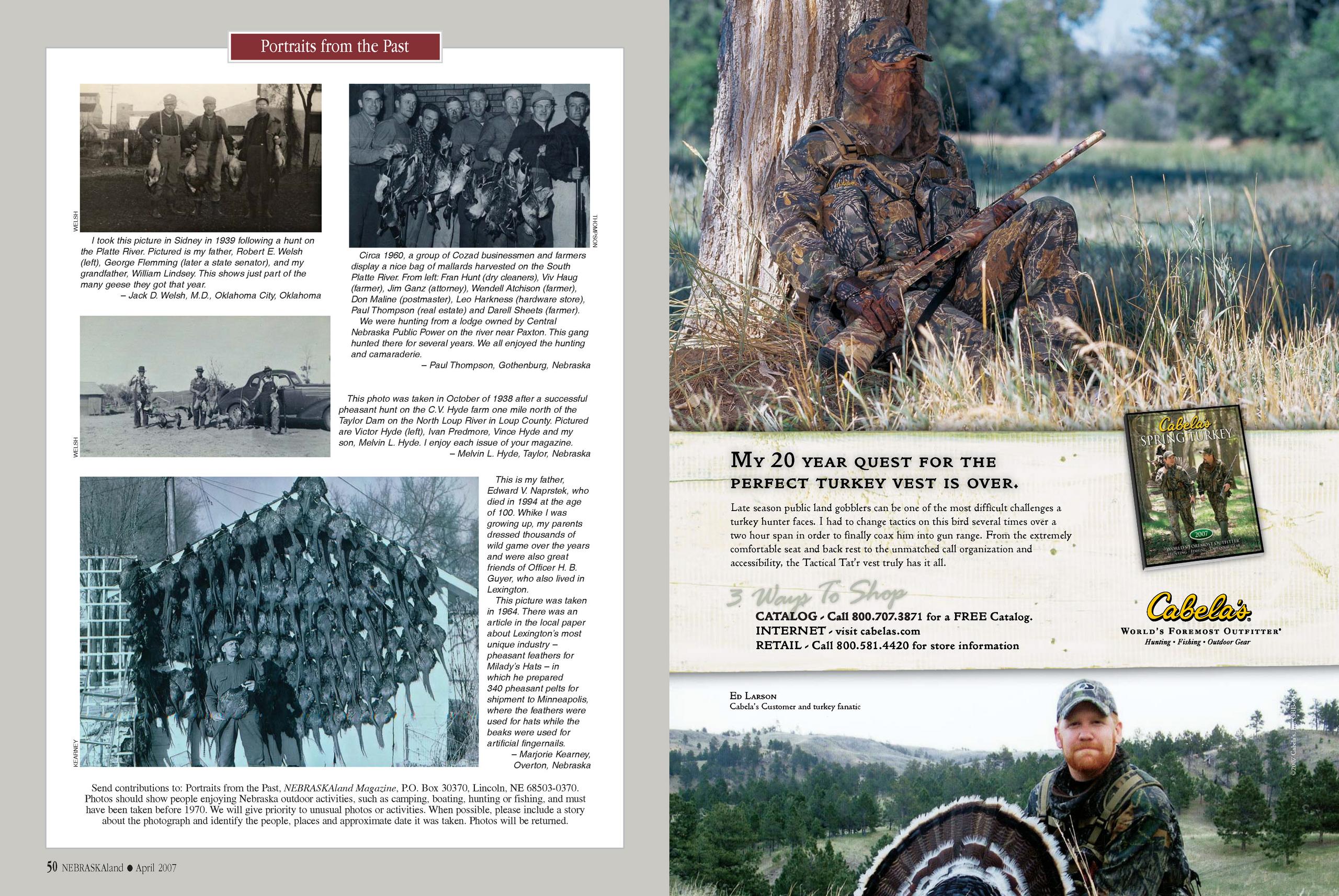
Portraits from the Past
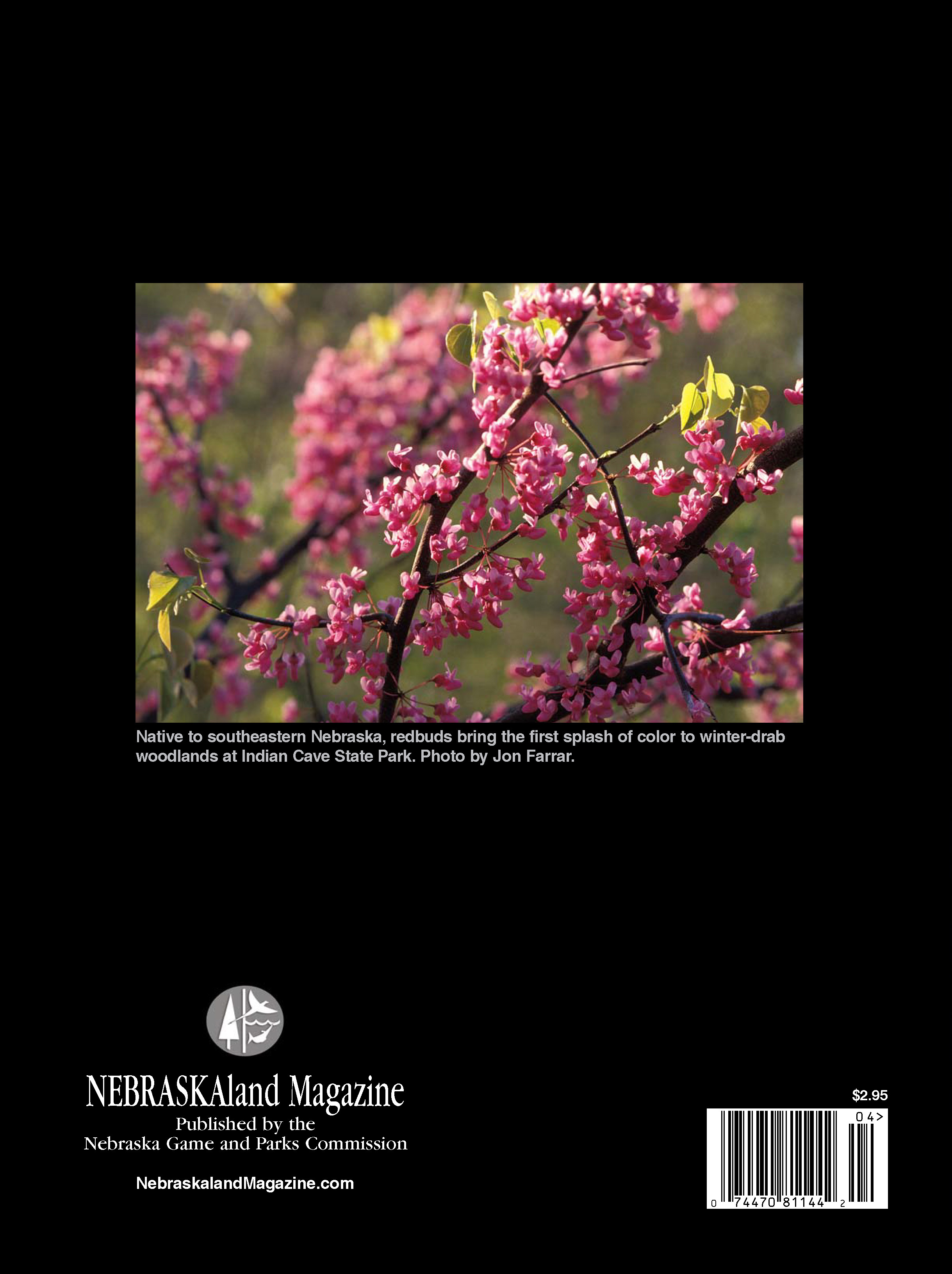
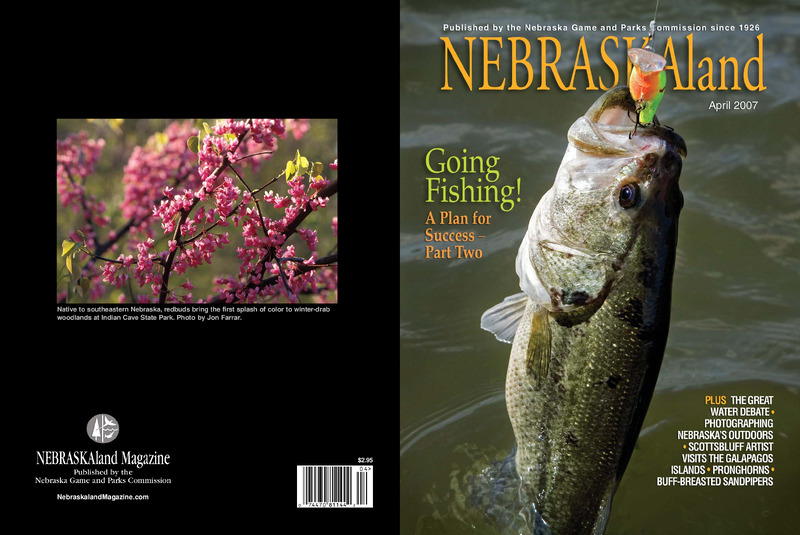
Position: 704 (16 views)