Volume 85, Issue 1, 2007


Published by the Nebraska Game and Parks Commission since 1926
NEBRASKAland
January-Februrary 2007 World Class Nebraskan Erika Anschutz dominates the world of competitive archery PLUS A DISCOVERY OF CRANES IN THE PANHANDLE FIRE ON THE RIDGE A DECADE OF AQUATIC HABITAT JERKY SHOOTER SECRETS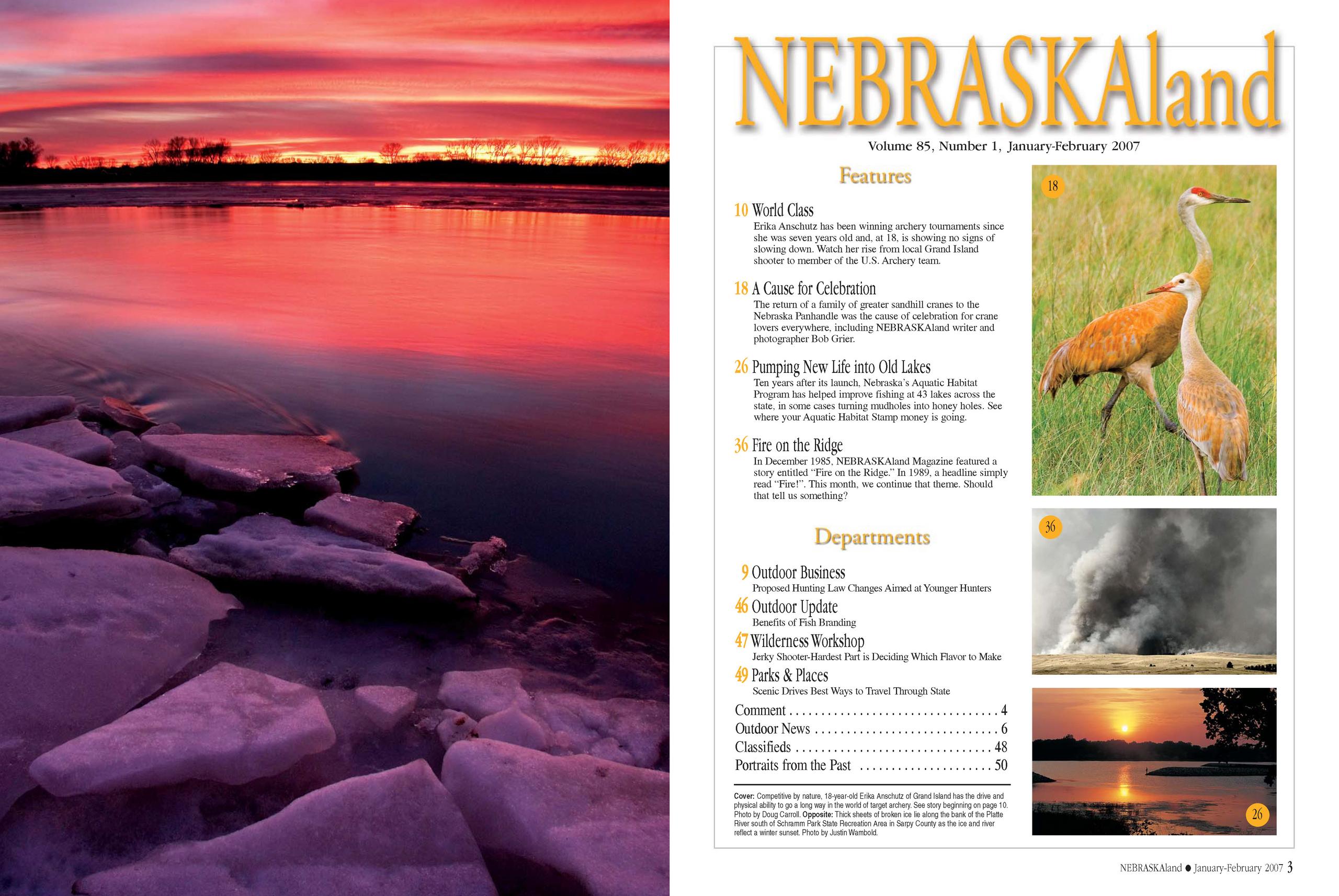
NEBRASKAland
Volume 85, Number 1, January-February 2007 Features 10 World Class Erika Anschutz has been winning archery tournaments since she was seven years old and, at 18, is showing no signs of slowing down. Watch her rise from local Grand Island shooter to member of the U.S. Archery team. 18 A Cause for Celebration The return of a family of greater sandhill cranes to the Nebraska Panhandle was the cause of celebration for crane lovers everywhere, including NEBRASKAland writer and photographer Bob Grier. 26 Pumping New Life into Old Lakes Ten years after its launch, Nebraska's Aquatic Habitat Program has helped improve fishing at 43 lakes across the state, in some cases turning mudholes into honey holes. See where your Aquatic Habitat Stamp money is going. 36 Fire on the Ridge In December 1985, NEBRASKAland Magazine featured a story entitled "Fire on the Ridge." In 1989, a headline simply read "Fire!". This month, we continue that theme. Should that tell us something? Departments 9 Outdoor Business Proposed Hunting Law Changes Aimed at Younger Hunters 46 Outdoor Update Benefits of Fish Branding 47 Wilderness Workshop Jerky Shooter-Hardest Part is Deciding Which Flavor to Make 49 Parks & Places Scenic Drives Best Ways to Travel Through State Comment . . . . . . . . . . . . . . . . . . . . . . . . . . . . . . . . . 4 Outdoor News . . . . . . . . . . . . . . . . . . . . . . . . . . . . . 6 Classifieds . . . . . . . . . . . . . . . . . . . . . . . . . . . . . . . 48 Portraits from the Past . . . . . . . . . . . . . . . . . . . . . 50 Cover: Competitive by nature, 18-year-old Erika Anschutz of Grand Island has the drive and physical ability to go a long way in the world of target archery. See story beginning on page 10. Photo by Doug Carroll. Opposite: Thick sheets of broken ice lie along the bank of the Platte River south of Schramm Park State Recreation Area in Sarpy County as the ice and river reflect a winter sunset. Photo by Justin Wambold.
Comment
"Bowhunting Nebraska: The Early Years" certainly brought back memories of the late-'30s and early '40s when my brother Jack and I tried the sport while living in St. Edward. All I ever brought home were carp, but Jack scored with both rabbits and squirrels.
With money scarce, we made our bows and arrows. Bows were shaped with a rasp and sandpaper, and arrows were dowel pins and glued-on feathers and handmade metal arrowheads. We made bowstrings by twisting sssstrands of linen thread (supplied by our mothe) and waxing the resulting string. Jack even fiashing a quiver out of a piece of linoleum. I received a letter during WWII from my brother, who was then in the Air force, reminding me to wax his bowstring so they wouldn't deteriorate.
Jack was killed in in 1950 during the Korean War, but I still have several of teh arrows he made 70 years ago. He was a true represetnative of waht author Jon Farrar said of those early years. "Hunting with a bow and arrow was mostly youthful adventure for small game."
Jerry Lightener Deland, FloridaI enjoyed your article in the November issue on the early years of bowhunting in Nebraska and also Nebraska's oldest hunter. I am interested in knowing how many bowhunters had had a Nebraska bow permit every year since bowhunting started in Nebraska.
I have had a permit and hunted every year except 1956. I did not keep a record of how many deer I have shot. In the early years I did not get many. I thnk I hunted four or five years before I got my first deer and I shot that with a round, solid fiberglass bow.
I started shooting a bow when I was with the Navy Air Force in Corpus Christie, Texas. I was on the Navy base team and we went to the state archery meet in Lobo, Texas in 1955. I won third place in the archer division.
I moved to Milford in the fall of 1955 and that fall I hunted on the Missouri River north of Omaha. I moved back to my hometown of Kearney in teh spring of 1957 and have lived here ever since.
We organized an archery club in Kearney called the Fort Kearny Bowmen. We hosted the state archery tournament one year, but lost our archery range on the Platte River when Interstate 80 was built and our club dissolved.
I have always hunted in Buffalo, Phelps and Kearney counties with the exception of that first year. The population of deer has increased to where it is not as much of a challenge to shoot a deer as it was in the early days, but I still enjoy the sport and getting out in the great oudoors.
Keep up the good work at NEBRASKAland.
Jerry Marlatt Kearney, Nebraska. Niobrara River "UniqueI would like to commend Eric Fowler for his excellent article in the October issue of NEBRASKAland, "Canoeing the Niobrara River." He certainly captured the essence of the river, why it is such a unique experience for young and old alike, and why it should be preserved in its present state. The convergence of ecosystems there is a unique "classroom" for nature lovers of all ages.
We invite those who value the river and want to maintain that unique experience for their children and grandchildren to join "Friends of the Niobrara, Inc.," a citizens 4 NEBRASKAland January-February 2007 organization dedicated to the preservation of the scenic qualities and natural beauty of the river. Meetings are held monthly and we participate every year in the annual Niobrara River Cleanup Day. Membership forms are available from Marge Kennedy, 9200 West Fletcher Ave., Malcolm, NE 68402.
Linda Schrock Seward, Nebraska Kudos for KooserI can only imagine how much time and care it took you to find appropriate photos to couple with Ted Kooser's poems in the December issue. Kooser's poems are honest and approachable, and you and your staff both took and found images that truly complemented the poems. It was a very sensitive presentation and I wanted you to know how much I admired this piece of good work.
By the way, I also thought Eric Fowler's before and after shots of Rock Glen WMA were effective, and Michael Forsberg's winter photo tips were practical and helpful. The issue was a nice way to end the year for your readers.
Larry (David L.) Sperling, Editor Wisconsin Natural Resources Magazine Madison, WisconsinSend your comments to: Doug Carroll, Editor NEBRASKAland Magazine P.O. Box 30370 Lincoln, NE 68503 or e-mail doug.carroll@ngpc.ne.gov. Please include your postal address and telephone number. Letters may be condensed and edited for clarity. Photographs are welcome and will be returned.
Story and photo submissions can be sent to the same address. Include a self-addressed stamped envelope for mailed submissions. The publisher assumes no responsibility for unsolicited material.
Under federal and/or state law, discrimination is prohibited on the basis of race, color, religion, age, gender, marital status, national origin, disability or political affiliation. If you think you have been discriminated against in any program, activity or facility by the Nebraska Game and Parks Commission or want more information, contact the Commission in Lincoln, NE, at (402) 471-0641 or the Equal Opportunity Commission, Lincoln, NE, (402) 471-2024, TTY/TDD (402) 471-4693). Comment Nebraska Game and Parks Commission Offices Headquarters 2200 N. 33rd Street Lincoln, NE 68503 Phone (402) 471-0641 District Office 1 East Hwy. 2, Box 725 Alliance, NE 69301 Phone (308) 763-2940 District Office II 524 Panzer St., Box 508 Bassett, NE 68714 Phone (402) 684-2921 District Office III 2201 N. 13th St. Norfolk, NE 68701 Phone (402)370-3374 District Office IV 301 E. State Farm Rd. North Platte, NE 69101 Phone (308) 535-8025 District Office VI 1617 First Ave. Kearney, NE 68847 Phone (308) 865-5310 Omaha Office 1212 bob Gibson Blvd. Omaha, NE 68108 Phone (402) 595-2144 Ak-Sar-Ben Aquarium 21502 W. Highway 31 Gretna, NE 68028 Phone (402) 332-3901 World Wide Web site: OutdoorNebraska.org E-mail: ngpc@ngpc.state.ne.us Conservation Officers by Region Administration Ted Blume (Adm.) Lincoln 471-5531 Craig Stover (Asst.) Lincoln 471-5532 Wes Loos (Asst.) Lincoln 471-5591 Rod Loos (Asst.) Ogallala (308) 284-8056 Murray Johnson Lincoln 471-5003 Panhandle Officer City Phone (308) Jim Zimmerman (Sup.) Gering 436-7561 Walt Meyer Chadron 432-4398 Scott Brandt Gering 436-3418 Heath Packett Gordon 282-2553 Dennis Thompson Ogallala 284-6450 Dan Zuehlke Ogallala 284-4815 Doug Pollard Oshkosh 772-9950 Frank Miller Valentine (402) 376-1183 Dan Kling Whitney 432-8367 Southwest Officer City Phone (308) Roger Thompson (Sup.) N. Platte 532-9175 Ray Dierking Brkn. Bow 872-3078 George Sund Cambridge 697-4629 Michael Thome Cozad 784-4362 Matt Andrews Elwood 785-3025 Dirk Greene Imperial 882-5328 Virgil Gosch McCook 345-2185 Dudley Sorensen N. Platte 532-0747 Rich Routh Rep. City 799-2085 South-central Officer City Phone (308) Jerry Pecha (Sup.) Kearney 865-5327 Jeff Jones Clay Center(402)762-3124 Randy Pomplun Fullerton 536-2987 Terry Brentzel Grand Is. 384-8296 Darin Gress Hebron (402) 768-2287 Dale Johnson Kearney 237-1079 Mark Reeves Loup City 745-0748 Robert Finke Milford (402) 761-3537 Richard Seward Ord 728-3115 Northeast Officer City Phone (402) Tom Zimmer (Sup.) Norfolk 371-6625 Robert Kelly Albion 395-2538 Dale Davis Bassett 273-1700 Ross Oestmann Bloomfield 373-4412 Steve Oberg Columbus 564-5937 Daniel Roberts Fremont 721-7852 Jon Reeves Kennard 427-7378 Marion Shafer Norfolk 371-2031 Pat George O'Neill 336-1588 Eric Wiebe Ponca 755-2566 Tim Williams Neligh 887-1335 Cory Krause West Point 372-6979 Southeast Officer City Phone (402) Duane Arp (Sup.) Gretna 332-2965 Sean McKeehan Ashland 944-4174 William Krause Auburn 274-3789 Jeremy TenKley Beatrice 228-1437 Mike Luben Colon 443-4278 Douglas Kramer Lincoln 466-9001 Dina Barta Lincoln 483-2358 Stacey Lewton Lincoln 476-0436 Levi Krause Louisville 234-2212 Russell Mort Nebr. City 873-5684 Dan Evasco Papillion 592-6733 Jeff Clauson Valley 359-5301 Nebraska Wildlife Crimestoppers 1-800-742-7627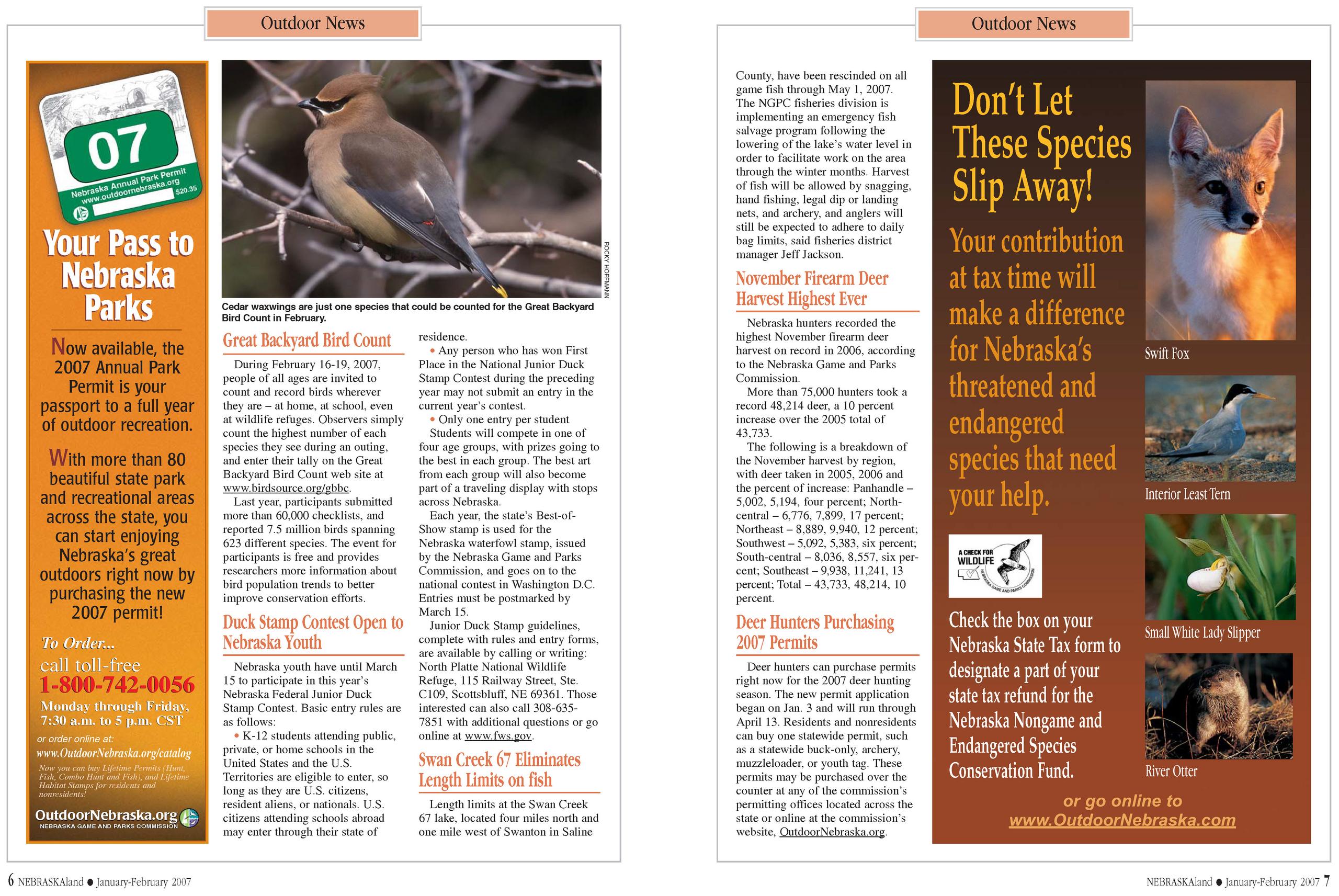
Outdoor News
During February 16-19, 2007, people of all ages are invited to count and record birds wherever they are – at home, at school, even at wildlife refuges. Observers simply count the highest number of each species they see during an outing, and enter their tally on the Great Backyard Bird Count web site at www.birdsource.org/gbbc. Last year, participants submitted more than 60,000 checklists, and reported 7.5 million birds spanning 623 different species. The event for participants is free and provides researchers more information about bird population trends to better improve conservation efforts.
Duck Stamp Contest Open to Nebraska YouthNebraska youth have until March 15 to participate in this year's Nebraska Federal Junior Duck Stamp Contest. Basic entry rules are as follows:
• K-12 students attending public, private, or home schools in the United States and the U.S. Territories are eligible to enter, so long as they are U.S. citizens, resident aliens, or nationals. U.S. citizens attending schools abroad may enter through their state of residence.
• Any person who has won First Place in the National Junior Duck Stamp Contest during the preceding year may not submit an entry in the current year's contest.
• Only one entry per student Students will compete in one of four age groups, with prizes going to the best in each group. The best art from each group will also become part of a traveling display with stops across Nebraska.
Each year, the state's Best-of- Show stamp is used for the Nebraska waterfowl stamp, issued by the Nebraska Game and Parks Commission, and goes on to the national contest in Washington D.C. Entries must be postmarked by March 15.
Junior Duck Stamp guidelines, complete with rules and entry forms, are available by calling or writing: North Platte National Wildlife Refuge, 115 Railway Street, Ste. C109, Scottsbluff, NE 69361. Those interested can also call 308-635- 7851 with additional questions or go online at www.fws.gov.
Swan Creek 67 Eliminates Length Limits on fishLength limits at the Swan Creek 67 lake, located four miles north and one mile west of Swanton in Saline
6 NEBRASKAland January-February 2007 Outdoor NewsCounty, have been rescinded on all game fish through May 1, 2007. The NGPC fisheries division is implementing an emergency fish salvage program following the lowering of the lake's water level in order to facilitate work on the area through the winter months. Harvest of fish will be allowed by snagging, hand fishing, legal dip or landing nets, and archery, and anglers will still be expected to adhere to daily bag limits, said fisheries district manager Jeff Jackson.
November Firearm DeerHarvest Highest Ever Nebraska hunters recorded the highest November firearm deer harvest on record in 2006, according to the Nebraska Game and Parks Commission.
More than 75,000 hunters took a record 48,214 deer, a 10 percent increase over the 2005 total of 43,733.
The following is a breakdown of the November harvest by region, with deer taken in 2005, 2006 and the percent of increase: Panhandle – 5,002, 5,194, four percent; Northcentral – 6,776, 7,899, 17 percent; Northeast – 8,889, 9,940, 12 percent; Southwest – 5,092, 5,383, six percent; South-central – 8,036, 8,557, six percent; Southeast – 9,938, 11,241, 13 percent; Total – 43,733, 48,214, 10 percent.
Deer Hunters Purchasing 2007 PermitsDeer hunters can purchase permits right now for the 2007 deer hunting season. The new permit application began on Jan. 3 and will run through April 13. Residents and nonresidents can buy one statewide permit, such as a statewide buck-only, archery, muzzleloader, or youth tag. These permits may be purchased over the counter at any of the commission's permitting offices located across the state or online at the commission's website, OutdoorNebraska.org.
Nebraska's Conservation Officers include men and women who have been on the job anywhere from a few months to more than 40 years. To find a group of more diverse individuals in this state would be a challenge.
Despite the diversity, there is still much common ground and most officers would agree that our single best tool against wildlife crime is when the public calls with information about a violation. Many people, however, don't want to be a "snitch" or say they "don't have a problem with someone shooting a deer illegally as long as they use it."
The problem with this thinking is that in this day and age, very few poachers commit their crimes in order to have something to eat. Most do it because they are lazy, selfish or like the feeling of getting away with something. The following story illustrates a typical violation and how wildlife violations can affect other people.
A few years ago a man I'll call Tom gave his grandson Jimmy a new deer rifle for his birthday. It was hard to tell who was more excited, the grandfather or the grandson, unless you know that during the next couple months, Tom planned his grandson's first deer hunt to the smallest detail. Together they carefully built a deer blind overlooking the riverbottom pasture next to the cottonwoods and willows where the deer bedded after they left a nearby cornfield.
The two of them sat in that blind several mornings in the weeks leading up to the season, learning the habits of the local deer while talking about the hours they had spent in hunter education classes and target practicing with the new rifle. They also talked about the big buck that always appeared right on schedule shortly after sunrise as it made its way back to the bedding area.
You have to know that Grandpa would rather see Jimmy get his first deer than shoot even the biggest deer himself, but that unfortunately, Jimmy's first deer hunt was not going to follow their carefully laid plans. As the old man and his grandson sat in their blind opening morning, a nagging, sick feeling began to build inside of Tom. The buck didn't make his usual sunrise appearance, and as the hours passed by, they wondered where the buck could be.
To understand what had gone wrong, you have to know about the three men living in an old farmhouse down the road from Tom's place. And you have to know that a couple of days before the season opened, Tom happened to get up in the middle of the night and saw a spotlight beam down in the pasture bottom where the blind was set up.You have to know about the large spot of blood in the pasture the next morning, and the trail of crushed weeds and blood leading to a set of tire tracks.
You have to know that the buck didn't appear that morning because it was in the three men's freezer, and the thought of the old man and grandson waiting for the buck never failed to make them chuckle. You also have to know that Tom almost called the game warden when he saw the spotlight, but he didn't want to get involved or snitch, and besides, "It really doesn't hurt if a deer or two get poached as long as they get used."
Only you can help protect your wildlife. Get to know your local conservation officer, who looks forward to meeting you and helping you in the fight against wildlife crime.
– Mark Reeves, Conservation Officer, Loup City 2007 Licenses Now AvailableThe following information lists what licenses, permits and stamps are needed (and not needed yet) for those wanting to hunt, fish, trap, or visit any of Nebraska's state parks during 2007:
• 2006 Fishing, Small Game Hunting, Big Game Hunting, and Trapping Licenses were valid through December 31, 2006. To hunt, fish or trap starting January 1, 2007, licenses can be purchased over the counter at one of the commission's permitting offices across the state or online at OutdoorNebraska.org. The only exception is the unfilled 2006 season-choice deer permits, which are valid through January 15, 2007.
• 2006 Park Permit was valid through December 31, 2006.
• 2006 Nebraska Waterfowl Stamp was valid through December 31, 2006.
The following list of requirements need not be met for the 2007 year until the date listed:
• 2006 HIP registration is valid through June 30, 2007.
• 2006 Migratory Bird Stamp (Federal Duck Stamp) is valid through June 30, 2007.
• 2006 CRP Management Access Program Atlas is valid through July 2007.
Winter Great Time To TakeKids Small Game Hunting The winter months are a good time to take kids hunting for small game in Nebraska.
Seasons are still open for squirrel, pheasant, partridge, and quail, which close January 31. The cottontail rabbit season closes February 28, and the jackrabbit season, west of Highway 81, also closes on February 28.
Hunters looking for public areas should either consult the 2006 Nebraska Guide to Hunting and Public Lands or the 2006 CRP-MAP atlas, available from most permit vendors.
Outdoor Business
Several Hunting Law Changes Proposed
Changes Could Give Parents Greater Leeway, Recruit More Hunters By Doug CarrollThe safe, time-honored tradition of hunting and spending time outdoors is a strong family bond that cannot be replaced, but in many places this tradition is falling by the wayside.
Studies show that only about six percent of Americans hunt, and by 2025, less than four percent will. Concerned about what effect this will have not only on the sport of hunting, but also on the wildlife conservation programs that are almost entirely funded with sportsmen's dollars, a coalition comprised of the Nebraska Game and Parks Commission, National Wild Turkey Federation (NWTF), United States Sportsmen's Alliance (USSA), Pheasants Forever, Whitetails Unlimited, Nebraska Bowhunter's Association and the Lincoln chapter of the Izaak Walton League is hoping to change four elements of Nebraska's hunting regulations during the upcoming state legislative session.
The first is to allow young people, at the discretion of their parents and under direct supervision of an adult, to be able to hunt big game beginning at age 10. Current Nebraska law requires big game hunters to be 12 years old or older. "If we reach our goal, young hunters across the state can hunt at a younger age with an adult mentor or parent, capturing youth involvement before these kids lose interest," said Brandon Houck, NWTF Regional Biologist.
The coalition also hopes to enact regulations that allow for the creation of an apprentice hunting license that would allow hunters between the ages of 12 and 29 to hunt with an adult mentor for one year before they have to pass a hunter education course. Under the proposed change, the apprentice must be under the direct control of the adult mentor at all times, and the apprentice license could only be renewed once during a person's lifetime. This would be done in conjunction with a change requiring hunter education only for hunters 12 to 29, the group most often involved in Nebraska hunting accidents.
The coalition is also hoping to get wild turkeys taken out of the big game classification so all young hunters could turkey hunt at the discretion of their parents. "By removing wild turkeys from the big game category, all young hunters would be able to hunt wild turkeys," said Houck.
This coalition's efforts are part of Families Afield, a new youth hunting initiative created by the National Shooting Sports Foundation, USSA and NWTF. By joining forces, these hunting groups and state fish and wildlife agencies across the nation are hoping to reverse the decline in hunter numbers by removing youth hunting barriers, giving parents greater leeway in deciding when their children are ready to hunt, while still keeping the sport safe.
Hunter recruitment and retention is at the heart of the Families Afield initiative. The Youth Hunting Report, written by Silvertip Productions, USSA and Southwick Associates Inc., suggests that for every 100 hunters who leave the sport in Nebraska, only 60 take their place. Some might worry that letting young kids hunt big game could be dangerous, but statistics suggest states that allow parents to decide when their kids can hunt are 10 percent safer than states that don't.
"Through the Families Afield initiative, youth hunting barriers have been reduced or eliminated, making it easier for young people to go afield without sacrificing safety," said Rob Keck, CEO of the NWTF. "The Youth Hunting Report suggests that young hunters, when accompanied by an adult, are the safest hunters in the field." Hunter education is seen as one of the most positive aspects of hunting today, but some people worry that youth and novice adults are becoming interested in other activities long before they take a hunter education class and try hunting. Through the years, the Commission has reviewed and revised its education programs to assist parents in their effort to start new hunters. All states have hunter education requirements, and Nebraska makes it easy to fulfill these requirements by allowing youth to become certified as soon as they turn 11, giving them a full year to take the 10-hour course. Nebraska has also developed a home study course that allows students to take the knowledge-based portion of the class online and then complete the skill-based portion and the final test during a 4-hour field workshop.
To find out more about the Families Afield initiative in Nebraska and nationwide, call NWTF's Houck at (620) 443-5906 or go online to www.familiesafield.org

World Class
Nebraskan Erika Anschutz Dominates World of Competitive Archery
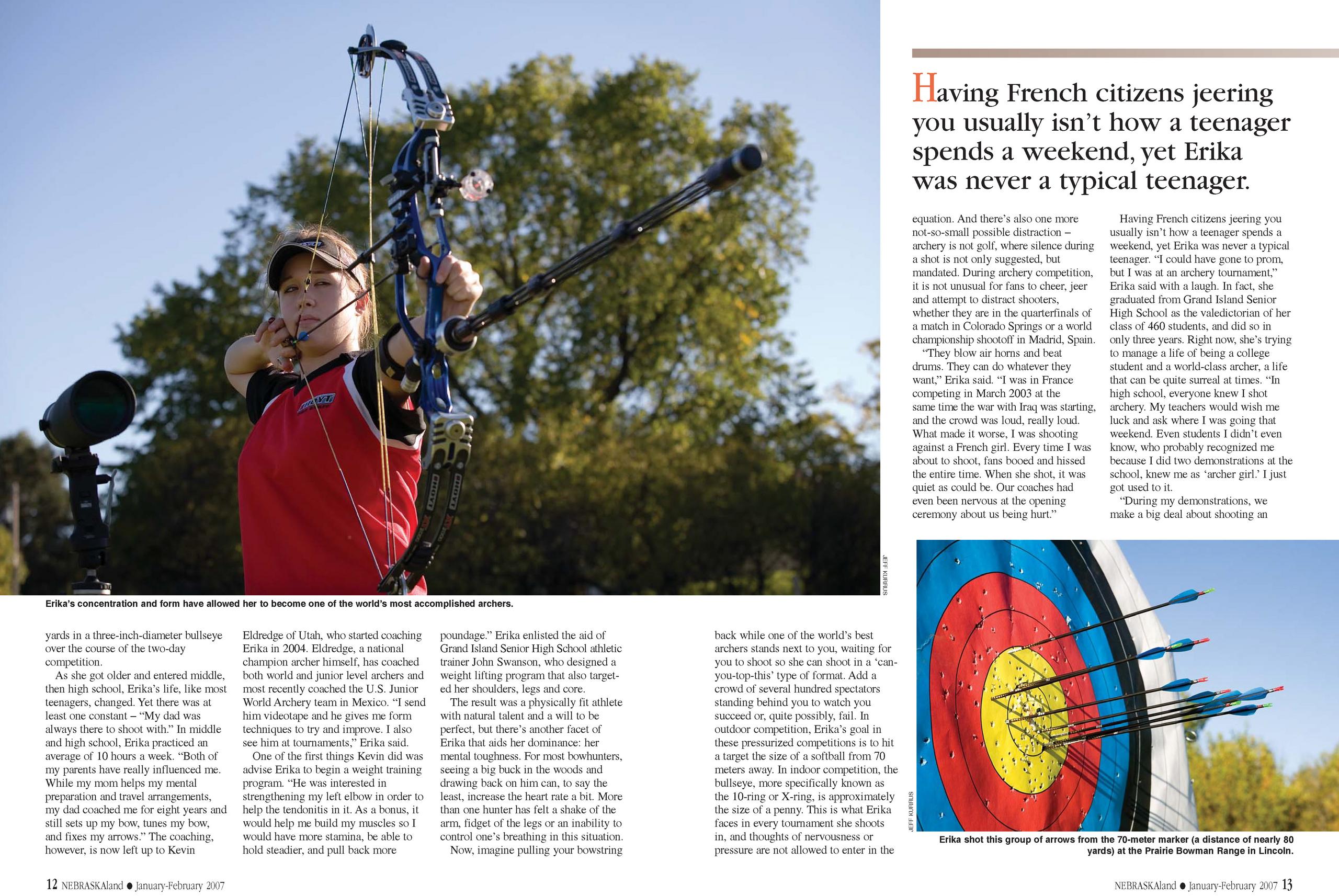
Erika Anschutz has been winning archery tournaments since she was 7 years old and, at 18, is showing no signs of slowing down.When I first saw Erika Anschutz, she was standing on the Prairie Bowman Range in Lincoln preparing to shoot at a target nearly 80 yards away. Resting next to her on a tripod was a spotting scope. "At this distance, do you ever know where your arrow hits without looking in the scope?" I asked after introducing myself.
"I can tell you nine out of ten times."
Totally out of my league and with no knowledge at all of the world of target archery, I called what I thought was her bluff. "I don't believe you."
As I leaned over and peered through her scope, she released her next arrow. "That's right on," she said, awaiting my response.
"One for one," I returned.
She pulled another arrow from the quiver that hung on her hip, drew back again, and released. "Three o'clock, maybe 3:30, in the nine point range," she said.
I quickly learned that Erika didn't bluff.
I also learned that she is used to being right on the bow range. Born in Lawton, Oklahoma,
Erika moved to Grand Island when she was 3 after her father got a job with the
U.S. Fish and Wildlife Service and has been shooting archery since the tender age
of 6. "She first picked up a bow in October of 1995, won her first tournament in Grand
Island in January of 1996, and went to the National Field Archery Association's (NFAA)
National Indoor Championship two months later," said her father, Steve Anschutz.
In that first national tournament, she placed fourth in the 11 and under division
as a 7-year-old. "I was pretty disappointed," Erika recollected. "But I just didn't
know what to expect. The next year, I came back and won it." It was the first of seven
times she has won that particular tournament, the most recent victory coming in 2006
when she won the Professional Women's Freestyle Division title in her rookie year
as a professional. Winning has been a central theme in Erika's archery career, a resume
that currently boasts 35 national titles and 150 national records, 18 of which are
world records.
So how did she get her start in a field where she has had so much success? Simple.
"My dad always hunted with a bow and I tagged along with him to archery club shoots
when I was little," Erika said. When she began her young shooting career, it was immediately
evident she was talented. "Erika liked shooting right off the bat," Steve said. "She
took it very seriously early on." As she continued to shoot, Erika progressed very
quickly. Her dad, who had shot in archery tournaments at the state, regional and national
level, coached her on shooting form and proper technique. "You didn't have to bug
Erika to shoot," he said. "She already had a highly competitive nature. It was more
like, 'When are we going to practice, Dad?'"
Erika continued to concentrate on her archery, entering, and winning, tournaments.
"I was progressing so fast it became the little things that kept me going. 'Beat this
person' or 'I have to win this tournament' was what I was always thinking." But winning
tournaments wasn't enough. "Her goal started to be to beat everyone in the tournament
she was entering, regardless of age or gender," said Steve. "I'll never forget it.
She beat me for the first time at an indoor tournament in Omaha in 1997 when she was
8 years old. All of my friends laughed. Within a year, she was beating them too."
"I'm never satisfied unless I'm perfect," Erika said. "Even if I win a tournament,
I'm still not satisfied if I don't meet all of my expectations. And I hardly ever
meet my expectations."
In a 1998 interview with Grand Island Independent writer Terry Douglass, Erika was
asked to comment after amassing 593 out of a possible 600 points as a 9-year-old while
capturing her second consecutive national indoor championship. "I think I can get
a perfect 600," she said, "I've just got to keep practicing." A year later, she did
just that, becoming the youngest archer in the history of the NFAA's National Indoor
Championship tournament to ever shoot a perfect score of 600 by placing 120 arrows
from 20
As she got older and entered middle, then high school, Erika's life, like most teenagers, changed. Yet there was at least one constant – "My dad was always there to shoot with." In middle and high school, Erika practiced an average of 10 hours a week. "Both of my parents have really influenced me. While my mom helps my mental preparation and travel arrangements, my dad coached me for eight years and still sets up my bow, tunes my bow, and fixes my arrows." The coaching, however, is now left up to Kevin Eldredge of Utah, who started coaching Erika in 2004. Eldredge, a national champion archer himself, has coached both world and junior level archers and most recently coached the U.S. Junior World Archery team in Mexico. "I send him videotape and he gives me form techniques to try and improve. I also see him at tournaments," Erika said.
One of the first things Kevin did was advise Erika to begin a weight training program. "He was interested in strengthening my left elbow in order to help the tendonitis in it. As a bonus, it would help me build my muscles so I would have more stamina, be able to hold steadier, and pull back more poundage." Erika enlisted the aid of Grand Island Senior High School athletic trainer John Swanson, who designed a weight lifting program that also targeted her shoulders, legs and core.
The result was a physically fit athlete with natural talent and a will to be perfect, but there's another facet of Erika that aids her dominance: her mental toughness. For most bowhunters, seeing a big buck in the woods and drawing back on him can, to say the least, increase the heart rate a bit. More than one hunter has felt a shake of the arm, fidget of the legs or an inability to control one's breathing in this situation.
Now, imagine pulling your bowstring 12 NEBRASKAland January-February 2007 back while one of the world's best archers stands next to you, waiting for you to shoot so she can shoot in a 'canyou-top-this' type of format. Add crowd of several hundred spectators standing behind you to watch you succeed or, quite possibly, fail. In outdoor competition, Erika's goal in these pressurized competitions is to hit a target the size of a softball from 70 meters away. In indoor competition, the bullseye, more specifically known as the 10-ring or X-ring, is approximately the size of a penny. This is what Erika faces in every tournament she shoots in, and thoughts of nervousness or pressure are not allowed to enter in the
equation. And there's also one more not-so-small possible distraction – archery is not golf, where silence during a shot is not only suggested, but mandated. During archery competition, it is not unusual for fans to cheer, jeer and attempt to distract shooters, whether they are in the quarterfinals of a match in Colorado Springs or a world championship shootoff in Madrid, Spain.Having French citizens jeering you usually isn't how a teenager spends a weekend, yet Erika was never a typical teenager.
"They blow air horns and beat drums. They can do whatever they want," Erika said. "I was in France competing in March 2003 at the same time the war with Iraq was starting, and the crowd was loud, really loud. What made it worse, I was shooting against a French girl. Every time I was about to shoot, fans booed and hissed the entire time. When she shot, it was quiet as could be. Our coaches had even been nervous at the opening ceremony about us being hurt."
Having French citizens jeering you usually isn't how a teenager spends a weekend, yet Erika was never a typical teenager. "I could have gone to prom, but I was at an archery tournament," Erika said with a laugh. In fact, she graduated from Grand Island Senior High School as the valedictorian of her class of 460 students, and did so in only three years. Right now, she's trying to manage a life of being a college student and a world-class archer, a life that can be quite surreal at times. "In high school, everyone knew I shot archery. My teachers would wish me luck and ask where I was going that weekend. Even students I didn't even know, who probably recognized me because I did two demonstrations at the school, knew me as 'archer girl.' I just got used to it.
"During my demonstrations, we make a big deal about shooting an

apple off of someone's head at 20 yards. We get the entire crowd believing we are going to use that person. I even used my high school principal before. Then we set up a picture of that person's head and shoot an apple off the top of it. People really enjoy it."
"Would that be easy?" I interrupted.
"Would what be easy?"
"To really shoot an apple off someone's head?"
"Oh yeah," she responded nonchalantly, before continuing her story.
"Then, when I moved to Lincoln, no one knew who I was. Until one day we were doing introductions on our dorm room floor and we had to give one interesting fact about ourselves. I told them I competed in international archery competitions. 'I think I read a story about you,' one person said; 'I think I remember you,' another one added."
Erika's new environment also came with new challenges. Aside from managing a difficult class and practice schedule, she has also found herself on more than one occasion trying to explain to an instructor why she needed to miss a class. "Explaining to my professors that I have to leave for 11 days to compete in the junior world championships wasn't the easiest thing to do. It's sometimes hard to make people understand what I'm actually doing."
Erika's schedule is also different at the University of Nebraska-Lincoln, which she is attending as a newly turned 18-year-old. "I was on a set schedule in high school with my weight program and my practice schedule." Erika confessed her practice regiment was chaotic this fall as she tried to acclimate to her new environment, yet there's still no loss of focus for this world champion.
Since she made her first junior world team in 2002 at the age of 13, Erika has been a member of six world teams and has now become the elder statesman. "I am the veteran this year," she said, "I remember looking up at the older shooters when I was young, thinking 'You guys are so good.' Now I am in that spot . . . but not for long."
This year Erika will have to begin shooting in the adult division full time. Yet it won't be her first competition against all ages. In March 2006, she won her first national championship as a professional archer in a 10-arrow shoot-off against the defending national indoor champion and world-record holder, Christie Colin. Christie hit the X-ring in the bullseye with nine of her arrows, while Erika managed to hit it all 10 times, a feat that Erika speaks fondly about: "The shoot-off was prompted after we both shot 117 out of 120 arrows into the X-ring, which measured about 1.5 inches in diameter, over the course of two days (tying the Professional Women's Division National Record). The fact that I, being 17 years old and at my first national competition as a professional, had to shoot-off against one of the greatest indoor female archers of all time, made it a completely surreal situation. The 14 NEBRASKAland January-February 2007
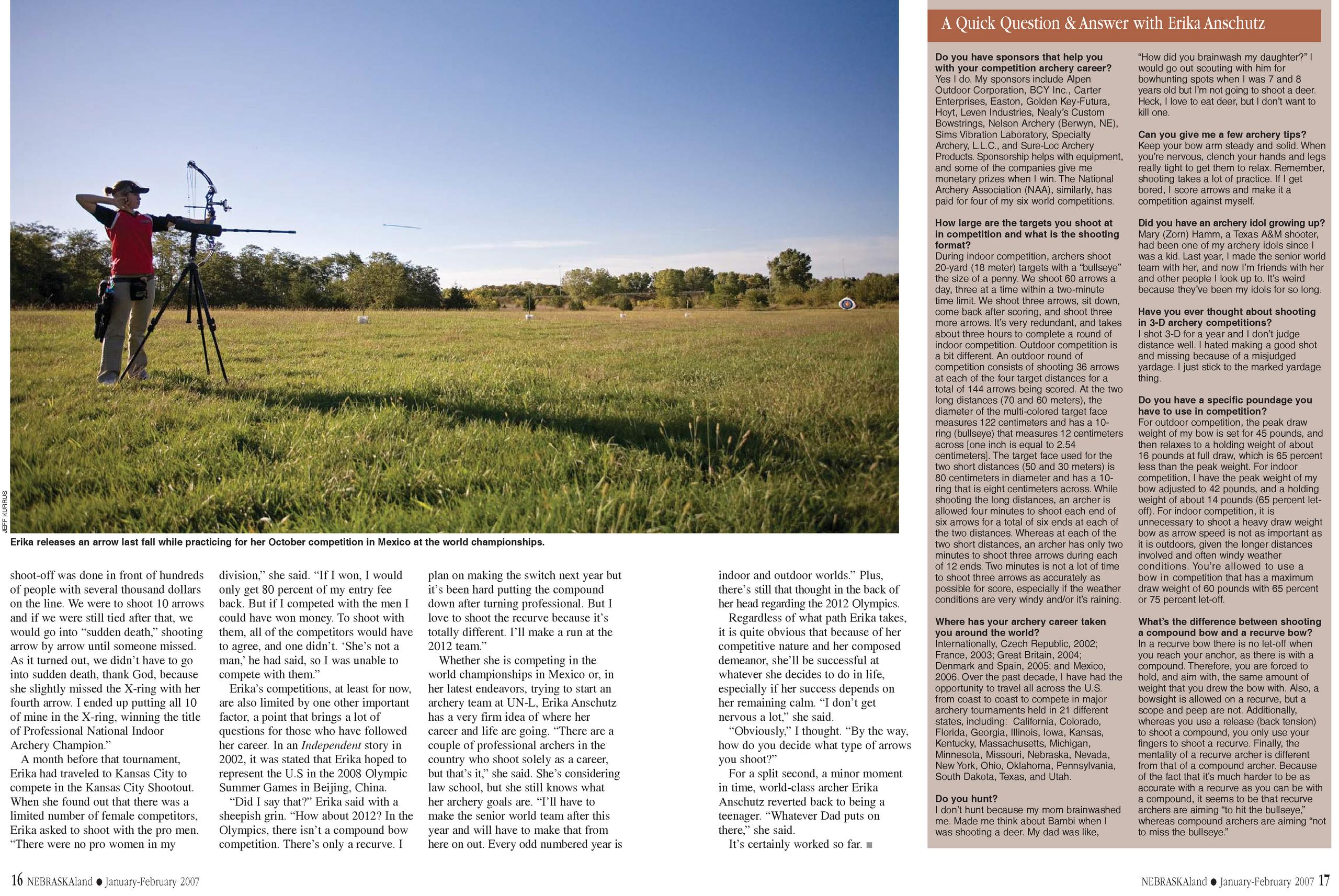
A month before that tournament Erika had traveled to Kansas city to compete in the Kansas City Shootout. When she found out that there was a limited number of female competitors, Erica asked to shoot with the pro men. "There were no pro women in my division," she said. "If I won, I would only get 80 percent of my entry fee back. But if I competed with the men I could have won money. To shoot with them, all of the competitors would have to agree, and one didn't. 'She's not a man,' he had said, so I was unable to compete with them."
Erica's competitions, at least for now, are also limited by one other important factor, a point that brings a lot of questions for those who have followed her career. In an Independent story in 2002, it was stated that Erika hoped to represent the U.S. in the 2008 Olympic Summer Games in Beijing, China.
"Did I say that?" Erika said with a sheepish grin. "How about 2012? In the Olympics, there isn't a compound bow competition. There's only a recurve. I plan on making the switch next year but it's been hard putting the compound down after turning professional. But I love to shoot the recurve because it's totally different. I'll make a run at the 2012 team."
Whether she is competing in the world championships in Mexico or, in her latest endeavors, trying to start an archery team at UN-L, Erika Anschutz has a very firm idea of where her career and life are going. "There are a couple of professional archers in the country who shoot solely as a career, but that's it," she said. She's considering law school, but she still knows what her archery goals are. "I'll have to make the senior world team after this year and will have to make that from here on out. Every odd numbered year is 16 NEBRASKAland January-February 2007 indoor and outdoor worlds." Plus, there's still that thought in the back of her head regarding the 2012 Olympics.
Regardless of what path Erika takes, it is quite obvious that because of her competitive nature and her composed demeanor, she'll be successful at whatever she decides to do in life, especially if her success depends on her remaining calm. "I don't get nervous a lot," she said.
"Obviously," I thought. "By the way, how do you decide what type of arrows you shoot?"
For a split second, a minor moment in time, world-class archer Erika Anschutz reverted back to being a teenager. "Whatever Dad puts on there," she said.
It's certainly worked so far.
A Quick Question & Answer with Erika Anshutz Do you have sponsors that help you with your competition archery career? Yes I do. My sponsors include Alpen Outdoor Corporation, BCY Inc., Carter Enterprises, Easton, Golden Key-Futura, Hoyt, Leven Industries, Nealy's Custom Bowstrings, Nelson Archery (Berwyn, NE), Sims Vibration Laboratory, Specialty Archery, L.L.C., and Sure-Loc Archery Products. Sponsorship helps with equipment, and some of the companies give me monetary prizes when I win. The National Archery Association (NAA), similarly, has paid for four of my six world competitions. How large are the targets you shoot at in competition and what is the shooting format? During indoor competition, archers shoot 20-yard (18 meter) targets with a "bullseye" the size of a penny.We shoot 60 arrows a day, three at a time within a two-minute time limit.We shoot three arrows, sit down, come back after scoring, and shoot three more arrows. It's very redundant, and takes about three hours to complete a round of indoor competition. Outdoor competition is a bit different. An outdoor round of competition consists of shooting 36 arrows at each of the four target distances for a total of 144 arrows being scored. At the two long distances (70 and 60 meters), the diameter of the multi-colored target face measures 122 centimeters and has a 10- ring (bullseye) that measures 12 centimeters across [one inch is equal to 2.54 centimeters]. The target face used for the two short distances (50 and 30 meters) is 80 centimeters in diameter and has a 10- ring that is eight centimeters across. While shooting the long distances, an archer is allowed four minutes to shoot each end of six arrows for a total of six ends at each of the two distances. Whereas at each of the two short distances, an archer has only two minutes to shoot three arrows during each of 12 ends. Two minutes is not a lot of time to shoot three arrows as accurately as possible for score, especially if the weather conditions are very windy and/or it's raining. Where has your archery career taken you around the world? Internationally, Czech Republic, 2002; France, 2003; Great Britain, 2004; Denmark and Spain, 2005; and Mexico, 2006. Over the past decade, I have had the opportunity to travel all across the U.S. from coast to coast to compete in major archery tournaments held in 21 different states, including: California, Colorado, Florida, Georgia, Illinois, Iowa, Kansas, Kentucky, Massachusetts, Michigan, Minnesota, Missouri, Nebraska, Nevada, New York, Ohio, Oklahoma, Pennsylvania, South Dakota, Texas, and Utah. Do you hunt? I don't hunt because my mom brainwashed me. Made me think about Bambi when I was shooting a deer. My dad was like, "How did you brainwash my daughter?" I would go out scouting with him for bowhunting spots when I was 7 and 8 years old but I'm not going to shoot a deer. Heck, I love to eat deer, but I don't want to kill one. Can you give me a few archery tips? Keep your bow arm steady and solid. When you're nervous, clench your hands and legs really tight to get them to relax. Remember, shooting takes a lot of practice. If I get bored, I score arrows and make it a competition against myself. Did you have an archery idol growing up? Mary (Zorn) Hamm, a Texas A&M shooter, had been one of my archery idols since I was a kid. Last year, I made the senior world team with her, and now I'm friends with her and other people I look up to. It's weird because they've been my idols for so long. Have you ever thought about shooting in 3-D archery competitions? I shot 3-D for a year and I don't judge distance well. I hated making a good shot and missing because of a misjudged yardage. I just stick to the marked yardage thing. Do you have a specific poundage you have to use in competition? For outdoor competition, the peak draw weight of my bow is set for 45 pounds, and then relaxes to a holding weight of about 16 pounds at full draw, which is 65 percent less than the peak weight. For indoor competition, I have the peak weight of my bow adjusted to 42 pounds, and a holding weight of about 14 pounds (65 percent letoff). For indoor competition, it is unnecessary to shoot a heavy draw weight bow as arrow speed is not as important as it is outdoors, given the longer distances involved and often windy weather conditions. You're allowed to use a bow in competition that has a maximum draw weight of 60 pounds with 65 percent or 75 percent let-off. What's the difference between shooting a compound bow and a recurve bow? In a recurve bow there is no let-off when you reach your anchor, as there is with a compound. Therefore, you are forced to hold, and aim with, the same amount of weight that you drew the bow with. Also, a bowsight is allowed on a recurve, but a scope and peep are not. Additionally, whereas you use a release (back tension) to shoot a compound, you only use your fingers to shoot a recurve. Finally, the mentality of a recurve archer is different from that of a compound archer. Because of the fact that it's much harder to be as accurate with a recurve as you can be with a compound, it seems to be that recurve archers are aiming "to hit the bullseye," whereas compound archers are aiming "not to miss the bullseye."
A Cause for Celebration
A personal observation and discovery – the return of nesting greater sandhill cranes to the Nebraska Panhandle
The discovery last summer of a nesting pair of greater sandhill cranes (Grus canadensis) in the Panhandle's North Platte River Valley was the cause of celebration for crane lovers everywhere. On a personal note, it gave me the opportunity for a close-up, even intimate look into the lives, habits and habitat needs of an ancient species struggling to survive in a rapidly changing world.
This unusual story (see sidebar on page 24) began last spring when the two adult cranes, both standing about four feet tall with a wingspan of six feet, settled on a marsh at the Chet and Jane Fliesbach Wildlife Management Area at Facus Springs and performed their courtship displays and beautiful unison calling. Later they built a nest and began the arduous task of building a family, sharing incubation and 24-hour-aday protection of the eggs, hatchlings, chicks and fledglings throughout the entire summer.
During this time a host of coyotes, red fox, raccoons, skunks, owls, hawks, golden eagles, dogs and probably many other predators lay waiting for the cranes to make a mistake. Faced with late-winter bouts of sub-freezing temperatures, snow flurries, spring storms with icy winds, hail and a high plains drought, the breeding pair of sandhill cranes survived many of the same challenges as the pioneers that had used the very same spring and marsh at least 165 years earlier on their way west along the Oregon-California trail.
Much of the cranes' story to this point is conjecture because, amazingly, their presence on a marsh along one of the Panhandle's busiest highways went unheralded until early July, when Emily Munter, district habitat partners manager for the Nebraska Game and Parks Commission's office in Alliance, was surprised to see the pair of large cranes standing along the edge of the WMA. She immediately noted something else – the two birds were colored differently than the lesser sandhills that stop along the eastern North Platte River Valley on their annual spring migration to the north. These had the usual vibrant red crown and their upper necks were the familiar crane gray, but each bird's lower neck and broad, sloped back and sides were the color of sunbaked Georgia clay, indicative of cranes which had been recently "painting" themselves with soil around their nesting area. Even more surprising to Munter was the light, golden-colored chick, about the size of an adult mallard, standing 18 NEBRASKAland January-February 2007
Within an hour of hearing her report when she got back to Alliance that morning, I was safely pulling my vehicle off the shoulder of the highway and looking in awe at the two tan-colored adult cranes and chick standing less than 50 yards from the road's paved surface. Obviously aware of my presence, the adults stretched their necks to full height to get a better view of the vehicle stopped along the highway but remained steadfast and unmoving. I took the bird's reaction to mean that my observation distance wasn't too close.
One of the adults began a slow, seemingly purposeful walk in my direction, its long legs and gait marching it steadily closer. Absorbed with the sight through the camera's viewfinder and constrained by the telephoto lens's tight angle of view, at first I failed to see the second crane chick that rose from the marsh grass just in front of the nearer adult. The second chick was larger and lighter-colored than the first and as I photographed them, the nearer pair returned to the other adult and chick and all four moved away slowly, continuing to feed as they disappeared into a tall stand of cattails.
"Watch closely, and you might learn something," a friend and mentor once said about the rare glimpses into their lives that wildlife sometimes give us. At that moment, my first lesson in the lives and lore of sandhill cranes began – inauspiciously and without the noisy fanfare that accompanies the birds when they stop in large flocks along the central Platte and in western Nebraska each spring.
Accompanied by my wife Marlene, I returned to the marsh later that day. It was a beautiful
July evening and, gratefully, the swarms of mosquitoes we expected to find were absent.
As we watched the cranes feed across the meadow from us,
NEBRASKAland January-February 2007 19
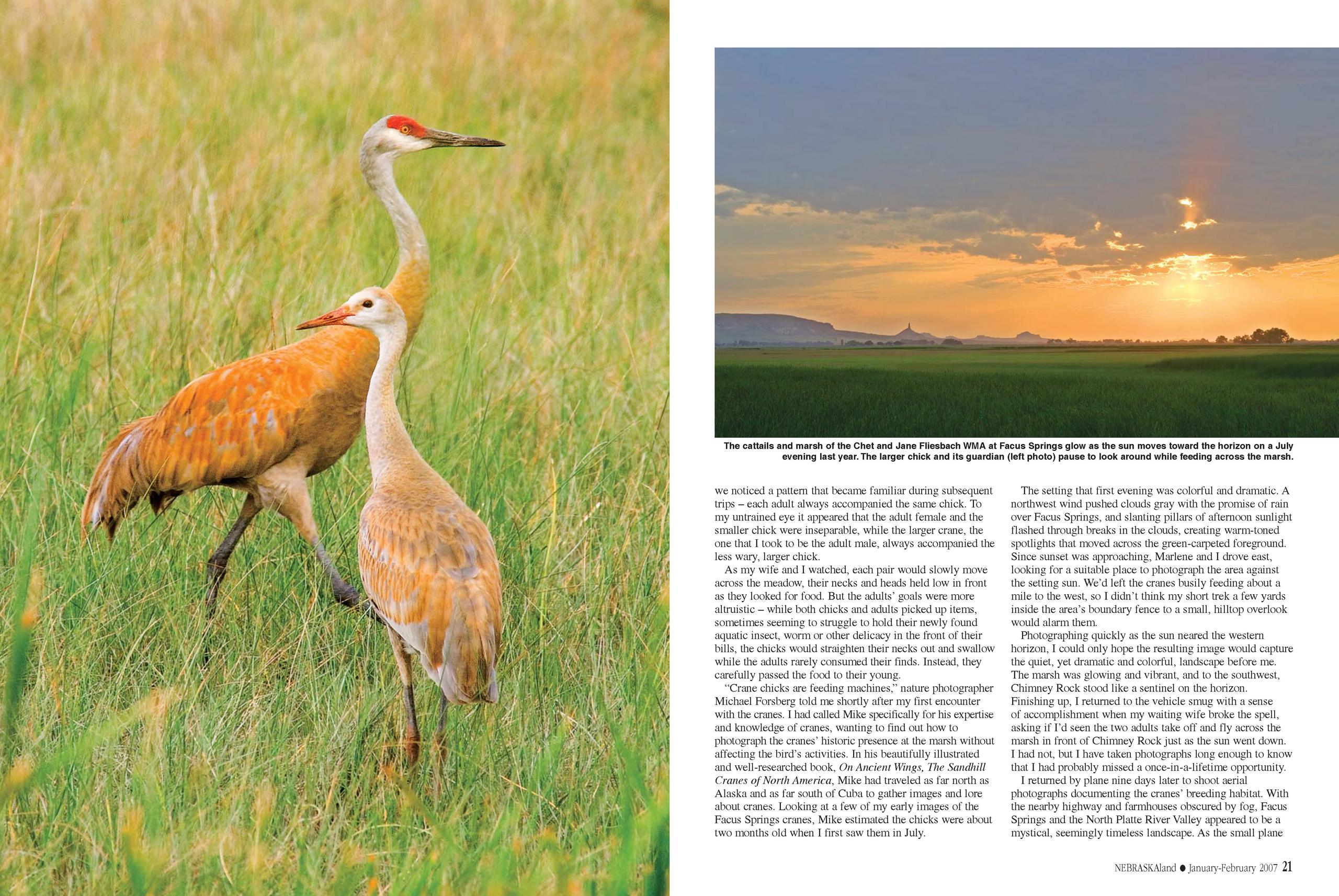
As my wife and I watched, each pair would slowly move across the meadow, their necks and heads held low in front as they looked for food. But the adults' goals were more altruistic – while both chicks and adults picked up items, sometimes seeming to struggle to hold their newly found aquatic insect, worm or other delicacy in the front of their bills, the chicks would straighten their necks out and swallow while the adults rarely consumed their finds. Instead, they carefully passed the food to their young.
"Crane chicks are feeding machines," nature photographer Michael Forsberg told me shortly after my first encounter with the cranes. I had called Mike specifically for his expertise and knowledge of cranes, wanting to find out how to photograph the cranes' historic presence at the marsh without affecting the bird's activities. In his beautifully illustrated and well-researched book, On Ancient Wings, The Sandhill Cranes of North America, Mike had traveled as far north as Alaska and as far south of Cuba to gather images and lore about cranes. Looking at a few of my early images of the Facus Springs cranes, Mike estimated the chicks were about two months old when I first saw them in July.
The setting that first evening was colorful and dramatic. A northwest wind pushed clouds gray with the promise of rain over Facus Springs, and slanting pillars of afternoon sunlight flashed through breaks in the clouds, creating warm-toned spotlights that moved across the green-carpeted foreground. Since sunset was approaching, Marlene and I drove east, looking for a suitable place to photograph the area against the setting sun. We'd left the cranes busily feeding about a mile to the west, so I didn't think my short trek a few yards inside the area's boundary fence to a small, hilltop overlook would alarm them.
Photographing quickly as the sun neared the western horizon, I could only hope the resulting image would capture the quiet, yet dramatic and colorful, landscape before me. The marsh was glowing and vibrant, and to the southwest, Chimney Rock stood like a sentinel on the horizon. Finishing up, I returned to the vehicle smug with a sense of accomplishment when my waiting wife broke the spell, asking if I'd seen the two adults take off and fly across the marsh in front of Chimney Rock just as the sun went down. I had not, but I have taken photographs long enough to know that I had probably missed a once-in-a-lifetime opportunity.
I returned by plane nine days later to shoot aerial photographs documenting the cranes'
breeding habitat. With the nearby highway and farmhouses obscured by fog, Facus Springs
and the North Platte River Valley appeared to be a mystical, seemingly timeless landscape.
As the small plane
NEBRASKAland January-February 2007 21
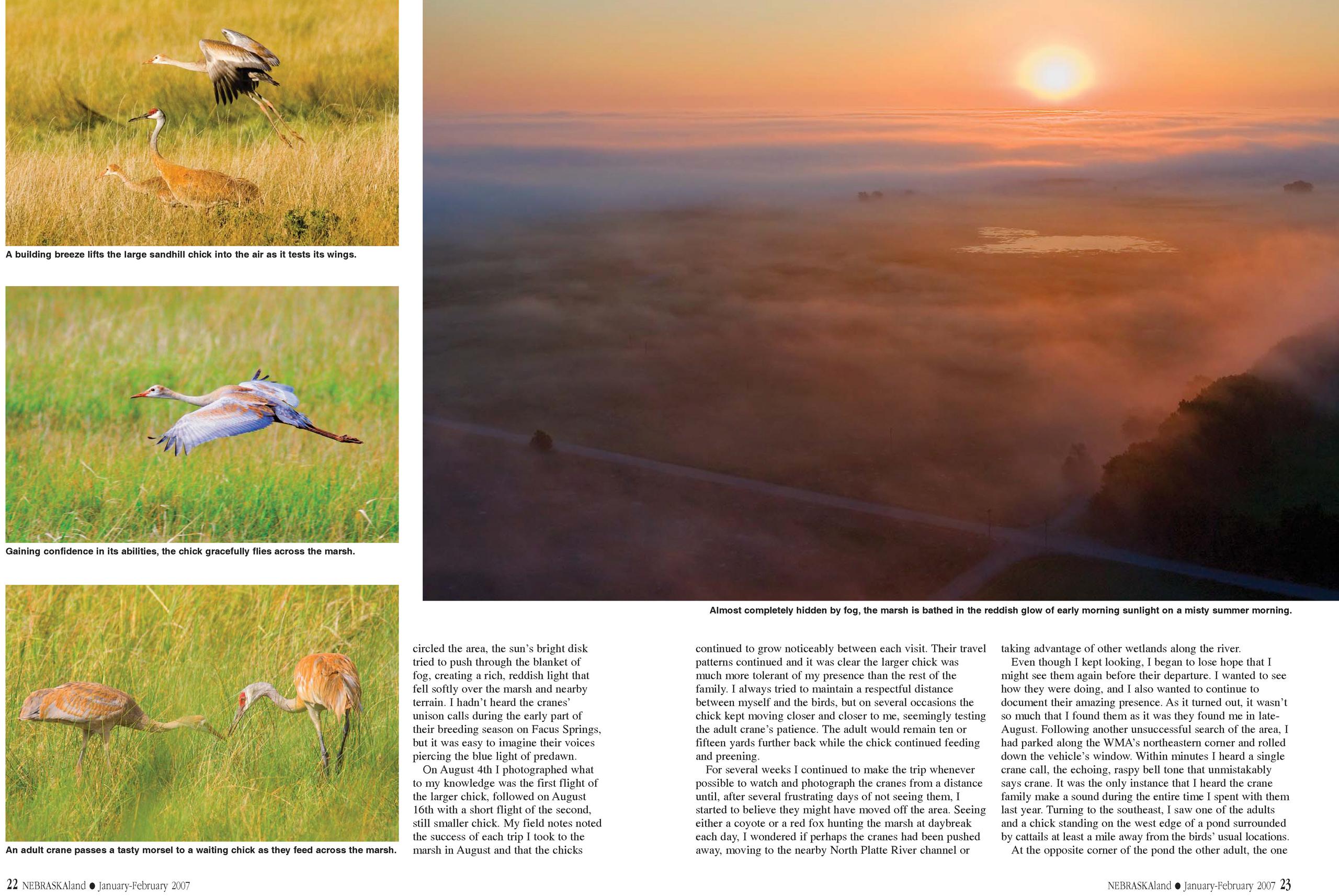
On August 4th I photographed what to my knowledge was the first flight of the larger chick, followed on August 16th with a short flight of the second, still smaller chick. My field notes noted the success of each trip I took to the marsh in August and that the chicks 22 NEBRASKAland January-February 2007
For several weeks I continued to make the trip whenever possible to watch and photograph the cranes from a distance until, after several frustrating days of not seeing them, I started to believe they might have moved off the area. Seeing either a coyote or a red fox hunting the marsh at daybreak each day, I wondered if perhaps the cranes had been pushed away, moving to the nearby North Platte River channel or taking advantage of other wetlands along the river.
Even though I kept looking, I began to lose hope that I might see them again before their departure. I wanted to see how they were doing, and I also wanted to continue to document their amazing presence. As it turned out, it wasn't so much that I found them as it was they found me in late- August. Following another unsuccessful search of the area, I had parked along the WMA's northeastern corner and rolled down the vehicle's window. Within minutes I heard a single crane call, the echoing, raspy bell tone that unmistakably says crane. It was the only instance that I heard the crane family make a sound during the entire time I spent with them last year. Turning to the southeast, I saw one of the adults and a chick standing on the west edge of a pond surrounded by cattails at least a mile away from the birds' usual locations.
At the opposite corner of the pond the other adult, the one
NEBRASKAland January-February 2007 23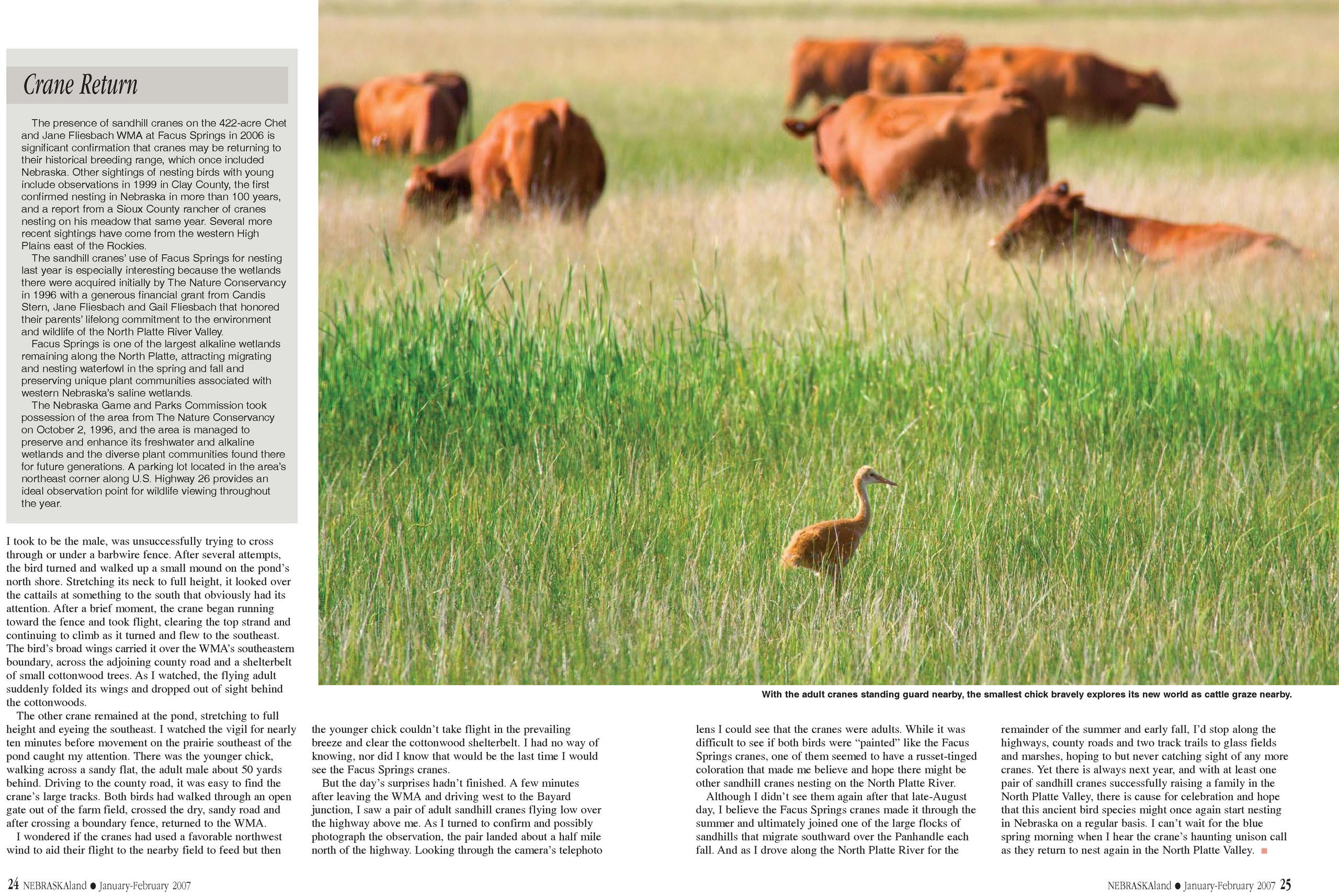 Crane Return
The presence of sandhill cranes on the 422-acre Chet and Jane Fliesbach WMA at Facus
Springs in 2006 is significant confirmation that cranes may be returning to their
historical breeding range, which once included Nebraska. Other sightings of nesting
birds with young include observations in 1999 in Clay County, the first confirmed
nesting in Nebraska in more than 100 years, and a report from a Sioux County rancher
of cranes nesting on his meadow that same year. Several more recent sightings have
come from the western High Plains east of the Rockies.
The sandhill cranes' use of Facus Springs for nesting last year is especially interesting
because the wetlands there were acquired initially by The Nature Conservancy in 1996
with a generous financial grant from Candis Stern, Jane Fliesbach and Gail Fliesbach
that honored their parents' lifelong commitment to the environment and wildlife of
the North Platte River Valley.
Facus Springs is one of the largest alkaline wetlands remaining along the North Platte,
attracting migrating and nesting waterfowl in the spring and fall and preserving unique
plant communities associated with western Nebraska's saline wetlands.
The Nebraska Game and Parks Commission took possession of the area from The Nature
Conservancy on October 2, 1996, and the area is managed to preserve and enhance its
freshwater and alkaline wetlands and the diverse plant communities found there for
future generations. A parking lot located in the area's northeast corner along U.S.
Highway 26 provides an ideal observation point for wildlife viewing throughout the
year.
Crane Return
The presence of sandhill cranes on the 422-acre Chet and Jane Fliesbach WMA at Facus
Springs in 2006 is significant confirmation that cranes may be returning to their
historical breeding range, which once included Nebraska. Other sightings of nesting
birds with young include observations in 1999 in Clay County, the first confirmed
nesting in Nebraska in more than 100 years, and a report from a Sioux County rancher
of cranes nesting on his meadow that same year. Several more recent sightings have
come from the western High Plains east of the Rockies.
The sandhill cranes' use of Facus Springs for nesting last year is especially interesting
because the wetlands there were acquired initially by The Nature Conservancy in 1996
with a generous financial grant from Candis Stern, Jane Fliesbach and Gail Fliesbach
that honored their parents' lifelong commitment to the environment and wildlife of
the North Platte River Valley.
Facus Springs is one of the largest alkaline wetlands remaining along the North Platte,
attracting migrating and nesting waterfowl in the spring and fall and preserving unique
plant communities associated with western Nebraska's saline wetlands.
The Nebraska Game and Parks Commission took possession of the area from The Nature
Conservancy on October 2, 1996, and the area is managed to preserve and enhance its
freshwater and alkaline wetlands and the diverse plant communities found there for
future generations. A parking lot located in the area's northeast corner along U.S.
Highway 26 provides an ideal observation point for wildlife viewing throughout the
year.
I took to be the male, was unsuccessfully trying to cross through or under a barbwire fence. After several attempts, the bird turned and walked up a small mound on the pond's north shore. Stretching its neck to full height, it looked over the cattails at something to the south that obviously had its attention. After a brief moment, the crane began running toward the fence and took flight, clearing the top strand and continuing to climb as it turned and flew to the southeast. The bird's broad wings carried it over the WMA's southeastern boundary, across the adjoining county road and a shelterbelt of small cottonwood trees. As I watched, the flying adult suddenly folded its wings and dropped out of sight behind the cottonwoods.
The other crane remained at the pond, stretching to full height and eyeing the southeast. I watched the vigil for nearly ten minutes before movement on the prairie southeast of the pond caught my attention. There was the younger chick, walking across a sandy flat, the adult male about 50 yards behind. Driving to the county road, it was easy to find the crane's large tracks. Both birds had walked through an open gate out of the farm field, crossed the dry, sandy road and after crossing a boundary fence, returned to the WMA.
I wondered if the cranes had used a favorable northwest wind to aid their flight to the nearby field to feed but then
But the day's surprises hadn't finished. A few minutes after leaving the WMA and driving west to the Bayard junction, I saw a pair of adult sandhill cranes flying low over the highway above me. As I turned to confirm and possibly photograph the observation, the pair landed about a half mile north of the highway. Looking through the camera's telephoto 24 NEBRASKAland January-February 2007 lens I could see that the cranes were adults. While it was difficult to see if both birds were "painted" like the Facus Springs cranes, one of them seemed to have a russet-tinged coloration that made me believe and hope there might be other sandhill cranes nesting on the North Platte River.
Although I didn't see them again after that late-August day, I believe the Facus Springs cranes made it through the summer and ultimately joined one of the large flocks of sandhills that migrate southward over the Panhandle each fall. And as I drove along the North Platte River for the remainder of the summer and early fall, I'd stop along the highways, county roads and two track trails to glass fields and marshes, hoping to but never catching sight of any more cranes. Yet there is always next year, and with at least one pair of sandhill cranes successfully raising a family in the North Platte Valley, there is cause for celebration and hope that this ancient bird species might once again start nesting in Nebraska on a regular basis. I can't wait for the blue spring morning when I hear the crane's haunting unison call as they return to nest again in the North Platte Valley.
Pumping New Life into Old Lakes
Ten years after its launch, Nebraska's Aquatic Habitat Program has helped improve fishing at 43 lakes across the state, in some cases turning mudholes into honey holes.
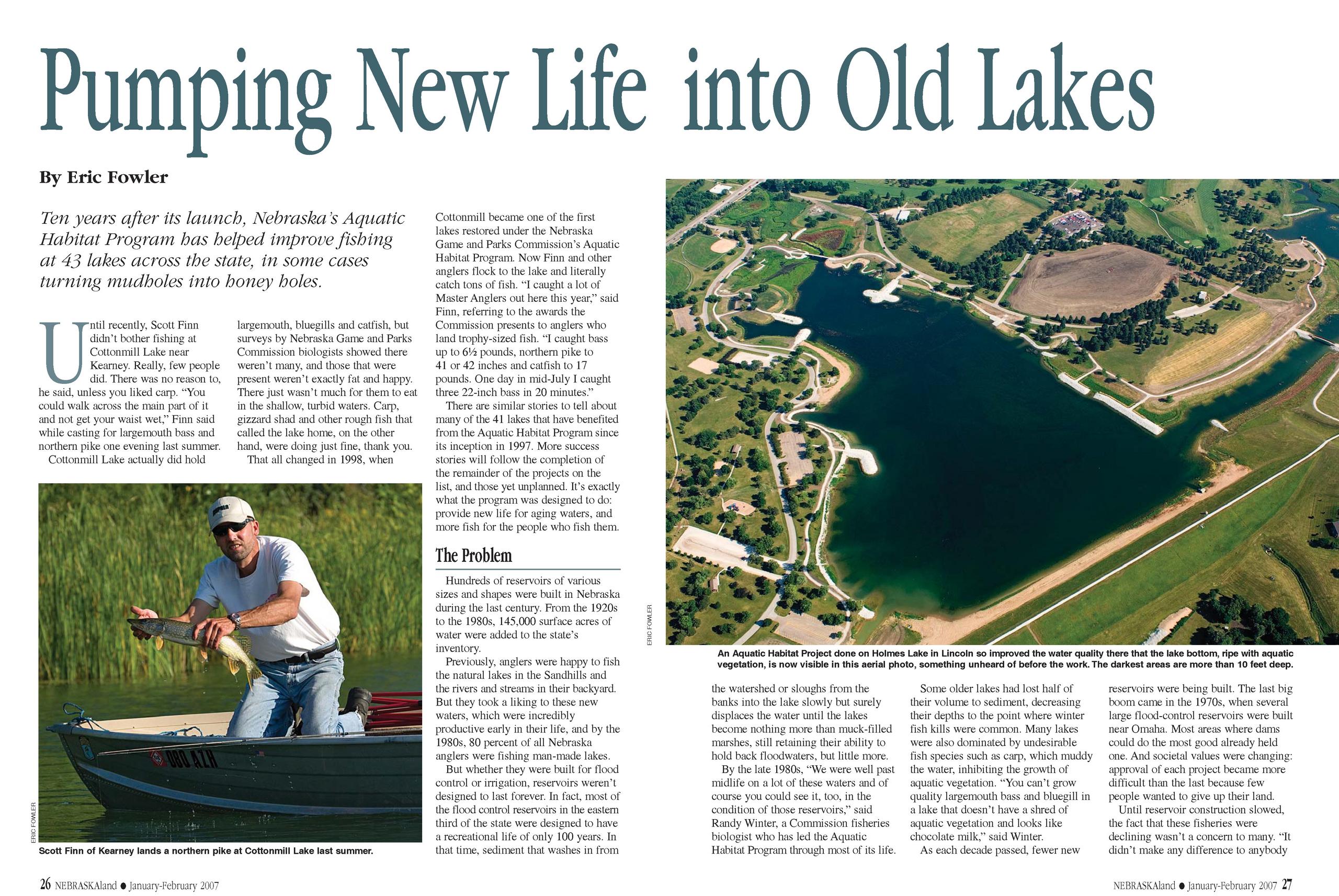
Until recently, Scott Finn didn't bother fishing at Cottonmill Lake near Kearney. Really, few people did. There was no reason to, he said, unless you liked carp. "You could walk across the main part of it and not get your waist wet," Finn said while casting for largemouth bass and northern pike one evening last summer.
Cottonmill Lake actually did hold largemouth, bluegills and catfish, but surveys by Nebraska Game and Parks Commission biologists showed there weren't many, and those that were present weren't exactly fat and happy. There just wasn't much for them to eat in the shallow, turbid waters. Carp, gizzard shad and other rough fish that called the lake home, on the other hand, were doing just fine, thank you.
That all changed in 1998, when
There are similar stories to tell about many of the 41 lakes that have benefited from the Aquatic Habitat Program since its inception in 1997. More success stories will follow the completion of the remainder of the projects on the list, and those yet unplanned. It's exactly what the program was designed to do: provide new life for aging waters, and more fish for the people who fish them.
The ProblemHundreds of reservoirs of various sizes and shapes were built in Nebraska during the last century. From the 1920s to the 1980s, 145,000 surface acres of water were added to the state's inventory.
Previously, anglers were happy to fish the natural lakes in the Sandhills and the rivers and streams in their backyard. But they took a liking to these new waters, which were incredibly productive early in their life, and by the 1980s, 80 percent of all Nebraska anglers were fishing man-made lakes.
But whether they were built for flood control or irrigation, reservoirs weren't designed to last forever. In fact, most of the flood control reservoirs in the eastern third of the state were designed to have a recreational life of only 100 years. In that time, sediment that washes in from 26 NEBRASKAland January-February 2007
By the late 1980s, "We were well past midlife on a lot of these waters and of course you could see it, too, in the condition of those reservoirs," said Randy Winter, a Commission fisheries biologist who has led the Aquatic Habitat Program through most of its life.
Some older lakes had lost half of their volume to sediment, decreasing their depths to the point where winter fish kills were common. Many lakes were also dominated by undesirable fish species such as carp, which muddy the water, inhibiting the growth of aquatic vegetation. "You can't grow quality largemouth bass and bluegill in a lake that doesn't have a shred of aquatic vegetation and looks like chocolate milk," said Winter.
As each decade passed, fewer new reservoirs were being built. The last big boom came in the 1970s, when several large flood-control reservoirs were built near Omaha. Most areas where dams could do the most good already held one. And societal values were changing: approval of each project became more difficult than the last because few people wanted to give up their land.
Until reservoir construction slowed,
the fact that these fisheries were
declining wasn't a concern to many. "It
didn't make any difference to anybody
NEBRASKAland January-February 2007 27
It's often easier to come up with a solution than to implement one, but in the 1990s, the Commission and anglers were able to do both. Winter and others knew there were ways they could rehabilitate these aging reservoirs to extend their useful life as fisheries. When they took that message on the road in 1994, more than 600 anglers turned out to hear it. Of those, 200 wanted to be directly involved, and roughly 70 were selected to hammer out this new program. To pay for it, anglers recommended creating a dedicated funding source, the Aquatic Habitat Stamp. They agreed that $10 would be a fair price to charge, yet the plan didn't bypass the scrutiny of politicians. Some senators objected, and the proposed price of the stamp was reduced to $5. The anglers then lobbied their state senators to support the program, which they did. "There's just no way it would've happened without that," said Winter.
Ben Nelson, then the state's governor, said the public should decide which waterbodies should receive work, and that the plan must be approved by the Natural Resources and Appropriations committees. Public meetings were held, 91 water bodies were nominated and the top 17 were selected by Commission staff. The Natural Resources Committee didn't approve the list, pointing to a lack of projects in Omaha, home to most of the state's anglers. So biologists expanded it to 53 waters, including Cunningham Lake and ponds at Benson, Towl and Walnut Grove parks in Omaha. The plan was accepted, and biologists and engineers began designing projects.
The Aquatic Habitat Stamp became required for most anglers in 1997, and with that revenue, the heavy lifting of the program began. Anglers have since purchased more than 1.9 million stamps, and the $9.5 million generated has been leveraged against more than 70 other funding sources, most notably the Sport Fish Restoration Fund, Nebraska Environmental Trust, and Environmental Protection Agency program funds, providing more than $26 million for work to date.
The Solution VegetationFor many lakes in the Aquatic Habitat Program, restoring rooted aquatic vegetation, such as bulrushes, cattails, curly-leaf pond weed and arrowhead, is one of the primary goals. Vegetation provides a protected area for fish to spawn and a place for small fish to hide from big fish. It also provides a home for the aquatic organisms small fish eat. "All of those things contribute to the carrying capacity a lake has for certain species of fish like bluegill, black crappie and largemouth bass," Winter said.
Standards adopted long ago say that in order to have the best largemouth bass lake possible, 20 to 60 percent of the basin should be filled with aquatic vegetation, either the type that grows below the surface of the water or that extends above it. For bluegills, the optimum goal of vegetative cover is 20 to 80 percent.
"There's quite a range there," Winter said. "A lot of people will look at a lake and say 'That's too much vegetation,' when really it's just too much vegetation for anglers to fish. It's not really too much vegetation for bass or bluegill."
At Rock Creek Lake near Benkelman, water quality was good before an Aquatic Habitat Program project began there. Knowing work would make it even better and lead to an increase in aquatic vegetation, barriers were installed in 29 spots around the 50-acre lake that will inhibit plant growth and provide pockets of open water for anglers. As a bonus, this will increase the amount of "edge" preferred by bass and redear sunfish. In reality, it may be impossible to maintain adequate vegetative cover in some of Nebraska's larger, windswept reservoirs. With that in mind, many aquatic habitat projects have included a modification of the lake's outlet structure that allows water levels to be lowered periodically by up to three feet. In most cases, this will expose between 15 and 18 percent of the lake basin and give vegetation a chance to regenerate.
"What we can do is drop it down and expose the mud to sunshine and air so we can start getting cattails and bulrushes to grow," Winter said. "Then when we fill it back up, we've got the vegetation we need to have a positive effect on bluegill, bass and crappie carrying capacity."
When vegetation again declines, lake managers can repeat the process, possibly every six to eight years.
SedimentVegetation won't grow well, if at all, in mud-stained water, which is why 28 NEBRASKAland January-February 2007 removing sediment from reservoirs and then keeping it out is vital to the success of the program. Many lakes slated for Aquatic Habitat Program work must be deepened to ensure that fish have a place to go in the heat of the summer, when shallow water is too warm to support fish, and the dead of winter, when heavy ice cover can lead to low oxygen levels.
Reservoirs are typically drained to excavate sediment, allowing the soil to dry so heavy equipment can be used to scoop it out. When sediment is removed, a lake's basin is typically sculpted to make it more fish-friendly than the fishbowl shape it often has become. The process is costly. Depending on where the silt can be disposed of, cost ranges from 65 cents to $7 per cubic yard.
Winter admits sedimentation is a case of good news, bad news. "If we hadn't had erosion problems on farmland in the 40s, 50s and 60s, we wouldn't have built a lot of these flood control reservoirs in the first place," he said.
It wasn't until after many of the reservoirs were built that people began to adopt techniques like contour and no-till farming and installing terraces, grassed waterways and buffer strips to help keep soil in the fields and out of the streams and reservoirs. Ensuring those practices are in place in the watershed above a reservoir is now part of every Aquatic Habitat Program, thanks to the Natural Resources Conservation Service, Natural Resources Districts and Nebraska Department of Environmental Quality.
The biggest source of sediment flowing into some eastern Nebraska reservoirs, however, is not eroding farm fields, but construction sites in an expanding suburbia. A Department of Environmental Quality study found that while 20 to 30 tons per acre were being washed from some farm fields annually, 100 to 300 tons per acre were being washed from construction sites.
"There were about half a million cubic yards of sediment deposited in Holmes Lake from the time it was finished until the time we did the rehabilitation project," said Winter. "We took out about half of it. We would've loved to have taken it all out but we didn't have the money and didn't have any place to go with it." As it was
Fact Sheet Aquatic Habitat Program, 1997 to present • Projects scheduled: 53 • Complete: 41 • In the works: 8 • Dropped from plan: 4 • Stamps sold: 1.9 million • Revenue generated: $9.5 million • Amount spent to date, including other sources of funding: $26 million. • Amount of sediment removed: 2.3 million cubic yards from 23 lakes • Surface area of lakes affected: 42,633 • Years added to life of lakes and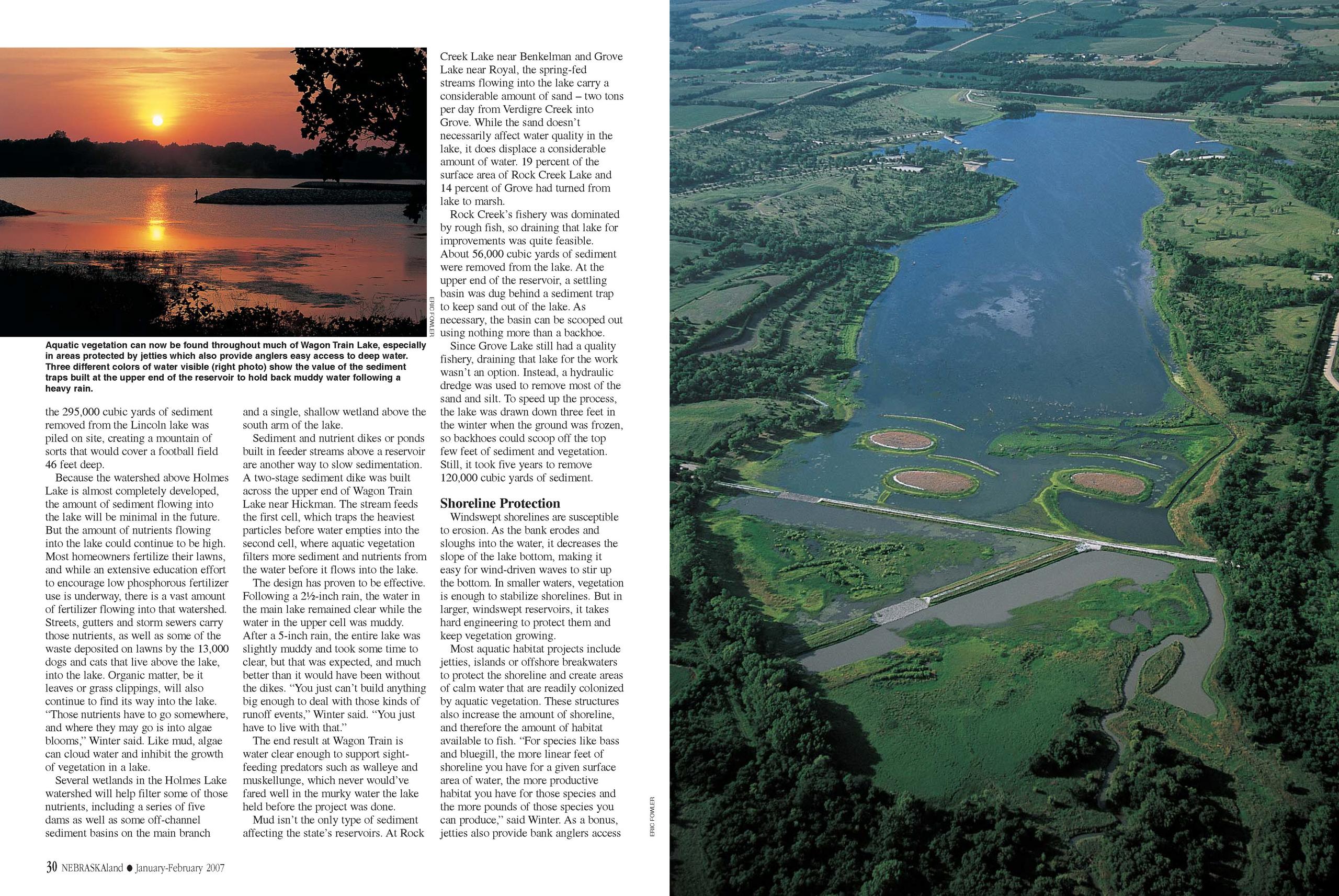
the 295,000 cubic yards of sediment removed from the Lincoln lake was piled on site, creating a mountain of sorts that would cover a football field 46 feet deep.
Because the watershed above Holmes Lake is almost completely developed, the amount of sediment flowing into the lake will be minimal in the future. But the amount of nutrients flowing into the lake could continue to be high. Most homeowners fertilize their lawns, and while an extensive education effort to encourage low phosphorous fertilizer use is underway, there is a vast amount of fertilizer flowing into that watershed. Streets, gutters and storm sewers carry those nutrients, as well as some of the waste deposited on lawns by the 13,000 dogs and cats that live above the lake, into the lake. Organic matter, be it leaves or grass clippings, will also continue to find its way into the lake. "Those nutrients have to go somewhere, and where they may go is into algae blooms," Winter said. Like mud, algae can cloud water and inhibit the growth of vegetation in a lake. Several wetlands in the Holmes Lake watershed will help filter some of those nutrients, including a series of five dams as well as some off-channel sediment basins on the main branch and a single, shallow wetland above the south arm of the lake.
Sediment and nutrient dikes or ponds built in feeder streams above a reservoir are another way to slow sedimentation. A two-stage sediment dike was built across the upper end of Wagon Train Lake near Hickman. The stream feeds the first cell, which traps the heaviest particles before water empties into the second cell, where aquatic vegetation filters more sediment and nutrients from the water before it flows into the lake.
The design has proven to be effective. Following a 2½-inch rain, the water in the main lake remained clear while the water in the upper cell was muddy. After a 5-inch rain, the entire lake was slightly muddy and took some time to clear, but that was expected, and much better than it would have been without the dikes. "You just can't build anything big enough to deal with those kinds of runoff events," Winter said. "You just have to live with that."
The end result at Wagon Train is water clear enough to support sight-feeding predators such as walleye and muskellunge, which never would've fared well in the murky water the lake held before the project was done.
Mud isn't the only type of sediment affecting the state's reservoirs. At Rock Creek Lake near Benkelman and Grove Lake near Royal, the spring-fed streams flowing into the lake carry a considerable amount of sand – two tons per day from Verdigre Creek into Grove. While the sand doesn't necessarily affect water quality in the lake, it does displace a considerable amount of water. 19 percent of the surface area of Rock Creek Lake and 14 percent of Grove had turned from lake to marsh.
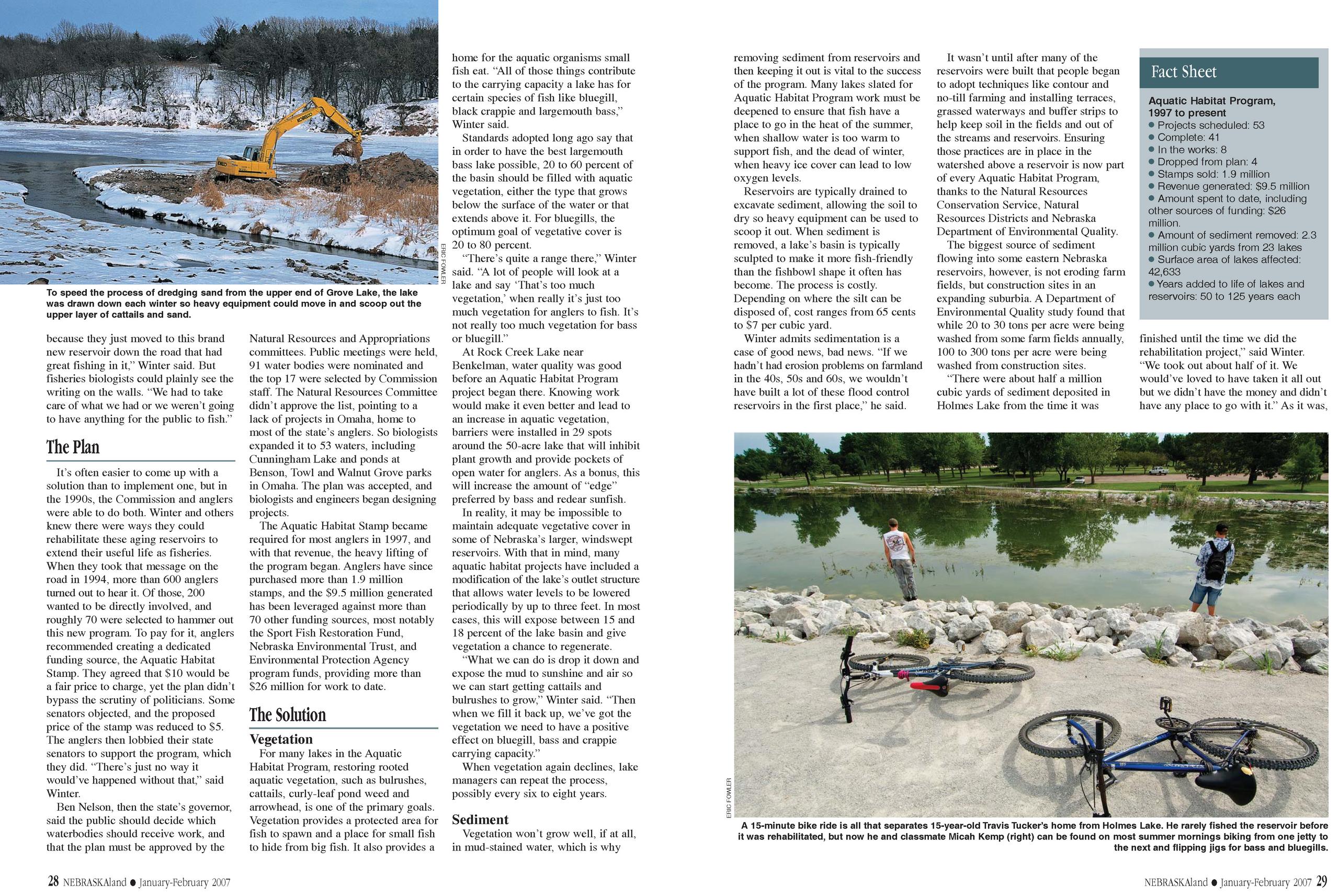
Rock Creek's fishery was dominated by rough fish, so draining that lake for improvements was quite feasible. About 56,000 cubic yards of sediment were removed from the lake. At the upper end of the reservoir, a settling basin was dug behind a sediment trap to keep sand out of the lake. As necessary, the basin can be scooped out using nothing more than a backhoe. Since Grove Lake still had a quality fishery, draining that lake for the work wasn't an option. Instead, a hydraulic dredge was used to remove most of the sand and silt. To speed up the process, the lake was drawn down three feet in the winter when the ground was frozen, so backhoes could scoop off the top few feet of sediment and vegetation. Still, it took five years to remove 120,000 cubic yards of sediment.
Shoreline ProtectionWindswept shorelines are susceptible to erosion. As the bank erodes and sloughs into the water, it decreases the slope of the lake bottom, making it easy for wind-driven waves to stir up the bottom. In smaller waters, vegetation is enough to stabilize shorelines. But in larger, windswept reservoirs, it takes hard engineering to protect them and keep vegetation growing.
Most aquatic habitat projects include jetties, islands or offshore breakwaters to protect the shoreline and create areas of calm water that are readily colonized by aquatic vegetation. These structures also increase the amount of shoreline, and therefore the amount of habitat available to fish. "For species like bass and bluegill, the more linear feet of shoreline you have for a given surface area of water, the more productive habitat you have for those species and the more pounds of those species you can produce," said Winter. As a bonus, jetties also provide bank anglers access 30 NEBRASKAland January-February 2007
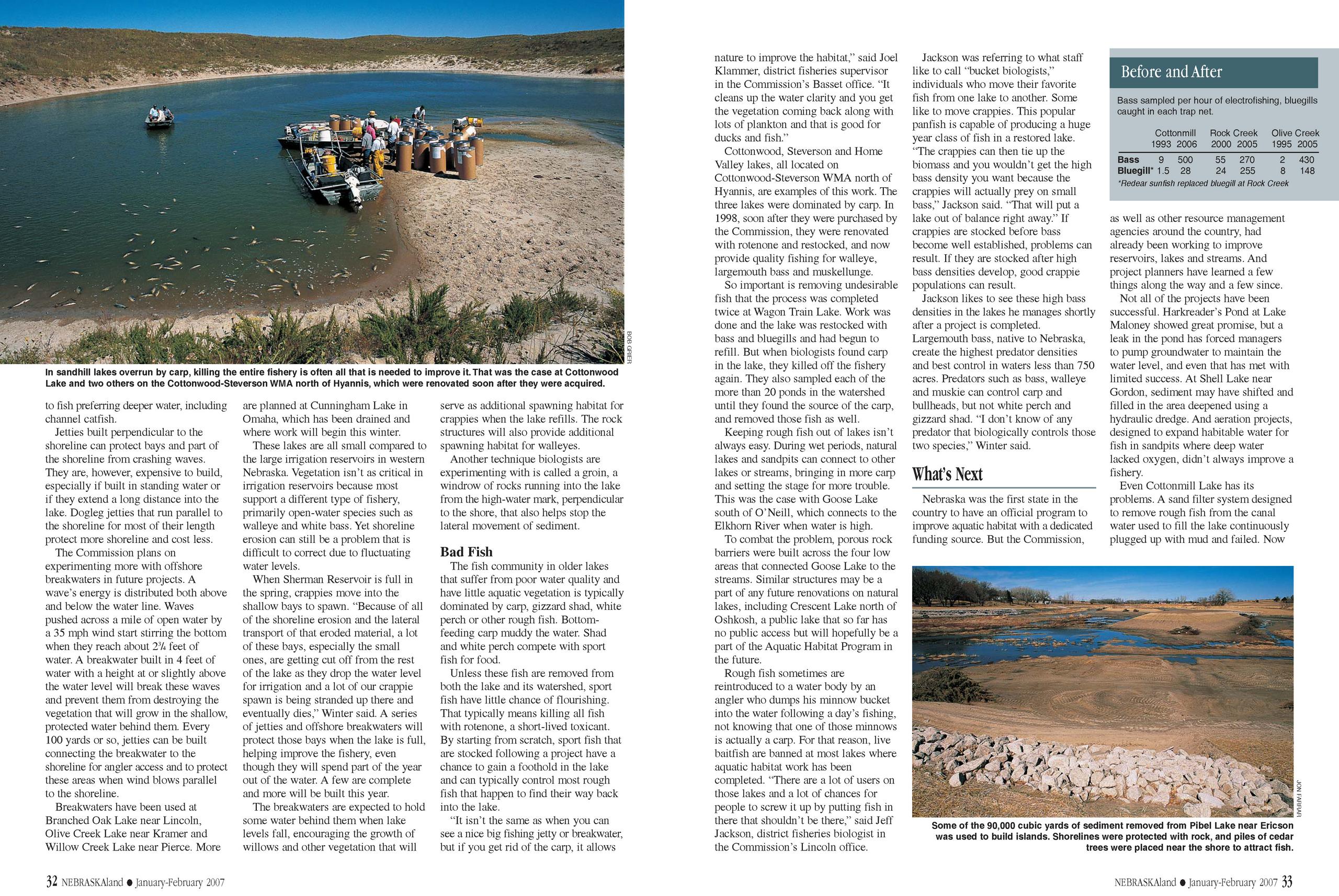
Jetties built perpendicular to the shoreline can protect bays and part of the shoreline from crashing waves. They are, however, expensive to build, especially if built in standing water or if they extend a long distance into the lake. Dogleg jetties that run parallel to the shoreline for most of their length protect more shoreline and cost less.
The Commission plans on experimenting more with offshore breakwaters in future projects. A wave's energy is distributed both above and below the water line. Waves pushed across a mile of open water by a 35 mph wind start stirring the bottom when they reach about 23/4 feet of water. A breakwater built in 4 feet of water with a height at or slightly above the water level will break these waves and prevent them from destroying the vegetation that will grow in the shallow, protected water behind them. Every 100 yards or so, jetties can be built connecting the breakwater to the shoreline for angler access and to protect these areas when wind blows parallel to the shoreline.
Breakwaters have been used at Branched Oak Lake near Lincoln, Olive Creek Lake near Kramer and Willow Creek Lake near Pierce. More are planned at Cunningham Lake in Omaha, which has been drained and where work will begin this winter.
These lakes are all small compared to the large irrigation reservoirs in western Nebraska. Vegetation isn't as critical in irrigation reservoirs because most support a different type of fishery, primarily open-water species such as walleye and white bass. Yet shoreline erosion can still be a problem that is difficult to correct due to fluctuating water levels.
When Sherman Reservoir is full in the spring, crappies move into the shallow bays to spawn. "Because of all of the shoreline erosion and the lateral transport of that eroded material, a lot of these bays, especially the small ones, are getting cut off from the rest of the lake as they drop the water level for irrigation and a lot of our crappie spawn is being stranded up there and eventually dies," Winter said. A series of jetties and offshore breakwaters will protect those bays when the lake is full, helping improve the fishery, even though they will spend part of the year out of the water. A few are complete and more will be built this year.
The breakwaters are expected to hold some water behind them when lake levels fall, encouraging the growth of willows and other vegetation that will serve as additional spawning habitat for crappies when the lake refills. The rock structures will also provide additional spawning habitat for walleyes.
Another technique biologists are experimenting with is called a groin, a windrow of rocks running into the lake from the high-water mark, perpendicular to the shore, that also helps stop the lateral movement of sediment.
Bad FishThe fish community in older lakes that suffer from poor water quality and have little aquatic vegetation is typically dominated by carp, gizzard shad, white perch or other rough fish. Bottom-feeding carp muddy the water. Shad and white perch compete with sport fish for food.
Unless these fish are removed from both the lake and its watershed, sport fish have little chance of flourishing. That typically means killing all fish with rotenone, a short-lived toxicant. By starting from scratch, sport fish that are stocked following a project have a chance to gain a foothold in the lake and can typically control most rough fish that happen to find their way back into the lake.
"It isn't the same as when you can see a nice big fishing jetty or breakwater, but if you get rid of the carp, it allows 32 NEBRASKAland January-February 2007 nature to improve the habitat," said Joel Klammer, district fisheries supervisor in the Commission's Basset office. "It cleans up the water clarity and you get the vegetation coming back along with lots of plankton and that is good for ducks and fish."
Cottonwood, Steverson and Home Valley lakes, all located on Cottonwood-Steverson WMA north of Hyannis, are examples of this work. The three lakes were dominated by carp. In 1998, soon after they were purchased by the Commission, they were renovated with rotenone and restocked, and now provide quality fishing for walleye, largemouth bass and muskellunge.
So important is removing undesirable fish that the process was completed twice at Wagon Train Lake. Work was done and the lake was restocked with bass and bluegills and had begun to refill. But when biologists found carp in the lake, they killed off the fishery again. They also sampled each of the more than 20 ponds in the watershed until they found the source of the carp, and removed those fish as well.
Keeping rough fish out of lakes isn't always easy. During wet periods, natural lakes and sandpits can connect to other lakes or streams, bringing in more carp and setting the stage for more trouble. This was the case with Goose Lake south of O'Neill, which connects to the Elkhorn River when water is high.
To combat the problem, porous rock barriers were built across the four low areas that connected Goose Lake to the streams. Similar structures may be a part of any future renovations on natural lakes, including Crescent Lake north of Oshkosh, a public lake that so far has no public access but will hopefully be a part of the Aquatic Habitat Program in the future.
Rough fish sometimes are reintroduced to a water body by an angler who dumps his minnow bucket into the water following a day's fishing, not knowing that one of those minnows is actually a carp. For that reason, live baitfish are banned at most lakes where aquatic habitat work has been completed. "There are a lot of users on those lakes and a lot of chances for people to screw it up by putting fish in there that shouldn't be there," said Jeff Jackson, district fisheries biologist in the Commission's Lincoln office.
Jackson was referring to what staff like to call "bucket biologists," individuals who move their favorite fish from one lake to another. Some like to move crappies. This popular panfish is capable of producing a huge year class of fish in a restored lake. "The crappies can then tie up the biomass and you wouldn't get the high bass density you want because the crappies will actually prey on small bass," Jackson said. "That will put a lake out of balance right away." If crappies are stocked before bass become well established, problems can result. If they are stocked after high bass densities develop, good crappie populations can result.
Jackson likes to see these high bass densities in the lakes he manages shortly after a project is completed. Largemouth bass, native to Nebraska, create the highest predator densities and best control in waters less than 750 acres. Predators such as bass, walleye and muskie can control carp and bullheads, but not white perch and gizzard shad. "I don't know of any predator that biologically controls those two species," Winter said.
What's NextNebraska was the first state in the country to have an official program to improve aquatic habitat with a dedicated funding source. But the Commission,
Before and After Bass sampled per hour of electrofishing, bluegills caught in each trap net. Cottonmill Rock Creek Olive Creek 1993 2006 2000 2005 1995 2005 Bass 9 500 55 270 2 430 Bluegill* 1.5 28 24 255 8 148 *Redear sunfish replaced bluegill at Rock Creekas well as other resource management agencies around the country, had already been working to improve reservoirs, lakes and streams. And project planners have learned a few things along the way and a few since. Not all of the projects have been successful. Harkreader's Pond at Lake Maloney showed great promise, but a leak in the pond has forced managers to pump groundwater to maintain the water level, and even that has met with limited success. At Shell Lake near Gordon, sediment may have shifted and filled in the area deepened using a hydraulic dredge. And aeration projects, designed to expand habitable water for fish in sandpits where deep water lacked oxygen, didn't always improve a fishery.
Even Cottonmill Lake has its problems. A sand filter system designed to remove rough fish from the canal water used to fill the lake continuously plugged up with mud and failed. Now
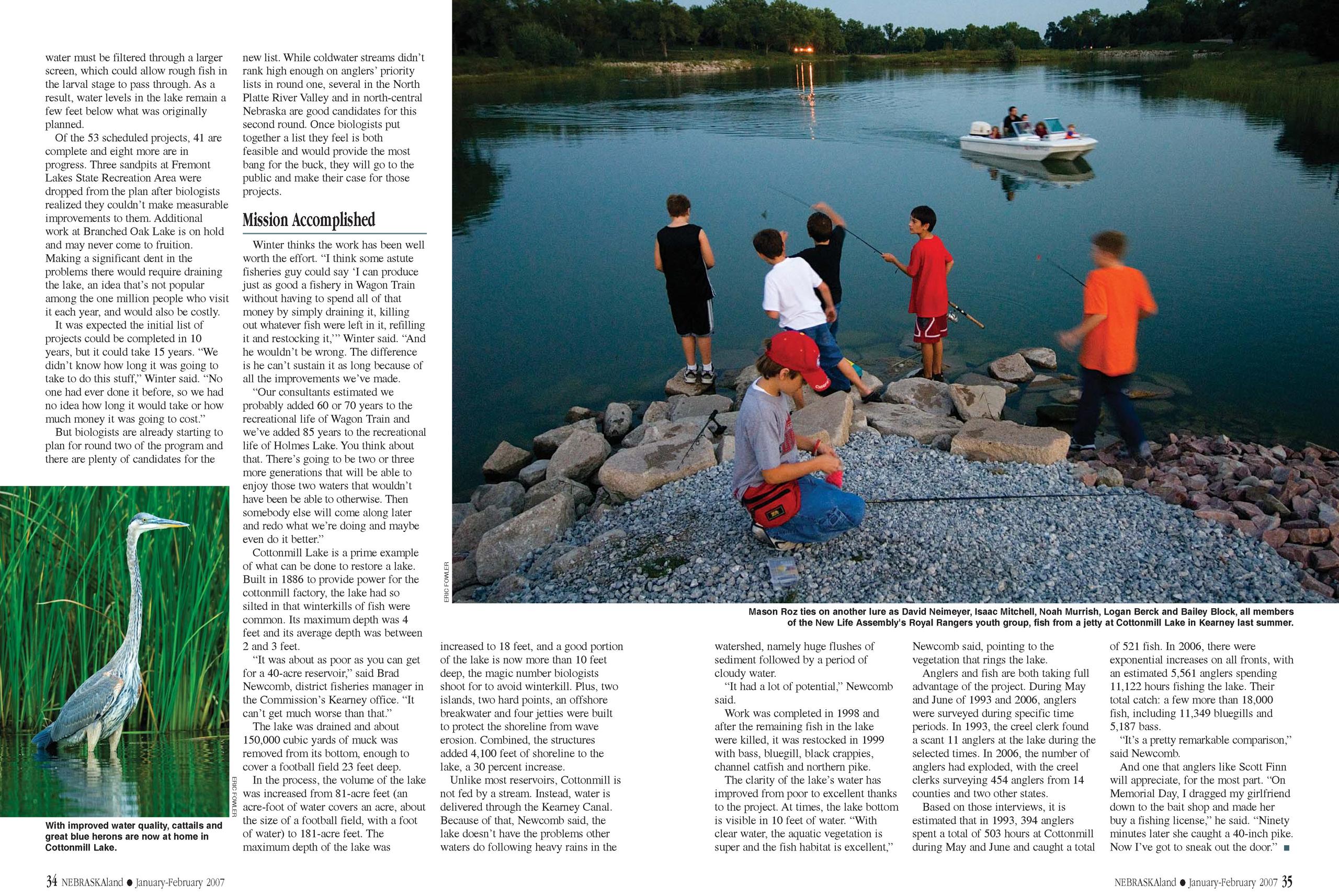
water must be filtered through a larger screen, which could allow rough fish in the larval stage to pass through. As a result, water levels in the lake remain a few feet below what was originally planned.
Of the 53 scheduled projects, 41 are complete and eight more are in progress. Three sandpits at Fremont Lakes State Recreation Area were dropped from the plan after biologists realized they couldn't make measurable improvements to them. Additional work at Branched Oak Lake is on hold and may never come to fruition. Making a significant dent in the problems there would require draining the lake, an idea that's not popular among the one million people who visit it each year, and would also be costly.
It was expected the initial list of projects could be completed in 10 years, but it could take 15 years. "We didn't know how long it was going to take to do this stuff," Winter said. "No one had ever done it before, so we had no idea how long it would take or how much money it was going to cost."
But biologists are already starting to plan for round two of the program and there are plenty of candidates for the
Winter thinks the work has been well worth the effort. "I think some astute fisheries guy could say 'I can produce just as good a fishery in Wagon Train without having to spend all of that money by simply draining it, killing out whatever fish were left in it, refilling it and restocking it,'" Winter said. "And he wouldn't be wrong. The difference is he can't sustain it as long because of all the improvements we've made.
"Our consultants estimated we probably added 60 or 70 years to the recreational life of Wagon Train and we've added 85 years to the recreational life of Holmes Lake. You think about that. There's going to be two or three more generations that will be able to enjoy those two waters that wouldn't have been be able to otherwise. Then somebody else will come along later and redo what we're doing and maybe even do it better."
Cottonmill Lake is a prime example of what can be done to restore a lake. Built in 1886 to provide power for the cottonmill factory, the lake had so silted in that winterkills of fish were common. Its maximum depth was 4 feet and its average depth was between 2 and 3 feet.
"It was about as poor as you can get for a 40-acre reservoir," said Brad Newcomb, district fisheries manager in the Commission's Kearney office. "It can't get much worse than that."
The lake was drained and about 150,000 cubic yards of muck was removed from its bottom, enough to cover a football field 23 feet deep.
In the process, the volume of the lake was increased from 81-acre feet (an acre-foot of water covers an acre, about the size of a football field, with a foot of water) to 181-acre feet. The maximum depth of the lake was
Unlike most reservoirs, Cottonmill is not fed by a stream. Instead, water is delivered through the Kearney Canal. Because of that, Newcomb said, the lake doesn't have the problems other waters do following heavy rains in the 34 NEBRASKAland January-February 2007 watershed, namely huge flushes of sediment followed by a period of cloudy water.
"It had a lot of potential," Newcomb said.
Work was completed in 1998 and after the remaining fish in the lake were killed, it was restocked in 1999 with bass, bluegill, black crappies, channel catfish and northern pike.
The clarity of the lake's water has improved from poor to excellent thanks to the project. At times, the lake bottom is visible in 10 feet of water. "With clear water, the aquatic vegetation is super and the fish habitat is excellent," Newcomb said, pointing to the vegetation that rings the lake.
Anglers and fish are both taking full advantage of the project. During May and June of 1993 and 2006, anglers were surveyed during specific time periods. In 1993, the creel clerk found a scant 11 anglers at the lake during the selected times. In 2006, the number of anglers had exploded, with the creel clerks surveying 454 anglers from 14 counties and two other states.
Based on those interviews, it is estimated that in 1993, 394 anglers spent a total of 503 hours at Cottonmill during May and June and caught a total of 521 fish. In 2006, there were exponential increases on all fronts, with an estimated 5,561 anglers spending 11,122 hours fishing the lake. Their total catch: a few more than 18,000 fish, including 11,349 bluegills and 5,187 bass.
"It's a pretty remarkable comparison," said Newcomb.
And one that anglers like Scott Finn will appreciate, for the most part. "On Memorial Day, I dragged my girlfriend down to the bait shop and made her buy a fishing license," he said. "Ninety minutes later she caught a 40-inch pike. Now I've got to sneak out the door."
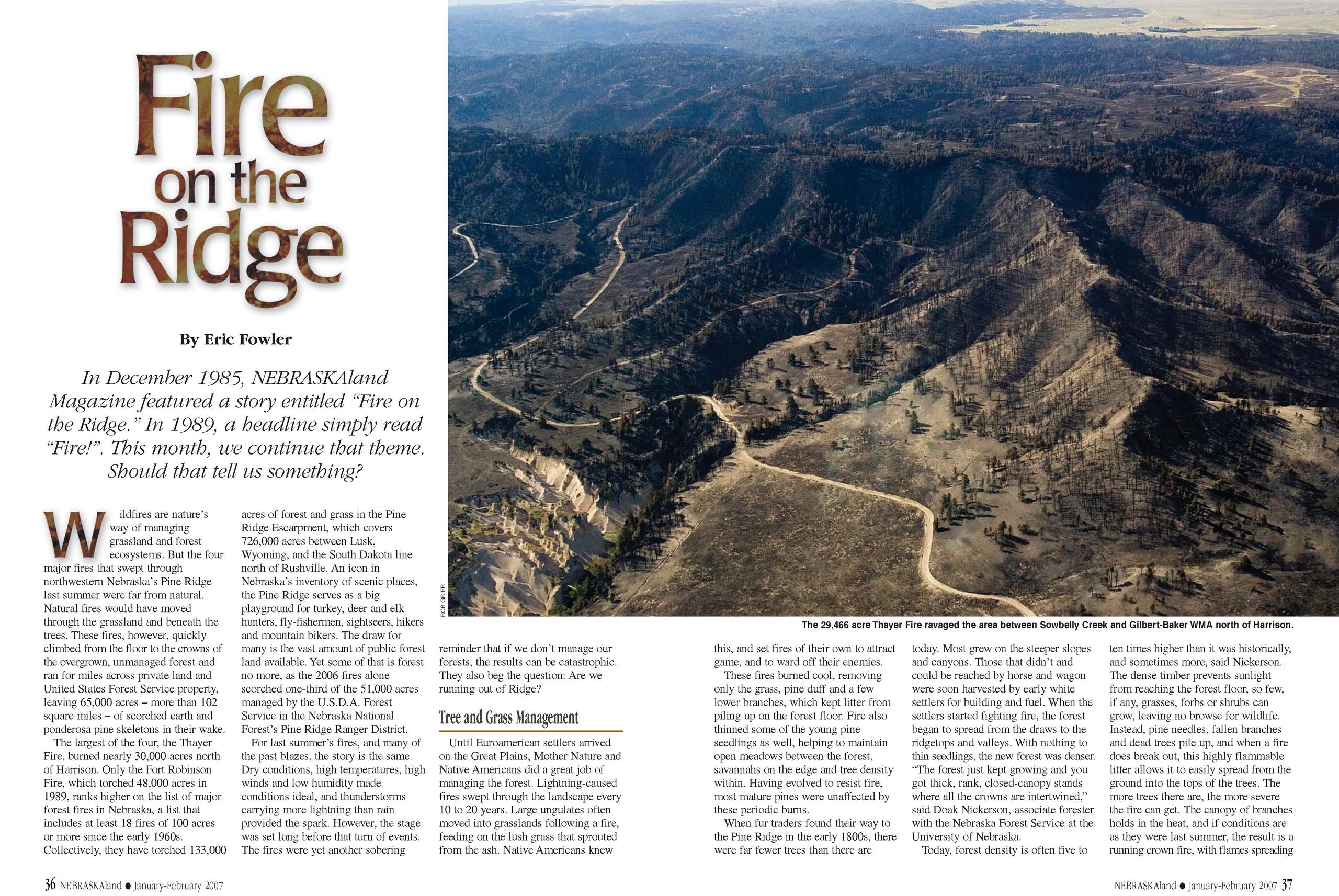
Fire on the Ridge
In December 1985, NEBRASKAland Magazine featured a story entitled "Fire on the Ridge." In 1989, a headline simply read "Fire!". This month, we continue that theme. Should that tell us something?
Wildfires are nature's way of managing grssland and forest ecosystems. But the four major fires that swept through northwester Nebraska's Pine Ridge last sumemr were far from nature. Natural fires would have moved through the grassland and beneath the trees. These fires, howeve,r quickly climbed from the floor to the crowns of the overgrown, unmanaged forest and ran for miles across private land and United States Forest Service property, leaving 65,000 acres - more than 102 square miles - of scorched earth and ponderosa pine skeletons in their wake.
The largest of the four, the Thayer Fire, burned nearly 30,000 acres north of Harrison. Only the Fort Robiinson Fire, which torched 48,000 acres in 1989, ranks higer on the list of major forest fires in Nebraska, a list that includes at least 18 fires of 100 acres or more since the early 1960s.
Collectively, they have torched 133,000 acres of forest and grass in the Pine Ridge Escarpment, which covers 726,000 acres between Lusk, Wyoming, and the South Dakota line north of Rushville. An icon in Nebraska's inventory of scenic places, the Pine Ridge serves as a big playground for turkey, deer and elk hunters, fly-fishermen, sightseers, hikers and mountain bikers. The draw for many is the vast amount of public forest land available. Yet some of tha tis forest no more, as the 2006 fires alone scorched one-third of the 51,000 acres managaged by teh U.S.D.A Forest Service in teh Nebraska Nationaal Forest's Pine Ridge Ranger District
For last summer's fires, and many of the past blazes, the story is the same. Dry conditions, high temperatures, high winds and low humidity made conditions ideal, and thunerstorms carrying mroe lightning than rain provided the spark. However, the stage was set long before that turn of events. The first were yet another sobering reminder that if we don't manage our forests, the results can be catastrophic. They also beg the question: Are we running out of Ridge?
Tree and Grass ManagementUntil Euroamerican settlers arrived on the Great Plains, Mother Nature and Native Americans did a great job of managing the forest. Lightning-caused fires swept through the landscape every 10 to 20 years. Large ungulates often moved into grasslands following a fire, feeding on the lush grass that sprouted from the ash. Native Americans knew 36 NEBRASKAland January-February 2007 this, and set fires of their own to attract game, and to ward off their enemies.
These fires burned cool, removing only the grass, pine duff and a few lower branches, which kept litter from piling up on the forest floor. Fire also thinned some of the young pine seedlings as well, helping to maintain open meadows between the forest, savannahs on the edge and tree density within. Having evolved to resist fire, most mature pines were unaffected by these periodic burns.
When fur traders found their way to the Pine Ridge in the early 1800s, there were far fewer trees than there are today. Most grew on the steeper slopes and canyons. Those that didn't and could be reached by horse and wagon were soon harvested by early white settlers for building and fuel. When the settlers started fighting fire, the forest began to spread from the draws to the ridgetops and valleys. With nothing to thin seedlings, the new forest was denser. "The forest just kept growing and you got thick, rank, closed-canopy stands where all the crowns are intertwined," said Doak Nickerson, associate forester with the Nebraska Forest Service at the University of Nebraska.
Today, forest density is often five to
ten times higher than it was historically, and sometimes more, said Nickerson. The
dense timber prevents sunlight from reaching the forest floor, so few, if any, grasses,
forbs or shrubs can grow, leaving no browse for wildlife. Instead, pine needles, fallen
branches and dead trees pile up, and when a fire does break out, this highly flammable
litter allows it to easily spread from the ground into the tops of the trees. The
more trees there are, the more severe the fire can get. The canopy of branches holds
in the heat, and if conditions are as they were last summer, the result is a running
crown fire, with flames spreading
NEBRASKAland January-February 2007 37
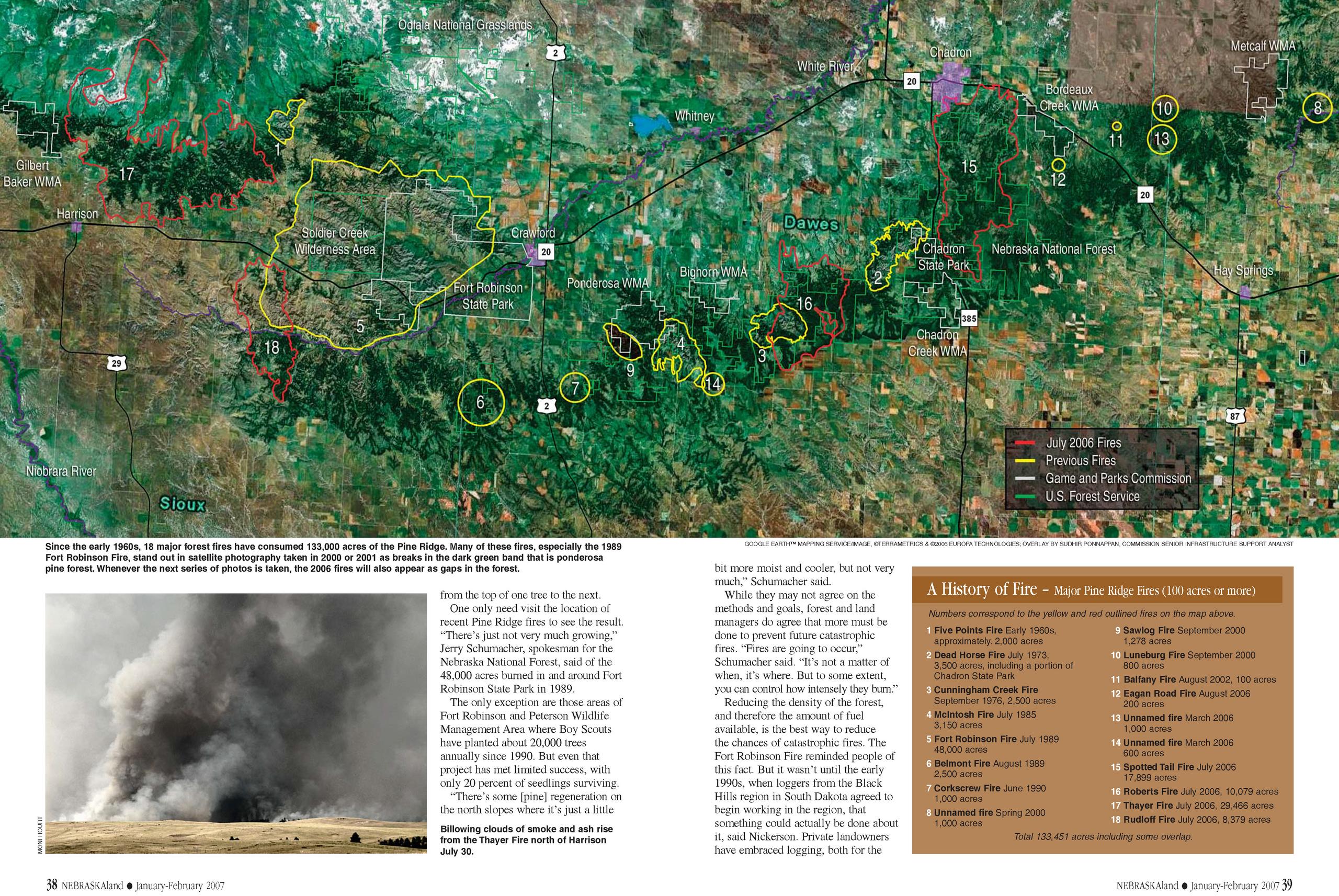
One only need visit the location of recent Pine Ridge fires to see the result. "There's just not very much growing," Jerry Schumacher, spokesman for the Nebraska National Forest, said of the 48,000 acres burned in and around Fort Robinson State Park in 1989.
The only exception are those areas of Fort Robinson and Peterson Wildlife Management Area where Boy Scouts have planted about 20,000 trees annually since 1990. But even that project has met limited success, with only 20 percent of seedlings surviving.
"There's some [pine] regeneration on the north slopes where it's just a little 38 NEBRASKAland January-February 2007 bit more moist and cooler, but not very much," Schumacher said.
While they may not agree on the methods and goals, forest and land managers do agree that more must be done to prevent future catastrophic fires. "Fires are going to occur," Schumacher said. "It's not a matter of when, it's where. But to some extent, you can control how intensely they burn."
Reducing the density of the forest, and therefore the amount of fuel available, is the best way to reduce the chances of catastrophic fires. The Fort Robinson Fire reminded people of this fact. But it wasn't until the early 1990s, when loggers from the Black Hills region in South Dakota agreed to begin working in the region, that something could actually be done about it, said Nickerson. Private landowners have embraced logging, both for the
A History of Fire – Major Pine Ridge Fires (100 acres or more) Numbers correspond to the yellow and red outlined fires on the map above. 1 Five Points Fire Early 1960s, approximately. 2,000 acres 2 Dead Horse Fire July 1973, 3,500 acres, including a portion of Chadron State Park 3 Cunningham Creek Fire September 1976, 2,500 acres 4 McIntosh Fire July 1985 3,150 acres 5 Fort Robinson Fire July 1989 48,000 acres 6 Belmont Fire August 1989 2,500 acres 7 Corkscrew Fire June 1990 1,000 acres 8 Unnamed fire Spring 2000 1,000 acres 9 Sawlog Fire September 2000 1,278 acres 10 Luneburg Fire September 2000 800 acres 11 Balfany Fire August 2002, 100 acres 12 Eagan Road Fire August 2006 200 acres 13 Unnamed fire March 2006 1,000 acres 14 Unnamed fire March 2006 600 acres 15 Spotted Tail Fire July 2006 17,899 acres 16 Roberts Fire July 2006, 10,079 acres 17 Thayer Fire July 2006, 29,466 acres 18 Rudloff Fire July 2006, 8,379 acres Total 133,451 acres including some overlap. NEBRASKAland January-February 2007 39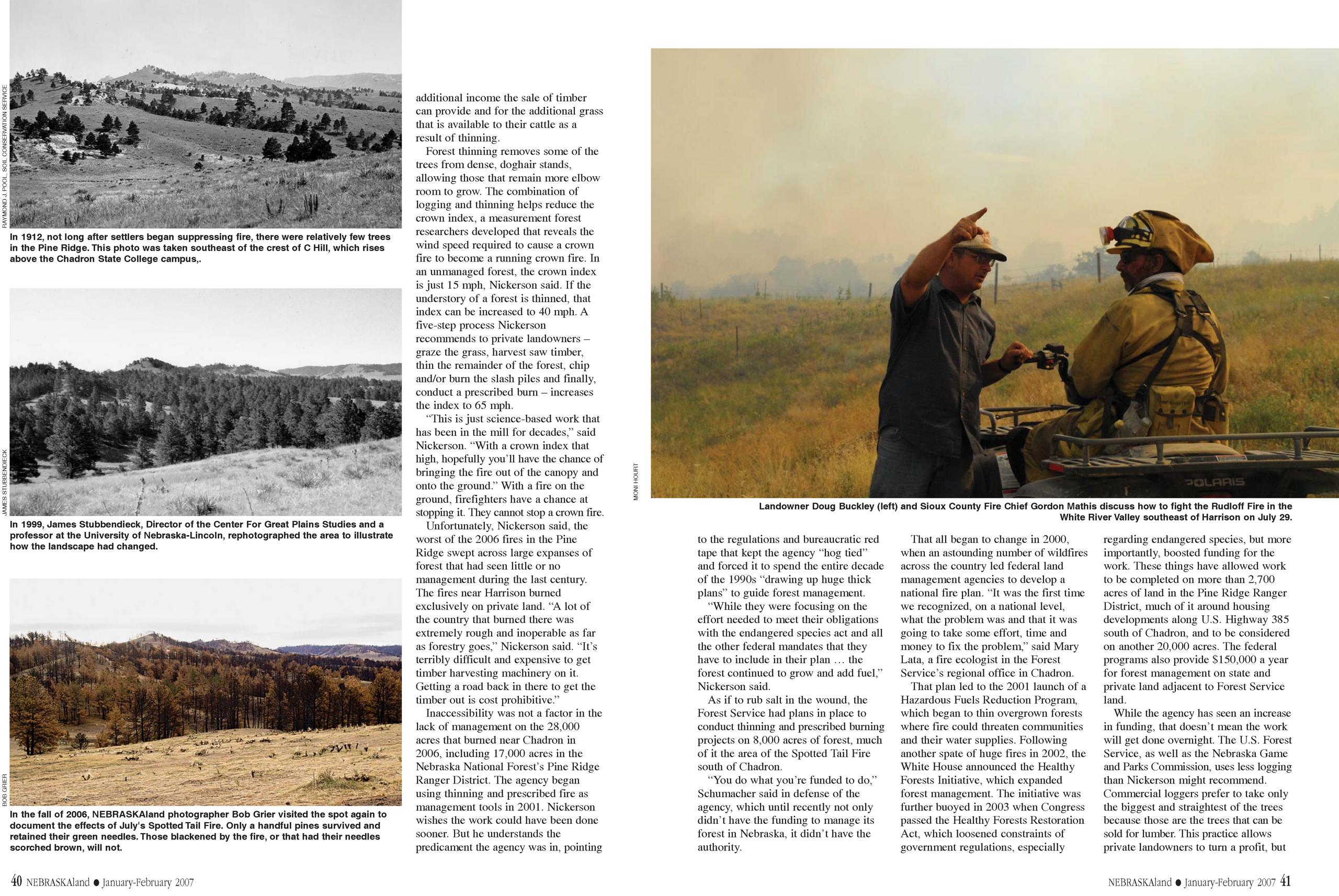
additional income the sale of timber can provide and for the additional grass that is available to their cattle as a result of thinning.
Forest thinning removes some of the trees from dense, doghair stands, allowing those that remain more elbow room to grow. The combination of logging and thinning helps reduce the crown index, a measurement forest researchers developed that reveals the wind speed required to cause a crown fire to become a running crown fire. In an unmanaged forest, the crown index is just 15 mph, Nickerson said. If the understory of a forest is thinned, that index can be increased to 40 mph. A five-step process Nickerson recommends to private landowners – graze the grass, harvest saw timber, thin the remainder of the forest, chip and/or burn the slash piles and finally, conduct a prescribed burn – increases the index to 65 mph.
"This is just science-based work that has been in the mill for decades," said Nickerson. "With a crown index that high, hopefully you'll have the chance of bringing the fire out of the canopy and onto the ground." With a fire on the ground, firefighters have a chance at stopping it. They cannot stop a crown fire.
Unfortunately, Nickerson said, the worst of the 2006 fires in the Pine Ridge swept across large expanses of forest that had seen little or no management during the last century. The fires near Harrison burned exclusively on private land. "A lot of the country that burned there was extremely rough and inoperable as far as forestry goes," Nickerson said. "It's terribly difficult and expensive to get timber harvesting machinery on it. Getting a road back in there to get the timber out is cost prohibitive."
Inaccessibility was not a factor in the lack of management on the 28,000 acres that burned near Chadron in 2006, including 17,000 acres in the Nebraska National Forest's Pine Ridge Ranger District. The agency began using thinning and prescribed fire as management tools in 2001. Nickerson wishes the work could have been done sooner. But he understands the predicament the agency was in, pointing 40 NEBRASKAland January-February 2007 to the regulations and bureaucratic red tape that kept the agency "hog tied" and forced it to spend the entire decade of the 1990s "drawing up huge thick plans" to guide forest management.
"While they were focusing on the effort needed to meet their obligations with the endangered species act and all the other federal mandates that they have to include in their plan . . . the forest continued to grow and add fuel," Nickerson said.
As if to rub salt in the wound, the Forest Service had plans in place to conduct thinning and prescribed burning projects on 8,000 acres of forest, much of it the area of the Spotted Tail Fire south of Chadron.
"You do what you're funded to do," Schumacher said in defense of the agency, which until recently not only didn't have the funding to manage its forest in Nebraska, it didn't have the authority.
That all began to change in 2000, when an astounding number of wildfires across the country led federal land management agencies to develop a national fire plan. "It was the first time we recognized, on a national level, what the problem was and that it was going to take some effort, time and money to fix the problem," said Mary Lata, a fire ecologist in the Forest Service's regional office in Chadron.
That plan led to the 2001 launch of a Hazardous Fuels Reduction Program, which began to thin overgrown forests where fire could threaten communities and their water supplies. Following another spate of huge fires in 2002, the White House announced the Healthy Forests Initiative, which expanded forest management. The initiative was further buoyed in 2003 when Congress passed the Healthy Forests Restoration Act, which loosened constraints of government regulations, especially regarding endangered species, but more importantly, boosted funding for the work. These things have allowed work to be completed on more than 2,700 acres of land in the Pine Ridge Ranger District, much of it around housing developments along U.S. Highway 385 south of Chadron, and to be considered on another 20,000 acres. The federal programs also provide $150,000 a year for forest management on state and private land adjacent to Forest Service land.
While the agency has seen an increase in funding, that doesn't mean the work will get done overnight. The U.S. Forest Service, as well as the Nebraska Game and Parks Commission, uses less logging than Nickerson might recommend. Commercial loggers prefer to take only the biggest and straightest of the trees because those are the trees that can be sold for lumber. This practice allows private landowners to turn a profit, but
NEBRASKAland January-February 2007 41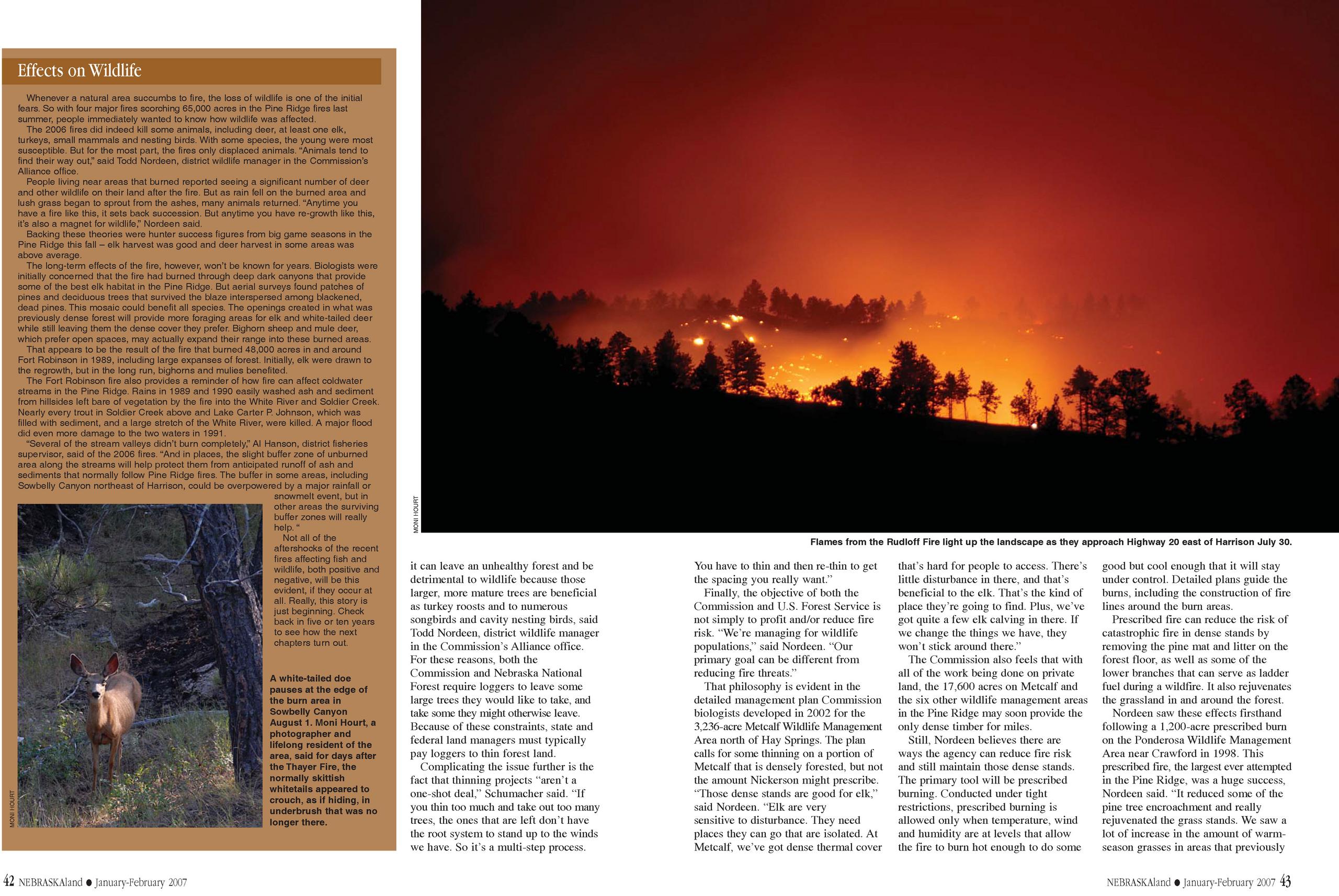 Effects on Wildlife
Whenever a natural area succumbs to fire, the loss of wildlife is one of the initial
fears. So with four major fires scorching 65,000 acres in the Pine Ridge fires last
summer, people immediately wanted to know how wildlife was affected.
The 2006 fires did indeed kill some animals, including deer, at least one elk,
turkeys, small mammals and nesting birds. With some species, the young were most
susceptible. But for the most part, the fires only displaced animals. "Animals tend
to
find their way out," said Todd Nordeen, district wildlife manager in the Commission's
Alliance office.
People living near areas that burned reported seeing a significant number of deer
and other wildlife on their land after the fire. But as rain fell on the burned area
and
lush grass began to sprout from the ashes, many animals returned. "Anytime you
have a fire like this, it sets back succession. But anytime you have re-growth like
this,
it's also a magnet for wildlife," Nordeen said.
Backing these theories were hunter success figures from big game seasons in the
Pine Ridge this fall – elk harvest was good and deer harvest in some areas was
above average.
The long-term effects of the fire, however, won't be known for years. Biologists were
initially concerned that the fire had burned through deep dark canyons that provide
some of the best elk habitat in the Pine Ridge. But aerial surveys found patches of
pines and deciduous trees that survived the blaze interspersed among blackened,
dead pines. This mosaic could benefit all species. The openings created in what was
previously dense forest will provide more foraging areas for elk and white-tailed
deer
while still leaving them the dense cover they prefer. Bighorn sheep and mule deer,
which prefer open spaces, may actually expand their range into these burned areas.
That appears to be the result of the fire that burned 48,000 acres in and around
Fort Robinson in 1989, including large expanses of forest. Initially, elk were drawn
to
the regrowth, but in the long run, bighorns and mulies benefited.
The Fort Robinson fire also provides a reminder of how fire can affect coldwater
streams in the Pine Ridge. Rains in 1989 and 1990 easily washed ash and sediment
from hillsides left bare of vegetation by the fire into the White River and Soldier
Creek.
Nearly every trout in Soldier Creek above and Lake Carter P. Johnson, which was
filled with sediment, and a large stretch of the White River, were killed. A major
flood
did even more damage to the two waters in 1991.
"Several of the stream valleys didn't burn completely," Al Hanson, district fisheries
supervisor, said of the 2006 fires. "And in places, the slight buffer zone of unburned
area along the streams will help protect them from anticipated runoff of ash and
sediments that normally follow Pine Ridge fires. The buffer in some areas, including
Sowbelly Canyon northeast of Harrison, could be overpowered by a major rainfall or
snowmelt event, but in
other areas the surviving
buffer zones will really
help."
Not all of the
aftershocks of the recent
fires affecting fish and
wildlife, both positive and
negative, will be this
evident, if they occur at
all. Really, this story is
just beginning. Check
back in five or ten years
to see how the next
chapters turn out.
Effects on Wildlife
Whenever a natural area succumbs to fire, the loss of wildlife is one of the initial
fears. So with four major fires scorching 65,000 acres in the Pine Ridge fires last
summer, people immediately wanted to know how wildlife was affected.
The 2006 fires did indeed kill some animals, including deer, at least one elk,
turkeys, small mammals and nesting birds. With some species, the young were most
susceptible. But for the most part, the fires only displaced animals. "Animals tend
to
find their way out," said Todd Nordeen, district wildlife manager in the Commission's
Alliance office.
People living near areas that burned reported seeing a significant number of deer
and other wildlife on their land after the fire. But as rain fell on the burned area
and
lush grass began to sprout from the ashes, many animals returned. "Anytime you
have a fire like this, it sets back succession. But anytime you have re-growth like
this,
it's also a magnet for wildlife," Nordeen said.
Backing these theories were hunter success figures from big game seasons in the
Pine Ridge this fall – elk harvest was good and deer harvest in some areas was
above average.
The long-term effects of the fire, however, won't be known for years. Biologists were
initially concerned that the fire had burned through deep dark canyons that provide
some of the best elk habitat in the Pine Ridge. But aerial surveys found patches of
pines and deciduous trees that survived the blaze interspersed among blackened,
dead pines. This mosaic could benefit all species. The openings created in what was
previously dense forest will provide more foraging areas for elk and white-tailed
deer
while still leaving them the dense cover they prefer. Bighorn sheep and mule deer,
which prefer open spaces, may actually expand their range into these burned areas.
That appears to be the result of the fire that burned 48,000 acres in and around
Fort Robinson in 1989, including large expanses of forest. Initially, elk were drawn
to
the regrowth, but in the long run, bighorns and mulies benefited.
The Fort Robinson fire also provides a reminder of how fire can affect coldwater
streams in the Pine Ridge. Rains in 1989 and 1990 easily washed ash and sediment
from hillsides left bare of vegetation by the fire into the White River and Soldier
Creek.
Nearly every trout in Soldier Creek above and Lake Carter P. Johnson, which was
filled with sediment, and a large stretch of the White River, were killed. A major
flood
did even more damage to the two waters in 1991.
"Several of the stream valleys didn't burn completely," Al Hanson, district fisheries
supervisor, said of the 2006 fires. "And in places, the slight buffer zone of unburned
area along the streams will help protect them from anticipated runoff of ash and
sediments that normally follow Pine Ridge fires. The buffer in some areas, including
Sowbelly Canyon northeast of Harrison, could be overpowered by a major rainfall or
snowmelt event, but in
other areas the surviving
buffer zones will really
help."
Not all of the
aftershocks of the recent
fires affecting fish and
wildlife, both positive and
negative, will be this
evident, if they occur at
all. Really, this story is
just beginning. Check
back in five or ten years
to see how the next
chapters turn out.
it can leave an unhealthy forest and be detrimental to wildlife because those larger, more mature trees are beneficial as turkey roosts and to numerous songbirds and cavity nesting birds, said Todd Nordeen, district wildlife manager in the Commission's Alliance office. For these reasons, both the Commission and Nebraska National Forest require loggers to leave some large trees they would like to take, and take some they might otherwise leave. Because of these constraints, state and federal land managers must typically pay loggers to thin forest land.
Complicating the issue further is the fact that thinning projects "aren't a one-shot deal," Schumacher said. "If you thin too much and take out too many trees, the ones that are left don't have the root system to stand up to the winds we have. So it's a multi-step process. You have to thin and then re-thin to get the spacing you really want."
Finally, the objective of both the Commission and U.S. Forest Service is not simply to profit and/or reduce fire risk. "We're managing for wildlife populations," said Nordeen. "Our primary goal can be different from reducing fire threats."
That philosophy is evident in the detailed management plan Commission biologists developed in 2002 for the 3,236-acre Metcalf Wildlife Management Area north of Hay Springs. The plan calls for some thinning on a portion of Metcalf that is densely forested, but not the amount Nickerson might prescribe. "Those dense stands are good for elk," said Nordeen. "Elk are very sensitive to disturbance. They need places they can go that are isolated. At Metcalf, we've got dense thermal cover that's hard for people to access. There's little disturbance in there, and that's beneficial to the elk. That's the kind of place they're going to find. Plus, we've got quite a few elk calving in there. If we change the things we have, they won't stick around there."
The Commission also feels that with all of the work being done on private land, the 17,600 acres on Metcalf and the six other wildlife management areas in the Pine Ridge may soon provide the only dense timber for miles.
Still, Nordeen believes there are ways the agency can reduce fire risk and still maintain those dense stands. The primary tool will be prescribed burning. Conducted under tight restrictions, prescribed burning is allowed only when temperature, wind and humidity are at levels that allow the fire to burn hot enough to do some good but cool enough that it will stay under control. Detailed plans guide the burns, including the construction of fire lines around the burn areas.
Prescribed fire can reduce the risk of catastrophic fire in dense stands by removing the pine mat and litter on the forest floor, as well as some of the lower branches that can serve as ladder fuel during a wildfire. It also rejuvenates the grassland in and around the forest.
Nordeen saw these effects firsthand
following a 1,200-acre prescribed burn
on the Ponderosa Wildlife Management
Area near Crawford in 1998. This
prescribed fire, the largest ever attempted
in the Pine Ridge, was a huge success,
Nordeen said. "It reduced some of the
pine tree encroachment and really
rejuvenated the grass stands. We saw a
lot of increase in the amount of warmseason
grasses in areas that previously
NEBRASKAland January-February 2007 43
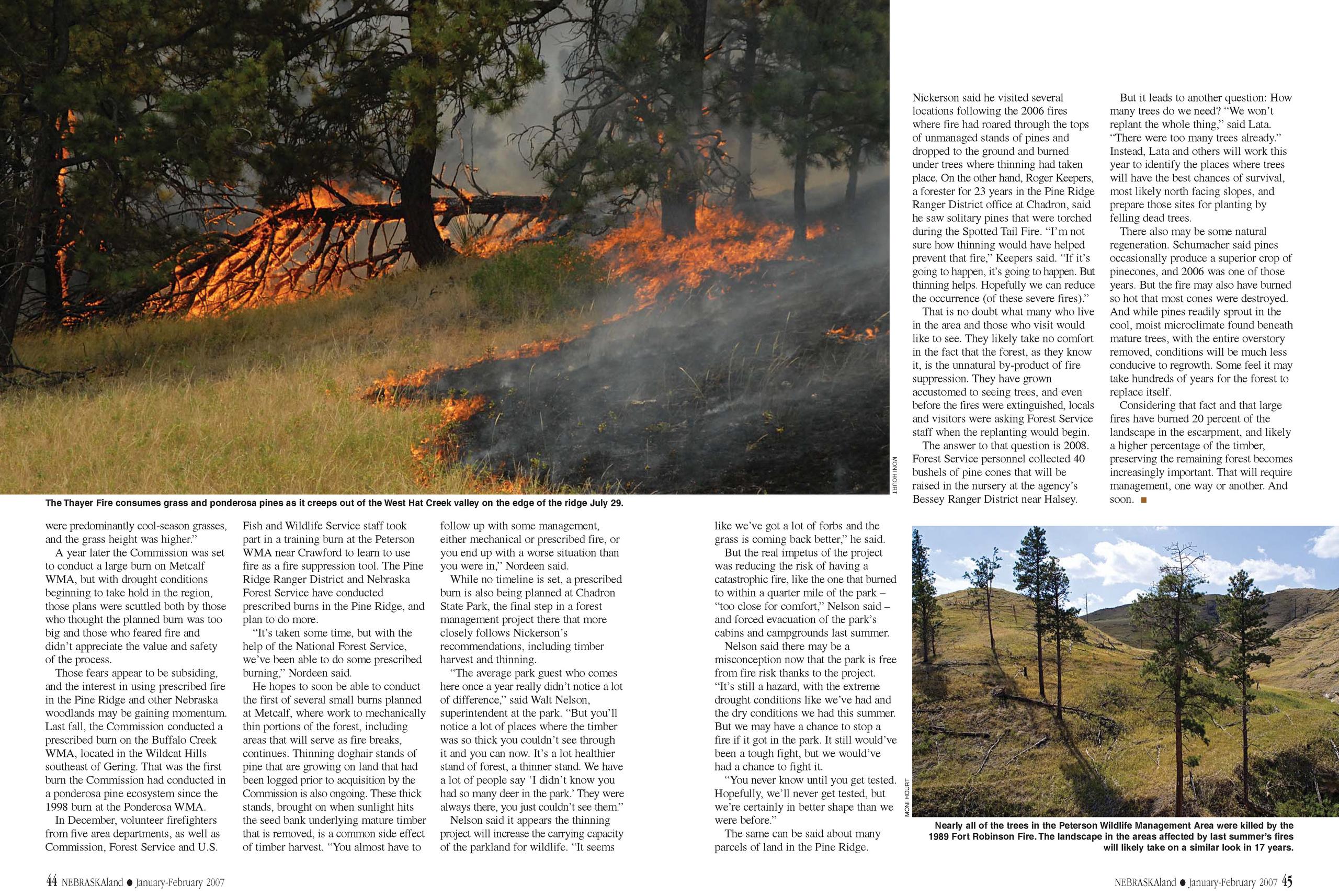
A year later the Commission was set to conduct a large burn on Metcalf WMA, but with drought conditions beginning to take hold in the region, those plans were scuttled both by those who thought the planned burn was too big and those who feared fire and didn't appreciate the value and safety of the process.
Those fears appear to be subsiding, and the interest in using prescribed fire in the Pine Ridge and other Nebraska woodlands may be gaining momentum. Last fall, the Commission conducted a prescribed burn on the Buffalo Creek WMA, located in the Wildcat Hills southeast of Gering. That was the first burn the Commission had conducted in a ponderosa pine ecosystem since the 1998 burn at the Ponderosa WMA.
In December, volunteer firefighters from five area departments, as well as Commission, Forest Service and U.S. Fish and Wildlife Service staff took part in a training burn at the Peterson WMA near Crawford to learn to use fire as a fire suppression tool. The Pine Ridge Ranger District and Nebraska Forest Service have conducted prescribed burns in the Pine Ridge, and plan to do more.
"It's taken some time, but with the help of the National Forest Service, we've been able to do some prescribed burning," Nordeen said.
He hopes to soon be able to conduct the first of several small burns planned at Metcalf, where work to mechanically thin portions of the forest, including areas that will serve as fire breaks, continues. Thinning doghair stands of pine that are growing on land that had been logged prior to acquisition by the Commission is also ongoing. These thick stands, brought on when sunlight hits the seed bank underlying mature timber that is removed, is a common side effect of timber harvest. "You almost have to follow up with some management, either mechanical or prescribed fire, or you end up with a worse situation than you were in," Nordeen said.
While no timeline is set, a prescribed burn is also being planned at Chadron State Park, the final step in a forest management project there that more closely follows Nickerson's recommendations, including timber harvest and thinning.
"The average park guest who comes here once a year really didn't notice a lot of difference," said Walt Nelson, superintendent at the park. "But you'll notice a lot of places where the timber was so thick you couldn't see through it and you can now. It's a lot healthier stand of forest, a thinner stand. We have a lot of people say 'I didn't know you had so many deer in the park.' They were always there, you just couldn't see them."
Nelson said it appears the thinning project will increase the carrying capacity of the parkland for wildlife. "It seems 44 NEBRASKAland January-February 2007 like we've got a lot of forbs and the grass is coming back better," he said.
But the real impetus of the project was reducing the risk of having a catastrophic fire, like the one that burned to within a quarter mile of the park – "too close for comfort," Nelson said – and forced evacuation of the park's cabins and campgrounds last summer.
Nelson said there may be a misconception now that the park is free from fire risk thanks to the project. "It's still a hazard, with the extreme drought conditions like we've had and the dry conditions we had this summer. But we may have a chance to stop a fire if it got in the park. It still would've been a tough fight, but we would've had a chance to fight it.
"You never know until you get tested. Hopefully, we'll never get tested, but we're certainly in better shape than we were before."
The same can be said about many parcels of land in the Pine Ridge. Nickerson said he visited several locations following the 2006 fires where fire had roared through the tops of unmanaged stands of pines and dropped to the ground and burned under trees where thinning had taken place. On the other hand, Roger Keepers, a forester for 23 years in the Pine Ridge Ranger District office at Chadron, said he saw solitary pines that were torched during the Spotted Tail Fire. "I'm not sure how thinning would have helped prevent that fire," Keepers said. "If it's going to happen, it's going to happen. But thinning helps. Hopefully we can reduce the occurrence (of these severe fires)."
That is no doubt what many who live in the area and those who visit would like to see. They likely take no comfort in the fact that the forest, as they know it, is the unnatural by-product of fire suppression. They have grown accustomed to seeing trees, and even before the fires were extinguished, locals and visitors were asking Forest Service staff when the replanting would begin.
The answer to that question is 2008. Forest Service personnel collected 40 bushels of pine cones that will be raised in the nursery at the agency's Bessey Ranger District near Halsey.
But it leads to another question: How many trees do we need? "We won't replant the whole thing," said Lata. "There were too many trees already." Instead, Lata and others will work this year to identify the places where trees will have the best chances of survival, most likely north facing slopes, and prepare those sites for planting by felling dead trees.
There also may be some natural regeneration. Schumacher said pines occasionally produce a superior crop of pinecones, and 2006 was one of those years. But the fire may also have burned so hot that most cones were destroyed. And while pines readily sprout in the cool, moist microclimate found beneath mature trees, with the entire overstory removed, conditions will be much less conducive to regrowth. Some feel it may take hundreds of years for the forest to replace itself.
Considering that fact and that large fires have burned 20 percent of the landscape in the escarpment, and likely a higher percentage of the timber, preserving the remaining forest becomes increasingly important. That will require management, one way or another. And soon.

Outdoor Update
Benefits of Fish Branding
Biologists Mark Fish as a Learning Tool for Fisheries
In the summer of 2004, a team of Nebraska Game and Parks Commission fisheries personnel gathered around a North Platte Fish Hatchery catch basin. A stainless steel canister sat on the edge of the basin, white steam pouring from the top. Keith Koupal, a fish and wildlife specialist, reached into a dip net and gently grasped a 14-inch, advanced fingerling northern pike, removed a metal rod from the steaming cauldron and held the end of the rod against the side of the fish for two seconds.
During the course of the day, Koupal and other biologists repeated this operation more than 2,000 times. They were marking northern pike with a process known as "freezebranding," but the steam rising from the canister was an indicator of extreme cold, not heat. Liquid nitrogen inside the canister measured minus 196 degrees Celsius – cold enough to freeze brand an identifiable mark on the fish.
The marked northerns were destined for Sherman Reservoir, where the Commission wanted to know, among other things, how many pike escaped from the reservoir as a result of irrigation releases. The capture of any branded northern pike from water released out of the reservoir would indicate escapement, and could be used to determine the extent of the problem.
When research demands the ability to recognize individual fish or groups of fish, the fish are either marked or tagged. According to Koupal, a mark is anything done to the fish that allows biologists to know that the fish has been handled sometime prior. Tags are a type of mark that can identify individual fish.
The downside of tags, Koupal said, is that they are more expensive and usually not necessary. The target This walleye was freeze branded with a "V" mark at the North Platte Fish Hatchery.
"The first documented marking experiment I am aware of was conducted in the mid-1600s and reported by Izaak Walton. Observers tied ribbons attached to strings on the tails of Atlantic salmon."
External marks are the oldest and most popular form of marking and include clipping fins, applying paint, altering fish pigment, branding or attaching metal or plastic tags to various parts of the fish. Modern techniques include internal tags and marks that require instrumentation to detect or read. For instance, a coded wire tag is a small piece of wire containing coding that can be inserted into a small fish and allow it to be identified later.
Koupal said coded wire tags are probably the most applied tag, citing the more than 40 million juvenile salmon tagged annually during the 1990s in the Pacific Northwest. Koupal added that there are even more expensive internal tags known as PIT (passive integrated transponder) tags. PIT tags have an electronic chip that remains dormant until an external energy source or reader activates it. Another expensive tag is the batterypowered transmitter that is used to track and locate fish. The Commission, in cooperation with the University of Nebraska, is using this tagging technique at Enders and Red Willow reservoirs to study the spawning habits and recruitment of white bass and walleye in irrigation reservoirs.
Other marking technique examples include the use of chemicals that incorporate tetracycline or calcein into the bony tissue of fish. Large numbers of fish can be chemically marked at one time, but in order to examine the fish for marks at a later date, the fish have to be killed.
Koupal also described natural marks, which are seldom used. Natural marks include distinct genetic or environmental patterns that can be identified in a specific population or brood stock. For example, the size differences between catchable trout raised in hatcheries versus wild trout found in Nebraska streams can be used to determine the origin of those fish.
Branding, like that used on northern pike at the North Platte Hatchery, is not an uncommon or new practice. Both heat branding and cold branding have been used as far back as at least the 1950s, and the concept is similar to that of branding livestock. "A hot or cold piece of metal, usually brass, is applied to the external surface of the fish, which either burns or freezes the scale surface, darkening pigmentation," said Koupal. "Science indicates that branding produces little damage to the dermal layers of the skin, but may be observed for up to two years on northern pike."
Marking and tagging have many benefits for biologists and ultimately anglers, but no mark or tag should be employed without a need to gain important biological information.
Wilderness Workshop
Jerky Shooter
The Hardest Part is Deciding Which Flavor to Make
Of all the outdoorsman's food groups, trail mix, sausage and salami are good, but jerky is the best in my book. Packed with protein and low in fat, it's just enough to get you through a long morning in the deer stand or waterfowl blind. In a pinch, it can even double as a meal. Heart doctors might frown at the amount of salt it contains, but aside from that, it's downright healthy.
When they first appeared on the shelves of sporting goods stores a few years back, I looked with skepticism at the contraptions that looked like caulking guns and carried names like Jerkey Shooter, Jerky Blaster and Jerky Cannon. Mix ground meat with some dry seasoning, fill your shooter and out come strips ready for the dehydrator or oven. "No way that'll be as good as my muscle jerky," I thought, "and it looks like work."
Boy am I glad someone fed me some of the jerky they made with one of those things. I headed straight to a local big box store to get my own and have since wore it out and moved on to a bigger and better model.
There simply isn't a faster way to eat a deer, which in today's era of long seasons and unlimited doe permits is good news for Nebraska hunters. Plus, knowing there's another outlet for deer burger also simplifies the butchering process for do-it-yourself hunters like myself. Now I only have to be precise with my cuts while removing the tenderloins, backstraps and a few roasts. After removing as much fat as possible, the rest of the meat I can get to the grinder in any shape I want.
A run through the web site of one major outdoor retailer found 10 seasoning flavors, including original,
You can use either an oven or dehydrator to dry ground jerky. Either way, the one thing you don't want to do is overcook your jerky, unless you like chewing on shoe leather. Unfortunately, if you're like me, you can't always babysit these kinds of projects, so I use an automatic light timer (like the ones used to turn Christmas tree lights on and off), to ensure mine is cooked properly. Wherever you're cooking it, I recommend holding your jerky gun close to the tray, forcing the meat to bunch up slightly and form thicker strips. The end result is a chewier jerky that also takes up less space in the oven or dehydrator. Just don't press it into the tray, or you'll wish you hadn't when it's time to get it off.
I set my dehydrator to run for four hours, then let it cool a little before rotating the trays and firing it up for another two hours. I feel the time spent cooling helps leach some of the moisture out of the middle of the jerky that would have required extra time to cook out. About six hours after shooting the meat onto the dehydrator trays I'm taking the first bite of a batch that will last two weekends in the goose blind, one if the house is full.
No dehydrator? With the proper drying racks, ground jerky can be made in the oven just as easily by following the directions on the back of the dry seasoning.
Store your jerky in the refrigerator or a cooler if you won't be eating it fast. But you will be. With the various flavors available to season your jerky, your biggest problem will be figuring out which one to try first.
Then again, trying them all could be considered the fun part. Not that I needed another excuse to eat more jerky. I should probably take notes. It would be my luck to find the world's best jerky mix and not be able to remember the name.

Parks & Places
Roadside Viewing in Nebraska Alternative Routes and Scenic Drives Best Ways to Travel Through State Desoto National Wildlife Refuge Drive the roads through the Desoto National Wildlife Refuge one afternoon and there's no telling what you'll see. Located 25 miles north of Omaha on Highway 30, white-tailed deer, wild turkeys, ring-necked pheasants, waterfowl and bald eagles are visible from roads. A vehicle entry fee of $3 is charged, but waived for those with a Federal Duck Stamp. For those interested in birding, weekly bird counts for Desoto can be found at the Desoto National Wildlife Refuge's web site, www.fws.gov/midwest/desoto/, or call (712) 642-4121. Canyon Roads Follow any one of several canyon roads south out of Maxwell (Interstate 80 Exit 190) or Brady (Exit 199) and wind your way to the top of these deeply dissected loess canyons for a spectacular view. Snow-covered, the canyons are awesome, but spring or fall views are equally amazing. Bird watchers will observe a variety of species wintering in the cedar canyons, including great concentrations of mountain and eastern bluebirds. Not all robins travel south, some fly to the canyons and join Townsend's solitaires foraging for cedar berries. Visitors may also observe mule and white-tailed deer, elk and even bobcat. U.S. Highway 34 From Hastings to McCook, U.S. Highway 34 leads outdoor viewers down a road with ridges and draws, where deer, turkey, and a host of picturesque landscapes are within sight of the car. If traveling to Colorado from the eastern part of the state and Interstate 80 has lost its visual luster, take this southern alternative. It might take a bit longer to get to Denver, but it's not because of the detour – it's because of your frequent stops to photograph. Crescent Lake National Wildlife Refuge During the fall and winter months, mule deer and white-tailed deer concentrate their activities near the refuge headquarters. As spring approaches rooster pheasants in their vibrant breeding plumage can be seen along refuge roads, and the buildup of shorebirds and other waterfowl during their spring migrations offers multi-species viewing and photography opportunities as spring progresses. Crescent Lake NWR is located 28 miles north of Oshkosh and the refuge's limited gravel road and two-track trails pass along the edge of numerous sandhill lakes and marshes where birds and other wildlife concentrate. For more information, contact the refuge headquarters at (308) 762-4893. County Roads North of Harrison The Sioux and Dawes county roads north of Harrison and Crawford provide a closeup view of Nebraska's fabled badlands, including Toadstool Geologic Park, the Hudson-Meng Bison Kill Site, scenic Montrose Church as well as Pine Ridge and badlands buttes with colorful names like Pants Butte, Round Top and Sugarloaf. Early morning or late afternoon and evening travel is recommended. There's only one warning: Avoid even the best Sioux and Dawes county roads following rainfall or snowmelt periods when the gumbo clay makes even 4WD travel impossible at times.
Portraits from the Past
This picture of my father, J. Ernest Hensley, was taken on the Platte River south of Central City.
On the reverse side of the photograph is a notation – "Two Hour Hunt on October 29, 1904."
For many years I hunted on the Platte. I cannot hunt anymore, but I still enjoy watching wildlife.
– Gerald E. Hensley, Wood River, NebraskaThis early 1940s photo shows my father, Elmer White (far left), and my brother, Wally. My uncle, Ralph White (far right), and his two children, Nola and Bob (hidden behind the rabbit), stand next to him. I believe the picture was taken on my grandparents' farm near Lewiston. While my brother and I were growing up in Beatrice, we frequently hunted squirrels and rabbits on the farm.
– Kenneth N. White, Fairport, New YorkThis limit of pheasants was taken in October 1942 near Stanton, Nebraska.
The hunters were from the Soil Conservation Service in Lincoln, with the exception of the person second from the left, who is the late M.J. Hankins of Stanton.
Birds were plentiful during that time and it was not difficult to limit out before noon.We had to have tags with the license visible during that time.
– Don Maca, Omaha, Nebraska Send contributions to: Portraits from the Past, NEBRASKAland Magazine, P.O. Box 30370, Lincoln, NE 68503-0370. Photos should show people enjoying Nebraska outdoor activities, such as camping, boating, hunting or fishing, and must have been taken before 1970. We will give priority to unusual photos or activities. When possible, please include a story about the photograph and identify the people, places and approximate date it was taken. Photos will be returned.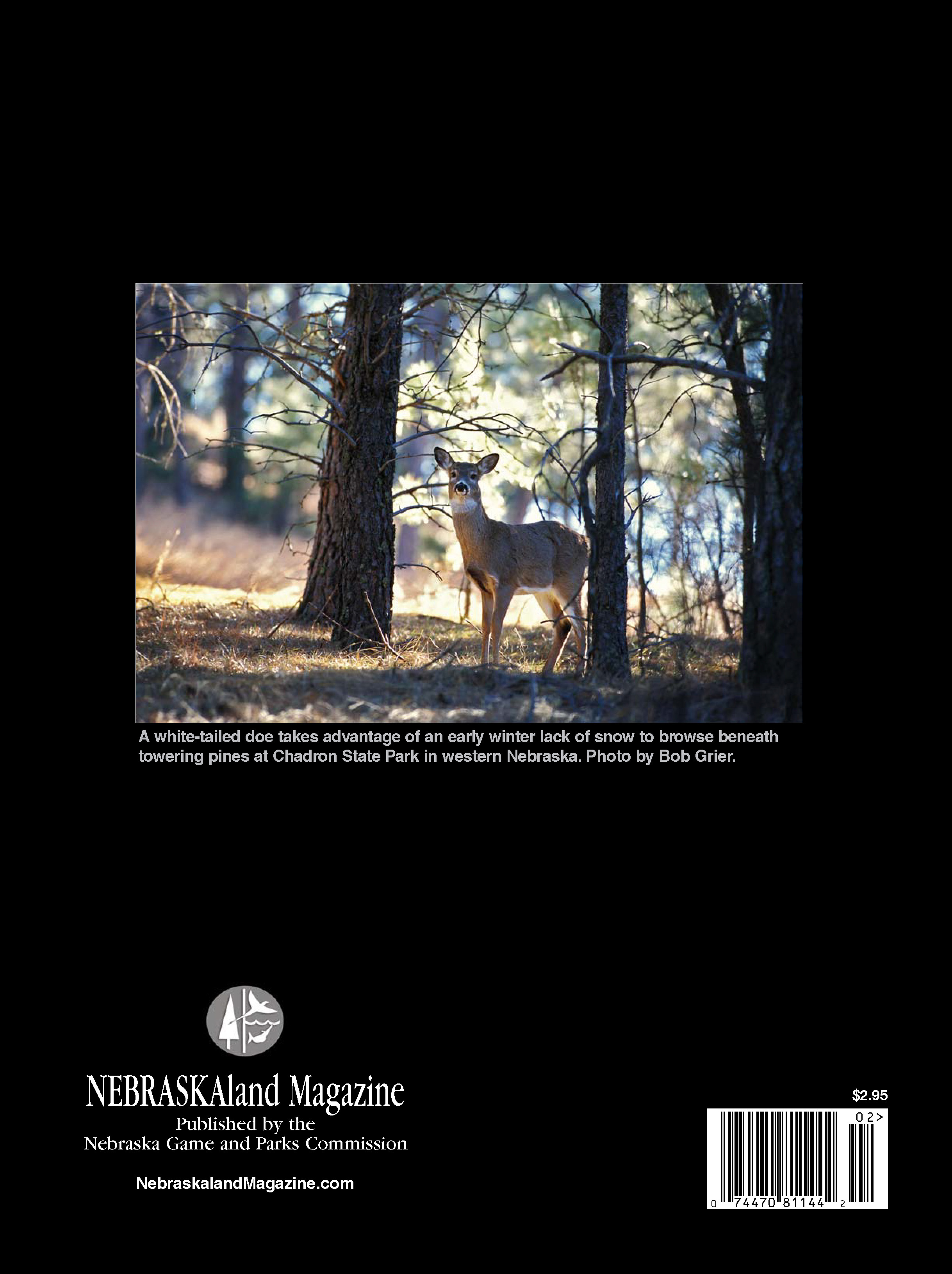

Position: 90 (65 views)