Volume 84, Issue 10, 2006
NEBRASKAland
Published by the Nebraska Game and Parks Commission since 1926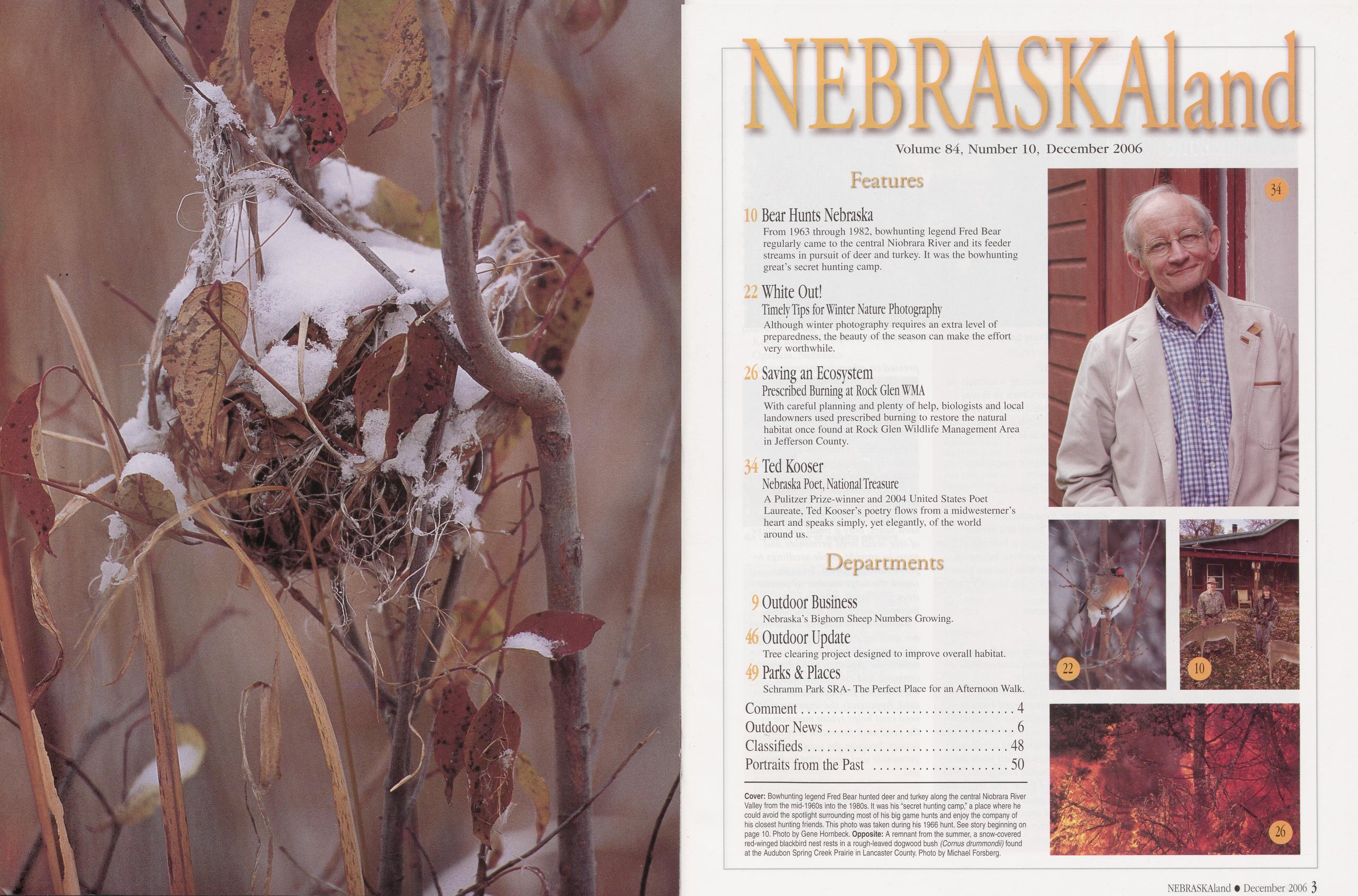
NEBRASKAland
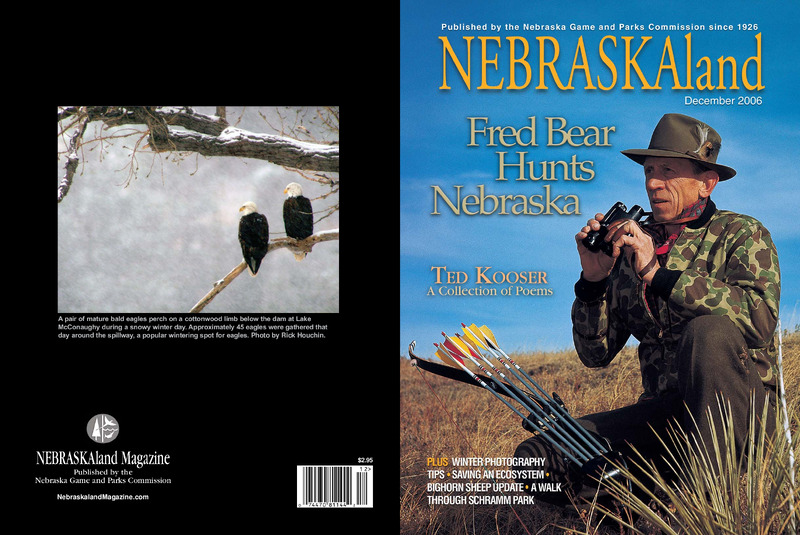
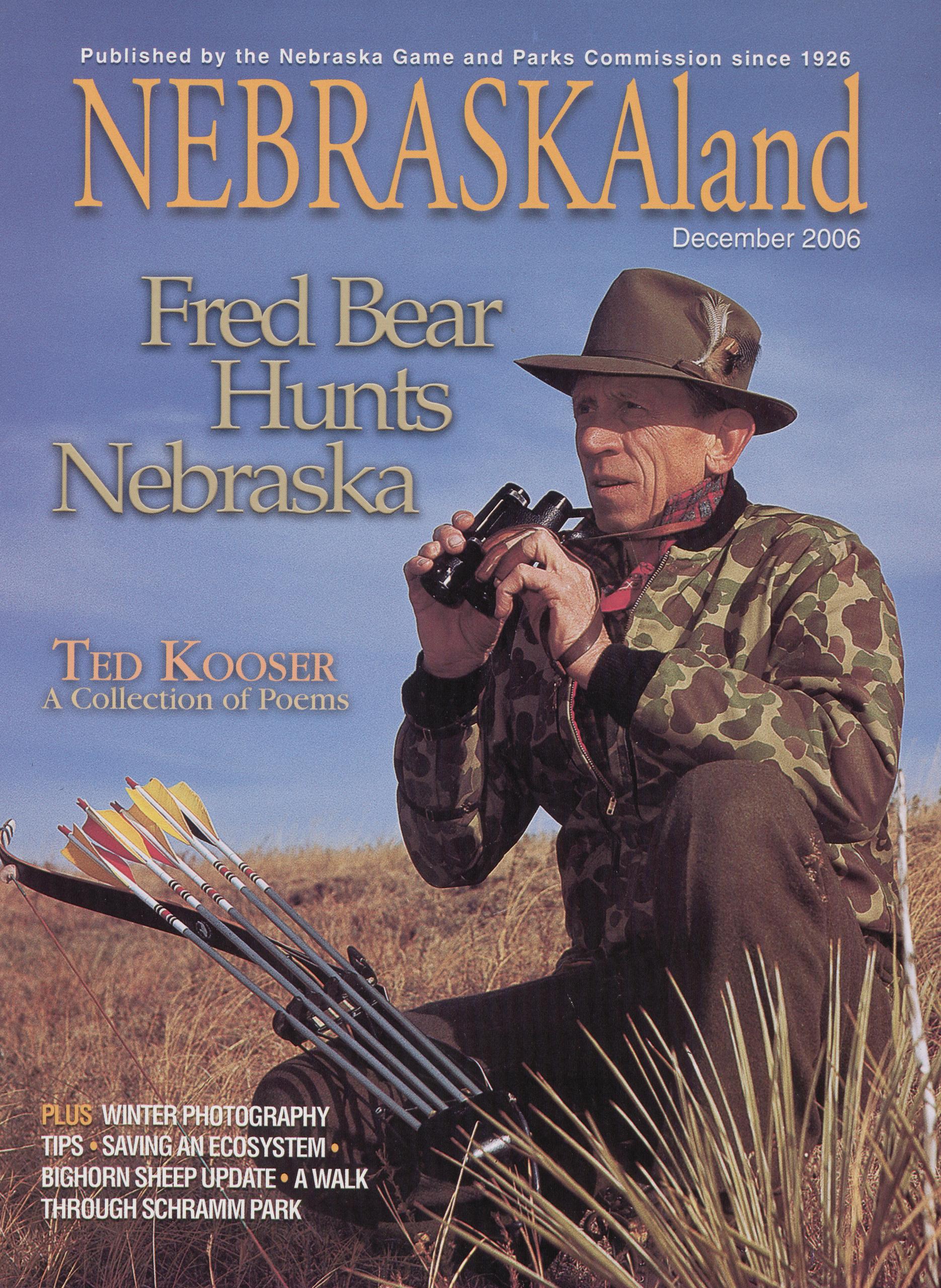
December 2006 A Collection of Poems Volume 84, Number 10, December 2006 Features Bear Hunts Nebraska From 1963 through 1982, bowhunting legend Fred Bear regularly came to the central Niobrara River and its feeder streams in pursuit of deer and turkey. It was the bowhunting great’s secret hunting camp. White Out! Timely Tips for Winter Nature Photography Although winter photography requires an extra level of preparedness, the beauty of the season can make the effort very worthwhile. Saving an Ecosystem Prescribed Burning at Rock Glen WMA With careful planning and plenty of help, biologists and local landowners used prescribed burning to restore the natural habitat once found at Rock Glen Wildlife Management Area in Jefferson County. Nebraska Poet, National Treasure A Pulitzer Prize-winner and 2004 United States Poet Laureate, Ted Kooser’s poetry flows from a midwesterner’s heart and speaks simply, yet elegantly, of the world around us. 9 Outdoor Business Nebraska’s Bighorn Sheep Numbers Growing. Outdoor Update Tree clearing project designed to improve overall habitat. Parks & Places Schramm Park SRA- The Perfect Place for an Afternoon Walk. Comment...........................................4 Outdoor News......................................6 Classifieds..................................... 48 Portraits from the Past .........................50 Cover: Bowhunting legend Fred Bear hunted deer and turkey along the central Niobrara River Valley from the mid-1960s into the 1980s. It was his “secret hunting camp,” a place where he could avoid the spotlight surrounding most of his big game hunts and enjoy the company of his closest hunting friends. This photo was taken during his 1966 hunt. See story beginning on page 10. Photo by Gene Hornbeck. Opposite: A remnant from the summer, a snow-covered red-winged blackbird nest rests in a rough-leaved dogwood bush (Cornus drummondii) found at the Audubon Spring Creek Prairie in Lancaster County. Photo by Michael Forsberg. Comment
NEBRASKAland Mazine
Published by the
Nebraska Game and
Parks Commission
Director: Rex Amack
Assistant Directors:
Roger Kuhn, Kirk Nelson, Sam Sidner
Information & Education Administrator:
Ken Bouc
Information & Education Art Director:
Steve O’Hare
Commissioners
Chairman:
James Stuart, Jr., Lincoln
Vice Chairman:
Bill Zutavern, Dunning
2nd Vice Chairman:
Gary Parker, Columbus
George E. Hall, Bridgeport
James Ziebarth, Wilcox
Jerrod Burke, Curtis
Dr. Mark Pinkerton, Wilber
Bill Grewcock, Omaha
Magazine Staff
Editor: Doug Carroll
Associate Editor: Jeff Kurrus
Art Director: Tim Reigert
Senior Editors: Jon Farrar, Ken Bouc
Regional Editors:
Eric Fowler, Bob Grier, Rocky Hoffmann
Contributing Editor: Michael Forsberg
Circulation: Donna Robinson
Photo Librarian: Sarah Johnson
NEBRASKAland VOL. 84 / NO. 10
ISSN: 0028-1964 DECEMBER 2006
Published monthly, except for Jan./Feb. and Aug./Sept.
issues, by the Nebraska Game and Parks Commission, 2200
N. 33rd St., Lincoln, NE. Copyright 2006, all rights reserved.
Please address comments or questions to this address.
Periodicals postage paid at Lincoln, Nebraska, and other
locations. POSTMASTER: Send all address changes to
NEBRASKAland, P.O. Box 30370, Lincoln, NE 68503-0370.
Address submissions to: The Editor, NEBRASKAland
Magazine, P.O. Box 30370, Lincoln, NE 68503. Include
a stamped, self-addressed return envelope. The publisher
assumes no responsibility for unsolicited material.
NEBRASKAland is available on audio cassette from the
Nebraska Library Commission Talking Book and Braille
Service, Suite 120, 1200 N St., Lincoln, NE 68508. (800)
742-7691
Rates: $18 for one year; $33 for two years.
Nebraska residents must add appropriate sales tax.
To subscribe call 1-800-NEBLAND (632-5263),
or go online to: www.OutdoorNebraska.org.
Comment
NEBRASKAland Mazine
Published by the
Nebraska Game and
Parks Commission
Director: Rex Amack
Assistant Directors:
Roger Kuhn, Kirk Nelson, Sam Sidner
Information & Education Administrator:
Ken Bouc
Information & Education Art Director:
Steve O’Hare
Commissioners
Chairman:
James Stuart, Jr., Lincoln
Vice Chairman:
Bill Zutavern, Dunning
2nd Vice Chairman:
Gary Parker, Columbus
George E. Hall, Bridgeport
James Ziebarth, Wilcox
Jerrod Burke, Curtis
Dr. Mark Pinkerton, Wilber
Bill Grewcock, Omaha
Magazine Staff
Editor: Doug Carroll
Associate Editor: Jeff Kurrus
Art Director: Tim Reigert
Senior Editors: Jon Farrar, Ken Bouc
Regional Editors:
Eric Fowler, Bob Grier, Rocky Hoffmann
Contributing Editor: Michael Forsberg
Circulation: Donna Robinson
Photo Librarian: Sarah Johnson
NEBRASKAland VOL. 84 / NO. 10
ISSN: 0028-1964 DECEMBER 2006
Published monthly, except for Jan./Feb. and Aug./Sept.
issues, by the Nebraska Game and Parks Commission, 2200
N. 33rd St., Lincoln, NE. Copyright 2006, all rights reserved.
Please address comments or questions to this address.
Periodicals postage paid at Lincoln, Nebraska, and other
locations. POSTMASTER: Send all address changes to
NEBRASKAland, P.O. Box 30370, Lincoln, NE 68503-0370.
Address submissions to: The Editor, NEBRASKAland
Magazine, P.O. Box 30370, Lincoln, NE 68503. Include
a stamped, self-addressed return envelope. The publisher
assumes no responsibility for unsolicited material.
NEBRASKAland is available on audio cassette from the
Nebraska Library Commission Talking Book and Braille
Service, Suite 120, 1200 N St., Lincoln, NE 68508. (800)
742-7691
Rates: $18 for one year; $33 for two years.
Nebraska residents must add appropriate sales tax.
To subscribe call 1-800-NEBLAND (632-5263),
or go online to: www.OutdoorNebraska.org.
While bowhunting whitetails on Stinking Water Creek in Hayes County, I spotted this porcupine beginning to climb a tree near my stand and was able to move in and shoot a few photos.
I really like your magazine!
Doug Samp Benkelman, Nebraska Pine Tree ReproductionWhy don’t pines and spruce reproduce in eastern Nebraska? I see red cedars everywhere but never, unless planted, will you see pine groves like there are in other parts of the country.
Dan Newcomer via e-mailNebraska Game and Parks Commission horticulturist Mike Groenewold replies:
I have yet to see a spruce reproduce from planted trees in eastern Nebraska, but occasionally observe pine seedlings growing near parent trees planted in windbreaks. Conditions must be just right for wind-disseminated conifer seeds to germinate and grow. The seeds must land on bare ground that is free of heavy sodded grass or other vegetation. Also, unless seeds are pressed or otherwise incorporated into the soil by animal or human activity, excellent moisture conditions must exist for the seed to germinate and grow.
In areas like Nebraska’s Pine Ridge, which is forested by ponderosa pine, trees successfully reproduce from seed. There, hundreds of trees growing on a few acres produce thousands of seeds every three to four years. In cyclic, good seed years, only a small percentage of tree seeds need germinate and grow to provide ample seedlings to perpetuate the forest. So in this region the large number of parent trees growing in a given locale improves successful regeneration.
I would agree that red cedar trees are growing everywhere in eastern and central Nebraska. Scientists believe the digestion of birds that consume and excrete the seeds improves the germination of the seed. Apparently the impermeable seed coat helps retain moisture in the seed until favorable moisture occurs, because the seeds can germinate and grow even in heavy sod.
Birds of a feather?I thought you and other NEBRASKAland readers might like to see an interesting photo of a couple of birds not likely to "flock together."
This turkey and rooster pheasant were completely inseparable - where one would go the other would follow. I ran across them east of Ogallala on my way out of a deer stand while bowhunting. As soon as I saw them, I expected them both to flush in their own different directions, but they were not afraid at all of my vehicle. I drove behind them for about 100 yards and they wouldn’t get out of the way, so I took the opportunity to snap a few photos of them.
Makes you wonder how they got paired up in the first place!
Kevin Ryan Ogallala, NebraskaUnder federal and/or state law, discrimination is prohibited on the basis of race, color, religion, age, gender, marital status, national origin, disability or political affiliation. If you think you have been discriminated against in any program, activity or facility or want more information, contact the Affirmative Action Officer, Nebraska Game and Parks Commission, Lincoln, NE, (402) 471-0641 or the Equal Opportunity Commission, Lincoln, NE, (402) 471-2024, TTY/TDD (402) 471- 4693).
Comment NEBRASKAland Magazine P.O. Box 30370, Lincoln, NE 68503. E-mail: nebland@ngpc.ne.gov. Please include your postal address and telephone number. Letters may be condensed and edited for clarity. Photographs are welcome and will be returned.
Nebraska Game and Parks Commission Offices Headquarters 2200 N. 33rd Street Lincoln, NE 68503 Phone (402) 471-0641 District Office III 2201 N. 13th St. Norfolk, NE 68701 Phone (402) 370-3374 District Office VI 1617 First Ave. Kearney, NE 68847 Phone (308) 865-5310 District Office I East Hwy. 2, Box 725 Alliance, NE 69301 Phone (308) 763-2940 District Office II 524 Panzer St., Box 508 Bassett, NE 68714 Phone (402) 684-2921 District Office IV 301 E. State Farm Rd. North Platte, NE 69101 Phone (308) 535-8025 Omaha Office 1212 Bob Gibson Blvd. Omaha, NE 68108 Phone (402) 595-2144 Ak-Sar-Ben Aquarium 21502 W. Highway 31 Gretna, NE 68028 Phone (402) 332-3901 World Wide Web site: OutdoorNebraska.org E-mail: ngpc@ngpc.state.ne.us - Administration Terry Brentzel Grand Is. 384-8296 Ted Blume (Adm.) Lincoln 471-5531 Darin Gress Hebron (402) 768-2287 Craig Stover (Asst.) Lincoln 471-5532 Dale Johnson Kearney 237-1079 Wes Loos (Asst.) Lincoln 471-5591 Mark Reeves Loup City 745-0748 Murray Johnson Lincoln 471-5003 Robert Finke Milford (402) 761-3537 Richard Seward Ord 728-3115 Panhandle Officer City Phone (308) Northeast Jim Zimmerman (Sup.) Gering 436-7561 Officer City Phone (402) Walt Meyer Chadron 432-4398 Tom Zimmer (Sup.) Norfolk 371-6625 Scott Brandt Gering 436-3418 Robert Kelly Albion 395-2538 Heath Packett Gordon 282-2553 Dale Davis Bassett 273-1700 Dennis Thompson Ogallala 284-6450 Ross Oestmann Bloomfield 373-4412 Dan Zuehlke Ogallala 284-4815 Steve Oberg Columbus 564-5937 Doug Pollard Oshkosh 772-9950 Daniel Roberts Fremont 721-7852 Frank Miller Valentine (402)376-1183 Jon Reeves Kennard 427-7378 Dan Kling Whitney 432-8367 Marion Shafer Norfolk 371-2031 Pat George O’Neill 336-1588 Southwest Eric Wiebe Ponca 755-2566 Officer City Phone (308) Tim Williams Neligh 887-1335 Roger Thompson (Sup.) N. Platte 532-9175 Cory Krause West Point i 372-6979 Ray Dierking Brkn. Bow 872-3078 Southeast George Sund Cambridge 697-4629 Officer City Phone (402) Michael Thome Cozad 784-4362 Duane Arp (Sup.) Gretna 332-2965 Matt Andrews Elwood 785-3025 Sean McKeehan Ashland 944-4174 Dirk Greene Imperial 882-5328 William Krause Auburn 274-3789 Virgil Gosch McCook 345-2185 Jeremy TenKley Beatrice 228-1437 Dudley Sorensen N. Platte 532-0747 Mike Luben Colon 443-4278 Rich Routh Rep. City 799-2085 Douglas Kramer Lincoln 466-9001 Dina Barta Lincoln , 483-2358 South-central Stacey Lewton Lincoln 476-0436 Officer City Phone (308) Levi Krause Louisville 234-2212 Jerry Pecha (Sup.) Kearney 865-5327 Russell Mort Nebr. City 873-5664 Jeff Jones Clay Center(402)762-3124 Dan Evasco Papillion 592-6733 Randy Pomplun Fullerton 536-2987 Jeff Clauson Valley 359-5301 4 NEBRASKAland • December 2006 NEBRASKAland • December 2006 5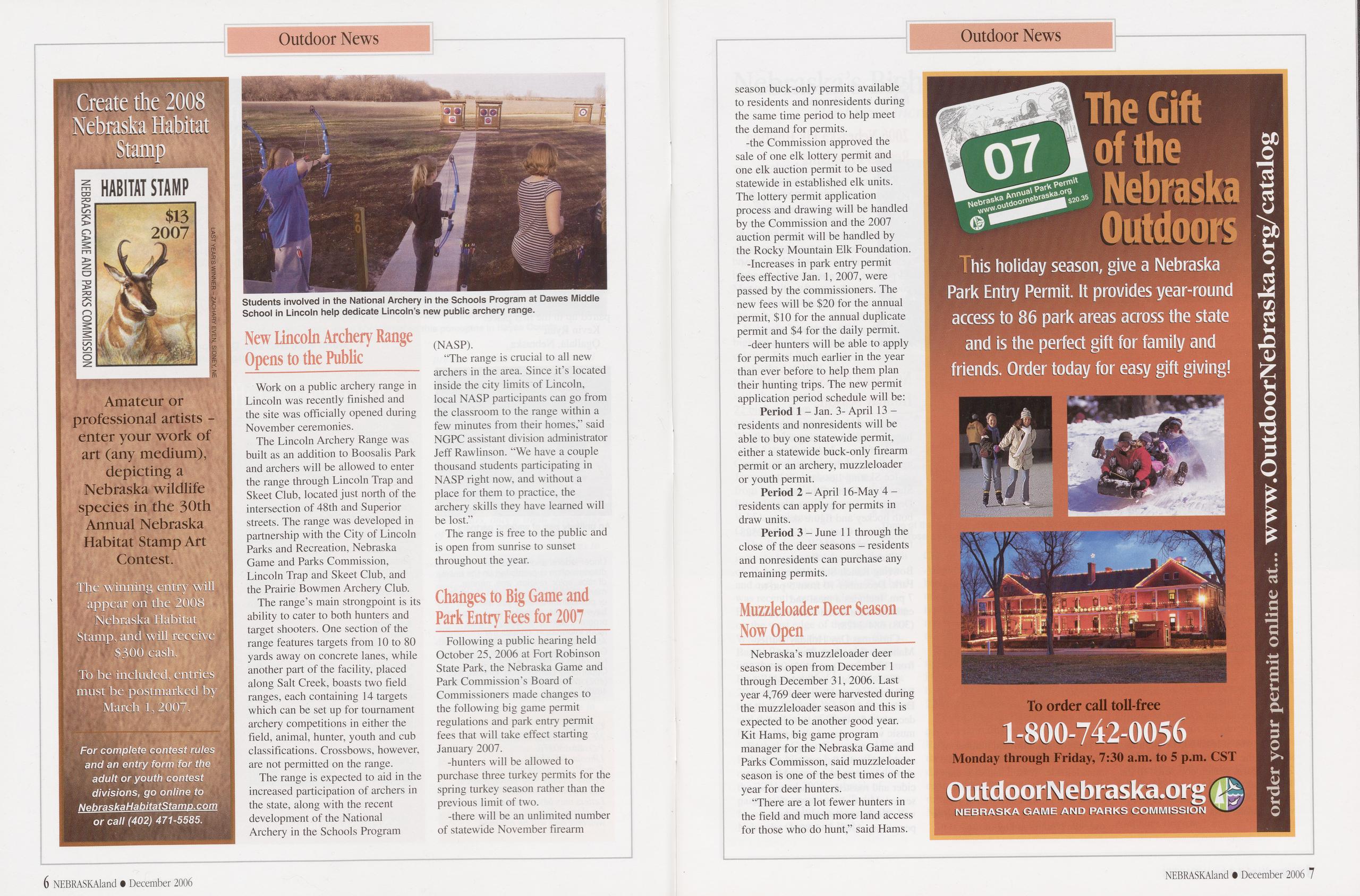
Work on a public archery range in Lincoln was recently finished and the site was officially opened during November ceremonies.
The Lincoln Archery Range was built as an addition to Boosalis Park and archers will be allowed to enter the range through Lincoln Trap and Skeet Club, located just north of the intersection of 48th and Superior streets. The range was developed in partnership with the City of Lincoln Parks and Recreation, Nebraska Game and Parks Commission, Lincoln Trap and Skeet Club, and the Prairie Bowmen Archery Club.
The range’s main strongpoint is its ability to cater to both hunters and target shooters. One section of the range features targets from 10 to 80 yards away on concrete lanes, while another part of the facility, placed along Salt Creek, boasts two field ranges, each containing 14 targets which can be set up for tournament archery competitions in either the field, animal, hunter, youth and cub classifications. Crossbows, however, are not permitted on the range.
The range is expected to aid in the increased participation of archers in the state, along with the recent development of the National Archery in the Schools Program (NASP).
"The range is crucial to all new archers in the area. Since it’s located inside the city limits of Lincoln, local NASP participants can go from the classroom to the range within a few minutes from their homes,” said NGPC assistant division administrator Jeff Rawlinson. "We have a couple thousand students participating in NASP right now, and without a place for them to practice, the archery skills they have learned will be lost.”
The range is free to the public and is open from sunrise to sunset throughout the year.
Changes to Big Game and Park Entry Fees for 2007Following a public hearing held October 25, 2006 at Fort Robinson State Park, the Nebraska Game and Park Commission’s Board of Commissioners made changes to the following big game permit regulations and park entry permit fees that will take effect starting January 2007.
-hunters will be allowed to purchase three turkey permits for the spring turkey season rather than the previous limit of two.
-there will be an unlimited number of statewide November firearm season buck-only permits available to residents and nonresidents during the same time period to help meet the demand for permits.
-the Commission approved the sale of one elk lottery permit and one elk auction permit to be used statewide in established elk units. The lottery permit application process and drawing will be handled by the Commission and the 2007 auction permit will be handled by the Rocky Mountain Elk Foundation.
-Increases in park entry permit fees effective Jan. 1, 2007, were passed by the commissioners. The new fees will be $20 for the annual permit, $10 for the annual duplicate permit and $4 for the daily permit.
-deer hunters will be able to apply for permits much earlier in the year than ever before to help them plan their hunting trips. The new permit application period schedule will be:
Period 1 - Jan. 3- April 13 - residents and nonresidents will be able to buy one statewide permit, either a statewide buck-only firearm permit or an archery, muzzleloader or youth permit.
Period 2 - April 16-May 4 - residents can apply for permits in draw units.
Period 3 - June 11 through the close of the deer seasons - residents and nonresidents can purchase any remaining permits.
Muzzleloader Deer Season Now OpenNebraska’s muzzleloader deer season is open from December 1 through December 31, 2006. Last year 4,769 deer were harvested during the muzzleloader season and this is expected to be another good year. Kit Hams, big game program manager for the Nebraska Game and Parks Commisson, said muzzleloader season is one of the best times of the year for deer hunters.
"There are a lot fewer hunters in the field and much more land access for those who do hunt,” said Hams. $20
The Gift of the Nebraska Park Entry Permit. It provides year-round access to 86 park areas across the state and is the perfect gift for family and friends. Order today for easy gift giving! order your permit online at... WWW.OutdoorNebraska.org/catalog 6 NEBRASKAland • December 2006 NEBRASKAland • December 2006 7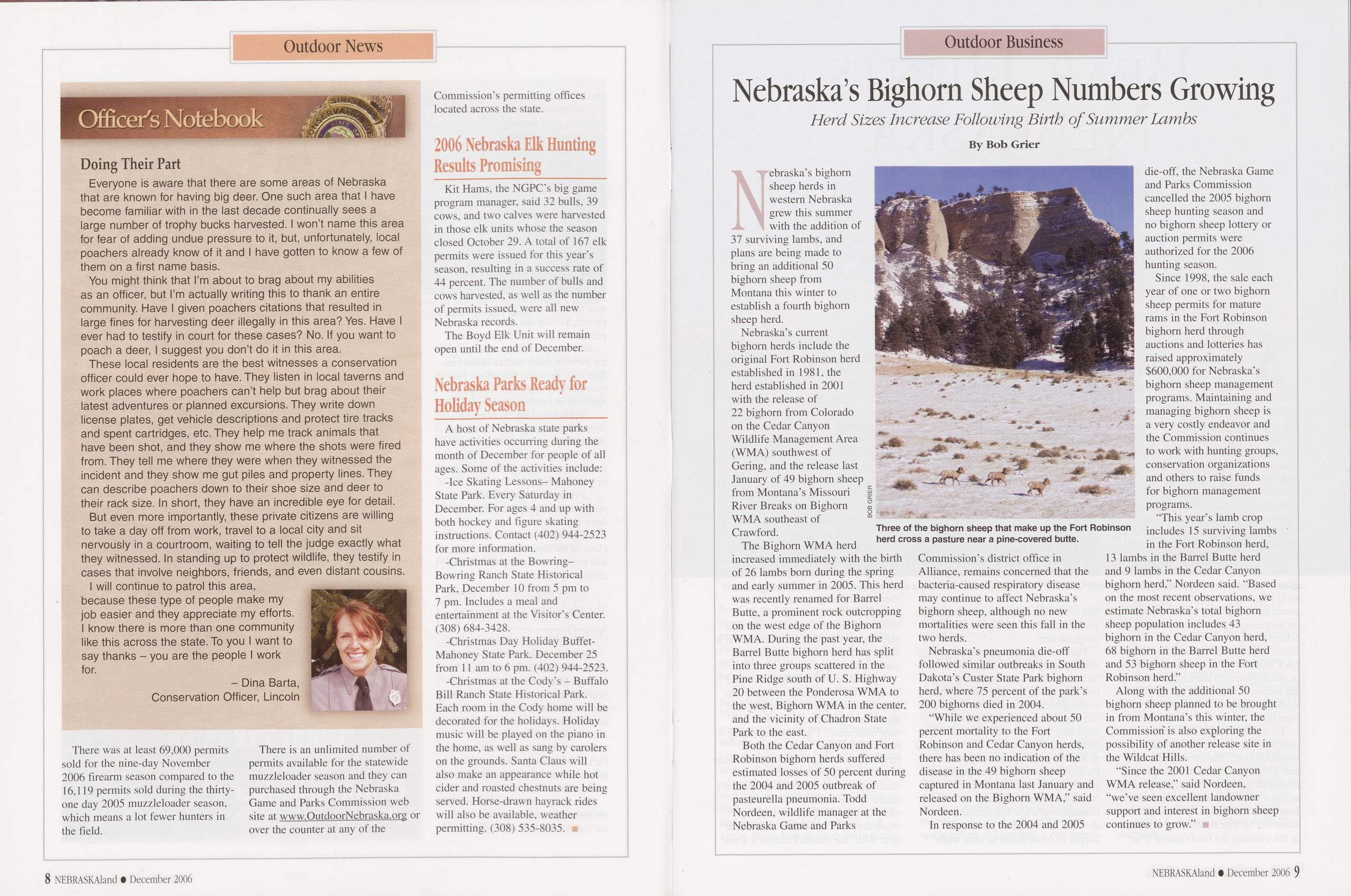 Outdoor Business
Officer's Notebook
Doing Their Part
Outdoor Business
Officer's Notebook
Doing Their Part
Everyone is aware that there are some areas of Nebraska that are known for having big deer. One such area that I have become familiar with in the last decade continually sees a large number of trophy bucks harvested. I won’t name this area for fear of adding undue pressure to it, but, unfortunately, local poachers already know of it and I have gotten to know a few of them on a first name basis.
You might think that I’m about to brag about my abilities as an officer, but I’m actually writing this to thank an entire community. Have I given poachers citations that resulted in large fines for harvesting deer illegally in this area? Yes. Have I ever had to testify in court for these cases? No. If you want to poach a deer, I suggest you don’t do it in this area.
These local residents are the best witnesses a conservation officer could ever hope to have. They listen in local taverns and work places where poachers can’t help but brag about their latest adventures or planned excursions. They write down license plates, get vehicle descriptions and protect tire tracks and spent cartridges, etc. They help me track animals that have been shot, and they show me where the shots were fired from. They tell me where they were when they witnessed the incident and they show me gut piles and property lines. They can describe poachers down to their shoe size and deer to their rack size. In short, they have an incredible eye for detail.
But even more importantly, these private citizens are willing to take a day off from work, travel to a local city and sit nervously in a courtroom, waiting to tell the judge exactly what they witnessed. In standing up to protect wildlife, they testify in cases that involve neighbors, friends, and even distant cousins.
I will continue to patrol this area, because these type of people make my job easier and they appreciate my efforts. I know there is more than one community like this across the state. To you I want to say thanks - you are the people I work i for.
- Dina Barta, Conservation Officer, LincolnThere was at least 69,000 permits sold for the nine-day November 2006 firearm season compared to the 16,119 permits sold during the thirty- one day 2005 muzzleloader season, which means a lot fewer hunters in the field.
There is an unlimited number of permits available for the statewide muzzleloader season and they can purchased through the Nebraska Game and Parks Commission web site at www.OutdoorNebraska.org or over the counter at any of the Commission’s permitting offices located across the state.
2006 Nebraska Elk Hunting Results PromisingKit Hams, the NGPC’s big game program manager, said 32 bulls, 39 cows, and two calves were harvested in those elk units whose the season closed October 29. A total of 167 elk permits were issued for this year’s season, resulting in a success rate of 44 percent. The number of bulls and cows harvested, as well as the number of permits issued, were all new Nebraska records.
The Boyd Elk Unit will remain open until the end of December.
Nebraska Parks Ready for Holiday SeasonA host of Nebraska state parks have activities occurring during the month of December for people of all ages. Some of the activities include:
-Ice Skating Lessons- Mahoney State Park. Every Saturday in December. For ages 4 and up with both hockey and figure skating instructions. Contact (402) 944-2523 for more information.
-Christmas at the Bowring- Bowring Ranch State Historical Park, December 10 from 5 pm to 7 pm. Includes a meal and entertainment at the Visitor’s Center. (308) 684-3428.
-Christmas Day Holiday Buffet- Mahoney State Park. December 25 from 11 am to 6 pm. (402) 944-2523.
-Christmas at the Cody’s - Buffalo Bill Ranch State Historical Park. Each room in the Cody home will be decorated for the holidays. Holiday music will be played on the piano in the home, as well as sang by carolers on the grounds. Santa Claus will also make an appearance while hot cider and roasted chestnuts are being served. Horse-drawn hayrack rides will also be available, weather permitting. (308) 535-8035. ■
Nebraska’s Bighorn Sheep Numbers Growing Herd Sizes Increase Following Birth of Summer Lambs By Bob GrierNebraska’s bighorn sheep herds in western Nebraska grew this summer with the addition of 37 surviving lambs, and plans are being made to bring an additional 50 bighorn sheep from Montana this winter to establish a fourth bighorn sheep herd.
Nebraska’s current bighorn herds include the original Fort Robinson herd established in 1981, the herd established in 2001 with the release of 22 bighorn from Colorado on the Cedar Canyon Wildlife Management Area (WMA) southwest of Gering, and the release last January of 49 bighorn sheep from Montana’s Missouri | River Breaks on Bighorn 2 WMA southeast of Crawford.
The Bighorn WMA herd increased immediately with the birth of 26 lambs born during the spring and early summer in 2005. This herd was recently renamed for Barrel Butte, a prominent rock outcropping on the west edge of the Bighorn WMA. During the past year, the Barrel Butte bighorn herd has split into three groups scattered in the Pine Ridge south of U. 8. Highway 20 between the Ponderosa WMA to the west, Bighorn WMA in the center, and the vicinity of Chadron State Park to the east.
Both the Cedar Canyon and Fort Robinson bighorn herds suffered estimated losses of 50 percent during the 2004 and 2005 outbreak of pasteurella pneumonia. Todd Nordeen, wildlife manager at the Nebraska Game and Parks Commission’s district office in Alliance, remains concerned that the bacteria-caused respiratory disease may continue to affect Nebraska’s bighorn sheep, although no new mortalities were seen this fall in the two herds.
Nebraska’s pneumonia die-off followed similar outbreaks in South Dakota’s Custer State Park bighorn herd, where 75 percent of the park’s 200 bighorns died in 2004.
“While we experienced about 50 percent mortality to the Fort Robinson and Cedar Canyon herds, there has been no indication of the disease in the 49 bighorn sheep captured in Montana last January and released on the Bighorn WMA,” said Nordeen.
In response to the 2004 and 2005 die-off, the Nebraska Game and Parks Commission cancelled the 2005 bighorn sheep hunting season and no bighorn sheep lottery or auction permits were authorized for the 2006 hunting season.
Since 1998, the sale each year of one or two bighorn sheep permits for mature rams in the Fort Robinson bighorn herd through auctions and lotteries has raised approximately $600,000 for Nebraska’s bighorn sheep management programs. Maintaining and managing bighorn sheep is a very costly endeavor and the Commission continues to work with hunting groups, conservation organizations and others to raise funds for bighorn management programs.
“This year’s lamb crop includes 15 surviving lambs in the Fort Robinson herd, 13 lambs in the Barrel Butte herd and 9 lambs in the Cedar Canyon bighorn herd,” Nordeen said. “Based on the most recent observations, we estimate Nebraska’s total bighorn sheep population includes 43 bighorn in the Cedar Canyon herd, 68 bighorn in the Barrel Butte herd and 53 bighorn sheep in the Fort Robinson herd.”
Along with the additional 50 bighorn sheep planned to be brought in from Montana’s this winter, the Commission is also exploring the possibility of another release site in the Wildcat Hills.
“Since the 2001 Cedar Canyon WMA release,” said Nordeen, “we’ve seen excellent landowner support and interest in bighorn sheep continues to grow.” ■
8 NEBRASKAland • December 2006 NEBRASKAland • December 2006 9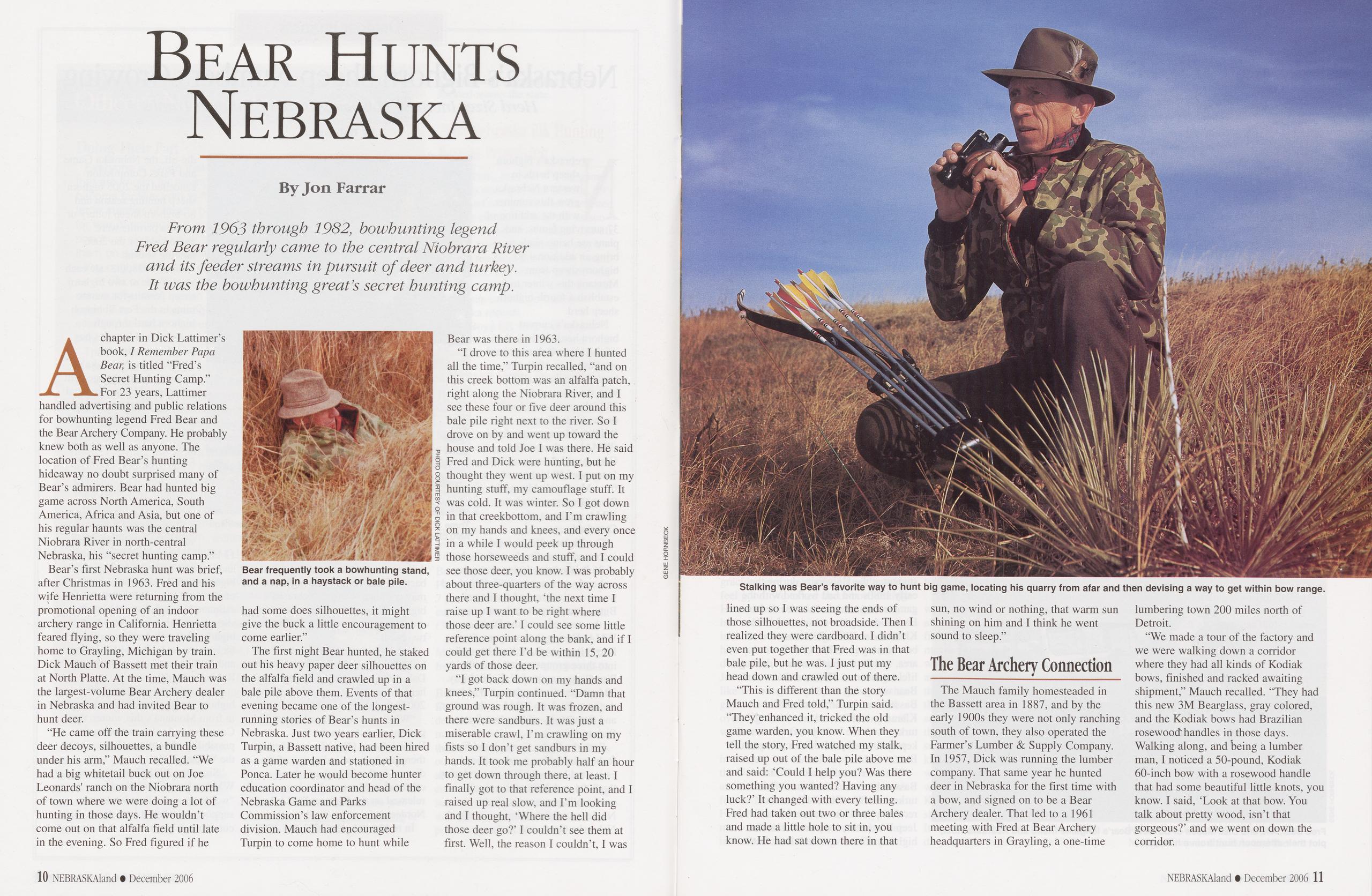
Bear Hunts Nebraska
From 1963 through 1982, bowhunting legend Fred Bear regularly came to the central Niobrara River and its feeder streams in pursuit of deer and turkey. It was the bowhunting great’s secret hunting camp. By Jon FarrarA chapter in Dick Lattimer’s book, I Remember Papa Bear, is titled “Fred’s Secret Hunting Camp.” For 23 years, Lattimer handled advertising and public relations for bowhunting legend Fred Bear and the Bear Archery Company. He probably knew both as well as anyone. The location of Fred Bear’s hunting hideaway no doubt surprised many of Bear’s admirers. Bear had hunted big game across North America, South America, Africa and Asia, but one of his regular haunts was the central Niobrara River in north-central Nebraska, his “secret hunting camp.” Bear’s first Nebraska hunt was brief, after Christmas in 1963. Fred and his wife Henrietta were returning from the promotional opening of an indoor archery range in California. Henrietta feared flying, so they were traveling home to Grayling, Michigan by train. Dick Mauch of Bassett met their train at North Platte. At the time, Mauch was the largest-volume Bear Archery dealer in Nebraska and had invited Bear to hunt deer.
“He came off the train carrying these deer decoys, silhouettes, a bundle under his arm,” Mauch recalled. “We had a big whitetail buck out on Joe Leonards' ranch on the Niobrara north of town where we were doing a lot of hunting in those days. He wouldn’t come out on that alfalfa field until late in the evening. So Fred figured if he had some does silhouettes, it might give the buck a little encouragement to come earlier.”
The first night Bear hunted, he staked out his heavy paper deer silhouettes on the alfalfa field and crawled up in a bale pile above them. Events of that evening became one of the longest- running stories of Bear’s hunts in Nebraska. Just two years earlier, Dick Turpin, a Bassett native, had been hired as a game warden and stationed in Ponca. Later he would become hunter education coordinator and head of the Nebraska Game and Parks Commission’s law enforcement division. Mauch had encouraged Turpin to come home to hunt while Bear was there in 1963.
“I drove to this area where I hunted all the time,” Turpin recalled, “and on this creek bottom was an alfalfa patch, right along the Niobrara River, and I see these four or five deer around this bale pile right next to the river. So I drove on by and went up toward the house and told Joe I was there. He said Fred and Dick were hunting, but he thought they went up west. I put on my hunting stuff, my camouflage stuff. It was cold. It was winter. So I got down in that creekbottom, and I’m crawling on my hands and knees, and every once in a while I would peek up through those horseweeds and stuff, and I could see those deer, you know. I was probably about three-quarters of the way across there and I thought, ‘the next time I raise up I want to be right where those deer are.’ I could see some little reference point along the bank, and if I could get there I’d be within 15, 20 yards of those deer.
“I got back down on my hands and knees,” Turpin continued. “Damn that ground was rough. It was frozen, and there were sandbars. It was just a miserable crawl, I’m crawling on my fists so I don’t get sandbars in my hands. It took me probably half an hour to get down through there, at least. I finally got to that reference point, and I raised up real slow, and I’m looking and I thought, ‘Where the hell did those deer go?’ I couldn’t see them at first. Well, the reason I couldn’t, I was lined up so I was seeing the ends of those silhouettes, not broadside. Then I realized they were cardboard. I didn’t even put together that Fred was in that bale pile, but he was. I just put my head down and crawled out of there.
“This is different than the story Mauch and Fred told,” Turpin said. “They enhanced it, tricked the old game warden, you know. When they tell the story, Fred watched my stalk, raised up out of the bale pile above me and said: ‘Could I help you? Was there something you wanted? Having any luck?’ It changed with every telling. Fred had taken out two or three bales and made a little hole to sit in, you know. He had sat down there in that sun, no wind or nothing, that warm sun shining on him and I think he went sound to sleep.”
The Bear Archery ConnectionThe Mauch family homesteaded in the Bassett area in 1887, and by the early 1900s they were not only ranching south of town, they also operated the Farmer’s Lumber & Supply Company. In 1957, Dick was running the lumber company. That same year he hunted deer in Nebraska for the first time with a bow, and signed on to be a Bear Archery dealer. That led to a 1961 meeting with Fred at Bear Archery headquarters in Grayling, a one-time lumbering town 200 miles north of Detroit.
“We made a tour of the factory and we were walking down a corridor where they had all kinds of Kodiak bows, finished and racked awaiting shipment,” Mauch recalled. “They had this new 3M Bearglass, gray colored, and the Kodiak bows had Brazilian rosewood handles in those days. Walking along, and being a lumber man, I noticed a 50-pound, Kodiak 60-inch bow with a rosewood handle that had some beautiful little knots, you know. I said, ‘Look at that bow. You talk about pretty wood, isn’t that gorgeous?’ and we went on down the corridor.
10 NEBRASKAland O December 2006 NEBRASKAland • December 2006 11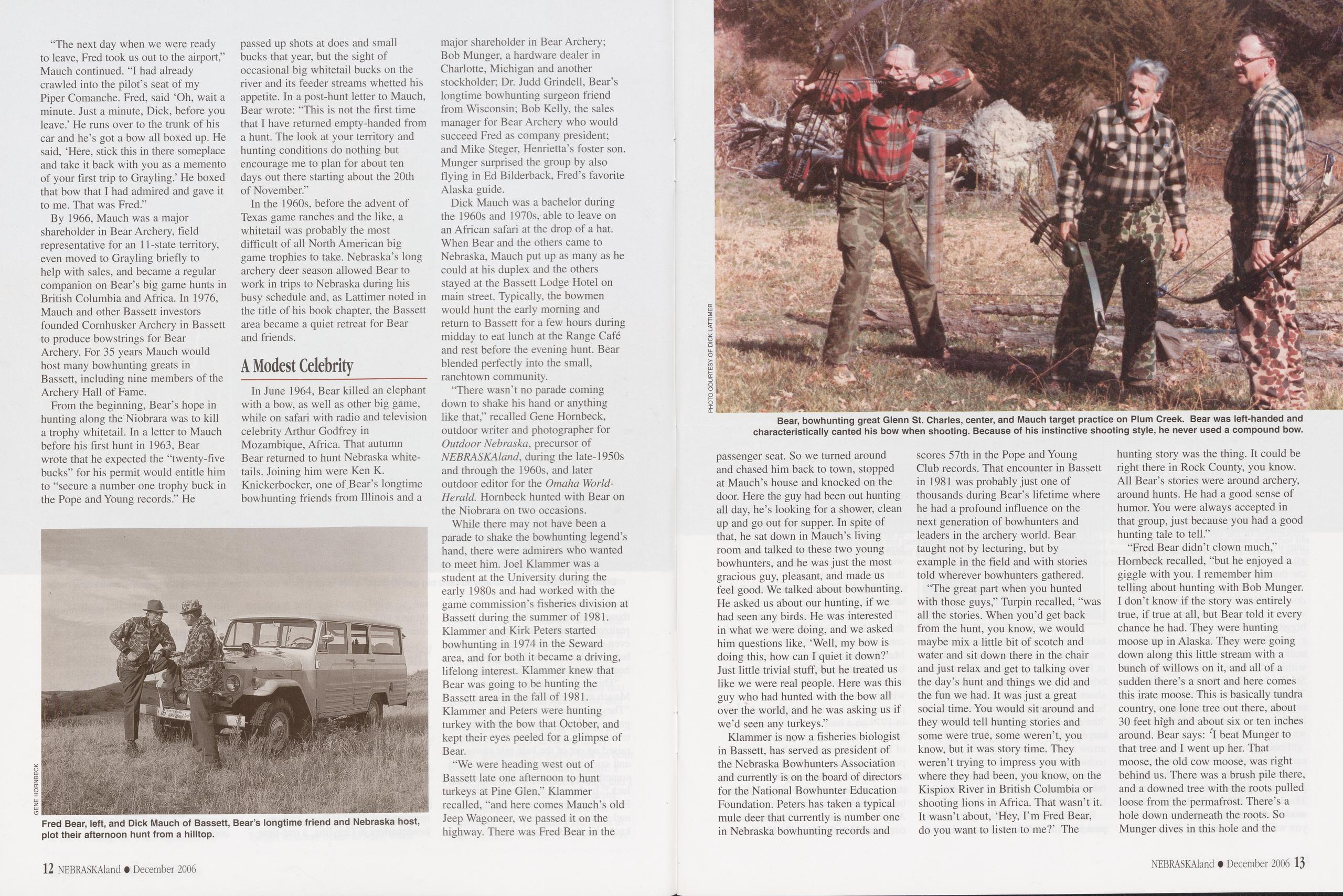
“The next day when we were ready to leave, Fred took us out to the airport,” Mauch continued. "I had already crawled into the pilot’s seat of my Piper Comanche. Fred, said ‘Oh, wait a minute. Just a minute, Dick, before you leave.’ He runs over to the trunk of his car and he’s got a bow all boxed up. He said, ‘Here, stick this in there someplace and take it back with you as a memento of your first trip to Grayling.’ He boxed that bow that I had admired and gave it to me. That was Fred.”
By 1966, Mauch was a major shareholder in Bear Archery, field representative for an 11-state territory, even moved to Grayling briefly to help with sales, and became a regular companion on Bear’s big game hunts in British Columbia and Africa. In 1976, Mauch and other Bassett investors founded Cornhusker Archery in Bassett to produce bowstrings for Bear Archery. For 35 years Mauch would host many bowhunting greats in Bassett, including nine members of the Archery Hall of Fame.
From the beginning, Bear’s hope in hunting along the Niobrara was to kill a trophy whitetail. In a letter to Mauch before his first hunt in 1963, Bear wrote that he expected the “twenty-five bucks” for his permit would entitle him to “secure a number one trophy buck in the Pope and Young records.” He passed up shots at does and small bucks that year, but the sight of occasional big whitetail bucks on the river and its feeder streams whetted his appetite. In a post-hunt letter to Mauch, Bear wrote: “This is not the first time that I have returned empty-handed from a hunt. The look at your territory and hunting conditions do nothing but encourage me to plan for about ten days out there starting about the 20th of November.”
In the 1960s, before the advent of Texas game ranches and the like, a whitetail was probably the most difficult of all North American big game trophies to take. Nebraska’s long archery deer season allowed Bear to work in trips to Nebraska during his busy schedule and, as Lattimer noted in the title of his book chapter, the Bassett area became a quiet retreat for Bear and friends.
A Modest CelebrityIn June 1964, Bear killed an elephant with a bow, as well as other big game, while on safari with radio and television celebrity Arthur Godfrey in Mozambique, Africa. That autumn Bear returned to hunt Nebraska white- tails. Joining him were Ken K. Knickerbocker, one of Bear’s longtime bowhunting friends from Illinois and a major shareholder in Bear Archery; Bob Munger, a hardware dealer in Charlotte, Michigan and another stockholder; Dr. Judd Grindell, Bear’s longtime bowhunting surgeon friend from Wisconsin; Bob Kelly, the sales manager for Bear Archery who would succeed Fred as company president; and Mike Steger, Henrietta’s foster son. Munger surprised the group by also flying in Ed Bilderback, Fred’s favorite Alaska guide.
Dick Mauch was a bachelor during the 1960s and 1970s, able to leave on an African safari at the drop of a hat. When Bear and the others came to Nebraska, Mauch put up as many as he could at his duplex and the others stayed at the Bassett Lodge Hotel on main street. Typically, the bowmen would hunt the early morning and return to Bassett for a few hours during midday to eat lunch at the Range Cafe and rest before the evening hunt. Bear blended perfectly into the small, ranchtown community.
“There wasn’t no parade coming down to shake his hand or anything like that,” recalled Gene Hornbeck, outdoor writer and photographer for Outdoor Nebraska, precursor of NEBRASKAland, during the late-1950s and through the 1960s, and later outdoor editor for the Omaha World- Herald. Hornbeck hunted with Bear on the Niobrara on two occasions.
While there may not have been a parade to shake the bowhunting legend’s hand, there were admirers who wanted to meet him. Joel Klammer was a student at the University during the early 1980s and had worked with the game commission’s fisheries division at Bassett during the summer of 1981. Klammer and Kirk Peters started bowhunting in 1974 in the Seward area, and for both it became a driving, lifelong interest. Klammer knew that Bear was going to be hunting the Bassett area in the fall of 1981. Klammer and Peters were hunting turkey with the bow that October, and kept their eyes peeled for a glimpse of Bear.
“We were heading west out of Bassett late one afternoon to hunt turkeys at Pine Glen,” Klammer recalled, “and here comes Mauch’s old Jeep Wagoneer, we passed it on the highway. There was Fred Bear in the passenger seat. So we turned around and chased him back to town, stopped at Mauch’s house and knocked on the door. Here the guy had been out hunting all day, he’s looking for a shower, clean up and go out for supper. In spite of that, he sat down in Mauch’s living room and talked to these two young bowhunters, and he was just the most gracious guy, pleasant, and made us feel good. We talked about bowhunting. He asked us about our hunting, if we had seen any birds. He was interested in what we were doing, and we asked him questions like, ‘Well, my bow is doing this, how can I quiet it down?’ Just little trivial stuff, but he treated us like we were real people. Here was this guy who had hunted with the bow all over the world, and he was asking us if we’d seen any turkeys.”
Klammer is now a fisheries biologist in Bassett, has served as president of the Nebraska Bowhunters Association and currently is on the board of directors for the National Bowhunter Education Foundation. Peters has taken a typical mule deer that currently is number one in Nebraska bowhunting records and scores 57th in the Pope and Young Club records. That encounter in Bassett in 1981 was probably just one of thousands during Bear’s lifetime where he had a profound influence on the next generation of bowhunters and leaders in the archery world. Bear taught not by lecturing, but by example in the field and with stories told wherever bowhunters gathered.
“The great part when you hunted with those guys,” Turpin recalled, “was all the stories. When you’d get back from the hunt, you know, we would maybe mix a little bit of scotch and water and sit down there in the chair and just relax and get to talking over the day’s hunt and things we did and the fun we had. It was just a great social time. You would sit around and they would tell hunting stories and some were true, some weren’t, you know, but it was story time. They weren’t trying to impress you with where they had been, you know, on the Kispiox River in British Columbia or shooting lions in Africa. That wasn’t it. It wasn’t about, ‘Hey, I’m Fred Bear, do you want to listen to me?’ The hunting story was the thing. It could be right there in Rock County, you know. All Bear’s stories were around archery, around hunts. He had a good sense of humor. You were always accepted in that group, just because you had a good hunting tale to tell.”
“Fred Bear didn’t clown much,”
Hornbeck recalled, “but he enjoyed a
giggle with you. I remember him
telling about hunting with Bob Munger.
I don’t know if the story was entirely
true, if true at all, but Bear told it every
chance he had. They were hunting
moose up in Alaska. They were going
down along this little stream with a
bunch of willows on it, and all of a
sudden there’s a snort and here comes
this irate moose. This is basically tundra
country, one lone tree out there, about
30 feet high and about six or ten inches
around. Bear says: I beat Munger to
that tree and I went up her. That
moose, the old cow moose, was right
behind us. There was a brush pile there,
and a downed tree with the roots pulled
loose from the permafrost. There’s a
hole down underneath the roots. So
Munger dives in this hole and the
12 NEBRASKAland • December 2006
NEBRASKAland • December 2006 13
 moose is chasing him.’
“Bear started shaking the tree,” Hornbeck continued, “and the moose sees him and comes over and starts banging on the tree. ‘The next thing you know,’ Bear tells, ‘Munger comes out of the hole under the tree and away goes the moose, right behind him. So he dives back in the hole. Well, this went on about three times.’
“Bear says ‘I’m yelling at him, stay in that damn hole,’ and Munger yells back, ‘Damn it, I can’t stay in the hole, there’s a bear in here.’”
Driving DeerBowhunting deer on drives is a nearly unheard of technique today, but it was common in the 1960s and 1970s. There were often deer drives when Bear hunted along the Niobrara River. It was on a drive during a cold November hunt in 1964 that Bear killed the biggest whitetail of his hunting career.
“This deer come charging ahead of the drivers and saw Knickerbocker when he stepped out from behind a tree,” Mauch recalled. “If Knick had been standing in front of the tree, he would have probably shot it close. But it took off running, running across in front of Fred. I would guess probably 30 or 40 yards, 30 yards anyway. Dick Sangar, a local bowhunter who was helping guide, said it looked like the arrow curved in flight because of the movement of the deer, that lead going into it. Fred actually hit it back of the vital area, he hit it in the flank, but he cut that big femoral artery. That arrow went into both legs. It slowed him right down and he didn’t go very far. That was Fred’s biggest whitetail, the biggest one he ever shot.”
Fred Bear came of age as a hunter stalking small game, and later deer, with a rifle in the Blue Mountains and South Mountains of Pennsylvania. Throughout his bowhunting life on many continents, stalking, or still- hunting, remained one of his favorite ways to hunt.
“I believe it is true that anyone who can successfully stalk whitetail deer can be successful with any other big- game animal,” Bear wrote in his book, The Archer’s Bible. “Stalking is tough work both mentally and physically. But you will develop patience. You will use muscles you didn’t know existed. Your mouth will be dry. You will sweat and silently curse, but you can never relax. Yet at last, when you’ve made a successful stalk, you will know beyond a doubt why it is called hunting’s greatest thrill. To best a big game animal in its own habitat is a satisfaction unexcelled in the field of sport.”
On most days spent in the woods, I come home with an honestly earned feeling that something good has taken place. It makes no difference whether or not I got anything; it has to do with how the day was spent. — Fred Bear
There are other differences between the way Bear hunted deer and the tactics of the modern bowhunter. Bear was an instinctive shooter, pulling his bow to full draw and releasing the arrow in one smooth, fluid motion. Unlike shooting one of today’s compound bows, it was difficult, impossible for most, to hold a 70-pound recurve bow at full draw for long. Bear did not use bow sights. Bear wrote that instinctive shooting involved natural coordination between the eyes and the bow arm, “the eyes judging the distance to the target and the bow arm elevating the arrow to the correct height,” a technique similar to that used in tennis “where you do not look at your racquet, but concentrate on where you want the ball to hit.”
Bear’s instinctive shooting style and penchant for stalking led to another quirk - shooting with the bow canted rather than perpendicular. Bear wrote that instinctive archers shoot with the upper body leaning forward from the waist so the eye is directly above the arrow. “Intense concentration on the very center of whatever you are shooting at,” he wrote, “is the secret of instinctive shooting. All other thinking must be erased from your mind.
“You must visualize this arc of the arrow in order to hit the target at varying distances.” Bear wrote. That “distance to the target” is not measured in yards for the instinctive shooter, but a “feel” for the range. Bear believed that instinctive shooting rewarded the bowhunter with “the thrill of achieving accuracy with nothing but the abilities nature gave you, with no dependence upon mechanical helps” and was better suited to making split-second decisions from awkward positions.
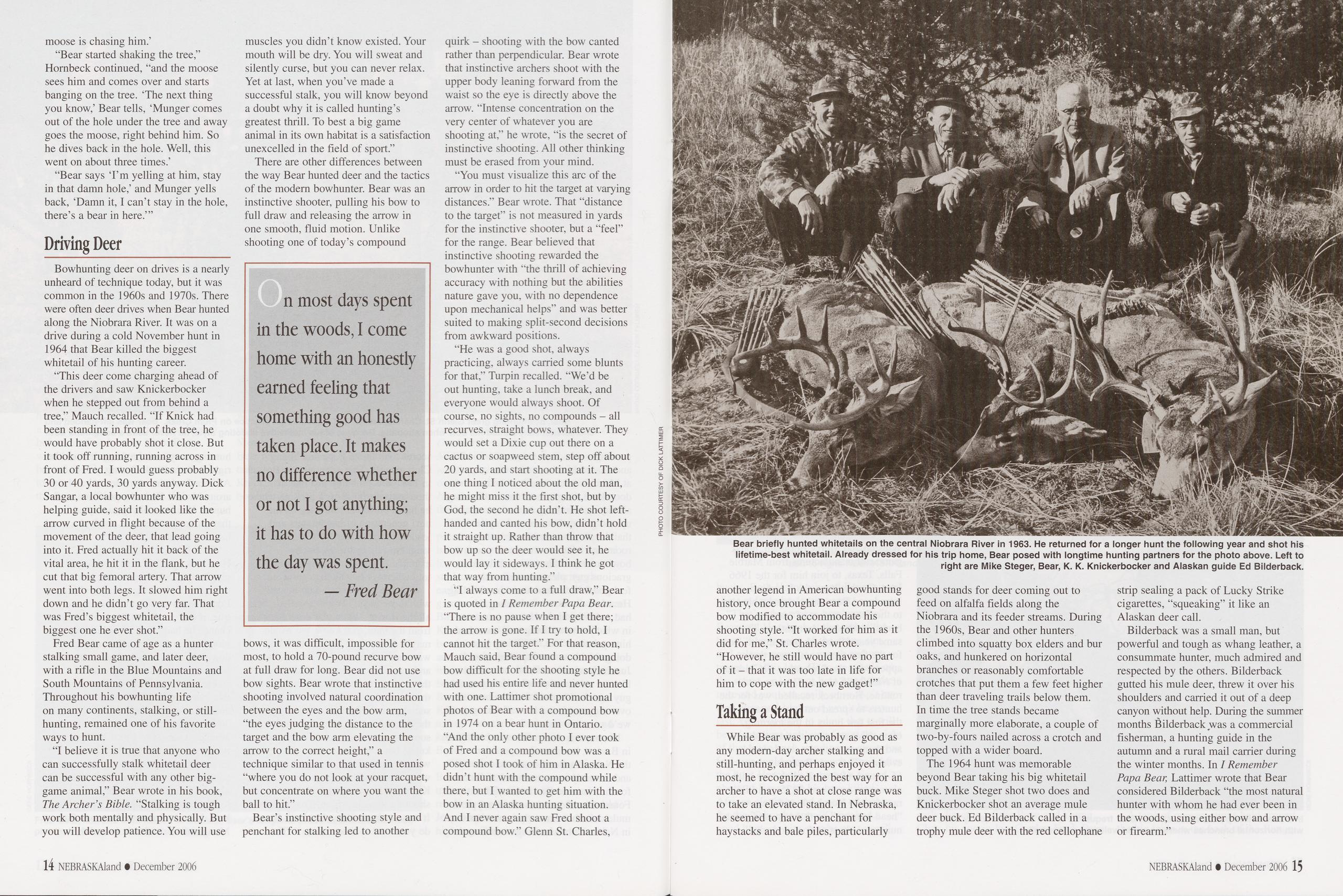
“He was a good shot, always practicing, always carried some blunts for that,” Turpin recalled. “We’d be out hunting, take a lunch break, and everyone would always shoot. Of course, no sights, no compounds - all recurves, straight bows, whatever. They would set a Dixie cup out there on a cactus or soapweed stem, step off about 20 yards, and start shooting at it. The one thing I noticed about the old man, he might miss it the first shot, but by God, the second he didn’t. He shot left- handed and canted his bow, didn’t hold it straight up. Rather than throw that bow up so the deer would see it, he would lay it sideways. I think he got that way from hunting.”
“I always come to a full draw,” Bear is quoted in I Remember Papa Bear. “There is no pause when I get there; the arrow is gone. If I try to hold, I cannot hit the target.” For that reason, Mauch said, Bear found a compound bow difficult for the shooting style he had used his entire life and never hunted with one. Lattimer shot promotional photos of Bear with a compound bow in 1974 on a bear hunt in Ontario. “And the only other photo I ever took of Fred and a compound bow was a posed shot I took of him in Alaska. He didn’t hunt with the compound while there, but I wanted to get him with the bow in an Alaska hunting situation. And I never again saw Fred shoot a compound bow.” Glenn St. Charles, another legend in American bowhunting history, once brought Bear a compound bow modified to accommodate his shooting style. “It worked for him as it did for me,” St. Charles wrote. “However, he still would have no part of it - that it was too late in life for him to cope with the new gadget!”
While Bear was probably as good as any modern-day archer stalking and still-hunting, and perhaps enjoyed it most, he recognized the best way for an archer to have a shot at close range was to take an elevated stand. In Nebraska, he seemed to have a penchant for haystacks and bale piles, particularly good stands for deer coming out to feed on alfalfa fields along the Niobrara and its feeder streams. During the 1960s, Bear and other hunters climbed into squatty box elders and bur oaks, and hunkered on horizontal branches or reasonably comfortable crotches that put them a few feet higher than deer traveling trails below them. In time the tree stands became marginally more elaborate, a couple of two-by-fours nailed across a crotch and topped with a wider board.
The 1964 hunt was memorable beyond Bear taking his big whitetail buck. Mike Steger shot two does and Knickerbocker shot an average mule deer buck. Ed Bilderback called in a trophy mule deer with the red cellophane strip sealing a pack of Lucky Strike cigarettes, “squeaking” it like an Alaskan deer call.
Bilderback was a small man, but powerful and tough as whang leather, a consummate hunter, much admired and respected by the others. Bilderback gutted his mule deer, threw it over his shoulders and carried it out of a deep canyon without help. During the summer months Bilderback was a commercial fisherman, a hunting guide in the autumn and a rural mail carrier during the winter months. In I Remember Papa Bear, Lattimer wrote that Bear considered Bilderback “the most natural hunter with whom he had ever been in the woods, using either bow and arrow or firearm.”
14 NEBRASKAland • December 2006 NEBRASKAland • December 2006 15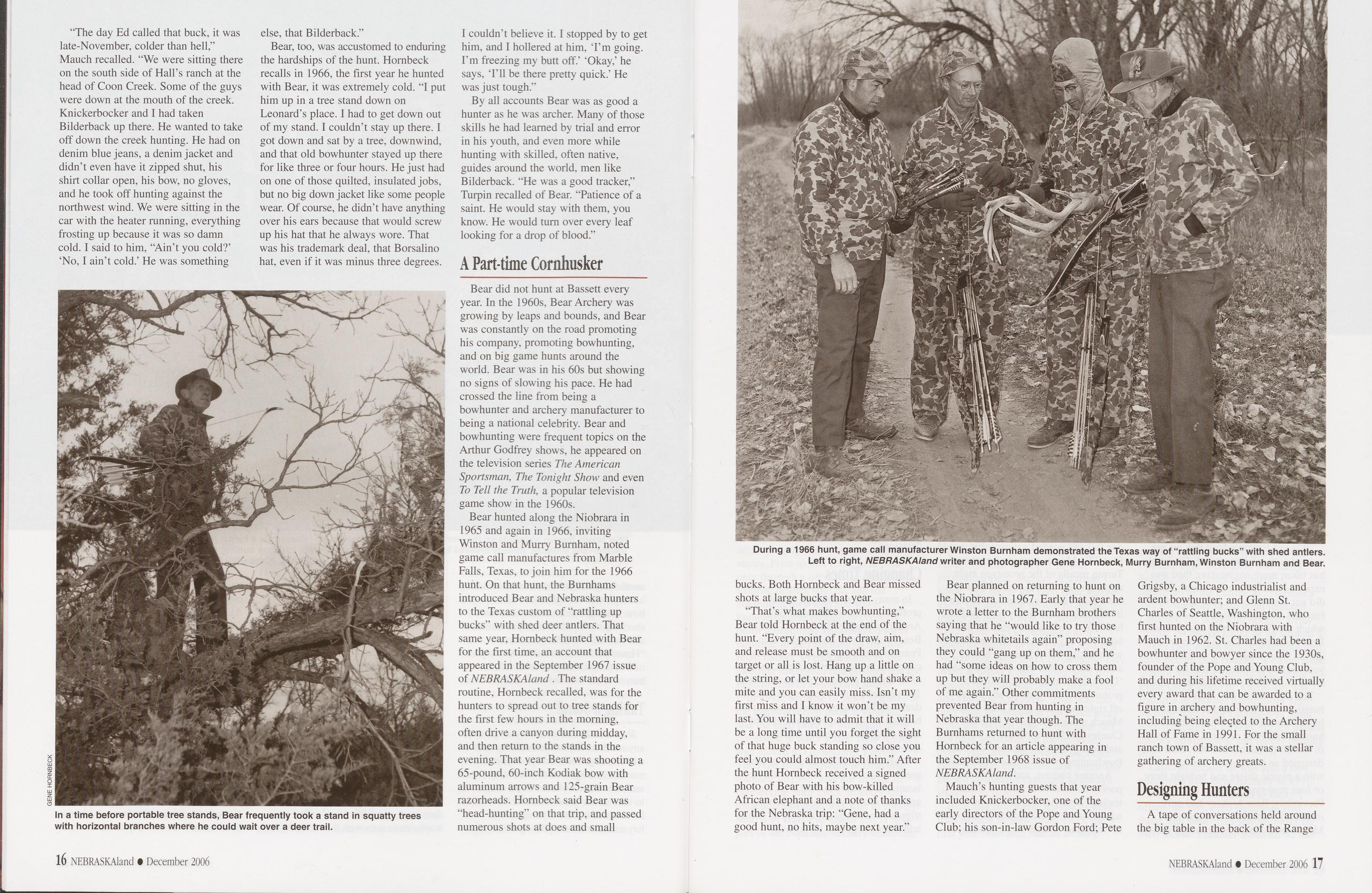
“The day Ed called that buck, it was late-November, colder than hell,” Mauch recalled. “We were sitting there on the south side of Hall’s ranch at the head of Coon Creek. Some of the guys were down at the mouth of the creek. Knickerbocker and I had taken Bilderback up there. He wanted to take off down the creek hunting. He had on denim blue jeans, a denim jacket and didn’t even have it zipped shut, his shirt collar open, his bow, no gloves, and he took off hunting against the northwest wind. We were sitting in the car with the heater running, everything frosting up because it was so damn cold. I said to him, “Ain’t you cold?’ ‘No, I ain’t cold.’ He was something else, that Bilderback.”
Bear, too, was accustomed to enduring the hardships of the hunt. Hornbeck recalls in 1966, the first year he hunted with Bear, it was extremely cold. “I put him up in a tree stand down on Leonard’s place. I had to get down out of my stand. I couldn’t stay up there. I got down and sat by a tree, downwind, and that old bowhunter stayed up there for like three or four hours. He just had on one of those quilted, insulated jobs, but no big down jacket like some people wear. Of course, he didn’t have anything over his ears because that would screw up his hat that he always wore. That was his trademark deal, that Borsalino hat, even if it was minus three degrees. I couldn’t believe it. I stopped by to get him, and I hollered at him, ‘I’m going. I’m freezing my butt off.’ ‘Okay,’ he says, ‘I’ll be there pretty quick.’ He was just tough.”
By all accounts Bear was as good a hunter as he was archer. Many of those skills he had learned by trial and error in his youth, and even more while hunting with skilled, often native, guides around the world, men like Bilderback. “He was a good tracker,” Turpin recalled of Bear. “Patience of a saint. He would stay with them, you know. He would turn over every leaf looking for a drop of blood.”
A Part-time CornhuskerBear did not hunt at Bassett every year. In the 1960s, Bear Archery was growing by leaps and bounds, and Bear was constantly on the road promoting his company, promoting bowhunting, and on big game hunts around the world. Bear was in his 60s but showing no signs of slowing his pace. He had crossed the line from being a bowhunter and archery manufacturer to being a national celebrity. Bear and bowhunting were frequent topics on the Arthur Godfrey shows, he appeared on the television series The American Sportsman, The Tonight Show and even To Tell the Truth, a popular television game show in the 1960s.
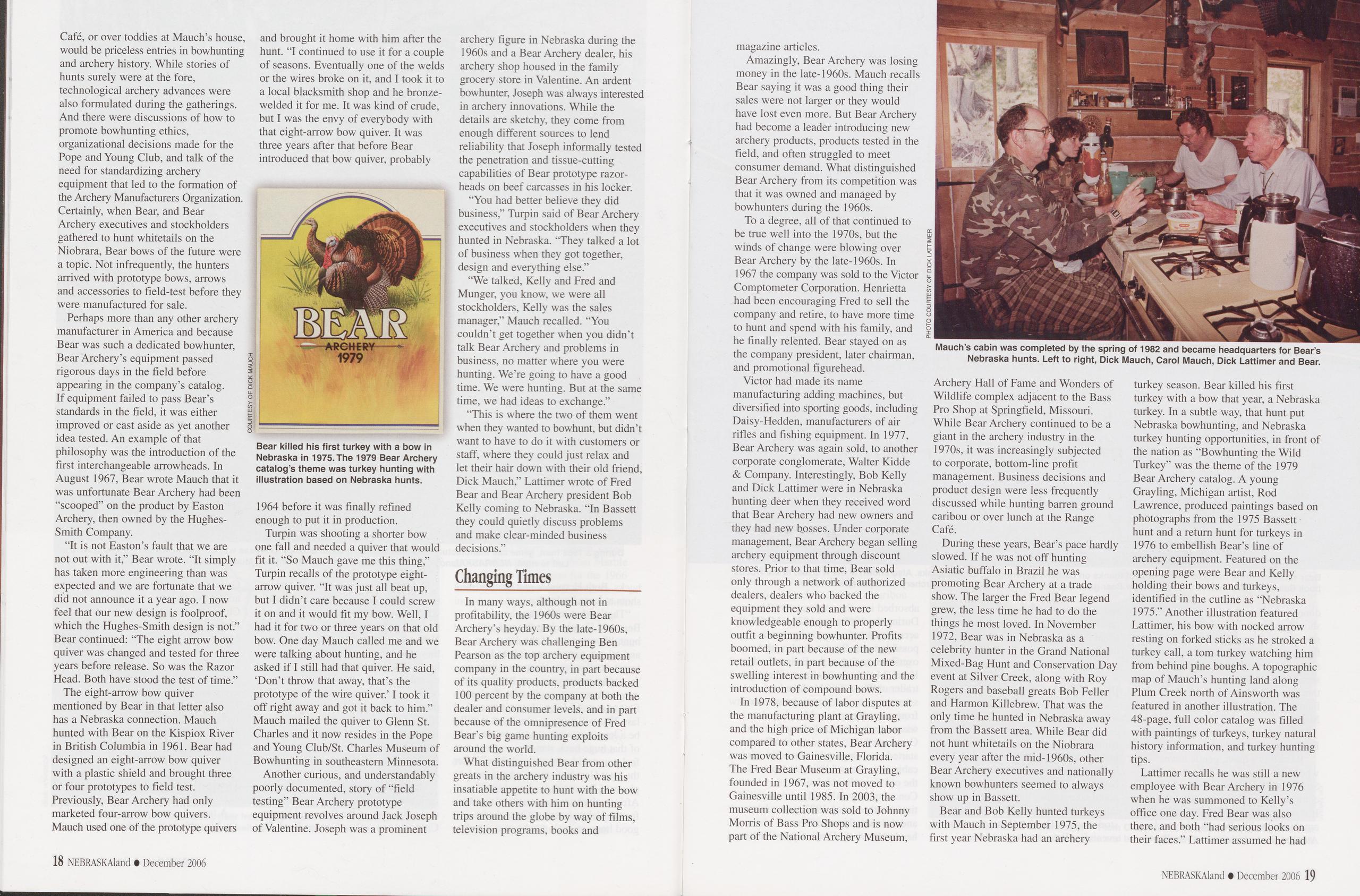
Bear hunted along the Niobrara in 1965 and again in 1966, inviting Winston and Murry Burnham, noted game call manufactures from Marble Falls, Texas, to join him for the 1966 hunt. On that hunt, the Burnhams introduced Bear and Nebraska hunters to the Texas custom of “rattling up bucks” with shed deer antlers. That same year, Hornbeck hunted with Bear for the first time, an account that appeared in the September 1967 issue of NEBRASKAland . The standard routine, Hornbeck recalled, was for the hunters to spread out to tree stands for the first few hours in the morning, often drive a canyon during midday, and then return to the stands in the evening. That year Bear was shooting a 65-pound, 60-inch Kodiak bow with aluminum arrows and 125-grain Bear razorheads. Hornbeck said Bear was “head-hunting” on that trip, and passed numerous shots at does and small bucks. Both Hornbeck and Bear missed shots at large bucks that year.
“That’s what makes bowhunting,” Bear told Hornbeck at the end of the hunt. “Every point of the draw, aim, and release must be smooth and on target or all is lost. Hang up a little on the string, or let your bow hand shake a mite and you can easily miss. Isn’t my first miss and I know it won’t be my last. You will have to admit that it will be a long time until you forget the sight of that huge buck standing so close you feel you could almost touch him.” After the hunt Hornbeck received a signed photo of Bear with his bow-killed African elephant and a note of thanks for the Nebraska trip: “Gene, had a good hunt, no hits, maybe next year.”
Bear planned on returning to hunt on the Niobrara in 1967. Early that year he wrote a letter to the Burnham brothers saying that he “would like to try those Nebraska whitetails again” proposing they could “gang up on them,” and he had “some ideas on how to cross them up but they will probably make a fool of me again.” Other commitments prevented Bear from hunting in Nebraska that year though. The Burnhams returned to hunt with Hornbeck for an article appearing in the September 1968 issue of NEBRASKAland.
Mauch’s hunting guests that year included Knickerbocker, one of the early directors of the Pope and Young Club; his son-in-law Gordon Ford; Pete Grigsby, a Chicago industrialist and ardent bowhunter; and Glenn St. Charles of Seattle, Washington, who first hunted on the Niobrara with Mauch in 1962. St. Charles had been a bowhunter and bowyer since the 1930s, founder of the Pope and Young Club, and during his lifetime received virtually every award that can be awarded to a figure in archery and bowhunting, including being elected to the Archery Hall of Fame in 1991. For the small ranch town of Bassett, it was a stellar gathering of archery greats.
Designing HuntersA tape of conversations held around
the big table in the back of the Range
16 NEBRASKAland • December 2006
NEBRASKAland • December 2006 17
 Cafe, or over toddies at Mauch’s house,
would be priceless entries in bowhunting
and archery history. While stories of
hunts surely were at the fore,
technological archery advances were
also formulated during the gatherings.
And there were discussions of how to
promote bowhunting ethics,
organizational decisions made for the
Pope and Young Club, and talk of the
need for standardizing archery
equipment that led to the formation of
the Archery Manufacturers Organization.
Certainly, when Bear, and Bear
Archery executives and stockholders
gathered to hunt whitetails on the
Niobrara, Bear bows of the future were
a topic. Not infrequently, the hunters
arrived with prototype bows, arrows
and accessories to field-test before they
were manufactured for sale.
Cafe, or over toddies at Mauch’s house,
would be priceless entries in bowhunting
and archery history. While stories of
hunts surely were at the fore,
technological archery advances were
also formulated during the gatherings.
And there were discussions of how to
promote bowhunting ethics,
organizational decisions made for the
Pope and Young Club, and talk of the
need for standardizing archery
equipment that led to the formation of
the Archery Manufacturers Organization.
Certainly, when Bear, and Bear
Archery executives and stockholders
gathered to hunt whitetails on the
Niobrara, Bear bows of the future were
a topic. Not infrequently, the hunters
arrived with prototype bows, arrows
and accessories to field-test before they
were manufactured for sale.
Perhaps more than any other archery manufacturer in America and because Bear was such a dedicated bowhunter, Bear Archery’s equipment passed rigorous days in the field before appearing in the company’s catalog. If equipment failed to pass Bear’s standards in the field, it was either improved or cast aside as yet another idea tested. An example of that philosophy was the introduction of the first interchangeable arrowheads. In August 1967, Bear wrote Mauch that it was unfortunate Bear Archery had been “scooped” on the product by Easton Archery, then owned by the Hughes- Smith Company.
"It is not Easton’s fault that we are not out with it,” Bear wrote. "It simply has taken more engineering than was expected and we are fortunate that we did not announce it a year ago. I now feel that our new design is foolproof, which the Hughes-Smith design is not.” Bear continued: "The eight arrow bow quiver was changed and tested for three years before release. So was the Razor Head. Both have stood the test of time.”
The eight-arrow bow quiver mentioned by Bear in that letter also has a Nebraska connection. Mauch hunted with Bear on the Kispiox River in British Columbia in 1961. Bear had designed an eight-arrow bow quiver with a plastic shield and brought three or four prototypes to field test. Previously, Bear Archery had only marketed four-arrow bow quivers. Mauch used one of the prototype quivers and brought it home with him after the hunt. "I continued to use it for a couple of seasons. Eventually one of the welds or the wires broke on it, and I took it to a local blacksmith shop and he bronze- welded it for me. It was kind of crude, but I was the envy of everybody with that eight-arrow bow quiver. It was three years after that before Bear introduced that bow quiver, probably Bear killed his first turkey with a bow in Nebraska in 1975. The 1979 Bear Archery catalog’s theme was turkey hunting with illustration based on Nebraska hunts. 1964 before it was finally refined enough to put it in production.
Turpin was shooting a shorter bow one fall and needed a quiver that would fit it. "So Mauch gave me this thing,” Turpin recalls of the prototype eight- arrow quiver. "It was just all beat up, but I didn’t care because I could screw it on and it would fit my bow. Well, I had it for two or three years on that old bow. One day Mauch called me and we were talking about hunting, and he asked if I still had that quiver. He said, ‘Don’t throw that away, that’s the prototype of the wire quiver.’ I took it off right away and got it back to him.” Mauch mailed the quiver to Glenn St. Charles and it now resides in the Pope and Young Club/St. Charles Museum of Bowhunting in southeastern Minnesota.
Another curious, and understandably poorly documented, story of "field testing” Bear Archery prototype equipment revolves around Jack Joseph of Valentine. Joseph was a prominent archery figure in Nebraska during the 1960s and a Bear Archery dealer, his archery shop housed in the family grocery store in Valentine. An ardent bowhunter, Joseph was always interested in archery innovations. While the details are sketchy, they come from enough different sources to lend reliability that Joseph informally tested the penetration and tissue-cutting capabilities of Bear prototype razor- heads on beef carcasses in his locker.
"You had better believe they did business,” Turpin said of Bear Archery executives and stockholders when they hunted in Nebraska. "They talked a lot of business when they got together, design and everything else.”
"We talked, Kelly and Fred and Munger, you know, we were all stockholders, Kelly was the sales manager,” Mauch recalled. "You couldn’t get together when you didn’t talk Bear Archery and problems in business, no matter where you were hunting. We’re going to have a good time. We were hunting. But at the same time, we had ideas to exchange.”
"This is where the two of them went when they wanted to bowhunt, but didn’t want to have to do it with customers or staff, where they could just relax and let their hair down with their old friend, Dick Mauch,” Lattimer wrote of Fred Bear and Bear Archery president Bob Kelly coming to Nebraska. "In Bassett they could quietly discuss problems and make clear-minded business decisions.”
Changing TimesIn many ways, although not in profitability, the 1960s were Bear Archery’s heyday. By the late-1960s, Bear Archery was challenging Ben Pearson as the top archery equipment company in the country, in part because of its quality products, products backed 100 percent by the company at both the dealer and consumer levels, and in part because of the omnipresence of Fred Bear’s big game hunting exploits around the world.
What distinguished Bear from other greats in the archery industry was his insatiable appetite to hunt with the bow and take others with him on hunting trips around the globe by way of films, television programs, books and magazine articles.
Amazingly, Bear Archery was losing money in the late-1960s. Mauch recalls Bear saying it was a good thing their sales were not larger or they would have lost even more. But Bear Archery had become a leader introducing new archery products, products tested in the field, and often struggled to meet consumer demand. What distinguished Bear Archery from its competition was that it was owned and managed by bowhunters during the 1960s.
To a degree, all of that continued to be true well into the 1970s, but the winds of change were blowing over Bear Archery by the late-1960s. In 1967 the company was sold to the Victor Comptometer Corporation. Henrietta had been encouraging Fred to sell the company and retire, to have more time to hunt and spend with his family, and he finally relented. Bear stayed on as the company president, later chairman, and promotional figurehead.
Victor had made its name manufacturing adding machines, but diversified into sporting goods, including Daisy-Hedden, manufacturers of air rifles and fishing equipment. In 1977, Bear Archery was again sold, to another corporate conglomerate, Walter Kidde & Company. Interestingly, Bob Kelly and Dick Lattimer were in Nebraska hunting deer when they received word that Bear Archery had new owners and they had new bosses. Under corporate management, Bear Archery began selling archery equipment through discount stores. Prior to that time, Bear sold only through a network of authorized dealers, dealers who backed the equipment they sold and were knowledgeable enough to properly outfit a beginning bowhunter. Profits boomed, in part because of the new retail outlets, in part because of the swelling interest in bowhunting and the introduction of compound bows.
In 1978, because of labor disputes at the manufacturing plant at Grayling, and the high price of Michigan labor compared to other states, Bear Archery was moved to Gainesville, Florida. The Fred Bear Museum at Grayling, founded in 1967, was not moved to Gainesville until 1985. In 2003, the museum collection was sold to Johnny Morris of Bass Pro Shops and is now part of the National Archery Museum, Archery Hall of Fame and Wonders of Wildlife complex adjacent to the Bass Pro Shop at Springfield, Missouri. While Bear Archery continued to be a giant in the archery industry in the 1970s, it was increasingly subjected to corporate, bottom-line profit management. Business decisions and product design were less frequently discussed while hunting barren ground caribou or over lunch at the Range Cafe.
During these years, Bear’s pace hardly slowed. If he was not off hunting Asiatic buffalo in Brazil he was promoting Bear Archery at a trade show. The larger the Fred Bear legend grew, the less time he had to do the things he most loved. In November 1972, Bear was in Nebraska as a celebrity hunter in the Grand National Mixed-Bag Hunt and Conservation Day event at Silver Creek, along with Roy Rogers and baseball greats Bob Feller and Harmon Killebrew. That was the only time he hunted in Nebraska away from the Bassett area. While Bear did not hunt whitetails on the Niobrara every year after the mid-1960s, other Bear Archery executives and nationally known bowhunters seemed to always show up in Bassett.
Bear and Bob Kelly hunted turkeys with Mauch in September 1975, the first year Nebraska had an archery turkey season. Bear killed his first turkey with a bow that year, a Nebraska turkey. In a subtle way, that hunt put Nebraska bowhunting, and Nebraska turkey hunting opportunities, in front of the nation as "Bowhunting the Wild Turkey” was the theme of the 1979 Bear Archery catalog. A young Grayling, Michigan artist, Rod Lawrence, produced paintings based on photographs from the 1975 Bassett hunt and a return hunt for turkeys in 1976 to embellish Bear’s line of archery equipment. Featured on the opening page were Bear and Kelly holding their bows and turkeys, identified in the cutline as "Nebraska 1975.” Another illustration featured Lattimer, his bow with nocked arrow resting on forked sticks as he stroked a turkey call, a tom turkey watching him from behind pine boughs. A topographic map of Mauch’s hunting land along Plum Creek north of Ainsworth was featured in another illustration. The 48-page, full color catalog was filled with paintings of turkeys, turkey natural history information, and turkey hunting tips.
Lattimer recalls he was still a new
employee with Bear Archery in 1976
when he was summoned to Kelly’s
office one day. Fred Bear was also
there, and both "had serious looks on
their faces.” Lattimer assumed he had
18 NEBRASKAland • December 2006
NEBRASKAland • December 2006 19
 done something wrong. “We think you
should go out to Bassett, Lattimer, and
see some real cowboy country,” Kelly
finally said. “You need to eat some
steaks half the size of Dallas and do
some bowhunting with us. How does
that sound?” Also in Bassett for the
hunt was St. Charles and his wife
Margaret.
done something wrong. “We think you
should go out to Bassett, Lattimer, and
see some real cowboy country,” Kelly
finally said. “You need to eat some
steaks half the size of Dallas and do
some bowhunting with us. How does
that sound?” Also in Bassett for the
hunt was St. Charles and his wife
Margaret.
Lattimer wrote of his impression of Bassett in I Remember Papa Bear:
“Bassett is a quiet, gentle town where the big event of the week after Sunday church services is the midweek cattle auction at the Bassett sale barn. It was great fun sitting in the cozy amphitheater-like Bassett Livestock Auction Barn, with its cow smells watching all the noisy action with the ranchers and cattle buyers doing their silent bidding as the cattle swirl around the auction pen down below with the auctioneers doing their exciting pitch.”
Plum Creek CabinNot just Bear, but Bear Archery executives and bowhunting friends from around the country had fallen in love with the good hunting and laid- back atmosphere of north-central Nebraska. It was a place where they could take it easy, hunt as they wanted, talk business or just tell old hunting stories again. Those gatherings continued even after Bear Archery had been absorbed into the corporate world. During the 1960s and 1970s, Mauch accommodated as many hunters as possible in his Bassett duplex, the overflow staying at the Bassett Lodge Hotel. Mauch also had a small camper trailer on Plum Creek where hunters sometimes stayed, drawing their water from a nearby spring. Mauch had no sooner traded for land along Plum Creek north of Ainsworth than Bear started encouraging him to build a log cabin near the crumbling remains of the old Keim Ranch buildings. Construction was mostly completed in time for the spring 1982 turkey hunt, and the cabin became the new headquarters of “Fred’s Secret Hunting Camp.”
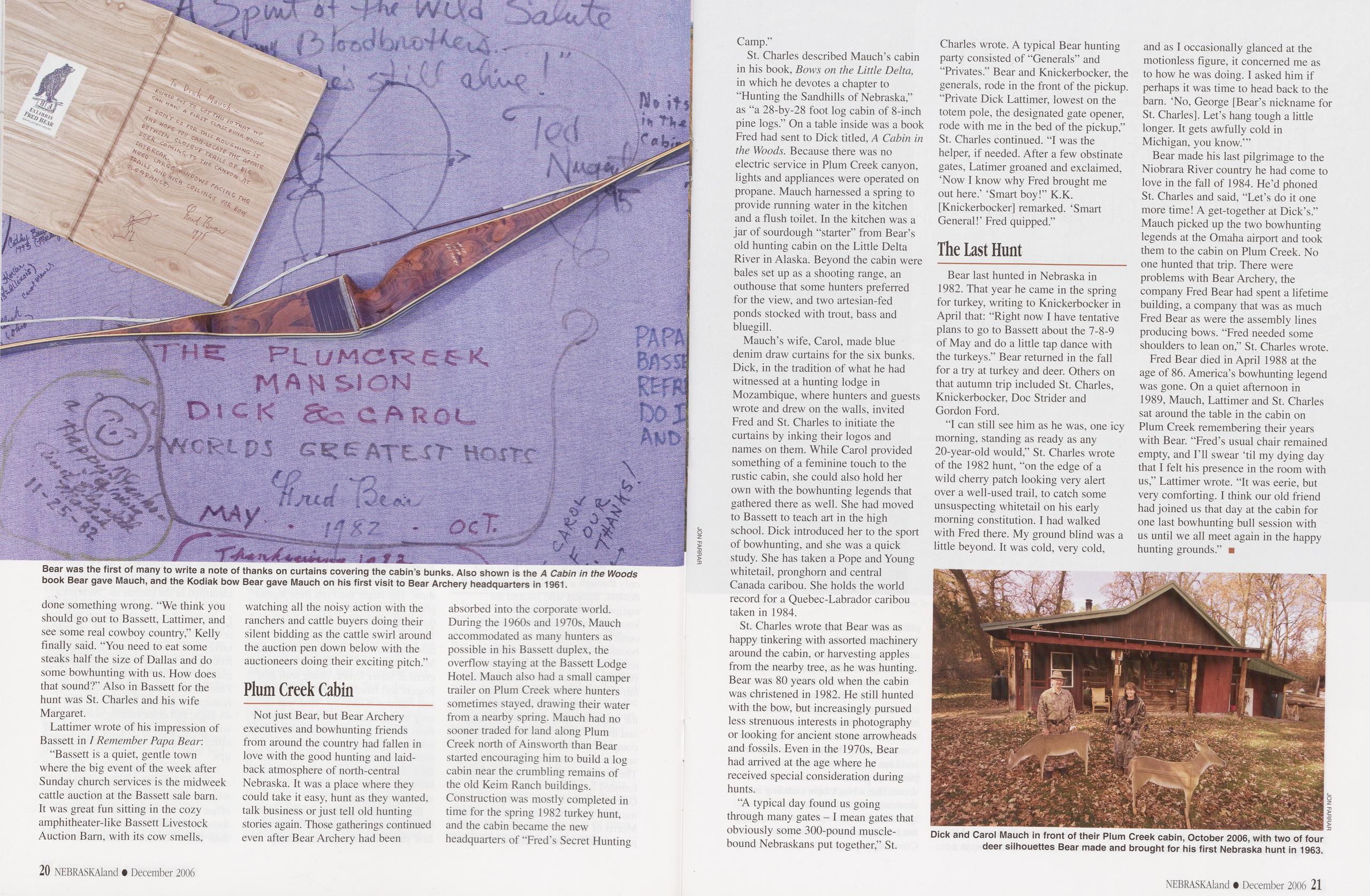
St. Charles described Mauch’s cabin in his book, Bows on the Little Delta, in which he devotes a chapter to “Hunting the Sandhills of Nebraska,” as “a 28-by-28 foot log cabin of 8-inch pine logs.” On a table inside was a book Fred had sent to Dick titled, A Cabin in the Woods. Because there was no electric service in Plum Creek canyon, lights and appliances were operated on propane. Mauch harnessed a spring to provide running water in the kitchen and a flush toilet. In the kitchen was a jar of sourdough “starter” from Bear’s old hunting cabin on the Little Delta River in Alaska. Beyond the cabin were bales set up as a shooting range, an outhouse that some hunters preferred for the view, and two artesian-fed ponds stocked with trout, bass and bluegill.
Mauch’s wife, Carol, made blue denim draw curtains for the six bunks. Dick, in the tradition of what he had witnessed at a hunting lodge in Mozambique, where hunters and guests wrote and drew on the walls, invited Fred and St. Charles to initiate the curtains by inking their logos and names on them. While Carol provided something of a feminine touch to the rustic cabin, she could also hold her own with the bowhunting legends that gathered there as well. She had moved to Bassett to teach art in the high school. Dick introduced her to the sport of bowhunting, and she was a quick study. She has taken a Pope and Young whitetail, pronghorn and central Canada caribou. She holds the world record for a Quebec-Labrador caribou taken in 1984.
St. Charles wrote that Bear was as happy tinkering with assorted machinery around the cabin, or harvesting apples from the nearby tree, as he was hunting. Bear was 80 years old when the cabin was christened in 1982. He still hunted with the bow, but increasingly pursued less strenuous interests in photography or looking for ancient stone arrowheads and fossils. Even in the 1970s, Bear had arrived at the age where he received special consideration during hunts.
“A typical day found us going through many gates - I mean gates that obviously some 300-pound muscle- bound Nebraskans put together,” St. Charles wrote. A typical Bear hunting party consisted of “Generals” and “Privates.” Bear and Knickerbocker, the generals, rode in the front of the pickup. “Private Dick Lattimer, lowest on the totem pole, the designated gate opener, rode with me in the bed of the pickup,” St. Charles continued. “I was the helper, if needed. After a few obstinate gates, Latimer groaned and exclaimed, ‘Now I know why Fred brought me out here.’ ‘Smart boy!” K.K. [Knickerbocker] remarked. ‘Smart General!’ Fred quipped.”
The Last HuntBear last hunted in Nebraska in 1982. That year he came in the spring for turkey, writing to Knickerbocker in April that: “Right now I have tentative plans to go to Bassett about the 7-8-9 of May and do a little tap dance with the turkeys.” Bear returned in the fall for a try at turkey and deer. Others on that autumn trip included St. Charles, Knickerbocker, Doc Strider and Gordon Ford.
“I can still see him as he was, one icy morning, standing as ready as any 20-year-old would,” St. Charles wrote of the 1982 hunt, “on the edge of a wild cherry patch looking very alert over a well-used trail, to catch some unsuspecting whitetail on his early morning constitution. I had walked with Fred there. My ground blind was a little beyond. It was cold, very cold, and as I occasionally glanced at the motionless figure, it concerned me as to how he was doing. I asked him if perhaps it was time to head back to the barn. ‘No, George [Bear’s nickname for St. Charles]. Let’s hang tough a little longer. It gets awfully cold in Michigan, you know.’”
Bear made his last pilgrimage to the Niobrara River country he had come to love in the fall of 1984. He’d phoned St. Charles and said, “Let’s do it one more time! A get-together at Dick’s.” Mauch picked up the two bowhunting legends at the Omaha airport and took them to the cabin on Plum Creek. No one hunted that trip. There were problems with Bear Archery, the company Fred Bear had spent a lifetime building, a company that was as much Fred Bear as were the assembly lines producing bows. “Fred needed some shoulders to lean on,” St. Charles wrote.
Fred Bear died in April 1988 at the age of 86. America’s bowhunting legend was gone. On a quiet afternoon in 1989, Mauch, Lattimer and St. Charles sat around the table in the cabin on Plum Creek remembering their years with Bear. “Fred’s usual chair remained empty, and I’ll swear ‘til my dying day that I felt his presence in the room with us,” Lattimer wrote. “It was eerie, but very comforting. I think our old friend had joined us that day at the cabin for one last bowhunting bull session with us until we all meet again in the happy hunting grounds.” ■
20 NEBRASKAland • December 2006 NEBRASKAland • December 2006 21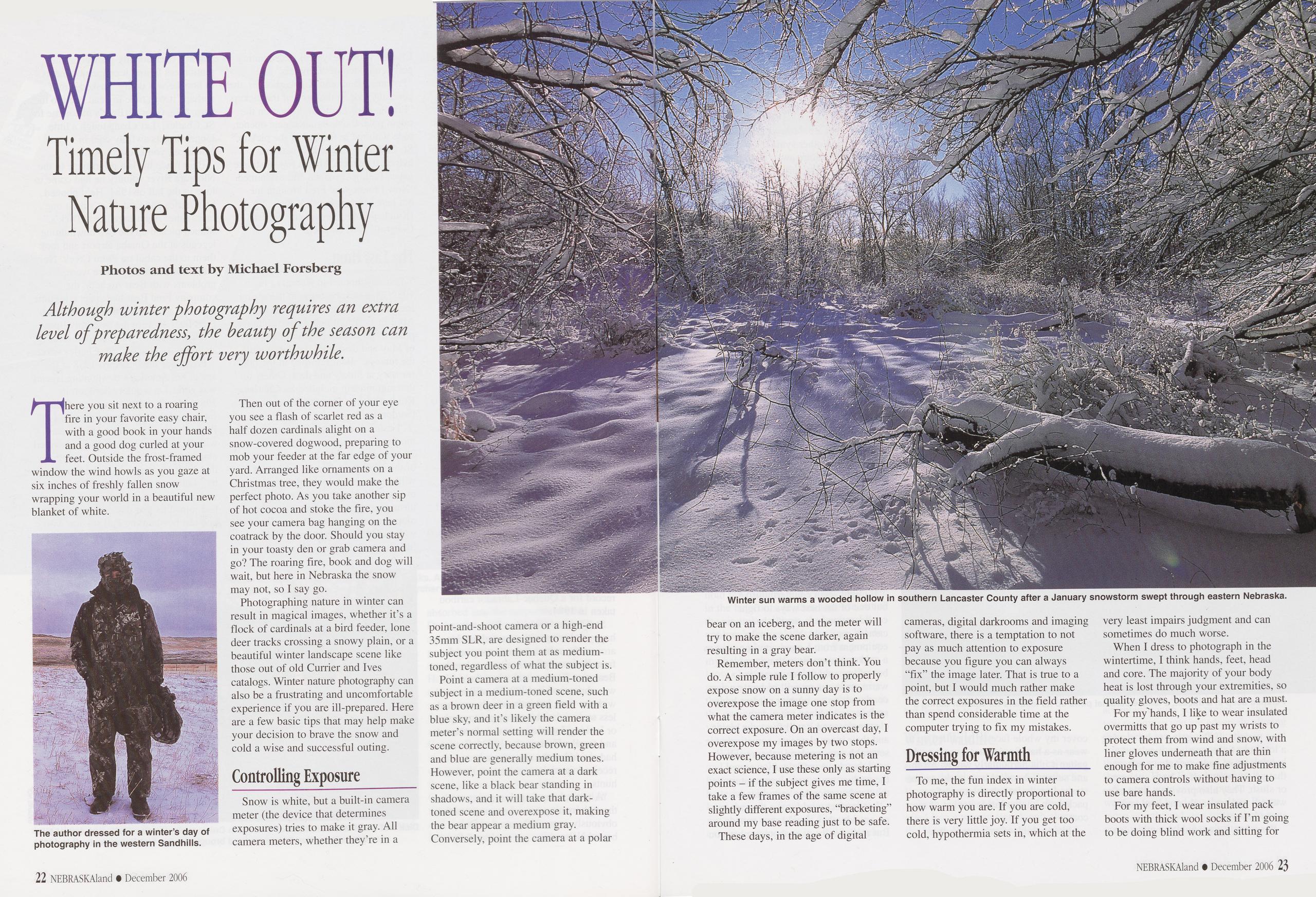
WHITE OUT!
Timely Tips for Winter Nature Photography Photos and text by Michael Forsberg Although winter photography requires an extra level of preparedness, the beauty of the season can make the effort very worthwhile.There you sit next to a roaring fire in your favorite easy chair, with a good book in your hands and a good dog curled at your feet. Outside the frost-framed window the wind howls as you gaze at six inches of freshly fallen snow wrapping your world in a beautiful new blanket of white.
Then out of the corner of your eye you see a flash of scarlet red as a half dozen cardinals alight on a snow-covered dogwood, preparing to mob your feeder at the far edge of your yard. Arranged like ornaments on a Christmas tree, they would make the perfect photo. As you take another sip of hot cocoa and stoke the fire, you see your camera bag hanging on the coatrack by the door. Should you stay in your toasty den or grab camera and go? The roaring fire, book and dog will wait, but here in Nebraska the snow may not, so I say go.
Photographing nature in winter can result in magical images, whether it’s a flock of cardinals at a bird feeder, lone deer tracks crossing a snowy plain, or a beautiful winter landscape scene like those out of old Currier and Ives catalogs. Winter nature photography can also be a frustrating and uncomfortable experience if you are ill-prepared. Here are a few basic tips that may help make your decision to brave the snow and cold a wise and successful outing.
Controlling ExposureSnow is white, but a built-in camera meter (the device that determines exposures) tries to make it gray. All camera meters, whether they’re in a point-and-shoot camera or a high-end 35mm SLR, are designed to render the subject you point them at as medium- toned, regardless of what the subject is.
Point a camera at a medium-toned subject in a medium-toned scene, such as a brown deer in a green field with a blue sky, and it’s likely the camera meter’s normal setting will render the scene correctly, because brown, green and blue are generally medium tones. However, point the camera at a dark scene, like a black bear standing in shadows, and it will take that dark- toned scene and overexpose it, making the bear appear a medium gray. Conversely, point the camera at a polar bear on an iceberg, and the meter will try to make the scene darker, again resulting in a gray bear.
Remember, meters don’t think. You do. A simple rule I follow to properly expose snow on a sunny day is to overexpose the image one stop from what the camera meter indicates is the correct exposure. On an overcast day, I overexpose my images by two stops. However, because metering is not an exact science, I use these only as starting points - if the subject gives me time, I take a few frames of the same scene at slightly different exposures, “bracketing” around my base reading just to be safe.
These days, in the age of digital cameras, digital darkrooms and imaging software, there is a temptation to not pay as much attention to exposure because you figure you can always “fix” the image later. That is true to a point, but I would much rather make the correct exposures in the field rather than spend considerable time at the computer trying to fix my mistakes.
Dressing for WarmthTo me, the fun index in winter photography is directly proportional to how warm you are. If you are cold, there is very little joy. If you get too cold, hypothermia sets in, which at the very least impairs judgment and can sometimes do much worse.
When I dress to photograph in the wintertime, I think hands, feet, head and core. The majority of your body heat is lost through your extremities, so quality gloves, boots and hat are a must.
For my'hands, I like to wear insulated overmitts that go up past my wrists to protect them from wind and snow, with liner gloves underneath that are thin enough for me to make fine adjustments to camera controls without having to use bare hands.
For my feet, I wear insulated pack
boots with thick wool socks if I’m going
to be doing blind work and sitting for
22 NEBRASKAland • December 2006
NEBRASKAland • December 2006 23
 long periods. If I’m going to be moving
a lot, I use lighter weight, insulated
hunting boots and carry along gaiters
that go up to my calf to keep out snow
or slush. They also provide a little extra
warmth and are easily removed and
stowed away.
long periods. If I’m going to be moving
a lot, I use lighter weight, insulated
hunting boots and carry along gaiters
that go up to my calf to keep out snow
or slush. They also provide a little extra
warmth and are easily removed and
stowed away.
For a hat, I use a balaclava that can cover my whole face or be pulled up to wear as a hat. Sometimes I use a neck gaiter if it is particularly windy. All this and several chemical heat packs can be stashed easily into the bottom of my pack or in a large inside pocket of my coat.
I like to think of my core as the furnace where most of my heat is generated. It needs to be insulated and fed. To insulate, I dress in layers, starting with a base layer that uses capilene and other synthetic materials that wick moisture away from the skin and pass it to the surface. This keeps sweat from building up and cooling the skin. If I know I am going to be actively moving through an area, I prefer wool as my outerwear as it is quiet, rugged, drab in appearance, and insulates even when wet.
In extreme cold, nothing beats a good-quality down coat and insulated overalls. I usually carry these on the outside of my pack until I am ready to settle in somewhere. Regardless of what I am wearing, I try to dress on the cool side of comfort, adding layers as needed.
To fuel the furnace I carry easily packable, high-energy foods like Cliff bars, which do not freeze or get hard in cold temperatures. Equally important is fluid to keep hydrated, so I carry a large bottle of water and often a small thermos of hot tea or cocoa.
Camera Gear ChallengesCondensation is probably the number one issue with camera gear in winter time. Cameras and lenses can easily fog and ice up on both interior and exterior surfaces. It is impossible to eliminate condensation, but you can attempt to manage it effectively.
It might seem counterintuitive, but one of the best ways to fight condensation is to simply keep your camera gear cold. You can take camera equipment from a warm environment to a cold environment with no problem, but taking cold camera gear into a warm environment will instantly cause condensation on interior camera body surfaces, which can mess with electronics, and it will fog your lenses and their inner elements, sometimes for several hours, rendering them useless until they have sufficiently warmed themselves up to room temperature and the condensation has evaporated.
In a perfect world, once the cameras go outside, they should stay outside. But realistically, as a photographer you are often moving in and out of heated vehicles, people’s homes or a motel room, and it may not be safe or convenient to leave your equipment outside.
If the equipment must go inside, I carry big, two-gallon Ziploc bags to hold my cameras and lenses. I put them in the bags outside, then squeeze out all the air and seal them. As long as I do not break the seal they are fine. If I do not have plastic bags, I put the gear in my backpack and stuff coats or other loose clothing around them, zip the pack up, and leave it in a cool spot by the door of the motel room or house, in the garage or in the back corner of the vehicle where they can warm up very slowly.
While you are keeping your camera and lenses cold, you must keep your batteries warm. I always carry extra batteries with me for my cameras and keep them in a front interior pocket of my coat or coveralls. If I leave my cameras outdoors or in a cold vehicle for the night, I take the batteries inside with me. If I am in a tent, I sleep with them in my bag to keep them warm.
One problem I have never solved is how not to breathe on camera gear while shooting. Doing so in extremely cold weather causes icing on the back of the camera and the viewfinder. It is nearly impossible to scrape the viewfinder free of ice, and it hurts like heck and makes you feel like an idiot when your face sticks to the metal parts of the camera surface. I have tried holding my breath while shooting, exhaling through straws and snorkels, worn about a dozen different facemasks, but have yet to figure it out.
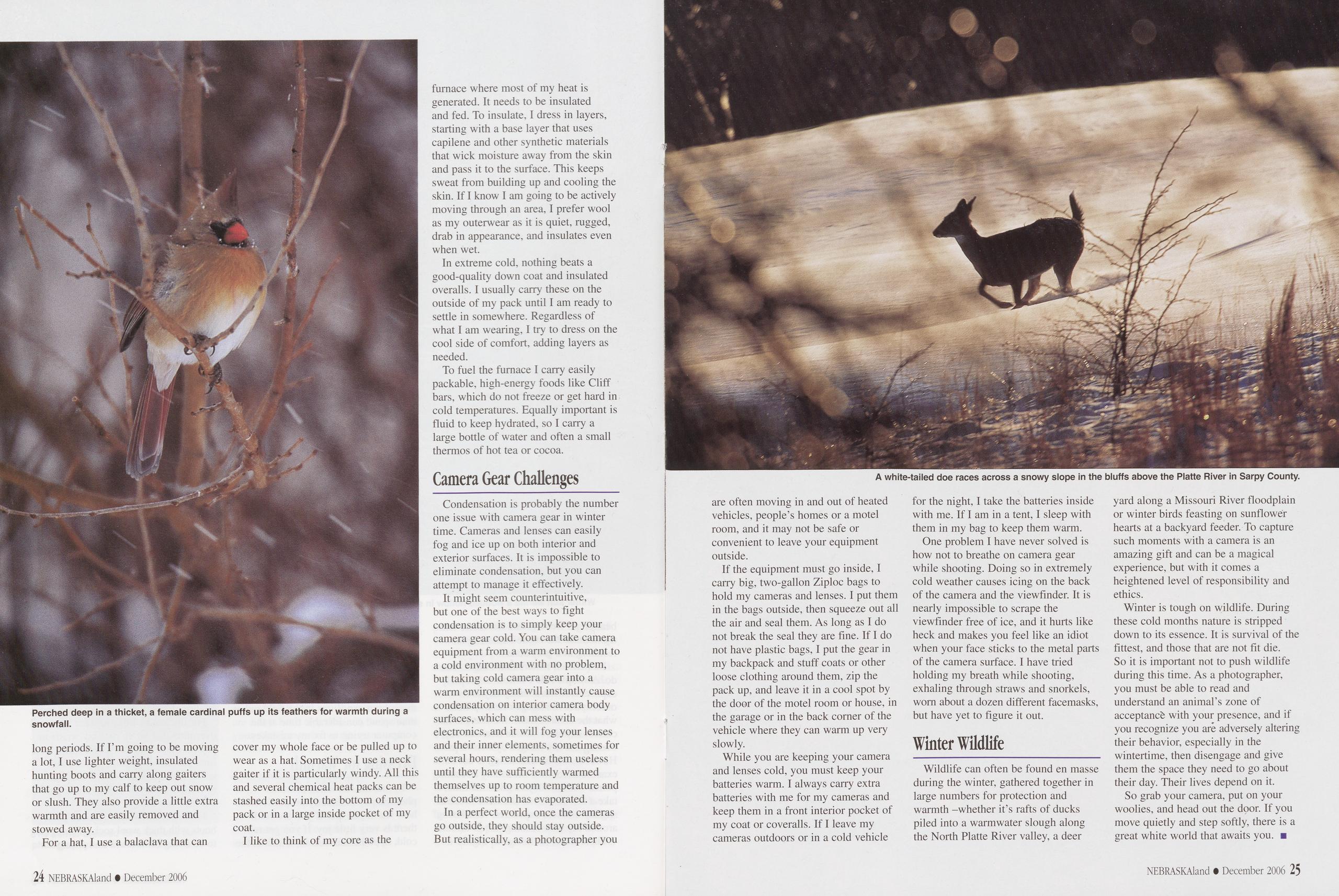
Winter WildlifeWildlife can often be found en masse during the winter, gathered together in large numbers for protection and warmth -whether it’s rafts of ducks piled into a warmwater slough along the North Platte River valley, a deer yard along a Missouri River floodplain or winter birds feasting on sunflower hearts at a backyard feeder. To capture such moments with a camera is an amazing gift and can be a magical experience, but with it comes a heightened level of responsibility and ethics.
Winter is tough on wildlife. During these cold months nature is stripped down to its essence. It is survival of the fittest, and those that are not fit die. So it is important not to push wildlife during this time. As a photographer, you must be able to read and understand an animal’s zone of acceptance with your presence, and if you recognize you are adversely altering their behavior, especially in the wintertime, then disengage and give them the space they need to go about their day. Their lives depend on it.
So grab your camera, put on your woolies, and head out the door. If you move quietly and step softly, there is a great white world that awaits you. ■
24 NEBRASKAland • December 2006 NEBRASKAland • December 2006 25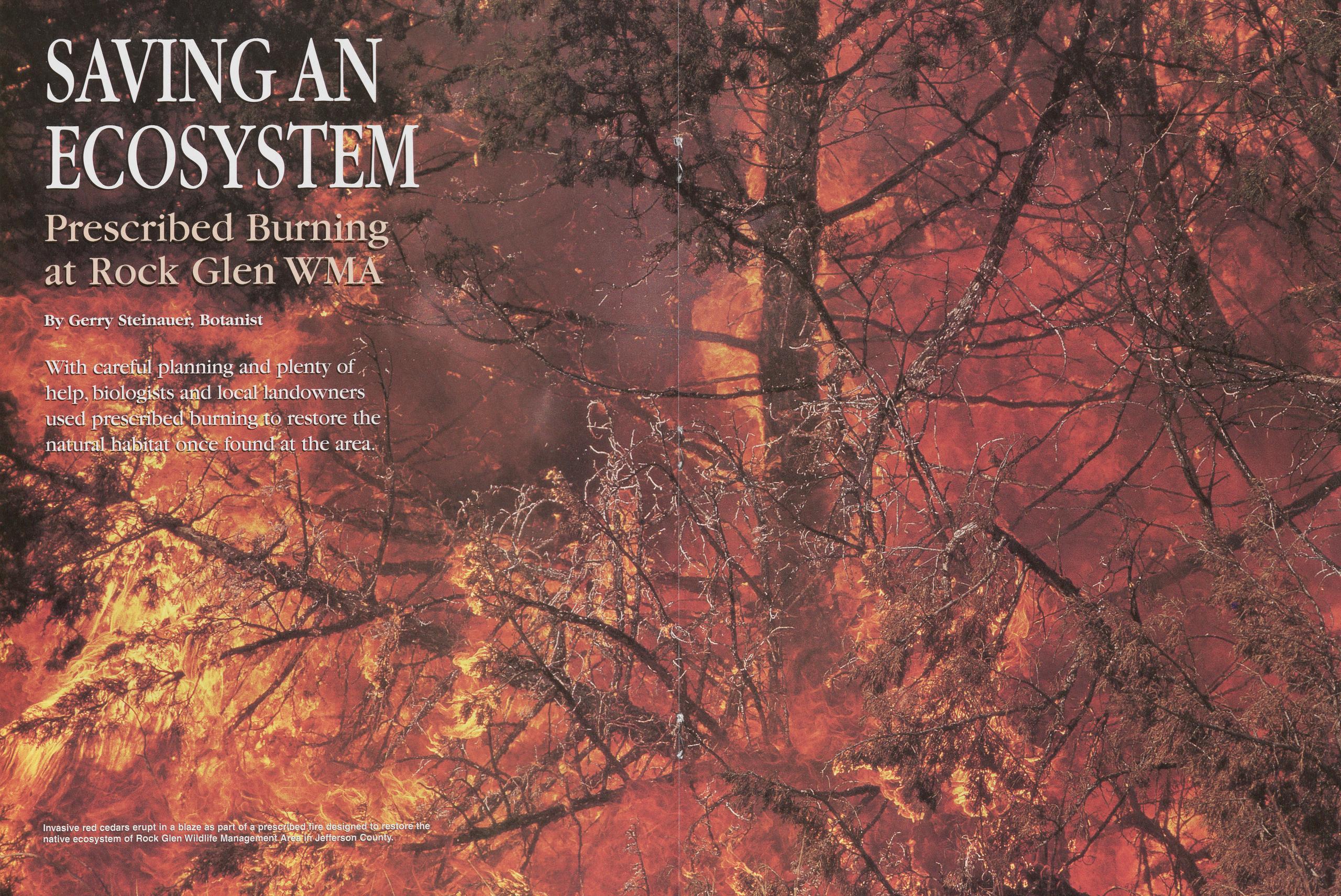
SAVING AN ECOSYSTEM
Prescribed Burning at Rock Glen WMA By Gerry Steinauer, Botanist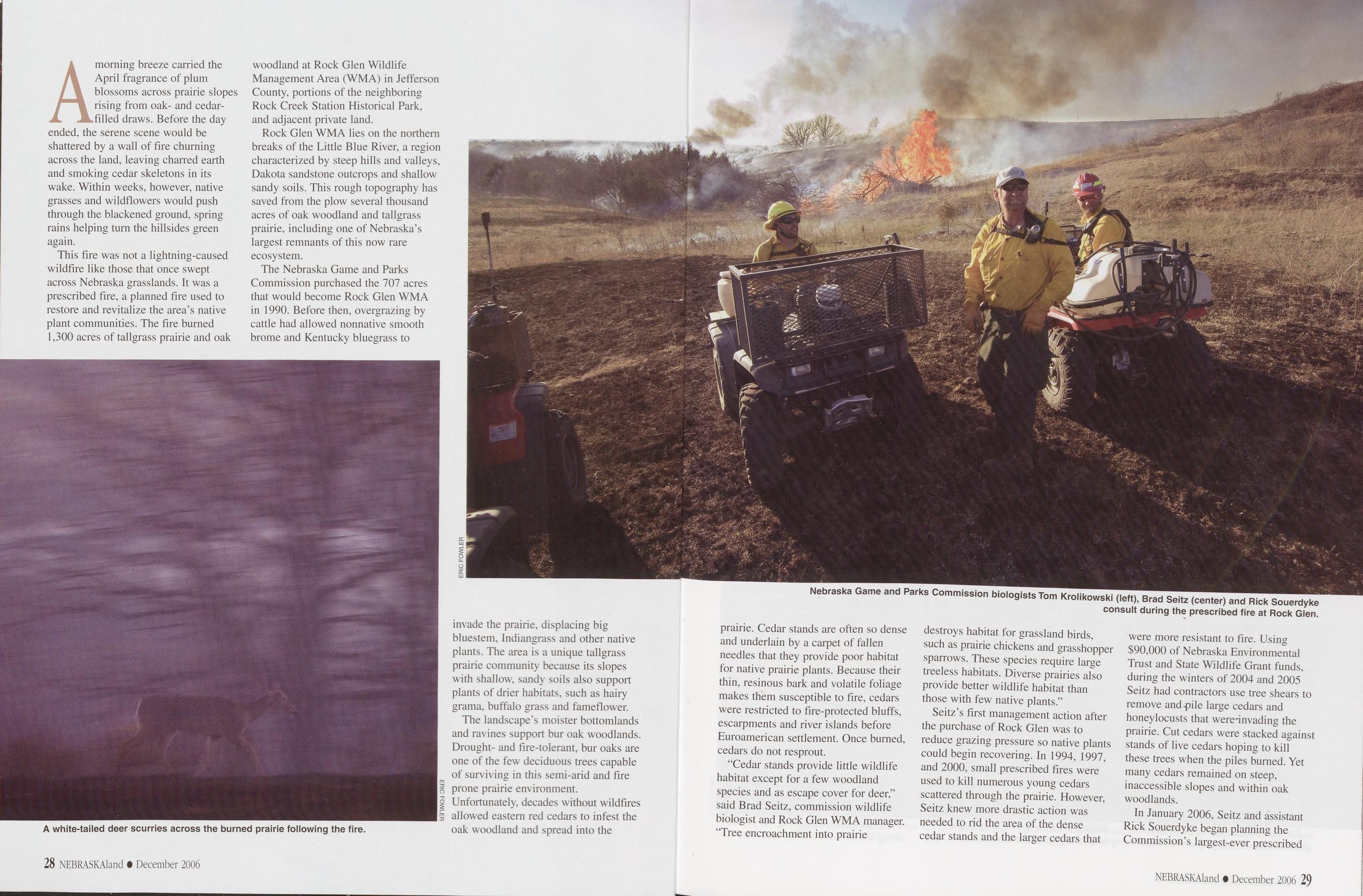
A morning breeze carried the April fragrance of plum blossoms across prairie slopes rising from oak- and cedar- filled draws. Before the day ended, the serene scene would be shattered by a wall of fire churning across the land, leaving charred earth and smoking cedar skeletons in its wake. Within weeks, however, native grasses and wildflowers would push through the blackened ground, spring rains helping turn the hillsides green again.
This fire was not a lightning-caused wildfire like those that once swept across Nebraska grasslands. It was a prescribed fire, a planned fire used to restore and revitalize the area’s native plant communities. The fire burned 1,300 acres of tailgrass prairie and oak woodland at Rock Glen Wildlife Management Area (WMA) in Jefferson County, portions of the neighboring Rock Creek Station Historical Park, and adjacent private land.
Rock Glen WMA lies on the northern breaks of the Little Blue River, a region characterized by steep hills and valleys, Dakota sandstone outcrops and shallow sandy soils. This rough topography has saved from the plow several thousand acres of oak woodland and tailgrass prairie, including one of Nebraska’s largest remnants of this now rare ecosystem.
The Nebraska Game and Parks Commission purchased the 707 acres that would become Rock Glen WMA in 1990. Before then, overgrazing by cattle had allowed nonnative smooth brome and Kentucky bluegrass to invade the prairie, displacing big bluestem, Indiangrass and other native plants. The area is a unique tailgrass prairie community because its slopes with shallow, sandy soils also support plants of drier habitats, such as hairy grama, buffalo grass and fameflower.
The landscape’s moister bottomlands and ravines support bur oak woodlands. Drought- and fire-tolerant, bur oaks are one of the few deciduous trees capable of surviving in this semi-arid and fire prone prairie environment. Unfortunately, decades without wildfires allowed eastern red cedars to infest the oak woodland and spread into the prairie. Cedar stands are often so dense and underlain by a carpet of fallen needles that they provide poor habitat for native prairie plants. Because their thin, resinous bark and volatile foliage makes them susceptible to fire, cedars were restricted to fire-protected bluffs, escarpments and river islands before Euroamerican settlement. Once burned, cedars do not resprout.
"Cedar stands provide little wildlife habitat except for a few woodland species and as escape cover for deer,” said Brad Seitz, commission wildlife biologist and Rock Glen WMA manager. "Tree encroachment into prairie destroys habitat for grassland birds, such as prairie chickens and grasshopper sparrows. These species require large treeless habitats. Diverse prairies also provide better wildlife habitat than those with few native plants.”
Seitz’s first management action after the purchase of Rock Glen was to reduce grazing pressure so native plants could begin recovering. In 1994, 1997, and 2000, small prescribed fires were used to kill numerous young cedars scattered through the prairie. However, Seitz knew more drastic action was needed to rid the area of the dense cedar stands and the larger cedars that were more resistant to fire. Using $90,000 of Nebraska Environmental Trust and State Wildlife Grant funds, during the winters of 2004 and 2005 Seitz had contractors use tree shears to remove and pile large cedars and honey locusts that werednvading the prairie. Cut cedars were stacked against stands of live cedars hoping to kill these trees when the piles burned. Yet many cedars remained on steep, inaccessible slopes and within oak woodlands.
In January 2006, Seitz and assistant
Rick Souerdyke began planning the
Commission’s largest-ever prescribed
28 NEBRASKAland • December 2006
NEBRASKAland • December 2006 29
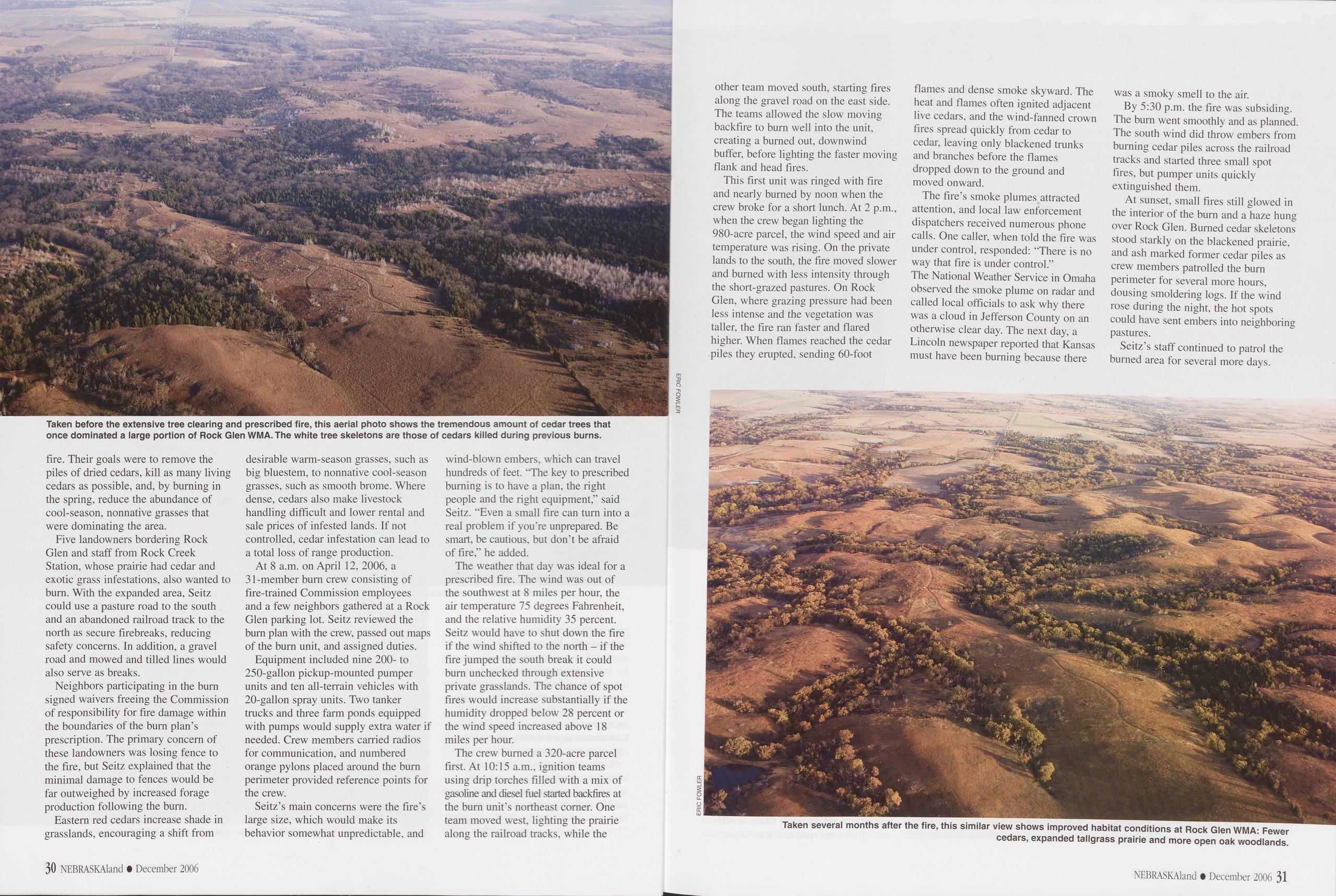 fire. Their goals were to remove the
piles of dried cedars, kill as many living
cedars as possible, and, by burning in
the spring, reduce the abundance of
cool-season, nonnative grasses that
were dominating the area.
fire. Their goals were to remove the
piles of dried cedars, kill as many living
cedars as possible, and, by burning in
the spring, reduce the abundance of
cool-season, nonnative grasses that
were dominating the area.
Five landowners bordering Rock Glen and staff from Rock Creek Station, whose prairie had cedar and exotic grass infestations, also wanted to burn. With the expanded area, Seitz could use a pasture road to the south and an abandoned railroad track to the north as secure firebreaks, reducing safety concerns. In addition, a gravel road and mowed and tilled lines would also serve as breaks.
Neighbors participating in the burn signed waivers freeing the Commission of responsibility for fire damage within the boundaries of the burn plan’s prescription. The primary concern of these landowners was losing fence to the fire, but Seitz explained that the minimal damage to fences would be far outweighed by increased forage production following the burn.
Eastern red cedars increase shade in grasslands, encouraging a shift from desirable warm-season grasses, such as big bluestem, to nonnative cool-season grasses, such as smooth brome. Where dense, cedars also make livestock handling difficult and lower rental and sale prices of infested lands. If not controlled, cedar infestation can lead to a total loss of range production.
At 8 a.m. on April 12, 2006, a 31-member burn crew consisting of fire-trained Commission employees and a few neighbors gathered at a Rock Glen parking lot. Seitz reviewed the bum plan with the crew, passed out maps of the burn unit, and assigned duties.
Equipment included nine 200- to 250-gallon pickup-mounted pumper units and ten all-terrain vehicles with 20-gallon spray units. Two tanker trucks and three farm ponds equipped with pumps would supply extra water if needed. Crew members carried radios for communication, and numbered orange pylons placed around the burn perimeter provided reference points for the crew.
Seitz’s main concerns were the fire’s large size, which would make its behavior somewhat unpredictable, and wind-blown embers, which can travel hundreds of feet. "The key to prescribed burning is to have a plan, the right people and the right equipment,” said Seitz. “Even a small fire can turn into a real problem if you’re unprepared. Be smart, be cautious, but don’t be afraid of fire,” he added.
The weather that day was ideal for a prescribed fire. The wind was out of the southwest at 8 miles per hour, the air temperature 75 degrees Fahrenheit, and the relative humidity 35 percent. Seitz would have to shut down the fire if the wind shifted to the north - if the fire jumped the south break it could burn unchecked through extensive private grasslands. The chance of spot fires would increase substantially if the humidity dropped below 28 percent or the wind speed increased above 18 miles per hour.
The crew burned a 320-acre parcel first. At 10:15 a.m., ignition teams using drip torches filled with a mix of gasoline and diesel fuel started backfires at the burn unit’s northeast corner. One team moved west, lighting the prairie along the railroad tracks, while the other team moved south, starting fires along the gravel road on the east side. The teams allowed the slow moving backfire to burn well into the unit, creating a burned out, downwind buffer, before lighting the faster moving flank and head fires.
This first unit was ringed with fire and nearly burned by noon when the crew broke for a short lunch. At 2 p.m., when the crew began lighting the 980-acre parcel, the wind speed and air temperature was rising. On the private lands to the south, the fire moved slower and burned with less intensity through the short-grazed pastures. On Rock Glen, where grazing pressure had been less intense and the vegetation was taller, the fire ran faster and flared higher. When flames reached the cedar piles they erupted, sending 60-foot flames and dense smoke skyward. The heat and flames often ignited adjacent live cedars, and the wind-fanned crown fires spread quickly from cedar to cedar, leaving only blackened trunks and branches before the flames dropped down to the ground and moved onward.
The fire’s smoke plumes attracted attention, and local law enforcement dispatchers received numerous phone calls. One caller, when told the fire was under control, responded: "There is no way that fire is under control.” The National Weather Service in Omaha observed the smoke plume on radar and called local officials to ask why there was a cloud in Jefferson County on an otherwise clear day. The next day, a Lincoln newspaper reported that Kansas must have been burning because there was a smoky smell to the air.
By 5:30 p.m. the fire was subsiding. The burn went smoothly and as planned. The south wind did throw embers from burning cedar piles across the railroad tracks and started three small spot fires, but pumper units quickly extinguished them.
At sunset, small fires still glowed in the interior of the burn and a haze hung over Rock Glen. Burned cedar skeletons stood starkly on the blackened prairie, and ash marked former cedar piles as crew members patrolled the burn perimeter for several more hours, dousing smoldering logs. If the wind rose during the night, the hot spots could have sent embers into neighboring pastures.
Seitz’s staff continued to patrol the
burned area for several more days.
30 NEBRASKAland • December 2006
NEBRASKAland • December 2006 31
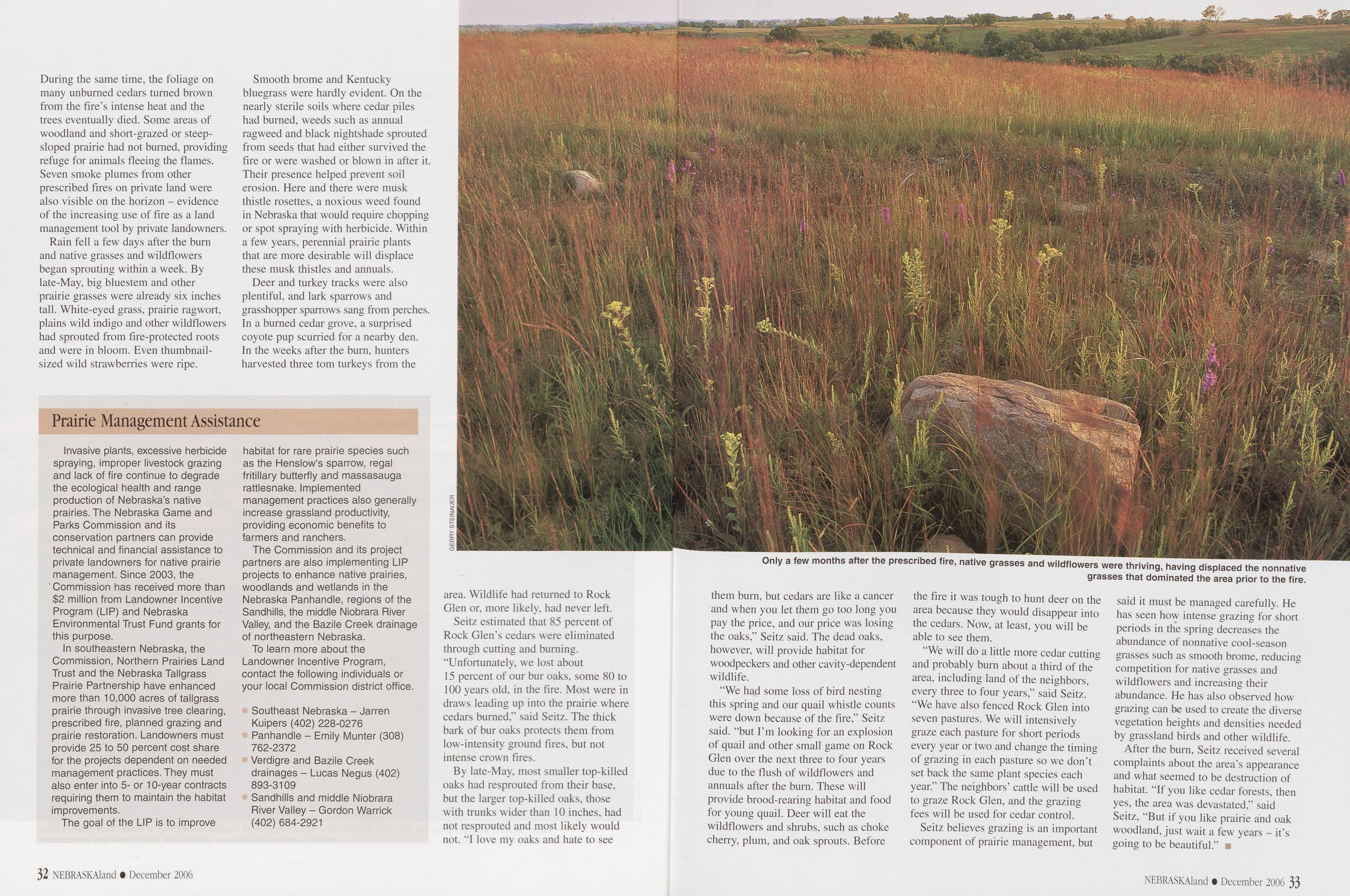 During the same time, the foliage on
many unburned cedars turned brown
from the fire’s intense heat and the
trees eventually died. Some areas of
woodland and short-grazed or steep-
sloped prairie had not burned, providing
refuge for animals fleeing the flames.
Seven smoke plumes from other
prescribed fires on private land were
also visible on the horizon - evidence
of the increasing use of fire as a land
management tool by private landowners.
During the same time, the foliage on
many unburned cedars turned brown
from the fire’s intense heat and the
trees eventually died. Some areas of
woodland and short-grazed or steep-
sloped prairie had not burned, providing
refuge for animals fleeing the flames.
Seven smoke plumes from other
prescribed fires on private land were
also visible on the horizon - evidence
of the increasing use of fire as a land
management tool by private landowners.
Rain fell a few days after the burn and native grasses and wildflowers began sprouting within a week. By late-May, big bluestem and other prairie grasses were already six inches tall. White-eyed grass, prairie ragwort, plains wild indigo and other wildflowers had sprouted from fire-protected roots and were in bloom. Even thumbnail- sized wild strawberries were ripe.
Prairie Management AssistanceInvasive plants, excessive herbicide spraying, improper livestock grazing and lack of fire continue to degrade the ecological health and range production of Nebraska’s native prairies. The Nebraska Game and Parks Commission and its conservation partners can provide technical and financial assistance to private landowners for native prairie management. Since 2003, the Commission has received more than $2 million from Landowner Incentive Program (LIP) and Nebraska Environmental Trust Fund grants for this purpose.
In southeastern Nebraska, the Commission, Northern Prairies Land Trust and the Nebraska Tailgrass Prairie Partnership have enhanced more than 10,000 acres of tailgrass prairie through invasive tree clearing, prescribed fire, planned grazing and prairie restoration. Landowners must provide 25 to 50 percent cost share for the projects dependent on needed management practices. They must also enter into 5- or 10-year contracts requiring them to maintain the habitat improvements.
The goal of the LIP is to improve habitat for rare prairie species such as the Henslow's sparrow, regal fritillary butterfly and massasauga rattlesnake. Implemented management practices also generally increase grassland productivity, providing economic benefits to farmers and ranchers.
The Commission and its project partners are also implementing LIP projects to enhance native prairies, woodlands and wetlands in the Nebraska Panhandle, regions of the Sandhills, the middle Niobrara River Valley, and the Bazile Creek drainage of northeastern Nebraska.
To learn more about the Landowner Incentive Program, contact the following individuals or your local Commission district office. Southeast Nebraska - Jarren Kuipers (402) 228-0276 Panhandle - Emily Munter (308) 762-2372 Verdigre and Bazile Creek drainages - Lucas Negus (402) 893-3109 Sandhills and middle Niobrara River Valley - Gordon Warrick (402) 684-2921
Smooth brome and Kentucky bluegrass were hardly evident. On the nearly sterile soils where cedar piles had burned, weeds such as annual ragweed and black nightshade sprouted from seeds that had either survived the fire or were washed or blown in after it. Their presence helped prevent soil erosion. Here and there were musk thistle rosettes, a noxious weed found in Nebraska that would require chopping or spot spraying with herbicide. Within a few years, perennial prairie plants that are more desirable will displace these musk thistles and annuals.
Deer and turkey tracks were also plentiful, and lark sparrows and grasshopper sparrows sang from perches. In a burned cedar grove, a surprised coyote pup scurried for a nearby den. In the weeks after the burn, hunters harvested three tom turkeys from the area. Wildlife had returned to Rock Glen or, more likely, had never left.
Seitz estimated that 85 percent of Rock Glen’s cedars were eliminated through cutting and burning.
“Unfortunately, we lost about 15 percent of our bur oaks, some 80 to 100 years old, in the fire. Most were in draws leading up into the prairie where cedars burned,” said Seitz. The thick bark of bur oaks protects them from low-intensity ground fires, but not intense crown fires.
By late-May, most smaller top-killed oaks had resprouted from their base, but the larger top-killed oaks, those with trunks wider than 10 inches, had not resprouted and most likely would not. "I love my oaks and hate to see them burn, but cedars are like a cancer and when you let them go too long you pay the price, and our price was losing the oaks,” Seitz said. The dead oaks, however, will provide habitat for woodpeckers and other cavity-dependent wildlife.
“We had some loss of bird nesting this spring and our quail whistle counts were down because of the fire,” Seitz said, “but I’m looking for an explosion of quail and other small game on Rock Glen over the next three to four years due to the flush of wildflowers and annuals after the burn. These will provide brood-rearing habitat and food for young quail. Deer will eat the wildflowers and shrubs, such as choke cherry, plum, and oak sprouts. Before the fire it was tough to hunt deer on the area because they would disappear into the cedars. Now, at least, you will be able to see them.
“We will do a little more cedar cutting and probably burn about a third of the area, including land of the neighbors, every three to four years,” said Seitz.
“We have also fenced Rock Glen into seven pastures. We will intensively graze each pasture for short periods every year or two and change the timing of grazing in each pasture so we don’t set back the same plant species each year.” The neighbors’ cattle will be used to graze Rock Glen, and the grazing fees will be used for cedar control.
Seitz believes grazing is an important component of prairie management, but said it must be managed carefully. He has seen how intense grazing for short periods in the spring decreases the abundance of nonnative cool-season grasses such as smooth brome, reducing competition for native grasses and wildflowers and increasing their abundance. He has also observed how grazing can be used to create the diverse vegetation heights and densities needed by grassland birds and other wildlife.
After the burn, Seitz received several complaints about the area’s appearance and what seemed to be destruction of habitat. “If you like cedar forests, then yes, the area was devastated,” said Seitz, “But if you like prairie and oak woodland, just wait a few years - it’s going to be beautiful.” ■
32 NEBRASKAland • December 2006 NEBRASKAland • December 2006 33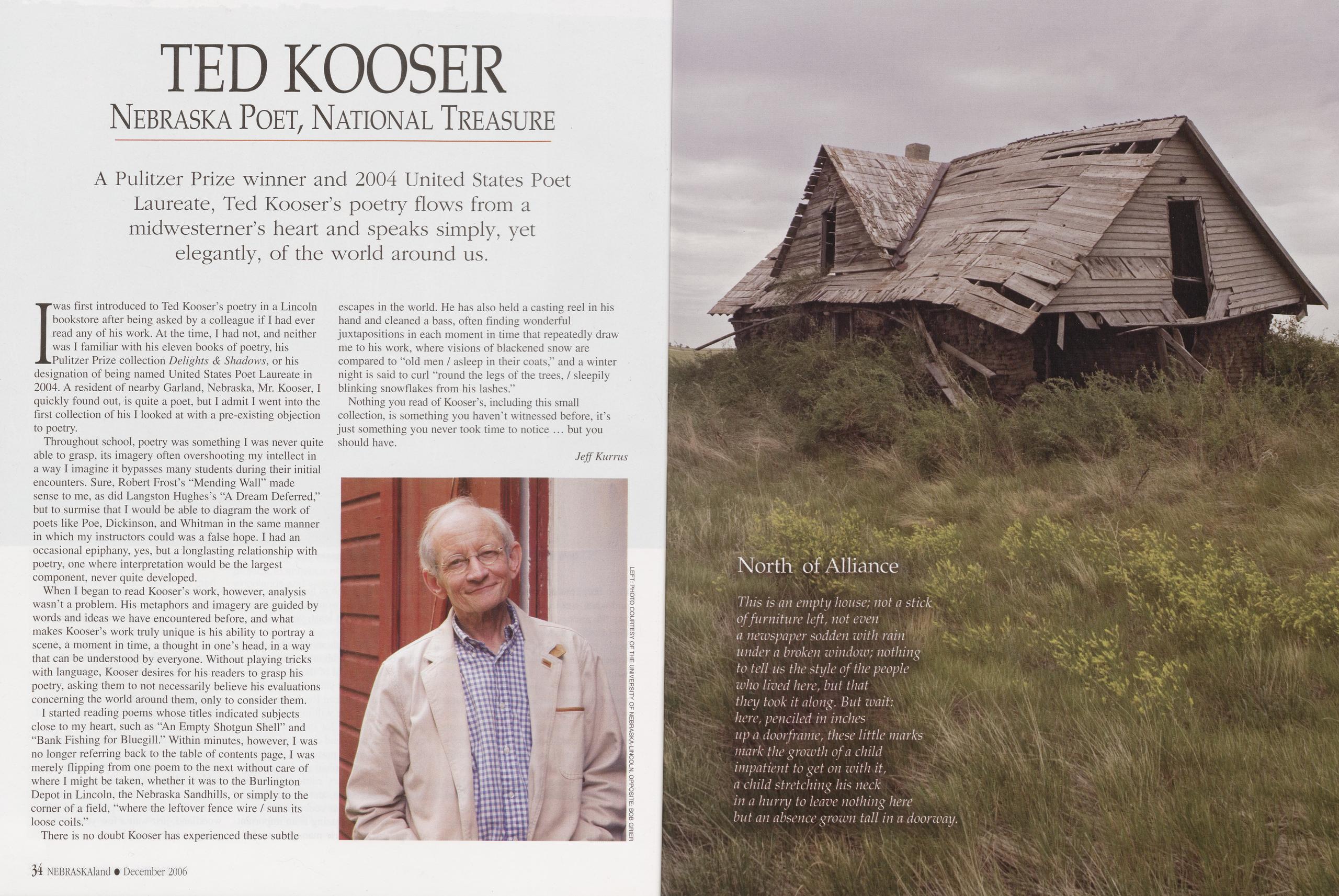
I was first introduced to Ted Kooser’s poetry in a Lincoln bookstore after being asked by a colleague if I had ever read any of his work. At the time, I had not, and neither was I familiar with his eleven books of poetry, his Pulitzer Prize collection Delights & Shadows, or his designation of being named United States Poet Laureate in 2004. A resident of nearby Garland, Nebraska, Mr. Kooser, I quickly found out, is quite a poet, but I admit I went into the first collection of his I looked at with a pre-existing objection to poetry.
Throughout school, poetry was something I was never quite able to grasp, its imagery often overshooting my intellect in a way I imagine it bypasses many students during their initial encounters. Sure, Robert Frost’s “Mending Wall” made sense to me, as did Langston Hughes’s "A Dream Deferred,” but to surmise that I would be able to diagram the work of poets like Poe, Dickinson, and Whitman in the same manner in which my instructors could was a false hope. I had an occasional epiphany, yes, but a longlasting relationship with poetry, one where interpretation would be the largest component, never quite developed.
When I began to read Kooser’s work, however, analysis wasn’t a problem. His metaphors and imagery are guided by words and ideas we have encountered before, and what makes Kooser’s work truly unique is his ability to portray a scene, a moment in time, a thought in one’s head, in a way that can be understood by everyone. Without playing tricks with language, Kooser desires for his readers to grasp his poetry, asking them to not necessarily believe his evaluations concerning the world around them, only to consider them.
I started reading poems whose titles indicated subjects close to my heart, such as “An Empty Shotgun Shell” and “Bank Fishing for Bluegill.” Within minutes, however, I was no longer referring back to the table of contents page, I was merely flipping from one poem to the next without care of where I might be taken, whether it was to the Burlington Depot in Lincoln, the Nebraska Sandhills, or simply to the corner of a field, “where the leftover fence wire / suns its loose coils.”
There is no doubt Kooser has experienced these subtle escapes in the world. He has also held a casting reel in his hand and cleaned a bass, often finding wonderful juxtapositions in each moment in time that repeatedly draw me to his work, where visions of blackened snow are compared to “old men / asleep in their coats,” and a winter night is said to curl “round the legs of the trees, / sleepily blinking snowflakes from his lashes.”
Nothing you read of Kooser’s, including this small collection, is something you haven’t witnessed before, it’s just something you never took time to notice ... but you should have.
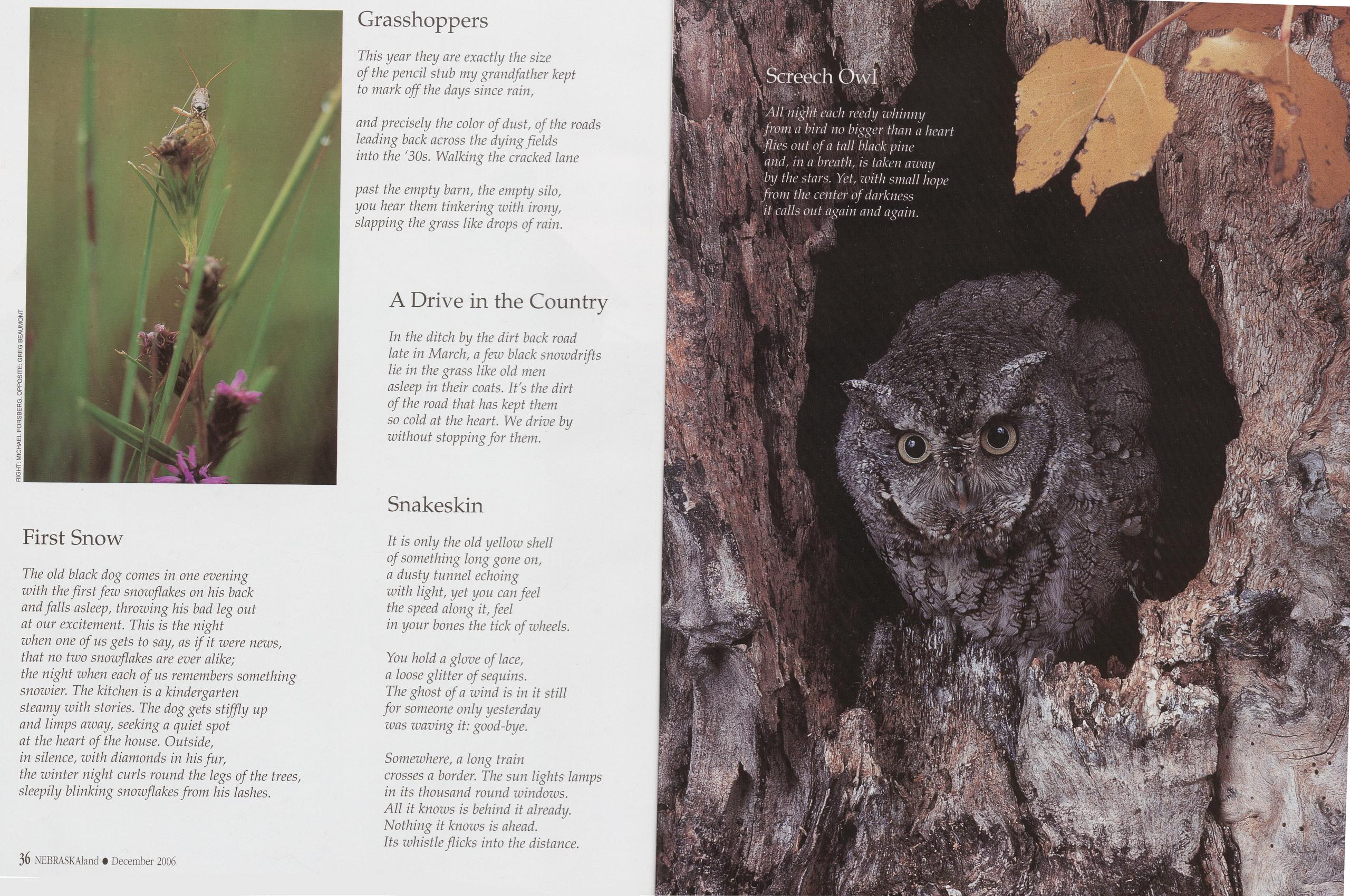
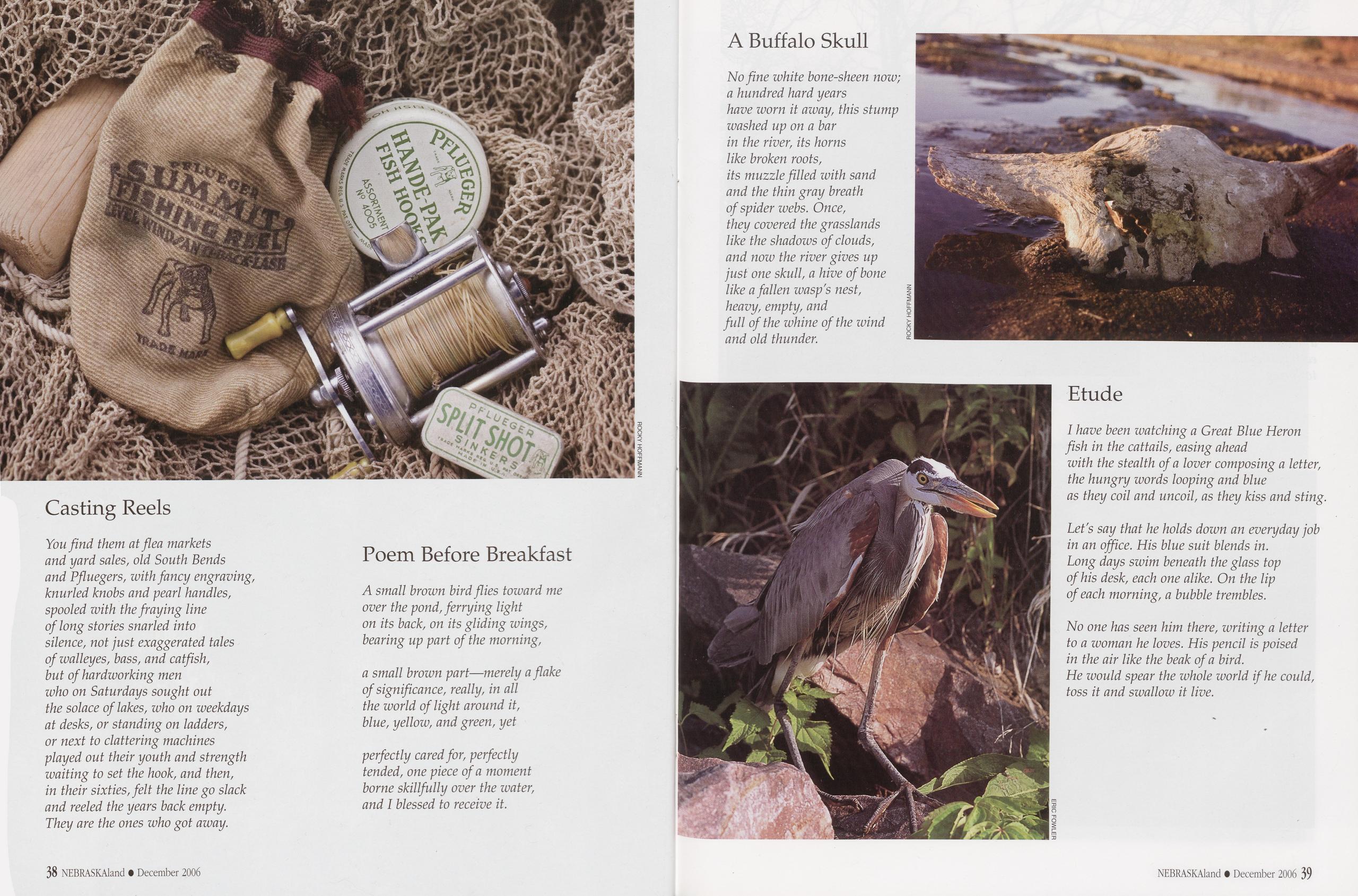 ROCKY HOFFMANN
A Buffalo Skull
No fine white bone-sheen now;
a hundred hard years
have worn it away, this stump
washed up on a bar
in the river, its horns
like broken roots,
its muzzle filled with sand
and the thin gray breath
of spider webs. Once,
they covered the grasslands
like the shadows of clouds,
and now the river gives up
just one skull, a hive of bone
like a fallen wasp's nest,
heavy, empty, and
full of the whine of the wind
and old thunder.
Casting Reels
You find them at flea markets
and yard sales, old South Bends
and Pfluegers, with fancy engraving,
knurled knobs and pearl handles,
spooled with the fraying line
of long stories snarled into
silence, not just exaggerated tales
of walleyes, bass, and catfish,
but of hardworking men
who on Saturdays sought out
the solace of lakes, who on weekdays
at desks, or standing on ladders,
or next to clattering machines
played out their youth and strength
waiting to set the hook, and then,
in their sixties, felt the line go slack
and reeled the years back empty.
They are the ones who got away.
Poem Before Breakfast
A small brown bird flies toward me
over the pond, ferrying light
on its back, on its gliding wings,
bearing up part of the morning,
a small brown part—merely a flake
of significance, really, in all
the world of light around it,
blue, yellow, and green, yet
perfectly cared for, perfectly
tended, one piece of a moment
borne skillfully over the water,
and I blessed to receive it.
Etude
I have been watching a Great Blue Heron
fish in the cattails, easing ahead
with the stealth of a lover composing a letter,
the hungry words looping and blue
as they coil and uncoil, as they kiss and sting.
Let's say that he holds down an everyday job
in an office. His blue suit blends in.
Long days swim beneath the glass top
of his desk, each one alike. On the lip
of each morning, a bubble trembles.
No one has seen him there, writing a letter
to a woman he loves. His pencil is poised
in the air like the beak of a bird.
He would spear the whole world if he could,
toss it and swallow it live.
38 NEBRASKAland • December 2006
NEBRASKAland • December 2006 39
ROCKY HOFFMANN
A Buffalo Skull
No fine white bone-sheen now;
a hundred hard years
have worn it away, this stump
washed up on a bar
in the river, its horns
like broken roots,
its muzzle filled with sand
and the thin gray breath
of spider webs. Once,
they covered the grasslands
like the shadows of clouds,
and now the river gives up
just one skull, a hive of bone
like a fallen wasp's nest,
heavy, empty, and
full of the whine of the wind
and old thunder.
Casting Reels
You find them at flea markets
and yard sales, old South Bends
and Pfluegers, with fancy engraving,
knurled knobs and pearl handles,
spooled with the fraying line
of long stories snarled into
silence, not just exaggerated tales
of walleyes, bass, and catfish,
but of hardworking men
who on Saturdays sought out
the solace of lakes, who on weekdays
at desks, or standing on ladders,
or next to clattering machines
played out their youth and strength
waiting to set the hook, and then,
in their sixties, felt the line go slack
and reeled the years back empty.
They are the ones who got away.
Poem Before Breakfast
A small brown bird flies toward me
over the pond, ferrying light
on its back, on its gliding wings,
bearing up part of the morning,
a small brown part—merely a flake
of significance, really, in all
the world of light around it,
blue, yellow, and green, yet
perfectly cared for, perfectly
tended, one piece of a moment
borne skillfully over the water,
and I blessed to receive it.
Etude
I have been watching a Great Blue Heron
fish in the cattails, easing ahead
with the stealth of a lover composing a letter,
the hungry words looping and blue
as they coil and uncoil, as they kiss and sting.
Let's say that he holds down an everyday job
in an office. His blue suit blends in.
Long days swim beneath the glass top
of his desk, each one alike. On the lip
of each morning, a bubble trembles.
No one has seen him there, writing a letter
to a woman he loves. His pencil is poised
in the air like the beak of a bird.
He would spear the whole world if he could,
toss it and swallow it live.
38 NEBRASKAland • December 2006
NEBRASKAland • December 2006 39
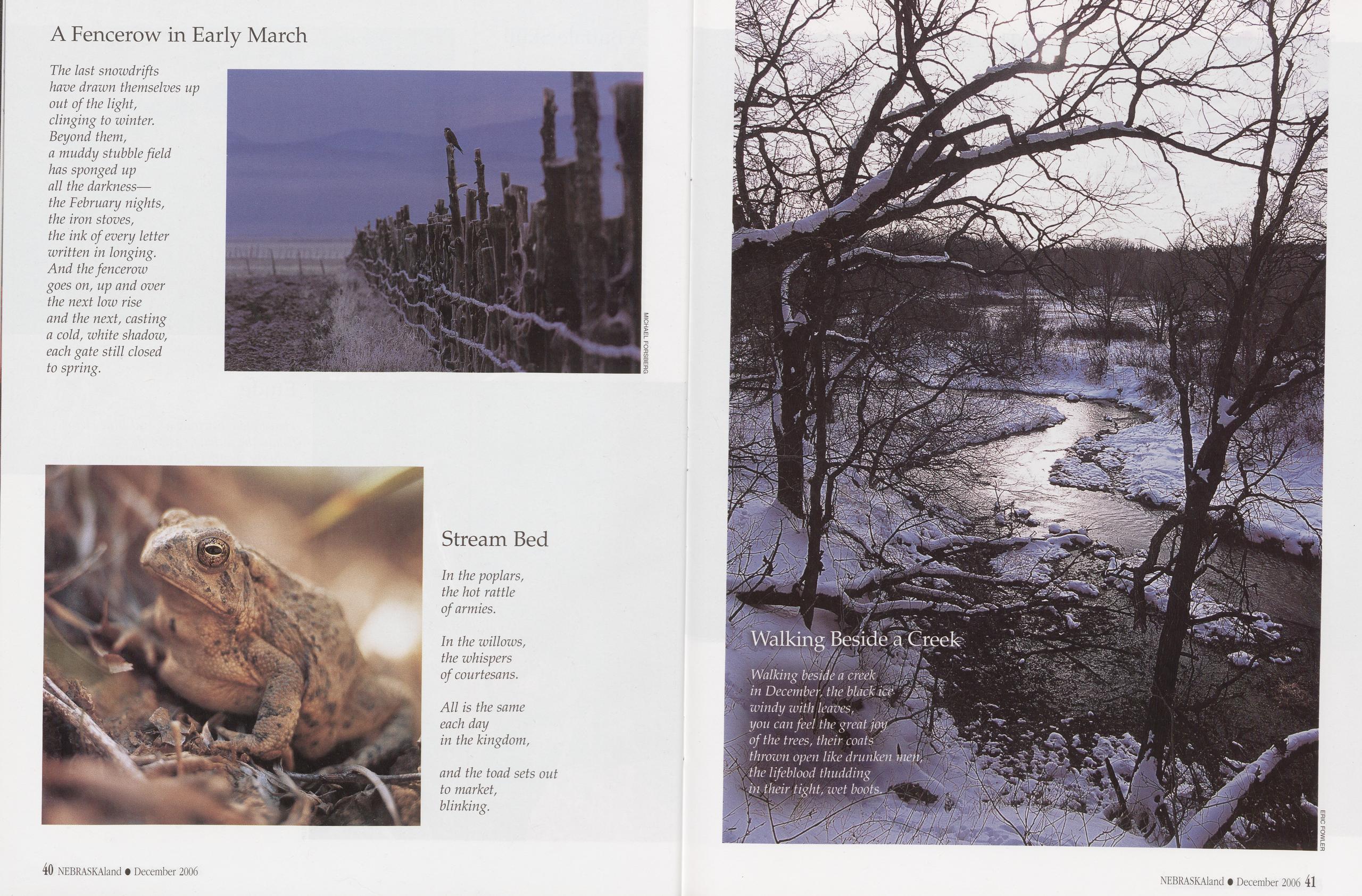 A Fencerow in Early March
The last snowdrifts
have drawn themselves
out of the light,
clinging to winter.
Beyond them,
a muddy stubble field
has sponged up
all the darkness—
the February nights,
the iron stoves,
t/re ink of every letter
written in longing.
And the fencerow
goes on, up and over
the next low rise
and the next, casting
a cold, white shadow,
each gate still closed
to spring.
Stream Bed
In the willows,
the whispers
of courtesans.
In the poplars,
the hot rattle
of armies.
and the toad sets out
to market,
blinking.
All is the same
each day
in the kingdom,
Walking beside a creek
In December, the black ice
windy with leaves, .
you canfeel the great Joy
of the trees, their coats
thrown open like drunken men,
lifeblood thudding
in their tight, wet boots.
NEBRASKAland • December 2006 41
A Fencerow in Early March
The last snowdrifts
have drawn themselves
out of the light,
clinging to winter.
Beyond them,
a muddy stubble field
has sponged up
all the darkness—
the February nights,
the iron stoves,
t/re ink of every letter
written in longing.
And the fencerow
goes on, up and over
the next low rise
and the next, casting
a cold, white shadow,
each gate still closed
to spring.
Stream Bed
In the willows,
the whispers
of courtesans.
In the poplars,
the hot rattle
of armies.
and the toad sets out
to market,
blinking.
All is the same
each day
in the kingdom,
Walking beside a creek
In December, the black ice
windy with leaves, .
you canfeel the great Joy
of the trees, their coats
thrown open like drunken men,
lifeblood thudding
in their tight, wet boots.
NEBRASKAland • December 2006 41
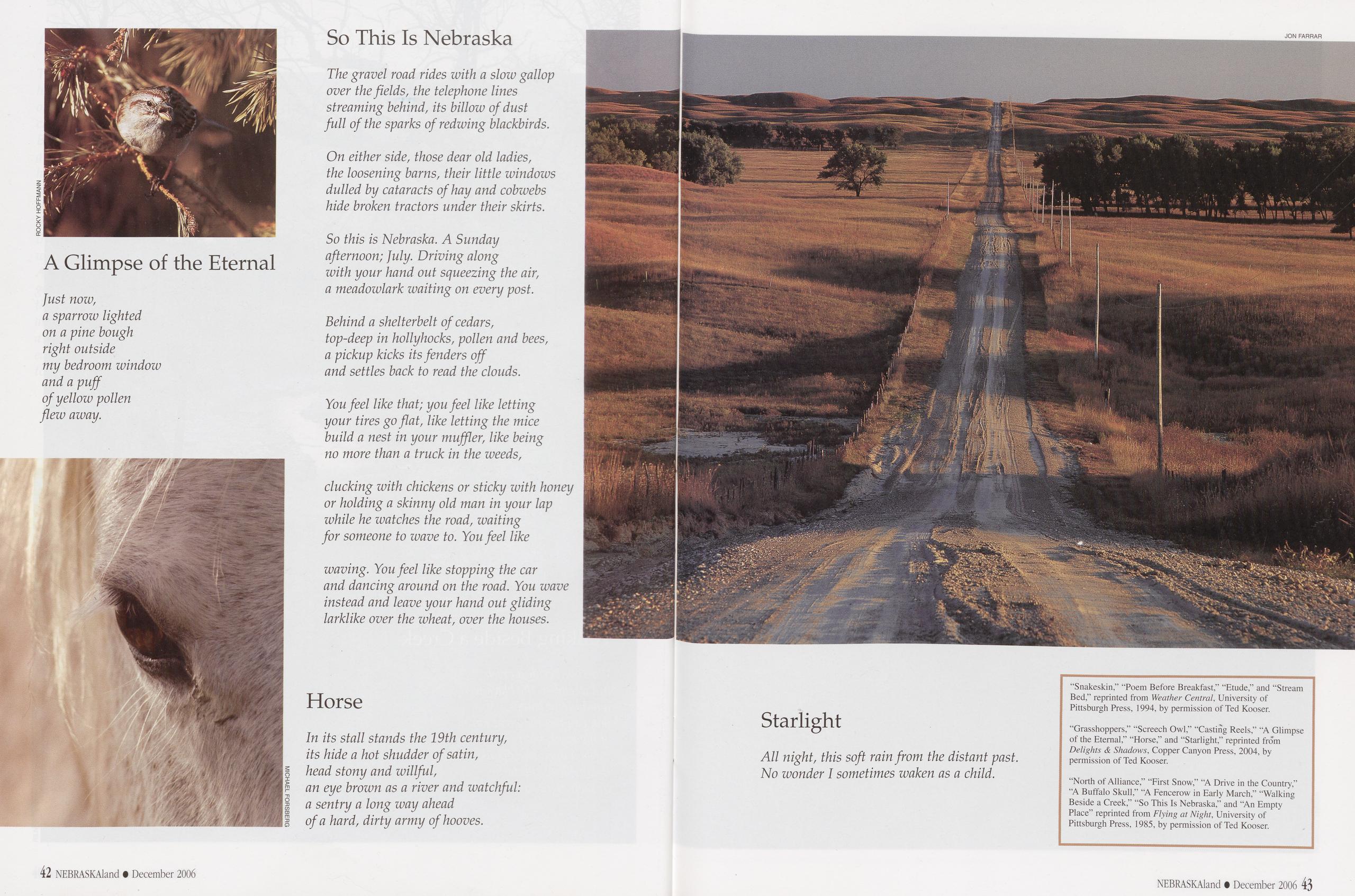 A Glimpse of the Eternal
Just now,
a sparrow lighted
on a pine bough
right outside
my bedroom window
and a puff
of yellow pollen
flew away.
So This Is Nebraska
The gravel road rides with a slow gallop
over the fields, the telephone lines
streaming behind, its billow of dust
full of the sparks of redwing blackbirds.
On either side, those dear old ladies,
the loosening barns, their little windows
dulled by cataracts of hay and cobwebs
hide broken tractors under their skirts.
So this is Nebraska. A Sunday
afternoon; July. Driving along
with your hand out squeezing the air,
a meadowlark waiting on every post.
Behind a shelterbelt of cedars,
top-deep in hollyhocks, pollen and bees,
a pickup kicks its fenders off
and settles back to read the clouds.
You feel like that; you feel like letting
your tires go flat, like letting the mice
build a nest in your muffler, like being
no more than a truck in the weeds,
clucking with chickens or sticky with honey
or holding a skinny old man in your lap
while he watches the road, waiting
for someone to wave to. You feel like
waving. You feel like stopping the car
and dancing around on the road. You wave
instead and leave your hand out gliding
larklike over the wheat, over the houses.
Horse
In its stall stands the 19th century,
its hide a hot shudder of satin,
head stony and willful,
an eye brown as a river and watchful:
a sentry a long way ahead
of a hard, dirty army of hooves.
Starlight
All night, this soft rain from the distant past.
No wonder I sometimes waken as a child.
“Snakeskin,” “Poem Before Breakfast,” “Etude,” and “Stream
Bed,” reprinted from Weather Central, University of
Pittsburgh Press, 1994, by permission of Ted Looser.
“Grasshoppers,” “Screech Owl,” “Casting Reels,” “A Glimpse
of the Eternal,” “Horse,” and “Starlight,” reprinted from
Delights & Shadows, Copper Canyon Press, 2004, by
permission of Ted Looser.
“North of Alliance,” “First Snow,” “A Drive in the Country,”
“A Buffalo Skull,” “A Fencerow in Early March,” “Walking
Beside a Creek,” “So This Is Nebraska,” and “An Empty
Place” reprinted from Flying at Night, University of
Pittsburgh Press, 1985, by permission of Ted Looser.
42 NEBRASKAland • December 2006
NEBRASKAland • December 2006 43
A Glimpse of the Eternal
Just now,
a sparrow lighted
on a pine bough
right outside
my bedroom window
and a puff
of yellow pollen
flew away.
So This Is Nebraska
The gravel road rides with a slow gallop
over the fields, the telephone lines
streaming behind, its billow of dust
full of the sparks of redwing blackbirds.
On either side, those dear old ladies,
the loosening barns, their little windows
dulled by cataracts of hay and cobwebs
hide broken tractors under their skirts.
So this is Nebraska. A Sunday
afternoon; July. Driving along
with your hand out squeezing the air,
a meadowlark waiting on every post.
Behind a shelterbelt of cedars,
top-deep in hollyhocks, pollen and bees,
a pickup kicks its fenders off
and settles back to read the clouds.
You feel like that; you feel like letting
your tires go flat, like letting the mice
build a nest in your muffler, like being
no more than a truck in the weeds,
clucking with chickens or sticky with honey
or holding a skinny old man in your lap
while he watches the road, waiting
for someone to wave to. You feel like
waving. You feel like stopping the car
and dancing around on the road. You wave
instead and leave your hand out gliding
larklike over the wheat, over the houses.
Horse
In its stall stands the 19th century,
its hide a hot shudder of satin,
head stony and willful,
an eye brown as a river and watchful:
a sentry a long way ahead
of a hard, dirty army of hooves.
Starlight
All night, this soft rain from the distant past.
No wonder I sometimes waken as a child.
“Snakeskin,” “Poem Before Breakfast,” “Etude,” and “Stream
Bed,” reprinted from Weather Central, University of
Pittsburgh Press, 1994, by permission of Ted Looser.
“Grasshoppers,” “Screech Owl,” “Casting Reels,” “A Glimpse
of the Eternal,” “Horse,” and “Starlight,” reprinted from
Delights & Shadows, Copper Canyon Press, 2004, by
permission of Ted Looser.
“North of Alliance,” “First Snow,” “A Drive in the Country,”
“A Buffalo Skull,” “A Fencerow in Early March,” “Walking
Beside a Creek,” “So This Is Nebraska,” and “An Empty
Place” reprinted from Flying at Night, University of
Pittsburgh Press, 1985, by permission of Ted Looser.
42 NEBRASKAland • December 2006
NEBRASKAland • December 2006 43
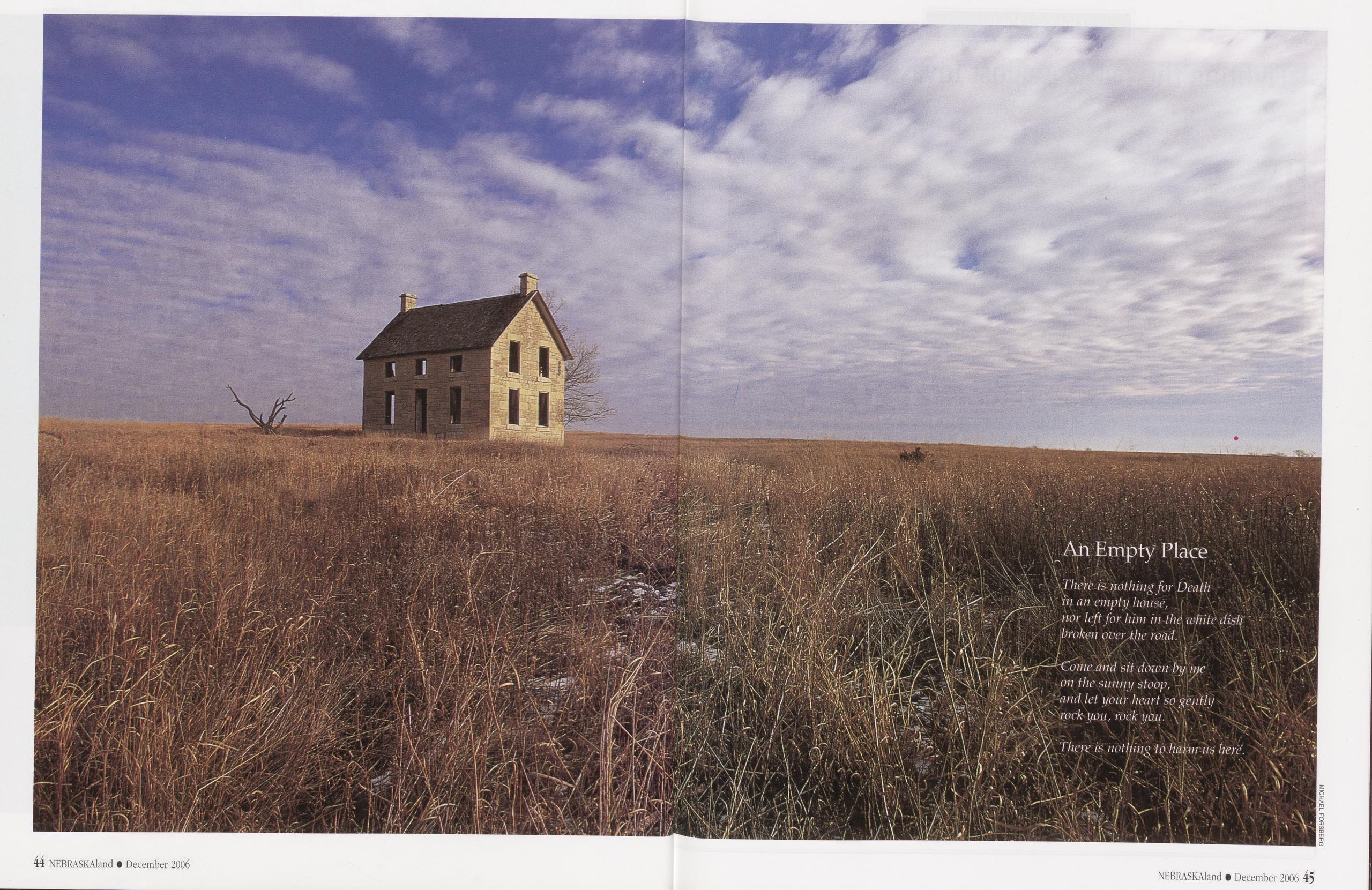 Ah Empty Place
There is nothing for Death
in an empty house,
nor left for him in the white dish
broken over the road. -
‘'Come and sit down by aye
on the sunny stoop,
and let your heart so gently
44 NEBRASKAland • December 2006
NEBRASKAland • December 2006 45
Ah Empty Place
There is nothing for Death
in an empty house,
nor left for him in the white dish
broken over the road. -
‘'Come and sit down by aye
on the sunny stoop,
and let your heart so gently
44 NEBRASKAland • December 2006
NEBRASKAland • December 2006 45
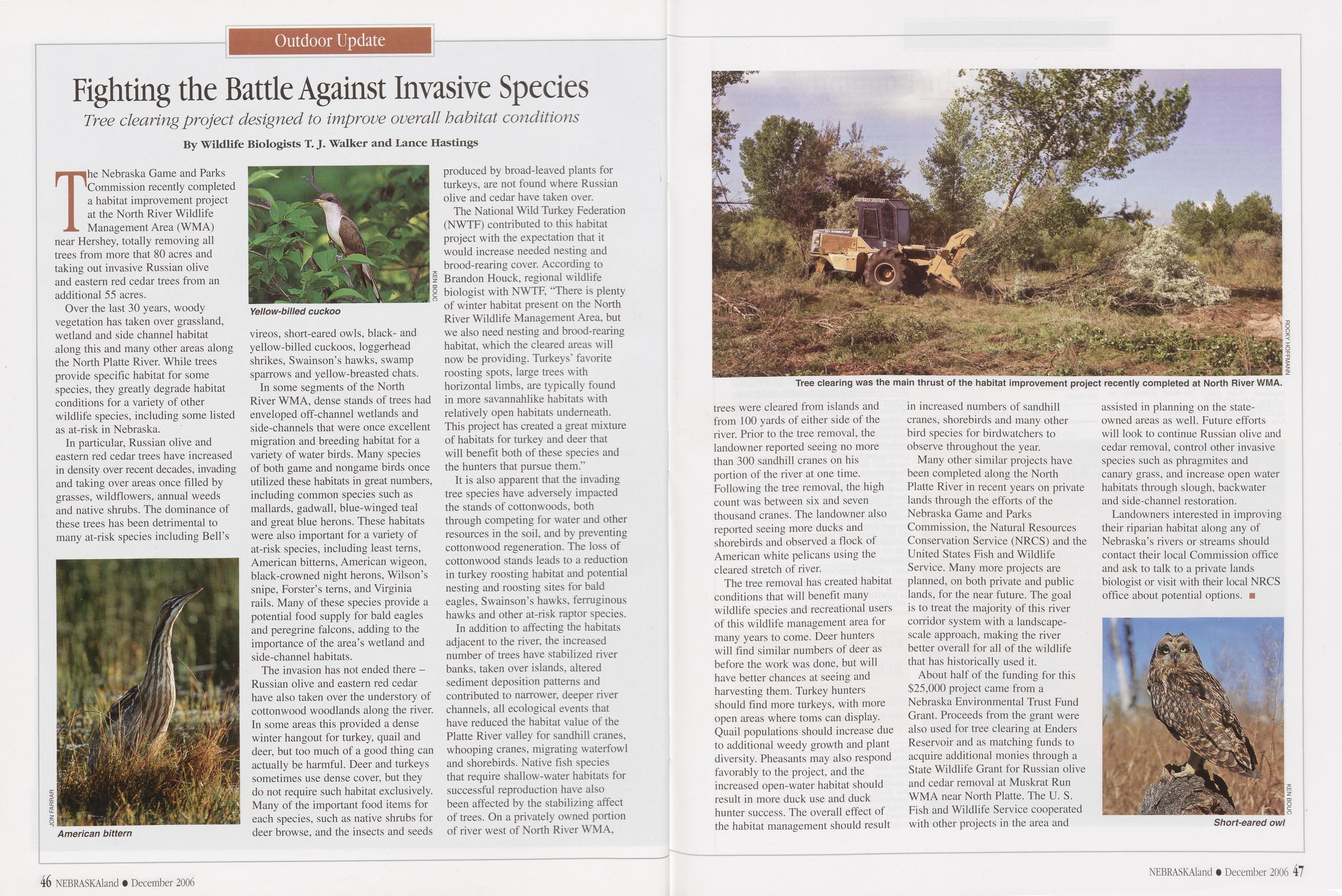
The Nebraska Game and Parks Commission recently completed a habitat improvement project at the North River Wildlife Management Area (WMA) near Hershey, totally removing all trees from more that 80 acres and taking out invasive Russian olive and eastern red cedar trees from an additional 55 acres.
Over the last 30 years, woody vegetation has taken over grassland, wetland and side channel habitat along this and many other areas along the North Platte River. While trees provide specific habitat for some species, they greatly degrade habitat conditions for a variety of other wildlife species, including some listed as at-risk in Nebraska.
In particular, Russian olive and eastern red cedar trees have increased in density over recent decades, invading and taking over areas once filled by grasses, wildflowers, annual weeds and native shrubs. The dominance of these trees has been detrimental to many at-risk species including Bell’s vireos, short-eared owls, black- and yellow-billed cuckoos, loggerhead shrikes, Swainson’s hawks, swamp sparrows and yellow-breasted chats.
In some segments of the North River WMA, dense stands of trees had enveloped off-channel wetlands and side-channels that were once excellent migration and breeding habitat for a variety of water birds. Many species of both game and nongame birds once utilized these habitats in great numbers, including common species such as mallards, gadwall, blue-winged teal and great blue herons. These habitats were also important for a variety of at-risk species, including least terns, American bitterns, American wigeon, black-crowned night herons, Wilson’s snipe, Forster’s terns, and Virginia rails. Many of these species provide a potential food supply for bald eagles and peregrine falcons, adding to the importance of the area’s wetland and side-channel habitats.
The invasion has not ended there - Russian olive and eastern red cedar have also taken over the understory of cottonwood woodlands along the river. In some areas this provided a dense winter hangout for turkey, quail and deer, but too much of a good thing can actually be harmful. Deer and turkeys sometimes use dense cover, but they do not require such habitat exclusively. Many of the important food items for each species, such as native shrubs for deer browse, and the insects and seeds produced by broad-leaved plants for turkeys, are not found where Russian olive and cedar have taken over.
The National Wild Turkey Federation (NWTF) contributed to this habitat project with the expectation that it would increase needed nesting and brood-rearing cover. According to Brandon Houck, regional wildlife biologist with NWTF, “There is plenty of winter habitat present on the North River Wildlife Management Area, but we also need nesting and brood-rearing habitat, which the cleared areas will now be providing. Turkeys’ favorite roosting spots, large trees with horizontal limbs, are typically found in more savannahlike habitats with relatively open habitats underneath. This project has created a great mixture of habitats for turkey and deer that will benefit both of these species and the hunters that pursue them.” It is also apparent that the invading tree species have adversely impacted the stands of cottonwoods, both through competing for water and other resources in the soil, and by preventing cottonwood regeneration. The loss of cottonwood stands leads to a reduction in turkey roosting habitat and potential nesting and roosting sites for bald eagles, Swainson’s hawks, ferruginous hawks and other at-risk raptor species.
In addition to affecting the habitats adjacent to the river, the increased number of trees have stabilized river banks, taken over islands, altered sediment deposition patterns and contributed to narrower, deeper river channels, all ecological events that have reduced the habitat value of the Platte River valley for sandhill cranes, whooping cranes, migrating waterfowl and shorebirds. Native fish species that require shallow-water habitats for successful reproduction have also been affected by the stabilizing affect of trees. On a privately owned portion of river west of North River WMA, trees were cleared from islands and from 100 yards of either side of the river. Prior to the tree removal, the landowner reported seeing no more than 300 sandhill cranes on his portion of the river at one time. Following the tree removal, the high count was between six and seven thousand cranes. The landowner also reported seeing more ducks and shorebirds and observed a flock of American white pelicans using the cleared stretch of river.
The tree removal has created habitat conditions that will benefit many wildlife species and recreational users of this wildlife management area for many years to come. Deer hunters will find similar numbers of deer as before the work was done, but will have better chances at seeing and harvesting them. Turkey hunters should find more turkeys, with more open areas where toms can display. Quail populations should increase due to additional weedy growth and plant diversity. Pheasants may also respond favorably to the project, and the increased open-water habitat should result in more duck use and duck hunter success. The overall effect of the habitat management should result in increased numbers of sandhill cranes, shorebirds and many other bird species for birdwatchers to observe throughout the year.
Many other similar projects have been completed along the North Platte River in recent years on private lands through the efforts of the Nebraska Game and Parks Commission, the Natural Resources Conservation Service (NRCS) and the United States Fish and Wildlife Service. Many more projects are planned, on both private and public lands, for the near future. The goal is to treat the majority of this river corridor system with a landscape- scale approach, making the river better overall for all of the wildlife that has historically used it. About half of the funding for this $25,000 project came from a Nebraska Environmental Trust Fund Grant. Proceeds from the grant were also used for tree clearing at Enders Reservoir and as matching funds to acquire additional monies through a State Wildlife Grant for Russian olive and cedar removal at Muskrat Run WMA near North Platte. The U. S. Fish and Wildlife Service cooperated with other projects in the area and assisted in planning on the state- owned areas as well. Future efforts will look to continue Russian olive and cedar removal, control other invasive species such as phragmites and canary grass, and increase open water habitats through slough, backwater and side-channel restoration.
Landowners interested in improving their riparian habitat along any of Nebraska’s rivers or streams should contact their local Commission office and ask to talk to a private lands biologist or visit with their local NRCS office about potential options. ■
46 NEBRASKAland • December 2006 NEBRASKAland • December 2006 47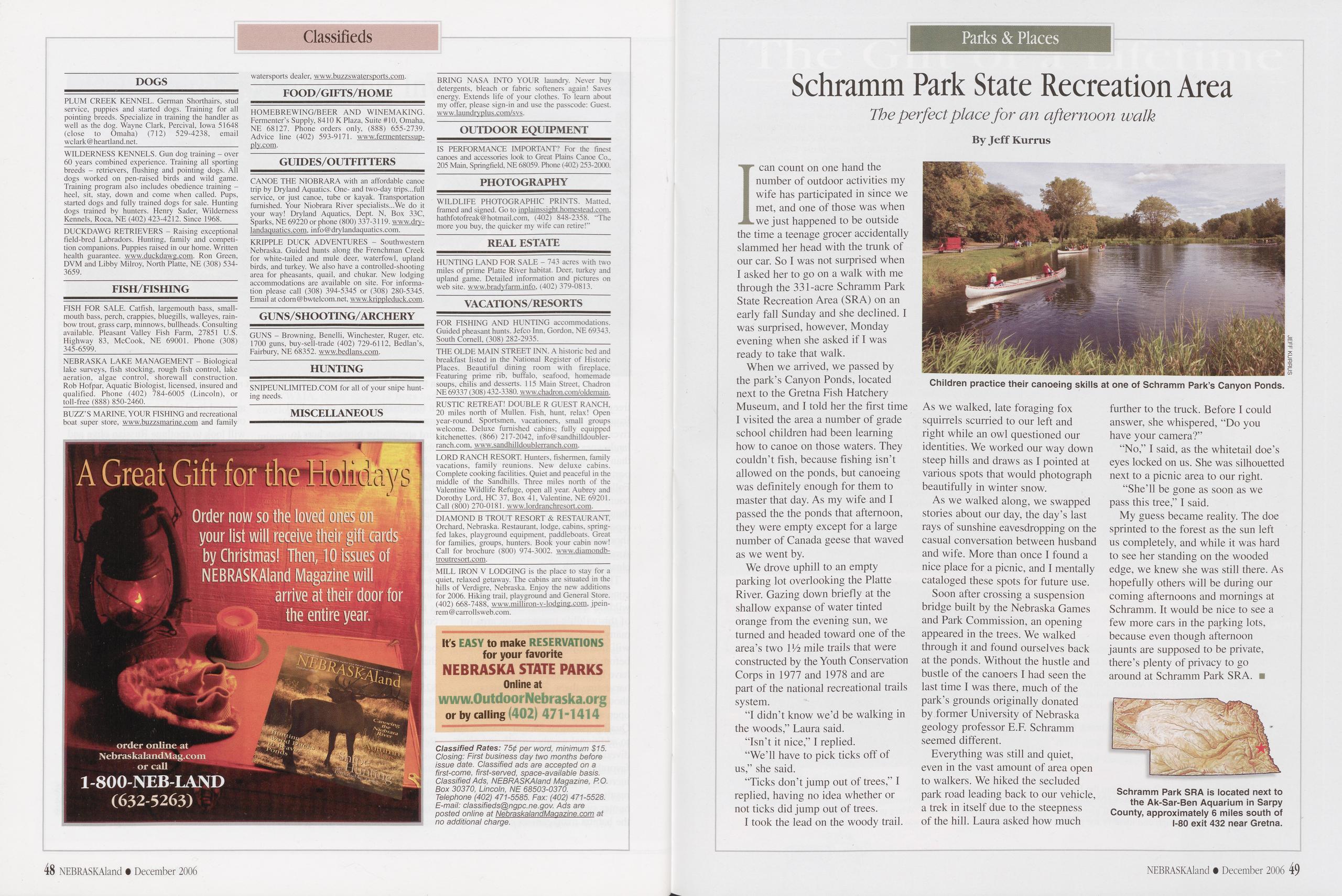
Classifieds
Parks & Places DOGSPLUM CREEK KENNEL. German Shorthairs, stud service, puppies and started dogs. Training for all pointing breeds. Specialize in training the handler as well as the dog. Wayne Clark, Percival, Iowa 51648 (close to Omaha) (712) 529-4238, email wclark@heartland.net.
WILDERNESS KENNELS. Gun dog training - over 60 years combined experience. Training all sporting breeds - retrievers, flushing and pointing dogs. All dogs worked on pen-raised birds and wild game. Training program also includes obedience training - heel, sit, stay, down and come when called. Pups, started dogs and fully trained dogs for sale. Hunting dogs trained by hunters. Henry Sader, Wilderness Kennels, Roca, NE (402) 423-4212. Since 1968.
DUCKDAWG RETRIEVERS - Raising exceptional field-bred Labradors. Hunting, family and competi- tion companions. Puppies raised in our home. Written health guarantee, www.duckdawg.com. Ron Green, DVM and Libby Milroy, North Platte, NE (308) 534- 3659.
FISH/FISHINGFISH FOR SALE. Catfish, largemouth bass, small- mouth bass, perch, crappies, bluegills, walleyes, rain- bow trout, grass carp, minnows, bullheads. Consulting available. Pleasant Valley Fish Farm, 27851 U.S. Highway 83, McCook, NE 69001. Phone (308) 345-6599.
NEBRASKA LAKE MANAGEMENT - Biological lake surveys, fish stocking, rough fish control, lake aeration, algae control, shorewall construction. Rob Hofpar, Aquatic Biologist, licensed, insured and qualified. Phone (402) 784-6005 (Lincoln), or toll-free (888) 850-2460.
BUZZ’S MARINE, YOUR FISHING and recreational boat super store, www.buzzsmarine.com and family watersports dealer, www.buzzswatersports.com.
FOOD/GIFTS/HOMEHOMEBREWING/BEER AND WINEMAKING. Fermenter’s Supply, 8410 K Plaza, Suite #10, Omaha, NE 68127. Phone orders only, (888) 655-2739. Advice line (402) 593-9171. www.fermenterssup- plv.com.
GUIDES/OUTFITTERSCANOE THE NIOBRARA with an affordable canoe trip by Dryland Aquatics. One- and two-day trips...full service, or just canoe, tube or kayak. Transportation furnished. Your Niobrara River specialists...We do it your way! Dryland Aquatics, Dept. N, Box 33C, Sparks, NE 69220 or phone (800) 337-3119. www.drv- landaquatics.com, info@drylandaquatics.com.
KRIPPLE DUCK ADVENTURES - Southwestern Nebraska. Guided hunts along the Frenchman Creek for white-tailed and mule deer, waterfowl, upland birds, and turkey. We also have a controlled-shooting area for pheasants, quail, and chukar. New lodging accommodations are available on site. For informa- tion please call (308) 394-5345 or (308) 280-5345. Email at cdom@bwtelcom.net, www.krippleduck.com.
GUNS/SHOOTING/ARCHERYGUNS - Browning, Benelli, Winchester, Roger, etc. 1700 guns, buy-sell-trade (402) 729-6112, Bedlan’s, Fairbury, NE 68352. www.bedlans.com.
HUNTINGSNIPEUNLIMITED.COM for all of your snipe hunt- ing needs.
MISCELLANEOUSBRING NASA INTO YOUR laundry. Never buy detergents, bleach or fabric softeners again! Saves energy. Extends life of your clothes. To learn about my offer, please sign-in and use the passcode: Guest. www.laundryplus.com/svs.
OUTDOOR EQUIPMENTIS PERFORMANCE IMPORTANT? For the finest canoes and accessories look to Great Plains Canoe Co., 205 Main, Springfield, NE 68059. Phone (402) 253-2000.
PHOTOGRAPHYWILDLIFE PHOTOGRAPHIC PRINTS. Matted, framed and signed. Go to inplainssight.homestead.com. hathfotofreak@hotmail.com, (402) 848-2358. “The more you buy, the quicker my wife can retire!”
REAL ESTATEHUNTING LAND FOR SALE - 743 acres with two miles of prime Platte River habitat. Deer, turkey and upland game. Detailed information and pictures on web site, www.bradyfarm.info. (402) 379-0813.
VACATIONS/RESORTSFOR FISHING AND HUNTING accommodations. Guided pheasant hunts. Jefco Inn, Gordon, NE 69343. South Cornell, (308) 282-2935.
THE OLDE MAIN STREET INN. A historic bed and breakfast listed in the National Register of Historic Places. Beautiful dining room with fireplace. Featuring prime rib, buffalo, seafood, homemade soups, chilis and desserts. 115 Main Street, Chadron NE 69337 (308) 432-3380. www.chadron.com/oldemain.
RUSTIC RETREAT! DOUBLE R GUEST RANCH, 20 miles north of Mullen. Fish, hunt, relax! Open year-round. Sportsmen, vacationers, small groups welcome. Deluxe furnished cabins; fully equipped kitchenettes. (866) 217-2042, info@sandhilldoubler- ranch.com, www.sandhilldoublerranch.com.
LORD RANCH RESORT. Hunters, fishermen, family vacations, family reunions. New deluxe cabins. Complete cooking facilities. Quiet and peaceful in the middle of the Sandhills. Three miles north of the Valentine Wildlife Refuge, open all year. Aubrey and Dorothy Lord, HC 37, Box 41, Valentine, NE 69201. Call (800) 270-0181. www.lordranchresort.com.
DIAMOND B TROUT RESORT & RESTAURANT, Orchard, Nebraska. Restaurant, lodge, cabins, spring- fed lakes, playground equipment, paddleboats. Great for families, groups, hunters. Book your cabin now! Call for brochure (800) 974-3002. www.diamondb- troutresort.com.
MILL IRON V LODGING is the place to stay for a quiet, relaxed getaway. The cabins are situated in the hills of Verdigre, Nebraska. Enjoy the new additions for 2006. Hiking trail, playground and General Store. (402) 668-7488, www.milliron-v-lodging.com, jpein- rem@carrollsweb.com.
It's EASY to make RESERVATIONS for your favorite NEBRASKA STATE PARKS Online at www.OutdoorNebraska.org or by calling (402) 471-1414Classified Rates: 750 per word, minimum $15. Closing: First business day two months before issue date. Classified ads are accepted on a first-come, first-served, space-available basis. Classified Ads, NEBRASKAIand Magazine, P.O. Box 30370, Lincoln, NE 68503-0370. Telephone (402) 471-5585. Fax: (402) 471-5528. E-mail: classifieds@ngpc.ne.gov. Ads are posted online at NebraskalandMaoazine. com at no additional charge.
Schramm Park State Recreation Area The perfect place for an afternoon walk By Jeff KurrusI can count on one hand the number of outdoor activities my wife has participated in since we met, and one of those was when we just happened to be outside the time a teenage grocer accidentally slammed her head with the trunk of our car. So I was not surprised when I asked her to go on a walk with me through the 331-acre Schramm Park State Recreation Area (SRA) on an early fall Sunday and she declined. I was surprised, however, Monday evening when she asked if I was ready to take that walk.
When we arrived, we passed by the park’s Canyon Ponds, located next to the Gretna Fish Hatchery Museum, and I told her the first time I visited the area a number of grade school children had been learning how to canoe on those waters. They couldn’t fish, because fishing isn’t allowed on the ponds, but canoeing was definitely enough for them to master that day. As my wife and I passed the the ponds that afternoon, they were empty except for a large number of Canada geese that waved as we went by.
We drove uphill to an empty parking lot overlooking the Platte River. Gazing down briefly at the shallow expanse of water tinted orange from the evening sun, we turned and headed toward one of the area’s two D/2 mile trails that were constructed by the Youth Conservation Corps in 1977 and 1978 and are part of the national recreational trails system.
“I didn’t know we’d be walking in the woods,” Laura said.
"Isn’t it nice,” I replied.
"We’ll have to pick ticks off of us,” she said.
"Ticks don’t jump out of trees,” I replied, having no idea whether or not ticks did jump out of trees. I took the lead on the woody trail. As we walked, late foraging fox squirrels scurried to our left and right while an owl questioned our identities. We worked our way down steep hills and draws as I pointed at various spots that would photograph beautifully in winter snow.
As we walked along, we swapped stories about our day, the day’s last rays of sunshine eavesdropping on the casual conversation between husband and wife. More than once I found a nice place for a picnic, and I mentally cataloged these spots for future use.
Soon after crossing a suspension bridge built by the Nebraska Games and Park Commission, an opening appeared in the trees. We walked through it and found ourselves back at the ponds. Without the hustle and bustle of the canoers I had seen the last time I was there, much of the park’s grounds originally donated by former University of Nebraska geology professor E.F. Schramm seemed different.
Everything was still and quiet, even in the vast amount of area open to walkers. We hiked the secluded park road leading back to our vehicle, a trek in itself due to the steepness of the hill. Laura asked how much further to the truck. Before I could answer, she whispered, "Do you have your camera?”
"No,” I said, as the whitetail doe’s eyes locked on us. She was silhouetted next to a picnic area to our right. "She’ll be gone as soon as we pass this tree,” I said.
My guess became reality. The doe sprinted to the forest as the sun left us completely, and while it was hard to see her standing on the wooded edge, we knew she was still there. As hopefully others will be during our coming afternoons and mornings at Schramm. It would be nice to see a few more cars in the parking lots, because even though afternoon jaunts are supposed to be private, there’s plenty of privacy to go around at Schramm Park SRA. ■
Schramm Park SRA is located next to the Ak-Sar-Ben Aquarium in Sarpy County, approximately 6 miles south of 1-80 exit 432 near Gretna.
48 NEBRASKAIand • December 2006 NEBRASKAIand • December 2006 49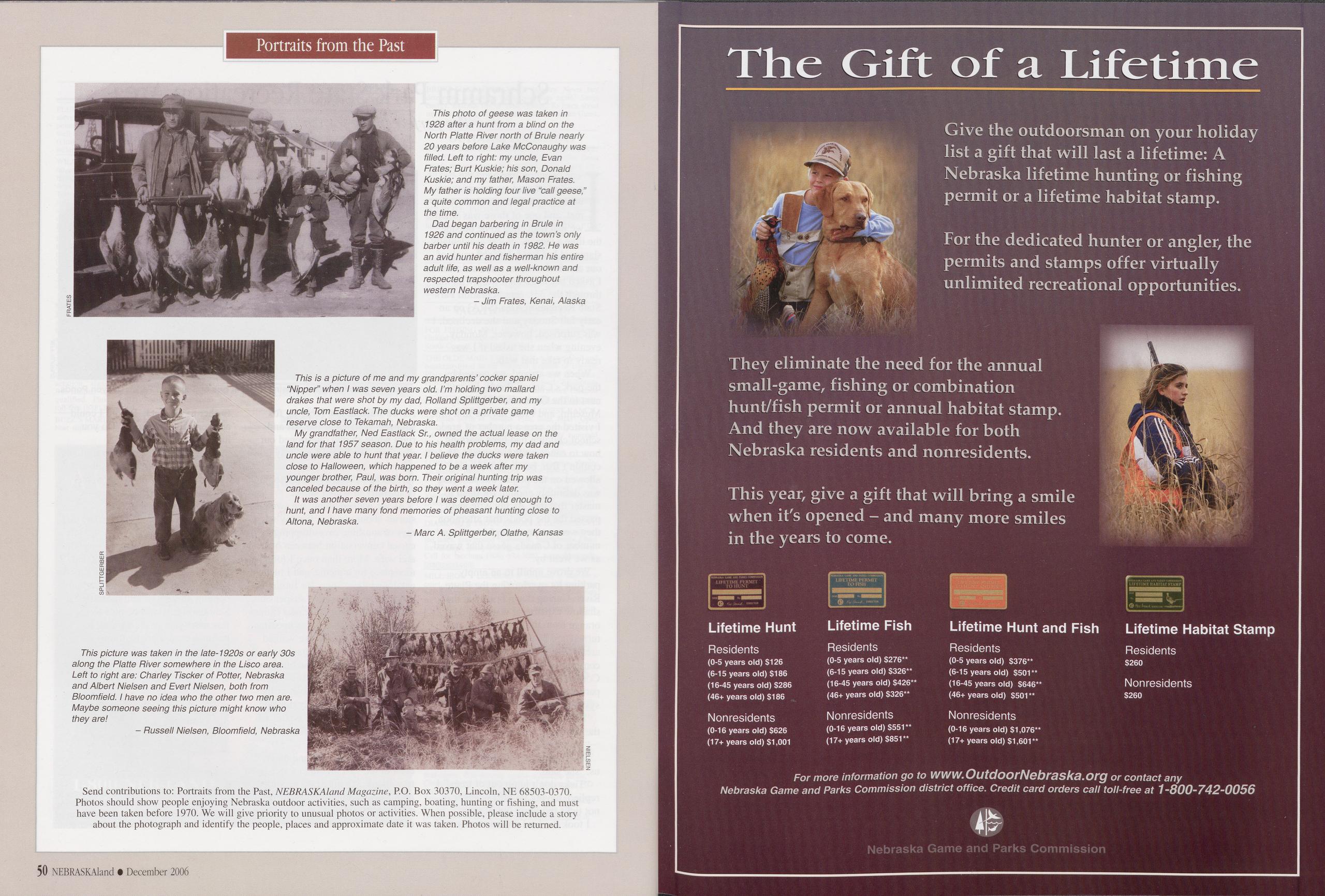
This photo of geese was taken in 1928 after a hunt from a blind on the North Platte River north of Brule nearly 20 years before Lake McConaughy was filled. Left to right: my uncle, Evan Frates; Burt Kuskie; his son, Donald Kuskie; and my father, Mason Frates. My father is holding four live “call geese,” a quite common and legal practice at the time.
Dad began barbering in Brule in 1926 and continued as the town’s only barber until his death in 1982. He was an avid hunter and fisherman his entire adult life, as well as a well-known and respected trapshooter throughout western Nebraska.
- Jim Frates, Kenai, AlaskaThis is a picture of me and my grandparents’ cocker spaniel “Nipper” when I was seven years old. I’m holding two mallard drakes that were shot by my dad, Rolland Splittgerber, and my uncle, Tom Eastlack. The ducks were shot on a private game reserve close to Tekamah, Nebraska.
My grandfather, Ned Eastlack Sr., owned the actual lease on the land for that 1957 season. Due to his health problems, my dad and uncle were able to hunt that year. I believe the ducks were taken close to Halloween, which happened to be a week after my younger brother, Paul, was born. Their original hunting trip was canceled because of the birth, so they went a week later. It was another seven years before I was deemed old enough to hunt, and I have many fond memories of pheasant hunting close to Altona, Nebraska.
- Marc A. Splittgerber, Olathe, KansasThis picture was taken in the I ate-1920s or early 30s along the Platte River somewhere in the Lisco area. Left to right are: Charley Tiscker of Potter, Nebraska and Albert Nielsen and Evert Nielsen, both from Bloomfield. I have no idea who the other two men are. Maybe someone seeing this picture might know who they are!
- Russell Nielsen, Bloomfield, NebraskaSend contributions to: Portraits from the Past, NEBRASKAland Magazine, P.O. Box 30370, Lincoln, NE 68503-0370. Photos should show people enjoying Nebraska outdoor activities, such as camping, boating, hunting or fishing, and must have been taken before 1970. We will give priority to unusual photos or activities. When possible, please include a story about the photograph and identify the people, places and approximate date it was taken. Photos will be returned.
Give the outdoorsman on your holiday Lifetime Fish Lifetime Hunt and Fish Lifetime Hunt Lifetime Habitat Stamp Nebraska Game and Parks Commission Nonresidents (0-16 years old) $551 (17+ years old) $851* Nebraska lifetime hunting or fish permit or a lifetime habitat stamp Residents (0-5 years old) $276** (6-15 years old) $326** (16-45 years old) $426 (46+ years old) $326** Nonresidents (0-16 years old) $626 (17+ years old) $1,001 Residents (0-5 years old) $376** (6-15 years old) $501** (16-45 years old) $646 (46+years old) $501** Residents (0-5 years old) $126 (6-15 years old) $186 (16-45 years old) $286 (46+ years old) $186 Nonresidents (0-16 years old) $1,076 (17+ years old) $1,601* Residents $260 Nonresidents $260 For more information go to WWW.OutdOOrN6br3Skd.org or contact any Nebraska Game and Parks Commission district office. Credit card orders call toll-free at 1-800-742-0056 They eliminate the need for the annual small-game, fishing or combination hunt/fish permit or annual habitat stamp And they are now available for both Nebraska residents and nonresidents. when it's opened - and many more smiles in the years to come. For the dedicated hunter or angler, the permits and stamps offer virtually unlimited recreational opportunities. 50 NEBRASKAland • December 2006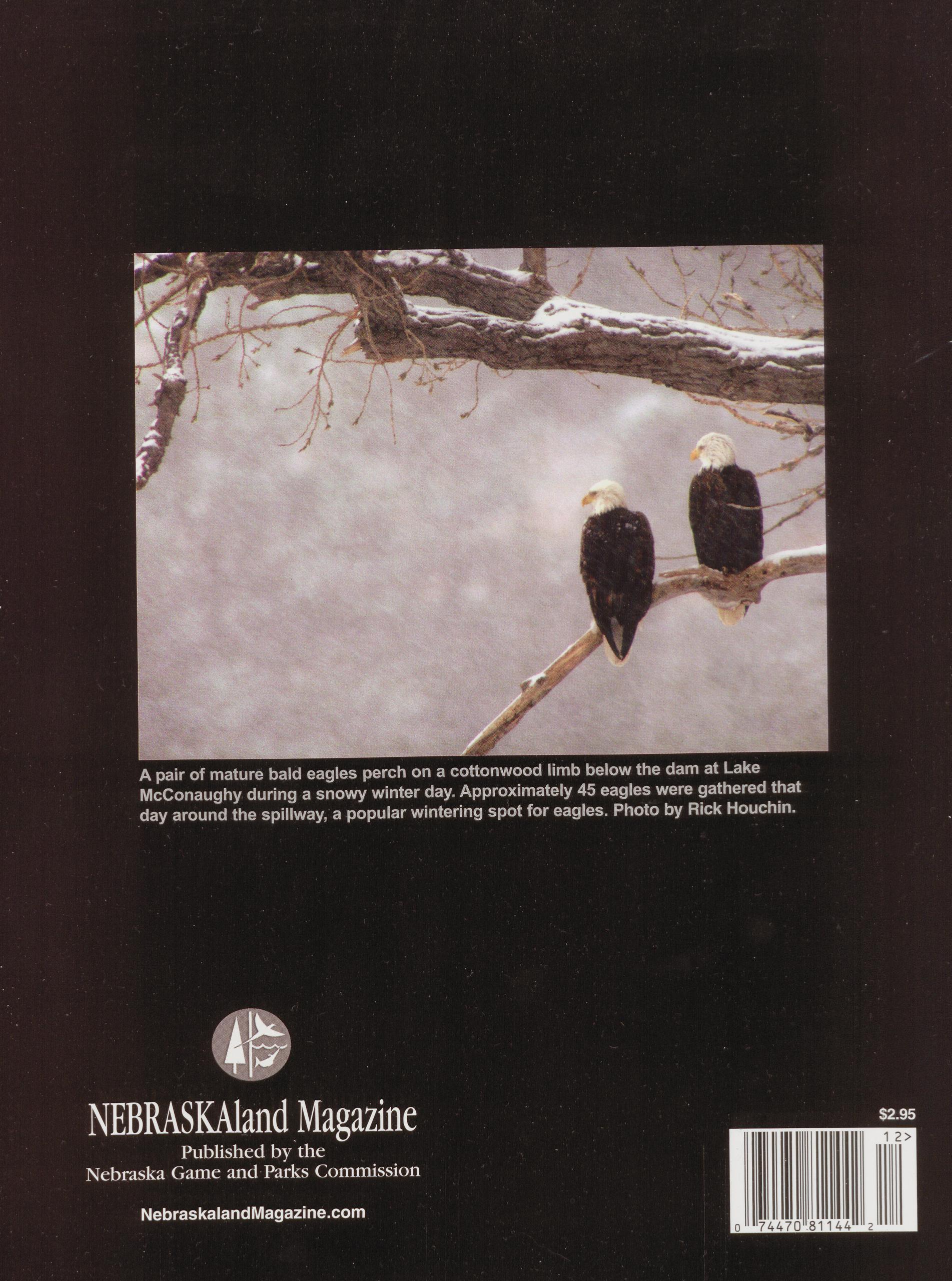
A pair of mature bald eagles perch on a cottonwood limb below the dam at Lake McConaughy during a snowy winter day. Approximately 45 eagles were gathered that day around the spillway, a popular wintering spot for eagles. Photo by Rick Houchin.
NEBRASKAland Magazine Published by the Nebraska Game and Parks Commission NebraskalandMagazine.com $2.95Position: 412 (24 views)