Volume 84, Issue 9, 2006
NEBRASKAland
Nebraska Game & Parks Commission November 2006 • $2.50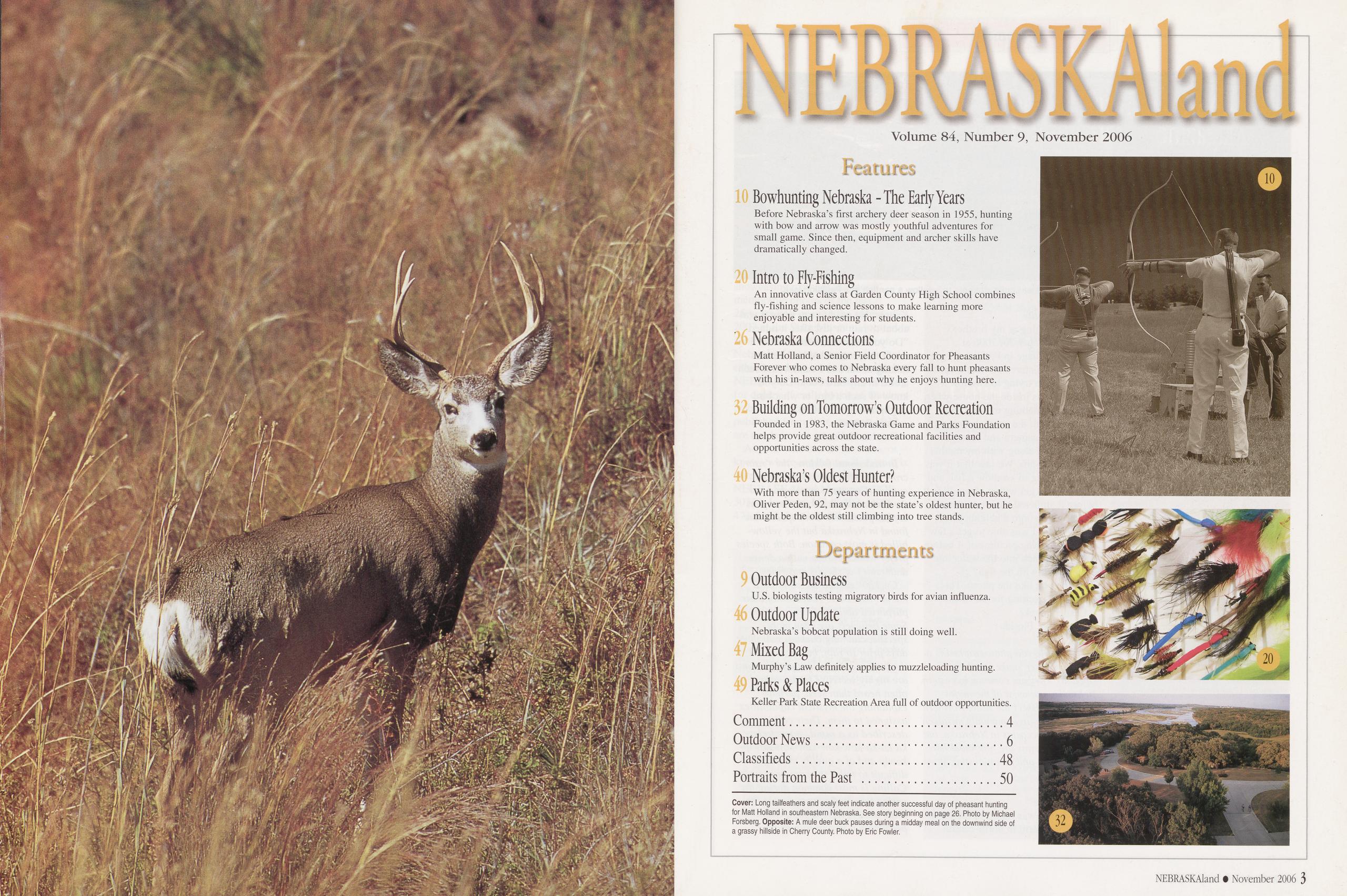
NEBRASKAland
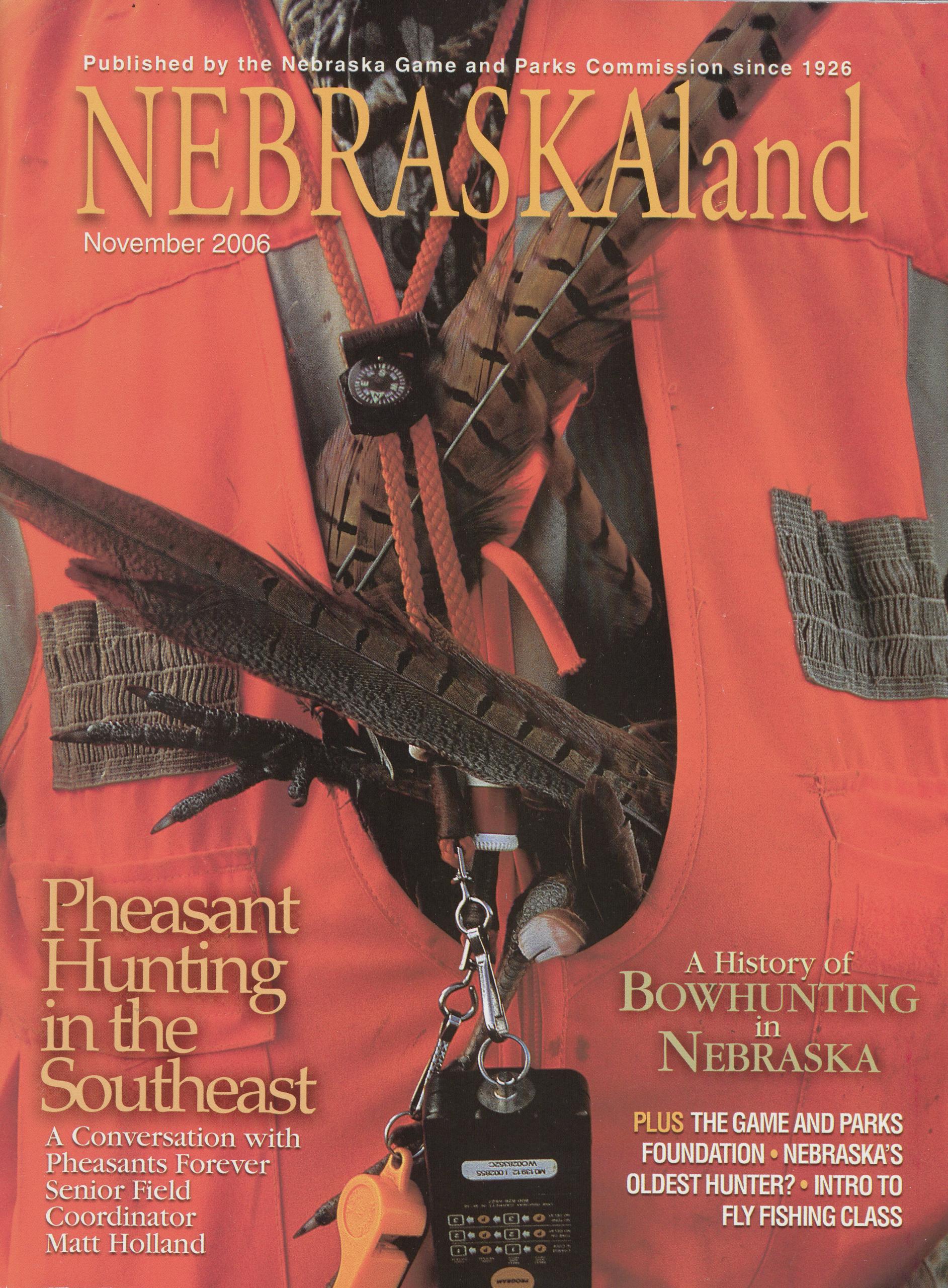
Volume 84, Number 9, November 2006 Bowhunting Nebraska - The Early Years Before Nebraska’s first archery deer season in 1955, hunting with bow and arrow was mostly youthful adventures for small game. Since then, equipment and archer skills have dramatically changed. Intro to Fly-Fishing An innovative class at Garden County High School combines fly-fishing and science lessons to make learning more enjoyable and interesting for students. Nebraska Connections Matt Holland, a Senior Field Coordinator for Pheasants Forever who comes to Nebraska every fall to hunt pheasants with his in-laws, talks about why he enjoys hunting here. Building on Tomorrow’s Outdoor Recreation Founded in 1983, the Nebraska Game and Parks Foundation helps provide great outdoor recreational facilities and opportunities across the state. 40 Nebraska’s Oldest Hunter? With more than 75 years of hunting experience in Nebraska, Oliver Peden, 92, may not be the state’s oldest hunter, but he might be the oldest still climbing into tree stands. Depart mum Outdoor Business U.S. biologists testing migratory birds for avian influenza. Outdoor Update Nebraska’s bobcat population is still doing well. Mixed Bag Murphy’s Law definitely applies to muzzleloading hunting. Parks & Places Keller Park State Recreation Area full of outdoor opportunities. Comment....................................... 4 Outdoor News...................................6 Classifieds...................................48 Portraits from the Past ......................50 Cover: Long tailfeathers and scaly feet indicate another successful day of pheasant hunting for Matt Holland in southeastern Nebraska. See story beginning on page 26. Photo by Michael Forsberg. Opposite: A mule deer buck pauses during a midday meal on the downwind side of a grassy hillside in Cherry County. Photo by Eric Fowler.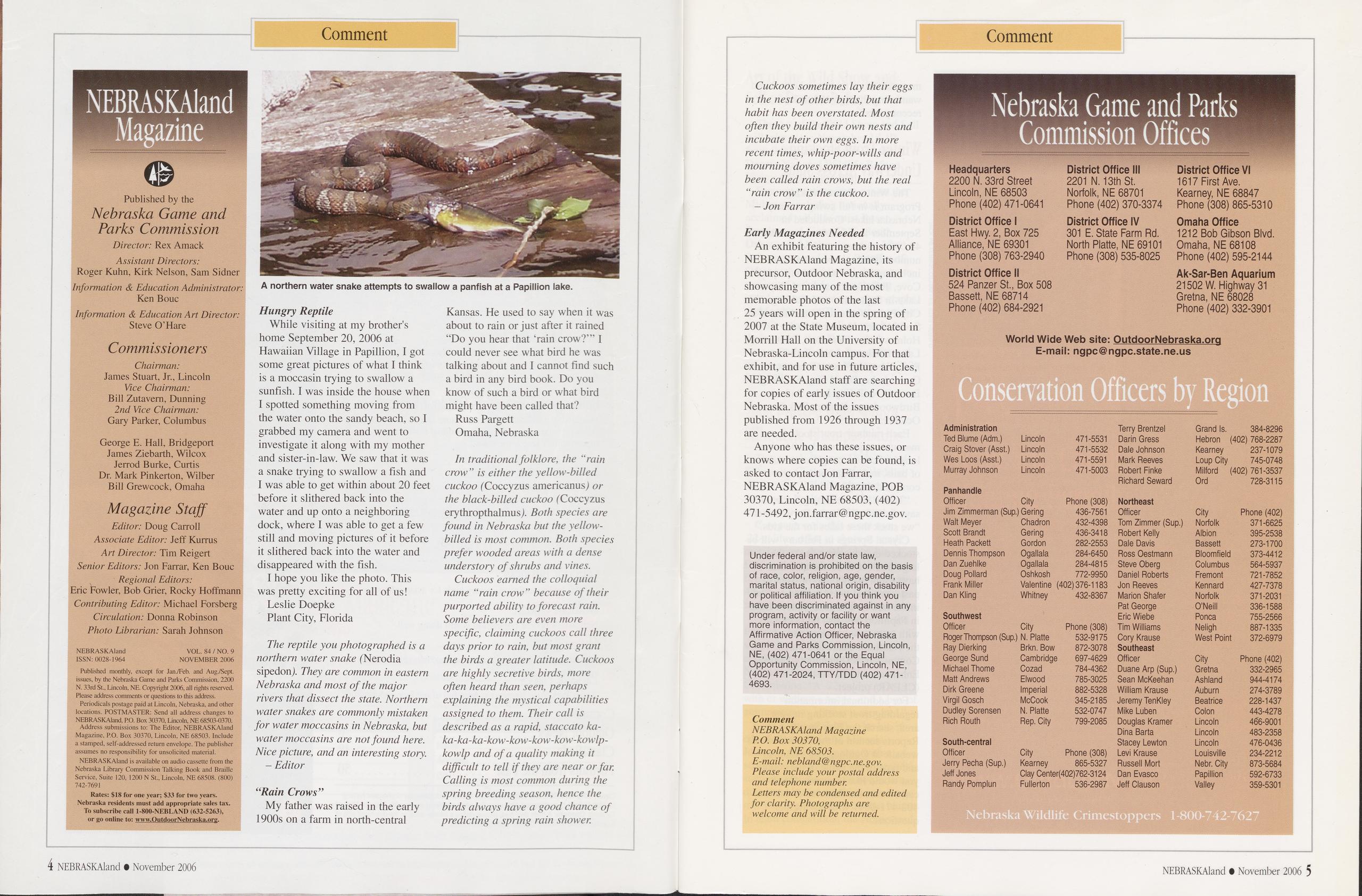 Comment
NEBRASKAland Mazine
Published by the
Nebraska Game and
Parks Commission
Director: Rex Amack
Assistant Directors:
Roger Kuhn, Kirk Nelson, Sam Sidner
Information &Education Administrator:
Ken Bouc
Information &Education Art Director:
Steve O’Hare
Commissioners
Chairman:
James Stuart, Jr., Lincoln
Vice Chairman:
Bill Zutavern, Dunning
2nd Vice Chairman:
Gary Parker, Columbus
George E. Hall, Bridgeport
James Ziebarth, Wilcox
Jerrod Burke, Curtis
Dr. Mark Pinkerton, Wilber
Bill Grewcock, Omaha
Magazine Staff
Editor: Doug Carroll
Associate Editor: Jeff Kurrus
Art Director: Tim Reigert
Senior Editors: Jon Farrar, Ken Bouc
Regional Editors:
Eric Fowler, Bob Grier, Rocky Hoffmann
Contributing Editor: Michael Forsberg
Circulation: Donna Robinson
Photo Librarian: Sarah Johnson
NEBRASKAland VOL. 84 / NO. 9
ISSN: 0028-1964 NOVEMBER 2006
Published monthly, except for JanJFeb. and Aug./Sept.
issues, by the Nebraska Game and Parks Commission, 2200
N. 33rd St., Lincoln, NE. Copyright 2006, all rights reserved.
Please address comments or questions to this address.
Periodicals postage paid at Lincoln, Nebraska, and other
locations. POSTMASTER: Send all address changes to
NEBRASKAland, P.O. Box 30370, Lincoln, NE 68503-0370.
Address submissions to: The Editor, NEBRASKAland
Magazine, P.O. Box 30370, Lincoln, NE 68503. Include
a stamped, self-addressed return envelope. The publisher
assumes no responsibility for unsolicited material.
NEBRASKAland is available on audio cassette from the
Nebraska Library Commission Talking Book and Braille
Service, Suite 120, 1200 N St., Lincoln, NE 68508. (800)
742-7691
Rates: $18 for one year; $33 for two years.
Nebraska residents must add appropriate sales tax.
To subscribe call 1-800-NEBLAND (632-5263),
or go online to: w ww.OutdoorNebraska.org.
Comment
NEBRASKAland Mazine
Published by the
Nebraska Game and
Parks Commission
Director: Rex Amack
Assistant Directors:
Roger Kuhn, Kirk Nelson, Sam Sidner
Information &Education Administrator:
Ken Bouc
Information &Education Art Director:
Steve O’Hare
Commissioners
Chairman:
James Stuart, Jr., Lincoln
Vice Chairman:
Bill Zutavern, Dunning
2nd Vice Chairman:
Gary Parker, Columbus
George E. Hall, Bridgeport
James Ziebarth, Wilcox
Jerrod Burke, Curtis
Dr. Mark Pinkerton, Wilber
Bill Grewcock, Omaha
Magazine Staff
Editor: Doug Carroll
Associate Editor: Jeff Kurrus
Art Director: Tim Reigert
Senior Editors: Jon Farrar, Ken Bouc
Regional Editors:
Eric Fowler, Bob Grier, Rocky Hoffmann
Contributing Editor: Michael Forsberg
Circulation: Donna Robinson
Photo Librarian: Sarah Johnson
NEBRASKAland VOL. 84 / NO. 9
ISSN: 0028-1964 NOVEMBER 2006
Published monthly, except for JanJFeb. and Aug./Sept.
issues, by the Nebraska Game and Parks Commission, 2200
N. 33rd St., Lincoln, NE. Copyright 2006, all rights reserved.
Please address comments or questions to this address.
Periodicals postage paid at Lincoln, Nebraska, and other
locations. POSTMASTER: Send all address changes to
NEBRASKAland, P.O. Box 30370, Lincoln, NE 68503-0370.
Address submissions to: The Editor, NEBRASKAland
Magazine, P.O. Box 30370, Lincoln, NE 68503. Include
a stamped, self-addressed return envelope. The publisher
assumes no responsibility for unsolicited material.
NEBRASKAland is available on audio cassette from the
Nebraska Library Commission Talking Book and Braille
Service, Suite 120, 1200 N St., Lincoln, NE 68508. (800)
742-7691
Rates: $18 for one year; $33 for two years.
Nebraska residents must add appropriate sales tax.
To subscribe call 1-800-NEBLAND (632-5263),
or go online to: w ww.OutdoorNebraska.org.
While visiting at my brother's home September 20, 2006 at Hawaiian Village in Papillion, I got some great pictures of what I think is a moccasin trying to swallow a sunfish. I was inside the house when I spotted something moving from the water onto the sandy beach, so I grabbed my camera and went to investigate it along with my mother and sister-in-law. We saw that it was a snake trying to swallow a fish and I was able to get within about 20 feet before it slithered back into the water and up onto a neighboring dock, where I was able to get a few still and moving pictures of it before it slithered back into the water and disappeared with the fish.
I hope you like the photo. This was pretty exciting for all of us!
Leslie Doepke Plant City, FloridaThe reptile you photographed is a northern water snake (Nerodia sipedon). They are common in eastern Nebraska and most of the major rivers that dissect the state. Northern water snakes are commonly mistaken for water moccasins in Nebraska, but water moccasins are not found here. Nice picture, and an interesting story. - Editor
"Rain Crows”My father was raised in the early 1900s on a farm in north-central Kansas. He used to say when it was about to rain or just after it rained “Do you hear that ‘rain crow?’” I could never see what bird he was talking about and I cannot find such a bird in any bird book. Do you know of such a bird or what bird might have been called that?
Russ Pargett Omaha, NebraskaIn traditional folklore, the “rain crow ” is either the yellow-billed cuckoo (Coccyzus americanus) or the black-billed cuckoo (Coccyzus erythropthalmus). Both species are found in Nebraska but the yellow- billed is most common. Both species prefer wooded areas with a dense understory of shrubs and vines.
Cuckoos earned the colloquial name “rain crow ” because of their purported ability to forecast rain. Some believers are even more specific, claiming cuckoos call three days prior to rain, but most grant the birds a greater latitude. Cuckoos are highly secretive birds, more often heard than seen, perhaps explaining the mystical capabilities assigned to them. Their call is described as a rapid, staccato ka- ka-ka-ka-kow-kow-kow-kow-kowlp- kowlp and of a quality making it difficult to tell if they are near or far. Calling is most common during the spring breeding season, hence the birds always have a good chance of predicting a spring rain shower.
Cuckoos sometimes lay their eggs in the nest of other birds, but that habit has been overstated. Most often they build their own nests and incubate their own eggs. In more recent times, whip-poor-wills and mourning doves sometimes have been called rain crows, but the real “rain crow” is the cuckoo. - Jon Farrar
Early Magazines NeededAn exhibit featuring the history of NEBRASKAland Magazine, its precursor, Outdoor Nebraska, and showcasing many of the most memorable photos of the last 25 years will open in the spring of 2007 at the State Museum, located in Morrill Hall on the University of Nebraska-Lincoln campus. For that exhibit, and for use in future articles, NEBRASKAland staff are searching for copies of early issues of Outdoor Nebraska. Most of the issues published from 1926 through 1937 are needed.
Anyone who has these issues, or knows where copies can be found, is asked to contact Jon Farrar,
NEBRASKAland Magazine, POB 30370, Lincoln, NE 68503, (402) 471-5492, jon.farrar@ngpc.ne.gov.
Nebraska Game and Parks Commission Offices Headquarters 2200 N. 33rd Street Lincoln, NE 68503 Phone (402) 471-0641 District Office I East Hwy. 2, Box 725 Alliance, NE 69301 Phone (308) 763-2940 District Office II 524 Panzer St., Box 508 Bassett, NE 68714 Phone (402) 684-2921 District Office III 2201 N. 13th St. Norfolk, NE 68701 Phone (402) 370-3374 District Office IV 301 E. State Farm Rd. North Platte, NE 69101 Phone (308) 535-8025 District Office VI 1617 First Ave. Kearney, NE 68847 Phone (308) 865-5310 Omaha Office 1212 Bob Gibson Blvd. Omaha, NE 68108 Phone (402) 595-2144 Ak’Sar-Ben Aquarium 21502 W. Highway 31 Gretna, NE 68026 Phone (402) 332-3901 World Wide Web site: OutdoorNebraska.org E-mail: ngpc@ngpc.state.ne.us Under federal and/or state law, discrimination is prohibited on the basis of race, color, religion, age, gender, marital status, national origin, disability or political affiliation. If you think you have been discriminated against in any program, activity or facility or want more information, contact the Affirmative Action Officer, Nebraska Game and Parks Commission, Lincoln, NE, (402) 471-0641 or the Equal Opportunity Commission, Lincoln, NE, (402) 471-2024, TTY/TDD (402) 471- 4693. Administration Terry Brentzel Grand Is. 384-8296 Ted Blume (Adm.) Lincoln 471-5531 Darin Gress Hebron (402) 768-2287 Craig Stover (Asst.) Lincoln 471-5532 Dale Johnson Kearney 237-1079 Wes Loos (Asst.) Lincoln 471-5591 Mark Reeves Loup City 745-0748 Murray Johnson Lincoln 471-5003 Robert Finke Milford (402) 761-3537 Richard Seward Ord 728-3115 Panhandle Officer City Phone (308) Northeast Jim Zimmerman (Sup.) Gering 436-7561 Officer City Phone (402) Walt Meyer Chadron 432-4398 Tom Zimmer (Sup.) Norfolk 371-6625 Scott Brandt Gering 436-3418 Robert Kelly Albion 395-2538 Heath Packett Gordon 282-2553 Dale Davis Bassett 273-1700 Dennis Thompson Ogallala 284-6450 Ross Oestmann Bloomfield 373-4412 Dan Zuehlke Ogallala 284-4815 Steve Oberg Columbus 564-5937 Doug Pollard Oshkosh 772-9950 Daniel Roberts Fremont 721-7852 Frank Miller Valentine (402)376-1183 Jon Reeves Kennard 427-7378 Dan Kling Whitney 432-8367 Marion Shafer Norfolk 371-2031 Pat George O’Neill 336-1588 Southwest Eric Wiebe Ponca 755-2566 Officer City Phone (308) Tim Williams Neligh 887-1335 Roger Thompson (Sup.) N. Platte 532-9175 Cory Krause West Point 372-6979 Ray Dierking Brkn. Bow 872-3078 Southeast George Sund Cambridge 697-4629 Officer City Phone (402) Michael Thome Cozad 784-4362 Duane Arp (Sup.) Gretna 332-2965 Matt Andrews Elwood 785-3025 Sean McKeehan Ashland 944-4174 Dirk Greene Imperial 882-5328 William Krause Auburn 274-3789 Virgil Gosch McCook 345-2185 Jeremy TenKley Beatrice 228-1437 Dudley Sorensen N. Platte 532-0747 Mike Luben Colon 443-4278 Rich Routh Rep. City 799-2085 Douglas Kramer Lincoln 466-9001 Dina Barta Lincoln 483-2358 South-central Stacey Lewton Lincoln 476-0436 Officer City Phone (308) Levi Krause Louisville 234-2212 Jerry Pecha (Sup.) Kearney 865-5327 Russell Mort Nebr. City 873-5684 Jeff Jones Clay Center(402)762-3124 Dan Evasco Papillion 592-6733 Randy Pomplun Fullerton 536-2987 Jeff Clauson Valley 359-5301 4 NEBRASKAland • November 2006 NEBRASKAland • November 2006 5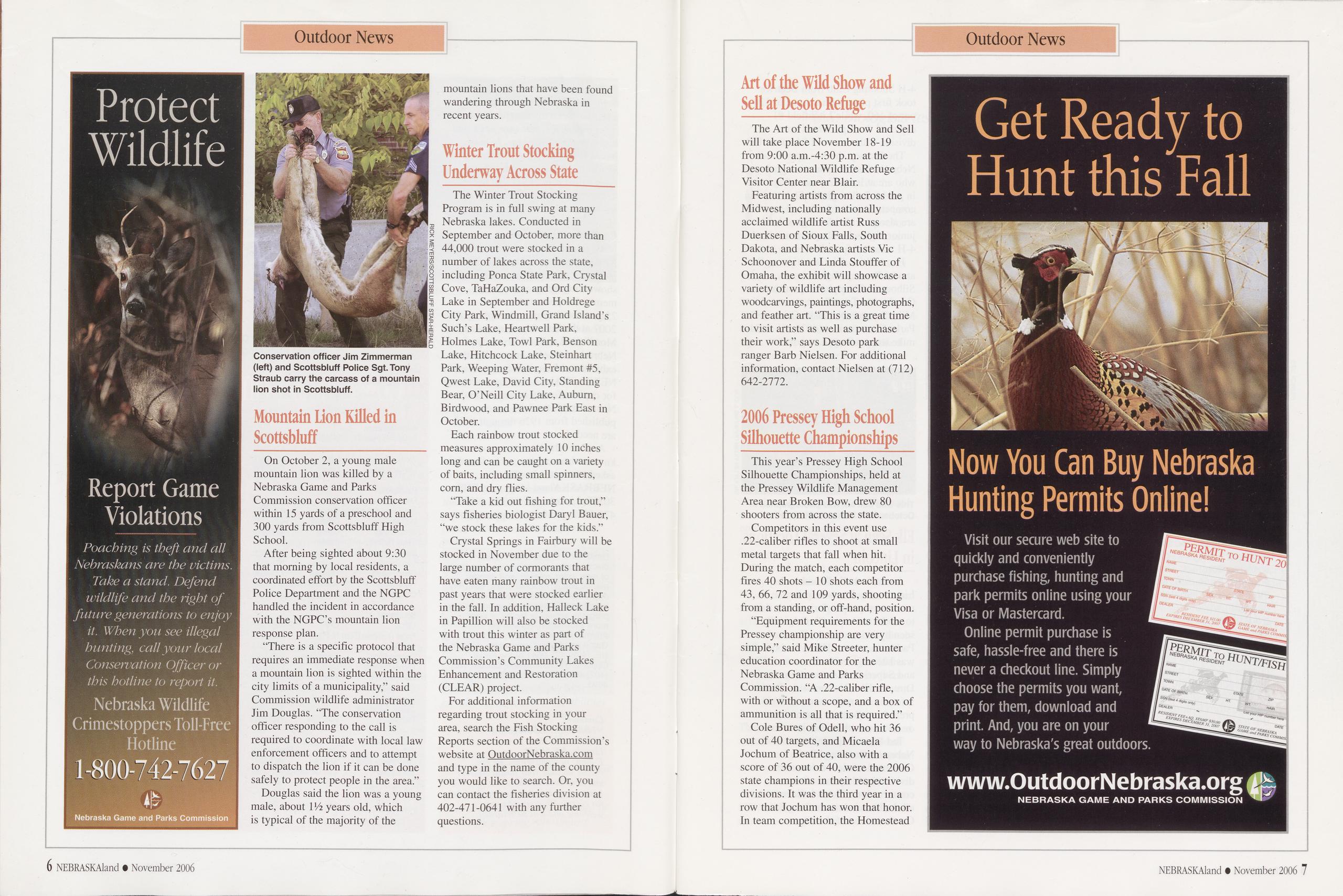
On October 2, a young male mountain lion was killed by a Nebraska Game and Parks Commission conservation officer within 15 yards of a preschool and 300 yards from Scottsbluff High School.
After being sighted about 9:30 that morning by local residents, a coordinated effort by the Scottsbluff Police Department and the NGPC handled the incident in accordance with the NGPC’s mountain lion response plan.
“There is a specific protocol that requires an immediate response when a mountain lion is sighted within the city limits of a municipality,” said Commission wildlife administrator Jim Douglas. “The conservation officer responding to the call is required to coordinate with local law enforcement officers and to attempt to dispatch the lion if it can be done safely to protect people in the area.”
Douglas said the lion was a young male, about P/2 years old, which is typical of the majority of the mountain lions that have been found wandering through Nebraska in recent years.
Winter Trout Stocking Underway Across StateThe Winter Trout Stocking Program is in full swing at many Nebraska lakes. Conducted in September and October, more than 44,000 trout were stocked in a number of lakes across the state, including Ponca State Park, Crystal Cove, TaHaZouka, and Ord City Lake in September and Holdrege City Park, Windmill, Grand Island’s Such’s Lake, Heartwell Park, Holmes Lake, Towl Park, Benson Lake, Hitchcock Lake, Steinhart Park, Weeping Water, Fremont #5, Qwest Lake, David City, Standing Bear, O’Neill City Lake, Auburn, Birdwood, and Pawnee Park East in October.
Each rainbow trout stocked measures approximately 10 inches long and can be caught on a variety of baits, including small spinners, corn, and dry flies.
“Take a kid out fishing for trout,” says fisheries biologist Daryl Bauer, “we stock these lakes for the kids.”
Crystal Springs in Fairbury will be stocked in November due to the large number of cormorants that have eaten many rainbow trout in past years that were stocked earlier in the fall. In addition, Halleck Lake in Papillion will also be stocked with trout this winter as part of the Nebraska Game and Parks Commission’s Community Lakes Enhancement and Restoration (CLEAR) project.
For additional information regarding trout stocking in your area, search the Fish Stocking Reports section of the Commission’s website at OutdoorNebraska.com and type in the name of the county you would like to search. Or, you can contact the fisheries division at 402-471-0641 with any further questions.
Art of the Wild Show and Sell at Desoto RefugeThe Art of the Wild Show and Sell will take place November 18-19 from 9:00 a.m.-4:30 p.m. at the Desoto National Wildlife Refuge Visitor Center near Blair.
Featuring artists from across the Midwest, including nationally acclaimed wildlife artist Russ Duerksen of Sioux Falls, South Dakota, and Nebraska artists Vic Schoonover and Linda Stouffer of Omaha, the exhibit will showcase a variety of wildlife art including woodcarvings, paintings, photographs, and feather art. “This is a great time to visit artists as well as purchase their work,” says Desoto park ranger Barb Nielsen. For additional information, contact Nielsen at (712) 642-2772.
Get Ready to Hunt this Fall Now You Can Buy Nebraska Hunting Permits Online! Visit our secure web site to quickly and conveniently purchase fishing, hunting and park permits online using your Visa or Mastercard. Online permit purchase is safe, hassle-free and there is never a checkout line. Simply choose the permits you want, pay for them, download and print. And, you are on your way to Nebraska's great outdoors. www.OutdoorNebraska.org 2006 Pressey High School Silhouette ChampionshipsThis year’s Pressey High School Silhouette Championships, held at the Pressey Wildlife Management Area near Broken Bow, drew 80 shooters from across the state.
Competitors in this event use .22-caliber rifles to shoot at small metal targets that fall when hit. During the match, each competitor fires 40 shots - 10 shots each from 43, 66, 72 and 109 yards, shooting from a standing, or off-hand, position.
“Equipment requirements for the Pressey championship are very simple,” said Mike Streeter, hunter education coordinator for the Nebraska Game and Parks Commission. “A .22-caliber rifle, with or without a scope, and a box of ammunition is all that is required.”
Cole Bures of Odell, who hit 36 out of 40 targets, and Micaela Jochum of Beatrice, also with a score of 36 out of 40, were the 2006 state champions in their respective divisions. It was the third year in a row that Jochum has won that honor. In team competition, the Homestead
6 NEBRASKAland • November 2006 NEBRASKAland •November 2006 7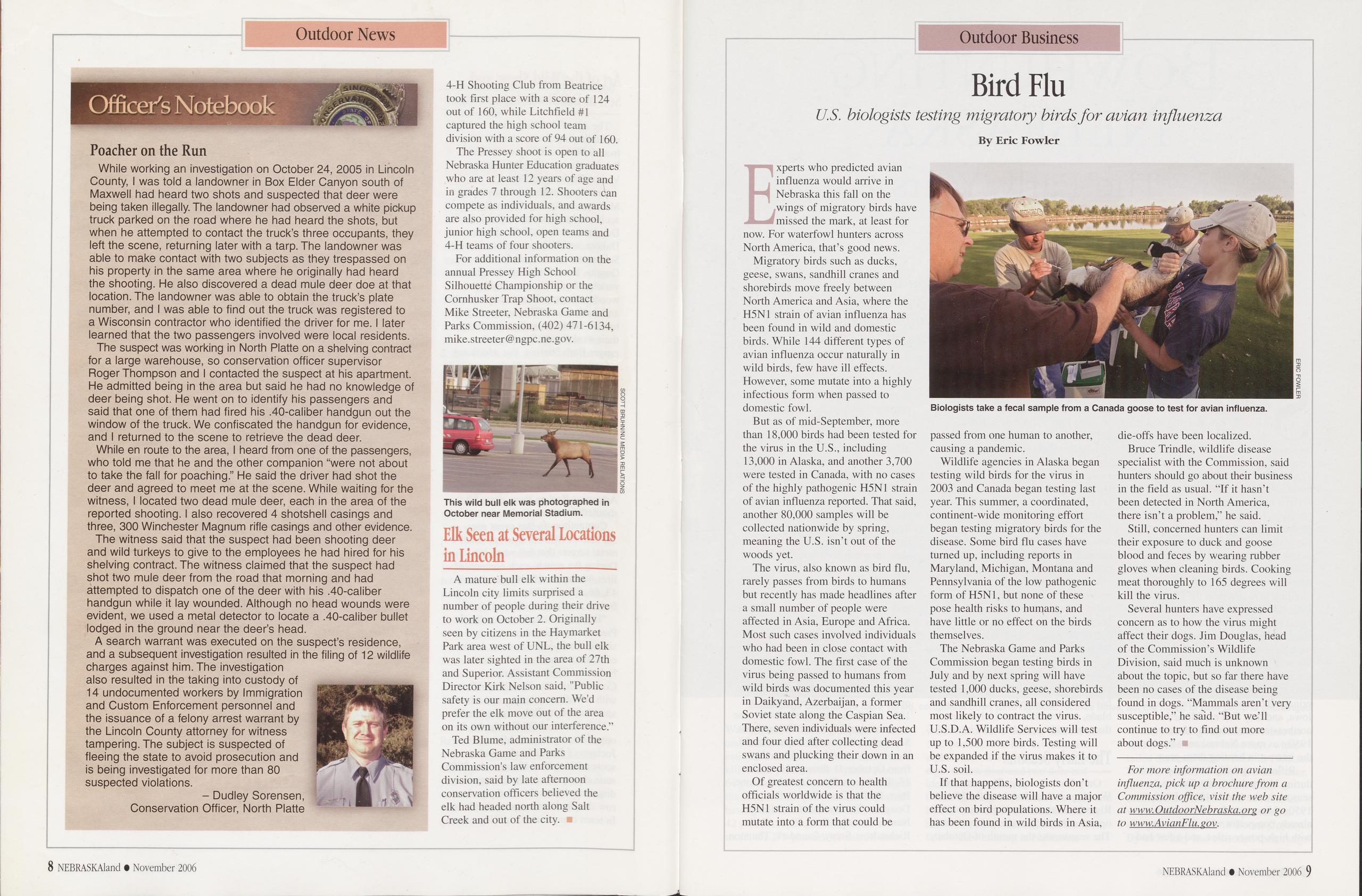 Outdoor Business
Officer's Notebook
Poacher on the Run
Outdoor Business
Officer's Notebook
Poacher on the Run
While working an investigation on October 24, 2005 in Lincoln County, I was told a landowner in Box Elder Canyon south of Maxwell had heard two shots and suspected that deer were being taken illegally. The landowner had observed a white pickup truck parked on the road where he had heard the shots, but when he attempted to contact the truck’s three occupants, they left the scene, returning later with a tarp. The landowner was able to make contact with two subjects as they trespassed on his property in the same area where he originally had heard the shooting. He also discovered a dead mule deer doe at that location. The landowner was able to obtain the truck’s plate number, and I was able to find out the truck was registered to a Wisconsin contractor who identified the driver for me. I later learned that the two passengers involved were local residents.
The suspect was working in North Platte on a shelving contract for a large warehouse, so conservation officer supervisor Roger Thompson and I contacted the suspect at his apartment. He admitted being in the area but said he had no knowledge of deer being shot. He went on to identify his passengers and said that one of them had fired his ,40-caliber handgun out the window of the truck. We confiscated the handgun for evidence, and I returned to the scene to retrieve the dead deer.
4-H Shooting Club from Beatrice took first place with a score of 124 out of 160, while Litchfield #1 captured the high school team division with a score of 94 out of 160.
The Pressey shoot is open to all Nebraska Hunter Education graduates who are at least 12 years of age and in grades 7 through 12. Shooters can compete as individuals, and awards are also provided for high school, junior high school, open teams and 4-H teams of four shooters.
For additional information on the annual Pressey High School Silhouette Championship or the Cornhusker Trap Shoot, contact Mike Streeter, Nebraska Game and Parks Commission, (402) 471-6134, mike. Streeter @ ngpc. ne. gov.
While en route to the area, I heard from one of the passengers, who told me that he and the other companion “were not about to take the fall for poaching.” He said the driver had shot the deer and agreed to meet me at the scene. While waiting for the witness, I located two dead mule deer, each in the area of the reported shooting. I also recovered 4 shotshell casings and three, 300 Winchester Magnum rifle casings and other evidence.
The witness said that the suspect had been shooting deer and wild turkeys to give to the employees he had hired for his shelving contract. The witness claimed that the suspect had shot two mule deer from the road that morning and had attempted to dispatch one of the deer with his ,40-caliber handgun while it lay wounded. Although no head wounds were evident, we used a metal detector to locate a ,40-caliber bullet lodged in the ground near the deer’s head.
A search warrant was executed on the suspect’s residence, and a subsequent investigation resulted in the filing of 12 wildlife charges against him. The investigation also resulted in the taking into custody of 14 undocumented workers by Immigration and Custom Enforcement personnel and the issuance of a felony arrest warrant by the Lincoln County attorney for witness tampering. The subject is suspected of fleeing the state to avoid prosecution and is being investigated for more than 80 suspected violations.
- Dudley Sorensen, Conservation Officer, North PlatteA mature bull elk within the Lincoln city limits surprised a number of people during their drive to work on October 2. Originally seen by citizens in the Haymarket Park area west of UNL, the bull elk was later sighted in the area of 27th and Superior. Assistant Commission Director Kirk Nelson said, "Public safety is our main concern. We'd prefer the elk move out of the area on its own without our interference.”
Ted Blume, administrator of the Nebraska Game and Parks Commission's law enforcement division, said by late afternoon conservation officers believed the elk had headed north along Salt Creek and out of the city.
Bird Flu U.S. biologists testing migratory birds for avian influenza By Eric FowlerExperts who predicted avian influenza would arrive in Nebraska this fall on the wings of migratory birds have missed the mark, at least for now. For waterfowl hunters across North America, that’s good news.
Migratory birds such as ducks, geese, swans, sandhill cranes and shorebirds move freely between North America and Asia, where the H5N1 strain of avian influenza has been found in wild and domestic birds. While 144 different types of avian influenza occur naturally in wild birds, few have ill effects. However, some mutate into a highly infectious form when passed to domestic fowl.
But as of mid-September, more than 18,000 birds had been tested for the virus in the U.S., including 13,000 in Alaska, and another 3,700 were tested in Canada, with no cases of the highly pathogenic H5N1 strain of avian influenza reported. That said, another 80,000 samples will be collected nationwide by spring, meaning the U.S. isn’t out of the woods yet.
The virus, also known as bird flu, rarely passes from birds to humans but recently has made headlines after a small number of people were affected in Asia, Europe and Africa. Most such cases involved individuals who had been in close contact with domestic fowl. The first case of the virus being passed to humans from wild birds was documented this year in Daikyand, Azerbaijan, a former Soviet state along the Caspian Sea. There, seven individuals were infected and four died after collecting dead swans and plucking their down in an enclosed area.
Of greatest concern to health officials worldwide is that the H5N1 strain of the virus could mutate into a form that could be passed from one human to another, causing a pandemic.
Wildlife agencies in Alaska began testing wild birds for the virus in 2003 and Canada began testing last year. This summer, a coordinated, continent-wide monitoring effort began testing migratory birds for the disease. Some bird flu cases have turned up, including reports in Maryland, Michigan, Montana and Pennsylvania of the low pathogenic form of H5N1, but none of these pose health risks to humans, and have little or no effect on the birds themselves.
The Nebraska Game and Parks Commission began testing birds in July and by next spring will have tested 1,000 ducks, geese, shorebirds and sandhill cranes, all considered most likely to contract the virus. U.S.D.A. Wildlife Services will test up to 1,500 more birds. Testing will be expanded if the virus makes it to U.S. soil.
If that happens, biologists don’t believe the disease will have a major effect on bird populations. Where it has been found in wild birds in Asia, die-offs have been localized.
Bruce Trindle, wildlife disease specialist with the Commission, said hunters should go about their business in the field as usual. "If it hasn’t been detected in North America, there isn’t a problem,” he said.
Still, concerned hunters can limit their exposure to duck and goose blood and feces by wearing rubber gloves when cleaning birds. Cooking meat thoroughly to 165 degrees will kill the virus.
Several hunters have expressed concern as to how the virus might affect their dogs. Jim Douglas, head of the Commission’s Wildlife Division, said much is unknown about the topic, but so far there have been no cases of the disease being found in dogs. "Mammals aren’t very susceptible,” he said. “But we-’11 continue to try to find out more about dogs.” ■
For more information on avian influenza, pick up a brochure from a Commission office, visit the yveb site at www. OutdoorNebraska. org or go to www.AvianFlu. gov.
8 NEBRASKAland • November 2006 NEBRASKAland • November 2006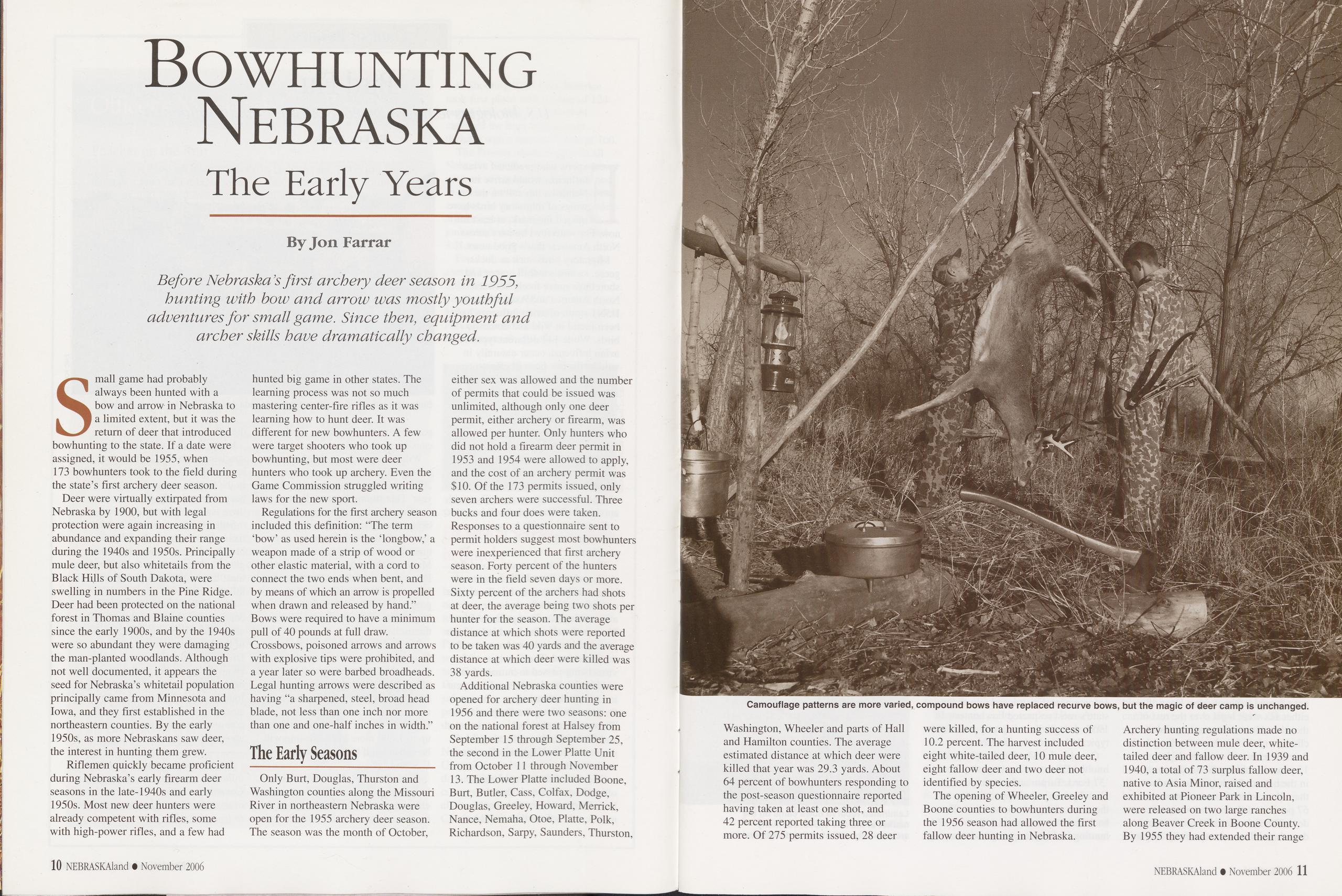
Bowhunting Nebraska
The Early Years By Jon Farrar Before Nebraska’s first archery deer season in 1955, bunting with bow and arrow was mostly youthful adventures for small game. Since then, equipment and archer skills have dramatically changed.Small game had probably always been hunted with a bow and arrow in Nebraska to a limited extent, but it was the return of deer that introduced bowhunting to the state. If a date were assigned, it would be 1955, when 173 bowhunters took to the field during the state’s first archery deer season. Deer were virtually extirpated from Nebraska by 1900, but with legal protection were again increasing in abundance and expanding their range during the 1940s and 1950s. Principally mule deer, but also whitetails from the Black Hills of South Dakota, were swelling in numbers in the Pine Ridge. Deer had been protected on the national forest in Thomas and Blaine counties since the early 1900s, and by the 1940s were so abundant they were damaging the man-planted woodlands. Although not well documented, it appears the seed for Nebraska’s whitetail population principally came from Minnesota and Iowa, and they first established in the northeastern counties. By the early 1950s, as more Nebraskans saw deer, the interest in hunting them grew.
Riflemen quickly became proficient during Nebraska’s early firearm deer seasons in the late-1940s and early 1950s. Most new deer hunters were already competent with rifles, some with high-power rifles, and a few had hunted big game in other states. The learning process was not so much mastering center-fire rifles as it was learning how to hunt deer. It was different for new bowhunters. A few were target shooters who took up bowhunting, but most were deer hunters who took up archery. Even the Game Commission struggled writing laws for the new sport.
Regulations for the first archery season included this definition: "The term ‘bow’ as used herein is the ‘longbow,’ a weapon made of a strip of wood or other elastic material, with a cord to connect the two ends when bent, and by means of which an arrow is propelled when drawn and released by hand.” Bows were required to have a minimum pull of 40 pounds at full draw. Crossbows, poisoned arrows and arrows with explosive tips were prohibited, and a year later so were barbed broadheads. Legal hunting arrows were described as having "a sharpened, steel, broad head blade, not less than one inch nor more than one and one-half inches in width.”
The Early SeasonsOnly Burt, Douglas, Thurston and Washington counties along the Missouri River in northeastern Nebraska were open for the 1955 archery deer season. The season was the month of October, either sex was allowed and the number of permits that could be issued was unlimited, although only one deer permit, either archery or firearm, was allowed per hunter. Only hunters who did not hold a firearm deer permit in 1953 and 1954 were allowed to apply, and the cost of an archery permit was $10. Of the 173 permits issued, only seven archers were successful. Three bucks and four does were taken. Responses to a questionnaire sent to permit holders suggest most bowhunters were inexperienced that first archery season. Forty percent of the hunters were in the field seven days or more. Sixty percent of the archers had shots at deer, the average being two shots per hunter for the season. The average distance at which shots were reported to be taken was 40 yards and the average distance at which deer were killed was 38 yards.
Additional Nebraska counties were opened for archery deer hunting in 1956 and there were two seasons: one on the national forest at Halsey from September 15 through September 25, the second in the Lower Platte Unit from October 11 through November 13. The Lower Platte included Boone, Burt, Butler, Cass, Colfax, Dodge, Douglas, Greeley, Howard, Merrick, Nance, Nemaha, Otoe, Platte, Polk, Richardson, Sarpy, Saunders, Thurston, Washington, Wheeler and parts of Hall and Hamilton counties. The average estimated distance at which deer were killed that year was 29.3 yards. About 64 percent of bowhunters responding to the post-season questionnaire reported having taken at least one shot, and 42 percent reported taking three or more. Of 275 permits issued, 28 deer were killed, for a hunting success of 10.2 percent. The harvest included eight white-tailed deer, 10 mule deer, eight fallow deer and two deer not identified by species.
The opening of Wheeler, Greeley and
Boone counties to bowhunters during
the 1956 season had allowed the first
fallow deer hunting in Nebraska.
Archery hunting regulations made no
distinction between mule deer, white-
tailed deer and fallow deer. In 1939 and
1940, a total of 73 surplus fallow deer,
native to Asia Minor, raised and
exhibited at Pioneer Park in Lincoln,
were released on two large ranches
along Beaver Creek in Boone County.
By 1955 they had extended their range
10 NEBRASKAland O November 2006
NEBRASKAland • November 2006 11
 into Greeley County. Aerial surveys by
Nebraska Game Forestation and Parks
Commission biologists estimated their
peak population at 157 in 1959. When
firearm seasons were opened in fallow
deer counties in 1959, riflemen were
prohibited from shooting fallow deer.
But, in response to crop depredation
complaints from landowners, and to
reduce competition with native deer,
they became fair game for riflemen in
1966. By the end of the decade the
number of fallow deer had been reduced
to less than 50. Hunters had selectively
harvested bucks, and biologists suspected
there was a fertility problem in the
population in later years. Small
numbers remained until recent years.
into Greeley County. Aerial surveys by
Nebraska Game Forestation and Parks
Commission biologists estimated their
peak population at 157 in 1959. When
firearm seasons were opened in fallow
deer counties in 1959, riflemen were
prohibited from shooting fallow deer.
But, in response to crop depredation
complaints from landowners, and to
reduce competition with native deer,
they became fair game for riflemen in
1966. By the end of the decade the
number of fallow deer had been reduced
to less than 50. Hunters had selectively
harvested bucks, and biologists suspected
there was a fertility problem in the
population in later years. Small
numbers remained until recent years.
In 1957, the state’s third archery deer season, the entire state was open to bowhunters September 7 through October 31. Southern Nebraska was the last region of the state re-colonized by deer, and to speed their comeback, hunters along the Kansas border were not allowed to shoot does. Deer of either sex were legal over the rest of the state. Hunter success continued to climb, with 655 archers checking in 80 deer for a harvest success slightly over 12 percent, ranking Nebraska seventh in the nation. Slightly more bucks than does were taken, and more than 67 percent of the harvest was mule deer. The average distance at which deer were killed was reportedly 34 yards.
The Nebraska Game and Forestation Commission initially viewed archery seasons as a way to meet the demand for deer hunting without slowing the expansion of deer across the state. The author of a summary of the 1955 season wrote: “In view of the low success, archery hunters offer little competition to rifle hunters for animals. However, hunting deer in this manner provides considerable recreation. ... It also provides a means for utilizing limited deer herds for a high recreational purpose.”
The interest in bowhunting steadily grew during the late-1950s, but the general public’s understanding of this new sport remained vague, a time best demonstrated with a story:
Dick Turpin first hunted deer with a bow during Nebraska’s third archery deer season in 1957, the first statewide season. Later he would be a conservation officer, hunter education coordinator, head of the Commission’s law enforcement division and one of the state’s most respected bowhunters. In 1957, though, he was pretty much a typical Nebraska bowhunter.
One day that October Turpin pulled into the Bassett co-op to gas up his ’37 Ford. Turpin and hunting crony Nick Lyman had chopped the top off the car, making it a convertible. The back seat was crammed full of hunting, fishing, trapping and camping equipment, including Turpin’s 80-pound lemonwood bow.
“Willy Kurzenberger, an old German guy, really good guy, who had a ranch up in Keya Paha County country, he was there,” Turpin recalled. “He’d come over from the old country and spoke kind of broken. He looked over the stuff we had in the back of the car and says, ‘Where are you going there?’ I told him ‘we’re going deer hunting.’ ‘Oh, yeah,’ he says. I got two or three dollars worth of gas, which was quite a little then, and Nick and I took off for the Niobrara River. Willy, he goes into the office and he says to my dad, my dad ran the co-op then, he says, I thought the deer season didn’t open until November there.’ ‘Oh, no,’ Dad says, ‘they’re hunting archery, with a bow and arrow.’ ‘Oh, with a bow,’ Willy says. ‘I’ll bet that takes a pretty good sized bow to kill a deer, huh?’ Well, dad says, ‘He’s got an 80-pound bow.’ ‘Well, what the hell,’ old Willy says, ‘He’s a big enough kid to carry one that heavy.’ He thought the bow weighed 80 pounds, see? Didn’t know it meant 80 pounds to pull it full draw. That’s how much most people knew about bowhunting in those days. Most bowhunters were only a little bit better.”
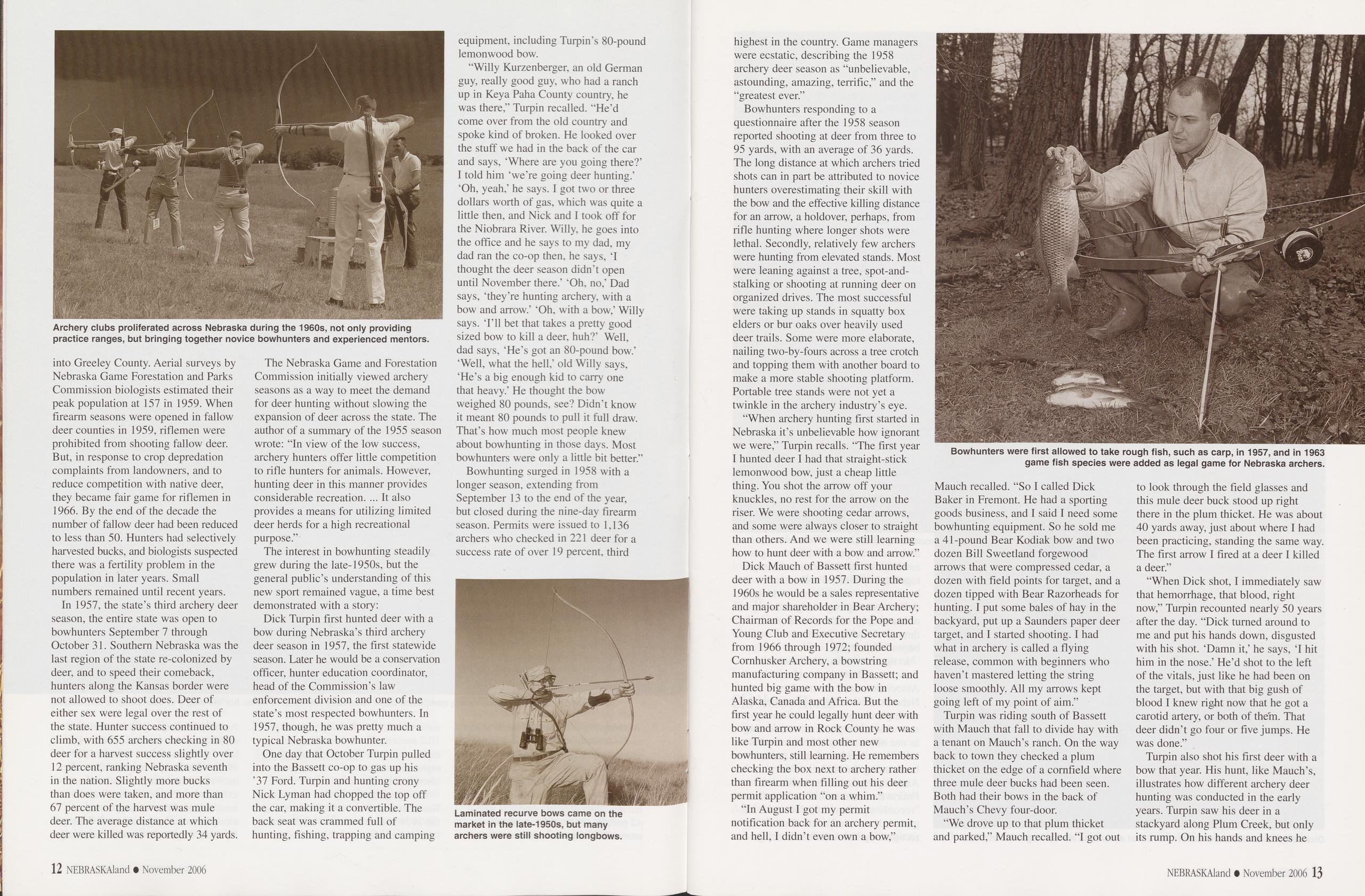
Bowhunting surged in 1958 with a longer season, extending from September 13 to the end of the year, but closed during the nine-day firearm season. Permits were issued to 1,136 archers who checked in 221 deer for a success rate of over 19 percent, third Laminated recurve bows came on the market in the late-1950s, but many archers were still shooting longbows. highest in the country. Game managers were ecstatic, describing the 1958 archery deer season as “unbelievable, astounding, amazing, terrific,” and the “greatest ever.”
Bowhunters responding to a questionnaire after the 1958 season reported shooting at deer from three to 95 yards, with an average of 36 yards. The long distance at which archers tried shots can in part be attributed to novice hunters overestimating their skill with the bow and the effective killing distance for an arrow, a holdover, perhaps, from rifle hunting where longer shots were lethal. Secondly, relatively few archers were hunting from elevated stands. Most were leaning against a tree, spot-and- stalking or shooting at running deer on organized drives. The most successful were taking up stands in squatty box elders or bur oaks over heavily used deer trails. Some were more elaborate, nailing two-by-fours across a tree crotch and topping them with another board to make a more stable shooting platform. Portable tree stands were not yet a twinkle in the archery industry’s eye.
“When archery hunting first started in Nebraska it’s unbelievable how ignorant we were,” Turpin recalls. “The first year I hunted deer I had that straight-stick lemonwood bow, just a cheap little thing. You shot the arrow off your knuckles, no rest for the arrow on the riser. We were shooting cedar arrows, and some were always closer to straight than others. And we were still learning how to hunt deer with a bow and arrow.”
Dick Mauch of Bassett first hunted deer with a bow in 1957. During the 1960s he would be a sales representative and major shareholder in Bear Archery; Chairman of Records for the Pope and Young Club and Executive Secretary from 1966 through 1972; founded Cornhusker Archery, a bowstring manufacturing company in Bassett; and hunted big game with the bow in Alaska, Canada and Africa. But the first year he could legally hunt deer with bow and arrow in Rock County he was like Turpin and most other new bowhunters, still learning. He remembers checking the box next to archery rather than firearm when filling out his deer permit application “on a whim.”
“In August I got my permit notification back for an archery permit, and hell, I didn’t even own a bow,” Mauch recalled. “So I called Dick Baker in Fremont. He had a sporting goods business, and I said I need some bowhunting equipment. So he sold me a 41-pound Bear Kodiak bow and two dozen Bill Sweetland forgewood arrows that were compressed cedar, a dozen with field points for target, and a dozen tipped with Bear Razorheads for hunting. I put some bales of hay in the backyard, put up a Saunders paper deer target, and I started shooting. I had what in archery is called a flying release, common with beginners who haven’t mastered letting the string loose smoothly. All my arrows kept going left of my point of aim.”
Turpin was riding south of Bassett with Mauch that fall to divide hay with a tenant on Mauch’s ranch. On the way back to town they checked a plum thicket on the edge of a cornfield where three mule deer bucks had been seen. Both had their bows in the back of Mauch’s Chevy four-door.
“We drove up to that plum thicket and parked,” Mauch recalled. “I got out to look through the field glasses and this mule deer buck stood up right there in the plum thicket. He was about 40 yards away, just about where I had been practicing, standing the same way. The first arrow I fired at a deer I killed a deer.”
“When Dick shot, I immediately saw that hemorrhage, that blood, right now,” Turpin recounted nearly 50 years after the day. “Dick turned around to me and put his hands down, disgusted with his shot. ‘Damn it,’ he says, T hit him in the nose.’ He’d shot to the left of the vitals, just like he had been on the target, but with that big gush of blood I knew right now that he got a carotid artery, or both of them. That deer didn’t go four or five jumps. He was done.”
Turpin also shot his first deer with a
bow that year. His hunt, like Mauch’s,
illustrates how different archery deer
hunting was conducted in the early
years. Turpin saw his deer in a
stackyard along Plum Creek, but only
its rump. On his hands and knees he
12 NEBRASKAland • November 2006
NEBRASKAland O November 2006 13
 crawled to the stackyard without
spooking the deer.
crawled to the stackyard without
spooking the deer.
"I was just a stack away from him,” Turpin recalled. “Gosh, I don’t think I was six yards, seven yards. I just kept peeking out until I could get that shot at his rib cage, you know. Never saw his head, never saw it! I shot. When he come bolting out of there, then I saw he was a little mule deer buck, and I thought, Oh, my gosh, I got a buck deer, and I started hollering. I hit him through the rib cage, back a little ways, but I knew I got one lung.”
Nothing advances technology quite so rapidly as wars. In the post-World War II years, new materials revolutionized the archery industry. Prior to 1950, long bows were almost universally constructed of traditional bow wood - hickory, Osage, lemonwood or yew. The first glass-limbed bows were introduced by archery equipment innovator Frank Eicholtz in the early 1940s but were slow to be accepted. Pistol grips first appeared on bows in the early 1950s. By 1953, Techrite Corporation was advertising bows made of a “light spring aluminum steel alloy.” That same year the Ply-Flex “solid glass” bow was marketed, a fiberglass bow promising “Rifle-like accuracy, unequalled strength” and to be virtually indestructible.
Development of new adhesives by Chrysler Corporation in the mid-1940s made laminated recurve bows possible, but it was another 10 years before they were widely available on the market. Ben Pearson, who had been in the archery equipment business since the mid-1930s, was selling both traditional hickory and laminated fiberglass take-down bows in the mid-1950s. By 1956, Fred Bear was hunting with and marketing his Kodiak “glass-power” recurve bows with limbs made of fiberglass bonded to a hard maple core. Bear’s bowhunting adventures on big game around the world did much to advance the acceptance of laminated fiberglass recurve bows, and promote bowhunting. By the early 1960s, composite recurve bows had largely replaced the wooden long bow for hunting.
Similar advancements in materials were taking place with arrows. By the mid-1950s, fiberglass arrows were claiming more of the market, and by the mid-1960s, plastic fletching was replacing natural feathers. Doug Easton began experimenting with aluminum arrows in the late 1930s but did not produce his first trademarked arrows until 1946. Because of aluminum arrows’ consistency in weight, balance and the trueness of the shafts, they dominated the market for both target archers and bowhunters by the 1960s. The first replaceable-blade broadhead, the Little Shaver, was introduced in 1957 using blades made for shaving razors as insert replacements.
In the late-1950s, there were no outdoor channels on television or bowhunting magazines on the racks at the local drugstore. And, there were few experienced bowhunters to mentor novice hunters. All of that began to change in the 1960s, and archery clubs across Nebraska played a critical role mentoring new hunters and urging ethical bowhunting standards.
In the spring of 1954, the Prairie Bowmen (later renamed the Lincoln Prairie Bowmen) organized the first field archery club in Nebraska and built their shooting range on the outskirts of Lincoln. By 1964 there were 23 archery clubs across Nebraska. Archery clubs not only provided field ranges in natural hunting situations but brought together experienced archers and bowhunters with those just picking up the bow, saving beginning archers years of learning by trial and error. And, through the archery clubs more women began bowhunting.
In the late-1950s, the Prairie Bowmen of Nebraska Archery Association (later renamed the Nebraska Prairie Bowmen) formed, uniting archery clubs, coordinating statewide archery events, and serving as one voice on legislative and other activities related to archery and bowhunting. In 1963, the Prairie Antlers program of the Nebraska Prairie Bowmen established the first “records repository” for Nebraska big game taken with the bow. In addition to recognizing Nebraska bowhunting trophies, Prairie Antlers encouraged archers to be selective in taking game and promoted wildlife conservation. The Nebraska Game, Forestation and Parks Commission began issuing citations for outstanding deer and pronghorns in 1962. By the 1970s, the Commission had become the keeper of Nebraska bowhunting records.
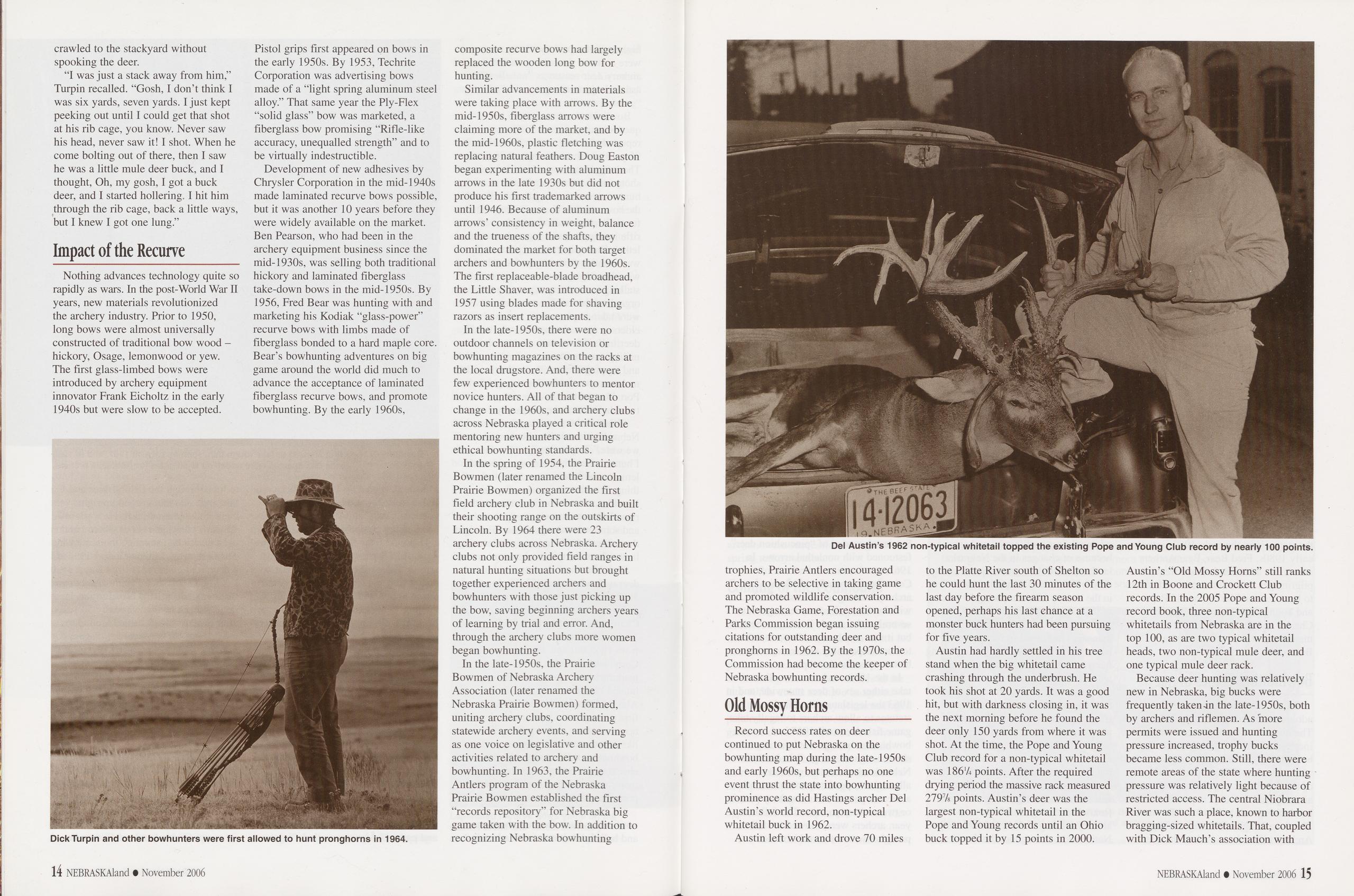
Record success rates on deer continued to put Nebraska on the bowhunting map during the late-1950s and early 1960s, but perhaps no one event thrust the state into bowhunting prominence as did Hastings archer Del Austin’s world record, non-typical whitetail buck in 1962.
Austin left work and drove 70 miles to the Platte River south of Shelton so he could hunt the last 30 minutes of the last day before the firearm season opened, perhaps his last chance at a monster buck hunters had been pursuing for five years.
Austin had hardly settled in his tree stand when the big whitetail came crashing through the underbrush. He took his shot at 20 yards. It was a good hit, but with darkness closing in, it was the next morning before he found the deer only 150 yards from where it was shot. At the time, the Pope and Young Club record for a non-typical whitetail was 18674 points. After the required drying period the massive rack measured 27978 points. Austin’s deer was the largest non-typical whitetail in the Pope and Young records until an Ohio buck topped it by 15 points in 2000. Austin’s “Old Mossy Horns” still ranks 12th in Boone and Crockett Club records. In the 2005 Pope and Young record book, three non-typical whitetails from Nebraska are in the top 100, as are two typical whitetail heads, two non-typical mule deer, and one typical mule deer rack.
Because deer hunting was relatively
new in Nebraska, big bucks were
frequently taken4n the late-1950s, both
by archers and riflemen. As more
permits were issued and hunting
pressure increased, trophy bucks
became less common. Still, there were
remote areas of the state where hunting
pressure was relatively light because of
restricted access. The central Niobrara
River was such a place, known to harbor
bragging-sized whitetails. That, coupled
with Dick Mauch’s association with
14 NEBRASKAland • November 2006
NEBRASKAland • November 2006 15
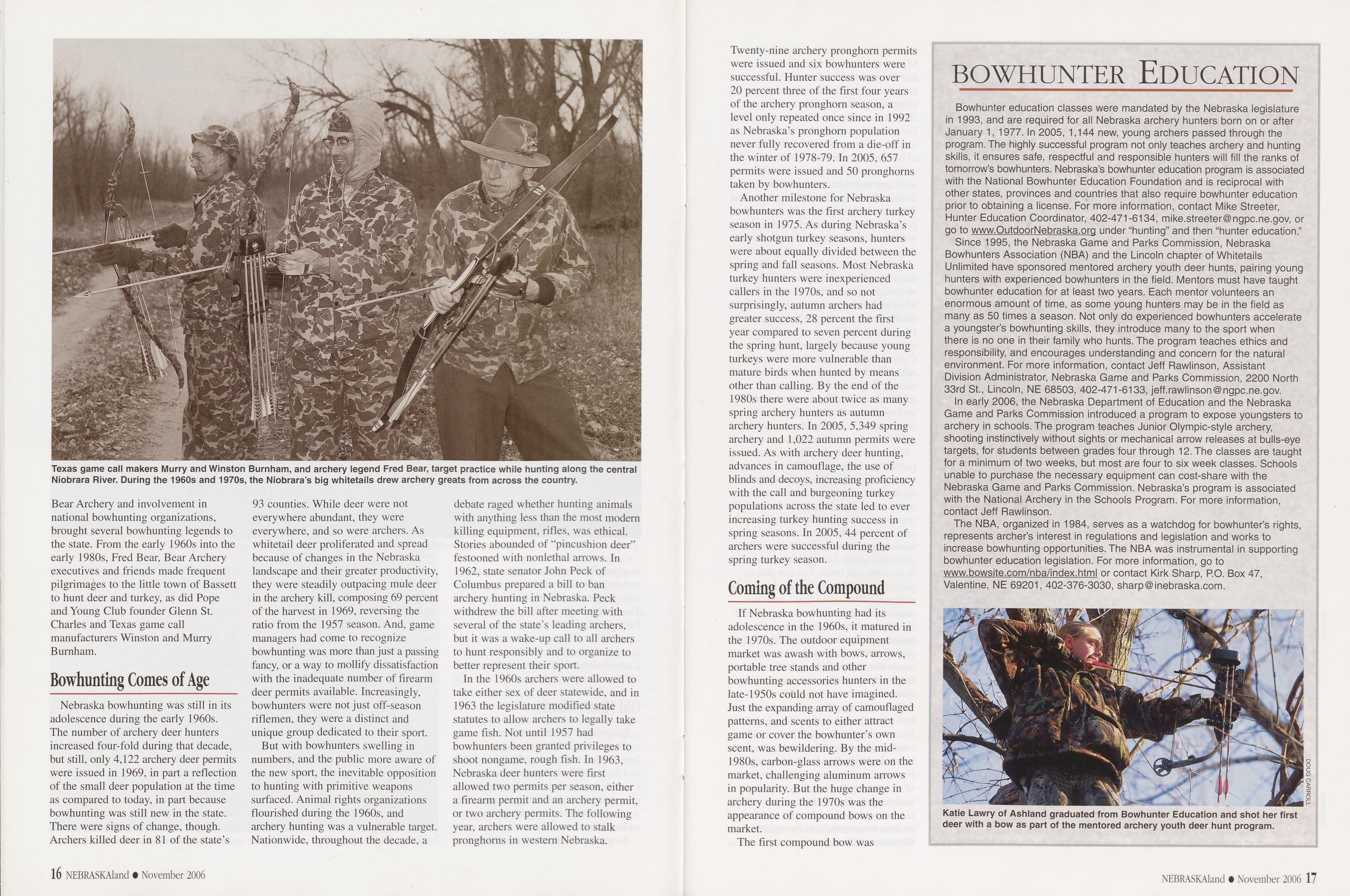 Bear Archery and involvement in
national bowhunting organizations,
brought several bowhunting legends to
the state. From the early 1960s into the
early 1980s, Fred Bear, Bear Archery
executives and friends made frequent
pilgrimages to the little town of Bassett
to hunt deer and turkey, as did Pope
and Young Club founder Glenn St.
Charles and Texas game call
manufacturers Winston and Murry
Burnham.
Bear Archery and involvement in
national bowhunting organizations,
brought several bowhunting legends to
the state. From the early 1960s into the
early 1980s, Fred Bear, Bear Archery
executives and friends made frequent
pilgrimages to the little town of Bassett
to hunt deer and turkey, as did Pope
and Young Club founder Glenn St.
Charles and Texas game call
manufacturers Winston and Murry
Burnham.
Nebraska bowhunting was still in its adolescence during the early 1960s. The number of archery deer hunters increased four-fold during that decade, but still, only 4,122 archery deer permits were issued in 1969, in part a reflection of the small deer population at the time as compared to today, in part because bowhunting was still new in the state. There were signs of change, though. Archers killed deer in 81 of the state’s 93 counties. While deer were not everywhere abundant, they were everywhere, and so were archers. As whitetail deer proliferated and spread because of changes in the Nebraska landscape and their greater productivity, they were steadily outpacing mule deer in the archery kill, composing 69 percent of the harvest in 1969, reversing the ratio from the 1957 season. And, game managers had come to recognize bowhunting was more than just a passing fancy, or a way to mollify dissatisfaction with the inadequate number of firearm deer permits available. Increasingly, bowhunters were not just off-season riflemen, they were a distinct and unique group dedicated to their sport.
But with bowhunters swelling in numbers, and the public more aware of the new sport, the inevitable opposition to hunting with primitive weapons surfaced. Animal rights organizations flourished during the 1960s, and archery hunting was a vulnerable target. Nationwide, throughout the decade, a debate raged whether hunting animals with anything less than the most modem killing equipment, rifles, was ethical. Stories abounded of "pincushion deer” festooned with nonlethal arrows. In 1962, state senator John Peck of Columbus prepared a bill to ban archery hunting in Nebraska. Peck withdrew the bill after meeting with several of the state’s leading archers, but it was a wake-up call to all archers to hunt responsibly and to organize to better represent their sport.
In the 1960s archers were allowed to take either sex of deer statewide, and in 1963 the legislature modified state statutes to allow archers to legally take game fish. Not until 1957 had bowhunters been granted privileges to shoot nongame, rough fish. In 1963, Nebraska deer hunters were first allowed two permits per season, either a firearm permit and an archery permit, or two archery permits. The following year, archers were allowed to stalk pronghorns in western Nebraska. Twenty-nine archery pronghorn permits were issued and six bowhunters were successful. Hunter success was over 20 percent three of the first four years of the archery pronghorn season, a level only repeated once since in 1992 as Nebraska’s pronghorn population never fully recovered from a die-off in the winter of 1978-79. In 2005, 657 permits were issued and 50 pronghorns taken by bowhunters.
Another milestone for Nebraska bowhunters was the first archery turkey season in 1975. As during Nebraska’s early shotgun turkey seasons, hunters were about equally divided between the spring and fall seasons. Most Nebraska turkey hunters were inexperienced callers in the 1970s, and so not surprisingly, autumn archers had greater success, 28 percent the first year compared to seven percent during the spring hunt, largely because young turkeys were more vulnerable than mature birds when hunted by means other than calling. By the end of the 1980s there were about twice as many spring archery hunters as autumn archery hunters. In 2005, 5,349 spring archery and 1,022 autumn permits were issued. As with archery deer hunting, advances in camouflage, the use of blinds and decoys, increasing proficiency with the call and burgeoning turkey populations across the state led to ever increasing turkey hunting success in spring seasons. In 2005, 44 percent of archers were successful during the spring turkey season.
Coming of the CompoundIf Nebraska bowhunting had its adolescence in the 1960s, it matured in the 1970s. The outdoor equipment market was awash with bows, arrows, portable tree stands and other bowhunting accessories hunters in the late-1950s could not have imagined. Just the expanding array of camouflaged patterns, and scents to either attract game or cover the bowhunter’s own scent, was bewildering. By the mid- 1980s, carbon-glass arrows were on the market, challenging aluminum arrows in popularity. But the huge change in archery during the 1970s was the appearance of compound bows on the market.
BOWHUNTER EDUCATIONBowhunter education classes were mandated by the Nebraska legislature in 1993, and are required for all Nebraska archery hunters born on or after January 1, 1977. In 2005, 1,144 new, young archers passed through the program. The highly successful program not only teaches archery and hunting skills, it ensures safe, respectful and responsible hunters will fill the ranks of tomorrow’s bowhunters. Nebraska’s bowhunter education program is associated with the National Bowhunter Education Foundation and is reciprocal with other states, provinces and countries that also require bowhunter education prior to obtaining a license. For more information, contact Mike Streeter, Hunter Education Coordinator, 402-471-6134, mike.streeter@ngpc.ne.gov, or go to www.OutdoorNebraska.org under “hunting” and then “hunter education.”
Since 1995, the Nebraska Game and Parks Commission, Nebraska Bowhunters Association (NBA) and the Lincoln chapter of Whitetails Unlimited have sponsored mentored archery youth deer hunts, pairing young hunters with experienced bowhunters in the field. Mentors must have taught bowhunter education for at least two years. Each mentor volunteers an enormous amount of time, as some young hunters may be in the field as many as 50 times a season. Not only do experienced bowhunters accelerate a youngster’s bowhunting skills, they introduce many to the sport when there is no one in their family who hunts. The program teaches ethics and responsibility, and encourages understanding and concern for the natural environment. For more information, contact Jeff Rawlinson, Assistant Division Administrator, Nebraska Game and Parks Commission, 2200 North 33rd St., Lincoln, NE 68503, 402-471-6133, jeff.rawlinson@ngpc.ne.gov.
In early 2006, the Nebraska Department of Education and the Nebraska Game and Parks Commission introduced a program to expose youngsters to archery in schools. The program teaches Junior Olympic-style archery, shooting instinctively without sights or mechanical arrow releases at bulls-eye targets, for students between grades four through 12. The classes are taught for a minimum of two weeks, but most are four to six week classes. Schools unable to purchase the necessary equipment can cost-share with the Nebraska Game and Parks Commission. Nebraska’s program is associated with the National Archery in the Schools Program. For more information, contact Jeff Rawlinson.
The NBA, organized in 1984, serves as a watchdog for bowhunter’s rights, represents archer’s interest in regulations and legislation and works to increase bowhunting opportunities. The NBA was instrumental in supporting bowhunter education legislation. For more information, go to www.bowsite.com/nba/index.html or contact Kirk Sharp, P.O. Box 47, Valentine, NE 69201, 402-376-3030, sharp@inebraska.com.
The first compound bow was
16 NEBRASKAland • November 2006
NEBRASKAland • November 2006 17
 developed by Holless Wilbur Allen in
his garage in Missouri. He was granted
a patent for an ‘Archery Bow with
Draw Force Multiplying Attachments”
in December 1969, and with the help of
Tom Jennings, bowmaker and technical
editor for The Archer’s Magazine,
became the first manufacturer of
compound bows.
developed by Holless Wilbur Allen in
his garage in Missouri. He was granted
a patent for an ‘Archery Bow with
Draw Force Multiplying Attachments”
in December 1969, and with the help of
Tom Jennings, bowmaker and technical
editor for The Archer’s Magazine,
became the first manufacturer of
compound bows.
The compound bow is essentially a bow coupled with a system of cams or elliptical wheels on the ends of the limbs to increase the overall energy stored by the bow and reduce the force required to hold the bow at full draw. Compound bows shoot arrows faster, at a flatter trajectory than other bows, and allow archers to hold an arrow at full draw longer with little effort. The introduction of the compound bow revolutionized archery and played a significant role in the burgeoning number of bowhunters during the 1970s and 1980s.
The introduction of the compound bow was not without controversy. Some considered it not far removed from a crossbow. Traditionalists rebuffed it. Bear Archery sold its first compound bow in 1975, but Fred Bear could never shoot one accurately because he was an instinctive shooter, pulling to full draw and releasing the arrow in one fluid movement. After his first attempt at using a compound, he never used one again. Others saw the compound bow as opening the door to archery for the masses, particularly for women, youngsters, older archers and archers with disabilities unable to pull legal recurve bows to full draw.
“A compound bow is much easier to shoot than a recurve bow,” said Paul Mykut, owner of Concept Archery and Cornhusker Archery in Bassett, manufacturer of bowstrings and compound bows. “The learning time shooting a compound is exponentially lower than a recurve. A recurve or a long bow takes a great deal of dedication to become accurate and shoot well with it. With a compound, you can take most any individual and in about 15 to 20 minutes having him hit a pie plate at 20 yards. Where if you take the same person with a recurve bow, it may take weeks and weeks to get them to where they can hit a pie plate at 20 yards.”
“I think primitive hunting is good for those people who can put that amount of time into that style of hunting,” said Marilyn Bentz, executive director of the National Bowhunter Education Foundation and former marketing director for Saunders Archery in Columbus from the mid-1980s to the mid-1990s. Bentz was recently inducted into the Legends of the Outdoors, established to recognize sportsmen and sportswomen who have played an integral part in setting standards and guidelines for outdoor sports.
"However, if we want people to participate in the sport," Bentz continued, "enjoy the sport, and pass it on to other people, we have to accept the fact that there’s going to be several types of hunters out there. I’m an excellent hunter with respect to knowledge about how to hunt, where to place the arrow, but as I sit behind a desk more and more, I’m not able to practice enough to be a good hunter with a recurve bow. I don’t have the time to practice, and that’s required. If a compound bow helps someone become proficient more quickly, and connect in the right spot on the deer out in the woods, I think that’s okay. But I also think that traditional style is okay, also.”
The rapid transition to compound bows is reflected in the offerings of Bear Archery Company. Their 1973 catalog advertised 14 models of recurve bows. In 1980, Bear’s 10 compound bow models were featured at the front of the catalog, followed by 11 recurve bow models. By 1992, Bear was selling nine compound bow models and five recurve bow models. Nationwide, 80 percent of bowhunters were shooting compound bows in 1980. In recent years, though, there has been a resurgence in “retro-archery” equipment and recurved bows have regained more of the market. Curiously, Bear Archery today advertises nine models of compound bows and 14 models of recurve bows.
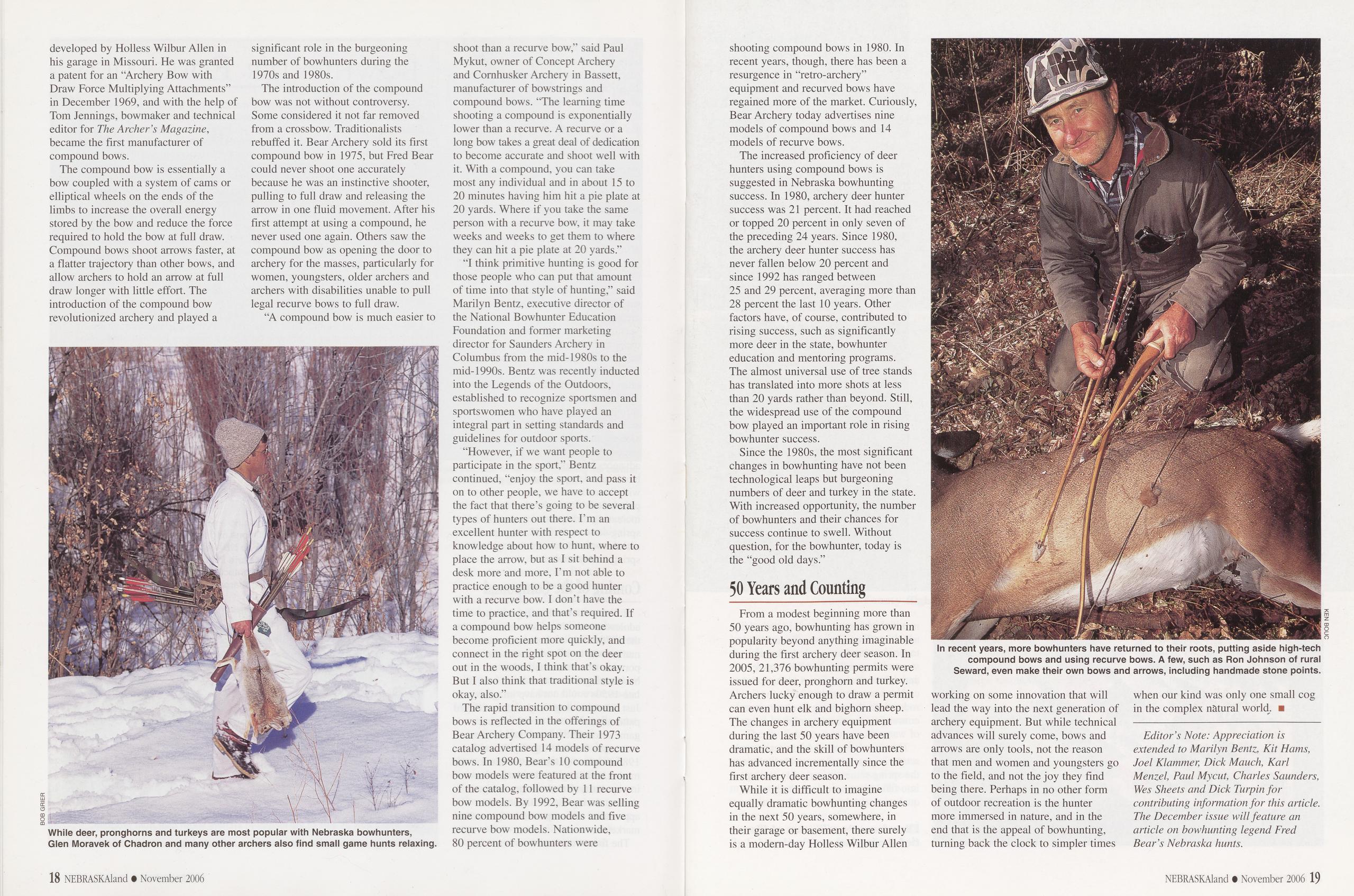
The increased proficiency of deer hunters using compound bows is suggested in Nebraska bowhunting success. In 1980, archery deer hunter success was 21 percent. It had reached or topped 20 percent in only seven of the preceding 24 years. Since 1980, the archery deer hunter success has never fallen below 20 percent and since 1992 has ranged between 25 and 29 percent, averaging more than 28 percent the last 10 years. Other factors have, of course, contributed to rising success, such as significantly more deer in the state, bowhunter education and mentoring programs. The almost universal use of tree stands has translated into more shots at less than 20 yards rather than beyond. Still, the widespread use of the compound bow played an important role in rising bowhunter success.
Since the 1980s, the most significant changes in bowhunting have not been technological leaps but burgeoning numbers of deer and turkey in the state. With increased opportunity, the number of bowhunters and their chances for success continue to swell. Without question, for the bowhunter, today is the "good old days.”
50 Years and CountingFrom a modest beginning more than 50 years ago, bowhunting has grown in popularity beyond anything imaginable during the first archery deer season. In 2005, 21,376 bowhunting permits were issued for deer, pronghorn and turkey. Archers lucky enough to draw a permit can even hunt elk and bighorn sheep. The changes in archery equipment during the last 50 years have been dramatic, and the skill of bowhunters has advanced incrementally since the first archery deer season.
While it is difficult to imagine equally dramatic bowhunting changes in the next 50 years, somewhere, in their garage or basement, there surely is a modern-day Holless Wilbur Allen working on some innovation that will lead the way into the next generation of archery equipment. But while technical advances will surely come, bows and arrows are only tools, not the reason that men and women and youngsters go to the field, and not the joy they find being there. Perhaps in no other form of outdoor recreation is the hunter more immersed in nature, and in the end that is the appeal of bowhunting, turning back the clock to simpler times when our kind was only one small cog in the complex natural world. ■
Editor’s Note: Appreciation is extended to Marilyn Bentz, Kit Hamj Joel Klammer, Dick Mauch, Karl Menzel, Paul My cut, Charles Saund Wes Sheets and Dick Turpin for contributing information for this ar The December issue will feature a article on bowhunting legend Frei Bear’s Nebraska hunts.
18 NEBRASKAiand • November 2006 NEBRASKAland • November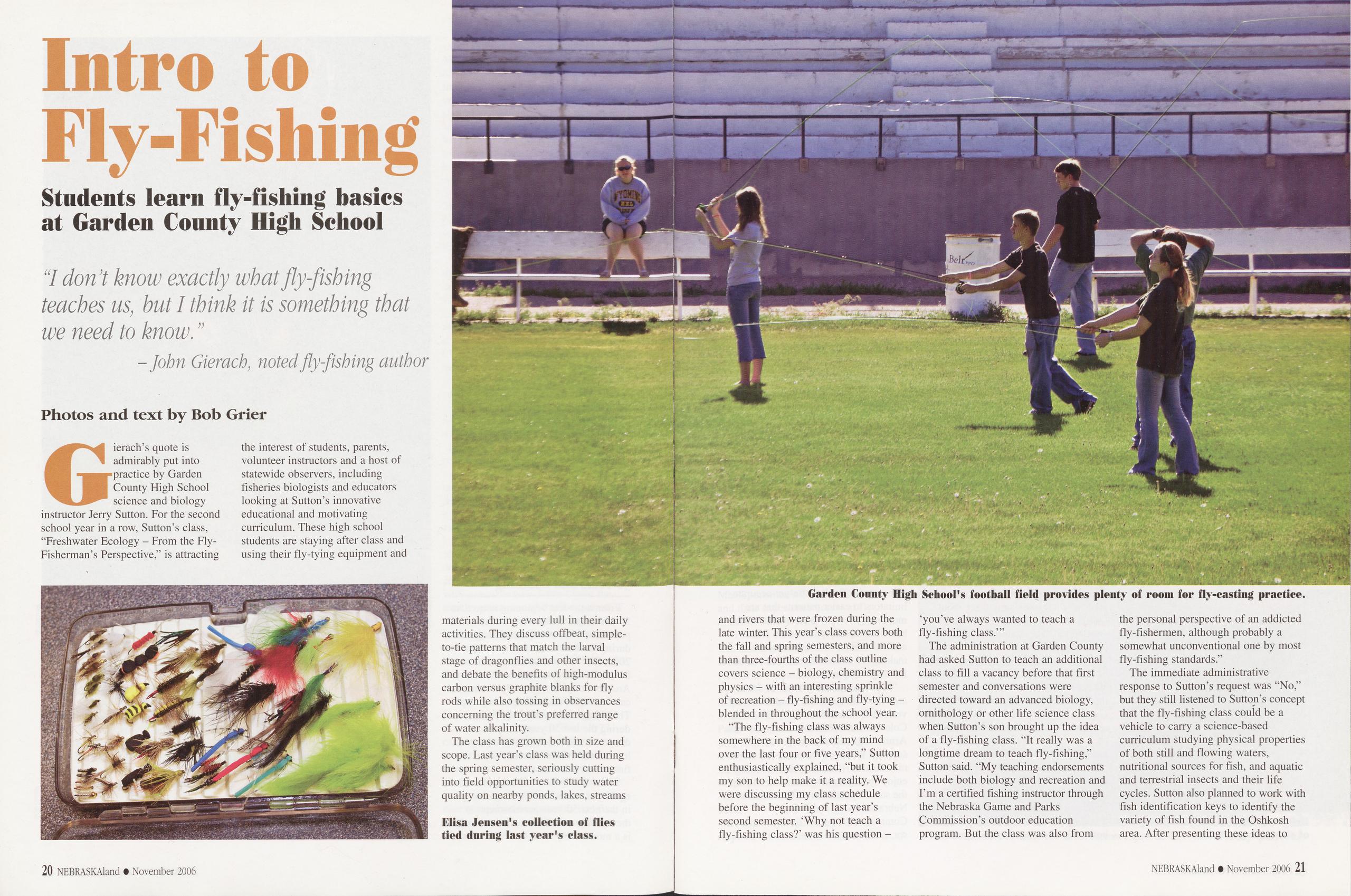
Intro to Fly-Fishing
Students learn fly-fishing basics at Garden County High School I don’t know exactly what fly-fishing teaches us, but I think it is something that we need to know. ” -John Gierach, noted fly-fishing author Photos and text by Bob GrierGierach’s quote is admirably put into practice by Garden County High School science and biology instructor Jerry Sutton. For the second school year in a row, Sutton’s class, “Freshwater Ecology - From the Fly- Fisherman’s Perspective,” is attracting the interest of students, parents, volunteer instructors and a host of statewide observers, including fisheries biologists and educators looking at Sutton’s innovative educational and motivating curriculum. These high school students are staying after class and using their fly-tying equipment and materials during every lull in their daily activities. They discuss offbeat, simple- to-tie patterns that match the larval stage of dragonflies and other insects, and debate the benefits of high-modulus carbon versus graphite blanks for fly rods while also tossing in observances concerning the trout’s preferred range of water alkalinity.
The class has grown both in size and scope. Last year’s class was held during the spring semester, seriously cutting into field opportunities to study water quality on nearby ponds, lakes, streams Elisa Jensen's collection of flies tied during last year's class. and rivers that were frozen during the late winter. This year’s class covers both the fall and spring semesters, and more than three-fourths of the class outline covers science - biology, chemistry and physics - with an interesting sprinkle of recreation - fly-fishing and fly-tying - blended in throughout the school year.
“The fly-fishing class was always somewhere in the back of my mind over the last four or five years,” Sutton enthusiastically explained, “but it took my son to help make it a reality. We were discussing my class schedule before the beginning of last year’s second semester. ‘Why not teach a fly-fishing class?’ was his question - ‘you’ve always wanted to teach a fly-fishing class.’”
The administration at Garden County had asked Sutton to teach an additional class to fill a vacancy before that first semester and conversations were directed toward an advanced biology, ornithology or other life science class when Sutton’s son brought up the idea of a fly-fishing class. “It really was a longtime dream to teach fly-fishing,” Sutton said. “My teaching endorsements include both biology and recreation and I’m a certified fishing instructor through the Nebraska Game and Parks Commission’s outdoor education program. But the class was also from the personal perspective of an addicted fly-fishermen, although probably a somewhat unconventional one by most fly-fishing standards.”
The immediate administrative
response to Sutton’s request was “No,”
but they still listened to Sutton’s concept
that the fly-fishing class could be a
vehicle to carry a science-based
curriculum studying physical properties
of both still and flowing waters,
nutritional sources for fish, and aquatic
and terrestrial insects and their life
cycles. Sutton also planned to work with
fish identification keys to identify the
variety of fish found in the Oshkosh
area. After presenting these ideas to
20 NEBRASKAland • November 2006
NEBRASKAland • November 2006 21
 school administration, he ultimately
received their blessing and set about
elaborate, difficult-to-tie-yet-accurate
imitators to easier patterns that are
finding resource materials and
developing a class outline describing
the course of study.
school administration, he ultimately
received their blessing and set about
elaborate, difficult-to-tie-yet-accurate
imitators to easier patterns that are
finding resource materials and
developing a class outline describing
the course of study.
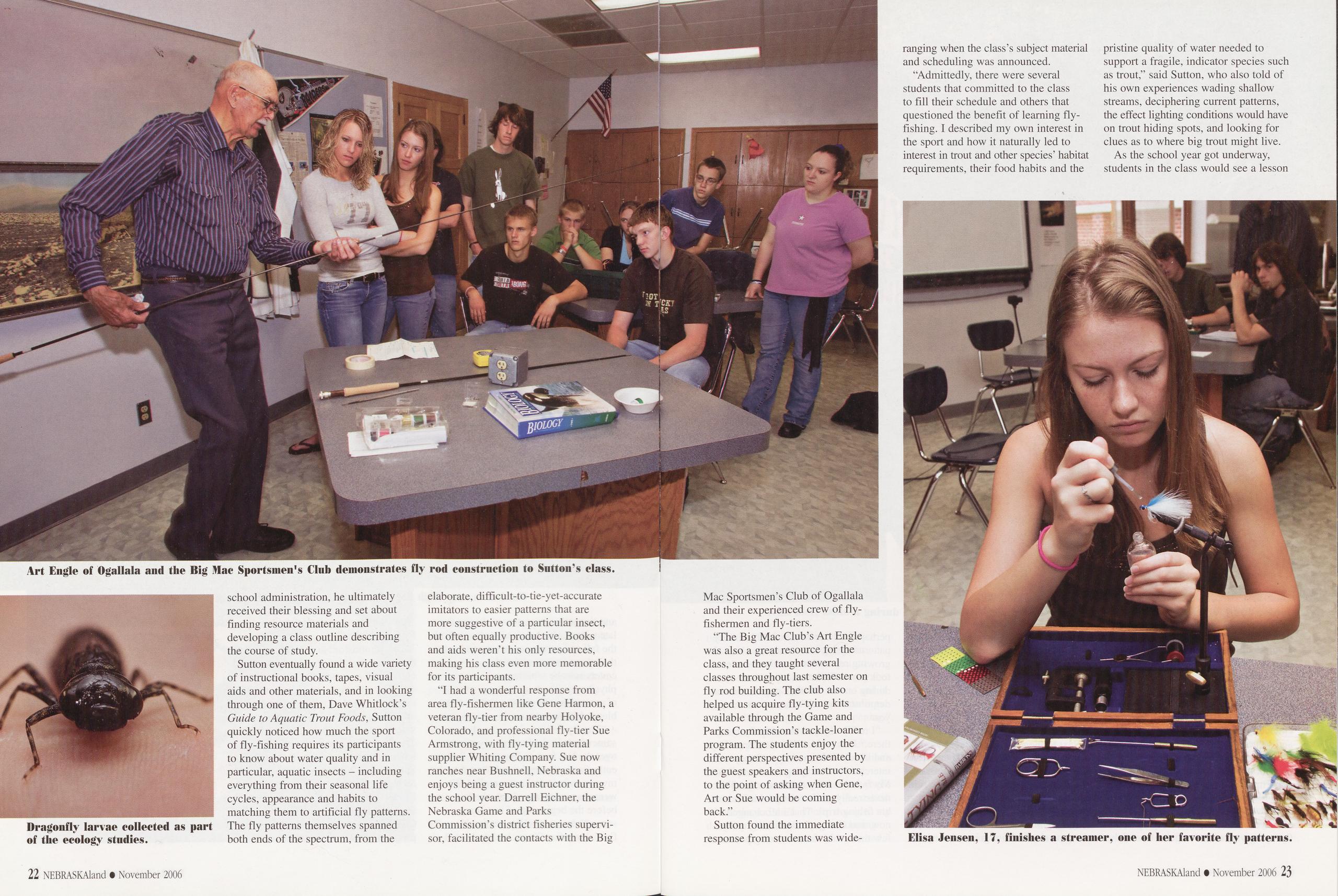
Sutton eventually found a wide variety of instructional books, tapes, visual aids and other materials, and in looking through one of them, Dave Whitlock’s Guide to Aquatic Trout Foods, Sutton quickly noticed how much the sport of fly-fishing requires its participants to know about water quality and in particular, aquatic insects - including everything from their seasonal life more suggestive of a particular insect, but often equally productive. Books and aids weren’t his only resources, making his class even more memorable for its participants.
"I had a wonderful response from area fly-fishermen like Gene Harmon, a veteran fly-tier from nearby Holyoke, Colorado, and professional fly-tier Sue Armstrong, with fly-tying material supplier Whiting Company. Sue now ranches near Bushnell, Nebraska and enjoys being a guest instructor during cycles, appearance and habits to matching them to artificial fly patterns. the school year. Darrell Eichner, the Nebraska Game and Parks Dragonfly larvae collected as part of the ecology studies. The fly patterns themselves spanned both ends of the spectrum, from the Commission’s district fisheries supervi- sor, facilitated the contacts with the Big Mac Sportsmen’s Club of Ogallala and their experienced crew of fly- fishermen and fly-tiers.
“The Big Mac Club’s Art Engle was also a great resource for the class, and they taught several classes throughout last semester on fly rod building. The club also helped us acquire fly-tying kits available through the Game and Parks Commission’s tackle-loaner program. The students enjoy the different perspectives presented by the guest speakers and instructors, to the point of asking when Gene, Art or Sue would be coming back.”
Sutton found the immediate response from students was wide- ranging when the class’s subject material and scheduling was announced.
“Admittedly, there were several students that committed to the class to fill their schedule and others that questioned the benefit of learning fly- fishing. I described my own interest in the sport and how it naturally led to interest in trout and other species’ habitat requirements, their food habits and the pristine quality of water needed to support a fragile, indicator species such as trout,” said Sutton, who also told of his own experiences wading shallow streams, deciphering current patterns, the effect lighting conditions would have on trout hiding spots, and looking for clues as to where big trout might live.
As the school year got underway,
students in the class would see a lesson
22 NEBRASKAland • November 2006
NEBRASKAland • November 2006 23
 devoted to water ecology followed by
an outdoor fly-casting class on the
school’s football field, a nearby pond
or the North Platte River.
devoted to water ecology followed by
an outdoor fly-casting class on the
school’s football field, a nearby pond
or the North Platte River.
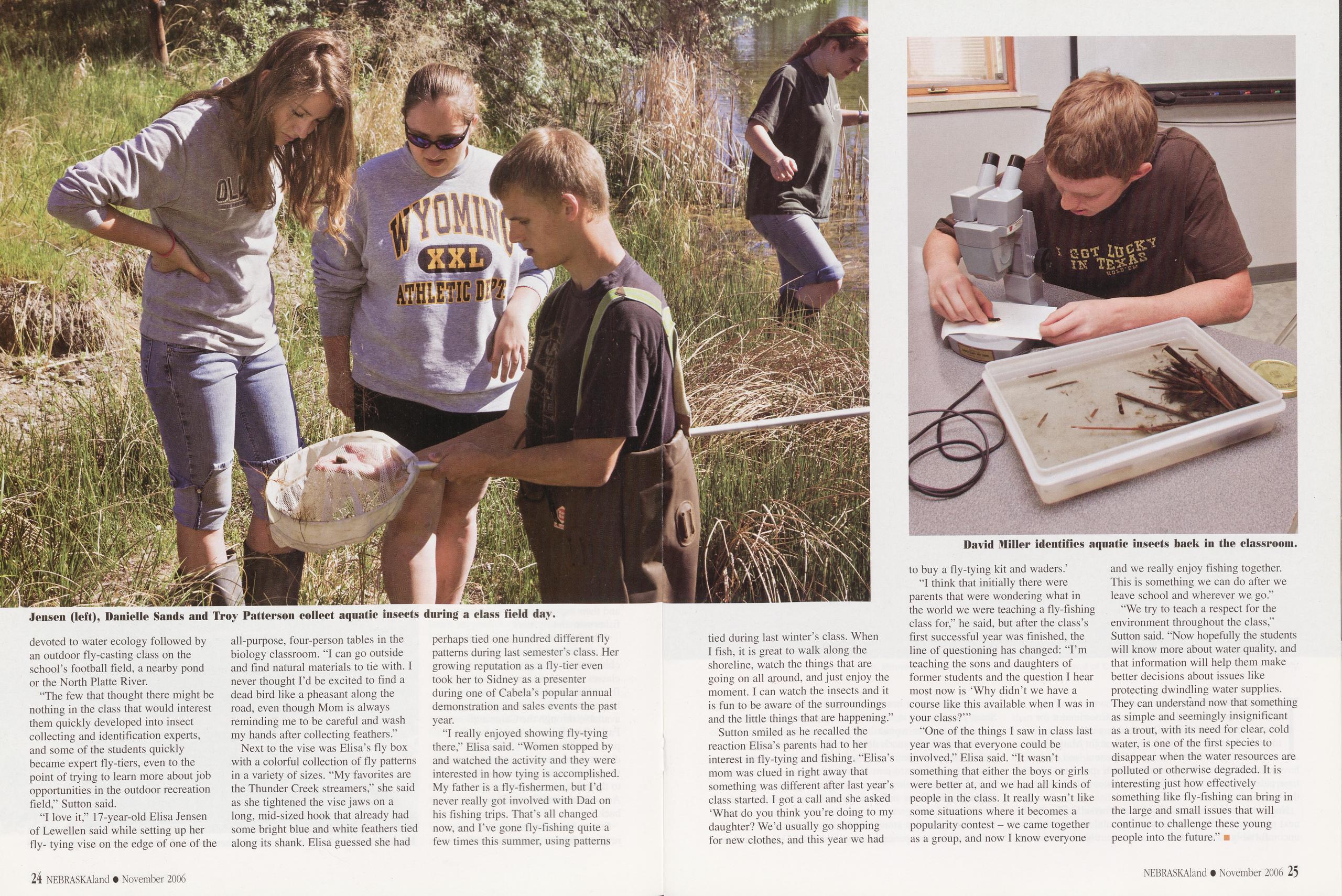
“The few that thought there might be nothing in the class that would interest them quickly developed into insect collecting and identification experts, and some of the students quickly became expert fly-tiers, even to the point of trying to learn more about job opportunities in the outdoor recreation field,” Sutton said.
"I love it,” 17-year-old Elisa Jensen of Lewellen said while setting up her fly- tying vise on the edge of one of the all-purpose, four-person tables in the biology classroom. T can go outside and find natural materials to tie with. I never thought I’d be excited to find a dead bird like a pheasant along the road, even though Mom is always reminding me to be careful and wash my hands after collecting feathers.”
Next to the vise was Elisa’s fly box with a colorful collection of fly patterns in a variety of sizes. “My favorites are the Thunder Creek streamers,” she said as she tightened the vise jaws on a long, mid-sized hook that already had some bright blue and white feathers tied along its shank. Elisa guessed she had perhaps tied one hundred different fly patterns during last semester’s class. Her growing reputation as a fly-tier even took her to Sidney as a presenter during one of Cabela’s popular annual demonstration and sales events the past year.
“I really enjoyed showing fly-tying there,” Elisa said. “Women stopped by and watched the activity and they were interested in how tying is accomplished. My father is a fly-fishermen, but I’d never really got involved with Dad on his fishing trips. That’s all changed now, and I’ve gone fly-fishing quite a few times this summer, using patterns tied during last winter’s class. When I fish, it is great to walk along the shoreline, watch the things that are going on all around, and just enjoy the moment. I can watch the insects and it is fun to be aware of the surroundings and the little things that are happening.”
Sutton smiled as he recalled the reaction Elisa’s parents had to her interest in fly-tying and fishing. “Elisa’s mom was clued in right away that something was different after last year’s class started. I got a call and she asked ‘What do you think you’re doing to my daughter? We’d usually go shopping for new clothes, and this year we had to buy a fly-tying kit and waders.’ “I think that initially there were parents that were wondering what in the world we were teaching a fly-fishing class for,” he said, but after the class’s first successful year was finished, the line of questioning has changed: “I’m teaching the sons and daughters of former students and the question I hear most now is ‘Why didn’t we have a course like this available when I was in your class?”’
“One of the things I saw in class last year was that everyone could be involved,” Elisa said. “It wasn’t something that either the boys or girls were better at, and we had all kinds of people in the class. It really wasn’t like some situations where it becomes a popularity contest - we came together as a group, and now I know everyone and we really enjoy fishing together. This is something we can do after we leave school and wherever we go.”
“We try to teach a respect for the environment throughout the class,” Sutton said. “Now hopefully the students will know more about water quality, and that information will help them make better decisions about issues like protecting dwindling water supplies. They can understand now that something as simple and seemingly insignificant as a trout, with its need for clear, cold water, is one of the first species to disappear when the water resources are polluted or otherwise degraded. It is interesting just how effectively something like fly-fishing can bring in the large and small issues that will continue to challenge these young people into the future.” ■
24 NEBRASKAland • November 2006 NEBRASKAland • November 2006 25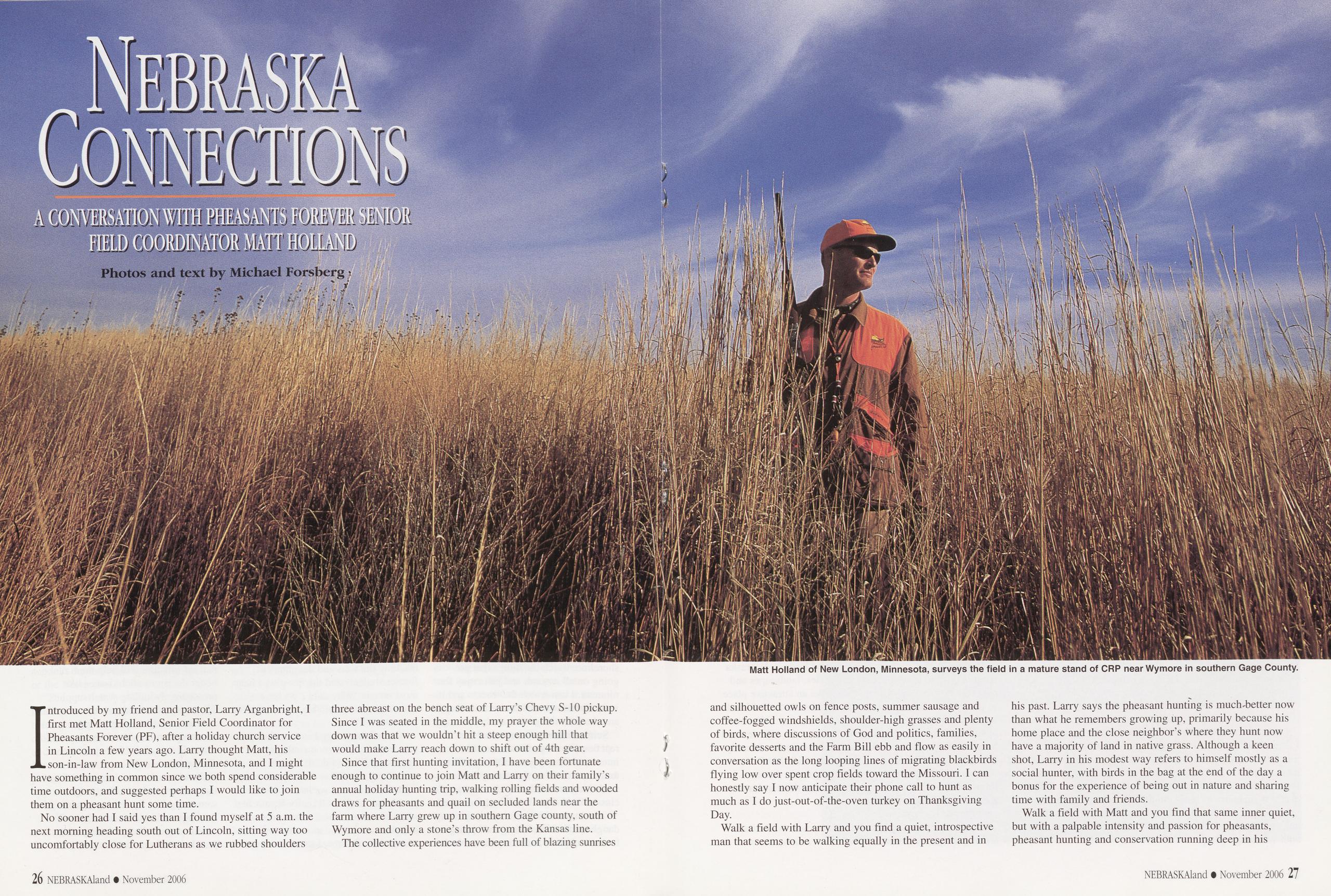
Nebraska Connections
A Conversation with Pheasants Forever Senior Field Coordinator Matt Holland Photos and text by Michael ForsbergIntroduced by my friend and pastor, Larry Arganbright, I first met Matt Holland, Senior Field Coordinator for Pheasants Forever (PF), after a holiday church service in Lincoln a few years ago. Larry thought Matt, his son-in-law from New London, Minnesota, and I might have something in common since we both spend considerable time outdoors, and suggested perhaps I would like to join them on a pheasant hunt some time.
No sooner had I said yes than I found myself at 5 a.m. the next morning heading south out of Lincoln, sitting way too uncomfortably close for Lutherans as we rubbed shoulders three abreast on the bench seat of Larry’s Chevy 8-10 pickup. Since I was seated in the middle, my prayer the whole way down was that we wouldn’t hit a steep enough hill that would make Larry reach down to shift out of 4th gear.
Since that first hunting invitation, I have been fortunate enough to continue to join Matt and Larry on their family’s annual holiday hunting trip, walking rolling fields and wooded draws for pheasants and quail on secluded lands near the farm where Larry grew up in southern Gage county, south of Wymore and only a stone’s throw from the Kansas line.
The collective experiences have been full of blazing sunrises and silhouetted owls on fence posts, summer sausage and coffee-fogged windshields, shoulder-high grasses and plenty of birds, where discussions of God and politics, families, favorite desserts and the Farm Bill ebb and flow as easily in conversation as the long looping lines of migrating blackbirds flying low over spent crop fields toward the Missouri. I can honestly say I now anticipate their phone call to hunt as much as I do just-out-of-the-oven turkey on Thanksgiving Day.
Walk a field with Larry and you find a quiet, introspective man that seems to be walking equally in the present and in his past. Larry says the pheasant hunting is much-better now than what he remembers growing up, primarily because his home place and the close neighbor’s where they hunt now have a majority of land in native grass. Although a keen shot, Larry in his modest way refers to himself mostly as a social hunter, with birds in the bag at the end of the day a bonus for the experience of being out in nature and sharing time with family and friends.
Walk a field with Matt and you find that same inner quiet, but with a palpable intensity and passion for pheasants, pheasant hunting and conservation running deep in his
26 NEBRASKAland • November 2006 NEBRASKAland • November 2006 27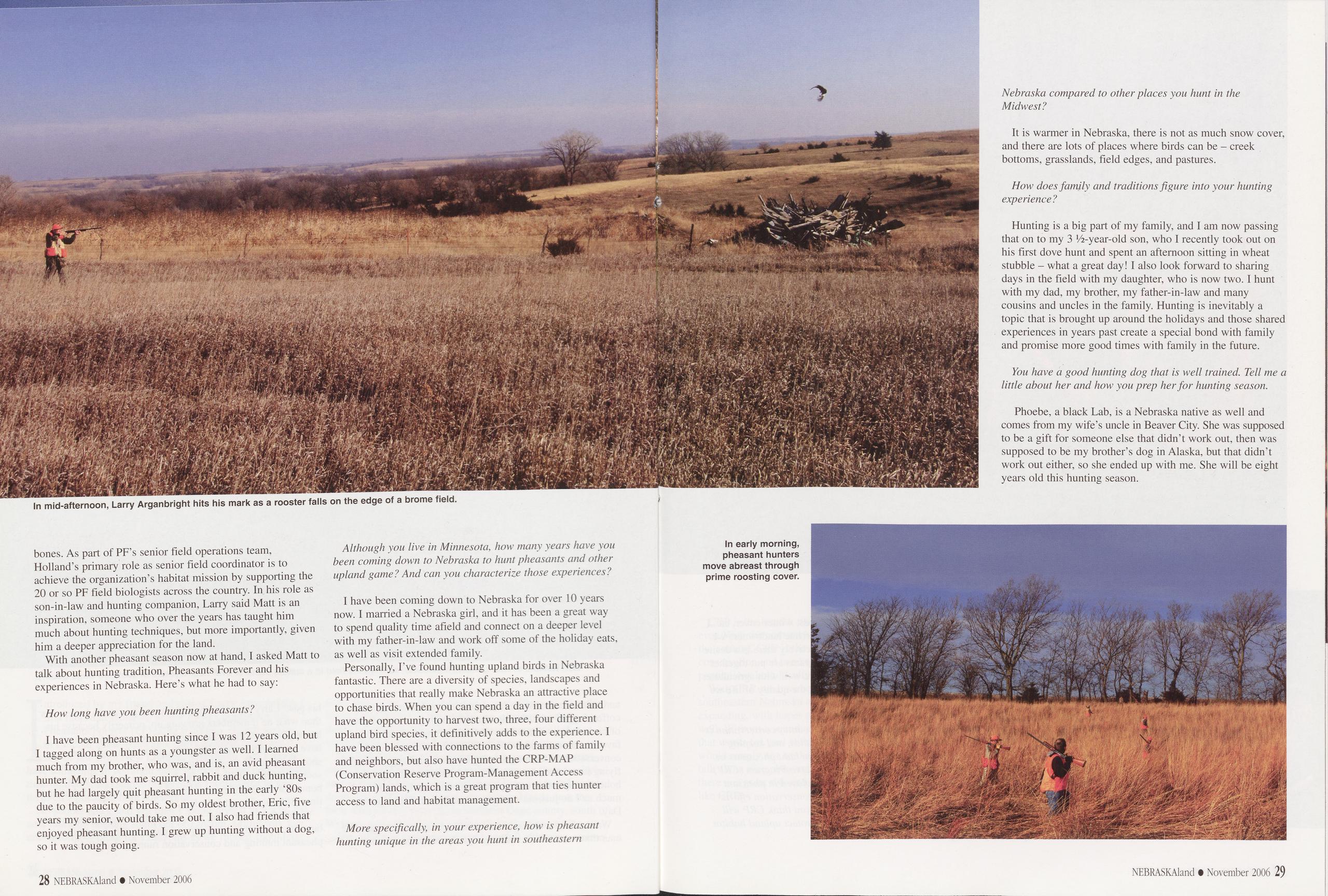
Nebraska compared to other places you hunt in the Midwest?
In mid-afternoon, Larry Arganbright hits his mark as a rooster falls on the edge of a brome field.
It is warmer in Nebraska, there is not as much snow cover, and there are lots of places where birds can be - creek bottoms, grasslands, field edges, and pastures. How does family and traditions figure into your hunting experience ?
Hunting is a big part of my family, and I am now passing that on to my 3 year-old son, who I recently took out on his first dove hunt and spent an afternoon sitting in wheat stubble - what a great day! I also look forward to sharing days in the field with my daughter, who is now two. I hunt with my dad, my brother, my father-in-law and many cousins and uncles in the family. Hunting is inevitably a topic that is brought up around the holidays and those shared experiences in years past create a special bond with family and promise more good times with family in the future.
You have a good hunting dog that is well trained. Tell me a little about her and how you prep her for hunting season.
Phoebe, a black Lab, is a Nebraska native as well and comes from my wife’s uncle in Beaver City. She was supposed to be a gift for someone else that didn’t work out, then was supposed to be my brother’s dog in Alaska, but that didn’t work out either, so she ended up with me. She will be eight years old this hunting season.
As part of PF’s senior field operations team, Holland’s primary role as senior field coordinator is to achieve the organization’s habitat mission by supporting the 20 or so PF field biologists across the country. In his role as son-in-law and hunting companion, Larry said Matt is an inspiration, someone who over the years has taught him much about hunting techniques, but more importantly, given him a deeper appreciation for the land.
With another pheasant season now at hand, I asked Matt to talk about hunting tradition, Pheasants Forever and his experiences in Nebraska. Here’s what he had to say:
How long have you been hunting pheasants?
I have been pheasant hunting since I was 12 years old, but I tagged along on hunts as a youngster as well. I learned much from my brother, who was, and is, an avid pheasant hunter. My dad took me squirrel, rabbit and duck hunting, but he had largely quit pheasant hunting in the early ‘80s due to the paucity of birds. So my oldest brother, Eric, five years my senior, would take me out. I also had friends that enjoyed pheasant hunting. I grew up hunting without a dog, so it was tough going.
Although you live in Minnesota, how many years have you been coming down to Nebraska to hunt pheasants and other upland game? And can you characterize those experiences?
I have been coming down to Nebraska for over 10 years now. I married a Nebraska girl, and it has been a great way to spend quality time afield and connect on a deeper level with my father-in-law and work off some of the holiday eats, as well as visit extended family.
Personally, I’ve found hunting upland birds in Nebraska fantastic. There are a diversity of species, landscapes and opportunities that really make Nebraska an attractive place to chase birds. When you can spend a day in the field and have the opportunity to harvest two, three, four different upland bird species, it definitively adds to the experience. I have been blessed with connections to the farms of family and neighbors, but also have hunted the CRP-MAP (Conservation Reserve Program-Management Access Program) lands, which is a great program that ties hunter access to land and habitat management.
More specifically, in your experience, how is pheasant hunting unique in the areas you hunt in southeastern
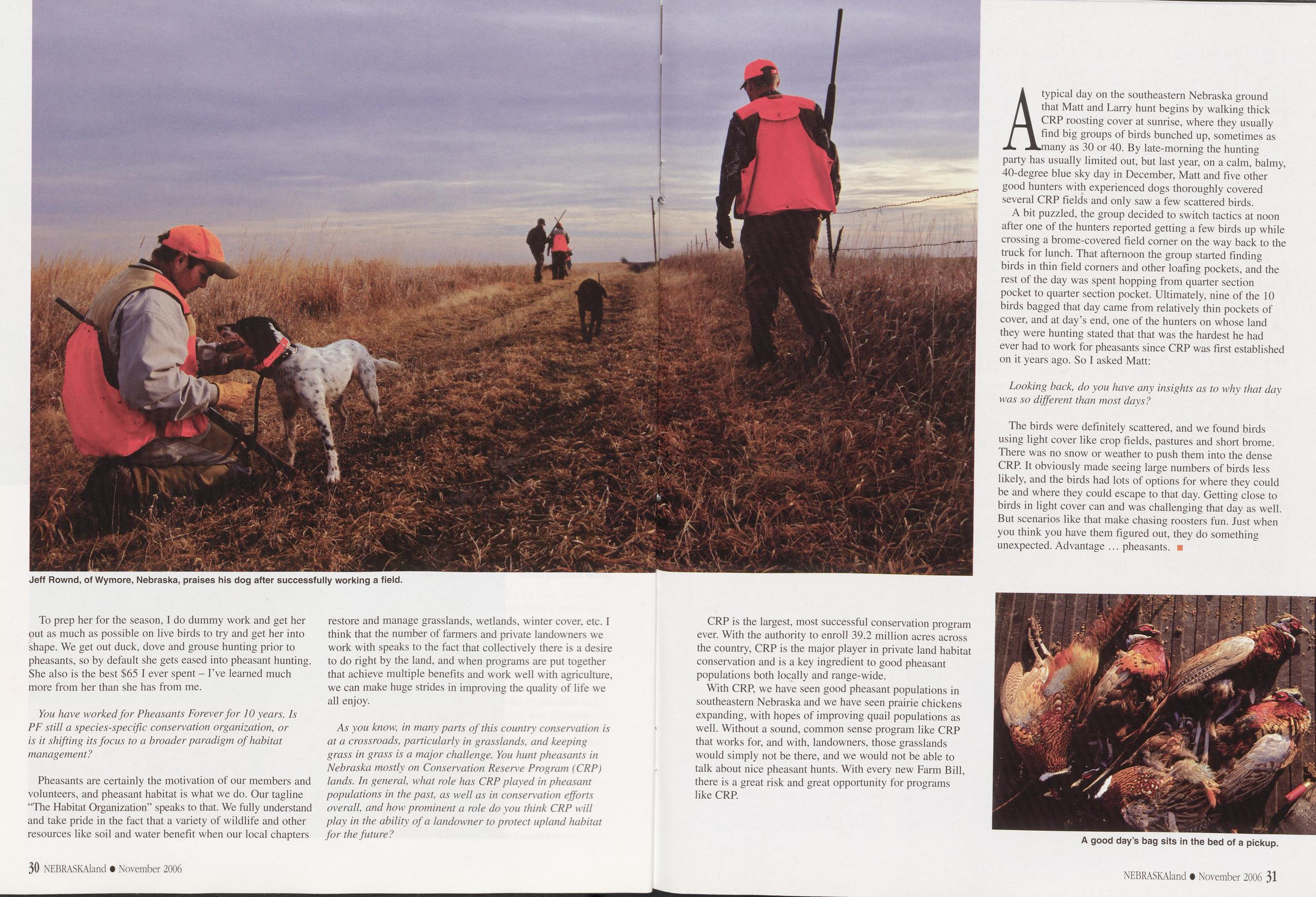
To prep her for the season, I do dummy work and get her out as much as possible on live birds to try and get her into shape. We get out duck, dove and grouse hunting prior to pheasants, so by default she gets eased into pheasant hunting. She also is the best $65 I ever spent - I’ve learned much more from her than she has from me.
You have worked for Pheasants Forever for 10 years. Is PF still a species-specific conservation organization, or is it shifting its focus to a broader paradigm of habitat management?
Pheasants are certainly the motivation of our members and volunteers, and pheasant habitat is what we do. Our tagline “The Habitat Organization” speaks to that. We fully understand and take pride in the fact that a variety of wildlife and other resources like soil and water benefit when our local chapters restore and manage grasslands, wetlands, winter cover, etc. I think that the number of farmers and private landowners we work with speaks to the fact that collectively there is a desire to do right by the land, and when programs are put together that achieve multiple benefits and work well with agriculture, we can make huge strides in improving the quality of life we all enjoy.
As you know, in many parts of this country conservation is at a crossroads, particularly in grasslands, and keeping grass in grass is a major challenge. You hunt pheasants in Nebraska mostly on Conservation Reserve Program (CRP) lands. In general, what role has CRP played in pheasant populations in the past, as well as in conservation efforts overall, and how prominent a role do you think CRP will play in the ability of a landowner to protect upland habitat for the future?
CRP is the largest, most successful conservation program ever. With the authority to enroll 39.2 million acres across the country, CRP is the major player in private land habitat conservation and is a key ingredient to good pheasant populations both locally and range-wide.
With CRP, we have seen good pheasant populations in southeastern Nebraska and we have seen prairie chickens expanding, with hopes of improving quail populations as well. Without a sound, common sense program like CRP that works for, and with, landowners, those grasslands would simply not be there, and we would not be able to talk about nice pheasant hunts. With every new Farm Bill, there is a great risk and great opportunity for programs like CRP.
Atypical day on the southeastern Nebraska ground that Matt and Larry hunt begins by walking thick CRP roosting cover at sunrise, where they usually find big groups of birds bunched up, sometimes as many as 30 or 40. By late-morning the hunting party has usually limited out, but last year, on a calm, balmy, 40-degree blue sky day in December, Matt and five other good hunters with experienced dogs thoroughly covered several CRP fields and only saw a few scattered birds.
A bit puzzled, the group decided to switch tactics at noon after one of the hunters reported getting a few birds up while crossing a brome-covered field corner on the way back to the truck for lunch. That afternoon the group started finding birds in thin field corners and other loafing pockets, and the rest of the day was spent hopping from quarter section pocket to quarter section pocket. Ultimately, nine of the 10 birds bagged that day came from relatively thin pockets of cover, and at day’s end, one of the hunters on whose land they were hunting stated that that was the hardest he had ever had to work for pheasants since CRP was first established on it years ago. So I asked Matt:
Looking back, do you have any insights as to why that day was so different than most days?
The birds were definitely scattered, and we found birds using light cover like crop fields, pastures and short brome. There was no snow or weather to push them into the dense CRP. It obviously made seeing large numbers of birds less likely, and the birds had lots of options for where they could be and where they could escape to that day. Getting close to birds in light cover can and was challenging that day as well. But scenarios like that make chasing roosters fun. Just when you think you have them figured out, they do something unexpected. Advantage ... pheasants. ■
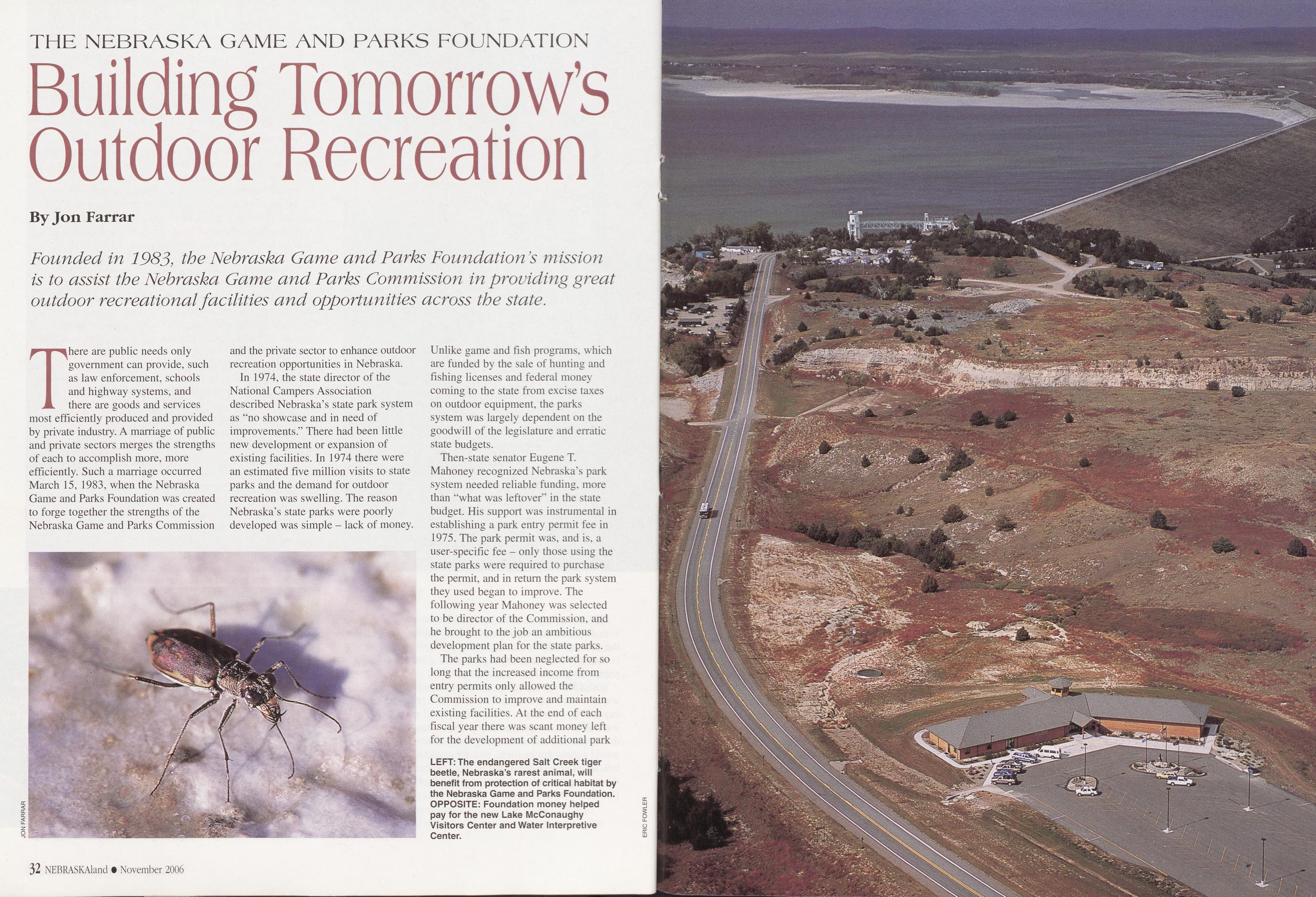
There are public needs only government can provide, such as law enforcement, schools and highway systems, and there are goods and services most efficiently produced and provided by private industry. A marriage of public and private sectors merges the strengths of each to accomplish more, more efficiently. Such a marriage occurred March 15, 1983, when the Nebraska Game and Parks Foundation was created to forge together the strengths of the Nebraska Game and Parks Commission and the private sector to enhance outdoor recreation opportunities in Nebraska.
In 1974, the state director of the National Campers Association described Nebraska’s state park system as "no showcase and in need of improvements.” There had been little new development or expansion of existing facilities. In 1974 there were an estimated five million visits to state parks and the demand for outdoor recreation was swelling. The reason Nebraska’s state parks were poorly developed was simple - lack of money. Unlike game and fish programs, which are funded by the sale of hunting and fishing licenses and federal money coming to the state from excise taxes on outdoor equipment, the parks system was largely dependent on the goodwill of the legislature and erratic state budgets.
Then-state senator Eugene T. Mahoney recognized Nebraska’s park system needed reliable funding, more than "what was leftover” in the state budget. His support was instrumental in establishing a park entry permit fee in 1975. The park permit was, and is, a user-specific fee - only those using the state parks were required to purchase the permit, and in return the park system they used began to improve. The following year Mahoney was selected to be director of the Commission, and he brought to the job an ambitious development plan for the state parks.
The parks had been neglected for so
long that the increased income from
entry permits only allowed the
Commission to improve and maintain
existing facilities. At the end of each
fiscal year there was scant money left
for the development of additional park
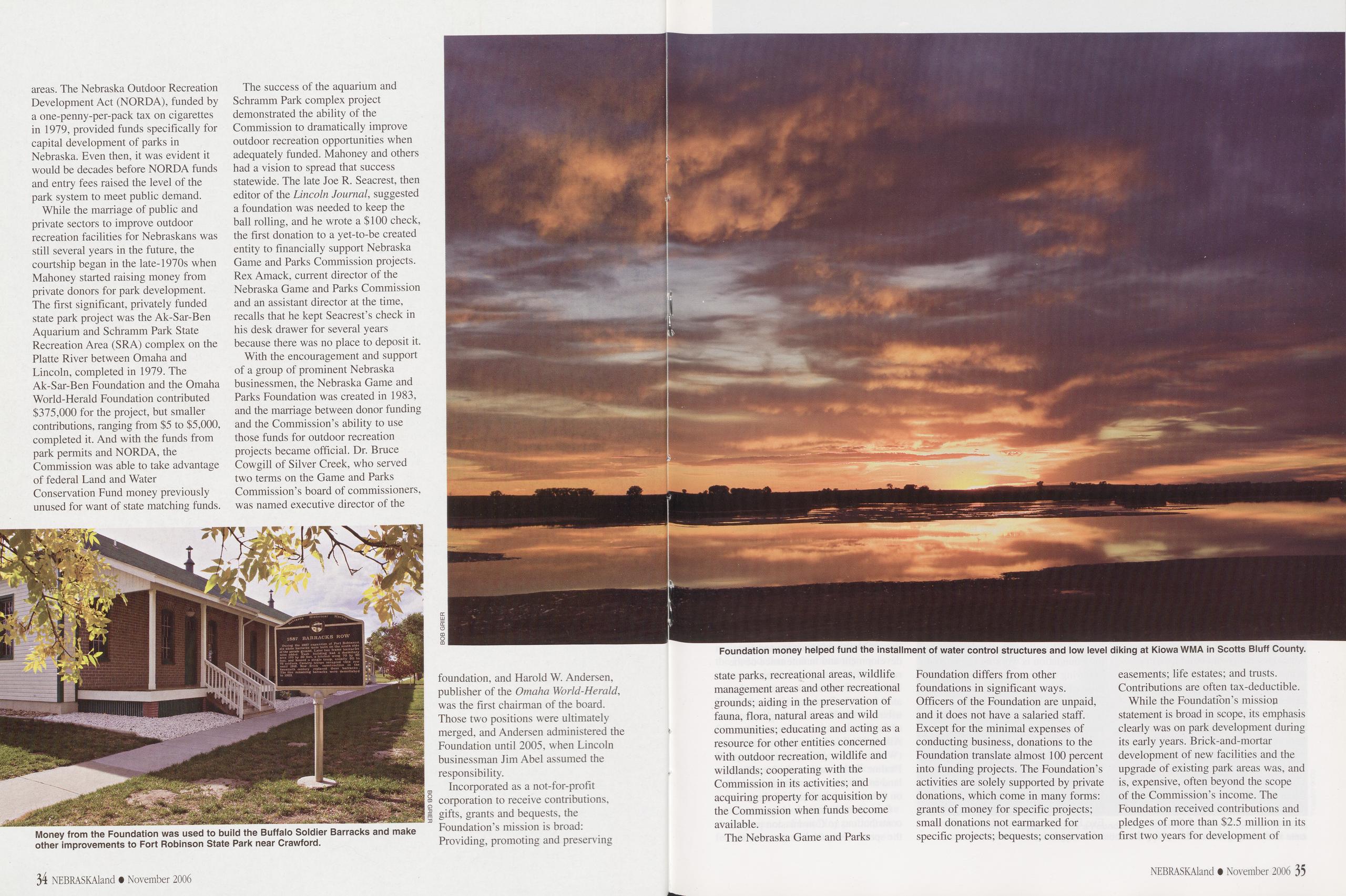 areas. The Nebraska Outdoor Recreation
Development Act (NORDA), funded by
a one-penny-per-pack tax on cigarettes
in 1979, provided funds specifically for
capital development of parks in
Nebraska. Even then, it was evident it
would be decades before NORDA funds
and entry fees raised the level of the
park system to meet public demand.
areas. The Nebraska Outdoor Recreation
Development Act (NORDA), funded by
a one-penny-per-pack tax on cigarettes
in 1979, provided funds specifically for
capital development of parks in
Nebraska. Even then, it was evident it
would be decades before NORDA funds
and entry fees raised the level of the
park system to meet public demand.
While the marriage of public and private sectors to improve outdoor recreation facilities for Nebraskans was still several years in the future, the courtship began in the late-1970s when Mahoney started raising money from private donors for park development. The first significant, privately funded state park project was the Ak-Sar-Ben Aquarium and Schramm Park State Recreation Area (SRA) complex on the Platte River between Omaha and Lincoln, completed in 1979. The Ak-Sar-Ben Foundation and the Omaha World-Herald Foundation contributed $375,000 for the project, but smaller contributions, ranging from $5 to $5,000, completed it. And with the funds from park permits and NORDA, the Commission was able to take advantage of federal Land and Water Conservation Fund money previously unused for want of state matching funds.
The success of the aquarium and Schramm Park complex project demonstrated the ability of the Commission to dramatically improve outdoor recreation opportunities when adequately funded. Mahoney and others had a vision to spread that success statewide. The late Joe R. Seacrest, then editor of the Lincoln Journal, suggested a foundation was needed to keep the ball rolling, and he wrote a $100 check, the first donation to a yet-to-be created entity to financially support Nebraska Game and Parks Commission projects. Rex Amack, current director of the Nebraska Game and Parks Commission and an assistant director at the time, recalls that he kept Seacrest’s check in his desk drawer for several years because there was no place to deposit it.
With the encouragement and support of a group of prominent Nebraska businessmen, the Nebraska Game and Parks Foundation was created in 1983, and the marriage between donor funding and the Commission’s ability to use those funds for outdoor recreation projects became official. Dr. Bruce Cowgill of Silver Creek, who served two terms on the Game and Parks Commission’s board of commissioners, was named executive director of the foundation, and Harold W. Andersen, publisher of the Omaha World-Herald, was the first chairman of the board. Those two positions were ultimately merged, and Andersen administered the Foundation until 2005, when Lincoln businessman Jim Abel assumed the responsibility.
Incorporated as a not-for-profit corporation to receive contributions, gifts, grants and bequests, the Foundation’s mission is broad: Providing, promoting and preserving state parks, recreational areas, wildlife management areas and other recreational grounds; aiding in the preservation of fauna, flora, natural areas and wild communities; educating and acting as a resource for other entities concerned with outdoor recreation, wildlife and wildlands; cooperating with the Commission in its activities; and acquiring property for acquisition by the Commission when funds become available.
The Nebraska Game and Parks Foundation differs from other foundations in significant ways. Officers of the Foundation are unpaid, and it does not have a salaried staff. Except for the minimal expenses of conducting business, donations to the Foundation translate almost 100 percent into funding projects. The Foundation’s activities are solely supported by private donations, which come in many forms: grants of money for specific projects; small donations not earmarked for specific projects; bequests; conservation easements; life estates; and trusts. Contributions are often tax-deductible.
While the Foundation’s mission
statement is broad in scope, its emphasis
clearly was on park development during
its early years. Brick-and-mortar
development of new facilities and the
upgrade of existing park areas was, and
is, expensive, often beyond the scope
of the Commission’s income. The
Foundation received contributions and
pledges of more than $2.5 million in its
first two years for development of
34 NEBRASKAland • November 2006
NEBRASKAland • November 2006 35
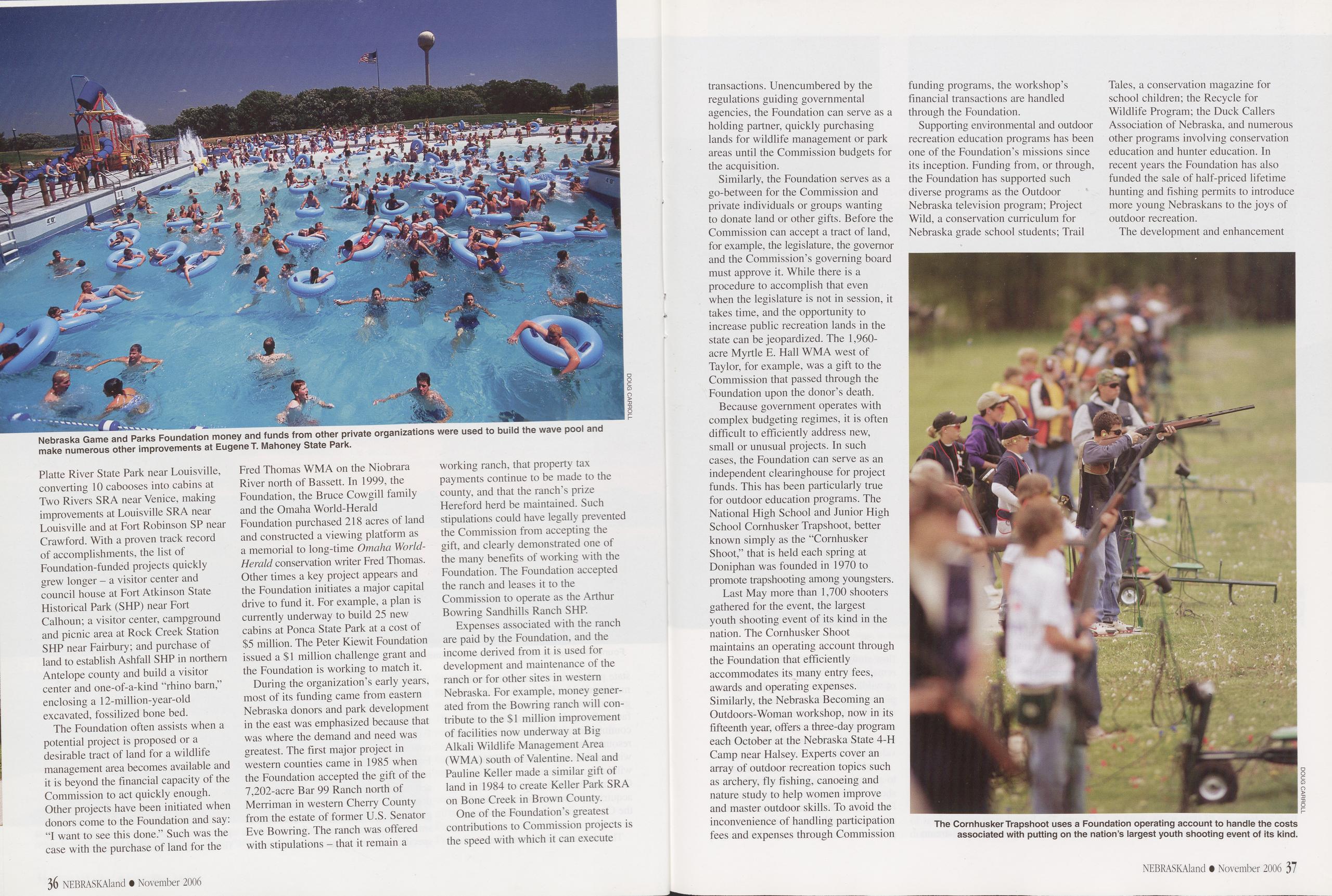 Platte River State Park near Louisville,
converting 10 cabooses into cabins at
Two Rivers SRA near Venice, making
improvements at Louisville SRA near
Louisville and at Fort Robinson SP near
Crawford. With a proven track record
of accomplishments, the list of
Foundation-funded projects quickly
grew longer - a visitor center and
council house at Fort Atkinson State
Historical Park (SHP) near Fort
Calhoun; a visitor center, campground
and picnic area at Rock Creek Station
SHP near Fairbury; and purchase of
land to establish Ashfall SHP in northern
Antelope county and build a visitor
center and one-of-a-kind "rhino barn,”
enclosing a 12-million-year-old
excavated, fossilized bone bed.
Platte River State Park near Louisville,
converting 10 cabooses into cabins at
Two Rivers SRA near Venice, making
improvements at Louisville SRA near
Louisville and at Fort Robinson SP near
Crawford. With a proven track record
of accomplishments, the list of
Foundation-funded projects quickly
grew longer - a visitor center and
council house at Fort Atkinson State
Historical Park (SHP) near Fort
Calhoun; a visitor center, campground
and picnic area at Rock Creek Station
SHP near Fairbury; and purchase of
land to establish Ashfall SHP in northern
Antelope county and build a visitor
center and one-of-a-kind "rhino barn,”
enclosing a 12-million-year-old
excavated, fossilized bone bed.
The Foundation often assists when a potential project is proposed or a desirable tract of land for a wildlife management area becomes available and it is beyond the financial capacity of the Commission to act quickly enough. Other projects have been initiated when donors come to the Foundation and say: "I want to see this done.” Such was the case with the purchase of land for the Fred Thomas WMA on the Niobrara River north of Bassett. In 1999, the Foundation, the Bruce Cowgill family and the Omaha World-Herald Foundation purchased 218 acres of land and constructed a viewing platform as a memorial to long-time Omaha World- Herald conservation writer Fred Thomas. Other times a key project appears and the Foundation initiates a major capital drive to fund it. For example, a plan is currently underway to build 25 new cabins at Ponca State Park at a cost of $5 million. The Peter Kiewit Foundation issued a $1 million challenge grant and the Foundation is working to match it.
During the organization’s early years, most of its funding came from eastern Nebraska donors and park development in the east was emphasized because that was where the demand and need was greatest. The first major project in western counties came in 1985 when the Foundation accepted the gift of the 7,202-acre Bar 99 Ranch north of Merriman in western Cherry County from the estate of former U.S. Senator Eve Bowring. The ranch was offered with stipulations - that it remain a working ranch, that property tax payments continue to be made to the county, and that the ranch’s prize Hereford herd be maintained. Such stipulations could have legally prevented the Commission from accepting the gift, and clearly demonstrated one of the many benefits of working with the Foundation. The Foundation accepted the ranch and leases it to the Commission to operate as the Arthur Bowring Sandhills Ranch SHP.
Expenses associated with the ranch are paid by the Foundation, and the income derived from it is used for development and maintenance of the ranch or for other sites in western Nebraska. For example, money gener- ated from the Bowring ranch will con- tribute to the $ 1 million improvement of facilities now underway at Big Alkali Wildlife Management Area (WMA) south of Valentine. Neal and Pauline Keller made a similar gift of land in 1984 to create Keller Park SRA on Bone Creek in Brown County.
One of the Foundation’s greatest contributions to Commission projects is the speed with which it can execute transactions. Unencumbered by the regulations guiding governmental agencies, the Foundation can serve as a holding partner, quickly purchasing lands for wildlife management or park areas until the Commission budgets for the acquisition.
Similarly, the Foundation serves as a go-between for the Commission and private individuals or groups wanting to donate land or other gifts. Before the Commission can accept a tract of land, for example, the legislature, the governor and the Commission’s governing board must approve it. While there is a procedure to accomplish that even when the legislature is not in session, it takes time, and the opportunity to increase public recreation lands in the state can be jeopardized. The 1,960- acre Myrtle E. Hall WMA west of Taylor, for example, was a gift to the Commission that passed through the Foundation upon the donor’s death.
Because government operates with complex budgeting regimes, it is often difficult to efficiently address new, small or unusual projects. In such cases, the Foundation can serve as an independent clearinghouse for project funds. This has been particularly true for outdoor education programs. The National High School and Junior High School Cornhusker Trapshoot, better known simply as the “Cornhusker Shoot,” that is held each spring at Doniphan was founded in 1970 to promote trapshooting among youngsters.
Last May more than 1,700 shooters gathered for the event, the largest youth shooting event of its kind in the nation. The Cornhusker Shoot maintains an operating account through the Foundation that efficiently accommodates its many entry fees, awards and operating expenses. Similarly, the Nebraska Becoming an Outdoors-Woman workshop, now in its fifteenth year, offers a three-day program each October at the Nebraska State 4-H Camp near Halsey. Experts cover an array of outdoor recreation topics such as archery, fly fishing, canoeing and nature study to help women improve and master outdoor skills. To avoid the inconvenience of handling participation fees and expenses through Commission funding programs, the workshop’s financial transactions are handled through the Foundation.
Supporting environmental and outdoor recreation education programs has been one of the Foundation’s missions since its inception. Funding from, or through, the Foundation has supported such diverse programs as the Outdoor Nebraska television program; Project Wild, a conservation curriculum for Nebraska grade school students; Trail Tales, a conservation magazine for school children; the Recycle for Wildlife Program; the Duck Callers Association of Nebraska, and numerous other programs involving conservation education and hunter education. In recent years the Foundation has also funded the sale of half-priced lifetime hunting and fishing permits to introduce more young Nebraskans to the joys of outdoor recreation.
The development and enhancement
36 NEBRASKAland • November 2006
NEBRASKAland • November 2006 37
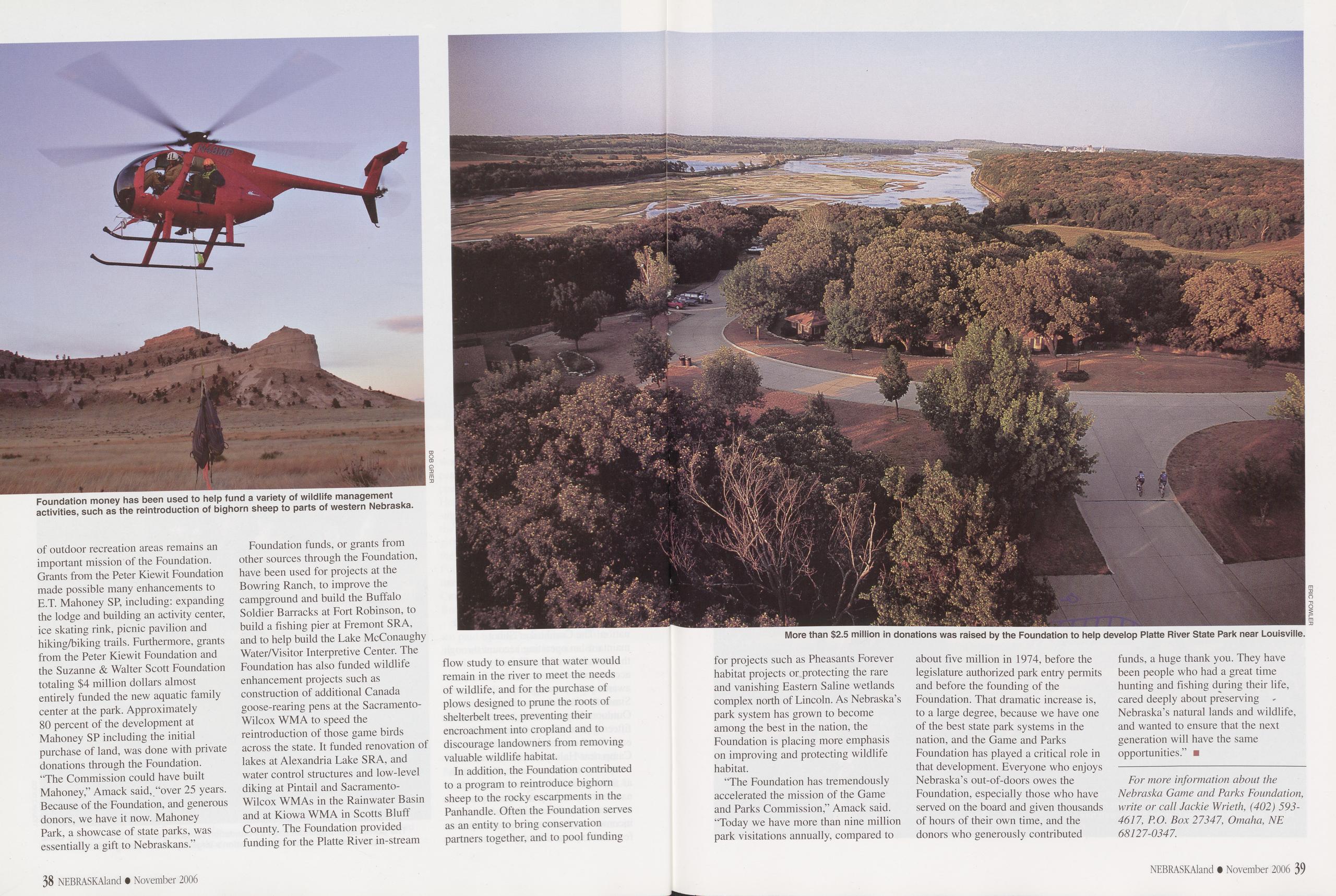 of outdoor recreation areas remains an
important mission of the Foundation.
Grants from the Peter Kiewit Foundation
made possible many enhancements to
E.T. Mahoney SP, including: expanding
the lodge and building an activity center,
ice skating rink, picnic pavilion and
hiking/biking trails. Furthermore, grants
from the Peter Kiewit Foundation and
the Suzanne & Walter Scott Foundation
totaling $4 million dollars almost
entirely funded the new aquatic family
center at the park. Approximately
80 percent of the development at
Mahoney SP including the initial
purchase of land, was done with private
donations through the Foundation.
“The Commission could have built
Mahoney,” Amack said, “over 25 years.
Because of the Foundation, and generous
donors, we have it now. Mahoney
Park, a showcase of state parks, was
essentially a gift to Nebraskans.”
of outdoor recreation areas remains an
important mission of the Foundation.
Grants from the Peter Kiewit Foundation
made possible many enhancements to
E.T. Mahoney SP, including: expanding
the lodge and building an activity center,
ice skating rink, picnic pavilion and
hiking/biking trails. Furthermore, grants
from the Peter Kiewit Foundation and
the Suzanne & Walter Scott Foundation
totaling $4 million dollars almost
entirely funded the new aquatic family
center at the park. Approximately
80 percent of the development at
Mahoney SP including the initial
purchase of land, was done with private
donations through the Foundation.
“The Commission could have built
Mahoney,” Amack said, “over 25 years.
Because of the Foundation, and generous
donors, we have it now. Mahoney
Park, a showcase of state parks, was
essentially a gift to Nebraskans.”
Foundation funds, or grants from other sources through the Foundation, have been used for projects at the Bowring Ranch, to improve the campground and build the Buffalo Soldier Barracks at Fort Robinson, to build a fishing pier at Fremont SRA, and to help build the Lake McConaughy Water/Visitor Interpretive Center. The Foundation has also funded wildlife enhancement projects such as construction of additional Canada goose-rearing pens at the Sacramento- Wilcox WMA to speed the reintroduction of those game birds across the state. It funded renovation of lakes at Alexandria Lake SRA, and water control structures and low-level diking at Pintail and Sacramento- Wilcox WMAs in the Rainwater Basin and at Kiowa WMA in Scotts Bluff County. The Foundation provided funding for the Platte River in-stream flow study to ensure that water would remain in the river to meet the needs of wildlife, and for the purchase of plows designed to prune the roots of shelterbelt trees, preventing their encroachment into cropland and to discourage landowners from removing valuable wildlife habitat.
In addition, the Foundation contributed to a program to reintroduce bighorn sheep to the rocky escarpments in the Panhandle. Often the Foundation serves as an entity to bring conservation partners together, and to pool funding for projects such as Pheasants Forever habitat projects or protecting the rare and vanishing Eastern Saline wetlands complex north of Lincoln. As Nebraska’s park system has grown to become among the best in the nation, the Foundation is placing more emphasis on improving and protecting wildlife habitat.
“The Foundation has tremendously accelerated the mission of the Game and Parks Commission,” Amack said. “Today we have more than nine million park visitations annually, compared to about five million in 1974, before the legislature authorized park entry permits and before the founding of the Foundation. That dramatic increase is, to a large degree, because we have one of the best state park systems in the nation, and the Game and Parks Foundation has played a critical role in that development. Everyone who enjoys Nebraska’s out-of-doors owes the Foundation, especially those who have served on the board and given thousands of hours of their own time, and the donors who generously contributed funds, a huge thank you. They have been people who had a great time hunting and fishing during their life, cared deeply about preserving Nebraska’s natural lands and wildlife, and wanted to ensure that the next generation will have the same opportunities.” ■
For more information about the Nebraska Game and Parks Foundation, write or call Jackie Wrieth, (402) 593- 4617, P.O. Box 27347, Omaha, NE 68127-0347.
38 NEBRASKAland • November 2006 NEBRASKAland • November 2006 39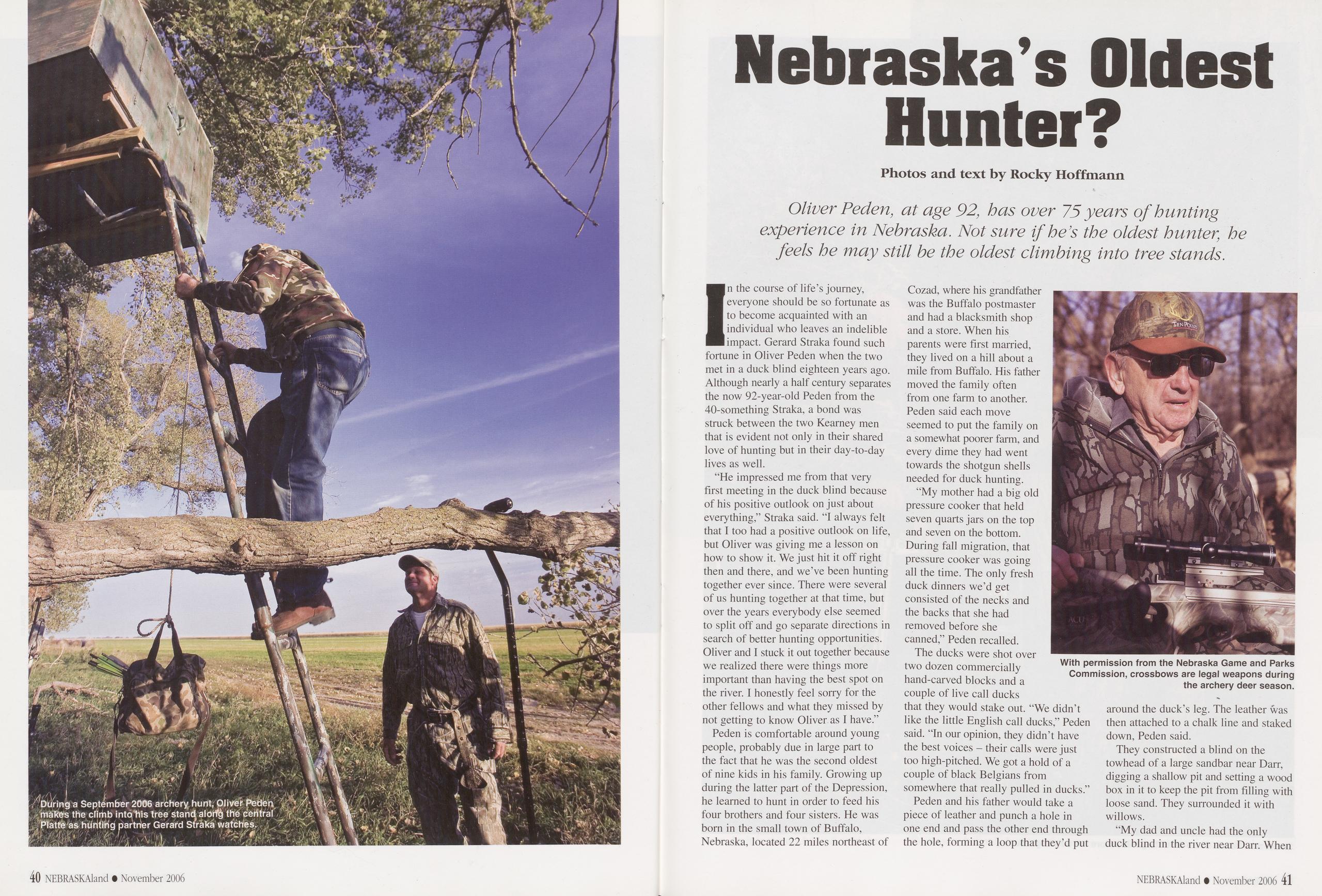
Nebraska’s Oldest Hunter?
Photos and text by Rocky Hoffmann Oliver Peden, at age 92, has over 75 years of hunting experience in Nebraska. Not sure if he’s the oldest hunter, he feels he may still be the oldest climbing into tree stands.In the course of life’s journey, everyone should be so fortunate as to become acquainted with an individual who leaves an indelible impact. Gerard Straka found such fortune in Oliver Peden when the two met in a duck blind eighteen years ago. Although nearly a half century separates the now 92-year-old Peden from the 40-something Straka, a bond was struck between the two Kearney men that is evident not only in their shared love of hunting but in their day-to-day lives as well.
“He impressed me from that very first meeting in the duck blind because of his positive outlook on just about everything,” Straka said. “I always felt that I too had a positive outlook on life, but Oliver was giving me a lesson on how to show it. We just hit it off right then and there, and we’ve been hunting together ever since. There were several of us hunting together at that time, but over the years everybody else seemed to split off and go separate directions in search of better hunting opportunities. Oliver and I stuck it out together because we realized there were things more important than having the best spot on the river. I honestly feel sorry for the other fellows and what they missed by not getting to know Oliver as I have.”
Peden is comfortable around young people, probably due in large part to the fact that he was the second oldest of nine kids in his family. Growing up during the latter part of the Depression, he learned to hunt in order to feed his four brothers and four sisters. He was born in the small town of Buffalo, Nebraska, located 22 miles northeast of Cozad, where his grandfather was the Buffalo postmaster and had a blacksmith shop and a store. When his parents were first married, they lived on a hill about a mile from Buffalo. His father moved the family often from one farm to another. Peden said each move seemed to put the family on a somewhat poorer farm, and every dime they had went towards the shotgun shells needed for duck hunting.
“My mother had a big old pressure cooker that held seven quarts jars on the top and seven on the bottom. During fall migration, that pressure cooker was going all the time. The only fresh duck dinners we’d get consisted of the necks and the backs that she had removed before she canned,” Peden recalled.
The ducks were shot over two dozen commercially hand-carved blocks and a couple of live call ducks that they would stake out. “We didn’t like the little English call ducks,” Peden said. “In our opinion, they didn’t have the best voices - their calls were just too high-pitched. We got a hold of a couple of black Belgians from somewhere that really pulled in ducks.”
Peden and his father would take a piece of leather and punch a hole in one end and pass the other end through the hole, forming a loop that they’d put around the duck’s leg. The leather was then attached to a chalk line and staked down, Peden said.
They constructed a blind on the towhead of a large sandbar near Darr, digging a shallow pit and setting a wood box in it to keep the pit from filling with loose sand. They surrounded it with willows.
“My dad and uncle had the only
duck blind in the river near Darr. When
NEBRASKAland • November 2006 41
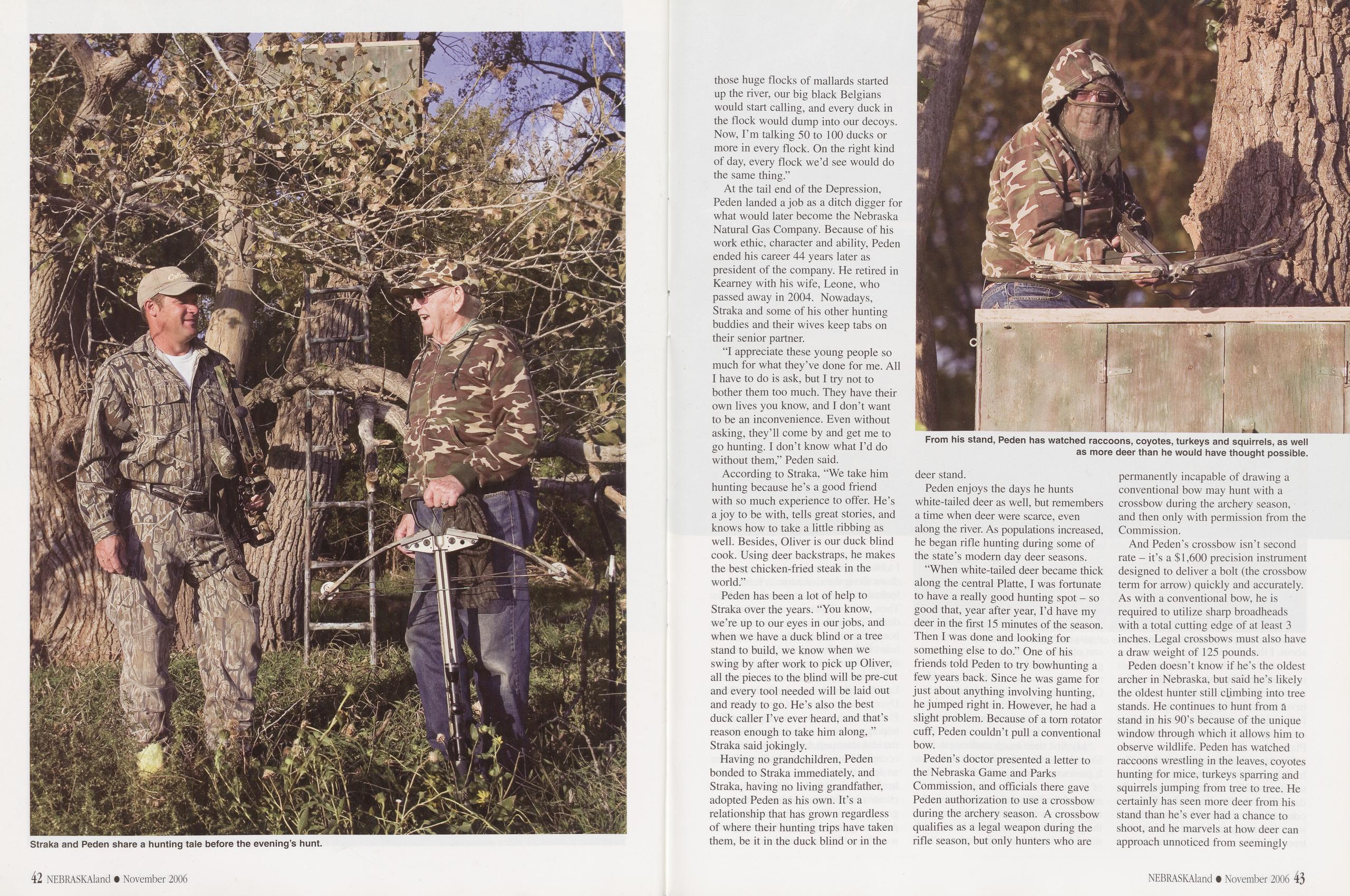 those huge flocks of mallards started
up the river, our big black Belgians
would start calling, and every duck in
the flock would dump into our decoys.
Now, I’m talking 50 to 100 ducks or
more in every flock. On the right kind
of day, every flock we’d see would do
the same thing.”
those huge flocks of mallards started
up the river, our big black Belgians
would start calling, and every duck in
the flock would dump into our decoys.
Now, I’m talking 50 to 100 ducks or
more in every flock. On the right kind
of day, every flock we’d see would do
the same thing.”
At the tail end of the Depression, Peden landed a job as a ditch digger for what would later become the Nebraska Natural Gas Company. Because of his work ethic, character and ability, Peden ended his career 44 years later as president of the company. He retired in Kearney with his wife, Leone, who passed away in 2004. Nowadays, Straka and some of his other hunting buddies and their wives keep tabs on their senior partner.
"I appreciate these young people so much for what they’ve done for me. All I have to do is ask, but I try not to bother them too much. They have their own lives you know, and I don’t want to be an inconvenience. Even without asking, they’ll come by and get me to go hunting. I don’t know what I’d do without them,” Peden said.
According to Straka, “We take him hunting because he’s a good friend with so much experience to offer. He’s a joy to be with, tells great stories, and knows how to take a little ribbing as well. Besides, Oliver is our duck blind cook. Using deer backstraps, he makes the best chicken-fried steak in the world.”
Peden has been a lot of help to Straka over the years. “You know, we’re up to our eyes in our jobs, and when we have a duck blind or a tree stand to build, we know when we swing by after work to pick up Oliver, all the pieces to the blind will be pre-cut and every tool needed will be laid out and ready to go. He’s also the best duck caller I’ve ever heard, and that’s reason enough to take him along, ” Straka said jokingly.
Having no grandchildren, Peden bonded to Straka immediately, and Straka, having no living grandfather, adopted Peden as his own. It’s a relationship that has grown regardless of where their hunting trips have taken them, be it in the duck blind or in the deer stand.
Peden enjoys the days he hunts white-tailed deer as well, but remembers a time when deer were scarce, even along the river. As populations increased, he began rifle hunting during some of the state’s modern day deer seasons.
“When white-tailed deer became thick along the central Platte, I was fortunate to have a really good hunting spot - so good that, year after year, I’d have my deer in the first 15 minutes of the season. Then I was done and looking for something else to do.” One of his friends told Peden to try bowhunting a few years back. Since he was game for just about anything involving hunting, he jumped right in. However, he had a slight problem. Because of a tom rotator cuff, Peden couldn’t pull a conventional bow.
Peden’s doctor presented a letter to the Nebraska Game and Parks Commission, and officials there gave Peden authorization to use a crossbow during the archery season. A crossbow qualifies as a legal weapon during the rifle season, but only hunters who are permanently incapable of drawing a conventional bow may hunt with a crossbow during the archety season, and then only with permission from the Commission.
And Peden’s crossbow isn’t second rate - it’s a $1,600 precision instrument designed to deliver a bolt (the crossbow term for arrow) quickly and accurately. As with a conventional bow, he is required to utilize sharp broadheads with a total cutting edge of at least 3 inches. Legal crossbows must also have a draw weight of 125 pounds.
Peden doesn’t know if he’s the oldest
archer in Nebraska, but said he’s likely
the oldest hunter still climbing into tree
stands. He continues to hunt from a
stand in his 90’s because of the unique
window through which it allows him to
observe wildlife. Peden has watched
raccoons wrestling in the leaves, coyotes
hunting for mice, turkeys sparring and
squirrels jumping from tree to tree. He
certainly has seen more deer from his
stand than he’s ever had a chance to
shoot, and he marvels at how deer can
approach unnoticed from seemingly
42 NEBRASKAland • November 2006
NEBRASKAland • November 2006 43
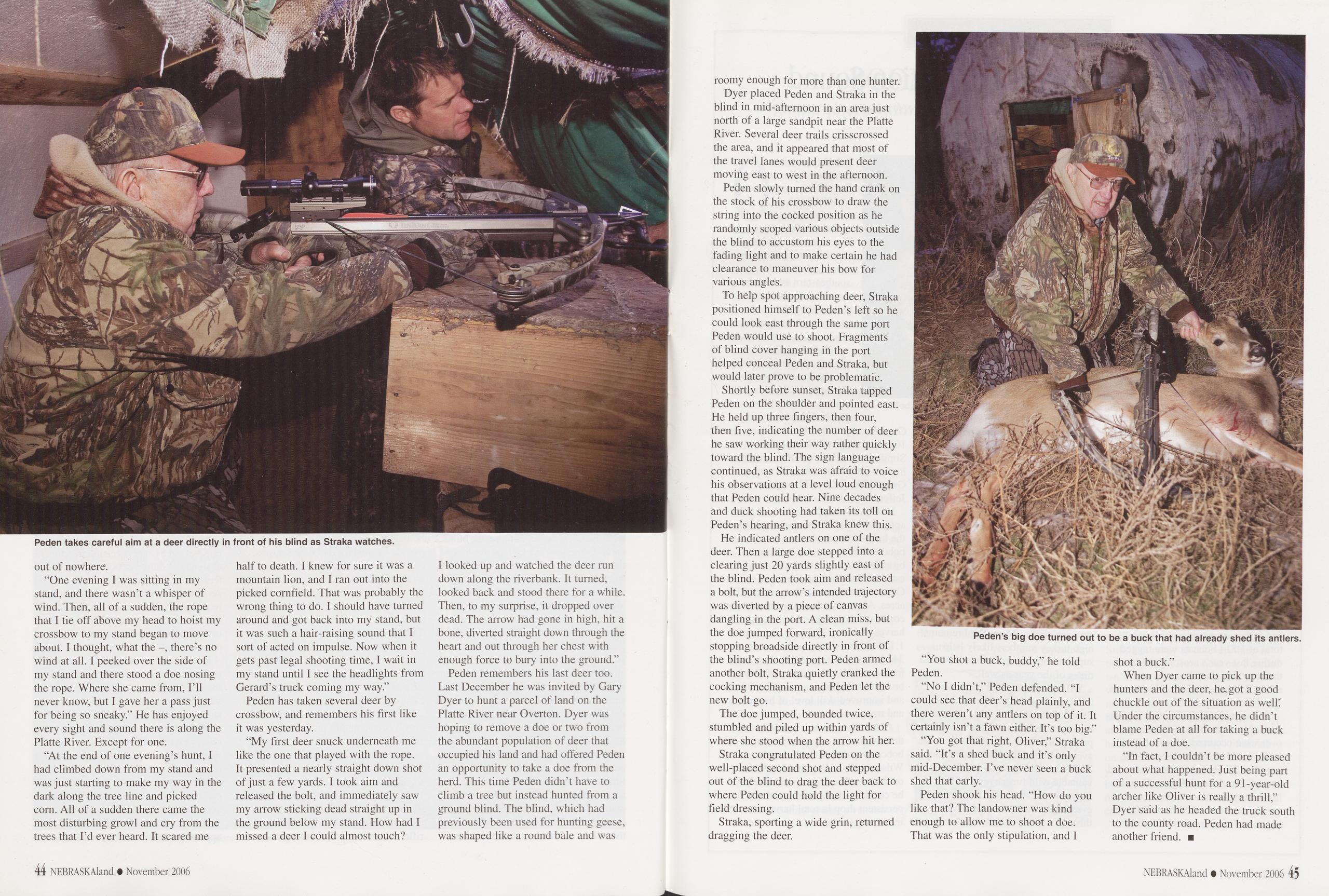 out of nowhere.
“One evening I was sitting in my stand, and there wasn’t a whisper of wind. Then, all of a sudden, the rope that I tie off above my head to hoist my crossbow to my stand began to move about. I thought, what the -, there’s no wind at all. I peeked over the side of my stand and there stood a doe nosing the rope. Where she came from, TH never know, but I gave her a pass just for being so sneaky.” He has enjoyed every sight and sound there is along the Platte River. Except for one.
“At the end of one evening’s hunt, I had climbed down from my stand and was just starting to make my way in the dark along the tree line and picked corn. All of a sudden there came the most disturbing growl and cry from the trees that I’d ever heard. It scared me half to death. I knew for sure it was a mountain lion, and I ran out into the picked cornfield. That was probably the wrong thing to do. I should have turned around and got back into my stand, but it was such a hair-raising sound that I sort of acted on impulse. Now when it gets past legal shooting time, I wait in my stand until I see the headlights from Gerard’s truck coming my way.” Peden has taken several deer by crossbow, and remembers his first like it was yesterday.
“My first deer snuck underneath me like the one that played with the rope. It presented a nearly straight down shot of just a few yards. I took aim and released the bolt, and immediately saw my arrow sticking dead straight up in the ground below my stand. How had I missed a deer I could almost touch? I looked up and watched the deer run down along the riverbank. It turned, looked back and stood there for a while. Then, to my surprise, it dropped over dead. The arrow had gone in high, hit a bone, diverted straight down through the heart and out through her chest with enough force to bury into the ground.”
Peden remembers his last deer too. Last December he was invited by Gary Dyer to hunt a parcel of land on the Platte River near Overton. Dyer was hoping to remove a doe or two from the abundant population of deer that occupied his land and had offered Peden an opportunity to take a doe from the herd. This time Peden didn’t have to climb a tree but instead hunted from a ground blind. The blind, which had previously been used for hunting geese, was shaped like a round bale and was roomy enough for more than one hunter.
Dyer placed Peden and Straka in the blind in mid-afternoon in an area just north of a large sandpit near the Platte River. Several deer trails crisscrossed the area, and it appeared that most of the travel lanes would present deer moving east to west in the afternoon.
Peden slowly turned the hand crank on the stock of his crossbow to draw the string into the cocked position as he randomly scoped various objects outside the blind to accustom his eyes to the fading light and to make certain he had clearance to maneuver his bow for various angles.
To help spot approaching deer, Straka positioned himself to Peden’s left so he could look east through the same port Peden would use to shoot. Fragments of blind cover hanging in the port helped conceal Peden and Straka, but would later prove to be problematic.
Shortly before sunset, Straka tapped Peden on the shoulder and pointed east. He held up three fingers, then four, then five, indicating the number of deer he saw working their way rather quickly toward the blind. The sign language continued, as Straka was afraid to voice his observations at a level loud enough that Peden could hear. Nine decades and duck shooting had taken its toll on Peden’s hearing, and Straka knew this.
He indicated antlers on one of the deer. Then a large doe stepped into a clearing just 20 yards slightly east of the blind. Peden took aim and released a bolt, but the arrow’s intended trajectory was diverted by a piece of canvas dangling in the port. A clean miss, but the doe jumped forward, ironically stopping broadside directly in front of the blind’s shooting port. Peden armed another bolt, Straka quietly cranked the cocking mechanism, and Peden let the new bolt go.
The doe jumped, bounded twice, stumbled and piled up within yards of where she stood when the arrow hit her.
Straka congratulated Peden on the well-placed second shot and stepped out of the blind to drag the deer back to where Peden could hold the light for field dressing.
Straka, sporting a wide grin, returned dragging the deer.
“You shot a buck, buddy,” he told Peden.
“No I didn’t,” Peden defended. “I could see that deer’s head plainly, and there weren’t any antlers on top of it. It certainly isn’t a fawn either. It’s too big.”
“You got that right, Oliver,” Straka said. “It’s a shed buck and it’s only mid-December. I’ve never seen a buck shed that early.
Peden shook his head. “How do you like that? The landowner was kind enough to allow me to shoot a doe. That was the only stipulation, and I shot a buck.”
When Dyer came to pick up the hunters and the deer, he. got a good chuckle out of the situation as wellf Under the circumstances, he didn’t blame Peden at all for taking a buck instead of a doe.
“In fact, I couldn’t be more pleased about what happened. Just being part of a successful hunt for a 91-year-old archer like Oliver is really a thrill,” Dyer said as he headed the truck south to the county road. Peden had made another friend. ■
44 NEBRASKAland • November 2006 NEBRASKAland • November 2006 45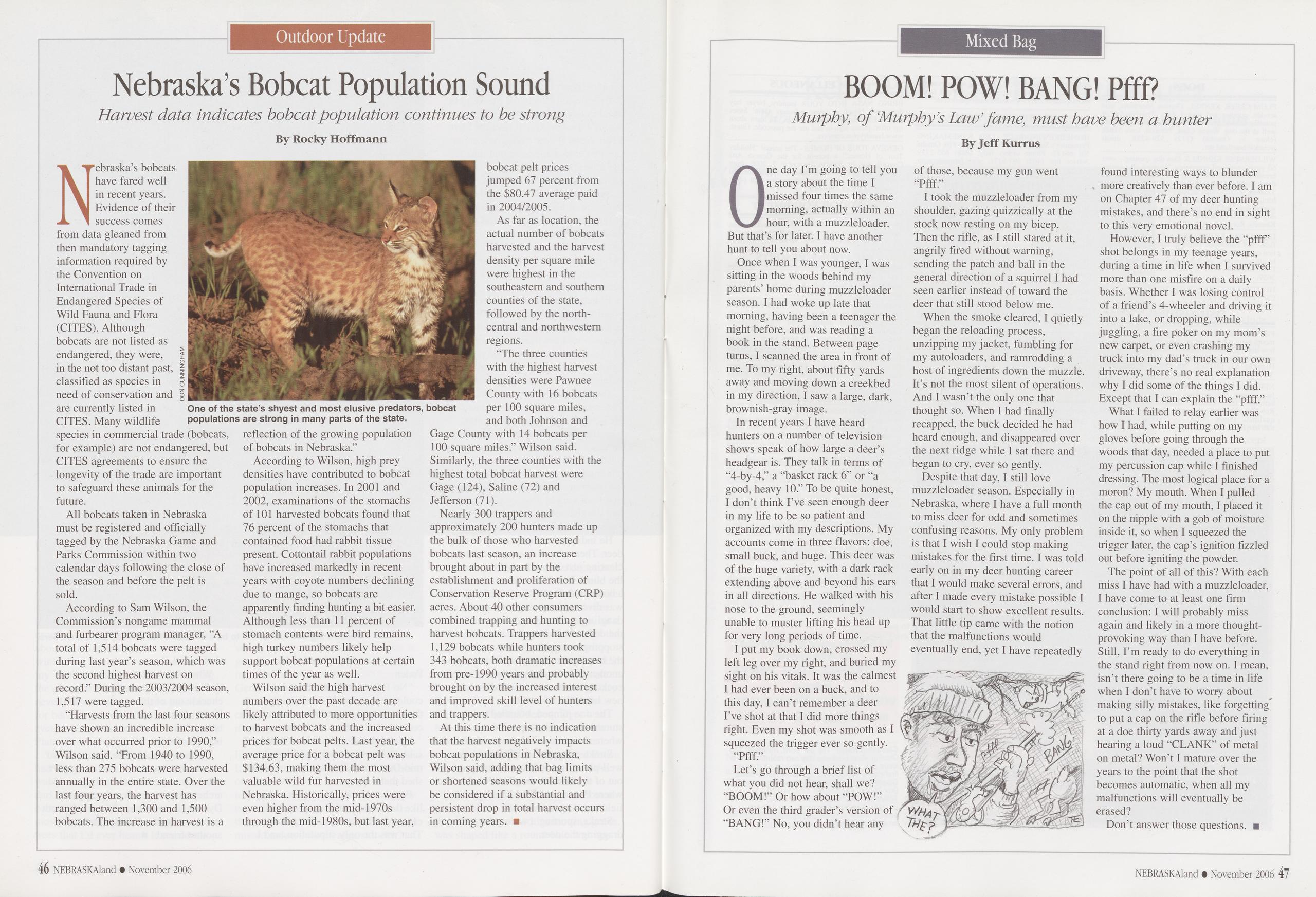
Nebraska’s bobcats have fared well in recent years. Evidence of their success comes from data gleaned from then mandatory tagging information required by the Convention on International Trade in Endangered Species of Wild Fauna and Flora (CITES). Although bobcats are not listed as endangered, they were, in the not too distant past, classified as species in need of conservation and are currently listed in CITES. Many wildlife species in commercial trade (bobcats, for example) are not endangered, but CITES agreements to ensure the longevity of the trade are important to safeguard these animals for the future.
All bobcats taken in Nebraska must be registered and officially tagged by the Nebraska Game and Parks Commission within two calendar days following the close of the season and before the pelt is sold.
According to Sam Wilson, the Commission’s nongame mammal and furbearer program manager, “A total of 1,514 bobcats were tagged during last year’s season, which was the second highest harvest on record.” During the 2003/2004 season, 1,517 were tagged.
“Harvests from the last four seasons have shown an incredible increase over what occurred prior to 1990,” Wilson said. “From 1940 to 1990, less than 275 bobcats were harvested annually in the entire state. Over the last four years, the harvest has ranged between 1,300 and 1,500 bobcats. The increase in harvest is a reflection of the growing population of bobcats in Nebraska.”
According to Wilson, high prey densities have contributed to bobcat population increases. In 2001 and 2002, examinations of the stomachs of 101 harvested bobcats found that 76 percent of the stomachs that contained food had rabbit tissue present. Cottontail rabbit populations have increased markedly in recent years with coyote numbers declining due to mange, so bobcats are apparently finding hunting a bit easier. Although less than 11 percent of stomach contents were bird remains, high turkey numbers likely help support bobcat populations at certain times of the year as well.
Wilson said the high harvest numbers over the past decade are likely attributed to more opportunities to harvest bobcats and the increased prices for bobcat pelts. Last year, the average price for a bobcat pelt was $134.63, making them the most valuable wild fur harvested in Nebraska. Historically, prices were even higher from the mid-1970s through the mid-1980s, but last year, bobcat pelt prices jumped 67 percent from the $80.47 average paid in 2004/2005.
As far as location, the actual number of bobcats harvested and the harvest density per square mile were highest in the southeastern and southern counties of the state, followed by the north- central and northwestern regions.
“The three counties with the highest harvest densities were Pawnee County with 16 bobcats per 100 square miles, and both Johnson and Gage County with 14 bobcats per 100 square miles.” Wilson said. Similarly, the three counties with the highest total bobcat harvest were Gage (124), Saline (72) and Jefferson (71).
Nearly 300 trappers and approximately 200 hunters made up the bulk of those who harvested bobcats last season, an increase brought about in part by the establishment and proliferation of Conservation Reserve Program (CRP) acres. About 40 other consumers combined trapping and hunting to harvest bobcats. Trappers harvested 1,129 bobcats while hunters took 343 bobcats, both dramatic increases from pre-1990 years and probably brought on by the increased interest and improved skill level of hunters and trappers.
At this time there is no indication that the harvest negatively impacts bobcat populations in Nebraska, Wilson said, adding that bag limits or shortened seasons would likely be considered if a substantial and persistent drop in total harvest occurs in coming years. ■
BOOM! POW! BANG! PFF Murphy, of Murphy’s Law’fame, must have been a hunter By Jeff KurrusOne day I’m going to tell you a story about the time I missed four times the same morning, actually within an hour, with a muzzleloader. But that’s for later. I have another hunt to tell you about now.
Once when I was younger, I was sitting in the woods behind my parents’ home during muzzleloader season. I had woke up late that morning, having been a teenager the night before, and was reading a book in the stand. Between page turns, I scanned the area in front of me. To my right, about fifty yards away and moving down a creekbed in my direction, I saw a large, dark, brownish-gray image.
In recent years I have heard hunters on a number of television shows speak of how large a deer’s headgear is. They talk in terms of “4-by-4,” a “basket rack 6” or “a good, heavy 10.” To be quite honest, I don’t think I’ve seen enough deer in my life to be so patient and organized with my descriptions. My accounts come in three flavors: doe, small buck, and huge. This deer was of the huge variety, with a dark rack extending above and beyond his ears in all directions. He walked with his nose to the ground, seemingly unable to muster lifting his head up for very long periods of time.
I put my book down, crossed my left leg over my right, and buried my sight on his vitals. It was the calmest I had ever been on a buck, and to this day, I can’t remember a deer I’ve shot at that I did more things right. Even my shot was smooth as I squeezed the trigger ever so gently.
“Pfff.”
Let’s go through a brief list of what you did not hear, shall we? “BOOM!” Or how about “POW!” Or even the third grader’s version of “BANG!” No, you didn’t hear any of those, because my gun went “Pfff.”
I took the muzzleloader from my shoulder, gazing quizzically at the stock now resting on my bicep. Then the rifle, as I still stared at it, angrily fired without warning, sending the patch and ball in the general direction of a squirrel I had seen earlier instead of toward the deer that still stood below me.
When the smoke cleared, I quietly began the reloading process, unzipping my jacket, fumbling for my autoloaders, and ramrodding a host of ingredients down the muzzle. It’s not the most silent of operations. And I wasn’t the only one that thought so. When I had finally recapped, the buck decided he had heard enough, and disappeared over the next ridge while I sat there and began to cry, ever so gently.
Despite that day, I still love muzzleloader season. Especially in Nebraska, where I have a full month to miss deer for odd and sometimes confusing reasons. My only problem is that I wish I could stop making mistakes for the first time. I was told early on in my deer hunting career that I would make several errors, and after I made every mistake possible I would start to show excellent results. That little tip came with the notion that the malfunctions would eventually end, yet I have repeatedly found interesting ways to blunder more creatively than ever before. I am on Chapter 47 of my deer hunting mistakes, and there’s no end in sight to this very emotional novel.
However, I truly believe the “pfff’ shot belongs in my teenage years, during a time in life when I survived more than one misfire on a daily basis. Whether I was losing control of a friend’s 4-wheeler and driving it into a lake, or dropping, while juggling, a fire poker on my mom’s new carpet, or even crashing my truck into my dad’s truck in our own driveway, there’s no real explanation why I did some of the things I did. Except that I can explain the “pfff.”
What I failed to relay earlier was how I had, while putting on my gloves before going through the woods that day, needed a place to put my percussion cap while I finished dressing. The most logical place for a moron? My mouth. When I pulled the cap out of my mouth, I placed it on the nipple with a gob of moisture inside it, so when I squeezed the trigger later, the cap’s ignition fizzled out before igniting the powder.
The point of all of this? With each miss I have had with a muzzleloader, I have come to at least one firm conclusion: I will probably miss again and likely in a more thought- provoking way than I have before. Still, I’m ready to do everything in the stand right from now on. I mean, isn’t there going to be a time in life when I don’t have to worry about making silly mistakes, like forgetting to put a cap on the rifle before firing at a doe thirty yards away and just hearing a loud “CLANK” of metal on metal? Won’t I mature over the years to the point that the shot becomes automatic, when all my malfunctions will eventually be erased?
Don’t answer those questions. ■
46 NEBRASKAland • November 2006 NEBRASKAland • November 2006 47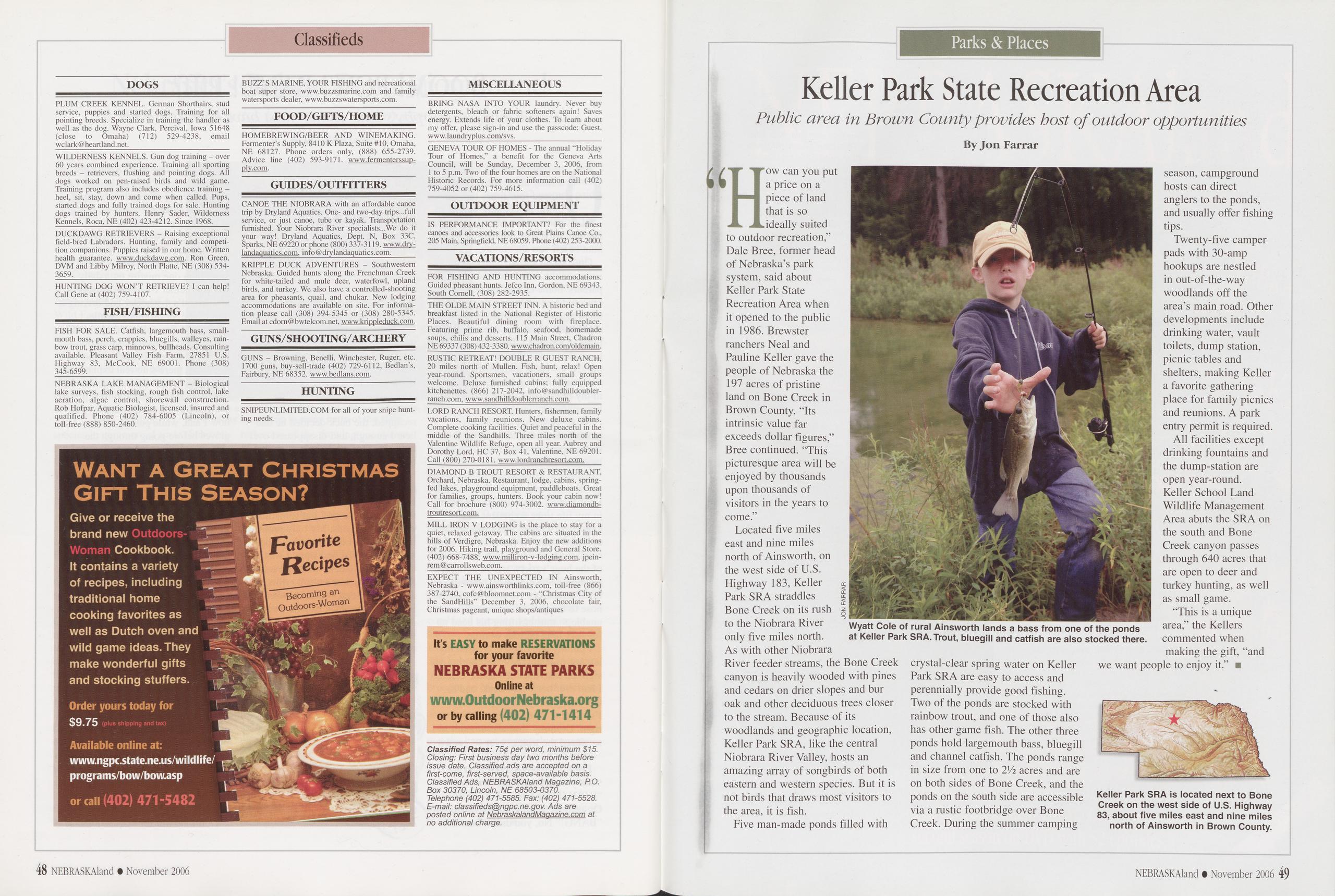
Classifieds
Parks & Places DOGSPLUM CREEK KENNEL. German Shorthairs, stud service, puppies and started dogs. Training for all pointing breeds. Specialize in training the handler as well as the dog. Wayne Clark, Percival, Iowa 51648 (close to Omaha) (712) 529-4238, email wclark@heartland.net.
WILDERNESS KENNELS. Gun dog training - over 60 years combined experience. Training all sporting breeds - retrievers, flushing and pointing dogs. All dogs worked on pen-raised birds and wild game. Training program also includes obedience training - heel, sit, stay, down and come when called. Pups, started dogs and fully trained dogs for sale. Hunting dogs trained by hunters. Henry Sader, Wilderness Kennels, Roca, NE (402) 423-4212. Since 1968.
DUCKDAWG RETRIEVERS - Raising exceptional field-bred Labradors. Hunting, family and competi- tion companions. Puppies raised in our home. Written health guarantee, www.duckdawg.com. Ron Green, DVM and Libby Milroy, North Platte, NE (308) 534- 3659.
HUNTING DOG WON’T RETRIEVE? I can help! Call Gene at (402) 759-4107.
BUZZ’S MARINE, YOUR FISHING and recreational boat super store, www.buzzsmarine.com and family watersports dealer, www.buzzswatersports.com.
FISH/FISHINGFISH FOR SALE. Catfish, largemouth bass, small- mouth bass, perch, crappies, bluegills, walleyes, rain- bow trout, grass carp, minnows, bullheads. Consulting available. Pleasant Valley Fish Farm, 27851 U.S. Highway 83, McCook, NE 69001. Phone (308) 345-6599.
NEBRASKA LAKE MANAGEMENT - Biological lake surveys, fish stocking, rough fish control, lake aeration, algae control, shorewall construction. Rob Hofpar, Aquatic Biologist, licensed, insured and qualified. Phone (402) 784-6005 (Lincoln), or toll-free (888) 850-2460.
HOMEBREWING/BEER AND WINEMAKING. Fermenter’s Supply, 8410 K Plaza, Suite #10, Omaha, NE 68127. Phone orders only, (888) 655-2739. Advice line (402) 593-9171. www.fermenterssup- ply.com.
GUIDES/OUTFITTERSBRING NASA INTO YOUR laundry. Never buy detergents, bleach or fabric softeners again! Saves energy. Extends life of your clothes. To learn about my offer, please sign-in and use the passcode: Guest. www.laundryplus.com/svs.
GENEVA TOUR OF HOMES - The annual “Holiday Tour of Homes,” a benefit for the Geneva Arts Council, will be Sunday, December 3, 2006, from 1 to 5 p.m. Two of the four homes are on the National Historic Records. For more information call (402) 759-4052 or (402) 759-4615.
CANOE THE NIOBRARA with an affordable canoe trip by Dryland Aquatics. One- and two-day trips...full service, or just canoe, tube or kayak. Transportation furnished. Your Niobrara River specialists...We do it your way! Dryland Aquatics, Dept. N, Box 33C, Sparks, NE 69220 or phone (800) 337-3119. www.drv- landaquatics.com, info@drylandaquatics.com.
KRIPPLE DUCK ADVENTURES - Southwestern Nebraska. Guided hunts along the Frenchman Creek for white-tailed and mule deer, waterfowl, upland birds, and turkey. We also have a controlled-shooting area for pheasants, quail, and chukar. New lodging accommodations are available on site. For informa- tion please call (308) 394-5345 or (308) 280-5345. Email at cdom@bwtelcom.net, www.krippleduck.com.
GUNS/SHOOTING/ARCHERYGUNS - Browning, Benelli, Winchester, Ruger, etc. 1700 guns, buy-sell-trade (402) 729-6112, Bedlan’s, Fairbury, NE 68352. www.hedlans.com.
HUNTINGSNIPEUNLIMITED.COM for all of your snipe hunt- ing needs.
OUTDOOR EQUIPMENTIS PERFORMANCE IMPORTANT? For the finest canoes and accessories look to Great Plains Canoe Co., 205 Main, Springfield, NE 68059. Phone (402) 253-2000.
VACATIONS/RESORTS Want a Great Christmas Gift This Season? Give or receive the brand new Outdoors- Woman Cookbook. It contains a variety of recipes, including traditional home cooking favorites as well as Dutch oven and wild game ideas. They make wonderful gifts and stocking stutters. \ puvorite \ \ Recipes u Becoming an Outdoors-WomanFOR FISHING AND HUNTING accommodations. Guided pheasant hunts. Jefco Inn, Gordon, NE 69343. South Cornell, (308) 282-2935.
THE OLDE MAIN STREET INN. A historic bed and breakfast listed in the National Register of Historic Places. Beautiful dining room with fireplace. Featuring prime rib, buffalo, seafood, homemade soups, chilis and desserts. 115 Main Street, Chadron NE 69337 (308) 432-3380. www.chadron.com/oldemain.
RUSTIC RETREAT! DOUBLE R GUEST RANCH, 20 miles north of Mullen. Fish, hunt, relax! Open year-round. Sportsmen, vacationers, small groups welcome. Deluxe furnished cabins; fully equipped kitchenettes. (866) 217-2042, info@sandhilldoubler- ranch.com, www.sandhilldoublerranch.com.
LORD RANCH RESORT. Hunters, fishermen, family vacations, family reunions. New deluxe cabins. Complete cooking facilities. Quiet and peaceful in the middle of the Sandhills. Three miles north of the Valentine Wildlife Refuge, open all year. Aubrey and Dorothy Lord, HC 37, Box 41, Valentine, NE 69201. Call (800) 270-0181. www.lordranchresort.com.
DIAMOND B TROUT RESORT & RESTAURANT, Orchard, Nebraska. Restaurant, lodge, cabins, spring- fed lakes, playground equipment, paddleboats. Great for families, groups, hunters. Book your cabin now! Call for brochure (800) 974-3002. www.diamondb- troutresort.com.
MILL IRON V LODGING is the place to stay for a quiet, relaxed getaway. The cabins are situated in the hills of Verdigre, Nebraska. Enjoy the new additions for 2006. Hiking trail, playground and General Store. (402) 668-7488, www.milliron-v-lodging.com. jpein- rem @ carrollsweb.com.
EXPECT THE UNEXPECTED IN Ainsworth, Nebraska - www.ainsworthlinks.com, toll-free (866) 387-2740, cofc@bloomnet.com - “Christmas City of the SandHills” December 3, 2006, chocolate fair, Christmas pageant, unique shops/antiques Order yours today for $9.75 (plus shipping and tax)
It's EASY to make RESERVATIONS for your favorite NEBRASKA STATE PARKS Online at www.OutdoorNebraska.org or by calling (402) 471-1414 Keller Park State Recreation Area Public area in Brown County provides host of outdoor opportunities Jon Farrar"How can you put a price on a piece of land I that is so ideally suited to outdoor recreation,” Dale Bree, former head of Nebraska’s park system, said about Keller Park State Recreation Area when it opened to the public in 1986. Brewster ranchers Neal and Pauline Keller gave the people of Nebraska the 197 acres of pristine land on Bone Creek in Brown County. "Its intrinsic value far exceeds dollar figures,” Bree continued. "This picturesque area will be enjoyed by thousands upon thousands of visitors in the years to come.”
Located five miles east and nine miles north of Ainsworth, on the west side of U.S. Highway 183, Keller Park SRA straddles Bone Creek on its rush to the Niobrara River only five miles north. As with other Niobrara River feeder streams, the Bone Creek canyon is heavily wooded with pines and cedars on drier slopes and bur oak and other deciduous trees closer to the stream. Because of its woodlands and geographic location, Keller Park SRA, like the central Niobrara River Valley, hosts an amazing array of songbirds of both eastern and western species. But it is not birds that draws most visitors to the area, it is fish.
Five man-made ponds filled with crystal-clear spring water on Keller Park SRA are easy to access and perennially provide good fishing. Two of the ponds are stocked with rainbow trout, and one of those also has other game fish. The other three ponds hold largemouth bass, bluegill and channel catfish. The ponds range in size from one to 214 acres and are on both sides of Bone Creek, and the ponds on the south side are accessible via a rustic footbridge over Bone Creek. During the summer camping season, campground hosts can direct anglers to the ponds, and usually offer fishing tips.
Twenty-five camper pads with 30-amp hookups are nestled in out-of-the-way woodlands off the area’s main road. Other developments include drinking water, vault toilets, dump station, picnic tables and shelters, making Keller a favorite gathering place for family picnics and reunions. A park entry permit is required.
All facilities except drinking fountains and the dump-station are open year-round. Keller School Land Wildlife Management Area abuts the SRA on the south and Bone Creek canyon passes through 640 acres that are open to deer and turkey hunting, as well as small game.
"This is a unique area,” the Kellers commented when making the gift, "and we want people to enjoy it.” ■
Keller Park SRA is located next to Bone Creek on the west side of U.S. Highway 83, about five miles east and nine miles north of Ainsworth in Brown County.
48 NEBRASKAIand • November 2006 NEBRASKAIand • November 2006 49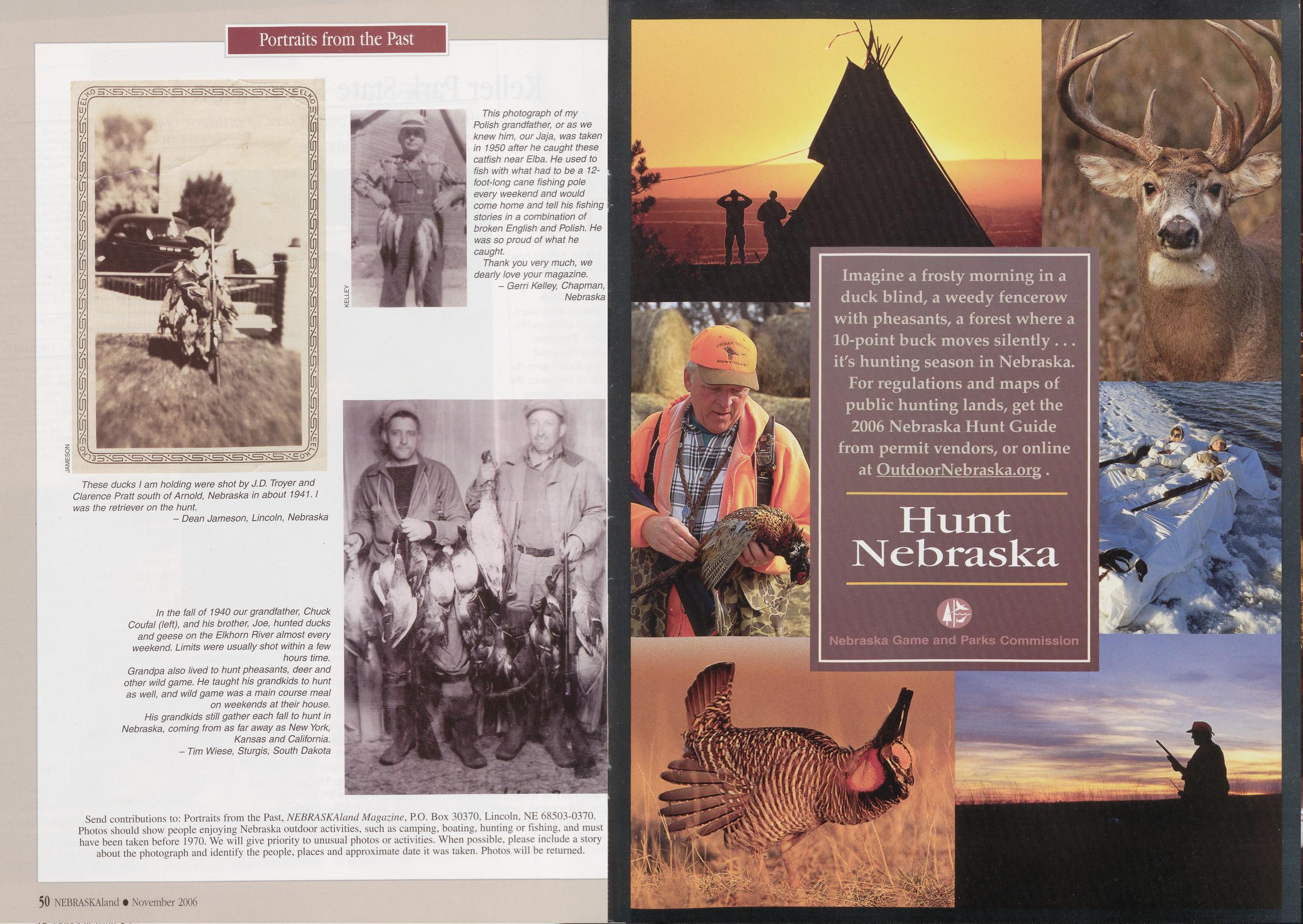
This photograph of my Polish grandfather, or as we knew him, our Jaja, was taken in 1950 after he caught these catfish near Elba. He used to fish with what had to be a 12- foot-long cane fishing pole every weekend and would come home and tell his fishing stories in a combination of broken English and Polish. He was so proud of what he caught.
Thank you very much, we dearly love your magazine.
- Gerri Kelley, Chapman, NebraskaThese ducks I am holding were shot by J.D. Troyer and Clarence Pratt south of Arnold, Nebraska in about 1941.1 was the retriever on the hunt.
- Dean Jameson, Lincoln, NebraskaIn the fall of 1940 our grandfather, Chuck Coufal (left), and his brother, Joe, hunted ducks and geese on the Elkhorn River almost every weekend. Limits were usually shot within a few hours time.
Grandpa also lived to hunt pheasants, deer and other wild game. He taught his grandkids to hunt as well, and wild game was a main course meal on weekends at their house.
His grandkids still gather each fall to hunt in Nebraska, coming from as far away as New York, Kansas and California.
- Tim Wiese, Sturgis, South DakotaSend contributions to: Portraits from the Past, NEBRASKA land Magazine, P.O. Box 30370, Lincoln, NE 68503-0370. Photos should show people enjoying Nebraska outdoor activities, such as camping, boating, hunting or fishing, and must have been taken before 1970. We will give priority to unusual photos or activities. When possible, please include a story about the photograph and identify the people, places and approximate date it was taken. Photos will be returned.
Nebraska Parks Commission Hunt Nebraska Imagine a frosty morning in a duck blind, a weedy fencerow with pheasants, a forest where a 10-point buck moves silently... it's hunting season in Nebraska. For regulations and maps of public hunting lands, get the 2006 Nebraska Hunt Guide from permit vendors, or online at OutdoorNebraska.org. 50 NEBRASKAland • November 2006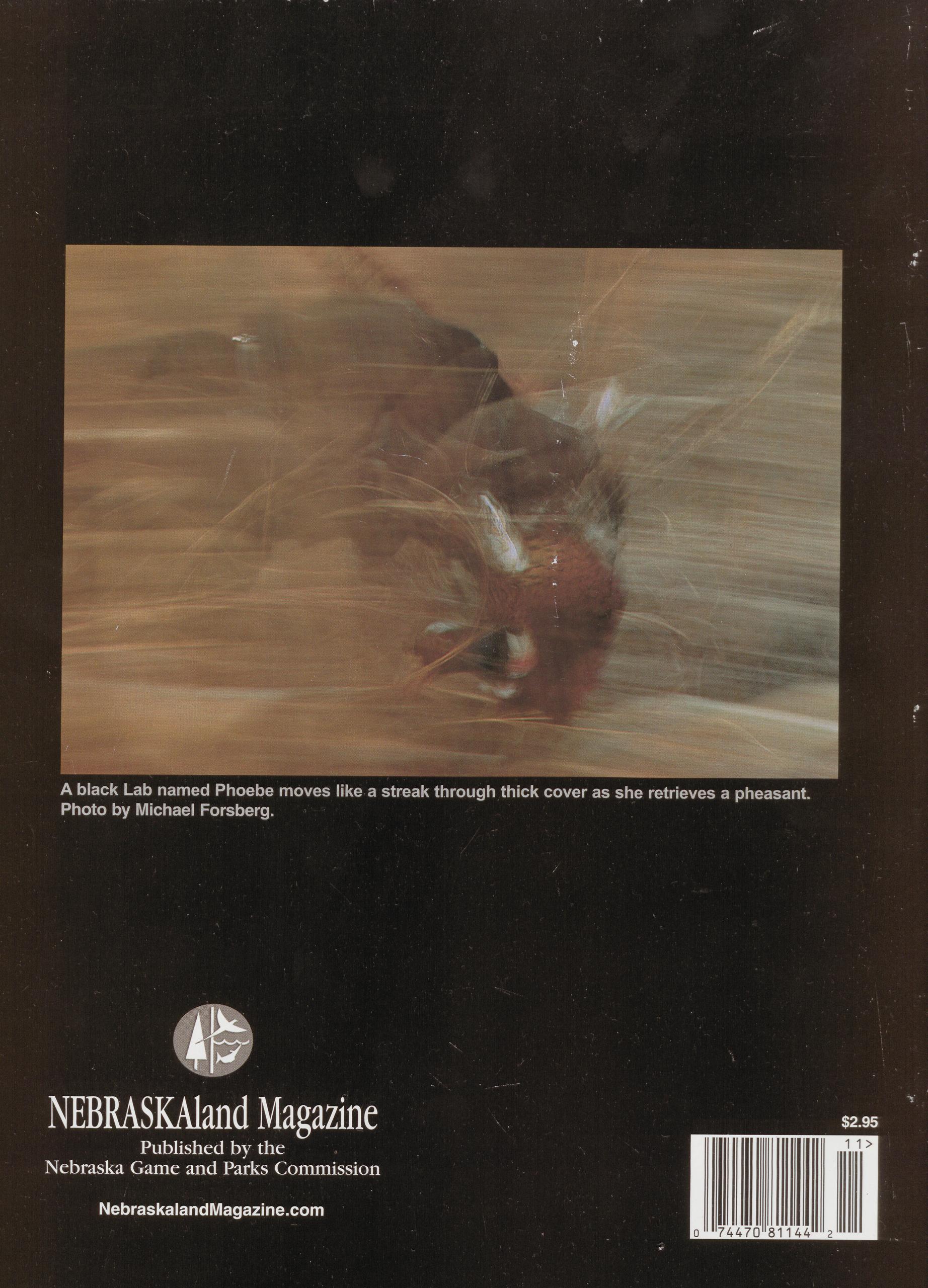
Position: 853 (10 views)