Volume 84, Issue 8, 2006
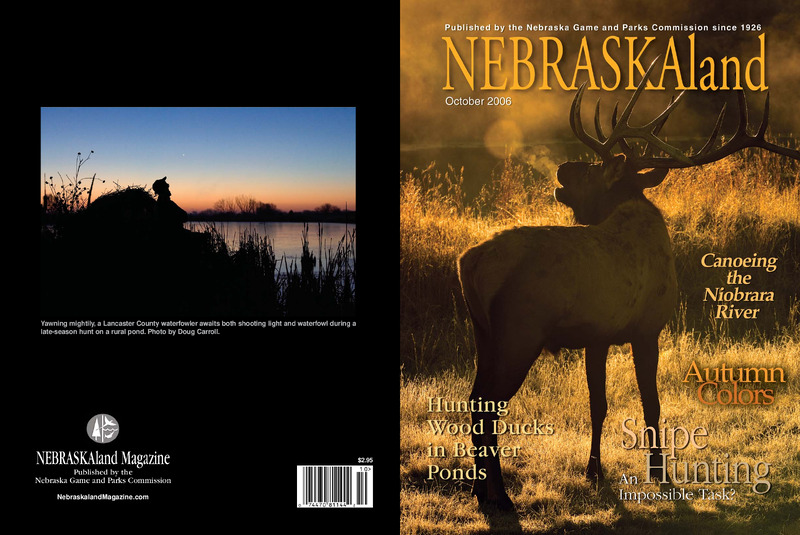
NEBRASKAland
Nebraska Game & Parks Commission October 2006 • $2.50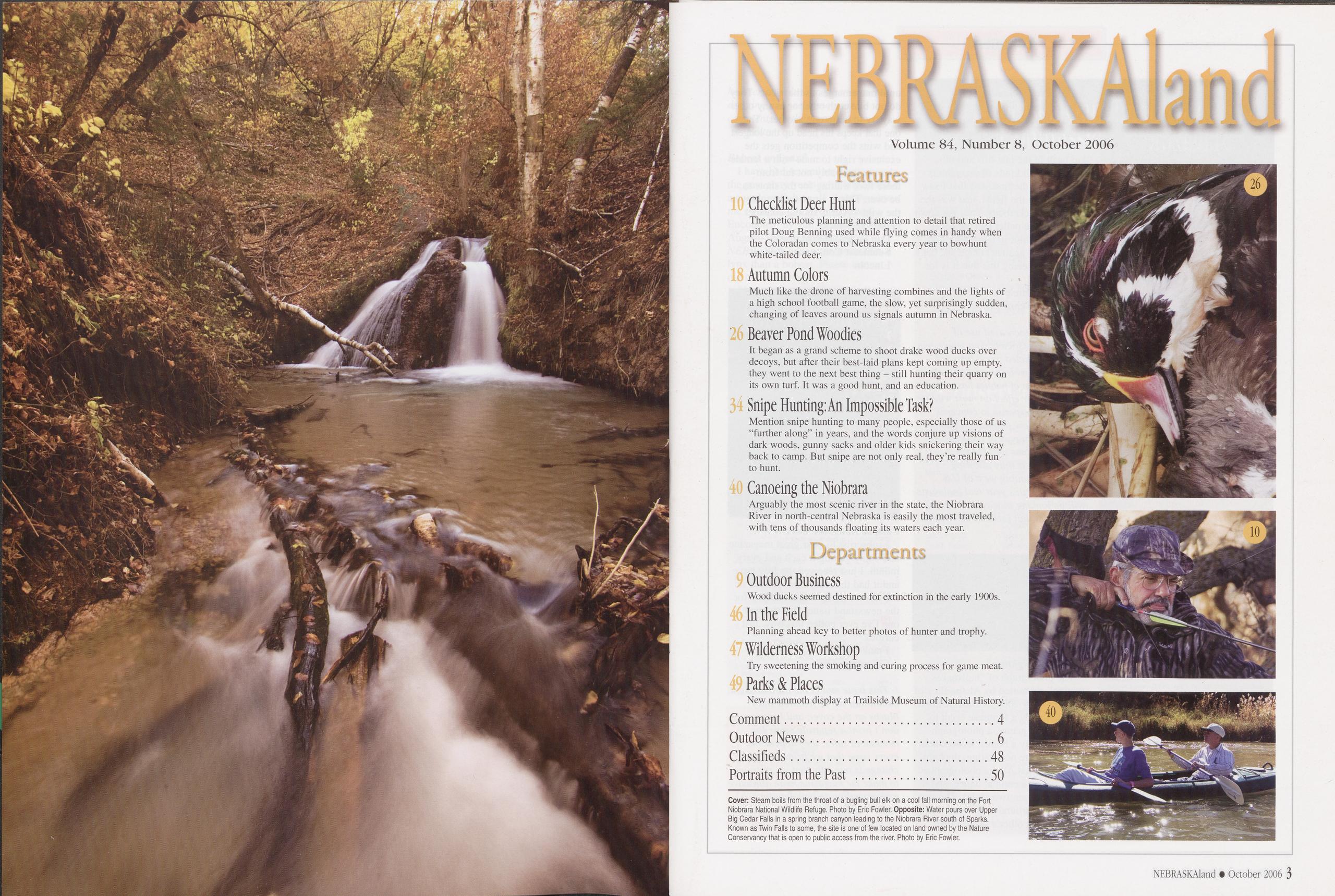
NEBRASKAland
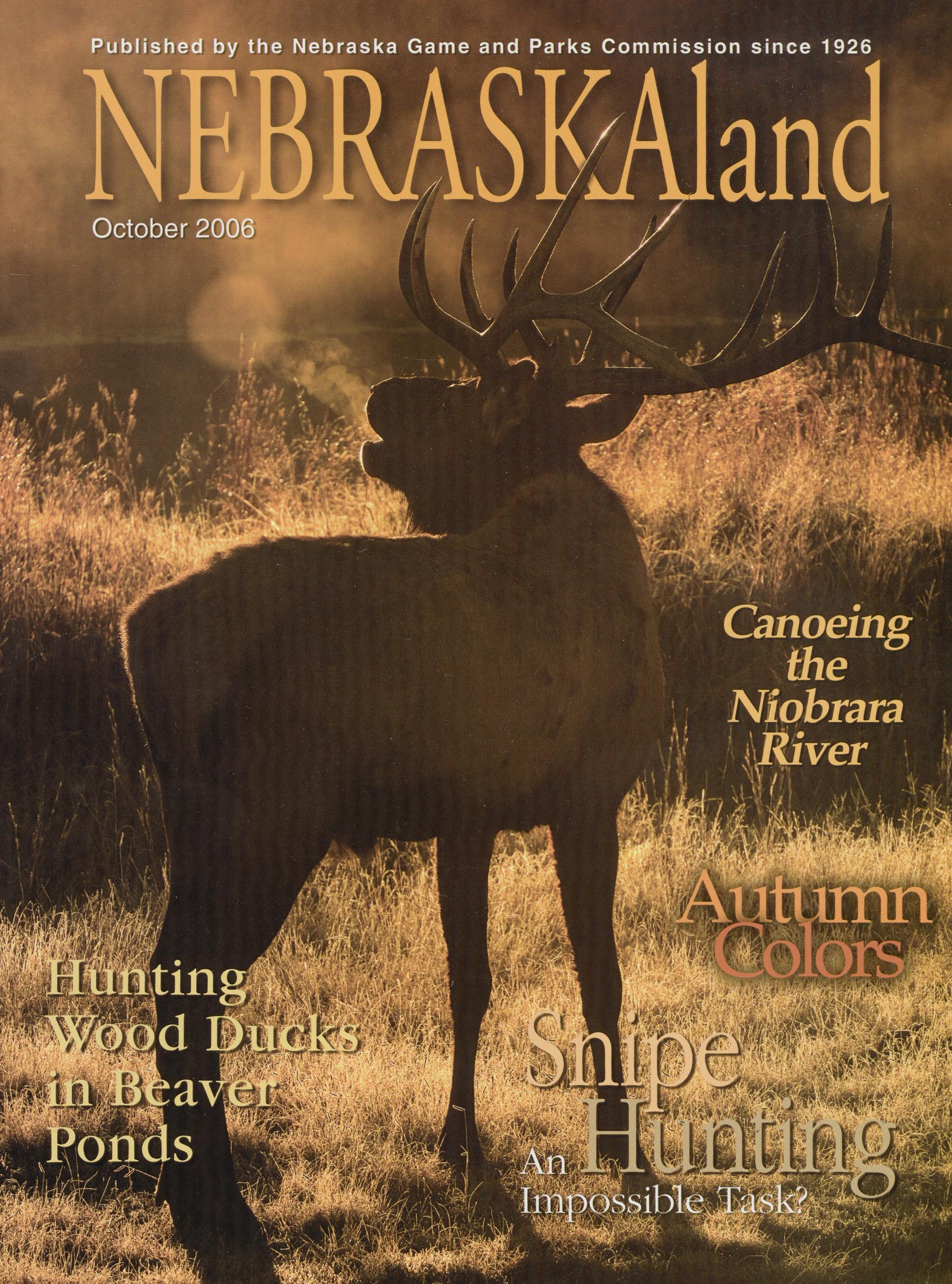
Volume 84, Number 8, October 2006 Features Checklist Deer Hunt The meticulous planning and attention to detail that retired pilot Doug Benning used while flying comes in handy when the Coloradan comes to Nebraska every year to bowhunt white-tailed deer. Autumn Colors Much like the drone of harvesting combines and the lights of a high school football game, the slow, yet surprisingly sudden, changing of leaves around us signals autumn in Nebraska. Beaver Pond Woodies It began as a grand scheme to shoot drake wood ducks over decoys, but after their best-laid plans kept coming up empty, they went to the next best thing - still hunting their quarry on its own turf. It was a good hunt, and an education. Snipe Hunting: An Impossible Task? Mention snipe hunting to many people, especially those of us “further along” in years, and the words conjure up visions of dark woods, gunny sacks and older kids snickering their way back to camp. But snipe are not only real, they’re really fun to hunt. Canoeing the Niobrara Arguably the most scenic river in the state, the Niobrara River in north-central Nebraska is easily the most traveled, with tens of thousands floating its waters each year. Outdoor Business Wood ducks seemed destined for extinction in the early 1900s. In the Field Planning ahead key to better photos of hunter and trophy. Wilderness Workshop Try sweetening the smoking and curing process for game meat. Parks & Places New mammoth display at Trailside Museum of Natural History. Comment.......................................4 Outdoor News..................................6 Classifieds..................................48 Portraits from the Past .....................50 Cover: Steam boils from the throat of a bugling bull elk on a cool fall morning on the Fort Niobrara National Wildlife Refuge. Photo by Eric Fowler. Opposite: Water pours over Upper Big Cedar Falls in a spring branch canyon leading to the Niobrara River south of Sparks. Known as Twin Falls to some, the site is one of few located on land owned by the Nature Conservancy that is open to public access from the river. Photo by Eric Fowler. Comment
NEBRASKAland Mazine
Magazine
Published by the
Nebraska Game and
Parks Commission
Director: Rex Amack
Assistant Directors:
Roger Kuhn, Kirk Nelson, Sam Sidner
Information &Education Administrator:
Ken Bouc
Information & Education Art Director:
Steve O’Hare
Commissioners
Chairman:
James Stuart, Jr., Lincoln
Vice Chairman:
Bill Zutavern, Dunning
2nd Vice Chairman:
Gary Parker, Columbus
George E. Hall, Bridgeport
James Ziebarth, Wilcox
Jerrod Burke, Curtis
Dr. Mark Pinkerton, Wilber
Bill Grewcock, Omaha
Magazine Staff
Editor: Doug Carroll
Associate Editor: Jeff Kurrus
Art Director: Tim Reigert
Senior Editors: Jon Farrar, Ken Bouc
Regional Editors:
Eric Fowler, Bob Grier, Rocky Hoffmann
Contributing Editor: Michael Forsberg
Circulation: Donna Robinson
Photo Librarian: Sarah Johnson
NEBRASKAland VOL. 84 / NO. 8
ISSN: 0028-1964 OCTOBER 2006
Published monthly, except for Jan./Feb. and Aug/Sept.
issues, by the Nebraska Game and Parks Commission, 2200
N. 33rd St., Lincoln, NE. Copyright 2006, all rights reserved.
Please address comments or questions to this address.
Periodicals postage paid at Lincoln, Nebraska, and other
locations. POSTMASTER: Send all address changes to
NEBRASKAland, P.O. Box 30370. Lincoln, NE 68503-0370.
Address submissions to: The Editor, NEBRASKAland
Magazine, P.O. Box 30370, Lincoln, NE 68503. Include
a stamped, self-addressed return envelope. The publisher
assumes no responsibility for unsolicited material.
NEBRASKAland is available on audio cassette from the
Nebraska Library Commission Talking Book and Braille
Service, Suite 120, 1200 N St., Lincoln, NE 68508. (800)
742-7691
Rates: $18 for one year; $33 for two years.
Nebraska residents must add appropriate sales tax.
To subscribe call 1-800-NEBLAND (632-5263),
or go online to: www.OutdoorNebraska.org
Jackrabbit Population
Comment
NEBRASKAland Mazine
Magazine
Published by the
Nebraska Game and
Parks Commission
Director: Rex Amack
Assistant Directors:
Roger Kuhn, Kirk Nelson, Sam Sidner
Information &Education Administrator:
Ken Bouc
Information & Education Art Director:
Steve O’Hare
Commissioners
Chairman:
James Stuart, Jr., Lincoln
Vice Chairman:
Bill Zutavern, Dunning
2nd Vice Chairman:
Gary Parker, Columbus
George E. Hall, Bridgeport
James Ziebarth, Wilcox
Jerrod Burke, Curtis
Dr. Mark Pinkerton, Wilber
Bill Grewcock, Omaha
Magazine Staff
Editor: Doug Carroll
Associate Editor: Jeff Kurrus
Art Director: Tim Reigert
Senior Editors: Jon Farrar, Ken Bouc
Regional Editors:
Eric Fowler, Bob Grier, Rocky Hoffmann
Contributing Editor: Michael Forsberg
Circulation: Donna Robinson
Photo Librarian: Sarah Johnson
NEBRASKAland VOL. 84 / NO. 8
ISSN: 0028-1964 OCTOBER 2006
Published monthly, except for Jan./Feb. and Aug/Sept.
issues, by the Nebraska Game and Parks Commission, 2200
N. 33rd St., Lincoln, NE. Copyright 2006, all rights reserved.
Please address comments or questions to this address.
Periodicals postage paid at Lincoln, Nebraska, and other
locations. POSTMASTER: Send all address changes to
NEBRASKAland, P.O. Box 30370. Lincoln, NE 68503-0370.
Address submissions to: The Editor, NEBRASKAland
Magazine, P.O. Box 30370, Lincoln, NE 68503. Include
a stamped, self-addressed return envelope. The publisher
assumes no responsibility for unsolicited material.
NEBRASKAland is available on audio cassette from the
Nebraska Library Commission Talking Book and Braille
Service, Suite 120, 1200 N St., Lincoln, NE 68508. (800)
742-7691
Rates: $18 for one year; $33 for two years.
Nebraska residents must add appropriate sales tax.
To subscribe call 1-800-NEBLAND (632-5263),
or go online to: www.OutdoorNebraska.org
Jackrabbit Population
I read your story in the July issue of NEBRASKAland on why jackrabbits are low in population. I can tell you why — when I was a kid back in the late-50s and 60s, there were all kinds of jackrabbits around. But the first year that I saw chemicals in the fields, that was the end of our jackrabbits. They put down a small white pellet and we never saw a jackrabbit in there after that.
I’m no nut against chemicals, but I know from seeing this that it is for real.
Bill Schaeufele Norfolk, NebraskaWhile the increased use of chemicals by society as a whole has no doubt affected many forms of wildlife, the widespread destruction and alteration of habitat has probably had a greater effect on most wildlife species. In response to concerns about their low population numbers in the eastern part of the state, the Nebraska Game and Parks Commission is only allowing jackrabbit hunting west of U.S. Highway 81 this year and biologists will be looking at ways to improve the habitat that jackrabbits require. - Editor
Mating or Fighting?The photograph of “bullsnakes mating” submitted by Aletha Eley of Orchard (July 2006 NEBRASKAland) was definitely a fortunate event to witness, and getting a photograph was definitely a bonus...except that the snakes are not mating, they are fighting. What Aletha photographed is known as a combat dance, and it occurs between two males. The two will writhe around each other trying to push each other’s heads down until one emerges as the victor. They do not bite each other or in any other way try to harm one another. The one that keeps his head up the longest and wins the competition gets the exclusive right to mate with a female who was probably not far from these two, waiting for the show to be over. This is a rare event to see in the wild - Aletha should consider herself very lucky.
Dan Fogell, Herpetologist Southeast Community College, Lincoln Curious About the CoverI subscribe to your great magazine and enjoy getting it each and every month. I just received the July issue and it had the story lines printed on the front. I thought this was just for the newsstand issues. It’s the first one I’ve ever gotten this way. Just curious.
Frank Wolf Columbus, OhioThis issue marks the third straight month that we’ve featured story blurbs on the cover, and because we don’t print a separate cover for newsstand sales, they appear on every issue that we print. The cover change is one way that we ’re trying to make the magazine more attractive and appealing to both longtime readers and potential new customers. As always, however, we strive to be heavier on substance than window dressing and welcome your comments, both pro and con. - Editor
Bobcat or Lynx?I have had several encounters over the past sixty years with bobcats and a couple with lynx. If memory serves me right, the photo in "Chance Encounter" by Jim Gleason in the August-September issue of NEBRASKAland, more resembles a lynx than a bobcat. Please correct me if I am wrong.
I have been one of your dedicated readers since the beginning, and enjoy NEBRASKAland magazine more each year that I age.
Robert Stevens Valentine, NebraskaAlthough they are very similar, this appears to us to be a bobcat, in part due to the lack of ear tufts a lynx has. - Editor
Nebraska Game and Parks Commission Offices Headquarters 2200 N. 33rd Street Lincoln, NE 68503 Phone (402) 471-0641 District Office I East Hwy. 2, Box 725 Alliance, NE 69301 Phone (308) 763-2940 District Office II 524 Panzer St., Box 508 Bassett, NE 68714 Phone (402) 684-2921 District Office III 2201 N. 13th St. Norfolk, NE 68701 Phone (402) 370-3374 District Office IV 301 E. State Farm Rd. North Platte, NE 69101 Phone (308) 535-8025 District Office VI 1617 First Ave. Kearney, NE 68847 Phone (308) 865-5310 Omaha Office 1212 Bob Gibson Blvd. Omaha, NE 68108 Phone (402) 595-2144 Ak-Sar-Ben Aquarium 21502 W. Highway 31 Gretna, NE 68028 Phone (402) 332-3901 World Wide Web site: OutdoorNebraska.org E-mail: ngpc@ngpc.state.ne.us Conservation Officers by Region Statement of ownership and monthly circulation of NEBRASKAland Magazine Owner and publisher: Nebraska Game and Parks Commission Editor: Doug Carroll Headquarters of Publisher and Publication: 2200 N. 33rd St., Lincoln, NE 68503 Stockholders, Bondholders, Mortgage and Security Holders: None Average number of copies Single issue of each issue during nearest to preceding 12 months filing date A. Total Copies Printed (net press run) ...33,992... 32,902 B. Paid Circulation 1. Single-copy sales 1,710.... 1,710 2. Mail subscriptions ...29,855.... 28,597 C. Total Paid Circulation ...31,656.... 30,400 D. Free Distribution by Mail 364 ... 364 E. Free Distribution Outside the Mail 289 ... 289 F. Total Free Distribution .... 653 ... 653 G. Total Distribution ...33,632.... 32,902 H. Copies Not Distributed .. 360.... 1,213 I. Total ...33992.... 33,115 J. Percent Paid and/or Requested Circulation 98% Administration Terry Brentzel Grand Is. 384-8296 Ted Blume (Adm.) Lincoln 471-5531 Darin Gress Hebron (402) 768-2287 Craig Stover (Asst.) Lincoln 471-5532 Dale Johnson Kearney 237-1079 Wes Loos (Asst.) Lincoln 471-5591 Mark Reeves Loup City 745-0748 Murray Johnson Lincoln 471-5003 Robert Finke Milford (402) 761-3537 Richard Seward Ord 728-3115 Panhandle Officer City Phone (308) Northeast Jim Zimmerman (Sup.) Gering 436-7561 Officer City Phone (402) Walt Meyer Chadron 432-4398 Tom Zimmer (Sup.) Norfolk 371-6625 Scott Brandt Gering 436-3418 Robert Kelly Albion 395-2538 Heath Packett Gordon 282-2553 Dale Davis Bassett 273-1700 Dennis Thompson Ogallala 284-6450 Ross Oestmann Bloomfield 373-4412 Dan Zuehlke Ogallala 284-4815 Steve Oberg Columbus 564-5937 Doug Pollard Oshkosh 772-9950 Daniel Roberts Fremont 721-7852 Frank Miller Valentine (402)376-1183 Jon Reeves Kennard 427-7378 Dan Kling Whitney 432-8367 Marion Shafer Norfolk 371-2031 Pat George O’Neill 336-1588 Southwest Eric Wiebe Ponca 755-2566 Officer City Phone (308) Tim Williams Neligh 887-1335 Roger Thompson (Sup.) N. Platte 532-9175 Cory Krause West Point 372-6979 Ray Dierking Brkn. Bow 872-3078 Southeast George Sund Cambridge 697-4629 Officer City Phone (402) Michael Thome Cozad 784-4362 Duane Arp (Sup.) Gretna 332-2965 Matt Andrews Elwood 785-3025 Sean McKeehan Ashland 944-4174 Dirk Greene Imperial 882-5328 William Krause Auburn 274-3789 Virgil Gosch McCook 345-2185 Jeremy TenKley Beatrice 228-1437 Dudley Sorensen N. Platte 532-0747 Mike Luben Colon 443-4278 Rich Routh Rep. City 799-2085 Douglas Kramer Lincoln 466-9001 Dina Barta Lincoln 483-2358 South-central Stacey Lewton Lincoln 476-0436 Officer City Phone (308) Levi Krause Louisville 234-2212 Jerry Pecha (Sup.) Kearney 865-5327 Russell Mort Nebr. City 873-5684 Jeff Jones Clay Center(402)762-3124 Dan Evasco, Papillion 592-6733 Randy Pomplun Fullerton 536-2987 Jeff Clausen Valley 359-5301 Nebraska Wildlife Crimestoppers 1-800-742-7627Comment NEBRASKAland Magazine P.O. Box 30370, Lincoln, NE 68503. E-mail: nebland@ngpc.ne.gov. Please include your postal address and telephone number. Letters may be condensed and edited for clarity. Photographs are welcome and will be returned.
4 NEBRASKAland • October 2006 NEBRASKAland • October 2006 5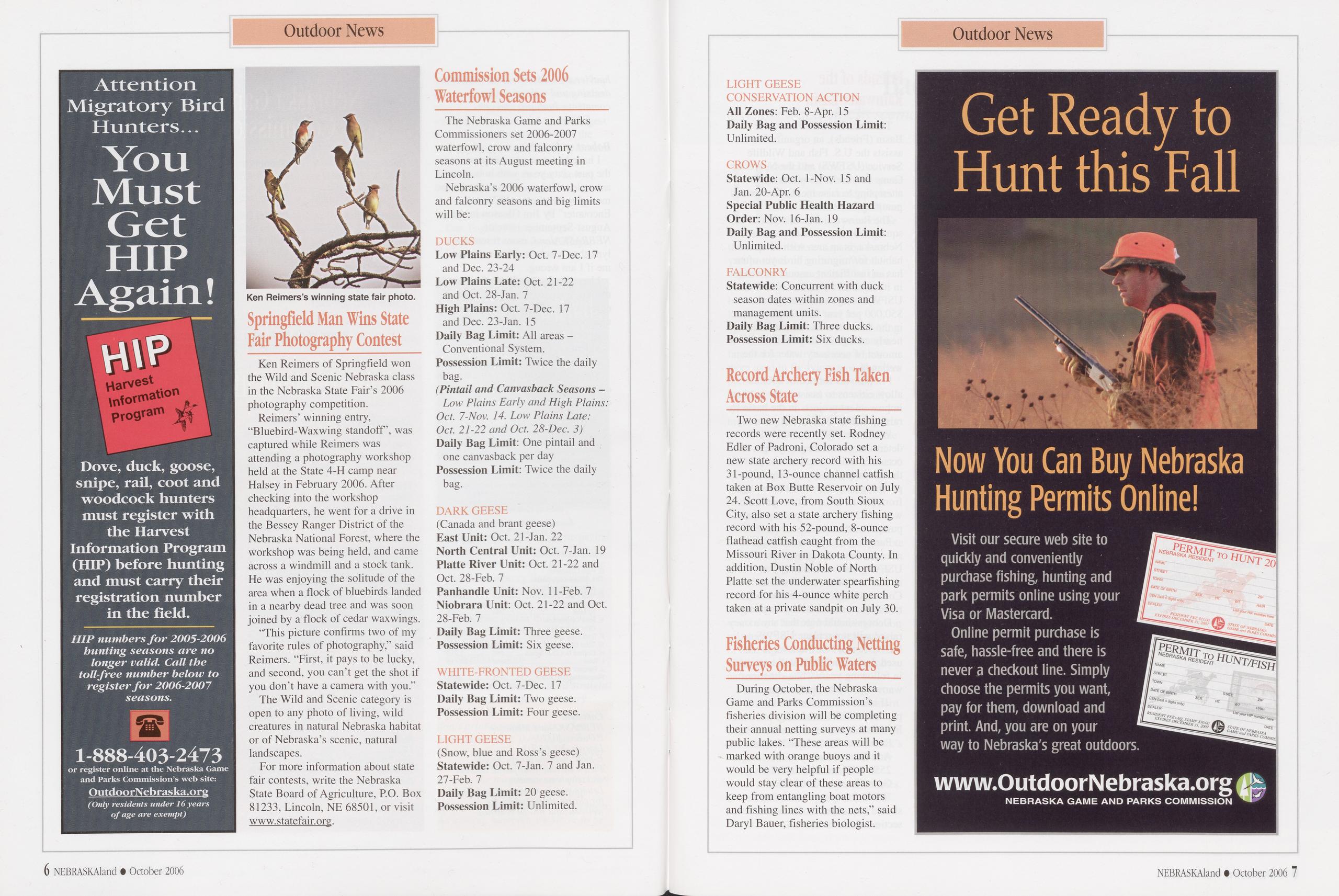
Ken Reimers of Springfield won the Wild and Scenic Nebraska class in the Nebraska State Fair’s 2006 photography competition.
Reimers’ winning entry, “Bluebird-Waxwing standoff’, was captured while Reimers was attending a photography workshop held at the State 4-H camp near Halsey in February 2006. After checking into the workshop headquarters, he went for a drive in the Bessey Ranger District of the Nebraska National Forest, where the workshop was being held, and came across a windmill and a stock tank. He was enjoying the solitude of the area when a flock of bluebirds landed in a nearby dead tree and was soon joined by a flock of cedar waxwings.
“This picture confirms two of my favorite rules of photography,” said Reimers. “First, it pays to be lucky, and second, you can’t get the shot if you don’t have a camera with you.”
The Wild and Scenic category is open to any photo of living, wild creatures in natural Nebraska habitat or of Nebraska’s scenic, natural landscapes.
For more information about state fair contests, write the Nebraska State Board of Agriculture, P.O. Box 81233, Lincoln, NE 68501, or visit www. statefair, org.
Commission Sets 2006 Waterfowl SeasonsThe Nebraska Game and Parks Commissioners set 2006-2007 waterfowl, crow and falconry seasons at its August meeting in Lincoln.
Nebraska’s 2006 waterfowl, crow and falconry seasons and big limits will be:
DUCKS Low Plains Early: Oct. 7-Dec. 17 and Dec. 23-24 Low Plains Late: Oct. 21-22 and Oct. 28-Jan. 7 High Plains: Oct. 7-Dec. 17 and Dec. 23-Jan. 15 Daily Bag Limit: All areas - Conventional System. Possession Limit: Twice the daily bag. (Pintail and Canvasback Seasons - Low Plains Early and High Plains: Oct. 7-Nov. 14. Low Plains Late: Oct. 21-22 and Oct. 28-Dec. 3) Daily Bag Limit: One pintail and one canvasback per day Possession Limit: Twice the daily bag.
DARK GEESE (Canada and brant geese) East Unit: Oct. 21-Jan. 22 North Central Unit: Oct. 7-Jan. 19 Platte River Unit: Oct. 21-22 and Oct. 28-Feb. 7 Panhandle Unit: Nov. 11-Feb. 7 Niobrara Unit: Oct. 21-22 and Oct. 28-Feb. 7 Daily Bag Limit: Three geese. Possession Limit: Six geese.
WHITE-FRONTED GEESE Statewide: Oct. 7-Dec. 17 Daily Bag Limit: Two geese. Possession Limit: Four geese.
LIGHT GEESE (Snow, blue and Ross’s geese) Statewide: Oct. 7-Jan. 7 and Jan. 27-Feb. 7 Daily Bag Limit: 20 geese. Possession Limit: Unlimited.
LIGHT GEESE CONSERVATION ACTION All Zones: Feb. 8-Apr. 15 Daily Bag and Possession Limit: Unlimited.
CROWS Statewide: Oct. 1-Nov. 15 and Jan. 20-Apr. 6 Special Public Health Hazard Order: Nov. 16-Jan. 19 Daily Bag and Possession Limit. Unlimited.
FALCONRY Statewide: Concurrent with duck season dates within zones and management units. Daily Bag Limit: Three ducks. Possession Limit: Six ducks.
Record Archery Fish Taken Across StateTwo new Nebraska state fishing records were recently set. Rodney Edler of Padroni, Colorado set a new state archery record with his 31-pound, 13-ounce channel catfish taken at Box Butte Reservoir on July 24. Scott Love, from South Sioux City, also set a state archery fishing record with his 52-pound, 8-ounce flathead catfish caught from the Missouri River in Dakota County. In addition, Dustin Noble of North Platte set the underwater spearfishing record for his 4-ounce white perch taken at a private sandpit on July 30.
Fisheries Conducting Netting Surveys on Public WatersDuring October, the Nebraska Game and Parks Commission’s fisheries division will be completing their annual netting surveys at many public lakes. “These areas will be marked with orange buoys and it would be very helpful if people would stay clear of these areas to keep from entangling boat motors and fishing lines with the nets,” said Daryl Bauer, fisheries biologist.
Now You Can Buy Nebraska Hunting Permits Online! Visit our secure web site to quickly and conveniently purchase fishing, hunting and park permits online using your Visa or Mastercard. Online permit purchase is safe, hassle-free and there is never a checkout line. Simply choose the permits you want, pay for them, download and print And, you are on your way to Nebraska's great outdoors. www.OutdoorNebraska.org NEBRASKA GAME AND PARKS COMMISSION 6 NEBRASKAland • October 2006 NEBRASKAland •October 2006 7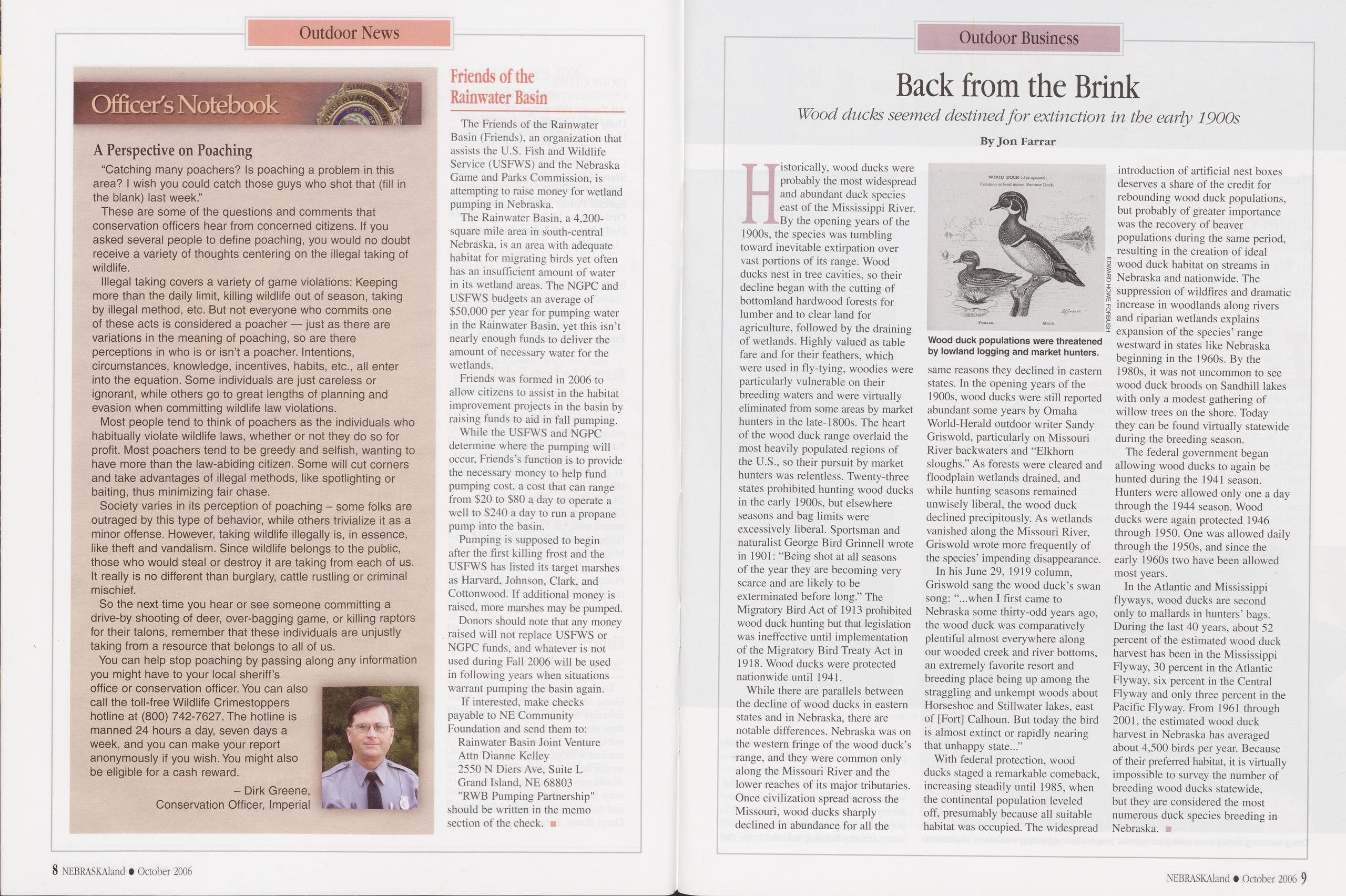 Outdoor Business
A Perspective on Poaching
Outdoor Business
A Perspective on Poaching
“Catching many poachers? Is poaching a problem in this area? I wish you could catch those guys who shot that (fill in the blank) last week.”
These are some of the questions and comments that conservation officers hear from concerned citizens. If you asked several people to define poaching, you would no doubt receive a variety of thoughts centering on the illegal taking of wildlife.
Illegal taking covers a variety of game violations: Keeping more than the daily limit, killing wildlife out of season, taking by illegal method, etc. But not everyone who commits one of these acts is considered a poacher — just as there are variations in the meaning of poaching, so are there perceptions in who is or isn’t a poacher. Intentions, circumstances, knowledge, incentives, habits, etc., all enter into the equation. Some individuals are just careless or ignorant, while others go to great lengths of planning and evasion when committing wildlife law violations.
Most people tend to think of poachers as the individuals who habitually violate wildlife laws, whether or not they do so for profit. Most poachers tend to be greedy and selfish, wanting to have more than the law-abiding citizen. Some will cut corners and take advantages of illegal methods, like spotlighting or baiting, thus minimizing fair chase.
Society varies in its perception of poaching - some folks are outraged by this type of behavior, while others trivialize it as a minor offense. However, taking wildlife illegally is, in essence, like theft and vandalism. Since wildlife belongs to the public, those who would steal or destroy it are taking from each of us. It really is no different than burglary, cattle rustling or criminal mischief.
So the next time you hear or see someone committing a drive-by shooting of deer, over-bagging game, or killing raptors for their talons, remember that these individuals are unjustly taking from a resource that belongs to all of us.
You can help stop poaching by passing along any information you might have to your local sheriff’s office or conservation officer. You can also call the toll-free Wildlife Crimestoppers hotline at (800) 742-7627. The hotline is manned 24 hours a day, seven days a week, and you can make your report anonymously if you wish. You might also be eligible for a cash reward.
- Dirk Greene, Conservation Officer, Imperial Friends of the Rainwater BasinThe Friends of the Rainwater Basin (Friends), an organization that assists the U.S. Fish and Wildlife Service (USFWS) and the Nebraska Game and Parks Commission, is attempting to raise money for wetland pumping in Nebraska.
The Rainwater Basin, a 4,200- square mile area in south-central Nebraska, is an area with adequate habitat for migrating birds yet often has an insufficient amount of water in its wetland areas. The NGPC and USFWS budgets an average of $50,000 per year for pumping water in the Rainwater Basin, yet this isn’t nearly enough funds to deliver the amount of necessary water for the wetlands.
Friends was formed in 2006 to allow citizens to assist in the habitat improvement projects in the basin by raising funds to aid in fall pumping.
While the USFWS and NGPC determine where the pumping will occur, Friends’s function is to provide the necessary money to help fund pumping cost, a cost that can range from $20 to $80 a day to operate a well to $240 a day to run a propane pump into the basin.
Pumping is supposed to begin after the first killing frost and the USFWS has listed its target marshes as Harvard, Johnson, Clark, and Cottonwood. If additional money is raised, more marshes may be pumped.
Donors should note that any money raised will not replace USFWS or NGPC funds, and whatever is not used during Fall 2006 will be used in following years when situations warrant pumping the basin again.
If interested, make checks payable to NE Community Foundation and send them to: Rainwater Basin Joint Venture Attn Dianne Kelley 2550 N Diers Ave, Suite L Grand Island, NE 68803 "RWB Pumping Partnership" should be written in the memo section of the check. ■
Back from the Brink Wood ducks seemed destined for extinction in the early 1900s By Jon FarrarHistorically, wood ducks were probably the most widespread and abundant duck species east of the Mississippi River. By the opening years of the 1900s, the species was tumbling toward inevitable extirpation over vast portions of its range. Wood ducks nest in tree cavities, so their decline began with the cutting of bottomland hardwood forests for lumber and to clear land for agriculture, followed by the draining of wetlands. Highly valued as table fare and for their feathers, which were used in fly-tying, woodies were particularly vulnerable on their breeding waters and were virtually eliminated from some areas by market hunters in the late-1800s. The heart of the wood duck range overlaid the most heavily populated regions of the U.S., so their pursuit by market hunters was relentless. Twenty-three states prohibited hunting wood ducks in the early 1900s, but elsewhere seasons and bag limits were excessively liberal. Sportsman and naturalist George Bird Grinnell wrote in 1901: “Being shot at all seasons of the year they are becoming very scarce and are likely to be exterminated before long.” The Migratory Bird Act of 1913 prohibited wood duck hunting but that legislation was ineffective until implementation of the Migratory Bird Treaty Act in 1918. Wood ducks were protected nationwide until 1941.
While there are parallels between the decline of wood ducks in eastern states and in Nebraska, there are notable differences. Nebraska was on the western fringe of the wood duck’s range, and they were common only along the Missouri River and the lower reaches of its major tributaries. Once civilization spread across the Missouri, wood ducks sharply declined in abundance for all the Common or local nsme: Kummer Duck. introduction of artificial nest boxes deserves a share of the credit for rebounding wood duck populations, but probably of greater importance was the recovery of beaver populations during the same period, resulting in the creation of ideal | wood duck habitat on streams in Z Nebraska and nationwide. The | suppression of wildfires and dramatic Z increase in woodlands along rivers | and riparian wetlands explains T expansion of the species’ range westward in states like Nebraska beginning in the 1960s. By the 1980s, it was not uncommon to see wood duck broods on Sandhill lakes with only a modest gathering of willow trees on the shore. Today they can be found virtually statewide during the breeding season. The federal government began allowing wood ducks to again be hunted during the 1941 season. Hunters were allowed only one a day through the 1944 season. Wood ducks were again protected 1946 through 1950. One was allowed daily through the 1950s, and since the early 1960s two have been allowed most years. In the Atlantic and Mississippi flyways, wood ducks are second only to mallards in hunters’ bags. During the last 40 years, about 52 percent of the estimated wood duck harvest has been in the Mississippi Flyway, 30 percent in the Atlantic Flyway, six percent in the Central Flyway and only three percent in the Pacific Flyway. From 1961 through 2001, the estimated wood duck harvest in Nebraska has averaged about 4,500 birds per year. Because of their preferred habitat, it is virtually impossible to survey the number of breeding wood ducks statewide, but they are considered the most numerous duck species breeding in Nebraska. ■ Fkmaxjs. Maijs. Wood duck populations were threatened by lowland logging and market hunters. same reasons they declined in eastern states. In the opening years of the 1900s, wood ducks were still reported abundant some years by Omaha World-Herald outdoor writer Sandy Griswold, particularly on Missouri River backwaters and “Elkhorn sloughs.” As forests were cleared and floodplain wetlands drained, and while hunting seasons remained unwisely liberal, the wood duck declined precipitously. As wetlands vanished along the Missouri River, Griswold wrote more frequently of the species’ impending disappearance.
In his June 29, 1919 column, Griswold sang the wood duck’s swan song: “...when I first came to Nebraska some thirty-odd years ago, the wood duck was comparatively plentiful almost everywhere along our wooded creek and river bottoms, an extremely favorite resort and breeding place being up among the straggling and unkempt woods about Horseshoe and Stillwater lakes, east of [Fort] Calhoun. But today the bird is almost extinct or rapidly nearing that unhappy state...”
With federal protection, wood ducks staged a remarkable comeback, increasing steadily until 1985, when the continental population leveled off, presumably because all suitable habitat was occupied. The widespread
8 NEBRASKAland • October 2006 NEBRASKAland • October 2006 9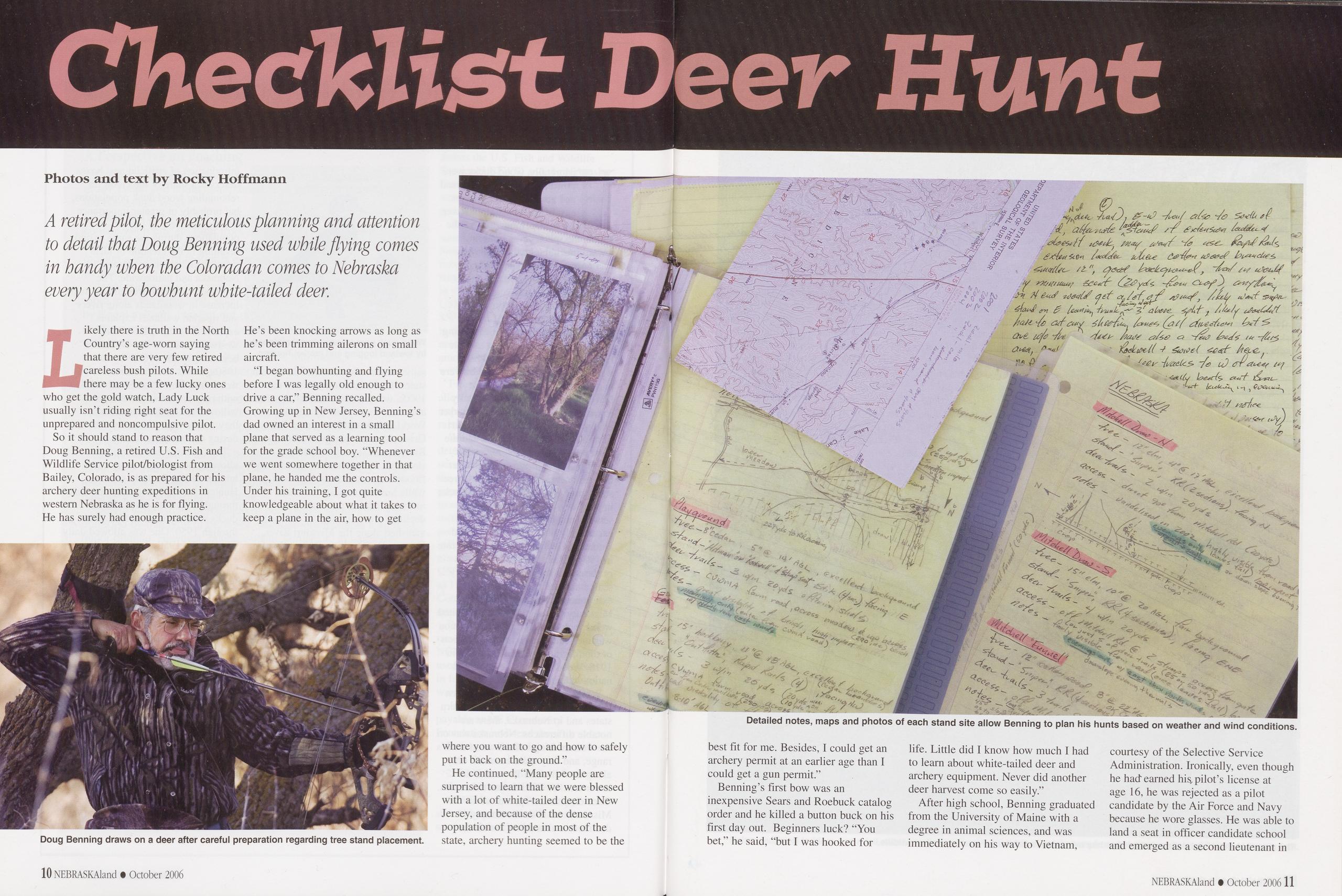
Checklist Deer Hunt
Photos and text by Rocky Hoffmann A retired pilot, the meticulous planning and attention to detail that Doug Benning used while flying comes in handy when the Coloradan comes to Nebraska every year to bowhunt white-tailed deer.Likely there is truth in the North Country’s age-worn saying that there are very few retired careless bush pilots. While there may be a few lucky ones who get the gold watch, Lady Luck usually isn’t riding right seat for the unprepared and noncompulsive pilot. So it should stand to reason that Doug Benning, a retired U.S. Fish and Wildlife Service pilot/biologist from Bailey, Colorado, is as prepared for his archery deer hunting expeditions in western Nebraska as he is for flying. He has surely had enough practice. He’s been knocking arrows as long as he’s been trimming ailerons on small aircraft.
“I began bowhunting and flying before I was legally old enough to drive a car,” Benning recalled. Growing up in New Jersey, Benning’s dad owned an interest in a small plane that served as a learning tool for the grade school boy. “Whenever we went somewhere together in that plane, he handed me the controls. Under his training, I got quite knowledgeable about what it takes to keep a plane in the air, how to get where you want to go and how to safely put it back on the ground.”
He continued, “Many people are surprised to learn that we were blessed with a lot of white-tailed deer in New Jersey, and because of the dense population of people in most of the state, archery hunting seemed to be the best fit for me. Besides, I could get an archery permit at an earlier age than I could get a gun permit.”
Benning’s first bow was an inexpensive Sears and Roebuck catalog order and he killed a button buck on his first day out. Beginners luck? You bet,” he said, “but I was hooked for life. Little did I know how much I had to learn about white-tailed deer and archery equipment. Never did another deer harvest come so easily.”
After high school, Benning graduated
from the University of Maine with a
degree in animal sciences, and was
immediately on his way to Vietnam,
courtesy of the Selective Service
Administration. Ironically, even though
he had earned his, pilot’s license at
age 16, he was rejected as a pilot
candidate by the Air Force and Navy
because he wore glasses. He was able to
land a seat in officer candidate school
and emerged as a second lieutenant in
NEBRASKAland • October 200611
10 NEBRASKAland • October 2006
 an armored cavalry unit, which he
commanded for 11 months.
an armored cavalry unit, which he
commanded for 11 months.
He then went to work for the United States Fish and Wildlife Service (USFWS) in Fort Worth, Texas as a fish and wildlife biologist, where he earned his commercial pilot’s license and was transferred to Denver as a flyway biologist. His next 28 years with USFWS included more than 20 years of flying waterfowl surveys in Saskatchewan, five years flying southern Manitoba, and doing winter surveys in interior Mexico for 12 years. In the states, Benning flew winter and fall surveys in Kansas and Nebraska, and spring white-fronted goose and sandhill crane counts in Nebraska.
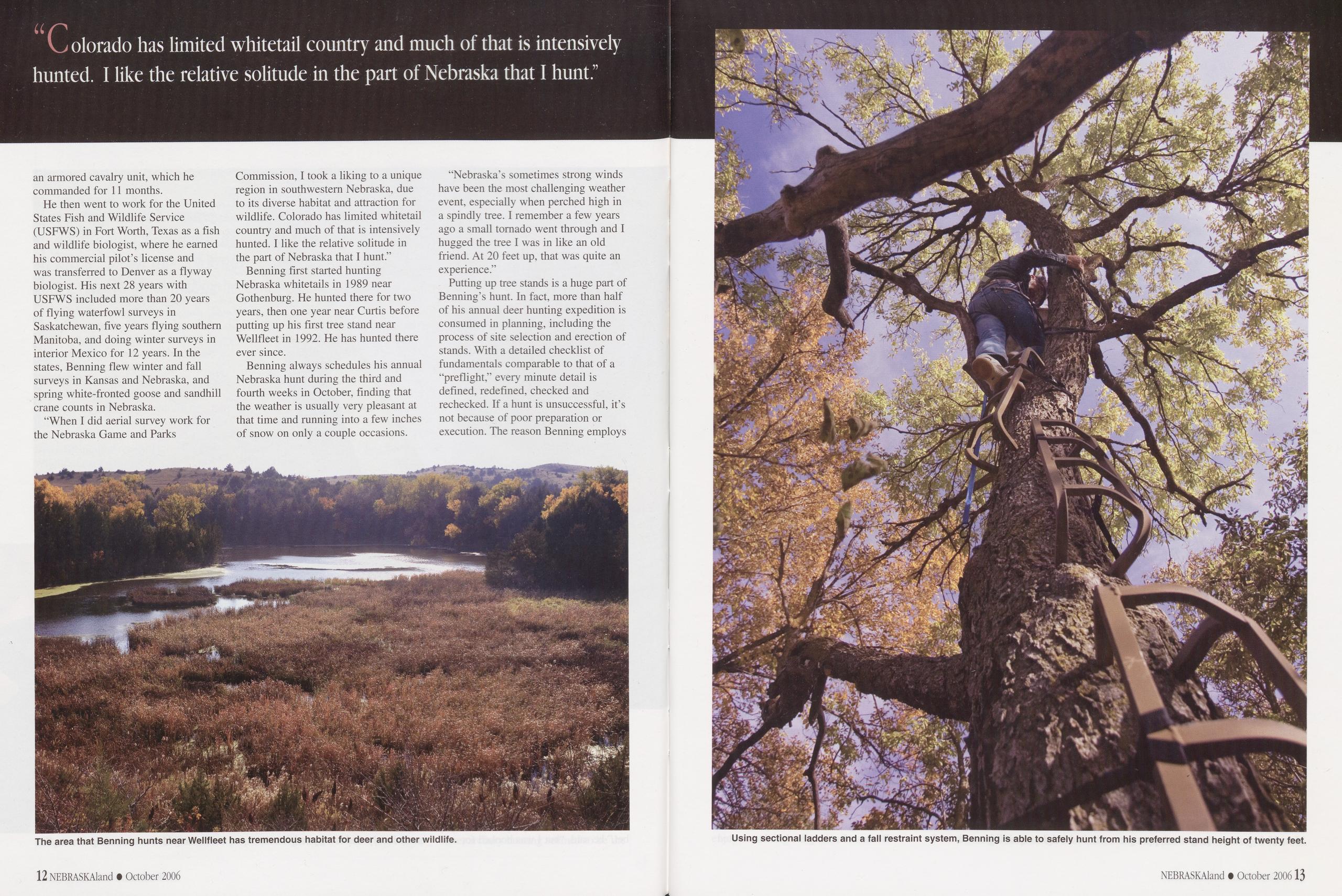
"When I did aerial survey work for the Nebraska Game and Parks Commission, I took a liking to a unique region in southwestern Nebraska, due to its diverse habitat and attraction for wildlife. Colorado has limited whitetail country and much of that is intensively hunted. I like the relative solitude in the part of Nebraska that I hunt.”
Benning first started hunting Nebraska whitetails in 1989 near Gothenburg. He hunted there for two years, then one year near Curtis before putting up his first tree stand near Wellfleet in 1992. He has hunted there ever since.
Benning always schedules his annual Nebraska hunt during the third and fourth weeks in October, finding that the weather is usually very pleasant at that time and running into a few inches of snow on only a couple occasions.
“Nebraska’s sometimes strong winds have been the most challenging weather event, especially when perched high in a spindly tree. I remember a few years ago a small tornado went through and I hugged the tree I was in like an old friend. At 20 feet up, that was quite an experience.”
Putting up tree stands is a huge part of
Benning’s hunt. In fact, more than half
of his annual deer hunting expedition is
consumed in planning, including the
process of site selection and erection of
stands. With a detailed checklist of
fundamentals comparable to that of a
“preflight,” every minute detail is
defined, redefined, checked and
rechecked. If a hunt is unsuccessful, it’s
not because of poor preparation or
execution. The reason Benning employs
12 NEBRASKAland • October 2006
NEBRASKAland • October 200613
 so many stands is for the variable wind
conditions he will encounter. The more
stands he has, the more options.
so many stands is for the variable wind
conditions he will encounter. The more
stands he has, the more options.
"I typically try to set five or more stands each year. Deer are very sensitive to human scent and will alter their normal travel patterns and even restrict their travel during daylight hours if they encounter repeated incidences of human scent.”
But before Benning even considers wind direction, he also looks for well- used trails that intersect or lead to natural choke points for deer, heavy rub areas, or scrape locations. Plus Benning has other requirements.
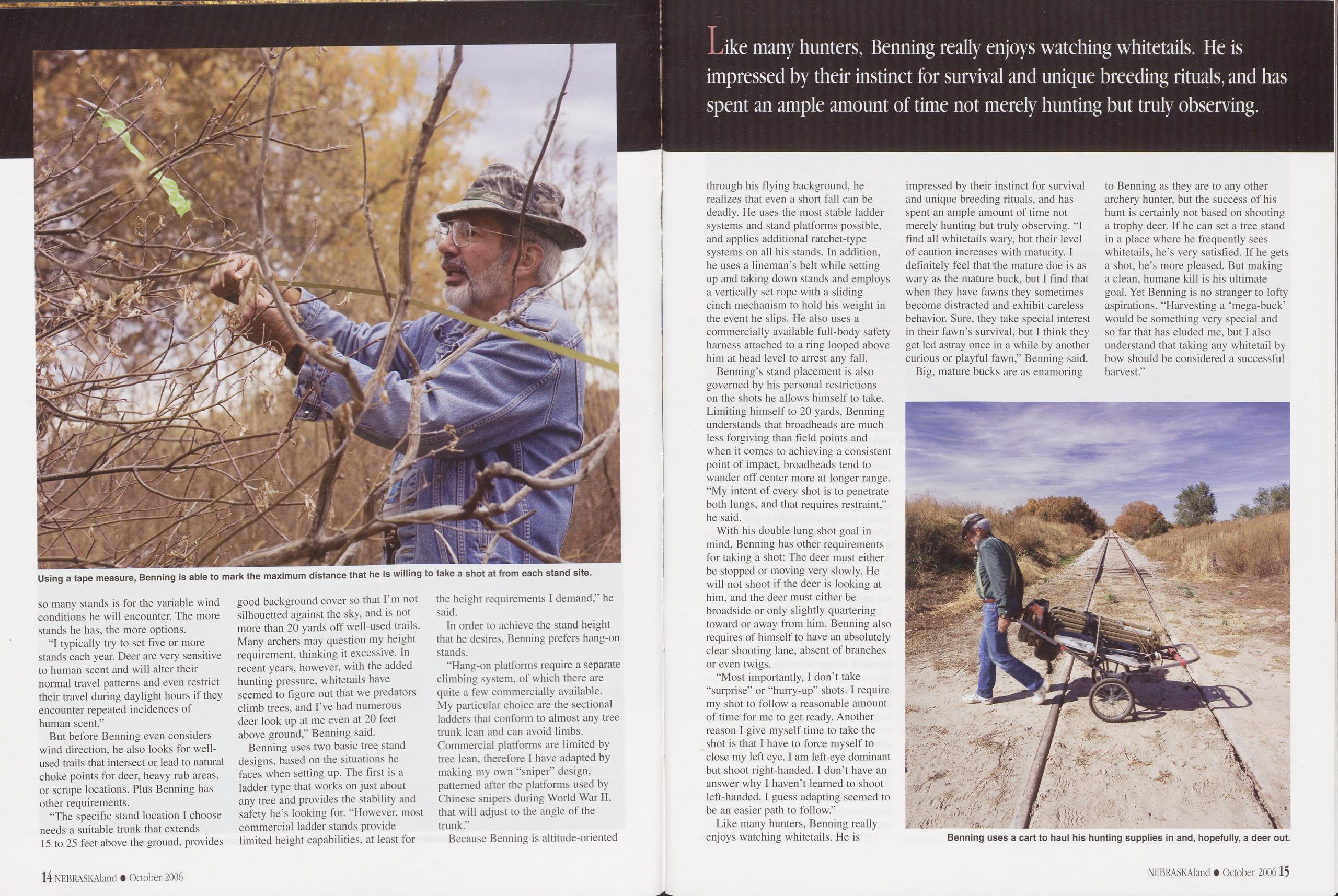
“The specific stand location I choose needs a suitable trunk that extends 15 to 25 feet above the ground, provides good background cover so that I’m not silhouetted against the sky, and is not more than 20 yards off well-used trails. Many archers may question my height requirement, thinking it excessive. In recent years, however, with the added hunting pressure, whitetails have seemed to figure out that we predators climb trees, and I’ve had numerous deer look up at me even at 20 feet above ground,” Benning said.
Benning uses two basic tree stand designs, based on the situations he faces when setting up. The first is a ladder type that works on just about any tree and provides the stability and safety he’s looking for. “However, most commercial ladder stands provide limited height capabilities, at least for the height requirements I demand,” he said.
In order to achieve the stand height that he desires, Benning prefers hang-on stands.
“Hang-on platforms require a separate climbing system, of which there are quite a few commercially available. My particular choice are the sectional ladders that conform to almost any tree trunk lean and can avoid limbs. Commercial platforms are limited by tree lean, therefore I have adapted by making my own “sniper” design, patterned after the platforms used by Chinese snipers during World War II, that will adjust to the angle of the trunk.”
Because Benning is altitude-oriented through his flying background, he realizes that even a short fall can be deadly. He uses the most stable ladder systems and stand platforms possible, and applies additional ratchet-type systems on all his stands. In addition, he uses a lineman’s belt while setting up and taking down stands and employs a vertically set rope with a sliding cinch mechanism to hold his weight in the event he slips. He also uses a commercially available full-body safety harness attached to a ring looped above him at head level to arrest any fall.
Benning’s stand placement is also governed by his personal restrictions on the shots he allows himself to take. Limiting himself to 20 yards, Benning understands that broadheads are much less forgiving than field points and when it comes to achieving a consistent point of impact, broadheads tend to wander off center more at longer range. “My intent of every shot is to penetrate both lungs, and that requires restraint,” he said.
With his double lung shot goal in mind, Benning has other requirements for taking a shot: The deer must either be stopped or moving very slowly. He will not shoot if the deer is looking at him, and the deer must either be broadside or only slightly quartering toward or away from him. Benning also requires of himself to have an absolutely clear shooting lane, absent of branches or even twigs.
“Most importantly, I don’t take “surprise” or “hurry-up” shots. I require my shot to follow a reasonable amount of time for me to get ready. Another reason I give myself time to take the shot is that I have to force myself to close my left eye. I am left-eye dominant but shoot right-handed. I don’t have an answer why I haven’t learned to shoot left-handed. I guess adapting seemed to be an easier path to follow.”
Like many hunters, Benning really enjoys watching whitetails. He is impressed by their instinct for survival and unique breeding rituals, and has spent an ample amount of time not merely hunting but truly observing. “I find all whitetails wary, but their level of caution increases with maturity. I definitely feel that the mature doe is as wary as the mature buck, but I find that when they have fawns they sometimes become distracted and exhibit careless behavior. Sure, they take special interest in their fawn’s survival, but I think they get led astray once in a while by another curious or playful fawn,” Benning said.
Big, mature bucks are as enamoring to Benning as they are to any other archery hunter, but the success of his hunt is certainly not based on shooting a trophy deer. If he can set a tree stand in a place where he frequently sees whitetails, he’s very satisfied. If he gets a shot, he’s more pleased. But making a clean, humane kill is his ultimate goal. Yet Benning is no stranger to lofty aspirations. “Harvesting a ‘mega-buck’ would be something very special and so far that has eluded me, but I also understand that taking any whitetail by bow should be considered a successful harvest.”
14NEBRASKAland • October 2006 NEBRASKAland • October 200615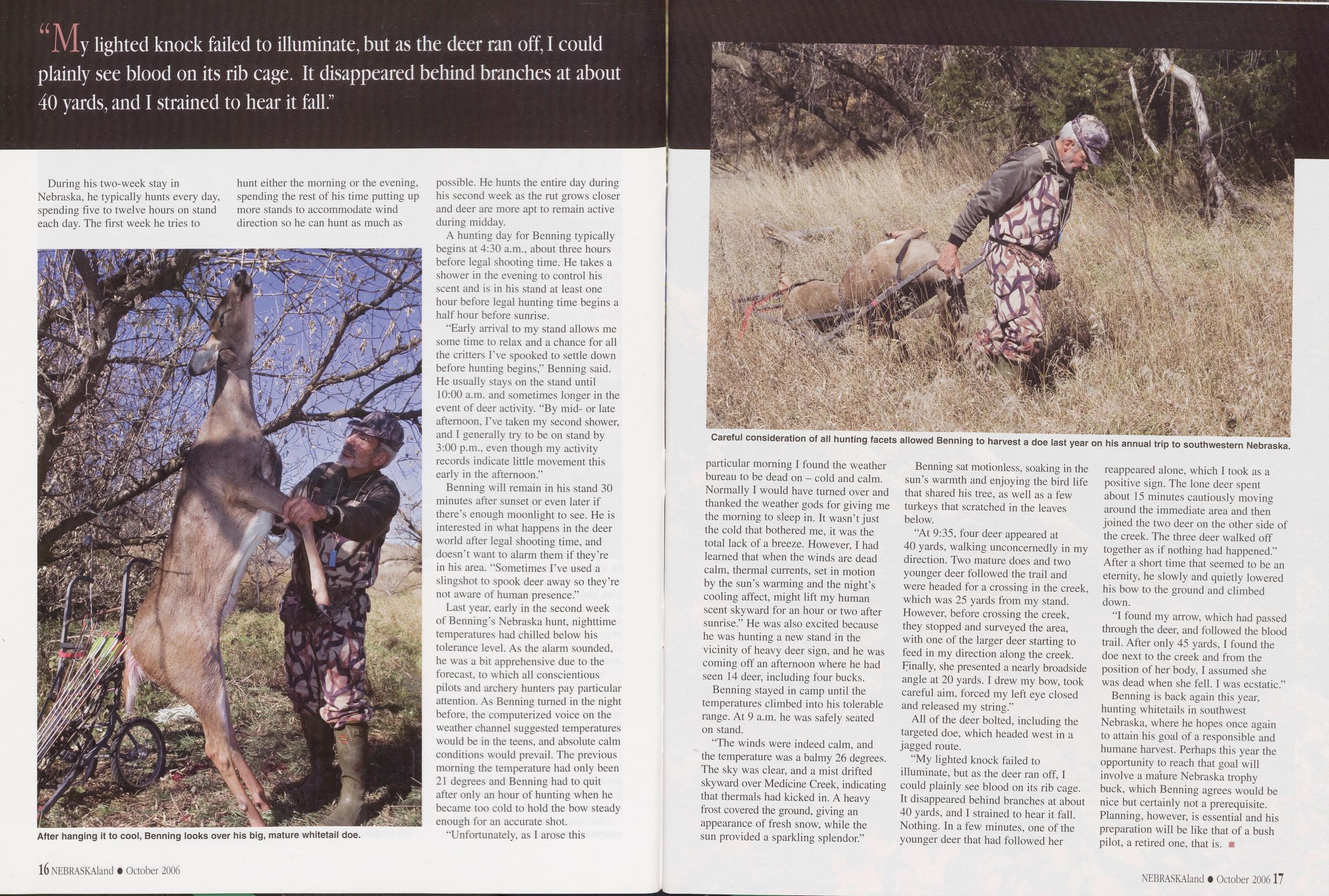
During his two-week stay in Nebraska, he typically hunts every day, spending five to twelve hours on stand each day. The first week he tries to hunt either the morning or the evening, spending the rest of his time putting up more stands to accommodate wind direction so he can hunt as much as possible. He hunts the entire day during his second week as the rut grows closer and deer are more apt to remain active during midday.
A hunting day for Benning typically begins at 4:30 a.m., about three hours before legal shooting time. He takes a shower in the evening to control his scent and is in his stand at least one hour before legal hunting time begins a half hour before sunrise.
“Early arrival to my stand allows me some time to relax and a chance for all the critters I’ve spooked to settle down before hunting begins,” Benning said. He usually stays on the stand until 10:00 a.m. and sometimes longer in the event of deer activity. “By mid- or late afternoon, I’ve taken my second shower, and I generally try to be on stand by 3:00 p.m., even though my activity records indicate little movement this early in the afternoon.”
Benning will remain in his stand 30 minutes after sunset or even later if there’s enough moonlight to see. He is interested in what happens in the deer world after legal shooting time, and doesn’t want to alarm them if they’re in his area. “Sometimes I’ve used a slingshot to spook deer away so they’re not aware of human presence.”
Last year, early in the second week of Benning’s Nebraska hunt, nighttime temperatures had chilled below his tolerance level. As the alarm sounded, he was a bit apprehensive due to the forecast, to which all conscientious pilots and archery hunters pay particular attention. As Benning turned in the night before, the computerized voice on the weather channel suggested temperatures would be in the teens, and absolute calm conditions would prevail. The previous morning the temperature had only been 21 degrees and Benning had to quit after only an hour of hunting when he became too cold to hold the bow steady enough for an accurate shot.
“Unfortunately, as I arose this particular morning I found the weather bureau to be dead on - cold and calm. Normally I would have turned over and thanked the weather gods for giving me the morning to sleep in. It wasn’t just the cold that bothered me, it was the total lack of a breeze. However, I had learned that when the winds are dead calm, thermal currents, set in motion by the sun’s warming and the night’s cooling affect, might lift my human scent skyward for an hour or two after sunrise.” He was also excited because he was hunting a new stand in the vicinity of heavy deer sign, and he was coming off an afternoon where he had seen 14 deer, including four bucks. Benning stayed in camp until the temperatures climbed into his tolerable range. At 9 a.m. he was safely seated on stand.
“The winds were indeed calm, and the temperature was a balmy 26 degrees. The sky was clear, and a mist drifted skyward over Medicine Creek, indicating that thermals had kicked in. A heavy frost covered the ground, giving an appearance of fresh snow, while the sun provided a sparkling splendor.”
Benning sat motionless, soaking in the sun’s warmth and enjoying the bird life that shared his tree, as well as a few turkeys that scratched in the leaves below.
“At 9:35, four deer appeared at 40 yards, walking unconcernedly in my direction. Two mature does and two younger deer followed the trail and were headed for a crossing in the creek, which was 25 yards from my stand. However, before crossing the creek, they stopped and surveyed the area, with one of the larger deer starting to feed in my direction along the creek. Finally, she presented a nearly broadside angle at 20 yards. I drew my bow, took careful aim, forced my left eye closed and released my string.”
All of the deer bolted, including the targeted doe, which headed west in a jagged route.
“My lighted knock failed to illuminate, but as the deer ran off, I could plainly see blood on its rib cage. It disappeared behind branches at about 40 yards, and I strained to hear it fall. Nothing. In a few minutes, one of the younger deer that had followed her reappeared alone, which I took as a positive sign. The lone deer spent about 15 minutes cautiously moving around the immediate area and then joined the two deer on the other side of the creek. The three deer walked off together as if nothing had happened.” After a short time that seemed to be an eternity, he slowly and quietly lowered his bow to the ground and climbed down.
“I found my arrow, which had passed through the deer, and followed the blood trail. After only 45 yards, I found the doe next to the creek and from the position of her body, I assumed she was dead when she fell. I was ecstatic.”
Benning is back again this year, hunting whitetails in southwest Nebraska, where he hopes once again to attain his goal of a responsible and humane harvest. Perhaps this year the opportunity to reach that goal will involve a mature Nebraska trophy buck, which Benning agrees would be nice but certainly not a prerequisite. Planning, however, is essential and his preparation will be like that of a bush pilot, a retired one, that is. ■
16 NEBRASKAland • October 2006 NEBRASKAland • October 200617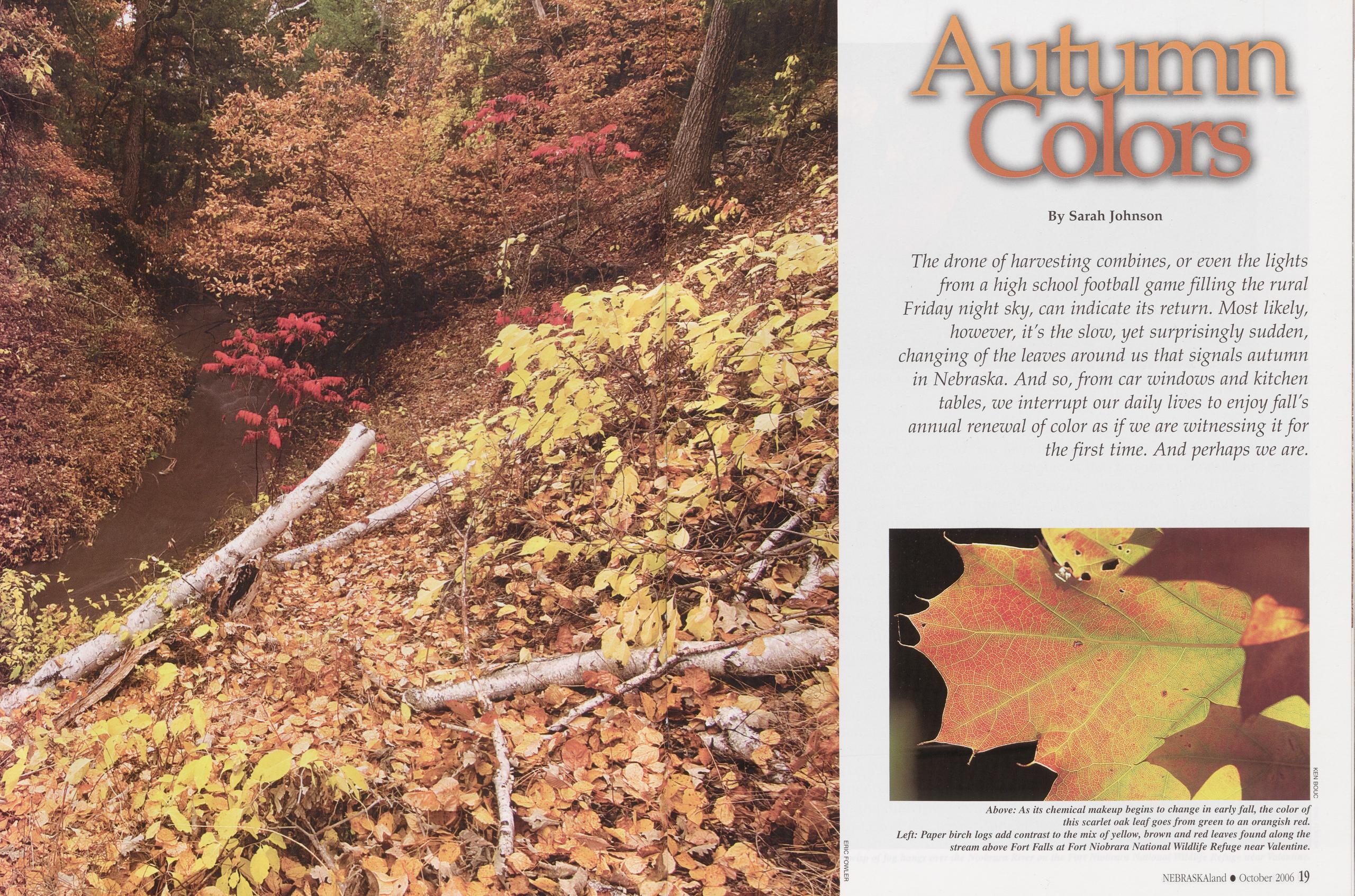
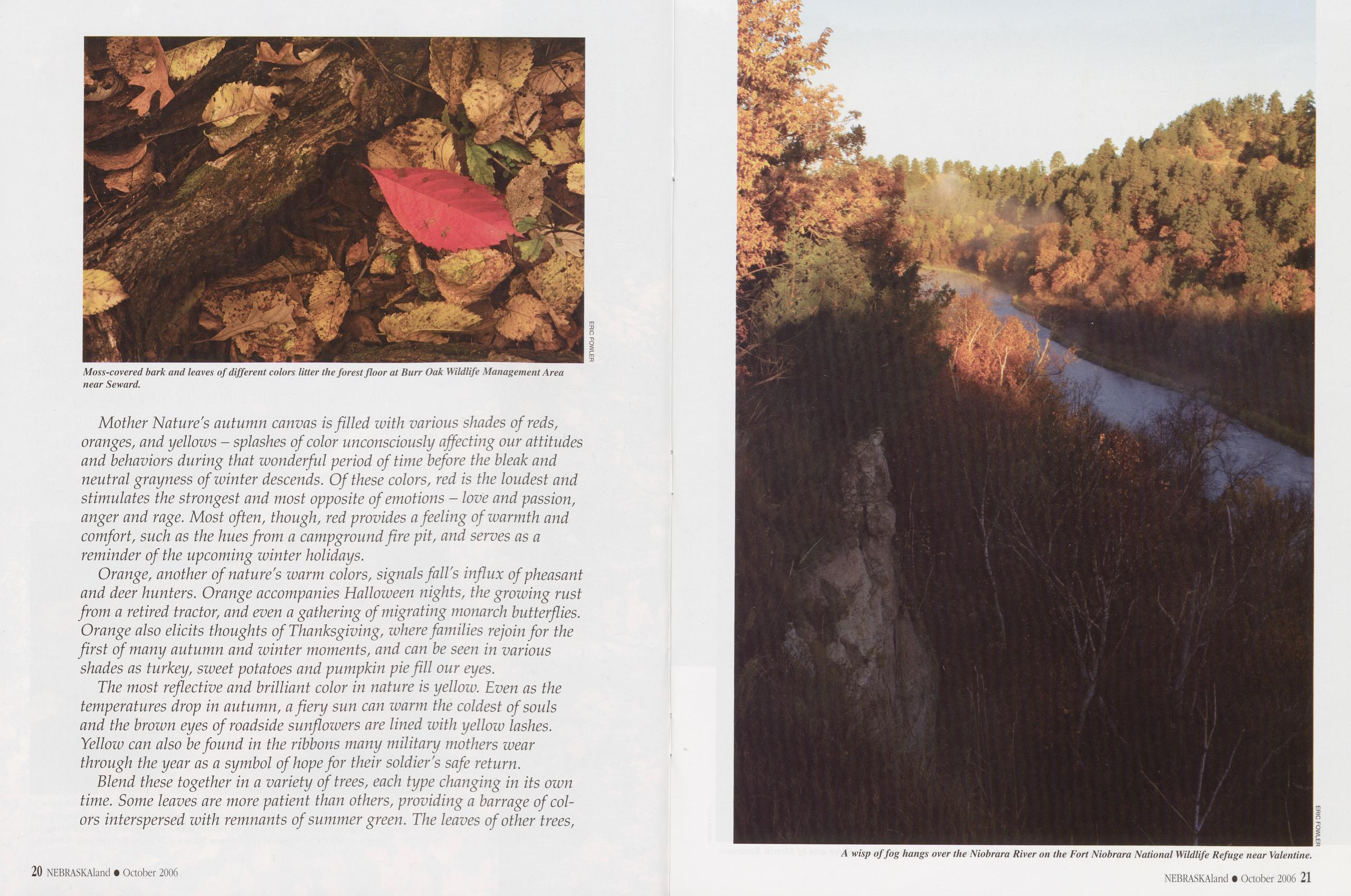
Mother Nature's autumn canvas is filled with various shades of reds, oranges, and yellows - splashes of color unconsciously affecting our attitudes and behaviors during that wonderful period of time before the bleak and neutral grayness of winter descends. Of these colors, red is the loudest and stimulates the strongest and most opposite of emotions - love and passion, anger and rage. Most often, though, red provides a feeling of warmth and comfort, such as the hues from a campground fire pit, and serves as a reminder of the upcoming winter holidays.
Orange, another of nature's warm colors, signals fall's influx of pheasant and deer hunters. Orange accompanies Halloween nights, the growing rust from a retired tractor, and even a gathering of migrating monarch butterflies. Orange also elicits thoughts of Thanksgiving, where families rejoin for the first of many autumn and winter moments, and can be seen in various shades as turkey, sweet potatoes and pumpkin pie fill our eyes.
The most reflective and brilliant color in nature is yellow. Even as the temperatures drop in autumn, a fiery sun can warm the coldest of souls and the brown eyes of roadside sunflowers are lined with yellow lashes. Yellow can also be found in the ribbons many military mothers wear through the year as a symbol of hope for their soldier's safe return.
Blend these together in a variety of trees, each type changing in its own
time. Some leaves are more patient than others, providing a barrage of col-
ors interspersed with remnants of summer green. The leaves of other trees,
NEBRASKAland • October 21
20 NEBRASKAland • October 2006
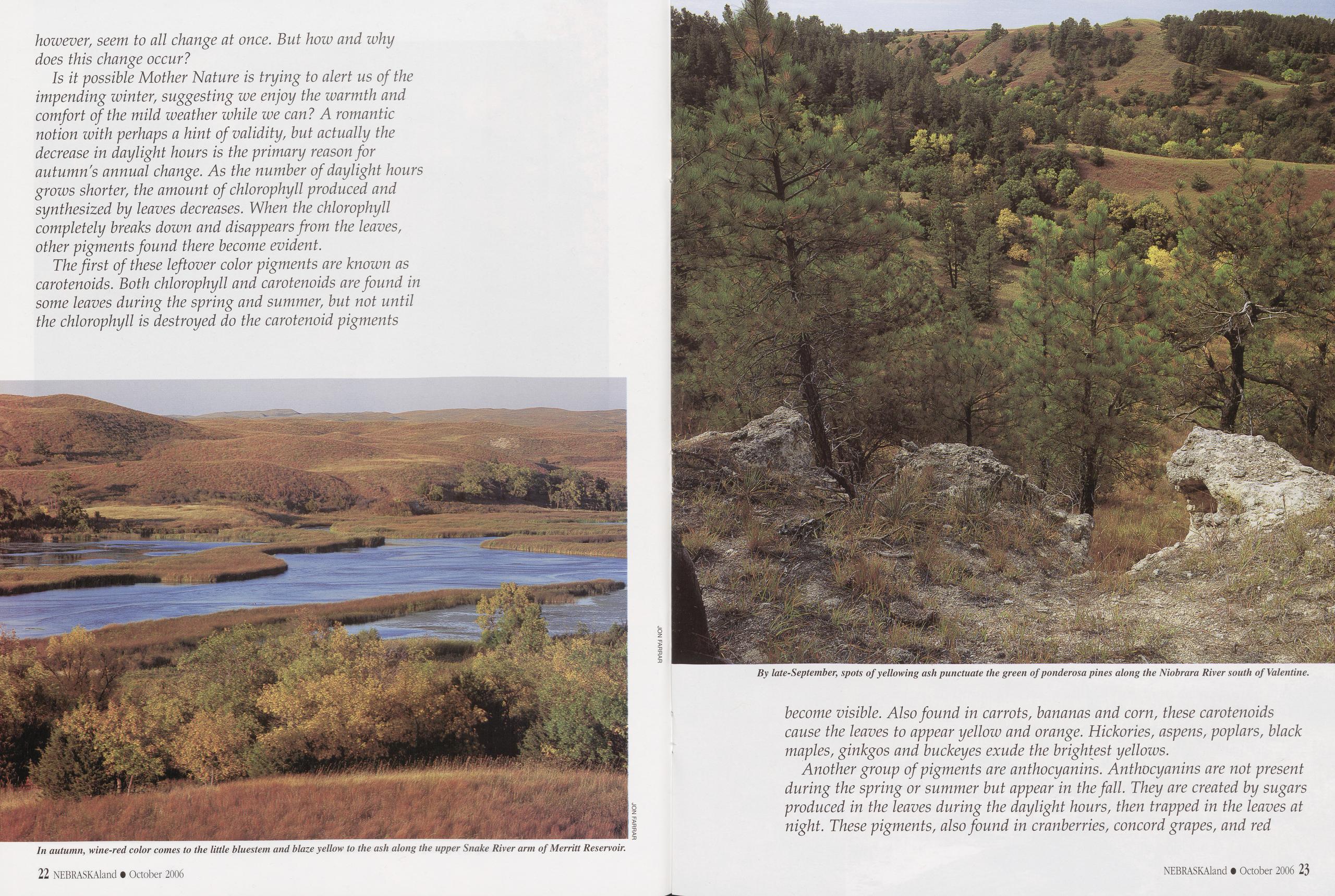 however, seem to all change at once. But how and why
does this change occur?
however, seem to all change at once. But how and why
does this change occur?
Is it possible Mother Nature is trying to alert us of the impending winter, suggesting we enjoy the warmth and comfort of the mild weather while we can? A romantic notion with perhaps a hint of validity, but actually the decrease in daylight hours is the primary reason for autumn's annual change. As the number of daylight hours grows shorter, the amount of chlorophyll produced and synthesized by leaves decreases. When the chlorophyll completely breaks down and disappears from the leaves, other pigments found there become evident.
The first of these leftover color pigments are known as carotenoids. Both chlorophyll and carotenoids are found in some leaves during the spring and summer, but not until the chlorophyll is destroyed do the carotenoid pigments become visible. Also found in carrots, bananas and corn, these carotenoids cause the leaves to appear yellow and orange. Hickories, aspens, poplars, black maples, ginkgos and buckeyes exude the brightest yellows.
Another group of pigments are anthocyanins. Anthocyanins are not present
during the spring or summer but appear in the fall. They are created by sugars
produced in the leaves during the daylight hours, then trapped in the leaves at
night. These pigments, also found in cranberries, concord grapes, and red
NEBRASKAland • October 2006 23
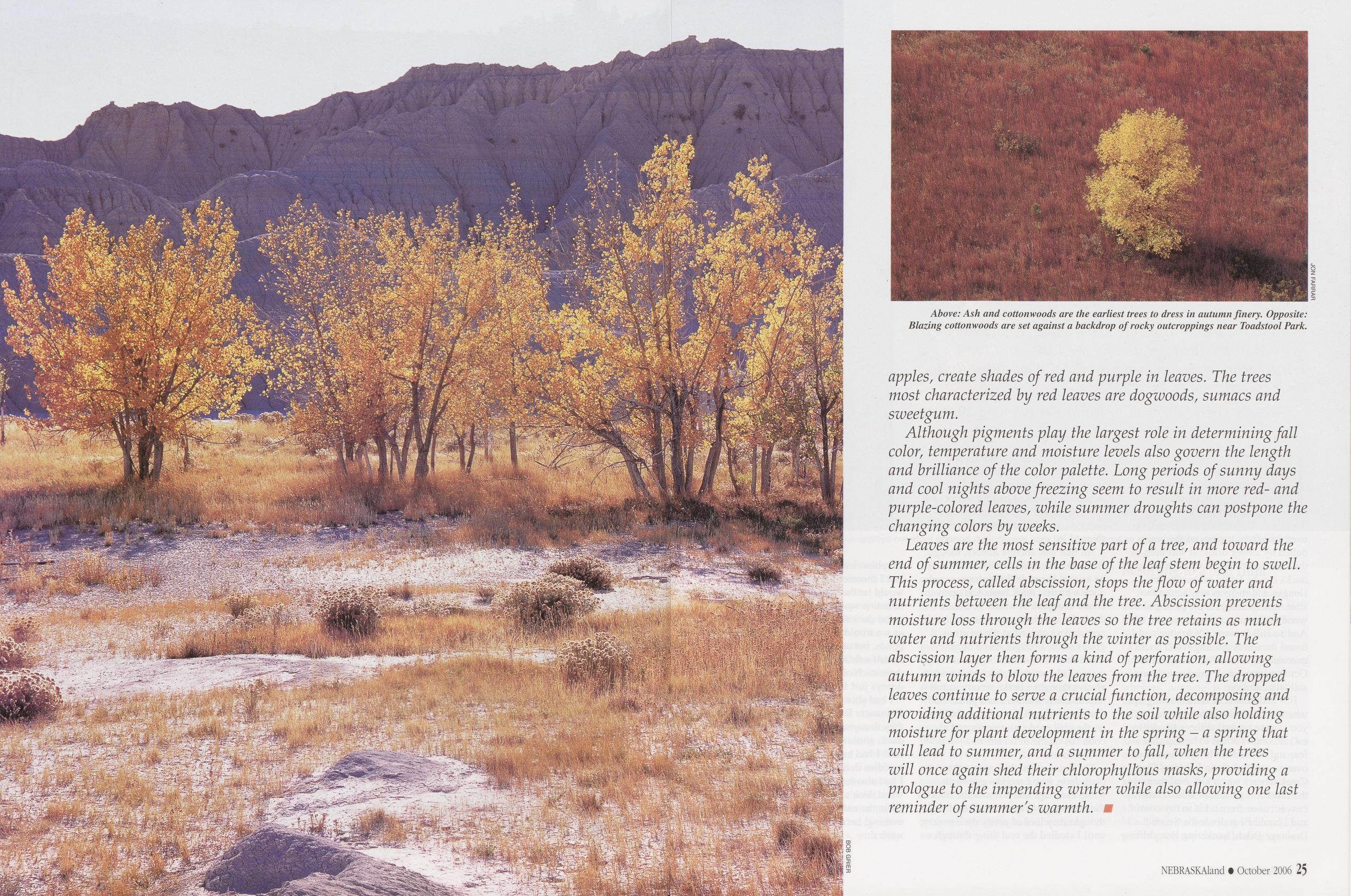 apples, create shades of red and purple in leaves. The trees
most characterized by red leaves are dogwoods, sumacs and
sweetgum.
apples, create shades of red and purple in leaves. The trees
most characterized by red leaves are dogwoods, sumacs and
sweetgum.
Although pigments play the largest role in determining fall color, temperature and moisture levels also govern the length and brilliance of the color palette. Long periods of sunny days and cool nights above freezing seem to result in more red- and purple-colored leaves, while summer droughts can postpone the changing colors by weeks.
Leaves are the most sensitive part of a tree, and toward the end of summer, cells in the base of the leaf stem begin to swell. This process, called abscission, stops the flow of water and nutrients between the leaf and the tree. Abscission prevents moisture loss through the leaves so the tree retains as much water and nutrients through the winter as possible. The abscission layer then forms a kind of perforation, allowing autumn winds to blow the leaves from the tree. The dropped leaves continue to serve a crucial function, decomposing and providing additional nutrients to the soil while also holding moisture for plant development in the spring - a spring that will lead to summer, and a summer to fall, when the trees will once again shed their chlorophyll'ous masks, providing a prologue to the impending winter while also allowing one last reminder of summer's warmth.
NEBRASKAland • October 2006 25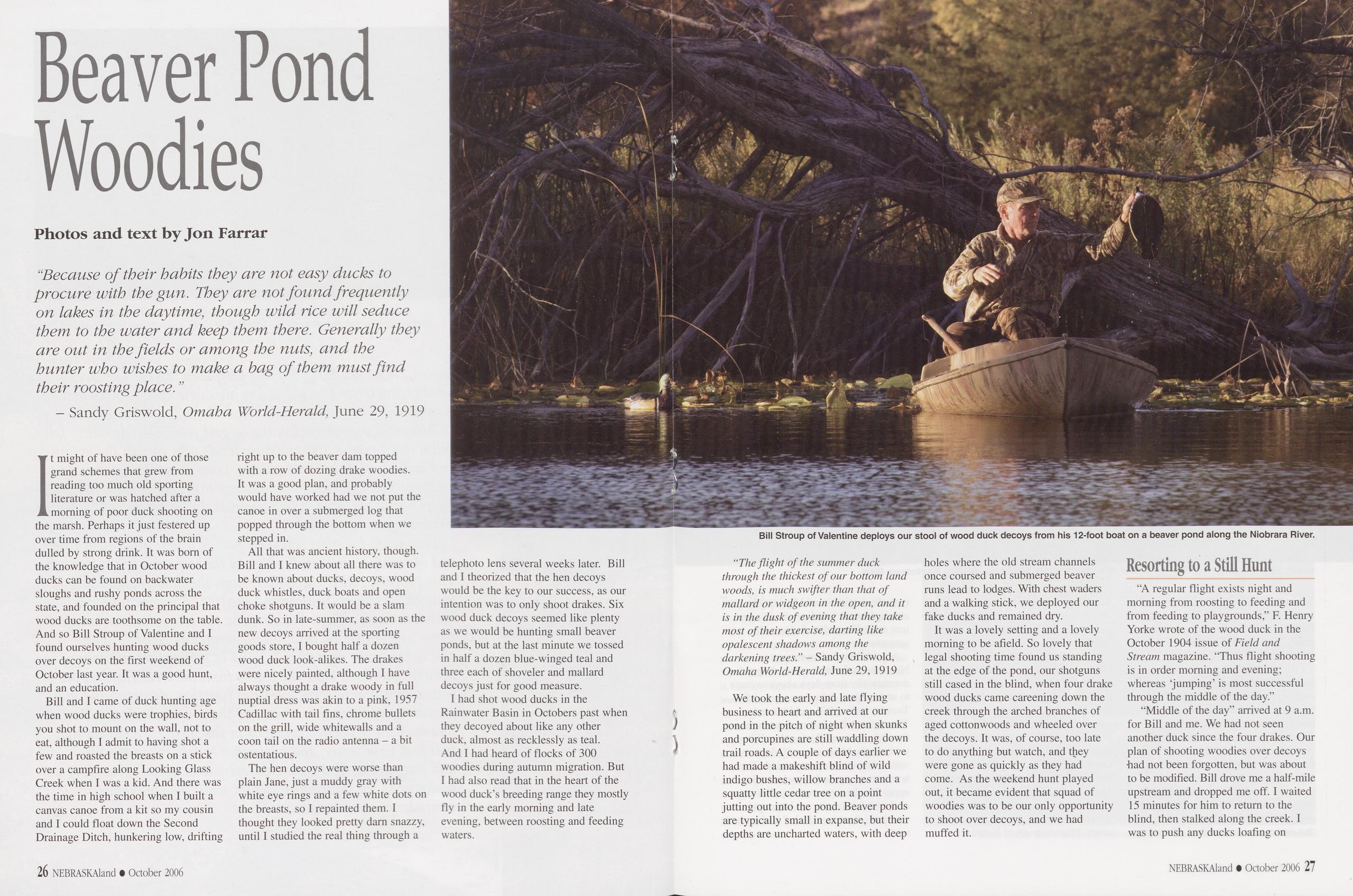
Beaver Pond Woodies
Photos and text by Jon Farrar “Because of their habits they are not easy ducks to procure with the gun. They are not found frequently on lakes in the daytime, though wild rice will seduce them to the water and keep them there. Generally they are out in the fields or among the nuts, and the hunter who wishes to make a bag of them must find their roosting place. ” - Sandy Griswold, Omaha World-Herald, June 29, 1919It might of have been one of those grand schemes that grew from reading too much old sporting literature or was hatched after a morning of poor duck shooting on the marsh. Perhaps it just festered up over time from regions of the brain dulled by strong drink. It was born of the knowledge that in October wood ducks can be found on backwater sloughs and rushy ponds across the state, and founded on the principal that wood ducks are toothsome on the table. And so Bill Stroup of Valentine and I found ourselves hunting wood ducks over decoys on the first weekend of October last year. It was a good hunt, and an education.
Bill and I came of duck hunting age when wood ducks were trophies, birds you shot to mount on the wall, not to eat, although I admit to having shot a few and roasted the breasts on a stick over a campfire along Looking Glass Creek when I was a kid. And there was the time in high school when I built a canvas canoe from a kit so my cousin and I could float down the Second Drainage Ditch, hunkering low, drifting right up to the beaver dam topped with a row of dozing drake woodies. It was a good plan, and probably would have worked had we not put the canoe in over a submerged log that popped through the bottom when we stepped in.
All that was ancient history, though. Bill and I knew about all there was to be known about ducks, decoys, wood duck whistles, duck boats and open choke shotguns. It would be a slam dunk. So in late-summer, as soon as the new decoys arrived at the sporting goods store, I bought half a dozen wood duck look-alikes. The drakes were nicely painted, although I have always thought a drake woody in full nuptial dress was akin to a pink, 1957 Cadillac with tail fins, chrome bullets on the grill, wide whitewalls and a coon tail on the radio antenna - a bit ostentatious.
The hen decoys were worse than plain Jane, just a muddy gray with white eye rings and a few white dots on the breasts, so I repainted them. I thought they looked pretty darn snazzy, until I studied the real thing through a telephoto lens several weeks later. Bill and I theorized that the hen decoys would be the key to our success, as our intention was to only shoot drakes. Six wood duck decoys seemed like plenty as we would be hunting small beaver ponds, but at the last minute we tossed in half a dozen blue-winged teal and three each of shoveler and mallard decoys just for good measure.
I had shot wood ducks in the Rainwater Basin in Octobers past when they decoyed about like any other duck, almost as recklessly as teal. And I had heard of flocks of 300 woodies during autumn migration. But I had also read that in the heart of the wood duck’s breeding range they mostly fly in the early morning and late evening, between roosting and feeding waters.
“The flight of the summer duck through the thickest of our bottom land woods, is much swifter than that of mallard or widgeon in the open, and it is in the dusk of evening that they take most of their exercise, darting like opalescent shadows among the darkening trees.” - Sandy Griswold, Omaha World-Herald, June 29, 1919
We took the early and late flying business to heart and arrived at our pond in the pitch of night when skunks and porcupines are still waddling down trail roads. A couple of days earlier we had made a makeshift blind of wild indigo bushes, willow branches and a squatty little cedar tree on a point jutting out into the pond. Beaver ponds are typically small in expanse, but their depths are uncharted waters, with deep holes where the old stream channels once coursed and submerged beaver runs lead to lodges. With chest waders and a walking stick, we deployed our fake ducks and remained dry.
It was a lovely setting and a lovely morning to be afield. So lovely that legal shooting time found us standing at the edge of the pond, our shotguns still cased in the blind, when four drake wood ducks came careening down the creek through the arched branches of aged cottonwoods and wheeled over the decoys. It was, of course, too late to do anything but watch, and they were gone as quickly as they had come. As the weekend hunt played out, it became evident that squad of woodies was to be our only opportunity to shoot over decoys, and we had muffed it.
Resorting to a Still Hunt“A regular flight exists night and morning from roosting to feeding and from feeding to playgrounds,” F. Henry Yorke wrote of the wood duck in the October 1904 issue of Field and Stream magazine. "Thus flight shooting is in order morning and evening; whereas ‘jumping’ is most successful through the middle of the day.”
"Middle of the day” arrived at 9 a.m.
for Bill and me. We had not seen
another duck since the four drakes. Our
plan of shooting woodies over decoys
had not been forgotten, but was about
to be modified. Bill drove me a half-mile
upstream and dropped me off. I waited
15 minutes for him to return to the
blind, then stalked along the creek. I
was to push any ducks loafing on
26 NEBRASKAland • October 2006
NEBRASKAland • October 2006 27
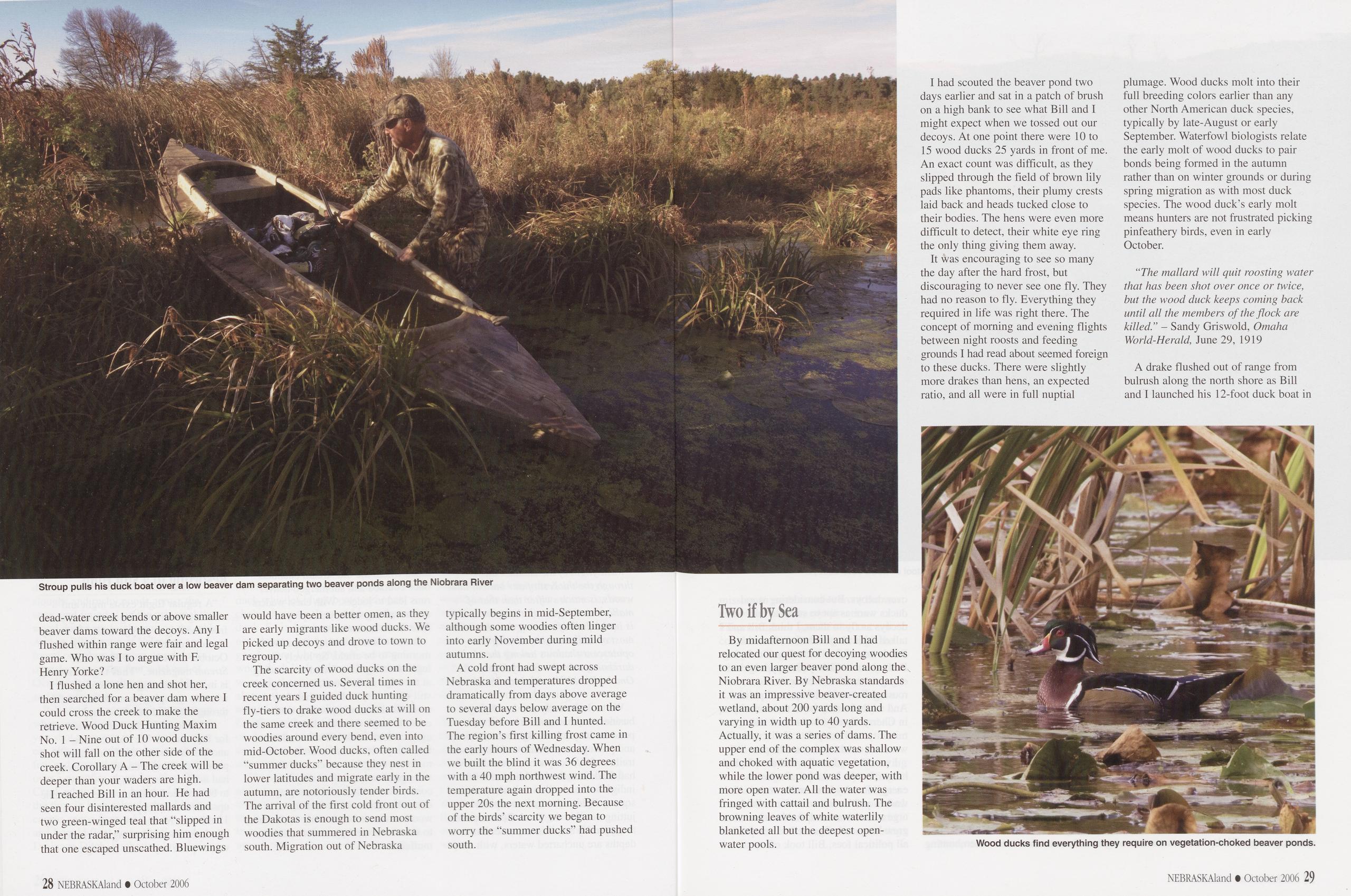 dead-water creek bends or above smaller
beaver dams toward the decoys. Any I
flushed within range were fair and legal
game. Who was I to argue with F.
Henry Yorke?
dead-water creek bends or above smaller
beaver dams toward the decoys. Any I
flushed within range were fair and legal
game. Who was I to argue with F.
Henry Yorke?
I flushed a lone hen and shot her, then searched for a beaver dam where I could cross the creek to make the retrieve. Wood Duck Hunting Maxim No. 1 - Nine out of 10 wood ducks shot will fall on the other side of the creek. Corollary A - The creek will be deeper than your waders are high.
I reached Bill in an hour. He had seen four disinterested mallards and two green-winged teal that “slipped in under the radar,” surprising him enough that one escaped unscathed. Bluewings would have been a better omen, as they are early migrants like wood ducks. We picked up decoys and drove to town to regroup.
The scarcity of wood ducks on the creek concerned us. Several times in recent years I guided duck hunting fly-tiers to drake wood ducks at will on the same creek and there seemed to be woodies around every bend, even into mid-October. Wood ducks, often called “summer ducks” because they nest in lower latitudes and migrate early in the autumn, are notoriously tender birds. The arrival of the first cold front out of the Dakotas is enough to send most woodies that summered in Nebraska south. Migration out of Nebraska typically begins in mid-September, although some woodies often linger into early November during mild autumns.
A cold front had swept across Nebraska and temperatures dropped dramatically from days above average to several days below average on the Tuesday before Bill and I hunted. The region’s first killing frost came in the early hours of Wednesday. When we built the blind it was 36 degrees with a 40 mph northwest wind. The temperature again dropped into the upper 20s the next morning. Because of the birds’ scarcity we began to worry the “summer ducks” had pushed south.
Two if by SeaBy midafternoon Bill and I had relocated our quest for decoying woodies to an even larger beaver pond along the Niobrara River. By Nebraska standards it was an impressive beaver-created wetland, about 200 yards long and varying in width up to 40 yards. Actually, it was a series of dams. The upper end of the complex was shallow and choked with aquatic vegetation, while the lower pond was deeper, with more open water. All the water was fringed with cattail and bulrush. The browning leaves of white waterlily blanketed all but the deepest open- water pools.
I had scouted the beaver pond two days earlier and sat in a patch of brush on a high bank to see what Bill and I might expect when we tossed out our decoys. At one point there were 10 to 15 wood ducks 25 yards in front of me. An exact count was difficult, as they slipped through the field of brown lily pads like phantoms, their plumy crests laid back and heads tucked close to their bodies. The hens were even more difficult to detect, their white eye ring the only thing giving them away.
It was encouraging to see so many the day after the hard frost, but discouraging to never see one fly. They had no reason to fly. Everything they required in life was right there. The concept of morning and evening flights between night roosts and feeding grounds I had read about seemed foreign to these ducks. There were slightly more drakes than hens, an expected ratio, and all were in full nuptial plumage. Wood ducks molt into their full breeding colors earlier than any other North American duck species, typically by late-August or early September. Waterfowl biologists relate the early molt of wood ducks to pair bonds being formed in the autumn rather than on winter grounds or during spring migration as with most duck species. The wood duck’s early molt means hunters are not frustrated picking pinfeathery birds, even in early October.
“The mallard will quit roosting water that has been shot over once or twice, but the wood duck keeps coming back until all the members of the flock are killed- Sandy Griswold, Omaha World-Herald, June 29, 1919
A drake flushed out of range from
bulrush along the north shore as Bill
and I launched his 12-foot duck boat in
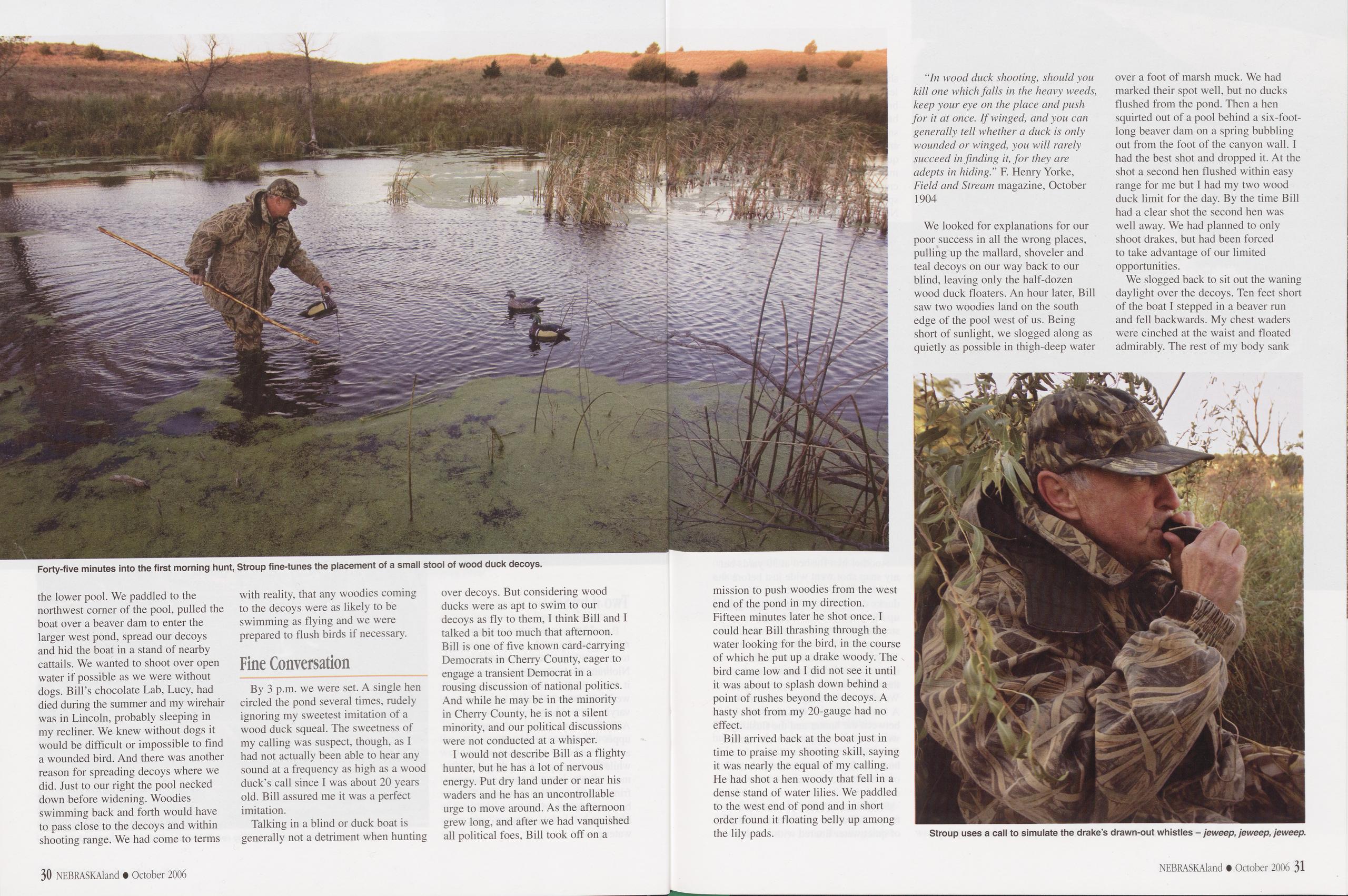 the lower pool. We paddled to the
northwest corner of the pool, pulled the
boat over a beaver dam to enter the
larger west pond, spread our decoys
and hid the boat in a stand of nearby
cattails. We wanted to shoot over open
water if possible as we were without
dogs. Bill’s chocolate Lab, Lucy, had
died during the summer and my wirehair
was in Lincoln, probably sleeping in
my recliner. We knew without dogs it
would be difficult or impossible to find
a wounded bird. And there was another
reason for spreading decoys where we
did. Just to our right the pool necked
down before widening. Woodies
swimming back and forth would have
to pass close to the decoys and within
shooting range. We had come to terms
with reality, that any woodies coming
to the decoys were as likely to be
swimming as flying and we were
prepared to flush birds if necessary.
the lower pool. We paddled to the
northwest corner of the pool, pulled the
boat over a beaver dam to enter the
larger west pond, spread our decoys
and hid the boat in a stand of nearby
cattails. We wanted to shoot over open
water if possible as we were without
dogs. Bill’s chocolate Lab, Lucy, had
died during the summer and my wirehair
was in Lincoln, probably sleeping in
my recliner. We knew without dogs it
would be difficult or impossible to find
a wounded bird. And there was another
reason for spreading decoys where we
did. Just to our right the pool necked
down before widening. Woodies
swimming back and forth would have
to pass close to the decoys and within
shooting range. We had come to terms
with reality, that any woodies coming
to the decoys were as likely to be
swimming as flying and we were
prepared to flush birds if necessary.
By 3 p.m. we were set. A single hen circled the pond several times, rudely ignoring my sweetest imitation of a wood duck squeal. The sweetness of my calling was suspect, though, as I had not actually been able to hear any sound at a frequency as high as a wood duck’s call since I was about 20 years old. Bill assured me it was a perfect imitation.
Talking in a blind or duck boat is generally not a detriment when hunting over decoys. But considering wood ducks were as apt to swim to our decoys as fly to them, I think Bill and I talked a bit too much that afternoon. Bill is one of five known card-carrying Democrats in Cherry County, eager to engage a transient Democrat in a rousing discussion of national politics. And while he may be in the minority in Cherry County, he is not a silent minority, and our political discussions were not conducted at a whisper.
I would not describe Bill as a flighty hunter, but he has a lot of nervous energy. Put dry land under or near his waders and he has an uncontrollable urge to move around. As the afternoon grew long, and after we had vanquished all political foes, Bill took off on a mission to push woodies from the west end of the pond in my direction. Fifteen minutes later he shot once. I could hear Bill thrashing through the water looking for the bird, in the course of which he put up a drake woody. The bird came low and I did not see it until it was about to splash down behind a point of rushes beyond the decoys. A hasty shot from my 20-gauge had no effect.
Bill arrived back at the boat just in time to praise my shooting skill, saying it was nearly the equal of my calling. He had shot a hen woody that fell in a dense stand of water lilies. We paddled to the west end of pond and in short order found it floating belly up among the lily pads.
“In wood duck shooting, should you kill one which falls in the heavy weeds, keep your eye on the place and push for it at once. If winged, and you can generally tell whether a duck is only wounded or winged, you will rarely succeed in finding it, for they are adepts in hiding.” F. Henry Yorke, Field and Stream magazine, October 1904
We looked for explanations for our poor success in all the wrong places, pulling up the mallard, shoveler and teal decoys on our way back to our blind, leaving only the half-dozen wood duck floaters. An hour later, Bill saw two woodies land on the south edge of the pool west of us. Being short of sunlight, we slogged along as quietly as possible in thigh-deep water over a foot of marsh muck. We had marked their spot well, but no ducks flushed from the pond. Then a hen squirted out of a pool behind a six-foot- long beaver dam on a spring bubbling out from the foot of the canyon wall. I had the best shot and dropped it. At the shot a second hen flushed within easy range for me but I had my two wood duck limit for the day. By the time Bill had a clear shot the second hen was well away. We had planned to only shoot drakes, but had been forced to take advantage of our limited opportunities.
We slogged back to sit out the waning
daylight over the decoys. Ten feet short
of the boat I stepped in a beaver run
and fell backwards. My chest waders
were cinched at the waist and floated
admirably. The rest of my body sank
30 NEBRASKAland • October 2006
NEBRASKAland October 2006 31
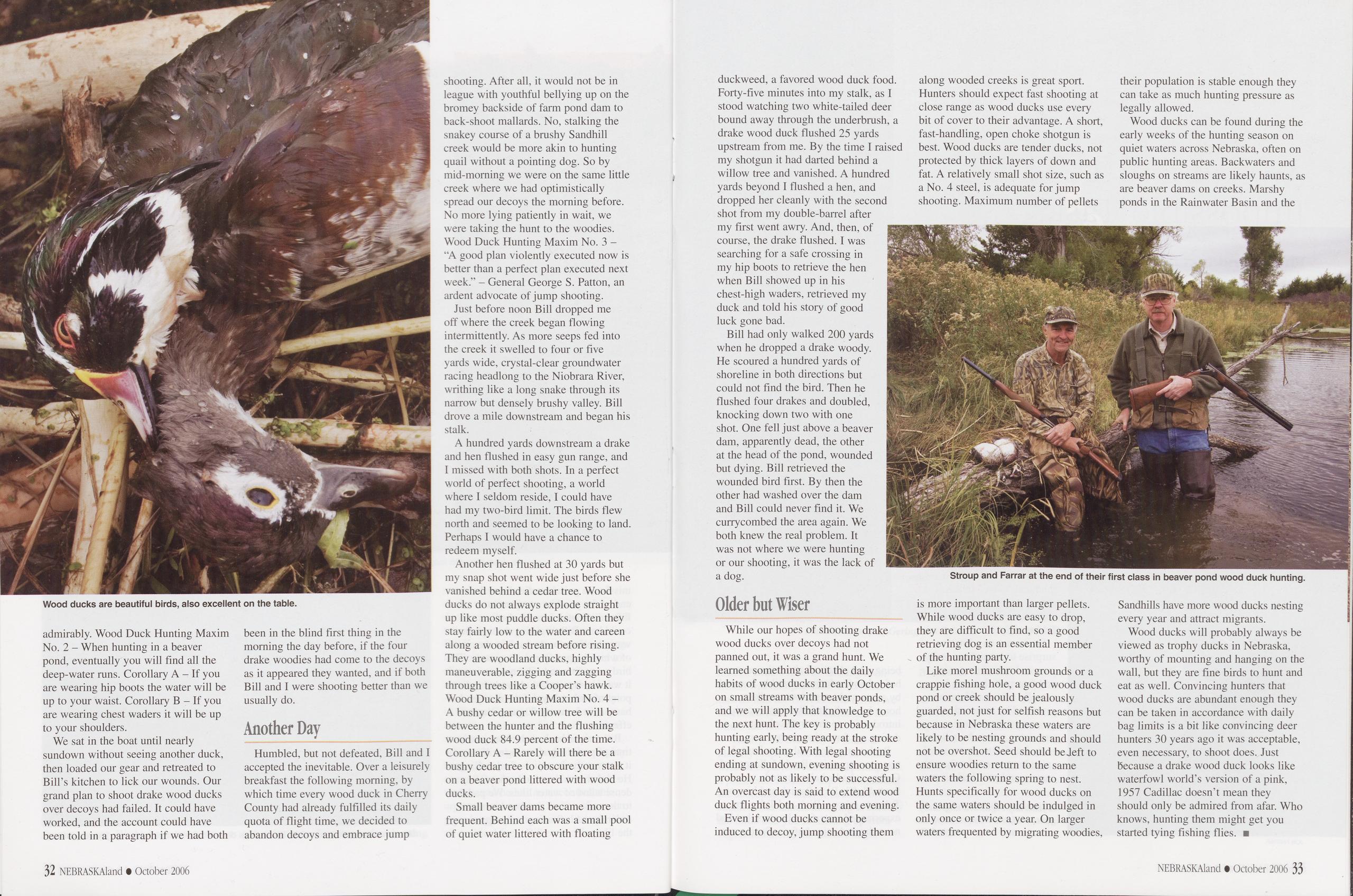 admirably. Wood Duck Hunting Maxim
No. 2 - When hunting in a beaver
pond, eventually you will find all the
deep-water runs. Corollary A - If you
are wearing hip boots the water will be
up to your waist. Corollary B - If you
are wearing chest waders it will be up
to your shoulders.
admirably. Wood Duck Hunting Maxim
No. 2 - When hunting in a beaver
pond, eventually you will find all the
deep-water runs. Corollary A - If you
are wearing hip boots the water will be
up to your waist. Corollary B - If you
are wearing chest waders it will be up
to your shoulders.
We sat in the boat until nearly sundown without seeing another duck, then loaded our gear and retreated to Bill’s kitchen to lick our wounds. Our grand plan to shoot drake wood ducks over decoys had failed. It could have worked, and the account could have been told in a paragraph if we had both been in the blind first thing in the morning the day before, if the four drake woodies had come to the decoys as it appeared they wanted, and if both Bill and I were shooting better than we usually do.
Another DayHumbled, but not defeated, Bill and I accepted the inevitable. Over a leisurely breakfast the following morning, by which time every wood duck in Cherry County had already fulfilled its daily quota of flight time, we decided to abandon decoys and embrace jump shooting. After all, it would not be in league with youthful bellying up on the bromey backside of farm pond dam to back-shoot mallards. No, stalking the snakey course of a brushy Sandhill creek would be more akin to hunting quail without a pointing dog. So by mid-morning we were on the same little creek where we had optimistically spread our decoys the morning before. No more lying patiently in wait, we were taking the hunt to the woodies. Wood Duck Hunting Maxim No. 3 - "A good plan violently executed now is better than a perfect plan executed next week.” - General George S. Patton, an ardent advocate of jump shooting.
Just before noon Bill dropped me off where the creek began flowing intermittently. As more seeps fed into the creek it swelled to four or five yards wide, crystal-clear groundwater racing headlong to the Niobrara River, writhing like a long snake through its narrow but densely brushy valley. Bill drove a mile downstream and began his stalk.
A hundred yards downstream a drake and hen flushed in easy gun range, and I missed with both shots. In a perfect world of perfect shooting, a world where I seldom reside, I could have had my two-bird limit. The birds flew north and seemed to be looking to land. Perhaps I would have a chance to redeem myself.
Another hen flushed at 30 yards but my snap shot went wide just before she vanished behind a cedar tree. Wood ducks do not always explode straight up like most puddle ducks. Often they stay fairly low to the water and careen along a wooded stream before rising. They are woodland ducks, highly maneuverable, zigging and zagging through trees like a Cooper’s hawk. Wood Duck Hunting Maxim No. 4 - A bushy cedar or willow tree will be between the hunter and the flushing wood duck 84.9 percent of the time. Corollary A - Rarely will there be a bushy cedar tree to obscure your stalk on a beaver pond littered with wood ducks.
Small beaver dams became more frequent. Behind each was a small pool of quiet water littered with floating duckweed, a favored wood duck food. Forty-five minutes into my stalk, as I stood watching two white-tailed deer bound away through the underbrush, a drake wood duck flushed 25 yards upstream from me. By the time I raised my shotgun it had darted behind a willow tree and vanished. A hundred yards beyond I flushed a hen, and dropped her cleanly with the second shot from my double-barrel after my first went awry. And, then, of course, the drake flushed. I was searching for a safe crossing in my hip boots to retrieve the hen when Bill showed up in his chest-high waders, retrieved my duck and told his story of good luck gone bad.
Bill had only walked 200 yards when he dropped a drake woody. He scoured a hundred yards of shoreline in both directions but could not find the bird. Then he flushed four drakes and doubled, knocking down two with one shot. One fell just above a beaver dam, apparently dead, the other at the head of the pond, wounded but dying. Bill retrieved the wounded bird first. By then the other had washed over the dam and Bill could never find it. We currycombed the area again. We both knew the real problem. It was not where we were hunting or our shooting, it was the lack of a dog.
Older but WiserWhile our hopes of shooting drake wood ducks over decoys had not panned out, it was a grand hunt. We learned something about the daily habits of wood ducks in early October on small streams with beaver ponds, and we will apply that knowledge to the next hunt. The key is probably hunting early, being ready at the stroke of legal shooting. With legal shooting ending at sundown, evening shooting is probably not as likely to be successful. An overcast day is said to extend wood duck flights both morning and evening.
Even if wood ducks cannot be induced to decoy, jump shooting them along wooded creeks is great sport. Hunters should expect fast shooting at close range as wood ducks use every bit of cover to their advantage. A short, fast-handling, open choke shotgun is best. Wood ducks are tender ducks, not protected by thick layers of down and fat. A relatively small shot size, such as a No. 4 steel, is adequate for jump shooting. Maximum number of pellets While wood ducks are easy to drop, they are difficult to find, so a good retrieving dog is an essential member of the hunting party.
Like morel mushroom grounds or a crappie fishing hole, a good wood duck pond or creek should be jealously guarded, not just for selfish reasons but because in Nebraska these waters are likely to be nesting grounds and should not be overshot. Seed should be deft to ensure woodies return to the same waters the following spring to nest. Hunts specifically for wood ducks on the same waters should be indulged in only once or twice a year. On larger waters frequented by migrating woodies, their population is stable enough they can take as much hunting pressure as legally allowed.
Wood ducks can be found during the early weeks of the hunting season on quiet waters across Nebraska, often on public hunting areas. Backwaters and sloughs on streams are likely haunts, as are beaver dams on creeks. Marshy ponds in the Rainwater Basin and the Sandhills have more wood ducks nesting every year and attract migrants. Wood ducks will probably always be viewed as trophy ducks in Nebraska, worthy of mounting and hanging on the wall, but they are fine birds to hunt and eat as well. Convincing hunters that wood ducks are abundant enough they can be taken in accordance with daily bag limits is a bit like convincing deer hunters 30 years ago it was acceptable, even necessary, to shoot does. Just because a drake wood duck looks like waterfowl world’s version of a pink, 1957 Cadillac doesn’t mean they should only be admired from afar. Who knows, hunting them might get you started tying fishing flies.
32 NEBRASKAland • October 2006 NEBRASKAland G October 2006 33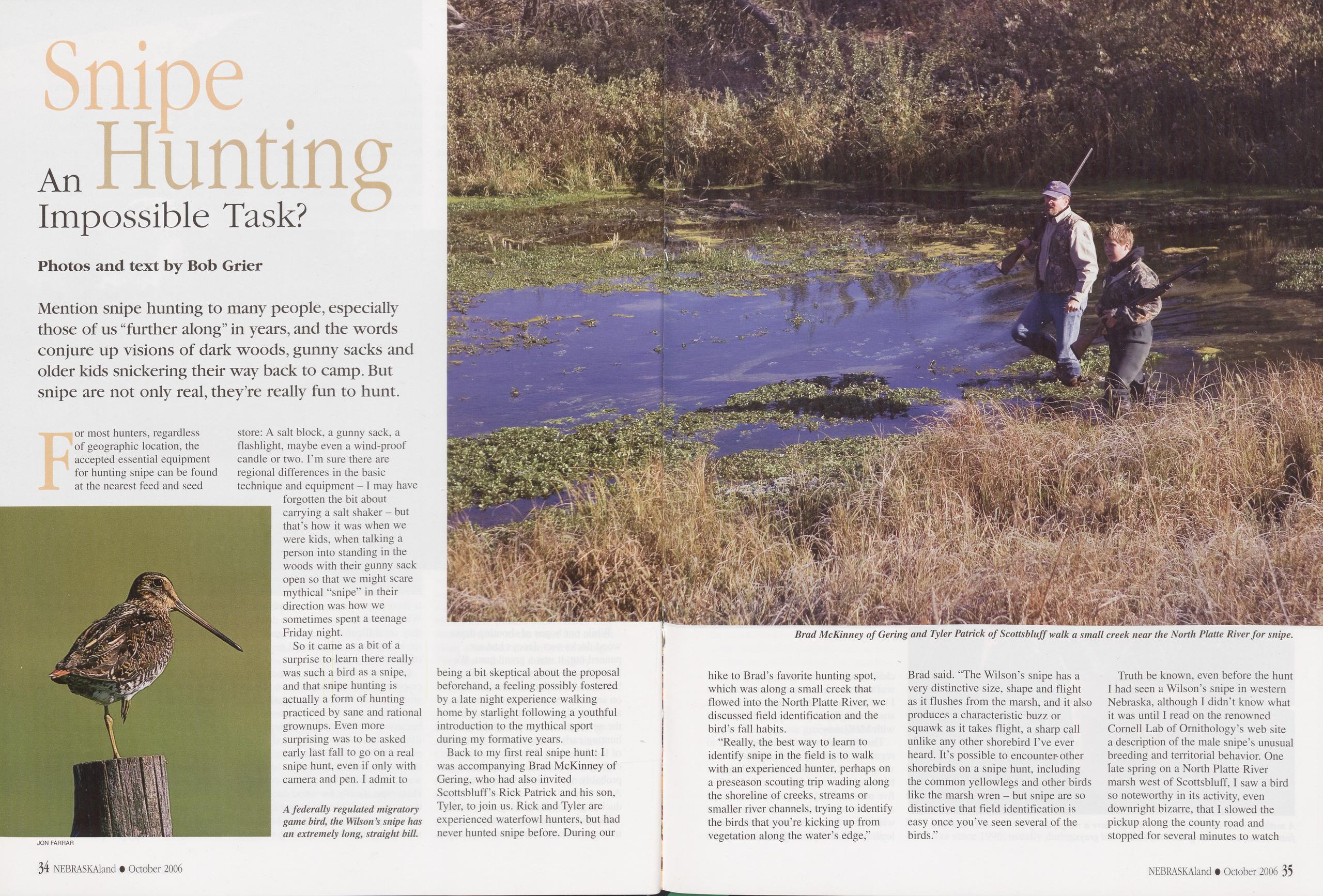
Snipe Hunting
An Impossible Task? Photos and text by Bob Grier Mention snipe hunting to many people, especially those of us “further along” in years, and the words conjure up visions of dark woods, gunny sacks and older kids snickering their way back to camp. But snipe are not only real, they’re really fun to hunt.For most hunters, regardless of geographic location, the accepted essential equipment for hunting snipe can be found at the nearest feed and seed store: A salt block, a gunny sack, a flashlight, maybe even a wind-proof candle or two. I’m sure there are regional differences in the basic technique and equipment - I may have forgotten the bit about carrying a salt shaker - but that’s how it was when we were kids, when talking a person into standing in the woods with their gunny sack open so that we might scare mythical "snipe” in their direction was how we sometimes spent a teenage Friday night.
So it came as a bit of a surprise to learn there really was such a bird as a snipe, and that snipe hunting is actually a form of hunting practiced by sane and rational grownups. Even more surprising was to be asked early last fall to go on a real snipe hunt, even if only with camera and pen. I admit to A federally regulated migratory game bird, the Wilson’s snipe has an extremely long, straight bill. being a bit skeptical about the proposal beforehand, a feeling possibly fostered by a late night experience walking home by starlight following a youthful introduction to the mythical sport during my formative years.
Back to my first real snipe hunt: I was accompanying Brad McKinney of Gering, who had also invited Scottsbluff’s Rick Patrick and his son, Tyler, to join us. Rick and Tyler are experienced waterfowl hunters, but had never hunted snipe before. During our hike to Brad’s favorite hunting spot, which was along a small creek that flowed into the North Platte River, we discussed field identification and the bird’s fall habits.
"Really, the best way to learn to identify snipe in the field is to walk with an experienced hunter, perhaps on a preseason scouting trip wading along the shoreline of creeks, streams or smaller river channels, trying to identify the birds that you’re kicking up from vegetation along the water’s edge,” Brad said. "The Wilson’s snipe has a very distinctive size, shape and flight as it flushes from the marsh, and it also produces a characteristic buzz or squawk as it takes flight, a sharp call unlike any other shorebird I’ve ever heard. It’s possible to encounter-other shorebirds on a snipe hunt, including the common yellowlegs and other birds like the marsh wren - but snipe are so distinctive that field identification is easy once you’ve seen several of the birds.”
Truth be known, even before the hunt
I had seen a Wilson’s snipe in western
Nebraska, although I didn’t know what
it was until I read on the renowned
Cornell Lab of Ornithology’s web site
a description of the male snipe’s unusual
breeding and territorial behavior. One
late spring on a North Platte River
marsh west of Scottsbluff, I saw a bird
so noteworthy in its activity, even
downright bizarre, that I slowed the
pickup along the county road and
stopped for several minutes to watch
34 NEBRASKAland • October 2006
NEBRASKAland • October 2006 35
 the bird’s
mystifying
fantics. The
bird was too
far away for an
accurate look even
with binoculars, but I watched with
curiosity as the bird would fly vertically
to a height of perhaps twenty-five
yards and then travel horizontally for a
few feet before dropping straight
towards the ground and disappear from
my sight behind a line of intervening
cattails. It would then immediately
repeat its steep, upside down
“U”-shaped flight. The weird flight
was repeated several times before the
bird disappeared, and I went on my
way wondering if perhaps a kestrel was
chasing a songbird that had fed too
close to a fermented grain pile. That
was the only time I was aware of that
I had seen a common snipe, and it was
stuck in my head the day of my hunt
with McKinney.
the bird’s
mystifying
fantics. The
bird was too
far away for an
accurate look even
with binoculars, but I watched with
curiosity as the bird would fly vertically
to a height of perhaps twenty-five
yards and then travel horizontally for a
few feet before dropping straight
towards the ground and disappear from
my sight behind a line of intervening
cattails. It would then immediately
repeat its steep, upside down
“U”-shaped flight. The weird flight
was repeated several times before the
bird disappeared, and I went on my
way wondering if perhaps a kestrel was
chasing a songbird that had fed too
close to a fermented grain pile. That
was the only time I was aware of that
I had seen a common snipe, and it was
stuck in my head the day of my hunt
with McKinney.
The Wilson’s snipe is a federally regulated migratory game bird with a wingspan of 16-17 inches, and weighs between three and slightly more than five ounces. They are generally described as a medium-sized shorebird with a very long and straight bill, short legs, and brown plumage marked by a bold strip along the back and head. The bird’s crown is striped black and buff and the back tends to be more black, brown and gray, with pale, lighter stripes. The legs are greenish yellow or bluish gray and both sexes appear similar, although the females have longer bills and shorter tails.
The American woodcock is similar in size and appearance but lacks the bold stripes down the back, has black barring across the crown and more rounded wings. The woodcock, by all accounts, is a more distinguished North American game bird than snipe, especially in the eastern United States where the woodcock’s tradition and pursuit rewards it with more than a supporting role in some of America’s very best sporting literature, as well as in stories swapped over hunters’ campfires or across rough-hewn tables in hunting lodges.
But don’t tell that to McKinney. Brad has hunted snipe in western Nebraska since 1996, usually during lulls in waterfowl hunting in his blind near the Wyoming-Nebraska state line. Despite his assurances that we’d probably see some snipe that day, I was still apprehensive when the hunt quickly took on a pattern I’d seen somewhere before - the first thing Brad did upon reaching our hunting destination was to instruct the three of us to take up a stand in a strip of tall cattails along a stream bend while he hiked to the property’s east fence line and slowly hunted the stream back to our location.
36 NEBRASKAland • October 2006 NEBRASKAland • October 2006 37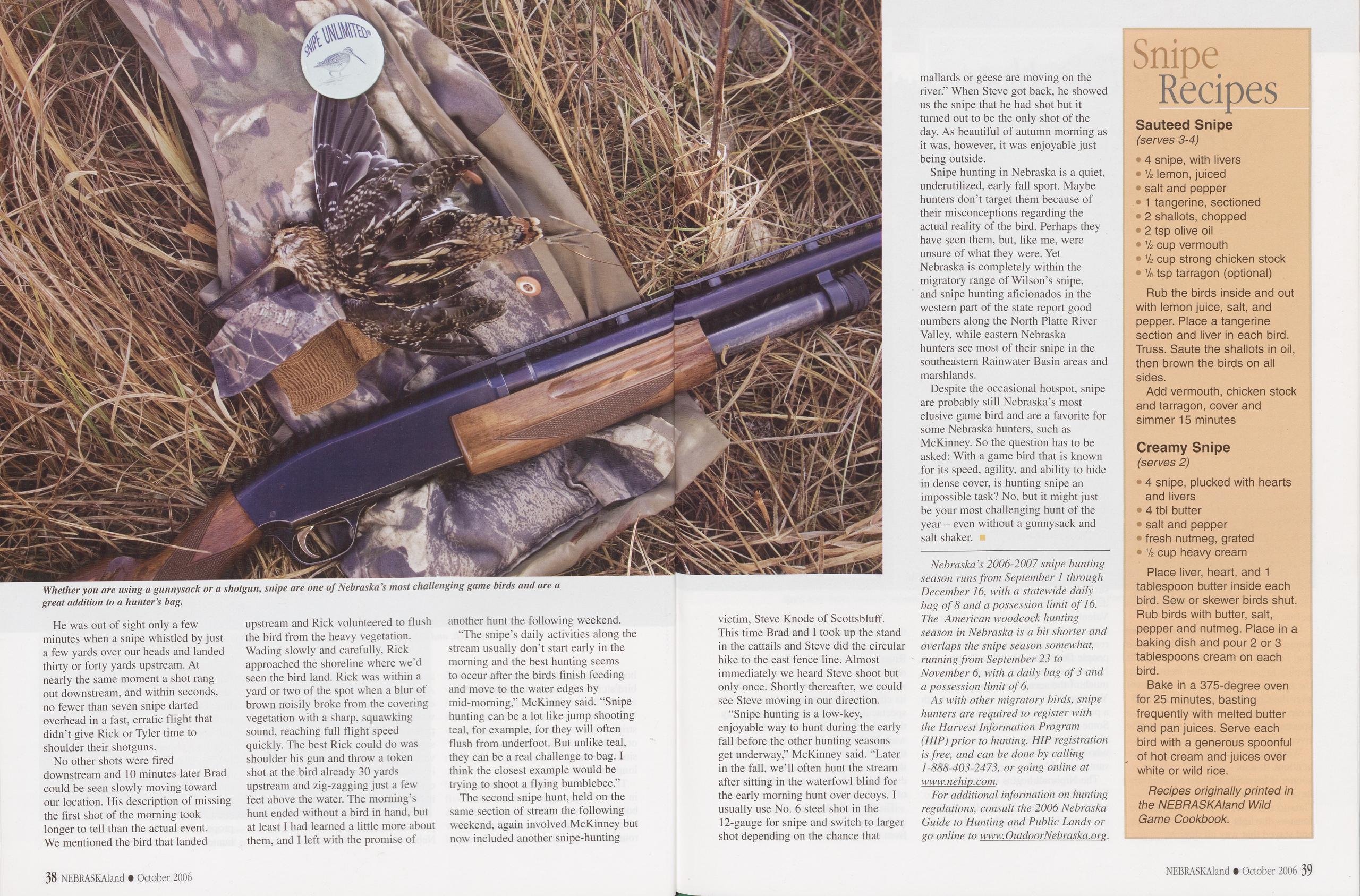
Mallards or geese are moving on the river.” When Steve got back, he showed us the snipe that he had shot but it turned out to be the only shot of the day. As beautiful of autumn morning as it was, however, it was enjoyable just being outside.
Snipe hunting in Nebraska is a quiet, underutilized, early fall sport. Maybe hunters don’t target them because of their misconceptions regarding the actual reality of the bird. Perhaps they have seen them, but, like me, were unsure of what they were. Yet Nebraska is completely within the migratory range of Wilson’s snipe, and snipe hunting aficionados in the western part of the state report good numbers along the North Platte River Valley, while eastern Nebraska hunters see most of their snipe in the southeastern Rainwater Basin areas and marshlands.
Despite the occasional hotspot, snipe are probably still Nebraska’s most elusive game bird and are a favorite for some Nebraska hunters, such as McKinney. So the question has to be asked: With a game bird that is known for its speed, agility, and ability to hide in dense cover, is hunting snipe an impossible task? No, but it might just be your most challenging hunt of the year - even without a gunnysack and salt shaker.
Nebraska’s 2006-2007 snipe hunting season runs from September 1 through December 16, with a statewide daily bag of 8 and a possession limit of 16.
upstream andKick volunteered to flush the bird from the heavy vegetation. Wading slowly and carefully, Rick approached the shoreline where we d seen the bird land. Rick was within a yard or two of the spot when a blur of another hunt the following weekend. “The snipe’s daily activities along the stream usually don’t start early in the morning and the best hunting seems to occurafter the birds finish feeding and move to the water edges by victim, Steve Knode of Scottsbluff.
This time Brad and I took up the stand in the cattails and Steve did the circular hike to the east fence line. Almost immediately we heard Steve shoot but only once. Shortly thereafter, we could The American woodcock hunting season in Nebraska is a bit shorter and overlaps the snipe season somewhat, running from September 23 to November 6, with a daily bag of 3 and a possession limit of 6.
Brown noisily broke from the covering mid-morning, ” McKinney said. “Snipe fat vegetation with a shaip, squawking hunting can be a lot like jump shooting sound, reaching full Hight speed quickly The best Rick could do was shoulder his gun and thrown token shot at the bird already 30yards upstream and zig-zaggingjust a few ?t above the water. The morning’s ' ended without a bird in hand, but thbadlearned a little more about teal, for example, for they will often Hush from underfoot. But unlike teal, they can be a real challenge to bag. I think the closest example would be trying to shoot a Hying bumblebee. ” The second snipe hunt, held on the same section of stream the following weekend, again involved McKinney but see Steve moving in our direction.
‘Snipe hunting is a low-key, enjoyable way to hunt during the early fall before the other hunting seasons get underway!’ McKinney said. “Later in the fall, we’ll often hunt the stream after sitting in the waterfowl blind for the early morning hunt over decoys. I usually use No. 6 steel shot in the 12-gauge for snipe and switch to larger shot depending on the chance that
As with other migratory birds, snipe hunters are required to register with the Harvest Information Program (HIP) prior to hunting. HIP registration is free, and can be done by calling 1-888-403-2473, or going online at www.nehip.com.
For additional information on hunting regulations, consult the 2006 Nebraska Guide to Hunting and Public Lands or go online to www. QutdoprNebraska, org.
Snipe Recipes Sauteed Snipe (serves 3-4) • 4 snipe, with livers • 1/2 lemon, juiced • salt and pepper • 1 tangerine, sectioned • 2 shallots, chopped • 2 tsp olive oil • V- cup vermouth • 1/2 cup strong chicken stock • Vs tsp tarragon (optional) Rub the birds inside and out with lemon juice, salt, and pepper. Place a tangerine section and liver in each bird. Truss. Saute the shallots in oil, then brown the birds on all sides. Add vermouth, chicken stock and tarragon, cover and simmer 15 minutes Creamy Snipe (serves 2) 4 snipe, plucked with hearts and livers 4 tbl butter salt and pepper fresh nutmeg, grated 1/2 cup heavy cream Place liver, heart, and 1 tablespoon butter inside each bird. Sew or skewer birds shut. Rub birds with butter, salt, pepper and nutmeg. Place in a baking dish and pour 2 or 3 tablespoons cream on each bird. Bake in a 375-degree oven for 25 minutes, basting frequently with melted butter and pan juices. Serve each bird with a generous spoonful of hot cream and juices over white or wild rice. Recipes originally printed in the NEBRASKAIand Wild Game Cookbook.
Canoeing the Niobrara River
From the Cornell Bridge near Valentine to the Norden Bridge Photos and text by Eric Fowler Arguably the most scenic river in the state, the Niobrara River in north-central Nebraska is easily the most traveled, with tens of thousands floating its waters each year.Nature photography can be a real crap shoot. Bad light and bad weather have a funny way of spoiling plans.
That was the case last October when I headed to Valentine to paddle the Niobrara River with Greg Gass and his son, Ryan. No reason to get on the river too early, I thought. After all, the valley it flows through is narrow and deep, and it takes some time for the sun to find its way to the water. And a late start would give me time to sneak out and look for a few nice landscape photos before our trip.
When I drove out of Valentine before sunup and saw the valley enshrouded in fog, I rolled the dice and headed uphill, hoping to get some photos from above the fog rather than in it. Looking down over the Cornell Bridge area provided a nice photo, but it was far from spectacular. “We should’ve been on the river at sunup,” I thought.
When we finally did get on the river at about 10 a.m. - it would’ve been sooner if I wouldn’t have forgotten my kayak paddle and had to impose on Gass to run back to town and grab one for me - the light was flat as a tabletop, and stayed that way all day.
From a photographic standpoint, it couldn’t have been much worse. Except you can’t help but end up with nice photos when you’re paddling the Niobrara, easily the top canoeing destination in Nebraska and, according to Backpacker magazine, one of the top 10 canoeing rivers in the country.
"The scenery’s just wonderful,” said Gass. “It’s got to be one of the most beautiful places in the state.” The scenery and natural resources surrounding the river led Congress to designate a 76-mile stretch between Valentine and Newport as the Niobrara National Scenic River in 1991. It’s one reason why each year about 40,000 people float down the 30-mile-long Niobrara Canoe Trail, which spans much of the scenic river’s upper half. You also don’t need any experience with a paddle to navigate much of the river. Some say you don’t need a paddle at all, which is certainly true for the thousands who kick back on an inner tube each summer and let the river do the work.
The Niobrara begins in eastern Wyoming, slowly snaking its way across the northern Panhandle, picking up speed along the northern edge of the Sandhills in north-central Nebraska, then broadening its channel and slowing down again before joining the Missouri River in northeastern Nebraska, 535 miles from its source.
Arguably scenic throughout much of its course, at Valentine the Niobrara is spectacular. There it has carved its way through 200 to 300 feet of earth all the way down to the Rosebud Formation, the bedrock that forms the river bottom throughout much of this stretch, and it exposes much of the geologic history of Nebraska.
The Ogallala Aquifer, a vast underground reservoir that stretches from the Sandhills south of the river all the way to Texas, sits atop the impermeable Rosebud. With the aquifer’s profile exposed, water seeps from the canyon walls in some places and bubbles up in others to form streams that create more than 200 waterfalls along the river’s south bank.
Smith Falls, the state’s highest at 63 feet, is the centerpiece of Smith Falls State Park. The waterfall is a short hike from the river, one many paddlers stop and take. Other falls cascade directly into the river, including Berry Falls, just downstream from Berry Bridge, where the Gasses and I stopped for lunch.
The spring-fed streams create a cool, moist climate in the canyons to the south of the river, helping sustain the only stands of paper birch in the state, as well as aspens, ferns, mosses and lichens in scattered remnants of the northern boreal forest that covered the Great Plains 10,000 years ago.
Five other ecosystems - Rocky Mountain pine forest, Eastern deciduous forest, tall grass prairie, Sandhills prairie and northern mixed-grass prairie - converge within a 30-mile segment of the river. In what scientists call the biological crossroads of the Great Plains, many of the plant and bird species found here are on the edge of their range. Such diversity is why the Nature Conservancy purchased 87-square miles of land along the river to create the Niobrara Valley Preserve.
Of course, there are the usual mammals - white-tailed and mule deer, coyotes, river otters, mink and beaver. Even mountain lions, back after a 100-year absence in the state, have "been documented here of late. And it’s hard to visit the river without seeing wild turkeys. We watched quietly as we floated past a flock that clucked and purred as they sunned themselves on a high riverbank.
40 NEBRASKAland • October 2006 NEBRASKAland • October 2006 41
Elk and bison once roamed the region, and still do behind the fences of Fort Niobrara National Wildlife Refuge, which hosts the first five miles of the canoe trail. The refuge was created in 1912, taking the place of the abandoned Fort Niobrara Military Reservation, which had been established in 1879 to protect settlers from Sioux Indians. The Sioux were one of many tribes, including the Ponca and Pawnee, who hunted along the river before white settlers came. Valentine was founded in 1882, and the forced relocation of Native Americans to reservations soon made the fort obsolete.
White explorers first visited the Niobrara in the early 1700s. Whether it was the early fur traders or Native Americans who first dropped a canoe in the river is not known. But there’s a good chance the river’s rocky bottom ate holes in more than one fabric or wood canoe before Grumman started churning out aluminum boats after World War II.
Gass recalls hearing an old-timer tell about a raft he made with 30-gallon drums for floats and about others who took flat-bottom boats down the river. But recreational canoeing didn’t really sprout until he was a youth. Gass thinks he was about 11 when he made his first trip down the river with his Boy Scout troop in the late-1950s. “I can still remember being scared stiff as we Wild turkeys are a common sight along the river and in the canyons on either side of it. started that journey with all of our gear in the canoe for a three day trip,” he said.
“Canoeing wasn’t a big deal. In fact, our first trip down the river we had to get our canoes from Fremont. A [Scout] troop there had them so we sent somebody down to get the canoes so we could go down the river.”
Soon after, a Girl Scout troop in Valentine bought three canoes and started letting other groups use them. “It was a free thing for a while, but pretty soon it got to be so they had to replace canoes and they started charging like $5 a canoe to go down the river.”
Canoe outfitters started popping up in Valentine in the early 1970s. The industry grew slowly at first, and really began to take off in the late 1980s. By 1997, an estimated 51,000 people floated the river. To some, that was too many. Weekend traffic was heavy, and a party crowd made up a large portion of the visitors.
Refuge officials felt the crowds and the behavior of some canoeists ran counter to the purpose of the area, so in 1999 they placed a cap on the number of outfitters that could launch from the Cornell Bridge access site. They also enacted a ban on alcohol and boom boxes in the refuge and began policing the waters. Beer drinkers are still coming to the river, but most now launch at Berry Bridge and other private camps downstream from the refuge, cutting the number of people using the Cornell Bridge access from more than 30,000 in the late-1990s to just 13,000 in 2004.
The change was welcomed by people who come to the Niobrara to find a little peace and quiet and to soak in the river’s natural beauty, which is why Gass has continued to float the river a few times each year throughout his life. He doesn’t knock the party crowd. A teacher, Gass spends his summers helping an outfitter haul them to and from the river, and they are part of the reason tourism makes up a significant part of the economy in Valentine. He’d just rather avoid them.
“When canoe season is on, you don’t really plan to go,” he said. “When the time comes and somebody says lets go down the river, you just do it.
“The main thing is you don’t have a darned phone ringing - there’s no cell service on the river.”
Our trip began at Cornell Bridge and ended 4 hours and 10 miles later at Smith Falls State Park. Including stops for photos and lunch, we matched the river’s average speed of 2 to 3 miles per hour. Paddle hard and you could make the trip in under two hours, especially in the spring, when the river’s flow is slightly higher and its water swifter. But there’s no reason to hurry.
We only paddled hard enough to dodge the few rocks that break the surface or come close to it, and to overcome the wind, which sent golden leaves raining down on the river. The box elder and ash trees in the bottom had dropped most of their leaves, but the birch, cottonwoods and aspens were still golden shades of yellow, the oaks burnt orange to light brown, and the few sumac leaves that remained a bright red.
The canoe trail continues 20 miles or so beyond our take out point at Smith Falls. In that reach, there are a few more access points, most of them operated by outfitters. There are also eight rapids. Five add only a little excitement to the trip. At the other three - Rocky Ford, Eglehoff’s Rapid and Norden Chute - a portage is recommended, but occasionally ignored by adventure junkies in white-water kayaks. Norden Chute, a Class 4 rapid that funnels the river through a deep, narrow trough, actually marks the end of the canoe trail. A few miles above Norden Bridge, the river spreads out, is dotted with sandbars and is difficult to navigate, especially during the summer. The same holds true below the bridge, a reason the area sees little traffic.
We greeted some hikers on the trail leading to the refuge’s Fort Falls, but didn’t see another person until we got to Smith Falls. But even though it was Saturday near the peak of the fall color, we didn’t see another canoe until a group of college athletes floated past as we were loading our kayaks. Having the river to yourself, or at least feeling like you do, is typical outside of the summer months and on summer weekdays, Gass said.
“There are a lot of beautiful things on the river that a lot of people miss when they go down,” he said. “The whole thing about the river is nature. You just learn to love it.” Bad light or not. ■
42 NEBRASKAland • October 2006 NEBRASKAland • October 2006 43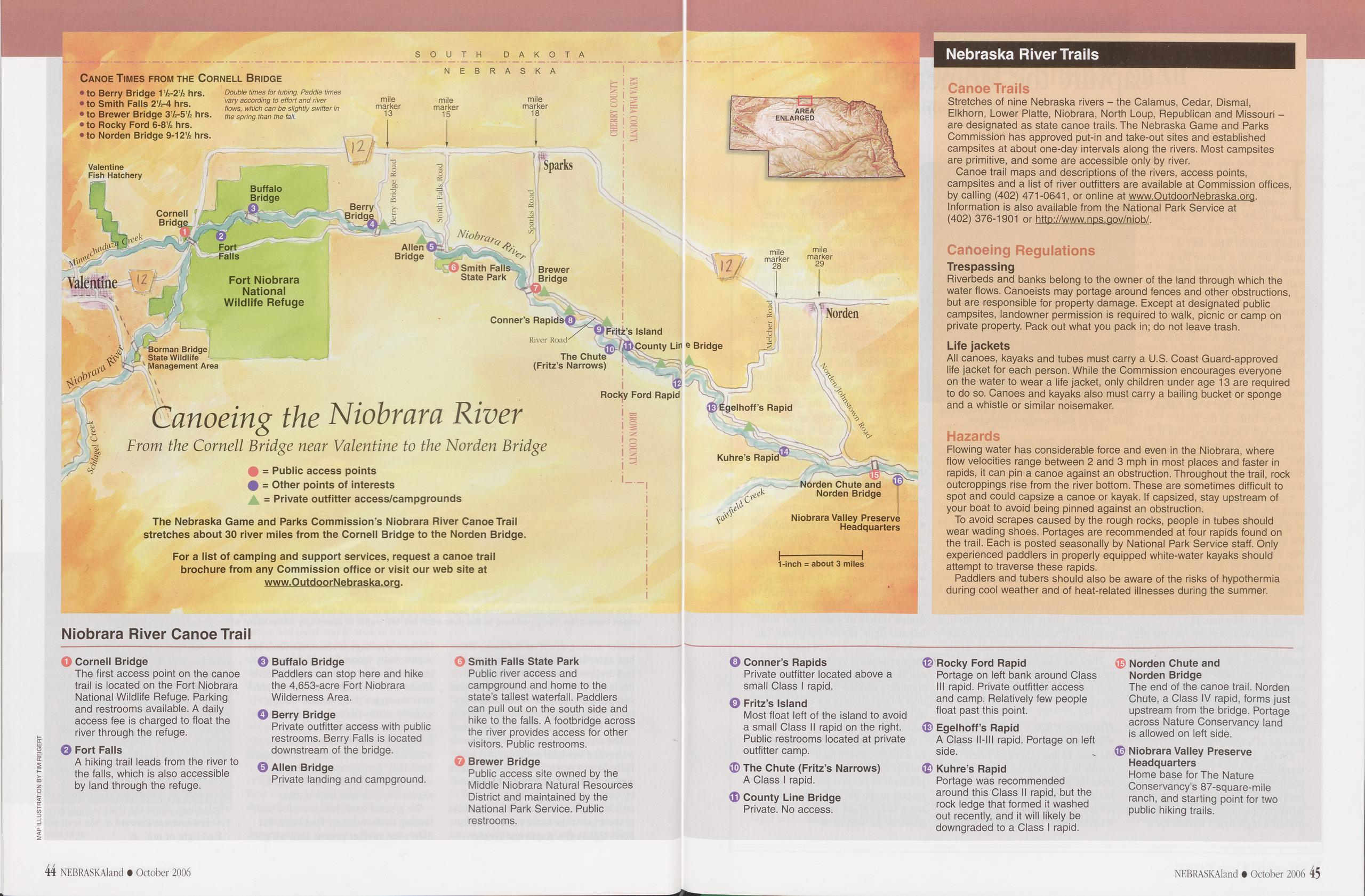
Double times for tubing. Paddle times vary according to effort and river flows, which can be slightly swifter in the spring than the fall.
Canoeing the Niobrara River From the Cornell Bridge near Valentine to the Norden Bridge Rocky Ford Rapid D = Public access points D - Other points of interests A - Private outfitter access/campgrounds The Nebraska Game and Parks Commission’s Niobrara River Canoe Trail stretches about 30 river miles from the Cornell Bridge to the Norden Bridge. For a list of camping and support services, request a canoe trail brochure from any Commission office or visit our web site at www.OutdoorNebraska.org. Canoe TrailsStretches of nine Nebraska rivers - the Calamus, Cedar, Dismal, Elkhorn, Lower Platte, Niobrara, North Loup, Republican and Missouri - are designated as state canoe trails. The Nebraska Game and Parks Commission has approved put-in and take-out sites and established campsites at about one-day intervals along the rivers. Most campsites are primitive, and some are accessible only by river.
Canoe trail maps and descriptions of the rivers, access points, campsites and a list of river outfitters are available at Commission offices, by calling (402) 471-0641, or online at www.OutdoorNebraska.org. Information is also available from the National Park Service at (402) 376-1901 or http://www.nps.gov/niob/.
Canoeing Regulations TrespassingRiverbeds and banks belong to the owner of the land through which the water flows. Canoeists may portage around fences and other obstructions, but are responsible for property damage. Except at designated public campsites, landowner permission is required to walk, picnic or camp on private property. Pack out what you pack in; do not leave trash.
Life jacketsAll canoes, kayaks and tubes must carry a U.S. Coast Guard-approved life jacket for each person. While the Commission encourages everyone on the water to wear a life jacket, only children under age 13 are required to do so. Canoes and kayaks also must carry a bailing bucket or sponge and a whistle or similar noisemaker.
HazardsFlowing water has considerable force and even in the Niobrara, where flow velocities range between 2 and 3 mph in most places and faster in rapids, it can pin a canoe against an obstruction. Throughout the trail, rock outcroppings rise from the river bottom. These are sometimes difficult to spot and could capsize a canoe or kayak. If capsized, stay upstream of your boat to avoid being pinned against an obstruction.
To avoid scrapes caused by the rough rocks, people in tubes should wear wading shoes. Portages are recommended at four rapids found on the trail. Each is posted seasonally by National Park Service staff. Only experienced paddlers in properly equipped white-water kayaks should attempt to traverse these rapids.
Paddlers and tubers should also be aware of the risks of hypothermia during cool weather and of heat-related illnesses during the summer.
Niobrara River Canoe TrailCornell Bridge
The first access point on the canoe trail is located on the Fort Niobrara National Wildlife Refuge. Parking and restrooms available. A daily access fee is charged to float the river through the refuge.
Fort Falls
A hiking trail leads from the river to the falls, which is also accessible by land through the refuge.
Buffalo Bridge
Paddlers can stop here and hike the 4,653-acre Fort Niobrara Wilderness Area.
Berry Bridge
Private outfitter access with public restrooms. Berry Falls is located downstream of the bridge.
Allen Bridge
Private landing and campground.
Smith Falls State Park
Public river access and campground and home to the state’s tallest waterfall. Paddlers can pull out on the south side and hike to the falls. A footbridge across the river provides access for other visitors. Public restrooms.
Brewer Bridge
Public access site owned by the Middle Niobrara Natural Resources District and maintained by the National Park Service. Public restrooms.
Conner’s Rapids
Private outfitter located above a small Class I rapid.
Fritz’s Island
Most float left of the island to avoid a small Class II rapid on the right. Public restrooms located at private outfitter camp.
The Chute (Fritz’s Narrows)
A Class I rapid.
County Line Bridge
Private. No access.
Rocky Ford Rapid
Portage on left bank around Class III rapid. Private outfitter access and camp. Relatively few people float past this point.
Egelhoff’s Rapid
A Class Il-Ill rapid. Portage on left side.
Kuhre’s Rapid
Portage was recommended around this Class II rapid, but the rock ledge that formed it washed out recently, and it will likely be downgraded to a Class I rapid.
Norden Chute and Norden Bridge
The end of the canoe trail. Norden Chute, a Class IV rapid, forms just upstream from the bridge. Portage across Nature Conservancy land is allowed on left side.
Niobrara Valley Preserve Headquarters
Home base for The Nature Conservancy's 87-square-mile ranch, and starting point for two public hiking trails.
44 NEBRASKAland • October 2006 NEBRASKAland • October 2006 45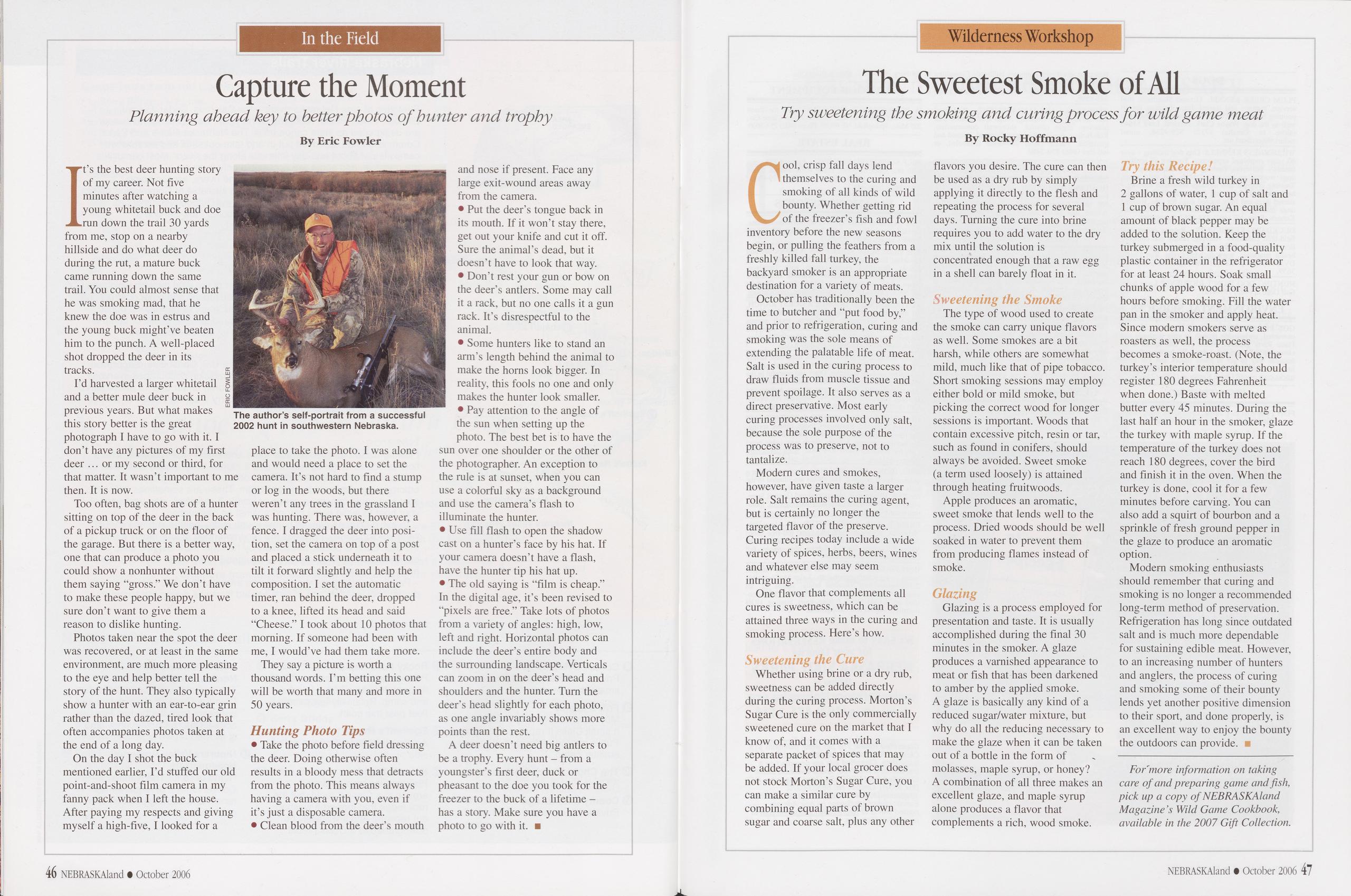
It’s the best deer hunting story of my career. Not five minutes after watching a young whitetail buck and doe run down the trail 30 yards from me, stop on a nearby hillside and do what deer do during the rut, a mature buck came running down the same trail. You could almost sense that he was smoking mad, that he knew the doe was in estrus and the young buck might’ve beaten him to the punch. A well-placed shot dropped the deer in its tracks.
I’d harvested a larger whitetail | and a better mule deer buck in previous years. But what makes this story better is the great photograph I have to go with it. I don’t have any pictures of my first deer ... or my second or third, for that matter. It wasn’t important to me then. It is now.
Too often, bag shots are of a hunter sitting on top of the deer in the back of a pickup truck or on the floor of the garage. But there is a better way, one that can produce a photo you could show a nonhunter without them saying “gross.” We don’t have to make these people happy, but we sure don’t want to give them a reason to dislike hunting.
Photos taken near the spot the deer was recovered, or at least in the same environment, are much more pleasing to the eye and help better tell the story of the hunt. They also typically show a hunter with an ear-to-ear grin rather than the dazed, tired look that often accompanies photos taken at the end of a long day.
On the day I shot the buck mentioned earlier, I’d stuffed our old point-and-shoot film camera in my fanny pack when I left the house. After paying my respects and giving myself a high-five, I looked for a The author’s self-portrait from a successful 2002 hunt in southwestern Nebraska. place to take the photo. I was alone and would need a place to set the camera. It’s not hard to find a stump or log in the woods, but there weren’t any trees in the grassland I was hunting. There was, however, a fence. I dragged the deer into posi- tion, set the camera on top of a post and placed a stick underneath it to tilt it forward slightly and help the composition. I set the automatic timer, ran behind the deer, dropped to a knee, lifted its head and said “Cheese.” I took about 10 photos that morning. If someone had been with me, I would’ve had them take more.
They say a picture is worth a thousand words. I’m betting this one will be worth that many and more in 50 years.
Hunting Photo Tips• Take the photo before field dressing the deer. Doing otherwise often results in a bloody mess that detracts from the photo. This means always having a camera with you, even if it’s just a disposable camera.
• Clean blood from the deer’s mouth and nose if present. Face any large exit-wound areas away from the camera.
• Put the deer’s tongue back in its mouth. If it won’t stay there, get out your knife and cut it off. Sure the animal’s dead, but it doesn’t have to look that way.
• Don’t rest your gun or bow on the deer’s antlers. Some may call it a rack, but no one calls it a gun rack. It’s disrespectful to the animal.
• Some hunters like to stand an arm’s length behind the animal to make the horns look bigger. In reality, this fools no one and only makes the hunter look smaller.
• Pay attention to the angle of the sun when setting up the photo. The best bet is to have the sun over one shoulder or the other of the photographer. An exception to the rule is at sunset, when you can use a colorful sky as a background and use the camera’s flash to illuminate the hunter.
• Use fill flash to open the shadow cast on a hunter’s face by his hat. If your camera doesn’t have a flash, have the hunter tip his hat up.
• The old saying is “film is cheap.” In the digital age, it’s been revised to “pixels are free.” Take lots of photos from a variety of angles: high, low, left and right. Horizontal photos can include the deer’s entire body and the surrounding landscape. Verticals can zoom in on the deer’s head and shoulders and the hunter. Turn the deer’s head slightly for each photo, as one angle invariably shows more points than the rest.
A deer doesn’t need big antlers to be a trophy. Every hunt - from a youngster’s first deer, duck or pheasant to the doe you took for the freezer to the buck of a lifetime - has a story. Make sure you have a photo to go with it. ■
The Sweetest Smoke of All Try sweetening the smoking and curing process for wild game meat By Rocky HoffmannCool, crisp fall days lend themselves to the curing and smoking of all kinds of wild bounty. Whether getting rid of the freezer’s fish and fowl inventory before the new seasons begin, or pulling the feathers from a freshly killed fall turkey, the backyard smoker is an appropriate destination for a variety of meats.
October has traditionally been the time to butcher and “put food by,” and prior to refrigeration, curing and smoking was the sole means of extending the palatable life of meat. Salt is used in the curing process to draw fluids from muscle tissue and prevent spoilage. It also serves as a direct preservative. Most early curing processes involved only salt, because the sole purpose of the process was to preserve, not to tantalize.
Modern cures and smokes, however, have given taste a larger role. Salt remains the curing agent, but is certainly no longer the targeted flavor of the preserve. Curing recipes today include a wide variety of spices, herbs, beers, wines and whatever else may seem intriguing.
One flavor that complements all cures is sweetness, which can be attained three ways in the curing and smoking process. Here’s how.
Sweetening the CureWhether using brine or a dry rub, sweetness can be added directly during the curing process. Morton’s Sugar Cure is the only commercially sweetened cure on the market that I know of, and it comes with a separate packet of spices that may be added. If your local grocer does not stock Morton’s Sugar Cure, you can make a similar cure by combining equal parts of brown sugar and coarse salt, plus any other flavors you desire. The cure can then be used as a dry rub by simply applying it directly to the flesh and repeating the process for several days. Turning the cure into brine requires you to add water to the dry mix until the solution is concentrated enough that a raw egg in a shell can barely float in it.
Sweetening the SmokeThe type of wood used to create the smoke can carry unique flavors as well. Some smokes are a bit harsh, while others are somewhat mild, much like that of pipe tobacco. Short smoking sessions may employ either bold or mild smoke, but picking the correct wood for longer sessions is important. Woods that contain excessive pitch, resin or tar, such as found in conifers, should always be avoided. Sweet smoke (a term used loosely) is attained through heating fruit woods.
Apple produces an aromatic, sweet smoke that lends well to the process. Dried woods should be well soaked in water to prevent them from producing flames instead of smoke.
GlazingGlazing is a process employed for presentation and taste. It is usually accomplished during the final 30 minutes in the smoker. A glaze produces a varnished appearance to meat or fish that has been darkened to amber by the applied smoke. A glaze is basically any kind of a reduced sugar/water mixture, but why do all the reducing necessary to make the glaze when it can be taken out of a bottle in the form of molasses, maple syrup, or honey? A combination of all three makes an excellent glaze, and maple syrup alone produces a flavor that complements a rich, wood smoke.
Try this Recipe!Brine a fresh wild turkey in 2 gallons of water, 1 cup of salt and 1 cup of brown sugar. An equal amount of black pepper may be added to the solution. Keep the turkey submerged in a food-quality plastic container in the refrigerator for at least 24 hours. Soak small chunks of apple wood for a few hours before smoking. Fill the water pan in the smoker and apply heat. Since modern smokers serve as roasters as well, the process becomes a smoke-roast. (Note, the turkey’s interior temperature should register 180 degrees Fahrenheit when done.) Baste with melted butter every 45 minutes. During the last half an hour in the smoker, glaze the turkey with maple syrup. If the temperature of the turkey does not reach 180 degrees, cover the bird and finish it in the oven. When the turkey is done, cool it for a few minutes before carving. You can also add a squirt of bourbon and a sprinkle of fresh ground pepper in the glaze to produce an aromatic option.
Modern smoking enthusiasts should remember that curing and smoking is no longer a recommended long-term method of preservation. Refrigeration has long since outdated salt and is much more dependable for sustaining edible meat. However, to an increasing number of hunters and anglers, the process of curing and smoking some of their bounty lends yet another positive dimension to their sport, and done properly, is an excellent way to enjoy the bounty the outdoors can provide. ■
For'mo re information on taking care of and preparing game and fish, pick up a copy of NEBRASKAland Magazine's Wild Game Cookbook, available in the 2007 Gift Collection.
46 NEBRASKAland • October 2006 NEBRASKAland • October 2006 47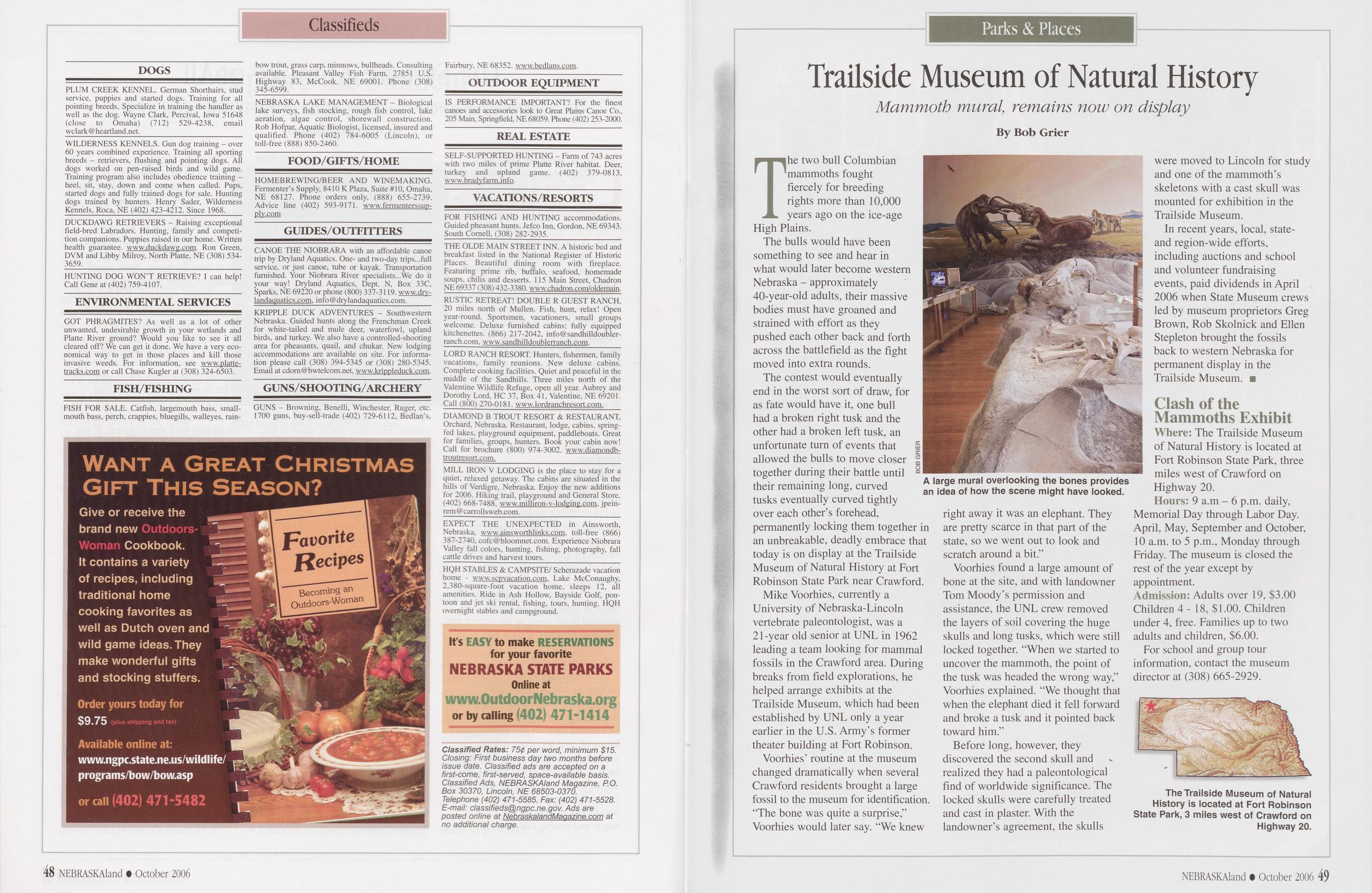
Classifieds
Parks & Places DOGSPLUM CREEK KENNEL. German Shorthairs, stud service, puppies and started dogs. Training for all pointing breeds. Specialize in training the handler as well as the dog. Wayne Clark, Percival, Iowa 51648 (close to Omaha) (712) 529-4238, email wclark@heartland.net.
WILDERNESS KENNELS. Gun dog training - over 60 years combined experience. Training all sporting breeds - retrievers, flushing and pointing dogs. All dogs worked on pen-raised birds and wild game. Training program also includes obedience training - heel, sit, stay, down and come when called. Pups, started dogs and fully trained dogs for sale. Hunting dogs trained by hunters. Henry Sader, Wilderness Kennels, Roca, NE (402) 423-4212. Since 1968.
DUCKDAWG RETRIEVERS - Raising exceptional field-bred Labradors. Hunting, family and competi- tion companions. Puppies raised in our home. Written health guarantee, www.duckdawg.com. Ron Green, DVM and Libby Milroy, North Platte, NE (308) 534- 3659.
HUNTING DOG WON’T RETRIEVE? I can help! Call Gene at (402) 759-4107.
ENVIRONMENTAL SERVICESGOT PHRAGMITES? As well as a lot of other unwanted, undesirable growth in your wetlands and Platte River ground? Would you like to see it all cleared off? We can get it done. We have a very eco- nomical way to get in those places and kill those invasive weeds. For information, see www.platte- tracks.com or call Chase Kugler at (308) 324-6503.
FISH/FISHINGFISH FOR SALE. Catfish, largemouth bass, small- mouth bass, perch, crappies, bluegills, walleyes, rain
want a Great Christmas Gift This Season? Available online at: www.ngpc.state.ne.us/wildlife/ programs/bow/bow.asp or call (402) 471-5482 Order yours today for $9.75 (plus shipping and tax) Give or receive the * brand new Outdoors- Woman Cookbook. It contains a variety of recipes, including traditional home cooking favorites as well as Dutch oven and wild game ideas. They make wonderful gifts and stocking stutters. favorite Recipes Becoming an Outdoors-WomanNEBRASKA LAKE MANAGEMENT - Biological lake surveys, fish stocking, rough fish control, lake aeration, algae control, shorewall construction. Rob Hofpar, Aquatic Biologist, licensed, insured and qualified. Phone (402) 784-6005 (Lincoln), or toll-free (888) 850-2460.
FOOD/GIFTS/HOMEHOMEBREWING/BEER AND WINEMAKING. Fermenter’s Supply, 8410 K Plaza, Suite #10, Omaha, NE 68127. Phone orders only, (888) 655-2739. Advice line (402) 593-9171. www.fermenterssup- ply.com
GUIDES/OUTFITTERSCANOE THE NIOBRARA with an affordable canoe trip by Dryland Aquatics. One- and two-day trips...full service, or just canoe, tube or kayak. Transportation furnished. Your Niobrara River specialists...We do it your way! Dryland Aquatics, Dept. N, Box 33C, Sparks, NE 69220 or phone (800) 337-3119. www.drv- landaquatics.com, info@drylandaquatics.com.
KRIPPLE DUCK ADVENTURES - Southwestern Nebraska. Guided hunts along the Frenchman Creek for white-tailed and mule deer, waterfowl, upland birds, and turkey. We also have a controlled-shooting area for pheasants, quail, and chukar. New lodging accommodations are available on site. For informa- tion please call (308) 394-5345 or (308) 280-5345. Email at cdom@bwtelcom.net, www.krippleduck.com.
GUNS/SHOOTING/ARCHERYGUNS - Browning, Benelli, Winchester, Ruger, etc. 1700 guns, buy-sell-trade (402) 729-6112, Bedlan’s, Fairbury, NE 68352. www.bedlans.com.
OUTDOOR EQUIPMENTIS PERFORMANCE IMPORTANT? For the finest canoes and accessories look to Great Plains Canoe Co., 205 Main, Springfield, NE 68059. Phone (402) 253-2000.
REAL ESTATESELF-SUPPORTED HUNTING - Farm of 743 acres with two miles of prime Platte River habitat. Deer, turkey and upland game. (402) 379-0813, www.bradyfarm.info.
VACATIONS/RESORTSFOR FISHING AND HUNTING accommodations. Guided pheasant hunts. Jefco Inn, Gordon, NE 69343. South Cornell, (308) 282-2935.
THE OLDE MAIN STREET INN. A historic bed and breakfast listed in the National Register of Historic Places. Beautiful dining room with fireplace. Featuring prime rib, buffalo, seafood, homemade soups, chilis and desserts. 115 Main Street, Chadron NE 69337 (308) 432-3380. www.chadron.com/oldemain.
RUSTIC RETREAT! DOUBLE R GUEST RANCH, 20 miles north of Mullen. Fish, hunt, relax! Open year-round. Sportsmen, vacationers, small groups welcome. Deluxe furnished cabins; fully equipped kitchenettes. (866) 217-2042, info@sandhilldoubler- ranch.com, www.sandhilldoublerranch.com.
LORD RANCH RESORT. Hunters, fishermen, family vacations, family reunions. New deluxe cabins. Complete cooking facilities. Quiet and peaceful in the middle of the Sandhills. Three miles north of the Valentine Wildlife Refuge, open all year. Aubrey and Dorothy Lord, HC 37, Box 41, Valentine, NE 69201. Call (800) 270-0181. www.lordranchresort.com.
DIAMOND B TROUT RESORT & RESTAURANT, Orchard, Nebraska. Restaurant, lodge, cabins, spring- fed lakes, playground equipment, paddleboats. Great for families, groups, hunters. Book your cabin now! Call for brochure (800) 974-3002. www.diamondb- troutresort.com.
MILL IRON V LODGING is the place to stay for a quiet, relaxed getaway. The cabins are situated in the hills of Verdigre, Nebraska. Enjoy the new additions for 2006. Hiking trail, playground and General Store. (402) 668-7488, www.milliron-v-lodging.com. jpein- rem@carrollsweb.com.
EXPECT THE UNEXPECTED in Ainsworth, Nebraska, www.ainsworthlinks.com. toll-free (866) 387-2740, cofc@bloomnet.com. Experience Niobrara Valley fall colors, hunting, fishing, photography, fall cattle drives and harvest tours.
HQH STABLES & CAMPSITE/ Scherazade vacation home - www.scpvacation.com. Lake McConaughy, 2,380-square-foot vacation home, sleeps 12, all amenities. Ride in Ash Hollow, Bay side Golf, pon- toon and jet ski rental, fishing, tours, hunting, HQH overnight stables and campground.
It's EASY to make RESERVATIONS for your favorite NEBRASKA STATE PARKS Online at www.OutdoorNebraska.org or by calling (402) 471-1414
Classified Rates: 75f per word, minimum $15. Closing: First business day two months before issue date. Classified ads are accepted on a first-come, first-served, space-available basis. Classified Ads, NEBRASKAIand Magazine, P.O. Box 30370, Lincoln, NE 68503-0370. Telephone (402) 471-5585. Fax: (402) 471-5528. E-mail: classifieds@ngpc.ne.gov. Ads are posted online at NebraskalandMaaazine. com at no additional charge.
Trailside Museum of Natural History Mammoth mural, remains now on display By Bob GrierThe two bull Columbian mammoths fought fiercely for breeding rights more than 10,000 years ago on the ice-age High Plains.
The bulls would have been something to see and hear in what would later become western Nebraska - approximately 40-year-old adults, their massive bodies must have groaned and strained with effort as they pushed each other back and forth across the battlefield as the fight moved into extra rounds.
The contest would eventually end in the worst sort of draw, for as fate would have it, one bull had a broken right tusk and the other had a broken left tusk, an unfortunate turn of events that allowed the bulls to move closer together during their battle until their remaining long, curved tusks eventually curved tightly over each other’s forehead, permanently locking them together in an unbreakable, deadly embrace that today is on display at the Trailside Museum of Natural History at Fort Robinson State Park near Crawford.
Mike Voorhies, currently a University of Nebraska-Lincoln vertebrate paleontologist, was a 21-year old senior at UNL in 1962 leading a team looking for mammal fossils in the Crawford area. During breaks from field explorations, he helped arrange exhibits at the Trailside Museum, which had been established by UNL only a year earlier in the U.S. Army’s former theater building at Fort Robinson.
Voorhies’ routine at the museum changed dramatically when several Crawford residents brought a large fossil to the museum for identification. “The bone was quite a surprise,” Voorhies would later say. “We knew A large mural overlooking the bones provides an idea of how the scene might have looked. right away it was an elephant. They are pretty scarce in that part of the state, so we went out to look and scratch around a bit.”
Voorhies found a large amount of bone at the site, and with landowner Tom Moody’s permission and assistance, the UNL crew removed the layers of soil covering the huge skulls and long tusks, which were still locked together. “When we started to uncover the mammoth, the point of the tusk was headed the wrong way,” Voorhies explained. “We thought that when the elephant died it fell forward and broke a tusk and it pointed back toward him.”
Before long, however, they discovered the second skull and realized they had a paleontological find of worldwide significance. The locked skulls were carefully treated and cast in plaster. With the landowner’s agreement, the skulls were moved to Lincoln for study and one of the mammoth’s skeletons with a cast skull was mounted for exhibition in the Trailside Museum.
In recent years, local, state- and region-wide efforts, including auctions and school and volunteer fundraising events, paid dividends in April 2006 when State Museum crews led by museum proprietors Greg Brown, Rob Skolnick and Ellen Stepleton brought the fossils back to western Nebraska for permanent display in the Trailside Museum. ■
Clash of the Mammoths ExhibitWhere: The Trailside Museum of Natural History is located at Fort Robinson State Park, three miles west of Crawford on Highway 20. Hours: 9 a.m - 6 p.m. daily, Memorial Day through Labor Day. April, May, September and October, 10 a.m. to 5 p.m., Monday through Friday. The museum is closed the rest of the year except by appointment. Admission: Adults over 19, $3.00 Children 4-18, $1.00. Children under 4, free. Families up to two adults and children, $6.00. For school and group tour information, contact the museum director at (308) 665-2929. The Trailside Museum of Natural History is located at Fort Robinson State Park, 3 miles west of Crawford on Highway 20.
48 NEBRASKAIand • October 2006 NEBRASKAIand O October 2006 49
This photo is of a duck and pheasant hunt in the Richland area in October 1940. The hunters (from left) were: Bob Smejkal, my dad Matt Wachal, and my uncle Elmer Wachal. The picture was taken on the Locust Grove Farm. I own the farm now, and it has been in the family since 1901.1 am the fourth generation to own and farm this ground.
- Dan Wachal, Schuyler, NebraskaThis picture of an owl was taken in 1951 at a farm near Mead. Pictured (from left) are: my uncle Aaron Wollen, my dad Wayne Drews, my grandpa Henry Wollen, and myself in front. My aunt Connie (Wollen) Heberly is in the doorway
- Jim Drews, Malvern, IowaMy brother, Staff Sergeant Herman C. Wulf, and his children, Richard C. and Marilyn K., and myself are pictured after a successful fishing outing along Soldier Creek at Fort Robinson in late-April 1946. We found out later that the fish hatchery in Crawford had released some of its breeding stock in Soldier Creek a few weeks before our good fortune. The picture was taken outside my brother’s quarters along “noncom row,” the first building behind the small white church that fronted U.S. Highway 20 through the fort. The church was later moved to a location in Crawford before the fort was closed, and to my knowledge is still in service. I was discharged from Navy service in December 1945 and was visiting my brother’s family for the holidays but later worked in the maintenance shop for the 5th Army. My brother was the motor pool sergeant at the fort the last three years of its existence, and along with other duties, coached the fastpitch softball team at the post in a tri-state league that included teams from Crawford, Chadron and Fort Robinson in Nebraska, Hot Springs and Igloo in South Dakota and Lusk, Wyoming. I would like to note that Richard Wulf was the last child born in the fort hospital before the fort was closed and the hospital destroyed.
I really enjoyed the special fishing in that area - it was great to open the trout season on April 1 in 1946 and 1947 by fishing Soldier Creek and White River. There was a light snow falling early in the day in 1947, and we enjoyed a few good strikes. My late son and I fished the area again in 1978 but with less luck than in 1946 and 1947. Even with my advanced age, turning 81 January 2005, I may have to try fly-fishing again in the near future if I can get the old fly rod and reel loosened up again. Thanks for a very good tenure of keeping the sports and outdoor fans current with your great magazine and timely articles and pictures.
- Henry W. Wulf, Lincoln, NebraskaSend contributions to: Portraits from the Past, NEBRASKAland Magazine, P.O. Box 30370, Lincoln, NE 68503-0370. Photos should show people enjoying Nebraska outdoor activities, such as camping, boating, hunting or fishing, and must have been taken before 1970. We will give priority to unusual photos or activities. When possible, please include a story about the photograph and identify the people, places and approximate date it was taken. Photos will be returned.
Nebraska Game and Parks Commission Nebraska State Parks Nebraska state parks offer joys as simple and diverse as life itself. Lamp, ski, fish, ride, or relax to a chorus of nature. Visit a state park today and discover a world of wonder. To learn more, visit us online at OutdoorNebraska.org. or call 1-800-826-PARK to request literature. 50 NEBRASKAland • October 2006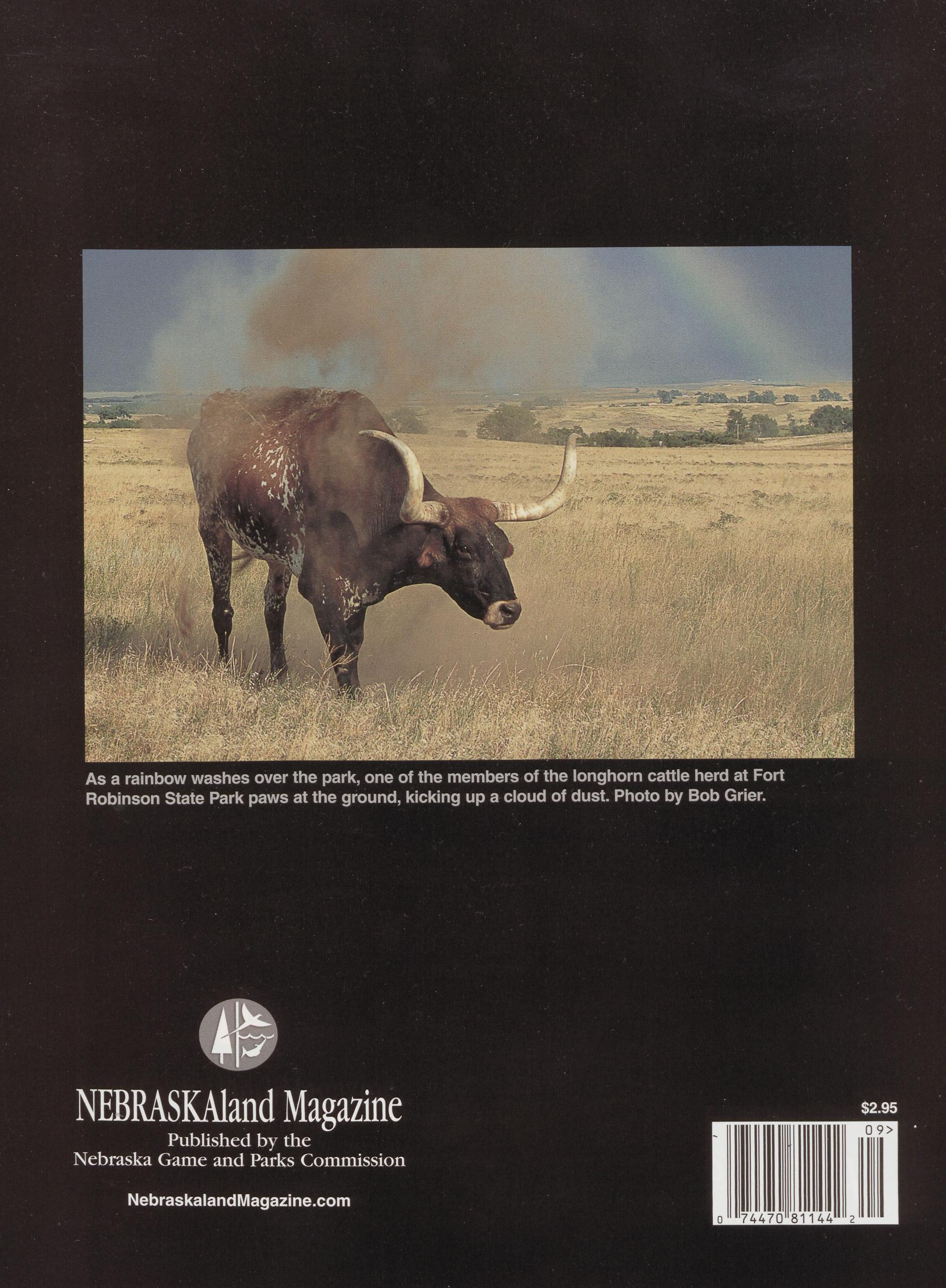
Position: 798 (13 views)