Volume 84, Issue 7, 2006
NEBRASKAland
Nebraska Game & Parks Commission August-September 2006 • $2.50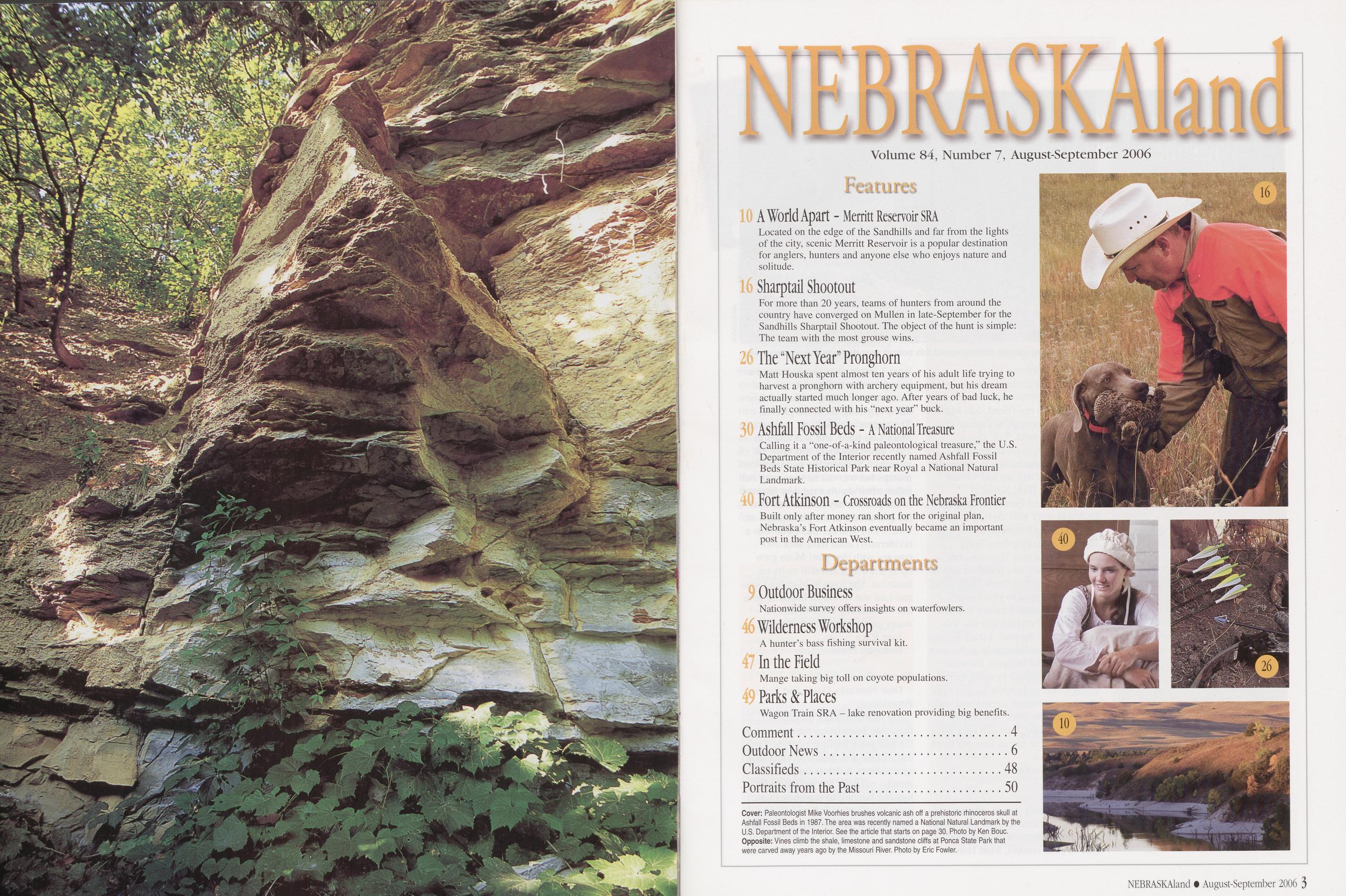
NEBRASKAland
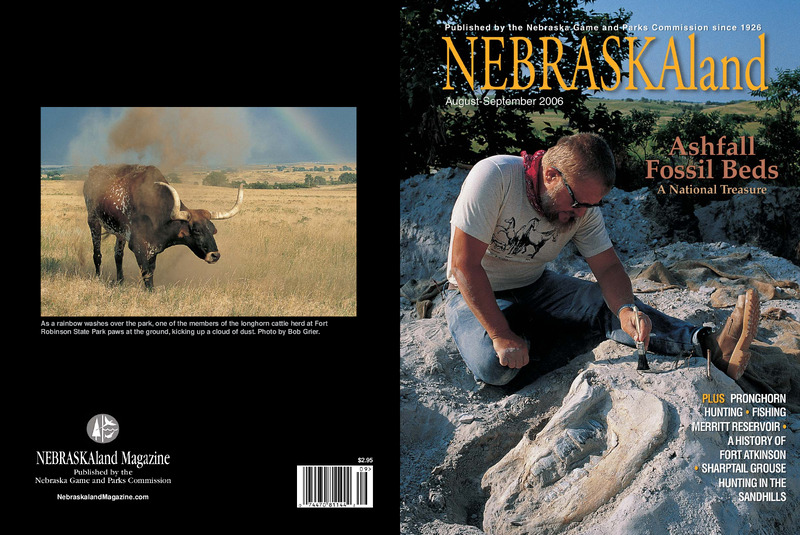
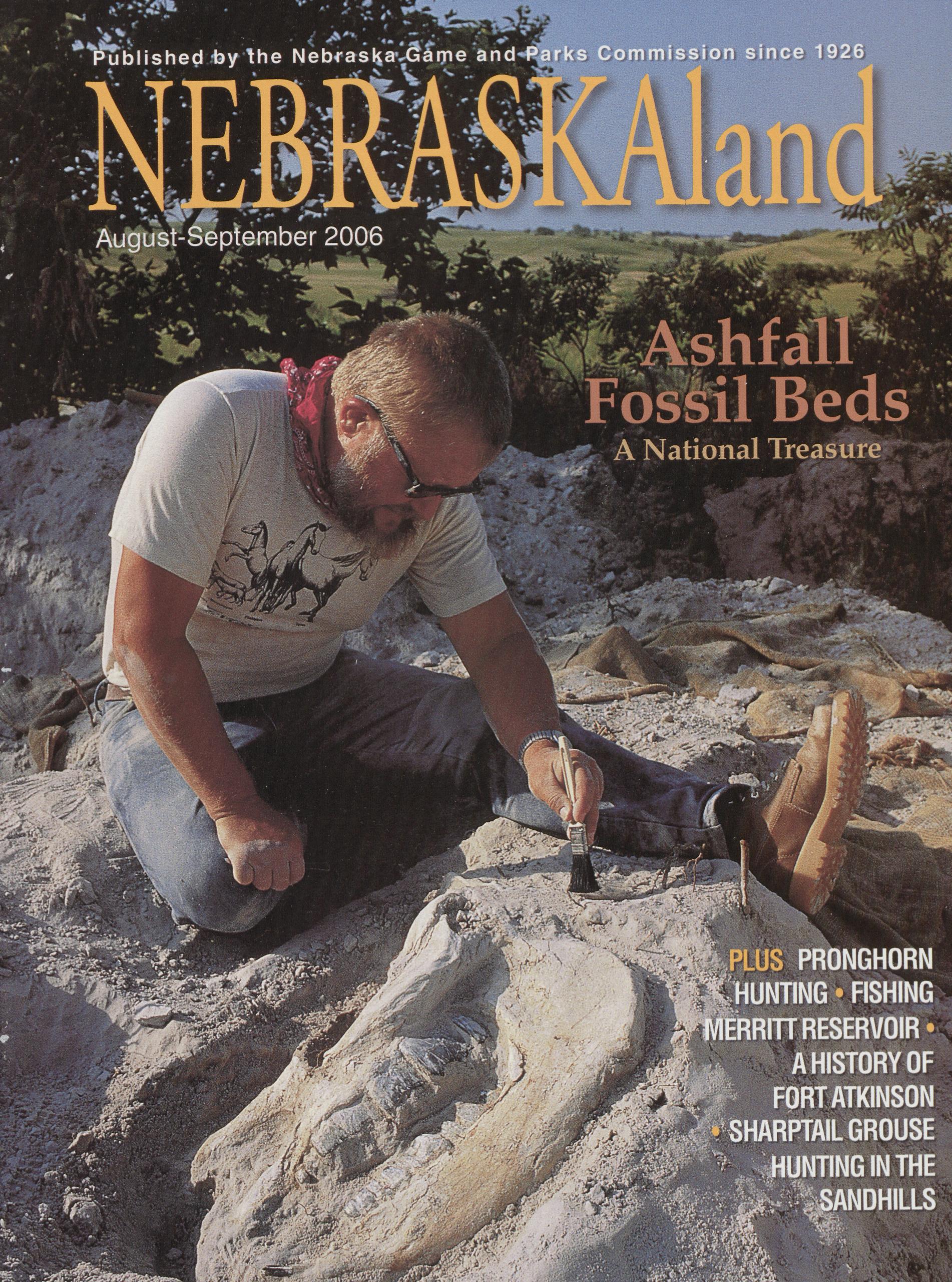
Volume 84, Number 7, August-September 2006 Features A World Apart - Merritt Reservoir SRA Located on the edge of the Sandhills and far from the lights of the city, scenic Merritt Reservoir is a popular destination for anglers, hunters and anyone else who enjoys nature and solitude. Sharptail Shootout For more than 20 years, teams of hunters from around the country have converged on Mullen in late-September for the Sandhills Sharptail Shootout. The object of the hunt is simple: The team with the most grouse wins. The “Next Year” Pronghorn Matt Houska spent almost ten years of his adult life trying to harvest a pronghorn with archery equipment, but his dream actually started much longer ago. After years of bad luck, he finally connected with his "next year” buck. Ashfall Fossil Beds - A National Treasure Calling it a "one-of-a-kind paleontological treasure,” the U.S. Department of the Interior recently named Ashfall Fossil Beds State Historical Park near Royal a National Natural Landmark. 40 Fort Atkinson - Crossroads on the Nebraska Frontier Built only after money ran short for the original plan, Nebraska’s Fort Atkinson eventually became an important post in the American West. Outdoor Business Nationwide survey offers insights on waterfowlers. 46 Wilderness Workshop A hunter’s bass fishing survival kit. In the Field Mange taking big toll on coyote populations. Parks &Places Wagon Train SRA - lake renovation providing big benefits. Comment........................................4 Outdoor News...................................6 Classifieds...................................48 Portraits from the Past ......................50 Cover: Paleontologist Mike Voorhies brushes volcanic ash off a prehistoric rhinoceros skull at Ashfall Fossil Beds in 1987. The area was recently named a National Natural Landmark by the U.S. Department of the Interior. See the article that starts on page 30. Photo by Ken Bouc. Opposite: Vines climb the shale, limestone and sandstone cliffs at Ponca State Park that were carved away years ago by the Missouri River. Photo by Eric Fowler. Comment
NEBRASKAland Mazine
Published by the
Nebraska Game and
Parks Commission
Director: Rex Amack
Assistant Directors:
Roger Kuhn, Kirk Nelson, Sam Sidner
Information & Education Administrator:
Ken Bouc
Information & Education Art Director:
Steve O’Hare
Jim Gleason of Lincoln photographed this bobcat near Harrison this past summer.
JIM GLEASON
to (hopefully)
pass on to his
children. We
love Nebraska
and all of
its outdoor
\ opportuni-
1 ties! Thank
I you again
M for such a
wonderful
gift! We have included a
picture of our future hunter - he is
ready to call in a big “tom.”
Many thanks,
Alicia, Mike and Aidan Hardin
Lincoln, Nebraska
Nebraska Game and Parks
Commission Offices
Headquarters
2200 N. 33rd Street
Lincoln, NE 68503
Phone (402) 471-0641
District Office I
East Hwy. 2, Box 725
Alliance, NE 69301
Phone (308) 763-2940
District Office II
524 Panzer St., Box 508
Bassett, NE 68714
Phone (402) 684-2921
District Office III
2201 N. 13th St.
Norfolk, NE 68701
Phone (402) 370-3374
District Office IV
301 E. State Farm Rd.
North Platte, NE 69101
Phone (308) 535-8025
District Office VI
1617 First Ave.
Kearney, NE 68847
Phone (308) 865-5310
Omaha Office
1212 Bob Gibson Blvd.
Omaha, NE 68108
Phone (402) 595-2144
Ak-Sar-Ben Aquarium
21502 W. Highway 31
Gretna, NE 68028
Phone (402) 332-3901
Commissioners
Chairman:
James Stuart, Jr., Lincoln
Vice Chairman:
Bill Zutavern, Dunning
2nd Vice Chairman:
Gary Parker, Columbus
George E. Hall, Bridgeport
James Ziebarth, Wilcox
Jerrod Burke, Curtis
Dr. Mark Pinkerton, Wilber
Bill Grewcock, Omaha
Magazine Staff
Editor: Doug Carroll
Associate Editor: Jeff Kurrus
Art Director: Tim Reigert
Senior Editors: Jon Farrar, Ken Bouc
Regional Editors:
Eric Fowler, Bob Grier, Rocky Hoffmann
Contributing Editor: Michael Forsberg
Circulation: Donna Robinson
Photo Librarian: Sarah Johnson
NEBRASKAland VOL. 84 / NO. 7
ISSN: 0028-1964 AUGUST-SEPTEMBER 2006
Published monthly, except for Jan./Feb. and Aug./Sept.
issues, by the Nebraska Game and Parks Commission, 2200
N. 33rd St., Lincoln, NE. Copyright 2006, all rights reserved.
Please address comments or questions to this address.
Periodicals postage paid at Lincoln, Nebraska, and other
locations. POSTMASTER: Send all address changes to
NEBRASKAland, P.O. Box 30370, Lincoln, NE 68503-0370.
Address submissions to: The Editor, NEBRASKAland
Magazine, P.O. Box 30370, Lincoln. NE 68503. Include
a stamped, self-addressed return envelope. The publisher
assumes no responsibility for unsolicited material.
NEBRASKAland is available on audio cassette from the
Nebraska Library Commission Talking Book and Braille
Service, Suite 120, 1200 N St., Lincoln, NE 68508. (800)
742-7691
Rates: $18 for one year; $33 for two years.
Nebraska residents must add appropriate sales tax.
To subscribe call 1-800-NEBLAND (632-5263),
or go online to: www.OutdoorNebraska.org
Chance Encounter
Comment
NEBRASKAland Mazine
Published by the
Nebraska Game and
Parks Commission
Director: Rex Amack
Assistant Directors:
Roger Kuhn, Kirk Nelson, Sam Sidner
Information & Education Administrator:
Ken Bouc
Information & Education Art Director:
Steve O’Hare
Jim Gleason of Lincoln photographed this bobcat near Harrison this past summer.
JIM GLEASON
to (hopefully)
pass on to his
children. We
love Nebraska
and all of
its outdoor
\ opportuni-
1 ties! Thank
I you again
M for such a
wonderful
gift! We have included a
picture of our future hunter - he is
ready to call in a big “tom.”
Many thanks,
Alicia, Mike and Aidan Hardin
Lincoln, Nebraska
Nebraska Game and Parks
Commission Offices
Headquarters
2200 N. 33rd Street
Lincoln, NE 68503
Phone (402) 471-0641
District Office I
East Hwy. 2, Box 725
Alliance, NE 69301
Phone (308) 763-2940
District Office II
524 Panzer St., Box 508
Bassett, NE 68714
Phone (402) 684-2921
District Office III
2201 N. 13th St.
Norfolk, NE 68701
Phone (402) 370-3374
District Office IV
301 E. State Farm Rd.
North Platte, NE 69101
Phone (308) 535-8025
District Office VI
1617 First Ave.
Kearney, NE 68847
Phone (308) 865-5310
Omaha Office
1212 Bob Gibson Blvd.
Omaha, NE 68108
Phone (402) 595-2144
Ak-Sar-Ben Aquarium
21502 W. Highway 31
Gretna, NE 68028
Phone (402) 332-3901
Commissioners
Chairman:
James Stuart, Jr., Lincoln
Vice Chairman:
Bill Zutavern, Dunning
2nd Vice Chairman:
Gary Parker, Columbus
George E. Hall, Bridgeport
James Ziebarth, Wilcox
Jerrod Burke, Curtis
Dr. Mark Pinkerton, Wilber
Bill Grewcock, Omaha
Magazine Staff
Editor: Doug Carroll
Associate Editor: Jeff Kurrus
Art Director: Tim Reigert
Senior Editors: Jon Farrar, Ken Bouc
Regional Editors:
Eric Fowler, Bob Grier, Rocky Hoffmann
Contributing Editor: Michael Forsberg
Circulation: Donna Robinson
Photo Librarian: Sarah Johnson
NEBRASKAland VOL. 84 / NO. 7
ISSN: 0028-1964 AUGUST-SEPTEMBER 2006
Published monthly, except for Jan./Feb. and Aug./Sept.
issues, by the Nebraska Game and Parks Commission, 2200
N. 33rd St., Lincoln, NE. Copyright 2006, all rights reserved.
Please address comments or questions to this address.
Periodicals postage paid at Lincoln, Nebraska, and other
locations. POSTMASTER: Send all address changes to
NEBRASKAland, P.O. Box 30370, Lincoln, NE 68503-0370.
Address submissions to: The Editor, NEBRASKAland
Magazine, P.O. Box 30370, Lincoln. NE 68503. Include
a stamped, self-addressed return envelope. The publisher
assumes no responsibility for unsolicited material.
NEBRASKAland is available on audio cassette from the
Nebraska Library Commission Talking Book and Braille
Service, Suite 120, 1200 N St., Lincoln, NE 68508. (800)
742-7691
Rates: $18 for one year; $33 for two years.
Nebraska residents must add appropriate sales tax.
To subscribe call 1-800-NEBLAND (632-5263),
or go online to: www.OutdoorNebraska.org
Chance Encounter
While on a photo excursion in the Panhandle portion of the state this summer with my friend, Jim Mathis, I was lucky enough to capture this photo of a bobcat. Jim, also a photographer, is an attorney in Gering and was acting as my guide. Earlier in the day we had visited Agate Fossil Beds National Monument and Fort Robinson State Park and were now driving back roads looking for pictures. We had intended on taking Sow Belly Canyon Road near Harrison, but missed the turn and found ourselves near the summit of Pants Butte Road. After we stopped to shoot some landscape photos, I turned to shoot in the other direction and saw this bobcat across the road. I think we saw each other simultaneously, as we each took a step and stopped. He was considerate enough to stand there for about 15 seconds while he surveyed the situation before turning and walk- ing off into the trees. Serendipity, pure and simple. One can only hope he survived the recent fires out there.
Jim Gleason Lincoln, Nebraska Mom’s BuckI am emailing you in reference to a picture featured in your July 2006 edition of “Portraits from the Past.” One of your readers, Matt Hansen from Lincoln, sent in a picture of a young woman with a deer she had shot and was asking readers if they know anything about the picture. The picture is actually of my mother, Mary Lou Race, and was taken in 1949 when my mom was only 19 years old. She actually had the mumps but was out hunting with her father when she shot the deer featured in the picture. My brother still has the gun shown in the photograph as well. Mom said her dad (who was a taxidermist) must have shot 100 coyotes with that gun! Mom grew up in Crawford and still visits on occasion. She lives in Maryland now and said she would be happy to give Mr. Hansen any other details he wants concerning the photograph.
Joan Race Hanover, Pennsylvania Thanks for the PermitDear Nebraska Game and Parks Foundation,
My husband and I wanted to thank the Foundation for sponsoring the half-price lifetime permits. Our son’s name was drawn recently at a sports show. Aidan is only 10 months old now, but we are really looking forward to spending many years outdoors with him camping, hunting and fishing. This gift to him ensures a lifetime of experiences both with us as a family and for him The Hardin letter is just one of dozens of letters received by the Foundation thanking them for sponsoring the half-price hunting and fishing lifetime youth permits that have been drawn at a variety of sports shots and wildlife banquets across the state. The money donated by the nonprofit Foundation has enabled dozens of youth to receive their choice of lifetime permits, giving them the ability to enjoy Nebraska's great outdoors for the rest of their life. - Editor
Comment NEBRASKAland Magazine P.O. Box 30370, Lincoln, NE 68503. E-mail: nebland@ngpc.ne.gov. Please include your postal address and telephone number. Letters may be condensed and edited for clarity. Photographs are welcome and will be returned.
Under federal and/or state law, discrimination is prohibited on the basis of race, color, religion, age, gender, marital status, national origin, disability or political affiliation. If you think you have been discriminated against in any program, activity or facility or want more information, contact the Affirmative Action Officer, Nebraska Game and Parks Commission, Lincoln, NE, (402) 471-0641 or the Equal Opportunity Commission, Lincoln, NE, (402) 471-2024, TTY/TDD (402) 471- 4693).
Nebraska Game and Parks Commission Offices World Wide Web site: OutdoorNebraska.org E-mail: ngpc@ngpc.state.ne.us Conservation Officers by Region Administration Terry Brentzel Grand Is. 384-8296 Ted Blume (Adm.) Lincoln 471-5531 Darin Gress Hebron (402) 768-2287 Craig Stover (Asst.) Lincoln 471-5532 Dale Johnson Kearney 237-1079 Wes Loos (Asst.) Lincoln 471-5591 Mark Reeves Loup City 745-0748 Murray Johnson Lincoln 471-5003 Robert Finke Milford (402) 761-3537 Richard Seward Ord 728-3115 Panhandle Officer City Phone (308) Northeast Jim Zimmerman (Sup.) Gering 436-7561 Officer City Phone (402) Walt Meyer Chadron 432-4398 Tom Zimmer (Sup.) Norfolk 371-6625 Scott Brandt Gering 436-3418 Robert Kelly Albion 395-2538 Heath Packett Gordon 282-2553 Dale Davis Bassett 273-1700 Dennis Thompson Ogallala 284-6450 Ross Oestmann Bloomfield 373-4412 Dan Zuehlke Ogallala 284-4815 Steve Oberg Columbus 564-5937 Doug Pollard Oshkosh 772-9950 Daniel Roberts Fremont 721-7852 Frank Miller Valentine (402)376-1183 Jon Reeves Kennard 427-7378 Dan Kling Whitney 432-8367 Marion Shafer Norfolk 371-2031 Pat George O’Neill 336-1588 Southwest Eric Wiebe Ponca 755-2566 Officer City Phone (308) Tim Williams Neligh 887-1335 Roger Thompson (Sup.) N. Platte 532-9175 Cory Krause West Point 372-6979 Ray Dierking Brkn. Bow 872-3078 Southeast George Sund Cambridge 697-4629 Officer City Phone (402) Michael Thome Cozad 784-4362 Duane Arp (Sup.) Gretna 332-2965 Matt Andrews Elwood 785-3025 Sean McKeehan Ashland 944-4174 Dirk Greene Imperial 882-5328 William Krause Auburn^ 274-3789 Virgil Gosch McCook 345-2185 Jeremy TenKley Beatrice 228-1437 Dudley Sorensen N. Platte 532-0747 Dan Evasco Bellevue 592-6733 Rich Routh Rep. City 799-2085 Douglas Kramer Lincoln 466-9001 Dina Barta Lincoln 483-2358 South-central Stacey Lewton Lincoln 476-0436 Officer City Phone (308) Levi Krause Louisville 234-2212 Jerry Pecha (Sup.) Kearney 865-5327 Russell Mort Nebr. City 873-5684 Jeff Jones Clay Center(402)762-3124 Jeff Clauson Valley 359-5301 Randy Pomplun Fullerton 536-2987 Mike Luben Wahoo 443-4278 I-7627 4 NEBRASKAland G August-September 2006 NEBRASKAland • August-September 2006 5
The Nebraska Game and Parks Commission was awarded first place honors in three categories in the Association for Conservation Information (ACI) 2005 Annual Awards competition.
“Nebraska Wild and Scenic,” the 132-page August-September issue of NEBRASKAland Magazine that was coordinated by NEBRASKAland art director Tim Reigert, received first place awards in both the One-Time, 4-Color Publication category and in the Photography category.
“How to Give Your Catch a Second Chance,” by Regional Editor Rocky Hoffmann was awarded first place in the Magazine Fisheries Article category. Hoffmann’s article appeared in the July 2005 issue of NEBRASKAland.
Hoffmann was also awarded second place in the Magazine Wildlife Article category for his article “The Way Hunting Was,” in the magazine’s January 2005 issue.
NEBRASKAland Magazine was awarded third place honors in the 4-Color Magazine category this year.
Trail Tales, the Commission’s colorful 16-page magazine for kids that focuses on nature, wildlife, and a variety of outdoor activities, received the third place award in the Education category. Trail Tales is published four times each school year and made available to schools across the state for use by their fourth-grade students.
“Stalking Mule Deer,” an article by Regional Editor Eric Fowler that was published in the November 2005 issue of NEBRASKAland, was awarded third place recognition in the Photography category.
Missouri River Clean-upA Missouri River Relief clean-up event will be held Saturday, September 23 in Omaha and Council Bluffs. The event will concentrate on Playland Park in Council Bluffs and the Omaha Riverfront. Registration for the event begins at 8 a.m., and the clean-up will run from 9 a.m. to 3 p.m.
Clean-up headquarters will be at the Lewis and Clark Landing in Omaha’s Riverfront Park. For more information or to sign up, visit www.riverrelief.org, or call (816) 812-5166.
Nebraska pond owners, pond managers and those interested in developing farm ponds are urged to obtain a copy of the “Nebraska Pond Management Handbook” from the Nebraska Game and Parks Commission.
The Nebraska Pond Management Handbook provides information on pond construction, environmental modifications, stocking, management, and potential maintenance problems that will help pond owners and managers correct existing problems and prevent others before they develop.
Pond owners and managers can obtain free copies of the 96-page handbook by contacting the Ak-Sar- Ben Aquarium or fisheries personnel at Commission offices in Alliance, Bassett, Norfolk, North Platte, Kearney, Lincoln and Omaha. Others interested in farm pond development and management can download the entire handbook or individual chapters at no charge on the Commission’s web site at www.OutdoorNebraska.org. Persons who obtain a book or download its contents will be asked a few basic questions and their answers will be used to determine the demand and usefulness of the publication.
The book was written by Jeff Blaser, the Commission’s private waters specialist, and Rick Eades, an urban fisheries specialist, to provide information for landowners to use to manage their existing ponds or construct new ones.
Blaser said many of Nebraska’s ponds provide good fishing, while other don’t because of improper construction, management, or conflicting uses.
“Ponds need to have good water quality, favorable aquatic habitat and proper management to develop balanced fish populations that will achieve desired angling goals,” Blaser said. “It’s also crucial that ponds have adequate water depths to prevent excessive growth of aquatic vegetation and to support aquatic life when adverse environmental conditions occur.”
Migratory Bird Hunters Need HIP RegistrationMigratory bird hunters are reminded that they must have their HIP (Harvest Information Program) number before going afield this season. The program enables state and federal wildlife officials to estimate the amount of migratory birds harvested each hunting season and make year by year hunting season adjustments. Hunters are required to register with the program if they plan to hunt doves, ducks, geese, snipe, rail, coot, or woodcocks between August 1, 2006 and June 30, 2007. Registration is free and can be done at 1-888-403-2473 or at w w w. outdoornebraska. org.
Get Ready to Hunt this Fall Now You Can Buy Nebraska Hunting Permits Online! www.OutdoorNebraska.org NEBRASKA GAME AND PARKS COMMISS Visit our secure web site to quickly and conveniently purchase fishing, hunting and park permits online using your Visa or Mastercard. Online permit purchase is safe, hassle-free and there is never a checkout line. Simply choose the permits you want, pay for them, download and print. And, you are on your way to Nebraska's great outdoors. 6 NEBRASKAland • August-September 2006 Outdoor Business
Officer's Notebook
Lost and Found Rod
Outdoor Business
Officer's Notebook
Lost and Found Rod
One day late last July I was working at Mormon Island State Recreation Area near Grand Island. With plenty of camping spots and several lakes to fish, swim and boat in, Mormon Island is a popular destination and I kept busy working my way around the first lake, checking both bank fisherman and boat anglers.
Working without a boat, it was easy to check the people on land, but I had to yell to get the boaters to come to shore so I could check for fishing licenses and flotation devices. For those who couldn’t make it all the way in because of shallow water, I used binoculars to check their permits.
Things were going pretty well until I got to the south side of the lake. The interstate parallels the lake at that point and the truck and car traffic was creating a lot of noise. A trio of anglers was anchored offshore, but no matter how loud I yelled for them to come in, they couldn’t hear me. A strong wind wasn’t helping matters, but I was finally able to make them understand I wanted to talk to them.
While waiting for them to make their way to shore, I decided to check some other anglers nearby. I heard the boat anglers yelling as they pulled anchor, but it wasn’t until they got to shore that I was able to find out what all of the excitement was about.
Exactly two weeks before, one of the anglers had hooked a big catfish in the area where they were fishing, but while switching positions in the boat to better fight the fish, he lost control of the rod and reel and it went over the side of the boat.
Despite dragging the area for a half hour, they had been were unsuccessful in finding the rod and reel, which were both brand new. However, when they pulled anchor to be checked by me, up came the rod and reel, minus the big catfish.
It was a great story and I was happy they had found the pole. Unfortunately, their happiness with finding the expensive rod and reel was diminished somewhat when I had to give them a ticket for not having enough life jackets.
- Jerry Pecha, Conservation Officer Supervisor, Kearney Commission Extends Fall Turkey SeasonsBecause rapidly increasing turkey populations are causing problems in some parts of the state, the Nebraska Game and Parks Commission Board of Commissioners has significantly extended this year’s fall turkey season dates. This fall’s archery turkey season will begin October 1 and the shotgun turkey season will begin October 14. After both close for the November 11-19 firearm season, they will reopen on November 20 and stay open through December 31. Last year both of them closed November 30.
Park Video Clips Now Available OnlineA new addition to the Nebraska Game and Parks Commission’s web site lets visitors watch video clips to get an idea of what they can expect to find when they visit state parks areas across the state.
Video and Radio Production Specialist Ralph Wall, who produced the videos, said “The video previews are an exciting step beyond the usual park brochure. Visitors to our web site can watch the vignettes for a better idea of what scenery, services and activities are available at each park.”
There are currently videos of 15 park areas online. The areas are Alexandria State Recreation Area (SRA), Arbor Lodge State Historical Park (SHP), Ashfall Fossil Beds SHP, Buffalo Bill SHP, Calamus SRA, Champion Mill SHP, Eugene T. Mahoney State Park (SP), Fort Hartsuff SHP, Fort Robinson SP, Gallagher Canyon SRA, Indian Cave SP, Johnson Lake SRA, Ponca SP, Smith Falls SP and Victoria Springs SRA. Wall says videos of all of the more than 80 state parks areas will eventually be available.
To view the videos, go to the Commission’s web site at www.OutdoorNebraska.org. and click on “State Parks.”
High School Silhouette ShootThe Nebraska High School Small Bore Rifle Silhouette will be held September 30 at the Pressey Wildlife Management Area south of Broken Bow. This free competition is open to 12- to 18-year-old students in 7th through 12th grades who have successfully completed a Hunter’s Education course.
For more information, contact match director Matthew Haumont at (308) 872-2348, or Mike Streeter with the Nebraska Game and Parks Commission at (402) 471-6134.
Duck Hunter Profile Nationwide survey offers insights on waterfowlers. Jon FarrarWaterfowl hunters constitute a relatively small proportion of all hunters in the United States. Yet this group provides a large and positive energy to conservation initiatives. Hunting lore, conservation history and contemporary financial contributions of waterfowl hunters loom large. Too, political influence wielded by waterfowl hunters to broaden public support for conservation is especially noteworthy.... Above all, waterfowl hunters have, over time, proven their heart - that is, their best intentions - for advancing conservation and promoting the contribution of hunting to American’s quality of life. Waterfowl hunters, and their beliefs, are important.”
That preface announced publication of the National Duck Hunter Survey 2005 earlier this year by the National Flyway Council and the Wildlife Management Institute. It was the first nationwide survey to sample waterfowlers’ opinions on duck hunting and conservation. More than 10,000 hunters from 49 states responded to 32 questions in the survey. The results will be used to shape hunting regulations and conservation actions in the future. Some of the more interesting findings follow.
Fifty-eight percent of those responding to the national survey said duck hunting was “one of their most important” recreational activities. Fourteen percent responded it was their “most important.” Similar numbers were reported by Nebraska hunters.
About one-third started hunting ducks before 1970 (23 percent in Nebraska), roughly another third (38 percent in Nebraska) started between 1970 and 1988.
Sixty-five percent of respondents reported spending more than $250 duck hunting each year and 20 percent spent more than $1,000. Seventeen percent of Nebraska and Texas duck hunters reported spending more than $1,000 annually on their sport, the highest in the Central Flyway.
Nationwide, 43 percent hunted ducks 10 days or less annually (51 percent in Nebraska), 30 percent spent 11 to 20 days, 17 percent 21 to 30 days, and 10 percent (19 percent in Nebraska) more than 30 days.
Nationwide, 59 percent (23 percent in Nebraska) reported the length of the duck season in their state during the previous five years was “about right” while 72 percent (22 percent in Nebraska) believed the daily duck bag limit was “about right.”
Curiously, hunters who responded that the bag limit of their state was too high tended to also respond that the season was “too short.” Nearly half of the Central Flyway hunters that were surveyed preferred longer seasons for all ducks, with bag restrictions for ducks with lower populations.
Of the four flyways, only hunters in the Central Flyway, on average, did not respond that hunting pressure and crowded hunting grounds during the preceding five years had become a problem. About 62 percent of Nebraskans responding believed duck habitat had become worse.
Among those indicating duck hunting had declined in the last five years, the reasons differed from flyway to flyway: In the Atlantic and Pacific flyways, a decline in “number of places to hunt” was most often blamed; in the Mississippi Flyway it was a decline in “overall duck numbers”; and “weather patterns for duck hunting” was blamed in the Central Flyway.
Of the Central Flyway 14 percent of the surveyed hunters reported always using motorized spinning- wing decoys, 40 percent “sometimes,” and 46 percent “never.” Fifty-eight percent believe motorized decoys should be allowed, and 16 percent believed they should be banned.
A majority of duck hunters in the Central Flyway reported the number of ducks they bagged annually “met or exceeded” their expectations.
Additional information about the survey is available on the Internet at www.ducksurvey, com .
8 NEBRASKAland • August-September 2006 NEBRASKAland • August-September 2006 9
A World Apart
Merritt Reservoir State Recreation Area Photos and text by Rocky Hoffmann Located on the edge of the Sandhills and far from the lights of the city, scenic Merritt Reservoir is a popular destination for anglers, hunters and anyone else who enjoys nature and solitude.Nestled within the north-central part of Nebraska’s arid Sandhills is a seemingly inappropriate body of water that penetrates three valleys with squidlike tentacles. Merritt Reservoir was created in 1964 when the Snake River was dammed near its confluence with Boardman Creek, flooding both valleys as well as the reservoir’s third meandering arm, called the Powder Horn because of its unique shape. In all, Merritt Reservoir can hold nearly 75,000 acre-feet of water, much of which is eventually channeled through a cement-lined canal to irrigate nearly 35,000 acres of farmland.
Merritt Reservoir, however, means much more than water for corn. More than 44 miles of sandy shoreline encircle the nearly 3,000 surface acres of water, and its striking scenery and peaceful surroundings offer Sandhills solitude for those seeking respite from the hubbub of daily life. The lake is so far from city lights that stargazers make a pilgrimage to Merritt annually to peer deep into the heavens with powerful telescopes. Others focus their attention through another type of lens, as nature photographers capture images of the area’s unique natural legacy, including bald eagles and trumpeter swans.
Where there is big water in Nebraska, there are also likely to be big fish, and anglers have found Merritt Reservoir quite habit forming. John Bauer is one of Merritt’s most addicted anglers. A diehard bass fisherman, Bauer has had great success fishing Merritt’s ample structure, and for years he traversed the 100 miles of patch work highway between North Platte and the Sandhills reservoir, often several times each summer. Many of those trips involved traveling a short stretch of road north of Mullen that was commonly referred to as "the dirty thirteen” for a baker’s dozen miles of treacherous terrain that by summer’s end was often strewn with bolts from boat trailers, fenders and rollers.
Merritt Reservoir State Recreation Area is located 26 miles southwest of Valentine on Nebraska Highway 97. The 2,900-acre lake has 44 miles of shoreline. Samuel R. McKelvie National Forest is north of the lake.
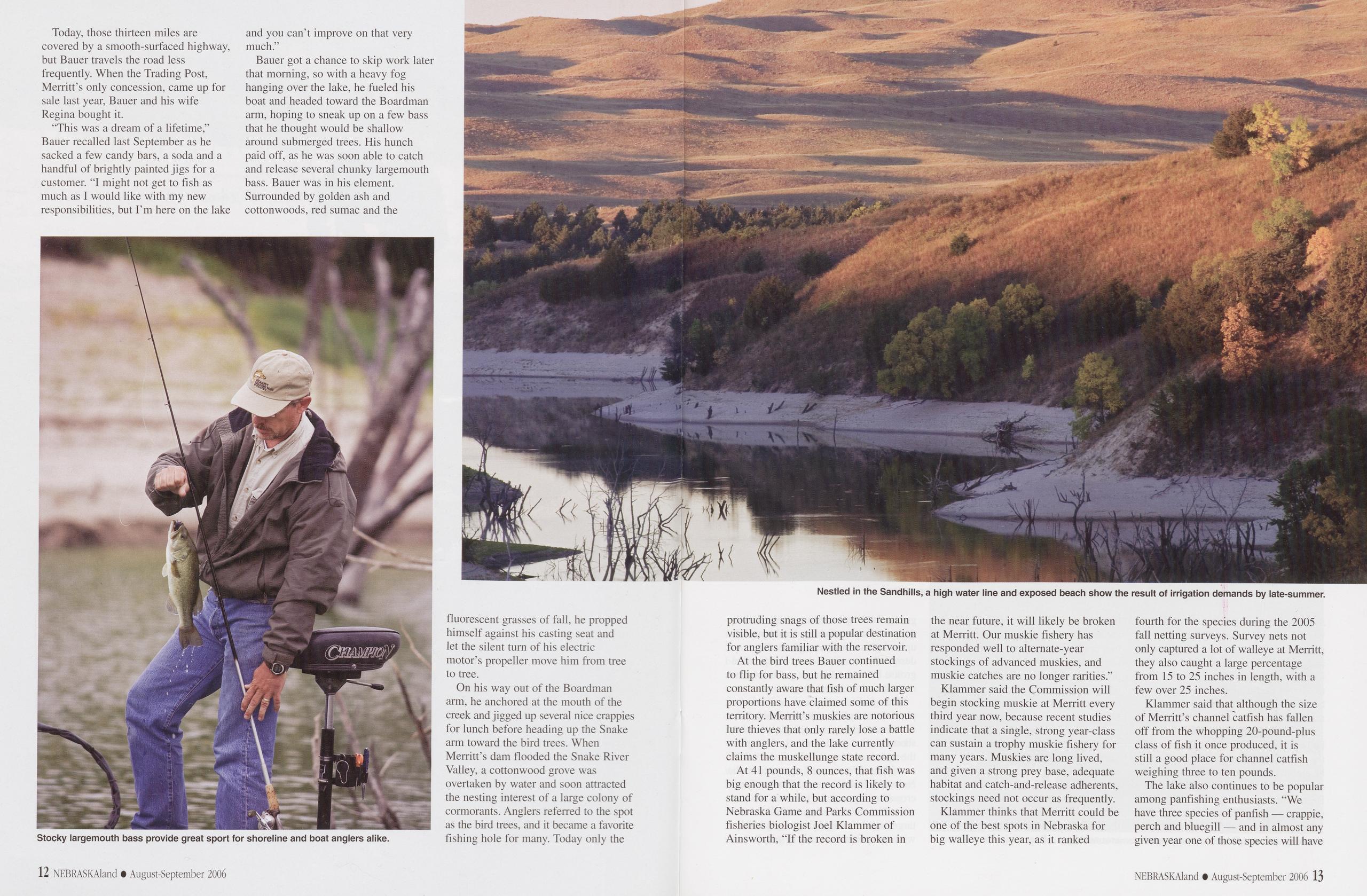
Today, those thirteen miles are covered by a smooth-surfaced highway, but Bauer travels the road less frequently. When the Trading Post, Merritt’s only concession, came up for sale last year, Bauer and his wife Regina bought it.
"This was a dream of a lifetime,” Bauer recalled last September as he sacked a few candy bars, a soda and a handful of brightly painted jigs for a customer. "I might not get to fish as much as I would like with my new responsibilities, but I’m here on the lake and you can’t improve on that very much.”
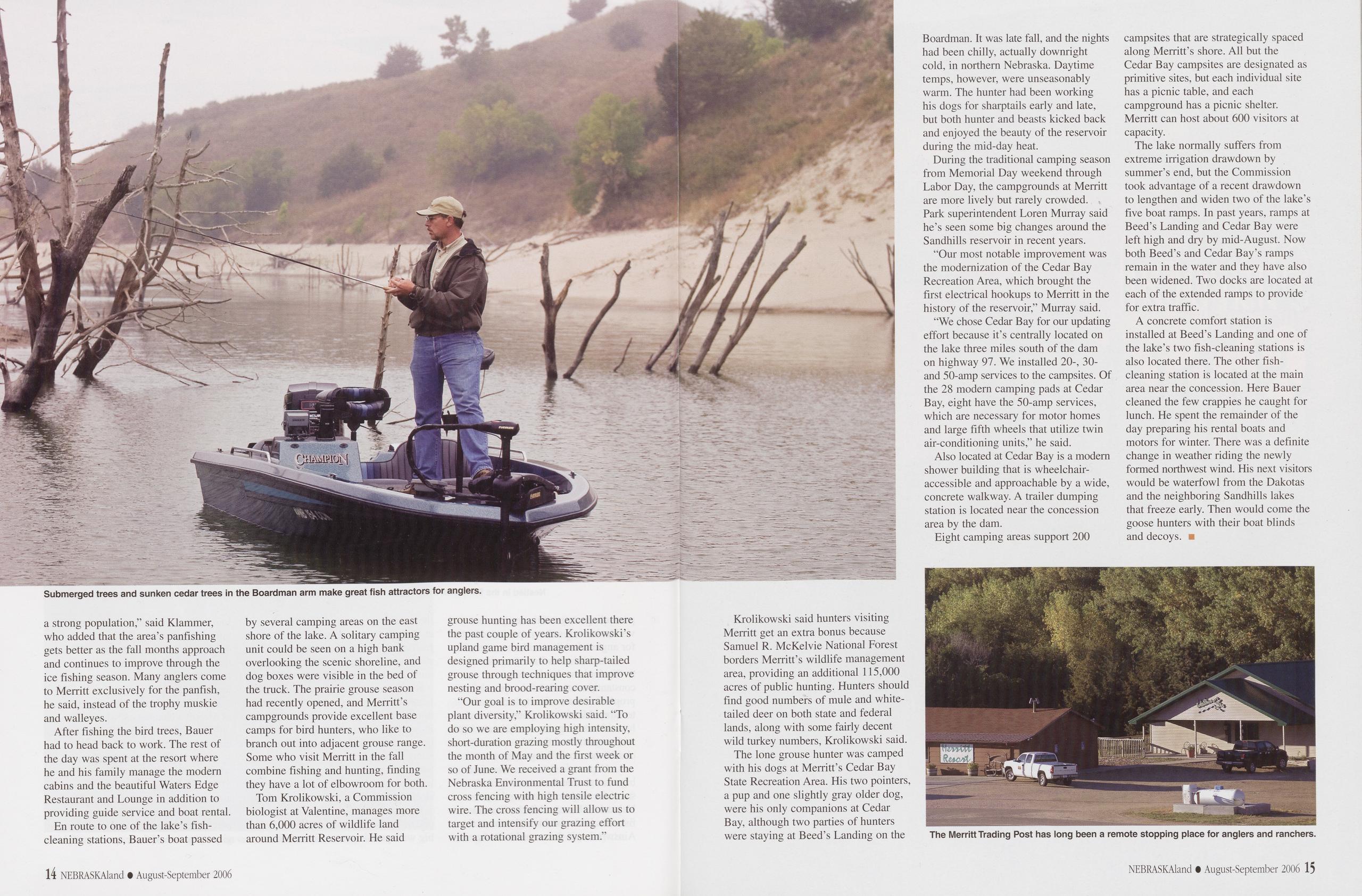
Bauer got a chance to skip work later that morning, so with a heavy fog hanging over the lake, he fueled his boat and headed toward the Boardman arm, hoping to sneak up on a few bass that he thought would be shallow around submerged trees. His hunch paid off, as he was soon able to catch and release several chunky largemouth bass. Bauer was in his element. Surrounded by golden ash and cottonwoods, red sumac and the fluorescent grasses of fall, he propped himself against his casting seat and let the silent turn of his electric motor’s propeller move him from tree to tree.
On his way out of the Boardman arm, he anchored at the mouth of the creek and jigged up several nice crappies for lunch before heading up the Snake arm toward the bird trees. When Merritt’s dam flooded the Snake River Valley, a cottonwood grove was overtaken by water and soon attracted the nesting interest of a large colony of cormorants. Anglers referred to the spot as the bird trees, and it became a favorite fishing hole for many. Today only the protruding snags of those trees remain visible, but it is still a popular destination for anglers familiar with the reservoir.
At the bird trees Bauer continued to flip for bass, but he remained constantly aware that fish of much larger proportions have claimed some of this territory. Merritt’s muskies are notorious lure thieves that only rarely lose a battle with anglers, and the lake currently claims the muskellunge state record.
At 41 pounds, 8 ounces, that fish was big enough that the record is likely to stand for a while, but according to Nebraska Game and Parks Commission fisheries biologist Joel Klammer of Ainsworth, "If the record is broken in the near future, it will likely be broken at Merritt. Our muskie fishery has responded well to alternate-year stockings of advanced muskies, and muskie catches are no longer rarities.”
Klammer said the Commission will begin stocking muskie at Merritt every third year now, because recent studies indicate that a single, strong year-class can sustain a trophy muskie fishery for many years. Muskies are long lived, and given a strong prey base, adequate habitat and catch-and-release adherents, stockings need not occur as frequently.
Klammer thinks that Merritt could be one of the best spots in Nebraska for big walleye this year, as it ranked fourth for the species during the 2005 fall netting surveys. Survey nets not only captured a lot of walleye at Merritt, they also caught a large percentage from 15 to 25 inches in length, with a few over 25 inches.
Klammer said that although the size of Merritt’s channel catfish has fallen off from the whopping 20-pound-plus class of fish it once produced, it is still a good place for channel catfish weighing three to ten pounds.
The lake also continues to be popular
among panfishing enthusiasts. "We
have three species of panfish — crappie,
perch and bluegill — and in almost any
given year one of those species will have
12 NEBRASKAland • August-September 2006
NEBRASKAland • August-September 2006 13
 a strong population,” said Klammer,
who added that the area’s panfishing
gets better as the fall months approach
and continues to improve through the
ice fishing season. Many anglers come
to Merritt exclusively for the panfish,
he said, instead of the trophy muskie
and walleyes.
a strong population,” said Klammer,
who added that the area’s panfishing
gets better as the fall months approach
and continues to improve through the
ice fishing season. Many anglers come
to Merritt exclusively for the panfish,
he said, instead of the trophy muskie
and walleyes.
After fishing the bird trees, Bauer had to head back to work. The rest of the day was spent at the resort where he and his family manage the modern cabins and the beautiful Waters Edge Restaurant and Lounge in addition to providing guide service and boat rental.
En route to one of the lake’s fish- cleaning stations, Bauer’s boat passed by several camping areas on the east shore of the lake. A solitary camping unit could be seen on a high bank overlooking the scenic shoreline, and dog boxes were visible in the bed of the truck. The prairie grouse season had recently opened, and Merritt’s campgrounds provide excellent base camps for bird hunters, who like to branch out into adjacent grouse range. Some who visit Merritt in the fall combine fishing and hunting, finding they have a lot of elbowroom for both.
Tom Krolikowski, a Commission biologist at Valentine, manages more than 6,000 acres of wildlife land around Merritt Reservoir. He said grouse hunting has been excellent there the past couple of years. Krolikowski’s upland game bird management is designed primarily to help sharp-tailed grouse through techniques that improve nesting and brood-rearing cover.
“Our goal is to improve desirable plant diversity,” Krolikowski said. “To do so we are employing high intensity, short-duration grazing mostly throughout the month of May and the first week or so of June. We received a grant from the Nebraska Environmental Trust to fund cross fencing with high tensile electric wire. The cross fencing will allow us to target and intensify our grazing effort with a rotational grazing system.”
Krolikowski said hunters visiting Merritt get an extra bonus because Samuel R. McKelvie National Forest borders Merritt’s wildlife management area, providing an additional 115,000 acres of public hunting. Hunters should find good numbers of mule and white- tailed deer on both state and federal lands, along with some fairly decent wild turkey numbers, Krolikowski said.
The lone grouse hunter was camped with his dogs at Merritt’s Cedar Bay State Recreation Area. His two pointers, a pup and one slightly gray older dog, were his only companions at Cedar Bay, although two parties of hunters were staying at Beed’s Landing on the Boardman. It was late fall, and the nights had been chilly, actually downright cold, in northern Nebraska. Daytime temps, however, were unseasonably warm. The hunter had been working his dogs for sharptails early and late, but both hunter and beasts kicked back and enjoyed the beauty of the reservoir during the mid-day heat.
During the traditional camping season from Memorial Day weekend through Labor Day, the campgrounds at Merritt are more lively but rarely crowded. , Park superintendent Loren Murray said he’s seen some big changes around the Sandhills reservoir in recent years.
“Our most notable improvement was the modernization of the Cedar Bay Recreation Area, which brought the first electrical hookups to Merritt in the history of the reservoir,” Murray said.
“We chose Cedar Bay for our updating effort because it’s centrally located on the lake three miles south of the dam on highway 97. We installed 20-, 30- and 50-amp services to the campsites. Of the 28 modern camping pads at Cedar Bay, eight have the 50-amp services, which are necessary for motor homes and large fifth wheels that utilize twin air-conditioning units,” he said.
Also located at Cedar Bay is a modem shower building that is wheelchair- accessible and approachable by a wide, concrete walkway. A trailer dumping station is located near the concession area by the dam.
Eight camping areas support 200 campsites that are strategically spaced along Merritt’s shore. All but the Cedar Bay campsites are designated as primitive sites, but each individual site has a picnic table, and each campground has a picnic shelter. Merritt can host about 600 visitors at capacity.
The lake normally suffers from extreme irrigation drawdown by summer’s end, but the Commission took advantage of a recent drawdown to lengthen and widen two of the lake’s five boat ramps. In past years, ramps at Beed’s Landing and Cedar Bay were left high and dry by mid-August. Now both Beed’s and Cedar Bay’s ramps remain in the water and they have also been widened. Two docks are located at each of the extended ramps to provide for extra traffic.
A concrete comfort station is installed at Beed’s Landing and one of the lake’s two fish-cleaning stations is also located there. The other fish- cleaning station is located at the main area near the concession. Here Bauer cleaned the few crappies he caught for lunch. He spent the remainder of the day preparing his rental boats and motors for winter. There was a definite change in weather riding the newly formed northwest wind. His next visitors would be waterfowl from the Dakotas and the neighboring Sandhills lakes that freeze early. Then would come the goose hunters with their boat blinds and decoys. ■
14 NEBRASKAland • August-September 2006 NEBRASKAland August-September 2006 15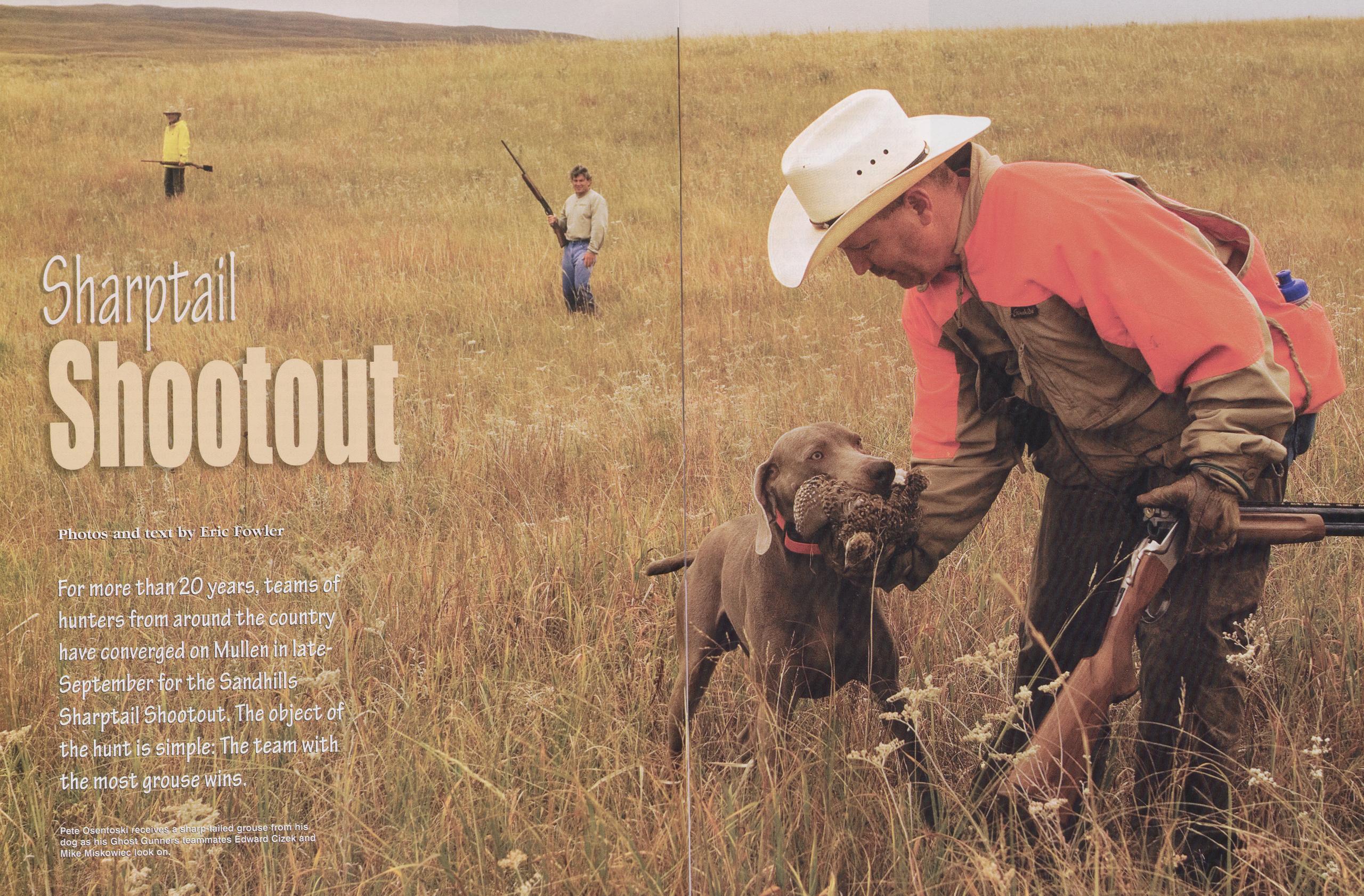
Sharptail Shootout
Photos and text by Eric Fowler For more than 20 years, teams of hunters from around the country have converged on Mullen in late September for the Sandhills Sharptail Shootout. The object of the hunt is simple: The team with the most grouse wins.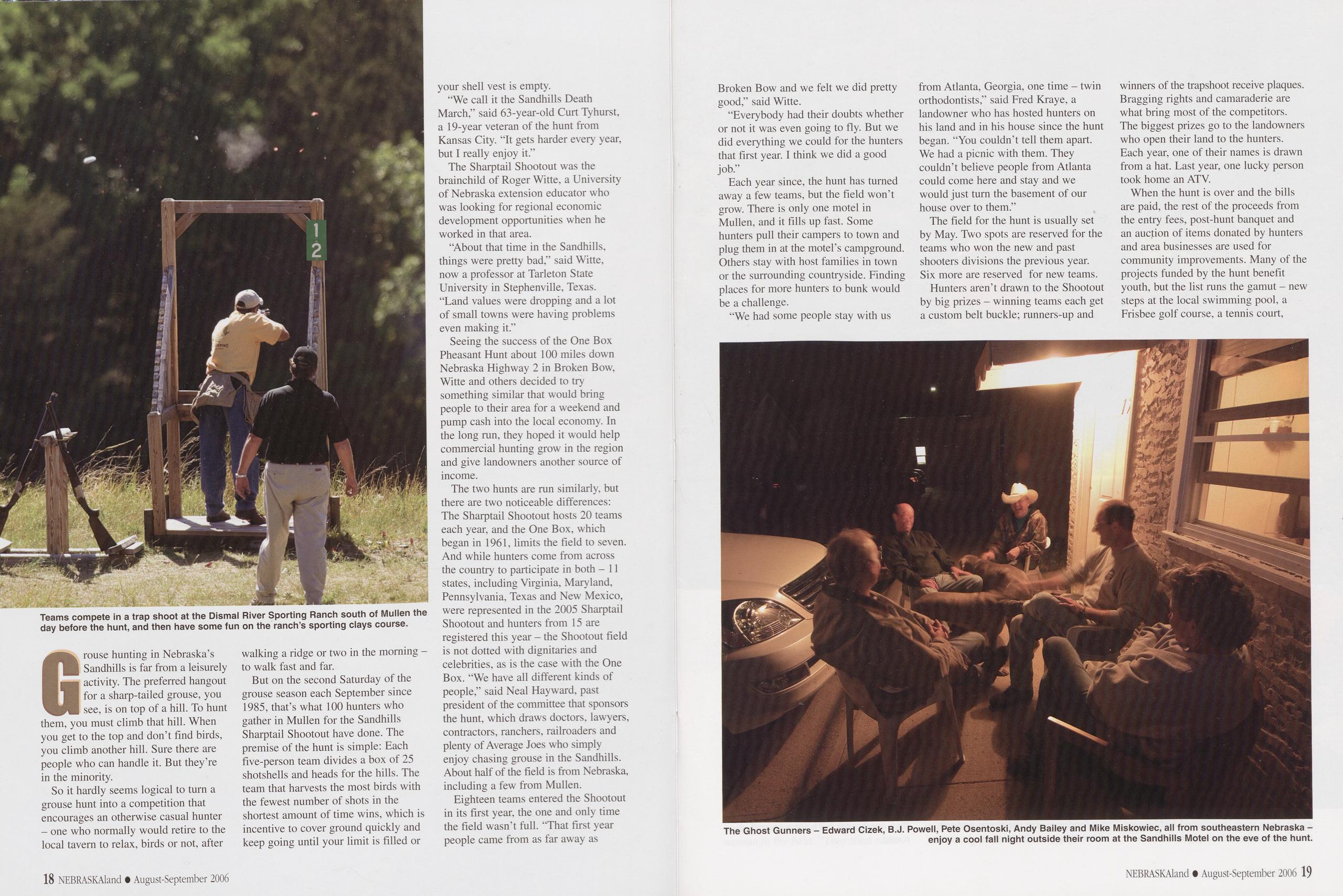
Grouse hunting in Nebraska’s Sandhills is far from a leisurely activity. The preferred hangout for a sharp-tailed grouse, you see, is on top of a hill. To hunt them, you must climb that hill. When you get to the top and don’t find birds, you climb another hill. Sure there are people who can handle it. But they’re in the minority.
So it hardly seems logical to turn a grouse hunt into a competition that encourages an otherwise casual hunter - one who normally would retire to the local tavern to relax, birds or not, after walking a ridge or two in the morning - to walk fast and far.
But on the second Saturday of the grouse season each September since 1985, that’s what 100 hunters who gather in Mullen for the Sandhills Sharptail Shootout have done. The premise of the hunt is simple: Each five-person team divides a box of 25 shotshells and heads for the hills. The team that harvests the most birds with the fewest number of shots in the shortest amount of time wins, which is incentive to cover ground quickly and keep going until your limit is filled or your shell vest is empty.
"We call it the Sandhills Death March,” said 63-year-old Curt Tyhurst, a 19-year veteran of the hunt from Kansas City. "It gets harder every year, but I really enjoy it.”
The Sharptail Shootout was the brainchild of Roger Witte, a University of Nebraska extension educator who was looking for regional economic development opportunities when he worked in that area.
"About that time in the Sandhills, things were pretty bad,” said Witte, now a professor at Tarleton State University in Stephenville, Texas. "Land values were dropping and a lot of small towns were having problems even making it.”
Seeing the success of the One Box Pheasant Hunt about 100 miles down Nebraska Highway 2 in Broken Bow, Witte and others decided to try something similar that would bring people to their area for a weekend and pump cash into the local economy. In the long run, they hoped it would help commercial hunting grow in the region and give landowners another source of income.
The two hunts are run similarly, but there are two noticeable differences: The Sharptail Shootout hosts 20 teams each year, and the One Box, which began in 1961, limits the field to seven. And while hunters come from across the country to participate in both - 11 states, including Virginia, Maryland, Pennsylvania, Texas and New Mexico, were represented in the 2005 Sharptail Shootout and hunters from 15 are registered this year - the Shootout field is not dotted with dignitaries and celebrities, as is the case with the One Box. “We have all different kinds of people,” said Neal Hayward, past president of the committee that sponsors the hunt, which draws doctors, lawyers, contractors, ranchers, railroaders and plenty of Average Joes who simply enjoy chasing grouse in the Sandhills. About half of the field is from Nebraska, including a few from Mullen.
Eighteen teams entered the Shootout in its first year, the one and only time the field wasn’t full. "That first year people came from as far away as Broken Bow and we felt we did pretty good,” said Witte.
"Everybody had their doubts whether or not it was even going to fly. But we did everything we could for the hunters that first year. I think we did a good job.”
Each year since, the hunt has turned away a few teams, but the field won’t grow. There is only one motel in Mullen, and it fills up fast. Some hunters pull their campers to town and plug them in at the motel’s campground. Others stay with host families in town or the surrounding countryside. Finding places for more hunters to bunk would be a challenge.
"We had some people stay with us from Atlanta, Georgia, one time - twin orthodontists,” said Fred Kraye, a landowner who has hosted hunters on his land and in his house since the hunt began. "You couldn’t tell them apart. We had a picnic with them. They couldn’t believe people from Atlanta could come here and stay and we would just turn the basement of our house over to them.”
The field for the hunt is usually set by May. Two spots are reserved for the teams who won the new and past shooters divisions the previous year. Six more are reserved for new teams.
Hunters aren’t drawn to the Shootout by big prizes - winning teams each get a custom belt buckle; runners-up and winners of the trapshoot receive plaques. Bragging rights and camaraderie are what bring most of the competitors. The biggest prizes go to the landowners who open their land to the hunters. Each year, one of their names is drawn from a hat. Last year, one lucky person took home an ATV.
When the hunt is over and the bills
are paid, the rest of the proceeds from
the entry fees, post-hunt banquet and
an auction of items donated by hunters
and area businesses are used for
community improvements. Many of the
projects funded by the hunt benefit
youth, but the list runs the gamut - new
steps at the local swimming pool, a
Frisbee golf course, a tennis court,
18 NEBRASKAland • August-September 2006
NEBRASKAland • August-September 2006 19
 air-rifles for the 4-H club, a clubhouse
at the trap range, a marquee downtown,
and $32,000 in scholarships.
air-rifles for the 4-H club, a clubhouse
at the trap range, a marquee downtown,
and $32,000 in scholarships.
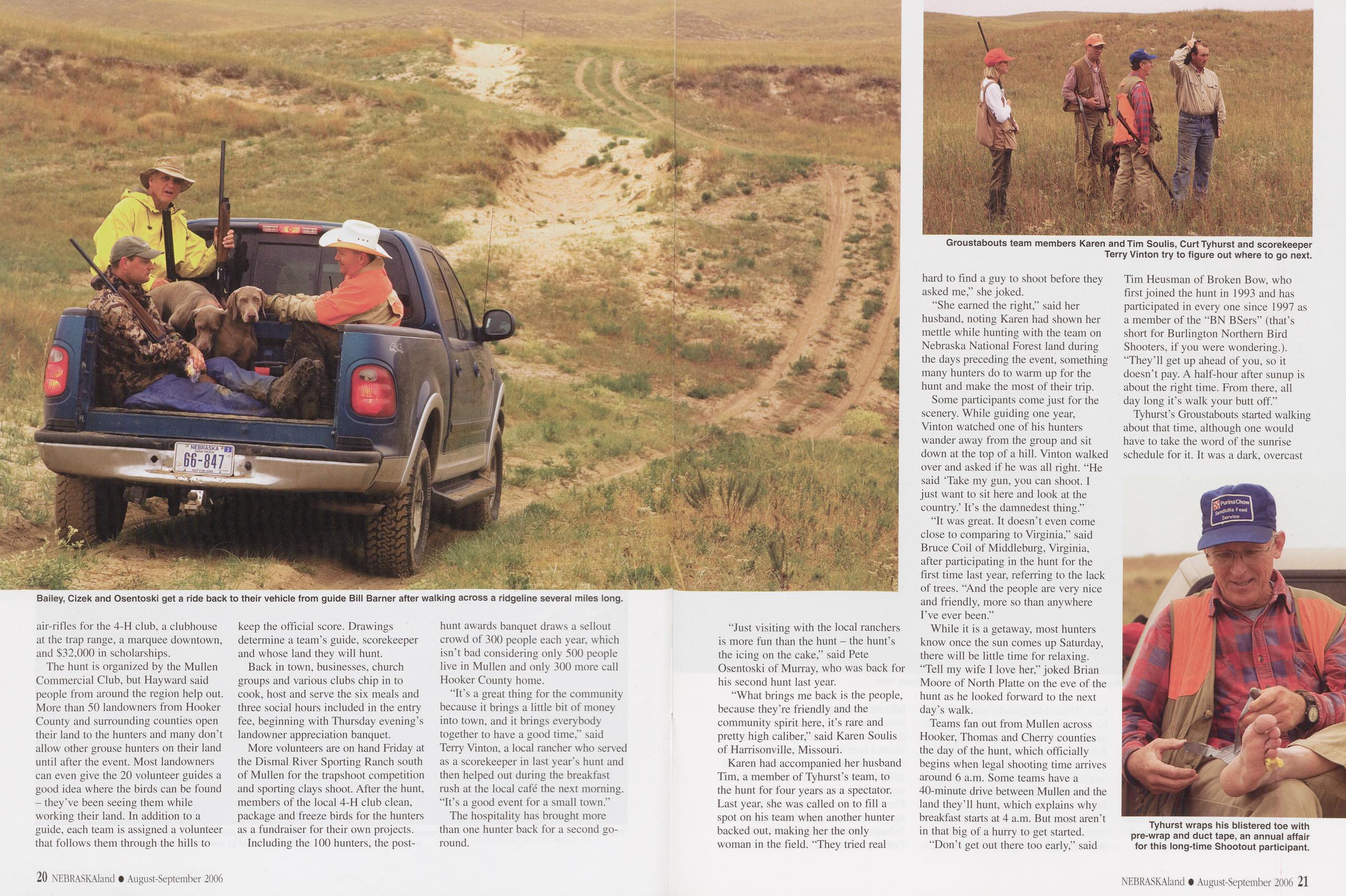
The hunt is organized by the Mullen Commercial Club, but Hayward said people from around the region help out. More than 50 landowners from Hooker County and surrounding counties open their land to the hunters and many don’t allow other grouse hunters on their land until after the event. Most landowners can even give the 20 volunteer guides a good idea where the birds can be found - they’ve been seeing them while working their land. In addition to a guide, each team is assigned a volunteer that follows them through the hills to keep the official score. Drawings determine a team’s guide, scorekeeper and whose land they will hunt.
Back in town, businesses, church groups and various clubs chip in to cook, host and serve the six meals and three social hours included in the entry fee, beginning with Thursday evening’s landowner appreciation banquet.
More volunteers are on hand Friday at the Dismal River Sporting Ranch south of Mullen for the trapshoot competition and sporting clays shoot. After the hunt, members of the local 4-H club clean, package and freeze birds for the hunters as a fundraiser for their own projects.
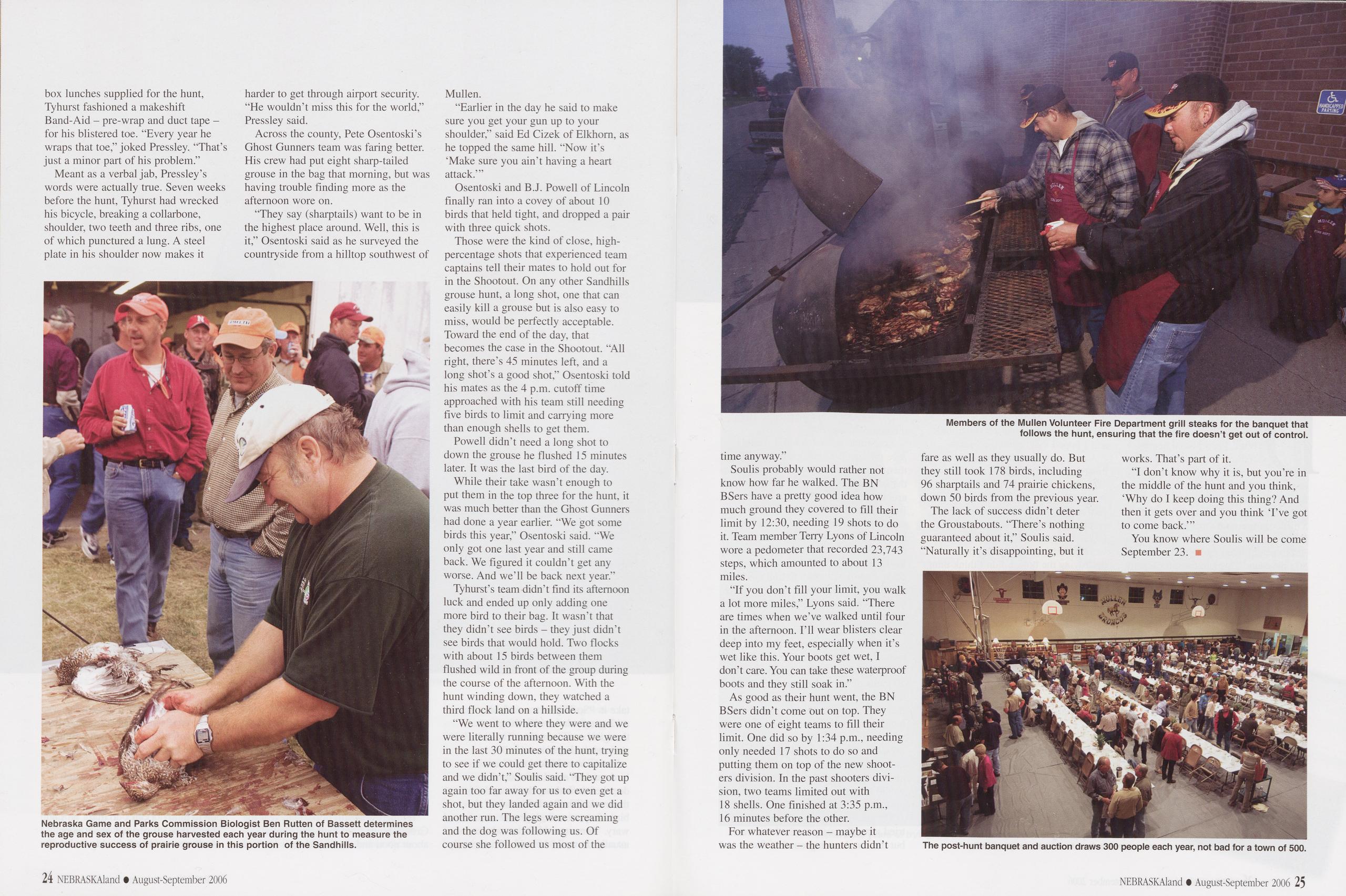
Including the 100 hunters, the post- hunt awards banquet draws a sellout crowd of 300 people each year, which isn’t bad considering only 500 people live in Mullen and only 300 more call Hooker County home.
"It’s a great thing for the community because it brings a little bit of money into town, and it brings everybody together to have a good time,” said Terry Vinton, a local rancher who served as a scorekeeper in last year’s hunt and then helped out during the breakfast rush at the local cafe the next morning. "It’s a good event for a small town.”
The hospitality has brought more than one hunter back for a second go- round.
"Just visiting with the local ranchers is more fun than the hunt - the hunt’s the icing on the cake,” said Pete Osentoski of Murray, who was back for his second hunt last year.
"What brings me back is the people, because they’re friendly and the community spirit here, it’s rare and pretty high caliber,” said Karen Soulis of Harrisonville, Missouri.
Karen had accompanied her husband Tim, a member of Tyhurst’s team, to the hunt for four years as a spectator. Last year, she was called on to fill a spot on his team when another hunter backed out, making her the only woman in the field. "They tried real hard to find a guy to shoot before they asked me,” she joked.
"She earned the right,” said her husband, noting Karen had shown her mettle while hunting with the team on Nebraska National Forest land during the days preceding the event, something many hunters do to warm up for the hunt and make the most of their trip.
Some participants come just for the scenery. While guiding one year, Vinton watched one of his hunters wander away from the group and sit down at the top of a hill. Vinton walked over and asked if he was all right. "He said ‘Take my gun, you can shoot. I just want to sit here and look at the country.’ It’s the damnedest thing.”
"It was great. It doesn’t even come close to comparing to Virginia,” said Bruce Coil of Middleburg, Virginia, after participating in the hunt for the first time last year, referring to the lack of trees. "And the people are very nice and friendly, more so than anywhere I’ve ever been.”
While it is a getaway, most hunters know once the sun comes up Saturday, there will be little time for relaxing. "Tell my wife I love her,” joked Brian Moore of North Platte on the eve of the hunt as he looked forward to the next day’s walk.
Teams fan out from Mullen across Hooker, Thomas and Cherry counties the day of the hunt, which officially begins when legal shooting time arrives around 6 a.m. Some teams have a 40-minute drive between Mullen and the land they’ll hunt, which explains why breakfast starts at 4 a.m. But most aren’t in that big of a hurry to get started.
"Don’t get out there too early,” said Tim Heusman of Broken Bow, who first joined the hunt in 1993 and has participated in every one since 1997 as a member of the "BN BSers” (that’s short for Burlington Northern Bird Shooters, if you were wondering.). "They’ll get up ahead of you, so it doesn’t pay. A half-hour after sunup is about the right time. From there, all day long it’s walk your butt off.”
Tyhurst’s Groustabouts started walking
about that time, although one would
have to take the word of the sunrise
schedule for it. It was a dark, overcast
Tyhurst wraps his blistered toe with
pre-wrap and duct tape, an annual affair
for this long-time Shootout participant.
20 NEBRASKAland • August-September 2006
NEBRASKAland O August-September 2006 21
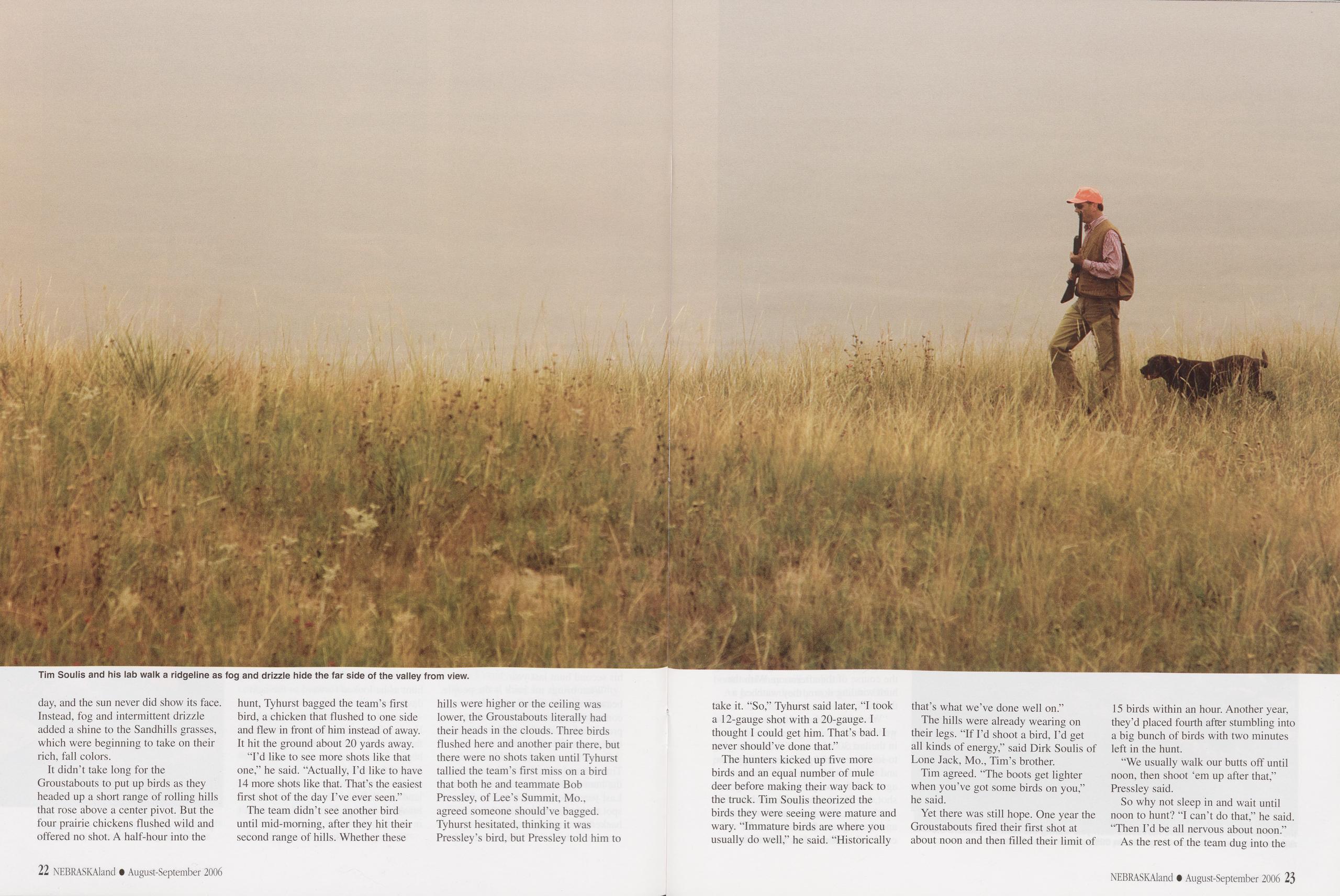 day, and the sun never did show its face.
Instead, fog and intermittent drizzle
added a shine to the Sandhills grasses,
which were beginning to take on their
rich, fall colors.
day, and the sun never did show its face.
Instead, fog and intermittent drizzle
added a shine to the Sandhills grasses,
which were beginning to take on their
rich, fall colors.
It didn’t take long for the Groustabouts to put up birds as they headed up a short range of rolling hills that rose above a center pivot. But the four prairie chickens flushed wild and offered no shot. A half-hour into the hunt, Tyhurst bagged the team’s first bird, a chicken that flushed to one side and flew in front of him instead of away. It hit the ground about 20 yards away.
"I’d like to see more shots like that one,” he said. "Actually, I’d like to have 14 more shots like that. That’s the easiest first shot of the day I’ve ever seen.”
The team didn’t see another bird until mid-morning, after they hit their second range of hills. Whether these hills were higher or the ceiling was lower, the Groustabouts literally had their heads in the clouds. Three birds flushed here and another pair there, but there were no shots taken until Tyhurst tallied the team’s first miss on a bird that both he and teammate Bob Pressley, of Lee’s Summit, Mo., agreed someone should’ve bagged. Tyhurst hesitated, thinking it was Pressley’s bird, but Pressley told him to take it. "So,” Tyhurst said later, "I took a 12-gauge shot with a 20-gauge. I thought I could get him. That’s bad. I never should’ve done that.”
The hunters kicked up five more birds and an equal number of mule deer before making their way back to the truck. Tim Soulis theorized the birds they were seeing were mature and wary. "Immature birds are where you usually do well,” he said. "Historically that’s what we’ve done well on.”
The hills were already wearing on their legs. "If I’d shoot a bird, I’d get all kinds of energy,” said Dirk Soulis of Lone Jack, Mo., Tim’s brother.
Tim agreed. "The boots get lighter when you’ve got some birds on you,” he said.
Yet there was still hope. One year the Groustabouts fired their first shot at about noon and then filled their limit of 15 birds within an hour. Another year, they’d placed fourth after stumbling into a big bunch of birds with two minutes left in the hunt.
"We usually walk our butts off until noon, then shoot ‘em up after that,” Pressley said.
So why not sleep in and wait until noon to hunt? "I can’t do that,” he said. "Then I’d be all nervous about noon.”
As the rest of the team dug into the
22 NEBRASKAland • August-September 2006
NEBRASKAland • August-September 2006 23
 box lunches supplied for the hunt,
Tyhurst fashioned a makeshift
Band-Aid - pre-wrap and duct tape -
for his blistered toe. “Every year he
wraps that toe,” joked Pressley. “That’s
just a minor part of his problem.”
box lunches supplied for the hunt,
Tyhurst fashioned a makeshift
Band-Aid - pre-wrap and duct tape -
for his blistered toe. “Every year he
wraps that toe,” joked Pressley. “That’s
just a minor part of his problem.”
Meant as a verbal jab, Pressley’s words were actually true. Seven weeks before the hunt, Tyhurst had wrecked his bicycle, breaking a collarbone, shoulder, two teeth and three ribs, one of which punctured a lung. A steel plate in his shoulder now makes it harder to get through airport security. “He wouldn’t miss this for the world,” Pressley said.
Across the county, Pete Osentoski’s Ghost Gunners team was faring better. His crew had put eight sharp-tailed grouse in the bag that morning, but was having trouble finding more as the afternoon wore on.
“They say (sharptails) want to be in the highest place around. Well, this is it,” Osentoski said as he surveyed the countryside from a hilltop southwest of Mullen.
“Earlier in the day he said to make sure you get your gun up to your shoulder,” said Ed Cizek of Elkhorn, as he topped the same hill. “Now it’s ‘Make sure you ain’t having a heart attack.’”
Osentoski and B.J. Powell of Lincoln finally ran into a covey of about 10 birds that held tight, and dropped a pair with three quick shots.
Those were the kind of close, high- percentage shots that experienced team captains tell their mates to hold out for in the Shootout. On any other Sandhills grouse hunt, a long shot, one that can easily kill a grouse but is also easy to miss, would be perfectly acceptable. Toward the end of the day, that becomes the case in the Shootout. “All right, there’s 45 minutes left, and a long shot’s a good shot,” Osentoski told his mates as the 4 p.m. cutoff time approached with his team still needing five birds to limit and carrying more than enough shells to get them.
Powell didn’t need a long shot to down the grouse he flushed 15 minutes later. It was the last bird of the day.
While their take wasn’t enough to put them in the top three for the hunt, it was much better than the Ghost Gunners had done a year earlier. “We got some birds this year,” Osentoski said. “We only got one last year and still came back. We figured it couldn’t get any worse. And we’ll be back next year.”
Tyhurst’s team didn’t find its afternoon luck and ended up only adding one more bird to their bag. It wasn’t that they didn’t see birds - they just didn’t see birds that would hold. Two flocks with about 15 birds between them flushed wild in front of the group during the course of the afternoon. With the hunt winding down, they watched a third flock land on a hillside.
“We went to where they were and we were literally running because we were in the last 30 minutes of the hunt, trying to see if we could get there to capitalize and we didn’t,” Soulis said. “They got up again too far away for us to even get a shot, but they landed again and we did another run. The legs were screaming and the dog was following us. Of course she followed us most of the time anyway.”
Soulis probably would rather not know how far he walked. The BN BSers have a pretty good idea how much ground they covered to fill their limit by 12:30, needing 19 shots to do it. Team member Terry Lyons of Lincoln wore a pedometer that recorded 23,743 steps, which amounted to about 13 miles.
“If you don’t fill your limit, you walk a lot more miles,” Lyons said. “There are times when we’ve walked until four in the afternoon. I’ll wear blisters clear deep into my feet, especially when it’s wet like this. Your boots get wet, I don’t care. You can take these waterproof boots and they still soak in.”
As good as their hunt went, the BN BSers didn’t come out on top. They were one of eight teams to fill their limit. One did so by 1:34 p.m., needing only needed 17 shots to do so and putting them on top of the new shoot- ers division. In the past shooters divi- sion, two teams limited out with 18 shells. One finished at 3:35 p.m., 16 minutes before the other.
For whatever reason - maybe it was the weather - the hunters didn’t fare as well as they usually do. But they still took 178 birds, including 96 sharptails and 74 prairie chickens, down 50 birds from the previous year.
The lack of success didn’t deter the Groustabouts. “There’s nothing guaranteed about it,” Soulis said. “Naturally it’s disappointing, but it works. That’s part of it.
“I don’t know why it is, but you’re in the middle of the hunt and you think, ‘Why do I keep doing this thing? And then it gets over and you think ‘I’ve got to come back.’”
You know where Soulis will be come September 23.
24 NEBRASKAland • August-September 2006 NEBRASKAland • August-September 2006 25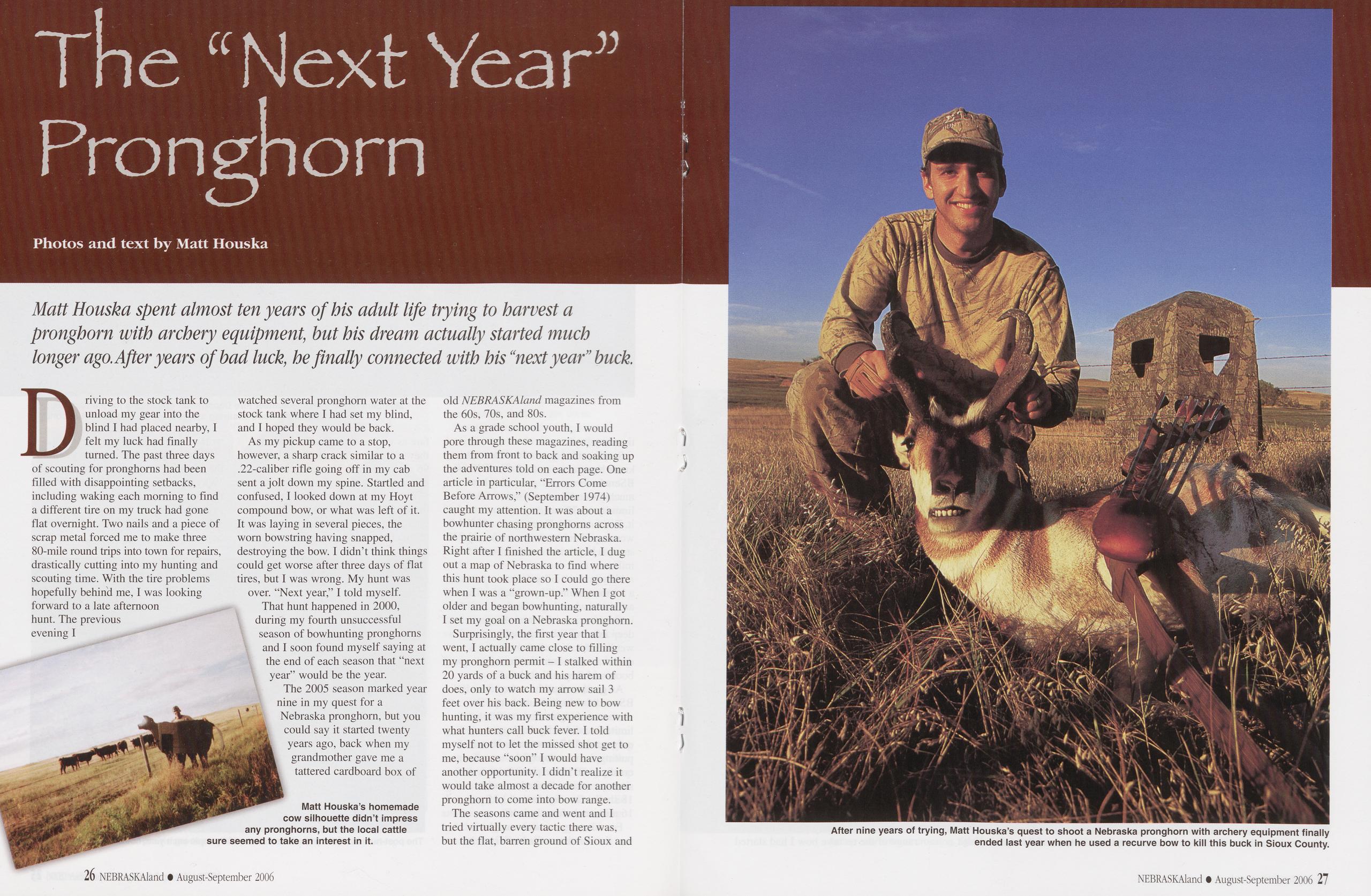
The “Next Year” Pronghorn
Photos and text by Matt Houska Matt Houska spent almost ten years of bis adult life trying to harvest a pronghorn with archery equipment, but his dream actually started much longer ago. After years of bad luck, he finally connected with his “next year” buck.Driving to the stock tank to unload my gear into the blind I had placed nearby, I felt my luck had finally turned. The past three days of scouting for pronghorns had been filled with disappointing setbacks, including waking each morning to find a different tire on my truck had gone flat overnight. Two nails and a piece of scrap metal forced me to make three 80-mile round trips into town for repairs, drastically cutting into my hunting and scouting time. With the tire problems hopefully behind me, I was looking forward to a late afternoon hunt. The previous evening I watched several pronghorn water at the stock tank where I had set my blind, and I hoped they would be back.
As my pickup came to a stop, however, a sharp crack similar to a .22-caliber rifle going off in my cab sent a jolt down my spine. Startled and confused, I looked down at my Hoyt compound bow, or what was left of it. It was laying in several pieces, the worn bowstring having snapped, destroying the bow. I didn’t think things could get worse after three days of flat tires, but I was wrong. My hunt was over. “Next year,” I told myself. That hunt happened in 2000, during my fourth unsuccessful season of bowhunting pronghorns and I soon found myself saying at the end of each season that “next year” would be the year. The 2005 season marked year nine in my quest for a Nebraska pronghorn, but you could say it started twenty years ago, back when my grandmother gave me a tattered cardboard box of Matt Houska’s homemade cow silhouette didn’t impress any pronghorns, but the local cattle sure seemed to take an interest in it. old NEBRASKAland magazines from the 60s, 70s, and 80s.
As a grade school youth, I would pore through these magazines, reading them from front to back and soaking up the adventures told on each page. One article in particular, “Errors Come Before Arrows,” (September 1974) caught my attention. It was about a bowhunter chasing pronghorns across the prairie of northwestern Nebraska. Right after I finished the article, I dug out a map of Nebraska to find where this hunt took place so I could go there when I was a “grown-up.” When I got older and began bowhunting, naturally I set my goal on a Nebraska pronghorn.
Surprisingly, the first year that I went, I actually came close to filling my pronghorn permit - I stalked within 20 yards of a buck and his harem of does, only to watch my arrow sail 3 feet over his back. Being new to bow hunting, it was my first experience with what hunters call buck fever. I told myself not to let the missed shot get to me, because “soon” I would have another opportunity. I didn’t realize it would take almost a decade for another pronghorn to come into bow range.
The seasons came and went and I
tried virtually every tactic there was,
but the flat, barren ground of Sioux and
NEBRASKAland • August-September 2006 27
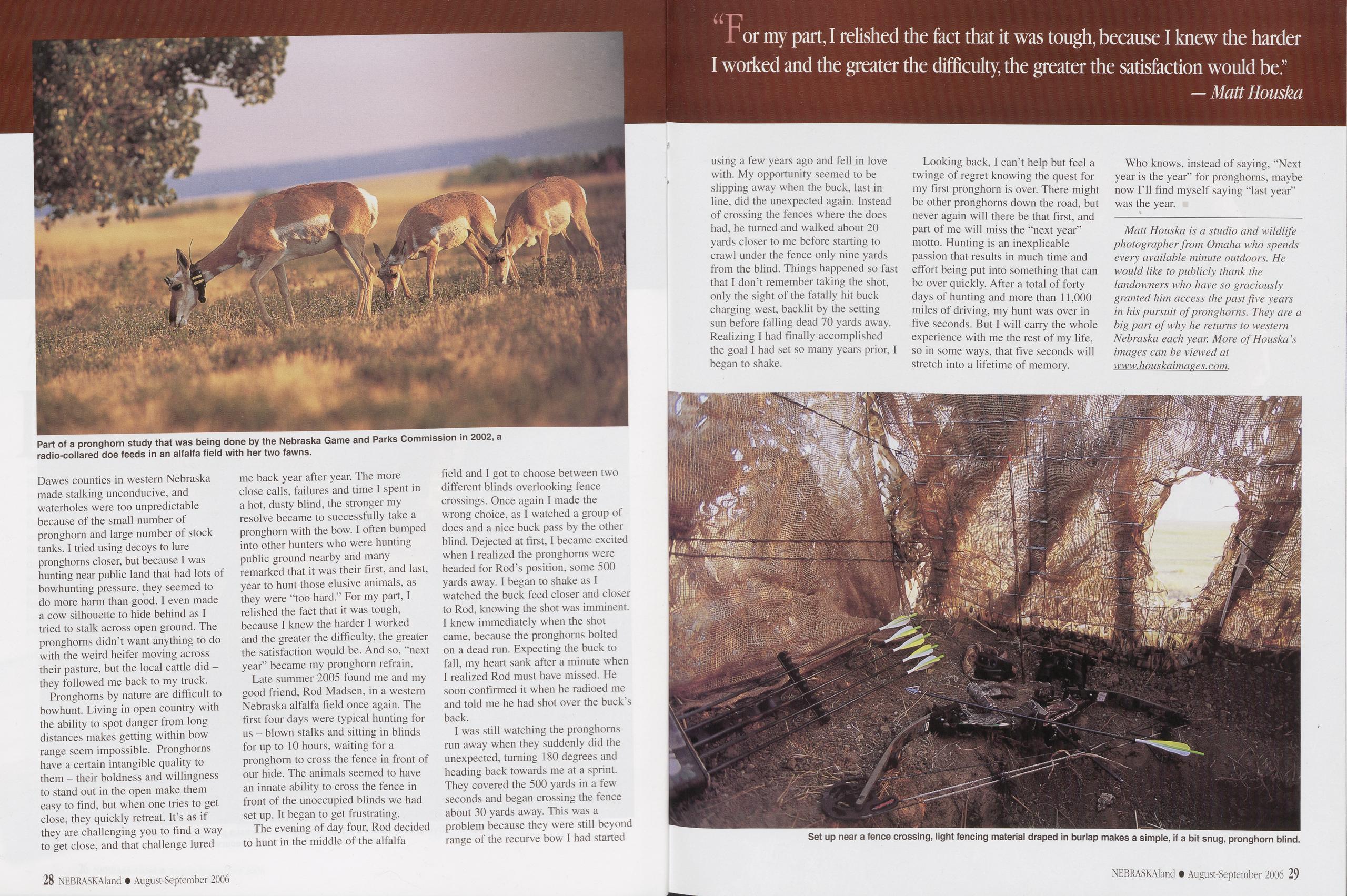 Dawes counties in western Nebraska
made stalking unconducive, and
waterholes were too unpredictable
because of the small number of
pronghorn and large number of stock
tanks. I tried using decoys to lure
pronghorns closer, but because I was
hunting near public land that had lots of
bowhunting pressure, they seemed to
do more harm than good. I even made
a cow silhouette to hide behind as I
tried to stalk across open ground. The
pronghorns didn’t want anything to do
with the weird heifer moving across
their pasture, but the local cattle did -
they followed me back to my truck.
Dawes counties in western Nebraska
made stalking unconducive, and
waterholes were too unpredictable
because of the small number of
pronghorn and large number of stock
tanks. I tried using decoys to lure
pronghorns closer, but because I was
hunting near public land that had lots of
bowhunting pressure, they seemed to
do more harm than good. I even made
a cow silhouette to hide behind as I
tried to stalk across open ground. The
pronghorns didn’t want anything to do
with the weird heifer moving across
their pasture, but the local cattle did -
they followed me back to my truck.
For my part, I relished the fact that it was tough, because I knew the harder I worked and the greater the difficulty, the greater the satisfaction would be.” — Matt Houska
Pronghorns by nature are difficult to bowhunt. Living in open country with the ability to spot danger from long distances makes getting within bow range seem impossible. Pronghorns have a certain intangible quality to them - their boldness and willingness to stand out in the open make them easy to find, but when one tries to get close, they quickly retreat. It’s as if they are challenging you to find a way to get close, and that challenge lured me back year after year. The more close calls, failures and time I spent in a hot, dusty blind, the stronger my resolve became to successfully take a pronghorn with the bow. I often bumped into other hunters who were hunting public ground nearby and many remarked that it was their first, and last, year to hunt those elusive animals, as they were "too hard.” For my part, I relished the fact that it was tough, because I knew the harder I worked and the greater the difficulty, the greater the satisfaction would be. And so, "next year” became my pronghorn refrain.
Late summer 2005 found me and my good friend, Rod Madsen, in a western Nebraska alfalfa field once again. The first four days were typical hunting for us - blown stalks and sitting in blinds for up to 10 hours, waiting for a pronghorn to cross the fence in front of our hide. The animals seemed to have an innate ability to cross the fence in front of the unoccupied blinds we had set up. It began to get frustrating.
The evening of day four, Rod decided to hunt in the middle of the alfalfa field and I got to choose between two different blinds overlooking fence crossings. Once again I made the wrong choice, as I watched a group of does and a nice buck pass by the other blind. Dejected at first, I became excited when I realized the pronghorns were headed for Rod’s position, some 500 yards away. I began to shake as I watched the buck feed closer and closer to Rod, knowing the shot was imminent. I knew immediately when the shot came, because the pronghorns bolted on a dead run. Expecting the buck to fall, my heart sank after a minute when I realized Rod must have missed. He soon confirmed it when he radioed me and told me he had shot over the buck’s back.
I was still watching the pronghorns run away when they suddenly did the unexpected, turning 180 degrees and heading back towards me at a sprint. They covered the 500 yards in a few seconds and began crossing the fence about 30 yards away. This was a problem because they were still beyond range of the recurve bow I had started using a few years ago and fell in love with. My opportunity seemed to be slipping away when the buck, last in line, did the unexpected again. Instead of crossing the fences where the does had, he turned and walked about 20 yards closer to me before starting to crawl under the fence only nine yards from the blind. Things happened so fast that I don’t remember taking the shot, only the sight of the fatally hit buck charging west, backlit by the setting sun before falling dead 70 yards away. Realizing I had finally accomplished the goal I had set so many years prior, I began to shake.
Looking back, I can’t help but feel a twinge of regret knowing the quest for my first pronghorn is over. There might be other pronghorns down the road, but never again will there be that first, and part of me will miss the "next year” motto. Hunting is an inexplicable passion that results in much time and effort being put into something that can be over quickly. After a total of forty days of hunting and more than 11,000 miles of driving, my hunt was over in five seconds. But I will carry the whole experience with me the rest of my life, so in some ways, that five seconds will stretch into a lifetime of memory.
Who knows, instead of saying, "Next year is the year” for pronghorns, maybe now I’ll find myself saying "last year” was the year.
Matt Houska is a studio and wildlife photographer from Omaha who spends every available minute outdoors. He would like to publicly thank the landowners who have so graciously granted him access the past five years in his pursuit of pronghorns. They are a big part of why he returns to western Nebraska each year. More of Houska"s images can be viewed at www. houskaimages. com.
28 NEBRASKAland • August-September 2006 NEBRASKAland • August-September 2006 29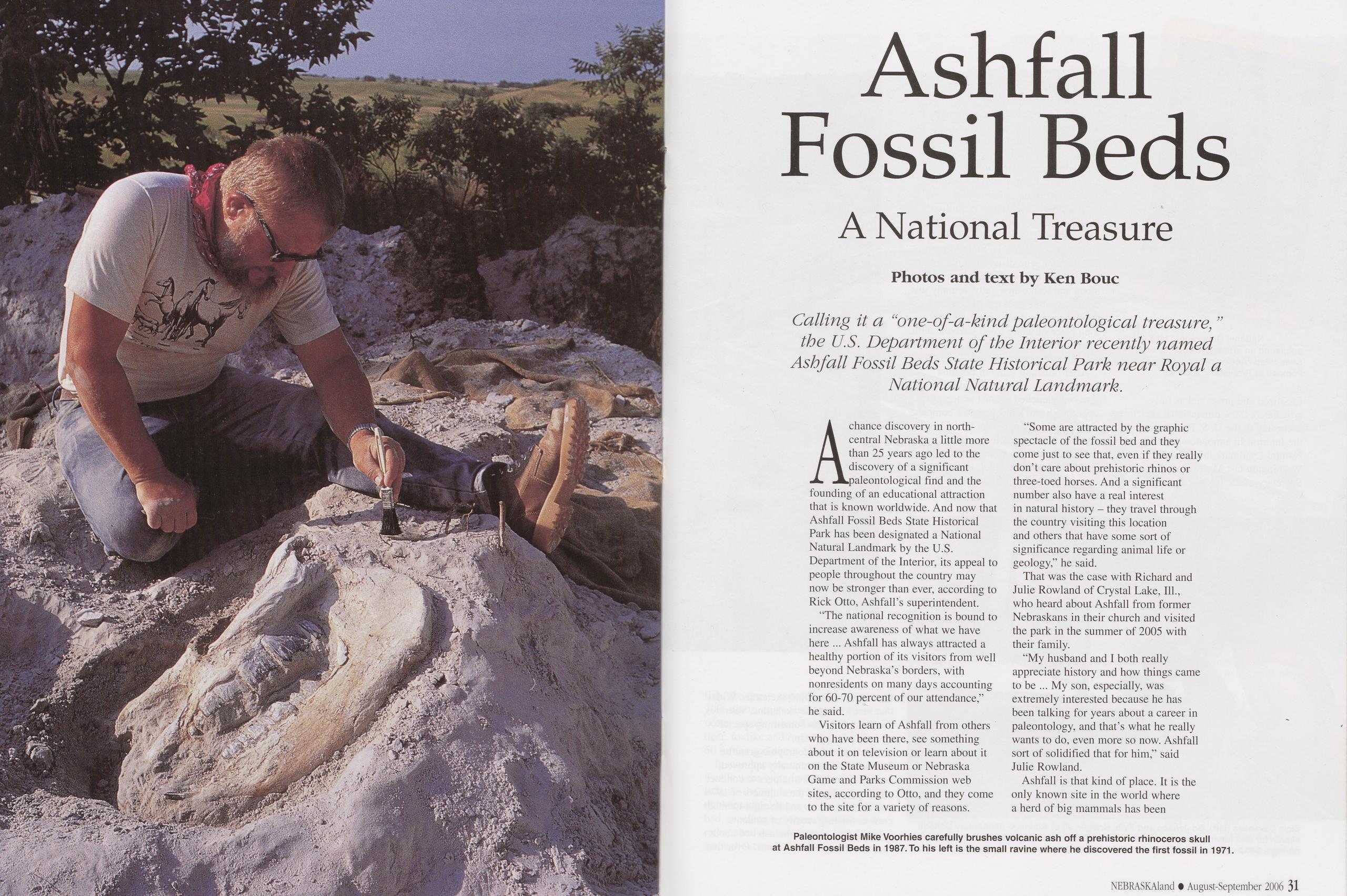
Ashfall Fossil Beds
A National Treasure Photos and text by Ken Bouc Calling it a “one-of-a-kindpaleontological treasure, ” the U.S. Department of the Interior recently named Ashfall Fossil Beds State Historical Park near Royal a National Natural Landmark.A chance discovery in north- central Nebraska a little more than 25 years ago led to the discovery of a significant paleontological find and the founding of an educational attraction that is known worldwide. And now that Ashfall Fossil Beds State Historical Park has been designated a National Natural Landmark by the U.S. Department of the Interior, its appeal to people throughout the country may now be stronger than ever, according to Rick Otto, Ashfall’s superintendent.
“The national recognition is bound to increase awareness of what we have here ... Ashfall has always attracted a healthy portion of its visitors from well beyond Nebraska’s borders, with nonresidents on many days accounting for 60-70 percent of our attendance,” he said.
Visitors learn of Ashfall from others who have been there, see something about it on television or learn about it on the State Museum or Nebraska Game and Parks Commission web sites, according to Otto, and they come to the site for a variety of reasons.
“Some are attracted by the graphic spectacle of the fossil bed and they come just to see that, even if they really don’t care about prehistoric rhinos or three-toed horses. And a significant number also have a real interest in natural history - they travel through the country visiting this location and others that have some sort of significance regarding animal life or geology,” he said.
That was the case with Richard and Julie Rowland of Crystal Lake, Ill., who heard about Ashfall from former Nebraskans in their church and visited the park in the summer of 2005 with their family.
“My husband and I both really appreciate history and how things came to be ... My son, especially, was extremely interested because he has been talking for years about a career in paleontology, and that’s what he really wants to do, even more so now. Ashfall sort of solidified that for him,” said Julie Rowland.
Ashfall is that kind of place. It is the
only known site in the world where
a herd of big mammals has been
NEBRASKAland • August-September 2006 31
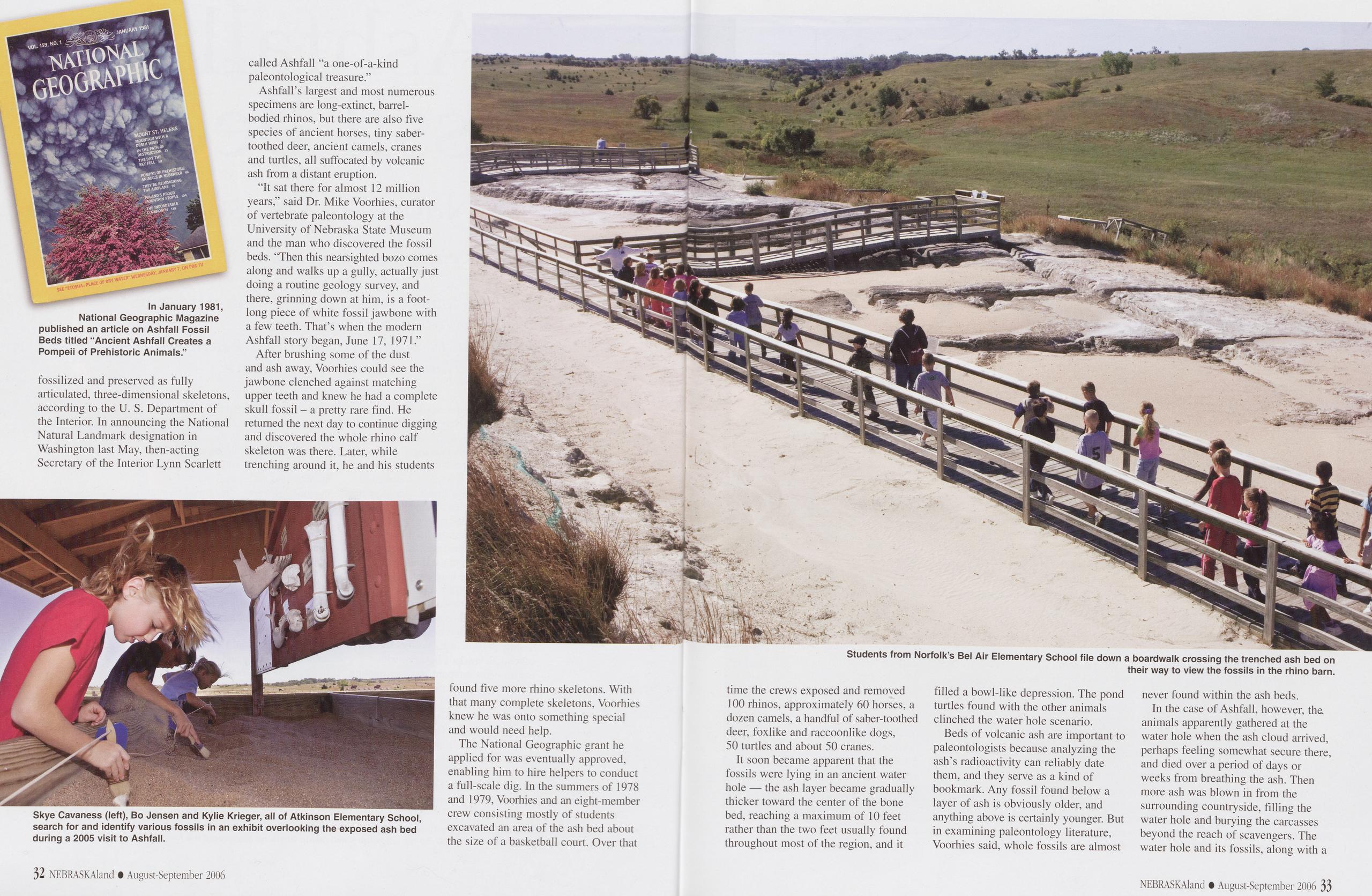 fossilized and preserved as fully
articulated, three-dimensional skeletons,
according to the U. S. Department of
the Interior. In announcing the National
Natural Landmark designation in
Washington last May, then-acting
Secretary of the Interior Lynn Scarlett
called Ashfall "a one-of-a-kind
paleontological treasure.”
fossilized and preserved as fully
articulated, three-dimensional skeletons,
according to the U. S. Department of
the Interior. In announcing the National
Natural Landmark designation in
Washington last May, then-acting
Secretary of the Interior Lynn Scarlett
called Ashfall "a one-of-a-kind
paleontological treasure.”
Ashfall's largest and most numerous specimens are long-extinct, barrel- bodied rhinos, but there are also five species of ancient horses, tiny saber- toothed deer, ancient camels, cranes and turtles, all suffocated by volcanic ash from a distant eruption.
"It sat there for almost 12 million years,” said Dr. Mike Voorhies, curator of vertebrate paleontology at the University of Nebraska State Museum and the man who discovered the fossil beds. "Then this nearsighted bozo comes along and walks up a gully, actually just doing a routine geology survey, and there, grinning down at him, is a foot- long piece of white fossil jawbone with a few teeth. That’s when the modern Ashfall story began, June 17, 1971”
After brushing some of the dust and ash away, Voorhies could see the jawbone clenched against matching upper teeth and knew he had a complete skull fossil - a pretty rare find. He returned the next day to continue digging and discovered the whole rhino calf skeleton was there. Later, while trenching around it, he and his students found five more rhino skeletons. With that many complete skeletons, Voorhies knew he was onto something special and would need help.
The National Geographic grant he applied for was eventually approved, enabling him to hire helpers to conduct a full-scale dig. In the summers of 1978 and 1979, Voorhies and an eight-member crew consisting mostly of students excavated an area of the ash bed about the size of a basketball court. Over that time the crews exposed and removed 100 rhinos, approximately 60 horses, a dozen camels, a handful of saber-toothed deer, foxlike and raccoonlike dogs, 50 turtles and about 50 cranes.
It soon became apparent that the fossils were lying in an ancient water hole — the ash layer became gradually thicker toward the center of the bone bed, reaching a maximum of 10 feet rather than the two feet usually found throughout most of the region, and it filled a bowl-like depression. The pond turtles found with the other animals clinched the water hole scenario.
Beds of volcanic ash are important to paleontologists because analyzing the ash’s radioactivity can reliably date them, and they serve as a kind of bookmark. Any fossil found below a layer of ash is obviously older, and anything above is certainly younger. But in examining paleontology literature, Voorhies said, whole fossils are almost never found within the ash beds.
In the case of Ashfall, however, the
animals apparently gathered at the
water hole when the ash cloud arrived,
perhaps feeling somewhat secure there,
and died over a period of days or
weeks from breathing the ash. Then
more ash was blown in from the
surrounding countryside, filling the
water hole and burying the carcasses
beyond the reach of scavengers. The
water hole and its fossils, along with a
32 NEBRASKAland • August-September 2006
NEBRASKAland • August-September 2006 33
 two-foot layer of ash throughout the
region, were eventually covered by
sandstone, ice-age gravel and other
geologic deposits.
two-foot layer of ash throughout the
region, were eventually covered by
sandstone, ice-age gravel and other
geologic deposits.
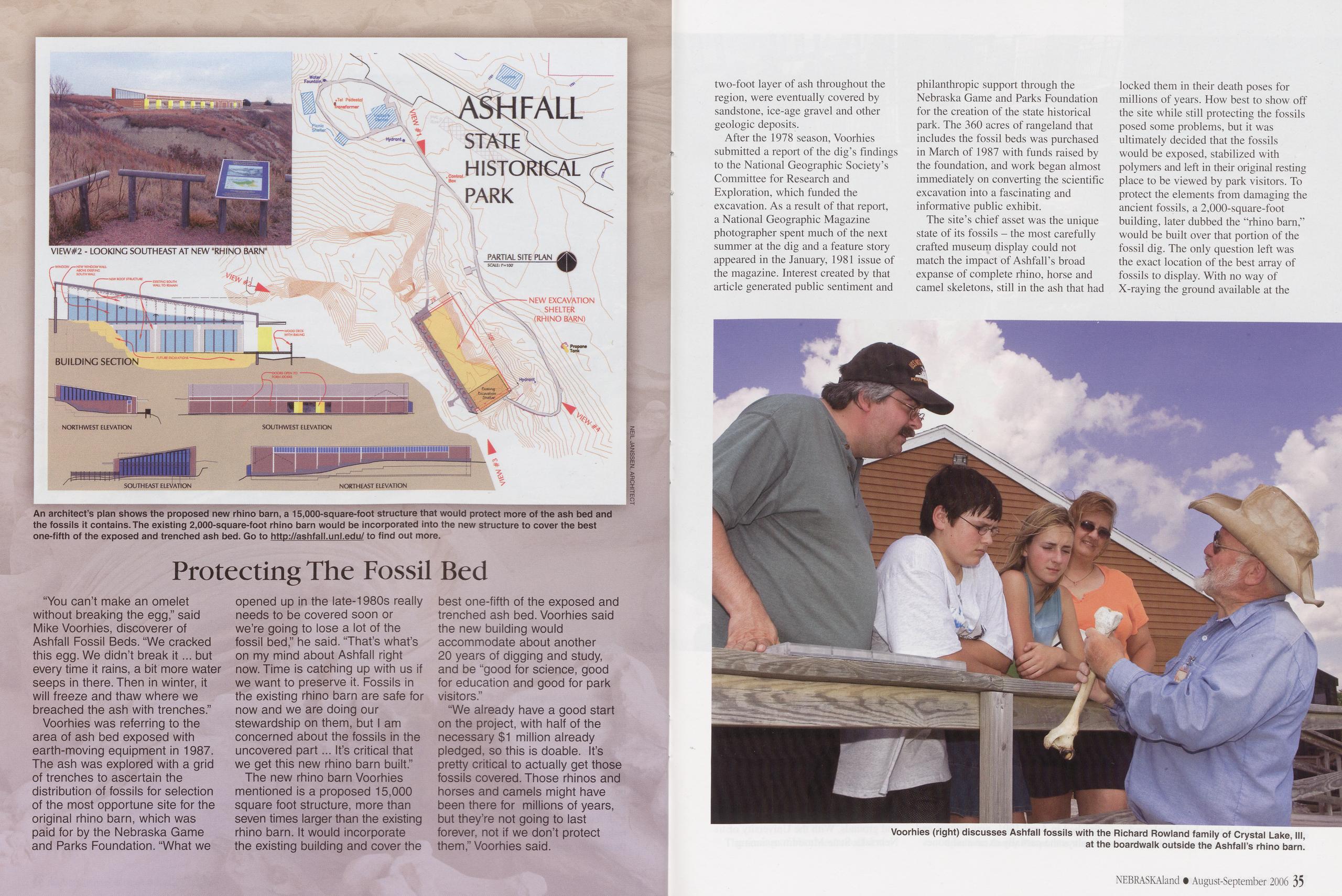
“You can’t make an omelet without breaking the egg,” said Mike Voorhies, discoverer of Ashfall Fossil Beds. “We cracked this egg. We didn’t break it... but every time it rains, a bit more water seeps in there. Then in winter, it will freeze and thaw where we breached the ash with trenches.”
Voorhies was referring to the area of ash bed exposed with earth-moving equipment in 1987. The ash was explored with a grid of trenches to ascertain the distribution of fossils for selection of the most opportune site for the original rhino barn, which was paid for by the Nebraska Game and Parks Foundation. “What we opened up in the late-1980s really needs to be covered soon or we’re going to lose a lot of the fossil bed,” he said. “That’s what’s on my mind about Ashfall right now. Time is catching up with us if we want to preserve it. Fossils in the existing rhino barn are safe for now and we are doing our stewardship on them, but I am concerned about the fossils in the uncovered part... It’s critical that we get this new rhino barn built."
The new rhino barn Voorhies mentioned is a proposed 15,000 square foot structure, more than seven times larger than the existing rhino barn. It would incorporate the existing building and cover the best one-fifth of the exposed and trenched ash bed. Voorhies said the new building would accommodate about another 20 years of digging and study, and be “good for science, good for education and good for park visitors.”
“We already have a good start on the project, with half of the necessary $1 million already pledged, so this is doable. It’s pretty critical to actually get those fossils covered. Those rhinos and horses and camels might have been there for millions of years, but they’re not going to last forever, not if we don’t protect them,” Voorhies said.
After the 1978 season, Voorhies submitted a report of the dig’s findings to the National Geographic Society’s Committee for Research and Exploration, which funded the excavation. As a result of that report, a National Geographic Magazine photographer spent much of the next summer at the dig and a feature story appeared in the January, 1981 issue of the magazine. Interest created by that article generated public sentiment and philanthropic support through the Nebraska Game and Parks Foundation for the creation of the state historical park. The 360 acres of rangeland that includes the fossil beds was purchased in March of 1987 with funds raised by the foundation, and work began almost immediately on converting the scientific excavation into a fascinating and informative public exhibit.
The site’s chief asset was the unique
state of its fossils - the most carefully
crafted museum display could not
match the impact of Ashfall’s broad
expanse of complete rhino, horse and
camel skeletons, still in the ash that had
locked them in their death poses for
millions of years. How best to show off
the site while still protecting the fossils
posed some problems, but it was
ultimately decided that the fossils
would be exposed, stabilized with
polymers and left in their original resting
place to be viewed by park visitors. To
protect the elements from damaging the
ancient fossils, a 2,000-square-foot
building, later dubbed the “rhino barn,”
would be built over that portion of the
fossil dig. The only question left was
the exact location of the best array of
fossils to display. With no way of
X-raying the ground available at the
NEBRASKAland • August-September 2006 35
 time, more digging was in order.
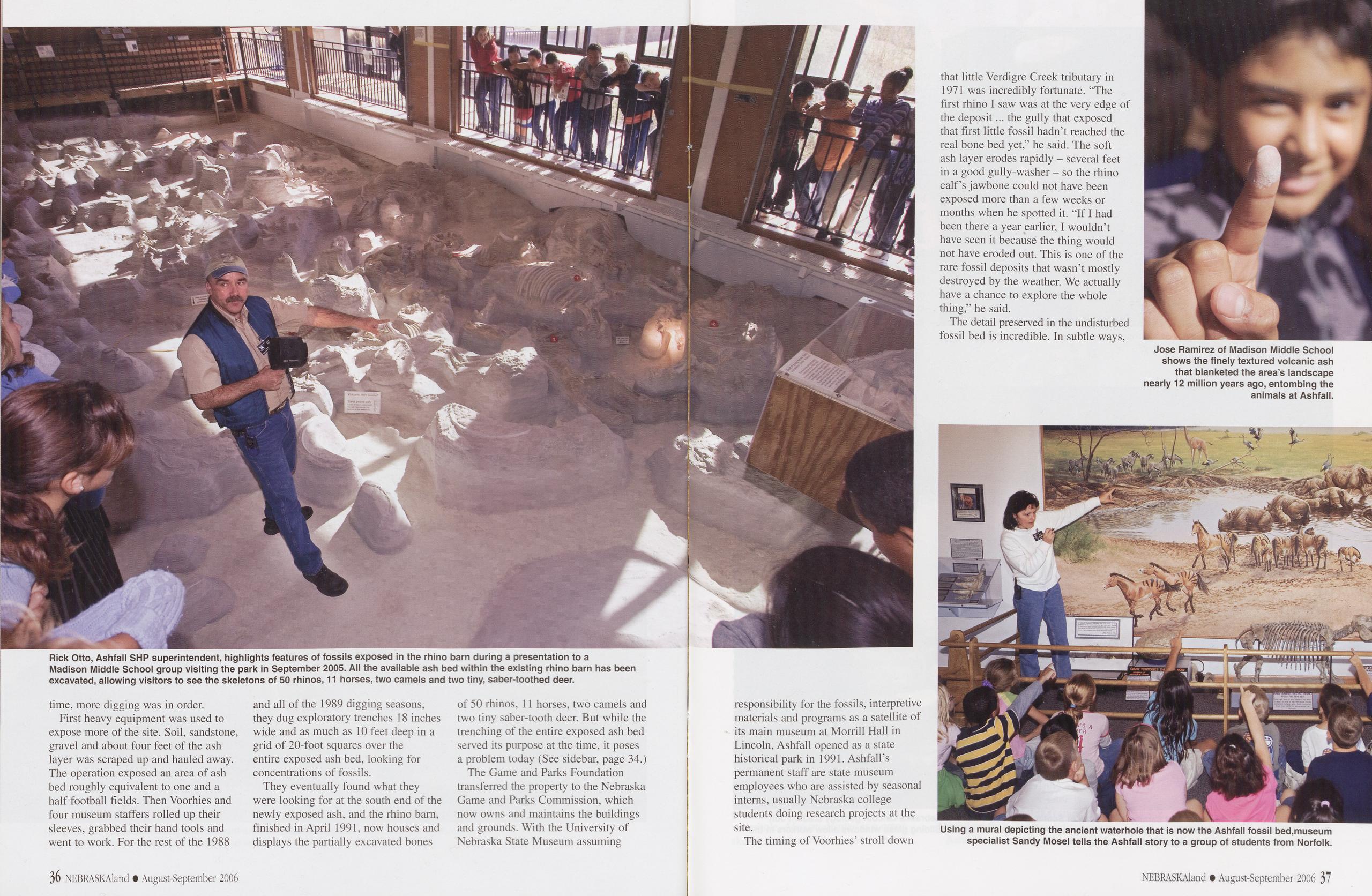
First heavy equipment was used to expose more of the site. Soil, sandstone, gravel and about four feet of the ash layer was scraped up and hauled away. The operation exposed an area of ash bed roughly equivalent to one and a half football fields. Then Voorhies and four museum staffers rolled up their sleeves, grabbed their hand tools and went to work. For the rest of the 1988 and all of the 1989 digging seasons, they dug exploratory trenches 18 inches wide and as much as 10 feet deep in a grid of 20-foot squares over the entire exposed ash bed, looking for concentrations of fossils.
They eventually found what they were looking for at the south end of the newly exposed ash, and the rhino barn, finished in April 1991, now houses and displays the partially excavated bones of 50 rhinos, 11 horses, two camels and two tiny saber-tooth deer. But while the trenching of the entire exposed ash bed served its purpose at the time, it poses a problem today (See sidebar, page 34.)
The Game and Parks Foundation transferred the property to the Nebraska Game and Parks Commission, which now owns and maintains the buildings and grounds. With the University of Nebraska State Museum assuming responsibility for the fossils, interpretive materials and programs as a satellite of its main museum at Morrill Hall in Lincoln, Ashfall opened as a state historical park in 1991. Ashfall’s permanent staff are state museum employees who are assisted by seasonal interns, usually Nebraska college students doing research projects at the site.
The timing of Voorhies’ stroll down that little Verdigre Creek tributary in 1971 was incredibly fortunate. "The first rhino I saw was at the very edge of the deposit... the gully that exposed that first little fossil hadn’t reached the real bone bed yet,” he said. The soft ash layer erodes rapidly - several feet in a good gully-washer - so the rhino calf’s jawbone could not have been exposed more than a few weeks or months when he spotted it. "If I had been there a year earlier, I wouldn’t have seen it because the thing would not have eroded out. This is one of the rare fossil deposits that wasn’t mostly destroyed by the weather. We actually have a chance to explore the whole thing,” he said.
The detail preserved in the undisturbed
fossil bed is incredible. In subtle ways,
36 NEBRASKAland • August-September 2006
NEBRASKAland • August-September 2006 37
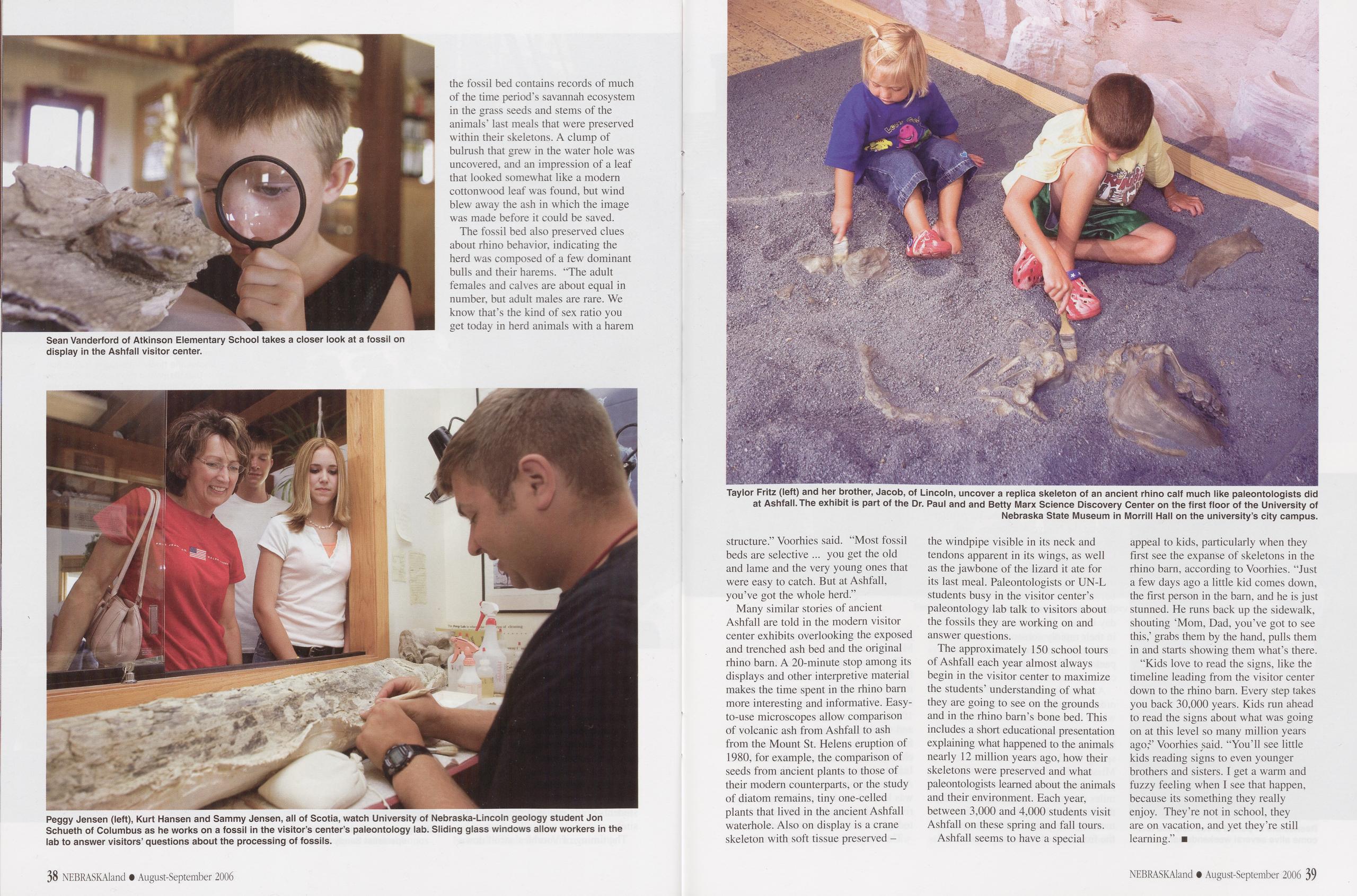 the fossil bed contains records of much
of the time period’s savannah ecosystem
in the grass seeds and stems of the
animals’ last meals that were preserved
within their skeletons. A clump of
bulrush that grew in the water hole was
uncovered, and an impression of a leaf
that looked somewhat like a modern
cottonwood leaf was found, but wind
blew away the ash in which the image
was made before it could be saved.
the fossil bed contains records of much
of the time period’s savannah ecosystem
in the grass seeds and stems of the
animals’ last meals that were preserved
within their skeletons. A clump of
bulrush that grew in the water hole was
uncovered, and an impression of a leaf
that looked somewhat like a modern
cottonwood leaf was found, but wind
blew away the ash in which the image
was made before it could be saved.
The fossil bed also preserved clues about rhino behavior, indicating the herd was composed of a few dominant bulls and their harems. "The adult females and calves are about equal in number, but adult males are rare. We know that’s the kind of sex ratio you get today in herd animals with a harem structure.” Voorhies said. "Most fossil beds are selective ... you get the old and lame and the very young ones that were easy to catch. But at Ashfall, you’ve got the whole herd.”
Many similar stories of ancient Ashfall are told in the modern visitor center exhibits overlooking the exposed and trenched ash bed and the original rhino barn. A 20-minute stop among its displays and other interpretive material makes the time spent in the rhino barn more interesting and informative. Easy- to-use microscopes allow comparison of volcanic ash from Ashfall to ash from the Mount St. Helens eruption of 1980, for example, the comparison of seeds from ancient plants to those of their modern counterparts, or the study of diatom remains, tiny one-celled plants that lived in the ancient Ashfall waterhole. Also on display is a crane skeleton with soft tissue preserved - the windpipe visible in its neck and tendons apparent in its wings, as well as the jawbone of the lizard it ate for its last meal. Paleontologists or UN-L students busy in the visitor center’s paleontology lab talk to visitors about the fossils they are working on and answer questions.
The approximately 150 school tours of Ashfall each year almost always begin in the visitor center to maximize the students’ understanding of what they are going to see on the grounds and in the rhino barn’s bone bed. This includes a short educational presentation explaining what happened to the animals nearly 12 million years ago, how their skeletons were preserved and what paleontologists learned about the animals and their environment. Each year, between 3,000 and 4,000 students visit Ashfall on these spring and fall tours.
Ashfall seems to have a special appeal to kids, particularly when they first see the expanse of skeletons in the rhino barn, according to Voorhies. "Just a few days ago a little kid comes down, the first person in the barn, and he is just stunned. He runs back up the sidewalk, shouting Mom, Dad, you’ve got to see this,’ grabs them by the hand, pulls them in and starts showing them what’s there.
"Kids love to read the signs, like the timeline leading from the visitor center down to the rhino barn. Every step takes you back 30,000 years. Kids run ahead to read the signs about what was going on at this level so many million years ago/’ Voorhies said. "You’ll see little kids reading signs to even younger brothers and sisters. I get a warm and fuzzy feeling when I see that happen, because its something they really enjoy. They’re not in school, they are on vacation, and yet they’re still learning.” ■
38 NEBRASKAland • August-September 2006 NEBRASKAland • August-September 2006 39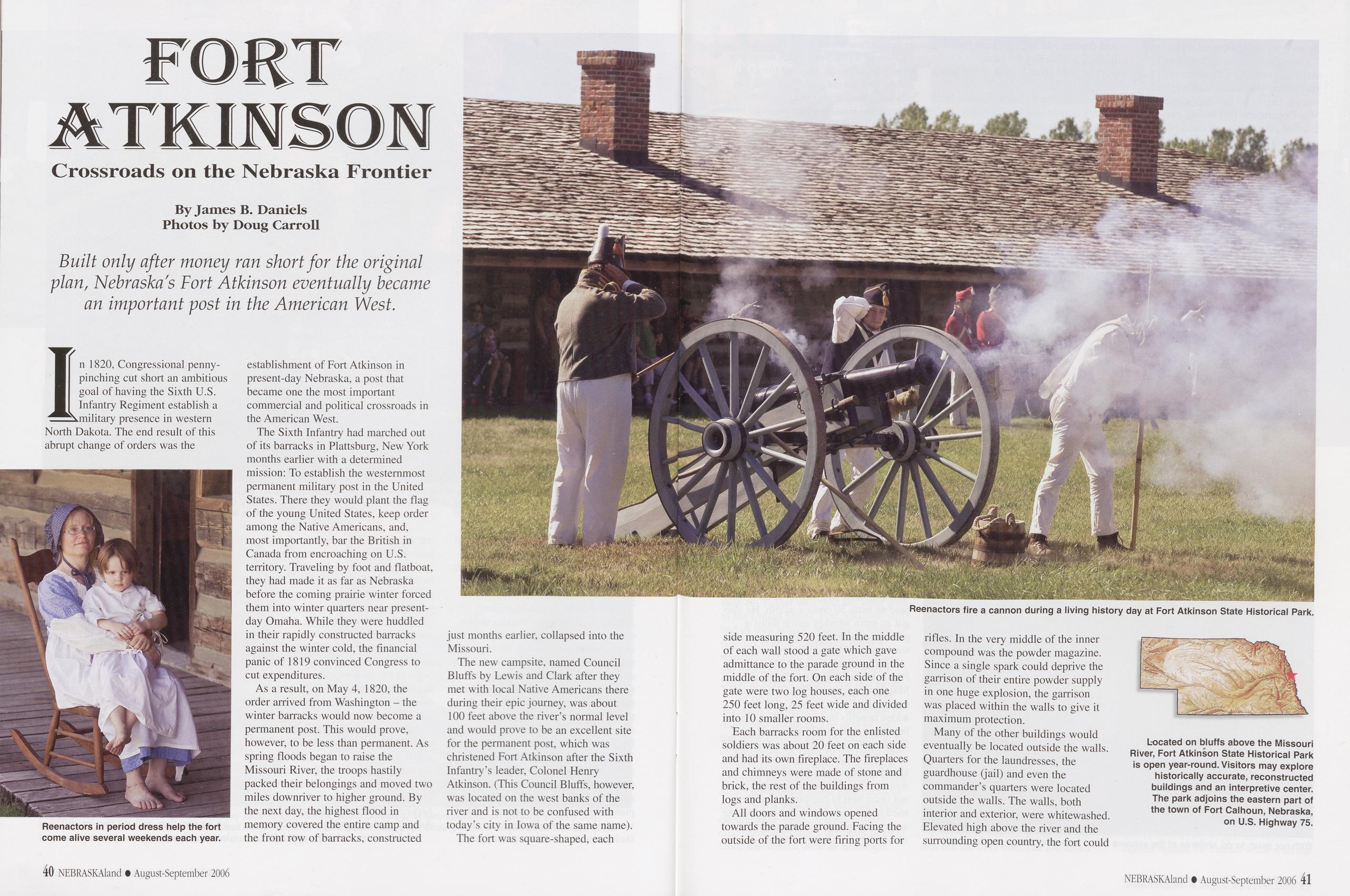
FORT ATKINSON
Crossroads on the Nebraska Frontier By James B. Daniels Photos by Doug Carroll Built only after money ran short for the original plan, Nebraska's Fort Atkinson eventually became an important post in the American West.In 1820, Congressional penny- fl pinching cut short an ambitious I goal of having the Sixth U.S. fl Infantry Regiment establish a presence in western North Dakota. The end result of this abrupt change of orders was the Reenactors in period dress help the fort come alive several weekends each year. establishment of Fort Atkinson in present-day Nebraska, a post that became one the most important commercial and political crossroads in the American West.
The Sixth Infantry had marched out of its barracks in Plattsburg, New York months earlier with a determined mission: To establish the westernmost permanent military post in the United States. There they would plant the flag of the young United States, keep order among the Native Americans, and, most importantly, bar the British in Canada from encroaching on U.S. territory. Traveling by foot and flatboat, they had made it as far as Nebraska before the coming prairie winter forced them into winter quarters near present- day Omaha. While they were huddled in their rapidly constructed barracks against the winter cold, the financial panic of 1819 convinced Congress to cut expenditures.
As a result, on May 4, 1820, the order arrived from Washington - the winter barracks would now become a permanent post. This would prove, however, to be less than permanent. As spring floods began to raise the Missouri River, the troops hastily packed their belongings and moved two miles downriver to higher ground. By the next day, the highest flood in memory covered the entire camp and the front row of barracks, constructed just months earlier, collapsed into the Missouri.
The new campsite, named Council Bluffs by Lewis and Clark after they met with local Native Americans there during their epic journey, was about 100 feet above the river’s normal level and would prove to be an excellent site for the permanent post, which was christened Fort Atkinson after the Sixth Infantry’s leader, Colonel Henry Atkinson. (This Council Bluffs, however, was located on the west banks of the river and is not to be confused with today’s city in Iowa of the same name).
The fort was square-shaped, each side measuring 520 feet. In the middle of each wall stood a gate which gave admittance to the parade ground in the middle of the fort. On each side of the gate were two log houses, each one 250 feet long, 25 feet wide and divided into 10 smaller rooms.
Each barracks room for the enlisted soldiers was about 20 feet on each side and had its own fireplace. The fireplaces and chimneys were made of stone and brick, the rest of the buildings from logs and planks.
All doors and windows opened towards the parade ground. Facing the outside of the fort were firing ports for rifles. In the very middle of the inner compound was the powder magazine. Since a single spark could deprive the garrison of their entire powder supply in one huge explosion, the garrison was placed within the walls to give it maximum protection.
Located on bluffs above the Missouri River, Fort Atkinson State Historical Park is open year-round. Visitors may explore historically accurate, reconstructed buildings and an interpretive center. The park adjoins the eastern part of the town of Fort Calhoun, Nebraska, on U.S. Highway 75.
Many of the other buildings would
eventually be located outside the walls.
Quarters for the laundresses, the
guardhouse (jail) and even the
commander’s quarters were located
outside the walls. The walls, both
interior and exterior, were whitewashed.
Elevated high above the river and the
surrounding open country, the fort could
40 NEBRASKAland • August-September 2006
NEBRASKAland O August-September 2006 41
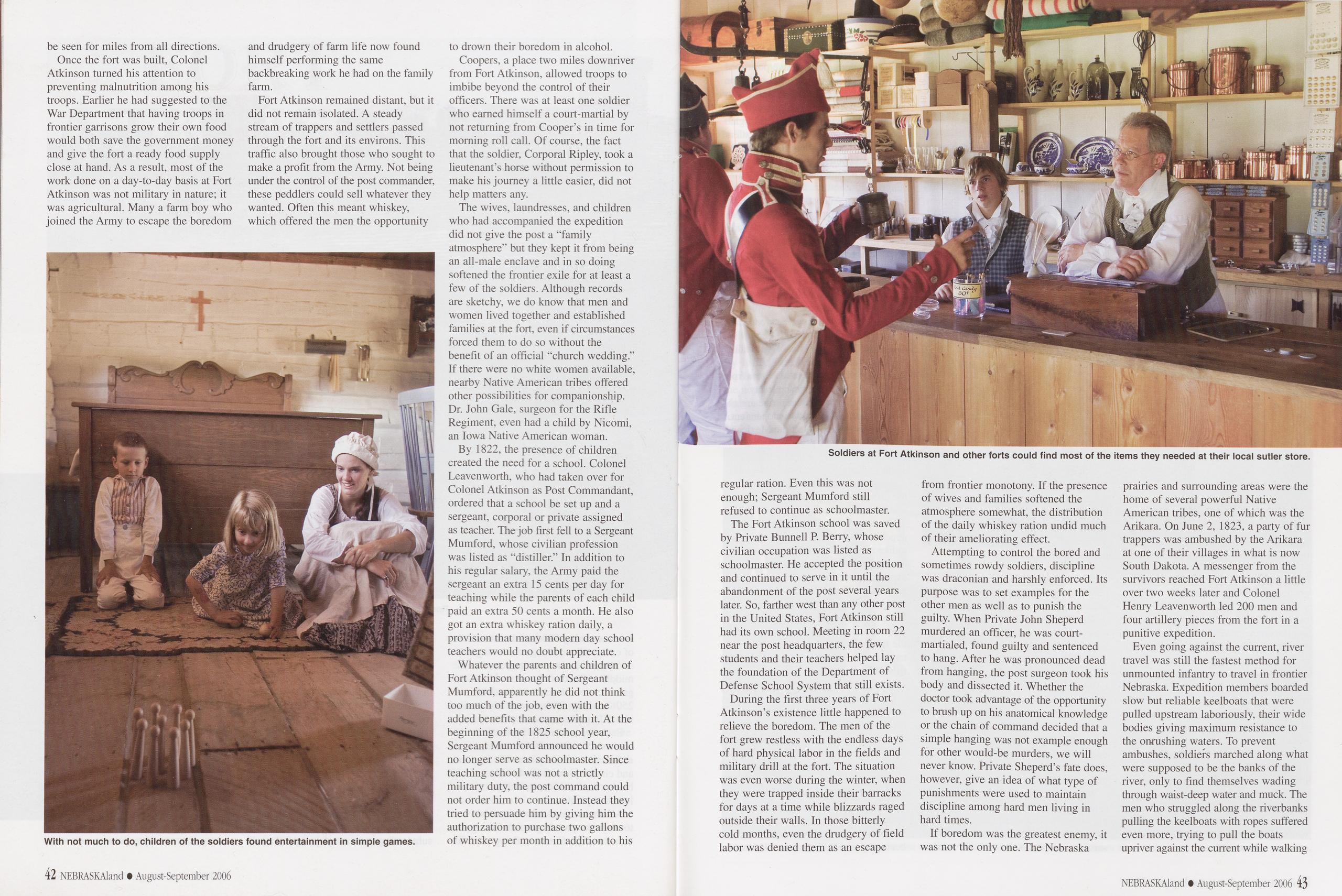 be seen for miles from all directions.
Once the fort was built, Colonel Atkinson turned his attention to preventing malnutrition among his troops. Earlier he had suggested to the War Department that having troops in frontier garrisons grow their own food would both save the government money and give the fort a ready food supply close at hand. As a result, most of the work done on a day-to-day basis at Fort Atkinson was not military in nature; it was agricultural. Many a farm boy who joined the Army to escape the boredom and drudgery of farm life now found himself performing the same backbreaking work he had on the family farm.
Fort Atkinson remained distant, but it did not remain isolated. A steady stream of trappers and settlers passed through the fort and its environs. This traffic also brought those who sought to make a profit from the Army. Not being under the control of the post commander, these peddlers could sell whatever they wanted. Often this meant whiskey, which offered the men the opportunity to drown their boredom in alcohol.
Coopers, a place two miles downriver from Fort Atkinson, allowed troops to imbibe beyond the control of their officers. There was at least one soldier who earned himself a court-martial by not returning from Cooper’s in time for morning roll call. Of course, the fact that the soldier, Corporal Ripley, took a lieutenant’s horse without permission to make his journey a little easier, did not help matters any.
The wives, laundresses, and children who had accompanied the expedition did not give the post a “family atmosphere” but they kept it from being an all-male enclave and in so doing softened the frontier exile for at least a few of the soldiers. Although records are sketchy, we do know that men and women lived together and established families at the fort, even if circumstances forced them to do so without the benefit of an official “church wedding.” If there were no white women available, nearby Native American tribes offered other possibilities for companionship. Dr. John Gale, surgeon for the Rifle Regiment, even had a child by Nicomi, an Iowa Native American woman.
By 1822, the presence of children created the need for a school. Colonel Leavenworth, who had taken over for Colonel Atkinson as Post Commandant, ordered that a school be set up and a sergeant, corporal or private assigned as teacher. The job first fell to a Sergeant Mumford, whose civilian profession was listed as “distiller.” In addition to his regular salary, the Army paid the sergeant an extra 15 cents per day for teaching while the parents of each child paid an extra 50 cents a month. He also got an extra whiskey ration daily, a provision that many modern day school teachers would no doubt appreciate.
Whatever the parents and children of Fort Atkinson thought of Sergeant Mumford, apparently he did not think too much of the job, even with the added benefits that came with it. At the beginning of the 1825 school year, Sergeant Mumford announced he would no longer serve as schoolmaster. Since teaching school was not a strictly military duty, the post command could not order him to continue. Instead they tried to persuade him by giving him the authorization to purchase two gallons of whiskey per month in addition to his regular ration. Even this was not enough; Sergeant Mumford still refused to continue as schoolmaster.
The Fort Atkinson school was saved by Private Bunnell P. Berry, whose civilian occupation was listed as schoolmaster. He accepted the position and continued to serve in it until the abandonment of the post several years later. So, farther west than any other post in the United States, Fort Atkinson still had its own school. Meeting in room 22 near the post headquarters, the few students and their teachers helped lay the foundation of the Department of Defense School System that still exists.
During the first three years of Fort Atkinson’s existence little happened to relieve the boredom. The men of the fort grew restless with the endless days of hard physical labor in the fields and military drill at the fort. The situation was even worse during the winter, when they were trapped inside their barracks for days at a time while blizzards raged outside their walls. In those bitterly cold months, even the drudgery of field labor was denied them as an escape from frontier monotony. If the presence of wives and families softened the atmosphere somewhat, the distribution of the daily whiskey ration undid much of their ameliorating effect.
Attempting to control the bored and sometimes rowdy soldiers, discipline was draconian and harshly enforced. Its purpose was to set examples for the other men as well as to punish the guilty. When Private John Sheperd murdered an officer, he was court- martialed, found guilty and sentenced to hang. After he was pronounced dead from hanging, the post surgeon took his body and dissected it. Whether the doctor took advantage of the opportunity to brush up on his anatomical knowledge or the chain of command decided that a simple hanging was not example enough for other would-be murders, we will never know. Private Sheperd’s fate does, however, give an idea of what type of punishments were used to maintain discipline among hard men living in hard times.
If boredom was the greatest enemy, it was not the only one. The Nebraska prairies and surrounding areas were the home of several powerful Native American tribes, one of which was the Arikara. On June 2, 1823, a party of fur trappers was ambushed by the Arikara at one of their villages in what is now South Dakota. A messenger from the survivors reached Fort Atkinson a little over two weeks later and Colonel Henry Leavenworth led 200 men and four artillery pieces from the fort in a punitive expedition.
Even going against the current, river
travel was still the fastest method for
unmounted infantry to travel in frontier
Nebraska. Expedition members boarded
slow but reliable keelboats that were
pulled upstream laboriously, their wide
bodies giving maximum resistance to
the onrushing waters. To prevent
ambushes, soldiers marched along what
were supposed to be the banks of the
river, only to find themselves wading
through waist-deep water and muck. The
men who struggled along the riverbanks
pulling the keelboats with ropes suffered
even more, trying to pull the boats
upriver against the current while walking
42 NEBRASKAland • August-September 2006
NEBRASKAland • August-September 2006 43
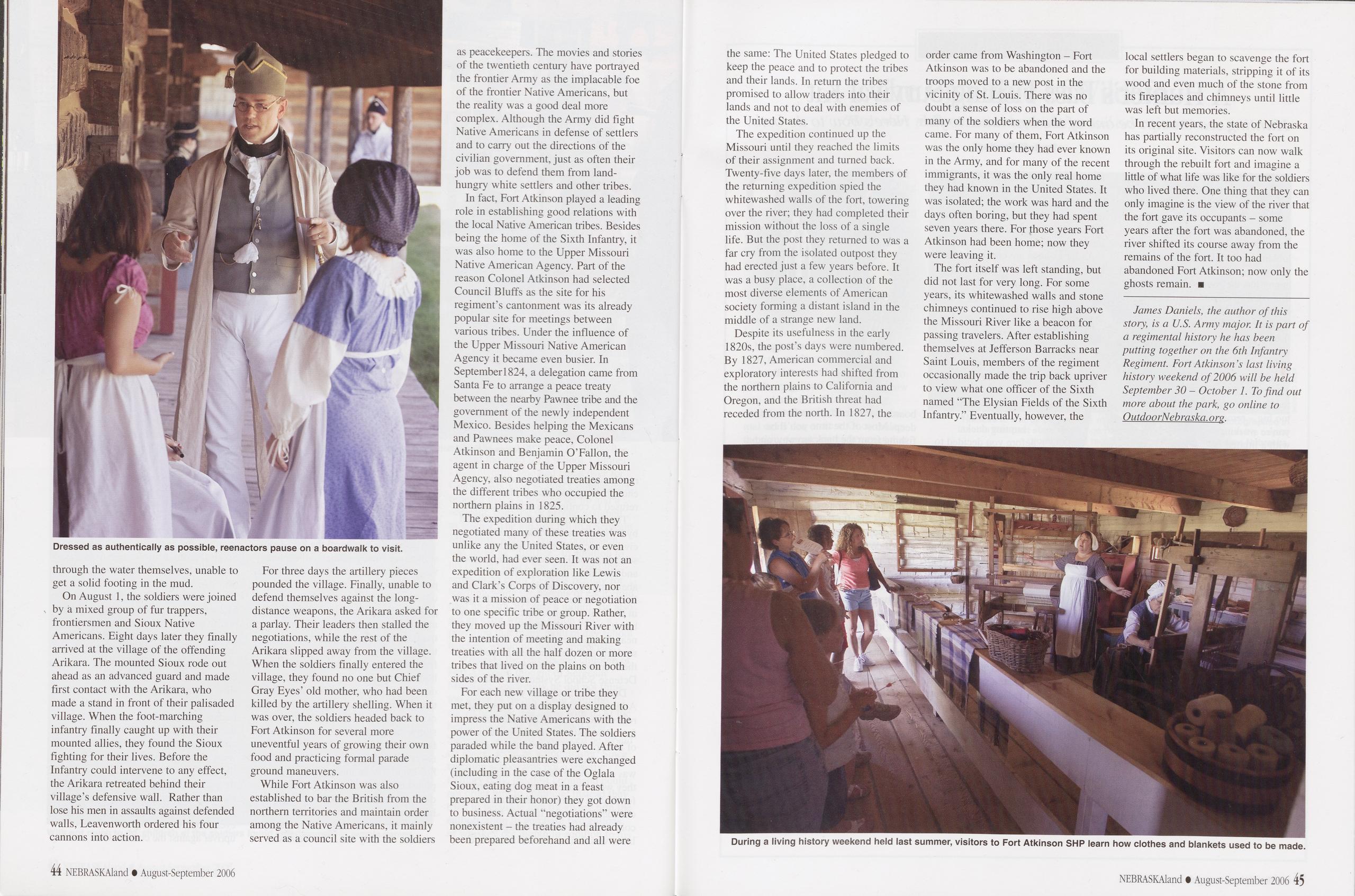 through the water themselves, unable to
get a solid footing in the mud.
through the water themselves, unable to
get a solid footing in the mud.
On August 1, the soldiers were joined by a mixed group of fur trappers, frontiersmen and Sioux Native Americans. Eight days later they finally arrived at the village of the offending Arikara. The mounted Sioux rode out ahead as an advanced guard and made first contact with the Arikara, who made a stand in front of their palisaded village. When the foot-marching infantry finally caught up with their mounted allies, they found the Sioux fighting for their lives. Before the Infantry could intervene to any effect, the Arikara retreated behind their village’s defensive wall. Rather than lose his men in assaults against defended walls, Leavenworth ordered his four cannons into action.
For three days the artillery pieces pounded the village. Finally, unable to defend themselves against the long- distance weapons, the Arikara asked for a parlay. Their leaders then stalled the negotiations, while the rest of the Arikara slipped away from the village. When the soldiers finally entered the village, they found no one but Chief Gray Eyes’ old mother, who had been killed by the artillery shelling. When it was over, the soldiers headed back to Fort Atkinson for several more uneventful years of growing their own food and practicing formal parade ground maneuvers.
While Fort Atkinson was also established to bar the British from the northern territories and maintain order among the Native Americans, it mainly served as a council site with the soldiers as peacekeepers. The movies and stories of the twentieth century have portrayed the frontier Army as the implacable foe of the frontier Native Americans, but the reality was a good deal more complex. Although the Army did fight Native Americans in defense of settlers and to carry out the directions of the civilian government, just as often their job was to defend them from land- hungry white settlers and other tribes.
In fact, Fort Atkinson played a leading role in establishing good relations with the local Native American tribes. Besides being the home of the Sixth Infantry, it was also home to the Upper Missouri Native American Agency. Part of the reason Colonel Atkinson had selected Council Bluffs as the site for his regiment’s cantonment was its already popular site for meetings between various tribes. Under the influence of the Upper Missouri Native American Agency it became even busier. In September1824, a delegation came from Santa Fe to arrange a peace treaty between the nearby Pawnee tribe and the government of the newly independent Mexico. Besides helping the Mexicans and Pawnees make peace, Colonel Atkinson and Benjamin O’Fallon, the agent in charge of the Upper Missouri Agency, also negotiated treaties among the different tribes who occupied the northern plains in 1825.
The expedition during which they negotiated many of these treaties was unlike any the United States, or even the world, had ever seen. It was not an expedition of exploration like Lewis and Clark’s Corps of Discovery, nor was it a mission of peace or negotiation to one specific tribe or group. Rather, they moved up the Missouri River with the intention of meeting and making treaties with all the half dozen or more tribes that lived on the plains on both sides of the river.
For each new village or tribe they met, they put on a display designed to impress the Native Americans with the power of the United States. The soldiers paraded while the band played. After diplomatic pleasantries were exchanged (including in the case of the Oglala Sioux, eating dog meat in a feast prepared in their honor) they got down to business. Actual “negotiations” were nonexistent - the treaties had already been prepared beforehand and all were the same: The United States pledged to keep the peace and to protect the tribes and their lands. In return the tribes promised to allow traders into their lands and not to deal with enemies of the United States.
The expedition continued up the Missouri until they reached the limits of their assignment and turned back. Twenty-five days later, the members of the returning expedition spied the whitewashed walls of the fort, towering over the river; they had completed their mission without the loss of a single life. But the post they returned to was a far cry from the isolated outpost they had erected just a few years before. It was a busy place, a collection of the most diverse elements of American society forming a distant island in the middle of a strange new land.
Despite its usefulness in the early 1820s, the post’s days were numbered. By 1827, American commercial and exploratory interests had shifted from the northern plains to California and Oregon, and the British threat had receded from the north. In 1827, the order came from Washington - Fort Atkinson was to be abandoned and the troops moved to a new post in the vicinity of St. Louis. There was no doubt a sense of loss on the part of many of the soldiers when the word came. For many of them, Fort Atkinson was the only home they had ever known in the Army, and for many of the recent immigrants, it was the only real home they had known in the United States. It was isolated; the work was hard and the days often boring, but they had spent seven years there. For those years Fort Atkinson had been home; now they were leaving it.
The fort itself was left standing, but did not last for very long. For some years, its whitewashed walls and stone chimneys continued to rise high above the Missouri River like a beacon for passing travelers. After establishing themselves at Jefferson Barracks near Saint Louis, members of the regiment occasionally made the trip back upriver to view what one officer of the Sixth named “The Elysian Fields of the Sixth Infantry.” Eventually, however, the local settlers began to scavenge the fort for building materials, stripping it of its wood and even much of the stone from its fireplaces and chimneys until little was left but memories.
In recent years, the state of Nebraska has partially reconstructed the fort on its original site. Visitors can now walk through the rebuilt fort and imagine a little of what life was like for the soldiers who lived there. One thing that they can only imagine is the view of the river that the fort gave its occupants - some years after the fort was abandoned, the river shifted its course away from the remains of the fort. It too had abandoned Fort Atkinson; now only the ghosts remain. ■
James Daniels, the author of this story, is a U.S. Army major. It is part of a regimental history he has been putting together on the 6th Infantry Regiment. Fort Atkinson’s last living history weekend of2006 will be held September 30 - October I. To find out more about the park, go online to OutdoorNebraska. org.
44 NEBRASKAland • August-September 2006 NEBRASKAland • August-September 2006 45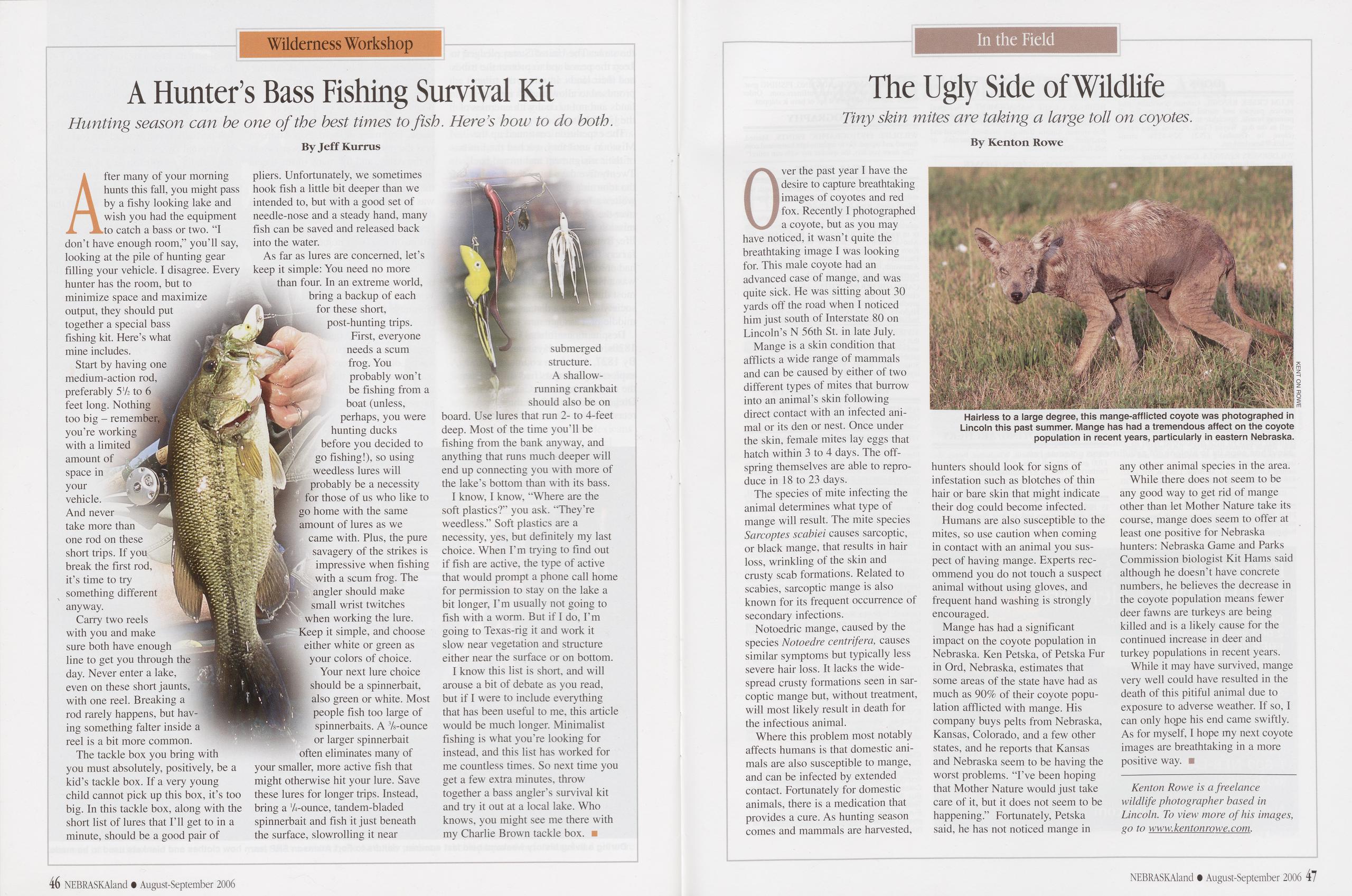
After many of your morning hunts this fall, you might pass by a fishy looking lake and wish you had the equipment to catch a bass or two. "I don’t have enough room,” you’ll say, looking at the pile of hunting gear filling your vehicle. I disagree. Every hunter has the room, but to minimize space and maximize output, they should put together a special bass fishing kit. Here’s what mine includes.
Start by having one medium-action rod, preferably 5’A to 6 g feet long. Nothing | too big - remember you’re working with a limited amount of space in your vehicle. And never take more than one rod on these short trips. If you break the first rod, it’s time to try something different anyway.
Carry two reels with you and make sure both have enough line to get you through the day. Never enter a lake, even on these short jaunts, with one reel. Breaking a rod rarely happens, but hav- ing something falter inside a reel is a bit more common.
The tackle box you bring with you must absolutely, positively, be kid’s tackle box. If a very young child cannot pick up this box, it’s too big. In this tackle box, along with the short list of lures that I’ll get to in a minute, should be a good pair of pliers. Unfortunately, we sometimes hook fish a little bit deeper than we intended to, but with a good set of needle-nose and a steady hand, many fish can be saved and released back into the water.
As far as lures are concerned, let’s keep it simple: You need no more than four. In an extreme world, bring a backup of each for these short, post-hunting trips. First, everyone needs a scum frog. You probably won’t be fishing from a boat (unless, perhaps, you were hunting ducks before you decided to go fishing!), so using weedless lures will probably be a necessity for those of us who like to o home with the same amount of lures as we came with. Plus, the pure savagery of the strikes is impressive when fishing with a scum frog. The angler should make small wrist twitches when working the lure. Keep it simple, and choose either white or green as your colors of choice. Your next lure choice should be a spinnerbait, also green or white. Most people fish too large of spinnerbaits. A 3/s-ounce or larger spinnerbait often eliminates many of your smaller, more active fish that might otherwise hit your lure. Save these lures for longer trips. Instead, bring a ‘A-ounce, tandem-bladed spinnerbait and fish it just beneath the surface, slowrolling it near should also be on board. Use lures that run 2- to 4-feet deep. Most of the time you’ll be fishing from the bank anyway, and anything that runs much deeper will end up connecting you with more of the lake’s bottom than with its bass.
I know, I know, “Where are the soft plastics?” you ask. “They’re weedless.” Soft plastics are a necessity, yes, but definitely my last choice. When I’m trying to find out if fish are active, the type of active that would prompt a phone call home for permission to stay on the lake a bit longer, I’m usually not going to fish with a worm. But if I do, I’m going to Texas-rig it and work it slow near vegetation and structure either near the surface or on bottom.
I know this list is short, and will arouse a bit of debate as you read, but if I were to include everything that has been useful to me, this article would be much longer. Minimalist fishing is what you’re looking for instead, and this list has worked for me countless times. So next time you get a few extra minutes, throw together a bass angler’s survival kit and try it out at a local lake. Who knows, you might see me there with my Charlie Brown tackle box. ■
The Ugly Side of Wildlife Tiny skin mites are taking a large toll on coyotes.Over the past year I have the desire to capture breathtaking images of coyotes and red fox. Recently I photographed a coyote, but as you may have noticed, it wasn’t quite the breathtaking image I was looking for. This male coyote had an advanced case of mange, and was quite sick. He was sitting about 30 yards off the road when I noticed him just south of Interstate 80 on Lincoln’s N 56th St. in late July.
Mange is a skin condition that afflicts a wide range of mammals and can be caused by either of two different types of mites that burrow into an animal’s skin following direct contact with an infected ani- mal or its den or nest. Once under the skin, female mites lay eggs that hatch within 3 to 4 days. The off- spring themselves are able to repro- duce in 18 to 23 days.
The species of mite infecting the animal determines what type of mange will result. The mite species Sarcoptes scabiei causes sarcoptic, or black mange, that results in hair loss, wrinkling of the skin and crusty scab formations. Related to scabies, sarcoptic mange is also known for its frequent occurrence of secondary infections.
Notoedric mange, caused by the species Notoedre centrifera, causes similar symptoms but typically less severe hair loss. It lacks the wide- spread crusty formations seen in sar- coptic mange but, without treatment, will most likely result in death for the infectious animal.
Where this problem most notably affects humans is that domestic ani- mals are also susceptible to mange, and can be infected by extended contact. Fortunately for domestic animals, there is a medication that provides a cure. As hunting season comes and mammals are harvested, hunters should look for signs of infestation such as blotches of thin hair or bare skin that might indicate their dog could become infected.
Humans are also susceptible to the mites, so use caution when coming in contact with an animal you sus- pect of having mange. Experts rec- ommend you do not touch a suspect animal without using gloves, and frequent hand washing is strongly encouraged.
Mange has had a significant impact on the coyote population in Nebraska. Ken Petska, of Petska Fur in Ord, Nebraska, estimates that some areas of the state have had as much as 90% of their coyote popu- lation afflicted with mange. His company buys pelts from Nebraska, Kansas, Colorado, and a few other states, and he reports that Kansas and Nebraska seem to be having the worst problems. “I’ve been hoping that Mother Nature would just take care of it, but it does not seem to be happening.” Fortunately, Petska said, he has not noticed mange in any other animal species in the area.
While there does not seem to be any good way to get rid of mange other than let Mother Nature take its course, mange does seem to offer at least one positive for Nebraska hunters: Nebraska Game and Parks Commission biologist Kit Hams said although he doesn’t have concrete numbers, he believes the decrease in the coyote population means fewer deer fawns are turkeys are being killed and is a likely cause for the continued increase in deer and turkey populations in recent years.
While it may have survived, mange very well could have resulted in the death of this pitiful animal due to exposure to adverse weather. If so, I can only hope his end came swiftly. As for myself, I hope my next coyote images are breathtaking in a more positive way. ■
Kenton Rowe is a freelance wildlife photographer based in Lincoln. To view more of his images, go to www. kentonrowe. com.
46 NEBRASKAland • August-September 2006 NEBRASKAland • August-September 2006 47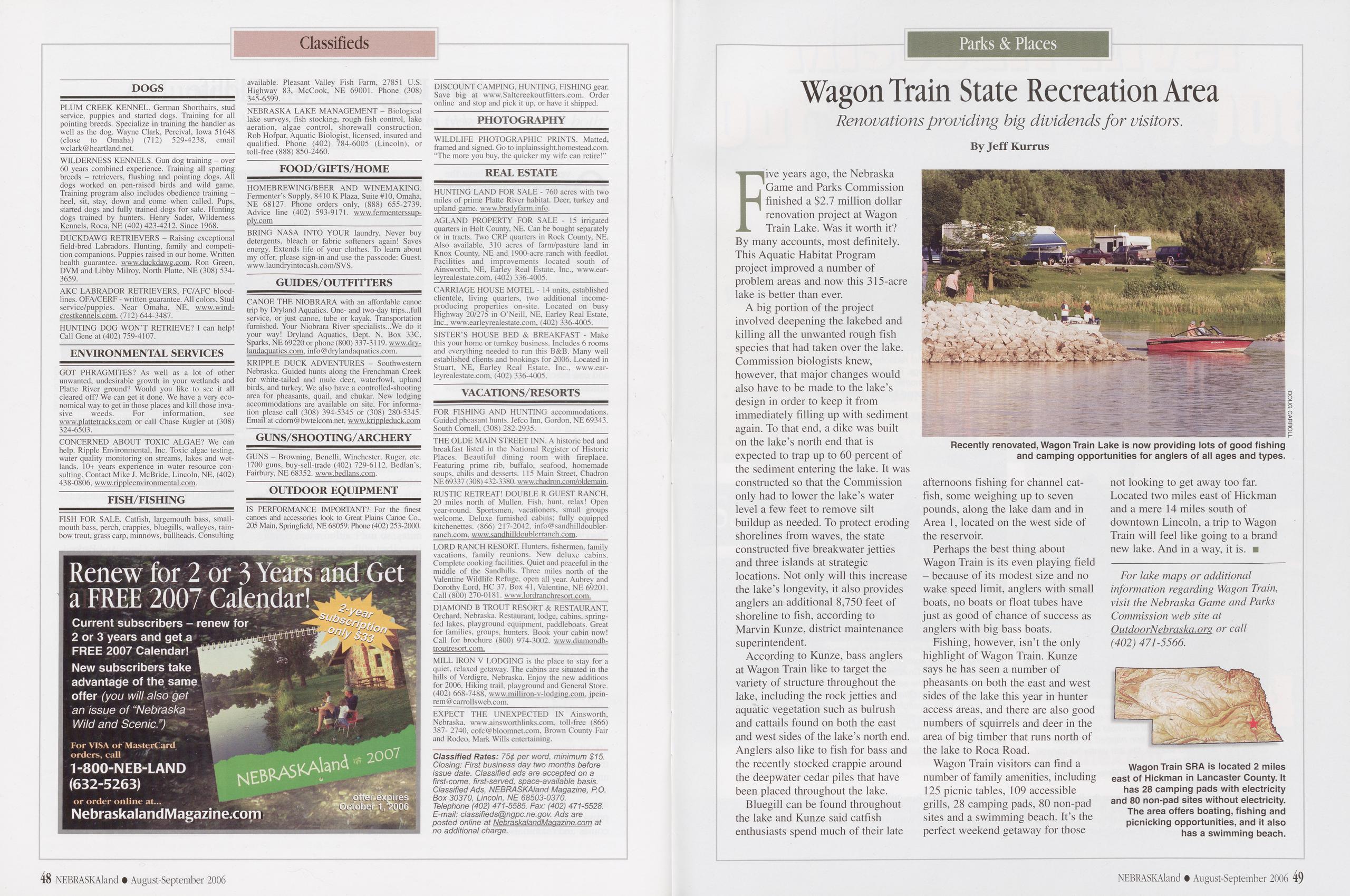
Classifieds
Parks & Places DOGSPLUM CREEK KENNEL. German Shorthairs, stud service, puppies and started dogs. Training for all pointing breeds. Specialize in training the handler as well as the dog. Wayne Clark, Percival, Iowa 51648 (close to Omaha) (712) 529-4238, email wclark @ heartland.net.
WILDERNESS KENNELS. Gun dog training - over 60 years combined experience. Training all sporting breeds - retrievers, flushing and pointing dogs. All dogs worked on pen-raised birds and wild game. Training program also includes obedience training - heel, sit, stay, down and come when called. Pups, started dogs and fully trained dogs for sale. Hunting dogs trained by hunters. Henry Sader, Wilderness Kennels, Roca, NE (402) 423-4212. Since 1968.
DUCKDAWG RETRIEVERS - Raising exceptional field-bred Labradors. Hunting, family and competi- tion companions. Puppies raised in our home. Written health guarantee, www.duckdawg.com. Ron Green, DVM and Libby Milroy, North Platte, NE (308) 534- 3659.
AKC LABRADOR RETRIEVERS, FC/AFC blood- lines. OFA/CERF - written guarantee. All colors. Stud service/puppies. Near Omaha, NE, www.wind- crestkennels.com. (712) 644-3487.
HUNTING DOG WON’T RETRIEVE? I can help! Call Gene at (402) 759-4107.
ENVIRONMENTAL SERVICESGOT PHRAGMITES? As well as a lot of other unwanted, undesirable growth in your wetlands and Platte River ground? Would you like to see it all cleared off? We can get it done. We have a very eco- nomical way to get in those places and kill those inva- sive weeds. For information, see www.plattetracks.com or call Chase Kugler at (308) 324-6503.
CONCERNED ABOUT TOXIC ALGAE? We can help. Ripple Environmental, Inc. Toxic algae testing, water quality monitoring on streams, lakes and wet- lands. 10+ years experience in water resource con- sulting. Contact Mike J. McBride, Lincoln, NE, (402) 438-0806, www.rippleenvironmental.com.
FISH/FISHINGFISH FOR SALE. Catfish, largemouth bass, small- mouth bass, perch, crappies, bluegills, walleyes, rain- bow trout, grass carp, minnows, bullheads. Consulting Spires
Renew for 2 or 3 Years and Get a FREE 2007 Calendar! * Current subscribers - renew for 2 or 3 years and get a FREE 2007 Calendar! New subscribers take advantage of the same offer (you will also get , an issue of “Nebraska Wild and Scenic.”) For VISA or MasterCard orders, call 1-800-NEB-LAND (632-5263) or order online at... NebraskalandMagazine.comavailable. Pleasant Valley Fish Farm, 27851 U.S. Highway 83, McCook, NE 69001. Phone (308) 345-6599.
NEBRASKA LAKE MANAGEMENT - Biological lake surveys, fish stocking, rough fish control, lake aeration, algae control, shorewall construction. Rob Hofpar, Aquatic Biologist, licensed, insured and qualified. Phone (402) 784-6005 (Lincoln), or toll-free (888) 850-2460.
FOOD/GIFTS/HOMEHOMEBREWING/BEER AND WINEMAKING. Fermenter’s Supply, 8410 K Plaza, Suite #10, Omaha, NE 68127. Phone orders only, (888) 655-2739. Advice line (402) 593-9171. www.fermenterssup- plv.com
BRING NASA INTO YOUR laundry. Never buy detergents, bleach or fabric softeners again! Saves energy. Extends life of your clothes. To learn about my offer, please sign-in and use the passcode: Guest. www.laundryintocash.com/SVS.
GUIDES/OUTFITTERSCANOE THE NIOBRARA with an affordable canoe trip by Dryland Aquatics. One- and two-day trips...full service, or just canoe, tube or kayak. Transportation furnished. Your Niobrara River specialists...We do it your way! Dryland Aquatics, Dept. N, Box 33C, Sparks, NE 69220 or phone (800) 337-3119. www.drv- landaquatics.com, info@drylandaquatics.com.
KRIPPLE DUCK ADVENTURES - Southwestern Nebraska. Guided hunts along the Frenchman Creek for white-tailed and mule deer, waterfowl, upland birds, and turkey. We also have a controlled-shooting area for pheasants, quail, and chukar. New lodging accommodations are available on site. For informa- tion please call (308) 394-5345 or (308) 280-5345. Email at cdom@bwtelcom.net, www.krippleduck.com
GUNS/SHOOTING/ARCHERYGUNS - Browning, Benelli, Winchester, Ruger, etc. 1700 guns, buy-sell-trade (402) 729-6112, Bedlan’s, Fairbury, NE 68352. www.bedlans.com.
OUTDOOR EQUIPMENTIS PERFORMANCE IMPORTANT? For the finest canoes and accessories look to Great Plains Canoe Co., 205 Main, Springfield, NE 68059. Phone (402) 253-2000.
DISCOUNT CAMPING, HUNTING, FISHING gear. Save big at www.Saltcreekoutfitters.com. Order online and stop and pick it up, or have it shipped.
PHOTOGRAPHYWILDLIFE PHOTOGRAPHIC PRINTS. Matted, framed and signed. Go to inplainssight.homestead.com. “The more you buy, the quicker my wife can retire!”
REAL ESTATEHUNTING LAND FOR SALE - 760 acres with two miles of prime Platte River habitat. Deer, turkey and upland game, www.bradyfarm.info.
AGLAND PROPERTY FOR SALE - 15 irrigated quarters in Holt County, NE. Can be bought separately or in tracts. Two CRP quarters in Rock County, NE. Also available, 310 acres of farm/pasture land in Knox County, NE and. 1900-acre ranch with feedlot. Facilities and improvements located south of Ainsworth, NE, Earley Real Estate, Inc., www.ear- leyrealestate.com, (402) 336-4005.
CARRIAGE HOUSE MOTEL - 14 units, established clientele, living quarters, two additional income- producing properties on-site. Located on busy Highway 20/275 in O’Neill, NE, Earley Real Estate, Inc., www.earleyrealestate.com. (402) 336-4005.
SISTER’S HOUSE BED & BREAKFAST - Make this your home or turnkey business. Includes 6 rooms and everything needed to run this B&B. Many well established clients and bookings for 2006. Located in Stuart, NE, Earley Real Estate, Inc., www.ear- leyrealestate.com, (402) 336-4005.
VACATIONS/RESORTSFOR FISHING AND HUNTING accommodations. Guided pheasant hunts. Jefco Inn, Gordon, NE 69343. South Cornell, (308) 282-2935.
THE OLDE MAIN STREET INN. A historic bed and breakfast listed in the National Register of Historic Places. Beautiful dining room with fireplace. Featuring prime rib, buffalo, seafood, homemade soups, chilis and desserts. 115 Main Street, Chadron NE 69337 (308) 432-3380. www.chadron.com/oldemain.
RUSTIC RETREAT! DOUBLE R GUEST RANCH, 20 miles north of Mullen. Fish, hunt, relax! Open year-round. Sportsmen, vacationers, small groups welcome. Deluxe furnished cabins; fully equipped kitchenettes. (866) 217-2042, info@sandhilldoubler- ranch.com, www.sandhilldoublerranch.com.
LORD RANCH RESORT. Hunters, fishermen, family vacations, family reunions. New deluxe cabins. Complete cooking facilities. Quiet and peaceful in the middle of the Sandhills. Three miles north of the Valentine Wildlife Refuge, open all year. Aubrey and Dorothy Lord, HC 37, Box 41, Valentine, NE 69201. Call (800) 270-0181. www.lordranchresort.com.
DIAMOND B TROUT RESORT & RESTAURANT, Orchard, Nebraska. Restaurant, lodge, cabins, spring- fed lakes, playground equipment, paddleboats. Great for families, groups, hunters. Book your cabin now! Call for brochure (800) 974-3002. www.diamondb- troutresort.com.
MILL IRON V LODGING is the place to stay for a quiet, relaxed getaway. The cabins are situated in the hills of Verdigre, Nebraska. Enjoy the new additions for 2006. Hiking trail, playground and General Store. (402) 668-7488, www.milliron-v-lodging.com. jpein- rem@carrollsweb.com.
EXPECT THE UNEXPECTED IN Ainsworth, Nebraska, www.ainsworthlinks.com, toll-free (866) 387- 2740, cofc@bloomnet.com, Brown County Fair and Rodeo, Mark Wills entertaining.
Classified Rates: 75/ per word, minimum $15. Closing: First business day two months before issue date. Classified ads are accepted on a first-come, first-served, space-available basis. Classified Ads, NEBRASKAIand Magazine, P.O. Box 30370, Lincoln, NE 68503-0370. Telephone (402) 471-5585. Fax: (402) 471-5528. E-mail: classifieds@ngpc.ne.gov. Ads are posted online at NebraskalandMaoazine. com at no additional charge.
Wagon Train State Recreation Area Renovations providing big dividends for visitors. By Jeff KurrusFive years ago, the Nebraska Game and Parks Commission finished a $2.7 million dollar renovation project at Wagon Train Lake. Was it worth it? By many accounts, most definitely. This Aquatic Habitat Program project improved a number of problem areas and now this 315-acre lake is better than ever.
A big portion of the project involved deepening the lakebed and killing all the unwanted rough fish species that had taken over the lake. Commission biologists knew, however, that major changes would also have to be made to the lake’s design in order to keep it from immediately filling up with sediment again. To that end, a dike was built on the lake’s north end that is expected to trap up to 60 percent of the sediment entering the lake. It was constructed so that the Commission only had to lower the lake’s water level a few feet to remove silt buildup as needed. To protect eroding shorelines from waves, the state constructed five breakwater jetties and three islands at strategic locations. Not only will this increase the lake’s longevity, it also provides anglers an additional 8,750 feet of shoreline to fish, according to Marvin Kunze, district maintenance superintendent.
According to Kunze, bass anglers at Wagon Train like to target the variety of structure throughout the lake, including the rock jetties and aquatic vegetation such as bulrush and cattails found on both the east and west sides of the lake’s north end. Anglers also like to fish for bass and the recently stocked crappie around the deepwater cedar piles that have been placed throughout the lake.
Bluegill can be found throughout the lake and Kunze said catfish enthusiasts spend much of their late afternoons fishing for channel cat- fish, some weighing up to seven pounds, along the lake dam and in Area 1, located on the west side of the reservoir.
Perhaps the best thing about Wagon Train is its even playing field - because of its modest size and no wake speed limit, anglers with small boats, no boats or float tubes have just as good of chance of success as anglers with big bass boats.
Fishing, however, isn’t the only highlight of Wagon Train. Kunze says he has seen a number of pheasants on both the east and west sides of the lake this year in hunter access areas, and there are also good numbers of squirrels and deer in the area of big timber that runs north of the lake to Roca Road.
Wagon Train visitors can find a number of family amenities, including 125 picnic tables, 109 accessible grills, 28 camping pads, 80 non-pad sites and a swimming beach. It’s the perfect weekend getaway for those not looking to get away too far. Located two miles east of Hickman and a mere 14 miles south of downtown Lincoln, a trip to Wagon Train will feel like going to a brand new lake. And in a way, it is. ■
For lake maps or additional information regarding Wagon Train, visit the Nebraska Game and Parks Commission web site at OutdoorNebraska. ors or call (402) 471-5566.
Wagon Train SRA is located 2 miles east of Hickman in Lancaster County. It has 28 camping pads with electricity and 80 non-pad sites without electricity. The area offers boating, fishing and picnicking opportunities, and it also has a swimming beach.
48 NEBRASKAIand • August-September 2006 NEBRASKAIand • August-September 2006 49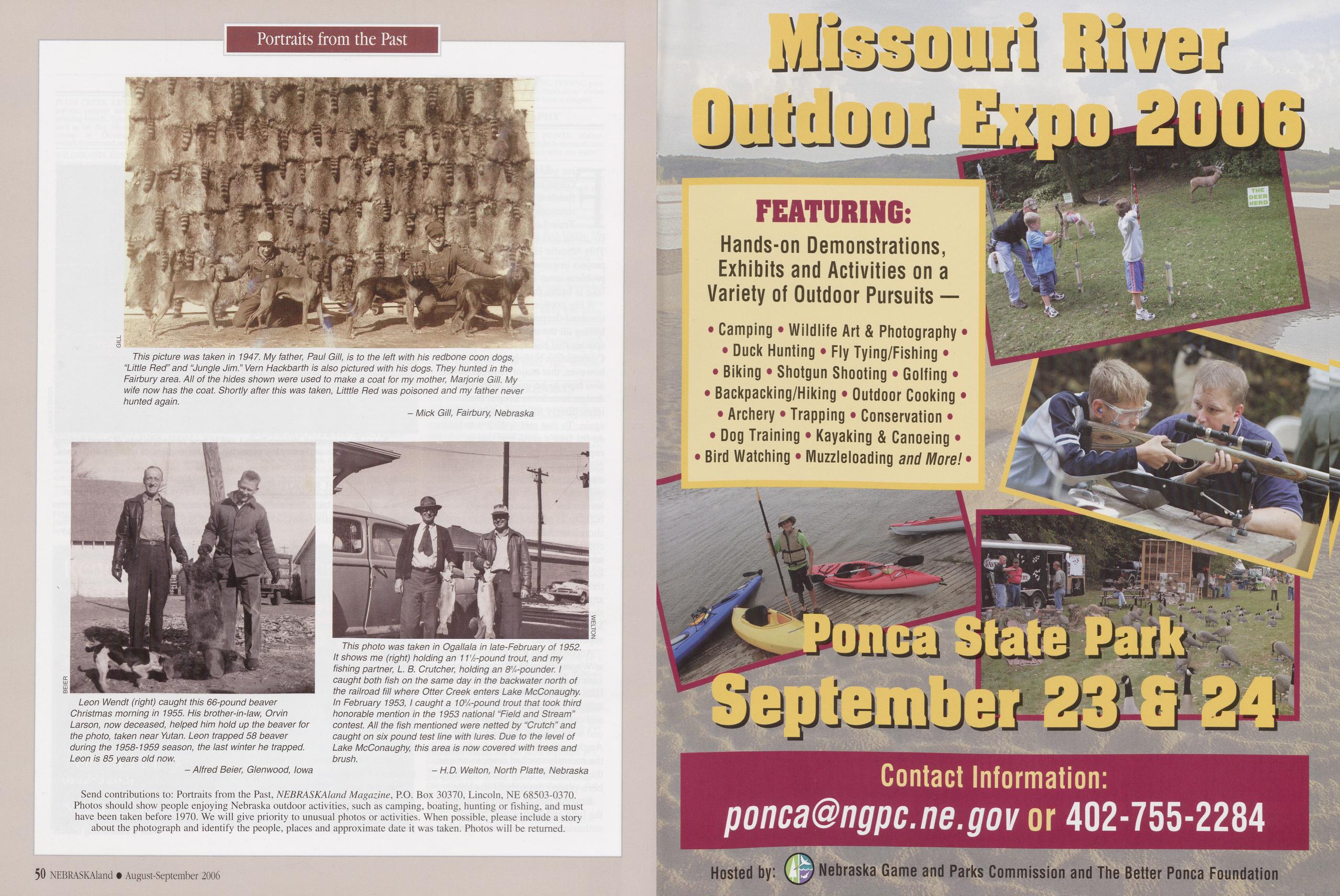
This picture was taken in 1947. My father, Paul Gill, is to the left with his redbone coon dogs, “Little Ped” and “Jungle Jim.” Vern Hackbarth is also pictured with his dogs. They hunted in the Fairbury area. All of the hides shown were used to make a coat for my mother, Marjorie Gill. My wife now has the coat. Shortly after this was taken, Litttle Ped was poisoned and my father never hunted again.
- Mick Gill, Fairbury, NebraskaLeon Wendt (right) caught this 66-pound beaver Christmas morning in 1955. His brother-in-law, Orvin Larson, now deceased, helped him hold up the beaver for the photo, taken near Yutan. Leon trapped 58 beaver during the 1958-1959 season, the last winter he trapped. Leon is 85 years old now.
- Alfred Beier, Glenwood, IowaThis photo was taken in Ogallala in late-February of 1952. It shows me (right) holding an 1 TA-pound trout, and my fishing partner, L. B. Crutcher, holding an tfA-pounder. I caught both fish on the same day in the backwater north of the railroad fill where Otter Creek enters Lake McConaughy. In February 1953, I caught a KTA-pound trout that took third honorable mention in the 1953 national “Field and Stream” contest. All the fish mentioned were netted by “Crutch” and caught on six pound test line with lures. Due to the level of Lake McConaughy, this area is now covered with trees and brush.
Send contributions to: Portraits from the Past, NEBRASKAland Magazine, P.O. Box 30370, Lincoln, NE 68503-0370. Photos should show people enjoying Nebraska outdoor activities, such as camping, boating, hunting or fishing, and must have been taken before 1970. We will give priority to unusual photos or activities. When possible, please include a story about the photograph and identify the people, places and approximate date it was taken. Photos will be returned.
- H.D. Welton, North Platte, Nebraska Missouri River Outdoor Expo 2006 FEATURING: Hands-on Demonstrations, Exhibits and Activities on a Variety of Outdoor Pursuits — • Camping • Wildlife Art & Photography • • Duck Hunting • Fly Tying/Fishing • • Biking • Shotgun Shooting • Golfing • • Backpacking/Hiking • Outdoor Cooking • • Archery • Trapping • Conservation • • Dog Training • Kayaking & Canoeing • • Bird Watching • Muzzleloading and More! • Contact Information: ponca@ngpc.ne.gov or 402-755-2284 50 NEBRASKAland • August-September 2006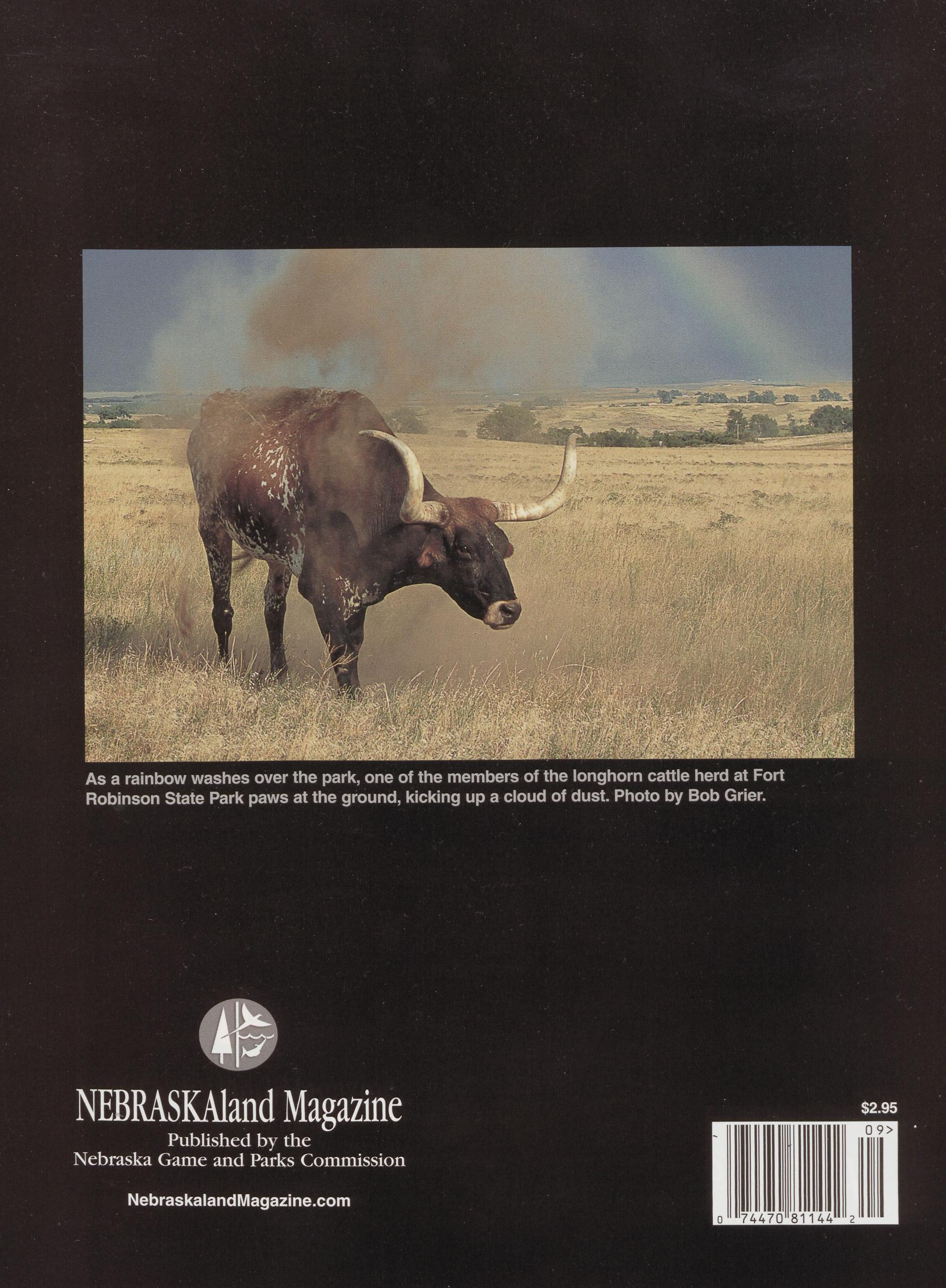
Position: 90 (65 views)