Volume 84, Issue 6, 2006
NEBRASKAland
July 2006 $2.95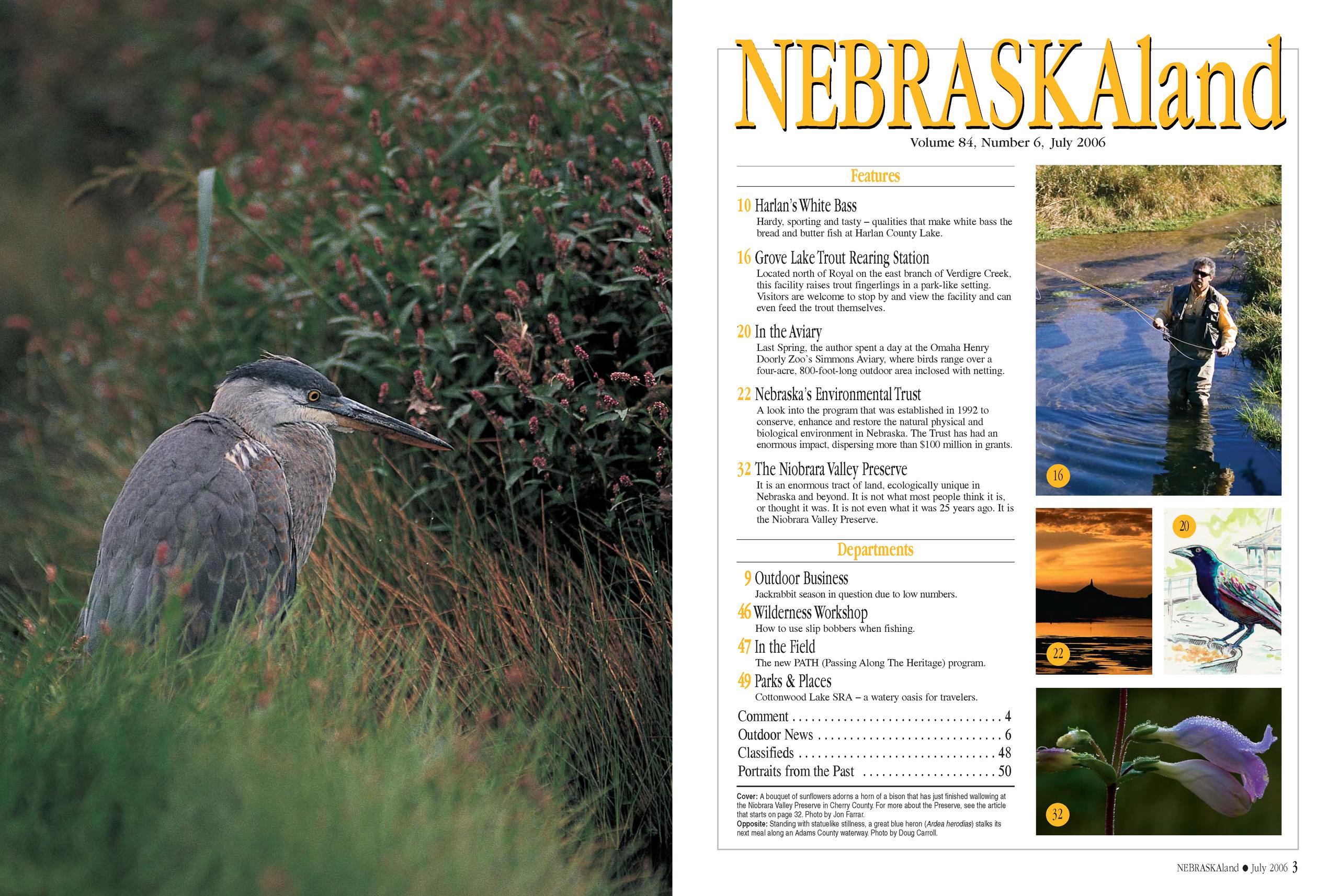
NEBRASKAland
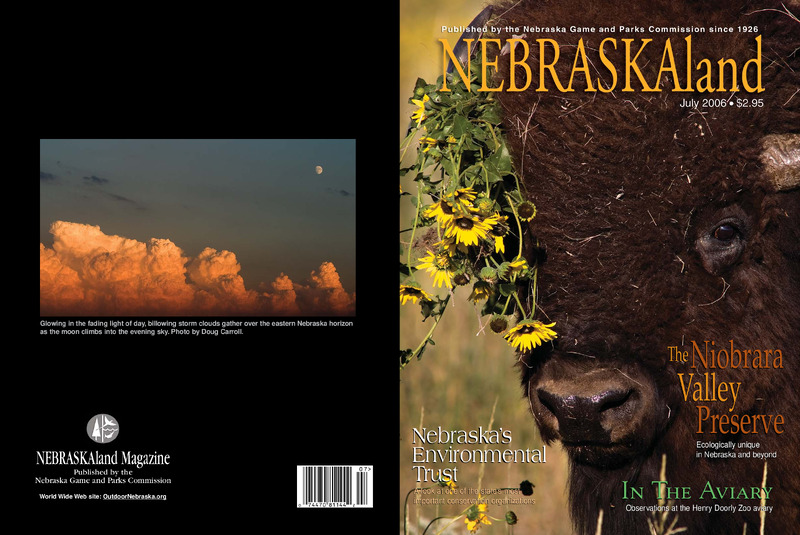
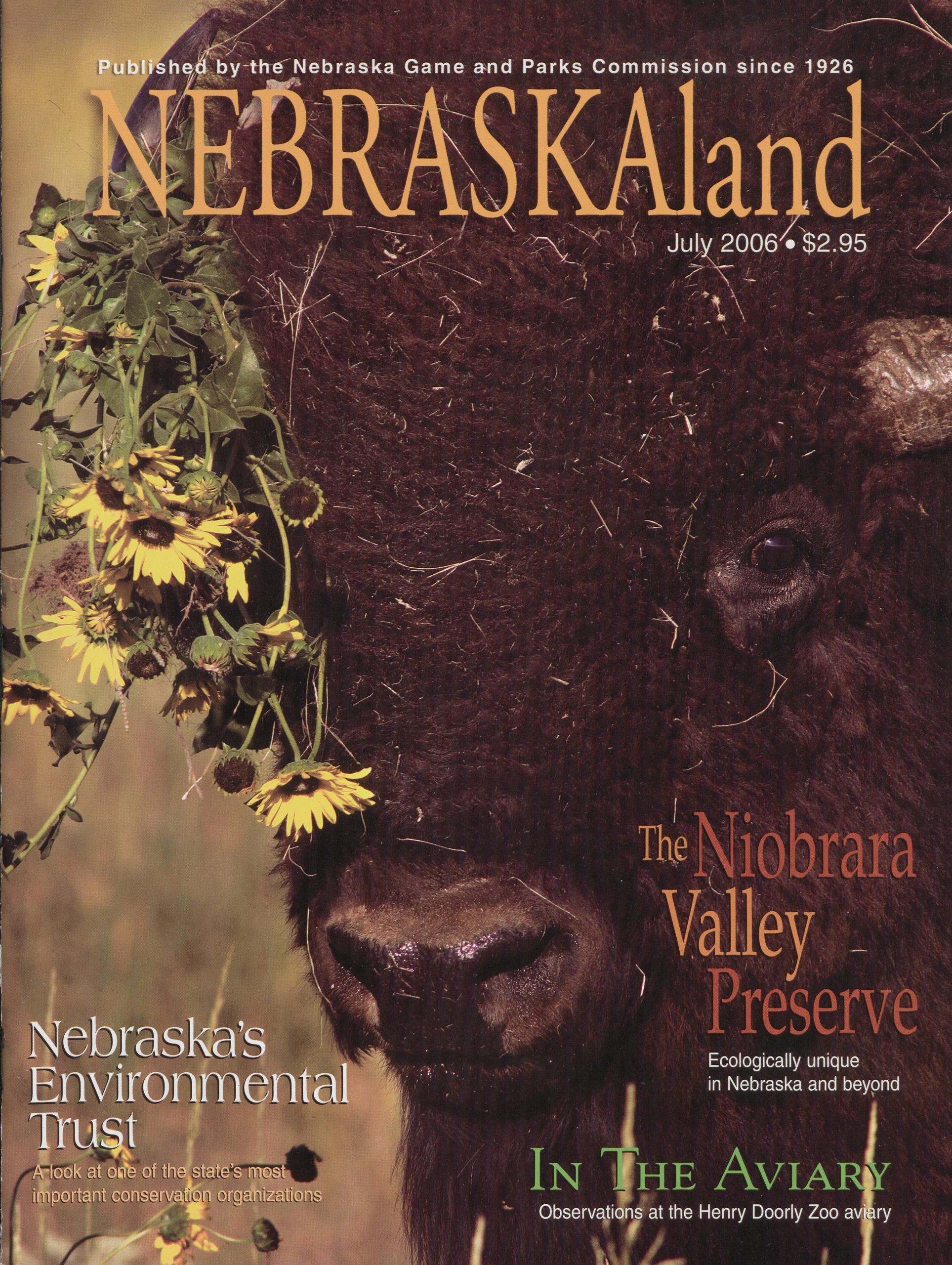
Volume 84, Number 6, July 2006 Features 10 Harlan’s White Bass Hardy, sporting and tasty - qualities that make white bass the bread and butter fish at Harlan County Lake. 16 Grove Lake Trout Rearing Station Located north of Royal on the east branch of Verdigre Creek, this facility raises Lout fingerlings in a park-like setting. Visitors are welcome to stop by and view the facility and can even feed the Lout themselves. 20 In the Aviary Last Spring, the author spent a day at the Omaha Henry Doorly Zoo's Simmons Aviary, where birds range over a four-acre. 800-foot-long outdoor area inclosed with netting. 22 Nebraska’s Environmental Trust A look into the program that was established in 1992 to conserve, enhance and restore the natural physical and biological environment in Nebraska. The Trust has had an enormous impact, dispersing more than $100 million in grants. 32 The Niobrara Valley Preserve It is an enormous tract of land, ecologically unique in Nebraska and beyond. It is not what most people think it is. or thought it was. It is not even what it was 25 years ago. It is the Niobrara Valley Preserve. Departments 9 Outdoor Business Jackrabbit season in question due to low numbers. 46 Wilderness Workshop How to use slip bobbers when fishing. 47 In the Field The new PATH (Passing Along The Heritage) program. 49 Parks & Places Cottonwood Lake SRA - a watery oasis for travelers. Comment........................................4 Outdoor News...................................6 Classifieds...................................48 Portraits from the Past ......................50 Cover: A bouquet of sunflowers adorns a horn of a bison that has just finished wallowing at the Niobrara Valley Preserve in Cherry County. For more about the Preserve, see the article that starts on page 32. Photo by Jon Farrar. Opposite: Standing with statuelike stillness, a great blue heron (Ardea herodias) stalks its next meal along an Adams County waterway. Photo by Doug Carroll.
Michael Forsbergs’ article in the June 2006 issue of NEBRASKAland Magazine states on page 27 that the regal fritillary (Speyeria idalia) is an endangered species in Nebraska. Unless something has changed in the last year or two, I don’t believe that this state has any species of butterfly that is federally endangered. As a matter of fact, the regal fritillary is a fairly common butterfly here in Furnas County. It has yearly population fluctuations, as do all butterflies, due mainly to weather conditions, but S. idalia can be found in numbers here, including the last few very dry years.
Environmental people seem to overuse the term “endangered species”, when they should be using wording such as “in need of conservation.”
Doug Long Holbrook, NebraskaMr. Long is correct - regal fritillaries should not have been referred to as a state endangered species. While the regal fritillary is listed as endangered, threatened or a species of concern in ten of the states in which it is still found, Nebraska is fortunate in having a fairly stable population, thanks largely to the few tailgrass prairies that remain. We regret the error.
- Editor That's a Lot of EggsOn our acreage near Blair we noticed a turkey hen sitting on a nest for about three weeks. It was located in the timber near a trail, and every time we would go on a hike, we would see her sitting on the nest - it was never unoccupied. Well, on Memorial Day weekend, my daughters wanted to get a close-up photo of the hen. She spooked off the nest and allowed the kids to see her treasure, about 21 eggs! We were all surprised at the amount, expecting to see six to twelve at the
We would like to know if this is a normal amount of eggs for one hen in one season. Thanks!!
Jon Hansen Omaha, NebraskaNebraska Game and Parks biologist Scott Taylor says although turkeys have been known to lay up to 18 to 20 eggs, a normal clutch usually involves 10 to 12 eggs. If the hen hatches her eggs successfully, she will only nest once each year.
- Editor Unusual SightThis photo shows bullsnakes mating on a very warm day about the middle of May on our place north of Orchard. My husband grew up near here and had never seen this before. He is 71.
Aletha Eley Orchard, Nebraska Comment NEBRASKAland Magazine P.O. Box 30370, Lincoln, NE 68503. E-mail: nebland@ngpc.ne.gov. Please include your postal address and telephone number. Letters may be condensed and edited for clarity. Photographs are welcome and will be returned. Under federal and/or state law, discrimination is prohibited on the basis of race, color, religion, age, gender, marital status, national origin, disability or political affiliation. If you think you have been discriminated against in any program, activity or facility or want more information, contact the Affirmative Action Officer, Nebraska Game and Parks Commission, Lincoln, NE, (402) 471-0641 or the Equal Opportunity Commission, Lincoln, NE, (402) 471-2024, TTY/TDD (402) 471- 4693). Nebraska Game and Parks Commission Offices Headquarters 2200 N. 33rd Street Lincoln, NE 68503 Phone (402) 471-0641 District Office I East Hwy. 2, Box 725 Alliance, NE 69301 Phone (308) 763-2940 District Office III 2201 N. 13th St. Norfolk, NE 68701 Phone (402) 370-3374 District Office IV 301 E. State Farm Rd. North Platte, NE 69101 Phone (308) 535-8025 District Office VI 1617 First Ave. Kearney, NE 68847 Phone (308) 865-5310 Omaha Office 1212 Bob Gibson Blvd. Omaha, NE 68108 Phone (402) 595-2144 District Office II 524 Panzer St., Box 508 Bassett, NE 68714 Phone (402) 684-2921 Ak-Sar-Ben Aquarium 21502 W. Highway 31 Gretna, NE 68028 Phone (402) 332-3901 World Wide Web site: OutdoorNebraska.org E-mail: ngpc@ngpc.state.ne.us Conservation Officers by Region Administration Terry Brentzel Grand Is. 384-8296 Ted Blume (Adm.) Lincoln 471-5531 Darin Gress Hebron (402) 768-2287 Craig Stover (Asst.) Lincoln 471-5532 Dale Johnson Kearney 237-1079 Wes Loos (Asst.) Lincoln 471-5591 Mark Reeves Loup City 745-0748 Murray Johnson Lincoln 471-5003 Robert Finke Milford (402) 761-3537 Richard Seward Ord 728-3115 Panhandle Officer City Phone (308) Northeast Jim Zimmerman (Sup.) Gering 436-7561 Officer City Phone (402) Walt Meyer Chadron 432-4398 Tom Zimmer (Sup.) Norfolk 371-6625 Scott Brandt Gering 436-3418 Robert Kelly Albion 395-2538 Heath Packett Gordon 282-2553 Dale Davis Bassett 273-1700 Dennis Thompson Ogallala 284-6450 Ross Oestmann Bloomfield 373-4412 Dan Zuehlke Ogallala 284-4815 Steve Oberg Columbus 564-5937 Doug Pollard Oshkosh 772-9950 Daniel Roberts Fremont 721-7852 Frank Miller Valentine (402)376-1183 Jon Reeves Kennard 427-7378 Dan Kling Whitney 432-8367 Marion Shafer Norfolk 371-2031 Pat George O’Neill 336-1588 Southwest Eric Wiebe Ponca 755-2566 Officer City Phone (308) Tim Williams Neligh 887-1335 Roger Thompson (Sup.) N. Platte 532-9175 Cory Krause West Point 370-3374 Ray Dierking Brkn. Bow 872-3078 George Sund Cambridge 697-4629 Southeast Matt Andrews Elwood 785-3025 Officer City Phone (402) Dirk Greene Imperial 882-5328 Duane Arp (Sup.) Gretna 332-2965 Virgil Gosch McCook 345-2185 Sean McKeehan Ashland 944-4174 Dudley Sorensen N. Platte 532-0747 William Krause Auburn 274-3789 Rich Routh Rep. City 799-2085 Jeremy TenKley Beatrice 228-1437 Douglas Kramer Lincoln 466-9001 South-central Dina Barta Lincoln 483-2358 Officer City Phone (308) Stacey Lewton Lincoln 476-0436 Jerry Pecha (Sup.) Kearney 865-5327 Levi Krause Louisville 234-2212 Jeff Jones Clay Center(402)762-3124 Russell Mort Nebr. City 873-5684 Michael Thome Cozad 784-4362 Jeff Clauson Valley 359-5301 Randy Pomplun Fullerton 536-2987 Mike Luben Wahoo 443-4278 Nebraska Wildlife Crimestoppers 1-800-742-7627 4 NEBRASKAland • July 2006 NEBRASKAland • July 2006 5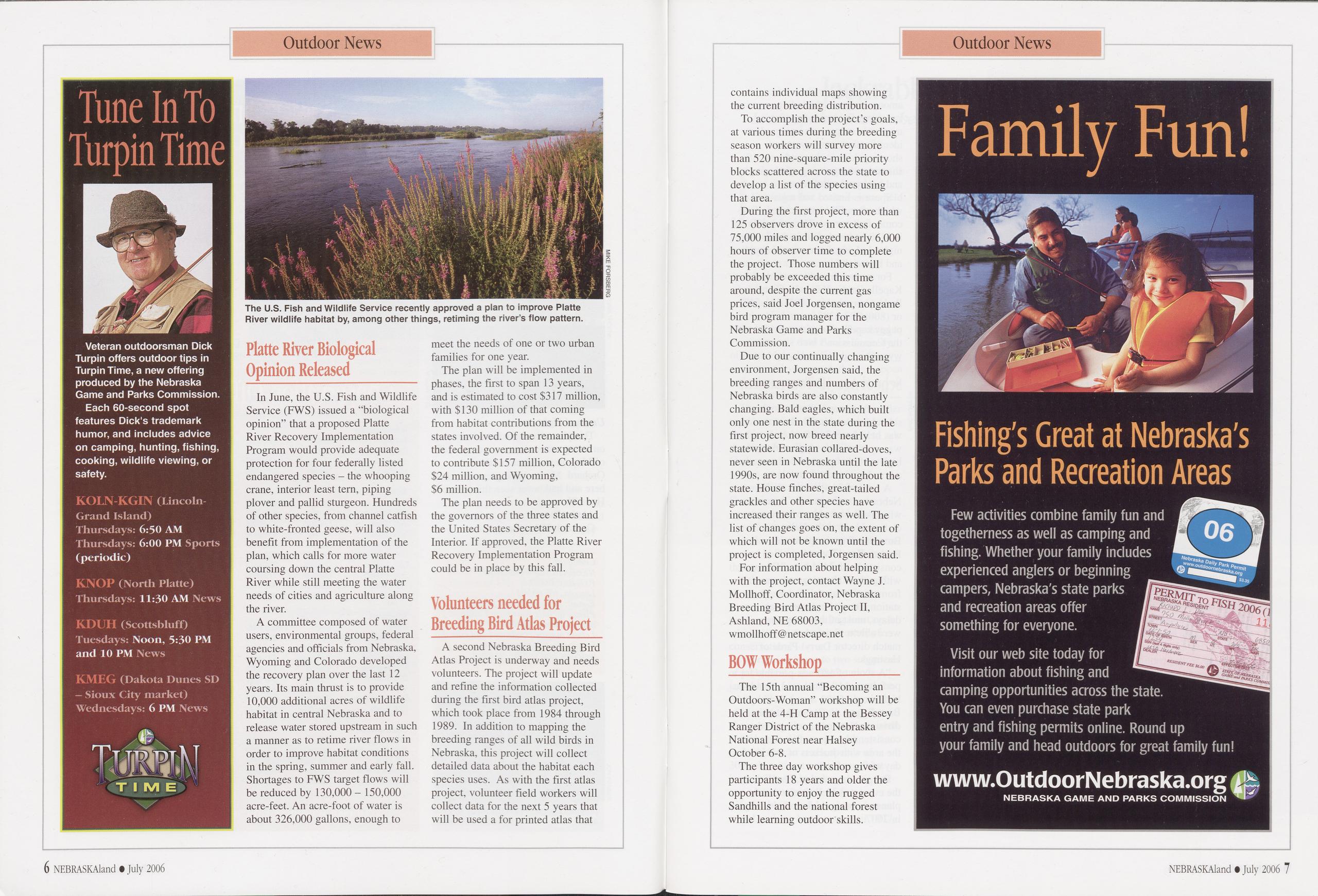
A committee composed of water users, environmental groups, federal agencies and officials from Nebraska, Wyoming and Colorado developed the recovery plan over the last 12 years. Its main thrust is to provide 10,000 additional acres of wildlife habitat in central Nebraska and to release water stored upstream in such a manner as to retime river flows in order to improve habitat conditions in the spring, summer and early fall. Shortages to FWS target flows will be reduced by 130,000 - 150,000 acre-feet. An acre-foot of water is about 326,000 gallons, enough to meet the needs of one or two urban families for one year.
The plan will be implemented in phases, the first to span 13 years, and is estimated to cost $317 million, with $130 million of that coming from habitat contributions from the states involved. Of the remainder, the federal government is expected to contribute $157 million, Colorado $24 million, and Wyoming, $6 million.
The plan needs to be approved by the governors of the three states and the United States Secretary of the Interior. If approved, the Platte River Recovery Implementation Program could be in place by this fall.
Volunteers needed for Breeding Bird Atlas ProjectA second Nebraska Breeding Bird Atlas Project is underway and needs volunteers. The project will update and refine the information collected during the first bird atlas project, which took place from 1984 through 1989. In addition to mapping the breeding ranges of all wild birds in Nebraska, this project will collect detailed data about the habitat each species uses. As with the first atlas project, volunteer field workers will collect data for the next 5 years that will be used a for printed atlas that contains individual maps showing the current breeding distribution.
To accomplish the project’s goals, at various times during the breeding season workers will survey more than 520 nine-square-mile priority blocks scattered across the state to develop a list of the species using that area.
During the first project, more than 125 observers drove in excess of 75,000 miles and logged nearly 6,000 hours of observer time to complete the project. Those numbers will probably be exceeded this time around, despite the current gas prices, said Joel Jorgensen, nongame bird program manager for the Nebraska Game and Parks Commission.
Due to our continually changing environment, Jorgensen said, the breeding ranges and numbers of Nebraska birds are also constantly changing. Bald eagles, which built only one nest in the state during the first project, now breed nearly statewide. Eurasian collared-doves, never seen in Nebraska until the late 1990s, are now found throughout the state. House finches, great-tailed grackles and other species have increased their ranges as well. The list of changes goes on, the extent of which will not be known until the project is completed, Jorgensen said.
For information about helping with the project, contact Wayne J. Mollhoff, Coordinator, Nebraska Breeding Bird Atlas Project II, Ashland, NE 68003, wmollhoff @ netscape.net
BOW WorkshopThe 15th annual “Becoming an Outdoors-Woman” workshop will be held at the 4-H Camp at the Bessey Ranger District of the Nebraska National Forest near Halsey October 6-8.
The three day workshop gives participants 18 years and older the opportunity to enjoy the rugged Sandhills and the national forest while learning outdoor skills.
Family Fun! Fishing's Great at Nebraska's Parks and Recreation Areas Few activities combine family fun and togetherness as well as camping and fishing. Whether your family includes experienced anglers or beginning campers, Nebraska s state parks and recreation areas offer something for everyone. Visit our web site today for information about fishing and camping opportunities across the state. You can even purchase state park entry and fishing permits online. Round up your family and head outdoors for great family fun! www.OutdoorNebraska.org NEBRASKA GAME AND PARKS COMMISSION 6 NEBRASKAIand • July 2006 NEBRASKAIand • July 2006 7 Outdoor News Officer's Notebook Boat Accident
It was a hot July day and I was working a boating detail on the Missouri River with fellow Nebraska conservation officers John Reeves, Bob Kelly and Tom Zimmer, as well as Iowa conservation officers Dave Tierney and Gary Cisco. It was about 4 p.m., and we had just stopped at the Cottonwood Marina near Blair for a break from the boat traffic and the blazing sun
As we sat around rehashing what had already happened that day, Officer Reeves received a call that a boat accident had just occurred near the Wilson Creek boat landing. All of us jumped up and ran back to our boats.
The ten-minute trip to the scene of the accident seemed like an eternity. When we arrived ,the boat had already been beached and we were briefed on what happened. A lady and her young child had been sitting on the bow of a cabin cruiser when they were knocked off. The young child was all right, but the boat had run over the mother.
Reeves went down to the boat and started helping get the woman onto a gurney while I went back and secured my boat to the dock before joining him. I will never forget the look in the woman’s eyes as she lay on the gurney. The propeller had run across her face and cut it severely, so she couldn’t talk, although she tried to on a few occasions as we loaded her into a waiting ambulance for transport to the incoming helicopter.
As we watched the ambulance drive away, we divided the workload and began inventorying the boat and collecting statements from the witnesses. As I logged the contents of the boat, it was painfully clear how much this woman had suffered - there was blood all over the inside and outside of the boat. After the inventory was complete, I drove the cabin cruiser to the landing so that we could load it onto a trailer and finish up our long day’s work. Once the boat was out of the water, we did a final walk around and found part of the woman’s bikini still wrapped in the propeller.
This accident happened several years ago, but I can see the pain and suffering in that woman’s eyes to this day. I’m telling you this story because I want you to understand that conservation officers want you to be safe when you’re enjoying the great outdoors and if we seem a little grumpy or mean when we see a safety violation, maybe you will think about the things we have had to deal with in the past and still remember to this day.
- Jeff Clauson, Conservation Officer, ValleyParticipants can choose from among 31 classes, including canoeing, kayaking, firearm safety, fishing, map and compass, camping, plant identification, cowboy action shooting, kids in the outdoors, rifle shooting, shotgunning, photography and backyard wildlife.
Space is limited and registration, which often fills up quickly, is first- come, first-served. The workshop fee is $180 and includes six meals, two nights lodging, instructional supplies and materials.
For more information, contact Peg Kapeller at the Nebraska Game and Parks Commission, (402) 471-5482 or (800) 577-8283, e-mail peggy.kapeller@ngpc.ne.gov, or visit the Commission’s web site at www.OutdoorNebraska.org.
School Age 3D TournamentThe first ever Nebraska high school bowhunter 3D championship was held Junel7 in Broken Bow and was open to junior high and senior high school students who have taken a bow hunter education class.
A total of 24 students, all from Nebraska, registered for the event, which was hosted by a local archery club and held at the Nebraska One Box shooting complex west of Broken Bow. The competition consisted of a 24-station 3D match, with archers shooting two arrows from an unknown distance at each station. Despite numerous rain delays, most of the competitors were able to finish their round, said match director Darryl Parde of Hastings.
“A score of 480 was possible for a perfect round,” Parde said, " and the high score of 402 was posted by Brett Eggers of Tilden in the senior division. Not bad shooting in the consistent downpour that drenched the area with buckets of rain on the day of the event.”
Despite the weather, Parde said the event was well received and plans are being made to hold it again in 2007.
Outdoor Business
Jackrabbit Season in Question
Low population numbers may lead to less hunting in eastern Nebraska.
Jackrabbits were once so plentiful and deemed such a pest in Nebraska that contests were held to see who could shoot the most. The take in these roundups, popular in the 1930s, sometimes numbered in the hundreds. In latter years, jackrabbits could be found “stacked like cordwood” where market hunters sold their kill.
“You used to be able to go and see a jackrabbit just about anywhere. Now I think you’d be hard-pressed to even see one,” said Bruce Kennedy, of rural Malcolm. “You live in the country and you watch things happen and when something is gone that you are used to seeing, you take note.”
The decline led Kennedy and other members of the Wachiska chapter of the National Audubon Society to ask the Nebraska Game and Parks Commission to suspend the hunting season on jackrabbits, at least in eastern Nebraska. When the Commission’s board of commissioners meets July 19 in Lincoln, it will consider a recommendation to close the season east of U.S. Highway 81, which runs through York and Norfolk.
“It’s not that we’re antihunting,” Kennedy said. “We’re not. It just seems inconsistent to have a hunting season and a bag limit on a species listed as being in need of conservation.”
Nebraska is home to two subspecies of jackrabbit - the black-tailed jackrabbit, found statewide, and the white-tailed, found primarily north of the Platte River. Both have the characteristic long ears and run with erratic gaits. When pursued, jackrabbits can reach speeds of 30 mph, taking two or three short leaps followed by a longer one that can cover more than 15 feet.
Jackrabbits could be hunted year- round with no bag limits until 1977,
An abundant population, fair prices and the perception that jacks were competing with livestock for forage drove market hunting of the species. But that alone did not lead to its demise, said Scott Taylor, head of research in the Commission’s wildlife division. “Once that super- abundance went away, market hunting did too. But we haven’t seen a rebound in numbers, so that would suggest something other than hunting itself was the underlying cause [of the decline].”
A more likely culprit is the conversion of prairies to cropland. But even that is unclear, considering that hare numbers have continued to decline in areas where there is abundant habitat. Statewide, rural mail carrier survey conducted each July since 1963 counted as many as seven hares per 1,000 miles driven back in 1968, compared to slightly more than one in 2005. For the past 10 years, the count was closer to one jackrabbit every 2,000 miles.
Bad weather and disease can cause declines in hare numbers, but the reproductive capabilities of the species - females have one to four litters of up to eight young per year - allow it to recover quickly.
The effect of sport hunting on the population is relatively low. Approximately 1,000 jackrabbits - an estimated 2 percent of the population - have been taken during recent hunting seasons, most by opportunistic hunters pursuing other game. By comparison, about 60 percent of male pheasants are harvested each fall.
Still, Taylor said, there is no clear line that dictates at what point a species’ population is large enough that hunting will not affect its viability. “It’s more of a social question,” he said. “When a species becomes noticeably uncommon, it becomes more socially unacceptable to hunt that species regardless of the biological effects.
“We don’t believe that hunting is a significant contributor at all to the scarcity of jackrabbits, but by the same token we can’t say that hunting has no effect whatsoever. So at least in this case, we’re erring on the side of caution.”
Whether or not the Commission adopts the recommendations, biologists have begun taking note of where they see jackrabbits in order to identify the type of habitat the species currently occupies. “That’s the first step in coming up with some habitat recommendations to benefit jackrabbits in those places,” Taylor said.
8 NEBRASKAland • July 2006 NEBRASKAland*July 2006 9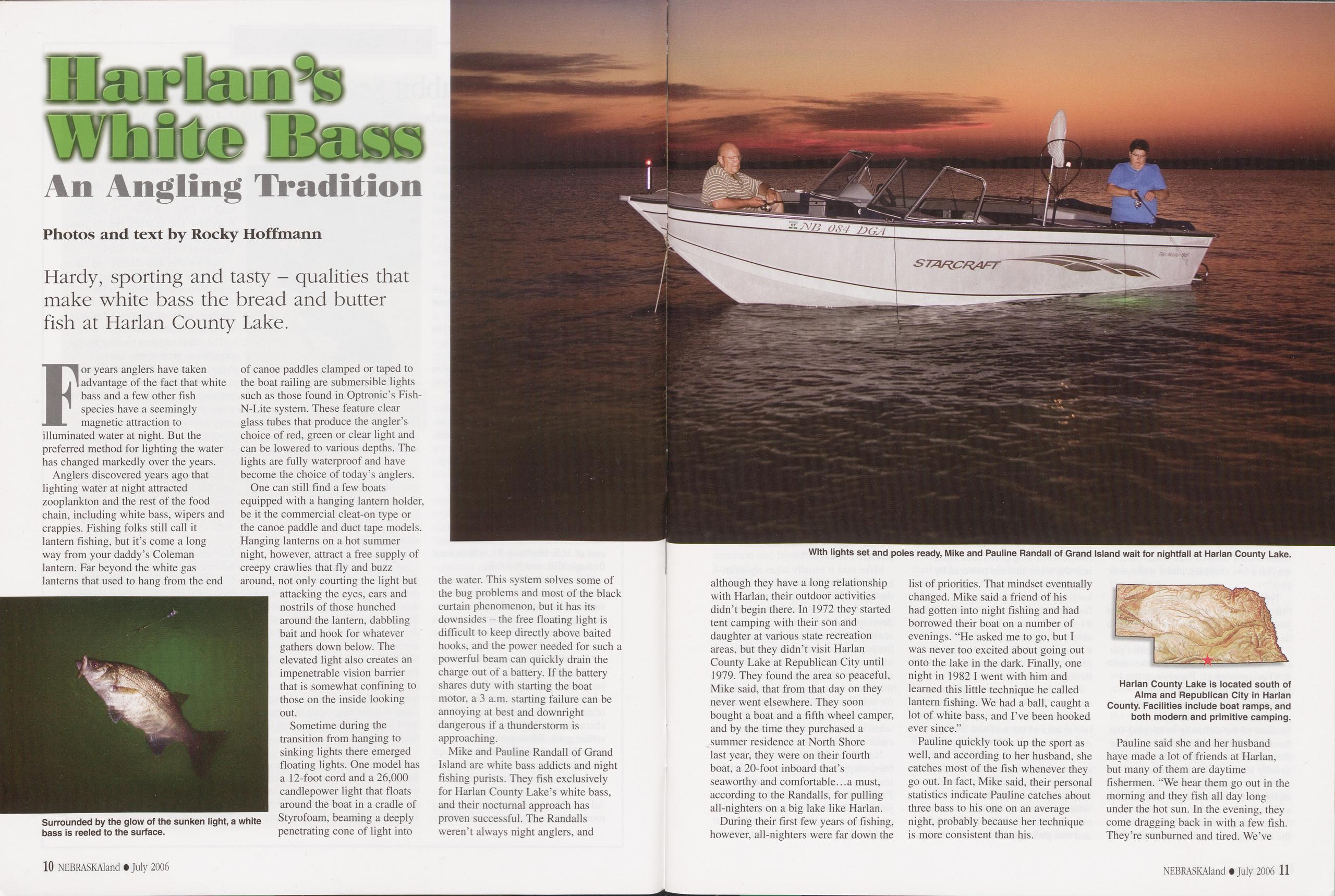
Harlan's White Bass An Angling Tradition
Hardy, sporting and tasty - qualities that make white bass the bread and butter fish at Harlan County Lake.
For years anglers have taken advantage of the fact that white bass and a few other fish species have a seemingly magnetic attraction to illuminated water at night. But the preferred method for lighting the water has changed markedly over the years.
Anglers discovered years ago that lighting water at night attracted zooplankton and the rest of the food chain, including white bass, wipers and crappies. Fishing folks still call it lantern fishing, but it’s come a long way from your daddy’s Coleman lantern. Far beyond the white gas lanterns that used to hang from the end
One can still find a few boats equipped with a hanging lantern holder, be it the commercial cleat-on type or the canoe paddle and duct tape models. Hanging lanterns on a hot summer night, however, attract a free supply of creepy crawlies that fly and buzz around, not only courting the light but attacking the eyes, ears and nostrils of those hunched around the lantern, dabbling bait and hook for whatever gathers down below. The elevated light also creates an impenetrable vision barrier that is somewhat confining to those on the inside looking out.
Sometime during the transition from hanging to sinking lights there emerged floating lights. One model has a 12-foot cord and a 26,000 candlepower light that floats around the boat in a cradle of Styrofoam, beaming a deeply penetrating cone of light into
Mike and Pauline Randall of Grand Island are white bass addicts and night fishing purists. They fish exclusively for Harlan County Lake’s white bass, and their nocturnal approach has proven successful. The Randalls weren’t always night anglers, and although they have a long relationship with Harlan, their outdoor activities didn’t begin there. In 1972 they started tent camping with their son and daughter at various state recreation areas, but they didn’t visit Harlan County Lake at Republican City until 1979. They found the area so peaceful, Mike said, that from that day on they never went elsewhere. They soon bought a boat and a fifth wheel camper, and by the time they purchased a summer residence at North Shore last year, they were on their fourth boat, a 20-foot inboard that’s seaworthy and comfortable.. .a must, according to the Randalls, for pulling all-nighters on a big lake like Harlan.
During their first few years of fishing, however, all-nighters were far down the list of priorities. That mindset eventually changed. Mike said a friend of his had gotten into night fishing and had borrowed their boat on a number of evenings. "He asked me to go, but I was never too excited about going out onto the lake in the dark. Finally, one night in 1982 I went with him and learned this little technique he called lantern fishing. We had a ball, caught a lot of white bass, and I’ve been hooked ever since.”
Pauline quickly took up the sport as well, and according to her husband, she catches most of the fish whenever they go out. In fact, Mike said, their personal statistics indicate Pauline catches about three bass to his one on an average night, probably because her technique is more consistent than his.
Pauline said she and her husband have made a lot of friends at Harlan, but many of them are daytime fishermen. "We hear them go out in the morning and they fish all day long under the hot sun. In the evening, they come dragging back in with a few fish. They’re sunburned and tired. We’ve 10 NEBRASKAland • July 2006 NEBRASKAland • July 2006 11 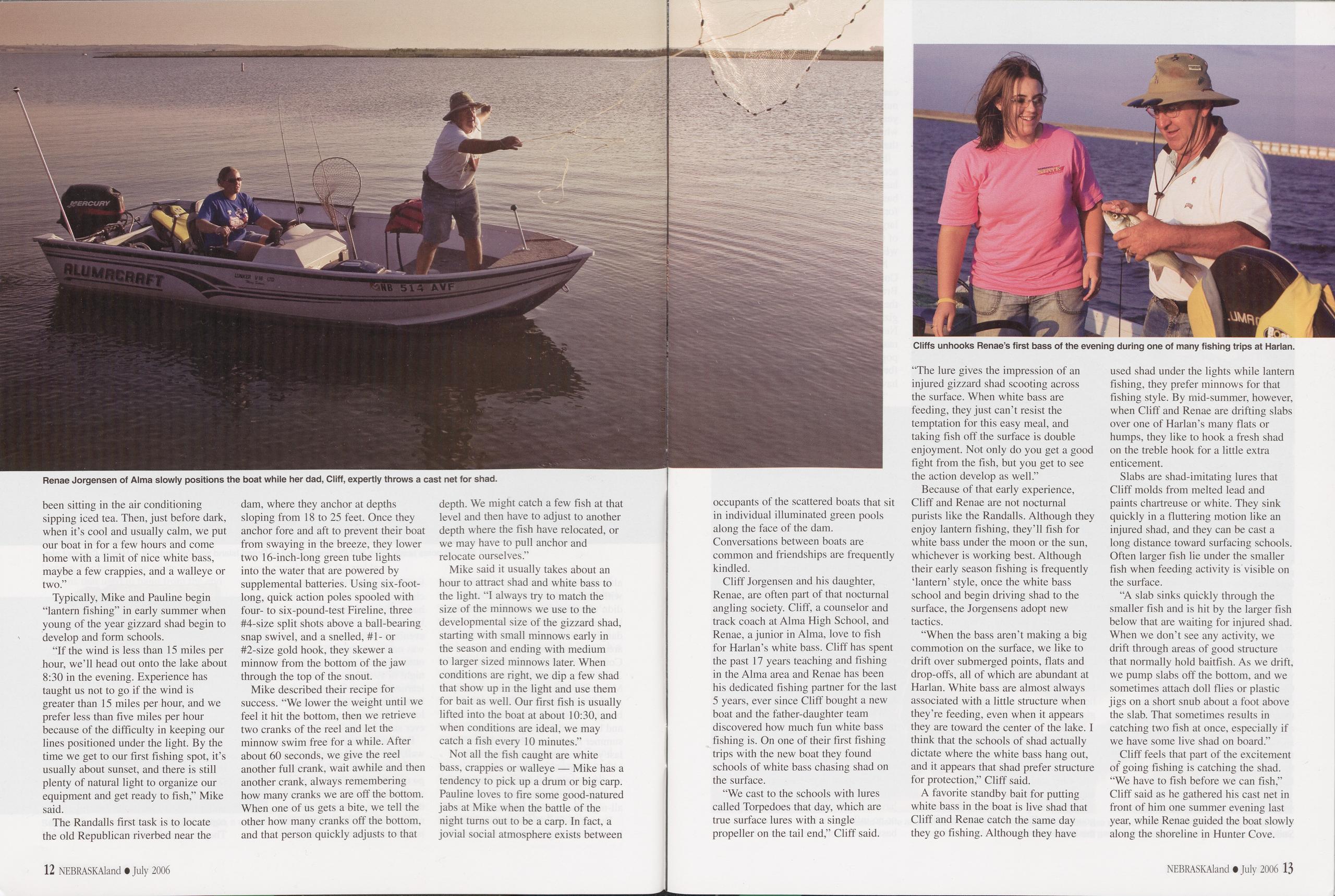
Typically, Mike and Pauline begin “lantern fishing” in early summer when young of the year gizzard shad begin to develop and form schools.
"If the wind is less than 15 miles per hour, we’ll head out onto the lake about 8:30 in the evening. Experience has taught us not to go if the wind is greater than 15 miles per hour, and we prefer less than five miles per hour because of the difficulty in keeping our lines positioned under the light. By the time we get to our first fishing spot, it’s usually about sunset, and there is still plenty of natural light to organize our equipment and get ready to fish,” Mike said.
The Randalls first task is to locate the old Republican riverbed near the dam, where they anchor at depths sloping from 18 to 25 feet. Once they anchor fore and aft to prevent their boat from swaying in the breeze, they lower two 16-inch-long green tube lights into the water that are powered by supplemental batteries. Using six-foot- long, quick action poles spooled with four- to six-pound-test Fireline, three #4-size split shots above a ball-bearing snap swivel, and a snelled, #1- or #2-size gold hook, they skewer a minnow from the bottom of the jaw through the top of the snout.
Mike described their recipe for success. "We lower the weight until we feel it hit the bottom, then we retrieve two cranks of the reel and let the minnow swim free for a while. After about 60 seconds, we give the reel another full crank, wait awhile and then another crank, always remembering how many cranks we are off the bottom. When one of us gets a bite, we tell the other how many cranks off the bottom, and that person quickly adjusts to that depth. We might catch a few fish at that level and then have to adjust to another depth where the fish have relocated, or we may have to pull anchor and relocate ourselves.”
Mike said it usually takes about an hour to attract shad and white bass to the light. "I always try to match the size of the minnows we use to the developmental size of the gizzard shad, starting with small minnows early in the season and ending with medium to larger sized minnows later. When conditions are right, we dip a few shad that show up in the light and use them for bait as well. Our first fish is usually lifted into the boat at about 10:30, and when conditions are ideal, we may catch a fish every 10 minutes.”
Not all the fish caught are white bass, crappies or walleye — Mike has a tendency to pick up a drum or big carp. Pauline loves to fire some good-natured jabs at Mike when the battle of the night turns out to be a carp. In fact, a jovial social atmosphere exists between occupants of the scattered boats that sit in individual illuminated green pools along the face of the dam. Conversations between boats are common and friendships are frequently kindled.
Cliff Jorgensen and his daughter, Renae, are often part of that nocturnal angling society. Cliff, a counselor and track coach at Alma High School, and Renae, a junior in Alma, love to fish for Harlan’s white bass. Cliff has spent the past 17 years teaching and fishing in the Alma area and Renae has been his dedicated fishing partner for the last 5 years, ever since Cliff bought a new boat and the father-daughter team discovered how much fun white bass fishing is. On one of their first fishing trips with the new boat they found schools of white bass chasing shad on the surface.
"We cast to the schools with lures called Torpedoes that day, which are true surface lures with a single propeller on the tail end,” Cliff said.
Because of that early experience, Cliff and Renae are not nocturnal purists like the Randalls. Although they enjoy lantern fishing, they’ll fish for white bass under the moon or the sun, whichever is working best. Although their early season fishing is frequently ‘lantern’ style, once the white bass school and begin driving shad to the surface, the Jorgensens adopt new tactics.
"When the bass aren’t making a big commotion on the surface, we like to drift over submerged points, flats and drop-offs, all of which are abundant at Harlan. White bass are almost always associated with a little structure when they’re feeding, even when it appears they are toward the center of the lake. I think that the schools of shad actually dictate where the white bass hang out, and it appears that shad prefer structure for protection,” Cliff said.
A favorite standby bait for putting white bass in the boat is live shad that Cliff and Renae catch the same day they go fishing. Although they have used shad under the lights while lantern fishing, they prefer minnows for that fishing style. By mid-summer, however, when Cliff and Renae are drifting slabs over one of Harlan’s many flats or humps, they like to hook a fresh shad on the treble hook for a little extra enticement.
Slabs are shad-imitating lures that Cliff molds from melted lead and paints chartreuse or white. They sink quickly in a fluttering motion like an injured shad, and they can be cast a long distance toward surfacing schools. Often larger fish lie under the smaller fish when feeding activity is visible on the surface.
"A slab sinks quickly through the smaller fish and is hit by the larger fish below that are waiting for injured shad. When we don’t see any activity, we drift through areas of good structure that normally hold baitfish. As we drift, we pump slabs off the bottom, and we sometimes attach doll flies or plastic jigs on a short snub about a foot above the slab. That sometimes results in catching two fish at once, especially if we have some live shad on board.”
Cliff feels that part of the excitement of going fishing is catching the shad. "We have to fish before we can fish,” Cliff said as he gathered his cast net in front of him one summer evening last year, while Renae guided the boat slowly along the shoreline in Hunter Cove.
12 NEBRASKAland • July 2006 NEBRASKAland • July 2006 13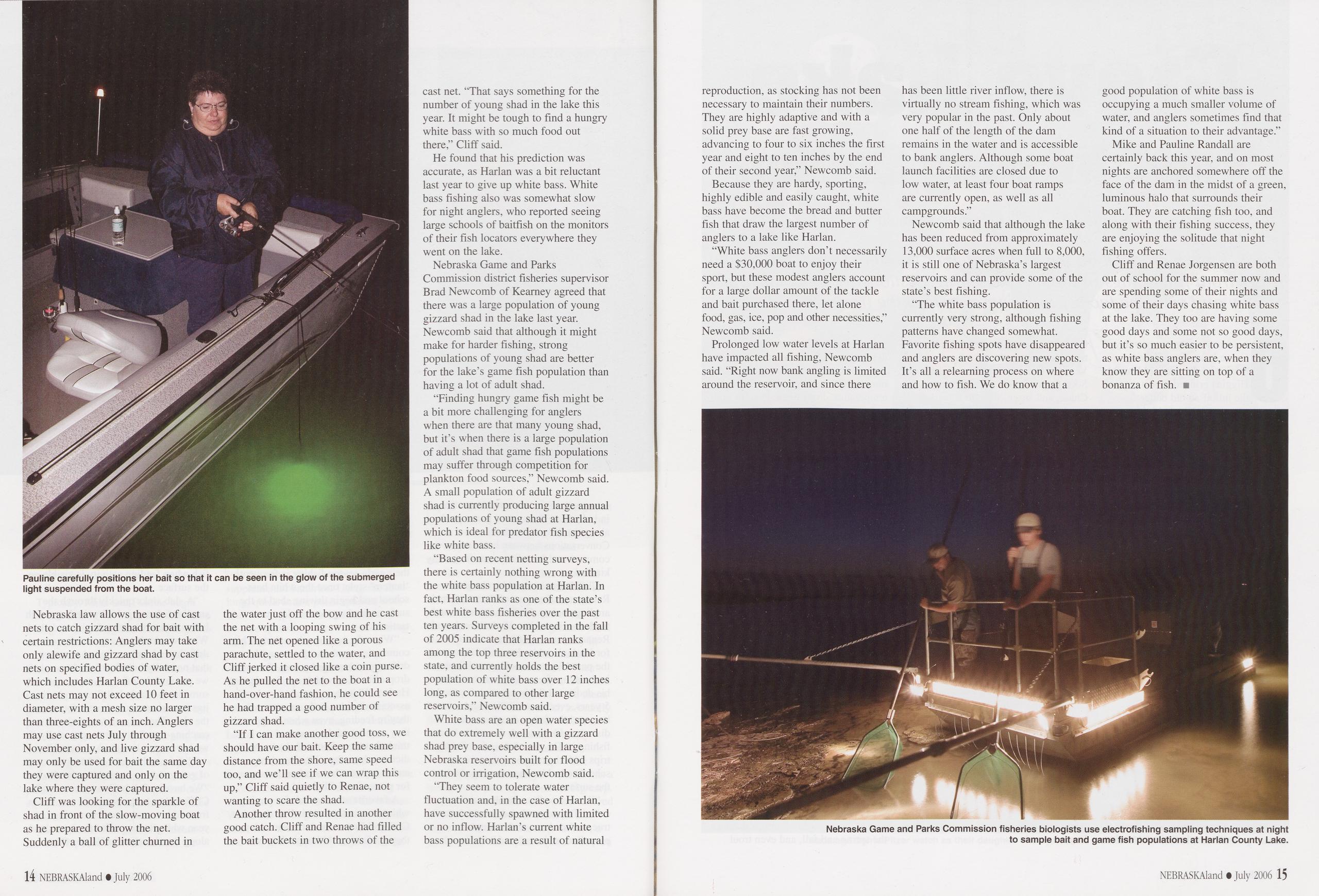
Nebraska law allows the use of cast nets to catch gizzard shad for bait with certain restrictions: Anglers may take only alewife and gizzard shad by cast nets on specified bodies of water, which includes Harlan County Lake. Cast nets may not exceed 10 feet in diameter, with a mesh size no larger than three-eights of an inch. Anglers may use cast nets July through November only, and live gizzard shad may only be used for bait the same day they were captured and only on the lake where they were captured.
Cliff was looking for the sparkle of shad in front of the slow-moving boat as he prepared to throw the net. Suddenly a ball of glitter churned in the water just off the bow and he cast the net with a looping swing of his arm. The net opened like a porous parachute, settled to the water, and Cliff jerked it closed like a coin purse. As he pulled the net to the boat in a hand-over-hand fashion, he could see he had trapped a good number of gizzard shad.
"If I can make another good toss, we should have our bait. Keep the same distance from the shore, same speed too, and we’ll see if we can wrap this up,” Cliff said quietly to Renae, not wanting to scare the shad.
Another throw resulted in another good catch. Cliff and Renae had filled the bait buckets in two throws of the cast net. “That says something for the number of young shad in the lake this year. It might be tough to find a hungry white bass with so much food out there,” Cliff said.
He found that his prediction was accurate, as Harlan was a bit reluctant last year to give up white bass. White bass fishing also was somewhat slow for night anglers, who reported seeing large schools of baitfish on the monitors of their fish locators everywhere they went on the lake.
Nebraska Game and Parks Commission district fisheries supervisor Brad Newcomb of Kearney agreed that there was a large population of young gizzard shad in the lake last year. Newcomb said that although it might make for harder fishing, strong populations of young shad are better for the lake’s game fish population than having a lot of adult shad.
"Finding hungry game fish might be a bit more challenging for anglers when there are that many young shad, but it’s when there is a large population of adult shad that game fish populations may suffer through competition for plankton food sources,” Newcomb said. A small population of adult gizzard shad is currently producing large annual populations of young shad at Harlan, which is ideal for predator fish species like white bass.
"Based on recent netting surveys, there is certainly nothing wrong with the white bass population at Harlan. In fact, Harlan ranks as one of the state’s best white bass fisheries over the past ten years. Surveys completed in the fall of 2005 indicate that Harlan ranks among the top three reservoirs in the state, and currently holds the best population of white bass over 12 inches long, as compared to other large reservoirs,” Newcomb said.
White bass are an open water species that do extremely well with a gizzard shad prey base, especially in large Nebraska reservoirs built for flood control or irrigation, Newcomb said.
"They seem to tolerate water fluctuation and, in the case of Harlan, have successfully spawned with limited or no inflow. Harlan’s current white bass populations are a result of natural reproduction, as stocking has not been necessary to maintain their numbers. They are highly adaptive and with a solid prey base are fast growing, advancing to four to six inches the first year and eight to ten inches by the end of their second year,” Newcomb said.
Because they are hardy, sporting, highly edible and easily caught, white bass have become the bread and butter fish that draw the largest number of anglers to a lake like Harlan.
"White bass anglers don’t necessarily need a $30,000 boat to enjoy their sport, but these modest anglers account for a large dollar amount of the tackle and bait purchased there, let alone food, gas, ice, pop and other necessities,” Newcomb said.
Prolonged low water levels at Harlan have impacted all fishing, Newcomb said. "Right now bank angling is limited around the reservoir, and since there
Newcomb said that although the lake has been reduced from approximately 13,000 surface acres when full to 8,000, it is still one of Nebraska’s largest reservoirs and can provide some of the state’s best fishing.
"The white bass population is currently very strong, although fishing patterns have changed somewhat. Favorite fishing spots have disappeared and anglers are discovering new spots. It’s all a relearning process on where and how to fish. We do know that a good population of white bass is occupying a much smaller volume of water, and anglers sometimes find that kind of a situation to their advantage.”
Mike and Pauline Randall are certainly back this year, and on most nights are anchored somewhere off the face of the dam in the midst of a green, luminous halo that surrounds their boat. They are catching fish too, and along with their fishing success, they are enjoying the solitude that night fishing offers.
Cliff and Renae Jorgensen are both out of school for the summer now and are spending some of their nights and some of their days chasing white bass at the lake. They too are having some good days and some not so good days, but it’s so much easier to be persistent, as white bass anglers are, when they know they are sitting on top of a bonanza of fish.
14 NEBRASKAland • July 2006 NEBRASKAland • July 2006 15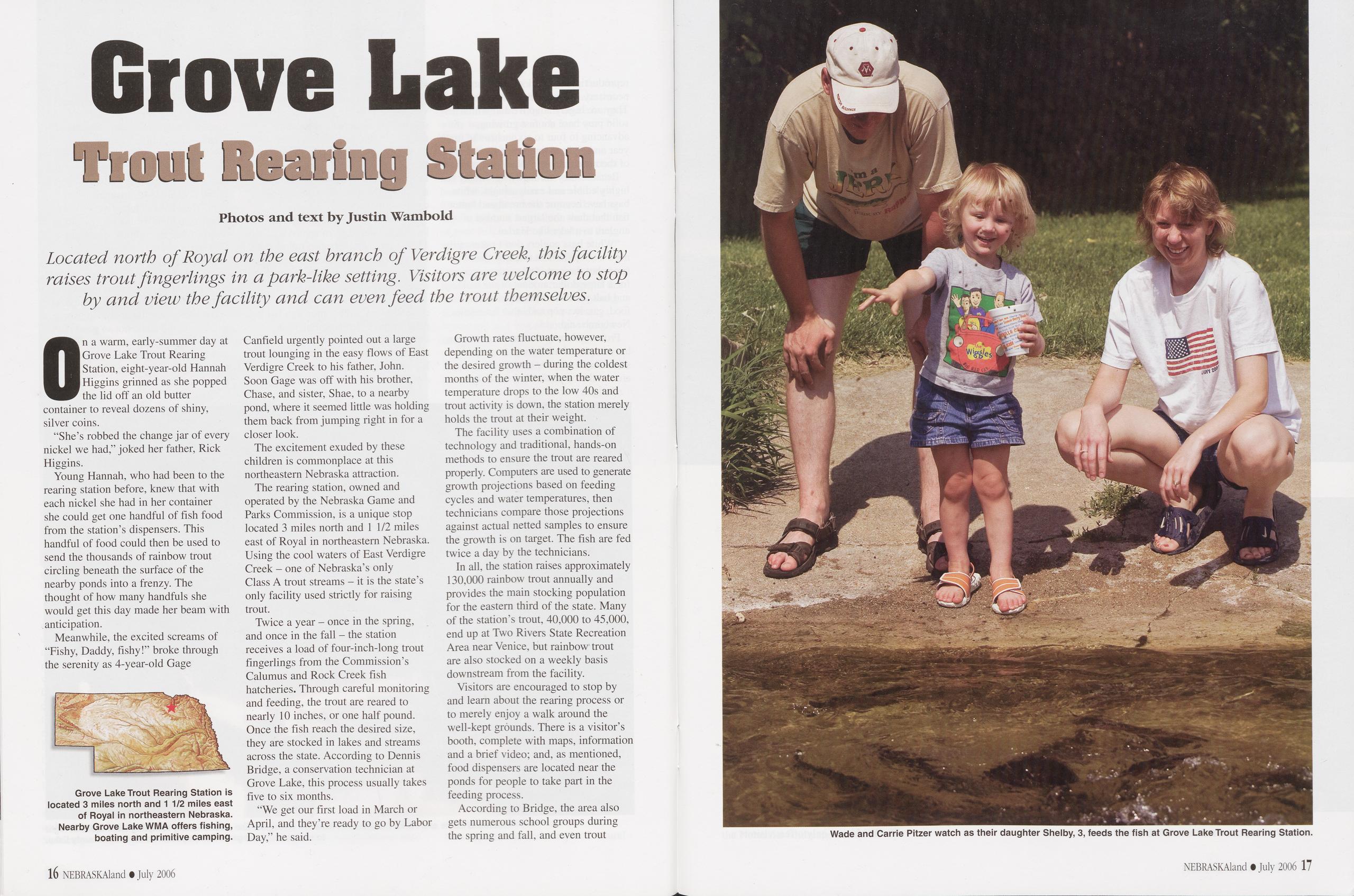
Grove Lake Trout Rearing Station
Located north of Royal on the east branch of Verdigre Creek, this facility raises trout fingerlings in a park-like setting. Visitors are welcome to stop by and view the facility and can even feed the trout themselves.
On a warm, early-summer day at Grove Lake Trout Rearing Station, eight-year-old Hannah Higgins grinned as she popped the lid off an old butter container to reveal dozens of shiny, silver coins.
“She’s robbed the change jar of every nickel we had,” joked her father, Rick Higgins.
Young Hannah, who had been to the rearing station before, knew that with each nickel she had in her container she could get one handful of fish food from the station’s dispensers. This handful of food could then be used to send the thousands of rainbow trout circling beneath the surface of the nearby ponds into a frenzy. The thought of how many handfuls she would get this day made her beam with anticipation.
Meanwhile, the excited screams of “Fishy, Daddy, fishy!” broke through the serenity as 4-year-old Gage
The excitement exuded by these children is commonplace at this northeastern Nebraska attraction.
The rearing station, owned and operated by the Nebraska Game and Parks Commission, is a unique stop located 3 miles north and 11/2 miles east of Royal in northeastern Nebraska. Using the cool waters of East Verdigre Creek - one of Nebraska’s only Class A trout streams - it is the state’s only facility used strictly for raising trout.
Twice a year - once in the spring, and once in the fall - the station receives a load of four-inch-long trout fingerlings from the Commission’s Calumus and Rock Creek fish hatcheries. Through careful monitoring and feeding, the trout are reared to nearly 10 inches, or one half pound. Once the fish reach the desired size, they are stocked in lakes and streams across the state. According to Dennis Bridge, a conservation technician at Grove Lake, this process usually takes five to six months.
“We get our first load in March or April, and they’re ready to go by Labor Day,” he said.
Growth rates fluctuate, however, depending on the water temperature or the desired growth - during the coldest months of the winter, when the water temperature drops to the low 40s and trout activity is down, the station merely holds the trout at their weight.
The facility uses a combination of technology and traditional, hands-on methods to ensure the trout are reared properly. Computers are used to generate growth projections based on feeding cycles and water temperatures, then technicians compare those projections against actual netted samples to ensure the growth is on target. The fish are fed twice a day by the technicians.
In all, the station raises approximately 130,000 rainbow trout annually and provides the main stocking population for the eastern third of the state. Many of the station’s trout, 40,000 to 45,000, end up at Two Rivers State Recreation Area near Venice, but rainbow trout are also stocked on a weekly basis downstream from the facility.
Visitors are encouraged to stop by and learn about the rearing process or to merely enjoy a walk around the well-kept grounds. There is a visitor’s booth, complete with maps, information and a brief video; and, as mentioned, food dispensers are located near the ponds for people to take part in the feeding process.
According to Bridge, the area also gets numerous school groups during the spring and fall, and even trout
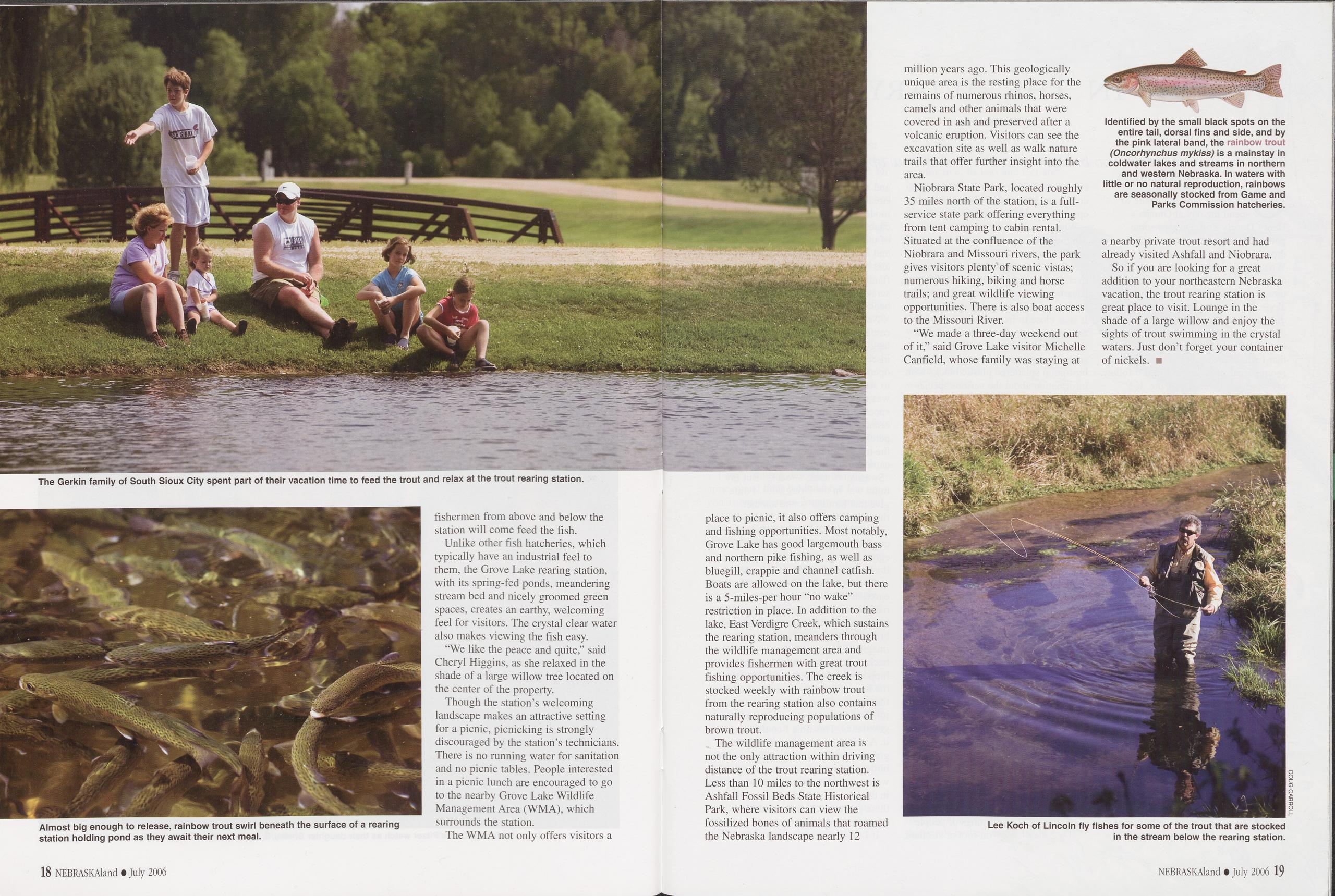
Unlike other fish hatcheries, which typically have an industrial feel to them, the Grove Lake rearing station, with its spring-fed ponds, meandering stream bed and nicely groomed green spaces, creates an earthy, welcoming feel for visitors. The crystal clear water also makes viewing the fish easy.
“We like the peace and quite,” said Cheryl Higgins, as she relaxed in the shade of a large willow tree located on the center of the property.
Though the station’s welcoming landscape makes an attractive setting for a picnic, picnicking is strongly discouraged by the station’s technicians. There is no running water for sanitation and no picnic tables. People interested in a picnic lunch are encouraged to go to the nearby Grove Lake Wildlife Management Area (WMA), which surrounds the station.
The WMA not only offers visitors a place to picnic, it also offers camping and fishing opportunities. Most notably, Grove Lake has good largemouth bass and northern pike fishing, as well as bluegill, crappie and channel catfish. Boats are allowed on the lake, but there is a 5-miles-per hour "no wake” restriction in place. In addition to the lake, East Verdigre Creek, which sustains the rearing station, meanders through the wildlife management area and provides fishermen with great trout fishing opportunities. The creek is stocked weekly with rainbow trout from the rearing station also contains naturally reproducing populations of brown trout.
The wildlife management area is not the only attraction within driving distance of the trout rearing station. Less than 10 miles to the northwest is Ashfall Fossil Beds State Historical Park, where visitors can view the fossilized bones of animals that roamed the Nebraska landscape nearly 12 million years ago. This geologically unique area is the resting place for the remains of numerous rhinos, horses, camels and other animals that were covered in ash and preserved after a volcanic eruption. Visitors can see the excavation site as well as walk nature trails that offer further insight into the area.
Niobrara State Park, located roughly 35 miles north of the station, is a full- service state park offering everything from tent camping to cabin rental. Situated at the confluence of the Niobrara and Missouri rivers, the park gives visitors plenty of scenic vistas; numerous hiking, biking and horse trails; and great wildlife viewing opportunities. There is also boat access to the Missouri River.
"We made a three-day weekend out of it,” said Grove Lake visitor Michelle Canfield, whose family was staying at
So if you are looking for a great addition to your northeastern Nebraska vacation, the trout rearing station is great place to visit. Lounge in the shade of a large willow and enjoy the sights of trout swimming in the crystal waters. Just don’t forget your container of nickels.
18 NEBRASKAland • July 2006 NEBRASKAland • July 2006 19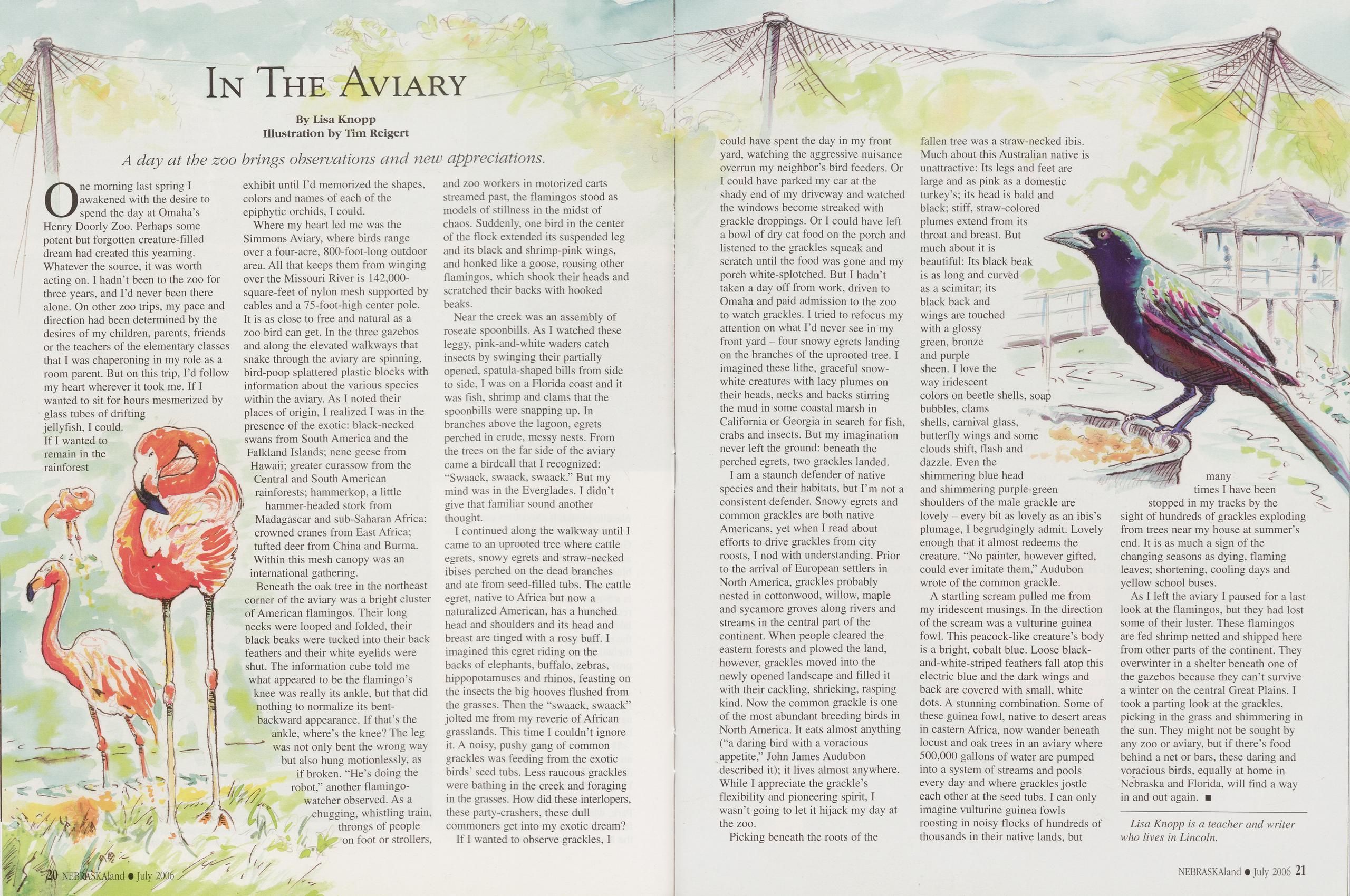
In The Aviary
A day at the zoo brings observations and new appreciations.
One morning last spring I awakened with the desire to spend the day at Omaha’s Henry Doorly Zoo. Perhaps some potent but forgotten creature-filled dream had created this yearning. Whatever the source, it was worth acting on. I hadn’t been to the zoo for three years, and I’d never been there alone. On other zoo trips, my pace and direction had been determined by the desires of my children, parents, friends or the teachers of the elementary classes that I was chaperoning in my role as a room parent. But on this trip, I’d follow my heart wherever it took me. If I wanted to sit for hours mesmerized by glass tubes of drifting jellyfish, I could. If I wanted to remain in the rainforest
Where my heart led me was the Simmons Aviary, where birds range over a four-acre, 800-foot-long outdoor area. All that keeps them from winging over the Missouri River is 142,000- square-feet of nylon mesh supported by cables and a 75-foot-high center pole. It is as close to free and natural as a zoo bird can get. In the three gazebos and along the elevated walkways that snake through the aviary are spinning, bird-poop splattered plastic blocks with information about the various species within the aviary. As I noted their places of origin, I realized I was in the presence of the exotic: black-necked swans from South America and the Falkland Islands; nene geese from Hawaii; greater curassow from the Central and South American rainforests; hammerkop, a little hammer-headed stork from Madagascar and sub-Saharan Africa; crowned cranes from East Africa; tufted deer from China and Burma. Within this mesh canopy was an international gathering.
Beneath the oak tree in the northeast corner of the aviary was a bright cluster of American flamingos. Their long necks were looped and folded, their black beaks were tucked into their back feathers and their white eyelids were shut. The information cube told me what appeared to be the flamingo’s knee was really its ankle, but that did nothing to normalize its bent- backward appearance. If that’s the ankle, where’s the knee? The leg was not only bent the wrong way but also hung motionlessly, as if broken. “He’s doing the robot,” another flamingo- watcher observed. As a chugging, whistling train, throngs of people on foot or strollers, and zoo workers in motorized carts streamed past, the flamingos stood as models of stillness in the midst of chaos. Suddenly, one bird in the center of the flock extended its suspended leg and its black and shrimp-pink wings, and honked like a goose, rousing other flamingos, which shook their heads and scratched their backs with hooked beaks.
Near the creek was an assembly of roseate spoonbills. As I watched these leggy, pink-and-white waders catch insects by swinging their partially opened, spatula-shaped bills from side to side, I was on a Florida coast and it was fish, shrimp and clams that the spoonbills were snapping up. In branches above the lagoon, egrets perched in crude, messy nests. From the trees on the far side of the aviary came a birdcall that I recognized: “Swaack, swaack, swaack.” But my mind was in the Everglades. I didn’t give that familiar sound another thought.
I continued along the walkway until I came to an uprooted tree where cattle egrets, snowy egrets and straw-necked ibises perched on the dead branches and ate from seed-filled tubs. The cattle egret, native to Africa but now a naturalized American, has a hunched head and shoulders and its head and breast are tinged with a rosy buff. I imagined this egret riding on the backs of elephants, buffalo, zebras, hippopotamuses and rhinos, feasting on the insects the big hooves flushed from the grasses. Then the “swaack, swaack” jolted me from my reverie of African grasslands. This time I couldn’t ignore it. A noisy, pushy gang of common grackles was feeding from the exotic birds’ seed tubs. Less raucous grackles were bathing in the creek and foraging in the grasses. How did these interlopers, these party-crashers, these dull commoners get into my exotic dream?
If I wanted to observe grackles, I could have spent the day in my front yard, watching the aggressive nuisance overrun my neighbor’s bird feeders. Or I could have parked my car at the shady end of my driveway and watched the windows become streaked with grackle droppings. Or I could have left a bowl of dry cat food on the porch and listened to the grackles squeak and scratch until the food was gone and my porch white-splotched. But I hadn’t taken a day off from work, driven to Omaha and paid admission to the zoo to watch grackles. I tried to refocus my attention on what I’d never see in my front yard - four snowy egrets landing on the branches of the uprooted tree. I imagined these lithe, graceful snow- white creatures with lacy plumes on their heads, necks and backs stirring the mud in some coastal marsh in California or Georgia in search for fish, crabs and insects. But my imagination never left the ground: beneath the perched egrets, two grackles landed.
I am a staunch defender of native species and their habitats, but I’m not a consistent defender. Snowy egrets and common grackles are both native Americans, yet when I read about efforts to drive grackles from city roosts, I nod with understanding. Prior to the arrival of European settlers in North America, grackles probably nested in cottonwood, willow, maple and sycamore groves along rivers and streams in the central part of the continent. When people cleared the eastern forests and plowed the land, however, grackles moved into the newly opened landscape and filled it with their cackling, shrieking, rasping kind. Now the common grackle is one of the most abundant breeding birds in North America. It eats almost anything (“a daring bird with a voracious appetite,” John James Audubon described it); it lives almost anywhere. While I appreciate the grackle's flexibility and pioneering spirit, I wasn’t going to let it hijack my day at the zoo.
Picking beneath the roots of the fallen tree was a straw-necked ibis. Much about this Australian native is unattractive: Its legs and feet are large and as pink as a domestic turkey’s; its head is bald and black; stiff, straw-colored plumes extend from its throat and breast. But much about it is beautiful: Its black beak is as long and curved as a scimitar; its black back and wings are touched with a glossy green, bronze and purple sheen. 1 love the way iridescent colors on beetle shells, soap bubbles, clams shells, carnival glass, butterfly wings and some clouds shift, flash and dazzle. Even the shimmering blue head and shimmering purple-green shoulders of the male grackle are lovely - every bit as lovely as an ibis’s plumage, I begrudgingly admit. Lovely enough that it almost redeems the creature. “No painter, however gifted, could ever imitate them,” Audubon wrote of the common grackle.
A startling scream pulled me from my iridescent musings. In the direction of the scream was a vulturine guinea fowl. This peacock-like creature’s body is a bright, cobalt blue. Loose black- and-white-striped feathers fall atop this electric blue and the dark wings and back are covered with small, white dots. A stunning combination. Some of these guinea fowl, native to desert areas in eastern Africa, now wander beneath locust and oak trees in an aviary where 500,000 gallons of water are pumped into a system of streams and pools every day and where grackles jostle each other at the seed tubs. I can only imagine vulturine guinea fowls roosting in noisy flocks of hundreds of thousands in their native lands, but
As I left the aviary I paused for a last look at the flamingos, but they had lost some of their luster. These flamingos are fed shrimp netted and shipped here from other parts of the continent. They overwinter in a shelter beneath one of the gazebos because they can’t survive a winter on the central Great Plains. I took a parting look at the grackles, picking in the grass and shimmering in the sun. They might not be sought by any zoo or aviary, but if there’s food behind a net or bars, these daring and voracious birds, equally at home in Nebraska and Florida, will find a way in and out again.
Lisa Knopp is a teacher and writer who lives in Lincoln. NEBRASKAland • July 2006 21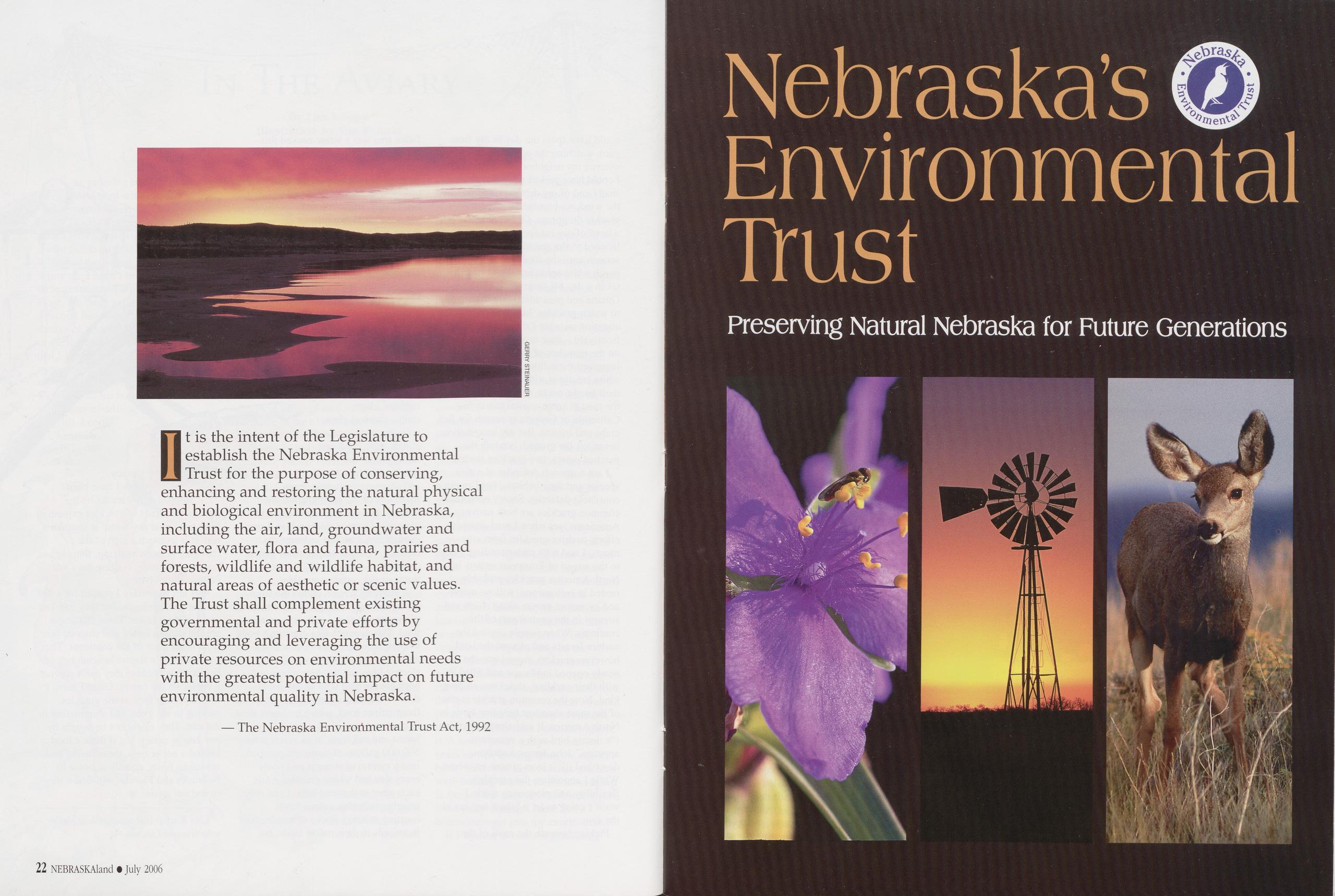
Nebraska’s Environmental Trust
Preserving Natural Nebraska for Future Generations
It is the intent of the Legislature to establish the Nebraska Environmental Trust for the purpose of conserving, enhancing and restoring the natural physical and biological environment in Nebraska, including the air, land, groundwater and surface water, flora and fauna, prairies and forests, wildlife and wildlife habitat, and natural areas of aesthetic or scenic values. The Trust shall complement existing governmental and private efforts by encouraging and leveraging the use of private resources on environmental needs with the greatest potential impact on future environmental quality in Nebraska.
— The Nebraska Environmental Trust Act, 1992 22 NEBRASKAland • July 2006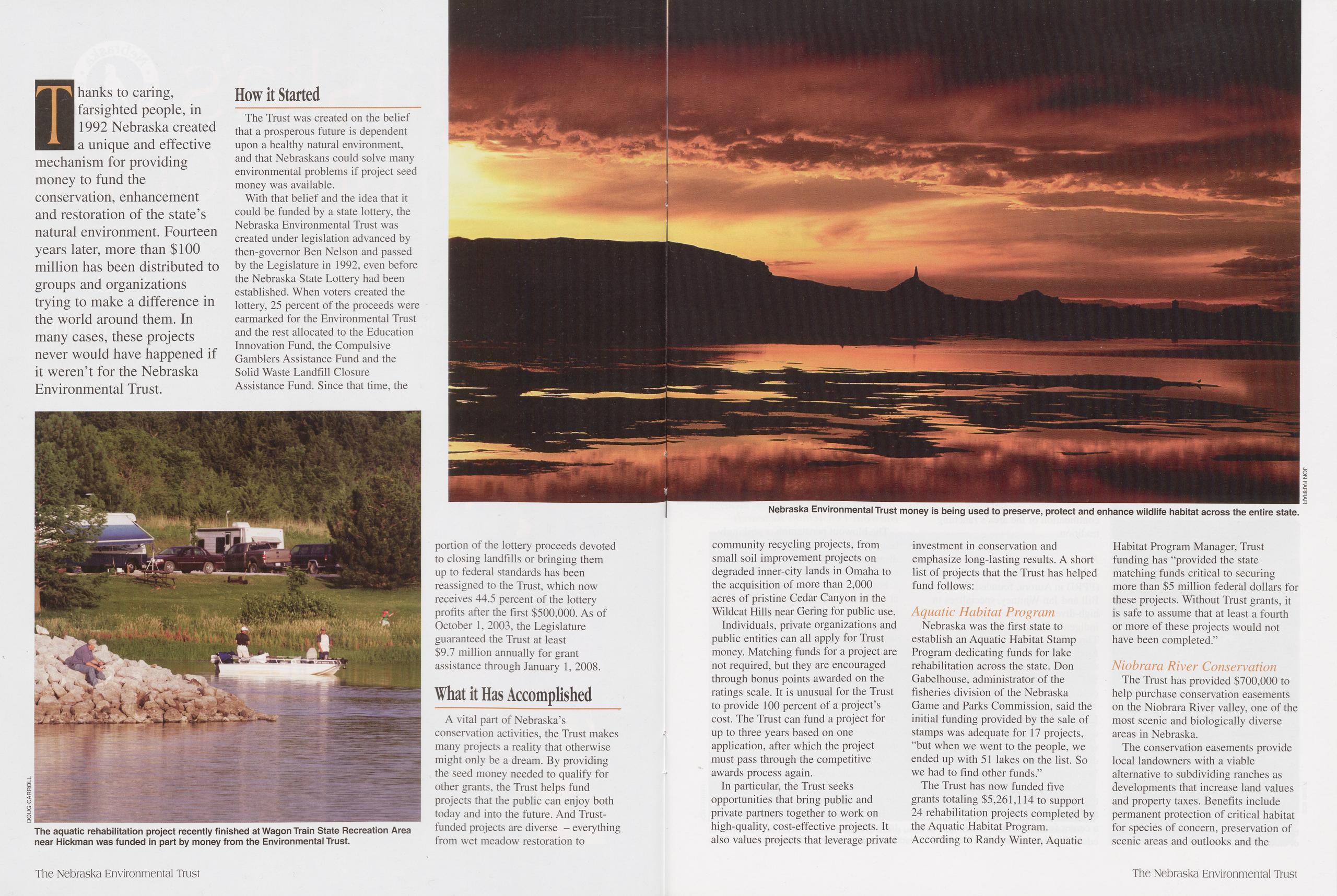
Thanks to caring, farsighted people, in 1992 Nebraska created a unique and effective mechanism for providing money to fund the conservation, enhancement and restoration of the state’s natural environment. Fourteen years later, more than $100 million has been distributed to groups and organizations trying to make a difference in the world around them. In many cases, these projects never would have happened if it weren’t for the Nebraska Environmental Trust.
The Trust was created on the belief that a prosperous future is dependent upon a healthy natural environment, and that Nebraskans could solve many environmental problems if project seed money was available.
With that belief and the idea that it could be funded by a state lottery, the Nebraska Environmental Trust was created under legislation advanced by then-governor Ben Nelson and passed by the Legislature in 1992, even before the Nebraska State Lottery had been established. When voters created the lottery, 25 percent of the proceeds were earmarked for the Environmental Trust and the rest allocated to the Education Innovation Fund, the Compulsive Gamblers Assistance Fund and the Solid Waste Landfill Closure Assistance Fund. Since that time, the
What it Has Accomplished
A vital part of Nebraska’s conservation activities, the Trust makes many projects a reality that otherwise might only be a dream. By providing the seed money needed to qualify for other grants, the Trust helps fund projects that the public can enjoy both today and into the future. And Trust- funded projects are diverse - everything from wet meadow restoration to community recycling projects, from small soil improvement projects on degraded inner-city lands in Omaha to the acquisition of more than 2,000 acres of pristine Cedar Canyon in the Wildcat Hills near Gering for public use.
Individuals, private organizations and public entities can all apply for Trust money. Matching funds for a project are not required, but they are encouraged through bonus points awarded on the ratings scale. It is unusual for the Trust to provide 100 percent of a project’s cost. The Trust can fund a project for up to three years based on one application, after which the project must pass through the competitive awards process again.
In particular, the Trust seeks opportunities that bring public and private partners together to work on high-quality, cost-effective projects. It also values projects that leverage private investment in conservation and emphasize long-lasting results. A short list of projects that the Trust has helped fund follows:
Aquatic Habitat ProgramNebraska was the first state to establish an Aquatic Habitat Stamp Program dedicating funds for lake rehabilitation across the state. Don Gabelhouse, administrator of the fisheries division of the Nebraska Game and Parks Commission, said the initial funding provided by the sale of stamps was adequate for 17 projects, "but when we went to the people, we ended up with 51 lakes on the list. So we had to find other funds.”
The Trust has now funded five grants totaling $5,261,114 to support 24 rehabilitation projects completed by the Aquatic Habitat Program. According to Randy Winter, Aquatic Habitat Program Manager, Trust funding has "provided the state matching funds critical to securing more than $5 million federal dollars for these projects. Without Trust grants, it is safe to assume that at least a fourth or more of these projects would not have been completed.”
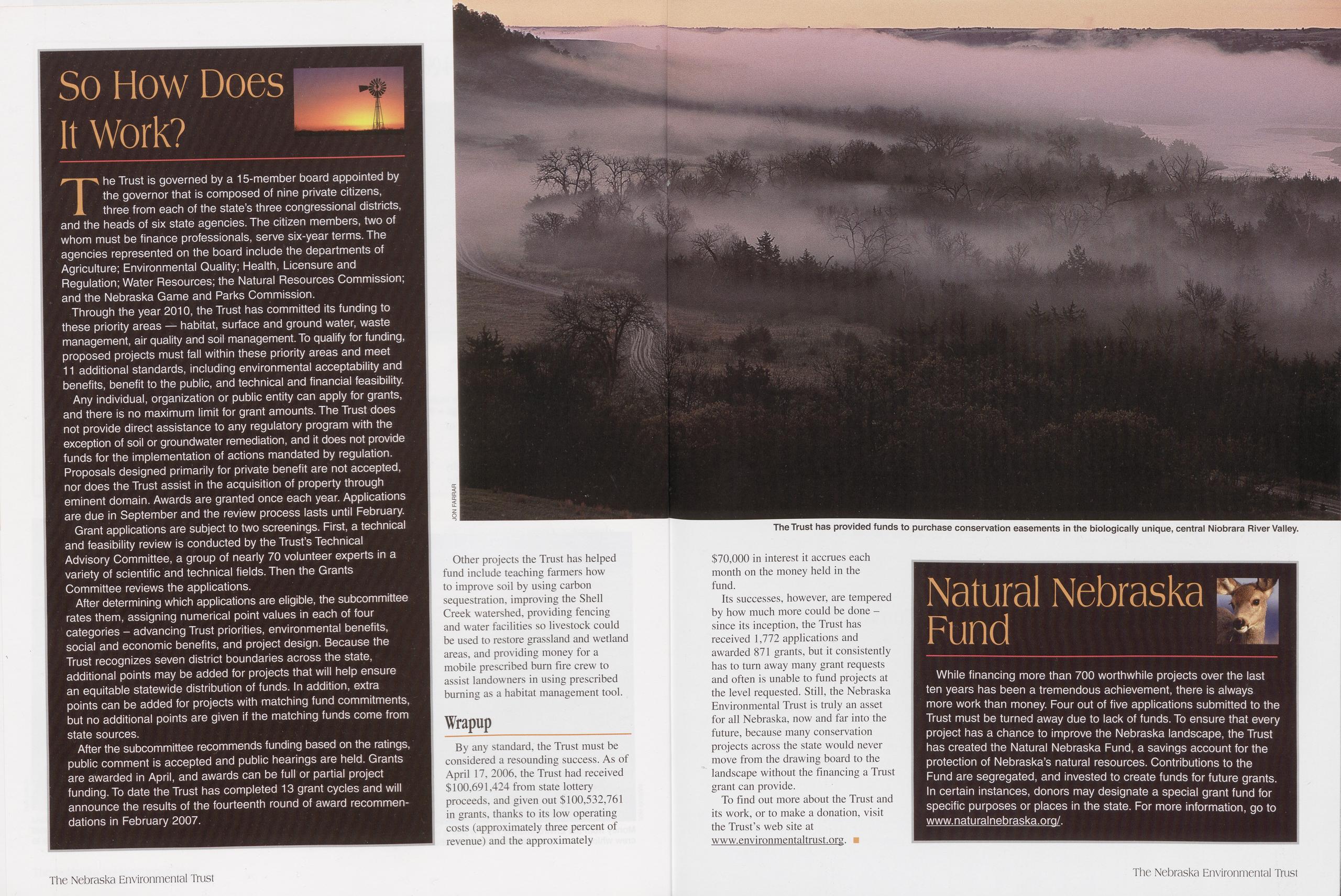
Niobrara River ConservationThe Trust has provided $700,000 to help purchase conservation easements on the Niobrara River valley, one of the most scenic and biologically diverse areas in Nebraska.
The conservation easements provide local landowners with a viable alternative to subdividing ranches as developments that increase land values and property taxes. Benefits include permanent protection of critical habitat for species of concern, preservation of scenic areas and outlooks and the The Nebraska Environmental Trust The Nebraska Environmental Trust 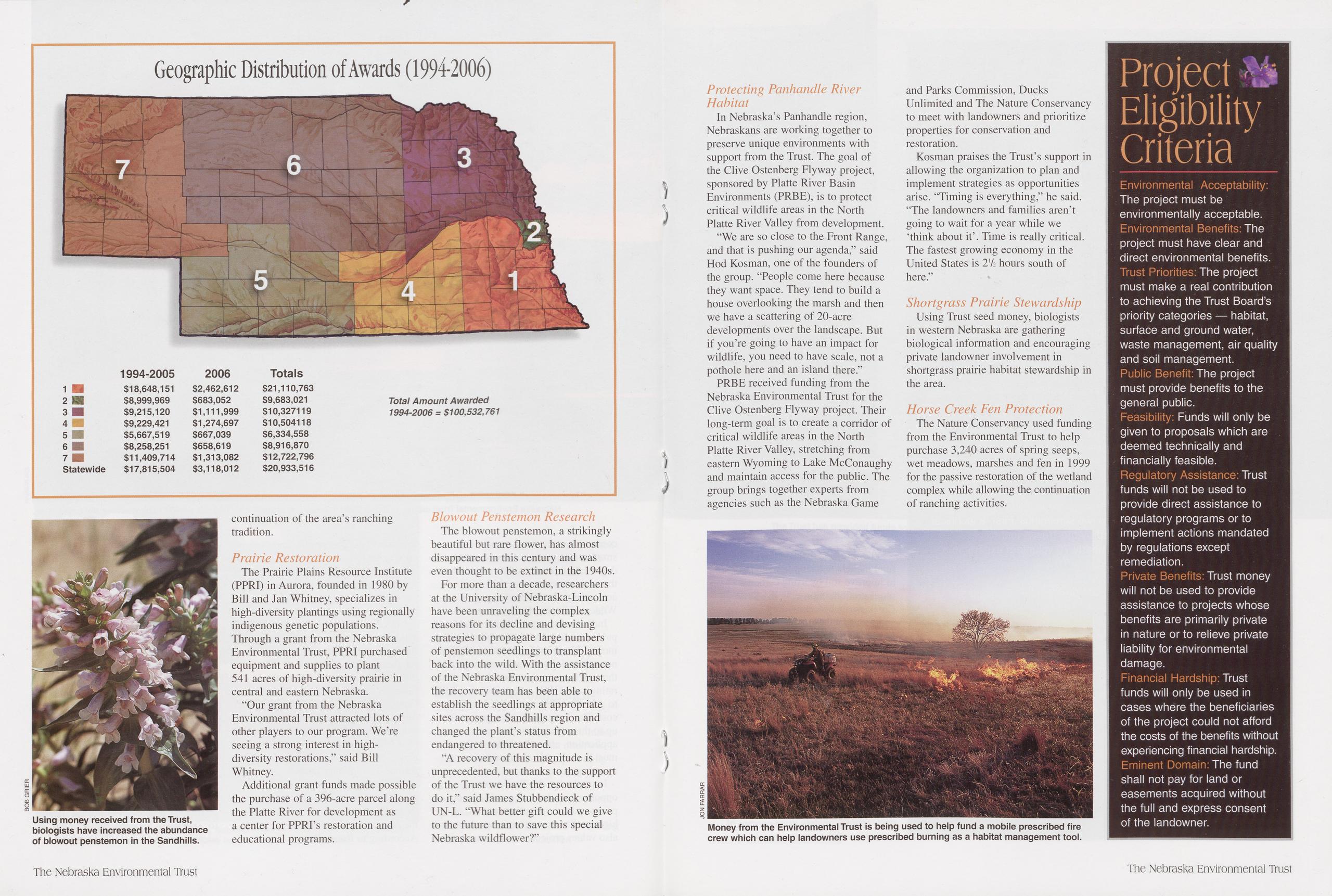
Prairie Restoration
The Prairie Plains Resource Institute (PPRI) in Aurora, founded in 1980 by Bill and Jan Whitney, specializes in high-diversity plantings using regionally indigenous genetic populations. Through a grant from the Nebraska Environmental Trust, PPRI purchased equipment and supplies to plant 541 acres of high-diversity prairie in central and eastern Nebraska.
"Our grant from the Nebraska Environmental Trust attracted lots of other players to our program. We’re seeing a strong interest in high- diversity restorations,” said Bill Whitney.
Additional grant funds made possible the purchase of a 396-acre parcel along the Platte River for development as a center for PPRI’s restoration and educational programs.
Blowout Penstemon ResearchThe blowout penstemon, a strikingly beautiful but rare flower, has almost disappeared in this century and was even thought to be extinct in the 1940s.
For more than a decade, researchers at the University of Nebraska-Lincoln have been unraveling the complex reasons for its decline and devising strategies to propagate large numbers of penstemon seedlings to transplant back into the wild. With the assistance of the Nebraska Environmental Trust, the recovery team has been able to establish the seedlings at appropriate sites across the Sandhills region and changed the plant’s status from endangered to threatened.
"A recovery of this magnitude is unprecedented, but thanks to the support of the Trust we have the resources to do it,” said James Stubbendieck of UN-L. "What better gift could we give to the future than to save this special Nebraska wildflower?”
Protecting Panhandle River HabitatIn Nebraska’s Panhandle region, Nebraskans are working together to preserve unique environments with support from the Trust. The goal of the Clive Ostenberg Flyway project, sponsored by Platte River Basin Environments (PRBE), is to protect critical wildlife areas in the North Platte River Valley from development.
"We are so close to the Front Range, and that is pushing our agenda,” said Hod Rosman, one of the founders of the group. "People come here because they want space. They tend to build a house overlooking the marsh and then we have a scattering of 20-acre developments over the landscape. But if you’re going to have an impact for wildlife, you need to have scale, not a pothole here and an island there.”
PRBE received funding from the Nebraska Environmental Trust for the Clive Ostenberg Flyway project. Their long-term goal is to create a corridor of critical wildlife areas in the North Platte River Valley, stretching from eastern Wyoming to Lake McConaughy and maintain access for the public. The group brings together experts from agencies such as the Nebraska Game and Parks Commission, Ducks Unlimited and The Nature Conservancy to meet with landowners and prioritize properties for conservation and restoration.
Kosman praises the Trust’s support in allowing the organization to plan and implement strategies as opportunities arise. "Timing is everything,” he said. "The landowners and families aren’t going to wait for a year while we ‘think about it’. Time is really critical. The fastest growing economy in the United States is 272 hours south of here.”
Shortgrass Prairie StewardshipUsing Trust seed money, biologists in western Nebraska are gathering biological information and encouraging private landowner involvement in shortgrass prairie habitat stewardship in the area.
Horse Creek Fen ProtectionThe Nature Conservancy used funding from the Environmental Trust to help purchase 3,240 acres of spring seeps, wet meadows, marshes and fen in 1999 for the passive restoration of the wetland complex while allowing the continuation of ranching activities.
 So How Does it work? _
The Trust is governed by a 15-member board appointed by the governor that is composed of nine private citizens, three from each of the state’s three congressional districts, and the heads of six state agencies. The citizen members, two of whom must be finance professionals, serve six-year terms. The agencies represented on the board include the departments of Agriculture; Environmental Quality; Health, Licensure and Regulation; Water Resources; the Natural Resources Commission; and the Nebraska Game and Parks Commission.
Through the year 2010, the Trust has committed its funding to these priority areas — habitat, surface and ground water, waste management, air quality and soil management. To qualify for funding, proposed projects must fall within these priority areas and meet 11 additional standards, including environmental acceptability and benefits, benefit to the public, and technical and financial feasibility.
Any individual, organization or public entity can apply for grants, and there is no maximum limit for grant amounts. The Trust does not provide direct assistance to any regulatory program with the exception of soil or groundwater remediation, and it does not provide funds for the implementation of actions mandated by regulation. Proposals designed primarily for private benefit are not accepted, nor does the Trust assist in the acquisition of property through eminent domain. Awards are granted once each year. Applications are due in September and the review process lasts until February.
Grant applications are subject to two screenings. First, a technical and feasibility review is conducted by the Trust’s Technical Advisory Committee, a group of nearly 70 volunteer experts in a variety of scientific and technical fields. Then the Grants Committee reviews the applications.
After determining which applications are eligible, the subcommittee rates them, assigning numerical point values in each of four categories - advancing Trust priorities, environmental benefits, social and economic benefits, and project design. Because the Trust recognizes seven district boundaries across the state, additional points may be added for projects that will help ensure an equitable statewide distribution of funds. In addition, extra points can be added for projects with matching fund commitments, but no additional points are given if the matching funds come from state sources.
After the subcommittee recommends funding based on the ratings, public comment is accepted and public hearings are held. Grants are awarded in April, and awards can be full or partial project funding. To date the Trust has completed 13 grant cycles and will announce the results of the fourteenth round of award recommen- dations in February 2007.
Other projects the Trust has helped fund include teaching farmers how to improve soil by using carbon sequestration, improving the Shell Creek watershed, providing fencing and water facilities so livestock could be used to restore grassland and wetland areas, and providing money for a mobile prescribed burn fire crew to assist landowners in using prescribed burning as a habitat management tool.
WrapupBy any standard, the Trust must be considered a resounding success. As of April 17, 2006, the Trust had received $100,691,424 from state lottery proceeds, and given out $100,532,761 in grants, thanks to its low operating costs (approximately three percent of revenue) and the approximately $70,000 in interest it accrues each month on the money held in the fund.
Its successes, however, are tempered by how much more could be done - since its inception, the Trust has received 1,772 applications and awarded 871 grants, but it consistently has to turn away many grant requests and often is unable to fund projects at the level requested. Still, the Nebraska Environmental Trust is truly an asset for all Nebraska, now and far into the future, because many conservation projects across the state would never move from the drawing board to the landscape without the financing a Trust grant can provide.
To find out more about the Trust and its work, or to make a donation, visit the Trust’s web site at www.environmentaltrust.org.
Natural Nebraska FundWhile financing more than 700 worthwhile projects over the last ten years has been a tremendous achievement, there is always more work than money. Four out of five applications submitted to the Trust must be turned away due to lack of funds. To ensure that every project has a chance to improve the Nebraska landscape, the Trust has created the Natural Nebraska Fund, a savings account for the protection of Nebraska’s natural resources. Contributions to the Fund are segregated, and invested to create funds for future grants. In certain instances, donors may designate a special grant fund for I specific purposes or places in the state. For more information, go to I www.naturalnebraska.org/.
The Nebraska Environmental Trust The Nebraska Environmental Trust
"The land ethic simply enlarges the boundaries of the community to include soils, waters, plants, and animals, or collectively: the land."
Aldo Leopold A Sand County Almanac, 1949
The Niobrara Valley Preserve
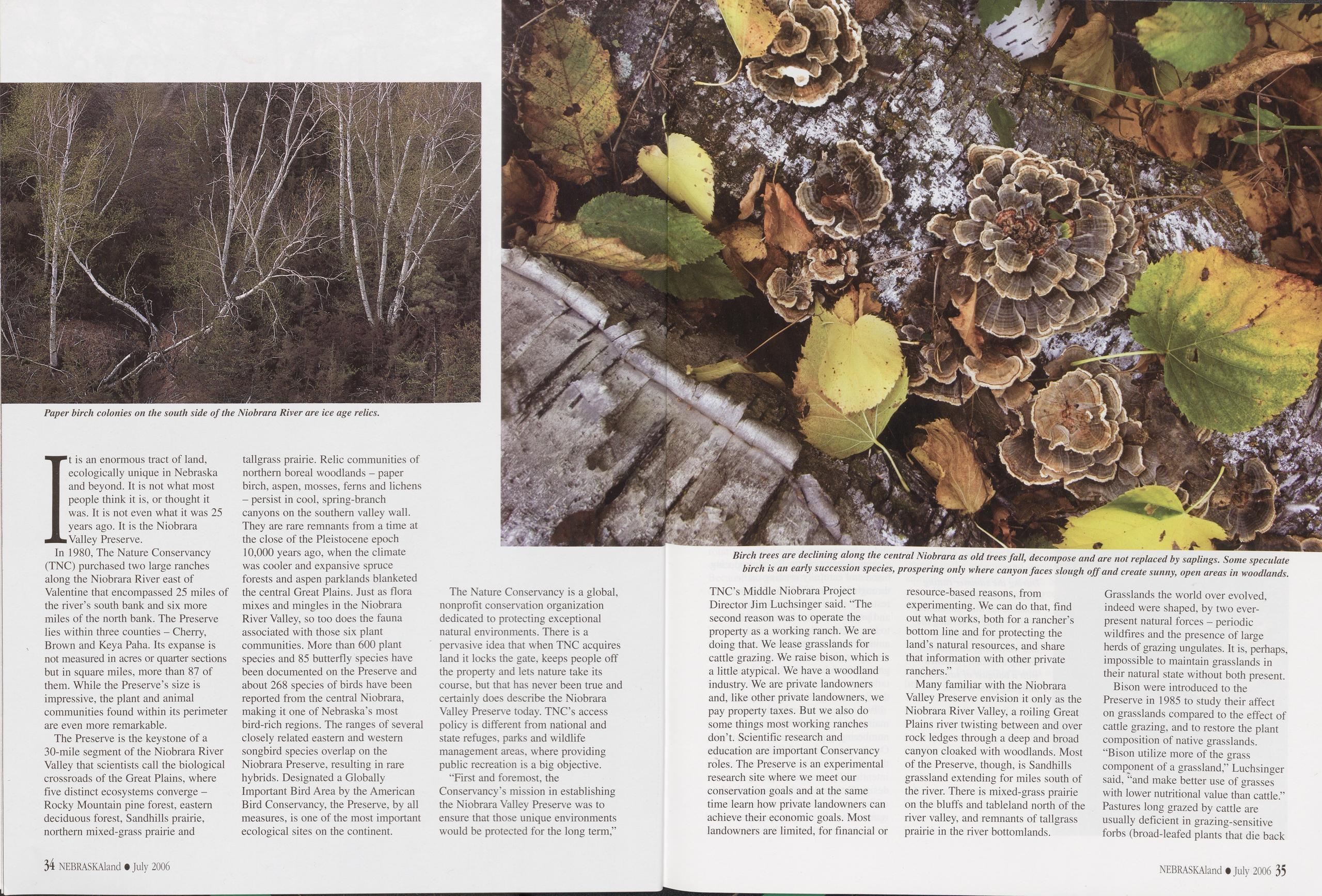
It is an enormous tract of land, ecologically unique in Nebraska and beyond. It is not what most people think it is, or thought it was. It is not even what it was 25 years ago. It is the Niobrara Valley Preserve.
In 1980, The Nature Conservancy (TNC) purchased two large ranches along the Niobrara River east of Valentine that encompassed 25 miles of the river’s south bank and six more miles of the north bank. The Preserve lies within three counties - Cherry, Brown and Keya Paha. Its expanse is not measured in acres or quarter sections but in square miles, more than 87 of them. While the Preserve’s size is impressive, the plant and animal communities found within its perimeter are even more remarkable.
The Preserve is the keystone of a 30-mile segment of the Niobrara River Valley that scientists call the biological crossroads of the Great Plains, where five distinct ecosystems converge - Rocky Mountain pine forest, eastern deciduous forest, Sandhills prairie, northern mixed-grass prairie and tailgrass prairie. Relic communities of northern boreal woodlands - paper birch, aspen, mosses, ferns and lichens - persist in cool, spring-branch canyons on the southern valley wall. They are rare remnants from a time at the close of the Pleistocene epoch 10,000 years ago, when the climate was cooler and expansive spruce forests and aspen parklands blanketed the central Great Plains. Just as flora mixes and mingles in the Niobrara River Valley, so too does the fauna associated with those six plant communities. More than 600 plant species and 85 butterfly species have been documented on the Preserve and about 268 species of birds have been reported from the central Niobrara, making it one of Nebraska’s most bird-rich regions. The ranges of several closely related eastern and western songbird species overlap on the Niobrara Preserve, resulting in rare hybrids. Designated a Globally Important Bird Area by the American Bird Conservancy, the Preserve, by all measures, is one of the most important ecological sites on the continent.
The Nature Conservancy is a global, nonprofit conservation organization dedicated to protecting exceptional natural environments. There is a pervasive idea that when TNC acquires land it locks the gate, keeps people off the property and lets nature take its course, but that has never been true and certainly does describe the Niobrara Valley Preserve today. TNC’s access policy is different from national and state refuges, parks and wildlife management areas, where providing public recreation is a big objective.
“First and foremost, the Conservancy’s mission in establishing the Niobrara Valley Preserve was to ensure that those unique environments would be protected for the long term,” TNC’s Middle Niobrara Project Director Jim Luchsinger said. “The second reason was to operate the property as a working ranch. We are doing that. We lease grasslands for cattle grazing. We raise bison, which is a little atypical. We have a woodland industry. We are private landowners and, like other private landowners, we pay property taxes. But we also do some things most working ranches don’t. Scientific research and education are important Conservancy roles. The Preserve is an experimental research site where we meet our conservation goals and at the same time learn how private landowners can achieve their economic goals. Most landowners are limited, for financial or resource-based reasons, from experimenting. We can do that, find out what works, both for a rancher’s bottom line and for protecting the land’s natural resources, and share that information with other private ranchers.”
Many familiar with the Niobrara Valley Preserve envision it only as the Niobrara River Valley, a roiling Great Plains river twisting between and over rock ledges through a deep and broad canyon cloaked with woodlands. Most of the Preserve, though, is Sandhills grassland extending for miles south of the river. There is mixed-grass prairie on the bluffs and tableland north of the river valley, and remnants of tallgrass prairie in the river bottomlands. Grasslands the world over evolved, indeed were shaped, by two ever- present natural forces - periodic wildfires and the presence of large herds of grazing ungulates. It is, perhaps, impossible to maintain grasslands in their natural state without both present.
Bison were introduced to the Preserve in 1985 to study their affect on grasslands compared to the effect of cattle grazing, and to restore the plant composition of native grasslands. “Bison utilize more of the grass component of a grassland,” Luchsinger said, “and make better use of grasses with lower nutritional value than cattle.” Pastures long grazed by cattle are usually deficient in grazing-sensitive forbs (broad-leafed plants that die back 34 NEBRASKAland • July 2006 NEBRASKAland • July 2006 35 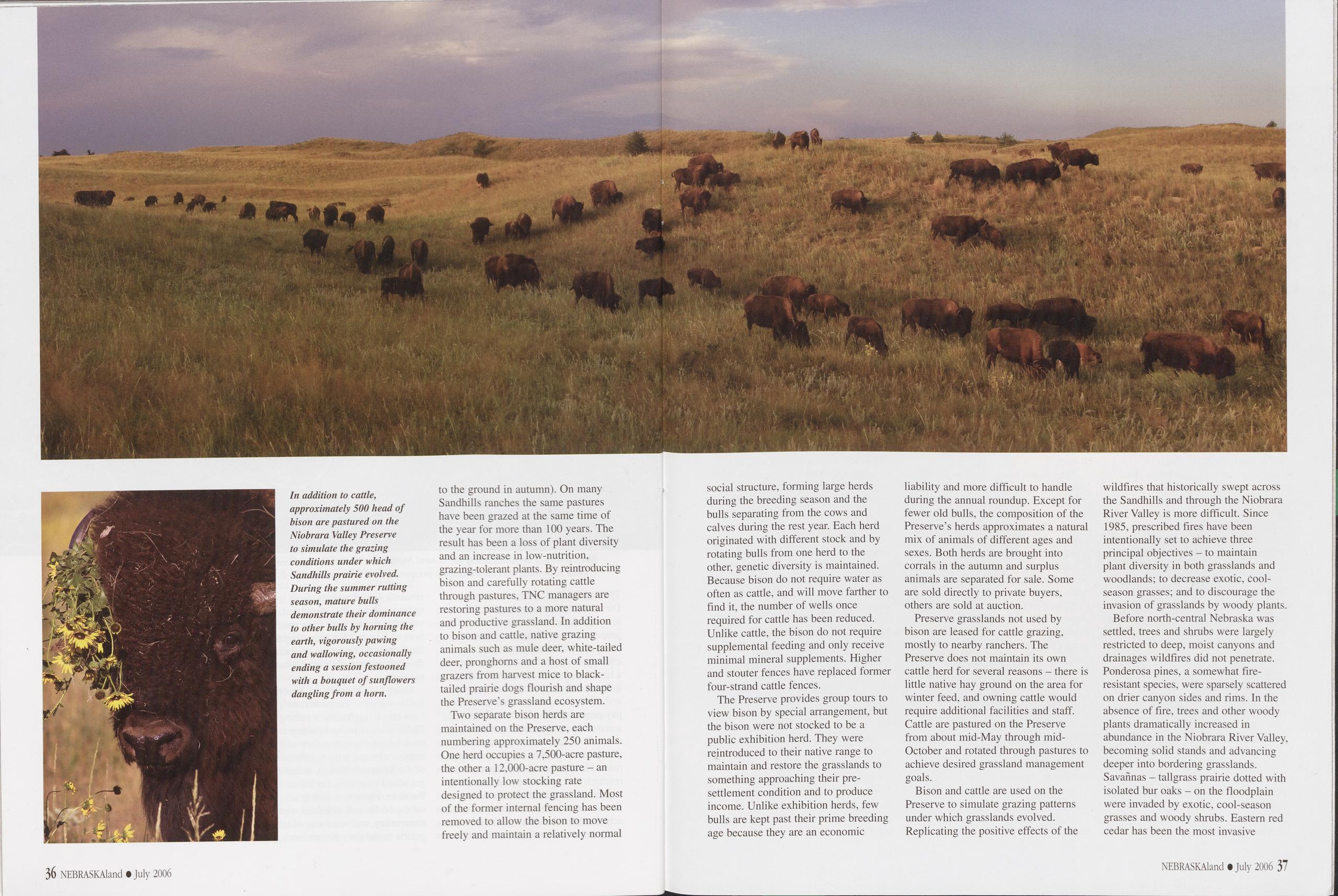
Two separate bison herds are maintained on the Preserve, each numbering approximately 250 animals. One herd occupies a 7,500-acre pasture, the other a 12,000-acre pasture - an intentionally low stocking rate designed to protect the grassland. Most of the former internal fencing has been removed to allow the bison to move freely and maintain a relatively normal social structure, forming large herds during the breeding season and the bulls separating from the cows and calves during the rest year. Each herd originated with different stock and by rotating bulls from one herd to the other, genetic diversity is maintained. Because bison do not require water as often as cattle, and will move farther to find it, the number of wells once required for cattle has been reduced. Unlike cattle, the bison do not require supplemental feeding and only receive minimal mineral supplements. Higher and stouter fences have replaced former four-strand cattle fences.
The Preserve provides group tours to view bison by special arrangement, but the bison were not stocked to be a public exhibition herd. They were reintroduced to their native range to maintain and restore the grasslands to something approaching their pre- settlement condition and to produce income. Unlike exhibition herds, few bulls are kept past their prime breeding age because they are an economic liability and more difficult to handle during the annual roundup. Except for fewer old bulls, the composition of the Preserve’s herds approximates a natural mix of animals of different ages and sexes. Both herds are brought into corrals in the autumn and surplus animals are separated for sale. Some are sold directly to private buyers, others are sold at auction.
Preserve grasslands not used by bison are leased for cattle grazing, mostly to nearby ranchers. The Preserve does not maintain its own cattle herd for several reasons - there is little native hay ground on the area for winter feed, and owning cattle would require additional facilities and staff. Cattle are pastured on the Preserve from about mid-May through mid- October and rotated through pastures to achieve desired grassland management goals.
Bison and cattle are used on the Preserve to simulate grazing patterns under which grasslands evolved. Replicating the positive effects of the wildfires that historically swept across the Sandhills and through the Niobrara River Valley is more difficult. Since 1985, prescribed fires have been intentionally set to achieve three principal objectives - to maintain plant diversity in both grasslands and woodlands; to decrease exotic, cool- season grasses; and to discourage the invasion of grasslands by woody plants.
Before north-central Nebraska was settled, trees and shrubs were largely restricted to deep, moist canyons and drainages wildfires did not penetrate. Ponderosa pines, a somewhat fire- resistant species, were sparsely scattered on drier canyon sides and rims. In the absence of fire, trees and other woody plants dramatically increased in abundance in the Niobrara River Valley, becoming solid stands and advancing deeper into bordering grasslands. Savannas - tailgrass prairie dotted with isolated bur oaks - on the floodplain were invaded by exotic, cool-season grasses and woody shrubs. Eastern red cedar has been the most invasive 36 NEBRASKAland* July 2006 NEBRASKAland • July 2006 37 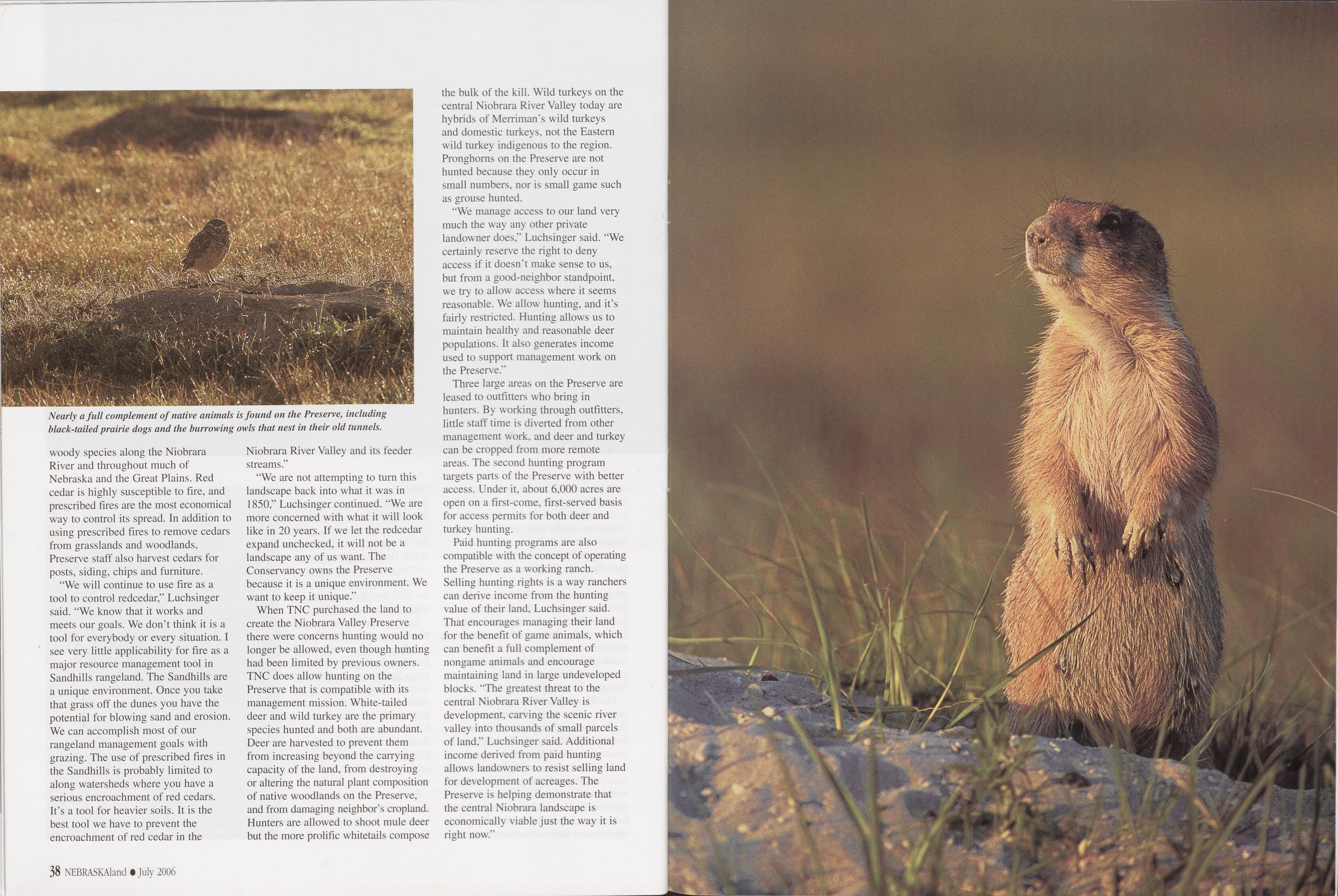
“We will continue to use fire as a tool to control redcedar,” Luchsinger said. “We know that it works and meets our goals. We don’t think it is a tool for everybody or every situation. I see very little applicability for fire as a major resource management tool in Sandhills rangeland. The Sandhills are a unique environment. Once you take that grass off the dunes you have the potential for blowing sand and erosion. We can accomplish most of our rangeland management goals with grazing. The use of prescribed fires in the Sandhills is probably limited to along watersheds where you have a serious encroachment of red cedars. It’s a tool for heavier soils. It is the best tool we have to prevent the encroachment of red cedar in the Niobrara River Valley and its feeder streams.”
“We are not attempting to turn this landscape back into what it was in 1850,” Luchsinger continued. “We are more concerned with what it will look like in 20 years. If we let the redcedar expand unchecked, it will not be a landscape any of us want. The Conservancy owns the Preserve because it is a unique environment. We want to keep it unique.”
When TNC purchased the land to create the Niobrara Valley Preserve there were concerns hunting would no longer be allowed, even though hunting had been limited by previous owners. TNC does allow hunting on the Preserve that is compatible with its management mission. White-tailed deer and wild turkey are the primary species hunted and both are abundant. Deer are harvested to prevent them from increasing beyond the carrying capacity of the land, from destroying or altering the natural plant composition of native woodlands on the Preserve, and from damaging neighbor’s cropland. Hunters are allowed to shoot mule deer but the more prolific whitetails compose the bulk of the kill. Wild turkeys on the central Niobrara River Valley today are hybrids of Merriman’s wild turkeys and domestic turkeys, not the Eastern wild turkey indigenous to the region. Pronghorns on the Preserve are not hunted because they only occur in small numbers, nor is small game such as grouse hunted.
“We manage access to our land very much the way any other private landowner does,” Luchsinger said. “We certainly reserve the right to deny access if it doesn’t make sense to us, but from a good-neighbor standpoint, we try to allow access where it seems reasonable. We allow hunting, and it’s fairly restricted. Hunting allows us to maintain healthy and reasonable deer populations. It also generates income used to support management work on the Preserve.”
Three large areas on the Preserve are leased to outfitters who bring in hunters. By working through outfitters, little staff time is diverted from other management work, and deer and turkey can be cropped from more remote areas. The second hunting program targets parts of the Preserve with better access. Under it, about 6,000 acres are open on a first-come, first-served basis for access permits for both deer and turkey hunting.
Paid hunting programs are also compatible with the concept of operating the Preserve as a working ranch. Selling hunting rights is a way ranchers can derive income from the hunting value of their land, Luchsinger said. That encourages managing their land for the benefit of game animals, which can benefit a full complement of nongame animals and encourage maintaining land in large undeveloped blocks. “The greatest threat to the central Niobrara River Valley is development, carving the scenic river valley into thousands of small parcels of land,” Luchsinger said. Additional income derived from paid hunting allows landowners to resist selling land for development of acreages. The Preserve is helping demonstrate that the central Niobrara landscape is economically viable just the way it is right now.”
38 NEBRASKAland • July 2006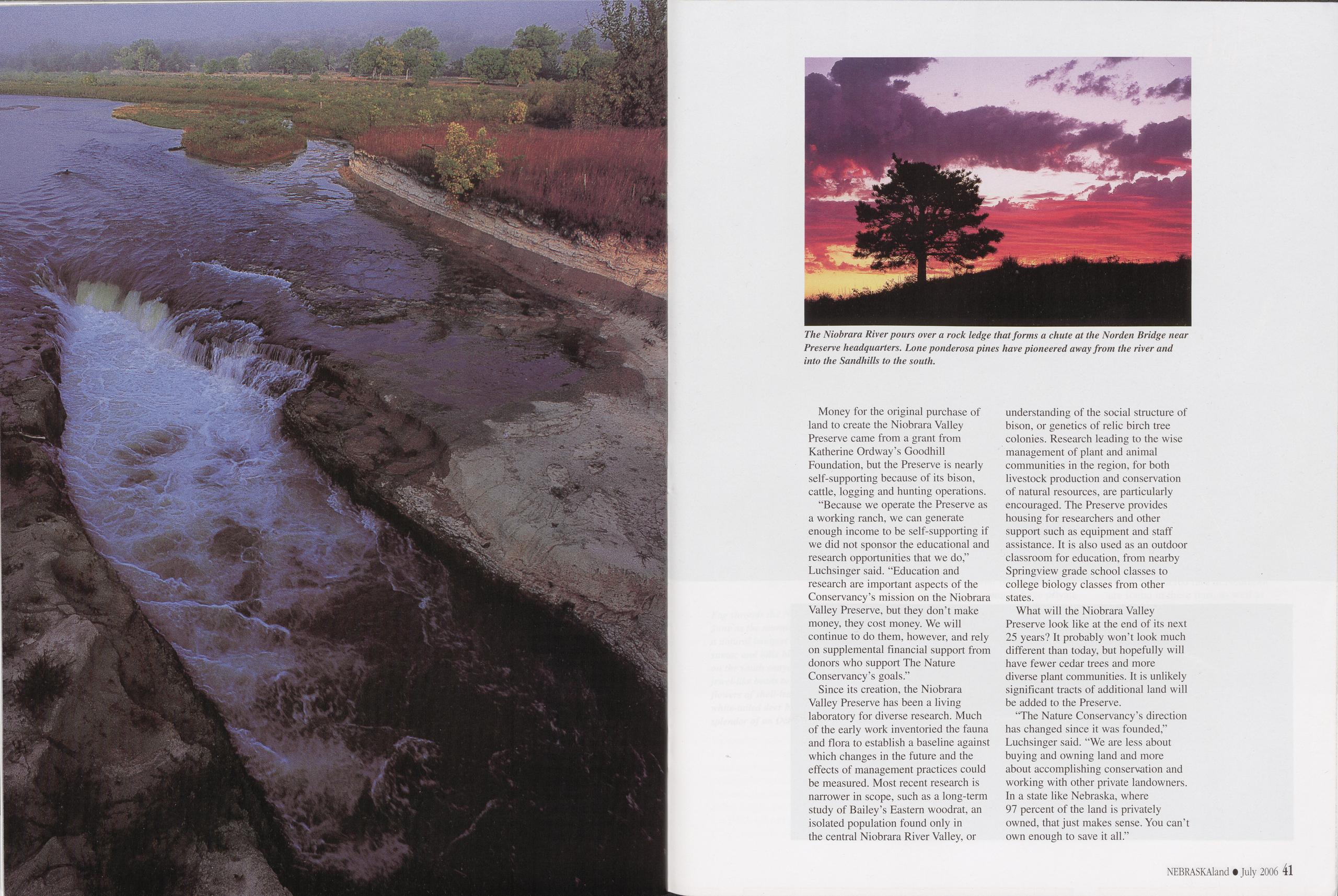
Money for the original purchase of land to create the Niobrara Valley Preserve came from a grant from Katherine Ordway’s Goodhill Foundation, but the Preserve is nearly self-supporting because of its bison, cattle, logging and hunting operations.
“Because we operate the Preserve as a working ranch, we can generate enough income to be self-supporting if we did not sponsor the educational and research opportunities that we do,” Luchsinger said. “Education and research are important aspects of the Conservancy’s mission on the Niobrara Valley Preserve, but they don’t make money, they cost money. We will continue to do them, however, and rely on supplemental financial support from donors who support The Nature Conservancy’s goals.”
Since its creation, the Niobrara Valley Preserve has been a living laboratory for diverse research. Much of the early work inventoried the fauna and flora to establish a baseline against which changes in the future and the effects of management practices could be measured. Most recent research is narrower in scope, such as a long-term study of Bailey’s Eastern woodrat, an isolated population found only in the central Niobrara River Valley, or understanding of the social structure of bison, or genetics of relic birch tree colonies. Research leading to the wise management of plant and animal communities in the region, for both livestock production and conservation of natural resources, are particularly encouraged. The Preserve provides housing for researchers and other support such as equipment and staff assistance. It is also used as an outdoor classroom for education, from nearby Springview grade school classes to college biology classes from other states.
What will the Niobrara Valley Preserve look like at the end of its next 25 years? It probably won’t look much different than today, but hopefully will have fewer cedar trees and more diverse plant communities. It is unlikely significant tracts of additional land will be added to the Preserve.
“The Nature Conservancy’s direction has changed since it was founded,” Luchsinger said. “We are less about buying and owning land and more about accomplishing conservation and working with other private landowners. In a state like Nebraska, where 97 percent of the land is privately owned, that just makes sense. You can’t own enough to save it all.”
NEBRASKAland • July 2006 41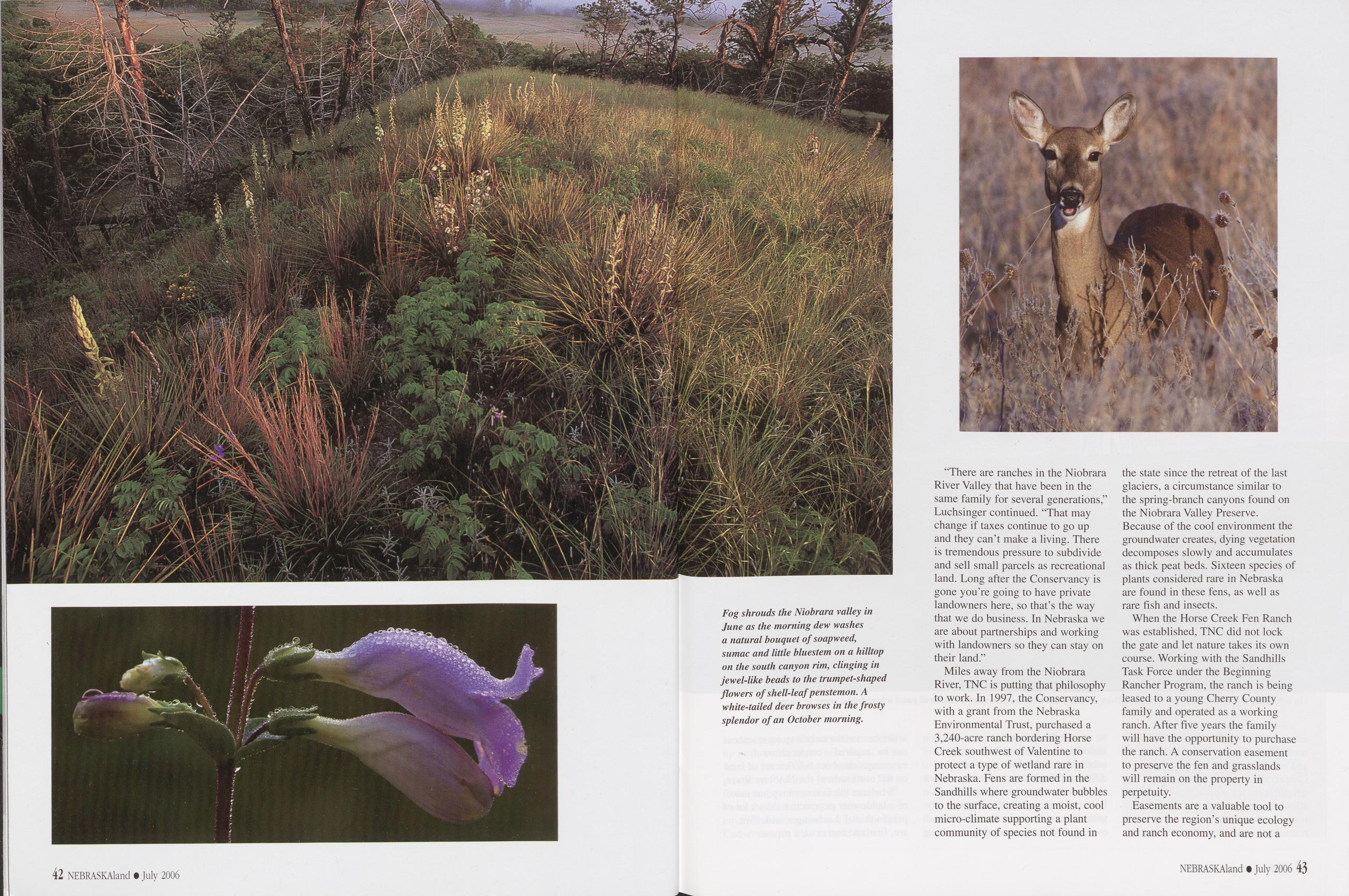
“There are ranches in the Niobrara River Valley that have been in the same family for several generations,” Luchsinger continued. “That may change if taxes continue to go up and they can’t make a living. There is tremendous pressure to subdivide and sell small parcels as recreational land. Long after the Conservancy is gone you’re going to have private landowners here, so that’s the way that we do business. In Nebraska we are about partnerships and working with landowners so they can stay on their land.”
Miles away from the Niobrara River, TNC is putting that philosophy to work. In 1997, the Conservancy, with a grant from the Nebraska Environmental Trust, purchased a 3,240-acre ranch bordering Horse Creek southwest of Valentine to protect a type of wetland rare in Nebraska. Fens are formed in the Sandhills where groundwater bubbles to the surface, creating a moist, cool micro-climate supporting a plant community of species not found in the state since the retreat of the last glaciers, a circumstance similar to the spring-branch canyons found on the Niobrara Valley Preserve. Because of the cool environment the groundwater creates, dying vegetation decomposes slowly and accumulates as thick peat beds. Sixteen species of plants considered rare in Nebraska are found in these fens, as well as rare fish and insects.
When the Horse Creek Fen Ranch was established, TNC did not lock the gate and let nature takes its own course. Working with the Sandhills Task Force under the Beginning Rancher Program, the ranch is being leased to a young Cherry County family and operated as a working ranch. After five years the family will have the opportunity to purchase the ranch. A conservation easement to preserve the fen and grasslands will remain on the property in perpetuity.
Easements are a valuable tool to preserve the region’s unique ecology and ranch economy, and are not a NEBRASKAland • July 2006 43 42 NEBRASKAland • July 2006 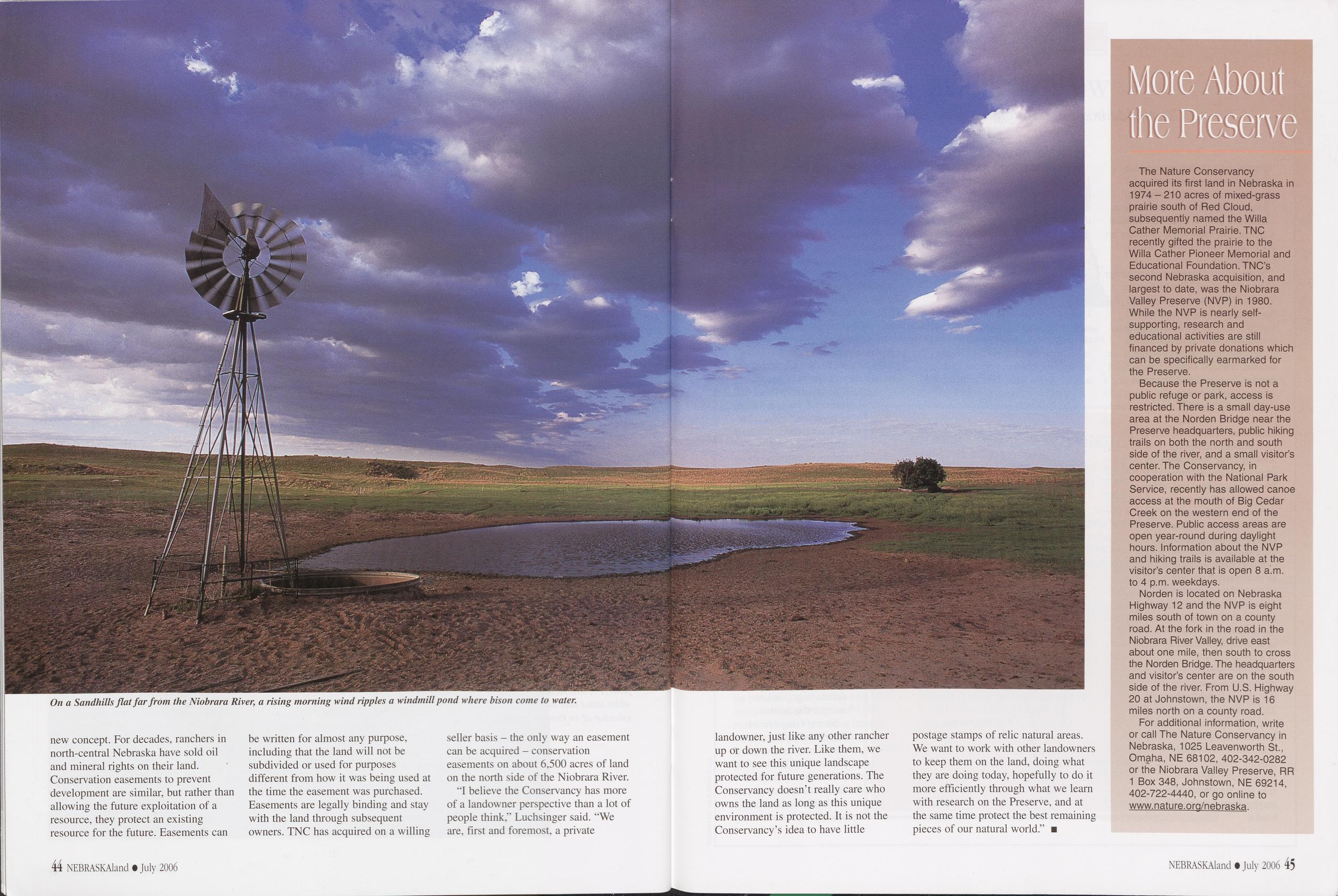
"I believe the Conservancy has more of a landowner perspective than a lot of people think,” Luchsinger said. “We are, first and foremost, a private landowner, just like any other rancher up or down the river. Like them, we want to see this unique landscape protected for future generations. The Conservancy doesn’t really care who owns the land as long as this unique environment is protected. It is not the Conservancy’s idea to have little postage stamps of relic natural areas. We want to work with other landowners to keep them on the land, doing what they are doing today, hopefully to do it more efficiently through what we learn with research on the Preserve, and at the same time protect the best remaining pieces of our natural world.”
More About the PreserveThe Nature Conservancy acquired its first land in Nebraska in 1974 - 210 acres of mixed-grass prairie south of Red Cloud, subsequently named the Willa Cather Memorial Prairie. TNC recently gifted the prairie to the Willa Cather Pioneer Memorial and Educational Foundation. TNC’s second Nebraska acquisition, and largest to date, was the Niobrara Valley Preserve (NVP) in 1980. While the NVP is nearly self- supporting, research and educational activities are still financed by private donations which can be specifically earmarked for the Preserve.
Because the Preserve is not a public refuge or park, access is restricted. There is a small day-use area at the Norden Bridge near the Preserve headquarters, public hiking trails on both the north and south side of the river, and a small visitor’s center. The Conservancy, in cooperation with the National Park Service, recently has allowed canoe access at the mouth of Big Cedar Creek on the western end of the Preserve. Public access areas are open year-round during daylight hours. Information about the NVP and hiking trails is available at the visitor’s center that is open 8 a.m. to 4 p.m. weekdays.
Norden is located on Nebraska Highway 12 and the NVP is eight miles south of town on a county road. At the fork in the road in the Niobrara River Valley, drive east about one mile, then south to cross the Norden Bridge. The headquarters and visitor’s center are on the south side of the river. From U.S. Highway 20 at Johnstown, the NVP is 16 miles north on a county road.
For additional information, write or call The Nature Conservancy in Nebraska, 1025 Leavenworth St., Omaha, NE 68102, 402-342-0282 or the Niobrara Valley Preserve, RR 1 Box 348, Johnstown, NE 69214, 402-722-4440, or go online to www.nature.org/nebraska.
44 NEBRASKAland • July 2006 NEBRASKAland • July 2006 45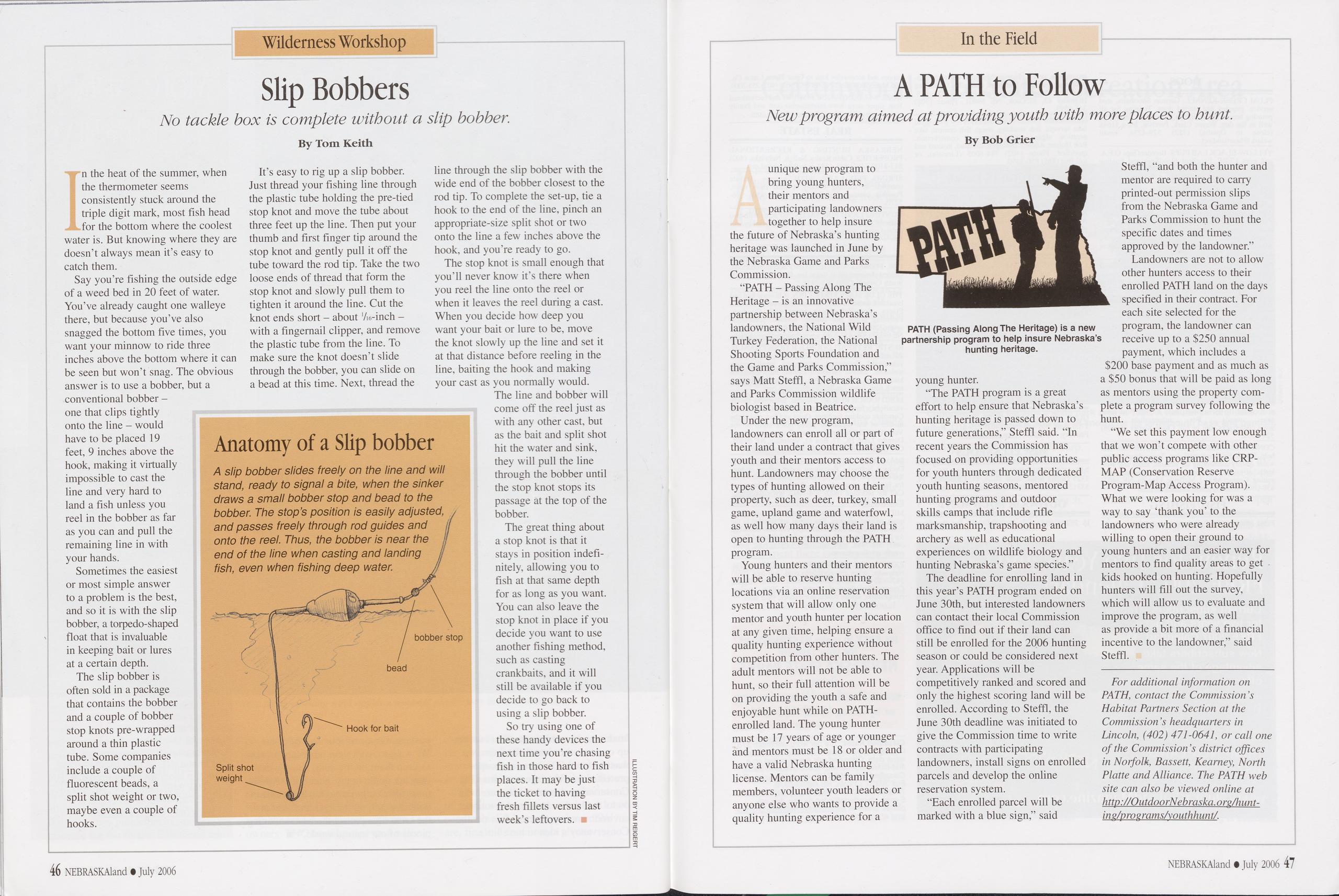
Wilderness Workshop
Slip Bobbers
No tackle box is complete without a slip bobber.
In the heat of the summer, when the thermometer seems consistently stuck around the triple digit mark, most fish head for the bottom where the coolest water is. But knowing where they are doesn’t always mean it’s easy to catch them.
Say you’re fishing the outside edge of a weed bed in 20 feet of water. You’ve already caught one walleye there, but because you’ve also snagged the bottom five times, you want your minnow to ride three inches above the bottom where it can be seen but won’t snag. The obvious answer is to use a bobber, but a conventional bobber - one that clips tightly onto the line - would have to be placed 19 feet, 9 inches above the hook, making it virtually impossible to cast the line and very hard to land a fish unless you reel in the bobber as far as you can and pull the remaining line in with your hands.
Sometimes the easiest or most simple answer to a problem is the best, and so it is with the slip bobber, a torpedo-shaped float that is invaluable in keeping bait or lures at a certain depth.
The slip bobber is often sold in a package that contains the bobber and a couple of bobber stop knots pre-wrapped around a thin plastic tube. Some companies include a couple of fluorescent beads, a split shot weight or two, maybe even a couple of hooks.
It’s easy to rig up a slip bobber. Just thread your fishing line through the plastic tube holding the pre-tied stop knot and move the tube about three feet up the line. Then put your thumb and first finger tip around the stop knot and gently pull it off the tube toward the rod tip. Take the two loose ends of thread that form the stop knot and slowly pull them to tighten it around the line. Cut the knot ends short - about l/i6-inch - with a fingernail clipper, and remove the plastic tube from the line. To make sure the knot doesn’t slide through the bobber, you can slide on a bead at this time. Next, thread the
The stop knot is small enough that you’ll never know it’s there when you reel the line onto the reel or when it leaves the reel during a cast. When you decide how deep you want your bait or lure to be, move the knot slowly up the line and set it at that distance before reeling in the line, baiting the hook and making your cast as you normally would. The line and bobber will come off the reel just as with any other cast, but as the bait and split shot hit the water and sink, they will pull the line through the bobber until the stop knot stops its passage at the top of the bobber.
The great thing about a stop knot is that it stays in position indefi- nitely, allowing you to fish at that same depth for as long as you want. You can also leave the stop knot in place if you decide you want to use another fishing method, such as casting crankbaits, and it will still be available if you decide to go back to using a slip bobber.
So try using one of these handy devices the next time you’re chasing fish in those hard to fish places. It may be just the ticket to having fresh fillets versus last week’s leftovers.
In the Field
A PATH to Follow
New program aimed at providing youth with more places to hunt.
A unique new program to bring young hunters, their mentors and participating landowners together to help insure the future of Nebraska’s hunting heritage was launched in June by the Nebraska Game and Parks Commission.
“PATH - Passing Along The Heritage - is an innovative partnership between Nebraska’s landowners, the National Wild Turkey Federation, the National Shooting Sports Foundation and the Game and Parks Commission,” says Matt Steffi, a Nebraska Game and Parks Commission wildlife biologist based in Beatrice.
Under the new program, landowners can enroll all or part of their land under a contract that gives youth and their mentors access to hunt. Landowners may choose the types of hunting allowed on their property, such as deer, turkey, small game, upland game and waterfowl, as well how many days their land is open to hunting through the PATH program.
Young hunters and their mentors will be able to reserve hunting locations via an online reservation system that will allow only one mentor and youth hunter per location at any given time, helping ensure a quality hunting experience without competition from other hunters. The adult mentors will not be able to hunt, so their full attention will be on providing the youth a safe and enjoyable hunt while on PATH- enrolled land. The young hunter must be 17 years of age or younger and mentors must be 18 or older and have a valid Nebraska hunting license. Mentors can be family members, volunteer youth leaders or anyone else who wants to provide a quality hunting experience for a
“The PATH program is a great effort to help ensure that Nebraska’s hunting heritage is passed down to future generations,” Steffi said. “In recent years the Commission has focused on providing opportunities for youth hunters through dedicated youth hunting seasons, mentored hunting programs and outdoor skills camps that include rifle marksmanship, trapshooting and archery as well as educational experiences on wildlife biology and hunting Nebraska’s game species.”
The deadline for enrolling land in this year’s PATH program ended on June 30th, but interested landowners can contact their local Commission office to find out if their land can still be enrolled for the 2006 hunting season or could be considered next year. Applications will be competitively ranked and scored and only the highest scoring land will be enrolled. According to Steffi, the June 30th deadline was initiated to give the Commission time to write contracts with participating landowners, install signs on enrolled parcels and develop the online reservation system.
“Each enrolled parcel will be marked with a blue sign,” said Steffi, “and both the hunter and mentor are required to carry printed-out permission slips from the Nebraska Game and Parks Commission to hunt the specific dates and times approved by the landowner.”
Landowners are not to allow other hunters access to their enrolled PATH land on the days specified in their contract. For each site selected for the program, the landowner can receive up to a $250 annual payment, which includes a $200 base payment and as much as a $50 bonus that will be paid as long as mentors using the property com- plete a program survey following the hunt.
“We set this payment low enough that we won’t compete with other public access programs like CRP- MAP (Conservation Reserve Program-Map Access Program). What we were looking for was a way to say ‘thank you’ to the landowners who were already willing to open their ground to young hunters and an easier way for mentors to find quality areas to get kids hooked on hunting. Hopefully hunters will fill out the survey, which will allow us to evaluate and improve the program, as well as provide a bit more of a financial incentive to the landowner,” said Steffi.
For additional information on PATH, contact the Commission’s Habitat Partners Section at the Commission’s headquarters in Lincoln, (402) 471-0641, or call one of the Commission’s district offices in Norfolk, Bassett, Kearney, North Platte and Alliance. The PATH web site can also be viewed online at http://OutdoorNebraska. ore/hunt- ing/programs/vouthhunt/. 46 NEBRASKAland • July 2006 NEBRASKAland • July 2006 47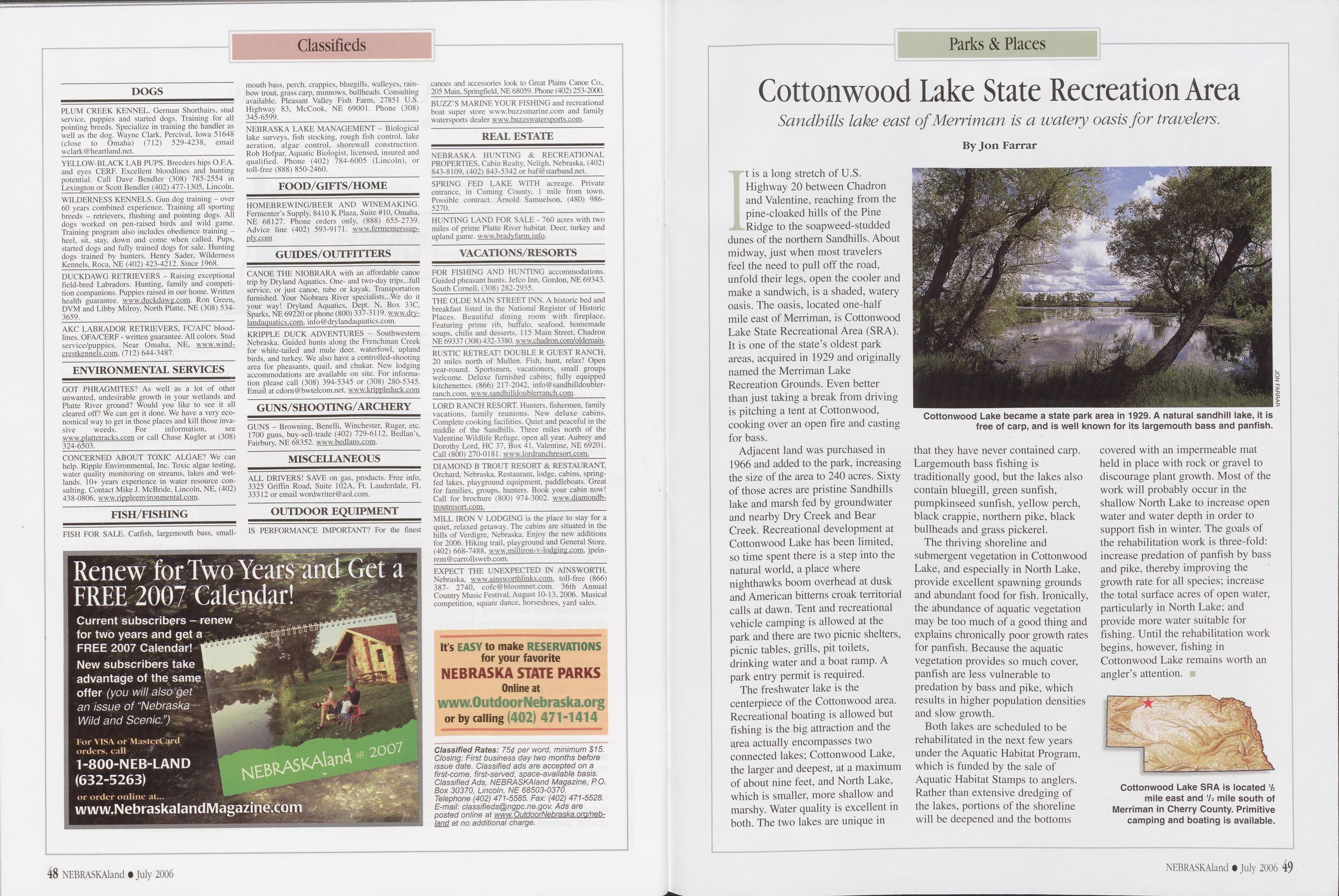
Classifieds
DOGS PLUM CREEK KENNEL. German Shorthairs, stud service, puppies and started dogs. Training for all pointing breeds. Specialize in training the handler as well as the dog. Wayne Clark, Percival, Iowa 51648 (close to Omaha) (712) 529-4238, email wclark@heartland.net. YELLOW-BLACK LAB PUPS. Breeders hips O.F.A. and eyes CERF. Excellent bloodlines and hunting potential. Call Dave Bendler (308) 785-2554 in Lexington or Scott Bendler (402) 477-1305, Lincoln. WILDERNESS KENNELS. Gun dog training - over 60 years combined experience. Training all sporting breeds - retrievers, flushing and pointing dogs. All dogs worked on pen-raised birds and wild game. Training program also includes obedience training - heel, sit, stay, down and come when called. Pups, started dogs and fully trained dogs for sale. Hunting dogs trained by hunters. Henry Sader, Wilderness Kennels, Roca, NE (402) 423-4212. Since 1968. DUCKDAWG RETRIEVERS - Raising exceptional field-bred Labradors. Hunting, family and competi- tion companions. Puppies raised in our home. Written health guarantee, www.duckdawg.com. Ron Green, DVM and Libby Milroy, North Platte, NE (308) 534- 3659. AKC LABRADOR RETRIEVERS, FC/AFC blood- lines. OFA/CERF - written guarantee. All colors. Stud service/puppies. Near Omaha, NE, www.wind- crestkennels.com. (712) 644-3487. ENVIRONMENTAL SERVICES GOT PHRAGMITES? As well as a lot of other unwanted, undesirable growth in your wetlands and Platte River ground? Would you like to see it all cleared off? We can get it done. We have a very eco- nomical way to get in those places and kill those inva- sive weeds. For information, see www.plattetracks.com or call Chase Kugler at (308) 324-6503. CONCERNED ABOUT TOXIC ALGAE? We can help. Ripple Environmental, Inc. Toxic algae testing, water quality monitoring on streams, lakes and wet- lands. 10+ years experience in water resource con- sulting. Contact Mike J. McBride, Lincoln, NE, (402) 438-0806, www.rippleenvironmental.com. FISH/FISHING FISH FOR SALE. Catfish, largemouth bass, small-Parks & Places
Cottonwood Lake State Recreation Area
Sandhills lake east of Merriman is a watery oasis for travelers.
It is a long stretch of U.S. Highway 20 between Chadron and Valentine, reaching from the pine-cloaked hills of the Pine Ridge to the soapweed-studded dunes of the northern Sandhills. About midway, just when most travelers feel the need to pull off the road, unfold their legs, open the cooler and make a sandwich, is a shaded, watery oasis. The oasis, located one-half mile east of Merriman, is Cottonwood Lake State Recreational Area (SRA). It is one of the state’s oldest park areas, acquired in 1929 and originally named the Merriman Lake Recreation Grounds. Even better than just taking a break from driving is pitching a tent at Cottonwood, cooking over an open fire and casting for bass.
Adjacent land was purchased in 1966 and added to the park, increasing the size of the area to 240 acres. Sixty of those acres are pristine Sandhills lake and marsh fed by groundwater and nearby Dry Creek and Bear Creek. Recreational development at Cottonwood Lake has been limited, so time spent there is a step into the natural world, a place where nighthawks boom overhead at dusk and American bitterns croak territorial calls at dawn. Tent and recreational vehicle camping is allowed at the park and there are two picnic shelters, picnic tables, grills, pit toilets, drinking water and a boat ramp. A park entry permit is required.
The freshwater lake is the centerpiece of the Cottonwood area. Recreational boating is allowed but fishing is the big attraction and the area actually encompasses two connected lakes; Cottonwood Lake, the larger and deepest, at a maximum of about nine feet, and North Lake, which is smaller, more shallow and marshy. Water quality is excellent in both. The two lakes are unique in
The thriving shoreline and submergent vegetation in Cottonwood Lake, and especially in North Lake, provide excellent spawning grounds and abundant food for fish. Ironically, the abundance of aquatic vegetation may be too much of a good thing and explains chronically poor growth rates for panfish. Because the aquatic vegetation provides so much cover, panfish are less vulnerable to predation by bass and pike, which results in higher population densities and slow growth.
Both lakes are scheduled to be rehabilitated in the next few years under the Aquatic Habitat Program, which is funded by the sale of Aquatic Habitat Stamps to anglers. Rather than extensive dredging of the lakes, portions of the shoreline will be deepened and the bottoms covered with an impermeable mat held in place with rock or gravel to discourage plant growth. Most of the work will probably occur in the shallow North Lake to increase open water and water depth in order to support fish in winter. The goals of the rehabilitation work is three-fold: increase predation of panfish by bass and pike, thereby improving the growth rate for all species; increase the total surface acres of open water, particularly in North Lake; and provide more water suitable for fishing. Until the rehabilitation work begins, however, fishing in Cottonwood Lake remains worth an angler’s attention.
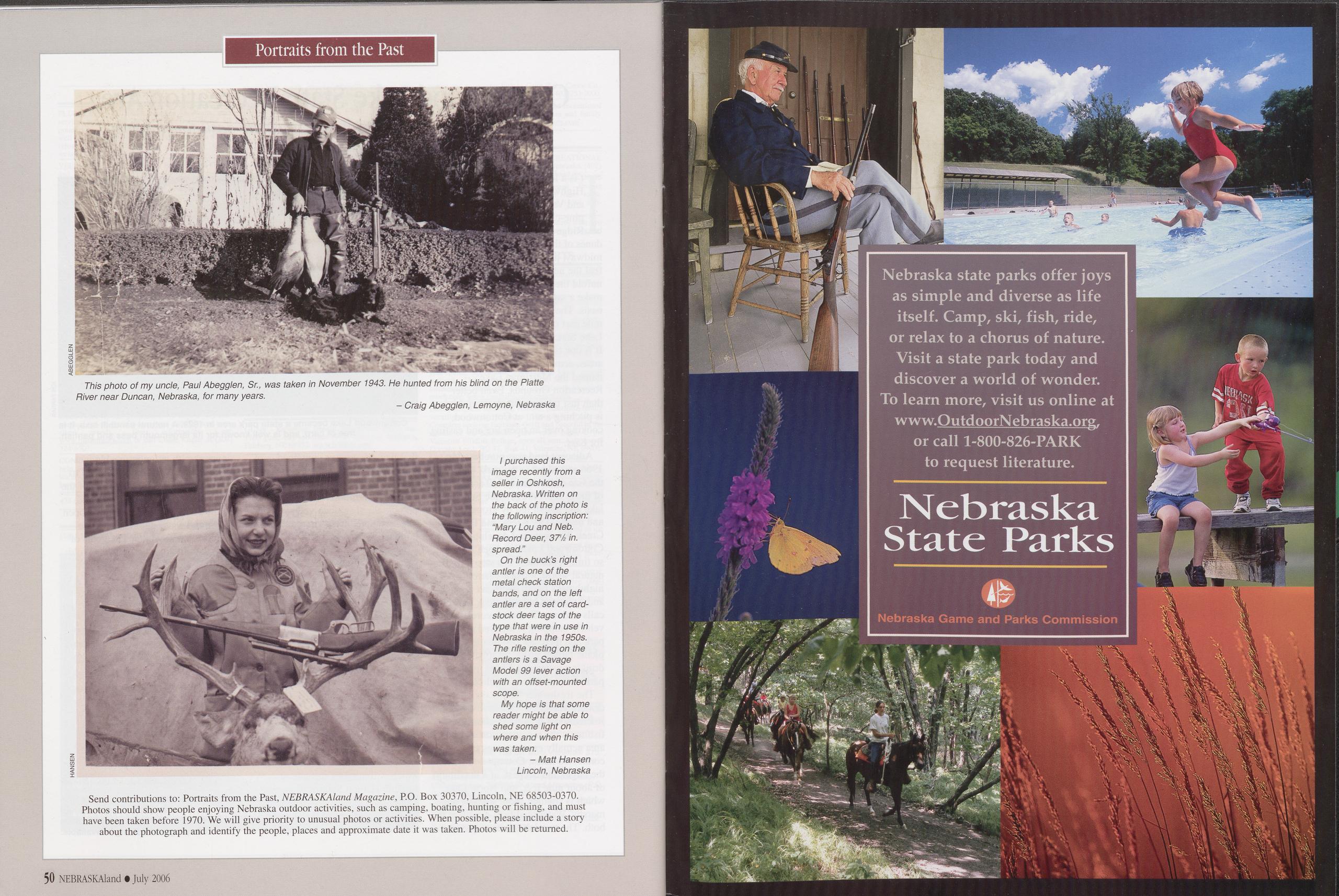
Portraits from the Past
Position: 769 (14 views)