Volume 84, Issue 5, 2006
NEBRASKAland
Nebraska Game & Parks Commission June 2006 $2.95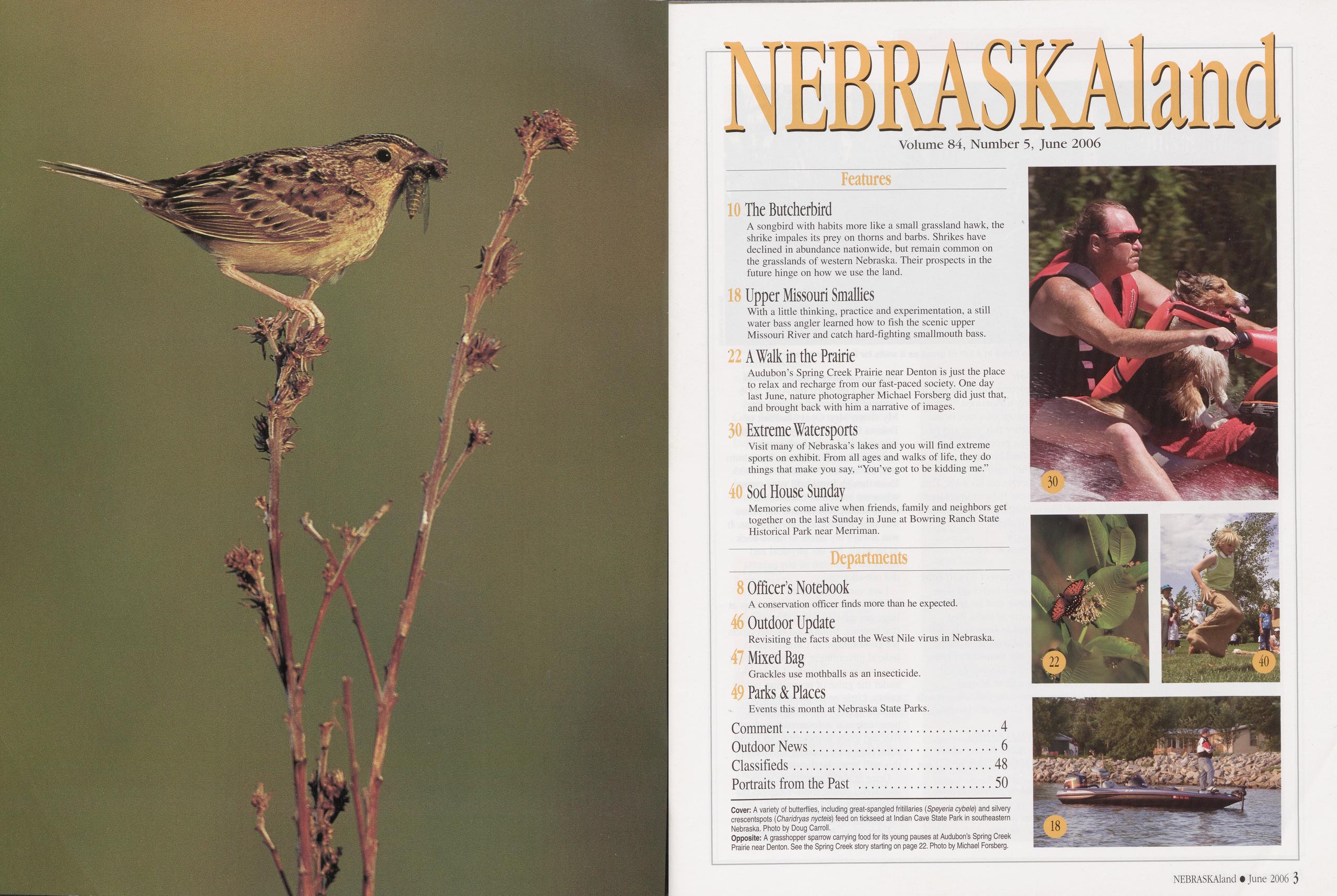
NEBRASKAland
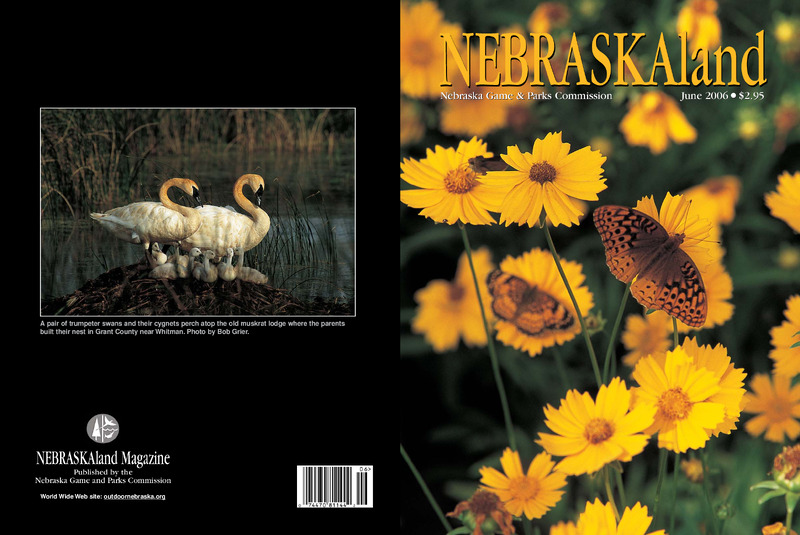
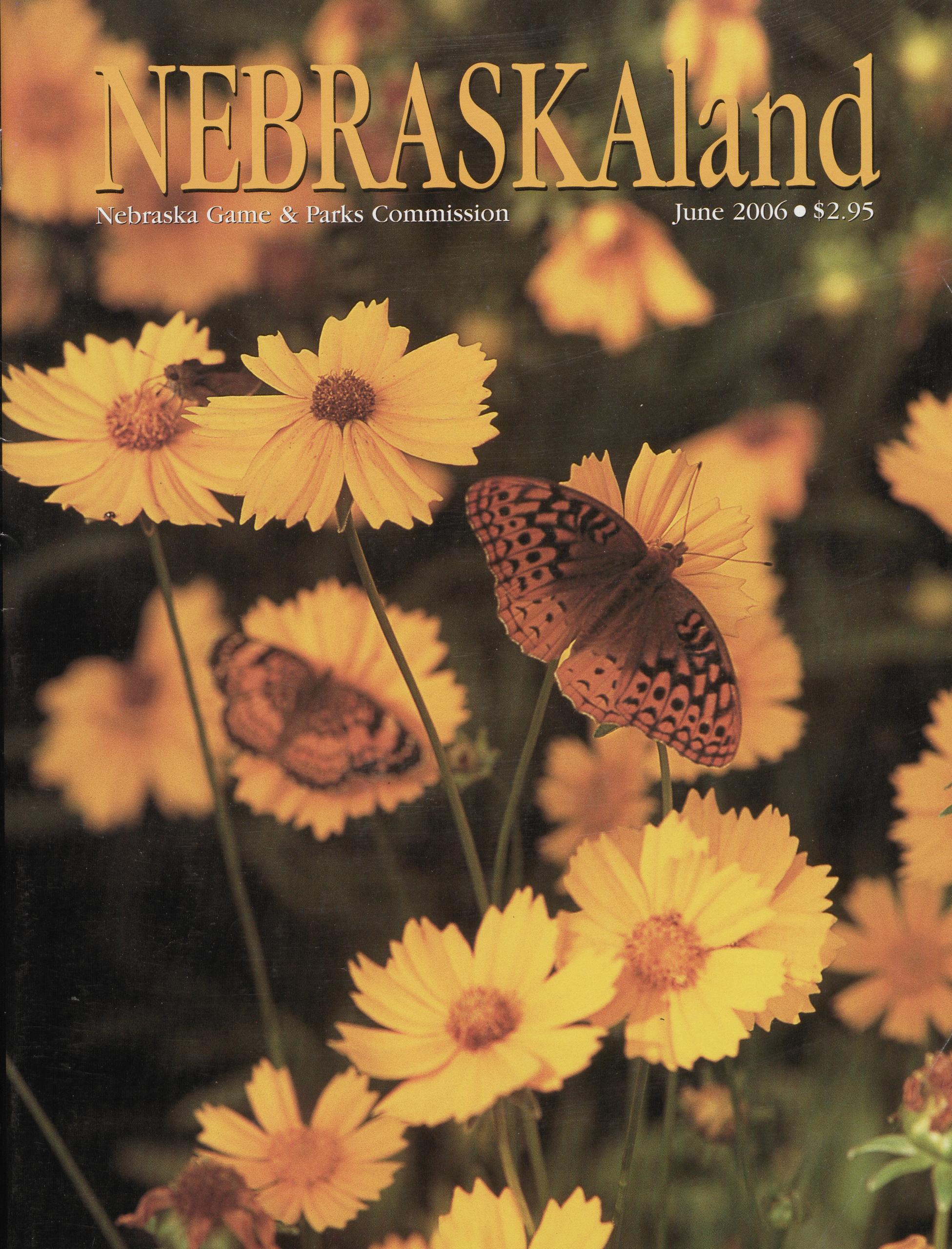
Volume 84, Number 5, June 2006 Features 10 The Butcherbird A songbird with habits more like a small grassland hawk, the shrike impales its prey on thorns and barbs. Shrikes have declined in abundance nationwide, but remain common on the grasslands of western Nebraska. Their prospects in the future hinge on how we use the land. 18 Upper Missouri Smallies With a little thinking, practice and experimentation, a still water bass angler learned how to fish the scenic upper Missouri River and catch hard-fighting smallmouth bass. 22 A Walk in the Prairie Audubon’s Spring Creek Prairie near Denton is just the place to relax and recharge from our fast-paced society. One day last June, nature photographer Michael Forsberg did just that, and brought back with him a narrative of images. 30 Extreme Watersports Visit many of Nebraska’s lakes and you will find extreme sports on exhibit. From all ages and walks of life, they do things that make you say, “You’ve got to be kidding me.” 40Sod House Sunday Memories come alive when friends, family and neighbors get together on the last Sunday in June at Bowring Ranch State Historical Park near Merriman. Departments 8 Officer’s Notebook A conservation officer finds more than he expected. 46 Outdoor Update Revisiting the facts about the West Nile virus in Nebraska. 47 Mixed Bag Crackles use mothballs as an insecticide. 49 Parks & Places Events this month at Nebraska State Parks. Comment........................................... 4 Outdoor News........................................6 Classifieds........................................48 Portraits from the Past ...........................50 Cover: A variety of butterflies, including great-spangled fritillaries (Speyeria cybele) and silvery crescentspots (Charidryas nycteis) feed on tickseed at Indian Cave State Park in southeastern Nebraska. Photo by Doug Carroll. Opposite: A grasshopper sparrow carrying food for its young pauses at Audubon’s Spring Creek Prairie near Denton. See the Spring Creek story starting on page 22. Photo by Michael Forsberg.
Comment
NEBRASKAland Magazine Published by the Nebraska Game and Parks Commission Director: Rex Amack Assistant Directors: Roger Kuhn, Kirk Nelson, Sam Sidner Information & Education Administrator: Ken Bouc Information & Education Art Director: Steve O’Hare Commissioners Chairman: James Stuart, Jr., Lincoln Vice Chairman: Bill Zutavern, Dunning 2nd Vice Chairman: Gary Parker, Columbus George E. Hall, Bridgeport James Ziebarth, Wilcox Jerrod Burke, Curtis Dr. Mark Pinkerton, Wilber Bill Grewcock, Omaha Magazine Staff Editor: Doug Carroll Art Director: Tim Reigert Senior Editors: Jon Farrar, Ken Bouc Regional Editors: Eric Fowler, Bob Grier, Rocky Hoffmann Contributing Editor: Michael Forsberg Circulation: Donna Robinson Photo Librarian: Sarah Johnson NEBRASKAland VOL. 84 / NO. 5 ISSN: 0028-1964 JUNE 2006 Published monthly, except for Jan./Feb. and Aug./Sept. issues, by the Nebraska Game and Parks Commission, 2200 N. 33rd St., Lincoln, NE. Copyright 2006, all rights reserved. Please address comments or questions to this address. Periodicals postage paid at Lincoln, Nebraska, and other locations. POSTMASTER: Send all address changes to NEBRASKAland, P.O. Box 30370, Lincoln, NE 68503-0370. Address submissions to: The Editor, NEBRASKAland Magazine, P.O. Box 30370, Lincoln, NE 68503. Include a stamped, self-addressed return envelope. The publisher assumes no responsibility for unsolicited material. NEBRASKAland is available on audio cassette from the Nebraska Library Commission Talking Book and Braille Service, Suite 120, 1200 N St., Lincoln, NE 68508. (800) 742-7691 Rates: $18 for one year; $33 for two years. Nebraska residents must add appropriate sales tax. To subscribe call 1-800-NEBLAND (632-5263), or go online to: outdoornebraska.orgHere is a picture of a baby robin that our family nicknamed “Robbie.” He was blown out of a tree in our front yard earlier this year and he survived on the ground just fine. His mom would feed him and herd him around the yard until he was old enough to survive on his own. This shows that most baby animals that look like orphans will do just fine if we leave them alone.
Sarah Johnson Waco, NebraskaMs. Johnson is correct - most baby animals are much better off if we leave them alone and let Mother Nature take care of them. Not only is it illegal to keep most wild animals, it is also hard on them because they are unsuited to being kept in captivity. Lincoln-based conservation officer Murray Johnson penned the following words that echo Ms. Johnson’s thoughts:
WILD BABIES Leave wildlife babies alone They're not helpless, they're just not grown, There's likely parents nearby keeping watchful eye, Those babes are theirs, not ours, to own. Keep Promoting Outdoor SportsToday I received the April 2006 issue of your very fine magazine. My sister, Mrs. Opal Shadbolt of Dakota City, orders my subscription because she knows how much Nebraska means to me, as I was born near Homer on December 13, 1933. Even though I was still very young when we moved to Canada, the never-ending talk around the home was how wonderful Nebraska was. It was always my intent to move back as an adult, but the physical and financial condition of our parents did not allow it.
I am very pleased that NEBRASKAland and Nebraskans at large are passing down the concept that hunting, fishing and conservation are good things. In Canada, the federal government would stamp out gun ownership entirely if it could, under the guise of promoting public safety. Little or no promotion of firearm sports or hunting is done here, unless it is fostered by a local fish and game association, so I laud what Nebraska is doing and trust this will never be diminished.
Once again, I appreciate your wonderful publication. Keep up the good work!
LaVern A. DeWitt Edmonton, Alberta, Canada State Park Light PollutionI had the opportunity to stay at Indian Cave State Park over the weekend, and while the area and scenery are beautiful, I was disappointed in having to camp in the glare of the park lights. Many people such as myself look forward to getting away from the bright lights of the city and being able to see the stars, but our tent was lighted all night long by a nearby bathroom. The only reprieve was when a storm knocked out the power for a few minutes.
I hope the state takes a little time to look at the lighting it provides at campgrounds and starts looking for ways to minimize glare and light pollution.
Robert Wagner Kansas City, MissouriI am glad you enjoyed Indian Cave SP, but am sorry you were bothered by nearby lights. Unfortunately, bathroom lights are necessary both for the safety and convenience of park users. Luckily, Indian Cave and many of our other state parks have plenty of campsites away from any lights where a person can enjoy the starry night sky.
- Editor Comment NEBRASKAland Magazine P.O. Box 30370, Lincoln, NE 68503. E-mail: nebland@ngpc.ne.gov. Please include your postal address and telephone number. Letters may be condensed and edited for clarity. Photographs are welcome and will be returned. Nebraska Game and Parks Commission Offices Headquarters 2200 N. 33rd Street Lincoln, NE 68503 Phone (402) 471-0641 District Office I East Hwy. 2, Box 725 Alliance, NE 69301 Phone (308) 763-2940 District Office II 524 Panzer St., Box 508 Bassett, NE 68714 Phone (402) 684-2921 District Office III 2201 N. 13th St. Norfolk, NE 68701 Phone (402) 370-3374 District Office IV 301 E. State Farm Rd. North Platte, NE 69101 Phone (308) 535-8025 ..... District Office VI 1617 First Ave. Kearney, NE 68847 Phone (308) 865-5310 Omaha Office 1212 Bob Gibson Blvd. Omaha, NE 68108 Phone (402) 595-2144 Ak-Sar-Ben Aquarium 21502 W. Highway 31 Gretna, NE 68028 Phone (402) 332-3901 World Wide Web site: outdoornebraska.org E-mail: ngpc@ngpc.state.ne.us Conservation Officers by Region Under federal and/or state law, discrimination is prohibited on the basis of race, color, religion, age, gender, marital status, national origin, disability or political affiliation. If you think you have been discriminated against in any program, activity or facility or want more information, contact the Affirmative Action Officer, Nebraska Game and Parks Commission, Lincoln, NE, (402) 471-0641 or the Equal Opportunity Commission, Lincoln, NE, (402) 471-2024, TTY/TDD (402) 471- 4693). Administration Terry Brentzel Grand Is. 384-8296 Ted Blume (Adm.) Lincoln 471-5531 Darin Gress Hebron (402) 768-2287 Craig Stover (Asst.) Lincoln 471-5532 Dale Johnson Kearney 237-1079 Wes Loos (Asst.) Lincoln 471-5591 Mark Reeves Loup City 745-0748 Murray Johnson Lincoln 471-5003 Robert Finke Milford (402) 761-3537 Richard Seward Ord 728-3115 Panhandle Officer City Phone (308) Northeast Jim Zimmerman (Sup.) Gering 436-7561 Officer City Phone (402) Walt Meyer Chadron 432-4398 Tom Zimmer (Sup.) Norfolk 371-6625 Scott Brandt Gering 436-3418 Robert Kelly Albion 395-2538 Heath Packett Gordon 282-2553 Dale Davis Bassett 273-1700 Dennis Thompson Ogallala 284-6450 Ross Oestmann Bloomfield 373-4412 Dan Zuehlke Ogallala 284-4815 Steve Oberg Columbus 564-5937 Doug Pollard Oshkosh 772-9950 Daniel Roberts Fremont 721-7852 Frank Miller Valentine (402)376-1183 Jon Reeves Kennard 427-7378 Dan Kling Whitney 432-8367 Marion Shafer Norfolk 371-2031 Pat George O’Neill 336-1588 Southwest Eric Wiebe Ponca 755-2566 Officer City Phone (308) Tim Williams Neligh 887-1335 Roger Thompson (Sup.) N. Platte 532-9175 Cory Krause West Point 370-3374 Ray Dierking Brkn. Bow 872-3078 George Sund Cambridge 697-4629 Southeast Matt Andrews Elwood 785-3025 Officer City Phone (402) Dirk Greene Imperial 882-5328 Duane Arp (Sup.) Gretna 332-2965 Virgil Gosch McCook 345-2185 Sean McKeehan Ashland 944-4174 Dudley Sorensen N. Platte 532-0747 William Krause Auburn 274-3789 Rich Routh Rep. City 799-2085 Jeremy TenKley Beatrice 228-1437 Douglas Kramer Lincoln 466-9001 South-central Dina Barta Lincoln 483-2358 Officer City Phone (308) Stacey Lewton Lincoln 476-0436 Jerry Pecha (Sup.) Kearney 865-5327 Levi Krause Louisville 234-2212 Jeff Jones Clay Cente r(402)762-3124 Russell Mort Nebr. City 873-5684 Michael Thome Cozad 784-4362 Jeff Clauson Valley 359-5301 Randy Pomplun Fullerton 536-2987 Mike Luben Wahoo 443-4278 Nebraska Wildlife Crimestoppers 1-800-742-7672 4 NEBRASKAland • June 2006 NEBRASKAland • June 2006 5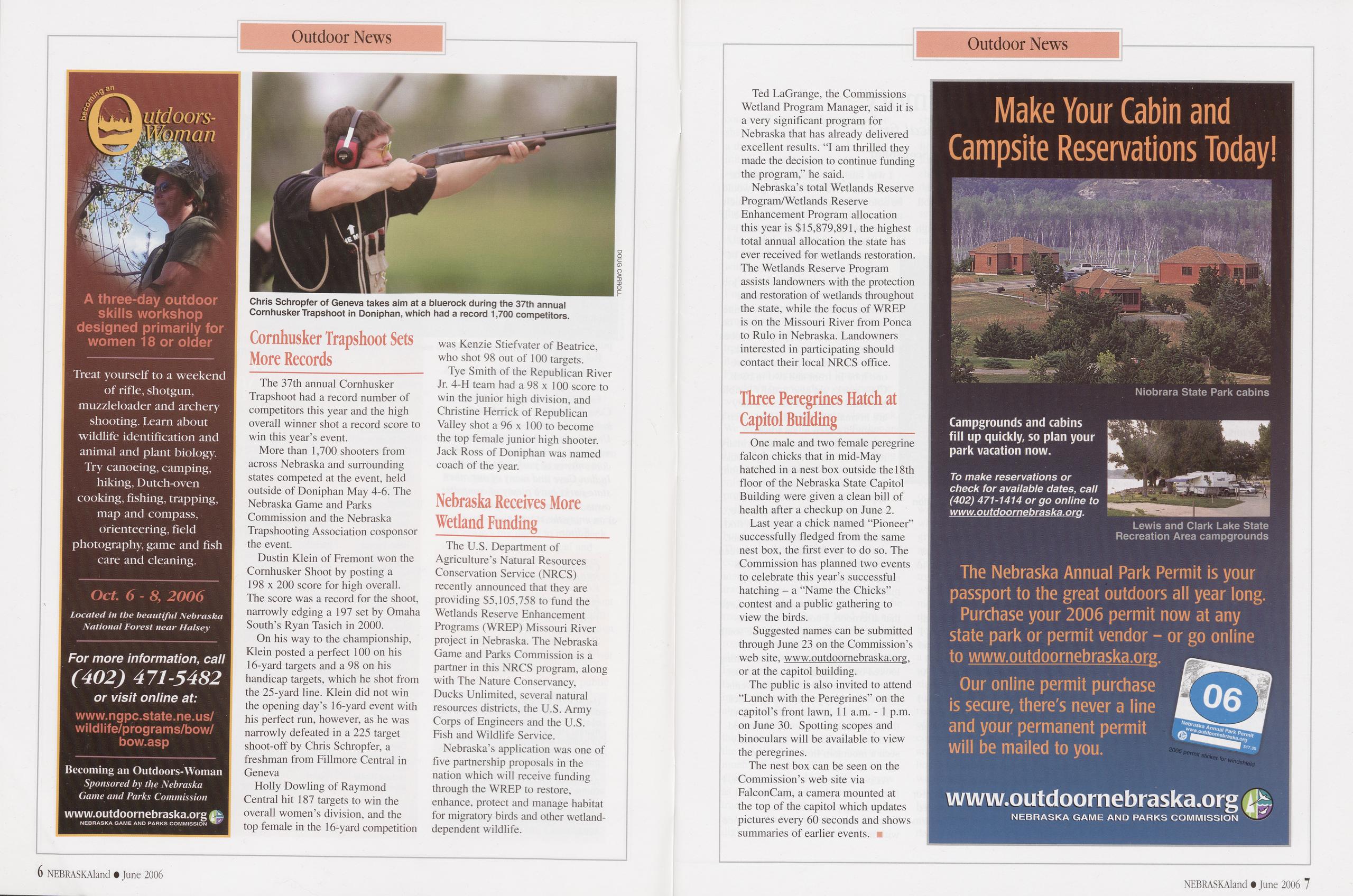
Outdoor News
A three-day outdoor skills workshop designed primarily for women 18 or older Treat yourself to a weekend of rifle, shotgun, muzzleloader and archery shooting. Learn about wildlife identification and animal and plant biology. Try canoeing, camping, hiking, Dutch-oven cooking, fishing, trapping, map and compass, orienteering, field photography, game and fish care and cleaning. Oct. 6 - 8, 2006 Located in the beautiful Nebraska National Forest near Halsey For more information, call (402) 471-5482 or visit online at: www.ngpc.state.ne.us/ wildlife/programs/bow/ bow.asp Becoming an Outdoors-Woman Sponsored by the Nebraska Game and Parks Commission www.outdoornebraska.org Ms. NEBRASKA GAME AND PARKS COMMISSIONThe 37th annual Cornhusker Trapshoot had a record number of competitors this year and the high overall winner shot a record score to win this year’s event.
More than 1,700 shooters from across Nebraska and surrounding states competed at the event, held outside of Doniphan May 4-6. The Nebraska Game and Parks Commission and the Nebraska Trapshooting Association cosponsor the event.
Dustin Klein of Fremont won the Cornhusker Shoot by posting a 198 x 200 score for high overall. The score was a record for the shoot, narrowly edging a 197 set by Omaha South’s Ryan Tasich in 2000.
On his way to the championship, Klein posted a perfect 100 on his 16-yard targets and a 98 on his handicap targets, which he shot from the 25-yard line. Klein did not win the opening day’s 16-yard event with his perfect run, however, as he was narrowly defeated in a 225 target shoot-off by Chris Schropfer, a freshman from Fillmore Central in Geneva
Holly Dowling of Raymond Central hit 187 targets to win the overall women’s division, and the top female in the 16-yard competition was Kenzie Stiefvater of Beatrice, who shot 98 out of 100 targets.
Tye Smith of the Republican River Jr. 4-H team had a 98 x 100 score to win the junior high division, and Christine Herrick of Republican Valley shot a 96 x 100 to become the top female junior high shooter. Jack Ross of Doniphan was named coach of the year.
Nebraska Receives More Wetland FundingThe U.S. Department of Agriculture’s Natural Resources Conservation Service (NRCS) recently announced that they are providing $5,105,758 to fund the Wetlands Reserve Enhancement Programs (WREP) Missouri River project in Nebraska. The Nebraska Game and Parks Commission is a partner in this NRCS program, along with The Nature Conservancy, Ducks Unlimited, several natural resources districts, the U.S. Army Corps of Engineers and the U.S. Fish and Wildlife Service.
Nebraska’s application was one of five partnership proposals in the nation which will receive funding through the WREP to restore, enhance, protect and manage habitat for migratory birds and other wetland- dependent wildlife.
Ted LaGrange, the Commissions Wetland Program Manager, said it is a very significant program for Nebraska that has already delivered excellent results. "I am thrilled they made the decision to continue funding the program,” he said.
Nebraska’s total Wetlands Reserve Program/Wetlands Reserve Enhancement Program allocation this year is $15,879,891, the highest total annual allocation the state has ever received for wetlands restoration. The Wetlands Reserve Program assists landowners with the protection and restoration of wetlands throughout the state, while the focus of WREP is on the Missouri River from Ponca to Rulo in Nebraska. Landowners interested in participating should contact their local NRCS office.
Three Peregrines Hatch at Capitol BuildingOne male and two female peregrine falcon chicks that in mid-May hatched in a nest box outside the 18th floor of the Nebraska State Capitol Building were given a clean bill of health after a checkup on June 2.
Last year a chick named “Pioneer” successfully fledged from the same nest box, the first ever to do so. The Commission has planned two events to celebrate this year’s successful hatching - a “Name the Chicks” contest and a public gathering to view the birds.
Suggested names can be submitted through June 23 on the Commission’s web site, www.outdoornebraska.org. or at the capitol building.
The public is also invited to attend “Lunch with the Peregrines” on the capitol’s front lawn, 11 a.m. - 1 p.m. on June 30. Spotting scopes and binoculars will be available to view the peregrines.
The nest box can be seen on the Commission’s web site via FalconCam, a camera mounted at the top of the capitol which updates pictures every 60 seconds and shows summaries of earlier events.
Make Your Cabin and Campsite Reservations Today!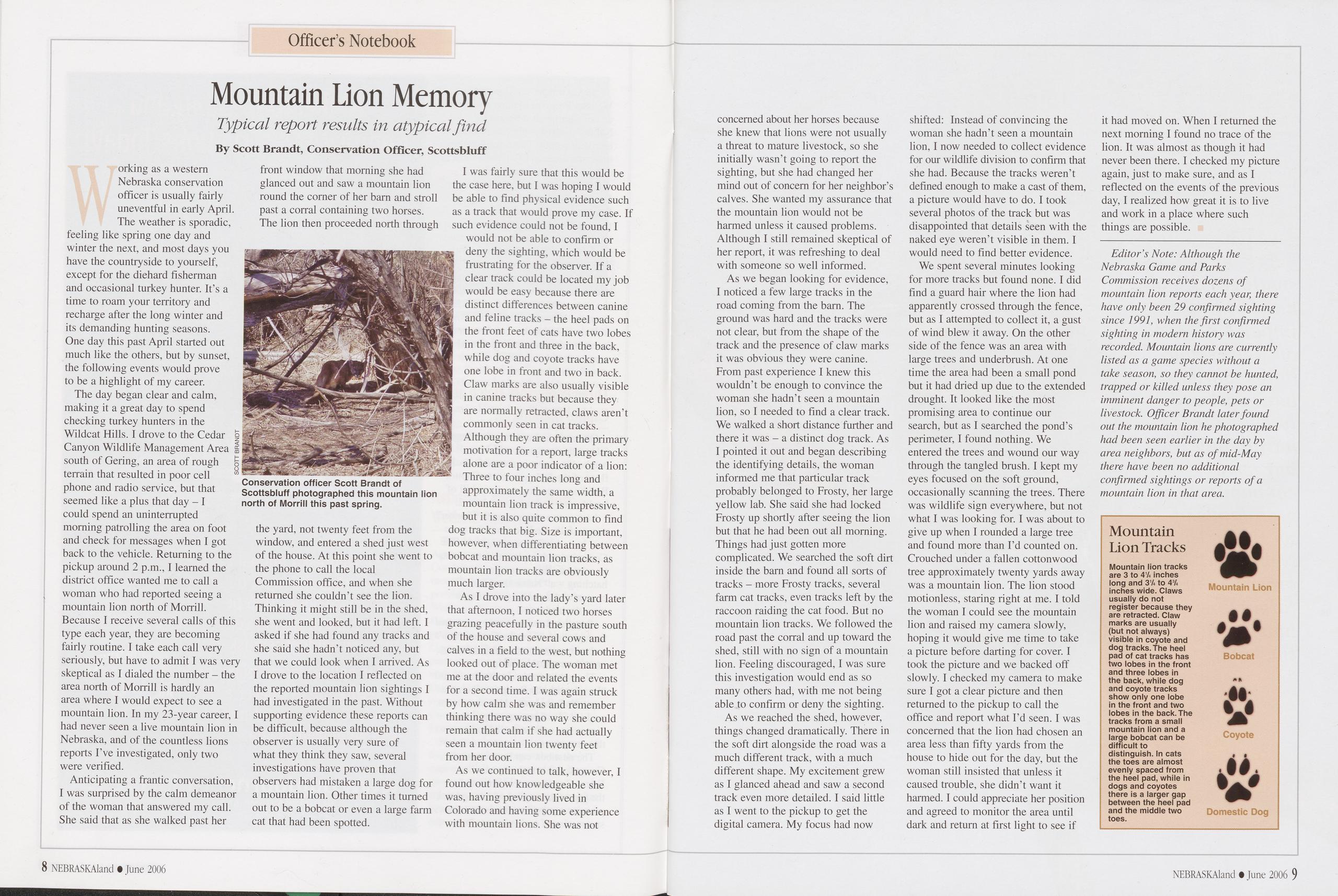
Officer’s Notebook
Mountain Lion Memory
Typical report results in atypical find
Working as a western Nebraska conservation officer is usually fairly uneventful in early April. The weather is sporadic, feeling like spring one day and winter the next, and most days you have the countryside to yourself, except for the diehard fisherman and occasional turkey hunter. It’s a time to roam your territory and recharge after the long winter and its demanding hunting seasons. One day this past April started out much like the others, but by sunset, the following events would prove to be a highlight of my career.
The day began clear and calm, making it a great day to spend checking turkey hunters in the Wildcat Hills. I drove to the Cedar Z Canyon Wildlife Management Area i south of Gering, an area of rough £ terrain that resulted in poor cell phone and radio service, but that seemed like a plus that day - I could spend an uninterrupted morning patrolling the area on foot and check for messages when I got back to the vehicle. Returning to the pickup around 2 p.m., I learned the district office wanted me to call a woman who had reported seeing a mountain lion north of Morrill. Because I receive several calls of this type each year, they are becoming fairly routine. I take each call very seriously, but have to admit I was very skeptical as I dialed the number - the area north of Morrill is hardly an area where I would expect to see a mountain lion. In my 23-year career, I had never seen a live mountain lion in Nebraska, and of the countless lions reports I’ve investigated, only two were verified.
Anticipating a frantic conversation, I was surprised by the calm demeanor of the woman that answered my call. She said that as she walked past her Mountain Lion Memory front window that morning she had glanced out and saw a mountain lion round the corner of her barn and stroll past a corral containing two horses. The lion then proceeded north through
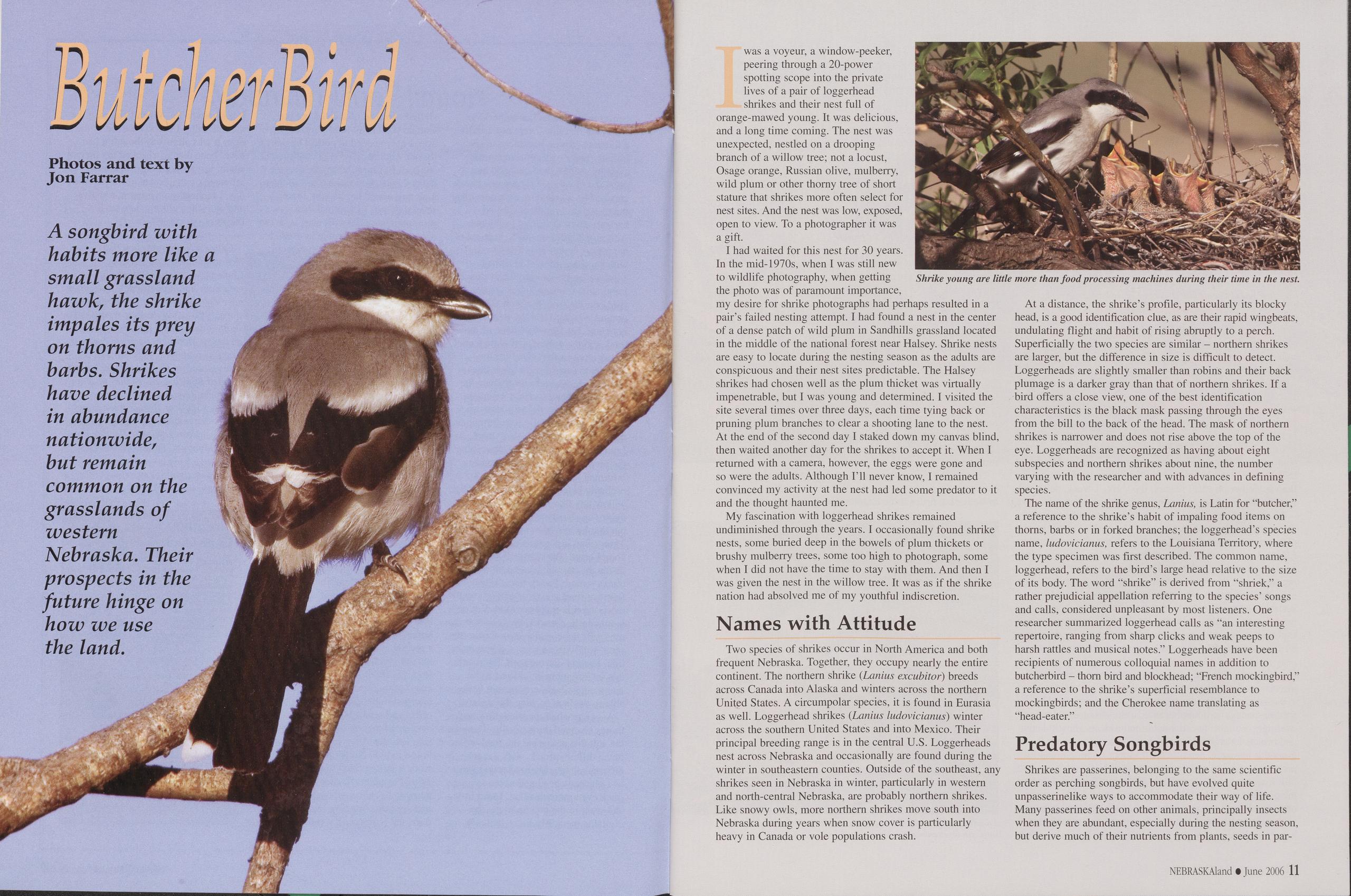
I was fairly sure that this would be the case here, but I was hoping I would be able to find physical evidence such as a track that would prove my case. If such evidence could not be found, I would not be able to confirm or deny the sighting, which would be frustrating for the observer. If a clear track could be located my job would be easy because there are distinct differences between canine and feline tracks - the heel pads on the front feet of cats have two lobes in the front and three in the back, while dog and coyote tracks have one lobe in front and two in back. Claw marks are also usually visible in canine tracks but because they are normally retracted, claws aren’t commonly seen in cat tracks. Although they are often the primary motivation for a report, large tracks alone are a poor indicator of a lion: Three to four inches long and approximately the same width, a mountain lion track is impressive, but it is also quite common to find dog tracks that big. Size is important, however, when differentiating between bobcat and mountain lion tracks, as mountain lion tracks are obviously much larger.
As I drove into the lady’s yard later that afternoon, I noticed two horses grazing peacefully in the pasture south of the house and several cows and calves in a field to the west, but nothing looked out of place. The woman met me at the door and related the events for a second time. I was again struck by how calm she was and remember thinking there was no way she could remain that calm if she had actually seen a mountain lion twenty feet from her door.
As we continued to talk, however, I found out how knowledgeable she was, having previously lived in Colorado and having some experience with mountain lions. She was not concerned about her horses because she knew that lions were not usually a threat to mature livestock, so she initially wasn’t going to report the sighting, but she had changed her mind out of concern for her neighbor’s calves. She wanted my assurance that the mountain lion would not be harmed unless it caused problems. Although I still remained skeptical of her report, it was refreshing to deal with someone so well informed.
As we began looking for evidence, I noticed a few large tracks in the road coming from the barn. The ground was hard and the tracks were not clear, but from the shape of the track and the presence of claw marks it was obvious they were canine. From past experience I knew this wouldn’t be enough to convince the woman she hadn’t seen a mountain lion, so I needed to find a clear track. We walked a short distance further and there it was - a distinct dog track. As I pointed it out and began describing the identifying details, the woman informed me that particular track probably belonged to Frosty, her large yellow lab. She said she had locked Frosty up shortly after seeing the lion but that he had been out all morning. Things had just gotten more complicated. We searched the soft dirt inside the barn and found all sorts of tracks - more Frosty tracks, several farm cat tracks, even tracks left by the raccoon raiding the cat food. But no mountain lion tracks. We followed the road past the corral and up toward the shed, still with no sign of a mountain lion. Feeling discouraged, I was sure this investigation would end as so many others had, with me not being able to confirm or deny the sighting.
As we reached the shed, however, things changed dramatically. There in the soft dirt alongside the road was a much different track, with a much different shape. My excitement grew as I glanced ahead and saw a second track even more detailed. I said little as I went to the pickup to get the digital camera. My focus had now shifted: Instead of convincing the woman she hadn’t seen a mountain lion, I now needed to collect evidence for our wildlife division to confirm that she had. Because the tracks weren’t defined enough to make a cast of them, a picture would have to do. I took several photos of the track but was disappointed that details seen with the naked eye weren’t visible in them. I would need to find better evidence.
We spent several minutes looking for more tracks but found none. I did find a guard hair where the lion had apparently crossed through the fence, but as I attempted to collect it, a gust of wind blew it away. On the other side of the fence was an area with large trees and underbrush. At one time the area had been a small pond but it had dried up due to the extended drought. It looked like the most promising area to continue our search, but as I searched the pond’s perimeter, I found nothing. We entered the trees and wound our way through the tangled brush. I kept my eyes focused on the soft ground, occasionally scanning the trees. There was wildlife sign everywhere, but not what I was looking for. I was about to give up when I rounded a large tree and found more than I’d counted on. Crouched under a fallen cottonwood tree approximately twenty yards away was a mountain lion. The lion stood motionless, staring right at me. I told the woman I could see the mountain lion and raised my camera slowly, hoping it would give me time to take a picture before darting for cover. I took the picture and we backed off slowly. I checked my camera to make sure I got a clear picture and then returned to the pickup to call the office and report what I’d seen. I was concerned that the lion had chosen an area less than fifty yards from the house to hide out for the day, but the woman still insisted that unless it caused trouble, she didn’t want it harmed. I could appreciate her position and agreed to monitor the area until dark and return at first light to see if it had moved on. When I returned the next morning I found no trace of the lion. It was almost as though it had never been there. I checked my picture again, just to make sure, and as I reflected on the events of the previous day, I realized how great it is to live and work in a place where such things are possible.
Editor's Note: Although the Nebraska Game and Parks Commission receives dozens of mountain lion reports each year, there have only been 29 confirmed sighting since 1991, when the first confirmed sighting in modern history was recorded. Mountain lions are currently listed as a game species without a take season, so they cannot be hunted, trapped or killed unless they pose an imminent danger to people, pets or livestock. Officer Brandt later found out the mountain lion he photographed had been seen earlier in the day by area neighbors, but as of mid-May there have been no additional confirmed sightings or reports of a mountain lion in that area. Mountain Lion TracksMountain lion tracks are 3 to 41Z» inches long and 31/4 to 43A inches wide. Claws usually do not register because they are retracted. Claw marks are usually (but not always) visible in coyote and dog tracks. The heel pad of cat tracks has two lobes in the front and three lobes in the back, while dog and coyote tracks show only one lobe in the front and two lobes in the back. The tracks from a small mountain lion and a large bobcat can be difficult to distinguish. In cats the toes are almost evenly spaced from the heel pad, while in dogs and coyotes there is a larger gap between the heel pad and the middle two toes.
Butcher Bird
A songbird with habits more like a small grassland hawk, the shrike impales its prey on thorns and barbs. Shrikes have declined in abundance nationwide, but remain common on the grasslands of western Nebraska. Their prospects in the future hinge on how we use the land.
I was a voyeur, a window-peeker, peering through a 20-power spotting scope into the private lives of a pair of loggerhead shrikes and their nest full of orange-mawed young. It was delicious, and a long time coming. The nest was unexpected, nestled on a drooping branch of a willow tree; not a locust, Osage orange, Russian olive, mulberry, wild plum or other thorny tree of short stature that shrikes more often select for nest sites. And the nest was low, exposed, open to view. To a photographer it was a gift.
I had waited for this nest for 30 years. In the mid-1970s, when I was still new to wildlife photography, when getting the photo was of paramount importance, my desire for shrike photographs had perhaps resulted in a pair’s failed nesting attempt. I had found a nest in the center of a dense patch of wild plum in Sandhills grassland located in the middle of the national forest near Halsey. Shrike nests are easy to locate during the nesting season as the adults are conspicuous and their nest sites predictable. The Halsey shrikes had chosen well as the plum thicket was virtually impenetrable, but I was young and determined. I visited the site several times over three days, each time tying back or pruning plum branches to clear a shooting lane to the nest. At the end of the second day I staked down my canvas blind, then waited another day for the shrikes to accept it. When I returned with a camera, however, the eggs were gone and so were the adults. Although TH never know, I remained convinced my activity at the nest had led some predator to it and the thought haunted me.
My fascination with loggerhead shrikes remained undiminished through the years. I occasionally found shrike nests, some buried deep in the bowels of plum thickets or brushy mulberry trees, some too high to photograph, some when I did not have the time to stay with them. And then I was given the nest in the willow tree. It was as if the shrike nation had absolved me of my youthful indiscretion.
Names with AttitudeTwo species of shrikes occur in North America and both frequent Nebraska. Together, they occupy nearly the entire continent. The northern shrike (Lanius excubitor) breeds across Canada into Alaska and winters across the northern United States. A circumpolar species, it is found in Eurasia as well. Loggerhead shrikes (.Lanius ludovicianus) winter across the southern United States and into Mexico. Their principal breeding range is in the central U.S. Loggerheads nest across Nebraska and occasionally are found during the winter in southeastern counties. Outside of the southeast, any shrikes seen in Nebraska in winter, particularly in western and north-central Nebraska, are probably northern shrikes. Like snowy owls, more northern shrikes move south into Nebraska during years when snow cover is particularly heavy in Canada or vole populations crash.
At a distance, the shrike’s profile, particularly its blocky head, is a good identification clue, as are their rapid wingbeats, undulating flight and habit of rising abruptly to a perch. Superficially the two species are similar - northern shrikes are larger, but the difference in size is difficult to detect. Loggerheads are slightly smaller than robins and their back plumage is a darker gray than that of northern shrikes. If a bird offers a close view, one of the best identification characteristics is the black mask passing through the eyes from the bill to the back of the head. The mask of northern shrikes is narrower and does not rise above the top of the eye. Loggerheads are recognized as having about eight subspecies and northern shrikes about nine, the number varying with the researcher and with advances in defining species.
The name of the shrike genus, Lanius, is Latin for “butcher,” a reference to the shrike’s habit of impaling food items on thorns, barbs or in forked branches; the loggerhead’s species name, ludovicianus, refers to the Louisiana Territory, where the type specimen was first described. The common name, loggerhead, refers to the bird’s large head relative to the size of its body. The word “shrike” is derived from “shriek,” a rather prejudicial appellation referring to the species’ songs and calls, considered unpleasant by most listeners. One researcher summarized loggerhead calls as “an interesting repertoire, ranging from sharp clicks and weak peeps to harsh rattles and musical notes.” Loggerheads have been recipients of numerous colloquial names in addition to butcherbird - thorn bird and blockhead; “French mockingbird,” a reference to the shrike’s superficial resemblance to mockingbirds; and the Cherokee name translating as “head-eater.”
Predatory SongbirdsShrikes are passerines, belonging to the same scientific
order as perching songbirds, but have evolved quite
unpasserinelike ways to accommodate their way of life.
Many passerines feed on other animals, principally insects
when they are abundant, especially during the nesting season,
but derive much of their nutrients from plants, seeds in par-
NEBRASKAland • June 2006 11
When insects are abundant, grasshoppers, beetles and other invertebrates comprise as much as 70 to 80 percent of a loggerhead’s diet. But even during the spring and summer months there is a vertebrate component to the shrike’s diet - mice, lizards, small snakes and, occasionally, small birds, particularly young passerines. Small mammals comprise the bulk of the shrike’s winter diet.
Unlike raptors such as hawks and owls, shrikes are somewhat ill prepared for their predacious way of life, so they have evolved behavioral skills to compensate. It is, more than any other physical feature, the shrike’s weak, perching feet that keep it from being just a small grassland hawk.
Although shrikes lack strong feet and rapierlike talons, they forage somewhat like raptors. The shrike’s usual mode of hunting is to perch and watch, much the same as kestrels. Elevated perches such as isolated trees, fences or power lines are essential to loggerheads. The visual acuity of shrikes is reported to be the equal of raptors, and they skillfully locate even small and unmoving prey in grass cover. Also, like kestrels, shrikes hunt by hovering on fluttering wings. While not as agile as a sharp-shinned hawk, shrikes can and do capture birds on the wing, especially young and inexperienced birds, but most often succeed by pursuing their prey into heavy cover. And like kingbirds, shrikes pluck flying insects out of the air. Nor is it uncommon to observe shrikes stalking insects or other prey by hopping along the ground.
Shrikes feed diligently just after dawn, especially when feeding young, no doubt because of the absence of food overnight, but also because nocturnal rodents are still active and insects lethargic. When a shrike observes prey on the ground it leaves its perch in swift, direct flight, pinning its prey to the ground and dispatching it with its heavy, hooked bill. Insects are usually crushed in the bill and consumed on the ground unless the food is being carried to young in the nest. Small prey is carried in the shrike’s bill, but larger prey is usually carried with the feet. Even with their weak feet, loggerheads can carry their own weight, perhaps more. Only the female shrike incubates eggs and broods young during their first four to five days. During this time the male is hunting not just for himself but for the female and ravenous brood. As the young birds mature, the female begins leaving the nest more frequently, capturing prey for both herself and the young.
It is with larger, vertebrate prey such as mice and lizards that the shrike’s fascinating accommodation for a raptorial life without strong feet and talons becomes evident. Small vertebrates are quickly dispatched by powerful blows from the shrike’s hooked bill to the back of the skull, thus severing the spinal column. The margins of the shrike’s upper bill near the tip are flanked with small, horny, tooth-like projections adapted for holding, dispatching and dismembering prey.
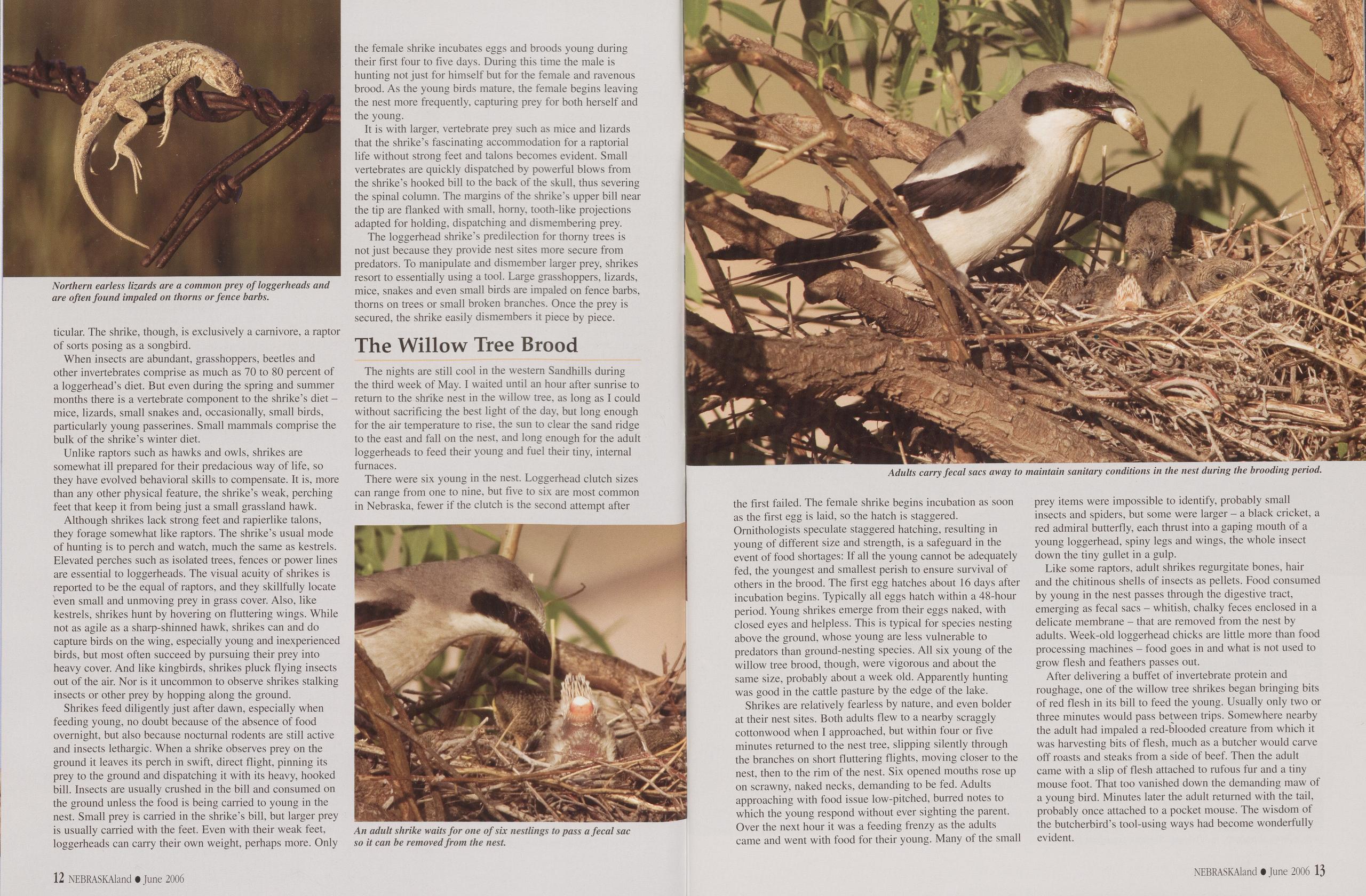
The loggerhead shrike’s predilection for thorny trees is not just because they provide nest sites more secure from predators. To manipulate and dismember larger prey, shrikes resort to essentially using a tool. Large grasshoppers, lizards, mice, snakes and even small birds are impaled on fence barbs, thorns on trees or small broken branches. Once the prey is secured, the shrike easily dismembers it piece by piece.
The Willow Tree BroodThe nights are still cool in the western Sandhills during the third week of May. I waited until an hour after sunrise to return to the shrike nest in the willow tree, as long as I could without sacrificing the best light of the day, but long enough for the air temperature to rise, the sun to clear the sand ridge to the east and fall on the nest, and long enough for the adult loggerheads to feed their young and fuel their tiny, internal furnaces.
There were six young in the nest. Loggerhead clutch sizes can range from one to nine, but five to six are most common in Nebraska, fewer if the clutch is the second attempt after
Shrikes are relatively fearless by nature, and even bolder at their nest sites. Both adults flew to a nearby scraggly cottonwood when I approached, but within four or five minutes returned to the nest tree, slipping silently through the branches on short fluttering flights, moving closer to the nest, then to the rim of the nest. Six opened mouths rose up on scrawny, naked necks, demanding to be fed. Adults approaching with food issue low-pitched, burred notes to which the young respond without ever sighting the parent. Over the next hour it was a feeding frenzy as the adults came and went with food for their young. Many of the small prey items were impossible to identify, probably small insects and spiders, but some were larger - a black cricket, a red admiral butterfly, each thrust into a gaping mouth of a young loggerhead, spiny legs and wings, the whole insect down the tiny gullet in a gulp.
Like some raptors, adult shrikes regurgitate bones, hair and the chitinous shells of insects as pellets. Food consumed by young in the nest passes through the digestive tract, emerging as fecal sacs - whitish, chalky feces enclosed in a delicate membrane - that are removed from the nest by adults. Week-old loggerhead chicks are little more than food processing machines - food goes in and what is not used to grow flesh and feathers passes out.
After delivering a buffet of invertebrate protein and roughage, one of the willow tree shrikes began bringing bits of red flesh in its bill to feed the young. Usually only two or three minutes would pass between trips. Somewhere nearby the adult had impaled a red-blooded creature from which it was harvesting bits of flesh, much as a butcher would carve off roasts and steaks from a side of beef. Then the adult came with a slip of flesh attached to rufous fur and a tiny mouse foot. That too vanished down the demanding maw of a young bird. Minutes later the adult returned with the tail, probably once attached to a pocket mouse. The wisdom of the butcherbird’s tool-using ways had become wonderfully evident.
12 NEBRASKAland • June 2006 NEBRASKAland • June 2006 13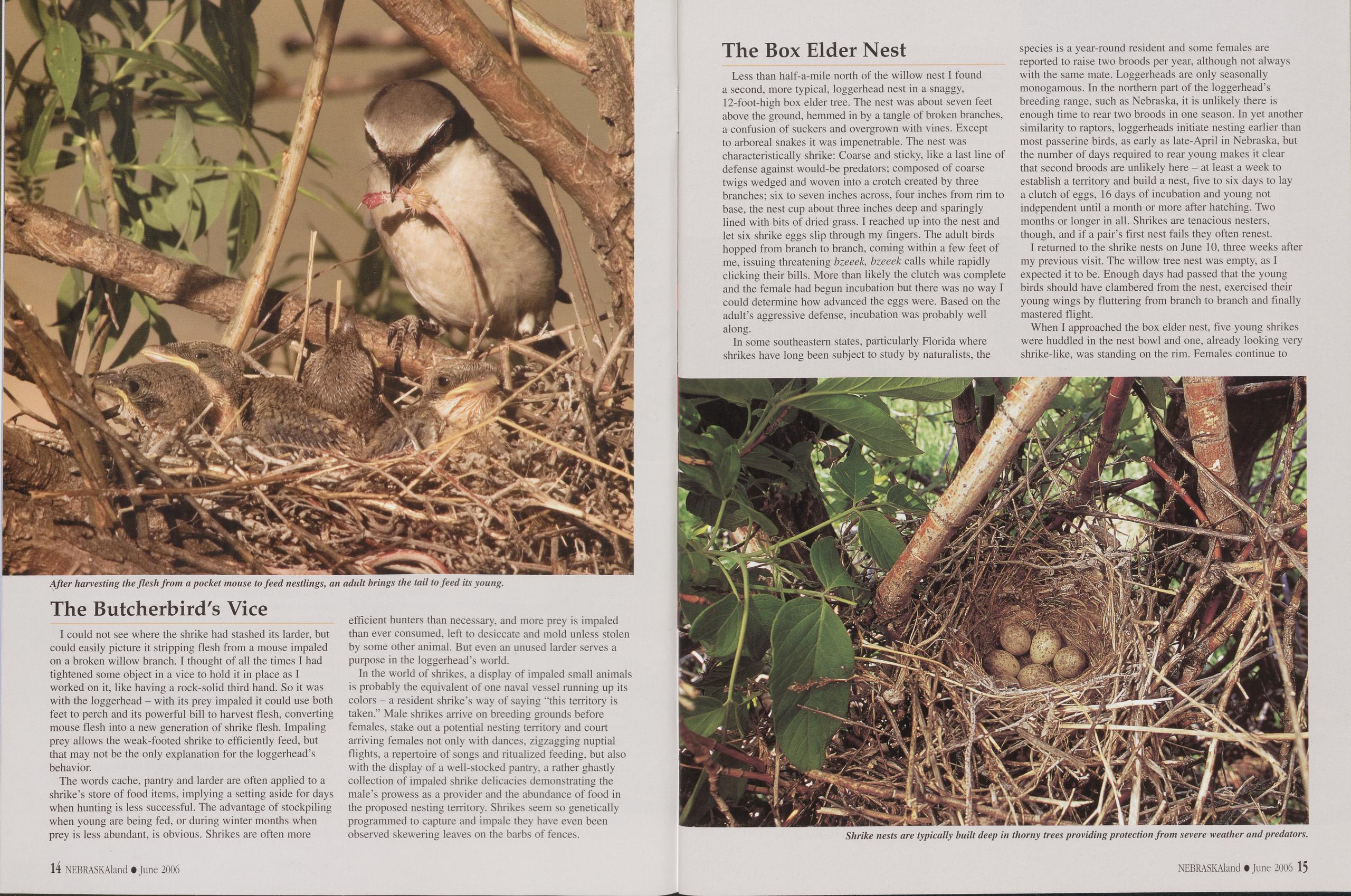
I could not see where the shrike had stashed its larder, but could easily picture it stripping flesh from a mouse impaled on a broken willow branch. I thought of all the times I had tightened some object in a vice to hold it in place as I worked on it, like having a rock-solid third hand. So it was with the loggerhead - with its prey impaled it could use both feet to perch and its powerful bill to harvest flesh, converting mouse flesh into a new generation of shrike flesh. Impaling prey allows the weak-footed shrike to efficiently feed, but that may not be the only explanation for the loggerhead’s behavior.
The words cache, pantry and larder are often applied to a shrike’s store of food items, implying a setting aside for days when hunting is less successful. The advantage of stockpiling when young are being fed, or during winter months when prey is less abundant, is obvious. Shrikes are often more efficient hunters than necessary, and more prey is impaled than ever consumed, left to desiccate and mold unless stolen by some other animal. But even an unused larder serves a purpose in the loggerhead’s world.
In the world of shrikes, a display of impaled small animals is probably the equivalent of one naval vessel running up its colors - a resident shrike’s way of saying "this territory is taken.” Male shrikes arrive on breeding grounds before females, stake out a potential nesting territory and court arriving females not only with dances, zigzagging nuptial flights, a repertoire of songs and ritualized feeding, but also with the display of a well-stocked pantry, a rather ghastly collection of impaled shrike delicacies demonstrating the male’s prowess as a provider and the abundance of food in the proposed nesting territory. Shrikes seem so genetically programmed to capture and impale they have even been observed skewering leaves on the barbs of fences.
The Box Elder NestLess than half-a-mile north of the willow nest I found a second, more typical, loggerhead nest in a snaggy, 12-foot-high box elder tree. The nest was about seven feet above the ground, hemmed in by a tangle of broken branches, a confusion of suckers and overgrown with vines. Except to arboreal snakes it was impenetrable. The nest was characteristically shrike: Coarse and sticky, like a last line of defense against would-be predators; composed of coarse twigs wedged and woven into a crotch created by three branches; six to seven inches across, four inches from rim to base, the nest cup about three inches deep and sparingly lined with bits of dried grass. I reached up into the nest and let six shrike eggs slip through my fingers. The adult birds hopped from branch to branch, coming within a few feet of me, issuing threatening bzeeek, bzeeek calls while rapidly clicking their bills. More than likely the clutch was complete and the female had begun incubation but there was no way I could determine how advanced the eggs were. Based on the adult’s aggressive defense, incubation was probably well along.
In some southeastern states, particularly Florida where shrikes have long been subject to study by naturalists, the
I returned to the shrike nests on June 10, three weeks after my previous visit. The willow tree nest was empty, as I expected it to be. Enough days had passed that the young birds should have clambered from the nest, exercised their young wings by fluttering from branch to branch and finally mastered flight.
When I approached the box elder nest, five young shrikes
were huddled in the nest bowl and one, already looking very
shrike-like, was standing on the rim. Females continue to
14 NEBRASKAland • June 2006
NEBRASKAland • June 2006 15
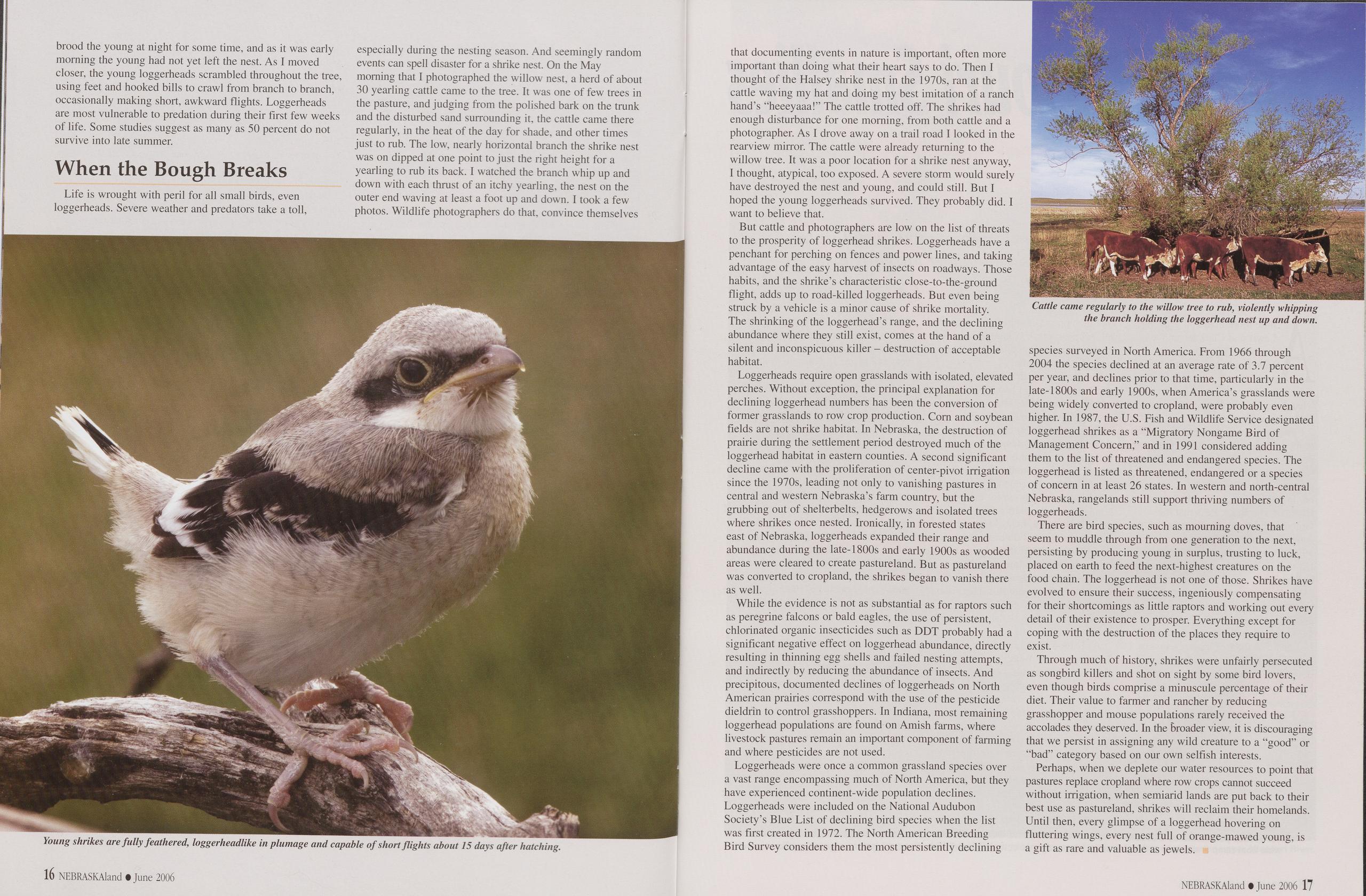 brood the young at night for some time, and as it was early
morning the young had not yet left the nest. As I moved
closer, the young loggerheads scrambled throughout the tree,
using feet and hooked bills to crawl from branch to branch,
occasionally making short, awkward flights. Loggerheads
are most vulnerable to predation during their first few weeks
of life. Some studies suggest as many as 50 percent do not
survive into late summer.
brood the young at night for some time, and as it was early
morning the young had not yet left the nest. As I moved
closer, the young loggerheads scrambled throughout the tree,
using feet and hooked bills to crawl from branch to branch,
occasionally making short, awkward flights. Loggerheads
are most vulnerable to predation during their first few weeks
of life. Some studies suggest as many as 50 percent do not
survive into late summer.
Life is wrought with peril for all small birds, even loggerheads. Severe weather and predators take a toll,
But cattle and photographers are low on the list of threats to the prosperity of loggerhead shrikes. Loggerheads have a penchant for perching on fences and power lines, and taking advantage of the easy harvest of insects on roadways. Those habits, and the shrike’s characteristic close-to-the-ground flight, adds up to road-killed loggerheads. But even being struck by a vehicle is a minor cause of shrike mortality. The shrinking of the loggerhead’s range, and the declining abundance where they still exist, comes at the hand of a silent and inconspicuous killer - destruction of acceptable habitat.
Loggerheads require open grasslands with isolated, elevated perches. Without exception, the principal explanation for declining loggerhead numbers has been the conversion of former grasslands to row crop production. Corn and soybean fields are not shrike habitat. In Nebraska, the destruction of prairie during the settlement period destroyed much of the loggerhead habitat in eastern counties. A second significant decline came with the proliferation of center-pivot irrigation since the 1970s, leading not only to vanishing pastures in central and western Nebraska’s farm country, but the grubbing out of shelterbelts, hedgerows and isolated trees where shrikes once nested. Ironically, in forested states east of Nebraska, loggerheads expanded their range and abundance during the late-1800s and early 1900s as wooded areas were cleared to create pastureland. But as pastureland was converted to cropland, the shrikes began to vanish there as well.
While the evidence is not as substantial as for raptors such as peregrine falcons or bald eagles, the use of persistent, chlorinated organic insecticides such as DDT probably had a significant negative effect on loggerhead abundance, directly resulting in thinning egg shells and failed nesting attempts, and indirectly by reducing the abundance of insects. And precipitous, documented declines of loggerheads on North American prairies correspond with the use of the pesticide dieldrin to control grasshoppers. In Indiana, most remaining loggerhead populations are found on Amish farms, where livestock pastures remain an important component of farming and where pesticides are not used.
Loggerheads were once a common grassland species over a vast range encompassing much of North America, but they have experienced continent-wide population declines. Loggerheads were included on the National Audubon Society’s Blue List of declining bird species when the list was first created in 1972. The North American Breeding Bird Survey considers them the most persistently declining Cattle came regularly to the willow tree to rub, violently whipping the branch holding the loggerhead nest up and down. species surveyed in North America. From 1966 through 2004 the species declined at an average rate of 3.7 percent per year, and declines prior to that time, particularly in the late-1800s and early 1900s, when America’s grasslands were being widely converted to cropland, were probably even higher. In 1987, the U.S. Fish and Wildlife Service designated loggerhead shrikes as a “Migratory Nongame Bird of Management Concern,” and in 1991 considered adding them to the list of threatened and endangered species. The loggerhead is listed as threatened, endangered or a species of concern in at least 26 states. In western and north-central Nebraska, rangelands still support thriving numbers of loggerheads.
There are bird species, such as mourning doves, that seem to muddle through from one generation to the next, persisting by producing young in surplus, trusting to luck, placed on earth to feed the next-highest creatures on the food chain. The loggerhead is not one of those. Shrikes have evolved to ensure their success, ingeniously compensating for their shortcomings as little raptors and working out every detail of their existence to prosper. Everything except for coping with the destruction of the places they require to exist.
Through much of history, shrikes were unfairly persecuted as songbird killers and shot on sight by some bird lovers, even though birds comprise a minuscule percentage of their diet. Their value to farmer and rancher by reducing grasshopper and mouse populations rarely received the accolades they deserved. In the broader view, it is discouraging that we persist in assigning any wild creature to a “good” or “bad” category based on our own selfish interests.
Perhaps, when we deplete our water resources to point that pastures replace cropland where row crops cannot succeed without irrigation, when semiarid lands are put back to their best use as pastureland, shrikes will reclaim their homelands. Until then, every glimpse of a loggerhead hovering on fluttering wings, every nest full of orange-mawed young, is a gift as rare and valuable as jewels.
16 NEBRASKAland • June 2006 NEBRASKAland • June 2006 17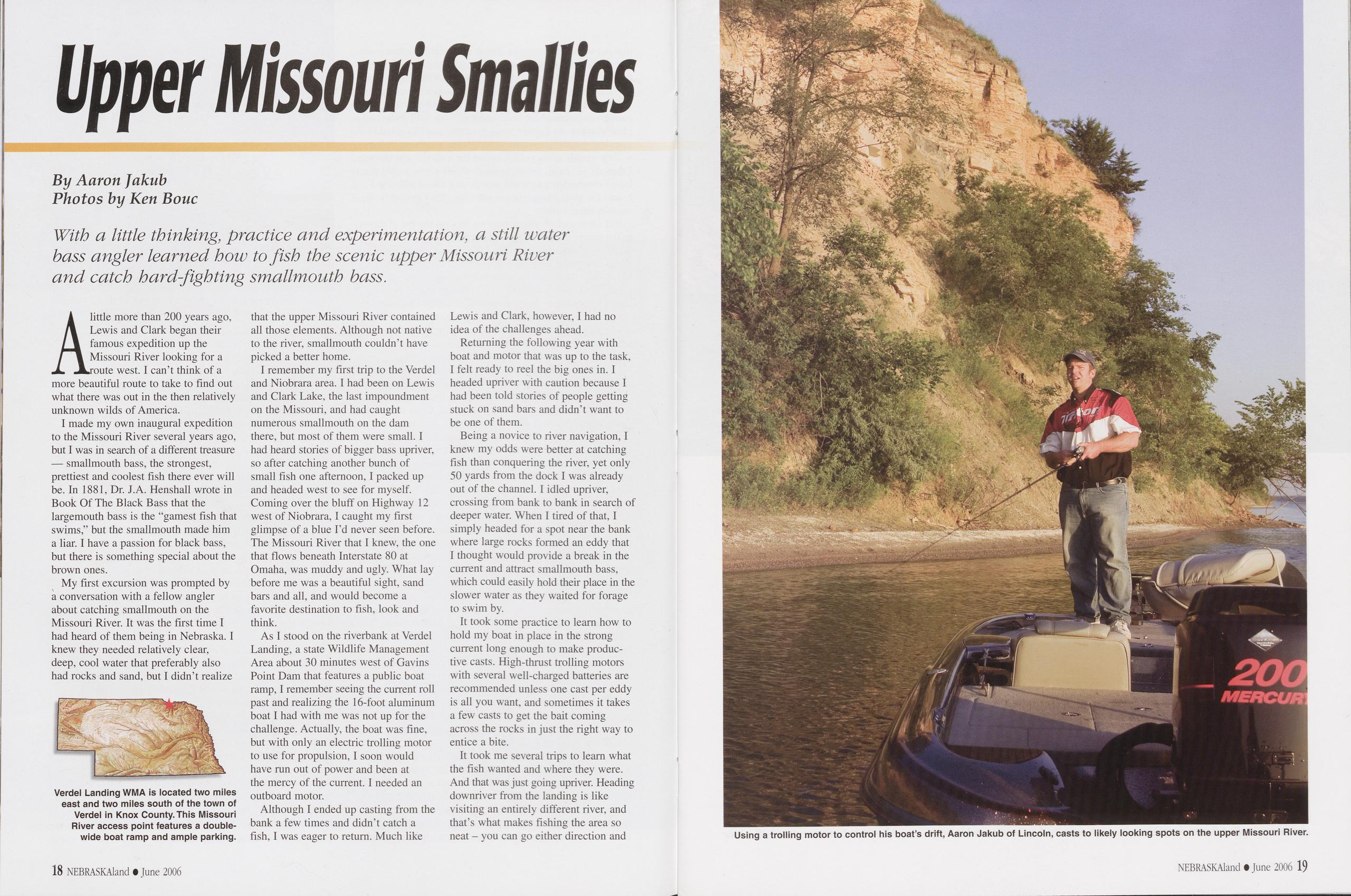
Upper Missouri Smallies
With a little thinking, practice and experimentation, a still water bass angler learned how to fish the scenic upper Missouri River and catch hard-fighting smallmouth bass.
A little more than 200 years ago, Lewis and Clark began their famous expedition up the Missouri River looking for a route west. I can’t think of a more beautiful route to take to find out what there was out in the then relatively unknown wilds of America.
I made my own inaugural expedition to the Missouri River several years ago, but I was in search of a different treasure — smallmouth bass, the strongest, prettiest and coolest fish there ever will be. In 1881, Dr. J.A. Henshall wrote in Book Of The Black Bass that the largemouth bass is the "gamest fish that swims,” but the smallmouth made him a liar. I have a passion for black bass, but there is something special about the brown ones.
My first excursion was prompted by a conversation with a fellow angler about catching smallmouth on the Missouri River. It was the first time I had heard of them being in Nebraska. I knew they needed relatively clear, deep, cool water that preferably also had rocks and sand, but I didn’t realize
I remember my first trip to the Verdel and Niobrara area. I had been on Lewis and Clark Lake, the last impoundment on the Missouri, and had caught numerous smallmouth on the dam there, but most of them were small. I had heard stories of bigger bass upriver, so after catching another bunch of small fish one afternoon, I packed up and headed west to see for myself. Coming over the bluff on Highway 12 west of Niobrara, I caught my first glimpse of a blue I’d never seen before. The Missouri River that I knew, the one that flows beneath Interstate 80 at Omaha, was muddy and ugly. What lay before me was a beautiful sight, sand bars and all, and would become a favorite destination to fish, look and think.
As I stood on the riverbank at Verdel Landing, a state Wildlife Management Area about 30 minutes west of Gavins Point Dam that features a public boat ramp, I remember seeing the current roll past and realizing the 16-foot aluminum boat I had with me was not up for the challenge. Actually, the boat was fine, but with only an electric trolling motor to use for propulsion, I soon would have run out of power and been at the mercy of the current. I needed an outboard motor.
Although I ended up casting from the bank a few times and didn’t catch a fish, I was eager to return. Much like Lewis and Clark, however, I had no idea of the challenges ahead.
Returning the following year with boat and motor that was up to the task, I felt ready to reel the big ones in. I headed upriver with caution because I had been told stories of people getting stuck on sand bars and didn’t want to be one of them.
Being a novice to river navigation, I knew my odds were better at catching fish than conquering the river, yet only 50 yards from the dock I was already out of the channel. I idled upriver, crossing from bank to bank in search of deeper water. When I tired of that, I simply headed for a spot near the bank where large rocks formed an eddy that I thought would provide a break in the current and attract smallmouth bass, which could easily hold their place in the slower water as they waited for forage to swim by.
It took some practice to learn how to hold my boat in place in the strong current long enough to make produc- tive casts. High-thrust trolling motors with several well-charged batteries are recommended unless one cast per eddy is all you want, and sometimes it takes a few casts to get the bait coming across the rocks in just the right way to entice a bite.
It took me several trips to learn what the fish wanted and where they were. And that was just going upriver. Heading downriver from the landing is like visiting an entirely different river, and that’s what makes fishing the area so neat - you can go either direction and
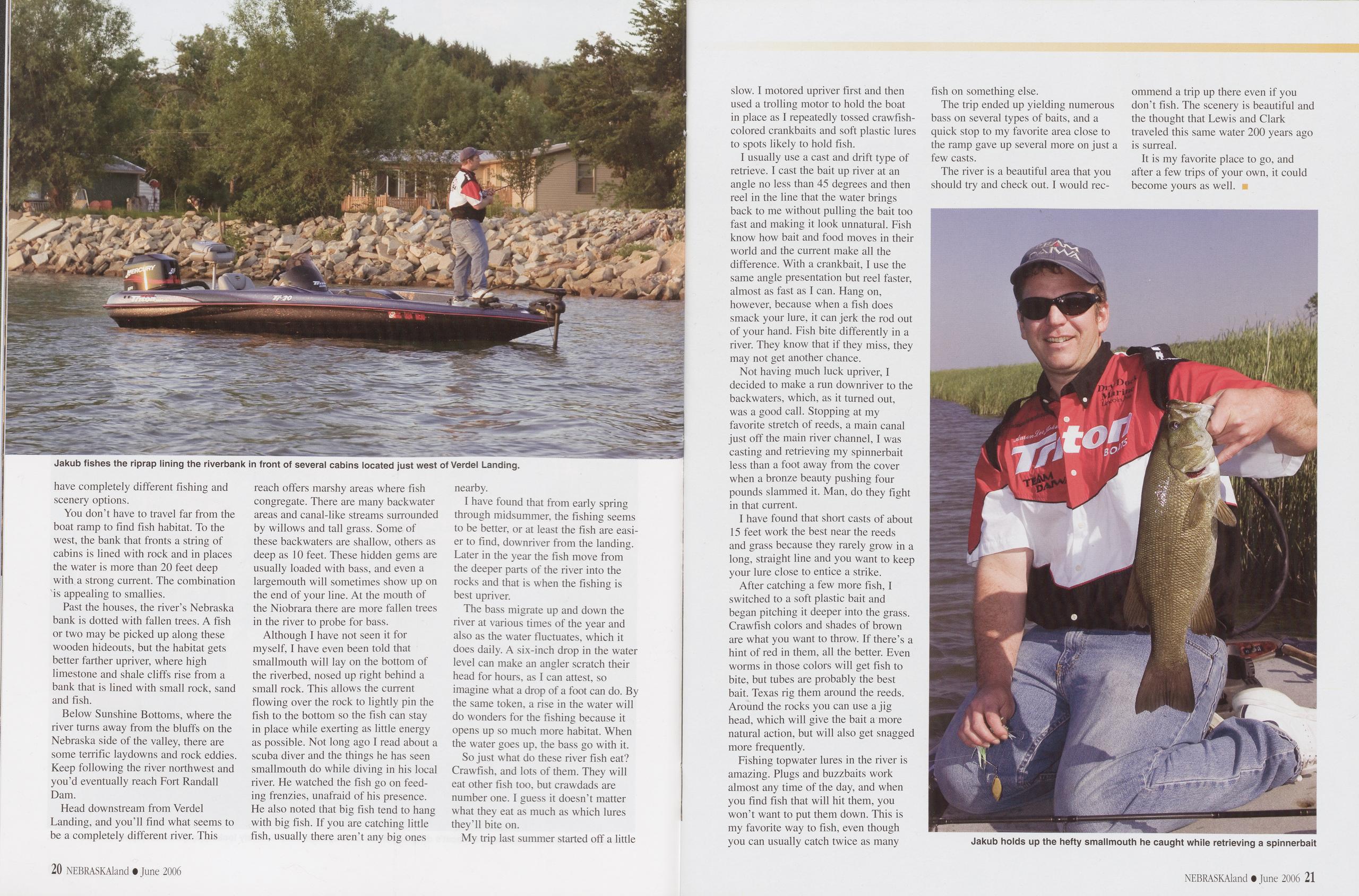
You don’t have to travel far from the boat ramp to find fish habitat. To the west, the bank that fronts a string of cabins is lined with rock and in places the water is more than 20 feet deep with a strong current. The combination is appealing to smallies.
Past the houses, the river’s Nebraska bank is dotted with fallen trees. A fish or two may be picked up along these wooden hideouts, but the habitat gets better farther upriver, where high limestone and shale cliffs rise from a bank that is lined with small rock, sand and fish.
Below Sunshine Bottoms, where the river turns away from the bluffs on the Nebraska side of the valley, there are some terrific laydowns and rock eddies. Keep following the river northwest and you’d eventually reach Fort Randall Dam.
Head downstream from Verdel Landing, and you’ll find what seems to be a completely different river. This reach offers marshy areas where fish congregate. There are many backwater areas and canal-like streams surrounded by willows and tall grass. Some of these backwaters are shallow, others as deep as 10 feet. These hidden gems are usually loaded with bass, and even a largemouth will sometimes show up on the end of your line. At the mouth of the Niobrara there are more fallen trees in the river to probe for bass.
Although I have not seen it for myself, I have even been told that smallmouth will lay on the bottom of the riverbed, nosed up right behind a small rock. This allows the current flowing over the rock to lightly pin the fish to the bottom so the fish can stay in place while exerting as little energy as possible. Not long ago I read about a scuba diver and the things he has seen smallmouth do while diving in his local river. He watched the fish go on feed- ing frenzies, unafraid of his presence. He also noted that big fish tend to hang with big fish. If you are catching little fish, usually there aren’t any big ones nearby.
I have found that from early spring through midsummer, the fishing seems to be better, or at least the fish are easi- er to find, downriver from the landing. Later in the year the fish move from the deeper parts of the river into the rocks and that is when the fishing is best upriver.
The bass migrate up and down the river at various times of the year and also as the water fluctuates, which it does daily. A six-inch drop in the water level can make an angler scratch their head for hours, as I can attest, so imagine what a drop of a foot can do. By the same token, a rise in the water will do wonders for the fishing because it opens up so much more habitat. When the water goes up, the bass go with it.
So just what do these river fish eat? Crawfish, and lots of them. They will eat other fish too, but crawdads are number one. I guess it doesn’t matter what they eat as much as which lures they’ll bite on.
My trip last summer started off a little slow. I motored upriver first and then used a trolling motor to hold the boat in place as I repeatedly tossed crawfish- colored crankbaits and soft plastic lures to spots likely to hold fish.
I usually use a cast and drift type of retrieve. I cast the bait up river at an angle no less than 45 degrees and then reel in the line that the water brings back to me without pulling the bait too fast and making it look unnatural. Fish know how bait and food moves in their world and the current make all the difference. With a crankbait, I use the same angle presentation but reel faster, almost as fast as I can. Hang on, however, because when a fish does smack your lure, it can jerk the rod out of your hand. Fish bite differently in a river. They know that if they miss, they may not get another chance.
Not having much luck upriver, I decided to make a run downriver to the backwaters, which, as it turned out, was a good call. Stopping at my favorite stretch of reeds, a main canal just off the main river channel, I was casting and retrieving my spinnerbait less than a foot away from the cover when a bronze beauty pushing four pounds slammed it. Man, do they fight in that current.
I have found that short casts of about 15 feet work the best near the reeds and grass because they rarely grow in a long, straight line and you want to keep your lure close to entice a strike.
After catching a few more fish, I switched to a soft plastic bait and began pitching it deeper into the grass. Crawfish colors and shades of brown are what you want to throw. If there’s a hint of red in them, all the better. Even worms in those colors will get fish to bite, but tubes are probably the best bait. Texas rig them around the reeds. Around the rocks you can use a jig head, which will give the bait a more natural action, but will also get snagged more frequently.
Fishing topwater lures in the river is amazing. Plugs and buzzbaits work almost any time of the day, and when you find fish that will hit them, you won’t want to put them down. This is my favorite way to fish, even though you can usually catch twice as many fish on something else.
The trip ended up yielding numerous bass on several types of baits, and a quick stop to my favorite area close to the ramp gave up several more on just a few casts.
The river is a beautiful area that you should try and check out. I would recommend a trip up there even if you
It is my favorite place to go, and after a few trips of your own, it could become yours as well.
20 NEBRASKAland • June 2006 NEBRASKAland • June 2006 21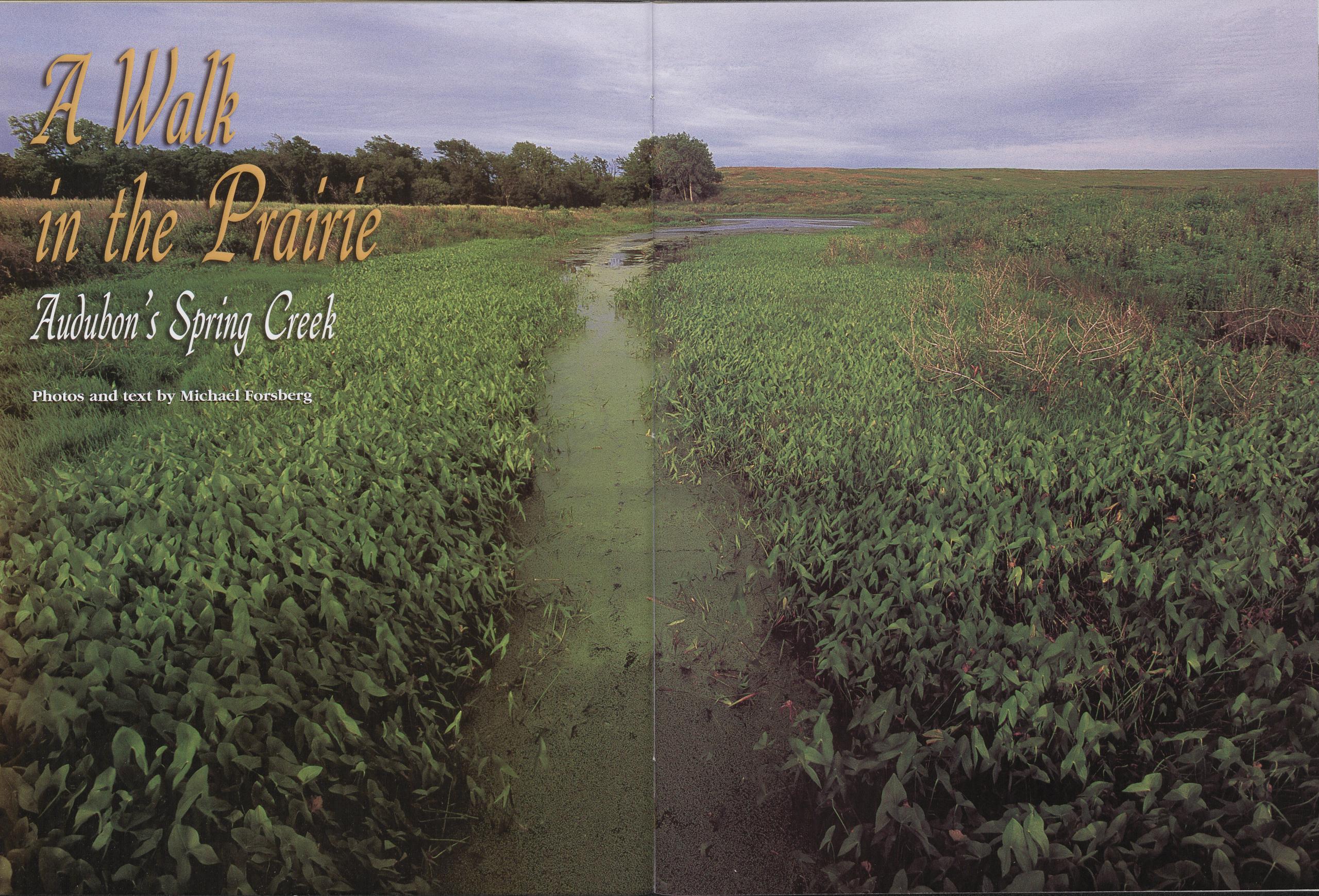
A Walk in the Prairie
Audubon's Spring Creek
A fine day spent walking a prairie began as another day of drudgery, staring at a computer screen ind talking on the f phone in a dimly lit office, wishing I was somewhere else doing something else, anything but what I was doing.
People seem to think nature photographers spend most our days with the sun at our back and the cool breeze in our faces while driving the byways and back roads of this great state, fording rivers and streams, hiking through the rich and textured landscape that we call home, forever in search of beautiful or compelling pictures that speak to the spirit of the Great Plains.
And it is like that sometimes, but those times are very few and very far between. The reality of being a working nature photographer is that about 80 percent of your time is spent without a camera in hand, doing research, writing, editing, getting permission to photograph a certain area, fixing equipment or just thinking, brooding, worrying about how you need to be everywhere at once but can’t seem to get anywhere. You know the harder you work on the front end, the better the pictures likely will be that you get, but even when you finally get out in the field, your hard work only creates opportunity, it does not by default create good pictures. It is tough being creative on demand.
I was in one of those funks one day in mid-lune. I had not been in the field for nearly two months and was stuck in a rut under piles of to-do lists, wondering why I do what I do and if it mattered at all. Just then my wife walked in and saw my look. “Why don’t you just go grab a camera and clear your head,” she said.
“I’ll be wasting my time. Too much to do,” I snarled back. “You’re wasting your time now feeling sorry for yourself.” “Where will I go?” “Somewhere. Just go.”She had no sooner finished her sentence when I left the dark cave that had become my office, grabbed a day pack and was out the door.
I was early afternoon and I headed south out of Lincoln towards Denton, wandering at right angles over the same rolling county roads I used to ride my bike on to clear my head when I was in college. My destination was Spring Creek Prairie, a 640-acre remnant of tailgrass prairie, woodland, pond and wetland owned by the National Audubon Society and just 20 minutes from my home in the middle of the city.
I pulled into the parking lot, stepped out of the truck and breathed deeply. Early morning showers had led to bright overcast skies on this early afternoon and a fresh, cool wind blew from the north.
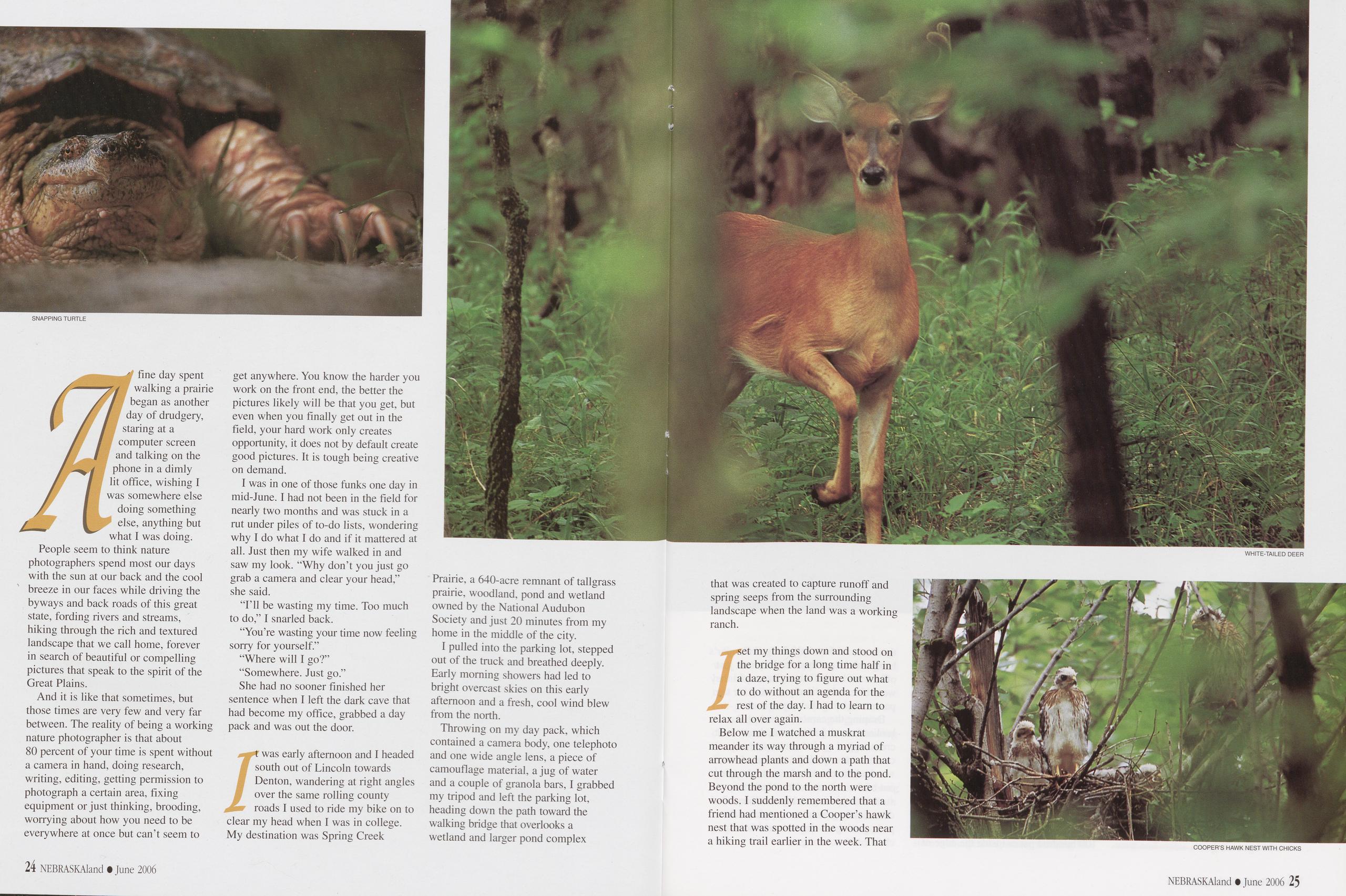
Throwing on my day pack, which contained a camera body, one telephoto and one wide angle lens, a piece of camouflage material, a jug of water and a couple of granola bars, I grabbed my tripod and left the parking lot, heading down the path toward the walking bridge that overlooks a wetland and larger pond complex that was created to capture runoff and spring seeps from the surrounding landscape when the land was a working ranch.
I set my things down and stood on the bridge for a long time half in a daze, trying to figure out what to do without an agenda for the rest of the day. I had to learn to relax all over again.
Below me I watched a muskrat meander its way through a myriad of arrowhead plants and down a path that cut through the marsh and to the pond. Beyond the pond to the north were woods. I suddenly remembered that a friend had mentioned a Cooper’s hawk nest that was spotted in the woods near a hiking trail earlier in the week. That
The woodland trail I took wound along a creek fresh with beaver sign and skirted the edge of the prairie for several hundred yards before making a turn into the heart of the woods. The overcast sky softened the harsh shadows normally found under a forest canopy and everything dripped in deep browns and soft greens.
The air and trees were filled with birdsong and there, not more than 100 hundred paces inside the edge of the trees, sat four half-fledged Cooper’s hawk chicks perched on their nest just off the trail, right where I was told they would be and patiently waiting for the parents to bring their next meal.
Draping the camouflage cloth from a broken branch just over my head, I sat cross-legged against a tree with my camera and tripod. For the next hour, I watched the chicks take turns stepping out of the nest and onto a branch to stretch their wings while a white-tailed deer slowly grazed its way down the path, getting so close I could hear him chew on shoots of grass.
Suddenly he stopped and looked my way, stomping disapproval. I thought he had probably smelled me because of a shift in the wind, but instead, two half-grown, gangly coyote pups came romping past me, playing a game of chase down the trail and never noticing the deer they scared away before one stumbled over a log and tumbled into the creek. A minute later, a female Cooper’s hawk stifled the forest birdsong as it sped through the canopy in a flash of rust and gray and delivered a small gray bird to its hungry chicks as a prize.
When the sun broke hrough the clouds the forest canopy became dappled in deep shadows and the nest became hard to see. I left the woods and headed south and east into the heart of the prairie, toward a fold in the hillside where there are old Oregon Trail wagon ruts.
Along these historic ruts, which reach deep into our pioneer past, I found a regal fritillary butterfly, a key citizen of the tailgrass prairie and a state endangered species, working low to the ground among common milkweed plants, dancing enthusiastically from flower to flower like a child going door to door on Halloween. As it lured me along the ruts and up the hill, I couldn’t help but think it was escorting me, like others of its kind probably did for the travelers that made the ruts 150 years ago. When we reached the top of the hill the butterfly rose above the grass, turned into the wind and tumbled away.
From the hilltop I worked my way
south along a high ridge then found
another trail that drops down to the
west and sidles along the edge of a
26 NEBRASKAland • June 2006
NEBRASKAland • June 2006 27
As the sun began to sink towards the horizon I slid into another wooded draw and followed its drainage towards the wetland where I had started my trip. I crossed a small, earthen dam and walked along the edge of a thick mat of cattails that guarded the pond, finding an immense snapping turtle covered in mud and soaking up the last rays of sun.
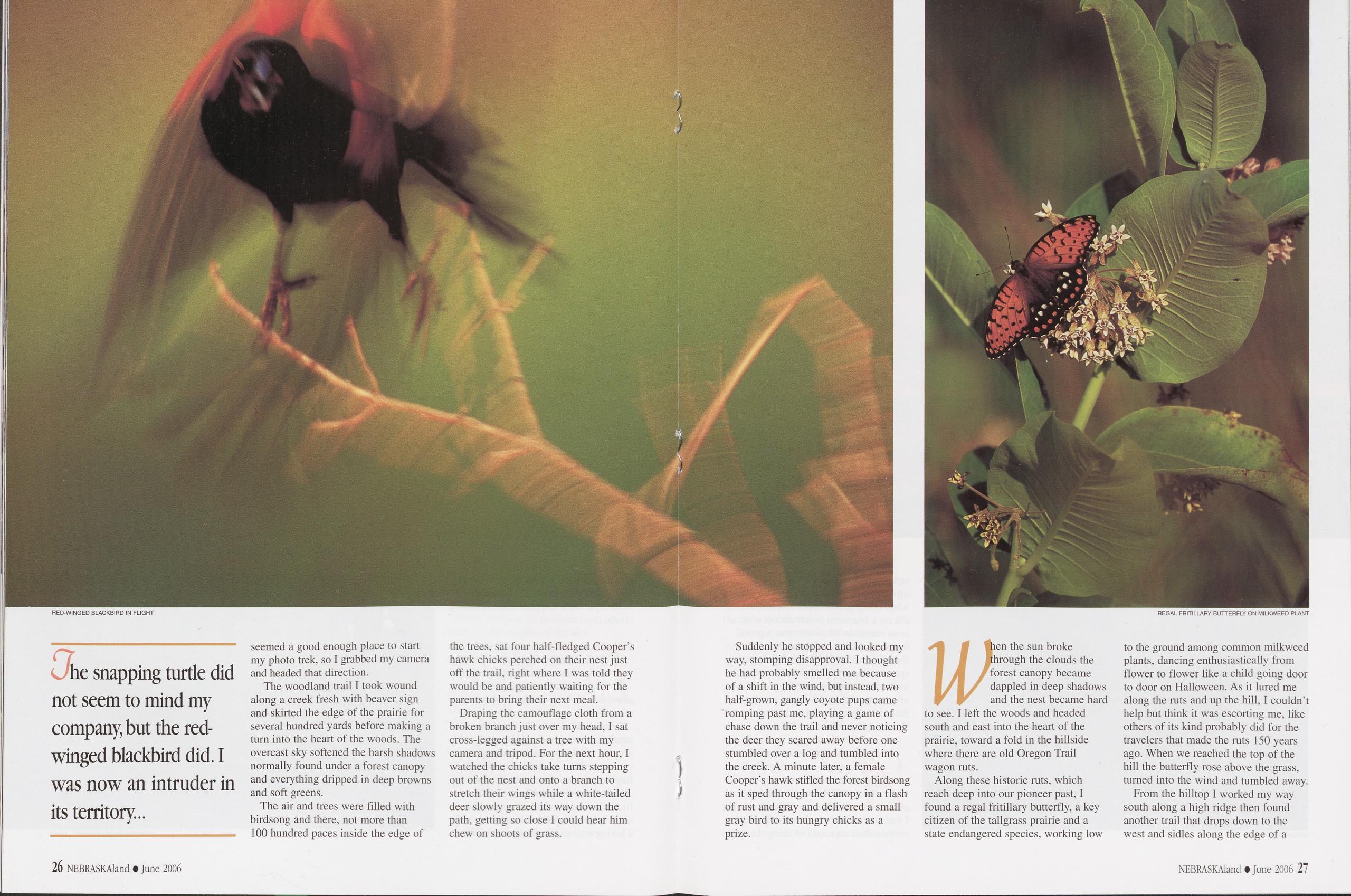
The snapping turtle did not seem to mind my company, but a red-winged blackbird did. Apparently I was now an intruder in its territory, and like a pesky fly that follows you in a canoe for miles, it hovered and dove at me over and over again, chasing me for at least 100 yards as I tried to get up a hill and out of its way. It only relented when I finally turned and took a full- frame picture of it.
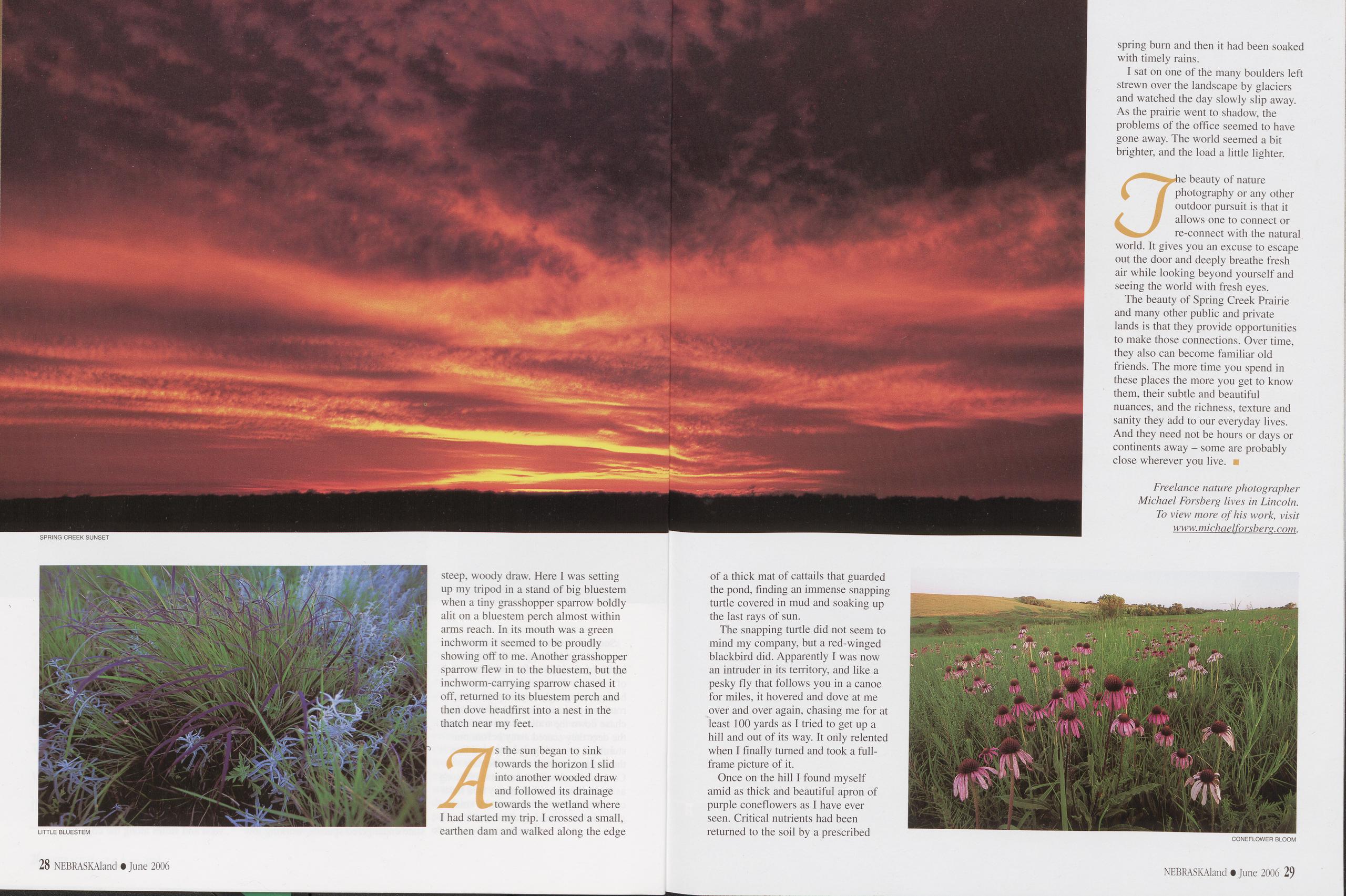
Once on the hill I found myself amid as thick and beautiful apron of purple coneflowers as I have ever seen. Critical nutrients had been returned to the soil by a prescribed spring burn and then it had been soaked with timely rains.
I sat on one of the many boulders left strewn over the landscape by glaciers and watched the day slowly slip away. As the prairie went to shadow, the problems of the office seemed to have gone away. The world seemed a bit brighter, and the load a little lighter.
The beauty of nature s photography or any other outdoor pursuit is that it allows one to connect or re-connect with the natural world. It gives you an excuse to escape out the door and deeply breathe fresh air while looking beyond yourself and seeing the world with fresh eyes.
The beauty of Spring Creek Prairie and many other public and private lands is that they provide opportunities to make those connections. Over time, they also can become familiar old friends. The more time you spend in these places the more you get to know them, their subtle and beautiful nuances, and the richness, texture and sanity they add to our everyday lives. And they need not be hours or days or continents away - some are probably close wherever you live.
Freelance nature photographer Michael Forsberg lives in Lincoln. To view more of his work, visit www. michaelforsberg. com.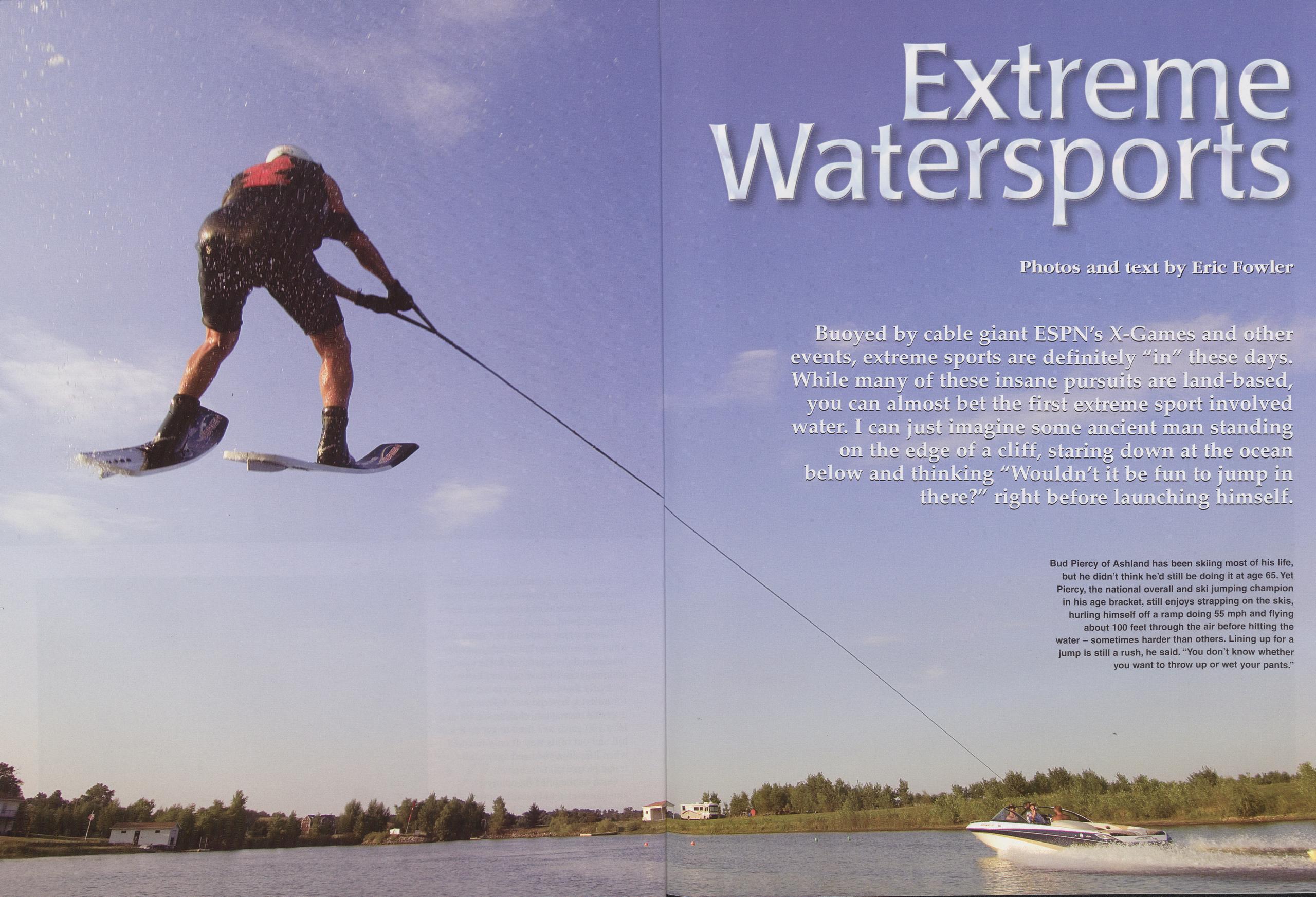
Extreme Watersports
Buoyed by cable giant ESPN's X-Games and other events, etreme sports are definitely "in" these days. While many of these insane pursuits are land-based, you can almost bet the first extreme sport involved water. I can just imagine some ancient man standing on the edge of a cliff, staring down at the ocean below and thinking "Wouldn't it be fun to jump in there?" right before launching himself.
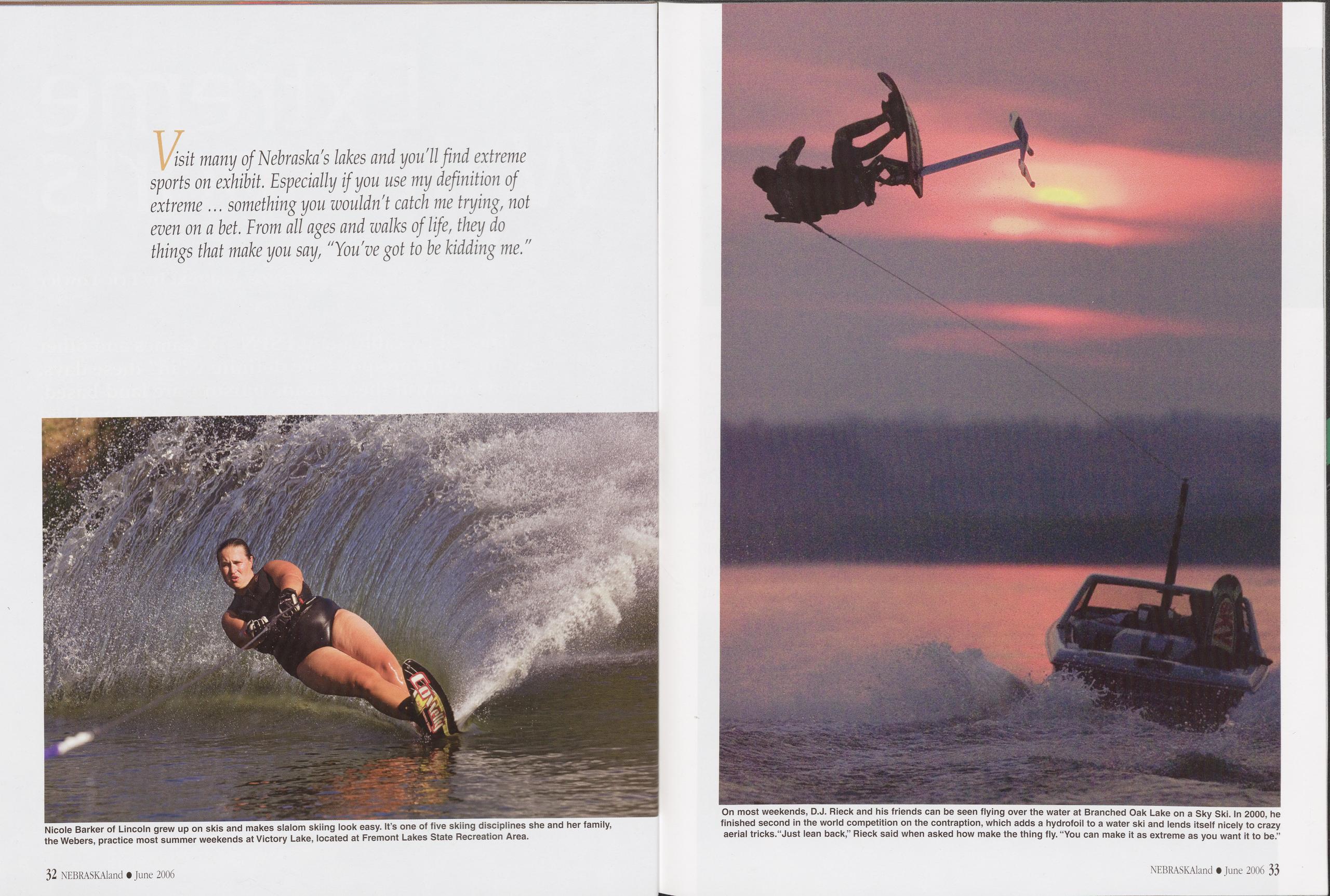
Visit many of Nebraska's lakes and you'll find extreme sports on exhibit. Especially if you use my definition of extreme... something you wouldn't catch me trying, not even on a bet. From all ages and walks of life, they do things that make you say, "You've got to be kidding me."

Some people go to extremes to be extreme. Take wakeboarders, for instance. You've seen their tricked-out boats with big racks on top. Put the tow rope high and it gives you a little pull up, which means more air. What you can't see is the ballast tanks some of those boats carry. Pilled with water, they increase the weight of the boat and the size of the wake, which means, you guessed it, more air.
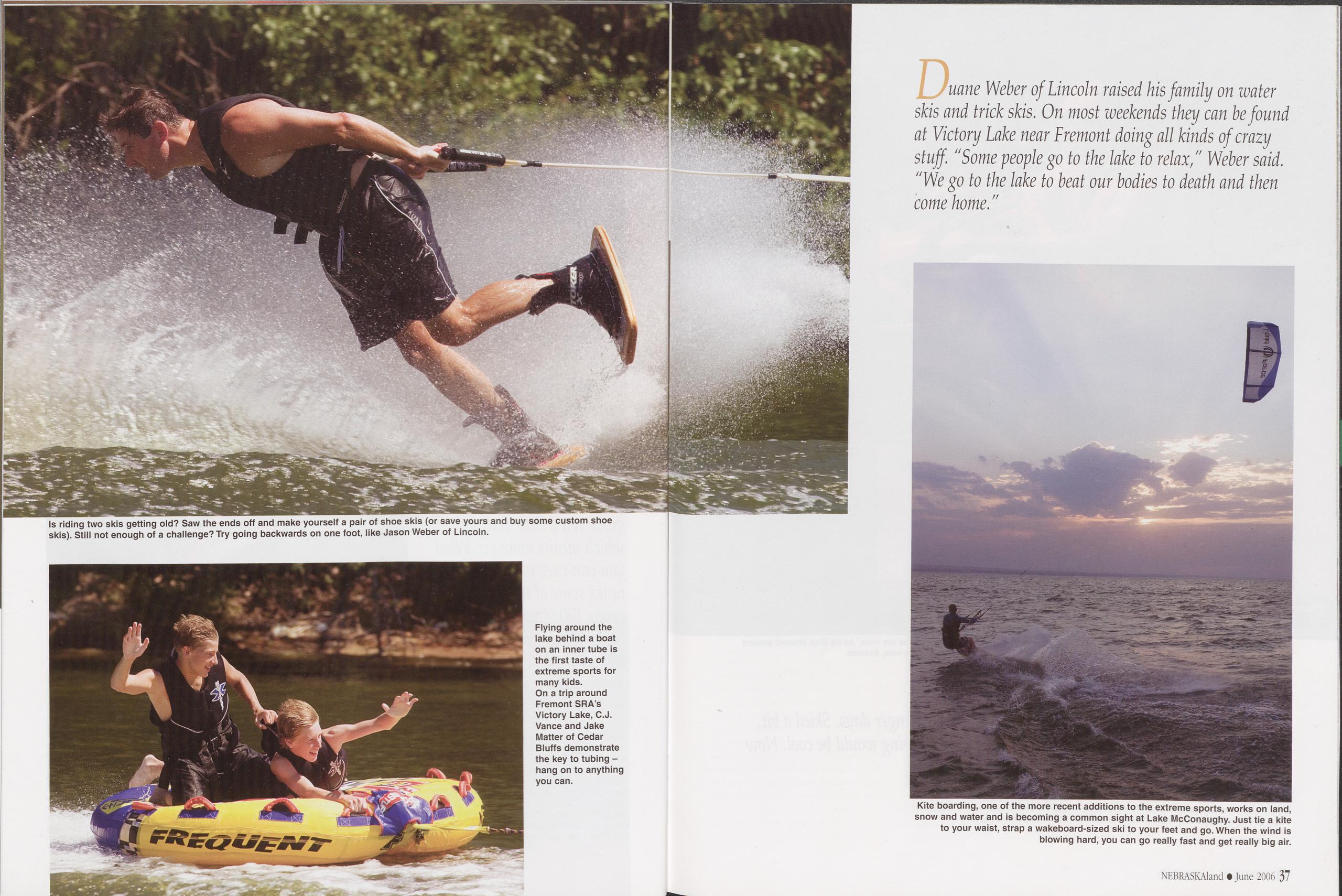
Duane Weber of Lincoln raised his family on water skis and trick skis. On most weekends they can be found at Victory Lake near Fremont doing all kinds of crazy stuff "Some people go to the lake to relax/' Weber said. “We go to the lake to beat our bodies to death and then come home."

I jumped off cliffs at Lake McConaughy in my younger days. Skied a bit, too, but wasn't any good. I always thought ski jumping would be cool. Now it makes my knees hurt just thinking about it.
To be frank, I'm happy to sit back on the beach and watch these days. And I don't care how much fun some of you say it is, I've still got just two words for you: You're crazy.
Sod House Sunday
Bowring Ranch State Historical Park
Memories come alive when friends, family and neighbors get together on the last Sunday in June at this Sandhills ranch.
Located at the upper end of a expansive hay meadow protected by rolling, grass-covered hills, the Bar 99 Ranch is especially beautiful on an early summer morning when the knee-high grasses in the hills sway in a freshening breeze, overnight dew sparkles on the meadow, and wispy cirrus clouds stream across the blue sky.
Above the meadow sits a well- organized grouping of white buildings, including barns, shops, a bunkhouse and a modest-sized home with a nicely
The Bar 99 is part of the Arthur Bowring Sandhills Ranch State Historical Park, which preserves the lifelong efforts of early Sandhills ranchers Arthur and Eve Bowring. Both the home and the visitor center tucked in behind it display tangible evidence of lives well-lived - of the Bowring’s dedication and resolve to build and operate their ranch, their sense of community and also of the good times and occasional hardships they
Before her death in 1985, Eve Bowring arranged the transfer of the Bar 99 to the Nebraska Game and Parks Foundation, stipulating only that the yearly county taxes be paid, the Bowring’s Hereford bloodline be continued, and her home and collections be maintained and put on display. Her gift ensured that the state historical park named after her husband would continue to operate as a working cattle ranch that was open to visitors.
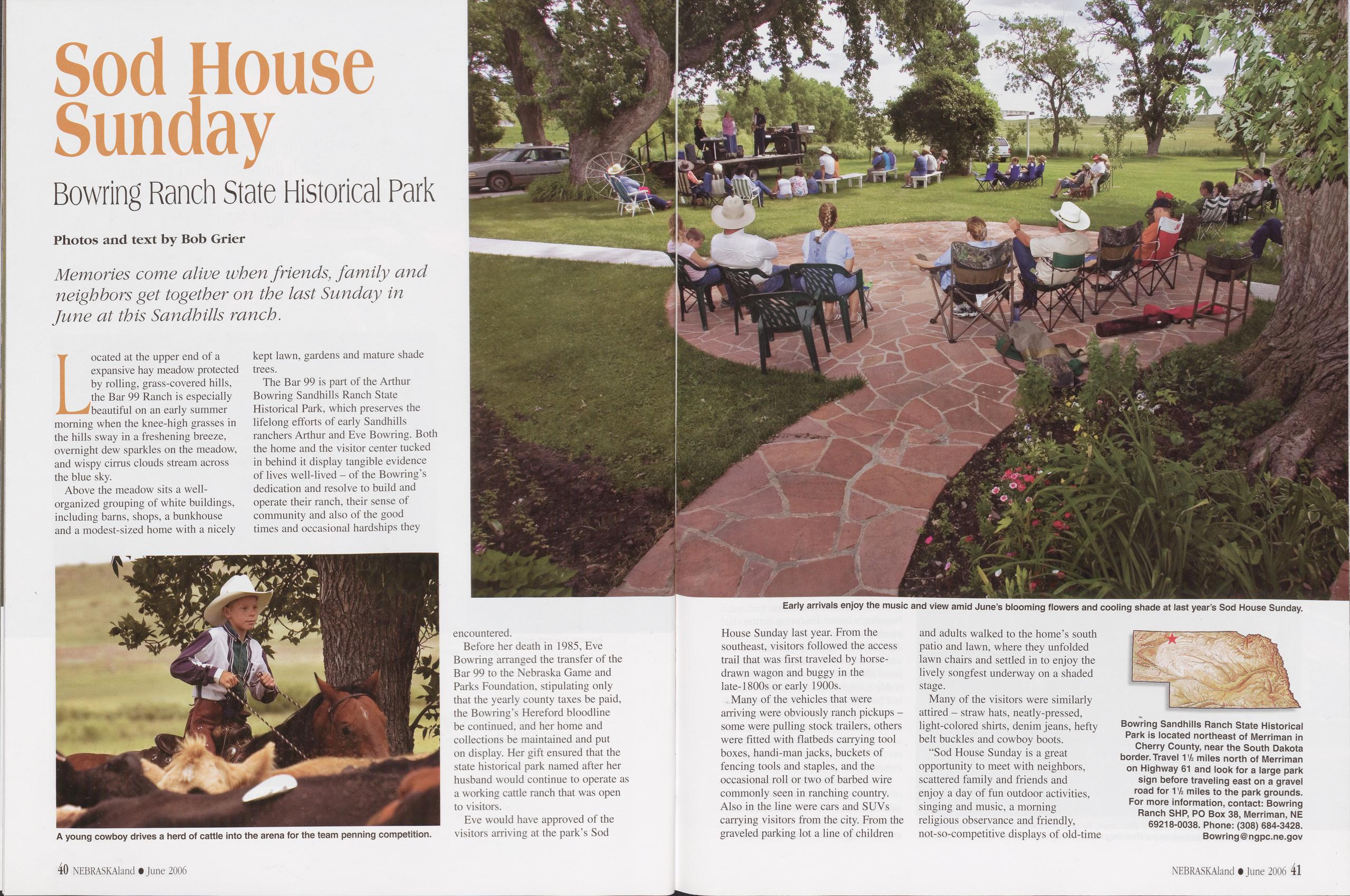
Eve would have approved of the visitors arriving at the park’s Sod House Sunday last year. From the southeast, visitors followed the access trail that was first traveled by horse- drawn wagon and buggy in the late-1800s or early 1900s.
Many of the vehicles that were arriving were obviously ranch pickups - some were pulling stock trailers, others were fitted with flatbeds carrying tool boxes, handi-man jacks, buckets of fencing tools and staples, and the occasional roll or two of barbed wire commonly seen in ranching country. Also in the line were cars and SUVs carrying visitors from the city. From the graveled parking lot a line of children and adults walked to the home’s south patio and lawn, where they unfolded lawn chairs and settled in to enjoy the lively songfest underway on a shaded stage.
Many of the visitors were similarly attired - straw hats, neatly-pressed, light-colored shirts, denim jeans, hefty belt buckles and cowboy boots.
“Sod House Sunday is a great opportunity to meet with neighbors, scattered family and friends and enjoy a day of fun outdoor activities, singing and music, a morning religious observance and friendly, not-so-competitive displays of old-time
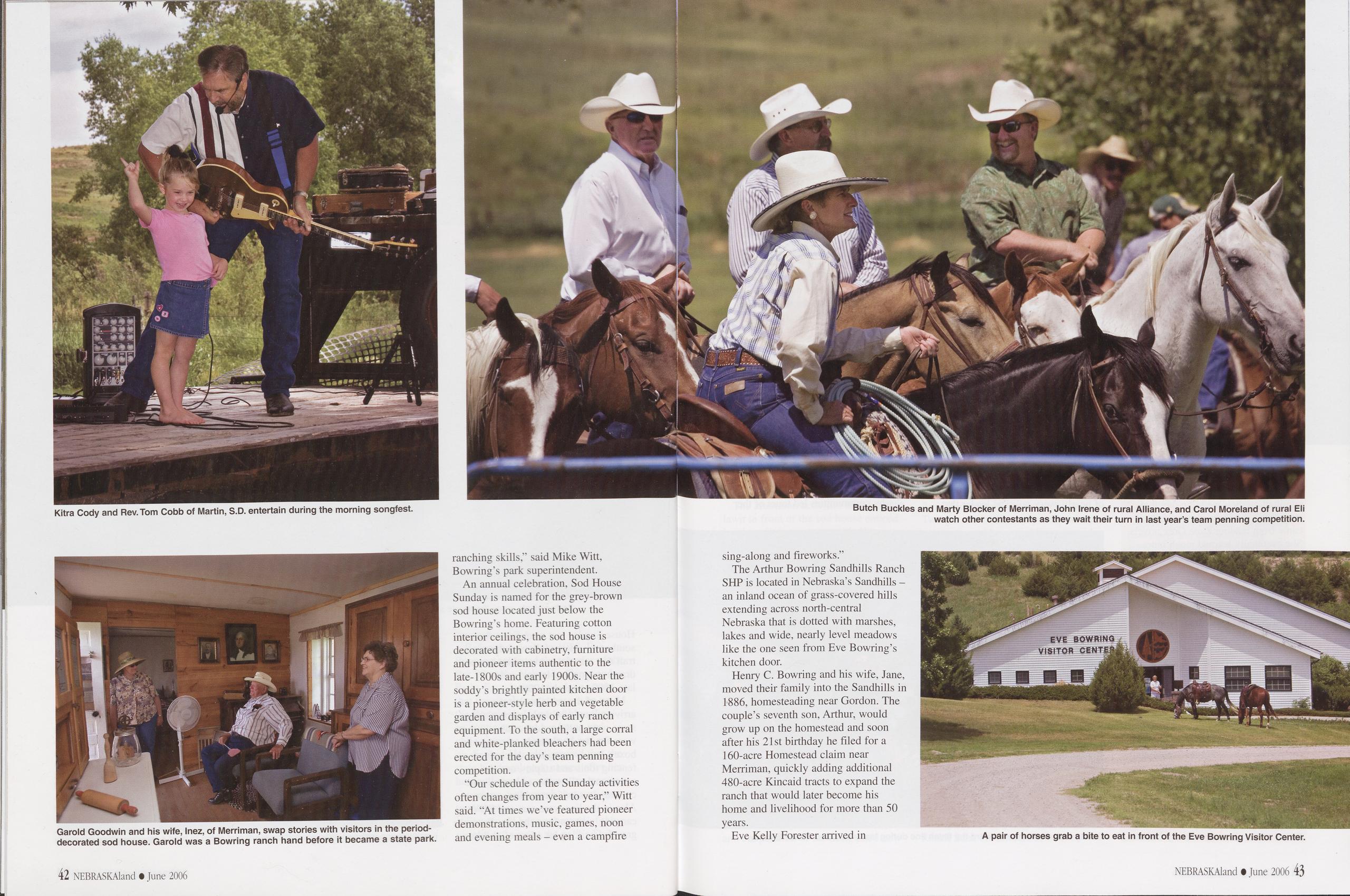
An annual celebration, Sod House Sunday is named for the grey-brown sod house located just below the Bowring’s home. Featuring cotton interior ceilings, the sod house is decorated with cabinetry, furniture and pioneer items authentic to the late-1800s and early 1900s. Near the soddy’s brightly painted kitchen door is a pioneer-style herb and vegetable garden and displays of early ranch equipment. To the south, a large corral and white-planked bleachers had been erected for the day’s team penning competition.
“Our schedule of the Sunday activities often changes from year to year,” Witt said. “At times we’ve featured pioneer demonstrations, music, games, noon and evening meals - even a campfire sing-along and fireworks.”
The Arthur Bowring Sandhills Ranch SHP is located in Nebraska’s Sandhills - an inland ocean of grass-covered hills extending across north-central Nebraska that is dotted with marshes, lakes and wide, nearly level meadows like the one seen from Eve Bowring’s kitchen door.
Henry C. Bowring and his wife, Jane, moved their family into the Sandhills in 1886, homesteading near Gordon. The couple’s seventh son, Arthur, would grow up on the homestead and soon after his 21st birthday he filed for a 160-acre Homestead claim near Merriman, quickly adding additional 480-acre Kincaid tracts to expand the ranch that would later become his home and livelihood for more than 50 years.
Eve Kelly Forester arrived in
The pair eventually married, and Eve admitted on their wedding day that everything she knew about ranching came from reading Zane Grey novels. She eventually learned much more. Arthur and Eve’s ranch grew to become the 12,000-acre Bar 99, and following Arthur’s death in 1944, Eve ran the ranch for 41 years before working with the Nebraska Game and Parks Foundation to create the new state historical park.
While the ranch was foremost in her activities, Eve also served at various times as the county finance chairman, county precinct and county chairman, as well as a member of the National Institute of Health. In 1954, she became the first woman from Nebraska to serve in the United States Senate when Gov. Robert Crosby appointed her fill the seat of Sen. Dwight Griswold, who died in office.
Following her 7-month stint in the Senate, Eve was appointed to finish two years of a term on the federal Board of Parole, a full-time job that required travel throughout the country. She was later appointed to serve a full six-year term.
During her travels, Eve gathered a wide variety of mementos, art and other collectibles for her Sandhills home, including rare glassware, porcelain and silver. Several walls of the home display signed photographs of nearly every political leader that
The Eve Bowring Visitor Center devotes the majority of its display space to teaching about the history of the Sandhills and the region’s cattle ranching industry through permanent and temporary displays. Collections include branding irons, barbed wire, ranching tools, displays devoted to native Americans and the early electrification of ranches using wind generators and batteries. In the upper- level display area, a large wooden windmill fan indicates another critical development that helped early ranchers utilize pastures without surface water. The visitor center also includes a theater and well-stocked gift shop where visitors can buy Sandhills folk art, native American items, books and posters.
Last year’s Sod House Sunday events continued throughout the day. A picnic lunch was provided by local volunteers and high school honor students from nearby communities led tours of the
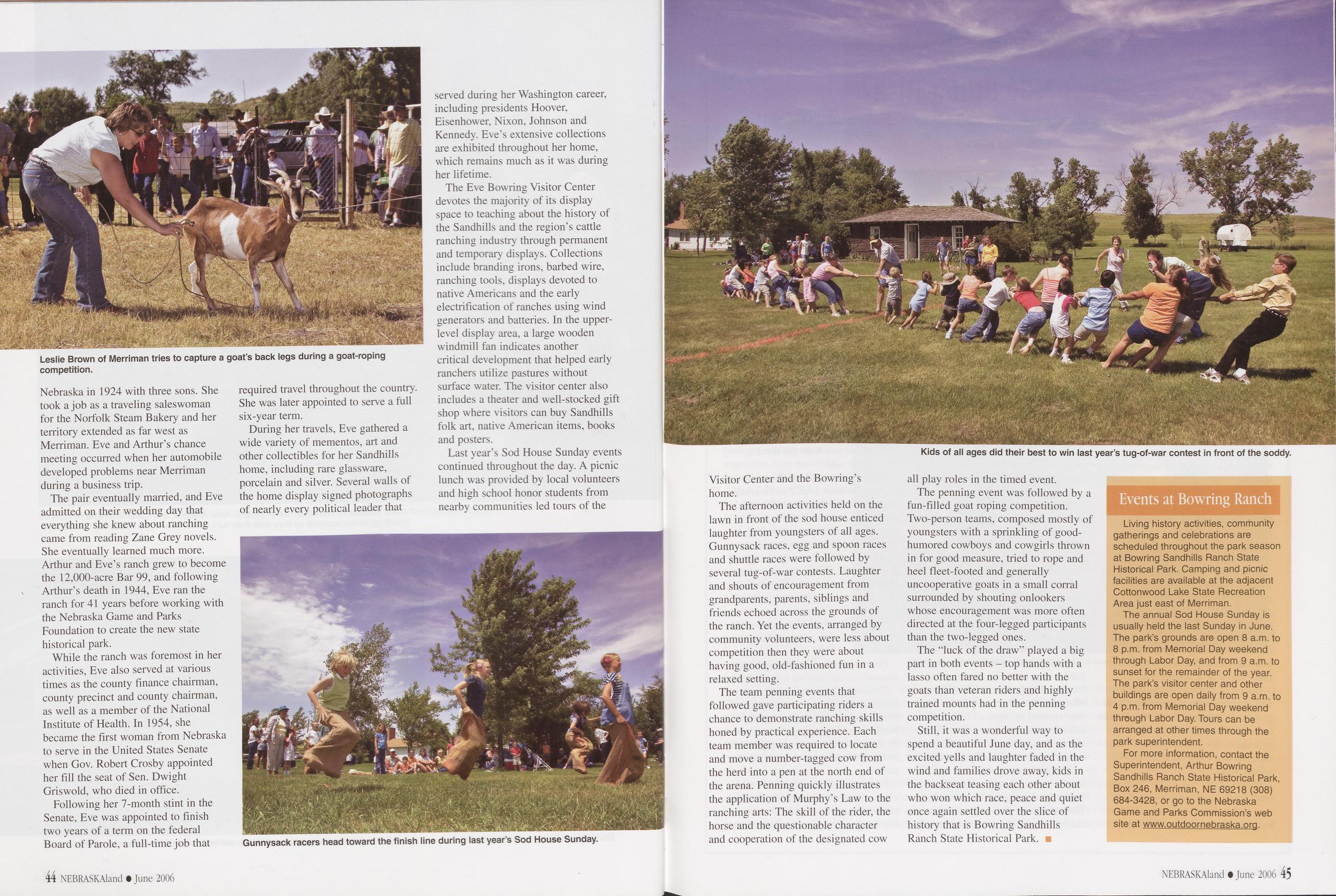
The afternoon activities held on the lawn in front of the sod house enticed laughter from youngsters of all ages. Gunnysack races, egg and spoon races and shuttle races were followed by several tug-of-war contests. Laughter and shouts of encouragement from grandparents, parents, siblings and friends echoed across the grounds of the ranch. Yet the events, arranged by community volunteers, were less about competition then they were about having good, old-fashioned fun in a relaxed setting.
The team penning events that followed gave participating riders a chance to demonstrate ranching skills honed by practical experience. Each team member was required to locate and move a number-tagged cow from the herd into a pen at the north end of the arena. Penning quickly illustrates the application of Murphy’s Law to the ranching arts: The skill of the rider, the horse and the questionable character and cooperation of the designated cow all play roles in the timed event.
The penning event was followed by a fun-filled goat roping competition. Two-person teams, composed mostly of youngsters with a sprinkling of good- humored cowboys and cowgirls thrown in for good measure, tried to rope and heel fleet-footed and generally uncooperative goats in a small corral surrounded by shouting onlookers whose encouragement was more often directed at the four-legged participants than the two-legged ones.
The “luck of the draw” played a big part in both events - top hands with a lasso often fared no better with the goats than veteran riders and highly trained mounts had in the penning competition.
Still, it was a wonderful way to spend a beautiful June day, and as the excited yells and laughter faded in the wind and families drove away, kids in the backseat teasing each other about who won which race, peace and quiet once again settled over the slice of history that is Bowring Sandhills Ranch State Historical Park.
Events at Bowring RanchLiving history activities, community gatherings and celebrations are scheduled throughout the park season at Bowring Sandhills Ranch State Historical Park. Camping and picnic facilities are available at the adjacent Cottonwood Lake State Recreation Area just east of Merriman.
The annual Sod House Sunday is usually held the last Sunday in June. The park’s grounds are open 8 a.m. to 8 p.m. from Memorial Day weekend through Labor Day, and from 9 a.m. to sunset for the remainder of the year. The park’s visitor center and other buildings are open daily from 9 a.m. to 4 p.m. from Memorial Day weekend through Labor Day. Tours can be arranged at other times through the park superintendent.
For more information, contact the Superintendent, Arthur Bowring Sandhills Ranch State Historical Park, Box 246, Merriman, NE 69218 (308) 684-3428, or go to the Nebraska Game and Parks Commission’s web site at www.outdoornebraska.org.
44 NEBRASKAland • June 2006 NEBRASKAland • June 2006 45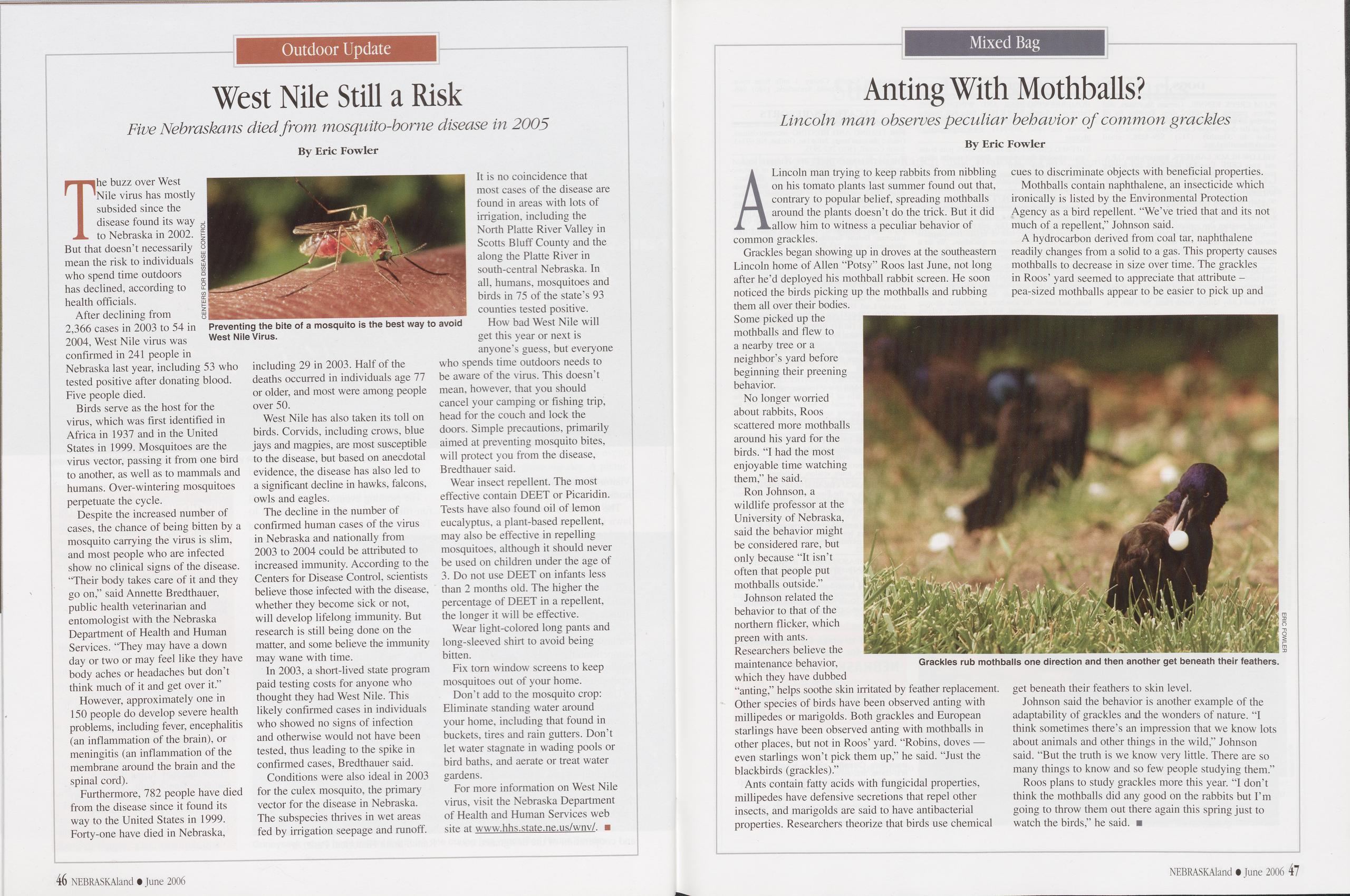
Outdoor Update
West Nile Still a Risk
Five Nebraskans died from mosquito-borne disease in 2005
The buzz over West Nile virus has mostly subsided since the disease found its way to Nebraska in 2002. But that doesn’t necessarily mean the risk to individuals who spend time outdoors has declined, according to health officials.
After declining from 2,366 cases in 2003 to 54 in 2004, West Nile virus was confirmed in 241 people in Nebraska last year, including 53 who tested positive after donating blood. Five people died.
Birds serve as the host for the virus, which was first identified in Africa in 1937 and in the United States in 1999. Mosquitoes are the virus vector, passing it from one bird to another, as well as to mammals and humans. Over-wintering mosquitoes perpetuate the cycle.
Despite the increased number of cases, the chance of being bitten by a mosquito carrying the virus is slim, and most people who are infected show no clinical signs of the disease. “Their body takes care of it and they go on,” said Annette Bredthauer, public health veterinarian and entomologist with the Nebraska Department of Health and Human Services. “They may have a down day or two or may feel like they have body aches or headaches but don’t think much of it and get over it.”
However, approximately one in 150 people do develop severe health problems, including fever, encephalitis (an inflammation of the brain), or meningitis (an inflammation of the membrane around the brain and the spinal cord).
Furthermore, 782 people have died from the disease since it found its way to the United States in 1999. Forty-one have died in Nebraska,
West Nile has also taken its toll on birds. Corvids, including crows, blue jays and magpies, are most susceptible to the disease, but based on anecdotal evidence, the disease has also led to a significant decline in hawks, falcons, owls and eagles.
The decline in the number of confirmed human cases of the virus in Nebraska and nationally from 2003 to 2004 could be attributed to increased immunity. According to the Centers for Disease Control, scientists believe those infected with the disease, whether they become sick or not, will develop lifelong immunity. But research is still being done on the matter, and some believe the immunity may wane with time.
In 2003, a short-lived state program paid testing costs for anyone who thought they had West Nile. This likely confirmed cases in individuals who showed no signs of infection and otherwise would not have been tested, thus leading to the spike in confirmed cases, Bredthauer said.
Conditions were also ideal in 2003 for the culex mosquito, the primary vector for the disease in Nebraska. The subspecies thrives in wet areas fed by irrigation seepage and runoff. It is no coincidence that most cases of the disease are found in areas with lots of irrigation, including the North Platte River Valley in Scotts Bluff County and the along the Platte River in south-central Nebraska. In all, humans, mosquitoes and birds in 75 of the state’s 93 counties tested positive.
How bad West Nile will get this year or next is anyone’s guess, but everyone who spends time outdoors needs to be aware of the virus. This doesn’t mean, however, that you should cancel your camping or fishing trip, head for the couch and lock the doors. Simple precautions, primarily aimed at preventing mosquito bites, will protect you from the disease, Bredthauer said.
Wear insect repellent. The most effective contain DEET or Picaridin. Tests have also found oil of lemon eucalyptus, a plant-based repellent, may also be effective in repelling mosquitoes, although it should never be used on children under the age of 3. Do not use DEET on infants less than 2 months old. The higher the percentage of DEET in a repellent, the longer it will be effective.
Wear light-colored long pants and long-sleeved shirt to avoid being bitten.
Fix tom window screens to keep mosquitoes out of your home.
Don’t add to the mosquito crop: Eliminate standing water around your home, including that found in buckets, tires and rain gutters. Don’t let water stagnate in wading pools or bird baths, and aerate or treat water gardens.
For more information on West Nile virus, visit the Nebraska Department of Health and Human Services web site at www.hhs.state.ne.us/wnv/.
Mixed Bag
Anting With Mothballs?
Lincoln man observes peculiar behavior of common grackles
A Lincoln man trying to keep rabbits from nibbling on his tomato plants last summer found out that, contrary to popular belief, spreading mothballs around the plants doesn’t do the trick. But it did allow him to witness a peculiar behavior of common grackles.
Grackles began showing up in droves at the southeastern Lincoln home of Allen “Potsy” Roos last June, not long after he’d deployed his mothball rabbit screen. He soon noticed the birds picking up the mothballs and rubbing them all over their bodies. Some picked up the mothballs and flew to a nearby tree or a neighbor’s yard before beginning their preening behavior.
No longer worried about rabbits, Roos scattered more mothballs around his yard for the birds. “I had the most enjoyable time watching them,” he said.
Ron Johnson, a wildlife professor at the University of Nebraska, said the behavior might be considered rare, but only because “It isn’t often that people put mothballs outside.”
Johnson related the behavior to that of the northern flicker, which preen with ants. Researchers believe the
Ants contain fatty acids with fungicidal properties, millipedes have defensive secretions that repel other insects, and marigolds are said to have antibacterial properties. Researchers theorize that birds use chemical cues to discriminate objects with beneficial properties.
Mothballs contain naphthalene, an insecticide which ironically is listed by the Environmental Protection Agency as a bird repellent. “We’ve tried that and its not much of a repellent,” Johnson said.
A hydrocarbon derived from coal tar, naphthalene readily changes from a solid to a gas. This property causes mothballs to decrease in size over time. The grackles in Roos’ yard seemed to appreciate that attribute - pea-sized mothballs appear to be easier to pick up and get beneath their feathers to skin level.
Johnson said the behavior is another example of the adaptability of grackles and the wonders of nature. “I think sometimes there’s an impression that we know lots about animals and other things in the wild,” Johnson said. “But the truth is we know very little. There are so many things to know and so few people studying them.”
Roos plans to study grackles more this year. “I don’t think the mothballs did any good on the rabbits but I’m going to throw them out there again this spring just to watch the birds,” he said.
46 NEBRASKAland • June 2006 NEBRASKAland • June 2006 47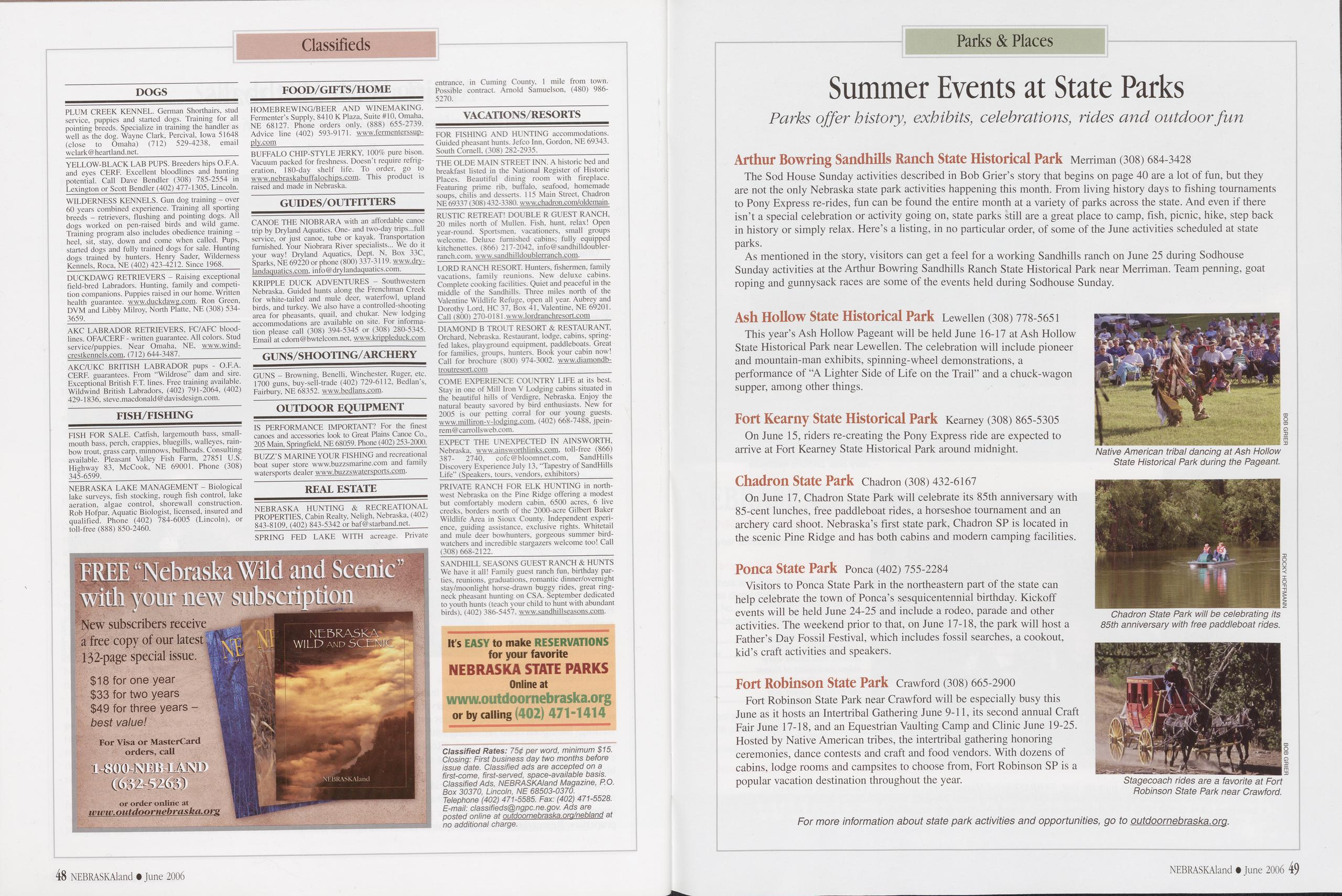
Classifieds
DOGS PLUM CREEK KENNEL. German Shorthairs, stud service, puppies and started dogs. Training for all pointing breeds. Specialize in training the handler as well as the dog. Wayne Clark, Percival, Iowa 51648 (close to Omaha) (712) 529-4238, email wclark@heartland.net. YELLOW-BLACK LAB PUPS. Breeders hips O.F.A. and eyes CERF. Excellent bloodlines and hunting potential. Call Dave Bendler (308) 785-2554 in Lexington or Scott Bendler (402) 477-1305, Lincoln. WILDERNESS KENNELS. Gun dog training - over 60 years combined experience. Training all sporting breeds - retrievers, flushing and pointing dogs. All dogs worked on pen-raised birds and wild game. Training program also includes obedience training - heel, sit, stay, down and come when called. Pups, started dogs and fully trained dogs for sale. Hunting dogs trained by hunters. Henry Sader, Wilderness Kennels, Roca, NE (402) 423-4212, Since 1968. DUCKDAWG RETRIEVERS - Raising exceptional field-bred Labradors. Hunting, family and competi- tion companions. Puppies raised in our home. Written health guarantee, www.duckdawg.com. Ron Green, DVM and Libby Milroy, North Platte, NE (308) 534- 3659. AKC LABRADOR RETRIEVERS, FC/AFC blood- lines. OFA/CERF - written guarantee. All colors. Stud service/puppies. Near Omaha, NE, www. wind- crestkennels.com, (712) 644-3487. AKC/UKC BRITISH LABRADOR pups - O.F.A. CERF, guarantees. From “Wildrose” dam and sire. Exceptional British F.T. lines. Free training available. Wildwind British Labradors, (402) 791-2064, (402) 429-1836, steve.macdonald@davisdesign.com. FISH/FISHING FISH FOR SALE. Catfish, largemouth bass, small- mouth bass, perch, crappies, bluegills, walleyes, rain- bow trout, grass carp, minnows, bullheads. Consulting available. Pleasant Valley Fish Farm, 27851 U.S. Highway 83, McCook, NE 69001. Phone (308) 345-6599. NEBRASKA LAKE MANAGEMENT - Biological lake surveys, fish stocking, rough fish control, lake aeration, algae control, shorewall construction. Rob Hofpar, Aquatic Biologist, licensed, insured and qualified. Phone (402) 784-6005 (Lincoln), or toll-free (888) 850-2460. FOOD/GIFTS/HOME HOMEBREWING/BEER AND WINEMAKING. Fermenter’s Supply, 8410 K Plaza, Suite #10, Omaha, NE 68127. Phone orders only. (888) 655-2739. Advice line (402) 593-9171. www.fermenterssup- plv.com BUFFALO CHIP-STYLE JERKY, 100% pure bison. Vacuum packed for freshness. Doesn’t require refrig- eration, 180-day shelf life. To order, go to www.nebraskabuffalochips.com. This product is raised and made in Nebraska. GUIDES/OUTFITTERS CANOE THE NIOBRARA with an affordable canoe trip by Dryland Aquatics. One- and two-day trips...full service, or just canoe, tube or kayak. Transportation furnished. Your Niobrara River specialists... We do it your way! Dryland Aquatics, Dept. N, Box 33C, Sparks, NE 69220 or phone (800) 337-3119. www.drv- landaquatics.com, info@drylandaquatics.com. KRIPPLE DUCK ADVENTURES - Southwestern Nebraska. Guided hunts along the Frenchman Creek for white-tailed and mule deer, waterfowl, upland birds, and turkey. We also have a controlled-shooting area for pheasants, quail, and chukar. New lodging accommodations are available on site. For informa- tion please call (308) 394-5345 or (308) 280-5345. Email at cdom@bwtelcom.net, www.kripDleduck.com GUNS/SHOOTING/ARCHERY GUNS - Browning, Benelli, Winchester, Ruger, etc. 1700 guns, buy-sell-trade (402) 729-6112, Bedlan’s, Fairbury, NE 68352. www.bedlans.com. OUTDOOR EQUIPMENT IS PERFORMANCE IMPORTANT? For the finest canoes and accessories look to Great Plains Canoe Co., 205 Main, Springfield, NE 68059. Phone (402) 253-2000, BUZZ’S MARINE YOUR FISHING and recreational boat super store www.buzzsmarine.com and family watersports dealer www.buzzswatersports.com. REAL ESTATE NEBRASKA HUNTING & RECREATIONAL PROPERTIES, Cabin Realty, Neligh, Nebraska, (402) 843-8109, (402) 843-5342 or baf@starband.net. SPRING FED LAKE WITH acreage. Private entrance, in Cuming County, 1 mile from town. Possible contract. Arnold Samuelson, (480) 986- 5270.Parks & Places
Summer Events at State Parks
Parks offer history, exhibits, celebrations, rides and outdoor fun
Arthur Bowring Sandhills Ranch State Historical Park Merriman (308) 684-3428The Sod House Sunday activities described in Bob Grier’s story that begins on page 40 are a lot of fun, but they are not the only Nebraska state park activities happening this month. From living history days to fishing tournaments to Pony Express re-rides, fun can be found the entire month at a variety of parks across the state. And even if there isn’t a special celebration or activity going on, state parks still are a great place to camp, fish, picnic, hike, step back in history or simply relax. Here’s a listing, in no particular order, of some of the June activities scheduled at state parks.
As mentioned in the story, visitors can get a feel for a working Sandhills ranch on June 25 during Sodhouse Sunday activities at the Arthur Bowring Sandhills Ranch State Historical Park near Merriman. Team penning, goat roping and gunnysack races are some of the events held during Sodhouse Sunday.
Ash Hollow State Historical ParkLewellen (308) 778-5651This year’s Ash Hollow Pageant will be held June 16-17 at Ash Hollow State Historical Park near Lewellen. The celebration will include pioneer and mountain-man exhibits, spinning-wheel demonstrations, a performance of "A Lighter Side of Life on the Trail” and a chuck-wagon supper, among other things.
Fort Kearny State Historical ParkKearney (308) 865-5305On June 15, riders re-creating the Pony Express ride are expected to arrive at Fort Kearney State Historical Park around midnight.
Chadron State Park Chadron (308) 432-6167On June 17, Chadron State Park will celebrate its 85th anniversary with 85-cent lunches, free paddleboat rides, a horseshoe tournament and an archery card shoot. Nebraska’s first state park, Chadron SP is located in the scenic Pine Ridge and has both cabins and modern camping facilities.
Ponca State Park Ponca (402) 755-2284Visitors to Ponca State Park in the northeastern part of the state can help celebrate the town of Ponca’s sesquicentennial birthday. Kickoff events will be held June 24-25 and include a rodeo, parade and other activities. The weekend prior to that, on June 17-18, the park will host a Father’s Day Fossil Festival, which includes fossil searches, a cookout, kid’s craft activities and speakers.
Fort Robinson State Park Crawford (308) 665-2900Fort Robinson State Park near Crawford will be especially busy this June as it hosts an Intertribal Gathering June 9-11, its second annual Craft Fair June 17-18, and an Equestrian Vaulting Camp and Clinic June 19-25. Hosted by Native American tribes, the intertribal gathering honoring ceremonies, dance contests and craft and food vendors. With dozens of cabins, lodge rooms and campsites to choose from, Fort Robinson SP is a popular vacation destination throughout the year.

Portraits from the Past
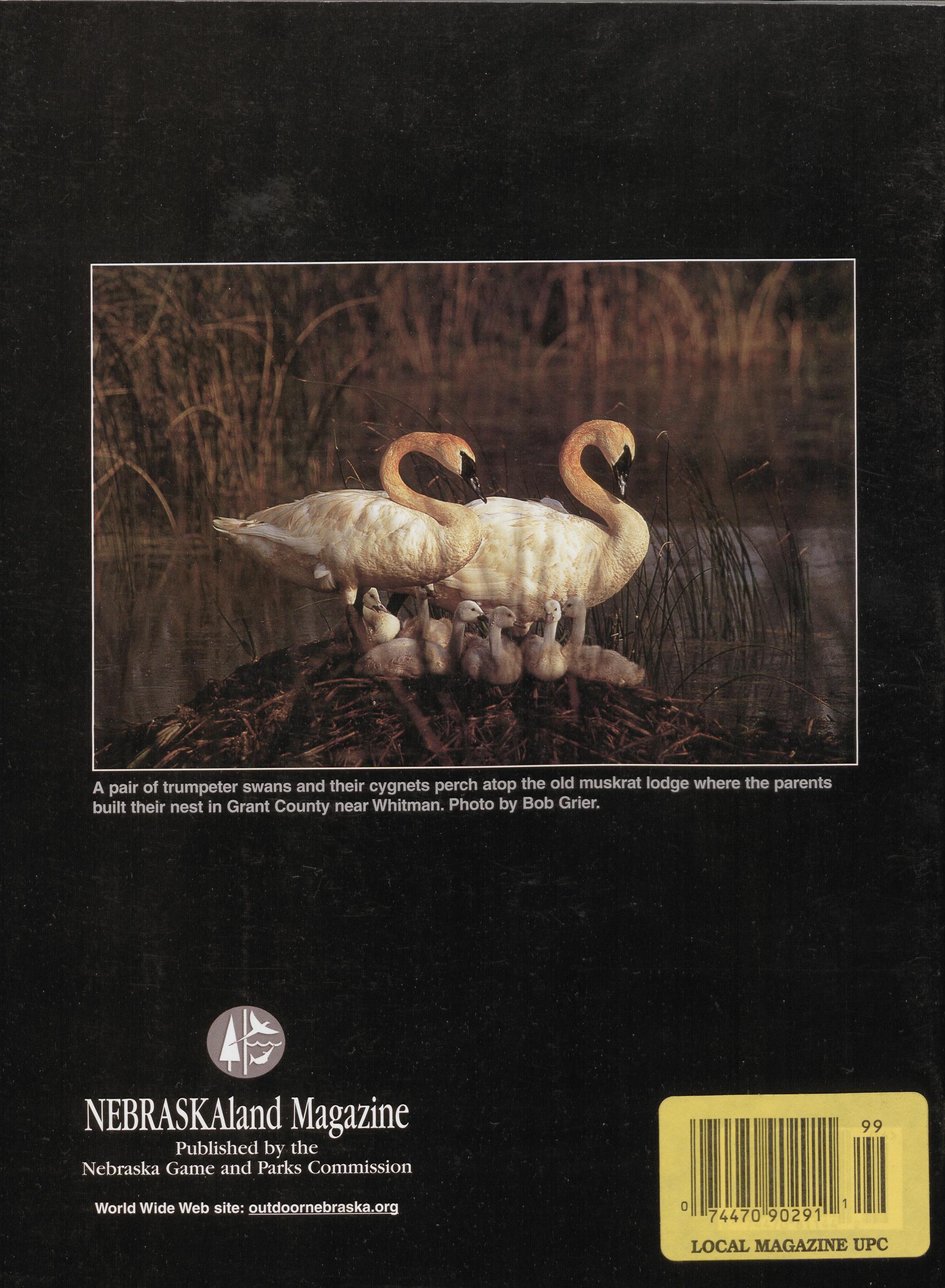
Position: 737 (15 views)