Volume 84, Issue 4, 2006
NEBRASKAland
Nebraska Game & Parks Commission May 2006 $2.95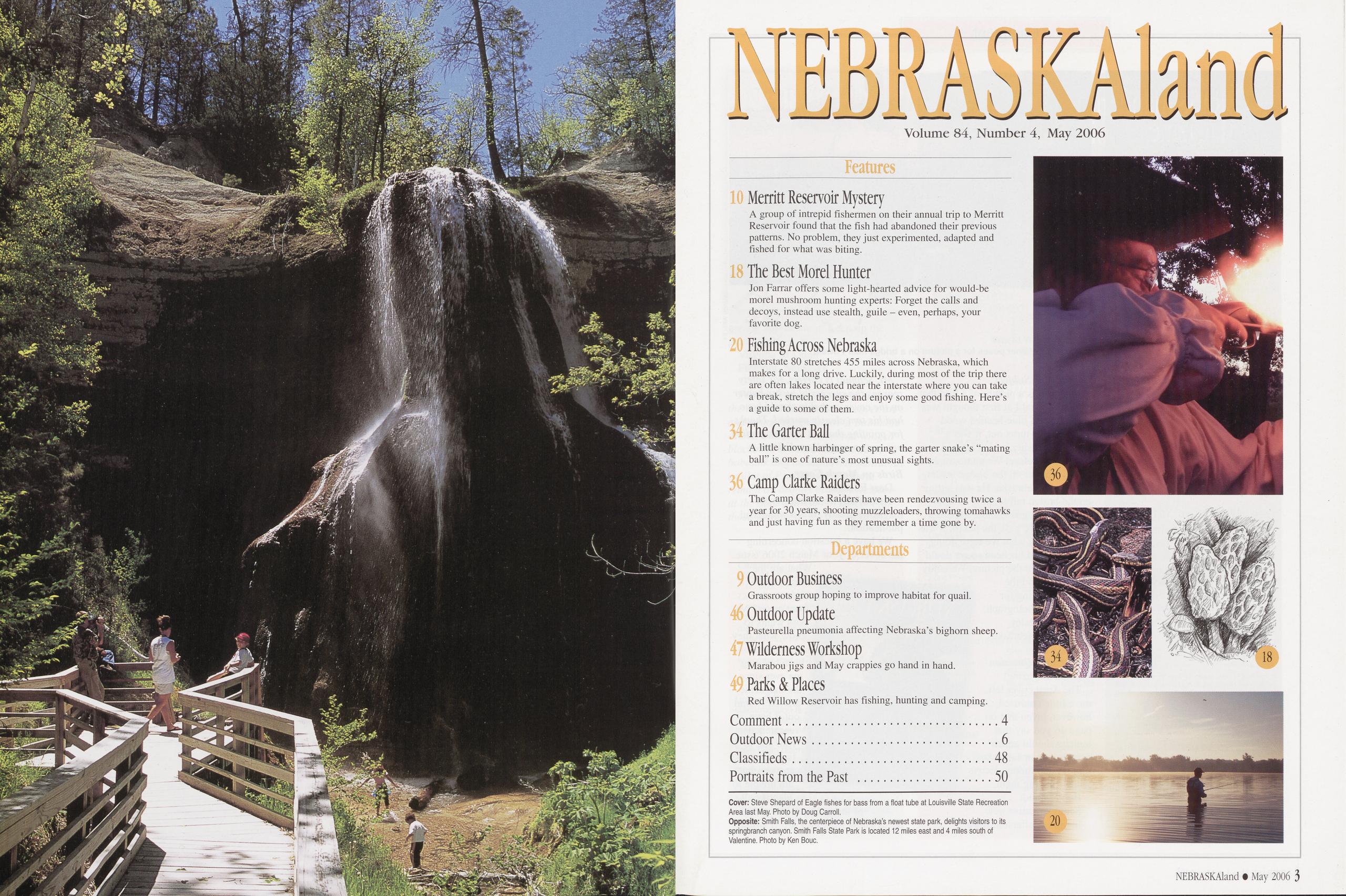
NEBRASKAland
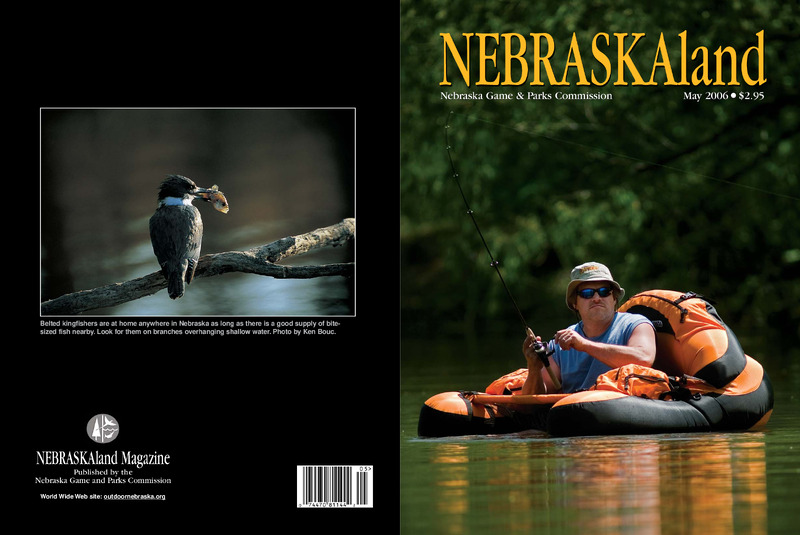
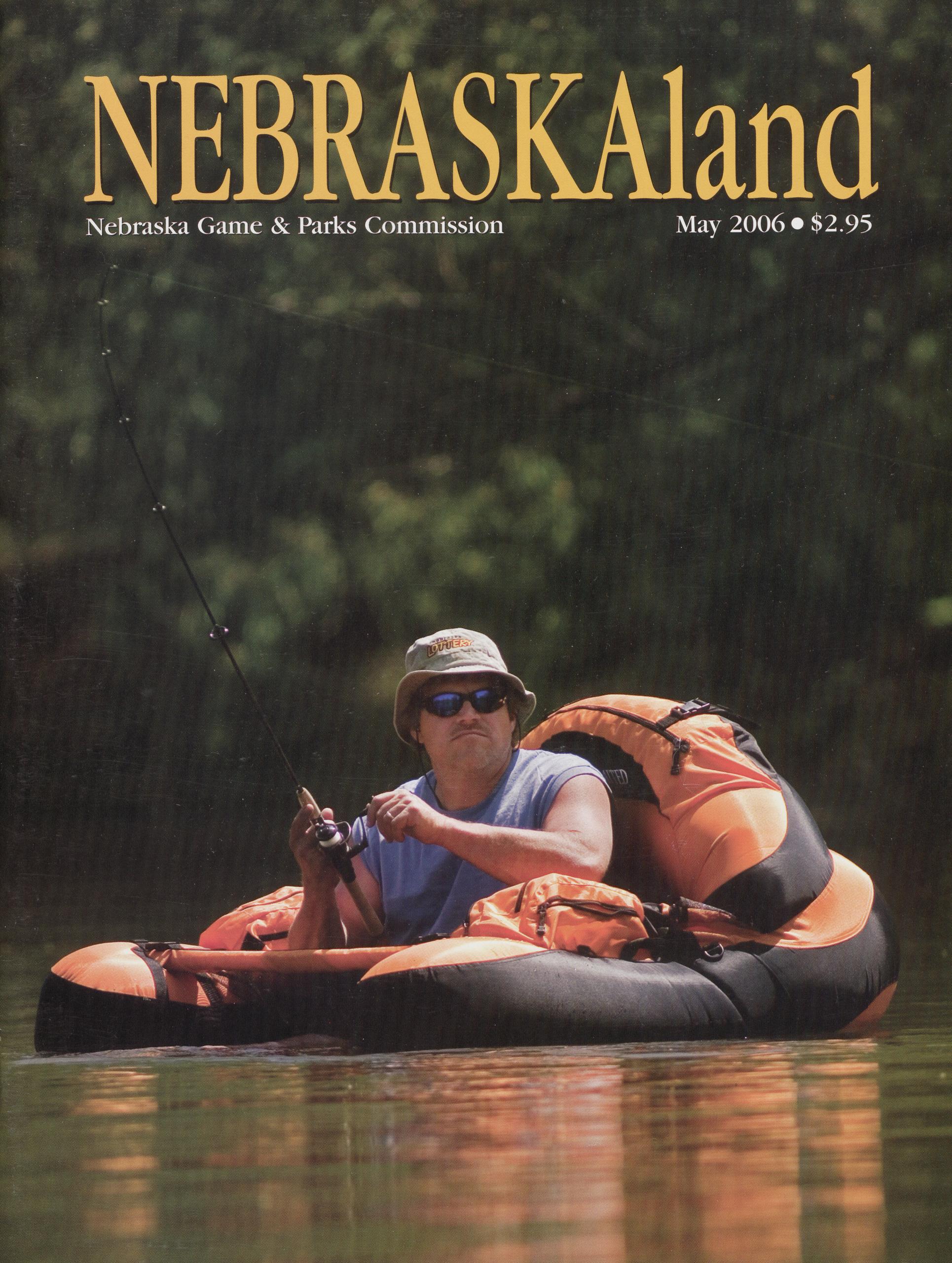
Volume 84, Number 4, May 2006 Features 10 Merritt Reservoir Mystery A group of intrepid fishermen on their annual trip to Merritt Reservoir found that the fish had abandoned their previous patterns. No problem, they just experimented, adapted and fished for what was biting. 18 The Best Morel Hunter Jon Farrar offers some light-hearted advice for would-be morel mushroom hunting experts: Forget the calls and decoys, instead use stealth, guile - even, perhaps, your favorite dog. 20 Fishing Across Nebraska Interstate 80 stretches 455 miles across Nebraska, which makes for a long drive. Luckily, during most of the trip there are often lakes located near the interstate where you can take a break, stretch the legs and enjoy some good fishing. Here’s a guide to some of them. 34 The Garter Ball A little known harbinger of spring, the garter snake’s “mating ball” is one of nature’s most unusual sights. 36 Camp Clarke Raiders The Camp Clarke Raiders have been rendezvousing twice a year for 30 years, shooting muzzleloaders, throwing tomahawks and just having fun as they remember a time gone by. Departments 9 Outdoor Business Grassroots group hoping to improve habitat for quail. 46 Outdoor Update Pasteurella pneumonia affecting Nebraska’s bighorn sheep. 47 Wilderness Workshop Marabou jigs and May crappies go hand in hand. 49 Parks & Places Red Willow Reservoir has fishing, hunting and camping. Comment........................................4 Outdoor News...................................6 Classifieds...................................48 Portraits from the Past ......................50 Cover: Steve Shepard of Eagle fishes for bass from a float tube at Louisville State Recreation Area last May. Photo by Doug Carroll. Opposite: Smith Falls, the centerpiece of Nebraska’s newest state park, delights visitors to its springbranch canyon. Smith Falls State Park is located 12 miles east and 4 miles south of Valentine. Photo by Ken Bouc.
Comment
NEBRASKAland Magazine Published by the Nebraska Game and Parks Commission Director: Rex Amack Assistant Directors: Roger Kuhn, Kirk Nelson, Sam Sidner Information & Education Administrator: Ken Bouc Information & Education Art Director: Steve O’Hare Commissioners Chairman: James Stuart, Jr., Lincoln Vice Chairman: Bill Zutavem, Dunning 2nd Vice Chairman: Gary Parker, Columbus George E. Hall, Bridgeport James Ziebarth, Wilcox Jerrod Burke, Curtis Dr. Mark Pinkerton, Wilber Bill Grewcock, Omaha Magazine Staff Editor: Doug Carroll Art Director: Tim Reigert Senior Editors: Jon Farrar, Ken Bouc Regional Editors: Eric Fowler, Bob Grier, Rocky Hoffmann Contributing Editor: Michael Forsberg Circulation: Donna Robinson Photo Librarian: Sarah Johnson NEBRASKAland VOL. 84 / NO. 4 ISSN: 0028-1964 MAY 2006 Published monthly, except for Jan./Feb. and Aug./Sept. issues, by the Nebraska Game and Parks Commission, 2200 N. 33rd St., Lincoln, NE. Copyright 2006, all rights reserved. Please address comments or questions to this address. Periodicals postage paid at Lincoln, Nebraska, and other locations. POSTMASTER: Send all address changes to NEBRASKAland, P.O. Box 30370, Lincoln, NE 68503-0370. Address submissions to: The Editor, NEBRASKAland Magazine, P.O. Box 30370, Lincoln, NE 68503. Include a stamped, self-addressed return envelope. The publisher assumes no responsibility for unsolicited material. NEBRASKAland is available on audio cassette from the Nebraska Library Commission Talking Book and Braille Service, Suite 120, 1200 N St., Lincoln, NE 68508. (800) 742-7691 Rates: $18 for one year; $33 for two years. Nebraska residents must add appropriate sales tax. To subscribe call 1-800-NEBLAND (632-5263), or go online to: outdoornebraska.orgEnclosed is a picture of a bird that my family and I at first thought was some type of blue-headed wood- pecker. As it turns out, it was a belted kingfisher, which we had never seen before. We photographed it last summer on the bridge leading to Powell, Nebraska. He was sitting on the bridge rail looking as if he had had a long flight and needed a rest. When we took the photo, it was as if he knew what we were doing and he turned his head so we could get his face in the picture. We enjoy driving around the country looking for wildlife to photograph.
Marvin Wesley Beatrice, Nebraska April Cover QuestionGreat magazine!
The April cover left me a little confused, however, given that on page 46 you say that hunters should attach orange tape or fabric to turkeys and turkey decoys while carrying them.
Bob Schmidt Schuyler native now living in Jefferson, IowaMr. Schmidt is correct, for safety reasons the successful turkey hunter on the cover probably should have had his tom clearly marked. Thanks for pointing that out and for reading our text so carefully.
- Editor Birds on March CoverDear Editors,
First of all, we all enjoy your magazine greatly. It is a wonderful publication.
We have a question concerning the cover of your March 2006 issue. What are the names of the birds on the front cover? My boss wants to know what they are and has been bugging me ever since the magazine arrived to find out. I have researched your site to find the answers but am unable to identify all of them. Could you please let us know what they are? I would greatly appreciate it. Keep up the great work.
Virginia M Dunn Fremont, NebraskaPictured starting with the bird at the top of Bud Pritchard's cover art and going clockwise are a Baltimore oriole, Bullock's oriole, red-winged blackbird, common yellowthroat, bobolink and an eastern bluebird. An exhibit of Pritchard’s work will remain on display through October at the State Museum in Lincoln for those wishing to see it.
- Editor Comment NEBRASKAland Magazine P.O. Box 30370, Lincoln, NE 68503. E-mail: nebland@ngpc.ne.gov. Please include your postal address and telephone number. Letters may be condensed and edited for clarity. Photographs are welcome and will be returned. Under federal and/or state law, discrimination is prohibited on the basis of race, color, religion, age, gender, marital status, national origin, disability or political affiliation. If you think you have been discriminated against in any program, activity or facility or want more information, contact the Affirmative Action Officer, Nebraska Game and Parks Commission, Lincoln, NE, (402) 471-0641 or the Equal Opportunity Commission, Lincoln NE (402) 471-2024, TTYfTDD (402) 471- 4693). Nebraska Game and Parks Commission Offices Headquarters 2200 N. 33rd Street Lincoln, NE 68503 Phone (402) 471-0641 District Office I East Hwy. 2, Box 725 Alliance, NE 69301 Phone (308) 763-2940 District Office II 524 Panzer St., Box 508 Bassett, NE 68714 Phone (402) 684-2921 District Office III 2201 N. 13th St. Norfolk, NE 68701 Phone (402) 370-3374 District Office IV 301 E. State Farm Rd. North Platte, NE 69101 Phone (308) 535-8025 District Office V 2200 N. 33rd Street Lincoln, NE 68503 Phone (402) 471-5558 District Office VI 1617 First Ave. Kearney, NE 68847 Phone (308) 865-5310 Omaha Office 1212 Bob Gibson Blvd. Omaha, NE 68108 Phone (402) 595-2144 Ak-Sar-Ben Aquarium 21502 W. Highway 31 Gretna, NE 68028 Phone (402) 332-3901 World Wide Web site: outdoornebraska.org E-mail: ngpc@ngpc.state.ne.us Conservation Officers by Region Administration Terry Brentzel Grand Is. 384-8296 Ted Blume (Adm.) Lincoln 471-5531 Darin Gress Hebron (402) 768-2287 Craig Stover (Asst.) Lincoln 471-5532 Dale Johnson Kearney 237-1079 Wes Loos (Asst.) Lincoln 471-5591 Mark Reeves Loup City 745-0748 Murray Johnson Lincoln 471-5003 Robert Finke Milford (402) 761-3537 Richard Seward Ord 728-3115 Panhandle Officer City Phone (308) Northeast Jim Zimmerman (Sup.) Gering 436-7561 Officer City Phone (402) Walt Meyer Chadron 432-4398 Tom Zimmer (Sup.) Norfolk 371-6625 Dan Kling Crawford 763-2940 Robert Kelly Albion 395-2538 Heath Packett Gordon 282-2553 Dale Davis Bassett 273-1700 Dennis Thompson Ogallala 284-6450 Ross Oestmann Bloomfield 373-4412 Dan Zuehlke Ogallala 284-4815 Steve Oberg Columbus 564-5937 Doug Pollard Oshkosh 772-9950 Daniel Roberts Fremont 721-7852 Scott Brandt Scottsbluff 635-1277 Jon Reeves Kennard 427-7378 Frank Miller Valentine (402)376-1183 Marion Shafer Norfolk 371-2031 Pat George O’Neill 336-1588 Southwest Eric Wiebe Ponca 755-2566 Officer City Phone (308) Tim Williams Neligh 887-1335 Roger Thompson (Sup.) N. Platte 532-9175 Cory Krause West Point 370-3374 Ray Dierking Brkn. Bow 872-3078 George Sund Cambridge 697-4629 Southeast Matt Andrews Elwood 785-3025 Officer City Phone (402) Dirk Greene Imperial 882-5328 Duane Arp (Sup.) Gretna 332-2965 Virgil Gosch McCook 345-2185 Sean McKeehan Ashland - 944-4174 Dudley Sorensen N. Platte 532-0747 William Krause Auburn 274-3789 Rich Routh Rep. City 799-2085 Jeremy TenKley Beatrice 228-1437 Douglas Kramer Lincoln 466-9001 South-central Dina Barta Lincoln 483-2358 Officer City Phone (308) Stacey Lewton Lincoln 476-0436 Jerry Pecha (Sup.) Kearney 865-5327 Levi Krause Louisville 234-2212 Jeff Jones Clay Center(402)762-3124 Russell Mort Nebr. City 873-5684 Randy Pomplun Fullerton 536-2987 Jeff Clauson Valley 359-5301 Michael Thome Gothenburg 535-8025 Mike Luben Wahoo 443-4278 Nebraska Wildlife Crimestoppers 1-800-742-7627 4 NEBRASKAland • May 2006 NEBRASKAland • May 2006 5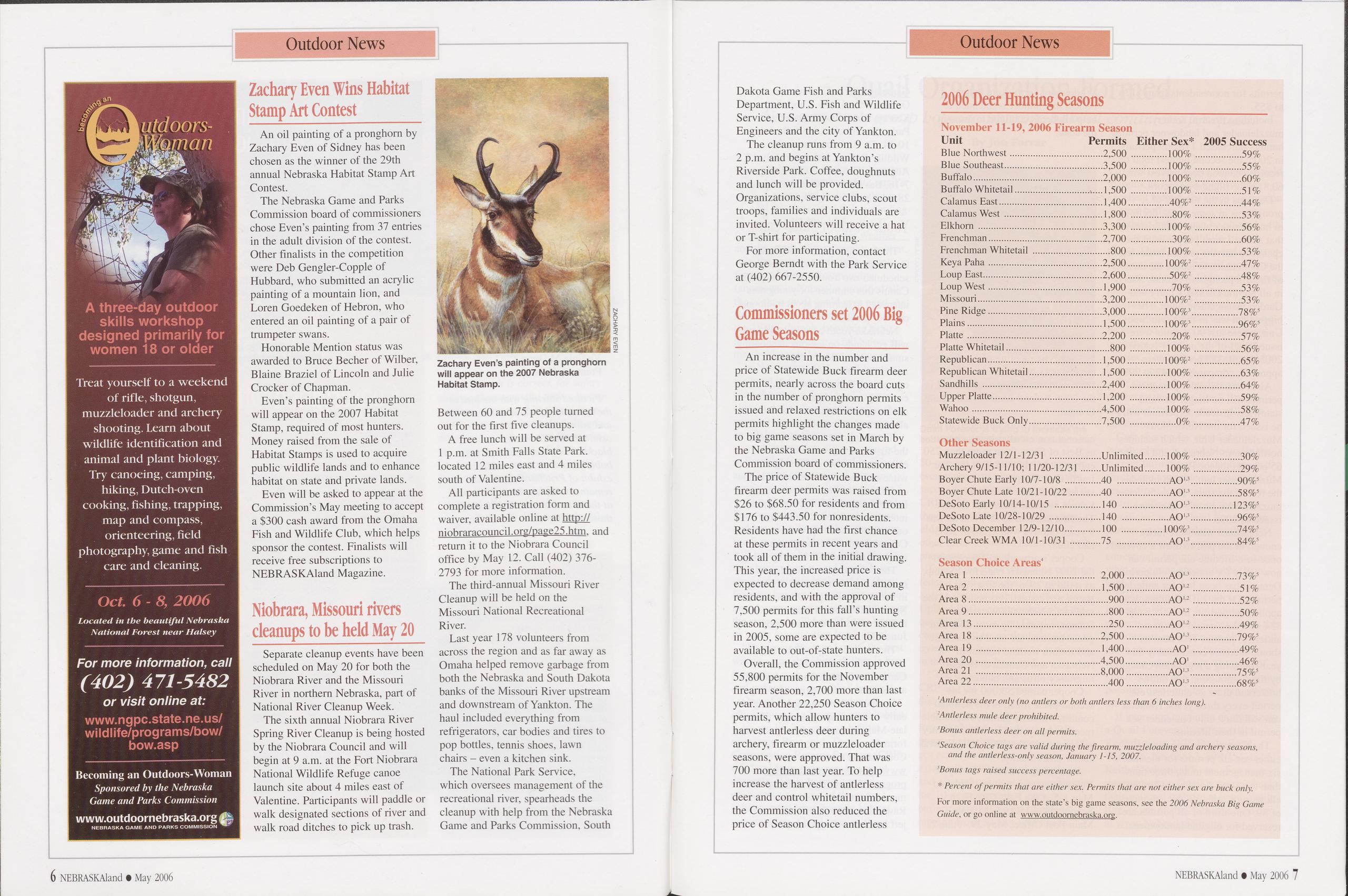
Outdoor News
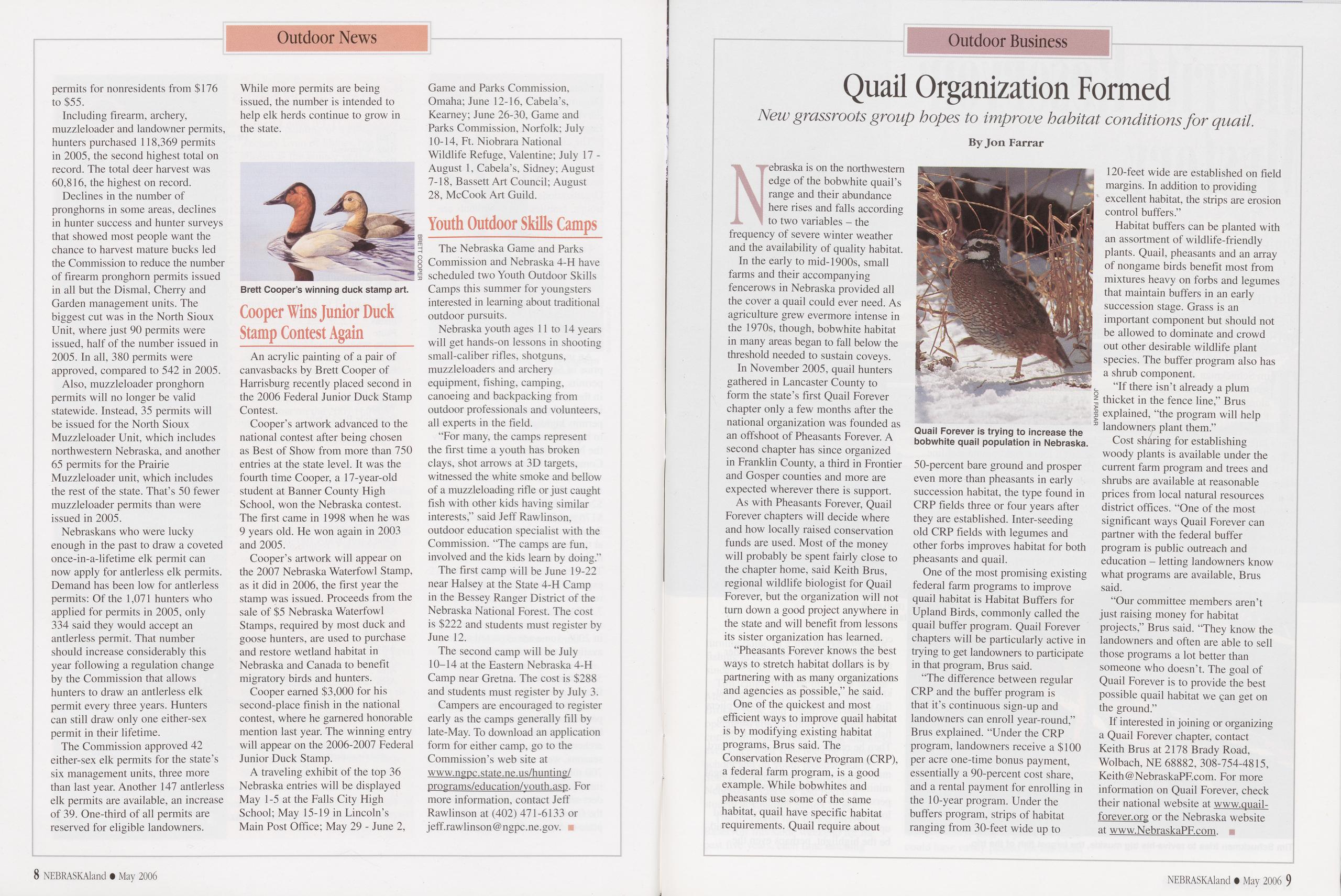
becoming an Outdoors- Woman A three-day outdoor skills workshop designed primarily for women 18 or older Treat yourself to a weekend of rifle, shotgun, muzzleloader and archery shooting. Learn about wildlife identification and animal and plant biology. Try canoeing, camping, hiking, Dutch-oven cooking, fishing, trapping, map and compass, orienteering, field photography, game and fish care and cleaning. Oct. 6 - 8, 2006 Located in the beautiful Nebraska National Forest near Halsey For more information, call (402) 471-5482 or visit online at: www.ngpc.state.ne.us/ wildlife/programs/bow/ bow.asp Becoming an Outdoors-Woman Sponsored by the Nebraska Game and Parks Commission www.outdoornebraska.org NEBRASKA GAME AND PARKS COMMISSION Zachary Even Wins Habitat Stamp Art ContestAn oil painting of a pronghorn by Zachary Even of Sidney has been chosen as the winner of the 29th annual Nebraska Habitat Stamp Art Contest.
The Nebraska Game and Parks Commission board of commissioners chose Even’s painting from 37 entries in the adult division of the contest. Other finalists in the competition were Deb Gengler-Copple of Hubbard, who submitted an acrylic painting of a mountain lion, and Loren Goedeken of Hebron, who entered an oil painting of a pair of trumpeter swans.
Honorable Mention status was awarded to Bruce Becher of Wilber, Blaine Braziel of Lincoln and Julie Crocker of Chapman.
Even’s painting of the pronghorn will appear on the 2007 Habitat Stamp, required of most hunters. Money raised from the sale of Habitat Stamps is used to acquire public wildlife lands and to enhance habitat on state and private lands.
Even will be asked to appear at the Commission’s May meeting to accept a $300 cash award from the Omaha Fish and Wildlife Club, which helps sponsor the contest. Finalists will receive free subscriptions to NEBRASKAland Magazine.
Niobrara, Missouri rivers cleanups to be held May 20Separate cleanup events have been scheduled on May 20 for both the Niobrara River and the Missouri River in northern Nebraska, part of National River Cleanup Week.
The sixth annual Niobrara River Spring River Cleanup is being hosted by the Niobrara Council and will begin at 9 a.m. at the Fort Niobrara National Wildlife Refuge canoe launch site about 4 miles east of Valentine. Participants will paddle or walk designated sections of river and walk road ditches to pick up trash.
A free lunch will be served at 1 p.m. at Smith Falls State Park, located 12 miles east and 4 miles south of Valentine.
All participants are asked to complete a registration form and waiver, available online at http:// niobraracouncil.org/page25.htm. and return it to the Niobrara Council office by May 12. Call (402) 376- 2793 for more information.
The third-annual Missouri River Cleanup will be held on the Missouri National Recreational River.
Last year 178 volunteers from across the region and as far away as Omaha helped remove garbage from both the Nebraska and South Dakota banks of the Missouri River upstream and downstream of Yankton. The haul included everything from refrigerators, car bodies and tires to pop bottles, tennis shoes, lawn chairs - even a kitchen sink.
The National Park Service, which oversees management of the recreational river, spearheads the cleanup with help from the Nebraska Game and Parks Commission, South Dakota Game Fish and Parks Department, U.S. Fish and Wildlife Service, U.S. Army Corps of Engineers and the city of Yankton.
The cleanup runs from 9 a.m. to 2 p.m. and begins at Yankton’s Riverside Park. Coffee, doughnuts and lunch will be provided. Organizations, service clubs, scout troops, families and individuals are invited. Volunteers will receive a hat or T-shirt for participating.
For more information, contact George Berndt with the Park Service at (402) 667-2550.
Commissioners set 2006 Big Game SeasonsAn increase in the number and price of Statewide Buck firearm deer permits, nearly across the board cuts in the number of pronghorn permits issued and relaxed restrictions on elk permits highlight the changes made to big game seasons set in March by the Nebraska Game and Parks Commission board of commissioners.
The price of Statewide Buck firearm deer permits was raised from $26 to $68.50 for residents and from $176 to $443.50 for nonresidents. Residents have had the first chance at these permits in recent years and took all of them in the initial drawing. This year, the increased price is expected to decrease demand among residents, and with the approval of 7,500 permits for this fall’s hunting season, 2,500 more than were issued in 2005, some are expected to be available to out-of-state hunters.
Overall, the Commission approved 55,800 permits for the November firearm season, 2,700 more than last year. Another 22,250 Season Choice permits, which allow hunters to harvest antlerless deer during archery, firearm or muzzleloader seasons, were approved. That was 700 more than last year. To help increase the harvest of antlerless deer and control whitetail numbers, the Commission also reduced the price of Season Choice antlerless
 permits for nonresidents from $176 to $55.
Including firearm, archery, muzzleloader and landowner permits, hunters purchased 118,369 permits in 2005, the second highest total on record. The total deer harvest was 60,816, the highest on record.
Declines in the number of pronghorns in some areas, declines in hunter success and hunter surveys that showed most people want the chance to harvest mature bucks led the Commission to reduce the number of firearm pronghorn permits issued in all but the Dismal, Cherry and Garden management units. The biggest cut was in the North Sioux Unit, where just 90 permits were issued, half of the number issued in 2005. In all, 380 permits were approved, compared to 542 in 2005. Also, muzzleloader pronghorn permits will no longer be valid statewide. Instead, 35 permits will be issued for the North Sioux Muzzleloader Unit, which includes northwestern Nebraska, and another 65 permits for the Prairie Muzzleloader unit, which includes the rest of the state. That’s 50 fewer muzzleloader permits than were issued in 2005.
Nebraskans who were lucky enough in the past to draw a coveted once-in-a-lifetime elk permit can now apply for antlerless elk permits. Demand has been low for antlerless permits: Of the 1,071 hunters who applied for permits in 2005, only 334 said they would accept an antlerless permit. That number should increase considerably this year following a regulation change by the Commission that allows hunters to draw an antlerless elk permit every three years. Hunters can still draw only one either-sex permit in their lifetime.
The Commission approved 42 either-sex elk permits for the state’s six management units, three more than last year. Another 147 antlerless elk permits are available, an increase of 39. One-third of all permits are reserved for eligible landowners. While more permits are being issued, the number is intended to help elk herds continue to grow in the state.
An acrylic painting of a pair of canvasbacks by Brett Cooper of Harrisburg recently placed second in the 2006 Federal Junior Duck Stamp Contest.
Cooper’s artwork advanced to the national contest after being chosen as Best of Show from more than 750 entries at the state level. It was the fourth time Cooper, a 17-year-old student at Banner County High School, won the Nebraska contest. The first came in 1998 when he was 9 years old. He won again in 2003 and 2005.
Cooper’s artwork will appear on the 2007 Nebraska Waterfowl Stamp, as it did in 2006, the first year the stamp was issued. Proceeds from the sale of $5 Nebraska Waterfowl Stamps, required by most duck and goose hunters, are used to purchase and restore wetland habitat in Nebraska and Canada to benefit migratory birds and hunters.
Cooper earned $3,000 for his second-place finish in the national contest, where he garnered honorable mention last year. The winning entry will appear on the 2006-2007 Federal Junior Duck Stamp.
A traveling exhibit of the top 36 Nebraska entries will be displayed May 1-5 at the Falls City High School; May 15-19 in Lincoln’s Main Post Office; May 29 - June 2, Game and Parks Commission, Omaha; June 12-16, Cabela’s, Kearney; June 26-30, Game and Parks Commission, Norfolk; July 10-14, Ft. Niobrara National Wildlife Refuge, Valentine; July 17 - August 1, Cabela’s, Sidney; August 7-18, Bassett Art Council; August 28, McCook Art Guild.
Youth Outdoor Skills CampsThe Nebraska Game and Parks Commission and Nebraska 4-H have scheduled two Youth Outdoor Skills Camps this summer for youngsters interested in learning about traditional outdoor pursuits.
Nebraska youth ages 11 to 14 years will get hands-on lessons in shooting small-caliber rifles, shotguns, muzzleloaders and archery equipment, fishing, camping, canoeing and backpacking from outdoor professionals and volunteers, all experts in the field.
“For many, the camps represent the first time a youth has broken clays, shot arrows at 3D targets, witnessed the white smoke and bellow of a muzzleloading rifle or just caught fish with other kids having similar interests,” said Jeff Rawlinson, outdoor education specialist with the Commission. “The camps are fun, involved and the kids learn by doing.”
The first camp will be June 19-22 near Halsey at the State 4-H Camp in the Bessey Ranger District of the Nebraska National Forest. The cost is $222 and students must register by June 12.
The second camp will be July 10-14 at the Eastern Nebraska 4-H Camp near Gretna. The cost is $288 and students must register by July 3.
Campers are encouraged to register early as the camps generally fill by late-May. To download an application form for either camp, go to the Commission’s web site at www.n gpc. state. ne. us/huntin g/ programs/education/youth.asp. For more information, contact Jeff Rawlinson at (402) 471-6133 or jeff.rawlinson@ngpc.ne.gov.
Outdoor Business
Quail Organization Formed
New grassroots group hopes to improve habitat conditions for quail.
Nebraska is on the northwestern edge of the bobwhite quail’s range and their abundance here rises and falls according to two variables - the frequency of severe winter weather and the availability of quality habitat.
In the early to mid-1900s, small farms and their accompanying fencerows in Nebraska provided all the cover a quail could ever need. As agriculture grew evermore intense in the 1970s, though, bobwhite habitat in many areas began to fall below the threshold needed to sustain coveys.
In November 2005, quail hunters gathered in Lancaster County to form the state’s first Quail Forever chapter only a few months after the national organization was founded as an offshoot of Pheasants Forever. A second chapter has since organized in Franklin County, a third in Frontier and Gosper counties and more are expected wherever there is support.
As with Pheasants Forever, Quail Forever chapters will decide where and how locally raised conservation funds are used. Most of the money will probably be spent fairly close to the chapter home, said Keith Brus, regional wildlife biologist for Quail Forever, but the organization will not turn down a good project anywhere in the state and will benefit from lessons its sister organization has learned.
“Pheasants Forever knows the best ways to stretch habitat dollars is by partnering with as many organizations and agencies as possible,” he said.
One of the quickest and most efficient ways to improve quail habitat is by modifying existing habitat programs, Brus said. The Conservation Reserve Program (CRP), a federal farm program, is a good example. While bobwhites and pheasants use some of the same habitat, quail have specific habitat requirements. Quail require about Quail Forever is trying to increase the bobwhite quail population in Nebraska. 50-percent bare ground and prosper even more than pheasants in early succession habitat, the type found in CRP fields three or four years after they are established. Inter-seeding old CRP fields with legumes and other forbs improves habitat for both pheasants and quail.
One of the most promising existing federal farm programs to improve quail habitat is Habitat Buffers for Upland Birds, commonly called the quail buffer program. Quail Forever chapters will be particularly active in trying to get landowners to participate in that program, Brus said.
“The difference between regular CRP and the buffer program is that it’s continuous sign-up and landowners can enroll year-round,” Brus explained. “Under the CRP program, landowners receive a $100 per acre one-time bonus payment, essentially a 90-percent cost share, and a rental payment for enrolling in the 10-year program. Under the buffers program, strips of habitat ranging from 30-feet wide up to 120-feet wide are established on field margins. In addition to providing j excellent habitat, the strips are erosion I control buffers.”
Habitat buffers can be planted with I an assortment of wildlife-friendly plants. Quail, pheasants and an array of nongame birds benefit most from I mixtures heavy on forbs and legumes that maintain buffers in an early succession stage. Grass is an I important component but should not be allowed to dominate and crowd out other desirable wildlife plant species. The buffer program also has a shrub component.
“If there isn’t already a plum * thicket in the fence line,” Brus Z explained, “the program will help 33 landowner^ plant them.”
Cost sharing for establishing woody plants is available under the current farm program and trees and shrubs are available at reasonable prices from local natural resources district offices. “One of the most significant ways Quail Forever can partner with the federal buffer program is public outreach and education - letting landowners know what programs are available, Brus said.
“Our committee members aren’t just raising money for habitat projects,” Brus said. “They know the landowners and often are able to sell those programs a lot better than someone who doesn’t. The goal of Quail Forever is to provide the best possible quail habitat we can get on the ground.”
If interested in joining or organizing a Quail Forever chapter, contact Keith Brus at 2178 Brady Road, Wolbach, NE 68882, 308-754-4815, Keith@NebraskaPF.com. For more information on Quail Forever, check their national website at www.quail- forever.org or the Nebraska website at www.NebraskaPF.com.
8 NEBRASKAland • May 2006 NEBRASKAland • May 2006 9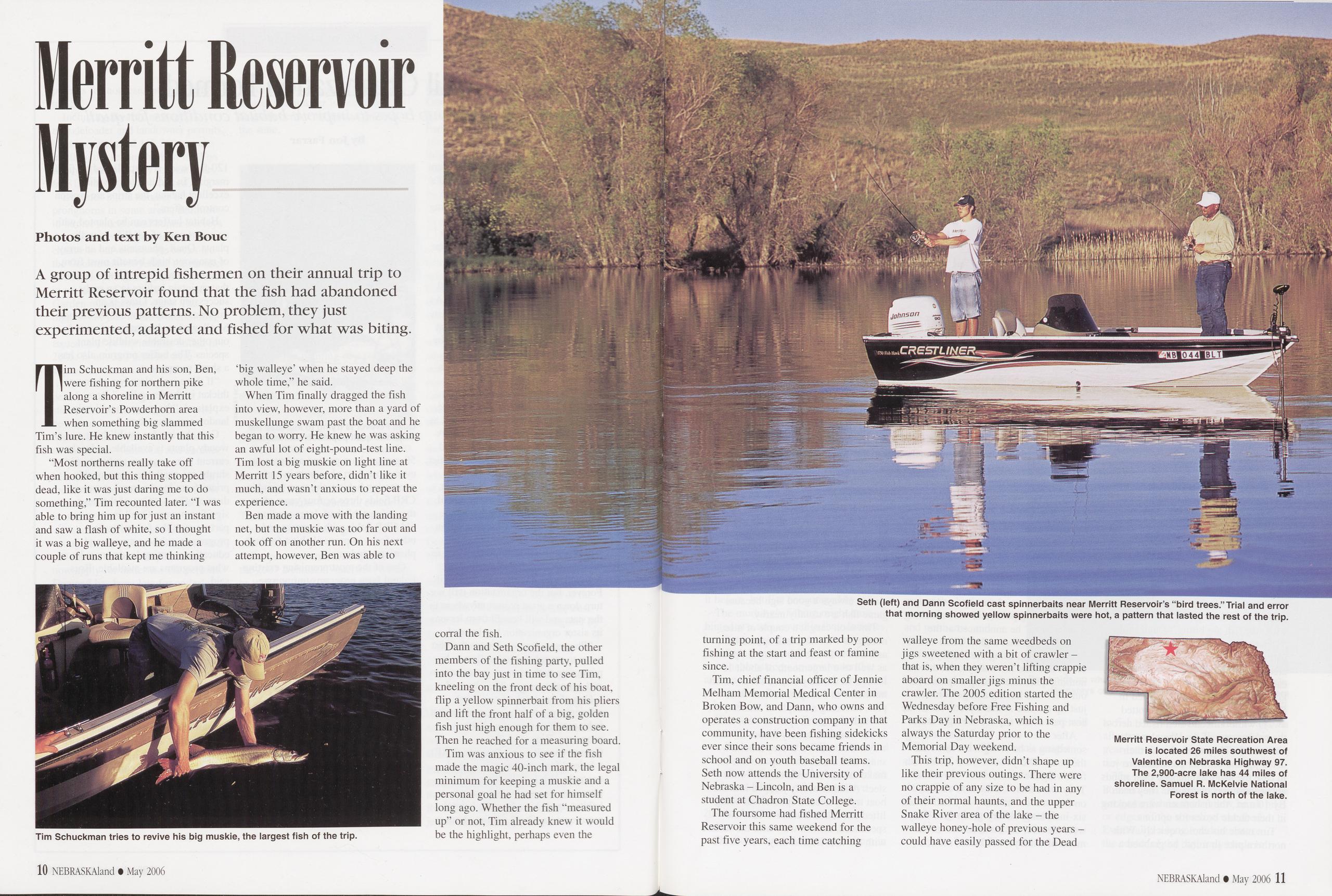
Merritt Reservoir Mystery
A group of intrepid fishermen on their annual trip to Merritt Reservoir found that the fish had abandoned their previous patterns. No problem, they just experimented, adapted and fished for what was biting.
Tim Schuckman and his son, Ben, were fishing for northern pike along a shoreline in Merritt Reservoir’s Powderhorn area when something big slammed Tim’s lure. He knew instantly that this fish was special.
“Most northerns really take off when hooked, but this thing stopped dead, like it was just daring me to do something,” Tim recounted later. T was able to bring him up for just an instant and saw a flash of white, so I thought it was a big walleye, and he made a couple of runs that kept me thinking
When Tim finally dragged the fish into view, however, more than a yard of muskellunge swam past the boat and he began to worry. He knew he was asking an awful lot of eight-pound-test line. Tim lost a big muskie on light line at Merritt 15 years before, didn’t like it much, and wasn’t anxious to repeat the experience.
Ben made a move with the landing net, but the muskie was too far out and took off on another run. On his next attempt, however, Ben was able to
Dann and Seth Scofield, the other members of the fishing party, pulled into the bay just in time to see Tim, kneeling on the front deck of his boat, flip a yellow spinnerbait from his pliers and lift the front half of a big, golden fish just high enough for them to see. Then he reached for a measuring board.
Tim was anxious to see if the fish made the magic 40-inch mark, the legal minimum for keeping a muskie and a personal goal he had set for himself long ago. Whether the fish “measured up” or not, Tim already knew it would be the highlight, perhaps even the turning point, of a trip marked by poor fishing at the start and feast or famine since.
Tim, chief financial officer of Jennie Melham Memorial Medical Center in Broken Bow, and Dann, who owns and operates a construction company in that community, have been fishing sidekicks ever since their sons became friends in school and on youth baseball teams. Seth now attends the University of Nebraska - Lincoln, and Ben is a student at Chadron State College.
The foursome had fished Merritt Reservoir this same weekend for the past five years, each time catching walleye from the same weedbeds on jigs sweetened with a bit of crawler - that is, when they weren’t lifting crappie aboard on smaller jigs minus the crawler. The 2005 edition started the Wednesday before Free Fishing and Parks Day in Nebraska, which is always the Saturday prior to the Memorial Day weekend.
This trip, however, didn’t shape up like their previous outings. There were no crappie of any size to be had in any of their normal haunts, and the upper Snake River area of the lake - the walleye honey-hole of previous years - could have easily passed for the Dead
The lack of crappie and walleye that first afternoon and evening might have defeated some anglers, but not this bunch. “We like catching all kinds of fish. We just adapt to the conditions and keep on fishing. We’ll fish for whatever fish are biting,” Dann said.
Thursday morning found the party’s two boats back on the Snake River area. Dann and Seth probed the water east of the “bird trees” (as the area is known where cormorants roosted in flooded trees before the trees rotted away) while Tim and Ben fished across the narrow arm of the lake along the north bank. They opened with their usual jig-and-crawler combinations just in case the fish had changed their minds about those rigs overnight. They hadn’t. By 10 a.m., the fishermen were looking in their tackle boxes for options.
Tim made his choice quickly. With northern pike in mind, he grabbed a spinnerbait in his favorite color - black, while Ben picked a chartreuse one to give the fish another choice.
A glance toward the Scofields a quarter-mile away showed they had the same idea, as glistening hardware carried line from their boat in long, shimmering arcs. Seth was probably wearing a great big grin.
“The best part of the trip is when you get out the big poles and start chucking spinnerbaits,” he announced at the campfire later that night. “I like a little finesse fishing, using the small jigs and things like that for walleye, but there’s nothing quite like tossing a spinnerbait out there and having a huge northern just rip out line ... that’s pretty much the best part of the trip for me right there.”
After a few casts, Tim began noticing something as he brought his lure near the boat. “Did you see that? Those fish following the spinnerbait?” he asked. They were there on his next cast, and on Ben’s, too - as many as a half-dozen six-inch-long, silvery-green fish. They were alewife, the main course on the menu of walleye, northerns, muskies and other big predators in the lake
Tim regarded the alewife as a good omen. It was the first time they had seen these baitfish in all their trips to Merritt, and it appeared that they were shallow today. Perhaps the alewives were a clue that could help them cope with the tough fishing they were finding. In any event, having baitfish around is almost always a good sign because game fish are usually nearby.
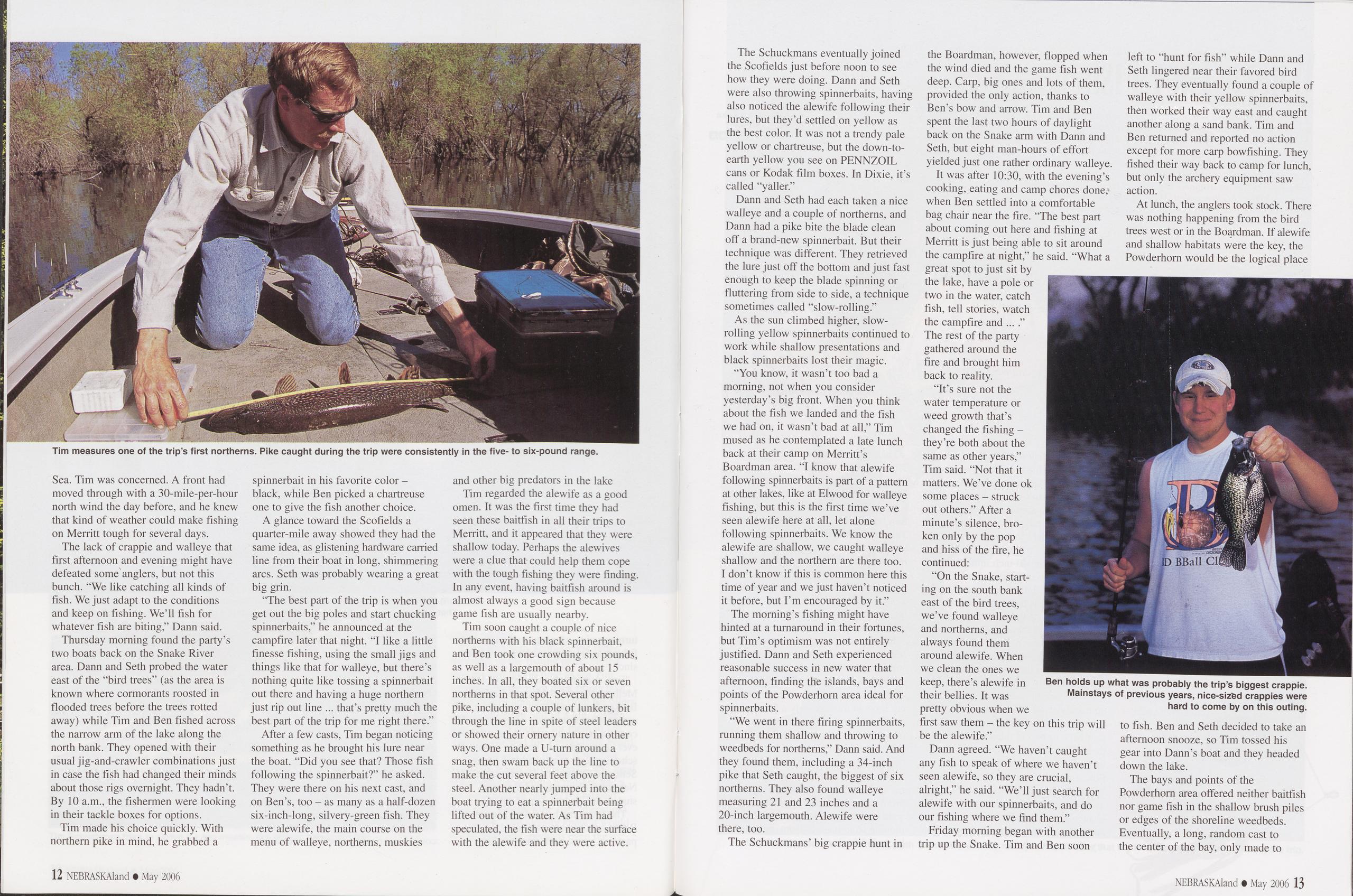
Tim soon caught a couple of nice northerns with his black spinnerbait, and Ben took one crowding six pounds, as well as a largemouth of about 15 inches. In all, they boated six or seven northerns in that spot. Several other pike, including a couple of lunkers, bit through the line in spite of steel leaders or showed their ornery nature in other ways. One made a U-turn around a snag, then swam back up the line to make the cut several feet above the steel. Another nearly jumped into the boat trying to eat a spinnerbait being lifted out of the water. As Tim had speculated, the fish were near the surface with the alewife and they were active.
The Schuckmans eventually joined the Scofields just before noon to see how they were doing. Dann and Seth were also throwing spinnerbaits, having also noticed the alewife following their lures, but they’d settled on yellow as the best color. It was not a trendy pale yellow or chartreuse, but the down-to- earth yellow you see on PENNZOIL cans or Kodak film boxes. In Dixie, it’s called “yaller.”
Dann and Seth had each taken a nice walleye and a couple of northerns, and Dann had a pike bite the blade clean off a brand-new spinnerbait. But their technique was different. They retrieved the lure just off the bottom and just fast enough to keep the blade spinning or fluttering from side to side, a technique sometimes called “slow-rolling.”
As the sun climbed higher, slow- rolling yellow spinnerbaits continued to work while shallow presentations and black spinnerbaits lost their magic.
“You know, it wasn’t too bad a morning, not when you consider yesterday’s big front. When you think about the fish we landed and the fish we had on, it wasn’t bad at all,” Tim mused as he contemplated a late lunch back at their camp on Merritt’s Boardman area. “I know that alewife following spinnerbaits is part of a pattern at other lakes, like at Elwood for walleye fishing, but this is the first time we’ve seen alewife here at all, let alone following spinnerbaits. We know the alewife are shallow, we caught walleye shallow and the northern are there too. I don’t know if this is common here this time of year and we just haven’t noticed it before, but I’m encouraged by it.”
The morning’s fishing might have hinted at a turnaround in their fortunes, but Tim’s optimism was not entirely justified. Dann and Seth experienced reasonable success in new water that afternoon, finding the islands, bays and points of the Powderhorn area ideal for spinnerbaits.
“We went in there firing spinnerbaits, running them shallow and throwing to weedbeds for northerns,” Dann said. And they found them, including a 34-inch pike that Seth caught, the biggest of six northerns. They also found walleye measuring 21 and 23 inches and a 20-inch largemouth. Alewife were there, too.
The Schuckmans’ big crappie hunt in the Boardman, however, flopped when the wind died and the game fish went deep. Carp, big ones and lots of them, provided the only action, thanks to Ben’s bow and arrow. Tim and Ben spent the last two hours of daylight back on the Snake arm with Dann and Seth, but eight man-hours of effort yielded just one rather ordinary walleye.
It was after 10:30, with the evening’s cooking, eating and camp chores done,' when Ben settled into a comfortable bag chair near the fire. “The best part about coming out here and fishing at Merritt is just being able to sit around the campfire at night,” he said. “What a great spot to just sit by the lake, have a pole or two in the water, catch fish, tell stories, watch the campfire and ... .” The rest of the party gathered around the fire and brought him back to reality.
“It’s sure not the water temperature or weed growth that’s changed the fishing - they’re both about the same as other years,” Tim said. “Not that it matters. We’ve done ok some places - struck out others.” After a minute’s silence, bro- ken only by the pop and hiss of the fire, he continued:
“On the Snake, start- ing on the south bank east of the bird trees, we’ve found walleye and northerns, and always found them around alewife. When we clean the ones we keep, there’s alewife in their bellies. It was pretty obvious when we first saw them - the key on this trip will be the alewife.”
Dann agreed. “We haven’t caught any fish to speak of where we haven’t seen alewife, so they are crucial, alright,” he said. “We’ll just search for alewife with our spinnerbaits, and do our fishing where we find them.”
Friday morning began with another trip up the Snake. Tim and Ben soon left to “hunt for fish” while Dann and Seth lingered near their favored bird trees. They eventually found a couple of walleye with their yellow spinnerbaits, then worked their way east and caught another along a sand bank. Tim and Ben returned and reported no action except for more carp bowfishing. They fished their way back to camp for lunch, but only the archery equipment saw action.
At lunch, the anglers took stock. There was nothing happening from the bird trees west or in the Boardman. If alewife and shallow habitats were the key, the Powderhorn would be the logical place
The bays and points of the Powderhorn area offered neither baitfish nor game fish in the shallow brush piles or edges of the shoreline weedbeds. Eventually, a long, random cast to the center of the bay, only made to 12 NEBRASKAland • May 2006 NEBRASKAland • May 2006 13 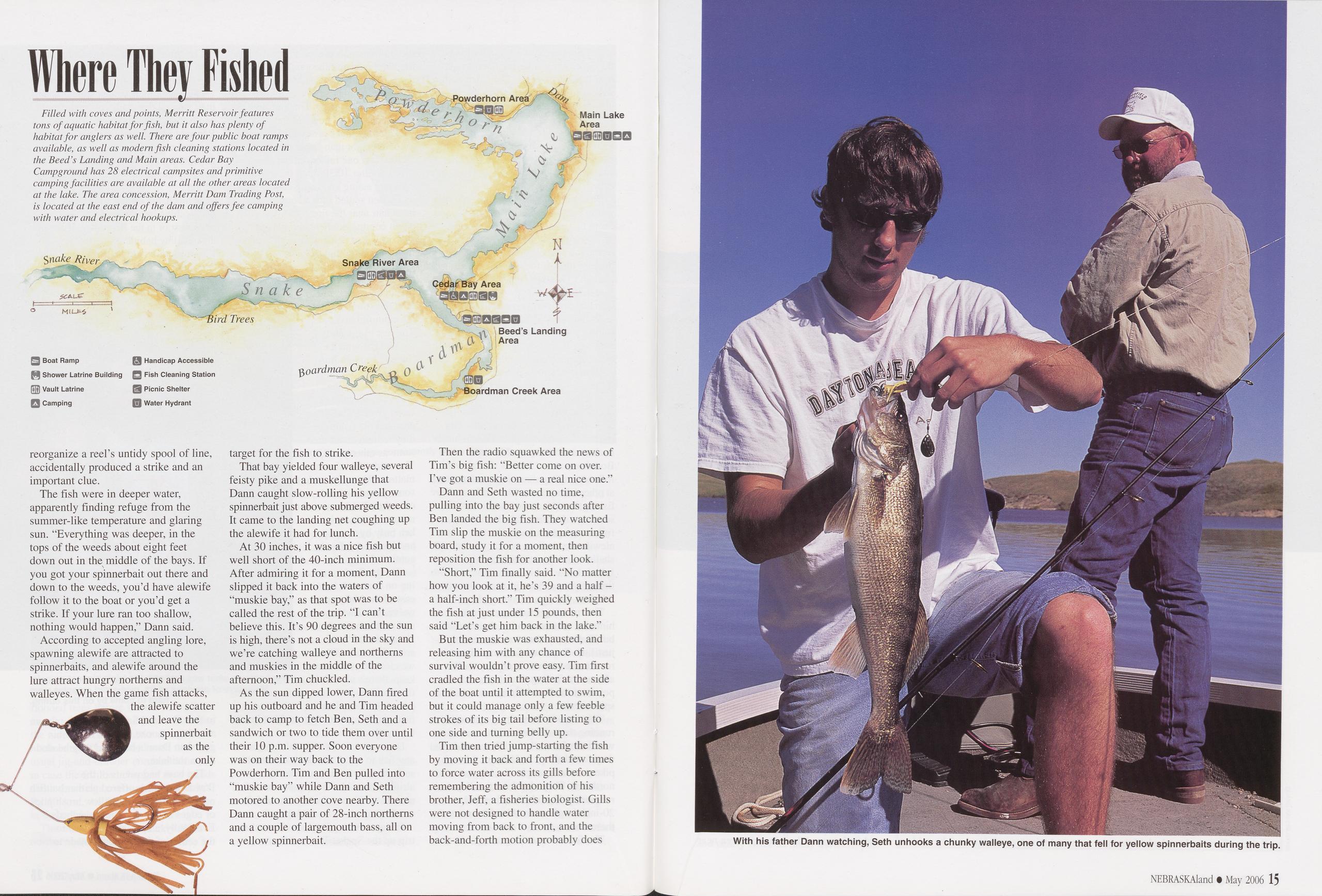
The fish were in deeper water, apparently finding refuge from the summer-like temperature and glaring sun. “Everything was deeper, in the tops of the weeds about eight feet down out in the middle of the bays. If you got your spinnerbait out there and down to the weeds, you’d have alewife follow it to the boat or you’d get a strike. If your lure ran too shallow, nothing would happen,” Dann said.
According to accepted angling lore, spawning alewife are attracted to spinnerbaits, and alewife around the lure attract hungry northerns and walleyes. When the game fish attacks, the alewife scatter and leave the spinnerbait as the only target for the fish to strike.
That bay yielded four walleye, several feisty pike and a muskellunge that Dann caught slow-rolling his yellow spinnerbait just above submerged weeds. It came to the landing net coughing up the alewife it had for lunch.
At 30 inches, it was a nice fish but well short of the 40-inch minimum. After admiring it for a moment, Dann slipped it back into the waters of “muskie bay,” as that spot was to be called the rest of the trip. "I can’t believe this. It’s 90 degrees and the sun is high, there’s not a cloud in the sky and we’re catching walleye and northerns and muskies in the middle of the afternoon,” Tim chuckled.
As the sun dipped lower, Dann fired up his outboard and he and Tim headed back to camp to fetch Ben, Seth and a sandwich or two to tide them over until their 10 p.m. supper. Soon everyone was on their way back to the Powderhorn. Tim and Ben pulled into “muskie bay” while Dann and Seth motored to another cove nearby. There Dann caught a pair of 28-inch northerns and a couple of largemouth bass, all on a yellow spinnerbait.
Then the radio squawked the news of Tim’s big fish: “Better come on over. I’ve got a muskie on — a real nice one.”
Dann and Seth wasted no time, pulling into the bay just seconds after Ben landed the big fish. They watched Tim slip the muskie on the measuring board, study it for a moment, then reposition the fish for another look.
“Short,” Tim finally said. “No matter how you look at it, he’s 39 and a half - a half-inch short.” Tim quickly weighed the fish at just under 15 pounds, then said “Let’s get him back in the lake.”
But the muskie was exhausted, and releasing him with any chance of survival wouldn’t prove easy. Tim first cradled the fish in the water at the side of the boat until it attempted to swim, but it could manage only a few feeble strokes of its big tail before listing to one side and turning belly up.
Tim then tried jump-starting the fish by moving it back and forth a few times to force water across its gills before remembering the admonition of his brother, Jeff, a fisheries biologist. Gills were not designed to handle water moving from back to front, and the back-and-forth motion probably does
After several repetitions, the muskie seemed to manage a few more strokes after release, but still faltered. Finally, Dann asked to try his hand at muskie resuscitation. Dann and Seth used their boat and its electric motor in the same way Tim and Ben had used theirs, but when Dann released the muskie, he held the fish ahead of the tail and gently pushed it almost straight down as far as he could reach. Several slow strokes of the fish’s big tail took it down and out of sight.
There was no way of knowing how well their efforts had worked. T thought the surface water might be too warm and short of oxygen, or maybe too bright and confusing for the fish. I figured getting him down to cooler and friendlier surroundings might be what he needed,” Dann later explained.
The boats separated a bit and everyone spent the next 10 or 15 minutes watching the quiet surface of the immediate area without seeing any more of the big fish.
That night in camp, Tim reflected on the day’s fishing. “Conditions were tough today - hot and bright without a cloud in the sky. I didn’t see another boat catch a fish, and the boats I talked to hadn’t caught anything all day. I think we did really well. We caught northerns, we caught walleye, and then that muskie at the end. I think we turned things around today,” he said.
Events would prove Tim right. The skunking he and Ben endured that morning (shooting carp doesn’t count) would be the last “famine” anyone in the party would experience. It would be “feast” the rest of the trip, beginning with Tim and Dann’s Friday afternoon in the Powderhorn, then the evening outing that ended with Tim’s big muskie.
The group took the next morning off but made up for it after lunch. Ben and Tim tried jig-and-crawler rigs again and caught two nice walleye on the lower Snake area before running out of bait. Ben then switched to a crankbait and nailed a nice walleye on his fourth or fifth cast. Crankbaits quickly accounted for two more walleye, plus six hefty white bass. Meanwhile, Dann and Seth tapped their favorite area near the bird trees for four walleye and a couple of northerns, again on yellow spinnerbaits.
For the trip’s final effort on Sunday morning, Tim fished with jigs and a fresh supply of crawlers where they had found walleye the day before. He found, instead, another muskie, this one two inches shorter but chunkier and probably a little heavier than Friday evening’s fish. He hooked it using a 1/8-ounce jig on a five-foot- long ultralight rod and six-pound test line, so he spent the rest of the morning landing the fish.
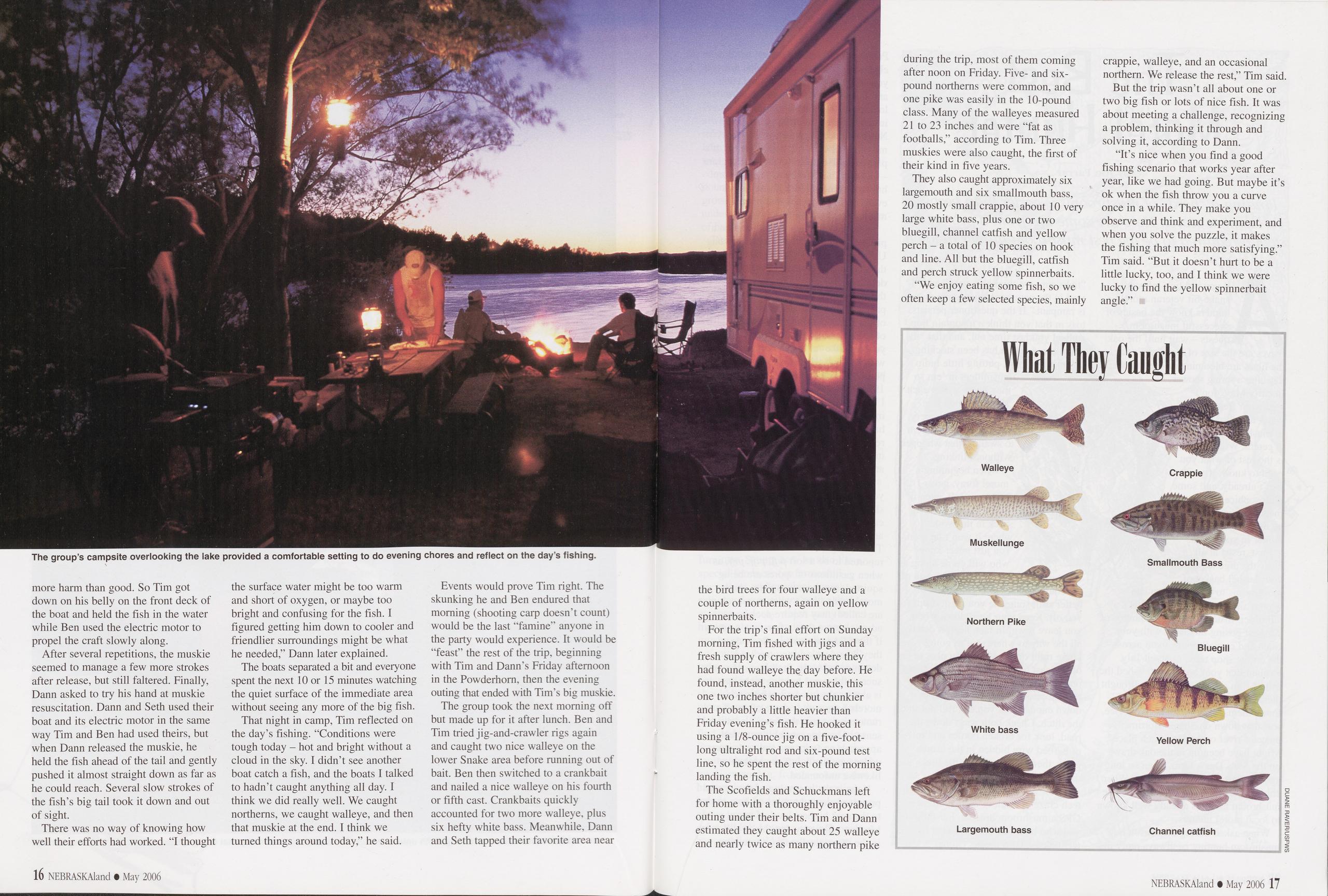
The Scofields and Schuckmans left for home with a thoroughly enjoyable outing under their belts. Tim and Dann estimated they caught about 25 walleye and nearly twice as many northern pike during the trip, most of them coming after noon on Friday. Five- and six- pound northerns were common, and one pike was easily in the 10-pound class. Many of the walleyes measured 21 to 23 inches and were “fat as footballs,” according to Tim. Three muskies were also caught, the first of their kind in five years.
They also caught approximately six largemouth and six smallmouth bass, 20 mostly small crappie, about 10 very large white bass, plus one or two bluegill, channel catfish and yellow perch - a total of 10 species on hook and line. All but the bluegill, catfish and perch struck yellow spinnerbaits.
“We enjoy eating some fish, so we often keep a few selected species, mainly
But the trip wasn’t all about one or two big fish or lots of nice fish. It was about meeting a challenge, recognizing a problem, thinking it through and solving it, according to Dann. “It’s nice when you find a good fishing scenario that works year after year, like we had going. But maybe it’s ok when the fish throw you a curve once in a while. They make you observe and think and experiment, and when you solve the puzzle, it makes the fishing that much more satisfying.” Tim said. “But it doesn’t hurt to be a little lucky, too, and I think we were lucky to find the yellow spinnerbait angle.” 16 NEBRASKAland • May 2006 NEBRASKAland • May 2006 17
The Best Morel Hunter
Finding a “herd” of mushrooms is easier than keeping its location secret. Here are some tips from a pro on the stealth required to be the best mushroom hunter in town.
All you old tick-infested, snake-bit veteran morel hunters know the basics of successful mushroom quests - wait until the oak leaves are the size of a squirrel’s ear or the lilacs are blooming on the first wann day after a spring shower in early May, don’t soak your treasures in water and turn them to mush, et cetera, et cetera. What follows is the rest of what you need to know, if you don’t already, and some philosophical meanderings on how to be the best morel hunter in your town.
First, resist at all costs the urge to show your bushel basket of mushrooms to everyone you can waylay on the street. I know that’s a tall order. Instead, take a few photos of yourself posing modestly with your catch and casually push them across the coffee shop table in about July. Explain that your wife just finished the roll of film or you would have brought them in sooner. If asked where you found them, say something like: “Gee, was that down on Shank Mortimer’s piece of river or the Utterbach place? Might have been up in the oak draws on the Slats Davis farm. Been so long ago I’m just not sure any more.” When choosing places to mention, only name mushroom grounds already well known to local morel hunters.
When asked during the season how mushroom hunting is, always reply the “ticks sure are thick this year,” and “I read in the newspaper that Lyme disease is rampant.” If the questioner persists, toss in that you think a mountain lion stalked you last time out, and that “the game commission has been stocking ‘em, you know, putting little radio transmitters in ‘em so they know where each and every one is at every minute of every day.” Some folks seem to swallow that whopper without blinking.
When beginning a morel foray, never drive yourself, even if you can pull your rig back in the woods where it won’t be seen. You just never know who will come along as you’re opening the gate off the county road. Have your wife, or better still, someone you trust, drop you off. Keep your head down when you leave town. In fact, keep it down all the way to where you’re going. Drive right on by where you plan to get off at least twice to be sure there is no one coming from either direction. On the last pass have your driver slow down enough that you can roll out into the ditch. Check both ways down the road, look for broken bottles and rolls of barbed wire hidden in the brome grass, then slither off into the brush as quickly as possible.
If you’ve been swept up by the high- tech craze in outdoor recreation, never GPS a mushroom hotspot. For those of you who have not been seduced by technology, GPS means Global Positioning System, the little hand-held electronic compass gizmos that tell you you’re about to step off a steep bank and fall in the river because you’re looking at the dinky little screen instead of where you’re going. The National Security Agency (NSA) monitors all GPS markers - honest, it’s part of the Homeland Security Program - and within NSA are a slew of morel hunters, some Middle Eastern spies even, looking for new and better mushroom grounds.
Instead, sketch out a little map on a piece of paper torn from a grocery bag. Use pencil. It won’t bleed like ink if the map gets wet. Don’t be too detailed, just enough to get you back to the same place the next spring, like “24 paces more-or-less north-by-northwest of the fallen cottonwood” and use obscure locations known only to yourself, like “at the end of the diamond willow patch where I shot the five- point buck on opening morning in 1974.” Stash the map somewhere safe. I keep mine under the Dr. Scholl’s arch insert in the pair of hiking boots I haven’t worn for 20 years. If you can’t resist using your new-fangled GPS unit, label the site something that will attract little attention, like “Dead Cow.”
Morel mushroom decoys, the sort you sometimes see sold at sports shows, don’t work. Neither do morel calls. Morels are rather old-fashioned and discreet in their asexual adventures. The mating call of the wild morel is reported to be a soft piff, piff, piff, as when gazillions of spores are being squirted into the atmosphere. And morel herds (that’s what morel colonies are called) may require decades to advance more than a few feet, so even if they did respond to calls or decoys they’d be decoying to your long- decomposed body. Stalking is the only successful morel hunting technique and is almost always successful since morels have a poor sense of smell and rumors regarding the fungi’s advanced sense of hearing and ability to feel approaching footsteps and seek cover under woodland duff are probably likewise unfounded.
Now, at the beginning of this screed I promised some thoughts on how to rise to the next highest level of morel location efficiency, but this is still more in the theoretical realm, something spawned during a toddy-after-the-hunt moment. Woe is me to write what follows, but I think us American fungi hunters are centuries behind the French. In France the big fungi has always been the truffle - a warty, irregularly shaped morsel that grows as large as a clenched fist. They are the most expensive wild food in the world, commanding as much as $500 per pound. The fruiting body of the truffle grows from a few inches to a few feet underground, so they are elusive tidbits of haute cuisine.
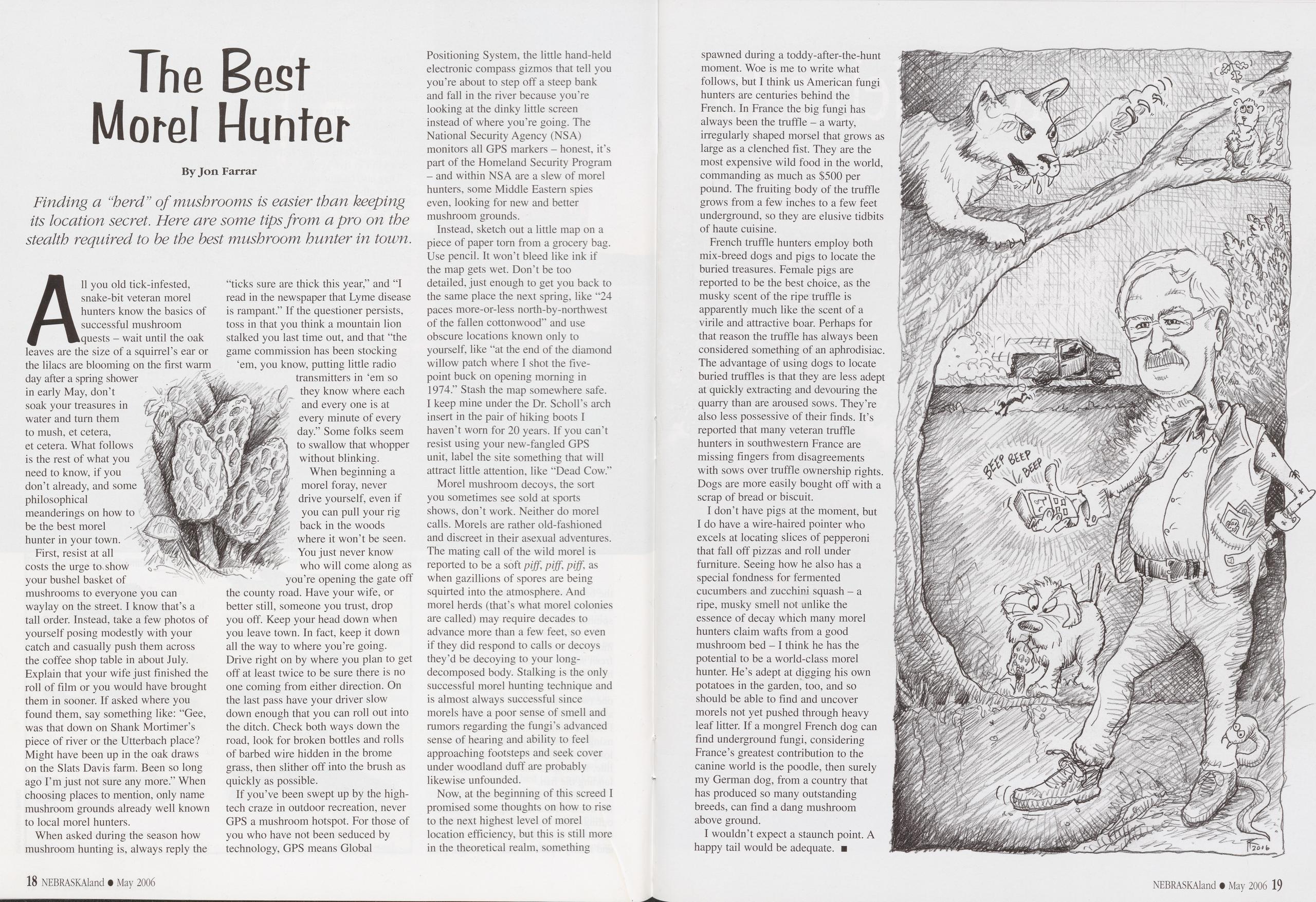
French truffle hunters employ both mix-breed dogs and pigs to locate the buried treasures. Female pigs are reported to be the best choice, as the musky scent of the ripe truffle is apparently much like the scent of a virile and attractive boar. Perhaps for that reason the truffle has always been considered something of an aphrodisiac. The advantage of using dogs to locate buried truffles is that they are less adept at quickly extracting and devouring the quarry than are aroused sows. They’re also less possessive of their finds. It’s reported that many veteran truffle hunters in southwestern France are missing fingers from disagreements with sows over truffle ownership rights. Dogs are more easily bought off with a scrap of bread or biscuit.
I don’t have pigs at the moment, but I do have a wire-haired pointer who excels at locating slices of pepperoni that fall off pizzas and roll under furniture. Seeing how he also has a special fondness for fermented cucumbers and zucchini squash - a ripe, musky smell not unlike the essence of decay which many morel hunters claim wafts from a good mushroom bed - I think he has the potential to be a world-class morel hunter. He’s adept at digging his own potatoes in the garden, too, and so should be able to find and uncover morels not yet pushed through heavy leaf litter. If a mongrel French dog can find underground fungi, considering France’s greatest contribution to the canine world is the poodle, then surely my German dog, from a country that has produced so many outstanding breeds, can find a dang mushroom above ground.
I wouldn’t expect a staunch point. A happy tail would be adequate.
18 NEBRASKAland • May 2006 NEBRASKAland • May 2006 19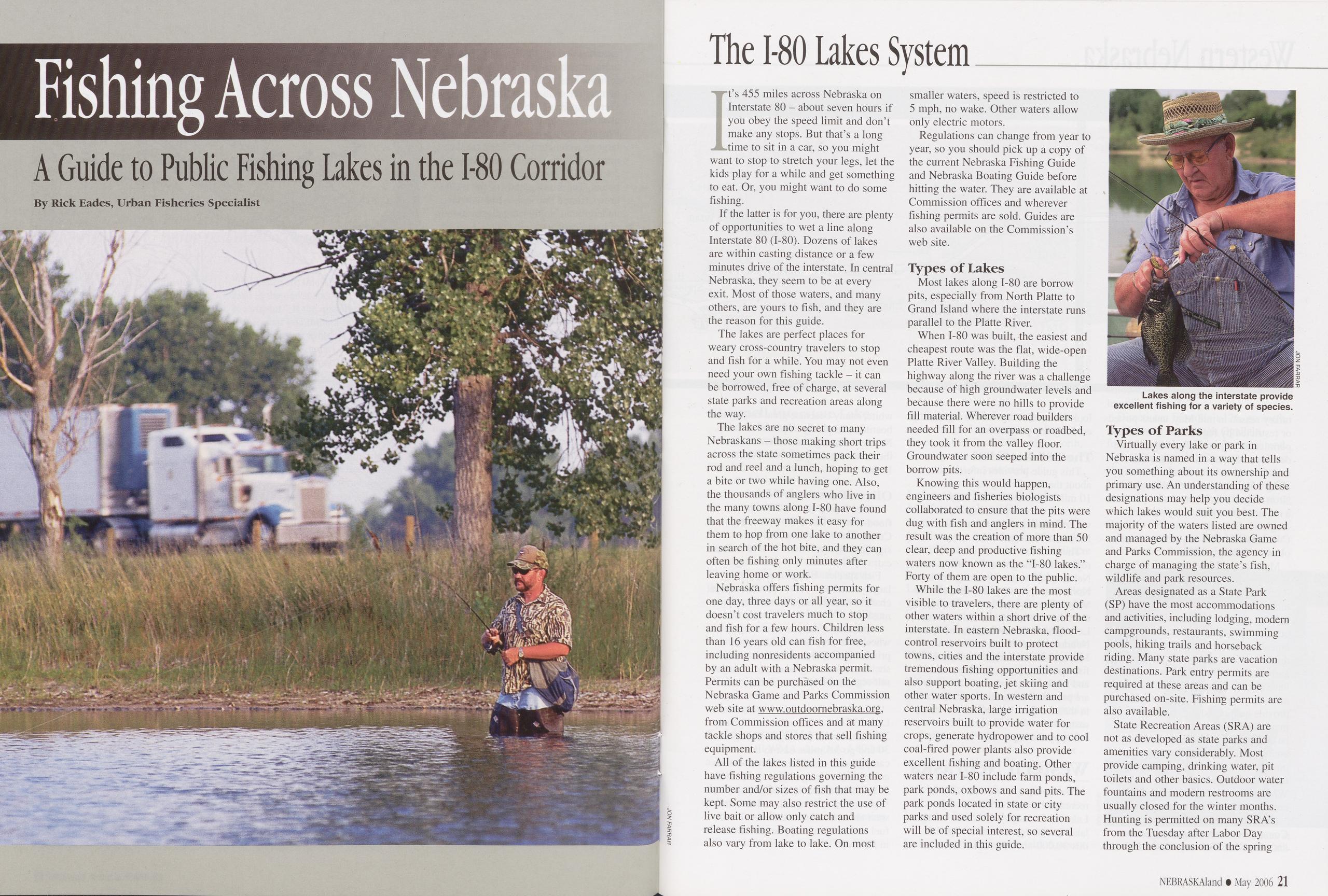
Fishing Across Nebraska
A Guide to Public Fishing Lakes in the 1-80 Corridor
The I-80 Lakes System
It’s 455 miles across Nebraska on Interstate 80 - about seven hours if you obey the speed limit and don’t make any stops. But that’s a long time to sit in a car, so you might want to stop to stretch your legs, let the kids play for a while and get something to eat. Or, you might want to do some fishing.
If the latter is for you, there are plenty of opportunities to wet a line along Interstate 80 (1-80). Dozens of lakes are within casting distance or a few minutes drive of the interstate. In central Nebraska, they seem to be at every exit. Most of those waters, and many others, are yours to fish, and they are the reason for this guide.
The lakes are perfect places for weary cross-country travelers to stop and fish for a while. You may not even need your own fishing tackle - it can be borrowed, free of charge, at several state parks and recreation areas along the way.
The lakes are no secret to many Nebraskans - those making short trips across the state sometimes pack their rod and reel and a lunch, hoping to get a bite or two while having one. Also, the thousands of anglers who live in the many towns along 1-80 have found that the freeway makes it easy for them to hop from one lake to another in search of the hot bite, and they can often be fishing only minutes after leaving home or work.
Nebraska offers fishing permits for one day, three days or all year, so it doesn’t cost travelers much to stop and fish for a few hours. Children less than 16 years old can fish for free, including nonresidents accompanied by an adult with a Nebraska permit. Permits can be purchased on the Nebraska Game and Parks Commission web site at www.outdoornebraska.org, from Commission offices and at many tackle shops and stores that sell fishing equipment.
All of the lakes listed in this guide have fishing regulations governing the number and/or sizes of fish that may be kept. Some may also restrict the use of live bait or allow only catch and release fishing. Boating regulations also vary from lake to lake. On most smaller waters, speed is restricted to 5 mph, no wake. Other waters allow only electric motors.
Regulations can change from year to year, so you should pick up a copy of the current Nebraska Fishing Guide and Nebraska Boating Guide before hitting the water. They are available at Commission offices and wherever fishing permits are sold. Guides are also available on the Commission’s web site.
Types of LakesMost lakes along 1-80 are borrow pits, especially from North Platte to Grand Island where the interstate runs parallel to the Platte River.
When 1-80 was built, the easiest and cheapest route was the flat, wide-open Platte River Valley. Building the highway along the river was a challenge because of high groundwater levels and because there were no hills to provide fill material. Wherever road builders needed fill for an overpass or roadbed, they took it from the valley floor. Groundwater soon seeped into the borrow pits.
Knowing this would happen, engineers and fisheries biologists collaborated to ensure that the pits were dug with fish and anglers in mind. The result was the creation of more than 50 clear, deep and productive fishing waters now known as the "1-80 lakes.” Forty of them are open to the public.
While the 1-80 lakes are the most visible to travelers, there are plenty of other waters within a short drive of the interstate. In eastern Nebraska, flood- control reservoirs built to protect towns, cities and the interstate provide tremendous fishing opportunities and also support boating, jet skiing and other water sports. In western and central Nebraska, large irrigation reservoirs built to provide water for crops, generate hydropower and to cool coal-fired power plants also provide excellent fishing and boating. Other waters near 1-80 include farm ponds, park ponds, oxbows and sand pits. The park ponds located in state or city parks and used solely for recreation will be of special interest, so several are included in this guide.
Virtually every lake or park in Nebraska is named in a way that tells you something about its ownership and primary use. An understanding of these designations may help you decide which lakes would suit you best. The majority of the waters listed are owned and managed by the Nebraska Game and Parks Commission, the agency in charge of managing the state’s fish, wildlife and park resources.
Areas designated as a State Park (SP) have the most accommodations and activities, including lodging, modem campgrounds, restaurants, swimming pools, hiking trails and horseback riding. Many state parks are vacation destinations. Park entry permits are required at these areas and can be purchased on-site. Fishing permits are also available.
State Recreation Areas (SRA) are not as developed as state parks and amenities vary considerably. Most provide camping, drinking water, pit toilets and other basics. Outdoor water fountains and modern restrooms are usually closed for the winter months. Hunting is permitted on many SRA’s from the Tuesday after Labor Day through the conclusion of the spring NEBRASKAland • May 2006 21 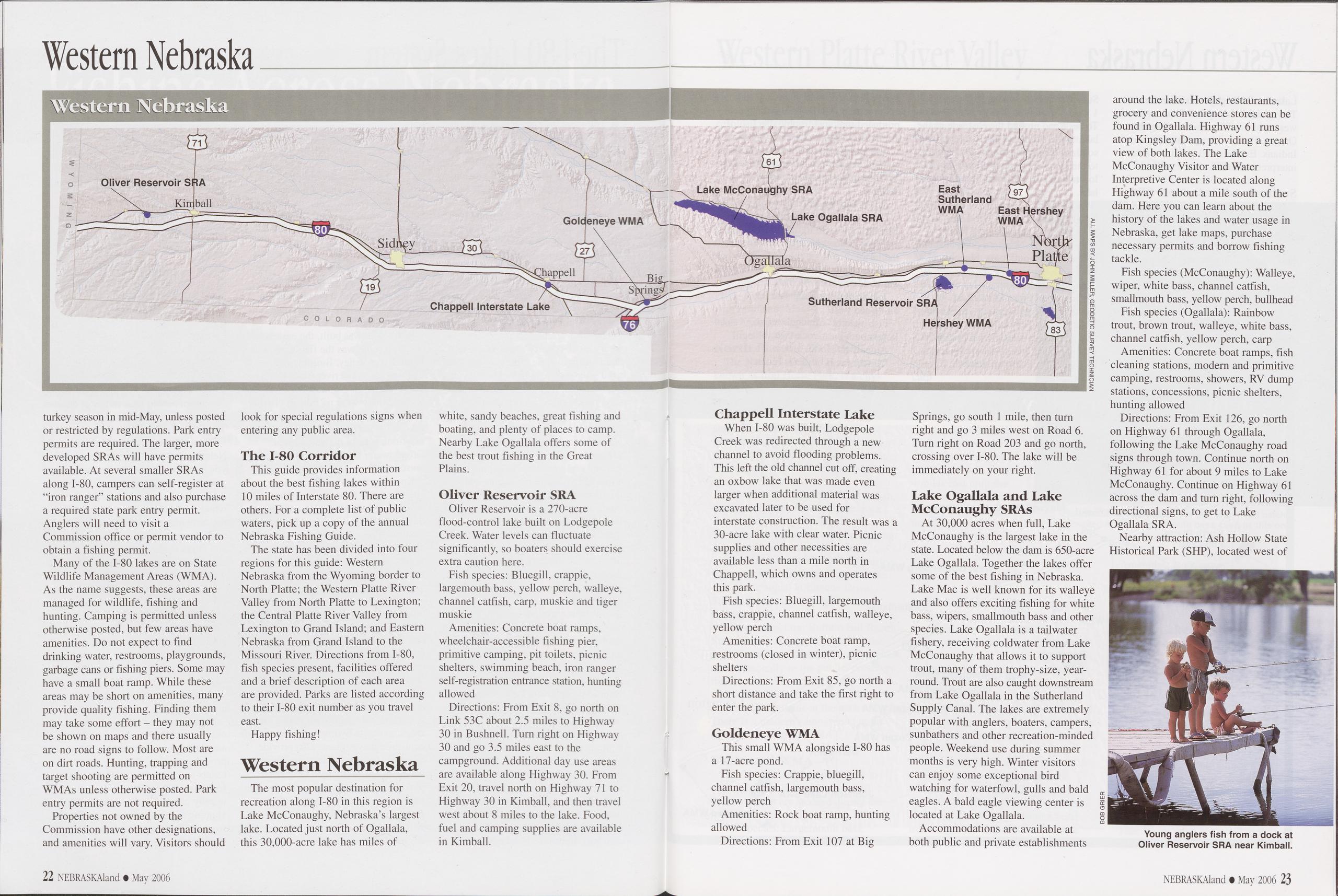
Many of the 1-80 lakes are on State Wildlife Management Areas (WMA). As the name suggests, these areas are managed for wildlife, fishing and hunting. Camping is permitted unless otherwise posted, but few areas have amenities. Do not expect to find drinking water, restrooms, playgrounds, garbage cans or fishing piers. Some may have a small boat ramp. While these areas may be short on amenities, many provide quality fishing. Finding them may take some effort - they may not be shown on maps and there usually are no road signs to follow. Most are on dirt roads. Hunting, trapping and target shooting are permitted on WMAs unless otherwise posted. Park entry permits are not required.
Properties not owned by the Commission have other designations, and amenities will vary. Visitors should look for special regulations signs when entering any public area.
The 1-80 CorridorThis guide provides information about the best fishing lakes within 10 miles of Interstate 80. There are others. For a complete list of public waters, pick up a copy of the annual Nebraska Fishing Guide.
The state has been divided into four regions for this guide: Western Nebraska from the Wyoming border to North Platte; the Western Platte River Valley from North Platte to Lexington; the Central Platte River Valley from Lexington to Grand Island; and Eastern Nebraska from Grand Island to the Missouri River. Directions from 1-80, fish species present, facilities offered and a brief description of each area are provided. Parks are listed according to their 1-80 exit number as you travel east.
Happy fishing!
Western NebraskaThe most popular destination for recreation along 1-80 in this region is Lake McConaughy, Nebraska’s largest lake. Located just north of Ogallala, this 30,000-acre lake has miles of white, sandy beaches, great fishing and boating, and plenty of places to camp. Nearby Lake Ogallala offers some of the best trout fishing in the Great Plains.
Oliver Reservoir SRAOliver Reservoir is a 270-acre flood-control lake built on Lodgepole Creek. Water levels can fluctuate significantly, so boaters should exercise extra caution here.
Fish species: Bluegill, crappie, largemouth bass, yellow perch, walleye, channel catfish, carp, muskie and tiger muskie Amenities: Concrete boat ramps, wheelchair-accessible fishing pier, primitive camping, pit toilets, picnic shelters, swimming beach, iron ranger self-registration entrance station, hunting allowed Directions: From Exit 8, go north on Link 53C about 2.5 miles to Highway 30 in Bushnell. Turn right on Highway 30 and go 3.5 miles east to the campground. Additional day use areas are available along Highway 30. From Exit 20, travel north on Highway 71 to Highway 30 in Kimball, and then travel west about 8 miles to the lake. Food, fuel and camping supplies are available in Kimball. Chappell Interstate LakeWhen 1-80 was built, Lodgepole Creek was redirected through a new channel to avoid flooding problems. This left the old channel cut off, creating an oxbow lake that was made even larger when additional material was excavated later to be used for interstate construction. The result was a 30-acre lake with clear water. Picnic supplies and other necessities are available less than a mile north in Chappell, which owns and operates this park.
Fish species: Bluegill, largemouth bass, crappie, channel catfish, walleye, yellow perch Amenities: Concrete boat ramp, restrooms (closed in winter), picnic shelters Directions: From Exit 85, go north a short distance and take the first right to enter the park. Goldeneye WMAThis small WMA alongside 1-80 has a 17-acre pond.
Fish species: Crappie, bluegill, channel catfish, largemouth bass, yellow perch Amenities: Rock boat ramp, hunting allowed Directions: From Exit 107 at Big Springs, go south 1 mile, then turn right and go 3 miles west on Road 6. Turn right on Road 203 and go north, crossing over 1-80. The lake will be immediately on your right. Lake Ogallala and Lake McConaughy SRAsAt 30,000 acres when full, Lake McConaughy is the largest lake in the state. Located below the dam is 650-acre Lake Ogallala. Together the lakes offer some of the best fishing in Nebraska. Lake Mac is well known for its walleye and also offers exciting fishing for white bass, wipers, smallmouth bass and other species. Lake Ogallala is a tailwater fishery, receiving coldwater from Lake McConaughy that allows it to support trout, many of them trophy-size, year- round. Trout are also caught downstream from Lake Ogallala in the Sutherland Supply Canal. The lakes are extremely popular with anglers, boaters, campers, sunbathers and other recreation-minded people. Weekend use during summer months is very high. Winter visitors can enjoy some exceptional bird watching for waterfowl, gulls and bald eagles. A bald eagle viewing center is located at Lake Ogallala.
Accommodations are available at both public and private establishments around the lake. Hotels, restaurants, grocery and convenience stores can be found in Ogallala. Highway 61 runs atop Kingsley Dam, providing a great view of both lakes. The Lake McConaughy Visitor and Water Interpretive Center is located along Highway 61 about a mile south of the dam. Here you can learn about the history of the lakes and water usage in Nebraska, get lake maps, purchase necessary permits and borrow fishing tackle.
Fish species (McConaughy): Walleye, wiper, white bass, channel catfish, smallmouth bass, yellow perch, bullhead Fish species (Ogallala): Rainbow trout, brown trout, walleye, white bass, channel catfish, yellow perch, carp Amenities: Concrete boat ramps, fish cleaning stations, modern and primitive camping, restrooms, showers, RV dump stations, concessions, picnic shelters, hunting allowed Directions: From Exit 126, go north on Highway 61 through Ogallala, following the Lake McConaughy road signs through town. Continue north on Highway 61 for about 9 miles to Lake McConaughy. Continue on Highway 61 across the dam and turn right, following directional signs, to get to Lake Ogallala SRA. Nearby attraction: Ash Hollow State Historical Park (SHP), located west of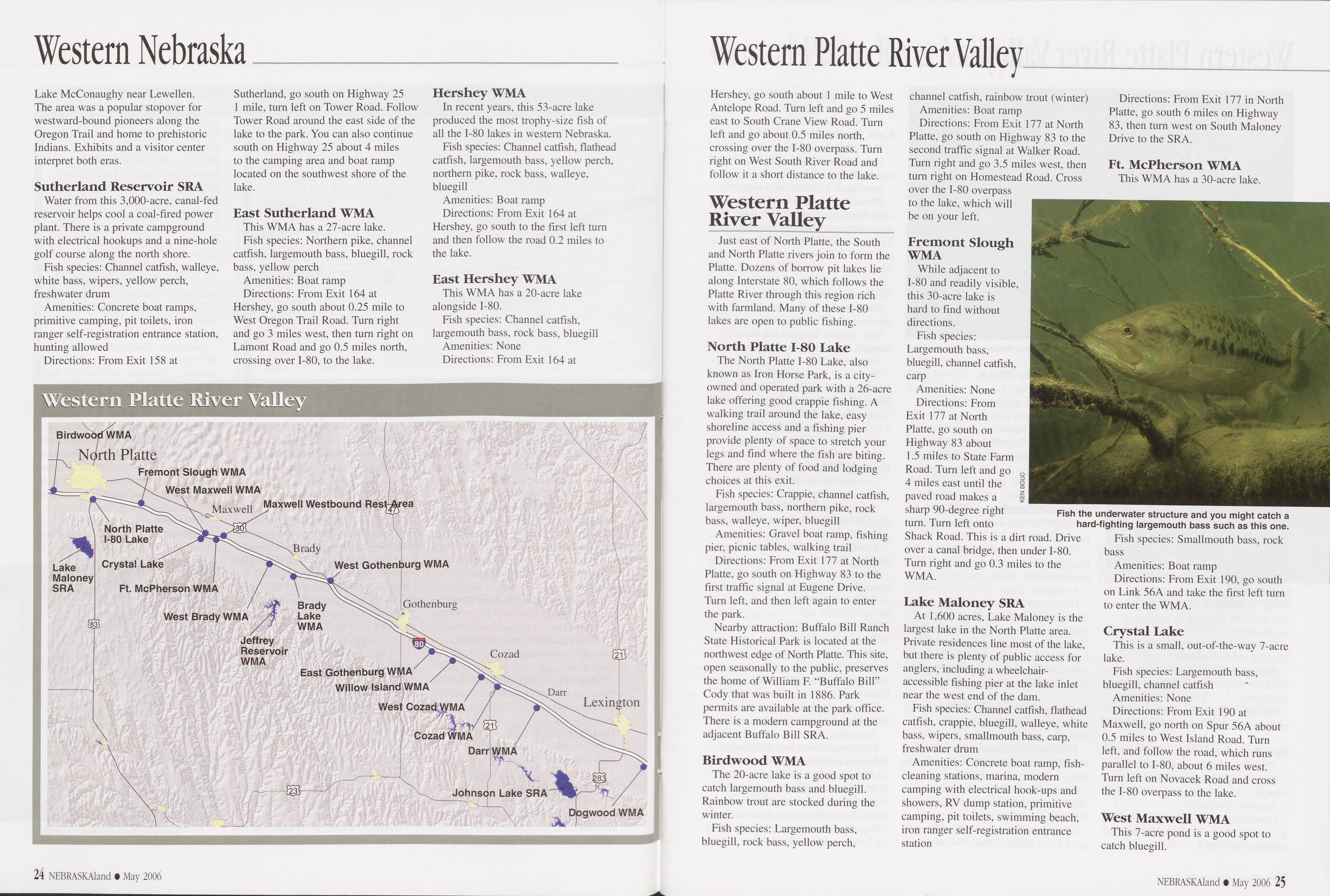 Lake McConaughy near Lewellen. The area was a popular stopover for westward-bound pioneers along the Oregon Trail and home to prehistoric Indians. Exhibits and a visitor center interpret both eras. Sutherland Reservoir SRA
Water from this 3,000-acre, canal-fed reservoir helps cool a coal-fired power plant. There is a private campground with electrical hookups and a nine-hole golf course along the north shore.
Fish species: Channel catfish, walleye, white bass, wipers, yellow perch, freshwater drum Amenities: Concrete boat ramps, primitive camping, pit toilets, iron ranger self-registration entrance station, hunting allowed Directions: From Exit 158 atThis WMA has a 27-acre lake.
Fish species: Northern pike, channel catfish, largemouth bass, bluegill, rock bass, yellow perch Amenities: Boat ramp Directions: From Exit 164 at Hershey, go south about 0.25 mile to West Oregon Trail Road. Turn right and go 3 miles west, then turn right on Lamont Road and go 0.5 miles north, crossing over 1-80, to the lake. Hershey WMAIn recent years, this 53-acre lake produced the most trophy-size fish of all the 1-80 lakes in western Nebraska.
Fish species: Channel catfish, flathead catfish, largemouth bass, yellow perch, northern pike, rock bass, walleye, bluegill Amenities: Boat ramp Directions: From Exit 164 at Hershey, go south to the first left turn and then follow the road 0.2 miles to the lake. East Hershey WMAThis WMA has a 20-acre lake alongside 1-80.
Fish species: Channel catfish, largemouth bass, rock bass, bluegill Amenities: None Directions: From Exit 164 at Hershey, go south about 1 mile to West Antelope Road. Turn left and go 5 miles east to South Crane View Road. Turn left and go about 0.5 miles north, crossing over the 1-80 overpass. Turn right on West South River Road and follow it a short distance to the lake. Western Platte River ValleyJust east of North Platte, the South and North Platte rivers join to form the Platte. Dozens of borrow pit lakes lie along Interstate 80, which follows the Platte River through this region rich with farmland. Many of these 1-80 lakes are open to public fishing.
North Platte 1-80 LakeThe North Platte 1-80 Lake, also known as Iron Horse Park, is a city- owned and operated park with a 26-acre lake offering good crappie fishing. A walking trail around the lake, easy shoreline access and a fishing pier provide plenty of space to stretch your legs and find where the fish are biting. There are plenty of food and lodging choices at this exit.
Fish species: Crappie, channel catfish, largemouth bass, northern pike, rock bass, walleye, wiper, bluegill Amenities: Gravel boat ramp, fishing pier, picnic tables, walking trail Directions: From Exit 177 at North Platte, go south on Highway 83 to the first traffic signal at Eugene Drive. Turn left, and then left again to enter the park. Nearby attraction: Buffalo Bill Ranch State Historical Park is located at the northwest edge of North Platte. This site, open seasonally to the public, preserves the home of William F. “Buffalo Bill” Cody that was built in 1886. Park permits are available at the park office. There is a modern campground at the adjacent Buffalo Bill SRA. Birdwood WMAThe 20-acre lake is a good spot to catch largemouth bass and bluegill. Rainbow trout are stocked during the winter.
Fish species: Largemouth bass, bluegill, rock bass, yellow perch, channel catfish, rainbow trout (winter) Amenities: Boat ramp Directions: From Exit 177 at North Platte, go south on Highway 83 to the second traffic signal at Walker Road. Turn right and go 3.5 miles west, then turn right on Homestead Road. Cross over the 1-80 overpass to the lake, which will be on your left. Fremont Slough WMAWhile adjacent to 1-80 and readily visible, this 30-acre lake is hard to find without directions.
Fish species: Largemouth bass, bluegill, channel catfish, carp Amenities: None Directions: From Exit 177 at North Platte, go south on Highway 83 about 1.5 miles to State Farm Road. Turn left and go o 4 miles east until the paved road makes a sharp 90-degree right turn. Turn left onto Shack Road. This is a dirt road. Drive over a canal bridge, then under 1-80. Turn right and go 0.3 miles to the WMA. Lake Maloney SRAAt 1,600 acres, Lake Maloney is the largest lake in the North Platte area. Private residences line most of the lake, but there is plenty of public access for anglers, including a wheelchair- accessible fishing pier at the lake inlet near the west end of the dam.
Fish species: Channel catfish, flathead catfish, crappie, bluegill, walleye, white bass, wipers, smallmouth bass, carp, freshwater drum Amenities: Concrete boat ramp, fish- cleaning stations, marina, modern camping with electrical hook-ups and showers, RV dump station, primitive camping, pit toilets, swimming beach, iron ranger self-registration entrance station Directions: From Exit 177 in North Platte, go south 6 miles on Highway 83, then turn west on South Maloney Drive to the SRA. Ft. McPherson WMAThis WMA has a 30-acre lake.
This is a small, out-of-the-way 7-acre lake.
Fish species: Largemouth bass, bluegill, channel catfish Amenities: None Directions: From Exit 190 at Maxwell, go north on Spur 56A about 0.5 miles to West Island Road. Turn left, and follow the road, which runs parallel to 1-80, about 6 miles west. Turn left on Novacek Road and cross the 1-80 overpass to the lake. West Maxwell WMAThis 7-acre pond is a good spot to catch bluegill.
24 NEBRASKAland • May 2006 NEBRASKAland • May 2006 25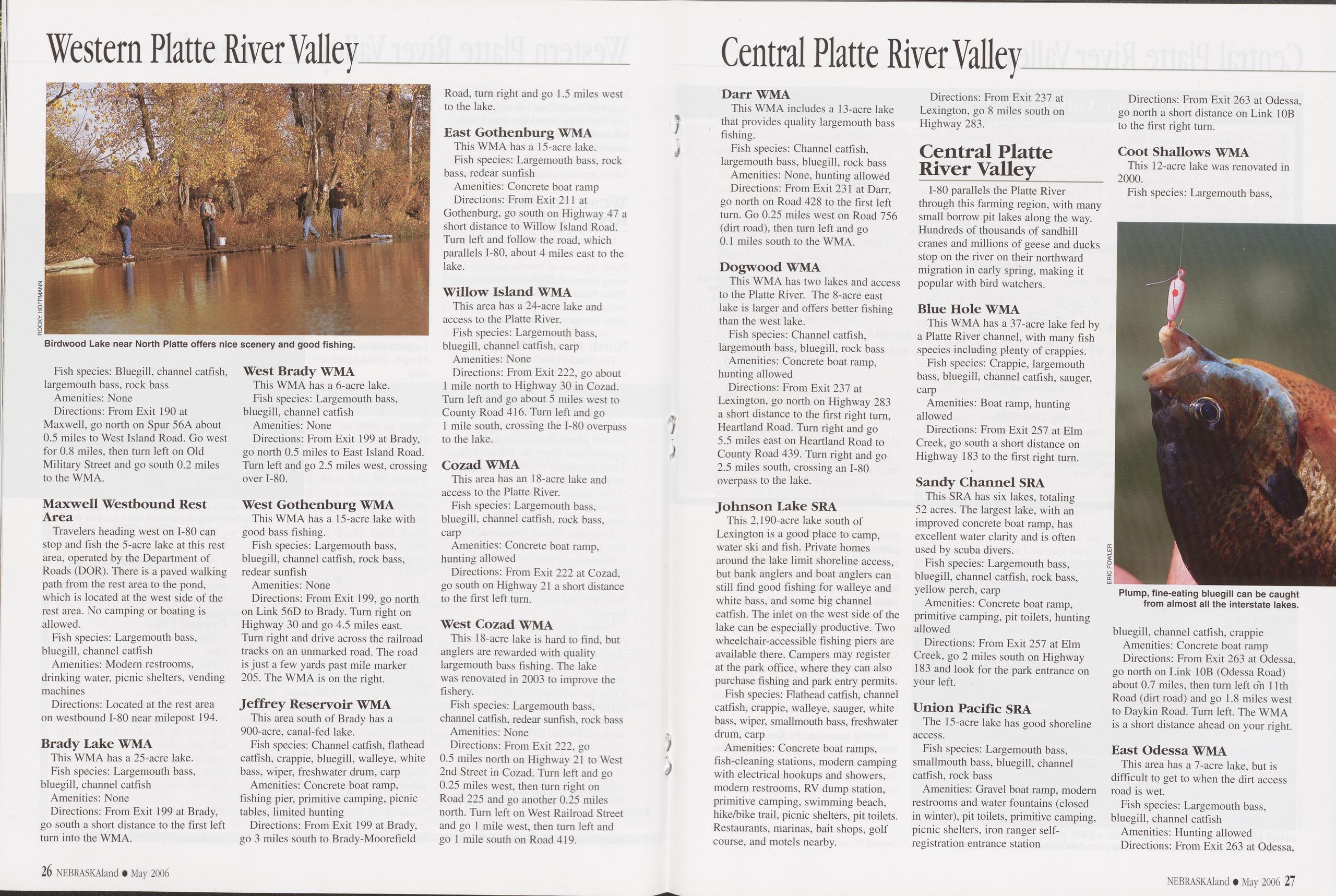
Travelers heading west on 1-80 can stop and fish the 5-acre lake at this rest area, operated by the Department of Roads (DOR). There is a paved walking path from the rest area to the pond, which is located at the west side of the rest area. No camping or boating is allowed.
Fish species: Largemouth bass, bluegill, channel catfish Amenities: Modern restrooms, drinking water, picnic shelters, vending machines Directions: Located at the rest area on westbound 1-80 near milepost 194. Brady Lake WMAThis WMA has a 25-acre lake.
Fish species: Largemouth bass, bluegill, channel catfish Amenities: None Directions: From Exit 199 at Brady, go south a short distance to the first left turn into the WMA. West Brady WMAThis WMA has a 6-acre lake.
Fish species: Largemouth bass, bluegill, channel catfish Amenities: None Directions: From Exit 199 at Brady, go north 0.5 miles to East Island Road. Turn left and go 2.5 miles west, crossing over 1-80. West Gothenburg WMAThis WMA has a 15-acre lake with good bass fishing.
Fish species: Largemouth bass, bluegill, channel catfish, rock bass, redear sunfish Amenities: None Directions: From Exit 199, go north on Link 56D to Brady. Turn right on Highway 30 and go 4.5 miles east. Turn right and drive across the railroad tracks on an unmarked road. The road is just a few yards past mile marker 205. The WMA is on the right. Jeffrey Reservoir WMAThis area south of Brady has a 900-acre, canal-fed lake.
Fish species: Channel catfish, flathead catfish, crappie, bluegill, walleye, white bass, wiper, freshwater drum, carp Amenities: Concrete boat ramp, fishing pier, primitive camping, picnic tables, limited hunting Directions: From Exit 199 at Brady, go 3 miles south to Brady-Moorefield Road, turn right and go 1.5 miles west to the lake. East Gothenburg WMAThis WMA has a 15-acre lake.
Fish species: Largemouth bass, rock bass, redear sunfish Amenities: Concrete boat ramp Directions: From Exit 211 at Gothenburg, go south on Highway 47 a short distance to Willow Island Road. Turn left and follow the road, which parallels 1-80, about 4 miles east to the lake. Willow Island WMAThis area has a 24-acre lake and access to the Platte River.
Fish species: Largemouth bass, bluegill, channel catfish, carp Amenities: None Directions: From Exit 222, go about 1 mile north to Highway 30 in Cozad. Turn left and go about 5 miles west to County Road 416. Turn left and go 1 mile south, crossing the 1-80 overpass to the lake. Cozad WMA This area has an 18-acre lake and access to the Platte River. Fish species: Largemouth bass, bluegill, channel catfish, rock bass, carp Amenities: Concrete boat ramp, hunting allowed Directions: From Exit 222 at Cozad, go south on Highway 21a short distance to the first left turn. West Cozad WMA This 18-acre lake is hard to find, but anglers are rewarded with quality largemouth bass fishing. The lake was renovated in 2003 to improve the fishery. Fish species: Largemouth bass, channel catfish, redear sunfish, rock bass Amenities: None Directions: From Exit 222, go 0.5 miles north on Highway 21 to West 2nd Street in Cozad. Turn left and go 0.25 miles west, then turn right on Road 225 and go another 0.25 miles north. Turn left on West Railroad Street and go 1 mile west, then turn left and go 1 mile south on Road 419. Darr WMA This WMA includes a 13-acre lake that provides quality largemouth bass fishing. Fish species: Channel catfish, largemouth bass, bluegill, rock bass Amenities: None, hunting allowed Directions: From Exit 231 at Darr, go north on Road 428 to the first left turn. Go 0.25 miles west on Road 756 (dirt road), then turn left and go 0.1 miles south to the WMA. Dogwood WMA This WMA has two lakes and access to the Platte River. The 8-acre east lake is larger and offers better fishing than the west lake. Fish species: Channel catfish, largemouth bass, bluegill, rock bass Amenities: Concrete boat ramp, hunting allowed Directions: From Exit 237 at Lexington, go north on Highway 283 a short distance to the first right turn, Heartland Road. Turn right and go 5.5 miles east on Heartland Road to County Road 439. Turn right and go 2.5 miles south, crossing an 1-80 overpass to the lake. Johnson Lake SRA This 2,190-acre lake south of Lexington is a good place to camp, water ski and fish. Private homes around the lake limit shoreline access, but bank anglers and boat anglers can still find good fishing for walleye and white bass, and some big channel catfish. The inlet on the west side of the lake can be especially productive. Two wheelchair-accessible fishing piers are available there. Campers may register at the park office, where they can also purchase fishing and park entry permits. Fish species: Flathead catfish, channel catfish, crappie, walleye, sauger, white bass, wiper, smallmouth bass, freshwater drum, carp Amenities: Concrete boat ramps, fish-cleaning stations, modern camping with electrical hookups and showers, modern restrooms, RV dump station, primitive camping, swimming beach, hike/bike trail, picnic shelters, pit toilets. Restaurants, marinas, bait shops, golf course, and motels nearby. Directions: From Exit 237 at Lexington, go 8 miles south on Highway 283. Central Platte River Valley1-80 parallels the Platte River through this farming region, with many small borrow pit lakes along the way. Hundreds of thousands of sandhill cranes and millions of geese and ducks stop on the river on their northward migration in early spring, making it popular with bird watchers.
Blue Hole WMA This WMA has a 37-acre lake fed by a Platte River channel, with many fish species including plenty of crappies. Fish species: Crappie, largemouth bass, bluegill, channel catfish, sauger, carp Amenities: Boat ramp, hunting allowed Directions: From Exit 257 at Elm Creek, go south a short distance on Highway 183 to the first right turn. Sandy Channel SRA This SRA has six lakes, totaling 52 acres. The largest lake, with an improved concrete boat ramp, has excellent water clarity and is often used by scuba divers. Fish species: Largemouth bass, bluegill, channel catfish, rock bass, yellow perch, carp Amenities: Concrete boat ramp, primitive camping, pit toilets, hunting allowed Directions: From Exit 257 at Elm Creek, go 2 miles south on Highway 183 and look for the park entrance on your left. Union Pacific SRA The 15-acre lake has good shoreline access. Fish species: Largemouth bass, smallmouth bass, bluegill, channel catfish, rock bass Amenities: Gravel boat ramp, modern restrooms and water fountains (closed in winter), pit toilets, primitive camping, picnic shelters, iron ranger self- registration entrance station Directions: From Exit 263 at Odessa, go north a short distance on Link 10B to the first right turn. Coot Shallows WMA This 12-acre lake was renovated in 2000. Fish species: Largemouth bass,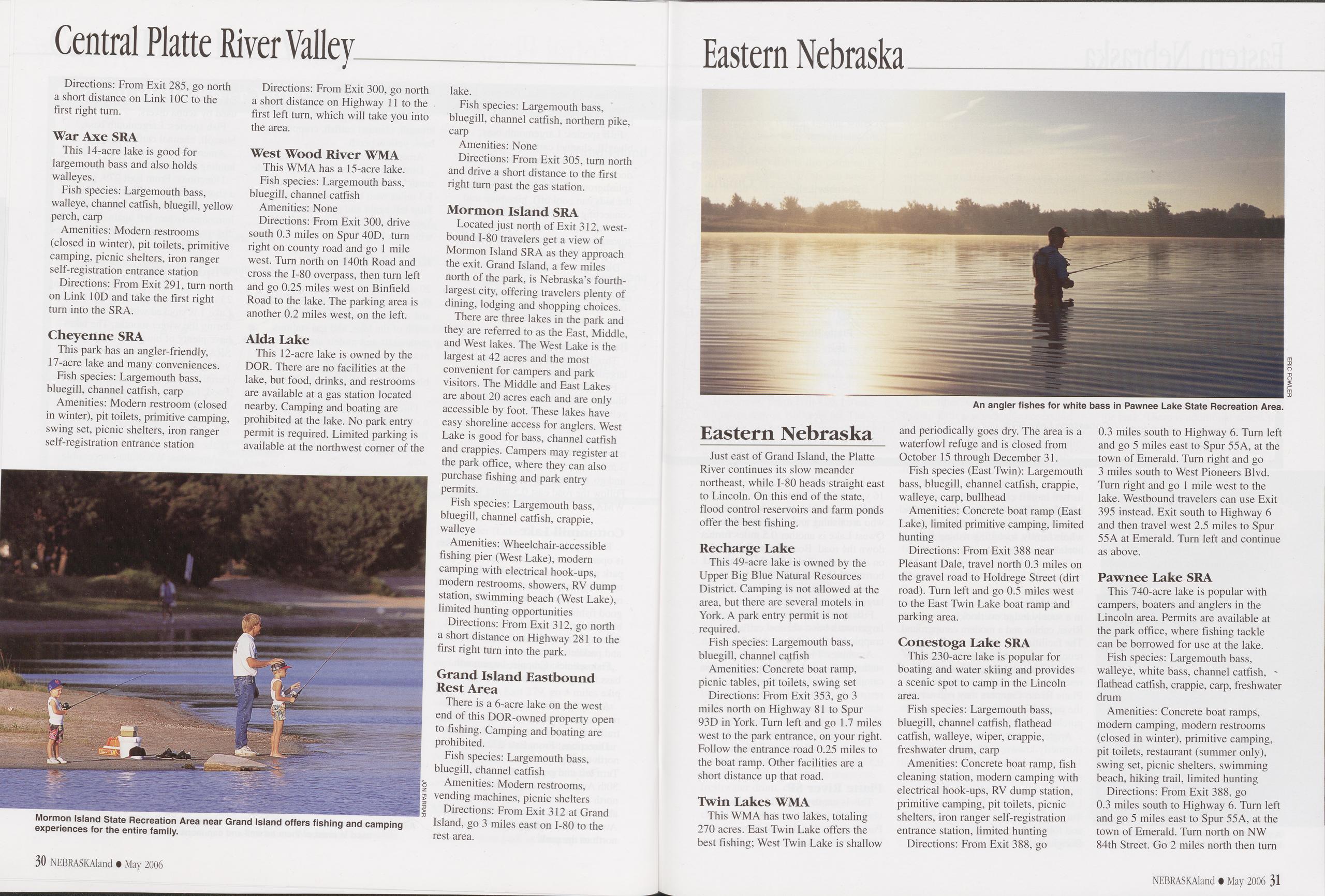 Directions: From Exit 285, go north a short distance on Link IOC to the first right turn. War Axe SRA This 14-acre lake is good for largemouth bass and also holds walleyes. Fish species: Largemouth bass, walleye, channel catfish, bluegill, yellow perch, carp Amenities: Modern restrooms (closed in winter), pit toilets, primitive camping, picnic shelters, iron ranger self-registration entrance station Directions: From Exit 291, turn north on Link 10D and take the first right turn into the SRA. Cheyenne SRA This park has an angler-friendly, 17-acre lake and many conveniences. Fish species: Largemouth bass, bluegill, channel catfish, carp Amenities: Modern restroom (closed in winter), pit toilets, primitive camping, swing set, picnic shelters, iron ranger self-registration entrance station
Located just north of Exit 312, west- bound 1-80 travelers get a view of Mormon Island SRA as they approach the exit. Grand Island, a few miles north of the park, is Nebraska’s fourth- largest city, offering travelers plenty of dining, lodging and shopping choices.
There are three lakes in the park and they are referred to as the East, Middle, and West lakes. The West Lake is the largest at 42 acres and the most convenient for campers and park visitors. The Middle and East Lakes are about 20 acres each and are only accessible by foot. These lakes have easy shoreline access for anglers. West Lake is good for bass, channel catfish and crappies. Campers may register at the park office, where they can also purchase fishing and park entry permits.
Fish species: Largemouth bass, bluegill, channel catfish, crappie, walleye Amenities: Wheelchair-accessible fishing pier (West Lake), modern camping with electrical hook-ups, modern restrooms, showers, RV dump station, swimming beach (West Lake), limited hunting opportunities Directions: From Exit 312, go north a short distance on Highway 281 to the first right turn into the park. Grand Island Eastbound Rest Area There is a 6-acre lake on the west end of this DOR-owned property open to fishing. Camping and boating are prohibited. Fish species: Largemouth bass, bluegill, channel catfish Amenities: Modern restrooms, vending machines, picnic shelters Directions: From Exit 312 at Grand Island, go 3 miles east on 1-80 to the rest area.Just east of Grand Island, the Platte River continues its slow meander northeast, while 1-80 heads straight east to Lincoln. On this end of the state, flood control reservoirs and farm ponds offer the best fishing.
Recharge Lake This 49-acre lake is owned by the Upper Big Blue Natural Resources District. Camping is not allowed at the area, but there are several motels in York. A park entry permit is not required. Fish species: Largemouth bass, bluegill, channel catfish Amenities: Concrete boat ramp, picnic tables, pit toilets, swing set Directions: From Exit 353, go 3 miles north on Highway 81 to Spur 93D in York. Turn left and go 1.7 miles west to the park entrance, on your right. Follow the entrance road 0.25 miles to the boat ramp. Other facilities are a short distance up that road. Twin Lakes WMA This WMA has two lakes, totaling 270 acres. East Twin Lake offers the best fishing; West Twin Lake is shallow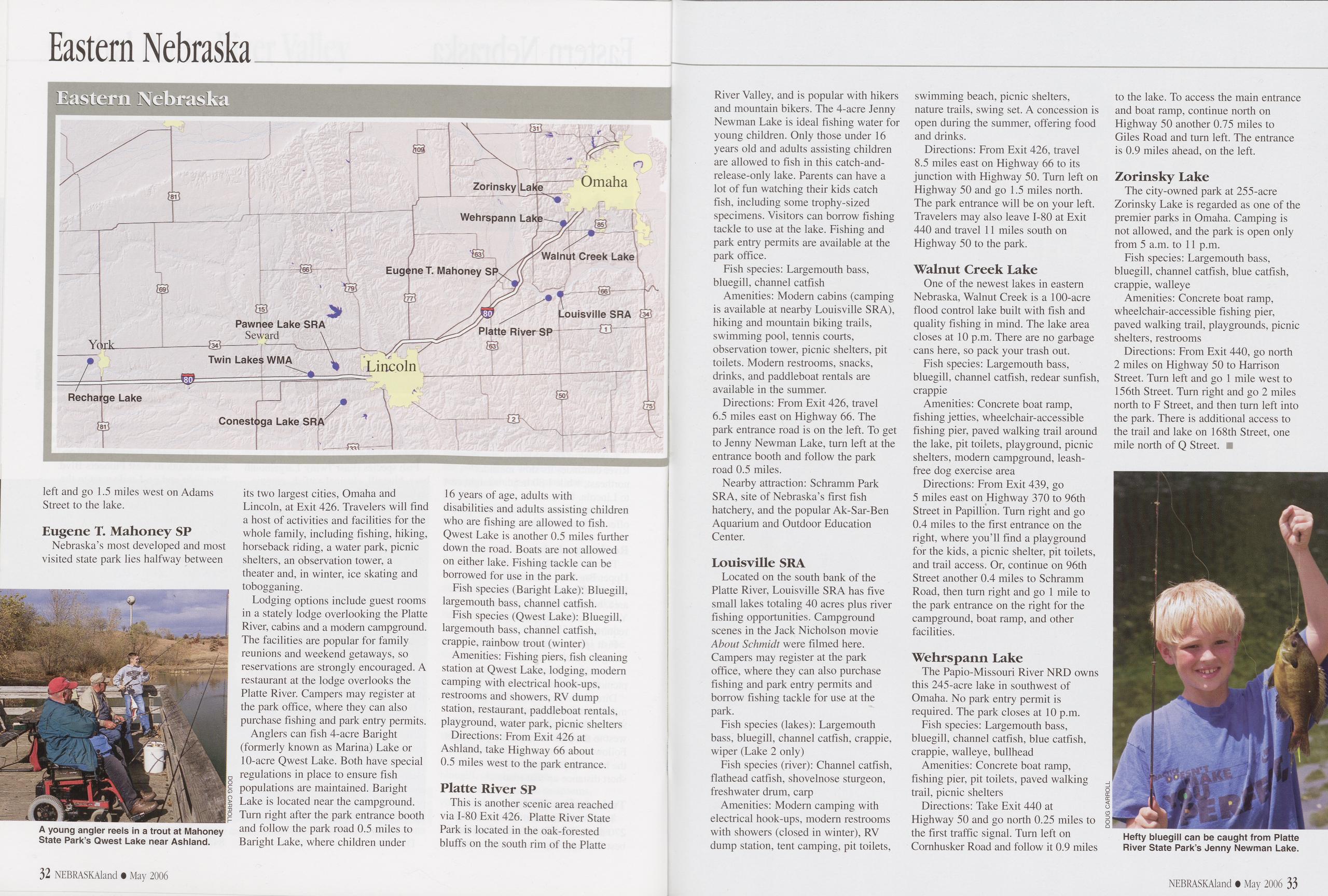
Nebraska’s most developed and most visited state park lies halfway between
Lodging options include guest rooms in a stately lodge overlooking the Platte River, cabins and a modem campground. The facilities are popular for family reunions and weekend getaways, so reservations are strongly encouraged. A restaurant at the lodge overlooks the Platte River. Campers may register at the park office, where they can also purchase fishing and park entry permits.
Anglers can fish 4-acre Baright (formerly known as Marina) Lake or 10-acre Qwest Lake. Both have special regulations in place to ensure fish populations are maintained. Baright Lake is located near the campground. Turn right after the park entrance booth and follow the park road 0.5 miles to Baright Lake, where children under 16 years of age, adults with disabilities and adults assisting children who are fishing are allowed to fish. Qwest Lake is another 0.5 miles further down the road. Boats are not allowed on either lake. Fishing tackle can be borrowed for use in the park.
Fish species (Baright Lake): Bluegill, largemouth bass, channel catfish. Fish species (Qwest Lake): Bluegill, largemouth bass, channel catfish, crappie, rainbow trout (winter) Amenities: Fishing piers, fish cleaning station at Qwest Lake, lodging, modem camping with electrical hook-ups, restrooms and showers, RV dump station, restaurant, paddleboat rentals, playground, water park, picnic shelters Directions: From Exit 426 at Ashland, take Highway 66 about 0.5 miles west to the park entrance. Platte River SPThis is another scenic area reached via 1-80 Exit 426. Platte River State Park is located in the oak-forested bluffs on the south rim of the Platte River Valley, and is popular with hikers and mountain bikers. The 4-acre Jenny Newman Lake is ideal fishing water for young children. Only those under 16 years old and adults assisting children are allowed to fish in this catch-and- release-only lake. Parents can have a lot of fun watching their kids catch fish, including some trophy-sized specimens. Visitors can borrow fishing tackle to use at the lake. Fishing and park entry permits are available at the park office.
Fish species: Largemouth bass, bluegill, channel catfish Amenities: Modern cabins (camping is available at nearby Louisville SR A), hiking and mountain biking trails, swimming pool, tennis courts, observation tower, picnic shelters, pit toilets. Modern restrooms, snacks, drinks, and paddleboat rentals are available in the summer. Directions: From Exit 426, travel 6.5 miles east on Highway 66. The park entrance road is on the left. To get to Jenny Newman Lake, turn left at the entrance booth and follow the park road 0.5 miles. Nearby attraction: Schramm Park SRA, site of Nebraska’s first fish hatchery, and the popular Ak-Sar-Ben Aquarium and Outdoor Education Center. Louisville SRALocated on the south bank of the Platte River, Louisville SRA has five small lakes totaling 40 acres plus river fishing opportunities. Campground scenes in the Jack Nicholson movie About Schmidt were filmed here. Campers may register at the park office, where they can also purchase fishing and park entry permits and borrow fishing tackle for use at the park.
Fish species (lakes): Largemouth bass, bluegill, channel catfish, crappie, wiper (Lake 2 only) Fish species (river): Channel catfish, flathead catfish, shovelnose sturgeon, freshwater drum, carp Amenities: Modern camping with electrical hook-ups, modern restrooms with showers (closed in winter), RV dump station, tent camping, pit toilets, swimming beach, picnic shelters, nature trails, swing set. A concession is open during the summer, offering food and drinks. Directions: From Exit 426, travel 8.5 miles east on Highway 66 to its junction with Highway 50. Turn left on Highway 50 and go 1.5 miles north. The park entrance will be on your left. Travelers may also leave 1-80 at Exit 440 and travel 11 miles south on Highway 50 to the park. Walnut Creek LakeOne of the newest lakes in eastern Nebraska, Walnut Creek is a 100-acre flood control lake built with fish and quality fishing in mind. The lake area closes at 10 p.m. There are no garbage cans here, so pack your trash out.
Fish species: Largemouth bass, bluegill, channel catfish, redear sunfish, crappie Amenities: Concrete boat ramp, fishing jetties, wheelchair-accessible fishing pier, paved walking trail around the lake, pit toilets, playground, picnic shelters, modern campground, leash- free dog exercise area Directions: From Exit 439, go 5 miles east on Highway 370 to 96th Street in Papillion. Turn right and go 0.4 miles to the first entrance on the right, where you’ll find a playground for the kids, a picnic shelter, pit toilets, and trail access. Or, continue on 96th Street another 0.4 miles to Schramm Road, then turn right and go 1 mile to the park entrance on the right for the campground, boat ramp, and other facilities. Wehrspann Lake The Papio-Missouri River NRD owns this 245-acre lake in southwest of Omaha. No park entry permit is required. The park closes at 10 p.m. Fish species: Largemouth bass, bluegill, channel catfish, blue catfish, crappie, walleye, bullhead Amenities: Concrete boat ramp, fishing pier, pit toilets, paved walking trail, picnic shelters Directions: Take Exit 440 at Highway 50 and go north 0.25 miles to the first traffic signal. Turn left on Cornhusker Road and follow it 0.9 miles to the lake. To access the main entrance and boat ramp, continue north on Highway 50 another 0.75 miles to Giles Road and turn left. The entrance is 0.9 miles ahead, on the left. Zorinsky Lake The city-owned park at 255-acre Zorinsky Lake is regarded as one of the premier parks in Omaha. Camping is not allowed, and the park is open only from 5 a.m. to 11 p.m. Fish species: Largemouth bass, bluegill, channel catfish, blue catfish, crappie, walleye Amenities: Concrete boat ramp, wheelchair-accessible fishing pier, paved walking trail, playgrounds, picnic shelters, restrooms Directions: From Exit 440, go north 2 miles on Highway 50 to Harrison Street. Turn left and go 1 mile west to 156th Street. Turn right and go 2 miles north to F Street, and then turn left into the park. There is additional access to the trail and lake on 168th Street, one mile north of Q Street.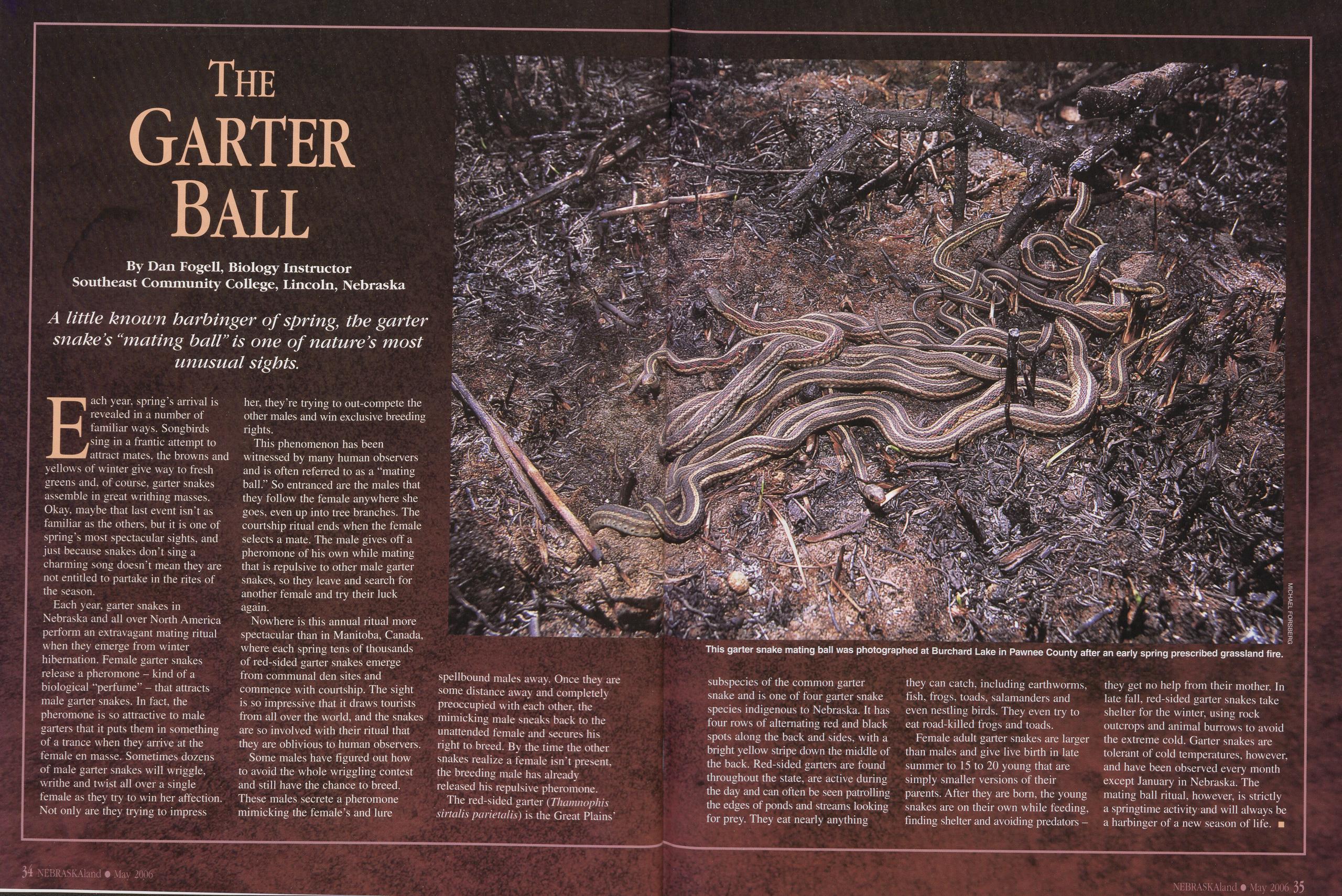
The Garter Ball
A little known harbinger of spring, the garter snake’s "mating ball” is one of nature’s most unusual sights.
Each year, spring’s arrival is revealed in a number of familiar ways. Songbirds sing in a frantic attempt to attract mates, the browns and yellows of winter give way to fresh greens and. of course, garter snakes assemble in great writhing masses. Okay, maybe that last event isn’t as familiar as the others, but it is one of spring’s most spectacular sights, and just because snakes don’t sing a charming song doesn’t mean they are not entitled to partake in the rites of the season.
Each year, garter snakes in Nebraska and all over North America perform an extravagant mating ritual when they emerge from winter hibernation. Female garter snakes release a pheromone - kind of a biological "perfume” - that attracts male garter snakes. In fact, the pheromone is so attractive to male garters that it puts them in something of a trance when they arrive at the female en masse. Sometimes dozens of male garter snakes will wriggle, writhe and twist all over a single female as they try to win her affection. Not only are they trying to impress her, they’re trying to out-compete the other males and win exclusive breeding rights.
This phenomenon has been witnessed by many human observers and is often referred to as a “mating ball.” So entranced are the males that they follow the female anywhere she goes, even up into tree branches. The courtship ritual ends when the female selects a mate. The male gives off a pheromone of his own while mating that is repulsive to other male garter snakes, so they leave and search for another female and try their luck again.
Nowhere is this annual ritual more spectacular than in Manitoba, Canada, where each spring tens of thousands of red-sided garter snakes emerge from communal den sites and commence with courtship. The sight is so impressive that it draws tourists from all over the world, and the snakes are so involved with their ritual that they are oblivious to human observers.
Some males have figured out how to avoid the whole wriggling contest and still have the chance to breed. These males secrete a pheromone mimicking the female’s and lure
The red-sided garter (Thamnophis sirtalis parietalis) is the Great Plains' subspecies of the common garter snake and is one of four garter snake species indigenous to Nebraska. It has four rows of alternating red and black spots along the back and sides, with a bright yellow stripe down the middle of the back. Red-sided garters are found throughout the state, are active during the day and can often be seen patrolling the edges of ponds and streams looking for prey. They eat nearly anything they can catch, including earthworms, fish, frogs, toads, salamanders and even nestling birds. They even try to eat road-killed frogs and toads.
Female adult garter snakes are larger than males and give live birth in late summer to 15 to 20 young that are simply smaller versions of their parents. After they are born, the young snakes are on their own while feeding, finding shelter and avoiding predators - they get no help from their mother. In late fall, red-sided garter snakes take shelter for the winter, using rock outcrops and animal burrows to avoid the extreme cold. Garter snakes are tolerant of cold temperatures, however, and have been observed every month except January in Nebraska. The mating ball ritual, however, is strictly a springtime activity and will always be a harbinger of a new season of life.
34 NEBRASKAland • May 2006 NEBRASKAland • May 2006 35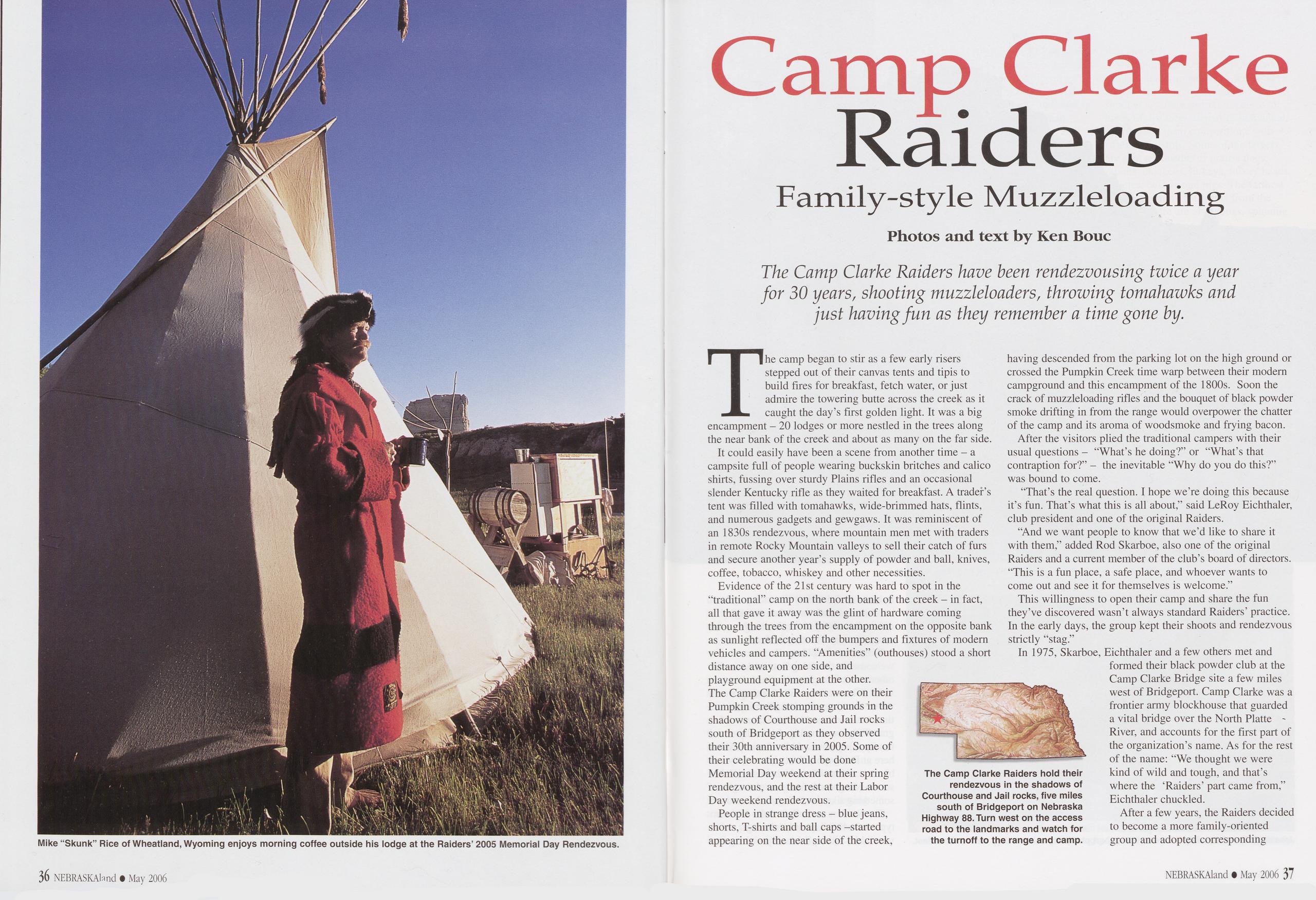
Camp Clarke Raiders Family-style Muzzleloading
The Camp Clarke Raiders have been rendezvousing twice a year for 30 years, shooting muzzleloaders, throwing tomahawks and just having fun as they remember a time gone by.
The camp began to stir as a few early risers stepped out of their canvas tents and tipis to build fires for breakfast, fetch water, or just admire the towering butte across the creek as it caught the day’s first golden light. It was a big encampment - 20 lodges or more nestled in the trees along the near bank of the creek and about as many on the far side.
It could easily have been a scene from another time - a campsite full of people wearing buckskin britches and calico shirts, fussing over sturdy Plains rifles and an occasional slender Kentucky rifle as they waited for breakfast. A trader’s tent was filled with tomahawks, wide-brimmed hats, flints, and numerous gadgets and gewgaws. It was reminiscent of an 1830s rendezvous, where mountain men met with traders in remote Rocky Mountain valleys to sell their catch of furs and secure another year’s supply of powder and ball, knives, coffee, tobacco, whiskey and other necessities.
Evidence of the 21st century was hard to spot in the “traditional” camp on the north bank of the creek - in fact, all that gave it away was the glint of hardware coming through the trees from the encampment on the opposite bank as sunlight reflected off the bumpers and fixtures of modern vehicles and campers. “Amenities” (outhouses) stood a short distance away on one side, and playground equipment at the other. The Camp Clarke Raiders were on their Pumpkin Creek stomping grounds in the shadows of Courthouse and Jail rocks south of Bridgeport as they observed their 30th anniversary in 2005. Some of their celebrating would be done Memorial Day weekend at their spring rendezvous, and the rest at their Labor Day weekend rendezvous.
People in strange dress - blue jeans, shorts, T-shirts and ball caps -started appearing on the near side of the creek,
After the visitors plied the traditional campers with their usual questions - “What’s he doing?” or “What’s that contraption for?” - the inevitable “Why do you do this?” was bound to come.
“That’s the real question. I hope we’re doing this because it’s fun. That’s what this is all about,” said LeRoy Eichthaler, club president and one of the original Raiders.
“And we want people to know that we’d like to share it with them,” added Rod Skarboe, also one of the original Raiders and a current member of the club’s board of directors. “This is a fun place, a safe place, and whoever wants to come out and see it for themselves is welcome.”
This willingness to open their camp and share the fun they’ve discovered wasn’t always standard Raiders’ practice. In the early days, the group kept their shoots and rendezvous strictly “stag.”
In 1975, Skarboe, Eichthaler and a few others met and formed their black powder club at the Camp Clarke Bridge site a few miles west of Bridgeport. Camp Clarke was a frontier army blockhouse that guarded a vital bridge over the North Platte - River, and accounts for the first part of the organization’s name. As for the rest of the name: “We thought we were kind of wild and tough, and that’s where the ‘Raiders’ part came from,” Eichthaler chuckled.
After a few years, the Raiders decided to become a more family-oriented group and adopted corresponding 36 NEBRASKAland • May 2006 NEBRASKAland • May 2006 37 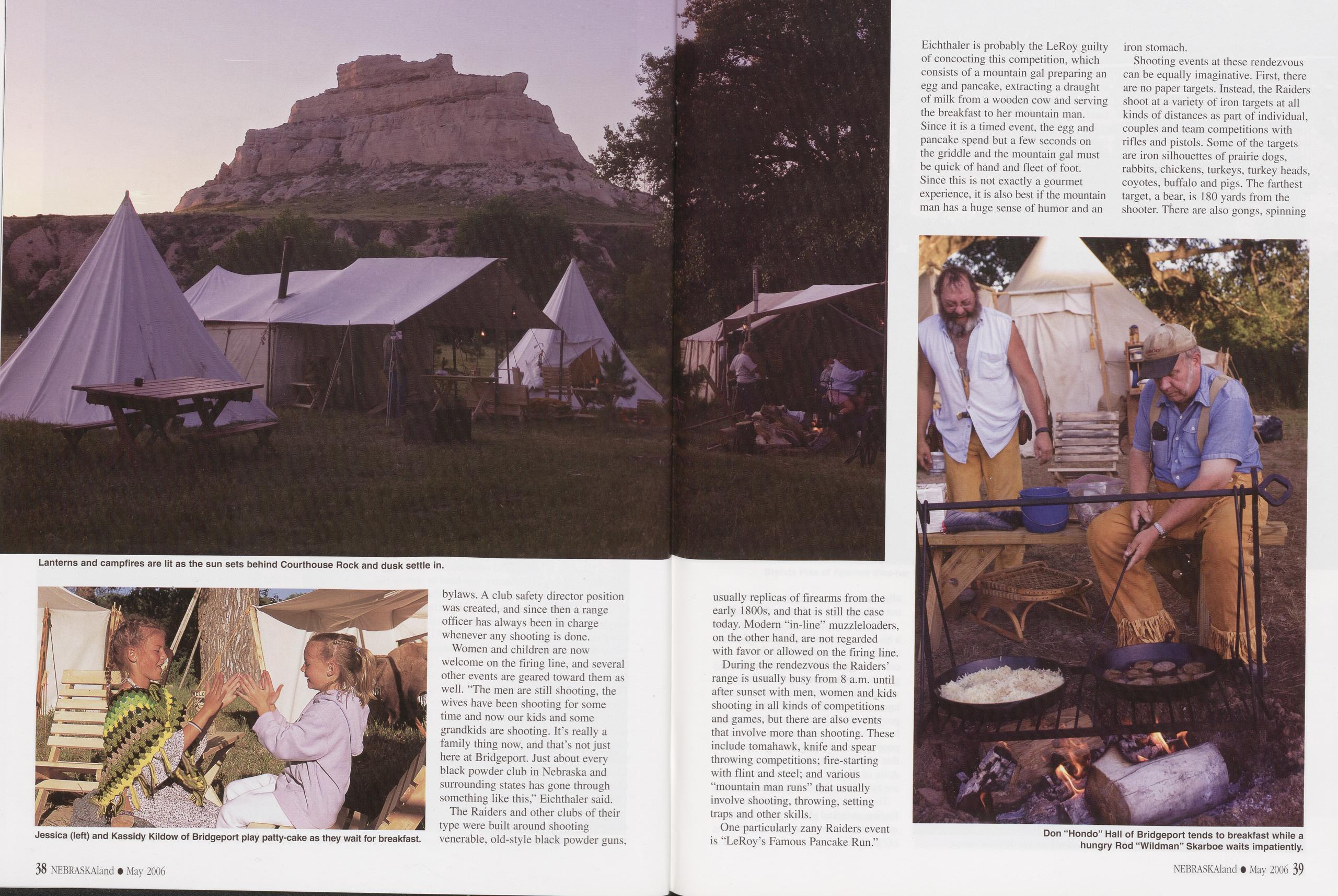
Women and children are now welcome on the firing line, and several other events are geared toward them as well. “The men are still shooting, the wives have been shooting for some time and now our kids and some grandkids are shooting. It’s really a family thing now, and that’s not just here at Bridgeport. Just about every black powder club in Nebraska and surrounding states has gone through something like this,” Eichthaler said.
The Raiders and other clubs of their type were built around shooting venerable, old-style black powder guns, usually replicas of firearms from the early 1800s, and that is still the case today. Modern “in-line” muzzleloaders, on the other hand, are not regarded with favor or allowed on the firing line.
During the rendezvous the Raiders’ range is usually busy from 8 a.m. until after sunset with men, women and kids shooting in all kinds of competitions and games, but there are also events that involve more than shooting. These include tomahawk, knife and spear throwing competitions; fire-starting with flint and steel; and various “mountain man runs” that usually involve shooting, throwing, setting traps and other skills.
One particularly zany Raiders event is “LeRoy’s Famous Pancake Run.” Eichthaler is probably the LeRoy guilty of concocting this competition, which consists of a mountain gal preparing an egg and pancake, extracting a draught of milk from a wooden cow and serving the breakfast to her mountain man. Since it is a timed event, the egg and pancake spend but a few seconds on the griddle and the mountain gal must be quick of hand and fleet of foot. Since this is not exactly a gourmet experience, it is also best if the mountain man has a huge sense of humor and an
Shooting events at these rendezvous can be equally imaginative. First, there are no paper targets. Instead, the Raiders shoot at a variety of iron targets at all kinds of distances as part of individual, couples and team competitions with rifles and pistols. Some of the targets are iron silhouettes of prairie dogs, rabbits, chickens, turkeys, turkey heads, coyotes, buffalo and pigs. The farthest target, a bear, is 180 yards from the shooter. There are also gongs, spinning 38 NEBRASKAland • May 2006 NEBRASKAland • May 2006 39 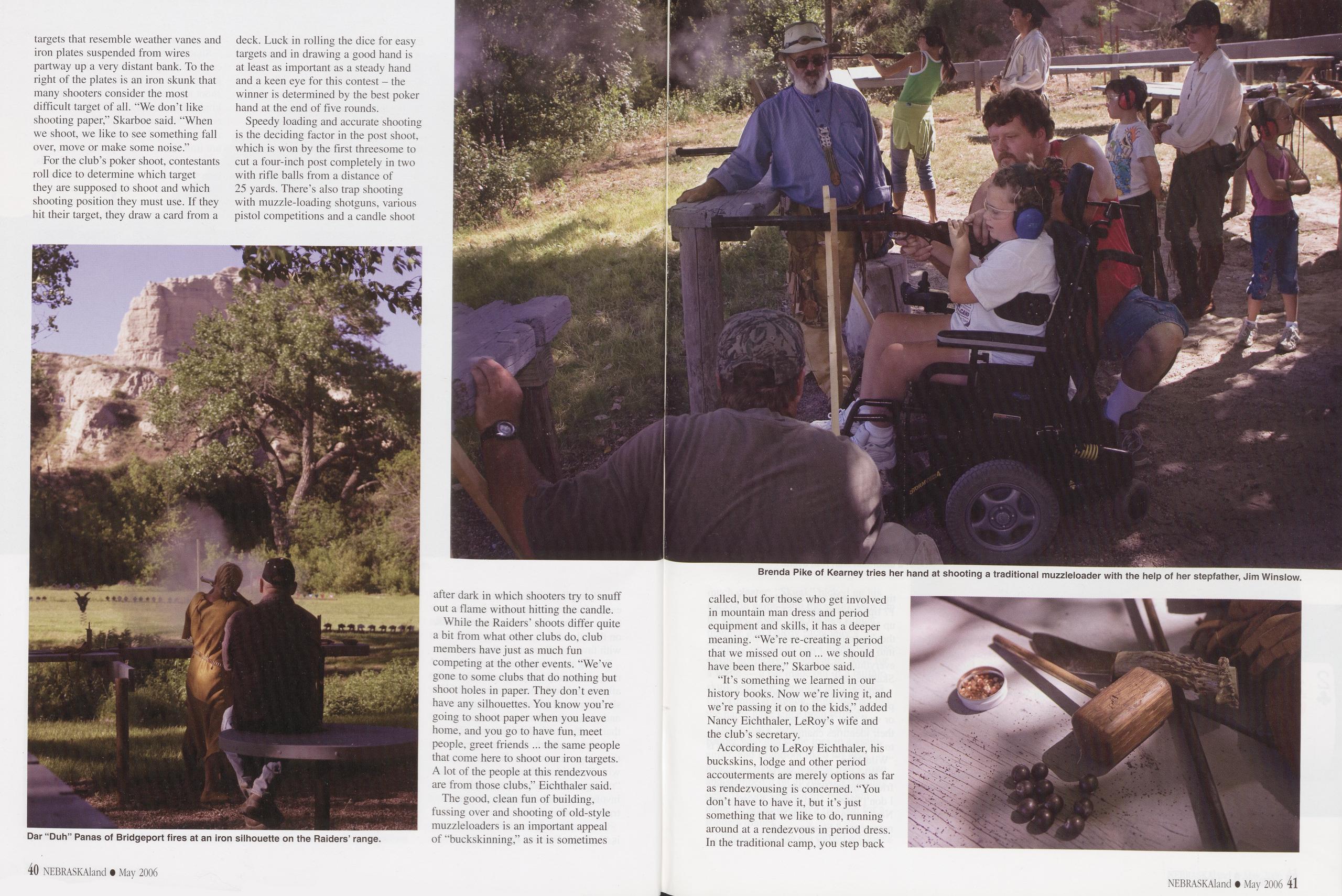 targets that resemble weather vanes and iron plates suspended from wires partway up a very distant bank. To the right of the plates is an iron skunk that many shooters consider the most difficult target of all. “We don’t like shooting paper,” Skarboe said. “When we shoot, we like to see something fall over, move or make some noise.”
For the club’s poker shoot, contestants roll dice to determine which target they are supposed to shoot and which shooting position they must use. If they hit their target, they draw a card from a
Speedy loading and accurate shooting is the deciding factor in the post shoot, which is won by the first threesome to cut a four-inch post completely in two with rifle balls from a distance of 25 yards. There’s also trap shooting with muzzle-loading shotguns, various pistol competitions and a candle shoot after dark in which shooters try to snuff out a flame without hitting the candle.
While the Raiders’ shoots differ quite a bit from what other clubs do, club members have just as much fun competing at the other events. “We’ve gone to some clubs that do nothing but shoot holes in paper. They don’t even have any silhouettes. You know you’re going to shoot paper when you leave home, and you go to have fun, meet people, greet friends ... the same people that come here to shoot our iron targets. A lot of the people at this rendezvous are from those clubs,” Eichthaler said.
The good, clean fun of building, fussing over and shooting of old-style muzzleloaders is an important appeal of “buckskinning,” as it is sometimes
“It’s something we learned in our history books. Now we’re living it, and we’re passing it on to the kids,” added Nancy Eichthaler, LeRoy’s wife and the club’s secretary.
According to LeRoy Eichthaler, his buckskins, lodge and other period accouterments are merely options as far as rendezvousing is concerned. “You don’t have to have it, but it’s just something that we like to do, running around at a rendezvous in period dress. In the traditional camp, you step back 40 NEBRASKA!and • May 2006 NEBRASKAland • May 2006 41 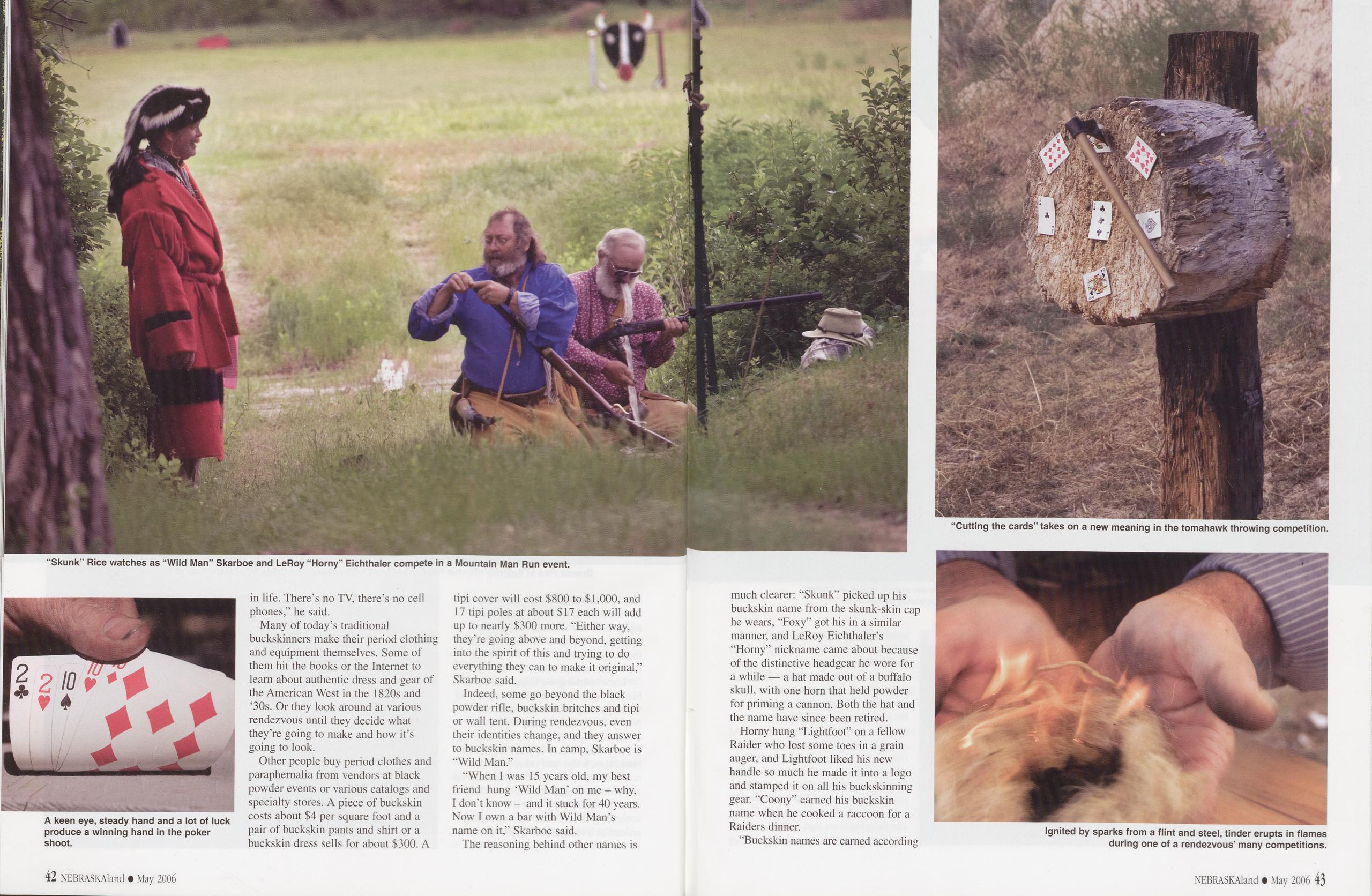
Many of today’s traditional buckskinners make their period clothing and equipment themselves. Some of them hit the books or the Internet to learn about authentic dress and gear of the American West in the 1820s and ‘30s. Or they look around at various rendezvous until they decide what they’re going to make and how it’s going to look.
Other people buy period clothes and paraphernalia from vendors at black powder events or various catalogs and specialty stores. A piece of buckskin costs about $4 per square foot and a pair of buckskin pants and shirt or a buckskin dress sells for about $300. A tipi cover will cost $800 to $1,000, and 17 tipi poles at about $17 each will add up to nearly $300 more. “Either way, they’re going above and beyond, getting into the spirit of this and trying to do everything they can to make it original,” Skarboe said.
Indeed, some go beyond the black powder rifle, buckskin britches and tipi or wall tent. During rendezvous, even their identities change, and they answer to buckskin names. In camp, Skarboe is “Wild Man.”
“When I was 15 years old, my best friend hung ‘Wild Man’ on me - why, I don’t know - and it stuck for 40 years. Now I own a bar with Wild Man’s name on it,” Skarboe said.
The reasoning behind other names is Ignited by sparks from a flint and steel, tinder erupts in flames during one of a rendezvous’ many competitions. much clearer: Skunk picked up his buckskin name from the skunk-skin cap he wears, “Foxy” got his in a similar manner, and LeRoy Eichthaler’s “Horny” nickname came about because of the distinctive headgear he wore for a while — a hat made out of a buffalo skull, with one horn that held powder for priming a cannon. Both the hat and the name have since been retired.
Horny hung “Lightfoot” on a fellow Raider who lost some toes in a grain auger, and Lightfoot liked his new handle so much he made it into a logo and stamped it on all his buckskinning gear. “Coony” earned his buckskin name when he cooked a raccoon for a Raiders dinner.
“Buckskin names are earned according
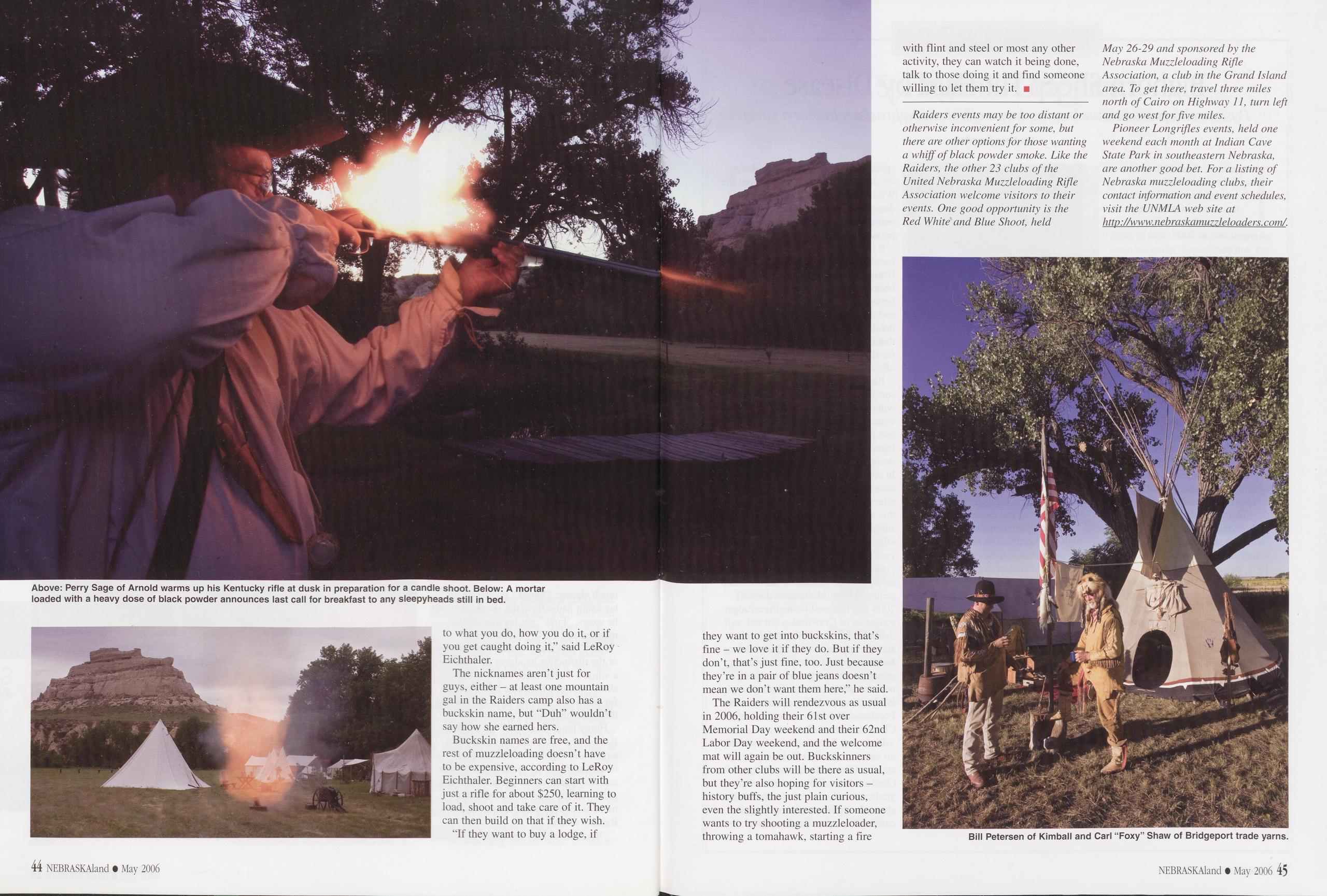
The nicknames aren’t just for guys, either - at least one mountain gal in the Raiders camp also has a buckskin name, but “Duh” wouldn’t say how she earned hers.
Buckskin names are free, and the rest of muzzleloading doesn’t have to be expensive, according to LeRoy Eichthaler. Beginners can start with just a rifle for about $250, learning to load, shoot and take care of it. They can then build on that if they wish.
"If they want to buy a lodge, if they want to get into buckskins, that’s fine - we love it if they do. But if they don’t, that’s just fine, too. Just because they’re in a pair of blue jeans doesn’t mean we don’t want them here,” he said.
The Raiders will rendezvous as usual in 2006, holding their 61st over Memorial Day weekend and their 62nd Labor Day weekend, and the welcome mat will again be out. Buckskinners from other clubs will be there as usual, but they’re also hoping for visitors - history buffs, the just plain curious, even the slightly interested. If someone wants to try shooting a muzzleloader, throwing a tomahawk, starting a fire with flint and steel or most any other activity, they can watch it being done, talk to those doing it and find someone willing to let them try it.
Raiders events may be too distant or otherwise inconvenient for some, but there are other options for those wanting a whiff of black powder smoke. Like the Raiders, the other 23 clubs of the United Nebraska Muzzleloading Rifle Association welcome visitors to their events. One good opportunity is the Red White and Blue Shoot, held May 26-29 and sponsored by the Nebraska Muzzleloading Rifle Association, a club in the Grand Island area. To get there, travel three miles north of Cairo on Highway 11, turn left and go west for five miles. Pioneer Longrifles events, held one weekend each month at Indian Cave State Park in southeastern Nebraska, are another good bet. For a listing of Nebraska muzzleloading clubs, their contact information and event schedules, visit the UNMLA web site at http://www. nebraskamuzzleloaders. com/.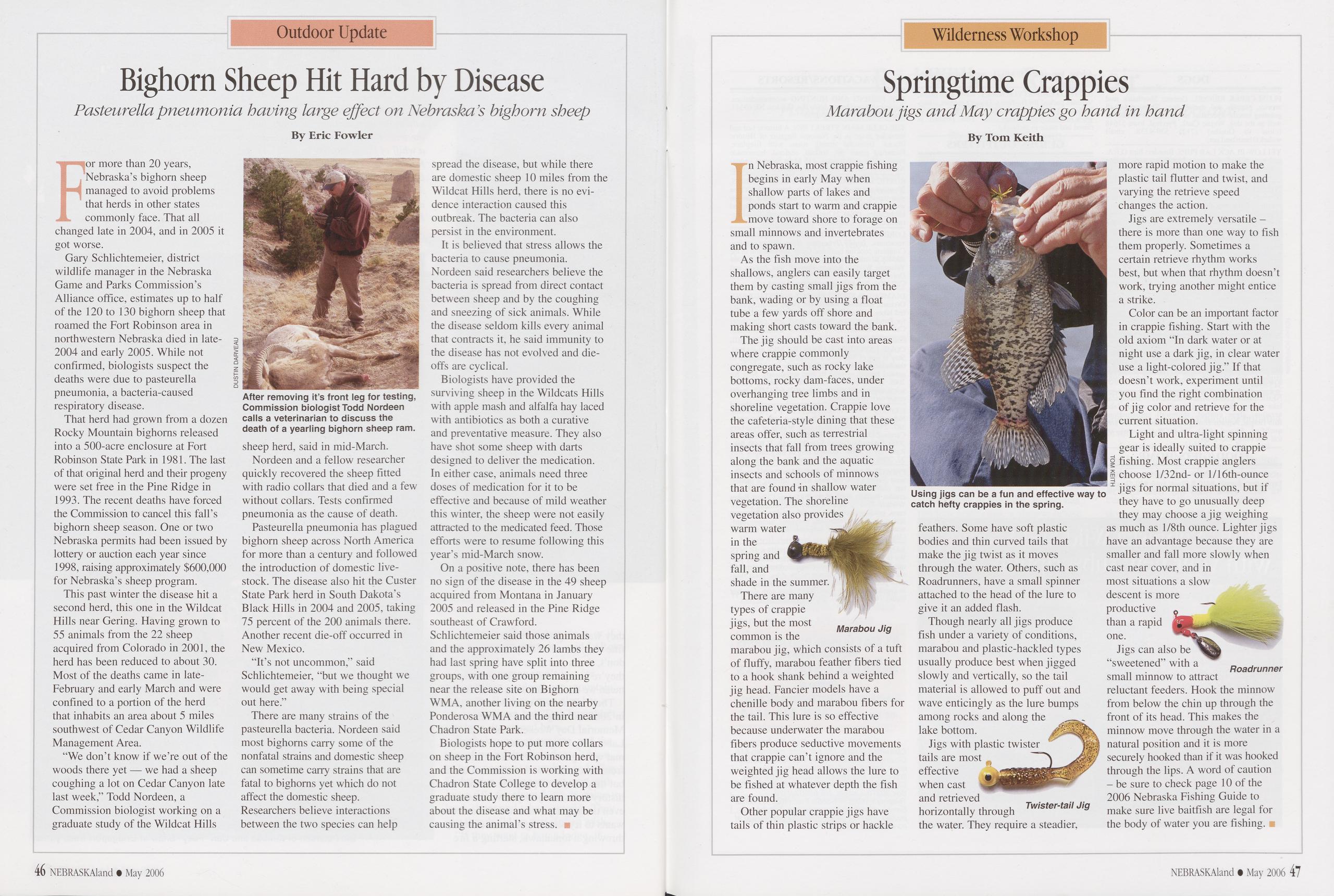
Outdoor Update
Bighorn Sheep Hit Hard by Disease
Pasteurellapneumonia having large effect on Nebraska’s bighorn sheep
For more than 20 years, Nebraska’s bighorn sheep managed to avoid problems that herds in other states commonly face. That all changed late in 2004, and in 2005 it got worse.
Gary Schlichtemeier, district wildlife manager in the Nebraska Game and Parks Commission’s Alliance office, estimates up to half of the 120 to 130 bighorn sheep that roamed the Fort Robinson area in northwestern Nebraska died in late- 2004 and early 2005. While not confirmed, biologists suspect the deaths were due to pasteurella pneumonia, a bacteria-caused respiratory disease.
That herd had grown from a dozen Rocky Mountain bighorns released into a 500-acre enclosure at Fort Robinson State Park in 1981. The last of that original herd and their progeny were set free in the Pine Ridge in 1993. The recent deaths have forced the Commission to cancel this fall’s bighorn sheep season. One or two Nebraska permits had been issued by lottery or auction each year since 1998, raising approximately $600,000 for Nebraska’s sheep program.
This past winter the disease hit a second herd, this one in the Wildcat Hills near Gering. Having grown to 55 animals from the 22 sheep acquired from Colorado in 2001, the herd has been reduced to about 30. Most of the deaths came in late- February and early March and were confined to a portion of the herd that inhabits an area about 5 miles southwest of Cedar Canyon Wildlife Management Area.
“We don’t know if we’re out of the woods there yet — we had a sheep coughing a lot on Cedar Canyon late last week,” Todd Nordeen, a Commission biologist working on a graduate study of the Wildcat Hills
Nordeen and a fellow researcher quickly recovered the sheep fitted with radio collars that died and a few without collars. Tests confirmed pneumonia as the cause of death.
Pasteurella pneumonia has plagued bighorn sheep across North America for more than a century and followed the introduction of domestic live- stock. The disease also hit the Custer State Park herd in South Dakota’s Black Hills in 2004 and 2005, taking 75 percent of the 200 animals there. Another recent die-off occurred in New Mexico.
“It’s not uncommon,” said Schlichtemeier, “but we thought we would get away with being special out here.”
There are many strains of the pasteurella bacteria. Nordeen said most bighorns carry some of the nonfatal strains and domestic sheep can sometime carry strains that are fatal to bighorns yet which do not affect the domestic sheep. Researchers believe interactions between the two species can help spread the disease, but while there are domestic sheep 10 miles from the Wildcat Hills herd, there is no evi- dence interaction caused this outbreak. The bacteria can also persist in the environment.
It is believed that stress allows the bacteria to cause pneumonia. Nordeen said researchers believe the bacteria is spread from direct contact between sheep and by the coughing and sneezing of sick animals. While the disease seldom kills every animal that contracts it, he said immunity to the disease has not evolved and die- offs are cyclical.
Biologists have provided the surviving sheep in the Wildcats Hills with apple mash and alfalfa hay laced with antibiotics as both a curative and preventative measure. They also have shot some sheep with darts designed to deliver the medication. In either case, animals need three doses of medication for it to be effective and because of mild weather this winter, the sheep were not easily attracted to the medicated feed. Those efforts were to resume following this year’s mid-March snow.
On a positive note, there has been no sign of the disease in the 49 sheep acquired from Montana in January 2005 and released in the Pine Ridge southeast of Crawford. Schlichtemeier said those animals and the approximately 26 lambs they had last spring have split into three groups, with one group remaining near the release site on Bighorn WMA, another living on the nearby Ponderosa WMA and the third near Chadron State Park.
Biologists hope to put more collars on sheep in the Fort Robinson herd, and the Commission is working with Chadron State College to develop a graduate study there to learn more about the disease and what may be causing the animal’s stress.
Wilderness Workshop
Springtime Crappies
Marabou jigs and May crappies go hand in hand
In Nebraska, most crappie fishing begins in early May when shallow parts of lakes and ponds start to warm and crappie move toward shore to forage on small minnows and invertebrates and to spawn.
As the fish move into the shallows, anglers can easily target them by casting small jigs from the bank, wading or by using a float tube a few yards off shore and making short casts toward the bank.
The jig should be cast into areas where crappie commonly congregate, such as rocky lake bottoms, rocky dam-faces, under overhanging tree limbs and in shoreline vegetation. Crappie love the cafeteria-style dining that these areas offer, such as terrestrial insects that fall from trees growing along the bank and the aquatic insects and schools of minnows that are found in shallow water vegetation. The shoreline
There are many types of crappie jigs, but the most common is the marabou jig, which consists of a tuft of fluffy, marabou feather fibers tied to a hook shank behind a weighted jig head. Fancier models have a chenille body and marabou fibers for the tail. This lure is so effective because underwater the marabou fibers produce seductive movements that crappie can’t ignore and the weighted jig head allows the lure to be fished at whatever depth the fish are found.
Other popular crappie jigs have tails of thin plastic strips or hackle
Though nearly all jigs produce fish under a variety of conditions, marabou and plastic-hackled types usually produce best when jigged slowly and vertically, so the tail material is allowed to puff out and wave enticingly as the lure bumps among rocks and along the lake bottom.
Jigs with plastic twister tails are most effective . when cast and retrieved
Jigs are extremely versatile - there is more than one way to fish them properly. Sometimes a certain retrieve rhythm works best, but when that rhythm doesn’t work, trying another might entice a strike.
Color can be an important factor in crappie fishing. Start with the old axiom “In dark water or at night use a dark jig, in clear water use a light-colored jig.” If that doesn’t work, experiment until you find the right combination of jig color and retrieve for the current situation.
Light and ultra-light spinning gear is ideally suited to crappie fishing. Most crappie anglers choose l/32nd- or l/16th-ounce jigs for normal situations, but if they have to go unusually deep they may choose a jig weighing much as l/8th ounce. Lighter jigs have an advantage because they are smaller and fall more slowly when cast near cover, and in most situations a slow descent is more productive than a rapid one.
Jigs can also be “sweetened” with a
46 NEBRASKAland • May 2006 NEBRASKAland • May 2006 47
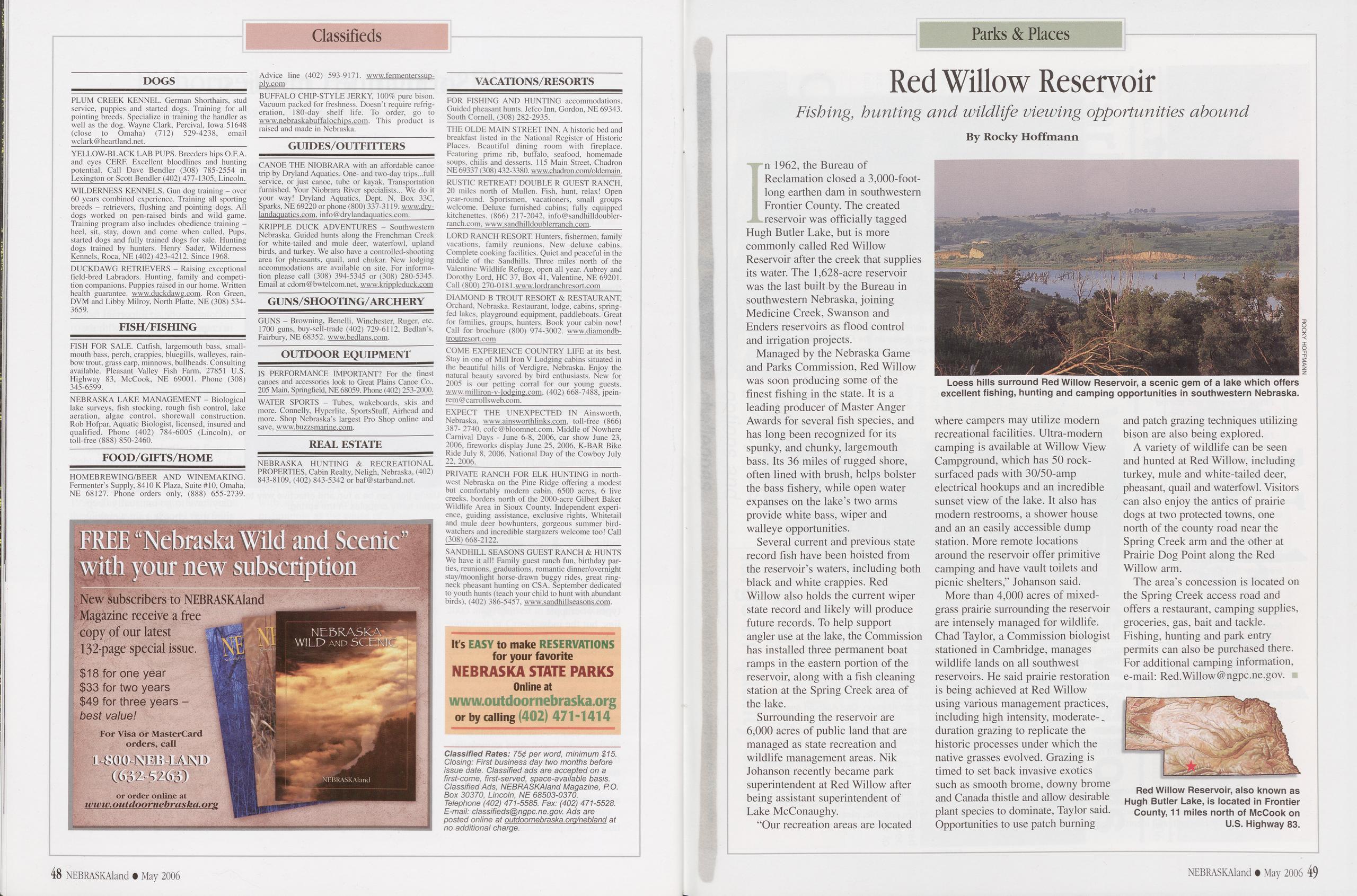
Classifieds
DOGS PLUM CREEK KENNEL. German Shorthairs, stud service, puppies and started dogs. Training for all pointing breeds. Specialize in training the handler as well as the dog. Wayne Clark, Percival, Iowa 51648 (close to Omaha) (712) 529-4238, email wclark@heartland.net. YELLOW-BLACK LAB PUPS. Breeders hips O.F.A. and eyes CERF. Excellent bloodlines and hunting potential. Call Dave Bendler (308) 785-2554 in Lexington or Scott Bendler (402) 477-1305, Lincoln. WILDERNESS KENNELS. Gun dog training - over 60 years combined experience. Training all sporting breeds - retrievers, flushing and pointing dogs. All dogs worked on pen-raised birds and wild game. Training program also includes obedience training - heel, sit, stay, down and come when called. Pups, started dogs and fully trained dogs for sale. Hunting dogs trained by hunters. Henry Sader, Wilderness Kennels, Roca, NE (402) 423-4212, Since 1968. DUCKDAWG RETRIEVERS - Raising exceptional field-bred Labradors. Hunting, family and competi- tion companions. Puppies raised in our home. Written health guarantee, www.duckdawg.com. Ron Green, DVM and Libby Milroy, North Platte, NE (308) 534- 3659. FISH/FISHING FISH FOR SALE. Catfish, largemouth bass, small- mouth bass, perch, crappies, bluegills, walleyes, rain- bow trout, grass carp, minnows, bullheads. Consulting available. Pleasant Valley Fish Farm, 27851 U.S. Highway 83, McCook, NE 69001. Phone (308) 345-6599. NEBRASKA LAKE MANAGEMENT - Biological lake surveys, fish stocking, rough fish control, lake aeration, algae control, shorewall construction. Rob Hofpar, Aquatic Biologist, licensed, insured and qualified. Phone (402) 784-6005 (Lincoln), or toll-free (888) 850-2460. FOOD/GIFTS/HOME HOMEBREWING/BEER AND WINEMAKING. Fermenter’s Supply, 8410 K Plaza, Suite #10, Omaha, NE 68127. Phone orders only, (888) 655-2739.Parks & Places
Red Willow Reservoir
Fishing, hunting and wildlife viewing opportunities abound
In 1962, the Bureau of Reclamation closed a 3,000-foot- long earthen dam in southwestern Frontier County. The created reservoir was officially tagged Hugh Butler Lake, but is more commonly called Red Willow Reservoir after the creek that supplies its water. The 1,628-acre reservoir was the last built by the Bureau in southwestern Nebraska, joining Medicine Creek, Swanson and Enders reservoirs as flood control and irrigation projects.
Managed by the Nebraska Game and Parks Commission, Red Willow was soon producing some of the finest fishing in the state. It is a leading producer of Master Anger Awards for several fish species, and has long been recognized for its spunky, and chunky, largemouth bass. Its 36 miles of rugged shore, often lined with brush, helps bolster the bass fishery, while open water expanses on the lake’s two arms provide white bass, wiper and walleye opportunities.
Several current and previous state record fish have been hoisted from the reservoir’s waters, including both black and white crappies. Red Willow also holds the current wiper state record and likely will produce future records. To help support angler use at the lake, the Commission has installed three permanent boat ramps in the eastern portion of the reservoir, along with a fish cleaning station at the Spring Creek area of the lake.
Surrounding the reservoir are 6,000 acres of public land that are managed as state recreation and wildlife management areas. Nik Johanson recently became park superintendent at Red Willow after being assistant superintendent of Lake McConaughy.
“Our recreation areas are located
More than 4,000 acres of mixed- grass prairie surrounding the reservoir are intensely managed for wildlife. Chad Taylor, a Commission biologist stationed in Cambridge, manages wildlife lands on all southwest reservoirs. He said prairie restoration is being achieved at Red Willow using various management practices, including high intensity, moderate- _ duration grazing to replicate the historic processes under which the native grasses evolved. Grazing is timed to set back invasive exotics such as smooth brome, downy brome and Canada thistle and allow desirable plant species to dominate, Taylor said. Opportunities to use patch burning and patch grazing techniques utilizing bison are also being explored.
A variety of wildlife can be seen and hunted at Red Willow, including turkey, mule and white-tailed deer, pheasant, quail and waterfowl. Visitors can also enjoy the antics of prairie dogs at two protected towns, one north of the county road near the Spring Creek arm and the other at Prairie Dog Point along the Red Willow arm.
The area’s concession is located on the Spring Creek access road and offers a restaurant, camping supplies, groceries, gas, bait and tackle. Fishing, hunting and park entry permits can also be purchased there. For additional camping information, e-mail: Red.Willow@ngpc.ne.gov.
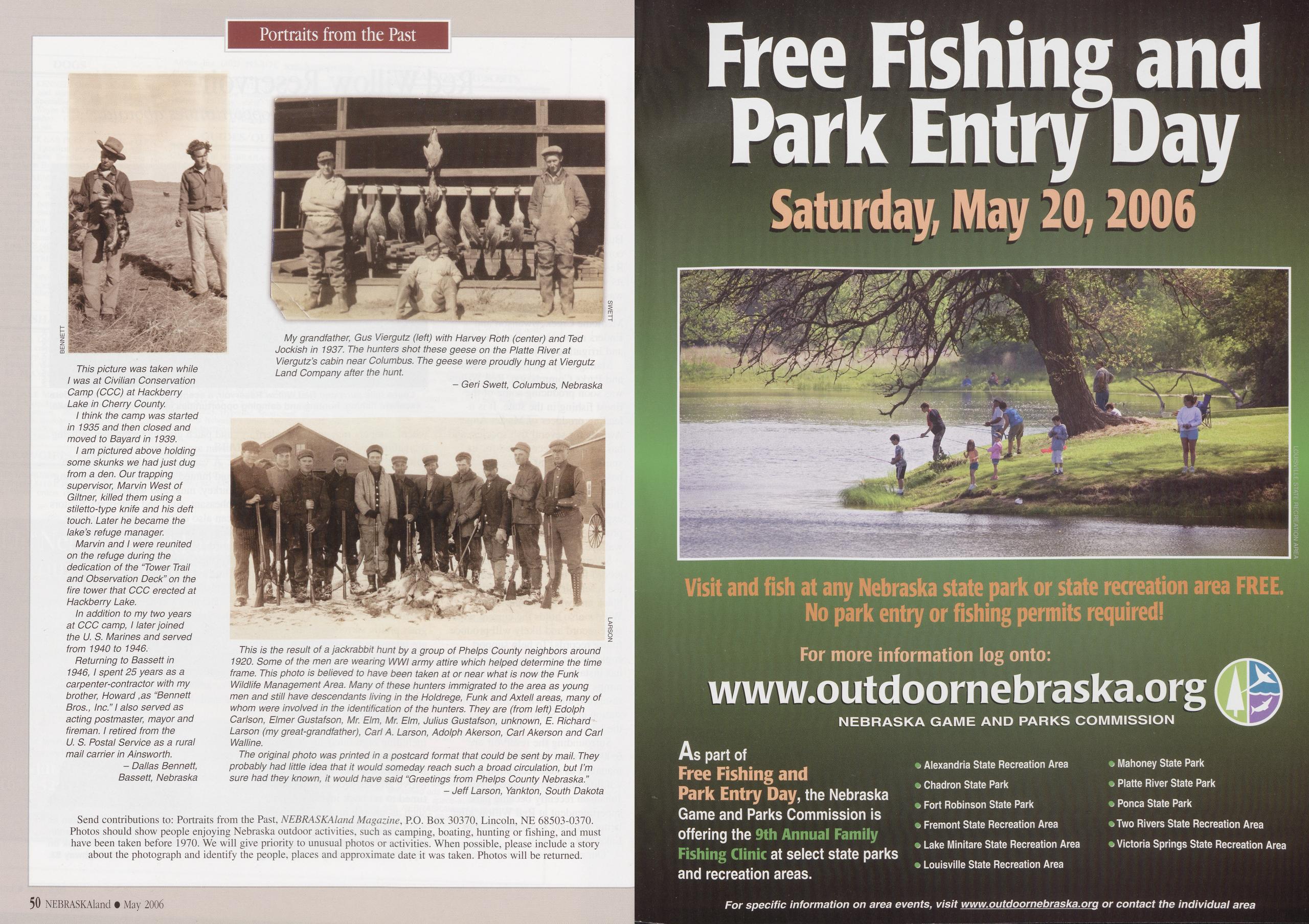
Portraits from the Past
This picture was taken while I was at Civilian Conservation Camp (CCC) at Hackberry Lake in Cherry County
I think the camp was started in 1935 and then closed and moved to Bayard in 1939.
I am pictured above holding some skunks we had just dug from a den. Our trapping supervisor, Marvin West of Giltner, killed them using a stiletto-type knife and his deft touch. Later he became the lake’s refuge manager.
Marvin and I were reunited on the refuge during the dedication of the “Tower Trail and Observation Deck” on the fire tower that CCC erected at Hackberry Lake.
In addition to my two years at CCC camp, I later joined the U. S. Marines and served from 1940 to 1946.
Returning to Bassett in 1946, I spent 25 years as a carpenter-contractor with my brother, Howard ,as “Bennett Bros., Inc.” I also served as acting postmaster, mayor and fireman. I retired from the U. S. Postal Service as a rural mail carrier in Ainsworth.
- Dallas Bennett, Bassett, NebraskaMy grandfather, Gus Viergutz (left) with Harvey Roth (center) and Ted Jockish in 1937. The hunters shot these geese on the Platte River at Viergutz’s cabin near Columbus. The geese were proudly hung at Viergutz Land Company after the hunt.
- Geri Swett, Columbus, NebraskaThis is the result of a jackrabbit hunt by a group of Phelps County neighbors around 1920. Some of the men are wearing WWI army attire which helped determine the time frame. This photo is believed to have been taken at or near what is now the Funk Wildlife Management Area. Many of these hunters immigrated to the area as young men and still have descendants living in the Holdrege, Funk and Axtell areas, many of whom were involved in the identification of the hunters. They are (from left) Edolph Carlson, Elmer Gustafson, Mr. Elm, Mr. Elm, Julius Gustafson, unknown, E. Richard Larson (my great-grandfather), Carl A. Larson, Adolph Akerson, Carl Akerson and Carl Walline.
The original photo was printed in a postcard format that could be sent by mail. They probably had little idea that it would someday reach such a broad circulation, but I’m sure had they known, it would have said “Greetings from Phelps County Nebraska.”
- Jeff Larson, Yankton, South Dakota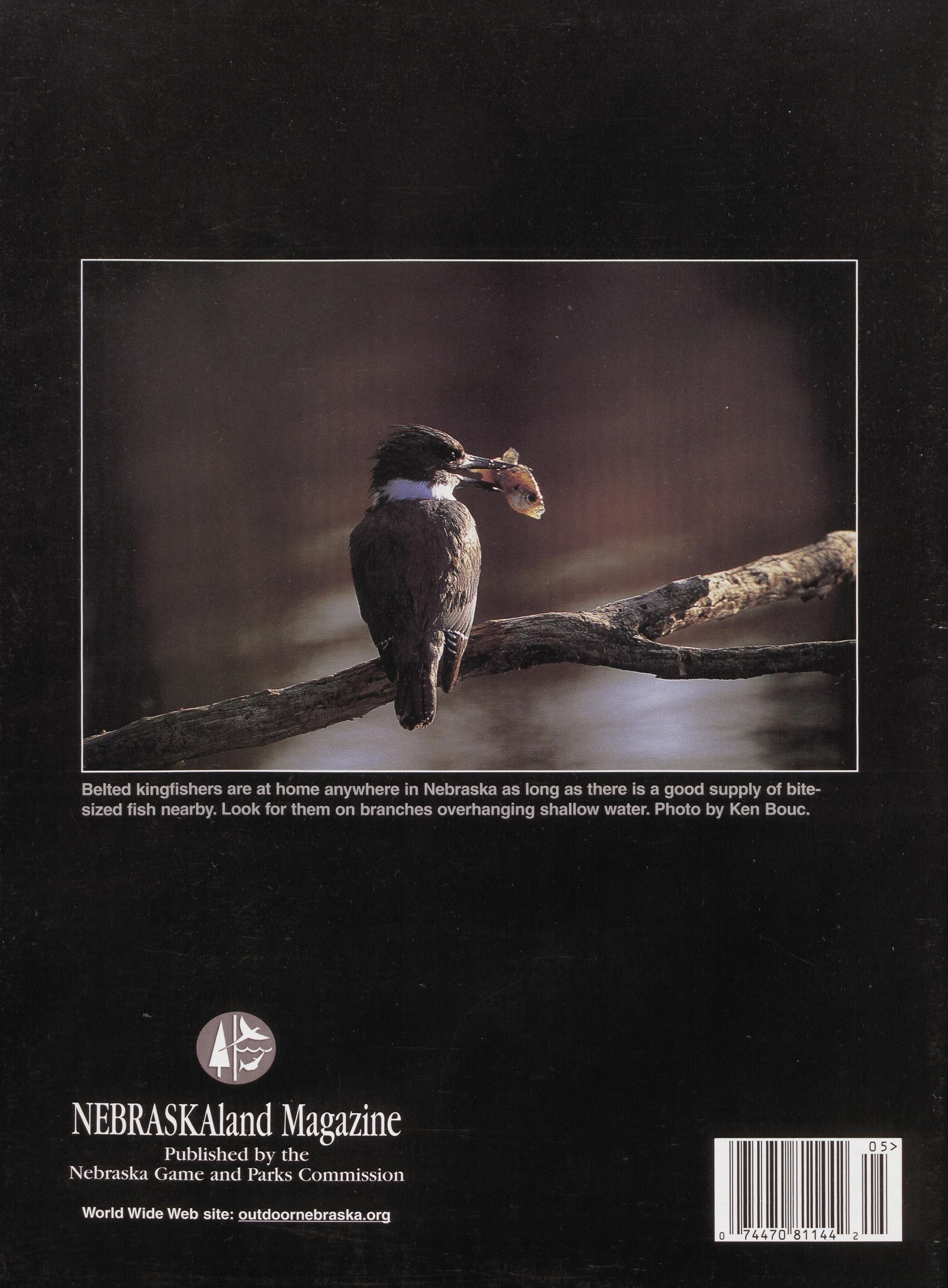
Position: 664 (17 views)