Volume 84, Issue 3, 2006
NEBRASKAland
Volume 84, Number 3, April 2006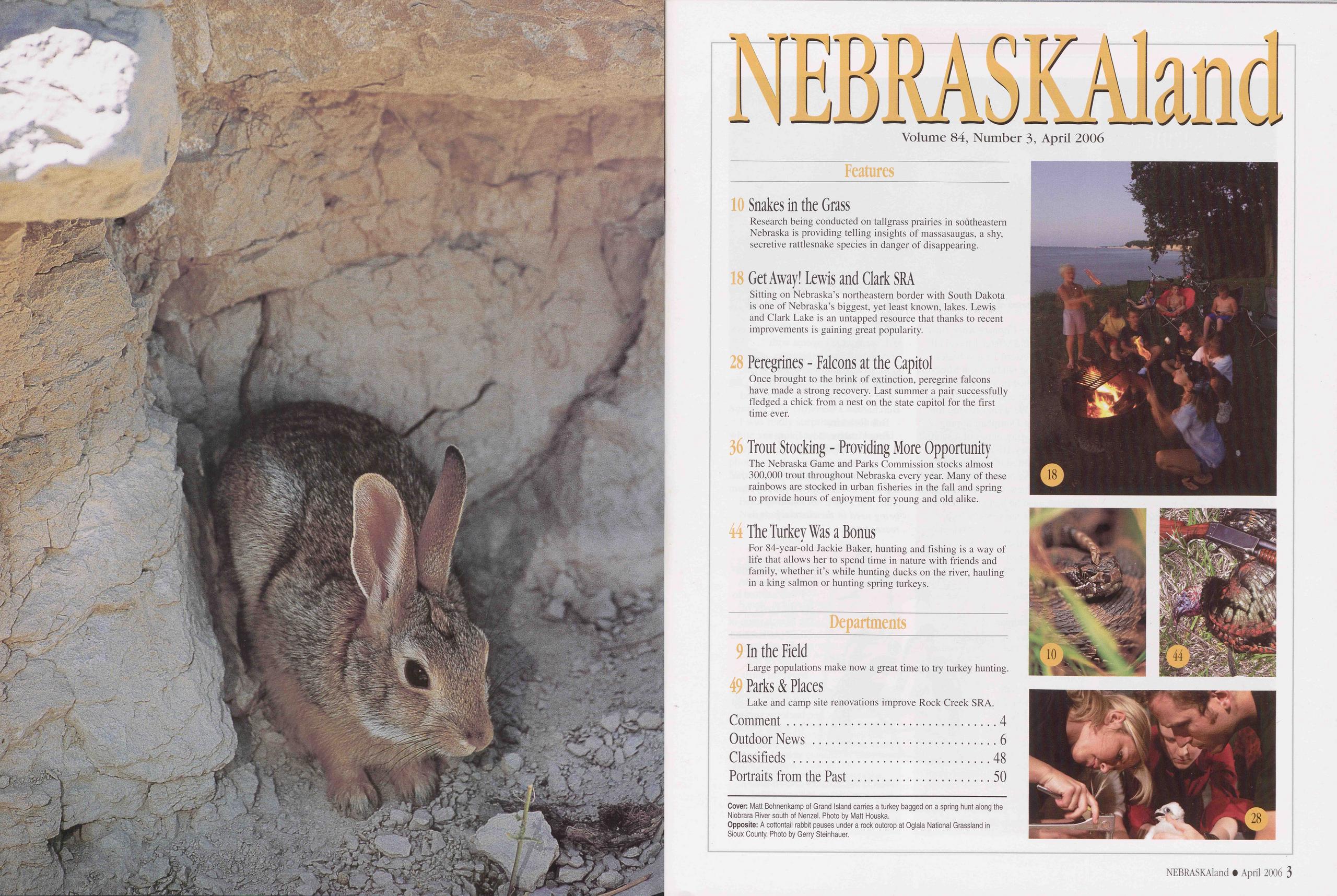
NEBRASKAland
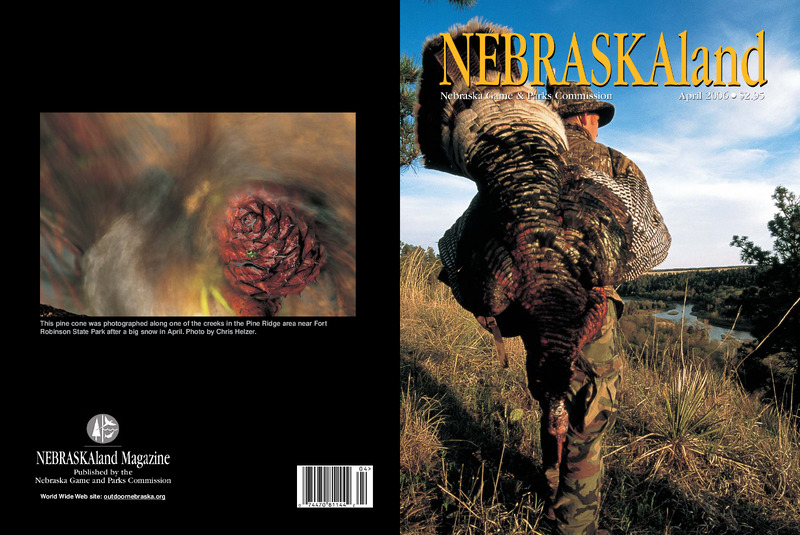
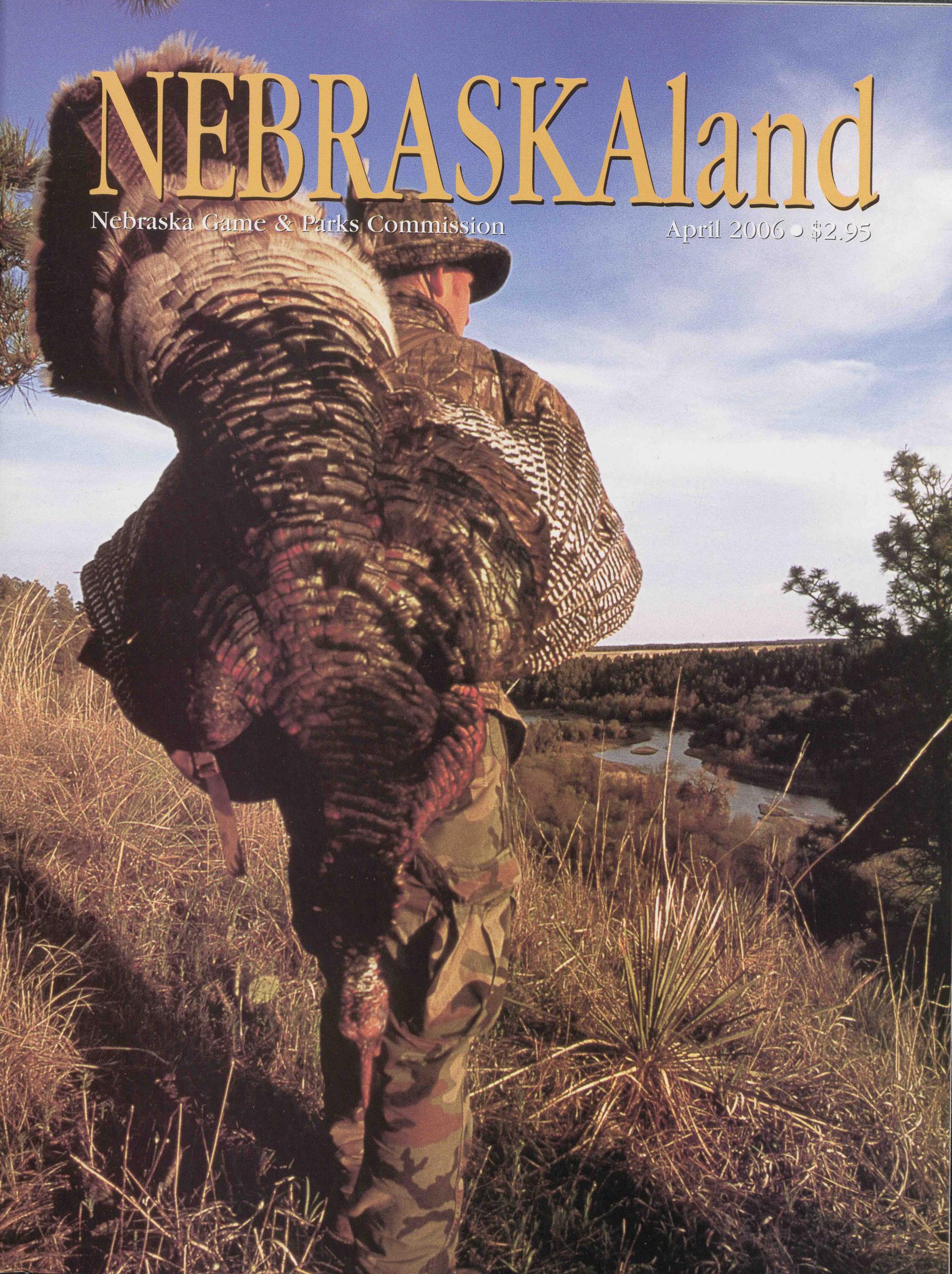
Volume 84, Number 3, April 2006 Features 10 Snakes in the Grass Research being conducted on tailgrass prairies in southeastern Nebraska is providing telling insights of massasaugas, a shy, secretive rattlesnake species in danger of disappearing. 18 Get Away! Lewis and Clark SRA Sitting on Nebraska’s northeastern border with South Dakota is one of Nebraska’s biggest, yet least known, lakes. Lewis and Clark Lake is an untapped resource that thanks to recent improvements is gaining great popularity. 28 Peregrines - Falcons at the Capitol Once brought to the brink of extinction, peregrine falcons have made a strong recovery. Last summer a pair successfully fledged a chick from a nest on the state capitol for the first time ever. 36 Trout Stocking - Providing More Opportunity The Nebraska Game and Parks Commission stocks almost 300,000 trout throughout Nebraska every year. Many of these rainbows are stocked in urban fisheries in the fall and spring to provide hours of enjoyment for young and old alike. 44 The Turkey Was a Bonus For 84-year-old Jackie Baker, hunting and fishing is a way of life that allows her to spend time in nature with friends and family, whether it’s while hunting ducks on the river, hauling in a king salmon or hunting spring turkeys. Departments 9 In the Field Large populations make now a great time to try turkey hunting. Parks & Places Lake and camp site renovations improve Rock Creek SRA. Comment 4 Outdoor News Classifieds Portraits from the Past 48 50 Cover: Matt Bohnenkamp of Grand Island carries a turkey bagged on a spring hunt along the Niobrara River south of Nenzel. Photo by Matt Houska. Opposite: A cottontail rabbit pauses under a rock outcrop at Oglala National Grassland in Sioux County. Photo by Gerry Steinhauer.18
10
44
28
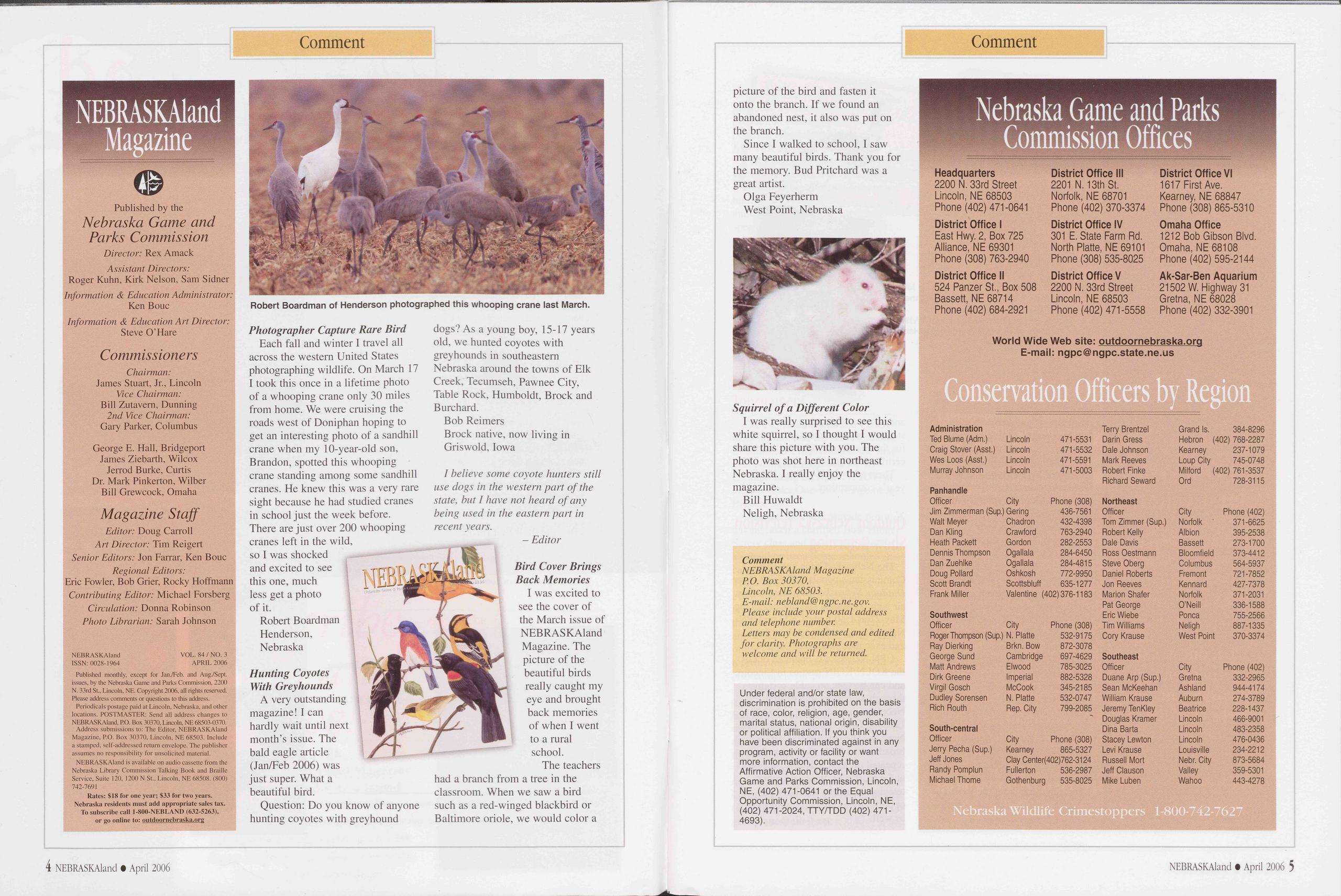
Each fall and winter I travel all across the western United States photographing wildlife. On March 17 I took this once in a lifetime photo of a whooping crane only 30 miles from home. We were cruising the roads west of Doniphan hoping to get an interesting photo of a sandhill crane when my 10-year-old son, Brandon, spotted this whooping crane standing among some sandhill cranes. He knew this was a very rare sight because he had studied cranes in school just the week before. There are just over 200 whooping cranes left in the wild, so I was shocked and excited to see this one, much less get a photo of it. Robert Boardman Henderson, Nebraska
Hunting Coyotes With GreyhoundsA very outstanding magazine! I can hardly wait until next month’s issue. The bald eagle article (Jan/Feb 2006) was just super. What a beautiful bird.
Question: Do you know of anyone hunting coyotes with greyhound dogs? As a young boy, 15-17 years old, we hunted coyotes with greyhounds in southeastern Nebraska around the towns of Elk Creek, Tecumseh, Pawnee City, Table Rock, Humboldt, Brock and Burchard. Bob Reimers Brock native, now living in Griswold, Iowa
I believe some coyote hunters still use dogs in the western part of the state, but I have not heard of any being used in the eastern part in recent years. - Editor
Bird Cover Brings Back MemoriesI was excited to see the cover of the March issue of NEBRASKAland Magazine. The picture of the beautiful birds really caught my eye and brought back memories of when I went to a rural school.
The teachers had a branch from a tree in the classroom. When we saw a bird such as a red-winged blackbird or Baltimore oriole, we would color a picture of the bird and fasten it onto the branch. If we found an abandoned nest, it also was put on the branch.
CommentSince I walked to school, I saw many beautiful birds. Thank you for the memory. Bud Pritchard was a great artist. Olga Feyerherm West Point, Nebraska
Squirrel of a Different Color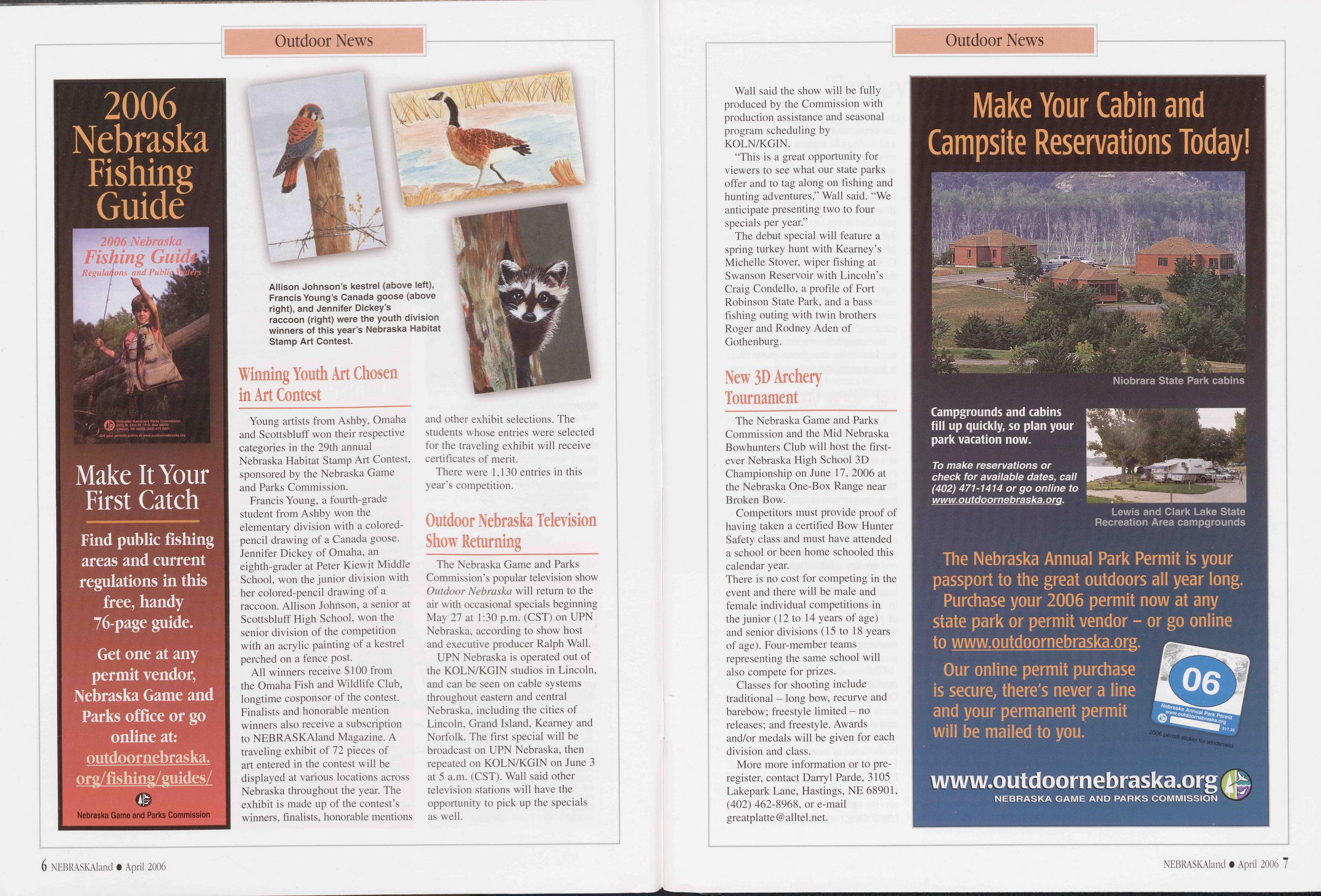
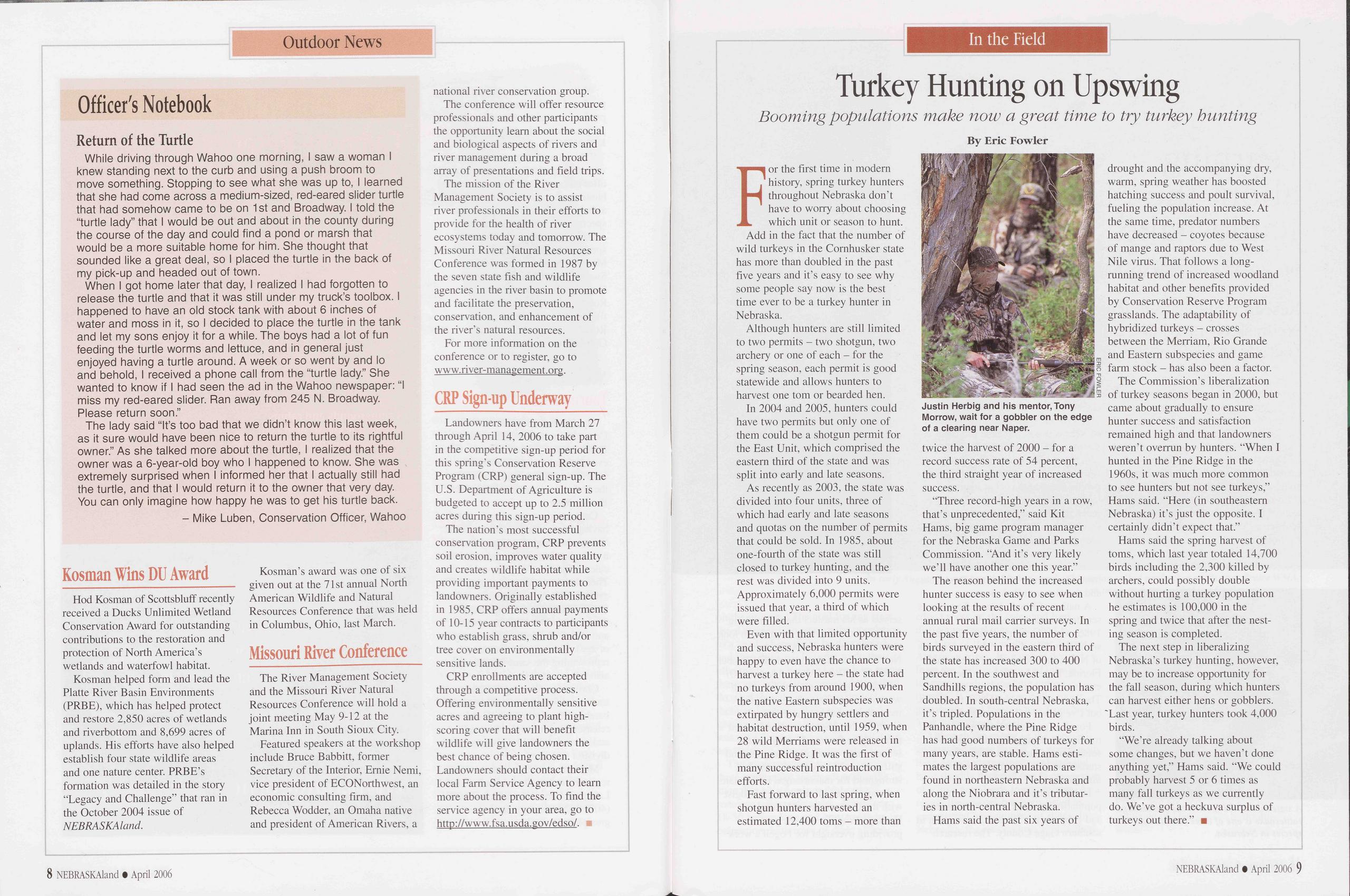
Young artists from Ashby, Omaha and Scottsbluff won their respective categories in the 29th annual Nebraska Habitat Stamp Art Contest, sponsored by the Nebraska Game and Parks Commission.
Francis Young, a fourth-grade student from Ashby won the elementary division with a colored- pencil drawing of a Canada goose. Jennifer Dickey of Omaha, an eighth-grader at Peter Kiewit Middle School, won the junior division with her colored-pencil drawing of a raccoon. Allison Johnson, a senior at Scottsbluff High School, won the senior division of the competition with an acrylic painting of a kestrel perched on a fence post.
All winners receive $100 from the Omaha Fish and Wildlife Club, longtime cosponsor of the contest. Finalists and honorable mention winners also receive a subscription to NEBRASKAland Magazine. A traveling exhibit of 72 pieces of art entered in the contest will be displayed at various locations across Nebraska throughout the year. The exhibit is made up of the contest’s winners, finalists, honorable mentions and other exhibit selections. The students whose entries were selected for the traveling exhibit will receive certificates of merit.
There were 1,130 entries in this year’s competition. Outdoor Nebraska Television Show ReturningThe Nebraska Game and Parks Commission’s popular television show Outdoor Nebraska will return to the air with occasional specials beginning May 27 at 1:30 p.m. (CST) on UPN Nebraska, according to show host and executive producer Ralph Wall.
UPN Nebraska is operated out of the KOLN/KGIN studios in Lincoln, and can be seen on cable systems throughout eastern and central Nebraska, including the cities of Lincoln, Grand Island, Kearney and Norfolk. The first special will be broadcast on UPN Nebraska, then repeated on KOLN/KGIN on June 3 at 5 a.m. (CST). Wall said other television stations will have the opportunity to pick up the specials as well.
Wall said the show will be fully produced by the Commission with production assistance and seasonal program scheduling by KOLN/KGIN.
"This is a great opportunity for viewers to see what our state parks offer and to tag along on fishing and hunting adventures,” Wall said. "We anticipate presenting two to four specials per year.”
The debut special will feature a spring turkey hunt with Kearney’s Michelle Stover, wiper fishing at Swanson Reservoir with Lincoln’s Craig Condello, a profile of Fort Robinson State Park, and a bass fishing outing with twin brothers Roger and Rodney Aden of Gothenburg.
New 3D Archery TournamentThe Nebraska Game and Parks Commission and the Mid Nebraska Bowhunters Club will host the first- ever Nebraska High School 3D Championship on June 17, 2006 at the Nebraska One-Box Range near Broken Bow.
Competitors must provide proof of having taken a certified Bow Hunter Safety class and must have attended a school or been home schooled this calendar year.
There is no cost for competing in the event and there will be male and female individual competitions in the junior (12 to 14 years of age) and senior divisions (15 to 18 years of age). Four-member teams representing the same school will also compete for prizes.
Classes for shooting include traditional - long bow, recurve and barebow; freestyle limited - no releases; and freestyle. Awards and/or medals will be given for each division and class.
More more information or to pre- register, contact Darryl Parde, 3105 Lakepark Lane, Hastings, NF 68901, (402) 462-8968, or e-mail greatplatte@alltel.net.
While driving through Wahoo one morning, I saw a woman I knew standing next to the curb and using a push broom to move something. Stopping to see what she was up to, I learned that she had come across a medium-sized, red-eared slider turtle that had somehow came to be on 1st and Broadway. I told the “turtle lady” that I would be out and about in the county during the course of the day and could find a pond or marsh that would be a more suitable home for him. She thought that sounded like a great deal, so I placed the turtle in the back of my pick-up and headed out of town.
When I got home later that day, I realized I had forgotten to release the turtle and that it was still under my truck’s toolbox. I happened to have an old stock tank with about 6 inches of water and moss in it, so I decided to place the turtle in the tank and let my sons enjoy it for a while. The boys had a lot of fun feeding the turtle worms and lettuce, and in general just enjoyed having a turtle around. A week or so went by and Io and behold, I received a phone call from the “turtle lady.” She wanted to know if I had seen the ad in the Wahoo newspaper: “I miss my red-eared slider. Ran away from 245 N. Broadway. Please return soon.”
The lady said “It’s too bad that we didn’t know this last week, as it sure would have been nice to return the turtle to its rightful owner.” As she talked more about the turtle, I realized that the owner was a 6-year-old boy who I happened to know. She was extremely surprised when I informed her that I actually still had the turtle, and that I would return it to the owner that very day. You can only imagine how happy he was to get his turtle back. - Mike Luben, Conservation Officer, Wahoo
Kosman Wins DU AwardHod Kosman of Scottsbluff recently received a Ducks Unlimited Wetland Conservation Award for outstanding contributions to the restoration and protection of North America’s wetlands and waterfowl habitat.
Kosman helped form and lead the Platte River Basin Environments (PRBE), which has helped protect and restore 2,850 acres of wetlands and riverbottom and 8,699 acres of uplands. His efforts have also helped establish four state wildlife areas and one nature center. PRBE’s formation was detailed in the story “Legacy and Challenge” that ran in the October 2004 issue of NEBRASKAland.
Kosman’s award was one of six given out at the 71st annual North American Wildlife and Natural Resources Conference that was held in Columbus, Ohio, last March.
Missouri River ConferenceThe River Management Society and the Missouri River Natural Resources Conference will hold a joint meeting May 9-12 at the Marina Inn in South Sioux City.
Featured speakers at the workshop include Bruce Babbitt, former Secretary of the Interior, Ernie Nemi, vice president of ECONorthwest, an economic consulting firm, and Rebecca Wodder, an Omaha native and president of American Rivers, a national river conservation group.
The conference will offer resource professionals and other participants the opportunity learn about the social and biological aspects of rivers and river management during a broad array of presentations and field trips.
The mission of the River Management Society is to assist river professionals in their efforts to provide for the health of river ecosystems today and tomorrow. The Missouri River Natural Resources Conference was formed in 1987 by the seven state fish and wildlife agencies in the river basin to promote and facilitate the preservation, conservation, and enhancement of the river’s natural resources.
For more information on the conference or to register, go to www.river-management.org. CRP Sign-up UnderwayLandowners have from March 27 through April 14, 2006 to take part in the competitive sign-up period for this spring’s Conservation Reserve Program (CRP) general sign-up. The U.S. Department of Agriculture is budgeted to accept up to 2.5 million acres during this sign-up period.
The nation’s most successful conservation program, CRP prevents soil erosion, improves water quality and creates wildlife habitat while providing important payments to landowners. Originally established in 1985, CRP offers annual payments of 10-15 year contracts to participants who establish grass, shrub and/or tree cover on environmentally sensitive lands.
CRP enrollments are accepted through a competitive process. Offering environmentally sensitive acres and agreeing to plant high- scoring cover that will benefit wildlife will give landowners the best chance of being chosen. Landowners should contact their local Farm Service Agency to learn more about the process. To find the service agency in your area, go to http://www.fsa.usda.gov/edso/.
In the Field Turkey Hunting on Upswing Booming populations make now a great time to try turkey hunting By Eric FowlerFor the first time in modern history, spring turkey hunters throughout Nebraska don’t have to worry about choosing which unit or season to hunt. Add in the fact that the number of wild turkeys in the Cornhusker state has more than doubled in the past five years and it’s easy to see why some people say now is the best time ever to be a turkey hunter in Nebraska.
Although hunters are still limited to two permits - two shotgun, two archery or one of each - for the spring season, each permit is good statewide and allows hunters to harvest one tom or bearded hen.
In 2004 and 2005, hunters could have two permits but only one of them could be a shotgun permit for the East Unit, which comprised the eastern third of the state and was split into early and late seasons.
As recently as 2003, the state was divided into four units, three of which had early and late seasons and quotas on the number of permits that could be sold. In 1985, about one-fourth of the state was still closed to turkey hunting, and the rest was divided into 9 units. Approximately 6,000 permits were issued that year, a third of which were filled.
Even with that limited opportunity and success, Nebraska hunters were happy to even have the chance to harvest a turkey here - the state had no turkeys from around 1900, when the native Eastern subspecies was extirpated by hungry settlers and habitat destruction, until 1959, when 28 wild Merriams were released in the Pine Ridge. It was the first of many successful reintroduction efforts.
Fast forward to last spring, when shotgun hunters harvested an estimated 12,400 toms - more than twice the harvest of 2000 - for a record success rate of 54 percent, the third straight year of increased success.
“Three record-high years in a row, that’s unprecedented,” said Kit Hams, big game program manager for the Nebraska Game and Parks Commission. “And it’s very likely we’ll have another one this year.”
The reason behind the increased hunter success is easy to see when looking at the results of recent annual rural mail carrier surveys. In the past five years, the number of birds surveyed in the eastern third of the state has increased 300 to 400 percent. In the southwest and Sandhills regions, the population has doubled. In south-central Nebraska, it’s tripled. Populations in the Panhandle, where the Pine Ridge has had good numbers of turkeys for many years, are stable. Hams esti- mates the largest populations are found in northeastern Nebraska and along the Niobrara and it’s tributar- ies in north-central Nebraska.
Hams said the past six years of drought and the accompanying dry, warm, spring weather has boosted hatching success and poult survival, fueling the population increase. At the same time, predator numbers have decreased - coyotes because of mange and raptors due to West Nile virus. That follows a long- running trend of increased woodland habitat and other benefits provided by Conservation Reserve Program grasslands. The adaptability of hybridized turkeys - crosses between the Merriam, Rio Grande and Eastern subspecies and game farm stock - has also been a factor.
The Commission’s liberalization of turkey seasons began in 2000, but came about gradually to ensure hunter success and satisfaction remained high and that landowners weren’t overrun by hunters. “When I hunted in the Pine Ridge in the 1960s, it was much more common to see hunters but not see turkeys,” Hams said. “Here (in southeastern Nebraska) it’s just the opposite. I certainly didn’t expect that.”
Hams said the spring harvest of toms, which last year totaled 14,700 birds including the 2,300 killed by archers, could possibly double without hurting a turkey population he estimates is 100,000 in the spring and twice that after the nest- ing season is completed.
The next step in liberalizing Nebraska’s turkey hunting, however, may be to increase opportunity for the fall season, during which hunters can harvest either hens or gobblers. 'Last year, turkey hunters took 4,000 birds.
“We’re already talking about some changes, but we haven’t done anything yet,” Hams said. “We could probably harvest 5 or 6 times as many fall turkeys as we currently do. We’ve got a heckuva surplus of turkeys out there.”
8 NEBRASKAland • April 2006 NEBRASKAland • April 2006 9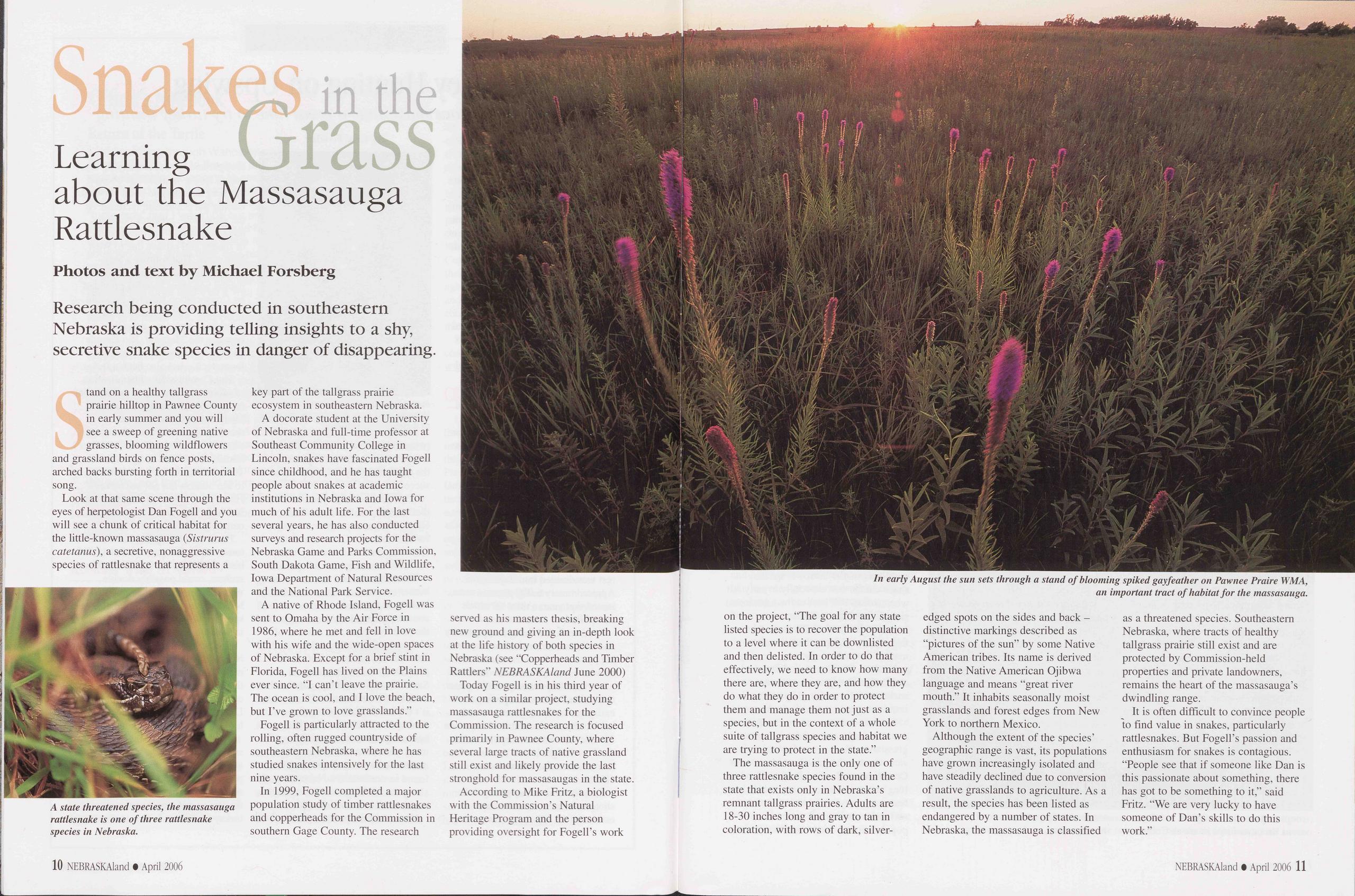
Stand on a healthy tallgrass prairie hilltop in Pawnee County in early summer and you will see a sweep of greening native grasses, blooming wildflowers and grassland birds on fence posts, arched backs bursting forth in territorial song.
Look at that same scene through the eyes of herpetologist Dan Fogell and you will see a chunk of critical habitat for the little-known massasauga (,Sistrurus catetanus), a secretive, nonaggressive species of rattlesnake that represents a A state threatened species, the massasauga rattlesnake is one of three rattlesnake species in Nebraska. key part of the tallgrass prairie ecosystem in southeastern Nebraska.
A docorate student at the University of Nebraska and full-time professor at Southeast Community College in Lincoln, snakes have fascinated Fogell since childhood, and he has taught people about snakes at academic institutions in Nebraska and Iowa for much of his adult life. For the last several years, he has also conducted surveys and research projects for the Nebraska Game and Parks Commission, South Dakota Game, Fish and Wildlife, Iowa Department of Natural Resources and the National Park Service.
A native of Rhode Island, Fogell was sent to Omaha by the Air Force in 1986, where he met and fell in love with his wife and the wide-open spaces of Nebraska. Except for a brief stint in Florida, Fogell has lived on the Plains ever since. "I can’t leave the prairie. The ocean is cool, and I love the beach, but I’ve grown to love grasslands.”
Fogell is particularly attracted to the rolling, often rugged countryside of southeastern Nebraska, where he has studied snakes intensively for the last nine years.
In 1999, Fogell completed a major population study of timber rattlesnakes and copperheads for the Commission in southern Gage County. The research served as his masters thesis, breaking new ground and giving an in-depth look at the life history of both species in Nebraska (see “Copperheads and Timber Rattlers” NEBRASKAland June 2000)
Today Fogell is in his third year of work on a similar project, studying massasauga rattlesnakes for the Commission. The research is focused primarily in Pawnee County, where several large tracts of native grassland still exist and likely provide the last stronghold for massasaugas in the state.
According to Mike Fritz, a biologist with the Commission’s Natural Heritage Program and the person providing oversight for Fogell’s work on the project, “The goal for any state listed species is to recover the population to a level where it can be downlisted and then delisted. In order to do that effectively, we need to know how many there are, where they are, and how they do what they do in order to protect them and manage them not just as a species, but in the context of a whole suite of tallgrass species and habitat we are trying to protect in the state.”
The massasauga is the only one of three rattlesnake species found in the state that exists only in Nebraska’s remnant tallgrass prairies. Adults are 18-30 inches long and gray to tan in coloration, with rows of dark, silver- edged spots on the sides and back - distinctive markings described as “pictures of the sun” by some Native American tribes. Its name is derived from the Native American Ojibwa language and means “great river mouth.” It inhabits seasonally moist grasslands and forest edges from New York to northern Mexico.
Although the extent of the species’ geographic range is vast, its populations have grown increasingly isolated and have steadily declined due to conversion of native grasslands to agriculture. As a result, the species has been listed as endangered by a number of states. In Nebraska, the massasauga is classified as a threatened species. Southeastern Nebraska, where tracts of healthy tailgrass prairie still exist and are protected by Commission-held properties and private landowners, remains the heart of the massasauga’s dwindling range.
It is often difficult to convince people to find value in snakes, particularly rattlesnakes. But Fogell’s passion and enthusiasm for snakes is contagious. “People see that if someone like Dan is this passionate about something, there has got to be something to it,” said Fritz. “We are very lucky to have someone of Dan’s skills to do this work.”
10 NEBRASKAland • April 2006 NEBRASKAland • April 2006 11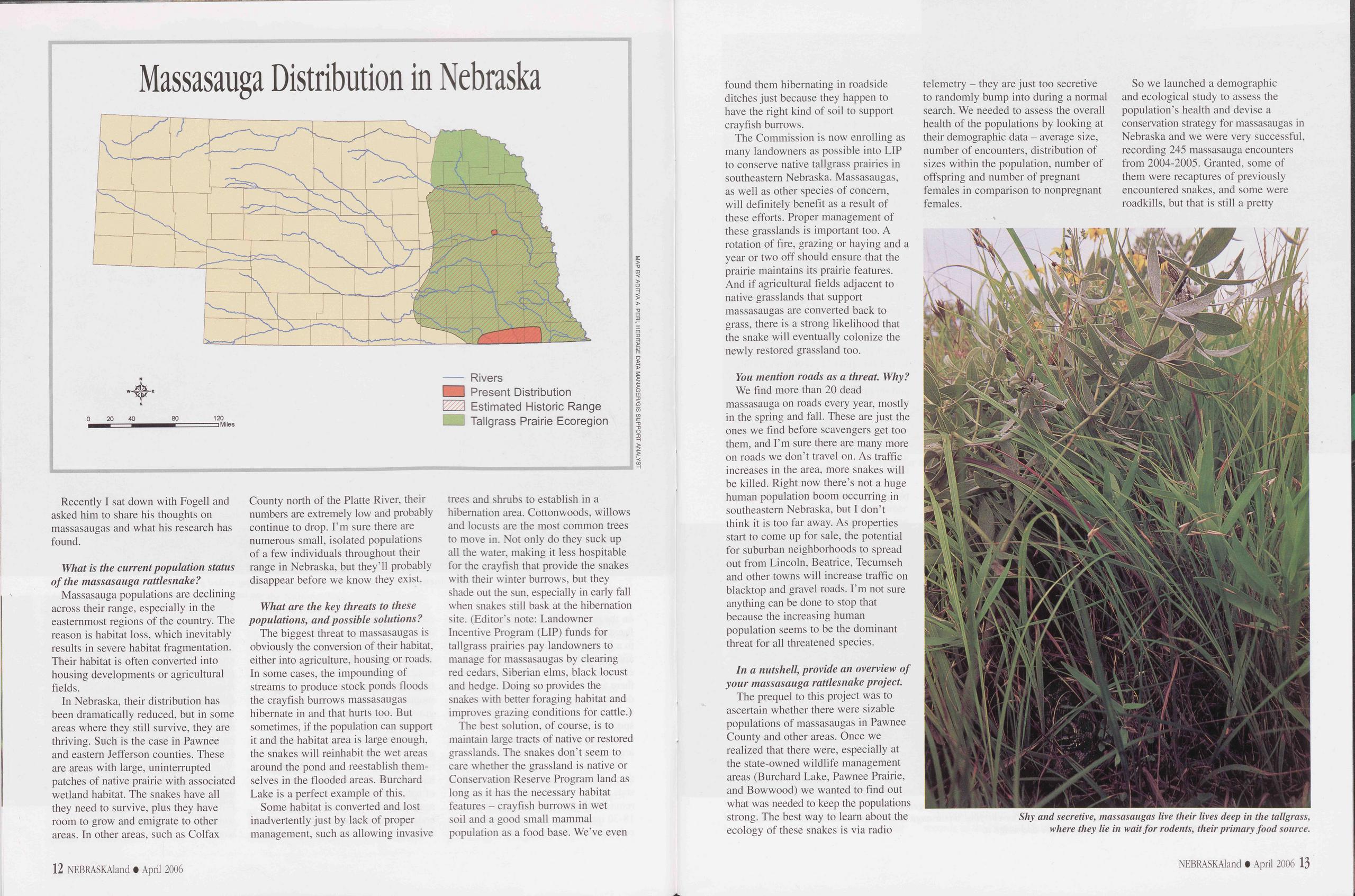
Recently I sat down with Fogell and asked him to share his thoughts on massasaugas and what his research has found.
What is the current population status of the massasauga rattlesnake?Massasauga populations are declining across their range, especially in the easternmost regions of the country. The reason is habitat loss, which inevitably results in severe habitat fragmentation. Their habitat is often converted into housing developments or agricultural fields.
In Nebraska, their distribution has been dramatically reduced, but in some areas where they still survive, they are thriving. Such is the case in Pawnee and eastern Jefferson counties. These are areas with large, uninterrupted patches of native prairie with associated wetland habitat. The snakes have all they need to survive, plus they have room to grow and emigrate to other areas. In other areas, such as Colfax County north of the Platte River, their numbers are extremely low and probably continue to drop. I’m sure there are numerous small, isolated populations of a few individuals throughout their range in Nebraska, but they’ll probably disappear before we know they exist.
What are the key threats to these populations, and possible solutions?The biggest threat to massasaugas is obviously the conversion of their habitat, either into agriculture, housing or roads. In some cases, the impounding of streams to produce stock ponds floods the crayfish burrows massasaugas hibernate in and that hurts too. But sometimes, if the population can support it and the habitat area is large enough, the snakes will reinhabit the wet areas around the pond and reestablish them- selves in the flooded areas. Burchard Lake is a perfect example of this.
Some habitat is converted and lost inadvertently just by lack of proper management, such as allowing invasive trees and shrubs to establish in a hibernation area. Cottonwoods, willows and locusts are the most common trees to move in. Not only do they suck up all the water, making it less hospitable for the crayfish that provide the snakes with their winter burrows, but they shade out the sun, especially in early fall when snakes still bask at the hibernation site. (Editor’s note: Landowner Incentive Program (LIP) funds for tailgrass prairies pay landowners to manage for massasaugas by clearing red cedars, Siberian elms, black locust and hedge. Doing so provides the snakes with better foraging habitat and improves grazing conditions for cattle.)
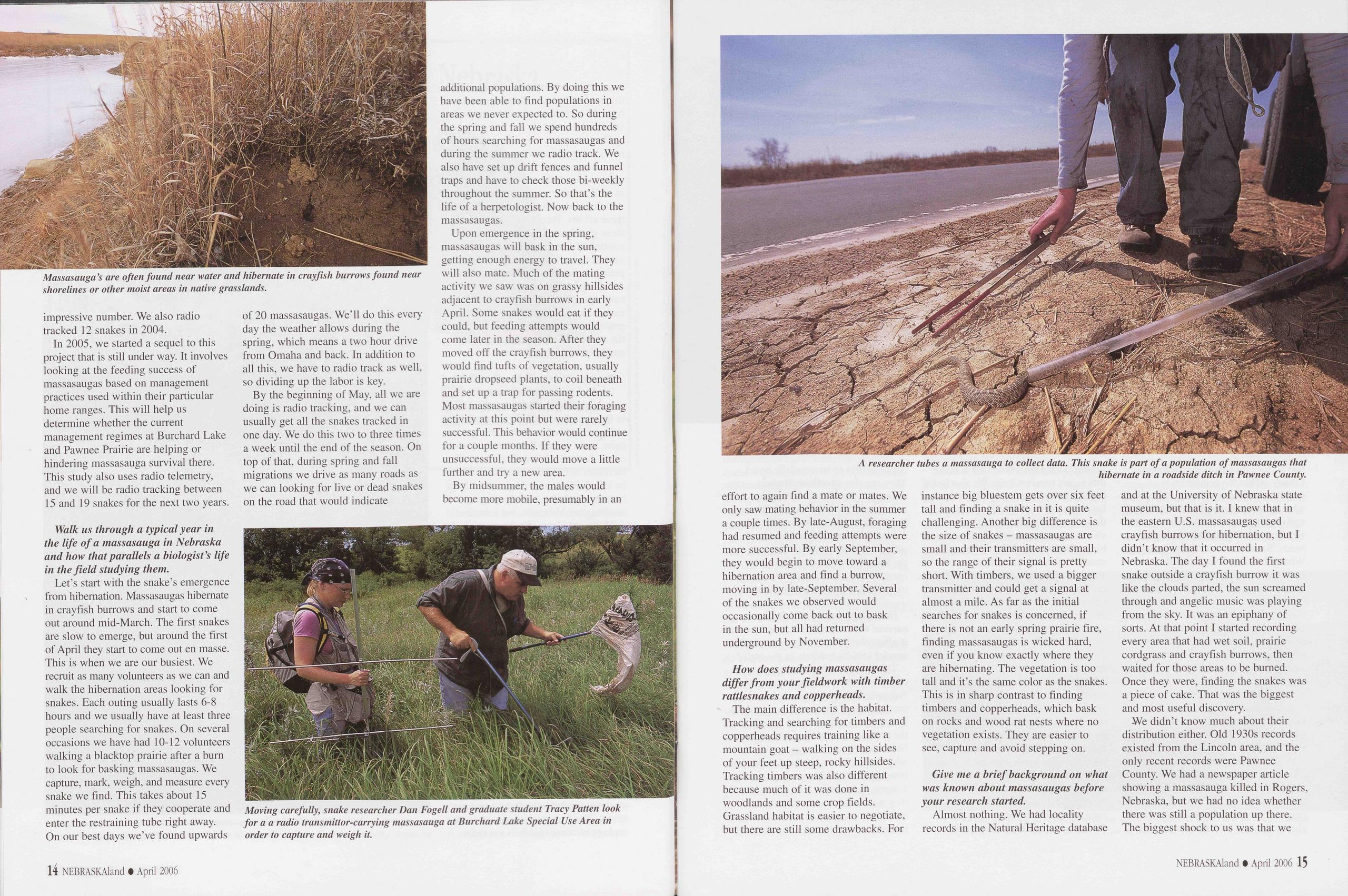
The best solution, of course, is to maintain large tracts of native or restored grasslands. The snakes don’t seem to care whether the grassland is native or Conservation Reserve Program land as long as it has the necessary habitat features - crayfish burrows in wet soil and a good small mammal population as a food base. We’ve even found them hibernating in roadside ditches just because they happen to have the right kind of soil to support crayfish burrows.
The Commission is now enrolling as many landowners as possible into LIP to conserve native tailgrass prairies in southeastern Nebraska. Massasaugas, as well as other species of concern, will definitely benefit as a result of these efforts. Proper management of these grasslands is important too. A rotation of fire, grazing or haying and a year or two off should ensure that the prairie maintains its prairie features. And if agricultural fields adjacent to native grasslands that support massasaugas are converted back to grass, there is a strong likelihood that the snake will eventually colonize the newly restored grassland too.
You mention roads as a threat. Why?We find more than 20 dead massasauga on roads every year, mostly in the spring and fall. These are just the ones we find before scavengers get too them, and I’m sure there are many more on roads we don’t travel on. As traffic increases in the area, more snakes will be killed. Right now there’s not a huge human population boom occurring in southeastern Nebraska, but I don’t think it is too far away. As properties start to come up for sale, the potential for suburban neighborhoods to spread out from Lincoln, Beatrice, Tecumseh and other towns will increase traffic on blacktop and gravel roads. I’m not sure anything can be done to stop that because the increasing human population seems to be the dominant threat for all threatened species.
In a nutshell, provide an overview of your massasauga rattlesnake project.The prequel to this project was to ascertain whether there were sizable populations of massasaugas in Pawnee County and other areas. Once we realized that there were, especially at the state-owned wildlife management areas (Burchard Lake, Pawnee Prairie, and Bowwood) we wanted to find out what was needed to keep the populations strong. The best way to learn about the ecology of these snakes is via radio telemetry - they are just too secretive to randomly bump into during a normal search. We needed to assess the overall health of the populations by looking at their demographic data - average size, number of encounters, distribution of sizes within the population, number of offspring and number of pregnant females in comparison to nonpregnant females.
So we launched a demographic and ecological study to assess the population’s health and devise a conservation strategy for massasaugas in Nebraska and we were very successful, recording 245 massasauga encounters from 2004-2005. Granted, some of them were recaptures of previously encountered snakes, and some were roadkills, but that is still a pretty
impressive number. We also radio tracked 12 snakes in 2004.
In 2005, we started a sequel to this project that is still under way. It involves looking at the feeding success of massasaugas based on management practices used within their particular home ranges. This will help us determine whether the current management regimes at Burchard Lake and Pawnee Prairie are helping or hindering massasauga survival there. This study also uses radio telemetry, and we will be radio tracking between 15 and 19 snakes for the next two years.
Walk us through a typical year in the life of a massasauga in Nebraska and how that parallels a biologists life in the field studying them.Let’s start with the snake’s emergence from hibernation. Massasaugas hibernate in crayfish burrows and start to come out around mid-March. The first snakes are slow to emerge, but around the first of April they start to come out en masse. This is when we are our busiest. We recruit as many volunteers as we can and walk the hibernation areas looking for snakes. Each outing usually lasts 6-8 hours and we usually have at least three people searching for snakes. On several occasions we have had 10-12 volunteers walking a blacktop prairie after a burn to look for basking massasaugas. We capture, mark, weigh, and measure every snake we find. This takes about 15 minutes per snake if they cooperate and enter the restraining tube right away. On our best days we’ve found upwards of 20 massasaugas. We’ll do this every day the weather allows during the spring, which means a two hour drive from Omaha and back. In addition to all this, we have to radio track as well, so dividing up the labor is key.
By the beginning of May, all we are doing is radio tracking, and we can usually get all the snakes tracked in one day. We do this two to three times a week until the end of the season. On top of that, during spring and fall migrations we drive as many roads as we can looking for live or dead snakes on the road that would indicate additional populations. By doing this we have been able to find populations in areas we never expected to. So during the spring and fall we spend hundreds of hours searching for massasaugas and during the summer we radio track. We also have set up drift fences and funnel traps and have to check those bi-weekly throughout the summer. So that’s the life of a herpetologist. Now back to the massasaugas.
Upon emergence in the spring, massasaugas will bask in the sun, getting enough energy to travel. They will also mate. Much of the mating activity we saw was on grassy hillsides adjacent to crayfish burrows in early April. Some snakes would eat if they could, but feeding attempts would come later in the season. After they moved off the crayfish burrows, they would find tufts of vegetation, usually prairie dropseed plants, to coil beneath and set up a trap for passing rodents. Most massasaugas started their foraging activity at this point but were rarely successful. This behavior would continue for a couple months. If they were unsuccessful, they would move a little further and try a new area.
By midsummer, the males would become more mobile, presumably in an effort to again find a mate or mates. We only saw mating behavior in the summer a couple times. By late-August, foraging had resumed and feeding attempts were more successful. By early September, they would begin to move toward a hibernation area and find a burrow, moving in by late-September. Several of the snakes we observed would occasionally come back out to bask in the sun, but all had returned underground by November.
The main difference is the habitat. Tracking and searching for timbers and copperheads requires training like a mountain goat - walking on the sides of your feet up steep, rocky hillsides. Tracking timbers was also different because much of it was done in woodlands and some crop fields. Grassland habitat is easier to negotiate, but there are still some drawbacks. For instance big bluestem gets over six feet tall and finding a snake in it is quite challenging. Another big difference is the size of snakes - massasaugas are small and their transmitters are small, so the range of their signal is pretty short. With timbers, we used a bigger transmitter and could get a signal at almost a mile. As far as the initial searches for snakes is concerned, if there is not an early spring prairie fire, finding massasaugas is wicked hard, even if you know exactly where they are hibernating. The vegetation is too tall and it’s the same color as the snakes. This is in sharp contrast to finding timbers and copperheads, which bask on rocks and wood rat nests where no vegetation exists. They are easier to see, capture and avoid stepping on.
Give me a brief background on what was known about massasaugas before your research started.Almost nothing. We had locality records in the Natural Heritage database and at the University of Nebraska state museum, but that is it. I knew that in the eastern U.S. massasaugas used crayfish burrows for hibernation, but I didn’t know that it occurred in Nebraska. The day I found the first snake outside a crayfish burrow it was like the clouds parted, the sun screamed through and angelic music was playing from the sky. It was an epiphany of sorts. At that point I started recording every area that had wet soil, prairie cordgrass and crayfish burrows, then waited for those areas to be burned. Once they were, finding the snakes was a piece of cake. That was the biggest and most useful discovery.
We didn’t know much about their distribution either. Old 1930s records existed from the Lincoln area, and the only recent records were Pawnee County. We had a newspaper article showing a massasauga killed in Rogers, Nebraska, but we had no idea whether there was still a population up there. The biggest shock to us was that we
14 NEBRASKAland • April 2006 NEBRASKAland • April 2006 15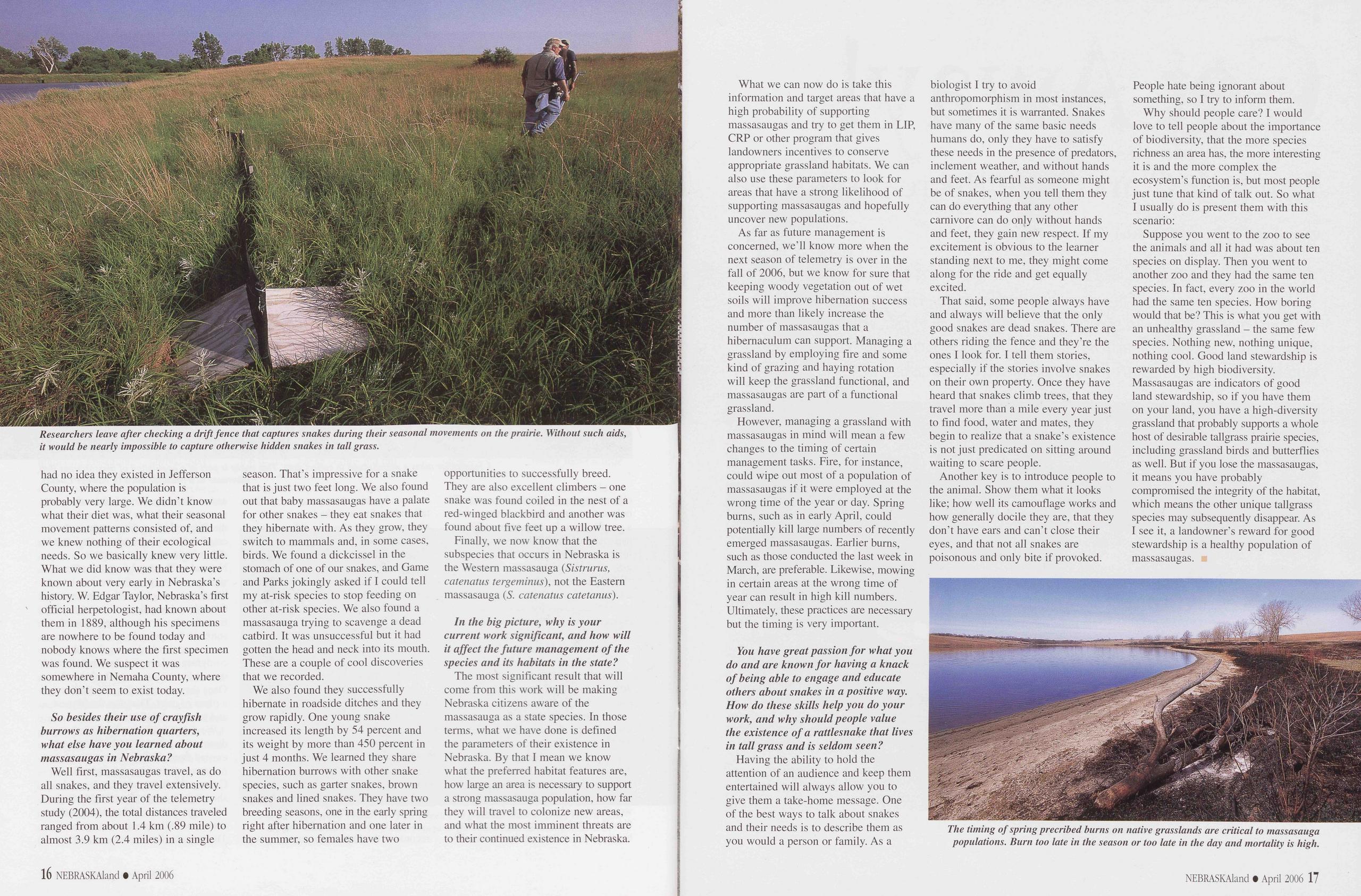
had no idea they existed in Jefferson County, where the population is probably very large. We didn’t know what their diet was, what their seasonal movement patterns consisted of, and we knew nothing of their ecological needs. So we basically knew very little. What we did know was that they were known about very early in Nebraska’s history. W. Edgar Taylor, Nebraska’s first official herpetologist, had known about them in 1889, although his specimens are nowhere to be found today and nobody knows where the first specimen was found. We suspect it was somewhere in Nemaha County, where they don’t seem to exist today.
So besides their use of crayfish burrows as hibernation quarters, what else have you learned about massasaugas in Nebraska?Well first, massasaugas travel, as do all snakes, and they travel extensively. During the first year of the telemetry study (2004), the total distances traveled ranged from about 1.4 km (.89 mile) to almost 3.9 km (2.4 miles) in a single season. That’s impressive for a snake that is just two feet long. We also found out that baby massasaugas have a palate for other snakes - they eat snakes that they hibernate with. As they grow, they switch to mammals and, in some cases, birds. We found a dickcissel in the stomach of one of our snakes, and Game and Parks jokingly asked if I could tell my at-risk species to stop feeding on other at-risk species. We also found a massasauga trying to scavenge a dead catbird. It was unsuccessful but it had gotten the head and neck into its mouth. These are a couple of cool discoveries that we recorded.
We also found they successfully hibernate in roadside ditches and they grow rapidly. One young snake increased its length by 54 percent and its weight by more than 450 percent in just 4 months. We learned they share hibernation burrows with other snake species, such as garter snakes, brown snakes and lined snakes. They have two breeding seasons, one in the early spring right after hibernation and one later in the summer, so females have two opportunities to successfully breed. They are also excellent climbers - one snake was found coiled in the nest of a red-winged blackbird and another was found about five feet up a willow tree.
Finally, we now know that the subspecies that occurs in Nebraska is the Western massasauga (Sistrurus, catenatus tergeminus), not the Eastern massasauga (S. catenatus catetanus).
In the big picture, why is your current work significant, and how will it affect the future management of the species and its habitats in the state?The most significant result that will come from this work will be making Nebraska citizens aware of the massasauga as a state species. In those terms, what we have done is defined the parameters of their existence in Nebraska. By that I mean we know what the preferred habitat features are, how large an area is necessary to support a strong massasauga population, how far they will travel to colonize new areas, and what the most imminent threats are to their continued existence in Nebraska.
What we can now do is take this information and target areas that have a high probability of supporting massasaugas and try to get them in LIP, CRP or other program that gives landowners incentives to conserve appropriate grassland habitats. We can also use these parameters to look for areas that have a strong likelihood of supporting massasaugas and hopefully uncover new populations.
As far as future management is concerned, we’ll know more when the next season of telemetry is over in the fall of 2006, but we know for sure that keeping woody vegetation out of wet soils will improve hibernation success and more than likely increase the number of massasaugas that a hibernaculum can support. Managing a grassland by employing fire and some kind of grazing and haying rotation will keep the grassland functional, and massasaugas are part of a functional grassland.
However, managing a grassland with massasaugas in mind will mean a few changes to the timing of certain management tasks. Fire, for instance, could wipe out most of a population of massasaugas if it were employed at the wrong time of the year or day. Spring burns, such as in early April, could potentially kill large numbers of recently emerged massasaugas. Earlier burns, such as those conducted the last week in March, are preferable. Likewise, mowing in certain areas at the wrong time of year can result in high kill numbers. Ultimately, these practices are necessary but the timing is very important.
You have great passion for what you do and are known for having a knack of being able to engage and educate others about snakes in a positive way. How do these skills help you do your work, and why should people value the existence of a rattlesnake that lives in tall grass and is seldom seen?Having the ability to hold the attention of an audience and keep them entertained will always allow you to give them a take-home message. One of the best ways to talk about snakes and their needs is to describe them as you would a person or family. As a biologist I try to avoid anthropomorphism in most instances, but sometimes it is warranted. Snakes have many of the same basic needs humans do, only they have to satisfy these needs in the presence of predators, inclement weather, and without hands and feet. As fearful as someone might be of snakes, when you tell them they can do everything that any other carnivore can do only without hands and feet, they gain new respect. If my excitement is obvious to the learner standing next to me, they might come along for the ride and get equally excited.
That said, some people always have and always will believe that the only good snakes are dead snakes. There are others riding the fence and they’re the ones I look for. I tell them stories, especially if the stories involve snakes on their own property. Once they have heard that snakes climb trees, that they travel more than a mile every year just to find food, water and mates, they begin to realize that a snake’s existence is not just predicated on sitting around waiting to scare people.
Another key is to introduce people to the animal. Show them what it looks like; how well its camouflage works and how generally docile they are, that they don’t have ears and can’t close their eyes, and that not all snakes are poisonous and only bite if provoked. People hate being ignorant about something, so I try to inform them.
Why should people care? I would love to tell people about the importance of biodiversity, that the more species richness an area has, the more interesting it is and the more complex the ecosystem’s function is, but most people just tune that kind of talk out. So what I usually do is present them with this scenario: Suppose you went to the zoo to see the animals and all it had was about ten species on display. Then you went to another zoo and they had the same ten species. In fact, every zoo in the world had the same ten species. How boring would that be? This is what you get with an unhealthy grassland - the same few species. Nothing new, nothing unique, nothing cool. Good land stewardship is rewarded by high biodiversity.
Massasaugas are indicators of good land stewardship, so if you have them on your land, you have a high-diversity grassland that probably supports a whole host of desirable tailgrass prairie species, including grassland birds and butterflies as well. But if you lose the massasaugas, it means you have probably compromised the integrity of the habitat, which means the other unique tallgrass species may subsequently disappear. As I see it, a landowner’s reward for good stewardship is a healthy population of massasaugas.
16 NEBRASKAland • April 2006 NEBRASKAland • April 2006 17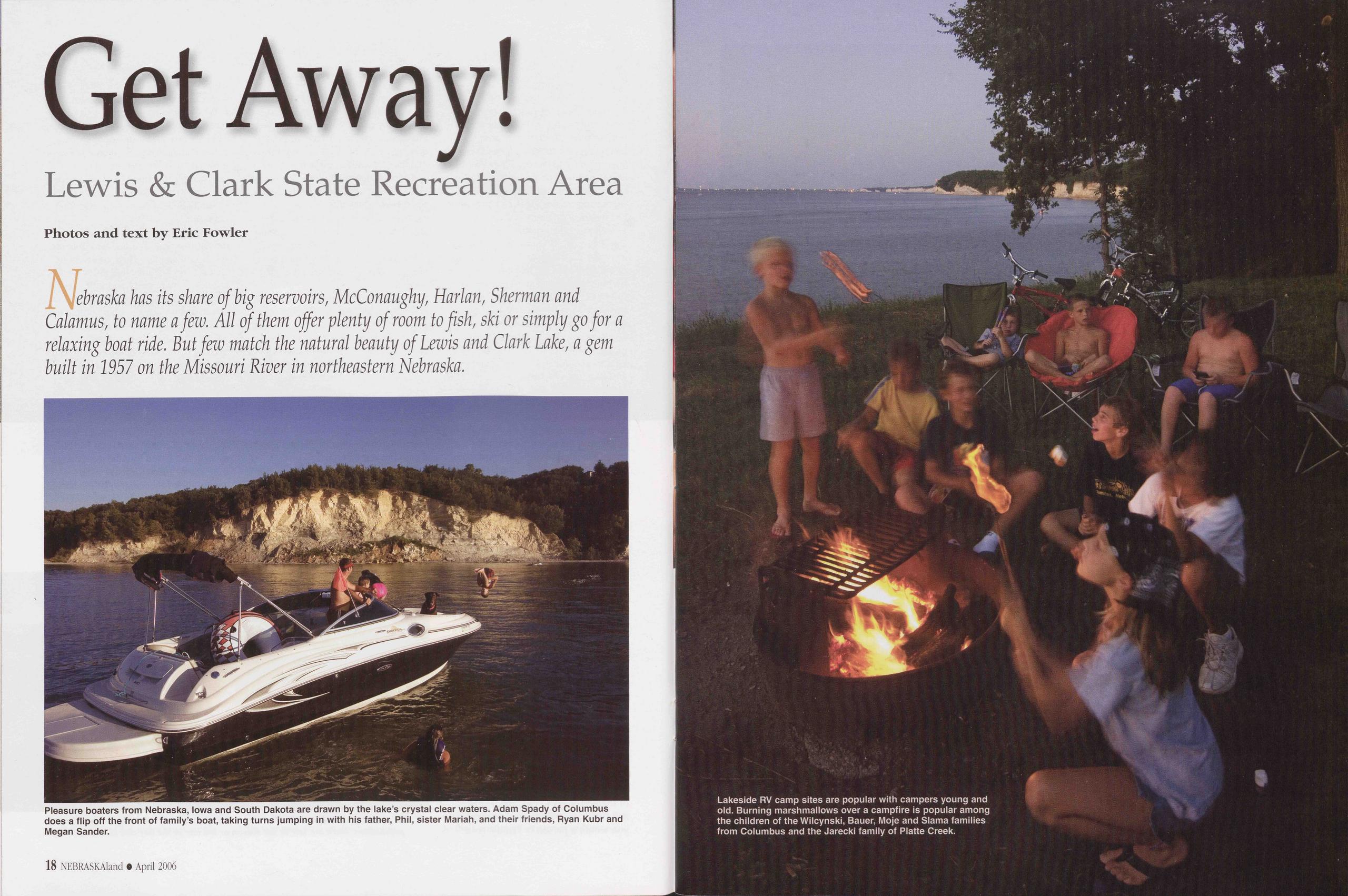
Nebraska has its share of big reservoirs, McConaughy, Harlan, Sherman and Calamus, to name a few. All of them offer plenty of room to fish, ski or simply go for a relaxing boat ride. But few match the natural beauty of Lewis and Clark Lake, a gem built in 1957 on the Missouri River in northeastern Nebraska.
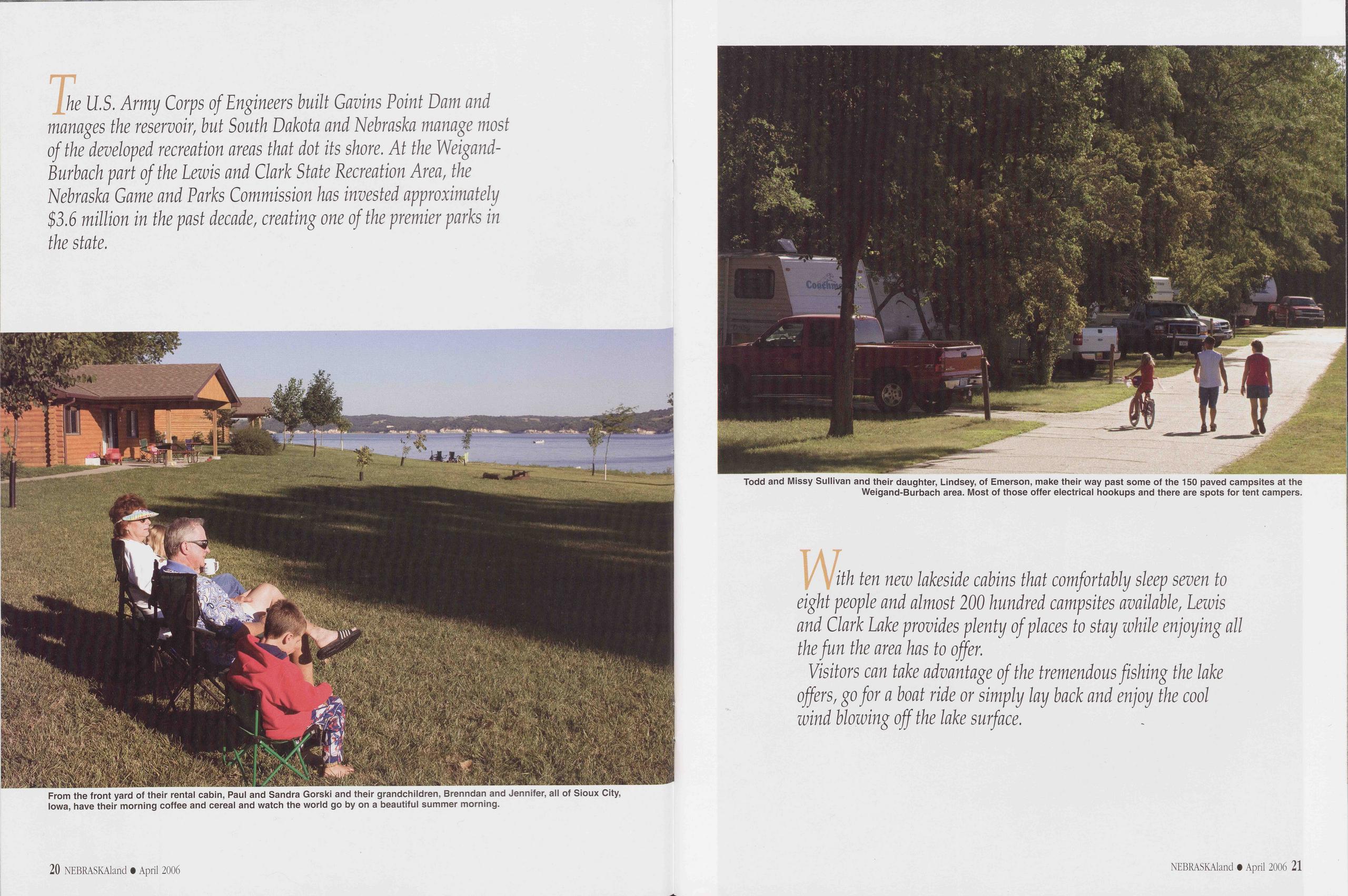
The U.S. Army Corps of Engineers built Gavins Point Dam and manages the reservoir, but South Dakota and Nebraska manage most of the developed recreation areas that dot its shore. At the Weigand- Burbach part of the Lewis and Clark State Recreation Area, the Nebraska Game and Parks Commission has invested approximately $3.6 million in the past decade, creating one of the premier parks in the state.
With ten new lakeside cabins that comfortably sleep seven to eight people and almost 200 hundred campsites available, Lewis and Clark Lake provides plenty of places to stay while enjoying all the fun the area has to offer.
Visitors can take advantage of the tremendous fishing the lake offers, go for a boat ride or simply lay back and enjoy the cool wind blowing off the lake surface.
20 NEBRASKAland • April 2006 NEBRASKAland • April 2006 21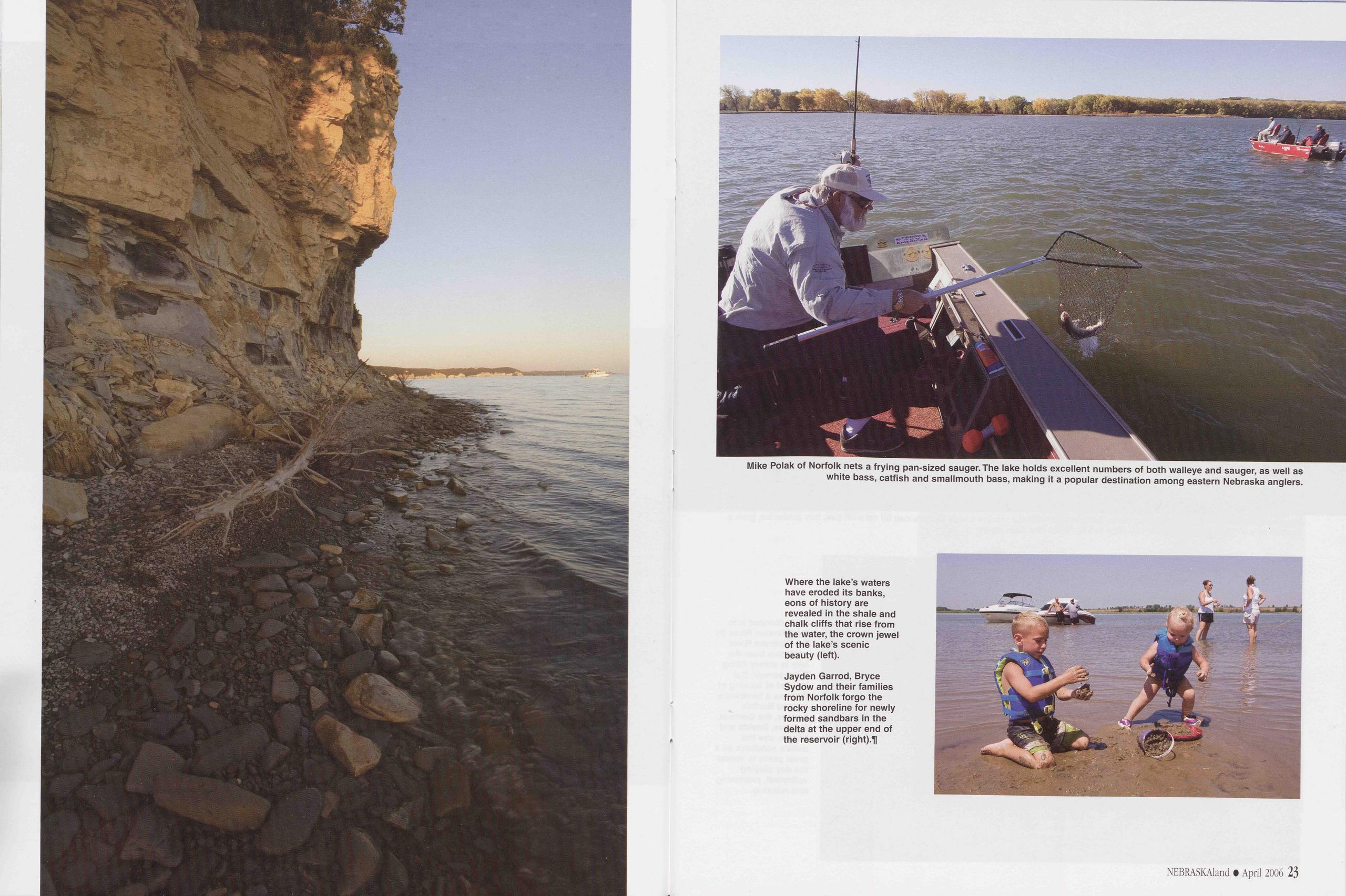
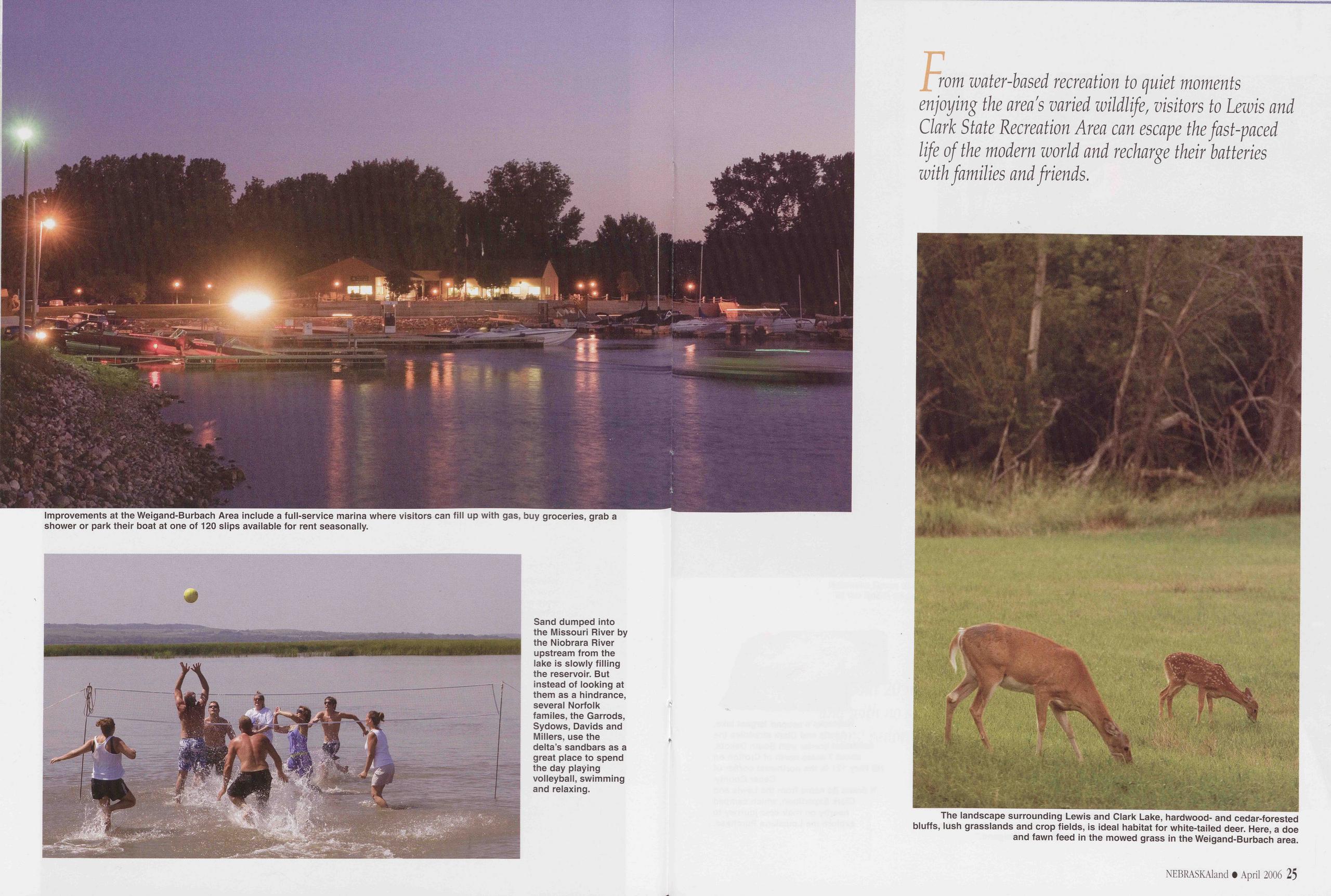
From water-based recreation to quiet moments enjoying the areas varied wildlife, visitors to Lewis and Clark State Recreation Area can escape the fast-paced life of the modern world and recharge their batteries with families and friends.
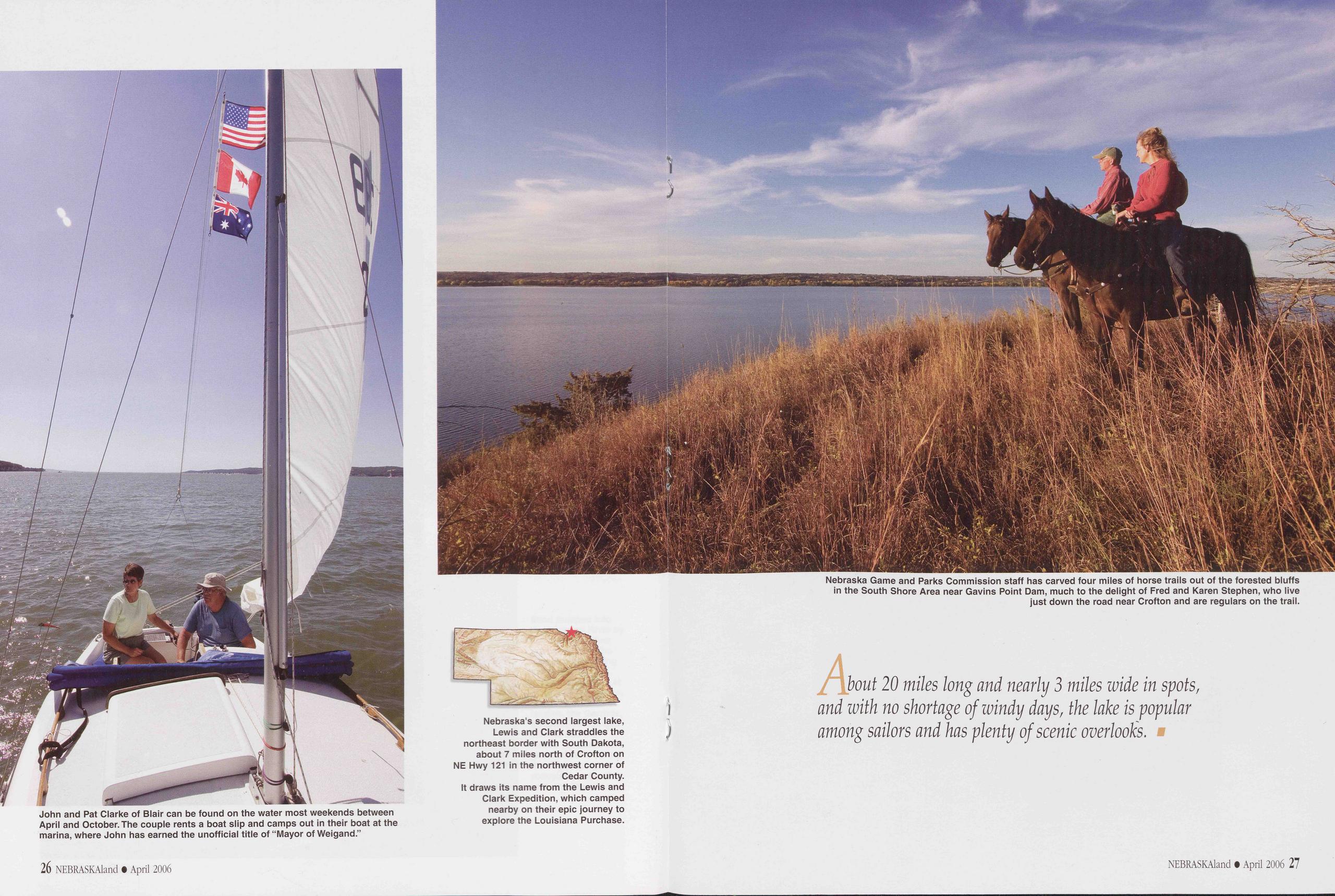
About 20 miles long and nearly 3 miles wide in spots, and with no shortage of windy days, the lake is popular among sailors and has plenty of scenic overlooks.
26 NEBRASKAland • April 2006 NEBRASKAland • April 2006 27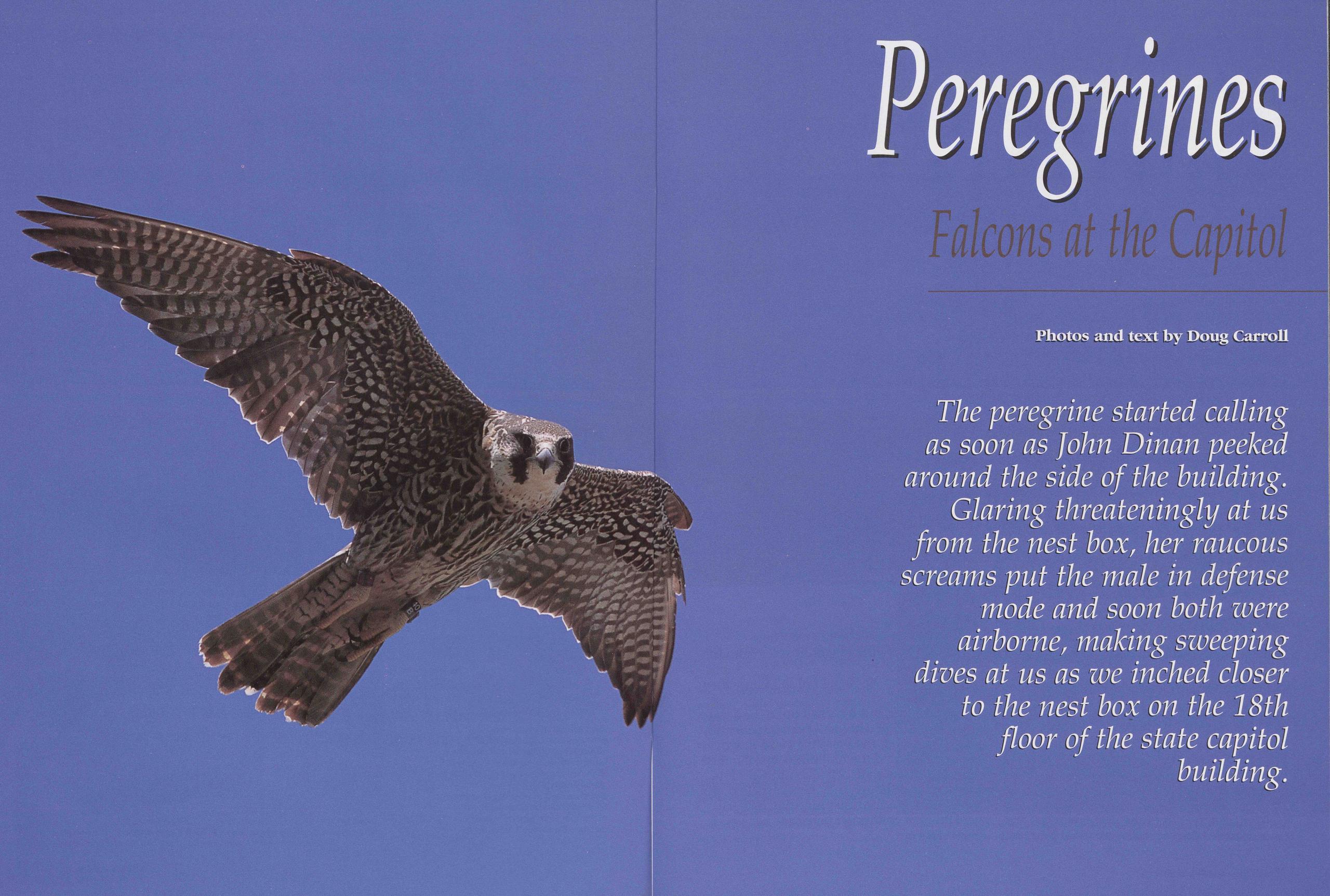
The peregrine started calling as soon as John Dinan peeked around the side of the building.
Glaring threateningly at us from the nest box, her raucous screams put the male in defense mode and soon both were airborne, making sweeping dives at us as we inched closer to the nest box on the 18th floor of the state capitol building.
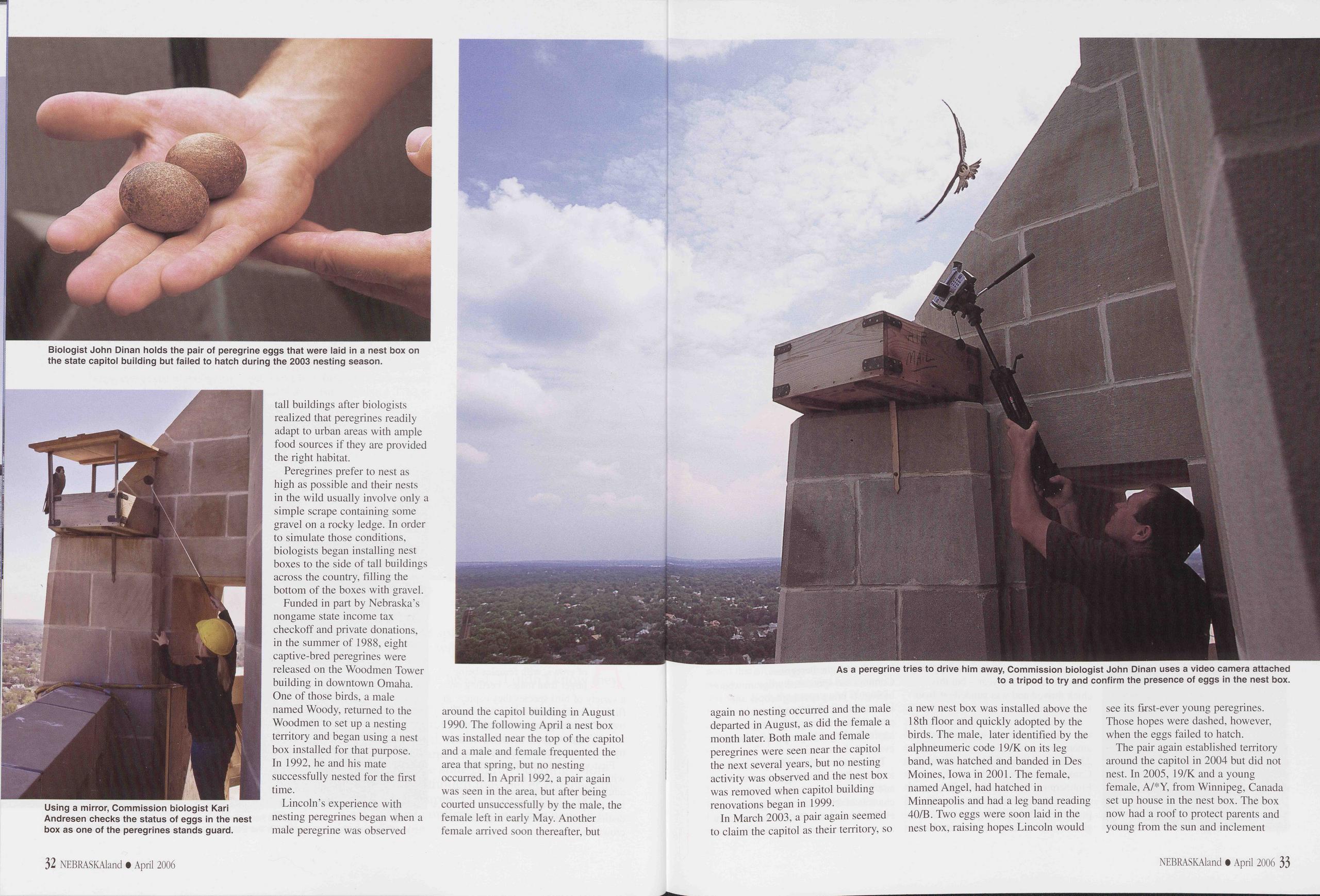
Dinan, a Commission biologist, wanted to see how many eggs had been laid. I wanted to get a picture of the eggs and perhaps the parents. The falcons wanted us out of their front yard, which looked like an uncleaned dinner table, strewn with wings and beaks of smaller birds they had preyed on.
Resembling miniature fighter planes, the peregrines dove at us at incredible speeds, veering off mere feet from our heads and then gracefully arcing upward to begin another run. Hunched close together, we were still ten feet from the nest box when the male scored a direct hit on a surprise bombing run. I felt a wet splat on my back and watched Dinan wipe peregrine feces from the side of his face.
"That's a first," he said. "I didn't know they would do that."I hadn't either, but it turned out to be a day of firsts - the first day I had been intentionally strafed by a bird, the first time I had heard a peregrine call and the first time I had climbed to the top of the state capitol building. More importantly, although they never hatched, the eggs I photographed that June day in 2003 were the first confirmed peregrine eggs ever laid in Lincoln.
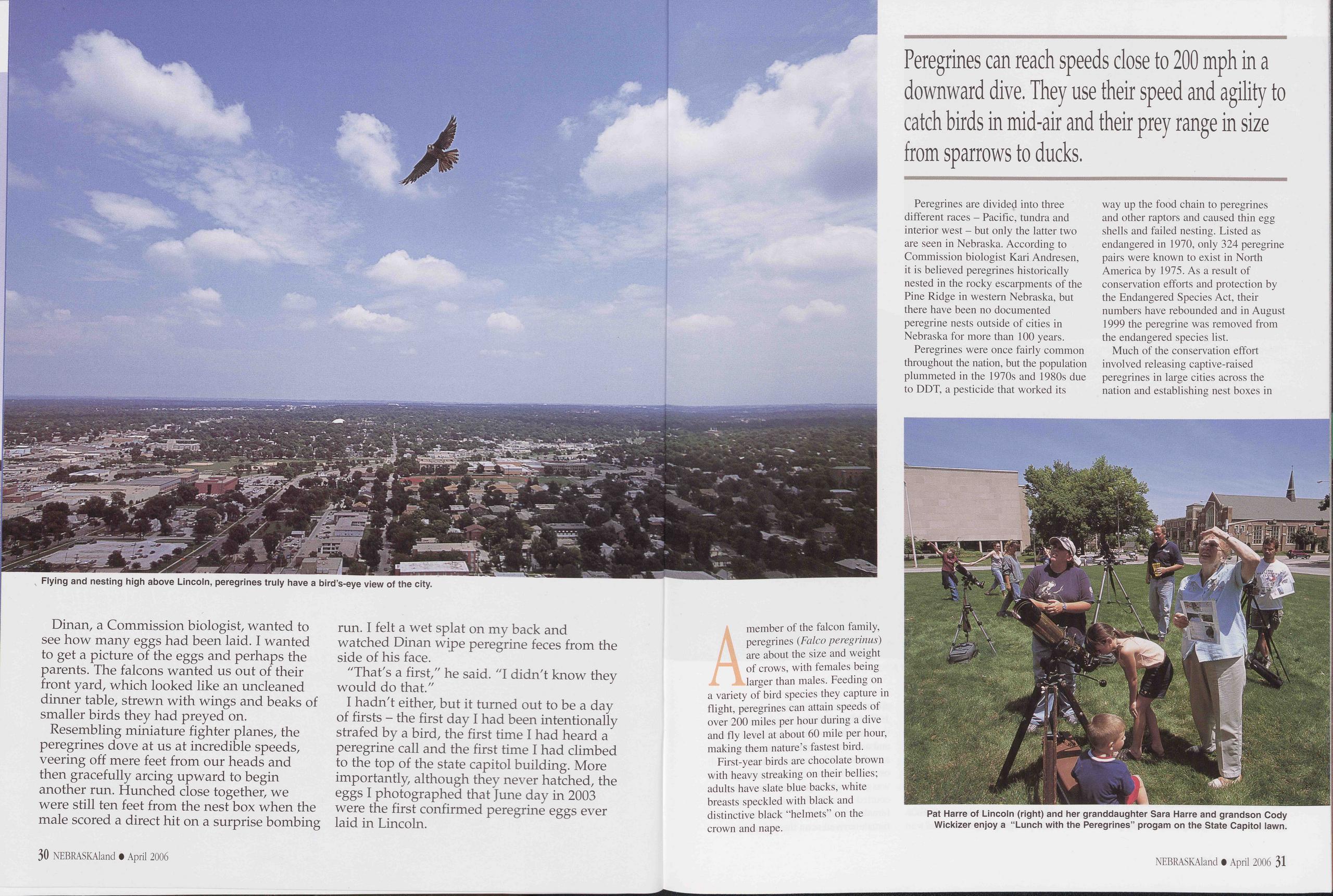
A member of the falcon family, peregrines {Falco peregrinus) are about the size and weight of crows, with females being larger than males. Feeding on a variety of bird species they capture in flight, peregrines can attain speeds of over 200 miles per hour during a dive and fly level at about 60 mile per hour, making them nature’s fastest bird.
First-year birds are chocolate brown with heavy streaking on their bellies; adults have slate blue backs, white breasts speckled with black and distinctive black “helmets” on the crown and nape.
Peregrines can reach speeds close to 200 mph in a downward dive. They use their speed and agility to catch birds in mid-air and their prey range in size from sparrows to ducks.Peregrines are divided into three different races - Pacific, tundra and interior west - but only the latter two are seen in Nebraska. According to Commission biologist Kari Andresen, it is believed peregrines historically nested in the rocky escarpments of the Pine Ridge in western Nebraska, but there have been no documented peregrine nests outside of cities in Nebraska for more than 100 years.
Peregrines were once fairly common throughout the nation, but the population plummeted in the 1970s and 1980s due to DDT, a pesticide that worked its Pat Harre of Lincoln (right) and her granddaughter Sara Harre and grandson Cody Wickizer enjoy a “Lunch with the Peregrines” progam on the State Capitol lawn. way up the food chain to peregrines and other raptors and caused thin egg shells and failed nesting. Listed as endangered in 1970, only 324 peregrine pairs were known to exist in North America by 1975. As a result of conservation efforts and protection by the Endangered Species Act, their numbers have rebounded and in August 1999 the peregrine was removed from the endangered species list.
Much of the conservation effort involved releasing captive-raised peregrines in large cities across the nation and establishing nest boxes in
tall buildings after biologists realized that peregrines readily adapt to urban areas with ample food sources if they are provided the right habitat.
Peregrines prefer to nest as high as possible and their nests in the wild usually involve only a simple scrape containing some gravel on a rocky ledge. In order to simulate those conditions, biologists began installing nest boxes to the side of tall buildings across the country, filling the bottom of the boxes with gravel.
Funded in part by Nebraska’s nongame state income tax checkoff and private donations, in the summer of 1988, eight captive-bred peregrines were released on the Woodmen Tower building in downtown Omaha. One of those birds, a male named Woody, returned to the Woodmen to set up a nesting territory and began using a nest box installed for that purpose. In 1992, he and his mate successfully nested for the first time.
Lincoln’s experience with nesting peregrines began when a male peregrine was observed around the capitol building in August 1990. The following April a nest box was installed near the top of the capitol and a male and female frequented the area that spring, but no nesting occurred. In April 1992, a pair again was seen in the area. but after being courted unsuccessfully by the male, the female left in early May. Another female arrived soon thereafter, but As a peregrine tries to drive him away, Commission biologist John Dinan uses a video camera attached to a tripod to try and confirm the presence of eggs in the nest box. again no nesting occurred and the male departed in August, as did the female a month later. Both male and female peregrines were seen near the capitol the next several years, but no nesting activity was observed and the nest box was removed when capitol building renovations began in 1999.
In March 2003, a pair again seemed to claim the capitol as their territory, so a new nest box was installed above the 18th floor and quickly adopted by the birds. The male, later identified by the alphneumeric code 19/K on its leg band, was hatched and banded in Des Moines, Iowa in 2001. The female, named Angel, had hatched in Minneapolis and had a leg band reading 40/B. Two eggs were soon laid in the nest box, raising hopes Lincoln would see its first-ever young peregrines. Those hopes were dashed, however, when the eggs failed to hatch.
The pair again established territory around the capitol in 2004 but did not nest. In 2005, 19/K and a young female, A/*Y, from Winnipeg, Canada set up house in the nest box. The box now had a roof to protect parents and young from the sun and inclement
32 NEBRASKAland • April 2006 NEBRASKAland 9 April 2006 33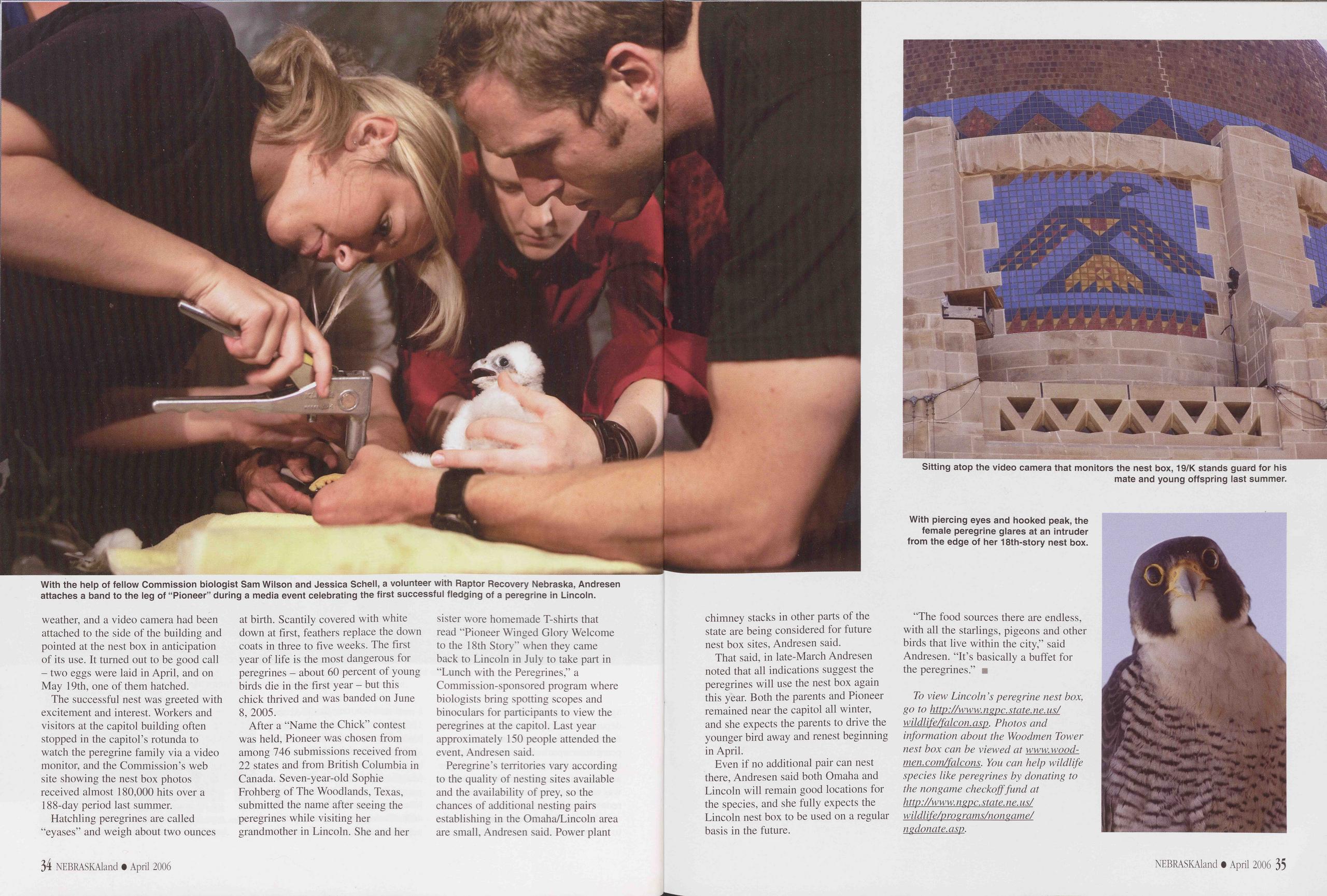
weather, and a video camera had been attached to the side of the building and pointed at the nest box in anticipation of its use. It turned out to be good call - two eggs were laid in April, and on May 19th, one of them hatched.
The successful nest was greeted with excitement and interest. Workers and visitors at the capitol building often stopped in the capitol's rotunda to watch the peregrine family via a video monitor, and the Commission’s web site showing the nest box photos received almost 180,000 hits over a 188-day period last summer.
Hatchling peregrines are called “eyases” and weigh about two ounces at birth. Scantily covered with white down at first, feathers replace the down coats in three to five weeks. The first year of life is the most dangerous for peregrines - about 60 percent of young birds die in the first year - but this chick thrived and was banded on June 8, 2005.
After a “Name the Chick” contest was held, Pioneer was chosen from among 746 submissions received from 22 states and from British Columbia in Canada. Seven-year-old Sophie Frohberg of The Woodlands, Texas, submitted the name after seeing the peregrines while visiting her grandmother in Lincoln. She and her sister wore homemade T-shirts that read “Pioneer Winged Glory Welcome to the 18th Story” when they came back to Lincoln in July to take part in “Lunch with the Peregrines,” a Commission-sponsored program where biologists bring spotting scopes and binoculars for participants to view the peregrines at the capitol. Last year approximately 150 people attended the event, Andresen said.
Peregrine’s territories vary according to the quality of nesting sites available and the availability of prey, so the chances of additional nesting pairs establishing in the Omaha/Lincoln area are small, Andresen said. Power plant chimney stacks in other parts of the state are being considered for future nest box sites, Andresen said.
That said, in late-March Andresen noted that all indications suggest the peregrines will use the nest box again this year. Both the parents and Pioneer remained near the capitol all winter, and she expects the parents to drive the younger bird away and renest beginning in April.
Even if no additional pair can nest there, Andresen said both Omaha and Lincoln will remain good locations for the species, and she fully expects the Lincoln nest box to be used on a regular basis in the future.
“The food sources there are endless, with all the starlings, pigeons and other birds that live within the city,” said Andresen. “It’s basically a buffet for the peregrines.”
To view Lincoln’s peregrine nest box, go to http://www. ngpc. state, ne. us/ wildlife/falcon.asp. Photos and information about the Woodmen Tower nest box can be viewed at www. wood- men. com/falcons. You can help wildlife species like peregrines by donating to the nongame checkoff fund at http: //www. ngpc. state, ne. us/ wildlife/programs/nongame/ ngdonate.asp.
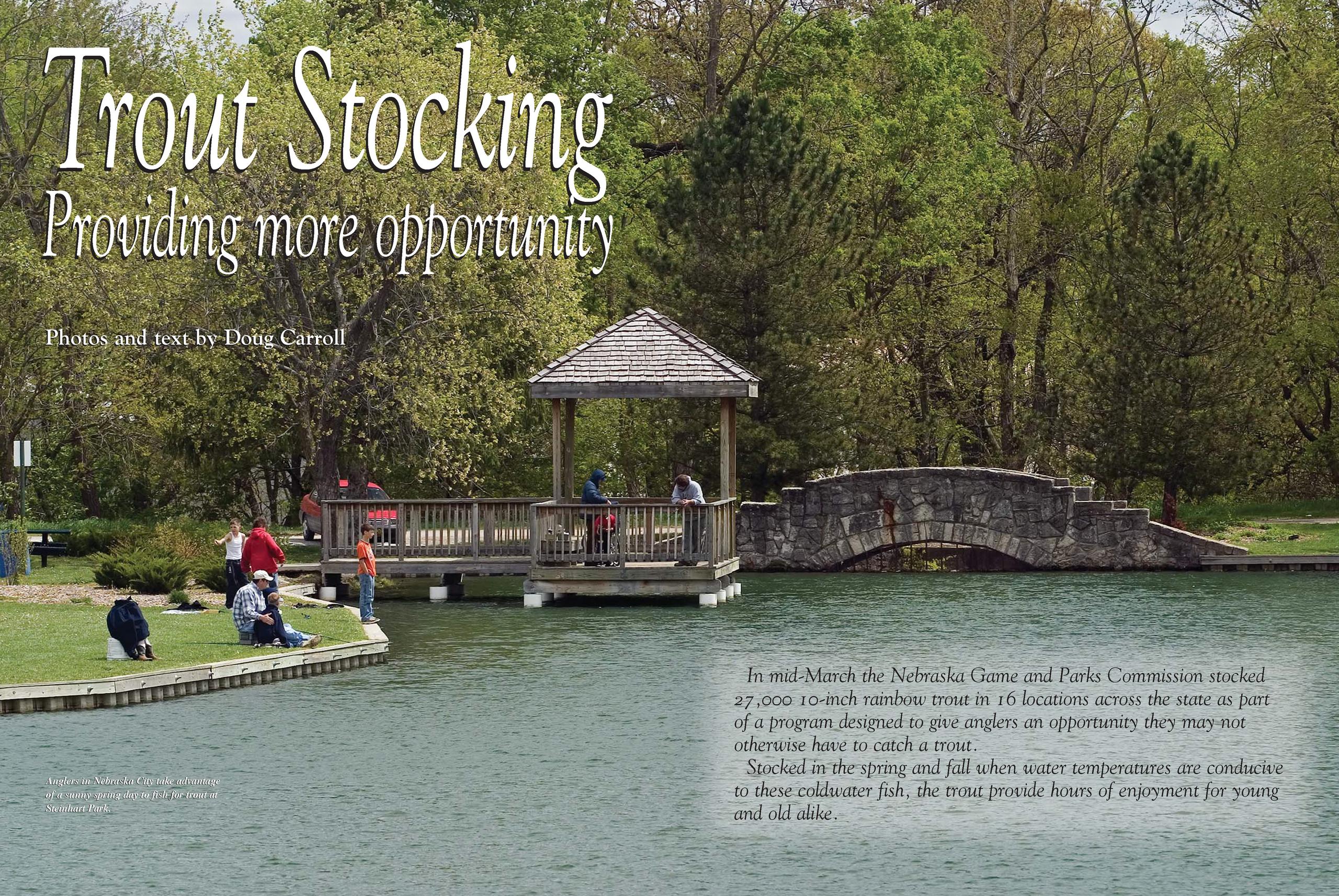
Trout Stocking
Providing more opportunity
In mid'March the Nebraska Game and Parks Commission stocked 27,000 lodnch rainbow trout in 16 locations across the state as part of a program designed to give anglers an opportunity they may not otherwise have to catch a trout.
Stocked in the spring and fall when water temperatures are conducive to these coldwater fish, the trout provide hours of enjoyment for young and old alike.
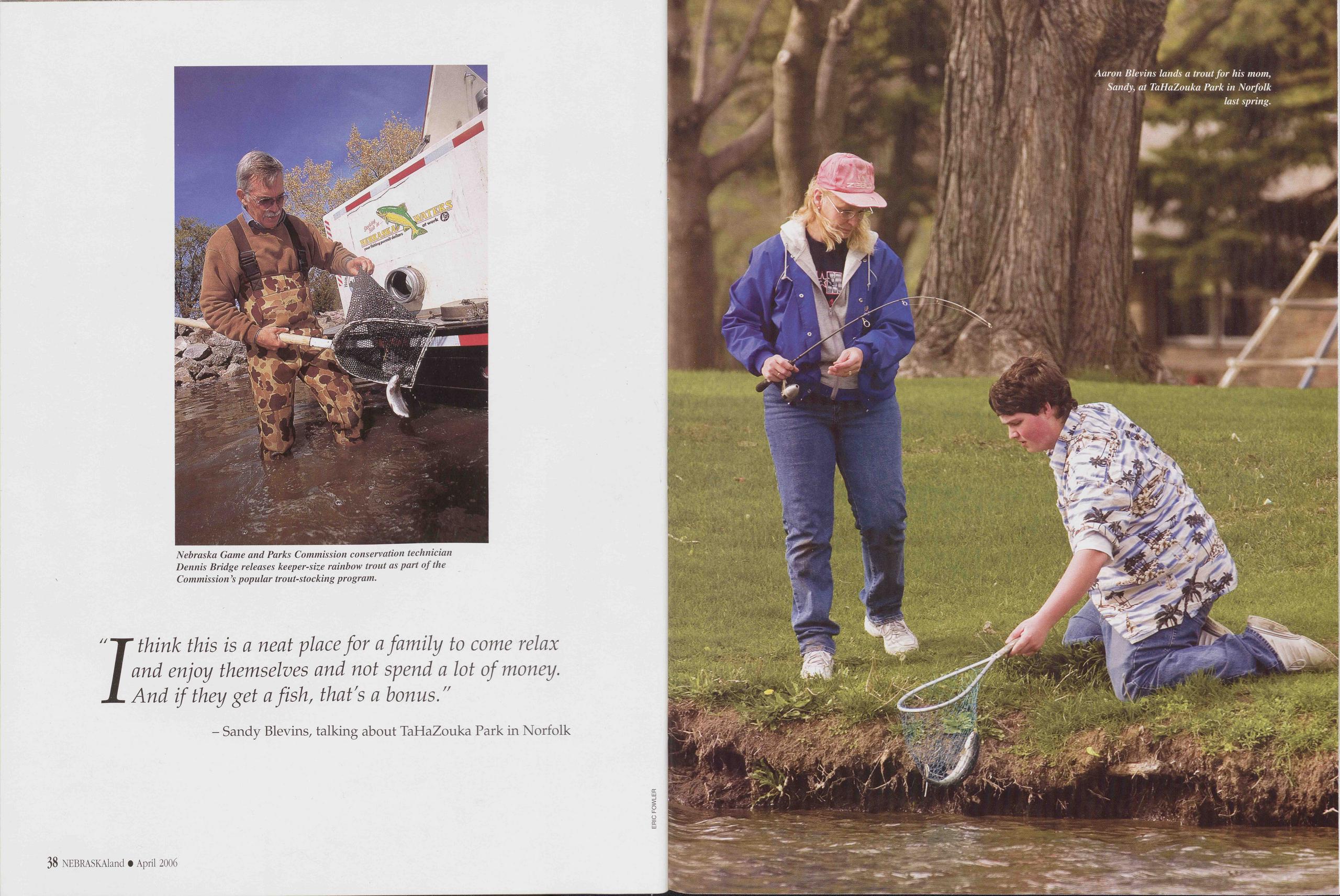
"I think this is a neat place for a family to come relax f and enjoy themselves and not spend a lot of money. And if they get a fish, that's a bonus." - Sandy Blevins, talking about TaHaZouka Park in Norfolk
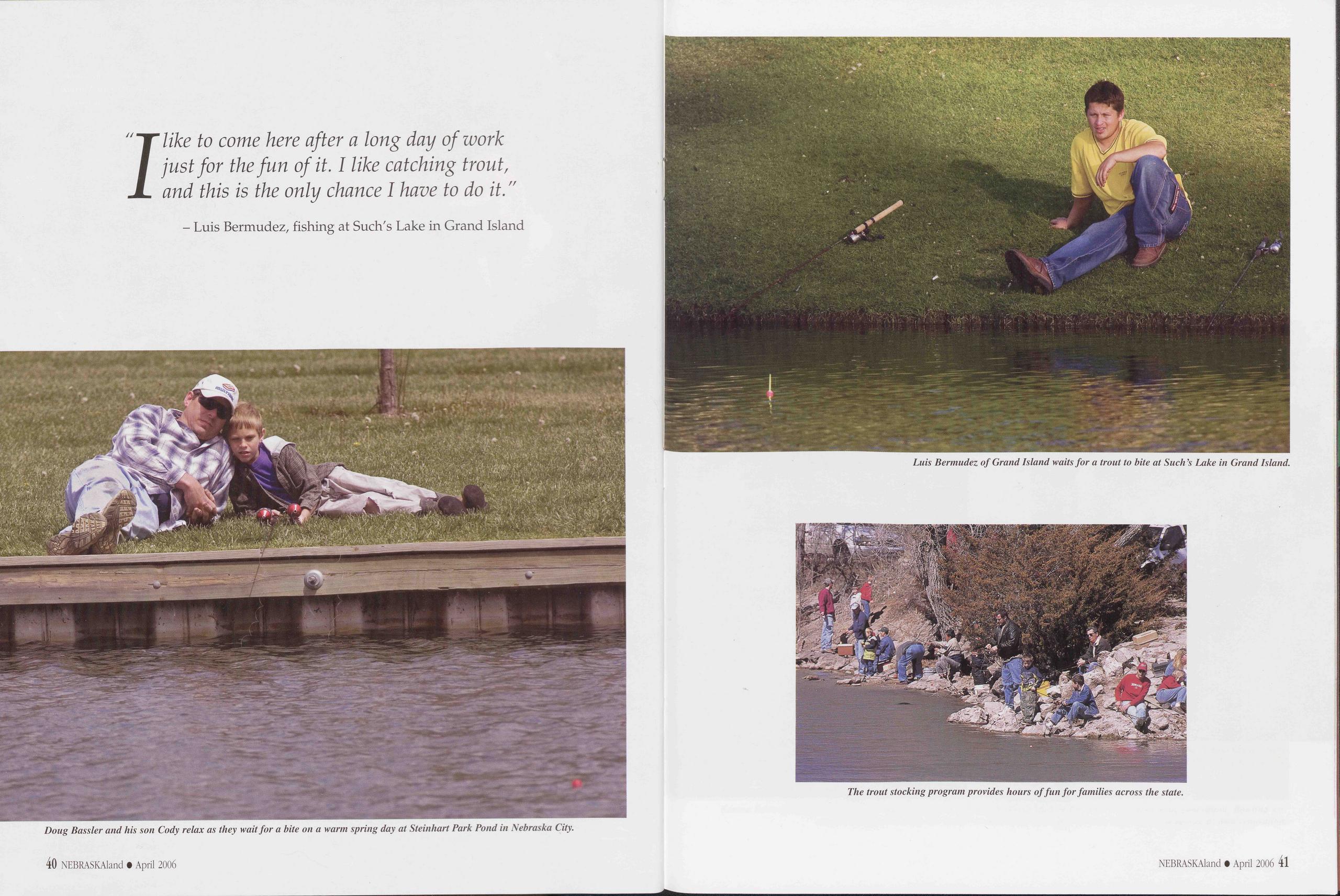
I like to come here after a long day of work just for the fun of it. I like catching trout, and this is the only chance I have to do it." - Luis Bermudez, fishing at Such's Lake in Grand Island
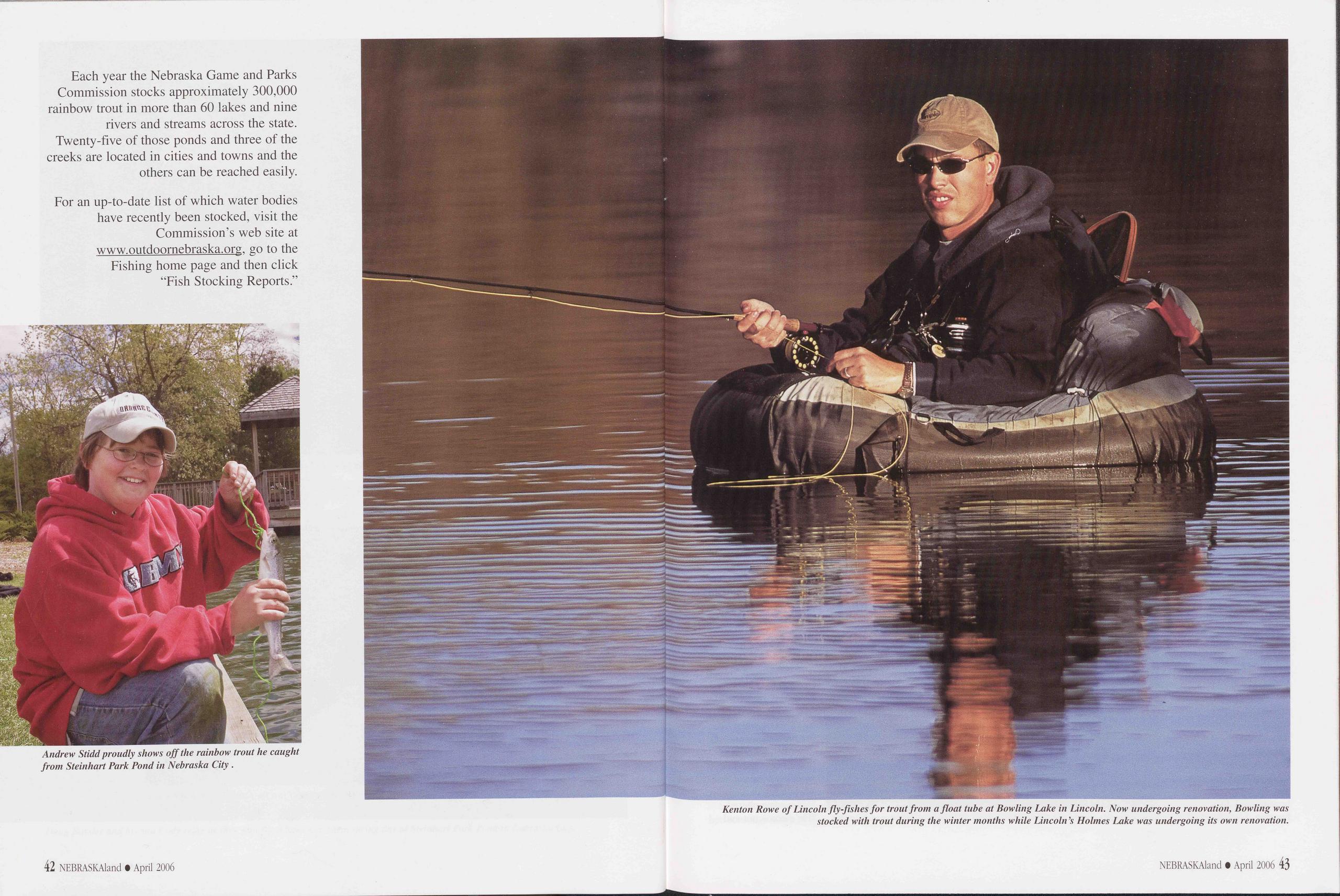
Each year the Nebraska Game and Parks Commission stocks approximately 300,000 rainbow trout in more than 60 lakes and nine rivers and streams across the state. Twenty-five of those ponds and three of the creeks are located in cities and towns and the others can be reached easily.
For an up-to-date list of which water bodies have recently been stocked, visit the Commission’s web site at www.outdoornebraska.org. go to the Fishing home page and then click “Fish Stocking Reports.”
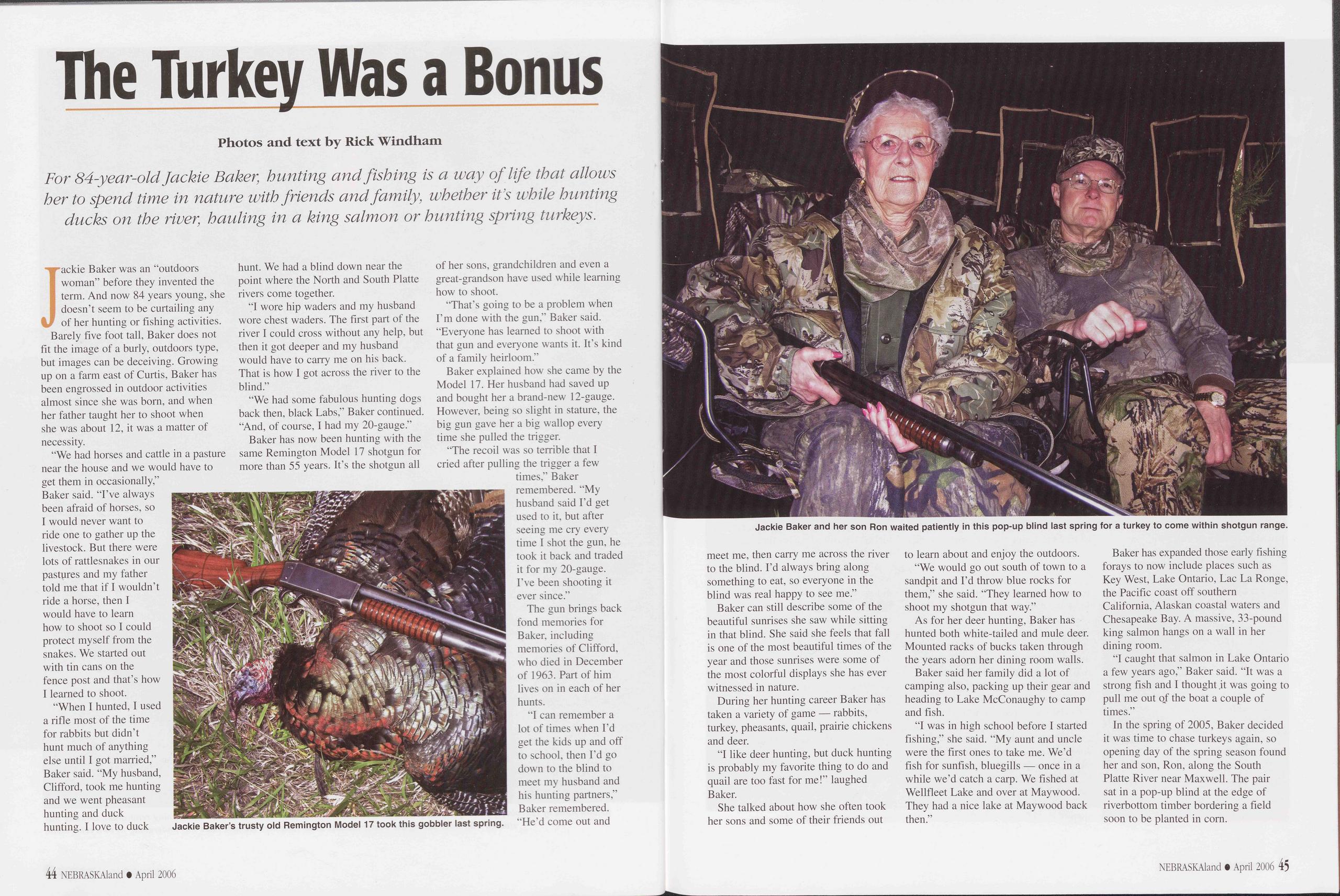
The Turkey Was a Bonus
For 84-year-old Jackie Baker, bunting and fishing is a way of life that allows her to spend time in nature with friends and family, whether it’s while hunting ducks on the river, hauling in a king salmon or hunting spring turkeys.Jackie Baker was an “outdoors woman” before they invented the term. And now 84 years young, she doesn’t seem to be curtailing any of her hunting or fishing activities. Barely five foot tall, Baker does not fit the image of a burly, outdoors type, but images can be deceiving. Growing up on a farm east of Curtis, Baker has been engrossed in outdoor activities almost since she was born, and when her father taught her to shoot when she was about 12, it was a matter of necessity.
“We had horses and cattle in a pasture near the house and we would have to get them in occasionally,” Baker said. “I’ve always been afraid of horses, so I would never want to ride one to gather up the livestock. But there were lots of rattlesnakes in our pastures and my father told me that if I wouldn’t ride a horse, then I would have to learn how to shoot so I could protect myself from the snakes. We started out with tin cans on the fence post and that’s how I learned to shoot.
“When I hunted, I used a rifle most of the time for rabbits but didn’t hunt much of anything else until I got married,” Baker said. “My husband, Clifford, took me hunting and we went pheasant hunting and duck hunting. I love to duck hunt. We had a blind down near the point where the North and South Platte rivers come together.
“I wore hip waders and my husband wore chest waders. The first part of the river I could cross without any help, but then it got deeper and my husband would have to carry me on his back. That is how I got across the river to the blind.”
“We had some fabulous hunting dogs back then, black Labs,” Baker continued. “And, of course, I had my 20-gauge.” Baker has now been hunting with the same Remington Model 17 shotgun for more than 55 years. It’s the shotgun all
of her sons, grandchildren and even a great-grandson have used while learning how to shoot.
“That’s going to be a problem when I’m done with the gun,” Baker said. “Everyone has learned to shoot with that gun and everyone wants it. It’s kind of a family heirloom.”
Baker explained how she came by the Model 17. Her husband had saved up and bought her a brand-new 12-gauge. However, being so slight in stature, the big gun gave her a big wallop every time she pulled the trigger.
“The recoil was so terrible that I cried after pulling the trigger a few times,” Baker remembered. “My husband said I’d get used to it, but after seeing me cry every time I shot the gun, he took it back and traded it for my 20-gauge. I’ve been shooting it ever since.”
The gun brings back fond memories for Baker, including memories of Clifford, who died in December of 1963. Part of him lives on in each of her hunts.
“I can remember a lot of times when I’d get the kids up and off to school, then I’d go down to the blind to meet my husband and his hunting partners,” Baker remembered. “He’d come out and
meet me, then carry me across the river to the blind. I’d always bring along something to eat, so everyone in the blind was real happy to see me.” Baker can still describe some of the beautiful sunrises she saw while sitting in that blind. She said she feels that fall is one of the most beautiful times of the year and those sunrises were some of the most colorful displays she has ever witnessed in nature.
During her hunting career Baker has taken a variety of game — rabbits, turkey, pheasants, quail, prairie chickens and deer.
“I like deer hunting, but duck hunting is probably my favorite thing to do and quail are too fast for me!” laughed Baker.
She talked about how she often took her sons and some of their friends out to learn about and enjoy the outdoors.
“We would go out south of town to a sandpit and I’d throw blue rocks for them, ” she said. “They learned how to shoot my shotgun that way.”
As for her deer hunting, Baker has hunted both white-tailed and mule deer. Mounted racks of bucks taken through the years adorn her dining room walls. Baker said her family did a lot of camping also, packing up their gear and heading to Lake McConaughy to camp and fish.
“I was in high school before I started fishing,” she said. “My aunt and uncle were the first ones to take me. We’d fish for sunfish, bluegills — once in a while we’d catch a carp. We fished at Wellfleet Lake and over at Maywood. They had a nice lake at May wood back then. ”
Baker has expanded those early fishing forays to now include places such as Key West, Lake Ontario, Lac La Ronge, the Pacific coast off southern California, Alaskan coastal waters and Chesapeake Bay. A massive, 33-pound king salmon hangs on a wall in her dining room.
“I caught that salmon in Lake Ontario a few years ago,” Baker said. “It was a strong fish and I thought it was going to pull me out of the boat a couple of times.”
In the spring of 2005, Baker decided it was time to chase turkeys again, so opening day of the spring season found her and son, Ron, along the South Platte River near Maxwell. The pair sat in a pop-up blind at the edge of riverbottom timber bordering a field soon to be planted in corn.
44 NEBRASKAland • April 2006 NEBRASKAland • April 2006 45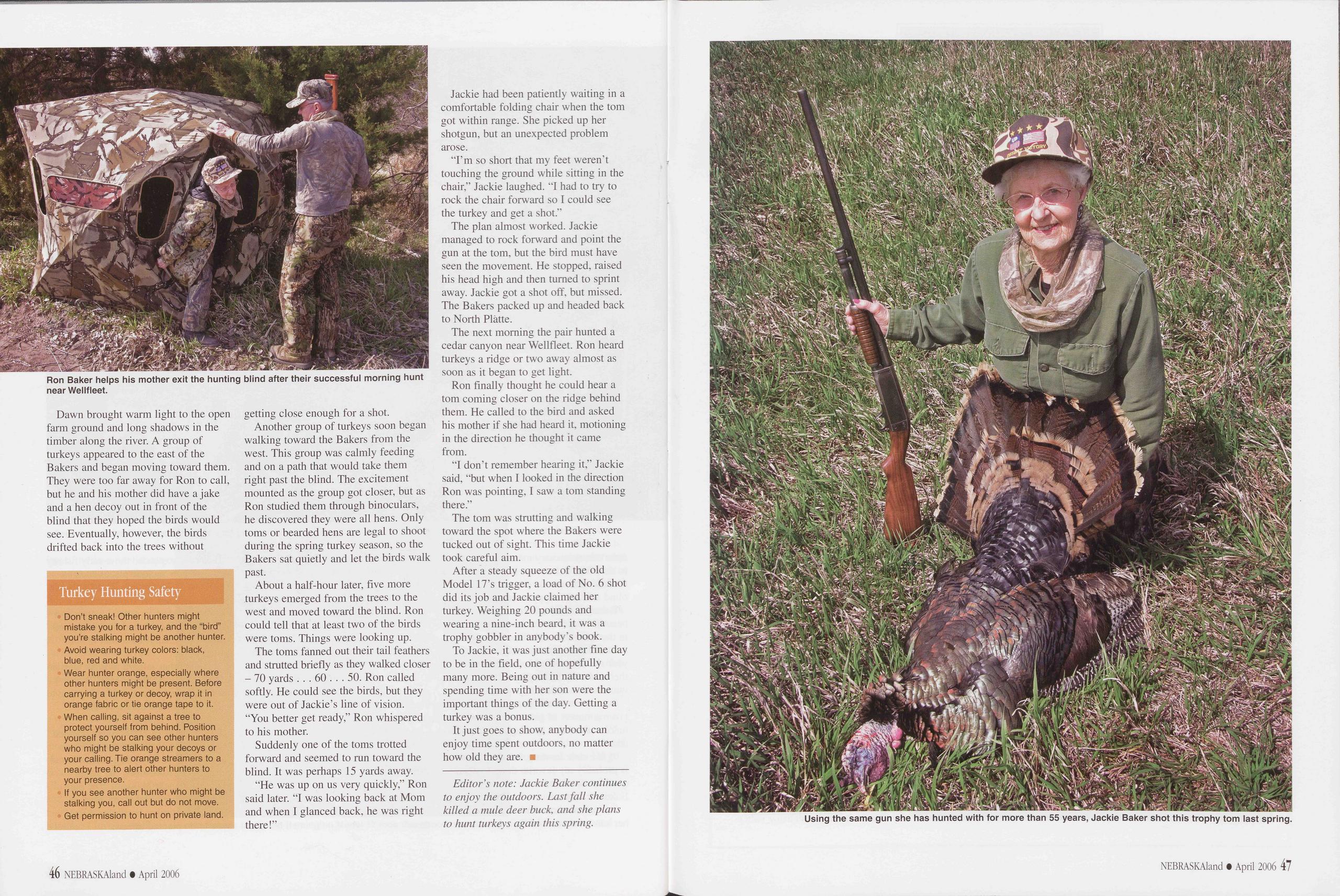
Dawn brought warm light to the open farm ground and long shadows in the timber along the river. A group of turkeys appeared to the east of the Bakers and began moving toward them. They were too far away for Ron to call, but he and his mother did have a jake and a hen decoy out in front of the blind that they hoped the birds would see. Eventually, however, the birds drifted back into the trees without
Turkey Hunting SafetyDon’t sneak! Other hunters might mistake you for a turkey, and the “bird” you’re stalking might be another hunter.
Avoid wearing turkey colors: black, blue, red and white.
Wear hunter orange, especially where other hunters might be present. Before carrying a turkey or decoy, wrap it in orange fabric or tie orange tape to it.
When calling, sit against a tree to protect yourself from behind. Position yourself so you can see other hunters who might be stalking your decoys or your calling. Tie orange streamers to a nearby tree to alert other hunters to your presence.
If you see another hunter who might be stalking you, call out but do not move.
Get permission to hunt on private land.
getting close enough for a shot.
Another group of turkeys soon began walking toward the Bakers from the west. This group was calmly feeding and on a path that would take them right past the blind. The excitement mounted as the group got closer, but as Ron studied them through binoculars, he discovered they were all hens. Only toms or bearded hens are legal to shoot during the spring turkey season, so the Bakers sat quietly and let the birds walk past.
About a half-hour later, five more turkeys emerged from the trees to the west and moved toward the blind. Ron could tell that at least two of the birds were toms. Things were looking up. The toms fanned out their tail feathers and strutted briefly as they walked closer - 70 yards ... 60 ... 50. Ron called softly. He could see the birds, but they were out of Jackie’s line of vision. “You better get ready,” Ron whispered to his mother.
Suddenly one of the toms trotted forward and seemed to run toward the blind. It was perhaps 15 yards away. “He was up on us very quickly,” Ron said later. “I was looking back at Mom and when I glanced back, he was right there!”
Jackie had been patiently waiting in a comfortable folding chair when the tom got within range. She picked up her shotgun, but an unexpected problem arose.
“I’m so short that my feet weren’t touching the ground while sitting in the chair,” Jackie laughed. “I had to try to rock the chair forward so I could see the turkey and get a shot.”
The plan almost worked. Jackie managed to rock forward and point the gun at the tom, but the bird must have seen the movement. He stopped, raised his head high and then turned to sprint away. Jackie got a shot off, but missed. The Bakers packed up and headed back to North Platte.
The next morning the pair hunted a cedar canyon near Wellfleet. Ron heard turkeys a ridge or two away almost as soon as it began to get light. Ron finally thought he could hear a tom coming closer on the ridge behind them. He called to the bird and asked his mother if she had heard it, motioning in the direction he thought it came from.
“I don’t remember hearing it,” Jackie said, “but when I looked in the direction Ron was pointing, I saw a tom standing there.”
The tom was strutting and walking toward the spot where the Bakers were tucked out of sight. This time Jackie took careful aim.
After a steady squeeze of the old Model 17’s trigger, a load of No. 6 shot did its job and Jackie claimed her turkey. Weighing 20 pounds and wearing a nine-inch beard, it was a trophy gobbler in anybody’s book.
To Jackie, it was just another fine day to be in the field, one of hopefully many more. Being out in nature and spending time with her son were the important things of the day. Getting a turkey was a bonus.
It just goes to show, anybody can enjoy time spent outdoors, no matter how old they are. ■
Editor's note: Jackie Baker continues to enjoy the outdoors. Last fall she killed a mule deer buck, and she plans to hunt turkeys again this spring.
Classifieds
DOGS
PLUM CREEK KENNEL. German Shorthairs, stud service, puppies and started dogs. Training for all pointing breeds. Specialize in training the handler as well as the dog. Wayne Clark, Percival, Iowa 51648 (close to Omaha) (712) 529-4238, email wclark@heartland.net.
YELLOW-BLACK LAB PUPS. Breeders hips O.F.A. and eyes CERF. Excellent bloodlines and hunting potential. Call Dave Bendler (308) 785-2554 in Lexington or Scott Bendler (402) 477-1305, Lincoln.
WILDERNESS KENNELS. Gun dog training - over 60 years combined experience. Training all sporting breeds - retrievers, flushing and pointing dogs. All dogs worked on pen-raised birds and wild game. Training program also includes obedience training - heel, sit, stay, down and come when called. Pups, started dogs and fully trained dogs for sale. Hunting dogs trained by hunters. Henry Sader, Wilderness Kennels, Roca, NE (402) 423-4212. Since 1968.
DUCKDAWG RETRIEVERS - Raising exceptional field-bred Labradors. Hunting, family and competi- tion companions. Puppies raised in our home. Written health guarantee, www.duckdawg.com. Ron Green, DVM and Libby Milroy, North Platte, NE (308) 534- 3659.
FISH/FISHING
FISH FOR SALE. Catfish, largemouth bass, small- mouth bass, perch, crappies, bluegills, walleyes, rain- bow trout, grass carp, minnows, bullheads. Consulting available. Pleasant Valley Fish Farm, 27851 U.S. Highway 83, McCook, NE 69001. Phone (308) 345-6599.
NEBRASKA LAKE MANAGEMENT - Biological lake surveys, fish stocking, rough fish control, lake aeration, algae control, shorewall construction. Rob Hofpar, Aquatic Biologist, licensed, insured and qualified. Phone (402) 784-6005 (Lincoln), or toll-free (888) 850-2460.
FOOD/GIFTS/HOME
HOMEBREWING/BEER AND WINEMAKING. Fermenter’s Supply, 8410 K Plaza, Suite #10, Omaha, NE 68127. Phone orders only, (888) 655-2739. Advice line (402) 593-9171. www.fermenterssup- ply.com
QUALITY WILDLIFE GIFTS and products. Hunting and fishing lodges. Visit us at Navahoroad.com.
BUFFALO CHIP-STYLE JERKY, 100% pure bison. Vacuum packed for freshness. Doesn’t require refrig- eration, 180-day shelf life. To order, go to www.nebraskabuffalochips.com. This product is raised and made in Nebraska.
GUIDES/OUTFITTERS
CANOE THE NIOBRARA with an affordable canoe trip by Dryland Aquatics. One- and two-day trips...full service, or just canoe, tube or kayak. Transportation furnished. Your Niobrara River specialists... We do it your way! Dryland Aquatics, Dept. N, Box 33C, Sparks, NE 69220 or phone (800) 337-3119. www.dry- landaquatics.com, info@drylandaquatics.com.
KRIPPLE DUCK ADVENTURES - Southwestern Nebraska. Guided hunts along the Frenchman Creek for white-tailed and mule deer, waterfowl, upland birds, and turkey. We also have a controlled-shooting area for pheasants, quail, and chukar. New lodging accommodations are available on site. For informa- tion please call (308) 394-5345 or (308) 280-5345. Email at cdom@bwtelcom.net, www.krippleduck.com
GUNS/SHOOTING/ARCHERY
GUNS - Browning, Benelli, Winchester, Ruger, etc. 1700 guns, buy-sell-trade (402) 729-6112, Bedlan’s, Fairbury, NE 68352. www.bedlans.com.
OUTDOOR EQUIPMENT
IS PERFORMANCE IMPORTANT? For the finest canoes and accessories look to Great Plains Canoe Co., 205 Main, Springfield, NE 68059. Phone (402) 253-2000.
WATER SPORTS - Tubes, wakeboards, skis and more. Connelly, Hyperlite, SportsStuff, Airhead and more. Shop Nebraska’s largest Pro Shop online and save, www.buzzsmarine.com.
REAL ESTATE
HUNTERS HIDEAWAY - Deer, pheasant, quail, wild turkey, ducks, geese and 2 miles to new recreation area with boating, skiing and fishing. 3 bdr, all appli- ances, city water and sewer, Tobias, 25K firm. (402) 310-7522.
TAXIDERMY
SPORTSMAN’S CHOICE TAXIDERMY - Awarded Nebraska’s best all-around taxidermist. www.nebraskataxidermy.com Lincoln, NE, (402) 470-3880. VISA and MasterCard accepted.
VACATIONS/RESORTS
FOR FISHING AND HUNTING accommodations. Guided pheasant hunts. Jefco Inn, Gordon, NE 69343. South Cornell, (308) 282-2935.
THE OLDE MAIN STREET INN. A historic bed and breakfast listed in the National Register of Historic Places. Beautiful dining room with fireplace. Featuring prime rib, buffalo, seafood, homemade soups, chilis and desserts. 115 Main Street, Chadron NE 69337 (308) 432-3380. www.chadron.com/oldemain.
RUSTIC RETREAT! DOUBLE R GUEST RANCH, 20 miles north of Mullen. Open year-round. Perfect for sportsmen, vacationers, newlyweds, reunions and small groups. Modem, cozy, furnished cabins with completely furnished kitchenettes. Fish, hunt, ride horses, relax! Call (866) 217-2042, www.sandhilldou- blerranch.com.
LORD RANCH RESORT. Hunters, fishermen, family vacations, family reunions. New deluxe cabins. Complete cooking facilities. Quiet and peaceful in the middle of the Sandhills. Three miles north of the Valentine Wildlife Refuge, open all year. Aubrey and Dorothy Lord, HC 37, Box 41, Valentine, NE 69201. Call (800) 270-0181.www.lordranchresort.com
DIAMOND B TROUT RESORT & RESTAURANT, Orchard, Nebraska. Restaurant, lodge, cabins, spring- fed lakes, playground equipment, paddleboats. Great for families, groups, hunters. Book your cabin now! Call for brochure (800) 974-3002. www.diamondb- troutresort.com
COME EXPERIENCE COUNTRY LIFE at its best. Stay in one of Mill Iron V Lodging cabins situated in the beautiful hills of Verdigre, Nebraska. Enjoy the natural beauty savored by bird enthusiasts. New for 2005 is our petting corral for our young guests. www.milliron-v-lodging.com. (402) 668-7488, jpein- rem@carrollsweb.com.
EXPECT THE UNEXPECTED IN Ainsworth, Nebraska, www.ainsworthlinks.com, toll-free (866) 387- 2740, cofc@bloomnet.com. Bird watching along the Niobrara River or Long Pine Creek. Hike, bike, fish, golf. Relax! Renew! Regroup!
PRIVATE RANCH FOR ELK HUNTING in north- west Nebraska on the Pine Ridge offering a modest but comfortably modem cabin, 6500 acres, 6 live creeks, borders north of the 2000-acre Gilbert Baker Wildlife Area in Sioux County. Independent experi- ence, guiding assistance, exclusive rights. Whitetail and mule deer bowhunters, gorgeous summer bird- watchers and incredible stargazers welcome too! Call (308) 668-2122.
It's EASY to make RESERVATIONS for your favorite NEBRASKA STATE PARKS Online at www.outdoornebraska.org or by calling (402) 471-1414
Classified Rates: 750 per word, minimum $15. Closing: First business day two months before issue date. Classified ads are accepted on a first-come, first-served, space-available basis. Classified Ads, NEBRASKAIand Magazine, P.O. Box 30370, Lincoln, NE 68503-0370. Telephone (402) 471-5585. Fax: (402) 471-5528. E-mail: classifieds@ngpc.ne.gov. Ads are posted online at outdoornebraska. ora/nebland at no additional charge.
Parks & Places
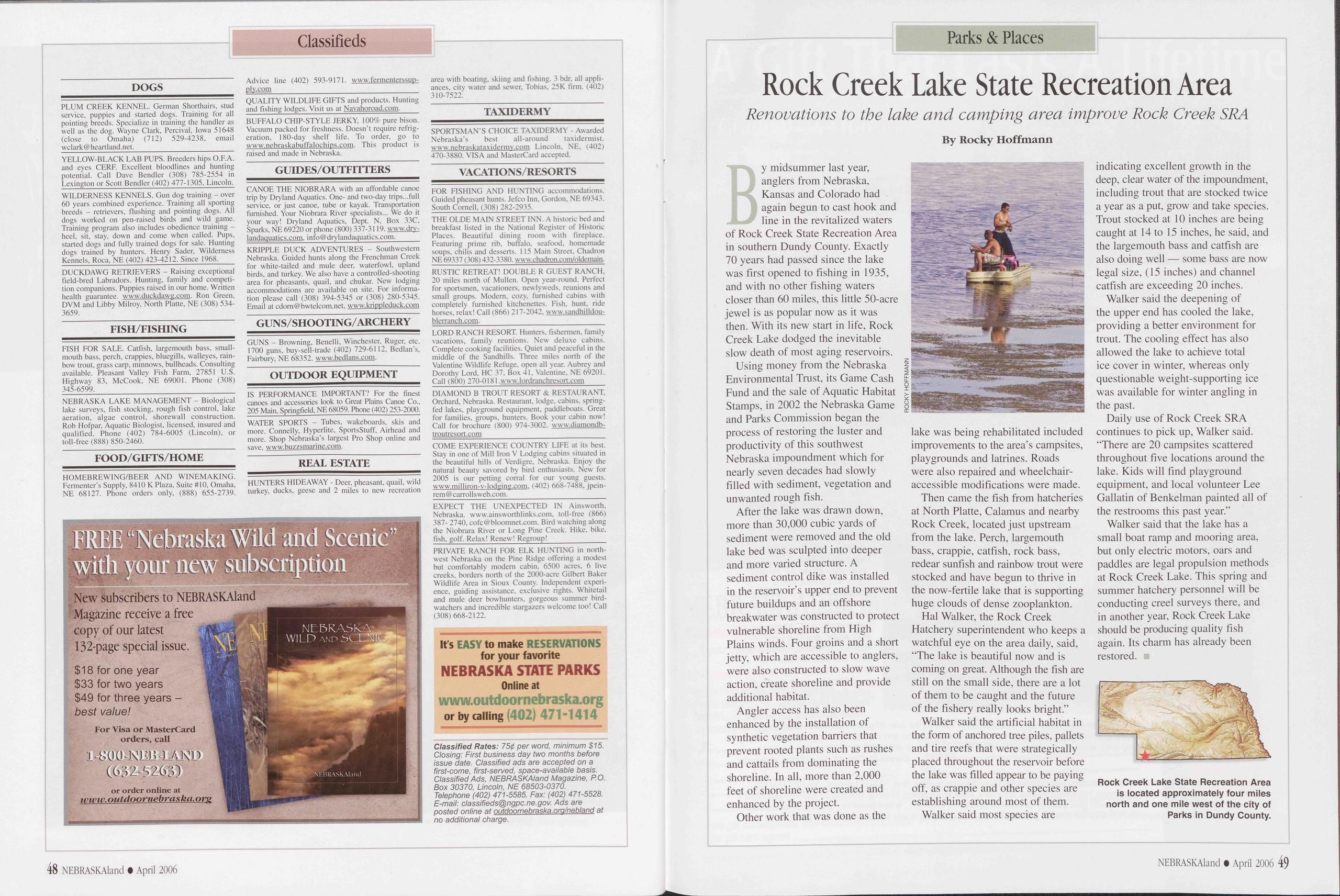
Rock Creek Lake State Recreation Area
Renovations to the lake and camping area improve Rock Creek SRA
By midsummer last year, anglers from Nebraska, Kansas and Colorado had again begun to cast hook and line in the revitalized waters of Rock Creek State Recreation Area in southern Dundy County. Exactly 70 years had passed since the lake was first opened to fishing in 1935, and with no other fishing waters closer than 60 miles, this little 50-acre jewel is as popular now as it was then. With its new start in life, Rock Creek Lake dodged the inevitable slow death of most aging reservoirs.
Using money from the Nebraska Environmental Trust, its Game Cash Fund and the sale of Aquatic Habitat Stamps, in 2002 the Nebraska Game and Parks Commission began the process of restoring the luster and productivity of this southwest Nebraska impoundment which for nearly seven decades had slowly filled with sediment, vegetation and unwanted rough fish.
After the lake was drawn down, more than 30,000 cubic yards of sediment were removed and the old lake bed was sculpted into deeper and more varied structure. A sediment control dike was installed in the reservoir’s upper end to prevent future buildups and an offshore breakwater was constructed to protect vulnerable shoreline from High Plains winds. Four groins and a short jetty, which are accessible to anglers, were also constructed to slow wave action, create shoreline and provide additional habitat.
Angler access has also been enhanced by the installation of synthetic vegetation barriers that prevent rooted plants such as rushes and cattails from dominating the shoreline. In all, more than 2,000 feet of shoreline were created and enhanced by the project.
Other work that was done as the lake was being rehabilitated included improvements to the area’s campsites, playgrounds and latrines. Roads were also repaired and wheelchair- accessible modifications were made.
Then came the fish from hatcheries at North Platte, Calamus and nearby Rock Creek, located just upstream from the lake. Perch, largemouth bass, crappie, catfish, rock bass, redear sunfish and rainbow trout were stocked and have begun to thrive in the now-fertile lake that is supporting huge clouds of dense zooplankton.
Hal Walker, the Rock Creek Hatchery superintendent who keeps a watchful eye on the area daily, said, "The lake is beautiful now and is coming on great. Although the fish are still on the small side, there are a lot of them to be caught and the future of the fishery really looks bright.”
Walker said the artificial habitat in the form of anchored tree piles, pallets and tire reefs that were strategically placed throughout the reservoir before the lake was filled appear to be paying off, as crappie and other species are establishing around most of them.
Walker said most species are indicating excellent growth in the deep, clear water of the impoundment, including trout that are stocked twice a year as a put, grow and take species. Trout stocked at 10 inches are being caught at 14 to 15 inches, he said, and the largemouth bass and catfish are also doing well — some bass are now legal size, (15 inches) and channel catfish are exceeding 20 inches.
Walker said the deepening of the upper end has cooled the lake, providing a better environment for trout. The cooling effect has also allowed the lake to achieve total ice cover in winter, whereas only questionable weight-supporting ice was available for winter angling in the past.
Daily use of Rock Creek SRA continues to pick up, Walker said. “There are 20 campsites scattered throughout five locations around the lake. Kids will find playground equipment, and local volunteer Lee Gallatin of Benkelman painted all of the restrooms this past year.”
Walker said that the lake has a small boat ramp and mooring area, but only electric motors, oars and paddles are legal propulsion methods at Rock Creek Lake. This spring and summer hatchery personnel will be conducting creel surveys there, and in another year, Rock Creek Lake should be producing quality fish again. Its charm has already been restored,
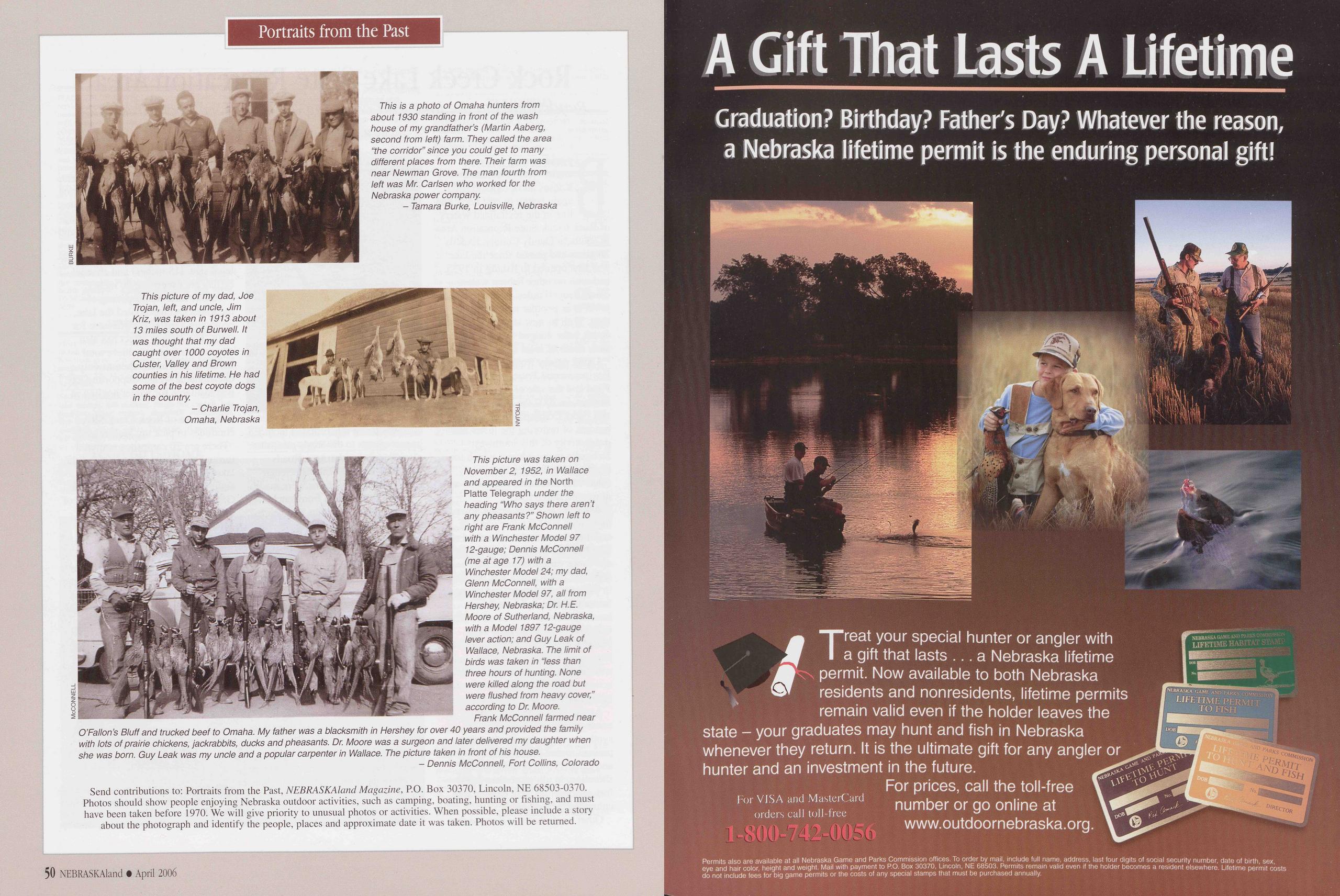
Portraits from the Past
Send contributions to: Portraits from the Past, NEBRASKAland Magazine, P.O. Box 30370, Lincoln, NE 68503-0370. Photos should show people enjoying Nebraska outdoor activities, such as camping, boating, hunting or fishing, and must have been taken before 1970. We will give priority to unusual photos or activities. When possible, please include a story about the photograph and identify the people, places and approximate date it was taken. Photos will be returned.
A Gift That Lasts A Lifetime
Graduation? Birthday? Father's Day? Whatever the reason, a Nebraska lifetime permit is the enduring personal gift!
Permits also are available at all Nebraska Game and Parks Commission offices. To order by mail, include full name, address, last four digits of social security number, date of birth, sex, eye and hair color height and weight. Mail with payment to P.O. Box 30370, Lincoln, NE 68503. Permits remain valid even if the holder becomes a resident elsewhere. Lifetime permit costs do not include fees for big game permits or the costs of any special stamps that must be purchased annually.
"T"reat your special hunter or angler with I a gift that lasts ... a Nebraska lifetime M permit. Now available to both Nebraska ® residents and nonresidents, lifetime permits remain valid even if the holder leaves the state - your graduates may hunt and fish in Nebraska whenever they return. It is the ultimate gift for any angler or hunter and an investment in the future. For prices, call the toll-free For VISA and MasterCard number Or go Online at orders call toll-free www.outdoornebraska.org.
50 NEBRASKAland • April 2006
NEBRASKAland Magazine Published by the Nebraska Game and Parks Commission World Wide Web site: outdoornebraska.org
Position: 584 (19 views)