Volume 84, Issue 2, 2006
NEBRASKAland
Volume 84, Number 2, March 2006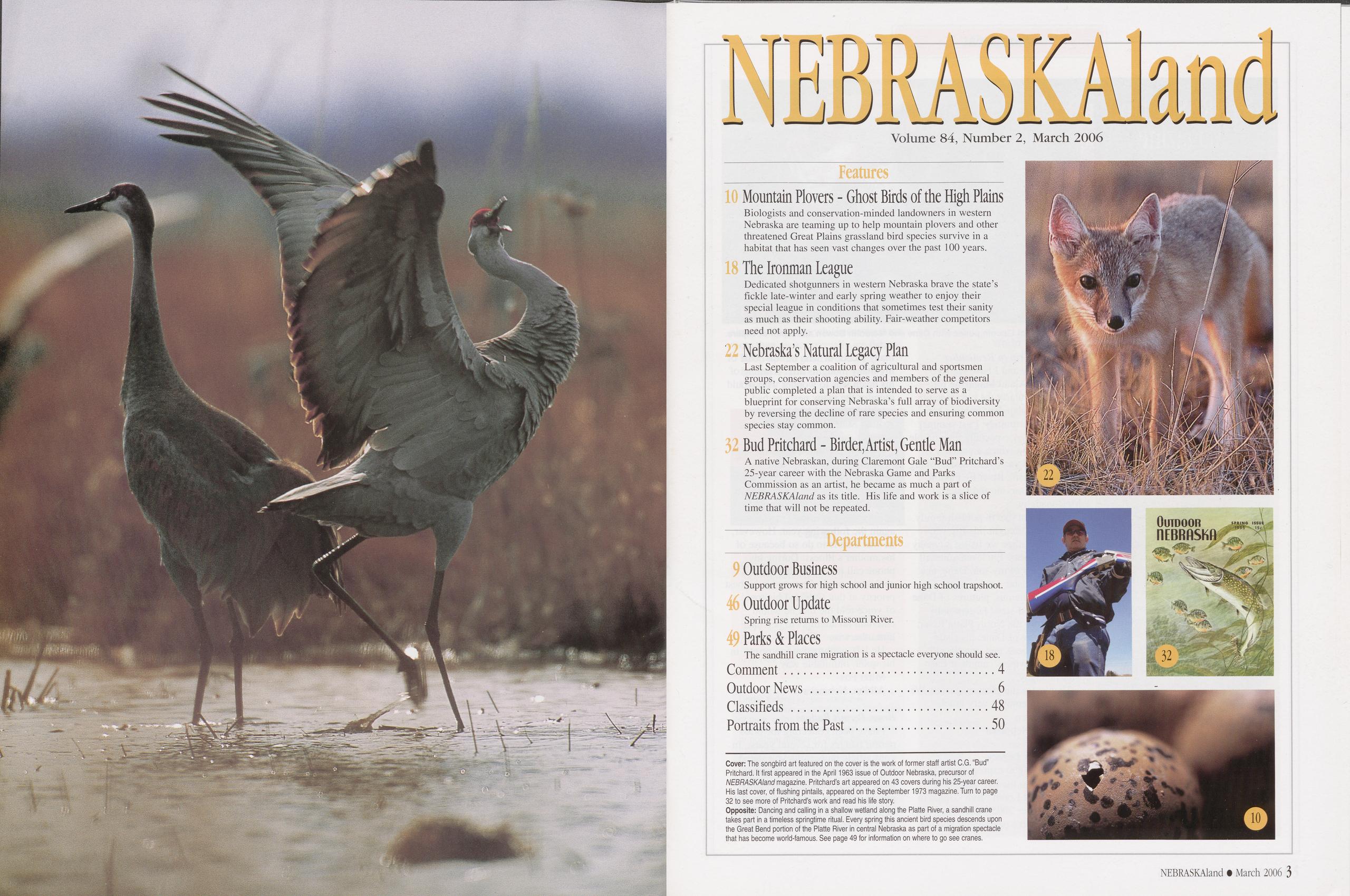
NEBRASKAland
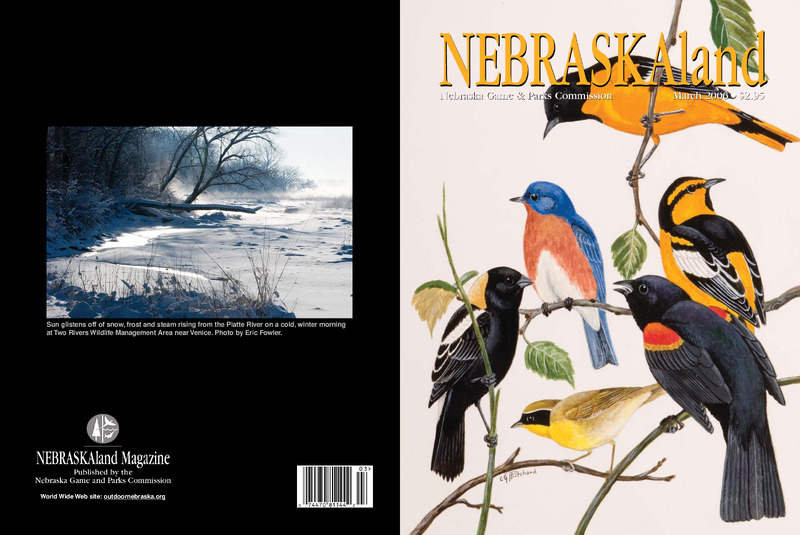
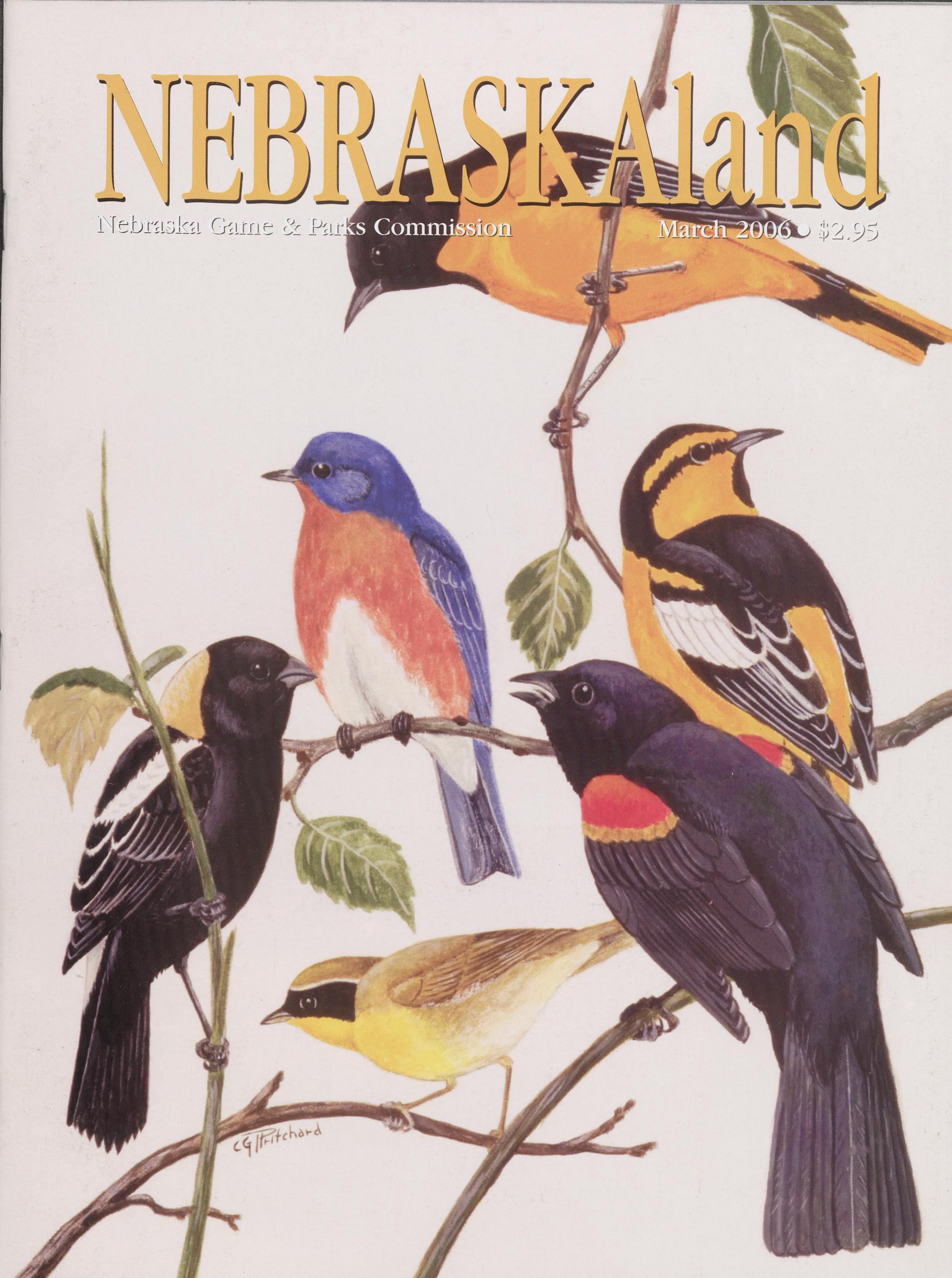
Volume 84, Number 2, March 2006 Features 10 Mountain Plovers - Ghost Birds of the High Plains Biologists and conservation-minded landowners in western Nebraska are teaming up to help mountain plovers and other threatened Great Plains grassland bird species survive in a habitat that has seen vast changes over the past 100 years. 18 The Ironman League Dedicated shotgunners in western Nebraska brave the state’s fickle late-winter and early spring weather to enjoy their special league in conditions that sometimes test their sanity as much as their shooting ability. Fair-weather competitors need not apply. 22 Nebraska’s Natural Legacy Plan Last September a coalition of agricultural and sportsmen groups, conservation agencies and members of the general public completed a plan that is intended to serve as a blueprint for conserving Nebraska’s full array of biodiversity by reversing the decline of rare species and ensuring common species stay common. 32 Bud Pritchard - Birder, Artist, Gentle Man A native Nebraskan, during Claremont Gale “Bud” Pritchard’s 25-year career with the Nebraska Game and Parks Commission as an artist, he became as much a part of NEBRASKAland as its title. His life and work is a slice of time that will not be repeated. Departments Outdoor Business Support grows for high school and junior high school trapshoot. Outdoor Update Spring rise returns to Missouri River. Parks & Places The sandhill crane migration is a spectacle everyone should see. Comment........................................4 Outdoor News...................................6 Classifieds ..................................48 Portraits from the Past.......................50 Cover: The songbird art featured on the cover is the work of former staff artist C.G. “Bud” Pritchard. It first appeared in the April 1963 issue of Outdoor Nebraska, precursor of NEBRASKAland magazine. Pritchard’s art appeared on 43 covers during his 25-year career. His last cover, of flushing pintails, appeared on the September 1973 magazine. Turn to page 32 to see more of Pritchard’s work and read his life story. Opposite: Dancing and calling in a shallow wetland along the Platte River, a sandhill crane takes part in a timeless springtime ritual. Every spring this ancient bird species descends upon the Great Bend portion of the Platte River in central Nebraska as part of a migration spectacle that has become world-famous. See page 49 for information on where to go see cranes.22
18
32
10
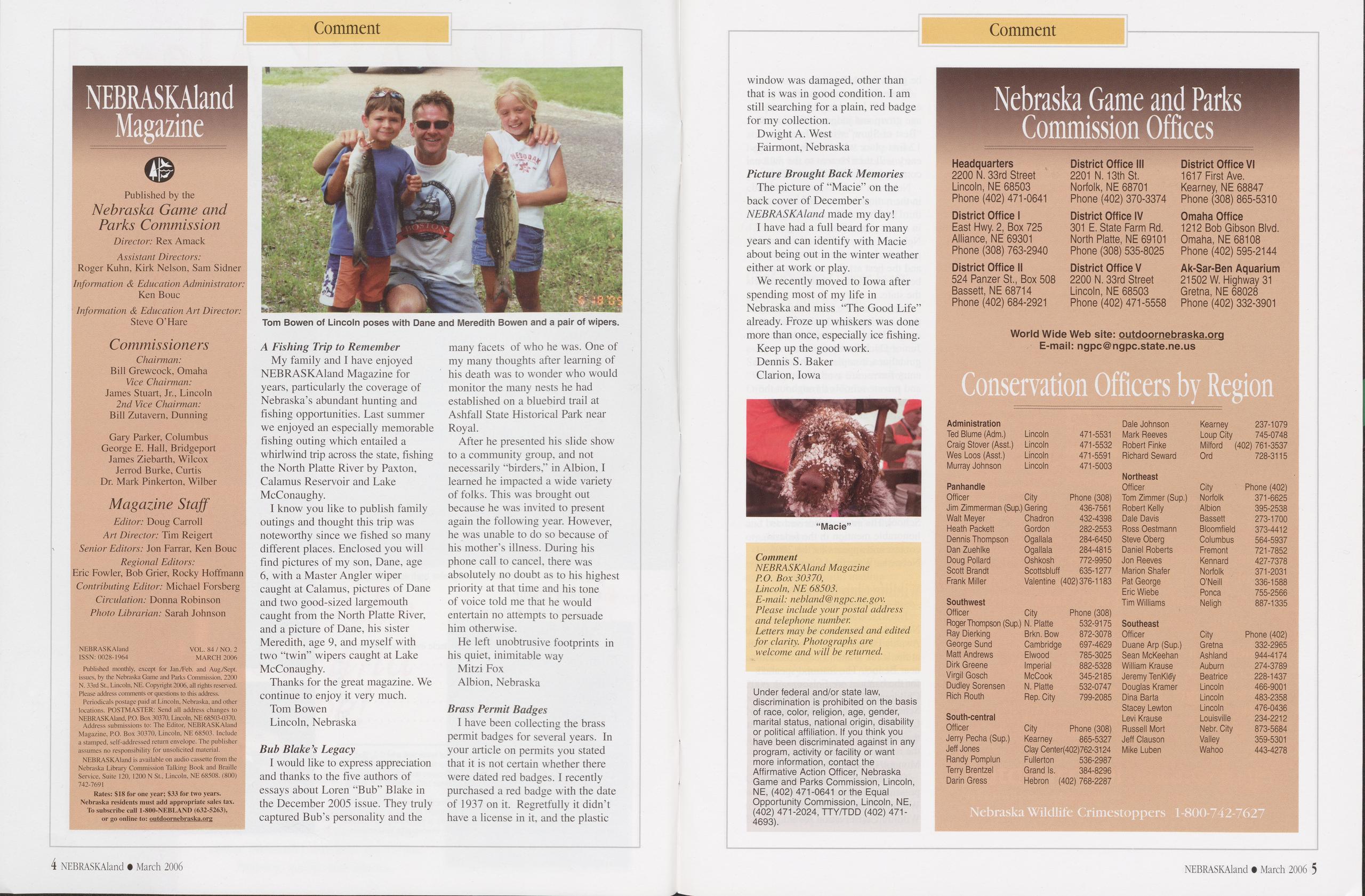
My family and I have enjoyed NEBRASKAland Magazine for years, particularly the coverage of Nebraska’s abundant hunting and fishing opportunities. Last summer we enjoyed an especially memorable fishing outing which entailed a whirlwind trip across the state, fishing the North Platte River by Paxton, Calamus Reservoir and Lake McConaughy.
I know you like to publish family outings and thought this trip was noteworthy since we fished so many different places. Enclosed you will find pictures of my son, Dane, age 6, with a Master Angler wiper caught at Calamus, pictures of Dane and two good-sized largemouth caught from the North Platte River, and a picture of Dane, his sister Meredith, age 9, and myself with two "twin” wipers caught at Lake McConaughy.
Thanks for the great magazine. We continue to enjoy it very much. Tom Bowen Lincoln, Nebraska Bub Blake’s LegacyI would like to express appreciation and thanks to the five authors of essays about Loren "Bub” Blake in the December 2005 issue. They truly captured Bub’s personality and the many facets of who he was. One of my many thoughts after learning of his death was to wonder who would monitor the many nests he had established on a bluebird trail at Ashfall State Historical Park near Royal.
After he presented his slide show to a community group, and not necessarily “birders,” in Albion, I learned he impacted a wide variety of folks. This was brought out because he was invited to present again the following year. However, he was unable to do so because of his mother’s illness. During his phone call to cancel, there was absolutely no doubt as to his highest priority at that time and his tone of voice told me that he would entertain no attempts to persuade him otherwise.
He left unobtrusive footprints in his quiet, inimitable way Mitzi Fox Albion, Nebraska Brass Permit BadgesI have been collecting the brass permit badges for several years. In your article on permits you stated that it is not certain whether there were dated red badges. I recently purchased a red badge with the date of 1937 on it. Regretfully it didn’t have a license in it, and the plastic window was damaged, other than that is was in good condition. I am still searching for a plain, red badge for my collection. Dwight A. West Fairmont, Nebraska
Picture Brought Back Memories The picture of "Made” on the back cover of December’s NEBRASKAland made my day! I have had a full beard for many years and can identify with Made about being out in the winter weather either at work or play. We recently moved to Iowa after spending most of my life in Nebraska and miss "The Good Life” already. Froze up whiskers was done more than once, especially ice fishing. Keep up the good work. Dennis S. Baker Clarion, Iowa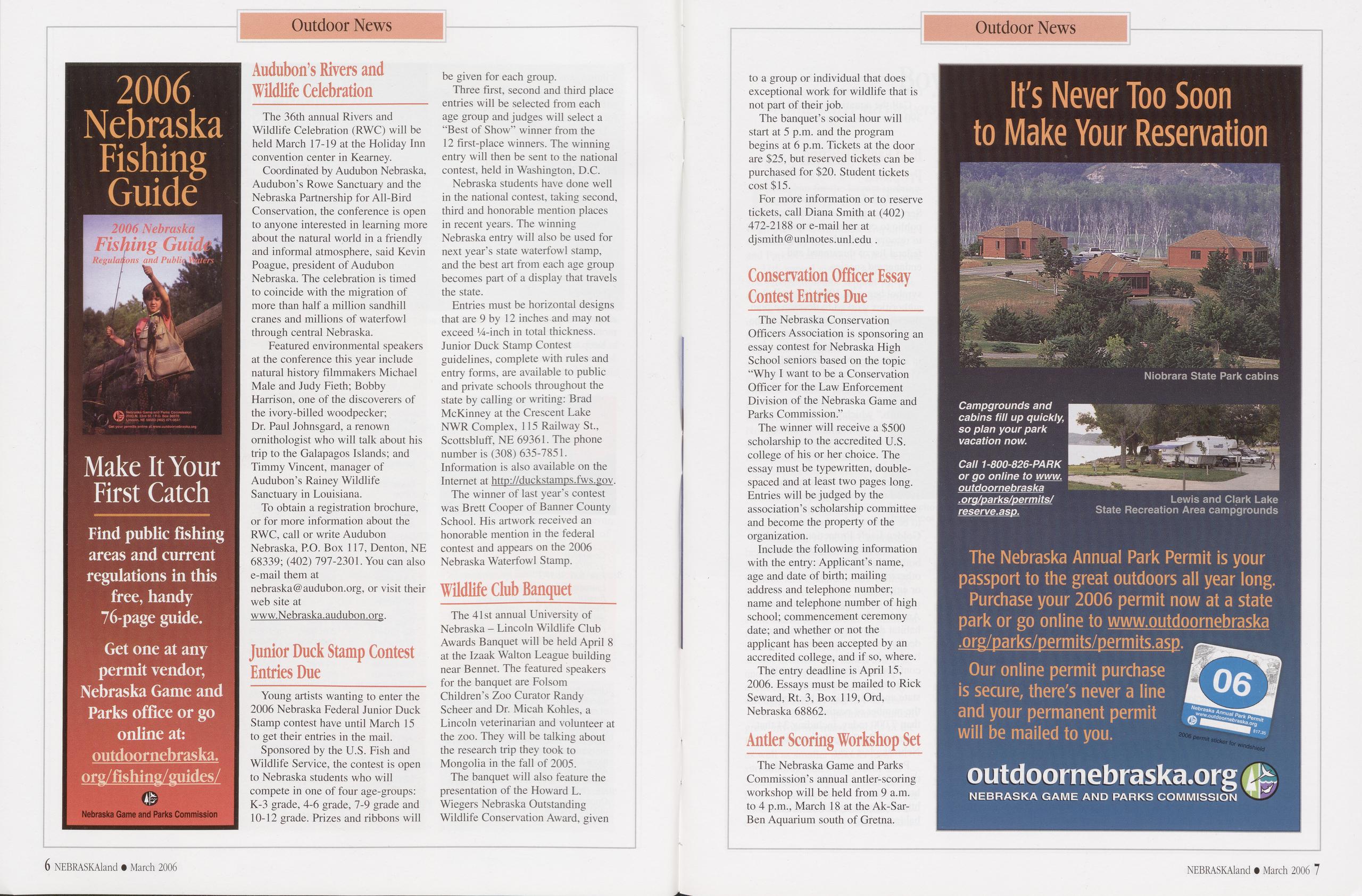
The 36th annual Rivers and Wildlife Celebration (RWC) will be held March 17-19 at the Holiday Inn convention center in Kearney.
Coordinated by Audubon Nebraska, Audubon’s Rowe Sanctuary and the Nebraska Partnership for All-Bird Conservation, the conference is open to anyone interested in learning more about the natural world in a friendly and informal atmosphere, said Kevin Poague, president of Audubon Nebraska. The celebration is timed to coincide with the migration of more than half a million sandhill cranes and millions of waterfowl through central Nebraska.
Featured environmental speakers at the conference this year include natural history filmmakers Michael Male and Judy Fieth; Bobby Harrison, one of the discoverers of the ivory-billed woodpecker; Dr. Paul Johnsgard, a renown ornithologist who will talk about his trip to the Galapagos Islands; and Timmy Vincent, manager of Audubon’s Rainey Wildlife Sanctuary in Louisiana.
To obtain a registration brochure, or for more information about the RWC, call or write Audubon Nebraska, P.O. Box 117, Denton, NF 68339; (402) 797-2301. You can also e-mail them at nebraska@audubon.org, or visit their web site at www.Nebraska.audubon.org.
Junior Duck Stamp Contest Entries DueYoung artists wanting to enter the 2006 Nebraska Federal Junior Duck Stamp contest have until March 15 to get their entries in the mail.
Sponsored by the U.S. Fish and Wildlife Service, the contest is open to Nebraska students who will compete in one of four age-groups: K-3 grade, 4-6 grade, 7-9 grade and 10-12 grade. Prizes and ribbons will be given for each group.
Three first, second and third place entries will be selected from each age group and judges will select a "Best of Show” winner from the 12 first-place winners. The winning entry will then be sent to the national contest, held in Washington, D C.
Nebraska students have done well in the national contest, taking second, third and honorable mention places in recent years. The winning Nebraska entry will also be used for next year’s state waterfowl stamp, and the best art from each age group becomes part of a display that travels the state.
Entries must be horizontal designs that are 9 by 12 inches and may not exceed ^-inch in total thickness. Junior Duck Stamp Contest guidelines, complete with rules and entry forms, are available to public and private schools throughout the state by calling or writing: Brad McKinney at the Crescent Lake NWR Complex, 115 Railway St., Scottsbluff, NE 69361. The phone number is (308) 635-7851.
Information is also available on the Internet at http://duckstamps.fws.gov.The winner of last year’s contest was Brett Cooper of Banner County School. His artwork received an honorable mention in the federal contest and appears on the 2006 Nebraska Waterfowl Stamp.
Wildlife Club BanquetThe 41st annual University of Nebraska - Lincoln Wildlife Club Awards Banquet will be held April 8 at the Izaak Walton League building near Bennet. The featured speakers for the banquet are Folsom Children’s Zoo Curator Randy Scheer and Dr. Micah Kohles, a Lincoln veterinarian and volunteer at the zoo. They will be talking about the research trip they took to Mongolia in the fall of 2005.
The banquet will also feature the presentation of the Howard L. Wiegers Nebraska Outstanding Wildlife Conservation Award, given to a group or individual that does exceptional work for wildlife that is not part of their job.
The banquet’s social hour will start at 5 p.m. and the program begins at 6 p.m. Tickets at the door are $25, but reserved tickets can be purchased for $20. Student tickets cost $15.
For more information or to reserve tickets, call Diana Smith at (402) 472-2188 or e-mail her at djsmith@unlnotes.unl.edu .
Conservation Officer Essay Contest Entries DueThe Nebraska Conservation Officers Association is sponsoring an essay contest for Nebraska High School seniors based on the topic "Why I want to be a Conservation Officer for the Law Enforcement Division of the Nebraska Game and Parks Commission.”
The winner will receive a $500 scholarship to the accredited U.S. college of his or her choice. The essay must be typewritten, double- spaced and at least two pages long. Entries will be judged by the association’s scholarship committee and become the property of the organization.
Include the following information with the entry: Applicant’s name, age and date of birth; mailing address and telephone number; name and telephone number of high school; commencement ceremony date; and whether or not the applicant has been accepted by an accredited college, and if so, where.
The entry deadline is April 15, 2006. Essays must be mailed to Rick Seward, Rt. 3, Box 119, Ord, Nebraska 68862.
Antler Scoring Workshop SetThe Nebraska Game and Parks Commission’s annual antler-scoring workshop will be held from 9 a.m. to 4 p.m., March 18 at the Ak-Sar- Ben Aquarium south of Gretna.
Outdoor News It's Never Too Soon to Make Your ReservationLewis and Clark Lake State Recreation Area campgrounds
When I first started working for the Nebraska Game and Parks Commission 28 years ago, I was stationed in Gothenburg. I received a phone call late one winter night about an illegally taken deer hanging in a calving pen on a remote Sandhills ranch. The caller told me the location and hung up quickly, not leaving his name. I put my uniform on and asked a cousin who was visiting if he wanted to go along. He said it sounded like fun. Mike and I drove out to the ranch talking about the call. As a game warden we investigate all kinds of information but usually we have the caller give us his name so we can get back to him for further information if needed.
It was almost midnight and snowing hard when we arrived at the calving pen, which was located in an extremely remote area of the Sandhills. Just as the informant said, a deer was draped over a panel gate inside the pen, so Mike and I took up a surveillance point about a half-mile away and waited to see if anyone would show up to get the deer.
Now Mike and I are both big guys and very competitive athletically. Both of us think we are tougher that the other and we had numerous wrestling matches as we grew up to figure out who was top dog. So there we were, sitting in a fogged-over car waiting for the bad guys to show up when the boogey man came to visit.
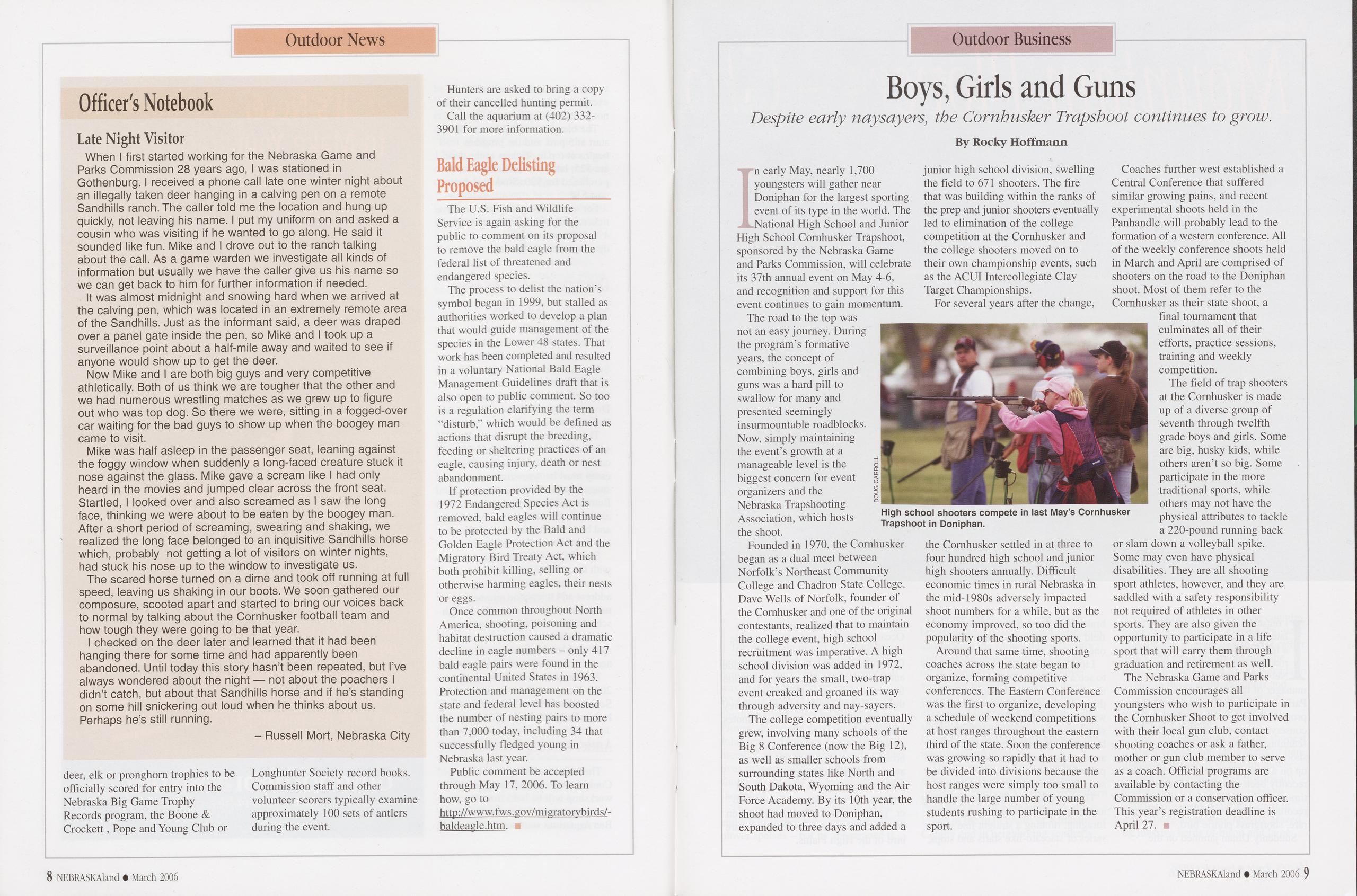
Mike was half asleep in the passenger seat, leaning against the foggy window when suddenly a long-faced creature stuck it nose against the glass. Mike gave a scream like I had only heard in the movies and jumped clear across the front seat. Startled, I looked over and also screamed as I saw the long face, thinking we were about to be eaten by the boogey man. After a short period of screaming, swearing and shaking, we realized the long face belonged to an inquisitive Sandhills horse which, probably not getting a lot of visitors on winter nights, had stuck his nose up to the window to investigate us.
The scared horse turned on a dime and took off running at full speed, leaving us shaking in our boots. We soon gathered our composure, scooted apart and started to bring our voices back to normal by talking about the Cornhusker football team and how tough they were going to be that year.
I checked on the deer later and learned that it had been hanging there for some time and had apparently been abandoned. Until today this story hasn’t been repeated, but I’ve always wondered about the night — not about the poachers I didn’t catch, but about that Sandhills horse and if he’s standing on some hill snickering out loud when he thinks about us. Perhaps he’s still running. - Russell Mort, Nebraska City
deer, elk or pronghorn trophies to be officially scored for entry into the Nebraska Big Game Trophy Records program, the Boone & Crockett, Pope and Young Club or Longhunter Society record books. Commission staff and other volunteer scorers typically examine approximately 100 sets of antlers during the event.
Hunters are asked to bring a copy of their cancelled hunting permit. Call the aquarium at (402) 332- 3901 for more information.
Bald Eagle Delisting ProposedThe U.S. Fish and Wildlife Service is again asking for the public to comment on its proposal to remove the bald eagle from the federal list of threatened and endangered species.
The process to delist the nation’s symbol began in 1999, but stalled as authorities worked to develop a plan that would guide management of the species in the Lower 48 states. That work has been completed and resulted in a voluntary National Bald Eagle Management Guidelines draft that is also open to public comment. So too is a regulation clarifying the term “disturb,” which would be defined as actions that disrupt the breeding, feeding or sheltering practices of an eagle, causing injury, death or nest abandonment.
If protection provided by the 1972 Endangered Species Act is removed, bald eagles will continue to be protected by the Bald and Golden Eagle Protection Act and the Migratory Bird Treaty Act, which both prohibit killing, selling or otherwise harming eagles, their nests or eggs.
Once common throughout North America, shooting, poisoning and habitat destruction caused a dramatic decline in eagle numbers - only 417 bald eagle pairs were found in the continental United States in 1963. Protection and management on the state and federal level has boosted the number of nesting pairs to more than 7,000 today, including 34 that successfully fledged young in Nebraska last year.
Public comment be accepted through May 17, 2006. To learn how, go to http://www.fws.gov/migratorvbirds/- baldeagle.htm.
Outdoor Business Boys, Girls and Guns Despite early naysayers, the Cornhusker Trapshoot continues to grow. By Rocky HoffmanIn early May, nearly 1,700 youngsters will gather near Doniphan for the largest sporting event of its type in the world. The National High School and Junior High School Cornhusker Trapshoot, sponsored by the Nebraska Game and Parks Commission, will celebrate its 37th annual event on May 4-6, and recognition and support for this event continues to gain momentum.
The road to the top was not an easy journey. During the program’s formative years, the concept of combining boys, girls and guns was a hard pill to swallow for many and presented seemingly insurmountable roadblocks. Now, simply maintaining the event’s growth at a manageable level is the biggest concern for event organizers and the Nebraska Trapshooting Association, which hosts the shoot.
Founded in 1970, the Cornhusker began as a dual meet between Norfolk’s Northeast Community College and Chadron State College. Dave Wells of Norfolk, founder of the Cornhusker and one of the original contestants, realized that to maintain the college event, high school recruitment was imperative. A high school division was added in 1972, and for years the small, two-trap event creaked and groaned its way through adversity and nay-sayers.
The college competition eventually grew, involving many schools of the Big 8 Conference (now the Big 12), as well as smaller schools from surrounding states like North and South Dakota, Wyoming and the Air Force Academy. By its 10th year, the shoot had moved to Doniphan, expanded to three days and added a junior high school division, swelling the field to 671 shooters. The fire that was building within the ranks of the prep and junior shooters eventually led to elimination of the college competition at the Cornhusker and the college shooters moved on to their own championship events, such as the ACUI Intercollegiate Clay Target Championships.
For several years after the change, High school shooters compete in last May’s Cornhusker Trapshoot in Doniphan. the Cornhusker settled in at three to four hundred high school and junior high shooters annually. Difficult economic times in rural Nebraska in the mid-1980s adversely impacted shoot numbers for a while, but as the economy improved, so too did the popularity of the shooting sports.
Around that same time, shooting coaches across the state began to organize, forming competitive conferences. The Eastern Conference was the first to organize, developing a schedule of weekend competitions at host ranges throughout the eastern third of the state. Soon the conference was growing so rapidly that it had to be divided into divisions because the host ranges were simply too small to handle the large number of young students rushing to participate in the sport.
Coaches further west established a Central Conference that suffered similar growing pains, and recent experimental shoots held in the Panhandle will probably lead to the formation of a western conference. All of the weekly conference shoots held in March and April are comprised of shooters on the road to the Doniphan shoot. Most of them refer to the Cornhusker as their state shoot, a final tournament that culminates all of their efforts, practice sessions, training and weekly competition.
The field of trap shooters at the Cornhusker is made up of a diverse group of seventh through twelfth grade boys and girls. Some are big, husky kids, while others aren’t so big. Some participate in the more traditional sports, while others may not have the physical attributes to tackle a 220-pound running back or slam down a volleyball spike. Some may even have physical disabilities. They are all shooting sport athletes, however, and they are saddled with a safety responsibility not required of athletes in other sports. They are also given the opportunity to participate in a life sport that will carry them through graduation and retirement as well.
The Nebraska Game and Parks Commission encourages all youngsters who wish to participate in the Cornhusker Shoot to get involved with their local gun club, contact shooting coaches or ask a father, mother or gun club member to serve as a coach. Official programs are available by contacting the Commission or a conservation officer. This year’s registration deadline is April 27.
8 NEBRASKAland • March 2006 NEBRASKAland • March 2006 9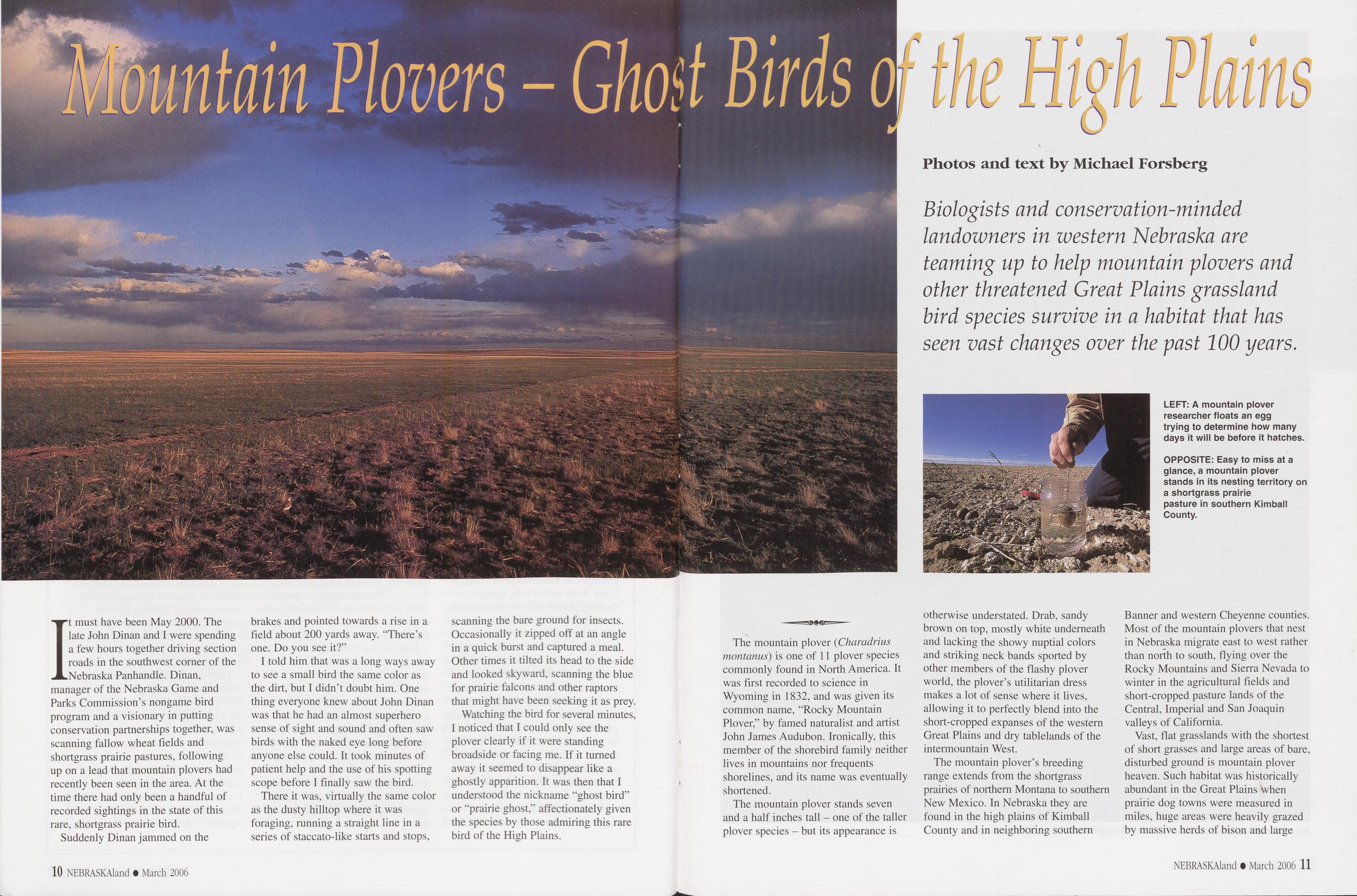
Mountain Plovers - Ghost Birds of the High Plains
It must have been May 2000. The late John Dinan and I were spending a few hours together driving section roads in the southwest corner of the Nebraska Panhandle. Dinan, manager of the Nebraska Game and Parks Commission’s nongame bird program and a visionary in putting conservation partnerships together, was scanning fallow wheat fields and shortgrass prairie pastures, following up on a lead that mountain plovers had recently been seen in the area. At the time there had only been a handful of recorded sightings in the state of this rare, shortgrass prairie bird. Suddenly Dinan jammed on the brakes and pointed towards a rise in a field about 200 yards away. “There’s one. Do you see it?”
I told him that was a long ways away to see a small bird the same color as the dirt, but I didn’t doubt him. One thing everyone knew about John Dinan was that he had an almost superhero sense of sight and sound and often saw birds with the naked eye long before anyone else could. It took minutes of patient help and the use of his spotting scope before I finally saw the bird.
There it was, virtually the same color as the dusty hilltop where it was foraging, running a straight line in a series of staccato-like starts and stops, scanning the bare ground for insects. Occasionally it zipped off at an angle in a quick burst and captured a meal. Other times it tilted its head to the side and looked skyward, scanning the blue for prairie falcons and other raptors that might have been seeking it as prey.
Watching the bird for several minutes, I noticed that I could only see the plover clearly if it were standing broadside or facing me. If it turned away it seemed to disappear like a ghostly apparition. It was then that I understood the nickname “ghost bird” or “prairie ghost,” affectionately given the species by those admiring this rare bird of the High Plains.
Photos and text by Michael ForsbergBiologists and conservation-minded landowners in western Nebraska are teaming up to help mountain plovers and other threatened Great Plains grassland bird species survive in a habitat that has seen vast changes over the past 100 years.
The mountain plover (Charadrius montanus) is one of 11 plover species commonly found in North America. It was first recorded to science in Wyoming in 1832, and was given its common name, “Rocky Mountain Plover,” by famed naturalist and artist John James Audubon. Ironically, this member of the shorebird family neither lives in mountains nor frequents shorelines, and its name was eventually shortened.
The mountain plover stands seven and a half inches tall - one of the taller plover species - but its appearance is otherwise understated. Drab, sandy brown on top, mostly white underneath and lacking the showy nuptial colors and striking neck bands sported by other members of the flashy plover world, the plover’s utilitarian dress makes a lot of sense where it lives, allowing it to perfectly blend into the short-cropped expanses of the western Great Plains and dry tablelands of the intermountain West.
The mountain plover’s breeding range extends from the shortgrass prairies of northern Montana to southern New Mexico. In Nebraska they are found in the high plains of Kimball County and in neighboring southern Banner and western Cheyenne counties. Most of the mountain plovers that nest in Nebraska migrate east to west rather than north to south, flying over the Rocky Mountains and Sierra Nevada to winter in the agricultural fields and short-cropped pasture lands of the Central, Imperial and San Joaquin valleys of California.
Vast, flat grasslands with the shortest of short grasses and large areas of bare, disturbed ground is mountain plover heaven. Such habitat was historically abundant in the Great Plains when prairie dog towns were measured in miles, huge areas were heavily grazed by massive herds of bison and large
10 NEBRASKAland • March 2006 NEBRASKAland • March 2006 11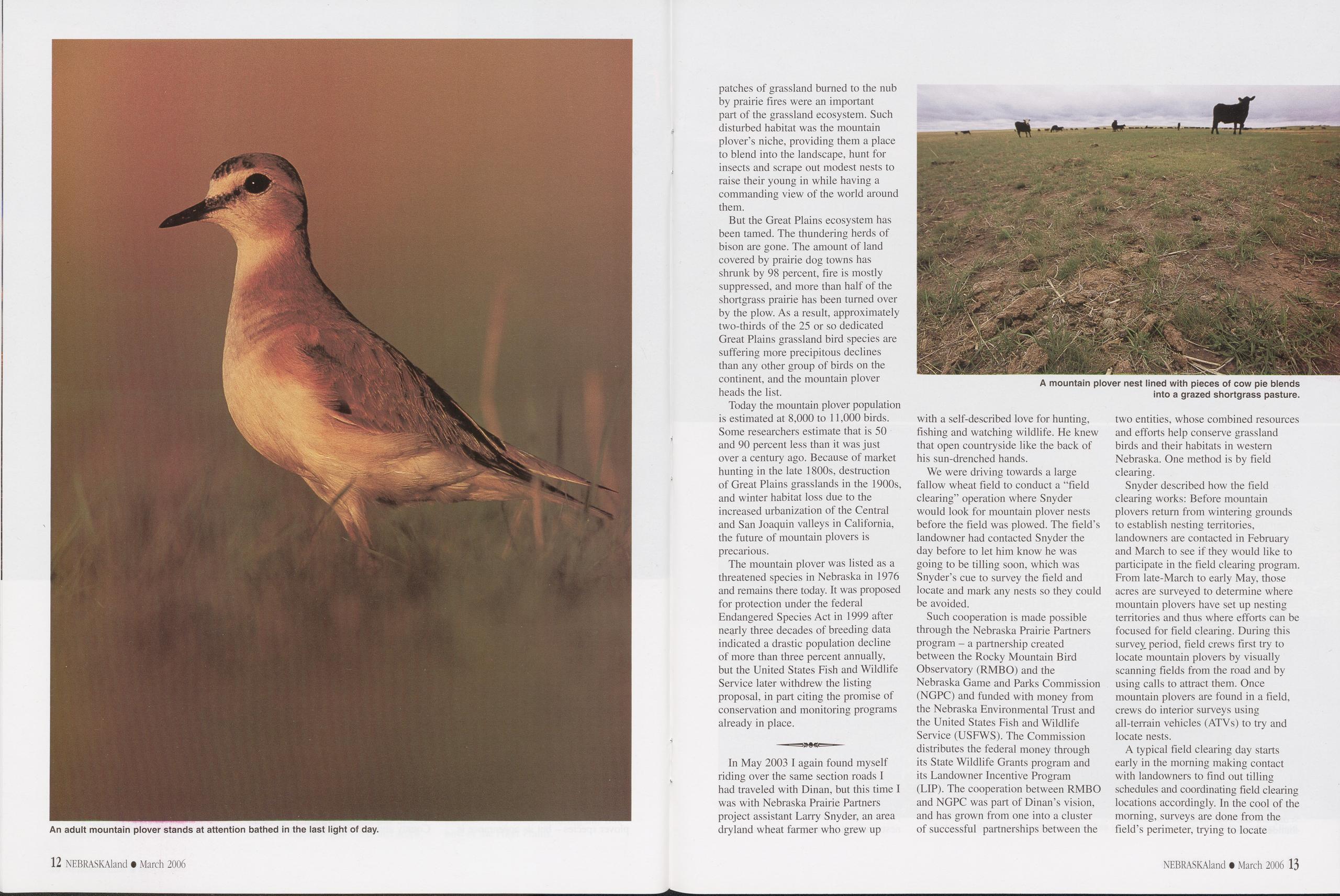
patches of grassland burned to the nub by prairie fires were an important part of the grassland ecosystem. Such disturbed habitat was the mountain plover’s niche, providing them a place to blend into the landscape, hunt for insects and scrape out modest nests to raise their young in while having a commanding view of the world around them.
But the Great Plains ecosystem has been tamed. The thundering herds of bison are gone. The amount of land covered by prairie dog towns has shrunk by 98 percent, fire is mostly suppressed, and more than half of the shortgrass prairie has been turned over by the plow. As a result, approximately two-thirds of the 25 or so dedicated Great Plains grassland bird species are suffering more precipitous declines than any other group of birds on the continent, and the mountain plover heads the list.
Today the mountain plover population is estimated at 8,000 to 11,000 birds. Some researchers estimate that is 50 and 90 percent less than it was just over a century ago. Because of market hunting in the late 1800s, destruction of Great Plains grasslands in the 1900s, and winter habitat loss due to the increased urbanization of the Central and San Joaquin valleys in California, the future of mountain plovers is precarious.
The mountain plover was listed as a threatened species in Nebraska in 1976 and remains there today. It was proposed for protection under the federal Endangered Species Act in 1999 after nearly three decades of breeding data indicated a drastic population decline of more than three percent annually, but the United States Fish and Wildlife Service later withdrew the listing proposal, in part citing the promise of conservation and monitoring programs already in place.
In May 2003 I again found myself riding over the same section roads I had traveled with Dinan, but this time I was with Nebraska Prairie Partners project assistant Larry Snyder, an area dryland wheat farmer who grew up with a self-described love for hunting, fishing and watching wildlife. He knew that open countryside like the back of his sun-drenched hands.
We were driving towards a large fallow wheat field to conduct a "field clearing” operation where Snyder would look for mountain plover nests before the field was plowed. The field’s landowner had contacted Snyder the day before to let him know he was going to be tilling soon, which was Snyder’s cue to survey the field and locate and mark any nests so they could be avoided.
Such cooperation is made possible through the Nebraska Prairie Partners program - a partnership created between the Rocky Mountain Bird Observatory (RMBO) and the Nebraska Game and Parks Commission (NGPC) and funded with money from the Nebraska Environmental Trust and the United States Fish and Wildlife Service (USFWS). The Commission distributes the federal money through its State Wildlife Grants program and its Landowner Incentive Program (LIP). The cooperation between RMBO and NGPC was part of Oman’s vision, and has grown from one into a cluster of successful partnerships between the two entities, whose combined resources and efforts help conserve grassland birds and their habitats in western Nebraska. One method is by field clearing.
Snyder described how the field clearing works: Before mountain plovers return from wintering grounds to establish nesting territories, landowners are contacted in February and March to see if they would like to participate in the field clearing program. From late-March to early May, those acres are surveyed to determine where mountain plovers have set up nesting territories and thus where efforts can be focused for field clearing. During this survey, period, field crews first try to locate mountain plovers by visually scanning fields from the road and by using calls to attract them. Once mountain plovers are found in a field, crews do interior surveys using all-terrain vehicles (ATVs) to try and locate nests.
A typical field clearing day starts early in the morning making contact with landowners to find out tilling schedules and coordinating field clearing locations accordingly. In the cool of the morning, surveys are done from the field’s perimeter, trying to locate
12 NEBRASKAland • March 2006 NEBRASKAland • March 2006 13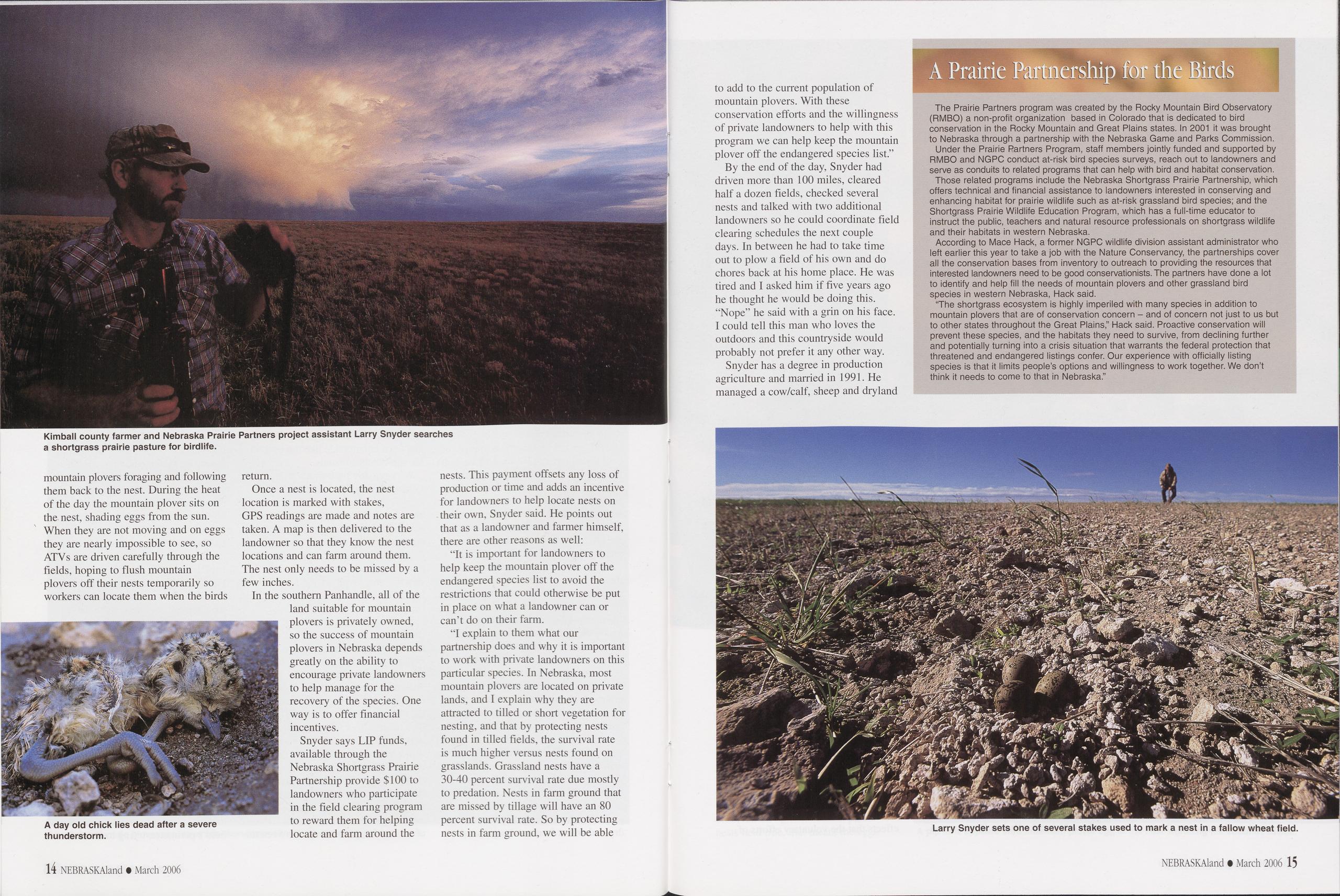
mountain plovers foraging and following them back to the nest. During the heat of the day the mountain plover sits on the nest, shading eggs from the sun. When they are not moving and on eggs they are nearly impossible to see, so AT Vs are driven carefully through the fields, hoping to flush mountain plovers off their nests temporarily so workers can locate them when the birds return.
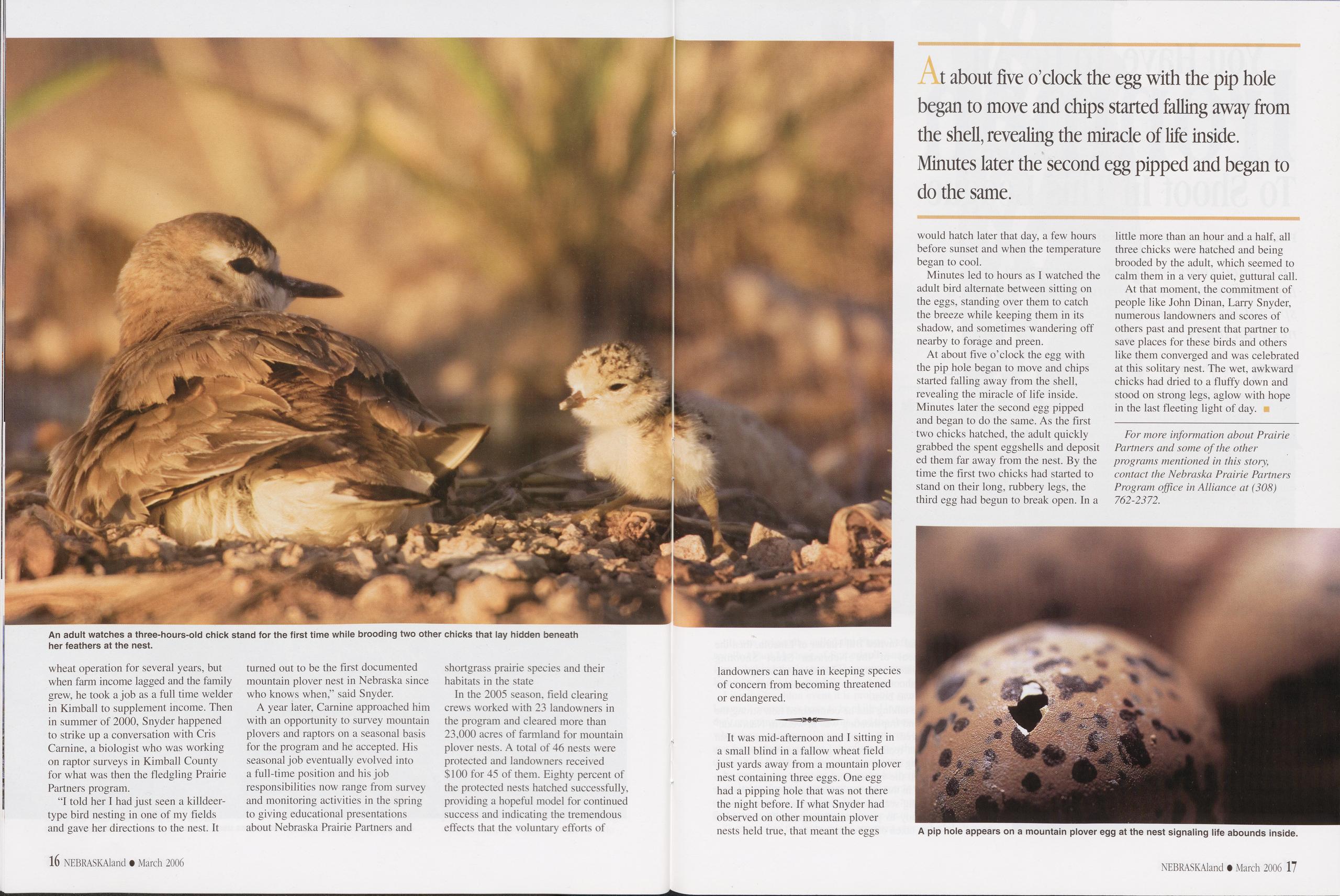
Once a nest is located, the nest location is marked with stakes, GPS readings are made and notes are taken. A map is then delivered to the landowner so that they know the nest locations and can farm around them. The nest only needs to be missed by a few inches.
In the southern Panhandle, all of the land suitable for mountain plovers is privately owned, so the success of mountain plovers in Nebraska depends greatly on the ability to encourage private landowners to help manage for the recovery of the species. One way is to offer financial incentives.
Snyder says LIP funds, available through the Nebraska Shortgrass Prairie Partnership provide $100 to landowners who participate in the field clearing program to reward them for helping locate and farm around the nests. This payment offsets any loss of production or time and adds an incentive for landowners to help locate nests on their own, Snyder said. He points out that as a landowner and farmer himself, there are other reasons as well: "It is important for landowners to help keep the mountain plover off the endangered species list to avoid the restrictions that could otherwise be put in place on what a landowner can or can’t do on their farm.
"I explain to them what our partnership does and why it is important to work with private landowners on this particular species. In Nebraska, most mountain plovers are located on private lands, and I explain why they are attracted to tilled or short vegetation for nesting, and that by protecting nests found in tilled fields, the survival rate is much higher versus nests found on grasslands. Grassland nests have a 30-40 percent survival rate due mostly to predation. Nests in farm ground that are missed by tillage will have an 80 percent survival rate. So by protecting nests in farm ground, we will be able to add to the current population of mountain plovers. With these conservation efforts and the willingness of private landowners to help with this program we can help keep the mountain plover off the endangered species list.”
By the end of the day, Snyder had driven more than 100 miles, cleared half a dozen fields, checked several nests and talked with two additional landowners so he could coordinate field clearing schedules the next couple days. In between he had to take time out to plow a field of his own and do chores back at his home place. He was tired and I asked him if five years ago he thought he would be doing this. "Nope” he said with a grin on his face. I could tell this man who loves the outdoors and this countryside would probably not prefer it any other way.
Snyder has a degree in production agriculture and married in 1991. He managed a cow/calf, sheep and dryland
A Prairie Partnership for the BirdsThe Prairie Partners program was created by the Rocky Mountain Bird Observatory (RMBO) a non-profit organization based in Colorado that is dedicated to bird conservation in the Rocky Mountain and Great Plains states. In 2001 it was brought to Nebraska through a partnership with the Nebraska Game and Parks Commission.
Under the Prairie Partners Program, staff members jointly funded and supported by RMBO and NGPC conduct at-risk bird species surveys, reach out to landowners and serve as conduits to related programs that can help with bird and habitat conservation.
Those related programs include the Nebraska Shortgrass Prairie Partnership, which offers technical and financial assistance to landowners interested in conserving and enhancing habitat for prairie wildlife such as at-risk grassland bird species; and the Shortgrass Prairie Wildlife Education Program, which has a full-time educator to instruct the public, teachers and natural resource professionals on shortgrass wildlife and their habitats in western Nebraska.
According to Mace Hack, a former NGPC wildlife division assistant administrator who left earlier this year to take a job with the Nature Conservancy, the partnerships cover all the conservation bases from inventory to outreach to providing the resources that interested landowners need to be good conservationists. The partners have done a lot to identify and help fill the needs of mountain plovers and other grassland bird species in western Nebraska, Hack said.
“The shortgrass ecosystem is highly imperiled with many species in addition to mountain plovers that are of conservation concern - and of concern not just to us but to other states throughout the Great Plains,” Hack said. Proactive conservation will prevent these species, and the habitats they need to survive, from declining further and potentially turning into a crisis situation that warrants the federal protection that threatened and endangered listings confer. Our experience with officially listing species is that it limits people’s options and willingness to work together. We don’t think it needs to come to that in Nebraska.”
wheat operation for several years, but when farm income lagged and the family grew, he took a job as a full time welder in Kimball to supplement income. Then in summer of 2000, Snyder happened to strike up a conversation with Cris Carnine, a biologist who was working on raptor surveys in Kimball County for what was then the fledgling Prairie Partners program.
“I told her I had just seen a killdeer- type bird nesting in one of my fields and gave her directions to the nest. It turned out to be the first documented mountain plover nest in Nebraska since who knows when,” said Snyder.
A year later, Carnine approached him with an opportunity to survey mountain plovers and raptors on a seasonal basis for the program and he accepted. His seasonal job eventually evolved into a full-time position and his job responsibilities now range from survey and monitoring activities in the spring to giving educational presentations about Nebraska Prairie Partners and shortgrass prairie species and their habitats in the state.
In the 2005 season, field clearing crews worked with 23 landowners in the program and cleared more than 23,000 acres of farmland for mountain plover nests. A total of 46 nests were protected and landowners received $100 for 45 of them. Eighty percent of the protected nests hatched successfully, providing a hopeful model for continued success and indicating the tremendous effects that the voluntary efforts of landowners can have in keeping species of concern from becoming threatened or endangered.
At about five o’clock the egg with the pip hole began to move and chips started falling away from the shell, revealing the miracle of life inside. Minutes later the second egg pipped and began to do the same.It was mid-afternoon and I sitting in a small blind in a fallow wheat field just yards away from a mountain plover nest containing three eggs. One egg had a pipping hole that was not there the night before. If what Snyder had observed on other mountain plover nests held true, that meant the eggs would hatch later that day, a few hours before sunset and when the temperature began to cool.
Minutes led to hours as I watched the adult bird alternate between sitting on the eggs, standing over them to catch the breeze while keeping them in its shadow, and sometimes wandering off nearby to forage and preen.
At about five o’clock the egg with the pip hole began to move and chips started falling away from the shell, revealing the miracle of life inside. Minutes later the second egg pipped and began to do the same. As the first two chicks hatched, the adult quickly grabbed the spent eggshells and deposit ed them far away from the nest. By the time the first two chicks had started to stand on their long, rubbery legs, the third egg had begun to break open. In a little more than an hour and a half, all three chicks were hatched and being brooded by the adult, which seemed to calm them in a very quiet, guttural call.
At that moment, the commitment of people like John Dinan, Larry Snyder, numerous landowners and scores of others past and present that partner to save places for these birds and others like them converged and was celebrated at this solitary nest. The wet, awkward chicks had dried to a fluffy down and stood on strong legs, aglow with hope in the last fleeting light of day.
For more information about Prairie Partners and some of the other programs mentioned in this story, contact the Nebraska Prairie Partners Program office in Alliance at (308) 762-2372.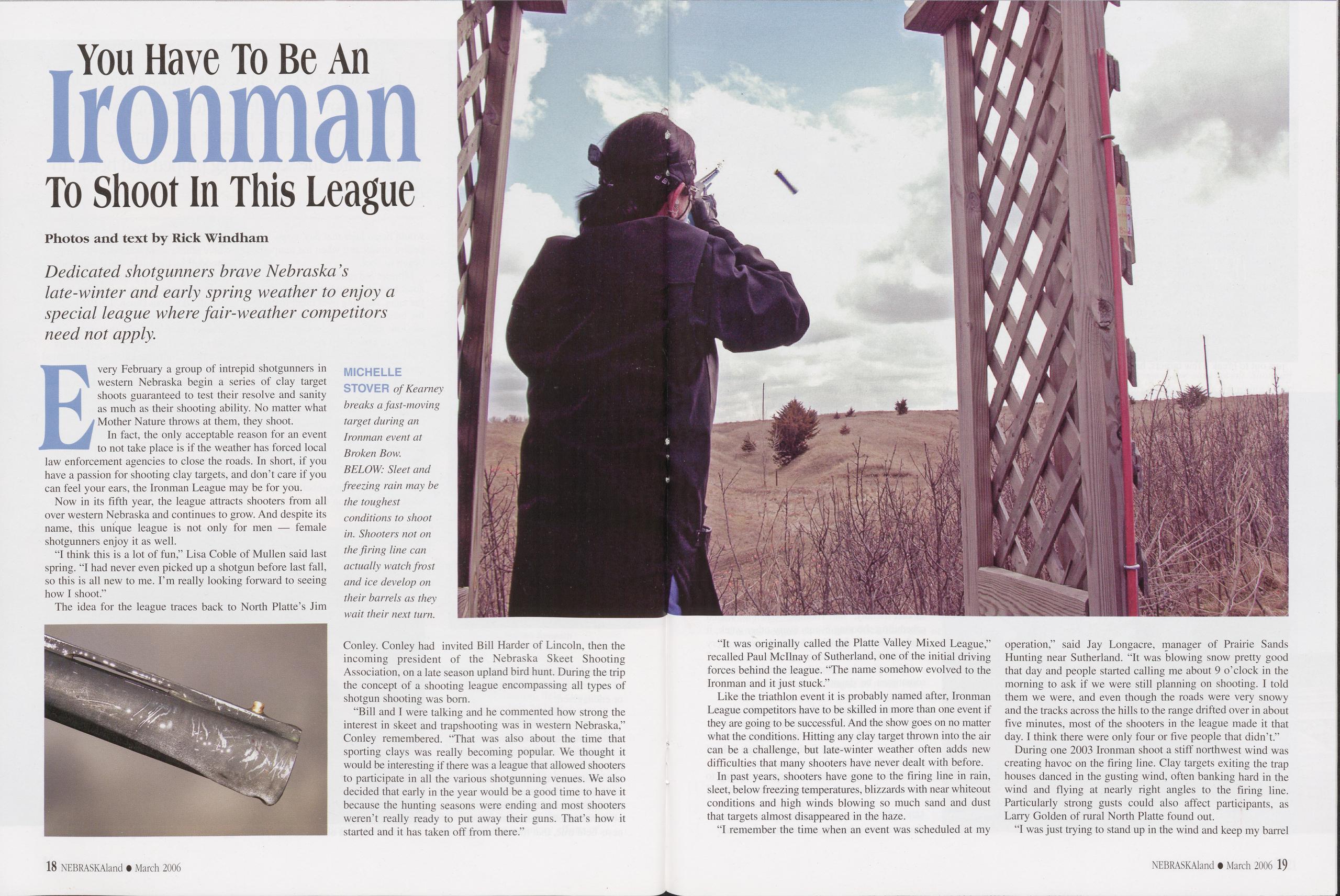
You Have To Be An Ironman To Shoot In This League
Photos and text by Rick Windham Dedicated shot gunners brave Nebraska’s late-winter and early spring weather to enjoy a special league where fair-weather competitors need not apply.Every February a group of intrepid shotgunners in western Nebraska begin a series of clay target shoots guaranteed to test their resolve and sanity as much as their shooting ability. No matter what Mother Nature throws at them, they shoot.
In fact, the only acceptable reason for an event " to not take place is if the weather has forced local law enforcement agencies to close the roads. In short, if you have a passion for shooting clay targets, and don’t care if you can feel your ears, the Ironman League may be for you.
Now in its fifth year, the league attracts shooters from all over western Nebraska and continues to grow. And despite its name, this unique league is not only for men — female shotgunners enjoy it as well.
"I think this is a lot of fun,” Lisa Coble of Mullen said last spring. "I had never even picked up a shotgun before last fall, so this is all new to me. I’m really looking forward to seeing how I shoot.”
The idea for the league traces back to North Platte’s Jim Conley. Conley had invited Bill Harder of Lincoln, then the incoming president of the Nebraska Skeet Shooting Association, on a late season upland bird hunt. During the trip the concept of a shooting league encompassing all types of shotgun shooting was born.
Conley. Conley had invited Bill Harder of Lincoln, then the incoming president of the Nebraska Skeet Shooting Association, on a late season upland bird hunt. During the trip the process of a shooting league encompassing all types of shotgun shooting was born.
“Bill and I were talking and he commented how strong the interest in skeet and trapshooting was in western Nebraska,” Conley remembered. “That was also about the time that sporting clays was really becoming popular. We thought it would be interesting if there was a league that allowed shooters to participate in all the various shotgunning venues. We also decided that early in the year would be a good time to have it because the hunting seasons were ending and most shooters weren’t really ready to put away their guns. That’s how it started and it has taken off from there.”
“It was originally called the Platte Valley Mixed League,” recalled Paul Mcllnay of Sutherland, one of the initial driving forces behind the league. “The name somehow evolved to the Ironman and it just stuck.”
Like the triathlon event it is probably named after, Ironman League competitors have to be skilled in more than one event if they are going to be successful. And the show goes on no matter what the conditions. Hitting any clay target thrown into the air can be a challenge, but late-winter weather often adds new difficulties that many shooters have never dealt with before.
In past years, shooters have gone to the firing line in rain, sleet, below freezing temperatures, blizzards with near whiteout conditions and high winds blowing so much sand and dust that targets almost disappeared in the haze.
“I remember the time when an event was scheduled at my operation,” said Jay Longacre, manager of Prairie Sands Hunting near Sutherland. “It was blowing snow pretty good that day and people started calling me about 9 o’clock in the morning to ask if we were still planning on shooting. I told them we were, and even though the roads were very snowy and the tracks across the hills to the range drifted over in about five minutes, most of the shooters in the league made it that day. I think there were only four or five people that didn’t.”
During one 2003 Ironman shoot a stiff northwest wind was creating havoc on the firing line. Clay targets exiting the trap houses danced in the gusting wind, often banking hard in the wind and flying at nearly right angles to the firing line. Particularly strong gusts could also affect participants, as Larry Golden of rural North Platte found out.
“I was just trying to stand up in the wind and keep my barrel
18 NEBRASKAland • March 2006 NEBRASKAland • March 2006 19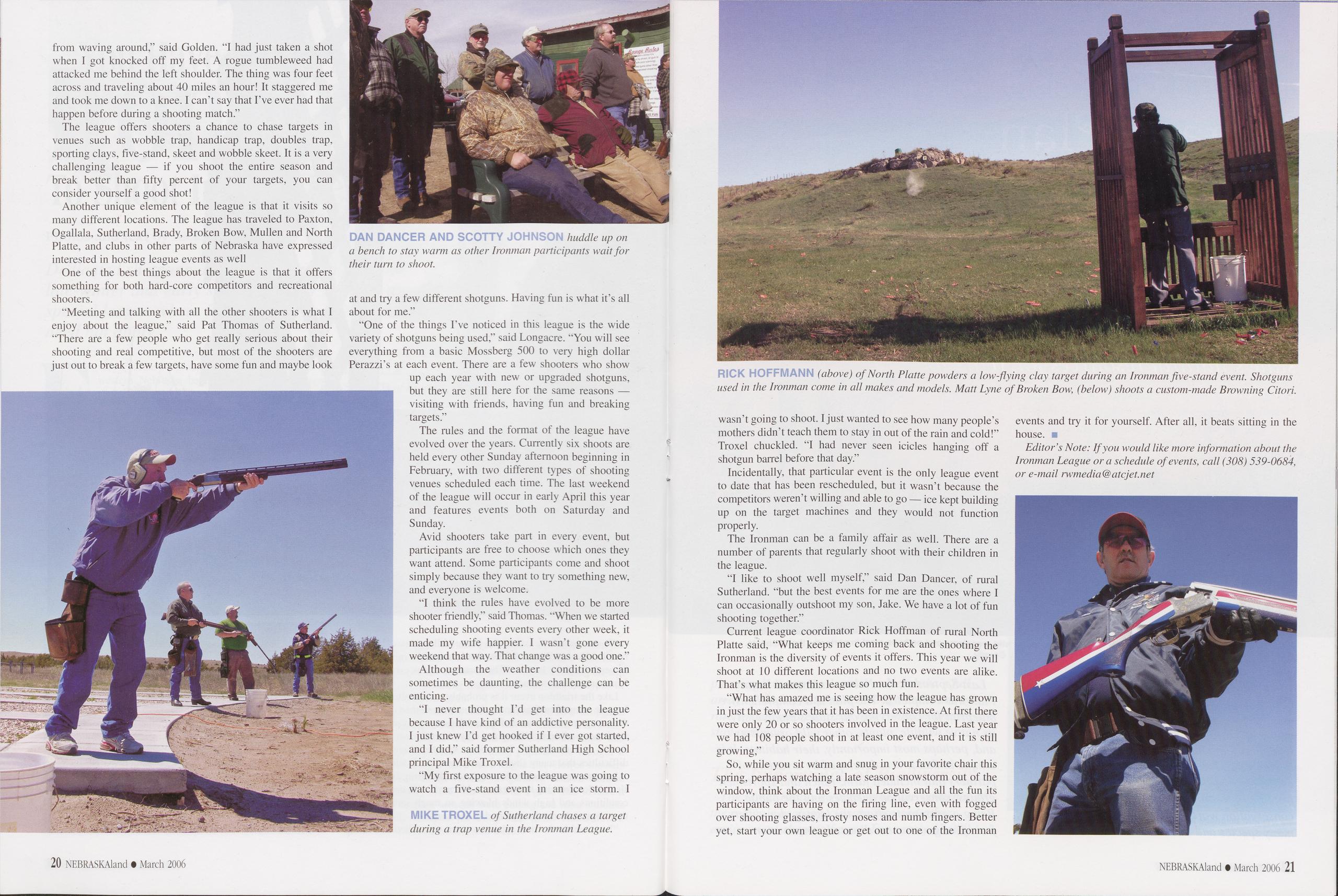
from waving around,” said Golden. “I had just taken a shot when I got knocked off my feet. A rogue tumbleweed had attacked me behind the left shoulder. The thing was four feet across and traveling about 40 miles an hour! It staggered me and took me down to a knee. I can’t say that I’ve ever had that happen before during a shooting match.”
The league offers shooters a chance to chase targets in venues such as wobble trap, handicap trap, doubles trap, sporting clays, five-stand, skeet and wobble skeet. It is a very challenging league — if you shoot the entire season and break better than fifty percent of your targets, you can consider yourself a good shot!
Another unique element of the league is that it visits so many different locations. The league has traveled to Paxton, Ogallala, Sutherland, Brady, Broken Bow, Mullen and North Platte, and clubs in other parts of Nebraska have expressed interested in hosting league events as well.
One of the best things about the league is that it offers something for both hard-core competitors and recreational shooters.
“Meeting and talking with all the other shooters is what I enjoy about the league,” said Pat Thomas of Sutherland. “There are a few people who get really serious about their shooting and real competitive, but most of the shooters are just out to break a few targets, have some fun and maybe look at and try a few different shotguns. Having fun is what it's all about for me".
“One of the things I’ve noticed in this league is the wide variety of shotguns being used,” said Longacre. “You will see everything from a basic Mossberg 500 to very high dollar Perazzi’s at each event. There are a few shooters who show up each year with new or upgraded shotguns, but they are still here for the same reasons — visiting with friends, having fun and breaking targets.”
The rules and the format of the league have evolved over the years. Currently six shoots are held every other Sunday afternoon beginning in February, with two different types of shooting venues scheduled each time. The last weekend of the league will occur in early April this year and features events both on Saturday and Sunday.
Avid shooters take part in every event, but participants are free to choose which ones they want attend. Some participants come and shoot simply because they want to try something new, and everyone is welcome.
“I think the rules have evolved to be more shooter friendly,” said Thomas. “When we started scheduling shooting events every other week, it made my wife happier. I wasn’t gone every weekend that way. That change was a good one.”
Although the weather conditions can sometimes be daunting, the challenge can be enticing.
“I never thought I’d get into the league because I have kind of an addictive personality. I just knew I’d get hooked if I ever got started, and I did,” said former Sutherland High School principal Mike Troxel.
“My first exposure to the league was going to watch a five-stand event in an ice storm. I wasn't going to shoot. I just wanted to see how many people's mothers didn't teach them to stay in out of the rain and cold!" Troxel chuckled. "I had never seen icicles hanging off a shotgun barrel before that day".
Incidentally, that particular event is the only league event to date that has been rescheduled, but it wasn’t because the competitors weren’t willing and able to go — ice kept building up on the target machines and they would not function properly.
The Ironman can be a family affair as well. There are a number of parents that regularly shoot with their children in the league.
“I like to shoot well myself,” said Dan Dancer, of rural Sutherland, “but the best events for me are the ones where I can occasionally outshoot my son, Jake. We have a lot of fun shooting together.”
Current league coordinator Rick Hoffman of rural North Platte said, “What keeps me coming back and shooting the Ironman is the diversity of events it offers. This year we will shoot at 10 different locations and no two events are alike. That’s what makes this league so much fun.
“What has amazed me is seeing how the league has grown in just the few years that it has been in existence. At first there were only 20 or so shooters involved in the league. Last year we had 108 people shoot in at least one event, and it is still growing.”
So, while you sit warm and snug in your favorite chair this spring, perhaps watching a late season snowstorm out of the window, think about the Ironman League and all the fun its participants are having on the firing line, even with fogged over shooting glasses, frosty noses and numb fingers. Better yet, start your own league or get out to one of the Ironman events and try it for yourself. After all, it beats sitting in the house.
Editor’s Note: If you would like more information about the Ironman League or a schedule of events, call (308) 539-0684, or e-mail rwmedia@atcjet.net 20 NEBRASKAland • March 2006 NEBRASKAland • March 2006 21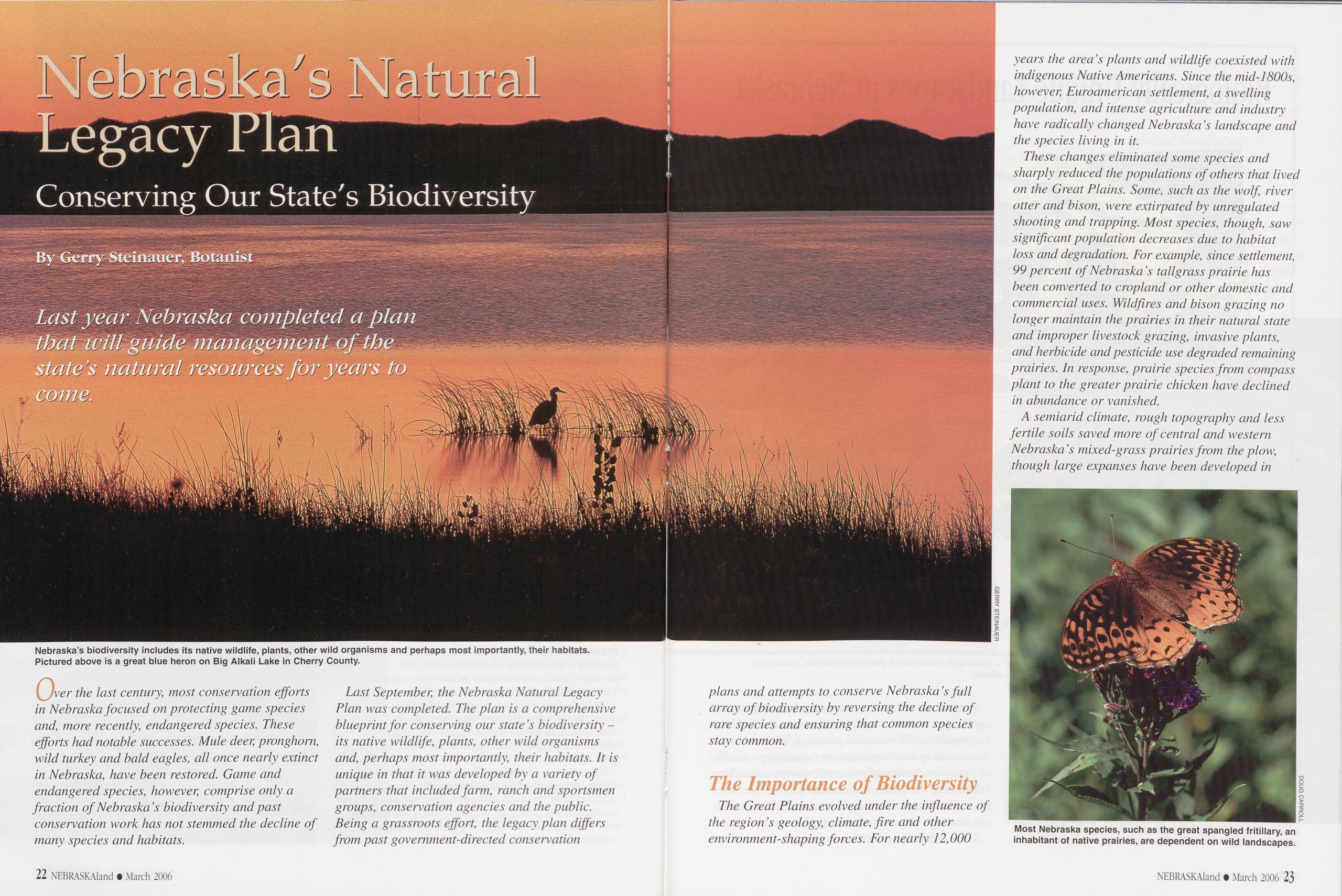
Nebraska's Natural Legacy Plan Conserving Our State's Biodiversity
By Gerry Steinauer, Botanist Last year Nebraska completed a plan that will guide management of the state's natural resources for years to come.Over the last century, most conservation efforts in Nebraska focused on protecting game species and, more recently, endangered species. These efforts had notable successes. Mule deer, pronghorn, wild turkey and bald eagles, all once nearly extinct in Nebraska, have been restored. Game and endangered species, however, comprise only a fraction of Nebraska’s biodiversity and past conservation work has not stemmed the decline of many species and habitats.
Last September, the Nebraska Natural Legacy Plan was completed. The plan is a comprehensive blueprint for conserving our state’s biodiversity - its native wildlife, plants, other wild organisms and, perhaps most importantly, their habitats. It is unique in that it was developed by a variety of partners that included farm, ranch and sportsmen groups, conservation agencies and the public. Being a grassroots effort, the legacy plan differs from past government-directed conservation plans and attempts to conserve Nebraska’s full array of biodiversity by reversing the decline of rare species and ensuring that common species stay common.
The Importance of BiodiversityThe Great Plains evolved under the influence of the region’s geology, climate, fire and other environment-shaping forces. For nearly 12,000 years the area’s plants and wildlife coexisted with indigenous Native Americans. Since the mid-1800s, however, Euroamerican settlement, a swelling population, and intense agriculture and industry have radically changed Nebraska’s landscape and the species living in it.
These changes eliminated some species and sharply reduced the populations of others that lived on the Great Plains. Some, such as the wolf, river otter and bison, were extirpated by unregulated shooting and trapping. Most species, though, saw significant population decreases due to habitat loss and degradation. For example, since settlement, 99 percent of Nebraska’s tailgrass prairie has been converted to cropland or other domestic and commercial uses. Wildfires and bison grazing no longer maintain the prairies in their natural state and improper livestock grazing, invasive plants, and herbicide and pesticide use degraded remaining prairies. In response, prairie species from compass plant to the greater prairie chicken have declined in abundance or vanished.
A semiarid climate, rough topography and less fertile soils saved more of central and western Nebraska’s mixed-grass prairies from the plow, though large expanses have been developed in
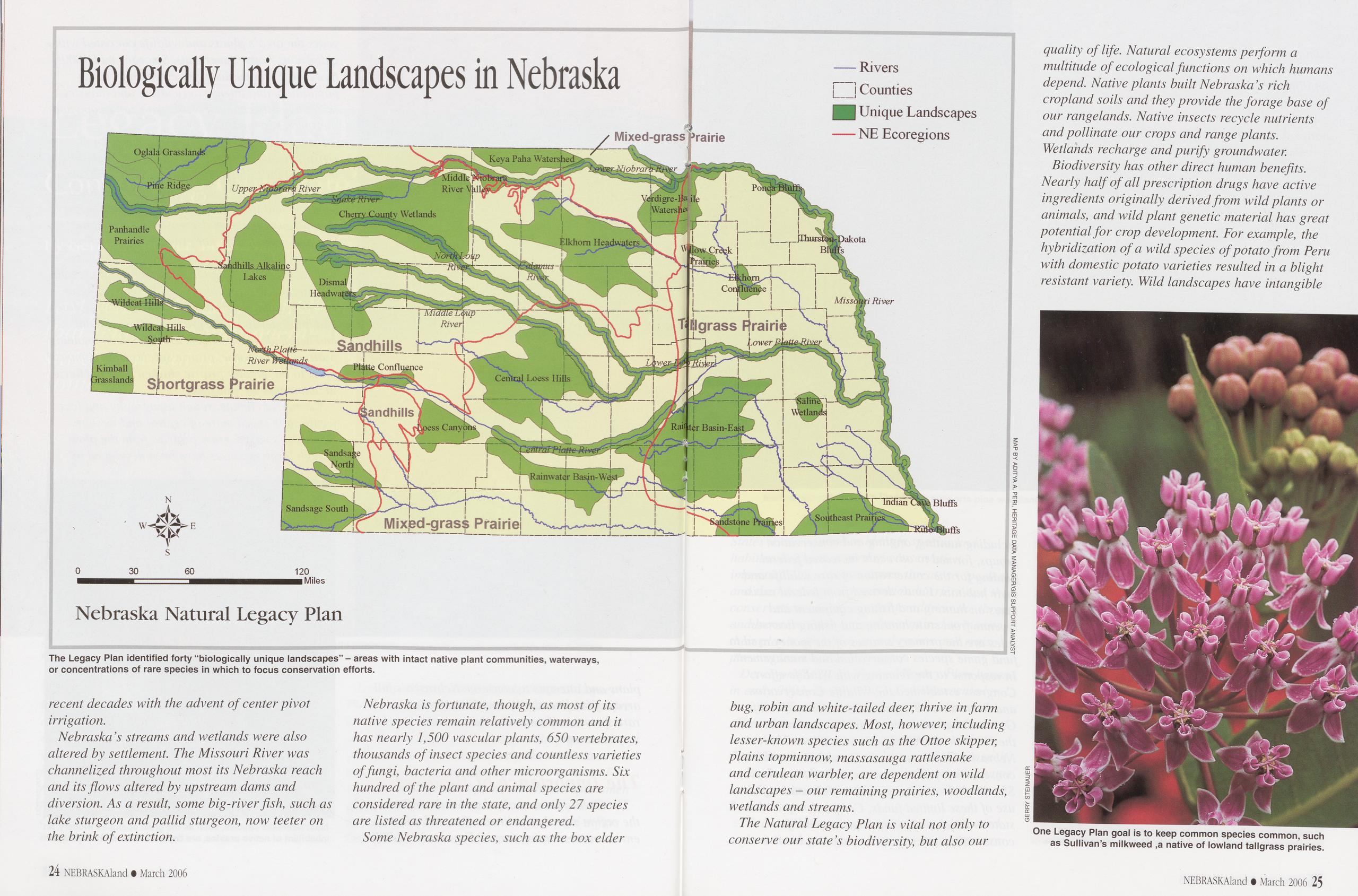
Biologically Unique Landscapes in Nebraska
recent decades with the advent ofcenter pivot irrigation.
Nebraska’s streams and wetlands were also altered by settlement. The Missouri River was channelized throughout most its Nebraska reach and its flows altered by upstream dams and diversion. As a result, some big-river fish, such as lake sturgeon and pallid sturgeon, now teeter on the brink of extinction.
Nebraska is fortunate, though, as most of its native species remain relatively common and it has nearly 1,500 vascular plants, 650 vertebrates, thousands of insect species and countless varieties of fungi, bacteria and other microorganisms. Six hundred of the plant and animal species are considered rare in the state, and only 27 species are listed as threatened or endangered.
Some Nebraska species, such as the box elder bug, robin and white-tailed deer, thrive in farm and urban landscapes. Most, however, including lesser-known species such as the Ottoe skipper, plains topminnow, massasauga rattlesnake and cerulean warbler, are dependent on wild landscapes — our remaining prairies, woodlands, wetlands and streams.
The Natural Legacy Plan is vital not only to conserve our state’s biodiversity, but also our quality of life. Natural ecosystems petform a multitude of ecological functions on which humans depend. Native plants built Nebraska’s rich cropland soils and they provide the forage base of our rangelands. Native insects recycle nutrients and pollinate our crops and range plants. Wetlands recharge and purify groundwater.
Biodiversity has other direct human benefits. Nearly half of all prescription drugs have active ingredients originally derived from wild plants or animals, and wild plant genetic material has great potential for crop development. For example, the hybridization of a wild species of potato from Peru with domestic potato varieties resulted in a blight resistant variety. Wild landscapes have intangible
One Legacy Plan goal is to keep common species common, such as Sullivan’s milkweed ,a native of lowland tailgrass prairies. 24 NEBRASKAland • March 2006 NEBRASKAland • March 2006 25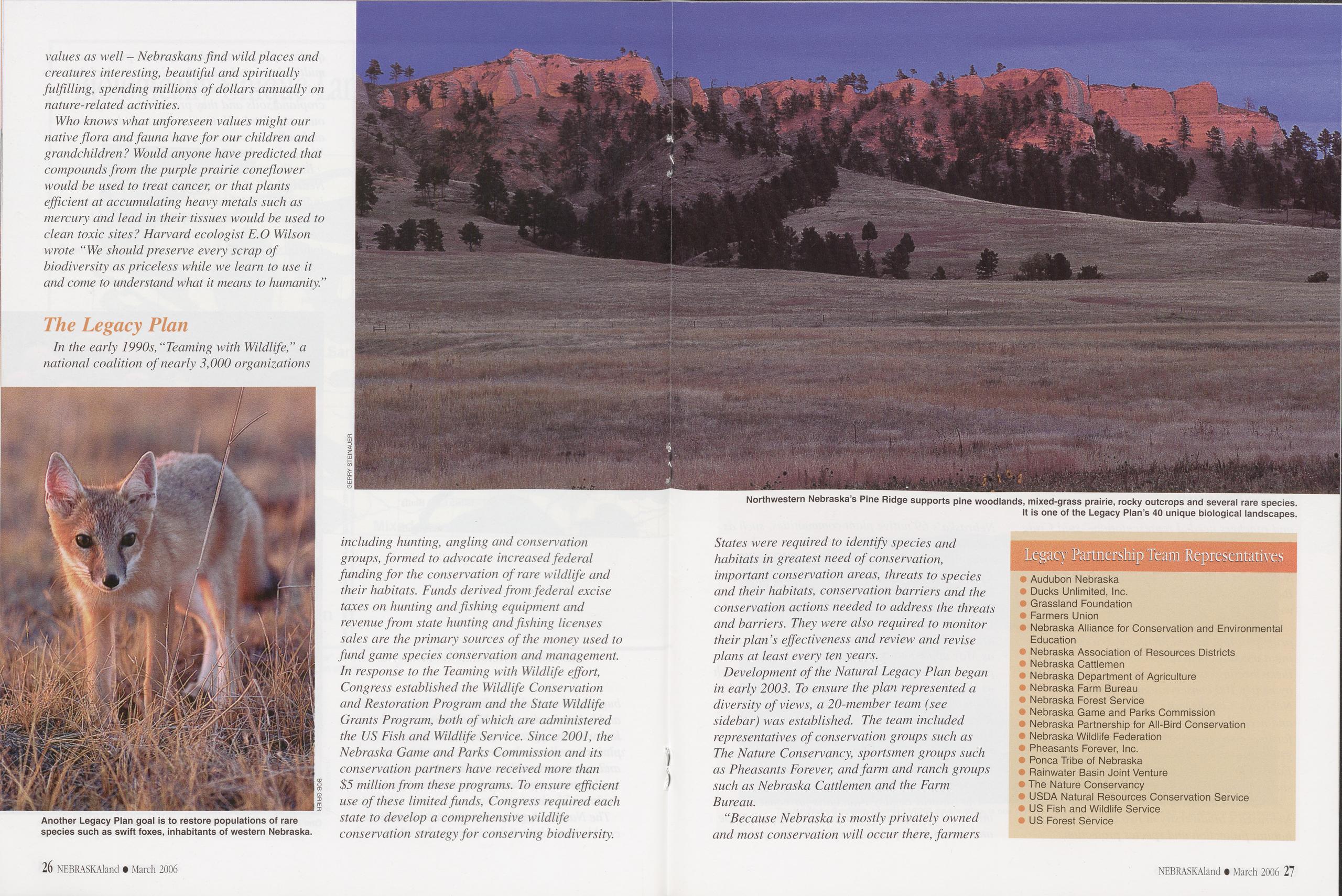
values as well - Nebraskans find wild places and creatures interesting, beautiful and spiritually fulfilling, spending millions of dollars annually on nature-related activities.
Who knows what unforeseen values might our native flora and fauna have for our children and grandchildren ? Would anyone have predicted that compounds from the purple prairie coneflower would be used to treat cancer, or that plants efficient at accumulating heavy metals such as mercury and lead in their tissues would be used to clean toxic sites? Harvard ecologist E.O Wilson wrote “ We should preserve every scrap of biodiversity as priceless while we learn to use it and come to understand what it means to humanity.”
The Legacy PlanIn the early 1990s, “Teaming with Wildlife,” a national coalition of nearly 3,000 organizations including hunting, angling and conservation groups, formed to advocate increased federal funding for the conservation of rare wildlife and their habitats. Funds derived from federal excise taxes on hunting and fishing equipment and revenue from state hunting and fishing licenses sales are the primary sources of the money used to fund game species conservation and management. In response to the Teaming with Wildlife effort, Congress established the Wildlife Conservation and Restoration Program and the State Wildlife Grants Program, both of which are administered the US Fish and Wildlife Service. Since 2001, the Nebraska Game and Parks Commission and its conservation partners have received more than $5 million from these programs. To ensure efficient use of these limited funds, Congress required each state to develop a comprehensive wildlife conservation strategy for conserving biodiversity. States were required to identify species and habitats in greatest need of conservation, important conservation areas, threats to species and their habitats, conservation barriers and the conservation actions needed to address the threats and barriers. They were also required to monitor their plan’s effectiveness and review and revise plans at least every ten years.
Development of the Natural Legacy Plan began in early 2003. To ensure the plan represented a diversity of views, a 20-member team (see sidebar) was established. The team included representatives of conservation groups such as The Nature Conservancy, sportsmen groups such as Pheasants Forever, and farm and ranch groups such as Nebraska Cattlemen and the Farm Bureau.
Because Nebraska is mostly privately owned and most conservation will occur there, farmers
Legacy Partnership Team Representatives • Audubon Nebraska • Ducks Unlimited, Inc. • Grassland Foundation • Farmers Union • Nebraska Alliance for Conservation and Environmental Education • Nebraska Association of Resources Districts Nebraska Cattlemen • Nebraska Department of Agriculture • Nebraska Farm Bureau • Nebraska Forest Service • Nebraska Game and Parks Commission • Nebraska Partnership for All-Bird Conservation • Nebraska Wildlife Federation • Pheasants Forever, Inc. • Ponca Tribe of Nebraska • Rainwater Basin Joint Venture • The Nature Conservancy • USDA Natural Resources Conservation Service • US Fish and Wildlife Service • US Forest Service 26 NEBRASKAland • March 2006 NEBRASKAland • March 2006 27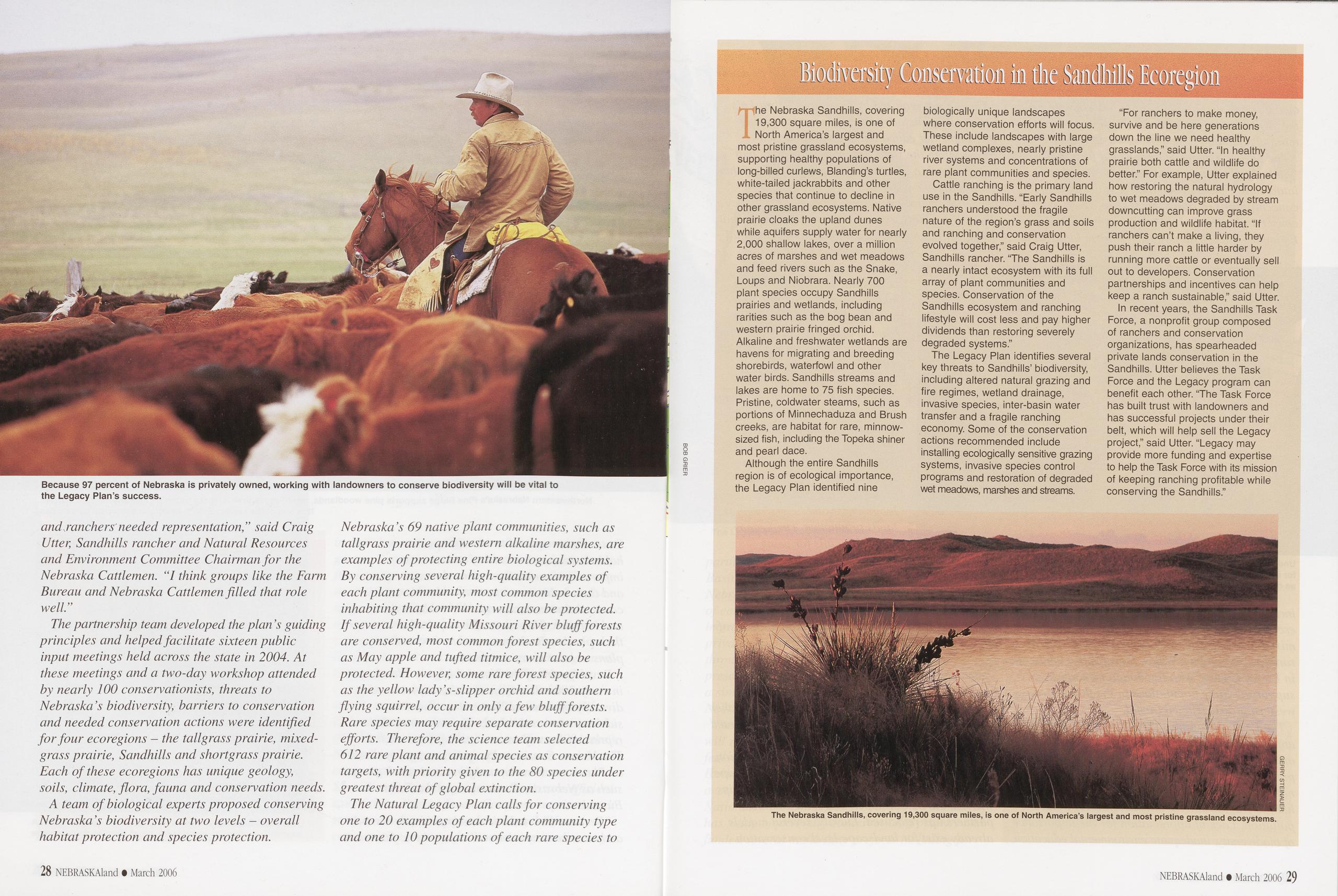
and,ranchers needed representation,” said Craig Utter, Sandhills rancher and Natural Resources and Environment Committee Chairman for the Nebraska Cattlemen. “I think groups like the Farm Bureau and Nebraska Cattlemen filled that role well.”
The partnership team developed the plan’s guiding principles and helped facilitate sixteen public input meetings held across the state in 2004. At these meetings and a two-day workshop attended by nearly 100 conservationists, threats to Nebraska’s biodiversity, barriers to conservation and needed conservation actions were identified for four ecoregions - the tailgrass prairie, mixed- grass prairie, Sandhills and shortgrass prairie. Each of these ecoregions has unique geology, soils, climate, flora, fauna and conservation needs.
A team of biological experts proposed conserving Nebraska’s biodiversity at two levels - overall habitat protection and species protection. Nebraska’s 69 native plant communities, such as tailgrass prairie and western alkaline marshes, are examples of protecting entire biological systems. By conserving several high-quality examples of each plant community, most common species inhabiting that community will also be protected. If several high-quality Missouri River bluff forests are conserved, most common forest species, such as May apple and tufted titmice, will also be protected. However, some rare forest species, such as the yellow lady ’s-slipper orchid and southern flying squirrel, occur in only a few bluff forests. Rare species may require separate conservation efforts. Therefore, the science team selected 612 rare plant and animal species as conservation targets, with priority given to the 80 species under greatest threat of global extinction.
The Natural Legacy Plan calls for conserving one to 20 examples of each plant community type and one to 10 populations of each rare species to
Biodiversity Conservation in the Sandhills EeorcgionThe Nebraska Sandhills, covering 19,300 square miles, is one of North America’s largest and most pristine grassland ecosystems, supporting healthy populations of long-billed curlews, Blanding’s turtles, white-tailed jackrabbits and other species that continue to decline in other grassland ecosystems. Native prairie cloaks the upland dunes while aquifers supply water for nearly 2,000 shallow lakes, over a million acres of marshes and wet meadows and feed rivers such as the Snake, Loups and Niobrara. Nearly 700 plant species occupy Sandhills prairies and wetlands, including rarities such as the bog bean and western prairie fringed orchid.
Alkaline and freshwater wetlands are havens for migrating and breeding shorebirds, waterfowl and other water birds. Sandhills streams and lakes are home to 75 fish species. Pristine, coldwater steams, such as portions of Minnechaduza and Brush creeks, are habitat for rare, minnow- sized fish, including the Topeka shiner and pearl dace.
Although the entire Sandhills region is of ecological importance, the Legacy Plan identified nine biologically unique landscapes where conservation efforts will focus. These include landscapes with large wetland complexes, nearly pristine river systems and concentrations of rare plant communities and species.
Cattle ranching is the primary land use in the Sandhills. “Early Sandhills ranchers understood the fragile nature of the region’s grass and soils and ranching and conservation evolved together,” said Craig Utter, Sandhills rancher. “The Sandhills is a nearly intact ecosystem with its full array of plant communities and species. Conservation of the Sandhills ecosystem and ranching lifestyle will cost less and pay higher dividends than restoring severely degraded systems.”
The Legacy Plan identifies several key threats to Sandhills’ biodiversity, including altered natural grazing and fire regimes, wetland drainage, invasive species, inter-basin water transfer and a fragile ranching economy. Some of the conservation actions recommended include installing ecologically sensitive grazing systems, invasive species control programs and restoration of degraded wet meadows, marshes and streams.
“For ranchers to make money, survive and be here generations down the line we need healthy grasslands,” said Utter. “In healthy prairie both cattle and wildlife do better.” For example, Utter explained how restoring the natural hydrology to wet meadows degraded by stream downcutting can improve grass production and wildlife habitat. “If ranchers can’t make a living, they push their ranch a little harder by running more cattle or eventually sell out to developers. Conservation partnerships and incentives can help keep a ranch sustainable,” said Utter.
In recent years, the Sandhills Task Force, a nonprofit group composed of ranchers and conservation organizations, has spearheaded private lands conservation in the Sandhills. Utter believes the Task Force and the Legacy program can benefit each other. “The Task Force has built trust with landowners and has successful projects under their belt, which will help sell the Legacy project,” said Utter. “Legacy may provide more funding and expertise to help the Task Force with its mission of keeping ranching profitable while conserving the Sandhills.”
ensure their long-term survival. Plant communities and species more abundant outside Nebraska require less conservation here because they will also be protected in other states, an example being the swift fox that is uncommon in Nebraska but more abundant in neighboring western states.
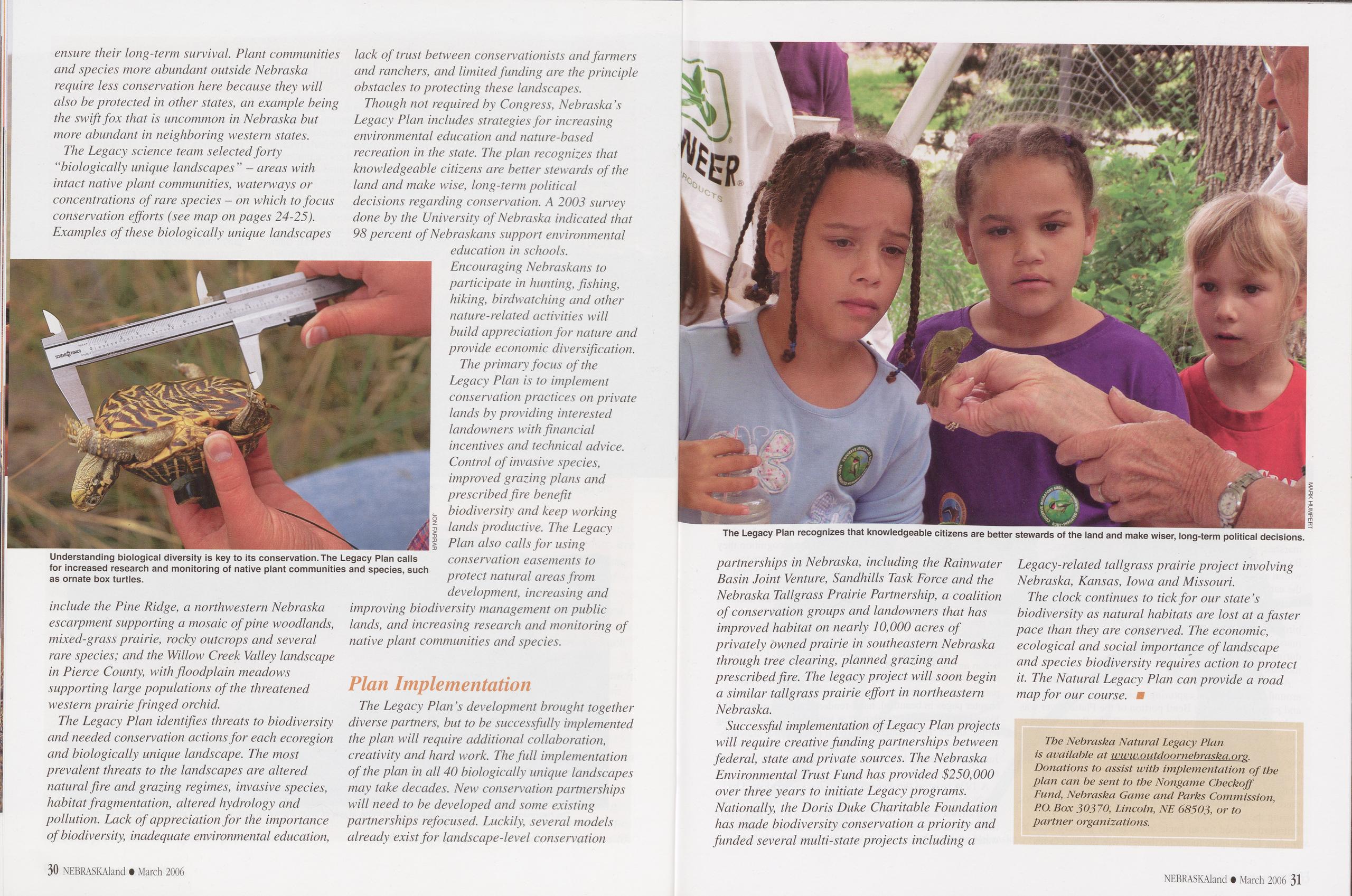
The Legacy science team selected forty “biologically unique landscapes " - areas with intact native plant communities, waterways or concentrations of rare species - on which to focus conservation efforts (see map on pages 24-25). Examples of these biologically unique landscapes include the Pine Ridge, a northwestern Nebraska escarpment supporting a mosaic of pine woodlands, mixed-grass prairie, rocky outcrops and several rare species; and the Willow Creek Valley landscape in Pierce County, with floodplain meadows supporting large populations of the threatened western prairie fringed orchid.
The Legacy Plan identifies threats to biodiversity and needed conservation actions for each ecoregion and biologically unique landscape. The most prevalent threats to the landscapes are altered natural fire and grazing regimes, invasive species, habitat fragmentation, altered hydrology and pollution. Lack of appreciation for the importance of biodiversity, inadequate environmental education, lack of trust between conservationists and farmers and ranchers, and limited funding are the principle obstacles to protecting these landscapes.
Though not required by Congress, Nebraska’s Legacy Plan includes strategies for increasing environmental education and nature-based recreation in the state. The plan recognizes that knowledgeable citizens are better stewards of the land and make wise, long-term political decisions regarding conservation. A 2003 survey done by the University of Nebraska indicated that 98 percent of Nebraskans support environmental education in schools. Encouraging Nebraskans to participate in hunting, fishing, hiking, birdwatching and other nature-related activities will build appreciation for nature and provide economic diversification.
The primary focus of the Legacy Plan is to implement conservation practices on private lands by providing interested landowners with financial incentives and technical advice. Control of invasive species, improved grazing plans and prescribed fire benefit biodiversity and keep working lands productive. The Legacy Plan also calls for using conservation easements to protect natural areas from development, increasing and improving biodiversity management on public lands, and increasing research and monitoring of native plant communities and species.
Plan ImplementationThe Legacy Plan's development brought together diverse partners, but to be successfully implemented the plan will require additional collaboration, creativity and hard work. The full implementation of the plan in all 40 biologically unique landscapes may take decades. New conservation partnerships will need to be developed and some existing partnerships refocused. Luckily, several models already exist for landscape-level conservation partnerships in Nebraska, including the Rainwater Basin Joint Venture, Sandhills Task Force and the Nebraska Tallgrass Prairie Partnership, a coalition of conservation groups and landowners that has improved habitat on nearly 10,000 acres of privately owned prairie in southeastern Nebraska through tree clearing, planned grazing and prescribed fire. The legacy project will soon begin a similar tailgrass prairie effort in northeastern Nebraska.
Successful implementation of Legacy Plan projects will require creative funding partnerships between federal, state and private sources. The Nebraska Environmental Trust Fund has provided $250,000 over three years to initiate Legacy programs. Nationally, the Doris Duke Charitable Foundation has made biodiversity conservation a priority and funded several multi-state projects including a Legacy-related tallgrass prairie project involving Nebraska, Kansas, Iowa and Missouri. The clock continues to tick for our state’s biodiversity as natural habitats are lost at a faster pace than they are conserved. The economic, ecological and social importance of landscape and species biodiversity requires action to protect it. The Natural Legacy Plan can provide a road map for our course.
The Nebraska Natural Legacy Plan is available at uzwmoujdoo,rnebraska,org. Donations to assist with implementation of the plan can be sent to the Nongame Checkoff Fund, Nebraska Game and Parks Commission, PO. Box 30370, Lincoln, NE 68503, or to partner organizations.
30 NEBRASKAland • March 2006 NEBRASKAland • March 2006 31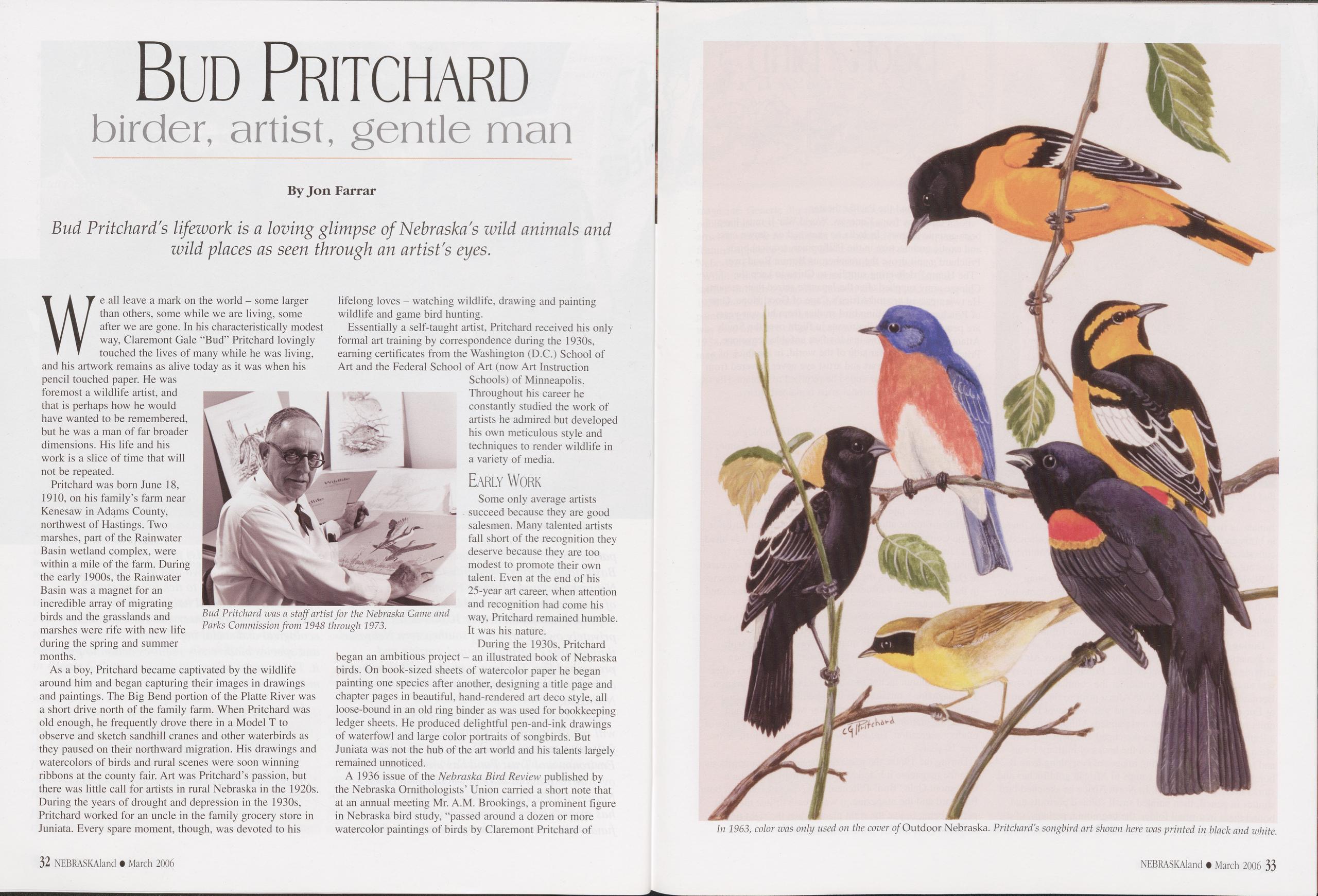
Bud Pritchard birder, artist, gentle man
By Jon Farrar Bud Pritchard's lifework is a loving glimpse of Nebraska's wild animals and wild places as seen through an artist's eyes.We all leave a mark on the world - some larger than others, some while we are living, some after we are gone. In his characteristically modest way, Claremont Gale “Bud” Pritchard lovingly touched the lives of many while he was living, and his artwork remains as alive today as it was when his pencil touched paper. He was foremost a wildlife artist, and that is perhaps how he would have wanted to be remembered, but he was a man of far broader dimensions. His life and his work is a slice of time that will not be repeated.
Pritchard was born June 18, 1910, on his family’s farm near Kenesaw in Adams County, northwest of Hastings. Two marshes, part of the Rainwater Basin wetland complex, were within a mile of the farm. During the early 1900s, the Rainwater Basin was a magnet for an incredible array of migrating birds and the grasslands and marshes were rife with new life during the spring and summer months.
As a boy, Pritchard became captivated by the wildlife around him and began capturing their images in drawings and paintings. The Big Bend portion of the Platte River was a short drive north of the family farm. When Pritchard was old enough, he frequently drove there in a Model T to observe and sketch sandhill cranes and other waterbirds as they paused on their northward migration. His drawings and watercolors of birds and rural scenes were soon winning ribbons at the county fair. Art was Pritchard’s passion, but there was little call for artists in rural Nebraska in the 1920s. During the years of drought and depression in the 1930s, Pritchard worked for an uncle in the family grocery store in Juniata. Every spare moment, though, was devoted to his Bud Pritchard was a staff artist for the Nebraska Game and Parks Commission from 1948 through 1973. lifelong loves - watching wildlife, drawing and painting wildlife and game bird hunting.
Essentially a self-taught artist, Pritchard received his only formal art training by correspondence during the 1930s, earning certificates from the Washington (D.C.) School of Art and the Federal School of Art (now Art Instruction Schools) of Minneapolis. Throughout his career he constantly studied the work of artists he admired but developed his own meticulous style and techniques to render wildlife in a variety of media.
Early WorkSome only average artists succeed because they are good salesmen. Many talented artists fall short of the recognition they deserve because they are too modest to promote their own talent. Even at the end of his 25-year art career, when attention and recognition had come his way, Pritchard remained humble. It was his nature.
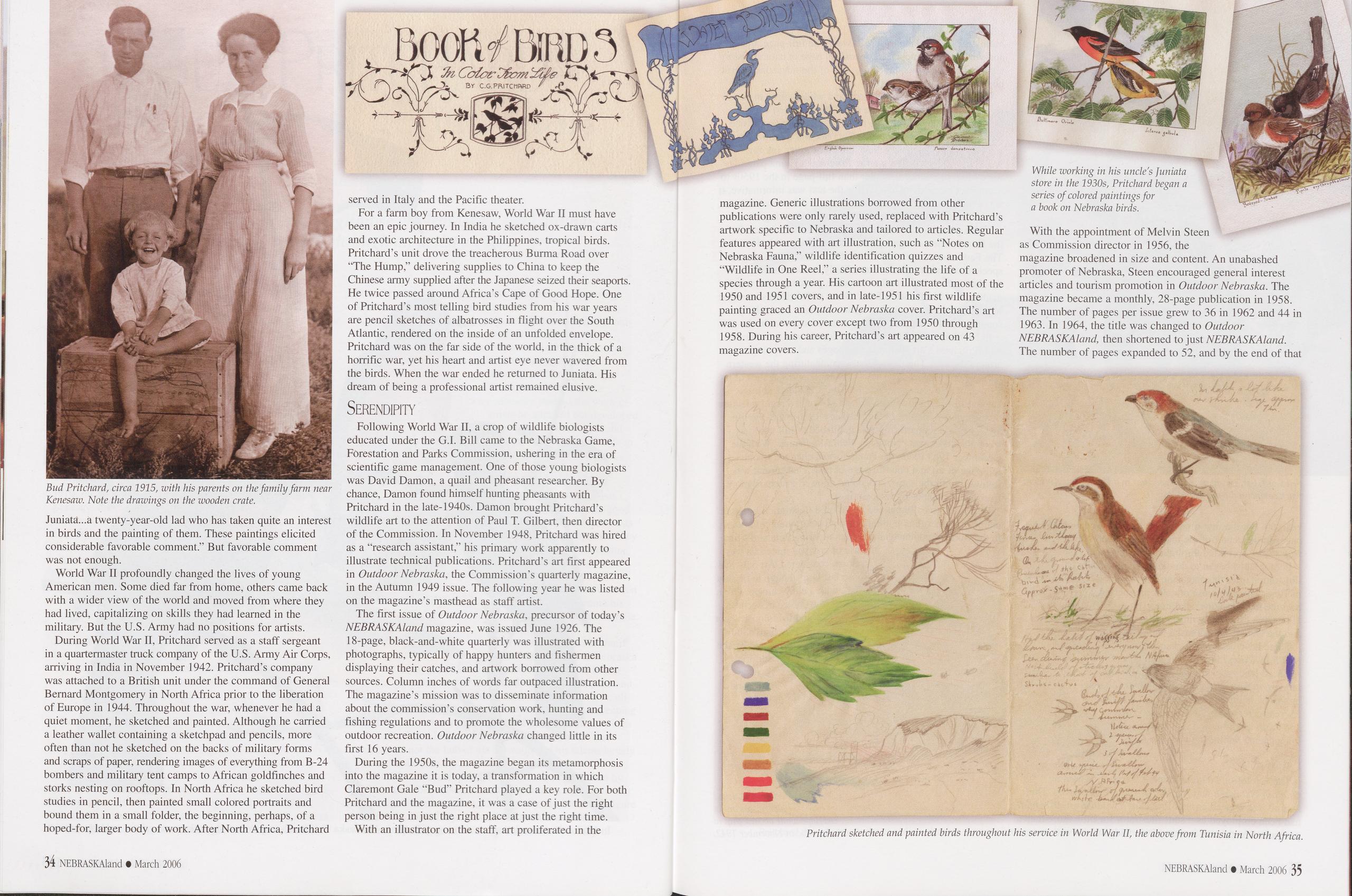
During the 1930s, Pritchard began an ambitious project - an illustrated book of Nebraska birds. On book-sized sheets of watercolor paper he began painting one species after another, designing a title page and chapter pages in beautiful, hand-rendered art deco style, all loose-bound in an old ring binder as was used for bookkeeping ledger sheets. He produced delightful pen-and-ink drawings of waterfowl and large color portraits of songbirds. But Juniata was not the hub of the art world and his talents largely remained unnoticed.
A 1936 issue of the Nebraska Bird Review published by the Nebraska Ornithologists’ Union carried a short note that at an annual meeting Mr. A M. Brookings, a prominent figure in Nebraska bird study, “passed around a dozen or more watercolor paintings of birds by Claremont Pritchard of
Juniata...a twenty-year-old lad who has taken quite an interest in birds and the painting of them. These paintings elicited considerable favorable comment.” But favorable comment was not enough.
World War II profoundly changed the lives of young American men. Some died far from home, others came back with a wider view of the world and moved from where they had lived, capitalizing on skills they had learned in the military. But the U.S. Army had no positions for artists.
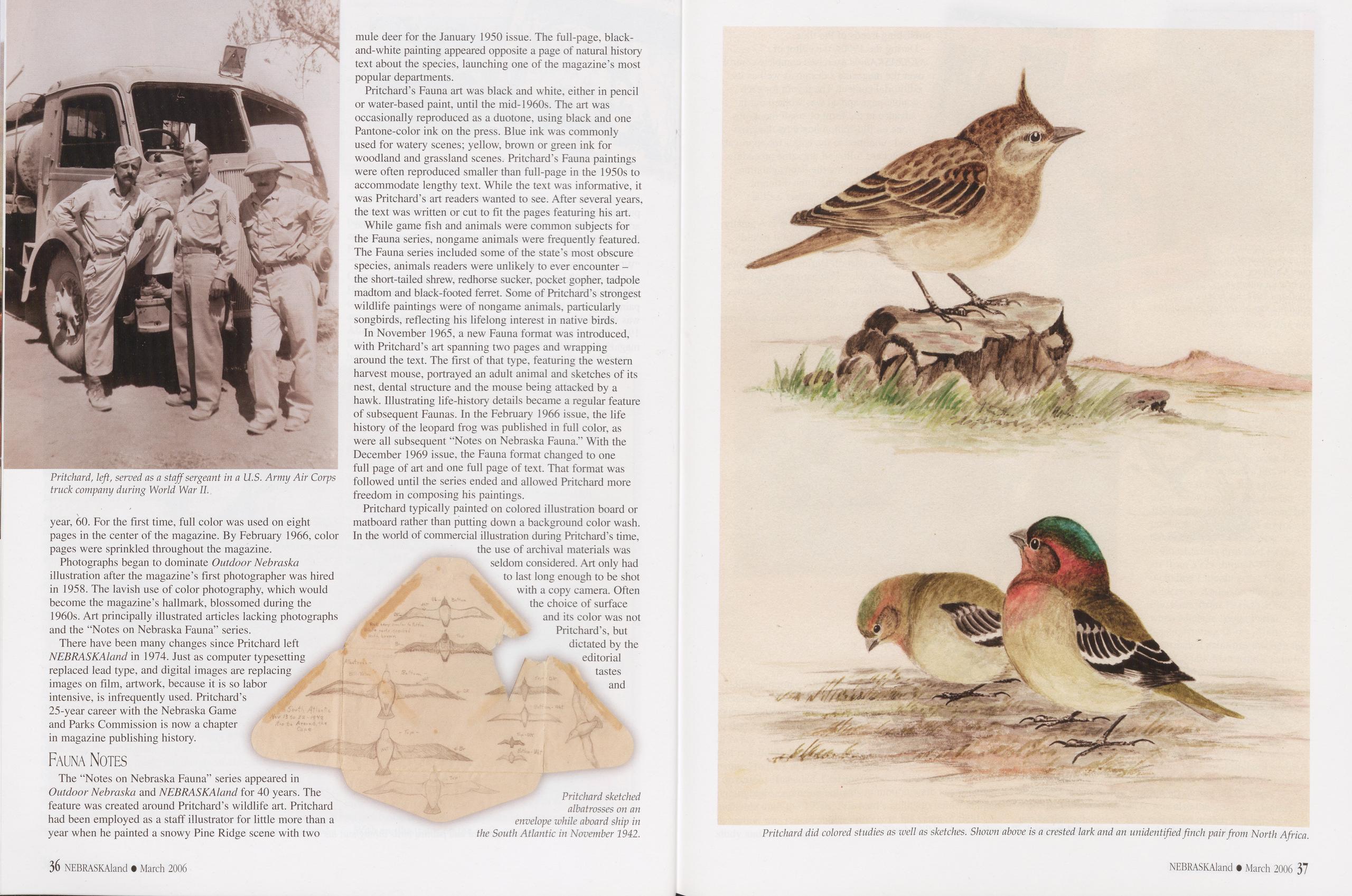
During World War II, Pritchard served as a staff sergeant in a quartermaster truck company of the U.S. Army Air Corps, arriving in India in November 1942. Pritchard’s company was attached to a British unit under the command of General Bernard Montgomery in North Africa prior to the liberation of Europe in 1944. Throughout the war, whenever he had a quiet moment, he sketched and painted. Although he carried a leather wallet containing a sketchpad and pencils, more often than not he sketched on the backs of military forms and scraps of paper, rendering images of everything from B-24 bombers and military tent camps to African goldfinches and storks nesting on rooftops. In North Africa he sketched bird studies in pencil, then painted small colored portraits and bound them in a small folder, the beginning, perhaps, of a hoped-for, larger body of work. After North Africa, Pritchard served in Italy and the Pacific theater.
For a farm boy from Kenesaw, World War II must have been an epic journey. In India he sketched ox-drawn carts and exotic architecture in the Philippines, tropical birds. Pritchard’s unit drove the treacherous Burma Road over "The Hump,” delivering supplies to China to keep the Chinese army supplied after the Japanese seized their seaports. He twice passed around Africa’s Cape of Good Hope. One of Pritchard’s most telling bird studies from his war years are pencil sketches of albatrosses in flight over the South Atlantic, rendered on the inside of an unfolded envelope. Pritchard was on the far side of the world, in the thick of a horrific war, yet his heart and artist eye never wavered from the birds. When the war ended he returned to Juniata. His dream of being a professional artist remained elusive.
SerendipityFollowing World War II, a crop of wildlife biologists educated under the G.I. Bill came to the Nebraska Game, Forestation and Parks Commission, ushering in the era of scientific game management. One of those young biologists was David Damon, a quail and pheasant researcher. By chance, Damon found himself hunting pheasants with Pritchard in the late-1940s. Damon brought Pritchard’s wildlife art to the attention of Paul T. Gilbert, then director of the Commission. In November 1948, Pritchard was hired as a "research assistant,” his primary work apparently to illustrate technical publications. Pritchard’s art first appeared in Outdoor Nebraska, the Commission’s quarterly magazine, in the Autumn 1949 issue. The following year he was listed on the magazine’s masthead as staff artist.
The first issue of Outdoor Nebraska, precursor of today’s NEBRASKAland magazine, was issued June 1926. The 18-page, black-and-white quarterly was illustrated with photographs, typically of happy hunters and fishermen displaying their catches, and artwork borrowed from other sources. Column inches of words far outpaced illustration. The magazine’s mission was to disseminate information about the commission’s conservation work, hunting and fishing regulations and to promote the wholesome values of outdoor recreation. Outdoor Nebraska changed little in its first 16 years.
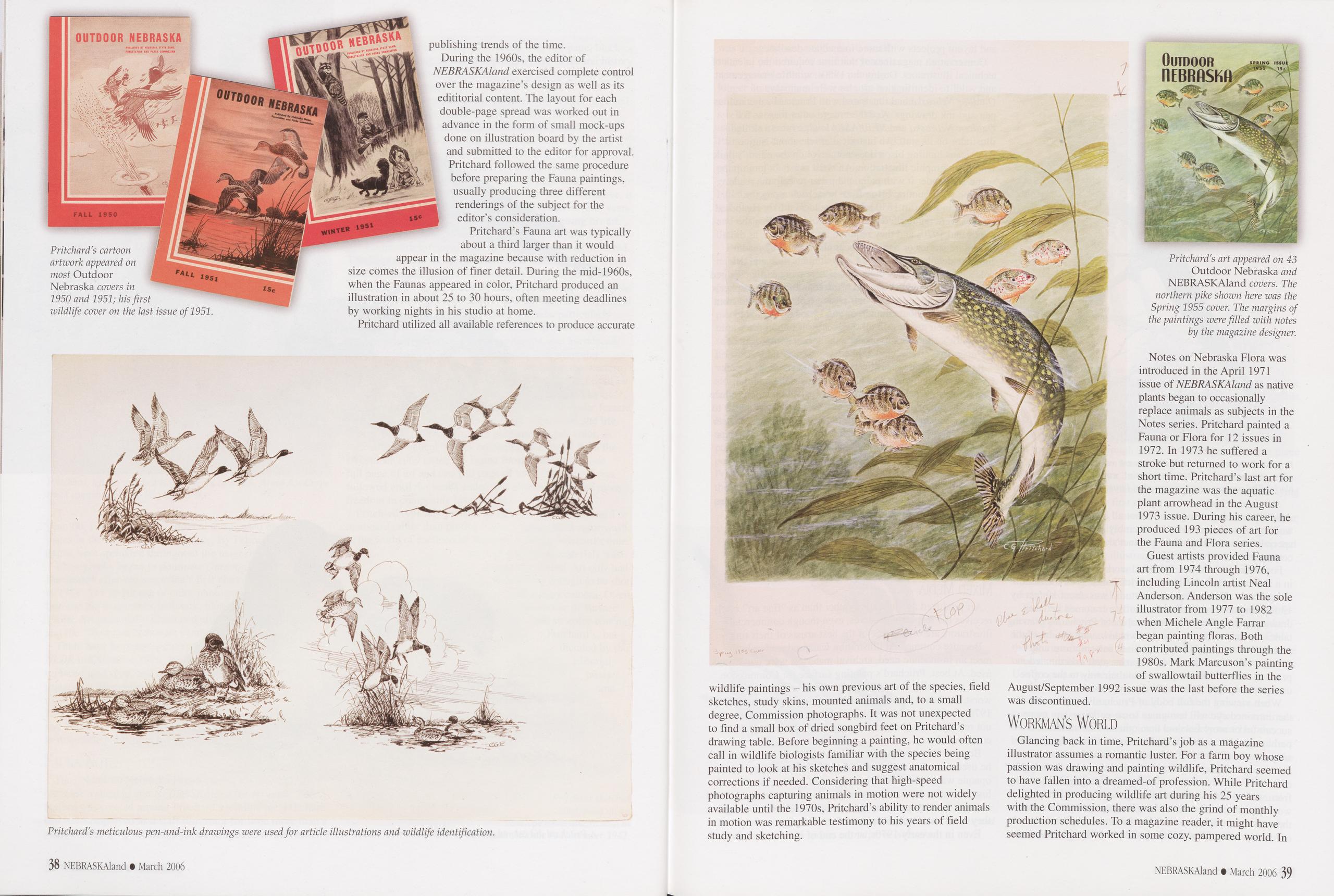
During the 1950s, the magazine began its metamorphosis into the magazine it is today, a transformation in which Claremont Gale "Bud” Pritchard played a key role. For both Pritchard and the magazine, it was a case of just the right person being in just the right place at just the right time. With an illustrator on the staff, art proliferated in the magazine. Generic illustrations borrowed from other publications were only rarely used, replaced with Pritchard’s artwork specific to Nebraska and tailored to articles. Regular features appeared with art illustration, such as "Notes on Nebraska Fauna,” wildlife identification quizzes and "Wildlife in One Reel,” a series illustrating the life of a species through a year. His cartoon art illustrated most of the 1950 and 1951 covers, and in late-1951 his first wildlife painting graced an Outdoor Nebraska cover. Pritchard’s art was used on every cover except two from 1950 through 1958. During his career, Pritchard’s art appeared on 43 magazine covers.
With the appointment of Melvin Steen as Commission director in 1956, the magazine broadened in size and content. An unabashed promoter of Nebraska, Steen encouraged general interest articles and tourism promotion in Outdoor Nebraska. The magazine became a monthly, 28-page publication in 1958. The number of pages per issue grew to 36 in 1962 and 44 in 1963. In 1964, the title was changed to Outdoor NEBRASKAland, then shortened to just NEBRASKAland. The number of pages expanded to 52, and by the end of that
year, 60. For the first time, full color was used on eight pages in the center of the magazine. By February 1966, color pages were sprinkled throughout the magazine.
Photographs began to dominate Outdoor Nebraska illustration after the magazine’s first photographer was hired in 1958. The lavish use of color photography, which would become the magazine’s hallmark, blossomed during the 1960s. Art principally illustrated articles lacking photographs and the “Notes on Nebraska Fauna” series.
There have been many changes since Pritchard left NEBRASKAland in 1974. Just as computer typesetting replaced lead type, and digital images are replacing images on film, artwork, because it is so labor intensive, is infrequently used. Pritchard’s 25-year career with the Nebraska Game and Parks Commission is now a chapter in magazine publishing history.
Fauna NotesThe “Notes on Nebraska Fauna” series appeared in Outdoor Nebraska and NEBRASKAland for 40 years. The feature was created around Pritchard’s wildlife art. Pritchard had been employed as a staff illustrator for little more than a year when he painted a snowy Pine Ridge scene with two mule deer for the January 1950 issue. The full-page, black- and-white painting appeared opposite a page of natural history text about the species, launching one of the magazine’s most popular departments.
Pritchard’s Fauna art was black and white, either in pencil or water-based paint, until the mid-1960s. The art was occasionally reproduced as a duotone, using black and one Pantone-color ink on the press. Blue ink was commonly used for watery scenes; yellow, brown or green ink for woodland and grassland scenes. Pritchard’s Fauna paintings were often reproduced smaller than full-page in the 1950s to accommodate lengthy text. While the text was informative, it was Pritchard’s art readers wanted to see. After several years, the text was written or cut to fit the pages featuring his art.
While game fish and animals were common subjects for the Fauna series, nongame animals were frequently featured. The Fauna series included some of the state’s most obscure species, animals readers were unlikely to ever encounter - the short-tailed shrew, redhorse sucker, pocket gopher, tadpole madtom and black-footed ferret. Some of Pritchard’s strongest wildlife paintings were of nongame animals, particularly songbirds, reflecting his lifelong interest in native birds.
In November 1965, a new Fauna format was introduced, with Pritchard’s art spanning two pages and wrapping around the text. The first of that type, featuring the western harvest mouse, portrayed an adult animal and sketches of its nest, dental structure and the mouse being attacked by a hawk. Illustrating life-history details became a regular feature of subsequent Faunas. In the February 1966 issue, the life history of the leopard frog was published in full color, as were all subsequent “Notes on Nebraska Fauna.” With the December 1969 issue, the Fauna format changed to one full page of art and one full page of text. That format was followed until the series ended and allowed Pritchard more freedom in composing his paintings.
Pritchard typically painted on colored illustration board or matboard rather than putting down a background color wash. In the world of commercial illustration during Pritchard’s time, the use of archival materials was seldom considered. Art only had to last long enough to be shot with a copy camera. Often the choice of surface and its color was not Pritchard’s, but dictated by the editorial tastes and
publishing trends of the time.
During the 1960s, the editor of NEBRASKAland exercised complete control over the magazine’s design as well as its edititorial content. The layout for each double-page spread was worked out in advance in the form of small mock-ups done on illustration board by the artist and submitted to the editor for approval. Pritchard followed the same procedure before preparing the Fauna paintings, usually producing three different E renderings of the subject for the editor’s consideration.
Pritchard’s Fauna art was typically about a third larger than it would appear in the magazine because with reduction in size comes the illusion of finer detail. During the mid-1960s, when the Faunas appeared in color, Pritchard produced an illustration in about 25 to 30 hours, often meeting deadlines by working nights in his studio at home.
Pritchard's meticulous pen-and-ink drawings were used for article illustrations and wildlife identification.Pritchard utilized all available references to produce accurate wildlife paintings - his own previous art of the species, field sketches, study skins, mounted animals and, to a small degree, Commission photographs. It was not unexpected to find a small box of dried songbird feet on Pritchard’s drawing table. Before beginning a painting, he would often call in wildlife biologists familiar with the species being painted to look at his sketches and suggest anatomical corrections if needed. Considering that high-speed photographs capturing animals in motion were not widely available until the 1970s, Pritchard’s ability to render animals in motion was remarkable testimony to his years of field study and sketching.
Notes on Nebraska Flora was introduced in the April 1971 issue of NEBRASKAland as native plants began to occasionally replace animals as subjects in the Notes series. Pritchard painted a Fauna or Flora for 12 issues in 1972. In 1973 he suffered a stroke but returned to work for a short time. Pritchard’s last art for the magazine was the aquatic plant arrowhead in the August 1973 issue. During his career, he produced 193 pieces of art for the Fauna and Flora series.
Guest artists provided Fauna art from 1974 through 1976, including Lincoln artist Neal Anderson. Anderson was the sole illustrator from 1977 to 1982 when Michele Angle Farrar began painting floras. Both contributed paintings through the 1980s. Mark Marcuson’s painting of swallowtail butterflies in the August/September 1992 issue was the last before the series was discontinued.
Workman’s WorldGlancing back in time, Pritchard’s job as a magazine illustrator assumes a romantic luster. For a farm boy whose passion was drawing and painting wildlife, Pritchard seemed to have fallen into a dreamed-of profession. While Pritchard delighted in producing wildlife art during his 25 years with the Commission, there was also the grind of monthly production schedules. To a magazine reader, it might have seemed Pritchard worked in some cozy, pampered world. In
38 NEBRASKAland • March 2006 NEBRASKAland • March 2006 39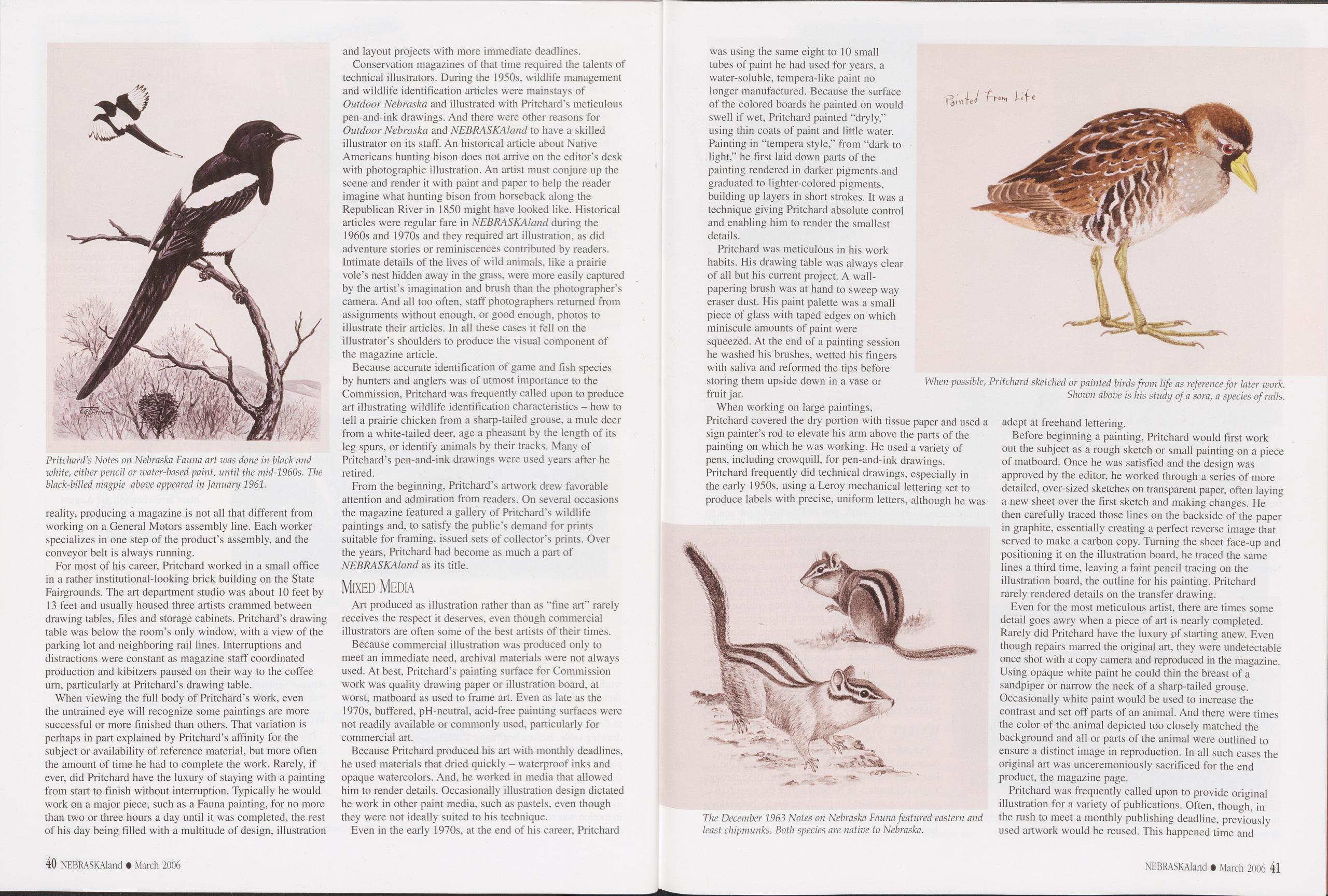
reality, producing a magazine is not all that different from working on a General Motors assembly line. Each worker specializes in one step of the product’s assembly, and the conveyor belt is always running.
For most of his career, Pritchard worked in a small office in a rather institutional-looking brick building on the State Fairgrounds. The art department studio was about 10 feet by 13 feet and usually housed three artists crammed between drawing tables, files and storage cabinets. Pritchard’s drawing table was below the room’s only window, with a view of the parking lot and neighboring rail lines. Interruptions and distractions were constant as magazine staff coordinated production and kibitzers paused on their way to the coffee urn, particularly at Pritchard’s drawing table.
When viewing the full body of Pritchard’s work, even the untrained eye will recognize some paintings are more successful or more finished than others. That variation is perhaps in part explained by Pritchard’s affinity for the subject or availability of reference material, but more often the amount of time he had to complete the work. Rarely, if ever, did Pritchard have the luxury of staying with a painting from start to finish without interruption. Typically he would work on a major piece, such as a Fauna painting, for no more than two or three hours a day until it was completed, the rest of his day being filled with a multitude of design, illustration and layout projects with more immediate deadlines.
Conservation magazines of that time required the talents of technical illustrators. During the 1950s, wildlife management and wildlife identification articles were mainstays of Outdoor Nebraska and illustrated with Pritchard’s meticulous pen-and-ink drawings. And there were other reasons for Outdoor Nebraska and NEBRASKAland to have a skilled illustrator on its staff. An historical article about Native Americans hunting bison does not arrive on the editor’s desk with photographic illustration. An artist must conjure up the scene and render it with paint and paper to help the reader imagine what hunting bison from horseback along the Republican River in 1850 might have looked like. Historical articles were regular fare in NEBRASKAland during the 1960s and 1970s and they required art illustration, as did adventure stories or reminiscences contributed by readers. Intimate details of the lives of wild animals, like a prairie vole’s nest hidden away in the grass, were more easily captured by the artist’s imagination and brush than the photographer’s camera. And all too often, staff photographers returned from assignments without enough, or good enough, photos to illustrate their articles. In all these cases it fell on the illustrator’s shoulders to produce the visual component of the magazine article.
Because accurate identification of game and fish species by hunters and anglers was of utmost importance to the Commission, Pritchard was frequently called upon to produce art illustrating wildlife identification characteristics - how to tell a prairie chicken from a sharp-tailed grouse, a mule deer from a white-tailed deer, age a pheasant by the length of its leg spurs, or identify animals by their tracks. Many of Pritchard’s pen-and-ink drawings were used years after he retired.
From the beginning, Pritchard’s artwork drew favorable attention and admiration from readers. On several occasions the magazine featured a gallery of Pritchard’s wildlife paintings and, to satisfy the public’s demand for prints suitable for framing, issued sets of collector’s prints. Over the years, Pritchard had become as much a part of NEBRASKAland as its title.
Mixed MediaArt produced as illustration rather than as “fine art” rarely receives the respect it deserves, even though commercial illustrators are often some of the best artists of their times. Because commercial illustration was produced only to meet an immediate need, archival materials were not always used. At best, Pritchard’s painting surface for Commission work was quality drawing paper or illustration board, at worst, matboard as used to frame art. Even as late as the 1970s, buffered, pH-neutral, acid-free painting surfaces were not readily available or commonly used, particularly for commercial art.
Because Pritchard produced his art with monthly deadlines, he used materials that dried quickly - waterproof inks and opaque watercolors. And, he worked in media that allowed him to render details. Occasionally illustration design dictated he work in other paint media, such as pastels, even though they were not ideally suited to his technique.
Even in the early 1970s, at the end of his career, Pritchard was using the same eight to 10 small tubes of paint he had used for years, a water-soluble, tempera-like paint no longer manufactured. Because the surface of the colored boards he painted on would swell if wet, Pritchard painted “dryly,” using thin coats of paint and little water. Painting in “tempera style,” from “dark to light,” he first laid down parts of the painting rendered in darker pigments and graduated to lighter-colored pigments, building up layers in short strokes. It was a technique giving Pritchard absolute control and enabling him to render the smallest details.
Pritchard was meticulous in his work habits. His drawing table was always clear of all but his current project. A wall- papering brush was at hand to sweep way eraser dust. His paint palette was a small piece of glass with taped edges on which miniscule amounts of paint were squeezed. At the end of a painting session he washed his brushes, wetted his fingers with saliva and reformed the tips before storing them upside down in a vase or fruit jar.
When working on large paintings, Pritchard covered the dry portion with tissue paper and used a sign painter’s rod to elevate his arm above the parts of the painting on which he was working. He used a variety of pens, including crowquill, for pen-and-ink drawings. Pritchard frequently did technical drawings, especially in the early 1950s, using a Leroy mechanical lettering set to produce labels with precise, uniform letters, although he was The December 1963 Notes on Nebraska Fauna featured eastern and least chipmunks. Both species are native to Nebraska. When possible, Pritchard sketched or painted birds from life as reference for later work. Shown above is his study of a sora, a species of rails. adept at freehand lettering.
Before beginning a painting, Pritchard would first work out the subject as a rough sketch or small painting on a piece of matboard. Once he was satisfied and the design was approved by the editor, he worked through a series of more detailed, over-sized sketches on transparent paper, often laying a new sheet over the first sketch and making changes. He then carefully traced those lines on the backside of the paper in graphite, essentially creating a perfect reverse image that served to make a carbon copy. Turning the sheet face-up and positioning it on the illustration board, he traced the same lines a third time, leaving a faint pencil tracing on the illustration board, the outline for his painting. Pritchard rarely rendered details on the transfer drawing.
Even for the most meticulous artist, there are times some detail goes awry when a piece of art is nearly completed. Rarely did Pritchard have the luxury of starting anew. Even though repairs marred the original art, they were undetectable once shot with a copy camera and reproduced in the magazine. Using opaque white paint he could thin the breast of a sandpiper or narrow the neck of a sharp-tailed grouse. Occasionally white paint would be used to increase the contrast and set off parts of an animal. And there were times the color of the animal depicted too closely matched the background and all or parts of the animal were outlined to ensure a distinct image in reproduction. In all such cases the original art was unceremoniously sacrificed for the end product, the magazine page.
Pritchard was frequently called upon to provide original illustration for a variety of publications. Often, though, in the rush to meet a monthly publishing deadline, previously used artwork would be reused. This happened time and
40 NEBRASKAland • March 2006 NEBRASKAland • March 2006 41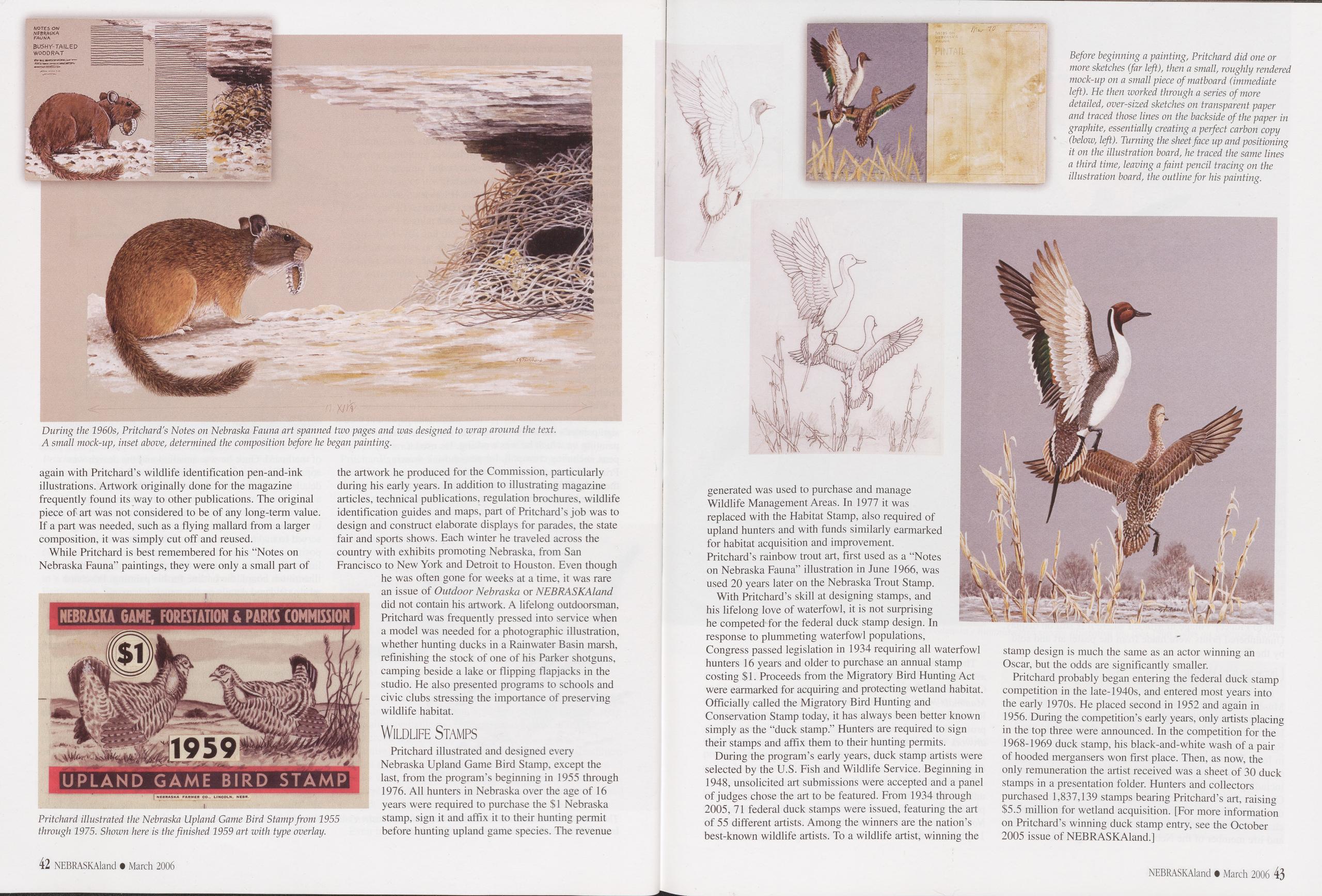
again with Pritchard’s wildlife identification pen-and-ink illustrations. Artwork originally done for the magazine frequently found its way to other publications. The original piece of art was not considered to be of any long-term value. If a part was needed, such as a flying mallard from a larger composition, it was simply cut off and reused.
While Pritchard is best remembered for his “Notes on Nebraska Fauna” paintings, they were only a small part of Pritchard illustrated the Nebraska Upland Game Bird Stamp from 1955 through 1975. Shown here is the finished 1959 art with type overlay. the artwork he produced for the Commission, particularly during his early years. In addition to illustrating magazine articles, technical publications, regulation brochures, wildlife identification guides and maps, part of Pritchard’s job was to design and construct elaborate displays for parades, the state fair and sports shows. Each winter he traveled across the country with exhibits promoting Nebraska, from San Francisco to New York and Detroit to Houston. Even though he was often gone for weeks at a time, it was rare an issue of Outdoor Nebraska or NEBRASKAland did not contain his artwork. A lifelong outdoorsman, Pritchard was frequently pressed into service when a model was needed for a photographic illustration, whether hunting ducks in a Rainwater Basin marsh, refinishing the stock of one of his Parker shotguns, camping beside a lake or flipping flapjacks in the studio. He also presented programs to schools and civic clubs stressing the importance of preserving wildlife habitat.
Pritchard illustrated and designed every Nebraska Upland Game Bird Stamp, except the last, from the program’s beginning in 1955 through 1976. All hunters in Nebraska over the age of 16 years were required to purchase the $1 Nebraska stamp, sign it and affix it to their hunting permit before hunting upland game species. The revenue generated was used to purchase and manage Wildlife Management Areas. In 1977 it was replaced with the Habitat Stamp, also required of upland hunters and with funds similarly earmarked for habitat acquisition and improvement.
Pritchard’s rainbow trout art, first used as a “Notes on Nebraska Fauna” illustration in June 1966, was used 20 years later on the Nebraska Trout Stamp.
With Pritchard’s skill at designing stamps, and his lifelong love of waterfowl, it is not surprising he competed for the federal duck stamp design. In response to plummeting waterfowl populations, Congress passed legislation in 1934 requiring all waterfowl hunters 16 years and older to purchase an annual stamp costing $1. Proceeds from the Migratory Bird Hunting Act were earmarked for acquiring and protecting wetland habitat. Officially called the Migratory Bird Hunting and Conservation Stamp today, it has always been better known simply as the “duck stamp.” Hunters are required to sign their stamps and affix them to their hunting permits.
During the program’s early years, duck stamp artists were selected by the U.S. Fish and Wildlife Service. Beginning in 1948, unsolicited art submissions were accepted and a panel of judges chose the art to be featured. From 1934 through 2005, 71 federal duck stamps were issued, featuring the art of 55 different artists. Among the winners are the nation’s best-known wildlife artists. To a wildlife artist, winning the stamp design is much the same as an actor winning an Oscar, but the odds are significantly smaller.
Pritchard probably began entering the federal duck stamp competition in the late-1940s, and entered most years into the early 1970s. He placed second in 1952 and again in 1956. During the competition’s early years, only artists placing in the top three were announced. In the competition for the 1968-1969 duck stamp, his black-and-white wash of a pair of hooded mergansers won first place. Then, as now, the only remuneration the artist received was a sheet of 30 duck stamps in a presentation folder. Hunters and collectors purchased 1,837,139 stamps bearing Pritchard’s art, raising $5.5 million for wetland acquisition. [For more information on Pritchard’s winning duck stamp entry, see the October 2005 issue of NEBRASKAland.]
42 NEBRASKAland • March 2006 NEBRASKAland • March 2006 43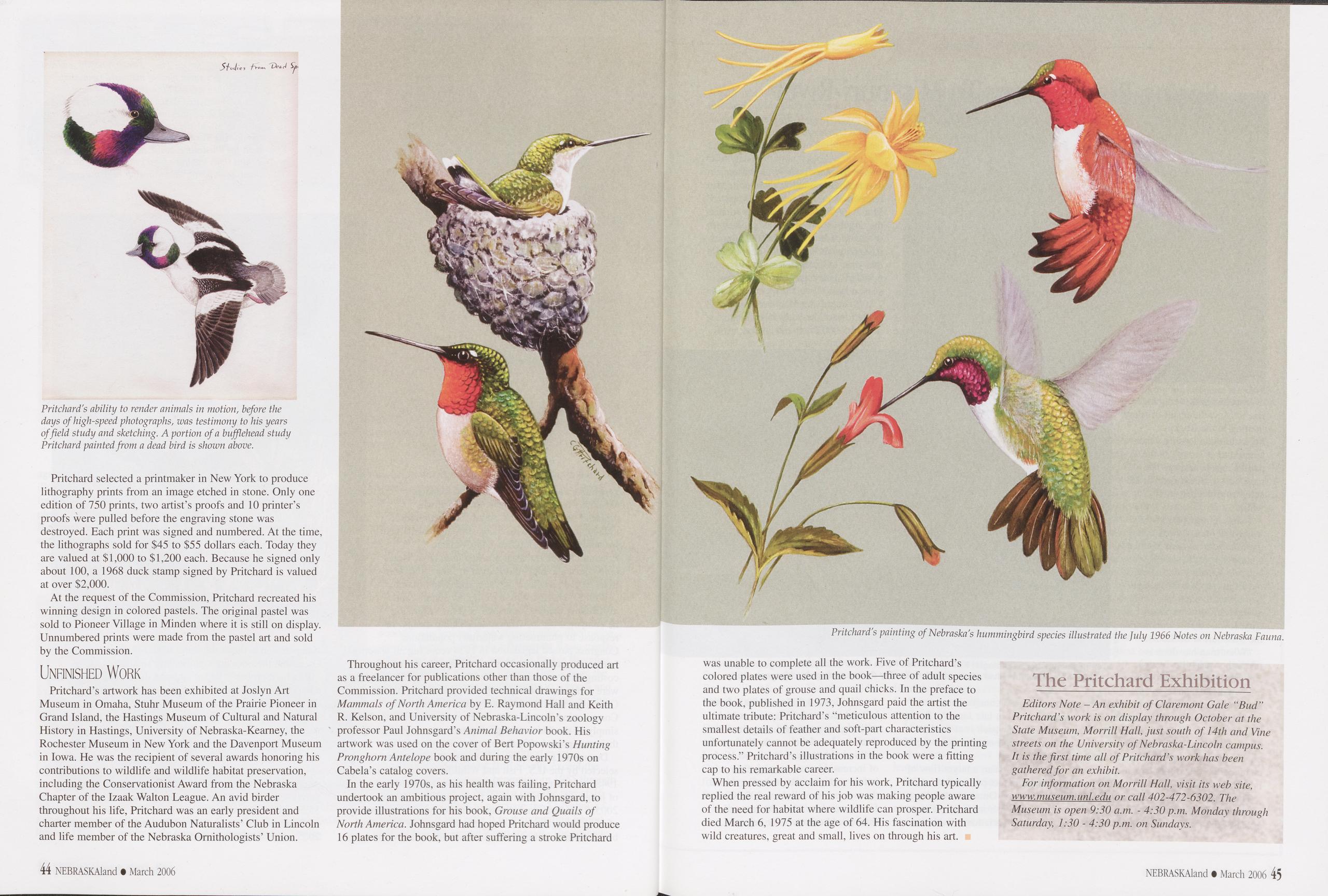
Pritchard selected a printmaker in New York to produce lithography prints from an image etched in stone. Only one edition of 750 prints, two artist’s proofs and 10 printer’s proofs were pulled before the engraving stone was destroyed. Each print was signed and numbered. At the time, the lithographs sold for $45 to $55 dollars each. Today they are valued at $1,000 to $1,200 each. Because he signed only about 100, a 1968 duck stamp signed by Pritchard is valued at over $2,000.
At the request of the Commission, Pritchard recreated his winning design in colored pastels. The original pastel was sold to Pioneer Village in Minden where it is still on display. Unnumbered prints were made from the pastel art and sold by the Commission.
Unfinished WorkPritchard’s artwork has been exhibited at Joslyn Art Museum in Omaha, Stuhr Museum of the Prairie Pioneer in Grand Island, the Hastings Museum of Cultural and Natural History in Hastings, University of Nebraska-Kearney, the Rochester Museum in New York and the Davenport Museum in Iowa. He was the recipient of several awards honoring his contributions to wildlife and wildlife habitat preservation, including the Conservationist Award from the Nebraska Chapter of the Izaak Walton League. An avid birder throughout his life, Pritchard was an early president and charter member of the Audubon Naturalists’ Club in Lincoln and life member of the Nebraska Ornithologists’ Union.
Throughout his career, Pritchard occasionally produced art as a freelancer for publications other than those of the Commission. Pritchard provided technical drawings for Mammals of North America by E. Raymond Hall and Keith R. Kelson, and University of Nebraska-Lincoln’s zoology professor Paul Johnsgard’s Animal Behavior book. His artwork was used on the cover of Bert Popowski’s Hunting Pronghorn Antelope book and during the early 1970s on Cabela’s catalog covers.
In the early 1970s, as his health was failing, Pritchard undertook an ambitious project, again with Johnsgard, to provide illustrations for his book, Grouse and Quails of North America. Johnsgard had hoped Pritchard would produce 16 plates for the book, but after suffering a stroke Pritchard was unable to complete all the work. Five of Pritchard’s colored plates were used in the book—three of adult species and two plates of grouse and quail chicks. In the preface to the book, published in 1973, Johnsgard paid the artist the ultimate tribute: Pritchard’s “meticulous attention to the smallest details of feather and soft-part characteristics unfortunately cannot be adequately reproduced by the printing process.” Pritchard’s illustrations in the book were a fitting cap to his remarkable career.
When pressed by acclaim for his work, Pritchard typically replied the real reward of his job was making people aware of the need for habitat where wildlife can prosper. Pritchard died March 6, 1975 at the age of 64. His fascination with wild creatures, great and small, lives on through his art.
The Pritchard ExhibitionEditors Note - An exhibit of Claremont Gale “Bud” Pritchard's work is on display through October at the State Museum, Morrill Hall, just south of 14th and Vine streets on the University of Nebraska-Lincoln campus. It is the first time all of Pritchard's work has been gathered for an exhibit.
For information on Morrill Hall, visit its web site, www.museum, uni, edu or call 402-472-6302. The Museum is open 9:30 a.m. - 4:30 p.m. Monday through Saturday, 1:30 - 4:30 p.m. on Sundays.
44 NEBRASKAland • March 2006 NEBRASKAland • March 2006 45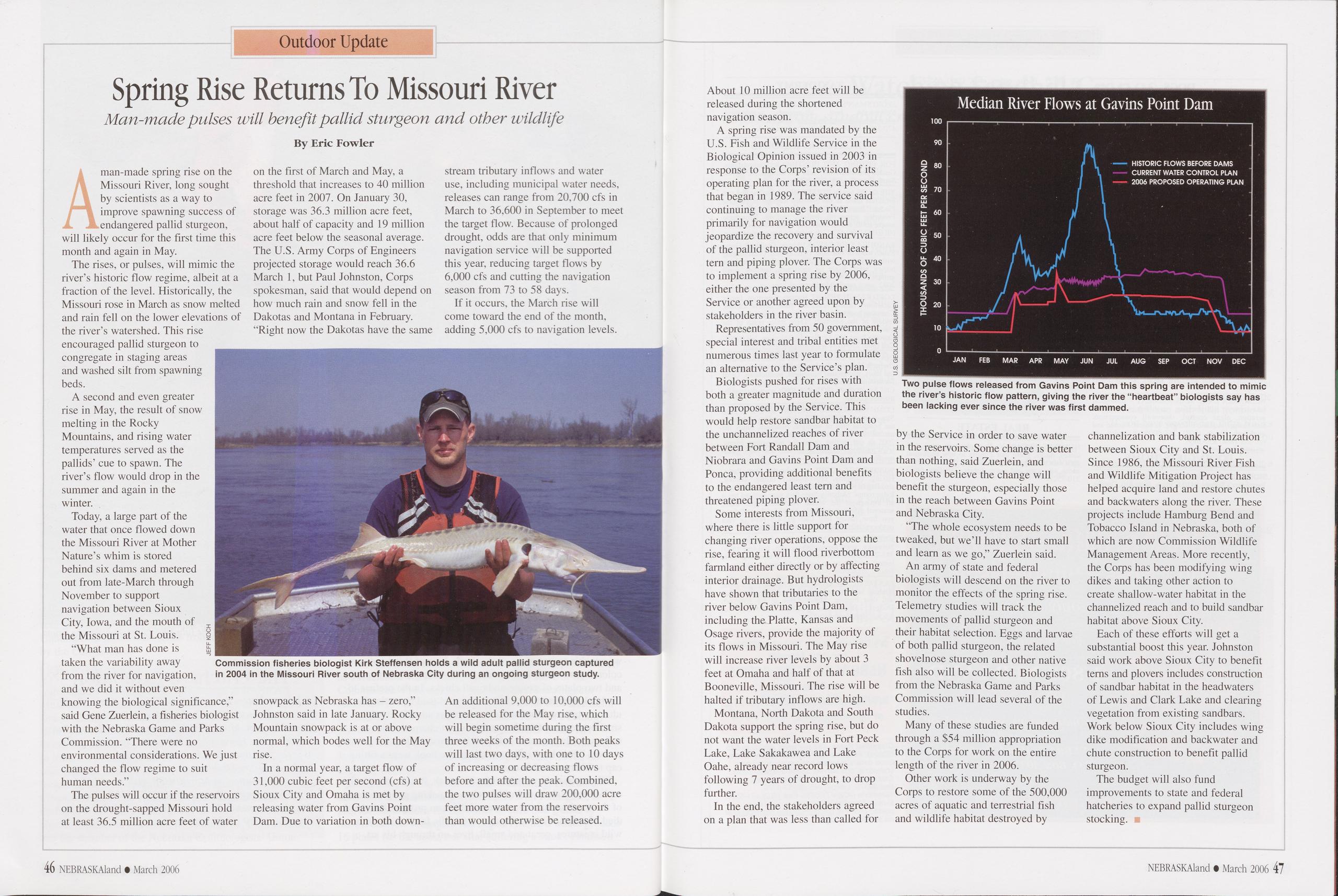
A man-made spring rise on the Missouri River, long sought by scientists as a way to improve spawning success of endangered pallid sturgeon, will likely occur for the first time this month and again in May.
The rises, or pulses, will mimic the river’s historic flow regime, albeit at a fraction of the level. Historically, the Missouri rose in March as snow melted and rain fell on the lower elevations of the river’s watershed. This rise encouraged pallid sturgeon to congregate in staging areas and washed silt from spawning beds.
A second and even greater rise in May, the result of snow melting in the Rocky Mountains, and rising water temperatures served as the pallids’ cue to spawn. The river’s flow would drop in the summer and again in the winter.
Today, a large part of the water that once flowed down the Missouri River at Mother Nature’s whim is stored behind six dams and metered out from late-March through November to support navigation between Sioux City, Iowa, and the mouth of the Missouri at St. Louis.
"What man has done is taken the variability away from the river for navigation, and we did it without even knowing the biological significance,” said Gene Zuerlein, a fisheries biologist with the Nebraska Game and Parks Commission. "There were no environmental considerations. We just changed the flow regime to suit human needs.”
The pulses will occur if the reservoirs on the drought-sapped Missouri hold at least 36.5 million acre feet of water on the first of March and May, a threshold that increases to 40 million acre feet in 2007. On January 30, storage was 36.3 million acre feet, about half of capacity and 19 million acre feet below the seasonal average. The U.S. Army Corps of Engineers projected storage would reach 36.6 March 1, but Paul Johnston, Corps spokesman, said that would depend on how much rain and snow fell in the Dakotas and Montana in February. "Right now the Dakotas have the same snowpack as Nebraska has - zero,” Johnston said in late January. Rocky Mountain snowpack is at or above normal, which bodes well for the May rise.
Commission fisheries biologist Kirk Steffensen holds a wild adult pallid sturgeon captured in 2004 in the Missouri River south of Nebraska City during an ongoing sturgeon study.In a normal year, a target flow of 31,000 cubic feet per second (cfs) at Sioux City and Omaha is met by releasing water from Gavins Point Dam. Due to variation in both down- stream tributary inflows and water use, including municipal water needs, releases can range from 20,700 cfs in March to 36,600 in September to meet the target flow. Because of prolonged drought, odds are that only minimum navigation service will be supported this year, reducing target flows by 6,000 cfs and cutting the navigation season from 73 to 58 days.
If it occurs, the March rise will come toward the end of the month, adding 5,000 cfs to navigation levels.
An additional 9,000 to 10,000 cfs will be released for the May rise, which will begin sometime during the first three weeks of the month. Both peaks will last two days, with one to 10 days of increasing or decreasing flows before and after the peak. Combined, the two pulses will draw 200,000 acre feet more water from the reservoirs than would otherwise be released.
About 10 million acre feet will be released during the shortened navigation season.
A spring rise was mandated by the U.S. Fish and Wildlife Service in the Biological Opinion issued in 2003 in response to the Corps’ revision of its operating plan for the river, a process that began in 1989. The service said continuing to manage the river primarily for navigation would jeopardize the recovery and survival of the pallid sturgeon, interior least tern and piping plover. The Corps was to implement a spring rise by 2006, either the one presented by the Service or another agreed upon by stakeholders in the river basin.
Representatives from 50 government, special interest and tribal entities met numerous times last year to formulate an alternative to the Service’s plan.
Biologists pushed for rises with both a greater magnitude and duration than proposed by the Service. This would help restore sandbar habitat to the unchannelized reaches of river between Fort Randall Dam and Niobrara and Gavins Point Dam and Ponca, providing additional benefits to the endangered least tern and threatened piping plover.
Some interests from Missouri, where there is little support for changing river operations, oppose the rise, fearing it will flood riverbottom farmland either directly or by affecting interior drainage. But hydrologists have shown that tributaries to the river below Gavins Point Dam, including the Platte, Kansas and Osage rivers, provide the majority of its flows in Missouri. The May rise will increase river levels by about 3 feet at Omaha and half of that at Booneville, Missouri. The rise will be halted if tributary inflows are high.
Montana, North Dakota and South Dakota support the spring rise, but do not want the water levels in Fort Peck Lake, Lake Sakakawea and Lake Oahe, already near record lows following 7 years of drought, to drop further.
In the end, the stakeholders agreed on a plan that was less than called for Two pulse flows released from Gavins Point Dam this spring are intended to mimic the river’s historic flow pattern, giving the river the “heartbeat” biologists say has been lacking ever since the river was first dammed. by the Service in order to save water in the reservoirs. Some change is better than nothing, said Zuerlein, and biologists believe the change will benefit the sturgeon, especially those in the reach between Gavins Point and Nebraska City.
"The whole ecosystem needs to be tweaked, but we’ll have to start small and learn as we go,” Zuerlein said.
An army of state and federal biologists will descend on the river to monitor the effects of the spring rise. Telemetry studies will track the movements of pallid sturgeon and their habitat selection. Eggs and larvae of both pallid sturgeon, the related shovelnose sturgeon and other native fish also will be collected. Biologists from the Nebraska Game and Parks Commission will lead several of the studies.
Many of these studies are funded through a $54 million appropriation to the Corps for work on the entire length of the river in 2006.
Other work is underway by the Corps to restore some of the 500,000 acres of aquatic and terrestrial fish and wildlife habitat destroyed by channelization and bank stabilization between Sioux City and St. Louis. Since 1986, the Missouri River Fish and Wildlife Mitigation Project has helped acquire land and restore chutes and backwaters along the river. These projects include Hamburg Bend and Tobacco Island in Nebraska, both of which are now Commission Wildlife Management Areas. More recently, the Corps has been modifying wing dikes and taking other action to create shallow-water habitat in the channelized reach and to build sandbar habitat above Sioux City.
Each of these efforts will get a substantial boost this year. Johnston said work above Sioux City to benefit terns and plovers includes construction of sandbar habitat in the headwaters of Lewis and Clark Lake and clearing vegetation from existing sandbars. Work below Sioux City includes wing dike modification and backwater and chute construction to benefit pallid sturgeon.
The budget will also fund improvements to state and federal hatcheries to expand pallid sturgeon stocking.
46 NEBRASKAland • March 2006 NEBRASKAland • March 2006 47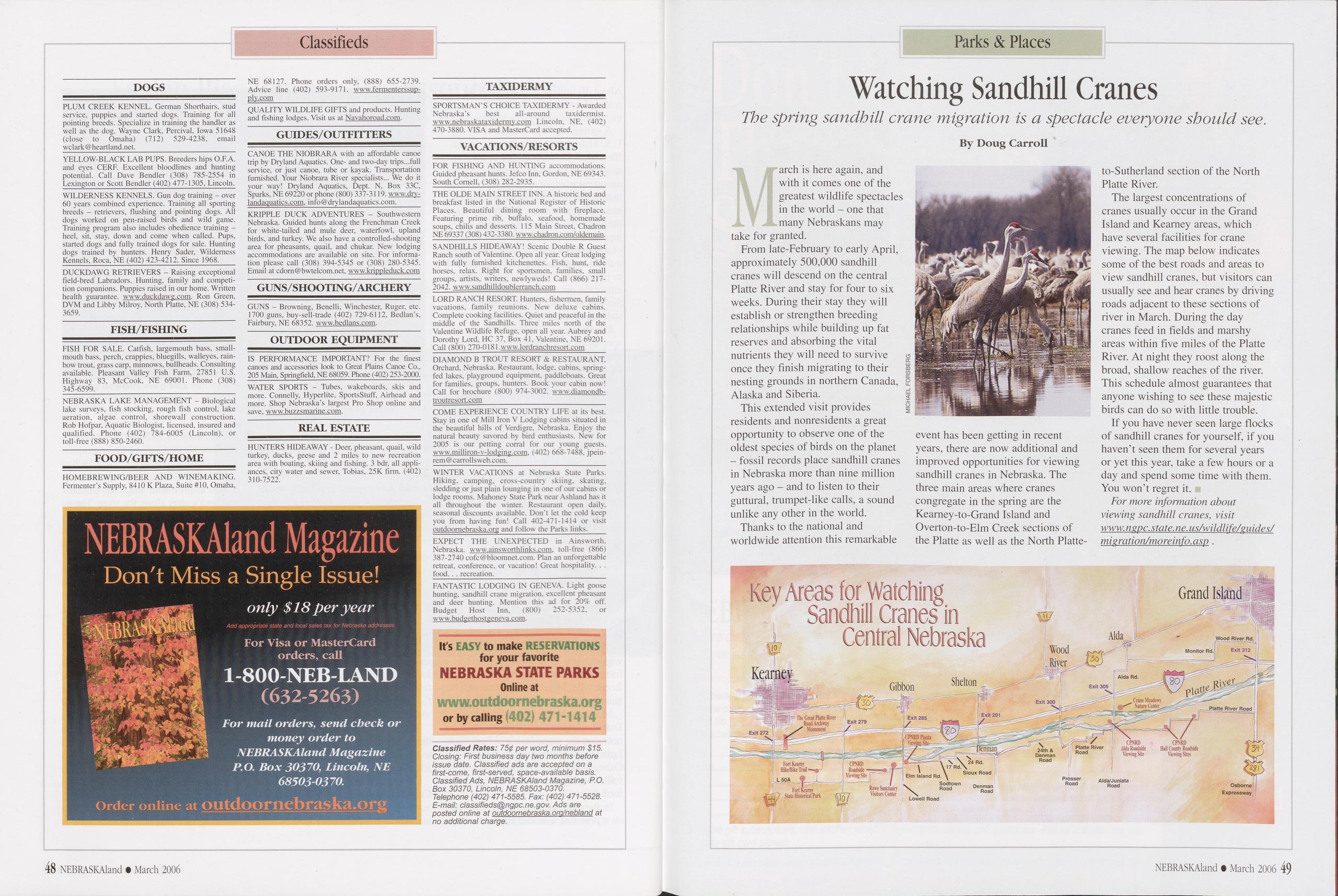
March is here again, and with it comes one of the greatest wildlife spectacles in the world - one that many Nebraskans may take for granted.
From late-February to early April, approximately 500,000 sandhill cranes will descend on the central Platte River and stay for four to six weeks. During their stay they will establish or strengthen breeding relationships while building up fat reserves and absorbing the vital nutrients they will need to survive g once they finish migrating to their g nesting grounds in northern Canada, 2 Alaska and Siberia.
This extended visit provides | residents and nonresidents a great opportunity to observe one of the oldest species of birds on the planet - fossil records place sandhill cranes in Nebraska more than nine million years ago - and to listen to their guttural, trumpet-like calls, a sound unlike any other in the world.
Thanks to the national and worldwide attention this remarkable event has been getting in recent years, there are now additional and improved opportunities for viewing sandhill cranes in Nebraska. The three main areas where cranes congregate in the spring are the Kearney-to-Grand Island and Overton-to-Elm Creek sections of the Platte as well as the North Platte- to-Sutherland section of the North Platte River.
The largest concentrations of cranes usually occur in the Grand Island and Kearney areas, which have several facilities for crane viewing. The map below indicates some of the best roads and areas to view sandhill cranes, but visitors can usually see and hear cranes by driving roads adjacent to these sections of river in March. During the day cranes feed in fields and marshy areas within five miles of the Platte River. At night they roost along the broad, shallow reaches of the river. This schedule almost guarantees that anyone wishing to see these majestic birds can do so with little trouble.
If you have never seen large flocks of sandhill cranes for yourself, if you haven’t seen them for several years or yet this year, take a few hours or a day and spend some time with them. You won’t regret it.
For more information about viewing sandhill cranes, visit www. ngpc. state, ne. us/wildlife/guides/ migration/moreinfo. asp . 48 NEBRASKAland • March 2006 NEBRASKAland • March 2006 49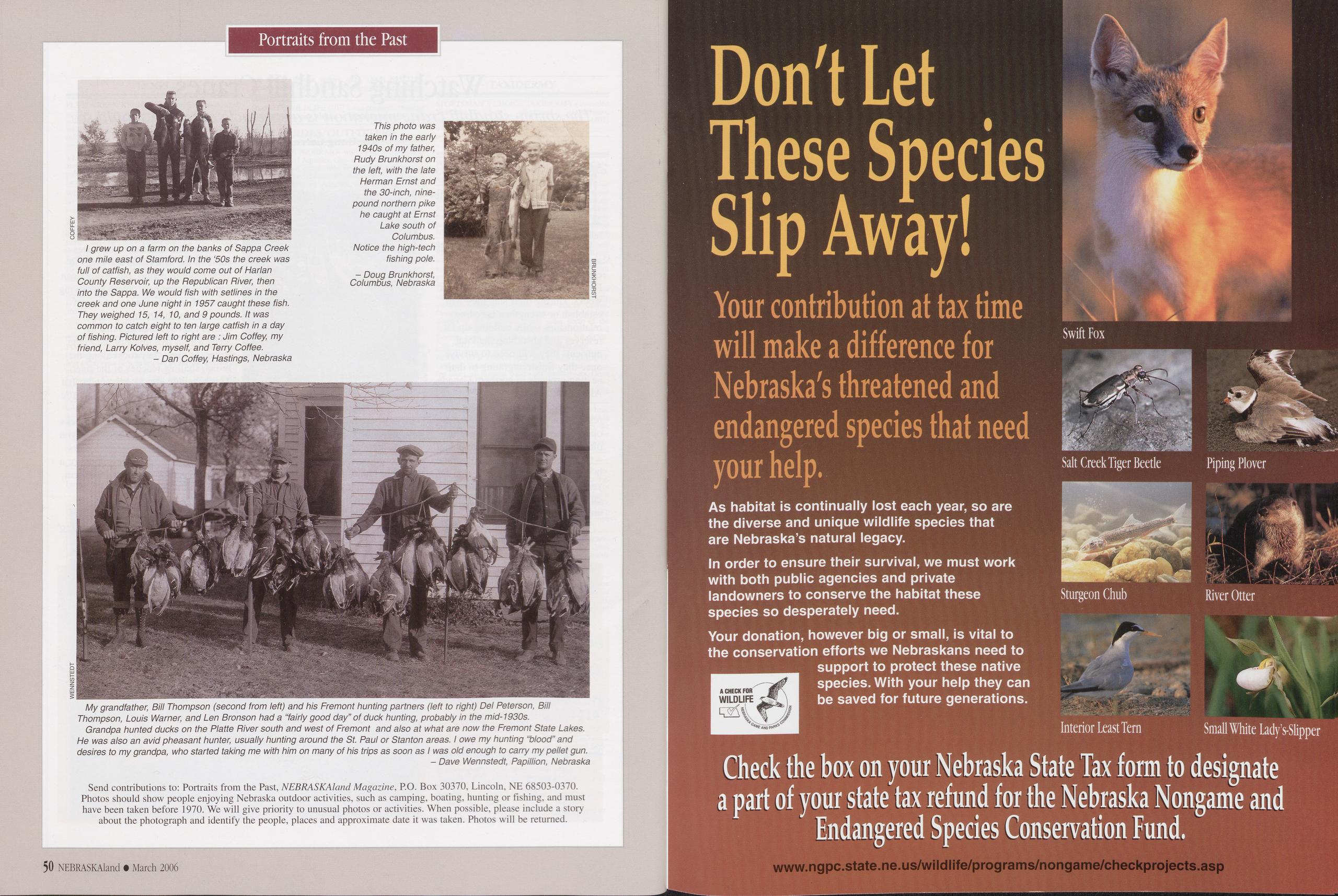
Send contributions to: Portraits from the Past, NEBRASKAland Magazine, P.O. Box 30370, Lincoln, NE 68503-0370. Photos should show people enjoying Nebraska outdoor activities, such as camping, boating, hunting or fishing, and must have been taken before 1970. We will give priority to unusual photos or activities. When possible, please include a story about the photograph and identify the people, places and approximate date it was taken. Photos will be returned.
Don't Let These Species Slip Away! Your contribution at tax time will make a difference for Nebraska's threatened and endangered species that need your help. As habitat is continually lost each year, so are the diverse and unique wildlife species that are Nebraska’s natural legacy. In order to ensure their survival, we must work with both public agencies and private landowners to conserve the habitat these species so desperately need. Your donation, however big or small, is vital to the conservation efforts we Nebraskans need to support to protect these native species. With your help they can be saved for future generations.Swift Fox
Salt Creek Tiger Beetle
Pipiing Plover
Sturgeon Chub
River Otter
Interior Least Tern
Small White Lady’s-Slipper
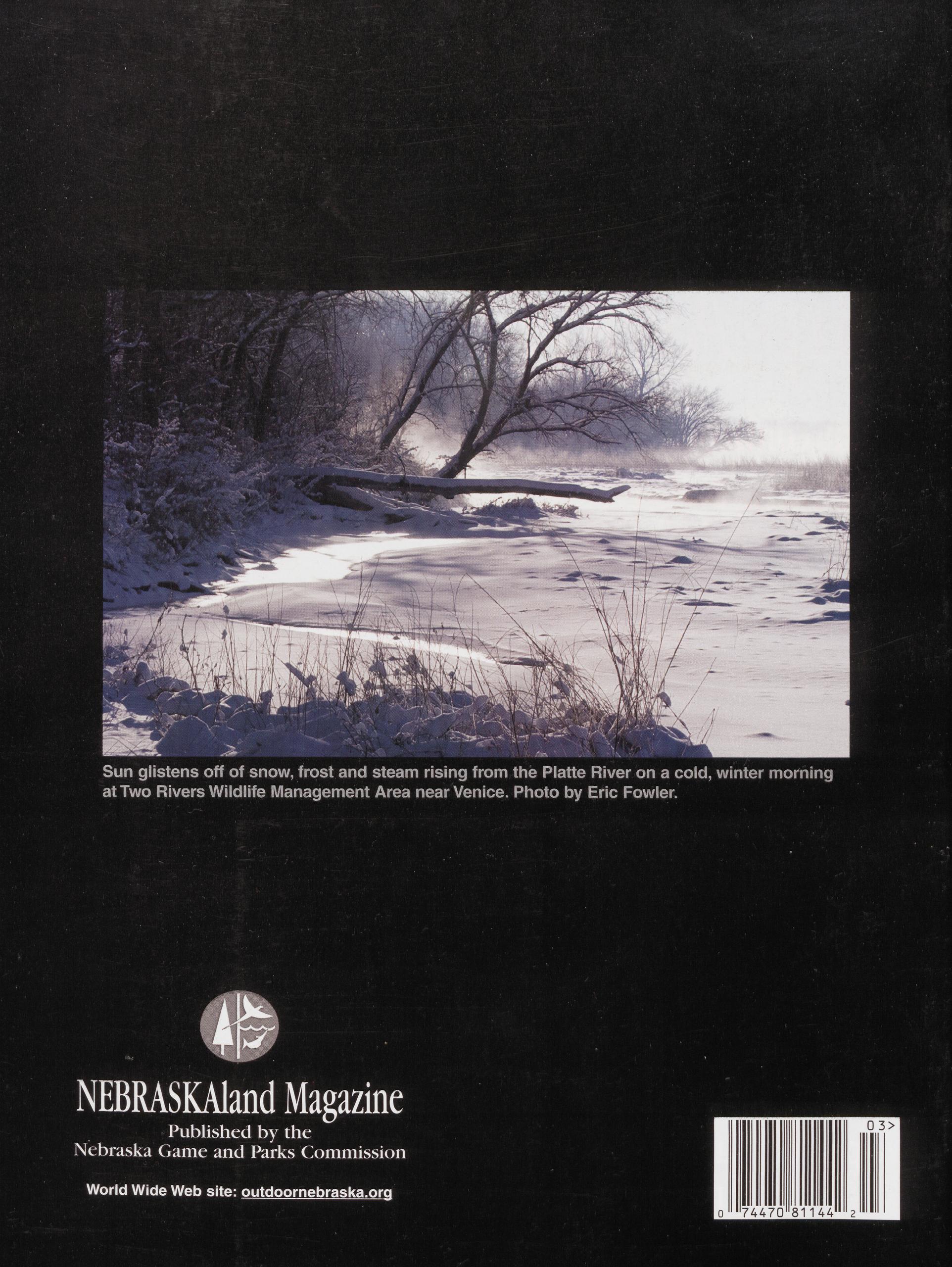
Position: 132 (46 views)