Volume 83, Issue 10, 2005
NEBRASKAland
Nebraska Game & Parks Commission December 2005 • $2.95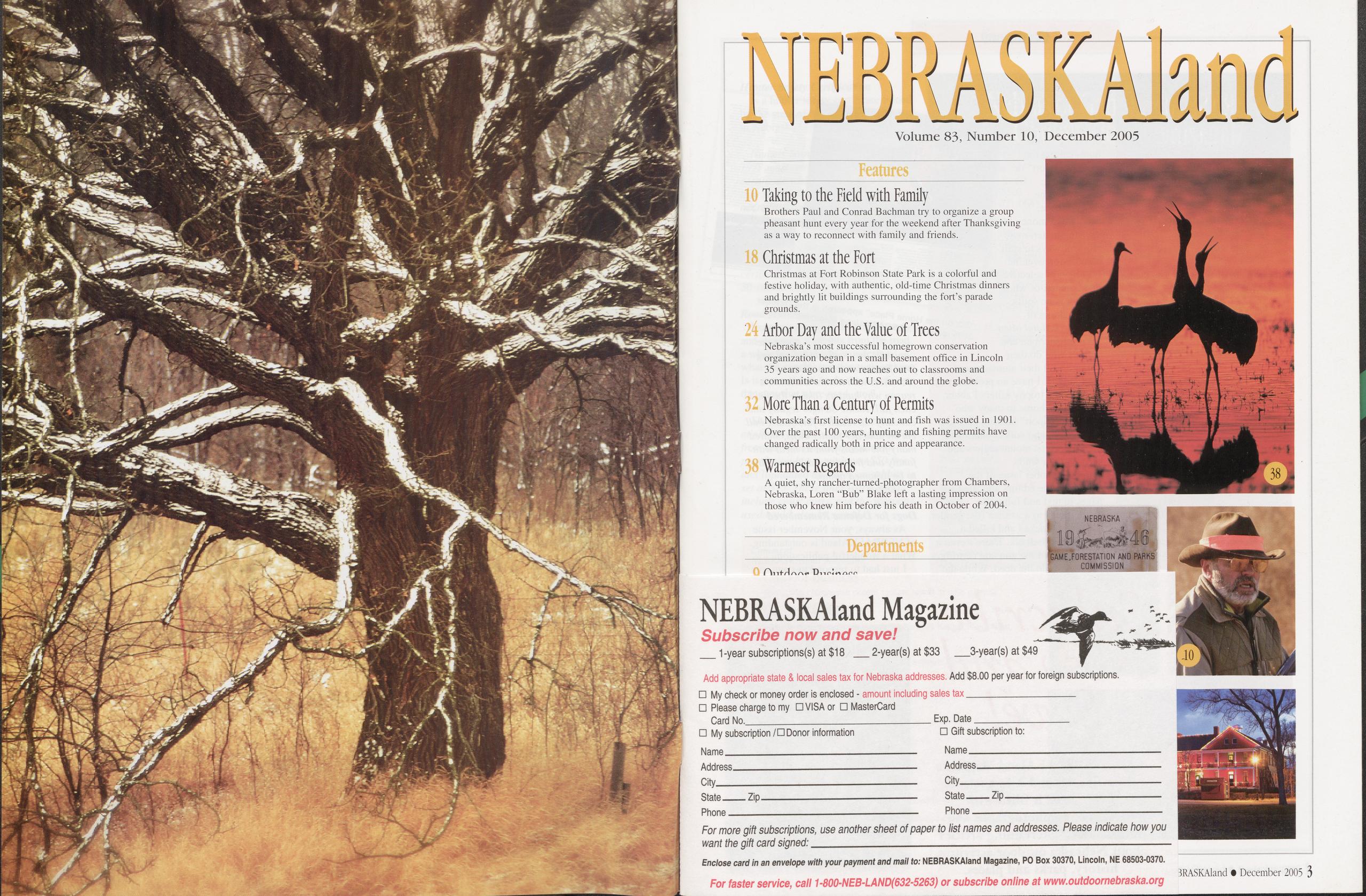
NEBRASKAland
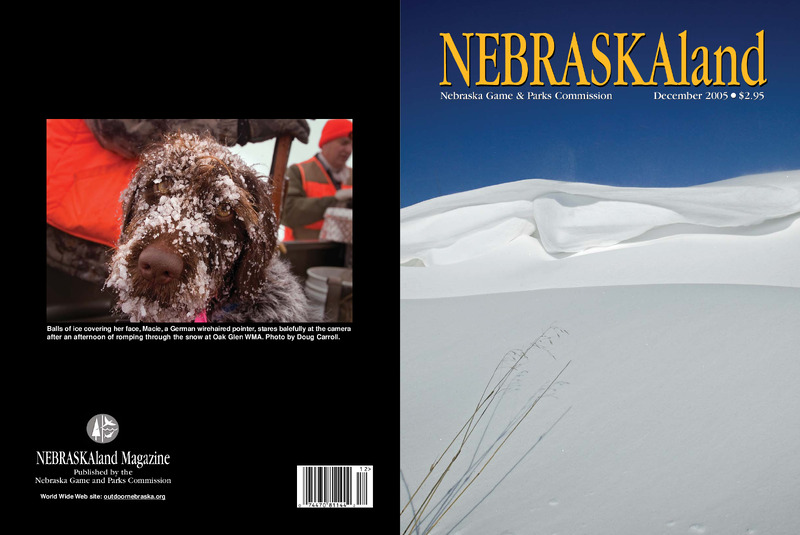
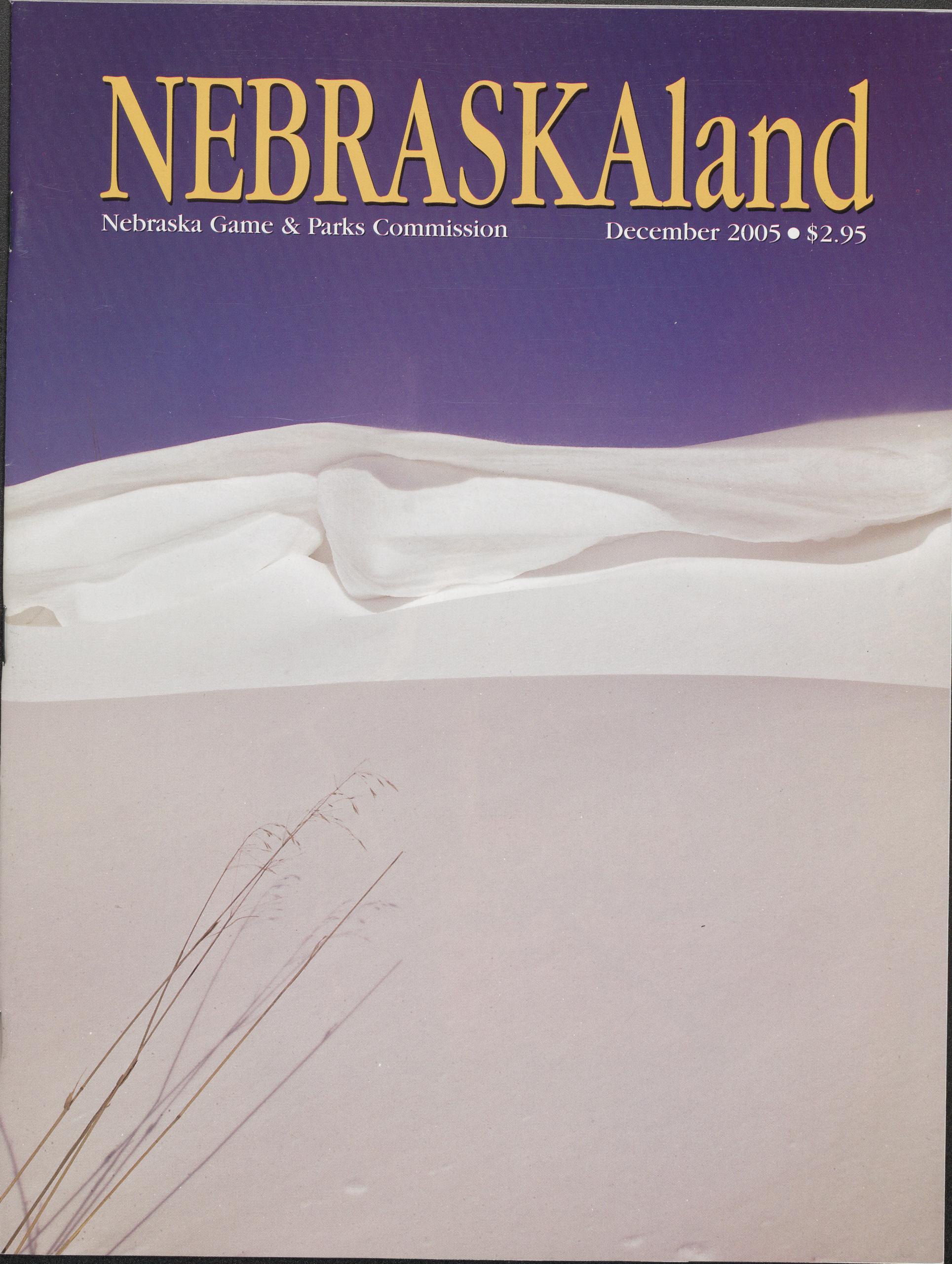
Volume 83, Number 10, December 2005 Features 10 Taking to the Field with Family Brothers Paul and Conrad Bachman try to organize a group pheasant hunt every year for the weekend after Thanksgiving as a way to reconnect with family and friends. 18 Christmas at the Fort Christmas at Fort Robinson State Park is a colorful and festive holiday, with authentic, old-time Christmas dinners and brightly lit buildings surrounding the fort’s parade grounds. 24 Arbor Day and the Value of Trees Nebraska’s most successful homegrown conservation organization began in a small basement office in Lincoln 35 years ago and now reaches out to classrooms and communities across the U.S. and around the globe. 32 More Than a Century of Permits Nebraska’s first license to hunt and fish was issued in 1901. Over the past 100 years, hunting and fishing permits have changed radically both in price and appearance. 38 Warmest Regards A quiet, shy rancher-turned-photographer from Chambers, Nebraska, Loren “Bub” Blake left a lasting impression on NEBRASKA those who knew him before his death in October of 2004. Departments 9 Outdoor Business Sweeping changes to permit system result in new permits. 46 Outdoor Update Landowner incentive program encourages habitat restoration. 47 Wilderness Workshop Scoring big game trophies measures animals against others. 49 Parks & Places Winter fun at Eugene T. Mahoney State Park. Comment........................................4 Outdoor News ..................................6 Classifieds ..................................48 Portraits from the Past.......................50 Cover: Winter’s artistry is revealed in a roadside ditch bank near Pawnee Lake SRA the day after a heavy snowstorm. Photo by Doug Carroll. Opposite: A prelude of things to come, a light dusting of early December snow covers a bur oak tree (Quercus macrocarpa) at Indian Cave State Park in southeastern Nebraska. Photo by Rick Houchin.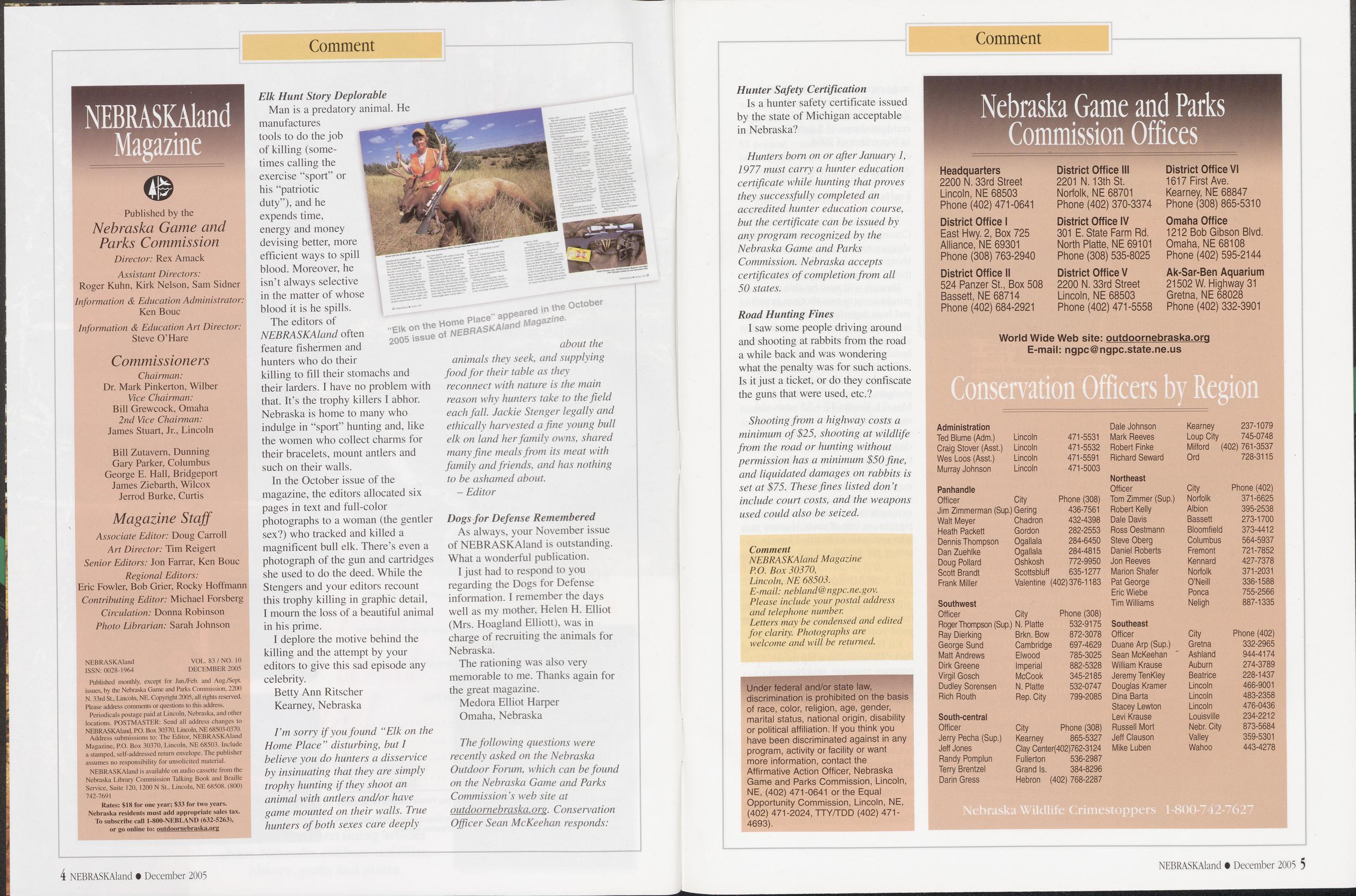
Man is a predatory animal. He manufactures tools to do the job of killing (some- times calling the exercise “sport” or his “patriotic duty”), and he expends time, energy and money devising better, more efficient ways to spill blood. Moreover, he isn’t always selective in the matter of whose blood it is he spills.
The editors of NEBRASKAland often feature fishermen and hunters who do their killing to fill their stomachs and their larders. I have no problem with that. It’s the trophy killers I abhor. Nebraska is home to many who indulge in “sport” hunting and, like the women who collect charms for their bracelets, mount antlers and such on their walls.
In the October issue of the magazine, the editors allocated six pages in text and full-color photographs to a woman (the gentler sex?) who tracked and killed a magnificent bull elk. There’s even a photograph of the gun and cartridges she used to do the deed. While the Stengers and your editors recount this trophy killing in graphic detail, I mourn the loss of a beautiful animal in his prime.
I deplore the motive behind the killing and the attempt by your editors to give this sad episode any celebrity.
Betty Ann Ritscher Kearney, NebraskaI’m sorry if you found “Elk on the Home Place " disturbing, but I believe you do hunters a disservice by insinuating that they are simply trophy hunting if they shoot an animal with antlers and/or have game mounted on their walls. True hunters of both sexes care deeply
- Editor Dogs for Defense Remembered
As always, your November issue of NEBRASKAland is outstanding. What a wonderful publication.
I just had to respond to you regarding the Dogs for Defense information. I remember the days well as my mother, Helen H. Elliot (Mrs. Hoagland Elliott), was in charge of recruiting the animals for Nebraska.
The rationing was also very memorable to me. Thanks again for the great magazine.
Medora Elliot Harper Omaha, NebraskaThe following questions were recently asked on the Nebraska Outdoor Forum, which can be found on the Nebraska Game and Parks Commission’s web site at outdoornebraska. org. Conservation Officer Sean McKeehan responds:
Hunter Safety CertificationIs a hunter safety certificate issued by the state of Michigan acceptable in Nebraska?
Hunters bom on or after January 1, 1977 must carry a hunter education certificate while hunting that proves they successfully completed an accredited hunter education course, but the certificate can be issued by any program recognized by the Nebraska Game and Parks Commission. Nebraska accepts certificates of completion from all 50 states.
Road Hunting FinesI saw some people driving around and shooting at rabbits from the road a while back and was wondering what the penalty was for such actions. Is it just a ticket, or do they confiscate the guns that were used, etc.?
Shooting from a highway costs a minimum of $25, shooting at wildlife from the road or hunting without permission has a minimum $50 fine, and liquidated damages on rabbits is set at $75. These fines listed don’t include court costs, and the weapons used could also be seized.
Comment NEBRASKAland Magazine P.O. Box 30370, Lincoln, NE 68503. E-mail: nebland@ngpc.ne.gov. Please include your postal address and telephone number. Letters may be condensed and edited for clarity. Photographs are welcome and will be returned. Under federal and/or state law, discrimination is prohibited on the basis of race, color, religion, age, gender, marital status, national origin, disability or political affiliation. If you think you have been discriminated against in any program, activity or facility or want more information, contact the Affirmative Action Officer, Nebraska Game and Parks Commission, Lincoln, NE, (402) 471-0641 or the Equal Opportunity Commission, Lincoln, NE, (402) 471-2024, TTY/TDD (402) 471- 4693). Nebraska Game and Parks Commission Offices Headquarters 2200 N. 33rd Street Lincoln, NE 68503 Phone (402) 471-0641 District Office I East Hwy. 2, Box 725 Alliance, NE 69301 Phone (308) 763-2940 District Office II 524 Panzer St., Box 508 Bassett, NE 68714 Phone (402) 684-2921 .... ......— ........ District Office III 2201 N. 13th St. Norfolk, NE 68701 Phone (402) 370-3374 District Office IV 301 E. State Farm Rd. North Platte, NE 69101 Phone (308) 535-8025 District Office V 2200 N. 33rd Street Lincoln, NE 68503 Phone (402) 471-5558 District Office VI 1617 First Ave. Kearney, NE 68847 Phone (308) 865-5310 Omaha Office 1212 Bob Gibson Blvd. Omaha, NE 68108 Phone (402) 595-2144 Ak-Sar-Ben Aquarium 21502 W. Highway 31 Gretna, NE 68028 Phone (402) 332-3901 World Wide Web site: outdoornebraska.org E-mail: ngpc@ngpc.state.ne.us Conservation Officers by Region Administration Dale Johnson Kearney 237-1079 Ted Blume (Adm.) Lincoln 471-5531 Mark Reeves Loup City 745-0748 Craig Stover (Asst.) Lincoln 471-5532 Robert Finke Milford (402) 761-3537 Wes Loos (Asst.) Lincoln 471-5591 Richard Seward Ord 728-3115 Murray Johnson Lincoln 471-5003 Northeast Panhandle Officer City Phone (402) Officer City Phone (308) Tom Zimmer (Sup.) Norfolk 371-6625 Jim Zimmerman (Sup.) Gering 436-7561 Robert Kelly Albion 395-2538 Walt Meyer Chadron 432-4398 Dale Davis Bassett 273-1700 Heath Packett Gordon 282-2553 Ross Oestmann Bloomfield 373-4412 Dennis Thompson Ogallala 284-6450 Steve Oberg Columbus 564-5937 Dan Zuehlke Ogallala 284-4815 Daniel Roberts Fremont 721-7852 Doug Pollard Oshkosh 772-9950 Jon Reeves Kennard 427-7378 Scott Brandt Scottsbluff 635-1277 Marion Shafer Norfolk 371-2031 Frank Miller Valentine (402) 376-1183 Pat George O’Neill 336-1588 Eric Wiebe Ponca 755-2566 Southwest Tim Williams Neligh 887-1335 Officer City Phone (308) Roger Thompson (Sup.) N. Platte 532-9175 Southeast Ray Dierking Brkn. Bow 872-3078 Officer City Phone (402) George Sund Cambridge 697-4629 Duane Arp (Sup.) Gretna 332-2965 Matt Andrews Elwood 785-3025 Sean McKeehan Ashland 944-4174 Dirk Greene Imperial 882-5328 William Krause Auburn 274-3789 Virgil Gosch McCook 345-2185 Jeremy TenKley Beatrice 228-1437 Dudley Sorensen N. Platte 532-0747 Douglas Kramer Lincoln 466-9001 Rich Routh Rep. City 799-2085 Dina Barta Lincoln 483-2358 Stacey Lewton Lincoln 476-0436 South-central Levi Krause Louisville 234-2212 Officer City Phone (308) Russell Mort Nebr. City 873-5684 Jerry Pecha (Sup.) Kearney 865-5327 Jeff Clauson Valley 359-5301 Jeff Jones Clay Center(402)762-3124 Mike Luben Wahoo 443-4278 Randy Pomplun Fullerton 536-2987 Terry Brentzel Grand Is. 384-8296 Darin Gress Hebron (402) 768-2287 Wildlife Crimestoppers 1-800-742-7627 4 NEBRASKAland • December 2005 NEBRASKAland • December 2005 5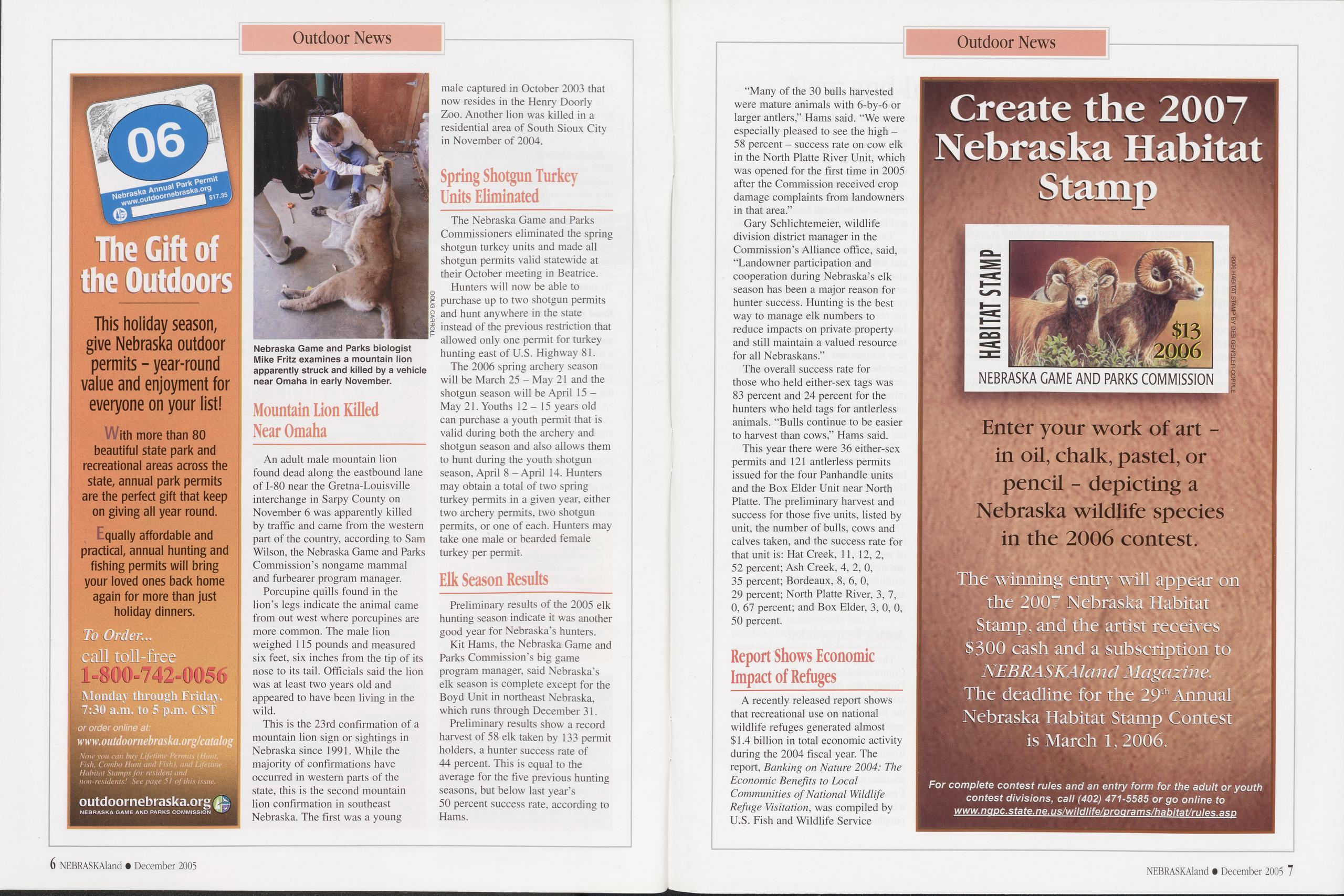
Outdoor News
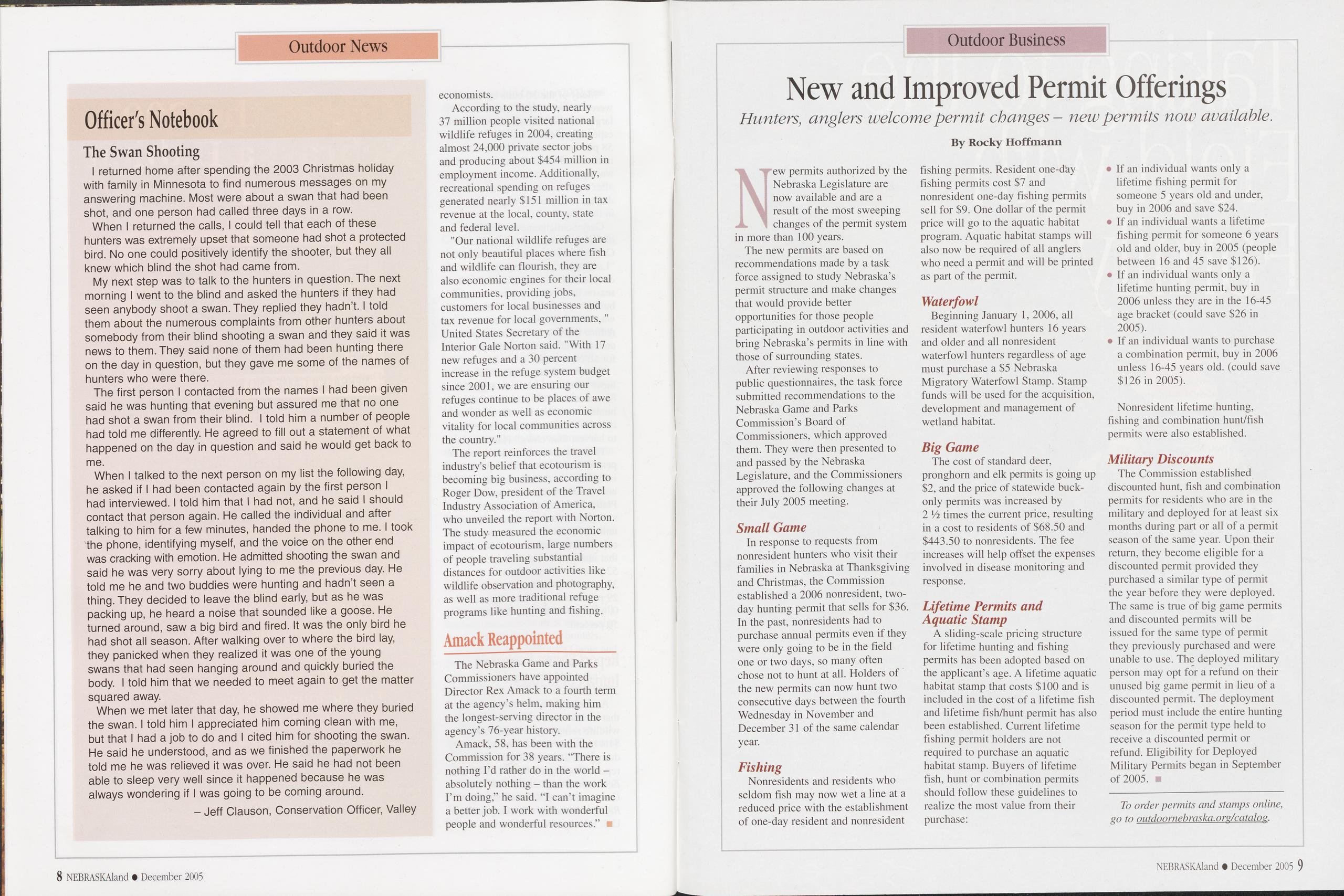
The Gift of the Outdoor This holiday season, give Nebraska outdoor permits - year-round value and enjoyment for everyone on your list! With more than 80 beautiful state park and recreational areas across the state, annual park permits are the perfect gift that keep on giving all year round. Equally affordable and practical, annual hunting and fishing permits will bring your loved ones back home again for more than just holiday dinners. To Order... call toll-fre! 1-800-742-0056 Monday through Friday, 7:30 a.m. to 5 p.m. CST or order online at: www.outdoornebraska.org/catalog Now you can buy Lifetime Permits (Hunt. Fish, Combo Hunt and Fish), and Lifetime Habitat Stamps for resident and non-residents! See page 51 of this issue. outdoornebraska.org NEBRASKA GAME AND PARKS COMMISSIONAn adult male mountain lion found dead along the eastbound lane of 1-80 near the Gretna-Louisville interchange in Sarpy County on November 6 was apparently killed by traffic and came from the western part of the country, according to Sam Wilson, the Nebraska Game and Parks Commission’s nongame mammal and furbearer program manager.
Porcupine quills found in the lion’s legs indicate the animal came from out west where porcupines are more common. The male lion weighed 115 pounds and measured six feet, six inches from the tip of its nose to its tail. Officials said the lion was at least two years old and appeared to have been living in the wild.
This is the 23rd confirmation of a mountain lion sign or sightings in Nebraska since 1991. While the majority of confirmations have occurred in western parts of the state, this is the second mountain lion confirmation in southeast Nebraska. The first was a young male captured in October 2003 that now resides in the Henry Doorly Zoo. Another lion was killed in a residential area of South Sioux City in November of 2004.
Spring Shotgun Turkey Units Eliminated
The Nebraska Game and Parks Commissioners eliminated the spring shotgun turkey units and made all shotgun permits valid statewide at their October meeting in Beatrice.
Hunters will now be able to c purchase up to two shotgun permits § and hunt anywhere in the state p instead of the previous restriction that allowed only one permit for turkey hunting east of U.S. Highway 81.
The 2006 spring archery season will be March 25 - May 21 and the shotgun season will be April 15 - May 21. Youths 12-15 years old can purchase a youth permit that is valid during both the archery and shotgun season and also allows them to hunt during the youth shotgun season, April 8 - April 14. Hunters may obtain a total of two spring turkey permits in a given year, either two archery permits, two shotgun permits, or one of each. Hunters may take one male or bearded female turkey per permit.
Elk Season ResultsPreliminary results of the 2005 elk hunting season indicate it was another good year for Nebraska’s hunters.
Kit Hams, the Nebraska Game and Parks Commission’s big game program manager, said Nebraska’s elk season is complete except for the Boyd Unit in northeast Nebraska, which runs through December 31.
Preliminary results show a record harvest of 58 elk taken by 133 permit holders, a hunter success rate of 44 percent. This is equal to the average for the five previous hunting seasons, but below last year’s 50 percent success rate, according to Hams.
“Many of the 30 bulls harvested were mature animals with 6-by-6 or larger antlers,” Hams said. “We were especially pleased to see the high - 58 percent - success rate on cow elk in the North Platte River Unit, which was opened for the first time in 2005 after the Commission received crop damage complaints from landowners in that area.”
Gary Schlichtemeier, wildlife division district manager in the Commission’s Alliance office, said, “Landowner participation and cooperation during Nebraska’s elk season has been a major reason for hunter success. Hunting is the best way to manage elk numbers to reduce impacts on private property and still maintain a valued resource for all Nebraskans.”
The overall success rate for those who held either-sex tags was 83 percent and 24 percent for the hunters who held tags for antlerless animals. “Bulls continue to be easier to harvest than cows,” Hams said.
This year there were 36 either-sex permits and 121 antlerless permits issued for the four Panhandle units and the Box Elder Unit near North Platte. The preliminary harvest and success for those five units, listed by unit, the number of bulls, cows and calves taken, and the success rate for that unit is: Hat Creek, 11, 12, 2, 52 percent; Ash Creek, 4, 2, 0, 35 percent; Bordeaux, 8, 6, 0, 29 percent; North Platte River, 3, 7, 0, 67 percent; and Box Elder, 3, 0, 0, 50 percent.
Report Shows Economic Impact of RefugesA recently released report shows that recreational use on national wildlife refuges generated almost $1.4 billion in total economic activity during the 2004 fiscal year. The report, Banking on Nature 2004: The Economic Benefits to Local Communities of National Wildlife Refuge Visitation, was compiled by U.S. Fish and Wildlife Service
 economists.
Officer's Notebook The Swan Shooting
I returned home after spending the 2003 Christmas holiday with family in Minnesota to find numerous messages on my answering machine. Most were about a swan that had been shot, and one person had called three days in a row.
When I returned the calls, I could tell that each of these hunters was extremely upset that someone had shot a protected bird. No one could positively identify the shooter, but they all knew which blind the shot had came from.
My next step was to talk to the hunters in question. The next morning I went to the blind and asked the hunters if they had seen anybody shoot a swan. They replied they hadn’t. I told them about the numerous complaints from other hunters about somebody from their blind shooting a swan and they said it was news to them. They said none of them had been hunting there on the day in question, but they gave me some of the names of hunters who were there.
The first person I contacted from the names I had been given said he was hunting that evening but assured me that no one had shot a swan from their blind. I told him a number of people had told me differently. He agreed to fill out a statement of what happened on the day in question and said he would get back to me.
When I talked to the next person on my list the following day, he asked if I had been contacted again by the first person I had interviewed. I told him that I had not, and he said I should contact that person again. He called the individual and after talking to him for a few minutes, handed the phone to me. I took the phone, identifying myself, and the voice on the other end was cracking with emotion. He admitted shooting the swan and said he was very sorry about lying to me the previous day. He told me he and two buddies were hunting and hadn’t seen a thing. They decided to leave the blind early, but as he was packing up, he heard a noise that sounded like a goose. He turned around, saw a big bird and fired. It was the only bird he had shot all season. After walking over to where the bird lay, they panicked when they realized it was one of the young swans that had seen hanging around and quickly buried the body. I told him that we needed to meet again to get the matter squared away.
When we met later that day, he showed me where they buried the swan. I told him I appreciated him coming clean with me, but that I had a job to do and I cited him for shooting the swan. He said he understood, and as we finished the paperwork he told me he was relieved it was over. He said he had not been able to sleep very well since it happened because he was always wondering if I was going to be coming around.
- Jeff Clauson, Conservation Officer, ValleyAccording to the study, nearly 37 million people visited national wildlife refuges in 2004, creating almost 24,000 private sector jobs and producing about $454 million in employment income. Additionally, recreational spending on refuges generated nearly $151 million in tax revenue at the local, county, state and federal level.
"Our national wildlife refuges are not only beautiful places where fish and wildlife can flourish, they are also economic engines for their local communities, providing jobs, customers for local businesses and tax revenue for local governments, " United States Secretary of the Interior Gale Norton said. "With 17 new refuges and a 30 percent increase in the refuge system budget since 2001, we are ensuring our refuges continue to be places of awe and wonder as well as economic vitality for local communities across the country."
The report reinforces the travel industry's belief that ecotourism is becoming big business, according to Roger Dow, president of the Travel Industry Association of America, who unveiled the report with Norton. The study measured the economic impact of ecotourism, large numbers of people traveling substantial distances for outdoor activities like wildlife observation and photography, as well as more traditional refuge programs like hunting and fishing.
Amack ReappointedThe Nebraska Game and Parks Commissioners have appointed Director Rex Amack to a fourth term at the agency’s helm, making him the longest-serving director in the agency’s 76-year history.
Amack, 58, has been with the Commission for 38 years. “There is nothing I’d rather do in the world - absolutely nothing - than the work I’m doing,” he said. "I can’t imagine a better job. I work with wonderful people and wonderful resources.”
Outdoor Business
New and Improved Permit Offerings
Hunters, anglers welcome permit changes - new permits now available.
New permits authorized by the Nebraska Legislature are now available and are a result of the most sweeping changes of the permit system in more than 100 years.
The new permits are based on recommendations made by a task force assigned to study Nebraska’s permit structure and make changes that would provide better opportunities for those people participating in outdoor activities and bring Nebraska’s permits in line with those of surrounding states.
After reviewing responses to public questionnaires, the task force submitted recommendations to the Nebraska Game and Parks Commission’s Board of Commissioners, which approved them. They were then presented to and passed by the Nebraska Legislature, and the Commissioners approved the following changes at their July 2005 meeting.
Small GameIn response to requests from nonresident hunters who visit their families in Nebraska at Thanksgiving and Christmas, the Commission established a 2006 nonresident, two- day hunting permit that sells for $36. In the past, nonresidents had to purchase annual permits even if they were only going to be in the field one or two days, so many often chose not to hunt at all. Holders of the new permits can now hunt two consecutive days between the fourth Wednesday in November and December 31 of the same calendar year.
FishingNonresidents and residents who seldom fish may now wet a line at a reduced price with the establishment of one-day resident and nonresident fishing permits. Resident one-day fishing permits cost $7 and nonresident one-day fishing permits sell for $9. One dollar of the permit price will go to the aquatic habitat program. Aquatic habitat stamps will also now be required of all anglers who need a permit and will be printed as part of the permit.
WaterfowlBeginning January 1, 2006, all resident waterfowl hunters 16 years and older and all nonresident waterfowl hunters regardless of age must purchase a $5 Nebraska Migratory Waterfowl Stamp. Stamp funds will be used for the acquisition, development and management of wetland habitat.
Big GameThe cost of standard deer, pronghorn and elk permits is going up $2, and the price of statewide buck- only permits was increased by 2 1/2 times the current price, resulting in a cost to residents of $68.50 and $443.50 to nonresidents. The fee increases will help offset the expenses involved in disease monitoring and response.
Lifetime Permits and Aquatic StampA sliding-scale pricing structure for lifetime hunting and fishing permits has been adopted based on the applicant’s age. A lifetime aquatic habitat stamp that costs $100 and is included in the cost of a lifetime fish and lifetime fish/hunt permit has also been established. Current lifetime fishing permit holders are not required to purchase an aquatic habitat stamp. Buyers of lifetime fish, hunt or combination permits should follow these guidelines to realize the most value from their purchase:
• If an individual wants only a lifetime fishing permit for someone 5 years old and under, buy in 2006 and save $24. • If an individual wants a lifetime fishing permit for someone 6 years old and older, buy in 2005 (people between 16 and 45 save $126). • If an individual wants only a lifetime hunting permit, buy in 2006 unless they are in the 16-45 age bracket (could save $26 in 2005). • If an individual wants to purchase a combination permit, buy in 2006 unless 16-45 years old. (could save $126 in 2005).Nonresident lifetime hunting, fishing and combination hunt/fish permits were also established.
Military DiscountsThe Commission established discounted hunt, fish and combination permits for residents who are in the military and deployed for at least six months during part or all of a permit season of the same year. Upon their return, they become eligible for a discounted permit provided they purchased a similar type of permit the year before they were deployed. The same is true of big game permits and discounted permits will be issued for the same type of permit they previously purchased and were unable to use. The deployed military person may opt for a refund on their unused big game permit in lieu of a discounted permit. The deployment period must include the entire hunting season for the permit type held to receive a discounted permit or refund. Eligibility for Deployed Military Permits began in September of 2005.
To order permits and stamps online, go to outdoornebraska.org/catalog. 8 NEBRASKAland • December 2005 NEBRASKAland • December 2005 9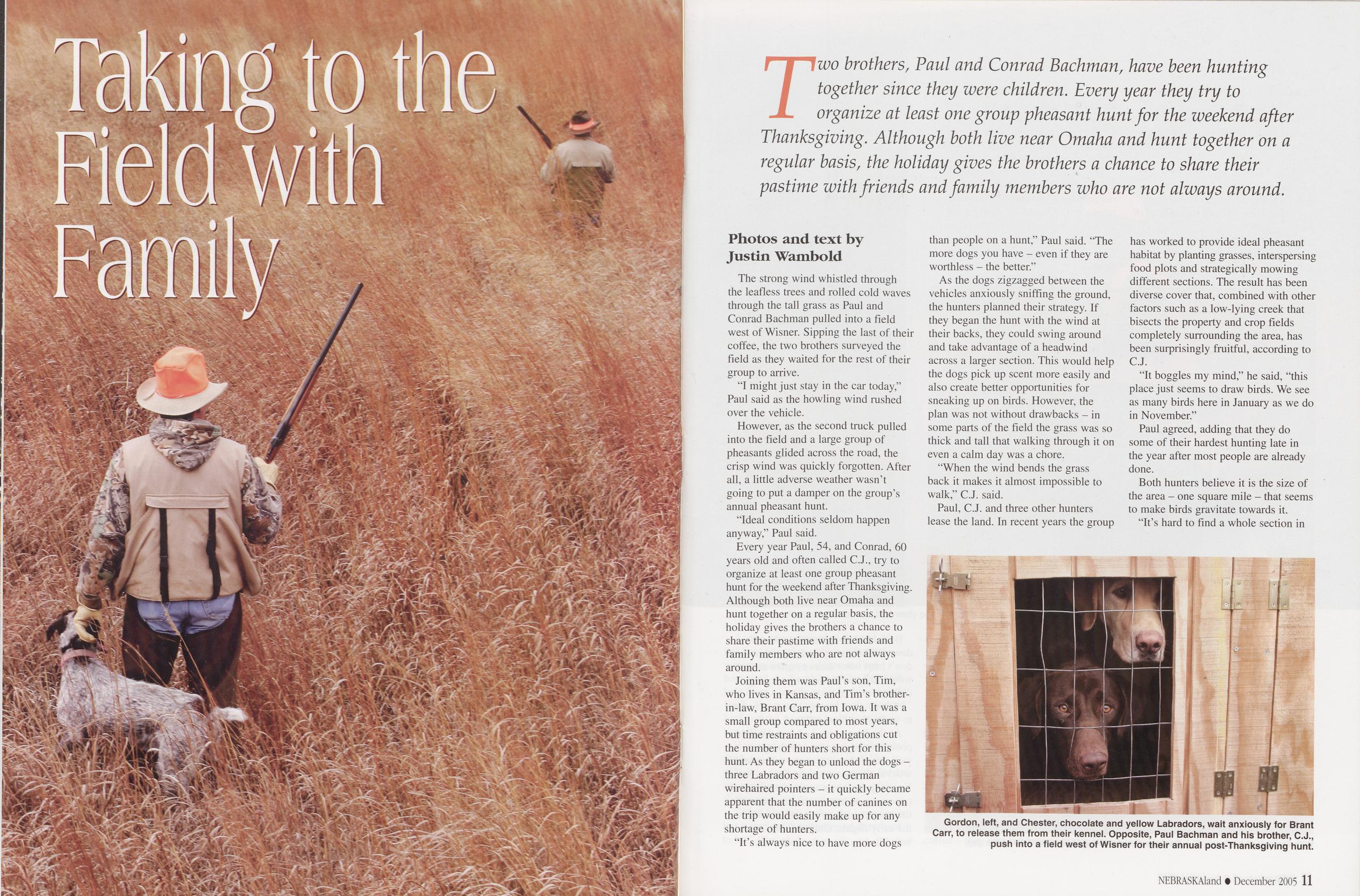
Talking to the Field with Family
Two brotjers, Paul and Conrad Bachman, have been hunting together since they were children. Ever Thanksgiving. Although both live near Omaha and hunt together on a regular basis, the holiday gives the brothers a chance to share their pastime with friends and family members who are not always around.
The strong wind whistled through the leafless trees and rolled cold waves through the tall grass as Paul and Conrad Bachman pulled into a field west of Wisner. Sipping the last of their coffee, the two brothers surveyed the field as they waited for the rest of their group to arrive.
"I might just stay in the car today,” Paul said as the howling wind rushed over the vehicle.
However, as the second truck pulled into the field and a large group of pheasants glided across the road, the crisp wind was quickly forgotten. After all, a little adverse weather wasn’t going to put a damper on the group’s annual pheasant hunt.
“Ideal conditions seldom happen anyway,” Paul said.
Every year Paul, 54, and Conrad, 60 years old and often called C.J., try to organize at least one group pheasant hunt for the weekend after Thanksgiving. Although both live near Omaha and hunt together on a regular basis, the holiday gives the brothers a chance to share their pastime with friends and family members who are not always around.
Joining them was Paul’s son, Tim, who lives in Kansas, and Tim’s brother- in-law, Brant Carr, from Iowa. It was a small group compared to most years, but time restraints and obligations cut the number of hunters short for this hunt. As they began to unload the dogs - three Labradors and two German wirehaired pointers - it quickly became apparent that the number of canines on the trip would easily make up for any shortage of hunters.
“It’s always nice to have more dogs than people on a hunt,” Paul said. "The more dogs you have - even if they are worthless - the better.”
As the dogs zigzagged between the vehicles anxiously sniffing the ground, the hunters planned their strategy. If they began the hunt with the wind at their backs, they could swing around and take advantage of a headwind across a larger section. This would help the dogs pick up scent more easily and also create better opportunities for sneaking up on birds. However, the plan was not without drawbacks - in some parts of the field the grass was so thick and tall that walking through it on even a calm day was a chore.
"When the wind bends the grass back it makes it almost impossible to walk,” C.J. said.
Paul, C.J. and three other hunters lease the land. In recent years the group
"It boggles my mind,” he said, “this place just seems to draw birds. We see as many birds here in January as we do in November.”
Paul agreed, adding that they do some of their hardest hunting late in the year after most people are already done.
Both hunters believe it is the size of the area - one square mile - that seems to make birds gravitate towards it.
"It’s hard to find a whole section in NEBRASKAland • December 2005 11 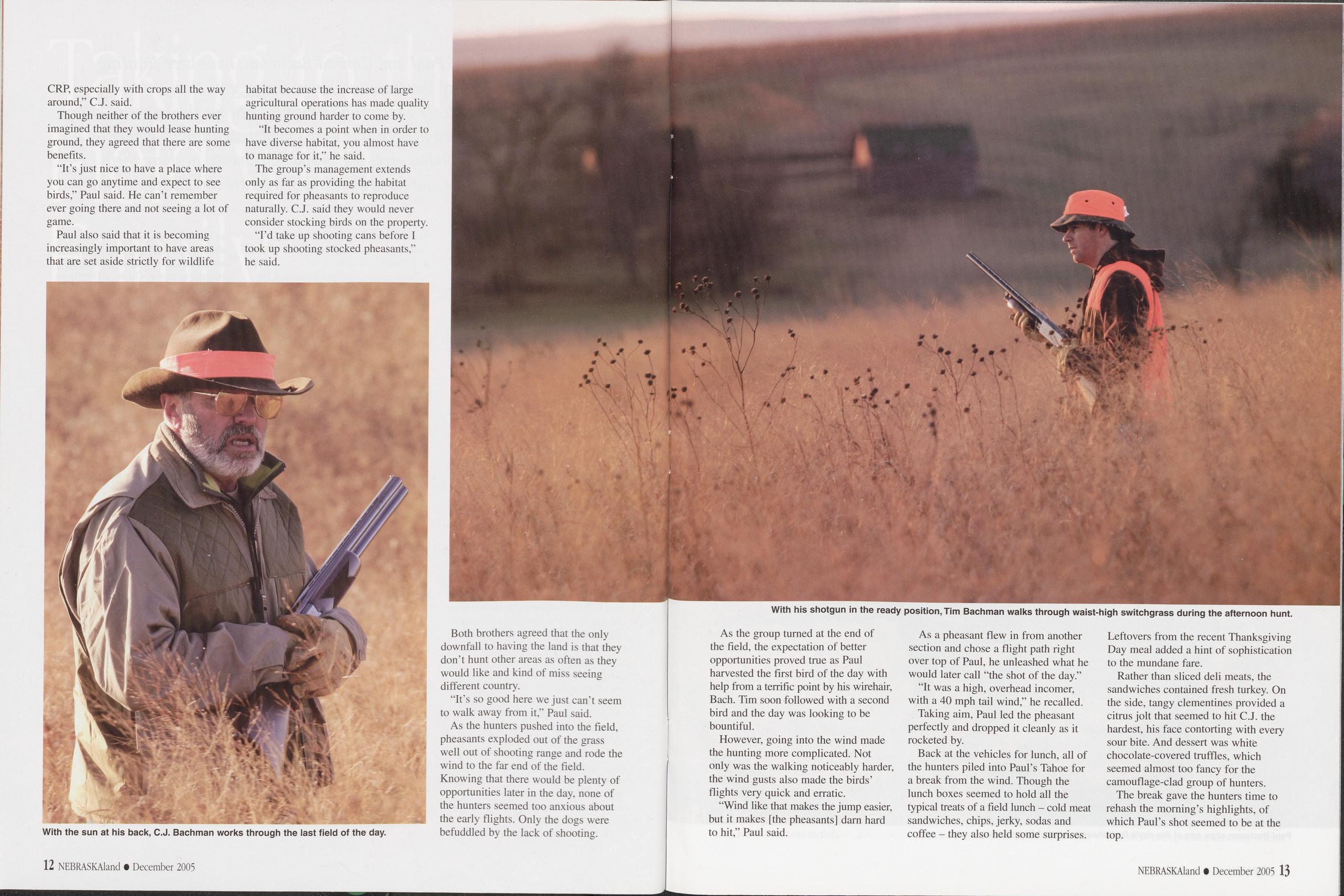 CRP, especially with crops all the way around,” C.J. said.
Though neither of the brothers ever imagined that they would lease hunting ground, they agreed that there are some benefits.
“It’s just nice to have a place where you can go anytime and expect to see birds,” Paul said. He can’t remember ever going there and not seeing a lot of game.
Paul also said that it is becoming increasingly important to have areas that are set aside strictly for wildlife
“It becomes a point when in order to have diverse habitat, you almost have to manage for it,” he said.
The group’s management extends only as far as providing the habitat required for pheasants to reproduce naturally. C.J. said they would never consider stocking birds on the property.
“I’d take up shooting cans before I took up shooting stocked pheasants,” he said.
Both brothers agreed that the only downfall to having the land is that they don’t hunt other areas as often as they would like and kind of miss seeing different country.
“It’s so good here we just can’t seem to walk away from it,” Paul said. As the hunters pushed into the field, pheasants exploded out of the grass well out of shooting range and rode the wind to the far end of the field. Knowing that there would be plenty of opportunities later in the day, none of the hunters seemed too anxious about the early flights. Only the dogs were befuddled by the lack of shooting.
As the group turned at the end of the field, the expectation of better opportunities proved true as Paul harvested the first bird of the day with help from a terrific point by his wirehair, Bach. Tim soon followed with a second bird and the day was looking to be bountiful.
However, going into the wind made the hunting more complicated. Not only was the walking noticeably harder, the wind gusts also made the birds’ flights very quick and erratic.
“Wind like that makes the jump easier, but it makes [the pheasants] darn hard to hit,” Paul said.
As a pheasant flew in from another section and chose a flight path right over top of Paul, he unleashed what he would later call “the shot of the day.”
“It was a high, overhead incomer, with a 40 mph tail wind,” he recalled.
Taking aim, Paul led the pheasant perfectly and dropped it cleanly as it rocketed by.
Back at the vehicles for lunch, all of the hunters piled into Paul’s Tahoe for a break from the wind. Though the lunch boxes seemed to hold all the typical treats of a field lunch - cold meat sandwiches, chips, jerky, sodas and coffee - they also held some surprises. Leftovers from the recent Thanksgiving Day meal added a hint of sophistication to the mundane fare.
Rather than sliced deli meats, the sandwiches contained fresh turkey. On the side, tangy clementines provided a citrus jolt that seemed to hit C.J. the hardest, his face contorting with every sour bite. And dessert was white chocolate-covered truffles, which seemed almost too fancy for the camouflage-clad group of hunters.
The break gave the hunters time to rehash the morning’s highlights, of which Paul’s shot seemed to be at the top.
12 NEBRASKAland • December 2005 NEBRASKAland • December 2005 13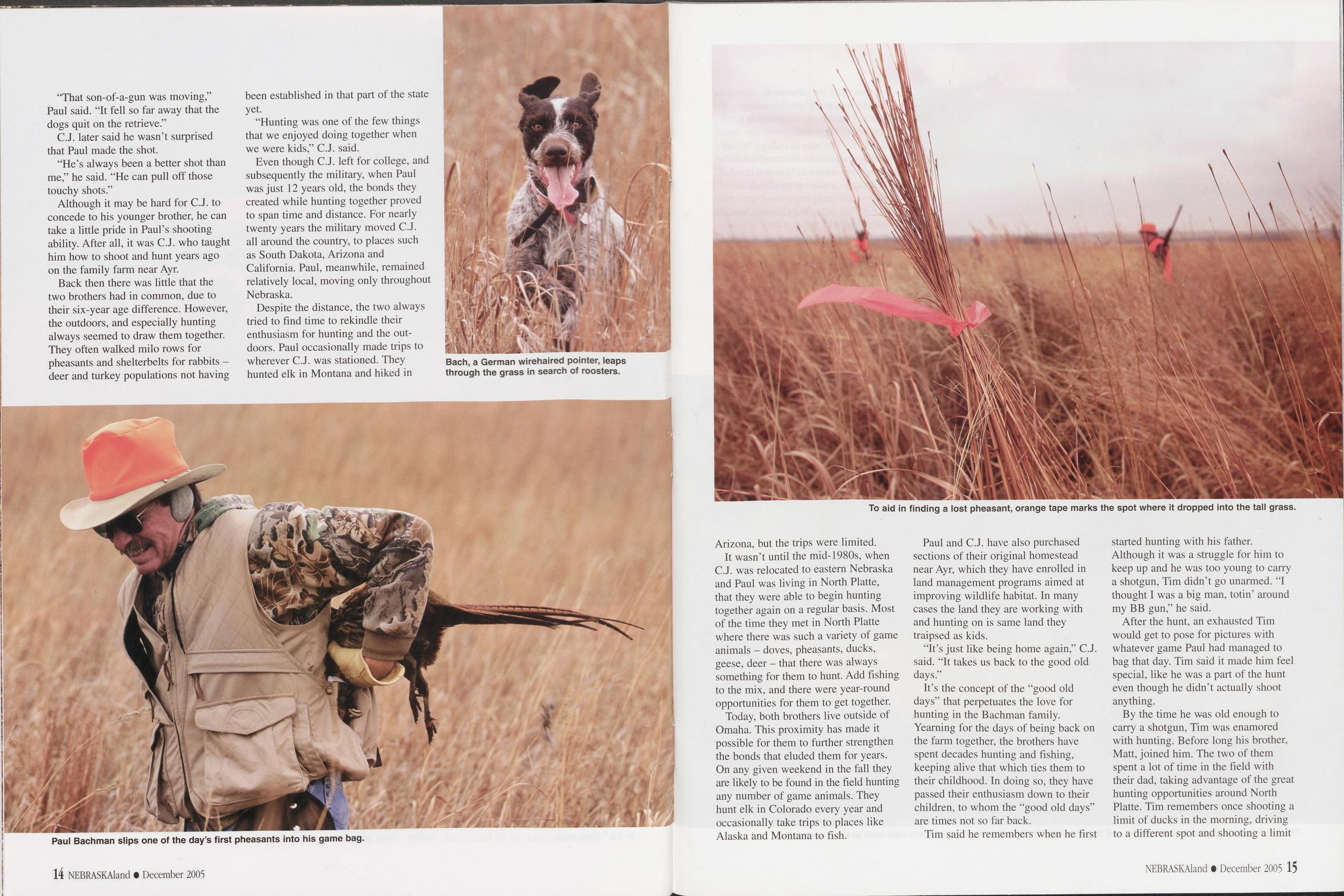
“That son-of-a-gun was moving,” Paul said. “It fell so far away that the dogs quit on the retrieve.”
C.J. later said he wasn’t surprised that Paul made the shot.
“He’s always been a better shot than me,” he said. “He can pull off those touchy shots.”
Although it may be hard for C.J. to concede to his younger brother, he can take a little pride in Paul’s shooting ability. After all, it was C.J. who taught him how to shoot and hunt years ago on the family farm near Ayr.
Back then there was little that the two brothers had in common, due to their six-year age difference. However, the outdoors, and especially hunting always seemed to draw them together. They often walked milo rows for pheasants and shelterbelts for rabbits - deer and turkey populations not having been established in that part of the state yet.
“Hunting was one of the few things that we enjoyed doing together when we were kids,” C.J. said.
Even though C.J. left for college, and subsequently the military, when Paul was just 12 years old, the bonds they created while hunting together proved to span time and distance. For nearly twenty years the military moved C.J. all around the country, to places such as South Dakota, Arizona and California. Paul, meanwhile, remained relatively local, moving only throughout Nebraska.
Despite the distance, the two always tried to find time to rekindle their enthusiasm for hunting and the out- doors. Paul occasionally made trips to wherever C.J. was stationed. They hunted elk in Montana and hiked in
It wasn’t until the mid-1980s, when C.J. was relocated to eastern Nebraska and Paul was living in North Platte, that they were able to begin hunting together again on a regular basis. Most of the time they met in North Platte where there was such a variety of game animals - doves, pheasants, ducks, geese, deer - that there was always something for them to hunt. Add fishing to the mix, and there were year-round opportunities for them to get together.
Today, both brothers live outside of Omaha. This proximity has made it possible for them to further strengthen the bonds that eluded them for years. On any given weekend in the fall they are likely to be found in the field hunting any number of game animals. They hunt elk in Colorado every year and occasionally take trips to places like Alaska and Montana to fish.
Paul and C.J. have also purchased sections of their original homestead near Ayr, which they have enrolled in land management programs aimed at improving wildlife habitat. In many cases the land they are working with and hunting on is same land they traipsed as kids.
“It’s just like being home again,” C.J. said. “It takes us back to the good old days.”
It’s the concept of the “good old days” that perpetuates the love for hunting in the Bachman family. Yearning for the days of being back on the farm together, the brothers have spent decades hunting and fishing, keeping alive that which ties them to their childhood. In doing so, they have passed their enthusiasm down to their children, to whom the “good old days” are times not so far back.
Tim said he remembers when he first started hunting with his father. Although it was a struggle for him to keep up and he was too young to carry a shotgun, Tim didn’t go unarmed. “I thought I was a big man, totin’ around my BB gun,” he said.
After the hunt, an exhausted Tim would get to pose for pictures with whatever game Paul had managed to bag that day. Tim said it made him feel special, like he was a part of the hunt even though he didn’t actually shoot anything.
By the time he was old enough to carry a shotgun, Tim was enamored with hunting. Before long his brother, Matt, joined him. The two of them spent a lot of time in the field with their dad, taking advantage of the great hunting opportunities around North Platte. Tim remembers once shooting a limit of ducks in the morning, driving to a different spot and shooting a limit NEBRASKAland • December 2005 15 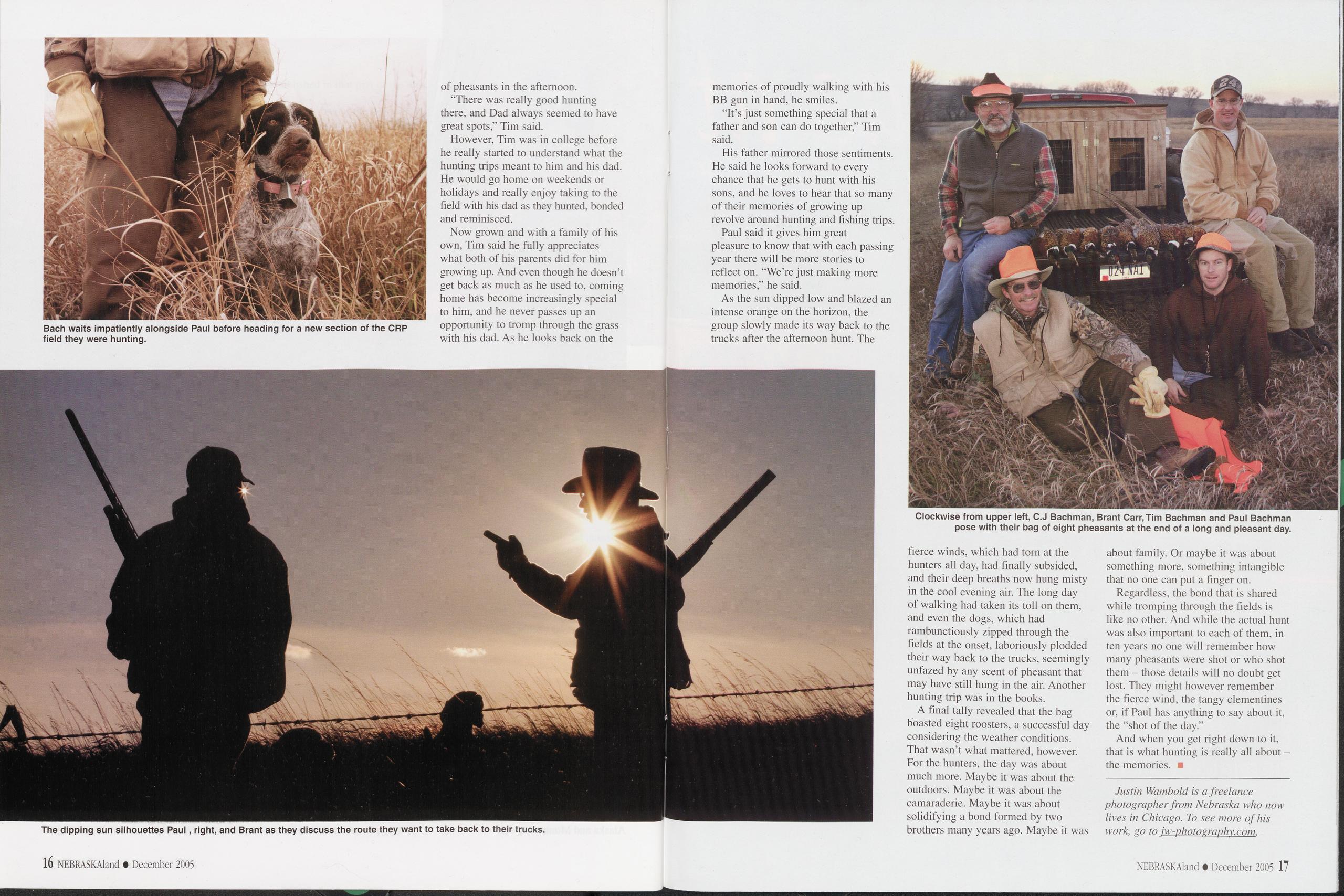
"There was really good hunting there, and Dad always seemed to have great spots,” Tim said.
However, Tim was in college before he really started to understand what the hunting trips meant to him and his dad. He would go home on weekends or holidays and really enjoy taking to the field with his dad as they hunted, bonded and reminisced.
Now grown and with a family of his own, Tim said he fully appreciates what both of his parents did for him growing up. And even though he doesn’t get back as much as he used to, coming home has become increasingly special to him, and he never passes up an opportunity to tromp through the grass with his dad. As he looks back on the
"It’s just something special that a father and son can do together,” Tim said.
His father mirrored those sentiments. He said he looks forward to every chance that he gets to hunt with his sons, and he loves to hear that so many of their memories of growing up revolve around hunting and fishing trips.
Paul said it gives him great pleasure to know that with each passing year there will be more stories to reflect on. "We’re just making more memories,” he said.
As the sun dipped low and blazed an intense orange on the horizon, the group slowly made its way back to the trucks after the afternoon hunt. The
A final tally revealed that the bag boasted eight roosters, a successful day considering the weather conditions. That wasn’t what mattered, however. For the hunters, the day was about much more. Maybe it was about the outdoors. Maybe it was about the camaraderie. Maybe it was about solidifying a bond formed by two brothers many years ago. Maybe it was about family. Or maybe it was about something more, something intangible that no one can put a finger on.
Regardless, the bond that is shared while tromping through the fields is like no other. And while the actual hunt was also important to each of them, in ten years no one will remember how many pheasants were shot or who shot them - those details will no doubt get lost. They might however remember the fierce wind, the tangy clementines or, if Paul has anything to say about it, the "shot of the day.”
And when you get right down to it, that is what hunting is really all about - the memories.
Justin Wambold is a freelance photographer from Nebraska who now lives in Chicago. To see more of his work, go to iw-photography.com 16 NEBRASKAland • December 2005 NEBRASKAland • December 2005 17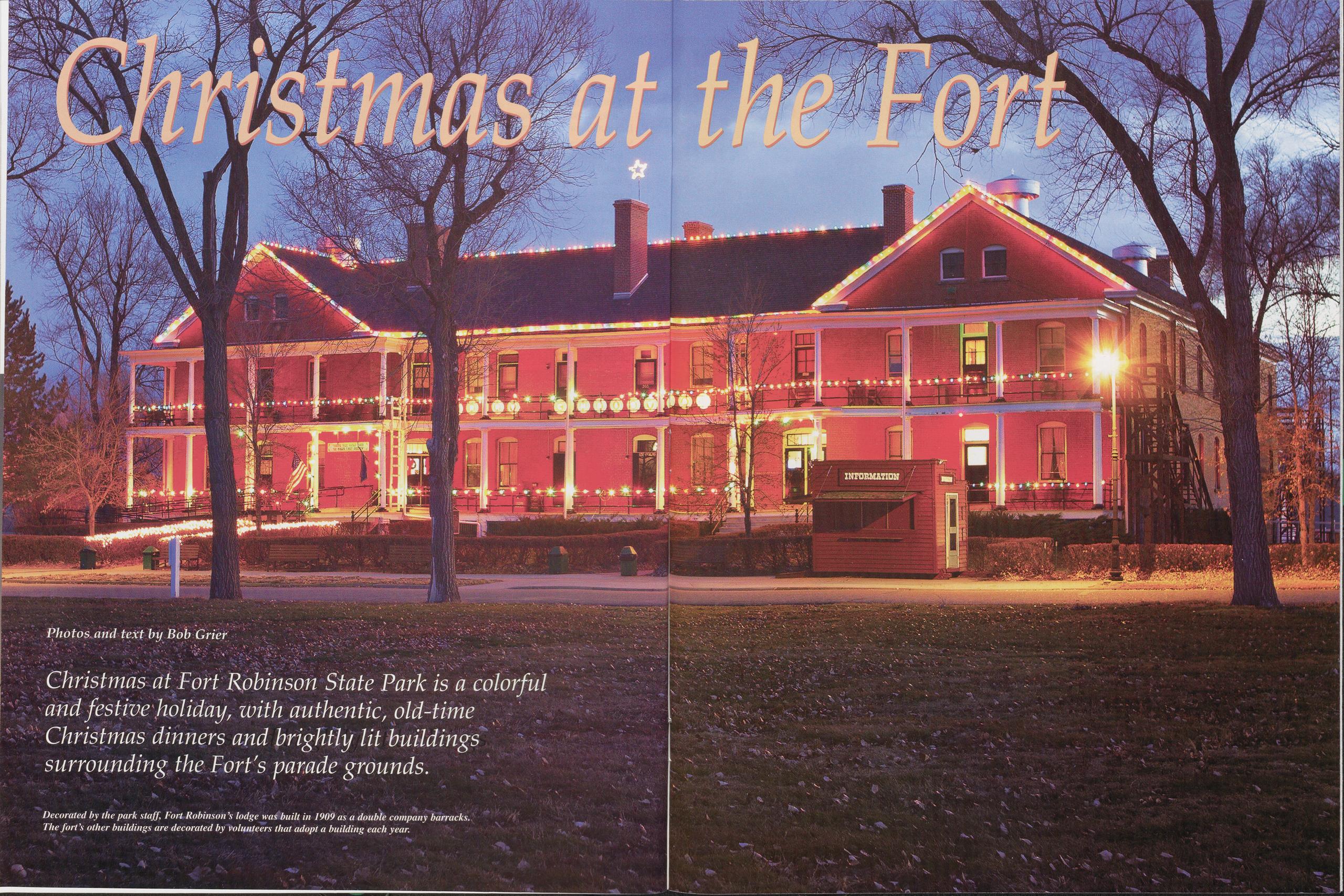
Christmas at the Fort
Christmas at Fort Robinson State Park is a colorful ; and festive holiday, with authentic, old-time Christmas dinners and brightly lit buildings surrounding the Fort's parade grounds.
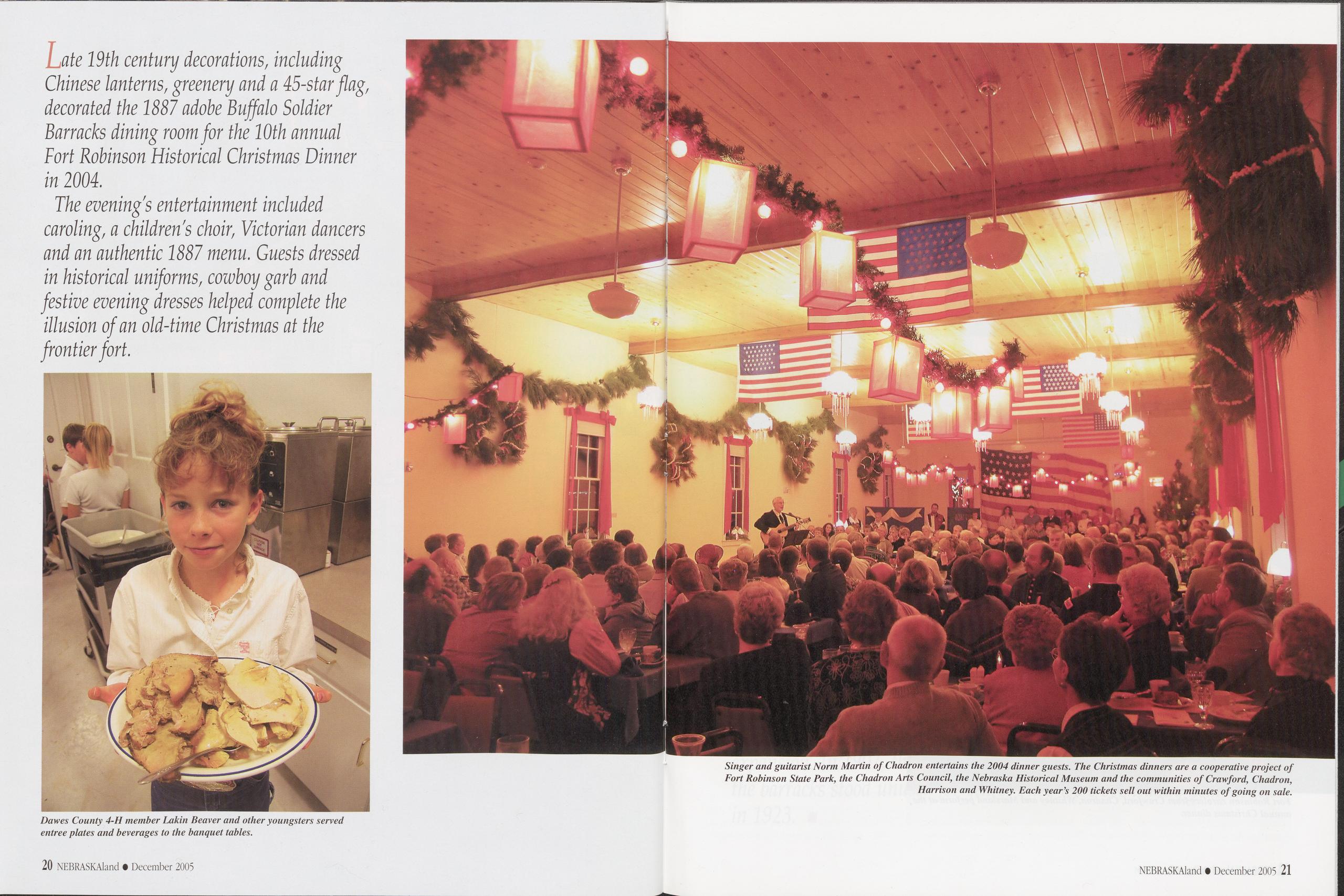
Late 19th century decorations, including Chinese lanterns, greenery and a 45-star flag, decorated the 1887 adobe Buffalo Soldier Barracks dining room for the 10th annual Fort Robinson Historical Christmas Dinner in 2004.
The evening's entertainment included caroling, a children's choir, Victorian dancers and an authentic 1887 menu. Guests dressed in historical uniforms, cowboy garb and festive evening dresses helped complete the illusion of an old-time Christmas at the frontier fort.
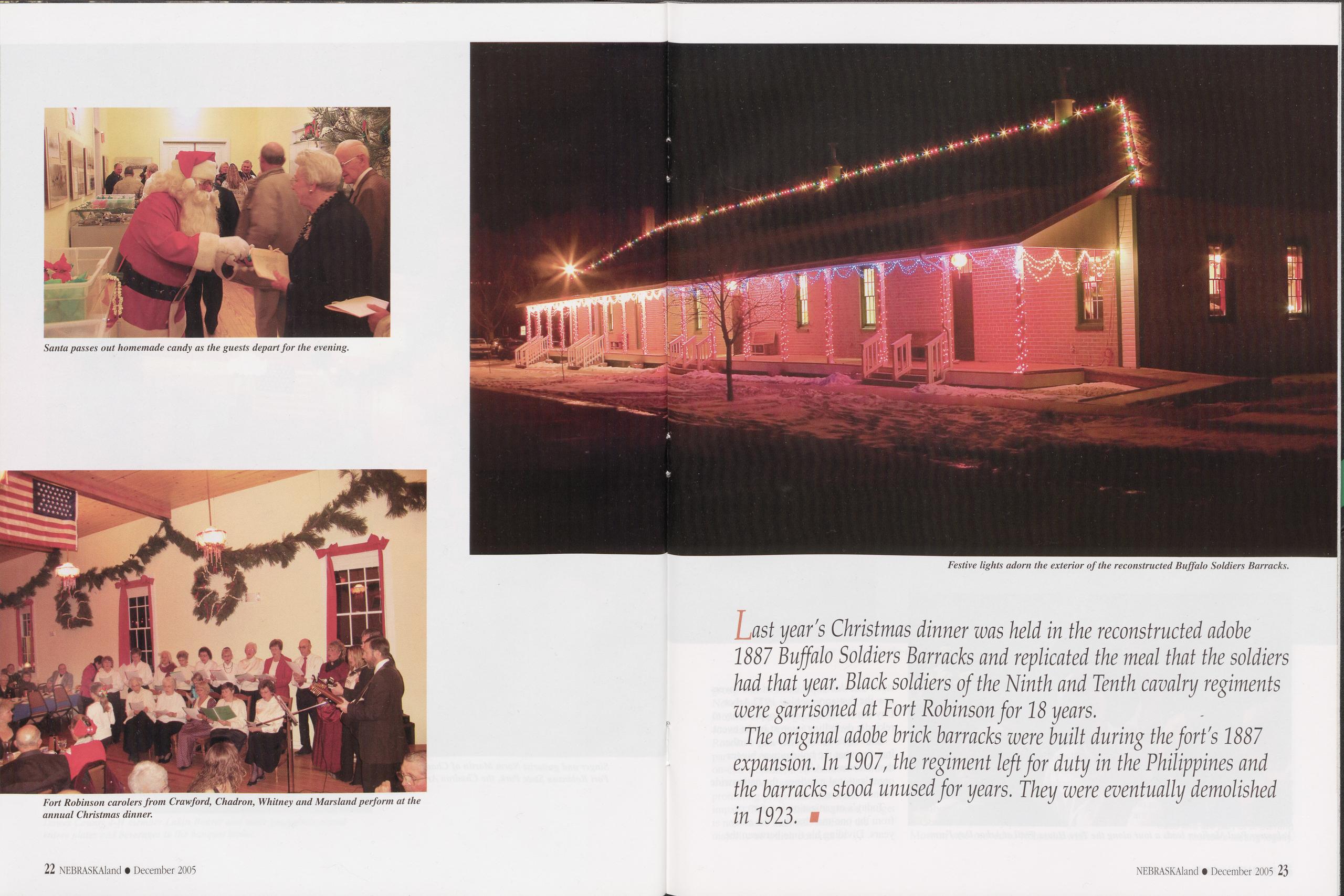
Last year's Christmas dinner was held in the reconstructed adobe 1887 Buffalo Soldiers Barracks and replicated the meal that the soldiers had that year. Black soldiers of the Ninth and Tenth cavalry regiments were garrisoned at Fort Robinson for 18 years.
The original adobe brick barracks were built during the fort's 1887 expansion. In 1907, the regiment left for duty in the Philippines and the barracks stood unused for years. They were eventually demolished in 1923.
22 NEBRASKAland • December 2005 NEBRASKAland • December 2005 23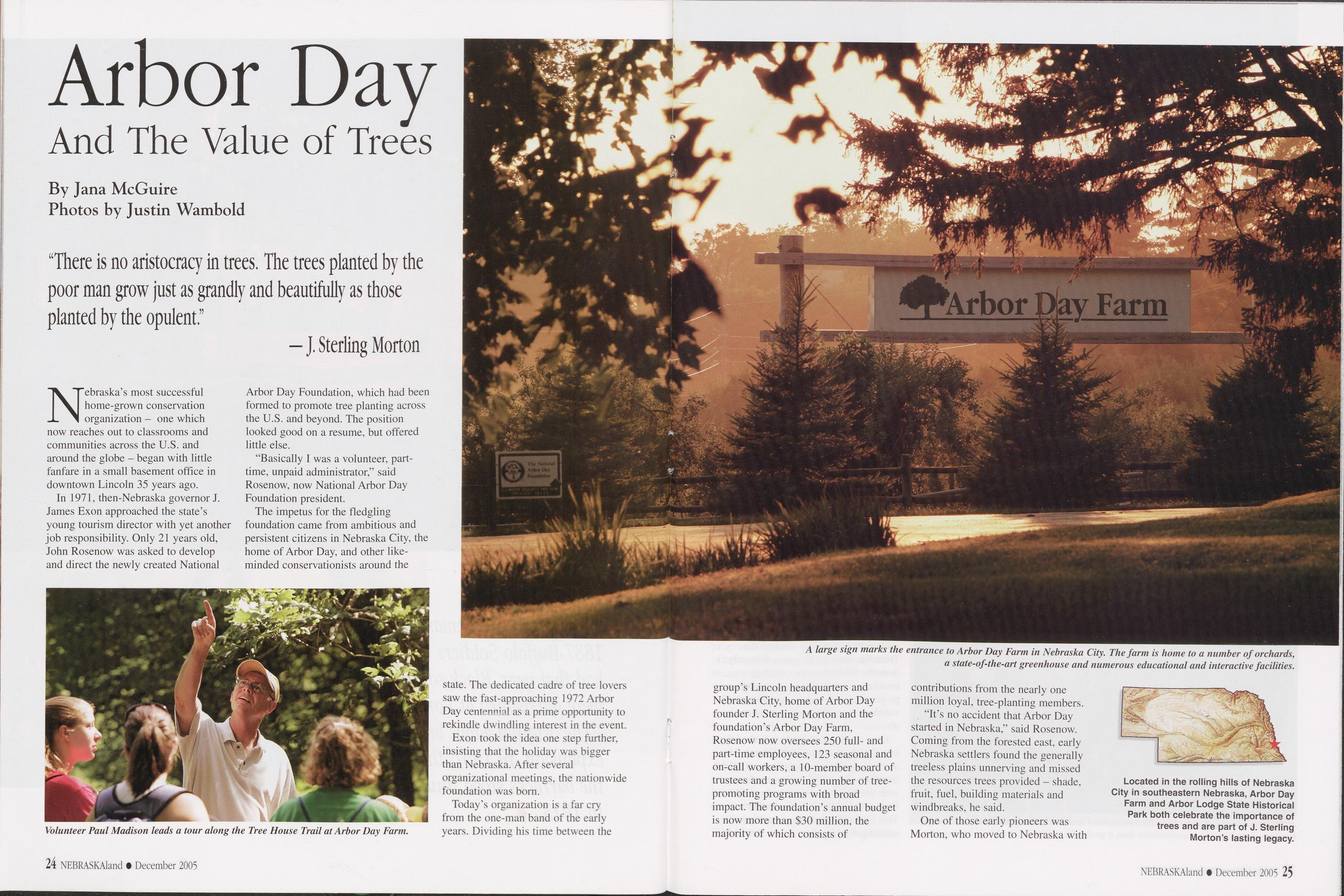
Arbor Day And The Value of Trees
“There is no aristocracy in trees. The trees planted by the poor man grow just as grandly and beautifully as those planted by the opulent.”
-J. Sterling MortonNebraska’s most successful home-grown conservation organization - one which now reaches out to classrooms and communities across the U.S. and around the globe - began with little fanfare in a small basement office in downtown Lincoln 35 years ago.
In 1971, then-Nebraska governor J. James Exon approached the state’s young tourism director with yet another job responsibility. Only 21 years old, John Rosenow was asked to develop and direct the newly created National
“Basically I was a volunteer, part- time, unpaid administrator,” said Rosenow, now National Arbor Day Foundation president.
The impetus for the fledgling foundation came from ambitious and persistent citizens in Nebraska City, the home of Arbor Day, and other like- minded conservationists around the
Exon took the idea one step further, insisting that the holiday was bigger than Nebraska. After several organizational meetings, the nationwide foundation was born.
Today’s organization is a far cry from the one-man band of the early years. Dividing his time between the group’s Lincoln headquarters and Nebraska City, home of Arbor Day founder J. Sterling Morton and the foundation’s Arbor Day Farm, Rosenow now oversees 250 full- and part-time employees, 123 seasonal and on-call workers, a 10-member board of trustees and a growing number of tree- promoting programs with broad impact. The foundation’s annual budget is now more than $30 million, the majority of which consists of contributions from the nearly one million loyal, tree-planting members.
“It’s no accident that Arbor Day started in Nebraska,” said Rosenow. Coming from the forested east, early Nebraska settlers found the generally treeless plains unnerving and missed the resources trees provided - shade, fruit, fuel, building materials and windbreaks, he said.
One of those early pioneers was Morton, who moved to Nebraska with
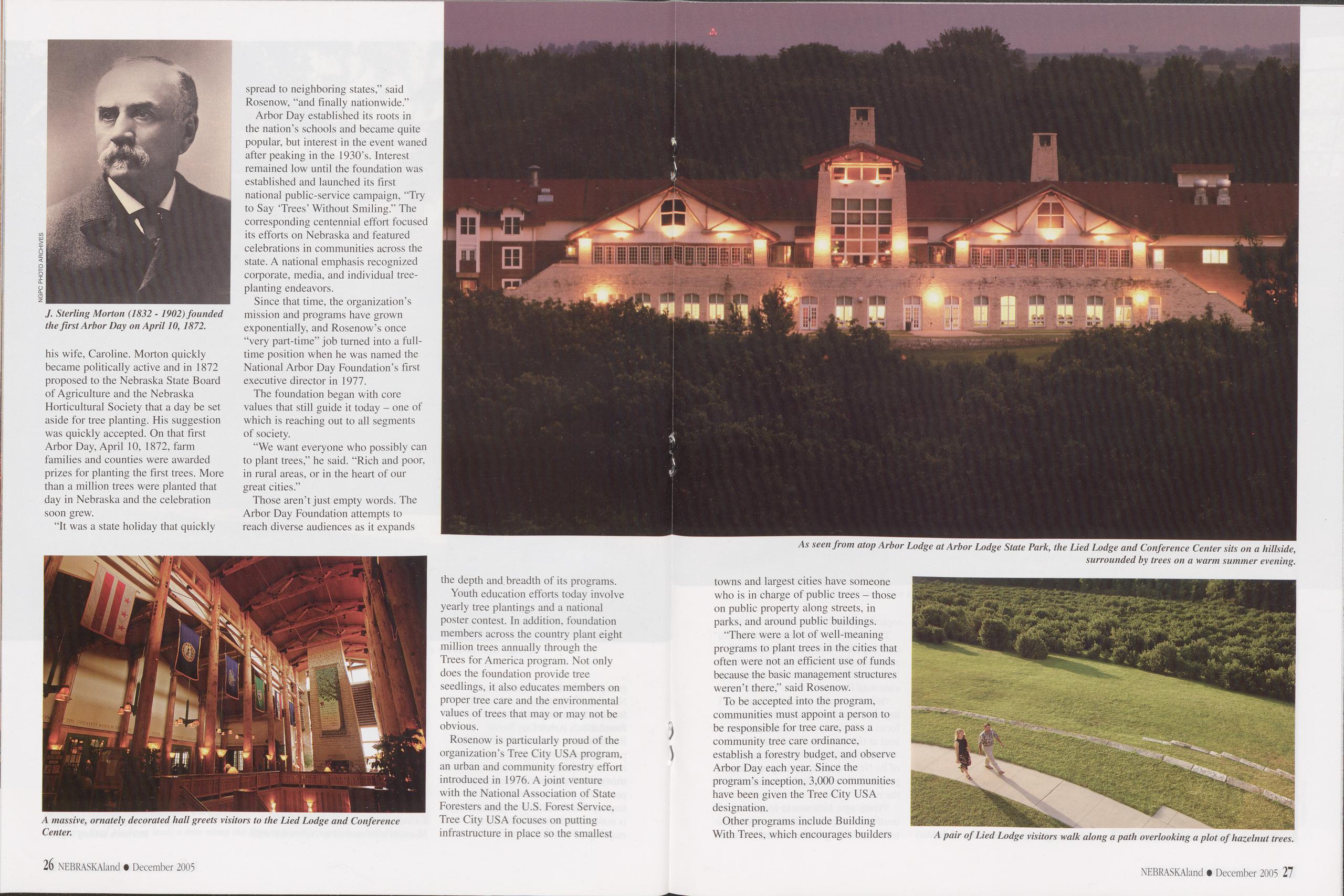
“It was a state holiday that quickly spread to neighboring states,” said Rosenow, “and finally nationwide.”
Arbor Day established its roots in the nation’s schools and became quite popular, but interest in the event waned after peaking in the 1930’s. Interest remained low until the foundation was established and launched its first national public-service campaign, “Try to Say 4Trees’ Without Smiling.” The corresponding centennial effort focused its efforts on Nebraska and featured celebrations in communities across the state. A national emphasis recognized corporate, media, and individual tree- planting endeavors.
Since that time, the organization’s mission and programs have grown exponentially, and Rosenow’s once “very part-time” job turned into a full- time position when he was named the National Arbor Day Foundation’s first executive director in 1977.
The foundation began with core values that still guide it today - one of which is reaching out to all segments of society.
“We want everyone who possibly can to plant trees,” he said. “Rich and poor, in rural areas, or in the heart of our great cities.”
Those aren’t just empty words. The Arbor Day Foundation attempts to reach diverse audiences as it expands
Youth education efforts today involve yearly tree plantings and a national poster contest. In addition, foundation members across the country plant eight million trees annually through the Trees for America program. Not only does the foundation provide tree seedlings, it also educates members on proper tree care and the environmental values of trees that may or may not be obvious.
Rosenow is particularly proud of the organization’s Tree City USA program, an urban and community forestry effort introduced in 1976. A joint venture with the National Association of State Foresters and the U.S. Forest Service, Tree City USA focuses on putting infrastructure in place so the smallest towns and largest cities have someone who is in charge of public trees - those on public property along streets, in parks, and around public buildings.
“There were a lot of well-meaning programs to plant trees in the cities that often were not an efficient use of funds because the basic management structures weren’t there,” said Rosenow.
To be accepted into the program, communities must appoint a person to be responsible for tree care, pass a community tree care ordinance, establish a forestry budget, and observe Arbor Day each year. Since the program’s inception, 3,000 communities have been given the Tree City USA designation.
Other programs include Building With Trees, which encourages builders
 and developers to save trees during construction.
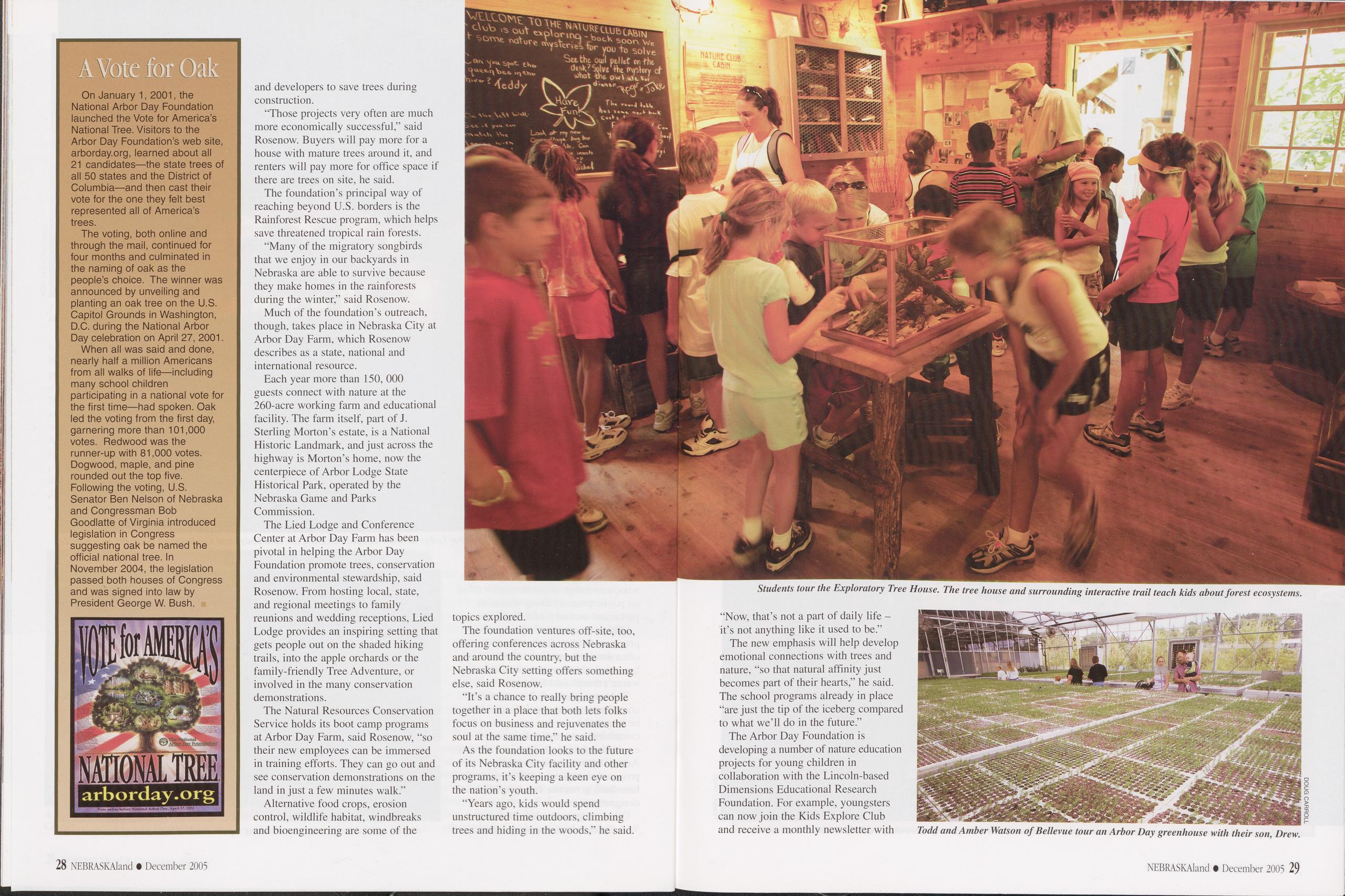
A Vote for Oak On January 1, 2001, the National Arbor Day Foundation launched the Vote for America’s National Tree. Visitors to the Arbor Day Foundation’s web site, arborday.org, learned about all 21 candidates—the state trees of all 50 states and the District of Columbia—and then cast their vote for the one they felt best represented all of America’s trees. The voting, both online and through the mail, continued for four months and culminated in the naming of oak as the people’s choice. The winner was announced by unveiling and planting an oak tree on the U.S. Capitol Grounds in Washington, D.C. during the National Arbor Day celebration on April 27, 2001. When all was said and done, nearly half a million Americans from all walks of life—including many school children participating in a national vote for the first time—had spoken. Oak led the voting from the first day, garnering more than 101,000 votes. Redwood was the runner-up with 81,000 votes. Dogwood, maple, and pine rounded out the top five. Following the voting, U.S. Senator Ben Nelson of Nebraska and Congressman Bob Goodlatte of Virginia introduced legislation in Congress suggesting oak be named the official national tree. In November 2004, the legislation passed both houses of Congress and was signed into law by President George W. Bush.
"Those projects very often are much more economically successful,” said Rosenow. Buyers will pay more for a house with mature trees around it, and renters will pay more for office space if there are trees on site, he said.
The foundation’s principal way of reaching beyond U.S. borders is the Rainforest Rescue program, which helps save threatened tropical rain forests.
"Many of the migratory songbirds that we enjoy in our backyards in Nebraska are able to survive because they make homes in the rainforests during the winter,” said Rosenow.
Much of the foundation’s outreach, though, takes place in Nebraska City at Arbor Day Farm, which Rosenow describes as a state, national and international resource.
Each year more than 150, 000 guests connect with nature at the 260-acre working farm and educational facility. The farm itself, part of J. Sterling Morton’s estate, is a National Historic Landmark, and just across the highway is Morton’s home, now the centerpiece of Arbor Lodge State Historical Park, operated by the Nebraska Game and Parks Commission.
The Lied Lodge and Conference Center at Arbor Day Farm has been pivotal in helping the Arbor Day Foundation promote trees, conservation and environmental stewardship, said Rosenow. From hosting local, state, and regional meetings to family reunions and wedding receptions, Lied Lodge provides an inspiring setting that gets people out on the shaded hiking trails, into the apple orchards or the family-friendly Tree Adventure, or involved in the many conservation demonstrations.
The Natural Resources Conservation Service holds its boot camp programs at Arbor Day Farm, said Rosenow, "so their new employees can be immersed in training efforts. They can go out and see conservation demonstrations on the land in just a few minutes walk.”
Alternative food crops, erosion control, wildlife habitat, windbreaks and bioengineering are some of the
The foundation ventures off-site, too, offering conferences across Nebraska and around the country, but the Nebraska City setting offers something else, said Rosenow.
"It’s a chance to really bring people together in a place that both lets folks focus on business and rejuvenates the soul at the same time,” he said.
As the foundation looks to the future of its Nebraska City facility and other programs, it’s keeping a keen eye on the nation’s youth.
"Years ago, kids would spend unstructured time outdoors, climbing trees and hiding in the woods,” he said. “Now, that’s not a part of daily life - it’s not anything like it used to be.”
The new emphasis will help develop emotional connections with trees and nature, "so that natural affinity just becomes part of their hearts,” he said. The school programs already in place "are just the tip of the iceberg compared to what we’ll do in the future.”
The Arbor Day Foundation is developing a number of nature education projects for young children in collaboration with the Lincoln-based Dimensions Educational Research Foundation. For example, youngsters can now join the Kids Explore Club and receive a monthly newsletter with
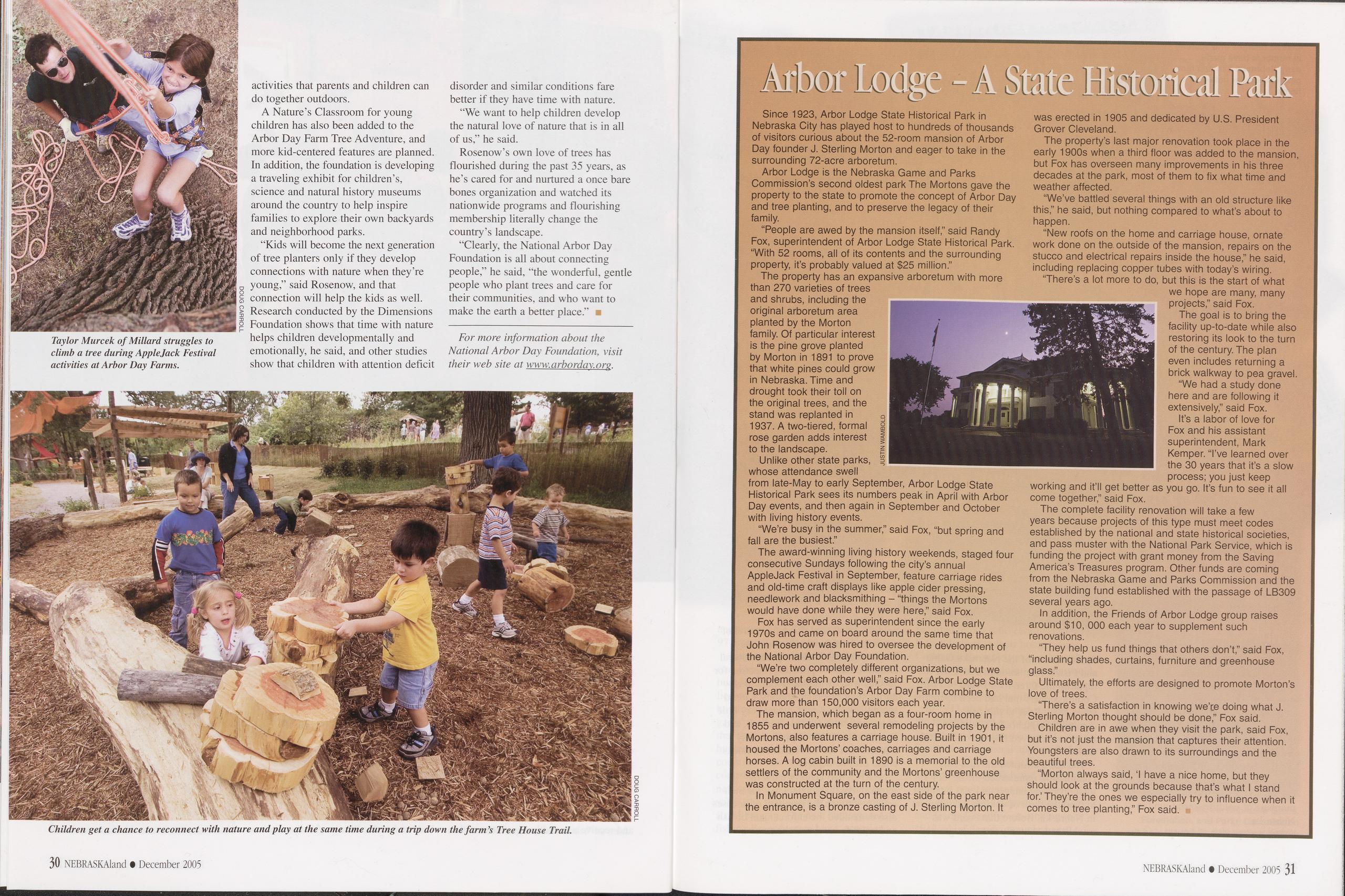
A Nature’s Classroom for young children has also been added to the Arbor Day Farm Tree Adventure, and more kid-centered features are planned. In addition, the foundation is developing a traveling exhibit for children’s, science and natural history museums around the country to help inspire families to explore their own backyards and neighborhood parks.
“Kids will become the next generation of tree planters only if they develop connections with nature when they’re young,” said Rosenow, and that connection will help the kids as well. Research conducted by the Dimensions Foundation shows that time with nature helps children developmentally and emotionally, he said, and other studies show that children with attention deficit disorder and similar conditions fare better if they have time with nature.
“We want to help children develop the natural love of nature that is in all of us,” he said.
Rosenow’s own love of trees has flourished during the past 35 years, as he’s cared for and nurtured a once bare bones organization and watched its nationwide programs and flourishing membership literally change the country’s landscape.
“Clearly, the National Arbor Day Foundation is all about connecting people,” he said, “the wonderful, gentle people who plant trees and care for their communities, and who want to make the earth a better place.”
For more information about the National Arbor Day Foundationvisit their web site at www.arborday.org.Arbor Lodge - A State Historical Park
Since 1923, Arbor Lodge State Historical Park in Nebraska City has played host to hundreds of thousands of visitors curious about the 52-room mansion of Arbor Day founder J. Sterling Morton and eager to take in the surrounding 72-acre arboretum.
Arbor Lodge is the Nebraska Game and Parks Commission’s second oldest park The Mortons gave the property to the state to promote the concept of Arbor Day and tree planting, and to preserve the legacy of their family.
“People are awed by the mansion itself,” said Randy Fox, superintendent of Arbor Lodge State Historical Park. “With 52 rooms, all of its contents and the surrounding property, it’s probably valued at $25 million.”
The property has an expansive arboretum with more than 270 varieties of trees and shrubs, including the original arboretum area planted by the Morton family. Of particular interest is the pine grove planted by Morton in 1891 to prove that white pines could grow in Nebraska. Time and drought took their toll on the original trees, and the stand was replanted in g 1937. A two-tiered, formal g rose garden adds interest | to the landscape.
Unlike other state parks, כ whose attendance swell from late-May to early September, Arbor Lodge State Historical Park sees its numbers peak in April with Arbor Day events, and then again in September and October with living history events.
“We’re busy in the summer,” said Fox, “but spring and fall are the busiest.”
The award-winning living history weekends, staged four consecutive Sundays following the city’s annual Applejack Festival in September, feature carriage rides and old-time craft displays like apple cider pressing, needlework and blacksmithing - “things the Mortons would have done while they were here,” said Fox.
Fox has served as superintendent since the early 1970s and came on board around the same time that John Rosenow was hired to oversee the development of the National Arbor Day Foundation.
“We’re two completely different organizations, but we complement each other well,” said Fox. Arbor Lodge State Park and the foundation’s Arbor Day Farm combine to draw more than 150,000 visitors each year.
The mansion, which began as a four-room home in 1855 and underwent several remodeling projects by the Mortons, also features a carriage house. Built in 1901, it housed the Mortons’ coaches, carriages and carriage horses. A log cabin built in 1890 is a memorial to the old settlers of the community and the Mortons’ greenhouse was constructed at the turn of the century.
In Monument Square, on the east side of the park near the entrance, is a bronze casting of J. Sterling Morton. It 30 NEBRASKAland • December 2005 was erected in 1905 and dedicated by U.S. President Grover Cleveland.
The property’s last major renovation took place in the early 1900s when a third floor was added to the mansion, but Fox has overseen many improvements in his three decades at the park, most of them to fix what time and weather affected.
“We’ve battled several things with an old structure like this,” he said, but nothing compared to what’s about to happen.
“New roofs on the home and carriage house, ornate work done on the outside of the mansion, repairs on the stucco and electrical repairs inside the house,” he said, including replacing copper tubes with today’s wiring. “There’s a lot more to do, but this is the start of what we hope are many, many projects,” said Fox.
The goal is to bring the facility up-to-date while also restoring its look to the turn of the century. The plan even includes returning a brick walkway to pea gravel.
“We had a study done here and are following it extensively,” said Fox.
It’s a labor of love for Fox and his assistant superintendent, Mark Kemper. “I’ve learned over the 30 years that it’s a slow process; you just keep working and it’ll get better as you go. It’s fun to see it all come together,” said Fox.
The complete facility renovation will take a few years because projects of this type must meet codes established by the national and state historical societies, and pass muster with the National Park Service, which is funding the project with grant money from the Saving America’s Treasures program. Other funds are coming from the Nebraska Game and Parks Commission and the state building fund established with the passage of LB309 several years ago.
In addition, the Friends of Arbor Lodge group raises around $10, 000 each year to supplement such renovations.
“They help us fund things that others don’t,” said Fox, “including shades, curtains, furniture and greenhouse glass.”
Ultimately, the efforts are designed to promote Morton’s love of trees.
“There’s a satisfaction in knowing we’re doing what J. Sterling Morton thought should be done,” Fox said. Children are in awe when they visit the park, said Fox, but it’s not just the mansion that captures their attention. Youngsters are also drawn to its surroundings and the beautiful trees.
“Morton always said, ‘I have a nice home, but they should look at the grounds because that’s what I stand for.’They’re the ones we especially try to influence when it comes to tree planting,” Fox said.
NEBRASKAland • December 2005 31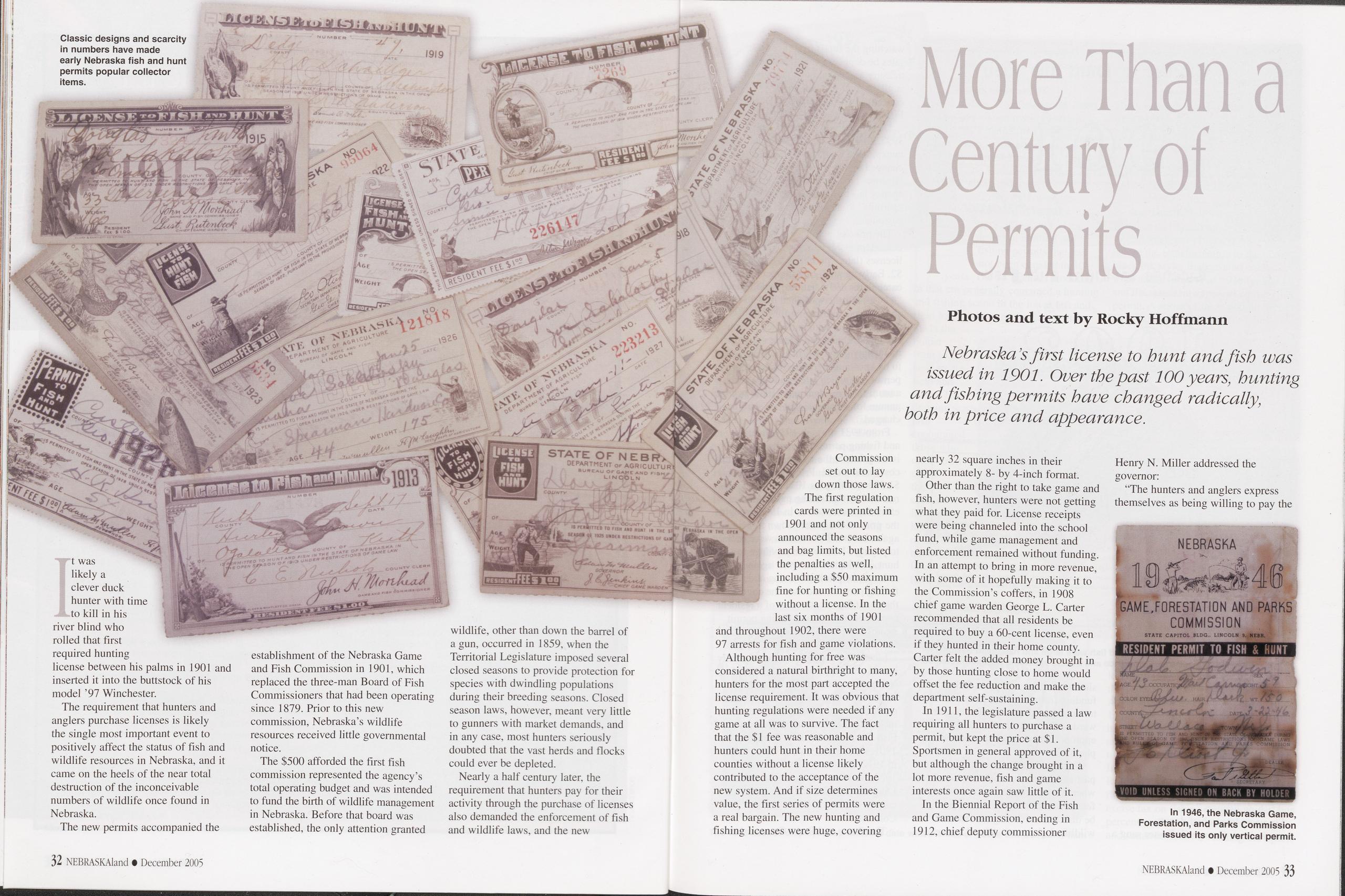
More Than a Century of permits
Nebraska's first license to hunt and fish was issed in 1901. Over the past 100 years, hunting and fishing permits have changed radically, both in price and appearance
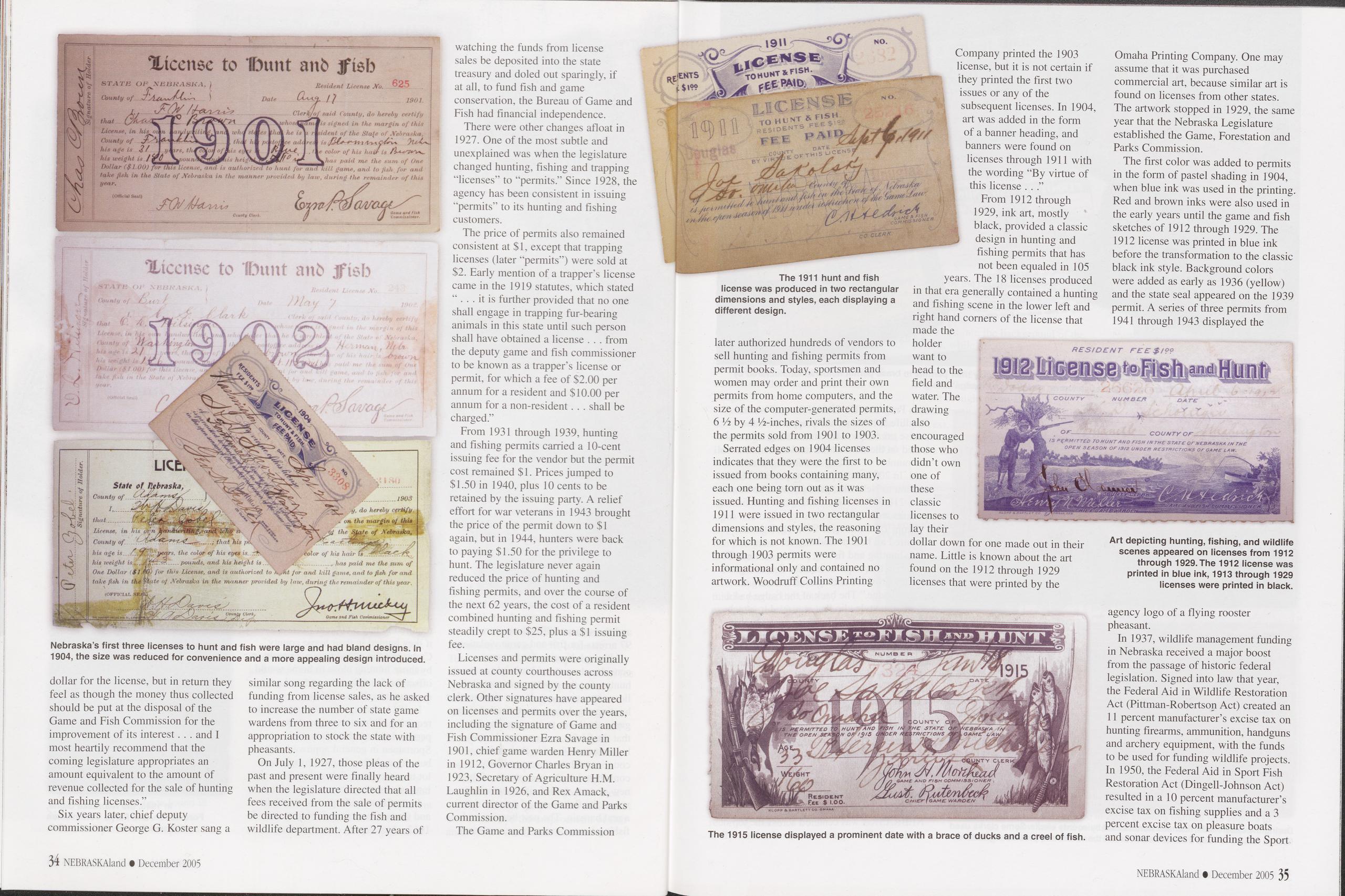
It was likely a clever duck hunter with time to kill in his river blind who rolled that first required hunting license between his palms in 1901 and inserted it into the buttstock of his model ’97 Winchester.
The requirement that hunters and anglers purchase licenses is likely the single most important event to positively affect the status of fish and wildlife resources in Nebraska, and it came on the heels of the near total destruction of the inconceivable numbers of wildlife once found in Nebraska.
The new permits accompanied the establishment of the Nebraska Game and Fish Commission in 1901, which replaced the three-man Board of Fish Commissioners that had been operating since 1879. Prior to this new commission, Nebraska’s wildlife resources received little governmental notice.
The $500 afforded the first fish commission represented the agency’s total operating budget and was intended to fund the birth of wildlife management in Nebraska. Before that board was established, the only attention granted wildlife, other than down the barrel of a gun, occurred in 1859, when the Territorial Legislature imposed several closed seasons to provide protection for species with dwindling populations during their breeding seasons. Closed season laws, however, meant very little to gunners with market demands, and in any case, most hunters seriously doubted that the vast herds and flocks could ever be depleted.
Nearly a half century later, the requirement that hunters pay for their activity through the purchase of licenses also demanded the enforcement of fish and wildlife laws, and the new Commission set out to lay down those laws. The first regulation cards were printed in 1901 and not only announced the seasons and bag limits, but listed the penalties as well, including a $50 maximum fine for hunting or fishing without a license. In the last six months of 1901 and throughout 1902, there were 97 arrests for fish and game violations.
Although hunting for free was considered a natural birthright to many, hunters for the most part accepted the license requirement. It was obvious that hunting regulations were needed if any game at all was to survive. The fact that the $1 fee was reasonable and hunters could hunt in their home counties without a license likely contributed to the acceptance of the new system. And if size determines value, the first series of permits were a real bargain. The new hunting and fishing licenses were huge, covering nearly 32 square inches in their approximately 8- by 4-inch format.
Other than the right to take game and fish, however, hunters were not getting what they paid for. License receipts were being channeled into the school fund, while game management and enforcement remained without funding. In an attempt to bring in more revenue, with some of it hopefully making it to the Commission’s coffers, in 1908 chief game warden George L. Carter recommended that all residents be required to buy a 60-cent license, even if they hunted in their home county. Carter felt the added money brought in by those hunting close to home would offset the fee reduction and make the department self-sustaining.
In 1911, the legislature passed a law requiring all hunters to purchase a permit, but kept the price at $1. Sportsmen in general approved of it, but although the change brought in a lot more revenue, fish and game interests once again saw little of it.
In the Biennial Report of the Fish and Game Commission, ending in 1912, chief deputy commissioner Henry N. Miller addressed the governor:
"The hunters and angulers express themselves as being willing to pay the
Six years later, chief deputy commissioner George G. Koster sang a similar song regarding the lack of funding from license sales, as he asked to increase the number of state game wardens from three to six and for an appropriation to stock the state with pheasants.
On July 1, 1927, those pleas of the past and present were finally heard when the legislature directed that all fees received from the sale of permits be directed to funding the fish and wildlife department. After 27 years of watching the funds from license sales be deposited into the state treasury and doled out sparingly, if at all, to fund fish and game conservation, the Bureau of Game and Fish had financial independence.
There were other changes afloat in 1927. One of the most subtle and unexplained was when the legislature changed hunting, fishing and trapping "licenses” to "permits.” Since 1928, the agency has been consistent in issuing "permits” to its hunting and fishing customers.
The price of permits also remained consistent at $ 1, except that trapping licenses (later "permits”) were sold at $2. Early mention of a trapper’s license came in the 1919 statutes, which stated "... it is further provided that no one shall engage in trapping fur-bearing animals in this state until such person shall have obtained a license . . . from the deputy game and fish commissioner to be known as a trapper’s license or permit, for which a fee of $2.00 per annum for a resident and $10.00 per annum for a non-resident. . . shall be charged.”
From 1931 through 1939, hunting and fishing permits carried a 10-cent issuing fee for the vendor but the permit cost remained $1. Prices jumped to $1.50 in 1940, plus 10 cents to be retained by the issuing party. A relief effort for war veterans in 1943 brought the price of the permit down to $ 1 again, but in 1944, hunters were back to paying $1.50 for the privilege to hunt. The legislature never again reduced the price of hunting and fishing permits, and over the course of the next 62 years, the cost of a resident combined hunting and fishing permit steadily crept to $25, plus a $1 issuing fee.
Licenses and permits were originally issued at county courthouses across Nebraska and signed by the county clerk. Other signatures have appeared on licenses and permits over the years, including the signature of Game and Fish Commissioner Ezra Savage in 1901, chief game warden Henry Miller in 1912, Governor Charles Bryan in 1923, Secretary of Agriculture H.M. Laughlin in 1926, and Rex Amack, current director of the Game and Parks Commission.
The Game and Parks Commission
Serrated edges on 1904 licenses indicates that they were the first to be issued from books containing many, each one being torn out as it was issued. Hunting and fishing licenses in 1911 were issued in two rectangular dimensions and styles, the reasoning for which is not known. The 1901 through 1903 permits were informational only and contained no artwork. Woodruff Collins Printing
From 1912 through 1929, ink art, mostly black, provided a classic design in hunting and fishing permits that has not been equaled in 105 years. The 18 licenses produced in that era generally contained a hunting and fishing scene in the lower left and right hand corners of the license that made the holder want to head to the field and water. The drawing also encouraged those who didn’t own one of these classic licenses to lay their dollar down for one made out in their name. Little is known about the art found on the 1912 through 1929 licenses that were printed by the Omaha Printing Company. One may assume that it was purchased commercial art, because similar art is found on licenses from other states. The artwork stopped in 1929, the same year that the Nebraska Legislature established the Game, Forestation and Parks Commission.
The first color was added to permits in the form of pastel shading in 1904, when blue ink was used in the printing. Red and brown inks were also used in the early years until the game and fish sketches of 1912 through 1929. The 1912 license was printed in blue ink before the transformation to the classic black ink style. Background colors were added as early as 1936 (yellow) and the state seal appeared on the 1939 permit. A series of three permits from 1941 through 1943 displayed the
In 1937, wildlife management funding in Nebraska received a major boost from the passage of historic federal legislation. Signed into law that year, the Federal Aid in Wildlife Restoration Act (Pittman-Robertson Act) created an 11 percent manufacturer’s excise tax on hunting firearms, ammunition, handguns and archery equipment, with the funds to be used for funding wildlife projects. In 1950, the Federal Aid in Sport Fish Restoration Act (Dingell-Johnson Act) resulted in a 10 percent manufacturer’s excise tax on fishing supplies and a 3 percent excise tax on pleasure boats and sonar devices for funding the Sport 34 NEBRASKAland • December 2005 NEBRASKAland • December 2005 35 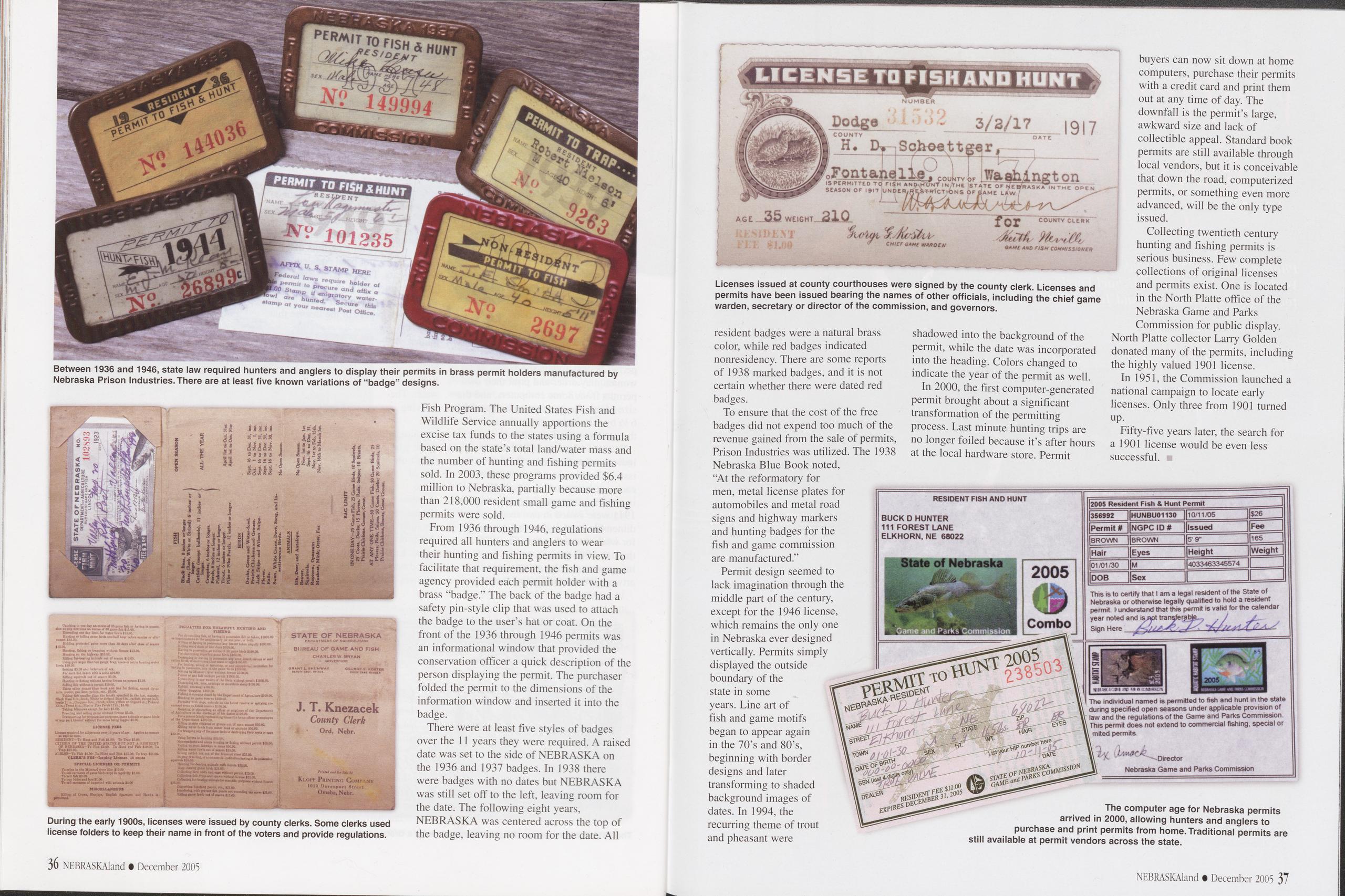
From 1936 through 1946, regulations required all hunters and anglers to wear their hunting and fishing permits in view. To facilitate that requirement, the fish and game agency provided each permit holder with a brass “badge.” The back of the badge had a safety pin-style clip that was used to attach the badge to the user’s hat or coat. On the front of the 1936 through 1946 permits was an informational window that provided the conservation officer a quick description of the person displaying the permit. The purchaser folded the permit to the dimensions of the information window and inserted it into the badge.
There were at least five styles of badges over the 11 years they were required. A raised date was set to the side of NEBRASKA on the 1936 and 1937 badges. In 1938 there were badges with no dates but NEBRASKA was still set off to the left, leaving room for the date. The following eight years, NEBRASKA was centered across the top of the badge, leaving no room for the date. All 36 NEBRASKAland • December 2005
To ensure that the cost of the free badges did not expend too much of the revenue gained from the sale of permits, Prison Industries was utilized. The 1938 Nebraska Blue Book noted, “At the reformatory for men, metal license plates for automobiles and metal road signs and highway markers and hunting badges for the fish and game commission are manufactured.”
Permit design seemed to lack imagination through the middle part of the century, except for the 1946 license, which remains the only one in Nebraska ever designed vertically. Permits simply displayed the outside boundary of the state in some years. Line art of fish and game motifs began to appear again in the 70’s and 80’s, beginning with border designs and later transforming to shaded background images of dates. In 1994, the recurring theme of trout and pheasant were shadowed into the background of the permit, while the date was incorporated into the heading. Colors changed to indicate the year of the permit as well.
In 2000, the first computer-generated permit brought about a significant transformation of the permitting process. Last minute hunting trips are no longer foiled because it’s after hours at the local hardware store. Permit buyers can now sit down at home computers, purchase their permits with a credit card and print them out at any time of day. The downfall is the permit’s large, awkward size and lack of collectible appeal. Standard book permits are still available through local vendors, but it is conceivable that down the road, computerized permits, or something even more advanced, will be the only type issued.
Collecting twentieth century hunting and fishing permits is serious business. Few complete collections of original licenses and permits exist. One is located in the North Platte office of the Nebraska Game and Parks Commission for public display. North Platte collector Larry Golden donated many of the permits, including the highly valued 1901 license.
In 1951, the Commission launched a national campaign to locate early licenses. Only three from 1901 turned up.
Fifty-five years later, the search for a 1901 license would be even less successful.
Warmest Regards
"It has been my greatest goal in photography to share my images with as many people as possible and hopefully get others excited about all the amazing wonders in nature. I thank you, for giving me this opportunity to share my pictures with all your readers."
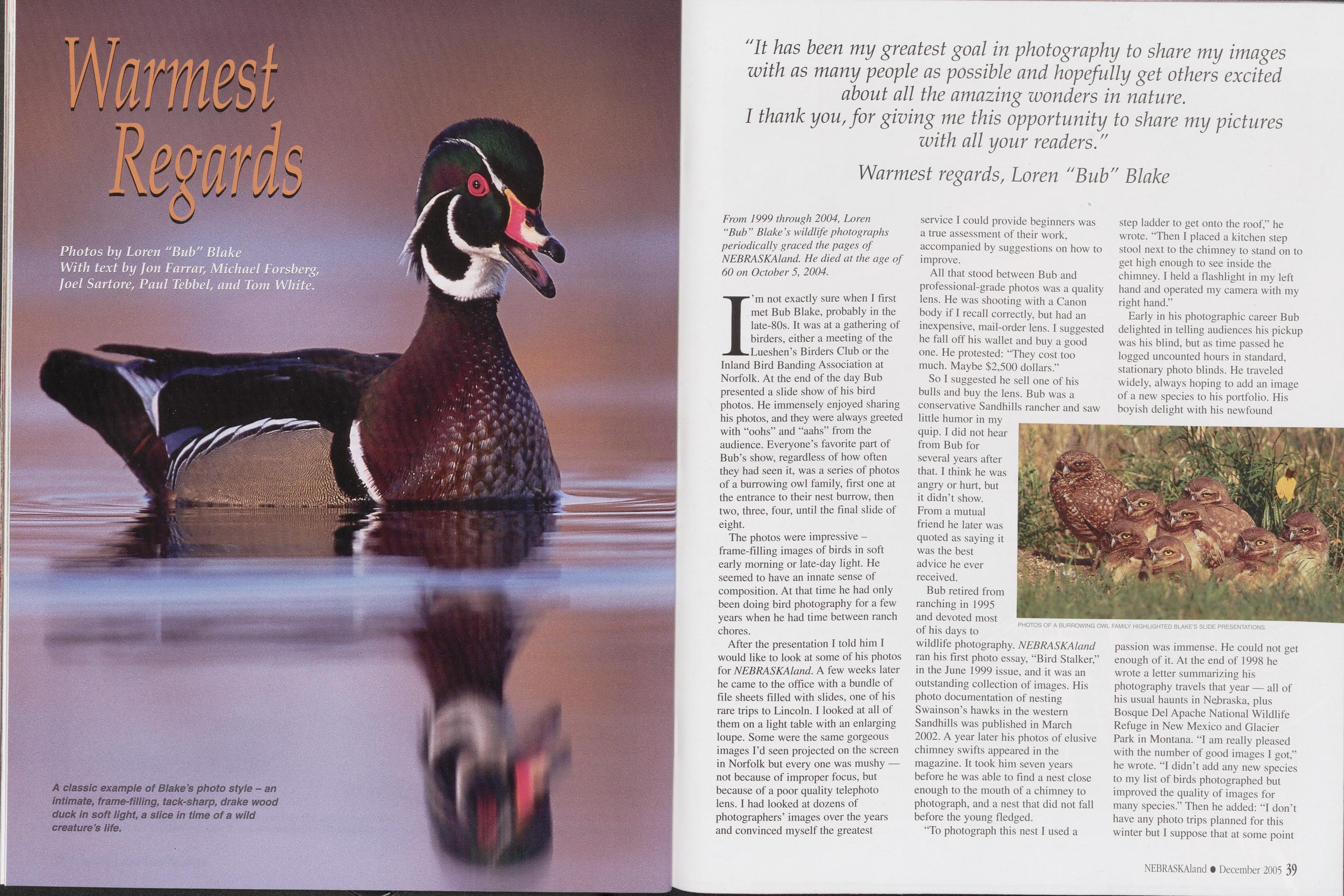
Warmest regards, Loren "Bub" Blake From 1999 through 2004, Loren “Bub " Blake’s wildlife photographs periodically graced the pages of NEBRASKAland. He died at the age of 60 on October 5, 2004.I'm not exactly sure when I first met Bub Blake, propably in the late-80s. It was at a gathering of birders, either a meeting of the Lueshen's Bird Club or the Inland Bird Banding Association at Norfolk. At the end of the day Bub presented a slide show of his bird photos. He immensely enjoyed sharing his photos, and they were always greeted with “oohs” and “aahs” from the audience. Everyone’s favorite part of Bub’s show, regardless of how often they had seen it, was a series of photos of a burrowing owl family, first one at the entrance to their nest burrow, then two, three, four, until the final slide of eight.
The photos were impressive - frame-filling images of birds in soft early morning or late-day light. He seemed to have an innate sense of composition. At that time he had only been doing bird photography for a few years when he had time between ranch chores.
After the presentation I told him I would like to look at some of his photos for NEBRASKAland. A few weeks later he came to the office with a bundle of file sheets filled with slides, one of his rare trips to Lincoln. I looked at all of them on a light table with an enlarging loupe. Some were the same gorgeous images I’d seen projected on the screen in Norfolk but every one was mushy — not because of improper focus, but because of a poor quality telephoto lens. I had looked at dozens of photographers’ images over the years and convinced myself the greatest service I could provide beginners was a true assessment of their work, accompanied by suggestions on how to improve.
All that stood between Bub and professional-grade photos was a quality lens. He was shooting with a Canon body if I recall correctly, but had an inexpensive, mail-order lens. I suggested he fall off his wallet and buy a good one. He protested: “They cost too much. Maybe $2,500 dollars.”
So I suggested he sell one of his bulls and buy the lens. Bub was a conservative Sandhills rancher and saw little humor in my quip. I did not hear from Bub for several years after that. I think he was angry or hurt, but it didn’t show. From a mutual friend he later was quoted as saying it was the best advice he ever received.
Bub retired from ranching in 1995 and devoted most of his days to wildlife photography. NEBRASKAland ran his first photo essay, “Bird Stalker,’ in the June 1999 issue, and it was an outstanding collection of images. His photo documentation of nesting Swainson’s hawks in the western Sandhills was published in March 2002. A year later his photos of elusive chimney swifts appeared in the magazine. It took him seven years before he was able to find a nest close enough to the mouth of a chimney to photograph, and a nest that did not fall before the young fledged.
“To photograph this nest I used a
Early in his photographic career Bub delighted in telling audiences his pickup was his blind, but as time passed he logged uncounted hours in standard, stationary photo blinds. He traveled widely, always hoping to add an image of a new species to his portfolio. His boyish delight with his newfound passion was immense. He could not get enough of it. At the end of 1998 he wrote a letter summarizing his photography travels that year — all of his usual haunts in Nebraska, plus Bosque Del Apache National Wildlife Refuge in New Mexico and Glacier Park in Montana. T am really pleased with the number of good images I got,” he wrote. "I didn’t add any new species to my list of birds photographed but improved the quality of images for many species.” Then he added: "I don’t have any photo trips planned for this winter but I suppose that at some point NEBRASKAland • December 2005 39 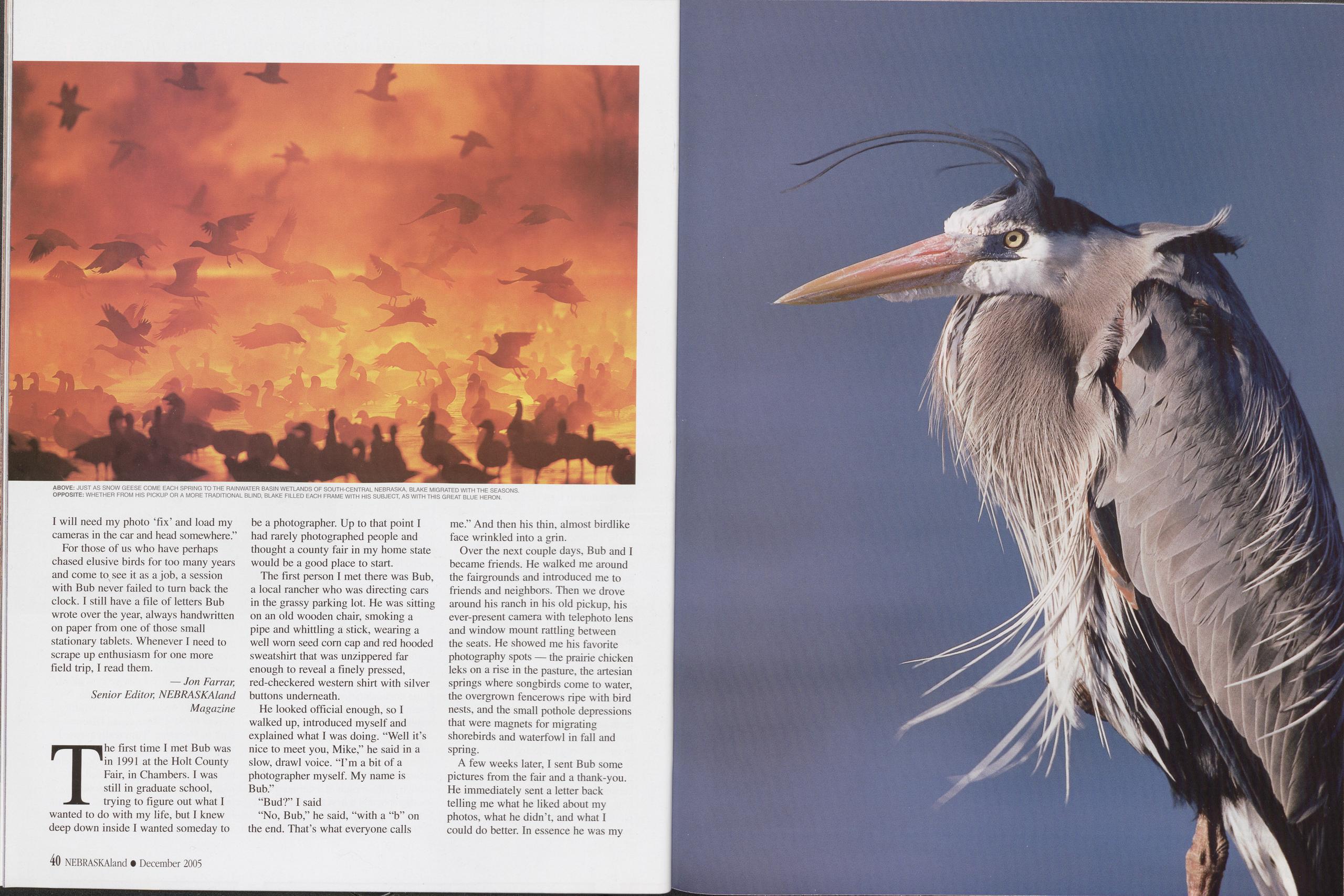
For those of us who have perhaps chased elusive birds for too many years and come to see it as a job, a session with Bub never failed to turn back the clock. I still have a file of letters Bub wrote over the year, always handwritten on paper from one of those small stationary tablets. Whenever I need to scrape up enthusiasm for one more field trip, I read them.
— Jon Farrar, Senior Editor, NEBRASKAland MagazineThe first time I met Bub was in 1991 at the Holt County Fair, in Chambers. I was still in graduate school, trying to figure out what I wanted to do with my life, but I knew deep down inside I wanted someday to 40 NEBRASKAland • December 2005 be a photographer. Up to that point I had rarely photographed people and thought a county fair in my home state would be a good place to start.
The first person I met there was Bub, a local rancher who was directing cars in the grassy parking lot. He was sitting on an old wooden chair, smoking a pipe and whittling a stick, wearing a well worn seed com cap and red hooded sweatshirt that was unzippered far enough to reveal a finely pressed, red-checkered western shirt with silver buttons underneath.
He looked official enough, so I walked up, introduced myself and explained what I was doing. “Well it’s nice to meet you, Mike,” he said in a slow, drawl voice. “I’m a bit of a photographer myself. My name is Bub.”
“Bud?” I said
“No, Bub,” he said, “with a “b” on the end. That’s what everyone calls me.” And then his thin, almost birdlike face wrinkled into a grin.
Over the next couple days, Bub and I became friends. He walked me around the fairgrounds and introduced me to friends and neighbors. Then we drove around his ranch in his old pickup, his ever-present camera with telephoto lens and window mount rattling between the seats. He showed me his favorite photography spots — the prairie chicken leks on a rise in the pasture, the artesian springs where songbirds come to water, the overgrown fencerows ripe with bird nests, and the small pothole depressions that were magnets for migrating shorebirds and waterfowl in fall and spring.
A few weeks later, I sent Bub some pictures from the fair and a thank-you. He immediately sent a letter back telling me what he liked about my photos, what he didn’t, and what I could do better. In essence he was my
When I began working for NEBRASKAland years later, I would run into Bub on a regular basis in the field. Sometimes I would see him, sometimes I would just see his vehicle, but he seemed to be everywhere.
Once I left a friend’s Sandhills ranch house in the middle of an early April night to get into a sharp- tailed grouse blind at Crescent Lake National Wildlife Refuge before first light. I stumbled my way through snow and darkness to the blind and was having trouble opening the latch when all of a sudden, like magic, it opened from the inside. There was Bub, hunkered down in his patented camo coveralls, his pipe in his mouth and his glasses steamed over, wearing that Bub grin. “Well hello, Mike,” he said.
Another time on the Platte River during crane migration, there was a small photography blind set out on the river’s edge. It was early enough in the season that no one was using it, so I crawled out through the night and made my way toward the blind with cranes just a whisper 42 NEBRASKAland • December 2005 away. When I reached up to open the door, however, it only opened partway. Then I heard something shuffle inside.
Thinking it was a huge raccoon, I took a tiny red flashlight from my fanny pack and, half scared, shined it inside. Once again, there was Bub with his camo overalls, pipe and “Well, hello Mike” greeting. Such meetings between Bub and 1 played themselves out several times over the years.
Loren “Bub” Blake was a good man and a fine photographer that generously shared the marvel and the beauty of the natural world with those around him. He was a kind and quiet soul, someone you could always count on, believe in, admire and respect. And his memory will no doubt live on in our hearts and in the simple and elegant beauty of his wildlife photographs that he so diligently captured.
— Mike Forsberg, Contributing Editor, NEBRASKAland MagazineBub was a bachelor rancher from Chambers, Nebraska who lived with his mom and was proud of it. Hard work for zero pay didn’t scare him. His best natural history photographs were rooted firmly in patience. Want to see him grin? Say how much you liked that meadowlark photo on the cover of NEBRASKAland.
Bub Blake was solid and steady, patient and kind, tender and thoughtful. A renaissance man who brightened a weary world.
He is missed every day.
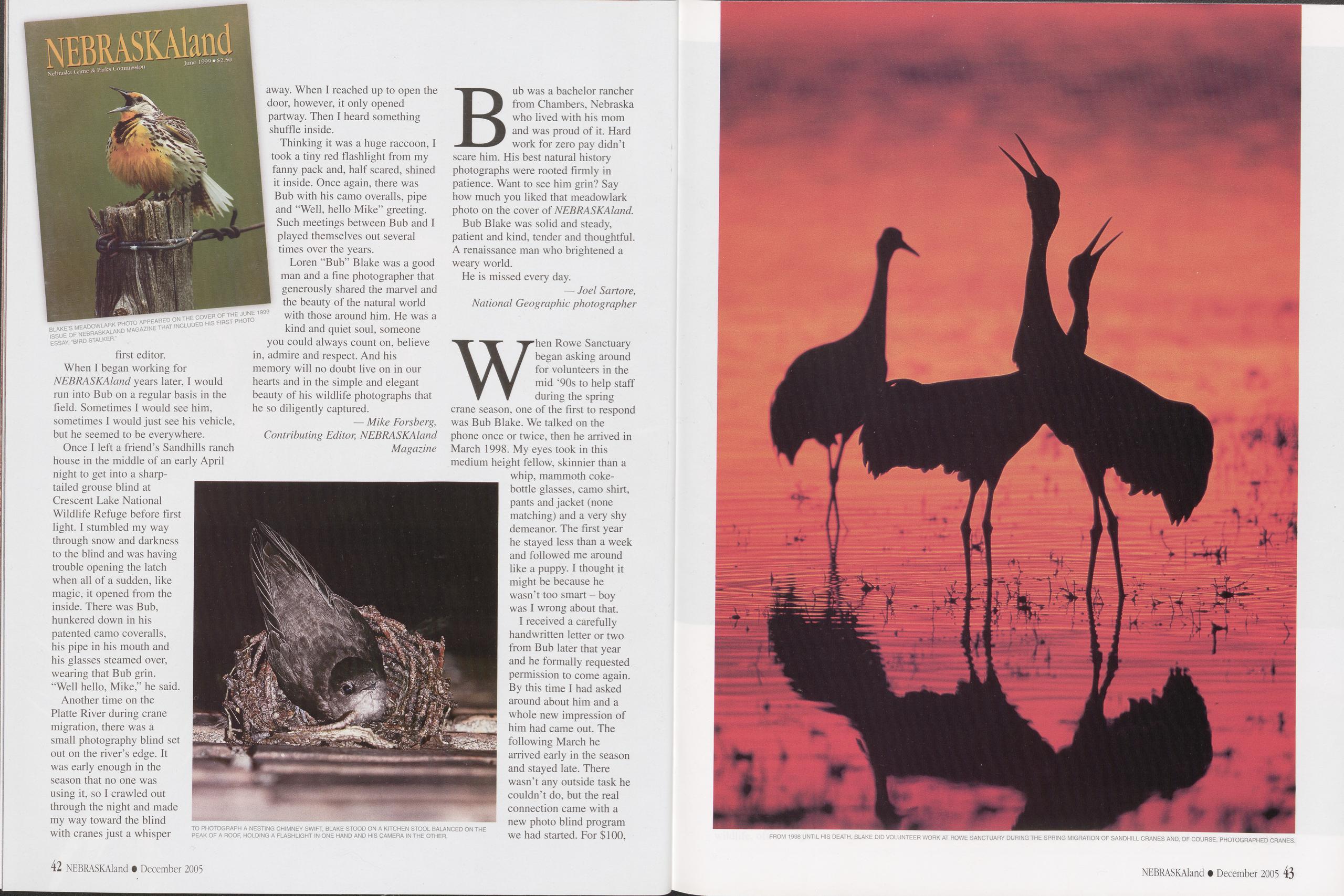
— Joel Sartore, National Geographic photographerWhen Rowe Sanctuary began asking around for volunteers in the mid ‘90s to help staff during the spring crane season, one of the first to respond was Bub Blake. We talked on the phone once or twice, then he arrived in March 1998. My eyes took in this medium height fellow, skinnier than a whip, mammoth coke- bottle glasses, camo shirt, pants and jacket (none matching) and a very shy demeanor. The first year he stayed less than a week and followed me around like a puppy. I thought it might be because he wasn’t too smart - boy was I wrong about that.
I received a carefully handwritten letter or two from Bub later that year and he formally requested permission to come again. By this time I had asked around about him and a whole new impression of him had came out. The following March he arrived early in the season and stayed late. There wasn’t any outside task he couldn’t do, but the real connection came with a new photo blind program we had started. For $100,
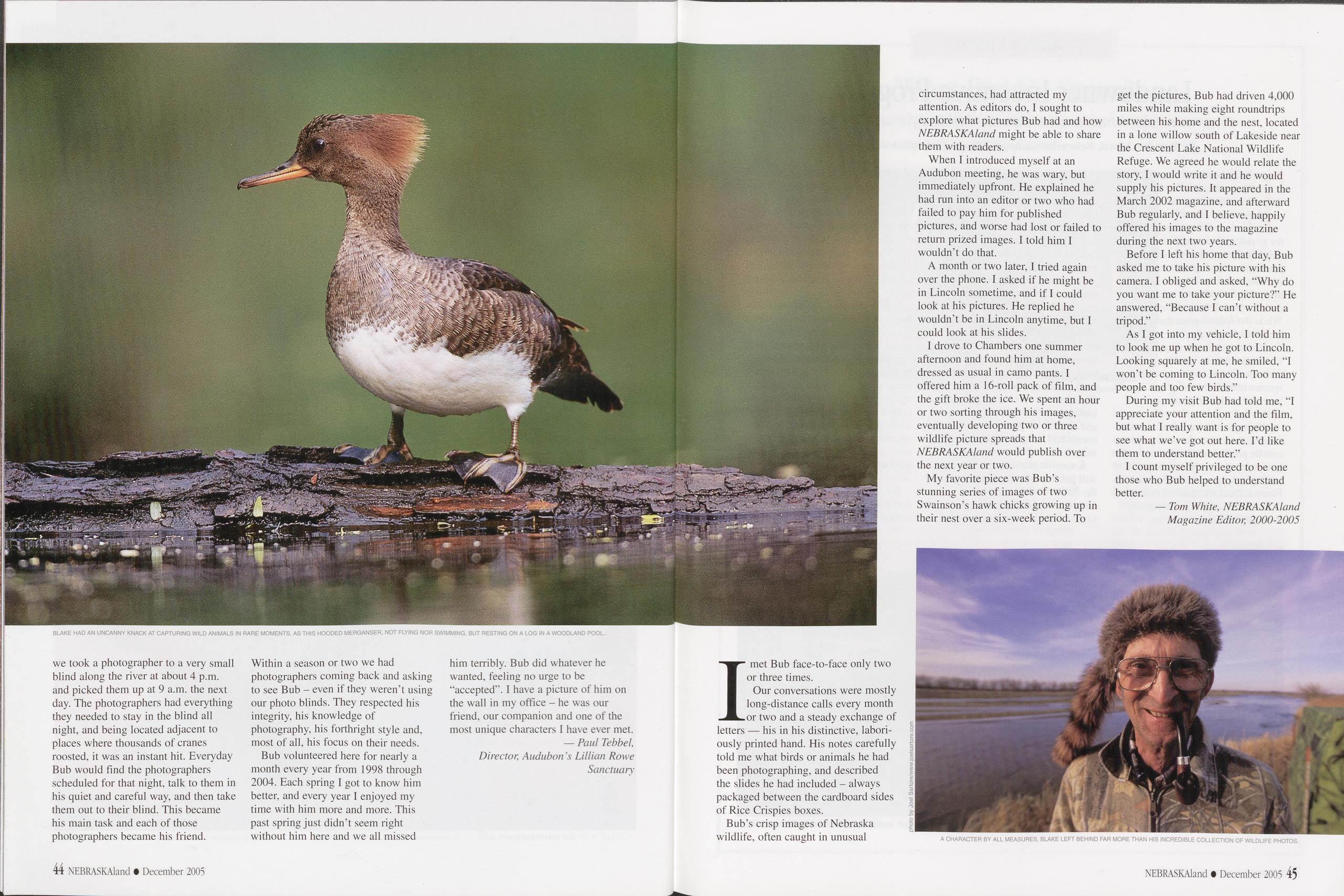
Bub volunteered here for nearly a month every year from 1998 through 2004. Each spring I got to know him better, and every year I enjoyed my time with him more and more. This past spring just didn’t seem right without him here and we all missed him terribly. Bub did whatever he wanted, feeling no urge to be "accepted”. I have a picture of him on the wall in my office - he was our friend, our companion and one of the most unique characters I have ever met.
— Paul Tebbel, Director, Audubon's Lillian Rowe SanctuaryI met Bub face-to-face only two or three times.
Our converstations were mostly long-distance calls every month or two and a steady exchange of letters — his in his distinctive, labori- ously printed hand. His notes carefully told me what birds or animals he had been photographing, and described the slides he had included - always packaged between the cardboard sides of Rice Crispies boxes.
Bub’s crisp images of Nebraska wildlife, often caught in unusual circumstances, had attracted my attention. As editors do, I sought to explore what pictures Bub had and how NEBRASKAland might be able to share them with readers.
When I introduced myself at an Audubon meeting, he was wary, but immediately upfront. He explained he had run into an editor or two who had failed to pay him for published pictures, and worse had lost or failed to return prized images. I told him I wouldn’t do that.
A month or two later, I tried again over the phone. I asked if he might be in Lincoln sometime, and if I could look at his pictures. He replied he wouldn’t be in Lincoln anytime, but I could look at his slides.
I drove to Chambers one summer afternoon and found him at home, dressed as usual in camo pants. I offered him a 16-roll pack of film, and the gift broke the ice. We spent an hour or two sorting through his images, eventually developing two or three wildlife picture spreads that NEBRASKAland would publish over the next year or two.
My favorite piece was Bub’s stunning series of images of two Swainson’s hawk chicks growing up in their nest over a six-week period. To NEBRASKAland • December 2005 45 get the pictures, Bub had driven 4,000 miles while making eight roundtrips between his home and the nest, located in a lone willow south of Lakeside near the Crescent Lake National Wildlife Refuge. We agreed he would relate the story, I would write it and he would supply his pictures. It appeared in the March 2002 magazine, and afterward Bub regularly, and I believe, happily offered his images to the magazine during the next two years.
Before I left his home that day, Bub asked me to take his picture with his camera. I obliged and asked, "Why do you want me to take your picture?” He answered, "Because I can’t without a tripod.”
As I got into my vehicle, I told him to look me up when he got to Lincoln. Looking squarely at me, he smiled, "I won’t be coming to Lincoln. Too many people and too few birds.”
During my visit Bub had told me, "I appreciate your attention and the film, but what I really want is for people to see what we’ve got out here. I’d like them to understand better.”
I count myself privileged to be one those who Bub helped to understand better.
— Tom White, NEBRASKAland Magazine Editor, 2000-2005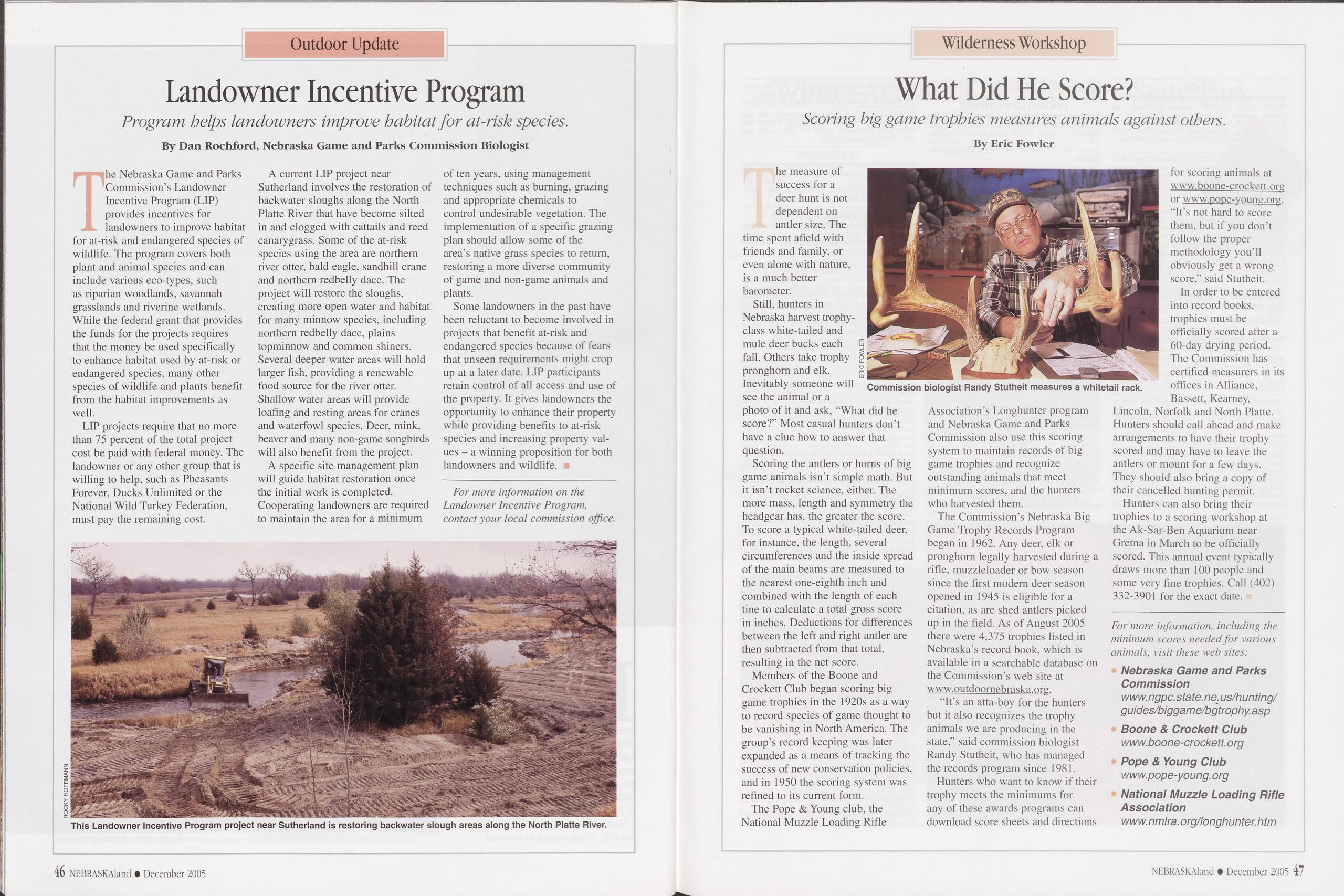
Outdoor Update
Landowner Incentive Program
Program helps landowners improve habitat for at-risk species.
The Nebraska Game and Parks Commission’s Landowner Incentive Program (LIP) provides incentives for landowners to improve habitat for at-risk and endangered species of wildlife. The program covers both plant and animal species and can include various eco-types, such as riparian woodlands, savannah grasslands and riverine wetlands. While the federal grant that provides the funds for the projects requires that the money be used specifically to enhance habitat used by at-risk or endangered species, many other species of wildlife and plants benefit from the habitat improvements as well.
LIP projects require that no more than 75 percent of the total project cost be paid with federal money. The landowner or any other group that is willing to help, such as Pheasants Forever, Ducks Unlimited or the National Wild Turkey Federation, must pay the remaining cost.
A current LIP project near Sutherland involves the restoration of backwater sloughs along the North Platte River that have become silted in and clogged with cattails and reed canarygrass. Some of the at-risk species using the area are northern river otter, bald eagle, sandhill crane and northern redbelly dace. The project will restore the sloughs, creating more open water and habitat for many minnow species, including northern redbelly dace, plains topminnow and common shiners. Several deeper water areas will hold larger fish, providing a renewable food source for the river otter. Shallow water areas will provide loafing and resting areas for cranes and waterfowl species. Deer, mink, beaver and many non-game songbirds will also benefit from the project.
A specific site management plan will guide habitat restoration once the initial work is completed. Cooperating landowners are required to maintain the area for a minimum of ten years, using management techniques such as burning, grazing and appropriate chemicals to control undesirable vegetation. The implementation of a specific grazing plan should allow some of the area’s native grass species to return, restoring a more diverse community of game and non-game animals and plants.
Some landowners in the past have been reluctant to become involved in projects that benefit at-risk and endangered species because of fears that unseen requirements might crop up at a later date. LIP participants retain control of all access and use of the property. It gives landowners the opportunity to enhance their property while providing benefits to at-risk species and increasing property val- ues - a winning proposition for both landowners and wildlife.
For more information on the Landowner Incentive Program, contact your local commission office.Wilderness Workshop
What Did He Score?
Scoring big game trophies measures animals against others.
The measure of success for a deer hunt is not dependent on antler size. The time spent afield with friends and family, or even alone with nature, is a much better barometer.
Still, hunters in Nebraska harvest trophy- class white-tailed and mule deer bucks each fall. Others take trophy pronghorn and elk. Inevitably someone will see the animal or a photo of it and ask, “What did he score?” Most casual hunters don’t have a clue how to answer that question.
Scoring the antlers or horns of big game animals isn’t simple math. But it isn’t rocket science, either. The more mass, length and symmetry the headgear has, the greater the score. To score a typical white-tailed deer, for instance, the length, several circumferences and the inside spread of the main beams are measured to the nearest one-eighth inch and combined with the length of each tine to calculate a total gross score in inches. Deductions for differences between the left and right antler are then subtracted from that total, resulting in the net score.
Members of the Boone and Crockett Club began scoring big game trophies in the 1920s as a way to record species of game thought to be vanishing in North America. The group’s record keeping was later expanded as a means of tracking the success of new conservation policies, and in 1950 the scoring system was refined to its current form.
The Pope & Young club, the National Muzzle Loading Rifle
The Commission’s Nebraska Big Game Trophy Records Program began in 1962. Any deer, elk or pronghorn legally harvested during a rifle, muzzleloader or bow season since the first modem deer season opened in 1945 is eligible for a citation, as are shed antlers picked up in the field. As of August 2005 there were 4,375 trophies listed in Nebraska’s record book, which is available in a searchable database on the Commission’s web site at www.outdoornebraska.org.
“It’s an atta-boy for the hunters but it also recognizes the trophy animals we are producing in the state,” said commission biologist Randy Stutheit, who has managed the records program since 1981.
Hunters who want to know if their trophy meets the minimums for any of these awards programs can download score sheets and directions for scoring animals at www.boone-crockett.org or www.pope-young.org. “It’s not hard to score them, but if you don’t follow the proper methodology you’ll obviously get a wrong score,” said Stutheit.
In order to be entered into record books, trophies must be officially scored after a 60-day drying period. The Commission has certified measurers in its offices in Alliance, Bassett, Kearney, Lincoln, Norfolk and North Platte. Hunters should call ahead and make arrangements to have their trophy scored and may have to leave the antlers or mount for a few days. They should also bring a copy of their cancelled hunting permit.
Hunters can also bring their trophies to a scoring workshop at the Ak-Sar-Ben Aquarium near Gretna in March to be officially scored. This annual event typically draws more than 100 people and some very fine trophies. Call (402) 332-3901 for the exact date.
For more information, including the minimum scores needed for various animals, visit these yveb sites: ® Nebraska Game and Parks Commission www. ngpc. state, ne. us/h unting/ guides/biggame/bgtrophy. asp ® Boone & Crockett Club www.boone-crockett. org ® Pope & Young Club www. pope-young, org s National Muzzle Loading Rifle Association www.nmlra.org/longhunter. htm 46 NEBRASKAland G December 2005 NEBRASKAland • December 2005 47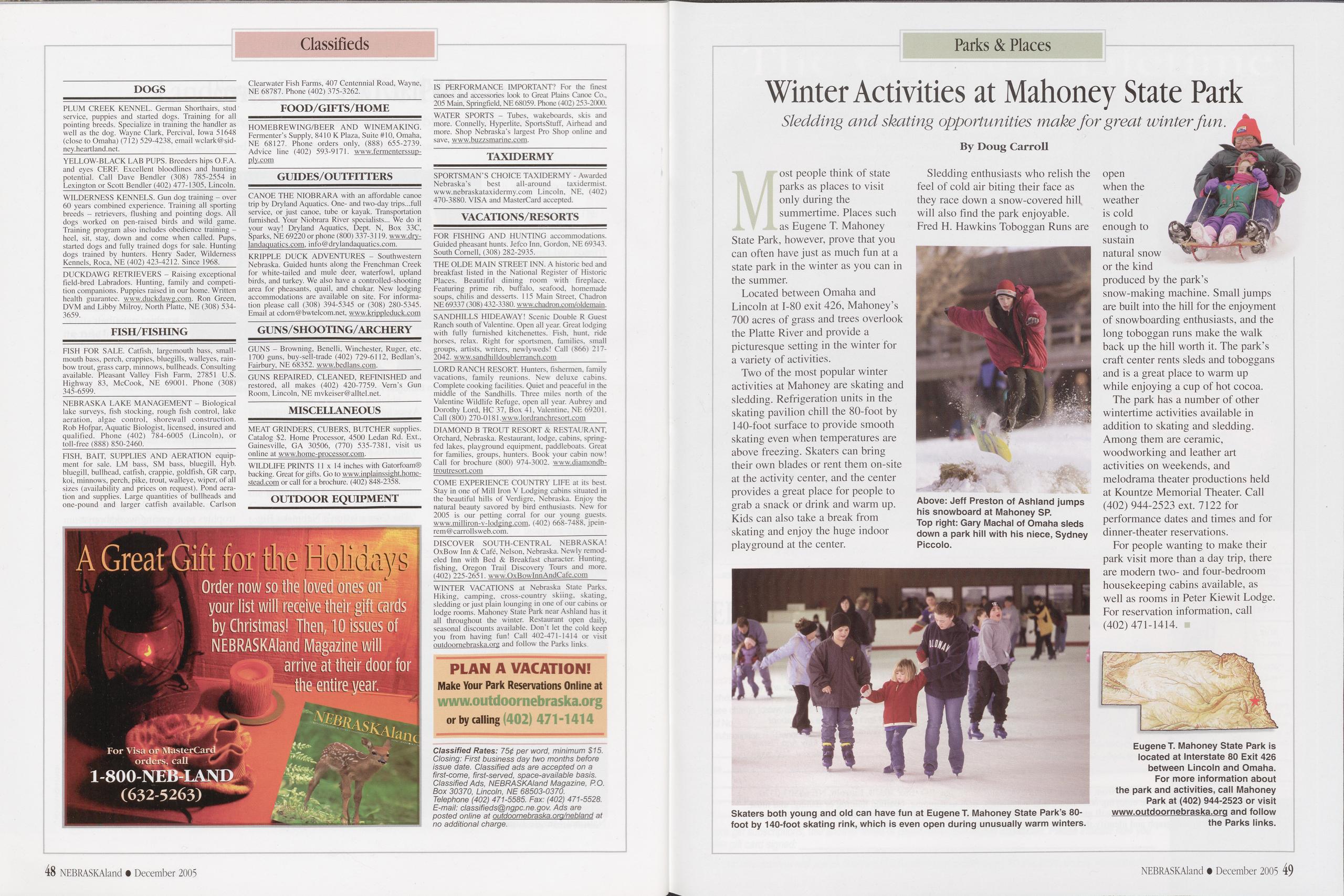
Classifieds
DOGS PLUM CREEK KENNEL. German Shorthairs, stud service, puppies and started dogs. Training for all pointing breeds. Specialize in training the handler as well as the dog. Wayne Clark, Percival, Iowa 51648 (close to Omaha) (712) 529-4238, email wclark@sid- ney.heartland.net. YELLOW-BLACK LAB PUPS. Breeders hips O.F.A. and eyes CERF. Excellent bloodlines and hunting potential. Call Dave Bendler (308) 785-2554 in Lexington or Scott Bendler (402) 477-1305, Lincoln. WILDERNESS KENNELS. Gun dog training - over 60 years combined experience. Training all sporting breeds - retrievers, flushing and pointing dogs. All dogs worked on pen-raised birds and wild game. Training program also includes obedience training - heel, sit, stay, down and come when called. Pups, started dogs and fully trained dogs for sale. Hunting dogs trained by hunters. Henry Sader, Wilderness Kennels, Roca, NE (402) 423-4212. Since 1968. DUCKDAWG RETRIEVERS - Raising exceptional field-bred Labradors. Hunting, family and competi- tion companions. Puppies raised in our home. Written health guarantee, www.duckdawg.com. Ron Green, DVM and Libby Milroy, North Platte, NE (308) 534- 3659. FISH/FISHING FISH FOR SALE. Catfish, largemouth bass, small- mouth bass, perch, crappies, bluegills, walleyes, rain- bow trout, grass carp, minnows, bullheads. Consulting available. Pleasant Valley Fish Farm, 27851 U.S. Highway 83, McCook, NE 69001. Phone (308) 345-6599. NEBRASKA LAKE MANAGEMENT - Biological lake surveys, fish stocking, rough fish control, lake aeration, algae control, shorewall construction. Rob Hofpar, Aquatic Biologist, licensed, insured and qualified. Phone (402) 784-6005 (Lincoln), or toll-free (888) 850-2460. FISH, BAIT, SUPPLIES AND AERATION equip- ment for sale. LM bass, SM bass, bluegill, Hyb. bluegill, bullhead, catfish, crappie, goldfish, GR carp, koi, minnows, perch, pike, trout, walleye, wiper, of all sizes (availability and prices on request). Pond aera- tion and supplies. Large quantities of bullheads and one-pound and larger catfish available. CarlsonParks & Places
Winter Activities at Mahoney State Park
Sledding and skating opportunities make for great winter fun.
Most people think of state parks as places to visit only during the summertime. Places such as Eugene T. Mahoney State Park, however, prove that you can often have just as much fun at a state park in the winter as you can in the summer.
Located between Omaha and Lincoln at 1-80 exit 426, Mahoney’s 700 acres of grass and trees overlook the Platte River and provide a picturesque setting in the winter for a variety of activities.
Two of the most popular winter activities at Mahoney are skating and sledding. Refrigeration units in the skating pavilion chill the 80-foot by 140-foot surface to provide smooth skating even when temperatures are above freezing. Skaters can bring their own blades or rent them on-site at the activity center, and the center provides a great place for people to grab a snack or drink and warm up. Kids can also take a break from skating and enjoy the huge indoor playground at the center.
Sledding enthusiasts who relish the feel of cold air biting their face as they race down a snow-covered hill will also find the park enjoyable. Fred H. Hawkins Toboggan Runs are
The park has a number of other wintertime activities available in addition to skating and sledding. Among them are ceramic, woodworking and leather art activities on weekends, and melodrama theater productions held at Kountze Memorial Theater. Call (402) 944-2523 ext. 7122 for performance dates and times and for dinner-theater reservations.
For people wanting to make their park visit more than a day trip, there are modern two- and four-bedroom housekeeping cabins available, as well as rooms in Peter Kiewit Lodge. For reservation information, call (402) 471-1414.
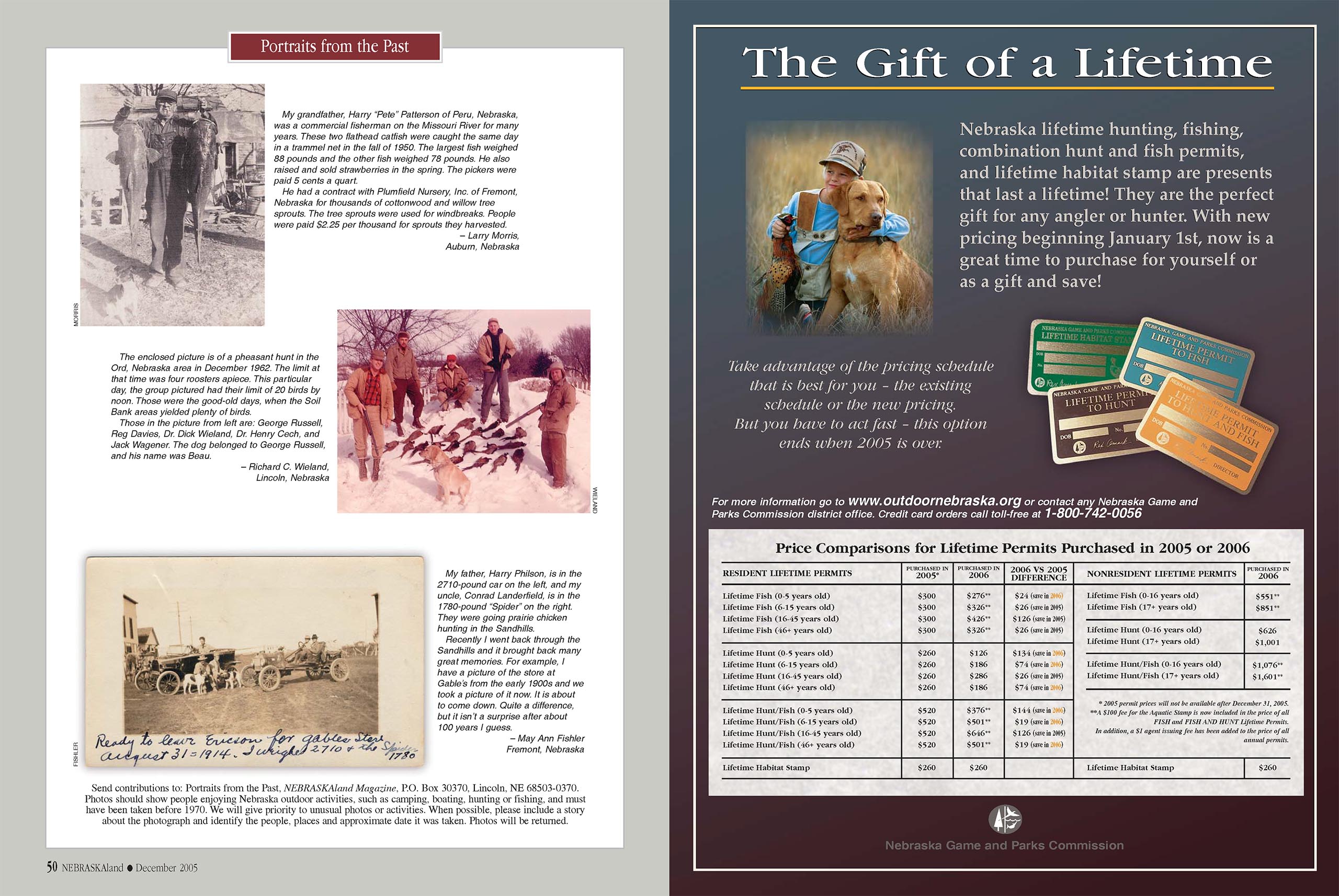
Portraits from the Past
The Gift of a Lifetime
Nebraska lifetime hunting, fishing, combination hunt and fish permits, and lifetime habitat stamp are presents that last a lifetime! They are the perfect gift for any angler or hunter. With new pricing beginning January 1st, now is a great time to purchase for yourself or as a gift and save!
Take advantage of the pricing schedule that is best for you - the existing schedule or the new pricing. But you have to act fast - this option ends when 2005 is over.
For more information go to www.outdoornebraska.org or contact any Nebraska Game and Parks Commission district office. Credit card orders call toll-free at 1-800-742-0056 Price Comparisons for Lifetime Permits Purchased in 2005 or 2006 RESIDENT LIFETIME PERMITS Lifetime Fish (0-5 years old) Lifetime Fish (6-15 years old) Lifetime Fish (16-45 years old) Lifetime Fish (46+ years old) Lifetime Hunt (0-5 years old) Lifetime Hunt (6-15 years old) Lifetime Hunt (16-45 years old) Lifetime Hunt (46+ years old) Lifetime Hunt/Fish (0-5 years old) Lifetime Hunt/Fish (6-15 years old) Lifetime Hunt/Fish (16-45 years old) Lifetime Hunt/Fish (46+ years old) Lifetime Habitat Stamp PURCHASED IN 2005* $300 $300 $300 $300 $260 $260 $260 $260 $520 $520 $520 $520 $260 PURCHASED IN 2006 $276** $326** $426** $326** $126 $186 $286 $186 $376** $501** $646** $501** $260 2006 VS 2005 DIFFERENCE $24 (save in 2006) $26 (save in 2005) $126 (save in 2005) $26 (save in 2005) $134 (save in 2006) $74 (save in 2006) $26 (save in 2005) $74 (save in 2006) $144 (save in 2006) $19 (save in 2006) $126 (save in 2005) $19 (save in 2006) NONRESIDENT LIFETIME PERMITS PURCHASED IN 2006 Lifetime Fish (0-16 years old) Lifetime Fish (17+ years old) $551** $851** Lifetime Hunt (0-16 years old) Lifetime Hunt (17+ years old) $626 $1,001 Lifetime Hunt/Fish (0-16 years old) Lifetime Hunt/Fish (17+ years old) $1,076** $1,601** * 2005 permit prices will not be available after December 31, 2005. **A $100 fee for the Aquatic Stamp is now included in the price of all FISH and FISH AND HUNT Lifetime Permits. In addition, a $1 agent issuing fee has been added to the price of all annual permits. Lifetime Habitat Stamp $260 50 NEBRASKAland • December 2005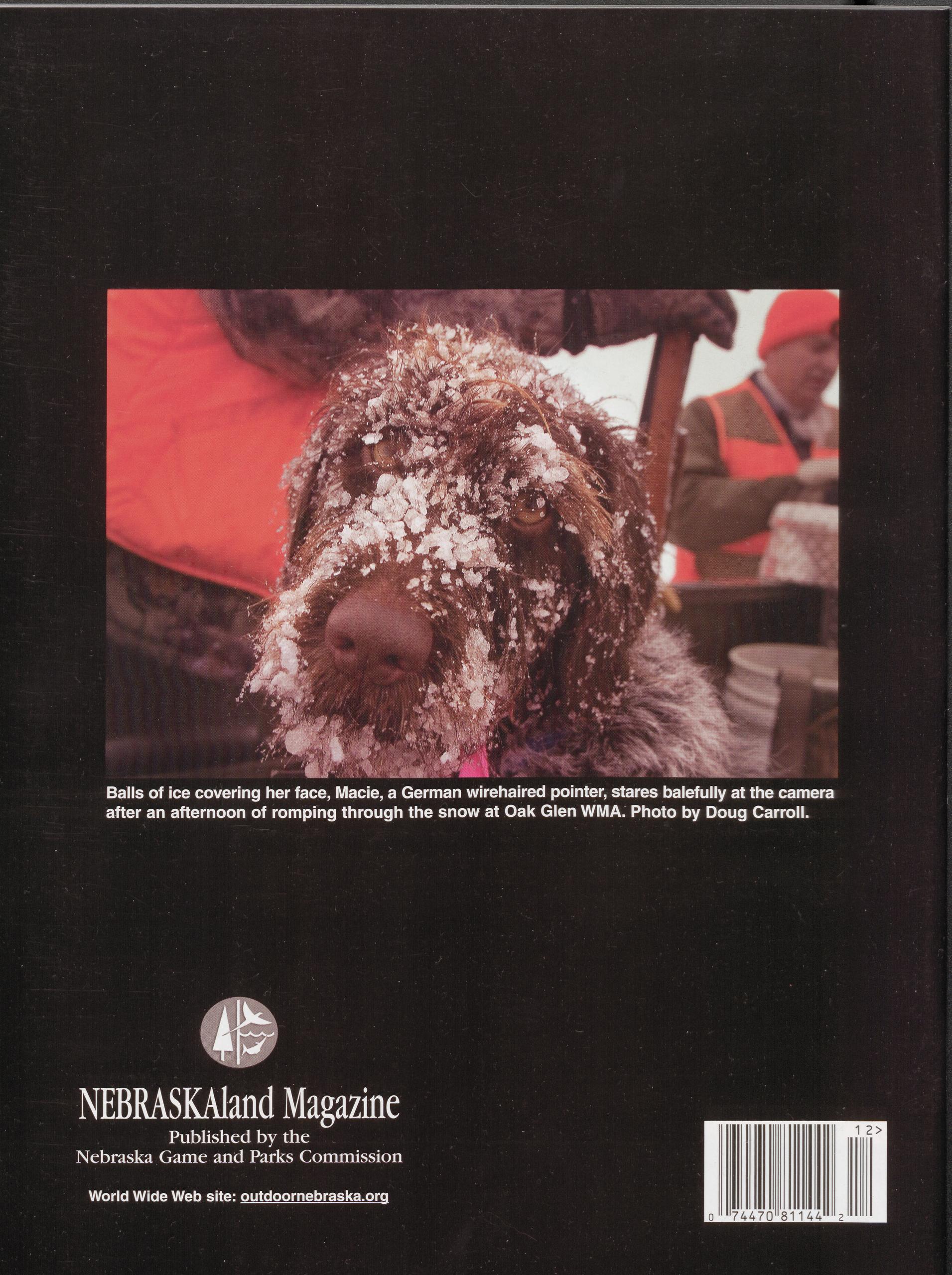
Position: 664 (17 views)