Volume 83, Issue 9, 2005
NEBRASKALand
Nebraska Game & Parks Commission November 2005 $2.95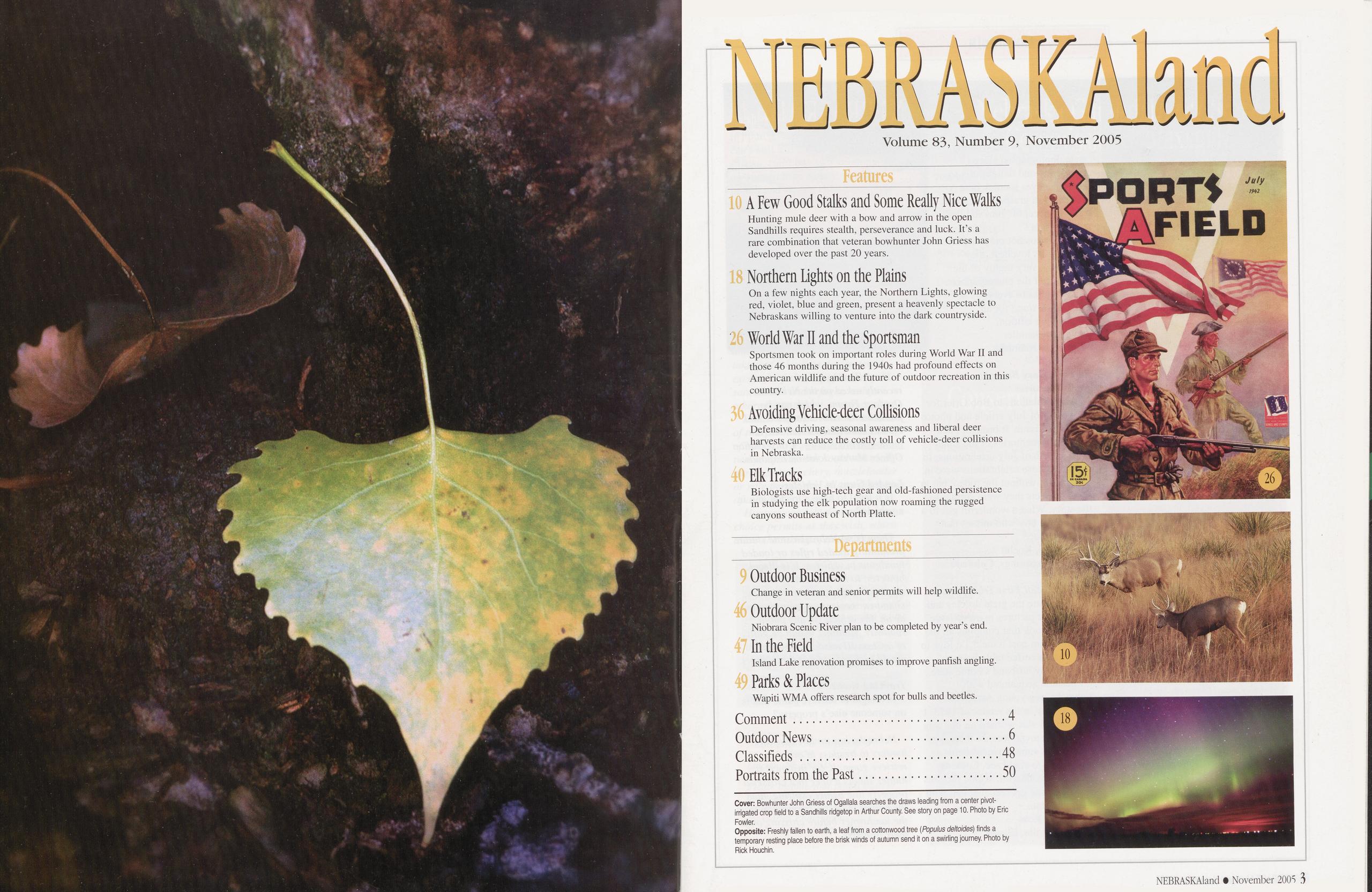
NEBRASKAland
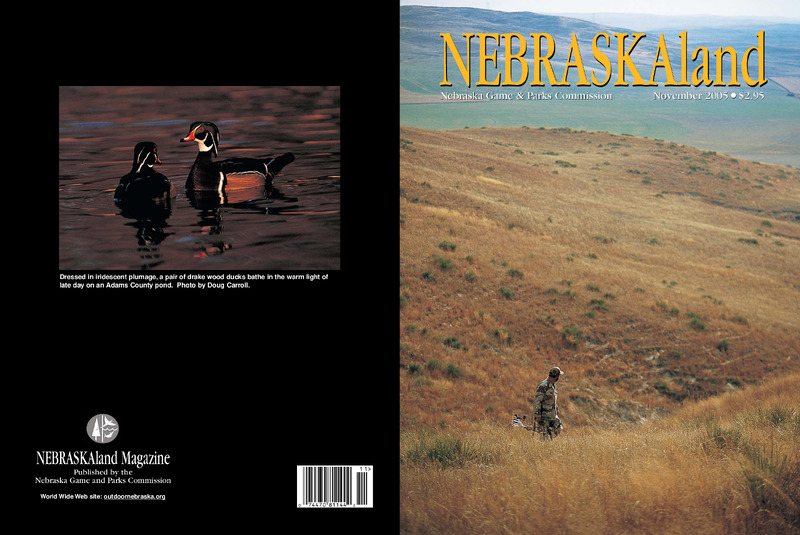
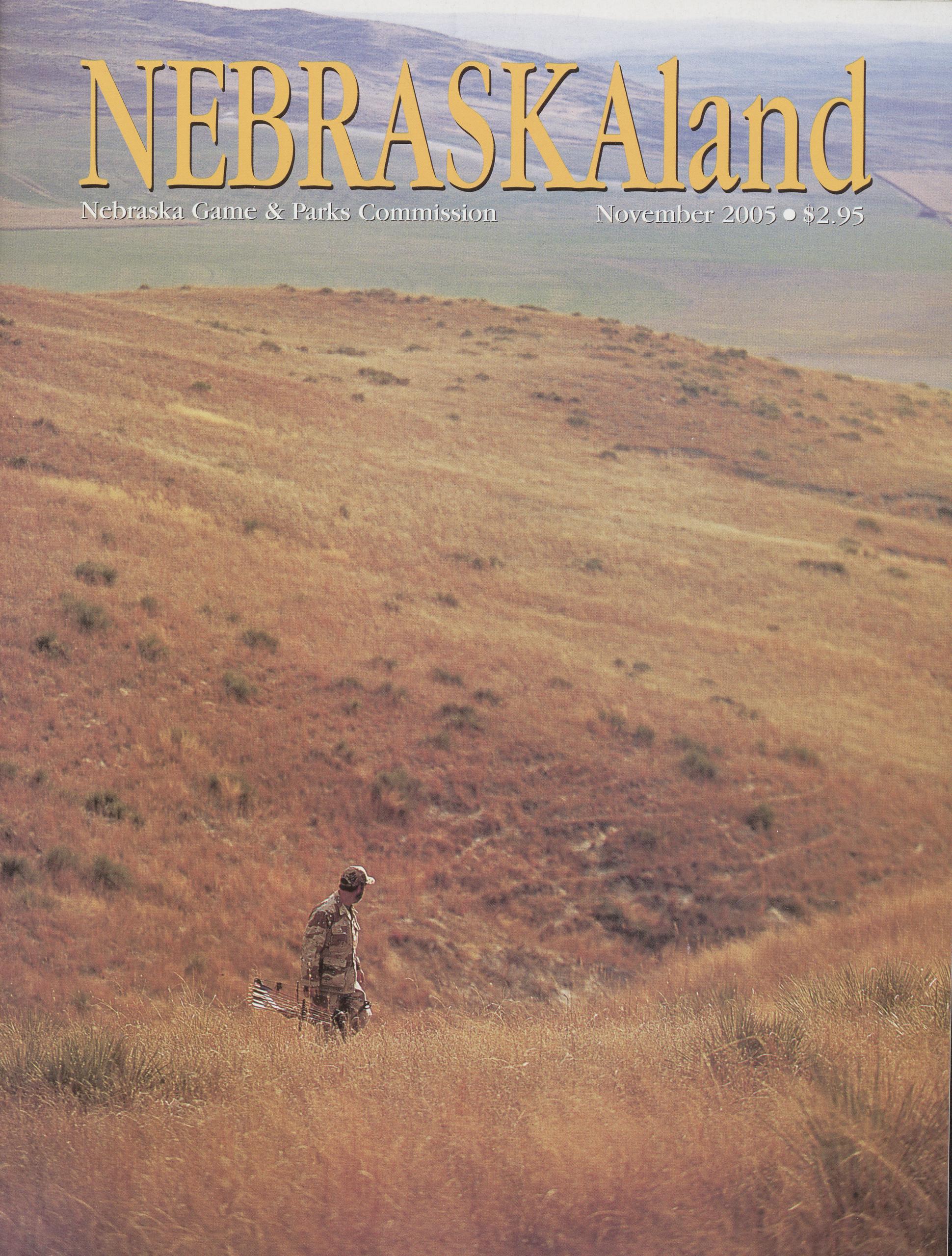
Volume 83, Number 9, November 2005 Features 10 A Few Good Stalks and Some Really Nice Walks Hunting mule deer with a bow and arrow in the open Sandhills requires stealth, perseverance and luck. It's a rare combination that veteran bowhunter John Griess has developed over the past 20 years. 18 Northern Lights on the Plains On a few nights each year, the Northern Lights, glowing red, violet, blue and green, present a heavenly spectacle to Nebraskans willing to venture into the dark countryside. 26 World War II and the Sportsman Sportsmen took on important roles during World War II and those 46 months during the 1940s had profound effects on American wildlife and the future of outdoor recreation in this country. 36 Avoiding Vehicle-deer Collisions Defensive driving, seasonal awareness and liberal deer harvests can reduce the costly toll of vehicle-deer collisions in Nebraska. Elk Tracks Biologists use high-tech gear and old-fashioned persistence in studying the elk population now roaming the rugged canyons southeast of North Platte. Departments 9 Outdoor Business Change in veteran and senior permits will help wildlife, 46 Outdoor Update Niobrara Scenic River plan to be completed by year's end. 47 In the Field Island Lake Renovation promises to improve panfish angling. 49 Parks & Places Wapiti WMA offers research spot for bulls and beetles. Comment.................4 Outdoor News...............6 Classifieds......................48 Portraits from the Past...............50 Cover: Bowhunter John Griess of Ogallala searches the draws leading from a center pivot- irrigated crop field to a Sandhills ridgetop in Arthur County. See story on page 10. Photo by Eric Fowler. Opposite: Freshly fallen to earth, a leaf from a cottonwood tree (populus deltoides) finds a temporary resting place before the brisk winds of autumn send it on a swirling journey. Photo by Rick Houchin.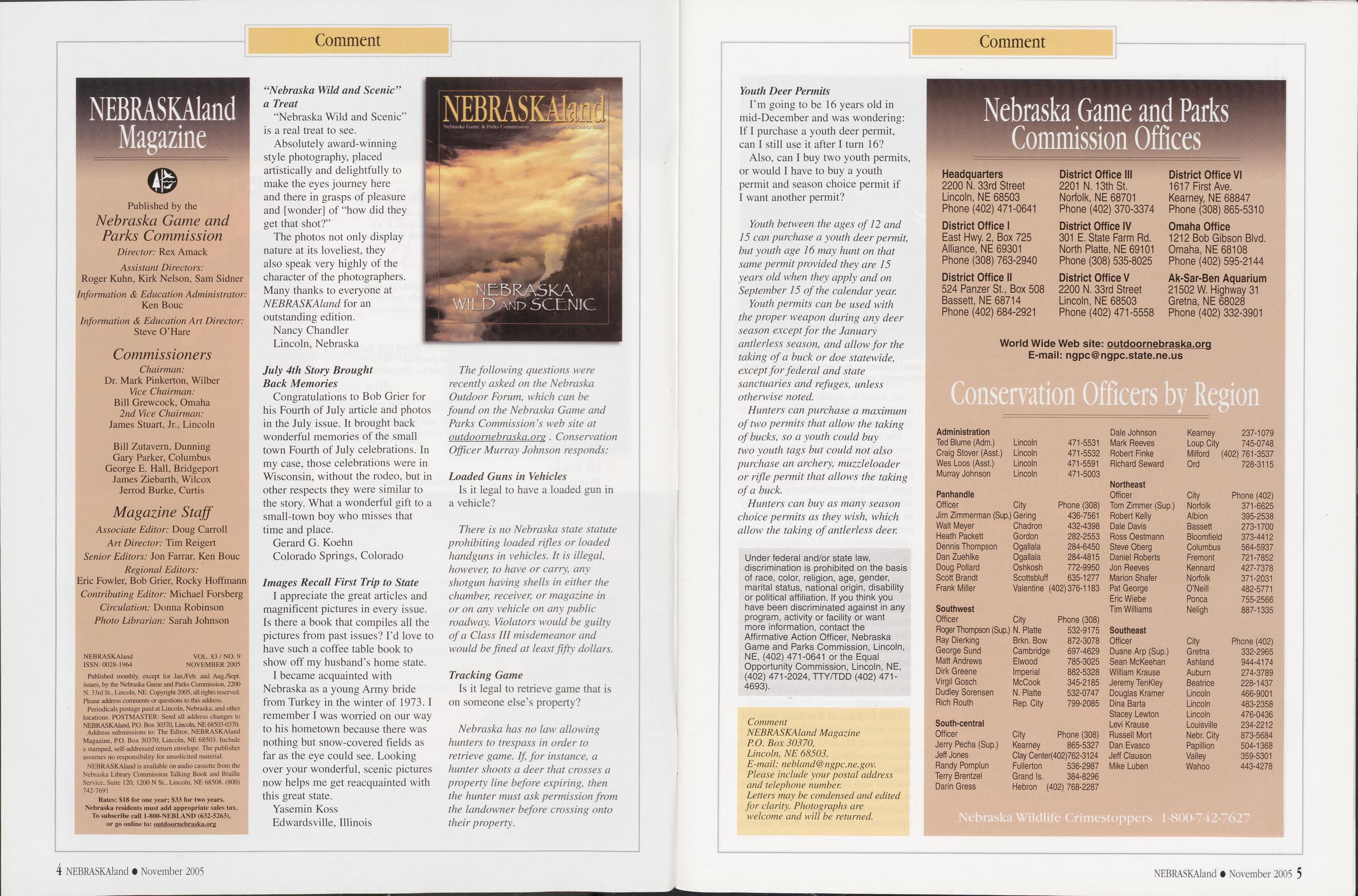
Comment
NEBRASKAland Magazine Published by the Nebraska Game and Parks Commission Director: Rex Amack Assistant Directors: Roger Kuhn, Kirk Nelson, Sam Sidner Information & Education Administrator: Ken Bouc Information & Education Art Director: Steve O'Hare Commissioners Chairman: Dr. Mark Pinkerton, Wilber Vice Chairman: Bill Grewcock, Omaha 2nd Vice Chairman: James Stuart. Jr., Lincoln Bill Zutavern, Dunning Gary Parker, Columbus George E. Hall, Bridgeport James Ziebarth, Wilcox Jerrod Burke, Curtis Magazine Staff Associate Editor: Doug Carroll Art Director: Tim Reigert Senior Editors: Jon Farrar, Ken Bouc Regional Editors: Eric Fowler, Bob Grier, Rocky Hoffmann Contributing Editor: Michael Forsberg Circulation: Donna Robinson Photo Librarian: Sarah Johnson NEBRASKAland VOL. 83 / NO. 9 ISSN: 0028-1964 NOVEMBER 2005 Published monthly, except for Jan./Feb. and Aug./Sept. issues, by the Nebraska Game and Parks Commission, 2200 N. 33rd St., Lincoln, NE. Copyright 2005, all rights reserved. Please address comments or questions to this address. Periodicals postage paid at Lincoln, Nebraska, and other locations. POSTMASTER: Send all address changes to NEBRASKAland, P.O. Box 30370, Lincoln, NE 68503-0370. Address submissions to: The Editor, NEBRASKAland Magazine, P.O. Box 30370, Lincoln, NE 68503. Include a stamped, self-addressed return envelope. The publisher assumes no responsibility for unsolicited material. NEBRASKAland is available on audio cassette from the Nebraska Library Commission Talking Book and Braille Service, Suite 120, 1200 N st., Lincoln, NE 68508. (800) 742-7691 Rates: $18 for one year: $33 for two years. Nebraska residents must add appropriate sales tax. To subscribe call 1-800-NEBLAND (632-5263), or go online to: outdoornebraska.org "Nebraska Wild and Scenic" a Treat"Nebraska Wild and Scenic" is a real treat to see.
Absolutely award-winning style photography, placed artistically and delightfully to make the eyes journey here and there in grasps of pleasure and [wonder] of "how did they get that shot?"
The photos not only display nature at its loveliest, they also speak very highly of the character of the photographers. Many thanks to everyone at NEBRASKAland for an outstanding edition.
Nancy Chandler Lincoln, Nebraska July 4th Story Brought Back MemoriesCongratulations to Bob Grier for his Fourth of July article and photos in the July issue. It brought back wonderful memories of the small town Fourth of July celebrations were in Wisconsin, without the rodeo, but in other respects they were similar to the story. What a wonderful gift to a small-town boy who misses that time and place.
Gerard G. Koehn Colorado Springs, Colorado Images Recall First Trip to StateI appreciate the great articles and magnificent pictures in every issue. Is there a book that compiles all the pictures from past issues? I'd love to have such a coffee table book to show off my husband's home state.
I became acquainted with Nebraska as a young Army Bride from Turkey in the winter of 1973. I remember I was worried on our way to his hometown because there was nothing but snow-covered fields as far as the eye could see. Looking over your wonderful, scenic pictures now helps me get reacquainted with this great state.
Yasemin Koss Edwardsville, IllinoisIs it legal to have a loaded gun in a vehicle?
There is no Nebraska state statute prohibiting loaded rifles or loaded handguns in vehicles. It is illegal, however, to have or carry, any shotgun having shells in either the chamber, reciever, or magazine in or on any vehicle on any public roadways. Violators would be guilty of a Class III misdemanor and would be fined at least fifty dollars.
Tracking GameIs it legal to retrieve game that is on someone else's property?
Nebraska has no law allowing hunters to trespass in order to retrieve game. If, for instance, a hunter shoots a deer that crisses a property line before expiring, then the hunter must ask permission from the landowner before crossing onto their property.
4 NEBRASKAland • November 2005 Youth Deer PermitsI’m going to be 16 years old in mid-December and was wondering: If I purchase a youth deer permit, can I still use it after I turn 16?
Also, can I buy two youth permits, or would I have to buy a youth permit and season choice permit if I want another permit?
Youth between the ages of 12 and 15 can purchase a youth deer permit, but youth age 16 may hunt on that same permit provided they are 15 years old when they apply and on September 15 of the calendar year.
Youth permits can be used with the proper weapon during any deer season except for the January antlerless season, and allow for the taking of a buck or doe statewide, except for federal and state sanctuaries and refuges, unless otherwise noted.
Hunters can purchase a maximum of two permits that allow the taking of bucks, so a youth could buy two youth tags but could not also purchase an archery, muzzleloader or rifle permit that allows the taking of a buck.
Hunters can buy as many season choice permits as they wish, which allow the taking of antlerless deer.
Under federal and/or state law, discrimination is prohibited on the basis of race, color, religion, age, gender, marital status, national origin, disability or political affiliation. If you think you have been discriminated against in any program, activity or facility or want more information, contact the Affirmative Action Officer, Nebraska Game and Parks Commission, Lincoln, NE, (402) 471-0641 or the Equal Opportunity Commission, Lincoln, NE, (402) 471-2024, TTY/TDD (402) 471- 4693). Nebraska Game and Parks Commission Offices Headquarters 2200 N. 33rd Street Lincoln, NE 68503 Phone (402) 471-0641 District Office I East Hwy. 2, Box 725 Alliance, NE 69301 Phone (308) 763-2940 District Office II 524 Panzer St., Box 508 Bassett, NE 68714 Phone (402) 684-2921 District Office III 2201 N. 13th St. Norfolk, NE 68701 Phone (402) 370-3374 District Office IV 301 E. State Farm Rd. North Platte, NE 69101 Phone (308) 535-8025 District Office V 2200 N. 33rd Street Lincoln, NE 68503 Phone (402) 471-5558 L-LM District Office VI 1617 First Ave. Kearney, NE 68847 Phone (308) 865-5310 Omaha Office 1212 Bob Gibson Blvd. Omaha, NE 68108 Phone (402) 595-2144 Ak-Sar-Ben Aquarium 21502 W. Highway 31 Gretna, NE 68028 Phone (402) 332-3901 World Wide Web site: outdoornebraska.org E-mail: ngpc@ngpc.state.ne.us Comment NEBRASKAland Magazine P.O. Box 30370, Lincoln, NE 68503. E-mail: nebland@ngpc.ne.gov. Please include your postal address and telephone number. Letters may be condensed and edited for clarity. Photographs are welcome and will be returned. Conservation Officers by Region Administration Dale Johnson Kearney 237-1079 Ted Blume (Adm.) Lincoln 471-5531 Mark Reeves Loup City 745-0748 Craig Stover (Asst.) Lincoln 471-5532 Robert Finke Milford (402) 761-3537 Wes Loos (Asst.) Lincoln 471-5591 Richard Seward Ord 728-3115 Murray Johnson Lincoln 471-5003 Northeast Panhandle Officer City Phone (402) Officer City Phone (308) Tom Zimmer (Sup.) Norfolk 371-6625 Jim Zimmerman (Sup.) Gering 436-7561 Robert Kelly Albion 395-2538 Walt Meyer Chadron 432-4398 Dale Davis Bassett 273-1700 Heath Packett Gordon 282-2553 Ross Oestmann Bloomfield 373-4412 Dennis Thompson Ogallala 284-6450 Steve Oberg Columbus 564-5937 Dan Zuehlke Ogallala 284-4815 Daniel Roberts Fremont 721-7852 Doug Pollard Oshkosh 772-9950 Jon Reeves Kennard 427-7378 Scott Brandt Scottsbluff 635-1277 Marion Shafer Norfolk 371-2031 Frank Miller Valentine (402)376-1183 Pat George O’Neill 482-5771 Eric Wiebe Ponca 755-2566 Southwest Tim Williams Neligh 887-1335 Officer City Phone (308) Roger Thompson (Sup.) N. Platte 532-9175 Southeast Ray Dierking Brkn. Bow 872-3078 Officer City Phone (402) George Sund Cambridge 697-4629 Duane Arp (Sup.) Gretna 332-2965 Matt Andrews Elwood 785-3025 Sean McKeehan Ashland 944-4174 Dirk Greene Imperial 882-5328 William Krause Auburn 274-3789 Virgil Gosch McCook 345-2185 Jeremy TenKley Beatrice 228-1437 Dudley Sorensen N. Platte 532-0747 Douglas Kramer Lincoln 466-9001 Rich Routh Rep. City 799-2085 Dina Barta Lincoln 483-2358 Stacey Lewton Lincoln 476-0436 South-central Levi Krause Louisville 234-2212 Officer City Phone (308) Russell Mort Nebr. City 873-5684 Jerry Pecha (Sup.) Kearney 865-5327 Dan Evasco Papillion 504-1368 Jeff Jones Clay Center(402)762-3124 Jeff Clauson Valley 359-5301 Randy Pomplun Fullerton 536-2987 Mike Luben Wahoo 443-4278 Terry Brentzel Grand Is. 384-8296 Darin Gress Hebron (402) 768-2287 Nebraska WIldlife Crimestoppers 1-800-742-7627 NEBRASKAland • November 2005 5
Outdoor News
Protect Wildlife Report Game Violations Poaching is theft and all Nebraskans are the victims. Take a stand. Defend wildlife and the right of future generations to enjoy it. When you see illegal hunting, call your local Conservation Officer or this hotline to report it. Nebraska Wildlife Crimestoppers Toll-Free Hotline 1-800-742-7627 Nebraska Game and Parks CommissionThe Salt Creek tiger beetle (!Cicindela nevadica lincolniana), possibly the most endangered insect in North America, received federal protection in October when it was placed on the federal endangered species list.
Protected by the state since 2000, the Salt Creek tiger beetle listing makes it the second Nebraska insect on the list, joining the American burying beetle, which has habitat ranging from south of Gothenburg into South Dakota.
The U.S. Fish and Wildlife Service cited the decline in the tiger beetle’s population and a loss of habitat in placing the beetle on the list. Surveys done in 2005 indicate that only about 150 beetles existed at that time.
Metallic brown to dark olive-green and measuring about half-an-inch long, the Salt Creek tiger beetle population is threatened by grazing, cultivation, freshwater runoff, pollution and pesticides. Biologists estimate that 90 percent of the saline wetland habitat that was once available to tiger beetles has been destroyed or highly degraded
The October announcement means more federal money will be available for critical habitat purchases and habitat restoration for the Salt Creek tiger beetle. Approximately 2,500 acres of saline wetlands are currently in public ownership or protected by conservation easements.
Silhouette ShootMore than six dozen young shooters from Nebraska and northern Kansas participated in the 2005 Pressey High School Silhouette Championships held at the Pressey Wildlife Management Area last September, according to Mike Streeter, hunter education coordinator for the Nebraska Game and Parks Commission.
Clint Sejkora of Burchard won the event with a score of 37 out of 40 targets, and Micaela Jochum of Beatrice repeated as the top female shooter, hitting 36 out of 40 targets. Jochum also shot a record 69 targets in a row following the match, when all of the 10-in-row shooters had an opportunity to continue their run of targets, Streeter added.
Participants at the Pressey shoot used .22-caliber rifles and fired four 10-shot rounds at metal targets placed 43, 66, 72 and 109 yards away. All competitors had to shoot from a standing position.
The Pressey silhouette shoot is sponsored by the Nebraska Game and Parks Commission, the Nebraska Shooting Sports Association, Hornady Manufacturing of Grand Island and the Pony Express Ramrodders Club of Gothenberg. It is open to all Nebraska Hunter Education graduates who are 12 years of age and in grades 7 through 12. Shooters can compete as individuals and awards are also provided for high school, junior high school, open teams and 4-H teams of four shooters.
For more information about next year’s silhouette shoot, or about the state trapshoot for youngsters, contact Streeter at (402) 471-6134.
Wayne Hunter Wins Bighorn Sheep DrawingJames D. Milliken of Wayne won the 2005 Nebraska bighorn sheep lottery hunting permit when his entry was pulled from a metal barrel containing 1,445 applications during the Nebraska Game and Parks Commission meeting August 27 in Kearney.
Milliken will receive free guide service, use of horses, up to four nights lodging and meals for up to four days at Fort Robinson State Park. He will be able to use a modem rifle, muzzleloader, or archery equipment for the hunt.
Joe Glover of Sawyerville, Alabama, placed a bid of $83,000 to win the 2005 Nebraska bighorn auction permit. The auction took place in January at the Grand Slam/Orvis Annual Conference, held in Biloxi, Miss.
Brian Newton of Springfield won the 2004 Nebraska bighorn lottery permit.
Getting Ready to Hunt This Fall? Now You Can Buy Nebraska Hunting Permits Online Visit our secure web site to quickly and conveniently purchase fishing, hunting and park permits online using your Visa or MasterCard. Online permit purchase is safe, hassle-free and there is never a checkout line. Simply choose the permits you want, pay for them, download and print. Then you are on your way to Nebraska's great outdoors. outdoornebraska.org Nebraska Game and Parks Commission 6 NEBRASKAland O November 2005 NEBRASKAland • November 2005 7 Outdoor News
Officer's Notebook
Quick to Shoot and Run
Outdoor News
Officer's Notebook
Quick to Shoot and Run
It was the last day of the rifle season and I was visiting with two landowners in northwestern Nebraska. We were discussing a deer that had been poached on their property the weekend before.
As we talked we watched a group of deer that were bedded down by the side of the county road about a 1/4-mile away. From on top of the high hill where we were parked, we could see for a long ways, and we soon noticed a pickup truck heading our way.
Because I had driven by the group of deer approximately 20 minutes earlier on my way to meet with the landowners, I knew they could be easily seen from the road, so I was interested in seeing what the truck’s occupants would do when they saw the deer. As the truck passed the third “No Hunting, No Trespassing” sign along a short section of the road, it stopped.
Both of the landowners and I were watching the truck with our spotting scopes. The next thing I know, a rifle was sticking out of the window. Half a second later, “poof”, a cloud of smoke shot out the barrel, followed by the sharp report of a rifle.
I jumped in my vehicle and started heading towards the truck, noticing that the truck and already driven off into the pasture and was now pulling back onto the road and throwing gravel everywhere. That was when I knew that I might have a pursuit on my hands.
The county road the suspect and I were on was very narrow and had lots of curves. When I caught up to approximately 1/4-mile behind the vehicle, I activated my siren and lights. It took me another mile and a half to finally get the suspects to pull over.
As I approached the vehicle, I noticed a familiar rack sticking up jn the back of the truck. It was on a good-sized buck that I had seen the entire week of rifle season. As I began talking to the driver of the truck, I suddenly noticed the buck in the back of the truck pick his head up and start kicking his legs. THE DEER WAS STILL ALIVE! The suspects had shot the deer, driven down into the field, dropped the tailgate of their truck and threw the wounded deer in the back before racing back onto the road and heading for safety. At this point I told the two individuals to step out of the truck and place the deer on the ground, where it was dispatched.
Both individuals in the truck were cited for hunting without permission, shooting from a public roadway, shooting at wildlife from a public roadway, and both had to pay liquidated damages for the deer. In all, their actions cost them about $1000 each. Next time they are shooting from the road, I hope they use a camera instead of a rifle.
- Sean McKeehan, Conservation Officer, Ashland Lincoln Woman Wins Fair Photography ContestSusan McGee of Lincoln won the Wild and Scenic Nebraska class in the Nebraska State Fair’s 2005 photography competition.
McGee’s winning entry, “Storm Clouds in Lemoyne, NE”, was one of 38 entries in this year’s Wild and Scenic Nebraska contest. The category is open to any photo of living, wild creatures in natural Nebraska habitat or of Nebraska scenic, natural landscapes.
For more information about state fair contests, write the Nebraska State Board of Agriculture, P.O. Box 81233, Lincoln, NE 68501, or visit www.statefair.org.
Pheasants Forever Creates Similar Quail OrganizationPheasants Forever (PF) has used its successful model of local chapters and habitat development to form a new organization dedicated to quail conservation and education.
Quail Forever builds on PF’s record of successful local chapter development, habitat initiatives and national public policy leadership and advocacy. The new organization has hired additional wildlife biologists and new chapters have already been formed.
PF already has a strong presence in states where quail and pheasants share habitats, and those states have also been some of the country’s most successful at enrolling acres in the bobwhite buffers component of the Conservation Reserve Program.
In its first year, Quail Forever has set a goal of forming 50 chapters and recruiting 12,000 members to work on quail habitat projects.
To learn more about starting a Quail Forever chapter in your area, please contact the Quail Forever national office toll free at (866) 45-QUAIL or contact Jim Wooley at (641) 774-2238 or via e-mail at jwooley @ lisco.com.
Outdoor Business
Additional Federal Funds
Change in senior and veteran permits will benefit fish and wildlife.
Hunting and fishing permits that have been free to qualifying seniors and veterans will cost $5 annually beginning January 1, 2006. But each one sold will bring in approximately $40 in additional federal funding to Nebraska, and that could add up to millions as the number of eligible seniors and veterans increases.
The change had been in the works for several years. It was endorsed by senior and veteran organizations, as well as 73 percent of the 7,100 who responded to an online survey of hunters and anglers last year.
Bob Courtney of Crete chairs the Nebraska Aging Legislative Coalition that supported the move. “I could see we were losing out on a lot of federal dollars we could use to help support fish and wildlife programs in the state,” said Courtney, 68, who served 37 years in the Nebraska Air National Guard.
As a concession for the added fee, the qualifying age for senior permits will be reduced from 70 to 69 and the qualifying age for veteran permits will be reduced from 65 to 64. This will compensate seniors and veterans for most of the costs they incur. “Economically, it’s a good plan,” Courtney said, pointing to the $44 he now pays for his combination hunting and fishing permit, Aquatic Habitat Stamp and Habitat Stamp. “And they’ll use the money for things that will really help fishing and hunting.”
All veterans will be eligible for the permit. Previously, only those who served during an armed conflict could obtain veteran permits. Eligible disabled veterans will continue to receive permits at no cost. All seniors and veterans who previously qualified for fee-exempt permits are exempt from the new requirement.
Courtney said he heard complaints when the change was proposed. “Most of them weren’t very valid,” he said. “Most were, We deserve that. We’ve always been eligible.’ I think that’s just a bad attitude.”
For each fishing permit sold in 2005, the Commission will receive approximately $19.03 from the Federal Aid in Sport Fish and Wildlife Restoration Funds. It will receive $21.69 for each hunting permit sold. The Commission was awarded $6.5 million from the funds in 2004.
Excise taxes paid by anglers, hunters and target shooters on guns, ammunition, fishing tackle, boats and other outdoor equipment create the fund. The money is allocated to each state according to its number of licensed hunters and anglers and its land and water area.
Because Nebraska did not charge for senior and veteran permits, the Commission could not collect federal aid for those individuals, even though they were paying excise taxes. Because the permits were valid for the life of the applicant, it also had no idea how many seniors and vets were actually in the field.
The Nebraska Game and Parks Commission issued 2,886 fee-exempt permits to seniors and veterans in 2004 and would have been eligible for an additional $115,000 in federal funding had the new new permits been in place. If, on average, veterans and seniors continue to fish and hunt until they are 75, and the number of permits issued and federal funding levels remain stable, Nebraska could receive $900,000 in additional matching federal funds in 10 years due to the cumulative growth of permit sales annually.
As veterans of the Vietnam War become eligible in the next five to 10 years, the number of individuals eligible for reduced-price veteran permits will increase five-fold to more than 26,000. That does not include peacetime veterans now eligible. And as baby boomers reach retirement age over the next 20 years, the number of seniors eligible for the permits will double to 100,000.
“Pretty quick, we’re talking about millions of dollars [in federal funds] as long as people keep hunting and fishing,” said Kirk Nelson, assistant director with the Commission.
With the median age of hunters, anglers and the general population increasing, that funding will be crucial to the Commission in the future, especially if the percentage of hunters and anglers in the population continues to decline.
“Nebraska needs the money if we’re going to keep providing access and opportunity for hunters and anglers,” Nelson said.
8 NEBRASKAland • November 2005 NEBRASKAland • November 2005 9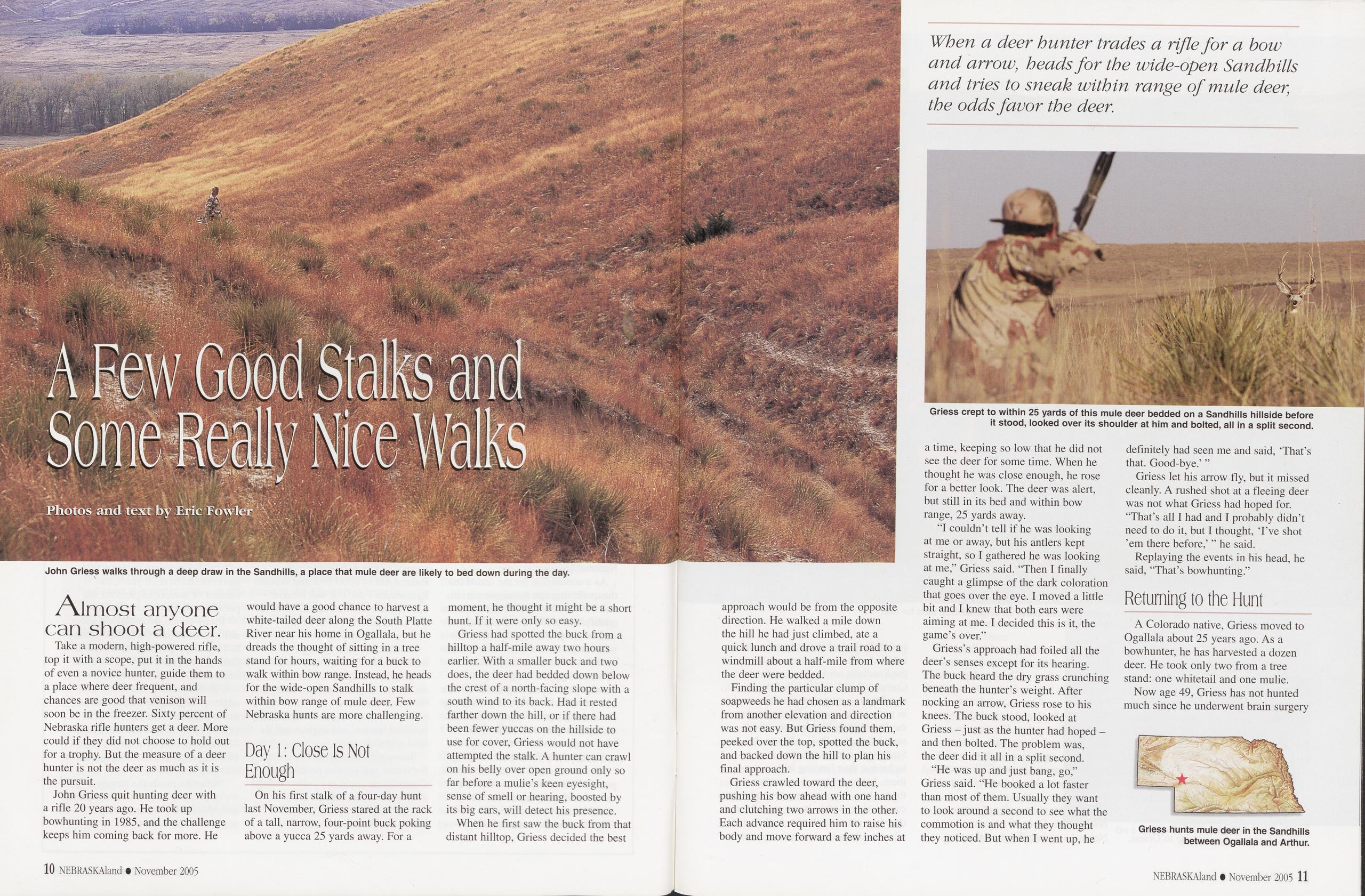
A Few Good Stalks and Some Really Nice Walks
When a deer hunter trades a rifle for a bow and arrow, heads for the wide-open Sandhills and tries to sneak within range of mule deer, the odds favor the deer.
Take a modern, high-powered rifle, top it with a scope, put it in the hands of even a novice hunter, guide them to a place where deer frequent, and chances are good that venison will soon be in the freezer. Sixty percent of Nebraska rifle hunters get a deer. More could if they did not choose to hold out for a trophy. But the measure of a deer hunter is not the deer as much as it is the pursuit.
John Griess quit hunting deer with a rifle 20 years ago. He took up bowhunting in 1985, and the challenge keeps him coming back for more. He would have a good chance to harvest a white-tailed deer along the South Platte River near his home in Ogallala, but he dreads the thought of sitting in a tree stand for hours, waiting for a buck to walk within bow range. Instead, he heads for the wide-open Sandhills to stalk within bow range of mule deer. Few Nebraska hunts are more challenging.
Day 1:Close Is Not EnoughOn his first stalk of a four-day hunt last November, Griess stared at the rack of a tall, narrow, four-point buck poking above a yucca 25 yards away. For a moment, he thought it might be a short hunt. If it were only so easy.
Griess had spotted the buck from a hilltop a half-mile away two hours earlier. With a smaller buck and two does, the deer had bedded down below the crest of a north-facing slope with a south wind to its back. Had it rested farther down the hill, or if there had been fewer yuccas on the hillside to use for cover, Griess would not have attempted the stalk. A hunter can crawl on his belly over open ground only so far before a mulie’s keen eyesight, sense of smell or hearing, boosted by its big ears, will detect his presence.
When he first saw the buck from that distant hilltop, Griess decided the best approach would be from the opposite direction. He walked a mile down the hill he had just climbed, ate a quick lunch and drove a trail road to a windmill about a half-mile from where the deer were bedded.
Finding the particular clump of soapweeds he had chosen as a landmark from another elevation and direction was not easy. But Griess found them, peeked over the top, spotted the buck, and backed down the hill to plan his final approach.
Griess crawled toward the deer, pushing his bow ahead with one hand and clutching two arrows in the other. Each advance required him to raise his body and move forward a few inches at a time, keeping so low that he did not see the deer for some time. When he thought he was close enough, he rose for a better look. The deer was alert, but still in its bed and within bow range, 25 yards away.
“I couldn’t tell if he was looking at me or away, but his antlers kept straight, so I gathered he was looking at me,” Griess said. “Then I finally caught a glimpse of the dark coloration that goes over the eye. I moved a little bit and I knew that both ears were aiming at me. I decided this is it, the game’s over.”
Griess’s approach had foiled all the deer’s senses except for its hearing. The buck heard the dry grass crunching beneath the hunter’s weight. After nocking an arrow, Griess rose to his knees. The buck stood, looked at Griess - just as the hunter had hoped - and then bolted. The problem was, the deer did it all in a split second.
“He was up and just bang, go,” Griess said. “He booked a lot faster than most of them. Usually they want to look around a second to see what the commotion is and what they thought they noticed. But when I went up, he definitely had seen me and said, ‘That’s that. Good-bye.’ "
Griess let his arrow fly, but it missed cleanly. A rushed shot at a fleeing deer was not what Griess had hoped for. “That’s all I had and I probably didn’t need to do it, but I thought, T’ve shot ’em there before,’ ” he said.
Replaying the events in his head, he said, “That’s bowhunting.”
Returning to the HuntA Colorado native, Griess moved to Ogallala about 25 years ago. As a bowhunter, he has harvested a dozen deer. He took only two from a tree stand: one whitetail and one mulie.
Now age 49, Griess has not hunted much since he underwent brain surgery
He hunted in 1999, but headaches in 2000 required another hunting hiatus. He hunted in 2002, but not hard. In 2003, he harvested a doe, the first deer he had taken since his surgery.
That deer was a milestone to Griess, but he had never felt compelled to fill his tag. As with many bowhunters, he often lets a deer walk when he could have easily shot it. One year, he passed on 10 bucks. "One year I shot a four-point buck and he took 10 steps and the biggest deer I’ve seen in my life stood up,” Griess said. A trophy- class deer, one big enough to qualify for the Pope and Young Club record book, is now Griess’s goal. Otherwise, getting close is good enough.
That’s the philosophy of many bowhunters. Only 30 percent of Nebraska archers fill their deer tag each fall. And while there are no hard statistics, those who chase mulies in the Sandhills are less successful. Compared with white-tailed deer in riverbottoms, mule deer densities are low in wide-open country. Finding a deer in the Sandhills is like the proverbial search for a needle in a haystack. Stalking is a more effective hunting technique than hunting from a stand there, but mule deer do not often put themselves in positions where a hunter can sneak to within bow range. Most deer bed with their backs to the wind, allowing them to see anything coming one direction and smell anything coming from the other.
Griess has crawled to within 10 yards of bedded deer. He does not like to take shots beyond 40 yards, the commonly accepted maximum range, but he has killed a few deer at that distance. A 40-yard shot is sometimes the best a bowhunter can get in the Sandhills. He has missed deer at both short and long ranges. “It’s not like TV,” he said, referring to Saturday morning hunting shows. "In the real world, people miss with bows.”
Griess uses no sights on his 10-year-old PSE Vector compound bow. He practices regularly, even while he’s hunting. He carries a blunt-tipped arrow in his quiver and regularly sends it flying toward a soapweed target while he walks through the hills. It’s a practice that helps him judge distance.
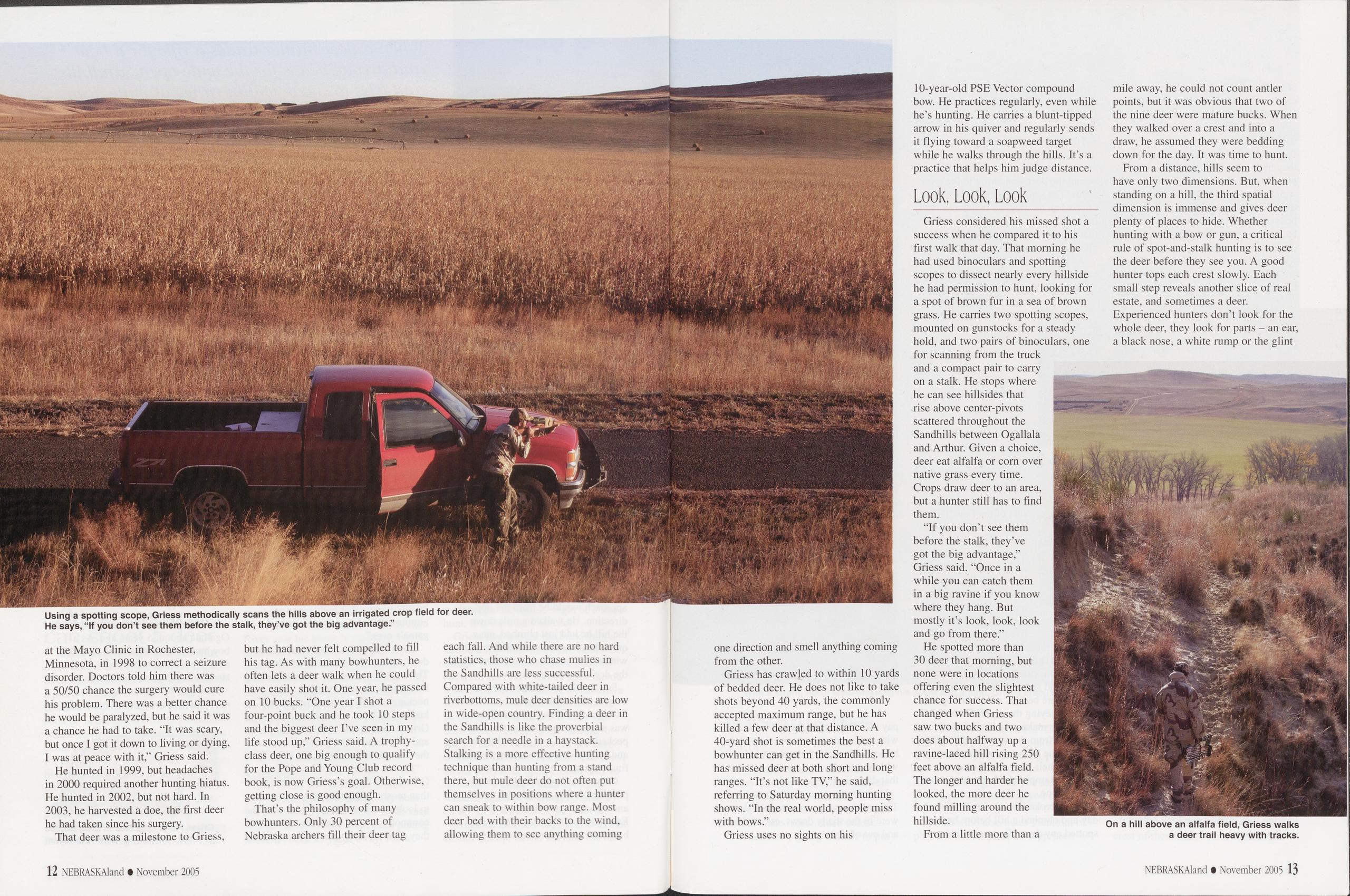
Look, Look, LookGriess considered his missed shot a success when he compared it to his first walk that day. That morning he had used binoculars and spotting scopes to dissect nearly every hillside he had permission to hunt, looking for a spot of brown fur in a sea of brown grass. He carries two spotting scopes, mounted on gunstocks for a steady hold, and two pairs of binoculars, one for scanning from the truck and a compact pair to carry on a stalk. He stops where he can see hillsides that rise above center-pivots scattered throughout the Sandhills between Ogallala and Arthur. Given a choice, deer eat alfalfa or corn over native grass every time. Crops draw deer to an area, but a hunter still has to find them.
"If you don’t see them before the stalk, they’ve got the big advantage,” Griess said. "Once in a while you can catch them in a big ravine if you know where they hang. But mostly it’s look, look, look and go from there.”
He spotted more than 30 deer that morning, but none were in locations offering even the slightest chance for success. That changed when Griess saw two bucks and two does about halfway up a ravine-laced hill rising 250 feet above an alfalfa field. The longer and harder he looked, the more deer he found milling around the hillside.
From a little more than a mile away, he could not count antler points, but it was obvious that two of the nine deer were mature bucks. When they walked over a crest and into a draw, he assumed they were bedding down for the day. It was time to hunt.
From a distance, hills seem to have only two dimensions. But, when standing on a hill, the third spatial dimension is immense and gives deer plenty of places to hide. Whether hunting with a bow or gun, a critical rule of spot-and-stalk hunting is to see the deer before they see you. A good hunter tops each crest slowly. Each small step reveals another slice of real estate, and sometimes a deer. Experienced hunters don’t look for the whole deer, they look for parts - an ear, a black nose, a white rump or the glint
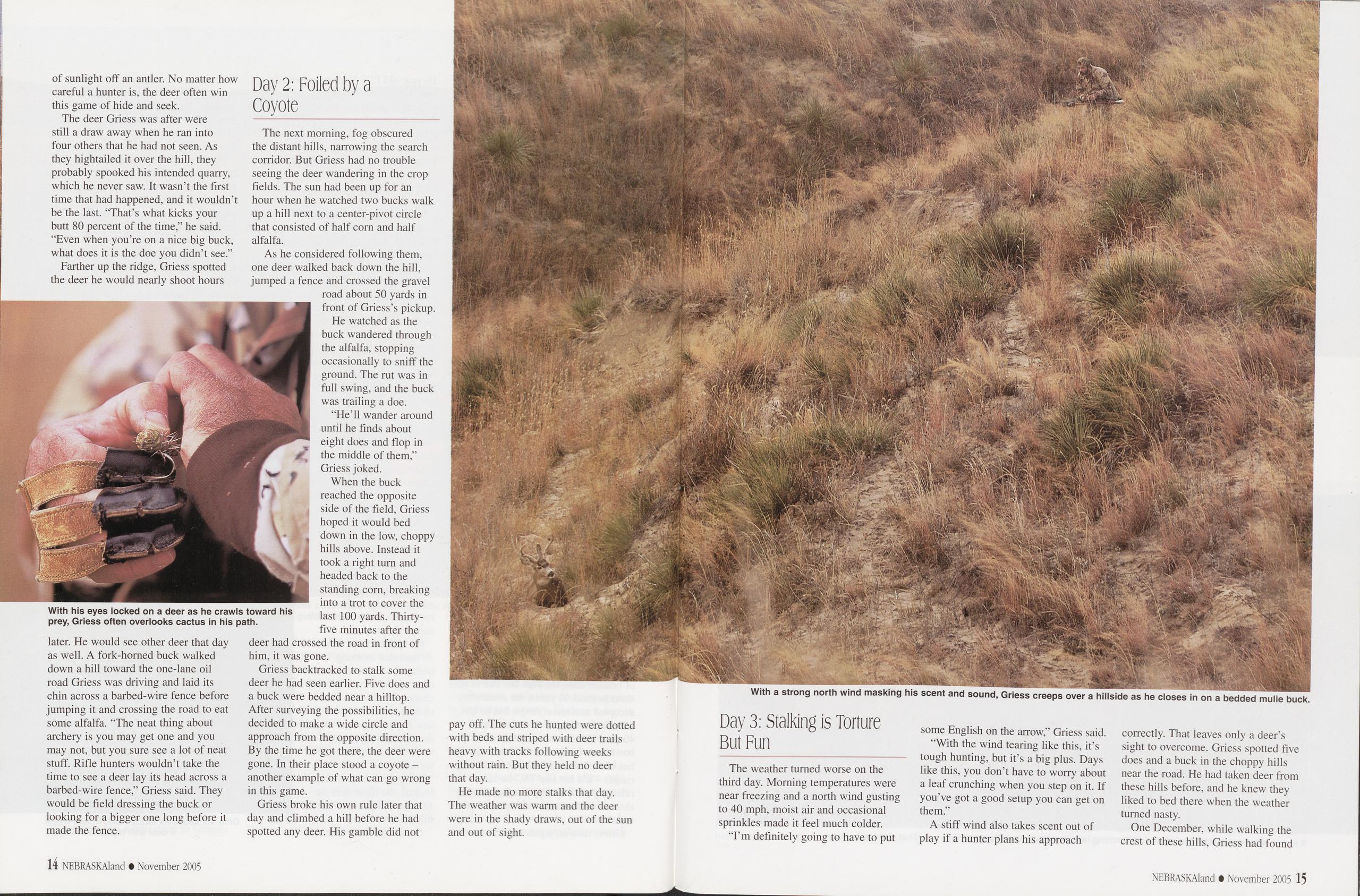 of sunlight off an antler. No matter how
careful a hunter is, the deer often win
this game of hide and seek.
of sunlight off an antler. No matter how
careful a hunter is, the deer often win
this game of hide and seek.
The deer Griess was after were still a draw away when he ran into four others that he had not seen. As they hightailed it over the hill, they probably spooked his intended quarry, which he never saw. It wasn’t the first time that had happened, and it wouldn’t be the last. “That’s what kicks your butt 80 percent of the time,” he said. “Even when you’re on a nice big buck, what does it is the doe you didn’t see.”
Farther up the ridge, Griess spotted the deer he would nearly shoot hours
The next morning, fog obscured the distant hills, narrowing the search corridor. But Griess had no trouble seeing the deer wandering in the crop fields. The sun had been up for an hour when he watched two bucks walk up a hill next to a center-pivot circle that consisted of half corn and half alfalfa.
As he considered following them, one deer walked back down the hill, jumped a fence and crossed the gravel road about 50 yards in front of Griess’s pickup.
He watched as the buck wandered through the alfalfa, stopping occasionally to sniff the ground. The rut was in full swing, and the buck was trailing a doe.
“He’ll wander around until he finds about eight does and flop in the middle of them,” Griess joked.
When the buck reached the opposite side of the field, Griess hoped it would bed down in the low, choppy hills above. Instead it took a right turn and headed back to the standing corn, breaking into a trot to cover the last 100 yards. Thirty- five minutes after the deer had crossed the road in front of him, it was gone.
Griess backtracked to stalk some deer he had seen earlier. Five does and a buck were bedded near a hilltop. After surveying the possibilities, he decided to make a wide circle and approach from the opposite direction. By the time he got there, the deer were gone. In their place stood a coyote - another example of what can go wrong in this game.
Griess broke his own rule later that day and climbed a hill before he had spotted any deer. His gamble did not
He made no more stalks that day. The weather was warm and the deer were in the shady draws, out of the sun and out of sight.
Day 3: Stalking is Torture But FunThe weather turned worse on the third day. Morning temperatures were near freezing and a north wind gusting to 40 mph, moist air and occasional sprinkles made it feel much colder.
“I’m definitely going to have to put some English on the arrow,” Griess said.
“With the wind tearing like this, it’s tough hunting, but it’s a big plus. Days like this, you don’t have to worry about a leaf crunching when you step on it. If you’ve got a good setup you can get on them.”
A stiff wind also takes scent out of play if a hunter plans his approach correctly. That leaves only a deer’s sight to overcome. Griess spotted five does and a buck in the choppy hills near the road. He had taken deer from these hills before, and he knew they liked to bed there when the weather turned nasty.
One December, while walking the
crest of these hills, Griess had found
14 NEBRASKAland • November 2005
NEBRASKAland • November 2005 15
 the carcass of a 10-by-7 nontypical
mulie buck that scored 187 inches on
the Pope and Young scale. The antlers
now sit atop a taxidermy mount in his
living room.
the carcass of a 10-by-7 nontypical
mulie buck that scored 187 inches on
the Pope and Young scale. The antlers
now sit atop a taxidermy mount in his
living room.
On another hunt in these hills, Griess had crawled within 20 yards of a buck but could not get a shot through the tall grass. While he waited for the buck to stand, a doe rose from her bed and walked within 12 feet of Griess before it caught his scent and started stomping and snorting, even blowing snot on the hunter’s neck.
"I was scared she was going to step on me,” Griess said. Five hours after he began that stalk, the buck finally stood and presented a shot. Griess missed.
On this day, he did not get that close. He bumped a buck and a doe early in the stalk, then a pair of does who ran into the next draw and came out with two more does in tow. The deer were holed up out of the wind, and under the thick, gray skies, spotting them was more difficult than usual. Griess called it a morning and headed back to the truck for lunch. A short drive and an
Griess wasted no time getting up the hill for a better look. He needed to approach from the other direction, but the deer would see him if he circled downwind. So he decided to circle upwind, hoping the breeze would carry his scent over the buck he had chosen to stalk. Within 20 minutes, he had closed to within 30 yards of the deer, which was bedded below a soapweed near the bottom of the cut.
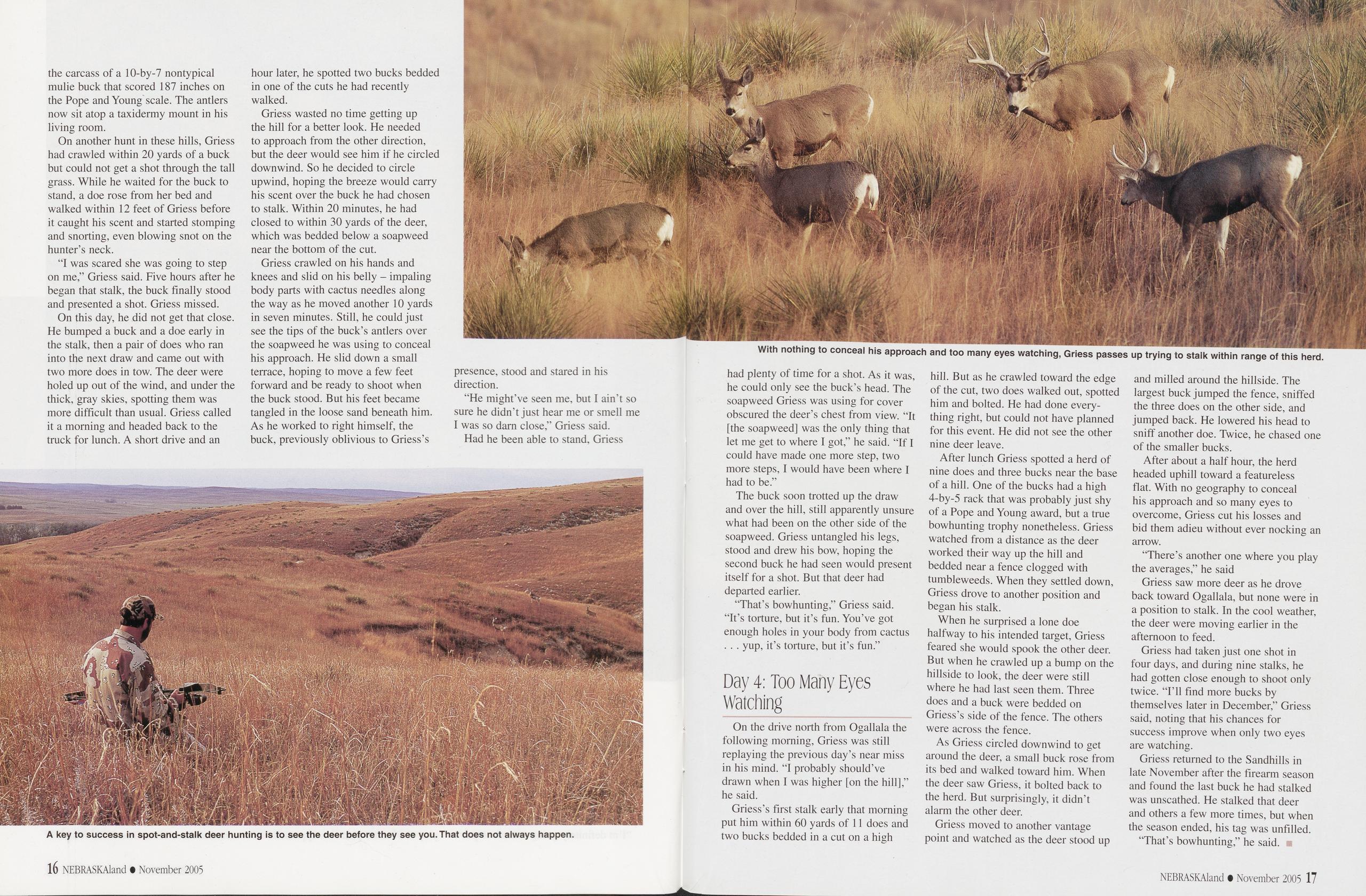
With nothing to conceal his approach and too many eyes watching, Griess passes up trying to staik within range of this herd.
"He might’ve seen me, but I ain’t so sure he didn’t just hear me or smell me I was so darn close,” Griess said.
Had he been able to stand, Griess had plenty of time for a shot. As it was, he could only see the buck’s head. The soapweed Griess was using for cover obscured the deer’s chest from view. "It [the soapweed] was the only thing that let me get to where I got,” he said. "If I could have made one more step, two more steps, I would have been where I had to be.”
The buck soon trotted up the draw and over the hill, still apparently unsure what had been on the other side of the soapweed. Griess untangled his legs, stood and drew his bow, hoping the second buck he had seen would present itself for a shot. But that deer had departed earlier.
"That’s bowhunting,” Griess said. "It’s torture, but it’s fun. You’ve got enough holes in your body from cactus . . . yup, it’s torture, but it’s fun.”
Day 4: Too Many Eyes WatchingOn the drive north from Ogallala the following morning, Griess was still replaying the previous day’s near miss in his mind. "I probably should’ve drawn when I was higher [on the hill],” he said.
Griess’s first stalk early that morning put him within 60 yards of 11 does and two bucks bedded in a cut on a high hill. But as he crawled toward the edge of the cut, two does walked out, spotted him and bolted. He had done every- thing right, but could not have planned for this event. He did not see the other nine deer leave.
After lunch Griess spotted a herd of nine does and three bucks near the base of a hill. One of the bucks had a high 4-by-5 rack that was probably just shy of a Pope and Young award, but a true bowhunting trophy nonetheless. Griess watched from a distance as the deer worked their way up the hill and bedded near a fence clogged with tumbleweeds. When they settled down, Griess drove to another position and began his stalk.
When he surprised a lone doe halfway to his intended target, Griess feared she would spook the other deer. But when he crawled up a bump on the hillside to look, the deer were still where he had last seen them. Three does and a buck were bedded on Griess’s side of the fence. The others were across the fence.
As Griess circled downwind to get around the deer, a small buck rose from its bed and walked toward him. When the deer saw Griess, it bolted back to the herd. But surprisingly, it didn’t alarm the other deer.
Griess moved to another vantage point and watched as the deer stood up and milled around the hillside. The largest buck jumped the fence, sniffed the three does on the other side, and jumped back. He lowered his head to sniff another doe. Twice, he chased one of the smaller bucks.
After about a half hour, the herd headed uphill toward a featureless flat. With no geography to conceal his approach and so many eyes to overcome, Griess cut his losses and bid them adieu without ever nocking an arrow.
“There’s another one where you play the averages,” he said Griess saw more deer as he drove back toward Ogallala, but none were in a position to stalk. In the cool weather, the deer were moving earlier in the afternoon to feed.
Griess had taken just one shot in four days, and during nine stalks, he had gotten close enough to shoot only twice. "TH find more bucks by themselves later in December,” Griess said, noting that his chances for success improve when only two eyes are watching.
Griess returned to the Sandhills in late November after the firearm season and found the last buck he had stalked was unscathed. He stalked that deer and others a few more times, but when the season ended, his tag was unfilled. "That's bowhunting,” he said.
16 NEBRASKAland • November 2005 NEBRASKAland • November 2005 17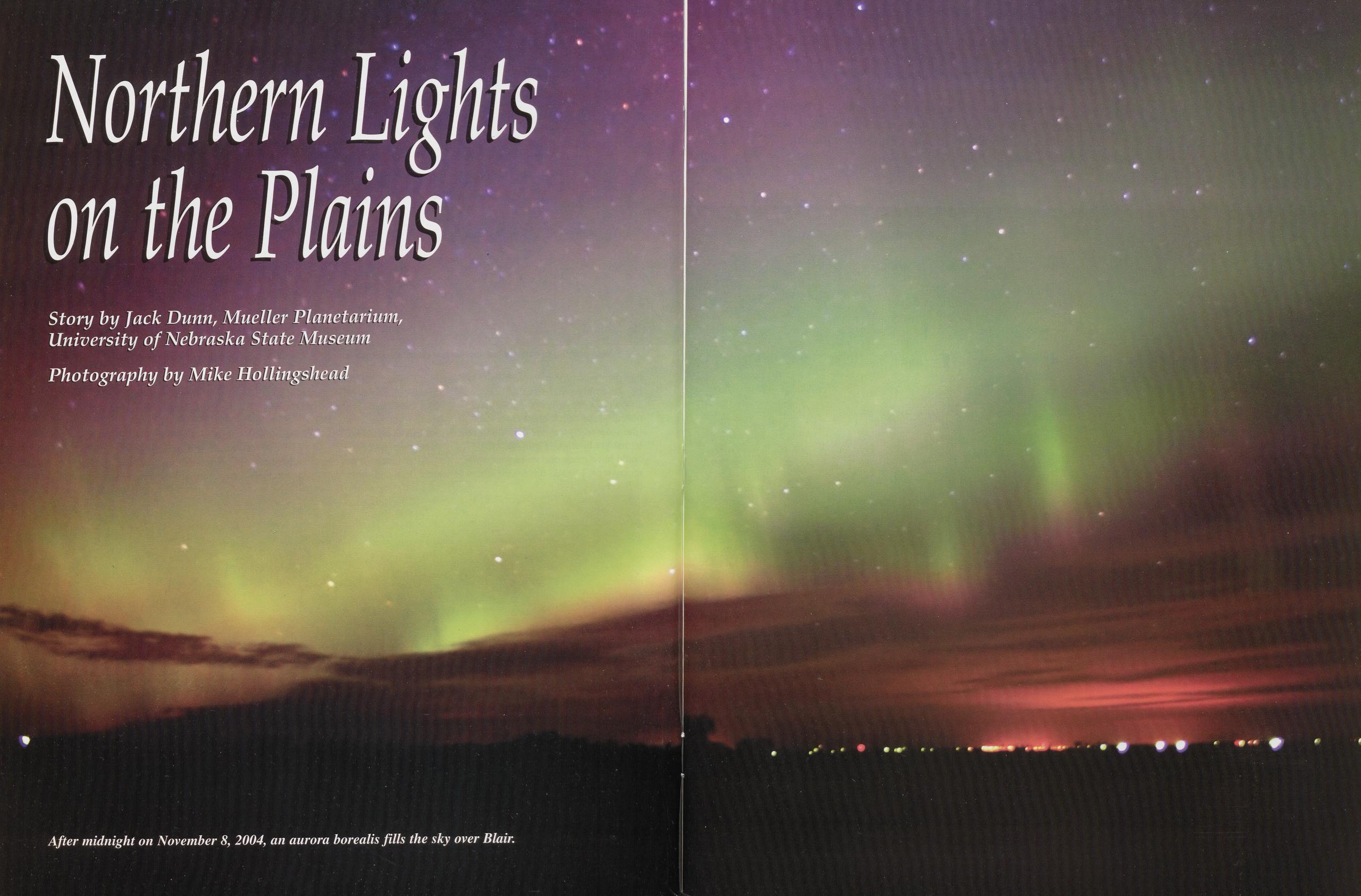
Northern Lights on the Plains
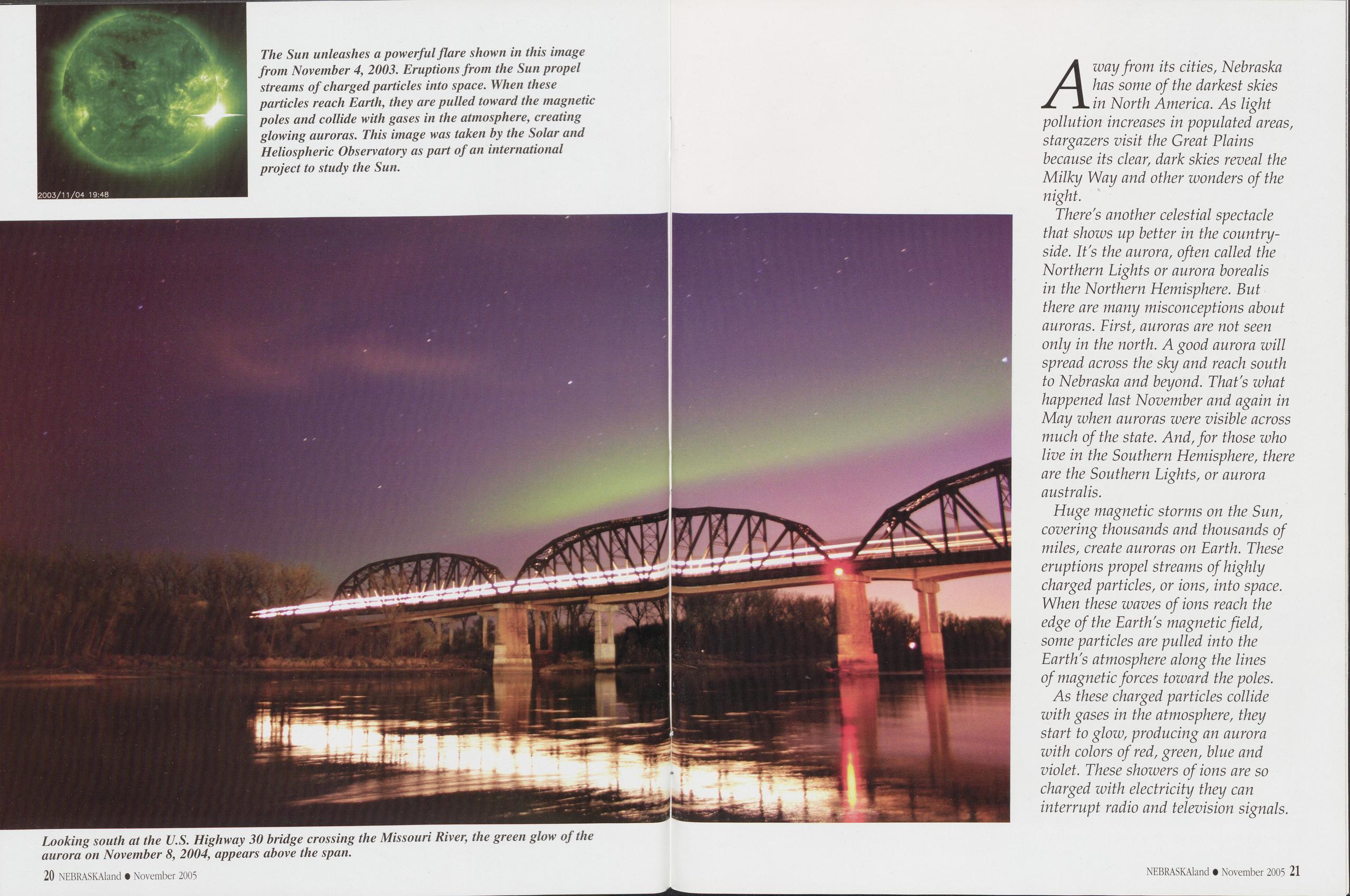
Away from its cities, Nebraska has some of the darkest skies in North America. As light pollution increases in populated areas, stargazers visit the Great Plains because its clear, dark skies reveal the Milky Way and other wonders of the night.
There's another celestial spectacle that shows up better in the country- side. It's the aurora, often called the Northern Lights or aurora borealis in the Northern Hemisphere. But there are many misconceptions about auroras. First, auroras are not seen only in the north. A good aurora will spread across the sky and reach south to Nebraska and beyond. That's what happened last November and again in May when auroras were visible across much of the state. And, for those who live in the Southern Hemisphere, there are the Southern Lights, or aurora australis.
Huge magnetic storms on the Sun, covering thousands and thousands of miles, create auroras on Earth. These eruptions propel streams of highly charged particles, or ions, into space. When these waves of ions reach the edge of the Earth's magnetic field, some particles are pulled into the Earth's atmosphere along the lines of magnetic forces toward the poles.
As these charged particles collide with gases in the atmosphere, they start to glow, producing an aurora with colors of red, green, blue and violet. These showers of ions are so charged with electricity they can interrupt radio and television signals.
NEBRASKAland • November 2005 21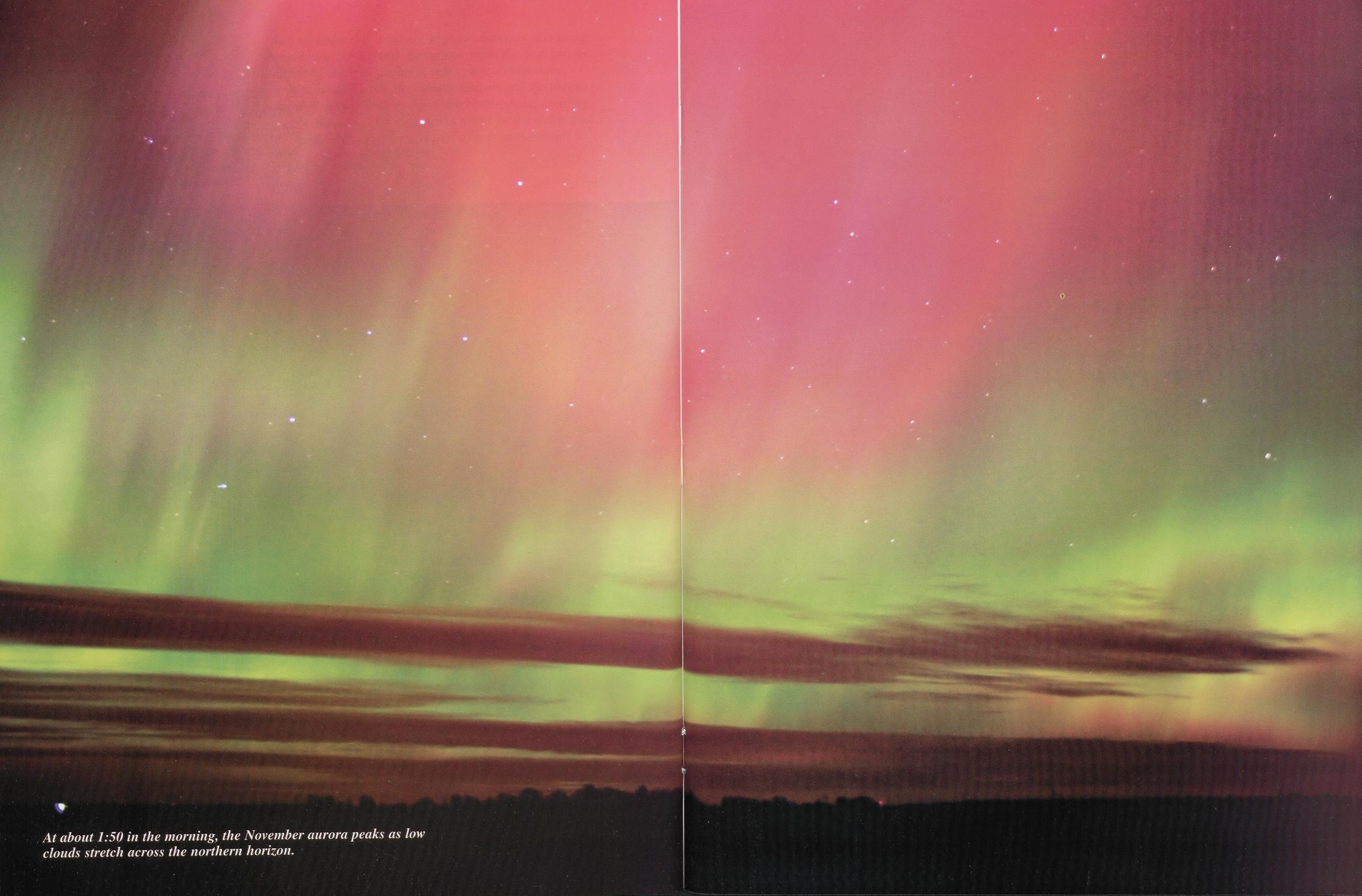
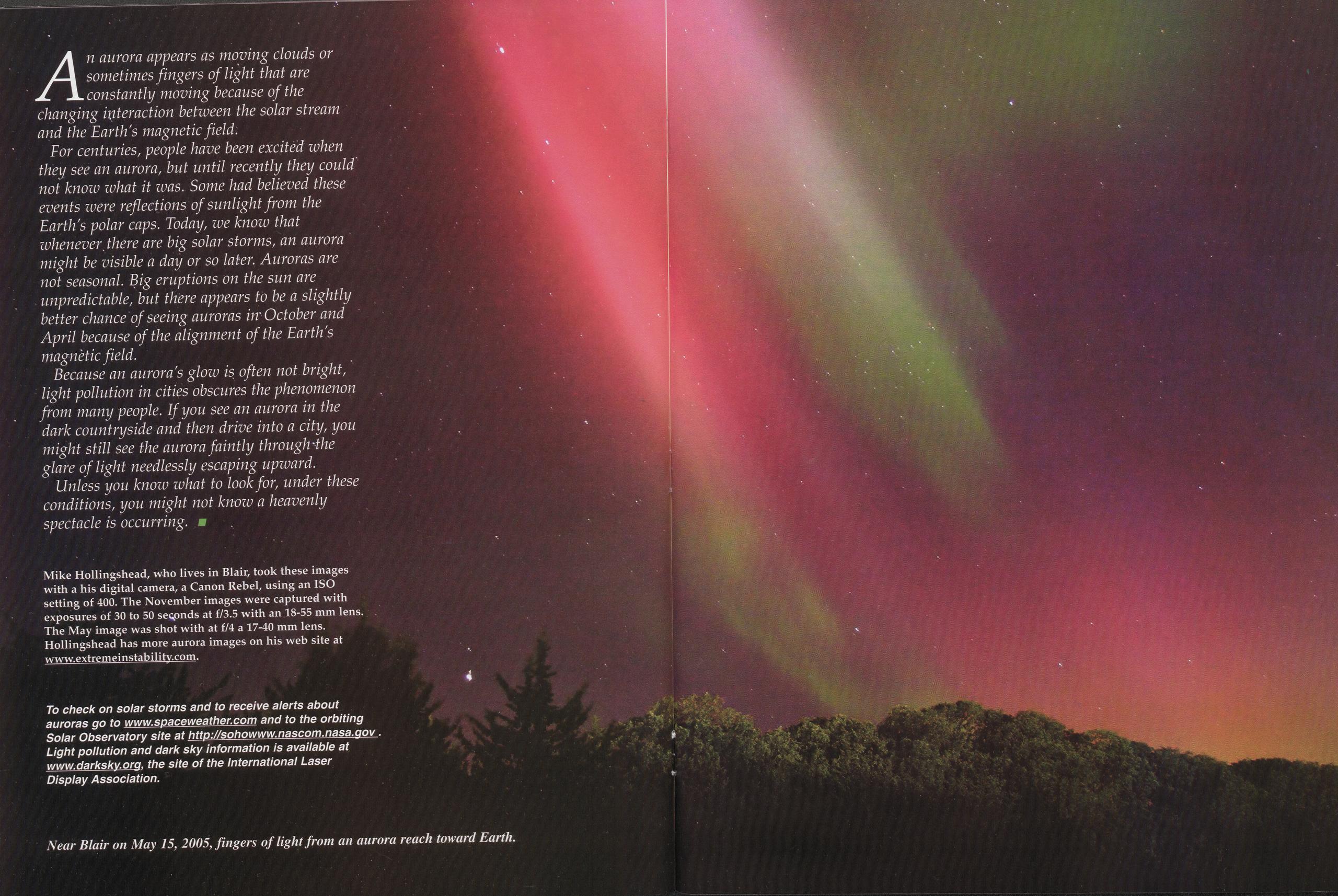
An aurora appears as moving clouds or sometimes fingers of light that are constantly moving because of the changing interaction between the solar stream and the Earth's magnetic field.
For centuries, people have been excited when they see an aurora, but until recently they could not know what it was. Some had believed these events were reflections of sunlight from the Earth's polar caps. Today, we know that whenever there are big solar storms, an aurora might be visible a day or so later. Auroras are not seasonal. Big eruptions on the sun are unpredictable, but there appears to be a slightly better chance of seeing auroras in׳ October and April because of the alignment of the Earth's magnetic field.
Because an aurora's glow is often not bright, light pollution in cities obscures the phenomenon from many people. If you see an aurora in the dark countryside and then drive into a city, you might still see the aurora faintly through the glare of light needlessly escaping upward.
Unless you know what to look for, under these conditions, you might not know a heavenly spectacle is occurring,
Mike Hollingshead, who lives in Blair, took these images with a his digital camera, a Canon Rebel, using an ISO setting of 400. The November images were captured with exposures of 30 to 50 seconds at f/3.5 with an 18-55 mm lens. The May image was shot with at f/4 a 17-40 mm lens. Hollingshead has more aurora images on his web site at www.extremeinstability.com. To check on solar storms and to receive alerts about auroras go to www.spaceweather.com and to the orbiting Solar Observatory site at http://sohowww, nascom.nasa,gov. Light pollution and dark sky information is available at www. darksky.org, the site of the International Laser Display Association.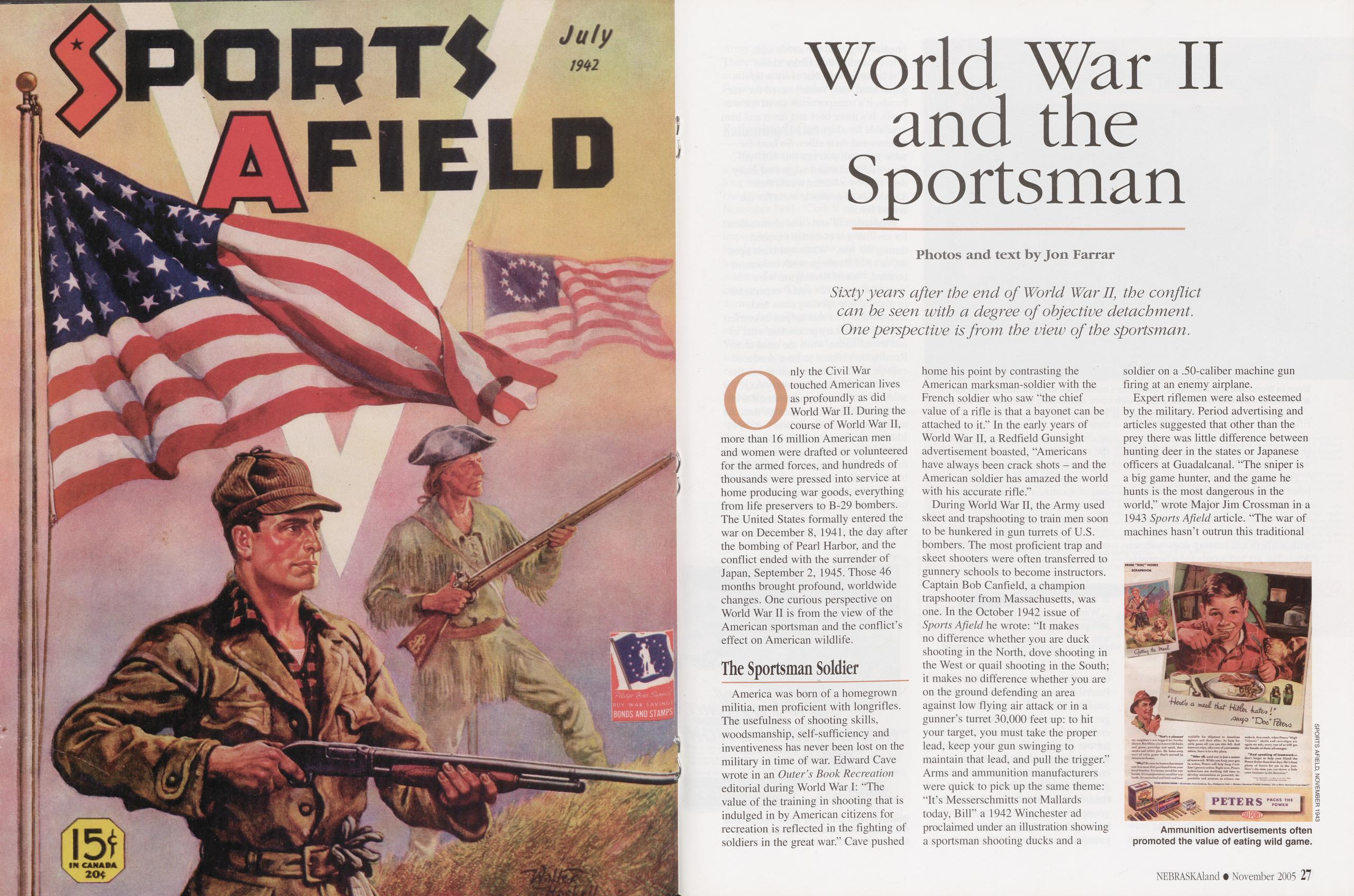
World War II and the Sportsman
Sixty years after the end of World War II, the conflict can be seen with a degree of objective detachment. One perspective is from the view of the sportsman.
Only the Civil War touched American lives as profoundly as did World War II. During the course of World War II, more than 16 million American men and women were drafted or volunteered for the armed forces, and hundreds of thousands were pressed into service at home producing war goods, everything from life preservers to B-29 bombers. The United States formally entered the war on December 8, 1941, the day after the bombing of Pearl Harbor, and the conflict ended with the surrender of Japan, September 2, 1945. Those 46 months brought profound, worldwide changes. One curious perspective on World War II is from the view of the American sportsman and the conflict’s effect on American wildlife.
The Sportsman SoldierAmerica was born of a homegrown militia, men proficient with longrifles. The usefulness of shooting skills, woodsmanship, self-sufficiency and inventiveness has never been lost on the military in time of war. Edward Cave wrote in an Outer's Book Recreation editorial during World War I: “The value of the training in shooting that is indulged in by American citizens for recreation is reflected in the fighting of soldiers in the great war.” Cave pushed home his point by contrasting the American marksman-soldier with the French soldier who saw “the chief value of a rifle is that a bayonet can be attached to it.” In the early years of World War II, a Redfield Gunsight advertisement boasted, “Americans have always been crack shots - and the American soldier has amazed the world with his accurate rifle.”
During World War II, the Army used skeet and trapshooting to train men soon to be hunkered in gun turrets of U.S. bombers. The most proficient trap and skeet shooters were often transferred to gunnery schools to become instructors. Captain Bob Canfield, a champion trapshooter from Massachusetts, was one. In the October 1942 issue of Sports Afield he wrote: “It makes no difference whether you are duck shooting in the North, dove shooting in the West or quail shooting in the South; it makes no difference whether you are on the ground defending an area against low flying air attack or in a gunner’s turret 30,000 feet up: to hit your target, you must take the proper lead, keep your gun swinging to maintain that lead, and pull the trigger.” Arms and ammunition manufacturers were quick to pick up the same theme: “It’s Messerschmitts not Mallards today, Bill” a 1942 Winchester ad proclaimed under an illustration showing a sportsman shooting ducks and a soldier on a .50-caliber machine gun firing at an enemy airplane.
Expert riflemen were also esteemed by the military. Period advertising and articles suggested that other than the prey there was little difference between hunting deer in the states or Japanese officers at Guadalcanal. “The sniper is a big game hunter, and the game he hunts is the most dangerous in the world,” wrote Major Jim Crossman in a 1943 Sports Afield article. “The war of machines hasn’t outrun this traditional
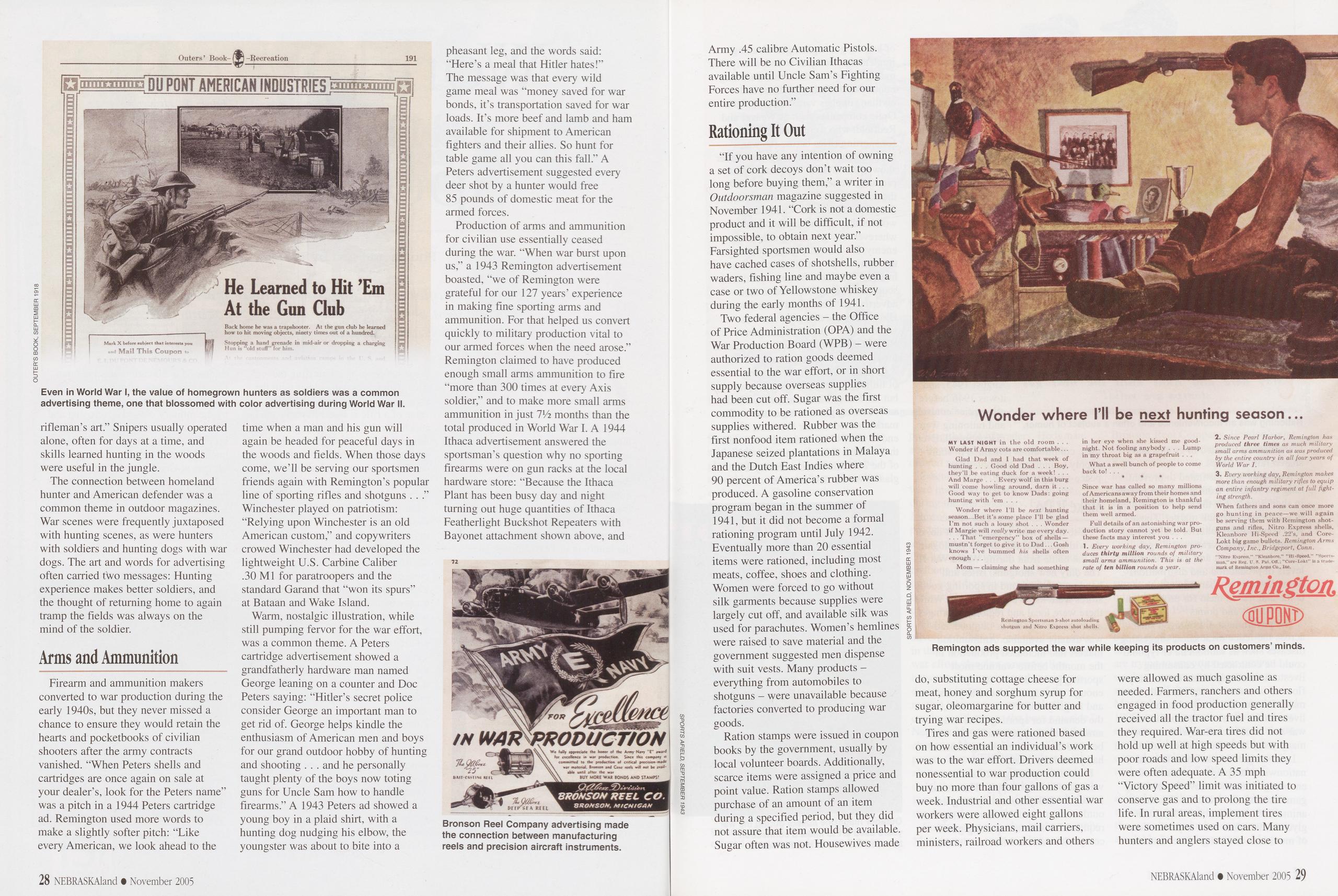
The connection between homeland hunter and American defender was a common theme in outdoor magazines. War scenes were frequently juxtaposed with hunting scenes, as were hunters with soldiers and hunting dogs with war dogs. The art and words for advertising often carried t\vo messages: Hunting experience makes better soldiers, and the thought of returning home to again tramp the fields was always on the mind of the soldier.
Arms and AmmunitionFirearm and ammunition makers converted to war production during the early 1940s, but they never missed a chance to ensure they would retain the hearts and pocketbooks of civilian shooters after the army contracts vanished. "When Peters shells and cartridges are once again on sale at your dealer’s, look for the Peters name” was a pitch in a 1944 Peters cartridge ad. Remington used more words to make a slightly softer pitch: “Like every American, we look ahead to the time when a man and his gun will again be headed for peaceful days in the woods and fields. When those days come, we’ll be serving our sportsmen friends again with Remington’s popular line of sporting rifles and shotguns . . .” Winchester played on patriotism: "Relying upon Winchester is an old American custom,” and copywriters crowed Winchester had developed the lightweight U.S. Carbine Caliber .30 Ml for paratroopers and the standard Garand that "won its spurs” at Bataan and Wake Island.
Warm, nostalgic illustration, while still pumping fervor for the war effort, was a common theme. A Peters cartridge advertisement showed a grandfatherly hardware man named George leaning on a counter and Doc Peters saying: "Hitler’s secret police consider George an important man to get rid of. George helps kindle the enthusiasm of American men and boys for our grand outdoor hobby of hunting and shooting . . . and he personally taught plenty of the boys now toting guns for Uncle Sam how to handle firearms.” A 1943 Peters ad showed a young boy in a plaid shirt, with a hunting dog nudging his elbow, the youngster was about to bite into a pheasant leg, and the words said: "Here’s a meal that Hitler hates!” The message was that every wild game meal was "money saved for war bonds, it’s transportation saved for war loads. It’s more beef and lamb and ham available for shipment to American fighters and their allies. So hunt for table game all you can this fall.” A Peters advertisement suggested every deer shot by a hunter would free 85 pounds of domestic meat for the armed forces.
Production of arms and ammunition for civilian use essentially ceased during the war. "When war burst upon us,” a 1943 Remington advertisement boasted, "we of Remington were grateful for our 127 years’ experience in making fine sporting arms and ammunition. For that helped us convert quickly to military production vital to our armed forces when the need arose.” Remington claimed to have produced enough small arms ammunition to fire "more than 300 times at every Axis soldier,” and to make more small arms ammunition in just ?1/2 months than the total produced in World War I. A 1944 Ithaca advertisement answered the sportsman’s question why no sporting firearms were on gun racks at the local hardware store: "Because the Ithaca Plant has been busy day and night turning out huge quantities of Ithaca Featherlight Buckshot Repeaters with Bayonet attachment shown above, and
"If you have any intention of owning a set of cork decoys don’t wait too long before buying them,” a writer in Outdoorsman magazine suggested in November 1941. "Cork is not a domestic product and it will be difficult, if not impossible, to obtain next year.” Farsighted sportsmen would also have cached cases of shotshells, rubber waders, fishing line and maybe even a case or two of Yellowstone whiskey during the early months of 1941.
Two federal agencies - the Office of Price Administration (OPA) and the War Production Board (WPB) - were authorized to ration goods deemed essential to the war effort, or in short supply because overseas supplies had been cut off. Sugar was the first commodity to be rationed as overseas supplies withered. Rubber was the first nonfood item rationed when the Japanese seized plantations in Malaya and the Dutch East Indies where 90 percent of America’s rubber was produced. A gasoline conservation program began in the summer of 1941, but it did not become a formal rationing program until July 1942. Eventually more than 20 essential items were rationed, including most meats, coffee, shoes and clothing. Women were forced to go without silk garments because supplies were largely cut off, and available silk was used for parachutes. Women’s hemlines were raised to save material and the government suggested men dispense with suit vests. Many products - everything from automobiles to shotguns - were unavailable because factories converted to producing war goods.
Ration stamps were issued in coupon books by the government, usually by local volunteer boards. Additionally, scarce items were assigned a price and point value. Ration stamps allowed purchase of an amount of an item during a specified period, but they did not assure that item would be available. Sugar often was not. Housewives made
Tires and gas were rationed based
on how essential an individual’s work
was to the war effort. Drivers deemed
nonessential to war production could
buy no more than four gallons of gas a
week. Industrial and other essential war
workers were allowed eight gallons
per week. Physicians, mail carriers,
ministers, railroad workers and others
were allowed as much gasoline as
needed. Farmers, ranchers and others
engaged in food production generally
received all the tractor fuel and tires
they required. War-era tires did not
hold up well at high speeds but with
poor roads and low speed limits they
were often adequate. A 35 mph
“Victory Speed” limit was initiated to
conserve gas and to prolong the tire
life. In rural areas, implement tires
were sometimes used on cars. Many
hunters and anglers stayed close to
28 NEBRASKAland • November 2005
NEBRASKAland • November 2005 29
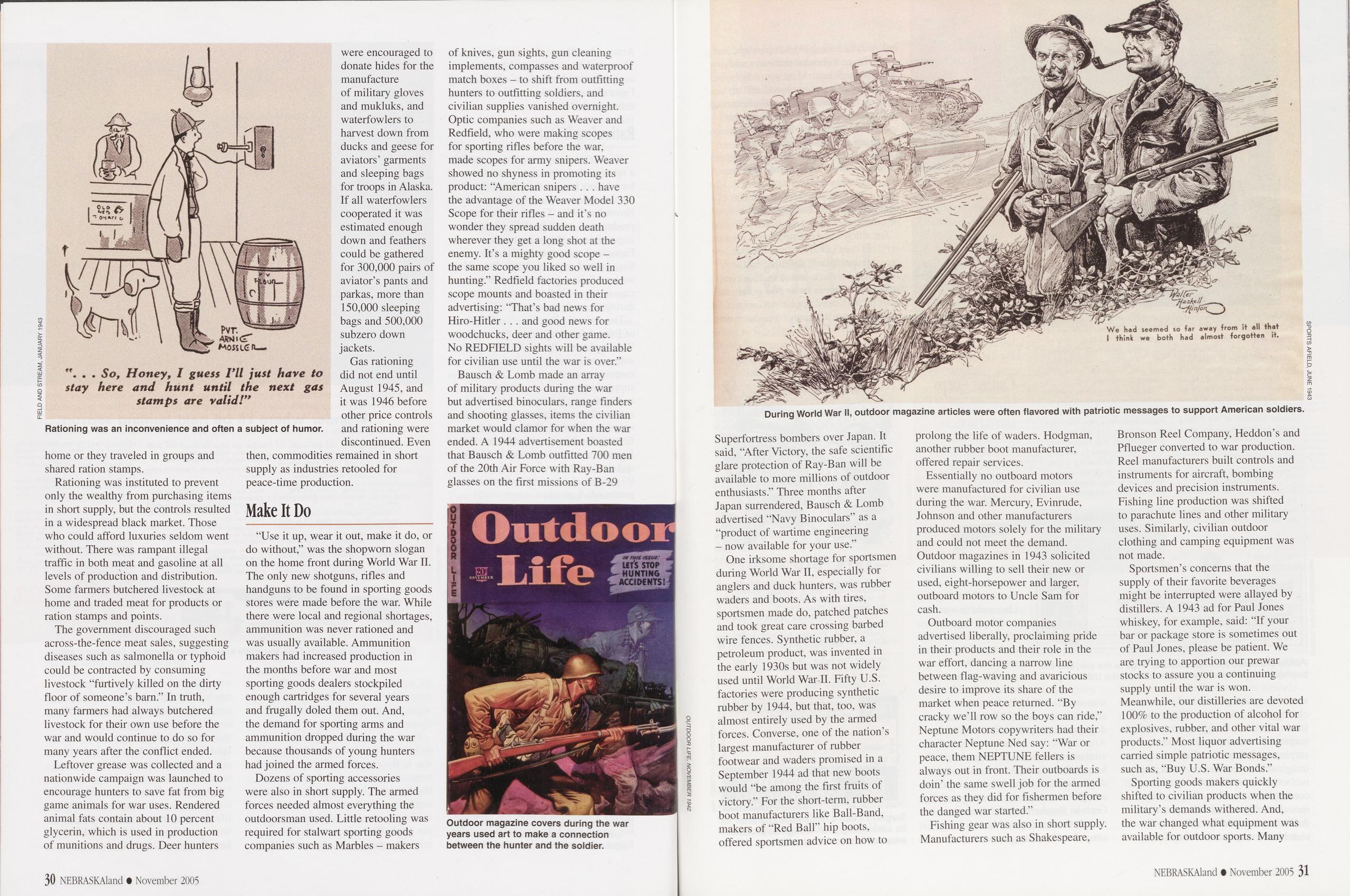
Rationing was instituted to prevent only the wealthy from purchasing items in short supply, but the controls resulted in a widespread black market. Those who could afford luxuries seldom went without. There was rampant illegal traffic in both meat and gasoline at all levels of production and distribution. Some farmers butchered livestock at home and traded meat for products or ration stamps and points.
The government discouraged such across-the-fence meat sales, suggesting diseases such as salmonella or typhoid could be contracted by consuming livestock “furtively killed on the dirty floor of someone’s barn.” In truth, many farmers had always butchered livestock for their own use before the war and would continue to do so for many years after the conflict ended.
Leftover grease was collected and a nationwide campaign was launched to encourage hunters to save fat from big game animals for war uses. Rendered animal fats contain about 10 percent glycerin, which is used in production of munitions and drugs. Deer hunters were encouraged to donate hides for the manufacture of military gloves and mukluks, and waterfowlers to harvest down from ducks and geese for aviators’ garments and sleeping bags for troops in Alaska. If all waterfowlers cooperated it was estimated enough down and feathers could be gathered for 300,000 pairs of aviator’s pants and parkas, more than 150,000 sleeping bags and 500,000 subzero down jackets.
Gas rationing did not end until August 1945, and it was 1946 before other price controls and rationing were discontinued. Even then, commodities remained in short supply as industries retooled for peace-time production.
Make It Do"Use it up, wear it out, make it do, or do without,” was the shopworn slogan on the home front during World War II. The only new shotguns, rifles and handguns to be found in sporting goods stores were made before the war. While there were local and regional shortages, ammunition was never rationed and was usually available. Ammunition makers had increased production in the months before war and most sporting goods dealers stockpiled enough cartridges for several years and frugally doled them out. And, the demand for sporting arms and ammunition dropped during the war because thousands of young hunters had joined the armed forces.
Dozens of sporting accessories were also in short supply. The armed forces needed almost everything the outdoorsman used. Little retooling was required for stalwart sporting goods companies such as Marbles - makers of knives, gun sights, gun cleaning implements, compasses and waterproof match boxes - to shift from outfitting hunters to outfitting soldiers, and civilian supplies vanished overnight. Optic companies such as Weaver and Redfield, who were making scopes for sporting rifles before the war, made scopes for army snipers. Weaver showed no shyness in promoting its product: "American snipers . . . have the advantage of the Weaver Model 330 Scope for their rifles - and it’s no wonder they spread sudden death wherever they get a long shot at the enemy. It’s a mighty good scope - the same scope you liked so well in hunting.” Redfield factories produced scope mounts and boasted in their advertising: "That’s bad news for Hiro-Hitler . . . and good news for woodchucks, deer and other game. No REDFIELD sights will be available for civilian use until the war is over.”
Bausch & Lomb made an array of military products during the war but advertised binoculars, range finders and shooting glasses, items the civilian market would clamor for when the war ended. A 1944 advertisement boasted that Bausch & Lomb outfitted 700 men of the 20th Air Force with Ray-Ban glasses on the first missions of B-29
One irksome shortage for sportsmen during World War II, especially for anglers and duck hunters, was rubber waders and boots. As with tires, sportsmen made do, patched patches and took great care crossing barbed wire fences. Synthetic rubber, a petroleum product, was invented in the early 1930s but was not widely used until World War II. Fifty U.S. factories were producing synthetic rubber by 1944, but that, too, was almost entirely used by the armed forces. Converse, one of the nation’s largest manufacturer of rubber footwear and waders promised in a September 1944 ad that new boots would "be among the first fruits of victory.” For the short-term, rubber boot manufacturers like Ball-Band, makers of "Red Ball” hip boots, offered sportsmen advice on how to prolong the life of waders. Hodgman, another rubber boot manufacturer, offered repair services.
Essentially no outboard motors were manufactured for civilian use during the war. Mercury, Evinrude, Johnson and other manufacturers produced motors solely for the military and could not meet the demand. Outdoor magazines in 1943 solicited civilians willing to sell their new or used, eight-horsepower and larger, outboard motors to Uncle Sam for cash.
Outboard motor companies advertised liberally, proclaiming pride in their products and their role in the war effort, dancing a narrow line between flag-waving and avaricious desire to improve its share of the market when peace returned. "By cracky we’ll row so the boys can ride,” Neptune Motors copywriters had their character Neptune Ned say: "War or peace, them NEPTUNE fellers is always out in front. Their outboards is doin’ the same swell job for the armed forces as they did for fishermen before the danged war started.”
Fishing gear was also in short supply. Manufacturers such as Shakespeare, Bronson Reel Company, Heddon’s and Pflueger converted to war production. Reel manufacturers built controls and instruments for aircraft, bombing devices and precision instruments. Fishing line production was shifted to parachute lines and other military uses. Similarly, civilian outdoor clothing and camping equipment was not made.
Sportsmen’s concerns that the supply of their favorite beverages might be interrupted were allayed by distillers. A 1943 ad for Paul Jones whiskey, for example, said: "If your bar or package store is sometimes out of Paul Jones, please be patient. We are trying to apportion our prewar stocks to assure you a continuing supply until the war is won. Meanwhile, our distilleries are devoted 100% to the production of alcohol for explosives, rubber, and other vital war products.” Most liquor advertising carried simple patriotic messages, such as, "Buy U.S. War Bonds.”
Sporting goods makers quickly
shifted to civilian products when the
military’s demands withered. And,
the war changed what equipment was
available for outdoor sports. Many
30 NEBRASKAland • November 2005
NEBRASKAland • November 2005 31
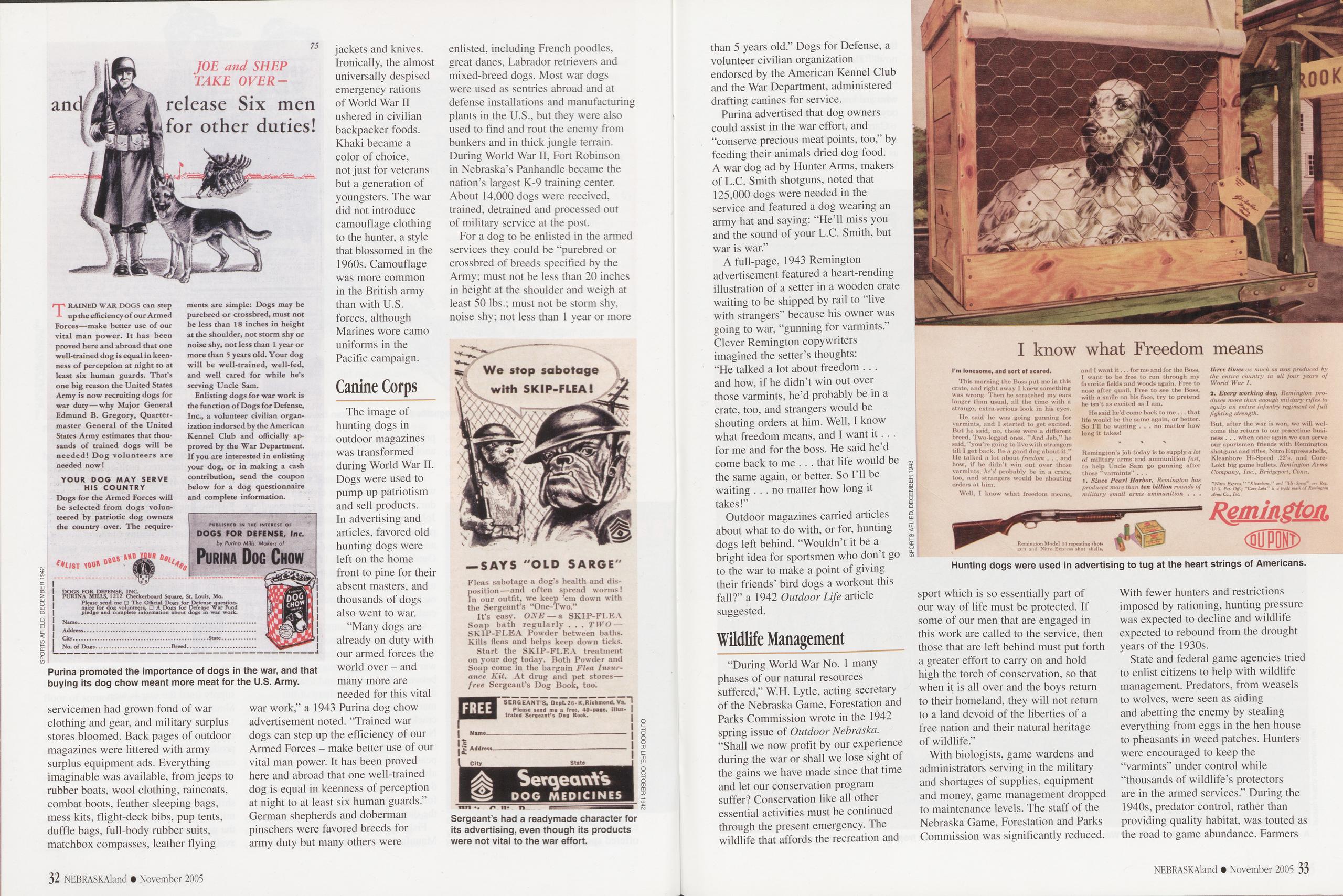
The image of hunting dogs in outdoor magazines was transformed during World War II. Dogs were used to pump up patriotism and sell products. In advertising and articles, favored old hunting dogs were left on the home front to pine for their absent masters, and thousands of dogs also went to war.
"Many dogs are already on duty with our armed forces the world over - and many more are needed for this vital war work,” a 1943 Purina dog chow advertisement noted. “Trained war dogs can step up the efficiency of our Armed Forces - make better use of our vital man power. It has been proved here and abroad that one well-trained dog is equal in keenness of perception at night to at least six human guards.” German shepherds and doberman pinschers were favored breeds for army duty but many others were enlisted, including French poodles, great danes, Labrador retrievers and mixed-breed dogs. Most war dogs were used as sentries abroad and at defense installations and manufacturing olants in the U.S., but they wre also used to find and rout the enemy from bunkers and in thick jungle terrain. During WOrld War II, Fort Robinson in Nebraska's Panhandle became the nation's largest K-9 training center. About 14,000 dogs were received, trained, detrained and processed out of military service at the post.
For a dogto be enlisted in the armed services they could be "purebreed or crossbred of breeds specified by the Army; must not be less than 20 inches in height at the shoulder and weigh at least 50 lbs.; must not be storm shy, noise shy; not less than 1 year or more
Purina advertised that dog owners could assist in the war effort, and “conserve precious meat points, too,” by feeding their animals dried dog food. A war dog ad by Hunter Arms, makers of L.C. Smith shotguns, noted that 125,000 dogs were needed in the service and featured a dog wearing an army hat and saying: “He’ll miss you and the sound of your L.C. Smith, but war is war.”
A full-page, 1943 Remington advertisement featured a heart-rending illustration of a setter in a wooden crate waiting to be shipped by rail to “live with strangers” because his owner was going to war, “gunning for varmints.” Clever Remington copywriters imagined the setter’s thoughts: “He talked a lot about freedom . . . and how, if he didn’t win out over those varmints, he’d probably be in a crate, too, and strangers would be shouting orders at him. Well, I know what freedom means, and I want it. . . for me and for the boss. He said he’d come back to me . . . that life would be the same again, or better. So I’ll be waiting ... no matter how long it takes!”
Outdoor magazines carried articles about what to do with, or for, hunting dogs left behind. “Wouldn’t it be a bright idea for sportsmen who don’t go to the war to make a point of giving their friends’ bird dogs a workout this fall?” a 1942 Outdoor Life article suggested.
Wildlife Management“During World War No. 1 many phases of our natural resources suffered,” W.H. Lytle, acting secretary of the Nebraska Game, Forestation and Parks Commission wrote in the 1942 spring issue of Outdoor Nebraska. “Shall we now profit by our experience during the war or shall we lose sight of the gains we have made since that time and let our conservation program suffer? Conservation like all other essential activities must be continued through the present emergency. The wildlife that affords the recreation and
With biologists, game wardens and administrators serving in the military and shortages of supplies, equipment and money, game management dropped to maintenance levels. The staff of the Nebraska Game, Forestation and Parks Commission was significantly reduced. With fewer hunters and restrictions imposed by rationing, hunting pressure was expected to decline and wildlife expected to rebound from the drought years of the 1930s.
State and federal game agencies tried
to enlist citizens to help with wildlife
management. Predators, from weasels
to wolves, were seen as aiding
and abetting the enemy by stealing
everything from eggs in the hen house
to pheasants in weed patches. Hunters
were encouraged to keep the
“varmints” under control while
“thousands of wildlife’s protectors
are in the armed services.” During the
1940s, predator control, rather than
providing quality habitat, was touted as
the road to game abundance. Farmers
32 NEBRASKAland • November 2005
NEBRASKAland • November 2005 33
 were allowed a special allotment of
firearm cartridges to protect their
livestock.
were allowed a special allotment of
firearm cartridges to protect their
livestock.
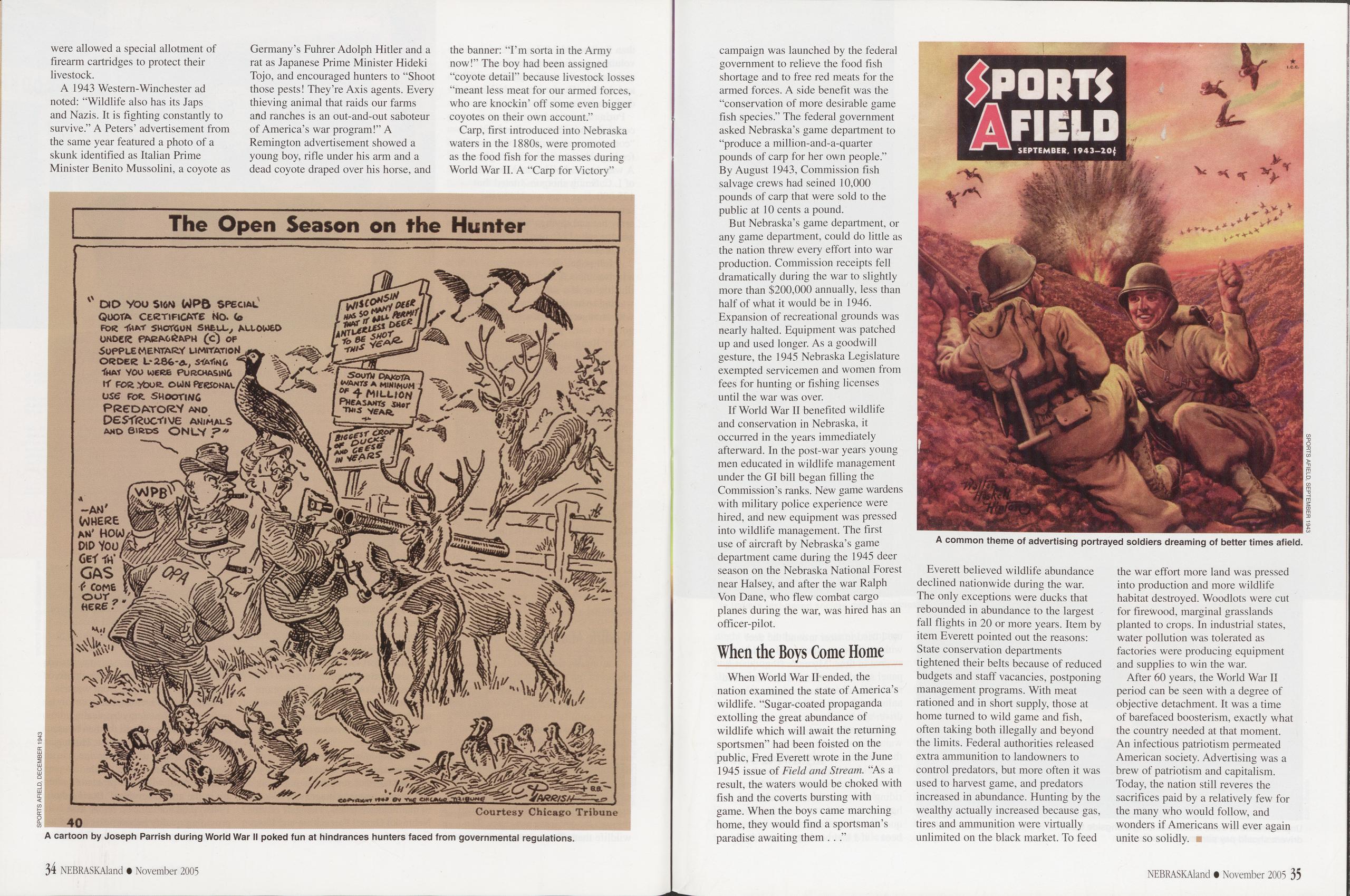
A 1943 Western-Winchester ad noted: "Wildlife also has its Japs and Nazis. It is fighting constantly to survive.” A Peters’ advertisement from the same year featured a photo of a skunk identified as Italian Prime Minister Benito Mussolini, a coyote as
Carp, first introduced into Nebraska waters in the 1880s, were promoted as the food fish for the masses during World War II. A "Carp for Victory” campaign was launched by the federal government to relieve the food fish shortage and to free red meats for the armed forces. A side benefit was the "conservation of more desirable game fish species.” The federal government asked Nebraska’s game department to "produce a million-and-a-quarter pounds of carp for her own people.” By August 1943, Commission fish salvage crews had seined 10,000 pounds of carp that were sold to the public at 10 cents a pound.
But Nebraska’s game department, or any game department, could do little as the nation threw every effort into war production. Commission receipts fell dramatically during the war to slightly more than $200,000 annually, less than half of what it would be in 1946. Expansion of recreational grounds was nearly halted. Equipment was patched up and used longer. As a goodwill gesture, the 1945 Nebraska Legislature exempted servicemen and women from fees for hunting or fishing licenses until the war was over.
If World War II benefited wildlife and conservation in Nebraska, it occurred in the years immediately afterward. In the post-war years young men educated in wildlife management under the GI bill began filling the Commission’s ranks. New game wardens with military police experience were hired, and new equipment was pressed into wildlife management. The first use of aircraft by Nebraska’s game department came during the 1945 deer season on the Nebraska National Forest near Halsey, and after the war Ralph Von Dane, who flew combat cargo planes during the war, was hired has an officer-pilot.
When the Boys Come HomeWhen World War II ended, the nation examined the state of America’s wildlife. "Sugar-coated propaganda extolling the great abundance of wildlife which will await the returning sportsmen” had been foisted on the public, Fred Everett wrote in the June 1945 issue of Field and Stream. "As a result, the waters would be choked with fish and the coverts bursting with game. When the boys came marching home, they would find a sportsman’s paradise awaiting them . . .”
Everett believed wildlife abundance declined nationwide during the war. The only exceptions were ducks that rebounded in abundance to the largest fall flights in 20 or more years. Item by item Everett pointed out the reasons: State conservation departments tightened their belts because of reduced budgets and staff vacancies, postponing management programs. With meat rationed and in short supply, those at home turned to wild game and fish, often taking both illegally and beyond the limits. Federal authorities released extra ammunition to landowners to control predators, but more often it was used to harvest game, and predators increased in abundance. Hunting by the wealthy actually increased because gas, tires and ammunition were virtually unlimited on the black market. To feed the war effort more land was pressed into production and more wildlife habitat destroyed. Woodlots were cut for firewood, marginal grasslands planted to crops. In industrial states, water pollution was tolerated as factories were producing equipment and supplies to win the war.
After 60 years, the World War II period can be seen with a degree of objective detachment. It was a time of barefaced boosterism, exactly what the country needed at that moment. An infectious patriotism permeated American society. Advertising was a brew of patriotism and capitalism. Today, the nation still reveres the sacrifices paid by a relatively few for the many who would follow, and wonders if Americans will ever again unite so solidly.
NEBRASKAland • November 2005 35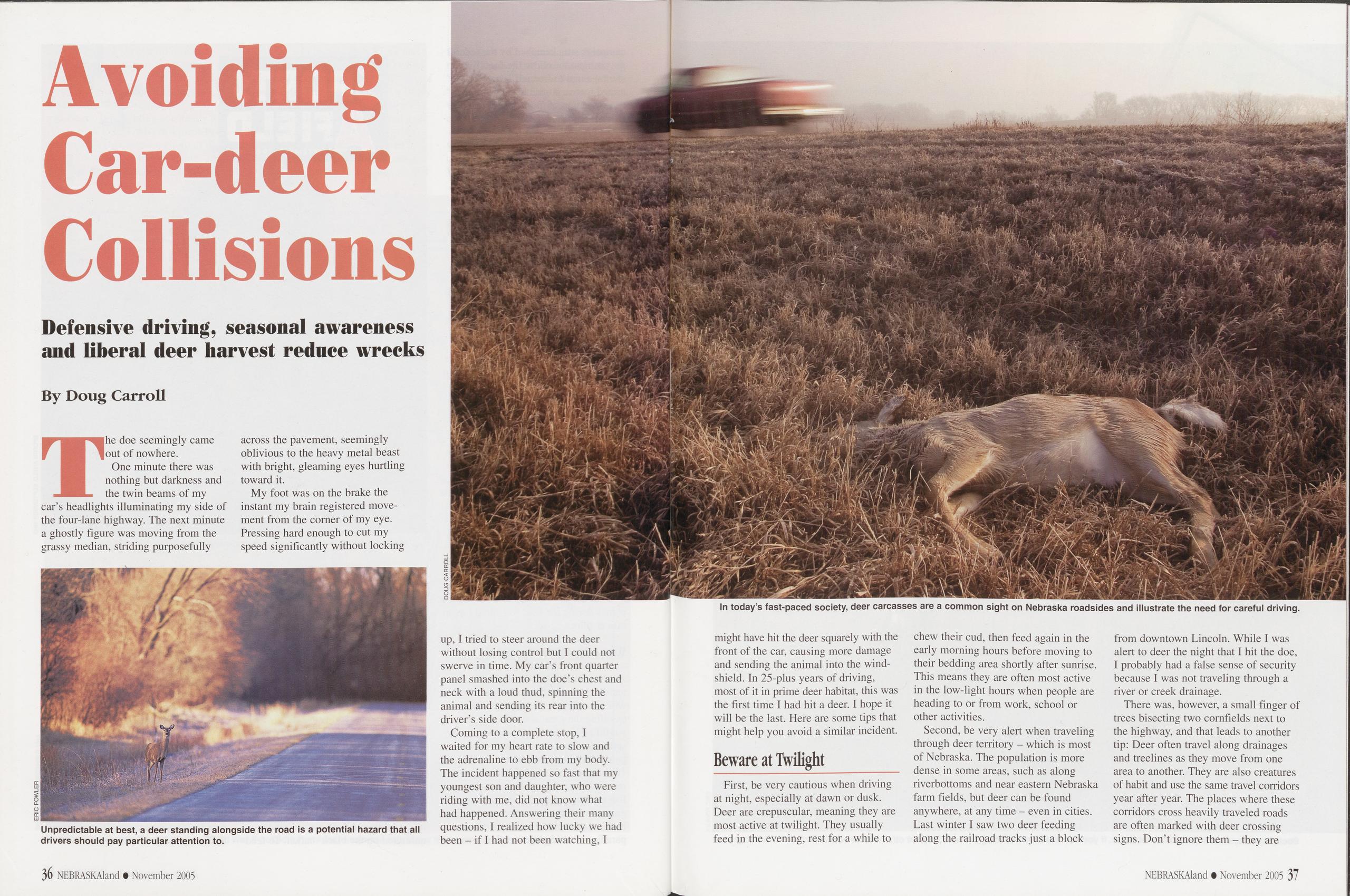
Avoiding Car-deer Collisions
Defensive driving, seasonal awareness and liberal deer harvest reduce wrecks
The doe seemingly came out of nowhere. One minute there was nothing but darkness and the twin beams of my car’s headlights illuminating my side of the four-lane highway. The next minute a ghostly figure was moving from the grassy median, striding purposefully
My foot was on the brake the instant my brain registered move- ment from the corner of my eye. Pressing hard enough to cut my speed significantly without locking
Coming to a complete stop, I waited for my heart rate to slow and the adrenaline to ebb from my body. The incident happened so fast that my youngest son and daughter, who were riding with me, did not know what had happened. Answering their many questions, I realized how lucky we had been - if I had not been watching, I might have hit the deer squarely with the front of the car, causing more damage and sending the animal into the wind- shield. In 25-plus years of driving, most of it in prime deer habitat, this was the first time I had hit a deer. I hope it will be the last. Here are some tips that might help you avoid a similar incident.
Beware at TwilightFirst, be very cautious when driving at night, especially at dawn or dusk. Deer are crepuscular, meaning they are most active at twilight. They usually feed in the evening, rest for a while to chew their cud, then feed again in the early morning hours before moving to their bedding area shortly after sunrise. This means they are often most active in the low-light hours when people are heading to or from work, school or other activities.
Second, be very alert when traveling through deer territory - which is most of Nebraska. The population is more dense in some areas, such as along riverbottoms and near eastern Nebraska farm fields, but deer can be found anywhere, at any time - even in cities. Last winter I saw two deer feeding along the railroad tracks just a block from downtown Lincoln. While I was alert to deer the night that I hit the doe, I probably had a false sense of security because I was not traveling through a river or creek drainage.
There was, however, a small finger of
trees bisecting two cornfields next to
the highway, and that leads to another
tip: Deer often travel along drainages
and treelines as they move from one
area to another. They are also creatures
of habit and use the same travel corridors
year after year. The places where these
corridors cross heavily traveled roads
are often marked with deer crossing
signs. Don’t ignore them - they are
36 NEBRASKAland • November 2005
NEBRASKAland • November 2005 37
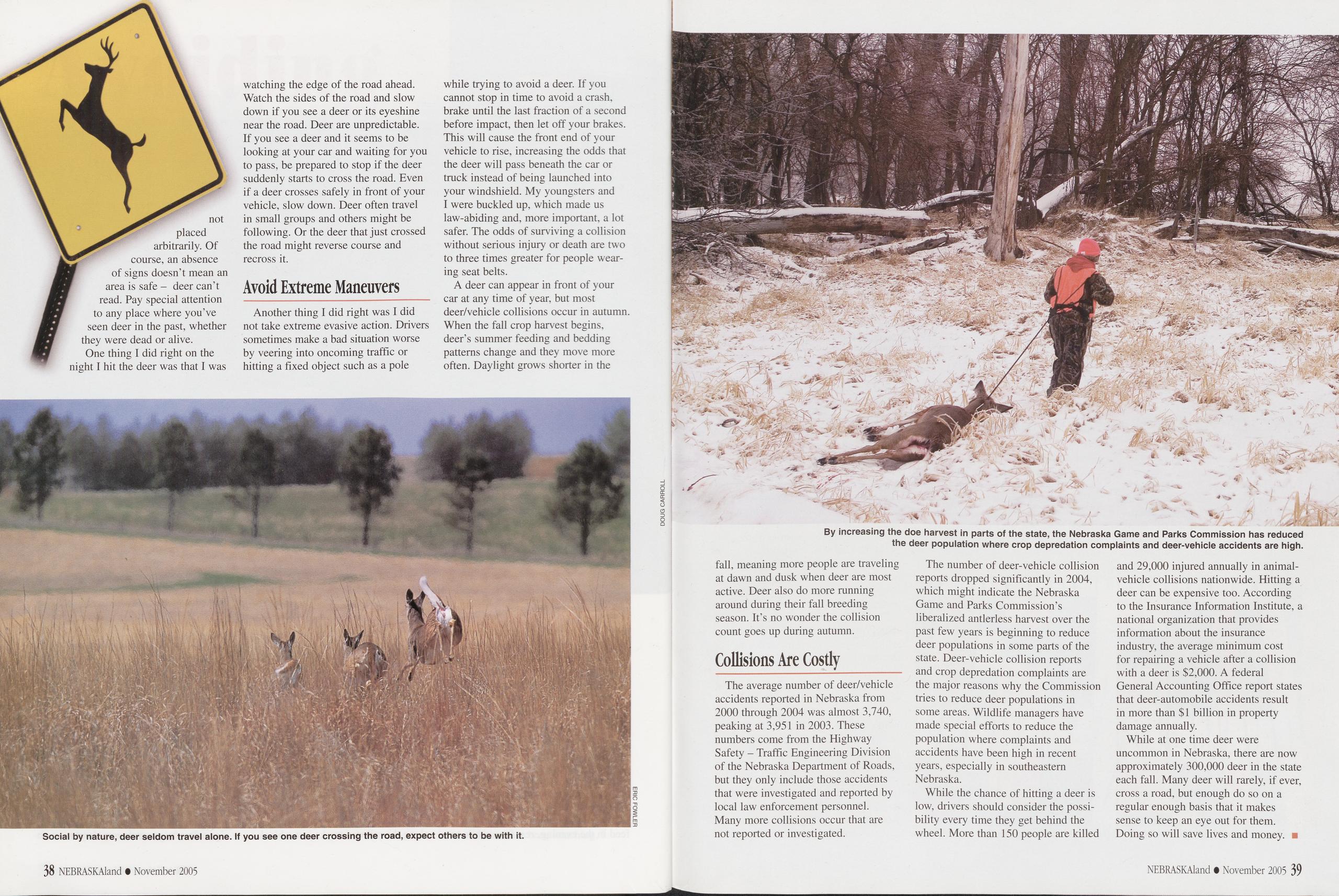 not
placed
arbitrarily. Of
course, an absence
of signs doesn’t mean an
area is safe - deer can’t
read. Pay special attention
to any place where you’ve
seen deer in the past, whether
they were dead or alive.
not
placed
arbitrarily. Of
course, an absence
of signs doesn’t mean an
area is safe - deer can’t
read. Pay special attention
to any place where you’ve
seen deer in the past, whether
they were dead or alive.
One thing I did right on the night I hit the deer was that I was watching the edge of the road ahead. Watch the sides of the road and slow down if you see a deer or its eyeshine near the road. Deer are unpredictable. If you see a deer and it seems to be looking at your car and waiting for you to pass, be prepared to stop if the deer suddenly starts to cross the road. Even if a deer crosses safely in front of your vehicle, slow down. Deer often travel in small groups and others might be following. Or the deer that just crossed the road might reverse course and recross it.
Avoid Extreme ManeuversAnother thing I did right was I did not take extreme evasive action. Drivers sometimes make a bad situation worse by veering into oncoming traffic or hitting a fixed object such as a pole
A deer can appear in front of your car at any time of year, but most deer/vehicle collisions occur in autumn. When the fall crop harvest begins, deer’s summer feeding and bedding patterns change and they move more often. Daylight grows shorter in the DOUG CARROLL
The average number of deer/vehicle accidents reported in Nebraska from 2000 through 2004 was almost 3,740, peaking at 3,951 in 2003. These numbers come from the Highway Safety - Traffic Engineering Division of the Nebraska Department of Roads, but they only include those accidents that were investigated and reported by local law enforcement personnel. Many more collisions occur that are not reported or investigated.
The number of deer-vehicle collision reports dropped significantly in 2004, which might indicate the Nebraska Game and Parks Commission’s liberalized antlerless harvest over the past few years is beginning to reduce deer populations in some parts of the state. Deer-vehicle collision reports and crop depredation complaints are the major reasons why the Commission tries to reduce deer populations in some areas. Wildlife managers have made special efforts to reduce the population where complaints and accidents have been high in recent years, especially in southeastern Nebraska.
While the chance of hitting a deer is low, drivers should consider the possi- bility every time they get behind the wheel. More than 150 people are killed and 29,000 injured annually in animal- vehicle collisions nationwide. Hitting a deer can be expensive too. According to the Insurance Information Institute, a national organization that provides information about the insurance industry, the average minimum cost for repairing a vehicle after a collision with a deer is $2,000. A federal General Accounting Office report states that deer-automobile accidents result in more than $ 1 billion in property damage annually.
While at one time deer were uncommon in Nebraska, there are now approximately 300,000 deer in the state each fall. Many deer will rarely, if ever, cross a road, but enough do so on a regular enough basis that it makes sense to keep an eye out for them. Doing so will save lives and money.
38 NEBRASKAland • November 2005 NEBRASKAland • November 2005 39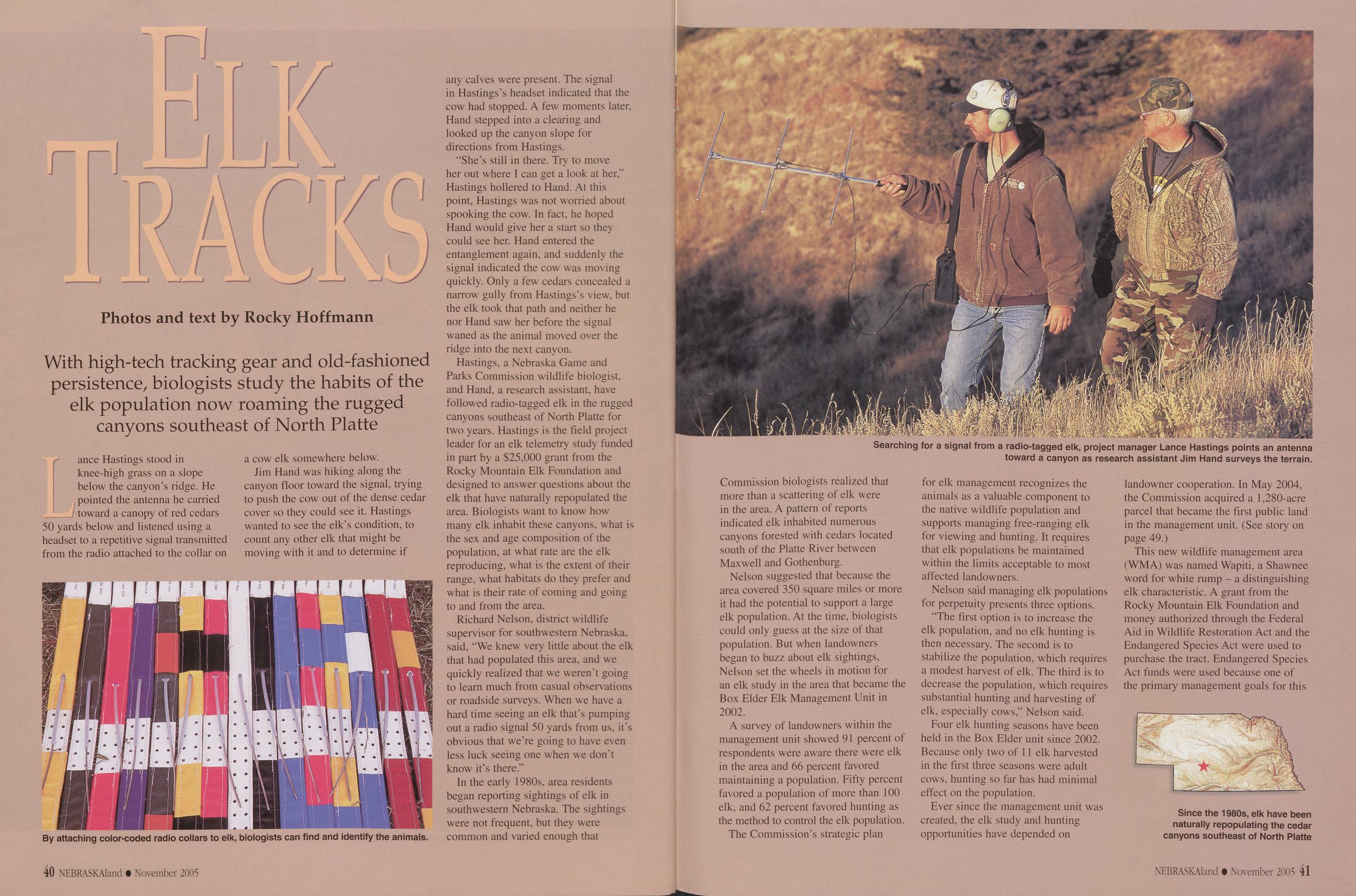
Elk Tracks
With high-tech tracking gear and old-fashioned persistence, biologists study the habits of the elk population now roaming the rugged canyons southeast of North Platte
Lance Hastings stood in knee-high grass on a slope below the canyon’s ridge. He pointed the antenna he carried toward a canopy of red cedars 50 yards below and listened using a headset to a repetitive signal transmitted from the radio attached to the collar on
Jim Hand was hiking along the canyon floor toward the signal, trying to push the cow out of the dense cedar cover so they could see it. Hastings wanted to see the elk’s condition, to count any other elk that might be moving with it and to determine if any calves were present. The signal in Hastings’s headset indicated that the cow had stopped. A few moments later. Hand stepped into a clearing and looked up the canyon slope for directions from Hastings.
“She’s still in there. Try to move her out where I can get a look at her,” Hastings hollered to Hand. At this point, Hastings was not worried about spooking the cow. In fact, he hoped Hand would give her a start so they could see her. Hand entered the entanglement again, and suddenly the signal indicated the cow was moving quickly. Only a few cedars concealed a narrow gully from Hastings’s view, but the elk took that path and neither he nor Hand saw her before the signal waned as the animal moved over the ridge into the next canyon.
Hastings, a Nebraska Game and Parks Commission wildlife biologist, and Hand, a research assistant, have followed radio-tagged elk in the rugged canyons southeast of North Platte for two years. Hastings is the field project leader for an elk telemetry study funded in part by a $25,000 grant from the Rocky Mountain Elk Foundation and designed to answer questions about the elk that have naturally repopulated the area. Biologists want to know how many elk inhabit these canyons, what is the sex and age composition of the population, at what rate are the elk reproducing, what is the extent of their range, what habitats do they prefer and what is their rate of coming and going to and from the area.
Richard Nelson, district wildlife supervisor for southwestern Nebraska, said, “We knew very little about the elk that had populated this area, and we quickly realized that we weren’t going to learn much from casual observations or roadside surveys. When we have a hard time seeing an elk that’s pumping out a radio signal 50 yards from us, it’s obvious that we’re going to have even less luck seeing one when we don’t know it’s there.”
In the early 1980s, area residents began reporting sightings of elk in southwestern Nebraska. The sightings were not frequent, but they were common and varied enough that
Nelson suggested that because the area covered 350 square miles or more it had the potential to support a large elk population. At the time, biologists could only guess at the size of that population. But when landowners began to buzz about elk sightings, Nelson set the wheels in motion for an elk study in the area that became the Box Elder Elk Management Unit in 2002.
A survey of landowners within the management unit showed 91 percent of respondents were aware there were elk in the area and 66 percent favored maintaining a population. Fifty percent favored a population of more than 100 elk, and 62 percent favored hunting as the method to control the elk population.
The Commission’s strategic plan for elk management recognizes the animals as a valuable component to the native wildlife population and supports managing free-ranging elk for viewing and hunting. It requires that elk populations be maintained within the limits acceptable to most affected landowners.
Nelson said managing elk populations for perpetuity presents three options.
“The first option is to increase the elk population, and no elk hunting is then necessary. The second is to stabilize the population, which requires a modest harvest of elk. The third is to decrease the population, which requires substantial hunting and harvesting of elk, especially cows,” Nelson said.
Four elk hunting seasons have been held in the Box Elder unit since 2002. Because only two of 11 elk harvested in the first three seasons were adult cows, hunting so far has had minimal effect on the population.
Ever since the management unit was created, the elk study and hunting opportunities have depended on landowner cooperation. In May 2004, the Commission acquired a 1,280-acre parcel that became the first public land in the management unit. (See story on page 49.)
This new wildlife management area
(WMA) was named Wapiti, a Shawnee
word for white rump - a distinguishing
elk characteristic. A grant from the
Rocky Mountain Elk Foundation and
money authorized through the Federal
Aid in Wildlife Restoration Act and the
Endangered Species Act were used to
purchase the tract. Endangered Species
Act funds were used because one of
the primary management goals for this
Since the 1980s, elk have been
naturally repopulating the cedar
canyons southeast of North Platte
NEBRASKAland O November 2005 41
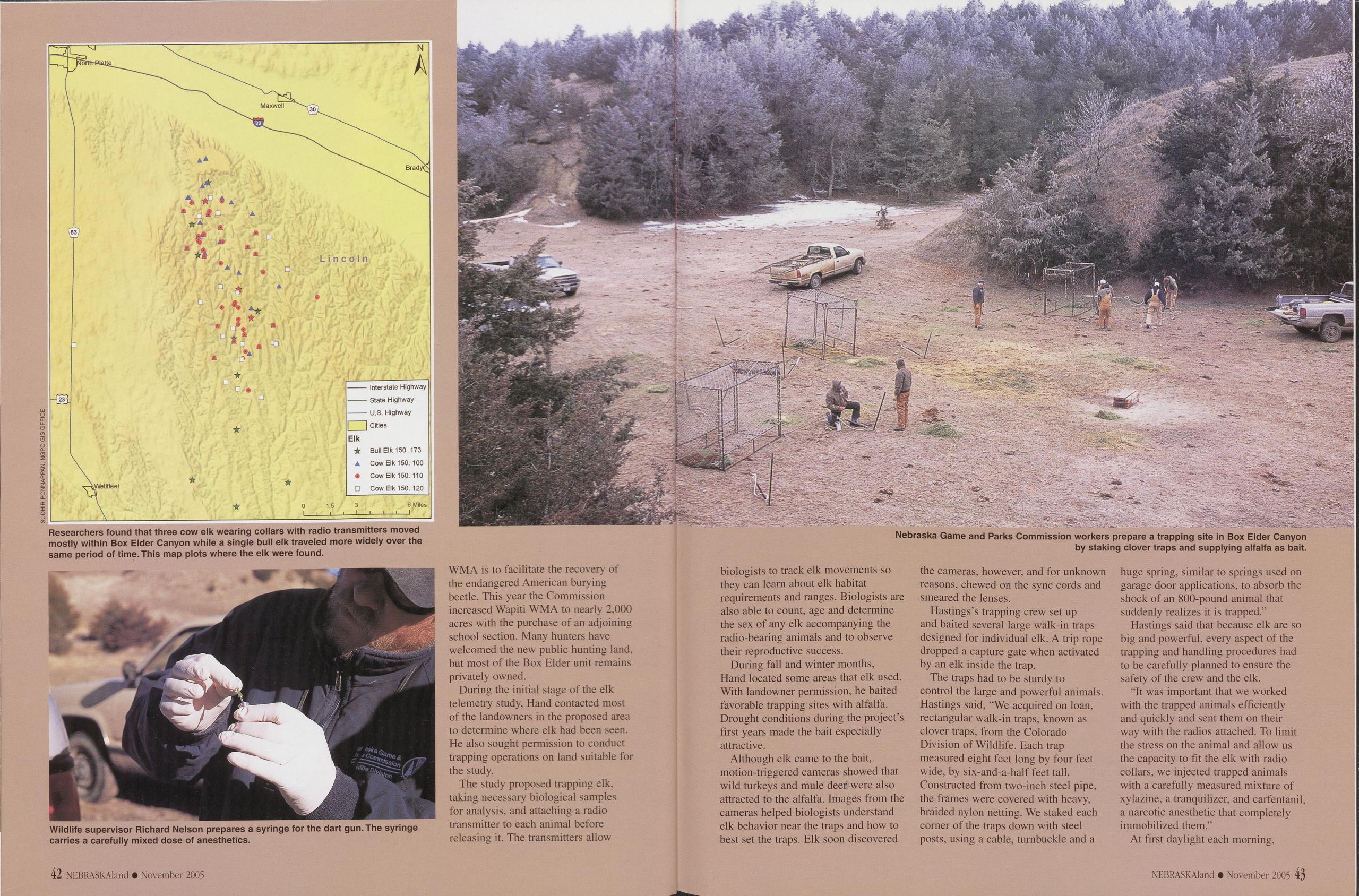
During the initial stage of the elk telemetry study, Hand contacted most of the landowners in the proposed area to determine where elk had been seen. He also sought permission to conduct trapping operations on land suitable for the study.
The study proposed trapping elk, taking necessary biological samples for analysis, and attaching a radio transmitter to each animal before releasing it. The transmitters allow biologists to track elk movements so they can learn about elk habitat requirements and ranges. Biologists are also able to count, age and determine the sex of any elk accompanying the radio-bearing animals and to observe their reproductive success.
During fall and winter months, Hand located some areas that elk used. With landowner permission, he baited favorable trapping sites with alfalfa. Drought conditions during the project’s first years made the bait especially attractive.
Although elk came to the bait, motion-triggered cameras showed that wild turkeys and mule deer were also attracted to the alfalfa. Images from the cameras helped biologists understand elk behavior near the traps and how to best set the traps. Elk soon discovered the cameras, however, and for unknown reasons, chewed on the sync cords and smeared the lenses.
Hastings’s trapping crew set up and baited several large walk-in traps designed for individual elk. A trip rope dropped a capture gate when activated by an elk inside the trap.
The traps had to be sturdy to control the large and powerful animals. Hastings said, “We acquired on loan, rectangular walk-in traps, known as clover traps, from the Colorado Division of Wildlife. Each trap measured eight feet long by four feet wide, by six-and-a-half feet tall. Constructed from two-inch steel pipe, the frames were covered with heavy, braided nylon netting. We staked each corner of the traps down with steel posts, using a cable, turnbuckle and a huge spring, similar to springs used on garage door applications, to absorb the shock of an 800-pound animal that suddenly realizes it is trapped.”
Hastings said that because elk are so big and powerful, every aspect of the trapping and handling procedures had to be carefully planned to ensure the safety of the crew and the elk.
“It was important that we worked with the trapped animals efficiently and quickly and sent them on their way with the radios attached. To limit the stress on the animal and allow us the capacity to fit the elk with radio collars, we injected trapped animals with a carefully measured mixture of xylazine, a tranquilizer, and carfentanil, a narcotic anesthetic that completely immobilized them.”
At first daylight each morning,
42 NEBRASKAland • November 2005
NEBRASKAland • November 2005 43
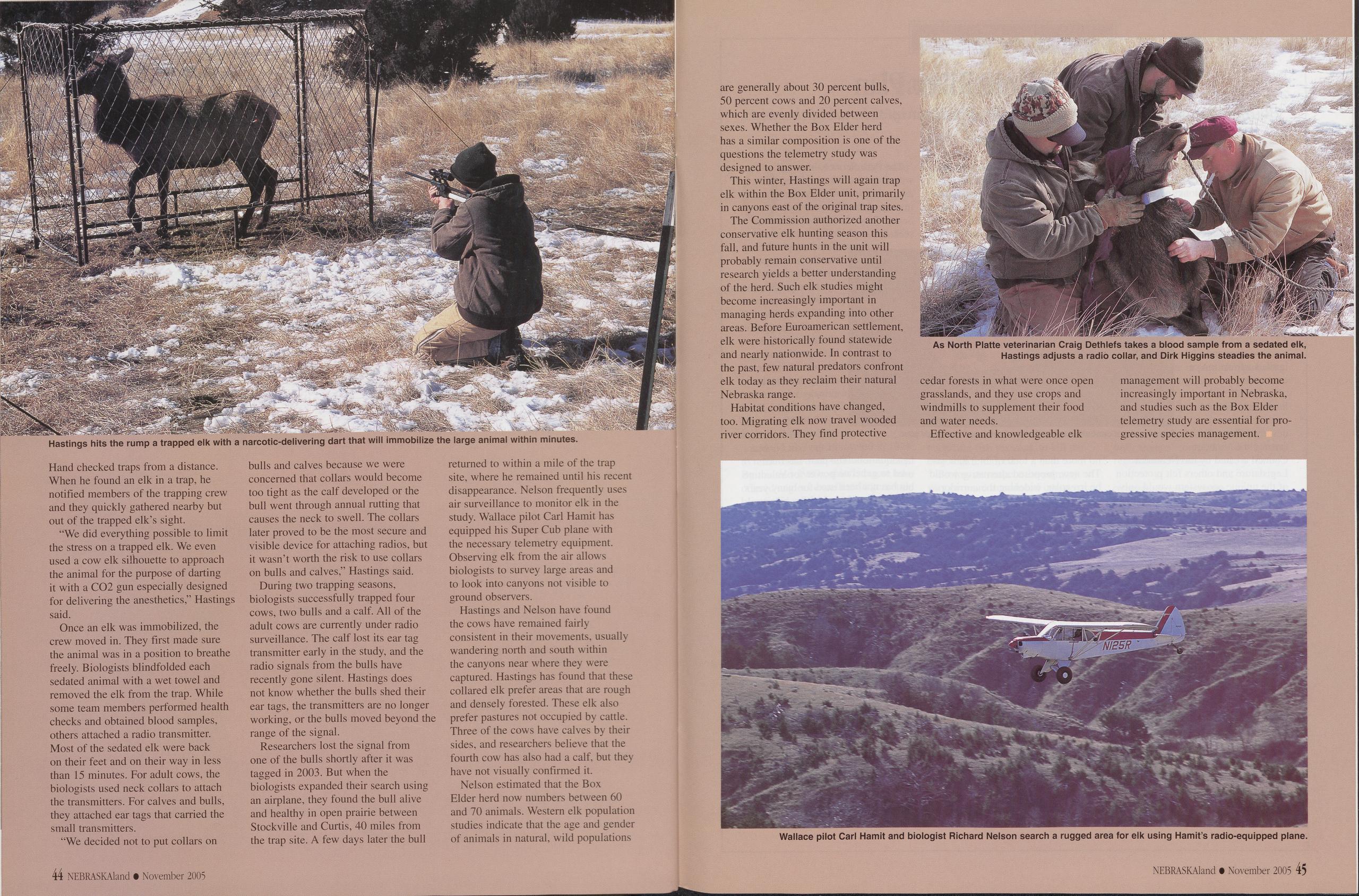
"We did everything possible to limit the stress on a trapped elk. We even used a cow elk silhouette to approach the animal for the purpose of darting it with a CO2 gun especially designed for delivering the anesthetics,” Hastings said.
Once an elk was immobilized, the crew moved in. They first made sure the animal was in a position to breathe freely. Biologists blindfolded each sedated animal with a wet towel and removed the elk from the trap. While some team members performed health checks and obtained blood samples, others attached a radio transmitter. Most of the sedated elk were back on their feet and on their way in less than 15 minutes. For adult cows, the biologists used neck collars to attach the transmitters. For calves and bulls, they attached ear tags that carried the small transmitters.
“We decided not to put collars on 44 NEBRASKAland • November 2005 bulls and calves because we were concerned that collars would become too tight as the calf developed or the bull went through annual rutting that causes the neck to swell. The collars later proved to be the most secure and visible device for attaching radios, but it wasn’t worth the risk to use collars on bulls and calves,” Hastings said.
During two trapping seasons, biologists successfully trapped four cows, two bulls and a calf. All of the adult cows are currently under radio surveillance. The calf lost its ear tag transmitter early in the study, and the radio signals from the bulls have recently gone silent. Hastings does not know whether the bulls shed their ear tags, the transmitters are no longer working, or the bulls moved beyond the range of the signal.
Researchers lost the signal from one of the bulls shortly after it was tagged in 2003. But when the biologists expanded their search using an airplane, they found the bull alive and healthy in open prairie between Stockville and Curtis, 40 miles from the trap site. A few days later the bull returned to within a mile of the trap site, where he remained until his recent disappearance. Nelson frequently uses air surveillance to monitor elk in the study. Wallace pilot Carl Hamit has equipped his Super Cub plane with the necessary telemetry equipment. Observing elk from the air allows biologists to survey large areas and to look into canyons not visible to ground observers.
Hastings and Nelson have found the cows have remained fairly consistent in their movements, usually wandering north and south within the canyons near where they were captured. Hastings has found that these collared elk prefer areas that are rough and densely forested. These elk also prefer pastures not occupied by cattle. Three of the cows have calves by their sides, and researchers believe that the fourth cow has also had a calf, but they have not visually confirmed it.
Nelson estimated that the Box Elder herd now numbers between 60 and 70 animals. Western elk population studies indicate that the age and gender of animals in natural, wild populations are generally about 30 percent bulls, 50 percent cows and 20 percent calves, which are evenly divided between sexes. Whether the Box Elder herd has a similar composition is one of the questions the telemetry study was designed to answer.
This winter, Hastings will again trap elk within the Box Elder unit, primarily in canyons east of the original trap sites.
The Commission authorized another conservative elk hunting season this fall, and future hunts in the unit will probably remain conservative until research yields a better understanding of the herd. Such elk studies might become increasingly important in managing herds expanding into other areas. Before Euroamerican settlement, elk were historically found statewide and nearly nationwide. In contrast to the past, few natural predators confront elk today as they reclaim their natural Nebraska range.
Habitat conditions have changed, too. Migrating elk now travel wooded river corridors. They find protective
Effective and knowledgeable elk management will probably become increasingly important in Nebraska, and studies such as the Box Elder telemetry study are essential for pro- gressive species management.
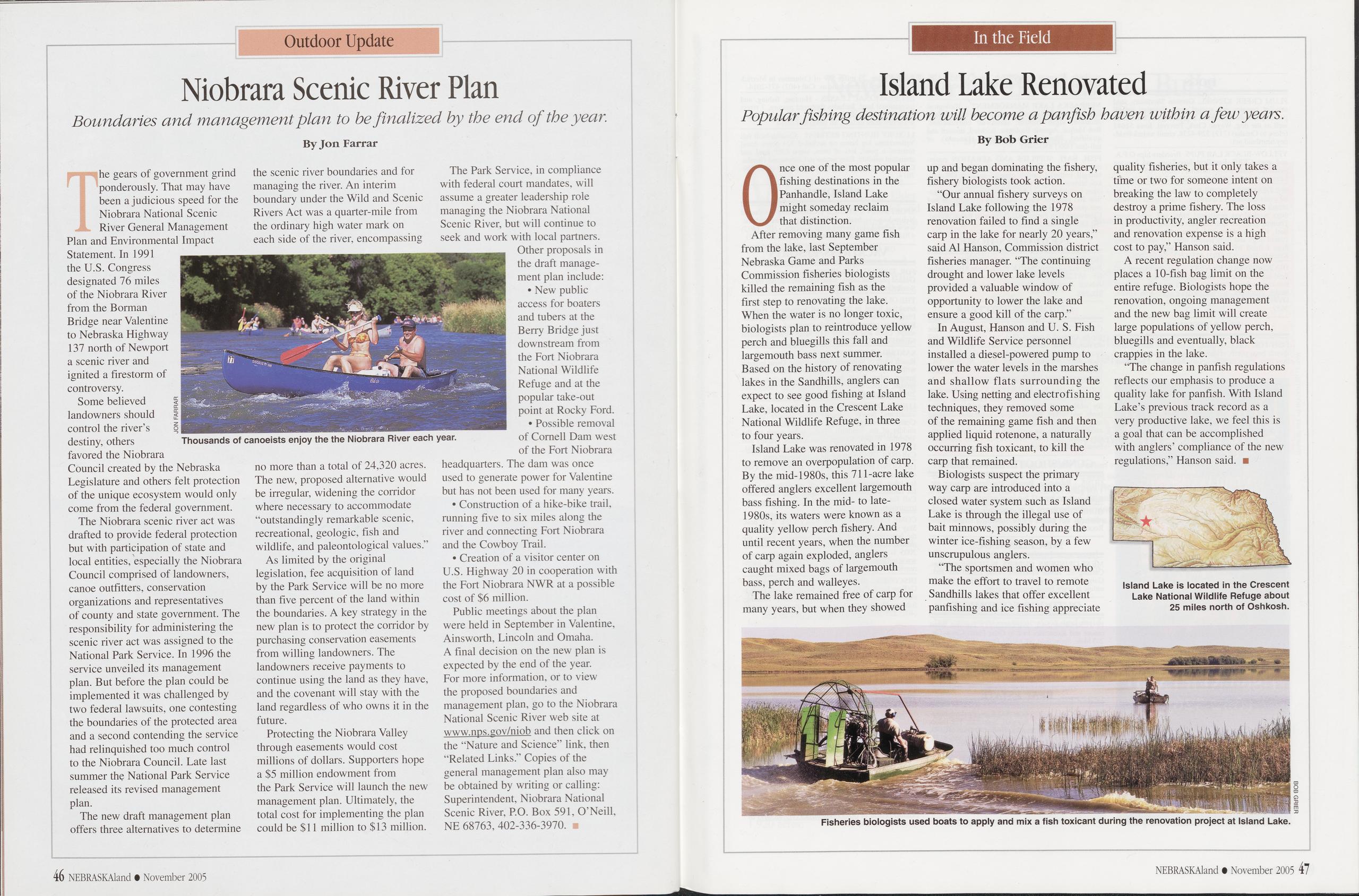
Outdoor Update
Niobrara Scenic River Plan
Boundaries and management plan to be finalized by the end of the year.
The gears of government grind ponderously. That may have been a judicious speed for the Niobrara National Scenic River General Management Plan and Environmental Impact Statement. In 1991 the U.S. Congress designated 76 miles of the Niobrara River from the Borman Bridge near Valentine to Nebraska Highway 137 north of Newport a scenic river and ignited a firestorm of controversy.
Some believed landowners should control the river’s destiny, others favored the Niobrara Council created by the Nebraska Legislature and others felt protection of the unique ecosystem would only come from the federal government.
The Niobrara scenic river act was drafted to provide federal protection but with participation of state and local entities, especially the Niobrara Council comprised of landowners, canoe outfitters, conservation organizations and representatives of county and state government. The responsibility for administering the scenic river act was assigned to the National Park Service. In 1996 the service unveiled its management plan. But before the plan could be implemented it was challenged by two federal lawsuits, one contesting the boundaries of the protected area and a second contending the service had relinquished too much control to the Niobrara Council. Late last summer the National Park Service released its revised management plan.
The new draft management plan offers three alternatives to determine the scenic river boundaries and for managing the river. An interim boundary under the Wild and Scenic Rivers Act was a quarter-mile from the ordinary high water mark on each side of the river, encompassing
As limited by the original legislation, fee acquisition of land by the Park Service will be no more than five percent of the land within the boundaries. A key strategy in the new plan is to protect the corridor by purchasing conservation easements from willing landowners. The landowners receive payments to continue using the land as they have, and the covenant will stay with the land regardless of who owns it in the future.
Protecting the Niobrara Valley through easements would cost millions of dollars. Supporters hope a $5 million endowment from the Park Service will launch the new management plan. Ultimately, the total cost for implementing the plan could be $11 million to $13 million.
The Park Service, in compliance with federal court mandates, will assume a greater leadership role managing the Niobrara National Scenic River, but will continue to seek and work with local partners. Other proposals in the draft manage- ment plan include:
•New public access for boaters and tubers at the Berry Bridge just downstream from the Fort Niobrara National Wildlife Refuge and at the popular take-out point at Rocky Ford.
•Possible removal of Cornell Dam west of the Fort Niobrara headquarters. The dam was once used to generate power for Valentine but has not been used for many years.
•Construction of a hike-bike trail, running five to six miles along the river and connecting Fort Niobrara and the Cowboy Trail.
•Creation of a visitor center on U.S. Highway 20 in cooperation with the Fort Niobrara NWR at a possible cost of $6 million.
Public meetings about the plan were held in September in Valentine, Ainsworth, Lincoln and Omaha. A final decision on the new plan is expected by the end of the year. For more information, or to view the proposed boundaries and management plan, go to the Niobrara National Scenic River web site at www.nps.gov/niob and then click on the "Nature and Science” link, then "Related Links.” Copies of the general management plan also may be obtained by writing or calling: Superintendent, Niobrara National Scenic River, P.O. Box 591, O’Neill, NE 68763, 402-336-3970.
In the Field
Island Lake Renovated
Popular fishing destination will become a panfish haven within a few years.
Once one of the most popular fishing destinations in the Panhandle, Island Lake might someday reclaim that distinction.
After removing many game fish from the lake, last September Nebraska Game and Parks Commission fisheries biologists killed the remaining fish as the first step to renovating the lake. When the water is no longer toxic, biologists plan to reintroduce yellow perch and bluegills this fall and largemouth bass next summer. Based on the history of renovating lakes in the Sandhills, anglers can expect to see good fishing at Island Lake, located in the Crescent Lake National Wildlife Refuge, in three to four years.
Island Lake was renovated in 1978 to remove an overpopulation of carp. By the mid-1980s, this 711-acre lake offered anglers excellent largemouth bass fishing. In the mid- to late- 1980s, its waters were known as a quality yellow perch fishery. And until recent years, when the number of carp again exploded, anglers caught mixed bags of largemouth bass, perch and walleyes.
The lake remained free of carp for many years, but when they showed
"Our annual fishery surveys on Island Lake following the 1978 renovation failed to find a single carp in the lake for nearly 20 years,” said Al Hanson, Commission district fisheries manager. "The continuing drought and lower lake levels provided a valuable window of opportunity to lower the lake and ensure a good kill of the carp.”
In August, Hanson and U. S. Fish and Wildlife Service personnel installed a diesel-powered pump to lower the water levels in the marshes and shallow flats surrounding the lake. Using netting and electrofishing techniques, they removed some of the remaining game fish and then applied liquid rotenone, a naturally occurring fish toxicant, to kill the carp that remained.
Biologists suspect the primary way carp are introduced into a closed water system such as Island Lake is through the illegal use of bait minnows, possibly during the winter ice-fishing season, by a few unscrupulous anglers.
"The sportsmen and women who make the effort to travel to remote Sandhills lakes that offer excellent panfishing and ice fishing appreciate quality fisheries, but it only takes a time or two for someone intent on breaking the law to completely destroy a prime fishery. The loss in productivity, angler recreation and renovation expense is a high cost to pay,” Hanson said.
A recent regulation change now places a 10-fish bag limit on the entire refuge. Biologists hope the renovation, ongoing management and the new bag limit will create large populations of yellow perch, bluegills and eventually, black crappies in the lake.
"The change in panfish regulations reflects our emphasis to produce a quality lake for panfish. With Island Lake’s previous track record as a very productive lake, we feel this is a goal that can be accomplished with anglers’ compliance of the new regulations,” Hanson said.
Classifieds
DOGS PLUM CREEK KENNEL. German Shorthairs, stud service, puppies and started dogs. Training for all pointing breeds. Specialize in training the handler as well as the dog. Wayne Clark, Percival, Iowa 51648 (close to Omaha) (712) 529-4238, email wclark@sid- ney.heartland.net. YELLOW-BLACK LAB PUPS. Breeders hips O.F.A. and eyes CERF. Excellent bloodlines and hunting potential. Call Dave Bendler (308) 785-2554 in Lexington or Scott Bendler (402) 477-1305, Lincoln. WILDERNESS KENNELS. Gun dog training - over 60 years combined experience. Training all sporting breeds - retrievers, flushing and pointing dogs. All dogs worked on pen-raised birds and wild game. Training program also includes obedience training - heel, sit, stay, down and come when called. Pups, started dogs and fully trained dogs for sale. Hunting dogs trained by hunters. Henry Sader, Wilderness Kennels, Roca, NE (402) 423-4212. Since 1968. DUCKDAWG RETRIEVERS - Raising exceptional field-bred Labradors. Hunting, family and competi- tion companions. Puppies raised in our home. Written health guarantee, www.duckdawg.com. Ron Green, DVM and Libby Milroy, North Platte, NE (308) 534- 3659. FISH/FISHING FISH FOR SALE. Catfish, largemouth bass, small- mouth bass, perch, crappies, bluegills, walleyes, rain- bow trout, grass carp, minnows, bullheads. Consulting available. Pleasant Valley Fish Farm, 27851 U.S. Highway 83, McCook, NE 69001. Phone (308) 345-6599. NEBRASKA LAKE MANAGEMENT - Biological lake surveys, fish stocking, rough fish control, lake aeration, algae control, shorewall construction. Rob Hofpar, Aquatic Biologist, licensed, insured and qualified. Phone (402) 784-6005 (Lincoln), or toll-free (888) 850-2460. FISH, BAIT, SUPPLIES AND AERATION equip- ment for sale. LM bass, SM bass, bluegill, Hyb. bluegill, bullhead, catfish, crappie, goldfish, GR carp, koi, minnows, perch, pike, trout, walleye, wiper, of all sizes (availability and prices on request). Pond aera- tion and supplies. Large quantities of bullheads and one-pound and larger catfish available. Carlson Clearwater Fish Farms, 407 Centennial Road, Wayne, NE 68787. Phone (402) 375-3262. FOOD/GIFTS/HOME HOMEBREWING/BEER AND WINEMAKING. Fermenter’s Supply, 8410 K Plaza, Suite #10, Omaha, NE 68127. Phone orders only, (888) 655-2739. Advice line (402) 593-9171. www.fermenterssup- ply.com GUIDES/OUTFITTERS CANOE THE NIOBRARA with an affordable canoe trip by Dryland Aquatics. One- and two-day trips...full service, or just canoe, tube or kayak. Transportation furnished. Your Niobrara River specialists... We do it your way! Dryland Aquatics, Dept. N, Box 33C, Sparks, NE 69220 or phone (800) 337-3119. www.dry- landaquatics.com, info@drylandaquatics.com._ KRIPPLE DUCK ADVENTURES - Southwestern Nebraska. Guided hunts along the Frenchman Creek for white-tailed and mule deer, waterfowl, upland birds, and turkey. We also have a controlled-shooting area for pheasants, quail, and chukar. New lodging accommodations are available on site. For informa- tion please call (308) 394-5345 or (308) 280-5345. Email at cdom@bwtelcom.net, www.krippleduck.com GUNS/SHOOTING/ARCHERY GUNS - Browning, Benelli, Winchester, Ruger, etc. 1700 guns, buy-sell-trade (402) 729-6112, Bedlan’s, Fairbury, NE 68352. www.bedlans.com. GUNS REPAIRED, CLEANED, REFINISHED and restored, all makes (402) 420-7759. Vem’s Gun Room, Lincoln, NE mvkeiser@alltel.net. MISCELLANEOUS MEAT GRINDERS, CUBERS, BUTCHER supplies. Catalog $2. Home Processor, 4500 Ledan Rd. Ext., Gainesville, GA 30506, (770) 535-7381, visit us online at www.home-processor.com. OUTDOOR EQUIPMENT IS PERFORMANCE IMPORTANT? For the finest canoes and accessories look to Great Plains Canoe Co., 205 Main, Springfield, NE 68059. Phone (402) 253-2000. WATER SPORTS - Tubes, wakeboards, skis and more. Connelly, Hyperlite, SportsStuff, Airhead and more. Shop Nebraska’s largest Pro Shop online and save, www.buzzsmarine.com. REAL ESTATE RESIDENTIAL LOTS FOR SALE overlooking beau- tiful Calamus Lake at Burwell, Nebraska. For infor- mation contact Ron Shonka, Broker Owner, HC 79, Box 20D, Burwell, Nebraska 68823. (308) 346-4338, email rshonka@nctc.net. AMISH INTERESTED IN RELOCATING in rural Nebraska. We need information on availability of farms, etc. Eastern Nebraska would be our preference. Roy Keim, 2132 Tater Ridge Road, West Union, Ohio 45693. (937) 386-9995, daytime only. LAND AUCTION: 59.8 acres (45 irrigated) plus more than one-half mile of Platte River accretions (south channel). Excellent turkey and deer habitat. $187,500 starting price. 23 miles SW of Columbus in Merrick County, www.belf.state.ne.us. Call (402) 471-2014. RECREATIONAL LEASES - Hunting, fishing, and recreational land. Includes timbered pasture, 7 rivers and 4 creeks. Leases for 5 or more years. www.belf.state.ne.us. Call (402) 471-2014. LUXURY HUNTING RETREAT - Custom-built full Yellowstone log home on secluded 32+ acres. Land features a pond, lots of trees, some CRP land and abundant wildlife. Easy access to Lincoln and Omaha. Call Jim Novotny of Woods Bros Realty at (402) 730- 7014. TAXIDERMY SPORTSMAN’S CHOICE TAXIDERMY - Awarded Nebraska’s best all-around taxidermist. www.nebraskataxidermy.com Lincoln, NE, (402) 470-3880. VISA and MasterCard accepted. VACATIONS/RESORTS FOR FISHING AND HUNTING accommodations. Guided pheasant hunts. Jefco Inn, Gordon, NE 69343. South Cornell, (308) 282-2935. THE OLDE MAIN STREET INN. A historic bed and breakfast listed in the National Register of Historic Places. Beautiful dining room with fireplace. Featuring prime rib, buffalo, seafood, homemade soups, chilis and desserts. 115 Main Street, Chadron NE 69337 (308) 432-3380. www.chadron.com/oldemain. SANDHILLS HIDEAWAY! Scenic Double R Guest Ranch south of Valentine. Open all year. Great lodging with fully furnished kitchenettes. Fish, hunt, ride horses, relax. Right for sportsmen, families, small groups, artists, writers, newlyweds! Call (866) 217- 2042. www.sandhilldoublerranch.com______ LORD RANCH RESORT. Hunters, fishermen, family vacations, family reunions. New deluxe cabins. Complete cooking facilities. Quiet and peaceful in the middle of the Sandhills. Three miles north of the Valentine Wildlife Refuge, open all year. Aubrey and Dorothy Lord, HC 37, Box 41, Valentine, NE 69201. Call (800) 270-0181.www.lordranchresort.com DIAMOND B TROUT RESORT & RESTAURANT, Orchard, Nebraska. Restaurant, lodge, cabins, spring- fed lakes, playground equipment, paddleboats. Great for families, groups, hunters. Book your cabin now! Call for brochure (800) 974-3002. www.diamondb- troutresort.com COME EXPERIENCE COUNTRY LIFE at its best. Stay in one of Mill Iron V Lodging cabins situated in the beautiful hills of Verdigre, Nebraska. Enjoy the natural beauty savored by bird enthusiasts. New for 2005 is our petting corral for our young guests. www.milliron-v-lodging.com. (402) 668-7488, jpein- rem@carrollsweb.com. DISCOVER SOUTH-CENTRAL NEBRASKA! OxBow Inn & Cafe, Nelson, Nebraska. Newly remod- eled Inn with Bed & Breakfast character. Hunting, fishing, Oregon Trail Discovery Tours and more. (402) 225-2651. www.OxBowlnnAndCafe.com PLAN NEXT YEAR'S VACATION! Make Your Park Reservations Online at www.outdoomebraska.org or by calling (402) 4711414־ Classified Rates: 750 per word, minimum $15. Closing: First business day two months before issue date. Classified ads are accepted on a first-come, first-served, space-available basis. Classified Ads, NEBRASKAland Magazine, P.O. Box 30370, Lincoln, NE 68503-0370. Telephone (402) 471-5585. Fax: (402) 471-5528. E-mail: classifieds@ngpc.ne.gov. Ads are posted online at outdoornebraska. ora/nebland at no additional charge.Parks & Places
New WMA for Beetles and Bulls
Area offers first public hunting in the Box Elder Elk Management Unit.
When the Nebraska Game and Parks Commission established the Box Elder Elk Management Unit and set its first hunting season in 2002, the 350-square mile area southeast of North Platte had no public lands. Elk management and hunting could be pursued only with permission and cooperation from landowners.
Because elk were reestablishing herds in the area after an absence of nearly a century, wildlife biologists saw an important opportunity to study and manage these new populations. Coincidently, biologists were also pursuing studies of the endangered American burying beetle in the same area. Although insects and elk might seem to be a world apart, both these species seemed to prefer ranges of deeply dissected canyons and cedar forests, such as those in the Box Elder Elk Management Unit.
In May 2004, the habitat proximity and research potential for these different species prompted the Nebraska Game and Parks Commission to purchase a 1,280-acre tract in the heart of the Box Elder Management Unit. It was named the Wapiti Wildlife Management Area (WMA). Acquisition of the new WMA was made possible by grants funded through the Rocky Mountain Elk Foundation, Federal Aid in Wildlife Restoration Act, and a 2003 Recovery Land Acquisition Grant generated under the Endangered Species Act - Section 6. This year, with a grant from the Nebraska Environmental Trust Fund, the Commission purchased an adjoining section from the Nebraska Board of Education Lands and Funds. Wapiti WMA now covers nearly 1,920 acres.
Very little money from the Commission’s game fund was used in these purchases. Instead, wildlife funds will be used to manage four specific species in the new WMA: Rocky Mountain elk, American burying beetles, mule deer and wild turkeys.
Research projects now underway include an elk telemetry study and a unique American burying beetle telemetry study. Biologists are observing the movements and habits of six elk, which were trapped and outfitted with radio transmitters (see story on page 40), and are studying burying beetles on the property. More than 100 burying beetles have been trapped on Wapiti WMA. The goal for both studies is to determine the habitat preferences of the species.
The first habitat management priority at Wapiti WMA will be to control cedars trees. Cedars now cover 40 percent of the area and encroachment is growing at one or two percent per year.
Another management priority is to create a healthy Loess Hills mixed-grass prairie with some escape cover for deer and elk. Biologists expect to improve grass and wildflower diversity through prescribed grazing and burning.
Wapiti WMA offers public hunting opportunities for deer, elk and wild turkeys in a scenic and remote landscape. The area also offers unique birding opportunities. Rock wrens, black-billed cuckoos and black-headed grosbeaks are among the species recently documented.
48 NEBRASKAland • November 2005 NEBRASKAland • November 2005 49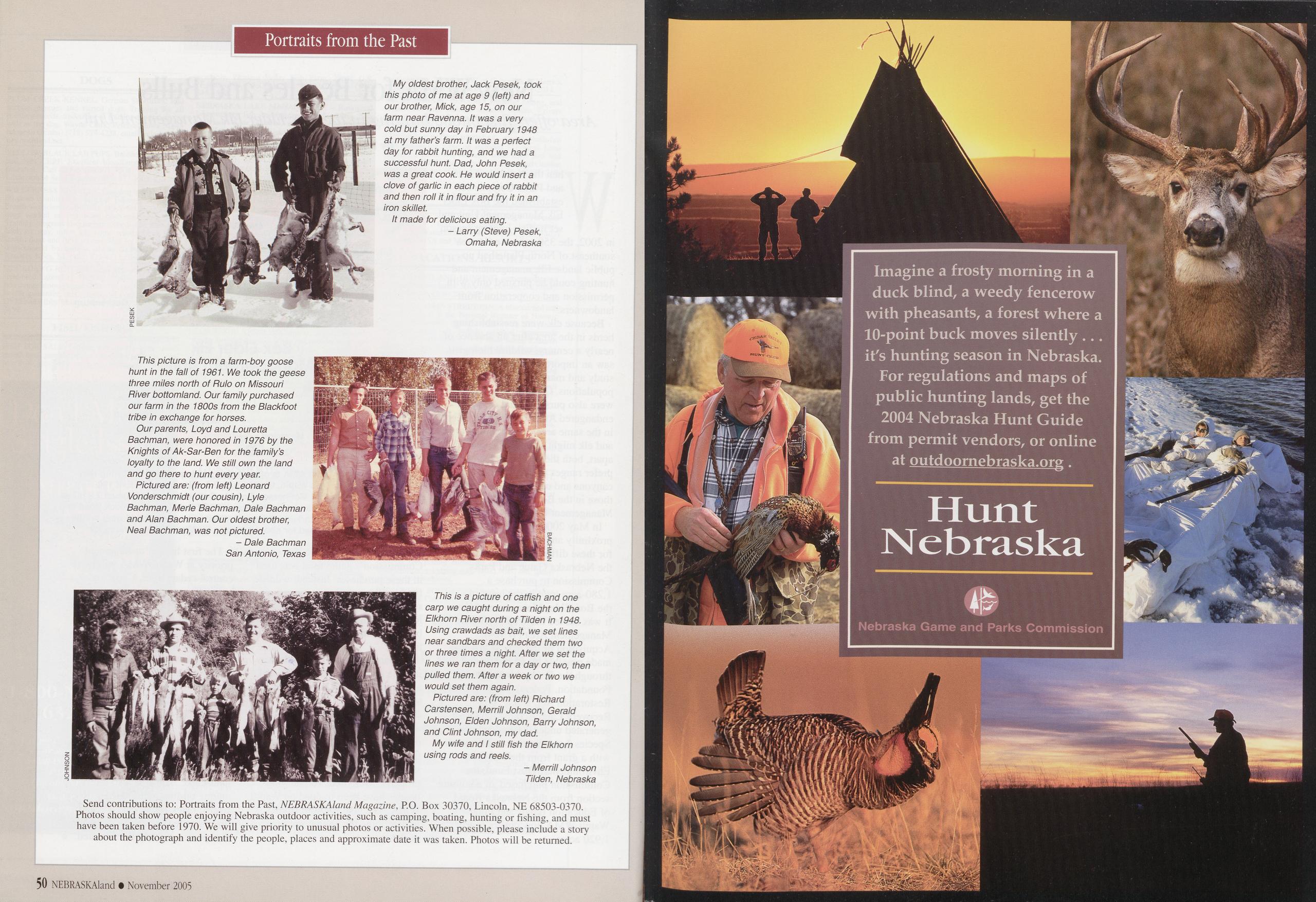
Portraits from the Past
My oldest brother, Jack Pesek, took this photo of me at age 9 (left) and our brother, Mick, age 15, on our farm near Ravenna. It was a very cold but sunny day in February 1948 at my father’s farm. It was a perfect day for rabbit hunting, and we had a successful hunt. Dad, John Pesek, was a great cook. He would insert a clove of garlic in each piece of rabbit and then roll it in flour and fry it in an iron skillet. It made for delicious eating.
- Larry (Steve) Pesek, Omaha, NebraskaThis picture is from a farm-boy goose hunt in the fall of 1961. We took the geese three miles north of Rulo on Missouri River bottomland. Our family purchased our farm in the 1800s from the Blackfoot tribe in exchange for horses.
Our parents, Loyd and Louretta Bachman, were honored in 1976 by the Knights of Ak-Sar-Ben for the family’s loyalty to the land. We still own the land and go there to hunt every year.
Pictured are: (from left) Leonard Vonderschmidt (our cousin), Lyle Bachman, Merle Bachman, Dale Bachman and Alan Bachman. Our oldest brother, Neal Bachman, was not pictured.
- Dale Bachman San Antonio, TexasThis is a picture of catfish and one carp we caught during a night on the Elkhorn River north of Tilden in 1948. Using craw dads as bait, we set lines near sandbars and checked them two or three times a night. After we set the lines we ran them for a day or two, then pulled them. After a week or two we would set them again.
Pictured are: (from left) Richard Carstensen, Merrill Johnson, Gerald Johnson, Elden Johnson, Barry Johnson, and Clint Johnson, my dad. My wife and I still fish the Elkhorn using rods and reels.
- Merrill Johnson Tilden, Nebraska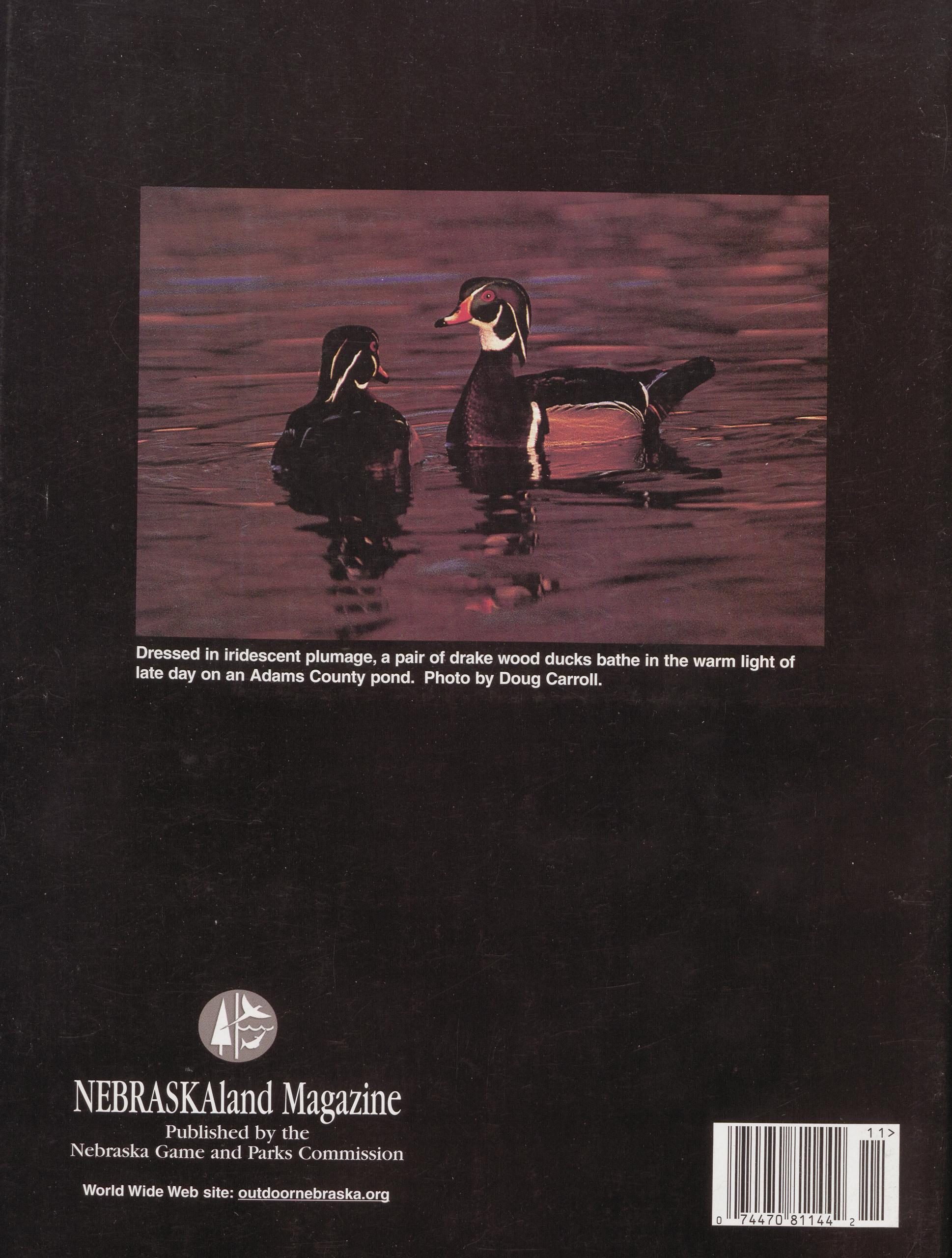
Position: 769 (14 views)