Volume 83, Issue 8, 2005
NEBRASKAland
Nebraska Game & Parks Commission October 2005 $2.95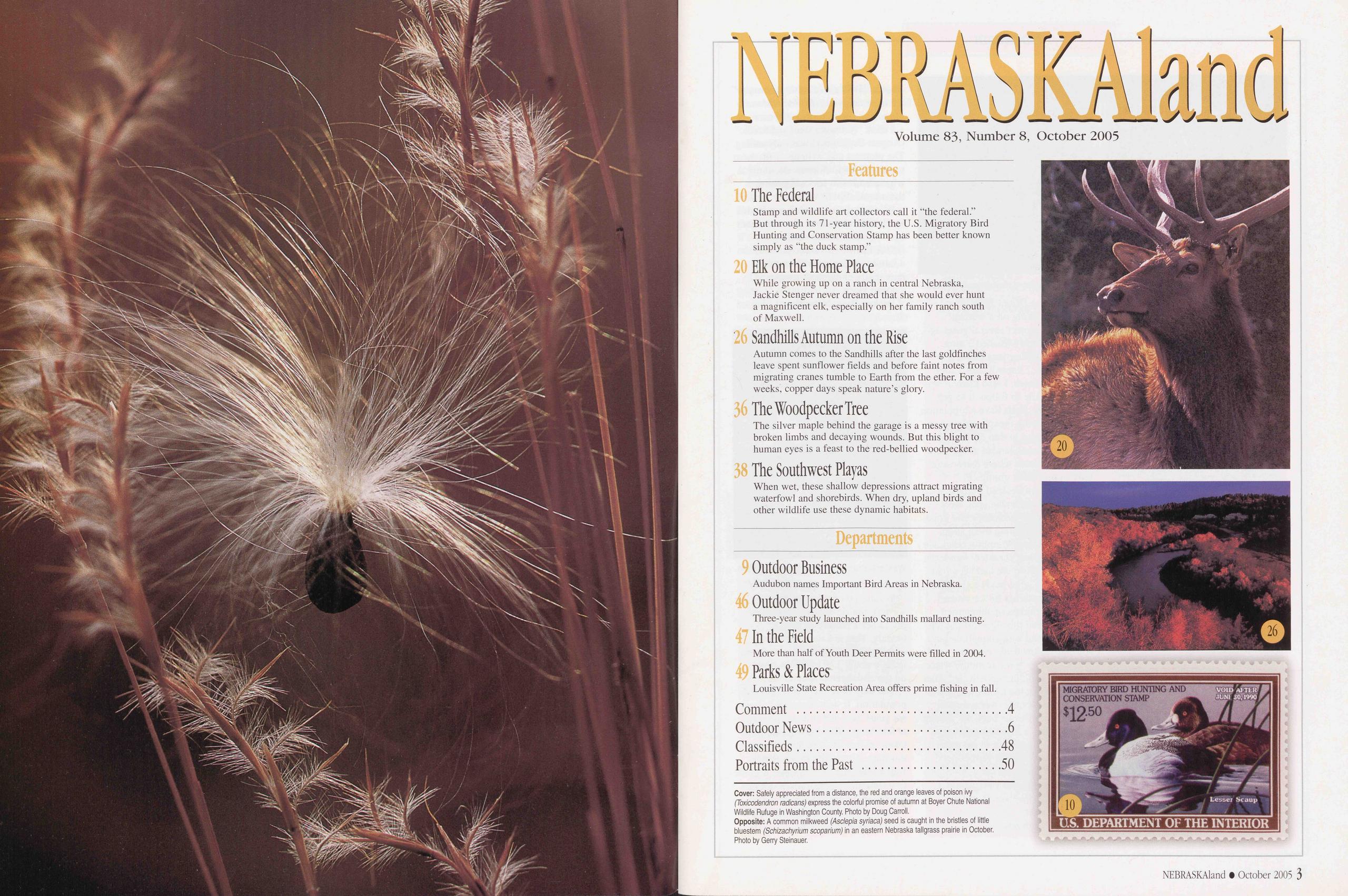
NEBRASKAland
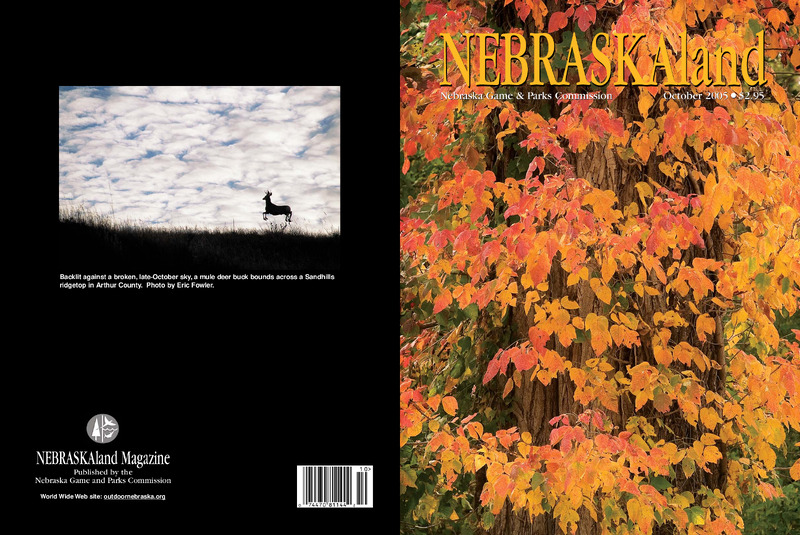
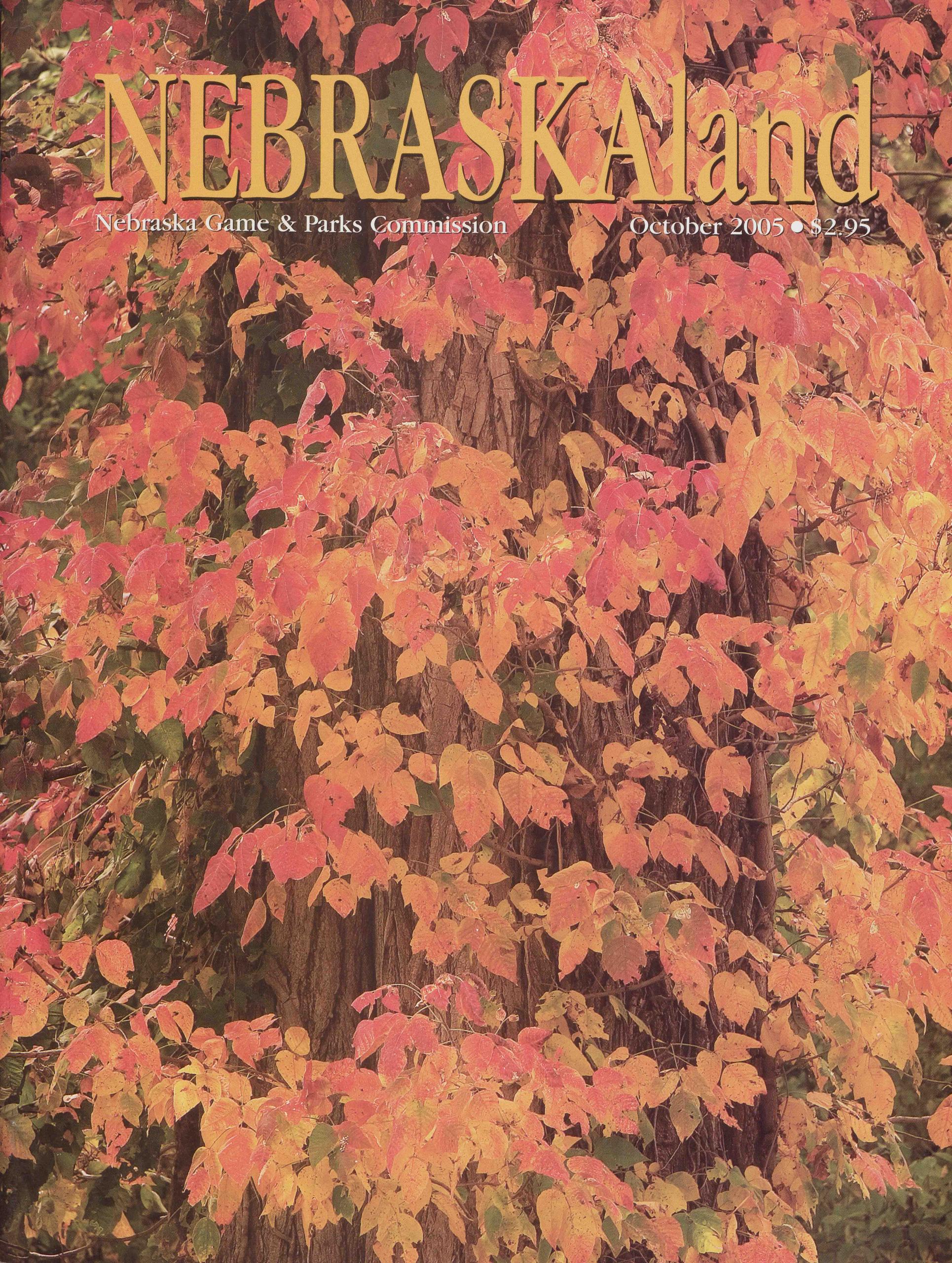
Volume 83, Number 8, October 2005 Features 10 The Federal Stamp and wildlife art collectors call it “the federal.” But through its 71-year history, the U.S. Migratory Bird Hunting and Conservation Stamp has been better known simply as “the duck stamp.” 20 Elk on the Home Place While growing up on a ranch in central Nebraska, Jackie Stenger never dreamed that she would ever hunt a magnificent elk, especially on her family ranch south of Maxwell. 26 Sandhills Autumn on the Rise Autumn comes to the Sandhills after the last goldfinches leave spent sunflower fields and before faint notes from migrating cranes tumble to Earth from the ether. For a few weeks, copper days speak nature’s glory. 36 The Woodpecker Tree The silver maple behind the garage is a messy tree with broken limbs and decaying wounds. But this blight to human eyes is a feast to the red-bellied woodpecker. 38The Southwest Playas When wet, these shallow depressions attract migrating waterfowl and shorebirds. When dry, upland birds and other wildlife use these dynamic habitats. Departments 9 Outdoor Business Audubon names Important Bird Areas in Nebraska. 46 Outdoor Update Three-year study launched into Sandhills mallard nesting. 47 In the Field More than half of Youth Deer Permits were filled in 2004. 49 Parks & Places Louisville State Recreation Area offers prime fishing in fall. Comment .......................................4 Outdoor News...................................6 Classifieds...................................48 Portraits from the Past ......................50 Cover: Safely appreciated from a distance, the red and orange leaves of poison ivy (Toxicodendron radicans) express the colorful promise of autumn at Boyer Chute National Wildlife Rufuge in Washington County. Photo by Doug Carroll. Opposite: A common milkweed (Asclepia syriaca) seed is caught in the bristles of little bluestem (Schizachyrium scoparium) in an eastern Nebraska tailgrass prairie in October. Photo by Gerry Steinauer.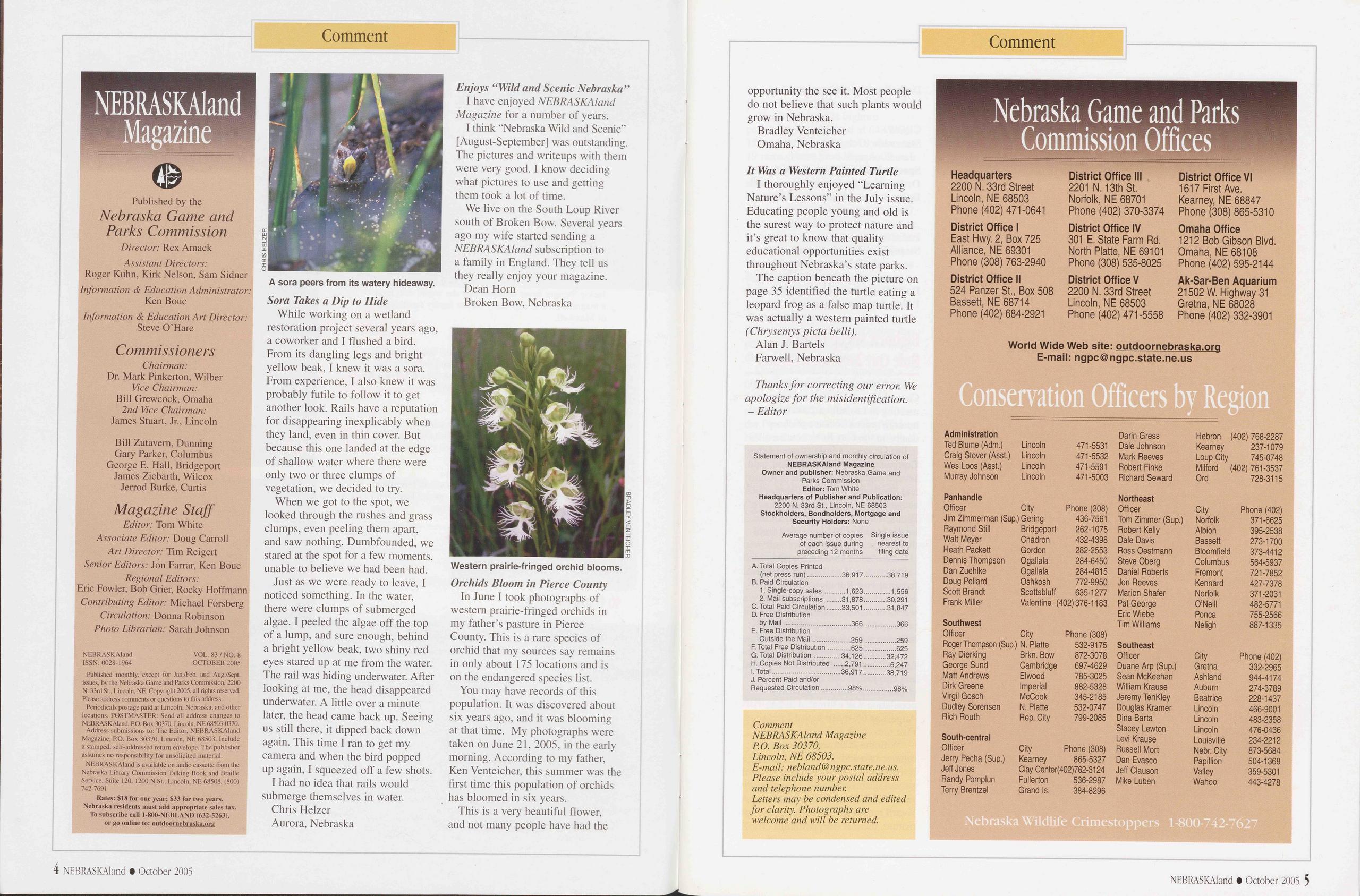
Comment
NEBRASKAIand Magazine Published by the Nebraska Game and Parks Commission Director: Rex Amack Assistant Directors: Roger Kuhn, Kirk Nelson, Sam Sidner Information & Education Administrator: Ken Bouc Information & Education Art Director: Steve O’Hare Commissioners Chairman: Dr. Mark Pinkerton, Wilber Vice Chairman: Bill Grewcock, Omaha 2nd Vice Chairman: James Stuart, Jr., Lincoln Bill Zutavern, Dunning Gary Parker, Columbus George E. Hall, Bridgeport James Ziebarth, Wilcox Jerrod Burke, Curtis Magazine Staff Editor: Tom White Associate Editor: Doug Carroll Art Director: Tim Reigert Senior Editors: Jon Farrar, Ken Bouc Regional Editors: Eric Fowler, Bob Grier, Rocky Hoffmann Contributing Editor: Michael Forsberg Circulation: Donna Robinson Photo Librarian: Sarah Johnson NEBRASKAIand VOL. 83 / NO. 8 ISSN: 00281964 ־ OCTOBER 2005 Published monthly, except for Jan./Feb. and Aug./Sept. issues, by the Nebraska Game and Parks Commission, 2200 N. 33rd St., Lincoln, NE. Copyright 2005, all rights reserved. Please address comments or questions to this address. Periodicals postage paid at Lincoln, Nebraska, and other locations. POSTMASTER: Send all address changes to NEBRASKAIand, P.O. Box 30370, Lincoln, NE 68503-0370. Address submissions to: The Editor, NEBRASKAIand Magazine, P.O. Box 30370, Lincoln, NE 68503. Include a stamped, self-addressed return envelope. The publisher assumes no responsibility for unsolicited material. NEBRASKAIand is available on audio cassette from the Nebraska Library Commission Talking Book and Braille Service, Suite 120. 1200 N St., Lincoln, NE 68508. (800) 7691־742 Rates: $18 for one year; $33 for two years. Nebraska residents must add appropriate sales tax. To subscribe call 1-800-NEBLAND (6325263־), or go online to: outdoornebraska.orgWhile working on a wetland restoration project several years ago, a coworker and I flushed a bird. From its dangling legs and bright yellow beak, I knew it was a sora. From experience, I also knew it was probably futile to follow it to get another look. Rails have a reputation for disappearing inexplicably when they land, even in thin cover. But because this one landed at the edge of shallow water where there were only two or three clumps of vegetation, we decided to try.
When we got to the spot, we looked through the rushes and grass clumps, even peeling them apart, and saw nothing. Dumbfounded, we stared at the spot for a few moments, unable to believe we had been had.
Just as we were ready to leave, I noticed something. In the water, there were clumps of submerged algae. I peeled the algae off the top of a lump, and sure enough, behind a bright yellow beak, two shiny red eyes stared up at me from the water. The rail was hiding underwater. After looking at me, the head disappeared underwater. A little over a minute later, the head came back up. Seeing us still there, it dipped back down again. This time I ran to get my camera and when the bird popped up again, I squeezed off a few shots.
I had no idea that rails would submerge themselves in water.
Chris Helzer Aurora, Nebraska Enjoys “Wild and Scenic Nebraska”I have enjoyed NEBRASKAIand Magazine for a number of years.
I think “Nebraska Wild and Scenic” [August-September] was outstanding. The pictures and writeups with them were very good. I know deciding what pictures to use and getting them took a lot of time.
We live on the South Loup River south of Broken Bow. Several years ago my wife started sending a NEBRASKAIand subscription to a family in England. They tell us they really enjoy your magazine.
Dean Horn Broken Bow, NebraskaIn June I took photographs of western prairie-fringed orchids in my father’s pasture in Pierce County. This is a rare species of orchid that my sources say remains in only about 175 locations and is on the endangered species list.
You may have records of this population. It was discovered about six years ago, and it was blooming at that time. My photographs were taken on June 21, 2005, in the early morning. According to my father, Ken Venteicher, this summer was the first time this population of orchids has bloomed in six years.
This is a very beautiful flower, and not many people have had the opportunity the see it. Most people do not believe that such plants would grow in Nebraska.
Bradley Venteicher Omaha, Nebraska It Was a Western Painted TurtleI thoroughly enjoyed “Learning Nature’s Lessons” in the July issue. Educating people young and old is the surest way to protect nature and it’s great to know that quality educational opportunities exist throughout Nebraska’s state parks.
The caption beneath the picture on page 35 identified the turtle eating a leopard frog as a false map turtle. It was actually a western painted turtle (Chrysemys picta belli).
Alan J. Bartels Farwell, Nebraska Thanks for correcting our error. We apologize for the misidentification. - Editor Nebraska Game and Parks Commission Offices Headquarters 2200 N. 33rd Street Lincoln, NE 68503 Phone (402) 471-0641 District Office I East Hwy. 2, Box 725 Alliance, NE 69301 Phone (308) 763-2940 District Office II 524 Panzer St., Box 508 Bassett, NE 68714 Phone (402) 684-2921 District Office III 2201 N. 13th St. Norfolk, NE 68701 Phone (402) 370-3374 District Office IV 301 E. State Farm Rd. North Platte, NE 69101 Phone (308) 535-8025 District Office V 2200 N. 33rd Street Lincoln, NE 68503 Phone (402) 471-5558 District Office VI 1617 First Ave. Kearney, NE 68847 Phone (308) 865-5310 Omaha Office 1212 Bob Gibson Blvd. Omaha, NE 68108 Phone (402) 595-2144 Ak-Sar-Ben Aquarium 21502 W. Highway 31 Gretna, NE 68028 Phone (402) 332-3901 World Wide Web site: outdoornebraska.org E-mail: ngpc@ngpc.state.ne.us Statement of ownership and monthly circulation of NEBRASKAIand Magazine Owner and publisher: Nebraska Game and Parks Commission Editor: Tom White Headquarters of Publisher and Publication: 2200 N. 33rd St., Lincoln, NE 68503 Stockholders, Bondholders, Mortgage and Security Holders: None Average number of copies Single issue of each issue during nearest to preceding 12 months filing date A. Total Copies Printed (net press run) ....36,917.... 38,719 B. Paid Circulation 1. Single-copy sales 1,623.... 1,556 2. Mail subscriptions ...31,678.... 30,291 C. Total Paid Circulation ...33,501.... 31,847 D. Free Distribution by Mail 366 ... 366 E. Free Distribution Outside the Mail 259 ... 259 F. Total Free Distribution .... 625 ... 625 G. Total Distribution ...34,126.... 32,472 H. Copies Not Distributed . 2,791.... 6,247 !.Total ...36,917.... 38,719 J. Percent Paid and/or Requested Circulation 98%.... 98% Comment NEBRASKAIand Magazine P.O. Box 30370, Lincoln, NE 68503. E-mail: nebland@ ngpc. state, ne. us. Please include your postal address and telephone number. Letters may be condensed and edited for clarity. Photographs are welcome and will be returned. Conservation Officers by Region Administration Darin Gress Hebron 2287־768 (402) Ted Blume (Adm.) Lincoln 5531־471 Dale Johnson Kearney 237-1079 Craig Stover (Asst.) Lincoln 471-5532 Mark Reeves Loup City 0748־745 Wes Loos (Asst.) Lincoln 471-5591 Robert Finke Milford 3537־761 (402) Murray Johnson Lincoln 471-5003 Richard Seward Ord 3115־728 Panhandle Northeast Officer City Phone (308) Officer City Phone (402) Jim Zimmerman (Sup.) Gering 7561־436 Tom Zimmer (Sup.) Norfolk 371-6625 Raymond Still Bridgeport 1075־262 Robert Kelly Albion 2538־395 Walt Meyer Chadron 4398־432 Dale Davis Bassett 1700־273 Heath Packett Gordon 2553־282 Ross Oestmann Bloomfield I 3734412־ Dennis Thompson Ogallala 6450־284 Steve Oberg Columbus 5937־564 Dan Zuehlke Ogallala 4815־284 Daniel Roberts Fremont 7852־721 Doug Pollard Oshkosh 772-9950 Jon Reeves Kennard 7378־427 Scott Brandt Scottsbluff 635-1277 Marion Shafer Norfolk 2031־371 Frank Miller Valentine (402)3761183־ Pat George O’Neill 5771־482 Eric Wiebe Ponca 755-2566 Southwest Tim Williams Neligh 887-1335 Officer City Phone (308) Roger Thompson (Sup.) N. Platte 9175־532 Southeast Ray Dierking Brkn. Bow 3078־872 Officer City Phone (402) George Sund Cambridge 4629־697 Duane Arp (Sup.) Gretna 332-2965 Matt Andrews Elwood 3025־785 Sean McKeehan Ashland 944-4174 Dirk Greene Imperial 882-5328 William Krause Auburn 3789־274 Virgil Gosch McCook 345-2185 Jeremy Ten Kley Beatrice 1437־228 Dudley Sorensen N. Platte 532-0747 Douglas Kramer Lincoln 9001־466 Rich Routh Rep. City 2085־799 Dina Barta Lincoln 2358־483 Stacey Lewton Lincoln 476-0436 South-central Levi Krause Louisville 234-2212 Officer City Phone (308) Russell Mort Nebr. City 873-5684 Jerry Pecha (Sup.) Kearney 5327־865 Dan Evasco Papillion 504-1368 Jeff Jones Clay Center(402)7623124־ Jeff Clauson Valley 359-5301 Randy Pomplun Fullerton 2987־536 Mike Luben Wahoo 443-4278 Terry Brentzel Grand Is. 8296־384 Nebraska Wildlife Crimestoppers 1-800-742-7627 4 NEBRASKAIand • October 2005 NEBRASKAIand • October 2005 5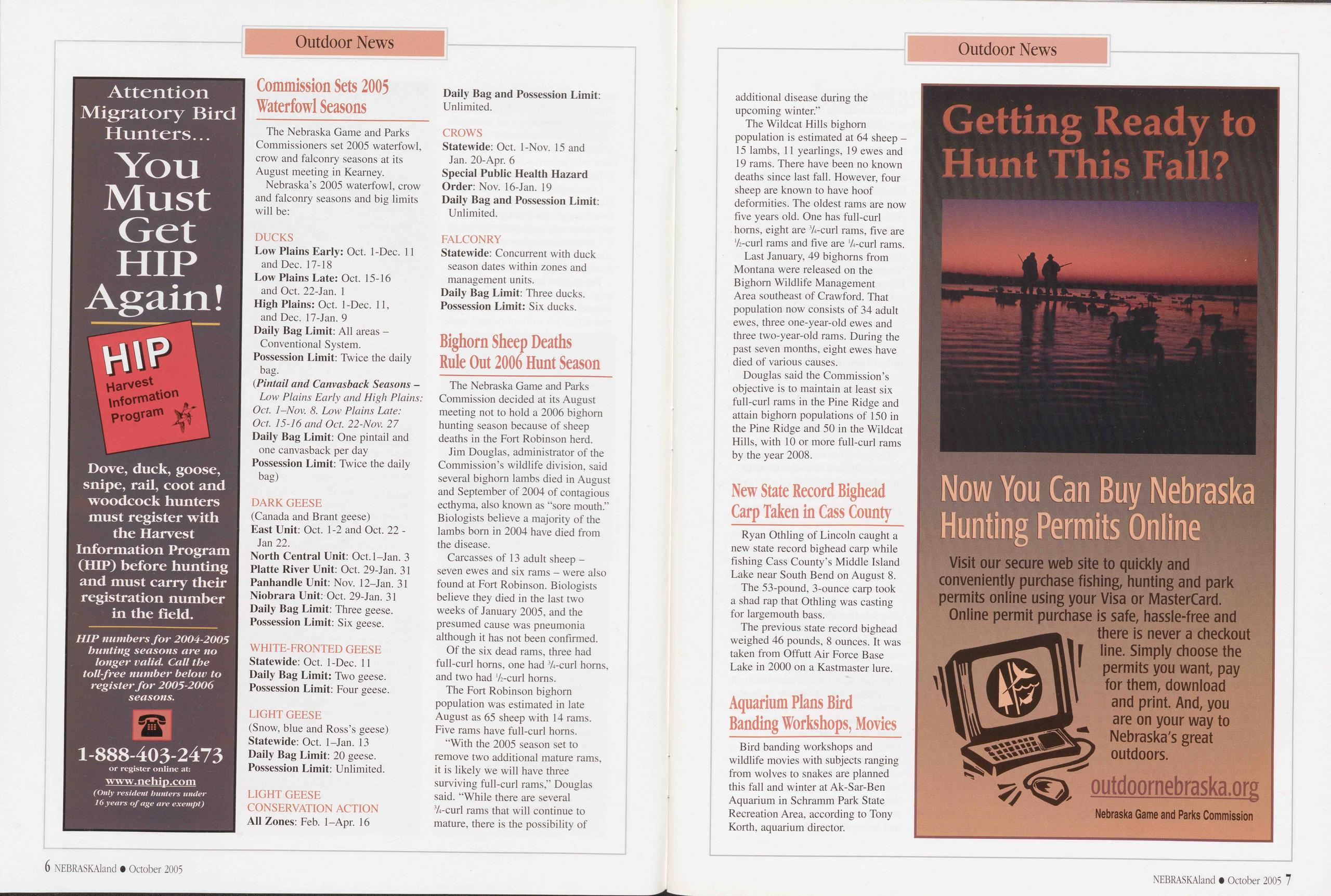
Outdoor News
Attention Migratory Bird Hunters... You Must Get HIP Again! HIP Hardest information program Dove, duck, goose, snipe, rail, coot and woodcock hunters must register with the Harvest Information Program (HIP) before hunting and must carry their registration number in the field. HIP numbers for 2004-2005 hunting seasons are no longer valid. Call the toll-free number below to register for 2005-2006 seasons. 1-888-403-2473 or register online at: www.nehip.com (Only resident hunters under 16 years of age are exempt) Commission Sets 2005 Waterfowl SeasonsThe Nebraska Game and Parks Commissioners set 2005 waterfowl, crow and falconry seasons at its August meeting in Kearney.
Nebraska’s 2005 waterfowl, crow and falconry seasons and big limits will be:
DUCKS Low Plains Early: Oct. 1-Dec. 11 and Dec. 1718־ Low Plains Late: Oct. 15-16 and Oct. 22-Jan. 1 High Plains: Oct. 1-Dec. 11, and Dec. 17-Jan. 9 Daily Bag Limit: All areas - Conventional System. Possession Limit: Twice the daily bag. (.Pintail and Canvasback Seasons - Low Plains Early and High Plains: Oct. 1-Nov. 8. Low Plains Late: Oct. 15-16 and Oct. 22-Nov. 27 Daily Bag Limit: One pintail and one canvasback per day Possession Limit: Twice the daily bag) DARK GEESE (Canada and Brant geese) East Unit: Oct. 1-2 and Oct. 22 - Jan 22. North Central Unit: Oct.l-Jan. 3 Platte River Unit: Oct. 29-Jan. 31 Panhandle Unit: Nov. 12-Jan. 31 Niobrara Unit: Oct. 29-Jan. 31 Daily Bag Limit. Three geese. Possession Limit: Six geese. WHITE-FRONTED GEESE Statewide: Oct. 1-Dec. 11 Daily Bag Limit: Two geese. Possession Limit: Four geese. LIGHT GEESE (Snow, blue and Ross’s geese) Statewide: Oct. 1-Jan. 13 Daily Bag Limit: 20 geese. Possession Limit: Unlimited. LIGHT GEESE CONSERVATION ACTION All Zones: Feb. 1-Apr. 16 Daily Bag and Possession Limit: Unlimited. CROWS Statewide: Oct. 1-Nov. 15 and Jan. 20-Apr. 6 Special Public Health Hazard Order: Nov. 16-Jan. 19 Daily Bag and Possession Limit: Unlimited. FALCONRY Statewide: Concurrent with duck season dates within zones and management units. Daily Bag Limit: Three ducks. Possession Limit: Six ducks. Bighorn Sheep Deaths Rule Out 2006 Hunt SeasonThe Nebraska Game and Parks Commission decided at its August meeting not to hold a 2006 bighorn hunting season because of sheep deaths in the Fort Robinson herd.
Jim Douglas, administrator of the Commission’s wildlife division, said several bighorn lambs died in August and September of 2004 of contagious ecthyma, also known as "sore mouth.” Biologists believe a majority of the lambs born in 2004 have died from the disease.
Carcasses of 13 adult sheep - seven ewes and six rams - were also found at Fort Robinson. Biologists believe they died in the last two weeks of January 2005, and the presumed cause was pneumonia although it has not been confirmed.
Of the six dead rams, three had full-curl horns, one had 3/4-curl horns, and two had 1/2-curl horns.
The Fort Robinson bighorn population was estimated in late August as 65 sheep with 14 rams. Five rams have full-curl horns. "With the 2005 season set to remove two additional mature rams, it is likely we will have three surviving full-curl rams,” Douglas said. "While there are several 3/4-curl rams that will continue to mature, there is the possibility of additional disease during the upcoming winter.”
The Wildcat Hills bighorn population is estimated at 64 sheep - 15 lambs, 11 yearlings, 19 ewes and 19 rams. There have been no known deaths since last fall. However, four sheep are known to have hoof deformities. The oldest rams are now five years old. One has full-curl horns, eight are 3/4-curl rams, five are 1/2-curl rams and five are 1/4-curl rams.
Last January, 49 bighorns from Montana were released on the Bighorn Wildlife Management Area southeast of Crawford. That population now consists of 34 adult ewes, three one-year-old ewes and three two-year-old rams. During the past seven months, eight ewes have died of various causes.
Douglas said the Commission’s objective is to maintain at least six full-curl rams in the Pine Ridge and attain bighorn populations of 150 in the Pine Ridge and 50 in the Wildcat Hills, with 10 or more full-curl rams by the year 2008.
New State Record Bighead Carp Taken in Cass CountyRyan Othling of Lincoln caught a new state record bighead carp while fishing Cass County’s Middle Island Lake near South Bend on August 8.
The 53-pound, 3-ounce carp took a shad rap that Othling was casting for largemouth bass.
The previous state record bighead weighed 46 pounds, 8 ounces. It was taken from Offutt Air Force Base Lake in 2000 on a Kastmaster lure.
Aquarium Plans Bird Banding Workshops, MoviesBird banding workshops and wildlife movies with subjects ranging from wolves to snakes are planned this fall and winter at Ak-Sar-Ben Aquarium in Schramm Park State Recreation Area, according to Tony Korth, aquarium director.
Getting Ready to Hunt This Fall? Now You Can Buy Nebraska Hunting Permits Online Visit our secure web site to quickly and conveniently purchase fishing, hunting and park permits online using your Visa or MasterCard. Online permit purchase is safe, hassle-free and there is never a checkout line. Simply choose the permits you want, pay for them, download and print. And, you are on your way to Nebraska's great outdoorsnebraska.org Nebraska Game and Parks Commission 6 NEBRASKAland • October 2005 NEBRASKAland • October 2005 7 Outdoor News Officer's Notebook A Long Memory
With no food in my truck while on patrol, I pulled into a fast-food restaurant in Plattsmouth at noon. Because I had two dollars and change in my pocket, lunch was going to be light. As I pulled up to the pick-up window, a man ran to my driver’s side window.
He checked out my shoulder patch and uniform and asked if I worked around there. I told him I did, and he asked, “Were you the one who saved those kids in the river?”
I thought for a few seconds before answering, trying to figure out what he was talking about. I couldn’t remember any recent rescue of kids on either the Platte or Missouri rivers in my area. So I hesitatingly asked if he was talking about the kids on the car in Mill Creek years ago. When he said yes, I told him that I was the officer and he began shaking my hand and thanking me profusely for saving his life.
This event happened 12 years ago. During severe flooding in the summer of 1993, I had helped the Louisville Volunteer Fire and Rescue Department rescue four young people whose car had been swept off a city street by raging floodwaters in Mill Creek, a stream that is normally only a trickle. A fireman and I launched my small patrol boat from the backyard of a Louisville home. Heading upstream through other backyards, we saw four people who appeared to be standing on the surface of the floodwater. They were actually atop the roof of their car, which had been swept downstream about 50 yards. If they had not been able to get out of the car and onto the roof, or had they had slipped off the roof, they could have drowned. When I pulled the boat up close enough, all four immediately jumped or fell in. I took them to the nearest point of land, where rescue workers gave them emergency care. Our rescue occurred during a storm with torrential rain and a lot of lightning.
As I talked to the man about that night, he said the ordeal seemed like a scene from a 911 television show. I agreed. He insisted on paying for my lunch, but when I told him that was not necessary, he tried to give me $20 for a meal later. I told him that I could not accept money from him. As the car ahead of me in line moved away, I pulled ahead. Without another word, he stepped between my truck and the window and paid for my lunch. Because he was so persistent, I accepted the lunch and thanked him for it. As I pulled away, I heard him say, “God bless.”
All conservation officers assist the public in numerous way throughout our careers, and occasionally we receive a verbal thank you or a note written to the agency. During my career as an officer, this accidental meeting was one of the best, most meaningful thank yous that I’ve every received.
Twelve years is a long time to want to thank someone for their help!
- Levi Krause, Conservation Officer, LouisvilleVolunteer naturalist Ruth Green will conduct bird banding workshops at which she captures, bands and releases songbird species while teaching participants about them.
The workshops are free and designed for children and adults. Groups that wish to attend are asked to call the aquarium at (402) 332-3901 for scheduling.
The bird banding workshops will be held from 9 a.m. until noon on the following Saturdays: October 8, November 5, December 3, January 7, February 4, March 4 and April 1.
Park visitors can also enjoy wildlife movies at the aquarium at 11 a.m. and 2 p.m. Until November 30 the aquarium is open Wednesday through Monday from 10 a.m. to 4:30 p.m. except for Thanksgiving Day.
Winter hours, in effect from December 1 through March 31, are Wednesday through Sunday, 10 a.m. to 4:30 p.m., closed Mondays, Tuesdays and holidays.
The aquarium and Schramm Park SRA are located six miles south of Interstate 80 Exit 432.
Trail Tales Wins First PlaceThe Nebraska Game and Parks Commission won first place honors in two categories in the Association for Conservation Information (ACI) 2004 Annual Awards competition.
Trail Tales, the Commission’s colorful, 16-page magazine for youngsters about nature, wildlife, and a variety of outdoor activities, won top honors in the competition’s education category. Trail Tails is published four times a year and is distributed to fourth-grade students across the state.
A four-color, 16-page publication titled “Want More Pheasants? Here’s How to Get Them” won the one-time publication, four-color category. The publication explained a pheasant’s habitat needs and described how landowners can manage their lands to provide more and better pheasant habitat.
Outdoor Business
Important Bird Areas Designated
These diverse habitats offer vital resources to bird populations in Nebraska.
Sixteen diverse Nebraska bird habitats that support essential migrant and resident birdlife have been recognized as Important Bird Areas(IBA) by Audubon Nebraska and the National Audubon Society. Located in 13 counties across the state, these areas total more than 210,000 acres of wetland, riparian, prairie, lake and forest habitats. They range from the 72,000-acre Valentine National Wildlife Refuge in the Sandhills to the 480-acre Kiowa Wildlife Management Area in the Panhandle along the North Platte River.
The Nebraska sites are among more than 10,000 recognized Important Bird Areas worldwide, according to Kevin Poague, who coordinates the project for Audubon Nebraska.
“The IBA project was initiated in the 1980s by BirdLife International, a coalition of organizations from more than 100 counties. The National Audubon Society joined the effort in 1995 and has helped identify more than 1,200 essential sites in 40 states.”
When hundreds of thousands of migrating sandhill cranes stop along the central Platte River Valley each spring, birders, naturalists, artists, photographers and others from across North America and beyond come to observe the spectacle.
Kiowa WMA, south of Morrill in the Panhandle, is a habitat known for spring and fall concentrations of migrating waterfowl and for its breeding population of shorebirds. More than 50 pairs of American avocets were recorded there during recent breeding seasons.
With the exception of Cedar Point Biological Station in Keith County, which is available to the public only by permission from the University of Nebraska, all of the state’s Important Birding Areas are open for public use.
A committee of volunteers, wildlife biologists and educators select sites for designation from areas nominated by the public. The sites can be a few acres or thousands of acres, but they are usually discrete habitats that stand out from the surrounding landscape.
Each site must meet at least one of the following criteria: 1. Include species of conservation concern; 2. Have large concentrations of birds; 3. Are used by restricted-range species; 4. Have assemblages of birds associated with rare or representative habitats.
“While these sites vary greatly in terms of landowners, habitat type and bird usage, they all are critical for the survival of birds in Nebraska,” said Poague. “The IBA process teaches us that places right in our backyard can be important for birds on a national, continental, or even global scale.”
The Important Bird Areas project is described on Audubon Nebraska’s web site, www.nebraska.audubon.org. The IBA process is funded from the State Wildlife Grants Program administered by the Nebraska Game and Parks Commission.
A second round of IAB nominations began in August. The current Important Bird Areas in Nebraska are: • Boyer Chute National Wildlife Refuge • Calamus Reservoir State Recreation Area • Cedar Point Biological Station • Crescent Lake National Wildlife Refuge • Fontenelle Forest Nature Center • Indian Cave State Park • Kiowa Wildlife Management Area • Lake McConaughy State Recreation Area • Lake Ogallala State Recreation Area • Missouri National Recreational River • Neale Woods Nature Center • Niobrara State Park • Ponca State Park • Rowe Sanctuary • Spring Creek Prairie Audubon Center • Valentine National Wildlife Refuge 8 NEBRASKAland • October 2005 NEBRASKAland • October 2005 9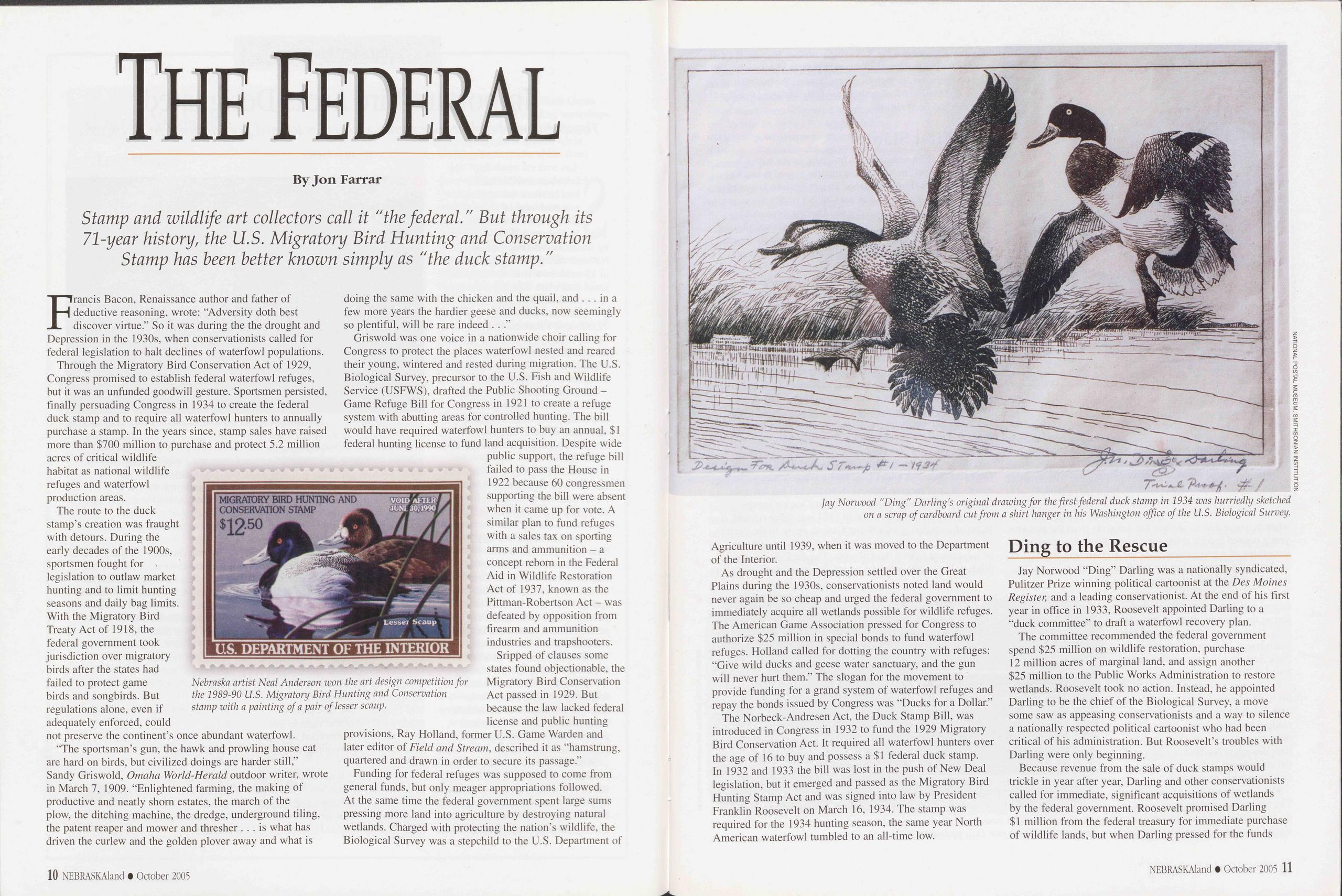
The Federal
Stamp and wildlife art collectors call it "the federal." But through its 71-year history, the U.S. Migratory Bird Hunting and Conservation Stamp has been better known simply as "the duck stamp."
Francis Bacon, Renaissance author and father of deductive reasoning, wrote: “Adversity doth best discover virtue.” So it was during the the drought and Depression in the 1930s, when conservationists called for federal legislation to halt declines of waterfowl populations.
Through the Migratory Bird Conservation Act of 1929, Congress promised to establish federal waterfowl refuges, but it was an unfunded goodwill gesture. Spoilsmen persisted, finally persuading Congress in 1934 to create the federal duck stamp and to require all waterfowl hunters to annually purchase a stamp. In the years since, stamp sales have raised more than $700 million to purchase and protect 5.2 million acres of critical wildlife habitat as national wildlife refuges and waterfowl production areas.
The route to the duck stamp’s creation was fraught with detours. During the early decades of the 1900s, sportsmen fought for > legislation to outlaw market hunting and to limit hunting seasons and daily bag limits. With the Migratory Bird Treaty Act of 1918, the federal government took jurisdiction over migratory birds after the states had failed to protect game birds and songbirds. But regulations alone, even if adequately enforced, could
“The sportsman’s gun, the hawk and prowling house cat are hard on birds, but civilized doings are harder still,” Sandy Griswold, Omaha World-Herald outdoor writer, wrote in March 7, 1909. “Enlightened farming, the making of productive and neatly shorn estates, the march of the plow, the ditching machine, the dredge, underground tiling, the patent reaper and mower and thresher ... is what has driven the curlew and the golden plover away and what is doing the same with the chicken and the quail, and ... in a few more years the hardier geese and ducks, now seemingly so plentiful, will be rare indeed . .
Griswold was one voice in a nationwide choir calling for Congress to protect the places waterfowl nested and reared their young, wintered and rested during migration. The U.S. Biological Survey, precursor to the U.S. Fish and Wildlife Service (USFWS), drafted the Public Shooting Ground - Game Refuge Bill for Congress in 1921 to create a refuge system with abutting areas for controlled hunting. The bill would have required waterfowl hunters to buy an annual, $1 federal hunting license to fund land acquisition. Despite wide public support, the refuge bill failed to pass the House in 1922 because 60 congressmen supporting the bill were absent when it came up for vote. A similar plan to fund refuges with a sales tax on sporting arms and ammunition - a concept reborn in the Federal Aid in Wildlife Restoration Act of 1937, known as the Pittman-Robertson Act - was defeated by opposition from firearm and ammunition industries and trapshooters.
Sripped of clauses some states found objectionable, the Migratory Bird Conservation Act passed in 1929. But because the law lacked federal license and public hunting provisions, Ray Holland, former U.S. Game Warden and later editor of Field and Stream, described it as “hamstrung, quartered and drawn in order to secure its passage.”
Funding for federal refuges was supposed to come from general funds, but only meager appropriations followed. At the same time the federal government spent large sums pressing more land into agriculture by destroying natural wetlands. Charged with protecting the nation’s wildlife, the Biological Survey was a stepchild to the U.S. Department of
As drought and the Depression settled over the Great Plains during the 1930s, conservationists noted land would never again be so cheap and urged the federal government to immediately acquire all wetlands possible for wildlife refuges. The American Game Association pressed for Congress to authorize $25 million in special bonds to fund waterfowl refuges. Holland called for dotting the country with refuges: “Give wild ducks and geese water sanctuary, and the gun will never hurt them.” The slogan for the movement to provide funding for a grand system of waterfowl refuges and repay the bonds issued by Congress was “Ducks for a Dollar.”
The Norbeck-Andresen Act, the Duck Stamp Bill, was introduced in Congress in 1932 to fund the 1929 Migratory Bird Conservation Act. It required all waterfowl hunters over the age of 16 to buy and possess a $1 federal duck stamp. In 1932 and 1933 the bill was lost in the push of New Deal legislation, but it emerged and passed as the Migratory Bird Hunting Stamp Act and was signed into law by President Franklin Roosevelt on March 16, 1934. The stamp was required for the 1934 hunting season, the same year North American waterfowl tumbled to an all-time low.
Ding to the RescueJay Norwood “Ding” Darling was a nationally syndicated, Pulitzer Prize winning political cartoonist at the Des Moines Register, and a leading conservationist. At the end of his first year in office in 1933, Roosevelt appointed Darling to a “duck committee” to draft a waterfowl recovery plan.
The committee recommended the federal government spend $25 million on wildlife restoration, purchase 12 million acres of marginal land, and assign another $25 million to the Public Works Administration to restore wetlands. Roosevelt took no action. Instead, he appointed Darling to be the chief of the Biological Survey, a move some saw as appeasing conservationists and a way to silence a nationally respected political cartoonist who had been critical of his administration. But Roosevelt’s troubles with Darling were only beginning.
Because revenue from the sale of duck stamps would trickle in year after year, Darling and other conservationists called for immediate, significant acquisitions of wetlands by the federal government. Roosevelt promised Darling $1 million from the federal treasury for immediate purchase of wildlife lands, but when Darling pressed for the funds 10 NEBRASKAland • October 2005 NEBRASKAland • October 2005 11
Darling enlisted the aid of Senator Peter Norbeck of South Dakota, principal author of the 1929 Migratory Bird Conservation Act. Norbeck was nearing the end of his Senate career and was much admired by his colleagues, so when he requested $1 million for wetlands from the previous year’s unused federal relief fund it was favorably received as something of a going-away gift. The request was attached as a rider to the omnibus bill for the Biological Survey. At the last minute Norbeck raised the request from $ 1 million to $6 million and rushed it to the congressional clerk just as the bill was about to come to a vote. Norbeck was asked to read his amendment. The senator spoke in a thick Scandinavian accent that many found difficult to understand.
Furthermore, Norbeck had just had his teeth extracted and was suffering with painful new dentures. Before reading his amendment, he put his dentures in his vest pocket. Darling later described Norbeck’s reading of the amendment as “totally devoid of understandable articulation.”
The amendment passed unanimously. The bill was carried by messenger to the White House, where Roosevelt hastily signed it before leaving for a fishing trip in the Caribbean the following morning. Roosevelt later wrote Darling that he was “the only man in history who got an appropriation through Congress, passed the budget and signed by the President without anybody realizing that the treasury had been raided.”
The First StampDarling is best remembered, however, as the nation’s first duck stamp artist. Only six months passed from the time Roosevelt signed the Duck Stamp Act into law until the time stamps were sold in post offices across the nation.
Humorous happenstance dogged Darling through life, and so it was with his art for the 1934 duck stamp. He later wrote, “I took six sheets of cardboard [cut from stiffeners on shirt hangers in his office] and made six experimental sketches of what I thought a Duck Stamp might look like.” He then passed them on to an assistant. When Darling inquired about progress on the duck stamps two or three days later he was told one had been selected and the stamp’s engraving was under way. “Every time I look at that proof design of the first Duck Stamp I still want to [re]do it,” Darling wrote.
Darling was a cartoonist, not a wildlife painter. Engravers refined Darling’s rough sketch of a pair of mallards landing in a marsh, but it remained remarkably true to the original, including the birds’ somewhat cartoonish bills. That first year, 635,001 federal duck stamps were sold, and in 1984, the 50th anniversary of the Migratory Bird Hunting Act, the U.S. Postal Service issued a commemorative reprint of Darling’s 1934 stamp design.
A duck stamp design was first sketched in 1919 by George A. Lawyer, Chief U.S. Game Warden. Lawyer’s design did not include artwork of waterfowl but left a window in the center apparently for just such a feature. A design by Belmore Browne in 1921 was more refined; it featured a rendering of a flying Canada goose in the center of the stamp, and is readily identifiable as the prototype of subsequent federal duck stamps. The duck stamp was produced twice the size of postage stamps of that time to
Hunters were not required to sign their duck stamps the first year of issue. But since 1935 a signature has been required so the same stamp cannot be used by more than one hunter. In 1934 a hunter purchasing a duck stamp was required to answer a short questionnaire asking the number of days he hunted the previous season, in what states, the number of waterfowl he shot and whether or not the hunter was a member of a hunting club. It was the government’s first attempt to gauge hunting pressure and estimate the nationwide waterfowl kill.
Hunters were required to affix the federal stamp to their state hunting licenses. If a state license was not required (as in states where landowners did not need a license to hunt on their own property) the federal stamp could be affixed to a light blue paper certificate called Form 3333. Revenue from the federal duck stamps went into
Production of the 1934 duck stamps was amazingly efficient, but there were problems getting them to hunters. Holland described the distribution in a 1935 editorial: “. . . the Post Office Department got out its rolls of red tape and wrapped and re-wrapped each stamp.” Even in 1935 duck stamps were not available at all U.S. post offices, and some arrived late. Holland recounted instances of hunters waiting in line to buy stamps, and being told it was required they affixed the stamp to their hunting permits in the presence of a postmaster. Collectors who did not hunt were sometimes told they could not purchase stamps. When stamps were not available, would-be buyers were given an “Application for Migratory-Bird Hunting Stamp” to be filled out and mailed to Washington. Many duck hunters who were unable to purchase stamps hunted anyway, violating of the new federal law.
Evolution of the StampThe federal duck stamp is produced by U.S. Bureau of Engraving and Printing, which also prints postage stamps and currency. Artists and engravers adapt the artist’s design to stamp size and add the required lettering and border. Skilled engravers etched the design by hand onto a master steel plate, a process requiring as long as two months to complete.
During the early years, engravers often took liberties in refining or enhancing duck stamp designs, such as adding backgrounds to the artwork. For example, on Frank Benson’s black-and-white wash of canvasbacks landing in a marsh for the 1935 stamp, engravers added a boat, blind and hunters. Until 1958, all stamps were printed on single-color flatbed presses, and each color printed required another run of the paper though the press. The engraving and printing process has evolved over 71 years with advances in technology. The most current reference on the history of the federal duck stamp, including the printing process, is The Duck Stamp Story by Eric Jay Holin and Bob Dumaine, Krause Publications, 2000. The book is a helpful guide for collectors of duck stamps, prints and special issue items.
Administration of the Migratory Bird Hunting Stamp Act has also evolved over the years. In 1949 Congress allowed 25 percent of refuges purchased with duck stamp revenues to be opened to hunting when compatible with the purpose for which the refuge was established. In 1958 Congress increased the number to 40 percent.
The distribution of stamp revenues have changed too. The original legislation allowed duck stamp revenue to be used for land acquisition, maintenance of federal refuges, stamp production and enforcement of waterfowl hunting regulations. A 1958 amendment specified that stamp funds could only be used for land acquisition and costs associated with stamp sales. In the mid-1950s, about 85 percent of stamp revenue was used for administrative and maintenance costs. In recent years about 98 percent of stamp revenue has gone for acquisition of wetland habitat.
Nebraska's First WinnerFrom 1934 through 2005, 71 federal duck stamps have been issued featuring the art of 55 different artists. Among the winners are the country’s best-known wildlife artists of the 20th century - Richard Bishop, Roland Clark, Francis Lee Jaques, Walter Weber, Owen Gromme, Maynard Reece (winner of a record five stamp designs), Les Kouba and David Maass. Fifteen artists have won more than once, among them Neal Anderson, a Nebraska artist who won the competition in 1989 and again in 1994. But Anderson was not the first Nebraska artist to win.
Claremont G. “Bud” Pritchard was born in 1910 on a farm 12 NEBRASKAland • October 2005 NEBRASKAland • October 2005 13 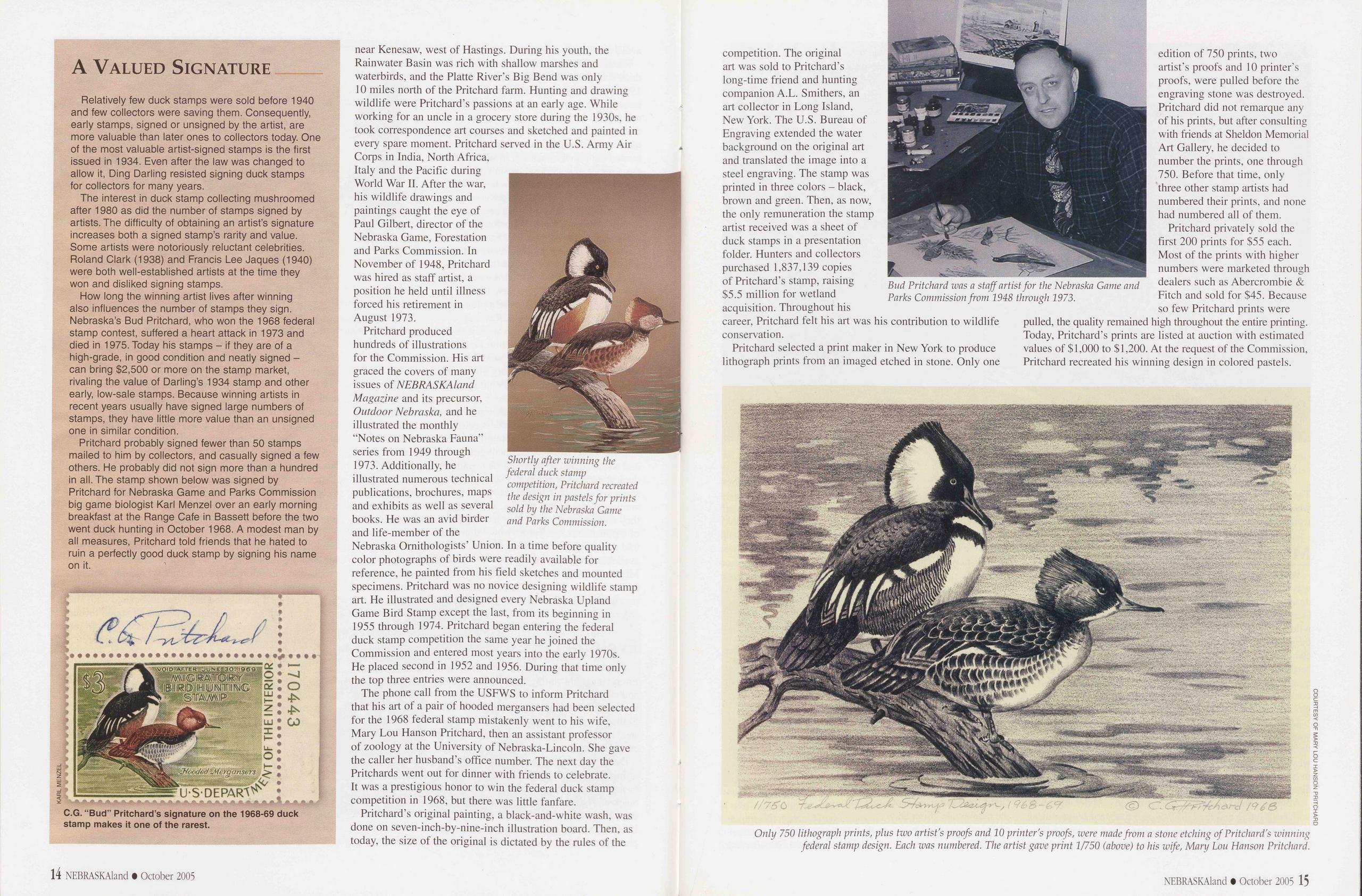 near Kenesaw, west of Hastings. During his youth, the Rainwater Basin was rich with shallow marshes and waterbirds, and the Platte River’s Big Bend was only 10 miles north of the Pritchard farm. Hunting and drawing wildlife were Pritchard’s passions at an early age. While working for an uncle in a grocery store during the 1930s, he took correspondence art courses and sketched and painted in every spare moment. Pritchard served in the U.S. Army Air Corps in India, North Africa, Italy and the Pacific during World War II. After the war, his wildlife drawings and paintings caught the eye of Paul Gilbert, director of the Nebraska Game, Forestation and Parks Commission. In November of 1948, Pritchard was hired as staff artist, a position he held until illness forced his retirement in August 1973.
Relatively few duck stamps were sold before 1940 and few collectors were saving them. Consequently, early stamps, signed or unsigned by the artist, are more valuable than later ones to collectors today. One of the most valuable artist-signed stamps is the first issued in 1934. Even after the law was changed to allow it, Ding Darling resisted signing duck stamps for collectors for many years.
The interest in duck stamp collecting mushroomed after 1980 as did the number of stamps signed by artists. The difficulty of obtaining an artist’s signature increases both a signed stamp’s rarity and value. Some artists were notoriously reluctant celebrities. Roland Clark (1938) and Francis Lee Jaques (1940) were both well-established artists at the time they won and disliked signing stamps.
How long the winning artist lives after winning also influences the number of stamps they sign. Nebraska’s Bud Pritchard, who won the 1968 federal stamp contest, suffered a heart attack in 1973 and died in 1975. Today his stamps - if they are of a high-grade, in good condition and neatly signed - can bring $2,500 or more on the stamp market, rivaling the value of Darling’s 1934 stamp and other early, low-sale stamps. Because winning artists in recent years usually have signed large numbers of stamps, they have little more value than an unsigned one in similar condition.
Pritchard probably signed fewer than 50 stamps mailed to him by collectors, and casually signed a few others. He probably did not sign more than a hundred in all. The stamp shown below was signed by Pritchard for Nebraska Game and Parks Commission big game biologist Karl Menzel over an early morning breakfast at the Range Cafe in Bassett before the two went duck hunting in October 1968. A modest man by all measures, Pritchard told friends that he hated to ruin a perfectly good duck stamp by signing his name on it.
Pritchard produced hundreds of illustrations for the Commission. His art graced the covers of many issues of NEBRASKAland Magazine and its precursor, Outdoor Nebraska, and he illustrated the monthly “Notes on Nebraska Fauna” series from 1949 through 1973. Additionally, he illustrated numerous technical publications, brochures, maps and exhibits as well as several books. He was an avid birder and life-member of the
14 NEBRASKAland • October 2005
The phone call from the USFWS to inform Pritchard that his art of a pair of hooded mergansers had been selected for the 1968 federal stamp mistakenly went to his wife, Mary Lou Hanson Pritchard, then an assistant professor of zoology at the University of Nebraska-Lincoln. She gave the caller her husband’s office number. The next day the Pritchards went out for dinner with friends to celebrate. It was a prestigious honor to win the federal duck stamp competition in 1968, but there was little fanfare.
Pritchard’s original painting, a black-and-white wash, was done on seven-inch-by-nine-inch illustration board. Then, as today, the size of the original is dictated by the rules of the competition. The original art was sold to Pritchard’s long-time friend and hunting companion A.L. Smithers, an art collector in Long Island, New York. The U.S. Bureau of Engraving extended the water background on the original art and translated the image into a steel engraving. The stamp was printed in three colors - black, brown and green. Then, as now, the only remuneration the stamp artist received was a sheet of duck stamps in a presentation folder. Hunters and collectors purchased 1,837,139 copies of Pritchard’s stamp, raising $5.5 million for wetland acquisition. Throughout his
Pritchard selected a print maker in New York to produce lithograph prints from an imaged etched in stone. Only one edition of 750 prints, two artist’s proofs and 10 printer’s proofs, were pulled before the engraving stone was destroyed. Pritchard did not remarque any of his prints, but after consulting with friends at Sheldon Memorial Art Gallery, he decided to number the prints, one through 750. Before that time, only three other stamp artists had numbered their prints, and none had numbered all of them.
Pritchard privately sold the first 200 prints for $55 each. Most of the prints with higher numbers were marketed through dealers such as Abercrombie & Fitch and sold for $45. Because so few Pritchard prints were pulled, the quality remained high throughout the entire printing. Today, Pritchard’s prints are listed at auction with estimated values of $1,000 to $1,200. At the request of the Commission, Pritchard recreated his winning design in colored pastels.
Million Dollar Baby
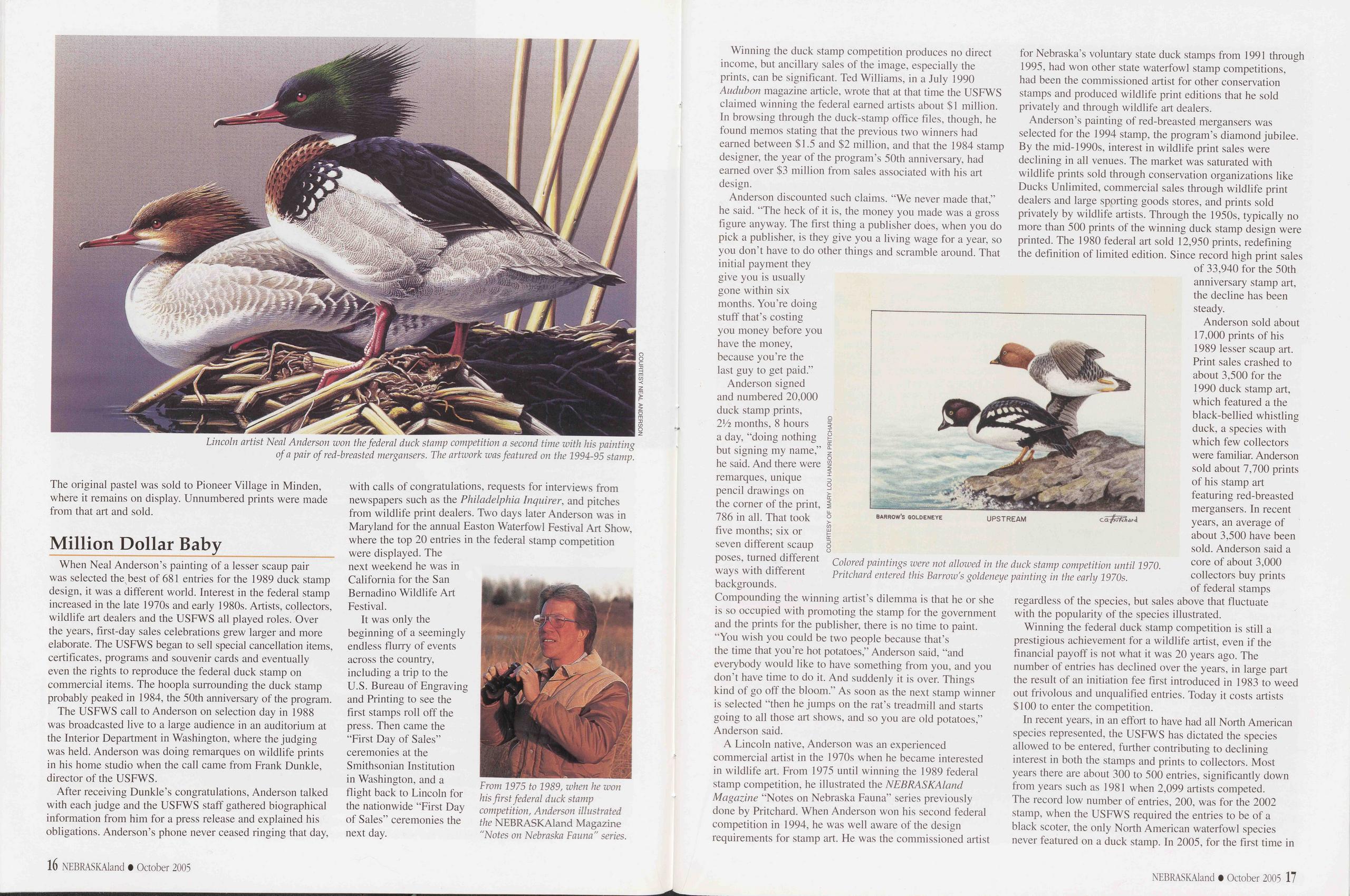
When Neal Anderson’s painting of a lesser scaup pair was selected the best of 681 entries for the 1989 duck stamp design, it was a different world. Interest in the federal stamp increased in the late 1970s and early 1980s. Artists, collectors, wildlife art dealers and the USFWS all played roles. Over the years, first-day sales celebrations grew larger and more elaborate. The USFWS began to sell special cancellation items, certificates, programs and souvenir cards and eventually even the rights to reproduce the federal duck stamp on commercial items. The hoopla surrounding the duck stamp probably peaked in 1984, the 50th anniversary of the program.
The USFWS call to Anderson on selection day in 1988 was broadcasted live to a large audience in an auditorium at the Interior Department in Washington, where the judging was held. Anderson was doing remarques on wildlife prints in his home studio when the call came from Frank Dunkle, director of the USFWS.
After receiving Dunkle’s congratulations, Anderson talked with each judge and the USFWS staff gathered biographical information from him for a press release and explained his obligations. Anderson’s phone never ceased ringing that day, with calls of congratulations, requests for interviews from newspapers such as the Philadelphia Inquirer, and pitches from wildlife print dealers. Two days later Anderson was in Maryland for the annual Easton Waterfowl Festival Art Show, where the top 20 entries in the federal stamp competition were displayed. The next weekend he was in California for the San Bernadino Wildlife Art Festival.
It was only the beginning of a seemingly endless flurry of events across the country, including a trip to the U.S. Bureau of Engraving and Printing to see the first stamps roll off the press. Then came the “First Day of Sales” ceremonies at the Smithsonian Institution in Washington, and a flight back to Lincoln for the nationwide “First Day of Sales” ceremonies the next day.
Winning the duck stamp competition produces no direct income, but ancillary sales of the image, especially the prints, can be significant. Ted Williams, in a July 1990 Audubon magazine article, wrote that at that time the USFWS claimed winning the federal earned artists about $1 million. In browsing through the duck-stamp office files, though, he found memos stating that the previous two winners had earned between $1.5 and $2 million, and that the 1984 stamp designer, the year of the program’s 50th anniversary, had earned over $3 million from sales associated with his art design.
Anderson discounted such claims. “We never made that,” he said. “The heck of it is, the money you made was a gross figure anyway. The first thing a publisher does, when you do pick a publisher, is they give you a living wage for a year, so you don’t have to do other things and scramble around. That initial payment they give you is usually gone within six months. You’re doing stuff that’s costing you money before you have the money, because you’re the last guy to get paid.”
Anderson signed and numbered 20,000 duck stamp prints, 21/2 months, 8 hours | a day, “doing nothing | but signing my name,” £ he said. And there were | remarques, unique □ pencil drawings on > the corner of the print, Z 786 in all. That took five months; six or seven different scaup poses, turned different ways with different backgrounds. Compounding the winning artist’s dilemma is that he or she is so occupied with promoting the stamp for the government and the prints for the publisher, there is no time to paint. “You wish you could be two people because that’s the time that you’re hot potatoes,” Anderson said, “and everybody would like to have something from you, and you don’t have time to do it. And suddenly it is over. Things kind of go off the bloom.” As soon as the next stamp winner is selected “then he jumps on the rat’s treadmill and starts going to all those art shows, and so you are old potatoes,” Anderson said.
A Lincoln native, Anderson was an experienced commercial artist in the 1970s when he became interested in wildlife art. From 1975 until winning the 1989 federal stamp competition, he illustrated the NEBRASKAland Magazine “Notes on Nebraska Fauna” series previously done by Pritchard. When Anderson won his second federal competition in 1994, he was well aware of the design requirements for stamp art. He was the commissioned artist
Anderson’s painting of red-breasted mergansers was selected for the 1994 stamp, the program’s diamond jubilee. By the mid-1990s, interest in wildlife print sales were declining in all venues. The market was saturated with wildlife prints sold through conservation organizations like Ducks Unlimited, commercial sales through wildlife print dealers and large sporting goods stores, and prints sold privately by wildlife artists. Through the 1950s, typically no more than 500 prints of the winning duck stamp design were printed. The 1980 federal art sold 12,950 prints, redefining the definition of limited edition. Since record high print sales of 33,940 for the 50th anniversary stamp art, the decline has been steady.
Anderson sold about 17,000 prints of his 1989 lesser scaup art. Print sales crashed to about 3,500 for the 1990 duck stamp art, which featured a the black-bellied whistling duck, a species with which few collectors were familiar. Anderson sold about 7,700 prints of his stamp art featuring red-breasted mergansers. In recent years, an average of about 3,500 have been sold. Anderson said a core of about 3,000 collectors buy prints of federal stamps regardless of the species, but sales above that fluctuate with the popularity of the species illustrated.
Winning the federal duck stamp competition is still a prestigious achievement for a wildlife artist, even if the financial payoff is not what it was 20 years ago. The number of entries has declined over the years, in large part the result of an initiation fee first introduced in 1983 to weed out frivolous and unqualified entries. Today it costs artists $100 to enter the competition.
In recent years, in an effort to have had all North American species represented, the USFWS has dictated the species allowed to be entered, further contributing to declining interest in both the stamps and prints to collectors. Most years there are about 300 to 500 entries, significantly down from years such as 1981 when 2,099 artists competed. The record low number of entries, 200, was for the 2002 stamp, when the USFWS required the entries to be of a black scoter, the only North American waterfowl species never featured on a duck stamp. In 2005, for the first time in 16 NEBRASKAland • October 2005 NEBRASKAland • October 2005 17 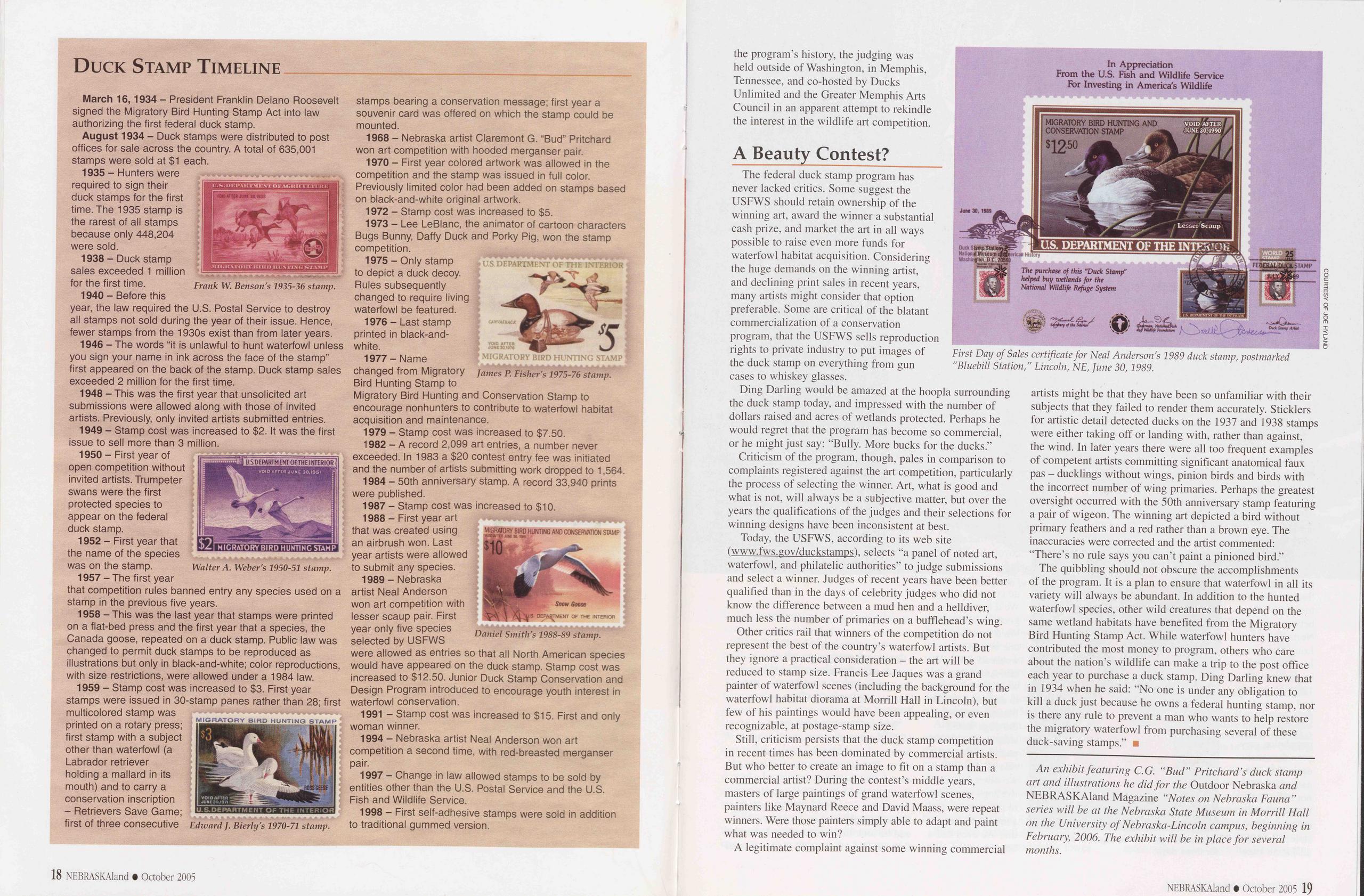 the program’s history, the judging was held outside of Washington, in Memphis, Tennessee, and co-hosted by Ducks Unlimited and the Greater Memphis Arts Council in an apparent attempt to rekindle the interest in the wildlife art competition.
The federal duck stamp program has never lacked critics. Some suggest the USFWS should retain ownership of the winning art, award the winner a substantial cash prize, and market the art in all ways possible to raise even more funds for waterfowl habitat acquisition. Considering the huge demands on the winning artist, and declining print sales in recent years, many artists might consider that option preferable. Some are critical of the blatant commercialization of a conservation program, that the USFWS sells reproduction rights to private industry to put images of the duck stamp on everything from gun cases to whiskey glasses.
Ding Darling would be amazed at the hoopla surrounding the duck stamp today, and impressed with the number of dollars raised and acres of wetlands protected. Perhaps he would regret that the program has become so commercial, or he might just say: “Bully. More bucks for the ducks.”
Criticism of the program, though, pales in comparison to complaints registered against the art competition, particularly the process of selecting the winner. Art, what is good and what is not, will always be a subjective matter, but over the years the qualifications of the judges and their selections for winning designs have been inconsistent at best.
Today, the USFWS, according to its web site (www.fws.go v/duckstamps). selects “a panel of noted art, waterfowl, and philatelic authorities” to judge submissions and select a winner. Judges of recent years have been better qualified than in the days of celebrity judges who did not know the difference between a mud hen and a helldiver, much less the number of primaries on a bufflehead’s wing.
Other critics rail that winners of the competition do not represent the best of the country’s waterfowl artists. But they ignore a practical consideration - the art will be reduced to stamp size. Francis Lee Jaques was a grand painter of waterfowl scenes (including the background for the waterfowl habitat diorama at Morrill Hall in Lincoln), but few of his paintings would have been appealing, or even recognizable, at postage-stamp size.
Still, criticism persists that the duck stamp competition in recent times has been dominated by commercial artists. But who better to create an image to fit on a stamp than a commercial artist? During the contest’s middle years, masters of large paintings of grand waterfowl scenes, painters like Maynard Reece and David Maass, were repeat winners. Were those painters simply able to adapt and paint what was needed to win?
A legitimate complaint against some winning commercial
The quibbling should not obscure the accomplishments of the program. It is a plan to ensure that waterfowl in all its variety will always be abundant. In addition to the hunted waterfowl species, other wild creatures that depend on the same wetland habitats have benefited from the Migratory Bird Hunting Stamp Act. While waterfowl hunters have contributed the most money to program, others who care about the nation’s wildlife can make a trip to the post office each year to purchase a duck stamp. Ding Darling knew that in 1934 when he said: “No one is under any obligation to kill a duck just because he owns a federal hunting stamp, nor is there any rule to prevent a man who wants to help restore the migratory waterfowl from purchasing several of these duck-saving stamps.”
An exhibit featuring C.G. “Bud״ Pritchard's duck stamp art and illustrations he did for the Outdoor Nebraska and NEBRASKAland Magazine “Notes on Nebraska Fauna״ series will be at the Nebraska State Museum in Morrill Hall on the University of Nebraska-Lincoln campus, beginning in February, 2006. The exhibit will be in place for several months. 18 NEBRASKAland • October 2005 NEBRASKAland • October 2005 19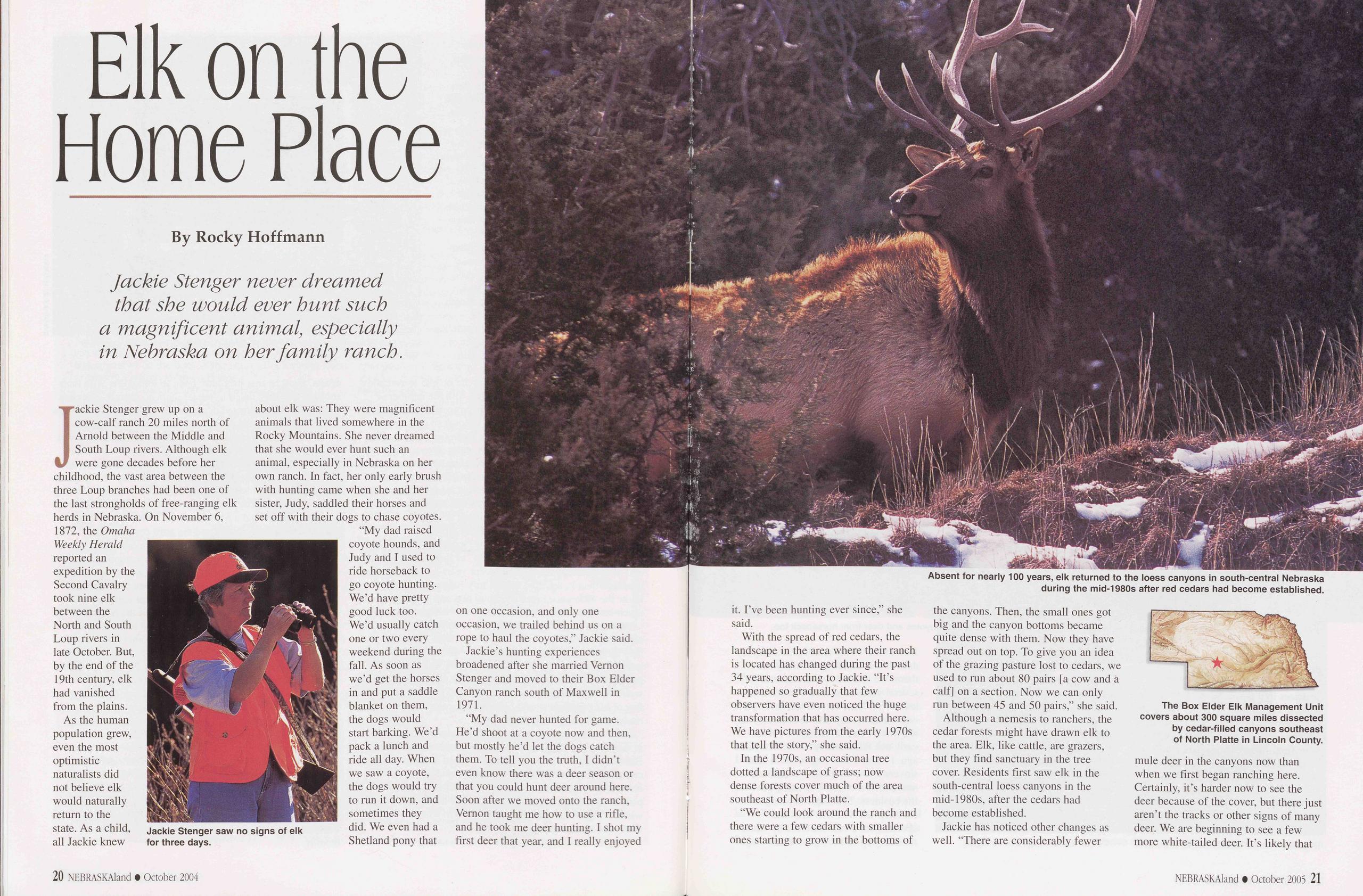
Elk on the Home Place
Jackie Stenger never dreamed that she would ever hunt such a magnificent animal, especially in Nebraska on her family ranch.
Jackie Stenger grew up on a cow-calf ranch 20 miles north of Arnold between the Middle and South Loup rivers. Although elk were gone decades before her childhood, the vast area between the three Loup branches had been one of the last strongholds of free-ranging elk herds in Nebraska. On November 6, 1872, the Omaha Weekly Herald reported an expedition by the Second Cavalry took nine elk between the North and South Loup rivers in late October. But, by the end of the 19th century, elk had vanished from the plains.
As the human population grew, even the most optimistic naturalists did not believe elk would naturally return to the state. As a child, all Jackie knew
“My dad raised coyote hounds, and Judy and I used to ride horseback to go coyote hunting. We’d have pretty good luck too. We’d usually catch one or two every weekend during the fall. As soon as we’d get the horses in and put a saddle blanket on them, the dogs would start barking. We’d pack a lunch and ride all day. When we saw a coyote, the dogs would try to run it down, and sometimes they did. We even had a Shetland pony that
Jackie’s hunting experiences broadened after she married Vernon Stenger and moved to their Box Elder Canyon ranch south of Maxwell in 1971.
“My dad never hunted for game. He’d shoot at a coyote now and then, but mostly he’d let the dogs catch them. To tell you the truth, I didn’t even know there was a deer season or that you could hunt deer around here. Soon after we moved onto the ranch, Vernon taught me how to use a rifle, and he took me deer hunting. I shot my first deer that year, and I really enjoyed it. I’ve been hunting ever since,” she said.
With the spread of red cedars, the landscape in the area where their ranch is located has changed during the past 34 years, according to Jackie. “It’s happened so gradually that few observers have even noticed the huge transformation that has occurred here. We have pictures from the early 1970s that tell the story,” she said.
In the 1970s, an occasional tree dotted a landscape of grass; now dense forests cover much of the area southeast of North Platte.
“We could look around the ranch and there were a few cedars with smaller ones starting to grow in the bottoms of the canyons. Then, the small ones got big and the canyon bottoms became quite dense with them. Now they have spread out on top. To give you an idea of the grazing pasture lost to cedars, we used to run about 80 pairs [a cow and a calf] on a section. Now we can only run between 45 and 50 pairs,” she said.
Although a nemesis to ranchers, the cedar forests might have drawn elk to the area. Elk, like cattle, are grazers, but they find sanctuary in the tree cover. Residents first saw elk in the south-central loess canyons in the mid-1980s, after the cedars had become established.
Jackie has noticed other changes as well. “There are considerably fewer
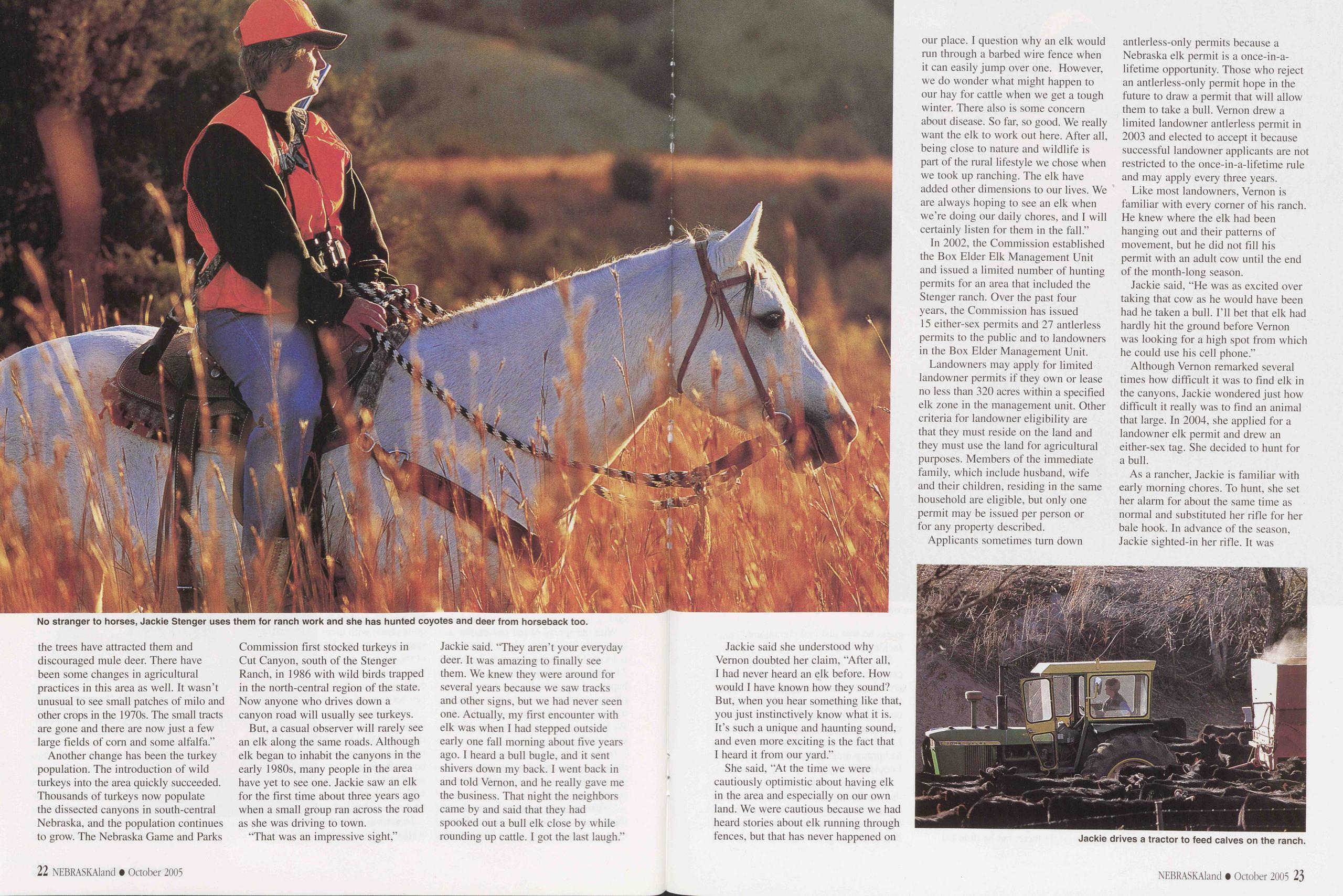
Another change has been the turkey population. The introduction of wild turkeys into the area quickly succeeded. Thousands of turkeys now populate the dissected canyons in south-central Nebraska, and the population continues to grow. The Nebraska Game and Parks Commission first stocked turkeys in Cut Canyon, south of the Stenger Ranch, in 1986 with wild birds trapped in the north-central region of the state. Now anyone who drives down a canyon road will usually see turkeys.
But, a casual observer will rarely see an elk along the same roads. Although elk began to inhabit the canyons in the early 1980s, many people in the area have yet to see one. Jackie saw an elk for the first time about three years ago when a small group ran across the road as she was driving to town.
“That was an impressive sight,” Jackie said. "They aren’t your everyday deer. It was amazing to finally see them. We knew they were around for several years because we saw tracks and other signs, but we had never seen one. Actually, my first encounter with elk was when I had stepped outside early one fall morning about five years ago. I heard a bull bugle, and it sent shivers down my back. I went back in and told Vernon, and he really gave me the business. That night the neighbors came by and said that they had spooked out a bull elk close by while rounding up cattle. I got the last laugh.”
Jackie said she understood why Vernon doubted her claim, “After all, I had never heard an elk before. How would I have known how they sound? But, when you hear something like that, you just instinctively know what it is. It’s such a unique and haunting sound, and even more exciting is the fact that I heard it from our yard.”
She said, "At the time we were cautiously optimistic about having elk in the area and especially on our own land. We were cautious because we had heard stories about elk running through fences, but that has never happened on our place. I question why an elk would run through a barbed wire fence when it can easily jump over one. However, we do wonder what might happen to our hay for cattle when we get a tough winter. There also is some concern about disease. So far, so good. We really want the elk to work out here. After all, being close to nature and wildlife is part of the rural lifestyle we chose when we took up ranching. The elk have added other dimensions to our lives. We are always hoping to see an elk when we’re doing our daily chores, and I will certainly listen for them in the fall.”
In 2002, the Commission established the Box Elder Elk Management Unit and issued a limited number of hunting permits for an area that included the Stenger ranch. Over the past four years, the Commission has issued 15 either-sex permits and 27 antlerless permits to the public and to landowners in the Box Elder Management Unit.
Landowners may apply for limited landowner permits if they own or lease no less than 320 acres within a specified elk zone in the management unit. Other criteria for landowner eligibility are that they must reside on the land and they must use the land for agricultural purposes. Members of the immediate family, which include husband, wife and their children, residing in the same household are eligible, but only one permit may be issued per person or for any property described.
Applicants sometimes turn down
Like most landowners, Vernon is familiar with every corner of his ranch. He knew where the elk had been hanging out and their patterns of movement, but he did not fill his permit with an adult cow until the end of the month-long season.
Jackie said, "He was as excited over taking that cow as he would have been had he taken a bull. TH bet that elk had hardly hit the ground before Vernon was looking for a high spot from which he could use his cell phone.”
Although Vernon remarked several times how difficult it was to find elk in the canyons, Jackie wondered just how difficult it really was to find an animal that large. In 2004, she applied for a landowner elk permit and drew an either-sex tag. She decided to hunt for a bull.
As a rancher, Jackie is familiar with early morning chores. To hunt, she set her alarm for about the same time as normal and substituted her rifle for her bale hook. In advance of the season, Jackie sighted-in her rifle. It was 22 NEBRASKAland O October 2005 NEBRASKAland • October 2005 23 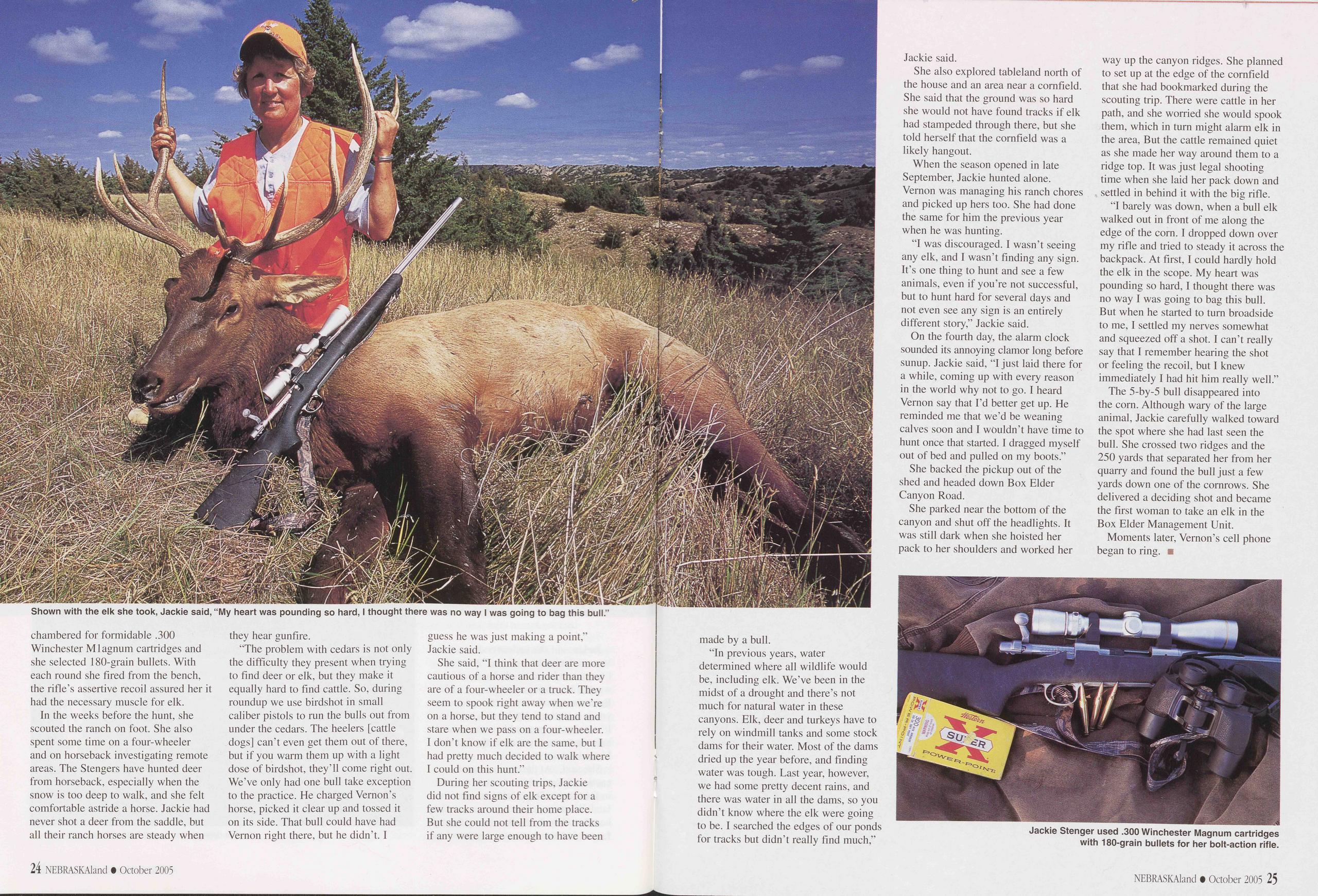
In the weeks before the hunt, she scouted the ranch on foot. She also spent some time on a four-wheeler and on horseback investigating remote areas. The Stengers have hunted deer from horseback, especially when the snow is too deep to walk, and she felt comfortable astride a horse. Jackie had never shot a deer from the saddle, but all their ranch horses are steady when they hear gunfire.
"The problem with cedars is not only the difficulty they present when trying to find deer or elk, but they make it equally hard to find cattle. So, during roundup we use birdshot in small caliber pistols to run the bulls out from under the cedars. The heelers [cattle dogs] can’t even get them out of there, but if you warm them up with a light dose of birdshot, they’ll come right out. We’ve only had one bull take exception to the practice. He charged Vernon’s horse, picked it clear up and tossed it on its side. That bull could have had Vernon right there, but he didn’t. I guess he was just making a point,” Jackie said.
She said, "I think that deer are more cautious of a horse and rider than they are of a four-wheeler or a truck. They seem to spook right away when we’re on a horse, but they tend to stand and stare when we pass on a four-wheeler. I don’t know if elk are the same, but I had pretty much decided to walk where I could on this hunt.”
During her scouting trips, Jackie did not find signs of elk except for a few tracks around their home place. But she could not tell from the tracks if any were large enough to have been made by a bull.
"In previous years, water determined where all wildlife would be, including elk. We’ve been in the midst of a drought and there’s not much for natural water in these canyons. Elk, deer and turkeys have to rely on windmill tanks and some stock dams for their water. Most of the dams dried up the year before, and finding water was tough. Last year, however, we had some pretty decent rains, and there was water in all the dams, so you didn’t know where the elk were going to be. I searched the edges of our ponds for tracks but didn’t really find much,” Jackie said.
She also explored tableland north of the house and an area near a cornfield. She said that the ground was so hard she would not have found tracks if elk had stampeded through there, but she told herself that the cornfield was a likely hangout.
When the season opened in late September, Jackie hunted alone. Vernon was managing his ranch chores and picked up hers too. She had done the same for him the previous year when he was hunting.
“I was discouraged. I wasn’t seeing any elk, and I wasn’t finding any sign. It’s one thing to hunt and see a few animals, even if you’re not successful, but to hunt hard for several days and not even see any sign is an entirely different story,” Jackie said.
On the fourth day, the alarm clock sounded its annoying clamor long before sunup. Jackie said, “I just laid there for a while, coming up with every reason in the world why not to go. I heard Vernon say that I’d better get up. He reminded me that we’d be weaning calves soon and I wouldn’t have time to hunt once that started. I dragged myself out of bed and pulled on my boots.”
She backed the pickup out of the shed and headed down Box Elder Canyon Road.
She parked near the bottom of the canyon and shut off the headlights. It was still dark when she hoisted her pack to her shoulders and worked her way up the canyon ridges. She planned to set up at the edge of the cornfield that she had bookmarked during the scouting trip. There were cattle in her path, and she worried she would spook them, which in turn might alarm elk in the area, But the cattle remained quiet as she made her way around them to a ridge top. It was just legal shooting time when she laid her pack down and settled in behind it with the big rifle.
"I barely was down, when a bull elk walked out in front of me along the edge of the corn. I dropped down over my rifle and tried to steady it across the backpack. At first, I could hardly hold the elk in the scope. My heart was pounding so hard, I thought there was no way I was going to bag this bull. But when he started to turn broadside to me, I settled my nerves somewhat and squeezed off a shot. I can’t really say that I remember hearing the shot or feeling the recoil, but I knew immediately I had hit him really well.”
The 5-by-5 bull disappeared into the corn. Although wary of the large animal, Jackie carefully walked toward the spot where she had last seen the bull. She crossed two ridges and the 250 yards that separated her from her quarry and found the bull just a few yards down one of the cornrows. She delivered a deciding shot and became the first woman to take an elk in the Box Elder Management Unit. Moments later, Vernon’s cell phone began to ring.
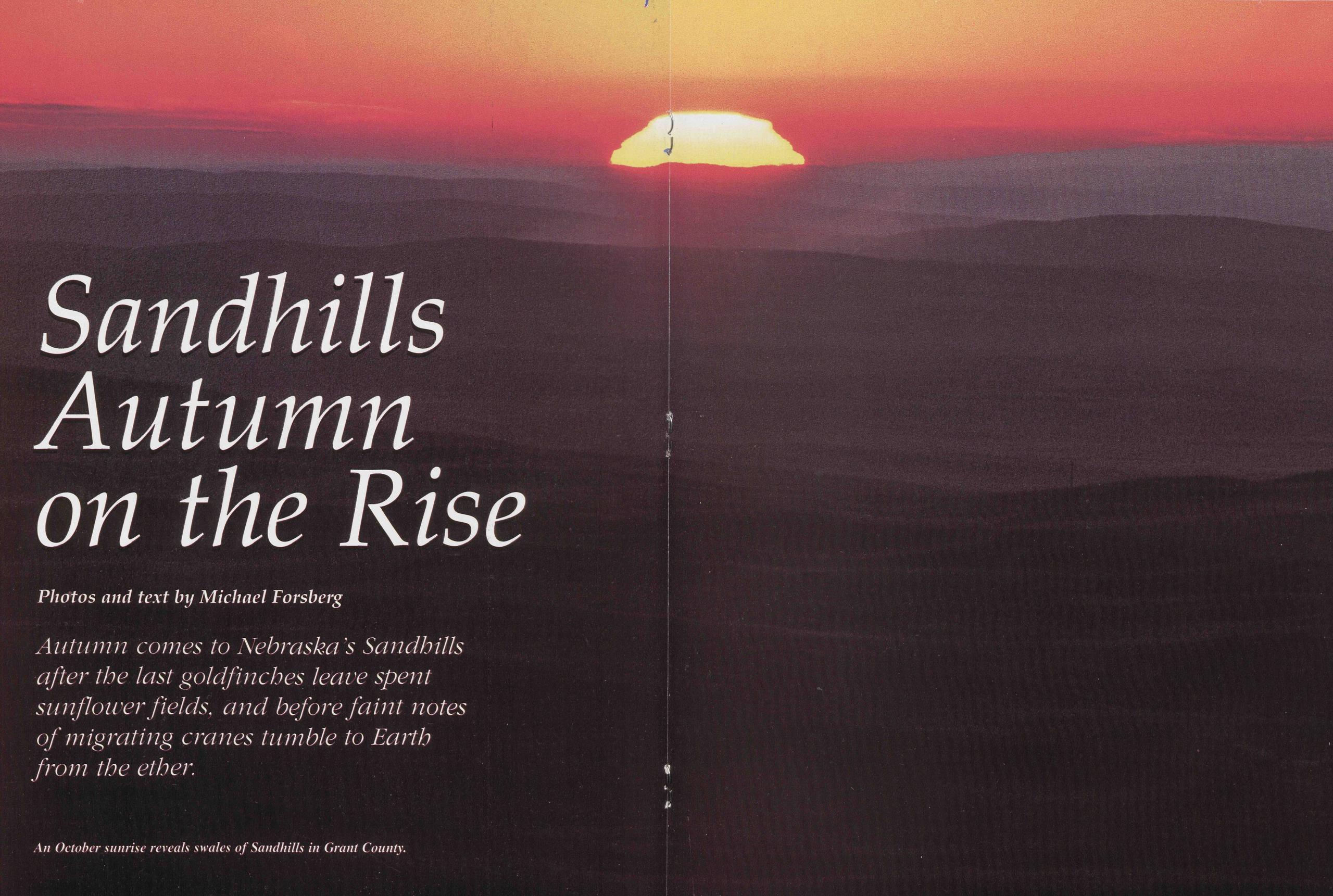
Sandhills Autumn on the Rise
Autumn comes to Nebraska's Sandbills after the last goldfinches leave spent sunflower fields, and before faint notes of migrating cranes tumble to Earth from the ether.
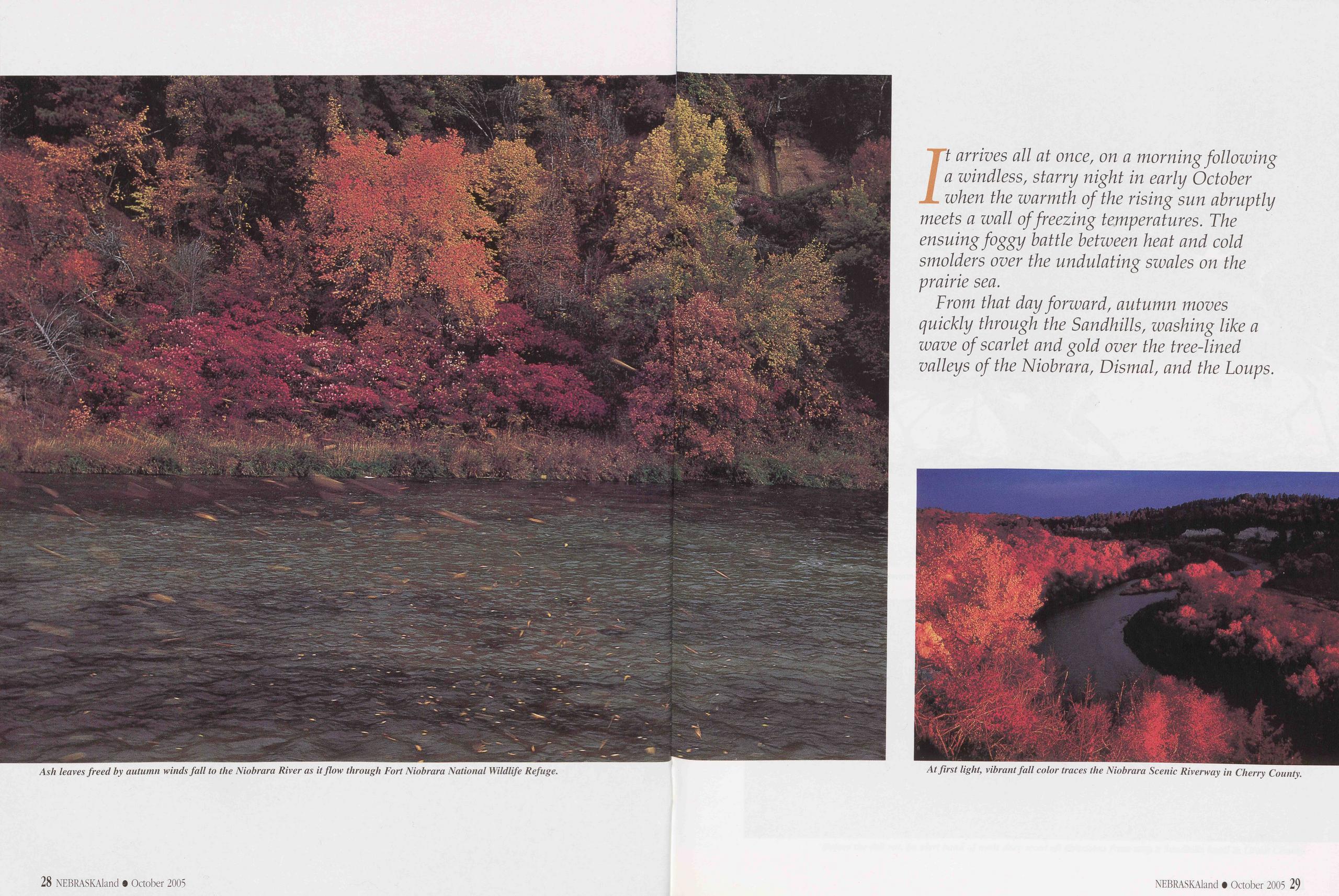
It arrives all at once, on a morning following a windless, starry night in early October when the warmth of the rising sun abruptly meets a wall of freezing temperatures. The ensuing foggy battle between heat and cold smolders over the undulating swales on the prairie sea.
From that day forward, autumn moves quickly through the Sandhills, washing like a wave of scarlet and gold over the tree-lined valleys of the Niobrara, Dismal, and the Loups.
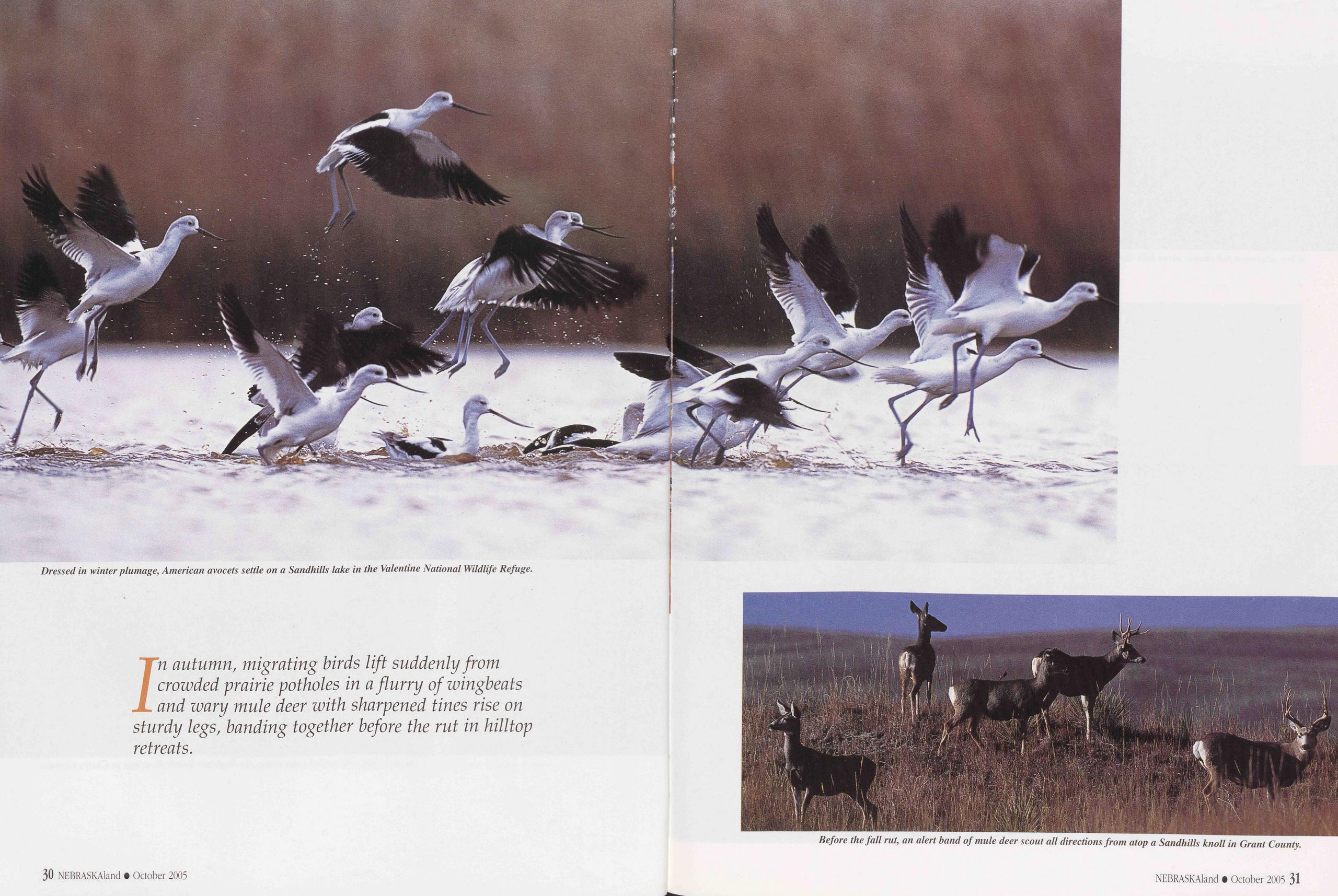
In autumn, migrating birds lift suddenly from crowded prairie potholes in a flurry of wingbeats and wary mule deer with sharpened tines rise on sturdy legs, banding together before the rut in hilltop retreats.
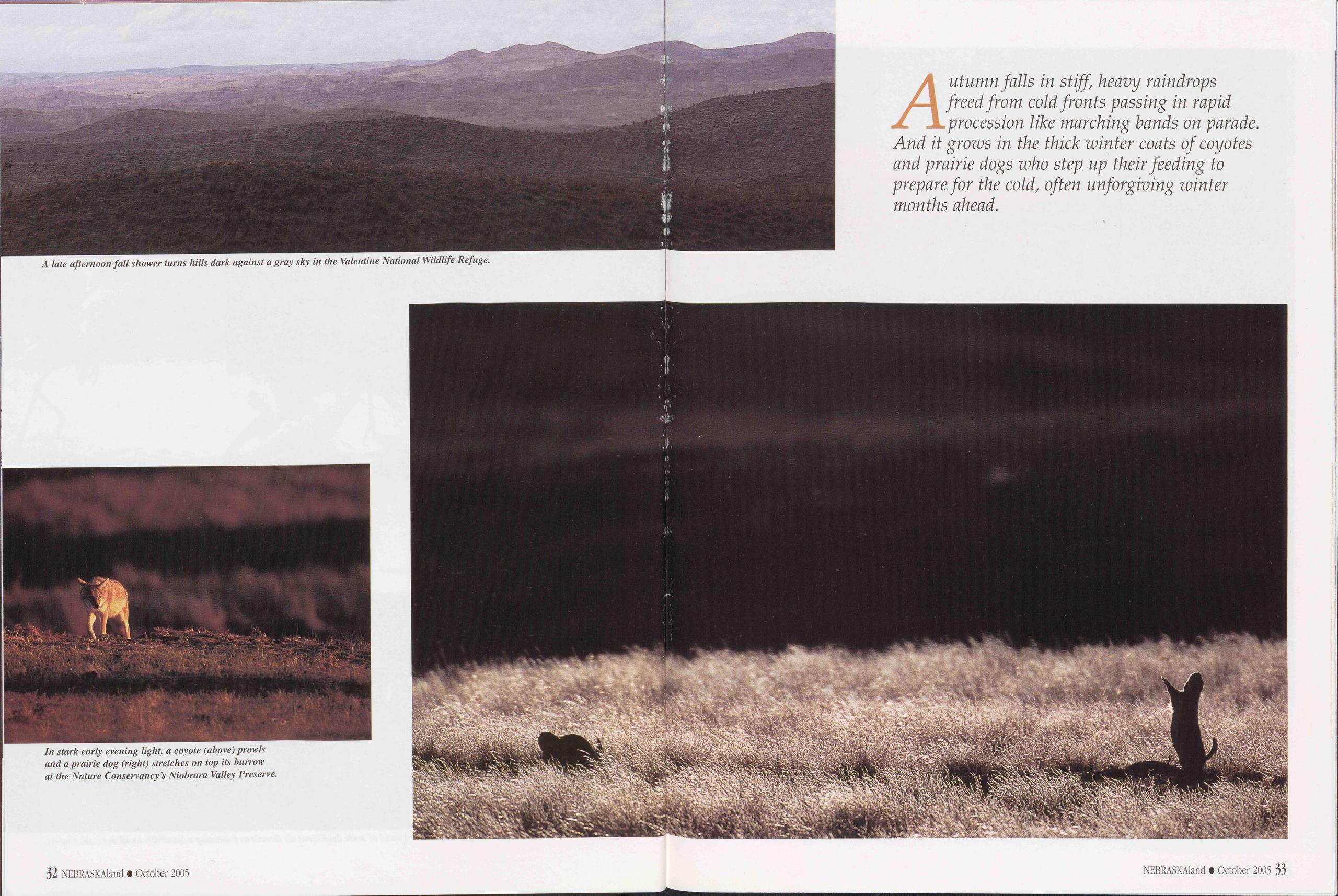
Autumn falls in stiff heavy raindrops freed from cold fronts passing in rapid procession like marching bands on parade. And it grows in the thick winter coats of coyotes and prairie dogs who step up their feeding to prepare for the cold, often unforgiving winter months ahead.
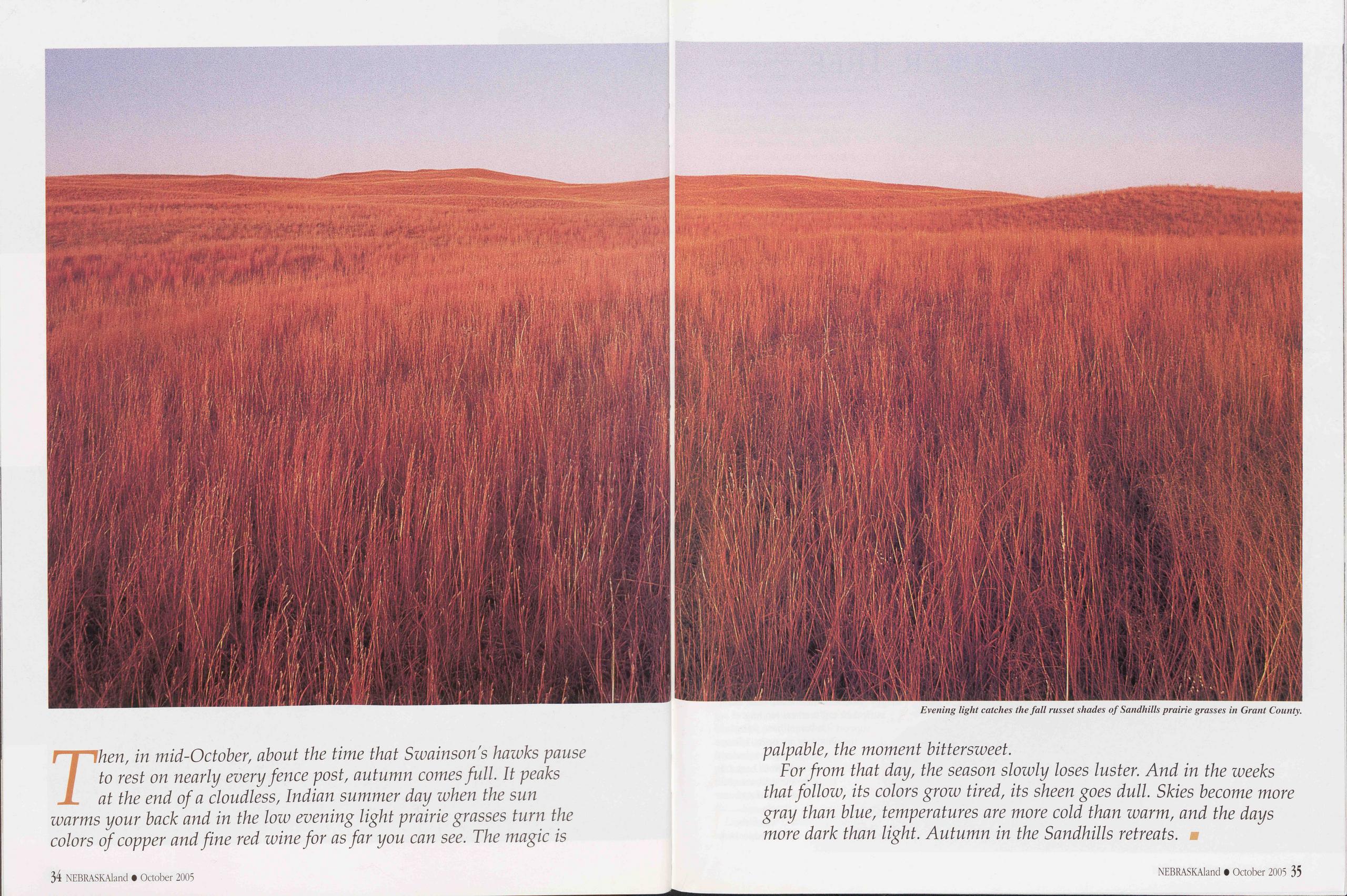
Then, in mid-October, about the time that Swainson's hawks pause to rest on nearly every fence post, autumn comes full. It peaks at the end of a cloudless, Indian summer day when the sun warms your back and in the low evening light prairie grasses turn the colors of copper and fine red wine for as far you can see. The magic is palpable, the moment bittersweet.
For from that day, the season slowly loses luster. And in the weeks that follow, its colors grow tired, its sheen goes dull. Skies become more gray than blue, temperatures are more cold than warm, and the days more dark than light. Autumn in the Sandhills retreats.
34 NEBRASKAland • October 2005 NEBRASKAland • October 2005 35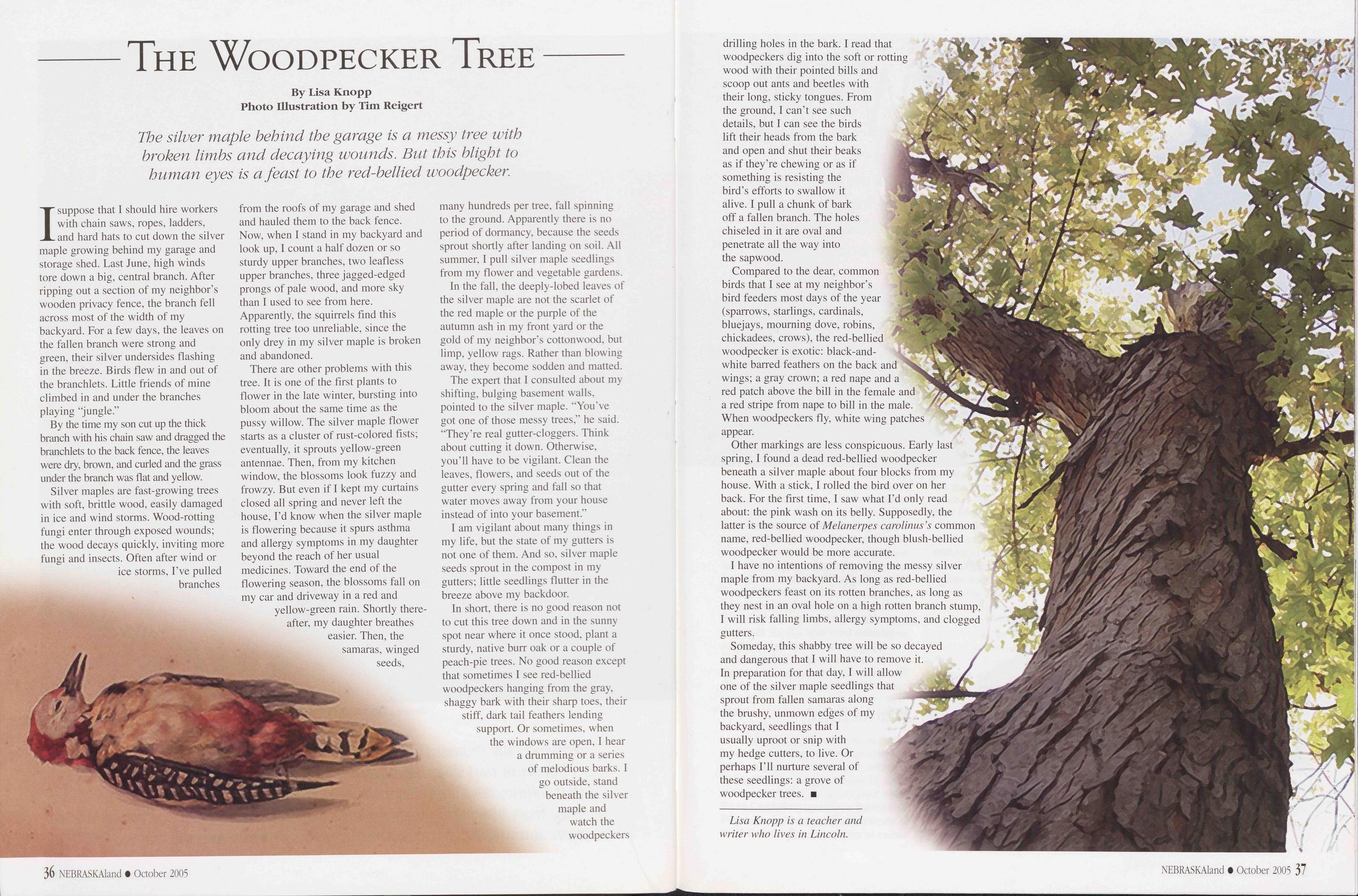
The Woodpecker Tree
The silver maple behind the garage is a messy tree with broken limbs and decaying wounds. But this blight to human eyes is a feast to the red-bellied woodpecker.
I suppose that I should hire workers with chain saws, ropes, ladders, and hard hats to cut down the silver maple growing behind my garage and storage shed. Last June, high winds tore down a big, central branch. After ripping out a section of my neighbor’s wooden privacy fence, the branch fell across most of the width of my backyard. For a few days, the leaves on the fallen branch were strong and green, their silver undersides flashing in the breeze. Birds flew in and out of the branchlets. Little friends of mine climbed in and under the branches playing “jungle.”
By the time my son cut up the thick branch with his chain saw and dragged the bloom about the same time as the pussy willow. The silver maple flower starts as a cluster of rust-colored fists; branchlets to the back fence, the leaves were dry, brown, and curled and the grass under the branch was flat and yellow. Silver maples are fast-growing trees with soft, brittle wood, easily damaged in ice and wind storms. Wood-rotting fungi enter through exposed wounds; the wood decays quickly, inviting more fungi and insects. Often after wind or ice storms, I’ve pulled branches from the roofs of my garage and shed and hauled them to the back fence. Now, when I stand in my backyard and look up, I count a half dozen or so sturdy upper branches, two leafless upper branches, three jagged-edged prongs of pale wood, and more sky than I used to see from here. Apparently, the squirrels find this rotting tree too unreliable, since the only drey in my silver maple is broken and abandoned.
There are other problems with this tree. It is one of the first plants to flower in the late winter, bursting into eventually, it sprouts yellow-green antennae. Then, from my kitchen window, the blossoms look fuzzy and frowzy. But even if I kept my curtains closed all spring and never left the house, I’d know when the silver maple is flowering because it spurs asthma and allergy symptoms in my daughter beyond the reach of her usual medicines. Toward the end of the branches flowering season, the blossoms fall on my car and driveway in a red and yellow-green rain. Shortly there- after, my daughter breathes easier. Then, the samaras, winged seeds, many hundreds per tree, fall spinning to the ground. Apparently there is no period of dormancy, because the seeds sprout shortly after landing on soil. All summer, I pull silver maple seedlings from my flower and vegetable gardens.
In the fall, the deeply-lobed leaves of the silver maple are not the scarlet of the red maple or the purple of the autumn ash in my front yard or the gold of my neighbor’s cottonwood, but limp, yellow rags. Rather than blowing away, they become sodden and matted.
The expert that I consulted about my shifting, bulging basement walls, pointed to the silver maple. “You’ve got one of those messy trees,” he said. “They’re real gutter-doggers. Think about cutting it down. Otherwise, you’ll have to be vigilant. Clean the leaves, flowers, and seeds out of the gutter every spring and fall so that water moves away from your house instead of into your basement.”
I am vigilant about many things in my life, but the state of my gutters is not one of them. And so, silver maple seeds sprout in the compost in my gutters; little seedlings flutter in the breeze above my backdoor.
In short, there is no good reason not to cut this tree down and in the sunny spot near where it once stood, plant a sturdy, native burr oak or a couple of peach-pie trees. No good reason except that sometimes I see red-bellied woodpeckers hanging from the gray, shaggy bark with their sharp toes, their stiff, dark tail feathers lending support. Or sometimes, when the windows are open, I hear a drumming or a series of melodious barks. I go outside, stand beneath the silver maple and watch the woodpeckers drilling holes in the bark. I read that woodpeckers dig into the soft or rotting wood with their pointed bills and scoop out ants and beetles with their long, sticky tongues. From the ground, I can’t see such details, but I can see the birds lift their heads from the bark and open and shut their beaks as if they’re chewing or as if something is resisting the bird’s efforts to swallow it alive. I pull a chunk of bark off a fallen branch. The holes chiseled in it are oval and penetrate all the way into the sapwood.
Compared to the dear, common birds that I see at my neighbor’s bird feeders most days of the year (sparrows, starlings, cardinals, bluejays, mourning dove, robins, chickadees, crows), the red-bellied woodpecker is exotic: black-and- white barred feathers on the back and י wings; a gray crown; a red nape and a red patch above the bill in the female and a red stripe from nape to bill in the male. When woodpeckers fly, white wing patches appear.
Other markings are less conspicuous. Early last spring, I found a dead red-bellied woodpecker beneath a silver maple about four blocks from my house. With a stick, I rolled the bird over on her back. For the first time, I saw what I’d only read about: the pink wash on its belly. Supposedly, the latter is the source of Melanerpes Carolinas fs common name, red-bellied woodpecker, though blush-bellied woodpecker would be more accurate.
I have no intentions of removing the messy silver maple from my backyard. As long as red-bellied woodpeckers feast on its rotten branches, as long as they nest in an oval hole on a high rotten branch stump, I will risk falling limbs, allergy symptoms, and clogged gutters.
Someday, this shabby tree will be so decayed and dangerous that I will have to remove it In preparation for that day, I will allow one of the silver maple seedlings that sprout from fallen samaras along the brushy, unmown edges of my backyard, seedlings that I usually uproot or snip with my hedge cutters, to live. Or perhaps I’ll nurture several of these seedlings: a grove of woodpecker trees.
36 NEBRASKAland • October 2005 Lisa Knopp is a teacher and writer who lives in Lincoln. NEBRASKAland • October 2005 37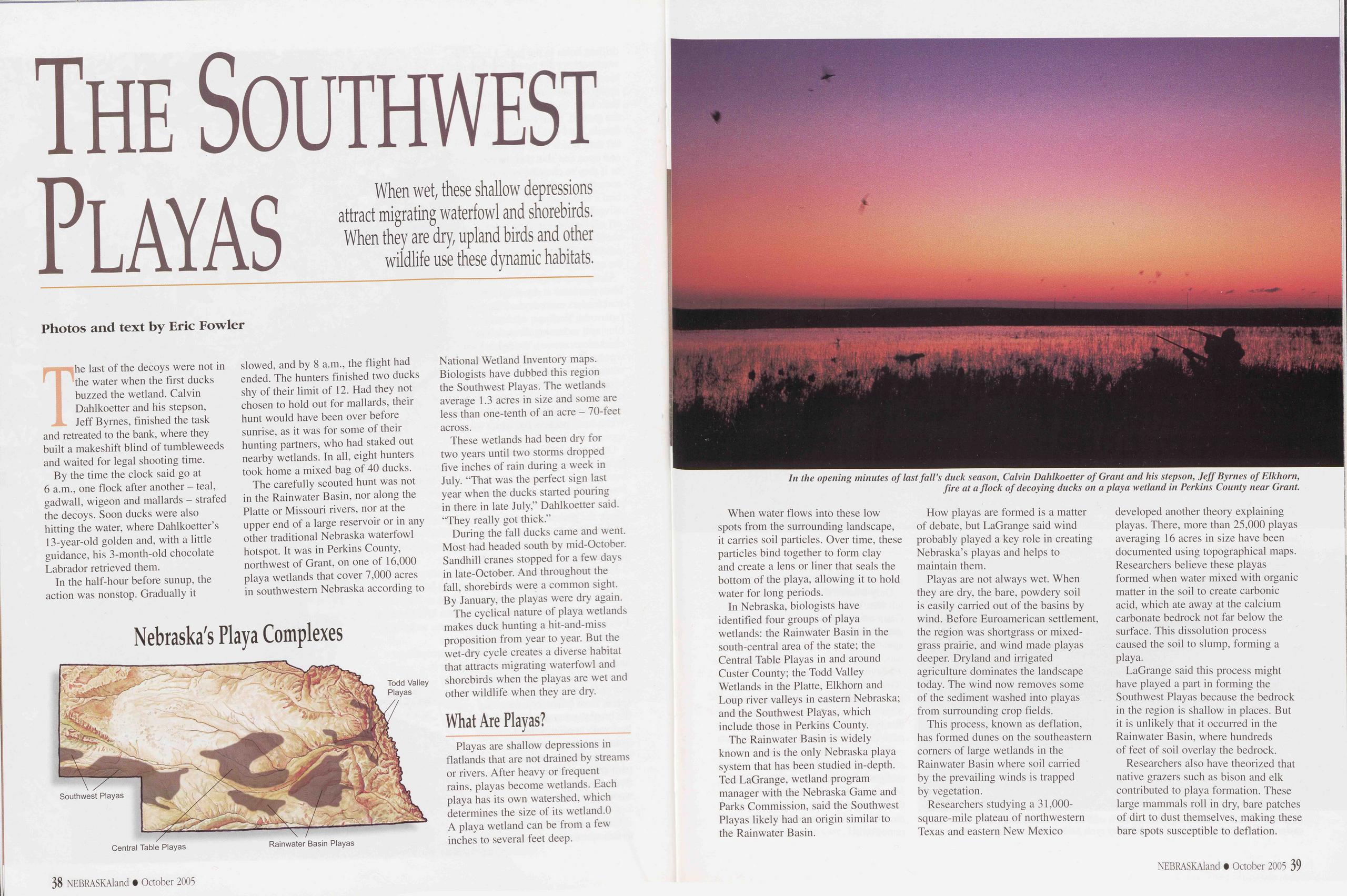
The Southwest Playas
When wet, these shallow depressions attract migrating waterfowl and shorebirds. When they are dry, upland birds and other wildlife use these dynamic habitats.
The last of the decoys were not in the water when the first ducks buzzed the wetland. Calvin Dahlkoetter and his stepson, Jeff Byrnes, finished the task and retreated to the bank, where they built a makeshift blind of tumbleweeds and waited for legal shooting time.
By the time the clock said go at 6 a.m., one flock after another - teal, gadwall, wigeon and mallards - strafed the decoys. Soon ducks were also hitting the water, where Dahlkoetter’s 13-year-old golden and, with a little guidance, his 3-month-old chocolate Labrador retrieved them.
In the half-hour before sunup, the action was nonstop. Gradually it slowed, and by 8 a.m., the flight had ended. The hunters finished two ducks shy of their limit of 12. Had they not chosen to hold out for mallards, their hunt would have been over before sunrise, as it was for some of their hunting partners, who had staked out nearby wetlands. In all, eight hunters took home a mixed bag of 40 ducks.
The carefully scouted hunt was not in the Rainwater Basin, nor along the Platte or Missouri rivers, nor at the upper end of a large reservoir or in any other traditional Nebraska waterfowl hotspot. It was in Perkins County, northwest of Grant, on one of 16,000 playa wetlands that cover 7,000 acres in southwestern Nebraska according to Nebraska's Playa Complexes 38 NEBRASKAland • October 2005 National Wetland Inventory maps. Biologists have dubbed this region the Southwest Playas. The wetlands average 1.3 acres in size and some are less than one-tenth of an acre - 70-feet across.
These wetlands had been dry for two years until two storms dropped five inches of rain during a week in July. "That was the perfect sign last year when the ducks started pouring in there in late July,” Dahlkoetter said. "They really got thick.”
During the fall ducks came and went. Most had headed south by mid-October. Sandhill cranes stopped for a few days in late-October. And throughout the fall, shorebirds were a common sight. By January, the playas were dry again.
The cyclical nature of playa wetlands makes duck hunting a hit-and-miss proposition from year to year. But the wet-dry cycle creates a diverse habitat that attracts migrating waterfowl and shorebirds when the playas are wet and other wildlife when they are dry.
What Are Playas?Playas are shallow depressions in flatlands that are not drained by streams or rivers. After heavy or frequent rains, playas become wetlands. Each playa has its own watershed, which determines the size of its wetland.O A playa wetland can be from a few inches to several feet deep.
When water flows into these low spots from the surrounding landscape, it carries soil particles. Over time, these particles bind together to form clay and create a lens or liner that seals the bottom of the playa, allowing it to hold water for long periods.
In Nebraska, biologists have identified four groups of playa wetlands: the Rainwater Basin in the south-central area of the state; the Central Table Playas in and around Custer County; the Todd Valley Wetlands in the Platte, Elkhorn and Loup river valleys in eastern Nebraska; and the Southwest Playas, which include those in Perkins County.
The Rainwater Basin is widely known and is the only Nebraska playa system that has been studied in-depth. Ted LaGrange, wetland program manager with the Nebraska Game and Parks Commission, said the Southwest Playas likely had an origin similar to the Rainwater Basin.
How playas are formed is a matter of debate, but LaGrange said wind probably played a key role in creating Nebraska’s playas and helps to maintain them.
Playas are not always wet. When they are dry, the bare, powdery soil is easily carried out of the basins by wind. Before Euroamerican settlement, the region was shortgrass or mixed- grass prairie, and wind made playas deeper. Dryland and irrigated agriculture dominates the landscape today. The wind now removes some of the sediment washed into playas from surrounding crop fields.
This process, known as deflation, has formed dunes on the southeastern corners of large wetlands in the Rainwater Basin where soil carried by the prevailing winds is trapped by vegetation.
Researchers studying a 31,000- square-mile plateau of northwestern Texas and eastern New Mexico developed another theory explaining playas. There, more than 25,000 playas averaging 16 acres in size have been documented using topographical maps. Researchers believe these playas formed when water mixed with organic matter in the soil to create carbonic acid, which ate away at the calcium carbonate bedrock not far below the surface. This dissolution process caused the soil to slump, forming a playa.
LaGrange said this process might have played a part in forming the Southwest Playas because the bedrock in the region is shallow in places. But it is unlikely that it occurred in the Rainwater Basin, where hundreds of feet of soil overlay the bedrock.
Researchers also have theorized that native grazers such as bison and elk contributed to playa formation. These large mammals roll in dry, bare patches of dirt to dust themselves, making these bare spots susceptible to deflation.
38 NEBRASKAland • October 2005 NEBRASKAland • October 2005 39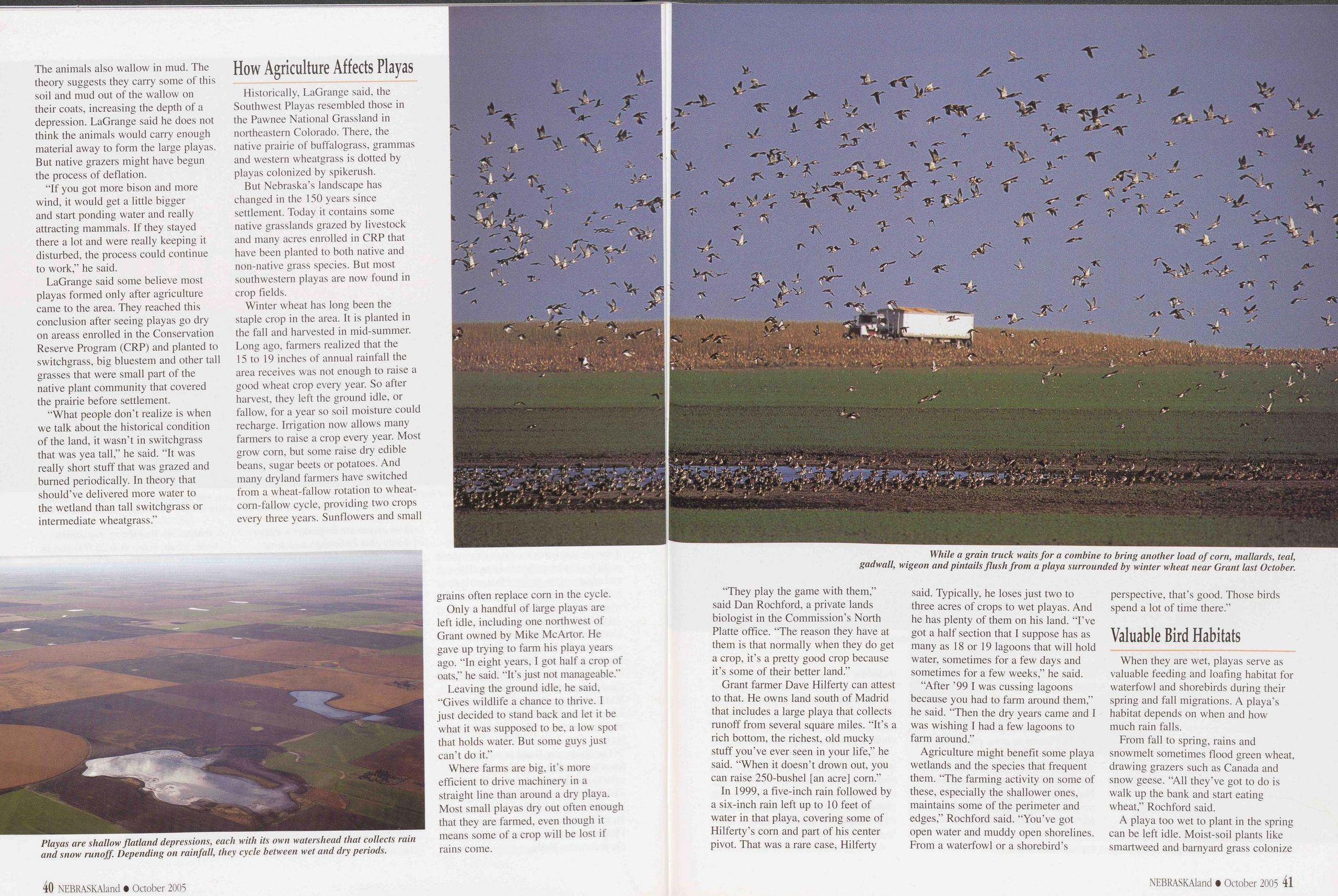
The animals also wallow in mud. The theory suggests they carry some of this soil and mud out of the wallow on their coats, increasing the depth of a depression. LaGrange said he does not think the animals would carry enough material away to form the large playas. But native grazers might have begun the process of deflation.
“If you got more bison and more wind, it would get a little bigger and start ponding water and really attracting mammals. If they stayed there a lot and were really keeping it disturbed, the process could continue to work,” he said.
LaGrange said some believe most playas formed only after agriculture came to the area. They reached this conclusion after seeing playas go dry on areass enrolled in the Conservation Reserve Program (CRP) and planted to switchgrass, big bluestem and other tall grasses that were small part of the native plant community that covered the prairie before settlement.
“What people don’t realize is when we talk about the historical condition of the land, it wasn’t in switchgrass that was yea tall,” he said. "It was really short stuff that was grazed and burned periodically. In theory that should’ve delivered more water to the wetland than tall switchgrass or intermediate wheatgrass.”
Historically, LaGrange said, the Southwest Playas resembled those in the Pawnee National Grassland in northeastern Colorado. There, the native prairie of buffalograss, grammas and western wheatgrass is dotted by playas colonized by spikerush.
But Nebraska’s landscape has changed in the 150 years since settlement. Today it contains some native grasslands grazed by livestock and many acres enrolled in CRP that have been planted to both native and non-native grass species. But most southwestern playas are now found in crop fields.
Winter wheat has long been the staple crop in the area. It is planted in the fall and harvested in mid-summer. Long ago, farmers realized that the 15 to 19 inches of annual rainfall the area receives was not enough to raise a good wheat crop every year. So after harvest, they left the ground idle, or fallow, for a year so soil moisture could recharge. Irrigation now allows many farmers to raise a crop every year. Most grow corn, but some raise dry edible beans, sugar beets or potatoes. And many dryland farmers have switched from a wheat-fallow rotation to wheat- corn-fallow cycle, providing two crops every three years. Sunflowers and small
Only a handful of large playas are left idle, including one northwest of Grant owned by Mike McArtor. He gave up trying to farm his playa years ago. "In eight years, I got half a crop of oats,” he said. "It’s just not manageable.” Leaving the ground idle, he said. "Gives wildlife a chance to thrive. I just decided to stand back and let it be what it was supposed to be, a low spot that holds water. But some guys just can’t do it.”
Where farms are big, it’s more efficient to drive machinery in a straight line than around a dry playa. Most small playas dry out often enough that they are farmed, even though it means some of a crop will be lost if rains come.
"They play the game with them,” said Dan Rochford, a private lands biologist in the Commission’s North Platte office. "The reason they have at them is that normally when they do get a crop, it’s a pretty good crop because it’s some of their better land.”
Grant farmer Dave Hilferty can attest to that. He owns land south of Madrid that includes a large playa that collects runoff from several square miles. "It’s a rich bottom, the richest, old mucky stuff you’ve ever seen in your life,” he said. "When it doesn’t drown out, you can raise 250-bushel [an acre] corn.”
In 1999, a five-inch rain followed by a six-inch rain left up to 10 feet of water in that playa, covering some of Hilferty’s corn and part of his center pivot. That was a rare case, Hilferty said. Typically, he loses just two to three acres of crops to wet playas. And he has plenty of them on his land. "I’ve got a half section that I suppose has as many as 18 or 19 lagoons that will hold water, sometimes for a few days and sometimes for a few weeks,” he said.
"After ’99 I was cussing lagoons because you had to farm around them,” he said. "Then the dry years came and I was wishing I had a few lagoons to farm around.”
Agriculture might benefit some playa wetlands and the species that frequent them. "The farming activity on some of these, especially the shallower ones, maintains some of the perimeter and edges,” Rochford said. “You’ve got open water and muddy open shorelines. From a waterfowl or a shorebird’s perspective, that’s good. Those birds spend a lot of time there.”
Valuable Bird HabitatsWhen they are wet, playas serve as valuable feeding and loafing habitat for waterfowl and shorebirds during their spring and fall migrations. A playa’s habitat depends on when and how much rain falls.
From fall to spring, rains and snowmelt sometimes flood green wheat, drawing grazers such as Canada and snow geese. “All they’ve got to do is walk up the bank and start eating wheat,” Rochford said.
A playa too wet to plant in the spring can be left idle. Moist-soil plants like smartweed and barnyard grass colonize
40 NEBRASKAland • October 2005 NEBRASKAland • October 2005 41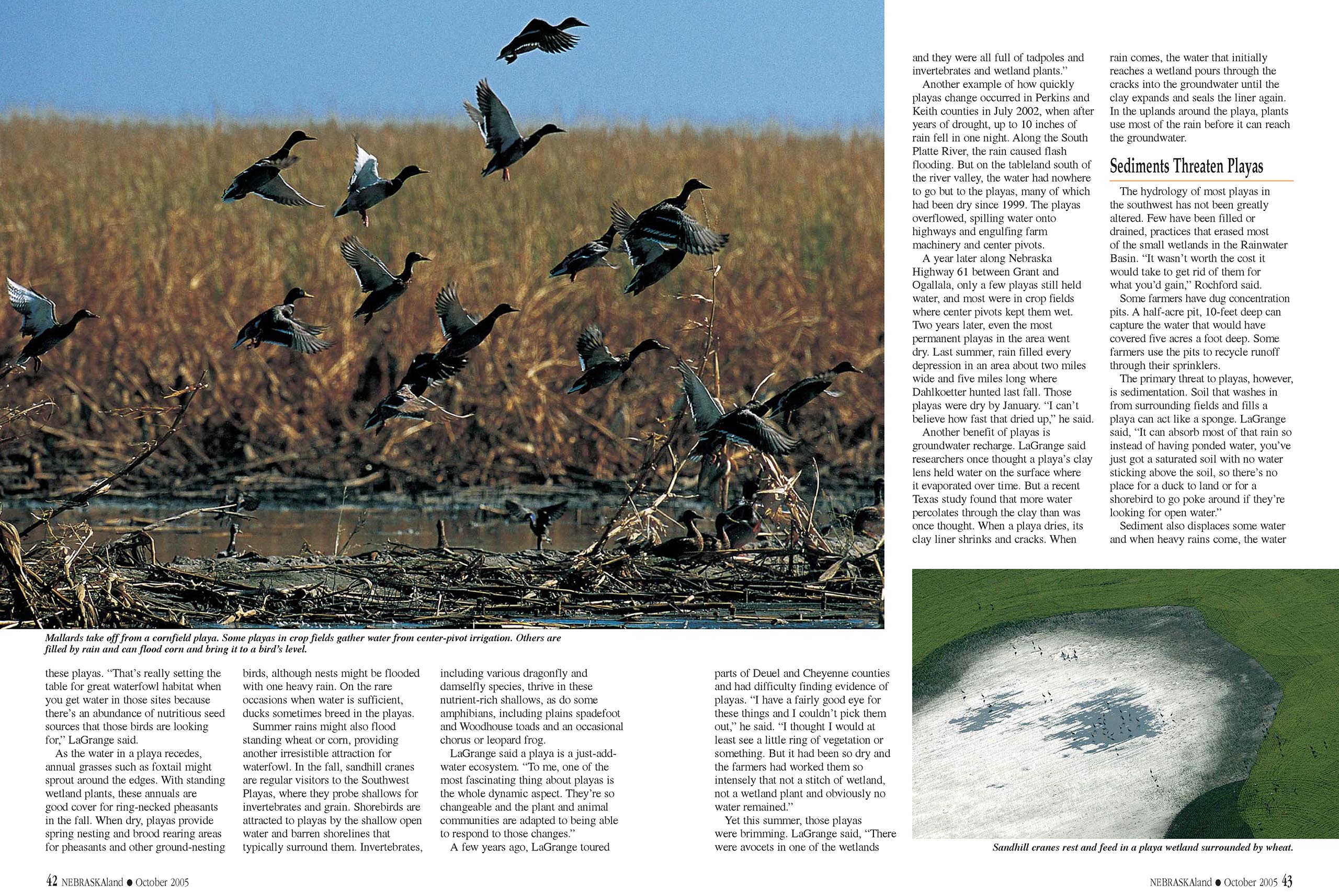
these playas. “That’s really setting the table for great waterfowl habitat when you get water in those sites because there’s an abundance of nutritious seed sources that those birds are looking for,” LaGrange said.
As the water in a playa recedes, annual grasses such as foxtail might sprout around the edges. With standing wetland plants, these annuals are good cover for ring-necked pheasants in the fall. When dry, playas provide spring nesting and brood rearing areas for pheasants and other ground-nesting birds, although nests might be flooded with one heavy rain. On the rare occasions when water is sufficient, ducks sometimes breed in the playas.
Summer rains might also flood standing wheat or corn, providing another irresistible attraction for waterfowl. In the fall, sandhill cranes are regular visitors to the Southwest Playas, where they probe shallows for invertebrates and grain. Shorebirds are attracted to playas by the shallow open water and barren shorelines that typically surround them. Invertebrates, including various dragonfly and damselfly species, thrive in these nutrient-rich shallows, as do some amphibians, including plains spadefoot and Woodhouse toads and an occasional chorus or leopard frog.
LaGrange said a playa is a just-add-water ecosystem. “To me, one of the most fascinating thing about playas is the whole dynamic aspect. They’re so changeable and the plant and animal communities are adapted to being able to respond to those changes.”
A few years ago, LaGrange toured
42 NEBRASKAland October 2005parts of Deuel and Cheyenne counties and had difficulty finding evidence of playas. “I have a fairly good eye for these things and I couldn’t pick them out,” he said. “I thought I would at least see a little ring of vegetation or something. But it had been so dry and the farmers had worked them so intensely that not a stitch of wetland, not a wetland plant and obviously no water remained.”
Yet this summer, those playas were brimming. LaGrange said, “There were avocets in one of the wetlands
and they were all full of tadpoles and invertebrates and wetland plants.”
Another example of how quickly playas change occurred in Perkins and Keith counties in July 2002, when after years of drought, up to 10 inches of rain fell in one night. Along the South Platte River, the rain caused flash flooding. But on the tableland south of the river valley, the water had nowhere to go but to the playas, many of which had been dry since 1999. The playas overflowed, spilling water onto highways and engulfing farm machinery and center pivots.
A year later along Nebraska Highway 61 between Grant and Ogallala, only a few playas still held water, and most were in crop fields where center pivots kept them wet. Two years later, even the most permanent playas in the area went dry. Last summer, rain filled every depression in an area about two miles wide and five miles long where Dahlkoetter hunted last fall. Those playas were dry by January. “I can’t believe how fast that dried up,” he said.
Another benefit of playas is groundwater recharge. LaGrange said researchers once thought a playa’s clay lens held water on the surface where it evaporated over time. But a recent Texas study found that more water percolates through the clay than was once thought. When a playa dries, its clay liner shrinks and cracks. When rain comes, the water that initially reaches a wetland pours through the cracks into the groundwater until the clay expands and seals the liner again. In the uplands around the playa, plants use most of the rain before it can reach the groundwater.
Sediments Threaten Playas
The hydrology of most playas in the southwest has not been greatly altered. Few have been filled or drained, practices that erased most of the small wetlands in the Rainwater Basin. “It wasn’t worth the cost it would take to get rid of them for what you’d gain,” Rochford said.
Some farmers have dug concentration pits. A half-acre pit, 10-feet deep can capture the water that would have covered five acres a foot deep. Some farmers use the pits to recycle runoff through their sprinklers.
The primary threat to playas, however, is sedimentation. Soil that washes in from surrounding fields and fills a playa can act like a sponge. LaGrange said, “It can absorb most of that rain so instead of having ponded water, you’ve just got a saturated soil with no water sticking above the soil, so there’s no place for a duck to land or for a shorebird to go poke around if they’re looking for open water.”
Sediment also displaces some water and when heavy rains come, the water
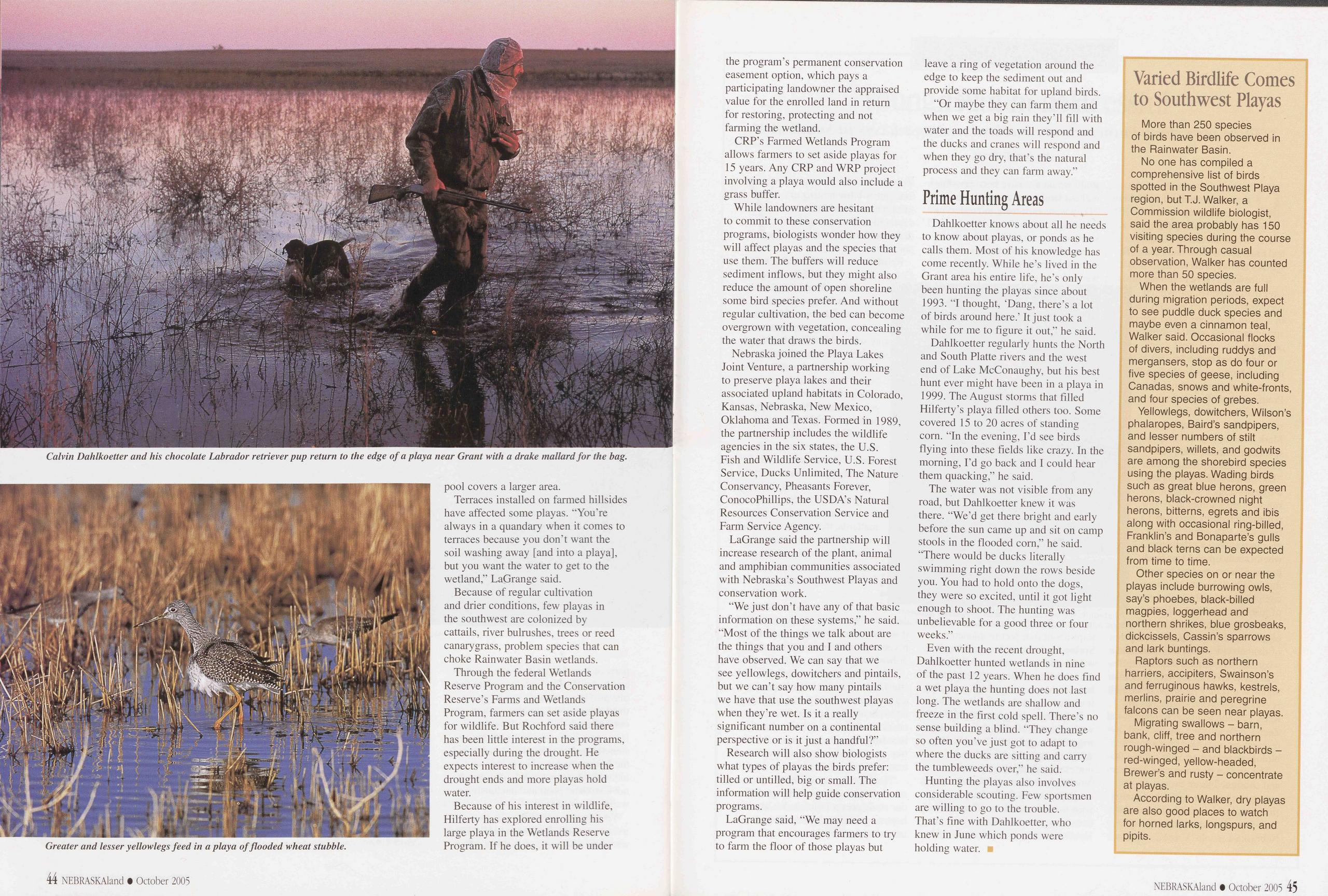
Terraces installed on farmed hillsides have affected some playas. “You’re always in a quandary when it comes to terraces because you don’t want the soil washing away [and into a playa], but you want the water to get to the wetland,” LaGrange said.
Because of regular cultivation and drier conditions, few playas in the southwest are colonized by cattails, river bulrushes, trees or reed canarygrass, problem species that can choke Rainwater Basin wetlands.
Through the federal Wetlands Reserve Program and the Conservation Reserve’s Farms and Wetlands Program, farmers can set aside playas for wildlife. But Rochford said there has been little interest in the programs, especially during the drought. He expects interest to increase when the drought ends and more playas hold water.
Because of his interest in wildlife, Hilferty has explored enrolling his large playa in the Wetlands Reserve Program. If he does, it will be under the program’s permanent conservation easement option, which pays a participating landowner the appraised value for the enrolled land in return for restoring, protecting and not farming the wetland.
CRP’s Farmed Wetlands Program allows farmers to set aside playas for 15 years. Any CRP and WRP project involving a playa would also include a grass buffer.
While landowners are hesitant to commit to these conservation programs, biologists wonder how they will affect playas and the species that use them. The buffers will reduce sediment inflows, but they might also reduce the amount of open shoreline some bird species prefer. And without regular cultivation, the bed can become overgrown with vegetation, concealing the water that draws the birds.
Nebraska joined the Playa Lakes Joint Venture, a partnership working to preserve playa lakes and their associated upland habitats in Colorado, Kansas, Nebraska, New Mexico, Oklahoma and Texas. Formed in 1989, the partnership includes the wildlife agencies in the six states, the U.S. Fish and Wildlife Service, U.S. Forest Service, Ducks Unlimited, The Nature Conservancy, Pheasants Forever, ConocoPhillips, the USDA’s Natural Resources Conservation Service and Farm Service Agency.
LaGrange said the partnership will increase research of the plant, animal and amphibian communities associated with Nebraska’s Southwest Playas and conservation work.
“We just don’t have any of that basic information on these systems,” he said. “Most of the things we talk about are the things that you and I and others have observed. We can say that we see yellowlegs, dowitchers and pintails, but we can’t say how many pintails we have that use the southwest playas when they’re wet. Is it a really significant number on a continental perspective or is it just a handful?”
Research will also show biologists what types of playas the birds prefer: tilled or unfilled, big or small. The information will help guide conservation programs.
LaGrange said, “We may need a program that encourages farmers to try to farm the floor of those playas but leave a ring of vegetation around the edge to keep the sediment out and provide some habitat for upland birds.
“Or maybe they can farm them and when we get a big rain they’ll fill with water and the toads will respond and the ducks and cranes will respond and when they go dry, that’s the natural process and they can farm away.”
Prime Hunting AreasDahlkoetter knows about all he needs to know about playas, or ponds as he calls them. Most of his knowledge has come recently. While he’s lived in the Grant area his entire life, he’s only been hunting the playas since about 1993. “I thought, 4Dang, there’s a lot of birds around here.’ It just took a while for me to figure it out,” he said.
Dahlkoetter regularly hunts the North and South Platte rivers and the west end of Lake McConaughy, but his best hunt ever might have been in a playa in 1999. The August storms that filled Hilferty’s playa filled others too. Some covered 15 to 20 acres of standing corn. “In the evening, I’d see birds flying into these fields like crazy. In the morning, I’d go back and I could hear them quacking,” he said.
The water was not visible from any road, but Dahlkoetter knew it was there. “We’d get there bright and early before the sun came up and sit on camp stools in the flooded corn,” he said. 44There would be ducks literally swimming right down the rows beside you. You had to hold onto the dogs, they were so excited, until it got light enough to shoot. The hunting was unbelievable for a good three or four weeks.”
Even with the recent drought, Dahlkoetter hunted wetlands in nine of the past 12 years. When he does find a wet playa the hunting does not last long. The wetlands are shallow and freeze in the first cold spell. There’s no sense building a blind. 44They change so often you’ve just got to adapt to where the ducks are sitting and carry the tumbleweeds over,” he said.
Hunting the playas also involves considerable scouting. Few sportsmen are willing to go to the trouble. That’s fine with Dahlkoetter, who knew in June which ponds were holding water.
Varied Birdlife Comes to Southwest PlayasMore than 250 species of birds have been observed in the Rainwater Basin.
No one has compiled a comprehensive list of birds spotted in the Southwest Playa region, but T.J. Walker, a Commission wildlife biologist, said the area probably has 150 visiting species during the course of a year. Through casual observation, Walker has counted more than 50 species.
When the wetlands are full during migration periods, expect to see puddle duck species and maybe even a cinnamon teal, Walker said. Occasional flocks of divers, including ruddys and mergansers, stop as do four or five species of geese, including Canadas, snows and white-fronts, and four species of grebes.
Yellowlegs, dowitchers, Wilson’s phalaropes, Baird’s sandpipers, and lesser numbers of stilt sandpipers, willets, and godwits are among the shorebird species using the playas. Wading birds such as great blue herons, green herons, black-crowned night herons, bitterns, egrets and ibis along with occasional ring-billed, Franklin’s and Bonaparte’s gulls and black terns can be expected from time to time.
Other species on or near the playas include burrowing owls, say’s phoebes, black-billed magpies, loggerhead and northern shrikes, blue grosbeaks, dickcissels, Cassin’s sparrows and lark buntings.
Raptors such as northern harriers, accipiters, Swainson’s and ferruginous hawks, kestrels, merlins, prairie and peregrine falcons can be seen near playas.
Migrating swallows - barn, bank, cliff, tree and northern rough-winged - and blackbirds - red-winged, yellow-headed, Brewer’s and rusty - concentrate at playas.
According to Walker, dry playas are also good places to watch for horned larks, longspurs, and pipits.
NEBRASKAland • October 2005 45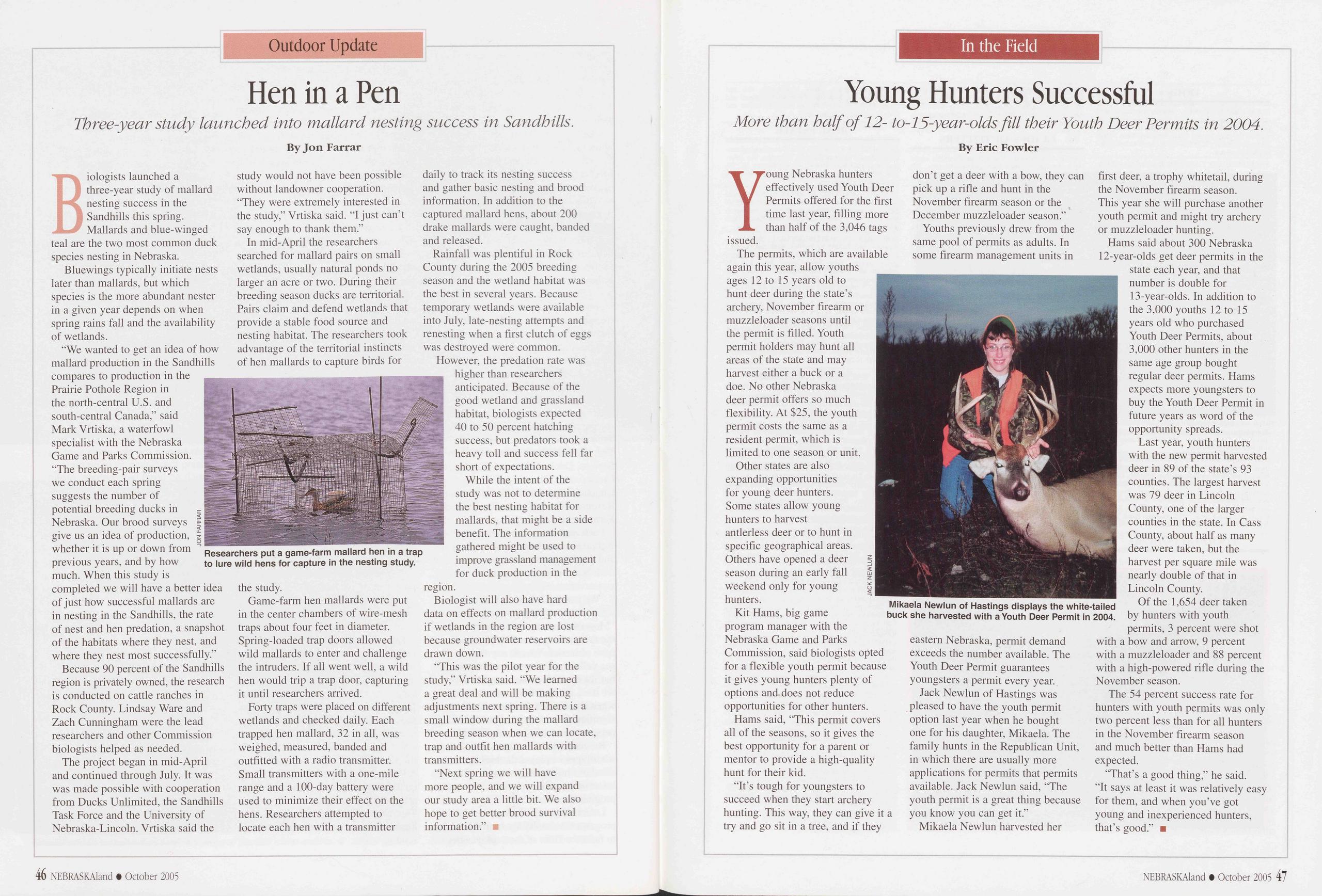
Outdoor Update
Hen in a Pen
Three-year study launched into mallard nesting success in Sandhills.
Biologists launched a three-year study of mallard nesting success in the Sandhills this spring. Mallards and blue-winged teal are the two most common duck species nesting in Nebraska.
Bluewings typically initiate nests later than mallards, but which species is the more abundant nester in a given year depends on when spring rains fall and the availability of wetlands.
“We wanted to get an idea of how mallard production in the Sandhills study would not have been possible compares to production in the Prairie Pothole Region in the north-central U.S. and south-central Canada,” said Mark Vrtiska, a waterfowl specialist with the Nebraska Game and Parks Commission. “The breeding-pair surveys we conduct each spring suggests the number of potential breeding ducks in Nebraska. Our brood surveys give us an idea of production, whether it is up or down from previous years, and by how much. When this study is completed we will have a better idea of just how successful mallards are in nesting in the Sandhills, the rate of nest and hen predation, a snapshot of the habitats where they nest, and where they nest most successfully.”
Because 90 percent of the Sandhills region is privately owned, the research is conducted on cattle ranches in Rock County. Lindsay Ware and Zach Cunningham were the lead researchers and other Commission biologists helped as needed.
The project began in mid-April and continued through July. It was was made possible with cooperation from Ducks Unlimited, the Sandhills Task Force and the University of Nebraska-Lincoln. Vrtiska said the without landowner cooperation. “They were extremely interested in the study,” Vrtiska said. “I just can’t say enough to thank them.”
In mid-April the researchers searched for mallard pairs on small wetlands, usually natural ponds no larger an acre or two. During their breeding season ducks are territorial. Pairs claim and defend wetlands that provide a stable food source and nesting habitat. The researchers took advantage of the territorial instincts of hen mallards to capture birds for
Game-farm hen mallards were put in the center chambers of wire-mesh traps about four feet in diameter. Spring-loaded trap doors allowed wild mallards to enter and challenge the intruders. If all went well, a wild hen would trip a trap door, capturing it until researchers arrived.
Forty traps were placed on different wetlands and checked daily. Each trapped hen mallard, 32 in all, was weighed, measured, banded and outfitted with a radio transmitter. Small transmitters with a one-mile range and a 100-day battery were used to minimize their effect on the hens. Researchers attempted to locate each hen with a transmitter daily to track its nesting success and gather basic nesting and brood information. In addition to the captured mallard hens, about 200 drake mallards were caught, banded and released.
Rainfall was plentiful in Rock County during the 2005 breeding season and the wetland habitat was the best in several years. Because temporary wetlands were available into July, late-nesting attempts and renesting when a first clutch of eggs was destroyed were common.
However, the predation rate was higher than researchers anticipated. Because of the good wetland and grassland habitat, biologists expected 40 to 50 percent hatching success, but predators took a heavy toll and success fell far short of expectations.
While the intent of the study was not to determine the best nesting habitat for mallards, that might be a side benefit. The information gathered might be used to improve grassland management for duck production in the region.
Biologist will also have hard data on effects on mallard production if wetlands in the region are lost because groundwater reservoirs are drawn down.
“This was the pilot year for the study,” Vrtiska said. “We learned a great deal and will be making adjustments next spring. There is a small window during the mallard breeding season when we can locate, trap and outfit hen mallards with transmitters.
“Next spring we will have more people, and we will expand our study area a little bit. We also hope to get better brood survival information.”
In the Field
Young Hunters Successful
More than half of 12- to-15-year-olds fill their Youth Deer Permits in 2004.
Young Nebraska hunters effectively used Youth Deer permits offered for the first time last year, filling more than half of the 3,046 tags issued.
The permits, which are available again this year, allow youths ages 12 to 15 years old to hunt deer during the state’s archery, November firearm or muzzleloader seasons until the permit is filled. Youth permit holders may hunt all areas of the state and may harvest either a buck or a doe. No other Nebraska deer permit offers so much flexibility. At $25, the youth permit costs the same as a resident permit, which is limited to one season or unit.
Other states are also expanding opportunities for young deer hunters. Some states allow young hunters to harvest antlerless deer or to hunt in specific geographical areas. Others have opened a deer season during an early fall weekend only for young hunters.
Kit Hams, big game
Hams said, “This permit covers all of the seasons, so it gives the best opportunity for a parent or mentor to provide a high-quality hunt for their kid.
“It’s tough for youngsters to succeed when they start archery hunting. This way, they can give it a try and go sit in a tree, and if they don’t get a deer with a bow, they can pick up a rifle and hunt in the November firearm season or the December muzzleloader season.”
Youths previously drew from the same pool of permits as adults. In some firearm management units in eastern Nebraska, permit demand exceeds the number available. The Youth Deer Permit guarantees youngsters a permit every year.
Jack Newlun of Hastings was pleased to have the youth permit option last year when he bought one for his daughter, Mikaela. The family hunts in the Republican Unit, in which there are usually more applications for permits that permits available. Jack Newlun said, “The youth permit is a great thing because you know you can get it.”
Mikaela Newlun harvested her first deer, a trophy whitetail, during the November firearm season. This year she will purchase another youth permit and might try archery or muzzleloader hunting.
Hams said about 300 Nebraska 12-year-olds get deer permits in the state each year, and that number is double for 13-year-olds. In addition to the 3,000 youths 12 to 15 years old who purchased Youth Deer Permits, about 3,000 other hunters in the same age group bought regular deer permits. Hams expects more youngsters to buy the Youth Deer Permit in future years as word of the opportunity spreads.
Last year, youth hunters with the new permit harvested deer in 89 of the state’s 93 counties. The largest harvest was 79 deer in Lincoln County, one of the larger counties in the state. In Cass County, about half as many deer were taken, but the harvest per square mile was nearly double of that in Lincoln County.
Of the 1,654 deer taken by hunters with youth permits, 3 percent were shot with a bow and arrow, 9 percent with a muzzleloader and 88 percent with a high-powered rifle during the November season.
The 54 percent success rate for hunters with youth permits was only two percent less than for all hunters in the November firearm season and much better than Hams had expected.
“That’s a good thing,” he said. "It says at least it was relatively easy for them, and when you’ve got young and inexperienced hunters, that’s good.”
46 NEBRASKAland • October 2005 NEBRASKAland • October 2005 47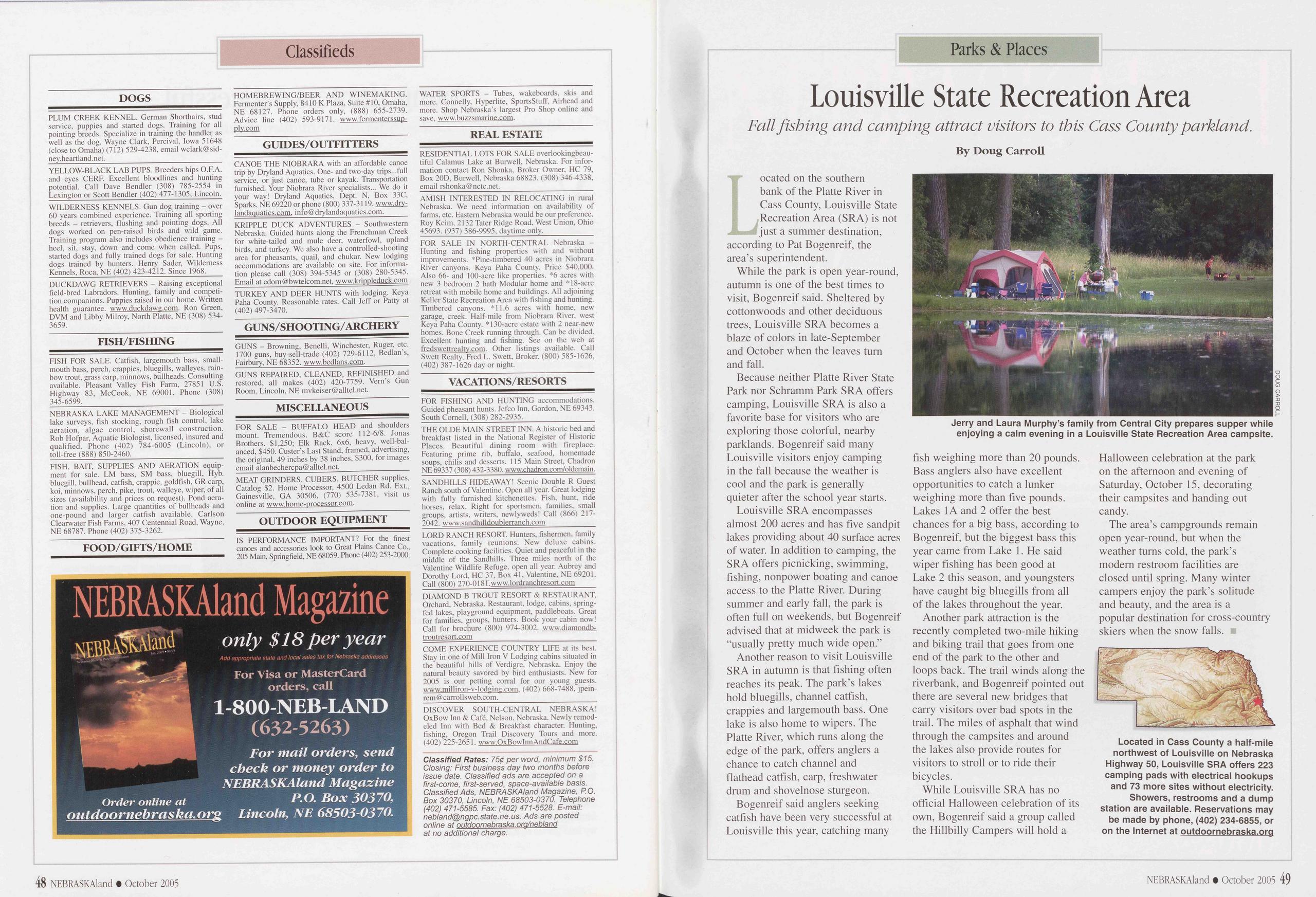
Classifieds
DOGS PLUM CREEK KENNEL. German Shorthairs, stud service, puppies and started dogs. Training for all pointing breeds. Specialize in training the handler as well as the dog. Wayne Clark, Percival, Iowa 51648 (close to Omaha) (712) 529-4238, email wclark@sid- ney.heartland.net. YELLOW-BLACK LAB PUPS. Breeders hips O.F.A. and eyes CERF. Excellent bloodlines and hunting potential. Call Dave Bendler (308) 785-2554 in Lexington or Scott Bendler (402) 477-1305, Lincoln. WILDERNESS KENNELS. Gun dog training - over 60 years combined experience. Training all sporting breeds - retrievers, flushing and pointing dogs. All dogs worked on pen-raised birds and wild game. Training program also includes obedience training - heel, sit, stay, down and come when called. Pups, started dogs and fully trained dogs for sale. Hunting dogs trained by hunters. Henry Sader, Wilderness Kennels, Roca, NE (402) 423-4212. Since 1968. DUCKDAWG RETRIEVERS - Raising exceptional field-bred Labradors. Hunting, family and competi- tion companions. Puppies raised in our home. Written health guarantee, www.duckdawg.com. Ron Green, DVM and Libby Milroy, North Platte, NE (308) 534- 3659. FISH/FISHING FISH FOR SALE. Catfish, largemouth bass, small- mouth bass, perch, crappies, bluegills, walleyes, rain- bow trout, grass carp, minnows, bullheads. Consulting available. Pleasant Valley Fish Farm, 27851 U.S. Highway 83, McCook, NE 69001. Phone (308) 345-6599. NEBRASKA LAKE MANAGEMENT - Biological lake surveys, fish stocking, rough fish control, lake aeration, algae control, shorewall construction. Rob Hofpar, Aquatic Biologist, licensed, insured and qualified. Phone (402) 784-6005 (Lincoln), or toll-free (888) 850-2460. FISH, BAIT, SUPPLIES AND AERATION equip- ment for sale. LM bass, SM bass, bluegill, Hyb. bluegill, bullhead, catfish, crappie, goldfish, GR carp, koi, minnows, perch, pike, trout, walleye, wiper, of all sizes (availability and prices on request). Pond aera- tion and supplies. Large quantities of bullheads and one-pound and larger catfish available. Carlson Clearwater Fish Farms, 407 Centennial Road, Wayne, NE 68787. Phone (402) 375-3262. FOOD/GIFTS/HOMEParks & Places
Louisville State Recreation Area
Fall fishing and camping attract visitors to this Cass County parkland.
Located on the southern bank of the Platte River in Cass County, Louisville State just a summer destination, according to Pat Bogenreif, the area’s superintendent.
While the park is open year-round, autumn is one of the best times to visit, Bogenreif said. Sheltered by cottonwoods and other deciduous trees, Louisville SRA becomes a blaze of colors in late-September and October when the leaves turn and fall.
Because neither Platte River State Park nor Schramm Park SRA offers camping, Louisville SRA is also a favorite base for visitors who are exploring those colorful, nearby parklands. Bogenreif said many Louisville visitors enjoy camping in the fall because the weather is cool and the park is generally quieter after the school year starts.
Louisville SRA encompasses almost 200 acres and has five sandpit lakes providing about 40 surface acres of water. In addition to camping, the SRA offers picnicking, swimming, fishing, nonpower boating and canoe access to the Platte River. During summer and early fall, the park is often full on weekends, but Bogenreif advised that at midweek the park is “usually pretty much wide open.”
Another reason to visit Louisville SRA in autumn is that fishing often reaches its peak. The park’s lakes hold bluegills, channel catfish, crappies and largemouth bass. One lake is also home to wipers. The Platte River, which runs along the edge of the park, offers anglers a chance to catch channel and flathead catfish, carp, freshwater drum and shovelnose sturgeon.
Bogenreif said anglers seeking catfish have been very successful at Louisville this year, catching many DOUG CARROLL
Another park attraction is the recently completed two-mile hiking and biking trail that goes from one end of the park to the other and loops back. The trail winds along the riverbank, and Bogenreif pointed out there are several new bridges that carry visitors over bad spots in the trail. The miles of asphalt that wind through the campsites and around the lakes also provide routes for visitors to stroll or to ride their bicycles.
While Louisville SRA has no official Halloween celebration of its own, Bogenreif said a group called the Hillbilly Campers will hold a Halloween celebration at the park on the afternoon and evening of Saturday, October 15, decorating their campsites and handing out candy.
The area’s campgrounds remain open year-round, but when the weather turns cold, the park’s modern restroom facilities are closed until spring. Many winter campers enjoy the park’s solitude and beauty, and the area is a popular destination for cross-country skiers when the snow falls.
Position: 584 (19 views)