Volume 83, Issue 3, 2005
NEBRASKAland
Nebraska Game & Parks Commission April 2005 $2.95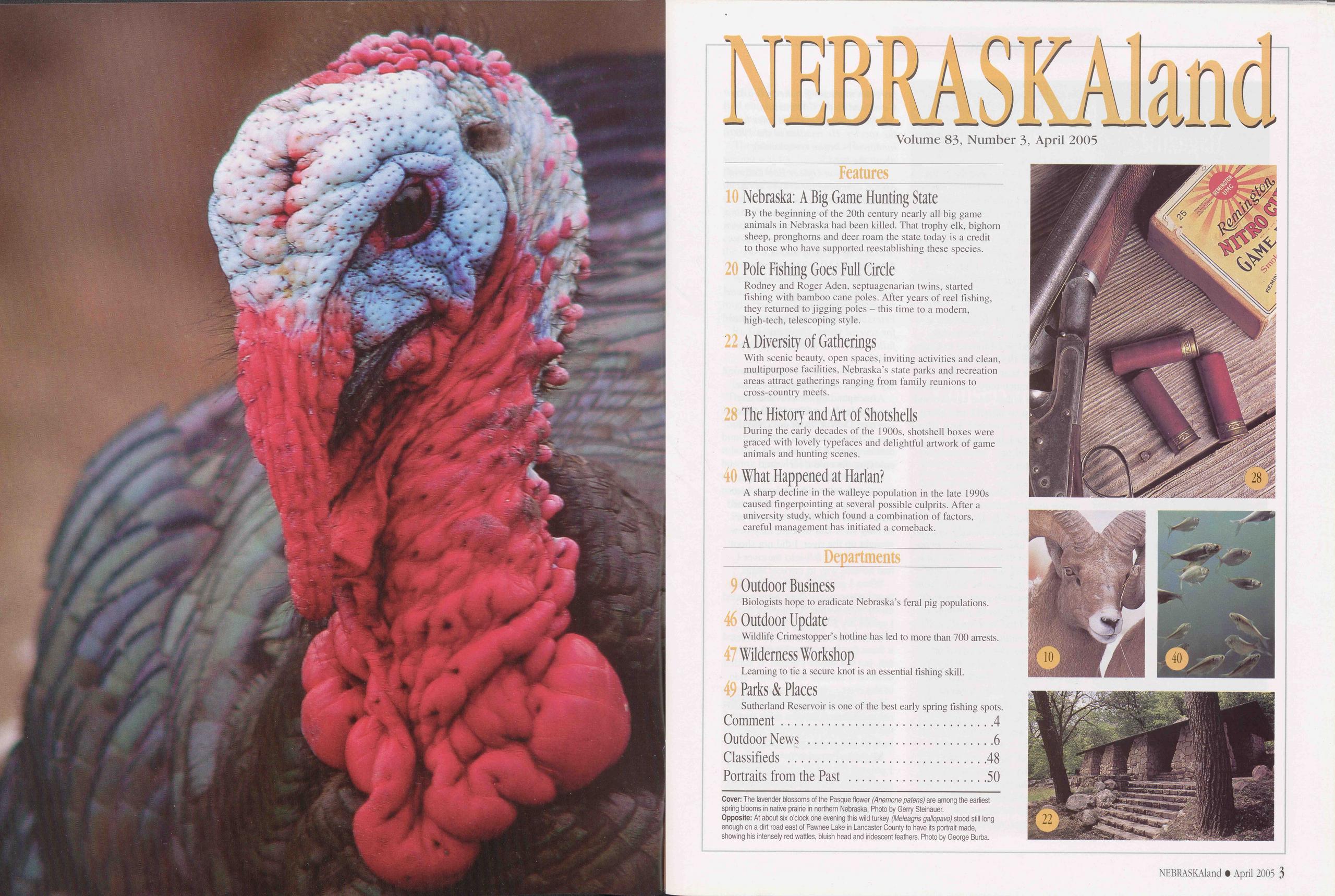
NEBRASKAland
Volume 83, Number 3, April 2005
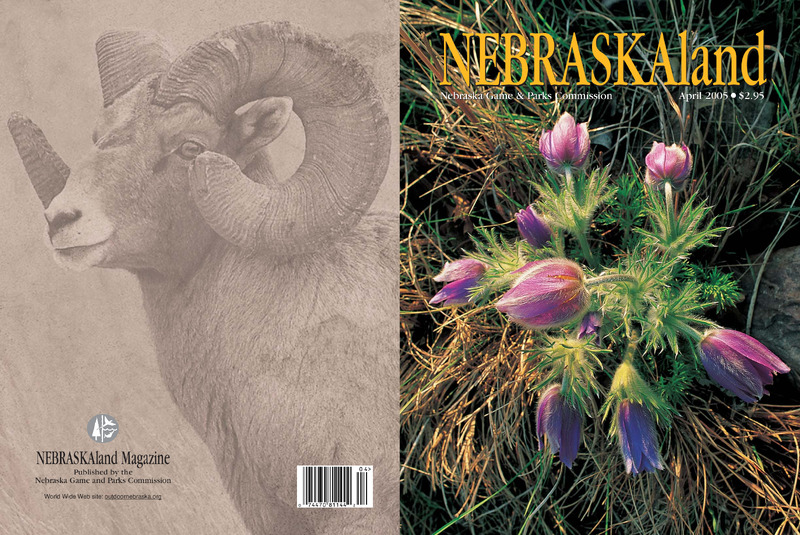
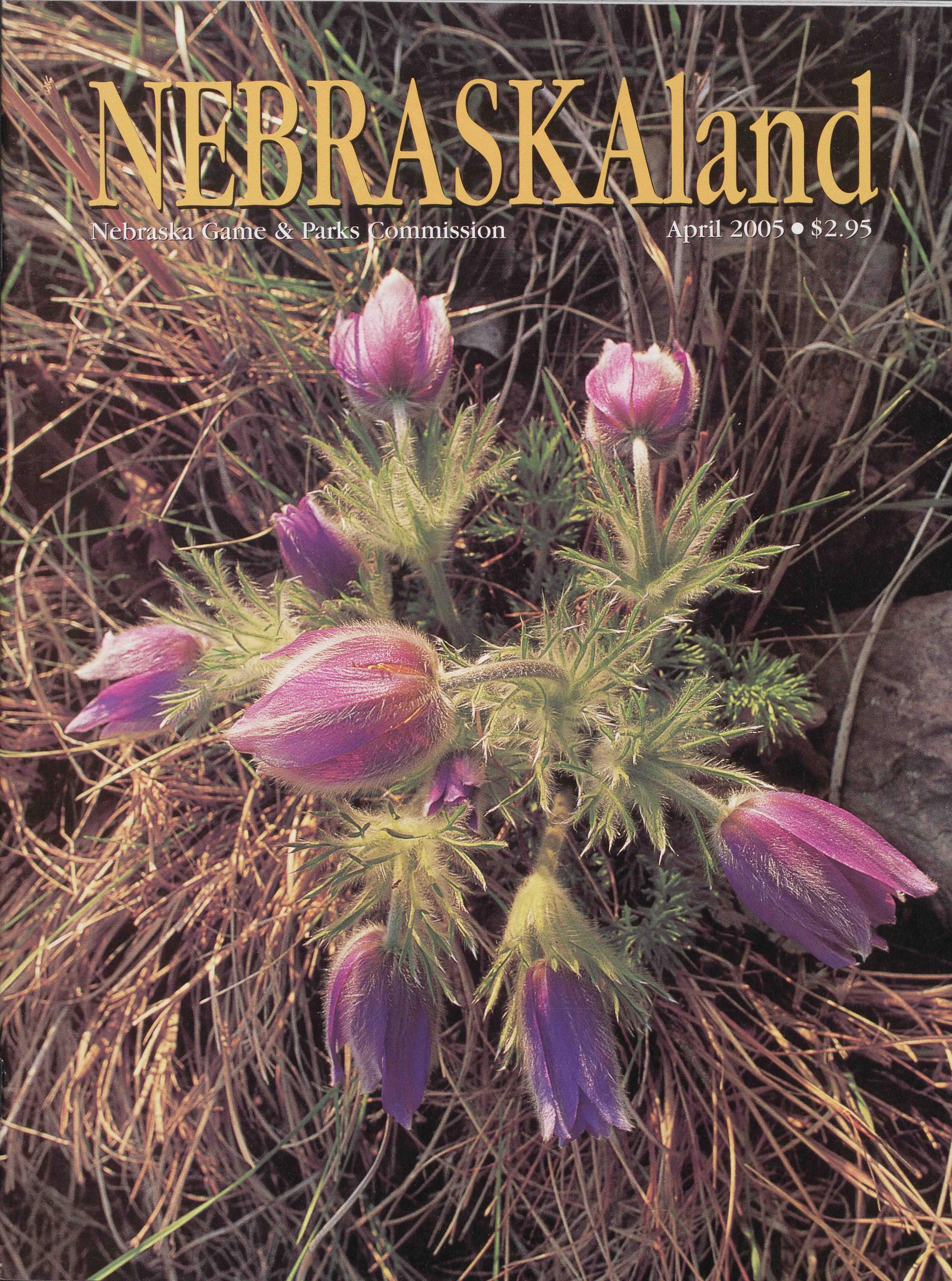
Features 10 Nebraska: A Big Game Hunting State By the beginning of the 20th century nearly all big game animals in Nebraska had been killed. That trophy elk, bighorn sheep, pronghorns and deer roam the state today is a credit to those who have supported reestablishing these species. 20 Pole Fishing Goes Full Circle Rodney and Roger Aden, septuagenarian twins, started fishing with bamboo cane poles. After years of reel fishing, they returned to jigging poles - this time to a modern, high-tech, telescoping style. 22 A Diversity of Gatherings With scenic beauty, open spaces, inviting activities and clean, multipurpose facilities, Nebraska’s state parks and recreation areas attract gatherings ranging from family reunions to cross-country meets. 28 The History and Art of Shotshells During the early decades of the 1900s, shotshell boxes were graced with lovely typefaces and delightful artwork of game animals and hunting scenes. 40 What Happened at Harlan? A sharp decline in the walleye population in the late 1990s caused fingerpointing at several possible culprits. After a university study, which found a combination of factors, careful management has initiated a comeback. Departments 9 Outdoor Business Biologists hope to eradicate Nebraska’s feral pig populations. 46 Outdoor Update Wildlife Crimestopper’s hotline has led to more than 700 arrests. 49Wilderness Workshop Learning to tie a secure knot is an essential fishing skill. 49 Parks & Places Sutherland Reservoir is one of the best early spring fishing spots. Comment........................................4 Outdoor News ................................6 Classifieds .....................................48 Portraits from the Past....................50 Cover: The lavender blossoms of the Pasque flower (Anemone patens) are among the earliest spring blooms in native prairie in northern Nebraska, Photo by Gerry Steinauer. Opposite: At about six o’clock one evening this wild turkey (Meleagris gallopavo) stood still long enough on a dirt road east of Pawnee Lake in Lancaster County to have its portrait made, showing his intensely red wattles, bluish head and iridescent feathers. Photo by George Burba.
Comment
NEBRASKAland Magazine Published by the Nebraska Game and Parks Commission Director: Rex Amack Assistant Directors: Roger Kuhn, Kirk Nelson Information & Education Administrator: Ken Bouc Information & Education Art Director: Steve O’Hare Commissioners Chairman: Dr. Mark Pinkerton, Wilber Vice Chairman: Bill Grewcock, Omaha 2nd Vice Chairman: James Stuart, Jr., Lincoln Bill Zutavern, Dunning Gary Parker, Columbus George E. Hall, Bridgeport James Ziebarth, Wilcox Jerrod Burke, Curtis Magazine Staff Editor: Tom White Associate Editor: Doug Carroll Art Director: Tim Reigert Senior Editors: Jon Farrar, Ken Bouc Regional Editors: Eric Fowler, Bob Grier, Rocky Hoffmann Contributing Editors: Michael Forsberg, Tom Keith Circulation: Donna Robinson Photo Librarian: Sarah Johnson NEBRASKAland VOL. 83 / NO. 3 ISSN: 0028-1964 APRIL 2005 Published monthly, except for Jan./Feb. and Aug./Sept. issues, by the Nebraska Game and Parks Commission, 2200 N. 33rd St., Lincoln, NE. Copyright 2005, all rights reserved. Please address comments or questions to this address. Periodicals postage paid at Lincoln, Nebraska, and other locations. POSTMASTER: Send all address changes to NEBRASKAland, P.O. Box 30370, Lincoln, NE 68503-0370. Address submissions to: The Editor, NEBRASKAland Magazine, P.O. Box 30370, Lincoln, NE 68503. Include a stamped, self-addressed return envelope. The publisher assumes no responsibility for unsolicited material. NEBRASKAland is available on audio cassette from the Nebraska Library Commission Talking Book and Braille Service, Suite 120, 1200 N St., Lincoln, NE 68508. (800) 742-7691 Rates: $18 for one year; $33 for two years. Nebraska residents must add appropriate sales tax. To subscribe call 1-800-NEBLAND (632-5263), or go online to: outdoornebraska.org Do Fallow Deer Roam Nebraska?I was born in 1929 and lived in Lincoln until 1943. My granddad and uncle lived on a ranch in Boone County, west of Petersburg, on Beaver Creek.
In the late 1930s or early 1940s an oversupply of fallow deer in a park southwest of Lincoln were offered to Ray Hall, granddad’s neighbor on the Beaver. Hall, Matt Dwyer and Omer Qualset, my uncle, drove three pickups with stock racks covered with binder canvas to Lincoln. We loaded and hauled three loads of deer - about 25 - to the Hall and Dwyer ranches.
We saw some of the deer for a few years when we were haying the wet meadows. I moved to Cody, Nebraska, in 1953 and to Iowa in 1956. I have been back to the Petersburg ranch only once or twice.
Did those fallow deer survive and thrive in that wonderful area along the Beaver? Do you still have fallow deer in the park in Lincoln?
W.C. Hamilton Ankeny, IowaFallow deer (Dama dama) are native to the Mediterranean region of Europe and Asia Minor. The species is small and usually marked with brown and white spots. On the lower sides and haunches the spots sometimes fuse into a white line. Individuals also can be black, white, pale yellow, silver-gray or piebald. They have short necks, prominent larynxes and the buck’s antlers have flattened terminal tines.
Fallow deer were released in Nebraska from a herd at Pioneers Park in Lincoln in 1939 and 1940. According to J. Knox Jones in Mammals of Nebraska, published in 1964, “The species thrived, reproduced and extended its distribution . . . throughout the Beaver Creek Valley and into adjacent parts of the Cedar Creek Valley and lower Loup Valley.” In 1964, Knox estimated the state’s wild population to be about 500.
Karl Menzel, retired big game program manager for the Nebraska Game and Parks Commission, believes low reproductive rates hurt the species. He recalled in the 1960s landowners began complaining about the herd.
Conservation Officer Bob Kelly of Albion estimated there were about 100 fallow deer along the Beaver Creek Valley when he began working in the area in 1969. He said the deer were hunted for a number of years, first only by archery and later by firearms, and some of large bucks with full racks were taken over the years. He said there might be two or three fallow does now west of Petersburg, but he has not seen them for several years. There are no fallow deer now at Pioneers Park.
- Editor. My Master Angler Canada GooseAfter spending the previous day hunting deer on a Blue River farm south of DeWitt, from our cabin I saw a flock of Canada geese had broken the thin ice and were enjoying the cold river water.
I crossed a field far enough upriver that the geese could not see or hear me. I though that when they flushed they would head right over me for an easy shot. But instead, they flew straight up the river. I did not shoot because if they fell into the river I had no safe way to retrieve them.
When I got back to the cabin, I heard geese again. Four were headed down river within 20 yards of me. I raised my 870 Super Magnum, followed the lead goose and dropped it from the formation. I watched it fall, but not where I hoped. It landed dead on a sandbar on the other side of the river.
I was dejected as I walked into the cabin because I faced a drive up to the bridge and a three-mile walk back to the goose on the other side. My wife, Pat, said, “Why so glum?” I pointed out the window to the goose. Seeing the problem, she said, “Why don’t you snag it with your fishing pole?”
I was dumbfounded. Would it 4 NEBRASKAland • April 2005 work? There was only one way to find out. I hooked my big catfish pole with a treble hook and headed to the riverbank.
The first cast was short. The second was too far left. The third flew too far, but the line fell across the goose. I reeled in line, the hook caught a feather and slowly the goose began to slide toward me. Half way the feather came loose, but I cast again and hooked a foot. Soon the goose was in my waiting hand. “My wife is a genius,” I thought.
When I told my 18-year-old son, Jason, the story, he said, “Dad, that might be a state record or at least a Master Angler Canada goose.”
Rick Crosier Norfolk, Nebraska Spinone Keeps Close on HuntI was surprised by your article “The Italian Connection” in the January-February issue. My dog “Spinner” is a Spinone and a great hunting dog. If a hunter wants a relaxing hunt and not to worry about busting birds 100 yards out or trying to keep up with a dog chasing a rooster, the Spinone is the dog.
Scott Steede Papillion, Nebraska Comment NEBRASKAland Magazine P.O. Box 30370, Lincoln, NE 68503. E-mail: nebland@ngpc.state.ne.us. Please include your postal address and telephone number. Letters may be condensed and edited for clarity. Photographs are welcome and will be returned. Under federal and/or state law, discrimination is prohibited on the basis of race, color, religion, age, gender, marital status, national origin, disability or political affiliation. If you think you have been discriminated against in any program, activity or facility or want more information, contact the Affirmative Action Officer, Nebraska Game and Parks Commission, Lincoln, NE, (402) 471-0641 or the Equal Opportunity Commission, Lincoln, NE, (402) 471-2024, TTY/TDD (402) 471- 4693). Nebraska Game and Parks Commission Offices Headquarters 2200 N. 33rd Street Lincoln, NE 68503 Phone (402) 471-0641 District Office III 2201 N. 13th St. Norfolk, NE 68701 Phone (402) 370-3374 District Office VI 1617 First Ave. Kearney, NE 68847 Phone (308) 865-5310 District Office I East Hwy. 2, Box 725 Alliance, NE 69301 Phone (308) 763-2940 District Office II 524 Panzer St., Box 508 Bassett, NE 68714 Phone (402) 684-2921 District Office IV 301 E. State Farm Rd. North Platte, NE 69101 Phone (308) 535-8025 District Office V 2200 N. 33rd Street Lincoln, NE 68503 Phone (402) 471-5558 Omaha Office 1212 Bob Gibson Blvd. Omaha, NE 68108 Phone (402) 595-2144 Ak-Sar-Ben Aquarium 21502 W. Highway 31 Gretna, NE 68028 Phone (402) 332-3901 World Wide Web site: outdoornebraska.org E-mail: ngpc@ngpc.state.ne.us Conservation Officers by Region Administration Tim Williams Hastings (402) 463-2535 Ted Blume (Adm.) Lincoln 471-5531 Darin Gress Hebron (402) 768-2287 Craig Stover (Asst.) Lincoln 471-5532 Dale Johnson Kearney 237-1079 Wes Loos (Asst.) Lincoln 471-5591 Mark Reeves Loup City 745-0748 Murray Johnson Lincoln 471-5003 Robert Finke Milford (402) 761-3537 Dana Miller (Sup.) Valentine 376-3116 Richard Seward Ord 728-3115 Panhandle Northeast Officer City Phone (308) Officer City Phone (402) Jim Zimmerman (Sup.) Gering 436-7561 Torn Zimmer (Sup.) Norfolk 371-6625 Raymond Still Bridgeport 262-1075 Robert Kelly Albion 395-2538 Walt Meyer Chadron 432-4398 Dale Davis Bassett 273-1700 John Murphy Crawford 665-2021 Ross Oestmann Bloomfield 373-4412 Heath Packett Gordon 282-2553 Steve Oberg Columbus 564-5937 Dennis Thompson Ogallala 284-6450 Daniel Roberts Fremont 721-7852 Dan Zuehlke Ogallala 284-4815 Jon Reeves Kennard 427-7378 Doug Pollard Oshkosh 772-9950 Marion Shafer Norfolk 371-2031 Scott Brandt Scottsbluff 635-1277 Pat George O’Neill 482-5771 Frank Miller Valentine (402)376-1183 Eric Wiebe Ponca 755-2566 Southwest Southeast Officer City Phone (308) Officer City Phone (402) Roger Thompson (Sup.) N. Platte 532-9175 Duane Arp (Sup.) Gretna 332-2965 Ray Dierking Brkn. Bow 872-3078 Sean McKeehan Ashland 944-4174 George Sund Cambridge 697-4629 William Krause Auburn 274-3789 Matt Andrews Elwood 785-3025 Jeremy TenKley Beatrice 228-1437 Dirk Greene Imperial 882-5328 Douglas Kramer Lincoln 466-9001 Virgil Gosch McCook 345-2185 Dina Barta Lincoln 483-2358 Dudley Sorensen N. Platte 532-0747 Stacey Lewton Lincoln 476-0436 Rich Routh Rep. City 799-2085 Levi Krause Louisville 234-2212 Russell Mort Nebr. City 873-5684 South-central Dan Evasco Papillion 504-1368 Officer City Phone (308) Jeff Clauson Valley 359-5301 Jerry Pecha (Sup.) Kearney 865-5327 Mike Luben Wahoo 443-4278 Randy Pomplun Fullerton 536-2987 Terry Brentzel Grand Is. 384-8296 Nebraska Wildlife Crimestoppers 1-800-742-7627 NEBRASKAland • April 2005 5
Outdoor News
Through April 15, a camera mounted on an island in Audubon’s Rowe Sanctuary on the Platte River near Gibbon will offer close-up views of sandhill cranes roosting in the river’s shallow water.
The CraneCam camera operates an hour before and after sunrise and sunset every day and is maintained by sanctuary staff and volunteers. Images from the camera can be seen at http://magma.nationalgeographic. com/ngm/cranecam/. The web site also features information about cranes, Rowe Sanctuary and the Iain Nicolson Audubon Center located at the sanctuary. Crane photos taken by Michael Forsberg and Joel Sartore, Lincoln-based wildlife photographers, illustrate the web site.
Bighorn Sheep Permit Auctioned for $83,000Joe Glover of Sawyerville, Alabama, was the winning bidder for the 2005 Nebraska bighorn sheep auction permit at the Grand Slam Club/Ovis Annual Conference held in Biloxi, Mississippi, in February.
Glover paid $83,000 for the permit to hunt bighorns in the Pine Ridge. He will receive guide service, use of horses, and lodging and meals at Fort Robinson Sate Park during the November 26 to December 18 hunting season. Proceeds from the auction support reintroducing and managing bighorn sheep in Nebraska.
Since 1998 the Nebraska Game and Parks Commission has held an annual lottery drawing available to Nebraska residents for one bighorn hunting permit, and in some years the Commission has auctioned a second permit. To date, every permit holder has harvested a full-curl ram.
Applications for the 2005 resident bighorn lottery permit are $20 and will be accepted until 5 p.m. on August 12 at the Commission’s Lincoln office. Registrations also may be made online at www.out- doornebraska.org until midnight, August 12.
In January, 49 bighorns from Montana were released in the Pine Ridge. Another herd was started in Cedar Canyon near Gering in 2001 with the release of 22 sheep from Colorado.
The Cedar Canyon herd now has more than 40 animals. The Pine Ridge herd, including the recent Montana release, is estimated at about 190 animals.
6 NEBRASKAland • April 2005 Missouri River Cleanup Event Scheduled for May 7On May 7 volunteers will clean up litter and trash along the Missouri National Recreational River a few miles upstream and downstream from Yankton, South Dakota. Last year volunteers filled ten dump trucks with debris retrieved from the river.
Paul Hedren, superintendent of the Missouri National Recreational River, said the picnic shelter near the boat launch at the east end of Yankton’s Riverside Park will serve as the staging area. Volunteers should arrive between 7 and 8 a.m. to register. Organizations, service clubs, scout troops and families are encouraged to work as groups, and individuals are also welcome.
The cleanup will be from 9 a.m. until noon. Volunteers will receive either a cap or T-shirt, and organizers will provide coffee, donuts and bottled water in the morning, and a lunch following the cleanup.
For additional information, contact George Berndt at (402) 667-2550. Volunteers are invited to register by calling Dugan Smith, (402) 667-2551.
Youth Outdoor Skills Camps Invite ParticipantsYoungsters 11 to 14 years old are invited to the 2005 Youth Outdoor Skills Camps organized by the Nebraska Game and Parks Commission and Nebraska 4-H.
Participants will learn outdoor skills such as canoeing, camping, fishing, and archery and have opportunities to shoot muzzleloaders, .22-caliber rifles and shotguns.
The first camp will be held June 20-23 at the State 4-H Camp near Halsey. Registration is due by June 13 and the cost is $203, which covers meals and lodging.
The second camp will be held July 11-14 at the Eastern Nebraska 4-H Camp near Gretna. The cost for this camp is $280 and the registration deadline is July 5.
It's Never Too Soon to Make Your Reservation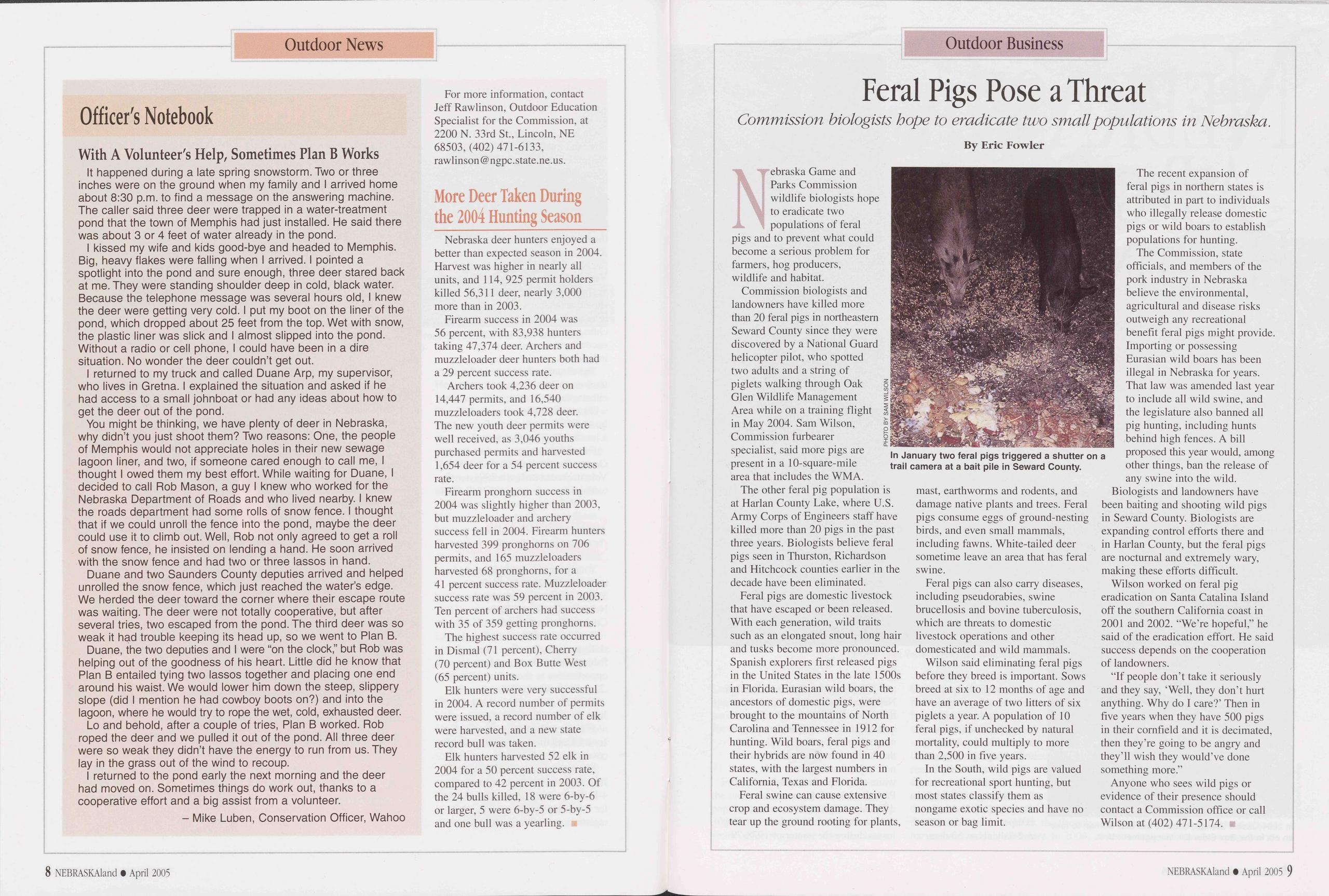 Outdoor News
Officer's Notebook
With A Volunteer's Help, Sometimes Plan B Works
Outdoor News
Officer's Notebook
With A Volunteer's Help, Sometimes Plan B Works
It happened during a late spring snowstorm. Two or three inches were on the ground when my family and I arrived home about 8:30 p.m. to find a message on the answering machine. The caller said three deer were trapped in a water-treatment pond that the town of Memphis had just installed. He said there was about 3 or 4 feet of water already in the pond.
I kissed my wife and kids good-bye and headed to Memphis. Big, heavy flakes were falling when I arrived. I pointed a spotlight into the pond and sure enough, three deer stared back at me. They were standing shoulder deep in cold, black water. Because the telephone message was several hours old, I knew the deer were getting very cold. I put my boot on the liner of the pond, which dropped about 25 feet from the top. Wet with snow, the plastic liner was slick and I almost slipped into the pond. Without a radio or cell phone, I could have been in a dire situation. No wonder the deer couldn’t get out.
I returned to my truck and called Duane Arp, my supervisor, who lives in Gretna. I explained the situation and asked if he had access to a small johnboat or had any ideas about how to get the deer out of the pond.
You might be thinking, we have plenty of deer in Nebraska, why didn’t you just shoot them? Two reasons: One, the people of Memphis would not appreciate holes in their new sewage lagoon liner, and two, if someone cared enough to call me, I thought I owed them my best effort. While waiting for Duane, I decided to call Rob Mason, a guy I knew who worked for the Nebraska Department of Roads and who lived nearby. I knew the roads department had some rolls of snow fence. I thought that if we could unroll the fence into the pond, maybe the deer could use it to climb out. Well, Rob not only agreed to get a roll of snow fence, he insisted on lending a hand. He soon arrived with the snow fence and had two or three lassos in hand.
Duane and two Saunders County deputies arrived and helped unrolled the snow fence, which just reached the water’s edge. We herded the deer toward the corner where their escape route was waiting. The deer were not totally cooperative, but after several tries, two escaped from the pond. The third deer was so weak it h^d trouble keeping its head up, so we went to Plan B.
Duane, the two deputies and I were “on the clock,” but Rob was helping out of the goodness of his heart. Little did he know that Plan B entailed tying two lassos together and placing one end around his waist. We would lower him down the steep, slippery slope (did I mention he had cowboy boots on?) and into the lagoon, where he would try to rope the wet, cold, exhausted deer.
Lo and behold, after a couple of tries, Plan B worked. Rob roped the deer and we pulled it out of the pond. All three deer were so weak they didn’t have the energy to run from us. They lay in the grass out of the wind to recoup.
I returned to the pond early the next morning and the deer had moved on. Sometimes things do work out, thanks to a cooperative effort and a big assist from a volunteer.
- Mike Luben, Conservation Officer, WahooFor more information, contact Jeff Rawlinson, Outdoor Education Specialist for the Commission, at 2200 N. 33rd St., Lincoln, NE 68503, (402) 471-6133, rawlinson@ngpc.state.ne.us.
More Deer Taken During the 2004 Hunting SeasonNebraska deer hunters enjoyed a better than expected season in 2004. Harvest was higher in nearly all units, and 114, 925 permit holders killed 56,311 deer, nearly 3,000 more than in 2003.
Firearm success in 2004 was 56 percent, with 83,938 hunters taking 47,374 deer. Archers and muzzleloader deer hunters both had a 29 percent success rate.
Archers took 4,236 deer on 14,447 permits, and 16,540 muzzleloaders took 4,728 deer. The new youth deer permits were well received, as 3,046 youths purchased permits and harvested 1,654 deer for a 54 percent success rate.
Firearm pronghorn success in 2004 was slightly higher than 2003, but muzzleloader and archery success fell in 2004. Firearm hunters harvested 399 pronghorns on 706 permits, and 165 muzzleloaders harvested 68 pronghorns, for a 41 percent success rate. Muzzleloader success rate was 59 percent in 2003. Ten percent of archers had success with 35 of 359 getting pronghorns.
The highest success rate occurred in Dismal (71 percent), Cherry (70 percent) and Box Butte West (65 percent) units.
Elk hunters were very successful in 2004. A record number of permits were issued, a record number of elk were harvested, and a new state record bull was taken.
Elk hunters harvested 52 elk in 2004 for a 50 percent success rate, compared to 42 percent in 2003. Of the 24 bulls killed, 18 were 6-by-6 or larger, 5 were 6-by-5 or 5-by-5 and one bull was a yearling.
8 NEBRASKAland • April 2005Outdoor Business
Feral Pigs Pose a Threat
Commission biologists hope to eradicate two small populations in Nebraska.
Nebraska Game and Parks Commission wildlife biologists hope to eradicate two populations of feral pigs and to prevent what could become a serious problem for farmers, hog producers, wildlife and habitat.
Commission biologists and landowners have killed more than 20 feral pigs in northeastern Seward County since they were discovered by a National Guard helicopter pilot, who spotted two adults and a string of piglets walking through Oak Glen Wildlife Management Area while on a training flight in May 2004. Sam Wilson, Commission furbearer specialist, said more pigs are present in a 10-square-mile area that includes the WMA.
The other feral pig population is at Harlan County Lake, where U.S. Army Corps of Engineers staff have killed more than 20 pigs in the past three years. Biologists believe feral pigs seen in Thurston, Richardson and Hitchcock counties earlier in the decade have been eliminated.
Feral pigs are domestic livestock that have escaped or been released. With each generation, wild traits such as an elongated snout, long hair and tusks become more pronounced. Spanish explorers first released pigs in the United States in the late 1500s in Florida. Eurasian wild boars, the ancestors of domestic pigs, were brought to the mountains of North Carolina and Tennessee in 1912 for hunting. Wild boars, feral pigs and their hybrids are now found in 40 states, with the largest numbers in California, Texas and Florida.
Feral swine can cause extensive crop and ecosystem damage. They tear up the ground rooting for plants,
Feral pigs can also carry diseases, including pseudorabies, swine brucellosis and bovine tuberculosis, which are threats to domestic livestock operations and other domesticated and wild mammals.
Wilson said eliminating feral pigs before they breed is important. Sows breed at six to 12 months of age and have an average of two litters of six piglets a year. A population of 10 feral pigs, if unchecked by natural mortality, could multiply to more than 2,500 in five years.
In the South, wild pigs are valued for recreational sport hunting, but most states classify them as nongame exotic species and have no season or bag limit.
The recent expansion of feral pigs in northern states is attributed in part to individuals who illegally release domestic pigs or wild boars to establish populations for hunting.
The Commission, state officials, and members of the pork industry in Nebraska believe the environmental, agricultural and disease risks outweigh any recreational benefit feral pigs might provide. Importing or possessing Eurasian wild boars has been illegal in Nebraska for years. That law was amended last year to include all wild swine, and the legislature also banned all pig hunting, including hunts behind high fences. A bill proposed this year would, among other things, ban the release of any swine into the wild.
Biologists and landowners have been baiting and shooting wild pigs in Seward County. Biologists are expanding control efforts there and in Harlan County, but the feral pigs are nocturnal and extremely wary, making these efforts difficult.
Wilson worked on feral pig eradication on Santa Catalina Island off the southern California coast in 2001 and 2002. "We re hopeful,” he said of the eradication effort. He said success depends on the cooperation of landowners.
"If people don’t take it seriously and they say, ‘Well, they don’t hurt anything. Why do I care?’ Then in five years when they have 500 pigs in their cornfield and it is decimated, then they’re going to be angry and they’ll wish they would’ve done something more.”
Anyone who sees wild pigs or evidence of their presence should contact a Commission office or call Wilson at (402) 471-5174.
NEBRASKAland • April 2005 9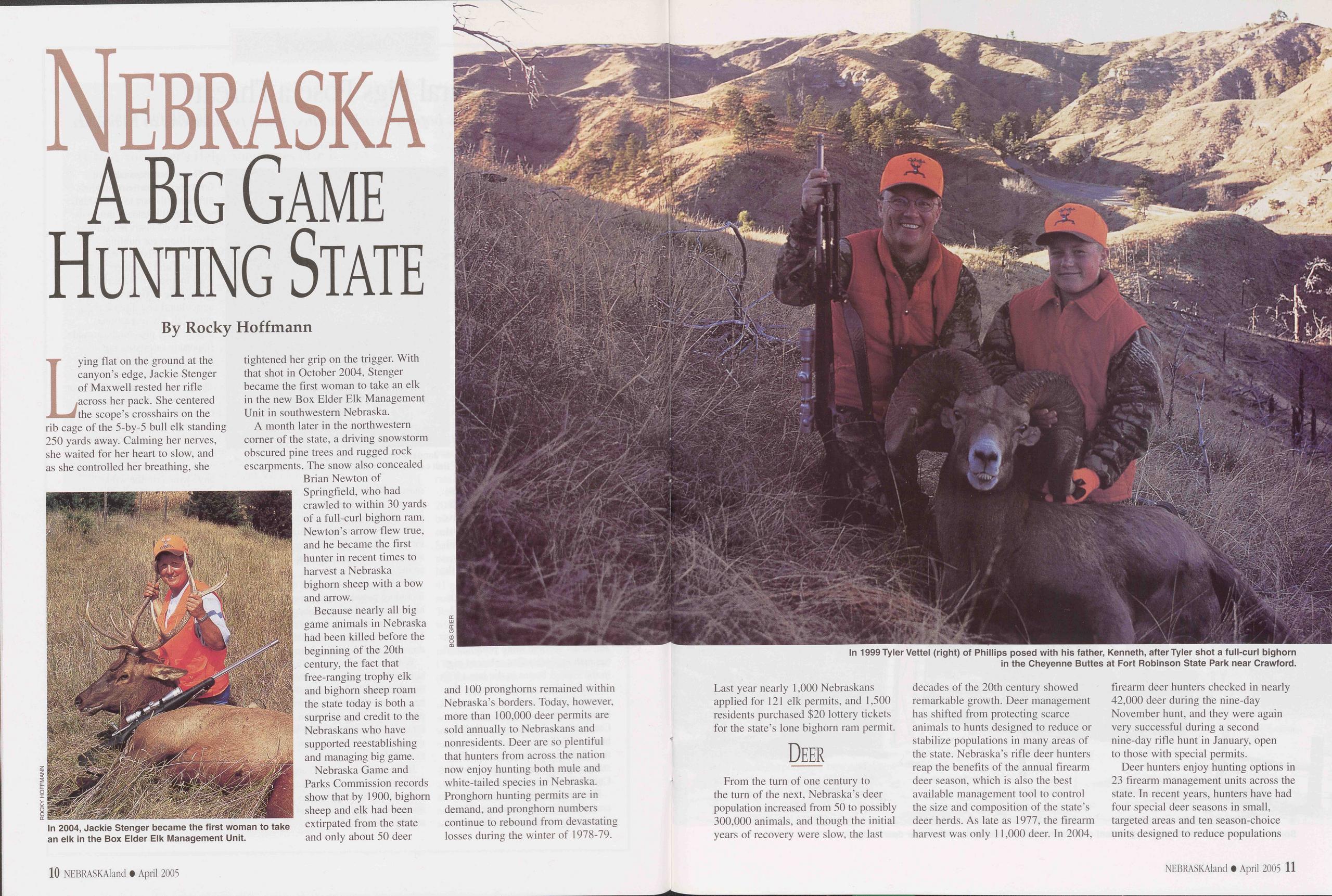
Nebraska A Big Game Hunting State
Lying flat on the ground at the canyon’s edge, Jackie Stenger of Maxwell rested her rifle across her pack. She centered the scope’s crosshairs on the rib cage of the 5-by-5 bull elk standing 250 yards away. Calming her nerves, she waited for her heart to slow, and as she controlled her breathing, she
A month later in the northwestern corner of the state, a driving snowstorm obscured pine trees and rugged rock escarpments. The snow also concealed Brian Newton of Springfield, who had crawled to within 30 yards of a full-curl bighorn ram. Newton’s arrow flew true, and he became the first hunter in recent times to harvest a Nebraska bighorn sheep with a bow and arrow.
Because nearly all big game animals in Nebraska had been killed before the beginning of the 20th century, the fact that free-ranging trophy elk and bighorn sheep roam the state today is both a surprise and credit to the Nebraskans who have supported reestablishing and managing big game.
Nebraska Game and Parks Commission records show that by 1900, bighorn sheep and elk had been extirpated from the state and only about 50 deer and 100 pronghorns remained within Nebraska’s borders. Today, however, more than 100,000 deer permits are sold annually to Nebraskans and nonresidents. Deer are so plentiful that hunters from across the nation now enjoy hunting both mule and white-tailed species in Nebraska. Pronghorn hunting permits are in demand, and pronghorn numbers continue to rebound from devastating losses during the winter of 1978-79. 10 NEBRASKAland • April 2005
From the turn of one century to the turn of the next, Nebraska’s deer population increased from 50 to possibly 300,000 animals, and though the initial years of recovery were slow, the last decades of the 20th century showed remarkable growth. Deer management has shifted from protecting scarce animals to hunts designed to reduce or stabilize populations in many areas of the state. Nebraska’s rifle deer hunters reap the benefits of the annual firearm deer season, which is also the best available management tool to control the size and composition of the state’s deer herds. As late as 1977, the firearm harvest was only 11,000 deer. In 2004, firearm deer hunters checked in nearly 42,000 deer during the nine-day November hunt, and they were again very successful during a second nine-day rifle hunt in January, open to those with special permits.
Deer hunters enjoy hunting options in
23 firearm management units across the
state. In recent years, hunters have had
four special deer seasons in small,
targeted areas and ten season-choice
units designed to reduce populations
NEBRASKAland • April 2005 11
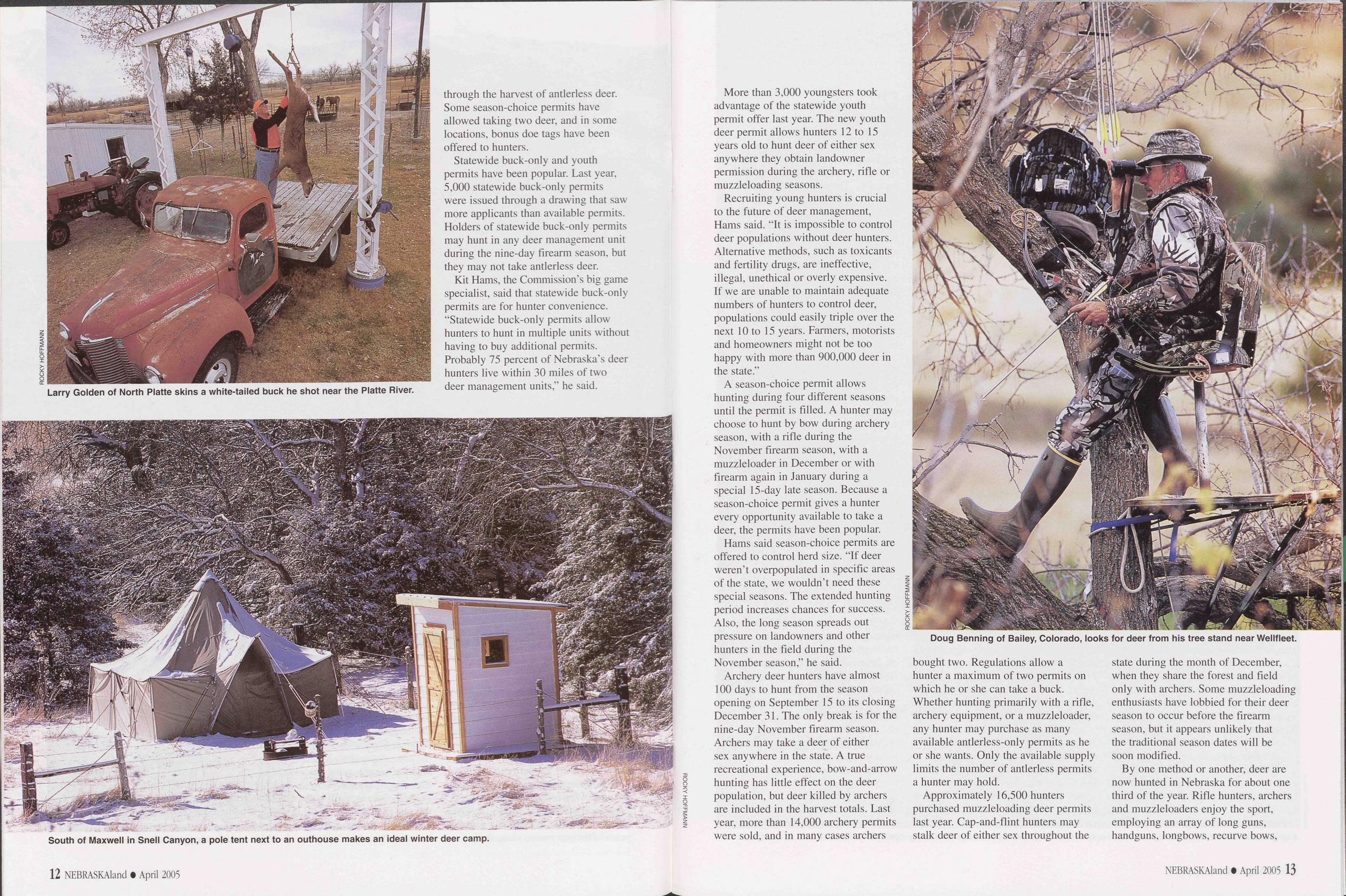
Statewide buck-only and youth permits have been popular. Last year, 5,000 statewide buck-only permits were issued through a drawing that saw more applicants than available permits. Holders of statewide buck-only permits may hunt in any deer management unit during the nine-day firearm season, but they may not take antlerless deer.
Kit Hams, the Commission’s big game specialist, said that statewide buck-only permits are for hunter convenience. “Statewide buck-only permits allow hunters to hunt in multiple units without having to buy additional permits. Probably 75 percent of Nebraska’s deer hunters live within 30 miles of two deer management units,” he said.
More than 3,000 youngsters took advantage of the statewide youth permit offer last year. The new youth deer permit allows hunters 12 to 15 years old to hunt deer of either sex anywhere they obtain landowner permission during the archery, rifle or muzzleloading seasons.
Recruiting young hunters is crucial to the future of deer management, Hams said. “It is impossible to control deer populations without deer hunters. Alternative methods, such as toxicants and fertility drugs, are ineffective, illegal, unethical or overly expensive. If we are unable to maintain adequate numbers of hunters to control deer, populations could easily triple over the next 10 to 15 years. Farmers, motorists and homeowners might not be too happy with more than 900,000 deer in the state.”
A season-choice permit allows hunting during four different seasons until the permit is filled. A hunter may choose to hunt by bow during archery season, with a rifle during the November firearm season, with a muzzleloader in December or with firearm again in January during a special 15-day late season. Because a season-choice permit gives a hunter every opportunity available to take a deer, the permits have been popular.
Hams said season-choice permits are offered to control herd size. “If deer weren’t overpopulated in specific areas of the state, we wouldn’t need these special seasons. The extended hunting period increases chances for success. Also, the long season spreads out pressure on landowners and other hunters in the field during the November season,” he said.
Archery deer hunters have almost 100 days to hunt from the season opening on September 15 to its closing December 31. The only break is for the nine-day November firearm season. Archers may take a deer of either sex anywhere in the state. A true recreational experience, bow-and-arrow hunting has little effect on the deer population, but deer killed by archers are included in the harvest totals. Last year, more than 14,000 archery permits were sold, and in many cases archers
Approximately 16,500 hunters purchased muzzleloading deer permits last year. Cap-and-flint hunters may stalk deer of either sex throughout the state during the month of December, when they share the forest and field only with archers. Some muzzleloading enthusiasts have lobbied for their deer season to occur before the firearm season, but it appears unlikely that the traditional season dates will be soon modified.
By one method or another, deer are
now hunted in Nebraska for about one
third of the year. Rifle hunters, archers
and muzzleloaders enjoy the sport,
employing an array of long guns,
handguns, longbows, recurve bows,
NEBRASKAland • April 2005 13
 compound bows or crossbows. Hunters
may explore the western shortgrass
prairies, canyons and ridges for mule
deer or stalk white-tailed deer along
river courses from east to west. Hunts
may be tailored for table venison, wall
mounts or both. Nebraska’s big game
trophy records contain thousands of
listings under 12 categories for deer,
including mule deer, white-tailed deer,
typical, nontypical, firearm, archery
and muzzleloader.
compound bows or crossbows. Hunters
may explore the western shortgrass
prairies, canyons and ridges for mule
deer or stalk white-tailed deer along
river courses from east to west. Hunts
may be tailored for table venison, wall
mounts or both. Nebraska’s big game
trophy records contain thousands of
listings under 12 categories for deer,
including mule deer, white-tailed deer,
typical, nontypical, firearm, archery
and muzzleloader.
Pronghorns were legally protected in Nebraska for 47 years after the season was closed in 1907. Nebraska herds came back from near extirpation in the early 1900s to nearly 10,000 animals before being set back by the devastating winter of 1978-79. Although pronghorns were once recorded across the entire state when 35 million roamed the plains of North America, Nebraska is now on the eastern fringe of the species’s range, and only the western half of the state has suitable parcels of habitat. Nebraska’s pronghorn population now might be as large as 7,000. The best modern ranges in Nebraska are in the northern and southern areas of the Panhandle and in scattered spots throughout the Sandhills.
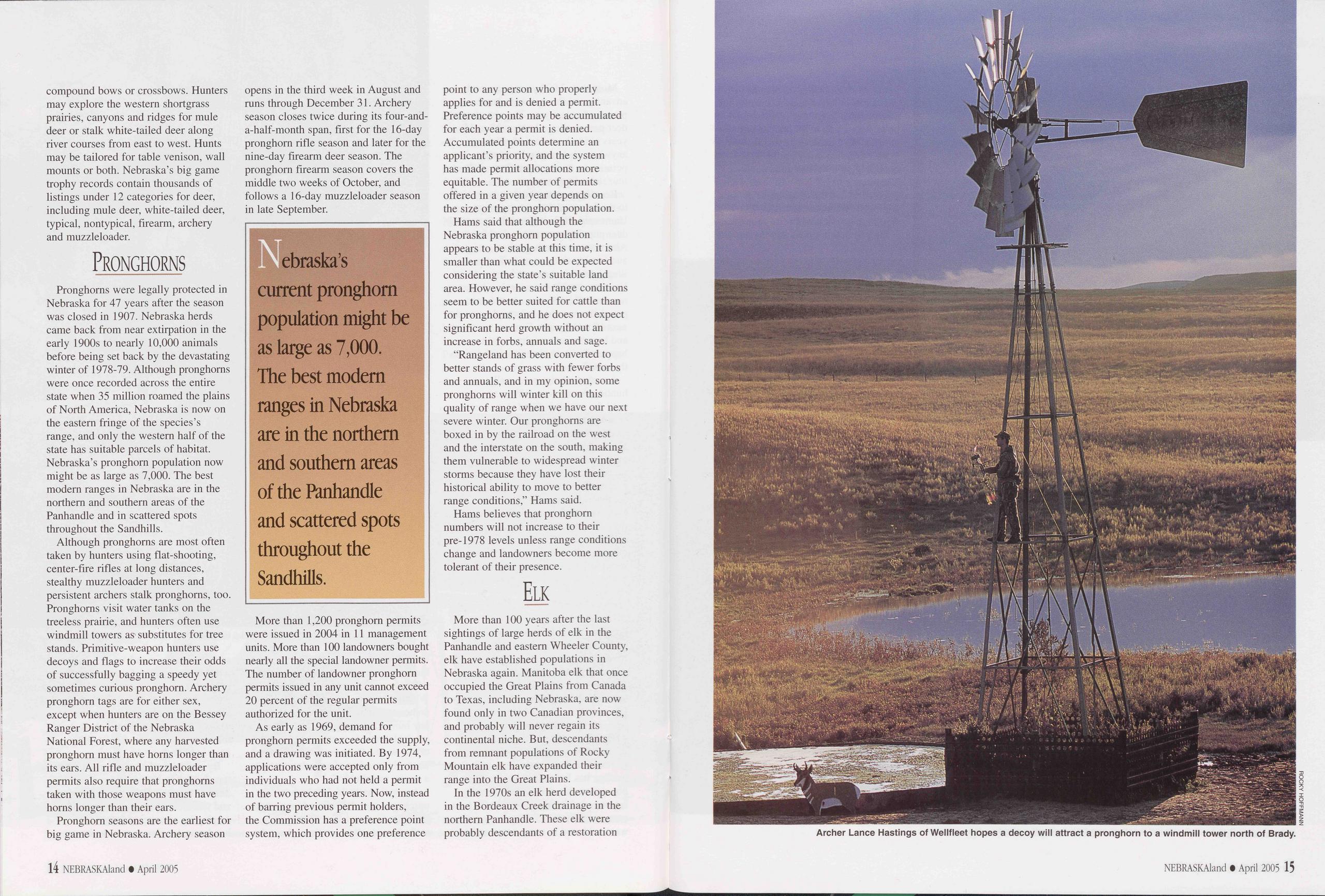
Although pronghorns are most often taken by hunters using flat-shooting, center-fire rifles at long distances, stealthy muzzleloader hunters and persistent archers stalk pronghorns, too. Pronghorns visit water tanks on the treeless prairie, and hunters often use windmill towers as" substitutes for tree stands. Primitive-weapon hunters use decoys and flags to increase their odds of successfully bagging a speedy yet sometimes curious pronghorn. Archery pronghorn tags are for either sex, except when hunters are on the Bessey Ranger District of the Nebraska National Forest, where any harvested pronghorn must have horns longer than its ears. All rifle and muzzleloader permits also require that pronghorns taken with those weapons must have horns longer than their ears.
Pronghorn seasons are the earliest for big game in Nebraska. Archery season opens in the third week in August and runs through December 31. Archery season closes twice during its four-and- a-half-month span, first for the 16-day pronghorn rifle season and later for the nine-day firearm deer season. The pronghorn firearm season covers the middle two weeks of October, and follows a 16-day muzzleloader season in late September.
Nebraska's current pronghorn population might be as large as 7,000. The best modem ranges in Nebraska are in the northern and southern areas of the Panhandle and scattered spots throughout the Sandhills.
More than 1,200 pronghorn permits were issued in 2004 in 11 management units. More than 100 landowners bought nearly all the special landowner permits. The number of landowner pronghorn permits issued in any unit cannot exceed 20 percent of the regular permits authorized for the unit.
As early as 1969, demand for pronghorn permits exceeded the supply, and a drawing was initiated. By 1974, applications were accepted only from individuals who had not held a permit in the two preceding years. Now, instead of barring previous permit holders, the Commission has a preference point system, which provides one preference point to any person who properly applies for and is denied a permit. Preference points may be accumulated for each year a permit is denied. Accumulated points determine an applicant’s priority, and the system has made permit allocations more equitable. The number of permits offered in a given year depends on the size of the pronghorn population.
Hams said that although the Nebraska pronghorn population appears to be stable at this time, it is smaller than what could be expected considering the state’s suitable land area. However, he said range conditions seem to be better suited for cattle than for pronghorns, and he does not expect significant herd growth without an increase in forbs, annuals and sage.
“Rangeland has been converted to better stands of grass with fewer forbs and annuals, and in my opinion, some pronghorns will winter kill on this quality of range when we have our next severe winter. Our pronghorns are boxed in by the railroad on the west and the interstate on the south, making them vulnerable to widespread winter storms because they have lost their historical ability to move to better range conditions,” Hams said.
Hams believes that pronghorn numbers will not increase to their pre-1978 levels unless range conditions change and landowners become more tolerant of their presence.
ELKMore than 100 years after the last sightings of large herds of elk in the Panhandle and eastern Wheeler County, elk have established populations in Nebraska again. Manitoba elk that once occupied the Great Plains from Canada to Texas, including Nebraska, are now found only in two Canadian provinces, and probably will never regain its continental niche. But, descendants from remnant populations of Rocky Mountain elk have expanded their range into the Great Plains.
In the 1970s an elk herd developed in the Bordeaux Creek drainage in the northern Panhandle. These elk were probably descendants of a restoration 14 NEBRASKAland • April 2005
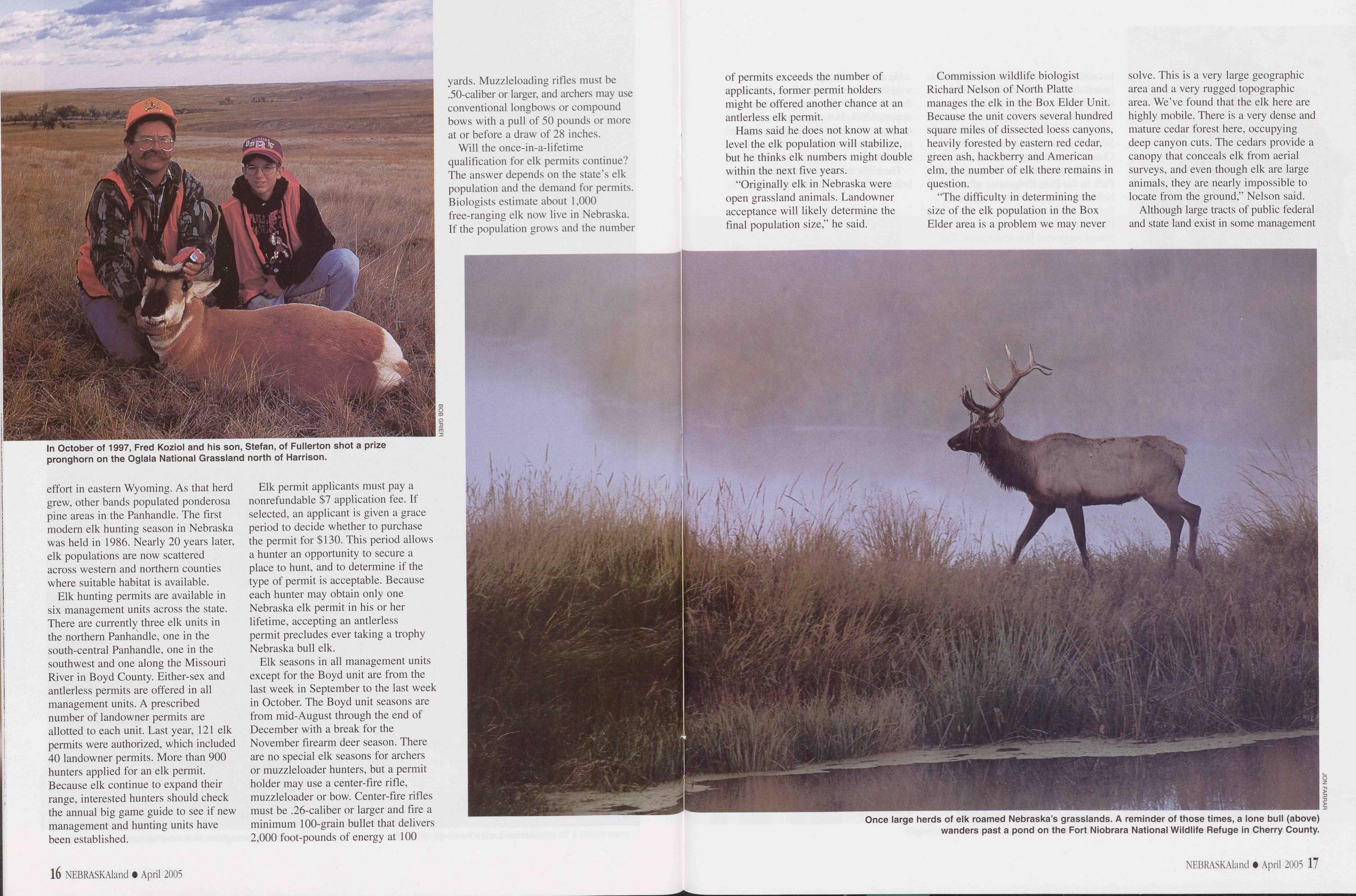
Elk hunting permits are available in six management units across the state. There are currently three elk units in the northern Panhandle, one in the south-central Panhandle, one in the southwest and one along the Missouri River in Boyd County. Either-sex and antlerless permits are offered in all management units. A prescribed number of landowner permits are allotted to each unit. Last year, 121 elk permits were authorized, which included 40 landowner permits. More than 900 hunters applied for an elk permit. Because elk continue to expand their range, interested hunters should check the annual big game guide to see if new management and hunting units have been established.
Elk permit applicants must pay a nonrefundable $7 application fee. If selected, an applicant is given a grace period to decide whether to purchase the permit for $130. This period allows a hunter an opportunity to secure a place to hunt, and to determine if the type of permit is acceptable. Because each hunter may obtain only one Nebraska elk permit in his or her lifetime, accepting an antlerless permit precludes ever taking a trophy Nebraska bull elk.
Elk seasons in all management units except for the Boyd unit are from the last week in September to the last week in October. The Boyd unit seasons are from mid-August through the end of December with a break for the November firearm deer season. There are no special elk seasons for archers or muzzleloader hunters, but a permit holder may use a center-fire rifle, muzzleloader or bow. Center-fire rifles must be .26-caliber or larger and fire a minimum 100-grain bullet that delivers 2,000 foot-pounds of energy at 100 yards. Muzzleloading rifles must be .50-caliber or larger, and archers may use conventional longbows or compound bows with a pull of 50 pounds or more at or before a draw of 28 inches.
Will the once-in-a-lifetime qualification for elk permits continue? The answer depends on the state’s elk population and the demand for permits. Biologists estimate about 1,000 free-ranging elk now live in Nebraska. If the population grows and the number 16 NEBRASKAland • April 2005
Hams said he does not know at what level the elk population will stabilize, but he thinks elk numbers might double within the next five years.
“Originally elk in Nebraska were open grassland animals. Landowner acceptance will likely determine the final population size,” he said.
Commission wildlife biologist Richard Nelson of North Platte manages the elk in the Box Elder Unit. Because the unit covers several hundred square miles of dissected loess canyons, heavily forested by eastern red cedar, green ash, hackberry and American elm, the number of elk there remains in question.
“The difficulty in determining the size of the elk population in the Box Elder area is a problem we may never solve. This is a very large geographic area and a very rugged topographic area. We’ve found that the elk here are highly mobile. There is a very dense and mature cedar forest here, occupying deep canyon cuts. The cedars provide a canopy that conceals elk from aerial surveys, and even though elk are large animals, they are nearly impossible to locate from the ground,” Nelson said.
Although large tracts of public federal
and state land exist in some management
NEBRASKAland • April 2005 17
Though many hunters must find willing landowners before they can hunt, many are successful. In 2004, 55 percent of hunters holding Hat Creek area permits took elk, including two 6-by-7 bulls, six 6-by-6 bulls, seven cows and one calf. The Ash Creek area success rate was 73 percent with hunters taking one 6-by-7 bull, two 6-by-6 bulls, seven cows and an antlerless bull.
In the Bordeaux Creek Unit 44 percent of hunters took elk, including five 6-by-6 bulls, one 5-by-5 bull, nine cows and one calf. In the Boyd Area, 40 percent of hunters killed elk, including one 6-by-6 bull, one 6-by-5 bull, one 5-by-5 bull, two cows and one bull calf. In the Box Elder unit, only 22 percent of hunters were successful with a 6-by-7 bull and a 5-by-5 bull.
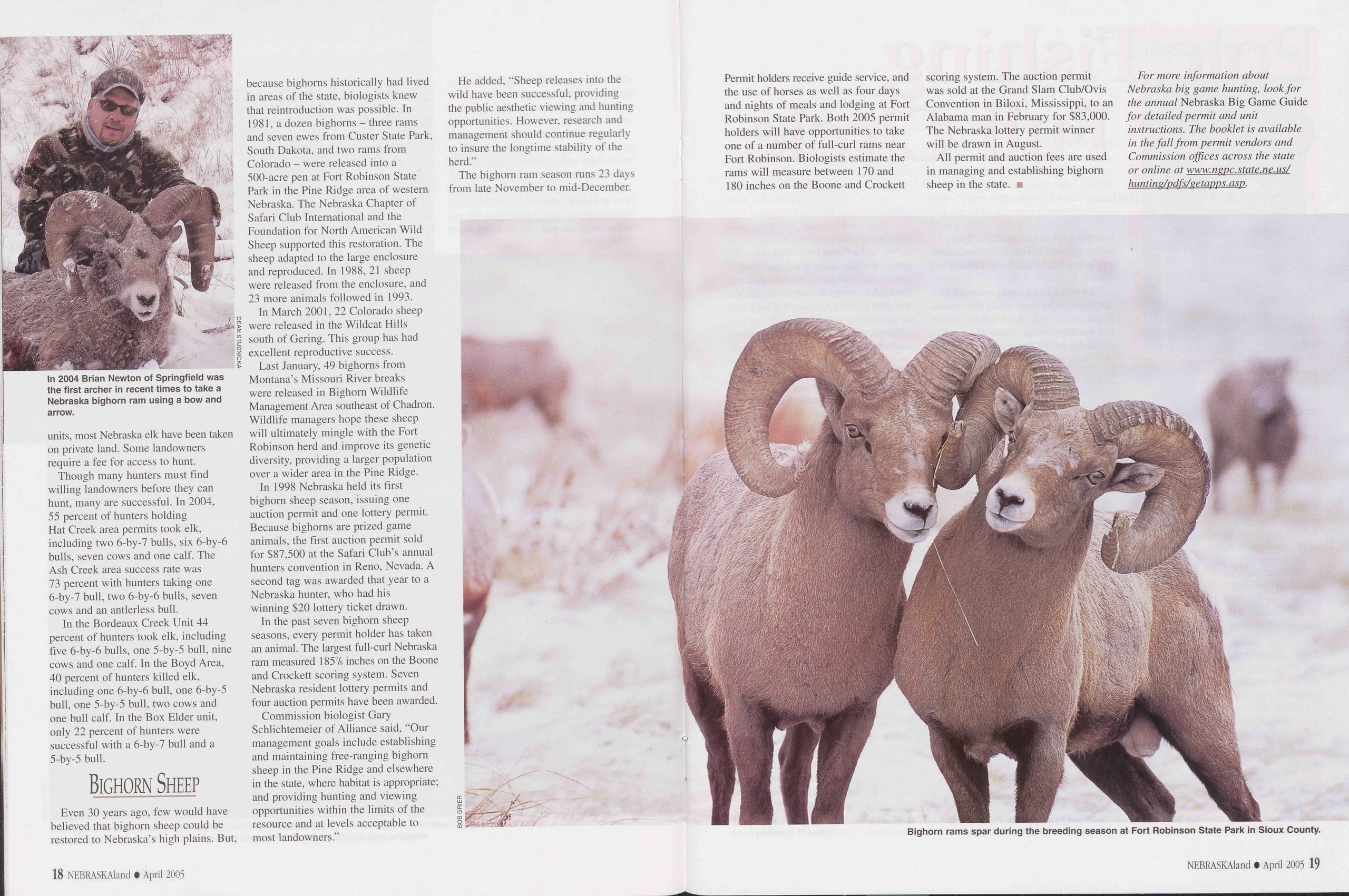
Bighorn SheepEven 30 years ago, few would have believed that bighorn sheep could be restored to Nebraska’s high plains. But, because bighorns historically had lived in areas of the state, biologists knew that reintroduction was possible. In 1981, a dozen bighorns - three rams and seven ewes from Custer State Park, South Dakota, and two rams from Colorado - were released into a 500-acre pen at Fort Robinson State Park in the Pine Ridge area of western Nebraska. The Nebraska Chapter of Safari Club International and the Foundation for North American Wild Sheep supported this restoration. The sheep adapted to the large enclosure and reproduced. In 1988, 21 sheep were released from the enclosure, and 23 more animals followed in 1993.
In March 2001, 22 Colorado sheep were released in the Wildcat Hills south of Gering. This group has had excellent reproductive success.
Last January, 49 bighorns from Montana’s Missouri River breaks were released in Bighorn Wildlife Management Area southeast of Chadron. Wildlife managers hope these sheep will ultimately mingle with the Fort Robinson herd and improve its genetic diversity, providing a larger population over a wider area in the Pine Ridge.
In 1998 Nebraska held its first bighorn sheep season, issuing one auction permit and one lottery permit. Because bighorns are prized game animals, the first auction permit sold for $87,500 at the Safari Club’s annual hunters convention in Reno, Nevada. A second tag was awarded that year to a Nebraska hunter, who had his winning $20 lottery ticket drawn.
In the past seven bighorn sheep seasons, every permit holder has taken an animal. The largest full-curl Nebraska ram measured 1857/s inches on the Boone and Crockett scoring system. Seven Nebraska resident lottery permits and four auction permits have been awarded.
Commission biologist Gary Schlichtemeier of Alliance said, “Our management goals include establishing and maintaining free-ranging bighorn sheep in the Pine Ridge and elsewhere in the state, where habitat is appropriate; and providing hunting and viewing opportunities within the limits of the resource and at levels acceptable to most landowners.”
He added, “Sheep releases into the wild have been successful, providing the public aesthetic viewing and hunting opportunities. However, research and management should continue regularly to insure the longtime stability of the herd.”
The bighorn ram season runs 23 days from late November to mid-December. 18 NEBRASKAland • April 2005 Bighorn rams spar during the breeding season at Fort Robinson State Park in Sioux County. Permit holders receive guide service, and the use of horses as well as four days and nights of meals and lodging at Fort Robinson State Park. Both 2005 permit holders will have opportunities to take one of a number of full-curl rams near Fort Robinson. Biologists estimate the rams will measure between 170 and 180 inches on the Boone and Crockett scoring system. The auction permit was sold at the Grand Slam Club/Ovis Convention in Biloxi, Mississippi, to an Alabama man in February for $83,000. The Nebraska lottery permit winner will be drawn in August.
All permit and auction fees are used in managing and establishing bighorn sheep in the state.
For more information about Nebraska big game hunting, look for the annual Nebraska Big Game Guide for detailed permit and unit instructions. The booklet is available in the fall from permit vendors and Commission offices across the state or online at www.ngpc.state.ne.us/ hunting/pdfs/getapps.asp.
NEBRASKAland • April 2005 19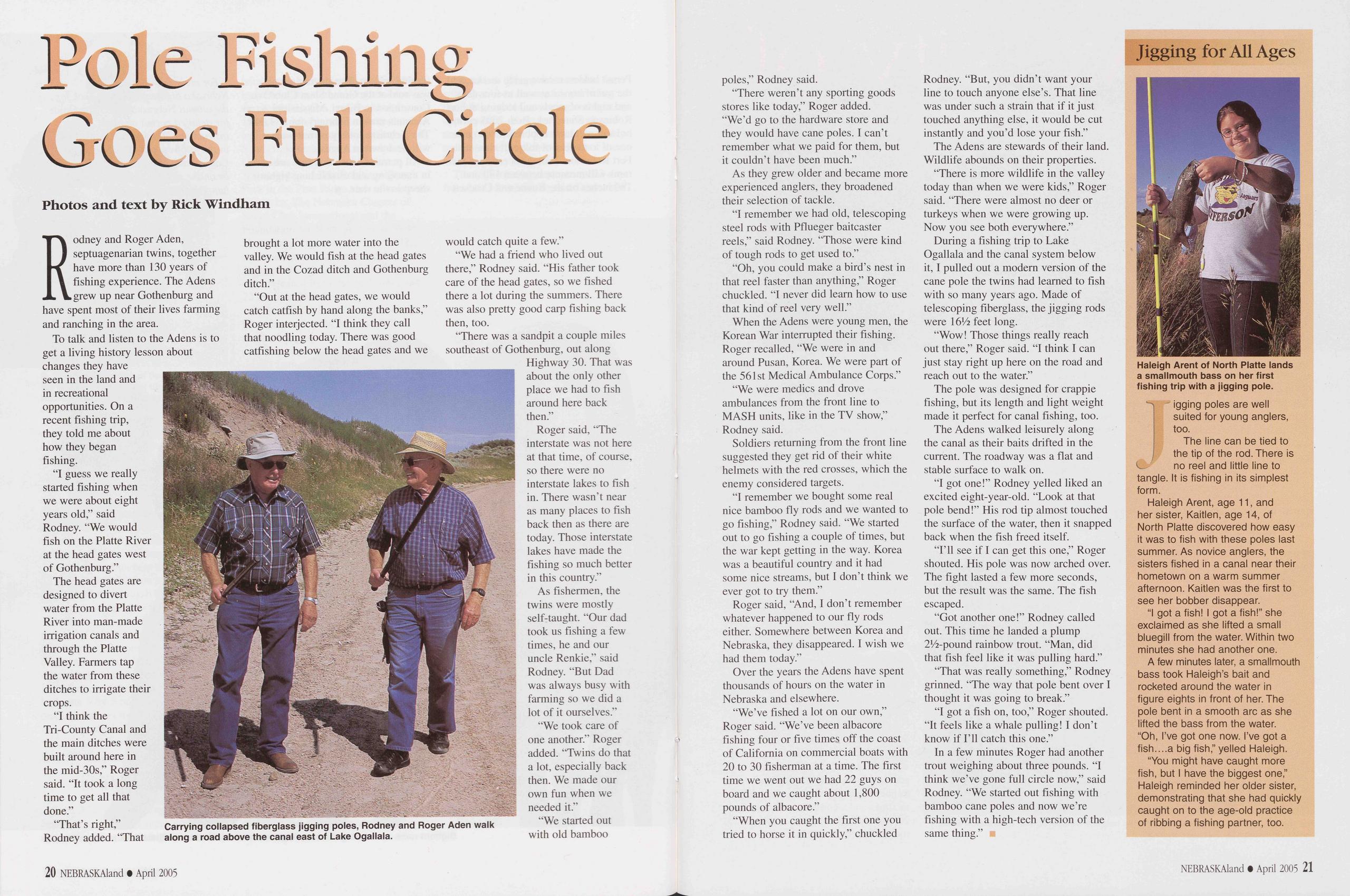
Pole Fishing Goes Full Circle
Rodney and Roger Aden, septuagenarian twins, together have more than 130 years of fishing experience. The Adens grew up near Gothenburg and have spent most of their lives farming and ranching in the area.
To talk and listen to the Adens is to get a living history lesson about changes they have seen in the land and in recreational opportunities. On a recent fishing trip, they told me about how they began fishing.
"I guess we really started fishing when we were about eight years old,” said Rodney. "We would fish on the Platte River at the head gates west of Gothenburg.”
The head gates are designed to divert water from the Platte River into man-made irrigation canals and through the Platte Valley. Farmers tap the water from these ditches to irrigate their crops.
"I think the Tri-County Canal and the main ditches were built around here in the mid-30s,” Roger said. "It took a long time to get all that done.”
"That’s right,” Rodney added. "That brought a lot more water into the valley. We would fish at the head gates and in the Cozad ditch and Gothenburg ditch.”
"Out at the head gates, we would catch catfish by hand along the banks,” Roger interjected. "I think they call that noodling today. There was good catfishing below the head gates and we
"We had a friend who lived out there,” Rodney said. "His father took care of the head gates, so we fished there a lot during the summers. There was also pretty good carp fishing back then, too.
"There was a sandpit a couple miles southeast of Gothenburg, out along Highway 30. That was about the only other place we had to fish around here back then.”
Roger said, "The interstate was not here at that time, of course, so there were no interstate lakes to fish in. There wasn’t near as many places to fish back then as there are today. Those interstate lakes have made the fishing so much better in this country.”
As fishermen, the twins were mostly self-taught. "Our dad took us fishing a few times, he and our uncle Renkie,” said Rodney. "But Dad was always busy with farming so we did a lot of it ourselves.”
"We took care of one another.” Roger added. "Twins do that a lot, especially back then. We made our own fun when we needed it.”
"We started out with old bamboo 20 NEBRASKAland • April 2005 poles,” Rodney said.
“There weren’t any sporting goods stores like today,” Roger added. "We’d go to the hardware store and they would have cane poles. I can’t remember what we paid for them, but it couldn’t have been much.”
As they grew older and became more experienced anglers, they broadened their selection of tackle.
"I remember we had old, telescoping steel rods with Pflueger baitcaster reels,” said Rodney. "Those were kind of tough rods to get used to.”
"Oh, you could make a bird’s nest in that reel faster than anything,” Roger chuckled. "I never did learn how to use that kind of reel very well.”
When the Adens were young men, the Korean War interrupted their fishing. Roger recalled, "We were in and around Pusan, Korea. We were part of the 561st Medical Ambulance Corps.”
"We were medics and drove ambulances from the front line to MASH units, like in the TV show,” Rodney said.
Soldiers returning from the front line suggested they get rid of their white helmets with the red crosses, which the enemy considered targets.
"I remember we bought some real nice bamboo fly rods and we wanted to go fishing,” Rodney said. "We started out to go fishing a couple of times, but the war kept getting in the way. Korea was a beautiful country and it had some nice streams, but I don’t think we ever got to try them.”
Roger said, "And, I don’t remember whatever happened to our fly rods either. Somewhere between Korea and Nebraska, they disappeared. I wish we had them today.”
Over the years the Adens have spent thousands of hours on the water in Nebraska and elsewhere.
"We’ve fished a lot on our own,” Roger said. "We’ve been albacore fishing four or five times off the coast of California on commercial boats with 20 to 30 fisherman at a time. The first time we went out we had 22 guys on board and we caught about 1,800 pounds of albacore.”
"When you caught the first one you tried to horse it in quickly,” chuckled Rodney. "But, you didn’t want your line to touch anyone else’s. That line was under such a strain that if it just touched anything else, it would be cut instantly and you’d lose your fish.”
The Adens are stewards of their land. Wildlife abounds on their properties.
"There is more wildlife in the valley today than when we were kids,” Roger said. "There were almost no deer or turkeys when we were growing up. Now you see both everywhere.”
During a fishing trip to Lake Ogallala and the canal system below it, I pulled out a modem version of the cane pole the twins had learned to fish with so many years ago. Made of telescoping fiberglass, the jigging rods were 16 1/2 feet long.
"Wow! Those things really reach out there,” Roger said. "I think I can just stay right up here on the road and reach out to the water.”
The pole was designed for crappie fishing, but its length and light weight made it perfect for canal fishing, too. The Adens walked leisurely along the canal as their baits drifted in the current. The roadway was a flat and stable surface to walk on.
"I got one!” Rodney yelled liked an excited eight-year-old. "Look at that pole bend!” His rod tip almost touched the surface of the water, then it snapped back when the fish freed itself.
"I’ll see if I can get this one,” Roger shouted. His pole was now arched over. The fight lasted a few more seconds, but the result was the same. The fish escaped.
“Got another one!” Rodney called out. This time he landed a plump 21/2-pound rainbow trout. "Man, did that fish feel like it was pulling hard.”
"That was really something,” Rodney grinned. "The way that pole bent over I thought it was going to break.”
"I got a fish on, too,” Roger shouted. "It feels like a whale pulling! I don’t know if I’ll catch this one.”
In a few minutes Roger had another trout weighing about three pounds. "I think we’ve gone full circle now,” said Rodney. “We started out fishing with bamboo cane poles and now we’re fishing with a high-tech version of the same thing.”
Jigging for All Ages
Jigging poles are well suited for young anglers, too.
The line can be tied to the tip of the rod. There is no reel and little line to tangle. It is fishing in its simplest form.
Haleigh Arent, age 11, and her sister, Kaitlen, age 14, of North Platte discovered how easy it was to fish with these poles last summer. As novice anglers, the sisters fished in a canal near their hometown on a warm summer afternoon. Kaitlen was the first to see her bobber disappear.
“I got a fish! I got a fish!” she exclaimed as she lifted a small bluegill from the water. Within two minutes she had another one.
A few minutes later, a smallmouth bass took Haleigh’s bait and rocketed around the water in figure eights in front of her. The pole bent in a smooth arc as she lifted the bass from the water. “Oh, I’ve got one now. I’ve got a fish....a big fish,” yelled Haleigh.
“You might have caught more fish, but I have the biggest one,” Haleigh reminded her older sister, demonstrating that she had quickly caught on to the age-old practice of ribbing a fishing partner, too.
NEBRASKAland • April 2005 21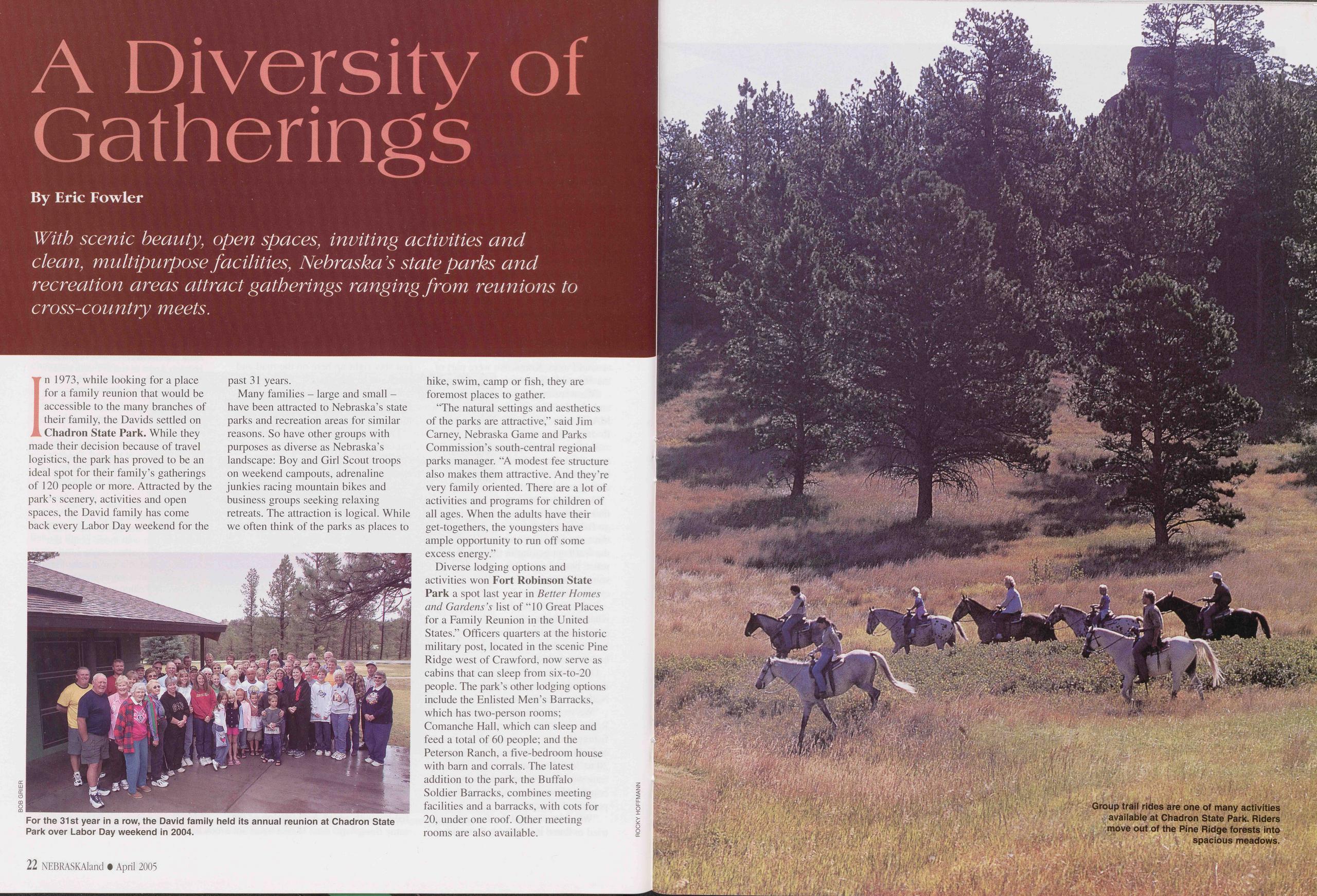
A Diversity of Gatherings
With scenic beauty, open spaces, inviting activities and clean, multipurpose facilities, Nebraska’s state parks and recreation areas attract gatherings ranging from reunions to cross-country meets.
In 1973, while looking for a place for a family reunion that would be accessible to the many branches of their family, the Davids settled on Chadron State Park. While they made their decision because of travel logistics, the park has proved to be an ideal spot for their family’s gatherings of 120 people or more. Attracted by the park’s scenery, activities and open spaces, the David family has come back every Labor Day weekend for the
Many families - large and small - have been attracted to Nebraska’s state parks and recreation areas for similar reasons. So have other groups with purposes as diverse as Nebraska’s landscape: Boy and Girl Scout troops on weekend campouts, adrenaline junkies racing mountain bikes and business groups seeking relaxing retreats. The attraction is logical. While we often think of the parks as places to hike, swim, camp or fish, they are foremost places to gather.
“The natural settings and aesthetics of the parks are attractive,” said Jim Carney, Nebraska Game and Parks Commission’s south-central regional parks manager. “A modest fee structure also makes them attractive. And they’re very family oriented. There are a lot of activities and programs for children of all ages. When the adults have their get-togethers, the youngsters have ample opportunity to run off some excess energy.”
Diverse lodging options and activities won Fort Robinson State Park a spot last year in Better Homes and Gardens’s list of ‘TO Great Places for a Family Reunion in the United States.” Officers quarters at the historic military post, located in the scenic Pine Ridge west of Crawford, now serve as cabins that can sleep from six-to-20 people. The park’s other lodging options include the Enlisted Men’s Barracks, which has two-person rooms; Comanche Hall, which can sleep and feed a total of 60 people; and the Peterson Ranch, a five-bedroom house with barn and corrals. The latest addition to the park, the Buffalo Soldier Barracks, combines meeting facilities and a barracks, with cots for 20, under one roof. Other meeting rooms are also available.
22 NEBRASKAland • April 2005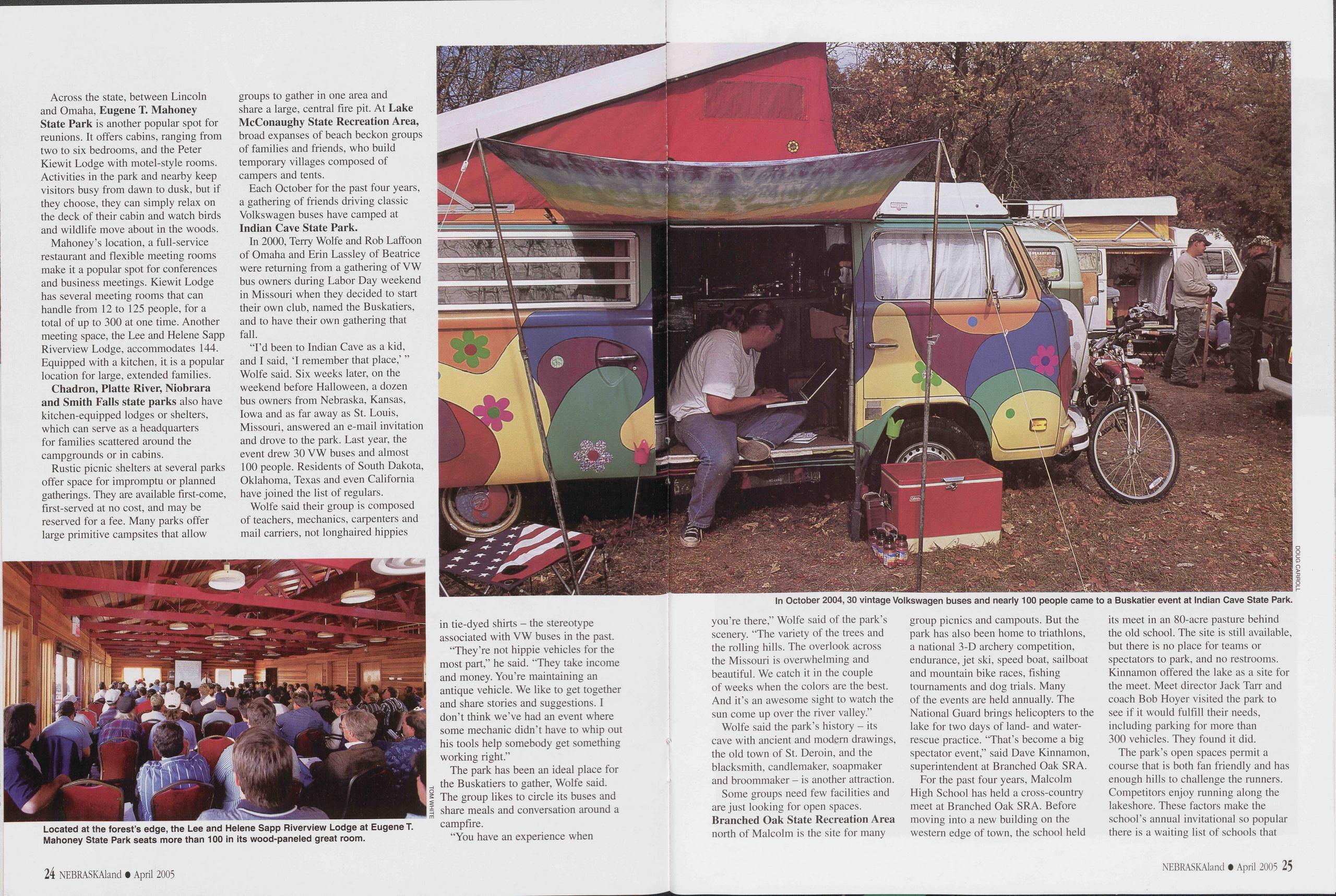
Across the state, between Lincoln and Omaha, Eugene T. Mahoney State Park is another popular spot for reunions. It offers cabins, ranging from two to six bedrooms, and the Peter Kiewit Lodge with motel-style rooms. Activities in the park and nearby keep visitors busy from dawn to dusk, but if they choose, they can simply relax on the deck of their cabin and watch birds and wildlife move about in the woods.
Mahoney’s location, a full-service restaurant and flexible meeting rooms make it a popular spot for conferences and business meetings. Kiewit Lodge has several meeting rooms that can handle from 12 to 125 people, for a total of up to 300 at one time. Another meeting space, the Lee and Helene Sapp Riverview Lodge, accommodates 144. Equipped with a kitchen, it is a popular location for large, extended families.
Chadron, Platte River, Niobrara and Smith Falls state parks also have kitchen-equipped lodges or shelters, which can serve as a headquarters for families scattered around the campgrounds or in cabins.
Rustic picnic shelters at several parks offer space for impromptu or planned gatherings. They are available first-come, first-served at no cost, and may be reserved for a fee. Many parks offer large primitive campsites that allow
Each October for the past four years, a gathering of friends driving classic Volkswagen buses have camped at Indian Cave State Park.
In 2000, Terry Wolfe and Rob Laffoon of Omaha and Erin Lassley of Beatrice were returning from a gathering of VW bus owners during Labor Day weekend in Missouri when they decided to start their own club, named the Buskatiers, and to have their own gathering that fall.
“I’d been to Indian Cave as a kid, and I said, I remember that place,’ ” Wolfe said. Six weeks later, on the weekend before Halloween, a dozen bus owners from Nebraska, Kansas, Iowa and as far away as St. Louis, Missouri, answered an e-mail invitation and drove to the park. Last year, the event drew 30 VW buses and almost 100 people. Residents of South Dakota, Oklahoma, Texas and even California have joined the list of regulars.
Wolfe said their group is composed of teachers, mechanics, carpenters and mail carriers, not longhaired hippies in tie-dyed shirts - the stereotype associated with VW buses in the past.
“They’re not hippie vehicles for the most part,” he said. “They take income and money. You’re maintaining an antique vehicle. We like to get together and share stories and suggestions. I don’t think we’ve had an event where some mechanic didn’t have to whip out his tools help somebody get something working right.”
The park has been an ideal place for the Buskatiers to gather, Wolfe said. The group likes to circle its buses and share meals and conversation around a campfire.
“You have an experience when 24 NEBRASKAland • April 2005
Wolfe said the park’s history - its cave with ancient and modem drawings, the old town of St. Deroin, and the blacksmith, candlemaker, soapmaker and broommaker - is another attraction.
Some groups need few facilities and are just looking for open spaces. Branched Oak State Recreation Area north of Malcolm is the site for many group picnics and campouts. But the park has also been home to triathlons, a national 3-D archery competition, endurance, jet ski, speed boat, sailboat and mountain bike races, fishing tournaments and dog trials. Many of the events are held annually. The National Guard brings helicopters to the lake for two days of land- and water- rescue practice. “That’s become a big spectator event,” said Dave Kinnamon, superintendent at Branched Oak SRA.
For the past four years, Malcolm High School has held a cross-country meet at Branched Oak SRA. Before moving into a new building on the western edge of town, the school held its meet in an 80-acre pasture behind the old school. The site is still available, but there is no place for teams or spectators to park, and no restrooms. Kinnamon offered the lake as a site for the meet. Meet director Jack Tarr and coach Bob Hoyer visited the park to see if it would fulfill their needs, including parking for more than 300 vehicles. They found it did.
The park’s open spaces permit a
course that is both fan friendly and has
enough hills to challenge the runners.
Competitors enjoy running along the
lakeshore. These factors make the
school’s annual invitational so popular
there is a waiting list of schools that
NEBRASKAland • April 2005 25
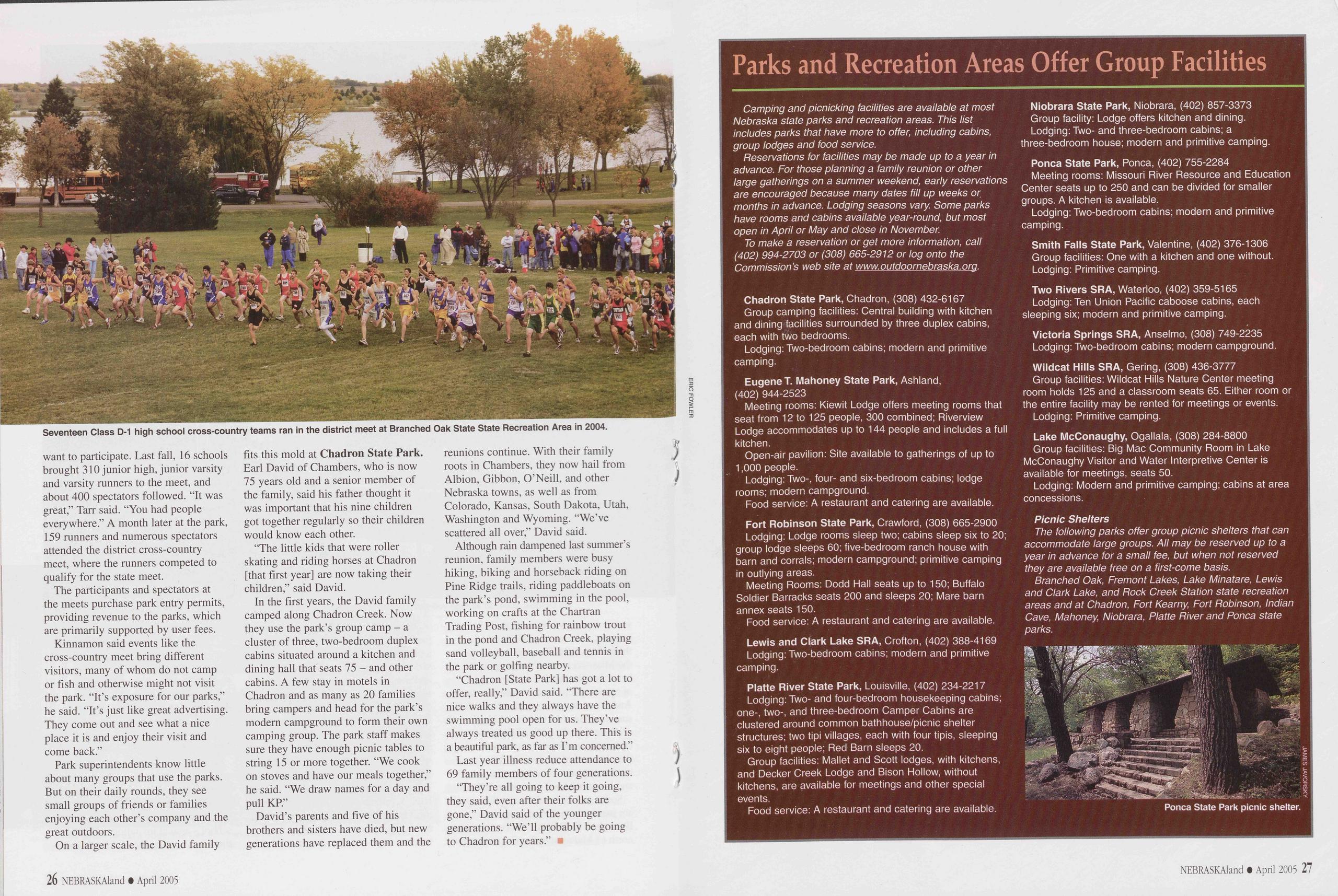 want to participate. Last fall, 16 schools
brought 310 junior high, junior varsity
and varsity runners to the meet, and
about 400 spectators followed. “It was
great,” Tarr said. “You had people
everywhere.” A month later at the park,
159 runners and numerous spectators
attended the district cross-country
meet, where the runners competed to
qualify for the state meet.
want to participate. Last fall, 16 schools
brought 310 junior high, junior varsity
and varsity runners to the meet, and
about 400 spectators followed. “It was
great,” Tarr said. “You had people
everywhere.” A month later at the park,
159 runners and numerous spectators
attended the district cross-country
meet, where the runners competed to
qualify for the state meet.
The participants and spectators at the meets purchase park entry permits, providing revenue to the parks, which are primarily supported by user fees.
Kinnamon said events like the cross-country meet bring different visitors, many of whom do not camp or fish and otherwise might not visit the park. “It’s exposure for our parks,” he said. “It’s just like great advertising. They come out and see what a nice place it is and enjoy their visit and come back.”
Park superintendents know little about many groups that use the parks. But on their daily rounds, they see small groups of friends or families enjoying each other’s company and the great outdoors.
On a larger scale, the David family fits this mold at Chadron State Park. Earl David of Chambers, who is now 75 years old and a senior member of the family, said his father thought it was important that his nine children got together regularly so their children would know each other.
“The little kids that were roller skating and riding horses at Chadron [that first year] are now taking their children,” said David.
In the first years, the David family camped along Chadron Creek. Now they use the park’s group camp - a cluster of three, two-bedroom duplex cabins situated around a kitchen and dining hall that seats 75 - and other cabins. A few stay in motels in Chadron and as many as 20 families bring campers and head for the park’s modern campground to form their own camping group. The park staff makes sure they have enough picnic tables to string 15 or more together. “We cook on stoves and have our meals together,” he said. “We draw names for a day and pull KP.”
David’s parents and five of his brothers and sisters have died, but new generations have replaced them and the reunions continue. With their family roots in Chambers, they now hail from Albion, Gibbon, O’Neill, and other Nebraska towns, as well as from Colorado, Kansas, South Dakota, Utah, Washington and Wyoming. “We’ve scattered all over,” David said.
Although rain dampened last summer’s reunion, family members were busy hiking, biking and horseback riding on Pine Ridge trails, riding paddleboats on the park’s pond, swimming in the pool, working on crafts at the Chartran Trading Post, fishing for rainbow trout in the pond and Chadron Creek, playing sand volleyball, baseball and tennis in the park or golfing nearby.
“Chadron [State Park] has got a lot to offer, really,” David said. “There are nice walks and they always have the swimming pool open for us. They’ve always treated us good up there. This is a beautiful park, as far as I’m concerned.”
Last year illness reduce attendance to 69 family members of four generations.
“They’re all going to keep it going, they said, even after their folks are gone,” David said of the younger generations. “We’ll probably be going to Chadron for years.”
26 NEBRASKAland • April 2005Parks and Recreation Areas Offer Group Facilities
Camping and picnicking facilities are available at most Nebraska state parks and recreation areas. This list includes parks that have more to offer, including cabins, group lodges and food service.
Reservations for facilities may be made up to a year in advance. For those planning a family reunion or other large gatherings on a summer weekend, early reservations are encouraged because many dates fill up weeks or months in advance. Lodging seasons vary. Some parks have rooms and cabins available year-round, but most open in April or May and dose in November.
To make a reservation or get more information, call (402) 994-2703 or (308) 665-2912 or tog onto the Commission’s web site at www.outdoornebraska.org.
Niobrara State Park, Niobrara, (402) 857-3373 Group facility: Lodge offers kitchen and dining. Lodging: Two- and three-bedroom cabins; a three-bedroom house; modern and primitive camping. Ponca State Park, Ponca, (402) 755-2284 Meeting rooms: Missouri River Resource and Education Center seats up to 250 and can be divided for smaller groups. A kitchen is available. Lodging: Two-bedroom cabins; modern and primitive camping. Smith Falls State Park, Valentine, (402) 376-1306 Group facilities: One with a kitchen and one without. Lodging: Primitive camping. Chadron State Park, Chadron, (308) 432-6167 Group camping facilities: Central building with kitchen and dining facilities surrounded by three duplex cabins, each with two bedrooms. Lodging: Two-bedroom cabins; modern and primitive camping. Eugene T. Mahoney State Park, Ashland, (402) 944-2523 Meeting rooms: Kiewit Lodge offers meeting rooms that seat from 12 to 125 people, 300 combined; Riverview Lodge accommodates up to 144 people and includes a full kitchen. Open-air pavilion: Site available to gatherings of up to 1,000 people. Lodging: Two-, four- and six-bedroom cabins; lodge rooms; modern campground. Food service: A restaurant and catering are available. Fort Robinson State Park, Crawford, (308) 665-2900 Lodging: Lodge rooms sleep two; cabins sleep six to 20; group lodge sleeps 60; five-bedroom ranch house with barn and corrals; modern campground; primitive camping in outlying areas. Meeting Rooms: Dodd Hall seats up to 150; Buffalo Soldier Barracks seats 200 and sleeps 20; Mare barn annex seats 150. Food service: A restaurant and catering are available. Lewis and Clark Lake SRA, Crofton, (402) 388-4169 Lodging: Two-bedroom cabins; modern and primitive camping. Platte River State Park, Louisville, (402) 234-2217 Lodging: Two- and four-bedroom housekeeping cabins; one-, two-, and three-bedroom Camper Cabins are clustered around common bathhouse/picnic shelter structures; two tipi villages, each with four tipis, sleeping six to eight people; Red Barn sleeps 20. Group facilities: Mallet and Scott lodges, with kitchens, I and Decker Creek Lodge and Bison Hollow, without kitchens, are available for meetings and other special events. Food service: A restaurant and catering are available. Two Rivers SRA, Waterloo, (402) 359-5165 Lodging: Ten Union Pacific caboose cabins, each sleeping six; modern and primitive camping. Victoria Springs SRA, Anselmo, (308) 749-2235 Lodging: Two-bedroom cabins; modern campground. Wildcat Hills SRA, Gering, (308) 436-3777 Group facilities: Wildcat Hills Nature Center meeting room holds 125 and a classroom seats 65. Either room or the entire facility may be rented for meetings or events. Lodging: Primitive camping. Lake McConaughy, Ogallala, (308) 284-8800 Group facilities: Big Mac Community Room in Lake McConaughy Visitor and Water Interpretive Center is available for meetings, seats 50. Lodging: Modern and primitive camping; cabins at area concessions. Picnic Shelters The following parks offer group picnic shelters that can accommodate large groups. AH may be reserved up to a year in advance for a small fee, but when not reserved they are available free on a first-come basis. Branched Oak, Fremont Lakes, Lake Minatare, Lewis and Clark Lake, and Rock Creek Station state recreation areas and at Chadron, Fort Kearny, Fort Robinson, Indian Cave, Mahoney, Niobrara, Platte River and Ponca state parks.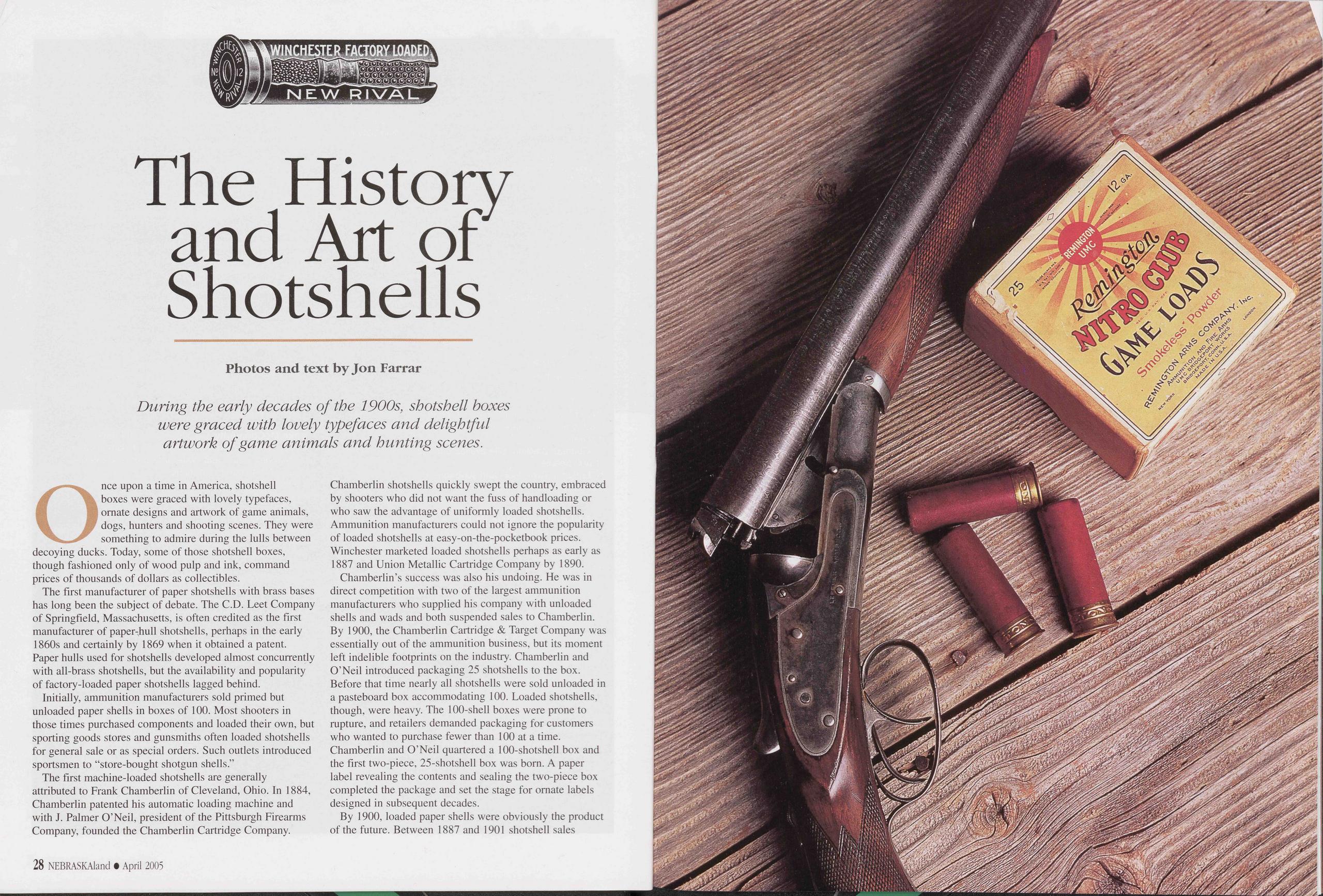
The History and Art of Shotshells
During the early decades of the 1900s, shotshell boxes were graced with lovely typefaces and delightful artwork of game animals and hunting scenes.
Once upon a time in America, shotshell boxes were graced with lovely typefaces, ornate designs and artwork of game animals, dogs, hunters and shooting scenes. They were something to admire during the lulls between decoying ducks. Today, some of those shotshell boxes, though fashioned only of wood pulp and ink, command prices of thousands of dollars as collectibles.
The first manufacturer of paper shotshells with brass bases has long been the subject of debate. The C.D. Leet Company of Springfield, Massachusetts, is often credited as the first manufacturer of paper-hull shotshells, perhaps in the early 1860s and certainly by 1869 when it obtained a patent. Paper hulls used for shotshells developed almost concurrently with all-brass shotshells, but the availability and popularity of factory-loaded paper shotshells lagged behind.
Initially, ammunition manufacturers sold primed but unloaded paper shells in boxes of 100. Most shooters in those times purchased components and loaded their own, but sporting goods stores and gunsmiths often loaded shotshells for general sale or as special orders. Such outlets introduced sportsmen to “store-bought shotgun shells.”
The first machine-loaded shotshells are generally attributed to Frank Chamberlin of Cleveland, Ohio. In 1884, Chamberlin patented his automatic loading machine and with J. Palmer O’Neil, president of the Pittsburgh Firearms Company, founded the Chamberlin Cartridge Company. Chamberlin shotshells quickly swept the country, embraced by shooters who did not want the fuss of handloading or who saw the advantage of uniformly loaded shotshells. Ammunition manufacturers could not ignore the popularity of loaded shotshells at easy-on-the-pocketbook prices. Winchester marketed loaded shotshells perhaps as early as 1887 and Union Metallic Cartridge Company by 1890.
Chamberlin’s success was also his undoing. He was in direct competition with two of the largest ammunition manufacturers who supplied his company with unloaded shells and wads and both suspended sales to Chamberlin. By 1900, the Chamberlin Cartridge & Target Company was essentially out of the ammunition business, but its moment left indelible footprints on the industry. Chamberlin and O’Neil introduced packaging 25 shotshells to the box. Before that time nearly all shotshells were sold unloaded in a pasteboard box accommodating 100. Loaded shotshells, though, were heavy. The 100-shell boxes were prone to rupture, and retailers demanded packaging for customers who wanted to purchase fewer than 100 at a time. Chamberlin and O’Neil quartered a 100-shotshell box and the first two-piece, 25-shotshell box was born. A paper label revealing the contents and sealing the two-piece box completed the package and set the stage for ornate labels designed in subsequent decades.
By 1900, loaded paper shells were obviously the product of the future. Between 1887 and 1901 shotshell sales 28 NEBRASKAland • April 2005
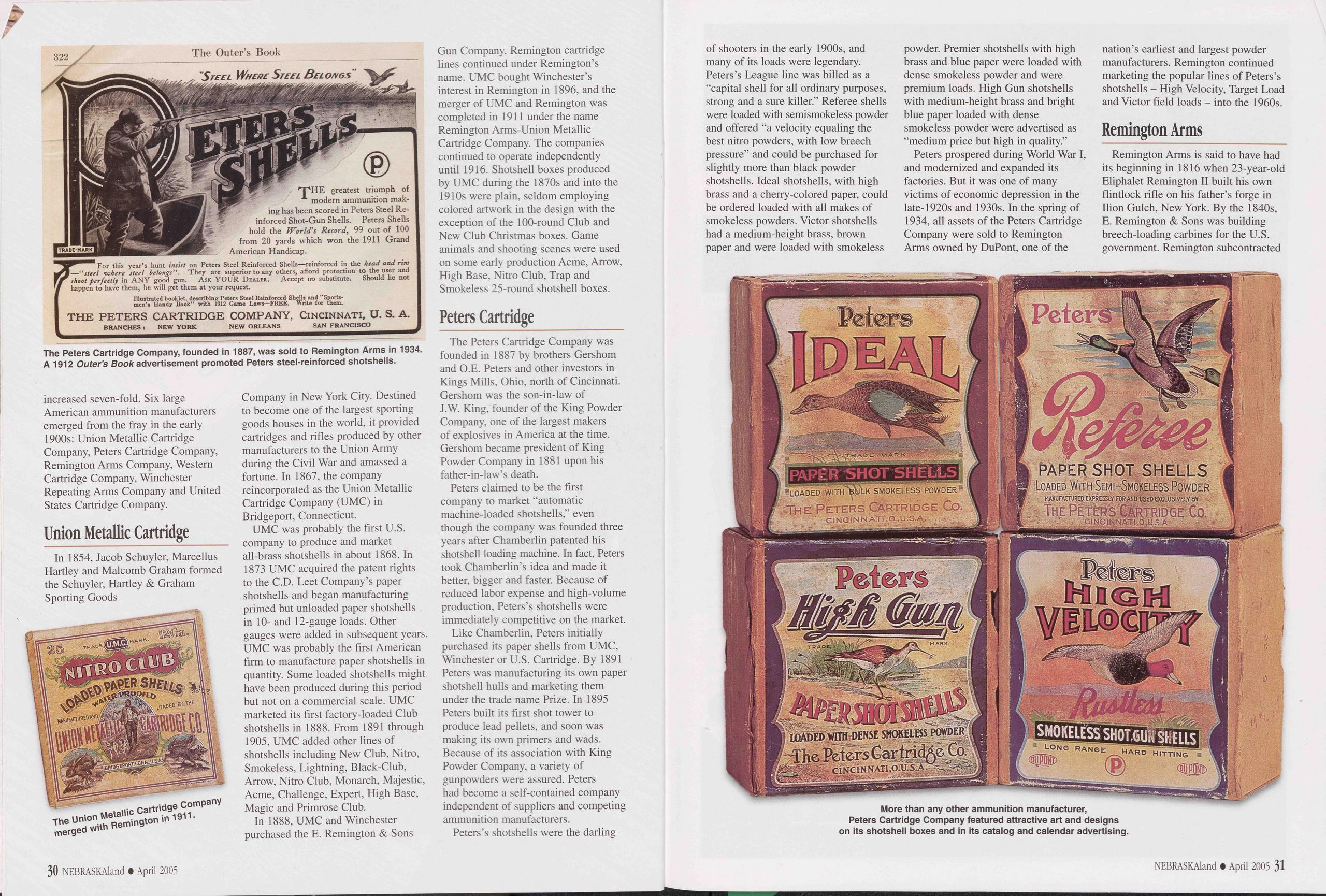
In 1854, Jacob Schuyler, Marcellus Hartley and Malcomb Graham formed the Schuyler, Hartley & Graham Sporting Goods The Union Metallic Cartridge Company merged with Remington in 1911. Company in New York City. Destined to become one of the largest sporting goods houses in the world, it provided cartridges and rifles produced by other manufacturers to the Union Army during the Civil War and amassed a fortune. In 1867, the company reincorporated as the Union Metallic Cartridge Company (UMC) in Bridgeport, Connecticut.
UMC was probably the first U.S. company to produce and market all-brass shotshells in about 1868. In 1873 UMC acquired the patent rights to the C.D. Leet Company’s paper shotshells and began manufacturing primed but unloaded paper shotshells in 10- and 12-gauge loads. Other gauges were added in subsequent years. UMC was probably the first American firm to manufacture paper shotshells in quantity. Some loaded shotshells might have been produced during this period but not on a commercial scale. UMC marketed its first factory-loaded Club shotshells in 1888. From 1891 through 1905, UMC added other lines of shotshells including New Club, Nitro, Smokeless, Lightning, Black-Club, Arrow, Nitro Club, Monarch, Majestic, Acme, Challenge, Expert, High Base, Magic and Primrose Club.
In 1888, UMC and Winchester purchased the E. Remington & Sons Gun Company. Remington cartridge lines continued under Remington’s name. UMC bought Winchester’s interest in Remington in 1896, and the merger of UMC and Remington was completed in 1911 under the name Remington Arms-Union Metallic Cartridge Company. The companies continued to operate independently until 1916. Shotshell boxes produced by UMC during the 1870s and into the 1910s were plain, seldom employing colored artwork in the design with the exception of the 100-round Club and New Club Christmas boxes. Game animals and shooting scenes were used on some early production Acme, Arrow, High Base, Nitro Club, Trap and Smokeless 25-round shotshell boxes.
Peters CartridgeThe Peters Cartridge Company was founded in 1887 by brothers Gershom and O.E. Peters and other investors in Kings Mills, Ohio, north of Cincinnati. Gershom was the son-in-law of J.W. King, founder of the King Powder Company, one of the largest makers of explosives in America at the time. Gershom became president of King Powder Company in 1881 upon his father-in-law’s death.
Peters claimed to be the first company to market "automatic machine-loaded shotshells,” even though the company was founded three years after Chamberlin patented his shotshell loading machine. In fact, Peters took Chamberlin’s idea and made it better, bigger and faster. Because of reduced labor expense and high-volume production, Peters’s shotshells were immediately competitive on the market.
Like Chamberlin, Peters initially purchased its paper shells from UMC, Winchester or U.S. Cartridge. By 1891 Peters was manufacturing its own paper shotshell hulls and marketing them under the trade name Prize. In 1895 Peters built its first shot tower to produce lead pellets, and soon was making its own primers and wads. Because of its association with King Powder Company, a variety of gunpowders were assured. Peters had become a self-contained company independent of suppliers and competing ammunition manufacturers.
Peters’s shotshells were the darling 30 NEBRASKAland O April 2005 of shooters in the early 1900s, and many of its loads were legendary. Peters’s League line was billed as a "capital shell for all ordinary purposes, strong and a sure killer.” Referee shells were loaded with semismokeless powder and offered "a velocity equaling the best nitro powders, with low breech pressure” and could be purchased for slightly more than black powder shotshells. Ideal shotshells, with high brass and a cherry-colored paper, could be ordered loaded with all makes of smokeless powders. Victor shotshells had a medium-height brass, brown paper and were loaded with smokeless
Peters prospered during World War I, and modernized and expanded its factories. But it was one of many victims of economic depression in the late-1920s and 1930s. In the spring of 1934, all assets of the Peters Cartridge Company were sold to Remington Arms owned by DuPont, one of the nation’s earliest and largest powder manufacturers. Remington continued marketing the popular lines of Peters’s shotshells - High Velocity, Target Load and Victor field loads - into the 1960s.
Remington ArmsRemington Arms is said to have had
its beginning in 1816 when 23-year-old
Eliphalet Remington II built his own
flintlock rifle on his father’s forge in
Ilion Gulch, New York. By the 1840s,
E. Remington & Sons was building
breech-loading carbines for the U.S.
government. Remington subcontracted
NEBRASKAland • April 2005 31
Remington expanded in the mid-1910s, an investment that paid off in lucrative government contracts for arms and ammunition when the United States entered World War I. Part of Remington’s expansion was the purchase of the Robin Hood Ammunition Company in 1915. The Robin Hood Powder Company incorporated in 1898 and changed its name to the Robin Hood Ammunition Company in 1906. Robin Hood shotshells were produced until 1919 when Remington closed the operation.
During the Depression the 1930s, Remington again flirted with financial failure. In 1933 DuPont took control of Remington and its sunburst logo was dropped from cartridge boxes and advertising. In 1934 DuPont-Remington purchased the Peters Cartridge Company for about $2.5 million.
Remington was the first American ammunition manufacturer to introduce shotshells with plastic hulls in 1960. For years, ammunition manufacturers had looked for a material to replace paper hulls - something that would not swell when wet, was less expensive and easier to manufacture. Remington claimed its polyethylene hulls were prestressed by a “secret process to make them tougher than whang leather.” The company advertised its plastic shotshells could be soaked in water for a week or more and still fire properly.
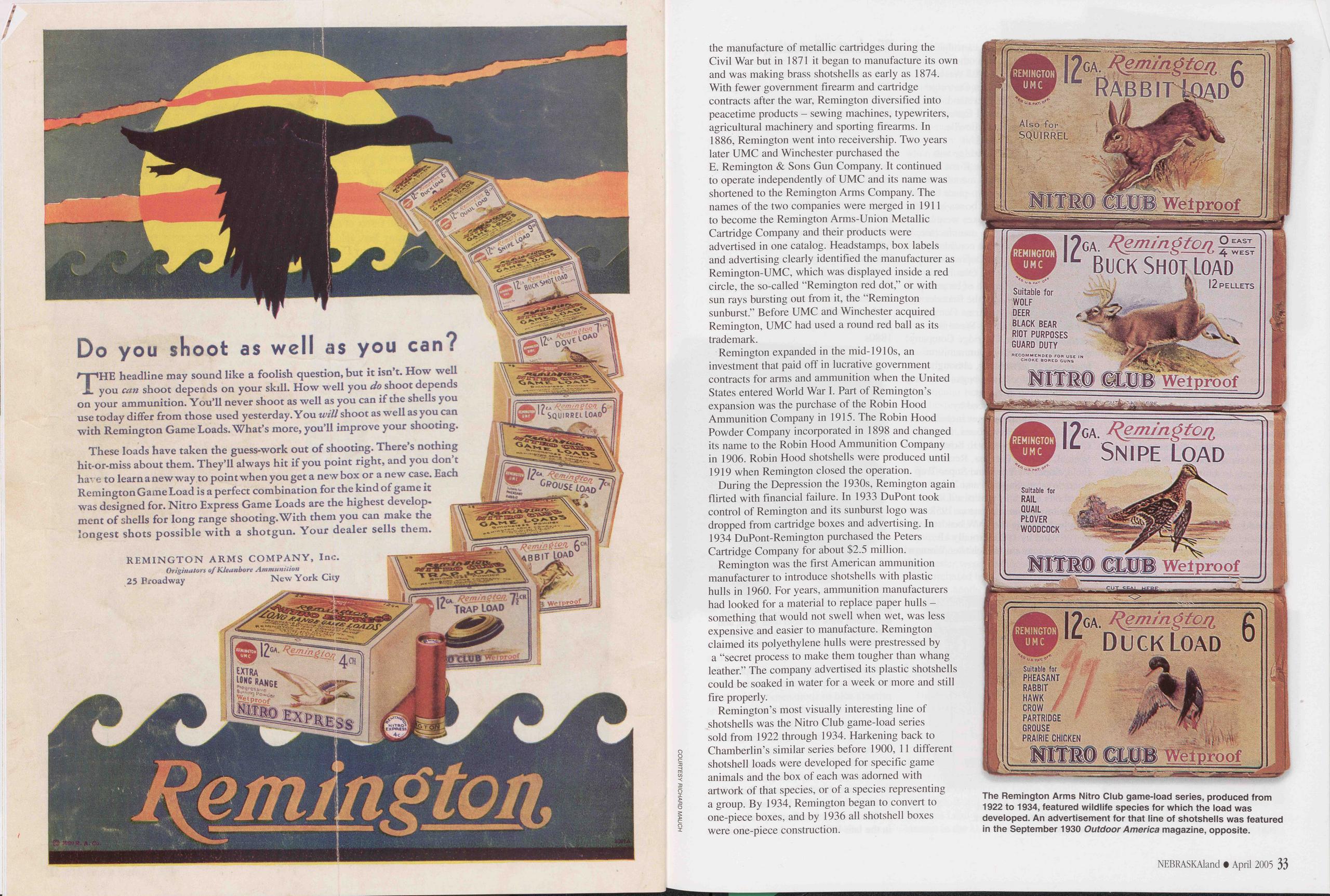
Remington’s most visually interesting line of shotshells was the Nitro Club game-load series sold from 1922 through 1934. Harkening back to Chamberlin’s similar series before 1900, 11 different shotshell loads were developed for specific game animals and the box of each was adorned with artwork of that species, or of a species representing a group. By 1934, Remington began to convert to one-piece boxes, and by 1936 all shotshell boxes were one-piece construction.
In 1892, Franklin W. Olin, a Vermont-born engineer educated at Cornell University, and other investors formed the Equitable Powder Manufacturing Company at East Alton, Illinois, to manufacture black powder for use in area mines. Because the business was seasonal, Olin expanded his interests to ammunition and in 1898 incorporated the Western Cartridge Company. Western designed and developed a shotshell-loading machine, purchased a wad manufacturing plant, built a shot tower and invented equipment to manufacture empty shotshells. Western became self-sufficient,
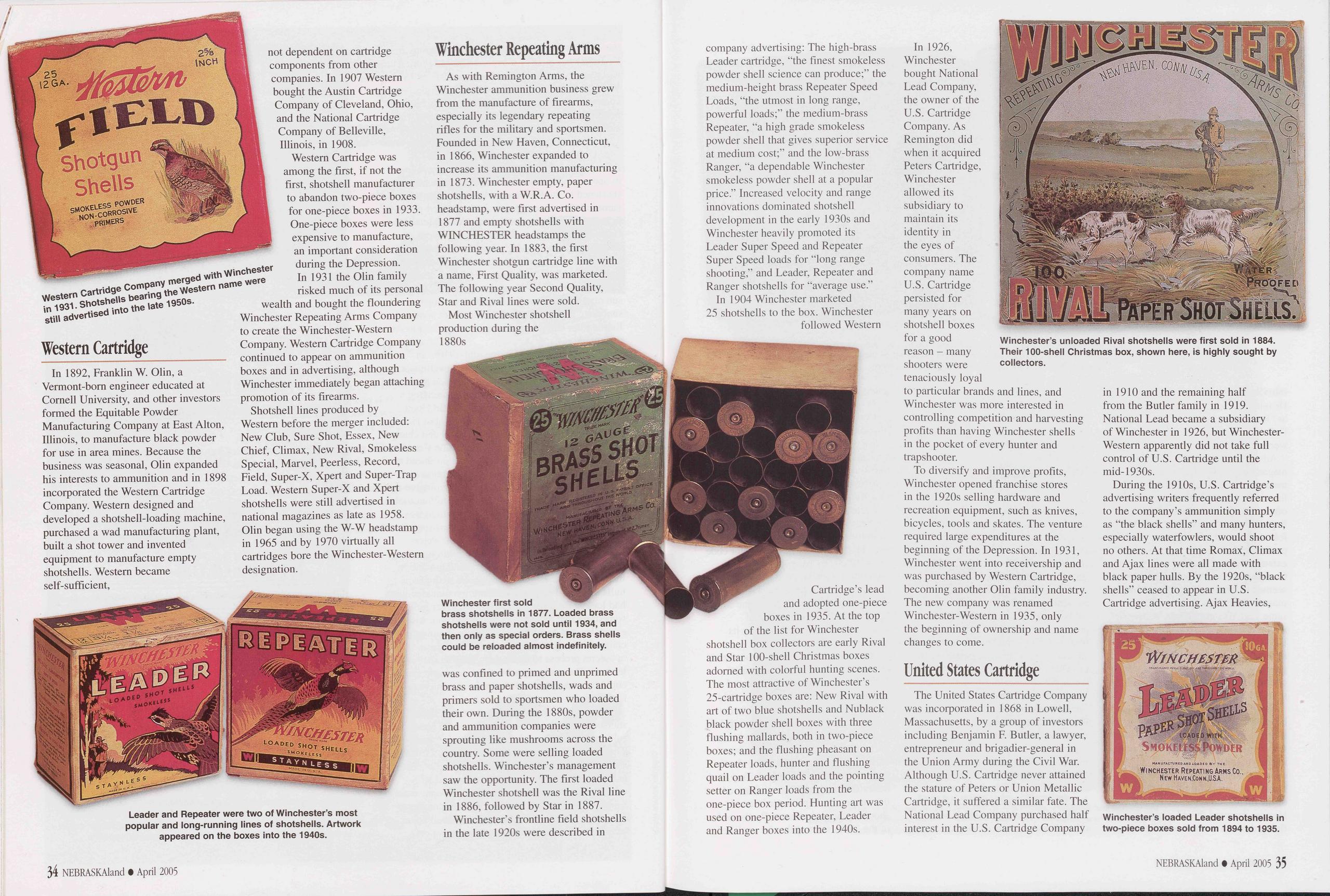
Western Cartridge was among the first, if not the first, shotshell manufacturer to abandon two-piece boxes for one-piece boxes in 1933. One-piece boxes were less expensive to manufacture, an important consideration during the Depression. In 1931 the Olin family risked much of its personal wealth and bought the floundering Winchester Repeating Arms Company to create the Winchester-Western Company. Western Cartridge Company continued to appear on ammunition boxes and in advertising, although Winchester immediately began attaching promotion of its firearms.
Shotshell lines produced by Western before the merger included: New Club, Sure Shot, Essex, New Chief, Climax, New Rival, Smokeless Special, Marvel, Peerless, Record, Field, Super-X, Xpert and Super-Trap Load. Western Super-X and Xpert shotshells were still advertised in national magazines as late as 1958. Olin began using the W-W headstamp in 1965 and by 1970 virtually all cartridges bore the Winchester-Western designation.
Winchester Repeating ArmsAs with Remington Arms, the Winchester ammunition business grew from the manufacture of firearms, especially its legendary repeating rifles for the military and sportsmen. Founded in New Haven, Connecticut, in 1866, Winchester expanded to increase its ammunition manufacturing in 1873. Winchester empty, paper shotshells, with a W.R.A. Co. headstamp, were first advertised in 1877 and empty shotshells with WINCHESTER headstamps the following year. In 1883, the first Winchester shotgun cartridge line with a name, First Quality, was marketed. The following year Second Quality, Star and Rival lines were sold.
Most Winchester shotshell production during the 1880s
Winchester’s frontline field shotshells in the late 1920s were described in 34 NEBRASKAland • April 2005 company advertising: The high-brass Leader cartridge, "the finest smokeless powder shell science can produce;” the medium-height brass Repeater Speed Loads, "the utmost in long range, powerful loads;” the medium-brass Repeater, "a high grade smokeless powder shell that gives superior service at medium cost;” and the low-brass Ranger, “a dependable Winchester smokeless powder shell at a popular price.” Increased velocity and range innovations dominated shotshell development in the early 1930s and Winchester heavily promoted its Leader Super Speed and Repeater Super Speed loads for "long range shooting,” and Leader, Repeater and Ranger shotshells for "average use.”
In 1904 Winchester marketed 25 shotshells to the box. Winchester followed Western Cartridge’s lead and adopted one-piece boxes in 1935. At the top of the list for Winchester shotshell box collectors are early Rival and Star 100-shell Christmas boxes adorned with colorful hunting scenes. The most attractive of Winchester’s 25-cartridge boxes are: New Rival with art of two blue shotshells and Nublack black powder shell boxes with three flushing mallards, both in two-piece boxes; and the flushing pheasant on Repeater loads, hunter and flushing quail on Leader loads and the pointing setter on Ranger loads from the one-piece box period. Hunting art was used on one-piece Repeater, Leader and Ranger boxes into the 1940s.
In 1926, Winchester bought National Lead Company, the owner of the U.S. Cartridge Company. As Remington did when it acquired Peters Cartridge, Winchester allowed its subsidiary to maintain its identity in the eyes of consumers. The company name U.S. Cartridge persisted for many years on shotshell boxes for a good reason - many shooters were tenaciously loyal to particular brands and lines, and Winchester was more interested in controlling competition and harvesting profits than having Winchester shells in the pocket of every hunter and trapshooter.
To diversify and improve profits, Winchester opened franchise stores in the 1920s selling hardware and recreation equipment, such as knives, bicycles, tools and skates. The venture required large expenditures at the beginning of the Depression. In 1931, Winchester went into receivership and was purchased by Western Cartridge, becoming another Olin family industry. The new company was renamed Winchester-Western in 1935, only the beginning of ownership and name changes to come.
United States CartridgeThe United States Cartridge Company was incorporated in 1868 in Lowell, Massachusetts, by a group of investors including Benjamin F. Butler, a lawyer, entrepreneur and brigadier-general in the Union Army during the Civil War. Although U.S. Cartridge never attained the stature of Peters or Union Metallic Cartridge, it suffered a similar fate. The National Lead Company purchased half interest in the U.S. Cartridge Company Winchester’s unloaded Rival shotshells were first sold in 1884. Their 100-shell Christmas box, shown here, is highly sought by collectors. in 1910 and the remaining half from the Butler family in 1919. National Lead became a subsidiary of Winchester in 1926, but Winchester- Western apparently did not take full control of U.S. Cartridge until the mid-1930s.
During the 1910s, U.S. Cartridge’s
advertising writers frequently referred
to the company’s ammunition simply
as "the black shells” and many hunters,
especially waterfowlers, would shoot
no others. At that time Romax, Climax
and Ajax lines were all made with
black paper hulls. By the 1920s, "black
shells” ceased to appear in U.S.
Cartridge advertising. Ajax Heavies,
Winchester’s loaded Leader shotshells in
two-piece boxes sold from 1894 to 1935.
NEBRASKAland • April 2005 35
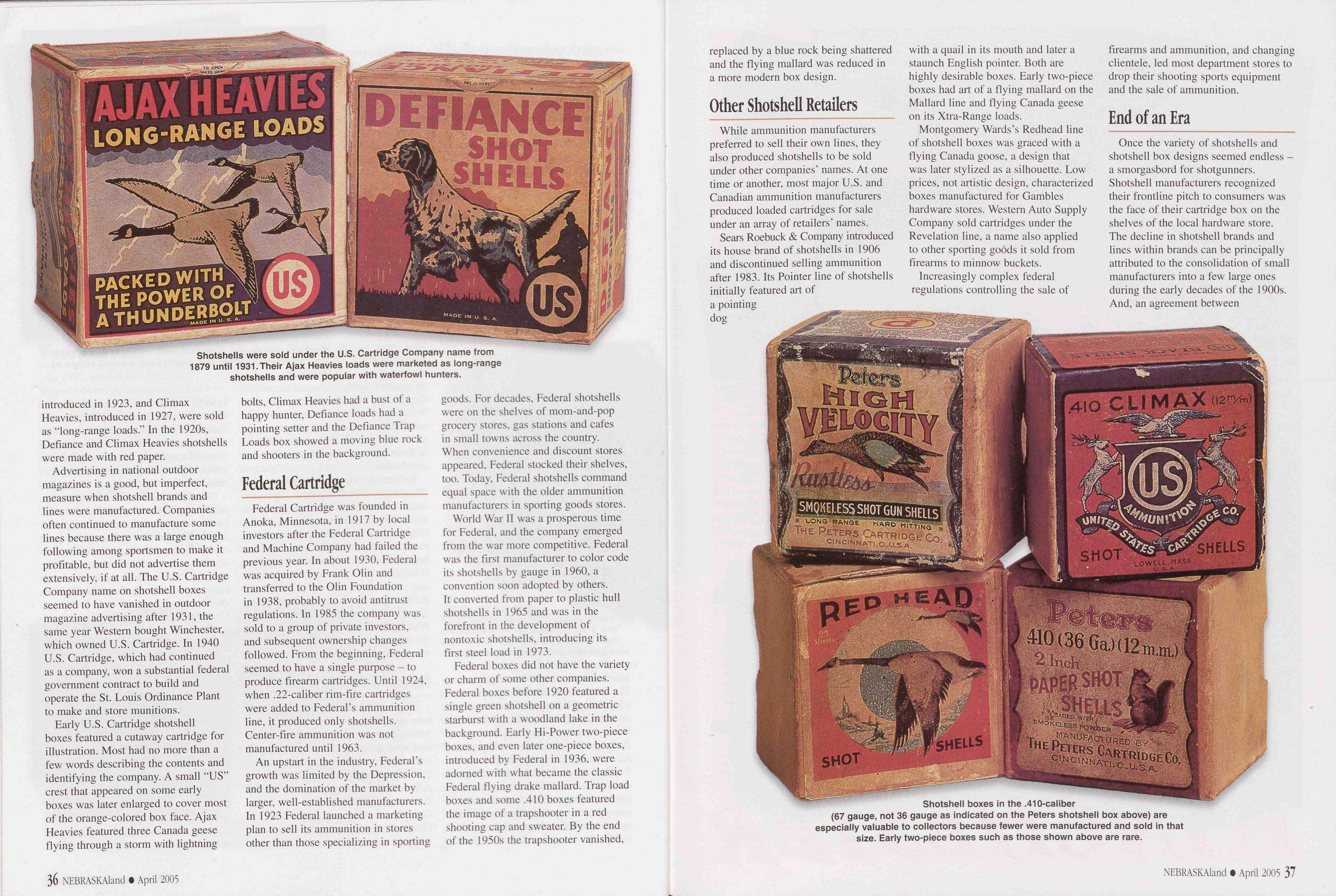
Advertising in national outdoor magazines is a good, but imperfect, measure when shotshell brands and lines were manufactured. Companies often continued to manufacture some lines because there was a large enough following among sportsmen to make it profitable, but did not advertise them extensively, if at all. The U.S. Cartridge Company name on shotshell boxes seemed to have vanished in outdoor magazine advertising after 1931, the same year Western bought Winchester, which owned U.S. Cartridge. In 1940 U.S. Cartridge, which had continued as a company, won a substantial federal government contract to build and operate the St. Louis Ordinance Plant to make and store munitions.
Early U.S. Cartridge shotshell boxes featured a cutaway cartridge for illustration. Most had no more than a few words describing the contents and identifying the company. A small “US” crest that appeared on some early boxes was later enlarged to cover most of the orange-colored box face. Ajax Heavies featured three Canada geese flying through a storm with lightning bolts, Climax Heavies had a bust of a happy hunter, Defiance loads had a pointing setter and the Defiance Trap Loads box showed a moving blue rock and shooters in the background.
Federal CartridgeFederal Cartridge was founded in Anoka, Minnesota, in 1917 by local investors after the Federal Cartridge and Machine Company had failed the previous year. In about 1930, Federal was acquired by Frank Olin and transferred to the Olin Foundation in 1938, probably to avoid antitrust regulations. In 1985 the company was sold to a group of private investors, and subsequent ownership changes followed. From the beginning, Federal seemed to have a single purpose - to produce firearm cartridges. Until 1924, when .22-caliber rim-fire cartridges were added to Federal’s ammunition line, it produced only shotshells. Center-fire ammunition was not manufactured until 1963.
An upstart in the industry, Federal’s growth was limited by the Depression, and the domination of the market by larger, well-established manufacturers. In 1923 Federal launched a marketing plan to sell its ammunition in stores other than those specializing in sporting goods. For decades, Federal shotshells were on the shelves of mom-and-pop grocery stores, gas stations and cafes in small towns across the country. When convenience and discount stores appeared, Federal stocked their shelves, too. Today, Federal shotshells command equal space with the older ammunition manufacturers in sporting goods stores.
World War II was a prosperous time for Federal, and the company emerged from the war more competitive. Federal was the first manufacturer to color code its shotshells by gauge in 1960, a convention soon adopted by others. It converted from paper to plastic hull shotshells in 1965 and was in the forefront in the development of nontoxic shotshells, introducing its first steel load in 1973.
Federal boxes did not have the variety or charm of some other companies. Federal boxes before 1920 featured a single green shotshell on a geometric starburst with a woodland lake in the background. Early Hi-Power two-piece boxes, and even later one-piece boxes, introduced by Federal in 1936, were adorned with what became the classic Federal flying drake mallard. Trap load boxes and some .410 boxes featured the image of a trapshooter in a red shooting cap and sweater. By the end of the 1950s the trapshooter vanished, 36 NEBRASKAland • April 2005 replaced by a blue rock being shattered and the flying mallard was reduced in a more modern box design.
Other Shotshell RetailersWhile ammunition manufacturers preferred to sell their own lines, they also produced shotshells to be sold under other companies’ names. At one time or another, most major U.S. and Canadian ammunition manufacturers produced loaded cartridges for sale under an array of retailers’ names.
Sears Roebuck & Company introduced its house brand of shotshells in 1906 and discontinued selling ammunition after 1983. Its Pointer line of shotshells initially featured art of a pointing dog with a quail in its mouth and later a staunch English pointer. Both are highly desirable boxes. Early two-piece boxes had art of a flying mallard on the Mallard line and flying Canada geese on its Xtra-Range loads.
Montgomery Wards’s Redhead line of shotshell boxes was graced with a flying Canada goose, a design that was later stylized as a silhouette. Low prices, not artistic design, characterized boxes manufactured for Gambles hardware stores. Western Auto Supply Company sold cartridges under the Revelation line, a name also applied to other sporting goods it sold from firearms to minnow buckets.
Increasingly complex federal regulations controlling the sale of firearms and ammunition, and changing clientele, led most department stores to drop their shooting sports equipment and the sale of ammunition.
End of an EraOnce the variety of shotshells and shotshell box designs seemed endless - a smorgasbord for shot gunners. Shotshell manufacturers recognized their frontline pitch to consumers was the face of their cartridge box on the shelves of the local hardware store. The decline in shotshell brands and lines within brands can be principally attributed to the consolidation of small manufacturers into a few large ones during the early decades of the 1900s. And, an agreement between
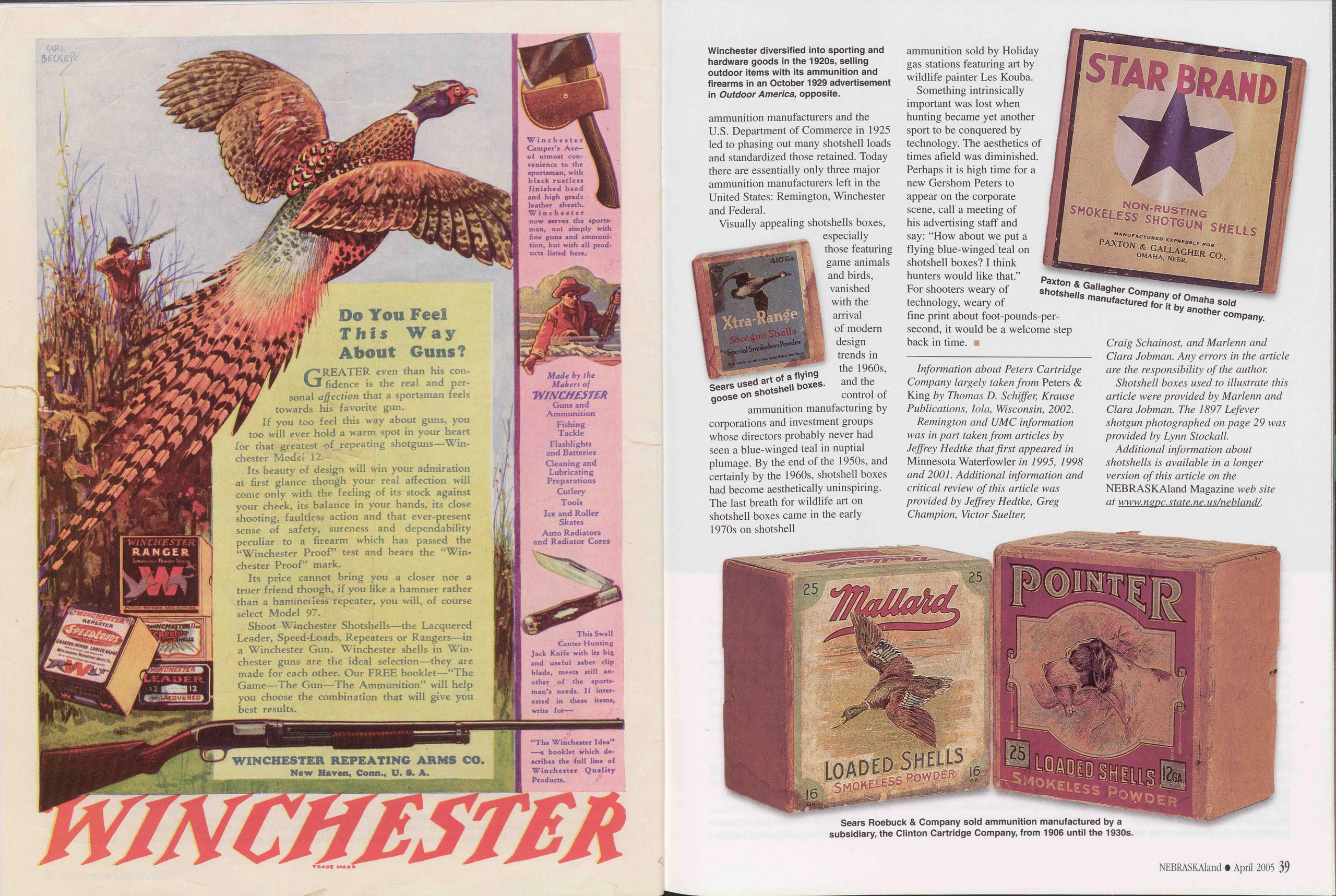
Visually appealing shotshells boxes,
Something intrinsically important was lost when hunting became yet another sport to be conquered by technology. The aesthetics of times afield was diminished. Perhaps it is high time for a new Gershom Peters to appear on the corporate scene, call a meeting of his advertising staff and say: "How about we put a flying blue-winged teal on shotshell boxes? I think hunters would like that.’ For shooters weary of technology, weary of fine print about foot-pounds-per- second, it would be a welcome step back in time.
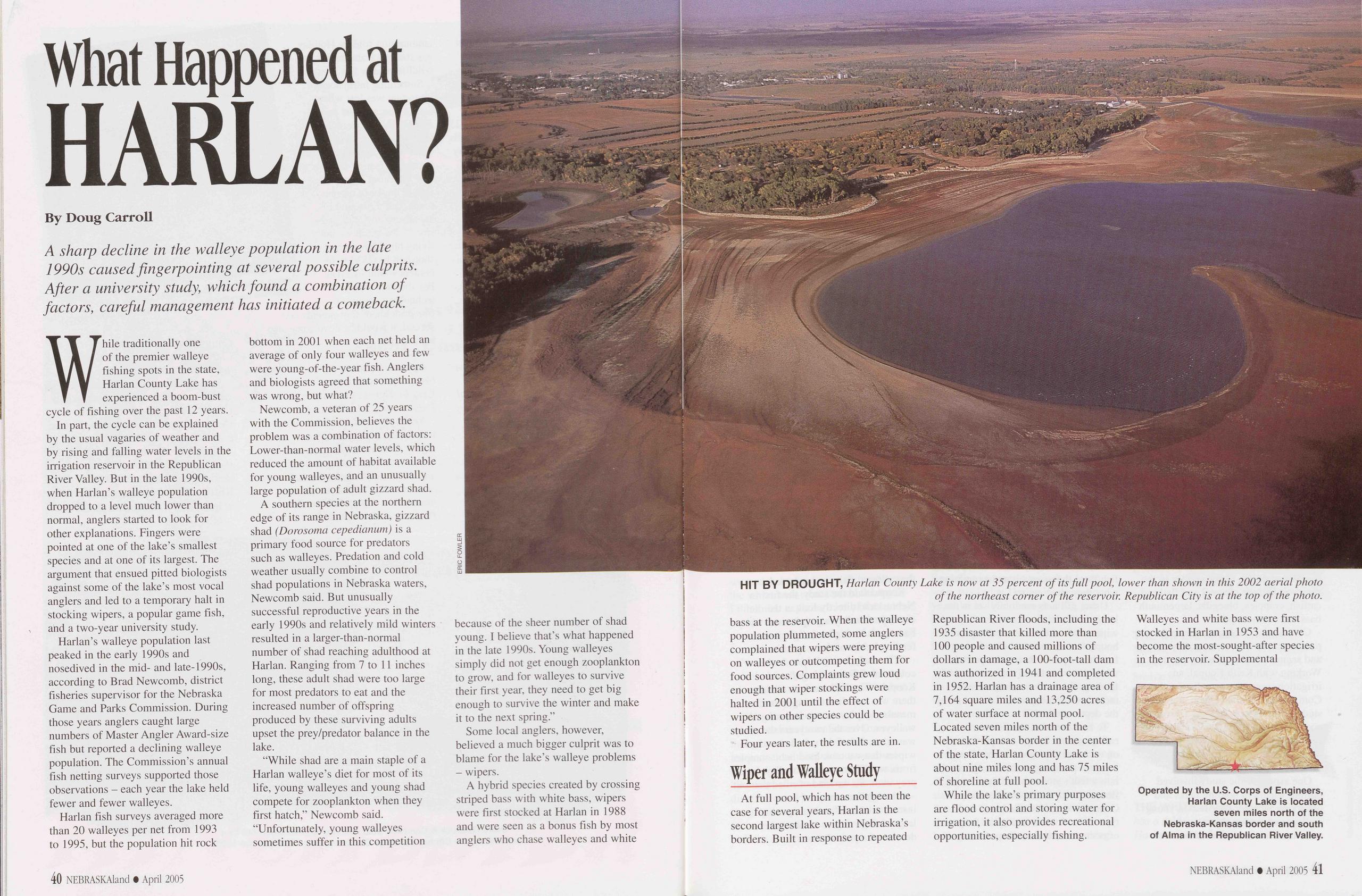
What Happened at HARLAN?
A sharp decline in the walleye population in the late 1990s caused fingerpointing at several possible culprits. After a university study, which found a combination of factors, careful management has initiated a comeback.
While traditionally one of the premier walleye fishing spots in the state, Harlan County Lake has experienced a boom-bust cycle of fishing over the past 12 years. In part, the cycle can be explained by the usual vagaries of weather and by rising and falling water levels in the irrigation reservoir in the Republican River Valley. But in the late 1990s, when Harlan’s walleye population dropped to a level much lower than normal, anglers started to look for other explanations. Fingers were pointed at one of the lake’s smallest species and at one of its largest. The argument that ensued pitted biologists against some of the lake’s most vocal anglers and led to a temporary halt in stocking wipers, a popular game fish, and a two-year university study.
Harlan’s walleye population last peaked in the early 1990s and nosedived in the mid- and late-1990s, according to Brad Newcomb, district fisheries supervisor for the Nebraska Game and Parks Commission. During those years anglers caught large numbers of Master Angler Award-size fish but reported a declining walleye population. The Commission’s annual fish netting surveys supported those observations - each year the lake held fewer and fewer walleyes.
Harlan fish surveys averaged more than 20 walleyes per net from 1993 to 1995, but the population hit rock bottom in 2001 when each net held an average of only four walleyes and few were young-of-the-year fish. Anglers and biologists agreed that something was wrong, but what?
Newcomb, a veteran of 25 years with the Commission, believes the problem was a combination of factors: Lower-than-normal water levels, which reduced the amount of habitat available for young walleyes, and an unusually large population of adult gizzard shad.
A southern species at the northern edge of its range in Nebraska, gizzard shad (Dorosoma cepedianum) is a primary food source for predators such as walleyes. Predation and cold weather usually combine to control shad populations in Nebraska waters, Newcomb said. But unusually successful reproductive years in the early 1990s and relatively mild winters resulted in a larger-than-normal number of shad reaching adulthood at Harlan. Ranging from 7 to 11 inches long, these adult shad were too large for most predators to eat and the increased number of offspring produced by these surviving adults upset the prey/predator balance in the lake.
“While shad are a main staple of a Harlan walleye’s diet for most of its life, young walleyes and young shad compete for zooplankton when they first hatch,” Newcomb said. “Unfortunately, young walleyes sometimes suffer in this competition because of the sheer number of shad young. I believe that’s what happened in the late 1990s. Young walleyes simply did not get enough zooplankton to grow, and for walleyes to survive their first year, they need to get big enough to survive the winter and make it to the next spring.”
Some local anglers, however, believed a much bigger culprit was to blame for the lake’s walleye problems - wipers.
A hybrid species created by crossing striped bass with white bass, wipers were first stocked at Harlan in 1988 and were seen as a bonus fish by most anglers who chase walleyes and white 40 NEBRASKAland • April 2005
Four years later, the results are in.
Wiper and Walleye StudyAt full pool, which has not been the case for several years, Harlan is the second largest lake within Nebraska’s borders. Built in response to repeated Republican River floods, including the 1935 disaster that killed more than 100 people and caused millions of dollars in damage, a 1 OO-foot-tall dam was authorized in 1941 and completed in 1952. Harlan has a drainage area of 7,164 square miles and 13,250 acres of water surface at normal pool. Located seven miles north of the Nebraska-Kansas border in the center of the state, Harlan County Lake is about nine miles long and has 75 miles of shoreline at full pool.
While the lake’s primary purposes are flood control and storing water for irrigation, it also provides recreational opportunities, especially fishing. Walleyes and white bass were first stocked in Harlan in 1953 and have become the most-sought-after species in the reservoir. Supplemental
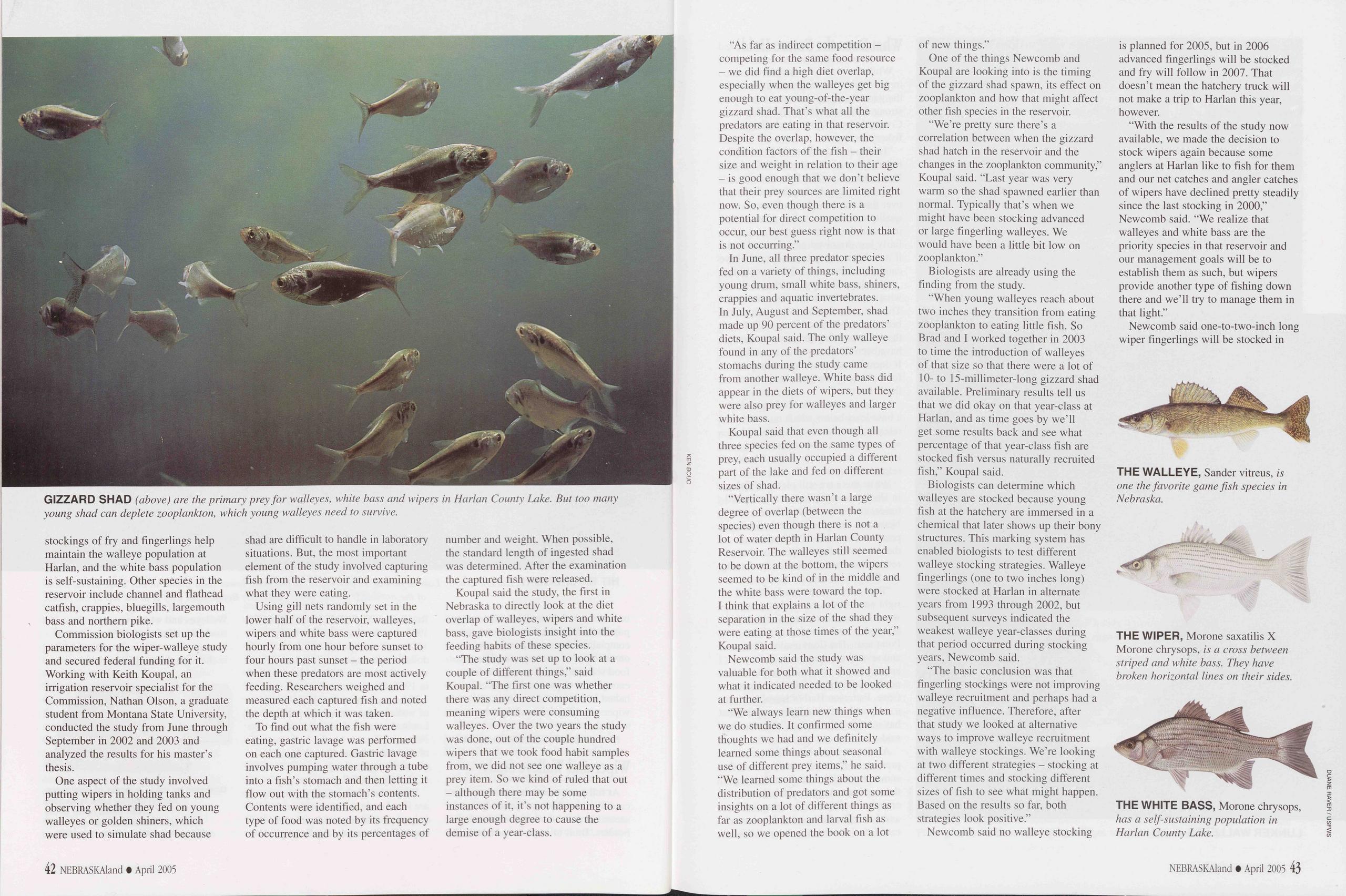
Commission biologists set up the parameters for the wiper-walleye study and secured federal funding for it. Working with Keith Koupal, an irrigation reservoir specialist for the Commission, Nathan Olson, a graduate student from Montana State University, conducted the study from June through September in 2002 and 2003 and analyzed the results for his master’s thesis.
One aspect of the study involved putting wipers in holding tanks and observing whether they fed on young walleyes or golden shiners, which were used to simulate shad because shad are difficult to handle in laboratory situations. But, the most important element of the study involved capturing fish from the reservoir and examining what they were eating.
Using gill nets randomly set in the lower half of the reservoir, walleyes, wipers and white bass were captured hourly from one hour before sunset to four hours past sunset - the period when these predators are most actively feeding. Researchers weighed and measured each captured fish and noted the depth at which it was taken.
To find out what the fish were eating, gastric lavage was performed on each one captured. Gastric lavage involves pumping water through a tube into a fish’s stomach and then letting it flow out with the stomach’s contents. Contents were identified, and each type of food was noted by its frequency of occurrence and by its percentages of number and weight. When possible, the standard length of ingested shad was determined. After the examination the captured fish were released.
Koupal said the study, the first in Nebraska to directly look at the diet overlap of walleyes, wipers and white bass, gave biologists insight into the feeding habits of these species.
"The study was set up to look at a couple of different things,” said Koupal. "The first one was whether there was any direct competition, meaning wipers were consuming walleyes. Over the two years the study was done, out of the couple hundred wipers that we took food habit samples from, we did not see one walleye as a prey item. So we kind of ruled that out - although there may be some instances of it, it’s not happening to a large enough degree to cause the demise of a year-class.
42 NEBRASKAland • April 2005"As far as indirect competition - competing for the same food resource -we did find a high diet overlap, especially when the walleyes get big enough to eat young-of-the-year gizzard shad. That’s what all the predators are eating in that reservoir. Despite the overlap, however, the condition factors of the fish - their size and weight in relation to their age - is good enough that we don’t believe that their prey sources are limited right now. So, even though there is a potential for direct competition to occur, our best guess right now is that is not occurring.”
In June, all three predator species fed on a variety of things, including young drum, small white bass, shiners, crappies and aquatic invertebrates. In July, August and September, shad made up 90 percent of the predators’ diets, Koupal said. The only walleye found in any of the predators’ stomachs during the study came from another walleye. White bass did appear in the diets of wipers, but they were also prey for walleyes and larger white bass.
Koupal said that even though all three species fed on the same types of prey, each usually occupied a different part of the lake and fed on different sizes of shad.
"Vertically there wasn’t a large degree of overlap (between the species) even though there is not a lot of water depth in Harlan County Reservoir. The walleyes still seemed to be down at the bottom, the wipers seemed to be kind of in the middle and the white bass were toward the top. I think that explains a lot of the separation in the size of the shad they were eating at those times of the year,” Koupal said.
Newcomb said the study was valuable for both what it showed and what it indicated needed to be looked at further.
"We always learn new things when we do studies. It confirmed some thoughts we had and we definitely learned some things about seasonal use of different prey items,” he said. “We learned some things about the distribution of predators and got some insights on a lot of different things as far as zooplankton and larval fish as well, so we opened the book on a lot of new things.”
One of the things Newcomb and Koupal are looking into is the timing of the gizzard shad spawn, its effect on zooplankton and how that might affect other fish species in the reservoir.
"We’re pretty sure there’s a correlation between when the gizzard shad hatch in the reservoir and the changes in the zooplankton community,” Koupal said. "Last year was very warm so the shad spawned earlier than normal. Typically that’s when we might have been stocking advanced or large fingerling walleyes. We would have been a little bit low on zooplankton.”
Biologists are already using the finding from the study.
"When young walleyes reach about two inches they transition from eating zooplankton to eating little fish. So Brad and I worked together in 2003 to time the introduction of walleyes of that size so that there were a lot of 10- to 15-millimeter-long gizzard shad available. Preliminary results tell us that we did okay on that year-class at Harlan, and as time goes by we’ll get some results back and see what percentage of that year-class fish are stocked fish versus naturally recruited fish,” Koupal said.
Biologists can determine which walleyes are stocked because young fish at the hatchery are immersed in a chemical that later shows up their bony structures. This marking system has enabled biologists to test different walleye stocking strategies. Walleye fingerlings (one to two inches long) were stocked at Harlan in alternate years from 1993 through 2002, but subsequent surveys indicated the weakest walleye year-classes during that period occurred during stocking years, Newcomb said.
"The basic conclusion was that fingerling stockings were not improving walleye recruitment and perhaps had a negative influence. Therefore, after that study we looked at alternative ways to improve walleye recruitment with walleye stockings. We’re looking at two different strategies - stocking at different times and stocking different sizes of fish to see what might happen. Based on the results so far, both strategies look positive.”
Newcomb said no walleye stocking is planned for 2005, but in 2006 advanced fingerlings will be stocked and fry will follow in 2007. That doesn’t mean the hatchery truck will not make a trip to Harlan this year, however.
“With the results of the study now available, we made the decision to stock wipers again because some anglers at Harlan like to fish for them and our net catches and angler catches of wipers have declined pretty steadily since the last stocking in 2000,” Newcomb said. "We realize that walleyes and white bass are the priority species in that reservoir and our management goals will be to establish them as such, but wipers provide another type of fishing down there and we’ll try to manage them in that light.”
Newcomb said one-to-two-inch long wiper fingerlings will be stocked in
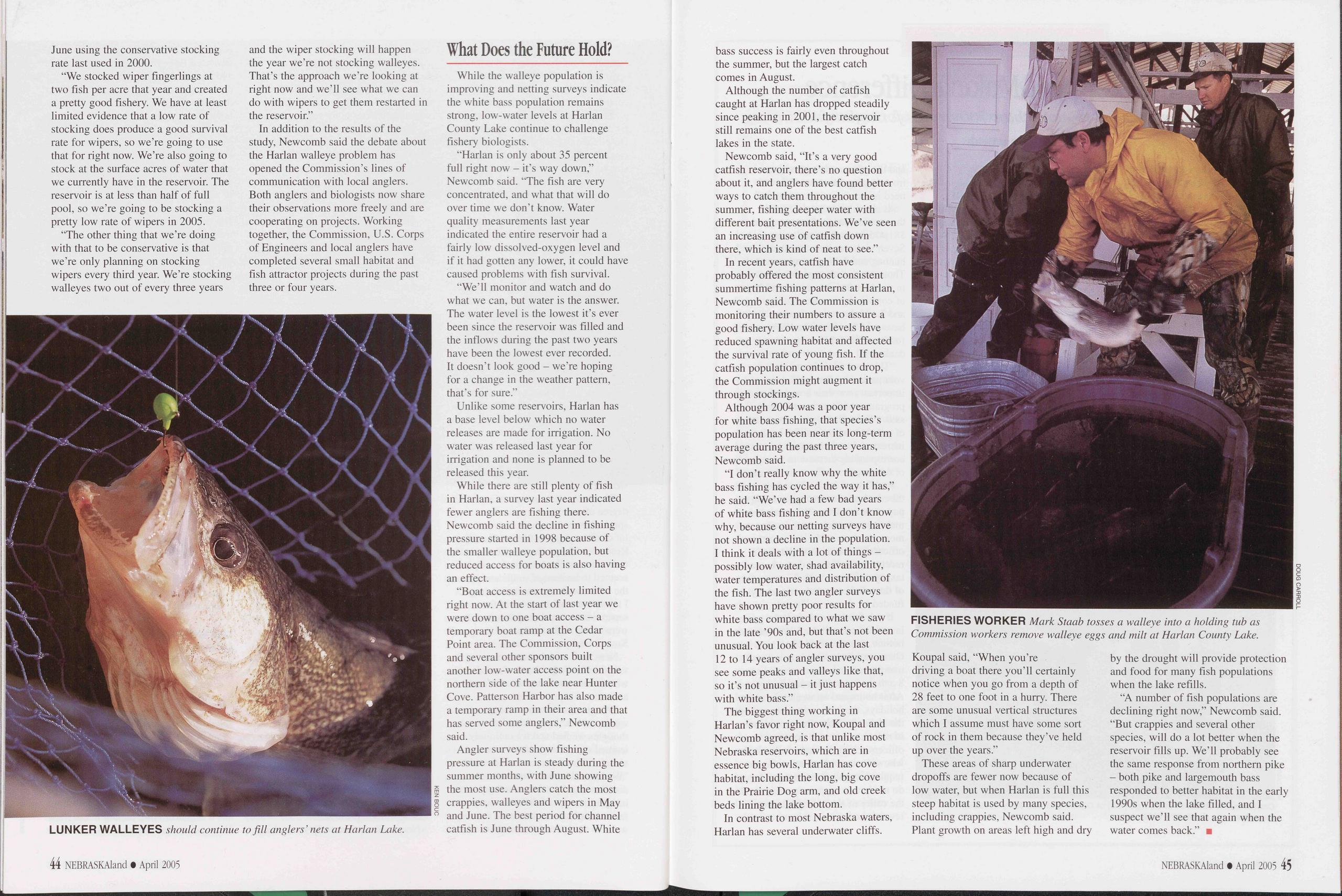 June using the conservative stocking
rate last used in 2000.
June using the conservative stocking
rate last used in 2000.
“We stocked wiper fingerlings at two fish per acre that year and created a pretty good fishery. We have at least limited evidence that a low rate of stocking does produce a good survival rate for wipers, so we’re going to use that for right now. We’re also going to stock at the surface acres of water that we currently have in the reservoir. The reservoir is at less than half of full pool, so we’re going to be stocking a pretty low rate of wipers in 2005.
“The other thing that we’re doing with that to be conservative is that we’re only planning on stocking wipers every third year. We’re stocking walleyes two out of every three years
In addition to the results of the study, Newcomb said the debate about the Harlan walleye problem has opened the Commission’s lines of communication with local anglers. Both anglers and biologists now share their observations more freely and are cooperating on projects. Working together, the Commission, U.S. Corps of Engineers and local anglers have completed several small habitat and fish attractor projects during the past three or four years.
What Does the Future Hold?While the walleye population is improving and netting surveys indicate the white bass population remains strong, low-water levels at Harlan County Lake continue to challenge fishery biologists.
“Harlan is only about 35 percent full right now - it’s way down,” Newcomb said. “The fish are very concentrated, and what that will do over time we don’t know. Water quality measurements last year indicated the entire reservoir had a fairly low dissolved-oxygen level and if it had gotten any lower, it could have caused problems with fish survival.
“We’ll monitor and watch and do what we can, but water is the answer. The water level is the lowest it’s ever been since the reservoir was filled and the inflows during the past two years have been the lowest ever recorded. It doesn’t look good - we’re hoping for a change in the weather pattern, that’s for sure.”
Unlike some reservoirs, Harlan has a base level below which no water releases are made for irrigation. No water was released last year for irrigation and none is planned to be released this year.
While there are still plenty of fish in Harlan, a survey last year indicated fewer anglers are fishing there. Newcomb said the decline in fishing pressure started in 1998 because of the smaller walleye population, but reduced access for boats is also having an effect.
“Boat access is extremely limited right now. At the start of last year we were down to one boat access - a temporary boat ramp at the Cedar Point area. The Commission, Corps and several other sponsors built another low-water access point on the northern side of the lake near Hunter Cove. Patterson Harbor has also made a temporary ramp in their area and that has served some anglers,” Newcomb said.
Angler surveys show fishing pressure at Harlan is steady during the summer months, with June showing the most use. Anglers catch the most crappies, walleyes and wipers in May and June. The best period for channel catfish is June through August. White 44 NEBRASKAland • April 2005 bass success is fairly even throughout the summer, but the largest catch comes in August.
Although the number of catfish caught at Harlan has dropped steadily since peaking in 2001, the reservoir still remains one of the best catfish lakes in the state.
Newcomb said, “It’s a very good catfish reservoir, there’s no question about it, and anglers have found better ways to catch them throughout the summer, fishing deeper water with different bait presentations. We’ve seen an increasing use of catfish down there, which is kind of neat to see.”
In recent years, catfish have probably offered the most consistent summertime fishing patterns at Harlan, Newcomb said. The Commission is monitoring their numbers to assure a good fishery. Low water levels have reduced spawning habitat and affected the survival rate of young fish. If the catfish population continues to drop, the Commission might augment it through stockings.
Although 2004 was a poor year for white bass fishing, that species’s population has been near its long-term average during the past three years, Newcomb said.
“I don’t really know why the white bass fishing has cycled the way it has,” he said. “We’ve had a few bad years of white bass fishing and I don’t know why, because our netting surveys have not shown a decline in the population. I think it deals with a lot of things - possibly low water, shad availability, water temperatures and distribution of the fish. The last two angler surveys have shown pretty poor results for white bass compared to what we saw in the late ’90s and, but that’s not been unusual. You look back at the last 12 to 14 years of angler surveys, you see some peaks and valleys like that, so it’s not unusual - it just happens with white bass.”
The biggest thing working in Harlan’s favor right now, Koupal and Newcomb agreed, is that unlike most Nebraska reservoirs, which are in essence big bowls, Harlan has cove habitat, including the long, big cove in the Prairie Dog arm, and old creek beds lining the lake bottom.
In contrast to most Nebraska waters, Harlan has several underwater cliffs.
These areas of sharp underwater dropoffs are fewer now because of low water, but when Harlan is full this steep habitat is used by many species, including crappies, Newcomb said. Plant growth on areas left high and dry by the drought will provide protection and food for many fish populations when the lake refills.
“A number of fish populations are declining right now,” Newcomb said. “But crappies and several other species, will do a lot better when the reservoir fills up. We’ll probably see the same response from northern pike - both pike and largemouth bass responded to better habitat in the early 1990s when the lake filled, and I suspect we’ll see that again when the water comes back.”
NEBRASKAland • April 2005 45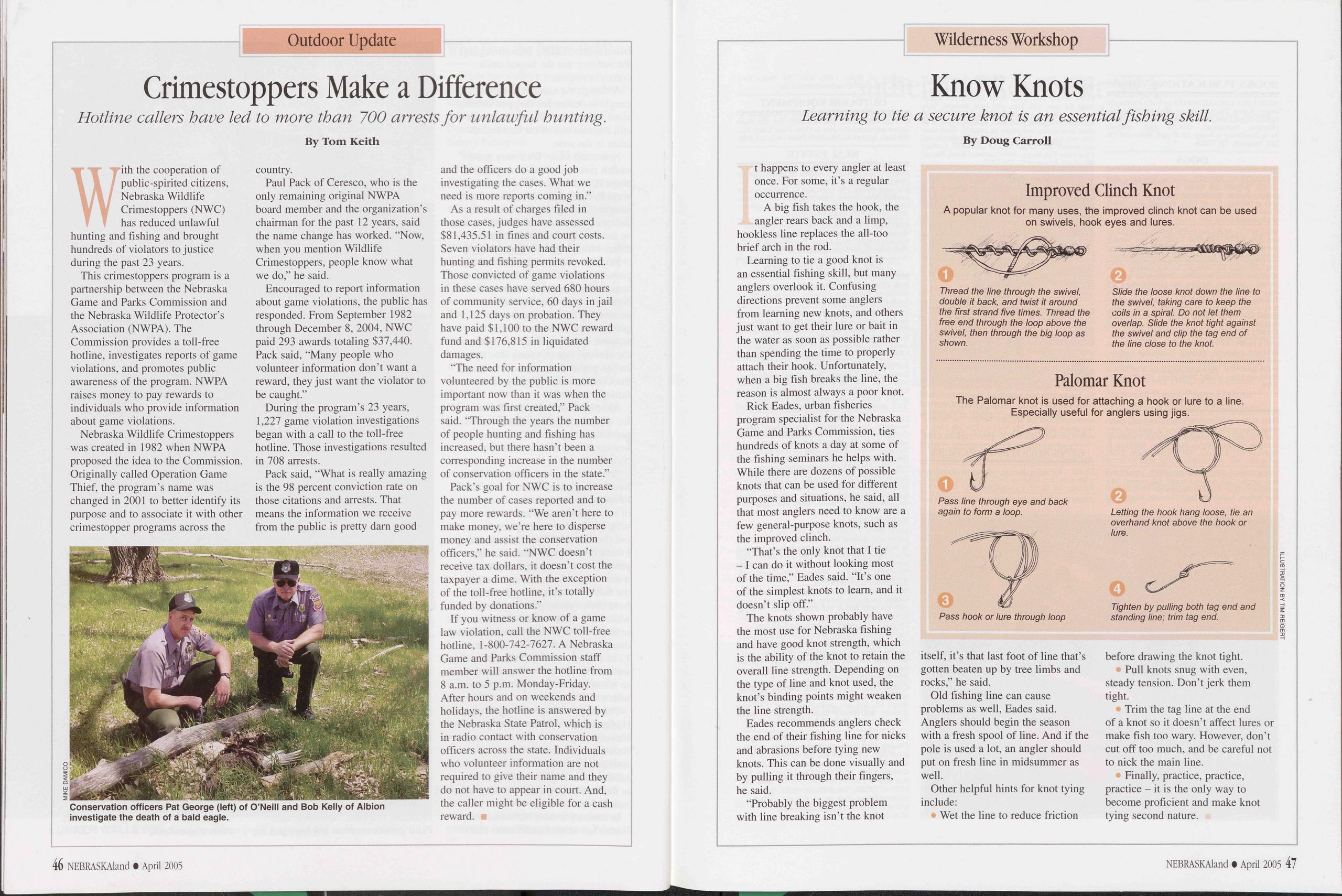
Outdoor Update
Crimestoppers Make a Difference
Hotline callers have led to more than 700 arrests for unlawful hunting.
With the cooperation of public-spirited citizens, Nebraska Wildlife Crimestoppers (NWC) has reduced unlawful hunting and fishing and brought hundreds of violators to justice during the past 23 years.
This crimestoppers program is a partnership between the Nebraska Game and Parks Commission and the Nebraska Wildlife Protector’s Association (NWPA). The Commission provides a toll-free hotline, investigates reports of game violations, and promotes public awareness of the program. NWPA raises money to pay rewards to individuals who provide information about game violations.
Nebraska Wildlife Crimestoppers was created in 1982 when NWPA proposed the idea to the Commission. Originally called Operation Game Thief, the program’s name was changed in 2001 to better identify its purpose and to associate it with other crimestopper programs across the
Paul Pack of Ceresco, who is the only remaining original NWPA board member and the organization’s chairman for the past 12 years, said the name change has worked. "Now, when you mention Wildlife Crimestoppers, people know what we do,” he said.
Encouraged to report information about game violations, the public has responded. From September 1982 through December 8, 2004, NWC paid 293 awards totaling $37,440. Pack said, "Many people who volunteer information don’t want a reward, they just want the violator to be caught.”
During the program’s 23 years, 1,227 game violation investigations began with a call to the toll-free hotline. Those investigations resulted in 708 arrests.
Pack said, "What is really amazing is the 98 percent conviction rate on those citations and arrests. That means the information we receive from the public is pretty darn good and the officers do a good job investigating the cases. What we need is more reports coming in.”
As a result of charges filed in those cases, judges have assessed $81,435.51 in fines and court costs. Seven violators have had their hunting and fishing permits revoked. Those convicted of game violations in these cases have served 680 hours of community service, 60 days in jail and 1,125 days on probation. They have paid $1,100 to the NWC reward fund and $176,815 in liquidated damages.
"The need for information volunteered by the public is more important now than it was when the program was first created,” Pack said. "Through the years the number of people hunting and fishing has increased, but there hasn’t been a corresponding increase in the number of conservation officers in the state.”
Pack’s goal for NWC is to increase the number of cases reported and to pay more rewards. "We aren’t here to make money, we’re here to disperse money and assist the conservation officers,” he said. "NWC doesn’t receive tax dollars, it doesn’t cost the taxpayer a dime. With the exception of the toll-free hotline, it’s totally funded by donations.”
If you witness or know of a game law violation, call the NWC toll-free hotline, 1-800-742-7627. A Nebraska Game and Parks Commission staff member will answer the hotline from 8 a.m. to 5 p.m. Monday-Friday. After hours and on weekends and holidays, the hotline is answered by the Nebraska State Patrol, which is in radio contact with conservation officers across the state. Individuals who volunteer information are not required to give their name and they do not have to appear in court. And, the caller might be eligible for a cash reward.
46 NEBRASKAland • April 2005Wildderness Workshop
Know Knots
Learning to tie a secure knot is an essential fishing skill.
It happens to every angler at least once. For some, it’s a regular occurrence.
A big fish takes the hook, the angler rears back and a limp, hookless line replaces the all-too brief arch in the rod.
Learning to tie a good knot is an essential fishing skill, but many anglers overlook it. Confusing directions prevent some anglers from learning new knots, and others just want to get their lure or bait in the water as soon as possible rather than spending the time to properly attach their hook. Unfortunately, when a big fish breaks the line, the reason is almost always a poor knot.
Rick Eades, urban fisheries program specialist for the Nebraska Game and Parks Commission, ties hundreds of knots a day at some of the fishing seminars he helps with. While there are dozens of possible knots that can be used for different purposes and situations, he said, all that most anglers need to know are a few general-purpose knots, such as the improved clinch.
"That’s the only knot that I tie - I can do it without looking most of the time,” Eades said. "It’s one of the simplest knots to learn, and it doesn’t slip off.”
The knots shown probably have the most use for Nebraska fishing and have good knot strength, which is the ability of the knot to retain the overall line strength. Depending on the type of line and knot used, the knot’s binding points might weaken the line strength.
Eades recommends anglers check the end of their fishing line for nicks and abrasions before tying new knots. This can be done visually and by pulling it through their fingers, he said.
"Probably the biggest problem with line breaking isn’t the knot
Old fishing line can cause problems as well, Eades said. Anglers should begin the season with a fresh spool of line. And if the pole is used a lot, an angler should put on fresh line in midsummer as well.
Other helpful hints for knot tying include: • Wet the line to reduce friction before drawing the knot tight. •Pull knots snug with even, steady tension. Don’t jerk them tight. •Trim the tag line at the end of a knot so it doesn’t affect lures or make fish too wary. However, don’t cut off too much, and be careful not to nick the main line. •Finally, practice, practice, practice - it is the only way to become proficient and make knot tying second nature. NEBRASKAland • April 2005 47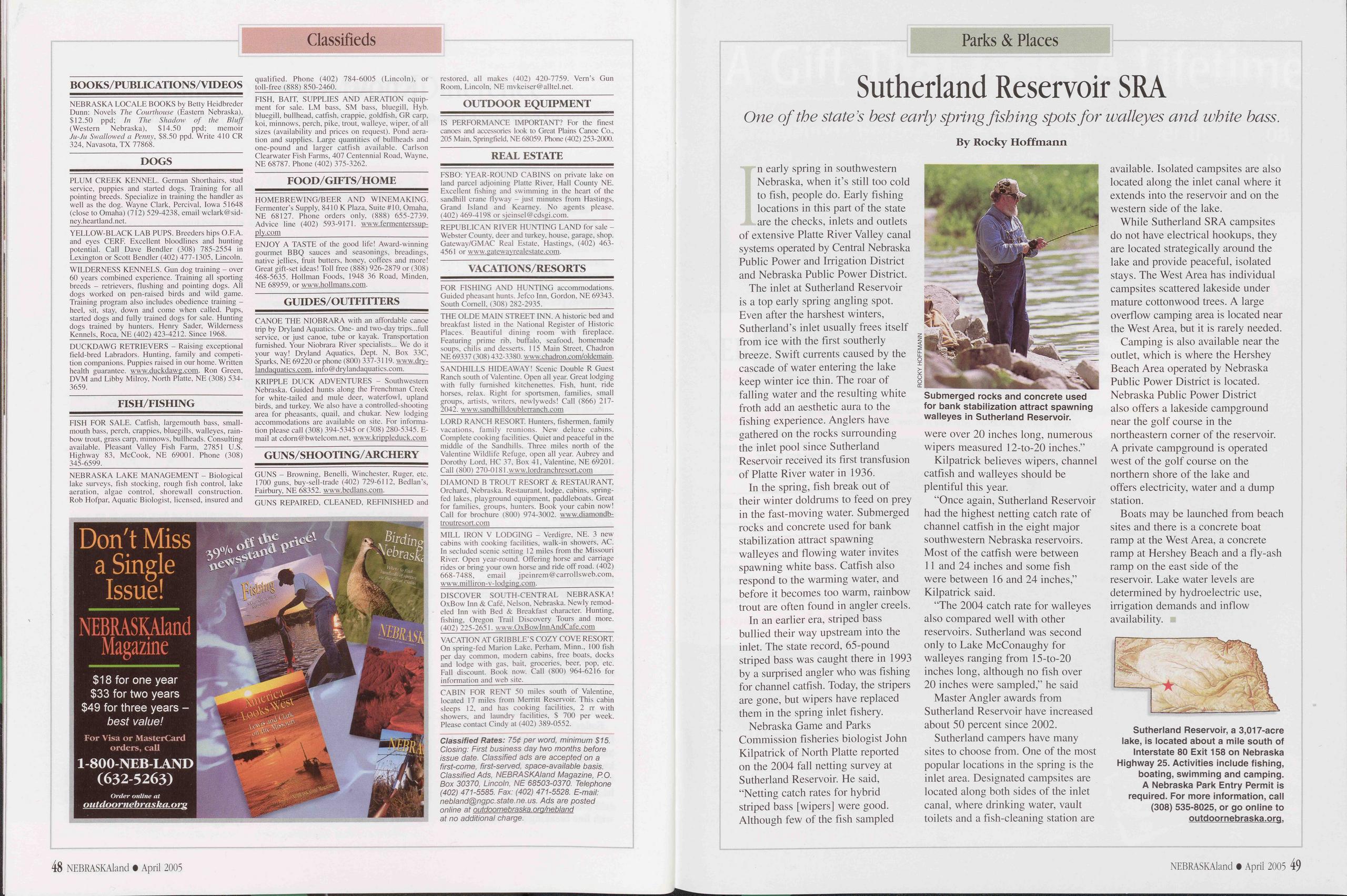
Classifieds
BOOKS/PUBLICATION S/VIDEOS NEBRASKA LOCALE BOOKS by Betty Heidbreder Dunn: Novels The Courthouse (Eastern Nebraska), $12.50 ppd; In The Shadow of the Bluff (Western Nebraska), $14.50 ppd; memoir Ju-Ju Swallowed a Penny, $8.50 ppd. Write 410 CR 324, Navasota, TX 77868. DOGS PLUM CREEK KENNEL. German Shorthairs, stud service, puppies and started dogs. Training for all pointing breeds. Specialize in training the handler as well as the dog. Wayne Clark, Percival, Iowa 51648 (close to Omaha) (712) 529-4238, email wclarkGSid- ney, heartland, net. YELLOW-BLACK LAB PUPS. Breeders hips O.F.A. and eyes CERE Excellent bloodlines and hunting potential. Call Dave Bendler (308) 785-2554 in Lexington or Scott Bendler (402) 477-1305, Lincoln. WILDERNESS KENNELS. Gun dog training - over 60 years combined experience. Training all sporting breeds - retrievers, flushing and pointing dogs. All dogs worked on pen-raised birds and wild game. Training program also includes obedience training - heel, sit, stay, down and come when called. Pups, started dogs and fully trained dogs for sale. Hunting dogs trained by hunters. Henry Sader, Wilderness Kennels, Roca, NE (402) 423-4212. Since 1968. DUCKDAWG RETRIEVERS - Raising exceptional field-bred Labradors. Hunting, family and competi- tion companions. Puppies raised in our home. Written health guarantee, www.duckdawg.com. Ron Green, DVM and Libby Milroy, North Platte, NE (308) 534- 3659. FISH/FISHING FISH FOR SALE. Catfish, largemouth bass, small- mouth bass, perch, crappies, bluegills, walleyes, rain- bow trout, grass carp, minnows, bullheads. Consulting available. Pleasant Valley Fish Farm, 27851 U.S. Highway 83, McCook, NE 69001. Phone (308) 345-6599. NEBRASKA LAKE MANAGEMENT - Biological lake surveys, fish stocking, rough fish control, lake aeration, algae control, shorewall construction. Rob Hofpar, Aquatic Biologist, licensed, insured and qualified. Phone (402) 784-6005 (Lincoln), or toll-free (888) 850-2460. FISH, BAIT, SUPPLIES AND AERATION equip- ment for sale. LM bass, SM bass, bluegill. Hyb. bluegill, bullhead, catfish, crappie, goldfish, GR carp, koi, minnows, perch, pike, trout, walleye, wiper, of all sizes (availability and prices on request). Pond aera- tion and supplies. Large quantities of bullheads and one-pound and larger catfish available. Carlson Clearwater Fish Farms, 407 Centennial Road, Wayne, NE 68787. Phone (402) 375-3262. FOOD/GIFTS/HOME HOMEBREWING/BEER AND WINEMAKING. Fermenter’s Supply, 8410 K Plaza, Suite #10, Omaha, NE 68127. Phone orders only, (888) 655-2739. Advice line (402) 593-9171. www.fermenterssup- ply.com ENJOY A TASTE of the good life! Award-winning gourmet BBQ sauces and seasonings, breadings, native jellies, fruit butters, honey, coffees and more! Great gift-set ideas! Toll free (888) 926-2879 or (308) 468-5635. Hollman Foods, 1948 36 Road, Minden, NE 68959, or www.hollmans.com. GUIDES/OUTFITTERS CANOE THE NIOBRARA with an affordable canoe trip by Dryland Aquatics. One- and two-day trips...full service, or just canoe, tube or kayak. Transportation furnished. Your Niobrara River specialists... We do it your way! Dryland Aquatics, Dept. N, Box 33C, Sparks, NE 69220 or phone (800) 337-3119. www.dry- landaquatics.com, info@drylandaquatics.com. KRIPPLE DUCK ADVENTURES - Southwestern Nebraska. Guided hunts along the Frenchman Creek for white-tailed and mule deer, waterfowl, upland birds, and turkey. We also have a controlled-shooting area for pheasants, quail, and chukar. New lodging accommodations are available on site. For informa- tion please call (308) 394-5345 or (308) 280-5345. E- mail at cdom@bwtelcom.net, www.krippleduck.com GUNS/SHOOTING/ARCHERY GUNS - Browning, Benelli, Winchester, Ruger, etc. 1700 guns, buy-sell-trade (402) 729-6112, Bedlan’s, Fairbury, NE 68352. www.bedlans.com. GUNS REPAIRED, CLEANED, REFINISHED and restored, all makes (402) 420-7759. Vem’s Gun Room, Lincoln, NE mvkeiser@alltel.net. OUTDOOR EQUIPMENT IS PERFORMANCE IMPORTANT? For the finest canoes and accessories look to Great Plains Canoe Co., 205 Main, Springfield, NE 68059. Phone (402) 253-2000. REAL ESTATE FSBO: YEAR-ROUND CABINS on private lake on land parcel adjoining Platte River, Hall County NE. Excellent fishing and swimming in the heart of the sandhill crane flyway - just minutes from Hastings, Grand Island and Kearney. No agents please. (402) 469-4198 or sjeinsel@cdsgi.com. REPUBLICAN RIVER HUNTING LAND for sale - Webster County, deer and turkey, house, garage, shop. Gateway/GMAC Real Estate, Hastings, (402) 463- 4561 or www.gatewayrealestate.com. VACATION S/RESORTS FOR FISHING AND HUNTING accommodations. Guided pheasant hunts. Jefco Inn, Gordon, NE 69343. South Cornell, (308) 282-2935. THE OLDE MAIN STREET INN. A historic bed and breakfast listed in the National Register of Historic Places. Beautiful dining room with fireplace. Featuring prime rib, buffalo, seafood, homemade soups, chilis and desserts. 115 Main Street, Chadron NE 69337 (308) 432-3380. www.chadron.com/oldemain. SANDHILLS HIDEAWAY! Scenic Double R Guest Ranch south of Valentine. Open all year. Great lodging with fully furnished kitchenettes. Fish, hunt, ride horses, relax. Right for sportsmen, families, small groups, artists, writers, newlyweds! Call (866) 217- 2042. www.sandhilldoublerranch.com LORD RANCH RESORT. Hunters, fishermen, family vacations, family reunions. New deluxe cabins. Complete cooking facilities. Quiet and peaceful in the middle of the Sandhills. Three miles north of the Valentine Wildlife Refuge, open all year. Aubrey and Dorothy Lord, HC 37, Box 41, Valentine, NE 69201. Call (800) 270-0181.www.lordranchresort.com DIAMOND B TROUT RESORT & RESTAURANT, Orchard, Nebraska. Restaurant, lodge, cabins, spring- fed lakes, playground equipment, paddleboats. Great for families, groups, hunters. Book your cabin now! Call for brochure (800) 974-3002. www.diamondb- troutresort.com MILL IRON V LODGING - Verdigre, NE. 3 new cabins with cooking facilities, walk-in showers, AC. In secluded scenic setting 12 miles from the Missouri River. Open year-round. Offering horse and carriage rides or bring your own horse and ride off road. (402) 668-7488, email jpeinrem@carrollsweb.com, www.milliron-v-lodging.com. DISCOVER SOUTH-CENTRAL NEBRASKA! OxBow Inn & Cafe, Nelson, Nebraska. Newly remod- eled Inn with Bed & Breakfast character. Hunting, fishing, Oregon Trail Discovery Tours and more. (402) 225-2651. www.OxBowInnAndCafe.com VACATION AT GRIBBLE’S COZY COVE RESORT. On spring-fed Marion Lake. Perham, Minn., 100 fish per day common, modem cabins, free boats, docks and lodge with gas, bait, groceries, beer, pop, etc. Fall discount. Book now. Call (800) 964-6216 for information and web site. CABIN FOR RENT 50 miles south of Valentine, located 17 miles from Merritt Reservoir. This cabin sleeps 12, and has cooking facilities, 2 rr with showers, and laundry facilities, $ 700 per week. Please contact Cindy at (402) 389-0552. Classified Rates: 750 per word, minimum $15. Closing: First business day two months before issue date. Classified ads are accepted on a first-come, first-served, space-available basis. Classified Ads, NEBRASKAIand Magazine, P.O. Box 30370, Lincoln, NE 68503-0370. Telephone (402) 471-5585. Fax: (402) 471-5528. E-mail: nebland@ngpc.state.ne.us. Ads are posted online at outdoomebraska. ora/nebland at no additional charge. 48 NEBRASKAIand • April 2005Parks & Places
Sutherland Reservoir SRA
One of the state’s best early spring fishing spots for walleyes and white bass.
In early spring in southwestern Nebraska, when it’s still too cold to fish, people do. Early fishing locations in this part of the state are the checks, inlets and outlets of extensive Platte River Valley canal systems operated by Central Nebraska Public Power and Irrigation District and Nebraska Public Power District.
The inlet at Sutherland Reservoir is a top early spring angling spot. Even after the harshest winters, Sutherland’s inlet usually frees itself from ice with the first southerly breeze. Swift currents caused by the cascade of water entering the lake keep winter ice thin. The roar of falling water and the resulting white froth add an aesthetic aura to the fishing experience. Anglers have gathered on the rocks surrounding the inlet pool since Sutherland Reservoir received its first transfusion of Platte River water in 1936.
In the spring, fish break out of their winter doldrums to feed on prey in the fast-moving water. Submerged rocks and concrete used for bank stabilization attract spawning walleyes and flowing water invites spawning white bass. Catfish also respond to the warming water, and before it becomes too warm, rainbow trout are often found in angler creels.
In an earlier era, striped bass bullied their way upstream into the inlet. The state record, 65-pound striped bass was caught there in 1993 by a surprised angler who was fishing for channel catfish. Today, the stripers are gone, but wipers have replaced them in the spring inlet fishery.
Nebraska Game and Parks Commission fisheries biologist John Kilpatrick of North Platte reported on the 2004 fall netting survey at Sutherland Reservoir. He said, “Netting catch rates for hybrid striped bass [wipers] were good. Although few of the fish sampled
Kilpatrick believes wipers, channel catfish and walleyes should be plentiful this year.
“Once again, Sutherland Reservoir had the highest netting catch rate of channel catfish in the eight major southwestern Nebraska reservoirs. Most of the catfish were between 11 and 24 inches and some fish were between 16 and 24 inches,” Kilpatrick said.
“The 2004 catch rate for walleyes also compared well with other reservoirs. Sutherland was second only to Lake McConaughy for walleyes ranging from 15-to-20 inches long, although no fish over 20 inches were sampled,” he said
Master Angler awards from Sutherland Reservoir have increased about 50 percent since 2002.
Sutherland campers have many sites to choose from. One of the most popular locations in the spring is the inlet area. Designated campsites are located along both sides of the inlet canal, where drinking water, vault toilets and a fish-cleaning station are available. Isolated campsites are also located along the inlet canal where it extends into the reservoir and on the western side of the lake.
While Sutherland SRA campsites do not have electrical hookups, they are located strategically around the lake and provide peaceful, isolated stays. The West Area has individual campsites scattered lakeside under mature cottonwood trees. A large overflow camping area is located near the West Area, but it is rarely needed.
Camping is also available near the outlet, which is where the Hershey Beach Area operated by Nebraska Public Power District is located. Nebraska Public Power District also offers a lakeside campground near the golf course in the northeastern corner of the reservoir. A private campground is operated west of the golf course on the northern shore of the lake and offers electricity, water and a dump station.
Boats may be launched from beach sites and there is a concrete boat ramp at the West Area, a concrete ramp at Hershey Beach and a fly-ash ramp on the east side of the reservoir. Lake water levels are determined by hydroelectric use, irrigation demands and inflow availability.
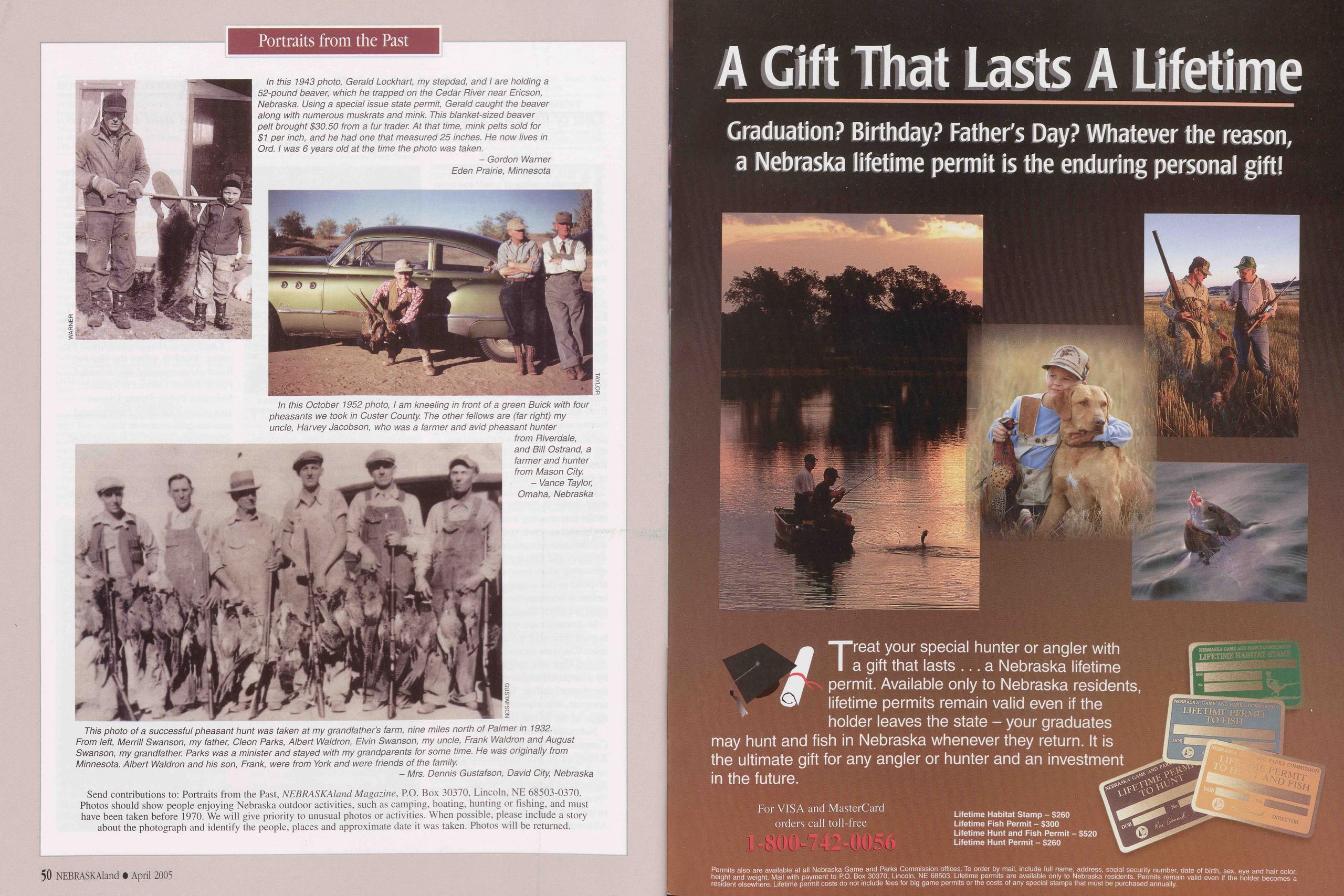
Portraits from the Past

Position: 234 (33 views)