Volume 83, Issue 2, 2005
NEBRASKAland
Nebraska Game & Parks Commission March 2005 $2.95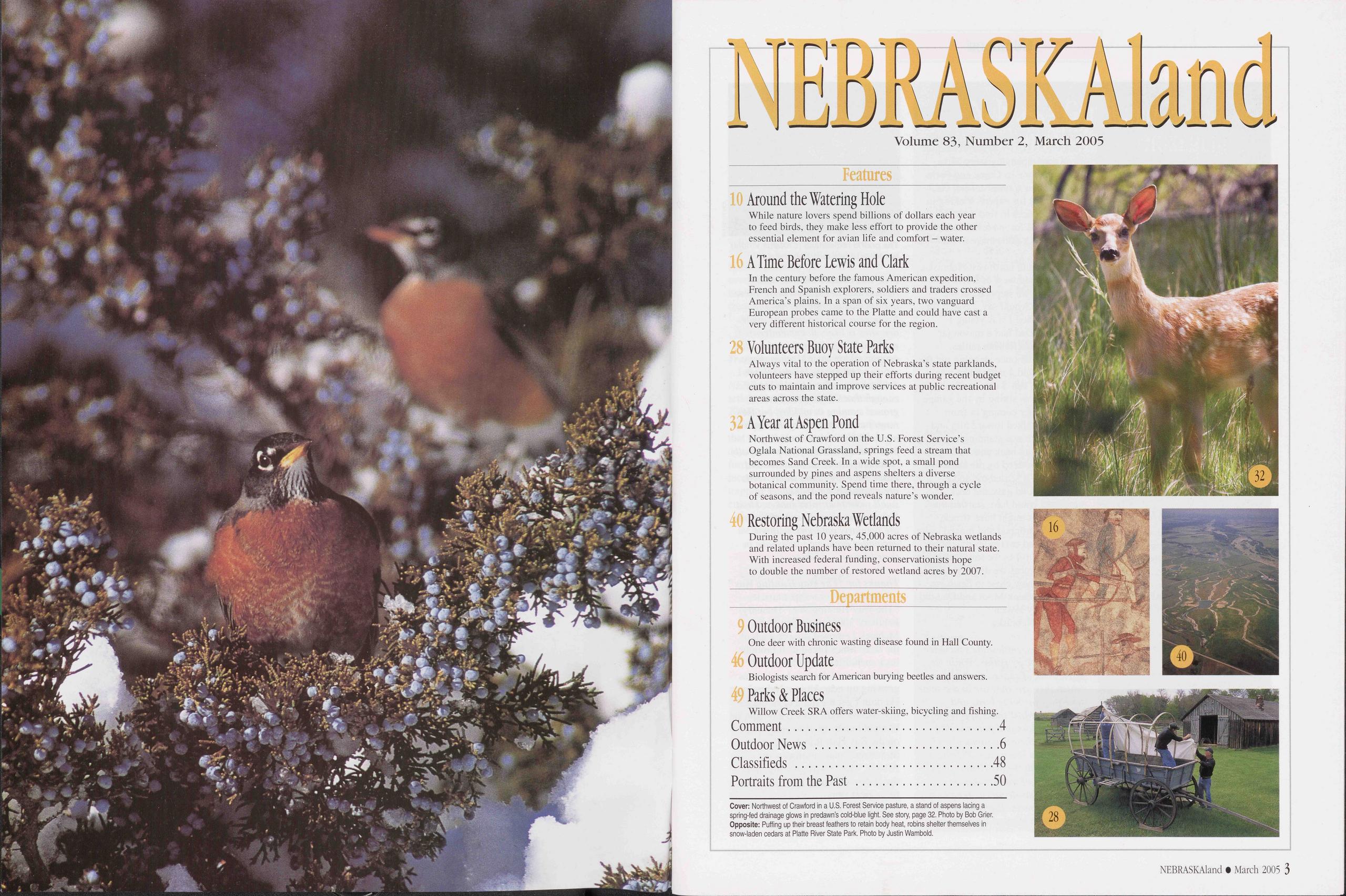
NEBRASKAland
Volume 83, Number 2, March 2005
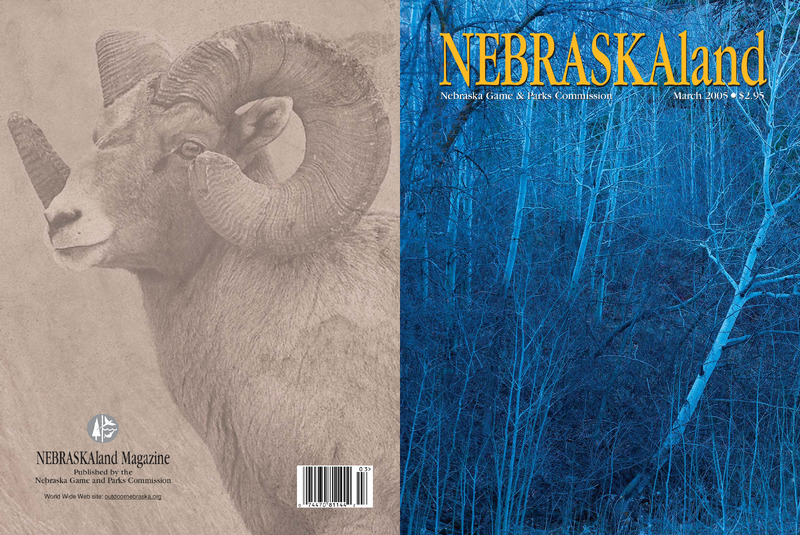
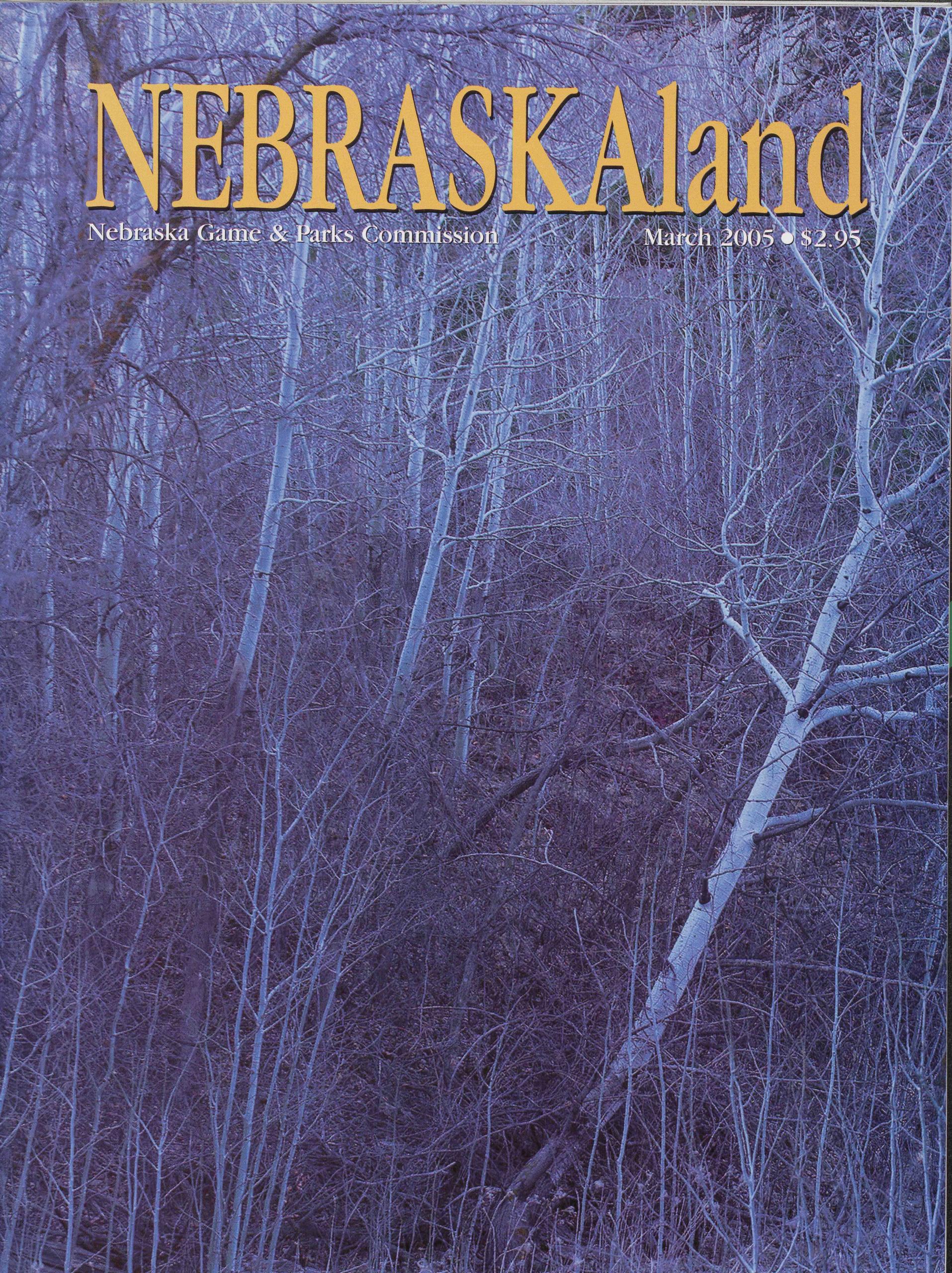
Features 10 Around the Watering Hole While nature lovers spend billions of dollars each year to feed birds, they make less effort to provide the other essential element for avian life and comfort - water. 16 A Time Before Lewis and Clark In the century before the famous American expedition, French and Spanish explorers, soldiers and traders crossed America’s plains. In a span of six years, two vanguard European probes came to the Platte and could have cast a very different historical course for the region. 28 Volunteers Buoy State Parks Always vital to the operation of Nebraska’s state parklands, volunteers have stepped up their efforts during recent budget cuts to maintain and improve services at public recreational areas across the state. 32 A Year at Aspen Pond Northwest of Crawford on the U.S. Forest Service’s Oglala National Grassland, springs feed a stream that becomes Sand Creek. In a wide spot, a small pond surrounded by pines and aspens shelters a diverse botanical community. Spend time there, through a cycle of seasons, and the pond reveals nature’s wonder. 40 Restoring Nebraska Wetlands During the past 10 years, 45,000 acres of Nebraska wetlands and related uplands have been returned to their natural state. With increased federal funding, conservationists hope to double the number of restored wetland acres by 2007. Departments 9 Outdoor Business One deer with chronic wasting disease found in Hall County. 46 Outdoor Update Biologists search for American burying beetles and answers. 49 Parks & Places Willow Creek SRA offers water-skiing, bicycling and fishing. Comment.............................................4 Outdoor News .......................................6 Classifieds .......................................48 Portraits from the Past ...........................50 Cover: Northwest of Crawford in a U.S. Forest Service pasture, a stand of aspens lacing a spring-fed drainage glows in predawn’s cold-blue light. See story, page 32. Photo by Bob Grier. Opposite: Puffing up their breast feathers to retain body heat, robins shelter themselves in snow-laden cedars at Platte River State Park. Photo by Justin Wambold.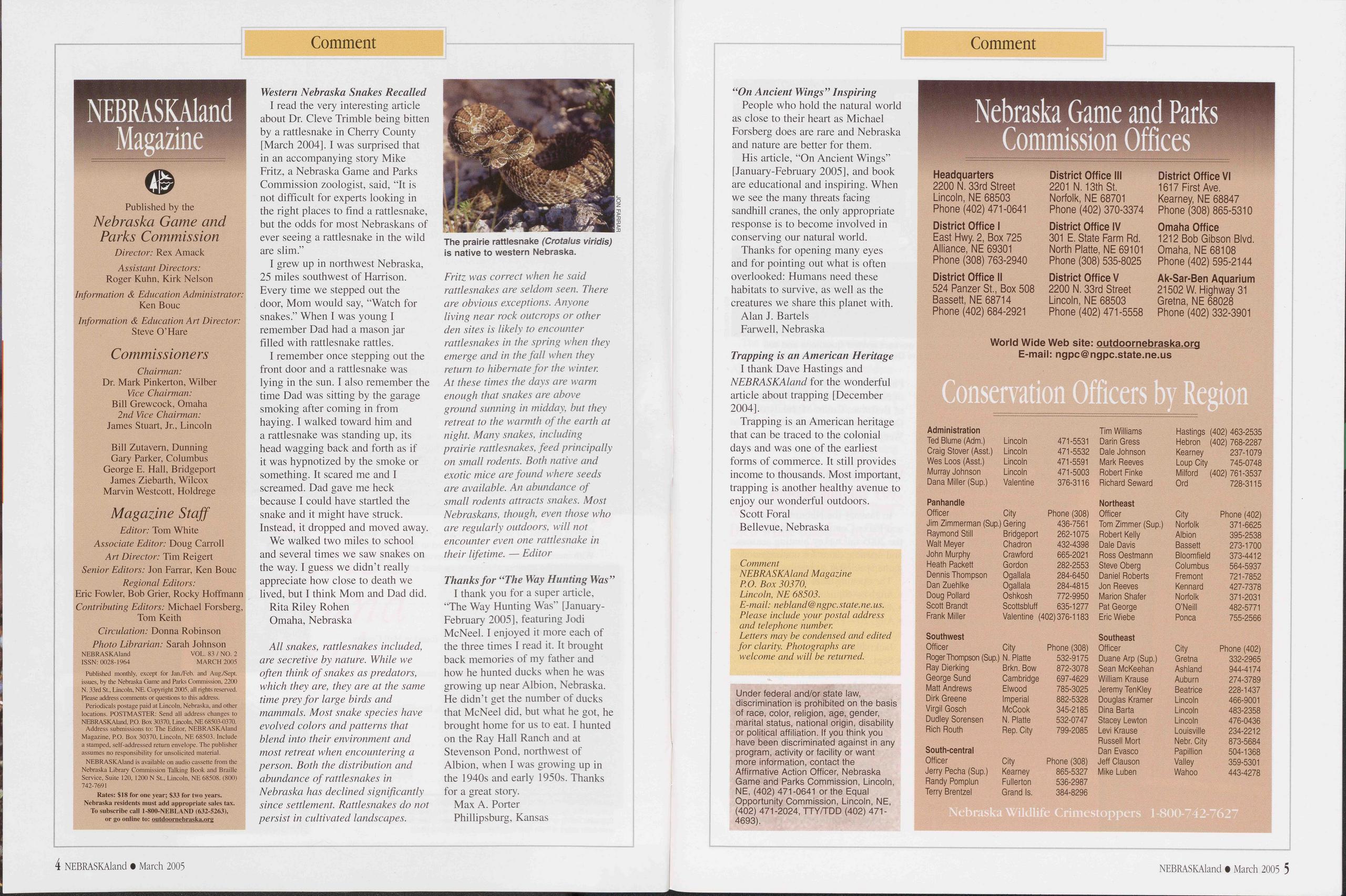
Comment
NEBRASKAland Magazine Published by the Nebraska Game and Parks Commission Director: Rex Amack Assistant Directors: Roger Kuhn, Kirk Nelson Information & Education Administrator: Ken Bouc Information & Education Art Director: Steve O’Hare Commissioners Chairman: Dr. Mark Pinkerton, Wilber Vice Chairman: Bill Grewcock, Omaha 2nd Vice Chairman: James Stuart, Jr., Lincoln Bill Zutavern, Dunning Gary Parker, Columbus George E. Hall, Bridgeport James Ziebarth, Wilcox Marvin Westcott, Holdrege Magazine Staff Editor: Tom White Associate Editor: Doug Carroll Art Director: Tim Reigert Senior Editors: Jon Farrar, Ken Bouc Regional Editors: Eric Fowler, Bob Grier, Rocky Hoffmann Contributing Editors: Michael Forsberg, Tom Keith Circulation: Donna Robinson Photo Librarian: Sarah Johnson NEBRASKAland VOL. 83 / NO. 2 ISSN: 0028-1964 MARCH 2005 Published monthly, except for Jan./Feb. and Aug./Sept. issues, by the Nebraska Game and Parks Commission, 2200 N. 33rd St., Lincoln, NE. Copyright 2005, all rights reserved. Please address comments or questions to this address. Periodicals postage paid at Lincoln, Nebraska, and other locations. POSTMASTER: Send all address changes to NEBRASKAland, P.O. Box 30370, Lincoln, NE 68503-0370. Address submissions to: The Editor, NEBRASKAland Magazine, P.O. Box 30370, Lincoln, NE 68503. Include a stamped, self-addressed return envelope. The publisher assumes no responsibility for unsolicited material. NEBRASKAland is available on audio cassette from the Nebraska Library Commission Talking Book and Braille Service, Suite 120, 1200 N St., Lincoln, NE 68508. (800) 742-7691 Rates: $18 for one year; $33 for two years. Nebraska residents must add appropriate sales tax. To subscribe call 1 -800-NEBLAND (632-5263), or go online to: outdoornebraska.org Western Nebraska Snakes RecalledI read the very interesting article about Dr. Cleve Trimble being bitten by a rattlesnake in Cherry County [March 2004]. I was surprised that in an accompanying story Mike Fritz, a Nebraska Game and Parks Commission zoologist, said, "It is not difficult for experts looking in the right places to find a rattlesnake, but the odds for most Nebraskans of ever seeing a rattlesnake in the wild are slim.”
I grew up in northwest Nebraska, 25 miles southwest of Harrison. Every time we stepped out the door, Mom would say, "Watch for snakes.” When I was young I remember Dad had a mason jar filled with rattlesnake rattles.
I remember once stepping out the front door and a rattlesnake was lying in the sun. I also remember the time Dad was sitting by the garage smoking after coming in from haying. I walked toward him and a rattlesnake was standing up, its head wagging back and forth as if it was hypnotized by the smoke or something. It scared me and I screamed. Dad gave me heck because I could have startled the snake and it might have struck. Instead, it dropped and moved away.
We walked two miles to school and several times we saw snakes on the way. I guess we didn’t really appreciate how close to death we lived, but I think Mom and Dad did.
Rita Riley Rohen Omaha, Nebraska All snakes, rattlesnakes included, are secretive by nature. While we often think of snakes as predators, which they are, they are at the same time prey for large birds and mammals. Most snake species have evolved colors and patterns that blend into their environment and most retreat when encountering a person. Both the distribution and abundance of rattlesnakes in Nebraska has declined significantly since settlement. Rattlesnakes do not persist in cultivated landscapes.I thank you for a super article, "The Way Hunting Was” [January- February 2005], featuring Jodi McNeel. I enjoyed it more each of the three times I read it. It brought back memories of my father and how he hunted ducks when he was growing up near Albion, Nebraska. He didn’t get the number of ducks that McNeel did, but what he got, he brought home for us to eat. I hunted on the Ray Hall Ranch and at Stevenson Pond, northwest of Albion, when I was growing up in the 1940s and early 1950s. Thanks for a great story.
Max A. Porter Phillipsburg, Kansas 4 NEBRASKAland • March 2005 “On Ancient Wings” InspiringPeople who hold the natural world as close to their heart as Michael Forsberg does are rare and Nebraska and nature are better for them.
His article, “On Ancient Wings” [January-February 2005], and book are educational and inspiring. When we see the many threats facing sandhill cranes, the only appropriate response is to become involved in conserving our natural world.
Thanks for opening many eyes and for pointing out what is often overlooked: Humans need these habitats to survive, as well as the creatures we share this planet with.
Alan J. Bartels Farwell, Nebraska Trapping is an American HeritageI thank Dave Hastings and NEBRASKAland for the wonderful article about trapping [December 2004].
Trapping is an American heritage that can be traced to the colonial days and was one of the earliest forms of commerce. It still provides income to thousands. Most important, trapping is another healthy avenue to enjoy our wonderful outdoors.
Scott Foral Bellevue, Nebraska
Comment NEBRASKAland Magazine P.O. Box 30370, Lincoln, NE 68503. E-mail: nebland@ngpc.state.ne.us. Please include your postal address and telephone number. Letters may be condensed and edited for clarity. Photographs are welcome and will be returned. Under federal and/or state law, discrimination is prohibited on the basis of race, color, religion, age, gender, marital status, national origin, disability or political affiliation. If you think you have been discriminated against in any program, activity or facility or want more information, contact the Affirmative Action Officer, Nebraska Game and Parks Commission, Lincoln, NE, (402) 471-0641 or the Equal Opportunity Commission, Lincoln, NE, (402) 471-2024, TTY/TDD (402) 471- 4693). Nebraska Game and Parks Commission Offices Headquarters 2200 N. 33rd Street Lincoln, NE 68503 Phone (402) 471-0641 District Office I East Hwy. 2, Box 725 Alliance, NE 69301 Phone (308) 763-2940 District Office II 524 Panzer St., Box 508 Bassett, NE 68714 Phone (402) 684-2921 District Office III 2201 N. 13th St. Norfolk, NE 68701 Phone (402) 370-3374 District Office IV 301 E. State Farm Rd. North Platte, NE 69101 Phone (308) 535-8025 District Office V 2200 N. 33rd Street Lincoln, NE 68503 Phone (402) 471-5558 District Office VI 1617 First Ave. Kearney, NE 68847 Phone (308) 865-5310 Omaha Office 1212 Bob Gibson Blvd. Omaha, NE 68108 Phone (402) 595-2144 Ak-Sar-Ben Aquarium 21502 W. Highway 31 Gretna, NE 68028 Phone (402) 332-3901 World Wide Web site: outdoornebraska.org E-mail: ngpc@ngpc.state.ne.us Conservation Officers by Region Administration Tim Williams Hastings (402) 463-2535 Ted Blume (Adm.) Lincoln 471-5531 Darin Gress Hebron (402) 768-2287 Craig Stover (Asst.) Lincoln 471-5532 Dale Johnson Kearney 237-1079 Wes Loos (Asst.) Lincoln 471-5591 Mark Reeves Loup City 745-0748 Murray Johnson Lincoln 471-5003 Robert Finke Milford (402) 761-3537 Dana Miller (Sup.) Valentine 376-3116 Richard Seward Ord 728-3115 Panhandle Northeast Officer City Phone (308) Officer City Phone (402) Jim Zimmerman (Sup.) Gering 436-7561 Tom Zimmer (Sup.) Norfolk 371-6625 Raymond Still Bridgeport 262-1075 Robert Kelly Albion 395-2538 Walt Meyer Chadron 432-4398 Dale Davis Bassett 273-1700 John Murphy Crawford 665-2021 Ross Oestmann Bloomfielc I 373-4412 Heath Packett Gordon 282-2553 Steve Oberg Columbus 564-5937 Dennis Thompson Ogallala 284-6450 Daniel Roberts Fremont 721-7852 Dan Zuehlke Ogallala 284-4815 Jon Reeves Kennard 427-7378 Doug Pollard Oshkosh 772-9950 Marion Shafer Norfolk 371-2031 Scott Brandt Scottsbluff 635-1277 Pat George O’Neill 482-5771 Frank Miller Valentine (402)376-1183 Eric Wiebe Ponca 755-2566 Southwest Southeast Officer City Phone (308) Officer City Phone (402) Roger Thompson (Sup.) N. Platte 532-9175 Duane Arp (Sup.) Gretna 332-2965 Ray Dierking Brkn. Bow 872-3078 Sean McKeehan Ashland 944-4174 George Sund Cambridge 697-4629 William Krause Auburn 274-3789 Matt Andrews Elwood 785-3025 Jeremy TenKley Beatrice 228-1437 Dirk Greene Imperial 882-5328 Douglas Kramer Lincoln 466-9001 Virgil Gosch McCook 345-2185 Dina Barta Lincoln 483-2358 Dudley Sorensen N. Platte 532-0747 Stacey Lewton Lincoln 476-0436 Rich Routh Rep. City 799-2085 Levi Krause Louisville 234-2212 Russell Mort Nebr. City 873-5684 South-central Dan Evasco Papillion 504-1368 Officer City Phone (308) Jeff Clauson Valley 359-5301 Jerry Pecha (Sup.) Kearney 865-5327 Mike Luben Wahoo 443-4278 Randy Pomplun Fullerton 536-2987 Terry Brentzel Grand Is. 384-8296 Nebraska Wildlife Crimestoppers 1-800-742-7627 NEBRASKAland • March 2005 5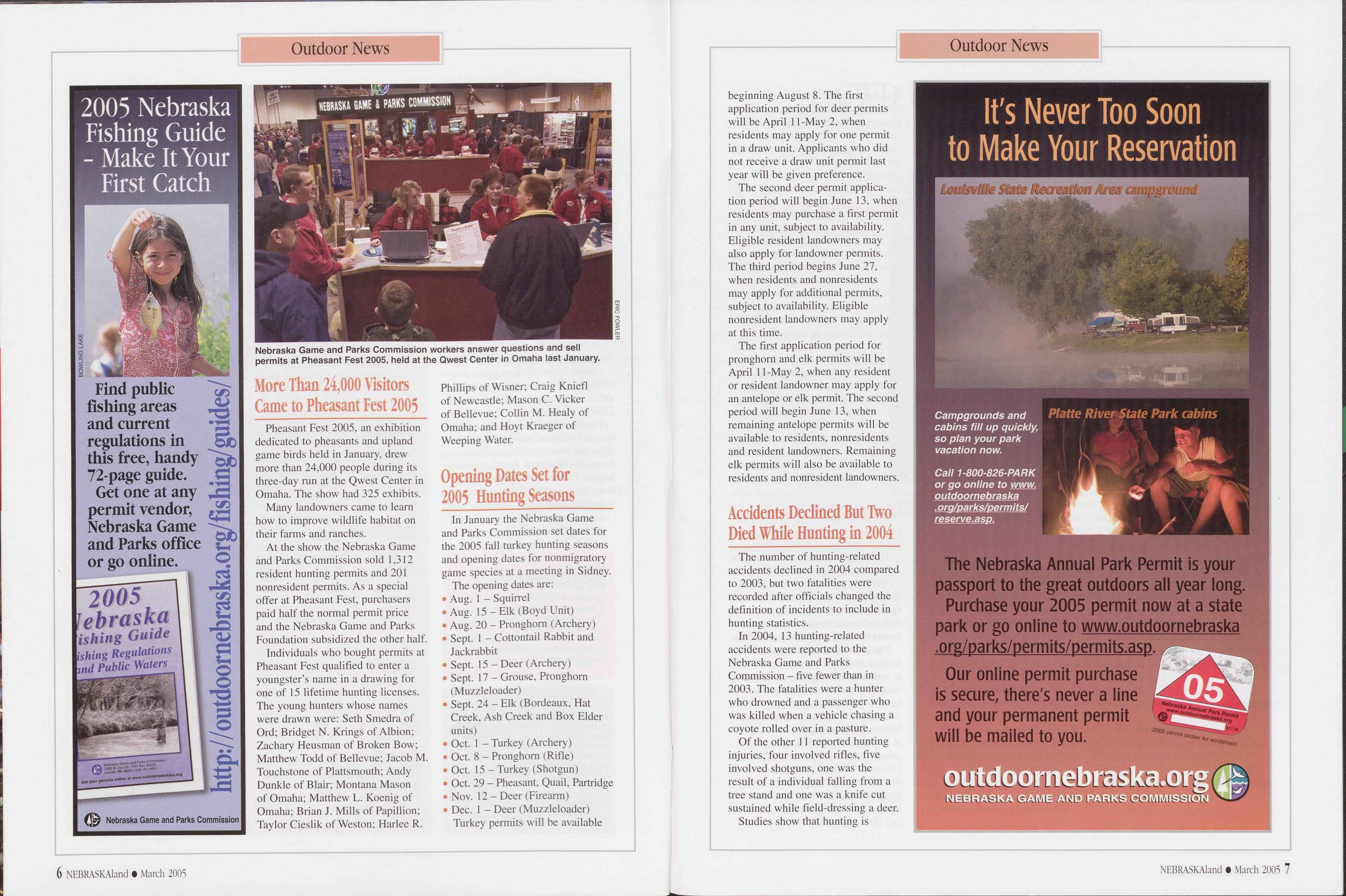
Outdoor News
2005 Nebraska Fishing Guide - Make It Your First Catch Find public fishing areas and current regulations in this free, handy 72-page guide. Get one at any permit vendor, Nebraska Game and Parks office or go online. http://outdoornebraska.org/fishing/guides/Pheasant Fest 2005, an exhibition dedicated to pheasants and upland game birds held in January, drew more than 24,000 people during its three-day run at the Qwest Center in Omaha. The show had 325 exhibits.
Many landowners came to learn how to improve wildlife habitat on their farms and ranches.
At the show the Nebraska Game and Parks Commission sold 1,312 resident hunting permits and 201 nonresident permits. As a special offer at Pheasant Fest, purchasers paid half the normal permit price and the Nebraska Game and Parks Foundation subsidized the other half.
Individuals who bought permits at Pheasant Fest qualified to enter a youngster’s name in a drawing for one of 15 lifetime hunting licenses. The young hunters whose names were drawn were: Seth Smedra of Ord; Bridget N. Krings of Albion; Zachary Heusman of Broken Bow; Matthew Todd of Bellevue; Jacob M. Touchstone of Plattsmouth; Andy Dunkle of Blair; Montana Mason of Omaha; Matthew L. Koenig of Omaha; Brian J. Mills of Papillion; Taylor Cieslik of Weston; Harlee R. Phillips of Wisner; Craig Kniefl of Newcastle; Mason C. Vicker of Bellevue; Collin M. Healy of Omaha; and Hoyt Kraeger of Weeping Water.
Opening Dates Set for 2005 Hunting SeasonsIn January the Nebraska Game and Parks Commission set dates for the 2005 fall turkey hunting seasons and opening dates for nonmigratory game species at a meeting in Sidney.
The opening dates are: • Aug. 1 - Squirrel • Aug. 15 - Elk (Boyd Unit) • Aug. 20 - Pronghorn (Archery) • Sept. 1 - Cottontail Rabbit and Jackrabbit • Sept. 15 - Deer (Archery) • Sept. 17 - Grouse, Pronghorn (Muzzleloader) • Sept. 24 - Elk (Bordeaux, Hat Creek, Ash Creek and Box Elder units) • Oct. 1 - Turkey (Archery) • Oct. 8 - Pronghorn (Rifle) • Oct. 15 - Turkey (Shotgun) • Oct. 29 - Pheasant, Quail, Partridge • Nov. 12 - Deer (Firearm) • Dec. 1 - Deer (Muzzleloader)Turkey permits will be available 6 NEBRASKAland • March 2005 beginning August 8. The first application period for deer permits will be April 11-May 2, when residents may apply for one permit in a draw unit. Applicants who did not receive a draw unit permit last year will be given preference.
The second deer permit applica- tion period will begin June 13, when residents may purchase a first permit in any unit, subject to availability. Eligible resident landowners may also apply for landowner permits. The third period begins June 27, when residents and nonresidents may apply for additional permits, subject to availability. Eligible nonresident landowners may apply at this time.
The first application period for pronghorn and elk permits will be April 11-May 2, when any resident or resident landowner may apply for an antelope or elk permit. The second period will begin June 13, when remaining antelope permits will be available to residents, nonresidents and resident landowners. Remaining elk permits will also be available to residents and nonresident landowners.
Accidents Declined But Two Died While Hunting in 2004The number of hunting-related accidents declined in 2004 compared to 2003, but two fatalities were recorded after officials changed the definition of incidents to include in hunting statistics.
In 2004, 13 hunting-related accidents were reported to the Nebraska Game and Parks Commission - five fewer than in 2003. The fatalities were a hunter who drowned and a passenger who was killed when a vehicle chasing a coyote rolled over in a pasture.
Of the other 11 reported hunting injuries, four involved rifles, five involved shotguns, one was the result of a individual falling from a tree stand and one was a knife cut sustained while field-dressing a deer.
It's Never Too Soon to Make Your Reservation Louisvill State Recreation Area campground Platte Rivet- State Park cabins Campgrounds and cabins fill up quickly, so plan your park vacation now. Call 1-800-826-PARK or go online to www. outdoornebraska .org/parks/permits/ reserve.asp. The Nebraska Annual Park Permit is your passport to the great outdoors all year long. Purchase your 2005 permit now at a state park or go online to wwwnntrionrnebraska ,org/parks/permit/permits.asp Our online permit purchase is secure, there's never a line and your permanent permit will be mailed to you. outdoornebraska.org NEBRASKA GAME AND PARKS COMMISSONStudies show that hunting is NEBRASKAland • March 2005 7 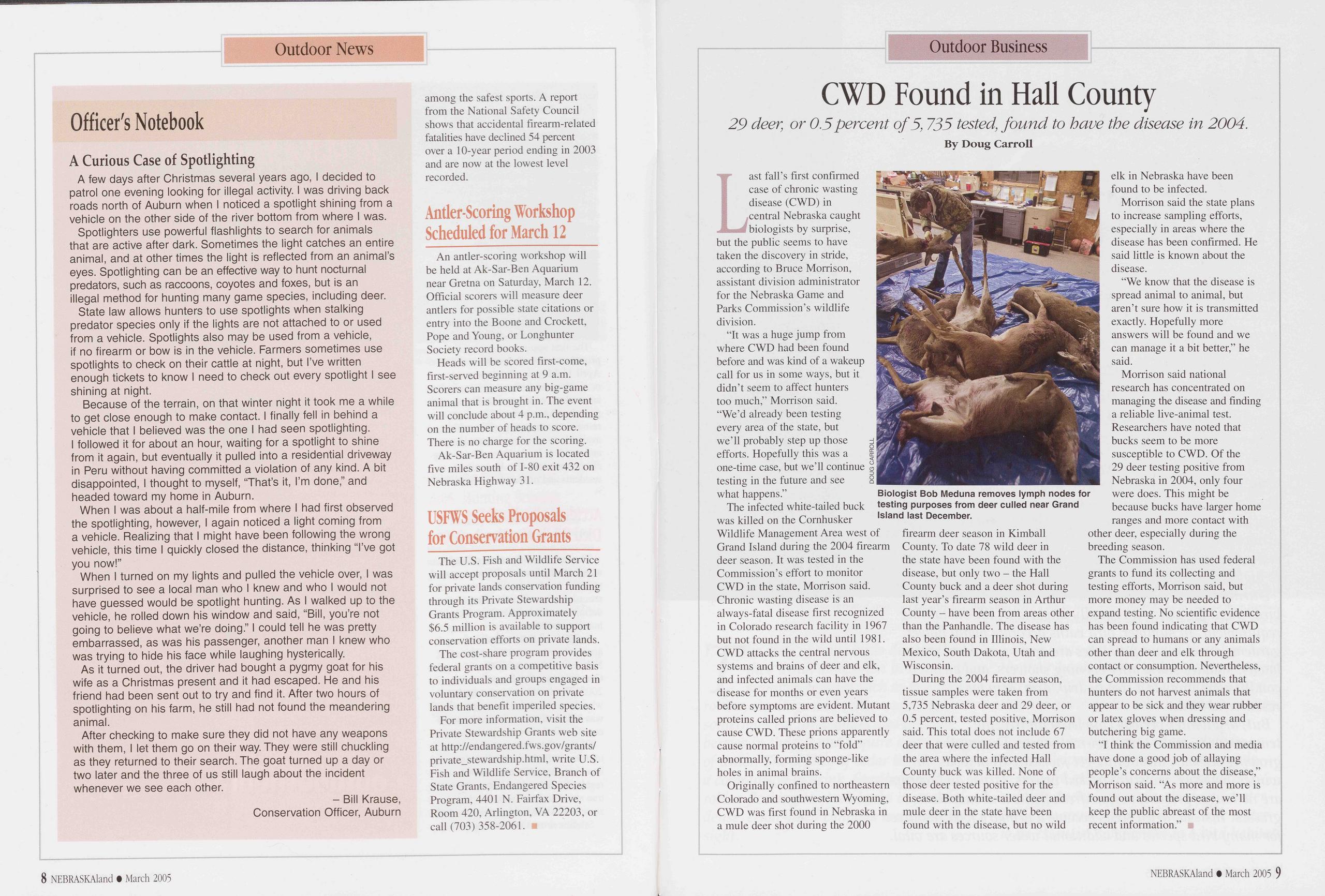 among the safest sports. A report from the National Safety Council shows that accidental firearm-related fatalities have declined 54 percent over a 10-year period ending in 2003 and are now at the lowest level recorded.
A few days after Christmas several years ago, I decided to patrol one evening looking for illegal activity. I was driving back roads north of Auburn when I noticed a spotlight shining from a vehicle on the other side of the river bottom from where I was.
Spotlighters use powerful flashlights to search for animals that are active after dark. Sometimes the light catches an entire animal, and at other times the light is reflected from an animal’s eyes. Spotlighting can be an effective way to hunt nocturnal predators, such as raccoons, coyotes and foxes, but is an illegal method for hunting many game species, including deer.
State law allows hunters to use spotlights when stalking predator species only if the lights are not attached to or used from a vehicle. Spotlights also may be used from a vehicle, if no firearm or bow is in the vehicle. Farmers sometimes use spotlights to check on their cattle at night, but I’ve written enough tickets to know I need to check out every spotlight I see shining at night.
Because of the terrain, on that winter night it took me a while to get close enough to make contact. I finally fell in behind a vehicle that I believed was the one I had seen spotlighting. I followed it for about an hour, waiting for a spotlight to shine from it again, but eventually it pulled into a residential driveway in Peru without having committed a violation of any kind. A bit disappointed, I thought to myself, “That’s it, I’m done,” and headed toward my home in Auburn.
When I was about a half-mile from where I had first observed the spotlighting, however, I again noticed a light coming from a vehicle. Realizing that I might have been following the wrong vehicle, this time I quickly closed the distance, thinking “I’ve got you now!”
When I turned on my lights and pulled the vehicle over, I was surprised to see a local man who I knew and who I would not have guessed would be spotlight hunting. As I walked up to the vehicle, he rolled down his window and said, “Bill, you’re not going to believe what we’re doing.” I could tell he was pretty embarrassed, as was his passenger, another man I knew who was trying to hide his face while laughing hysterically.
As it turned out, the driver had bought a pygmy goat for his wife as a Christmas present and it had escaped. He and his friend had been sent out to try and find it. After two hours of spotlighting on his farm, he still had not found the meandering animal.
After checking to make sure they did not have any weapons with them, I let them go on their way. They were still chuckling as they returned to their search. The goat turned up a day or two later and the three of us still laugh about the incident whenever we see each other.
- Bill Krause, Conservation Officer, Auburn Antler-Scoring Workshop Scheduled for March 12An antler-scoring workshop will be held at Ak-Sar-Ben Aquarium near Gretna on Saturday, March 12. Official scorers will measure deer antlers for possible state citations or entry into the Boone and Crockett, Pope and Young, or Longhunter Society record books.
Heads will be scored first-come, first-served beginning at 9 a.m. Scorers can measure any big-game animal that is brought in. The event will conclude about 4 p.m., depending on the number of heads to score. There is no charge for the scoring.
Ak-Sar-Ben Aquarium is located five miles south of 1-80 exit 432 on Nebraska Highway 31.
USFWS Seeks Proposals for Conservation GrantsThe U.S. Fish and Wildlife Service will accept proposals until March 21 for private lands conservation funding through its Private Stewardship Grants Program. Approximately $6.5 million is available to support conservation efforts on private lands.
The cost-share program provides federal grants on a competitive basis to individuals and groups engaged in voluntary conservation on private lands that benefit imperiled species.
For more information, visit the Private Stewardship Grants web site at http://endangered.fws.gov/grants/ private_stewardship.html, write U.S. Fish and Wildlife Service, Branch of State Grants, Endangered Species Program, 4401 N. Fairfax Drive, Room 420, Arlington, VA 22203, or call (703) 358-2061.
8 NEBRASKAland • March 2005Outdoor Business
CWD Found in Hall County
29 deer, or 0.5 percent of 5,735 tested, found to have the disease in 2004.
Last fall’s first confirmed case of chronic wasting disease (CWD) in central Nebraska caught biologists by surprise, but the public seems to have taken the discovery in stride, according to Bruce Morrison, assistant division administrator for the Nebraska Game and Parks Commission’s wildlife division.
"It was a huge jump from where CWD had been found before and was kind of a wakeup call for us in some ways, but it didn’t seem to affect hunters too much,” Morrison said. "We’d already been testing every area of the state, but we’ll probably step up those j efforts. Hopefully this was a § one-time case, but we’ll continue S testing in the future and see § what happens.”
The infected white-tailed buck was killed on the Cornhusker Wildlife Management Area west of Grand Island during the 2004 firearm deer season. It was tested in the Commission’s effort to monitor CWD in the state, Morrison said. Chronic wasting disease is an always-fatal disease first recognized in Colorado research facility in 1967 but not found in the wild until 1981. CWD attacks the central nervous systems and brains of deer and elk, and infected animals can have the disease for months or even years before symptoms are evident. Mutant proteins called prions are believed to cause CWD. These prions apparently cause normal proteins to "fold” abnormally, forming sponge-like holes in animal brains.
Originally confined to northeastern Colorado and southwestern Wyoming, CWD was first found in Nebraska in a mule deer shot during the 2000
During the 2004 firearm season, tissue samples were taken from 5,735 Nebraska deer and 29 deer, or 0.5 percent, tested positive, Morrison said. This total does not include 67 deer that were culled and tested from the area where the infected Hall County buck was killed. None of those deer tested positive for the disease. Both white-tailed deer and mule deer in the state have been found with the disease, but no wild elk in Nebraska have been found to be infected.
Morrison said the state plans to increase sampling efforts, especially in areas where the disease has been confirmed. He said little is known about the disease.
"We know that the disease is spread animal to animal, but aren’t sure how it is transmitted exactly. Hopefully more answers will be found and we can manage it a bit better,” he said.
Morrison said national research has concentrated on managing the disease and finding a reliable live-animal test. Researchers have noted that bucks seem to be more susceptible to CWD. Of the 29 deer testing positive from Nebraska in 2004, only four were does. This might be because bucks have larger home ranges and more contact with other deer, especially during the breeding season.
The Commission has used federal grants to fund its collecting and testing efforts, Morrison said, but more money may be needed to expand testing. No scientific evidence has been found indicating that CWD can spread to humans or any animals other than deer and elk through contact or consumption. Nevertheless, the Commission recommends that hunters do not harvest animals that appear to be sick and they wear rubber or latex gloves when dressing and butchering big game.
"I think the Commission and media have done a good job of allaying people’s concerns about the disease,” Morrison said. "As more and more is found out about the disease, we’ll keep the public abreast of the most recent information.”
NEBRASKAland • March 2005 9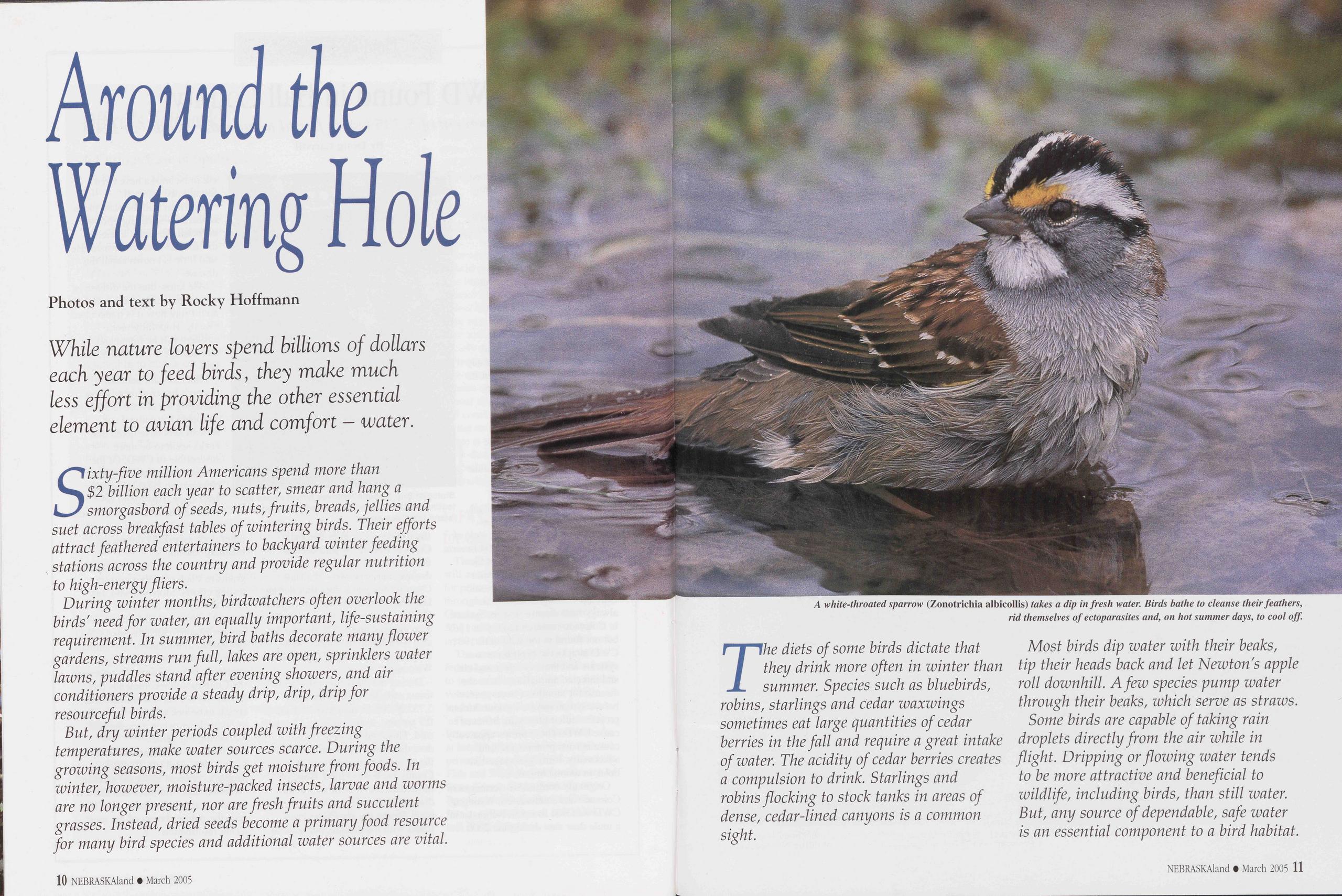
Around the Watering Hole
While nature lovers spend billions of dollars each year to feed birds, they make much less effort in providing the other essential element to avian life and comfort - water.
Sixty-five million Americans spend more than $2 billion each year to scatter, smear and hang a smorgasbord of seeds, nuts, fruits, breads, jellies and suet across breakfast tables of wintering birds. Their efforts attract feathered entertainers to backyard winter feeding x stations across the country and provide regular nutrition to high-energy fliers.
During winter months, birdwatchers often overlook the birds' need for water, an equally important, life-sustaining requirement. In summer, bird baths decorate many flower gardens, streams run full, lakes are open, sprinklers water lawns, puddles stand after evening showers, and air conditioners provide a steady drip, drip, drip for resourceful birds.
But, dry winter periods coupled with freezing temperatures, make water sources scarce. During the growing seasons, most birds get moisture from foods. In winter, however, moisture-packed insects, larvae and worms are no longer present, nor are fresh fruits and succulent grasses. Instead, dried seeds become a primary food resource for many bird species and additional water sources are vital.
10 NEBRASKAland • March 2005The diets of some birds dictate that they drink more often in winter than summer. Species such as bluebirds, robins, starlings and cedar waxwings sometimes eat large quantities of cedar berries in the fall and require a great intake of water. The acidity of cedar berries creates a compulsion to drink. Starlings and robins flocking to stock tanks in areas of dense, cedar-lined canyons is a common sight.
Most birds dip water with their beaks, tip their heads back and let Newton's apple roll downhill. A few species pump water through their beaks, which serve as straws.
Some birds are capable of taking rain droplets directly from the air while in flight. Dripping or flowing water tends to be more attractive and beneficial to wildlife, including birds, than still water. But, any source of dependable, safe water is an essential component to a bird habitat.
NEBRASKAland • March 2005 11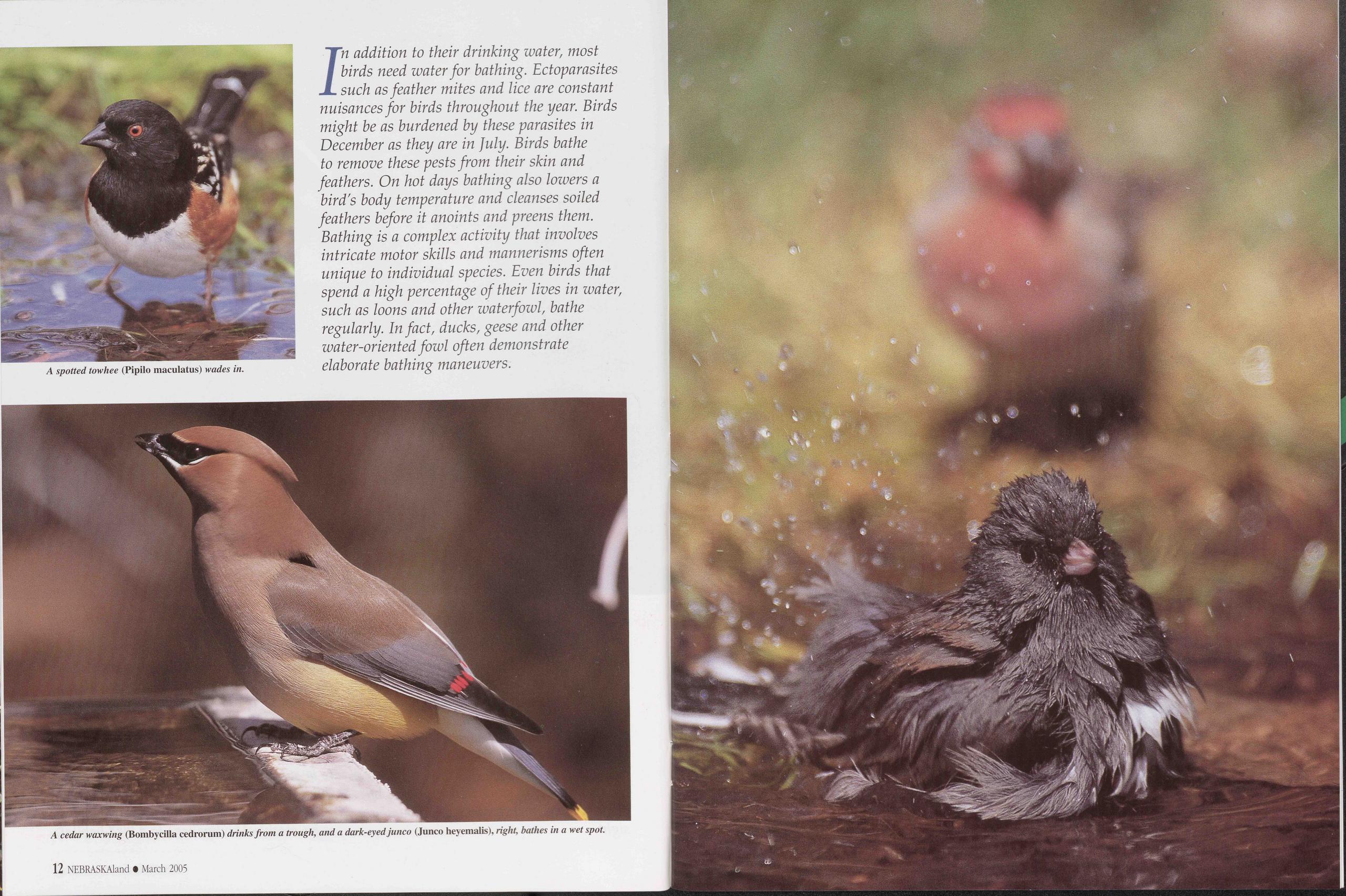
In addition to their drinking water, most birds need water for bathing. Ectoparasites such as feather mites and lice are constant nuisances for birds throughout the year. Birds might be as burdened by these parasites in December as they are in July. Birds bathe to remove these pests from their skin and feathers. On hot days bathing also lowers a bird's body temperature and cleanses soiled feathers before it anoints and preens them. Bathing is a complex activity that involves intricate motor skills and mannerisms often unique to individual species. Even birds that spend a high percentage of their lives in water, such as loons and other waterfowl, bathe regularly. In fact, ducks, geese and other water-oriented fowl often demonstrate elaborate bathing maneuvers.
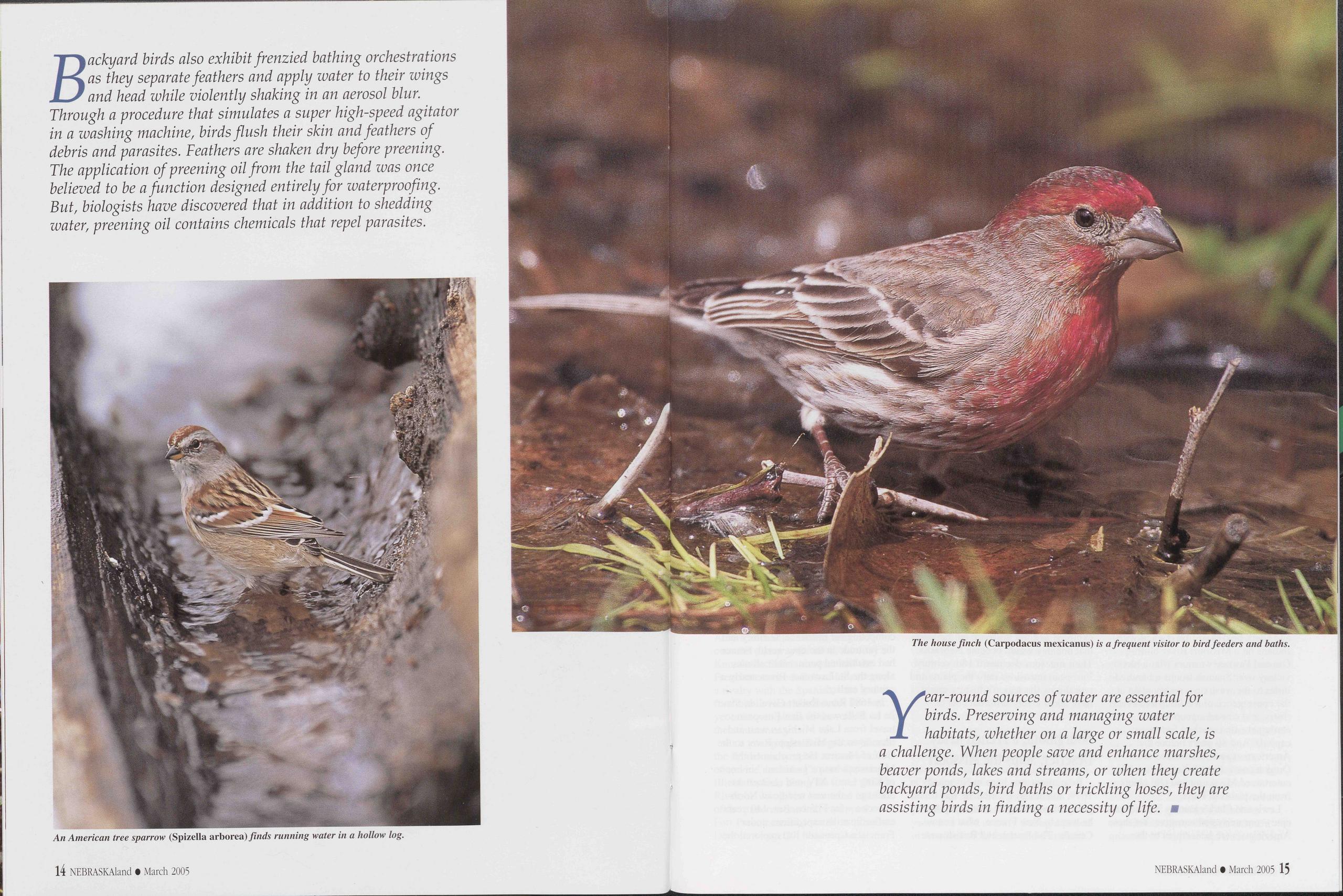
Backyard birds also exhibit frenzied bathing orchestrations as they separate feathers and apply water to their wings and head while violently shaking in an aerosol blur. Through a procedure that simulates a super high-speed agitator in a washing machine, birds flush their skin and feathers of debris and parasites. Feathers are shaken dry before preening. The application of preening oil from the tail gland was once believed to be a function designed entirely for waterproofing. But, biologists have discovered that in addition to shedding water, preening oil contains chemicals that repel parasites.
Year-round sources of water are essential for birds. Preserving and managing water habitats, whether on a large or small scale, is a challenge. When people save and enhance marshes, beaver ponds, lakes and streams, or when they create backyard ponds, bird baths or trickling hoses, they are assisting birds in finding a necessity of life.
NEBRASKAland • March 2005 15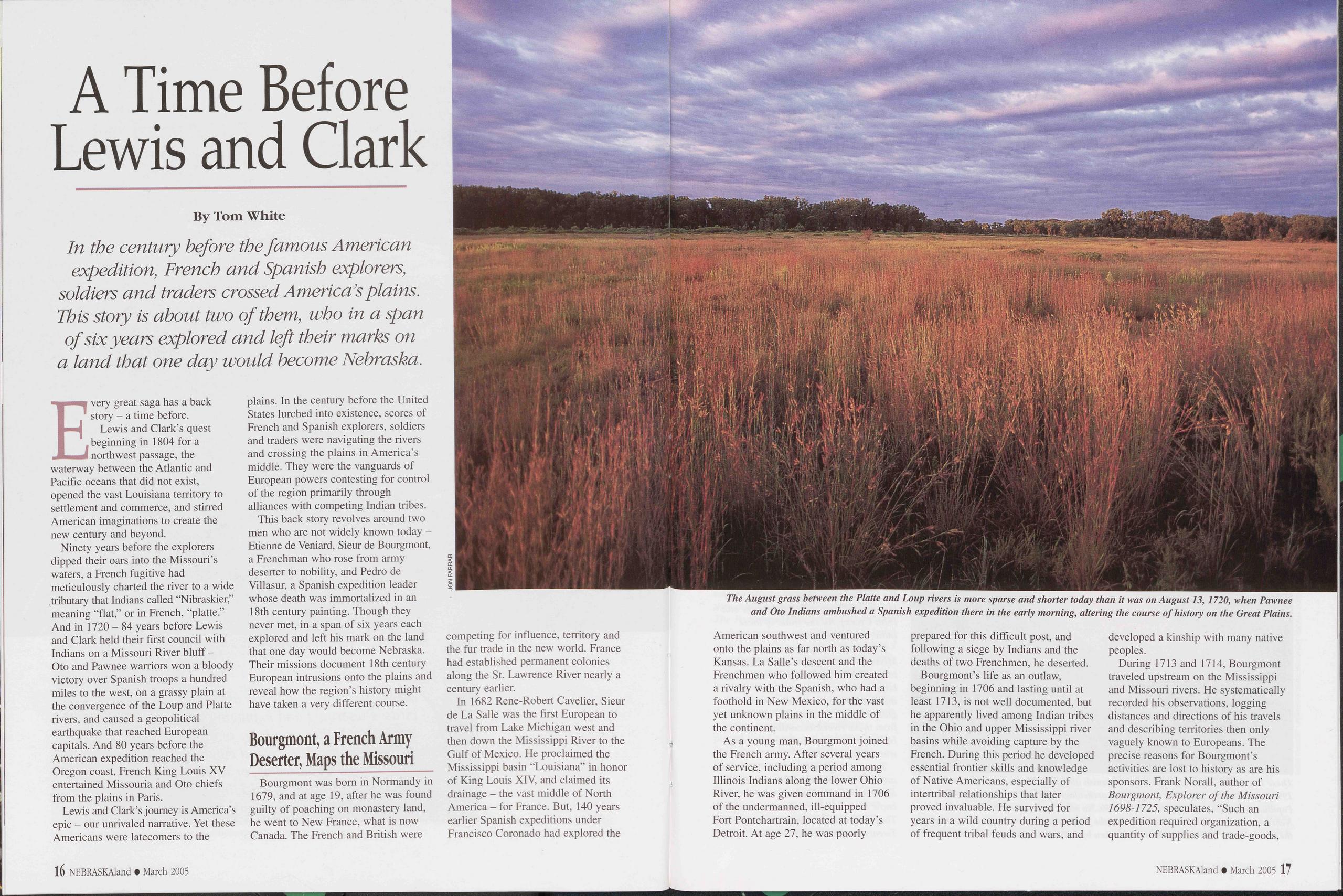
A Time Before Lewis and Clark
In the century before the famous American expedition, French and Spanish explorers, soldiers and traders crossed America’s plains. This story is about two of them, who in a span of six years explored and left their marks on a land that one day would become Nebraska.
Every great saga has a back story - a time before.
Lewis and Clark’s quest beginning in 1804 for a northwest passage, the waterway between the Atlantic and Pacific oceans that did not exist, opened the vast Louisiana territory to settlement and commerce, and stirred American imaginations to create the new century and beyond.
Ninety years before the explorers dipped their oars into the Missouri’s waters, a French fugitive had meticulously charted the river to a wide tributary that Indians called “Nibraskier,” meaning “flat,” or in French, “platte.” And in 1720-84 years before Lewis and Clark held their first council with Indians on a Missouri River bluff - Oto and Pawnee warriors won a bloody victory over Spanish troops a hundred miles to the west, on a grassy plain at the convergence of the Loup and Platte rivers, and caused a geopolitical earthquake that reached European capitals. And 80 years before the American expedition reached the Oregon coast, French King Louis XV entertained Missouria and Oto chiefs from the plains in Paris.
Lewis and Clark’s journey is America’s epic - our unrivaled narrative. Yet these Americans were latecomers to the plains. In the century before the United States lurched into existence, scores of French and Spanish explorers, soldiers and traders were navigating the rivers and crossing the plains in America’s middle. They were the vanguards of European powers contesting for control of the region primarily through alliances with competing Indian tribes.
This back story revolves around two men who are not widely known today - Etienne de Veniard, Sieur de Bourgmont, a Frenchman who rose from army deserter to nobility, and Pedro de Villasur, a Spanish expedition leader whose death was immortalized in an 18th century painting. Though they never met, in a span of six years each explored and left his mark on the land that one day would become Nebraska. Their missions document 18th century European intrusions onto the plains and reveal how the region’s history might have taken a very different course.
Bourgmont, a French Army Deserter, Maps the MissouriBourgmont was born in Normandy in 1679, and at age 19, after he was found guilty of poaching on monastery land, he went to New France, what is now Canada. The French and British were competing for influence, territory and the fur trade in the new world. France had established permanent colonies along the St. Lawrence River nearly a century earlier.
In 1682 Rene-Robert Cavelier, Sieur de La Salle was the first European to travel from Lake Michigan west and then down the Mississippi River to the Gulf of Mexico. He proclaimed the Mississippi basin “Louisiana” in honor of King Louis XIV, and claimed its drainage - the vast middle of North America - for France. But, 140 years earlier Spanish expeditions under Francisco Coronado had explored the 16 NEBRASKAland • March 2005
As a young man, Bourgmont joined the French army. After several years of service, including a period among Illinois Indians along the lower Ohio River, he was given command in 1706 of the undermanned, ill-equipped Fort Fontchartrain, located at today’s Detroit. At age 27, he was poorly prepared for this difficult post, and following a siege by Indians and the deaths of two Frenchmen, he deserted.
Bourgmont’s life as an outlaw, beginning in 1706 and lasting until at least 1713, is not well documented, but he apparently lived among Indian tribes in the Ohio and upper Mississippi river basins while avoiding capture by the French. During this period he developed essential frontier skills and knowledge of Native Americans, especially of intertribal relationships that later proved invaluable. He survived for years in a wild country during a period of frequent tribal feuds and wars, and developed a kinship with many native peoples.
During 1713 and 1714, Bourgmont traveled upstream on the Mississippi and Missouri rivers. He systematically recorded his observations, logging distances and directions of his travels and describing territories then only vaguely known to Europeans. The precise reasons for Bourgmont’s activities are lost to history as are his sponsors. Frank Norall, author of Bourgmont, Explorer of the Missouri 1698-1725, speculates, “Such an expedition required organization, a quantity of supplies and trade-goods, NEBRASKAland • March 2005 17 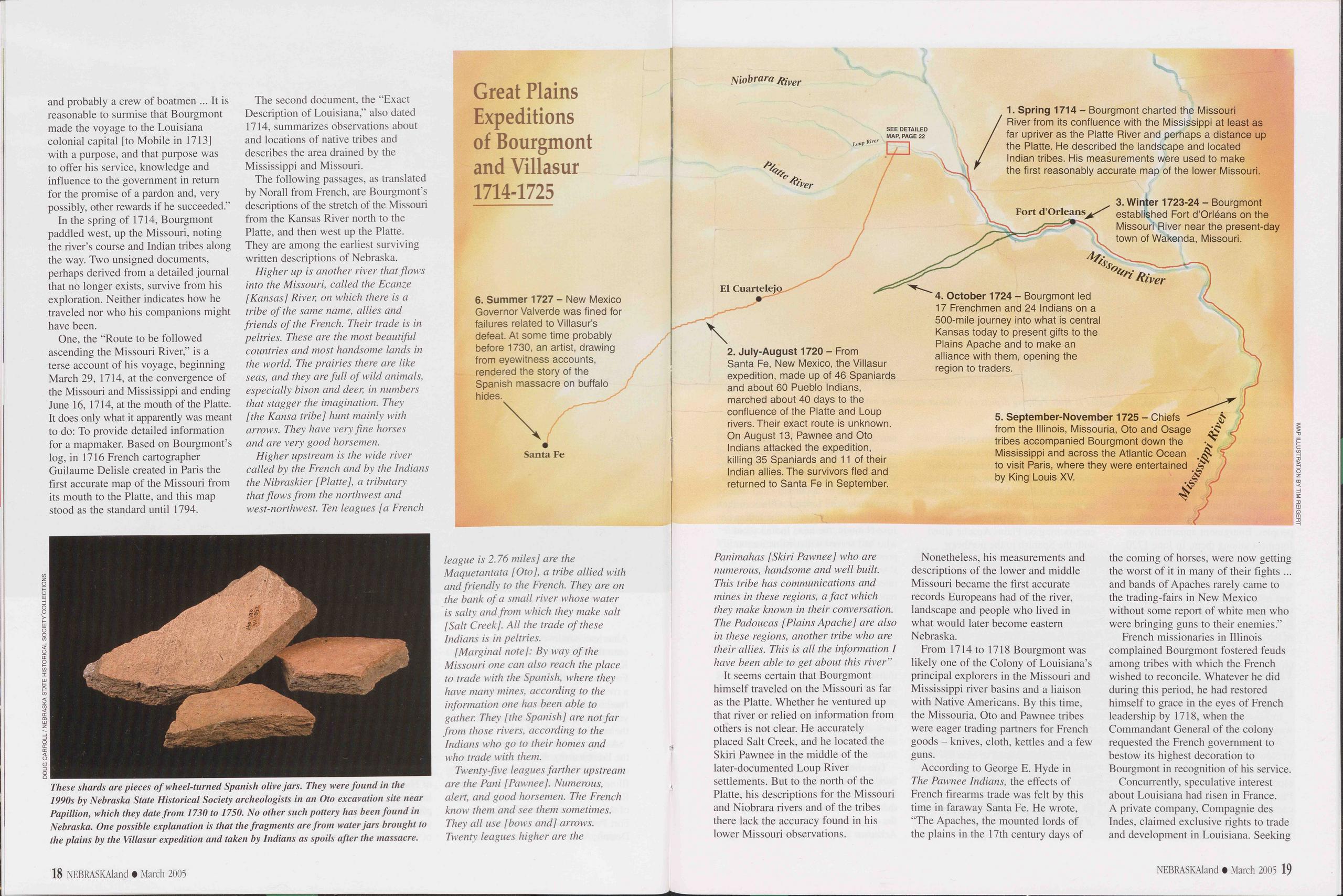 and probably a crew of boatmen ... It is reasonable to surmise that Bourgmont made the voyage to the Louisiana colonial capital [to Mobile in 1713] with a purpose, and that purpose was to offer his service, knowledge and influence to the government in return for the promise of a pardon and, very possibly, other rewards if he succeeded.”
In the spring of 1714, Bourgmont paddled west, up the Missouri, noting the river’s course and Indian tribes along the way. Two unsigned documents, perhaps derived from a detailed journal that no longer exists, survive from his exploration. Neither indicates how he traveled nor who his companions might have been.
One, the “Route to be followed ascending the Missouri River,” is a terse account of his voyage, beginning March 29, 1714, at the convergence of the Missouri and Mississippi and ending June 16, 1714, at the mouth of the Platte. It does only what it apparently was meant to do: To provide detailed information for a mapmaker. Based on Bourgmont’s log, in 1716 French cartographer Guilaume Delisle created in Paris the first accurate map of the Missouri from its mouth to the Platte, and this map stood as the standard until 1794.
The second document, the “Exact Description of Louisiana,” also dated 1714, summarizes observations about and locations of native tribes and describes the area drained by the Mississippi and Missouri.
The following passages, as translated by Norall from French, are Bourgmont’s descriptions of the stretch of the Missouri from the Kansas River north to the Platte, and then west up the Platte. They are among the earliest surviving written descriptions of Nebraska.
Higher up is another river that flows into the Missouri, called the Ecanze [Kansas] River, on which there is a tribe of the same name, allies and friends of the French. Their trade is in peltries. These are the most beautiful countries and most handsome lands in the world. The prairies there are like seas, and they are full of wild animals, especially bison and deer, in numbers that stagger the imagination. They [the Kansa tribe] hunt mainly with arrows. They have very fine horses and are very good horsemen.
Higher upstream is the wide river called by the French and by the Indians the Nibraskier [Platte], a tributary that flows from the northwest and west-northwest. Ten leagues [a French
[Marginal note]: By way of the Missouri one can also reach the place to trade with the Spanish, where they have many mines, according to the information one has been able to gather. They [the Spanish] are not far from those rivers, according to the Indians who go to their homes and who trade with them.
Twenty-five leagues farther upstream are the Pani [Pawnee]. Numerous, alert, and good horsemen. The French know them and see them sometimes. They all use [bows and] arrows. Twenty leagues higher are the 18 NEBRASKAland • March 2005
It seems certain that Bourgmont himself traveled on the Missouri as far as the Platte. Whether he ventured up that river or relied on information from others is not clear. He accurately placed Salt Creek, and he located the Skiri Pawnee in the middle of the later-documented Loup River settlements. But to the north of the Platte, his descriptions for the Missouri and Niobrara rivers and of the tribes there lack the accuracy found in his lower Missouri observations.
Nonetheless, his measurements and descriptions of the lower and middle Missouri became the first accurate records Europeans had of the river, landscape and people who lived in what would later become eastern Nebraska.
From 1714 to 1718 Bourgmont was likely one of the Colony of Louisiana’s principal explorers in the Missouri and Mississippi river basins and a liaison with Native Americans. By this time, the Missouria, Oto and Pawnee tribes were eager trading partners for French goods - knives, cloth, kettles and a few guns.
According to George E. Hyde in The Pawnee Indians, the effects of French firearms trade was felt by this time in faraway Santa Fe. He wrote, “The Apaches, the mounted lords of the plains in the 17th century days of the coming of horses, were now getting the worst of it in many of their fights ... and bands of Apaches rarely came to the trading-fairs in New Mexico without some report of white men who were bringing guns to their enemies.”
French missionaries in Illinois complained Bourgmont fostered feuds among tribes with which the French wished to reconcile. Whatever he did during this period, he had restored himself to grace in the eyes of French leadership by 1718, when the Commandant General of the colony requested the French government to bestow its highest decoration to Bourgmont in recognition of his service.
Concurrently, speculative interest about Louisiana had risen in France. A private company, Compagnie des Indes, claimed exclusive rights to trade and development in Louisiana. Seeking NEBRASKAland • March 2005 19 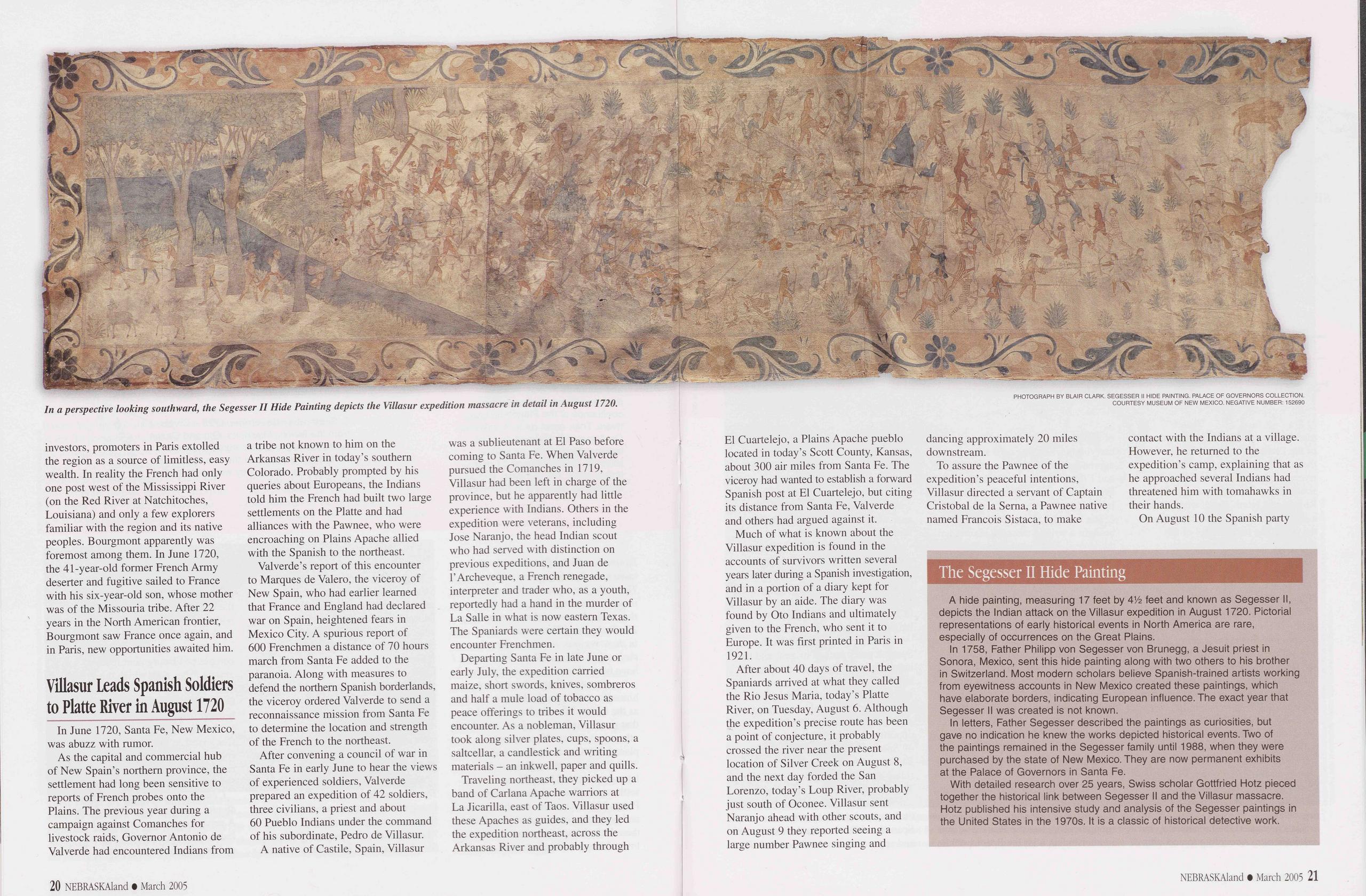
Villasur Leads Spanish Soldiers to Platte River in August 1720
In June 1720, Santa Fe, New Mexico, was abuzz with rumor.
As the capital and commercial hub of New Spain’s northern province, the settlement had long been sensitive to reports of French probes onto the Plains. The previous year during a campaign against Comanches for livestock raids, Governor Antonio de Valverde had encountered Indians from a tribe not known to him on the Arkansas River in today’s southern Colorado. Probably prompted by his queries about Europeans, the Indians told him the French had built two large settlements on the Platte and had alliances with the Pawnee, who were encroaching on Plains Apache allied with the Spanish to the northeast.
Valverde’s report of this encounter to Marques de Valero, the viceroy of New Spain, who had earlier learned that France and England had declared war on Spain, heightened fears in Mexico City. A spurious report of 600 Frenchmen a distance of 70 hours march from Santa Fe added to the paranoia. Along with measures to defend the northern Spanish borderlands, the viceroy ordered Valverde to send a reconnaissance mission from Santa Fe to determine the location and strength of the French to the northeast.
After convening a council of war in Santa Fe in early June to hear the views of experienced soldiers, Valverde prepared an expedition of 42 soldiers, three civilians, a priest and about 60 Pueblo Indians under the command of his subordinate, Pedro de Villasur.
A native of Castile, Spain, Villasur was a sublieutenant at El Paso before coming to Santa Fe. When Valverde pursued the Comanches in 1719, Villasur had been left in charge of the province, but he apparently had little experience with Indians. Others in the expedition were veterans, including Jose Naranjo, the head Indian scout who had served with distinction on previous expeditions, and Juan de 1’Archeveque, a French renegade, interpreter and trader who, as a youth, reportedly had a hand in the murder of La Salle in what is now eastern Texas. The Spaniards were certain they would encounter Frenchmen.
Departing Santa Fe in late June or early July, the expedition carried maize, short swords, knives, sombreros and half a mule load of tobacco as peace offerings to tribes it would encounter. As a nobleman, Villasur took along silver plates, cups, spoons, a saltcellar, a candlestick and writing materials - an inkwell, paper and quills.
Traveling northeast, they picked up a band of Carlana Apache warriors at La Jicarilla, east of Taos. Villasur used these Apaches as guides, and they led the expedition northeast, across the Arkansas River and probably through 20 NEBRASKAland • March 2005
Much of what is known about the Villasur expedition is found in the accounts of survivors written several years later during a Spanish investigation, and in a portion of a diary kept for Villasur by an aide. The diary was found by Oto Indians and ultimately given to the French, who sent it to Europe. It was first printed in Paris in 1921.
After about 40 days of travel, the Spaniards arrived at what they called the Rio Jesus Maria, today’s Platte River, on Tuesday, August 6. Although the expedition’s precise route has been a point of conjecture, it probably crossed the river near the present location of Silver Creek on August 8, and the next day forded the San Lorenzo, today’s Loup River, probably just south of Oconee. Villasur sent Naranjo ahead with other scouts, and on August 9 they reported seeing a large number Pawnee singing and dancing approximately 20 miles downstream.
To assure the Pawnee of the expedition’s peaceful intentions, Villasur directed a servant of Captain Cristobal de la Serna, a Pawnee native named Francois Sistaca, to make contact with the Indians at a village. However, he returned to the expedition’s camp, explaining that as he approached several Indians had threatened him with tomahawks in their hands.
The Segesser II Hide Painting A hide painting, measuring 17 feet by 41/2 feet and known as Segesser II, depicts the Indian attack on the Villasur expedition in August 1720. Pictorial representations of early historical events in North America are rare, especially of occurrences on the Great Plains. In 1758, Father Philipp von Segesser von Brunegg, a Jesuit priest in Sonora, Mexico, sent this hide painting along with two others to his brother in Switzerland. Most modern scholars believe Spanish-trained artists working from eyewitness accounts in New Mexico created these paintings, which have elaborate borders, indicating European influence. The exact year that Segesser II was created is not known. In letters, Father Segesser described the paintings as curiosities, but gave no indication he knew the works depicted historical events. Two of the paintings remained in the Segesser family until 1988, when they were purchased by the state of New Mexico. They are now permanent exhibits at the Palace of Governors in Santa Fe. With detailed research over 25 years, Swiss scholar Gottfried Hotz pieced together the historical link between Segesser II and the Villasur massacre. Hotz published his intensive study and analysis of the Segesser paintings in the United States in the 1970s. It is a classic of historical detective work.On August 10 the Spanish party NEBRASKAland • March 2005 21 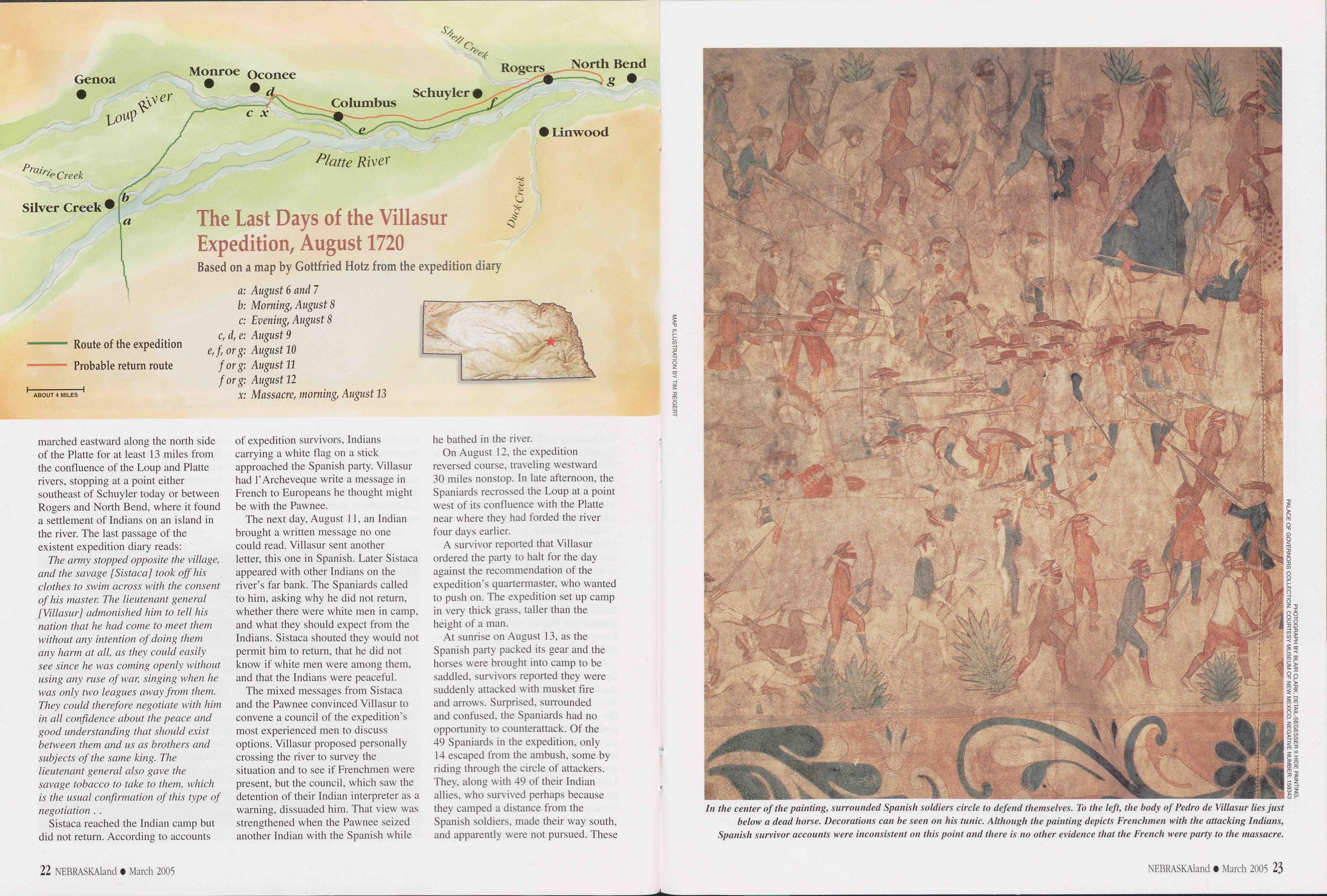
Sistaca reached the Indian camp but did not return. According to accounts of expedition survivors, Indians carrying a white flag on a stick approached the Spanish party. Villasur had 1’Archeveque write a message in French to Europeans he thought might be with the Pawnee.
The next day, August 11, an Indian brought a written message no one could read. Villasur sent another letter, this one in Spanish. Later Sistaca appeared with other Indians on the river’s far bank. The Spaniards called to him, asking why he did not return, whether there were white men in camp, and what they should expect from the Indians. Sistaca shouted they would not permit him to return, that he did not know if white men were among them, and that the Indians were peaceful.
The mixed messages from Sistaca and the Pawnee convinced Villasur to convene a council of the expedition’s most experienced men to discuss options. Villasur proposed personally crossing the river to survey the situation and to see if Frenchmen were present, but the council, which saw the detention of their Indian interpreter as a warning, dissuaded him. That view was strengthened when the Pawnee seized another Indian with the Spanish while he bathed in the river.
On August 12, the expedition reversed course, traveling westward 30 miles nonstop. In late afternoon, the Spaniards recrossed the Loup at a point west of its confluence with the Platte near where they had forded the river four days earlier.
A survivor reported that Villasur ordered the party to halt for the day against the recommendation of the expedition’s quartermaster, who wanted to push on. The expedition set up camp in very thick grass, taller than the height of a man.
At sunrise on August 13, as the Spanish party packed its gear and the horses were brought into camp to be saddled, survivors reported they were suddenly attacked with musket fire and arrows. Surprised, surrounded and confused, the Spaniards had no opportunity to counterattack. Of the 49 Spaniards in the expedition, only 14 escaped from the ambush, some by riding through the circle of attackers. They, along with 49 of their Indian allies, who survived perhaps because they camped a distance from the Spanish soldiers, made their way south, and apparently were not pursued. These 22 NEBRASKAland • March 2005
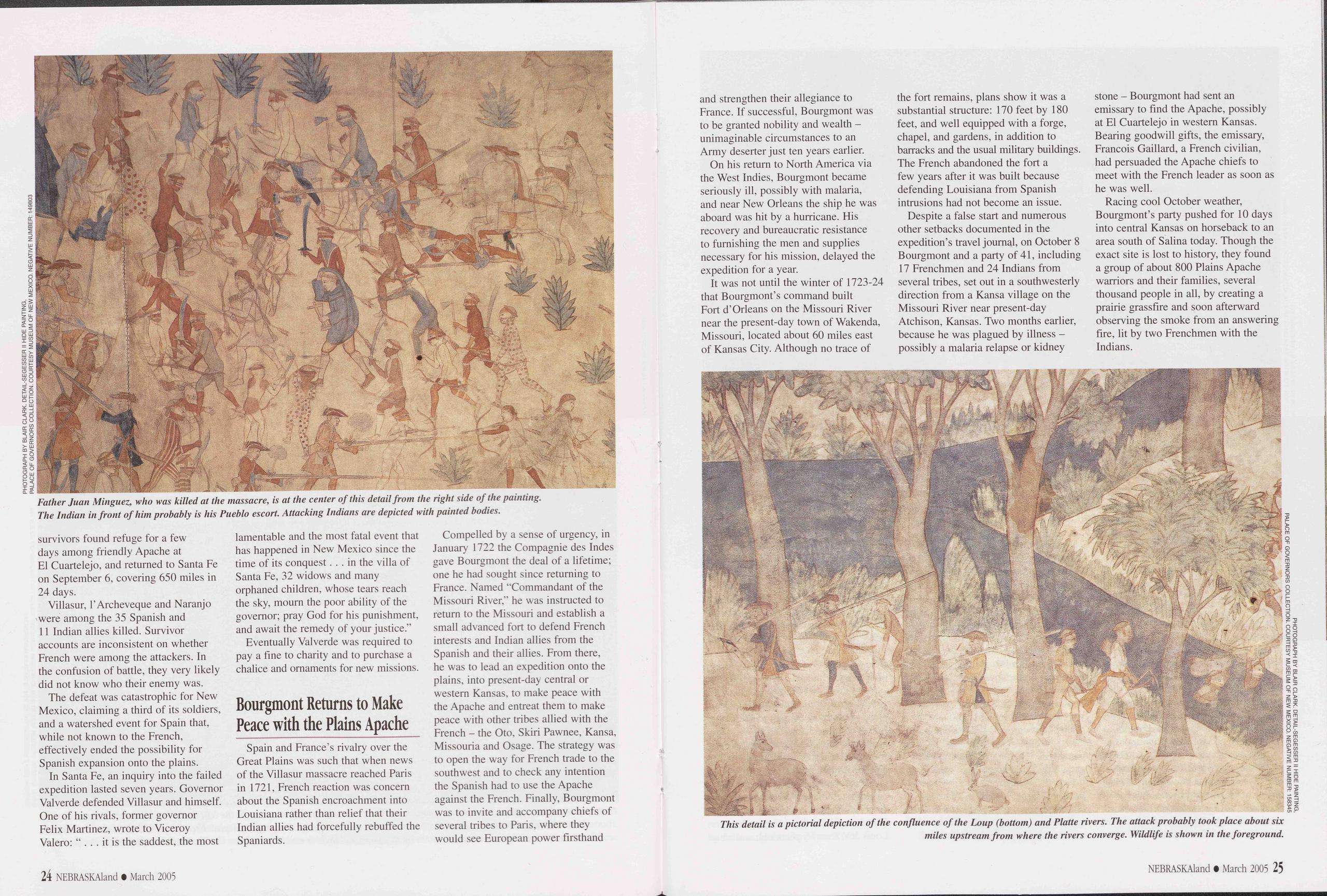
Villasur, 1’Archeveque and Naranjo were among the 35 Spanish and 11 Indian allies killed. Survivor accounts are inconsistent on whether French were among the attackers. In the confusion of battle, they very likely did not know who their enemy was.
The defeat was catastrophic for New Mexico, claiming a third of its soldiers, and a watershed event for Spain that, while not known to the French, effectively ended the possibility for Spanish expansion onto the plains.
In Santa Fe, an inquiry into the failed expedition lasted seven years. Governor Valverde defended Villasur and himself. One of his rivals, former governor Felix Martinez, wrote to Viceroy Valero: “ ... it is the saddest, the most lamentable and the most fatal event that has happened in New Mexico since the time of its conquest... in the villa of Santa Fe, 32 widows and many orphaned children, whose tears reach the sky, mourn the poor ability of the governor; pray God for his punishment, and await the remedy of your justice.”
Eventually Valverde was required to pay a fine to charity and to purchase a chalice and ornaments for new missions.
Bourgmont Returns to Make Peace with the Plains ApacheSpain and France’s rivalry over the Great Plains was such that when news of the Villasur massacre reached Paris in 1721, French reaction was concern about the Spanish encroachment into Louisiana rather than relief that their Indian allies had forcefully rebuffed the Spaniards.
Compelled by a sense of urgency, in January 1722 the Compagnie des Indes gave Bourgmont the deal of a lifetime; one he had sought since returning to France. Named “Commandant of the Missouri River,” he was instructed to return to the Missouri and establish a small advanced fort to defend French interests and Indian allies from the Spanish and their allies. From there, he was to lead an expedition onto the plains, into present-day central or western Kansas, to make peace with the Apache and entreat them to make peace with other tribes allied with the French - the Oto, Skiri Pawnee, Kansa, Missouria and Osage. The strategy was to open the way for French trade to the southwest and to check any intention the Spanish had to use the Apache against the French. Finally, Bourgmont was to invite and accompany chiefs of several tribes to Paris, where they would see European power firsthand 24 NEBRASKAland • March 2005 and strengthen their allegiance to France. If successful, Bourgmont was to be granted nobility and wealth - unimaginable circumstances to an Army deserter just ten years earlier.
On his return to North America via the West Indies, Bourgmont became seriously ill, possibly with malaria, and near New Orleans the ship he was aboard was hit by a hurricane. His recovery and bureaucratic resistance to furnishing the men and supplies necessary for his mission, delayed the expedition for a year.
It was not until the winter of 1723-24 that Bourgmont’s command built Fort d’Orleans on the Missouri River near the present-day town of Wakenda, Missouri, located about 60 miles east of Kansas City. Although no trace of
Despite a false start and numerous other setbacks documented in the expedition’s travel journal, on October 8 Bourgmont and a party of 41, including 17 Frenchmen and 24 Indians from several tribes, set out in a southwesterly direction from a Kansa village on the Missouri River near present-day Atchison, Kansas. Two months earlier, because he was plagued by illness - possibly a malaria relapse or kidney stone - Bourgmont had sent an emissary to find the Apache, possibly at El Cuartelejo in western Kansas. Bearing goodwill gifts, the emissary, Francois Gaillard, a French civilian, had persuaded the Apache chiefs to meet with the French leader as soon as he was well.
Racing cool October weather, Bourgmont’s party pushed for 10 days into central Kansas on horseback to an area south of Salina today. Though the exact site is lost to history, they found a group of about 800 Plains Apache warriors and their families, several thousand people in all, by creating a prairie grassfire and soon afterward observing the smoke from an answering fire, lit by two Frenchmen with the Indians.
NEBRASKAland • March 2005 25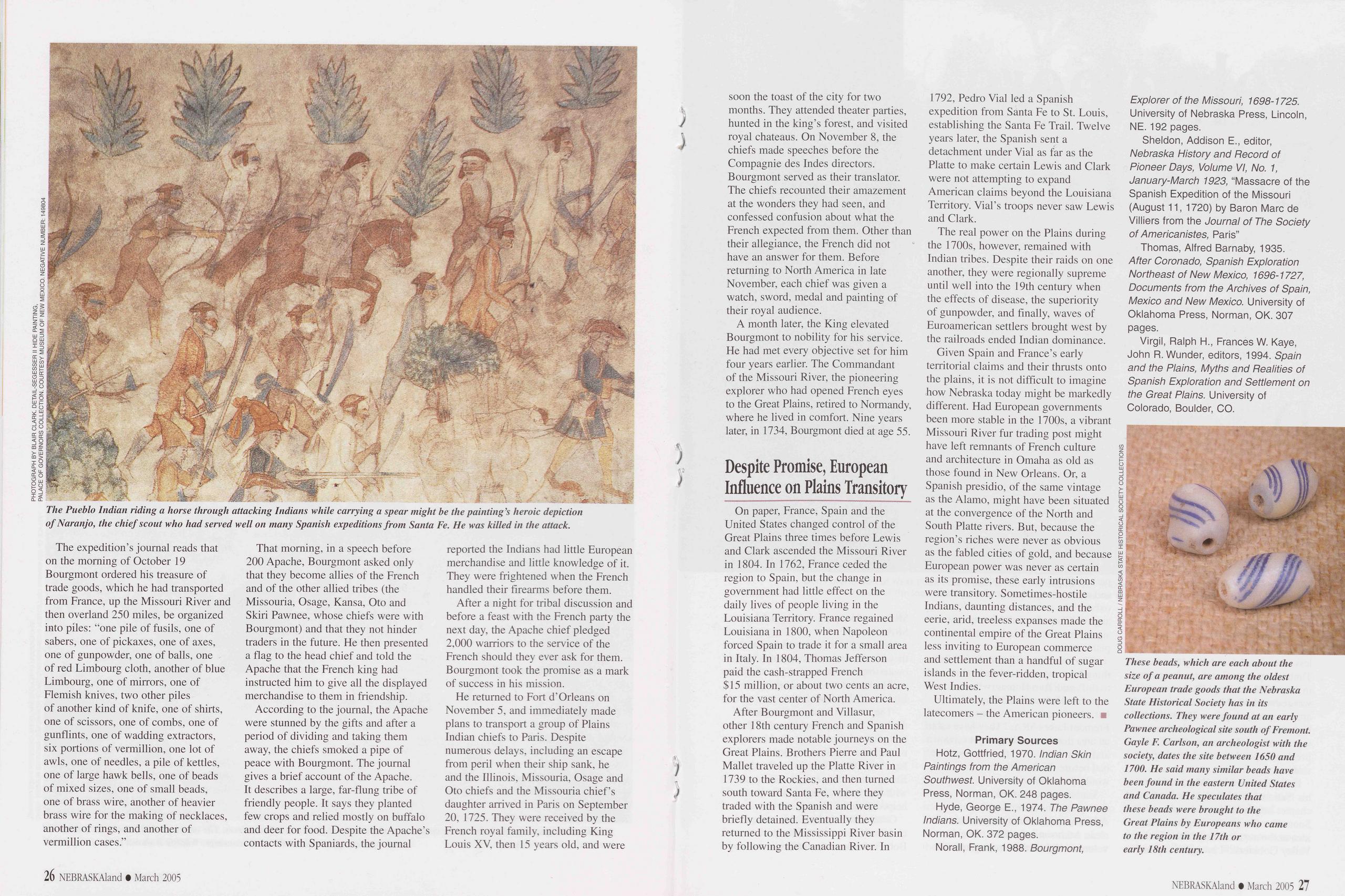
The expedition’s journal reads that on the morning of October 19 Bourgmont ordered his treasure of trade goods, which he had transported from France, up the Missouri River and then overland 250 miles, be organized into piles: "one pile of fusils, one of sabers, one of pickaxes, one of axes, one of gunpowder, one of balls, one of red Limbourg cloth, another of blue Limbourg, one of mirrors, one of Flemish knives, two other piles of another kind of knife, one of shirts, one of scissors, one of combs, one of gunflints, one of wadding extractors, six portions of vermillion, one lot of awls, one of needles, a pile of kettles, one of large hawk bells, one of beads of mixed sizes, one of small beads, one of brass wire, another of heavier brass wire for the making of necklaces, another of rings, and another of vermillion cases.”
That morning, in a speech before 200 Apache, Bourgmont asked only that they become allies of the French and of the other allied tribes (the Missouria, Osage, Kansa, Oto and Skiri Pawnee, whose chiefs were with Bourgmont) and that they not hinder traders in the future. He then presented a flag to the head chief and told the Apache that the French king had instructed him to give all the displayed merchandise to them in friendship.
According to the journal, the Apache were stunned by the gifts and after a period of dividing and taking them away, the chiefs smoked a pipe of peace with Bourgmont. The journal gives a brief account of the Apache. It describes a large, far-flung tribe of friendly people. It says they planted few crops and relied mostly on buffalo and deer for food. Despite the Apache’s contacts with Spaniards, the journal reported the Indians had little European merchandise and little knowledge of it. They were frightened when the French handled their firearms before them.
After a night for tribal discussion and before a feast with the French party the next day, the Apache chief pledged 2,000 warriors to the service of the French should they ever ask for them. Bourgmont took the promise as a mark of success in his mission.
He returned to Fort d’Orleans on November 5, and immediately made plans to transport a group of Plains Indian chiefs to Paris. Despite numerous delays, including an escape from peril when their ship sank, he and the Illinois, Missouria, Osage and Oto chiefs and the Missouria chief’s daughter arrived in Paris on September 20, 1725. They were received by the French royal family, including King Louis XV, then 15 years old, and were 26 NEBRASKAland • March 2005 soon the toast of the city for two months. They attended theater parties, hunted in the king’s forest, and visited royal chateaus. On November 8, the chiefs made speeches before the Compagnie des Indes directors. Bourgmont served as their translator. The chiefs recounted their amazement at the wonders they had seen, and confessed confusion about what the French expected from them. Other than their allegiance, the French did not have an answer for them. Before returning to North America in late November, each chief was given a watch, sword, medal and painting of their royal audience.
A month later, the King elevated Bourgmont to nobility for his service. He had met every objective set for him four years earlier. The Commandant of the Missouri River, the pioneering explorer who had opened French eyes to the Great Plains, retired to Normandy, where he lived in comfort. Nine years later, in 1734, Bourgmont died at age 55.
Despite Promise, European Influence on Plains TransitoryOn paper, France, Spain and the United States changed control of the Great Plains three times before Lewis and Clark ascended the Missouri River in 1804. In 1762, France ceded the region to Spain, but the change in government had little effect on the daily lives of people living in the Louisiana Territory. France regained Louisiana in 1800, when Napoleon forced Spain to trade it for a small area in Italy. In 1804, Thomas Jefferson paid the cash-strapped French $15 million, or about two cents an acre, for the vast center of North America.
After Bourgmont and Villasur, other 18th century French and Spanish explorers made notable journeys on the Great Plains. Brothers Pierre and Paul Mallet traveled up the Platte River in 1739 to the Rockies, and then turned south toward Santa Fe, where they traded with the Spanish and were briefly detained. Eventually they returned to the Mississippi River basin by following the Canadian River. In 1792, Pedro Vial led a Spanish expedition from Santa Fe to St. Louis, establishing the Santa Fe Trail. Twelve years later, the Spanish sent a detachment under Vial as far as the Platte to make certain Lewis and Clark were not attempting to expand American claims beyond the Louisiana Territory. Vial’s troops never saw Lewis and Clark.
The real power on the Plains during the 1700s, however, remained with Indian tribes. Despite their raids on one another, they were regionally supreme until well into the 19th century when the effects of disease, the superiority of gunpowder, and finally, waves of Euroamerican settlers brought west by the railroads ended Indian dominance.
Given Spain and France’s early territorial claims and their thrusts onto the plains, it is not difficult to imagine how Nebraska today might be markedly different. Had European governments been more stable in the 1700s, a vibrant Missouri River fur trading post might have left remnants of French culture and architecture in Omaha as old as those found in New Orleans. Or, a Spanish presidio, of the same vintage as the Alamo, might have been situated at the convergence of the North and South Platte rivers. But, because the region’s riches were never as obvious as the fabled cities of gold, and because European power was never as certain as its promise, these early intrusions were transitory. Sometimes-hostile Indians, daunting distances, and the eerie, arid, treeless expanses made the continental empire of the Great Plains less inviting to European commerce and settlement than a handful of sugar islands in the fever-ridden, tropical West Indies.
Ultimately, the Plains were left to the latecomers - the American pioneers.
Primary Sources Hotz, Gottfried, 1970. Indian Skin Paintings from the American Southwest. University of Oklahoma Press, Norman, OK. 248 pages. Hyde, George E., 1974. The Pawnee Indians. University of Oklahoma Press, Norman, OK. 372 pages. Norall, Frank, 1988. Bourgmont, Explorer of the Missouri, 1698-1725. University of Nebraska Press, Lincoln, NE. 192 pages. Sheldon, Addison E., editor, Nebraska History and Record of Pioneer Days, Volume VI, No. 1, January-March 1923, “Massacre of the Spanish Expedition of the Missouri (August 11, 1720) by Baron Marc de Villiers from the Journal of The Society of Americanistes, Paris” Thomas, Alfred Barnaby, 1935. After Coronado, Spanish Exploration Northeast of New Mexico, 1696-1727, Documents from the Archives of Spain, Mexico and New Mexico. University of Oklahoma Press, Norman, OK. 307 pages. Virgil, Ralph H., Frances W. Kaye, John R. Wunder, editors, 1994. Spain and the Plains, Myths and Realities of Spanish Exploration and Settlement on the Great Plains. University of Colorado, Boulder, CO.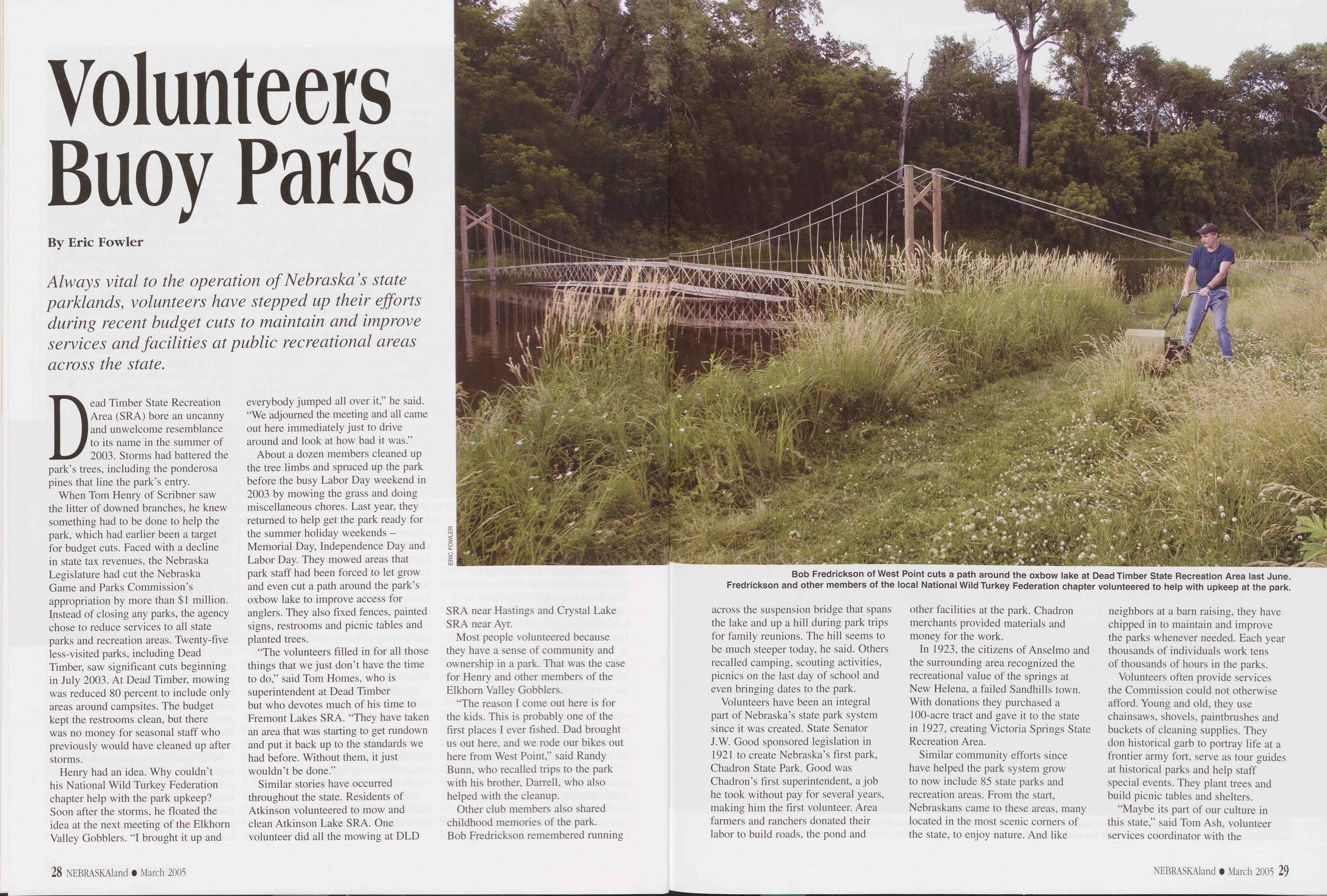
Volunteers Buoy Parks
Always vital to the operation of Nebraska’s state parklands, volunteers have stepped up their efforts during recent budget cuts to maintain and improve services and facilities at public recreational areas across the state.
Dead Timber State Recreation Area (SRA) bore an uncanny and unwelcome resemblance to its name in the summer of 2003. Storms had battered the park’s trees, including the ponderosa pines that line the park’s entry.
When Tom Henry of Scribner saw the litter of downed branches, he knew something had to be done to help the park, which had earlier been a target for budget cuts. Faced with a decline in state tax revenues, the Nebraska Legislature had cut the Nebraska Game and Parks Commission’s appropriation by more than $1 million. Instead of closing any parks, the agency chose to reduce services to all state parks and recreation areas. Twenty-five less-visited parks, including Dead Timber, saw significant cuts beginning in July 2003. At Dead Timber, mowing was reduced 80 percent to include only areas around campsites. The budget kept the restrooms clean, but there was no money for seasonal staff who previously would have cleaned up after storms.
Henry had an idea. Why couldn’t his National Wild Turkey Federation chapter help with the park upkeep? Soon after the storms, he floated the idea at the next meeting of the Elkhorn Valley Gobblers. "I brought it up and everybody jumped all over it,” he said. "We adjourned the meeting and all came out here immediately just to drive around and look at how bad it was.”
About a dozen members cleaned up the tree limbs and spruced up the park before the busy Labor Day weekend in 2003 by mowing the grass and doing miscellaneous chores. Last year, they returned to help get the park ready for the summer holiday weekends - Memorial Day, Independence Day and Labor Day. They mowed areas that park staff had been forced to let grow and even cut a path around the park’s oxbow lake to improve access for anglers. They also fixed fences, painted signs, restrooms and picnic tables and planted trees.
"The volunteers filled in for all those things that we just don’t have the time to do,” said Tom Homes, who is superintendent at Dead Timber but who devotes much of his time to Fremont Lakes SRA. "They have taken an area that was starting to get rundown and put it back up to the standards we had before. Without them, it just wouldn’t be done.”
Similar stories have occurred throughout the state. Residents of Atkinson volunteered to mow and clean Atkinson Lake SRA. One volunteer did all the mowing at DLD SRA near Hastings and Crystal Lake SRA near Ayr.
Most people volunteered because they have a sense of community and ownership in a park. That was the case for Henry and other members of the Elkhorn Valley Gobblers.
"The reason I come out here is for the kids. This is probably one of the first places I ever fished. Dad brought us out here, and we rode our bikes out here from West Point,” said Randy Bunn, who recalled trips to the park with his brother, Darrell, who also helped with the cleanup.
Other club members also shared childhood memories of the park. Bob Fredrickson remembered running 28 NEBRASKAland • March 2005
Volunteers have been an integral part of Nebraska’s state park system since it was created. State Senator J.W. Good sponsored legislation in 1921 to create Nebraska’s first park, Chadron State Park. Good was Chadron’s first superintendent, a job he took without pay for several years, making him the first volunteer. Area farmers and ranchers donated their labor to build roads, the pond and other facilities at the park. Chadron merchants provided materials and money for the work.
In 1923, the citizens of Anselmo and the surrounding area recognized the recreational value of the springs at New Helena, a failed Sandhills town. With donations they purchased a 100-acre tract and gave it to the state in 1927, creating Victoria Springs State Recreation Area.
Similar community efforts since have helped the park system grow to now include 85 state parks and recreation areas. From the start, Nebraskans came to these areas, many located in the most scenic corners of the state, to enjoy nature. And like neighbors at a barn raising, they have chipped in to maintain and improve the parks whenever needed. Each year thousands of individuals work tens of thousands of hours in the parks.
Volunteers often provide services the Commission could not otherwise afford. Young and old, they use chainsaws, shovels, paintbrushes and buckets of cleaning supplies. They don historical garb to portray life at a frontier army fort, serve as tour guides at historical parks and help staff special events. They plant trees and build picnic tables and shelters.
“Maybe its part of our culture in this state,” said Tom Ash, volunteer services coordinator with the NEBRASKAland • March 2005 29 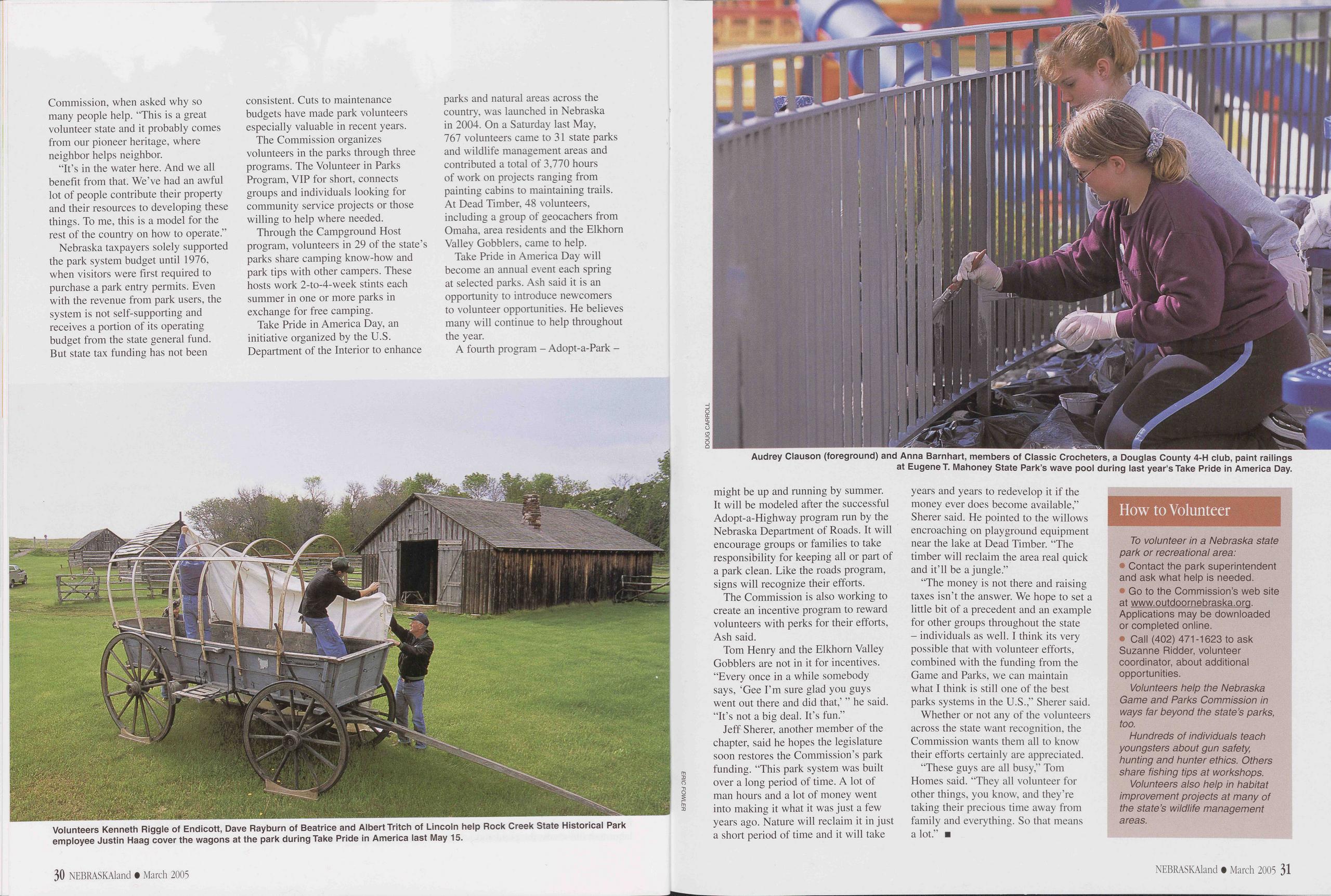 Commission, when asked why so many people help. “This is a great volunteer state and it probably comes from our pioneer heritage, where neighbor helps neighbor.
“It’s in the water here. And we all benefit from that. We’ve had an awful lot of people contribute their property and their resources to developing these things. To me, this is a model for the rest of the country on how to operate.”
Nebraska taxpayers solely supported the park system budget until 1976, when visitors were first required to purchase a park entry permits. Even with the revenue from park users, the system is not self-supporting and receives a portion of its operating budget from the state general fund. But state tax funding has not been
The Commission organizes volunteers in the parks through three programs. The Volunteer in Parks Program, VIP for short, connects groups and individuals looking for community service projects or those willing to help where needed.
Through the Campground Host program, volunteers in 29 of the state’s parks share camping know-how and park tips with other campers. These hosts work 2-to-4-week stints each summer in one or more parks in exchange for free camping.
Take Pride in America Day, an initiative organized by the U.S. Department of the Interior to enhance parks and natural areas across the country, was launched in Nebraska in 2004. On a Saturday last May, 767 volunteers came to 31 state parks and wildlife management areas and contributed a total of 3,770 hours of work on projects ranging from painting cabins to maintaining trails. At Dead Timber, 48 volunteers, including a group of geocachers from Omaha, area residents and the Elkhorn Valley Gobblers, came to help.
Take Pride in America Day will become an annual event each spring at selected parks. Ash said it is an opportunity to introduce newcomers to volunteer opportunities. He believes many will continue to help throughout the year.
A fourth program - Adopt-a-Park - 30 NEBRASKAland • March 2005
The Commission is also working to create an incentive program to reward volunteers with perks for their efforts, Ash said.
Tom Henry and the Elkhorn Valley Gobblers are not in it for incentives. “Every once in a while somebody says, ‘Gee I’m sure glad you guys went out there and did that,’ ” he said. “It’s not a big deal. It’s fun.”
Jeff Sherer, another member of the chapter, said he hopes the legislature soon restores the Commission’s park funding. “This park system was built over a long period of time. A lot of man hours and a lot of money went into making it what it was just a few years ago. Nature will reclaim it in just a short period of time and it will take years and years to redevelop it if the money ever does become available,” Sherer said. He pointed to the willows encroaching on playground equipment near the lake at Dead Timber. “The timber will reclaim the area real quick and it’ll be a jungle.”
“The money is not there and raising taxes isn’t the answer. We hope to set a little bit of a precedent and an example for other groups throughout the state - individuals as well. I think its very possible that with volunteer efforts, combined with the funding from the Game and Parks, we can maintain what I think is still one of the best parks systems in the U.S.,” Sherer said.
Whether or not any of the volunteers across the state want recognition, the Commission wants them all to know their efforts certainly are appreciated.
“These guys are all busy,” Tom Homes said. “They all volunteer for other things, you know, and they’re taking their precious time away from family and everything. So that means a lot.”
How to Volunteer To volunteer in a Nebraska state park or recreational area: Contact the park superintendent and ask what help is needed. Go to the Commission’s web site at www.outdoornebraska.org. Applications may be downloaded or completed online. Call (402) 471-1623 to ask Suzanne Ridder, volunteer coordinator, about additional opportunities. Volunteers help the Nebraska Game and Parks Commission in ways far beyond the state’s parks, too. Hundreds of individuals teach youngsters about gun safety hunting and hunter ethics. Others share fishing tips at workshops. Volunteers also help in habitat improvement projects at many of the state’s wildlife management areas. NEBRASKAland March 2005 31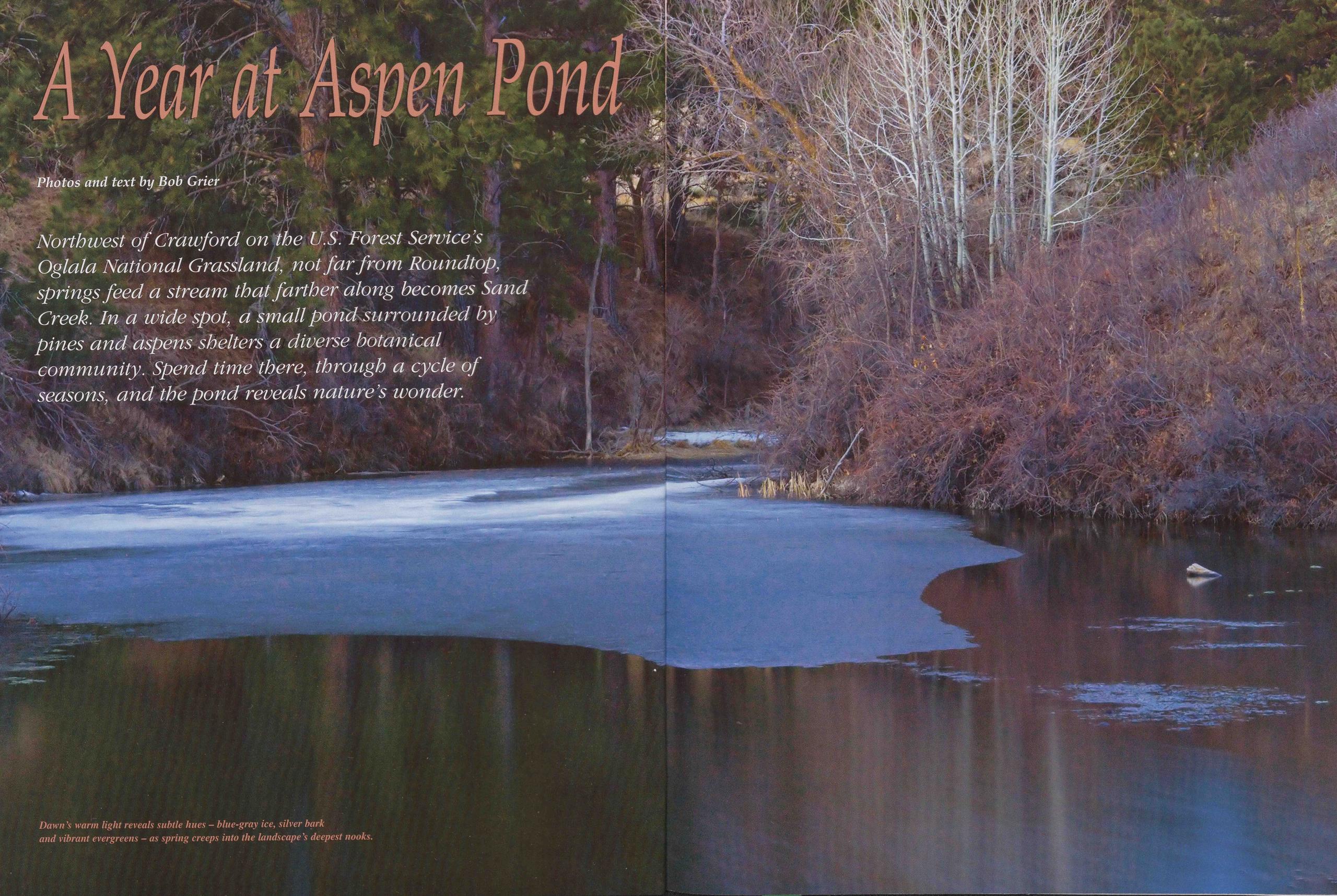
A Year at Aspen Pond
Northwest of Crawford on the U.S. Forest Service’s Oglala National Grassland, not far from Roundtop, springs feed a stream that farther along becomes Sand Creek. In a wide spot, a small pond surrounded by pines and aspens shelters a diverse botanical community. Spend time there, through a cycle of seasons, and the pond reveals nature’s wonder.
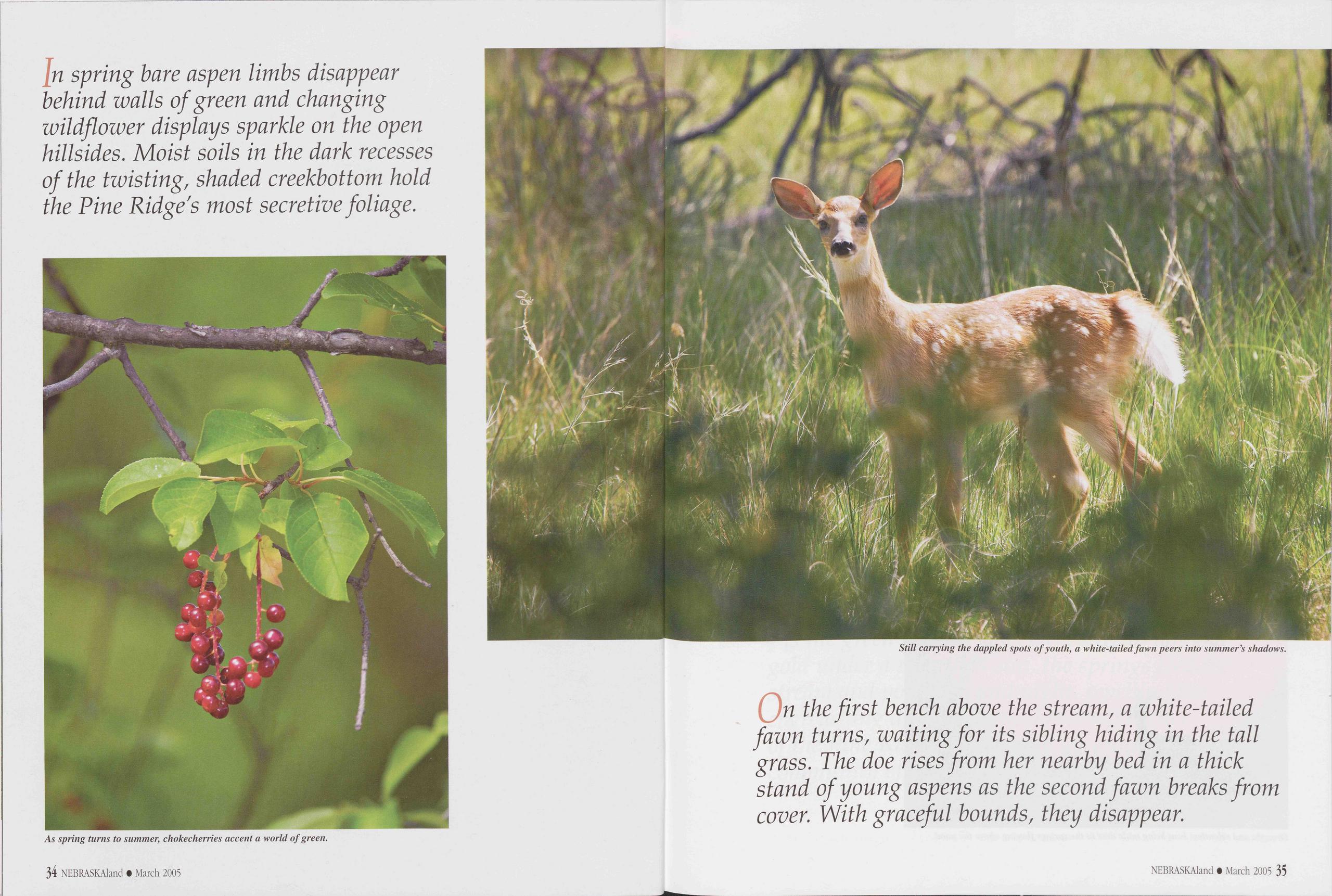
In spring bare aspen limbs disappear behind walls of green and changing wildflower displays sparkle on the open hillsides. Moist soils in the dark recesses of the twisting, shaded creekbottom hold the Pine Ridge's most secretive foliage.
On the first bench above the stream, a white-tailed fawn turns, waiting for its sibling hiding in the tall grass. The doe rises from her nearby bed in a thick stand of young aspens as the second fawn breaks from cover. With graceful bounds, they disappear.
NEBRASKAland • March 2005 35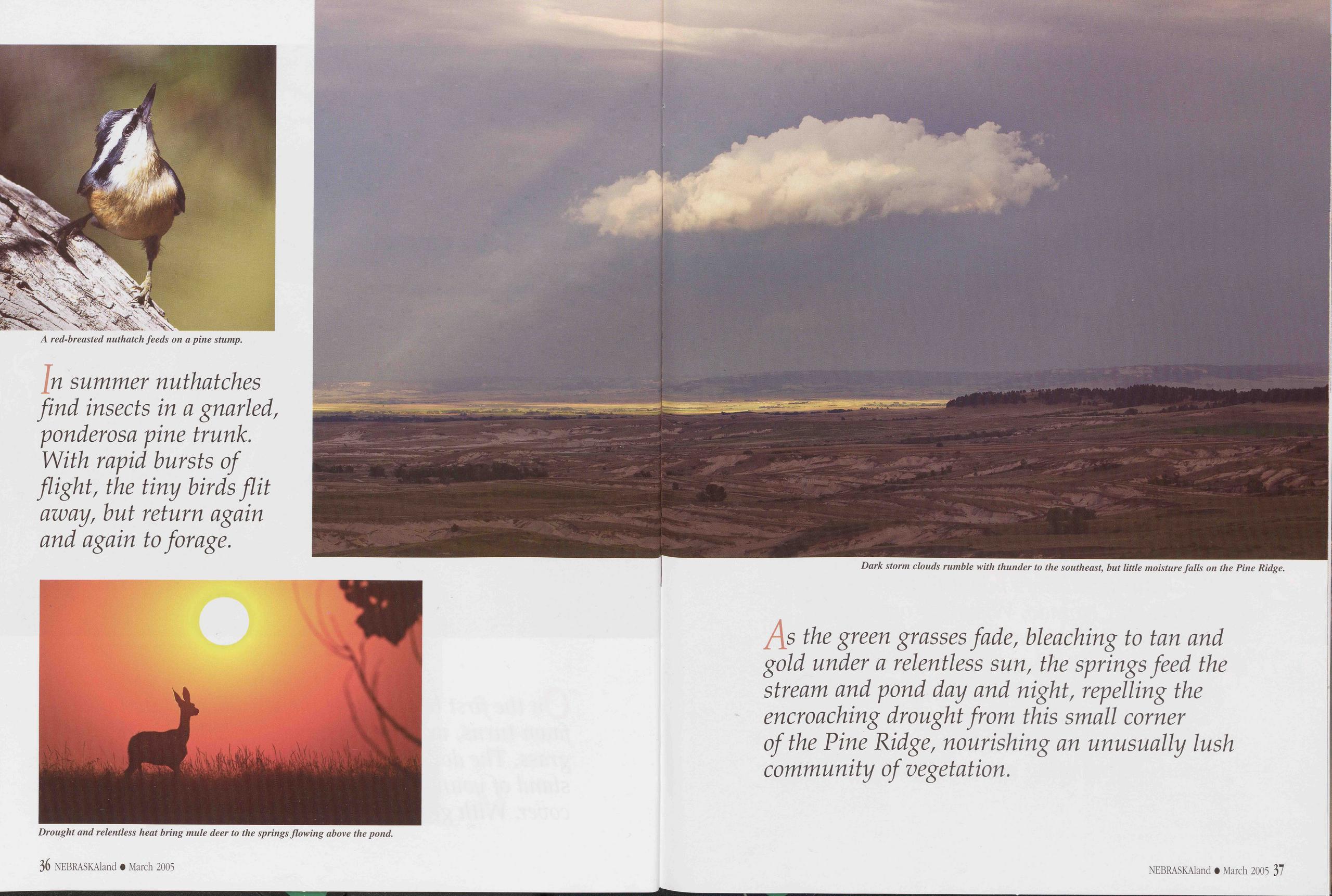
In summer nuthatches find insects in a gnarled, ponderosa pine trunk. With rapid bursts of flight, the tiny birds flit away, but return again and again to forage.
As the green grasses fade, bleaching to tan and gold under a relentless sun, the springs feed the stream and pond day and night, repelling the encroaching drought from this small corner of the Pine Ridge, nourishing an unusually lush community of vegetation.
NEBRASKAland • March 2005 37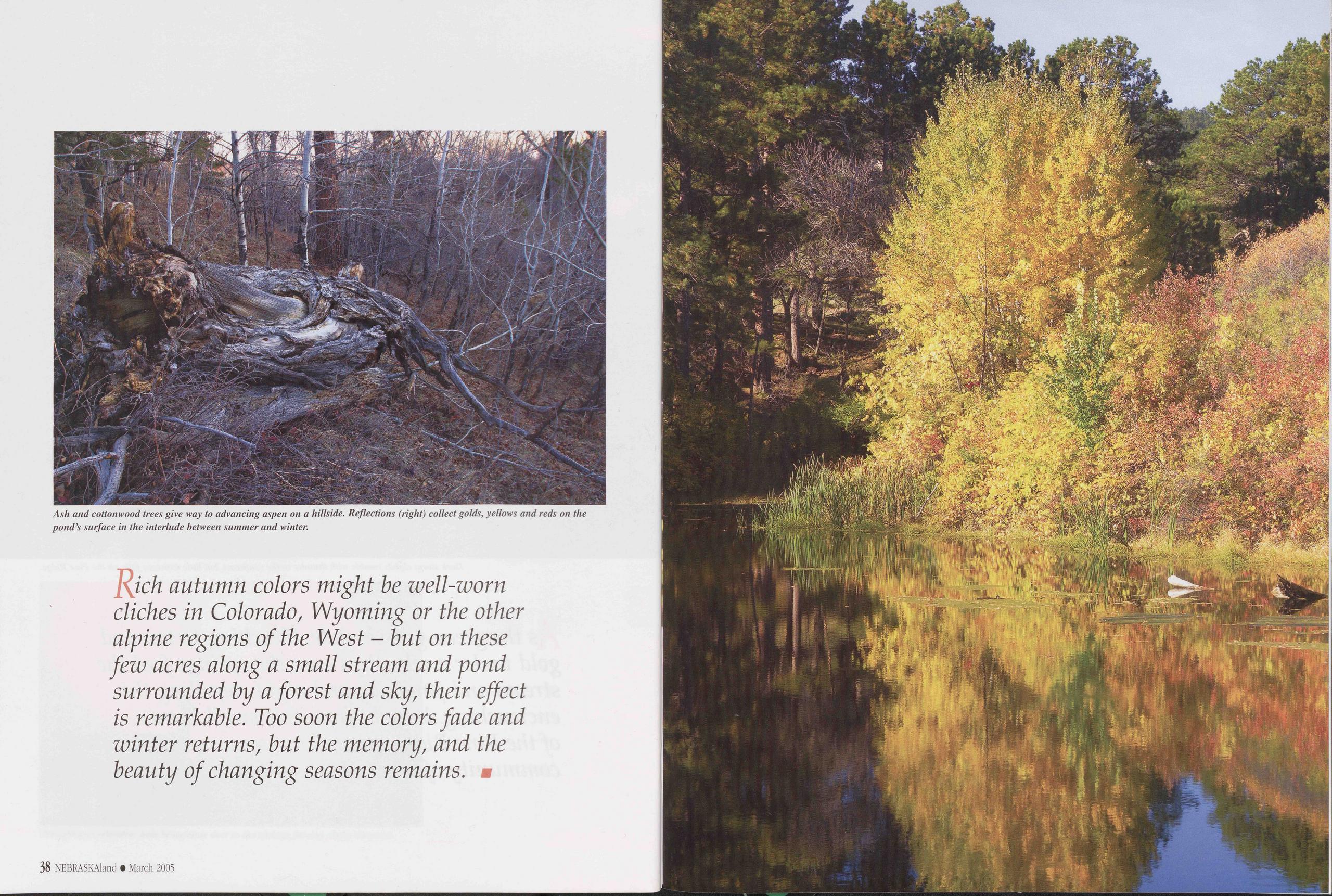
Rich autumn colors might be well-worn cliches in Colorado, Wyoming or the other alpine regions of the West - but on these few acres along a small stream and pond surrounded by a forest and sky, their effect is remarkable. Too soon the colors fade and winter returns, but the memory, and the beauty ofchanging seasons remains.
38 NEBRASKAland • March 2005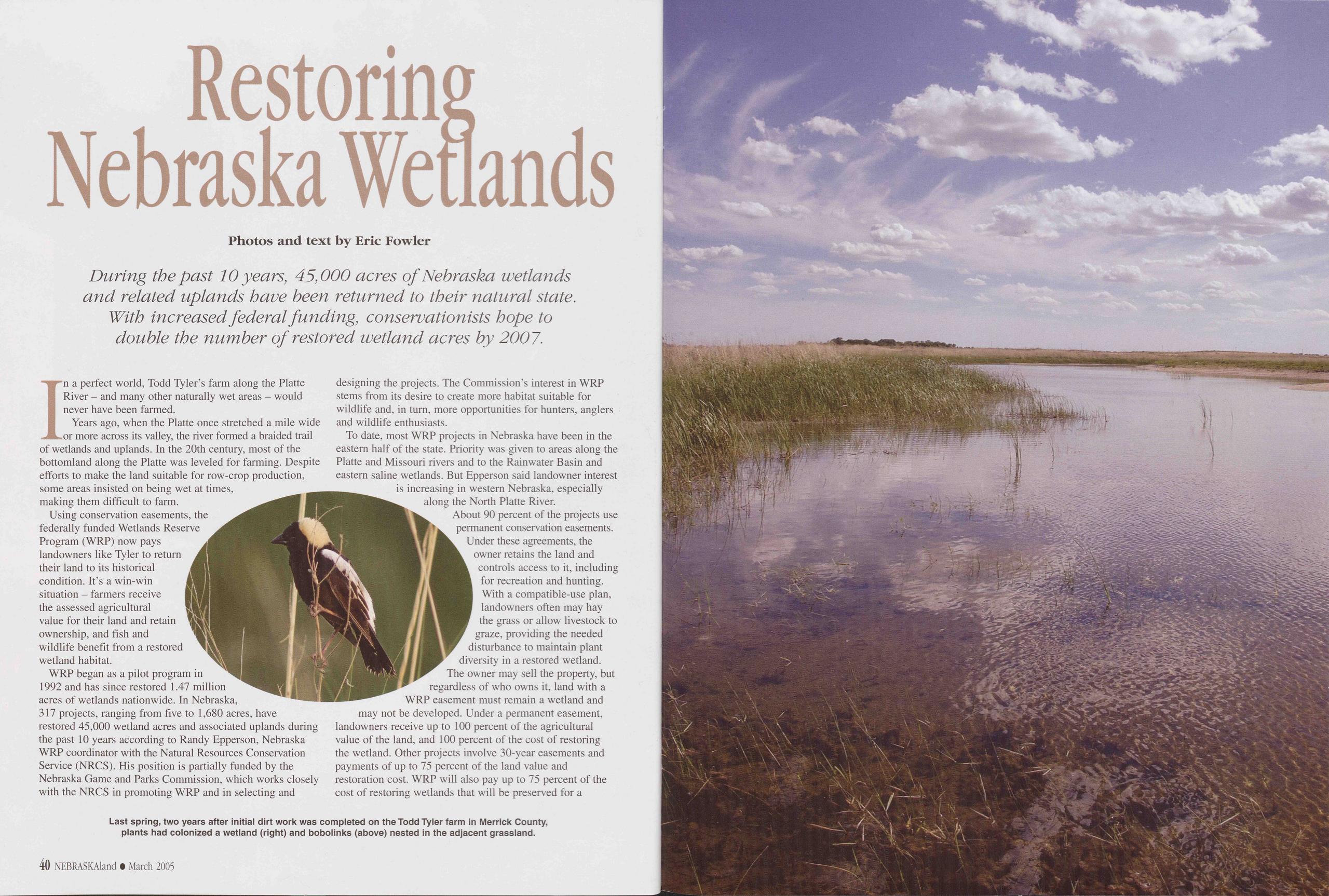
Restoring Nebraska Wetlands
During the past 10 years, 45,000 acres of Nebraska wetlands and related uplands have been returned to their natural state. With increased federal funding, conservationists hope to double the number of restored wetland acres by 2007.
In a perfect world, Todd Tyler’s farm along the Platte River - and many other naturally wet areas - would never have been farmed.
Years ago, when the Platte once stretched a mile wide or more across its valley, the river formed a braided trail of wetlands and uplands. In the 20th century, most of the bottomland along the Platte was leveled for farming. Despite efforts to make the land suitable for row-crop production, some areas insisted on being wet at times, making them difficult to farm.
Using conservation easements, the federally funded Wetlands Reserve Program (WRP) now pays landowners like Tyler to return their land to its historical condition. It’s a win-win situation - farmers receive the assessed agricultural value for their land and retain ownership, and fish and wildlife benefit from a restored wetland habitat.
WRP began as a pilot program in 1992 and has since restored 1.47 million acres of wetlands nationwide. In Nebraska, 317 projects, ranging from five to 1,680 acres, have restored 45,000 wetland acres and associated uplands during the past 10 years according to Randy Epperson, Nebraska WRP coordinator with the Natural Resources Conservation Service (NRCS). His position is partially funded by the Nebraska Game and Parks Commission, which works closely with the NRCS in promoting WRP and in selecting and
To date, most WRP projects in Nebraska have been in the eastern half of the state. Priority was given to areas along the Platte and Missouri rivers and to the Rainwater Basin and eastern saline wetlands. But Epperson said landowner interest is increasing in western Nebraska, especially along the North Platte River.
About 90 percent of the projects use permanent conservation easements. Under these agreements, the owner retains the land and controls access to it, including for recreation and hunting. With a compatible-use plan, landowners often may hay the grass or allow livestock to graze, providing the needed disturbance to maintain plant diversity in a restored wetland. The owner may sell the property, but regardless of who owns it, land with a WRP easement must remain a wetland and may not be developed. Under a permanent easement, landowners receive up to 100 percent of the agricultural value of the land, and 100 percent of the cost of restoring the wetland. Other projects involve 30-year easements and payments of up to 75 percent of the land value and restoration cost. WRP will also pay up to 75 percent of the cost of restoring wetlands that will be preserved for a 40 NEBRASKAland • March 2005
The 2002 Federal Farm Bill increased funding for conservation programs, including WRP. That has allowed NRCS to reduce a backlog of worthwhile projects. In the fiscal year 2004, NRCS spent $9.5 million on 65 projects to restore wetlands on 10,000 acres, putting Nebraska into the top five states in the nation for acreage enrolled during the year.
Last year $4 million went to Wetlands Reserve Enhancement Program (WREP) projects. WREP targets land in the Missouri River floodplain between Ponca and Rulo. The Nature Conservancy and natural resources districts along the Missouri River have each pledged $ 1 million to WREP to increase incentives for landowners. These funds created projects in counties where there previously had been none.
Epperson said these WREP projects complement large areas of habitat restoration done by the U.S. Army Corps of Engineers, U.S. Fish and Wildlife Service and the Commission along the river. Nebraska quickly used its initial funding allocation last year and Epperson expects this year’s allocation to be spent just as rapidly. If that occurs, the state might be eligible for more funds. A total of $16 million is available for WRP and WREP projects in Nebraska this year.
Ted LaGrange, wetland program manager with the Commission, said all wetlands share three characteristics: They are wet most years for at least two weeks during the growing season; they support rooted vegetation that is 42 NEBRASKAland • March 2005 adapted to growing in inundated or saturated soils; and they contain soils that develop certain characteristics in these wet conditions. “These soil characteristics stay intact even after a wetland is drained and farmed,” LaGrange said. “So you might not be able to go out and see cattails and say this is a wetland, but you can look at the soils and see the characteristics that developed when it was a wetland.”
All types of wetlands found in Nebraska can be restored through the WRP, including wetland depressions formed in low spots where there is no outlet to a stream, riparian wetlands formed along streams and rivers, and Sandhills wetlands formed where the contour of the land dips below the ground water level.
LaGrange said a large amount of land in Nebraska is eligible for WRP. About 1 million of the estimated 2.9 million acres of wetlands found in the state in 1865 have been lost to agricultural and urban development, or through changes in streamflows caused primarily by channel changes and water diversion. The largest losses were in areas beyond the Sandhills, which still contains more than a million wetland acres.
In some cases, WRP is paying
“Once society felt there was an abundance of wetlands and the primary purpose was to really improve land for crop production,” LaGrange said. “We did and in some places in the state we managed to get rid of up to 90 percent of the wetlands.
“Society has shifted its views to the point where we are looking at the remaining wetlands as an asset or an amenity and realizing that we need to have programs that restore or bring them back.”
The most obvious benefit to increasing wetlands is creating wildlife habitat critical for migratory birds. Waterfowl, NEBRASKAland • March 2005 43 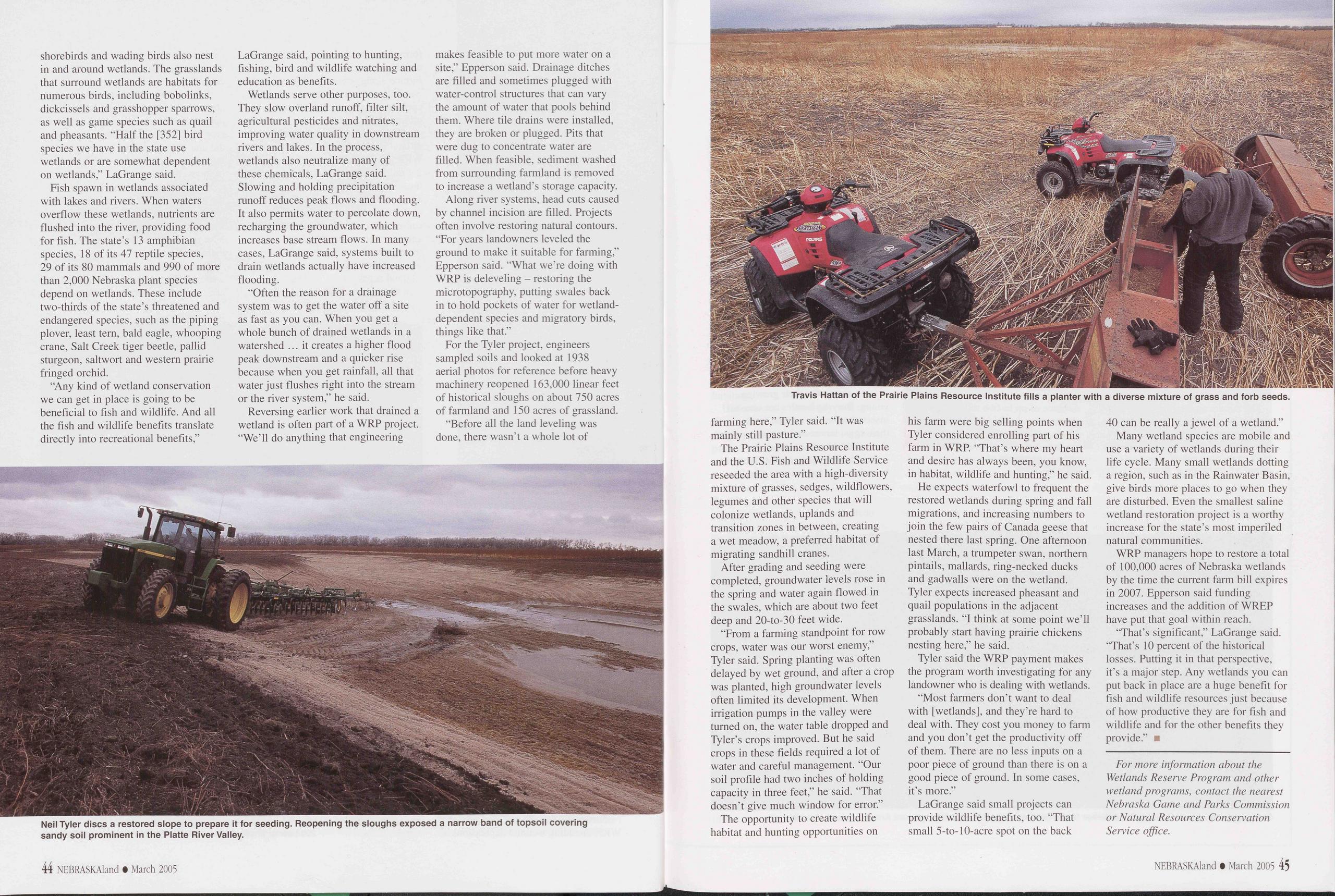 shorebirds and wading birds also nest in and around wetlands. The grasslands that surround wetlands are habitats for numerous birds, including bobolinks, dickcissels and grasshopper sparrows, as well as game species such as quail and pheasants. “Half the [352] bird species we have in the state use wetlands or are somewhat dependent on wetlands,” LaGrange said.
Fish spawn in wetlands associated with lakes and rivers. When waters overflow these wetlands, nutrients are flushed into the river, providing food for fish. The state’s 13 amphibian species, 18 of its 47 reptile species, 29 of its 80 mammals and 990 of more than 2,000 Nebraska plant species depend on wetlands. These include two-thirds of the state’s threatened and endangered species, such as the piping plover, least tern, bald eagle, whooping crane, Salt Creek tiger beetle, pallid sturgeon, saltwort and western prairie fringed orchid.
“Any kind of wetland conservation we can get in place is going to be beneficial to fish and wildlife. And all the fish and wildlife benefits translate directly into recreational benefits,”
Wetlands serve other purposes, too. They slow overland runoff, filter silt, agricultural pesticides and nitrates, improving water quality in downstream rivers and lakes. In the process, wetlands also neutralize many of these chemicals, LaGrange said. Slowing and holding precipitation runoff reduces peak flows and flooding. It also permits water to percolate down, recharging the groundwater, which increases base stream flows. In many cases, LaGrange said, systems built to drain wetlands actually have increased flooding.
“Often the reason for a drainage system was to get the water off a site as fast as you can. When you get a whole bunch of drained wetlands in a watershed ... it creates a higher flood peak downstream and a quicker rise because when you get rainfall, all that water just flushes right into the stream or the river system,” he said.
Reversing earlier work that drained a wetland is often part of a WRP project. “We’ll do anything that engineering makes feasible to put more water on a site,” Epperson said. Drainage ditches are filled and sometimes plugged with water-control structures that can vary the amount of water that pools behind them. Where tile drains were installed, they are broken or plugged. Pits that were dug to concentrate water are filled. When feasible, sediment washed from surrounding farmland is removed to increase a wetland’s storage capacity.
Along river systems, head cuts caused by channel incision are filled. Projects often involve restoring natural contours. “For years landowners leveled the ground to make it suitable for farming,” Epperson said. “What we’re doing with WRP is deleveling - restoring the microtopography, putting swales back in to hold pockets of water for wetland- dependent species and migratory birds, things like that.”
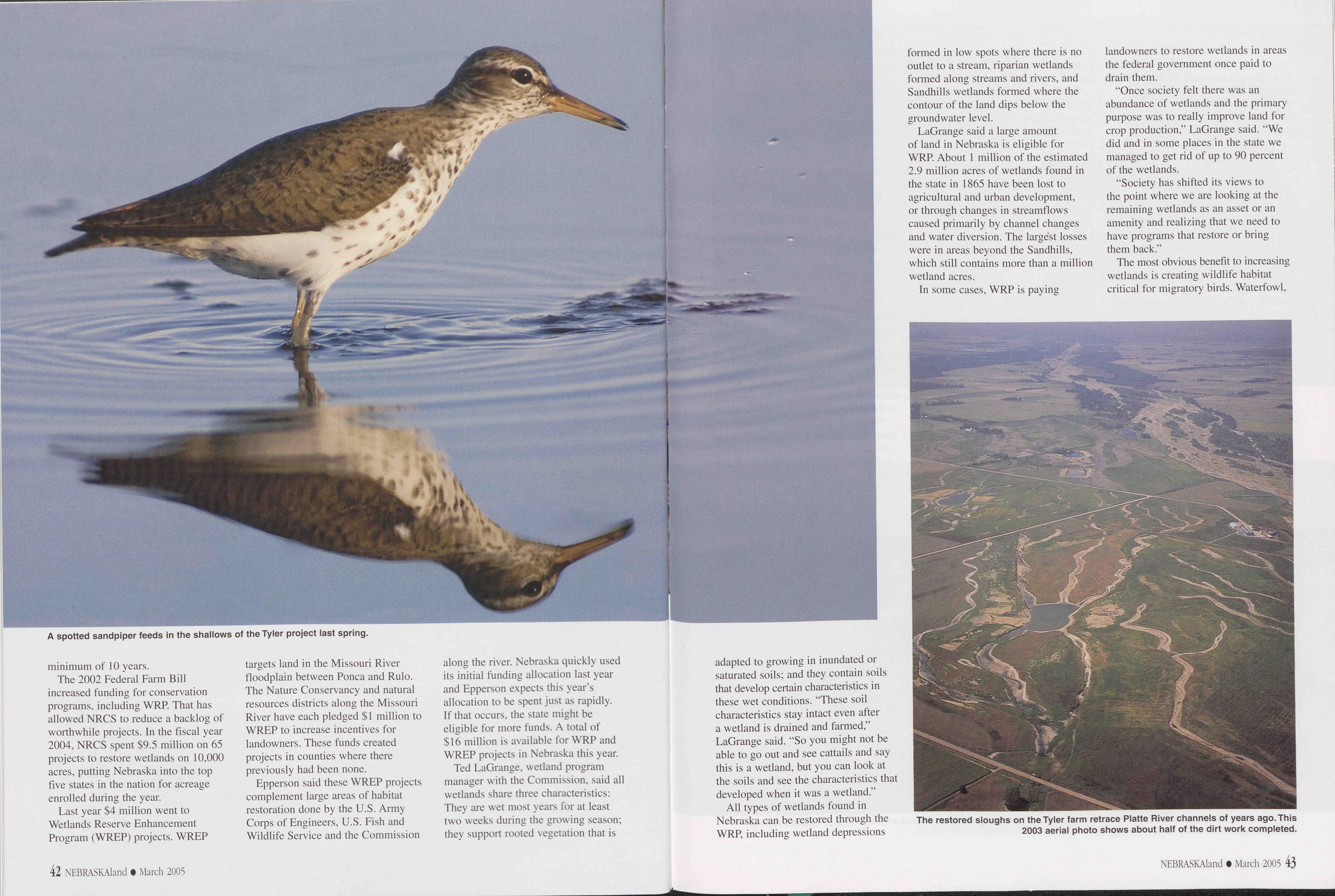
For the Tyler project, engineers sampled soils and looked at 1938 aerial photos for reference before heavy machinery reopened 163,000 linear feet of historical sloughs on about 750 acres of farmland and 150 acres of grassland.
“Before all the land leveling was done, there wasn’t a whole lot of 44 NEBRASKAland • March 2005
The Prairie Plains Resource Institute and the U.S. Fish and Wildlife Service reseeded the area with a high-diversity mixture of grasses, sedges, wildflowers, legumes and other species that will colonize wetlands, uplands and transition zones in between, creating a wet meadow, a preferred habitat of migrating sandhill cranes.
After grading and seeding were completed, groundwater levels rose in the spring and water again flowed in the swales, which are about two feet deep and 20-to-30 feet wide.
“From a farming standpoint for row crops, water was our worst enemy,” Tyler said. Spring planting was often delayed by wet ground, and after a crop was planted, high groundwater levels often limited its development. When irrigation pumps in the valley were turned on, the water table dropped and Tyler’s crops improved. But he said crops in these fields required a lot of water and careful management. “Our soil profile had two inches of holding capacity in three feet,” he said. “That doesn’t give much window for error.”
The opportunity to create wildlife habitat and hunting opportunities on his farm were big selling points when Tyler considered enrolling part of his farm in WRR “That’s where my heart and desire has always been, you know, in habitat, wildlife and hunting,” he said.
He expects waterfowl to frequent the restored wetlands during spring and fall migrations, and increasing numbers to join the few pairs of Canada geese that nested there last spring. One afternoon last March, a trumpeter swan, northern pintails, mallards, ring-necked ducks and gadwalls were on the wetland. Tyler expects increased pheasant and quail populations in the adjacent grasslands. "I think at some point we’ll probably start having prairie chickens nesting here,” he said.
Tyler said the WRP payment makes the program worth investigating for any landowner who is dealing with wetlands.
“Most farmers don’t want to deal with [wetlands], and they’re hard to deal with. They cost you money to farm and you don’t get the productivity off of them. There are no less inputs on a poor piece of ground than there is on a good piece of ground. In some cases, it’s more.”
LaGrange said small projects can provide wildlife benefits, too. “That small 5-to-10-acre spot on the back 40 can be really a jewel of a wetland.”
Many wetland species are mobile and use a variety of wetlands during their life cycle. Many small wetlands dotting a region, such as in the Rainwater Basin, give birds more places to go when they are disturbed. Even the smallest saline wetland restoration project is a worthy increase for the state’s most imperiled natural communities.
WRP managers hope to restore a total of 100,000 acres of Nebraska wetlands by the time the current farm bill expires in 2007. Epperson said funding increases and the addition of WREP have put that goal within reach.
“That’s significant,” LaGrange said. “That’s 10 percent of the historical losses. Putting it in that perspective, it’s a major step. Any wetlands you can put back in place are a huge benefit for fish and wildlife resources just because of how productive they are for fish and wildlife and for the other benefits they provide.”
For more information about the Wetlands Reserve Program and other wetland programs, contact the nearest Nebraska Game and Parks Commission or Natural Resources Conservation Service office. NEBRASKAland • March 2005 45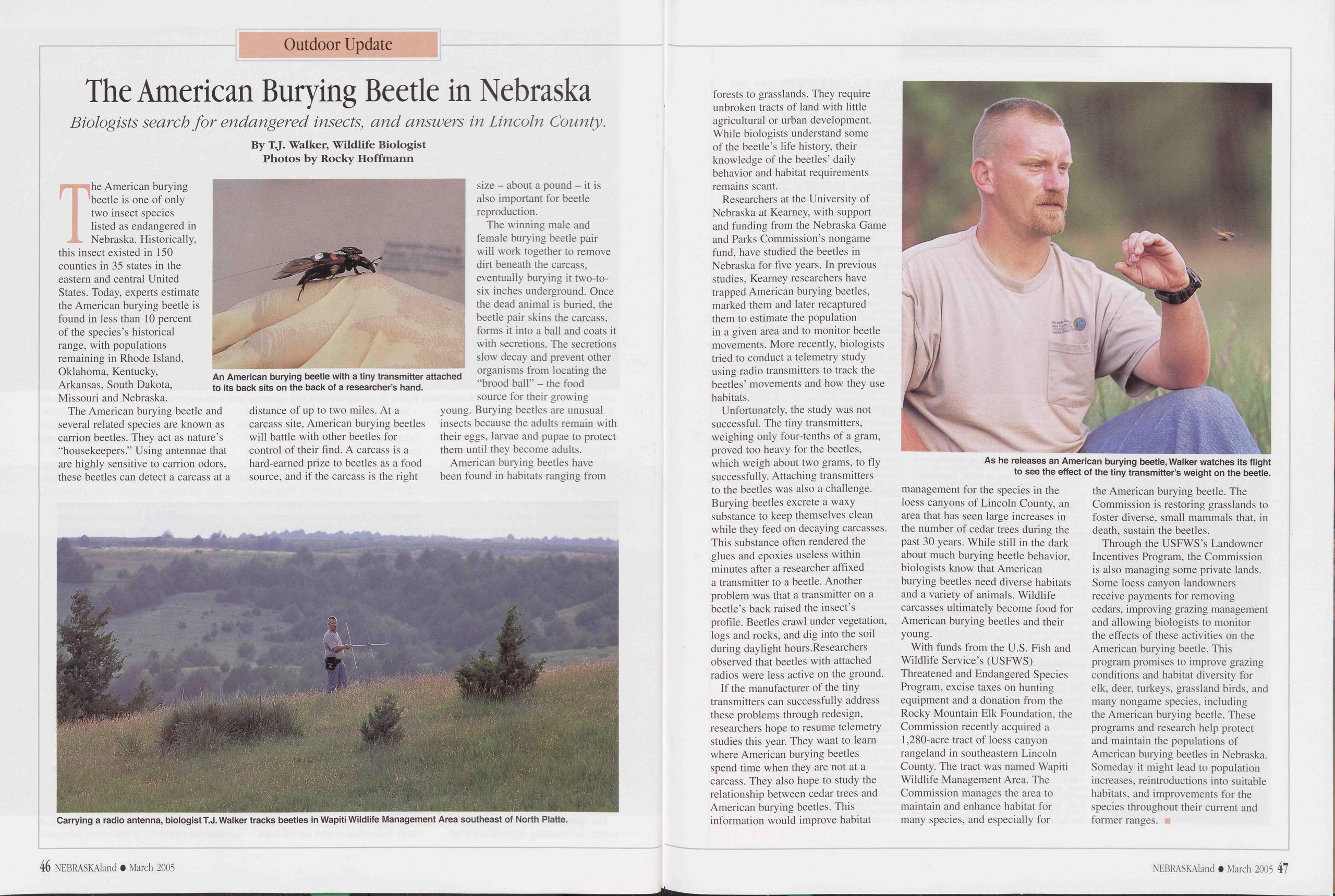
Outdoor Update
The American Burying Beetle in Nebraska
Biologists search for endangered insects, and answers in Lincoln County.
The American burying beetle is one of only two insect species listed as endangered in Nebraska. Historically, this insect existed in 150 counties in 35 states in the eastern and central United States. Today, experts estimate the American burying beetle is found in less than 10 percent of the species’s historical range, with populations remaining in Rhode Island, Oklahoma, Kentucky, Arkansas, South Dakota, Missouri and Nebraska.
The American burying beetle and several related species are known as carrion beetles. They act as nature’s “housekeepers.” Using antennae that are highly sensitive to carrion odors, these beetles can detect a carcass at a
The winning male and female burying beetle pair will work together to remove dirt beneath the carcass, eventually burying it two-to- six inches underground. Once the dead animal is buried, the beetle pair skins the carcass, forms it into a ball and coats it with secretions. The secretions slow decay and prevent other organisms from locating the “brood ball” - the food source for their growing young. Burying beetles are unusual insects because the adults remain with their eggs, larvae and pupae to protect them until they become adults.
American burying beetles have been found in habitats ranging from 46 NEBRASKAland • March 2005 forests to grasslands. They require unbroken tracts of land with little agricultural or urban development. While biologists understand some of the beetle’s life history, their knowledge of the beetles’ daily behavior and habitat requirements remains scant.
Researchers at the University of Nebraska at Kearney, with support and funding from the Nebraska Game and Parks Commission’s nongame fund, have studied the beetles in Nebraska for five years. In previous studies, Kearney researchers have trapped American burying beetles, marked them and later recaptured them to estimate the population in a given area and to monitor beetle movements. More recently, biologists tried to conduct a telemetry study using radio transmitters to track the beetles’ movements and how they use habitats.
Unfortunately, the study was not successful. The tiny transmitters, weighing only four-tenths of a gram, proved too heavy for the beetles, which weigh about two grams, to fly successfully. Attaching transmitters to the beetles was also a challenge. Burying beetles excrete a waxy substance to keep themselves clean while they feed on decaying carcasses. This substance often rendered the glues and epoxies useless within minutes after a researcher affixed a transmitter to a beetle. Another problem was that a transmitter on a beetle’s back raised the insect’s profile. Beetles crawl under vegetation, logs and rocks, and dig into the soil during daylight hours.Researchers observed that beetles with attached radios were less active on the ground.
If the manufacturer of the tiny transmitters can successfully address these problems through redesign, researchers hope to resume telemetry studies this year. They want to learn where American burying beetles spend time when they are not at a carcass. They also hope to study the relationship between cedar trees and American burying beetles. This information would improve habitat
With funds from the U.S. Fish and Wildlife Service’s (USFWS) Threatened and Endangered Species Program, excise taxes on hunting equipment and a donation from the Rocky Mountain Elk Foundation, the Commission recently acquired a 1,280-acre tract of loess canyon rangeland in southeastern Lincoln County. The tract was named Wapiti Wildlife Management Area. The Commission manages the area to maintain and enhance habitat for many species, and especially for the American burying beetle. The Commission is restoring grasslands to foster diverse, small mammals that, in death, sustain the beetles.
Through the USFWS’s Landowner Incentives Program, the Commission is also managing some private lands. Some loess canyon landowners receive payments for removing cedars, improving grazing management and allowing biologists to monitor the effects of these activities on the American burying beetle. This program promises to improve grazing conditions and habitat diversity for elk, deer, turkeys, grassland birds, and many nongame species, including the American burying beetle. These programs and research help protect and maintain the populations of American burying beetles in Nebraska. Someday it might lead to population increases, reintroductions into suitable habitats, and improvements for the species throughout their current and former ranges.
NEBRASKAland • March 2005 47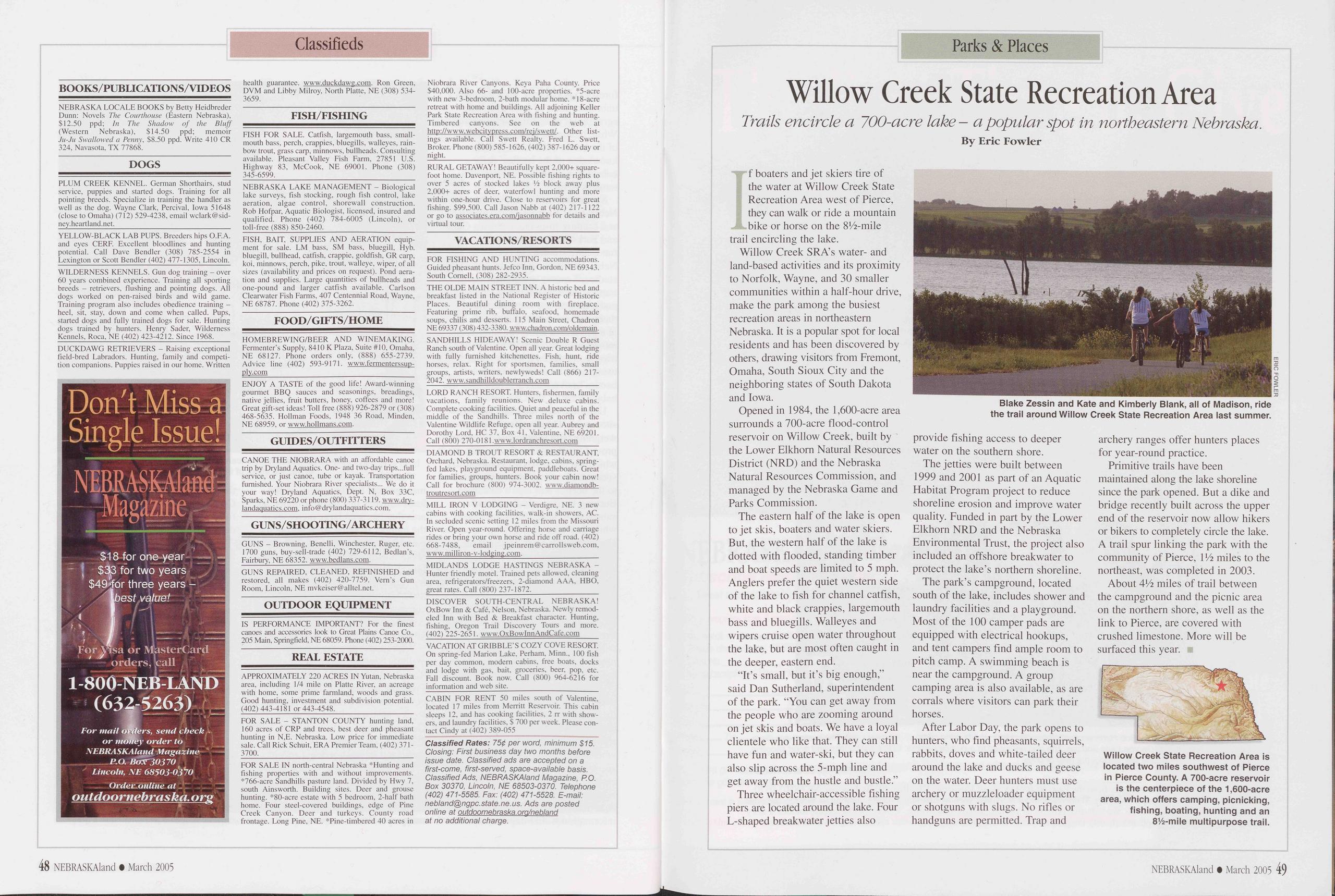
Classifieds
BOOKS/PUBLICATIONS/VIDEOS NEBRASKA LOCALE BOOKS by Betty Heidbreder Dunn: Novels The Courthouse (Eastern Nebraska), $12.50 ppd; In The Shadow of the Bluff (Western Nebraska), $14.50 ppd; memoir Ju-Ju Swallowed a Penny, $8.50 ppd. Write 410 CR 324, Navasota, TX 77868. DOGS PLUM CREEK KENNEL. German Shorthairs, stud service, puppies and started dogs. Training for all pointing breeds. Specialize in training the handler as well as the dog. Wayne Clark, Percival, Iowa 51648 (close to Omaha) (712) 529-4238, email wclark@sid- ney.heartland.net. YELLOW-BLACK LAB PUPS. Breeders hips O.F.A. and eyes CERF. Excellent bloodlines and hunting potential. Call Dave Bendler (308) 785-2554 in Lexington or Scott Bendler (402) 477-1305, Lincoln. WILDERNESS KENNELS. Gun dog training - over 60 years combined experience. Training all sporting breeds - retrievers, flushing and pointing dogs. All dogs worked on pen-raised birds and wild game. Training program also includes obedience training - heel, sit, stay, down and come when called. Pups, started dogs and fully trained dogs for sale. Hunting dogs trained by hunters. Henry Sader, Wilderness Kennels, Roca, NE (402) 423-4212. Since 1968. DUCKDAWG RETRIEVERS - Raising exceptional field-bred Labradors. Hunting, family and competi- tion companions. Puppies raised in our home. Written health guarantee, www.duckdawg.com. Ron Green, DVM and Libby Milroy, North Platte, NE (308) 534- 3659. Don't Miss a Single Issue! NEBRASKAland Magazine _ $18 for one year $33 for two years $49 for three years - best value! For Visa or MasterCard orders call 1-800-NEB-LAND (632-5263) For mail orders, send check or money order to NEBRASKAland Magazine P.O, Box 30370 Lincoln, NE 68503-0370 Order online at outdoornebraska. org FISH/FISHING FISH FOR SALE. Catfish, largemouth bass, small- mouth bass, perch, crappies, bluegills, walleyes, rain- bow trout, grass carp, minnows, bullheads. Consulting available. Pleasant Valley Fish Farm, 27851 U.S. Highway 83, McCook, NE 69001. Phone (308) 345-6599. NEBRASKA LAKE MANAGEMENT - Biological lake surveys, fish stocking, rough fish control, lake aeration, algae control, shorewall construction. Rob Hofpar, Aquatic Biologist, licensed, insured and qualified. Phone (402) 784-6005 (Lincoln), or toll-free (888) 850-2460. FISH, BAIT, SUPPLIES AND AERATION equip- ment for sale. LM bass, SM bass, bluegill, Hyb. bluegill, bullhead, catfish, crappie, goldfish, GR carp, koi, minnows, perch, pike, trout, walleye, wiper, of all sizes (availability and prices on request). Pond aera- tion and supplies. Large quantities of bullheads and one-pound and larger catfish available. Carlson Clearwater Fish Farms, 407 Centennial Road, Wayne, NE 68787. Phone (402) 375-3262. FOOD/GIFTS/HOME HOMEBREWING/BEER AND WINEMAKING. Fermenter’s Supply, 8410 K Plaza, Suite #10, Omaha, NE 68127. Phone orders only, (888) 655-2739. Advice line (402) 593-9171. www.fermenterssup- ply.com ENJOY A TASTE of the good life! Award-winning gourmet BBQ sauces and seasonings, breadings, native jellies, fruit butters, honey, coffees and more! Great gift-set ideas! Toll free (888) 926-2879 or (308) 468-5635. Hollman Foods, 1948 36 Road, Minden, NE 68959, or www.hollmans.com. GUIDES/OUTFITTERS CANOE THE NIOBRARA with an affordable canoe trip by Dryland Aquatics. One- and two-day trips...full service, or just canoe, tube or kayak. Transportation furnished. Your Niobrara River specialists... We do it your way! Dryland Aquatics, Dept. N. Box 33C, Sparks, NE 69220 or phone (800) 337-3119. www.drv- landaquatics.com. info@drylandaquatics.com. GUNS/SHOOTING/ARCHERY GUNS - Browning, Benelli, Winchester, Ruger, etc. 1700 guns, buy-sell-trade (402) 729-6112, Bedlan’s, Fairbury, NE 68352. www.bedlans.com. GUNS REPAIRED, CLEANED, REFINISHED and restored, all makes (402) 420-7759. Vem’s Gun Room, Lincoln, NE mvkeiser@alltel.net. OUTDOOR EQUIPMENT IS PERFORMANCE IMPORTANT? For the finest canoes and accessories look to Great Plains Canoe Co., 205 Main, Springfield, NE 68059. Phone (402) 253-2000. REAL ESTATE APPROXIMATELY 220 ACRES IN Yutan, Nebraska area, including 1/4 mile on Platte River, an acreage with home, some prime farmland, woods and grass. Good hunting, investment and subdivision potential. (402) 443-4181 or 443-4548. FOR SALE - STANTON COUNTY hunting land, 160 acres of CRP and trees, best deer and pheasant hunting in N,E. Nebraska. Low price for immediate sale. Call Rick Schuit, ERA Premier Team, (402) 371 - 3700. FOR SALE IN north-central Nebraska ^Hunting and fishing properties with and without improvements. *766-acre Sandhills pasture land. Divided by Hwy 7, south Ainsworth. Building sites. Deer and grouse hunting. *80-acre estate with 5 bedroom, 2-half bath home. Four steel-covered buildings, edge of Pine Creek Canyon. Deer and turkeys. County road frontage. Long Pine, NE. * Pine-timbered 40 acres in Niobrara River Canyons. Key a Paha County. Price $40,000. Also 66- and 100-acre properties. *5-acre with new 3-bedroom, 2-bath modular home. *18-acre retreat with home and buildings. All adjoining Keller Park State Recreation Area with fishing and hunting. Timbered canyons. See on the web at http://www.webcitypress.com/rej/swett/. Other list- ings available. Call Swett Realty. Fred L. Swett, Broker. Phone (800) 585-1626, (402) 387-1626 day or night. RURAL GETAWAY! Beautifully kept 2,000+ square- foot home. Davenport, NE. Possible fishing rights to over 5 acres of stocked lakes Yi block away plus 2,000+ acres of deer, waterfowl hunting and more within one-hour drive. Close to reservoirs for great fishing. $99,500. Call Jason Nabb at (402) 217-1122 or go to associates.era.com/jasonnabb for details and virtual tour. VACATIONS/RESORTS FOR FISHING AND HUNTING accommodations. Guided pheasant hunts. Jefco Inn, Gordon. NE 69343. South Cornell, (308) 282-2935. THE OLDE MAIN STREET INN. A historic bed and breakfast listed in the National Register of Historic Places. Beautiful dining room with fireplace. Featuring prime rib, buffalo, seafood, homemade soups, chilis and desserts. 115 Main Street, Chadron NE 69337 (308) 432-3380. www.chadron.com/oldemain. SANDHILLS HIDEAWAY! Scenic Double R Guest Ranch south of Valentine. Open all year. Great lodging with fully furnished kitchenettes. Fish, hunt, ride horses, relax. Right for sportsmen, families, small groups, artists, writers, newlyweds! Call (866) 217- 2042. www.sandhilldoublerranch.com LORD RANCH RESORT. Hunters, fishermen, family vacations, family reunions. New deluxe cabins. Complete cooking facilities. Quiet and peaceful in the middle of the Sandhills. Three miles north of the Valentine Wildlife Refuge, open all year. Aubrey and Dorothy Lord, HC 37, Box 41, Valentine, NE 69201. Call (800) 270-0181 .www.lordranchresort.com DIAMOND B TROUT RESORT & RESTAURANT, Orchard, Nebraska. Restaurant, lodge, cabins, spring- fed lakes, playground equipment, paddleboats. Great for families, groups, hunters. Book your cabin now! Call for brochure (800) 974-3002. www.diamondb- troutresort.com MILL IRON V LODGING - Verdigre, NE. 3 new cabins with cooking facilities, walk-in showers, AC. In secluded scenic setting 12 miles from the Missouri River. Open year-round. Offering horse and carriage rides or bring your own horse and ride off road. (402) 668-7488, email jpeinrem@carrollsweb.com, www.milliron-v-lodging.com. MIDLANDS LODGE HASTINGS NEBRASKA - Hunter friendly motel. Trained pets allowed, cleaning area, refrigerators/freezers, 2-diamond AAA, HBO, great rates. Call (800) 237-1872. DISCOVER SOUTH-CENTRAL NEBRASKA! OxBow Inn & Cafe, Nelson, Nebraska. Newly remod- eled Inn with Bed & Breakfast character. Hunting, fishing, Oregon Trail Discovery Tours and more. (402) 225-2651. www.OxBowInnAndCaf^com VACATION AT GRIBBLE'S COZY COVE RESORT. On spring-fed Marion Lake, Perham, Minn.. 100 fish per day common, modem cabins, free boats, docks and lodge with gas, bait, groceries, beer, pop, etc. Fall discount. Book now. Call (800) 964-6216 for information and web site. CABIN FOR RENT 50 miles south of Valentine, located 17 miles from Merritt Reservoir. This cabin sleeps 12, and has cooking facilities, 2 rr with show- ers, and laundry facilities, $ 700 per week. Please con- tact Cindy at (402) 389-055 Classified Rates: 75# per word, minimum $15. Closing: First business day two months before issue date. Classified ads are accepted on a first-come, first-served, space-available basis. Classified Ads, NEBRASKAland Magazine, P.O. Box 30370, Lincoln, NE 68503-0370. Telephone (402) 471-5585. Fax: (402) 471-5528. E-mail: nebland@ngpc. state, ne. us. Ads are posted online at outdoornebraska. oro/nebland at no additional charge. 48 NEBRASKAland • March 2005Parks & Places
Willow Creek State Recreation Area
Trails encircle a 700-acre lake - a popular spot in northeastern Nebraska.
If boaters and jet skiers tire of the water at Willow Creek State Recreation Area west of Pierce, they can walk or ride a mountain bike or horse on the 8^2-mile trail encircling the lake.
Willow Creek SRA’s water- and land-based activities and its proximity to Norfolk, Wayne, and 30 smaller communities within a half-hour drive, make the park among the busiest recreation areas in northeastern Nebraska. It is a popular spot for local residents and has been discovered by others, drawing visitors from Fremont, Omaha, South Sioux City and the neighboring states of South Dakota and Iowa.
Opened in 1984, the 1,600-acre area surrounds a 700-acre flood-control reservoir on Willow Creek, built by the Lower Elkhorn Natural Resources District (NRD) and the Nebraska Natural Resources Commission, and managed by the Nebraska Game and Parks Commission.
The eastern half of the lake is open to jet skis, boaters and water skiers. But, the western half of the lake is dotted with flooded, standing timber and boat speeds are limited to 5 mph. Anglers prefer the quiet western side of the lake to fish for channel catfish, white and black crappies, largemouth bass and bluegills. Walleyes and wipers cruise open water throughout the lake, but are most often caught in the deeper, eastern end.
“It’s small, but it’s big enough,” said Dan Sutherland, superintendent of the park. “You can get away from the people who are zooming around on jet skis and boats. We have a loyal clientele who like that. They can still have fun and water-ski, but they can also slip across the 5-mph line and get away from the hustle and bustle.”
Three wheelchair-accessible fishing piers are located around the lake. Four L-shaped breakwater jetties also
The jetties were built between 1999 and 2001 as part of an Aquatic Habitat Program project to reduce shoreline erosion and improve water quality. Funded in part by the Lower Elkhorn NRD and the Nebraska Environmental Trust, the project also included an offshore breakwater to protect the lake’s northern shoreline.
The park’s campground, located south of the lake, includes shower and laundry facilities and a playground. Most of the 100 camper pads are equipped with electrical hookups, and tent campers find ample room to pitch camp. A swimming beach is near the campground. A group camping area is also available, as are corrals where visitors can park their horses.
After Labor Day, the park opens to hunters, who find pheasants, squirrels, rabbits, doves and white-tailed deer around the lake and ducks and geese on the water. Deer hunters must use archery or muzzleloader equipment or shotguns with slugs. No rifles or handguns are permitted. Trap and archery ranges offer hunters places for year-round practice.
Primitive trails have been maintained along the lake shoreline since the park opened. But a dike and bridge recently built across the upper end of the reservoir now allow hikers or bikers to completely circle the lake. A trail spur linking the park with the community of Pierce, 1 1/2 miles to the northeast, was completed in 2003.
About 4 1/2 miles of trail between the campground and the picnic area on the northern shore, as well as the link to Pierce, are covered with crushed limestone. More will be surfaced this year.
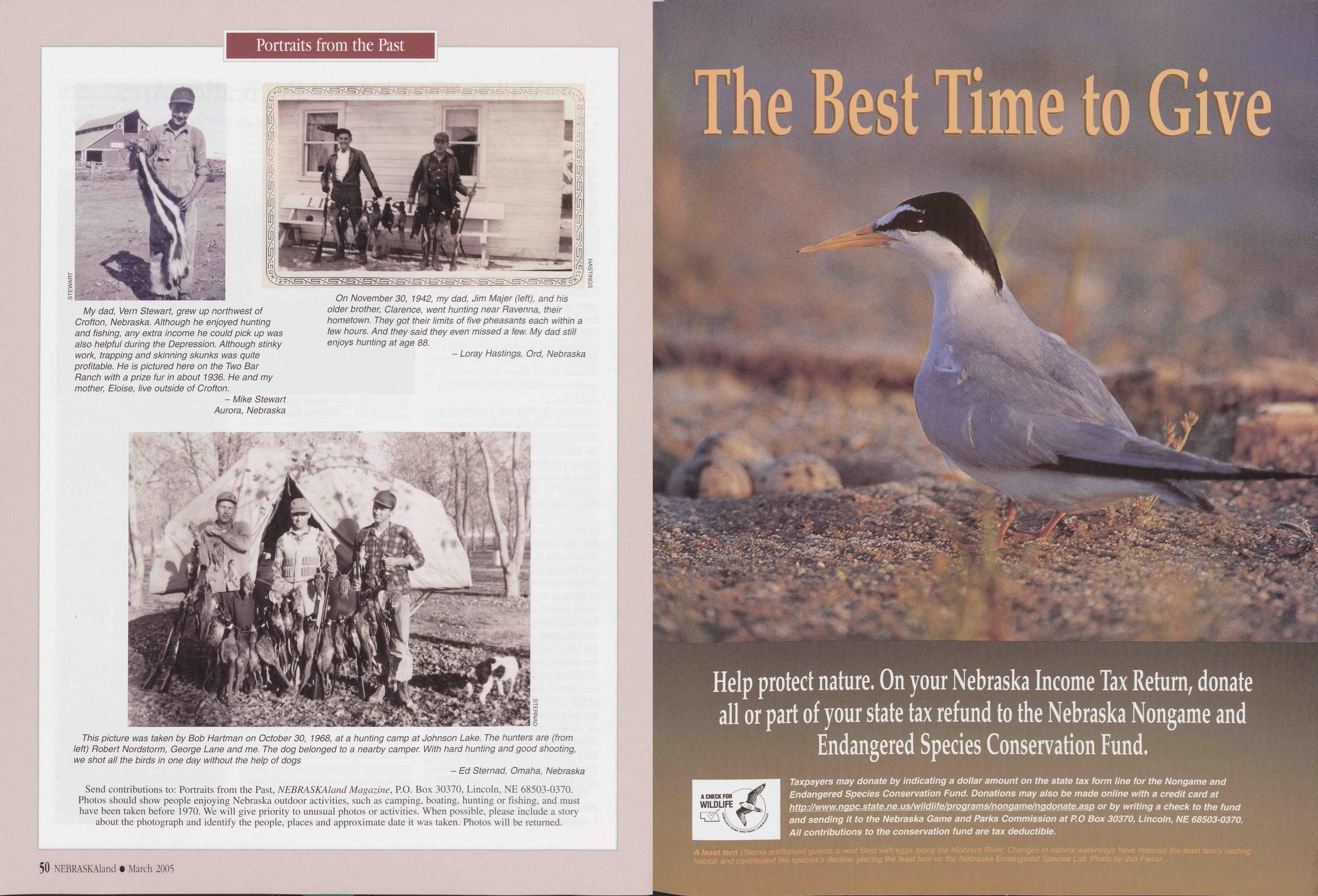
Portraits from the Past
Position: 58 (144 views)