Volume 83, Issue 1, 2005
NEBRASKAland
Nebraska Game & Parks Commission January-February 2005 $2.50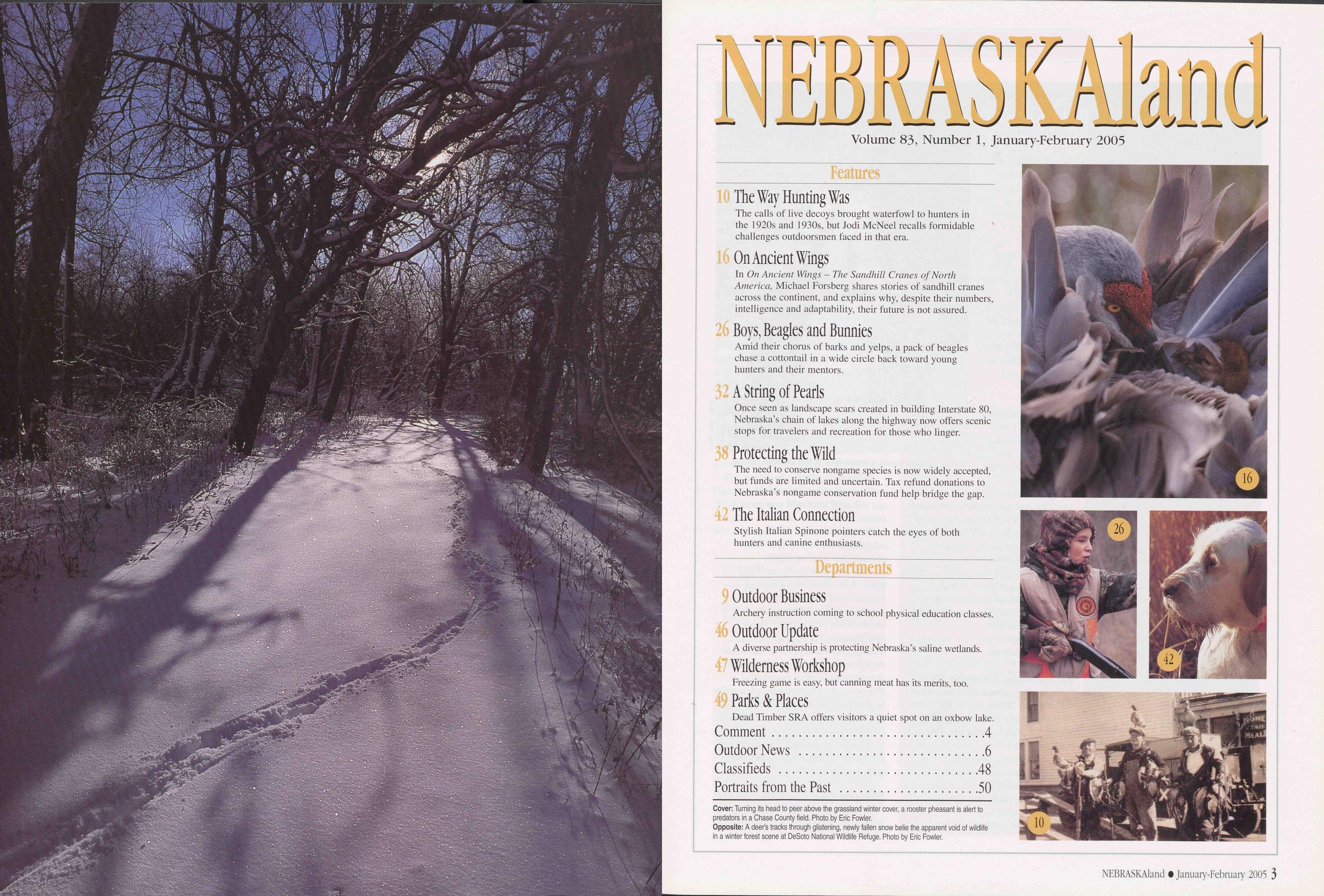
NEBRASKAland
Volume 83, Number 1, January-February 2005
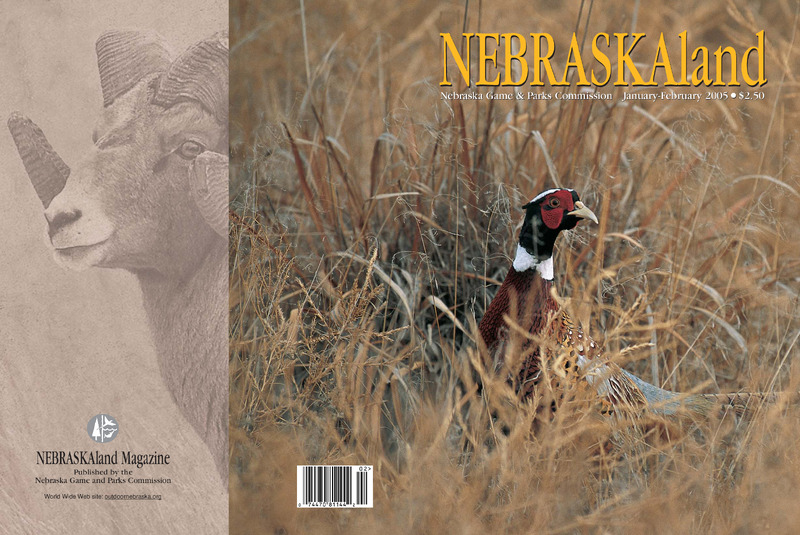
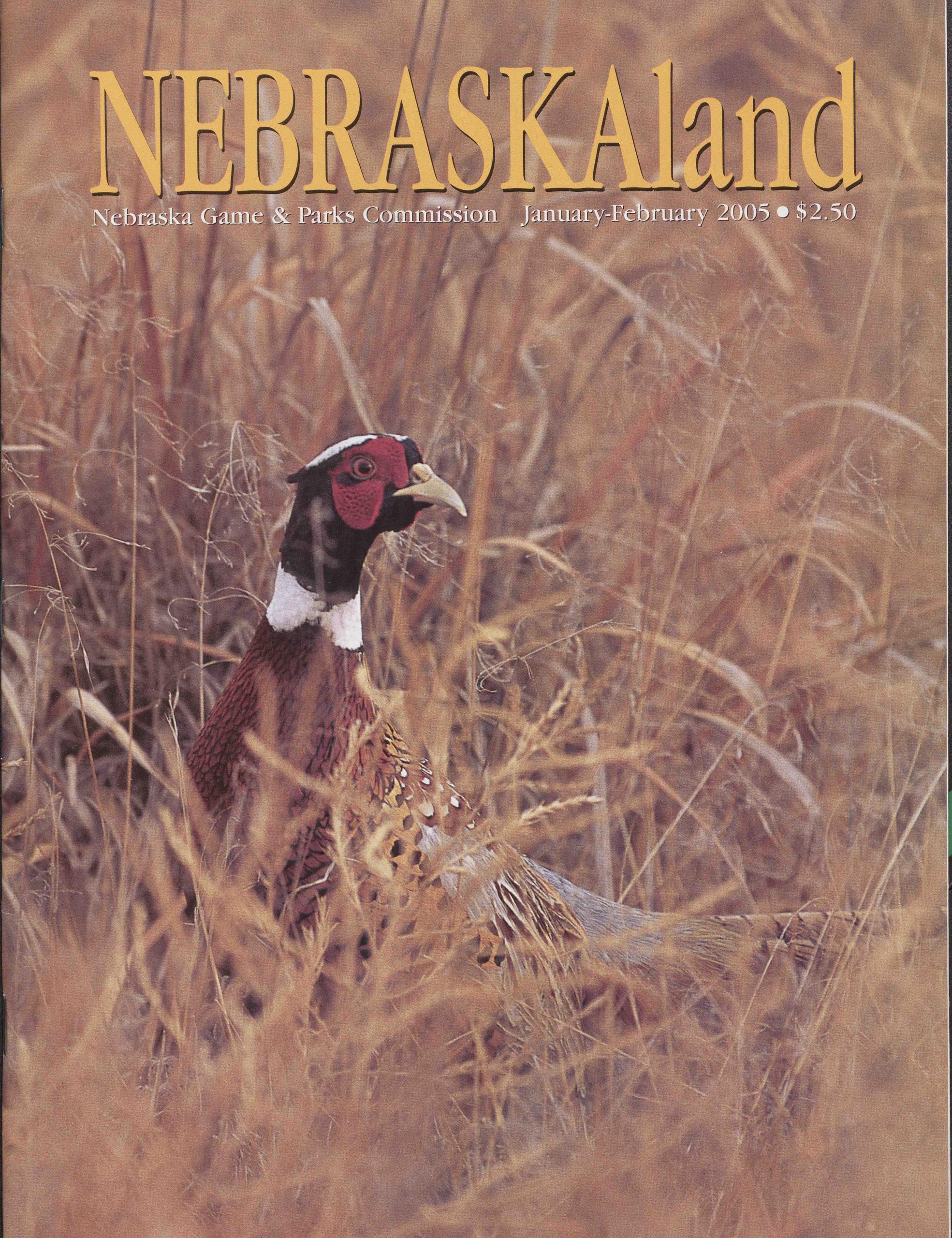
Features 10 The Way Hunting Was The calls of live decoys brought waterfowl to hunters in the 1920s and 1930s, but Jodi McNeel recalls formidable challenges outdoorsmen faced in that era. 16 On Ancient Wings In On Ancient Wings - The Sandhill Cranes of North America, Michael Forsberg shares stories of sandhill cranes across the continent, and explains whu, despite their numbers, intelligence and adaptability, their future is not assured. 26 Boys, Beagles and Bunnies Amid their chorus of barks and yelps, a pack of beagles chase a cottentail in a wide circle back toward young hunters and their mentors. 32 A string of Pearls Once seen as landscape scars created in building Interstate 80, Nebraska's chain of lakes along the highway now offers scenic stops for travelers and recreation for those who linger. 38 Protecting the Wild The need to conserve nongame species is now widely accepted, but funds are limited and uncertain. Tax refund donations to Nebraska's nongame conservation fund help bridge the gap. 42 Italian Connection Stylish Italian Spinone pointers catch the eyes of both hunters and canine enthusiasts Departments 9 Outdoor Business Archery instruction coming to school physical education classes. 46 Outdoor Update A diverse partnership is protecting Nebraska’s saline wetlands. 47 Wilderness Workshop Freezing game is easy, but canning meat has its merits, too. 49 Parks & Places Dead Timber SRA offers visitors a quiet spot on an oxbow lake. Cover: Turning its head to peer above the grassland winter cover, a rooster pheasant is alert to predators in a Chase County field. Photo by Eric Fowler. Opposite: A deer’s tracks through glistening, newly fallen snow belie the apparent void of wildlife in a winter forest scene at DeSoto National Wildlife Refuge. Photo by Eric Fowler. NEBRASKAland • January-February 2005 3
Comment
NEBRASKAland Magazine Published by the Nebraska Game and Parks Commission Director: Rex Amack Assistant Directors: Roger Kuhn, Kirk Nelson Information & Education Administrator: Ken Bouc Information & Education Art Director: Steve O’Hare Commissioners Chairman: Marvin Westcott, Holdrege Vice Chairman: Dr. Mark Pinkerton, Wilber 2nd Vice Chairman: Bill Grewcock, Omaha James Stuart, Jr., Lincoln Bill Zu tavern, Dunning Gary Parker, Columbus George E. Hall, Bridgeport James Ziebarth, Wilcox Magazine Staff Editor: Tom White Associate Editor: Doug Carroll Art Director: Tim Reigert Senior Editors: Jon Farrar, Ken Bouc Regional Editors: Eric Fowler, Bob Grier, Rocky Hoffmann Contributing Editors: Michael Forsberg, Tom Keith Circulation: Donna Robinson Photo Librarian: Sarah Johnson NEBRASKAland VOL. 83 / NO. 1 ISSN: 0028-1964 JANUARY-FEBRUARY 2005 Published monthly, except for Jan./Feb. and AugVSept. issues, by the Nebraska Game and Parks Commission, 2200 N. 33rd St., Lincoln, NE. Copyright 2005, all rights reserved. Please address comments or questions to this address. Periodicals postage paid at Lincoln, Nebraska, and other locations. POSTMASTER: Send all address changes to NEBRASKAland, P.O. Box 30370, Lincoln, NE 68503-0370. Address submissions to: The Editor, NEBRASKAland Magazine, P.O. Box 30370, Lincoln, NE 68503. Include a stamped, self-addressed return envelope. The publisher assumes no responsibility for unsolicited material. NEBRASKAland is available on audio cassette from the Nebraska Library Commission Talking Book and Braille Service, Suite 120, 1200 N St., Lincoln, NE 68508. (800) 742-7691 Rates: $18 for one year; $33 for two years. Nebraska residents must add appropriate sales tax. To subscribe call 1-800-NEBLAND (632-5263), or go online to: outdoornebraska.org Whitetail Suddenly Appears at DeSotoAfter a snowstorm last winter I found myself at DeSoto National Wildlife Refuge taking photographs of snow-laden trees, icy ponds and wildlife.
I drove around the refuge loop to the back side of the lake near the entrance to Wilson Island and noticed a neat fence line full of newly fallen snow. I reached for my camera and took several pictures.
When previewing the images, I was surprised to find a little deer in the middle of the fence
In reading your article on ospreys [November 2004], the writer stated that the osprey is the only raptor with a reversible outer toe. Doesn’t the great horned owl also have two toes in front and two in back?
I have often seen ospreys feeding in Norfolk’s TaHaZouka Park and in surrounding lakes and sandpits.
Terry Volquardzen Wisner, NebraskaYou are correct that the osprey is not the only bird with a reversible toe.
The structure of a bird’s foot is adapted to its way of life. Most species that are not highly specialized, especially perching birds, have three toes oriented forward and one backward, an arrangement called anisodactyl. Other birds, particularly those that cling to tree trunks, such as woodpeckers and parrots, have two toes forward and two backward, an arrangement called zygodactyl. Osprey and owls evolved to have the best of both worlds on demand. They are able to pivot one outer toe back so two are directed forward and two to the rear as needed, an adaptation for grasping slippery or squirming prey. - Editor
Youngster Questions Geese SmartsThis is a story that hunters can appreciate. My husband and our 4 NEBRASKAland O January-February 2005 six-year-old daughter were watching the Outdoor Channel. The host of the show was showing a new goose decoy and then they showed some goose hunters in the field using calls and decoys.
As the show proceeded, my daughter turned to her dad and said, "I can’t believe the geese fall for that.”
Mindi Linder Oakland, Nebraska Doe Standing Over Her FawnI wonder if anyone else noticed the fawn by the log in the picture of deer 54 on page 11 of the November issue?
It appears she may be standing guard over the fawn. I am a long-time subscriber and enjoy the magazine immensely, especially the pictures of wildlife and scenery in our beautiful state. Keep up the good work.
Pat Woodside Odessa, Nebraska CorrectionThe writer of a letter concerning Huntley, Nebraska, in the December 2004 issue was Marlene “Mimi” Vaughan Minarik. Her maiden name was misspelled.
Comment NEBRASKAland Magazine P.O. Box 30370, Lincoln, NE 68503. E-mail: nebland@ngpc.state.ne.us. Please include your postal address and telephone number. Letters may be condensed and edited for clarity. Photographs are welcome and will be returned. Under federal and/or state law, discrimination is prohibited on the basis of race, color, religion, age, gender, marital status, national origin, disability or political affiliation. If you think you have been discriminated against in any program, activity or facility or want more information, contact the Affirmative Action Officer, Nebraska Game and Parks Commission, Lincoln, NE, (402) 471-0641 or the Equal Opportunity Commission, Lincoln, NE, (402) 471-2024, TTY/TDD (402) 471- 4693). Nebraska Game and Parks Commission Offices Headquarters 2200 N. 33rd Street Lincoln, NE 68503 Phone (402) 471-0641 District Office I East Hwy. 2, Box 725 Alliance, NE 69301 Phone (308) 763-2940 District Office II 524 Panzer St., Box 508 Bassett, NE 68714 Phone (402) 684-2921 District Office III 2201 N. 13th St. Norfolk, NE 68701 Phone (402) 370-3374 District Office IV 301 E. State Farm Rd. North Platte, NE 69101 Phone (308) 535-8025 District Office V I 2200 N. 33rd Street Lincoln, NE 68503 Phone (402) 471-5558 District Office VI 1617 First Ave. Kearney, NE 68847 Phone (308) 865-5310 Omaha Office 1212 Bob Gibson Blvd. Omaha, NE 68108 Phone (402) 595-2144 Ak-Sar-Ben Aquarium 21502 W. Highway 31 Gretna, NE 68028 Phone (402) 332-3901 World Wide Web site: outdoornebraska.org E-mail: ngpc@ngpc.state.ne.us Conservation Officers by Region Administration Ted Blume (Adm.) Craig Stover (Asst.) Wes Loos (Asst.) Murray Johnson Dana Miller (Sup.) Lincoln Lincoln Lincoln Lincoln Valentine 471-5531 471-5532 471-5591 471-5003 376-3116 Tim Williams Darin Gress Dale Johnson Mark Reeves Robert Finke Richard Seward Hastings (402) 463-2535 Hebron (402) 768-2287 Kearney Loup City Milford (4 Ord 237-1079 745-0748 02) 761-3537 728-3115 Panhandle Northeast Officer City Phone (308) Officer City Phone (402) Jim Zimmerman (Sup.) Gering 436-7561 Tom Zimmer (Sup.) Norfolk 371-6625 Raymond Still Bridgeport 262-1075 Robert Kelly Albion 395-2538 Walt Meyer Chadron 432-4398 Dale Davis Bassett 273-1700 John Murphy Crawford 665-2021 Ross Oestmann Bloomfield 373-4412 Heath Packett Gordon 282-2553 Steve Oberg Columbus 564-5937 Dennis Thompson Ogallala 284-6450 Gary Ralston Creighton 358-3892 Dan Zuehlke Ogallala 284-4815 Daniel Roberts Fremont 721-7852 Doug Pollard Oshkosh 772-9950 Jon Reeves Kennard 427-7378 Scott Brandt Scottsbluff 635-1277 Marion Shafer Norfolk 371-2031 Frank Miller Valentine (402)376-1183 Pat George O’Neill 482-5771 Eric Wiebe Ponca 755-2566 Southwest Officer City Phone (308) Southeast Roger Thompson (Sup.) N. Platte 532-9175 Officer City Phone (402) Ray Dierking Brkn. Bow 872-3078 Duane Arp (Sup.) Gretna 332-2965 George Sund Cambridge 697-4629 Sean McKeehan Ashland 944-4174 Matt Andrews Elwood 785-3025 William Krause Auburn 274-3789 Dirk Greene Imperial 882-5328 Douglas Kramer Lincoln 466-9001 Virgil Gosch McCook 345-2185 Dina Barta Lincoln 483-2358 Dudley Sorensen N. Platte 532-0747 Stacey Lewton Lincoln 476-0436 Rich Routh Rep. City 799-2085 Levi Krause Louisville 234-2212 Russell Mort Nebr. City 873-5684 South-central Dan Evasco Papillion 504-1368 Officer City Phone (308) Jeff Clauson Valley 359-5301 Jerry Pecha (Sup.) Kearney 865-5327 Mike Luben Wahoo 443-4278 Randy Pomplun Fullerton 536-2987 Terry Brentzel Grand Is. 384-8296 NEBRASKAland • January-February 2005 5
Outdoor News
Brian Newton of Springfield became the first bowhunter in recent times to harvest a bighorn sheep in Nebraska when he killed a mature ram on the second day of the 2004 Nebraska bighorn season.
The holder of the only bighorn sheep tag in Nebraska this year, Newton harvested the animal at Fort Robinson State Park after stalking it in the Cheyenne Buttes overlooking the fort.
“I’d brought a rifle out to the fort, but I hoped to take a ram using bow and arrow,” Newton said. "I felt that any legal ram would be a trophy for an archer. I had a shot at a nice ram on Saturday, but he jumped just as I released the arrow for a clean miss. During the snow on Sunday we found one of the fort’s largest rams in the buttes. I was able to stalk to within 30 yards. The accommodations and people at the fort and the guides were great - I’ll remember this hunt for the rest of my life.”
Nebraska’s bighorn sheep permits allow the use of all legal hunting equipment, including bow and arrow, rifle and muzzleloader. Two bighorn sheep permits have been authorized for the 2005 season - one to be raffled to Nebraska residents and the other to be sold at the Grand Slam Club/Ovis convention in Biloxi, Mississippi, in February 2005. Funds raised by the auction and lottery permits are used for Nebraska’s bighorn sheep management programs.
New Feature Added to Computer Hunting PermitsAs of the beginning of this year, a hunter who purchases a Nebraska computer-generated hunting permit may type in his or her hunter education or bowhunter education number and it will be printed on the hunting permit. The number will remain in the computer database and will be printed on all subsequent hunting permits.
Nebraska law requires hunters bom after January 1, 1977, and who are 12 years of age and older to carry proof while they are hunting that they have successfully completed a hunter safety class.
A computer-printed permit with a hunter education number will avoid the necessity and inconvenience of carrying a separate hunter education 6 NEBRASKAland • January-February 2005 card or having to purchase a new card if the original is lost or damaged.
Mountain Lion Killed in Residential NeighborhoodA mountain lion was shot and killed in a South Sioux City neighborhood in November. It was the 17th confirmed sighting of a mountain lion in Nebraska since 1992.
Estimated to be between 1 Yi and two years old, the 100-pound male lion was seen by a woman taking her children to school. She saw the cat sitting in a maple tree located in a front yard near the northwestern edge of the city.
Although the mountain lion is a protected species in the state, in accordance with the Nebraska Game and Parks Commission’s policy for dealing with mountain lions that are considered to be an immediate threat to humans, the cat was shot and killed.
A necropsy performed at the Commission’s Lincoln headquarters showed no obvious physical defects, and the animal’s stomach was empty.
Whooping Crane Population Reaches New High in TexasBy late November, a record number of whooping cranes had migrated to the Aransas National Wildlife Refuge and to nearby areas along the Gulf of Mexico coast in Texas. A census flight in late November tallied 213 whooping cranes; 181 adult cranes and 32 young.
"This is the largest number of endangered whooping cranes wintering in Texas in the last 100 years," said Tom Stehn, Whooping Crane Coordinator for the U.S. Fish and Wildlife Service. "We beat last year's record by 19. The next highest record was 194 whoopers in 2003."
The total number of cranes would have been higher but two male whooping cranes were shot in Kansas in early November after
 eing mistaken for sandhill cranes
during that state's sandhill crane
season. One bird died within a week,
and the other is recuperating at a
research center in Maryland.
The current total North American
population of wild and captive
whooping cranes is 468.
Outdoor News
Officer's Notebook
Eagle Poisoning Uncovered
eing mistaken for sandhill cranes
during that state's sandhill crane
season. One bird died within a week,
and the other is recuperating at a
research center in Maryland.
The current total North American
population of wild and captive
whooping cranes is 468.
Outdoor News
Officer's Notebook
Eagle Poisoning Uncovered
In late March 2002, a rancher called me about a dead eagle he found in northwestern Wheeler County. Using his directions, I found the eagle under a lone tree next to a road. The location led me to believe it had probably been shot, but I couldn’t find a wound. I stopped by a feedlot two miles away and told the assistant manager what I had found. I asked him to let me know if he heard anything because he knew many local people.
A few days later I learned that the eagle might have been poisoned. An anonymous informant told me he had heard that three area ranchers were putting a crop chemical on dead livestock to kill coyotes feeding on the carcasses. The informant believed one rancher was supplying the chemical to the others.
I looked at a plat map and found that one of the ranchers mentioned lived about 1 % miles from where I had found the dead eagle. Because killing bald eagles is both a federal and state crime, I called Special Agent Mark Webb with the U.S. Fish and Wildlife Service and told him what I knew.
A few days later, a second informant told conservation officer Patrick George in Holt County about eagle poisonings in the Chambers area. George had picked up three dead eagles within a few miles of the one I had found. His informant also referred to a chemical being put on dead livestock.
After reviewing the information we decided to fly over the ranches in question. During the flight Webb and George saw two dead coyotes, three dead eagles and two calf carcasses. Seeing the dead eagles gave us probable cause to search the private property where the carcasses were. Webb, George, Special Agent Mike Damico and I searched areas on two ranches to take photos and collect evidence. Inside the carcasses we found pellets of a granular chemical that was later identified as Counter CR, a restricted-use pesticide. Extremely poisonous, a pellet of Counter CR can kill a human, Webb said.
With this evidence, Webb interviewed the three ranchers and two other individuals who were involved. In all, we found eight eagles had been poisoned, including one that had been buried, which indicated that the ranchers knew nontargeted species were being affected and they continued to put out poison. Three people ultimately received civil prosecution for the poisonings and were fined a total of $15,000 - $4,000 each for illegally killing eagles and $1,000 each for the illegal use of a registered pesticide. The fines were sent to Raptor Recovery Nebraska.
The illegal use of chemicals to control predators has been fairly common for many years in some ranching areas, but this case shows just how expensive it can be to take the law into your own hands. It’s easy to understand why farmers and ranchers want to protect their livestock, but there are other methods available that don’t extract such a terrible toll on eagles and other nontargeted animals, not to mention your bank account.
- Bob Kelly, Conservation Officer, Albion Four Bird Banding Clinics Scheduled at AquariumFree bird banding clinics will be held at Ak-Sar-Ben Aquarium near Gretna on January 8, February 5, March 5 and April 2. The clinics will be held from 9 a.m. to noon.
Ruth Greene, a naturalist and avid birder, and her assistant, Kris Hammond, will demonstrate mist-netting techniques and talk about bird biology and species identification.
The aquarium is located 6 miles south of 1-80 exit 432. For more information, call the aquarium at (402) 332-3901.
FWS Releases DVD Showing National Wildlife RefugesThe U.S. Fish and Wildlife Service recently released its first DVD “armchair” tour of the nation's national wildlife refuges.
“America's Wildest Places” has nearly two hours of video of eight of the most stunning areas in the refuge system, complemented by narration and musical scores.
Among other places, the DVD features video of whooping cranes at Aransas NWR, brown bears at Kenai NWR, and red wolves at North Carolina's Pocosin Lakes NWR.
“America's Wildest Places,” Volume 1 sells for $6, plus $2.50 shipping. With each order, a copy of the National Wildlife Refuge System Visitor Guide is enclosed, providing a map of all 540 refuges in the system and a list of public activities.
To order, go to www.fws.gov or call (304) 876-7692.
8 NEBRASKAland • January-February 2005Outdoor Business
Archery Comes to Physical Education
Program will teach lifelong skills as part of Nebraska schools curricula.
A school archery program started in Kentucky might become a big hit in Nebraska schools this spring.
Working with Nebraska’s Department of Education, the Nebraska Game and Parks Commission is helping to implement the National Archery in the Schools Program (NASP) across the state. According to Jeff Rawlinson, outdoor education specialist for the Commission, the program will be taught as part of participating schools’ physical education classes.
“When we first announced that we were looking for schools to implement the program, the phone started ringing off the hook,” Rawlinson said. “Schools from all across Nebraska are interested in starting the program as soon as possible because they’ve heard about it and know it has been successful in other states.”
The Kentucky Department of Fish & Wildlife Resources and the Kentucky Department of Education developed the archery program in 2002. Because of its success there, about 20 other states are now using it in their school physical education curricula.
The program teaches Olympic- style target archery, which involves shooting instinctively, without sights or mechanical arrow releases, at bulls-eye targets. The program is available for grades 4 through 12, with three different curricula being used for various age groups.
“The program is designed to teach kids a lifelong skill they can use long after they graduate,” Rawlinson said.
The archery program will be taught at each school for a minimum of two weeks, but Rawlinson said he believes most schools will teach it as a 4-to-6-week class. The course improves youngsters’ hand-eye coordination and teaches archery techniques, safety and the history of the sport.
Students can keep journals of their progress and use math to calculate the kinetic energy involved in the sport. Before teaching the class, teachers must take a 10-hour National Archery Association Level 1 archery-training program. The Commission has offered the course to teachers in class sites across the state.
Rawlinson said the Commission will have 32 archery loaner kits available for schools this spring, but the demand is outrunning the supply.
“We’ve had many schools apply to be part of the program - more than we have kits for,” said Rawlinson. “We will give priority to schools that are able to teach the largest number of students either through their size or willingness to share with other nearby schools.”
Rawlinson said the Commission would purchase more kits as funds become available. Schools may also purchase the kits for their students’ use through the NASP program for $2,400.
Each kit includes 11 Matthew Genesis bows, five-dozen arrows, five block targets, a Kevlar curtain to serve as a backstop and an archery tackle box full of items such as extra nocks and vanes. The Commission used a grant from the National Shooting Sports Foundation to pay for 11 of its archery kits, and purchased the others with federal funds collected from excise taxes on outdoor sporting equipment.
Rawlinson said the program enhances students’ self-esteem and makes their physical education classes more interesting. He said teachers in other states report that their students are enthusiastic about the sport. They indicated behavior and attendance improved on archery days and that students who normally did not like physical education classes were eager to participate in archery.
Rawlinson said organizers hope to have a state tournament for participants in Nebraska in 2006.
NEBRASKAland • January-February 2005 9
The Way Hunting Was
The calls of live decoys brought waterfowl to hunters in the 1920s and 1930s, but Jodi McNeel recalls the formidable challenges outdoorsmen faced in that era.
Last winter on an especially cold but sunny day, 90-year-old Jodi McNeel of North Platte sat down before a propane heater and Coleman stove in a North Platte River duck blind. He briefly peered through a gap in the grass that covered the blind to check the two dozen Big Foot goose decoys he had placed on the ice and the plastic mallard decoys he had arranged in an open river channel. After pouring a few swallows of steaming, black coffee into a stained mug, he unbuttoned the top of his canvas hunting coat and pulled out a call lanyard. As he examined one of the calls, a smile sparked in the corner of his eyes and migrated across his wind-flushed cheeks to the curve of his mouth. It brought back cherished memories of past hunts.
"For the life of me,” he began, as he pulled an ever-present toothpick from between his teeth, "I can’t find one thing that’s the same about this duck hunt today and the duck hunts I remember as a young man in the late ’20s and ’30s except for maybe the pure pleasure of being here.”
A low-flying drake cut across the goose decoys, set its wings, and McNeel sent it to the ice with a single shot. He stepped out of the blind and collected the duck himself, leaving the young yellow Labrador in her kennel. He was anxious to resume his story.
"Everything has changed so much. Our group of hunters never used these blow calls. We never had to, and the reason we didn’t is in those plastic ducks out there. We didn’t use those either. We used a few wood blocks all right, but we mostly used real ducks for decoys, and they did the calling for us,” McNeel laughed.
With fingers bent awkwardly by bull ropes from rodeos past, he fiddled with a call. "These darned things hit sour notes and freeze up from your breath in cold weather. None of our calls ever froze up. They always sounded like real ducks because they were.”
McNeel was born in 1914 in North Platte, where he grew up hunting along the Platte and its north and south tributaries. He has witnessed great changes in hunting and wildlife, and watched a remarkable transformation of the rivers, especially after Kingsley Dam was closed when he was about 30 years old.
"The rivers were so wide here, even the North Platte was wide and without trees,” he recalled. "It was a long distance crossing the river. There were shallow channels everywhere and islands barely big enough to put a blind on. On each side of the river there were wet meadows clear to the hills. The dam, for all the good they say it’s done, ruined the river.
"The south river would overflow every spring, and we lived at 306 South Pine Street. There would be water from our doorstep to the state farm [today’s University of Nebraska West Central Research and Extension Center] south of town. When I was a little guy, we had a big one [flood] in about 1920, and I took an old wash tub and broom, and pushed it off our front steps . . . and tried to paddle around in the water.”
McNeel remembered the Platte River shoreline below the confluence of the north and south rivers had no trees, just willows and cattails and small islands that he called towheads.
"We built our blinds on the towheads,” he said. "They were sandbars that caught 10 NEBRASKAland • January-February 2005
A cold blind was the least of concerns for McNeel and his hunting partners. McNeel said a trip to the river began early, ended late and required a great deal of effort.
"We hunted on the Platte near
Maxwell. Now Maxwell is only 12 miles
down the road, but we’d get up at two
in the morning to be ready to shoot at
first light. The first order of business
was to light a fire in a bucket of cobs
soaked in kerosene and set it under the
NEBRASKAland •January-February 2005 11
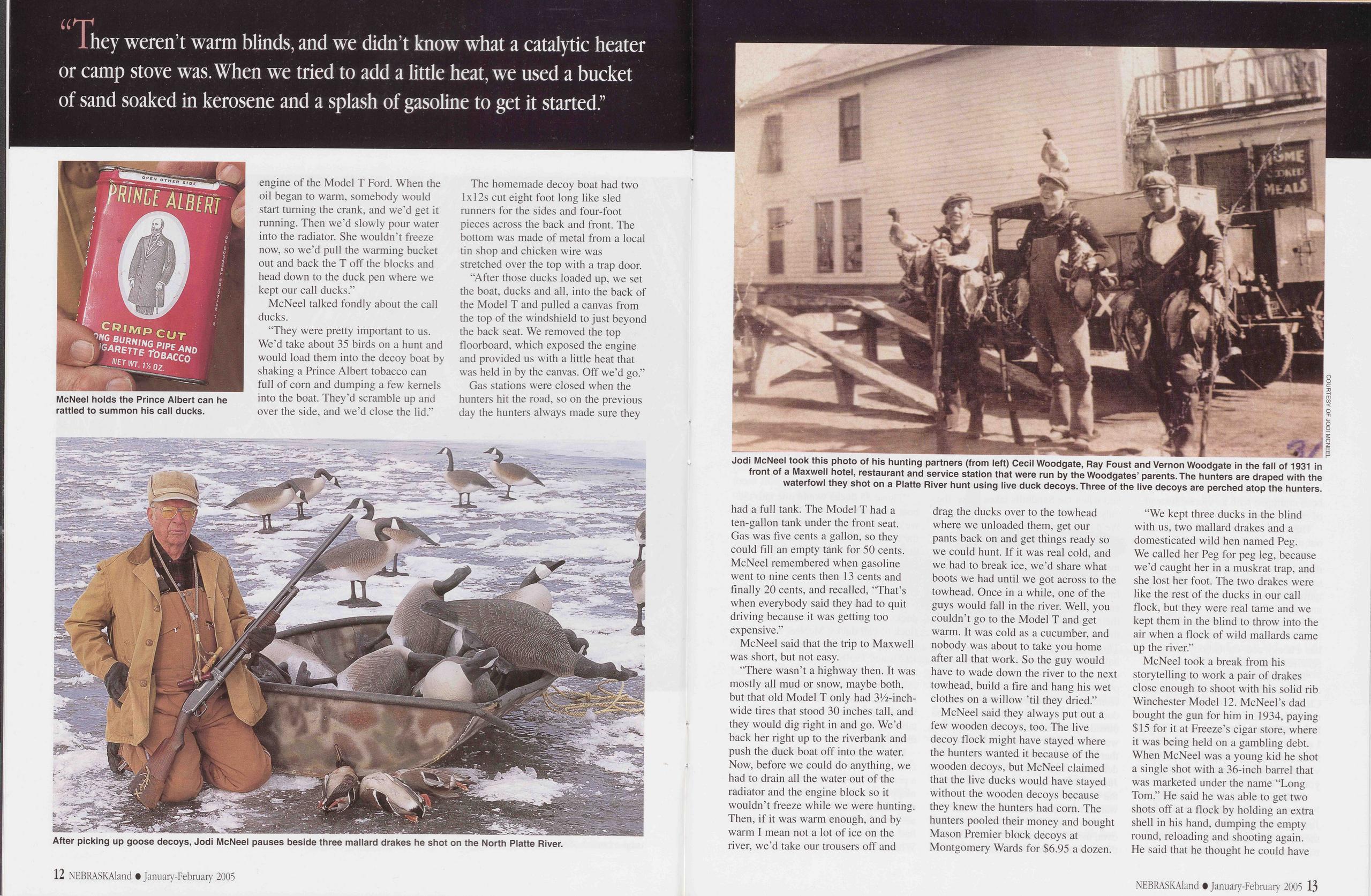
McNeel talked fondly about the call ducks.
"They were pretty important to us. We’d take about 35 birds on a hunt and would load them into the decoy boat by shaking a Prince Albert tobacco can full of corn and dumping a few kernels into the boat. They’d scramble up and over the side, and we’d close the lid.”
The homemade decoy boat had two 1x12s cut eight foot long like sled runners for the sides and four-foot pieces across the back and front. The bottom was made of metal from a local tin shop and chicken wire was stretched over the top with a trap door.
"After those ducks loaded up, we set the boat, ducks and all, into the back of the Model T and pulled a canvas from the top of the windshield to just beyond the back seat. We removed the top floorboard, which exposed the engine and provided us with a little heat that was held in by the canvas. Off we’d go.”
Gas stations were closed when the hunters hit the road, so on the previous day the hunters always made sure they 12 NEBRASKAland • January-February 2005
McNeel said that the trip to Maxwell was short, but not easy.
"There wasn’t a highway then. It was mostly all mud or snow, maybe both, but that old Model T only had 3Vi-inch- wide tires that stood 30 inches tall, and they would dig right in and go. We’d back her right up to the riverbank and push the duck boat off into the water. Now, before we could do anything, we had to drain all the water out of the radiator and the engine block so it wouldn’t freeze while we were hunting. Then, if it was warm enough, and by warm I mean not a lot of ice on the river, we’d take our trousers off and drag the ducks over to the towhead where we unloaded them, get our pants back on and get things ready so we could hunt. If it was real cold, and we had to break ice, we’d share what boots we had until we got across to the towhead. Once in a while, one of the guys would fall in the river. Well, you couldn’t go to the Model T and get warm. It was cold as a cucumber, and nobody was about to take you home after all that work. So the guy would have to wade down the river to the next towhead, build a fire and hang his wet clothes on a willow ’til they dried.”
McNeel said they always put out a few wooden decoys, too. The live decoy flock might have stayed where the hunters wanted it because of the wooden decoys, but McNeel claimed that the live ducks would have stayed without the wooden decoys because they knew the hunters had corn. The hunters pooled their money and bought Mason Premier block decoys at Montgomery Wards for $6.95 a dozen. "We kept three ducks in the blind with us, two mallard drakes and a domesticated wild hen named Peg. We called her Peg for peg leg, because we’d caught her in a muskrat trap, and she lost her foot. The two drakes were like the rest of the ducks in our call flock, but they were real tame and we kept them in the blind to throw into the air when a flock of wild mallards came up the river.”
McNeel took a break from his
storytelling to work a pair of drakes
close enough to shoot with his solid rib
Winchester Model 12. McNeel’s dad
bought the gun for him in 1934, paying
$15 for it at Freeze’s cigar store, where
it was being held on a gambling debt.
When McNeel was a young kid he shot
a single shot with a 36-inch barrel that
was marketed under the name “Long
Tom.” He said he was able to get two
shots off at a flock by holding an extra
shell in his hand, dumping the empty
round, reloading and shooting again.
He said that he thought he could have
NEBRASKAland • January-February 2005 13
This time McNeel let the Labrador out of her box to retrieve the ducks.
“That’s another thing we didn’t have then. Nobody around here started going to Labrador dogs until the 1950s. Up until then we had Chesapeake retrievers and rat tails,” he said.
McNeel used “rat tail” to refer to Irish water spaniels because the breed has a heavy coat on its body and a relatively bare tail.
“I had a female dog named Brownie, and Squeak Morris had a male named Chug. We raised a lot of pups from those two, and a lot of hunters around here had them. She was the best dog I ever owned. I could tell you some stories about her, too, but you probably wouldn’t believe what I was telling you, so I won’t.”
McNeel returned to his hunt story.
“These ducks, believe it or not, were Judas ducks. They knew and liked what they were doing. In those days, all the migrating ducks would come to the river because there were no reservoirs, and when the Sandhills lakes froze, the only available water was in the river. We’d have huge migrations out of the north ahead of or behind a storm, and sometimes you’d see a flock of 500 or more ducks coming up river. Well, at about a mile out, we’d throw up the first duck. It would circle once or twice and all the call ducks would be calling their heads off at it. It would land out there in the river with the rest of them. Then when the flock was about a half-mile away, we’d throw the second duck up and the calling would start all over again. At this point that flock was committed. When we threw that third duck into the air, we could have stepped outside the blind and waited. They were coming in regardless of us being there. When the shooting ended and the dead ducks were picked up, those three Judas ducks would come up and hop in the blind where we gave them corn and waited for the next flock.”
McNeel said that when the hunt was over, usually at sunset, they would pull the duck boat onto the sandbar and rattle the Prince Albert can.
“Those 35 ducks would pile into the boat like they were on a string. Then we’d give them some of the corn, drag the boat across the river and load the ducks and boat onto the Model T. Of course, we had to build our cob fire again and pour water into the radiator. Off we went for home.”
Despite the work involved to hunt ducks in those days and to care for a flock of call ducks, McNeel was not an exception in North Platte in the 1920s and 1930s.
He said, “Everybody who hunted had call ducks and some had geese as well. Most men hunted in those days, because it was another way to put food on the table for the family, so there were a lot of call flocks.”
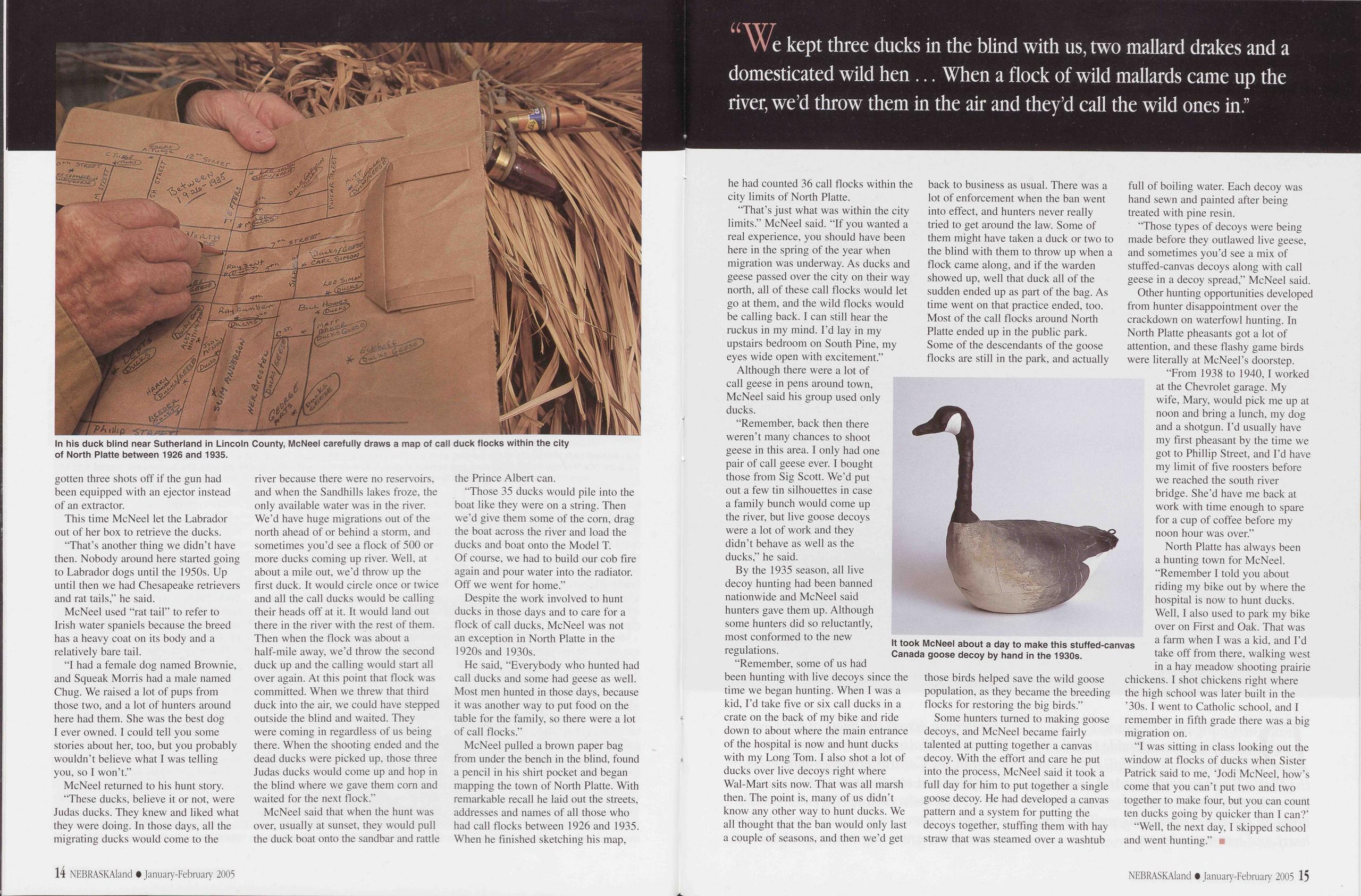
McNeel pulled a brown paper bag from under the bench in the blind, found a pencil in his shirt pocket and began mapping the town of North Platte. With remarkable recall he laid out the streets, addresses and names of all those who had call flocks between 1926 and 1935. When he finished sketching his map, 14 NEBRASKAland • January-February 2005 he had counted 36 call flocks within the city limits of North Platte.
We kept three ducks in the blind with us, two mallard drakes and a domesticated wild hen ... Mien a flock of wild mallards came up the river, we'd throw them in the air and they'd call the wild ones in."“That’s just what was within the city limits.” McNeel said. “If you wanted a real experience, you should have been here in the spring of the year when migration was underway. As ducks and geese passed over the city on their way north, all of these call flocks would let go at them, and the wild flocks would be calling back. I can still hear the ruckus in my mind. I’d lay in my upstairs bedroom on South Pine, my eyes wide open with excitement.”
Although there were a lot of call geese in pens around town, McNeel said his group used only ducks.
“Remember, back then there weren’t many chances to shoot geese in this area. I only had one pair of call geese ever. I bought those from Sig Scott. We’d put out a few tin silhouettes in case a family bunch would come up the river, but live goose decoys were a lot of work and they didn’t behave as well as the ducks,” he said.
By the 1935 season, all live decoy hunting had been banned nationwide and McNeel said hunters gave them up. Although some hunters did so reluctantly, most conformed to the new regulations.
“Remember, some of us had been hunting with live decoys since the time we began hunting. When I was a kid, I’d take five or six call ducks in a crate on the back of my bike and ride down to about where the main entrance of the hospital is now and hunt ducks with my Long Tom. I also shot a lot of ducks over live decoys right where Wal-Mart sits now. That was all marsh then. The point is, many of us didn’t know any other way to hunt ducks. We all thought that the ban would only last a couple of seasons, and then we’d get back to business as usual. There was a lot of enforcement when the ban went into effect, and hunters never really tried to get around the law. Some of them might have taken a duck or two to the blind with them to throw up when a flock came along, and if the warden showed up, well that duck all of the sudden ended up as part of the bag. As time went on that practice ended, too. Most of the call flocks around North Platte ended up in the public park. Some of the descendants of the goose flocks are still in the park, and actually
Some hunters turned to making goose decoys, and McNeel became fairly talented at putting together a canvas decoy. With the effort and care he put into the process, McNeel said it took a full day for him to put together a single goose decoy. He had developed a canvas pattern and a system for putting the decoys together, stuffing them with hay straw that was steamed over a washtub full of boiling water. Each decoy was hand sewn and painted after being treated with pine resin.
“Those types of decoys were being made before they outlawed live geese, and sometimes you’d see a mix of stuffed-canvas decoys along with call geese in a decoy spread,” McNeel said. Other hunting opportunities developed from hunter disappointment over the crackdown on waterfowl hunting. In North Platte pheasants got a lot of attention, and these flashy game birds were literally at McNeel’s doorstep.
“From 1938 to 1940,1 worked at the Chevrolet garage. My wife, Mary, would pick me up at noon and bring a lunch, my dog and a shotgun. I’d usually have my first pheasant by the time we got to Phillip Street, and I’d have my limit of five roosters before we reached the south river bridge. She’d have me back at work with time enough to spare for a cup of coffee before my noon hour was over.”
North Platte has always been a hunting town for McNeel. “Remember I told you about riding my bike out by where the hospital is now to hunt ducks. Well, I also used to park my bike over on First and Oak. That was a farm when I was a kid, and I’d take off from there, walking west in a hay meadow shooting prairie chickens. I shot chickens right where the high school was later built in the ’30s. I went to Catholic school, and I remember in fifth grade there was a big migration on.
“I was sitting in class looking out the window at flocks of ducks when Sister Patrick said to me, ‘Jodi McNeel, how’s come that you can’t put two and two together to make four, but you can count ten ducks going by quicker than I can?’
“Well, the next day, I skipped school and went hunting.”
NEBRASKAland • January-February 2005 15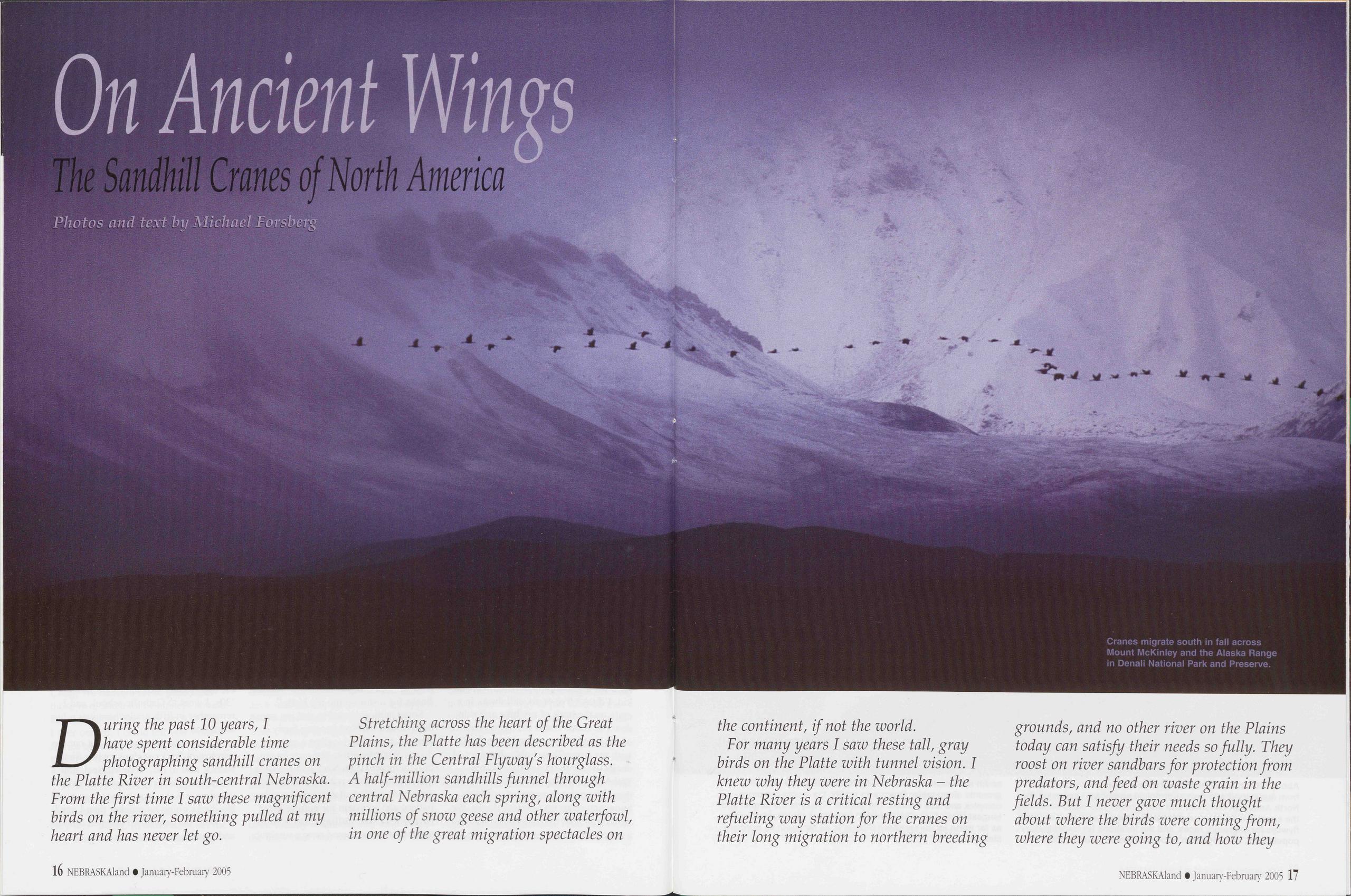
On Ancient Wings
The Sandhill Cranes of North America
During the past 10 years, I have spent considerable time photographing sandhill cranes on the Platte River in south-central Nebraska. From the first time I saw these magnificent birds on the river, something pulled at my heart and has never let go.
Stretching across the heart of the Great Plains, the Platte has been described as the pinch in the Central Flyway's hourglass. A half-million sandhills funnel through central Nebraska each spring, along with millions of snow geese and other waterfowl, in one of the great migration spectacles on 16 NEBRASKAland • January-February 2005
For many years I saw these tall, gray
birds on the Platte with tunnel vision. I
knew why they were in Nebraska - the
Platte River is a critical resting and
refueling way station for the cranes on
their long migration to northern breeding
grounds, and no other river on the Plains
today can satisfy their needs so fully. They
roost on river sandbars for protection from
predators, and feed on waste grain in the
fields. But I never gave much thought
about where the birds were coming from,
where they were going to, and how they
NEBRASKAland • January-February 2005 17
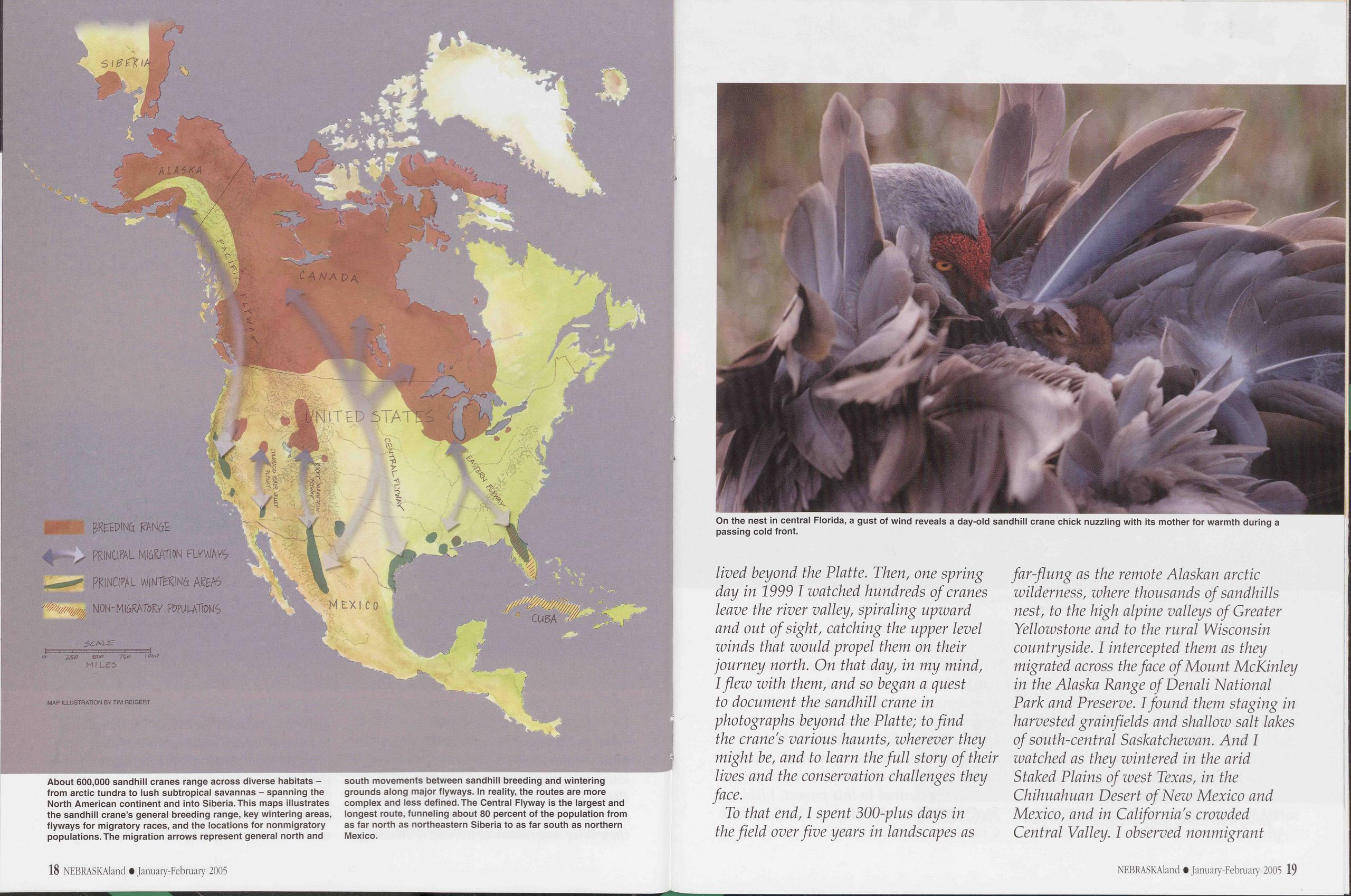
To that end, I spent 300-plus days in
the field over five years in landscapes as
far-flung as the remote Alaskan arctic
wilderness, where thousands of sandhills
nest, to the high alpine valleys of Greater
Yellowstone and to the rural Wisconsin
countryside. I intercepted them as they
migrated across the face of Mount McKinley
in the Alaska Range of Denali National
Park and Preserve. I found them staging in
harvested grainfields and shallow salt lakes
of south-central Saskatchewan. And I
watched as they wintered in the arid
Staked Plains of west Texas, in the
Chihuahuan Desert of New Mexico and
Mexico, and in California's crowded
Central Valley. I observed nonmigrant
NEBRASKAland • January-February 2005 19
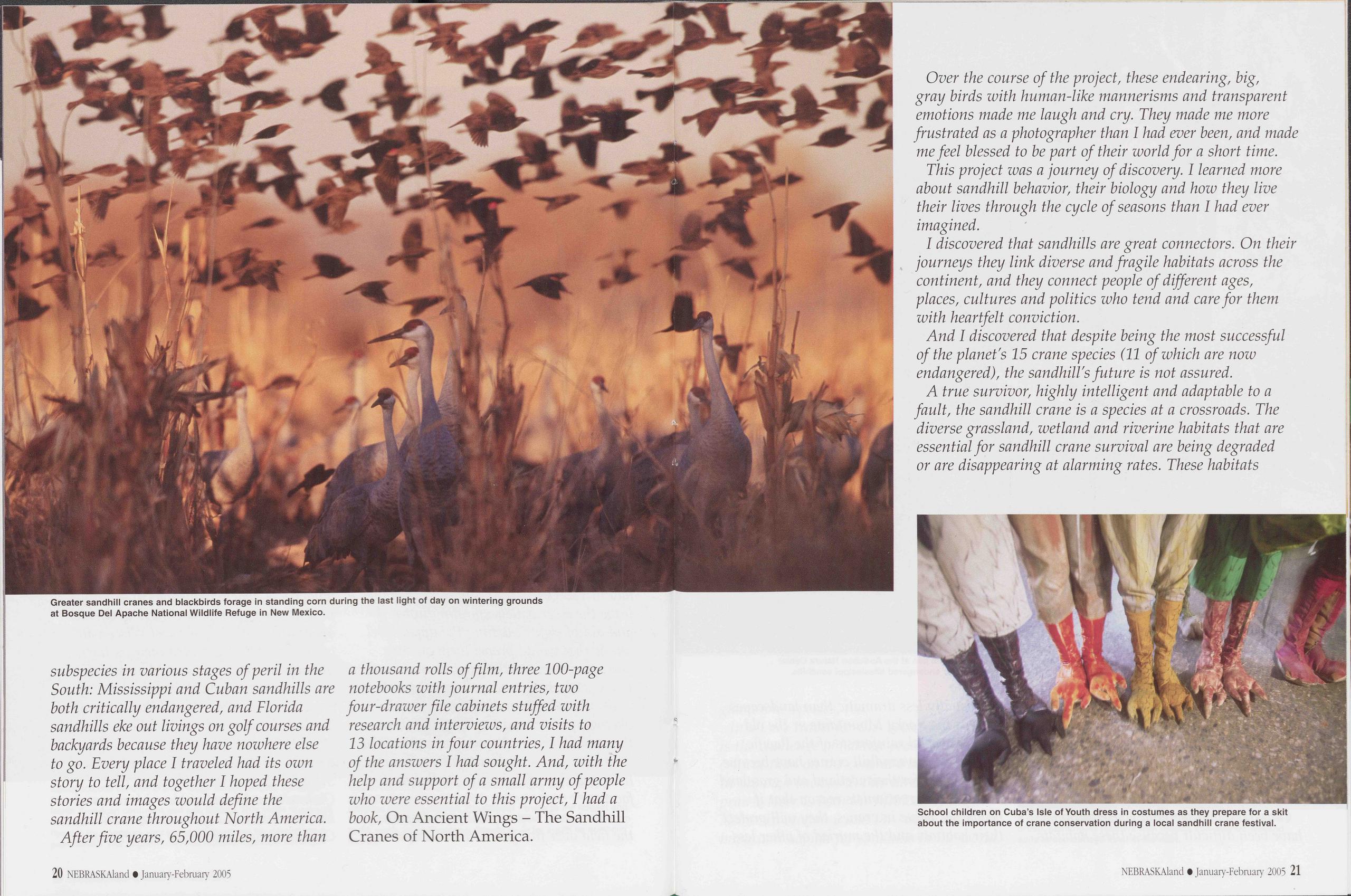 G
G
After five years, 65,000 miles, more than a thousand rolls of film, three 100-page notebooks with journal entries, two four-drawer file cabinets stuffed with research and interviews, and visits to 13 locations in four countries, I had many of the answers I had sought. And, with the help and support of a small army of people who were essential to this project, I had a book, On Ancient Wings - The Sandhill Cranes of North America.
20 NEBRASKAland • January-February 2005Over the course of the project, these endearing, big, gray birds with human-like mannerisms and transparent emotions made me laugh and cry. They made me more frustrated as a photographer than I had ever been, and made me feel blessed to be part of their world for a short time.
This project was a journey of discovery. I learned more about sandhill behavior, their biology and how they live their lives through the cycle of seasons than I had ever imagined.
I discovered that sandhills are great connectors. On their journeys they link diverse and fragile habitats across the continent, and they connect people of different ages, places, cultures and politics who tend and care for them with heartfelt conviction.
And I discovered that despite being the most successful of the planet's 15 crane species (11 of which are now endangered), the sandhill's future is not assured.
A true survivor, highly intelligent and adaptable to a fault, the sandhill crane is a species at a crossroads. The diverse grassland, wetland and riverine habitats that are essential for sandhill crane survival are being degraded or are disappearing at alarming rates. These habitats
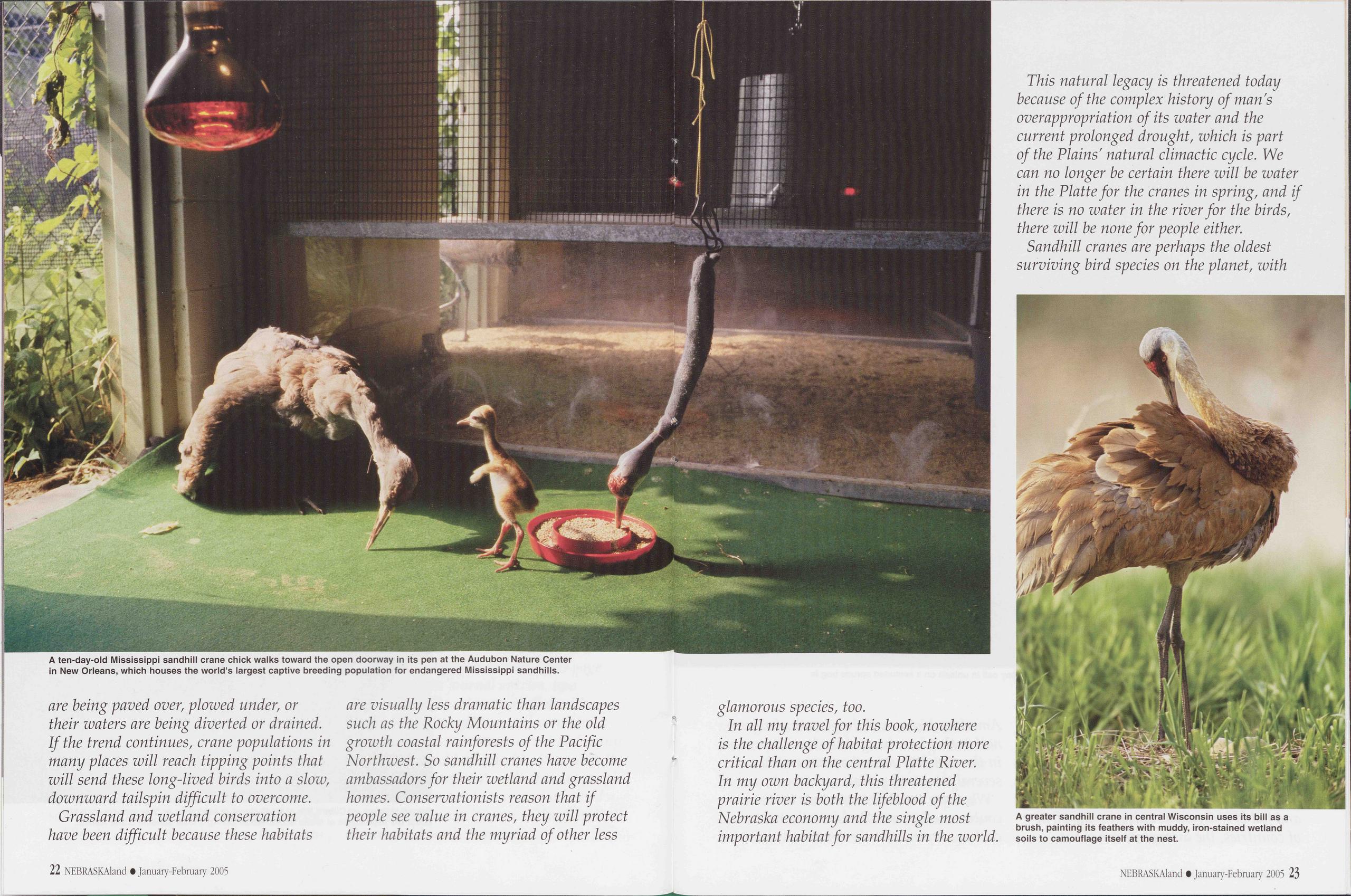
Grassland and wetland conservation have been difficult because these habitats are visually less dramatic than landscapes such as the Rocky Mountains or the old growth coastal rainforests of the Pacific Northwest. So sandhill cranes have become ambassadors for their wetland and grassland homes. Conservationists reason that if people see value in cranes, they will protect their habitats and the myriad of other less 22 NEBRASKAland • January-February 2005 glamorous species, too.
In all my travel for this book, nowhere is the challenge of habitat protection more critical than on the central Platte River. In my own backyard, this threatened prairie river is both the lifeblood of the Nebraska economy and the single most important habitat for sandhills in the world. This natural legacy is threatened today because of the complex history of man's overappropriation of its water and the current prolonged drought, which is part of the Plains' natural climactic cycle. We can no longer be certain there will be water in the Platte for the cranes in spring, and if there is no water in the river for the birds, there will be none for people either. Sandhill cranes are perhaps the oldest surviving bird species on the planet, with
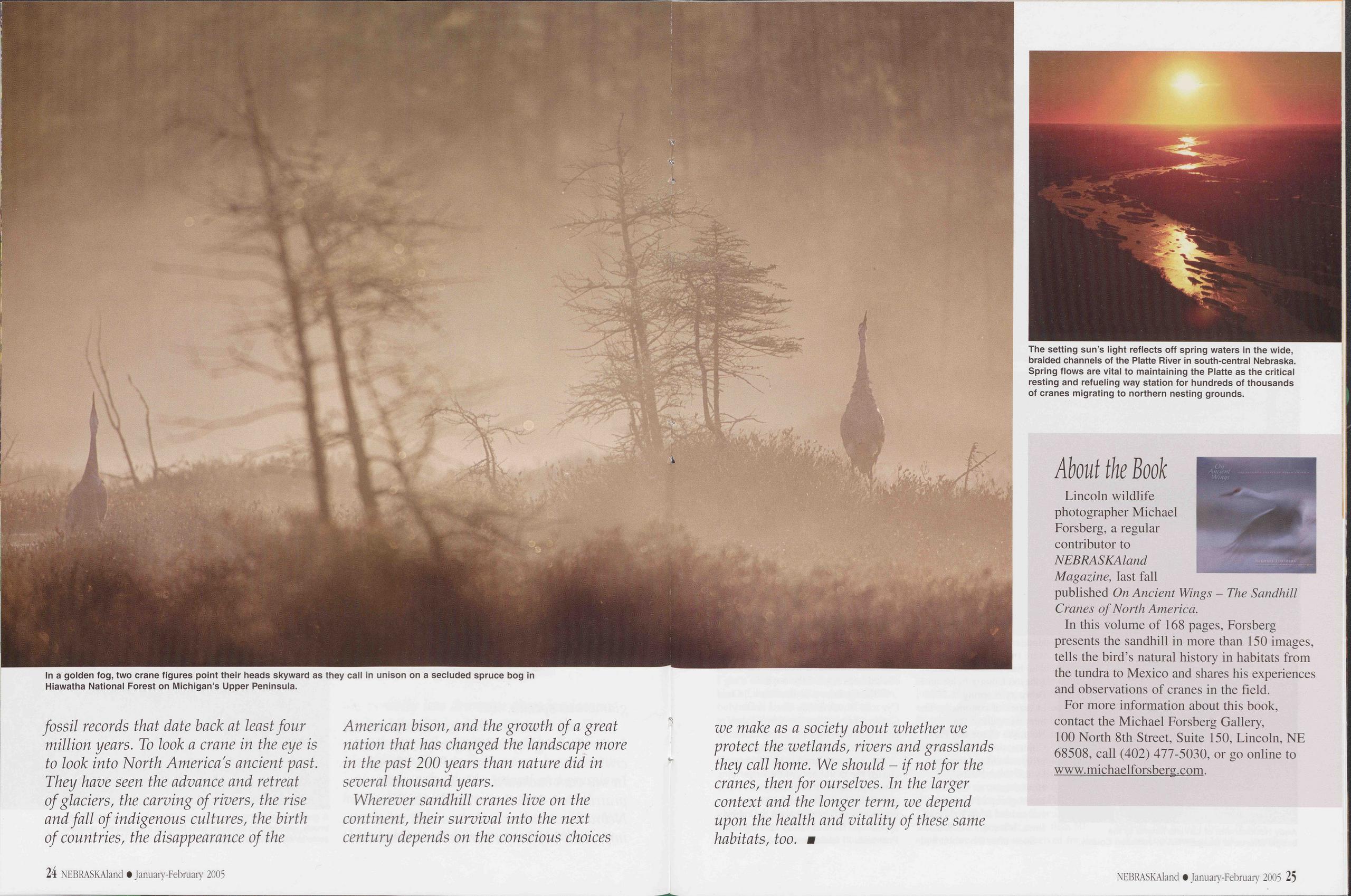
Wherever sandhill cranes live on the continent, their survival into the next century depends on the conscious choices 24 NEBRASKAland • January-February 2005 we make as a society about whether we protect the wetlands, rivers and grasslands they call home. We should - if not for the cranes, then for ourselves. In the larger context and the longer term, we depend upon the health and vitality of these same habitats, too.
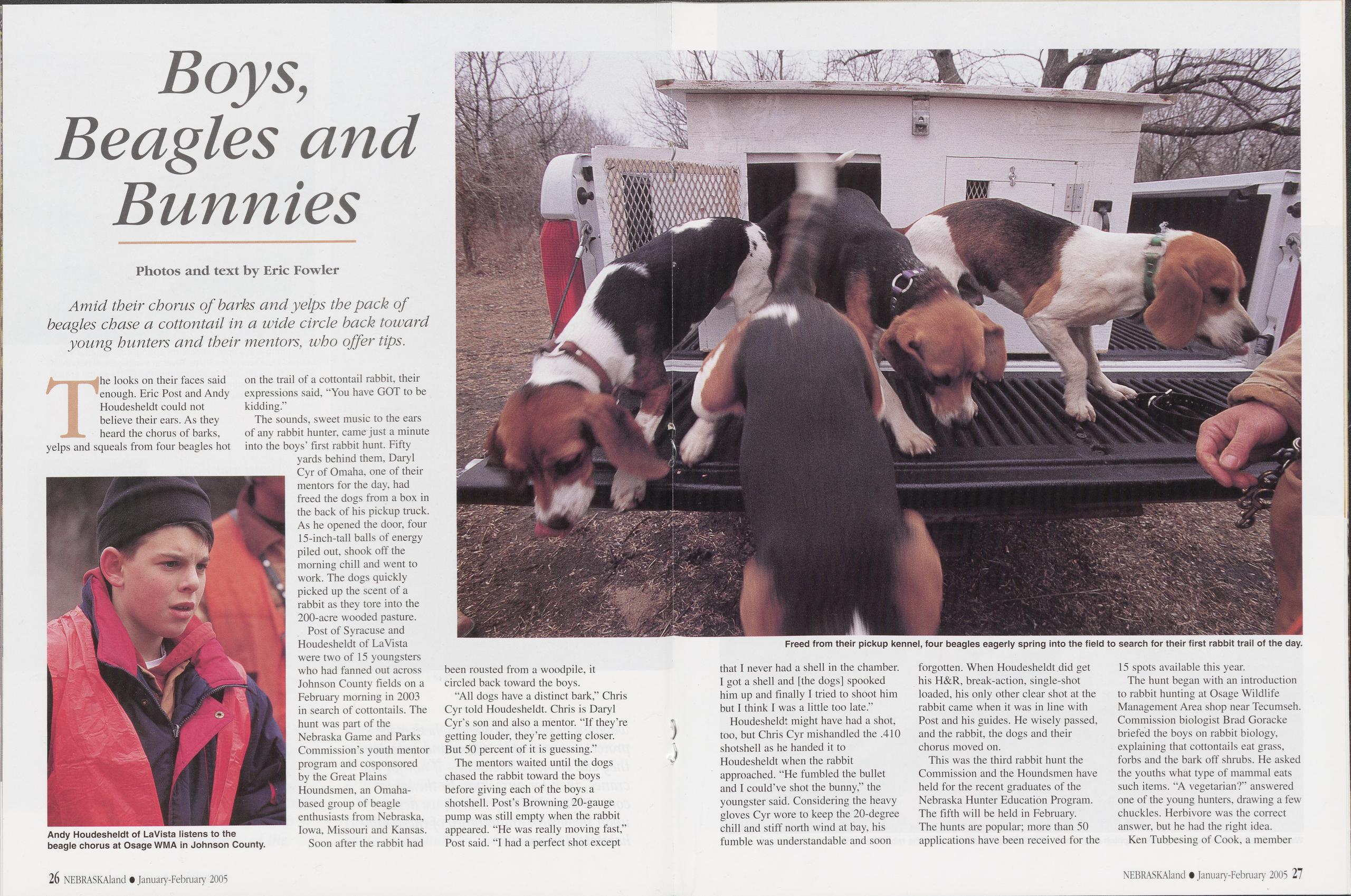
Boys, Beagles and Bunnies
Amid their chorus of barks and yelps the pack of beagles chase a cottontail in a wide circle back toward young hunters and their mentors, who offer tips.
The looks on their faces said enough. Eric Post and Andy Houdesheldt could not belive their ears. As they heard the chorus of barks, yelps and squeals from four beagles hot
The sounds, sweet music to the ears of any rabbit hunter, came just a minute into the boys' first rabbit hunt. Fifty yards behind them, Daryl Cyr of Omaha, one of their mentors for the day, had freed the dogs from his pickup truck. As he opened the door, four 15-inch-tall balls of energy pilled out, shook off the morning chill and went to work. The dogs quickly picked up the scent of a rabbit as they tore into the 200-acre wooded pasture.
Post Syracuse and Housdesheldt of LaVista were two of 15 youngsters who had fanned out across Johnson County fields on a February Morning in 2003 in search of cottontails. The hunt was part of the Nebraska Game and Parks Commission's youth mentor program and cosponsored by the Great Plains Houndsmen, an Omaha based group of beagles enthusiasts from Nebraska, Iowa, Missouri and Kansas.
Soon after the rabbit had been rousted from a woodpile, it circled back toward the boys.
"All dogs have a distinct bark," Chris Cyr told Houdesheldt. Chris is Daryl Cyr's son and also a mentor. "If they're getting lounder, they're getting closer. But 50 percent of it is guessing."
The mentors waited until the dogs chased the rabbit toward the boys before giving each of the boys a shotshell. Post's Breewning 20-gauge pump was still empty when the rabbit appeared. "he was really moving fast," Post said. "I had a perfect shot except 26 NEBRASKAland January-February 2005
Houdesheldt might have had a shot, too, but Chris Cyr mishandled the .410 shotshell as he handed it to Houdesheldt when the rabbit approached. "He fumbled the bullet and I chould've shot the bunny," the youngster said. Considering the heavy gloves Cyr wore to keep the 20-degreee chill and stiff north wind a bay, his fumble was understandable and soon forgotten. When Houdesheldt did get his H&R, break-action, single-shot loaded, his only other clear shot at the rabbit came when it was in line with Post and his guides. He wisely Passed, and the rabbit, the dogs and their chorus moved on.
This was the third rabbit hunt the Commission and the Houndsmen have held for the recent graduates of the Nebraska Hunter Education Program. The fifth will be held in February. The hunts are popular; more than 50 applications have been received for the 15 spots available this year.
The hunt began with an introduction to rabbit hunting at Osage Wildlife Management Area shop near Tecumseh. Commission biologist Brad Goracke briefed the boys on rabbit biology, explaining that cottontails eat grass, forbs and the bark off shrubs. He asked the youths what type of mammal eats such items. "A vegetarian?" answered one of the young hunters, drawing a few chuckles. Herbivore was the correct answer, but he had the right idea.
Ken Tubbesing of Cook, a member
NEBRASKAland January-February 2005 27
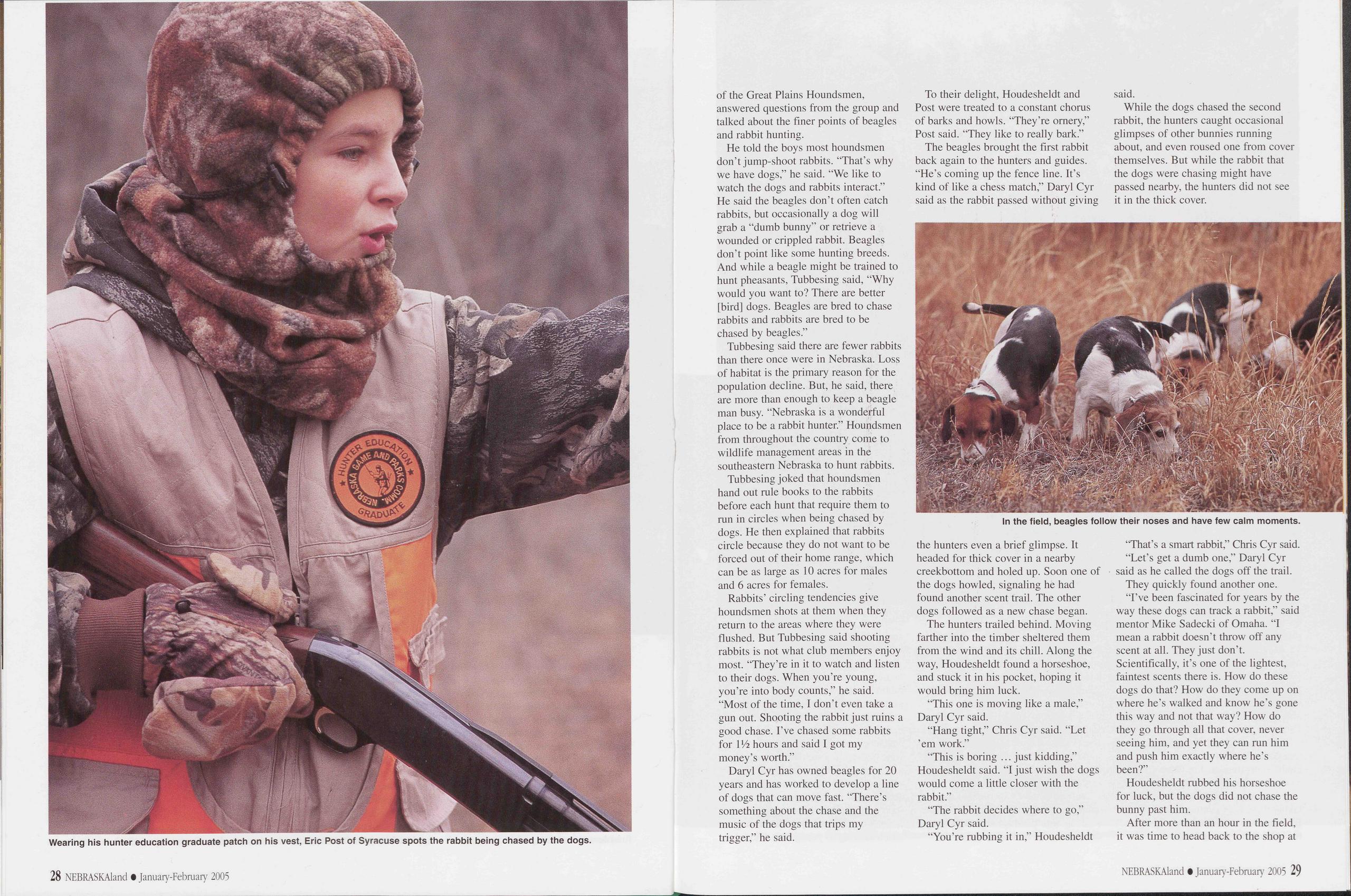
He told the boys most houndsmen don’t jump-shoot rabbits. “That’s why we have dogs,” he said. “We like to watch the dogs and rabbits interact.” He said the beagles don’t often catch rabbits, but occasionally a dog will grab a “dumb bunny” or retrieve a wounded or crippled rabbit. Beagles don’t point like some hunting breeds. And while a beagle might be trained to hunt pheasants, Tubbesing said, “Why would you want to? There are better [bird] dogs. Beagles are bred to chase rabbits and rabbits are bred to be chased by beagles.”
Tubbesing said there are fewer rabbits than there once were in Nebraska. Loss of habitat is the primary reason for the population decline. But, he said, there are more than enough to keep a beagle man busy. “Nebraska is a wonderful place to be a rabbit hunter.” Houndsmen from throughout the country come to wildlife management areas in the southeastern Nebraska to hunt rabbits.
Tubbesing joked that houndsmen hand out rule books to the rabbits before each hunt that require them to run in circles when being chased by dogs. He then explained that rabbits circle because they do not want to be forced out of their home range, which can be as large as 10 acres for males and 6 acres for females.
Rabbits’ circling tendencies give houndsmen shots at them when they return to the areas where they were flushed. But Tubbesing said shooting rabbits is not what club members enjoy most. “They’re in it to watch and listen to their dogs. When you’re young, you’re into body counts,” he said. “Most of the time, I don’t even take a gun out. Shooting the rabbit just ruins a good chase. I’ve chased some rabbits for P/2 hours and said I got my money’s worth.”
Daryl Cyr has owned beagles for 20 years and has worked to develop a line of dogs that can move fast. “There’s something about the chase and the music of the dogs that trips my trigger,” he said.
To their delight, Houdesheldt and Post were treated to a constant chorus of barks and howls. “They’re ornery,” Post said. “They like to really bark.”
The beagles brought the first rabbit back again to the hunters and guides. “He’s coming up the fence line. It’s kind of like a chess match,” Daryl Cyr said as the rabbit passed without giving
The hunters trailed behind. Moving farther into the timber sheltered them from the wind and its chill. Along the way, Houdesheldt found a horseshoe, and stuck it in his pocket, hoping it would bring him luck.
“This one is moving like a male,” Daryl Cyr said.
“Hang tight,” Chris Cyr said. “Let ’em work.”
“This is boring ... just kidding,” Houdesheldt said. “I just wish the dogs would come a little closer with the rabbit.”
“The rabbit decides where to go,” Daryl Cyr said.
“You’re rubbing it in,” Houdesheldt said.
While the dogs chased the second rabbit, the hunters caught occasional glimpses of other bunnies running about, and even roused one from cover themselves. But while the rabbit that the dogs were chasing might have passed nearby, the hunters did not see it in the thick cover.
“That’s a smart rabbit,” Chris Cyr said.
“Let’s get a dumb one,” Daryl Cyr said as he called the dogs off the trail.
They quickly found another one.
“I’ve been fascinated for years by the way these dogs can track a rabbit,” said mentor Mike Sadecki of Omaha. “I mean a rabbit doesn’t throw off any scent at all. They just don’t. Scientifically, it’s one of the lightest, faintest scents there is. How do these dogs do that? How do they come up on where he’s walked and know he’s gone this way and not that way? How do they go through all that cover, never seeing him, and yet they can run him and push him exactly where he’s been?”
Houdesheldt rubbed his horseshoe for luck, but the dogs did not chase the bunny past him.
After more than an hour in the field,
it was time to head back to the shop at
NEBRASKAland • January-February 2005 29
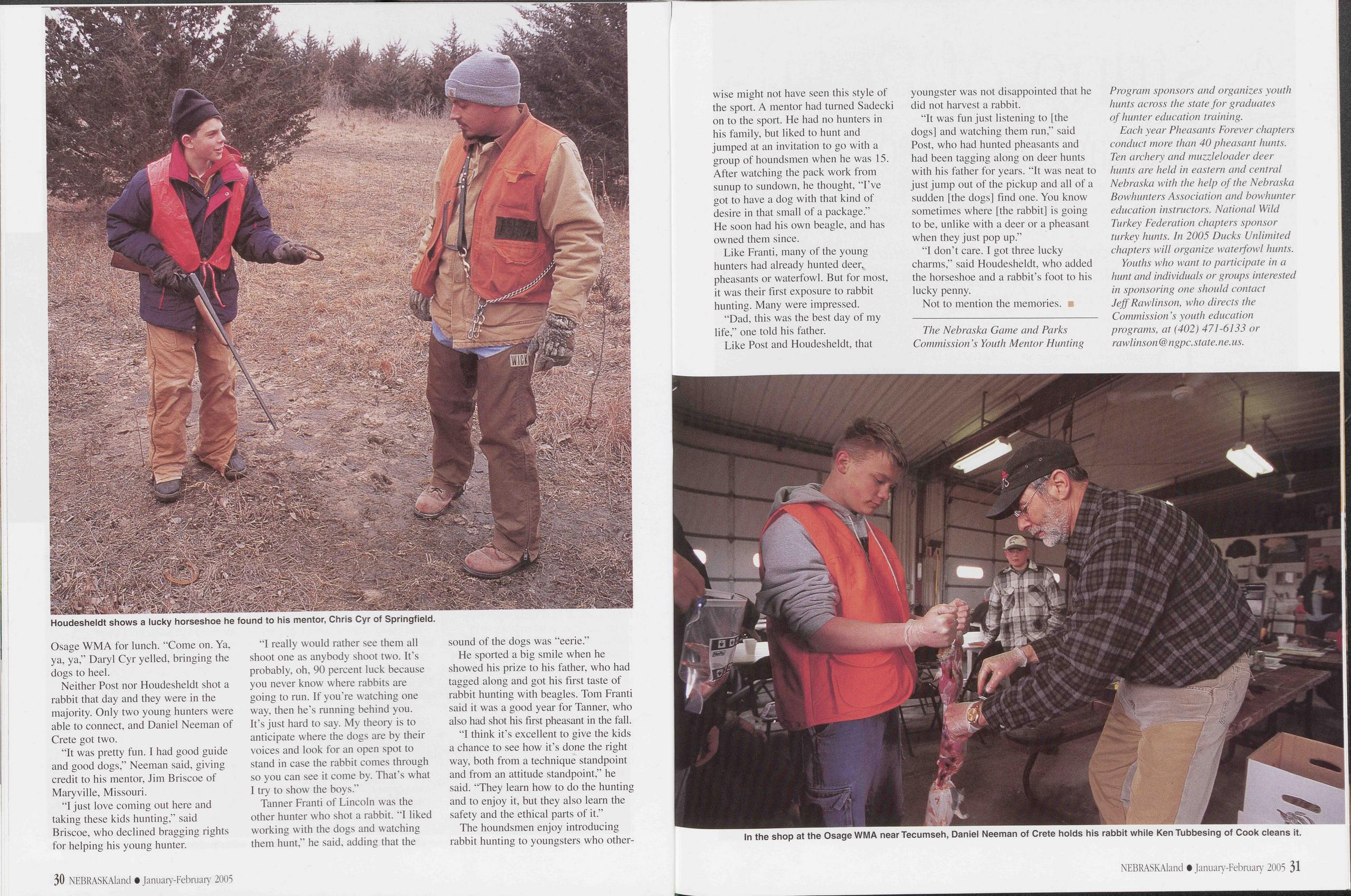
Neither Post nor Houdesheldt shot a rabbit that day and they were in the majority. Only two young hunters were able to connect, and Daniel Neeman of Crete got two.
"It was pretty fun. I had good guide and good dogs,” Neeman said, giving credit to his mentor, Jim Briscoe of Maryville, Missouri.
“I just love coming out here and taking these kids hunting,” said Briscoe, who declined bragging rights for helping his young hunter.
"I really would rather see them all shoot one as anybody shoot two. It’s probably, oh, 90 percent luck because you never know where rabbits are going to run. If you’re watching one way, then he’s running behind you. It’s just hard to say. My theory is to anticipate where the dogs are by their voices and look for an open spot to stand in case the rabbit comes through so you can see it come by. That’s what I try to show the boys.”
Tanner Franti of Lincoln was the other hunter who shot a rabbit. "I liked working with the dogs and watching them hunt,” he said, adding that the sound of the dogs was "eerie.”
He sported a big smile when he showed his prize to his father, who had tagged along and got his first taste of rabbit hunting with beagles. Tom Franti said it was a good year for Tanner, who also had shot his first pheasant in the fall.
"I think it’s excellent to give the kids a chance to see how it’s done the right way, both from a technique standpoint and from an attitude standpoint,” he said. “They learn how to do the hunting and to enjoy it, but they also learn the safety and the ethical parts of it.”
The houndsmen enjoy introducing rabbit hunting to youngsters who other- 30 NEBRASKAland • January-February 2005 wise might not have seen this style of the sport. A mentor had turned Sadecki on to the sport. He had no hunters in his family, but liked to hunt and jumped at an invitation to go with a group of houndsmen when he was 15. After watching the pack work from sunup to sundown, he thought, "I’ve got to have a dog with that kind of desire in that small of a package.” He soon had his own beagle, and has owned them since.
Like Franti, many of the young hunters had already hunted deer, pheasants or waterfowl. But for most, it was their first exposure to rabbit hunting. Many were impressed.
"Dad, this was the best day of my life,” one told his father.
Like Post and Houdesheldt, that
"It was fun just listening to [the dogs] and watching them run,” said Post, who had hunted pheasants and had been tagging along on deer hunts with his father for years. "It was neat to just jump out of the pickup and all of a sudden [the dogs] find one. You know sometimes where [the rabbit] is going to be, unlike with a deer or a pheasant when they just pop up.”
"I don’t care. I got three lucky charms,” said Houdesheldt, who added the horseshoe and a rabbit’s foot to his lucky penny.
Not to mention the memories.
The Nebraska Game and Parks Commission’s Youth Mentor Hunting Program sponsors and organizes youth hunts across the state for graduates of hunter education training. Each year Pheasants Forever chapters conduct more than 40 pheasant hunts. Ten archery and muzzleloader deer hunts are held in eastern and central Nebraska with the help of the Nebraska Bowhunters Association and bowhunter education instructors. National Wild Turkey Federation chapters sponsor turkey hunts. In 2005 Ducks Unlimited chapters will organize waterfowl hunts. Youths who want to participate in a hunt and individuals or groups interested in sponsoring one should contact Jeff Rawlinson, who directs the Commission’s youth education programs, at (402) 471-6133 or rawlinson @ ngpc. state.ne. us. NEBRASKAland • January-February 2005 31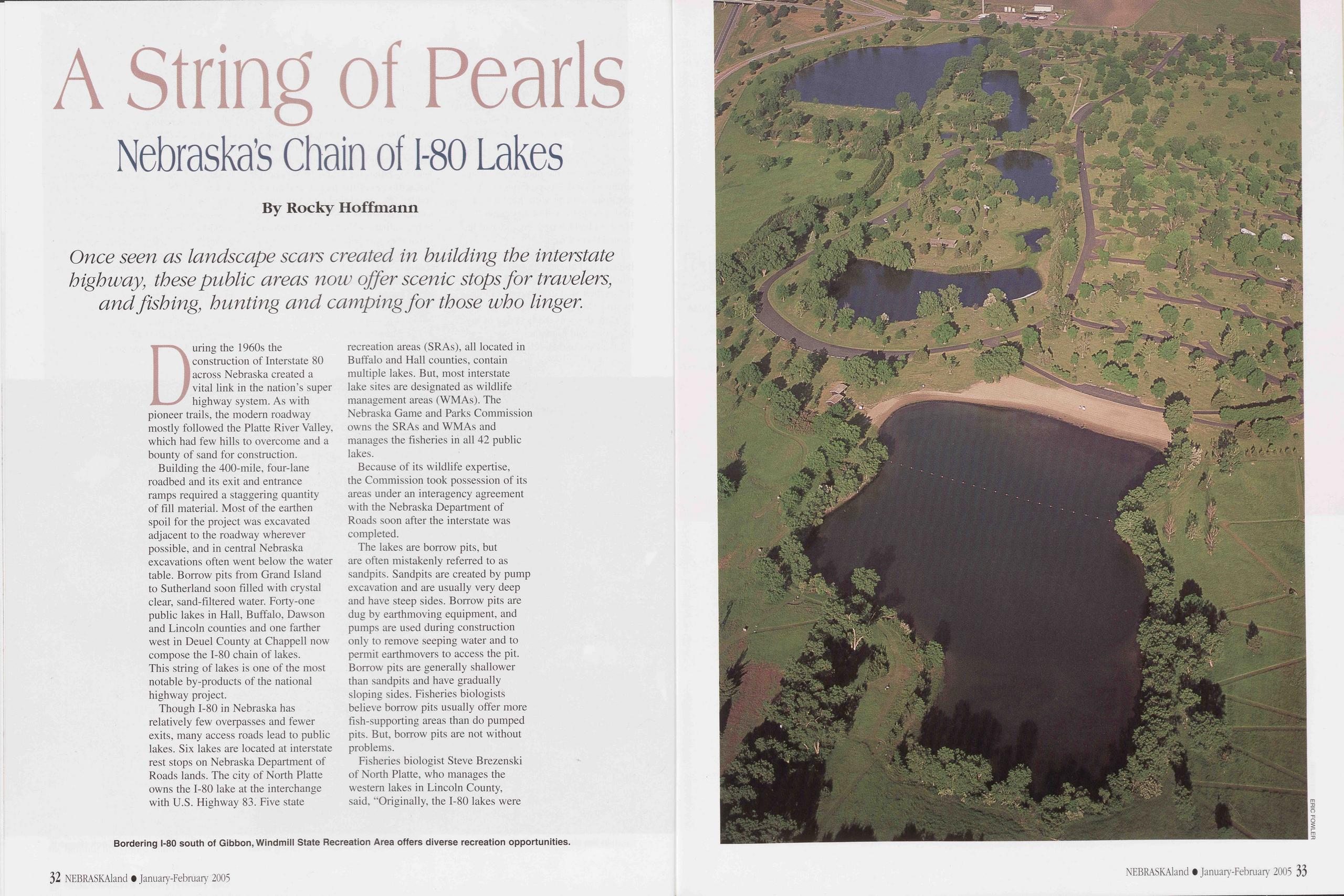
A String of Pearls
Nebraska's Chain of I-80 Lakes
Once seen as landscape scars created in building the interstate highway, these public areas now offer scenic stops for travelers, and fishing, hunting and camping for those who linger.
During the 1960s the construction of Interstate 80 across Nebraska created a vital link in the nation’s super highway system. As with pioneer trails, the modern roadway mostly followed the Platte River Valley, which had few hills to overcome and a bounty of sand for construction.
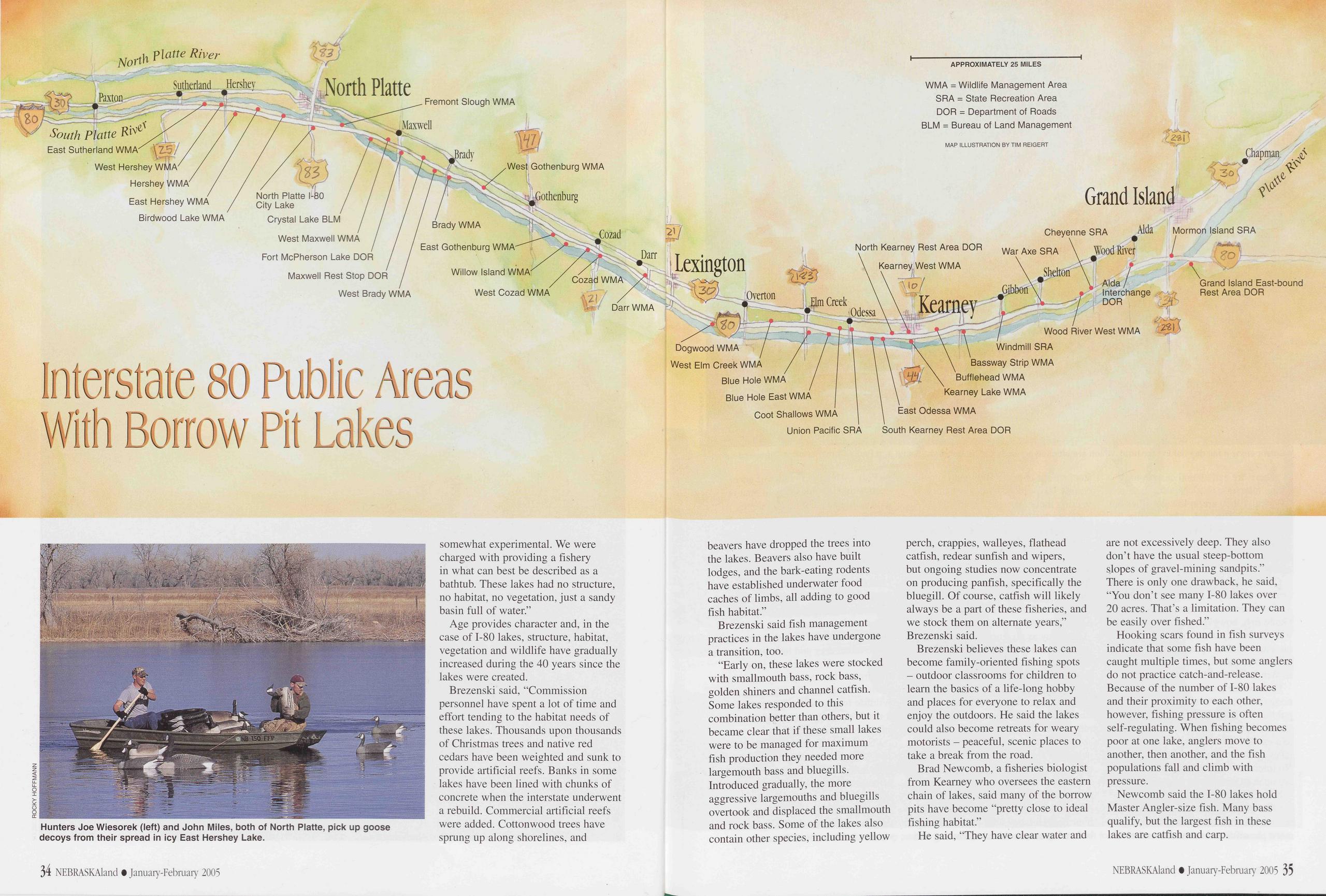
Building the 400-mile, four-lane roadbed and its exit and entrance ramps required a staggering quantity of fill material. Most of the earthen spoil for the project was excavated adjacent to the roadway wherever possible, and in central Nebraska excavations often went below the water table. Borrow pits from Grand Island to Sutherland soon filled with crystal clear, sand-filtered water. Forty-one public lakes in Hall, Buffalo, Dawson and Lincoln counties and one farther west in Deuel County at Chappell now compose the 1-80 chain of lakes. This string of lakes is one of the most notable by-products of the national highway project.
Though 1-80 in Nebraska has relatively few overpasses and fewer exits, many access roads lead to public lakes. Six lakes are located at interstate rest stops on Nebraska Department of Roads lands. The city of North Platte owns the 1-80 lake at the interchange with U.S. Highway 83. Five state recreation areas (SRAs), all located in Buffalo and Hall counties, contain multiple lakes. But, most interstate lake sites are designated as wildlife management areas (WMAs). The Nebraska Game and Parks Commission owns the SRAs and WMAs and manages the fisheries in all 42 public lakes.
Because of its wildlife expertise, the Commission took possession of its areas under an interagency agreement with the Nebraska Department of Roads soon after the interstate was completed.
The lakes are borrow pits, but are often mistakenly referred to as sandpits. Sandpits are created by pump excavation and are usually very deep and have steep sides. Borrow pits are dug by earthmoving equipment, and pumps are used during construction only to remove seeping water and to permit earthmovers to access the pit. Borrow pits are generally shallower than sandpits and have gradually sloping sides. Fisheries biologists believe borrow pits usually offer more fish-supporting areas than do pumped pits. But, borrow pits are not without problems.
Fisheries biologist Steve Brezenski of North Platte, who manages the western lakes in Lincoln County, said, “Originally, the 1-80 lakes were 32 NEBRASKAland • January-February 2005
Age provides character and, in the case of 1-80 lakes, structure, habitat, vegetation and wildlife have gradually increased during the 40 years since the lakes were created.
Brezenski said, “Commission personnel have spent a lot of time and effort tending to the habitat needs of these lakes. Thousands upon thousands of Christmas trees and native red cedars have been weighted and sunk to provide artificial reefs. Banks in some lakes have been lined with chunks of concrete when the interstate underwent a rebuild. Commercial artificial reefs were added. Cottonwood trees have sprung up along shorelines, and 34 NEBRASKAland • January-February 2005 beavers have dropped the trees into the lakes. Beavers also have built lodges, and the bark-eating rodents have established underwater food caches of limbs, all adding to good fish habitat.”
Brezenski said fish management practices in the lakes have undergone a transition, too.
“Early on, these lakes were stocked with smallmouth bass, rock bass, golden shiners and channel catfish. Some lakes responded to this combination better than others, but it became clear that if these small lakes were to be managed for maximum fish production they needed more largemouth bass and bluegills. Introduced gradually, the more aggressive largemouths and bluegills overtook and displaced the smallmouth and rock bass. Some of the lakes also contain other species, including yellow perch, crappies, walleyes, flathead catfish, redear sunfish and wipers, but ongoing studies now concentrate on producing panfish, specifically the bluegill. Of course, catfish will likely always be a part of these fisheries, and we stock them on alternate years,” Brezenski said.
Brezenski believes these lakes can become family-oriented fishing spots - outdoor classrooms for children to learn the basics of a life-long hobby and places for everyone to relax and enjoy the outdoors. He said the lakes could also become retreats for weary motorists - peaceful, scenic places to take a break from the road.
Brad Newcomb, a fisheries biologist from Kearney who oversees the eastern chain of lakes, said many of the borrow pits have become “pretty close to ideal fishing habitat.”
He said, “They have clear water and are not excessively deep. They also don’t have the usual steep-bottom slopes of gravel-mining sandpits.” There is only one drawback, he said, “You don’t see many 1-80 lakes over 20 acres. That’s a limitation. They can be easily over fished.”
Hooking scars found in fish surveys indicate that some fish have been caught multiple times, but some anglers do not practice catch-and-release. Because of the number of 1-80 lakes and their proximity to each other, however, fishing pressure is often self-regulating. When fishing becomes poor at one lake, anglers move to another, then another, and the fish populations fall and climb with pressure.
Newcomb said the 1-80 lakes hold Master Angler-size fish. Many bass qualify, but the largest fish in these lakes are catfish and carp.
NEBRASKAland • January-February 2005 35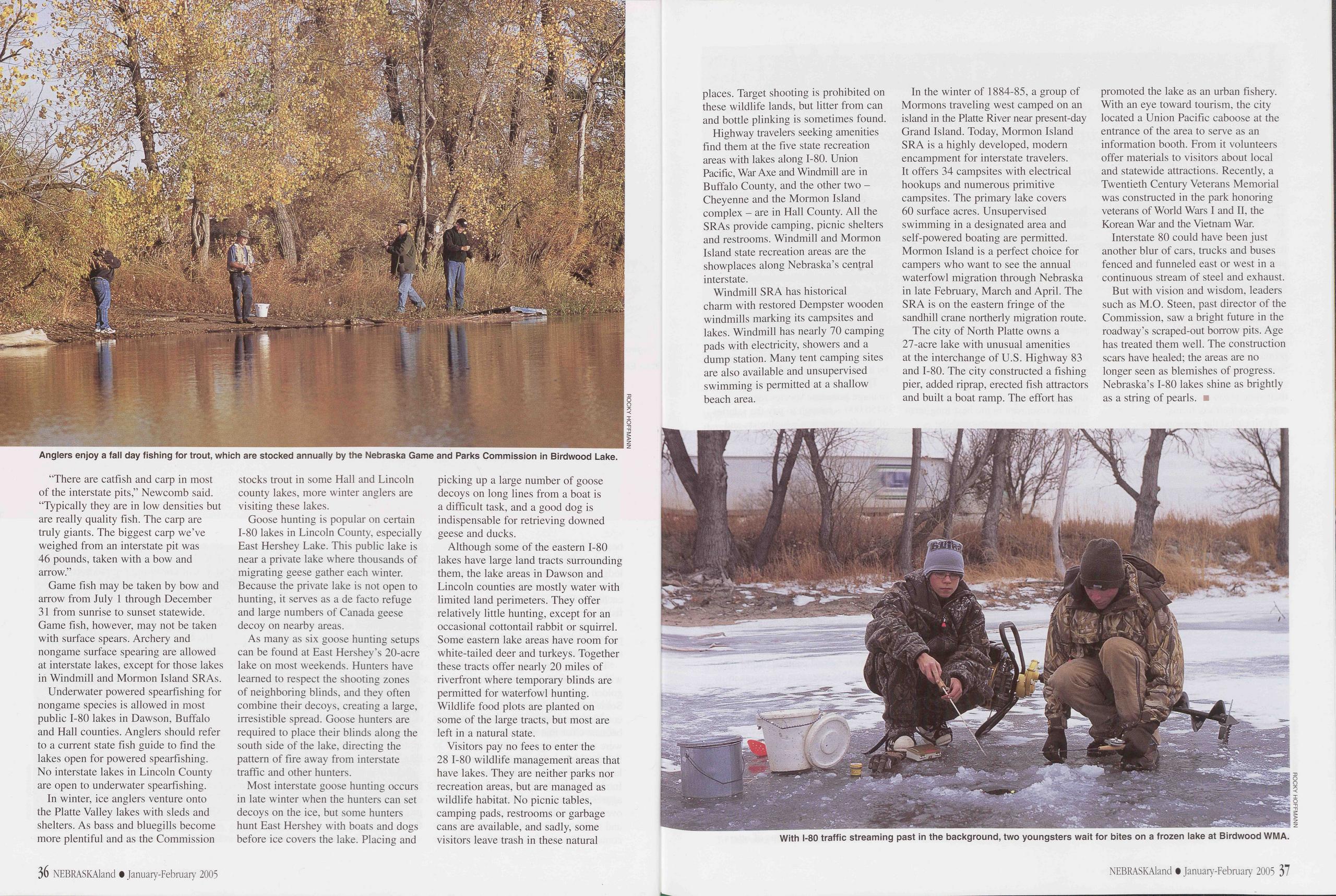
“There are catfish and carp in most of the interstate pits,” Newcomb said. “Typically they are in low densities but are really quality fish. The carp are truly giants. The biggest carp we’ve weighed from an interstate pit was 46 pounds, taken with a bow and arrow.”
Game fish may be taken by bow and arrow from July 1 through December 31 from sunrise to sunset statewide. Game fish, however, may not be taken with surface spears. Archery and nongame surface spearing are allowed at interstate lakes, except for those lakes in Windmill and Mormon Island SRAs.
Underwater powered spearfishing for nongame species is allowed in most public 1-80 lakes in Dawson, Buffalo and Hall counties. Anglers should refer to a current state fish guide to find the lakes open for powered spearfishing. No interstate lakes in Lincoln County are open to underwater spearfishing.
In winter, ice anglers venture onto the Platte Valley lakes with sleds and shelters. As bass and bluegills become more plentiful and as the Commission stocks trout in some Hall and Lincoln county lakes, more winter anglers are visiting these lakes.
Goose hunting is popular on certain 1-80 lakes in Lincoln County, especially East Hershey Lake. This public lake is near a private lake where thousands of migrating geese gather each winter. Because the private lake is not open to hunting, it serves as a de facto refuge and large numbers of Canada geese decoy on nearby areas.
As many as six goose hunting setups can be found at East Hershey’s 20-acre lake on most weekends. Hunters have learned to respect the shooting zones of neighboring blinds, and they often combine their decoys, creating a large, irresistible spread. Goose hunters are required to place their blinds along the south side of the lake, directing the pattern of fire away from interstate traffic and other hunters.
Most interstate goose hunting occurs in late winter when the hunters can set decoys on the ice, but some hunters hunt East Hershey with boats and dogs before ice covers the lake. Placing and picking up a large number of goose decoys on long lines from a boat is a difficult task, and a good dog is indispensable for retrieving downed geese and ducks.
Although some of the eastern 1-80 lakes have large land tracts surrounding them, the lake areas in Dawson and Lincoln counties are mostly water with limited land perimeters. They offer relatively little hunting, except for an occasional cottontail rabbit or squirrel. Some eastern lake areas have room for white-tailed deer and turkeys. Together these tracts offer nearly 20 miles of riverfront where temporary blinds are permitted for waterfowl hunting. Wildlife food plots are planted on some of the large tracts, but most are left in a natural state.
Visitors pay no fees to enter the 28 1-80 wildlife management areas that have lakes. They are neither parks nor recreation areas, but are managed as wildlife habitat. No picnic tables, camping pads, restrooms or garbage cans are available, and sadly, some visitors leave trash in these natural 36 NEBRASKAland • January-February 2005 places. Target shooting is prohibited on these wildlife lands, but litter from can and bottle plinking is sometimes found.
Highway travelers seeking amenities find them at the five state recreation areas with lakes along 1-80. Union Pacific, War Axe and Windmill are in Buffalo County, and the other two - Cheyenne and the Mormon Island complex - are in Hall County. All the SRAs provide camping, picnic shelters and restrooms. Windmill and Mormon Island state recreation areas are the showplaces along Nebraska’s central interstate.
Windmill SR A has historical charm with restored Dempster wooden windmills marking its campsites and lakes. Windmill has nearly 70 camping pads with electricity, showers and a dump station. Many tent camping sites are also available and unsupervised swimming is permitted at a shallow beach area.
In the winter of 1884-85, a group of Mormons traveling west camped on an island in the Platte River near present-day Grand Island. Today, Mormon Island SRA is a highly developed, modern encampment for interstate travelers. It offers 34 campsites with electrical hookups and numerous primitive campsites. The primary lake covers 60 surface acres. Unsupervised swimming in a designated area and self-powered boating are permitted. Mormon Island is a perfect choice for campers who want to see the annual waterfowl migration through Nebraska in late February, March and April. The SRA is on the eastern fringe of the sandhill crane northerly migration route.
The city of North Platte owns a 27-acre lake with unusual amenities at the interchange of U.S. Highway 83 and 1-80. The city constructed a fishing pier, added riprap, erected fish attractors and built a boat ramp. The effort has promoted the lake as an urban fishery. With an eye toward tourism, the city located a Union Pacific caboose at the entrance of the area to serve as an information booth. From it volunteers offer materials to visitors about local and statewide attractions. Recently, a Twentieth Century Veterans Memorial was constructed in the park honoring veterans of World Wars I and II, the Korean War and the Vietnam War.
Interstate 80 could have been just another blur of cars, trucks and buses fenced and funneled east or west in a continuous stream of steel and exhaust.
But with vision and wisdom, leaders such as M.O. Steen, past director of the Commission, saw a bright future in the roadway’s scraped-out borrow pits. Age has treated them well. The construction scars have healed; the areas are no longer seen as blemishes of progress. Nebraska’s 1-80 lakes shine as brightly as a string of pearls.
NEBRASKAland • January-February 2005 37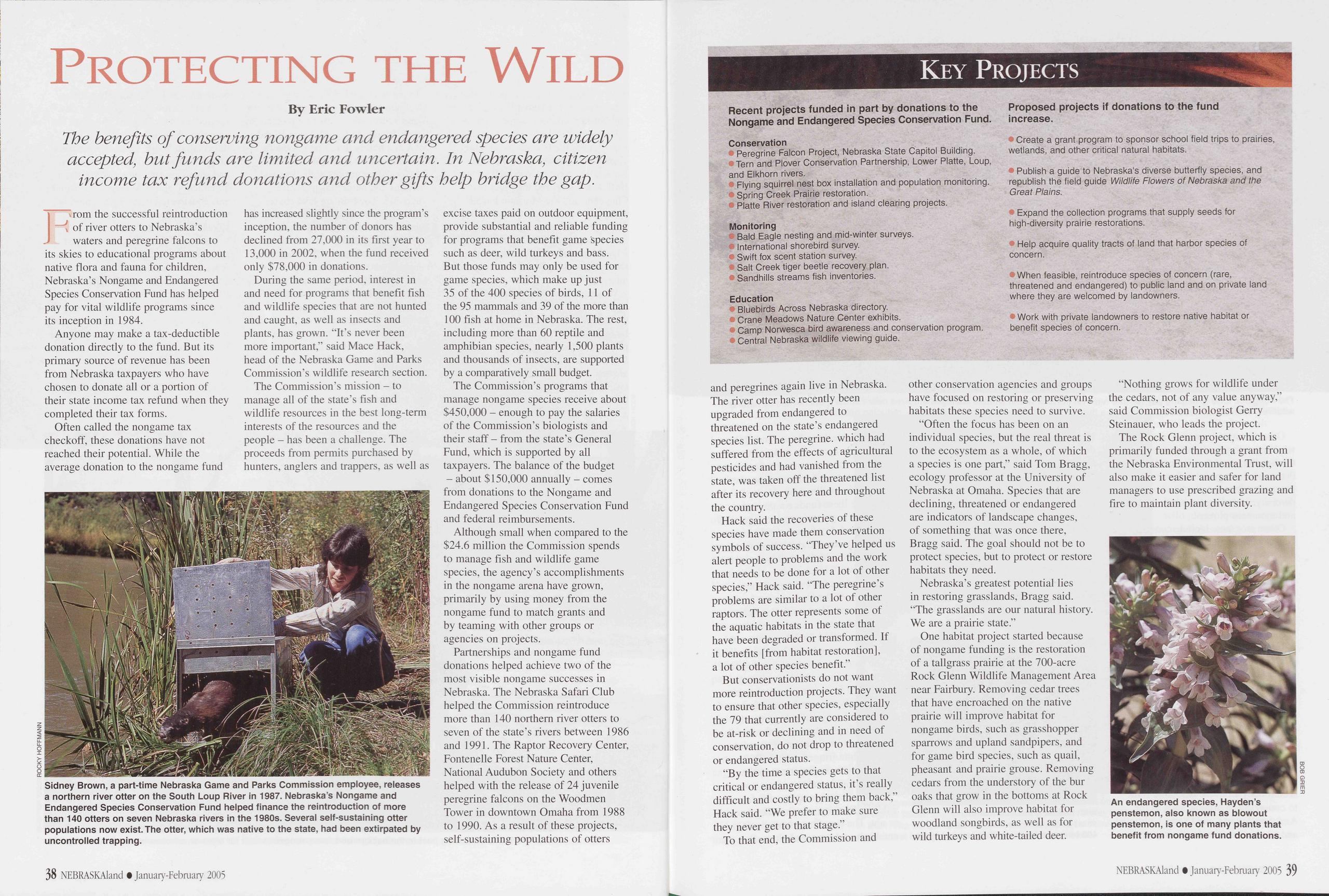
Protecting the Wild
The benefits of conserving nongame and endangered species are widely accepted, but funds are limited and uncertain. In Nebraska, citizen income tax refund donations and other gifts help bridge the gap.
From the successful reintroduction of river otters to Nebraska’s J waters and peregrine falcons to its skies to educational programs about native flora and fauna for children, Nebraska’s Nongame and Endangered Species Conservation Fund has helped pay for vital wildlife programs since its inception in 1984.
Anyone may make a tax-deductible donation directly to the fund. But its primary source of revenue has been from Nebraska taxpayers who have chosen to donate all or a portion of their state income tax refund when they completed their tax forms.
Often called the nongame tax checkoff, these donations have not reached their potential. While the average donation to the nongame fund
During the same period, interest in and need for programs that benefit fish and wildlife species that are not hunted and caught, as well as insects and plants, has grown. "It’s never been more important,” said Mace Hack, head of the Nebraska Game and Parks Commission’s wildlife research section.
The Commission’s mission - to manage all of the state’s fish and wildlife resources in the best long-term interests of the resources and the people - has been a challenge. The proceeds from permits purchased by hunters, anglers and trappers, as well as excise taxes paid on outdoor equipment, provide substantial and reliable funding for programs that benefit game species such as deer, wild turkeys and bass. But those funds may only be used for game species, which make up just 35 of the 400 species of birds, 11 of the 95 mammals and 39 of the more than 100 fish at home in Nebraska. The rest, including more than 60 reptile and amphibian species, nearly 1,500 plants and thousands of insects, are supported by a comparatively small budget.
The Commission’s programs that manage nongame species receive about $450,000 - enough to pay the salaries of the Commission’s biologists and their staff - from the state’s General Fund, which is supported by all taxpayers. The balance of the budget - about $150,000 annually - comes from donations to the Nongame and Endangered Species Conservation Fund and federal reimbursements.
Although small when compared to the $24.6 million the Commission spends to manage fish and wildlife game species, the agency’s accomplishments in the nongame arena have grown, primarily by using money from the nongame fund to match grants and by teaming with other groups or agencies on projects.
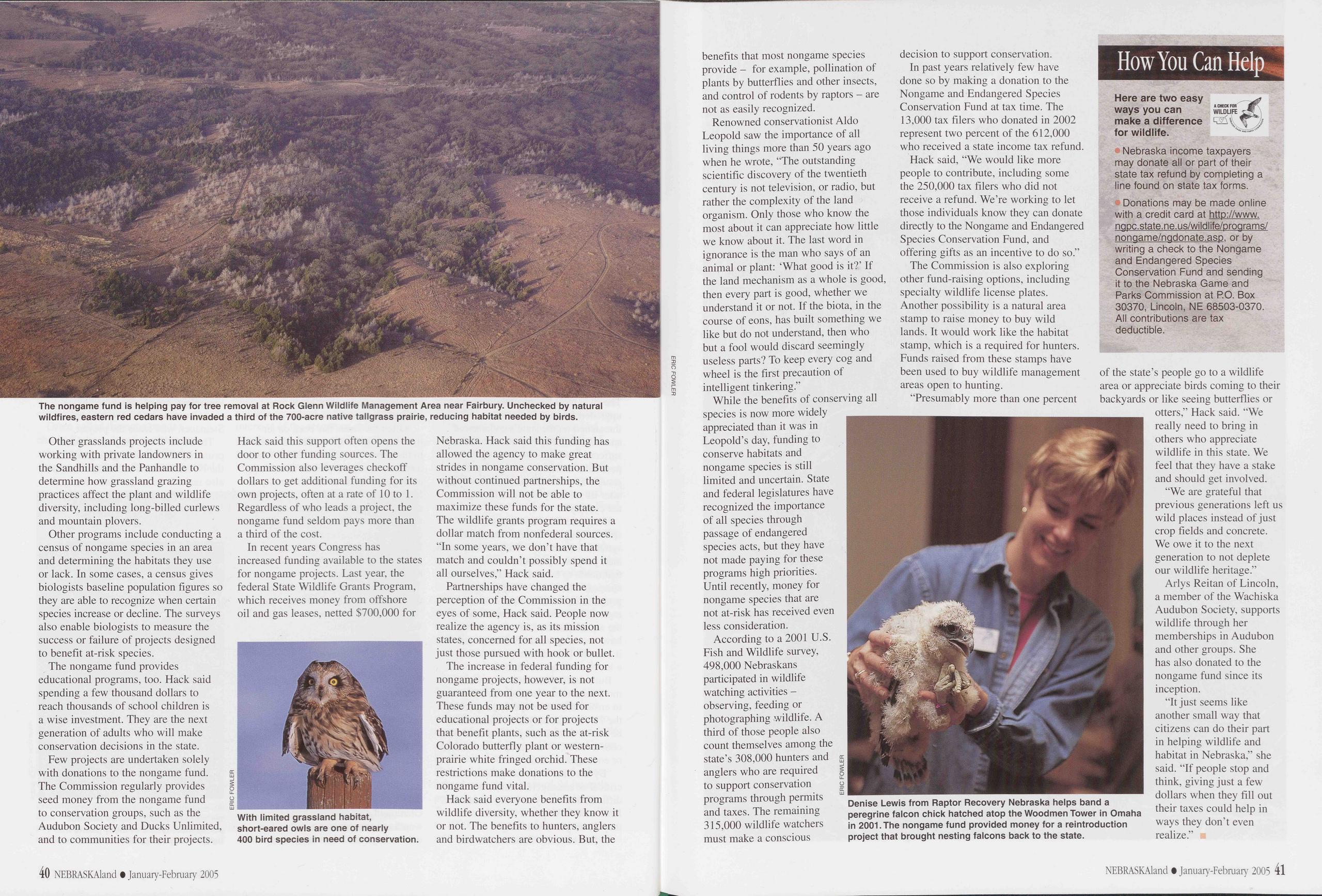
Partnerships and nongame fund donations helped achieve two of the most visible nongame successes in Nebraska. The Nebraska Safari Club helped the Commission reintroduce more than 140 northern river otters to seven of the state’s rivers between 1986 and 1991. The Raptor Recovery Center, Fontenelle Forest Nature Center, National Audubon Society and others helped with the release of 24 juvenile peregrine falcons on the Woodmen Tower in downtown Omaha from 1988 to 1990. As a result of these projects, self-sustaining populations of otters 38 NEBRASKAland • January-February 2005 and peregrines again live in Nebraska. The river otter has recently been upgraded from endangered to threatened on the state’s endangered species list. The peregrine, which had suffered from the effects of agricultural pesticides and had vanished from the state, was taken off the threatened list after its recovery here and throughout the country.
Key Projects Recent projects funded in part by donations to the Nongame and Endangered Species Conservation Fund. Proposed projects if donations to the fund increase. Conservation Peregrine Falcon Project, Nebraska State Capitol Building. Tern and Plover Conservation Partnership, Lower Platte, Loup, and Elkhorn rivers. Flying squirrel nest box installation and population monitoring. Spring Creek Prairie restoration. Platte River restoration and island clearing projects. Monitoring Bald Eagle nesting and mid-winter surveys. International shorebird survey. Swift fox scent station survey. Salt Creek tiger beetle recovery plan. Sandhills streams fish inventories. Education Bluebirds Across Nebraska directory. Crane Meadows Nature Center exhibits. Camp Norwesca bird awareness and conservation program. Central Nebraska wildlife viewing guide. Create a grant program to sponsor school field trips to prairies, wetlands, and other critical natural habitats. • Publish a guide to Nebraska's diverse butterfly species, and republish the field guide Wildlife Flowers of Nebraska and the Great Plains. O Expand the collection programs that supply seeds for high-diversity prairie restorations. Help acquire quality tracts of land that harbor species of concern. • When feasible, reintroduce species of concern (rare, threatened and endangered) to public land and on private land where they are welcomed by landowners. • Work with private landowners to restore native habitat or benefit species of concern.Hack said the recoveries of these species have made them conservation symbols of success. "They’ve helped us alert people to problems and the work that needs to be done for a lot of other species,” Hack said. "The peregrine’s problems are similar to a lot of other raptors. The otter represents some of the aquatic habitats in the state that have been degraded or transformed. If it benefits [from habitat restoration], a lot of other species benefit.”
But conservationists do not want more reintroduction projects. They want to ensure that other species, especially the 79 that currently are considered to be at-risk or declining and in need of conservation, do not drop to threatened or endangered status.
"By the time a species gets to that critical or endangered status, it’s really difficult and costly to bring them back,” Hack said. "We prefer to make sure they never get to that stage.”
To that end, the Commission and other conservation agencies and groups have focused on restoring or preserving habitats these species need to survive.
"Often the focus has been on an individual species, but the real threat is to the ecosystem as a whole, of which a species is one part,” said Tom Bragg, ecology professor at the University of Nebraska at Omaha. Species that are declining, threatened or endangered are indicators of landscape changes, of something that was once there, Bragg said. The goal should not be to protect species, but to protect or restore habitats they need.
Nebraska’s greatest potential lies in restoring grasslands, Bragg said. "The grasslands are our natural history. We are a prairie state.”
One habitat project started because of nongame funding is the restoration of a tailgrass prairie at the 700-acre Rock Glenn Wildlife Management Area near Fairbury. Removing cedar trees that have encroached on the native prairie will improve habitat for nongame birds, such as grasshopper sparrows and upland sandpipers, and for game bird species, such as quail, pheasant and prairie grouse. Removing cedars from the understory of the bur oaks that grow in the bottoms at Rock Glenn will also improve habitat for woodland songbirds, as well as for wild turkeys and white-tailed deer.
"Nothing grows for wildlife under the cedars, not of any value anyway,” said Commission biologist Gerry Steinauer, who leads the project.
The Rock Glenn project, which is primarily funded through a grant from the Nebraska Environmental Trust, will also make it easier and safer for land managers to use prescribed grazing and fire to maintain plant diversity.
Other grasslands projects include working with private landowners in the Sandhills and the Panhandle to determine how grassland grazing practices affect the plant and wildlife diversity, including long-billed curlews and mountain plovers.
Other programs include conducting a census of nongame species in an area and determining the habitats they use or lack. In some cases, a census gives biologists baseline population figures so they are able to recognize when certain species increase or decline. The surveys also enable biologists to measure the success or failure of projects designed to benefit at-risk species.
The nongame fund provides educational programs, too. Hack said spending a few thousand dollars to reach thousands of school children is a wise investment. They are the next generation of adults who will make conservation decisions in the state.
Few projects are undertaken solely with donations to the nongame fund. The Commission regularly provides seed money from the nongame fund to conservation groups, such as the Audubon Society and Ducks Unlimited, and to communities for their projects. Hack said this support often opens the door to other funding sources. The Commission also leverages checkoff dollars to get additional funding for its own projects, often at a rate of 10 to 1. Regardless of who leads a project, the nongame fund seldom pays more than a third of the cost.
In recent years Congress has increased funding available to the states for nongame projects. Last year, the federal State Wildlife Grants Program, which receives money from offshore oil and gas leases, netted $700,000 for
Partnerships have changed the perception of the Commission in the eyes of some, Hack said. People now realize the agency is, as its mission states, concerned for all species, not just those pursued with hook or bullet.
The increase in federal funding for nongame projects, however, is not guaranteed from one year to the next. These funds may not be used for educational projects or for projects that benefit plants, such as the at-risk Colorado butterfly plant or western- prairie white fringed orchid. These restrictions make donations to the nongame fund vital.
Hack said everyone benefits from wildlife diversity, whether they know it or not. The benefits to hunters, anglers and birdwatchers are obvious. But, the 40 NEBRASKAland • January-February 2005 benefits that most nongame species provide - for example, pollination of plants by butterflies and other insects, and control of rodents by raptors - are not as easily recognized.
Renowned conservationist Aldo Leopold saw the importance of all living things more than 50 years ago when he wrote, "The outstanding scientific discovery of the twentieth century is not television, or radio, but rather the complexity of the land organism. Only those who know the most about it can appreciate how little we know about it. The last word in ignorance is the man who says of an animal or plant: ‘What good is it?’ If the land mechanism as a whole is good, then every part is good, whether we understand it or not. If the biota, in the course of eons, has built something we like but do not understand, then who but a fool would discard seemingly useless parts? To keep every cog and wheel is the first precaution of intelligent tinkering.”
While the benefits of conserving all species is now more widely appreciated than it was in Leopold’s day, funding to conserve habitats and nongame species is still limited and uncertain. State and federal legislatures have recognized the importance of all species through passage of endangered species acts, but they have not made paying for these programs high priorities. Until recently, money for nongame species that are not at-risk has received even less consideration.
According to a 2001 U.S. Fish and Wildlife survey, 498,000 Nebraskans participated in wildlife watching activities - observing, feeding or photographing wildlife. A third of those people also count themselves among the state’s 308,000 hunters and anglers who are required to support conservation programs through permits and taxes. The remaining 315,000 wildlife watchers must make a conscious decision to support conservation.
In past years relatively few have done so by making a donation to the Nongame and Endangered Species Conservation Fund at tax time. The 13,000 tax filers who donated in 2002 represent two percent of the 612,000 who received a state income tax refund.
Hack said, “We would like more people to contribute, including some the 250,000 tax filers who did not receive a refund. We’re working to let those individuals know they can donate directly to the Nongame and Endangered Species Conservation Fund, and offering gifts as an incentive to do so.”
The Commission is also exploring other fund-raising options, including specialty wildlife license plates. Another possibility is a natural area stamp to raise money to buy wild lands. It would work like the habitat stamp, which is a required for hunters. Funds raised from these stamps have been used to buy wildlife management areas open to hunting.
“Presumably more than one percent
“We are grateful that previous generations left us wild places instead of just crop fields and concrete. We owe it to the next generation to not deplete our wildlife heritage.”
Arlys Reitan of Lincoln, a member of the Wachiska Audubon Society, supports wildlife through her memberships in Audubon and other groups. She has also donated to the nongame fund since its inception.
“It just seems like another small way that citizens can do their part in helping wildlife and habitat in Nebraska,” she said. “If people stop and think, giving just a few dollars when they fill out their taxes could help in ways they don’t even realize.”
NEBRASKAland • January-February 2005 41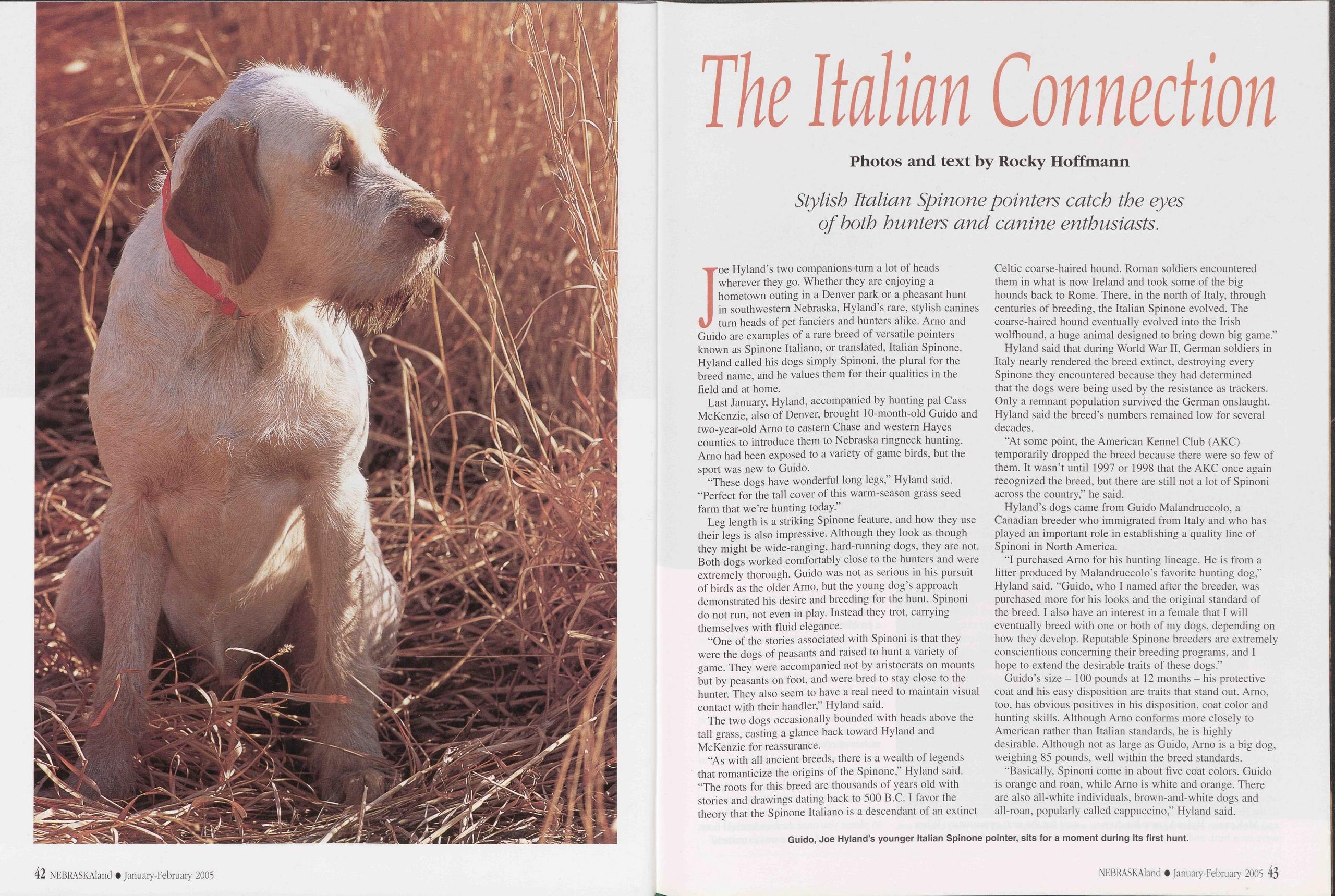
The Italian Connection
Stylish Italian Spinone pointers catch the eyes of both hunters and canine enthusiasts.
Joe Hyland’s two companions turn a lot of heads wherever they go. Whether they are enjoying a hometown outing in a Denver park or a pheasant hunt in southwestern Nebraska, Hyland’s rare, stylish canines turn heads of pet fanciers and hunters alike. Arno and Guido are examples of a rare breed of versatile pointers known as Spinone Italiano, or translated, Italian Spinone. Hyland called his dogs simply Spinoni, the plural for the breed name, and he values them for their qualities in the field and at home.
Last January, Hyland, accompanied by hunting pal Cass McKenzie, also of Denver, brought 10-month-old Guido and two-year-old Arno to eastern Chase and western Hayes counties to introduce them to Nebraska ringneck hunting. Arno had been exposed to a variety of game birds, but the sport was new to Guido.
“These dogs have wonderful long legs,” Hyland said. “Perfect for the tall cover of this warm-season grass seed farm that we’re hunting today.”
Leg length is a striking Spinone feature, and how they use their legs is also impressive. Although they look as though they might be wide-ranging, hard-running dogs, they are not. Both dogs worked comfortably close to the hunters and were extremely thorough. Guido was not as serious in his pursuit of birds as the older Arno, but the young dog’s approach demonstrated his desire and breeding for the hunt. Spinoni do not run, not even in play. Instead they trot, carrying themselves with fluid elegance.
“One of the stories associated with Spinoni is that they were the dogs of peasants and raised to hunt a variety of game. They were accompanied not by aristocrats on mounts but by peasants on foot, and were bred to stay close to the hunter. They also seem to have a real need to maintain visual contact with their handler,” Hyland said.
The two dogs occasionally bounded with heads above the tall grass, casting a glance back toward Hyland and McKenzie for reassurance.
“As with all ancient breeds, there is a wealth of legends that romanticize the origins of the Spinone,” Hyland said. “The roots for this breed are thousands of years old with stories and drawings dating back to 500 B.C. I favor the theory that the Spinone Italiano is a descendant of an extinct Celtic coarse-haired hound. Roman soldiers encountered them in what is now Ireland and took some of the big hounds back to Rome. There, in the north of Italy, through centuries of breeding, the Italian Spinone evolved. The coarse-haired hound eventually evolved into the Irish wolfhound, a huge animal designed to bring down big game.”
Hyland said that during World War II, German soldiers in Italy nearly rendered the breed extinct, destroying every Spinone they encountered because they had determined that the dogs were being used by the resistance as trackers. Only a remnant population survived the German onslaught. Hyland said the breed’s numbers remained low for several decades.
“At some point, the American Kennel Club (AKC) temporarily dropped the breed because there were so few of them. It wasn’t until 1997 or 1998 that the AKC once again recognized the breed, but there are still not a lot of Spinoni across the country,” he said.
Hyland’s dogs came from Guido Malandruccolo, a Canadian breeder who immigrated from Italy and who has played an important role in establishing a quality line of Spinoni in North America.
“I purchased Arno for his hunting lineage. He is from a litter produced by Malandruccolo’s favorite hunting dog,” Hyland said. “Guido, who I named after the breeder, was purchased more for his looks and the original standard of the breed. I also have an interest in a female that I will eventually breed with one or both of my dogs, depending on how they develop. Reputable Spinone breeders are extremely conscientious concerning their breeding programs, and I hope to extend the desirable traits of these dogs.”
Guido’s size - 100 pounds at 12 months - his protective coat and his easy disposition are traits that stand out. Arno, too, has obvious positives in his disposition, coat color and hunting skills. Although Arno conforms more closely to American rather than Italian standards, he is highly desirable. Although not as large as Guido, Arno is a big dog, weighing 85 pounds, well within the breed standards.
“Basically, Spinoni come in about five coat colors. Guido is orange and roan, while Arno is white and orange. There are also all-white individuals, brown-and-white dogs and all-roan, popularly called cappuccino,” Hyland said.
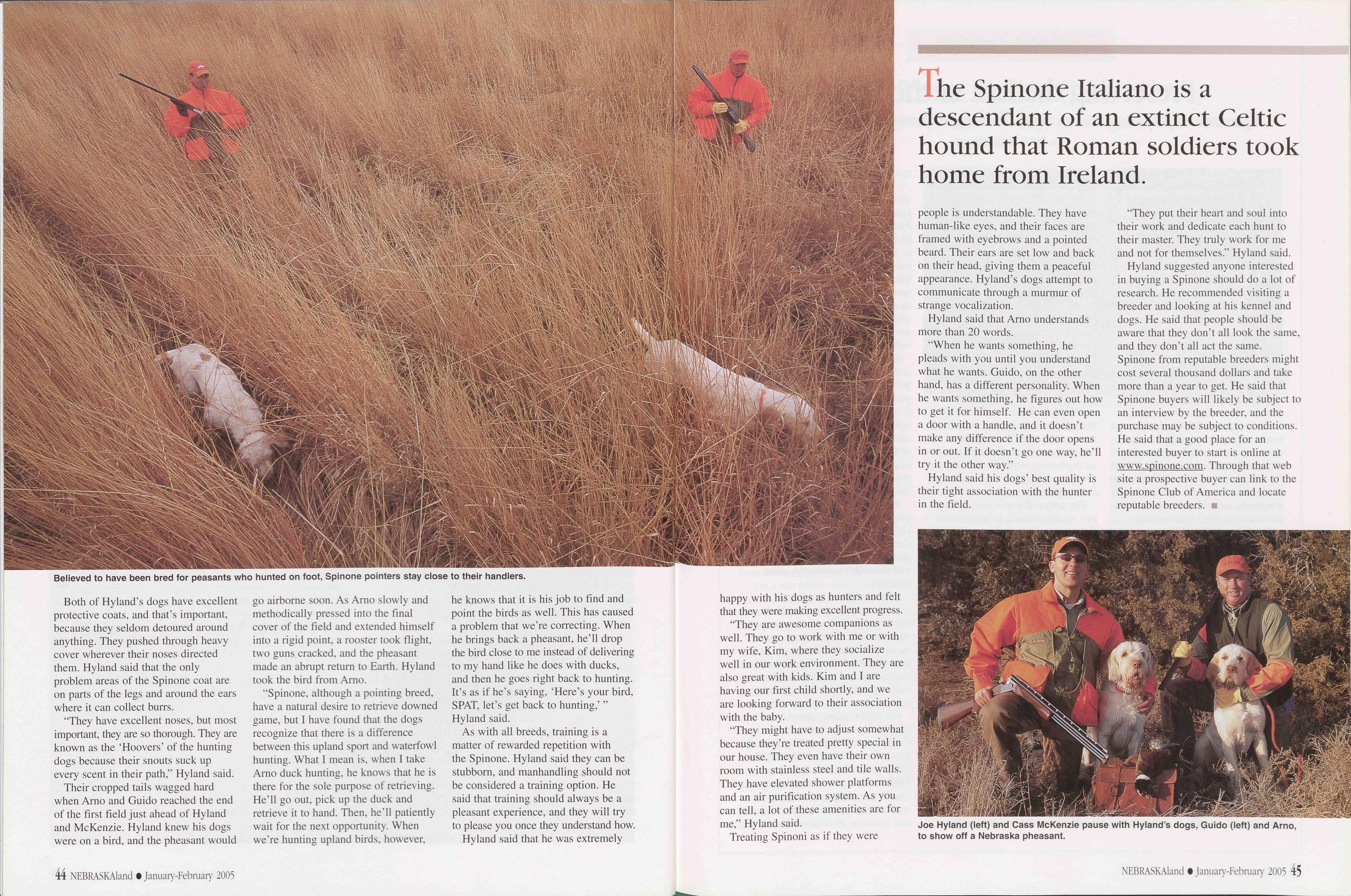
“They have excellent noses, but most important, they are so thorough. They are known as the ‘Hoovers’ of the hunting dogs because their snouts suck up every scent in their path,” Hyland said.
Their cropped tails wagged hard when Arno and Guido reached the end of the first field just ahead of Hyland and McKenzie. Hyland knew his dogs were on a bird, and the pheasant would go airborne soon. As Amo slowly and methodically pressed into the final cover of the field and extended himself into a rigid point, a rooster took flight, two guns cracked, and the pheasant made an abrupt return to Earth. Hyland took the bird from Arno.
“Spinone, although a pointing breed, have a natural desire to retrieve downed game, but I have found that the dogs recognize that there is a difference between this upland sport and waterfowl hunting. What I mean is, when I take Arno duck hunting, he knows that he is there for the sole purpose of retrieving. He’ll go out, pick up the duck and retrieve it to hand. Then, he’ll patiently wait for the next opportunity. When we’re hunting upland birds, however, he knows that it is his job to find and point the birds as well. This has caused a problem that we’re correcting. When he brings back a pheasant, he’ll drop the bird close to me instead of delivering to my hand like he does with ducks, and then he goes right back to hunting. It’s as if he’s saying, ‘Here’s your bird, SPAT, let’s get back to hunting,’ ” Hyland said.
As with all breeds, training is a matter of rewarded repetition with the Spinone. Hyland said they can be stubborn, and manhandling should not be considered a training option. He said that training should always be a pleasant experience, and they will try to please you once they understand how.
Hyland said that he was extremely 44 NEBRASKAland • January-February 2005 happy with his dogs as hunters and felt that they were making excellent progress.
The Spinone Italiano is a descendant of an extinct Celtic hound that Roman soldiers took home from Ireland.“They are awesome companions as well. They go to work with me or with my wife, Kim, where they socialize well in our work environment. They are also great with kids. Kim and I are having our first child shortly, and we are looking forward to their association with the baby.
“They might have to adjust somewhat because they’re treated pretty special in our house. They even have their own room with stainless steel and tile walls. They have elevated shower platforms and an air purification system. As you can tell, a lot of these amenities are for me,” Hyland said.
Treating Spinoni as if they were people is understandable. They have human-like eyes, and their faces are framed with eyebrows and a pointed beard. Their ears are set low and back on their head, giving them a peaceful appearance. Hyland’s dogs attempt to communicate through a murmur of strange vocalization.
Hyland said that Arno understands more than 20 words.
“When he wants something, he pleads with you until you understand what he wants. Guido, on the other hand, has a different personality. When he wants something, he figures out how to get it for himself. He can even open a door with a handle, and it doesn’t make any difference if the door opens in or out. If it doesn’t go one way, he’ll try it the other way.”
Hyland said his dogs’ best quality is their tight association with the hunter in the field.
“They put their heart and soul into their work and dedicate each hunt to their master. They truly work for me and not for themselves.” Hyland said.
Hyland suggested anyone interested in buying a Spinone should do a lot of research. He recommended visiting a breeder and looking at his kennel and dogs. He said that people should be aware that they don’t all look the same, and they don’t all act the same. Spinone from reputable breeders might cost several thousand dollars and take more than a year to get. He said that Spinone buyers will likely be subject to an interview by the breeder, and the purchase may be subject to conditions. He said that a good place for an interested buyer to start is online at www.spinone.com. Through that web site a prospective buyer can link to the Spinone Club of America and locate reputable breeders.
NEBRASKAland • January-February 2005 45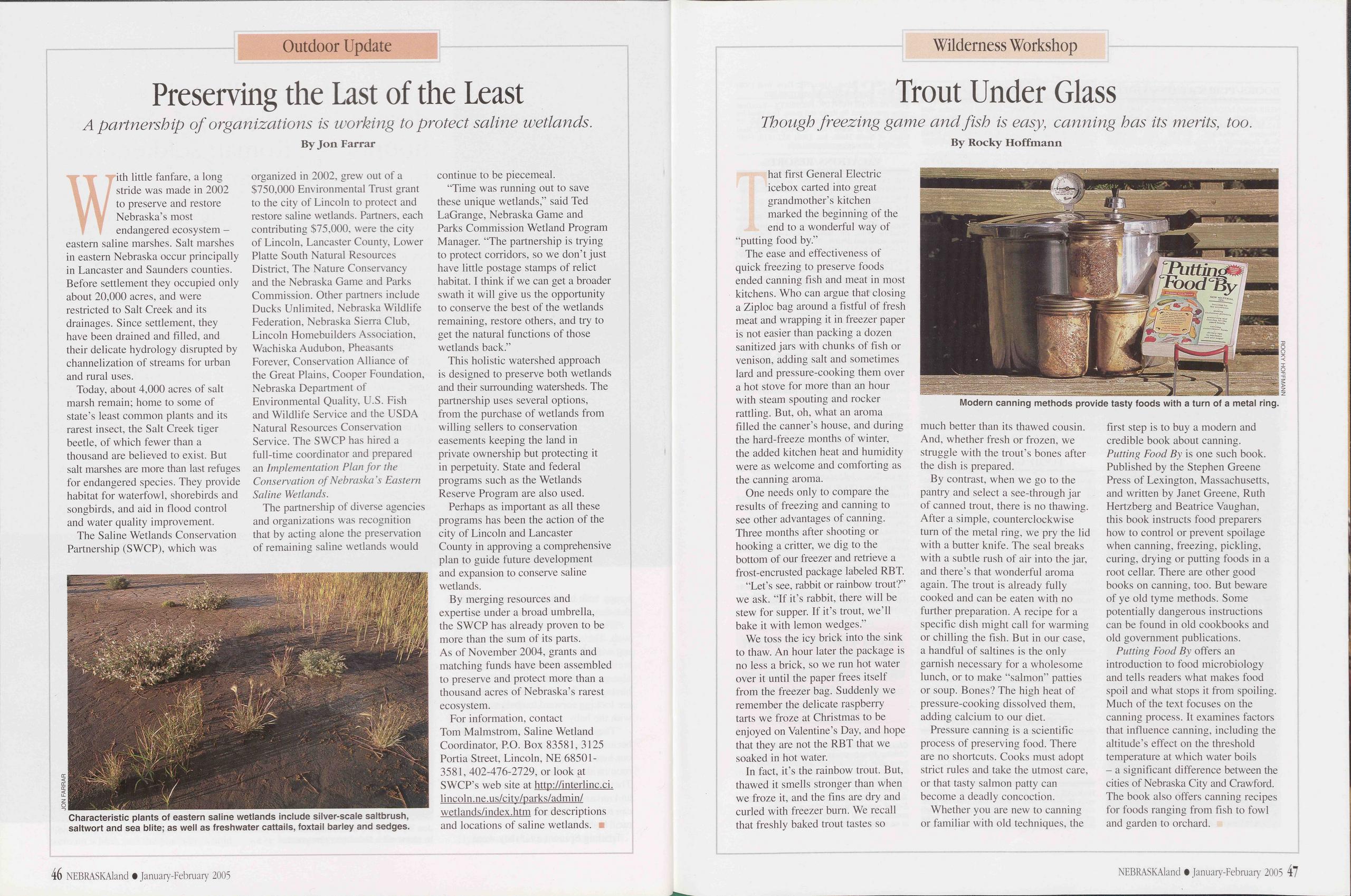
Outdoor Update
Preserving the Last of the Least
A partnership of organizations is working to protect saline wetlands.
With little fanfare, a long stride was made in 2002 to preserve and restore Nebraska’s most endangered ecosystem - eastern saline marshes. Salt marshes in eastern Nebraska occur principally in Lancaster and Saunders counties. Before settlement they occupied only about 20,000 acres, and were restricted to Salt Creek and its drainages. Since settlement, they have been drained and filled, and their delicate hydrology disrupted by channelization of streams for urban and rural uses.
Today, about 4,000 acres of salt marsh remain; home to some of state’s least common plants and its rarest insect, the Salt Creek tiger beetle, of which fewer than a thousand are believed to exist. But salt marshes are more than last refuges for endangered species. They provide habitat for waterfowl, shorebirds and songbirds, and aid in flood control and water quality improvement.
The Saline Wetlands Conservation Partnership (SWCP), which was
The partnership of diverse agencies and organizations was recognition that by acting alone the preservation of remaining saline wetlands would continue to be piecemeal.
"Time was running out to save these unique wetlands,” said Ted LaGrange, Nebraska Game and Parks Commission Wetland Program Manager. "The partnership is trying to protect corridors, so we don’t just have little postage stamps of relict habitat. I think if we can get a broader swath it will give us the opportunity to conserve the best of the wetlands remaining, restore others, and try to get the natural functions of those wetlands back.”
This holistic watershed approach is designed to preserve both wetlands and their surrounding watersheds. The partnership uses several options, from the purchase of wetlands from willing sellers to conservation easements keeping the land in private ownership but protecting it in perpetuity. State and federal programs such as the Wetlands Reserve Program are also used.
Perhaps as important as all these programs has been the action of the city of Lincoln and Lancaster County in approving a comprehensive plan to guide future development and expansion to conserve saline wetlands.
By merging resources and expertise under a broad umbrella, the SWCP has already proven to be more than the sum of its parts. As of November 2004, grants and matching funds have been assembled to preserve and protect more than a thousand acres of Nebraska’s rarest ecosystem.
For information, contact Tom Malmstrom, Saline Wetland Coordinator, P.O. Box 83581, 3125 Portia Street, Lincoln, NE 68501- 3581, 402-476-2729, or look at SWCP’s web site at http://interlinc.ci. lincoln.ne.us/city/parks/admin/ wetlands/index.htm for descriptions and locations of saline wetlands.
46 NEBRASKAland • January-February 2005Wilderness Workshop
Trout Under Glass
Though freezing game and fish is easy, canning has its merits, too.
That first General Electric icebox carted into great grandmother’s kitchen marked the beginning of the end to a wonderful way of "putting food by.”
The ease and effectiveness of quick freezing to preserve foods ended canning fish and meat in most kitchens. Who can argue that closing a Ziploc bag around a fistful of fresh meat and wrapping it in freezer paper is not easier than packing a dozen sanitized jars with chunks of fish or venison, adding salt and sometimes lard and pressure-cooking them over a hot stove for more than an hour with steam spouting and rocker rattling. But, oh, what an aroma filled the canner’s house, and during the hard-freeze months of winter, the added kitchen heat and humidity were as welcome and comforting as the canning aroma.
One needs only to compare the results of freezing and canning to see other advantages of canning. Three months after shooting or hooking a critter, we dig to the bottom of our freezer and retrieve a frost-encrusted package labeled RBT.
"Let’s see, rabbit or rainbow trout?” we ask. "If it’s rabbit, there will be stew for supper. If it’s trout, we’ll bake it with lemon wedges.”
We toss the icy brick into the sink to thaw. An hour later the package is no less a brick, so we run hot water over it until the paper frees itself from the freezer bag. Suddenly we remember the delicate raspberry tarts we froze at Christmas to be enjoyed on Valentine’s Day, and hope that they are not the RBT that we soaked in hot water.
In fact, it’s the rainbow trout. But, thawed it smells stronger than when we froze it, and the fins are dry and curled with freezer burn. We recall that freshly baked trout tastes so
By contrast, when we go to the pantry and select a see-through jar of canned trout, there is no thawing. After a simple, counterclockwise turn of the metal ring, we pry the lid with a butter knife. The seal breaks with a subtle rush of air into the jar, and there’s that wonderful aroma again. The trout is already fully cooked and can be eaten with no further preparation. A recipe for a specific dish might call for warming or chilling the fish. But in our case, a handful of saltines is the only garnish necessary for a wholesome lunch, or to make "salmon” patties or soup. Bones? The high heat of pressure-cooking dissolved them, adding calcium to our diet.
Pressure canning is a scientific process of preserving food. There are no shortcuts. Cooks must adopt strict rules and take the utmost care, or that tasty salmon patty can become a deadly concoction.
Whether you are new to canning or familiar with old techniques, the first step is to buy a modern and credible book about canning. Putting Food By is one such book. Published by the Stephen Greene Press of Lexington, Massachusetts, and written by Janet Greene, Ruth Hertzberg and Beatrice Vaughan, this book instructs food preparers how to control or prevent spoilage when canning, freezing, pickling, curing, drying or putting foods in a root cellar. There are other good books on canning, too. But beware of ye old tyme methods. Some potentially dangerous instructions can be found in old cookbooks and old government publications.
Putting Food By offers an introduction to food microbiology and tells readers what makes food spoil and what stops it from spoiling. Much of the text focuses on the canning process. It examines factors that influence canning, including the altitude’s effect on the threshold temperature at which water boils - a significant difference between the cities of Nebraska City and Crawford. The book also offers canning recipes for foods ranging from fish to fowl and garden to orchard.
NEBRASKAland • January-February 2005 47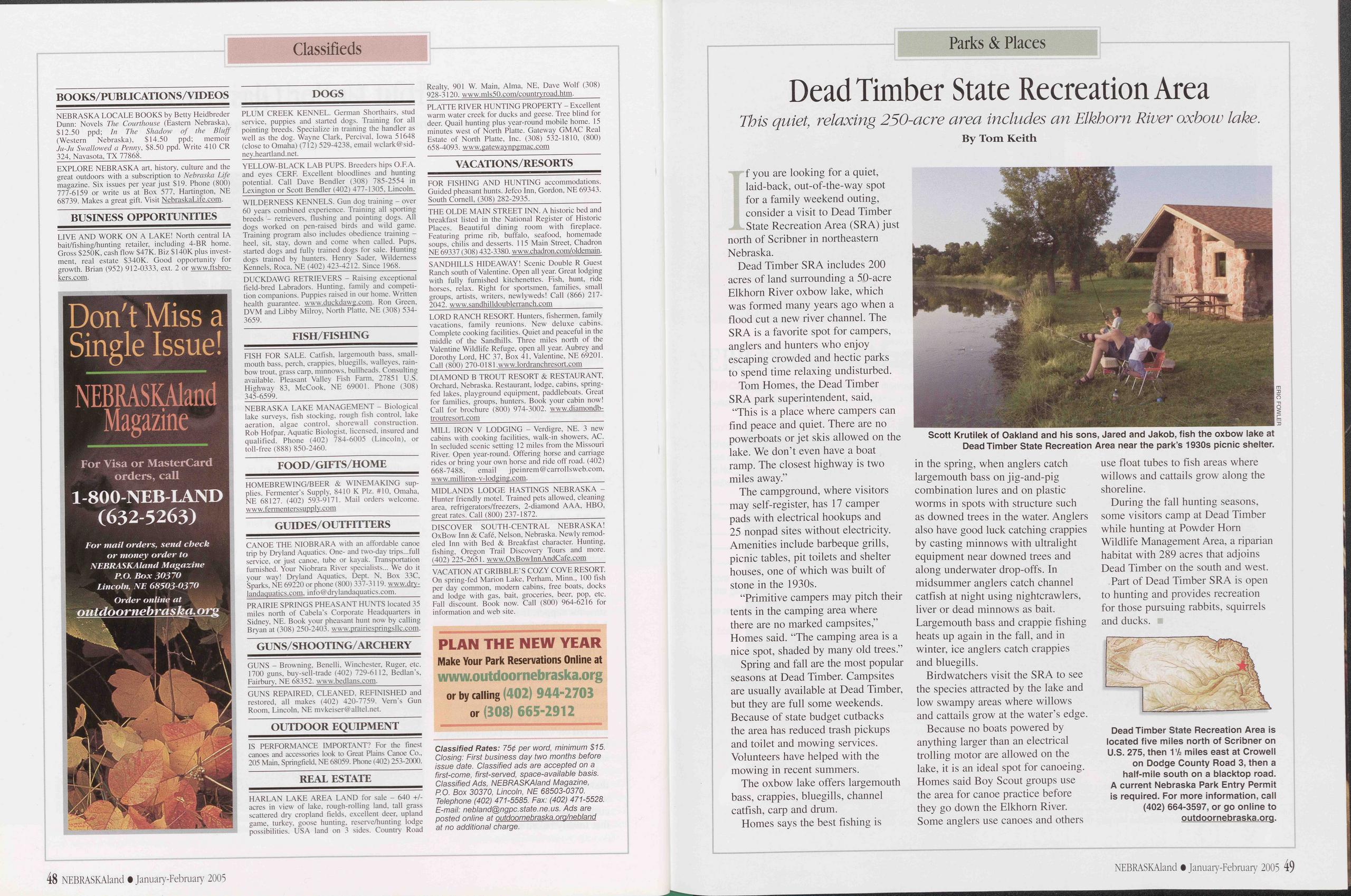
Classifieds
BOOKS/PUBLICATIONS/VIDEOS NEBRASKA LOCALE BOOKS by Betty Heidbreder Dunn: Novels The Courthouse (Eastern Nebraska), $12.50 ppd; In The Shadow of the Bluff (Western Nebraska), $14.50 ppd; memoir Ju-Ju Swallowed a Penny, $8.50 ppd. Write 410 CR 324, Navasota, TX 77868. EXPLORE NEBRASKA art, history, culture and the great outdoors with a subscription to Nebraska Life magazine. Six issues per year just $19. Phone (800) 777-6159 or write us at Box 577, Hartington, NE 68739. Makes a great gift. Visit NebraskaLife.com. BUSINESS OPPORTUNITIES LIVE AND WORK ON A LAKE! North central IA bait/fishing/hunting retailer, including 4-BR home. Gross $250K, cash flow $47K. Biz $140K plus invest- ment, real estate $340K. Good opportunity for growth. Brian (952) 912-0333, ext. 2 or www.ftsbro- kers.com. Don't Miss a Single Issue! NEBRASKAland Magazine For Visa or MasterCard orders, call 1-800-NEB-LAND (632-5263) For mail orders, send check or money order to NEBRASKAland Magazine P.O. Box 3O37O Lincoln, NE 68503-0370 Order online at outdoornebraska.org DOGS PLUM CREEK KENNEL. German Shorthairs, stud service, puppies and started dogs. Training for all pointing breeds. Specialize in training the handler as well as the dog. Wayne Clark, Percival, Iowa 51648 (close to Omaha) (712) 529-4238, email wclark@sid- ney.heartland.net. YELLOW-BLACK LAB PUPS. Breeders hips O.F.A. and eyes CERF. Excellent bloodlines and hunting potential. Call Dave Bendler (308) 785-2554 in Lexington or Scott Bendler (402) 477-1305, Lincoln. WILDERNESS KENNELS. Gun dog training - over 60 years combined experience. Training all sporting breeds - retrievers, flushing and pointing dogs. All dogs worked on pen-raised birds and wild game. Training program also includes obedience training - heel, sit, stay, down and come when called. Pups, started dogs and fully trained dogs for sale. Hunting dogs trained by hunters. Henry Sader, Wilderness Kennels, Roca, NE (402) 423-4212. Since 1968. DUCKDAWG RETRIEVERS - Raising exceptional field-bred Labradors. Hunting, family and competi- tion companions. Puppies raised in our home. Written health guarantee, www.duckdawg.com. Ron Green, DVM and Libby Milroy, North Platte, NE (308) 534- 3659. FISH/FISHING FISH FOR SALE. Catfish, largemouth bass, small- mouth bass, perch, crappies, bluegills, walleyes, rain- bow trout, grass carp, minnows, bullheads. Consulting available. Pleasant Valley Fish Farm, 27851 U.S. Highway 83, McCook, NE 69001. Phone (308) 345-6599. NEBRASKA LAKE MANAGEMENT - Biological lake surveys, fish stocking, rough fish control, lake aeration, algae control, shorewall construction. Rob Hofpar, Aquatic Biologist, licensed, insured and qualified. Phone (402) 784-6005 (Lincoln), or toll-free (888) 850-2460. FOOD/GIFTS/HOME HOMEBREWING/BEER & WINEMAKING sup- plies. Fermenter’s Supply, 8410 K Plz. #10, Omaha, NE 68127. (402) 593-9171. Mail orders welcome. www.fermenterssupplv.com GUIDES/OUTFITTERS CANOE THE NIOBRARA with an affordable canoe trip by Dryland Aquatics. One- and two-day trips...full service, or just canoe, tube or kayak. Transportation furnished. Your Niobrara River specialists... We do it your way! Dryland Aquatics, Dept. N. Box 33C, Sparks, NE 69220 or phone (800) 337-3119. www.drv- landaquatics.com, info@drylandaquatics.com. PRAIRIE SPRINGS PHEASANT HUNTS located 35 miles north of Cabela’s Corporate Headquarters in Sidney, NE. Book your pheasant hunt now by calling Bryan at (308) 250-2403. www.prairiespringsllc.com. GUNS/SHOOTING/ARCHERY GUNS - Browning, Benelli. Winchester. Ruger, etc. 1700 guns, buy-sell-trade (402) 729-6112, Bedlan’s, Fairbury, NE 68352. www.bedlans.com. GUNS REPAIRED, CLEANED, REFINISHED and restored, all makes (402) 420-7759. Vem’s Gun Room, Lincoln, NE mvkeiser@alltel.net. OUTDOOR EQUIPMENT IS PERFORMANCE IMPORTANT? For the finest canoes and accessories look to Great Plains Canoe Co., 205 Main, Springfield, NE 68059. Phone (402) 253-2000. REAL ESTATE HARLAN LAKE AREA LAND for sale - 640 +/- acres in view of lake, rough-rolling land, tall grass scattered dry cropland fields, excellent deer, upland game, turkey, goose hunting, reserve/hunting lodge possibilities. USA land on 3 sides. Country Road Realty, 901 W. Main, Alma, NE, Dave Wolf (308) 928-3120, www.mls50.com/countryroad.htm. PLATTE RIVER HUNTING PROPERTY - Excellent warm water creek for ducks and geese. Tree blind for deer. Quail hunting plus year-round mobile home. 15 minutes west of North Platte. Gateway GM AC Real Estate of North Platte, Inc. (308) 532-1810, (800) 658-4093. www.gatewaynpgmac.com VACATIONS/RESORTS FOR FISHING AND HUNTING accommodations. Guided pheasant hunts. Jefco Inn, Gordon, NE 69343. South Cornell, (308) 282-2935. THE OLDE MAIN STREET INN. A historic bed and breakfast listed in the National Register of Historic Places. Beautiful dining room with fireplace. Featuring prime rib, buffalo, seafood, homemade soups, chilis and desserts. 115 Main Street, Chadron NE 69337 (308) 432-3380. www.chadron.com/oldemain. SANDHILLS HIDEAWAY! Scenic Double R Guest Ranch south of Valentine. Open all year. Great lodging with fully furnished kitchenettes. Fish, hunt, ride horses, relax. Right for sportsmen, families, small groups, artists, writers, newlyweds! Call (866) 217- 2042. www.sandhilldoublerranch.com LORD RANCH RESORT. Hunters, fishermen, family vacations, family reunions. New deluxe cabins. Complete cooking facilities. Quiet and peaceful in the middle of the Sandhills. Three miles north of the Valentine Wildlife Refuge, open all year. Aubrey and Dorothy Lord, HC 37, Box 41, Valentine, NE 69201. Call (800) 270-0181.www.lordranchresort.com DIAMOND B TROUT RESORT & RESTAURANT, Orchard, Nebraska. Restaurant, lodge, cabins, spring- fed lakes, playground equipment, paddleboats. Great for families, groups, hunters. Book your cabin now! Call for brochure (800) 974-3002. www.diamondb- troutresort.com MILL IRON V LODGING - Verdigre, NE. 3 new cabins with cooking facilities, walk-in showers, AC. In secluded scenic setting 12 miles from the Missouri River. Open year-round. Offering horse and carriage rides or bring your own horse and ride off road. (402) 668-7488, email jpeinrem@carrollsweb.com, www.milliron-v-lodging.com. MIDLANDS LODGE HASTINGS NEBRASKA - Hunter friendly motel. Trained pets allowed, cleaning area, refrigerators/freezers, 2-diamond AAA, HBO, great rates. Call (800) 237-1872, DISCOVER SOUTH-CENTRAL NEBRASKA! OxBow Inn & Cafe, Nelson, Nebraska. Newly remod- eled Inn with Bed & Breakfast character. Hunting, fishing, Oregon Trail Discovery Tours and more. (402) 225-2651. www.OxBowInnAndCafe.com VACATION AT GRIBBLE’S COZY COVE RESORT. On spring-fed Marion Lake, Perham, Minn., 100 fish per day common, modem cabins, free boats, docks and lodge with gas, bait, groceries, beer, pop, etc. Fall discount. Book now. Call (800) 964-6216 for information and web site. PLAN THE NEW YEAR Make Your Park Reservations Online at www.outdoomebraska.org or by calling (402) 944-2703 or (308) 665-2912 Classified Rates: 750 per word, minimum $15. Closing: First business day two months before issue date. Classified ads are accepted on a first-come, first-served, space-available basis. Classified Ads, NEBRASKAland Magazine, P.O. Box 30370, Lincoln, NE 68503-0370. Telephone (402) 471-5585. Fax: (402) 471-5528. E-mail: nebland@ngpc.state.ne.us. Ads are posted online at outdoornebraska.ora/nebland at no additional charge. 48 NEBRASKAland • January-February 2005Parks & Places
Dead Timber State Recreation Area
This quiet, relaxing 250-acre area includes an Elkhorn River oxbow lake.
If you are looking for a quiet, laid-back, out-of-the-way spot for a family weekend outing, consider a visit to Dead Timber State Recreation Area (SRA) just north of Scribner in northeastern Nebraska.
Dead Timber SRA includes 200 acres of land surrounding a 50-acre Elkhorn River oxbow lake, which was formed many years ago when a flood cut a new river channel. The SRA is a favorite spot for campers, anglers and hunters who enjoy escaping crowded and hectic parks to spend time relaxing undisturbed.
Tom Homes, the Dead Timber SRA park superintendent, said, "This is a place where campers can find peace and quiet. There are no powerboats or jet skis allowed on the lake. We don’t even have a boat ramp. The closest highway is two miles away.”
The campground, where visitors may self-register, has 17 camper pads with electrical hookups and 25 nonpad sites without electricity. Amenities include barbeque grills, picnic tables, pit toilets and shelter houses, one of which was built of stone in the 1930s.
“Primitive campers may pitch their tents in the camping area where there are no marked campsites,” Homes said. "The camping area is a nice spot, shaded by many old trees.”
Spring and fall are the most popular seasons at Dead Timber. Campsites are usually available at Dead Timber, but they are full some weekends. Because of state budget cutbacks the area has reduced trash pickups and toilet and mowing services. Volunteers have helped with the mowing in recent summers.
The oxbow lake offers largemouth bass, crappies, bluegills, channel catfish, carp and drum.
Homes says the best fishing is
Birdwatchers visit the SRA to see the species attracted by the lake and low swampy areas where willows and cattails grow at the water’s edge.
Because no boats powered by anything larger than an electrical trolling motor are allowed on the lake, it is an ideal spot for canoeing. Homes said Boy Scout groups use the area for canoe practice before they go down the Elkhorn River. Some anglers use canoes and others use float tubes to fish areas where willows and cattails grow along the shoreline.
During the fall hunting seasons, some visitors camp at Dead Timber while hunting at Powder Horn Wildlife Management Area, a riparian habitat with 289 acres that adjoins Dead Timber on the south and west.
Part of Dead Timber SRA is open to hunting and provides recreation for those pursuing rabbits, squirrels and ducks.
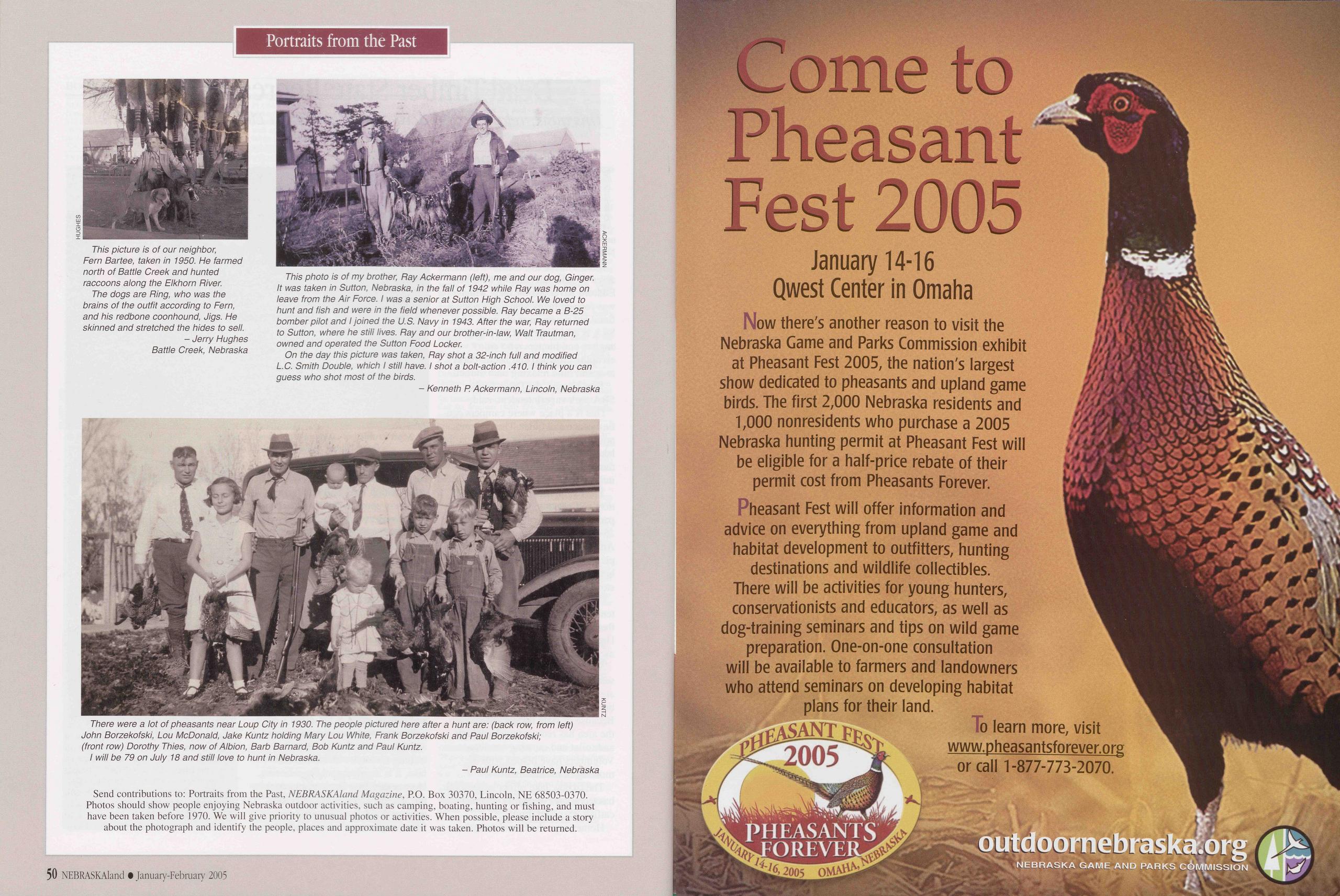
Portraits from the Past
Position: 626 (18 views)