Volume 82, Issue 10, 2004
NEBRASKAland
Nebraska Game & Parks Commission December 2004 $2.50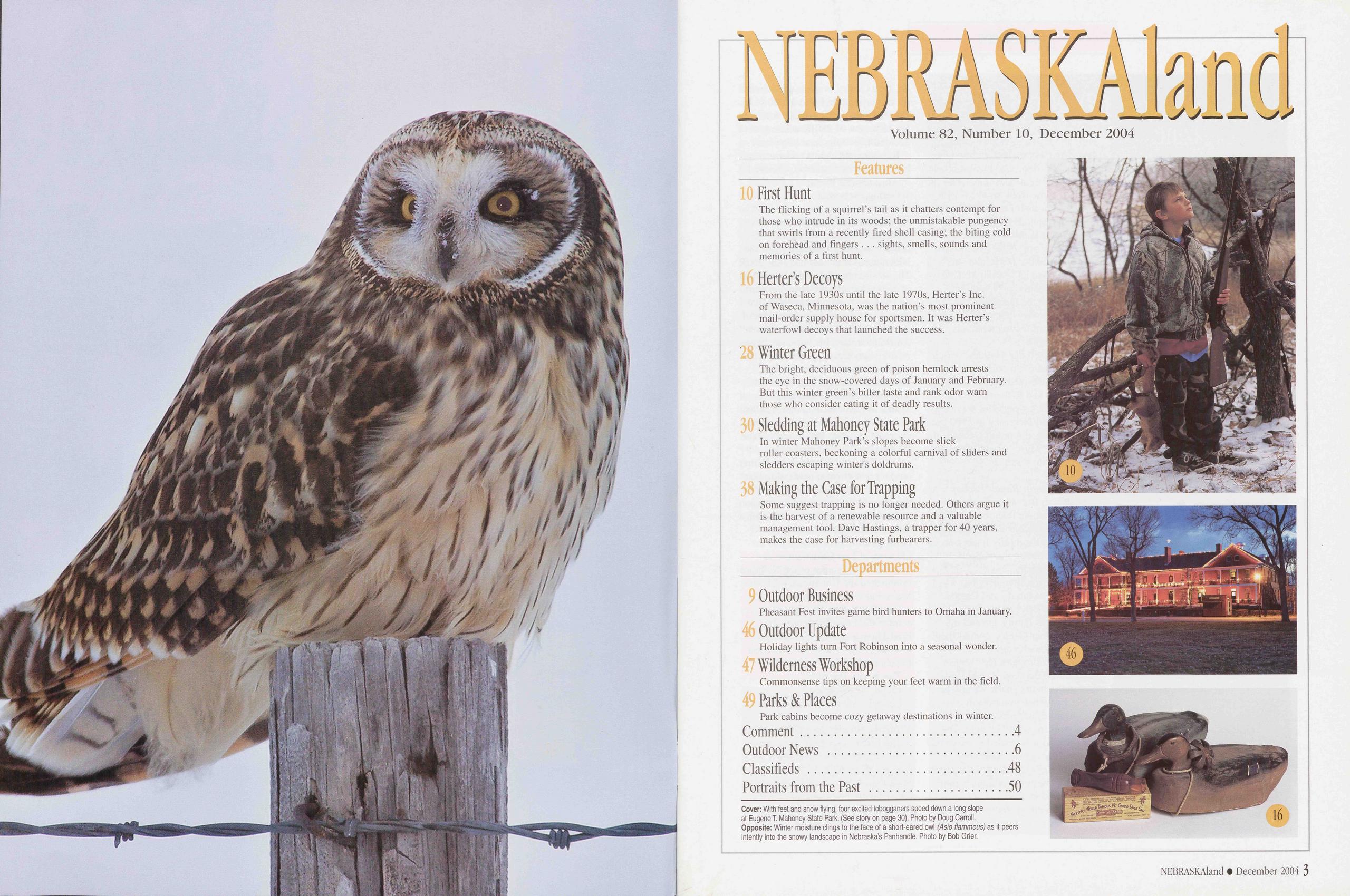
NEBRASKAland
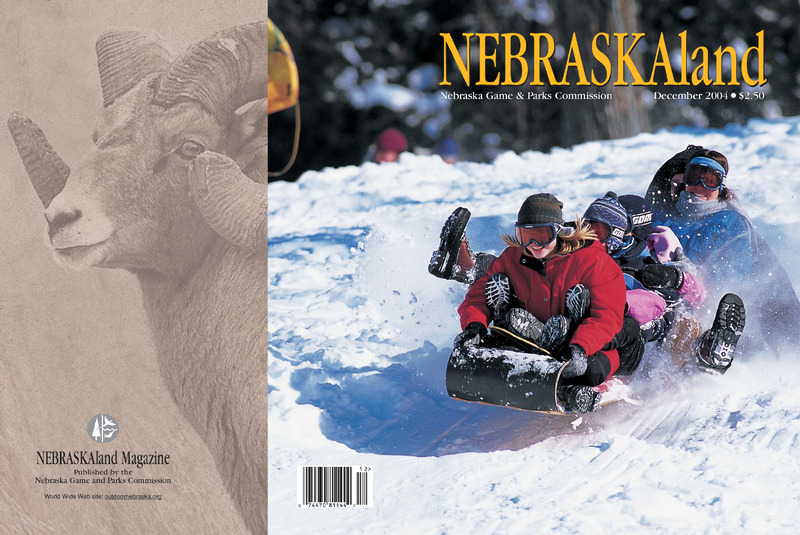
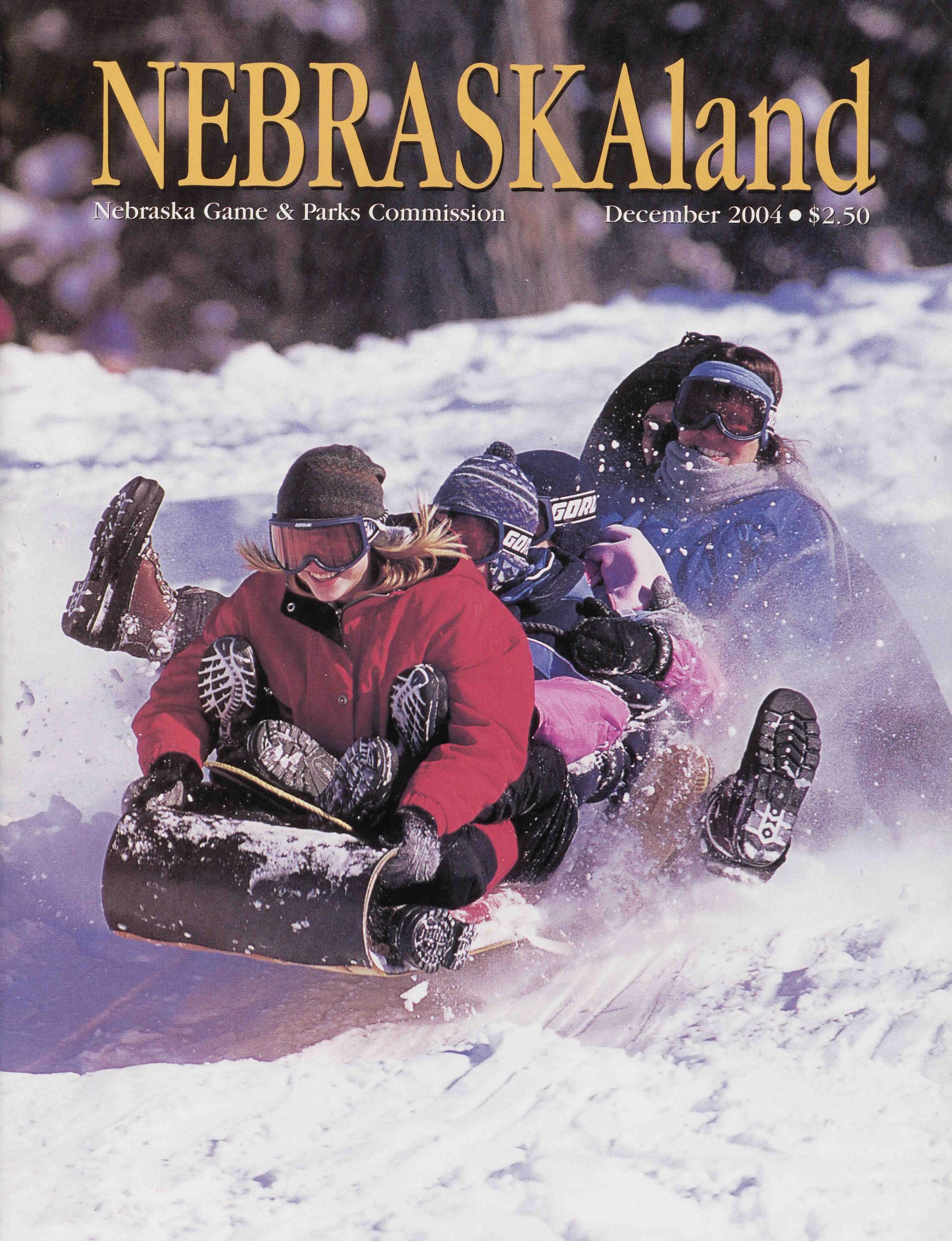
Volume 82, Number 10, December 2004 Features 10 First Hunt The flicking of a squirrel’s tail as it chatters contempt for those who intrude in its woods; the unmistakable pungency that swirls from a recently fired shell casing; the biting cold on forehead and fingers . . . sights, smells, sounds and memories of a first hunt. 16 Herter’s Decoys From the late 1930s until the late 1970s, Herter’s Inc. of Waseca, Minnesota, was the nation’s most prominent mail-order supply house for sportsmen. It was Herter’s waterfowl decoys that launched the success. 28 Winter Green The bright, deciduous green of poison hemlock arrests the eye in the snow-covered days of January and February. But this winter green’s bitter taste and rank odor warn those who consider eating it of deadly results. 30 Sledding at Mahoney State Park In winter Mahoney Park’s slopes become slick roller coasters, beckoning a colorful carnival of sliders and sledders escaping winter's doldrums. 38 Making the Case for Trapping Some suggest trapping is no longer needed. Others argue it is the harvest of a renewable resource and a valuable management tool. Dave Hastings, a trapper for 40 years, makes the case for harvesting furbearers. Departments 9 Outdoor Business Pheasant Fest invites game bird hunters to Omaha in January. 46 Outdoor Update Holiday lights turn Fort Robinson into a seasonal wonder. 47 Wilderness Workshop Commonsense tips on keeping your feet warm in the field. 49 Parks & Places Park cabins become cozy getaway destinations in winter. Comment...........................................4 Outdoor News ................................... 6 Classifieds .....................................48 Portraits from the Past .........................50 Cover: With feet and snow flying, four excited tobogganers speed down a long slope at Eugene T. Mahoney State Park. (See story on page 30). Photo by Doug Carroll. Opposite: Winter moisture clings to the face of a short-eared owl (Asio flammeus) as it peers intently into the snowy landscape in Nebraska’s Panhandle. Photo by Bob Grier.10
46
16
Comment
Hats Off to HuntleyI enjoyed your article on the Lions Club in Huntley (October 2004). My mother, Blanche Maret Vaughn, was born and raised in Huntley, and my dad, Dan Vaughn, and I hunted the same places described in your article.
Some of my fondest memories of Huntley came from my stays with my grandmother, Lura Maret, who was the telephone switchboard operator for Huntley and the surrounding area. The switchboard was in her house across the street from the open lot in front of the town hall. My cousins and I had fun helping with the telephone calls and watching movies that were shown on the wall of the town hall on Saturday nights.
I am pleased that Huntley, with a population of 67, is still going strong. Hats off to the members of the Lions Club and to the farmers who provide such a wonderful service to hunters. I left Nebraska in 1960 but remain a true and proud Nebraskan.
Marlene “Mimi” Vaughn Minarik Alexandria, Virginia Bead Mountain Ranch LegacyThanks to Bob Grier for his wonderful article (October 2004) on Platte River Basin Environments (PRBE) and especially for his beautiful aerial photo of Bead Mountain Ranch.
Just as Clive Ostenberg left a legacy for his family and friends, my dad, Dr. Bill Gentry, left a legacy for his family. He and my mother, Esther Gentry, owned Bead Mountain Ranch until it became a family corporation in the 1960s. He believed that you should leave the land in better shape when you sell it than when you bought it. He had miles of terraces and several dams built to control erosion. The farm ground was leveled to maximize the use of irrigation water. My husband, LeRoy, managed the ranch following the same principles after my dad died in 1981.
Bead Mountain Ranch has been a true family corporation. My brother, Dr. Don Gentry, was the president of the corporation for about 20 years. He made the initial contact with Hod Kosman of PRBE when we decided to sell the land last year.
It is a beautiful area and we are happy to know it will be preserved.
Alice Gentry Kenitz Gering, Nebraska Niobrara Fund EstablishedNEBRASKAland Magazine readers will recall articles about the Niobrara River in May and June 2003. The stories chronicled the long effort of Nebraskans to preserve our most undeveloped and most beautiful river. Lou Christiansen, President of Friends of the Niobrara, died last April 26. He and his wife, Jan, were well-known canoeing outfitters and ambassadors for the Niobrara. Thousands of beginning canoeists who visited their headquarters in Sparks learned canoeing basics, where to find the best waterfalls, some of the river’s history, and to respect the Niobrara valley and its people.
Lou, like Fred Thomas, the former outdoor and environment columnist for the Omaha World Herald, devoted decades of his life convincing decision makers that the Niobrara valley must have effective protection from development. To commemorate the life work of Lou Christiansen and Fred Thomas, Friends of the Niobrara established the Christiansen-Thomas Memorial Fund to continue its work.
For information, or to donate, contact the Lou Christensen and Fred Thomas Memorial Fund, c/o Friends of the Niobrara, 9200 West Fletcher, Malcolm, NE 68402.
Tim Knott, President, Friends of Niobrara Lincoln, Nebraska Nebraska Should Join CompactThe first thing I read every month is the Officer's Notebook. As a former officer with the Nebraska State Patrol and now a Conservation Officer with the Minnesota DNR Division of Enforcement, I like to keep up with the happenings of my former state.
I know Mark Webb, who wrote the notebook in November, and I wanted to let you know that he was honored as the North American Wildlife Enforcement Officer Association's (NAWEOA) Officer of the Year.
Nebraska is not in the wildlife violators compact that revokes permits of Nebraska game violators in the other states. Minnesota is a member of the reciprocal compact along with: Arizona, California, Colorado, Idaho, Georgia, Indiana, Iowa, Maryland, Missouri, Montana, Nevada, New Mexico, North Dakota, Oregon, Utah, Washington and Wyoming.
Nebraska may honor violations in the other states, but Minnesota does not share its information with states that are not in the compact.
The license revocation tool along with vehicle and boat forfeitures have helped combat gross violations. Before we had the revocation tool, I had cases with fines of $2,500 or more, and the first question the violator asked was, "Can we still fish?" Today the answer is "NO" and not in these other states.
We need Nebraska in the compact.
Chris Vinton Minnesota Conservation Officer Detroit Lakes, Minnesota Comment NEBRASKAland Magazine P.O. Box 30370, Lincoln, NE 68503. E-mail: nebland@ ngpc. state, ne. us. Please include your postal address and telephone number. Letters may be condensed and edited for clarity. Photographs are welcome and will be returned. Under federal and/or state law, discrimination is prohibited on the basis of race, color, religion, age, gender, marital status, national origin, disability or political affiliation. If you think you have been discriminated against in any program, activity or facility or want more information, contact the Affirmative Action Officer, Nebraska Game and Parks Commission, Lincoln, NE, (402) 471-0641 or the Equal Opportunity Commission, Lincoln, NE, (402) 471-2024, TTY/TDD (402) 471- 4693). Nebraska Game and Parks Commission Offices Headquarters 2200 N. 33rd Street Lincoln, NE 68503 Phone (402) 471-0641 District Office I East Hwy. 2, Box 725 Alliance, NE 69301 Phone (308) 763-2940 District Office II 524 Panzer St., Box 508 Bassett, NE 68714 Phone (402) 684-2921 District Office III 2201 N. 13th St. Norfolk, NE 68701 Phone (402) 370-3374 District Office IV 301 E. State Farm Rd. North Platte, NE 69101 Phone (308) 535-8025 District Office V 2200 N. 33rd Street Lincoln, NE 68503 Phone (402) 471-5558 District Office VI 1617 First Ave. Kearney, NE 68847 Phone (308) 865-5310 Omaha Office 1212 Bob Gibson Blvd. Omaha, NE 68108 Phone (402) 595-2144 Ak-Sar-Ben Aquarium 21502 W. Highway 31 Gretna, NE 68028 Phone (402) 332-3901 World Wide Web site: outdoornebraska.org E-mail: ngpc@ngpc.state.ne.us Conservation Officers by Region Administration Ted Blume (Adm.) Lincoln 471-5531 Tim Williams Darin Gress Hastings (402) 463-2535 Hebron (402) 768-2287 Craig Stover (Asst.) Lincoln 471-5532 Dale Johnson Kearney 237-1079 Wes Loos (Asst.) Lincoln 471-5591 Mark Reeves Loup City 745-0748 Murray Johnson Lincoln 471-5003 Robert Finke Milford (402) 761-3537 Dana Miller (Sup.) Valentine 376-3116 Richard Seward Ord 728-3115 Panhandle Northeast Officer City Phone (308) Officer City Phone (402) Jim Zimmerman (Sup.) Gering 436-7561 Tom Zimmer (Sup.) Norfolk 371-6625 Raymond Still Bridgeport 262-1075 Robert Kelly Albion 395-2538 Walt Meyer Chadron 432-4398 Dale Davis Bassett 273-1700 John Murphy Crawford 665-2021 Ross Oestmann Bloomfield 373-4412 Heath Packett Gordon 282-2553 Steve Oberg Columbus 564-5937 Dennis Thompson Ogallala 284-6450 Gary Ralston Creighton 358-3892 Dan Zuehlke Ogallala 284-4815 Daniel Roberts Fremont 721-7852 Doug Pollard Oshkosh 772-9950 Jon Reeves Kennard 427-7378 Scott Brandt Scottsbluff 635-1277 Marion Shafer Norfolk 371-2031 Frank Miller Valentine (402)376-1183 Pat George O’Neill 482-5771 Eric Wiebe Ponca 755-2566 Southwest Officer City Phone (308) Southeast Phone (402) Roger Thompson (Sup.) N. Platte 532-9175 Officer City Ray Dierking Brkn. Bow 872-3078 Duane Arp (Sup.) Gretna 332-2965 George Sund Cambridge 697-4629 Sean McKeehan Ashland 944-4174 Matt Andrews Elwood 785-3025 William Krause Auburn 274-3789 Dirk Greene Imperial 882-5328 Douglas Kramer Lincoln 466-9001 Virgil Gosch McCook 345-2185 Dina Barta Lincoln 483-2358 Dudley Sorensen N. Platte 532-0747 Stacey Lewton Lincoln 476-0436 Rich Routh Rep. City 799-2085 Levi Krause Louisville 234-2212 Russell Mort Nebr. City 873-5684 South-central Dan Evasco Papillion 504-1368 Officer City Phone (308) Jeff Clauson Valley 359-5301 Jerry Pecha (Sup.) Kearney 865-5327 Mike Luben Wahoo 443-4278 Randy Pomplun Fullerton 536-2987 Terry Brentzel Grand Is. 384-8296 Nebraska Wildlife Crimestoppers 1-800-742-7627 NEBRASKAland • December 2004 5
2005 Pheasant Fest January 14-16 Qwest Center in Omaha, Nebraska Sponsored by the Nebraska Game and Parks Commission and Pheasants Forever
Visit us at the Nebraska Game and Parks Commission exhibit during the nation's largest show dedicated to pheasants and upland game hunting.
Pheasant Fest will fill the Qwest Center with exhibits and seminars on everything from upland game and its habitat to sporting dogs and taxidermy. You will find wildlife art, wild game cooking, hunting and outdoor gear, activities for young hunters, information for landowners on farm programs and habitat, and much more.
Make your plans to attend the 2005 Pheasant Fest now! To learn more, visit www.pheasantsforever.org.
outdoornebraska.org NEBRASKA GAME AND PARKS COMMISSIONOutdoor News
A 64-pound grass carp taken from Wilson Creek 2X in Otoe County on August 29 shattered the previous Nebraska species record of 51 pounds.
Malik Solunovic of Lincoln was fishing for bass and crappies in a float tube when the carp took the Shad Rap on his 10-pound test line.
Biologists said the fish, which had a 33-inch girth and was 46.5 inches long, probably was the result of a 1979 stocking of grass carp in the lake to control vegetation.
Elk Hunters Enjoy Season of Remarkable SuccessNebraska elk hunters enjoyed success this past season, according to Gary Schlichtemeier, district wildlife manager at the Nebraska Game and Parks Commission's Alliance office.
The elk season ended October 24 in four of five elk management units. The Boyd unit season is open until December 31.
"Elk hunters in the new Ash Creek elk management unit recorded the highest hunter success, with 11 of the 15 permit holders harvesting an elk for 73 percent success," Schlichtemeier said. "The 2004 season was the first for elk hunting at the Ask Creek."
In the Hat Creek Unit, where 29 permits were issued, 16 hunters shot an elk for a 55 percent success rate, and hunter success was 47 percent in the Bordeaux Creek Unit, where 17 of 36 permit holders took an elk. Hunters in the Box Elder Unit south of North Platte had the least success, with two of the nine tags filled.
According to Schlichtemeier, landowner cooperation has played a major role in the elk success.
"Cooperation between landowners and hunters is an important part of the success of the elk management program," he said. "Hunting is the way we can manage elk numbers to reduce effects on private property and still maintain a valued resource for all Nebraskans.
Youth Turkey Permit Authorized, Seasons SetAt its October meeting, the Nebraska Game and Parks Commission created a youth spring turkey hunting season beginning next year. With a valid permit, youths ages 12 to 15 years old may hunt turkeys statewide with archery equipment from March 25 through May 22 and with a shotgun from April 9 through May 22.
The Commission also set the 2005 spring turkey hunting season for all hunters at its meeting. The archery season will be March 25 to May 22. The shotgun season in the West Unit will be from April 16 to May 22; the early shotgun season in the East Missouri Unit will be April 16-24; and the late shotgun season in the East Missouri Unit will be April 25 to May 22.
An unlimited number of permits will be available. A hunter may obtain two spring turkey permits, but only one spring shotgun permit in the East Missouri Unit. An exception is a limited landowner permit will not count against a hunter's liimt. Each permit allows a hunter to take one male or bearded female turkey.
Driver Who Accidentally Kills an Elk May Now Salvage ItThe Nebraska Game and Parks Commission has added elk to the regulations that allow the salvaging of deer and pronghorns accidentally killed by a motor vehicle. The change allows a Nebraska resident who accidentally kills an elk with a motor vehicle to field dress and take possession of the animal at the time of the accident and remove it to his residence. The driver must notify the Commission within 24 hours of the accident and the carcass must be tagged by a conservation officer or other Commission personnel.
Commissioners also made it illegal to buy, sell, trade, barter or possess any live species of the family Channidae, or snakeheads, a fish native to Asia and Africa. Only individuals who have scientific collector's permits issued by the Commission may possess live specimens through January 1, 2006.
Create the 2006 Nebraska Habitat Stamp
Enter your work of art - in oil, chalk, pastel, or pencil - depicting a Nebraska wildlife species in the 2005 contest. The winning entry will appear on the 2006 Nebraska Habitat Stamp, and the artist receives $300 cash and a subscription to NEBRASKAland Magazine. The deadline for the 28th Annual Nebraska Habitat Stamp Contest is March 1, 2005 For complete contest rules, and an entry form for the adult or youth contest divisions, call (402) 471-5585 or go online to www.ngpc.state.ne.us/wildlife/programs/habitat/rules.asp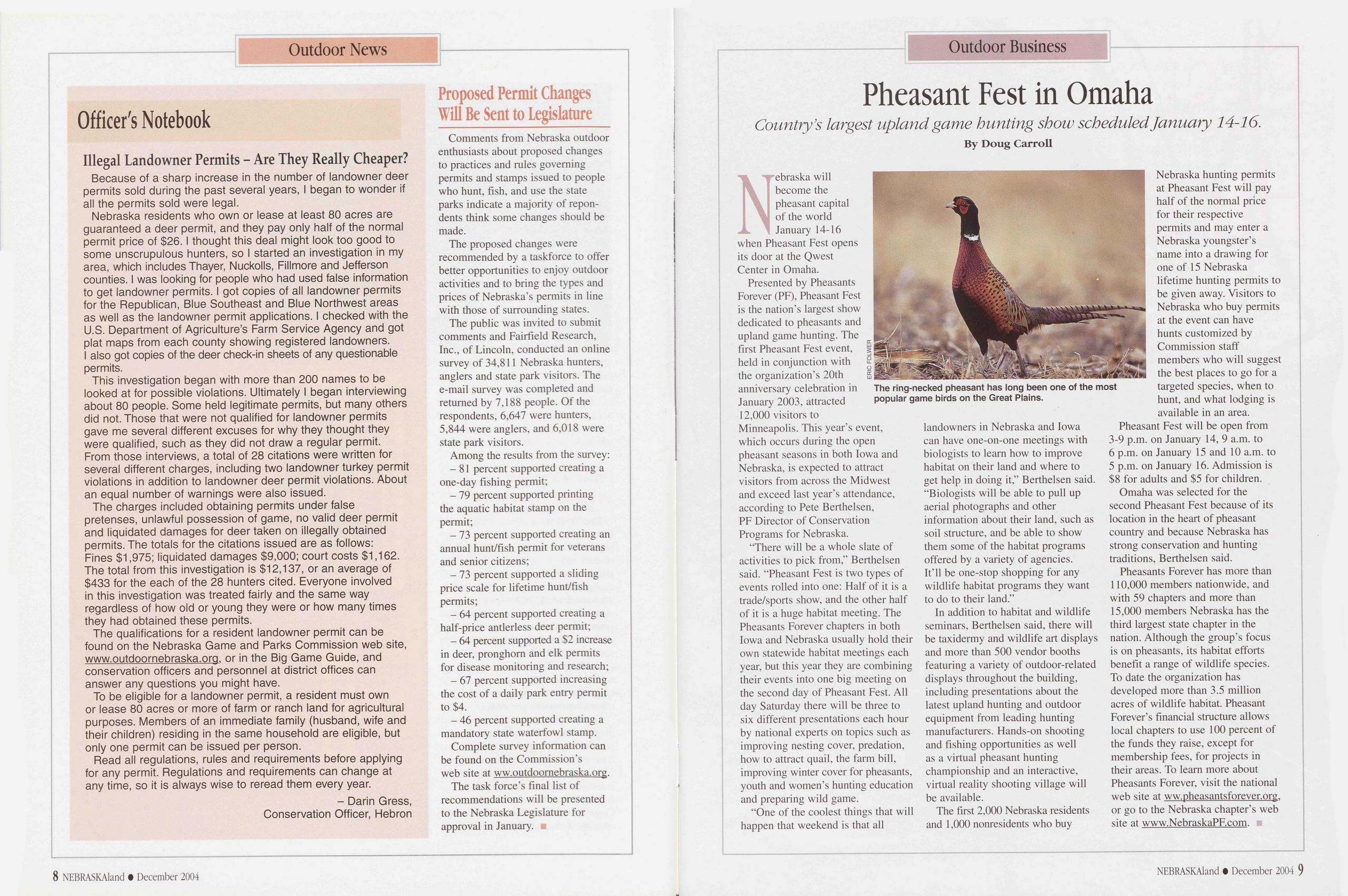
Outdoor News
Officer's Notebook Illegal Landowner Permits - Are They Really Cheaper?Because of a sharp increase in the number of landowner deer permits sold during the past several years, I began to wonder if all the permits sold were legal.
Nebraska residents who own or lease at least 80 acres are guaranteed a deer permit, and they pay only half of the normal permit price of $26. I thought this deal might look too good to some unscrupulous hunters, so I started an investigation in my area, which includes Thayer, Nuckolls, Fillmore and Jefferson counties. I was looking for people who had used false information to get landowner permits. I got copies of all landowner permits for the Republican, Blue Southeast and Blue Northwest areas as well as the landowner permit applications. I checked with the U.S. Department of Agriculture’s Farm Service Agency and got plat maps from each county showing registered landowners. I also got copies of the deer check-in sheets of any questionable permits.
This investigation began with more than 200 names to be looked at for possible violations. Ultimately I began interviewing about 80 people. Some held legitimate permits, but many others did not. Those that were not qualified for landowner permits gave me several different excuses for why they thought they were qualified, such as they did not draw a regular permit. From those interviews, a total of 28 citations were written for several different charges, including two landowner turkey permit violations in addition to landowner deer permit violations. About an equal number of warnings were also issued.
The charges included obtaining permits under false pretenses, unlawful possession of game, no valid deer permit and liquidated damages for deer taken on illegally obtained permits. The totals for the citations issued are as follows: Fines $1,975; liquidated damages $9,000; court costs $1,162. The total from this investigation is $12,137, or an average of $433 for the each of the 28 hunters cited. Everyone involved in this investigation was treated fairly and the same way regardless of how old or young they were or how many times they had obtained these permits.
The qualifications for a resident landowner permit can be found on the Nebraska Game and Parks Commission web site, www.outdoornebraska.ora. or in the Big Game Guide, and conservation officers and personnel at district offices can answer any questions you might have.
To be eligible for a landowner permit, a resident must own or lease 80 acres or more of farm or ranch land for agricultural purposes. Members of an immediate family (husband, wife and their children) residing in the same household are eligible, but only one permit can be issued per person.
Read all regulations, rules and requirements before applying for any permit. Regulations and requirements can change at any time, so it is always wise to reread them every year.
- Darin Gress, Conservation Officer, Hebron Proposed Permit Changes Will Be Sent to LegislatureComments from Nebraska outdoor enthusiasts about proposed changes to practices and rules governing permits and stamps issued to people who hunt, fish, and use the state parks indicate a majority of repon- dents think some changes should be made.
The proposed changes were recommended by a taskforce to offer better opportunities to enjoy outdoor activities and to bring the types and prices of Nebraska’s permits in line with those of surrounding states.
The public was invited to submit comments and Fairfield Research, Inc., of Lincoln, conducted an online survey of 34,811 Nebraska hunters, anglers and state park visitors. The e-mail survey was completed and returned by 7,188 people. Of the respondents, 6,647 were hunters, 5,844 were anglers, and 6,018 were state park visitors.
Among the results from the survey:
-81 percent supported creating a one-day fishing permit; -79 percent supported printing the aquatic habitat stamp on the permit; -73 percent supported creating an annual hunt/fish permit for veterans and senior citizens; -73 percent supported a sliding price scale for lifetime hunt/fish permits; -64 percent supported creating a half-price antlerless deer permit; -64 percent supported a $2 increase in deer, pronghorn and elk permits for disease monitoring and research; -67 percent supported increasing the cost of a daily park entry permit to $4. -46 percent supported creating a mandatory state waterfowl stamp.Complete survey information can be found on the Commission’s web site at ww.outdoornebraska.org.
The task force’s final list of recommendations will be presented to the Nebraska Legislature for approval in January.
Outdoor Business
Pheasant Fest in Omaha Country’s largest upland game hunting show scheduled January 14-16. By Doug CarrollNebraska will become the pheasant capital of the world January 14-16 when Pheasant Fest opens its door at the Qwest Center in Omaha.
Presented by Pheasants Forever (PF), Pheasant Fest is the nation’s largest show dedicated to pheasants and upland game hunting. The first Pheasant Fest event, held in conjunction with the organization’s 20th anniversary celebration in January 2003, attracted 12,000 visitors to Minneapolis. This year’s event, which occurs during the open pheasant seasons in both Iowa and Nebraska, is expected to attract visitors from across the Midwest and exceed last year’s attendance, according to Pete Berthelsen, PF Director of Conservation Programs for Nebraska.
“There will be a whole slate of activities to pick from,” Berthelsen said. “Pheasant Fest is two types of events rolled into one: Half of it is a trade/sports show, and the other half of it is a huge habitat meeting. The Pheasants Forever chapters in both Iowa and Nebraska usually hold their own statewide habitat meetings each year, but this year they are combining their events into one big meeting on the second day of Pheasant Fest. All day Saturday there will be three to six different presentations each hour by national experts on topics such as improving nesting cover, predation, how to attract quail, the farm bill, improving winter cover for pheasants, youth and women’s hunting education and preparing wild game.
“One of the coolest things that will happen that weekend is that all
In addition to habitat and wildlife seminars, Berthelsen said, there will be taxidermy and wildlife art displays and more than 500 vendor booths featuring a variety of outdoor-related displays throughout the building, including presentations about the latest upland hunting and outdoor equipment from leading hunting manufacturers. Hands-on shooting and fishing opportunities as well as a virtual pheasant hunting championship and an interactive, virtual reality shooting village will be available.
The first 2,000 Nebraska residents and 1,000 nonresidents who buy Nebraska hunting permits at Pheasant Fest will pay half of the normal price for their respective permits and may enter a Nebraska youngster’s name into a drawing for one of 15 Nebraska lifetime hunting permits to be given away. Visitors to Nebraska who buy permits at the event can have hunts customized by Commission staff members who will suggest the best places to go for a targeted species, when to hunt, and what lodging is available in an area.
Pheasant Fest will be open from 3-9 p.m. on January 14, 9 a.m. to 6 p.m. on January 15 and 10 a.m. to 5 p.m. on January 16. Admission is $8 for adults and $5 for children.
Omaha was selected for the second Pheasant Fest because of its location in the heart of pheasant country and because Nebraska has strong conservation and hunting traditions, Berthelsen said.
Pheasants Forever has more than 110,000 members nationwide, and with 59 chapters and more than 15,000 members Nebraska has the third largest state chapter in the nation. Although the group’s focus is on pheasants, its habitat efforts benefit a range of wildlife species. To date the organization has developed more than 3.5 million acres of wildlife habitat. Pheasant Forever’s financial structure allows local chapters to use 100 percent of the funds they raise, except for membership fees, for projects in their areas. To learn more about Pheasants Forever, visit the national web site at ww.pheasantsforever.org. or go to the Nebraska chapter’s web site at www.NebraskaPF.com.
8 NEBRASKAland • December 2004 NEBRASKAland • December 2004 9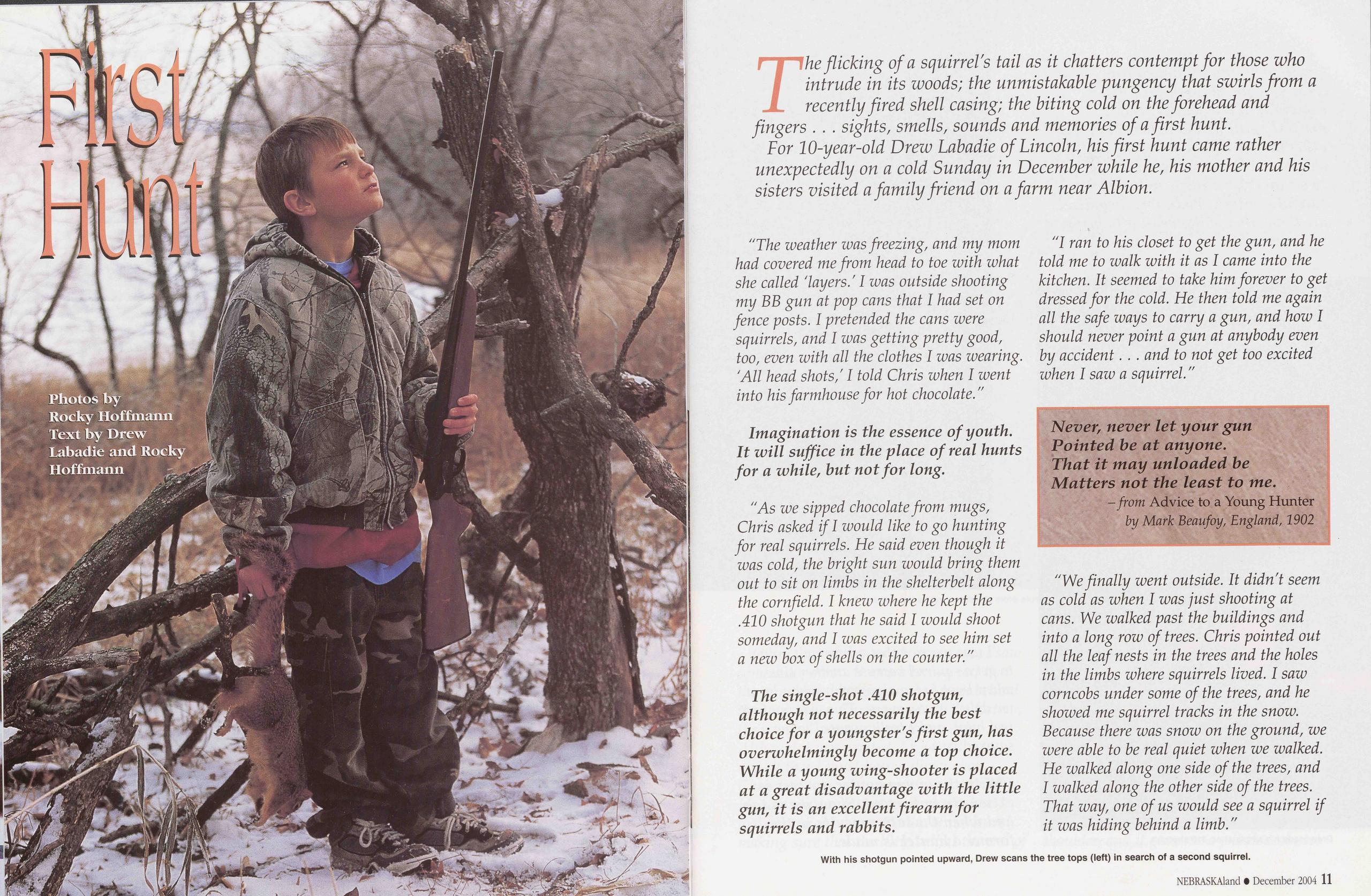
First Hunt
Photos by Rocky Hoffmann Text by Drew Labadie and Rocky Hoffmann The flicking of a squirrel's tail as it chatters contempt for those who intrude in its woods; the unmistakable pungency that swirls from a recently fired shell casing; the biting cold on the forehead and fingers . . . sights, smells, sounds and memories of a first hunt. For 10-year-old Drew Labadie of Lincoln, his first hunt came rather unexpectedly on a cold Sunday in December while he, his mother and his sisters visited a family friend on a farm near Albion."The weather was freezing, and my mom had covered me from head to toe with what she called 'layers.' I was outside shooting my BB gun at pop cans that I had set on fence posts. I pretended the cans were squirrels, and I was getting pretty good, too, even with all the clothes I was wearing. 'All head shots,' I told Chris when I went into his farmhouse for hot chocolate."
Imagination is the essence of youth. It will suffice in the place of real hunts for a while, but not for long.
"As we sipped chocolate from mugs, Chris asked if I would like to go hunting for real squirrels. He said even though it was cold, the bright sun would bring them out to sit on limbs in the shelterbelt along the cornfield. I knew where he kept the .410 shotgun that he said I would shoot someday, and I was excited to see him set a new box of shells on the counter."
The single-shot .410 shotgun, although not necessarily the best choice for a youngster's first gun, has overwhelmingly become a top choice. While a young wing-shooter is placed at a great disadvantage with the little gun, it is an excellent firearm for squirrels and rabbits.
"I ran to his closet to get the gun, and he told me to walk with it as I came into the kitchen. It seemed to take him forever to get dressed for the cold. He then told me again all the safe ways to carry a gun, and how I should never point a gun at anybody even by accident. . . and to not get too excited when I saw a squirrel."
Never, never let your gun Pointed be at anyone. That it may unloaded be Matters not the least to me. -from Advice to a Young Hunter by Mark Beaufoy, England, 1902
"We finally went outside. It didn't seem as cold as when I was just shooting at cans. We walked past the buildings and into a long row of trees. Chris pointed out all the leaf nests in the trees and the holes in the limbs where squirrels lived. I saw corncobs under some of the trees, and he showed me squirrel tracks in the snow. Because there was snow on the ground, we were able to be real quiet when we walked. He walked along one side of the trees, and I walked along the other side of the trees. That way, one of us would see a squirrel if it was hiding behind a limb."
NEBRASKAland • December 2004 11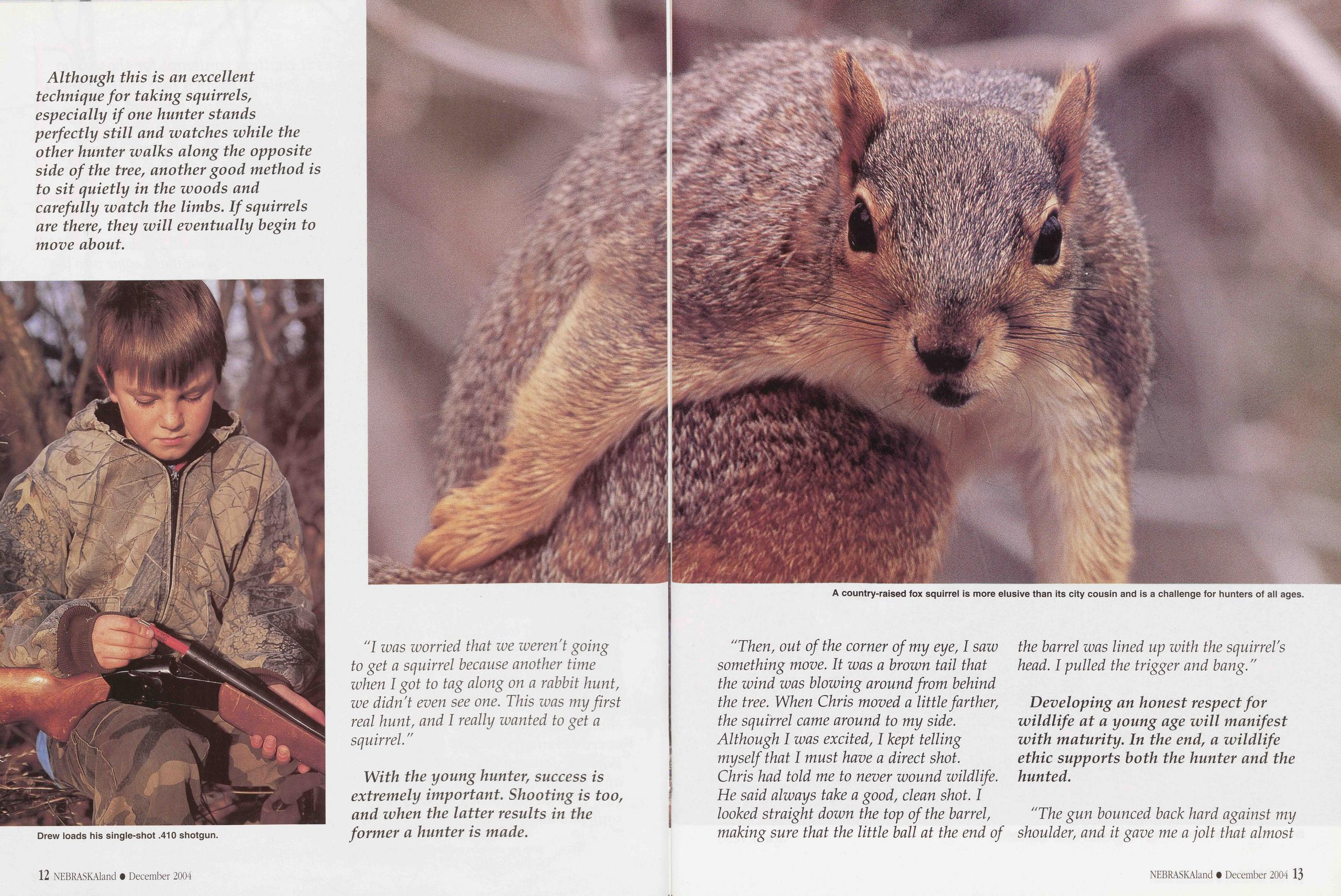
Although this is an excellent technique for taking squirrels, especially if one hunter stands perfectly still and watches while the other hunter walks along the opposite side of the tree, another good method is to sit quietly in the woods and carefully watch the limbs. If squirrels are there, they will eventually begin to move about.
"I was worried that we weren't going to get a squirrel because another time when I got to tag along on a rabbit hunt, we didn't even see one. This was my first real hunt, and I really wanted to get a squirrel."
With the young hunter, success is extremely important. Shooting is too, and when the latter results in the former a hunter is made.
"Then, out of the corner of my eye, I saw something move. It was a brown tail that the wind was blowing around from behind the tree. When Chris moved a little farther, the squirrel came around to my side. Although I was excited, I kept telling myself that I must have a direct shot. Chris had told me to never wound wildlife. He said always take a good, clean shot. I looked straight down the top of the barrel, making sure that the little ball at the end of the barrel was lined up with the squirrel's head. I pulled the trigger and bang."
Developing an honest respect for wildlife at a young age will manifest with maturity. In the end, a wildlife ethic supports both the hunter and the hunted.
"The gun bounced back hard against my shoulder, and it gave me a jolt that almost 12 NEBRASKAland • December 2004 NEBRASKAland • December 2004 13 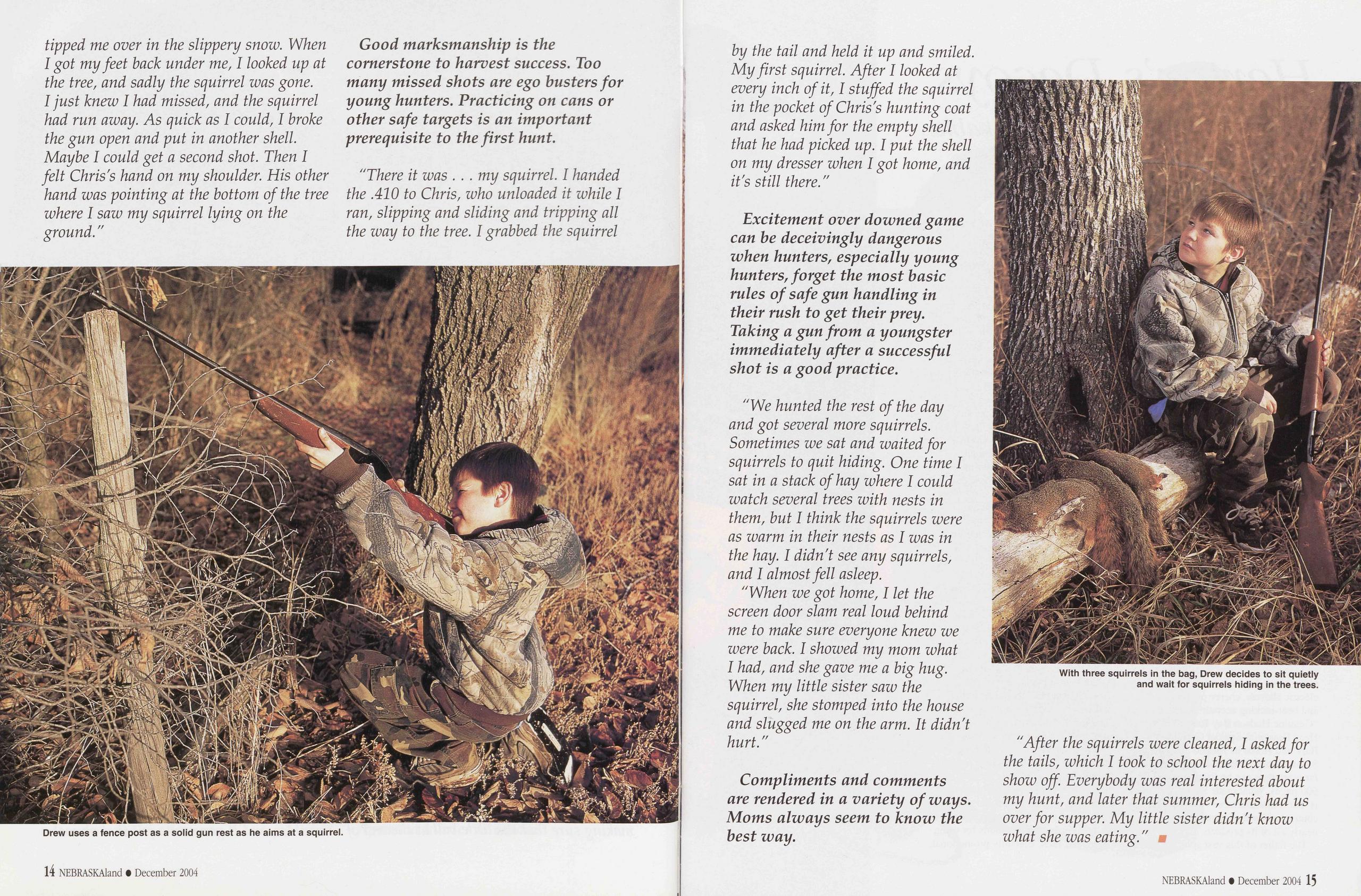 tipped me over in the slippery snow. When I got my feet back under me, I looked up at the tree, and sadly the squirrel was gone. I just knew I had missed, and the squirrel had run away. As quick as I could, I broke the gun open and put in another shell. Maybe I could get a second shot. Then I felt Chris's hand on my shoulder. His other hand was pointing at the bottom of the tree where I saw my squirrel lying on the ground."
Good marksmanship is the cornerstone to harvest success. Too many missed shots are ego busters for young hunters. Practicing on cans or other safe targets is an important prerequisite to the first hunt.
"There it was . . . my squirrel. I handed the .410 to Chris, who unloaded it while I ran, slipping and sliding and tripping all the way to the tree. I grabbed the squirrel by the tail and held it up and smiled. My first squirrel. After I looked at every inch of it, I stuffed the squirrel in the pocket of Chris's hunting coat and asked him for the empty shell that he had picked up. I put the shell on my dresser when I got home, and it's still there."
Excitement over downed game can be deceivingly dangerous when hunters, especially young hunters, forget the most basic rules of safe gun handling in their rush to get their prey. Taking a gun from a youngster immediately after a successful shot is a good practice.
p"We hunted the rest of the day and got several more squirrels. Sometimes we sat and waited for squirrels to quit hiding. One time I sat in a stack of hay where I could watch several trees with nests in them, but I think the squirrels were as warm in their nests as I was in the hay. I didn't see any squirrels, and I almost fell asleep.
"When we got home, I let the screen door slam real loud behind me to make sure everyone knew we were back. I showed my mom what I had, and she gave me a big hug. When my little sister saw the squirrel, she stomped into the house and slugged me on the arm. It didn't hurt."
Compliments and comments are rendered in a variety of ways. Moms always seem to know the best way.
"After the squirrels were cleaned, I asked for the tails, which I took to school the next day to show off. Everybody was real interested about my hunt, and later that summer, Chris had us over for supper. My little sister didn't know what she was eating."
14 NEBRASKAland • December 2004 NEBRASKAland • December 2004 15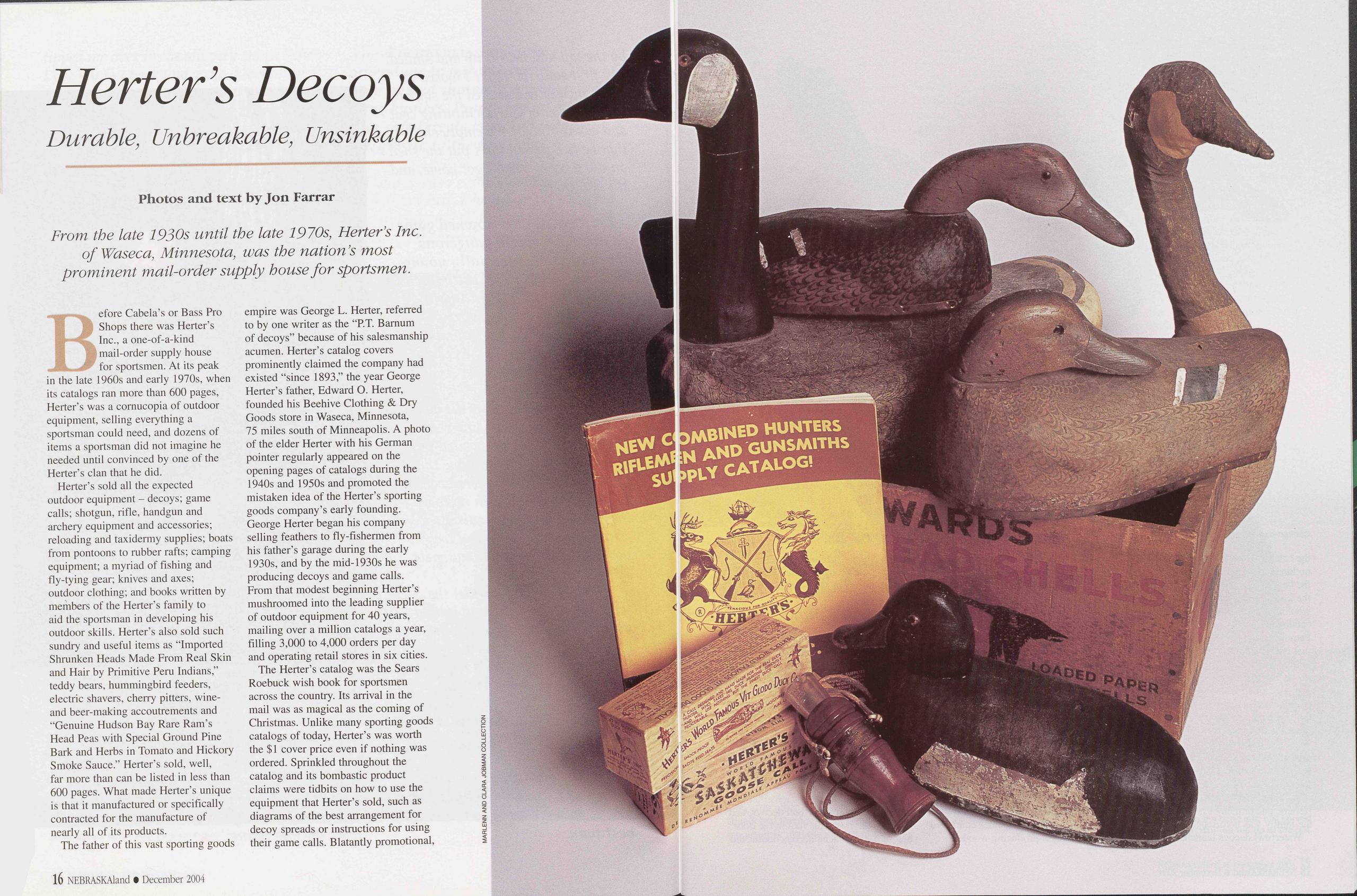
Herter’s Decoys
Durable, Unbreakable, Unsinkable Photos and text by Jon Farrar From the late 1930s until the late 1970s, Herter’s Inc. of Waseca, Minnesota, was the nation’s most prominent mail-order supply house for sportsmen.Before Cabela’s or Bass Pro Shops there was Herter’s Inc., a one-of-a-kind mail-order supply house for sportsmen. At its peak in the late 1960s and early 1970s, when its catalogs ran more than 600 pages, Herter’s was a cornucopia of outdoor equipment, selling everything a sportsman could need, and dozens of items a sportsman did not imagine he needed until convinced by one of the Herter’s clan that he did.
Herter’s sold all the expected outdoor equipment - decoys; game calls; shotgun, rifle, handgun and archery equipment and accessories; reloading and taxidermy supplies; boats from pontoons to rubber rafts; camping equipment; a myriad of fishing and fly-tying gear; knives and axes; outdoor clothing; and books written by members of the Herter’s family to aid the sportsman in developing his outdoor skills. Herter’s also sold such sundry and useful items as "Imported Shrunken Heads Made From Real Skin and Hair by Primitive Peru Indians,” teddy bears, hummingbird feeders, electric shavers, cherry pitters, wine- and beer-making accoutrements and "Genuine Hudson Bay Rare Ram’s Head Peas with Special Ground Pine Bark and Herbs in Tomato and Hickory Smoke Sauce.” Herter’s sold, well, far more than can be listed in less than 600 pages. What made Herter’s unique is that it manufactured or specifically contracted for the manufacture of nearly all of its products.
The father of this vast sporting goods empire was George L. Herter, referred to by one writer as the "P.T. Barnum of decoys” because of his salesmanship acumen. Herter’s catalog covers prominently claimed the company had existed "since 1893,” the year George Herter’s father, Edward O. Herter, founded his Beehive Clothing & Dry Goods store in Waseca, Minnesota, 75 miles south of Minneapolis. A photo of the elder Herter with his German pointer regularly appeared on the opening pages of catalogs during the 1940s and 1950s and promoted the mistaken idea of the Herter’s sporting goods company’s early founding. George Herter began his company selling feathers to fly-fishermen from his father’s garage during the early 1930s, and by the mid-1930s he was producing decoys and game calls. From that modest beginning Herter’s mushroomed into the leading supplier of outdoor equipment for 40 years, mailing over a million catalogs a year, filling 3,000 to 4,000 orders per day and operating retail stores in six cities.
The Herter’s catalog was the Sears Roebuck wish book for sportsmen across the country. Its arrival in the mail was as magical as the coming of Christmas. Unlike many sporting goods catalogs of today, Herter’s was worth the $1 cover price even if nothing was ordered. Sprinkled throughout the catalog and its bombastic product claims were tidbits on how to use the equipment that Herter’s sold, such as diagrams of the best arrangement for decoy spreads or instructions for using their game calls. Blatantly promotional,
the catalog text habitually made outlandish claims that its products were the best of their kind in the world, but the text also had light moments. Who would not smile when reading the catalog claims for the “Berthe E. Herter Famous Large Kitchen Knife,” noting that it will outperform any electric knife, “And makes you look like a cook not an electrician.” Herter’s catalog was personal, filled with endorsements by family members who had actually tested the equipment in Alaska, Africa and other far-flung and exotic locations. What Nebraska farm boy could resist ordering a George L. Herter hunting knife of the sort that caped out a world record class caribou? A regular reader came to believe he personally knew the Herters, one of many ironies because the family was notoriously private.
Waterfowl decoys launched Herter’s to the forefront of outdoor retailing and remained the company’s mainstay to the end. George Herter’s entry into the world of decoy manufacturing came at a critical juncture in the history of American decoy manufacturing. Quality wooden decoys had been commercially manufactured in the United States since at least 1873, when the Peterson Decoy Company in Detroit began marketing its products. Peterson closed its doors in 1884, followed by two other manufacturers with short longevities - the J.N. Dodge Decoy Company of Detroit and the Stevens Decoy Company of Weedsport, New York. From the late 1890s until 1926, quality wooden decoys from the Mason factory in Detroit dominated the American market. When Mason folded, several American companies continued or started mass-producing wooden decoys, the most prominent being “Pascagoula decoys” made by several manufacturers in Mississippi.
Corking Good DecoysWhile the manufacture of quality wooden decoys had essentially ended by the 1930s, the federal ban on the use of live birds for decoys in 1935 created a flood of new decoy lines late in that decade. The first papier-maché decoys were marketed about 1939, previewing the new manufacturing philosophy in America after World War II - build it cheap, sell it cheap, buy it cheap, use it up, throw it away and buy more. Mass-produced, wood-pulp decoys fit that mold. Still, there was a market for more substantial waterfowl decoys, and George Herter had his foot in the door before papier-maché decoys dominated the market. It was that void of decoys in America in the 1930s that George Herter capitalized on when he began marketing cork decoys in about 1936.
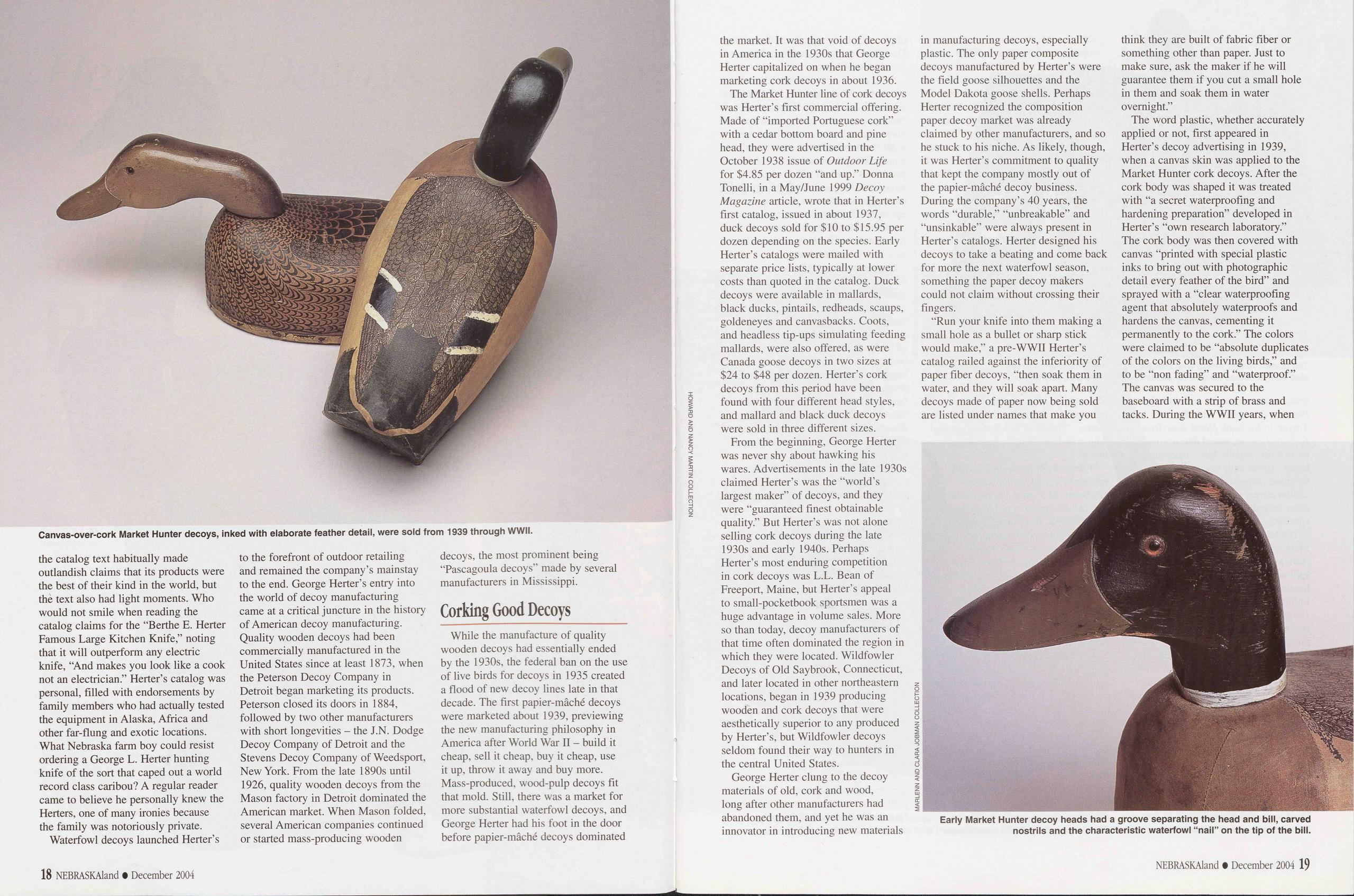
The Market Hunter line of cork decoys was Herter’s first commercial offering. Made of “imported Portuguese cork” with a cedar bottom board and pine head, they were advertised in the October 1938 issue of Outdoor Life for $4.85 per dozen “and up.” Donna Tonelli, in a May/June 1999 Decoy Magazine article, wrote that in Herter’s first catalog, issued in about 1937, duck decoys sold for $10 to $15.95 per dozen depending on the species. Early Herter’s catalogs were mailed with separate price lists, typically at lower costs than quoted in the catalog. Duck decoys were available in mallards, black ducks, pintails, redheads, scaups, goldeneyes and canvasbacks. Coots, and headless tip-ups simulating feeding mallards, were also offered, as were Canada goose decoys in two sizes at $24 to $48 per dozen. Herter’s cork decoys from this period have been found with four different head styles, and mallard and black duck decoys were sold in three different sizes.
From the beginning, George Herter was never shy about hawking his wares. Advertisements in the late 1930s claimed Herter’s was the “world’s largest maker” of decoys, and they were “guaranteed finest obtainable quality.” But Herter’s was not alone selling cork decoys during the late 1930s and early 1940s. Perhaps Herter’s most enduring competition in cork decoys was L.L. Bean of Freeport, Maine, but Herter’s appeal to small-pocketbook sportsmen was a huge advantage in volume sales. More so than today, decoy manufacturers of that time often dominated the region in which they were located. Wildfowler Decoys of Old Saybrook, Connecticut, and later located in other northeastern locations, began in 1939 producing wooden and cork decoys that were aesthetically superior to any produced by Herter’s, but Wildfowler decoys seldom found their way to hunters in the central United States.
George Herter clung to the decoy materials of old, cork and wood, long after other manufacturers had abandoned them, and yet he was an innovator in introducing new materials in manufacturing decoys, especially plastic. The only paper composite decoys manufactured by Herter’s were the field goose silhouettes and the Model Dakota goose shells. Perhaps Herter recognized the composition paper decoy market was already claimed by other manufacturers, and so he stuck to his niche. As likely, though, it was Herter’s commitment to quality that kept the company mostly out of the papier-mache decoy business. During the company’s 40 years, the words “durable,” “unbreakable” and “unsinkable” were always present in Herter’s catalogs. Herter designed his decoys to take a beating and come back for more the next waterfowl season, something the paper decoy makers could not claim without crossing their fingers.
“Run your knife into them making a small hole as a bullet or sharp stick would make,” a pre-WWII Herter’s catalog railed against the inferiority of paper fiber decoys, “then soak them in water, and they will soak apart. Many decoys made of paper now being sold are listed under names that make you
The word plastic, whether accurately applied or not, first appeared in Herter’s decoy advertising in 1939, when a canvas skin was applied to the Market Hunter cork decoys. After the cork body was shaped it was treated with “a secret waterproofing and hardening preparation” developed in Herter’s “own research laboratory.” The cork body was then covered with canvas “printed with special plastic inks to bring out with photographic detail every feather of the bird” and sprayed with a “clear waterproofing agent that absolutely waterproofs and hardens the canvas, cementing it permanently to the cork.” The colors were claimed to be “absolute duplicates of the colors on the living birds,” and to be “non fading” and “waterproof.” The canvas was secured to the baseboard with a strip of brass and tacks. During the WWII years, when 18 NEBRASKAland • December 2004 NEBRASKAland • December 2004 19 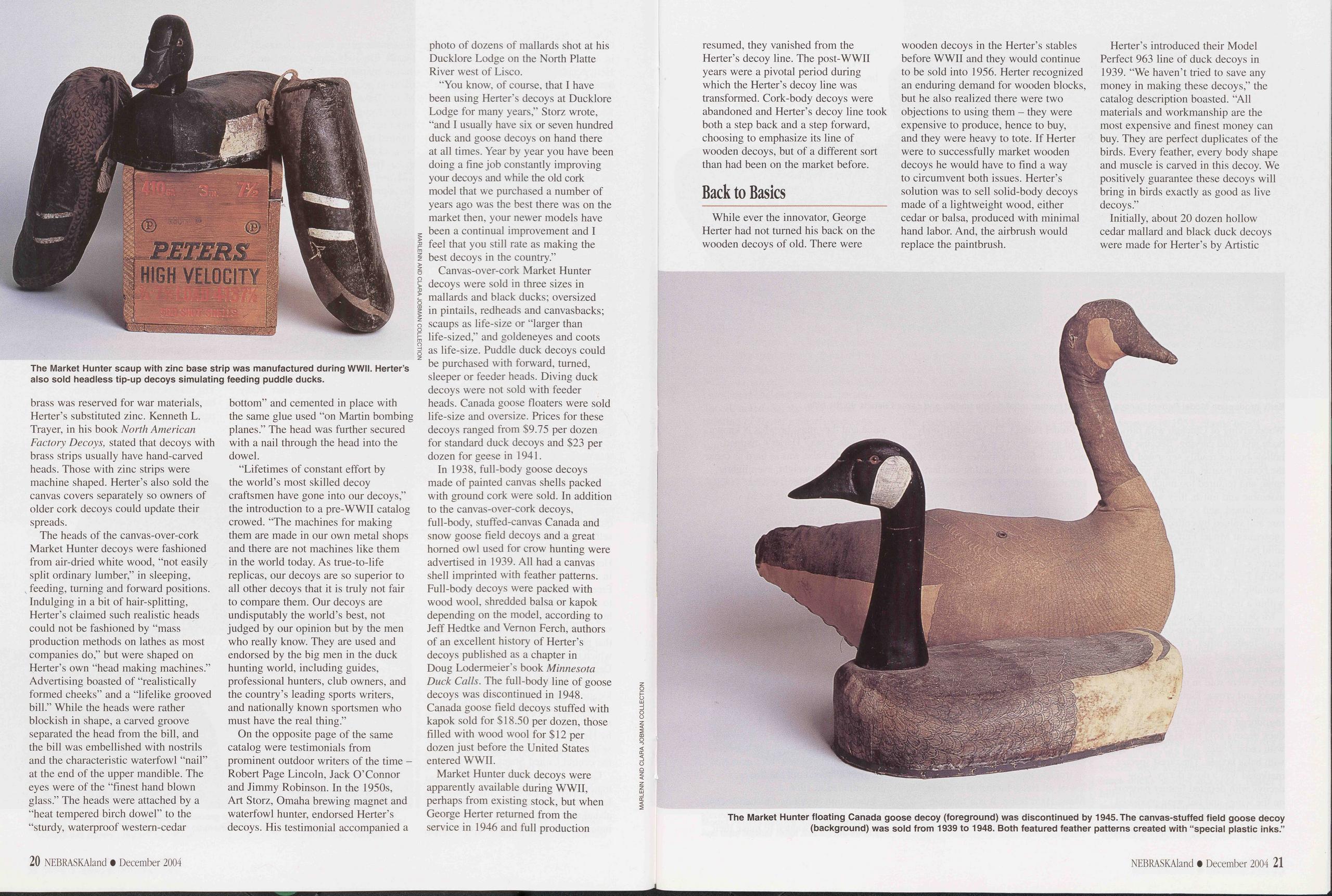
The heads of the canvas-over-cork Market Hunter decoys were fashioned from air-dried white wood, “not easily split ordinary lumber,” in sleeping, feeding, turning and forward positions. Indulging in a bit of hair-splitting, Herter’s claimed such realistic heads could not be fashioned by “mass production methods on lathes as most companies do,” but were shaped on Herter’s own “head making machines.” Advertising boasted of “realistically formed cheeks” and a “lifelike grooved bill.” While the heads were rather blockish in shape, a carved groove separated the head from the bill, and the bill was embellished with nostrils and the characteristic waterfowl “nail” at the end of the upper mandible. The eyes were of the “finest hand blown glass.” The heads were attached by a “heat tempered birch dowel” to the “sturdy, waterproof western-cedar bottom” and cemented in place with the same glue used “on Martin bombing planes.” The head was further secured with a nail through the head into the dowel.
“Lifetimes of constant effort by the world’s most skilled decoy craftsmen have gone into our decoys,” the introduction to a pre-WWII catalog crowed. “The machines for making them are made in our own metal shops and there are not machines like them in the world today. As true-to-life replicas, our decoys are so superior to all other decoys that it is truly not fair to compare them. Our decoys are undisputably the world’s best, not judged by our opinion but by the men who really know. They are used and endorsed by the big men in the duck hunting world, including guides, professional hunters, club owners, and the country’s leading sports writers, and nationally known sportsmen who must have the real thing.”
On the opposite page of the same catalog were testimonials from prominent outdoor writers of the time - Robert Page Lincoln, Jack O’Connor and Jimmy Robinson. In the 1950s, Art Storz, Omaha brewing magnet and waterfowl hunter, endorsed Herter’s decoys. His testimonial accompanied a photo of dozens of mallards shot at his Ducklore Lodge on the North Platte River west of Lisco.
“You know, of course, that I have been using Herter’s decoys at Ducklore Lodge for many years,” Storz wrote, “and I usually have six or seven hundred duck and goose decoys on hand there at all times. Year by year you have been doing a fine job constantly improving your decoys and while the old cork model that we purchased a number of years ago was the best there was on the market then, your newer models have been a continual improvement and I feel that you still rate as making the best decoys in the country.”
Canvas-over-cork Market Hunter decoys were sold in three sizes in mallards and black ducks; oversized in pintails, redheads and canvasbacks; scaups as life-size or “larger than life-sized,” and goldeneyes and coots as life-size. Puddle duck decoys could be purchased with forward, turned, sleeper or feeder heads. Diving duck decoys were not sold with feeder heads. Canada goose floaters were sold life-size and oversize. Prices for these decoys ranged from $9.75 per dozen for standard duck decoys and $23 per dozen for geese in 1941.
In 1938, full-body goose decoys made of painted canvas shells packed with ground cork were sold. In addition to the canvas-over-cork decoys, full-body, stuffed-canvas Canada and snow goose field decoys and a great homed owl used for crow hunting were advertised in 1939. All had a canvas shell imprinted with feather patterns. Full-body decoys were packed with wood wool, shredded balsa or kapok depending on the model, according to Jeff Hedtke and Vernon Ferch, authors of an excellent history of Herter’s decoys published as a chapter in Doug Lodermeier’s book Minnesota Duck Calls. The full-body line of goose decoys was discontinued in 1948. Canada goose field decoys stuffed with kapok sold for $18.50 per dozen, those filled with wood wool for $ 12 per dozen just before the United States entered WWII.
Market Hunter duck decoys were apparently available during WWII, perhaps from existing stock, but when George Herter returned from the service in 1946 and full production resumed, they vanished from the Herter’s decoy line. The post-WWII years were a pivotal period during which the Herter’s decoy line was transformed. Cork-body decoys were abandoned and Herter’s decoy line took both a step back and a step forward, choosing to emphasize its line of wooden decoys, but of a different sort than had been on the market before.
Back to BasicsWhile ever the innovator, George Herter had not turned his back on the wooden decoys of old. There were
Herter’s introduced their Model Perfect 963 line of duck decoys in 1939. “We haven’t tried to save any money in making these decoys,” the catalog description boasted. “All materials and workmanship are the most expensive and finest money can buy. They are perfect duplicates of the birds. Every feather, every body shape and muscle is carved in this decoy. We positively guarantee these decoys will bring in birds exactly as good as live decoys.”
Initially, about 20 dozen hollow cedar mallard and black duck decoys were made for Herter’s by Artistic 20 NEBRASKAland • December 2004 NEBRASKAland • December 2004 21 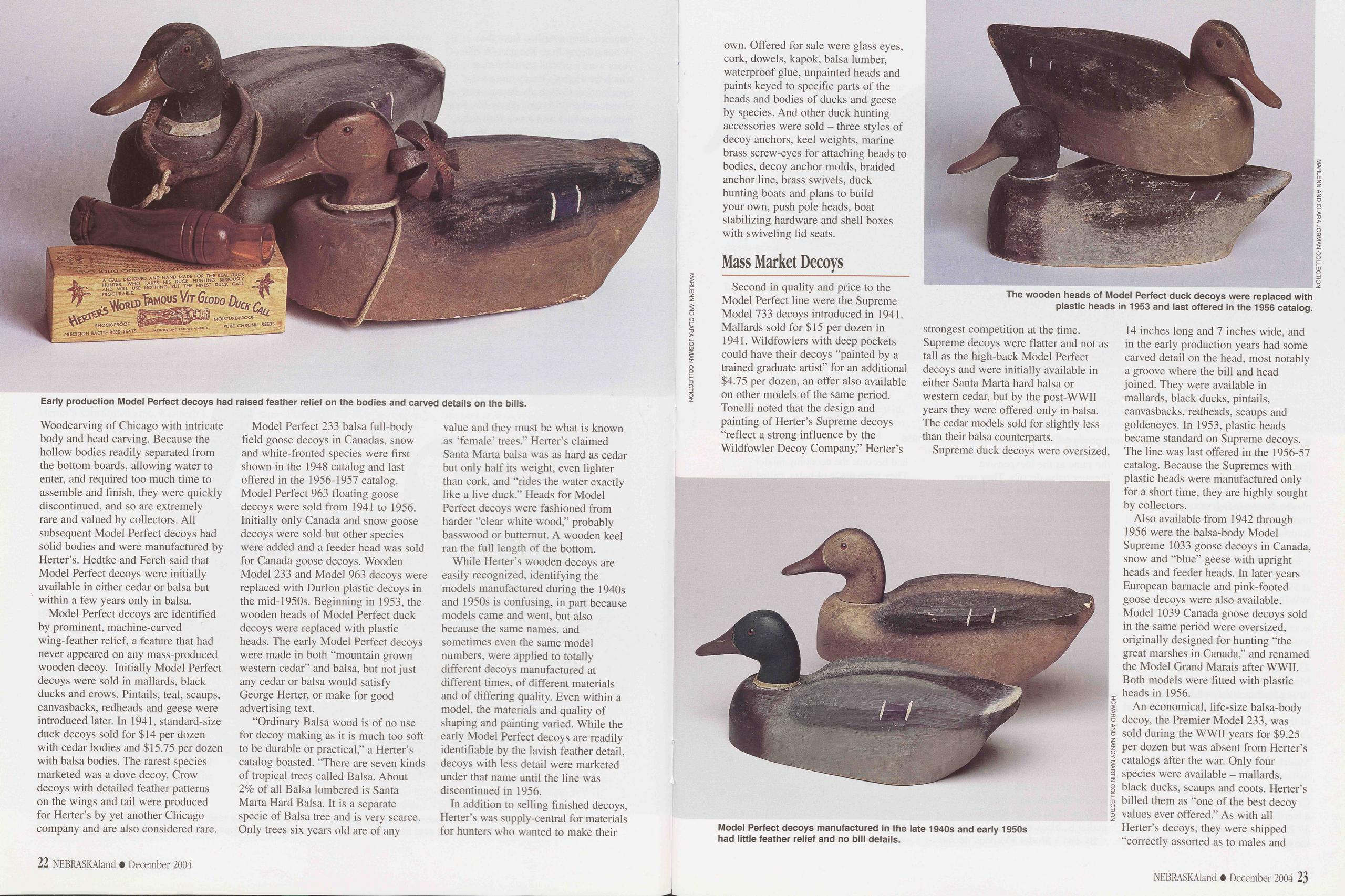
Model Perfect decoys are identified by prominent, machine-carved wing-feather relief, a feature that had never appeared on any mass-produced wooden decoy. Initially Model Perfect decoys were sold in mallards, black ducks and crows. Pintails, teal, scaups, canvasbacks, redheads and geese were introduced later. In 1941, standard-size duck decoys sold for $14 per dozen with cedar bodies and $15.75 per dozen with balsa bodies. The rarest species marketed was a dove decoy. Crow decoys with detailed feather patterns on the wings and tail were produced for Herter’s by yet another Chicago company and are also considered rare.
Model Perfect 233 balsa full-body field goose decoys in Canadas, snow and white-fronted species were first shown in the 1948 catalog and last offered in the 1956-1957 catalog. Model Perfect 963 floating goose decoys were sold from 1941 to 1956. Initially only Canada and snow goose decoys were sold but other species were added and a feeder head was sold for Canada goose decoys. Wooden Model 233 and Model 963 decoys were replaced with Durlon plastic decoys in the mid-1950s. Beginning in 1953, the wooden heads of Model Perfect duck decoys were replaced with plastic heads. The early Model Perfect decoys were made in both “mountain grown western cedar” and balsa, but not just any cedar or balsa would satisfy George Herter, or make for good advertising text.
“Ordinary Balsa wood is of no use for decoy making as it is much too soft to be durable or practical,” a Herter’s catalog boasted. “There are seven kinds of tropical trees called Balsa. About 2% of all Balsa lumbered is Santa Marta Hard Balsa. It is a separate specie of Balsa tree and is very scarce. Only trees six years old are of any value and they must be what is known as ‘female’ trees.” Herter’s claimed Santa Marta balsa was as hard as cedar but only half its weight, even lighter than cork, and “rides the water exactly like a live duck.” Heads for Model Perfect decoys were fashioned from harder “clear white wood,” probably basswood or butternut. A wooden keel ran the full length of the bottom.
While Herter’s wooden decoys are easily recognized, identifying the models manufactured during the 1940s and 1950s is confusing, in part because models came and went, but also because the same names, and sometimes even the same model numbers, were applied to totally different decoys manufactured at different times, of different materials and of differing quality. Even within a model, the materials and quality of shaping and painting varied. While the early Model Perfect decoys are readily identifiable by the lavish feather detail, decoys with less detail were marketed under that name until the line was discontinued in 1956.
In addition to selling finished decoys, Herter’s was supply-central for materials for hunters who wanted to make their own. Offered for sale were glass eyes, cork, dowels, kapok, balsa lumber, waterproof glue, unpainted heads and paints keyed to specific parts of the heads and bodies of ducks and geese by species. And other duck hunting accessories were sold - three styles of decoy anchors, keel weights, marine brass screw-eyes for attaching heads to bodies, decoy anchor molds, braided anchor line, brass swivels, duck hunting boats and plans to build your own, push pole heads, boat stabilizing hardware and shell boxes with swiveling lid seats.
Mass Market DecoysSecond in quality and price to the Model Perfect line were the Supreme Model 733 decoys introduced in 1941. Mallards sold for $15 per dozen in 1941. Wildfowlers with deep pockets could have their decoys “painted by a trained graduate artist” for an additional $4.75 per dozen, an offer also available on other models of the same period. Tonelli noted that the design and painting of Herter’s Supreme decoys “reflect a strong influence by the Wildfowler Decoy Company,” Herter’s
Supreme duck decoys were oversized, 14 inches long and 7 inches wide, and in the early production years had some carved detail on the head, most notably a groove where the bill and head joined. They were available in mallards, black ducks, pintails, canvasbacks, redheads, scaups and goldeneyes. In 1953, plastic heads became standard on Supreme decoys. The line was last offered in the 1956-57 catalog. Because the Supremes with plastic heads were manufactured only for a short time, they are highly sought by collectors.
Also available from 1942 through 1956 were the balsa-body Model Supreme 1033 goose decoys in Canada, snow and “blue” geese with upright heads and feeder heads. In later years European barnacle and pink-footed goose decoys were also available. Model 1039 Canada goose decoys sold in the same period were oversized, originally designed for hunting “the great marshes in Canada,” and renamed the Model Grand Marais after WWII. Both models were fitted with plastic heads in 1956.
An economical, life-size balsa-body decoy, the Premier Model 233, was sold during the WWII years for $9.25 per dozen but was absent from Herter’s catalogs after the war. Only four species were available - mallards, black ducks, scaups and coots. Herter’s billed them as “one of the best decoy values ever offered.” As with all Herter’s decoys, they were shipped “correctly assorted as to males and 22 NEBRASKAland • December 2004 NEBRASKAland • December 2004 23 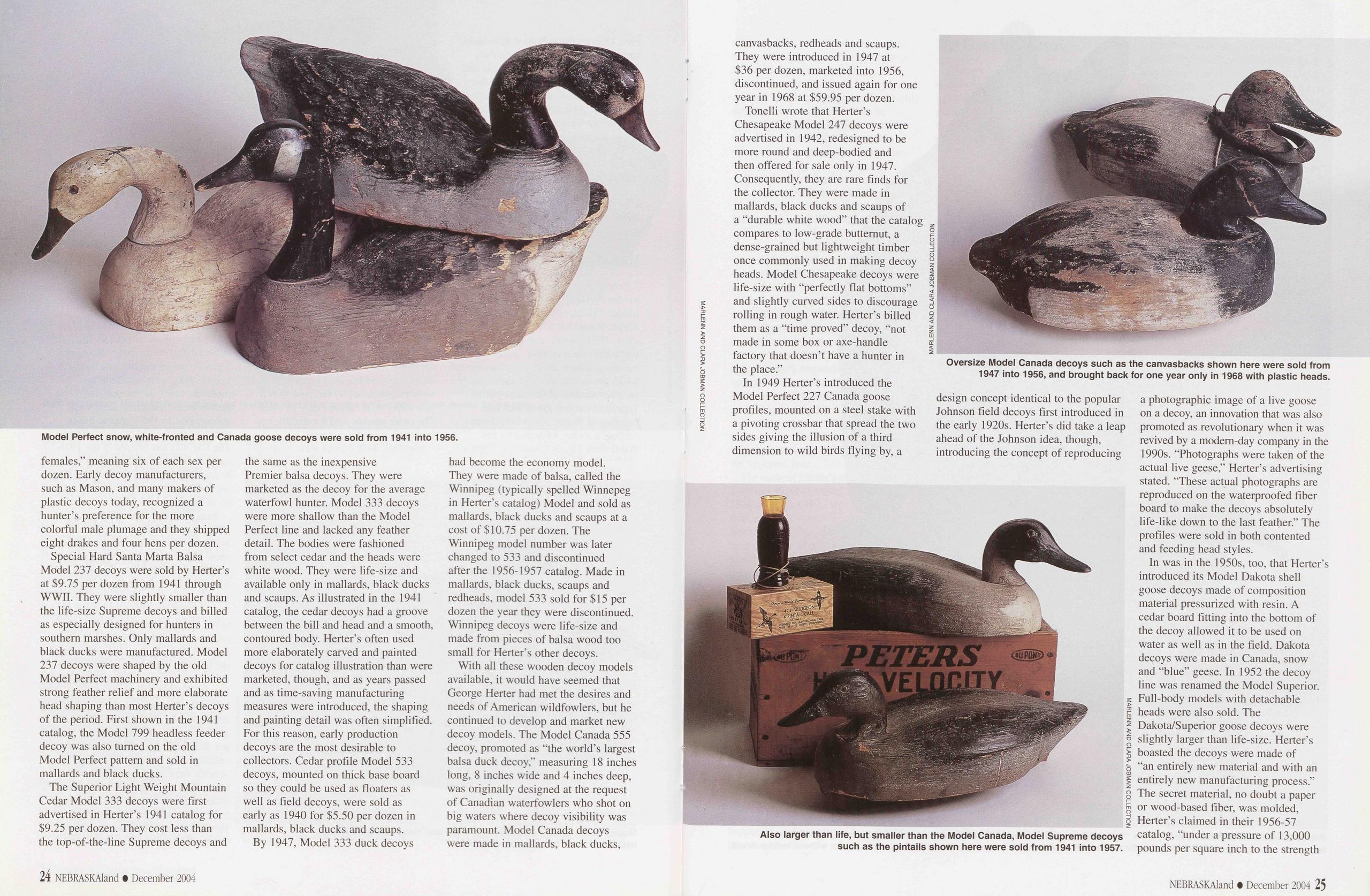
Special Hard Santa Marta Balsa Model 237 decoys were sold by Herter’s at $9.75 per dozen from 1941 through WWII. They were slightly smaller than the life-size Supreme decoys and billed as especially designed for hunters in southern marshes. Only mallards and black ducks were manufactured. Model 237 decoys were shaped by the old Model Perfect machinery and exhibited strong feather relief and more elaborate head shaping than most Herter’s decoys of the period. First shown in the 1941 catalog, the Model 799 headless feeder decoy was also turned on the old Model Perfect pattern and sold in mallards and black ducks.
The Superior Light Weight Mountain Cedar Model 333 decoys were first advertised in Herter’s 1941 catalog for $9.25 per dozen. They cost less than the top-of-the-line Supreme decoys and the same as the inexpensive Premier balsa decoys. They were marketed as the decoy for the average waterfowl hunter. Model 333 decoys were more shallow than the Model Perfect line and lacked any feather detail. The bodies were fashioned from select cedar and the heads were white wood. They were life-size and available only in mallards, black ducks and scaups. As illustrated in the 1941 catalog, the cedar decoys had a groove between the bill and head and a smooth, contoured body. Herter’s often used more elaborately carved and painted decoys for catalog illustration than were marketed, though, and as years passed and as time-saving manufacturing measures were introduced, the shaping and painting detail was often simplified. For this reason, early production decoys are the most desirable to collectors. Cedar profile Model 533 decoys, mounted on thick base board so they could be used as floaters as well as field decoys, were sold as early as 1940 for $5.50 per dozen in mallards, black ducks and scaups.
By 1947, Model 333 duck decoys had become the economy model. They were made of balsa, called the Winnipeg (typically spelled Winnepeg in Herter’s catalog) Model and sold as mallards, black ducks and scaups at a cost of $10.75 per dozen. The Winnipeg model number was later changed to 533 and discontinued after the 1956-1957 catalog. Made in mallards, black ducks, scaups and redheads, model 533 sold for $15 per dozen the year they were discontinued. Winnipeg decoys were life-size and made from pieces of balsa wood too small for Herter’s other decoys.
With all these wooden decoy models available, it would have seemed that George Herter had met the desires and needs of American wildfowlers, but he continued to develop and market new decoy models. The Model Canada 555 decoy, promoted as "the world’s largest balsa duck decoy,” measuring 18 inches long, 8 inches wide and 4 inches deep, was originally designed at the request of Canadian waterfowlers who shot on big waters where decoy visibility was paramount. Model Canada decoys were made in mallards, black ducks, canvasbacks, redheads and scaups. They were introduced in 1947 at $36 per dozen, marketed into 1956, discontinued, and issued again for one year in 1968 at $59.95 per dozen.
Tonelli wrote that Herter’s Chesapeake Model 247 decoys were advertised in 1942, redesigned to be more round and deep-bodied and then offered for sale only in 1947. Consequently, they are rare finds for the collector. They were made in mallards, black ducks and scaups of a "durable white wood” that the catalog compares to low-grade butternut, a dense-grained but lightweight timber once commonly used in making decoy heads. Model Chesapeake decoys were life-size with "perfectly flat bottoms” and slightly curved sides to discourage rolling in rough water. Herter’s billed them as a "time proved” decoy, "not made in some box or axe-handle factory that doesn’t have a hunter in the place.”
In 1949 Herter’s introduced the Model Perfect 227 Canada goose profiles, mounted on a steel stake with a pivoting crossbar that spread the two sides giving the illusion of a third dimension to wild birds flying by, a
In was in the 1950s, too, that Herter’s introduced its Model Dakota shell goose decoys made of composition material pressurized with resin. A cedar board fitting into the bottom of the decoy allowed it to be used on water as well as in the field. Dakota decoys were made in Canada, snow and "blue” geese. In 1952 the decoy line was renamed the Model Superior. Full-body models with detachable heads were also sold. The Dakota/Superior goose decoys were slightly larger than life-size. Herter’s boasted the decoys were made of "an entirely new material and with an entirely new manufacturing process.” The secret material, no doubt a paper or wood-based fiber, was molded, Herter’s claimed in their 1956-57 catalog, "under a pressure of 13,000 pounds per square inch to the strength 24 NEBRASKAland • December 2004 NEBRASKAland • December 2004 25 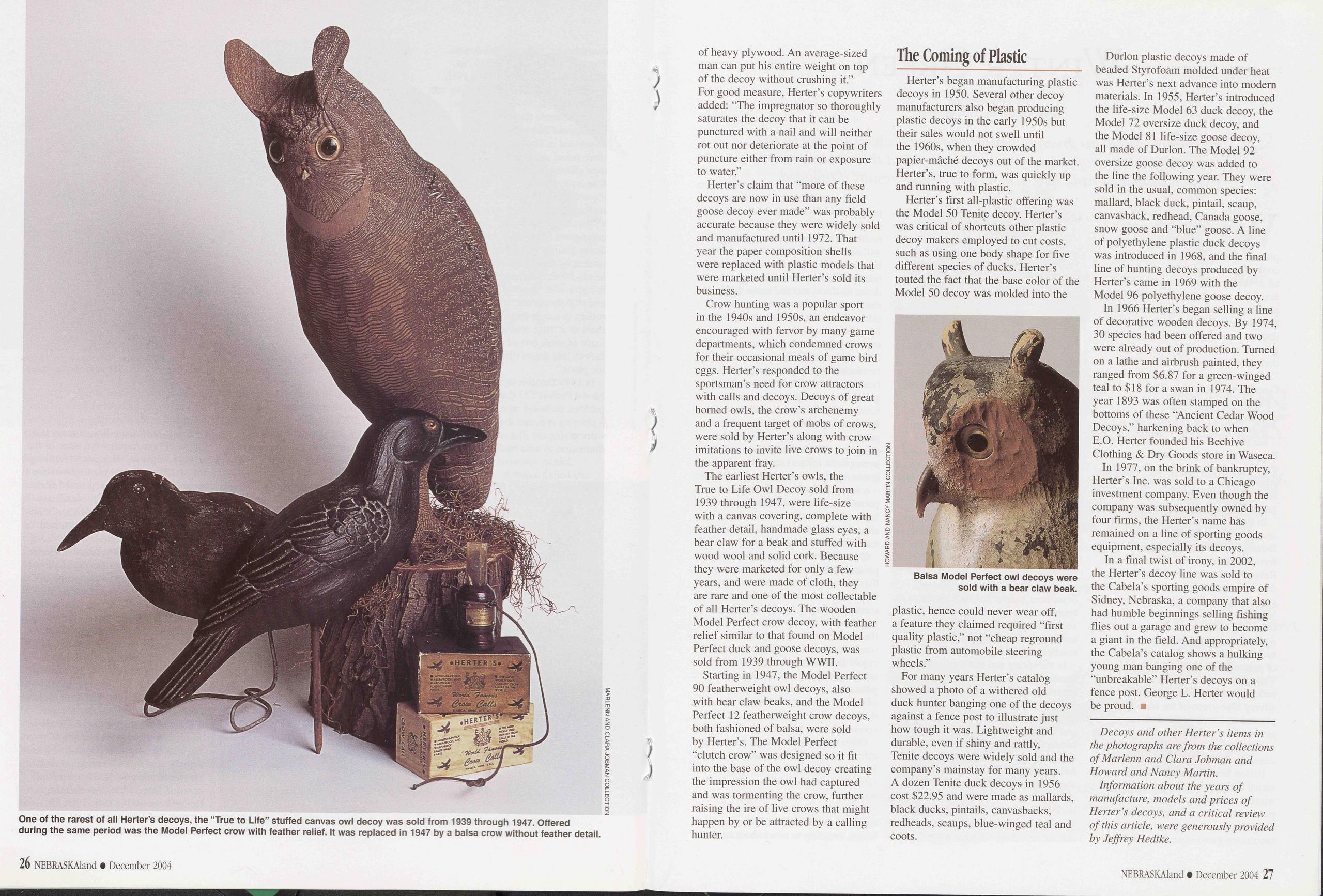
Herter’s claim that “more of these decoys are now in use than any field goose decoy ever made” was probably accurate because they were widely sold and manufactured until 1972. That year the paper composition shells were replaced with plastic models that were marketed until Herter’s sold its business.
Crow hunting was a popular sport in the 1940s and 1950s, an endeavor encouraged with fervor by many game departments, which condemned crows for their occasional meals of game bird eggs. Herter’s responded to the sportsman’s need for crow attractors with calls and decoys. Decoys of great horned owls, the crow’s archenemy and a frequent target of mobs of crows, were sold by Herter’s along with crow imitations to invite live crows to join in the apparent fray.
The earliest Herter’s owls, the True to Life Owl Decoy sold from 1939 through 1947, were life-size with a canvas covering, complete with feather detail, handmade glass eyes, a bear claw for a beak and stuffed with wood wool and solid cork. Because they were marketed for only a few years, and were made of cloth, they are rare and one of the most collectable of all Herter’s decoys. The wooden Model Perfect crow decoy, with feather relief similar to that found on Model Perfect duck and goose decoys, was sold from 1939 through WWII.
Starting in 1947, the Model Perfect 90 featherweight owl decoys, also with bear claw beaks, and the Model Perfect 12 featherweight crow decoys, both fashioned of balsa, were sold by Herter’s. The Model Perfect “clutch crow” was designed so it fit into the base of the owl decoy creating the impression the owl had captured and was tormenting the crow, further raising the ire of live crows that might happen by or be attracted by a calling hunter.
The Coming of PlasticHerter’s began manufacturing plastic decoys in 1950. Several other decoy manufacturers also began producing plastic decoys in the early 1950s but their sales would not swell until the 1960s, when they crowded papier-mache decoys out of the market. Herter’s, true to form, was quickly up and running with plastic.
Herter’s first all-plastic offering was the Model 50 Tenite decoy. Herter’s was critical of shortcuts other plastic decoy makers employed to cut costs, such as using one body shape for five different species of ducks. Herter’s touted the fact that the base color of the Model 50 decoy was molded into the
For many years Herter’s catalog showed a photo of a withered old duck hunter banging one of the decoys against a fence post to illustrate just how tough it was. Lightweight and durable, even if shiny and rattly, Tenite decoys were widely sold and the company’s mainstay for many years. A dozen Tenite duck decoys in 1956 cost $22.95 and were made as mallards, black ducks, pintails, canvasbacks, redheads, scaups, blue-winged teal and coots.
Durlon plastic decoys made of beaded Styrofoam molded under heat was Herter’s next advance into modem materials. In 1955, Herter’s introduced the life-size Model 63 duck decoy, the Model 72 oversize duck decoy, and the Model 81 life-size goose decoy, all made of Durlon. The Model 92 oversize goose decoy was added to the line the following year. They were sold in the usual, common species: mallard, black duck, pintail, scaup, canvasback, redhead, Canada goose, snow goose and “blue” goose. A line of polyethylene plastic duck decoys was introduced in 1968, and the final line of hunting decoys produced by Herter’s came in 1969 with the Model 96 polyethylene goose decoy.
In 1966 Herter’s began selling a line of decorative wooden decoys. By 1974, 30 species had been offered and two were already out of production. Turned on a lathe and airbrush painted, they ranged from $6.87 for a green-winged teal to $18 for a swan in 1974. The year 1893 was often stamped on the bottoms of these “Ancient Cedar Wood Decoys,” harkening back to when E.O. Herter founded his Beehive Clothing & Dry Goods store in Waseca.
In 1977, on the brink of bankruptcy, Herter’s Inc. was sold to a Chicago investment company. Even though the company was subsequently owned by four firms, the Herter’s name has remained on a line of sporting goods equipment, especially its decoys.
In a final twist of irony, in 2002, the Herter’s decoy line was sold to the Cabela’s sporting goods empire of Sidney, Nebraska, a company that also had humble beginnings selling fishing flies out a garage and grew to become a giant in the field. And appropriately, the Cabela’s catalog shows a hulking young man banging one of the “unbreakable” Herter’s decoys on a fence post. George L. Herter would be proud.
Decoys and other Herter’s items in the photographs are from the collections of Marlenn and Clara Jobman and Howard and Nancy Martin. Information about the years of manufacture, models and prices of Herter’s decoys, and a critical review of this article, were generously provided by Jeffrey Hedtke.
26 NEBRASKAland O December 2004 NEBRASKAland • December 2004 27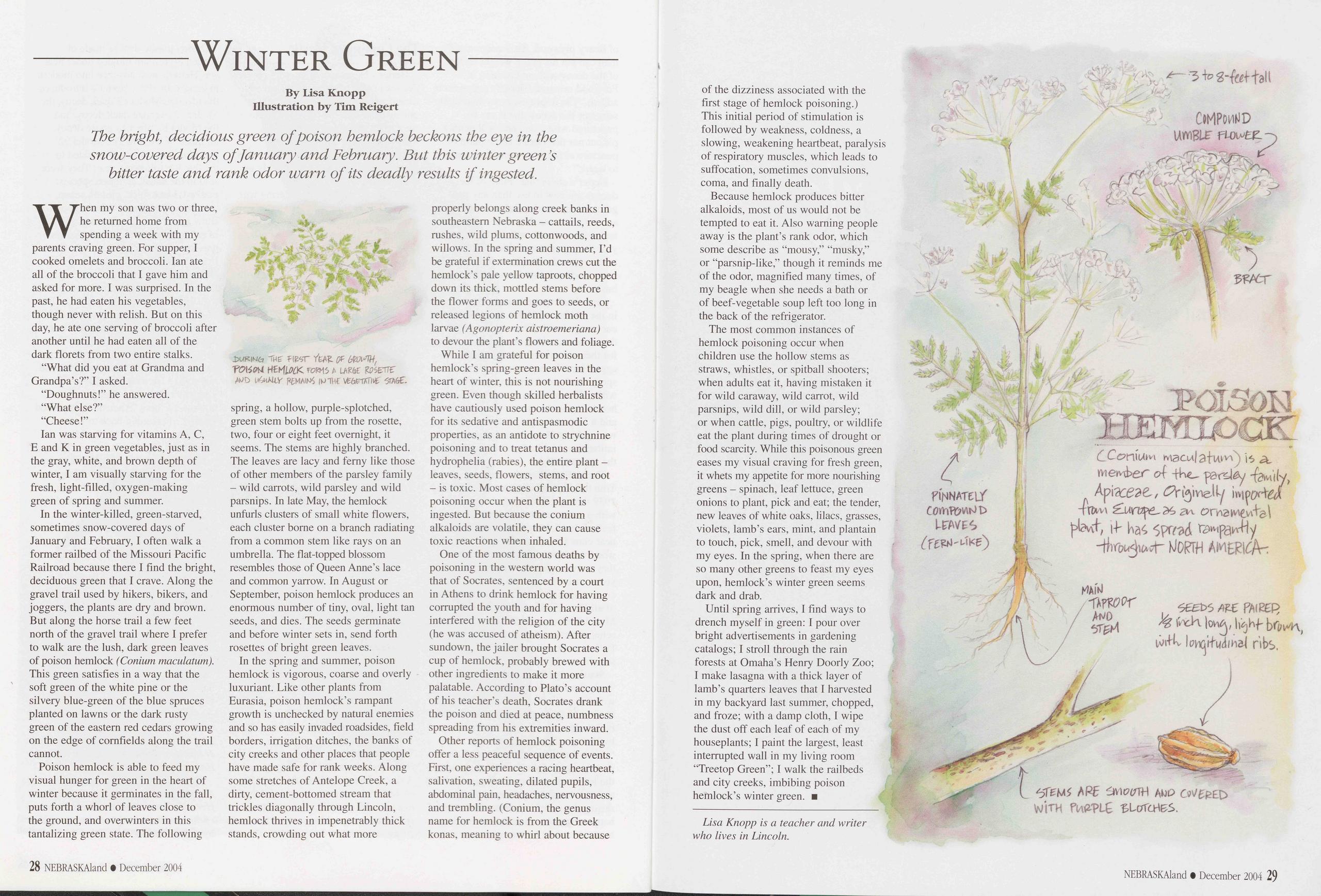
Winter Green
By Lisa Knopp Illustration by Tim Reigert The bright, decidious green of poison hemlock beckons the eye in the snow-covered days of January and February. But this winter green’s bitter taste and rank odor warn of its deadly results if ingested.When my son was two or three, he returned home from spending a week with my parents craving green. For supper, I cooked omelets and broccoli. Ian ate all of the broccoli that I gave him and asked for more. I was surprised. In the past, he had eaten his vegetables, though never with relish. But on this day, he ate one serving of broccoli after another until he had eaten all of the dark florets from two entire stalks.
“What did you eat at Grandma and Grandpa’s?” I asked.
“Doughnuts!” he answered.
“What else?”
“Cheese!”
Ian was starving for vitamins A, C, E and K in green vegetables, just as in the gray, white, and brown depth of winter, I am visually starving for the fresh, light-filled, oxygen-making green of spring and summer.
In the winter-killed, green-starved, sometimes snow-covered days of January and February, I often walk a former railbed of the Missouri Pacific Railroad because there I find the bright, deciduous green that I crave. Along the gravel trail used by hikers, bikers, and joggers, the plants are dry and brown. But along the horse trail a few feet north of the gravel trail where I prefer to walk are the lush, dark green leaves of poison hemlock (Conium maculatum). This green satisfies in a way that the soft green of the white pine or the silvery blue-green of the blue spruces planted on lawns or the dark rusty green of the eastern red cedars growing on the edge of cornfields along the trail cannot.
Poison hemlock is able to feed my visual hunger for green in the heart of winter because it germinates in the fall, puts forth a whorl of leaves close to the ground, and overwinters in this tantalizing green state. The following
In the spring and summer, poison hemlock is vigorous, coarse and overly luxuriant. Like other plants from Eurasia, poison hemlock’s rampant growth is unchecked by natural enemies and so has easily invaded roadsides, field borders, irrigation ditches, the banks of city creeks and other places that people have made safe for rank weeks. Along some stretches of Antelope Creek, a dirty, cement-bottomed stream that trickles diagonally through Lincoln, hemlock thrives in impenetrably thick stands, crowding out what more properly belongs along creek banks in southeastern Nebraska - cattails, reeds, rushes, wild plums, cottonwoods, and willows. In the spring and summer, I’d be grateful if extermination crews cut the hemlock’s pale yellow taproots, chopped down its thick, mottled stems before the flower forms and goes to seeds, or released legions of hemlock moth larvae (Agonopterix aistroemeriana) to devour the plant’s flowers and foliage.
While I am grateful for poison hemlock’s spring-green leaves in the heart of winter, this is not nourishing green. Even though skilled herbalists have cautiously used poison hemlock for its sedative and antispasmodic properties, as an antidote to strychnine poisoning and to treat tetanus and hydrophelia (rabies), the entire plant - leaves, seeds, flowers, stems, and root - is toxic. Most cases of hemlock poisoning occur when the plant is ingested. But because the conium alkaloids are volatile, they can cause toxic reactions when inhaled.
One of the most famous deaths by poisoning in the western world was that of Socrates, sentenced by a court in Athens to drink hemlock for having corrupted the youth and for having interfered with the religion of the city (he was accused of atheism). After sundown, the jailer brought Socrates a cup of hemlock, probably brewed with other ingredients to make it more palatable. According to Plato’s account of his teacher’s death, Socrates drank the poison and died at peace, numbness spreading from his extremities inward.
Other reports of hemlock poisoning offer a less peaceful sequence of events. First, one experiences a racing heartbeat, salivation, sweating, dilated pupils, abdominal pain, headaches, nervousness, and trembling. (Conium, the genus name for hemlock is from the Greek konas, meaning to whirl about because of the dizziness associated with the first stage of hemlock poisoning.) This initial period of stimulation is followed by weakness, coldness, a slowing, weakening heartbeat, paralysis of respiratory muscles, which leads to suffocation, sometimes convulsions, coma, and finally death.
Because hemlock produces bitter alkaloids, most of us would not be tempted to eat it. Also warning people away is the plant’s rank odor, which some describe as “mousy,” “musky,” or “parsnip-like,” though it reminds me of the odor, magnified many times, of my beagle when she needs a bath or of beef-vegetable soup left too long in the back of the refrigerator.
The most common instances of hemlock poisoning occur when children use the hollow stems as straws, whistles, or spitball shooters; when adults eat it, having mistaken it for wild caraway, wild carrot, wild parsnips, wild dill, or wild parsley; or when cattle, pigs, poultry, or wildlife eat the plant during times of drought or food scarcity. While this poisonous green eases my visual craving for fresh green, it whets my appetite for more nourishing greens - spinach, leaf lettuce, green onions to plant, pick and eat; the tender, new leaves of white oaks, lilacs, grasses, violets, lamb’s ears, mint, and plantain to touch, pick, smell, and devour with my eyes. In the spring, when there are so many other greens to feast my eyes upon, hemlock’s winter green seems dark and drab.
Until spring arrives, I find ways to drench myself in green: I pour over bright advertisements in gardening catalogs; I stroll through the rain forests at Omaha’s Henry Doorly Zoo; I make lasagna with a thick layer of lamb’s quarters leaves that I harvested in my backyard last summer, chopped, and froze; with a damp cloth, I wipe the dust off each leaf of each of my houseplants; I paint the largest, least interrupted wall in my living room “Treetop Green”; I walk the railbeds and city creeks, imbibing poison hemlock’s winter green.
Lisa Knopp is a teacher and writer who lives in Lincoln.

Sledding at Mahoney Park
Photos and text by Doug CarrollFor a few wonderful seconds, life can be all downhill. Skimming caked snowpack snug in Mom's lap, exhilaration and security meld. Faster and faster, the blurring run I suspends the cold turning cheeks crimson. Then, at the bottom, the sled's runners bury in deep snow, spewing icy chunks everywhere as the slider crunches to a halt.
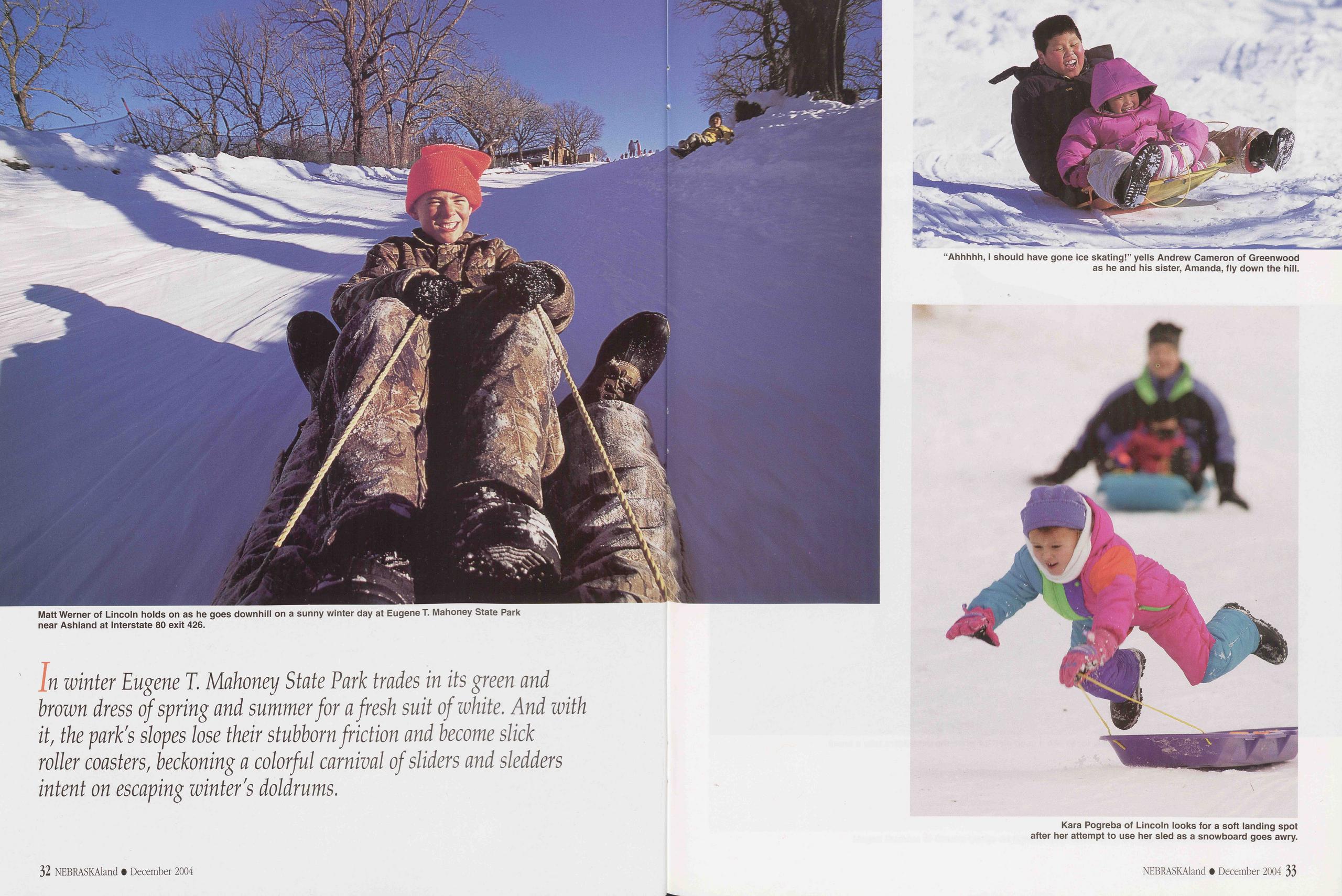
In winter Eugene T. Mahoney State Park trades in its green and brown dress of spring and summer for afresh suit of white. And with it, the park's slopes lose their stubborn friction and become slick roller coasters, beckoning a colorful carnival of sliders and sledders intent on escaping winter's doldrums.
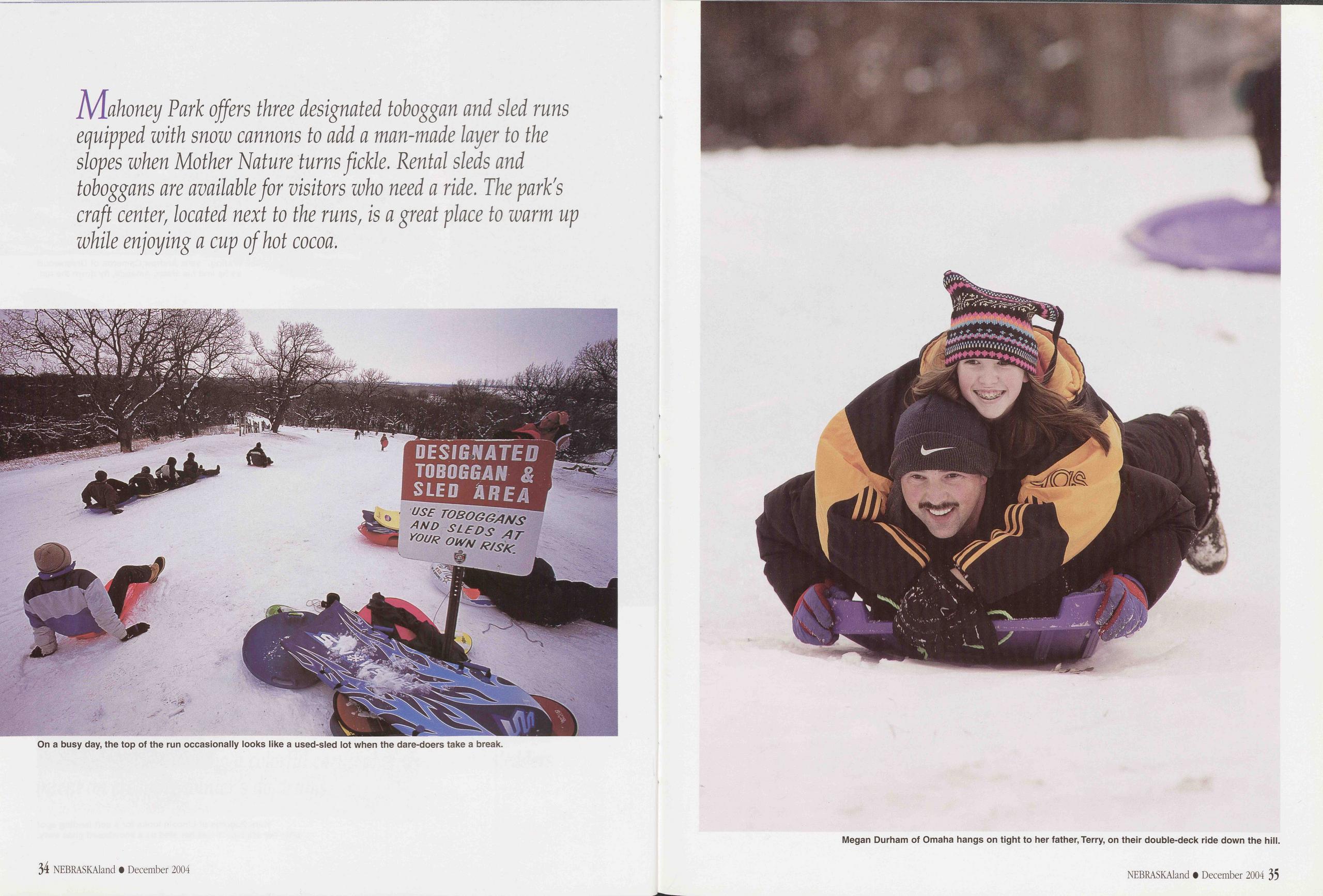
Mahoney Park offers three designated toboggan and sled runs equipped with snow cannons to add a man-made layer to the slopes when Mother Nature turns fickle. Rental sleds and toboggans are available for visitors who need a ride. The park's craft center, located next to the runs, is a great place to warm up while enjoying a cup of hot cocoa.
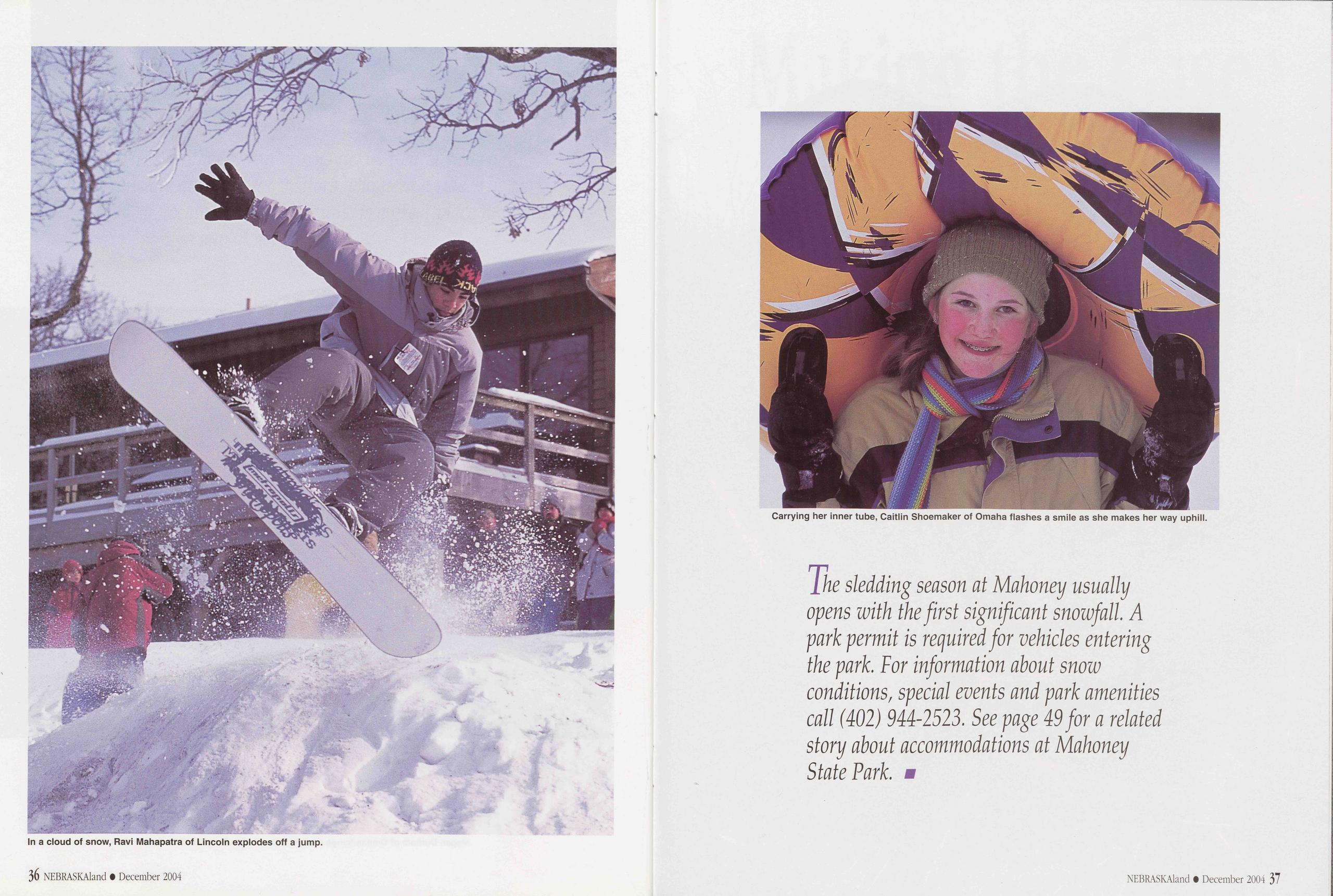
The sledding season at Mahoney usually opens with the first significant snowfall. A park permit is required for vehicles entering the park. For information about snow conditions, special events and park amenities call (402) 944-2523. See page 49 for a related story about accommodations at Mahoney State Park.
36 NEBRASKAland • December 2004 NEBRASKAland • December 2004 37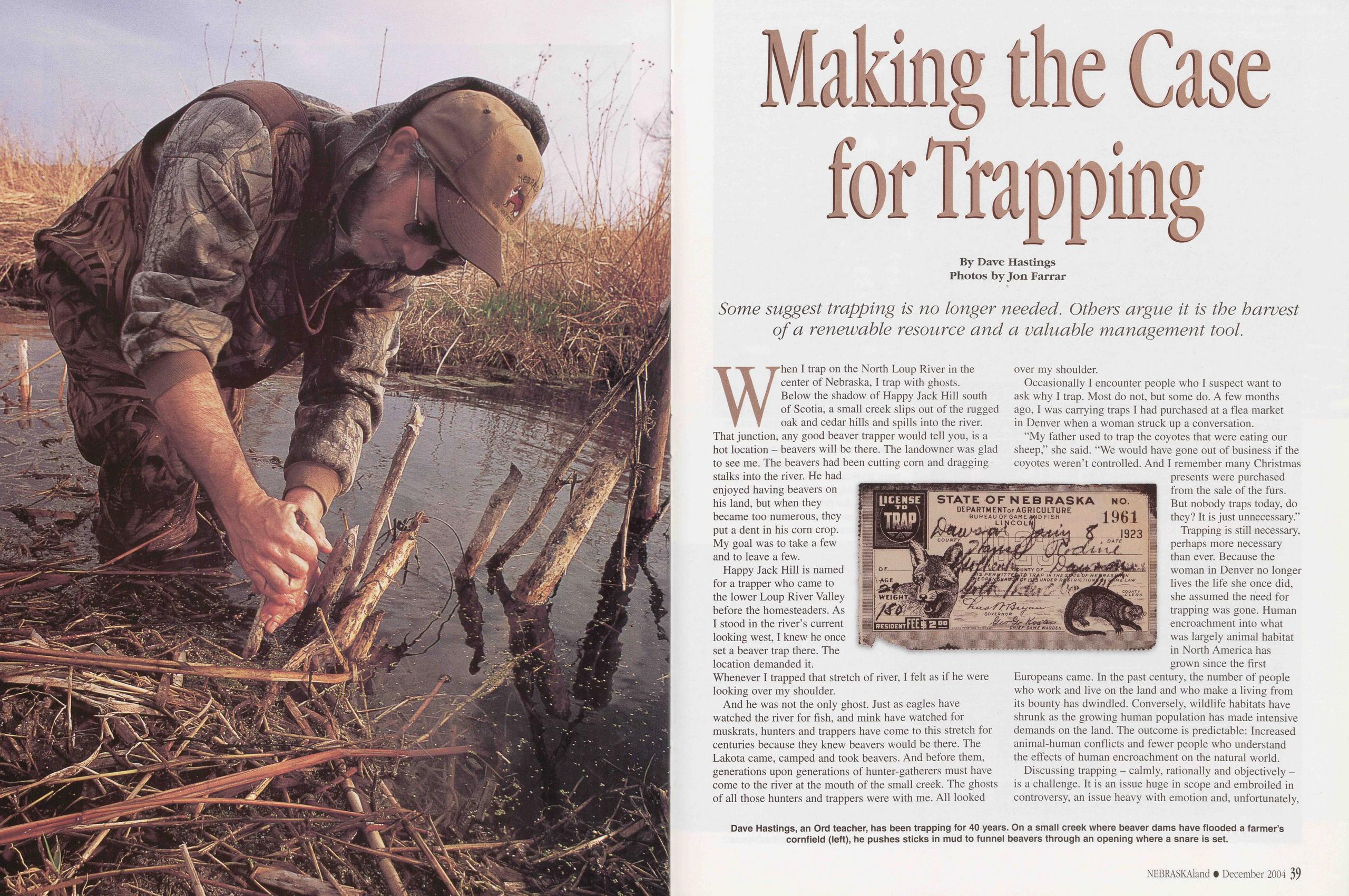
Making the Case for Trapping
By Dave Hastings Photos by Jon Farrar Some suggest trapping is no longer needed. Others argue it is the harvest of a renewable resource and a valuable management tool.When I trap on the North Loup River in the center of Nebraska, I trap with ghosts. Below the shadow of Happy Jack Hill south of Scotia, a small creek slips out of the rugged oak and cedar hills and spills into the river. That junction, any good beaver trapper would tell you, is a hot location - beavers will be there. The landowner was glad to see me. The beavers had been cutting corn and dragging stalks into the river. He had enjoyed having beavers on his land, but when they became too numerous, they put a dent in his corn crop. My goal was to take a few and to leave a few.
Happy Jack Hill is named for a trapper who came to the lower Loup River Valley before the homesteaders. As I stood in the river’s current looking west, I knew he once set a beaver trap there. The location demanded it. Whenever I trapped that stretch of river, I felt as if he were looking over my shoulder.
And he was not the only ghost. Just as eagles have watched the river for fish, and mink have watched for muskrats, hunters and trappers have come to this stretch for centuries because they knew beavers would be there. The Lakota came, camped and took beavers. And before them, generations upon generations of hunter-gatherers must have come to the river at the mouth of the small creek. The ghosts of all those hunters and trappers were with me. All looked over my shoulder.
Occasionally I encounter people who I suspect want to ask why I trap. Most do not, but some do. A few months ago, I was carrying traps I had purchased at a flea market in Denver when a woman struck up a conversation.
"My father used to trap the coyotes that were eating our sheep,” she said. “We would have gone out of business if the coyotes weren’t controlled. And I remember many Christmas presents were purchased from the sale of the furs. But nobody traps today, do they? It is just unnecessary.”
Trapping is still necessary, perhaps more necessary than ever. Because the woman in Denver no longer lives the life she once did, she assumed the need for trapping was gone. Human encroachment into what was largely animal habitat in North America has grown since the first Europeans came. In the past century, the number of people who work and live on the land and who make a living from its bounty has dwindled. Conversely, wildlife habitats have shrunk as the growing human population has made intensive demands on the land. The outcome is predictable: Increased animal-human conflicts and fewer people who understand the effects of human encroachment on the natural world.
Discussing trapping - calmly, rationally and objectively - is a challenge. It is an issue huge in scope and embroiled in controversy, an issue heavy with emotion and, unfortunately,
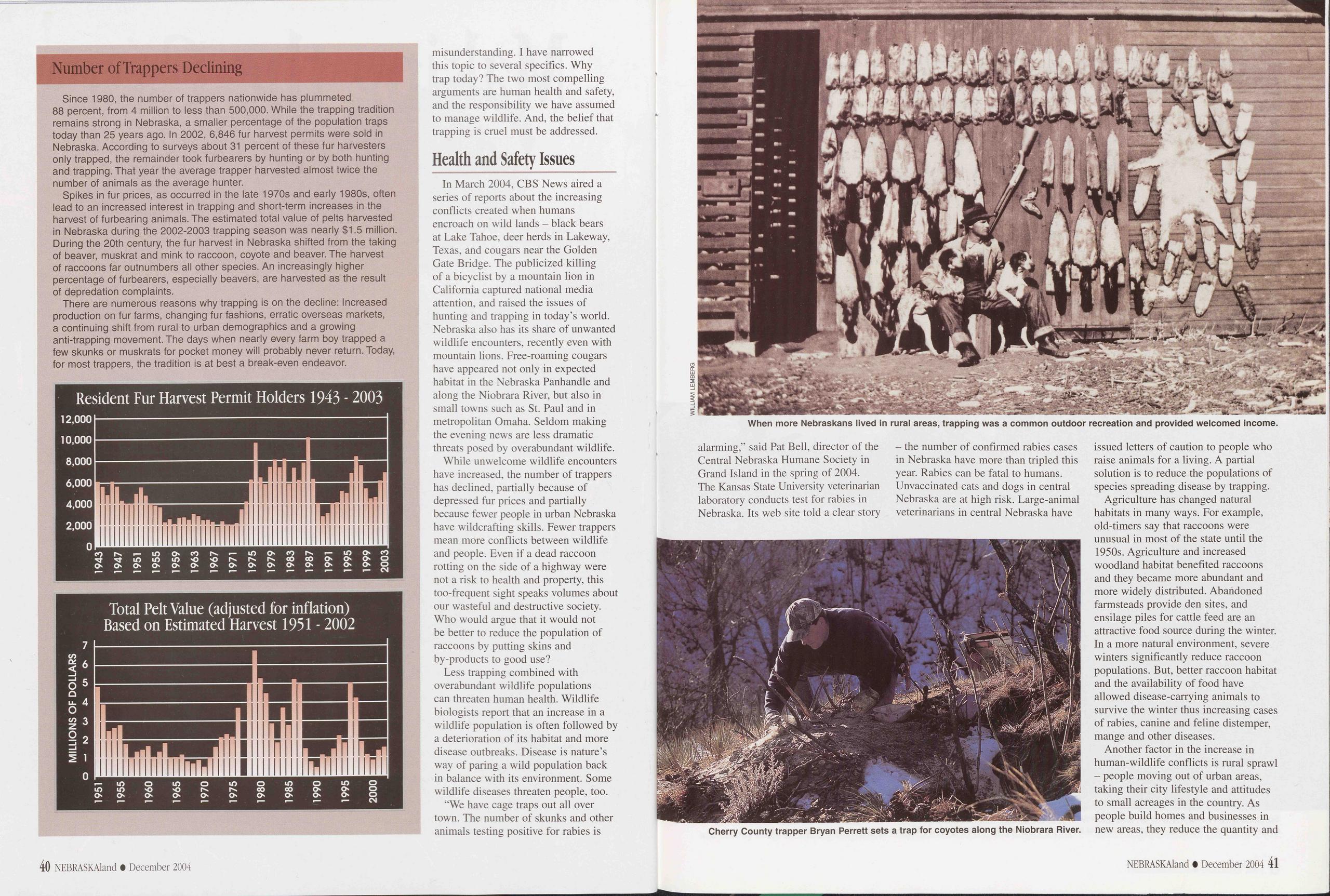 Number of Trappers Declining
Since 1980, the number of trappers nationwide has plummeted 88 percent, from 4 million to less than 500,000. While the trapping tradition remains strong in Nebraska, a smaller percentage of the population traps today than 25 years ago. In 2002, 6,846 fur harvest permits were sold in Nebraska. According to surveys about 31 percent of these fur harvesters only trapped, the remainder took furbearers by hunting or by both hunting and trapping. That year the average trapper harvested almost twice the number of animals as the average hunter.
Spikes in fur prices, as occurred in the late 1970s and early 1980s, often lead to an increased interest in trapping and short-term increases in the harvest of furbearing animals. The estimated total value of pelts harvested in Nebraska during the 2002-2003 trapping season was nearly $1.5 million. During the 20th century, the fur harvest in Nebraska shifted from the taking of beaver, muskrat and mink to raccoon, coyote and beaver. The harvest of raccoons far outnumbers all other species. An increasingly higher percentage of furbearers, especially beavers, are harvested as the result of depredation complaints.
There are numerous reasons why trapping is on the decline: Increased production on fur farms, changing fur fashions, erratic overseas markets, a continuing shift from rural to urban demographics and a growing anti-trapping movement. The days when nearly every farm boy trapped a few skunks or muskrats for pocket money will probably never return. Today, for most trappers, the tradition is at best a break-even endeavor.
misunderstanding. I have narrowed this topic to several specifics. Why trap today? The two most compelling arguments are human health and safety, and the responsibility we have assumed to manage wildlife. And, the belief that trapping is cruel must be addressed.
Health and Safety IssuesIn March 2004, CBS News aired a series of reports about the increasing conflicts created when humans encroach on wild lands - black bears at Lake Tahoe, deer herds in Lakeway, Texas, and cougars near the Golden Gate Bridge. The publicized killing of a bicyclist by a mountain lion in California captured national media attention, and raised the issues of hunting and trapping in today’s world. Nebraska also has its share of unwanted wildlife encounters, recently even with mountain lions. Free-roaming cougars have appeared not only in expected habitat in the Nebraska Panhandle and along the Niobrara River, but also in small towns such as St. Paul and in metropolitan Omaha. Seldom making the evening news are less dramatic threats posed by overabundant wildlife.
While unwelcome wildlife encounters have increased, the number of trappers has declined, partially because of depressed fur prices and partially because fewer people in urban Nebraska have wildcrafting skills. Fewer trappers mean more conflicts between wildlife and people. Even if a dead raccoon rotting on the side of a highway were not a risk to health and property, this too-frequent sight speaks volumes about our wasteful and destructive society. Who would argue that it would not be better to reduce the population of raccoons by putting skins and by-products to good use?
Less trapping combined with overabundant wildlife populations can threaten human health. Wildlife biologists report that an increase in a wildlife population is often followed by a deterioration of its habitat and more disease outbreaks. Disease is nature’s way of paring a wild population back in balance with its environment. Some wildlife diseases threaten people, too.
"We have cage traps out all over town. The number of skunks and other animals testing positive for rabies is
Agriculture has changed natural habitats in many ways. For example, old-timers say that raccoons were unusual in most of the state until the 1950s. Agriculture and increased woodland habitat benefited raccoons and they became more abundant and more widely distributed. Abandoned farmsteads provide den sites, and ensilage piles for cattle feed are an attractive food source during the winter. In a more natural environment, severe winters significantly reduce raccoon populations. But, better raccoon habitat and the availability of food have allowed disease-carrying animals to survive the winter thus increasing cases of rabies, canine and feline distemper, mange and other diseases.
Another factor in the increase in human-wildlife conflicts is rural sprawl - people moving out of urban areas, taking their city lifestyle and attitudes to small acreages in the country. As people build homes and businesses in new areas, they reduce the quantity and 40 NEBRASKAland • December 2004 NEBRASKAland • December 2004 41 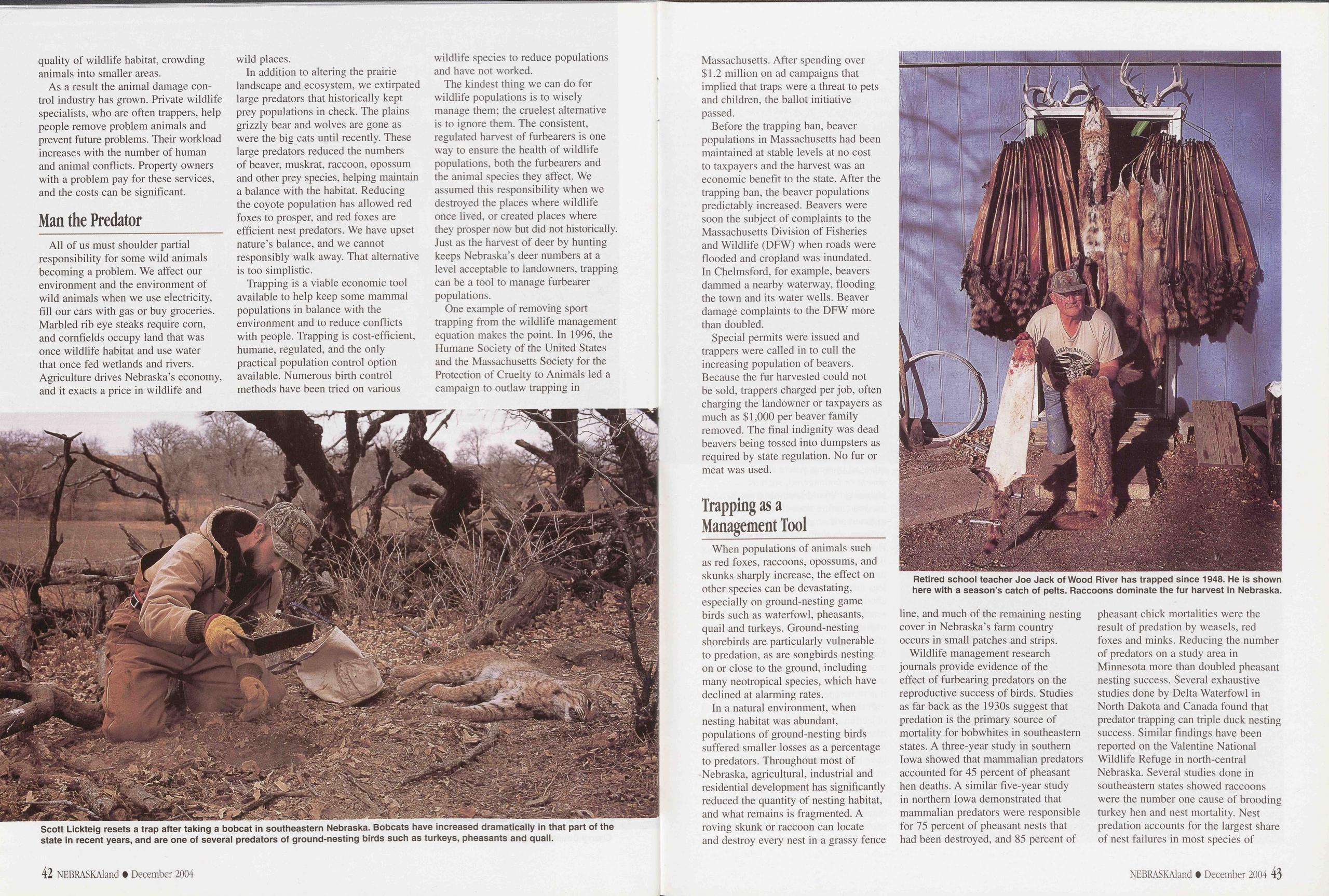 quality of wildlife habitat, crowding animals into smaller areas.
As a result the animal damage con- trol industry has grown. Private wildlife specialists, who are often trappers, help people remove problem animals and prevent future problems. Their workload increases with the number of human and animal conflicts. Property owners with a problem pay for these services, and the costs can be significant.
Man the PredatorAll of us must shoulder partial responsibility for some wild animals becoming a problem. We affect our environment and the environment of wild animals when we use electricity, fill our cars with gas or buy groceries. Marbled rib eye steaks require corn, and cornfields occupy land that was once wildlife habitat and use water that once fed wetlands and rivers. Agriculture drives Nebraska’s economy, and it exacts a price in wildlife and
In addition to altering the prairie landscape and ecosystem, we extirpated large predators that historically kept prey populations in check. The plains grizzly bear and wolves are gone as were the big cats until recently. These large predators reduced the numbers of beaver, muskrat, raccoon, opossum and other prey species, helping maintain a balance with the habitat. Reducing the coyote population has allowed red foxes to prosper, and red foxes are efficient nest predators. We have upset nature’s balance, and we cannot responsibly walk away. That alternative is too simplistic.
Trapping is a viable economic tool available to help keep some mammal populations in balance with the environment and to reduce conflicts with people. Trapping is cost-efficient, humane, regulated, and the only practical population control option available. Numerous birth control methods have been tried on various wildlife species to reduce populations and have not worked.
The kindest thing we can do for wildlife populations is to wisely manage them; the crudest alternative is to ignore them. The consistent, regulated harvest of furbearers is one way to ensure the health of wildlife populations, both the furbearers and the animal species they affect. We assumed this responsibility when we destroyed the places where wildlife once lived, or created places where they prosper now but did not historically. Just as the harvest of deer by hunting keeps Nebraska’s deer numbers at a level acceptable to landowners, trapping can be a tool to manage furbearer populations.
One example of removing sport trapping from the wildlife management equation makes the point. In 1996, the Humane Society of the United States and the Massachusetts Society for the Protection of Cruelty to Animals led a campaign to outlaw trapping in Massachusetts. After spending over $1.2 million on ad campaigns that implied that traps were a threat to pets and children, the ballot initiative passed.
Before the trapping ban, beaver populations in Massachusetts had been maintained at stable levels at no cost to taxpayers and the harvest was an economic benefit to the state. After the trapping ban, the beaver populations predictably increased. Beavers were soon the subject of complaints to the Massachusetts Division of Fisheries and Wildlife (DFW) when roads were flooded and cropland was inundated. In Chelmsford, for example, beavers dammed a nearby waterway, flooding the town and its water wells. Beaver damage complaints to the DFW more than doubled.
Special permits were issued and trappers were called in to cull the increasing population of beavers. Because the fur harvested could not be sold, trappers charged per job, often charging the landowner or taxpayers as much as $ 1,000 per beaver family removed. The final indignity was dead beavers being tossed into dumpsters as required by state regulation. No fur or meat was used.
Trapping as a Management ToolWhen populations of animals such as red foxes, raccoons, opossums, and skunks sharply increase, the effect on other species can be devastating, especially on ground-nesting game birds such as waterfowl, pheasants, quail and turkeys. Ground-nesting shorebirds are particularly vulnerable to predation, as are songbirds nesting on or close to the ground, including many neotropical species, which have declined at alarming rates.
In a natural environment, when nesting habitat was abundant, populations of ground-nesting birds suffered smaller losses as a percentage to predators. Throughout most of Nebraska, agricultural, industrial and residential development has significantly reduced the quantity of nesting habitat, and what remains is fragmented. A roving skunk or raccoon can locate and destroy every nest in a grassy fence
Wildlife management research journals provide evidence of the effect of furbearing predators on the reproductive success of birds. Studies as far back as the 1930s suggest that predation is the primary source of mortality for bobwhites in southeastern states. A three-year study in southern Iowa showed that mammalian predators accounted for 45 percent of pheasant hen deaths. A similar five-year study in northern Iowa demonstrated that mammalian predators were responsible for 75 percent of pheasant nests that had been destroyed, and 85 percent of pheasant chick mortalities were the result of predation by weasels, red foxes and minks. Reducing the number of predators on a study area in Minnesota more than doubled pheasant nesting success. Several exhaustive studies done by Delta Waterfowl in North Dakota and Canada found that predator trapping can triple duck nesting success. Similar findings have been reported on the Valentine National Wildlife Refuge in north-central Nebraska. Several studies done in southeastern states showed raccoons were the number one cause of brooding turkey hen and nest mortality. Nest predation accounts for the largest share of nest failures in most species of
42 NEBRASKAland • December 2004 NEBRASKAland • December 2004 43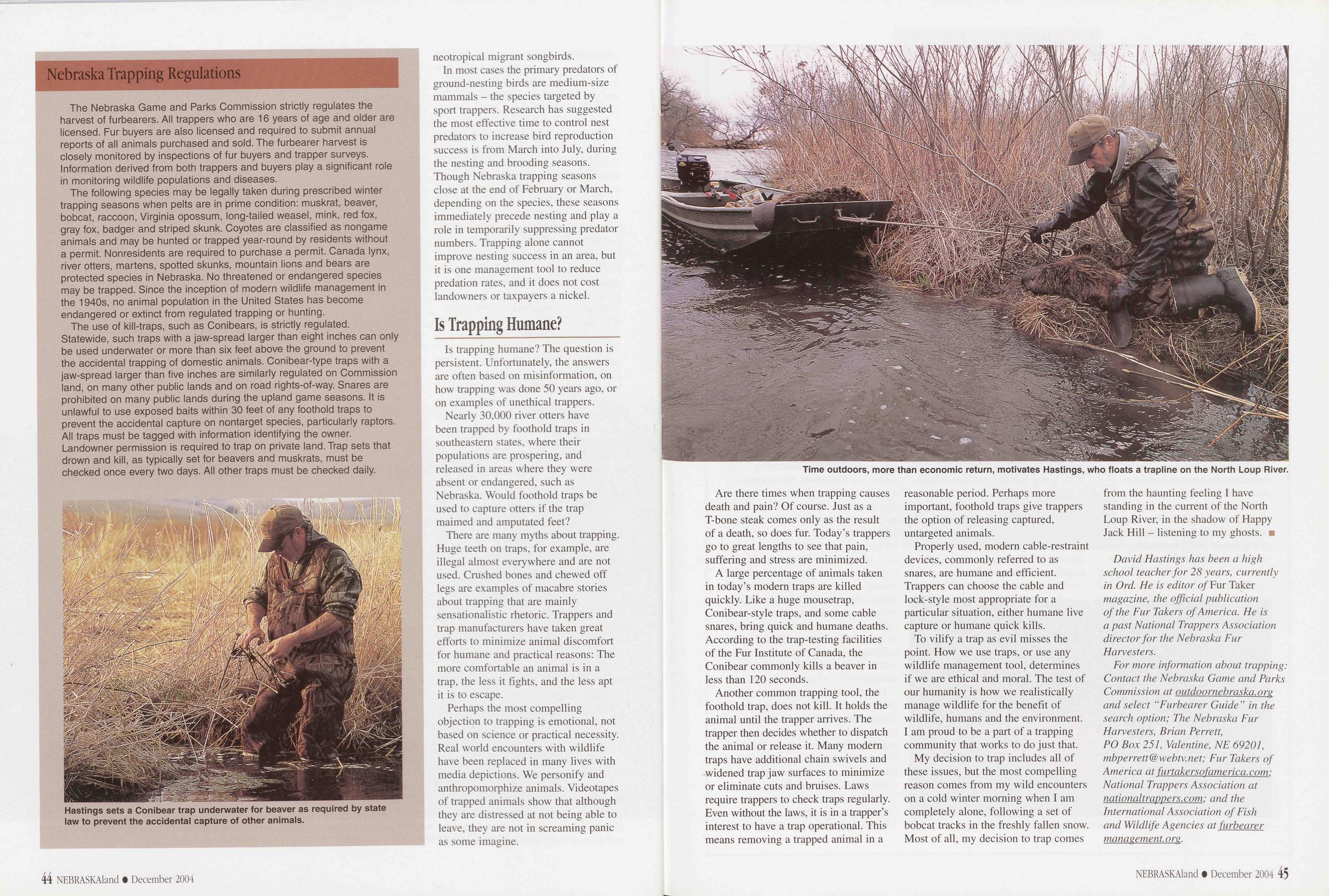 Nebraska Trapping Regulations
The Nebraska Game and Parks Commission strictly regulates the harvest of furbearers. All trappers who are 16 years of age and older are licensed. Fur buyers are also licensed and required to submit annual reports of all animals purchased and sold. The furbearer harvest is closely monitored by inspections of fur buyers and trapper surveys. Information derived from both trappers and buyers play a significant role in monitoring wildlife populations and diseases.
The following species may be legally taken during prescribed winter trapping seasons when pelts are in prime condition: muskrat, beaver, bobcat, raccoon, Virginia opossum, long-tailed weasel, mink, red fox, gray fox, badger and striped skunk. Coyotes are classified as nongame animals and may be hunted or trapped year-round by residents without a permit. Nonresidents are required to purchase a permit. Canada lynx, river otters, martens, spotted skunks, mountain lions and bears are protected species in Nebraska. No threatened or endangered species may be trapped. Since the inception of modern wildlife management in the 1940s, no animal population in the United States has become endangered or extinct from regulated trapping or hunting.
The use of kill-traps, such as Conibears, is strictly regulated. Statewide, such traps with a jaw-spread larger than eight inches can only be used underwater or more than six feet above the ground to prevent the accidental trapping of domestic animals. Conibear-type traps with a jaw-spread larger than five inches are similarly regulated on Commission land, on many other public lands and on road rights-of-way. Snares are prohibited on many public lands during the upland game seasons. It is unlawful to use exposed baits within 30 feet of any foothold traps to prevent the accidental capture on nontarget species, particularly raptors. All traps must be tagged with information identifying the owner. Landowner permission is required to trap on private land. Trap sets that drown and kill, as typically set for beavers and muskrats, must be checked once every two days. All other traps must be checked daily.
neotropical migrant songbirds.
In most cases the primary predators of ground-nesting birds are medium-size mammals - the species targeted by sport trappers. Research has suggested the most effective time to control nest predators to increase bird reproduction success is from March into July, during the nesting and brooding seasons. Though Nebraska trapping seasons close at the end of February or March, depending on the species, these seasons immediately precede nesting and play a role in temporarily suppressing predator numbers. Trapping alone cannot improve nesting success in an area, but it is one management tool to reduce predation rates, and it does not cost landowners or taxpayers a nickel.
Is Trapping Humane?Is trapping humane? The question is persistent. Unfortunately, the answers are often based on misinformation, on how trapping was done 50 years ago, or on examples of unethical trappers.
Nearly 30,000 river otters have been trapped by foothold traps in southeastern states, where their populations are prospering, and released in areas where they were absent or endangered, such as Nebraska. Would foothold traps be used to capture otters if the trap maimed and amputated feet?
There are many myths about trapping. Huge teeth on traps, for example, are illegal almost everywhere and are not used. Crushed bones and chewed off legs are examples of macabre stories about trapping that are mainly sensationalistic rhetoric. Trappers and trap manufacturers have taken great efforts to minimize animal discomfort for humane and practical reasons: The more comfortable an animal is in a trap, the less it fights, and the less apt it is to escape.
Perhaps the most compelling objection to trapping is emotional, not based on science or practical necessity. Real world encounters with wildlife have been replaced in many lives with media depictions. We personify and anthropomorphize animals. Videotapes of trapped animals show that although they are distressed at not being able to leave, they are not in screaming panic as some imagine.
Are there times when trapping causes death and pain? Of course. Just as a T-bone steak comes only as the result of a death, so does fur. Today’s trappers go to great lengths to see that pain, suffering and stress are minimized.
A large percentage of animals taken in today’s modern traps are killed quickly. Like a huge mousetrap, Conibear-style traps, and some cable snares, bring quick and humane deaths. According to the trap-testing facilities of the Fur Institute of Canada, the Conibear commonly kills a beaver in less than 120 seconds.
Another common trapping tool, the foothold trap, does not kill. It holds the animal until the trapper arrives. The trapper then decides whether to dispatch the animal or release it. Many modern traps have additional chain swivels and widened trap jaw surfaces to minimize or eliminate cuts and bruises. Laws require trappers to check traps regularly. Even without the laws, it is in a trapper’s interest to have a trap operational. This means removing a trapped animal in a reasonable period. Perhaps more important, foothold traps give trappers the option of releasing captured, untargeted animals.
Properly used, modern cable-restraint devices, commonly referred to as snares, are humane and efficient. Trappers can choose the cable and lock-style most appropriate for a particular situation, either humane live capture or humane quick kills.
To vilify a trap as evil misses the point. How we use traps, or use any wildlife management tool, determines if we are ethical and moral. The test of our humanity is how we realistically manage wildlife for the benefit of wildlife, humans and the environment. I am proud to be a part of a trapping community that works to do just that.
My decision to trap includes all of these issues, but the most compelling reason comes from my wild encounters on a cold winter morning when I am completely alone, following a set of bobcat tracks in the freshly fallen snow. Most of all, my decision to trap comes from the haunting feeling I have standing in the current of the North Loup River, in the shadow of Happy Jack Hill - listening to my ghosts.
David Hastings has been a high school teacher for 28 years, currently in Ord. He is editor of Fur Taker magazine, the official publication of the Fur Takers of America. He is a past National Trappers Association director for the Nebraska Fur Harvesters.
For more information about trapping: Contact the Nebraska Game and Parks Commission at outdoornebraska.org and select “Furbearer Guide " in the search option; The Nebraska Fur Harvesters, Brian Perrett, PO Box 251, Valentine, NE 69201, mbperrett@webtv.net; Fur Takers of America at furtakersofamerica.com: National Trappers Association at nationaltrappers.com: and the International Association of Fish and Wildlife Agencies at furbearer management.org.
44 NEBRASKAland • December 2004 NEBRASKAland • December 2004 45
During its illustrious history as a frontier fort, cavalry remount station and Olympic equestrian training center, Fort Robinson was a center for cultural and community activities in northwestern Nebraska. That tradition has continued since the fort became Nebraska’s largest state park nearly 50 years ago. For the past 10 years, 4-H clubs, civic groups, businesses and individuals have decorated the fort’s historical buildings for the holiday season.
The park’s historical buildings surrounding the parade ground, including the 1887 Adobe Officers’ Quarters, the 1905 Post Headquarters, the 1909 Enlisted Men’s Barracks, Comanche Hall (the 1909 Bachelor Officers’ Quarters) and the new Buffalo Soldier Barracks, are dressed for the holidays. The bright decorations attract visitors from across the Nebraska Panhandle.
“It’s really a fun event and a great thing to do each Christmas season,” said Nick Baumann of Chadron, one of a group of Wal-Mart employees who decorate Comanche Hall each year. “We have a blast decorating the
Mike Morava, Fort Robinson’s superintendent, said the volunteer groups and individuals provide the decorations and labor and the park supplies electricity for the lights.
“The decorating events are growing in number each year,” Morava said. “The groups often use the kitchens and dining rooms in the buildings, if they have not been rented. Their fare is usually chili with hot chocolate and apple cider. The decorating parties are fun events. We operate the lift truck by appointment, and also ensure that the decorations are installed properly and safely on the historical buildings.”
Laurel Hunter of Crawford Livestock said their lighting project is a family event. “Our daughter, Alicia, and my husband, Jack, and I, along with our yard foreman, Mitch Wright, use the large, old-fashioned lights as well as garland and wreaths to decorate one of the officers’ adobe buildings. It really looks nice and we will be back out there this Christmas season.”
The decorations are always in place for the fort’s Christmas dinner. The 10th anniversary Historical Christmas Dinner will be held December 4, featuring dishes from the fort’s 1887 Christmas menu for the troops. Participants are asked to wear clothing from the fort’s early period. The 200 tickets available for the annual event usually sell out within 15 minutes.
My wife is not a shoe maven. She gives me grief for having more footwear than she does. And it took her some time to understand why I need so many different kinds of socks - and why I am willing to pay so much for them.
In the field, the first parts of me to get cold are my feet. I can spend all day outdoors, no matter how cold it is, if I keep my feet warm. But like many who spend time in the elements - hunters, anglers (especially the hard-water type), construction workers, hikers, mountain bikers, sports fans -I find keeping my feet warm is a challenge.
Choosing the right combination of socks and shoes or boots depends on your activity. A pheasant hunter can have a comfortable day in the field in subfreezing temperatures with much less insulation on his or her feet than a deer hunter in a tree stand on a 40-degree day. Ask joggers dressed in shorts and T-shirts during the winter and they will tell you: Keep the blood pumping and you will stay warm.
Lightly insulated or even uninsulated boots are sufficient when you are on the move. Pack boots with heavy felt liners are the standard for ice anglers. Others might need a boot in between. Choose from the many insulation levels, often rated using grams of Thinsulate fabric as the standard.
Maintaining a comfortable balance is tricky when you vary activity levels through the day. During a long walk to a tree stand or wading through a marsh with a bag of duck decoys, your feet sweat. When you stop moving, your feet can chill in even the most heavily insulated boots. A good boot breathes, allowing perspiration to escape. The best have waterproof, breathable liners, such as GORE-TEX, which allows inside water vapor to pass out through its pores, but keeps water out.
Insulated rubber boots are popular among deer hunters today because
When choosing socks for cold-weather activities, avoid cotton. Cotton has the insulating value of an aluminum can when it’s wet. Tried-and-true wool, synthetics such as polypropylene or acrylic, and blends are much better insulators and help wick moisture away from your skin.
Wearing a thin, synthetic sock liner under a heavier sock usually keeps feet as dry and warm as two pair of heavy socks. Shoving too much fabric in a boot with room for one sock restricts the circulation in your feet, causing them to cool faster. In tight boots, socks also are compressed, reducing the amount of air between the fibers and their insulating value. A better choice is to buy better insulated boots that are large enough to accommodate your sock of choice yet snug enough to provide the support you need.
If your feet sweat profusely, spray them with antiperspirant before you put your socks on. If you have more than one pair of boots suitable for your activities, change them during the day. At a minimum, change your socks and dry your feet. Be sure to dry your boots overnight if you are returning to the field the next day. Stuffing boots with crumpled newspaper for an hour or so will wick out much of the moisture, and putting them in front of a fan or furnace vent speeds the drying process.
If all else fails, put a pair of self-adhesive chemical toe warmers, such as Toasti Toes by HeatMax, on your socks before you slip your boots on. These modern-day marvels have saved my piggies more than once in a tree stand, goose blind and photo blind.
Another key to keeping your feet warm is to keep your body warm. We are adapted to warm temperatures. When cold, our bodies restrict blood flow to the extremities to keep our vital organs warm. That compounds the problem: Hands and feet are the farthest from the furnace and they have a high ratio of surface area to volume, causing them to cool faster. Heat escapes rapidly from an uncovered head and neck, so if you really want your feet to stay warm, remember what mom always said: Bundle up and wear your hat.
46 NEBRASKAland • December 2004 NEBRASKAland • December 2004 47
NEBRASKA LOCALE BOOKS by Betty Heidbreder Dunn: Novels The Courthouse (Eastern Nebraska), $12.50 ppd; In The Shadow of the Bluff (Western Nebraska), $14.50 ppd; memoir Ju-Ju Swallowed a Penny, $8.50 ppd. Write 410 CR 324, Navasota, TX 77868.
EXPLORE NEBRASKA art, history, culture and the great outdoors with a subscription to Nebraska Life magazine. Six issues per year just $19. Phone (800) 777-6159 or write us at Box 577, Hartington, NE 68739. Makes a great gift. Visit NebraskaLife.com.
BUSINESS OPPORTUNITIESLIVE AND WORK ON A LAKE! North central IA bait/fishing/hunting retailer, including 4-BR home. Gross $250K, cash flow $47K. Biz $ MOK plus invest- ment, real estate $340K. Good opportunity for growth. Brian (952) 912-0333, ext. 2 or www.ftsbro- kers.com.
DOGSPLUM CREEK KENNEL. German Shorthairs, stud service, puppies and started dogs. Training for all pointing breeds. Specialize in training the handler as well as the dog. Wayne Clark, Percival, Iowa 51648 (close to Omaha) (712) 529-4238, email wclark@sid- ney.heartland.net.
YELLOW-BLACK LAB PUPS. Breeders hips O.F.A. and eyes CERF. Excellent bloodlines and hunting potential. Call Dave Bendler (308) 785-2554 in Lexington or Scott Bendler (402) 477-1305, Lincoln.
WILDERNESS KENNELS. Gun dog training - over 60 years combined experience. Training all sporting breeds - retrievers, flushing and pointing dogs. All dogs worked on pen-raised birds and wild game. Training program also includes obedience training - heel, sit, stay, down and come when called. Pups, started dogs and fully trained dogs for sale. Hunting dogs trained by hunters. Henry Sader, Wilderness Kennels, Roca, NE (402) 423-4212. Since 1968.
DUCKDAWG RETRIEVERS - Raising exceptional field-bred Labradors. Hunting, family and competi- tion companions. Puppies raised in our home. Written health guarantee, www.duckdawg.com. Ron Green, DVM and Libby Milroy, North Platte, NE (308) 534- 3659.
Subscribe Now and Save! Order or renew your subscription to NEBRASKAIand Magazine before January 1,2005 to lock in today's low prices for 1, 2, or 3 years! $16 for one year $30 for two years $44 for three years - best value! Prices as of January 1 2005. $18 for one year $33 for two years $49 for three years Nebraska residents add state and local sales tax. 3 easy ways to order: 1: Call 1-800.-NEBLAND (632-5263) 2: Go online to outdoornebraska.org/cataloq 3: Or mail the order card inserted in this magazine FISH/FISHINGFISH FOR SALE. Catfish, largemouth bass, small- mouth bass, perch, crappies, bluegills, walleyes, rain- bow trout, grass carp, minnows, bullheads. Consulting available. Pleasant Valley Fish Farm, 27851 U.S. Highway 83, McCook, NE 69001. Phone (308) 345-6599.
NEBRASKA LAKE MANAGEMENT - Biological lake surveys, fish stocking, rough fish control, lake aeration, algae control, shorewall construction. Rob Hofpar, Aquatic Biologist, licensed, insured and qualified. Phone (402) 784-6005 (Lincoln), or toll-free (888) 850-2460.
FOOD/GIFTS/HOMEHOMEBREWING/BEER & WINEMAKING sup- plies. Fermenter’s Supply, 8410 K Plz. #10, Omaha, NE 68127. (402) 593-9171. Mail orders welcome. www.fermenterssupply.com
GUIDES/OUTFITTERSCANOE THE NIOBRARA with an affordable canoe trip by Dryland Aquatics. One- and two-day trips...full service, or just canoe, tube or kayak. Transportation furnished. Your Niobrara River specialists... We do it your way! Dryland Aquatics, Dept. N, Box 33C, Sparks, NE 69220 or phone (800) 337-3119. www.dry- landaquatics.com, info@drylandaquatics.com.
KRIPPLE DUCK ADVENTURES - Southwestern Nebraska. Guided hunts along Frenchman Creek for deer, waterfowl, wild pheasants, quail and turkeys. New for 2004, we have started a controlled hunting area for pheasants, quail and chukars, (308) 394-5345 or (308) 280-5345. E-mail at cdorn@bwtelcom.net. www.krippleduck.com.
PRAIRIE SPRINGS PHEASANT HUNTS located 35 miles north of Cabela’s Corporate Headquarters in Sidney, NE. Book your pheasant hunt now by calling Bryan at (308) 250-2403. www.prairiespringsllc.com.
GUNS/SHOOTING/ARCHERYGUNS - Browning, Benelli, Winchester, Ruger, etc. 1700 guns, buy-sell-trade (402) 729-6112, Bedlan’s, Fairbury, NE 68352. www.bedlans.com.
OUTDOOR EQUIPMENTIS PERFORMANCE IMPORTANT? For the finest canoes and accessories look to Great Plains Canoe Co., 205 Main, Springfield, NE 68059. Phone (402) 253-2000.
REAL ESTATEHARLAN LAKE AREA LAND for sale - 640 +/- acres in view of lake, rough-rolling land, tall grass scattered dry cropland fields, excellent deer, upland game, turkey, goose hunting, reserve/hunting lodge possibilities. USA land on 3 sides. Country Road Realty, 901 W. Main, Alma, NE, Dave Wolf (308) 928-3120. www.mls50.com/countryroad.htm.
PLATTE RIVER HUNTING PROPERTY - Excellent warm water creek for ducks and geese. Tree blind for deer. Quail hunting plus year-round mobile home. 15 minutes west of North Platte. Gateway GMAC Real Estate of North Platte, Inc. (308) 532-1810, (800) 658-4093. www.gatewavnpgmac.com
VACATIONS/RESORTSFOR FISHING AND HUNTING accommodations. Guided pheasant hunts. Jefco Inn, Gordon, NE 69343. South Cornell, (308) 282-2935.
THE OLDE MAIN STREET INN. A historic bed and breakfast listed in the National Register of Historic Places. Beautiful dining room with fireplace. Featuring prime rib, buffalo, seafood, homemade soups, chilis and desserts. 115 Main Street, Chadron NE 69337 (308) 432-3380. www.chadron.com/oldemain.
SANDHILLS HIDEAWAY! Scenic Double R Guest Ranch south of Valentine. Open all year. Great lodging with fully furnished kitchenettes. Fish, hunt, ride horses, relax. Right for sportsmen, families, small groups, artists, writers, newlyweds! Call (866) 217- 2042. www.sandhilldoublerranch.com
LORD RANCH RESORT. Hunters, fishermen, family vacations, family reunions. New deluxe cabins. Complete cooking facilities. Quiet and peaceful in the middle of the Sandhills. Three miles north of the Valentine Wildlife Refuge, open all year. Aubrey and Dorothy Lord, HC 37, Box 41, Valentine, NE 69201. Call (800) 270-0181.www.lordranchresort.com
DIAMOND B TROUT RESORT & RESTAURANT, Orchard, Nebraska. Restaurant, lodge, cabins, spring- fed lakes, playground equipment, paddleboats. Great for families, groups, hunters. Book your cabin now! Call for brochure (800) 974-3002. www.diamondb- troutresort.com
MILL IRON V LODGING - Verdigre, NE. 3 new cabins with cooking facilities, walk-in showers, AC. In secluded scenic setting 12 miles from the Missouri River. Open year-round.'"Offering horse and carriage rides or bring your own horse and ride off road. (402) 668-7488, email jpeinrem@carrollsweb.com, www.milliron-v-lodging.com.
BUNGALOW ON THE BLUE - Hunt pheasant, quail, duck, goose or deer (bow hunt only) along the scenic Little Blue River in south-central Nebraska. Furnished cabin with kitchen. Craig Buescher, Deweese, (402) 262-2311.
MIDLANDS LODGE HASTINGS NEBRASKA - Hunter friendly motel. Trained pets allowed, cleaning area, refrigerators/freezers, 2-diamond AAA, HBO, great rates. Call (800) 237-1872.
DISCOVER SOUTH-CENTRAL NEBRASKA! OxBow Inn & Cafe, Nelson, Nebraska. Newly remod- eled Inn with Bed & Breakfast character. Hunting, fishing, Oregon Trail Discovery Tours and more. (402) 225-2651. www.OxBowInnAndCafe.com
Classified Rates: 750 per word, minimum $15. Closing: First business day two months before issue date. Classified ads are accepted on a first-come, first-served, space-available basis. Classified Ads, NEBRASKAIand Magazine, P.O. Box 30370, Lincoln, NE 68503-0370. Telephone (402) 471-5585. Fax: (402) 471-5528. E-mail: nebland@ngpc.state.ne.us. Ads are posted online at outdoornebraska.org/nebland at no additional charge.
Parks & Places
Winter Getaways
Platte River and Eugene T. Mahoney state parks become cozy destinations.
By Justin WamboldThe winter season is a great time to enjoy Nebraska state parks. A fresh blanket of snow, the bare trees and the quiet of a crisp winter day can give a familiar summertime location a completely new appearance.
Numerous activities available only in colder months, such as cross-country skiing, sledding, and ice fishing, add enjoyment to a seasonal visit. Winter tent and RV camping in most state parks can be a terrific experience, if the nighttime temperatures don’t plunge too far.
Weekend stays for less adventurous visitors or for families who want to schedule a comfortable wintertime getaway are available in cabins at Eugene T. Mahoney State Park and Platte River State Park. Cabins at both parks, located between Lincoln and Omaha, are available for rent year-round.
Platte River State Park has 21 cabins, some with four bedrooms that accommodate large families or groups. They may be rented for $65 to $90 per night. Each cabin is furnished, and offers a fully equipped kitchenette, a bathroom and bed linens. Some cabins have fireplaces - perfect spots to end a day spent in the snow.
As a winter destination, Platte River State Park has a different character than it has the rest of the year. The forest shroud of leaves is gone, improving views of the Platte River and adjacent railroad tracks. The numerous trails through the park are great for cross-country skiing and snowshoeing, and sledding is also popular on the many hillsides throughout the park.
Even without snow, the trails are excellent hiking paths that offer glimpses of wildlife. Bald eagle sightings are common along the river, and deer and wild turkeys are
Eugene T. Mahoney State Park has 53 cabins ranging from two-bedroom standard cabins to four-bedroom deluxe cabins. Each of the cabins is equipped with a kitchenette, fireplace, deck, grill, bed linens and towels. Barrier-free cabins are also available. Cabin prices range from $95 to $390 per night and discounts of up to 30 percent are available some nights from October through April. The Peter Kiewit Lodge has 40 rooms, each with a private bath. All rooms have two queen beds, a TV and telephone, and 16 rooms offer sleeping lofts and fireplaces. These room rent from $60 to $80 per night and are discounted during the winter months.
Mahoney winter activities include a skating rink, toboggan and sled runs, a lake for ice fishing and groomed cross-country ski trails. Mahoney also has many indoor attractions during the winter, including a theater and a playground for children. The park also offers a restaurant and observation tower, which are open year-round.
Both parks have paved roads and good snow removal services to provide easy access to the cabins.
Cabin reservations may be made up to a year in advance by phone or through the Commission web site at www.outdoornebraska.org.

Send contributions to: Portraits from the Past, NEBRASKAland Magazine, P.O. Box 30370, Lincoln, NE 68503-0370. Photos should show people enjoying Nebraska outdoor activities, such as camping, boating, hunting or fishing, and must have been taken before 1970. We will give priority to unusual photos or activities. When possible, please include a story about the photograph and identify the people, places and approximate date it was taken. Photos will be returned.
This holiday season give Nebraska outdoor permits. Year-round wonders await everyone on your list!
To Order... call toll-free 1-800-742-0056 Monday through Friday, 7:30 a.m. to 5 p.m. CST or order online at: www.outdoornebraska.org/catalog *Hunting and fishing permits shown are representative only of permits purchased from vendors.
2005 Annual Hunt Permit* A hunting permit is the ideal gift for that hard-to-buy-for outdoor enthusiast on your list. Prices include agent issuing fee. Resident Hunt Permit.....$12 Nonresident Hunt Permit...$68 Habitat Stamp............$13
2005 Annual Fish Permit A fishing permit is your passport to outdoor fun year-round. Prices include agent issuing fee. Resident Fish Permit....$16 Nonresident Fish Permit.$46 Aquatic Habitat Stamp...$5
2005 Annual Park Permit Enjoy more than 80 Nebraska state parks and recreation areas. Prices include agent issuing fee. Annual Park Entry Permit..$17.35 Duplicate Permit...............$8.85
Lifetime Hunt, Fish, Combo Hunt and Fish, and Habitat Permits for Nebraska residents are also available.
50 NEBRASKAland • December 2004
Position: 872 (9 views)