Volume 82, Issue 9, 2004
NEBRASKAland
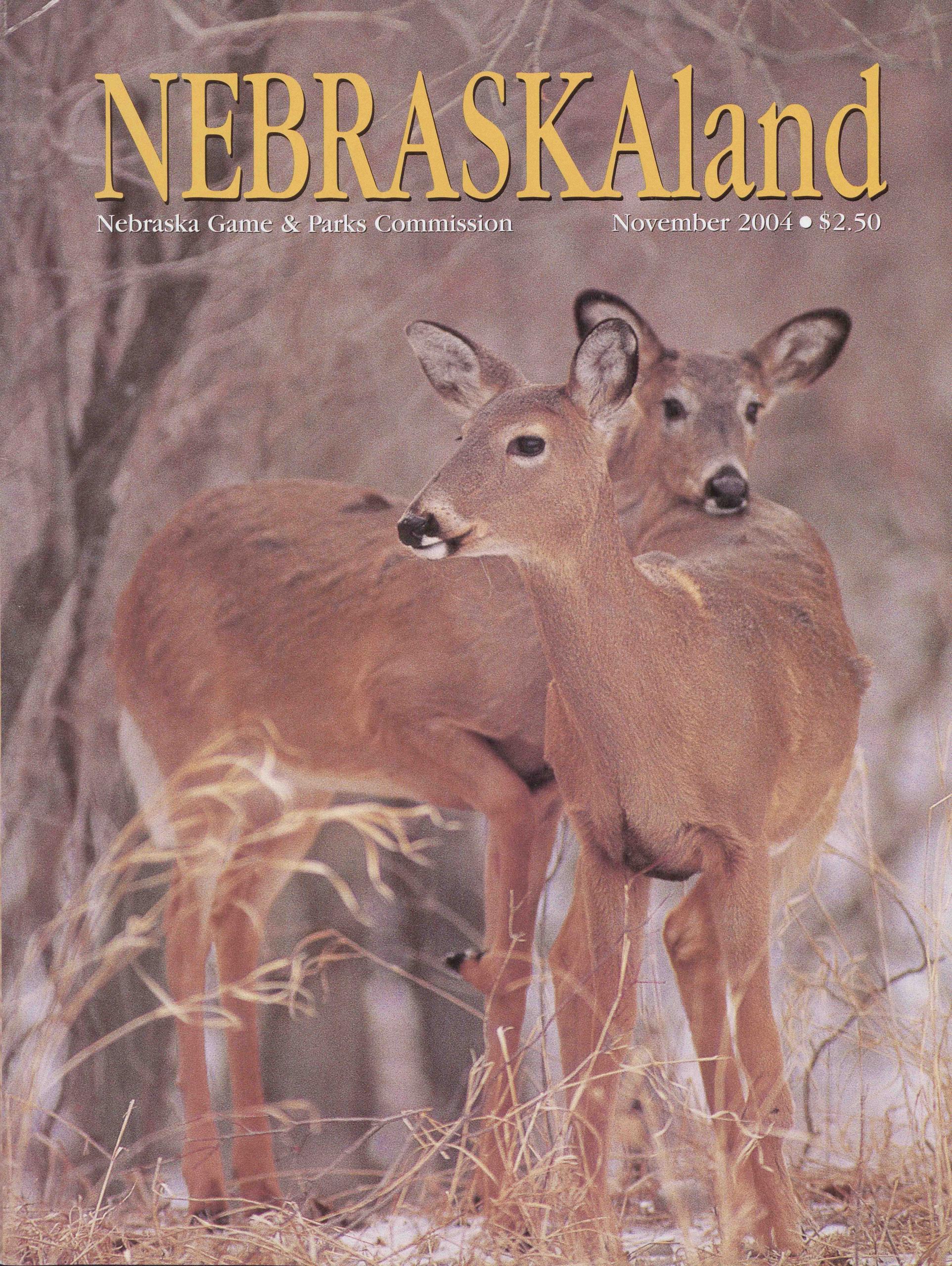
Nebraska Game & Parks Commission November 2004 $2.50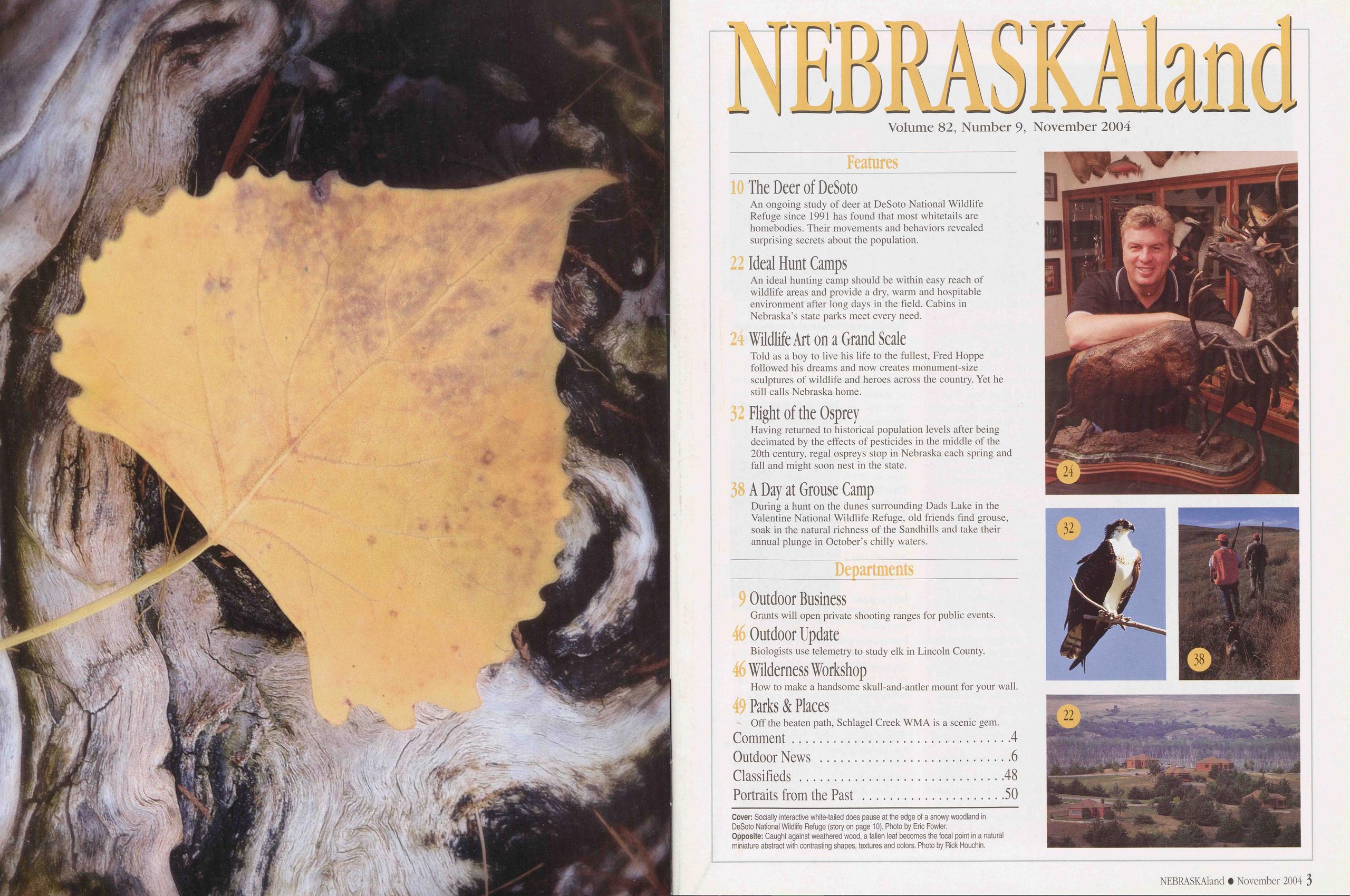
NEBRASKAland
Volume 82, Number 9, November 2004 Features 10 The Deer of DeSoto An ongoing study of deer at DeSoto National Wildlife Refuge since 1991 has found that most whitetails are homebodies. Their movements and behaviors revealed surprising secrets about the population. 22 Ideal Hunt Camps An ideal hunting camp should be within easy reach of wildlife areas and provide a dry, warm and hospitable environment after long days in the field. Cabins in Nebraska’s state parks meet every need. 24 Wildlife Art on a Grand Scale Told as a boy to live his life to the fullest, Fred Hoppe followed his dreams and now creates monument-size sculptures of wildlife and heroes across the country. Yet he still calls Nebraska home. 32 Flight of the Osprey Having returned to historical population levels after being decimated by the effects of pesticides in the middle of the 20th century, regal ospreys stop in Nebraska each spring and fall and might soon nest in the state. 38 A Day at Grouse Camp During a hunt on the dunes surrounding Dads Lake in the Valentine National Wildlife Refuge, old friends find grouse, soak in the natural richness of the Sandhills and take their annual plunge in October’s chilly waters. Departments 9 Outdoor Business Grants will open private shooting ranges for public events. 46 Outdoor Update Biologists use telemetry to study elk in Lincoln County. 46 Wilderness Workshop How to make a handsome skull-and-antler mount for your wall. 49 Parks & Places Off the beaten path, Schlagel Creek WMA is a scenic gem. Comment...........................................4 Outdoor News .....................................6 Classifieds .....................................48 Portraits from the Past .........................50 Cover: Socially interactive white-tailed does pause at the edge of a snowy woodland in DeSoto National Wildlife Refuge (story on page 10). Photo by Eric Fowler. Opposite: Caught against weathered wood, a fallen leaf becomes the focal point in a natural miniature abstract with contrasting shapes, textures and colors. Photo by Rick Houchin.24
32
38
22
Comment
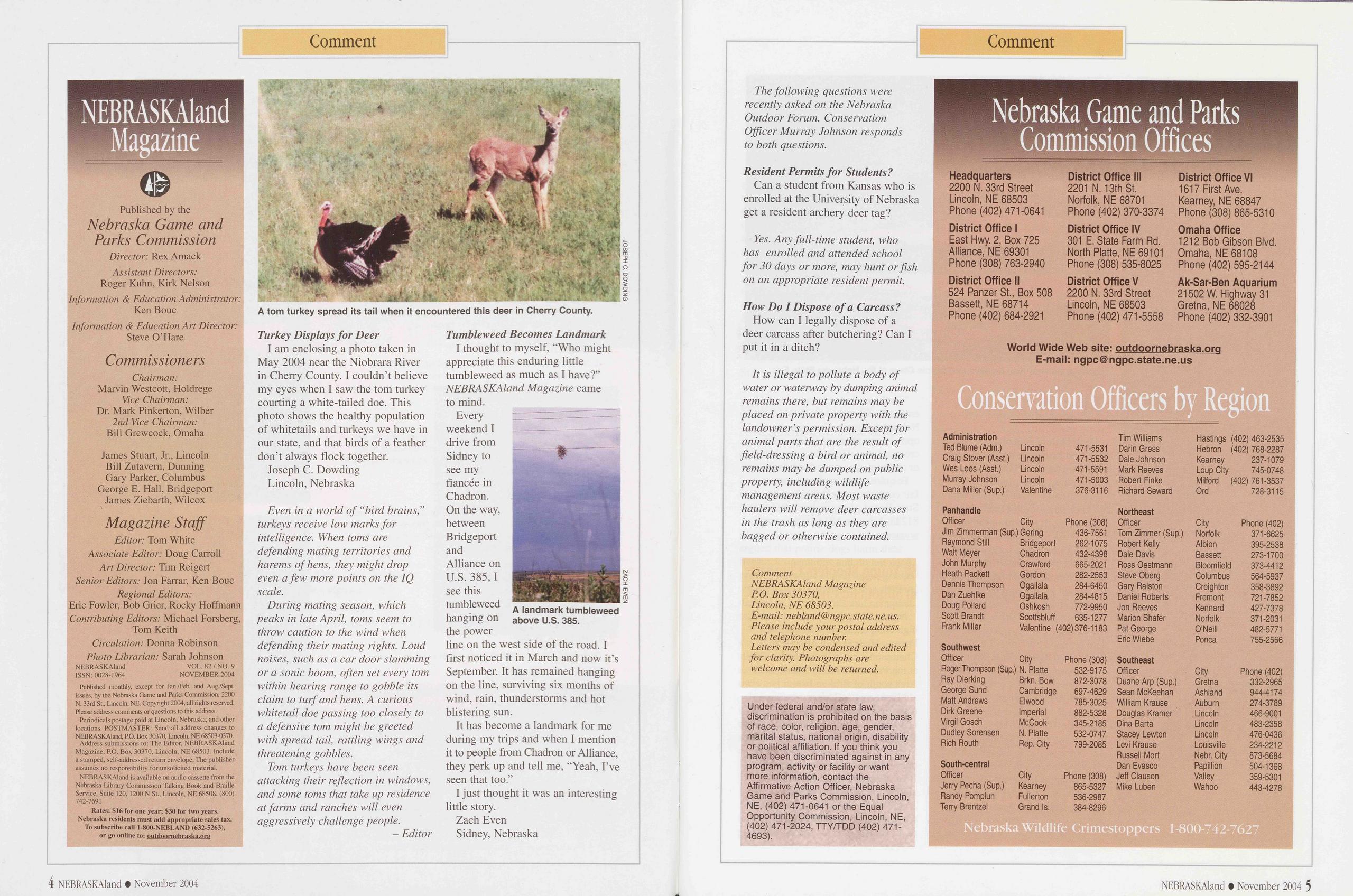
I am enclosing a photo taken in May 2004 near the Niobrara River in Cherry County. I couldn’t believe my eyes when I saw the tom turkey courting a white-tailed doe. This photo shows the healthy population of whitetails and turkeys we have in our state, and that birds of a feather don’t always flock together. Joseph C. Dowding Lincoln, Nebraska
Even in a world of "bird brains,” turkeys receive low marks for intelligence. When toms are defending mating territories and harems of hens, they might drop even a few more points on the IQ scale.
During mating season, which peaks in late April, toms seem to throw caution to the wind when defending their mating rights. Loud noises, such as a car door slamming or a sonic boom, often set every tom within hearing range to gobble its claim to turf and hens. A curious whitetail doe passing too closely to a defensive tom might be greeted with spread tail, rattling wings and threatening gobbles.
Tom turkeys have been seen attacking their reflection in windows, and some toms that take up residence at farms and ranches will even aggressively challenge people. - Editor
I thought to myself, “Who might appreciate this enduring little tumbleweed as much as I have?” NEBRASKAland Magazine came to mind. Every weekend I drive from Sidney to see my fianceé in Chadron. On the way, between Bridgeport and Alliance on U.S. 385,1 see this tumbleweed hanging on the power line on the west side of the road. I first noticed it in March and now it’s September. It has remained hanging on the line, surviving six months of wind, rain, thunderstorms and hot blistering sun. It has become a landmark for me during my trips and when I mention it to people from Chadron or Alliance, they perk up and tell me, “Yeah, I’ve seen that too.” I just thought it was an interesting little story. Zach Even Sidney, Nebraska
4 NEBRASKAland • November 2004Comment
The following questions were recently asked on the Nebraska Outdoor Forum. Conservation Officer Murray Johnson responds to both questions.
Resident Permits for Students?Can a student from Kansas who is enrolled at the University of Nebraska get a resident archery deer tag?
Yes. Any full-time student, who has enrolled and attended school for 30 days or more, may hunt or fish on an appropriate resident permit.
How Do I Dispose of a Carcass?How can I legally dispose of a deer carcass after butchering? Can I put it in a ditch?
It is illegal to pollute a body of water or waterway by dumping animal remains there, but remains may be placed on private property with the landowner’s permission. Except for animal parts that are the result of field-dressing a bird or animal, no remains may be dumped on public property, including wildlife management areas. Most waste haulers will remove deer carcasses in the trash as long as they are bagged or otherwise contained.
Comment NEBRASKAland Magazine PO. Box 30370, Lincoln, NE 68503. E-mail: nebland@ ngpc. state, ne. us. Please include your postal address and telephone number. Letters may be condensed and edited for clarity. Photographs are welcome and will be returned. Under federal and/or state law, discrimination is prohibited on the basis of race, color, religion, age, gender, marital status, national origin, disability or political affiliation. If you think you have been discriminated against in any program, activity or facility or want more information, contact the Affirmative Action Officer, Nebraska Game and Parks Commission, Lincoln, NE, (402) 471-0641 or the Equal Opportunity Commission, Lincoln, NE, (402) 471-2024, TTY/TDD (402) 471- 4693). Nebraska Game and Parks Commission Offices Headquarters 2200 N. 33rd Street Lincoln, NE 68503 Phone (402) 471-0641 District Office I East Hwy. 2, Box 725 Alliance, NE 69301 Phone (308) 763-2940 District Office II 524 Panzer St., Box 508 Bassett, NE 68714 Phone (402) 684-2921 District Office III 2201 N. 13th St. Norfolk, NE 68701 Phone (402) 370-3374 District Office IV 301 E. State Farm Rd. North Platte, NE 69101 Phone (308) 535-8025 District Office V 2200 N. 33rd Street Lincoln, NE 68503 Phone (402) 471-5558 District Office VI 1617 First Ave. Kearney, NE 68847 Phone (308) 865-5310 Omaha Office 1212 Bob Gibson Blvd. Omaha, NE 68108 Phone (402) 595-2144 Ak-Sar-Ben Aquarium 21502 W. Highway 31 Gretna, NE 68028 Phone (402) 332-3901 World Wide Web site: outdoornebraska.org E-mail: ngpc@ngpc.state.ne.us Conservation Officers by Region Administration Ted Blume (Adm.) Lincoln 471-5531 Tim Williams Darin Gress Hastings (402) 463-2535 Hebron (402) 768-2287 Craig Stover (Asst.) Lincoln 471-5532 Dale Johnson Kearney 237-1079 Wes Loos (Asst.) Lincoln 471-5591 Mark Reeves Loup City 745-0748 Murray Johnson Lincoln 471-5003 Robert Finke Milford (402) 761-3537 Dana Miller (Sup.) Valentine 376-3116 Richard Seward Ord 728-3115 Panhandle Officer City Phone (308) Northeast Officer City Phone (402) Jim Zimmerman (Sup.) Gering 436-7561 Tom Zimmer (Sup.) Norfolk 371-6625 Raymond Still Bridgeport 262-1075 Robert Kelly Albion 395-2538 Walt Meyer Chadron 432-4398 Dale Davis Bassett 273-1700 John Murphy Crawford 665-2021 Ross Oestmann Bloomfield I 373-4412 Heath Packett Gordon 282-2553 Steve Oberg Columbus 564-5937 Dennis Thompson Ogallala 284-6450 Gary Ralston Creighton 358-3892 Dan Zuehlke Ogallala 284-4815 Daniel Roberts Fremont 721-7852 Doug Pollard Oshkosh 772-9950 Jon Reeves Kennard 427-7378 Scott Brandt Scottsbluff 635-1277 Marion Shafer Norfolk 371-2031 Frank Miller Valentine (402)376-1183 Pat George O’Neill 482-5771 Southwest Officer City Roger Thompson (Sup.) N. Platte Phone (308) 532-9175 Eric Wiebe Southeast Officer Ponca City 755-2566 Phone (402) Ray Dierking Brkn. Bow 872-3078 Duane Arp (Sup.) Gretna 332-2965 George Sund Cambridge 697-4629 Sean McKeehan Ashland 944-4174 Matt Andrews Elwood 785-3025 William Krause Auburn 274-3789 Dirk Greene Imperial 882-5328 Douglas Kramer Lincoln 466-9001 Virgil Gosch McCook 345-2185 Dina Barta Lincoln 483-2358 Dudley Sorensen N. Platte 532-0747 Stacey Lewton Lincoln 476-0436 Rich Routh Rep. City 799-2085 Levi Krause Louisville 234-2212 South-central Russell Mort Dan Evasco Nebr. City Papillion 873-5684 504-1368 Officer City Phone (308) Jeff Clauson Valley 359-5301 Jerry Pecha (Sup.) Kearney 865-5327 Mike Luben Wahoo 443-4278 Nebraska Wildlife Crimestoppers 1-800-742-7627 NEBRASKAland • November 2004 5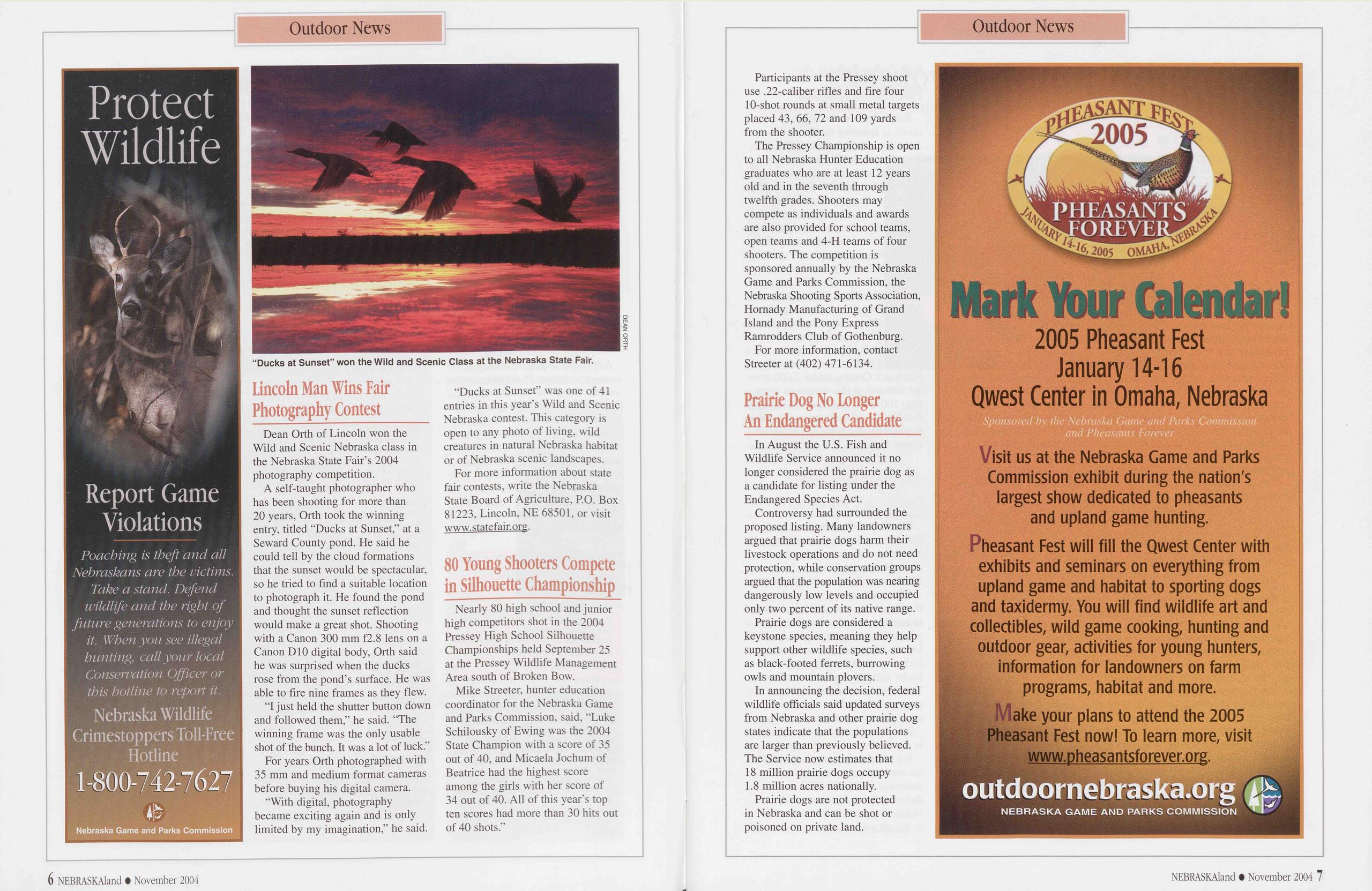
Outdoor News
Protect Wildlife Report Game Violations Poaching is theft and all Nebraskans are the victims. Take a stand. Defend wildlife and the right of future generations to enjoy it. When you see illegal hunting, call your local Conservation Officer or this hotline to report it. Nebraska Wildlife Crimestoppers Toll-Free Hotline 1-800-742-7627 Nebraska Game and Parks CommissionDean Orth of Lincoln won the Wild and Scenic Nebraska class in the Nebraska State Fair’s 2004 photography competition.
A self-taught photographer who has been shooting for more than 20 years, Orth took the winning entry, titled “Ducks at Sunset,” at a Seward County pond. He said he could tell by the cloud formations that the sunset would be spectacular, so he tried to find a suitable location to photograph it. He found the pond and thought the sunset reflection would make a great shot. Shooting with a Canon 300 mm f2.8 lens on a Canon D10 digital body, Orth said he was surprised when the ducks rose from the pond’s surface. He was able to fire nine frames as they flew.
"I just held the shutter button down and followed them,” he said. “The winning frame was the only usable shot of the bunch. It was a lot of luck.”
For years Orth photographed with 35 mm and medium format cameras before buying his digital camera.
“With digital, photography became exciting again and is only limited by my imagination,” he said.
“Ducks at Sunset” was one of 41 entries in this year’s Wild and Scenic Nebraska contest. This category is open to any photo of living, wild creatures in natural Nebraska habitat or of Nebraska scenic landscapes.
For more information about state fair contests, write the Nebraska State Board of Agriculture, P.O. Box 81223, Lincoln, NE 68501, or visit www. statefair.org.
80 Young Shooters Compete in Silhouette ChampionshipNearly 80 high school and junior high competitors shot in the 2004 Pressey High School Silhouette Championships held September 25 at the Pressey Wildlife Management Area south of Broken Bow.
Mike Streeter, hunter education coordinator for the Nebraska Game and Parks Commission, said, “Luke Schilousky of Ewing was the 2004 State Champion with a score of 35 out of 40, and Micaela Jochum of Beatrice had the highest score among the girls with her score of 34 out of 40. All of this year’s top ten scores had more than 30 hits out of 40 shots.”
6 NEBRASKAland • November 2004Participants at the Pressey shoot use .22-caliber rifles and fire four 10-shot rounds at small metal targets placed 43, 66, 72 and 109 yards from the shooter.
The Pressey Championship is open to all Nebraska Hunter Education graduates who are at least 12 years old and in the seventh through twelfth grades. Shooters may compete as individuals and awards are also provided for school teams, open teams and 4-H teams of four shooters. The competition is sponsored annually by the Nebraska Game and Parks Commission, the Nebraska Shooting Sports Association, Hornady Manufacturing of Grand Island and the Pony Express Ramrodders Club of Gothenburg.
For more information, contact Streeter at (402) 471-6134.
Prairie Dog No Longer An Endangered CandidateIn August the U.S. Fish and Wildlife Service announced it no longer considered the prairie dog as a candidate for listing under the Endangered Species Act.
Controversy had surrounded the proposed listing. Many landowners argued that prairie dogs harm their livestock operations and do not need protection, while conservation groups argued that the population was nearing dangerously low levels and occupied only two percent of its native range.
Prairie dogs are considered a keystone species, meaning they help support other wildlife species, such as black-footed ferrets, burrowing owls and mountain plovers.
In announcing the decision, federal wildlife officials said updated surveys from Nebraska and other prairie dog states indicate that the populations are larger than previously believed. The Service now estimates that 18 million prairie dogs occupy 1.8 million acres nationally.
Prairie dogs are not protected in Nebraska and can be shot or poisoned on private land.
[image]PHEASANT FEST 2005 PHEASANTS FOREVER JANUARY 14-16, 2005 OMAHA, NEBRASKAMark Your Calendar!
2005 Pheasant Fest January 14-16 Qwest Center in Omaha, Nebraska Sponsored by the Nebraska Game and Parks Commission and Pheasants Forever
Visit us at the Nebraska Game and Parks Commission exhibit during the nation's largest show dedicated to pheasants and upland game hunting.
Pheasant Fest will fill the Qwest Center with exhibits and seminars on everything from upland game and habitat to spotting dogs and taxidermy. You will find wildlife art and collectibles, wild game cooking, hunting and outdoor gear, activities for young hunters, information for landowners on farm programs, habitat and more.
Make your plans to attend the 2005 Pheasant Fest now! To learn more, visit www.pheasantsforever.org.
outdoornebraska.org NEBRASKA GAME AND PARKS COMMISSION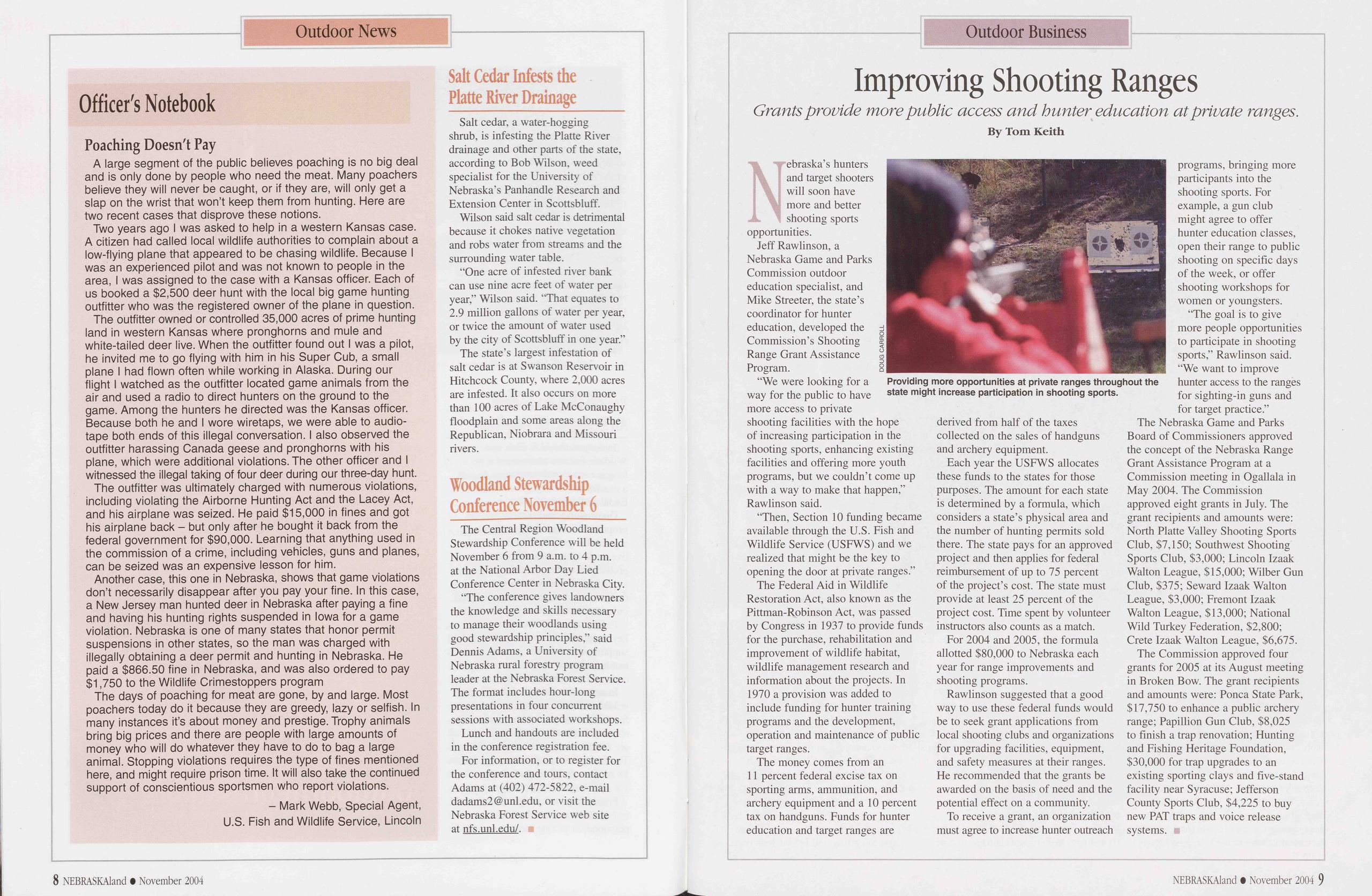
Outdoor News
Officer's Notebook
Poaching Doesn't Pay
A large segment of the public believes poaching is no big deal and is only done by people who need the meat. Many poachers believe they will never be caught, or if they are, will only get a slap on the wrist that won’t keep them from hunting. Here are two recent cases that disprove these notions.
Two years ago I was asked to help in a western Kansas case. A citizen had called local wildlife authorities to complain about a low-flying plane that appeared to be chasing wildlife. Because I was an experienced pilot and was not known to people in the area, I was assigned to the case with a Kansas officer. Each of us booked a $2,500 deer hunt with the local big game hunting outfitter who was the registered owner of the plane in question.
The outfitter owned or controlled 35,000 acres of prime hunting land in western Kansas where pronghorns and mule and white-tailed deer live. When the outfitter found out I was a pilot, he invited me to go flying with him in his Super Cub, a small plane I had flown often while working in Alaska. During our flight I watched as the outfitter located game animals from the air and used a radio to direct hunters on the ground to the game. Among the hunters he directed was the Kansas officer. Because both he and I wore wiretaps, we were able to audio- tape both ends of this illegal conversation. I also observed the outfitter harassing Canada geese and pronghorns with his plane, which were additional violations. The other officer and I witnessed the illegal taking of four deer during our three-day hunt.
The outfitter was ultimately charged with numerous violations, including violating the Airborne Hunting Act and the Lacey Act, and his airplane was seized. He paid $15,000 in fines and got his airplane back - but only after he bought it back from the federal government for $90,000. Learning that anything used in the commission of a crime, including vehicles, guns and planes, can be seized was an expensive lesson for him.
Another case, this one in Nebraska, shows that game violations don’t necessarily disappear after you pay your fine. In this case, a New Jersey man hunted deer in Nebraska after paying a fine and having his hunting rights suspended in Iowa for a game violation. Nebraska is one of many states that honor permit suspensions in other states, so the man was charged with illegally obtaining a deer permit and hunting in Nebraska. He paid a $866.50 fine in Nebraska, and was also ordered to pay $1,750 to the Wildlife Crimestoppers program
The days of poaching for meat are gone, by and large. Most poachers today do it because they are greedy, lazy or selfish. In many instances it’s about money and prestige. Trophy animals bring big prices and there are people with large amounts of money who will do whatever they have to do to bag a large animal. Stopping violations requires the type of fines mentioned here, and might require prison time. It will also take the continued support of conscientious sportsmen who report violations.
- Mark Webb, Special Agent, U.S. Fish and Wildlife Service, LincolnSalt cedar, a water-hogging shrub, is infesting the Platte River drainage and other parts of the state, according to Bob Wilson, weed specialist for the University of Nebraska’s Panhandle Research and Extension Center in Scottsbluff.
Wilson said salt cedar is detrimental because it chokes native vegetation and robs water from streams and the surrounding water table.
"One acre of infested river bank can use nine acre feet of water per year,” Wilson said. "That equates to 2.9 million gallons of water per year, or twice the amount of water used by the city of Scottsbluff in one year.”
The state’s largest infestation of salt cedar is at Swanson Reservoir in Hitchcock County, where 2,000 acres are infested. It also occurs on more than 100 acres of Lake McConaughy floodplain and some areas along the Republican, Niobrara and Missouri rivers.
Woodland Stewardship Conference November 6The Central Region Woodland Stewardship Conference will be held November 6 from 9 a.m. to 4 p.m. at the National Arbor Day Lied Conference Center in Nebraska City.
"The conference gives landowners the knowledge and skills necessary to manage their woodlands using good stewardship principles,” said Dennis Adams, a University of Nebraska rural forestry program leader at the Nebraska Forest Service. The format includes hour-long presentations in four concurrent sessions with associated workshops.
Lunch and handouts are included in the conference registration fee.
For information, or to register for the conference and tours, contact Adams at (402) 472-5822, e-mail dadams2@unl.edu, or visit the Nebraska Forest Service web site at nfs.unl.edu/.
8 NEBRASKAland • November 2004Outdoor Business
Improving Shooting Ranges Grants provide more public access and hunter education at private ranges. By Tom KeithNebraska’s hunters and target shooters will soon have more and better shooting sports opportunities.
Jeff Rawlinson, a Nebraska Game and Parks Commission outdoor education specialist, and Mike Streeter, the state’s coordinator for hunter education, developed the Commission’s Shooting Range Grant Assistance Program.
"We were looking for a way for the public to have more access to private shooting facilities with the hope of increasing participation in the shooting sports, enhancing existing facilities and offering more youth programs, but we couldn’t come up with a way to make that happen,” Rawlinson said.
"Then, Section 10 funding became available through the U.S. Fish and Wildlife Service (USFWS) and we realized that might be the key to opening the door at private ranges.”
The Federal Aid in Wildlife Restoration Act, also known as the Pittman-Robinson Act, was passed by Congress in 1937 to provide funds for the purchase, rehabilitation and improvement of wildlife habitat, wildlife management research and information about the projects. In 1970 a provision was added to include funding for hunter training programs and the development, operation and maintenance of public target ranges.
The money comes from an 11 percent federal excise tax on sporting arms, ammunition, and archery equipment and a 10 percent tax on handguns. Funds for hunter education and target ranges are
Each year the USFWS allocates these funds to the states for those purposes. The amount for each state is determined by a formula, which considers a state’s physical area and the number of hunting permits sold there. The state pays for an approved project and then applies for federal reimbursement of up to 75 percent of the project’s cost. The state must provide at least 25 percent of the project cost. Time spent by volunteer instructors also counts as a match.
For 2004 and 2005, the formula allotted $80,000 to Nebraska each year for range improvements and shooting programs.
Rawlinson suggested that a good way to use these federal funds would be to seek grant applications from local shooting clubs and organizations for upgrading facilities, equipment, and safety measures at their ranges. He recommended that the grants be awarded on the basis of need and the potential effect on a community.
To receive a grant, an organization must agree to increase hunter outreach programs, bringing more participants into the shooting sports. For example, a gun club might agree to offer hunter education classes, open their range to public shooting on specific days of the week, or offer shooting workshops for women or youngsters.
"The goal is to give more people opportunities to participate in shooting sports,” Rawlinson said. "We want to improve hunter access to the ranges for sighting-in guns and for target practice.”
The Nebraska Game and Parks Board of Commissioners approved the concept of the Nebraska Range Grant Assistance Program at a Commission meeting in Ogallala in May 2004. The Commission approved eight grants in July. The grant recipients and amounts were: North Platte Valley Shooting Sports Club, $7,150; Southwest Shooting Sports Club, $3,000; Lincoln Izaak Walton League, $15,000; Wilber Gun Club, $375; Seward Izaak Walton League, $3,000; Fremont Izaak Walton League, $13,000; National Wild Turkey Federation, $2,800; Crete Izaak Walton League, $6,675.
The Commission approved four grants for 2005 at its August meeting in Broken Bow. The grant recipients and amounts were: Ponca State Park, $17,750 to enhance a public archery range; Papillion Gun Club, $8,025 to finish a trap renovation; Hunting and Fishing Heritage Foundation, $30,000 for trap upgrades to an existing sporting clays and five-stand facility near Syracuse; Jefferson County Sports Club, $4,225 to buy new PAT traps and voice release systems.
NEBRASKAland • November 2004 9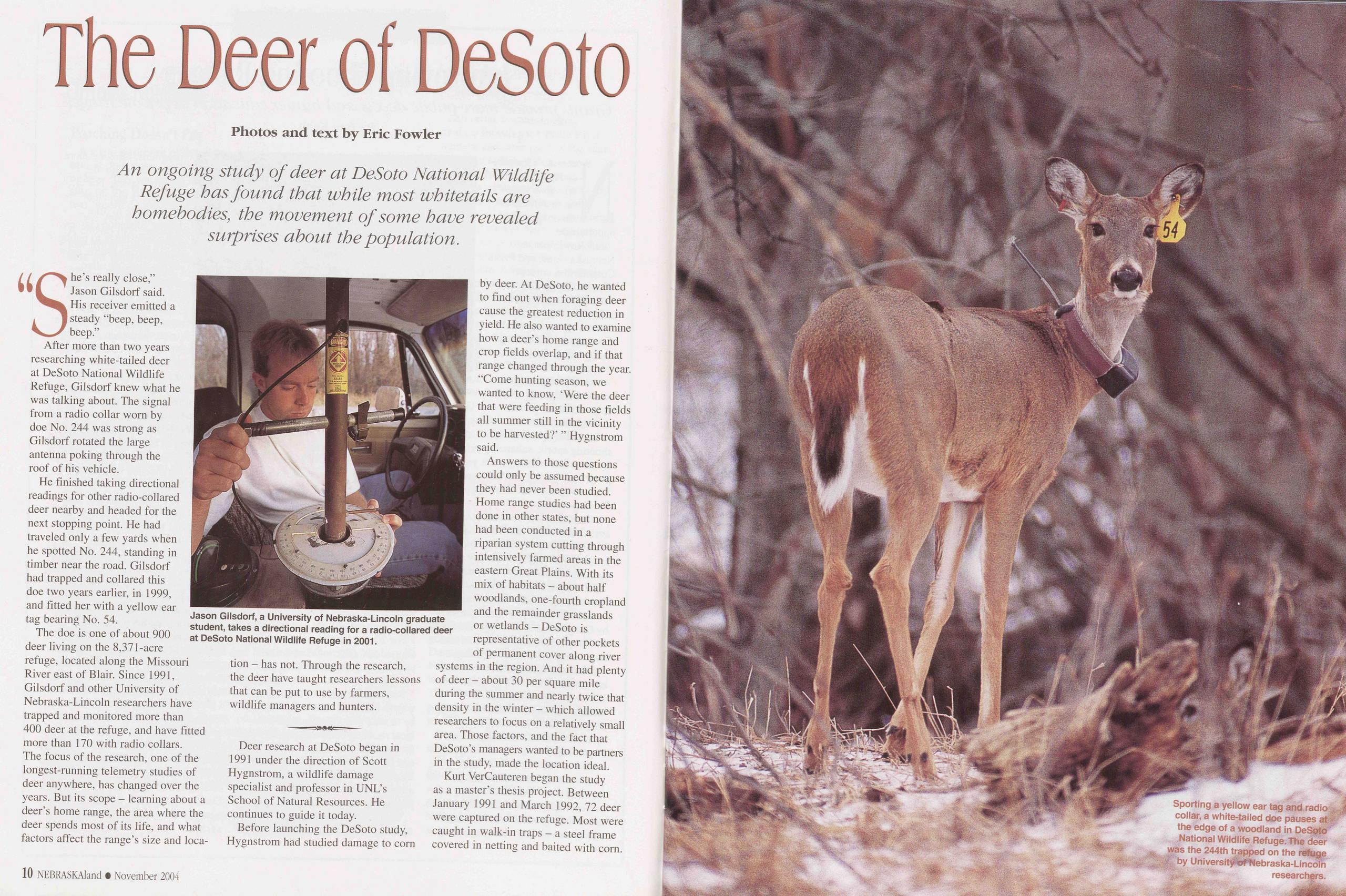
The Deer of DeSoto
Photos and text by Eric Fowler An ongoing study of deer at DeSoto National Wildlife Refuge has found that while most whitetails are homebodies, the movement of some have revealed surprises about the population.She’s really close,” Jason Gilsdorf said. His receiver emitted a steady "beep, beep, beep.”
After more than two years researching white-tailed deer at DeSoto National Wildlife Refuge, Gilsdorf knew what he was talking about. The signal from a radio collar worn by doe No. 244 was strong as Gilsdorf rotated the large antenna poking through the roof of his vehicle.
He finished taking directional readings for other radio-collared deer nearby and headed for the next stopping point. He had traveled only a few yards when he spotted No. 244, standing in timber near the road. Gilsdorf had trapped and collared this doe two years earlier, in 1999, and fitted her with a yellow ear tag bearing No. 54.
The doe is one of about 900 deer living on the 8,371-acre refuge, located along the Missouri River east of Blair. Since 1991, Gilsdorf and other University of Nebraska-Lincoln researchers have trapped and monitored more than 400 deer at the refuge, and have fitted more than 170 with radio collars. The focus of the research, one of the longest-running telemetry studies of deer anywhere, has changed over the years. But its scope - learning about a deer’s home range, the area where the deer spends most of its life, and what factors affect the range’s size and location
Deer research at DeSoto began in 1991 under the direction of Scott Hygnstrom, a wildlife damage specialist and professor in UNL’s School of Natural Resources. He continues to guide it today.
Before launching the DeSoto study, Hygnstrom had studied damage to corn by deer. At DeSoto, he wanted to find out when foraging deer cause the greatest reduction in yield. He also wanted to examine how a deer’s home range and crop fields overlap, and if that range changed through the year. "Come hunting season, we wanted to know, ‘Were the deer that were feeding in those fields all summer still in the vicinity to be harvested?’ ” Hygnstrom said.
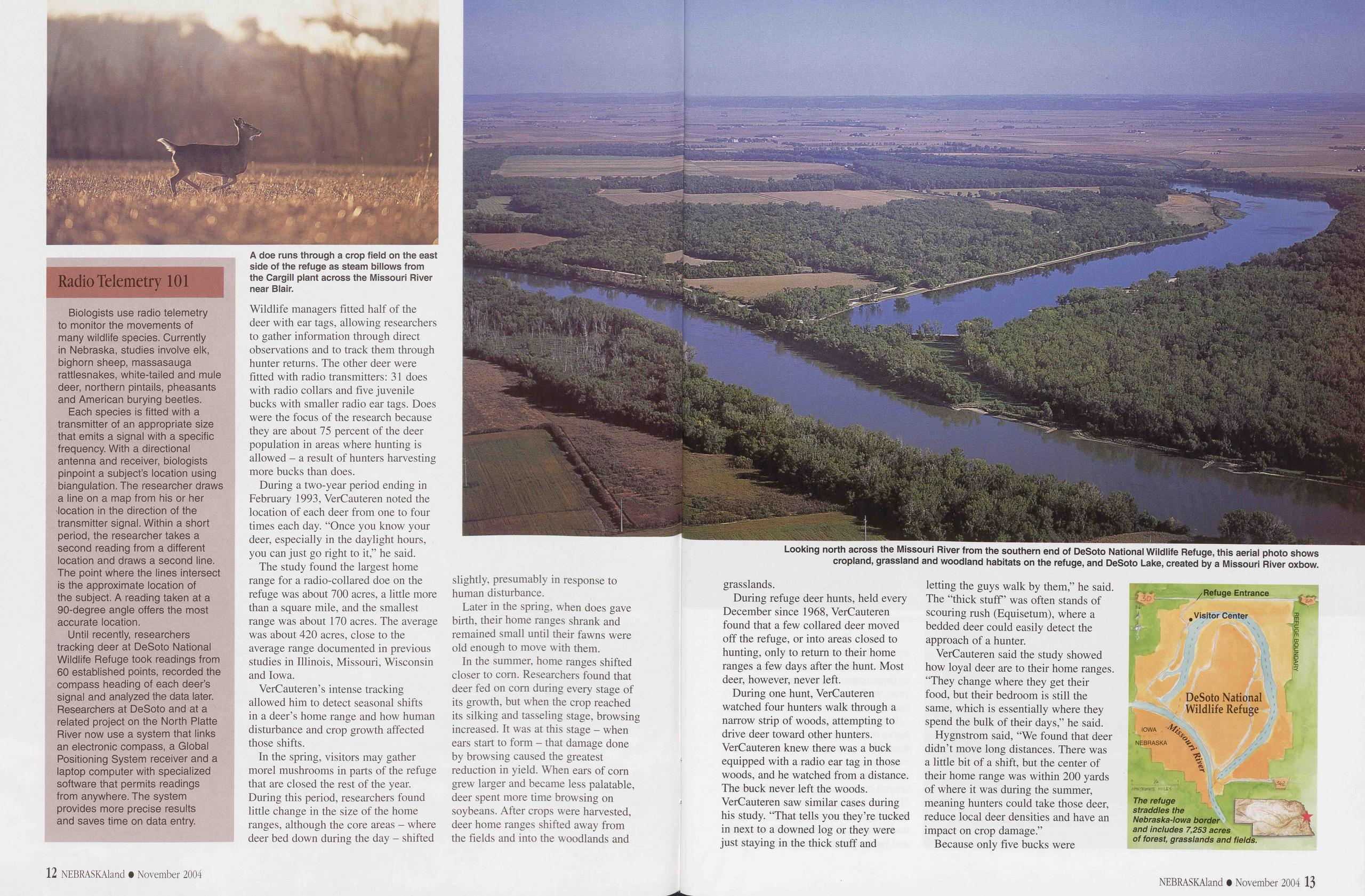
Answers to those questions could only be assumed because they had never been studied. Home range studies had been done in other states, but none had been conducted in a riparian system cutting through intensively farmed areas in the eastern Great Plains. With its mix of habitats - about half woodlands, one-fourth cropland and the remainder grasslands or wetlands - DeSoto is representative of other pockets of permanent cover along river systems in the region. And it had plenty of deer - about 30 per square mile during the summer and nearly twice that density in the winter - which allowed researchers to focus on a relatively small area. Those factors, and the fact that DeSoto’s managers wanted to be partners in the study, made the location ideal.
Kurt VerCauteren began the study as a master’s thesis project. Between January 1991 and March 1992, 72 deer were captured on the refuge. Most were caught in walk-in traps - a steel frame covered in netting and baited with corn.
Biologists use radio telemetry to monitor the movements of many wildlife species. Currently in Nebraska, studies involve elk, bighorn sheep, massasauga rattlesnakes, white-tailed and mule deer, northern pintails, pheasants and American burying beetles.
Each species is fitted with a transmitter of an appropriate size that emits a signal with a specific frequency. With a directional antenna and receiver, biologists pinpoint a subject’s location using biangulation. The researcher draws a line on a map from his or her location in the direction of the transmitter signal. Within a short period, the researcher takes a second reading from a different location and draws a second line. The point where the lines intersect is the approximate location of the subject. A reading taken at a 90-degree angle offers the most accurate location.
Until recently, researchers tracking deer at DeSoto National Wildlife Refuge took readings from 60 established points, recorded the compass heading of each deer’s signal and analyzed the data later. Researchers at DeSoto and at a related project on the North Platte River now use a system that links an electronic compass, a Global Positioning System receiver and a laptop computer with specialized software that permits readings from anywhere. The system provides more precise results and saves time on data entry.
Wildlife managers fitted half of the deer with ear tags, allowing researchers to gather information through direct observations and to track them through hunter returns. The other deer were fitted with radio transmitters: 31 does with radio collars and five juvenile bucks with smaller radio ear tags. Does were the focus of the research because they are about 75 percent of the deer population in areas where hunting is allowed - a result of hunters harvesting more bucks than does.
During a two-year period ending in February 1993, VerCauteren noted the location of each deer from one to four times each day. “Once you know your deer, especially in the daylight hours, you can just go right to it,” he said.
The study found the largest home range for a radio-collared doe on the refuge was about 700 acres, a little more than a square mile, and the smallest range was about 170 acres. The average was about 420 acres, close to the average range documented in previous studies in Illinois, Missouri, Wisconsin and Iowa.
VerCauteren’s intense tracking allowed him to detect seasonal shifts in a deer’s home range and how human disturbance and crop growth affected those shifts.
In the spring, visitors may gather morel mushrooms in parts of the refuge that are closed the rest of the year. During this period, researchers found little change in the size of the home ranges, although the core areas - where deer bed down during the day - shifted
Later in the spring, when does gave birth, their home ranges shrank and remained small until their fawns were old enough to move with them.
In the summer, home ranges shifted closer to com. Researchers found that deer fed on corn during every stage of its growth, but when the crop reached its silking and tasseling stage, browsing increased. It was at this stage - when ears start to form - that damage done by browsing caused the greatest reduction in yield. When ears of corn grew larger and became less palatable, deer spent more time browsing on soybeans. After crops were harvested, deer home ranges shifted away from the fields and into the woodlands and grasslands.
During refuge deer hunts, held every December since 1968, VerCauteren found that a few collared deer moved off the refuge, or into areas closed to hunting, only to return to their home ranges a few days after the hunt. Most deer, however, never left.
During one hunt, VerCauteren watched four hunters walk through a narrow strip of woods, attempting to drive deer toward other hunters. VerCauteren knew there was a buck equipped with a radio ear tag in those woods, and he watched from a distance. The buck never left the woods. VerCauteren saw similar cases during his study. “That tells you they’re tucked in next to a downed log or they were just staying in the thick stuff and letting the guys walk by them,” he said. The “thick stuff’ was often stands of scouring rush (Equisetum), where a bedded deer could easily detect the approach of a hunter.
VerCauteren said the study showed how loyal deer are to their home ranges. “They change where they get their food, but their bedroom is still the same, which is essentially where they spend the bulk of their days,” he said.
Hygnstrom said, “We found that deer didn’t move long distances. There was a little bit of a shift, but the center of their home range was within 200 yards of where it was during the summer, meaning hunters could take those deer, reduce local deer densities and have an impact on crop damage.”
Because only five bucks were
DeSoto’s Deer Herd
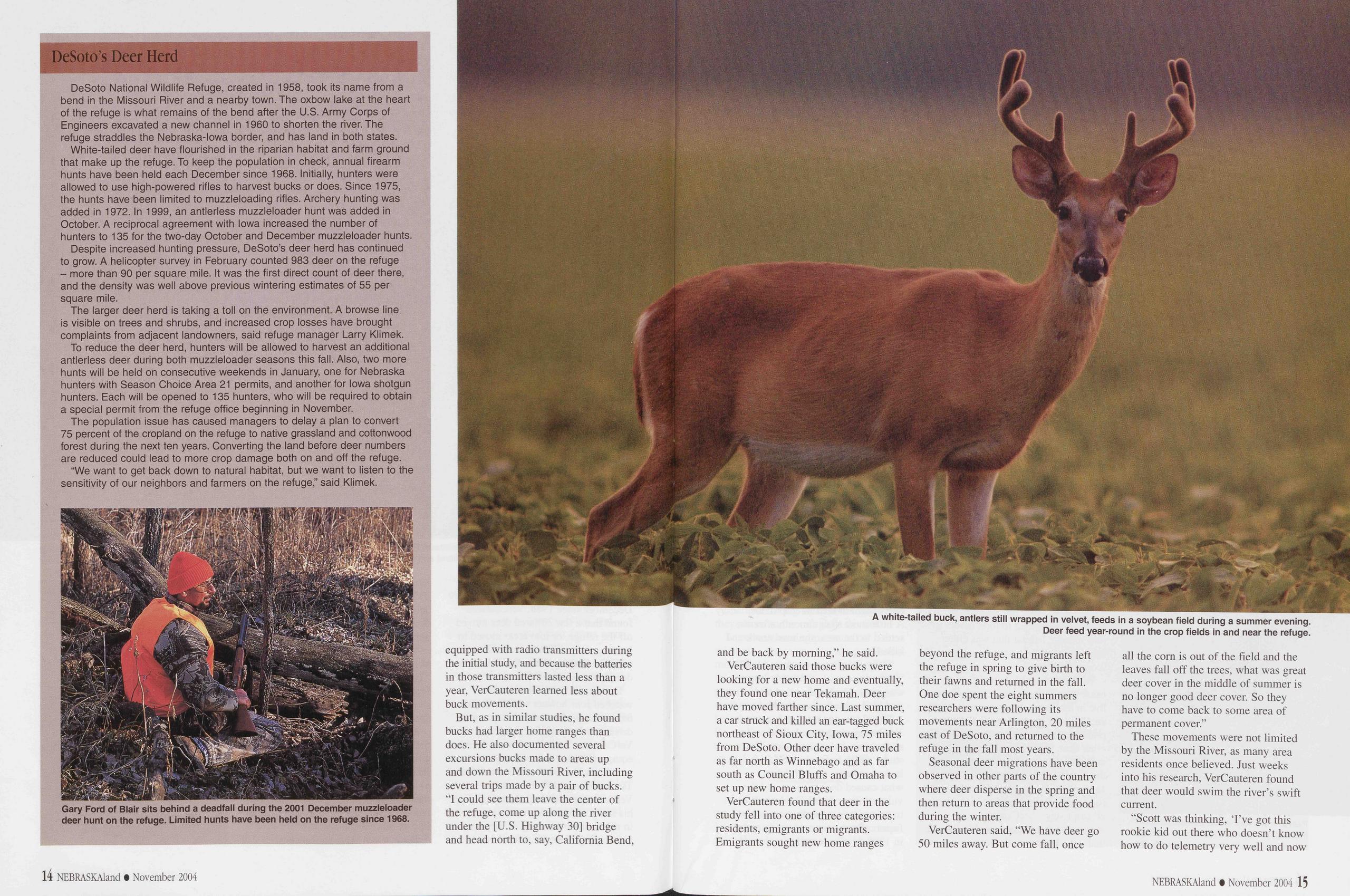
DeSoto National Wildlife Refuge, created in 1958, took its name from a bend in the Missouri River and a nearby town. The oxbow lake at the heart of the refuge is what remains of the bend after the U.S. Army Corps of Engineers excavated a new channel in 1960 to shorten the river. The refuge straddles the Nebraska-Iowa border, and has land in both states.
White-tailed deer have flourished in the riparian habitat and farm ground that make up the refuge. To keep the population in check, annual firearm hunts have been held each December since 1968. Initially, hunters were allowed to use high-powered rifles to harvest bucks or does. Since 1975, the hunts have been limited to muzzleloading rifles. Archery hunting was added in 1972. In 1999, an antlerless muzzleloader hunt was added in October. A reciprocal agreement with Iowa increased the number of hunters to 135 for the two-day October and December muzzleloader hunts.
Despite increased hunting pressure, DeSoto’s deer herd has continued to grow. A helicopter survey in February counted 983 deer on the refuge - more than 90 per square mile. It was the first direct count of deer there, and the density was well above previous wintering estimates of 55 per square mile.
The larger deer herd is taking a toll on the environment. A browse line is visible on trees and shrubs, and increased crop losses have brought complaints from adjacent landowners, said refuge manager Larry Klimek.
To reduce the deer herd, hunters will be allowed to harvest an additional antlerless deer during both muzzleloader seasons this fall. Also, two more hunts will be held on consecutive weekends in January, one for Nebraska hunters with Season Choice Area 21 permits, and another for Iowa shotgun hunters. Each will be opened to 135 hunters, who will be required to obtain a special permit from the refuge office beginning in November.
The population issue has caused managers to delay a plan to convert 75 percent of the cropland on the refuge to native grassland and cottonwood forest during the next ten years. Converting the land before deer numbers are reduced could lead to more crop damage both on and off the refuge.
“We want to get back down to natural habitat, but we want to listen to the sensitivity of our neighbors and farmers on the refuge,” said Klimek.
equipped with radio transmitters during the initial study, and because the batteries in those transmitters lasted less than a year, VerCauteren learned less about buck movements.
But, as in similar studies, he found bucks had larger home ranges than does. He also documented several excursions bucks made to areas up and down the Missouri River, including several trips made by a pair of bucks. "I could see them leave the center of the refuge, come up along the river under the [U.S. Highway 30] bridge and head north to, say, California Bend, and be back by morning,” he said.
VerCauteren said those bucks were looking for a new home and eventually, they found one near Tekamah. Deer have moved farther since. Last summer, a car struck and killed an ear-tagged buck northeast of Sioux City, Iowa, 75 miles from DeSoto. Other deer have traveled as far north as Winnebago and as far south as Council Bluffs and Omaha to set up new home ranges.
VerCauteren found that deer in the study fell into one of three categories: residents, emigrants or migrants. Emigrants sought new home ranges beyond the refuge, and migrants left the refuge in spring to give birth to their fawns and returned in the fall. One doe spent the eight summers researchers were following its movements near Arlington, 20 miles east of DeSoto, and returned to the refuge in the fall most years.
Seasonal deer migrations have been observed in other parts of the country where deer disperse in the spring and then return to areas that provide food during the winter.
VerCauteren said, “We have deer go 50 miles away. But come fall, once all the corn is out of the field and the leaves fall off the trees, what was great deer cover in the middle of summer is no longer good deer cover. So they have to come back to some area of permanent cover.”
These movements were not limited by the Missouri River, as many area residents once believed. Just weeks into his research, VerCauteren found that deer would swim the river’s swift current.
“Scott was thinking, ‘I’ve got this
rookie kid out there who doesn’t know
how to do telemetry very well and now
14 NEBRASKAland • November 2004
NEBRASKAland • November 2004 15
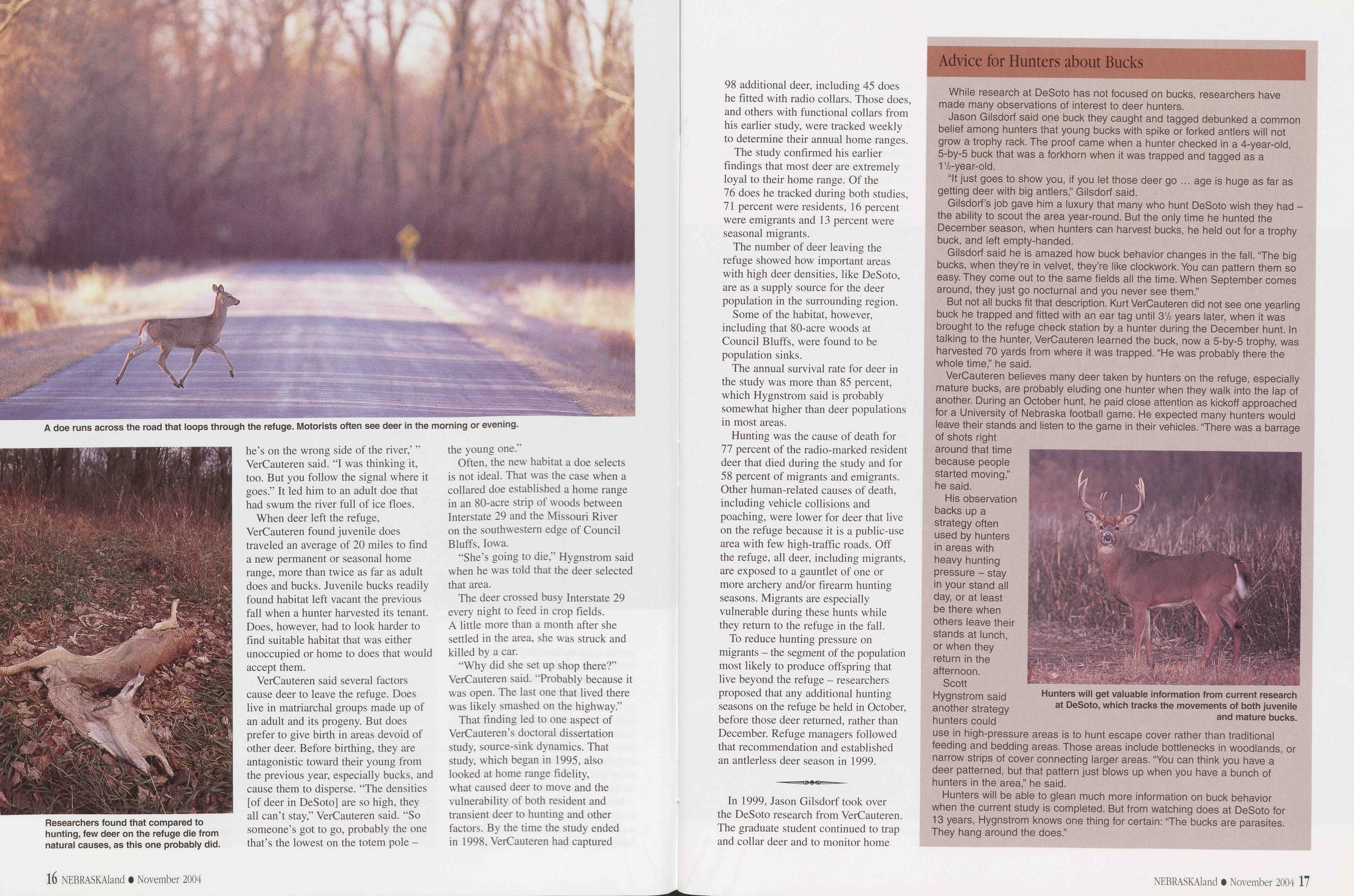
When deer left the refuge, VerCauteren found juvenile does traveled an average of 20 miles to find a new permanent or seasonal home range, more than twice as far as adult does and bucks. Juvenile bucks readily found habitat left vacant the previous fall when a hunter harvested its tenant. Does, however, had to look harder to find suitable habitat that was either unoccupied or home to does that would accept them.
VerCauteren said several factors cause deer to leave the refuge. Does live in matriarchal groups made up of an adult and its progeny. But does prefer to give birth in areas devoid of other deer. Before birthing, they are antagonistic toward their young from the previous year, especially bucks, and cause them to disperse. “The densities [of deer in DeSoto] are so high, they all can’t stay,” VerCauteren said. “So someone’s got to go, probably the one that’s the lowest on the totem pole - the young one.”
Often, the new habitat a doe selects is not ideal. That was the case when a collared doe established a home range in an 80-acre strip of woods between Interstate 29 and the Missouri River on the southwestern edge of Council Bluffs, Iowa.
“She’s going to die,” Hygnstrom said when he was told that the deer selected that area.
The deer crossed busy Interstate 29 every night to feed in crop fields. A little more than a month after she settled in the area, she was struck and killed by a car.
“Why did she set up shop there?” VerCauteren said. “Probably because it was open. The last one that lived there was likely smashed on the highway.”
That finding led to one aspect of VerCauteren’s doctoral dissertation study, source-sink dynamics. That study, which began in 1995, also looked at home range fidelity, what caused deer to move and the vulnerability of both resident and transient deer to hunting and other factors. By the time the study ended in 1998, VerCauteren had captured 98 additional deer, including 45 does he fitted with radio collars. Those does, and others with functional collars from his earlier study, were tracked weekly to determine their annual home ranges.
The study confirmed his earlier findings that most deer are extremely loyal to their home range. Of the 76 does he tracked during both studies, 71 percent were residents, 16 percent were emigrants and 13 percent were seasonal migrants.
The number of deer leaving the refuge showed how important areas with high deer densities, like DeSoto, are as a supply source for the deer population in the surrounding region.
Some of the habitat, however, including that 80-acre woods at Council Bluffs, were found to be population sinks.
The annual survival rate for deer in the study was more than 85 percent, which Hygnstrom said is probably somewhat higher than deer populations in most areas.
Hunting was the cause of death for 77 percent of the radio-marked resident deer that died during the study and for 58 percent of migrants and emigrants. Other human-related causes of death, including vehicle collisions and poaching, were lower for deer that live on the refuge because it is a public-use area with few high-traffic roads. Off the refuge, all deer, including migrants, are exposed to a gauntlet of one or more archery and/or firearm hunting seasons. Migrants are especially vulnerable during these hunts while they return to the refuge in the fall.
To reduce hunting pressure on migrants - the segment of the population most likely to produce offspring that live beyond the refuge - researchers proposed that any additional hunting seasons on the refuge be held in October, before those deer returned, rather than December. Refuge managers followed that recommendation and established an antlerless deer season in 1999.
In 1999, Jason Gilsdorf took over the DeSoto research from VerCauteren. The graduate student continued to trap and collar deer and to monitor home
Advice for Hunters about BucksWhile research at DeSoto has not focused on bucks, researchers have made many observations of interest to deer hunters.
Jason Gilsdorf said one buck they caught and tagged debunked a common belief among hunters that young bucks with spike or forked antlers will not grow a trophy rack. The proof came when a hunter checked in a 4-year-old, 5-by-5 buck that was a forkhorn when it was trapped and tagged as a 1 1/2-year-old.
“It just goes to show you, if you let those deer go ... age is huge as far as getting deer with big antlers,” Gilsdorf said.
Gilsdorf’s job gave him a luxury that many who hunt DeSoto wish they had - the ability to scout the area year-round. But the only time he hunted the December season, when hunters can harvest bucks, he held out for a trophy buck, and left empty-handed.
Gilsdorf said he is amazed how buck behavior changes in the fall. “The big bucks, when they’re in velvet, they’re like clockwork. You can pattern them so easy. They come out to the same fields all the time. When September comes around, they just go nocturnal and you never see them.”
But not all bucks fit that description. Kurt VerCauteren did not see one yearling buck he trapped and fitted with an ear tag until 31/2 years later, when it was brought to the refuge check station by a hunter during the December hunt. In talking to the hunter, VerCauteren learned the buck, now a 5-by-5 trophy, was harvested 70 yards from where it was trapped. “He was probably there the whole time,” he said.
VerCauteren believes many deer taken by hunters on the refuge, especially mature bucks, are probably eluding one hunter when they walk into the lap of another. During an October hunt, he paid close attention as kickoff approached for a University of Nebraska football game. He expected many hunters would leave their stands and listen to the game in their vehicles. “There was a barrage of shots right around that time because people started moving,” he said.
His observation backs up a strategy often used by hunters in areas with heavy hunting pressure - stay in your stand all day, or at least be there when others leave their stands at lunch, or when they return in the afternoon.
Scott Hygnstrom said another strategy hunters could use in high-pressure areas is to hunt escape cover rather than traditional feeding and bedding areas. Those areas include bottlenecks in woodlands, or narrow strips of cover connecting larger areas. “You can think you have a deer patterned, but that pattern just blows up when you have a bunch of hunters in the area,” he said.
Hunters will be able to glean much more information on buck behavior when the current study is completed. But from watching does at DeSoto for 13 years, Hygnstrom knows one thing for certain: “The bucks are parasites. They hang around the does.”
Doe No. 15
From the deer population study at DeSoto National Wildlife Refuge, some intriguing stories about individual deer emerge. The story of doe No. 15 is one of the most interesting.
Captured as an adult during Kurt VerCauteren’s first season, No. 15 showed him that not all deer head for deep cover within their home range in response to hunting pressure. Before the first shot was fired in the 1991 December muzzleloader hunt, the doe had moved nearly three miles from her home range in the center of the refuge to a patch of woods at its western edge that was closed to hunting. A few days after the hunt, she returned to her home range.
With radio telemetry equipment, VerCauteren documented her behavior for several years. One year, he decided he wanted to see it with his own eyes. Before sunup on the first morning of the annual hunt, he parked his truck near a strip of woods that he suspected No. 15 used as escape cover when leaving the hunting area.
“Some guys parked kind of near us and were walking into the woods, down this overgrown fence line full of trees 15 yards wide or so to get to their stand. All of a sudden, from the other direction, here come 13 deer,” he said. Leading the pack was doe No. 15.
“She knew that it was time get to the safe area. All it took was the activity of guys walking through the woods for her to know, ‘Whoa, this only happens once a year, having guys in the woods before it’s light out.’ So she knew. And she did that year after year,” he said.
VerCauteren had trapped and collared two of No. 15’s progeny - No. 19 and No. 137. Both were in the pack, providing evidence that deer form matriarchal groups and learn behavior from the oldest.
Doe No. 15 was trapped several times. The sixth time, in 1997, VerCauteren was glad to see her because the batteries in her radio collar had died.
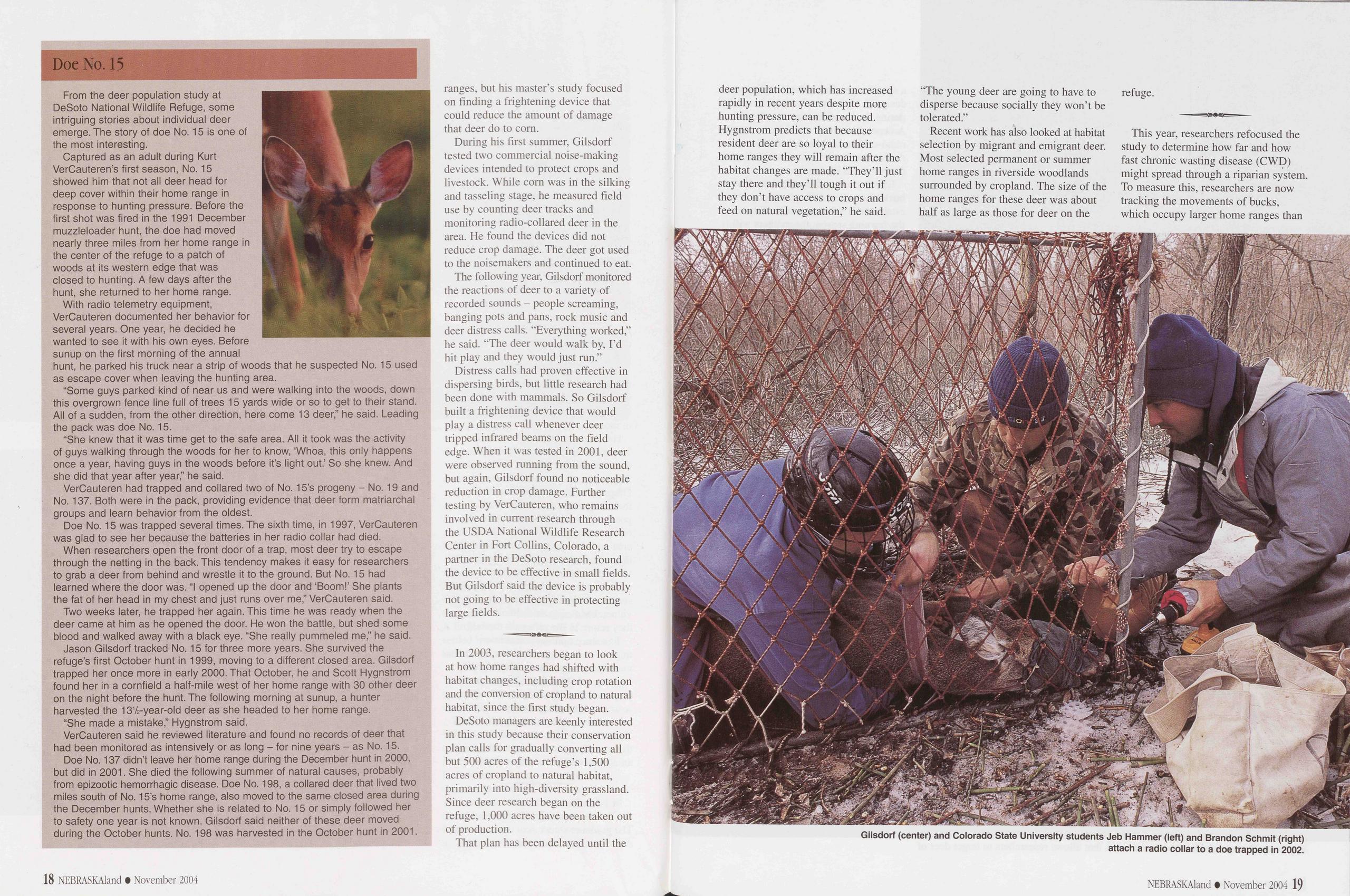
When researchers open the front door of a trap, most deer try to escape through the netting in the back. This tendency makes it easy for researchers to grab a deer from behind and wrestle it to the ground. But No. 15 had learned where the door was. “I opened up the door and ‘Boom!’ She plants the fat of her head in my chest and just runs over me,” VerCauteren said.
Two weeks later, he trapped her again. This time he was ready when the deer came at him as he opened the door. He won the battle, but shed some blood and walked away with a black eye. “She really pummeled me,” he said.
Jason Gilsdorf tracked No. 15 for three more years. She survived the refuge’s first October hunt in 1999, moving to a different closed area. Gilsdorf trapped her once more in early 2000. That October, he and Scott Hygnstrom found her in a cornfield a half-mile west of her home range with 30 other deer on the night before the hunt. The following morning at sunup, a hunter harvested the 13 1/2-year-old deer as she headed to her home range.
“She made a mistake,” Hygnstrom said.
VerCauteren said he reviewed literature and found no records of deer that had been monitored as intensively or as long - for nine years - as No. 15.
Doe No. 137 didn’t leave her home range during the December hunt in 2000, but did in 2001. She died the following summer of natural causes, probably from epizootic hemorrhagic disease. Doe No. 198, a collared deer that lived two miles south of No. 15’s home range, also moved to the same closed area during the December hunts. Whether she is related to No. 15 or simply followed her to safety one year is not known. Gilsdorf said neither of these deer moved during the October hunts. No. 198 was harvested in the October hunt in 2001.
ranges, but his master’s study focused on finding a frightening device that could reduce the amount of damage that deer do to com.
During his first summer, Gilsdorf tested two commercial noise-making devices intended to protect crops and livestock. While corn was in the silking and tasseling stage, he measured field use by counting deer tracks and monitoring radio-collared deer in the area. He found the devices did not reduce crop damage. The deer got used to the noisemakers and continued to eat.
The following year, Gilsdorf monitored the reactions of deer to a variety of recorded sounds - people screaming, banging pots and pans, rock music and deer distress calls. “Everything worked,” he said. “The deer would walk by, I’d hit play and they would just run.”
Distress calls had proven effective in dispersing birds, but little research had been done with mammals. So Gilsdorf built a frightening device that would play a distress call whenever deer tripped infrared beams on the field edge. When it was tested in 2001, deer were observed running from the sound, but again, Gilsdorf found no noticeable reduction in crop damage. Further testing by VerCauteren, who remains involved in current research through the USDA National Wildlife Research Center in Fort Collins, Colorado, a partner in the DeSoto research, found the device to be effective in small fields. But Gilsdorf said the device is probably not going to be effective in protecting large fields.
In 2003, researchers began to look at how home ranges had shifted with habitat changes, including crop rotation and the conversion of cropland to natural habitat, since the first study began.
DeSoto managers are keenly interested in this study because their conservation plan calls for gradually converting all but 500 acres of the refuge’s 1,500 acres of cropland to natural habitat, primarily into high-diversity grassland. Since deer research began on the refuge, 1,000 acres have been taken out of production.
That plan has been delayed until the deer population, which has increased rapidly in recent years despite more hunting pressure, can be reduced. Hygnstrom predicts that because resident deer are so loyal to their home ranges they will remain after the habitat changes are made. “They’ll just stay there and they’ll tough it out if they don’t have access to crops and feed on natural vegetation,” he said. “The young deer are going to have to disperse because socially they won’t be tolerated.”
Recent work has also looked at habitat selection by migrant and emigrant deer. Most selected permanent or summer home ranges in riverside woodlands surrounded by cropland. The size of the home ranges for these deer was about half as large as those for deer on the refuge.
This year, researchers refocused the study to determine how far and how fast chronic wasting disease (CWD) might spread through a riparian system. To measure this, researchers are now tracking the movements of bucks, which occupy larger home ranges than
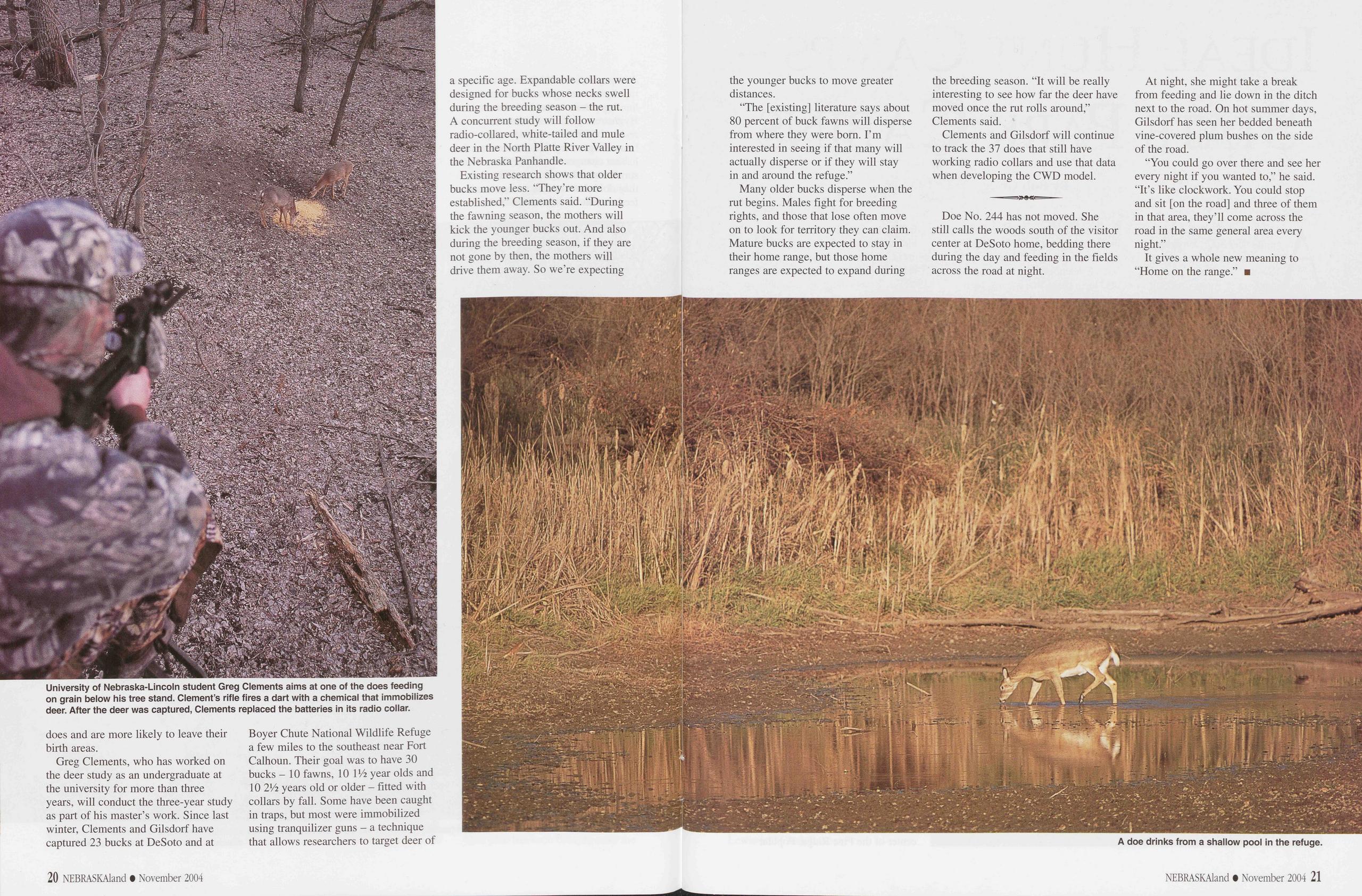
Greg Clements, who has worked on the deer study as an undergraduate at the university for more than three years, will conduct the three-year study as part of his master’s work. Since last winter, Clements and Gilsdorf have captured 23 bucks at DeSoto and at Boyer Chute National Wildlife Refuge a few miles to the southeast near Fort Calhoun. Their goal was to have 30 bucks - 10 fawns, 10 1 1/2 year olds and 10 2 1/2 years old or older - fitted with collars by fall. Some have been caught in traps, but most were immobilized using tranquilizer guns - a technique that allows researchers to target deer of a specific age. Expandable collars were designed for bucks whose necks swell during the breeding season - the rut. A concurrent study will follow radio-collared, white-tailed and mule deer in the North Platte River Valley in the Nebraska Panhandle.
Existing research shows that older bucks move less. “They’re more established,” Clements said. “During the fawning season, the mothers will kick the younger bucks out. And also during the breeding season, if they are not gone by then, the mothers will drive them away. So we’re expecting A doe drinks from a shallow pool in the refuge. the younger bucks to move greater distances.
“The [existing] literature says about 80 percent of buck fawns will disperse from where they were born. I’m interested in seeing if that many will actually disperse or if they will stay in and around the refuge.”
Many older bucks disperse when the rut begins. Males fight for breeding rights, and those that lose often move on to look for territory they can claim. Mature bucks are expected to stay in their home range, but those home ranges are expected to expand during the breeding season. “It will be really interesting to see how far the deer have moved once the rut rolls around,” Clements said.
Clements and Gilsdorf will continue to track the 37 does that still have working radio collars and use that data when developing the CWD model.
Doe No. 244 has not moved. She still calls the woods south of the visitor center at DeSoto home, bedding there during the day and feeding in the fields across the road at night.
At night, she might take a break from feeding and lie down in the ditch next to the road. On hot summer days, Gilsdorf has seen her bedded beneath vine-covered plum bushes on the side of the road.
“You could go over there and see her every night if you wanted to,” he said. “It’s like clockwork. You could stop and sit [on the road] and three of them in that area, they’ll come across the road in the same general area every night.”
It gives a whole new meaning to “Home on the range.”
Ideal Hunt Camps - State Park Cabins
A deer hunter pulls a four-point mule deer buck, harvested a few minutes earlier with a clean, 75-yard shot, through ankle-deep snow. Freezing mist stings his face as the light from a flickering campfire comes into view in the blue riverbottom landscape. The scene would be a lifetime memory for any deer hunter.
Too often, however, that idealistic moment turns into a miserable reality in a wet and cold hunting camp - one with too little dry firewood, too many damp clothes and scant protection against the night’s numbing temperatures, wind and snowfall.
An ideal hunting camp should provide a dry, warm and an otherwise hospitable environment after a long day in the field. With knowledge of the weather conditions and some planning, hunters can set up successful camps for their hunts using a variety of shelters - tents, recreational vehicles or rustic hunting shanties. The trick is to develop a camp that assures basic comfort and protection and that requires minimal time to set up and maintain.
For more information about any of Nebraska’s 87 state park and recreation areas go to www.outdoornebraska.org on the Internet or call the park office. The locations and contact information for the parks mentioned in this story are: Eugene T. Mahoney State Park, near Ashland, west of 1-80 at exit 426. Mailing address: 28500 W. Park Hwy., Ashland, NE 68003. Phone: (402) 944-2523. Platte River State Park, near Louisville, east of 1-80 at exit 426. Mailing address: 14421 346th St. Louisville, NE 68037. Phone: (402) 234-2217. Ponca State Park, near the town of Ponca on Nebraska Highway 12. Mailing address: P.O. Box 688, Ponca, NE 68770. Phone: (402) 755-2284. Niobrara State Park, near the relocated town of Niobrara on Nebraska Highway 12. Mailing address: P.O. Box 226, Niobrara, NE 68760. Phone: (402) 857-3373. Lewis and Clark Lake State Recreation Area, north of Crofton. Mailing address: Box 171, Bloomfield, NE 68718. Phone: (402) 388-4169. Fort Robinson State Park, three miles west of Crawford on U.S. Highway 20. Mailing address: P.O. Box 392, Crawford, NE 69339. Phone: (308) 665-2900. Chadron State Park, nine miles south of Chadron on U.S. Highway 385. Mailing address: 15951 Hwy 385, Chadron, NE 69337. Phone: (308) 432-6167. Victoria Springs State Recreation Area, just east of Anselmo off Nebraska Highway 2. Mailing address: HC 69 Box 117, Anselmo, NE 68813. Phone: (308) 749-2235.One sure solution is a fully equipped and well maintained cabin in one of Nebraska’s state parks or state recreation areas. Nebraska’s traditional family park season is Memorial Day through Labor Day, but six state parks and two state recreation areas offer cabins located near some of the state’s best wildlife areas during both spring and fall hunting season. Cabins at Fort Robinson, Chadron, Niobrara, Ponca, Mahoney and Platte River state parks and Lewis and Clark and Victoria Springs state recreation areas range from two to seven bedrooms and include kitchens, baths, and living areas, and they come complete with blankets, towels, refrigerators and stoves. Reservations are available on a first-come, first-served basis and may be made up to a year in advance.
Fort Robinson and Chadron State ParksWhile some cabins in the state park system are new, others are older than the parks themselves. The original Fort Robinson officers’ quarters (1874 to 1909) are made of adobe and once housed frontier soldiers. Other lodging options for hunters at Fort Robinson are suites of various sizes in Comanche Hall. While the suites do not include kitchens, breakfast and additional food service is available at Fort Robinson. Cabins at the fort sleep from six to 20 people.
Fort Robinson is located near large tracts of public land managed by the U.S. Forest Service (USFS) as well as state wildlife management areas (WMAs). Ponderosa, Gilbert-Baker and Peterson WMAs are revered for their turkey and deer hunting.
The USFS pastures on the Oglala National Grasslands north of Crawford and Fort Robinson are home to the Panhandle’s largest population of pronghorns and pockets of mule and white-tailed deer. The grasslands are also open for predator and small game hunting in season. The Hat Creek, Ash Creek and Bordeaux elk hunting units are within easy drives of Fort Robinson.
Chadron State Park, nestled in the pine forest south of Chadron and about 30 miles from Fort Robinson, offers housekeeping cabins for hunters in the center of the Pine Ridge. Popular
Both Chadron and Fort Robinson have cabins available from April’s spring turkey season through the firearm deer season that ends in mid-November.
Ponca and Niobrara State Parks and Lewis and Clark Lake SRAIn northeastern Nebraska along the Missouri River, Ponca and Niobrara state parks and Lewis and Clark State Recreation Area offer cabins. The parks units are open through the hunting seasons, and Lewis and Clark’s cabins are open year-round.
At Lewis and Clark SRA, the ten two-bedroom cabins, each of which sleeps up to eight people, are in demand by waterfowl hunters on the upper Missouri River. Some spring and fall turkey hunters, deer hunters and pheasant hunters also use the cabins, which have porches looking out to Lewis and Clark Lake.
Ponca and Niobrara state park cabins are usually open in May and remain open until after the state’s firearm deer season in November. Ponca’s 14 identical, two-bedroom cabins are popular with deer hunters who have long-standing permission to access private areas from nearby landowners.
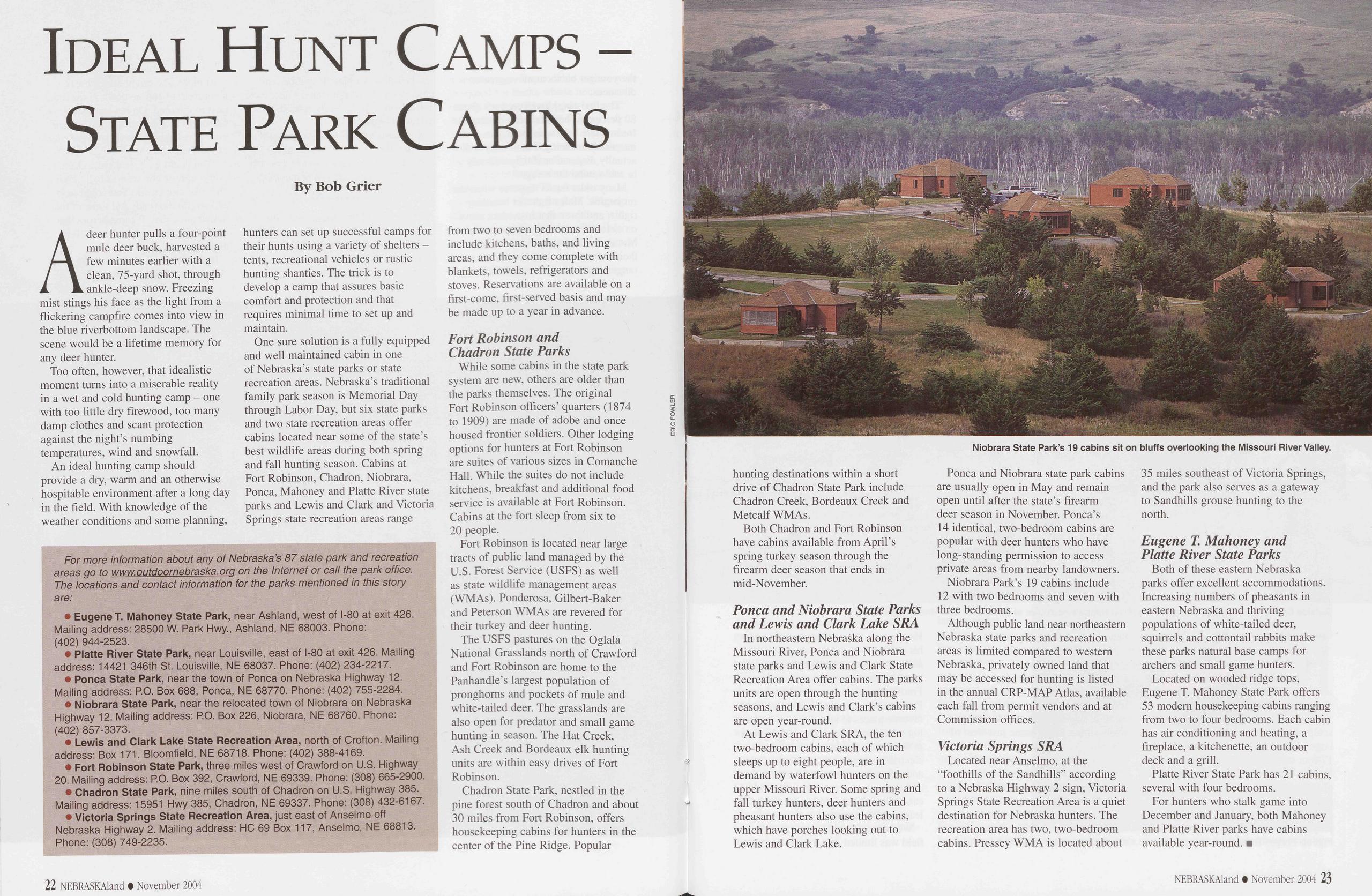
Niobrara Park’s 19 cabins include 12 with two bedrooms and seven with three bedrooms.
Although public land near northeastern Nebraska state parks and recreation areas is limited compared to western Nebraska, privately owned land that may be accessed for hunting is listed in the annual CRP-MAP Atlas, available each fall from permit vendors and at Commission offices.
Victoria Springs SRALocated near Anselmo, at the “foothills of the Sandhills” according to a Nebraska Highway 2 sign, Victoria Springs State Recreation Area is a quiet destination for Nebraska hunters. The recreation area has two, two-bedroom cabins. Pressey WMA is located about 35 miles southeast of Victoria Springs, and the park also serves as a gateway to Sandhills grouse hunting to the north.
Eugene T. Mahoney and Platte River State ParksBoth of these eastern Nebraska parks offer excellent accommodations. Increasing numbers of pheasants in eastern Nebraska and thriving populations of white-tailed deer, squirrels and cottontail rabbits make these parks natural base camps for archers and small game hunters.
Located on wooded ridge tops, Eugene T. Mahoney State Park offers 53 modem housekeeping cabins ranging from two to four bedrooms. Each cabin has air conditioning and heating, a fireplace, a kitchenette, an outdoor deck and a grill.
Platte River State Park has 21 cabins, several with four bedrooms.
For hunters who stalk game into December and January, both Mahoney and Platte River parks have cabins available year-round.
22 NEBRASKAland • November 2004 NEBRASKAland • November 2004 23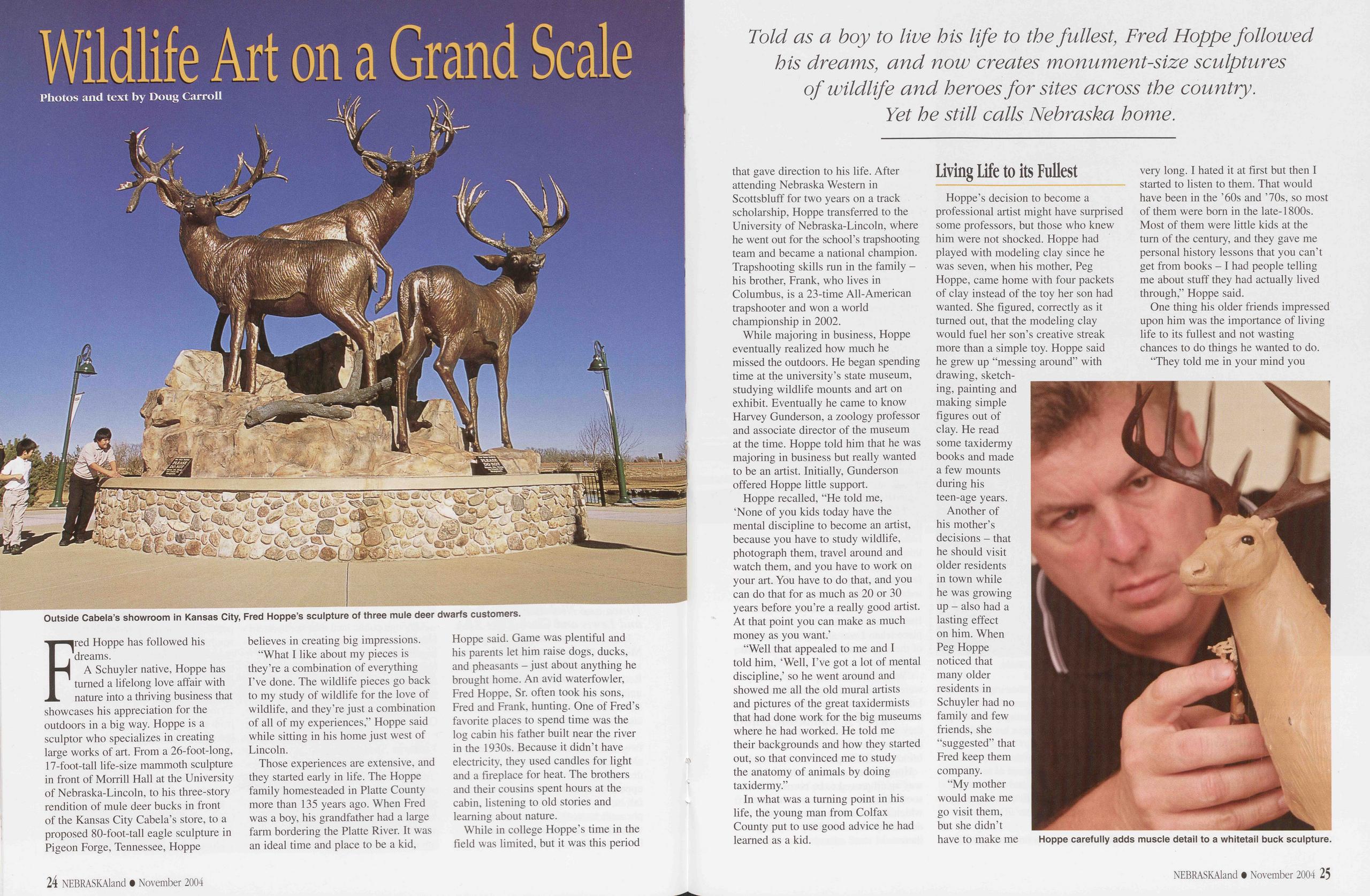
Wildlife Art on a Grand Scale
Photos and text by Doug Carroll Told as a boy to live bis life to the fullest, Fred Hoppe followed bis dreams, and now creates monument-size sculptures of wildlife and heroes for sites across the country. Yet he still calls Nebraska home.Fred Hoppe has followed his dreams.
A Schuyler native, Hoppe has turned a lifelong love affair with nature into a thriving business that showcases his appreciation for the outdoors in a big way. Hoppe is a sculptor who specializes in creating large works of art. From a 26-foot-long, 17-foot-tall life-size mammoth sculpture in front of Morrill Hall at the University of Nebraska-Lincoln, to his three-story rendition of mule deer bucks in front of the Kansas City Cabela’s store, to a proposed 80-foot-tall eagle sculpture in Pigeon Forge, Tennessee, Hoppe believes in creating big impressions.
“What I like about my pieces is they’re a combination of everything I’ve done. The wildlife pieces go back to my study of wildlife for the love of wildlife, and they’re just a combination of all of my experiences,” Hoppe said while sitting in his home just west of Lincoln.
Those experiences are extensive, and they started early in life. The Hoppe family homesteaded in Platte County more than 135 years ago. When Fred was a boy, his grandfather had a large farm bordering the Platte River. It was an ideal time and place to be a kid, Hoppe said. Game was plentiful and his parents let him raise dogs, ducks, and pheasants - just about anything he brought home. An avid waterfowler, Fred Hoppe, Sr. often took his sons, Fred and Frank, hunting. One of Fred’s favorite places to spend time was the log cabin his father built near the river in the 1930s. Because it didn’t have electricity, they used candles for light and a fireplace for heat. The brothers and their cousins spent hours at the cabin, listening to old stories and learning about nature.
While in college Hoppe’s time in the field was limited, but it was this period that gave direction to his life. After attending Nebraska Western in Scottsbluff for two years on a track scholarship, Hoppe transferred to the University of Nebraska-Lincoln, where he went out for the school’s trapshooting team and became a national champion. Trapshooting skills run in the family - his brother, Frank, who lives in Columbus, is a 23-time All-American trapshooter and won a world championship in 2002.
While majoring in business, Hoppe eventually realized how much he missed the outdoors. He began spending time at the university’s state museum, studying wildlife mounts and art on exhibit. Eventually he came to know Harvey Gunderson, a zoology professor and associate director of the museum at the time. Hoppe told him that he was majoring in business but really wanted to be an artist. Initially, Gunderson offered Hoppe little support.
Hoppe recalled, “He told me, ‘None of you kids today have the mental discipline to become an artist, because you have to study wildlife, photograph them, travel around and watch them, and you have to work on your art. You have to do that, and you can do that for as much as 20 or 30 years before you’re a really good artist. At that point you can make as much money as you want.’
“Well that appealed to me and I told him, ‘Well, I’ve got a lot of mental discipline,’ so he went around and showed me all the old mural artists and pictures of the great taxidermists that had done work for the big museums where he had worked. He told me their backgrounds and how they started out, so that convinced me to study the anatomy of animals by doing taxidermy.”
In what was a turning point in his life, the young man from Colfax County put to use good advice he had learned as a kid.
Living Life to its FullestHoppe’s decision to become a professional artist might have surprised some professors, but those who knew him were not shocked. Hoppe had played with modeling clay since he was seven, when his mother, Peg Hoppe, came home with four packets of clay instead of the toy her son had wanted. She figured, correctly as it turned out, that the modeling clay would fuel her son’s creative streak more than a simple toy. Hoppe said he grew up “messing around” with drawing, sketch- ing, painting and making simple figures out of clay. He read some taxidermy books and made a few mounts during his teen-age years.
Another of his mother’s decisions - that he should visit older residents in town while he was growing up - also had a lasting effect on him. When Peg Hoppe noticed that many older residents in Schuyler had no family and few friends, she “suggested” that Fred keep them company.
“My mother would make me go visit them, but she didn’t have to make me very long. I hated it at first but then I started to listen to them. That would have been in the ’60s and ’70s, so most of them were born in the late-1800s. Most of them were little kids at the turn of the century, and they gave me personal history lessons that you can’t get from books - I had people telling me about stuff they had actually lived through,” Hoppe said.
One thing his older friends impressed upon him was the importance of living life to its fullest and not wasting chances to do things he wanted to do.
“They told me in your mind you
To turn his dream of being an artist into reality, Hoppe opened a small taxidermy studio/sporting goods shop in downtown Lincoln in his final year of college.
"It was pretty pathetic compared to the sporting goods stores of today, but it had a rack of guns and little bit of other stuff, and it didn’t take as much to live back in the late-’70s,” Hoppe said.
The business was not very profitable in the beginning, but it served two purposes quite well, Hoppe said. While shaping the forms used for mounts, he learned and practiced sculpting techniques, and he earned enough money to go on outdoor adventures to gather reference materials and learn animal anatomy.
In all, Hoppe has made 42 trips to Alaska, including 11 above the Arctic Circle. He made some trips alone and others with friends, but he always traveled with little more than a backpack, camera, gun and fishing pole.
Being away from his growing taxidermy business (one year he took 18 hunting and reference trips) might have driven away some customers, but Hoppe said it was cheap for him to fly to the arctic and live off the land. Being single, he could do the things he wanted to do.
"So I’d come home, get all my work done, and get out of here again,” Hoppe said.
In 1989 Hoppe decided he was ready to do sculpture, but success did not come easily or immediately. Although he had won more than 100 state, national and world taxidermy awards, it took some time for him to figure out what worked best with clay and bronze.
"I looked at some other artists and they were doing every little hair, every little feather - every little imaginable thing was on the sculpture,” Hoppe said. "So I did it like that and sold a few, but nothing of the magnitude I do today. I just thought that’s what you should do cause they were doing it. But I didn’t like the style - I liked a piece when I was about three-fourths of the way through it - before I added all the detail.
"Well, I sold a few pieces, but they weren’t exactly flying out the door, so I decided that wasn’t going to work and basically said, Tm going to do them they way I want to do them and if they don’t sell then I’ll just have a bunch of bronzes and I'll quit.’ ”
Hoppe’s decision to do things his way again proved to be correct. He soon saw more success with his style, which suggested fur patterns and details more than actually showing them.
Hoppe created tabletop sculptures and showed them at art shows in big cities, but he wanted to do larger pieces. Some people asked if he could do monument-size pieces, but because he did not have any large works to show, potential customers were reluctant to place orders. At this point in his career, the state museum once again played a big part in his life.
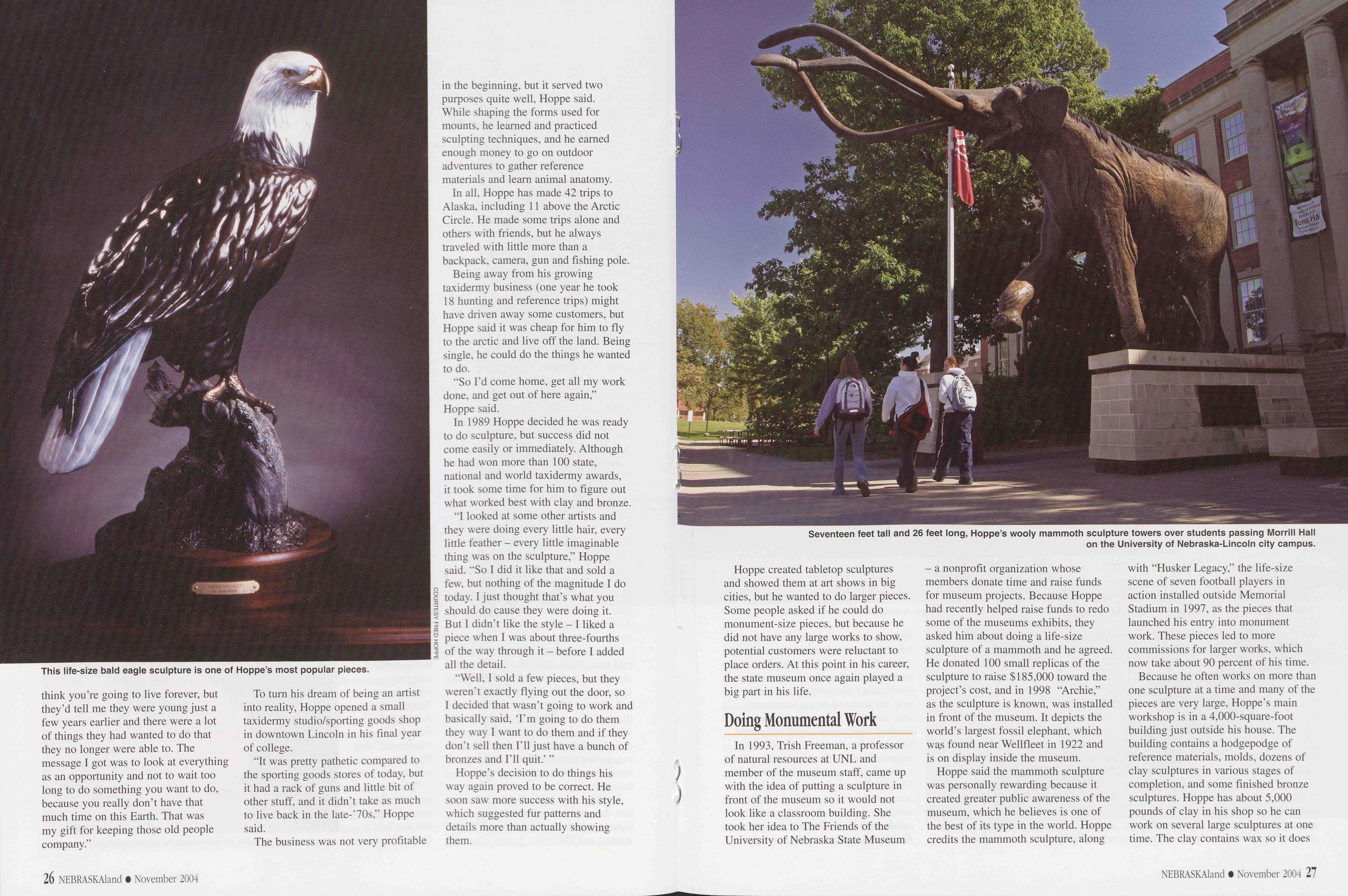
Doing Monumental WorkIn 1993, Trish Freeman, a professor of natural resources at UNL and member of the museum staff, came up with the idea of putting a sculpture in front of the museum so it would not look like a classroom building. She took her idea to The Friends of the University of Nebraska State Museum - a nonprofit organization whose members donate time and raise funds for museum projects. Because Hoppe had recently helped raise funds to redo some of the museums exhibits, they asked him about doing a life-size sculpture of a mammoth and he agreed. He donated 100 small replicas of the sculpture to raise $185,000 toward the project’s cost, and in 1998 "Archie,” as the sculpture is known, was installed in front of the museum. It depicts the world’s largest fossil elephant, which was found near Wellfleet in 1922 and is on display inside the museum.
Hoppe said the mammoth sculpture was personally rewarding because it created greater public awareness of the museum, which he believes is one of the best of its type in the world. Hoppe credits the mammoth sculpture, along with "Husker Legacy,” the life-size scene of seven football players in action installed outside Memorial Stadium in 1997, as the pieces that launched his entry into monument work. These pieces led to more commissions for larger works, which now take about 90 percent of his time.
Because he often works on more than
one sculpture at a time and many of the
pieces are very large, Hoppe’s main
workshop is in a 4,000-square-foot
building just outside his house. The
building contains a hodgepodge of
reference materials, molds, dozens of
clay sculptures in various stages of
completion, and some finished bronze
sculptures. Hoppe has about 5,000
pounds of clay in his shop so he can
work on several large sculptures at one
time. The clay contains wax so it does
26 NEBRASKAland • November 2004
NEBRASKAland • November 2004 27
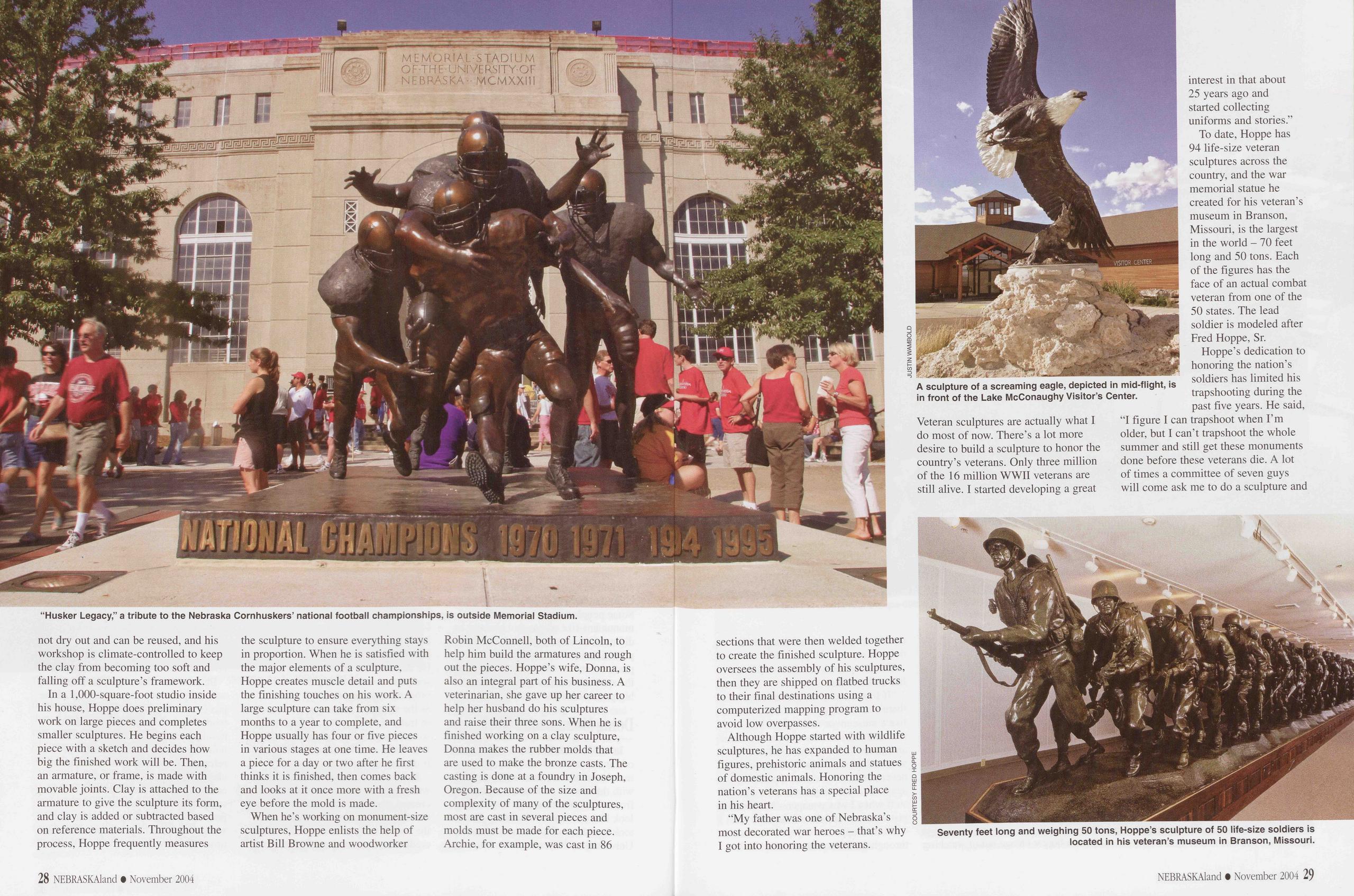
In a 1,000-square-foot studio inside his house, Hoppe does preliminary work on large pieces and completes smaller sculptures. He begins each piece with a sketch and decides how big the finished work will be. Then, an armature, or frame, is made with movable joints. Clay is attached to the armature to give the sculpture its form, and clay is added or subtracted based on reference materials. Throughout the process, Hoppe frequently measures the sculpture to ensure everything stays in proportion. When he is satisfied with the major elements of a sculpture, Hoppe creates muscle detail and puts the finishing touches on his work. A large sculpture can take from six months to a year to complete, and Hoppe usually has four or five pieces in various stages at one time. He leaves a piece for a day or two after he first thinks it is finished, then comes back and looks at it once more with a fresh eye before the mold is made.
When he’s working on monument-size sculptures, Hoppe enlists the help of artist Bill Browne and woodworker Robin McConnell, both of Lincoln, to help him build the armatures and rough out the pieces. Hoppe’s wife, Donna, is also an integral part of his business. A veterinarian, she gave up her career to help her husband do his sculptures and raise their three sons. When he is finished working on a clay sculpture, Donna makes the rubber molds that are used to make the bronze casts. The casting is done at a foundry in Joseph, Oregon. Because of the size and complexity of many of the sculptures, most are cast in several pieces and molds must be made for each piece. Archie, for example, was cast in 86 sections that were then welded together to create the finished sculpture. Hoppe oversees the assembly of his sculptures, then they are shipped on flatbed trucks to their final destinations using a computerized mapping program to avoid low overpasses.
Although Hoppe started with wildlife sculptures, he has expanded to human figures, prehistoric animals and statues of domestic animals. Honoring the nation’s veterans has a special place in his heart.
“My father was one of Nebraska’s most decorated war heroes - that’s why I got into honoring the veterans.
To date, Hoppe has 94 life-size veteran sculptures across the country, and the war memorial statue he created for his veteran’s museum in Branson, Missouri, is the largest in the world - 70 feet long and 50 tons. Each of the figures has the face of an actual combat veteran from one of the 50 states. The lead soldier is modeled after Fred Hoppe, Sr.
Hoppe’s dedication to honoring the nation’s soldiers has limited his trapshooting during the past five years. He said, “I figure I can trapshoot when I’m older, but I can’t trapshoot the whole summer and still get these monuments done before these veterans die. A lot of times a committee of seven guys will come ask me to do a sculpture and
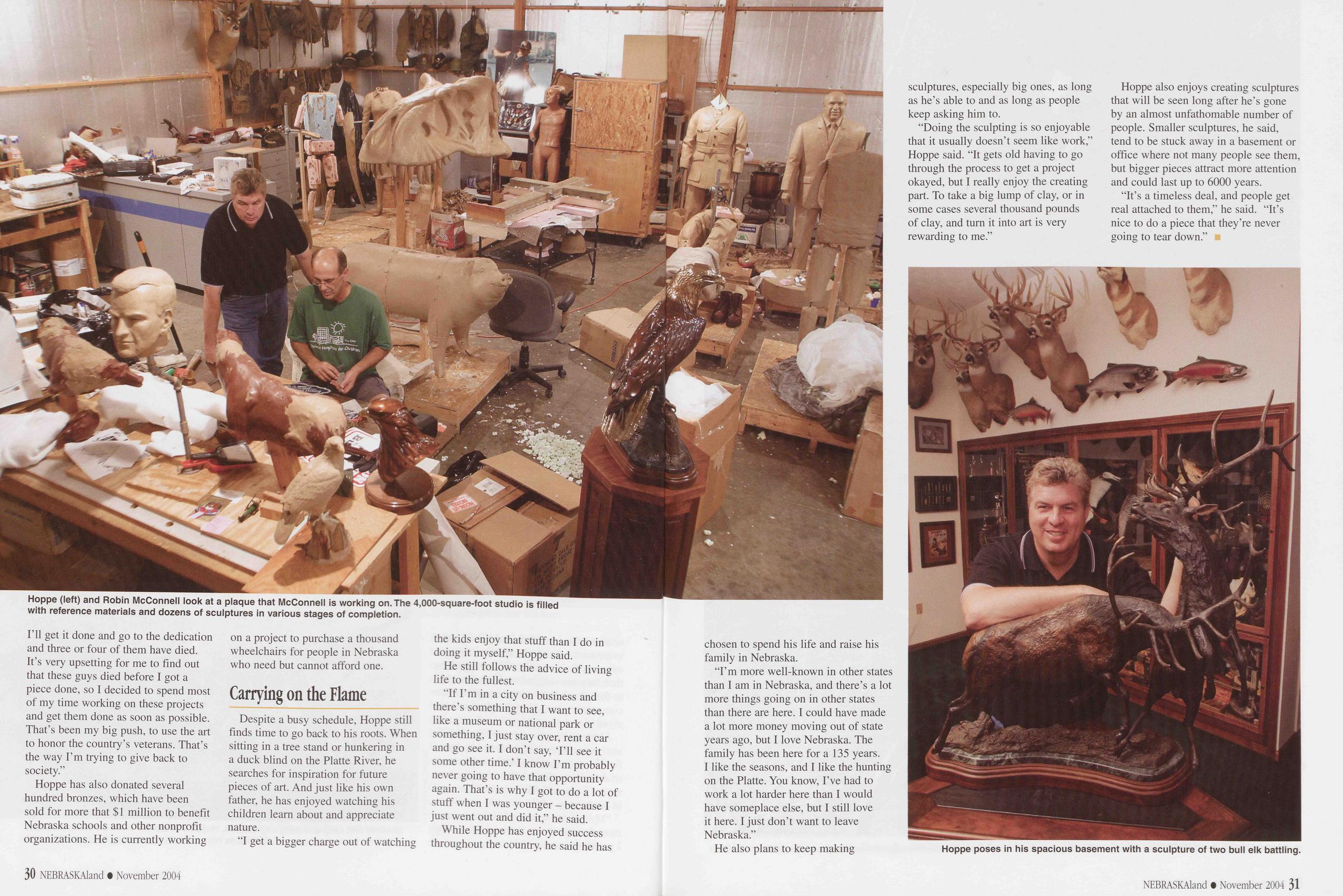
Hoppe has also donated several hundred bronzes, which have been sold for more that $1 million to benefit Nebraska schools and other nonprofit organizations. He is currently working on a project to purchase a thousand wheelchairs for people in Nebraska who need but cannot afford one.
Carrying on the FlameDespite a busy schedule, Hoppe still finds time to go back to his roots. When sitting in a tree stand or hunkering in a duck blind on the Platte River, he searches for inspiration for future pieces of art. And just like his own father, he has enjoyed watching his children learn about and appreciate nature.
“I get a bigger charge out of watching the kids enjoy that stuff than I do in doing it myself,” Hoppe said.
He still follows the advice of living life to the fullest.
“If I’m in a city on business and there’s something that I want to see, like a museum or national park or something, I just stay over, rent a car and go see it. I don’t say, TH see it some other time.’ I know I’m probably never going to have that opportunity again. That’s is why I got to do a lot of stuff when I was younger - because I just went out and did it,” he said.
While Hoppe has enjoyed success throughout the country, he said he has chosen to spend his life and raise his family in Nebraska.
“I’m more well-known in other states than I am in Nebraska, and there’s a lot more things going on in other states than there are here. I could have made a lot more money moving out of state years ago, but I love Nebraska. The family has been here for a 135 years. I like the seasons, and I like the hunting on the Platte. You know, I’ve had to work a lot harder here than I would have someplace else, but I still love it here. I just don’t want to leave Nebraska.”
He also plans to keep making sculptures, especially big ones, as long as he’s able to and as long as people keep asking him to.
“Doing the sculpting is so enjoyable that it usually doesn’t seem like work,” Hoppe said. “It gets old having to go through the process to get a project okayed, but I really enjoy the creating part. To take a big lump of clay, or in some cases several thousand pounds of clay, and turn it into art is very rewarding to me.”
Hoppe also enjoys creating sculptures that will be seen long after he’s gone by an almost unfathomable number of people. Smaller sculptures, he said, tend to be stuck away in a basement or office where not many people see them, but bigger pieces attract more attention and could last up to 6000 years.
“It’s a timeless deal, and people get real attached to them,” he said. “It’s nice to do a piece that they’re never going to tear down.”
Flight of the Osprey
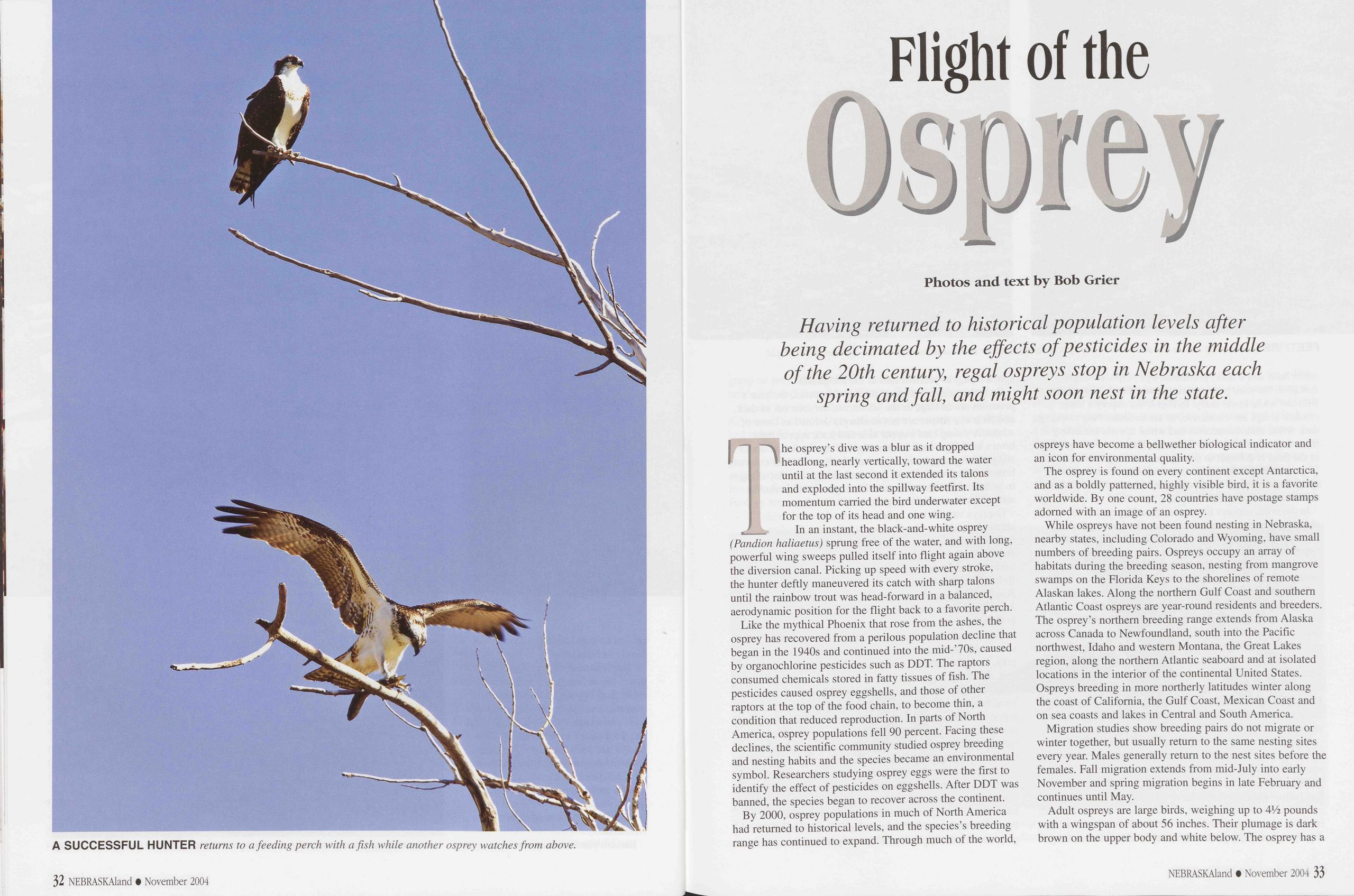
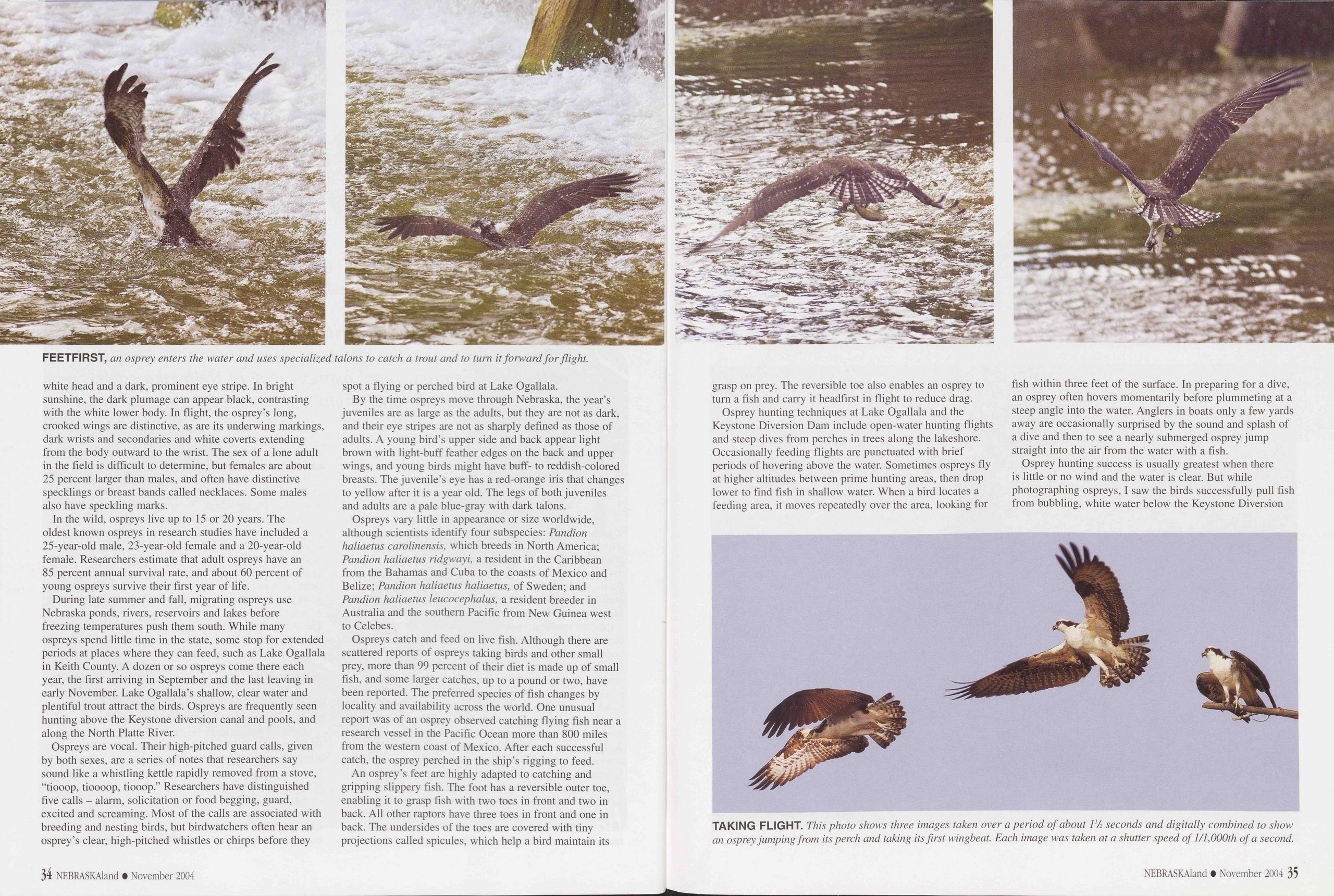
Having returned to historical population levels after being decimated by the effects of pesticides in the middle of the 20th century, regal ospreys stop in Nebraska each spring and fall, and might soon nest in the state.The osprey’s dive was a blur as it dropped headlong, nearly vertically, toward the water until at the last second it extended its talons and exploded into the spillway feetfirst. Its momentum carried the bird underwater except for the top of its head and one wing.
In an instant, the black-and-white osprey (Pandion haliaetus) sprung free of the water, and with long, powerful wing sweeps pulled itself into flight again above the diversion canal. Picking up speed with every stroke, the hunter deftly maneuvered its catch with sharp talons until the rainbow trout was head-forward in a balanced, aerodynamic position for the flight back to a favorite perch.
Like the mythical Phoenix that rose from the ashes, the osprey has recovered from a perilous population decline that began in the 1940s and continued into the mid-’70s, caused by organochlorine pesticides such as DDT. The raptors consumed chemicals stored in fatty tissues of fish. The pesticides caused osprey eggshells, and those of other raptors at the top of the food chain, to become thin, a condition that reduced reproduction. In parts of North America, osprey populations fell 90 percent. Facing these declines, the scientific community studied osprey breeding and nesting habits and the species became an environmental symbol. Researchers studying osprey eggs were the first to identify the effect of pesticides on eggshells. After DDT was banned, the species began to recover across the continent.
By 2000, osprey populations in much of North America had returned to historical levels, and the species’s breeding range has continued to expand. Through much of the world, ospreys have become a bellwether biological indicator and an icon for environmental quality.
The osprey is found on every continent except Antarctica, and as a boldly patterned, highly visible bird, it is a favorite worldwide. By one count, 28 countries have postage stamps adorned with an image of an osprey.
While ospreys have not been found nesting in Nebraska, nearby states, including Colorado and Wyoming, have small numbers of breeding pairs. Ospreys occupy an array of habitats during the breeding season, nesting from mangrove swamps on the Florida Keys to the shorelines of remote Alaskan lakes. Along the northern Gulf Coast and southern Atlantic Coast ospreys are year-round residents and breeders. The osprey’s northern breeding range extends from Alaska across Canada to Newfoundland, south into the Pacific northwest, Idaho and western Montana, the Great Lakes region, along the northern Atlantic seaboard and at isolated locations in the interior of the continental United States. Ospreys breeding in more northerly latitudes winter along the coast of California, the Gulf Coast, Mexican Coast and on sea coasts and lakes in Central and South America.
Migration studies show breeding pairs do not migrate or winter together, but usually return to the same nesting sites every year. Males generally return to the nest sites before the females. Fall migration extends from mid-July into early November and spring migration begins in late February and continues until May.
Adult ospreys are large birds, weighing up to 4 1/2 pounds
with a wingspan of about 56 inches. Their plumage is dark
brown on the upper body and white below. The osprey has a
32 NEBRASKAland • November 2004
NEBRASKAland • November 2004 33
In the wild, ospreys live up to 15 or 20 years. The oldest known ospreys in research studies have included a 25-year-old male, 23-year-old female and a 20-year-old female. Researchers estimate that adult ospreys have an 85 percent annual survival rate, and about 60 percent of young ospreys survive their first year of life.
During late summer and fall, migrating ospreys use Nebraska ponds, rivers, reservoirs and lakes before freezing temperatures push them south. While many ospreys spend little time in the state, some stop for extended periods at places where they can feed, such as Lake Ogallala in Keith County. A dozen or so ospreys come there each year, the first arriving in September and the last leaving in early November. Lake Ogallala’s shallow, clear water and plentiful trout attract the birds. Ospreys are frequently seen hunting above the Keystone diversion canal and pools, and along the North Platte River.
Ospreys are vocal. Their high-pitched guard calls, given by both sexes, are a series of notes that researchers say sound like a whistling kettle rapidly removed from a stove, "tiooop, tioooop, tiooop.” Researchers have distinguished five calls - alarm, solicitation or food begging, guard, excited and screaming. Most of the calls are associated with breeding and nesting birds, but birdwatchers often hear an osprey’s clear, high-pitched whistles or chirps before they spot a flying or perched bird at Lake Ogallala.
By the time ospreys move through Nebraska, the year’s juveniles are as large as the adults, but they are not as dark, and their eye stripes are not as sharply defined as those of adults. A young bird’s upper side and back appear light brown with light-buff feather edges on the back and upper wings, and young birds might have buff- to reddish-colored breasts. The juvenile’s eye has a red-orange iris that changes to yellow after it is a year old. The legs of both juveniles and adults are a pale blue-gray with dark talons.
Ospreys vary little in appearance or size worldwide, although scientists identify four subspecies: Pandion haliaetus carolinensis, which breeds in North America; Pandion haliaetus ridgwayi, a resident in the Caribbean from the Bahamas and Cuba to the coasts of Mexico and Belize; Pandion haliaetus haliaetus, of Sweden; and Pandion haliaetus leucocephalus, a resident breeder in Australia and the southern Pacific from New Guinea west to Celebes.
Ospreys catch and feed on live fish. Although there are scattered reports of ospreys taking birds and other small prey, more than 99 percent of their diet is made up of small fish, and some larger catches, up to a pound or two, have been reported. The preferred species of fish changes by locality and availability across the world. One unusual report was of an osprey observed catching flying fish near a research vessel in the Pacific Ocean more than 800 miles from the western coast of Mexico. After each successful catch, the osprey perched in the ship’s rigging to feed.
An osprey’s feet are highly adapted to catching and gripping slippery fish. The foot has a reversible outer toe, enabling it to grasp fish with two toes in front and two in back. All other raptors have three toes in front and one in back. The undersides of the toes are covered with tiny projections called spicules, which help a bird maintain its grasp on prey. The reversible toe also enables an osprey to turn a fish and carry it headfirst in flight to reduce drag.
Osprey hunting techniques at Lake Ogallala and the Keystone Diversion Dam include open-water hunting flights and steep dives from perches in trees along the lakeshore. Occasionally feeding flights are punctuated with brief periods of hovering above the water. Sometimes ospreys fly at higher altitudes between prime hunting areas, then drop lower to find fish in shallow water. When a bird locates a feeding area, it moves repeatedly over the area, looking for fish within three feet of the surface. In preparing for a dive, an osprey often hovers momentarily before plummeting at a steep angle into the water. Anglers in boats only a few yards away are occasionally surprised by the sound and splash of a dive and then to see a nearly submerged osprey jump straight into the air from the water with a fish.
Osprey hunting success is usually greatest when there is little or no wind and the water is clear. But while photographing ospreys, I saw the birds successfully pull fish from bubbling, white water below the Keystone Diversion
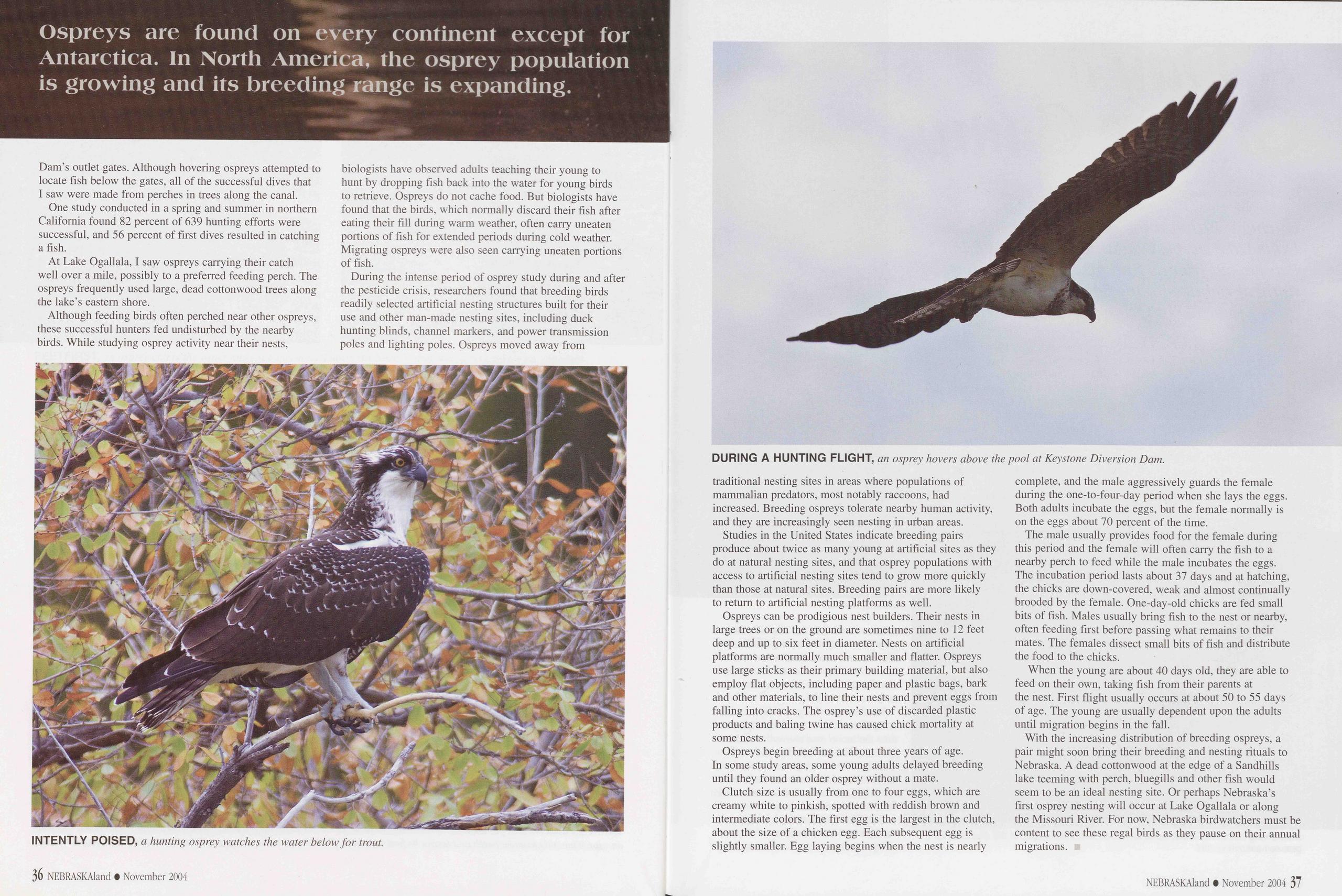 Dam’s outlet gates. Although hovering ospreys attempted to
locate fish below the gates, all of the successful dives that
I saw were made from perches in trees along the canal.
Ospreys are found on every continent except for
Antarctica. In North America, the osprey population
is growing and its breeding range is expanding.
Dam’s outlet gates. Although hovering ospreys attempted to
locate fish below the gates, all of the successful dives that
I saw were made from perches in trees along the canal.
Ospreys are found on every continent except for
Antarctica. In North America, the osprey population
is growing and its breeding range is expanding.
One study conducted in a spring and summer in northern California found 82 percent of 639 hunting efforts were successful, and 56 percent of first dives resulted in catching a fish.
At Lake Ogallala, I saw ospreys carrying their catch well over a mile, possibly to a preferred feeding perch. The ospreys frequently used large, dead cottonwood trees along the lake’s eastern shore.
Although feeding birds often perched near other ospreys, these successful hunters fed undisturbed by the nearby birds. While studying osprey activity near their nests, biologists have observed adults teaching their young to hunt by dropping fish back into the water for young birds to retrieve. Ospreys do not cache food. But biologists have found that the birds, which normally discard their fish after eating their fill during warm weather, often carry uneaten portions of fish for extended periods during cold weather. Migrating ospreys were also seen carrying uneaten portions of fish.
During the intense period of osprey study during and after the pesticide crisis, researchers found that breeding birds readily selected artificial nesting structures built for their use and other man-made nesting sites, including duck hunting blinds, channel markers, and power transmission poles and lighting poles. Ospreys moved away from
Studies in the United States indicate breeding pairs access to artificial nesting sites tend to grow more quickly than those at natural sites. Breeding pairs are more likely to return to artificial nesting platforms as well.
Ospreys can be prodigious nest builders. Their nests in large trees or on the ground are sometimes nine to 12 feet deep and up to six feet in diameter. Nests on artificial platforms are normally much smaller and flatter. Ospreys use large sticks as their primary building material, but also employ flat objects, including paper and plastic bags, bark and other materials, to line their nests and prevent eggs from falling into cracks. The osprey’s use of discarded plastic products and baling twine has caused chick mortality at some nests.
Ospreys begin breeding at about three years of age. In some study areas, some young adults delayed breeding until they found an older osprey without a mate.
Clutch size is usually from one to four eggs, which are creamy white to pinkish, spotted with reddish brown and intermediate colors. The first egg is the largest in the clutch, about the size of a chicken egg. Each subsequent egg is slightly smaller. Egg laying begins when the nest is nearly complete, and the male aggressively guards the female during the one-to-four-day period when she lays the eggs. Both adults incubate the eggs, but the female normally is on the eggs about 70 percent of the time.
The male usually provides food for the female during this period and the female will often carry the fish to a nearby perch to feed while the male incubates the eggs. The incubation period lasts about 37 days and at hatching, the chicks are down-covered, weak and almost continually brooded by the female. One-day-old chicks are fed small bits of fish. Males usually bring fish to the nest or nearby, often feeding first before passing what remains to their mates. The females dissect small bits of fish and distribute the food to the chicks.
When the young are about 40 days old, they are able to feed on their own, taking fish from their parents at the nest. First flight usually occurs at about 50 to 55 days of age. The young are usually dependent upon the adults until migration begins in the fall.
With the increasing distribution of breeding ospreys, a pair might soon bring their breeding and nesting rituals to Nebraska. A dead cottonwood at the edge of a Sandhills lake teeming with perch, bluegills and other fish would seem to be an ideal nesting site. Or perhaps Nebraska’s first osprey nesting will occur at Lake Ogallala or along the Missouri River. For now, Nebraska birdwatchers must be content to see these regal birds as they pause on their annual migrations.
36 NEBRASKAland • November 2004 NEBRASKAland • November 2004 37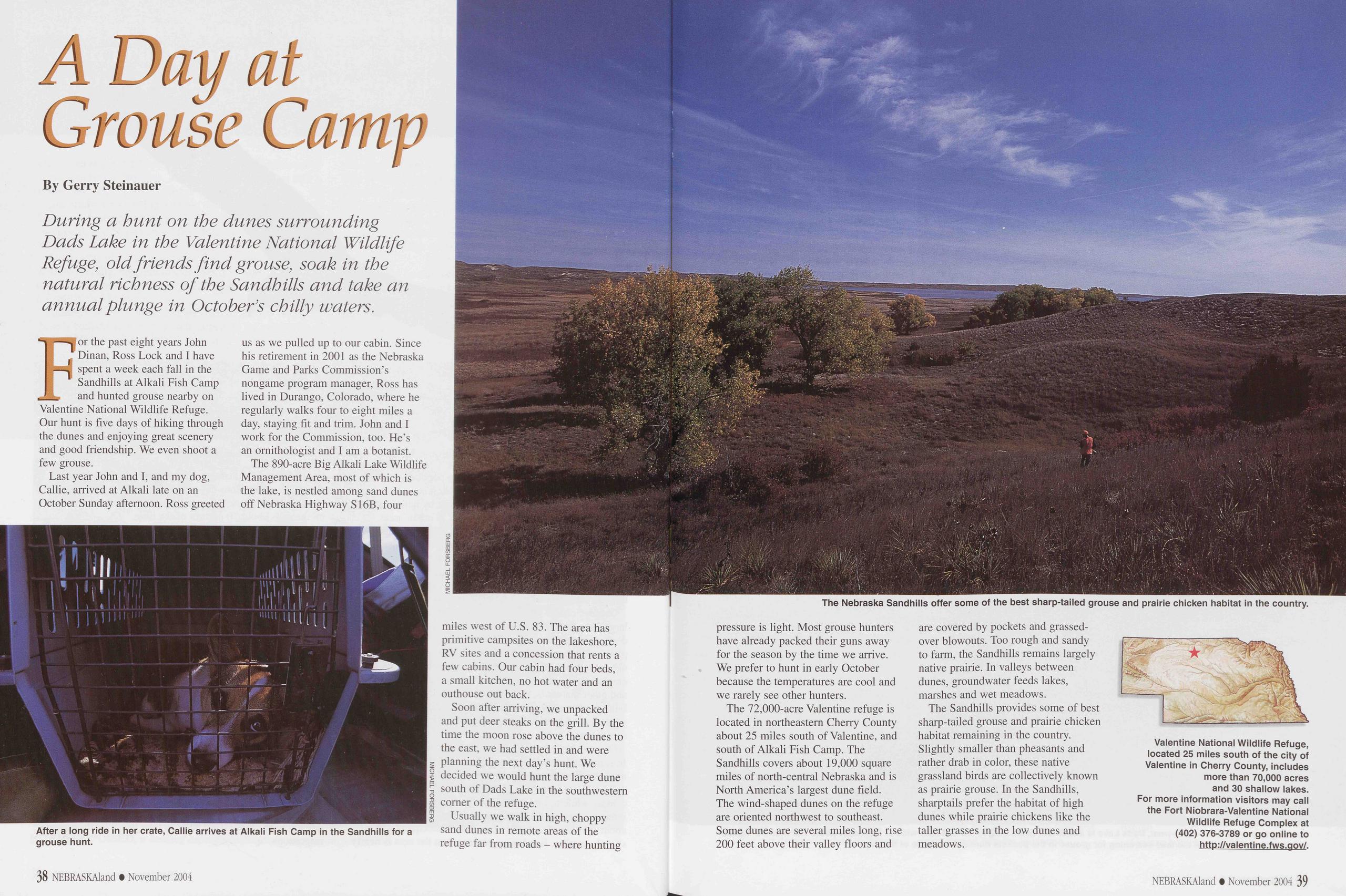
A Day at Grouse Camp
During a hunt on the dunes surrounding Dads Lake in the Valentine National Wildlife Refuge, old friends find grouse, soak in the natural richness of the Sandhills and take an annual plunge in October’s chilly waters.For the past eight years John Dinan, Ross Lock and I have spent a week each fall in the Sandhills at Alkali Fish Camp and hunted grouse nearby on Valentine National Wildlife Refuge. Our hunt is five days of hiking through the dunes and enjoying great scenery and good friendship. We even shoot a few grouse.
Last year John and I, and my dog, Callie, arrived at Alkali late on an October Sunday afternoon. Ross greeted us as we pulled up to our cabin. Since his retirement in 2001 as the Nebraska Game and Parks Commission’s nongame program manager, Ross has lived in Durango, Colorado, where he regularly walks four to eight miles a day, staying fit and trim. John and I work for the Commission, too. He’s an ornithologist and I am a botanist.
The 890-acre Big Alkali Lake Wildlife Management Area, most of which is the lake, is nestled among sand dunes off Nebraska Highway S16B, four
Soon after arriving, we unpacked and put deer steaks on the grill. By the time the moon rose above the dunes to the east, we had settled in and were planning the next day’s hunt. We decided we would hunt the large dune south of Dads Lake in the southwestern corner of the refuge.
Usually we walk in high, choppy sand dunes in remote areas of the refuge far from roads - where hunting
The 72,000-acre Valentine refuge is located in northeastern Cherry County about 25 miles south of Valentine, and south of Alkali Fish Camp. The Sandhills covers about 19,000 square miles of north-central Nebraska and is North America’s largest dune field. The wind-shaped dunes on the refuge are oriented northwest to southeast. Some dunes are several miles long, rise 200 feet above their valley floors and are covered by pockets and grassed- over blowouts. Too rough and sandy to farm, the Sandhills remains largely native prairie. In valleys between dunes, groundwater feeds lakes, marshes and wet meadows.
The Sandhills provides some of best sharp-tailed grouse and prairie chicken habitat remaining in the country. Slightly smaller than pheasants and rather drab in color, these native grassland birds are collectively known as prairie grouse. In the Sandhills, sharptails prefer the habitat of high dunes while prairie chickens like the taller grasses in the low dunes and meadows.
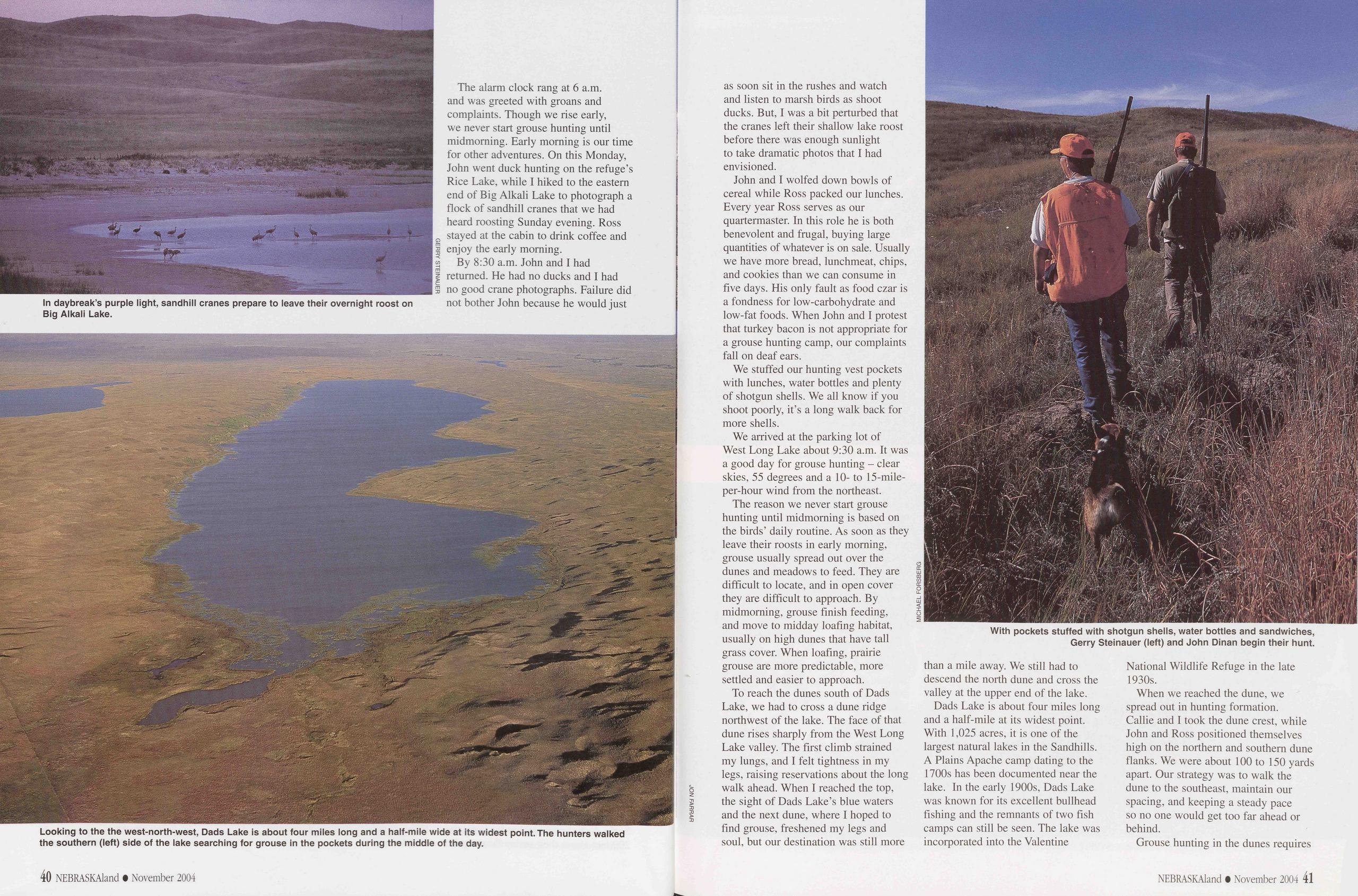
The alarm clock rang at 6 a.m. and was greeted with groans and complaints. Though we rise early, we never start grouse hunting until midmorning. Early morning is our time for other adventures. On this Monday, John went duck hunting on the refuge’s Rice Lake, while I hiked to the eastern end of Big Alkali Lake to photograph a flock of sandhill cranes that we had heard roosting Sunday evening. Ross stayed at the cabin to drink coffee and enjoy the early morning.
By 8:30 a.m. John and I had returned. He had no ducks and I had no good crane photographs. Failure did not bother John because he would just
John and I wolfed down bowls of cereal while Ross packed our lunches. Every year Ross serves as our quartermaster. In this role he is both benevolent and frugal, buying large quantities of whatever is on sale. Usually we have more bread, lunchmeat, chips, and cookies than we can consume in five days. His only fault as food czar is a fondness for low-carbohydrate and low-fat foods. When John and I protest that turkey bacon is not appropriate for a grouse hunting camp, our complaints fall on deaf ears.
We stuffed our hunting vest pockets with lunches, water bottles and plenty of shotgun shells. We all know if you shoot poorly, it’s a long walk back for more shells.
We arrived at the parking lot of West Long Lake about 9:30 a.m. It was a good day for grouse hunting - clear skies, 55 degrees and a 10- to 15-mile- per-hour wind from the northeast.
The reason we never start grouse hunting until midmorning is based on the birds’ daily routine. As soon as they leave their roosts in early morning, grouse usually spread out over the dunes and meadows to feed. They are difficult to locate, and in open cover they are difficult to approach. By midmorning, grouse finish feeding, and move to midday loafing habitat, usually on high dunes that have tall grass cover. When loafing, prairie grouse are more predictable, more settled and easier to approach.
To reach the dunes south of Dads Lake, we had to cross a dune ridge northwest of the lake. The face of that dune rises sharply from the West Long Lake valley. The first climb strained my lungs, and I felt tightness in my legs, raising reservations about the long walk ahead. When I reached the top, the sight of Dads Lake’s blue waters and the next dune, where I hoped to find grouse, freshened my legs and soul, but our destination was still more
Dads Lake is about four miles long and a half-mile at its widest point. With 1,025 acres, it is one of the largest natural lakes in the Sandhills. A Plains Apache camp dating to the 1700s has been documented near the lake. In the early 1900s, Dads Lake was known for its excellent bullhead fishing and the remnants of two fish camps can still be seen. The lake was incorporated into the Valentine National Wildlife Refuge in the late 1930s.
When we reached the dune, we spread out in hunting formation. Callie and I took the dune crest, while John and Ross positioned themselves high on the northern and southern dune flanks. We were about 100 to 150 yards apart. Our strategy was to walk the dune to the southeast, maintain our spacing, and keeping a steady pace so no one would get too far ahead or behind.
Grouse hunting in the dunes requires
40 NEBRASKAland • November 2004
NEBRASKAland • November 2004 41
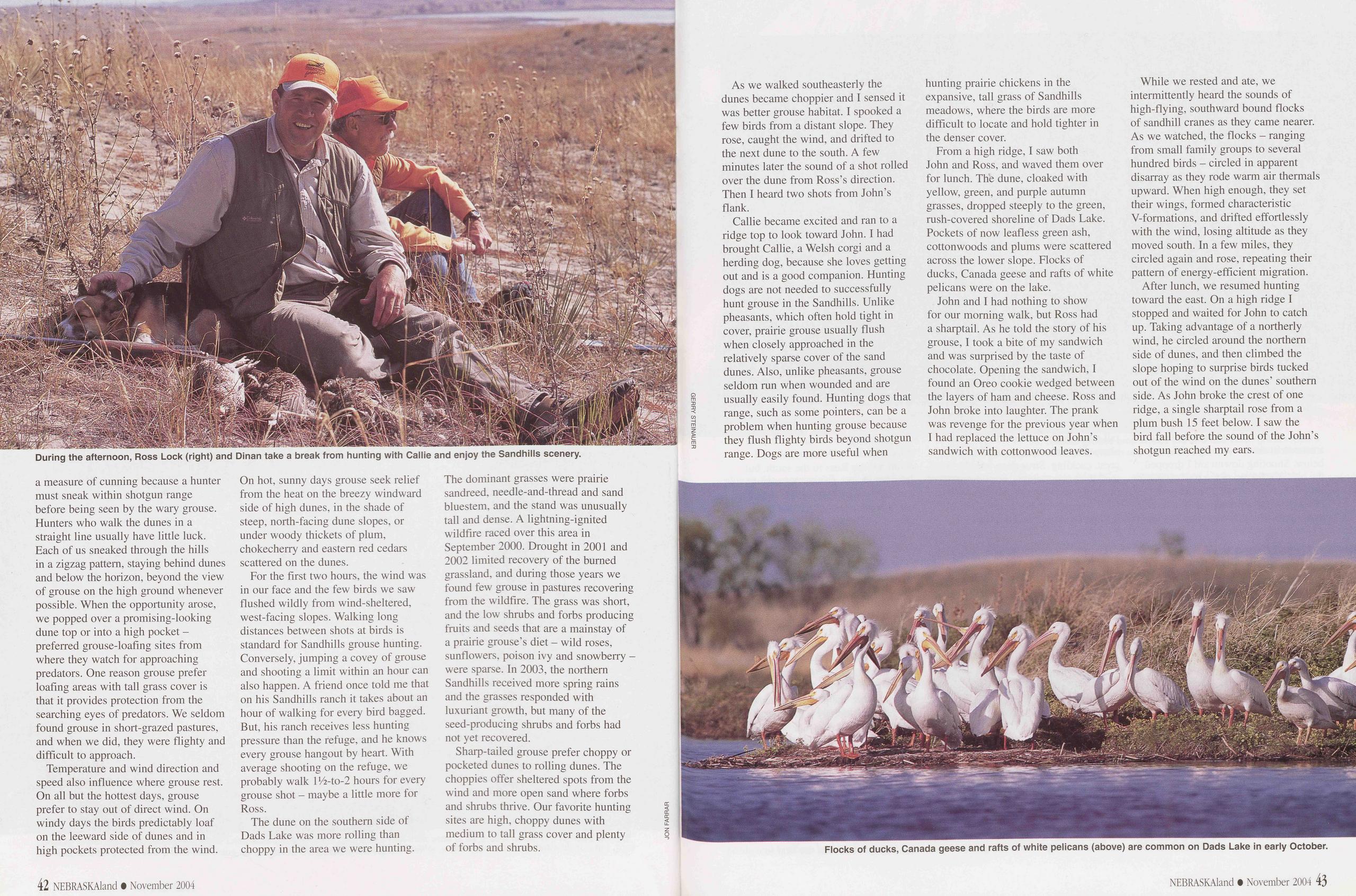
Temperature and wind direction and speed also influence where grouse rest. On all but the hottest days, grouse prefer to stay out of direct wind. On windy days the birds predictably loaf on the leeward side of dunes and in high pockets protected from the wind. On hot, sunny days grouse seek relief from the heat on the breezy windward side of high dunes, in the shade of steep, north-facing dune slopes, or under woody thickets of plum, chokecherry and eastern red cedars scattered on the dunes.
For the first two hours, the wind was in our face and the few birds we saw flushed wildly from wind-sheltered, west-facing slopes. Walking long distances between shots at birds is standard for Sandhills grouse hunting. Conversely, jumping a covey of grouse and shooting a limit within an hour can also happen. A friend once told me that on his Sandhills ranch it takes about an hour of walking for every bird bagged. But, his ranch receives less hunting pressure than the refuge, and he knows every grouse hangout by heart. With average shooting on the refuge, we probably walk 1 1/2-to-2 hours for every grouse shot - maybe a little more for Ross.
The dune on the southern side of Dads Lake was more rolling than choppy in the area we were hunting. The dominant grasses were prairie sandreed, needle-and-thread and sand bluestem, and the stand was unusually tall and dense. A lightning-ignited wildfire raced over this area in September 2000. Drought in 2001 and 2002 limited recovery of the burned grassland, and during those years we found few grouse in pastures recovering from the wildfire. The grass was short, and the low shrubs and forbs producing fruits and seeds that are a mainstay of a prairie grouse’s diet - wild roses, sunflowers, poison ivy and snowberry - were sparse. In 2003, the northern Sandhills received more spring rains and the grasses responded with luxuriant growth, but many of the seed-producing shrubs and forbs had not yet recovered.
Sharp-tailed grouse prefer choppy or pocketed dunes to rolling dunes. The choppies offer sheltered spots from the wind and more open sand where forbs and shrubs thrive. Our favorite hunting sites are high, choppy dunes with medium to tall grass cover and plenty of forbs and shrubs.
As we walked southeasterly the dunes became choppier and I sensed it was better grouse habitat. I spooked a few birds from a distant slope. They rose, caught the wind, and drifted to the next dune to the south. A few minutes later the sound of a shot rolled over the dune from Ross’s direction. Then I heard two shots from John’s flank.
Callie became excited and ran to a ridge top to look toward John. I had brought Callie, a Welsh corgi and a herding dog, because she loves getting out and is a good companion. Hunting dogs are not needed to successfully hunt grouse in the Sandhills. Unlike pheasants, which often hold tight in cover, prairie grouse usually flush when closely approached in the relatively sparse cover of the sand dunes. Also, unlike pheasants, grouse seldom run when wounded and are usually easily found. Hunting dogs that range, such as some pointers, can be a problem when hunting grouse because they flush flighty birds beyond shotgun range. Dogs are more useful when hunting prairie chickens in the expansive, tall grass of Sandhills meadows, where the birds are more difficult to locate and hold tighter in the denser cover.
From a high ridge, I saw both John and Ross, and waved them over for lunch. The dune, cloaked with yellow, green, and purple autumn grasses, dropped steeply to the green, rush-covered shoreline of Dads Lake. Pockets of now leafless green ash, cottonwoods and plums were scattered across the lower slope. Flocks of ducks, Canada geese and rafts of white pelicans were on the lake.
John and I had nothing to show for our morning walk, but Ross had a sharptail. As he told the story of his grouse, I took a bite of my sandwich and was surprised by the taste of chocolate. Opening the sandwich, I found an Oreo cookie wedged between the layers of ham and cheese. Ross and John broke into laughter. The prank was revenge for the previous year when I had replaced the lettuce on John’s sandwich with cottonwood leaves.
While we rested and ate, we intermittently heard the sounds of high-flying, southward bound flocks of sandhill cranes as they came nearer. As we watched, the flocks - ranging from small family groups to several hundred birds - circled in apparent disarray as they rode warm air thermals upward. When high enough, they set their wings, formed characteristic V-formations, and drifted effortlessly with the wind, losing altitude as they moved south. In a few miles, they circled again and rose, repeating their pattern of energy-efficient migration.
After lunch, we resumed hunting toward the east. On a high ridge I stopped and waited for John to catch up. Taking advantage of a northerly wind, he circled around the northern side of dunes, and then climbed the slope hoping to surprise birds tucked out of the wind on the dunes’ southern side. As John broke the crest of one ridge, a single sharptail rose from a plum bush 15 feet below. I saw the bird fall before the sound of the John’s shotgun reached my ears.
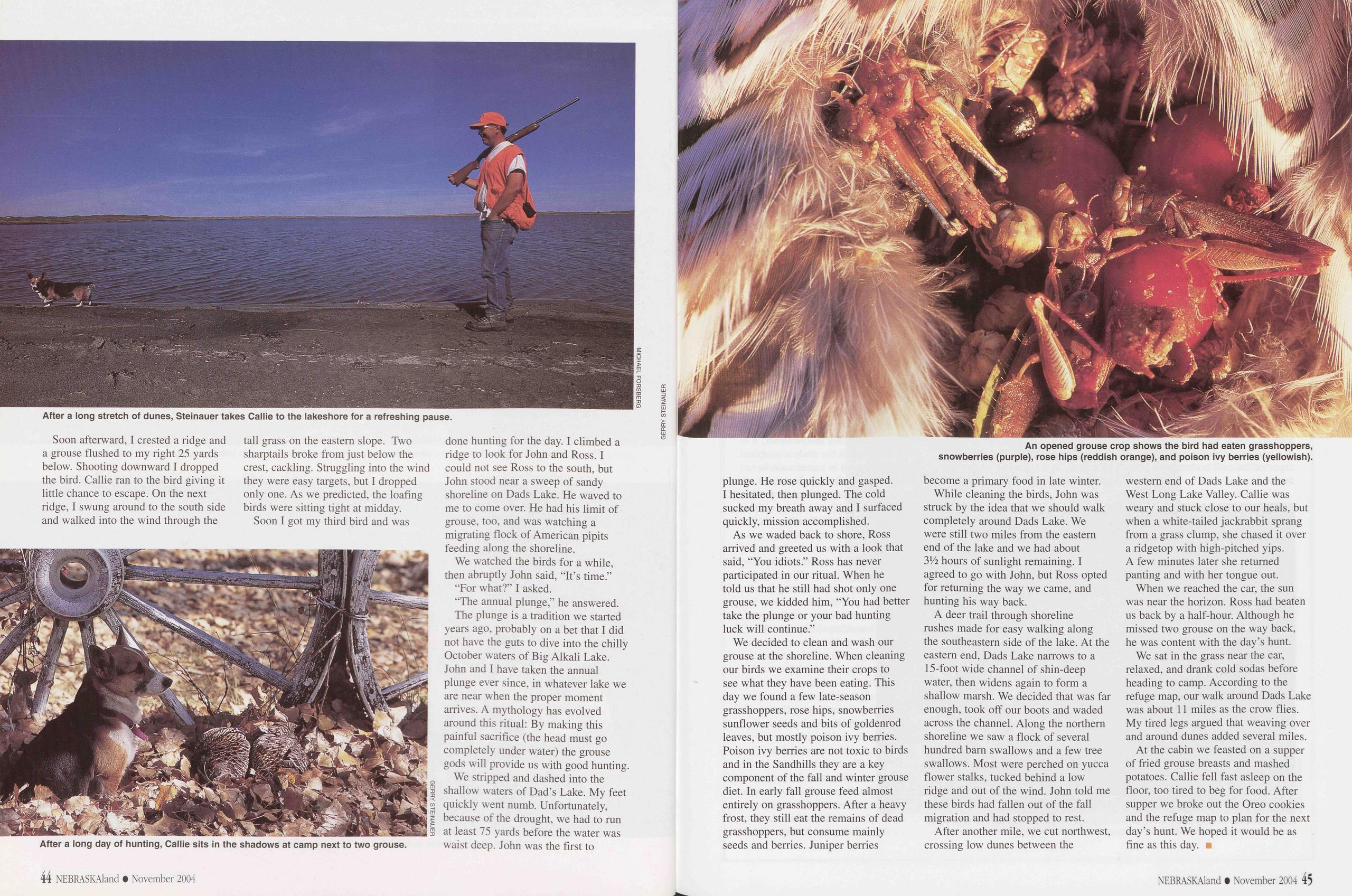
Soon afterward, I crested a ridge and a grouse flushed to my right 25 yards below. Shooting downward I dropped the bird. Callie ran to the bird giving it little chance to escape. On the next ridge, I swung around to the south side and walked into the wind through the
Soon I got my third bird and was done hunting for the day. I climbed a ridge to look for John and Ross. I could not see Ross to the south, but John stood near a sweep of sandy shoreline on Dads Lake. He waved to me to come over. He had his limit of grouse, too, and was watching a migrating flock of American pipits feeding along the shoreline.
We watched the birds for a while, then abruptly John said, "It's time.”
"For what?” I asked.
"The annual plunge,” he answered.
The plunge is a tradition we started years ago, probably on a bet that I did not have the guts to dive into the chilly October waters of Big Alkali Lake. John and I have taken the annual plunge ever since, in whatever lake we are near when the proper moment arrives. A mythology has evolved around this ritual: By making this painful sacrifice (the head must go completely under water) the grouse gods will provide us with good hunting.
We stripped and dashed into the shallow waters of Dad’s Lake. My feet quickly went numb. Unfortunately, because of the drought, we had to run at least 75 yards before the water was waist deep. John was the first to
As we waded back to shore, Ross arrived and greeted us with a look that said, “You idiots.” Ross has never participated in our ritual. When he told us that he still had shot only one grouse, we kidded him, "You had better take the plunge or your bad hunting luck will continue.”
We decided to clean and wash our grouse at the shoreline. When cleaning our birds we examine their crops to see what they have been eating. This day we found a few late-season grasshoppers, rose hips, snowberries sunflower seeds and bits of goldenrod leaves, but mostly poison ivy berries. Poison ivy berries are not toxic to birds and in the Sandhills they are a key component of the fall and winter grouse diet. In early fall grouse feed almost entirely on grasshoppers. After a heavy frost, they still eat the remains of dead grasshoppers, but consume mainly seeds and berries. Juniper berries become a primary food in late winter.
While cleaning the birds, John was struck by the idea that we should walk completely around Dads Lake. We were still two miles from the eastern end of the lake and we had about 3V2 hours of sunlight remaining. I agreed to go with John, but Ross opted for returning the way we came, and hunting his way back.
A deer trail through shoreline rushes made for easy walking along the southeastern side of the lake. At the eastern end, Dads Lake narrows to a 15-foot wide channel of shin-deep water, then widens again to form a shallow marsh. We decided that was far enough, took off our boots and waded across the channel. Along the northern shoreline we saw a flock of several hundred barn swallows and a few tree swallows. Most were perched on yucca flower stalks, tucked behind a low ridge and out of the wind. John told me these birds had fallen out of the fall migration and had stopped to rest.
After another mile, we cut northwest, crossing low dunes between the western end of Dads Lake and the West Long Lake Valley. . Callie was weary and stuck close to our heals, but when a white-tailed jackrabbit sprang from a grass clump, she chased it over a ridgetop with high-pitched yips. A few minutes later she returned panting and with her tongue out.
When we reached the car, the sun was near the horizon. Ross had beaten us back by a half-hour. Although he missed two grouse on the way back, he was content with the day’s hunt.
We sat in the grass near the car, relaxed, and drank cold sodas before heading to camp. According to the refuge map, our walk around Dads Lake was about 11 miles as the crow flies. My tired legs argued that weaving over and around dunes added several miles.
At the cabin we feasted on a supper of fried grouse breasts and mashed potatoes. Callie fell fast asleep on the floor, too tired to beg for food. After supper we broke out the Oreo cookies and the refuge map to plan for the next day’s hunt. We hoped it would be as fine as this day.
44 NEBRASKAland • November 2004 NEBRASKAland • November 2004 45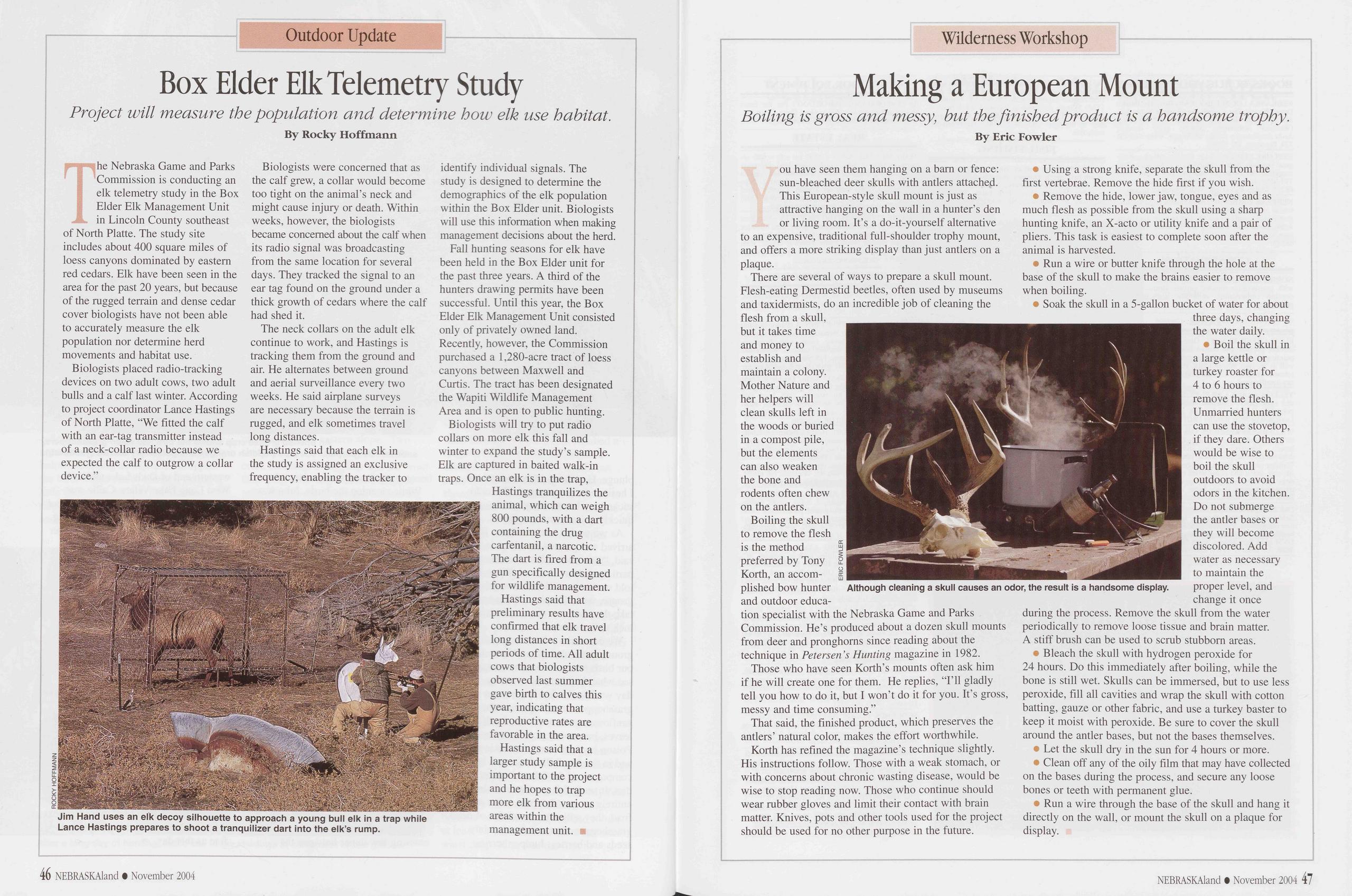
The Nebraska Game and Parks Commission is conducting an elk telemetry study in the Box Elder Elk Management Unit in Lincoln County southeast of North Platte. The study site includes about 400 square miles of loess canyons dominated by eastern red cedars. Elk have been seen in the area for the past 20 years, but because of the rugged terrain and dense cedar cover biologists have not been able to accurately measure the elk population nor determine herd movements and habitat use.
Biologists placed radio-tracking devices on two adult cows, two adult bulls and a calf last winter. According to project coordinator Lance Hastings of North Platte, “We fitted the calf with an ear-tag transmitter instead of a neck-collar radio because we expected the calf to outgrow a collar device.”
Biologists were concerned that as the calf grew, a collar would become too tight on the animal’s neck and might cause injury or death. Within weeks, however, the biologists became concerned about the calf when its radio signal was broadcasting from the same location for several days. They tracked the signal to an ear tag found on the ground under a thick growth of cedars where the calf had shed it.
The neck collars on the adult elk continue to work, and Hastings is tracking them from the ground and air. He alternates between ground and aerial surveillance every two weeks. He said airplane surveys are necessary because the terrain is rugged, and elk sometimes travel long distances.
Hastings said that each elk in the study is assigned an exclusive frequency, enabling the tracker to identify individual signals. The study is designed to determine the demographics of the elk population within the Box Elder unit. Biologists will use this information when making management decisions about the herd.
Fall hunting seasons for elk have been held in the Box Elder unit for the past three years. A third of the hunters drawing permits have been successful. Until this year, the Box Elder Elk Management Unit consisted only of privately owned land. Recently, however, the Commission purchased a 1,280-acre tract of loess canyons between Maxwell and Curtis. The tract has been designated the Wapiti Wildlife Management Area and is open to public hunting.
Biologists will try to put radio collars on more elk this fall and winter to expand the study’s sample. Elk are captured in baited walk-in traps. Once an elk is in the trap, Hastings tranquilizes the animal, which can weigh 800 pounds, with a dart containing the drug carfentanil, a narcotic. The dart is fired from a gun specifically designed for wildlife management. Hastings said that preliminary results have confirmed that elk travel long distances in short periods of time. All adult cows that biologists observed last summer gave birth to calves this year, indicating that reproductive rates are favorable in the area. Hastings said that a larger study sample is important to the project and he hopes to trap more elk from various areas within the management unit
You have seen them hanging on a barn or fence: sun-bleached deer skulls with antlers attached. This European-style skull mount is just as attractive hanging on the wall in a hunter’s den or living room. It’s a do-it-yourself alternative to an expensive, traditional full-shoulder trophy mount, and offers a more striking display than just antlers on a plaque.
There are several of ways to prepare a skull mount. Flesh-eating Dermestid beetles, often used by museums and taxidermists, do an incredible job of cleaning the flesh from a skull, but it takes time and money to establish and maintain a colony. Mother Nature and her helpers will clean skulls left in the woods or buried in a compost pile, but the elements can also weaken the bone and rodents often chew on the antlers.
Boiling the skull to remove the flesh is the method preferred by Tony Korth, an accom- plished bow hunter and outdoor educa- tion specialist with the Nebraska Game and Parks Commission. He’s produced about a dozen skull mounts from deer and pronghorns since reading about the technique in Petersen’s Hunting magazine in 1982.
Those who have seen Korth’s mounts often ask him if he will create one for them. He replies, "TH gladly tell you how to do it, but I won’t do it for you. It’s gross, messy and time consuming.”
That said, the finished product, which preserves the antlers’ natural color, makes the effort worthwhile.
Korth has refined the magazine’s technique slightly. His instructions follow. Those with a weak stomach, or with concerns about chronic wasting disease, would be wise to stop reading now. Those who continue should wear rubber gloves and limit their contact with brain matter. Knives, pots and other tools used for the project should be used for no other purpose in the future.
Using a strong knife, separate the skull from the first vertebrae. Remove the hide first if you wish.
Remove the hide, lower jaw, tongue, eyes and as much flesh as possible from the skull using a sharp hunting knife, an X-acto or utility knife and a pair of pliers. This task is easiest to complete soon after the animal is harvested.
Run a wire or butter knife through the hole at the base of the skull to make the brains easier to remove when boiling.
Soak the skull in a 5-gallon bucket of water for about three days, changing the water daily.
Boil the skull in a large kettle or turkey roaster for 4 to 6 hours to remove the flesh. Unmarried hunters can use the stovetop, if they dare. Others would be wise to boil the skull outdoors to avoid odors in the kitchen. Do not submerge the antler bases or they will become discolored. Add water as necessary to maintain the proper level, and change it once during the process. Remove the skull from the water periodically to remove loose tissue and brain matter. A stiff brush can be used to scrub stubborn areas.
Bleach the skull with hydrogen peroxide for 24 hours. Do this immediately after boiling, while the bone is still wet. Skulls can be immersed, but to use less peroxide, fill all cavities and wrap the skull with cotton batting, gauze or other fabric, and use a turkey baster to keep it moist with peroxide. Be sure to cover the skull around the antler bases, but not the bases themselves.
Let the skull dry in the sun for 4 hours or more.
Clean off any of the oily film that may have collected on the bases during the process, and secure any loose bones or teeth with permanent glue.
Run a wire through the base of the skull and hang it directly on the wall, or mount the skull on a plaque for display.
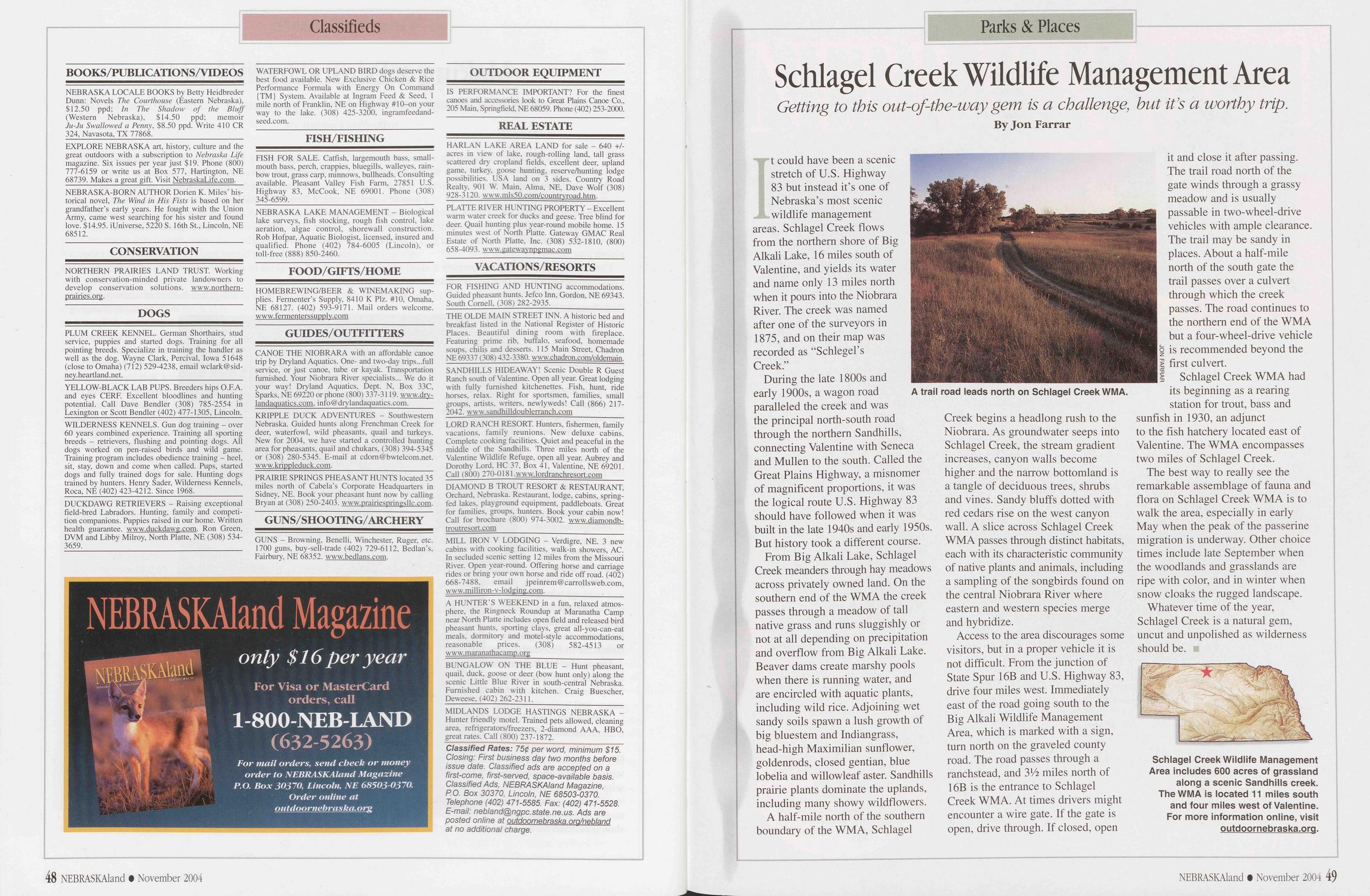
NEBRASKA LOCALE BOOKS by Betty Heidbreder Dunn: Novels The Courthouse (Eastern Nebraska), $12.50 ppd; In The Shadow of the Bluff (Western Nebraska), $14.50 ppd; memoir Ju-Ju Swallowed a Penny, $8.50 ppd. Write 410 CR 324, Navasota, TX 77868.
EXPLORE NEBRASKA art, history, culture and the great outdoors with a subscription to Nebraska Life magazine. Six issues per year just $19. Phone (800) 777-6159 or write us at Box 577, Hartington, NE 68739. Makes a great gift. Visit NebraskaLife.com.
NEBRASKA-BORN AUTHOR Dorien K. Miles’ his- torical novel, The Wind in His Fists is based on her grandfather’s early years. He fought with the Union Army, came west searching for his sister and found love. $14.95. iUniverse, 5220 S. 16th St., Lincoln, NE 68512.
CONSERVATIONNORTHERN PRAIRIES LAND TRUST. Working with conservation-minded private landowners to develop conservation solutions, www.northern- prairies.org.
DOGSPLUM CREEK KENNEL. German Shorthairs, stud service, puppies and started dogs. Training for all pointing breeds. Specialize in training the handler as well as the dog. Wayne Clark, Percival, Iowa 51648 (close to Omaha) (712) 529-4238, email wclark@sid- ney.heartland.net.
YELLOW-BLACK LAB PUPS. Breeders hips O.F.A. and eyes CERF. Excellent bloodlines and hunting potential. Call Dave Bendler (308) 785-2554 in Lexington or Scott Bendler (402) 477-1305, Lincoln.
WILDERNESS KENNELS. Gun dog training - over 60 years combined experience. Training all sporting breeds - retrievers, flushing and pointing dogs. All dogs worked on pen-raised birds and wild game. Training program includes obedience training - heel, sit, stay, down and come when called. Pups, started dogs and fully trained dogs for sale. Hunting dogs trained by hunters. Henry Sader, Wilderness Kennels, Roca, NE (402) 423-4212. Since 1968.
DUCKDAWG RETRIEVERS - Raising exceptional field-bred Labradors. Hunting, family and competi- tion companions. Puppies raised in our home. Written health guarantee, www.duckdawg.com. Ron Green, DVM and Libby Milroy, North Platte, NE (308) 534- 3659.
NEBRASKAIand Magazine only $16 per year For Visa or MasterCard orders, call 1-800-NEB-LAND For mail orders, send check or money order to NEBRASKAIand Magazine P.O. Box 3O37O, Lincoln, NE 68503-0370. Order online at outdoornebraska. orgWATERFOWL OR UPLAND BIRD dogs deserve the best food available. New Exclusive Chicken & Rice Performance Formula with Energy On Command {TM} System. Available at Ingram Feed & Seed, 1 mile north of Franklin, NE on Highway #10-on your way to the lake. (308) 425-3200, ingramfeedand- seed.com.
FISH/FISHINGFISH FOR SALE. Catfish, largemouth bass, small- mouth bass, perch, crappies, bluegills, walleyes, rain- bow trout, grass carp, minnows, bullheads. Consulting available. Pleasant Valley Fish Farm, 27851 U.S. Highway 83, McCook, NE 69001. Phone (308) 345-6599.
NEBRASKA LAKE MANAGEMENT - Biological lake surveys, fish stocking, rough fish control, lake aeration, algae control, shorewall construction. Rob Hofpar, Aquatic Biologist, licensed, insured and qualified. Phone (402) 784-6005 (Lincoln), or toll-free (888) 850-2460.
FOOD/GIFTS/HOMEHOMEBREWING/BEER & WINEMAKING sup- plies. Fermenter’s Supply, 8410 K Plz. #10, Omaha, NE 68127. (402) 593-9171. Mail orders welcome. www.fermenterssupply.com
GUIDES/OUTFITTERSCANOE THE NIOBRARA with an affordable canoe trip by Dryland Aquatics. One- and two-day trips...full service, or just canoe, tube or kayak. Transportation furnished. Your Niobrara River specialists... We do it your way! Dryland Aquatics, Dept. N, Box 33C, Sparks, NE 69220 or phone (800) 337-3119. www.drv- landaquatics.com, info@drylandaquatics.com.
KRIPPLE DUCK ADVENTURES - Southwestern Nebraska. Guided hunts along Frenchman Creek for deer, waterfowl, wild pheasants, quail and turkeys. New for 2004, we have started a controlled hunting area for pheasants, quail and chukars, (308) 394-5345 or (308) 280-5345. E-mail at cdom@bwtelcom.net. www.krippleduck.com.
PRAIRIE SPRINGS PHEASANT HUNTS located 35 miles north of Cabela’s Corporate Headquarters in Sidney, NE. Book your pheasant hunt now by calling Bryan at (308) 250-2403. www.prairiespringsllc.com.
GUNS/SHOOTING/ARCHERYGUNS - Browning, Benelli, Winchester, Ruger, etc. 1700 guns, buy-sell-trade (402) 729-6112, Bedlan’s, Fairbury, NE 68352. www.bedlans.com.
OUTDOOR EQUIPMENTIS PERFORMANCE IMPORTANT? For the finest canoes and accessories look to Great Plains Canoe Co., 205 Main, Springfield, NE 68059. Phone (402) 253-2000.
REAL ESTATEHARLAN LAKE AREA LAND for sale - 640 +/- acres in view of lake, rough-rolling land, tall grass scattered dry cropland fields, excellent deer, upland game, turkey, goose hunting, reserve/hunting lodge possibilities. USA land on 3 sides. Country Road Realty, 901 W. Main, Alma, NE, Dave Wolf (308) 928-3120. www.mls50.com/countrvroad.htm.
PLATTE RIVER HUNTING PROPERTY - Excellent warm water creek for ducks and geese. Tree blind for deer. Quail hunting plus year-round mobile home. 15 minutes west of North Platte. Gateway GMAC Real Estate of North Platte, Inc. (308) 532-1810, (800) 658-4093. www.gatewavnpgmac.com
VACATIONS/RESORTSFOR FISHING AND HUNTING accommodations. Guided pheasant hunts. Jefco Inn, Gordon, NE 69343. South Cornell, (308) 282-2935.
THE OLDE MAIN STREET INN. A historic bed and breakfast listed in the National Register of Historic Places. Beautiful dining room with fireplace. Featuring prime rib, buffalo, seafood, homemade soups, chilis and desserts. 115 Main Street, Chadron NE 69337 (308) 432-3380. www.chadron.com/oldemain.
SANDHILLS HIDEAWAY! Scenic Double R Guest Ranch south of Valentine. Open all year. Great lodging with fully furnished kitchenettes. Fish, hunt, ride horses, relax. Right for sportsmen, families, small groups, artists, writers, newlyweds! Call (866) 217- 2042. www. sandhilldoublerranch. com
LORD RANCH RESORT. Hunters, fishermen, family vacations, family reunions. New deluxe cabins. Complete cooking facilities. Quiet and peaceful in the middle of the Sandhills. Three miles north of the Valentine Wildlife Refuge, open all year. Aubrey and Dorothy Lord, HC 37, Box 41, Valentine, NE 69201. Call (800) 270-0181.www.lordranchresort.com
DIAMOND B TROUT RESORT & RESTAURANT, Orchard, Nebraska. Restaurant, lodge, cabins, spring- fed lakes, playground equipment, paddleboats. Great for families, groups, hunters. Book your cabin now! Call for brochure (800) 974-3002. www.diamondb- troutresort.com
MILL IRON V LODGING - Verdigre, NE. 3 new cabins with cooking facilities, walk-in showers, AC. In secluded scenic setting 12 miles from the Missouri River. Open year-round. Offering horse and carriage rides or bring your own horse and ride off road. (402) 668-7488, email jpeinrem@carrollsweb.com, www.milliron-v-lodging.com.
A HUNTER’S WEEKEND in a fun, relaxed atmos- phere, the Ringneck Roundup at Maranatha Camp near North Platte includes open field and released bird pheasant hunts, sporting clays, great all-you-can-eat meals, dormitory and motel-style accommodations, reasonable prices. (308) 582-4513 or www.maranathacamp.org
BUNGALOW ON THE BLUE - Hunt pheasant, quail, duck, goose or deer (bow hunt only) along the scenic Little Blue River in south-central Nebraska. Furnished cabin with kitchen. Craig Buescher, Deweese, (402) 262-2311.
MIDLANDS LODGE HASTINGS NEBRASKA - Hunter friendly motel. Trained pets allowed, cleaning area, refrigerators/freezers, 2-diamond AAA, HBO, great rates. Call (800) 237-1872.
Classified Rates: 750 per word, minimum $15. Closing: First business day two months before issue date. Classified ads are accepted on a first-come, first-served, space-available basis. Classified Ads, NEBRASKAIand Magazine, P.O. Box 30370, Lincoln, NE 68503-0370. Telephone (402) 471-5585. Fax: (402) 471-5528. E-mail: nebland@ngpc. state, ne. us. Ads are posted online at outdoornebraska.org/nebland at no additional charge.
Parks & Places
Schlagel Creek Wildlife Management Area
Getting to this out-of-the-way gem is a challenge, but it’s a worthy trip.
By Jon FarrarIt could have been a scenic stretch of U.S. Highway 83 but instead it’s one of Nebraska’s most scenic wildlife management areas. Schlagel Creek flows from the northern shore of Big Alkali Lake, 16 miles south of Valentine, and yields its water and name only 13 miles north when it pours into the Niobrara River. The creek was named after one of the surveyors in 1875, and on their map was recorded as “Schlegel’s Creek.”
During the late 1800s and early 1900s, a wagon road paralleled the creek and was the principal north-south road through the northern Sandhills, connecting Valentine with Seneca and Mullen to the south. Called the Great Plains Highway, a misnomer of magnificent proportions, it was the logical route U.S. Highway 83 should have followed when it was built in the late 1940s and early 1950s. But history took a different course.
From Big Alkali Lake, Schlagel Creek meanders through hay meadows across privately owned land. On the southern end of the WMA the creek passes through a meadow of tall native grass and runs sluggishly or not at all depending on precipitation and overflow from Big Alkali Lake. Beaver dams create marshy pools when there is running water, and are encircled with aquatic plants, including wild rice. Adjoining wet sandy soils spawn a lush growth of big bluestem and Indiangrass, head-high Maximilian sunflower, goldenrods, closed gentian, blue lobelia and willowleaf aster. Sandhills prairie plants dominate the uplands, including many showy wildflowers.
A half-mile north of the southern boundary of the WMA, Schlagel
Access to the area discourages some visitors, but in a proper vehicle it is not difficult. From the junction of State Spur 16B and U.S. Highway 83, drive four miles west. Immediately east of the road going south to the Big Alkali Wildlife Management Area, which is marked with a sign, turn north on the graveled county road. The road passes through a ranchstead, and 31/2 miles north of 16B is the entrance to Schlagel Creek WMA. At times drivers might encounter a wire gate. If the gate is open, drive through. If closed, open it and close it after passing. The trail road north of the gate winds through a grassy meadow and is usually passable in two-wheel-drive vehicles with ample clearance. The trail may be sandy in places. About a half-mile north of the south gate the trail passes over a culvert through which the creek passes. The road continues to the northern end of the WMA but a four-wheel-drive vehicle is recommended beyond the first culvert.
Schlagel Creek WMA had its beginning as a rearing station for trout, bass and sunfish in 1930, an adjunct to the fish hatchery located east of Valentine. The WMA encompasses two miles of Schlagel Creek.
The best way to really see the remarkable assemblage of fauna and flora on Schlagel Creek WMA is to walk the area, especially in early May when the peak of the passerine migration is underway. Other choice times include late September when the woodlands and grasslands are ripe with color, and in winter when snow cloaks the rugged landscape.
Whatever time of the year, Schlagel Creek is a natural gem, uncut and unpolished as wilderness should be.
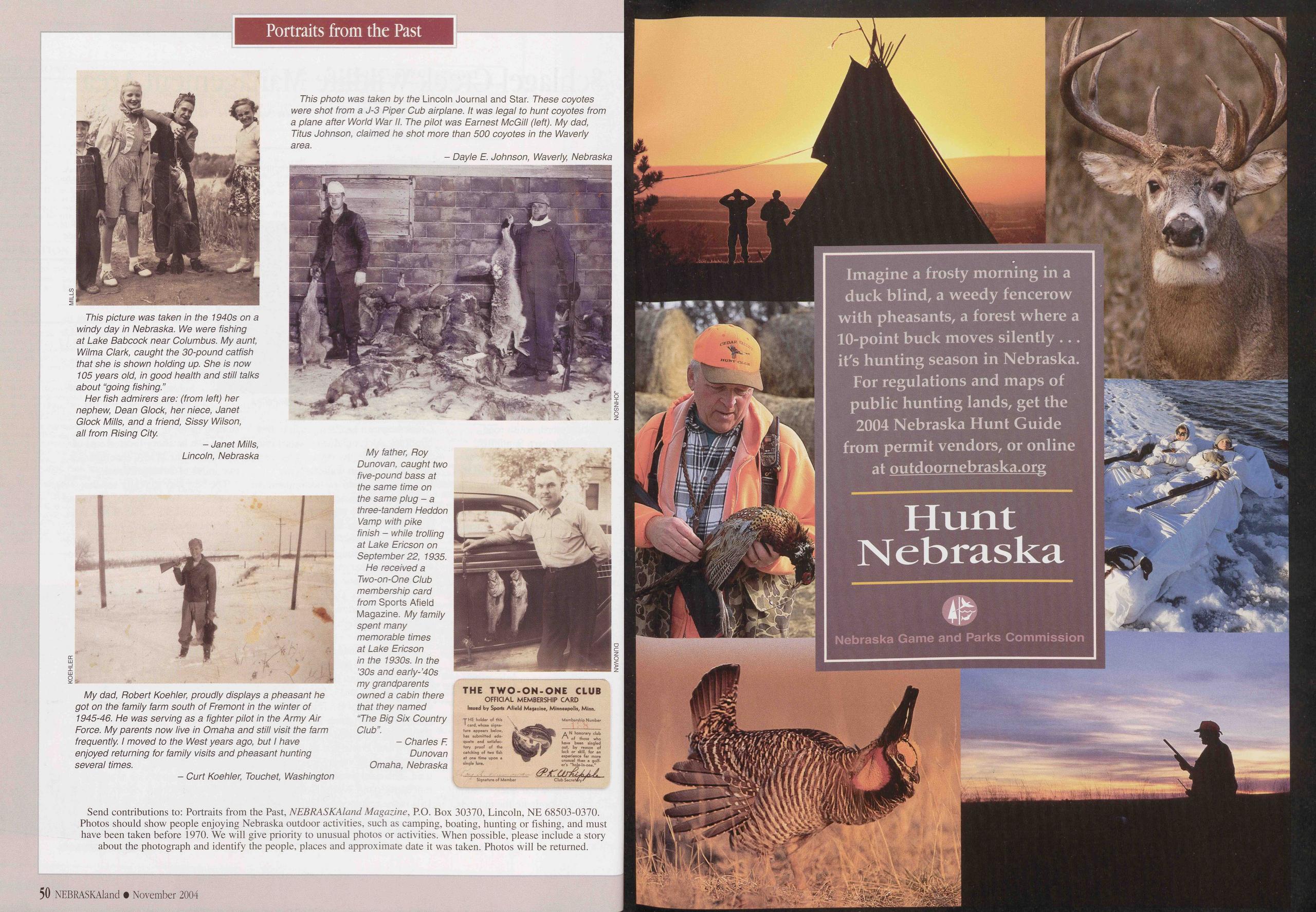
Send contributions to: Portraits from the Past, NEBRASKAland Magazine, P.O. Box 30370, Lincoln, NE 68503-0370. Photos should show people enjoying Nebraska outdoor activities, such as camping, boating, hunting or fishing, and must have been taken before 1970. We will give priority to unusual photos or activities. When possible, please include a story about the photograph and identify the people, places and approximate date it was taken. Photos will be returned.
50 NEBRASKAland • November 2004Imagine a frosty morning in a duck blind, a weedy fencerow with pheasants, a forest where a 10-point buck moves silently ... it's hunting season in Nebraska. For regulations and maps of public hunting lands, get the 2004 Nebraska Hunt Guide from permit vendors, or online at outdoornebraska.org
Nebraska Game and Parks Commission
Position: 626 (18 views)