Volume 82, Issue 8, 2004
NEBRASKAland
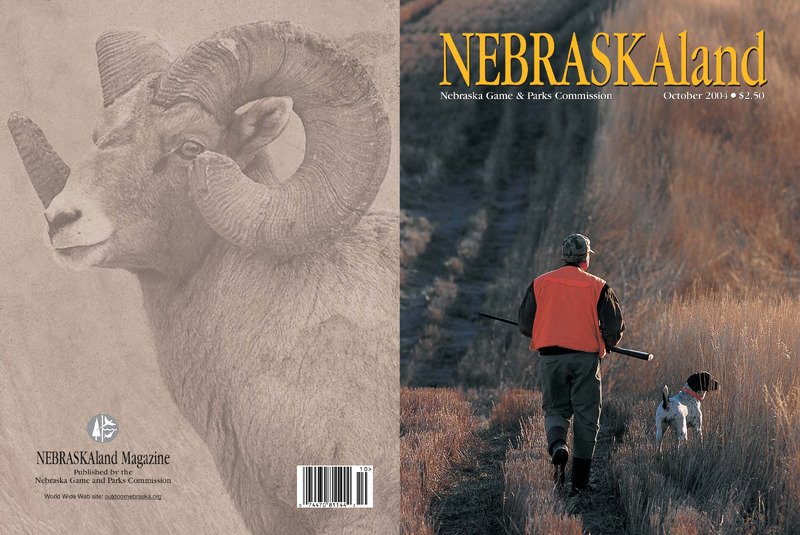
Nebraska Game & Parks Comission October 2004 $2.50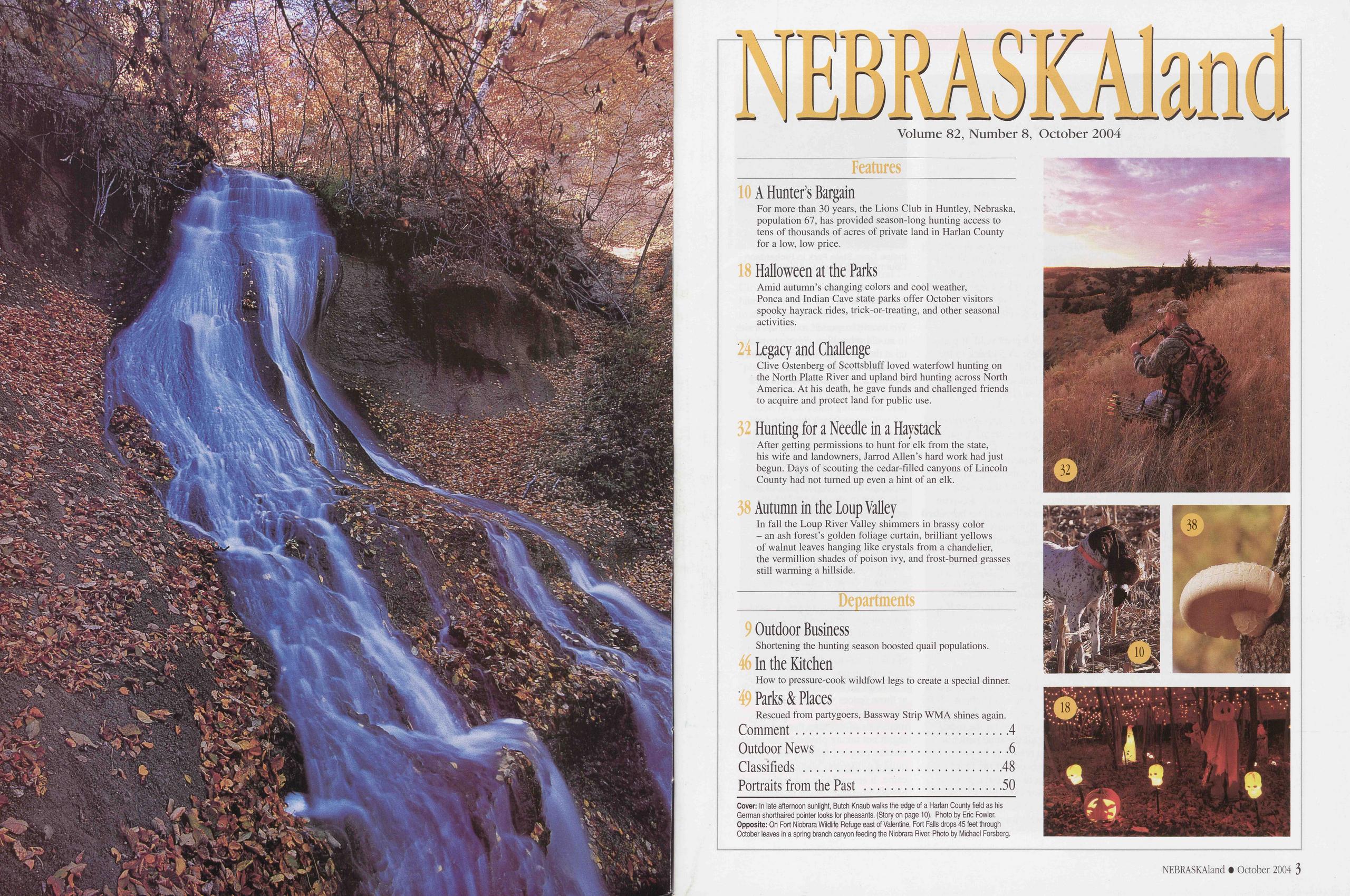
NEBRASKAland
Volume 82, Number 8, October 2004
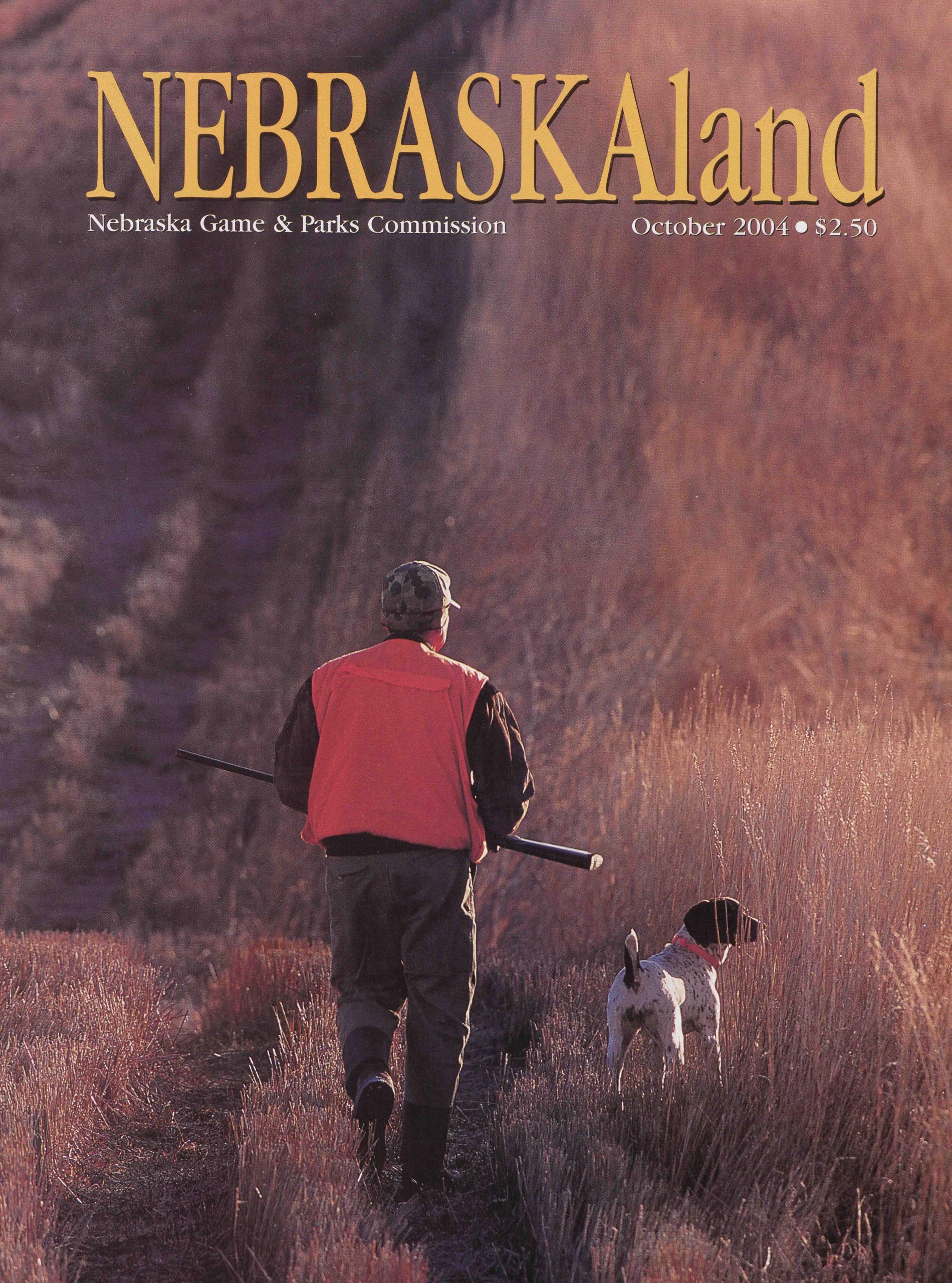
Features 10 Hunter's Bargain For more than 30 years, the Lions Club in Huntley, Nebraska, population 67, has provided season-long hunting access to tens of thousands of acres of private land in Harlan County for a low, low price. 18 Halloween at the Parks Amid autums changing colors and cool weather, Ponca and Indian Cave state parks offer October visitors spooky hayrack rides, trick-or-treating, and other seasonal activities. 24 Legacy and Challenge Clive Ostenberg of Scottsbluff loved waterfowl hunting on the North Platte River and upland bird hunting across North America. At his death, he gave funds and challenged friends to acquire and protect land for public use. 32 Hunting for a Needle in a Haystack After getting permissions to hunt for elk from the state, his wife and landowners, Jarrod Allen's hard work had just begun. Days of scouting the cedar-filled canyons of Lincoln County had not turned up even a hint of an elk. 38 Autumn in the Loup Valley In fall the Loup River Valley shimmers in brassy color an ash forest's golden foliage curtain, brilliant yellows of walnut leaves hanging like crystals from a chandelier, the vermillion shades of poison ivy, and frost-burned grasses still warming a hillside. Deparments 9 Outdoor Business Shortening the hunting season boosted quail populations. 46 In the Kitchen How to pressure-cook wildfowl legs to create a special dinner. 49 Parks & Places Rescued from partygoers, Bassway Strip WMA shines again. Comment_______________________4 Outdoor Nevis ______________________6 Classifieds _________________________48 Portraits from the Past ______________50 Cover: In late afternoon sunlight, Butch Knaub walks the edge of a Haban County field as his German shorthaired pointer looks for pheasants. fStory on page toy Photo by Eric Foxier. Opposite: On Fort Niobrara Wildlife Refuge east of Valentine, Fort Falls drops 45 feet through October leaves in a spring branch canyon feeding the Niobrara River. Photo by Michael Forsberg.32
10
38
18
Comment
NEBRASKAland Magazine Published by the Nebraska Game and Parks Commission Director: Rex Amack Assistant Directors: Roger Kuhn, Kirk Nelson Information & Education Administrator: Ken Bouc Information & Education Art Director: Steve O’Hare Commissioners Chairman: Randall K. Stinnette, Inland Vice Chairman: Marvin Westcott, Holdrege 2nd Vice Chairman: James Stuart, Jr., Lincoln Bill Grewcock, Omaha Dr. Mark Pinkerton, Wilber Bill Zutavern, Dunning Gary Parker, Columbus George E. Hall, Bridgeport Magazine Staff Editor: Tom White Associate Editor: Doug Carroll Art Director: Tim Reigert Senior Editors: Jon Farrar, Ken Bouc Regional Editors: Eric Fowler, Bob Grier, Rocky Hoffmann Contributing Editors: Michael Forsberg, Tom Keith Circulation: Donna Robinson Photo Librarian: Sarah Johnson NEBRASKAland VOL. 82 / NO. 8 ISSN: 0028-1964 OCTOBER 2004 Published monthly, except for Jan./Feb. and Aug./Sept. issues, by the Nebraska Game and Parks Commission, 2200 N. 33rd St., Lincoln, NE. Copyright 2004, all rights reserved. Please address comments or questions to this address. Periodicals postage paid at Lincoln, Nebraska, and other locations. POSTMASTER: Send all address changes to NEBRASKAland, P.O. Box 30370, Lincoln, NE 68503-0370. Address submissions to: The Editor, NEBRASKAland Magazine, P.O. Box 30370, Lincoln, NE 68503. Include a stamped, self-addressed return envelope. The publisher assumes no responsibility for unsolicited material. NEBRASKAland is available on audio cassette from the Nebraska Library Commission Talking Book and Braille Service, Suite 120, 1200 N St., Lincoln, NE 68508. (800) 742-7691 Rates: $16 for one year; $30 for two years. Nebraska residents must add appropriate sales tax. To subscribe call 1-800-NEBLAND (632-5263), or go online to: outdoornebraska.org Soldier Likes Bowfishing StoryI’m currently stationed in Baghdad, Iraq, and recently had the good fortune to come across the June edition of your magazine. What an excellent publication! The photography is absolutely superb and the articles are of great general interest for outdoor enthusiasts.
I particularly liked the article by Doug Carroll on bowfishing. I’m an avid bowfisherman myself and bowfish nearly every day on Milford Lake where I live in north-central Kansas. As fun as it is, I’ve often wondered why it isn’t more popular. I’m glad to see some coverage of it in something besides a bowhunting magazine.
Thanks for a great read. It really made me eager to get back to the midwest this fall.
Richard Hodgson Victory Base, IraqEncyclopedia Excerpts Appreciated
I enjoyed your excerpts from the Encyclopedia of the Great Plains in the August-September issue.
I shared you magazine with a friend and he and I think your magazine is the greatest. Keep up the good work. I would be interested in knowing how many states in the U.S. you mail subscriptions to.
Jim Mosley, formerly of ThayerNEBRASKAland Magazine has subscribers in all 50 states and numerous foreign countries, including Australia, Russia, Sweden, China, England and New Zealand.
Indian Cave Construction RecalledIndian Cave State Park in Richardson County during its early development. NGPC LIBRARY
Several of us from the Tecumseh area were hired for summer work. We were transported to the work site in an old school bus. We were picked up at the comer of Nebraska highways 105 and 136 and then went to Nebraska City and Auburn to pick up more workers. I think we were paid something under $2 an hour.
I will never forget the first day of work. We had to clear deadfalls from the road to get to the area. The road was just a dirt trail and if it rained, we could not get back in until it dried several days. Our first jobs were to clear and widen the existing roads. In those days, labor was cheaper than equipment that would be used today. We had two chain saws and few double-bit axes. We soon learned how to fall a tree and lay it down with precision.
I worked at the park for two summers. The second year I spent time putting up boundary fence. We hauled the heavy material in by hand, and carried it up and over the bluffs. It was tough work, but we were all young.
When I go to the park now I look at those fences with great pride. They are still there. I have fond memories of working there. I only regret not taking photos of the place and the people I worked with. It was quite a wilderness when we first came. It seemed like a daunting task, but we worked with the optimism that you expect of young people. I’m proud I had a part in making the 4 NEBRASKAland • October 2004 the park what it is now.
Rod Kehlenbeck Springfield, Nebraska Nancy B. Johnson of Central CityWe have received NEBRASKAland for years, enjoy it very much, and are proud it is part of Nebraska’s heritage. We especially enjoyed the information about and excerpts from the forthcoming Encyclopedia of the Great Plains.
We have one change to request. Nancy B. Johnson, who wrote "Mad Pioneer Women," is from Central City, not Nebraska City. As a historian and writer, her contribution to our local and state community has been enormous. Sense of place is vital to subjects such as the Great Plains, thus, we hope Nancy's "place" will be identified correctly.
Kay K. Owens Central City We apologize for our error. Statement of ownership and monthly circulation of NEBRASKAland Magazine Owner and publisher: Nebraska Game and Parks Commission Editor: Tom White Headquarters of Publisher and Publication: 2200 N. 33rd St., Lincoln, NE 68503 Stockholders, Bondholders, Mortgage and Security Holders: None Average number of copies Single issue of each issue during nearest to preceding 12 months filing date A. Total Copies Printed (net press run) ...40,310.... 37,300 B. Paid Circulation 1. Single-copy sales 2,052... 1,835 2. Mail subscriptions ...34,168.... 33,142 C. Total Paid Circulation ...36,220.... 35,068 D. Free Distribution by Mail 366 ... 366 E. Free Distribution Outside the Mail 277 ... 277 F. Total Free Distribution .... 643 ... 643 G. Total Distribution ...36,863.... 35,711 H. Copies Not Distributed . 3,447.... 1,589 1. Total ...40,310... 37,300 J. Percent Paid and/or Requested Circulation 98%.... 98% Comment NEBRASKAland Magazine P.O. Box 30370, Lincoln, NE 68503. E-mail: nebland@ ngpc. state, ne. us. Please include your postal address and telephone number. Letters may be condensed and edited for clarity. Photographs are welcome and will be returned. Nebraska Game and Parks Commission Offices Headquarters 2200 N. 33rd Street Lincoln, NE 68503 Phone (402) 471-0641 District Office I East Hwy. 2, Box 725 Alliance, NE 69301 Phone (308) 763-2940 District Office II 524 Panzer St., Box 508 Bassett, NE 68714 Phone (402) 684-2921 District Office III 2201 N. 13th St. Norfolk, NE 68701 Phone (402) 370-3374 District Office IV 301 E. State Farm Rd. North Platte, NE 69101 Phone (308) 535-8025 District Office V 2200 N. 33rd Street Lincoln, NE 68503 Phone (402) 471-5558 District Office VI 1617 First Ave. Kearney, NE 68847 Phone (308) 865-5310 Omaha Office 1212 Bob Gibson Blvd. Omaha, NE 68108 Phone (402) 595-2144 Ak-Sar-Ben Aquarium 21502 W. Highway 31 Gretna, NE 68028 Phone (402) 332-3901 World Wide Web site: outdoornebraska.org E-mail: ngpc@ngpc.state.ne.us Conservation Officers by Region Administration Terry Brentzel Grand Is. 384-8296 Ted Blume (Adm.) Lincoln 471-5531 Tim Williams Hastings (402) 463-2535 Craig Stover (Asst.) Lincoln 471-5532 Darin Gress Hebron (402) 768-2287 Wes Loos (Asst.) Lincoln 471-5591 Dale Johnson Kearney 237-1079 Murray Johnson Lincoln 471-5003 Mark Reeves Loup City 745-0748 Dana Miller (Sup.) Valentine 376-3116 Robert Finke Milford (402) 761-3537 Richard Seward Ord 728-3115 Panhandle Officer City Phone (308) Northeast Jim Zimmerman (Sup.) Gering 436-7561 Officer City Phone (402) Raymond Still Bridgeport 262-1075 Tom Zimmer (Sup.) Norfolk 371-6625 Walt Meyer Chadron 432-4398 Robert Kelly Albion 395-2538 John Murphy Crawford 665-2021 Dale Davis Bassett 273-1700 Heath Packett Gordon 282-2553 Ross Oestmann Bloomfielc I 373-4412 Dennis Thompson Ogallala 284-6450 Steve Oberg Columbus 564-5937 Dan Zuehlke Ogallala 284-4815 Gary Ralston Creighton 358-3892 Doug Pollard Oshkosh 772-9950 Daniel Roberts Fremont 721-7852 Scott Brandt Scottsbluff 635-1277 Jon Reeves Kennard 427-7378 Frank Miller Valentine (402)376-1183 Marion Shafer Norfolk 371-2031 Pat George O’Neill 482-5771 Southwest Eric Wiebe Ponca 755-2566 Officer City Phone (308) Roger Thompson (Sup.) N. Platte 532-9175 Southeast Ray Dierking Brkn. Bow 872-3078 Officer City Phone (402) George Sund Cambridge 697-4629 Duane Arp (Sup.) Gretna 332-2965 Matt Andrews Elwood 785-3025 Sean McKeehan Ashland 944-4174 Dirk Greene Imperial 882-5328 William Krause Auburn 274-3789 Virgil Gosch McCook 345-2185 Douglas Kramer Lincoln 466-9001 Dwight Allbery N. Platte 532-2753 Dina Barta Lincoln 483-2358 Dudley Sorensen N. Platte 532-0747 Stacey Lewton Lincoln 476-0436 Rich Routh Rep. City 799-2085 Levi Krause Louisville 234-2212 Russell Mort Nebr. City 873-5684 South-central Dan Evasco Papillion 504-1368 Officer City Phone (308) Jeff Clauson Valley 359-5301 Jerry Pecha (Sup.) Kearney 865-5327 Mike Luben Wahoo 443-4278 Randy Pomplun Fullerton 536-2987 Nebraska Wildlife Crimestoppers 1-800-742-7627 NEBRASKAland • October 2004 5
Outdoor News
Commission Establishes 2004 Waterfowl SeasonsThe Nebraska Game and Parks Commissioners set 2004 waterfowl, crow and falconry seasons and addressed other issues at its August meeting at the One Box Hunt Club, near Broken Bow.
Nebraska’s 2004 waterfowl, crow and falconry seasons and bag limits will be:
DUCKS Low Plains Early: Oct. 2-Dec. 12 and Dec. 18-19 Low Plains Late: Oct. 16-17 and Oct. 23-Jan. 2 High Plains: Oct. 2-Dec. 12 and Dec. 18-Jan. 10 (Pintail and Canvasback Seasons - Low Plains Early and High Plains: Oct. 2-Nov. 9 Low Plains Late: Oct. 16-17, Oct. 23-Nov. 28) Daily Bag Limit: All areas - Conventional System. Possession Limit: Twice the daily bag. DARK GEESE (Canada and Brant geese) East Unit: Oct. 2-3 and Oct. 23- Jan 23. North Central Unit: Oct. 2-Jan. 4 Platte River Unit: Oct. 30-Feb. 1 Panhandle Unit: Nov. 13-Feb. 1 Niobrara Unit: Oct. 30-Feb. 1 Daily Bag Limit: Three geese. Possession Limit: Six geese. WHITE-FRONTED GEESE Statewide: Oct. 2-Dec. 26 Daily Bag Limit: Two geese. Possession Limit: Four geese. LIGHT GEESE (Snow, blue and Ross’s geese) Statewide: Oct. 2-Jan. 14 Daily Bag Limit: 20 geese. Possession Limit: Unlimited. LIGHT GEESE CONSERVATION ACTION All Zones: Feb. 2-Apr. 17 Daily Bag and Possession Limit: Unlimited. CROWS Statewide: Oct. 1-Nov. 15 and Jan. 20-Apr. 6 Special Public Health Hazard Order: Nov. 16-Jan. 19 Daily Bag and Possession Limit: Unlimited. FALCONRY Statewide: Concurrent with duck season dates within zones and management units. Daily Bag Limit: Three ducks. Possession Limit: Six ducks. Pheasant Story, Commission Web Site Win First PlacesThe Nebraska Game and Parks Commission won two categories in the Association for Conservation Information’s (ACI) 2003 contest results announced this summer.
Eric Fowler’s "Focus on Pheasants’ article published in the October 2003 issue of NEBRASKAland was judged the best wildlife story for the year from among more than 30 entries, and the Commission’s web site at oudoornebraska.org was tabbed as the top web site.
The awards were announced at ACI’s annual conference in July. ACI is a non-profit association of information and education staffs representing state, federal and Canadian wildlife agencies and private conservation groups.
Historical Accounts of Nebraska Birds OnlineA web site devoted to historical accounts of birds of Nebraska is now online. Birds of Nebraska: Newspaper Accounts, 1854-1923 is available at: http://libr.unl.edu:2000/birds_of_neb raska/index.html
Using information collected by James E. Ducey and donated to the University of Nebraska-Lincoln Libraries, the web site contains thousands of bird articles from 6 NEBRASKAland • October 2004 Nebraska newspapers and other sources. Visitors can browse the site by species and date for information about populations, hunting and attitudes toward birds in past years.
Springfield Hunter Wins Bighorn Sheep DrawingBrian Newton of Springfield won the 2004 Nebraska bighorn sheep hunting permit when his name was pulled from the barrel containing 1,585 applications during the Nebraska Game and Parks Commission’s August 27 meeting.
This year’s bighorn sheep season is November 27 through December 19. Newton’s permit was the only one authorized this year. He will receive free guide service, the use of horses and up to four days of lodging and meals at Fort Robinson State Park during his hunt.
Commissioners authorized two permits for the 2005 bighorn sheep season - one to be sold at Safari International’s national meeting in Las Vegas and the other to be raffled to Nebraska residents.
Conservation Award Goes to Michael ForsbergMichael Forsberg, a freelance nature photographer and former staff member of NEBRASKAland Magazine, has been awarded the Wildlife Society’s 2004 Conservation Education Award in the audio-visual category for his contributions to NEBRASKAland Magazine.
The Wildlife Society (TWS), founded in 1937, is an international nonprofit scientific and educational association dedicated to excellence in wildlife stewardship through science and education.
Its mission is to enhance the ability of wildlife professionals to conserve diversity, sustain productivity, and ensure responsible use of wildlife resources for the benefit of society.
Subscribe Now and Save! Order or renew your subscription to NEBRASKAland Magazine before January 1,2005 to lock in today's low prices for 1, 2, or 3 years! Voted the nation's best for 2002, NEBRASKAland offers 10 issues a year filled with stunning photography, reliable information about outdoor activities and insightful stories about the state, its people wildlife. $16 for one year $30 for two years $44 for three years - best value! Prices as of January 1, 2005 $18 for one year $33 for two years $49 for three years Nebraska residents add state and local sales tax. 3 easy ways to order 1 Call 1-800-NEBLAND (632-5263) 2 Go online to outdoornebraska.org/catalog 3 Or mail the order card inserted in this magazine outdoornebraska.org NEBRASKA GAME AND PARKS COMMISSION NEBRASKAland • October 2004 7 Outdoor News
Commission Considers
Changes for Permits, Fees
Outdoor News
Commission Considers
Changes for Permits, Fees
The Nebraska Game and Parks Commission is requesting public comment on a series of proposed changes for hunting, fishing and park permits and stamps.
The aim of the proposed changes is to bring the types and prices of permits offered in Nebraska more in line with those of surrounding states.
After receiving public comment, Commissioners will vote on possible changes at their October 14 meeting in Lincoln. The proposals will then be presented to the Nebraska Legislature for approval.
Proposed changes include:• Create a one-day or 24-hour fishing permit costing residents $5 and nonresidents $6. This would allow those who fish infrequently to avoid paying the annual permit fee.
• Create a lifetime aquatic habitat stamp, which would be included in the cost of the lifetime fishing and lifetime fishing/hunting combination permits. Individuals who purchased a lifetime fishing or fishing/hunting permit before enactment of this proposal would be exempt from the aquatic habitat stamp requirement.
• Require all anglers 16 years old and older have an aquatic habitat stamp, meaning 16- and 17-year-old anglers would no longer be exempt. Aquatic habitat stamps would be printed on fishing permits and would become part of the permit fee. Five dollars of the fee would go into the Aquatic Habitat Fund and the remainder into the Game Cash Fund. This would reduce and make fishing permit law similar to hunting permit law.
•Create half-price, resident and nonresident antlerless-only permits. This would assist the Commission in keeping the state’s deer population in check.
•Increase the price of a resident, statewide buck-only deer permit to $50 and create nonresident, statewide buck permits that would cost $350.
•Increase the cost of deer, elk and pronghorn big game permits by $2 to cover the cost of management testing. This would help pay costs of surveying and monitoring big game herds for diseases such as chronic wasting disease, west Nile virus and hemorrhagic disease.
•Increase the price of the nonresident turkey permit to $85 to bring Nebraska’s nonresident price in line with surrounding states and help maintain hunt quality.
•Create a two-day holiday nonresident small game hunting permit. The cost for a nonresident to hunt small game in Nebraska over Thanksgiving, Christmas or New Year’s holidays would be $25 for the small game permit and $13 for a habitat stamp.
•Create a $5 mandatory state migratory bird stamp for waterfowl hunters to help conserve wetlands.
•Allow hunters to obtain more than one antlerless elk permit during their lifetime. This would help to manage elk herds more effectively.
•Implement a $5 application fee for pronghorn permits to help defray the costs associated with the drawing and issuance of the permits.
•Grant the Commission the authority to offer big game auction/lottery permits for elk, white-tailed deer and mule deer. This would allow the Commission to offer auction or lottery permits for sale through the agency and/or nonprofit organizations. The proceeds would be earmarked for conservation of the species involved and its habitat.
•Establish annual fishing permit fees at nominal cost, perhaps $5, for 8 NEBRASKAland • October 2004 senior citizens and veterans. The free permits now given to veterans and seniors do not qualify for the federal reimbursement dollars that fund many Commission projects. Nebraska currently issues about 1,000 free veterans permits and about 1,500 free senior permits each year. Those numbers are increasing as the population ages. Currently the annual federal reimbursement for each hunter and angler who purchases a permit is more than $33. Nebraska would be eligible for $82,500 in federal aid the first year veterans and senior citizens purchase permits.
• Make lifetime hunting and fishing permits available to nonresidents, create a sliding price scale for resident and nonresident lifetime hunting and fishing permit prices, and make lifetime habitat stamps available to nonresident as well as resident permit holders. This would make the purchase of lifetime fishing, hunting and combination permits attractive and advantageous as people advance in age. Proposed fees are shown in this chart.
Proposed Resident Lifetime Permits current AGES 0-16 17-45 >45 all ages $300 Fish $225 $300 $175 $260 Hunt $175 $225 $125 $520 Combo $375 $475 $275 Proposed Nonresident Lifetime Permits current AGES 0-16 17-45 >45 none Fish $675 $850 $450 Hunt $1,000 $1,250 $625 Combo $1,600 $2,000 $975• Increase the price of a daily park entry permit to $4 to help offset maintenance costs.
Direct your comments about these recommendations to Lynn Hartog by e-mail at lhartog@ngpc.state.ne.us, or by mail to the Nebraska Game and Parks Commission, 2200 North. 33rd St., Lincoln, NE, 68503, attention Lynn Hartog.Outdoor Business
Limited Season Boosts Quail Numbers
Better weather returns bobwhites to near 2000 levels in eastern Nebraska.
A two-year study of banded quail in Johnson County indicated that closing the quail season a month early in the eastern third of the state during the past three years might have boosted quail populations by as much as 12 percent. With other factors also contributing to growth in quail numbers, the Nebraska Game and Parks Commission has returned that month to eastern Nebraska bird hunters this season.
Severe weather in the winter of 2000-2001 reduced quail populations by almost 50 percent in parts of eastern Nebraska, leading biologists to close the hunting season east of U.S. Highway 281 on December 31 rather than January 31, the traditional closing date.
From earlier hunter surveys, biologists knew that 16 percent of Nebraska’s quail harvest comes in January, so a shortened season would increase the number of quail breeding in the spring. Scott Taylor, upland game program manager with the Commission, said the size of that boost would depend on the percentage of the quail population harvested by hunters each year. Harvest rate studies had been done in other states, but never in Nebraska.
In the summers of 2002 and 2003, mating calls of live female quail lured about 40 quail cocks to traps. Biologists fitted the males with small, lightweight radio transmitters and released them.
Wildlife biologists secure a band on the leg of a quail captured in October of 2002. The banding study helped biologists estimate quail harvest rates by hunters.
Seven of those bands were returned by hunters - a return rate of four percent. Using past research as a guide, Taylor estimated the reporting rate - the number of banded birds harvested and that were actually reported - and the crippling rate - the number of birds downed but not retrieved - to calculate an overall harvest rate of about 12 percent.
Had hunting been permitted in January, Taylor said that figure probably would have been more than 14 percent, leading to a four percent decrease in breeding numbers each year. At that rate, Taylor estimated closing the season a month early for three years increased breeding numbers by 12 percent in Johnson County. The increases would have been less in other parts of eastern Nebraska where hunting pressure is not as heavy.
Measuring the direct effect a shorter season had on the quail population would have required more detailed studies in areas both opened and closed to hunting, Taylor said. But knowing Nebraska’s harvest rate allowed biologists to make a more accurate estimate than if they had used rates from other states, which range from 20 to 25 percent.
Taylor said biologists did not expect the shortened season to lead to large increases in quail numbers. But considering how low the quail population was, the short-term lost recreational opportunity to hunters was worthwhile.
“Weather, habitat, and predator abundance all usually have more of an effect on quail numbers than hunting, but hunting is the only factor we can do much to control,” Taylor said. "It’s all relative, but 12 percent can mean the difference between a declining population or one that’s stable or even increasing.”
According to spring and summer surveys conducted by Commission staff and rural mail carriers, quail numbers are now near 2000 levels. Had it not been for heavy snows late last winter, numbers surely would have been even higher, Taylor said.
“Based on data we collected, we had no qualms about reopening the January season this year,” Taylor said.
NEBRASKAland • October 2004 9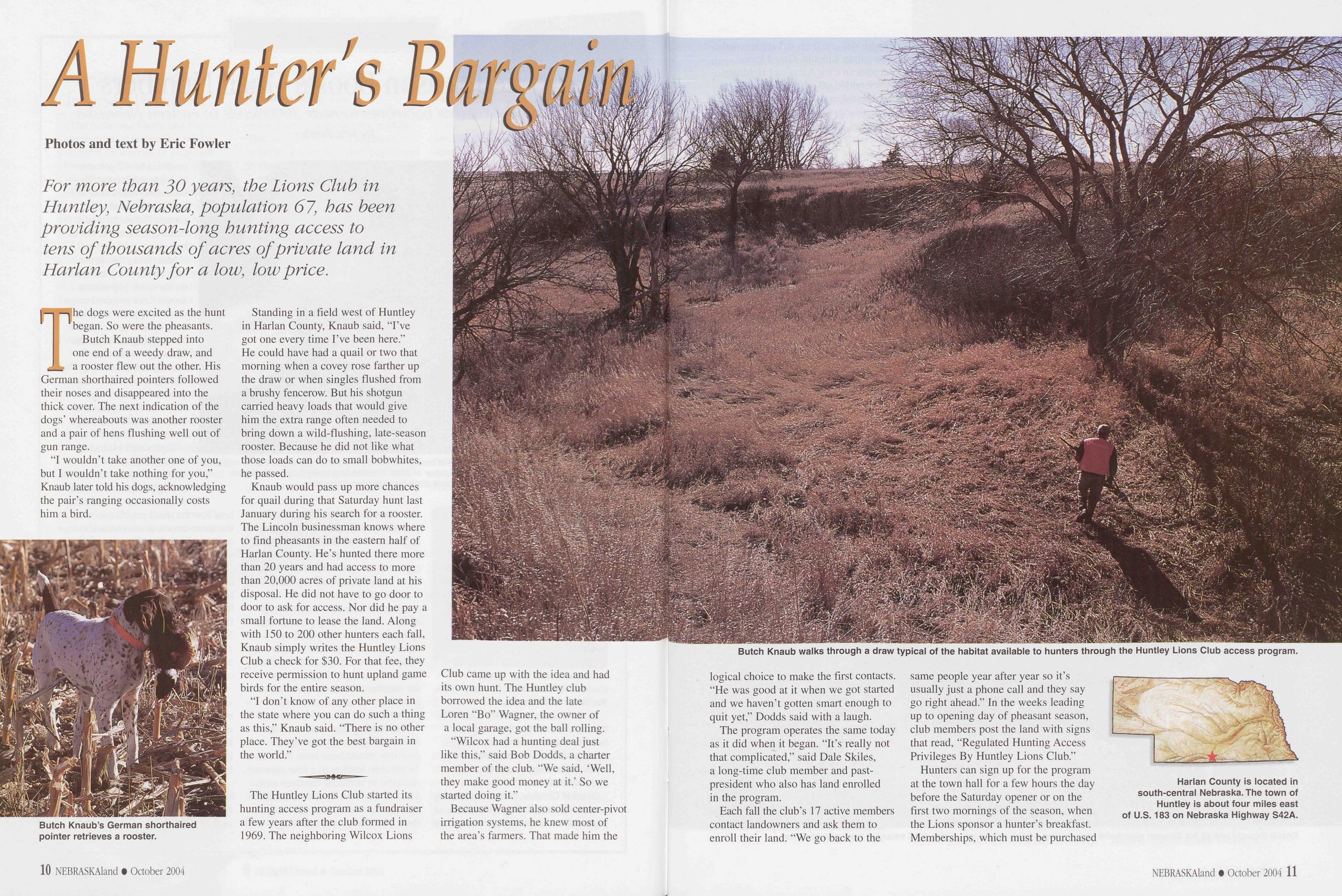
A Hunter's Bargain
For more than 30 years, the Lions Club in Huntley, Nebraska, population 67, has been providing season-long hunting access to tens of thousands of acres of private land in Harlan County for a loe, low price.
The dogs were excited as the hunt began. So were the pheasants. Butch Knaub stepped into one end of a weedy draw, and a rooster flew out the other. His German shorthaired pointers followed their noses and disappeared into the thick cover. The next indication of the dogs’ whereabouts was another rooster and a pair of hens flushing well out of gun range.
“I wouldn’t take another one of you, but I wouldn’t take nothing for you,” Knaub later told his dogs, acknowledging the pair’s ranging occasionally costs him a bird.
Butch Knaub’s German shorthaired pointer retrieves a rooster.
Standing in a field west of Huntley in Harlan County, Knaub said, "I’ve got one every time I’ve been here.” He could have had a quail or two that morning when a covey rose farther up the draw or when singles flushed from a brushy fencerow. But his shotgun carried heavy loads that would give him the extra range often needed to bring down a wild-flushing, late-season rooster. Because he did not like what those loads can do to small bobwhites, he passed.
Knaub would pass up more chances for quail during that Saturday hunt last January during his search for a rooster. The Lincoln businessman knows where to find pheasants in the eastern half of Harlan County. He’s hunted there more than 20 years and had access to more than 20,000 acres of private land at his disposal. He did not have to go door to door to ask for access. Nor did he pay a small fortune to lease the land. Along with 150 to 200 other hunters each fall, Knaub simply writes the Huntley Lions Club a check for $30. For that fee, they receive permission to hunt upland game birds for the entire season.
"I don’t know of any other place in the state where you can do such a thing as this,” Knaub said. "There is no other place. They’ve got the best bargain in the world.”
The Huntley Lions Club started its hunting access program as a fundraiser a few years after the club formed in 1969. The neighboring Wilcox Lions Club came up with the idea and had its own hunt. The Huntley club borrowed the idea and the late Loren "Bo” Wagner, the owner of a local garage, got the ball rolling.
“Wilcox had a hunting deal just like this,” said Bob Dodds, a charter member of the club. "We said, ‘Well, they make good money at it.’ So we started doing it.”
Because Wagner also sold center-pivot irrigation systems, he knew most of the area’s farmers. That made him the 10 NEBRASKAland • October 2004 logical choice to make the first contacts. "He was good at it when we got started and we haven’t gotten smart enough to quit yet,” Dodds said with a laugh.
The program operates the same today as it did when it began. "It’s really not that complicated,” said Dale Skiles, a long-time club member and past- president who also has land enrolled in the program.
Each fall the club’s 17 active members contact landowners and ask them to enroll their land. “We go back to the same people year after year so it’s usually just a phone call and they say go right ahead.” In the weeks leading up to opening day of pheasant season, club members post the land with signs that read, "Regulated Hunting Access Privileges By Huntley Lions Club.”
Harlan County is located in south-central Nebraska. The town of Huntley is about four miles east of U.S. 183 on Nebraska Highway S42A.
 in person, are also available at Huntley
Service, the garage once owned by
Wagner, the week before the season
opener and throughout the season.
in person, are also available at Huntley
Service, the garage once owned by
Wagner, the week before the season
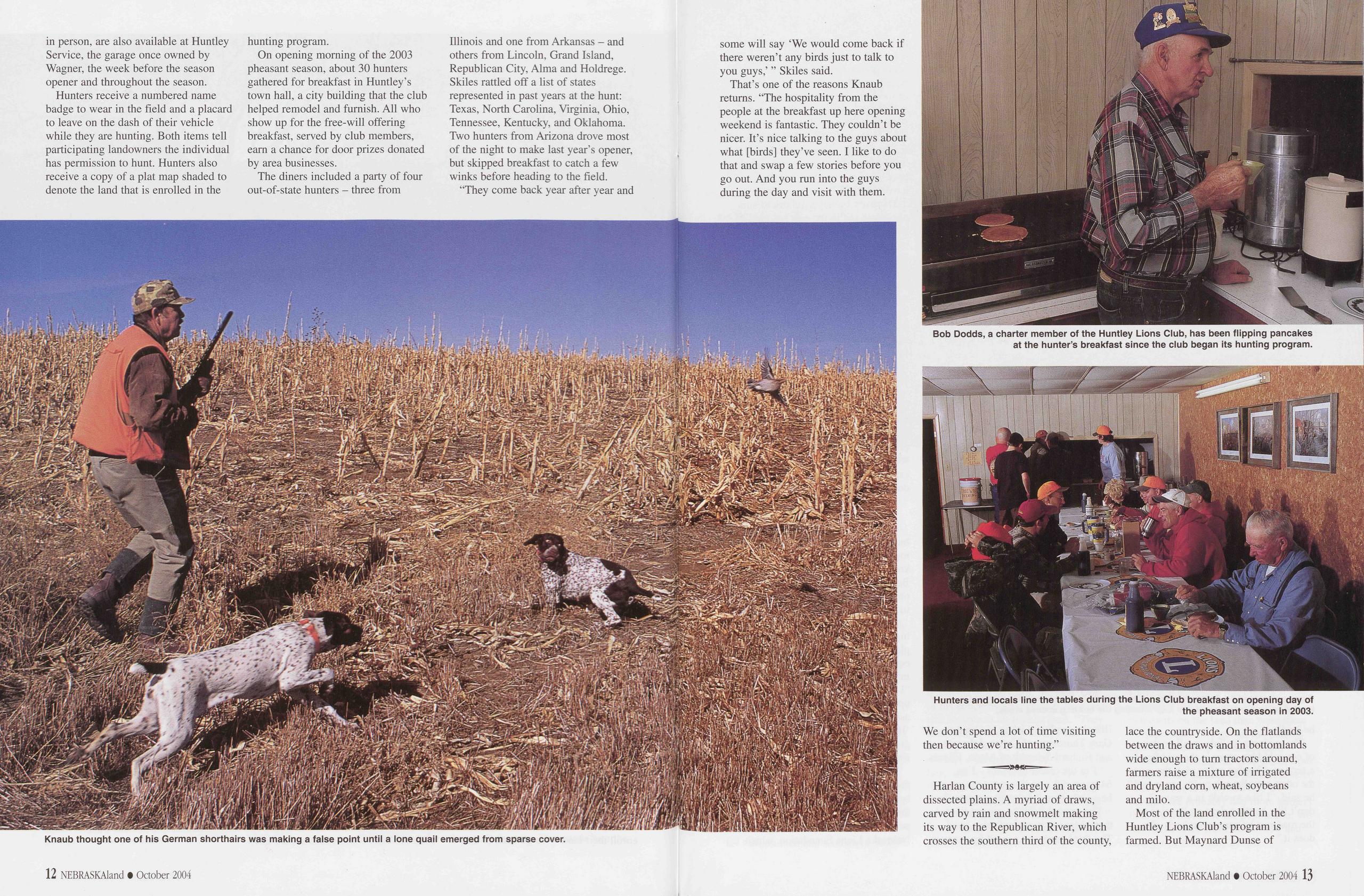
opener and throughout the season.Knaub thought one of his German shorthairs was making a false point until a lone quail emerged from sparse cover.
On opening morning of the 2003 pheasant season, about 30 hunters gathered for breakfast in Huntley’s town hall, a city building that the club helped remodel and furnish. All who show up for the free-will offering breakfast, served by club members, earn a chance for door prizes donated by area businesses.
The diners included a party of four out-of-state hunters - three from Illinois and one from Arkansas - and others from Lincoln, Grand Island, Republican City, Alma and Holdrege. Skiles rattled off a list of states represented in past years at the hunt: Texas, North Carolina, Virginia, Ohio, Tennessee, Kentucky, and Oklahoma. Two hunters from Arizona drove most of the night to make last year’s opener, but skipped breakfast to catch a few winks before heading to the field.
"They come back year after year and 12 NEBRASKAland • October 2004 some will say ‘We would come back if there weren’t any birds just to talk to you guys,’ ” Skiles said.
Bob Dodds, a charter member of the Huntley Lions Club, has been flipping pancakes at the hunter’s breakfast since the club began its hunting program.
Hunters and locals line the tables during the Lions Club breakfast on opening day of the pheasant season in 2003.
Harlan County is largely an area of dissected plains. A myriad of draws, carved by rain and snowmelt making its way to the Republican River, which crosses the southern third of the county, lace the countryside. On the flatlands between the draws and in bottomlands wide enough to turn tractors around, farmers raise a mixture of irrigated and dryland corn, wheat, soybeans and milo.
Most of the land enrolled in the
Huntley Lions Club’s program is
farmed. But Maynard Dunse of
NEBRASKAland • October 2004 13
 Huntley, also a charter member of
the club, said that every farm has waste
draws - areas that are too narrow, rough
or steep to farm. These are the areas
where hunters most often find pheasants
and quail, but pastures, creek bottoms,
grassy waterways, center-pivot comers,
fencerows, crop stubble and a few
small patches of CRP also hold birds.
Huntley, also a charter member of
the club, said that every farm has waste
draws - areas that are too narrow, rough
or steep to farm. These are the areas
where hunters most often find pheasants
and quail, but pastures, creek bottoms,
grassy waterways, center-pivot comers,
fencerows, crop stubble and a few
small patches of CRP also hold birds.
Knaub had hunted in the area for a few years before he found out about the Lions Club program. "I kept running into the controlled hunting signs, and finally I was driving through Huntley and I stopped at the little cafe and asked them what a person had to do to hunt the land,” he said. “They told me and I’ve been doing it ever since. It’s been a lot of years.”
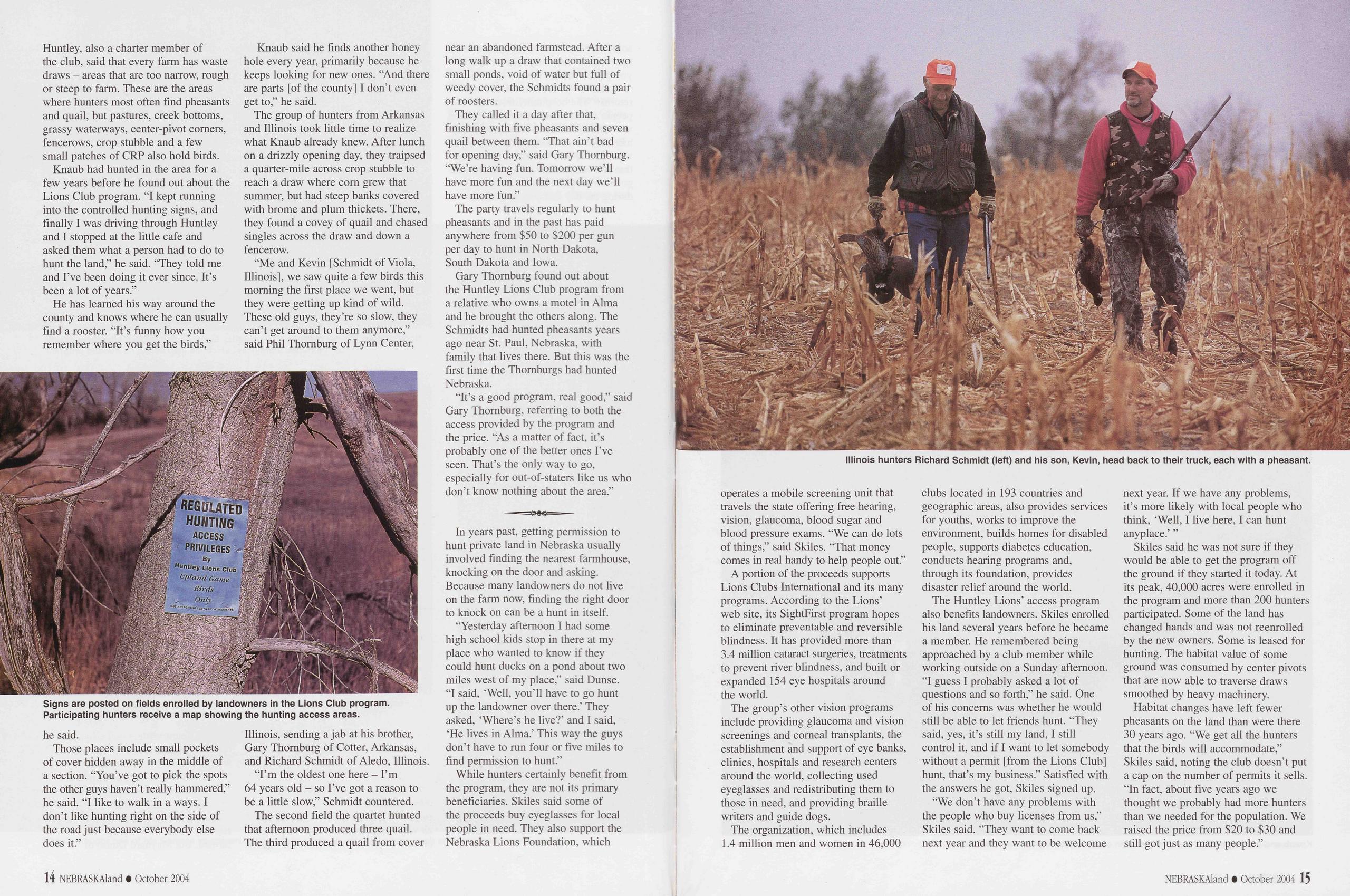
Signs are posted on fields enrolled by landowners in the Lions Club program. Participating hunters receive a map showing the hunting access areas.
Those places include small pockets of cover hidden away in the middle of a section. “You’ve got to pick the spots the other guys haven’t really hammered,” he said. “I like to walk in a ways. I don’t like hunting right on the side of the road just because everybody else does it.”
Knaub said he finds another honey hole every year, primarily because he keeps looking for new ones. “And there are parts [of the county] I don’t even get to,” he said.
The group of hunters from Arkansas and Illinois took little time to realize what Knaub already knew. After lunch on a drizzly opening day, they traipsed a quarter-mile across crop stubble to reach a draw where corn grew that summer, but had steep banks covered with brome and plum thickets. There, they found a covey of quail and chased singles across the draw and down a fencerow.
“Me and Kevin [Schmidt of Viola, Illinois], we saw quite a few birds this morning the first place we went, but they were getting up kind of wild. These old guys, they’re so slow, they can’t get around to them anymore,” said Phil Thornburg of Lynn Center, Illinois, sending a jab at his brother, Gary Thornburg of Cotter, Arkansas, and Richard Schmidt of Aledo, Illinois.
“I’m the oldest one here - I’m 64 years old - so I’ve got a reason to be a little slow,” Schmidt countered.
The second field the quartet hunted that afternoon produced three quail. The third produced a quail from cover near an abandoned farmstead. After a long walk up a draw that contained two small ponds, void of water but full of weedy cover, the Schmidts found a pair of roosters.
They called it a day after that, finishing with five pheasants and seven quail between them. “That ain’t bad for opening day,” said Gary Thornburg. “We’re having fun. Tomorrow we’ll have more fun and the next day we’ll have more fun.”
The party travels regularly to hunt pheasants and in the past has paid anywhere from $50 to $200 per gun per day to hunt in North Dakota, South Dakota and Iowa.
Gary Thornburg found out about the Huntley Lions Club program from a relative who owns a motel in Alma and he brought the others along. The Schmidts had hunted pheasants years ago near St. Paul, Nebraska, with family that lives there. But this was the first time the Thornburgs had hunted Nebraska.
“It’s a good program, real good,” said Gary Thornburg, referring to both the access provided by the program and the price. “As a matter of fact, it’s probably one of the better ones I’ve seen. That’s the only way to go, especially for out-of-staters like us who don’t know nothing about the area.”
In years past, getting permission to hunt private land in Nebraska usually involved finding the nearest farmhouse, knocking on the door and asking. Because many landowners do not live on the farm now, finding the right door to knock on can be a hunt in itself.
“Yesterday afternoon I had some high school kids stop in there at my place who wanted to know if they could hunt ducks on a pond about two miles west of my place,” said Dunse. “I said, ‘Well, you’ll have to go hunt up the landowner over there.’ They asked, ‘Where’s he live?’ and I said, ‘He lives in Alma.’ This way the guys don’t have to run four or five miles to find permission to hunt.”
Illinois hunters Richard Schmidt (from left) and his son, Kevin, head back to their truck, each with a pheasant
A portion of the proceeds supports Lions Clubs International and its many programs. According to the Lions’ web site, its SightFirst program hopes to eliminate preventable and reversible blindness. It has provided more than 3.4 million cataract surgeries, treatments to prevent river blindness, and built or expanded 154 eye hospitals around the world.
The group’s other vision programs include providing glaucoma and vision screenings and corneal transplants, the establishment and support of eye banks, clinics, hospitals and research centers around the world, collecting used eyeglasses and redistributing them to those in need, and providing braille writers and guide dogs.
The organization, which includes 1.4 million men and women in 46,000 clubs located in 193 countries and geographic areas, also provides services for youths, works to improve the environment, builds homes for disabled people, supports diabetes education, conducts hearing programs and, through its foundation, provides disaster relief around the world.
The Huntley Lions’ access program also benefits landowners. Skiles enrolled his land several years before he became a member. He remembered being approached by a club member while working outside on a Sunday afternoon. “I guess I probably asked a lot of questions and so forth,” he said. One of his concerns was whether he would still be able to let friends hunt. “They said, yes, it’s still my land, I still control it, and if I want to let somebody without a permit [from the Lions Club] hunt, that’s my business.” Satisfied with the answers he got, Skiles signed up.
“We don’t have any problems with the people who buy licenses from us,” Skiles said. “They want to come back next year and they want to be welcome next year. If we have any problems, it’s more likely with local people who think, ‘Well, I live here, I can hunt anyplace.’ ”
Skiles said he was not sure if they would be able to get the program off the ground if they started it today. At its peak, 40,000 acres were enrolled in the program and more than 200 hunters participated. Some of the land has changed hands and was not reenrolled by the new owners. Some is leased for hunting. The habitat value of some ground was consumed by center pivots that are now able to traverse draws smoothed by heavy machinery.
Habitat changes have left fewer pheasants on the land than were there 30 years ago. “We get all the hunters that the birds will accommodate,” Skiles said, noting the club doesn’t put a cap on the number of permits it sells. “In fact, about five years ago we thought we probably had more hunters than we needed for the population. We raised the price from $20 to $30 and still got just as many people.”
NEBRASKAland • October 2004 15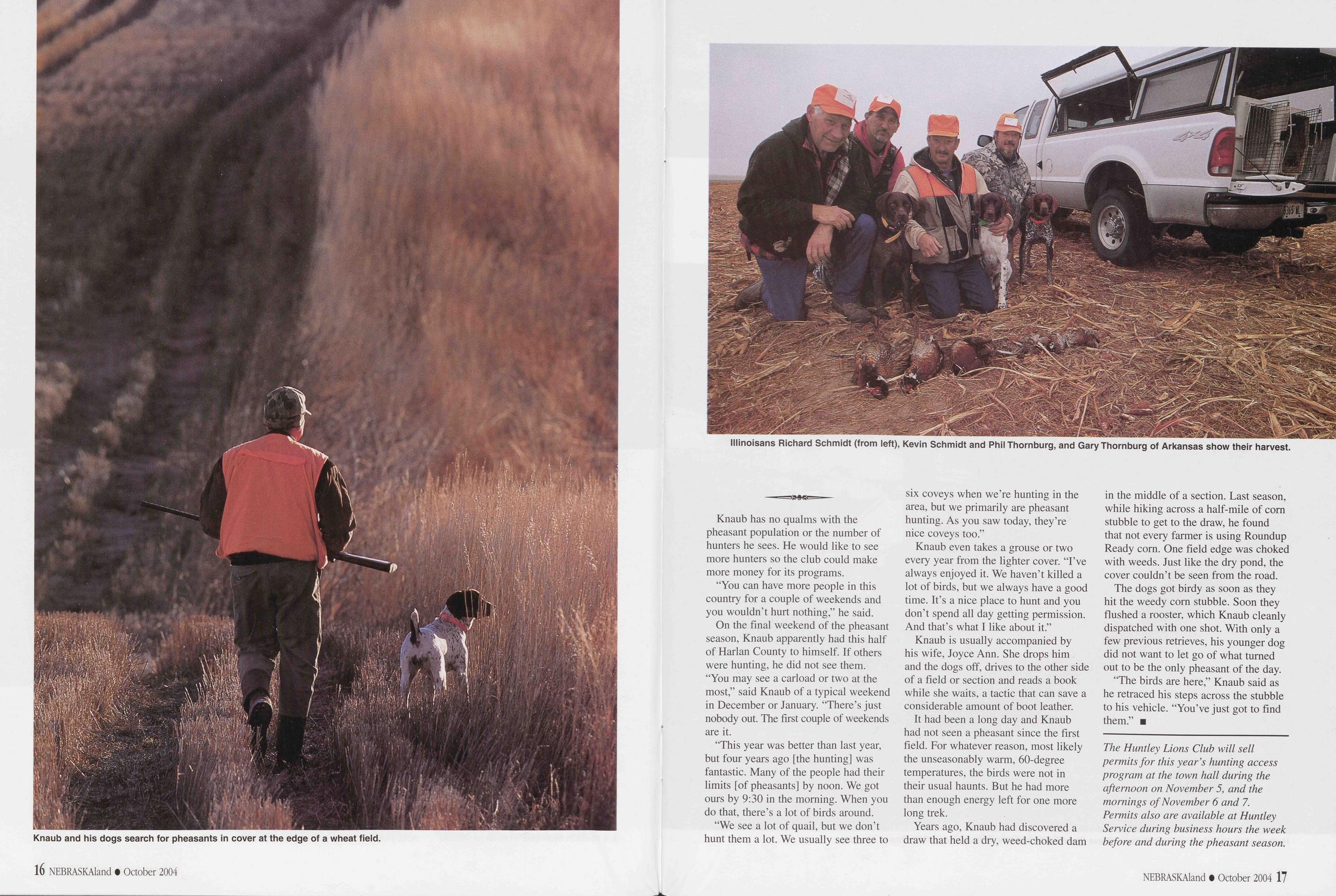
Knaub and his dogs search for pheasants in cover at the edge of a wheat field.
Illinoisans Richard Schmidt (from left), Kevin Schmidt and Phil Thornburg, and Gary Thornburg of Arkansas show their harvest
Knaub has no qualms with the pheasant population or the number of hunters he sees. He would like to see more hunters so the club could make more money for its programs.
“You can have more people in this country for a couple of weekends and you wouldn’t hurt nothing,” he said.
On the final weekend of the pheasant season, Knaub apparently had this half of Harlan County to himself. If others were hunting, he did not see them. “You may see a carload or two at the most,” said Knaub of a typical weekend in December or January. “There’s just nobody out. The first couple of weekends are it.
“This year was better than last year, but four years ago [the hunting] was fantastic. Many of the people had then- limits [of pheasants] by noon. We got ours by 9:30 in the morning. When you do that, there’s a lot of birds around.
“We see a lot of quail, but we don’t hunt them a lot. We usually see three to six coveys when we’re hunting in the area, but we primarily are pheasant hunting. As you saw today, they’re nice coveys too.”
Knaub even takes a grouse or two every year from the lighter cover. “I’ve always enjoyed it. We haven’t killed a lot of birds, but we always have a good time. It’s a nice place to hunt and you don’t spend all day getting permission. And that’s what I like about it.”
Knaub is usually accompanied by his wife, Joyce Ann. She drops him and the dogs off, drives to the other side of a field or section and reads a book while she waits, a tactic that can save a considerable amount of boot leather.
It had been a long day and Knaub had not seen a pheasant since the first field. For whatever reason, most likely the unseasonably warm, 60-degree temperatures, the birds were not in their usual haunts. But he had more than enough energy left for one more long trek.
Years ago, Knaub had discovered a draw that held a dry, weed-choked dam in the middle of a section. Last season, while hiking across a half-mile of com stubble to get to the draw, he found that not every farmer is using Roundup Ready corn. One field edge was choked with weeds. Just like the dry pond, the cover couldn’t be seen from the road.
The dogs got birdy as soon as they hit the weedy corn stubble. Soon they flushed a rooster, which Knaub cleanly dispatched with one shot. With only a few previous retrieves, his younger dog did not want to let go of what turned out to be the only pheasant of the day.
“The birds are here,” Knaub said as he retraced his steps across the stubble to his vehicle. “You’ve just got to find them.”
The Huntley Lions Club will sell permits for this year's hunting access program at the town hall during the afternoon on November 5, and the mornings of November 6 and 7. Permits also are available at Huntley Service during business hours the week before and during the pheasant season. NEBRASKAland • October 2004 17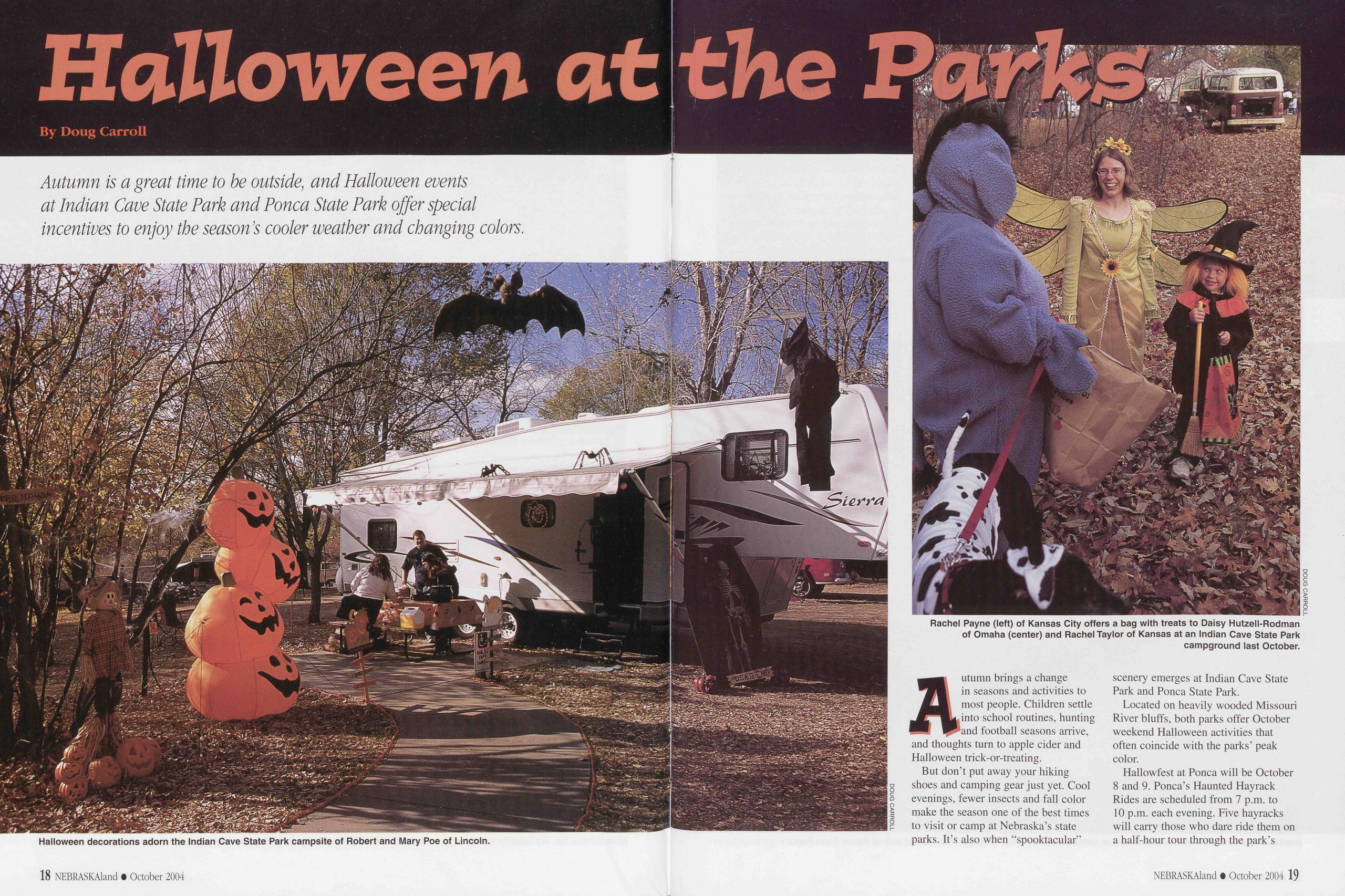
Halloween at the Parks
Autumn is a great time to be outside, and Halloween events at Indian Cave State Park and Ponca State Park offer special incentives to enjoy the season’s cooler weather and changing colors.
Halloween decorations adorn the Indian Cave State Park campsite of Robert and Mary Poe of Lincoln.
Rachel Payne (left) of Kansas City offers a bag with treats to Daisy Hutzell-Rodman of Omaha (center) and Rachel Taylor of Kansas at an Indian Cave State Park campground last October.
Autumn brings a change in seasons and activities to most people. Children settle into school routines, hunting and football seasons arrive, and thoughts turn to apple cider and Halloween trick-or-treating.
But don’t put away your hiking shoes and camping gear just yet. Cool evenings, fewer insects and fall color make the season one of the best times to visit or camp at Nebraska’s state parks. It’s also when “spooktacular” scenery emerges at Indian Cave State Park and Ponca State Park.
Located on heavily wooded Missouri River bluffs, both parks offer October weekend Halloween activities that often coincide with the parks’ peak color.
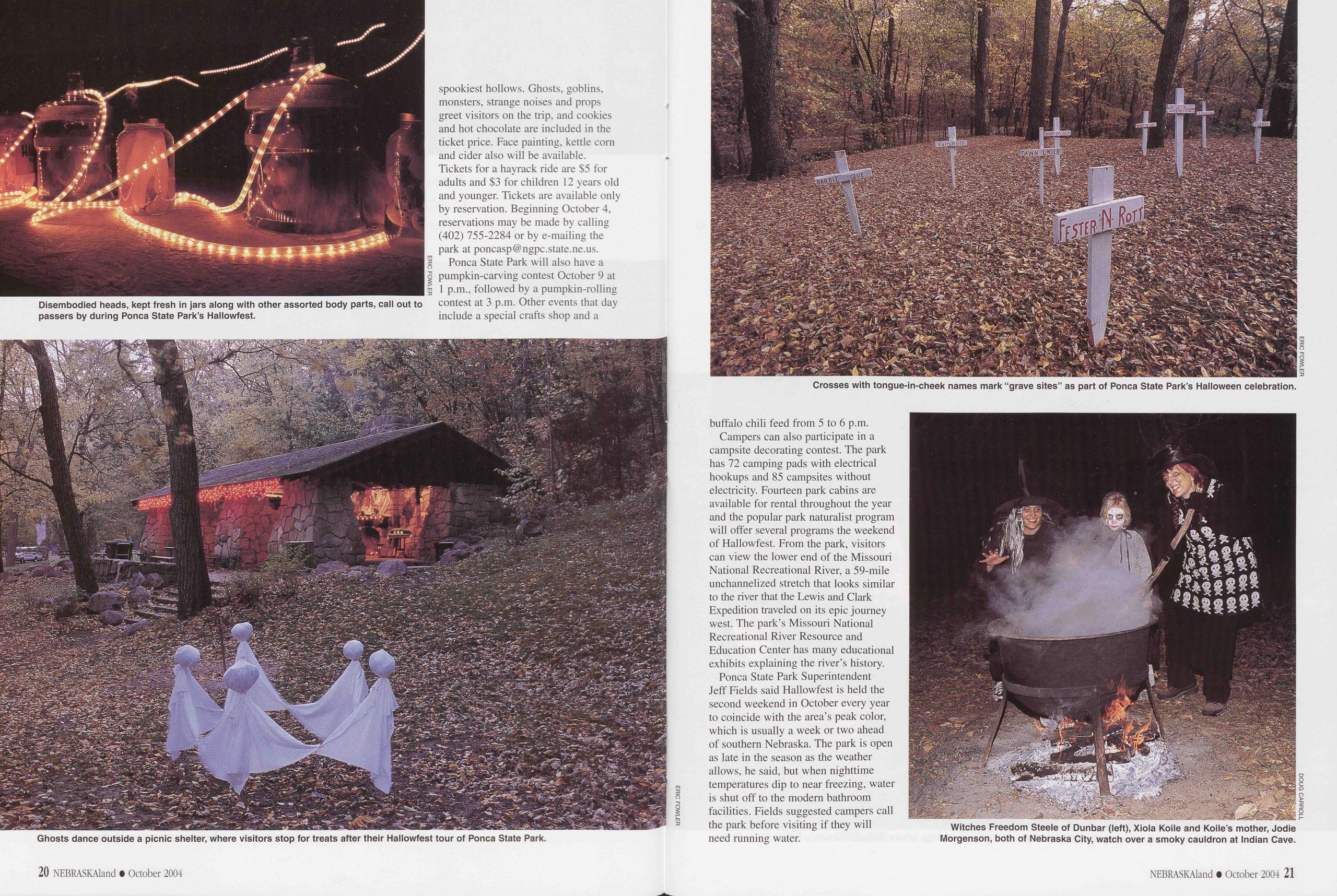
Disembodied heads, kept fresh in jars along with other assorted body parts, call out to passers by during Ponca State Park’s Hallowfest.
Ghosts dance outside a picnic shelter, where visitors stop for treats after their Hallowfest tour of Ponca State Park.
Crosses with tongue-in-cheek names mark “grave sites” as part of Ponca State Park’s Halloween celebration.
Campers can also participate in a campsite decorating contest. The park has 72 camping pads with electrical hookups and 85 campsites without electricity. Fourteen park cabins are available for rental throughout the year and the popular park naturalist program will offer several programs the weekend of Hallowfest. From the park, visitors can view the lower end of the Missouri National Recreational River, a 59-mile unchannelized stretch that looks similar to the river that the Lewis and Clark Expedition traveled on its epic journey west. The park’s Missouri National Recreational River Resource and Education Center has many educational exhibits explaining the river’s history.
Ponca State Park Superintendent Jeff Fields said Hallowfest is held the second weekend in October every year to coincide with the area’s peak color, which is usually a week or two ahead of southern Nebraska. The park is open as late in the season as the weather allows, he said, but when nighttime temperatures dip to near freezing, water is shut off to the modern bathroom facilities. Fields suggested campers call the park before visiting if they will need running water.
Witches Freedom Steele of Dunbar (left), Xiola Koile and Koile’s mother, Jodie Morgenson, both of Nebraska City, watch over a smoky cauldron at Indian Cave. DOUG CARROLL
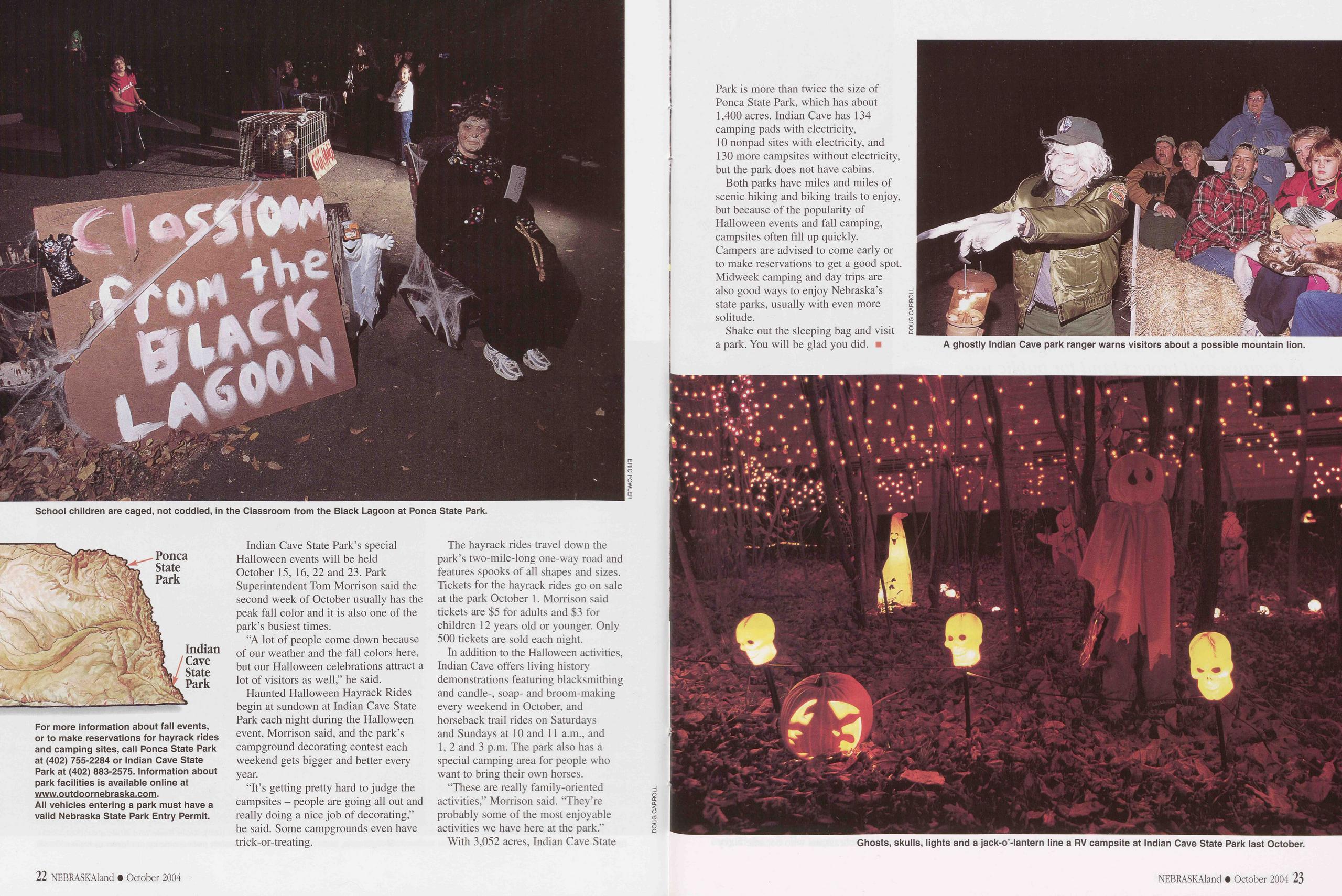
School children are caged, not coddled, in the Classroom from the Black Lagoon at Ponca State Park.
For more information about fall events, or to make reservations for hayrack rides and camping sites, call Ponca State Park at (402) 755-2284 or Indian Cave State Park at (402) 883-2575. Information about park facilities is available online at www.outdoornebraska.com. All vehicles entering a park must have a valid Nebraska State Park Entry Permit.
Indian Cave State Park’s special Halloween events will be held October 15, 16, 22 and 23. Park Superintendent Tom Morrison said the second week of October usually has the peak fall color and it is also one of the park’s busiest times.
“A lot of people come down because of our weather and the fall colors here, but our Halloween celebrations attract a lot of visitors as well,” he said.
Haunted Halloween Hayrack Rides begin at sundown at Indian Cave State Park each night during the Halloween event, Morrison said, and the park’s campground decorating contest each weekend gets bigger and better every year.
“It’s getting pretty hard to judge the campsites - people are going all out and really doing a nice job of decorating,” he said. Some campgrounds even have trick-or-treating.
The hayrack rides travel down the park’s two-mile-long one-way road and features spooks of all shapes and sizes. Tickets for the hayrack rides go on sale at the park October 1. Morrison said tickets are $5 for adults and $3 for children 12 years old or younger. Only 500 tickets are sold each night.
In addition to the Halloween activities, Indian Cave offers living history demonstrations featuring blacksmithing and candle-, soap- and broom-making every weekend in October, and horseback trail rides on Saturdays and Sundays at 10 and 11 a.m., and 1, 2 and 3 p.m. The park also has a special camping area for people who want to bring their own horses.
“These are really family-oriented activities,” Morrison said. “They’re probably some of the most enjoyable activities we have here at the park.”
With 3,052 acres, Indian Cave State 22 NEBRASKAland • October 2004 Park is more than twice the size of Ponca State Park, which has about 1,400 acres. Indian Cave has 134 camping pads with electricity, 10 nonpad sites with electricity, and 130 more campsites without electricity, but the park does not have cabins.
Both parks have miles and miles of scenic hiking and biking trails to enjoy, but because of the popularity of Halloween events and fall camping, campsites often fill up quickly. Campers are advised to come early or to make reservations to get a good spot. Midweek camping and day trips are also good ways to enjoy Nebraska’s state parks, usually with even more solitude.
Shake out the sleeping bag and visit a park. You will be glad you did.
A ghostly Indian Cave park ranger warns visitors about a possible mountain lion
Ghosts, skulls, lights and a jack-o’-lantern line a RV campsite at Indian Cave State Park last October.
Legacy and Challenge
Clive Ostenberg of Scottsbluff loved waterfowl bunting on tbe North Platte River and upland bird hunting across North America. At his death, he left funds and challenged friends to acquire and protect land for public use.
Clive Ostenberg was an avid outdoorsman whose lifelong love of bird hunting evolved into a commitment to wildlife habitat. During his lifetime, he saw both the glory days of upland bird hunting and the negative effects that development and changes in agriculture had on wildlife populations and prime habitat.
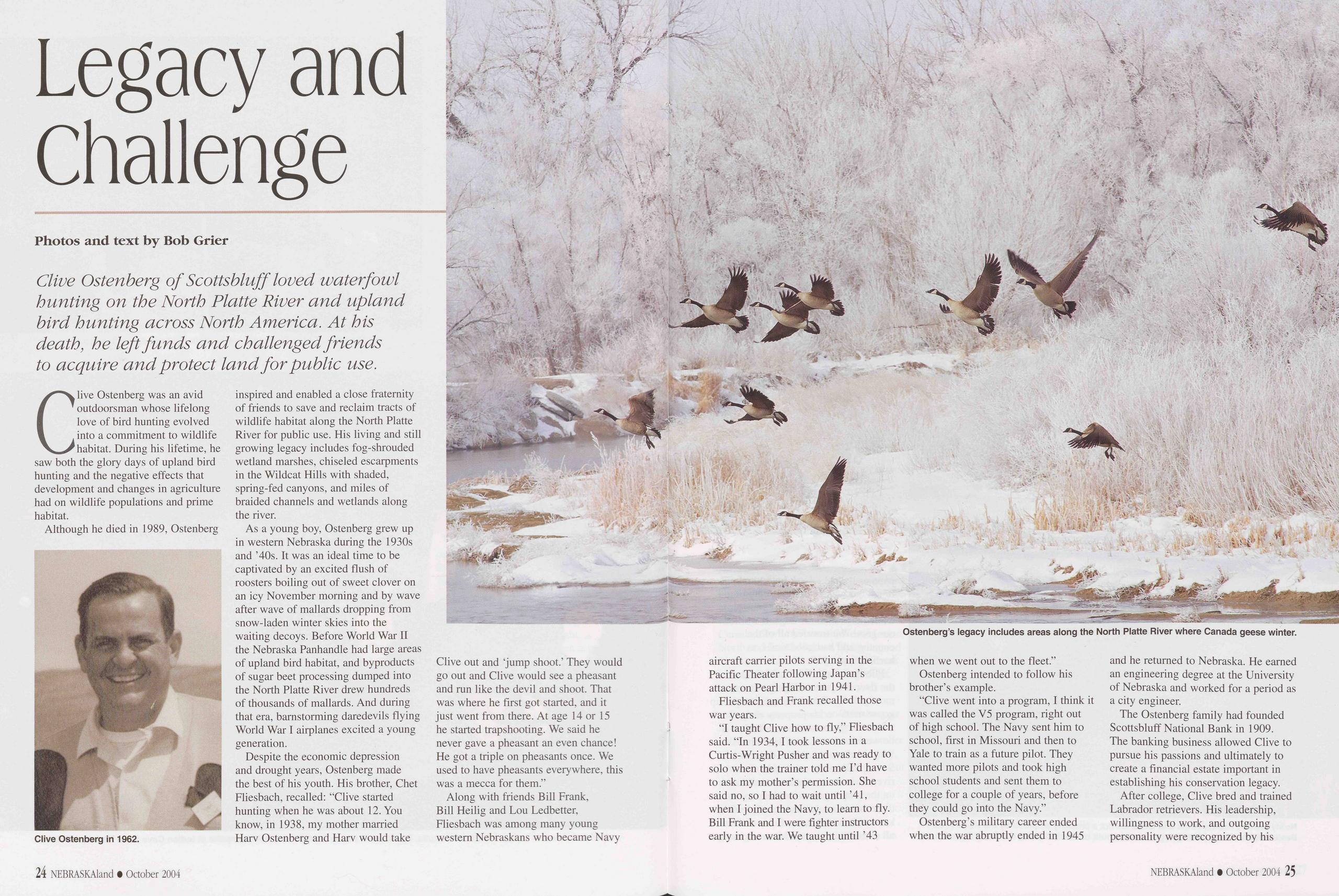
Clive Ostenberg in 1962.
As a young boy, Ostenberg grew up in western Nebraska during the 1930s and ’40s. It was an ideal time to be captivated by an excited flush of roosters boiling out of sweet clover on an icy November morning and by wave after wave of mallards dropping from snow-laden winter skies into the waiting decoys. Before World War II the Nebraska Panhandle had large areas of upland bird habitat, and byproducts of sugar beet processing dumped into the North Platte River drew hundreds of thousands of mallards. And during that era, barnstorming daredevils flying World War I airplanes excited a young generation.
Despite the economic depression and drought years, Ostenberg made the best of his youth. His brother, Chet Fliesbach, recalled: “Clive started hunting when he was about 12. You know, in 1938, my mother married Harv Ostenberg and Harv would take Clive out and ‘jump shoot.’ They would go out and Clive would see a pheasant and run like the devil and shoot. That was where he first got started, and it just went from there. At age 14 or 15 he started trapshooting. We said he never gave a pheasant an even chance! He got a triple on pheasants once. We used to have pheasants everywhere, this was a mecca for them.”
Ostenberg's legacy includes areas along the North Platte River where Canada geese winter.
Fliesbach and Frank recalled those war years.
“I taught Clive how to fly,” Fliesbach said. “In 1934,1 took lessons in a Curtis-Wright Pusher and was ready to solo when the trainer told me I’d have to ask my mother’s permission. She said no, so I had to wait until ’41, when I joined the Navy, to learn to fly. Bill Frank and I were fighter instructors early in the war. We taught until ’43 when we went out to the fleet.”
Ostenberg intended to follow his brother’s example.
“Clive went into a program, I think it was called the V5 program, right out of high school. The Navy sent him to school, first in Missouri and then to Yale to train as a future pilot. They wanted more pilots and took high school students and sent them to college for a couple of years, before they could go into the Navy.”
Ostenberg’s military career ended when the war abruptly ended in 1945 and he returned to Nebraska. He earned an engineering degree at the University of Nebraska and worked for a period as a city engineer.
The Ostenberg family had founded Scottsbluff National Bank in 1909. The banking business allowed Clive to pursue his passions and ultimately to create a financial estate important in establishing his conservation legacy.
college, Clive bred and trained
Labrador retrievers. His leadership,
willingness to work, and outgoing
personality were recognized by his
NEBRASKAland • October 2004 25
 posthumous induction into the National
Amateur Retriever Hall of Fame in
2001. His brother told that part of the
story.
posthumous induction into the National
Amateur Retriever Hall of Fame in
2001. His brother told that part of the
story.
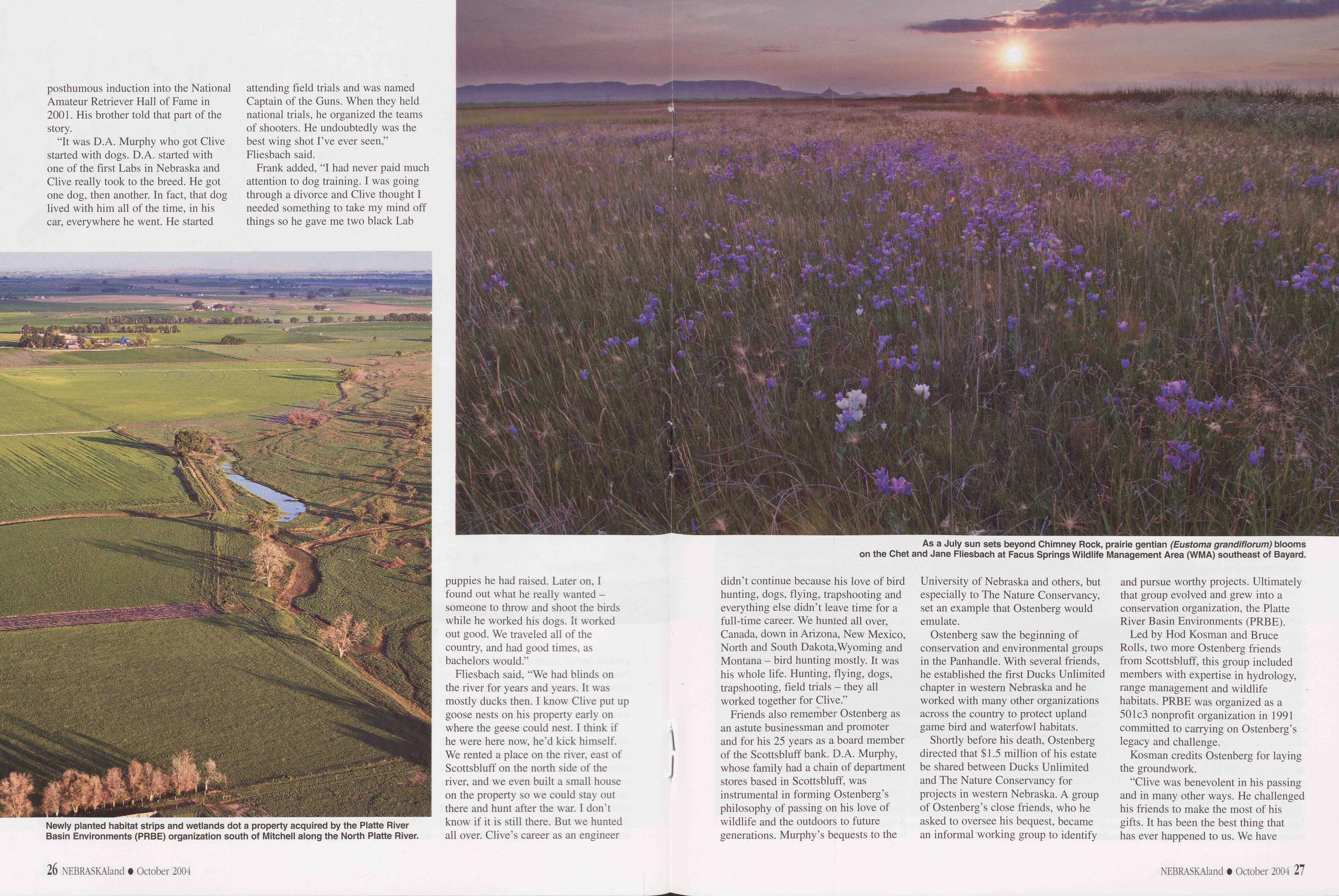
Newly planted habitat strips and wetlands dot a property acquired by the Platte River Basin Environments (PRBE) organization south of Mitchell along the North Platte River.
Frank added, "I had never paid much attention to dog training. I was going through a divorce and Clive thought I needed something to take my mind off things so he gave me two black Lab puppies he had raised. Later on, I found out what he really wanted - someone to throw and shoot the birds while he worked his dogs. It worked out good. We traveled all of the country, and had good times, as bachelors would.”
As a July sun sets beyond Chimney Rock, prairie gentian (Eustoma grandiflorum) blooms on the Chet and Jane Fliesbach at Facus Springs Wildlife Management Area (WMA) southeast of Bayard.
Friends also remember Ostenberg as an astute businessman and promoter and for his 25 years as a board member of the Scottsbluff bank. D.A. Murphy, whose family had a chain of department stores based in Scottsbluff, was instrumental in forming Ostenberg’s philosophy of passing on his love of wildlife and the outdoors to future generations. Murphy’s bequests to the University of Nebraska and others, but especially to The Nature Conservancy, set an example that Ostenberg would emulate.
Ostenberg saw the beginning of conservation and environmental groups in the Panhandle. With several friends, he established the first Ducks Unlimited chapter in western Nebraska and he worked with many other organizations across the country to protect upland game bird and waterfowl habitats.
Shortly before his death, Ostenberg directed that $1.5 million of his estate be shared between Ducks Unlimited and The Nature Conservancy for projects in western Nebraska. A group of Ostenberg’s close friends, who he asked to oversee his bequest, became an informal working group to identify and pursue worthy projects. Ultimately that group evolved and grew into a conservation organization, the Platte River Basin Environments (PRBE).
Led by Hod Kosman and Bruce Rolls, two more Ostenberg friends from Scottsbluff, this group included members with expertise in hydrology, range management and wildlife habitats. PRBE was organized as a 501c3 nonprofit organization in 1991 committed to carrying on Ostenberg’s legacy and challenge.
Kosman credits Ostenberg for laying the groundwork.
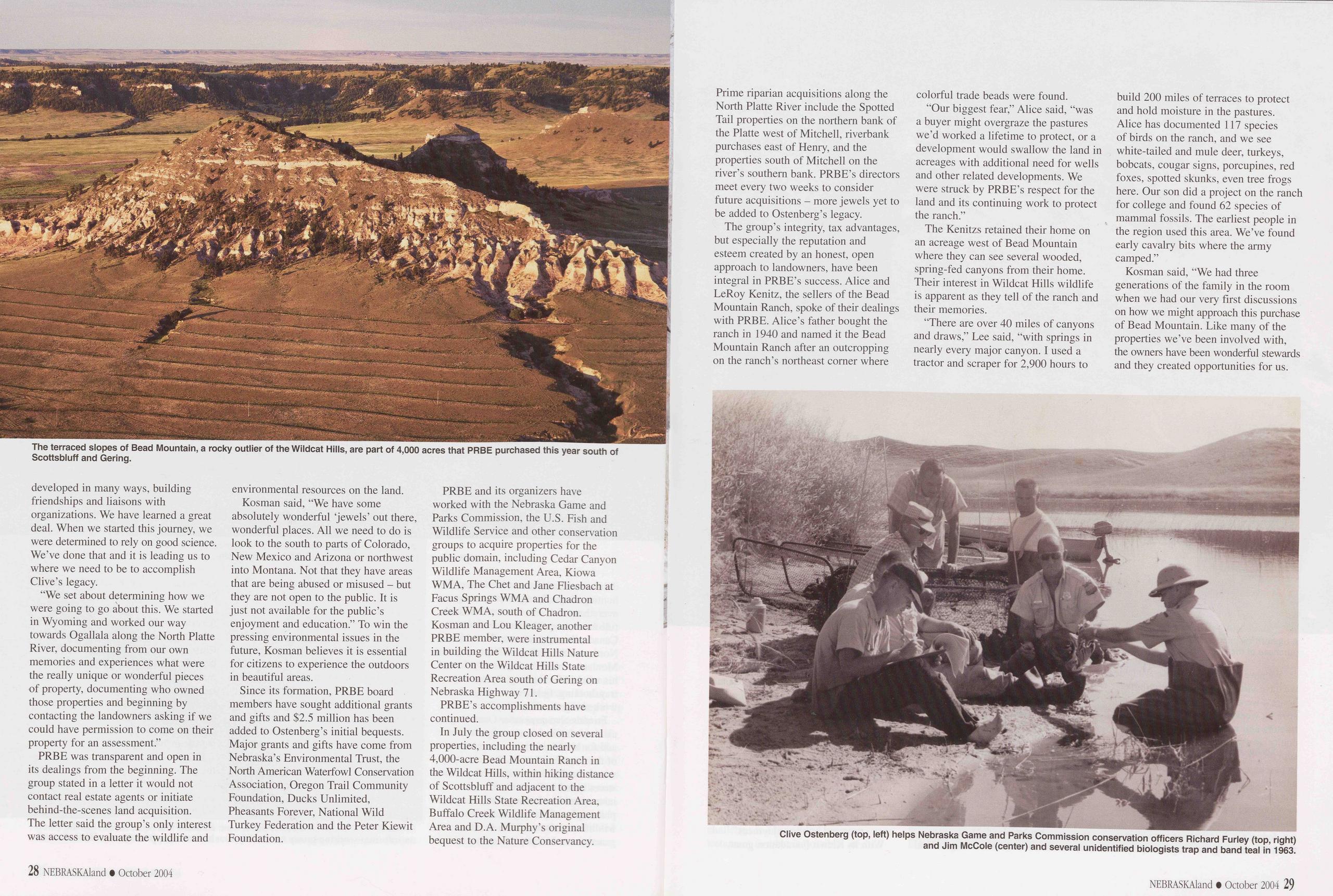
The terraced slopes of Bead Mountain, a rocky outlier of the Wildcat Hills, are part of 4,000 acres that PRBE purchased this year south of Scottsbluff and Gering.
“We set about determining how we were going to go about this. We started in Wyoming and worked our way towards Ogallala along the North Platte River, documenting from our own memories and experiences what were the really unique or wonderful pieces of property, documenting who owned those properties and beginning by contacting the landowners asking if we could have permission to come on their property for an assessment.”
PRBE was transparent and open in its dealings from the beginning. The group stated in a letter it would not contact real estate agents or initiate behind-the-scenes land acquisition. The letter said the group’s only interest was access to evaluate the wildlife and environmental resources on the land.
Kosman said, "We have some absolutely wonderful ‘jewels’ out there, wonderful places. All we need to do is look to the south to parts of Colorado, New Mexico and Arizona or northwest into Montana. Not that they have areas that are being abused or misused - but they are not open to the public. It is just not available for the public’s enjoyment and education.” To win the pressing environmental issues in the future, Rosman believes it is essential for citizens to experience the outdoors in beautiful areas.
Since its formation, PRBE board members have sought additional grants and gifts and $2.5 million has been added to Ostenberg’s initial bequests. Major grants and gifts have come from Nebraska’s Environmental Trust, the North American Waterfowl Conservation Association, Oregon Trail Community Foundation, Ducks Unlimited, Pheasants Forever, National Wild Turkey Federation and the Peter Riewit Foundation.
PRBE and its organizers have worked with the Nebraska Game and Parks Commission, the U.S. Fish and Wildlife Service and other conservation groups to acquire properties for the public domain, including Cedar Canyon Wildlife Management Area, Riowa WMA, The Chet and Jane Fliesbach at Facus Springs WMA and Chadron Creek WMA, south of Chadron. Rosman and Lou Rleager, another PRBE member, were instrumental in building the Wildcat Hills Nature Center on the Wildcat Hills State Recreation Area south of Gering on Nebraska Highway 71.
PRBE’s accomplishments have continued.
In July the group closed on several properties, including the nearly 4,000-acre Bead Mountain Ranch in the Wildcat Hills, within hiking distance of Scottsbluff and adjacent to the Wildcat Hills State Recreation Area, Buffalo Creek Wildlife Management Area and D A. Murphy’s original bequest to the Nature Conservancy. 28 NEBRASKAland • October 2004 Prime riparian acquisitions along the North Platte River include the Spotted Tail properties on the northern bank of the Platte west of Mitchell, riverbank purchases east of Henry, and the properties south of Mitchell on the river’s southern bank. PRBE’s directors meet every two weeks to consider future acquisitions - more jewels yet to be added to Ostenberg’s legacy.
The group’s integrity, tax advantages, but especially the reputation and esteem created by an honest, open approach to landowners, have been integral in PRBE’s success. Alice and LeRoy Renitz, the sellers of the Bead Mountain Ranch, spoke of their dealings with PRBE. Alice’s father bought the ranch in 1940 and named it the Bead Mountain Ranch after an outcropping on the ranch’s northeast corner whereClive Ostenberg (top, left) helps Nebraska Game and Parks Commission conservation officers Richard Furley (top, right) and Jim McCole (center) and several unidentified biologists trap and band teal in 1963.
“Our biggest fear,” Alice said, “was a buyer might overgraze the pastures we’d worked a lifetime to protect, or a development would swallow the land in acreages with additional need for wells and other related developments. We were struck by PRBE’s respect for the land and its continuing work to protect the ranch.”
The Kenitzs retained their home on an acreage west of Bead Mountain where they can see several wooded, spring-fed canyons from their home. Their interest in Wildcat Hills wildlife is apparent as they tell of the ranch and their memories.
“There are over 40 miles of canyons and draws,” Lee said, “with springs in nearly every major canyon. I used a tractor and scraper for 2,900 hours to build 200 miles of terraces to protect and hold moisture in the pastures. Alice has documented 117 species of birds on the ranch, and we see white-tailed and mule deer, turkeys, bobcats, cougar signs, porcupines, red foxes, spotted skunks, even tree frogs here. Our son did a project on the ranch for college and found 62 species of mammal fossils. The earliest people in the region used this area. We’ve found early cavalry bits where the army camped.”
Rosman said, “We had three generations of the family in the room when we had our very first discussions on how we might approach this purchase of Bead Mountain. Like many of the properties we’ve been involved with, the owners have been wonderful stewards and they created opportunities for us.
NEBRASKAland • October 2004 29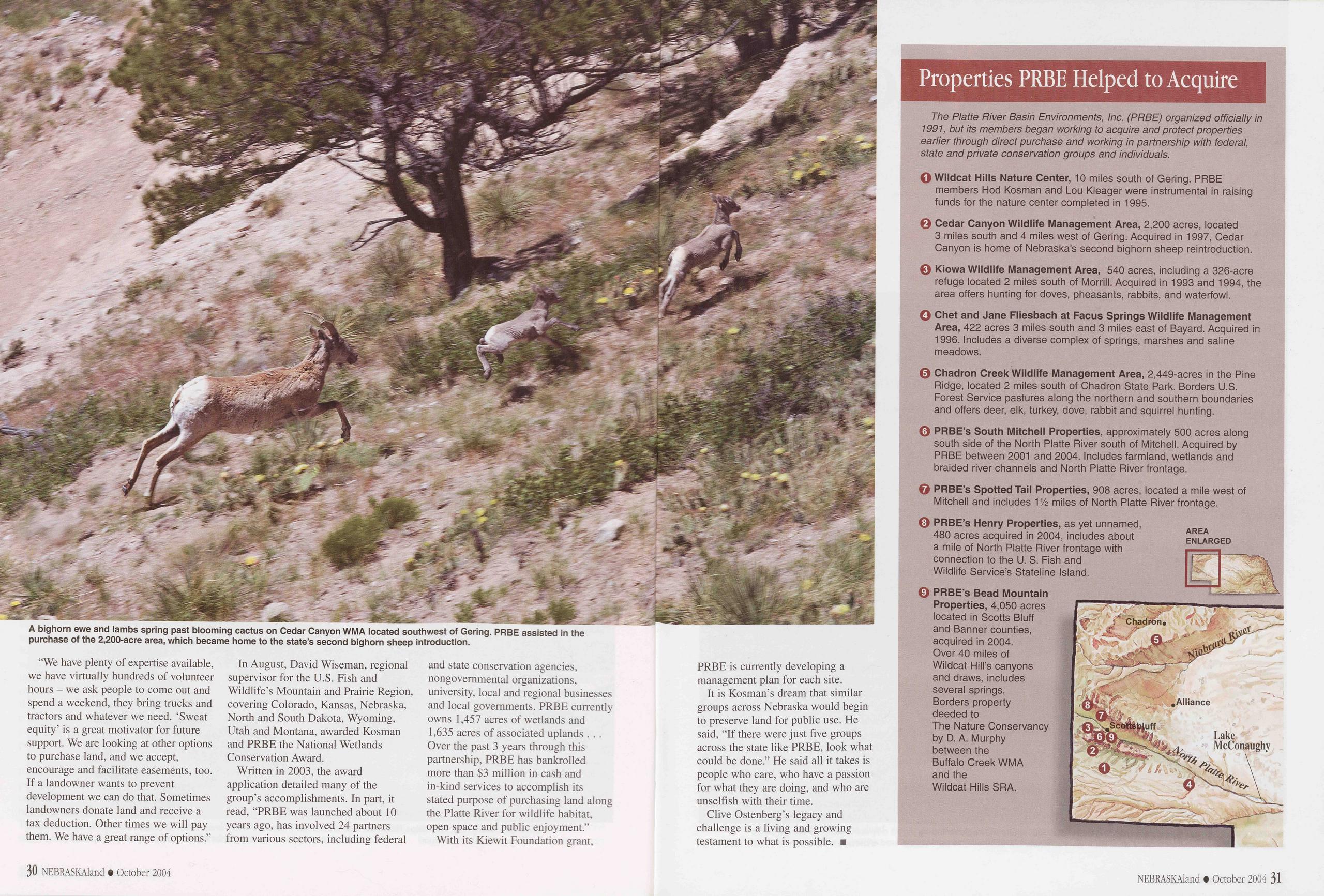
A bighorn ewe and lambs spring past blooming cactus on Cedar Canyon WMA located southwest of Gering. PRBE assisted in the purchase of the 2,200-acre area, which became home to the state’s second bighorn sheep introduction.
“We have plenty of expertise available, we have virtually hundreds of volunteer hours - we ask people to come out and spend a weekend, they bring trucks and tractors and whatever we need. ‘Sweat equity’ is a great motivator for future support. We are looking at other options to purchase land, and we accept, encourage and facilitate easements, too. If a landowner wants to prevent development we can do that. Sometimes landowners donate land and receive a tax deduction. Other times we will pay them. We have a great range of options.”
In August, David Wiseman, regional supervisor for the U.S. Fish and Wildlife’s Mountain and Prairie Region, covering Colorado, Kansas, Nebraska, North and South Dakota, Wyoming, Utah and Montana, awarded Kosman and PRBE the National Wetlands Conservation Award.
Written in 2003, the award application detailed many of the group’s accomplishments. In part, it read, “PRBE was launched about 10 years ago, has involved 24 partners from various sectors, including federal and state conservation agencies, nongovernmental organizations, university, local and regional businesses and local governments. PRBE currently owns 1,457 acres of wetlands and 1,635 acres of associated uplands . . . Over the past 3 years through this partnership, PRBE has bankrolled more than $3 million in cash and in-kind services to accomplish its stated purpose of purchasing land along the Platte River for wildlife habitat, open space and public enjoyment.”
With its Kiewit Foundation grant, 30 NEBRASKAland • October 2004 PRBE is currently developing a management plan for each site. It is Kosman’s dream that similar groups across Nebraska would begin to preserve land for public use. He said, “If there were just five groups across the state like PRBE, look what could be done.” He said all it takes is people who care, who have a passion for what they are doing, and who are unselfish with their time.
Clive Ostenberg’s legacy and challenge is a living and growing testament to what is possible.
Properties PRBE Helped to Acquire The Platte River Basin Environments, Inc. (PRBE) organized officially in 1991, but its members began working to acquire and protect properties earlier through direct purchase and working in partnership with federal, state and private conservation groups and individuals. 1 Wildcat Hills Nature Center, 10 miles south of Gering. PRBE members Hod Kosman and Lou Kleager were instrumental in raising funds for the nature center completed in 1995. 2 Cedar Canyon Wildlife Management Area, 2,200 acres, located 3 miles south and 4 miles west of Gering. Acquired in 1997, Cedar Canyon is home of Nebraska’s second bighorn sheep reintroduction. 3 Kiowa Wildlife Management Area, 540 acres, including a 326-acre refuge located 2 miles south of Morrill. Acquired in 1993 and 1994, the area offers hunting for doves, pheasants, rabbits, and waterfowl. 4 Chet and Jane Fliesbach at Facus Springs Wildlife Management Area, 422 acres 3 miles south and 3 miles east of Bayard. Acquired in 1996. Includes a diverse complex of springs, marshes and saline meadows. 5 Chadron Creek Wildlife Management Area, 2,449-acres in the Pine Ridge, located 2 miles south of Chadron State Park. Borders U.S. Forest Service pastures along the northern and southern boundaries and offers deer, elk, turkey, dove, rabbit and squirrel hunting. 6 PRBE’s South Mitchell Properties, approximately 500 acres along south side of the North Platte River south of Mitchell. Acquired by PRBE between 2001 and 2004. Includes farmland, wetlands and braided river channels and North Platte River frontage. 7 PRBE’s Spotted Tail Properties, 908 acres, located a mile west of Mitchell and includes V/2 miles of North Platte River frontage. 8 PRBE’s Henry Properties, as yet unnamed, 480 acres acquired in 2004, includes about a mile of North Platte River frontage with connection to the U. S. Fish and Wildlife Service’s Stateline Island. 9 PRBE’s Bead Mountain Properties, 4,050 acres located in Scotts Bluff and Banner counties, acquired in 2004. Over 40 miles of Wildcat Hill’s canyons and draws, includes several springs. Borders property deeded to The Nature Conservancy by D. A. Murphy between the Buffalo Creek WMA and the Wildcat Hills SRA. NEBRASKAland • October 2004 31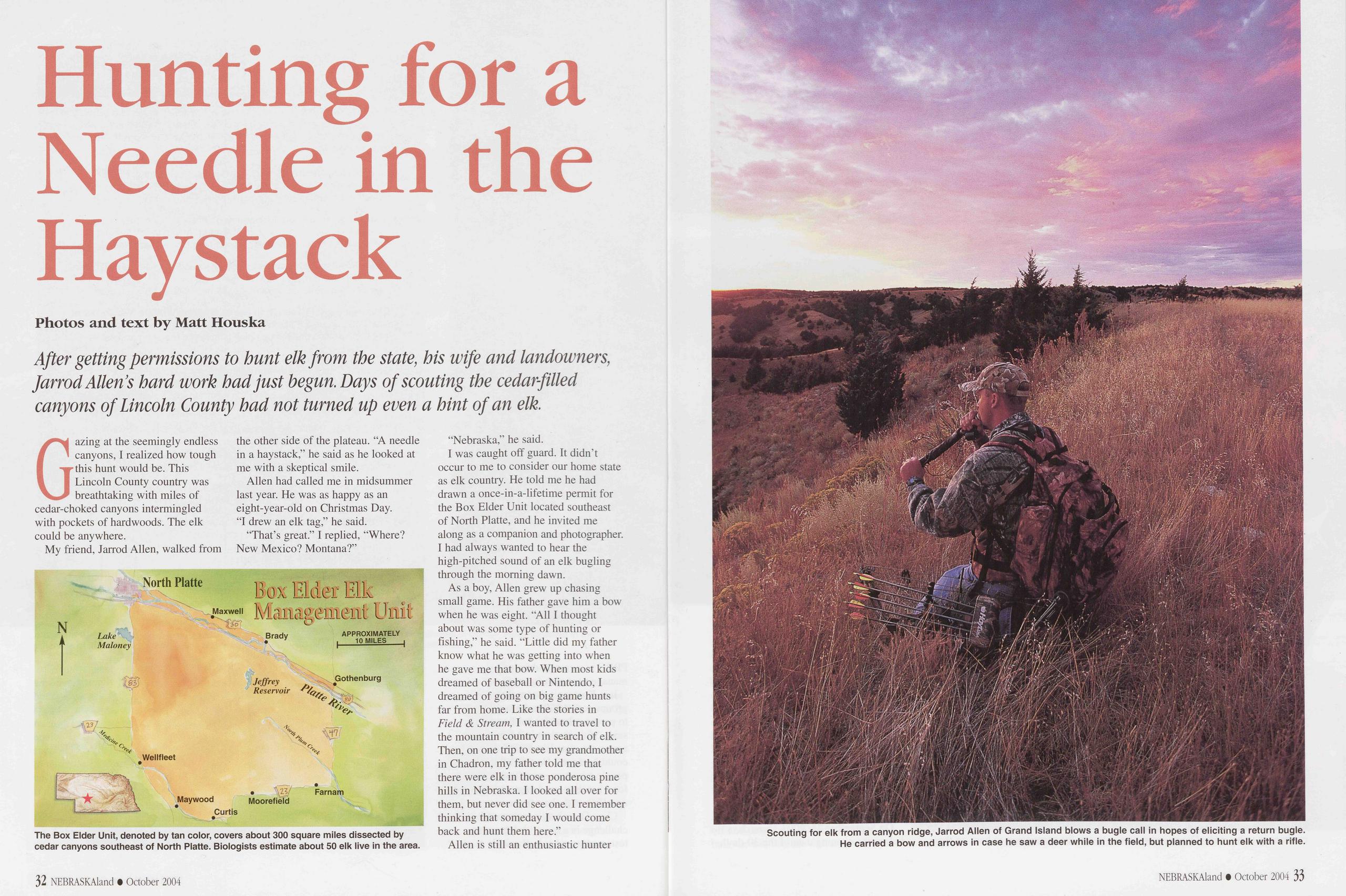
Hunting for a Needle in the Haystack
After getting permissions to hunt elk from the state, his wife and landowners, Jarrod Allen’s hard work had just begun. Days of scouting the cedar-filled canyons of Lincoln County had not turned up even a hint of an elk.
Gazing at the seemingly endless canyons, I realized how tough this hunt would be. This Lincoln County country was breathtaking with miles of cedar-choked canyons intermingled with pockets of hardwoods. The elk could be anywhere.
My friend, Jarrod Allen, walked from the other side of the plateau. “A needle in a haystack,” he said as he looked at me with a skeptical smile.
Allen had called me in midsummer last year. He was as happy as an eight-year-old on Christmas Day. "I drew an elk tag,” he said.
“That’s great.” I replied, “Where? New Mexico? Montana?”
The Box Elder Unit, denoted by tan color, covers about 300 square miles dissected by cedar canyons southeast of North Platte. Biologists estimate about 50 elk live in the area.
“Nebraska,” he said. I was caught off guard. It didn’t occur to me to consider our home state as elk country. He told me he had drawn a once-in-a-lifetime permit for the Box Elder Unit located southeast of North Platte, and he invited me along as a companion and photographer. I had always wanted to hear the high-pitched sound of an elk bugling through the morning dawn.
As a boy, Allen grew up chasing small game. His father gave him a bow when he was eight. “All I thought about was some type of hunting or fishing,” he said. “Little did my father know what he was getting into when he gave me that bow. When most kids dreamed of baseball or Nintendo, I dreamed of going on big game hunts far from home. Like the stories in Field & Stream, I wanted to travel to the mountain country in search of elk. Then, on one trip to see my grandmother in Chadron, my father told me that there were elk in those ponderosa pine hills in Nebraska. I looked all over for them, but never did see one. I remember thinking that someday I would come back and hunt them here.”
Scouting for elk from a canyon ridge, Jarrod Allen of Grand Island blows a bugle call in hopes of eliciting a return bugle. He carried a bow and arrows in case he saw a deer while in the field, but planned to hunt elk with a rifle.
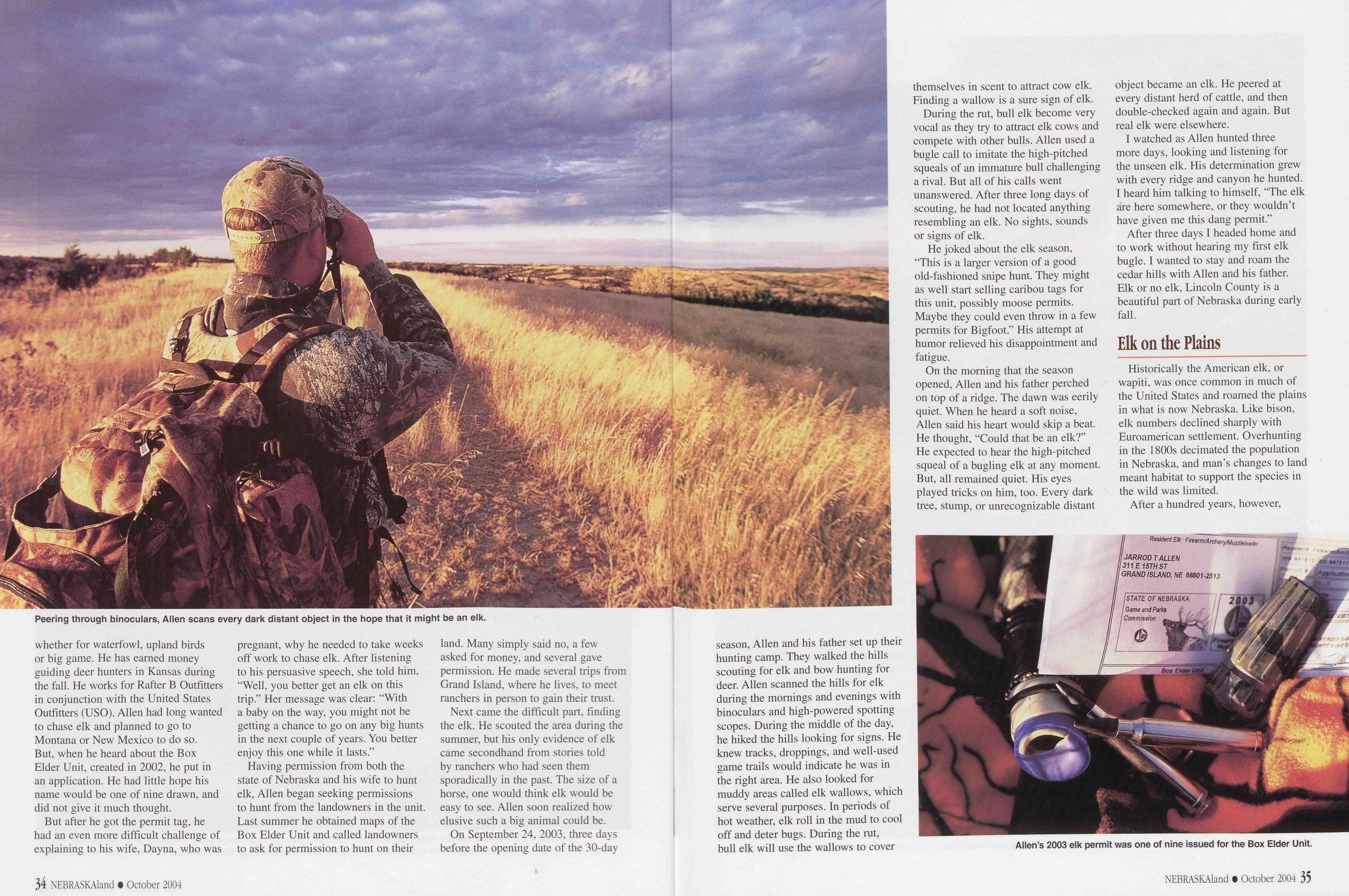
Peering through binoculars, Allen scans every dark distant object in the hope that it might be an elk.
But after he got the permit tag, he had an even more difficult challenge of explaining to his wife, Dayna, who was pregnant, why he needed to take weeks off work to chase elk. After listening to his persuasive speech, she told him, “Well, you better get an elk on this trip.” Her message was clear: “With a baby on the way, you might not be getting a chance to go on any big hunts in the next couple of years. You better enjoy this one while it lasts.”
Having permission from both the state of Nebraska and his wife to hunt elk, Allen began seeking permissions to hunt from the landowners in the unit. Last summer he obtained maps of the Box Elder Unit and called landowners to ask for permission to hunt on their land. Many simply said no, a few asked for money, and several gave permission. He made several trips from Grand Island, where he lives, to meet ranchers in person to gain their trust.
Next came the difficult part, finding the elk. He scouted the area during the summer, but his only evidence of elk came secondhand from stories told by ranchers who had seen them sporadically in the past. The size of a horse, one would think elk would be easy to see. Allen soon realized how elusive such a big animal could be.
On September 24, 2003, three days before the opening date of the 30-day 34 NEBRASKAland • October 2004 season, Allen and his father set up their hunting camp. They walked the hills scouting for elk and bow hunting for deer. Allen scanned the hills for elk during the mornings and evenings with binoculars and high-powered spotting scopes. During the middle of the day, he hiked the hills looking for signs. He knew tracks, droppings, and well-used game trails would indicate he was in the right area. He also looked for muddy areas called elk wallows, which serve several purposes. In periods of hot weather, elk roll in the mud to cool off and deter bugs. During the rut, bull elk will use the wallows to cover themselves in scent to attract cow elk. Finding a wallow is a sure sign of elk. During the rut, bull elk become very vocal as they try to attract elk cows and compete with other bulls. Allen used a bugle call to imitate the high-pitched squeals of an immature bull challenging a rival. But all of his calls went unanswered. After three long days of scouting, he had not located anything resembling an elk. No sights, sounds or signs of elk.
He joked about the elk season, “This is a larger version of a good old-fashioned snipe hunt. They might as well start selling caribou tags for this unit, possibly moose permits. Maybe they could even throw in a few permits for Bigfoot.” His attempt at humor relieved his disappointment and fatigue.
Allen’s 2003 elk permit was one of nine issued for the Box Elder Unit.
I watched as Allen hunted three more days, looking and listening for the unseen elk. His determination grew with every ridge and canyon he hunted. I heard him talking to himself, “The elk are here somewhere, or they wouldn’t have given me this dang permit.”
After three days I headed home and to work without hearing my first elk bugle. I wanted to stay and roam the cedar hills with Allen and his father. Elk or no elk, Lincoln County is a beautiful part of Nebraska during early fall.
Elk on the PlainsHistorically the American elk, or wapiti, was once common in much of the United States and roamed the plains in what is now Nebraska. Like bison, elk numbers declined sharply with Euroamerican settlement. Overhunting in the 1800s decimated the population in Nebraska, and man’s changes to land meant habitat to support the species in the wild was limited.
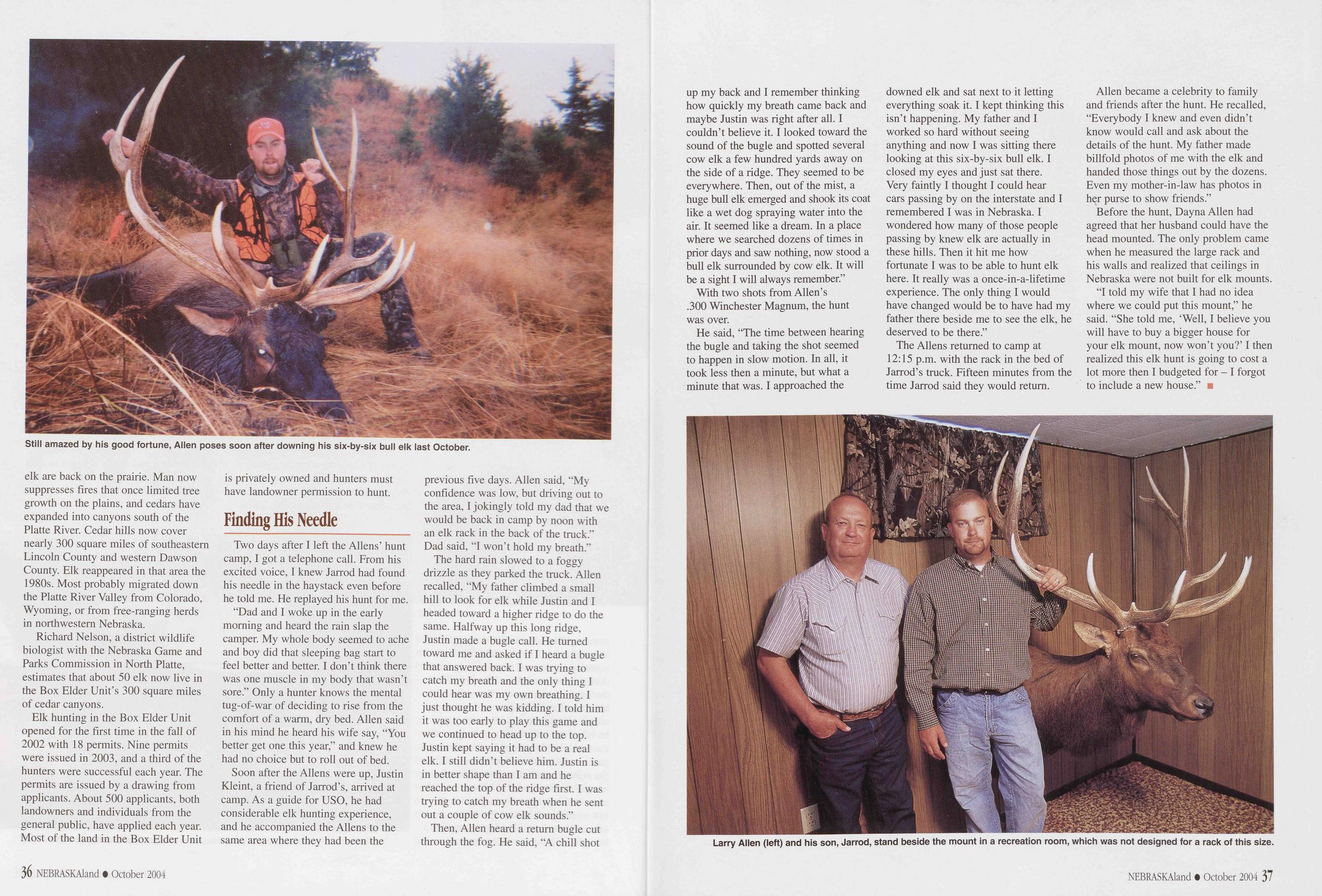
Still amazed by his good fortune, Allen poses soon after downing his six-by-six bull elk last October.
Elk hunting in the Box Elder Unit opened for the first time in the fall of 2002 with 18 permits. Nine permits were issued in 2003, and a third of the hunters were successful each year. The permits are issued by a drawing from applicants. About 500 applicants, both landowners and individuals from the general public, have applied each year. Most of the land in the Box Elder Unit is privately owned and hunters must have landowner permission to hunt.
Finding His NeedleTwo days after I left the Allens’ hunt camp, I got a telephone call. From his excited voice, I knew Jarrod had found his needle in the haystack even before he told me. He replayed his hunt for me.
"Dad and I woke up in the early morning and heard the rain slap the camper. My whole body seemed to ache and boy did that sleeping bag start to feel better and better. I don’t think there was one muscle in my body that wasn’t sore.” Only a hunter knows the mental tug-of-war of deciding to rise from the comfort of a warm, dry bed. Allen said in his mind he heard his wife say, "You better get one this year,” and knew he had no choice but to roll out of bed.
Soon after the Allens were up, Justin Kleint, a friend of Jarrod’s, arrived at camp. As a guide for USO, he had considerable elk hunting experience, and he accompanied the Allens to the same area where they had been the previous five days. Allen said, "My confidence was low, but driving out to the area, I jokingly told my dad that we would be back in camp by noon with an elk rack in the back of the truck.” Dad said, “I won’t hold my breath.”
The hard rain slowed to a foggy drizzle as they parked the truck. Allen recalled, "My father climbed a small hill to look for elk while Justin and I headed toward a higher ridge to do the same. Halfway up this long ridge, Justin made a bugle call. He turned toward me and asked if I heard a bugle that answered back. I was trying to catch my breath and the only thing I could hear was my own breathing. I just thought he was kidding. I told him it was too early to play this game and we continued to head up to the top. Justin kept saying it had to be a real elk. I still didn’t believe him. Justin is in better shape than I am and he reached the top of the ridge first. I was trying to catch my breath when he sent out a couple of cow elk sounds.”
Then, Allen heard a return bugle cut through the fog. He said, "A chill shot 36 NEBRASKAland • October 2004 up my back and I remember thinking how quickly my breath came back and maybe Justin was right after all. I couldn’t believe it. I looked toward the sound of the bugle and spotted several cow elk a few hundred yards away on the side of a ridge. They seemed to be everywhere. Then, out of the mist, a huge bull elk emerged and shook its coat like a wet dog spraying water into the air. It seemed like a dream. In a place where we searched dozens of times in prior days and saw nothing, now stood a bull elk surrounded by cow elk. It will be a sight I will always remember.”
With two shots from Allen’s .300 Winchester Magnum, the hunt was over.
Larry Allen (left) and his son, Jarrod, stand beside the mount in a recreation room, which was not designed for a rack of this size.
The Allens returned to camp at 12:15 p.m. with the rack in the bed of Jarrod’s truck. Fifteen minutes from the time Jarrod said they would return.
Allen became a celebrity to family and friends after the hunt. He recalled, "Everybody I knew and even didn’t know would call and ask about the details of the hunt. My father made billfold photos of me with the elk and handed those things out by the dozens. Even my mother-in-law has photos in her purse to show friends.”
Before the hunt, Dayna Allen had agreed that her husband could have the head mounted. The only problem came when he measured the large rack and his walls and realized that ceilings in Nebraska were not built for elk mounts.
“I told my wife that I had no idea where we could put this mount,” he said. "She told me, ‘Well, I believe you will have to buy a bigger house for your elk mount, now won’t you?’ I then realized this elk hunt is going to cost a lot more then I budgeted for - I forgot to include a new house.”
NEBRASKAland • October 2004 37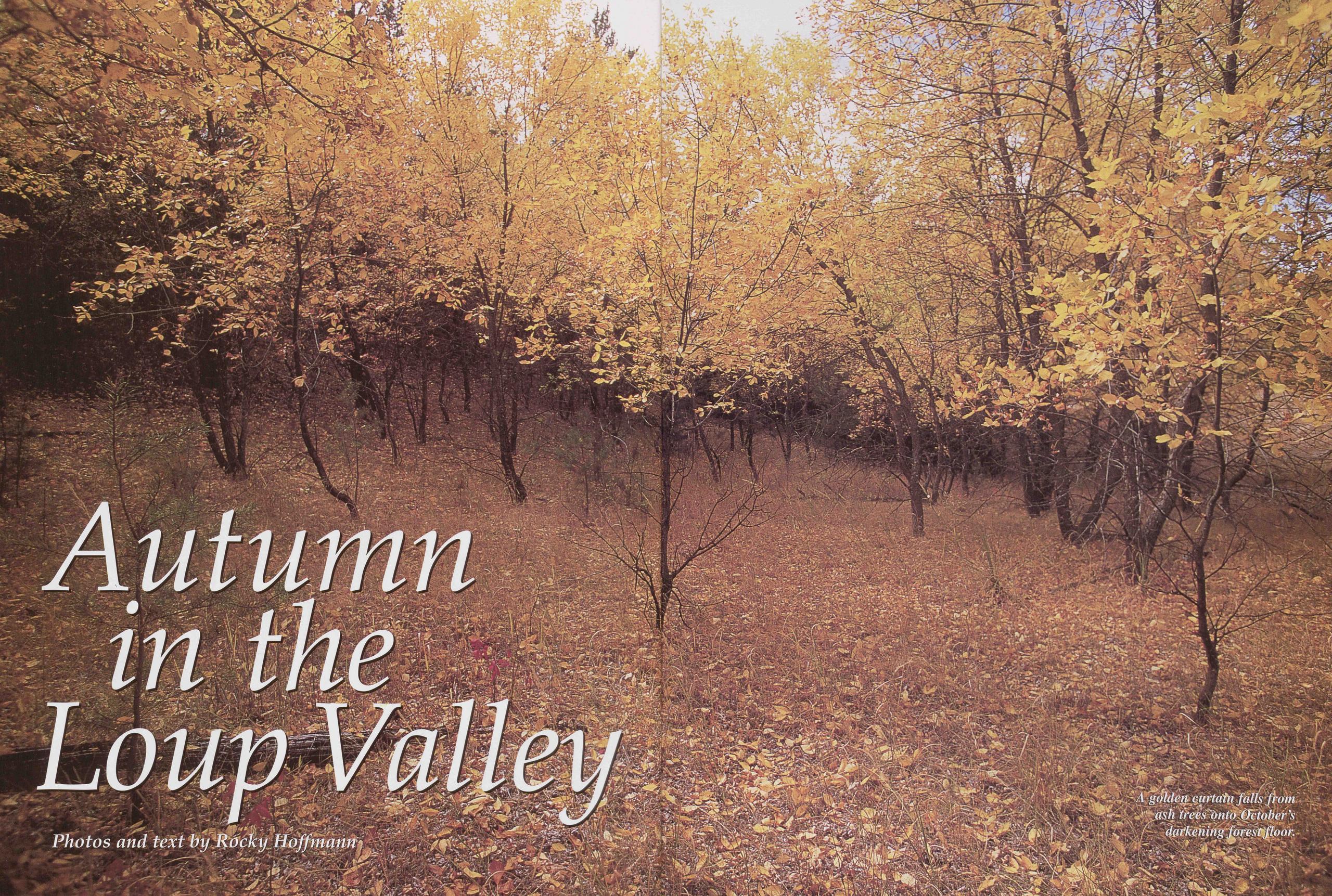
Autumn in the Loup Valley
A golden curtain falls from ash trees onto October's darkening forest floor.
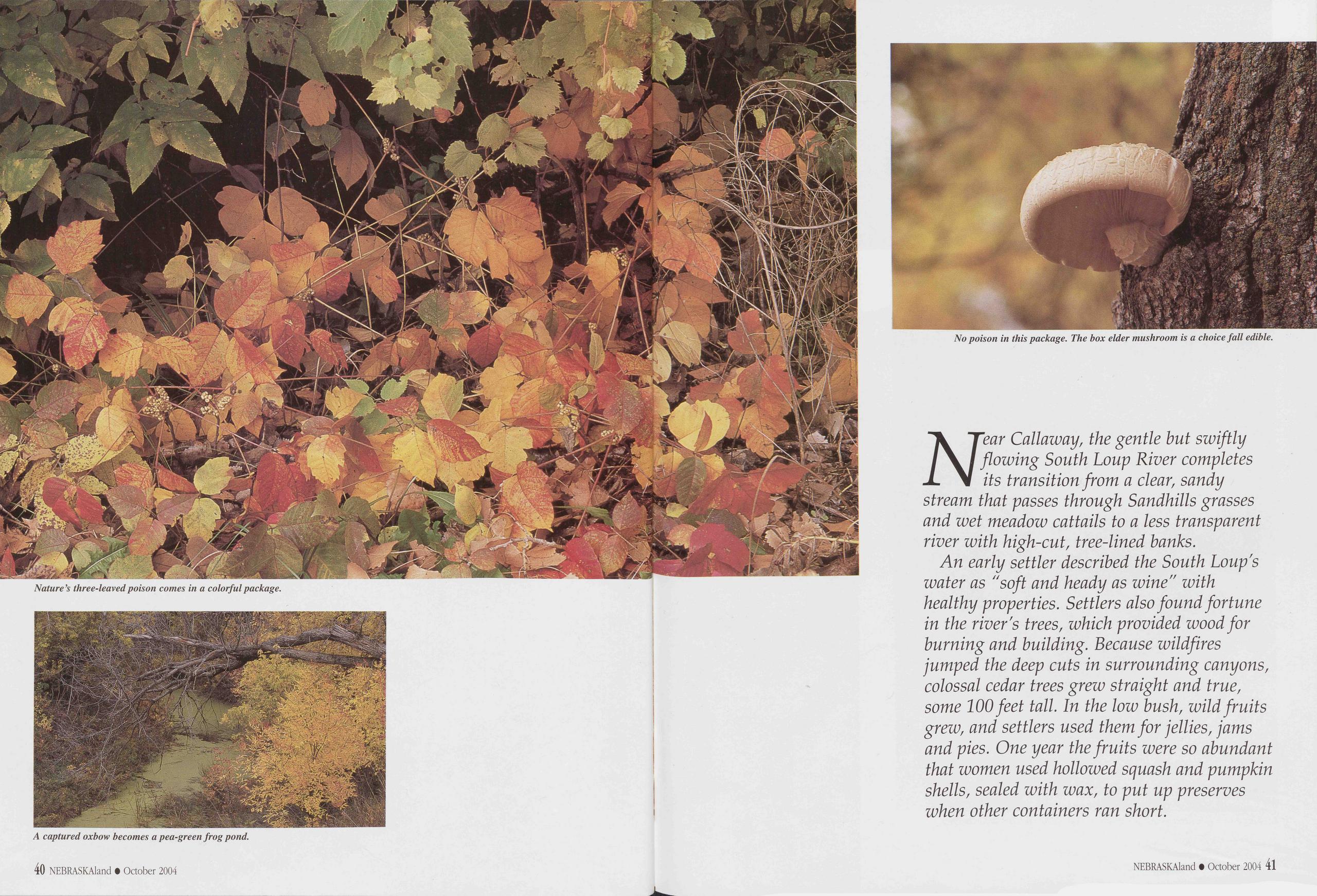
Nature’s three-leaved poison comes in a colorful package.
A captured oxbow becomes a pea-green frog pond.
No poison in this package. The box elder mushroom is a choice fall edible.
Near Callaway; the gentle but swiftly flowing South Loup River completes its transition from a clear; sandy stream that passes through Sandhills grasses and wet meadow cattails to a less transparent river with high-cut, tree-lined banks.
An early settler described the South Loup's water as "soft and heady as wine" with healthy properties. Settlers also found fortune in the river's trees, which provided wood for burning and building. Because wildfires jumped the deep cuts in surrounding canyons, colossal cedar trees grew straight and true, some 100 feet tall. In the low bush, wild fruits grew, and settlers used them for jellies, jams and pies. One year the fruits were so abundant that women used hollowed squash and pumpkin shells, sealed with wax, to put up preserves when other containers ran short.
NEBRASKAland • October 2004 41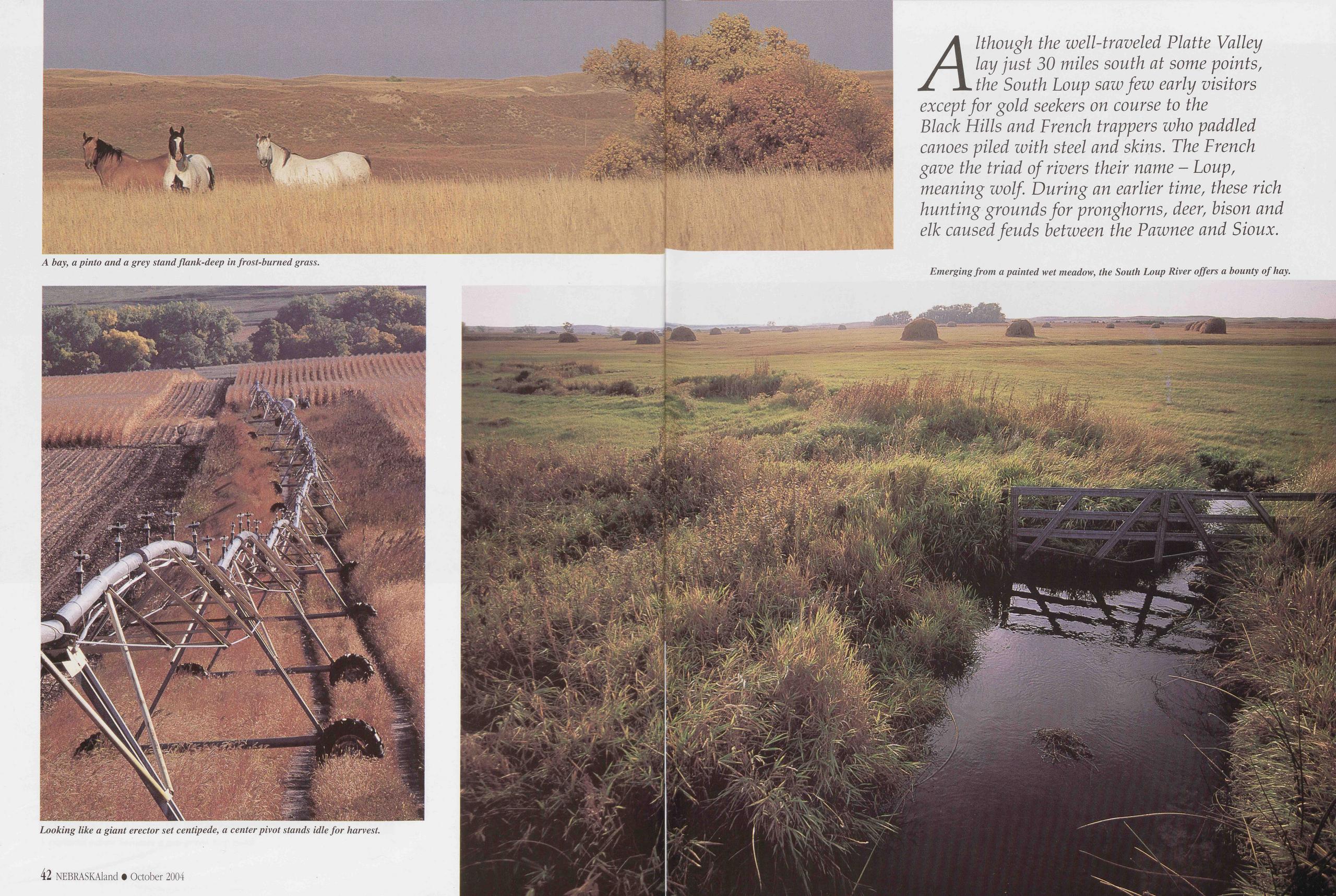
A bay, a pinto and a grey stand flank-deep in frost-burned grass.
Looking like a giant erector set centipede, a center pivot stands idle for harvest.
AIthough the well-traveled Platte Valley lay just 30 miles south at some points, he South Loup saw few early visitors except for gold seekers on course to the Black Hills and French trappers who paddled canoes piled with steel and skins. The French gave the triad of rivers their name - Loup, meaning wolf During an earlier time, these rich hunting grounds for pronghorns, deer, bison and elk caused feuds between the Pawnee and Sioux.
Emerging from a painted wet meadow, the South Loup River offers a bounty of hay.
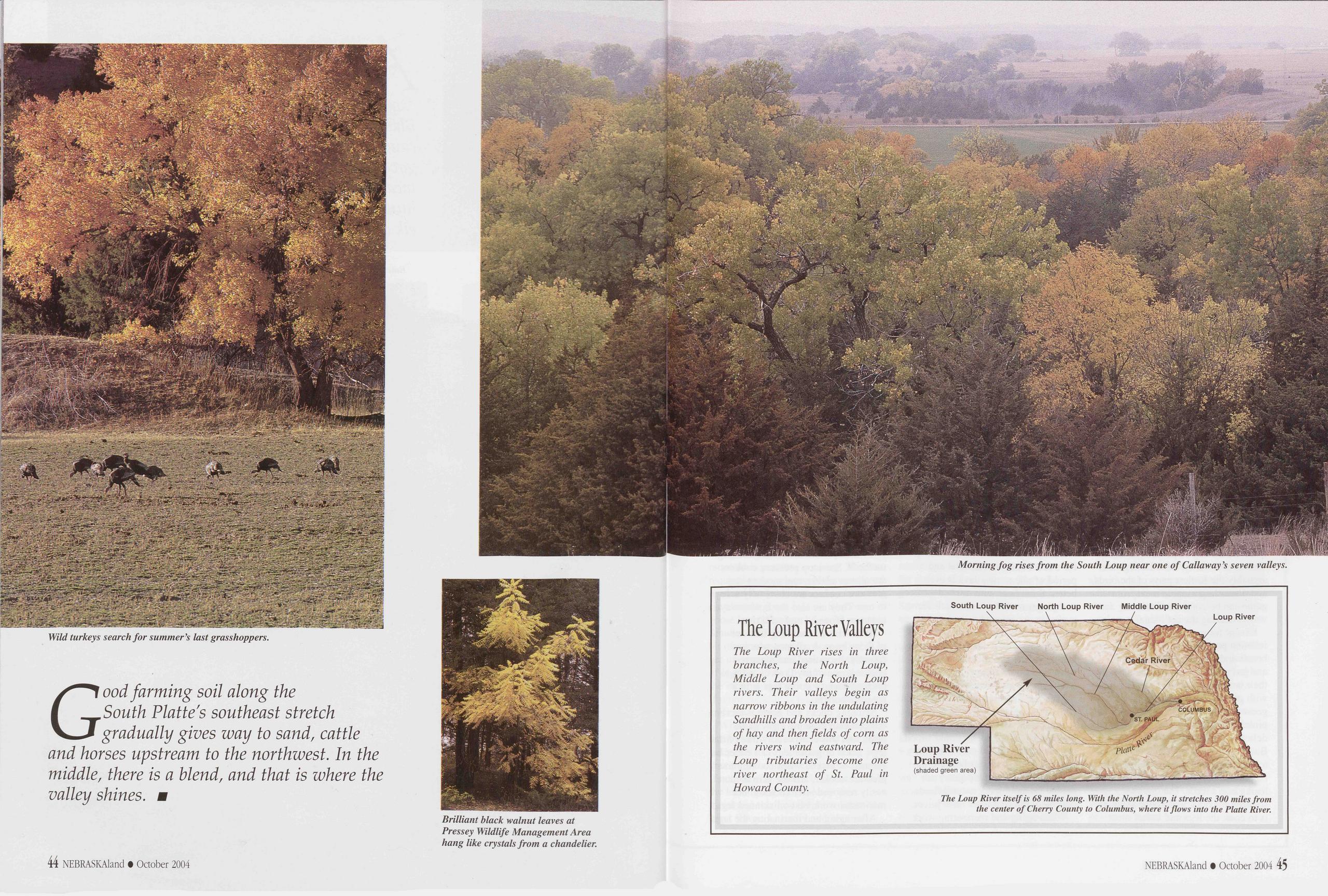
Wild turkeys search for summer's last grasshoppers.
Good farming soil along the South Platte's southeast stretch gradually gives way to sand, cattle and horses upstream to the northwest. In the middle, there is a blend, and that is where the valley shines,
Brilliant black walnut leaves at Pressey Wildlife Management Area hang like crystals from a chandelier.
Morning fog rises from the South Loup near one of Callaway’s seven valleys.
The Loup River rises in three branches, the North Loup, Middle Loup and South Loup rivers. Their valleys begin as narrow ribbons in the undulating Sandhills and broaden into plains of hay and then fields of corn as the rivers wind eastward. The Loup tributaries become one river northeast of St. Paul in Howard County.
The Loup River itself is 68 miles long. With the North Loup, it stretches 300 miles from the center of Cherry County to Columbus, where it flows into the Platte River.
In the Kitchen
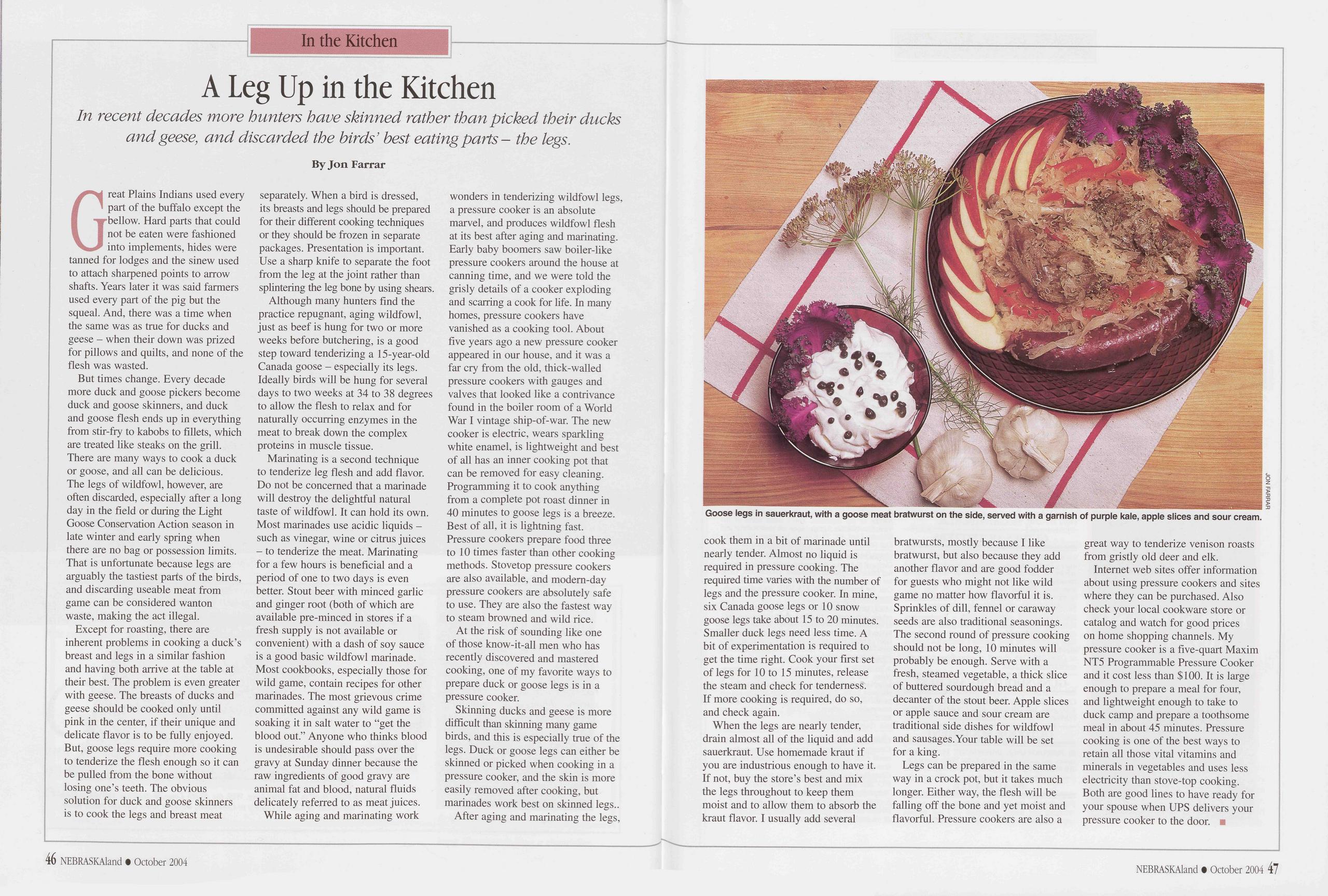
A Leg Up in the Kitchen
In recent decades more hunters have skinned rather than picked their ducks and geese, and discarded the birds’ best eating parts- the legs.
Great Plains Indians used every part of the buffalo except the bellow. Hard parts that could not be eaten were fashioned into implements, hides were tanned for lodges and the sinew used to attach sharpened points to arrow shafts. Years later it was said farmers used every part of the pig but the squeal. And, there was a time when the same was as true for ducks and geese - when their down was prized for pillows and quilts, and none of the flesh was wasted.
But times change. Every decade more duck and goose pickers become duck and goose skinners, and duck and goose flesh ends up in everything from stir-fry to kabobs to fillets, which are treated like steaks on the grill. There are many ways to cook a duck or goose, and all can be delicious. The legs of wildfowl, however, are often discarded, especially after a long day in the field or during the Light Goose Conservation Action season in late winter and early spring when there are no bag or possession limits. That is unfortunate because legs are arguably the tastiest parts of the birds, and discarding useable meat from game can be considered wanton waste, making the act illegal.
Except for roasting, there are inherent problems in cooking a duck’s breast and legs in a similar fashion and having both arrive at the table at their best. The problem is even greater with geese. The breasts of ducks and geese should be cooked only until pink in the center, if their unique and delicate flavor is to be fully enjoyed. But, goose legs require more cooking to tenderize the flesh enough so it can be pulled from the bone without losing one’s teeth. The obvious solution for duck and goose skinners is to cook the legs and breast meat separately. When a bird is dressed, its breasts and legs should be prepared for their different cooking techniques or they should be frozen in separate packages. Presentation is important. Use a sharp knife to separate the foot from the leg at the joint rather than splintering the leg bone by using shears.
Although many hunters find the practice repugnant, aging wildfowl, just as beef is hung for two or more weeks before butchering, is a good step toward tenderizing a 15-year-old Canada goose - especially its legs. Ideally birds will be hung for several days to two weeks at 34 to 38 degrees to allow the flesh to relax and for naturally occurring enzymes in the meat to break down the complex proteins in muscle tissue.
Marinating is a second technique to tenderize leg flesh and add flavor. Do not be concerned that a marinade will destroy the delightful natural taste of wildfowl. It can hold its own. Most marinades use acidic liquids - such as vinegar, wine or citrus juices - to tenderize the meat. Marinating for a few hours is beneficial and a period of one to two days is even better. Stout beer with minced garlic and ginger root (both of which are available pre-minced in stores if a fresh supply is not available or convenient) with a dash of soy sauce is a good basic wildfowl marinade. Most cookbooks, especially those for wild game, contain recipes for other marinades. The most grievous crime committed against any wild game is soaking it in salt water to "get the blood out.” Anyone who thinks blood is undesirable should pass over the gravy at Sunday dinner because the raw ingredients of good gravy are animal fat and blood, natural fluids delicately referred to as meat juices.
While aging and marinating work wonders in tenderizing wildfowl legs, a pressure cooker is an absolute marvel, and produces wildfowl flesh at its best after aging and marinating. Early baby boomers saw boiler-like pressure cookers around the house at canning time, and we were told the grisly details of a cooker exploding and scarring a cook for life. In many homes, pressure cookers have vanished as a cooking tool. About five years ago a new pressure cooker appeared in our house, and it was a far cry from the old, thick-walled pressure cookers with gauges and valves that looked like a contrivance found in the boiler room of a World War I vintage ship-of-war. The new cooker is electric, wears sparkling white enamel, is lightweight and best of all has an inner cooking pot that can be removed for easy cleaning. Programming it to cook anything from a complete pot roast dinner in 40 minutes to goose legs is a breeze. Best of all, it is lightning fast. Pressure cookers prepare food three to 10 times faster than other cooking methods. Stovetop pressure cookers are also available, and modern-day pressure cookers are absolutely safe to use. They are also the fastest way to steam browned and wild rice.
At the risk of sounding like one of those know-it-all men who has recently discovered and mastered cooking, one of my favorite ways to prepare duck or goose legs is in a pressure cooker.
Skinning ducks and geese is more difficult than skinning many game birds, and this is especially true of the legs. Duck or goose legs can either be skinned or picked when cooking in a pressure cooker, and the skin is more easily removed after cooking, but marinades work best on skinned legs..
Goose legs in sauerkraut, with a goose meat bratwurst on the side, served with a garnish of purple kale, apple slices and sour cream. JON FARRAR
When the legs are nearly tender, drain almost all of the liquid and add sauerkraut. Use homemade kraut if you are industrious enough to have it. If not, buy the store’s best and mix the legs throughout to keep them moist and to allow them to absorb the kraut flavor. I usually add several bratwursts, mostly because I like bratwurst, but also because they add another flavor and are good fodder for guests who might not like wild game no matter how flavorful it is. Sprinkles of dill, fennel or caraway seeds are also traditional seasonings. The second round of pressure cooking should not be long, 10 minutes will probably be enough. Serve with a fresh, steamed vegetable, a thick slice of buttered sourdough bread and a decanter of the stout beer. Apple slices or apple sauce and sour cream are traditional side dishes for wildfowl and sausages. Your table will be set for a king.
Legs can be prepared in the same way in a crock pot, but it takes much longer. Either way, the flesh will be falling off the bone and yet moist and flavorful. Pressure cookers are also a great way to tenderize venison roasts from gristly old deer and elk.
Internet web sites offer information about using pressure cookers and sites where they can be purchased. Also check your local cookware store or catalog and watch for good prices on home shopping channels. My pressure cooker is a five-quart Maxim NT5 Programmable Pressure Cooker and it cost less than $100. It is large enough to prepare a meal for four, and lightweight enough to take to duck camp and prepare a toothsome meal in about 45 minutes. Pressure cooking is one of the best ways to retain all those vital vitamins and minerals in vegetables and uses less electricity than stove-top cooking. Both are good lines to have ready for your spouse when UPS delivers your pressure cooker to the door.
NEBRASKAland • October 2004 47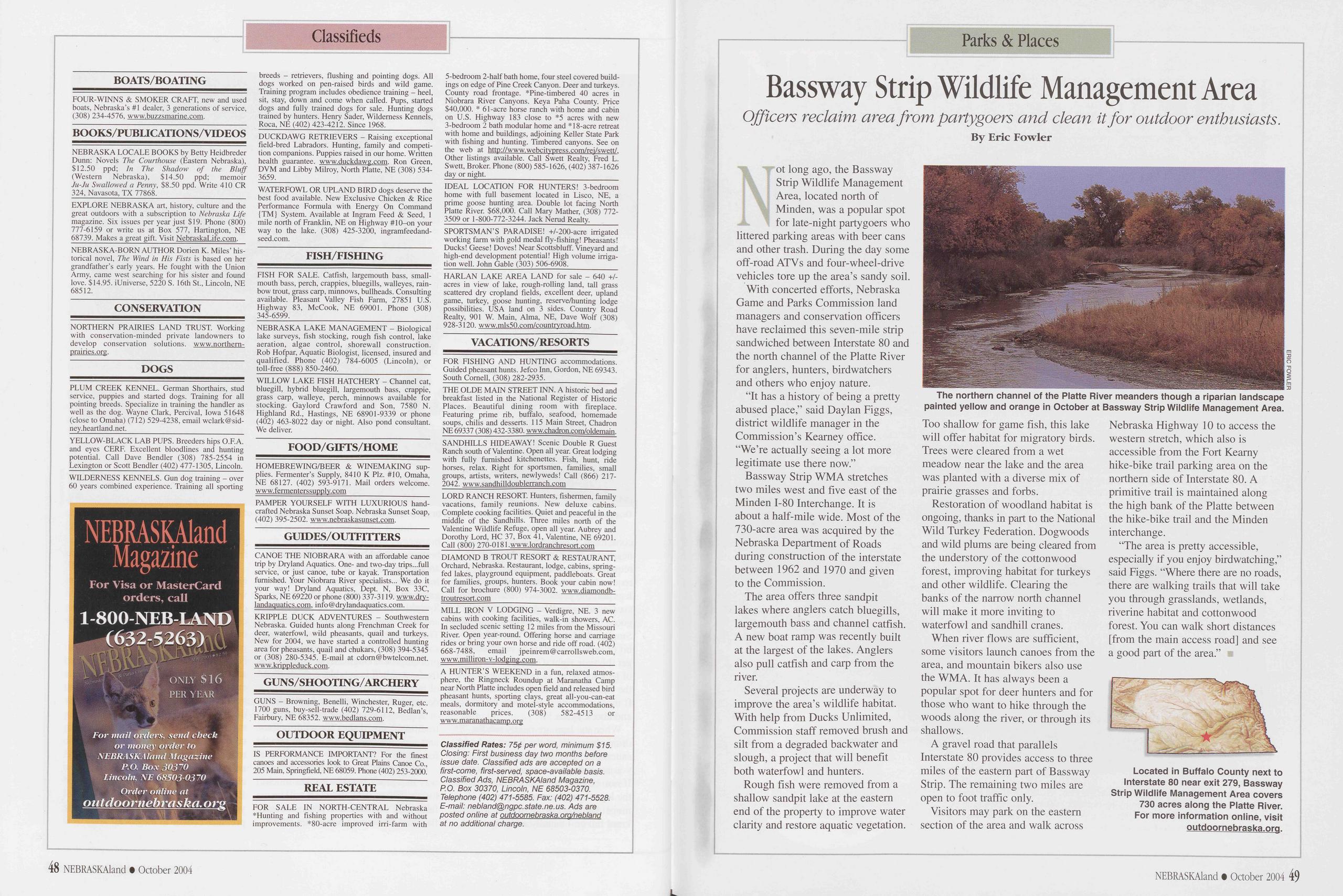
Classifieds
BOATS/BOATING FOUR-WINNS & SMOKER CRAFT, new and used boats, Nebraska’s #1 dealer, 3 generations of service, (308) 234-4576, www.buzzsmarine.com. BOOKS/PUBLICATIONS/VIDEOS NEBRASKA LOCALE BOOKS by Betty Heidbreder Dunn: Novels The Courthouse (Eastern Nebraska), $12.50 ppd; In The Shadow of the Bluff (Western Nebraska), $14.50 ppd; memoir Ju-Ju Swallowed a Penny, $8.50 ppd. Write 410 CR 324, Navasota, TX 77868. EXPLORE NEBRASKA art, history, culture and the great outdoors with a subscription to Nebraska Life magazine. Six issues per year just $19. Phone (800) 777-6159 or write us at Box 577, Hartington, NE 68739. Makes a great gift. Visit NebraskaLife.com. NEBRASKA-BORN AUTHOR Dorien K. Miles’ his- torical novel, The Wind in His Fists is based on her grandfather’s early years. He fought with the Union Army, came west searching for his sister and found love. $14.95. iUniverse, 5220 S. 16th St., Lincoln, NE 68512. CONSERVATION NORTHERN PRAIRIES LAND TRUST. Working with conservation-minded private landowners to develop conservation solutions, www.northern- prairies.org. DOGS PLUM CREEK KENNEL. German Shorthairs, stud service, puppies and started dogs. Training for all pointing breeds. Specialize in training the handler as well as the dog. Wayne Clark, Percival, Iowa 51648 (close to Omaha) (712) 529-4238, email wclark@sid- ney.heartland.net. YELLOW-BLACK LAB PUPS. Breeders hips O.F.A. and eyes CERF. Excellent bloodlines and hunting potential. Call Dave Bendler (308) 785-2554 in Lexington or Scott Bendler (402) 477-1305, Lincoln. WILDERNESS KENNELS. Gun dog training - over 60 years combined experience. Training all sporting breeds - retrievers, flushing and pointing dogs. All dogs worked on pen-raised birds and wild game. Training program includes obedience training - heel, sit, stay, down and come when called. Pups, started dogs and fully trained dogs for sale. Hunting dogs trained by hunters. Henry Sader, Wilderness Kennels, Roca, NE (402) 423-4212. Since 1968. DUCKDAWG RETRIEVERS - Raising exceptional field-bred Labradors. Hunting, family and competi- tion companions. Puppies raised in our home. Written health guarantee, www.duckdawg.com. Ron Green, DVM and Libby Milroy, North Platte, NE (308) 534- 3659. WATERFOWL OR UPLAND BIRD dogs deserve the best food available. New Exclusive Chicken & Rice Performance Formula with Energy On Command {TM} System. Available at Ingram Feed & Seed, 1 mile north of Franklin, NE on Highway #10-on your way to the lake. (308) 425-3200, ingramfeedand- seed.com. FISH/FISHING FISH FOR SALE. Catfish, largemouth bass, small- mouth bass, perch, crappies, bluegills, walleyes, rain- bow trout, grass carp, minnows, bullheads. Consulting available. Pleasant Valley Fish Farm, 27851 U.S. Highway 83, McCook, NE 69001. Phone (308) 345-6599. NEBRASKA LAKE MANAGEMENT - Biological lake surveys, fish stocking, rough fish control, lake aeration, algae control, shorewall construction. Rob Hofpar, Aquatic Biologist, licensed, insured and qualified. Phone (402) 784-6005 (Lincoln), or toll-free (888) 850-2460. WILLOW LAKE FISH HATCHERY - Channel cat, bluegill, hybrid bluegill, largemouth bass, crappie, grass carp, walleye, perch, minnows available for stocking. Gaylord Crawford and Son, 7580 N. Highland Rd., Hastings, NE 68901-9339 or phone (402) 463-8022 day or night. Also pond consultant. We deliver. FOOD/GDFTS/HOME HOMEBREWING/BEER & WINEMAKING sup- plies. Fermenter’s Supply, 8410 K Plz. #10, Omaha, NE 68127. (402) 593-9171. Mail orders welcome. www.fermenterssupplv.com PAMPER YOURSELF WITH LUXURIOUS hand- crafted Nebraska Sunset Soap. Nebraska Sunset Soap, (402) 395-2502. www.nebraskasunset.com. GUIDES/OUTFITTERS CANOE THE NIOBRARA with an affordable canoe trip by Dryland Aquatics. One- and two-day trips...full service, or just canoe, tube or kayak. Transportation furnished. Your Niobrara River specialists... We do it your way! Dryland Aquatics, Dept. N, Box 33C, Sparks, NE 69220 or phone (800) 337-3119. www.drv- landaquatics.com, info@drylandaquatics.com._ KRIPPLE DUCK ADVENTURES - Southwestern Nebraska. Guided hunts along Frenchman Creek for deer, waterfowl, wild pheasants, quail and turkeys. New for 2004, we have started a controlled hunting area for pheasants, quail and chukars, (308) 394-5345 or (308) 280-5345. E-mail at cdom@bwtelcom.net. www.krippleduck.com. GUNS/SHOOTING/ARCHERY GUNS - Browning, Benelli, Winchester, Ruger, etc. 1700 guns, buy-sell-trade (402) 729-6112, Bedlan’s, Fairbury, NE 68352. www.bedlans.com. OUTDOOR EQUIPMENT IS PERFORMANCE IMPORTANT? For the finest canoes and accessories look to Great Plains Canoe Co., 205 Main, Springfield, NE 68059. Phone (402) 253-2000. REAL ESTATE FOR SALE IN NORTH-CENTRAL Nebraska *Hunting and fishing properties with and without improvements. *80-acre improved irri-farm with 5-bedroom 2-half bath home, four steel covered build- ings on edge of Pine Creek Canyon. Deer and turkeys. County road frontage. * *Pine-timbered 40 acres in Niobrara River Canyons. Keya Paha County. Price $40,000. * 61-acre horse ranch with home and cabin on U.S. Highway 183 close to *5 acres with new 3-bedroom 2 bath modular home and *18-acre retreat with home and buildings, adjoining Keller State Park with fishing and hunting. Timbered canyons. See on the web at httD.7Zwww.webcitvpress.com/rej/swett/. Other listings available. Call Swett Realty, Fred L. Swett, Broker. Phone (800) 585-1626, (402) 387-1626 day or night. IDEAL LOCATION FOR HUNTERS! 3-bedroom home with full basement located in Lisco, NE, a prime goose hunting area. Double lot facing North Platte River. $68,000. Call Mary Mather, (308) 772- 3509 or 1-800-772-3244, Jack Nerud Realty. SPORTSMAN’S PARADISE! +/-200-acre irrigated working farm with gold medal fly-fishing! Pheasants! Ducks! Geese! Doves! Near Scottsbluff. Vineyard and high-end development potential! High volume irriga- tion well. John Gable (303) 506-6908. HARLAN LAKE AREA LAND for sale - 640 +/- acres in view of lake, rough-rolling land, tall grass scattered dry cropland fields, excellent deer, upland game, turkey, goose hunting, reserve/hunting lodge possibilities. USA land on 3 sides. Country Road Realty, 901 W. Main, Alma, NE, Dave Wolf (308) 928-3120. www.mls50.com/countrvroad.htm. VACATIONS/RESORTS FOR FISHING AND HUNTING accommodations. Guided pheasant hunts. Jefco Inn, Gordon, NE 69343. South Cornell, (308) 282-2935. THE OLDE MAIN STREET INN. A historic bed and breakfast listed in the National Register of Historic Places. Beautiful dining room with fireplace. Featuring prime rib, buffalo, seafood, homemade soups, chilis and desserts. 115 Main Street, Chadron NE 69337 (308) 432-3380. www.chadron.com/oldemain. SANDHILLS HIDEAWAY! Scenic Double R Guest Ranch south of Valentine. Open all year. Great lodging with fully furnished kitchenettes. Fish, hunt, ride horses, relax. Right for sportsmen, families, small groups, artists, writers, newlyweds! Call (866) 217- 2042. www.sandhilldoublerranch.com LORD RANCH RESORT. Hunters, fishermen, family vacations, family reunions. New deluxe cabins. Complete cooking facilities. Quiet and peaceful in the middle of the Sandhills. Three miles north of the Valentine Wildlife Refuge, open all year. Aubrey and Dorothy Lord, HC 37, Box 41, Valentine, NE 69201. Call (800) 270-0181.www.lordranchresort.com DIAMOND B TROUT RESORT & RESTAURANT, Orchard, Nebraska. Restaurant, lodge, cabins, spring- fed lakes, playground equipment, paddleboats. Great for families, groups, hunters. Book your cabin now! Call for brochure (800) 974-3002. www.diamondb- troutresort.com MILL IRON V LODGING - Verdigre, NE. 3 new cabins with cooking facilities, walk-in showers, AC. In secluded scenic setting 12 miles from the Missouri River. Open year-round. Offering horse and carriage rides or bring your own horse and ride off road. (402) 668-7488, email jpeinrem@carrollsweb.com, www.milliron-v-lodging.com. A HUNTER’S WEEKEND in a fun, relaxed atmos- phere, the Ringneck Roundup at Maranatha Camp near North Platte includes open field and released bird pheasant hunts, sporting clays, great all-you-can-eat meals, dormitory and motel-style accommodations, reasonable prices. (308)582-4513 or www.maranathacamp.org Classified Rates: 750 per word, minimum $15. Closing: First business day two months before issue date. Classified ads are accepted on a first-come, first-served, space-available basis. Classified Ads, NEBRASKAIand Magazine, P.O. Box 30370, Lincoln, NE 68503-0370. Telephone (402) 471-5585. Fax: (402) 471-5528. E-mail: nebland@ngpc.state.ne.us. Ads are posted online at outdoomebraska. oro/nebland at no additional charge. 48 NEBRASKAIand • October 2004Parks & Places
Bassway Strip Wildlife Management Area
Officers reclaim area from partygoers and clean it for outdoor enthusiasts.
Not long ago, the Bass way Strip Wildlife Management Area, located north of Minden, was a popular spot for late-night partygoers who littered parking areas with beer cans and other trash. During the day some off-road ATVs and four-wheel-drive vehicles tore up the area’s sandy soil.
With concerted efforts, Nebraska Game and Parks Commission land managers and conservation officers have reclaimed this seven-mile strip sandwiched between Interstate 80 and the north channel of the Platte River for anglers, hunters, birdwatchers and others who enjoy nature.
"It has a history of being a pretty abused place,” said Daylan Figgs, district wildlife manager in the Commission’s Kearney office. "We’re actually seeing a lot more legitimate use there now.”
Bassway Strip WMA stretches two miles west and five east of the Minden 1-80 Interchange. It is about a half-mile wide. Most of the 730-acre area was acquired by the Nebraska Department of Roads during construction of the interstate between 1962 and 1970 and given to the Commission.
The area offers three sandpit lakes where anglers catch bluegills, largemouth bass and channel catfish. A new boat ramp was recently built at the largest of the lakes. Anglers also pull catfish and carp from the river.
Several projects are underway to improve the area’s wildlife habitat. With help from Ducks Unlimited, Commission staff removed brush and silt from a degraded backwater and slough, a project that will benefit both waterfowl and hunters.
The northern channel of the Platte River meanders though a riparian landscape painted yellow and orange in October at Bassway Strip Wildlife Management Area. ERIC FOWLER
Restoration of woodland habitat is ongoing, thanks in part to the National Wild Turkey Federation. Dogwoods and wild plums are being cleared from the understory of the cottonwood forest, improving habitat for turkeys and other wildlife. Clearing the banks of the narrow north channel will make it more inviting to waterfowl and sandhill cranes.
When river flows are sufficient, some visitors launch canoes from the area, and mountain bikers also use the WMA. It has always been a popular spot for deer hunters and for those who want to hike through the woods along the river, or through its shallows.
A gravel road that parallels Interstate 80 provides access to three miles of the eastern part of Bass way Strip. The remaining two miles are open to foot traffic only.
Visitors may park on the eastern section of the area and walk across Nebraska Highway 10 to access the western stretch, which also is accessible from the Fort Kearny hike-bike trail parking area on the northern side of Interstate 80. A primitive trail is maintained along the high bank of the Platte between the hike-bike trail and the Minden interchange.
“The area is pretty accessible, especially if you enjoy birdwatching,” said Figgs. "Where there are no roads, there are walking trails that will take you through grasslands, wetlands, riverine habitat and cottonwood forest. You can walk short distances [from the main access road] and see a good part of the area.”
Located in Buffalo County next to Interstate 80 near exit 279, Bassway Strip Wildlife Management Area covers 730 acres along the Platte River. For more information online, visit outdoornebraska.org.
Portraits from the Past
 NEBRASKAland Magazine
Published by the
Nebraska Game and Parks Commission
World Wide Web site: outdoornebraska.org
NEBRASKAland Magazine
Published by the
Nebraska Game and Parks Commission
World Wide Web site: outdoornebraska.org
Position: 872 (9 views)